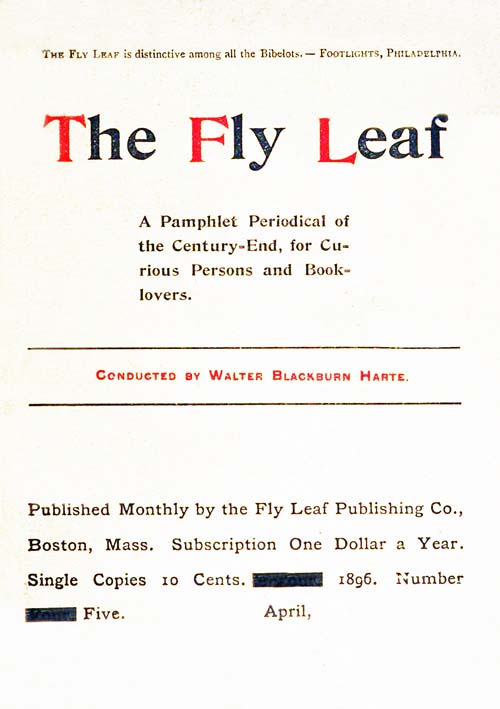
The great books teach us to smile at life.
The old proverb that there is nothing new
under the sun gives much latitude to dullards
and plagiarists, who are altogether destitute of
the fascination of a mood or manner. Egoism
is the last virtue of modern literature.
It is not so much what a man says, but what
he looks, with women. It is the fantasy of
wickedness that flashes from eye to eye among
dumb clods that keeps poetry perennially in the
world.
If the sun shone only upon the righteous, he
would not need to get up so early in the morning.
I have my livelihood to earn, and consequently
I am an optimist.
There is something intellectually lacking in
all converts to brand new dogmas and creeds.
A deep sense of wickedness is but a phase of
immaturity of mind.
A woman who is not at heart a tyrant in her
dreams of love is a perversion of nature.
So far as can be learned at this distance, there
is only one industry in the new South which is
really in a flourishing condition, and that is the
unlimited production of abominable trashy “literature.”
If some half baked people would consent to
go to night school instead of covering endless
reams with horrible aberrations, the progress of
aesthetics would be more rapid in America.
Some people cannot realize that mere mellifluous
meanderings in verse or plain prose are
simply indications of an affection of the gray
matter, akin to a cold in the head, and are
of no more significance to the outside world
than the week’s washing.
The instability of all industrial and business
life in America is one of the horrors of existence
here, and it is one of the factors that make
culture impossible here. A nation on the jump
runs to “smartness” but not to intellect. There
is only one class in our society that enjoys stability,
and that is the Police. Whether we may
expect any aesthetic appreciation from this
quarter remains to be seen.
“To amuse respectable people,” said Moliere,
“what a strange task.” And God was good
enough to allow Moliere to live and write for
the Court of Louis XIV. It is a great privilege
for a writer to know precisely the follies and
moods of his audience. Moliere himself showed
how much appreciation of wit and sanity can
be cultivated in a court of folly. But how
can the most assiduous student of human nature
gauge the vagaries of taste in a democracy? The
amusing of respectable, and other people, is the
wreck of imagination and authorship in this
happy land of Educational Eclipse. Here, all are
what is called “educated.” But how few care for
or know anything of that self education which
constitutes culture?
The poor alone trust in Providence. The rich
own Providence.
To Amaryllis: As you did not enclose postage
for the return of your manuscript, I address
you through this medium. Your verses are
good enough from one point of view; but unfortunately
this is a Bibelot of Literature, and these
are picture-book verses. They are in the right
key, though, for we have tried them on the office
cat with gratifying results. The cat was seized
with a fit of melancholy, and has not been out
for two nights. It will be a sin if you do not
send these potent poems to the editor of the
Century magazine.
The woman who has plenty of red blood corpuscles,
a body that is a body and not a poetic
wraith of the spirit, seems to be tumbling into
fiction nowadays. As the new heroine she is
rudely disturbing the reign of the pink and
white saints, expressly made in Paris dollhouses
for the heroines of English novels, who open
and close their eyes and smile in every chapter.
Educate yourself to tell little lies easily and
artistically, and the big ones will take care of
themselves.
The trouble with the Anglo-Saxon bourgeois
is they have no picturesqueness. They have an
abundance of vices, but no redeeming ones.
The majority of men are Christians and pagans,
Democrats and Republicans, princes and
paupers, and what not, first of all, and themselves
last of all—usually only in crises.
The salvation of stupidity in this world is that
the instinct of self-preservation has given it an
undisputed currency among the masses of men
as common-sense.
Democracy is the damnation of ideals. Old
John Calvin, if he were living and working out
his logic in the midst of modern life, would have
laid even greater distress upon total depravity
and the eternal damnation of the majority. That
is the only dream which can console us for the
dominion of the vulgar in this life; and, unfortunately,
there is no substantial logic or evidence
to support it. If instead of having lived
a quiet life in Geneva, in the sixteenth century,
Calvin were living to-day in the heart of New
York or Chicago, he would have made his theology
more terrible. The kernel of his doctrines
was evidently derived from the observation of human
society, and a career amid the brutality of
our modern cities would have left no room in his
creed for any compromises. The perseverance
of the saints is not in evidence in the cut-throat
scramble of modern life.
This doctrine of damnation has always condoned
for me many of the intolerable narrownesses
in Calvinism. If it is probable that God
himself cannot contemplate an invasion of the
mob without trepidation, I cannot see what
argument can be made in support of democracy
in our social and intellectual life here below. I
envy all those who hold this doctrine of damnation
without any troublesome doubts. Calvin
had evidently fathomed human nature, even if
he did not enjoy any special revelation of the life
hereafter.
About the only woman whose novels I am
curious to read at this moment is Diana of the
Crossways. And her “Princess Egeria” and
the rest are out of reach forever.
Now here is a nice psychological point. A
very clever woman, who knows men and women
as only some wonderful women can, and who
yet has never written a novel, came to me the
other day, as to a Father Confessor of the
smaller sophistries of conscience, upon which
religion affords no certain light and assurance.
The point she wished to know was whether she
was a new woman or simply a harmless flirt of
the old school. As I could not decide this momentous
matter, I concluded to ventilate it in
print, suppressing the name of my friend. The
situation is this: She loves her husband with
all her heart, but yet she sometimes lacks the
moral courage to tell some men whom she meets
casually that she is a married woman.
It does not seem to add to England’s glory to
appoint Uriah Heep to the job of court clown.
The old jesters made better sport.
I sometimes wonder what peculiar influence
in their environment makes so many literary
critics attached to the editorial staff of periodicals,
whose chief staple is some denominational
form of religious conviction, so offensively positive
and dogmatic. They are seldom troubled
with any judicial hesitations. They proclaim
their ipse dixits with a solemnity and excess of asseveration
and finality which is hideously funny
to the lay mind, that takes its own peculiar predilections
and distastes, with a shade of something
approximating good-natured tolerance of
the possible tastes of others. I think this critical
attitude of the religious Pontifex is largely
due to some profound mental and moral confusion.
He is so accustomed to dealing out fire
and brimstone and damnation with a callous and
easy conscience to all who differ with him in the
domain of religious belief, and especially to
those who occupy the agnostic and rational attitude
toward the eternal problems of life, that he
finally gets into the trick of using the thunder
of Jehovah for smaller offences and occasions.
Here is a case in point. A solemn and inspired
lunatic writes, in the New York “Independent,”
of George Meredith, the greatest living writer in
the English speaking world, in this utterly mendacious
and injudicious fashion. “The most
elaborately feminine man in English literary
life.” “The Amazing Marriage” is then described
as “a crazy structure gorgeously decorated,
in which dwell nympholepts, aged satyrs,
erotic wives and foredoomed maidens, all moving
on to rainbow-hued destruction or jaundiced
delight.”
This in a religious paper that makes a great
parade of its dignity, and is always finding fault
with the honest opinions of others, because they
are apt to be so irreverent, looks like that simple
and vulgar bid for pre-eminence in heresy,
which will always catch the greedy ears of the
envious and mediocre mob, that is glad to see
hateful superiority spattered with mud. I suppose
this view of the modern man of letters
who is inflexibly true to his aims and the dignity
of his calling, and who is, moreover, the
master of his craft, is to be attributed to the superintellectual
quality of the inspiration that directs
all organs of religious opinion.
It is a little hard to understand the criticism
which hails the revival of the old familiar blood
and thunder fiction of our boyhood days as the
renaissance of genius in fiction. All this sort of
literature, whether wrapt in mediæval properties
or not, is fatally melodramatic and unreal, and
constitutes so much lumber and nothing else,
if it should remain in the memory. But as all
our picture periodicals and Sunday papers are
filled with nothing but blood and thunder stuff
from Stanley Weyman, Anthony Hope and the
rest, it is obviously the taste of the time. I am
meditating a new magazine on these popular
lines. It is to be called: “The Antique Renascence;
a Magazine of Pistol Shots and Rape.”
One of the metropolitan Sunday papers advertises
every week in triumphant and gigantic
capitals how many square miles of spruce forest
were converted into paper for the Sunday edition.
The number of square miles of forest that
is disappearing in this way is something appalling.
It seems to a few reactionary wits, unintoxicated
with the spectacle of this modern progress,
that sacrificing half a spruce forest to
make a Sunday paper is much worse than
butchering a little chain-gang of Christians to
make a Roman holiday.
It is a simple death notice in the Boston Evening
Events, for February 2, 1896. It reads thus:
“Miss Priscilla Prim, of 29976 Beacon street,
Boston, died suddenly of a severe mental shock
yesterday evening. Miss Prim was well known
as the possessor of a very large fortune, a philanthropist,
and a patron of the arts and all sorts
of moral reforms and missions, and her decease
will be mourned by all lovers of liberal culture.”
She had just finished her supper, when a niece
from Chicago, who was stopping in her house,
to come out this season in the “smart set,”
handed her a copy of the February Fly Leaf,
fresh and virgin from the press that evening.
It contained some opinions which are regarded
as heterodox and impossible in “The Ladies’
Own Humbug and Treasury of Misinformation.”
It appeared to lack reverence for the unsupported
tradition of “culture” that lingers in modern
materialistic, money-grubbing Boston, in
every well-regulated household, quite independently
of the fact that in thousands there is no
evidence of civilization in the shape of books,
ancient or modern. This flippancy is undoubtedly
immoral, and its heinousness may be judged
by its effect in this instance.
Miss Prim was mad, indignant, furious, and
fumed at the mouth with the passion of her outraged
moral feelings. She sprang to her feet to
write a letter of protest to the editor of the
Events, when she stumbled over the only work
of literature in the establishment—it was Mrs.
Parloa’s Appledore Cookbook, by the way—and
falling face forward upon the floor, she expired
immediately of a severe bump and excess
of moral emotion.
It is time the old fierce Puritanical spirit was
calmed in the blood of the hereditary Bostonians;
but the old generation dies glum and
hard, and will refuse Heaven if the Almighty is
so captious as to demand a sense of humor.
Mr. Chauncey M. Depew is reported to have
said that Fame depends entirely upon being
civil to interviewers. English visitors should
remember this—and a few, who want to feather
their nests, are beginning to appreciate the wisdom
of our worldly sage. Conan Doyle and
Hall Caine have taken “the tip,” and have even
been quite civil and polite about American institutions
and social life since gaining their own
shores. This little simple art of glossing is one
the British should cultivate. They are at present
the most hateful people on earth. The world
is getting crowded now and they should endeavor
to become less obnoxious. English
celebrities can extend their fame with their
courtesies.
A very pathetic and significant incident occurred
in one of the leading hotels of Boston
the other day. It is fraught with a warning for
the injudicious, that needs no additional emphasis
from me. But do not turn aside and
skip the paragraph because it has a moral!
A well-known Temperance lecturer and social
reformer from Shebogan Falls, Arizona, who
was stopping at the house, was suddenly taken
violently sick, and showed unmistakable signs
of suffering from delirium tremens. The gentleman
had then been in the hotel for twenty-four
hours and he was known to have touched
no liquor. A search of his room and grip revealed
no intoxicants. The doctors called in
were positive about the symptoms, and yet the
man’s breath contained no hint of alcohol. The
stomach pump afforded no more confirmation.
But he was in the throes of delirium tremens,
nevertheless, and the doctors were perplexed.
All sorts of elaborate theories of hereditary influences
were proposed and discussed, and the
man’s history and ancestry were looked up.
Suddenly he recovered, and an explanation was
soon forthcoming.
A well thumbed and dismantled copy of the
Arena magazine was discovered under his bed.
Those who are interested in the diffusion of
good literature among all classes in America,
should make themselves acquainted with the
publications of Thomas B. Mosher, of Portland,
Me. A good book in his list to put upon the
shelf, to begin with, is the beautifully bound
volume of the Bibelot for 1895. In making a
collection of belles-lettres, the authors and
books after all, who give most pleasure, one
provides a sure refuge always at hand for any
sudden invasion of the blues or ennui, and there
is solace here for weightier sorrows, too. For
the brave idealists condemned to struggle in
this alien world, who can still unpack their
minds of all sordid sorrows and bitterness and
carry merry and piping hearts to Arcady, are
surely not lacking in a profound philosophy—and
the philosophy which includes the life of
the philosopher is rare indeed.
It is for this reason that the poets and fantastists
are closer to our moods through the changing
years than all other writers. When the historians,
philosophers and social prophets and
the rest find us indifferent and content to let
the world slide, when great names and ideals no
longer stir or move us, when experience has
disenchanted us with life and humanity, and so
stript history and philosophy and religion of all
significance, when all our enthusiasms are gone,
love is an exchange of domestic services for the
sake of economy, and friendship is a long laid
ghost of youth—then we can recur again and
again to the authors who turn our chimney corner
into that wider dominion of freedom the
human spirit can never quite relinquish in its
dreams. Fine spun logic and all the metaphysics
of the ages cannot bring us back to faith
and hope and charity then; but these few
blessed spirits who found their way to Arcady
occasionally, give us a spell of oblivion, if not
much philosophy, and often a pinch of fortitude
for our return to the doom of disenchantment.
The republic of beauty is not an important
territory or marked very clearly on the current
maps of Democracy. But there are still some
who cherish the ancient boon of poetry
and beauty, and such will appreciate a volume
like “The Bibelot,” filled with the literature
that blows through our foetid life like God’s
wind through a hospital. It is one of the few
books that cannot fail to hit the taste of any real
book lover. It contains selections from William
Blake, James Thomson, Francois Villon, a discourse
of Walter Pater’s on Marcus Aurelius,
Fragments from Sappho, Sonnets on English
Dramatic Poets, the Pathos of the Rose in
Poetry, extracts from Rossetti’s “Hand and
Soul,” Robert Louis Stevenson’s “A Lodging
for the Night: A Story of Villon,” and other
masterpieces of literature. It is a priceless
book for the poor student, for these selections
have been culled from scarce editions and
sources not generally accessible.
If our young readers will read the Bibelot,
they may acquire the sense of beauty and power
of discrimination, and the taste for the best in
literature, old and new. They will then become
callous to the tawdry domestic twaddle that has
been circulated as “literature” in the respectable
domestic periodicals, for the past two decades,
in this country, and will learn to distinguish
genuine literature from mere merchandise.
Perhaps then it will be possible for sincere
and earnest work to find currency in books
in America, as it has not been since the popular
picture periodicals took the place of books in our
breakneck economy.
Anthony Hope is one of the few authors of
the day honest enough to confess that he reads
very little. He is too busy writing. This is
one of the evils of the age. The writers outnumber
the readers. Every man or woman who
takes to writing is a reader lost, for writers
almost invariably only read and reread their
own works. But all authors are not as candid
as Anthony Hope.
That volume of lectures on “The Art of Making
a Newspaper,” which all “the bright young
men” in American journalism have been studying,
is marred with the omission of an important
historical matter. This is the origin and
career of Mr. Dana’s “office cat.” Charles A.
Dana is the most picturesque personality in contemporary
American public life. He is more
definitely in the popular imagination of this
generation than any man engaged in literature
proper, and so every characteristic detail and
whimsy of the “Sun’s” school of journalism
should be recorded for the benefit of posterity.
The “office cat” has played a great part in the
“Sun’s” art and artifice, and its omission is a
national catastrophe.
Habakkuk Higginbotham.