Women are the exceptions to every rule.
That is what rules are made for—so that women
can be exceptions to them.
Wickedness in women is expiated by the joy
it affords the saints.
We all profess to think well of humanity because
we want to be well thought of.
It is something to convert one’s enemies, but
the disillusion of life comes when one attempts
to convert one’s friends.
The definition of an immoral story in the eyes
of a certain caste of critics and the smugs is one
that has a moral.
A man who values his peace of mind marries
a plain woman.
We get a good deal of literature about the
Woman with a Past. A woman has not got a
past until she begins the folly of repentance.
There is something radically wrong with a
misanthrope who is not merry and cheerful, for
this is a state of mental and moral independence
and self-complacency.
Another impending catastrophe that looms up
large on the literary horizon is a serial publication
of the innocuous, but insufferably tedious
William Black. This is one of the most notorious
modern instances of a writer of fine abilities
who has fallen into the slough of mere money
making. Black ceased to write anything that
really seizes one’s interest almost as long ago
as ten years. He has written nothing but guide
and patter-book stories of the Scotch highlands
since his first legitimate successes, and today he
writes simply for the largest audience. The
style and workmanship is always up to his own
standard, for, of course, he is a good workman,
but the charm of a forceful and original mind
that we enjoyed in “Shandon Bells” and the
rest, is lacking in these later stories, in which
the conventional love story of old-fashioned romance
is told over and over again, with a background
of London and Scotch country houses.
Mrs. Humphrey Ward is in the field again.
She is the female political and religious prophet
of the nonconformist many-headed. She is to
contribute an interminable, commonplace snob-novel,
dealing with utterly superfluous English
“society” and political life, to one of the American
magazines for mature sucklings. It is bad
enough to get this freak female in books.
It is a poor imitation of Anthony Trollope,
and it is filled with the profound platitudes that
have made the Ward nightmare a ludicrous libel
and parody of George Eliot. Such is the taste
of the serious minded women readers of our
time, that this unendurably tiresome portrayer
of merely snob life and snob philosophy is hailed
as one of the geniuses of our age.
I hope I am a good Democrat here at home,
but in following English politics in the newspapers
I observe one intellectual characteristic of
a Tory government which touches my admiration
and enthusiasm, and inclines me to prefer
the Tories to the Liberals. The Liberals, like
the large army of “Reformers” we have with
us in this country, are rather apt to appeal to
the mawkish sentimentality of the unbalanced
and short-sighted masses, and they encourage
schemes for the reformation of human nature
by Act of Parliament. The Tories are saner,
broader and more tolerant of human failings
that are in the nature of things incurable. Perhaps
it is because they themselves do not pretend
to be wholly incorruptible on the moral
side that they have perception enough to recognize
the fact, that folly and wickedness are the
sole compensations of the lower orders for the
hardships of existence. The Lord save the poor
from the dispensation of the reformers and
moralists! I am glad to note that Lord Salisbury
has just turned down a deputation of fanatics
on the liquor question with the curt remark
that the subject did not attract the government
after past experience, and, moreover, the
government had other more important matters
to attend to. It is time these Prohibition lunatics
learned that free men will never relinquish
their divine and human rights to go to the
devil in their own way. And besides, liquor is
not by any means the worst evil in this world.
It is time Americans arrived at maturity of
judgment in intellectual matters, instead of
complacently occupying a position of servile dependence
upon English opinion. A declaration
of Literary Independence is needed, and must
soon be made by some bold spirits.
It is ridiculous to see the American cultivated
public taking all its opinions in literary matters
from the organs of British complacency and ancient
prejudice. The London Times, an ancient
bulwark of immovable Tory Know-nothingism,
is regarded seriously on this side. Then there
is the Saturday Review, a dirty gutter rag of
imbecile impertinence, which diverts the naturäl
“sports” and hobbledehoys of the British aristocracy.
It is written in choice English superciliousness,
by snobbish and half baked boys,
for English country houses, where the coagulation
of insular stupidity needs a whip and stable-boy
familiarities to set any wits in motion.
These astounding journals of civilization are
taken seriously by the American reading public,
and more especially by the critics, who will, with
very few exceptions, dance to any jig that is
played in London.
That the English “bag-men” of literature do
not fail to take advantage of American credulity
and servile deference to English opinion,
which is as easily counterfeited as “public opinion”
is here, is shown once more for the thousandth
time, by a recent statement in The London
Times. The English do not take any trouble
to dissemble their contempt of everything
American, and a good stirring spirit of retaliation
in every department, including literature
and criticism in this country, would increase
John Bull’s friendliness and tolerance as much
as Cleveland’s message on the Monroe doctrine
did in one astonishing fortnight. We now
learn the English love us! After all those
scurrilous articles in their magazines!
The Times says: “Nothing but a boom in
London will induce American publishers to
boom an author in the States. There are very
few literary journals in the United States, so
that ours have a remarkable influence, and their
verdict on a new work is eagerly scanned and,
as a rule, accepted.”
Well, it is time the literary journals we have
awoke to their duty and opportunity, and gave
up singing to English piping, and took to thinking
for themselves. They might also look
around here, and learn something of their own
writers. It is really worth while to encourage
authorship in America. There is an abundance
of talent here, and, when circumstances are
favorable, real genius.
The howling of the critics and the frantic
female moralists convinced me that I must read
“Jude the Obscure,” which I might have postponed
until I was less busy, and so finally have
missed, as I have many good things—swept
on with the tide of events and affairs. But
when the frantic female moralist is stirred up in
holy indignation, I know that there is something
moving forward worthy of masculine consideration.
I’ve read “Jude the Obscure.” It is the
comedy and tragedy of real human life. I have
no criticism. It seems Thackeray ought to have
lived to have remarked the literary successor of
Henry Fielding. I’m like Oliver Twist.
Alarmed at my own temerity, I want some more.
Let our English literature be written for men
and women. Let it dare, even if it can never
achieve the range of Balzac, the Aristophanes,
the Shakspeare of modern fiction.
One very significant change has almost imperceptibly
crept into English fiction of recent
years. It will be remembered that all Dickens’
and Thackeray’s heroines were in their teens;
only adventuresses and wicked women being allowed
a fictitious existence after passing their
twentieth birthday. And so with all the conventional
novels from that time to date—all
the heroines are sylphish, roguish, innocent, or
pale-faced, meditative maids. To-day the
heroines in some rather advanced books are allowed
to be as aged as twenty-five. This is
moral and intellectual progress. A woman is
now also allowed to be in love with a man before
he pops any question.
The February “Bachelor of Arts” has an article
on “The Yale Prom [From the Girl’s Point of
View].” It is signed by “Florence Guertin.” In
the second paragraph we read: “Skirt the ballroom
with boxes; place in them hundreds of
pretty girls, typical American beauties from all
parts of the country; offset these by a fringe of
diamond-decked chaperones; confront them
with a solid phalanx of white-shirted, handsome,
muscular young men, and you have a
rough sketch of the outward aspect of the Junior
Promenade.” “White-shirted!” Why, Florence!
Is the Yale Prom such a barbarous, uncivilized
affair? This out-Poteats Mrs. Poteat,
who said she had rather send her son to hell
than to Yale (she was not a Harvard grad.,
either). Our moral sensibilities are rudely disturbed
by this vision, but we struggle on for a
few paragraphs not knowing what awful disclosure
Florence will make next, till we heave a sigh
of relief when we read: “Yale University
teaches one thing not down in the curriculum:
it teaches a man how to dress. The majority of
students could pass a hundred in this course.”
From this we are led to infer that the solid
phalanx of handsome, muscular young men had
something else on beside white shirts, and that
there was more regard for the conventionalities
of modern civilization at New Haven than
Florence at first would have us believe. But
why “white-shirted?” Did Florence expect that
Yale men would appear in their dress suits with
colored shirts? Or perhaps she thought they
wore sweaters.
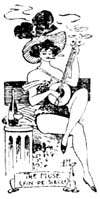
I do not know how it may be with other Epicureans,
but I find the complete dominance of
daily journalism, the stage, and a certain class
of magazines with a million readers apiece, by
the Fractionally-attired Female of the variety
stage or of society, is becoming distinctly nauseating.
To get the semi-nude fleshly female thrust
upon us in bulk at every turn, day after day,
awakens a fierce revolt in some masculine minds
against this insane worship of the Triumphant
Harlot, which is fast growing to be the principal
characteristic of modern civilization. It is getting
to be a nightmare to all who cherish any
intellectual and moral ideal aims in life, and instead
of increasing the witchery of woman it
makes her a loathsome vacuous symbol of the
corrupt millions who are groaning and praying
for a Utopia of unrestrained bestial content.
I hope they may never throw off the yokes that
keep them tame—and out of my neighborhood.
This degradation of the stage and literature is
enough to create a race of Epicurean misogynists.
Mr. Edward Sanford Martin, in a department
called “This Busy World” in Harper’s Weekly,
expresses his strenuous disapproval of the
Bibelot movement in contemporary literature,
and of the aims of the Fly Leaf in particular.
He says: “The Fly Leaf is a periodical of the
New—not to say the ‘Fresh.’”
I should have thought a man who has enough
love of real literature to turn to the good old
eighteenth century form of the gossipy essay,
as Mr. Martin has done in one or two books,
would have had enough sense of humor to appreciate
a sincere and honest attempt to rehabilitate
free thought, robust opinion and high endeavor
in present day literature. The revival
of the old and honorable pamphlet form, which
is and always has been the vehicle of free
thought, free fancy and the honest literature of
Democracy since the popularization of the printing
press should appeal to a bookman.
Mr. Martin is, however, a much better Tory
than he is a humorist; and to those who are not
aware of it, it is well to point out that one of
the significant developments in American literature
is the Tory spirit of a certain clique of
comfortables, who regard literature not as the
sacred tables of the human mind, but as a mere
game for people of taste. It is disappointing,
however, to find a man who shows his appreciation
of the good old school of essayists by attempting
to work out a career as one of this
scanty apostolic succession, so completely vitiated
in his critical and humorous perception by
bad company that he can only find a cheap, cant
term, borrowed from the gutter or the class-room,
for the honest work of men, who, in this age of
clatter and notoriety, are striving against odds
to bring in the ideals of the old robust English
literature.
But a Tory cannot be tolerant of Grub Street,
or stick at simple honesty in criticism. He is
bound to associate genius with prosperity, or
some of his friends’ fame will suffer, and discriminating
readers will grow overbold in their
choice of polite literature. Fame depends nowadays
on one’s appreciations of one’s well to do
contemporaries. It is the solemn business of
all “respectable” critics to keep literature as
the sacred gift and heirloom of a close corporation
of perfectly “respectable” and inoffensive
writers.
But perhaps time will bring a sense of humor
to Mr. Martin. We hope so, as we have a tenderness
for every man who cares for and writes
essays. Mr. Martin’s attitude surprised us somewhat,
as he really can write an amusing essay
and we expect much toleration from an essayist.
But he may live to grow mellow and learn to
love stout heretics. Every independent writer
since Job has appeared “fresh” to smug complacency,
and an essayist should never countenance
smuggery, if he would hold any status
with book men.
It always appears ridiculous to a clique that
other men should fight for and demand a hearing.
But we must honestly aver our egotistical
opinion that there is fully as much brains in
Grub Street, frowned upon as it is by the respectable
tin gods of contemporary criticism and
literature, as there is in other and more respectable
coteries of literature.
The true ideal of a democracy is a natural
aristocracy of intellect, recruited in every generation
from all classes—the survival of the
fittest. But just now almost everything in our
social, intellectual, political, and even religious
activity, caters to the mass of lowest intelligences
and their gross prejudices.
In the Fly Leaf the Beast will find no such
pandering to his muddy and addled brains.
There are plenty of periodical muck-heaps for
him to wallow in. This thing is intended for
our intellectual coevals and contemporaries, and
we shall not be easily convinced that, in this
seething time of wholesome change, there are
not enough such people in America to sympathize
with and support a periodical with such
aims.
The Fly Leaf and its writers appeal to that
rare and delightful being, the discriminating
reader. Bookish folk constitute a division in
the human species, a class by themselves, and
as a Booklover as well as a quillfeather, I firmly
believe that only those who are possessed of
some intellectual and catholic interests of this
sort will be found human and worthy enough
to be admitted to Heaven. The Almighty will
surely not destroy his own peace by allowing
the fools to outnumber and outvote Him. The
dull and unintelligent deserve to be lost. An
acute philosopher (but why dissimulate to delude
the dull, since the philosophic quip is my
own?) has divided the human race into thinkers
and readers—and mere bipeds. Why remain
simply a humble biped when you can read the
Fly Leaf and hope for Heaven?
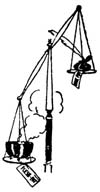
It should be distinctly understood by all readers
who visit the book stores with the idea of getting
the most for their money, that the Fly Leaf
cannot be put upon the scale and weighed
against the picture periodicals. It tips hopelessly
in the air, and this airiness and lightness
and intangible delicacy is the characteristic of
all thought. It flies into the air while mud settles
at once into its congenial mire. Thought
and wit and fancy always fly up in this fashion;
and this is the honor and distinction of the Fly
Leaf and its staff, whether we win or lose.
We candidly do not appeal to the gross and
clumsy wits of the many-headed, although we
conserve the tradition of the democracy of fine
spirit in literature. Nature’s aristocracy of intellect
is all that makes humanity tolerable.
We appeal to the Remnant, without which democracy
would be the unmitigated dominion of
the Beast; and luckily we see evidences everywhere
of the rapid growth of this class and of
a salutary revolt against the dominion of the
Beast in journalism, literature, and even in politics.
Let it grow—for no nation can take its
proper place in civilization which is governed
by its tail instead of by its head.
The Man in the Moon.