We may take it that the old story of the
Tower of Babel symbolizes the failure of the
human mind to transcend the limits of natural
knowledge. It is some old poet’s picture of the
aspiring race lifting its bold head to steal God’s
secrets from Heaven, stricken down into the
dust, whence it came and to which it must return,
foiled and despairing. But the babble of
a million futile, unprovable human speculations
continues to sway and mock generation after
generation of men, wrapt in the ironies of the
world of sense and necessity. So all human
thought runs in cycles, and the latest heir of all
the ages but gains the wisdom of increased doubt.
Our age raises its Babel of philosophies and
creeds, as did the civilizations that have gone
before, and left us but the fantasy of great and
moving names. So our most cherished realities,
for which we all suffer so much, and for
which so many heretics suffer the rack and martyrdom,
fade away into the gibes and bogies of
tradition. Ah, how sad is the fantasy of names
our freed tongues troll over so lightly! Let established
wisdom learn tolerance in this levity
of today’s knowledge. For those who hold to
any idea or ideal, know the days of martyrdom
are not yet over. The old Hebrew picture is as
true of today as when first written. We, too,
shall pass away into the fantasy of history.
We, too, shall leave but the grinning skulls and
bare bones of once vital but finally unbelievable
religions and philosophies—precious, priceless
scraps of rubbish and litter in the catacombs of
decayed and buried cities.
But the times show a certain change in spirit.
Our Babel of today does not assail God’s security,
for our babble builders do not seek to
play the prophet or the sage so much as to play
the clown successfully. The seer who gives us
words of fire and folly in his futile attempt to
cleave body and soul with the sword of thought,
at least contrives to show us that life here can
be sweet and beautiful and grand. Those whose
fearful content with the life of sense and show
drags us all to the level of our necessities, make
life even more of an irony; for they deny the
intellect and spirit their right of unfettered freedom
in the domain of thought. And when
thought is fettered with the appetites, life, indeed,
becomes a very slavery. And half our
writers are in servitude to the Egyptians. Only
a few thinkers lie sullen and idle in the sun—profitless
vagabonds, who can only work by
whim and inspiration.
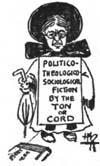
At this end of the century our Babel lacks the
genuine inspiration of ancient prophecy and
poetry. It is taken for granted, seemingly,
that as we cannot reach God, it is not worth
while to rise in thought above the mere
show of life, and so all the mystery of
man is swept out of our literature and philosophy.
We are deafened with a million
small noises of small, soulless, unreal persons.
The old stirring voices that thrilled us with the
clamor and sternness of life, are, for the most
part, silenced or muffled, because those who
grow fat on the partial enlightenment of the
masses, will not allow any sort of literature to
prosper which, in the words of the Areopagitica,
contains “views or sentiments at all above
the level of the vulgar superstition.” The literature
that sprang from the marrow of the intellect,
the core of the heart and life, is out of
fashion, is a drug in the market. This is a
day in which mere noise and notoriety completely
ousts and worsts any real thought in
every joust of letters. In fact, literature is
read less as letters, in the old sense, than as
autobiography of scandalous and notorious people.
Only the sensational in literature can attract
attention. There are lots of good books
published every year, but they steal quietly into
the world, and no one knows about them. They
burden the bookseller’s shelves for awhile, and
their only chance of circulation is finally that
some whimsical crank may pick them out of the
“remainder” boxes, when their one brief season
of undisturbed respectability on the shelves is
over.
It is with the idea of partially remedying this
state of affairs, in which the odds are so uneven,
that I venture to offer a few suggestions on the
advisability of adopting an old and picturesque
institution from a totally different Trade, and
adapting it to the needs of contemporary Literature.
This is the explanation of the caption of
this paper, which may be a little perplexing to
some unsophisticated readers. I propose to borrow
the main features of the old clothing Fair,
which is held among the Hebrews every Sunday
morning in Petticoat Lane, London,—one of
the most picturesque Babels in the world.
This would even up matters a little. I do not
propose any reform, and I should not dare to
mention any of the remarkable modern instances
of success in literature by persons who produce
much fiction which is not literature. They are
sufficiently glaring to advertise themselves
among book lovers. But I do want to lead a
forlorn hope to re-establish some sort of social
and moral, if not intellectual, equilibrium between
poor handicapped brains and overwhelming
brass. At the present moment the calling
of literature is the caravan or the refuge of the
charlatan, the demagogue, the weakminded, the
social fop, the hysterical and the notorious. My
aim in this modest proposal is simply to remove
a few obsolete superstitions and traditions of
literary dignity that, once swept away, will leave
all competitors for fame on the same footing.
Perhaps we may then hope to see the few writers
who are marred with a simple equipment of inspiration
and talent enjoy some sort of equality
with those who bring to the conquest of literature
the overwhelming advantages of sex, brass,
social authority and money.
Let us first touch upon certain aspects of criticism
and publicity in the Literary Show. It
will then be perfectly clear to the most prejudiced
reader—and I expect prejudice in this
wicked world—that my suggestion of a Sunday
Fair for Literature is the most feasible and dignified
expedient that can now be adopted, if any
of us are to continue the struggle for some literary
achievement and standard and some genuine
thought in our modern Babel.
It has always been a question in the mind of
the present writer whether most men, that is,
sane men, do not actually know, in their own
hearts, just about what they stand for absolutely
in life, or whether saints and rogues, wise and
unwise, we are all deluded about ourselves.
Heine, who wrote with so much charm about
himself, and could scarcely have found a more
interesting subject, was of the opinion that one
cannot tell the truth about one’s self; and, since
the greater portion of mankind is of this opinion,
autobiography is the most irresistible form
of literature.
But it is unfortunate there is not more division
of opinion on the subject, because, while
this view may add to the interest of autobiography,
it weakens its weight and authority; and
there are good reasons for supposing that one of
the necessary “short cuts” of contemporary
literature of the near future will be the brief
critical autobiography.
There is not a mother’s son of us in the whole
scribbling guild, great or small, puffed or
starved, can get his fill of praise; for there are
too many of us scribbling in these latter years,
and that man is fortunate who is famous for a
whole season. There are but few who can reasonably
hope for a life in the memory of mankind
as long as Mumm’s champagne. It may
be there are but few of us deserve it. Such
scraps of comfort as occasionally fall to our lot
are almost invariably disappointing, for our
friends are perversely addicted to flattering us in
good, round, general terms, which save thought
and lack positiveness, or else they appreciate us
for the very qualities it is perfectly evident we
do not possess in the least degree. But this is
the inevitable result of the production of literature
by lightning-like machinery working day
and night.
All these sugared things which authors crave
can only be supplied by other writers who, aside
from the necessity of earning a livelihood, are
plagued with private personal ambitions of their
own; and if there is any sort of drudgery more
tedious than the reviewing of other people’s literature,
I should like to know what it is. Those
who have to earn precarious bread by the pen,
somehow or other, are so busy reviewing and
scribbling on topical matters that they have absolutely
no time for reading, and so very few
writers out of the great multitude receive more
than a few perfunctory words of praise or indifferent
comment, and are then straightway forgotten.
With the ever increasing tide of books,
literary criticism tends to become more and
more a mere matter of description and catalogueing,
and as this is obviously inadequate to satisfy
all the demands of those who would live in
the public eye, we have latterly seen the development
of that interesting personage, the psychological
interviewer.
Even this does not meet the exigencies of an
overcrowded market. The psychological interviewer
is only occupied with those whose names
will help to sell his wares. The secret charm
of the psychological interview, when it is at
all well done, is that it enables an author to supplement
the necessarily perfunctory reviewing
of the day with his own keener critical insight
into the less obvious excellent qualities of his
work. This done with a fine conscientious egotism
and some show of candor, carries as much
weight with liberal and unprejudiced minds as
rare and subtle criticism. In fact, it is autobiography,
which the interviewer breaks up into
more or less dramatic dialogue.
There are still thousands of us who are so
obscure and unfortunate as to be untroubled by
the interviewers, and, to make matters worse,
are often tabooed by the critics. But since the
calling of letters is no more restricted to the “deserving”
and the “good” than any other, these
also desire that publicity which helps to solve
the problem of bread and butter. And so I
predict that the pressure of competition in
the Literary Show, and the exigencies of critical
writing, often colored, if not inspired, by
counting-house interests, will soon bring into
current literature what I have here termed the
critical autobiography. In this way we may get
much good literature, for the dullest man is at
his best when writing about himself. A man
can then be perfectly independent, and still be
heralded in print as one of the potent forces and
geniuses of his day. The plan has some advantages
over log-rolling, which sometimes involves
unavoidable and ludicrous derogatory offices,
that embarrass one’s reputation as a wit and a
critic of discernment.
It is also really time that the writers of books
learned to take something of the same vulgar
view of them which those who make their living
in dealing in them do, and that is to regard
them when finally out of the brain and put into
material shape merely as merchandise. It is this
looking upon them as “children” that has made
the poets the spoil of cunning men, and kept
them daft and poor.
The writer’s problem is to reach his fellows,
his generation. He is not, under modern conditions,
concerned with posterity any more than
the lawyer or the merchant. As for that, probably
few books of this era will be known by
name a hundred years hence; but every man
should have a fair chance of getting a hearing
in his own generation. As things are at present
constituted, a thousand obstacles are placed in
the way by other writers in the holy name of
morality, style, literary ideals, and every other
ingenious trick one writer can devise as a critic
and literary tipstaff to keep others from dimming
the effulgence of his golden beams. But,
pouf! all this anxiety is unnecessary. At least
one-half of our contemporary literature, though
it is “boomed” and bought at impressive figures,
is only passable journalism, and, perhaps,
will be thrown aside and forgotten as unreliable
data when the journals of today (such as not
being printed on wood pulp paper may perchance
survive) are treasured as the mirror of
our semi-barbaric times.
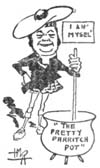
We are fairly deluged now with cheap Brummagem
“literature.” And so I think my Modest
Proposal will appeal to all fair minded persons.
Let us have an open market in literature, and
let the best peddler win. The game of literature
as carried on today, is, with a few glorious exceptions,
a purely commercial speculation, an enterprise
in trade; and there is no need to confuse
the issues with a lot of babble about “literary
ideals,” and all the rest of it. That is but an
artful trick to embarrass rivals in trade. The
howl about morality is another old trick, but
one—thanks to the beauties of human nature—which
only helps to swell the sales of a rival.
Literature is now produced to meet the demands
of different markets, on the same principle that
governs the manufacture of other luxuries and
commodities. What is the use of waiting for
your rival in trade to announce your excellencies
to the world? Human nature works the same
in all trades. Ambition preys upon and harasses
ambition. Only the cynics of Grub Street, who
have no hopes and no ambitions, can be just and
impartial critics, and they are in the pinch of
necessity. Log-rolling, too, is an imperfect art;
some fellows’ logs are so heavy!
Let it once be understood that there is no
ideal aim or dignity in the literary market of our
day other than to find quick buyers and win
the bubble reputation, and why should any man
hesitate to use the methods of ordinary commerce
to advance his own interests? It is a
matter of common sense.
I suggest in all seriousness this idea of a literary
Petticoat-Lane Sunday Fair as the best way
to develop a national literature in America. And
let every man be his own critic, prophet and
publisher. It could be held somewhere off the
Bowery—a picturesque and appropriate place.
The critical autobiographies on the market
would be genuine human documents and great
fun. A collection of them would give our epoch
everlasting fame. With every man peddling his
own wares, like the chapmen of old, the law of
the survival of the fittest would probably operate
as effectively, and more convincingly, than
under existing conditions.
Walter Blackburn Harte.