Japan is often called “The Land of the Cherry Blossom,” and it is true
that for centuries their Sakura-no-hana has been the favourite flower
of the Japanese. The refinement and grace of its beauty appeals to them
so intensely, that the month of April, the time of the cherry blossom,
might almost be regarded as a national holiday throughout the country;
and can one wonder that a whole nation should forget for a time their
work and domestic worries in the innocent enjoyment of sitting under
the flower-laden trees?
In contrast to the simple growth of the plum-tree, the blossom of the
cherry covers the whole tree in rich profusion, the branches bending
under the weight of its luxuriance, scattering a rosy shower of petals
as they sway in the spring breezes. Lafcadio Hearn, in his Glimpses of
Unfamiliar Japan, says: “When, in spring, the trees flower, it is as
though fleecy masses of clouds, faintly tinged by sunset, had floated
down from the sky, to fold themselves about the branches.... The reader
who has never seen a cherry-tree blossoming in Japan cannot possibly
imagine the delight of the spectacle. There are no green leaves; these
come later; there is only a glorious burst of blossoms, veiling every
bough and twig in their delicate mist; and the soil beneath each tree
is covered deep out of sight by fallen petals, as by a drift of snow.”
Unlike many of the favourite flowers of Japan, which are only grown in
certain districts, and might bloom altogether unobserved if one did
not make a special search for them, the cherry is so lavishly planted
throughout the Empire that it would be impossible to find any part of
the country without some display of the blossom.
The full beauty of the cherry is short-lived, and, almost before one
has realised the transformation of the whole landscape, brought about
by this wonderful flower, with the help of the glorious April sunshine,
a heavy rain-shower or sudden squall will scatter the petals like
snow before the wind, and nothing will remain but the young brown
leaves and the carpet of fallen petals beneath the trees. We are told
of Fujiwara-no-Narinori, of the twelfth century, who prayed to the
god Tai-zanfukun for the prolongation of the glory of his beloved
cherry blossom. Fujiwara had planted over a hundred of the trees in
his garden, and had, on that account, been named Sakura Machi by the
people. It is said that the gods answered his prayer, and allowed the
trees to remain in flower for twenty-one days.
Another legend tells of Minamoto-no-Yoshiyo the warrior, who was
despatched to fight with Abe-no-Sadato of Oshu. While on his way to
the enemy’s camp, he passed through groves of falling cherry blossoms,
and was struck with lamentation over the changing of nature. His poem
remains to this day, and after his death a monument was erected to his
memory, on the spot where his inspiration seized him.
It is difficult to decide in which surroundings the cherry blossom
shows to best advantage. In the groves or orchards devoted entirely
to the sakura, where the flower-laden trees will surround one on
all sides, there will be cherry blossom, and nothing but cherry
blossom almost as far as the eye can reach. From every tree will
hang rosy-red lanterns, or a poetical name and inscription will
flutter in the breeze, while crowds of visitors wander through the
grounds; children clapping their chubby hands in sheer enjoyment of
the blossoms, tumbling, in their haste to find fresh treasures, over
their gay-coloured kimonos, which, with their gorgeous obi, have been
put on to-day for the first time in the honour of spring, and the
sakura. Perhaps you might prefer to see the trees in a setting of
red-brown maples and deep-green pines, in a wilder and more natural
state, where one of the many fast-flowing rivers will hurry along
beneath the overhanging boughs, carrying away great drifts of fallen
petals; or, again, by the sea-shore, where a few great trees, high
up on the cliffs, away from all danger of salt sprays, will make a
glorious foreground for the rugged coast-line and the wide stretch of
sea beyond. But surely there is no more beautiful setting for the trees
than the old temple buildings, with their wooden structures toned by
countless ages. A great weeping cherry-tree will stand as a sentinel
at the gateway, or a little tree laden with rosy blossoms will guard a
tiny shrine.
All through the bright spring days, thousands of sight-seers will climb
the stone steps of the temple of Kyomizu—or Good Water—in Kyoto, and
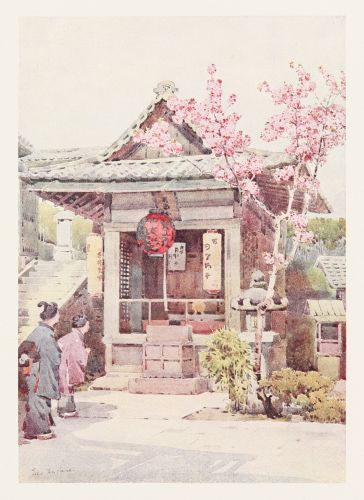
wander through the buildings to the woods beyond. From the terrace
they gaze down upon the grove of cherry and maple trees in the valley
below, and then away over the grey roofs of Kyoto and the plain beyond,
to Osaka, hidden in the morning mists, or to Arashiyama, whose groves
will assuredly be visited in due time by these untiring holiday-makers.
At every turn a new beauty wipes out the remembrance of the last, and
fills our soul with sadness, that nature will not stand still for
awhile and give us leisure to enjoy what we know will be here to-day
and gone to-morrow. Already the early single flowers are fading and
falling; every gentle breath of wind sends a fresh shower of the thin
transparent petals to the ground. To-morrow the heavy clusters of the
double pink blossoms will have lost their freshness, and will be hiding
their glories under the brown leaves that seem to unfurl and grow while
we look at them. Last, and perhaps best of all, will come the double
white blossom, whose buds are now hanging in pink clusters, and whose
beauty will linger until the close of the “cherry month.”
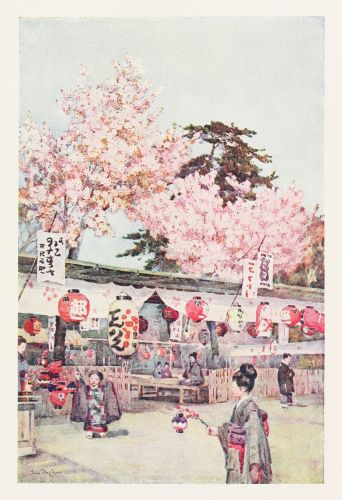
Maruyama Park in Kyoto has a great display of cherry blossom; an
enormous drooping cherry of great age, which has taken its name of
Gion sakura from the Gion temple adjoining, stands in the middle of
the park, and thousands of people come to gaze at it every year when it
is in flower. Towards the end of March, the park, which has been bleak
and deserted all the winter, becomes a scene of bustle and activity.
Temporary tea-houses are put up on every available space, hung with
innumerable lanterns, and gaily-coloured curtains, most of these being
painted with some representation of the cherry blossom. With the
unerring taste of the Japanese all the colouring is in harmony with the
blossoms, no false note will clash or take away from the beauty of the
surroundings. By the 1st of April all is in readiness for the visitors,
who from that day onwards will not fail to arrive in a never-ending
stream during the whole month. Even if there come days when the rain
descends in pitiless torrents, it does not seem to damp their ardour;
their clogs may be an inch or so higher; their kimonos will be girt
tighter about their knees, to keep them from the mud; each one will
carry a huge paper umbrella, black and red, deep blue or purple, or,
commonest of all, the natural yellowish colour of the oiled paper, with
the owner’s name or the sign of the inn to which it may belong in large
Katahana characters. Or should it be a late season
THE FEAST OF THE CHERRY BLOSSOMS
and the cherry not be in flower so early, it makes no difference, still
the people come, it is the time when it ought to be in flower, and
such is the imagination in the minds of these curious people, that
they will gaze for hours at a tree with scarcely more than a tinge of
colour in the buds with as much pleasure as if the tree were in all the
glory of its full flower. On a holiday afternoon, when the weather is
fine, every seat in the tea-houses is taken up by the pleasure parties,
while in the open spaces the people spread mats brought with them for
the purpose, and sit unfolding those neat little boxes and packets
which contain their mysterious and wonderful food so unpalatable to
our foreign ideas. Even the cakes and sugar-plums that accompany the
cups of tea, unceasingly supplied by the tired little ne sans of the
tea-houses, are in the shape of cherries impaled on wooden skewers,
and eaten with relish by young and old alike. In no other country but
Japan, where humanity is so closely associated with nature, and where
the people mingle harmoniously with the background of flowers and
trees, could one find such a scene—the entire population of a great
city given up to the whole-hearted enjoyment of nature.
At nightfall the lanterns are lighted, and flaring torches round the
giant tree cast their lurid light upon the heavily laden branches,
which might well belong to some forest tree bending under the weight
of freshly fallen snow. Those who cannot leave their work during the
day, come forth at night to swell the throng. The sounds of music and
feasting, the beating of tom-toms, and the ceaseless dragging of ten
thousand clogs mingle with the cries of the toy-seller whose stock of
those wonderful paper butterflies, and of the miniature lanterns with
the candles ready lit, has to be constantly replenished to supply his
endless customers. Thousands of country people, wearied with their
round of sight-seeing, spend the night on the grass, only to start
again at daybreak on a fresh pilgrimage of innocent pleasure.
The Emperor Kameyama in the twelfth century planted a number of
cherry-trees from Yoshino at Arashiyama, a picturesque gorge where the
river Katsura, celebrated for the beauty of its rapids, running through
a narrow valley, becomes a wide and shallow river and is renamed
the Oi gawa. Here it is said this Emperor built a pavilion, and,
during the cherry month, the Court held high revel for many years. The
pavilion has long since disappeared, perhaps swept away by one of the
numerous floods which devastate these valleys; but the cherry-trees
remain, and here, instead of the stately Court of ancient days, the
modern Kyoto sight-seers hold their revels, for Arashiyama may be said
to rank first among their favourite spring resorts. They gather in
the tea-houses and flower-booths on the banks of the river, and spend
their flower-viewing days by the running water and the clouds of white
blossom, exclaiming possibly in the words of their poet, “Not second to
Yoshino is Arashiyama, where the white spray of the torrent sprinkles
the cherry blossom.” Barge after barge, roofed over, with matted
floor and decorated with innumerable lanterns to suggest a miniature
tea-house, will take its load of visitors across the river, or they
will spend some hours drifting idly down the stream, eating their
midday meal or playing some childish game. Occasionally a flower-laden
boat, which has successfully accomplished the passage of the rapids,
will come into sight, and the sound of samisens, the saddest of all
music, comes floating through the air.
The habit of drinking saké while viewing the cherry blossom appears
to have originated in the days of the Emperor Richiu, in the fifth
century. While feasting with his courtiers in a pleasure-boat on a
lake in one of the royal parks, some petals fell into his wine-cup, and
drew the attention of the monarch to the hitherto despised blossom,
and he exclaimed, “Without wine, who can properly enjoy the sight of
the cherry blossoms?”—a sentiment which appears to have survived to
this day. It was not, however, until the eighth century that the cherry
blossom rose to the distinction of a national flower. The Emperor
Shomu, while hunting on Mount Mikasa, in the province of Yamato, was
so struck by the beauty of the blossoms, that he sent some branches,
accompanied by some verses of his own writing, to his consort Komio
Kogo. Afterwards, in order to satisfy the curiosity of the Court
ladies, who had never seen this wonderful flower, he commanded a number
of the trees to be planted round the Palace of Nara, whence arose the
custom of planting them near all the royal palaces in the country.
The province of Yamato is especially celebrated for its cherry groves,
and justly so, as the little mountain village of Yoshino has given
the name to the most famous of all the varieties, and has even been
called the headquarters of the cherry blossom; and so profuse is the
mass of blossom that the poets have compared it to mist or snow upon
the hills. The little street of the village winds away up the spur of
the hill, past many temples and shrines, until it becomes nothing but
the rough stony path which ascends Mount Omine. Although the village
stands high above the sea, its own especial kind of cherry is rather an
early one; the blossoms are large and single, pale pink in colour; but
its beauty is fleeting, and the visitor must go early in the “cherry
month” to Yoshino, or he will be greeted by great showers of the
falling petals being swirled away on the wind to join the light fleecy
clouds on Mount Omine, or down to the mists which hang in the valley
below, and nothing will be left but the remains of departed glories.
During the few days, early in April, when the blossom is at its best,
thousands of pilgrims visit the little village and occupy every
available lodging; but the traveller who is not discouraged by the
discomfort of primitive Japanese inns, or by the long tedious journey
over the mountains from Nara, will find ample reward in the beauty of
his surroundings. Mr. Parsons, in his Notes on Japan, thus described
Yoshino:—
Everything in Yoshino is redolent of the cherry: the pink and white
cakes brought in with the tea are in the shape of its blossoms,
and a conventional form of it is painted on every lantern and
printed on every scrap of paper in the place. The shops sell
preserved cherry flowers for making tea, and visitors to the
tea-houses and temples are given maps of the district—or, rather,
broad sheets roughly printed in colours, not exactly a map or a
picture—on which every cherry grove is depicted in pink. And all
this is simply enthusiasm for its beauty and associations; for
the trees bear no fruit worthy of the name.... I was reminded
constantly of a sentence a friend had written in one of my books,
“Take pains to encourage the beautiful, for the useful encourages
itself.” It is difficult for an outsider to determine how much of
this is genuine enthusiasm and how much is custom or traditional
æstheticism, but it really matters little. That the popular idea
of a holiday should be to wander about in the open air, visiting
historic places, and gazing at the finest landscapes and the
flowers in their due season, indicates a high level of true
civilisation, and the custom, if it be only custom, proves the
refinement of the people who originated it.
Tokyo and its neighbourhood can lay claim to some of the most beautiful
spots for viewing the cherry blossoms. The banks of the river Sumida at
Mukojima are lined for miles with an avenue of ancient trees bending
almost to the water’s edge with the weight of their double blossoms.
This is the favourite resort of the Tokyo holiday-makers, and crowds
of pedestrians, carrying their gourds of wine, inaugurate a veritable
Bureiko (carnival) and fill the booths and the houses which are
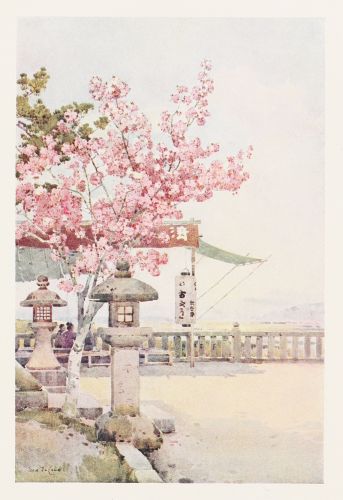
temporarily erected along the banks of the river. Those citizens who
can afford the greater luxury of a barge or roofed pleasure-boat spend
the evening more peacefully in floating upon the calm surface of the
river, gazing at the blossoming trees, cheered by the singing of the
geishas and the playing of the samisens. So great is the attraction
of cherry blossoms seen by the light of the pale moon, that they have
even been given the special name of Yozakura or night cherry flowers.
To the foreigner wishing to enjoy the prospect of the cherry blossoms
in peace, such boisterous feasting will seem out of harmony with the
natural quiet beauty of the spot, and he will do well to turn his steps
and to spend a few hours in undisturbed enjoyment of the more dignified
setting of Uyeno Park, where the giant trees of single and drooping
blossom stand out in splendid contrast to the pines and cryptomerias
surrounding the tombs of the Shoguns. Ralph Adams Cram thus describes
the scene:—
Here the cherry trees are huge and immemorial, gnarled and rugged,
but clutching sunrise clouds caught by the covetous hands of black
branches, and held dancing and fluttering against the misty blue of
the sky. Here and there a weeping cherry holds down its prize of
pink vapour, until it almost brushes the heads of those who pass;
here and there the background of bronze cryptomeria is flecked
with puffs of pink, as though now and then the captive clouds had
burst from the holding of crabbed branches only to be caught in
their escape toward the upper air and prisoned by the tenacious
fingers of the cedar.
At the end of the road the path blurs in odorous mist, and in a
moment we are enveloped in the rosy clouds. As far as the eye can
reach stretches the low-hung canopy of the thin petals; the trunks
of the trees are small and gray, and one forgets them, or never
thinks to associate them with the mist of pale vapour overhead,
hung in the soft air, impalpable, evanescent, a gauzy cloud, lifted
at dawn and poised breathless close over the earth.
A little wind ripples above, and the air trembles with a snow
of pink petals swerving and sliding down to the carpet of thin
fallen blossoms, while darting children in scarlet and saffron and
lavender crow and chatter, catching at the rosy flakes with brown
fingers.
The light here is pale and pearly as it filters through the sky of
opal blossoms, and it transmutes the small dusky people into the
semblance of butterflies and birds, now gathering into glimmering
swarms of flickering colour, now darting off with shrieks of
delight over the carpet of fallen petals. Here a slim girl with
ivory skin has thrown off her ivory kimono, and clothed only in
a clinging gown of vermilion crepe opening low on her bosom,
barefooted, a great dancing butterfly of purple rice paper clinging
to her black hair, is swaying rhythmically in an ecstatic dance,
pausing now and then to flutter away like a red bird up the shadowy
slope, until her flaming gown gleams among stone lanterns half lost
in the gloom of great trees. Here a ring of shrieking children,
wrinkled old women, and half-naked coolies are circling hand in
hand in some absurd little game; and here, there, and everywhere
whole families are clustered on red blankets, eating endless rice
and drinking illimitable saké, while the tinkle of the samisen
is in the air, and strange cool voices sing wistful songs in a
haunting minor key. It is a kaleidoscope of flickering colour, a
transformation scene of pearl and amber, opal and vermilion.
Koganai, a day’s excursion from Tokyo, is another attractive spot in
the cherry blossom season—an avenue of double cherry-trees stretching
for two and a half miles along the river Tama. As the name suggests,
tama meaning pearl, the water is clear, and the stream provides the
people of Tokyo with their drinking water, which is brought to the city
by means of an aqueduct. It is said that some ten thousand trees were
originally brought from Yoshino, by command of the Shogun Yoshimune,
and planted along the banks of the aqueduct, with the pretty idea
that the purity of the blossoms would keep off impurities from the
water-supply. Of this vast number of trees, even if they ever really
existed, only a few hundreds remain to-day, but sufficient to keep
up their old reputation and attract enough visitors for yet another
merry and boisterous flower carnival; in fact, throughout the land,
wherever there are cherry-trees, during the month of their glory there
will be feasting. The blossom seems to act as a magnet to draw the
people together, and often by the wayside I have seen just one solitary
tree, in all the fulness of its beauty, made sufficient excuse for
a miniature feast. Just a few lanterns will be hung in the tree, a
few matted benches will be spread out, and an old Kami san will be
waiting to greet any passing traveller with her cries of Irasshai—o
kake nasai—Welcome—please sit down,—and the offer of the inevitable
tea, tobacco-box, and hibachi.
The Emperor Saga, as early as the ninth century, inaugurated the
Imperial garden parties to view the cherry blossom, which still take
place annually at the old summer palace of the Shoguns, Shiba Rikyu.
The gatherings were attended by the writers and poets of the day, who
composed odes on the blossoms. Although robbed of many picturesque
features by the lamentable custom of wearing foreign dress at Court,
these functions are still of great interest to the foreigner, as
affording him the only available opportunity of visiting any of the
Imperial gardens of the capital.
In spite of the fact that the beauties of Tokyo are fast
disappearing—her moats bordered by splendid pines are almost things of
the past; broad streets with tramways, brick and stone houses, are
fast replacing the narrow streets and little wooden houses of old
Yedo; the Yashiki or Daimios’ houses and gardens are gone, replaced
by foreign houses,—Tokyo still retains her cherry-trees. No modern
reformer has ever dared to sweep away her avenues of sakura, for to
the Japanese the cherry is something more than an ordinary flower; it
is difficult, if not impossible, for our Western minds to enter into
their conception of it. To them the soul of the sakura, or cherry
blossom, is the soul of Bushido (Chivalry), and the heart of Bushido is
the heart of Japan. One of their songs says—
Hana wa sakura yo,
Hito wa bushi.
(Among flowers the cherry,
Among men the samurai.)
The precepts of Chivalry were started first as the glory of the
élite, but grew in time to be the aspiration of the whole nation, and
they found their ideal in the sakura. The phrase, Chitte koso sakura
nari, meaning “It’s a cherry blossom, it falls when it must,” was
taught in the old feudal days—how to die from loyalty as the cherry
blossom,—the ethic of Death was the highest. So to this day their
ethics remain the same, and Tokyo retains her cherry-trees, which in
spring transform the town into a garden of blossom. The poet Bashio
sang in his hokku poem—
Hana wo kumo
Kane wa Uyeno ka
Asakusa ka.
(A cloud of flowers!
Is it the bell from Uyeno
Or from Asakusa?)
It is true that wherever the clouds of blossom are low they will shut
out the prospect in Tokyo, and one is unable to tell whether the bell
which sounds from far away is that of Asakusa or Uyeno.
The number of different kinds of cherry-trees seems unlimited; Japanese
authorities quote one hundred distinct varieties. The first, and almost
the most beautiful, to flower, is the Ito sakura or drooping cherry,
with pendent branches like a weeping willow, and so-called from ito,
meaning thread. These trees attain to a great size and make magnificent
specimens. Almost at the same time bloom the Higan Sakura—equinox
cherries—with white single flowers or pale pink. Such are most of the
trees at Uyeno, of majestic size, planted, it is said, by one of the
Tokugawa Regents in imitation of the hills at Yoshino, though Asakusa
yama, a hill in the suburbs of Tokyo, is more often spoken of as the
new Yoshino. The Ukon sakura is very lovely, with its clusters
of pale greenish-yellow double blossoms, but is rather scarce, and a
variety known as Yaye hotoye has single and double blossoms on one
tree,—yaye meaning single and hotoye double. The Yoshino cherry I
have already described; Hi sakura has double blossoms, deep crimson
in bud, and bright pink when open. There seems to be a never-ending
list of these lovely trees, in bewildering variety—early and late
kinds, single, semi-double and double, large and small, from pure
white through every shade of blush pink to light crimson, and the one
beautiful pale yellow blossom, its outer petals just flushed with pink,
suggesting the colouring of a tea-rose rather than a cherry blossom.
The double varieties of course bear no fruit, but even the single
“equinox cherries” bear none, so the Japanese are satisfied with their
splendid blossom and do not worry about the poor insipid little fruit,
which is all a cherry represents to them; but they will salt the leaves
and drink cherry-flavoured tea under the pink canopy of flowers during
the time of the cherry blossoms, when, in the gladness of spring, all
the world is making merry.