The cultivation of South African plants in Europe dates back to early
times.
Indeed, it may safely be assumed that it was in vogue soon after the
Dutch settlement at the Cape, for Holland during the 16th and 17th
centuries held first place in European horticulture. Her cities even
vied with one another in the establishment of gardens of exotic plants,
many of which came from the Cape.
These treasures created such interest and attracted such attention that
Cape plants soon became the fashion and object of envy throughout
Europe. Collectors were specially despatched to these shores for the
purpose of hunting out and securing their botanical wealth.
Evidence also is not lacking that the cultivation of indigenous plants
was carried out at the Cape prior to 1700.
Be this as it may, little remains to-day in South Africa to do credit to
the past preservation and cultivation of our native flora.
In recent years, however, considerable interest has again sprung up in
this direction; in fact, it is rapidly becoming fashionable to have a
rockery of aloes, vijgies, and other succulents as one of the chief
adjuncts to the garden.
Apart from these—perhaps better-known plants—there are many beautiful
flowering herbs, shrubs and trees of the veld, which might with
advantage be grown in our gardens and around our homes.
It is with the object of bringing these gems of nature to the notice of
the public that this publication is offered.
A work of this kind is of necessity a costly undertaking, and its future
existence and ultimate success will depend largely on the support which
it receives at the hands of the public.
The publication of the present volume has only been made possible
through the interest and keenness of a South African lady, whose love
for her country and its natural beauties has been the means of procuring
the necessary funds for the initiation of the work.
It is proposed to issue this publication as an illustrated serial, much
on the same lines as the well-known Curtis’s Botanical Magazine, and
for imitating which no apology need be tendered.
Should the publication be the means of stimulating further interest in
the study and cultivation of our indigenous plants amongst the rising
generation, the desire and object of its promoters will be achieved.
Living plants suitable for illustration, plants of economic value, or
plants of general interest, will always be gladly received and welcomed
by the Editor.
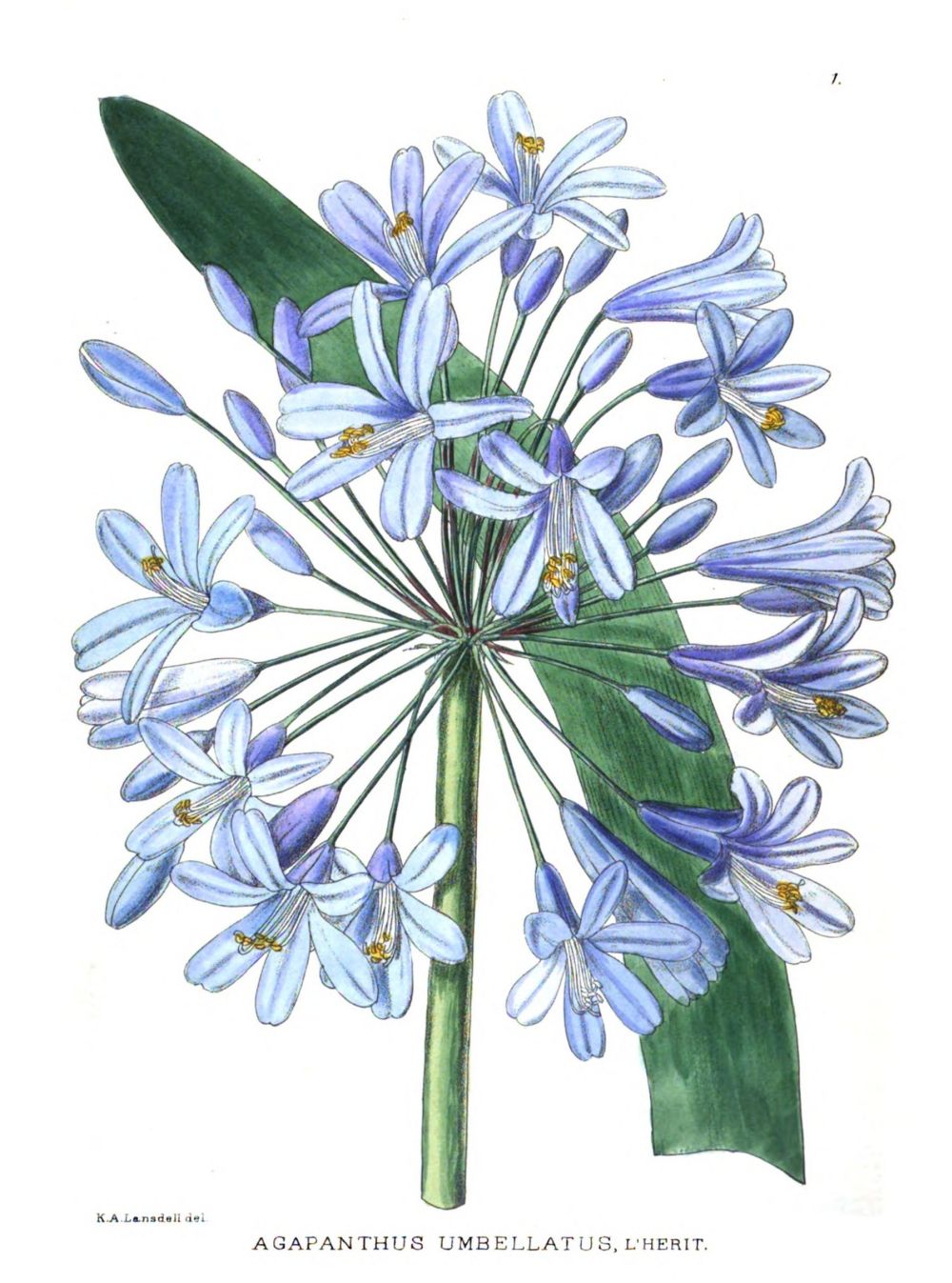
As regards the illustrations the Editor has been most fortunate in being
able to place the work of that skilful artist, Miss K. A. Lansdell,
before the public, while the descriptions have been prepared by Dr. E.
Percy Phillips, Botanist in charge of the National Herbarium, to both of
whom it is a pleasure to express one’s special thanks for the trouble
and care which they have taken.
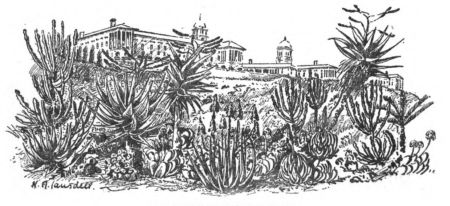
For the information of those of our readers who have not been fortunate
enough to visit our country or our inland capital, it may be added that
the illustration on our cover represents a glimpse of the magnificent
Union Buildings at Pretoria, under whose shadow this work is being
prepared, and on whose site the plants here figured are grown.
It has been the Editor’s privilege and good fortune to see a
comparatively bare kopje converted in the course of a few years into the
site of a grand and stately building surrounded with many of the
country’s most beautiful and interesting herbs and shrubs.
The illustration depicts such characteristic plants as the arborescent
Aloe Marlothii, Berg.; the handsome Aloe Wickensii, Pole Evans (in
the centre); Aloe aculeata, Pole Evans; the neat Aloe Peglerae,
Schönland; Cotyledon orbiculata, Linn.; Encephalartos Altensteinii,
Lehm; and some arborescent euphorbias.
Although most of the plants just mentioned are typical of the vegetation
of the Transvaal, an endeavour will be made in our magazine to depict in
each volume as far as possible an equal number of floral representatives
from all the Provinces.
As the authority for colour nomenclature, Colour Standards and Colour
Nomenclature, by R. Ridgway, Washington, 1912, has been adopted.
I. B. POLE EVANS.
Pretoria, 1920.
1.
K.A. Lansdell del.
AGAPANTHUS UMBELLATUS, L’HERIT.