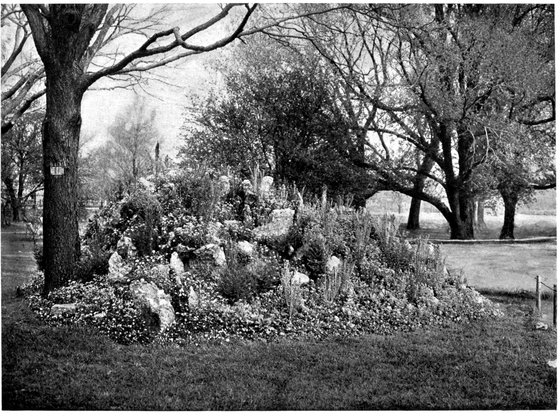
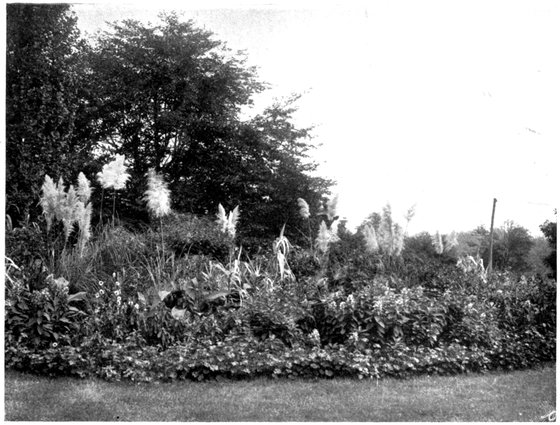
Chapter ONE The Location and Arrangement of the Garden — For Laying Out the Beds — For a Twelve-foot Foliage-bed — Another Twelve-foot Bed — Nine-foot Bed — Nine-foot Bed — Twelve-foot Bed — Nine-foot Bed of Ornamental Grasses — Eight-foot Bed
3
A south slope is the ideal situation
for a garden, since it insures good
drainage and the greatest amount of
sunlight. The garden should also
be open to the east and west, if possible;
that it may have the benefit of the morning
and evening sun. Shelter on the north is desirable,
as north winds are disastrous to Roses and tender
perennials. Partial shelter on the west should be
given in localities where the prevailing winds of
winter are from that quarter.
The south side of a building, or even of a high
fence, with trees and tall shrubs at a little distance
to the west, is best; though any site that receives
abundant sunshine through the morning and early
afternoon may be made satisfactory by planting trees
and shrubs on the north and west.
The garden should always be at the rear or side
of the dwelling, never in front or along the street.
The reasons for this are obvious. The garden proper
4is intended to furnish cut flowers, to provide a place
of experiment with new varieties, and to grow hardy
perennials which have certain seasons of bloom and
cannot be depended upon, at all times, for ornamental
effect. One should feel free to work there
unobserved of the passer-by, and this is impossible
in a garden close to the street.
Again, while the permanent garden is beautiful
in itself, it is not suitable for the lawn and greatly
mars the effect of the grounds. Beds of ornamental
foliage plants—Cannas, Ricinus, Coleus, and the like—appropriately
placed, add much to the beauty of
a well-kept lawn, but should be carefully considered
in relation to its size and the trees and shrubbery
already there.
On a small city lawn not more than one such bed
should be allowed. On a large lawn three will give
a better effect than a great number, especially if care
is taken to have them all visible from different points
on the lawn and from the house, never isolating them
by so placing that clumps of trees or shrubbery intervene,
but using these rather as a background for
the beds.
It is from the hammock that the amateur gardener
will most enjoy the results of her labour. It is there
she will find leisure to watch the growth of plants,
to compare the effect of different varieties, to note
where she may improve the vista by a different arrangement
next year, to observe the effects of locality,
5of the afternoon and morning sun and all the peculiarities
of plant growth that escape her when busy
with trowel and watering-pot, so that the view from
it should be first consideration.
A very good arrangement is to put a large bed of
Ricinus on the most remote space of the lawn—four
plants in the centre of a twelve-foot bed—surrounded
with a row of Salvia splendens edged with Little Gem
Sweet Alyssum. Nearer, an eight-foot bed of the
large-flowered Cannas may be introduced and edged
with Coleus or the second size of Caladiums, while a
six-foot bed of ornamental grasses—Arundo Donax,
Erianthus Ravennæ, Eulalia gracillima univittata—will
make a satisfactory third. Such beds are rich in
tropical effects and give more distinction to a lawn
than any other class of plants.
Where there is an ample water-supply these beds
may be elevated a few inches above the lawn to make
them more conspicuous; but where the seasons are
hot and dry and water must be carried it is better to
set them slightly lower than the lawn, so that all the
available moisture may be utilised. A few inches of
margin must be allowed around the edges of beds
on the lawn so that the mower may run close to the
beds without injuring the plants, though even then
it will be best to use the lawn-shears. Such beds call
for carefully trimmed lawns. Unless the grass can
be properly cared for, it is better to exclude flowers
from this part of the grounds entirely, as it is time
6thrown away to plant flowers which will presently be
hidden by tall grass and weeds. A neglected lawn
involves an amount of labour in the semi-annual cleaning
of spring and fall out of all proportion to the results,
while a lawn well cut and raked is more easily
cared for with each recurring year, the grass growing
clean and straight, and the rake and mower passing
freely and easily through it.
The scheme for a permanent garden must be decided
by the size and shape of the plot of ground at
command, an irregular plot sometimes lending itself
to more graceful arrangement than a symmetrical one.
The operation of laying out the beds will be the same,
whatever the shape. Having decided the boundaries
of the garden it will be best to mark the outlines by
a cord attached to pegs driven into the ground. The
sod should then be removed from the entire area by
cutting just below the crown of the grass. Desirable
arrangements of beds are shown in accompanying
illustrations. Two and one-half or three feet should
first be allowed for walks. The beds may be placed
to advantage by finding the centre of the plot and
driving there a stake to which a cord is loosely attached.
Mark off on this cord half the diameter of
the bed desired, for centre of plot, four, five or six feet—fasten
to the cord at this point a sharp stick and
describe the circle on the ground. In this way the
garden walks may be outlined and the inner and outer
circles of the round beds. The oval beds must be
7measured off and defined by stakes driven into the
ground. The width of the beds should be not more
than can be easily reached across for weeding and
cultivating. Where the soil has not been previously
cultivated it must be spaded at least two feet deep,
and thoroughly pulverised. All roots and stones
should be removed. If the soil is clayey or gravelly
it will be best to remove it entirely and to fill in with
soil better adapted to the growth of flowers. Or the
surface may be removed for several inches and laid
aside. Then the poorer subsoil should be dug out and
removed and the surface-soil replaced in the bottom
of the bed with a liberal quantity of old, well-rotted
manure. The bed should then be filled to its
original level with leaf-mould or muck. If all the
original soil is to be retained, remove the top-soil for
top-dressing. Spade the manure into the subsoil and
replace the surface-soil. In ground which has not
been cultivated this surface-soil is rich in humus or
leaf-mould, which furnishes food in its most available
form for the young plant, and should, therefore, be
left where the plant can use it and not be turned under
as is usually done. Nature never turns the soil upside
down; nor will the wise gardener, except when a richer
and better soil is to be added or when it is necessary
to work in manure.
In making beds that have been worked before
and need no enriching, excellent results may be secured
by pushing a long spade into the ground the
8whole length of its blade and twisting it around.
This breaks up and mellows the ground more effectually
than turning it over, while it leaves the good soil
on top where the young plant-roots can get it. Later,
when the plant grows sturdier and stretches out its
roots in search of food, the manure-enriched earth
in the bottom of the bed will attract and draw them
down into its cool, moist depths, away from the heat
and drought of the surface. But the young plants
must have mellow, nourishing soil from the start,
or they will perish before they reach this store-house
provided for the mature plant.
Never prepare a garden by turning under the sod.
I am well aware that this, together with turning under
the surface-soil, will be the method of the average
man who has had some experience of farming, but
the flower-grower cannot always follow farming
methods with safety.
After spading the beds it will be well to inclose
them with some such permanent material as brick,
cement curbing, or narrow boards. Four-inch siding
set in the ground an inch or more, and held in place
on each side by pegs of wood (old waggon spokes,
which can usually be found at the blacksmith’s, are
excellent for this), make the cheapest and most
quickly constructed inclosure, and may be quite covered
with such border-plants as Dusty-miller or Phlox
subulata. The boards may be given a coat of dull-green
paint or shingle-stain before being put in place.
ORNAMENTAL GRASSES AND FOLIAGE PLANTS
9The permanent garden beds should have some such
protection, as it greatly lessens the work of caring for
them. Sod borders are very attractive, but involve
an amount of care altogether out of proportion to
the effect, as they must be kept closely shaved and the
constantly encroaching roots of the plants must be as
constantly curbed. This is also the case with grass
walks, attractive to look at, but a supreme nuisance
to the gardener. Walks of gravel, cinders or coal-ashes
are preferable, and should be dug deep enough
to smother out all weeds in the soil. If coal-ashes are
used the paths should be nearly filled, the roughest
part raked off and the surface gone over with a heavy
roller. If left unrolled, however, the surface will be
found firm and hard after the first heavy rain. Very
good and inexpensive walks are obtained in this manner.
Walks, of whatever kind, should never be hoed,
and the weeds must be removed from them by hand.
Hardness and smoothness are the requisites of a good
walk. It is well to avoid self-sowing flowers like
Sweet Alyssum, or Petunias, near the inside walks, as
they come up by thousands in the spring and can only
be removed by salting, scalding or uprooting.
The beds should be well above the surface of the
walks, especially those containing hardy perennials
like Peonies and Lilies. In the case of most plants,
water standing around their roots in winter is absolutely
fatal.
The location of the beds and their consequent
10moisture and sunshine must determine the flowers to
occupy them. If you are fortunate enough to have a
corner low, damp and shaded in the afternoon, that
is the place to set out the beautiful Japanese Iris,
Cypripedium acaule and other moisture-loving plants,
while the Gladiolus may be given a prominent
place in full sunshine. Asters and other flowers that
do not bloom until fall should have a less conspicuous
place; they are so showy that they will not fail to
attract attention, wherever they may be planted.
Pansies and other low-growing plants should be set
out in the bed next the lawn. The general effect is
finer when only one kind of flower is grown in a bed,
but when two or more varieties of flowers, harmonising
in colour, are grown together, the tallest must be
placed in the centre and the others grouped according
to height. Various plants may be used as edgings,
due consideration being given to the plants which are
to fill the beds.
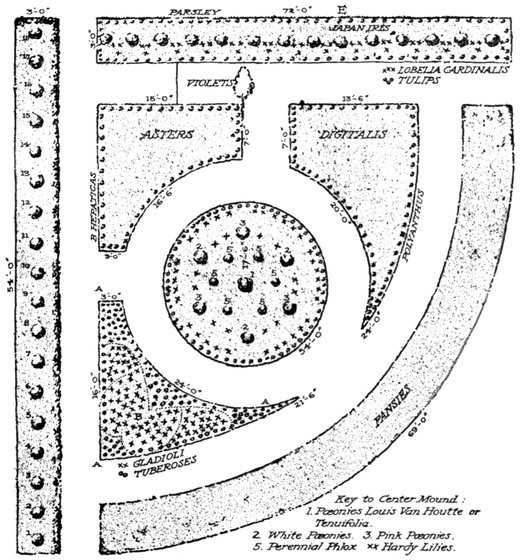
KEY TO PLATE I.
Giving the Height and Season of Bloom of the Different Perennials, Etc.
Outer Circle.
Pansies—all summer.
First Corner Bed.
A—Montbretias in corners, scarlet and orange,
2 to 3 feet—all summer.
B—Gladioli in centre, in variety, 3 to 4 feet—September,
October.
C—Tuberoses, 3 feet—August, September.
Border of blooming Oxalis, pink and white, 6
inches—all summer
North Bed—Anemones, Whirlwind and Queen
Charlotte, white and pink, 3 feet—September.
Border—Wood Anemones.
South Bed—Asters, 2 feet—September, October.
Border—Auricula, 8 inches—May.
11A mass of one kind and colour is more effective than
a mixed bed. The beginner will find that the percentage
of success is greater in growing a large number
of one kind, all requiring the same conditions of
soil, moisture and sunlight, than in trying to force
plants of widely different habits to grow under the
same conditions. Hardy perennials, however, not
many of which deserve an entire bed, do very well
with several varieties in the same long bed or border,
and may be so grouped as to give a succession of
bloom throughout the season. A raised bed of
Peonies interspersed with the new, large-blooming
Phlox and bordered with Japan Lilies will give a succession
of flowers from May to October; or a long
bed of Hollyhocks, or Hibiscus with a row of large-flowered
Phlox in front and edged with dwarf Phlox
Drummondii will give months of lovely bloom. This
last combination also makes a serviceable screen between
the vegetable garden and the lawn, or to hide
a rear fence.
In arranging parti-coloured beds of flowers, due
attention must be paid to the harmonising of tints.
Do not combine magenta and scarlet, or purple and
blue. Separate them by the interposition of white—the
most valuable colour in the garden, as it not only
harmonises all colours but wonderfully enhances their
brilliancy. White with scarlet, with blue, or with
yellow is always good. Lavender and heliotrope are
lovely with nearly all shades of scarlet, rose and pink.
Blue flowers planted in the rear of the garden increase
its apparent size, while white, bright yellow and scarlet,
by bringing the background nearer, decrease it.
Monkshood and the tall blue Larkspur are excellent
for rear beds.
The accompanying diagrams will be of assistance in
planning the garden—not so much in supplying plans
to be followed literally as in suggesting other plans
and variations, while giving practical information as
to number of plants required, their distance apart and
12the like. Soil and other details will be treated elsewhere.
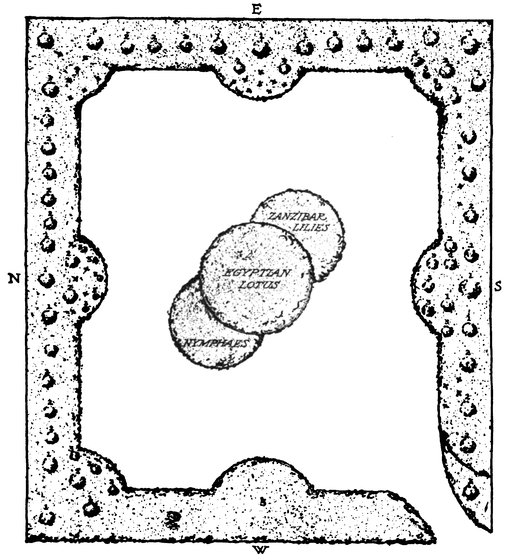
In planning a shrubbery (see Plate II.) it is neither
necessary nor desirable to use boards or other curbing
for the beds, but the turf should be kept neatly
trimmed and cut. A plot 60 by 40 feet or more, inclosing
a considerable area of turf, gives room for
rustic seats, a stationary hammock, and a tree or two.
The circle in the border greatly increases the accommodation
for plants and furnishes an ideal spot for
Lilies. The lily-pond in the centre will be discussed
at length in the chapter devoted to aquatic plants.
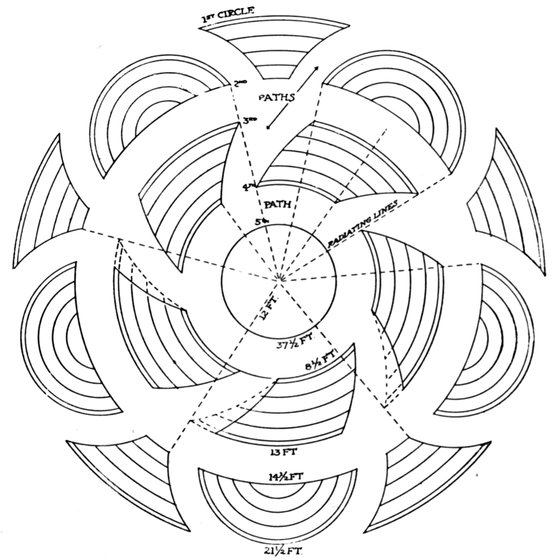
The rather complicated design in Plate III. is intended
for a rose-garden or for foliage-beds on a
large lawn. It is not at all difficult to construct, and
a little practice with paper and pencil will remove any
apparent obstacle. If you will draw, on a scale of
one inch to a foot with a compass a succession of
circles of six, eight and a half, twelve and a half,
fifteen and nineteen inches, respectively, the foundation
of the plan will be laid. Now, divide the fourth
circle into fifths and draw a half circle 4½ by 14 feet
or inches on the circle of each fifth by placing the
point of the compass midway between the fourth and
third circle. This will leave a crescent-shaped bed.
Mark off from each side of these half circles or crescents,
on the space between the third and fourth circle,
two and one-half feet for paths. Making the lines
parallel with the crescents, the remaining spaces will
form triangular beds, that for convenience may be
called the third or outer row of beds.
13Now if radiating lines be drawn from the corners
of the crescents to the centre of the plan the point
where they cross the third circle will be the upper
corners of the first row of beds—the lower corners
being formed by the point where the radii from the
centre and left corners of the crescents cross the second
circle; the third and second circles forming the
upper and lower sides; the ends being formed by
curved lines drawn from the upper to the lower corners.
Or, having completed the row of five crescents
and five triangular beds, mark off with pole or
ruler radiating lines from the corners and centre of
each crescent to the centre of plan; the point where
these radii from the circle of crescents cross the third
circle will be the upper corner of the first row of beds;
the lower corners being formed by the radii from
the centre and left-hand corner of crescents; the ends
being formed by curved concave lines from upper to
lower corner—the intervening spaces forming paths.
Use a long pole with a sharp stake passed through
a hole at one end and fastened with a nail
driven through it horizontally, so that it can turn
easily, with a number of holes for pegs at the required
distances—six, eight and one-half, twelve and one-half,
14fifteen and nineteen feet. Drive the movable
stake firmly into the ground, and do not remove
until the work is finished. Slip the sharp marking
peg into the hole, which it should fit closely, and
mark out the circles. For the half circles, or crescents,
a nine-foot stick laid straight across the edge of fourth
circle will give an approximate fifth, the loss in the
curve about equalling the fractional loss caused by
multiplying by three alone. Drive a peg with a stick
or string attached into the path a foot inside the third
line and mark the circles on it; mark the paths by
lengthening the stick or string two and a half feet and
drawing sections of circles on each side of the half
circles from the fourth to the fifth circles. Now bring
the end of the long pole to the left corner of half
circle and mark the radiating lines and half lines to
the centre, and mark off the first row of beds as you
did on paper. In this way almost any form of flowerbed
may be laid out. The following diagrams for
foliage-beds on the lawn will be helpful.
One Ricinus in centre; three Ricini four feet from
first, an equal distance apart—or about eight
feet. Alternate with these three clumps of tall-growing
Cannas. Surround with a row of scarlet Salvias,
set one foot from edge of bed and twenty inches apart.
Edge with Little Gem Sweet Alyssum.
PLATE III.
Plan for Rose-garden and Foliage-bed.
15
One Ricinus in centre, surrounded at three feet
distance by six of the largest sized Caladiums
three feet apart. The third row, three feet outside,
to be composed of low-growing Cannas—Queen
Charlotte, Chicago, Florence Vaughan, or Papa—eighteen
inches apart. Edge with dwarf Nasturtiums.
One Ricinus trimmed in umbrella form—that is,
the lower leaves removed so that the upper
may serve as a shade for the Cannas. First row, six
Allemannia Cannas; second row, twelve inches outside,
twelve Burbank Cannas, fourteen inches apart;
third row, twenty-five Italia Cannas, fourteen inches
apart. Edge with Coleus, set fifteen inches apart.
Centre three discolour Cannas, grouped in the
corner. First row, twelve Black Beauty Cannas,
eighteen inches apart; second row, eighteen
inches outside, twelve large Caladiums, twenty-seven
inches apart.
Three Ricini in group, equal distance apart.
First row, three feet out, scarlet Salvias, twenty
inches apart; second row, twelve inches out, white-flowered
16Vincas, twelve inches apart. Edge with scarlet
Phlox Drummondii or blue Tom Thumb Ageratum,
six inches apart.
Large clump of Arundo Donax in centre. First
row, three feet out, three Erianthus Ravennæ,
six feet apart; second row, twelve Eulalia gracillima
univittata, two feet apart.
A large clump of Setaria magna in the centre.
First row, Coix lachryma, eighteen inches
apart; second row, twenty inches out, Pennisetum
Ruppellianum, eighteen inches apart.
I cannot too highly recommend the planting of
ornamental grasses on the lawn. They are extensively
used in parks and in other public grounds, but
not nearly so extensively as they should be on private
grounds. Many of them are perfectly hardy, and
once established grow in beauty from year to year;
others in the Northern States may be easily wintered
in the cellar, while still others may be cheaply and
easily raised from seed each year.
Chapter TWO Soils
17
In every garden the matter of soil is of first importance.
In case of an outdoor garden the
existing conditions will largely determine the
class of plants to be grown.
A good loam—that is a non-coherent mixture
of clay and sand with a proportion of such decayed
vegetable matter as leaves and the fibrous roots
of grasses—is the best garden soil, being what is
termed warm and early. Soil containing a good proportion
of sand is warm, while a preponderance of
clay makes what is known as cold or wet soil.
If there is good drainage, cold soil can be rendered
lighter, sandier and more friable by the liberal application
of manure, which in two or three years will quite
change its character. But this is a long time to wait,
and to get quick results it will be necessary, after laying
out the garden and outlining the beds, to remove
the earth to a depth of twenty inches or more, filling
in with soil suitable for the class of plants to be grown
in each bed. In the beds intended for Roses, however,
the clay may be left, as Roses require this soil. Where
18it is not present it should be supplied and added to
each year, as the heavy manuring which Roses require
constantly reduces the relative proportion of clay.
For the Pansy bed nothing better than leaf-mould
from the woods can be procured. For this bed remove
six or eight inches of earth, spade in a good
supply of old, well-rotted manure from the cow-stable,
top-dress with several inches of leaf-mould. You
will have a bed that will give magnificent Pansies and
few weeds. For the Salvia, Canna, Ricinus, Caladium
and other strong-growing plants no soil is better than
the muck or peat of swamps—soil composed of partly
carbonised vegetable matter decomposed by the action
of water. Leaf-mould consists of vegetable matter
which has decayed without being submerged, and it
usually contains a liberal quantity of sharp, white
sand, to which it owes its friable, non-adhesive character.
Leaf-mould is commonly found around decayed
stumps and in hollow places in the woods, where
the leaves have drifted and decayed. It is ready for
immediate use. Muck or peat, however, which is
found in bogs and swamps, is unfit for garden use
when freshly dug—except for aquatic plants—being
tough and fibrous. It should therefore be dug during
the summer, thrown in a heap and left for the winter
frost to rot and render tractable. For immediate use
the best method is to place it in a deep hole in the bed
and cover with several inches of loam, or old muck.
If this is kept worked or mulched to exclude air and
19retain the moisture in the muck, excellent results may
be secured. The bed may also be partly filled with
muck and covered with loam, the whole object being
to prevent the muck drying out into hard lumps, as
it will, when green, on exposure to sun and air. The
following spring the loam may be spaded into the
muck, giving a warm, mellow, exceedingly rich soil
that will grow anything. The importance of starting
out with good soil cannot be too strongly urged. It
seems at first sight to call for a considerable expenditure
of time and money—especially where the earth
must be purchased and the labour paid for—but in the
long run it is a decided saving.
With unsuitable soil there must be many failures,
resulting in loss of both plants and seeds, and this in
itself is no small expense. The labour of caring for
such a garden is many times greater, for the top-dressing
of manure required produces an incessant
crop of weeds, which must be removed, not once, but
many times during the summer, while beds filled with
leaf-mould or muck need but one or two weedings.
The weeds which grow naturally in these soils do not
flourish in the open ground. A few Smartweeds and
Nettles may be expected in the one case, and Violets
and Spring-beauties in the other. In the manured
garden soil an endless procession of Purslane, Malice,
Ragweed and the like must be constantly watched for.
The presence of clay and gravel in the soil always
renders it hard and given to caking, necessitating frequent
20cultivation; while muck-beds, after the preliminary
spading in the spring, remain free and mellow
throughout the season.
Replacing soil presents more difficulties to city
dwellers than to those living in the country, or in small
towns, but, as there are in the vicinity of most of our
cities rich peat lands, it ought not to be difficult to
obtain one or two loads of this useful material. Near
the small towns are always to be found farmers who
own or live near marsh-land, and can supply muck,
especially where they have been ditching. A good
waggon-load may be had at prices ranging from fifty
cents to two dollars, according to the distance to be
hauled. The cost in the city would, of course, be
much greater.
It is well for the amateur gardener to learn early
in her experience to keep her eyes open to all things
pertaining to the success of the garden. When driving,
note the marsh-lands easily accessible from the
highway, especially where they have been ditched
or partially reclaimed, and interview the owner or
tenant. In the dull season on the farm the owner of
such soil may be glad to earn an extra dollar or two,
and it may also be suggested to the farmers’ boys,
who have marsh-and wood-lands, that they may earn
pocket-money by calling on people known to be cultivating
flowers or building new homes, to solicit their
orders. Many people who grow flowers do not know
where to apply for earth, and an advertisement in a
21local paper would, doubtless, prove advantageous to
customer and purveyor. On hillsides along the road,
and places which the rain has washed, one may gather
quantities of pure white or grey sand for potting.
Yellow sand is not suitable for such use, as it contains
much clay and cakes badly after watering, while the
white or grey sand remains line and loose.
Leaf-mould is not so readily procurable, as it must
be gathered from suitable patches through the woods,
and the farmers do not like to bother with it. Besides,
they are likely to dig up much undesirable under-soil.
It is better to go one’s self for this. A still better way
is to make your own leaf-mould. Thus: when sod
is removed from the ground for any purpose, shake
out the fine soil that adheres to it for future use; or
slice off the fine roots with a sharp knife just below the
crown of the grass. This is known as fibrous loam,
and, in combination with leaf-mould, old manure and
fine, sharp sand, makes the very finest potting soil.
Throw the tops of the sods in a heap in some out-of-the-way
corner and add the rakings of the yard in
fall and spring, all weeds pulled during the summer,
all vegetable refuse, potato-parings, apple-peelings,
corn-husks, and berry-hulls—anything that has vegetable
matter and will decay. All dish-water and slops
that are not needed on the garden may be thrown on
the pile, which should be turned over occasionally
during the winter. By the following spring you will
have the finest kind of leaf-mould. Not all of the pile
22will have decayed, but along the sides and underneath
it will be found ready for use. Add to it every bit of
available vegetable matter during the year, including
the annual flowers pulled up after their season of
bloom, the tops of such root-plants as Cannas, Caladiums,
Gladioli, etc., and you will soon have a supply
quite adequate to the needs of an ordinary garden.
Where there are water-works the hose may be turned
on frequently to hasten decomposition. If it is impossible
to replace all poor soil in the garden with
better, by the addition of leaf-mould and manure,
much may be accomplished in the way of building up
the old and rendering it suitable.
If the plot to be used can be ploughed up, well
manured, and sown to clover, the clover turned under
in the fall, a good top-dressing of manure given,
and the whole turned again in the spring, the soil
should be in good garden condition.
Where the soil is a good, warm loam the addition
of fertilisers will always give excellent results,
though there is the disadvantage of weeds and extra
cultivation to consider. The first cost of suitable
earth is great, but it pays in the end in the saving of
fertilisers, labour, expensive seeds and flowers.
Chapter THREE Fertilisers
23
Fertilisers in the form of animal manures,
chemicals or vegetable matter come
next in importance to a good soil. Horse,
cow, sheep, and poultry droppings are the
cheapest and most direct in results. Of
the four, cow manure is probably the best for the
majority of plants, especially Pansies, Iris, Violets,
Ferns and others which love a cool soil. Cow manure
is known as a cool manure, and is suitable for a warm
or sandy soil. Horse manure, which is more heating,
especially when from young stock, is better on cold
or clayey soil, as it has the effect of breaking up the
adhesiveness of the clay and promoting the formation
of sand. Hen manure is very warm and is therefore
most suitable for cold soils. Sheep manure is especially
desirable for Roses and house-plants, about
one part manure to six of earth being the proportion.
Good results may be obtained by the use of any or
all of these, if in the proper condition and judiciously
24applied. Manure is in proper condition when it has
passed completely through the heating or fermenting
stage. Fresh manure should never be placed where
it, or the water that leaches from it, can possibly
come in contact with the plants; manure should be
six months or, better still, a year old before being
used. Old and well-rotted manure has much the
appearance of rich, black earth, and is readily assimilated
by the plants. It should be fine and free from
such rough litter as corn-stalks, cobs, and long straws,
and should be thoroughly mixed with the soil. As
manure is full of the seeds of weeds and grasses, it
is better, when applying it in the spring, to remove a
portion of the top-soil and work the manure into the
subsoil by spading, and then to return the top-soil.
This will prevent their germination and save a great
deal of weeding during the summer.
Manure that retains its original form is too fresh to
use and should be thrown in a heap and frequently
forked over to hasten decomposition. It will be fit
by another season, but older stuff must be procured
for present use. Where there is room it is a wise
provision to keep a pile of manure from year to year,
in order to avoid the inconvenience of looking for it
when you need it. No better expenditure can be
made by the gardener than in purchasing several loads
of old manure, when it is discovered in some neighbouring
barn-yard. If one has no supply and must
purchase, the matter should be attended to in the fall
25at latest, to allow ample time for saving it. Farmers
usually draw the manure on the land as it accumulates,
so that it is difficult to obtain in the spring.
Ashes contain a certain amount of phosphates,
which tend to sweeten the soil. They are also beneficial
in increasing the strength or stiffness of the
stalks, and for this reason are valuable for Aster and
Gladiolus beds; they should never be mixed with
manure, as is frequently done, but should be strewn
over the surface of the soil after the other fertilisers
are worked in. Ashes mixed with manure release the
ammonia of the latter, depriving it of one of its most
valuable properties. Ammonia itself is not a fertiliser
but a stimulant, creating in the plant a desire
for the food stored up in the manure—in other words,
an appetiser. Plants, like people, will not eat unless
they have an appetite, and manure mixed with ashes
is poorer and much less valuable in every way to the
farmer and gardener. Soot is another excellent chemical
fertiliser, adding much to the richness of colour
in both flower and foliage. Apply either dry or
mixed with the surface-soil, or in the form of a tea
made by pouring water over the soot in a vessel.
Draw off the liquid after the mixture has settled and
apply it around the roots of the plants, taking care
that it does not touch the foliage. It is especially
good for Pansies and Roses.
Manure-water is a good way to apply animal fertiliser,
as it is fairly free from the seeds of weeds, which
26constitute the chief drawback to the solid form. To
prepare it take a water-tight barrel or half-barrel and
put a spigot in the side near the bottom. Place three
or four inches of clean straw in the barrel, letting it
come well up above the spigot, then fill half full of
manure. It is not necessary that the manure should
be so very old; it needs only to have passed the fermentation
period. Fill the barrel with water. Fit a
tight cover over it and it is soon ready to use. As
long as the liquid runs the colour of coffee or a strong
tea the manure will not need renewing, and more
water may be added from time to time, but when it
shows signs of exhaustion empty the barrel, put the
refuse on the compost heap and fill the barrel as
before. If the liquid is to be used on pot-plants it will
be better to use boiling water in the barrel to destroy
the eggs and chrysalis of the white-worms and other
larvæ that infest the manure; or add a half teaspoonful
of Paris green to the water. The first
drawings from the barrel should be well diluted
before using, especially when applied to dry soil.
If hen manure is used, it should be made much
weaker than other manures, as it is very heating and
likely to burn the roots of plants. A convenient way
to handle the manure barrel is to carry a watering-pot
of water to the barrel each time, emptying it in at the
top and drawing off a corresponding amount at the
spigot—in this way the barrel is kept constantly full
and extra steps saved. Liquid manure may also be
prepared by filling a pail half full of manure, adding
boiling water, and dipping off the liquid when the
sediment is settled.
MANURE WATER IS A GOOD WAY TO APPLY ANIMAL FERTILISER
27After a heavy rain there will often be a pool in some
corner of the barn-yard where sufficient liquid manure
may be dipped up to fill a barrel or hogshead. Where
the barn-yard is paved with cobble-stones—as all barnyards
should be, for health and cleanliness—a catch-basin
may be easily arranged which the natural slope
of the land will fill when it rains. This will more than
pay for the trifling outlay for its construction, as it
need only be a depression in the soil, covered with
cement. Even stiff clay will answer. It is surprising
how carelessly farmers let such valuable property go
to waste while they buy load after load of manure at
the stables in town and haul it long distances. The
yield of the strawberry-and asparagus-beds
alone would be sufficiently increased to pay for such a catch-basin
many times over.
Soapsuds furnish another excellent fertiliser, and
every drop of water from the wash-room, bed-room
and kitchen should be saved and applied around the
roots of plants—especially Roses, Dahlias, and vines,
which never seem to get enough of either moisture or
nourishment. Slop-water should not be put on the
foliage of plants, as it leaves a scum that is difficult
to get rid of.
A very good substitute for commercial bone-meal
may be manufactured at home by saving all the bones
28from the kitchen, throwing them into a stone jar,
covering them with strong lye, and allowing them to
remain until soft enough to be pulverised and dug
into the soil. The lye that remains may also be applied
to the soil after being diluted with water. Blood
obtained at the slaughter-house is an excellent fertiliser,
containing much easily assimilated plant food in
a soluble form. Feathers contain much valuable material
in the way of phosphates, but are not suitable
for the annual beds. They may be applied to shrubs
and hardy perennials by digging them into the ground
at a little distance from the plants, where the roots
will reach out and find them. Hoof-parings from the
blacksmith shop are also valuable for the perennial
bed. Indeed, with all the forms of plant food available
there is no excuse for starving plants. There
are, of course, many commercial plant foods and fertilisers
on the market, bone-meal and guano being
the most reliable among them, but many of them are
expensive and uncertain in their action. Being highly
concentrated they are likely to do harm in the hands
of the inexperienced. The natural manures are the
safest.
In using liquid manures either on the open ground
or on potted plants, they should only be applied when
the soil has been well watered the day before, never
when it is dry. The plant, being supplied with all it
needs to drink, absorbs only what it requires for
nourishment and is less likely to be injured by an
29overdose. The moisture in the soil serves also to
reduce the strength of the manure.
In applying old cow or horse manure to new beds
a wheel-barrow load to every nine square feet is not
too much for strong growing plants such as Ricinus,
Cannas, and Salvias. Half that quantity of hen manure
will be sufficient.
Chapter FOUR The Hotbed, Cold-Frame and Sand-box
30
The hotbed is an enclosure, affording
bottom heat and protection from cold,
for the propagation of tender plants
unsuited to sowing in the open ground,
and for starting plants too early in
the season for open-air operations. The hotbed is
usually started in February or March in the latitude
of Philadelphia, while April is early enough in the
latitude of Detroit and Chicago. Plants are transferred
to the open ground when all danger of frost is
past. With the exception of a few plants like Poppies,
which do not bear disturbance, all seeds yield better
results if planted where they have protection in their
early stages from drying wind, burning sun and nipping
cold. This protection the cold-frame gives, while
the hotbed affords the additional advantage of artificial
heat. Plants thus started will be ready to transplant
about the time seeds could be started in the open
ground—an important gain in northern latitudes,
31where, between the early and late frosts there is hardly
time for the maturing of annuals.
The hotbed should be situated on the south side
of a building, wall or fence, where it will have the
full benefit of the sun and be protected from cold
winds. It is also desirable that the land should slope
toward the south, that all surface water may drain
away, and that the bed may receive the greatest
amount of sunshine during the day. In constructing
a hotbed dig a pit two feet deep. This may be lined
with planks or bricks, or left with its earthen walls.
Over this build a frame of rough lumber around four
posts of three-or four-inch stuff, three feet two inches
high in the back, and two feet eight inches high in the
front. If the pit is not lined, this will bring the frame
below the surface and allow a sufficient slant for the
free shedding of water and the concentration of the
greatest amount of sunshine on the bed. Regular
hotbed sash are three feet by six, and cost about two
dollars and seventy-five cents each, glazed and
painted. These are usually arranged to rest on the
frame, simply sliding up and down, the size of the
bed determining the number of sash. A bed three by
six, however, is more easily handled than a larger
one; and two or more beds, set end to end, or one
long, narrow one divided by partitions into three-by-six
beds, will be more satisfactory in every way than
a wider one. The partitions are necessary, not alone
to strengthen the frame and support the sash, but to
32insure to each section the special treatment it requires.
Not all seeds germinate in the same temperature, or
require the same degree of moisture. There is, also,
a great difference in the period of germination; some
seeds sprout in from three to five days; others require
as many weeks. With separate sections seeds of
similar habits and requirements may be planted together.
Florists’ sash makes an expensive hotbed, and
quite as satisfactory results may be obtained by using
such old window-sash as may be picked up for about
twenty-five cents apiece where buildings are being torn
down or from junk or hardware dealers. Old sash
will probably need some glazing and painting, and
these are among the things the amateur gardener
should learn to do for herself, as sash must be water-tight
and in order at all times. A sudden hail-storm,
a mischievous cat or careless handling may leave one
with broken glass that must be replaced at once.
When old sash is used the back of the frame should
be higher than the sides by the thickness of the sash,
so that the sash may be fastened to it with hinges if
desired. A cross-piece from the back to the front for
the sash to rest on will give greater stability and
prevent draughts of cold air on a sudden fall of temperature.
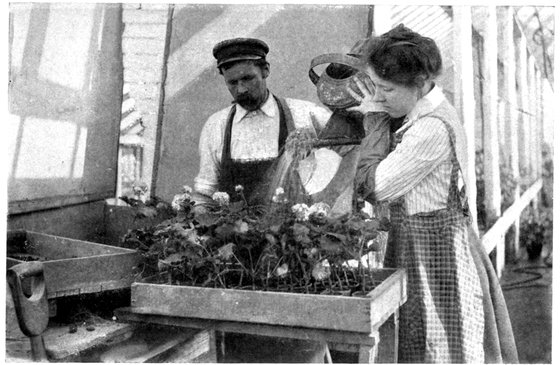
WHEN PLANTS APPEAR TOO THICKLY IN THE ROWS, TRANSPLANT
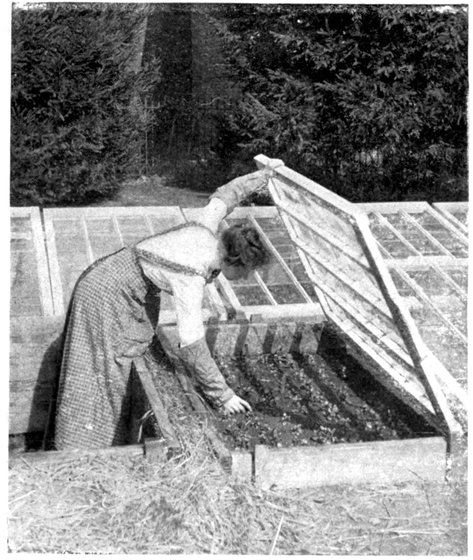
A WELL-CONSTRUCTED HOTBED
33Having constructed the pit, fill it with fresh manure
from the horse-stable—that from young, grain-fed
stock being best. It must be perfectly fresh, gathered
from the stalls in the morning, and should be mixed
with a quantity of litter—long straw or leaves. This
serves as fuel, insuring a continuous heat. Without it
the heat germinated by the manure would quickly die
out and the bed become cold. Throw the manure
loosely into the frame, close the sash and wait for
fermentation or heating. This should take place
in from twelve to twenty-four hours; if longer than
that it will be as well to throw out the manure and
begin again, making sure this time that the manure is
absolutely fresh. When the thermometer by rising
to 100 or more degrees shows that fermentation is
well under way, the manure should be well tramped
down, as level and smooth as possible. Over this
place a couple of inches of fine, old, well-rotted manure.
This will afford nourishment for the young
plants should they make sufficient growth to need it,
or on account of stress of weather be detained in the
hotbed longer than expected. If this is not supplied
the tender roots of the plants are apt to go in search
of the crude manure in the bottom of the hotbed, and
be injured by contact with it. When plants that have
come up thrifty suddenly turn yellow and look as if
they had been scalded, though sufficiently protected
from the sun, it is probable that their roots have been
burned by the manure. This may be determined by
digging down to the roots. If they have reached the
manure the cause is evident; other plants in the same
beds, with shallower roots, it will be observed, are not
34affected in the same way. As this is not likely to happen
until the plants have made considerable growth
the season will probably be enough advanced to permit
of planting out, especially with protection at
night, or they may be transplanted into the cold-frame
until the weather is warm. Such mishaps seldom
occur, but when they do, they must be met
promptly. Few plants will make over four inches of
roots before transplanting, and when they reach the
old manure they usually spread out without going
deeper.
To return to the construction of the hotbed: Cover
the manure with four inches of rich, fine loam, free
from rough lumps and stone; it would better be put
through a sand-or coal-sieve if not mellow and fine.
Make as level as possible, and place a thermometer in
the soil to register the temperature. When it has
risen to 90 degrees or above, and then fallen to 75 or
70 degrees, the seed may be sown.
In planting seed it is best to use narrow strips of
wood to separate the different varieties. This prevents
mixing and running together when watered.
It is impossible to distinguish between different varieties
of Asters, Ageratums and Pansies once they have
become mixed. Where one lives within reach of a
box factory narrow strips of wood—admirable for
this purpose—of uniform width and very thin, may
be readily obtained. It is best to begin at the upper
right-hand corner with seeds that require the most
35time to germinate, labelling each section plainly with
name, date and the period of germination.
Flowers that make the tallest growth may be placed
against the back with advantage—as Cobæa scandens,
Ricinus, the Dolichos, Cosmos, and the like; giving
them the advantage of the extra light and keeping
them from withholding the light from the plants in
front of them.
Coarse seeds should be planted in drills and covered
to twice their depth. A furrow may be scratched
with a sharp stick from an eighth to a half-inch deep,
and the seed sown thinly in it, the earth being replaced
and pressed firmly down with a piece of wood. This
is important, as it brings the seed in close contact with
the earth, and the tiny sprout can lay hold of it at once
when germination takes place. Many seeds of weak
germinating power are lost when sown in loose, coarse
soil by failure to obtain immediate contact with the
nourishment contained in it.
Fine seeds like Petunias, Nicotianas and Ageratums
must be sown broadcast in little squares reserved for
them. Sow on the surface, press into the soil with a
piece of board and merely sift fine sand over.
A piece of thin wood eight or ten inches long and
four or five inches wide, with a handle on one side, will
be found very useful to press the soil down quickly and
firmly. This should be an adjunct to every well-regulated
hotbed. So should a thermometer, hung
on the back wall of the hotbed, the bulb level with
36the soil. After the seeds are all sown, if the soil is
at all dry, sprinkle carefully with a rubber sprinkler,
or a whisk-broom dipped in water and shaken over
the bed. Do not use the watering-pot, as it will wash
the seed out of the ground. When the plants are up
and of some size the watering-pot may be resorted
to, but not before. When all the seeds are sown as
directed cover with newspapers and close the sash.
The most careful attention must now be given the
hotbed. If the temperature rises above 75 degrees
in the warmest part of the day the sash must be raised
an inch or two. In doing this, if the wind is cold, it will
be best to slip a strip of wood between the sash and
frame on the windward side, or protect the opening
on the windward side with a bit of carpet.
When the seeds in any particular plot show a single
pair of leaves, remove the paper over that much of
the bed, still shading from the sun during the hottest
part of the day by a bit of paper on the glass directly
over the plants. When the plants appear too thickly
in the row, transplant them as soon as they have their
second leaves into other rows between the first, or
into another hotbed or cold-frame. Encourage vigorous
growth by giving room to develop and as much
air and light as possible.
As soon as the plants are of sufficient size and the
weather is warm enough, remove the sash during the
day, replacing it with screens made of lath. These
screens are easily made by nailing strips of lath, the
37width of the hotbed, to strips of wood the length
of the bed. The lath should be set its own width
apart, and the nails, of which there should be two in
each end, clinched on the under side. Such screens
are a necessary part of the hotbed, and will last for
years.
Before transplanting to the open ground these
screens should be removed entirely and the plants left
exposed to the weather for a few days to harden.
Screens of chicken netting may be substituted, if protection
from cats, dogs or chickens is needed. If, in
the early stages of the hotbed, drops of moisture
gather on the glass, the soil is too wet and the sash
must be raised to allow the surplus moisture to pass
off, avoiding always a cold draught across the bed.
The cold-frame is simply a frame of boards fitted
with sash and placed over a prepared bed of earth.
As the bed will be raised slightly above the surface
of the soil, the frame should be set over it, shutting
out the cold from the sides as well as the top. A covered
bed, prepared without heating material, is a cold-frame;
and one in which the heating material is spent
is often used as a cold-frame after it has served its
purpose as a hotbed earlier in the season, for growing
Gloxinias and rooting cuttings during the summer, and
in August for sowing Pansy seed for the next summer’s
blooming. Cold-frames are useful to protect
beds of such tender perennials as Tea-roses, Pansies,
Canterbury-bells, Foxgloves and Violets. Violets
38may, by this means, be kept in bloom during the winter.
They are also useful for bringing forward, early
in spring, beds of Hyacinths and Narcissi. They
should be protected by carpets or mattings at night
and during the colder days, and exposed to the heat of
the sun on bright days when the soil is not frozen.
When it is, they must remain covered and thaw out in
the dark, to be aired when the weather is above freezing,
but draughts across the bed must be avoided, as
they will certainly blast any buds there may be.
The cold-frame in winter must have good drainage,
or much damage will ensue from water standing
around the roots of plants. The surface of the bed
must be above the level of the land outside and a
trifle lower at one corner. From this corner a trench
should be dug having an outlet, or a deep hole may
be dug and filled with broken crockery and stones
to carry off all surplus water.
The sand-box is a receptacle for the summer storage
of plants which are not to be bedded out. It is
also used to prepare plants for winter blooming, and
for experiments with novelties in house-plants. It is,
finally, the ideal place for rooting cuttings. I have
never known a plant capable of being started from
cuttings that would not take root in the sand-box.
Any shallow box that may be reached across easily
is suitable for this purpose; or a deep box may be cut
down to six or eight inches and rendered available,
the length depending on the plants to be accommodated
39and the room at disposal. The sand-box should
be placed, if possible, in a convenient place on the east
side of the house. Elevate on saw-horses, blocks,
posts or a regular frame to a height easy to reach
when sitting in a chair. Fill nearly full with clean
white sand; in this bury the pots nearly to the brims
and keep the sand constantly wet.
Plants that can stand full sunshine—as Geraniums,
Crotons, Heliotropes, etc.—should be placed in front;
those requiring more shade may be in the second row,
and those needing the most against the wall. Vines,
also, may be trained against the wall, and over the
sides of the box, if it is desired to make it beautiful as
well as useful. A wooden chair should be placed conveniently
near, and the space underneath may be utilised
for ferns, or the storage of tools and pots.
Once established, the sand-box will be found one
of the most fascinating of spots. Cuttings of all kinds
may be thrust into the sand between the pots—Geraniums,
Carnations and Roses in front. Gloxinias and
Begonias—with the leaves laid flat on the sand in the
rear—will quickly take root in it. No one who cultivates
a garden, or house-plants, should try to get
along without a work table or bench, and this should
be situated in some cool, shady spot out of doors. It
may be either a large kitchen table or a large packing
box, the latter being preferable, perhaps, as affording
shelter for the various tools used in working. It
should be high enough to work at conveniently when
40standing up, and a tall stool should be provided for
sitting on when desired, to be pushed under the top of
table when not in use. There should be a shelf underneath,
sufficiently roomy to hold a supply of pots and
flats, and, below it, a box of potting soil and one of
fine white sand should be kept ready for use. If the
potting soil lies on the ground it will keep moist in
the dryest weather. A tin pail of pebbles, broken
crockery and charcoal for drainage, and a supply of
sphagnum moss should also be kept handy. A trowel,
knife, shears, pencils and a stick—or, better still, a
piece of a broken carving-steel—for pushing a plant
out of the pot by inserting it in the drainage hole when,
for any reason, it is not readily removed by tapping,
will greatly lessen the labour of repotting and shifting
house-plants in summer.
A shallow tray, with a bail of wood, large enough
to hold a number of pots, will be useful to carry plants
from the potting table to the sand-box, and will save
many steps. With a well-equipped table to depend on
and no litter around the house, one is much more likely
to give plants necessary attention promptly. The
work then becomes a pleasure instead of a labour to be
dreaded. There, too, may be kept the supply for
staking plants. The nicest stakes for house-plants are
made of Cat-tail stems, any quantity of which may be
gathered in the fall and stored away for future use,
each stalk furnishing two or three stakes. Being
round and smooth they are sightly and just what is
needed for Carnations, Freesias and the like.
Chapter FIVE Purchasing of Seeds
41
Buying seeds is largely a matter of experience.
So glowing are the descriptions
in the numerous catalogues sent out that
one may easily be led into ordering many
worthless novelties, and many desirable
ones for which there is neither room nor sufficient
knowledge of their wants to grow them successfully.
Cheap collections, where one is requested to send ten
cents for a catalogue and twelve packages of seeds, are
worst of all.
In buying flower-seeds, as in everything else, one
never gets “something for nothing”—not even experience,
and cheap seeds usually prove a very poor investment;
the only safeguard is to buy of trustworthy
dealers whose seeds are offered at fair prices. Take,
for instance, Pansy seed: one ought not to expect to
buy a fine mixture in a full-size packet—two hundred
and fifty seeds—for less than twenty-five cents, while
such varieties as Giant Trimardeau and Giant Cassier
should be fifteen cents or more, according to the place
42of purchase. A few of the old favourites—like the
Snow Queen—may be bought in packets costing from
three to five cents and prove good value. But generally
speaking, packets selling for less than five cents
are to be looked upon with suspicion. Seeds bought
at the grocer’s or other local dealer’s are likely to be
old or inferior stock—the better class of seedsmen
selling direct to the consumer only. At the end of
every season seedsmen have a large stock left over.
The best concerns destroy these, but the less scrupulous
put them up as prizes for advertising purposes,
or sell them to the local dealers.
Some varieties of seeds retain vitality for years, like
the Morning-glory, while others lose vitality in a few
months or weeks, like the perennial Phlox, which must
be sown as soon as ripe. From this it can be readily
seen how worthless some of the seed carried over from
year to year must be. As an experiment, I planted
under glass in the house, with more than usual care,
a part of one of these trial packages of twelve for a
quarter. From five of the packages I got just one
plant—a Lantana, while from the sixth I grew a number
of inferior Petunias. In striking contrast to this
I planted, under the same conditions, a packet of
Bush Hill Pioneer Cyclamen containing twelve seeds,
for which I paid fifty cents, and secured eleven plants,
every one of which lived, making four and a half
cents apiece for a very choice variety of Cyclamen,
while the one little common Lantana cost me ten cents.
43The prices of one firm will frequently be much
higher than those of another equally trustworthy, the
difference being caused, in most cases, by the number
of seeds in the packets. A few firms now state the
number of seeds in their price-lists. This should become
the general practice. There is manifest injustice
in selling packets containing a quantity which
is entirely problematical, and often much below what
the purchaser has a right to expect. To advertise
seeds much under the usual price and reduce the number
accordingly is a common practice.
It is better to buy a few good seeds, and by careful
cultivation bring the plants as near perfection as
possible, than to buy a quantity of cheap seeds. One
can join with a friend or neighbour and thus secure a
larger variety at less cost than would otherwise be
possible. Generally speaking I think it a great mistake
to save one’s own seed. Few choice varieties are
fixed and so tend to run out in two or three seasons.
From fine strains of Asters you may save seed that
will give good results the first year, but flowers grown
from seed saved from these will show more or less
centre, so that fresh seed should be purchased every
other year at least. As the bees do not visit the Asters
so assiduously as other flowers, they are less given
to hybridisation and come quite true from seed; the
trouble with them being deterioration. The first
flower on the plant is usually the best, and should be
reserved for seed by tying a string around it and labelling
44it, if it is desired to keep the varieties separate.
Remove all other blooms on the plant, as they fade,
allowing only the one selected to ripen.
Pansy seed should never be saved, as the ripening
of it weakens the plant and checks its blooming.
Pansies growing in a mixed bed never come true
from seed and deteriorate rapidly. Growing Pansy
seed is work for the Pansy specialist, but if it must be
saved a few plants should be grown in a bed by themselves
and covered with a netting to keep off the bees,
which work incessantly over the Pansy bed. Not more
than two or three of the finest flowers on a plant should
be allowed to seed, all other buds being removed as
they form, and the plants kept in a high state of
cultivation and supplied with liquid manure at least
once a week during the season of seeding.
Seed may be saved freely from Poppies, as they
do not deteriorate appreciably, and the hybridisation
constantly going on results in a wonderful variety of
form and colouring. The ripening of one or two
capsules of seed does not materially affect the period
of bloom; but it is well to mark one blossom on each
plant, giving a preference to the terminal blossom
on the main stalk, as being usually the finest. Remove
all other blossoms as they fade. Perennial Poppies
will do better, however, if no seeds are allowed to
form. Morning-glories, Cosmos and Verbenas sow
themselves better than the gardener can, the
plants being much more vigorous than from the hand-sown
45seeds. Verbenas mix badly, and are apt to hark
back to the original purple strain, or come striped.
The seeds of the pink variety come true, I find, and
some of the finest pinks I have seen were from self-sown
seed. They range in colour through all the
shades from pink to deep rose. A fair proportion
of white may also be expected, but scarlet and red
with a white eye are shy and rarely appear.
Nasturtiums rarely come true from seed, and if one
desires a particular colour or shade, she must either buy
fresh seed or grow that particular variety alone. If,
however, one simply desires an abundance of bright
flowers with a preponderance of yellow, orange and
scarlet, it is worth while to save seed, as its vitality is
remarkable and every seed may be expected to germinate.
No variety of Petunia can be depended upon when
grown in a mixed bed. A particularly fine variety
may be lifted and planted on the opposite side of the
house, either in the ground or in a window-box, or in
a pot in the house. From one exceedingly fine specimen
of the large ruffled variety, lifted and grown in
a window-box on the opposite side of the house from
the Petunia bed, I saved a single pod of seed from
which I grew, the following year, sufficient plants
for a large bed. No two of these were alike in colour,
but they retained the immense size, ruffled edges, velvety
texture and beautifully marked throats of the
parent strain; some were a velvety crimson, nearly
46black, some white with crimson blotches, and some
showed rare shades of grey.
Sweet Alyssum sows itself, and the trouble is
usually not to save but to get rid of it. Candytuft
may be saved, but the fewer flowers allowed to seed
the better for the continuation of bloom. Where
one does not actually need the seed all flowers should
be removed as fast as they fade. No one thing will
add so much to the appearance of the garden as this,
as nothing is more untidy than flowers gone to
seed.
Perennials are greatly benefited by having the
withered flowers removed; indeed so noticeable is the
advantage that some, like the Monkshood, will give
a second crop of flowers, and those that will not respond
in this way will be more robust and bloom
more freely the next year.
Vincas, too, and Hibiscus bloom more freely if not
allowed to seed, while Coleus should not even be allowed
to bloom. Sweet-peas must on no account be
permitted to seed unless grown for the purpose.
Seed may be gathered from the Thunbergia, Maurandya,
Adlumia, common Morning-glory and Hollyhock
without risk of deterioration or harm to the
vine. Antirrhinums suffer severely from seed-bearing,
while the Ricinus, Lantanas and Salvias may be
allowed to seed freely. Ageratums look rusty when
ripening seed, and it pays to go over them frequently
with the shears; this will keep them fresh and full
47of bloom until frost. One flower-head will furnish all
the seed one is likely to want.
All seeds should be gathered when ripe and the
foliage dry. They should be exposed to the air in
any convenient receptacle, except in the case of the
Thunbergias, Balsams, and others having pods which
snap open and expel the seeds to a distance. These
should be saved in paper bags until perfectly dry,
when they may be freed from their husks by sifting
or winnowing, and stored in paper bags, envelopes,
or boxes. It pays to save the florists’ envelopes for
this purpose, as they are already labelled. Never put
seeds away unlabelled, and it is a good idea to add
to the label the date, period of germination, with
the colour of the bloom, height, and other data of
interest. It is still better to keep a book of such
information to which one may refer from year to year.
There are frequent doubts concerning some operation—the
season of starting the hotbed, the time it
took a certain class of bulbs to bloom after potting,
and the like. In all such cases the note-book offers
unimpeachable evidence.
Chapter SIX Starting Seeds in Flats
48
There are many choice seeds, especially
in the greenhouse varieties, that cannot
be handled successfully in the hotbed—Begonias,
Gloxinias, Cinerarias,
and Primulas among them. All seeds
too fine to be covered do better with house treatment.
For starting these the shallow boxes or flats, as they
are called, are used. Shallow cigar-boxes, or the
larger ones sawed in two and the lid nailed on for
the extra bottom, make convenient sizes for the finest
seeds. They may be used from year to year if care
is taken to store them away, at the end of the season,
where they will keep dry and ready for use.
Holes for drainage should be bored in the bottom
and covered with bits of glass or broken crockery.
Fill with finely sifted leaf-mould to within an inch of
the top and shake the earth smooth and even. A
smooth piece of board, three inches wide and as long
as the inside width of the flat, with a handle that
can be easily grasped, is indispensable for pressing
down the soil, both before and after sowing the seeds.
49It should be stored away with the flats at the end of
the season.
Sow very fine seed broadcast, scattering it thinly
and evenly over the surface and pressing it into the
soil with the wood. It will be better to sow only
part of a packet at a time. This will usually give all
the plants of a kind wanted at one time, and if success
does not follow this first trial there will be seed
left for another sowing. Label plainly with the name
and date of sowing, and, when known, the date of
germination. Give the soil a thorough watering by
setting the flat in lukewarm water until the water
rises to the surface, but not above it. When the
entire surface is wet, remove the box, draining off
all surplus water by tipping on one corner, until the
water ceases to run off. Cover the flat with a glass
and sheet of white paper and place in a warm place—a
shelf above a coal-stove or radiator is an excellent
location, as it affords the bottom heat so essential
in starting tender seeds. Seeds while germinating
need but little light, and a box on a shelf in
a living-room may be so screened as not to be unsightly.
A shelf under another, having a light
valance, is an ideal place, as the heat strikes more
on the bottom of the box, leaving the top cool.
Coarse seeds may be sown in rows and lightly covered,
or enough fine white sand to merely cover may
be sifted over them. Large seed, like the Asparagus
Sprengeri may be pressed into the soil to twice their
50depth. Or the soil may first be covered with a thin
layer of fine white sand, and the seeds sown on this
and covered according to need. Sand counteracts the
troublesome tendency to damping off caused by the
presence of a minute fungus in the form of a fine
moss or thread-like filaments covering the ground.
Since this is the result of too much moisture, the
remedy is to remove the glass, allowing the surplus
moisture to pass off and the dry air to strike the soil
for a short time. Care must be taken that the dryness
does not extend below the surface. Drops of
water on the glass indicate too much humidity. The
glass should be removed, wiped, and aired. Where
the plants are not too close together a crochet-hook
or hat-pin may be used to scrape the moss or filament
from the earth. This slight disturbance of the soil
often serves to destroy the fungus. If the soil
threatens to become dry, water carefully with a rubber
sprinkler. If the dryness begins in the bottom,
water as before by setting the flat in a pan of water.
When the plants have their second leaves give
more air and remove the paper; in a day or two set
in a light, warm window, screening from the hot sun
by placing a piece of white paper between the box and
the window glass. Leave the glass partly off the flat
to admit air, and when the plants have their first true
leaves remove it entirely for a part of the time.
STARTING SEEDS IN FLATS
51When large enough to handle, transplant the seedlings
into other flats, setting them one or two inches
apart according to their growth. When the leaves
again touch prick them out in two-inch pots of leaf-mould,
placing a piece of crockery over the drainage
hole and filling with earth to within half an inch of
the top. Plunge the pots into a box of sand in a
sunny window until large enough to go out of doors.
As soon as the roots fill the pots shift to a size larger,
using compost of two parts fibrous loam, four parts
leaf-mould, one part old, well-rotted manure, and one
part sharp white sand, all thoroughly sifted together.
This is called fine compost, while soils that have not
been sifted are known as rough compost. To remove
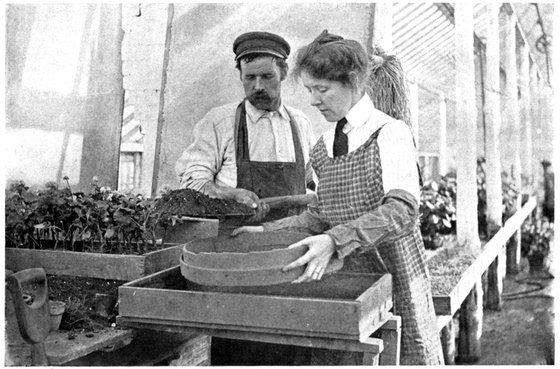
sticks, stones, or hard bits of root put through a sand
or coal-ash screen. A piece of wire netting slightly
gathered up in the hand makes a convenient screen
for a small quantity and a box with a netting bottom
for larger quantities of earth.
By the time the plants again need shifting it should
be warm enough to bed out all those that are to
grow in the open ground, while those intended for
the house must be shifted from pot to pot as they
outgrow their quarters and be given such special
treatment as the individual plants may require, always
aiming at as thrifty a growth as possible. Plants
intended for winter blooming must have all their buds
removed and their branches pinched back according
to their summer development.
Weak liquid manure may be given once a week
during summer. Keep the sand in the sand-box wet
52at all times, but do not over-water. Water thoroughly
and then allow the earth to become nearly
dry before watering again; this alternate moisture
and dryness allows the wood to ripen and make a
stockier growth and one that will stand frequent
changes of temperature better than the tender growth
induced by over-watering.
Chapter SEVEN Transplanting and Repotting
53
Tender annuals should not be planted
out of doors until all danger of frost
is past—usually about the twentieth
of May in the latitude of Detroit and
Chicago, and correspondingly earlier
in the latitude of Philadelphia. Corn-planting time
is safe in all latitudes. Even hardy annuals, if not
too crowded, do better in hotbeds and boxes until
the nights are warm. Vines especially suffer from
cold nights and cold ground, and often receive a set-back
from which they may not recover all summer.
It is best to prepare the beds a few days in advance
that they may settle, as freshly dug soil is too loose
for the roots of tender seedlings.
For solid beds of one flower make straight, parallel
rows about nine inches apart for plants like Pansies,
and from twelve to eighteen for Asters and their
kind. A most convenient method is to use a board
the length of the bed, or as long as convenient, with
the distance between the plants marked on it. By
54using a board wide enough to stand or kneel on, stepping
on the bed is avoided. On a round bed the lines
may run straight across or they may radiate from the
centre, in which case it will be necessary to skip a
part of every other row, as the rows run together
at the top.
It is better to transplant on a bright, warm day
when the soil is dry than on a damp or wet one.
Never transplant when the soil is wet. Many people
take advantage of an approaching rain to set out
plants, but this is a doubtful practice. If the rain
is followed by several days of cloudy weather, it may
do, but if followed by hot sunshine the plants will
suffer more than if first planted in sunshine in hot,
dry weather.
Only as many plants should be lifted from the hotbed
at one time as may be transplanted before they
wilt badly. The plants should be well watered the
night before, that they may have a good supply of
moisture stored, and that the soil may be moist and
cling closely to their roots.
With the trowel make a hole deep enough to receive
the roots without crowding, place the plant, fill
the hole with water, and when that has partly disappeared
press the earth firmly about the roots. Work
the surface earth fine and smooth about the plant,
taking care that it is perfectly dry. If, after setting
the bed, wet spots appear, go over them carefully with
dry earth. Do not cover or protect in any way; far
55more plants are lost by so-called protection than by
any other form of mismanagement. If the planting
has been done properly the roots will keep cool and
damp—the mulch of earth preventing evaporation.
This being the case, the tops will take care
of themselves if sun and air have free access and the
wind can sweep across them. Planting, as it is usually
done—with the surface left wet, and the air shut
away from the top—causes the water to evaporate
rapidly in the hot air, and the plant is literally cooked
to death. The water applied to the roots at planting
will usually last for several days. The condition of
the soil may be ascertained by removing a portion of
the surface. If the earth underneath is found to be
drying out too much make a hole on one side of the
plant and fill it with water as before, carefully replacing
the mulch of dry earth. Should it rain before
the plants have become established the earth must be
worked over as soon as it begins to dry that the
moisture may be retained. If these directions are
carefully carried out the tenderest plants may be
transplanted in the hottest sun without injury. Occasionally
a plant will wilt from exposure before planting,
but it will be all right the next day—unless it
was really injured before being placed in the ground.
I repeat the caution to lift no more plants at one time
than may be set in the ground before they wilt; to
form a fine mulch of dry earth over the soil; to cover
plants in no way, and to use no water on the surface
56for a few days until they have become established,
which they will indicate by spreading out their leaves
and making ready to grow. This method of planting
should be followed in moving plants from one part of
the garden to another, in resetting clumps of perennials,
in bedding out house-plants and those received
by mail. Where these last have had part or all of the
soil removed it will greatly benefit them to set them
in pots until these are filled with roots.
It is desirable that young plants should be kept
growing vigorously all the time, and frequent shifting
is necessary. Whenever the earth becomes full
of roots, or the ball of earth is covered with a network
of roots, the plant should be shifted into a pot a size
larger.
“Shifting” means changing the plant to a pot a
size larger without disturbing the ball of earth, while
“repotting” properly means an entire renewal of the
soil, the same sized crock being sometimes used.
Shifting may be done at any time, even though the
plant be in full bloom, while repotting should be done
when the plant is dormant, as it is likely to cause the
buds to blast and the foliage to droop. Plants less
than a year old are better shifted than repotted—especially
such as have neither bloomed nor shown
any decided tendency to rest. After blooming and
resting, if they are in as large a pot as you care to
handle, they may be repotted in fresh soil, care being
taken not to injure the roots, while dead roots should
be removed with the shears. When a plant has outgrown
its pot and it is inexpedient to give it a larger
one—especially if it is not making a very vigorous
top growth, part of the roots may be removed by running
a knife down on two sides of the plant, which
should not be disturbed afterward until the roots
begin to grow anew, say, in three or four weeks, when
it may be repotted with good rich soil.
SIFTING LOAM THROUGH A SIEVE
57In shifting plants turn them out of the pot without
disturbing the ball of earth. This may be done
by placing the hand over the pot, reversing it and giving
it a sharp tap on the edge of the table, which will
loosen it. Sometimes, when a plant has become pot
bound, it will stick to the sides of the pot, when a
stick inserted in the drainage hole against the stone
in the bottom will usually loosen it. Having removed
the plant from the pot, take out the old drainage
material carefully, place in a pot a size or two larger
an inch or two of broken charcoal covered with a little
sphagnum moss to prevent the earth working into the
drainage and clogging it. Fill in as much earth as
the difference in the size of pot seems to require, working
it well up around the sides with the trowel; press
the old pot into this to make a hole the proper size
and shape; place the plant, press the earth around it,
and add more if needed. Water well and return to
its place on the shelf or in the sand-box.
In potting some plants will require to have the soil
pressed much more firmly around the roots than
58others. Those which make a soft growth, such as
Impatiens sultana, various Primulas, Cinerarias, and
most tuberous plants, like Begonias and Gloxinias,
may be potted rather loosely, that is, with the earth
pressed down lightly. Geraniums should be potted
much more firmly, while such hard-wooded plants
as Roses, Hibiscus, Otaheite Orange and Fuchsias,
should be potted very hard indeed. Many failures in
plant growing may be traced to neglect of this rule.
Cuttings of common house-plants are so easily
rooted that it seems almost superfluous to give directions
for handling them. Geraniums, Petunias,
Coleus, and the like will rarely fail to root if stuck
in the ground by the side of the plant; they will do
still better if placed in the sand-box. On the whole I
prefer to set them in small pots of earth plunged in
the sand-box and kept moist, as by this method they do
not suffer the shock of disturbance when ready to pot
off.
A word about the selection of cuttings will not be
amiss, as failure to choose wisely often results in the
loss of the cutting, or in a poor or straggly plant.
Quick, tender growths are not suitable for cuttings,
except in the case of the Chinese Hibiscus, where the
extreme tips are used for rooting; hard or woody
growths are equally undesirable. The part where
the new wood begins to harden and will break with
a snap is best. No cutting should be over two or
three inches long. The little, stubby side branches
59on Geraniums are best, and as soon as growth begins
these should be pinched back to within an inch of the
ground, or to the lowest buds on the stalks; this insures
a stocky plant, branching close to the ground.
Heliotropes do not root readily and should be started
in wet sand in full sunshine and covered with a glass,
which should be lifted occasionally to allow the surplus
moisture to pass off, or in a bottle of water hung
in a sunny window. Rose cuttings are so easily and so
quickly rooted in the sand-box that it seems a waste of
time to try any other way. In cutting Roses for
bouquets, during summer, one should be generous
with stems, cutting down to a robust leaf-bud in the
axil of a leaf. After the Roses have faded the stems
may be used for cuttings, dividing them into as many
lengths as the buds allow, leaving two or three buds
to a cutting. By this method one may have a large
number of young Rose plants with little trouble and
no expense. Coleus cuttings are quickly rooted by
putting them in a glass dish filled with water and set
in a warm place. If in the fall it is desired to save
choice varieties growing on the lawn, large cuttings
may be taken of the finest plants. Grouped together
in a bowl, they are sightly and root readily. As the
plants begin to grow they are likely to lose their large
leaves—the new growths starting at the axils of these
push them off—injuring the appearance of the plant.
They should be potted off as soon as possible, the tops
pinched out, and the plant encouraged to grow vigorously.
60To this end a warm, even temperature is
necessary, sudden chills being fatal.
Gloxinias may be started in the sand-box by laying
a leaf flat on the sand, in partial shade, covering the
stem end with the sand. A callus will soon form,
followed presently by a bulb. This may be as large
as a hazel-nut before top growth begins. When tiny
leaves appear the plant may be lifted and potted and
grown until it blooms. It is not necessary to rest
Gloxinias—either from seeds or cuttings—before they
have bloomed. Begonias and Achimenes are rooted
in the same way. Umbrella-plants are started by
placing face down in a dish of water in the sun.
Rubber and any other hard-wooded plants may be
rooted by making an incision in the under side of
a branch near a leaf, at a point where the wood has
begun to harden, and wrapping the wound in a quantity
of sphagnum moss, kept constantly wet. A
thread should be tied to the branch on the side farthest
from the main stalk and attached to a limb above
to hold the cut slightly open that it may quickly become
calloused. After a time roots will make their
appearance through the moss, when the branch may
be removed and potted. A method sometimes employed,
when it is desired to save the crown of a
plant which has a leggy or unshapely undergrowth,
is to partly sever the stem at the point at which it
is desired to root the plant, cutting out a wedge-shaped
piece and packing with sphagnum moss. Or a small
flower-pot, divided in halves, may be fitted around
the cut, the bottom of the pot resting on a lower limb
or other support, and filled with earth or sand kept
constantly moist.
REPOTTING
61Cuttings liable to decay, as are some of the Cacti,
may often be saved by tying them to a bit of wood
and inserting that in the ground so that the end of
the cutting just rests on the surface. In this way the
air will reach and harden it so that a callus can form.
Without the formation of the callus the sap escapes
and the branch withers or decays. When the callus
forms the imprisoned sap goes to the formation of
roots. Some plants form more pronounced calluses
than others—particularly the Gloxinia and Rose.
Layering is another form of rooting cuttings, and
is especially valuable for Carnations, Honeysuckles,
and plants whose branches grow near the ground or
are supple enough to be bent down below its level. A
cut should be made in the under side of a branch just
below a joint, the cut portion brought down below
the ground to insure moisture, and bent sufficiently to
spread the cut somewhat, or it may be laid on the
surface and a stone placed at the point of the cut.
From a long branch like the Honeysuckle a number
of cuttings may be started at once by notching the
branch in several places and pegging it down, making
the ground higher between each notch that there may
be sufficient bend to the branch to keep the cut open.
Raising house-plants from seed is a
most fascinating work, and it is also
the most economical way of obtaining
a number of choice plants, as a packet
of seeds may be purchased for the
price of a single plant. A package of Geranium seed
may give a dozen plants, while a packet of Gloxinias
or Cinerarias may give a hundred or more—the fine
seed germinating more freely than the large.
Mixed seeds also give a variety, no two plants being
identical in bloom, and, what is most important, seedlings
always bloom—while plants from cuttings are
often stubborn in this respect and sometimes refuse
to bloom at all, owing probably to the check received
at propagation. A cutting taken from a vigorous
plant, rooting quickly, and continuing to grow, is
quite certain to bloom—while the reverse is the case
with one slow to root and slow to start into growth
after rooting. The seedling, meeting with no check,
blossoms in the natural course, and it has the advantage
63of growing from the start in the same atmospheric
conditions, and does not suffer the violent
change from the moist, warm air of the greenhouse
into the dryer, more uneven temperature of the living-room.
By sowing seed one obtains a number of plants with
the same season of bloom, making a finer appearance
than mixed plants blooming at different times. A half
dozen Cinerarias or Calceolarias in full bloom is a
sight to gladden the heart of the gardener.
In giving the following cultural details I have
selected those seeds which are always carried in stock
and may be depended upon to give good results in the
hands of the amateur. Unless some one particular
colour or marking is desired it is better to purchase
the mixed seed—selecting always the finest, or “extra
choice mixed,” which will also be the highest priced.
Never buy cheap seed for house-plants. Exception
may, perhaps, be made in the case of Primroses, which
are more inclined to come true, and it is, for this
reason, better to purchase any particular colours one
may wish in separate packets. Some seedsmen now
put up expensive seeds in whole and half-sized packets,
and the half packets will usually give all the plants
needed of one kind. The mystery of tint and colour,
only to be revealed at blossom time, is one of the
greatest charms of growing mixed seedlings.
The Abutilons, or Flowering Maples, if set going
any time before April will flower the same season.
64Start in the house in flats, and when large enough to
handle transplant into tiny pots in a hotbed or sunny
window and grow on until time to plant in the open
ground, shifting as required. They may also be
started in the hotbed, or in a protected bed in the
open ground when the trees are in bloom. Set from
one to two feet apart, according as a close hedge or
fine specimen plants are required. The new California
Abutilons present a great diversity of form and colour—there
are beautiful drooping bells, gay little parachutes,
flowers crinkled like crape or shining like satin,
some so full as to appear double. They should be
cultivated frequently if grown in the open ground
and potted before the nights become cold, as a chill
is often as harmful as frost, and plants so exposed are
likely to lose their foliage. Plants intended for winter
blooming should be lifted while the days and nights
are still warm.
Asparagus plumosus nanus and A. Sprengeri (emerald
feather) may be started any time in the late
winter or early spring. The seeds are large and
should be planted in rows an inch apart each way,
pressing them into the soil a quarter of an inch and
covering them over. They germinate in about twenty-one
days, and require no especial care other than to
be kept moist and fairly warm. When an inch high
transplant to thumb-pots, using the fine compost.
Shift as often as necessary; all Asparagus—especially
the Sprengeri—are greatly benefited by frequent repotting.
65Spray frequently, keep moist always, and
give liquid manure once a week while growing.
A. Sprengeri grows rapidly and is the most easily
managed of all varieties. It needs, however, abundant
root room, and where that is restricted must be
given some kind of plant-food. It is the plant most
used for hanging-baskets. A basket of three two-year-old
seedlings is a thing of beauty, throwing off
wonderful fronds—even in the dry air of a sitting-room
heated with a coal-stove. They should be given
a chance to rest during the summer by setting in a
cool, shady place, watering sparingly. When the
plant shows signs of renewed growth repot, giving a
larger pot if necessary, or, if two or three plants have
been growing in one basket they may be separated
and given more room. An elongated tuber is formed
on the roots, which stores nourishment—like the
nodules on the Clematis and Clover roots. It is useless
for propagating purposes, and should not be disturbed.
A basket or a pot on a bracket or pedestal is
the only way in which to grow A. Sprengeri successfully,
while A. plumosus nanus succeeds best in deep
pots, as it sends its roots far down, often pushing
its crown well above the soil in this way. A. plumosus
sends out fronds several feet long, and is best adapted
for growing on strings. A deep pot on a north or
east window-sill suits it well, provided it is not too
cool, and fine spool-wire makes a neat support and is
almost invisible.
66The seeds of Rex and other Begonias are so fine as
to look like dust. They should be sown on the surface
of the soil, in flats in the house, in February or March,
and an even temperature maintained. They germinate
in eight or ten days, and the greatest care is required
to keep the tender seedlings from damping off
or drying out. The tiny plants appear first as a vague
green bloom on the face of the soil, and a magnifying
glass is necessary to show that each infinitesimal green
point is possessed of a pair of leaves. From this time
on it is a delight to watch the development of character
in the leaf—quite tiny plants showing different
markings. I have never raised two Rex Begonias
exactly alike. When the little plants are large enough
to handle prick them out into other flats, setting them
an inch apart each way. When an inch high put into
two-inch pots of leaf-mould, and plunge the pots in a
pan of wet sand in a cool, north window where bulbs
are growing, if possible, as the constant evaporation
from these keeps the air moist. This is an important
consideration in the culture of Begonias, and in winter
water should be kept on stove, radiator or register to
supply moisture. Among the fine bedding, fibrous-rooted
Begonias the new Vulcan, a fiery scarlet; Vernon,
a deep red; Erfordii, a soft pink, and the dwarf
Bijou are the best. By starting these during January
and February in flats in the house they may be bedded
out in early summer. If planted in the house in
January, transplanted to flats, and thence to the hotbed
67when it is emptied after the 20th of May, and
partly shaded, they will be fine, robust plants by
August, and may be used to replace the Pansies when
it is not desired to carry these through the summer.
If one has a sufficient number of pots, pot and plunge
in the hotbed and they will not be set back by transplanting,
but they must be plunged to the rim. They
should be shifted when necessary, duly mulched, and
not allowed to dry out.
Nothing finer than the tuberous Begonias can be
desired either for bedding or for pot culture. The
single are perhaps showier for bedding, but the double
are handsomer for pot culture. They do admirably
bedded out in a shady corner, or in pots in the sandbox.
Peat, or a compost of two parts loam, two parts
leaf-mould, and one part each of sand and old, well-rotted
manure suits all varieties of Begonias. In setting
out the tuberous Begonia it is well to mulch the
bed with lawn clippings. Water thoroughly once a
day, and, if very dry, or at all exposed to the sun,
twice a day. So really wonderful are their blossoms,
and so long and freely do they bloom, that they well
repay a little extra care and protection. When frosty
nights come the tuberous Begonias must be lifted,
potted and kept indoors until they have completed
their season of growth. Then water should be gradually
cut off and the pots stored away in a dark, warm
closet until spring, or if there are too many Begonias
to pot they may be ripened off at once by putting on a
68tray of damp earth with the roots covered, and allowing
them to dry gradually. When dry the tubers may
be removed, wrapped separately in tissue-paper and
stored in a dry, fairly warm place—a shelf in a closet
or a drawer.
Probably no greenhouse flower is as little known
or repays acquaintance as royally as the Calceolaria.
Of infinite variety, its showy purse-shaped flowers
range from a rare pure white through all the shades
of pale lemon, orange, and scarlet to a deep, rich, velvety
cardinal. It is one of the most easily cultivated
of house-plants. The seed is fine like the Begonia,
is handled in the same way, and germinates in eight or
ten days. Shift as often as the pot fills with roots,
using a size larger each time and disturbing the roots
as little as possible. Rather more loam than leaf-mould
is used in potting them. Keep in an east window
in winter, where there is good morning sunlight and
a temperature of at least 60 degrees. The air should
be kept moist, either from blossoming bulbs or dishes
of water on the stove. In a dry atmosphere it is liable
to attacks of red spider, which greatly mar the foliage.
The remedy or preventive measure is fresh air and
moisture. Keep the soil moist but not wet. When
the flower-buds appear slightly increase the supply
of water and give a little manure once a week. The
large felty leaves grow so thick and close that when
the buds appear, to prevent injury from lack of light
it may be necessary to remove a few leaves. If kept
69growing vigorously and shifted frequently, plants
should be in five-inch pots by February and coming
into bloom. When in full bloom it is well to remove
to a cool room, where the blossoms will last for weeks.
Cuttings may be taken when they are through blooming,
but I think it best to begin afresh each year with
seed.
Cinerarias make fine, large plants, as broad as they
are high, their rich, velvety leaves showing on the under
side wonderful colourings of green and lavender,
purple and plum. The large heads of single daisy-like
flowers show many shades of white, lavender,
crimson, purple, and maroon. Most of the varieties
have a dark eye and are sharply margined with some
contrasting color. The seed is fine and is simply
pressed into the soil. It germinates in from five to
seven days, and requires little heat. As the plants are
rather difficult to carry through the hot weather it is
better to defer sowing until August. Their growth is
rapid if given a cool, moist atmosphere, but a draught
is most injurious and care must be taken never to over-water
them. They like a moist, but never wet, soil, frequently
stirred when there is any sign of damping off.
They may be carried through an unusually hot spell
in a cool north or east cellar window, always avoiding
draughts. In winter an east window suits them best,
with abundant room to develop their leaves. They
are an exceedingly ornamental plant even without the
flowers. The shady side of the sand-box is the best
70place for them in summer. They need frequent shifting,
and by winter should be in five-inch pots. After
the buds appear give liquid manure once a week. The
utmost care must be taken to guard against aphides
or green plant-lice, which are absolutely fatal if allowed
to gain any foothold. The prevention is plenty
of fresh air and tobacco-dust sprinkled on the leaves,
which mars their beauty. The remedy—dipping in
water heated to about 135 degrees, or brushing off the
lice and killing them.
Carnations are the most easily grown of all desirable
house-plants. If planted in drills in the hotbed
in April, or in the open ground when the trees are in
leaf, they will bloom in about four months. For outdoor
blooming the Marguerite Carnations are usually
selected, and the Giant of California is a new and
choice variety of this popular strain. The seed is
sown an eighth of an inch deep, the plants appearing
in from five to seven days. When large enough to
handle transplant into fresh rows in hotbed or flats,
setting them an inch or two apart each way. When
they are two or three inches high prick off into pots
filled with three parts good loam and one of leaf-mould
and plunge back into the hotbed. When the
weather is warm enough set them in well-prepared
beds of loam, enriched with a liberal quantity of well-rotted
manure, planting them a foot apart each way.
Cultivate frequently during summer to keep them free
from weeds. A little soot and ashes added to the soil
71between the rows will heighten the colour of flowers
and foliage and add stiffness to the flower-stems. The
ashes will also counteract the tendency to burst the
calyx, so troublesome in the Carnation. Plants intended
for winter blooming should have all the buds
removed during the summer, up to the first of September.
Only a few flowers will be obtained in the open
ground the first year, but if the plants are protected
during the winter they will bloom freely the second
season. While blooming no seed should be allowed
to form, and if size and quality are desired more than
profusion of bloom, all but the terminal buds on each
stalk should be removed. This is the method employed
by florists to produce their long-stemmed beauties.
Dig in the second summer a little old manure
between the rows and sprinkle ashes there. A mulch
of two or three inches of lawn clippings between the
plants will hold the moisture so that cultivation will
not be necessary. Fresh Carnation seed should be
sown each spring, that there may always be blossoming
plants and the bed made perpetual. Carnations
will not stand the second winter, hence the need of
young plants to renew the bed.
If it is desired to perpetuate any variety cuttings
may be taken, or the plants may be increased by layering.
Branches from each plant may be pegged down
between the rows, equal distances apart, severed from
the old plants when sufficiently established, and allowed
72to remain when the old plants are removed in
the fall or following spring. The bed will, in this
way, perpetuate itself; but cuttings from the same
plants deteriorate in two or three years, and fresh
seed should be sown every two years at least.
In growing winter Carnations for the house shift
them as often as the growth of the plant requires,
using three parts loam, one part leaf-mould, and one
part each of sharp sand and old manure. When ready
to bloom they should be in five-or six-inch pots. They
require an atmosphere cooler than that of the ordinary
living-room. A south window away from direct fire,
where the temperature stands at 50 or 55 degrees, is
best. Water thoroughly, but allow the soil to nearly
dry out before watering again. If possible sprinkle
the foliage every day and watch carefully for green fly
and red spider; though there is less danger of their
appearance in a cool room than in the hot, dry air of
the living-room. When the flower-stalks appear they
will need support, which may be supplied by placing
three or four sticks or cat-tails at the side of the pot
and twisting strings around them, back and forth,
forming a frame around the plant. There is an excellent
Carnation frame on the market, costing a few
cents, which is similar but much neater. Stakes thrust
into the ground near the crown of a plant are apt to
injure it, and must be used carefully if at all; the
finer the point on the stake the less damage done.
Should green lice or flies appear syringe the plants
with tobacco tea, or fumigate with tobacco, leaving
them in the smoke long enough to insure success. Or
the plant may be dipped in hot water at about 130
degrees; this will kill all insects or eggs.
WHEN TWO OR THREE INCHES HIGH, TRANSPLANT CARNATIONS INTO POTS
AN EASILY MADE CARNATION SUPPORT
73Cyperus, or Umbrella-plant, may be easily raised
from cuttings, but it is sometimes desirable to have a
number of plants for aquatic gardening, and growing
from seed is an economy. The seeds should be sown
in flats and kept warm; they germinate in about ten
days, coming up very freely. As many as three hundred
plants have been secured from one packet. Prick
the seedlings out into larger flats as soon as they are
big enough to handle, and when two or three inches
high pot them off into two-or three-inch pots of muck,
plunging into wet sand and keeping constantly moist.
Shift them as the pots fill with roots, and by the time
the plants are in four-inch pots the water should be
kept standing in the saucer all the time. When they
attain proper size they should be grown in a jardinière
or other vessel holding water, or else the pot in which
they grow should be plunged in water. The Cyperus,
being a semi-aquatic plant, cannot have too much
water; the lack is quickly shown by the leaf-tips turning
brown. Two plants kept fairly wet in pots, but
plainly suffering, so were plunged into a lily-tank; in a
few days the roots had pressed to the surface in search
of water, and hung, a perfect fringe, over the edge
of the pots. The effect on the tops was as pronounced—the
crown quickly sending up lush green
74umbrellas in striking contrast to the discolouration of
the original plants. There are two varieties of the
Umbrella-plant—a dwarf, growing not more than
eighteen inches high, and a tall variety growing three
or four feet; the former is prettier for table decorations,
while the latter is more effective for pedestals
in halls and drawing-rooms. Remove all weak or
spindly umbrellas and all discoloured ones; it is also
well to remove the flowers, as seeding injures the plant.
Cyclamen may be started in flats or in a cool hotbed
from January to March, pressing the seed into the soil
about twice their depth. They must be kept moist,
not wet, all the time. They do not require as much
heat as the Calceolaria, but the temperature must be
kept as even as possible. The seed germinates in from
two to four weeks, according to its vitality. It is best
to start them in large flats and let them grow on undisturbed.
About the last of May remove them to a
cold-frame on the east side of the house, disturbing
the roots as little as possible, and setting the plants
about eight inches apart each way. Keep the soil
moist and mellow by frequent cultivation, or by
mulching it with sphagnum moss or lawn clippings.
When the plants have attained some size give weak
liquid manure once a week, pouring it in a shallow
trench between the rows, that it may not touch the
bulbs or foliage. Treated in this way they should
be ready to bloom by winter; if grown in pots they
will not bloom until the second season. When cold
75weather comes lift the plants and put in four-or five-inch
pots, according to size, using good garden loam
and one-fourth the quantity of old, well-rotted manure.
They should be grown in a cool east room and
syringed daily.
In the spring after blooming withhold water gradually,
giving no more than will keep the roots from
drying out, and set them in a cool, shady place during
the summer—the rear of the sand-box is best, where
other growths will protect them from the sun. In
continuous wet weather they should be turned on
their sides or otherwise protected from extreme moisture.
When they show an inclination to grow again,
if they are in large enough pots, remove as much of
the top-soil as possible without disturbing the roots,
and replace it with fresh, rich earth and old manure.
If the plants are crowded with roots remove them
into pots one or two sizes larger. Give them a good
watering and set in a somewhat lighter and warmer
position. Cyclamen bulbs, like the Amaryllis, should
not be allowed to dry out entirely, as this destroys
the roots, and when the top growth starts in advance
of the root growth, as is usual, the plant will die from
insufficient nourishment. Florists frequently send out
dry bulbs with flower-buds half an inch long and no
sign of roots; such bulbs rarely amount to anything.
When obliged to start a dry bulb, it is better to sink
it half way in the soil and cover with sphagnum moss.
Set it in a dry, cool place, and examine it from time
76to time that it may not be kept back longer than necessary.
The starting of leaves is a fair indication of
root growth, as the premature growth is usually of
buds.
Geraniums are as easily raised as Carnations—indeed,
it seems only necessary to put them in the ground
and await results. In the spring sow the seed in drills
in hotbeds or flats, covering with an eighth of an inch
of soil. The plants should appear in from ten to
fifteen days, and if they do not stand too closely may
be allowed to grow on until they have two or three
leaves. If mixed seeds are sown of the fancy-leaved,
the scented, the zonale and the Lady Washington, the
development of the several kinds will afford a fascinating
study.
Care should be taken to save the more delicate-looking
seedlings, as these will give the choicest varieties;
the more robust plants among the zonales indicate a
retrogression toward the original type, which has
scarlet blooms. All choice new Geraniums are produced
by seeds from hybridised flowers. Pot off the
last of May in three-inch pots, using good garden
loam and well-rotted manure. Pot them rather firmly
and plunge into the sand-box in full sunshine. Water
thoroughly and allow the soil to become dry before
watering again; this tends to harden the new growth
and makes the plants stocky. Nip out the top of the
plants, forcing them to break or make new branches
near the ground. The nearer the ground a Geranium
77branches the better plant it will make. Pinch off the
shoots as they appear, allowing them to grow only
three or four inches long. Remove all buds that appear
before fall and shift to larger pots if needed,
though Geraniums do not need as much pot room
when blooming as many other flowers. Give liquid
manure once a week after the buds appear—before
that time the use of fertilisers encourages the production
of foliage rather than of flowers.
Zonales should bloom by February and Pelargoniums
by March or April the first year. They should
be watered more freely when in bloom. Geraniums
should be grown close to the glass to give best results.
In prolonged cloudy weather the buds will blast and
the new growth look sickly in spite of all care. Pelargoniums
are very satisfactory when raised from
seed, showing great diversity of colour and markings.
When they have finished blooming in the spring cut
them back freely, using the cuttings for new plants.
The old plants should be set in the shade to rest and
watered sparingly. At the end of that time they may
be brought into the sunlight or plunged into open
ground and encouraged to grow freely. Removing
a portion of the leaves at this time—every other one,
for instance—will cause new shoots to break at the
axils of the leaves, and every new shoot means new
blossom points. By the middle of September the
plants should be lifted, cut back to the point where
the wood begins to harden, and given a warm, sunny
78window. Cuttings started in spring, if shifted, kept
growing and pinched back occasionally, should be in
splendid condition for early spring blooming. In
growing Geraniums never lose sight of the fact that
stocky, many-branched plants give flowers in abundance;
tall, spindly plants the reverse. A Geranium
should always be as broad as it is high to be at its
best. Ivy Geraniums need extra care to keep them
low and stocky. Water sparingly and give abundant
sunshine if you wish these to bloom.
Geranium seeds come up very irregularly, so that
it is well not to disturb the ground for some time after
the proper season of germination has passed. In this
way many extra plants are secured.
Like all fine seeds the Gloxinias often give a surprising
number of plants from a single packet.
The seed is sown on the surface of small flats in the
house and the plants appear in about ten days. They
are very tender at first and must be protected from
undue heat, moisture, cold or draughts. They may be
potted when large enough and plunged in the shady
side of the sand-box, in a cold-frame, on the east side
of the house, or in a shady corner in the open ground,
where they will be protected from the sun during the
hottest part of the day. Keep the soil constantly
moist; a light mulch of sphagnum moss or lawn clippings
79will keep it in proper condition. Avoid wetting
the foliage and as far as possible touching it. The
stems of both leaf and blossom are very brittle and the
slightest blow may deprive one of a cherished blossom.
For this reason I like to grow them by themselves
and use a mulch instead of cultivation. So
much of the beauty of the plant depends upon the
perfection of the foliage that every effort should be
made to preserve it. In setting or potting Gloxinias
the crown of the bulb should be above the earth, the
soil should slope to the rim of the pot, that no water
may settle about the crown and rot it. The plants
may remain in the hotbed or other quarters until the
approach of frost, when they must be shifted into
larger pots and given a position in an east window
with plenty of light. Gloxinias, if kept growing vigorously
and shifted frequently, should bloom the following
season. Some florists advise resting the bulb
the first winter, but this, I think, is a mistake; the
plant has done nothing to require a rest, nor has the
bulb gained sufficient size to live without nourishment
for any length of time, so that drying off is
likely to result disastrously. After the Gloxinia has
completed its period of bloom water should be gradually
withheld and the foliage allowed to ripen.
The bulbs may then be set away in their pots in a
warm, dry place, until the following spring; or, if
grown in hotbeds, they may be dried off by withholding
water until the foliage ripens, when they may
80be lifted, wrapped in cotton-wool or tissue-paper, and
stored in a dry, fairly warm place during the winter.
Are more easily raised from seed than from cuttings,
which require special care. Several of
the new varieties, like Lemoine’s seedlings, give exceptionally
large and early flowers, ranging in colour
from pure white through all the shades of lavender,
purple, and blue to deep indigo. If wanted for winter
blooming the seed may be sown any time during
the spring, but for bedding out it should be sown in
February or March, and the plants duly potted off
and plunged in a box of sand in a warm, sunny window,
or a hotbed, until it is time to bed them out
in the open ground. The compost should contain a
large proportion of leaf-mould—three-fourths mould
and one-fourth loam and sharp sand.
The seeds of Heliotrope must be kept merely moist,
never wet and never allowed to dry out, or they will
not sprout; keeping the soil just on the verge of drying
out, yet never allowing it to do so, is the whole
secret of starting Heliotrope from seeds. It is best
to sow the seed in moist soil to avoid the necessity
of watering afterward, as is done with other seeds;
if the soil is just wet enough to be crumbly, neither
wet nor sticky, and can be kept so, they will prosper.
Cover the seed lightly with white sand and remove
81the glass if any appreciable moisture appears—anything
more than a fine mist. It germinates in from
fifteen to twenty days, and the plants require no special
care beyond good soil, warmth, and plenty of
sunshine with frequent waterings. When grown as
house-plants they should be showered once or twice
a day to prevent the inroads of the red spider—their
worst enemy.
There is no more desirable bedding plant than the
Heliotrope, and the more freely it is cut by removing
generous portions of stem with the blossom the more
freely it will bloom. It is admirable for replacing
Pansies and may be grown on in the hotbed until the
Pansy’s day is past. Where there is not enough
Heliotrope for large bedding operations, purple Ageratum
may be combined with the Heliotrope with excellent
effect; this is a method often employed in the
city parks, and when judiciously done one scarcely
notices that the beds are not all Heliotrope. Plants
may be taken up in the fall and cut back for winter
blooming. Blossoms always form on the terminals of
the branches.
Are hard-wooded, shrubby plants, the leaves
more or less rough and prickly. The colours
range from pure white through various shades of
lemon to orange, red, a new bright scarlet, and the
rosy lavender of the Weeping Lantana. The seed in
82its immature state is incased in a green pulp or berry,
changing to blue as it ripens, and consists of a little
nut with several kernels, so that one is sometimes surprised
with two or more plants from what seems to
be a single seed. The seed may be started in the
house, or in the hotbed early in the spring; sowing
in drills one-quarter of an inch deep. It germinates
in from twelve to fifteen days, but soaking in warm
water, for a few hours before planting, will hasten
its appearance. They require about the same treatment
as Geraniums, but should be shifted oftener and
given plenty of water. As soon as the plants are four
or five inches high transplant them to a tobacco pail,
or some large wooden receptacle containing a compost
of muck, loam, and old manure, or muck alone,
and place in full morning sunshine, out of doors.
Thus managed I have grown, from seed sown in
March, plants that measured nine feet or more in
circumference by September and were a mass of
bloom all summer long, the blossoms defying all efforts
at counting.
Grown in this way, with an abundance of roots
and top room, rich soil, sun, and water, no better
ornament could be desired for the porch or steps;
but I do not think it a desirable plant for the house,
as the hot, dry air causes it to drop its leaves, and it
is almost sure to be attacked by the red spider. It is
better to start fresh plants each spring and let them
go when frost comes.
83Lantanas make fine hedgerows between house lots
or for defining different portions of the grounds.
They should be planted in rich ground two and one-half
feet apart.
The new Weeping Lantana is the most charming
member of the family. It is of much more slender
growth than the rest and inclined to be pendulous,
or weeping. Its delightfully fragrant flowers are produced
in round heads the size of a half-dollar at the
axil of every leaf and show a lovely rosy-lilac hue.
If planted in the open ground the Weeping Lantana
quickly covers a considerable area, presenting a solid
sheet of bloom throughout the summer. It will
bloom freely in the house if given a warm, sunny
window, abundant room, and showered daily to keep
back the red spider, or dipped occasionally in hot
water for that purpose. It must always have abundant
root and top room and plenty of water.
Probably no common flower of the garden
has been so improved during the last few years
as the Petunia. The small-flowered variety of a few
years ago with its straggly habit and narrow range
of colour—chiefly white and faded magenta—is now
superseded by magnificently fringed and ruffled beauties
in a wealth of colour, from purest white to glowing
crimson, and a velvety purple that is almost black,
84with wonderfully veined and tinted throats and thick,
stocky stems. It is difficult to realise that they are
the same plants, plus a few generations of good living
and culture.
The double Petunias are desirable for pots, vases,
and bedding out, but I do not think they compare
with such strains as Burpee’s Defiance, the Giants of
California, the Ruffled Giants, and the Miranda.
Miranda, for example, is a rosy carmine merging into
a brilliant scarlet in the throat—the nearest approach
to a scarlet Petunia yet produced. The seed of double
Petunias will yield a fair proportion of double flowers.
The young plants of both the single and double
varieties require great care at first, being very sensitive
to hot sun or cold air. Once established, however,
they will stand a great deal of both—more,
indeed, than almost any other flower of this class.
Plant them in flats in the house in March by pressing
the seed into the soil without covering; keeping moist
and warm until the seed germinates, usually from
eight to ten days. When large enough to handle,
prick off into larger flats and set them in a warm
north or east window. When the leaves touch set
them two or three inches apart each way in other flats
and let them grow until it is time to place them in
the open ground, hardening them gradually by exposure
to more sun and air each day, and transplant
with great care. If intended to replace the Pansies
they may be set in the bed in June, the Pansies affording
85them protection until they have attained some
size. Set each little seedling on the north-east side of
a Pansy plant, and by the time the Pansies have passed
their zenith they will be ready to stand alone.
Always remove poor or inferior plants in order
that the highest standard may be maintained; the
finer varieties may be readily distinguished from the
more common sorts by the stems and foliage; the
latter having thin stems and small leaves, set rather
far apart, while the stems of the fine varieties are
very stocky; the leaves large, more or less crinkly,
and set closely on the stem; the buds thick and compact,
while those of the common type are long and
thin. Petunias grow so rapidly that vacant places
left by culling are soon filled. The finest specimens
may be lifted for winter flowering. They will bloom
freely in the house and often show a richer colour
than when out of doors. They need considerable
root room—any crowding of the roots, or starving
of the plants being quickly shown in the deterioration
of the flowers. Avoid chills and draughts. Give
liquid manure and water freely, but do not let the
soil get wet or sour. A little charcoal in the potting
soil is an excellent corrective of this tendency. Always
remove the flowers as they fade, thus prolonging
the blooming season and increasing the beauty
and size of the blossom.
86
Require the same general treatment as other
house-plants. A good compost of leaf-mould,
loam, and sand is best for the first few shiftings,
manure being added as the plants attain size. Repeated
shifting hastens blooming, while keeping the
plants in small pots retards it. When ready to bloom
they should be fine, large plants in five-or six-inch
pots. They should blossom in November and, if well
cared for, they will flower from that time on until
spring. In potting the Primrose care must be taken
to have the crown of the plant slightly above the
surface of the soil and the soil lowest at the edge of
the pot, that no water may settle around the crown
and cause it to rot. When the buds appear give the
plants diluted liquid manure once a week. As the
leaves of Primroses are easily injured they should be
placed where they will be subjected to as little handling
as possible. Window brackets make an ideal
place for them, as they can be turned and inspected
without removal, and the large velvety leaves, drooping
gracefully over the pot, will develop perfectly.
Injured or faded leaves should be removed at once.
A receptacle rather broad than deep gives opportunity
for the best development. A hanging-basket, milk-crock
with drainage hole, or jardinière with outlet
will answer. Sufficient root room is particularly necessary
in the case of old plants, as these have more
divisions to the crown and therefore spread more.
Primula obconica does better when grown in shallow
dishes; a dish four inches deep and eight wide is much
better than the usual flower-pot.
INJURED OR FADED LEAVES SHOULD BE REMOVED AT ONCE
87Florists start their Primroses each year from seed,
but there is no reason why, if one has a choice plant,
it should not be carried over to the second year, when,
being larger, it will give more flowers.
Chapter NINE Outside Window-boxes
88
The outside window-box is a thing of
beauty if well cared for, a disfigurement
if neglected. So greatly does
it add to the cheerfulness and apparent
size of the rooms under the
windows of which it is placed that I should advise
its use whenever practicable. One of my pleasantest
recollections is a window-box full of Heliotrope under
a sitting-room window, filling the room so full of
perfume that going into it in the early morning was
like stepping into a garden of fragrance.
Window-boxes do well in any window not shaded
by porches, and the plants best suited to the light
may be selected. Many plants too tender to bed out
in the open ground may be trusted to the window-box.
Fuchsias, Ferns, Asparagus Sprengeri, A. tenuissimus,
Ageratums, fancy-leaved Caladiums, and
various tuberous-rooted Begonias, like the silver-spotted,
known as Angel’s Wing, are all lovely in the
window-box. Rubra and most of the Begonias do
admirably in a north window. For windows facing
89the street, where effect is principally sought, bright
Geraniums, Heliotropes, Coleus, Crotons, and similar
plants are preferable, provided there is sufficient sunshine
to bring out all their rich colouring.
The fancy-leaved Caladiums may be used where
bright effect is sought in a north window.
The boxes used for this purpose should be as
ample as possible, the full length of the window-casing
outside and at least a foot wide and deep. They
should be made of inch boards, closely fitted together
so that the sides shall not warp and allow the water
to run through too freely, washing out and exhausting
the soil. A hole may be made in the bottom at
one end, and provided with a plug, for the escape of
surplus water during continued rains. A piece of
broken crock or other drainage must be placed over
the hole on the inside of the box to prevent the earth
working in and obstructing the free passage of water.
The hot air of summer will shrink the earth away
from the sides of the box, leaving a channel for the
water to escape without properly soaking the soil;
but if the surface of the soil is kept open, and the
centre left a little lower than the sides, this will be
prevented. A little experimenting will show just how
much water is needed to wet the soil properly without
letting it run away, and this amount should be
used daily during dry weather. Only as many plants
as will do well in the limited space of four square
feet should be planted in the window-boxes. Five
90erect plants and three vines are enough for a box of
that size, and even these may need attention before
the season is over, especially if in south or west
windows. North or east boxes will, usually, keep
their contents fresh until frost; but a west or south
light makes great demands upon the vitality of plants
confined within the limited area, and it is a good plan
to leave Geraniums and similar flowers in their pots,
that they may be easily exchanged for others when
they grow shabby, cutting back and repotting the old
ones for winter blooming if removed not later than
August.
A better plan is to have two boxes; starting one in
the house in March, that it may be ready to place
as soon as danger of frost is past; and the second in
June, that it may be ready to replace the first when
needed. For the latter the vines started in the house,
or hotbed, in April will be available. Maurandya,
Thunbergia, and the like, and many flowers from seed
will have reached sufficient size to be used for the
second box. Plants that have been carried over from
another season, or purchased from the florist, will be
necessary for the first boxes. There is no more beautiful
vine for a window-box than the Maurandya; it
drapes more gracefully than any other vine I know
(unless it be the Wild Cucumber, which attaches itself
to the window-screen in wreaths of exuberant bloom,
drooping far below the window-box, and making a
lovely background for scarlet Geraniums). Its only
fault is that it will grow shabby before the season
is over, when it had better be pulled up and replaced
by a fresher vine that has been grown in a pot for
the purpose and can be slipped into place without
checking its growth.
OUTSIDE WINDOW-BOXES
91Perhaps no plant is more satisfactory for a south
or west window-box than a good Geranium—either
the dark, rich vermilion of the S. A. Nutt, or the vivid
scarlet of the Bruant. Both of these appear to better
advantage when contrasted with white flowers.
Camphor Geranium is excellent, being a freer bloomer
than other white Geraniums, and the Giant White
Antirrhinum is especially vivid. Double white Petunias
and white Phlox Drummondi are also good.
Purple Ageratums and Heliotrope are charming with
scarlet and white. The large-flowered Ivy Geraniums—Souvenir
de Charles Turner—are the best, and do
finely in east and west window-boxes, while the variegated
variety makes a lovely mass of pendent foliage
for an east or north box. Trailing Fuchsia, Japanese
Morning-glory, Glechoma, and Wild Cucumber all
do well on the north side of the house. The following
combinations may all be depended upon to give
satisfactory results:
Southern Exposure.
No. 1.
Bruant Geranium White Antirrhinum. S. A. Nutt Geranium
(scarlet). (cardinal).
Heliotrope. Heliotrope.
White Maurandya. White Maurandya.
92No. 2.
Jean Viaud Geranium Mrs. J. M. Garr. Jean Viaud
(pink). (pink).
Dwarf blue Ageratum. Dwarf blue Ageratum.
Nepeta Glechoma. Souv. de Charles Turner. Nepeta Glechoma.
No. 3.
Beaute Poitevine Ger. White Verbena. Madame Charlotte Ger.
Nasturtiums make an attractive window-box, but
need abundant root room, and not more than three
plants should be put in a box having three other
erect plants. Morning-glories, on the contrary, require
but little room, and one may be put in each end
of a north window-box and trained over the window.
If strings are provided they will reach the roof by
midsummer, blooming every step of the way; other
vines may be grown in the front of the box. The
Centrosema—when it can be persuaded to grow—is
a charming vine for a north or east window, but it
is a very shy plant, hard to get started, and refusing
to grow in an uncongenial situation, though quite
hardy when once established.
BOXES IN WHICH SCYTHES ARE PACKED MAKE VERY GOOD WINDOW-BOXES
HANGING-BASKETS FOR WINDOWS
95The best support for the window-box is the wooden
bracket made by nailing to the side of the house,
thirteen inches below the window-sill, a strip of inch
stuff the length of the window-frame and three or
four inches wide; on top of this and at right angles to
it nail three similar strips of wood one foot long, the
outer ends resting on strips of wood attached to the
sill of the house; these last strips must have the ends
bevelled sufficiently to fit snugly against the baseboards
and the bottom of the horizontal pieces and
be securely nailed together. If the measurements are
carefully taken the box will slip into place, on the
supports, just under the window-sill. Paint boxes
and supports to match the house. Window-boxes may
be kept in the cellar through the winter, or emptied,
dried and stored in a dry place, according to their
contents. Always empty and thoroughly scald the
boxes before using.
In stocking window-boxes never put plants received
by mail directly into them; they should be ordered
early enough to pot and become established (the pots
full of roots) by the time they are needed for the
window-boxes, when they may be slipped into place
without disturbing the roots or checking their growth.
Placed at once in the boxes, in a sunny position, they
would probably be lost.
Very fair window-boxes may be obtained at trifling
expense by using the boxes in which grass scythes are
packed, which may be purchased at the hardware
store for five or ten cents apiece. These are not as
wide nor as deep as one could wish, but have the advantage
96of cheapness and availability. Preference
should be given to those having close seams. If
warped or open they must be tightened by driving in
extra nails, or nailing thin strips of wood over the
cracks on the inside. The longevity of the window-box
is greatly lengthened by keeping the windows
above them—especially on the south and west sides
of the house—open as much of the time as possible.
If the sun beats on the glass of the closed window and
is reflected on the plants, it is literally confining them
between two fires and they cannot be expected to come
through uninjured. Let the wind sweep through and
over them and they will stand any reasonable amount
of heat or moisture. This is the reason plants do
better in the open than when placed against the side
of a wall or building—the air must not only have free
access, but pass beyond, carrying off noxious vapours
and excess of moisture.
When there is garden room for their cultivation
I do not approve of growing annuals in window-boxes;
it is better to reserve these for choice plants;
but when the window-box must be the only garden,
and economy must be studied, very pretty boxes may
be arranged with Sweet Alyssum; scarlet, white, or
pink Phlox Drummondi; scarlet, pink, or white Verbenas;
the various coloured Antirrhinums, Petunias,
Nasturtiums, the blue Phacelia and Ageratums, Wild
Cucumber, the finer foliaged fancy gourds, as Bryonopsis
Coccinea Indica, and Abobra viridiflora. By
97using the scythe boxes, and starting the plants from
seed, very pretty boxes may be gotten up for from
thirty-five to fifty cents a pair that will give as much
pleasure as more expensive ones. The more flowers
are cut from these boxes of annuals the more freely
they will bloom, and no seeds should be allowed to
form. A little liquid manure should be given all
window-boxes—except those containing Begonias—once
a week during the summer, and all withered
flowers and leaves promptly removed. Nip back
weak, straggly growths and encourage the plants to
grow stocky and the vines to branch freely.
Chapter TEN Various Annuals from Seed — The Pansy Bed — Phlox Drummondi — Salvias (Flowering Sage) — Sweet-peas — Verbenas
98
Antirrhinums (Snapdragon), of
late much interest has been shown
in the newer forms of this old-time
favourite, and some fine new varieties
have become popular for cut
flowers. The Giant White and Queen of the North
are most desirable for cut flowers, window-boxes, and
vases; while Niobe—a beautiful half-dwarf variety
of velvety maroon with white throat, Giant Yellow,
Giant Crimson, and Firefly—a bright scarlet—are excellent
for bedding.
Seed should be started early in hotbed or flats.
Merely press it into the soil and cover with a paper
until the plants appear, which should be in from eight
to ten days. Transplant into rich soil where the
plants are to remain, setting one foot apart each way.
They are effective in rows with some taller plant, or
vine, for a background. The tall, showy spikes are
most striking against a background of green. The
Antirrhinum is a half-hardy perennial, blooming the
first season if seed is started early enough, and hardy
99at the North with good protection in winter. If a succession
of flowers is desired, no seed should be allowed
to form. Protect in winter with a mulch of leaves,
evergreen boughs, or corn-stalks, as high—or higher—than
the plants, or they may be pegged down and
covered with evergreen boughs, or boards to shed the
rain. Thus protected they will live through the winter
and bloom heavily the following summer. Occasionally
in favoured locations they will live through
the winter unprotected, but this cannot be depended
upon.
Antirrhinums are not particular as to soil or situation,
provided they have plenty of water; rich
loam or half loam and half leaf-mould suiting them
equally well, and any exposure that affords a fair
amount of sunshine.
Asters have come to be a recognised necessity of
the fall garden, and there has been marked improvement
in varieties during the past few years. Starting
with the old-fashioned Aster of medium size and inferior
colour, showing a marked yellow centre, the
aim of the Aster specialist has been to eliminate the
centre, enlarge the flower, and improve the colour
and texture of the petal. Results are shown in such
varieties as the Giant White Comet, the Bride, the
Japanese Tassel Aster, Chrysanthemum Flowered,
Peony, Perfection, and the wonderful Ostrich
Feather.
With such an embarrassment of riches it is difficult
100to declare any one variety the finest, but for cut
flowers and corsage wear nothing can excel the
Chrysanthemum Flowered in white and pink.
The lasting quality of the flowers when cut is quite
phenomenal. I have known them to keep fresh and
sightly in water for a month, until the stems had entirely
rotted away, leaving the flower uninjured. In
arranging them for vases remove all leaves below
the top of the vase, leaving clean stems, which should
be thoroughly cleansed daily, and the ends clipped.
A teaspoonful of charcoal added to the water in the
vase will keep it sweet and retard decay.
Early planting of Asters is to be strongly recommended,
as the early plants are not subject to the
dreaded Aster disease or to attacks of the black beetle,
which often destroy all the flowers of a late bed in
a single day.
A teaspoonful of Paris green in the watering-pot,
sprinkled on at night or very early in the morning,
will usually rid the plants of their unwelcome guests,
or they may be brushed off into a pan of water containing
a small quantity of kerosene—which is fatal
to them. They are sluggish, especially in the early
morning, dropping to the ground when touched, and
easily killed. The point is to take them in time, and
the appearance of the first beetle should be the signal
for active operations.
For early flowers the seed may be planted in the
hotbed, flats, or cold-frame in March or April, covering
101an eighth of an inch deep and keeping rather
cool. They germinate in from five to seven days, and
when the plants have attained their second pair of
true leaves they should be transplanted, setting an
inch or two apart in the flats or bed. Transplant
again when the leaves close up the gaps between them,
setting three or four inches apart according to their
growth. If possible, transplant a third time, as this
frequent moving serves to produce a great quantity
of feeding roots, at the same time checking the top
growth and making a stocky plant with stiff stems.
Transplant when the weather is favourable into a
well-prepared bed of sandy loam enriched with old
manure, or a bed of woods earth. Set a foot apart
each way, except in the case of the branching Asters,
which should be at least two feet apart.
Sprinkle ashes freely, and as long as there is room
to work between the rows cultivate once or twice a
week. They may then be mulched with lawn clippings
to keep down the weeds for the rest of the
season. If they are planted in woods earth they will
need only such cultivation as is necessary to keep down
the weeds. Do not let them suffer for water at any
period of their growth, and remove all flowers as
they fade.
Ageratums (Floss Flower) are almost indispensable
for edgings, window-boxes, vases, and for filling
out beds of Heliotrope. The dwarf or Tom Thumb
are the most desirable for edgings. Princess Caroline,
102Swanley Blue, and Little Dorrit are the best of this
class in the blue or lavender shades. The white
does not show a good, clear colour under a hot
sun, and is therefore not desirable. For early
plants sow in flats or in the hotbed early in spring.
Later seed may be sown in the open ground when
the trees are in bloom, and transplanted when large
enough. Sow broadcast, covering the seed lightly
and pressing it into the soil. They germinate in
from three to five days, and may be grown on until
time to transplant into permanent quarters. Though
they may start somewhat spindly, they quickly
regain their dwarf and stocky character in the open
ground. Set plants from eight to ten inches apart
in the row. If the flower heads are removed as fast
as they fade plants will bloom from early June until
cut down by frost.
Balsams (Lady Slipper), like Asters, are greatly
benefited by frequent transplanting, and one at least
they must have. Start seed early in the hotbed or
flats, or later, when the trees are in bloom, in protected
beds in the open ground. Transplant at least
once in the seed-beds; twice, if possible. When danger
of frost is past remove to beds of muck or marsh
earth, setting from twelve to fifteen inches apart each
way. Given plenty of room, the Balsam branches
freely, and one well-developed specimen will give
more and finer flowers than a half-dozen cramped
specimens. In purchasing select the camellia-flowered
103varieties, as it does not pay to waste time with inferior
kinds. Really fine Balsams are well worth
cultivating, and are very effective in rows in front of
taller plants. The double white and shell pink are
valuable for floral designs for funerals and for other
decorative work.
Probably no flower that has come into vogue of
late years has won more popularity than the Cosmos—certainly
for cut flowers nothing can surpass it in
graceful beauty. The large pink and white Hibiscus,
with a generous handful of long-stemmed pink, crimson,
and white Cosmos, makes an ideal bouquet for a
high glass vase. Placed in front of a large mirror
the effect in form and colour is hardly surpassed by the
choicest exotics. The graceful, fern-like foliage adds
greatly to the beauty of a well-grown clump in the
garden or lawn. They are at their best when seen
against a background of darker green, a shower of
crimson, pink, and white.
Only the early flowering varieties should be grown
at the North, as the seasons are much too short for the
giant or California varieties; though if one has room
for both, the California may be grown as a background
for the dwarf early flowering, as the foliage
is much superior and the late flowers very fine. If
started very early in flats in the house, pricked, out
into pots, shifted and grown on until time to set in
the open ground, the season of bloom will be much
advanced.
104Set out in rich garden soil and supply abundantly
with water. Strong stakes must be provided, as the
plants are very brittle at the joints, and a storm may
do great damage if they are unsupported. An excellent
way of growing them is to plant them in front
of a wire fence or chicken netting on the side toward
the prevailing wind, that they may be blown against,
rather than away from their support, and the stalks
and main branches tied to the wires with raphia, wool
twine, or strips of cloth; thus protected there will
be little danger of their being injured by rough
winds.
If an occasional seed is allowed to form and self-sow
there will come up very sturdy little plants the
following spring, but fresh seed should be purchased
every other year to insure against deterioration in size
of blossom and quantity of bloom.
Columbine (the Aquilegia) seed may be sown in
the open ground in the North when the trees are in
leaf, or any time after May 10th. Cover the seed-bed
with a newspaper and keep moist until the
plants are up, in ten to twelve days. Transplant when
large enough to handle into fresh rows or, when they
have attained sufficient size, into their permanent
quarters. Planted in a row where they will have a
background of green the effect is beautiful. One of
the prettiest beds I remember was of mixed Columbine—pure
white, rose, and lavender—in front of an
old grey building, on which grew a delicate vine in its
first tender spring green. They had been moved the
fall before from a bed where they attracted no particular
attention, but in their new quarters they awoke
to find themselves famous.
SMALL WATER GARDENS
105Dahlias are so easily raised from seed that it hardly
seems worth while to bother with the tubers, unless
one has exceptionally favourable conditions for storing
them. Plants grown from seed, started early in
the house or hotbed, will come into bloom quite as
soon as those grown from tubers. Plant the seed
in drills two inches apart, dropping an inch or more
apart in the drills, and cover with one-eighth to one-fourth
inch of earth. The seed germinates in from
five to seven days, and the little plants are quite robust
from the start, though sensitive to cold and drought.
When all danger of frost is past and the nights are
warm transplant the Dahlias into beds of mellow soil
heavily enriched with manure. Set three feet apart
each way and cultivate thoroughly as long as there is
room to work between the rows. Then mulch heavily
with rough manure covered with lawn clippings.
Water copiously during dry weather, showering the
tops at night to counteract the effect of the dry air on
the buds. Save waste water from kitchen and bath,
and apply to their roots. This affords nourishment
as well as moisture. When two feet high tie carefully
to tall, stout stakes, which, to avoid injury to the tubers,
would better be placed when the plants are set.
Sprinkle soot and ashes between the plants and cultivate
106it in. The finest flowers are produced by protecting
with an awning of thin cotton cloth after the
buds are fully grown—though this would only be
desirable in the case of exhibition flowers. When
several buds appear in one place remove all but the
largest, as the difference in size will more than repay
for the loss in number, besides there is danger of all
blasting if allowed to remain.
If worms or beetles appear on the buds they
should be sprayed with Paris-green solution—one teaspoonful
of Paris green to three gallons of water.
Should the borer—that pest of the Dahlia, Aster,
and Cosmos—appear, pour the Paris-green mixture
around the roots, soaking the soil to the depth of three
or four inches. Examine the stock of the plant near
the ground for the hole made by the borer. When
found run a flexible wire up the stalk to destroy the
worm and prevent further damage, and heap the
earth above the wound. If brought up to a point
above the wound, and kept moist, new roots will start,
thus insuring the recovery of the plant. If one has
previously been troubled with this worm it will be
well to anticipate matters, and, commencing when the
plants are a foot high, apply once a week a weak
Paris-green solution; continue this until the plant is
grown and the wood hardened near the ground.
The fine mixed double Dahlias, the Cactus and the
magnificent single varieties, are all desirable for cut
flowers and effective in garden rows; but for corsage
107wear the last are best. It would be difficult to find a
flower more beautiful than a vivid-coloured single
Dahlia.
For the rockwork try English Daisies—pink, white,
crimson, and striped. They do admirably in such a
situation, digging their toes in between the stones,
finding cool, moist spots, and holding their heads up
in the hot sunshine. Start the seeds where they are to
remain, or in a flat or cold-frame. The little plants
appear in from five to seven days, and will need shade
and moisture until they have become established.
For beds that lie in partial shade they make beautiful
borders, forming little rosettes of leaves that in the
fall may be taken up and divided by pulling apart into
as many plants are there are crowns; in this way one
will, in a short time, secure a large bed or border.
They should be protected in winter by a mulch of
rough stable litter, evergreen boughs, or corn-stalks,
and the bed raised to shed water.
The Hibiscus (Marshmallow) is a perennial deserving
much more general cultivation. Even to
flower lovers it seems quite unknown, and yet it is
cheaply and easily raised from seed, and one of the
hardiest of our garden perennials. There are three
varieties hardy in the North—an immense pure white
blossom with a velvety crimson eye, a pale pink or
flesh colour, and a lovely bright pink. These three
are hardy in the open ground without protection, but
they will be stronger plants and bloom more freely
108if protected with a little rough litter and hilled to
shed water.
There are several that may be treated as hardy
annuals, and various tender perennials that must
be kept in the house or greenhouse during winter.
Among the first are Africanus, a large cream-coloured,
brown-eyed variety; it is low-growing and
effective in front of the tall, crimson-eyed sort,
which with age attains a height of six or more
feet.
Giant Yellow is a beautiful canary yellow with
crimson throat, hardy as far north as St. Louis,
but safer in the cellar above that latitude, and Coccinea,
a tender perennial of a brilliant crimson. If
started early all will give flowers the first season from
seed, which may be sown in hotbeds or flats in February
or March in drills one-fourth inch deep. They
germinate in from five to seven days. Plant out in
good garden soil at corn-planting time, setting the
hardy varieties where they are to remain, as they do
not bear transplanting well when they have attained
any considerable size. Cultivate during the hot
weather or mulch. A two-quart tin can, with holes
on one side near the bottom, may be sunk in the
ground and filled with water. This with the mulch
will keep the earth cool and moist during the hottest
weather. The plant is an herbaceous perennial, dying
down to the ground in winter and coming up from
the roots the following spring—rather late in May.
Plants increase in size and beauty each year, and a five-or
six-years clump is superb.
COOL, MOIST SPOTS BETWEEN STONES
109Cut off the stalks a few inches above the ground
when killed by frost, but do not attempt to break them
off or pull them up, as that will injure the crown of
the large, fleshy roots and cause decay during the
winter. The remainder of the stalk serves to mark
the location of the plant. When they have grown
to blooming size they should be tied to stout stakes.
The large clumps have a tendency to spread at the
roots, and a severe rain and wind storm may lay them
prostrate. Make a support of two or three wooden
hoops nailed to two or more stout stakes, the top hoop
standing three feet above the ground. Place this
over the plants in the spring and train them to grow
up through the hoops.
For effective grouping, to fill in a corner, to serve
as a screen to unsightly objects, to catch the eye and
carry it on from point to point, there is no finer flower
than the Hollyhock. The double flowers, of course,
are more attractive at close range, but at a distance
the single are rather more effective. Everyone who
grows plants should find at least one corner for a big
clump of this gorgeous flower.
The seeds should be sown in the spring, either
where they are to remain or in a cold-frame; the location
matters little so that favourable conditions of the
soil are secured. Plants started after the seed ripens
in the summer, even when protected by a cold-frame,
110do not make sufficient growth to endure a very severe
winter. The new Alleghany Hollyhocks are hardier,
and a fair proportion of plants from August-sown
seeds may be expected to survive the winter. When
the plants run up their blossom stalks the second
season they must be securely staked to prevent injury
by high winds. If the borer appears apply the Paris-green
solution about the roots. The Hollyhock is
subject to attack very early in the season by a variety
of red spider which feeds on out-of-door plants.
The Paris-green solution may be used for this, or a
kerosene emulsion, or the plants may simply be
showered with hot water at about 145°. The remedy
should be applied promptly. The Hollyhock
blight is a fungous disease of a most destructive nature.
Its ravages almost drove the Hollyhock out
of our gardens some years ago. Infected plants
should be burned. Though hardy the second year,
they should be hilled up sufficiently to shed water and
given a shelter of corn fodder or evergreen boughs
during the winter.
When the trees are in bloom Nasturtiums may
be planted in the open ground where they are to
remain. They should have fairly rich soil and a
sunny situation, as they will not bloom well in the
shade. The dwarf varieties make very attractive
borders for Canna beds, the colour and texture of
the foliage harmonising better with the Canna than
that of the Coleus and many other plants commonly
111employed, while the brightness of the blossoms makes
a very attractive whole.
The tall varieties make effective beds when pegged
down, as the plants root wherever they touch the
ground and send up flower shoots. Usually, however,
they are grown on strings or trellises. The latter is
a troublesome method, as they must be fastened to
their support with strings. They are not climbers,
but trailers, and have no tendrils or other means of
attaching themselves to their support.
The finest bed of Nasturtiums I have seen is an
elevated one built around a pipe which brings water
from a distance. Some of the water—not much—reaches
them, and they are given little, if any, attention,
but in their elevated bed they grow luxuriantly,
trailing over the sides of the ground and showing
a brilliant mass of flowers until cut down by frost.
Usually the Nasturtium receives too much water, and
produces quantities of rank, lush foliage instead of
flowers.
The new Nasturtium, Sunlight, is one of the finest
varieties brought out in years—a pure, clear, golden
yellow without any markings and of fine size. Its
companion, Moonlight, is a pale cream, almost white,
showing wine-coloured markings in the throat. For
mixed varieties the hybrids of Madame Gunther are
the most desirable, and the new Chameleon shows a
variety of different coloured flowers on the same stem.
112
To obtain the best results seed should be sown by
the middle of August, using fresh seed of the
year if procurable. Rather than delay planting,
however, it is better to risk the lessened vitality
of last year’s seed—sowing somewhat more generously
as an offset. Sow as thinly as possible in the
cold-frame or a spent hotbed, in drills two inches
apart, drawing the earth from the sides of the drills
and pressing it down with the board. The drills
should run lengthwise of the bed from east to west,
and each variety should be distinctly labelled with
name and date of sowing. After sowing water well
with the rubber sprinkler, cover with newspapers,
and protect the bed with lath screens. Pansy seed
germinates in from eight to ten days. When the
plants have their second leaves thin out by setting
some between the rows, and encourage growth by
giving sunshine and water as needed and liquid manure
once a month. The aim should be to get a sturdy
rather than a quick growth to fit them for the winter.
The soil in the frame should stand well above the soil
outside, and a trench or hole, filled with stone or
broken crockery, should be made in one corner, corresponding
to the lowest level of the earth outside,
to carry off any surplus moisture that may gather in
the bed. When cold weather comes place the sash
in position and, if it remains steadily cold—below
113freezing—leave the bed undisturbed until spring.
The best results usually follow such a condition. If
the winter is an open one, and the ground free from
frost much of the time, the Pansies may be exposed
to the sun and, on mild days, to the air. In this way
considerable winter growth will be secured. Should
the temperature fall sufficiently to freeze the ground
inside the frame, the sash should remain closed and
be protected with mattings, old carpet, or the like, and
the plants allowed to thaw out in the dark. Never
expose to the sun when frozen, but thaw out under
cover.
As soon as the ground can be worked in the spring
prepare a bed in an open, sunny situation by removing
the soil to a depth of six or eight inches and spading
in a generous amount of old, well-rotted cow manure—a
wheel-barrow load to every fifteen square feet is
not too much if it is old and thoroughly spaded into
the soil. Replace the surface soil, or, better still,
fill up the beds with leaf-mould or earth from the
compost heap. Instead of the cow manure, old, well-rotted
hen manure and chip dirt in equal quantities,
with a liberal sprinkling of soot, may be substituted.
Dig it well into the subsoil and cover with fine loam
or leaf-mould, raking this fine and even and free
from stones. Leave it to settle for a few days and
then transplant the Pansies, setting them nine inches
apart each way. Where several strains of Pansies
are grown it is an advantage to plant each variety by
114itself, marking the line of separation by two or more
rows of some distinct colour; such as pure white,
clear yellow, or black. This enables one to compare
the varieties at a glance and form a better estimate
of their qualities than would be possible in a mixed
bed.
During hot, dry weather the Pansy bed should be
watered twice a day—at night and at noon. Watering
the garden in the middle of the day may seem a
reckless innovation to many, especially to the professional
gardener, but years of experience have taught
me the value of giving a plant water when it most
needs it—and that is when it is parched with heat.
Of course all plants will not stand water under a hot
sun, but Pansies are not injured by it in any way.
Pansies do not send their roots as deeply into the
ground as most plants, but make many surface roots
(hence we place the fertilisers well below the surface
to induce a deeper growth), which even a temporary
drying out of the top-soil will injure. A good soaking
of the soil at night will last until ten or eleven o’clock
the next day, according to exposure, and if another
good wetting is then given with water fresh from the
hydrant or well it will remain cool and moist throughout
the twenty-four hours. The rapid evaporation
caused by the hot sun will create a moist atmosphere
around the plants, producing much finer flowers than
would be possible in the dry air resulting from withholding
water until night. Always plant Pansies in
an open, airy situation, where the wind can have full
sweep over them. There is no more mistaken idea
than that Pansies should be grown in the shade. The
aim should be to get stocky, upright plants with the
flowers borne well above the foliage on stiff stems.
This is impossible when plants are grown in the shade,
where long, straggly branches will invariably be produced,
with flowers at the extreme end. Then, too,
plants grown by the side of the house, or in protected
positions, where the wind cannot sweep over them,
are much more liable to disease than plants grown in
the open.
DUSTING WITH SULPHUR
SPRAYING WITH BORDEAUX MIXTURE
115Fungoid disease and mildew often attack the Pansy
in hot, muggy weather. The remedy for the former
is to spray with the Bordeaux mixture, and for the latter
to dust with sulphur. It will be better still—if the
disease appear in August, as is usual—to remove all
the old growth, cutting or breaking it off close to the
crown, care being taken not to injure the tender new
shoots, which will have started by this time. Burn
the old tops. The new growth, being open to the air,
will probably be free from disease, and will quickly
fill the bed, giving an abundance of fine flowers
throughout the cool days of fall. From a bed so
treated I gathered five hundred blossoms the day
before Thanksgiving with no apparent diminution of
bloom. After removing the old growth the earth
between the plants should be thoroughly cleaned and
worked over with the trowel.
116From the blooming of the first Pansy until frost the
bed must be gone over every day and all faded flowers
removed. This is absolutely necessary to insure free
blooming. The formation of a single pod of seed
lessens the blooming capacity of the plant and reduces
the size of succeeding flowers.
To maintain a high standard it is best to purchase
fresh seed each year, buying the best to be obtained.
Special mixtures sent out by the leading florists are
made up of the best strains of the Pansy specialists in
this country and Europe. One must not expect to
purchase these collections for the price of ordinary
seed, from twenty-five cents to fifty cents being the
usual range of price. A packet of such fine strains
as Giant Cassier and Giant Trimardeau should be
included; and such special colours as may be wanted
in larger quantities than the mixed packages furnish.
Snow Queen is the best pure white, and the bed should
contain a liberal number of these plants. Aurora is
considerably larger than the Snow Queen, but shows
purple markings in the centre, and is not so fine in
shape and texture. With the exception of size, Snow
Queen is an ideal Pansy. If it is desired to carry the
Pansy bed through the winter it may be done by using
pieces of board, half a yard long, with notches cut
in one end and the other end pointed. Put these
through the centre of the bed a few feet apart, hammering
the sharp end into the ground. Place long
poles lengthwise of the bed, resting them on the
notches. This forms a support on which the evergreen
boughs, corn fodder, boards, bark, or anything
that will shed water and protect from sun and wind.
Leaves and litter are not suitable protection for Pansies,
as they settle around the plants, freezing and
causing them to decay.
SOW POPPIES IN THE PERENNIAL BORDER AMONG THE LATE FLOWERING PLANTS
117When there is a large garden to be cared for it is
not always expedient to carry the Pansy bed through
the summer, as the daily labour of removing the withered
flowers is very great. In that case it will be better
to let the Pansies go when hot weather reduces the
size and quantity of the flowers, replacing them with
plants grown for the purpose, Petunias, bedding Begonias,
Heliotropes, and the like.
Sow Poppy seed freely wherever there is a corner to
spare, especially if it is a corner that would otherwise
be neglected and grow up to weeds. It is surprising
how many places may be found to sow them. A barren
angle of a fence, a vacant strip behind or at the
side of some outbuilding, an exposed spot among trees
where nothing else will grow, a foot of ground here
and there, in the perennial border and among late
flowering plants, where the Poppies will have danced
through their brief season of bloom and passed on
before the former have discovered that they need
the room. Use all these odds and ends of room, but,
if possible, have a long, narrow bed of them—single
and double, the deep blood red, the gorgeous scarlet,
the wonderful Shirleys, whose delicate cups like
118crinkled silk seem to flush and pale with the tremulous
colour of an opal as you look at them. Plant Eschscholtzias
as a border, but sow Iceland and the Oriental
Poppies, which are hardy perennials, by themselves;
otherwise they are easily destroyed in the clearing-up
time which comes after blossoming. There is a fine
yellow Poppy, Hunnemannia fumariæfolia, which
should not be overlooked. Poppy seed sown in August
gives richer coloured flowers than spring-sown
seed. Seeds of Eschscholtzia and Hunnemannia
should always be sown in May. Sow broadcast as
thinly as possible on soil that has been worked mellow
and fine, pressing it into the ground with a board.
As it is difficult to sow the seed thinly enough it is a
good plan to mix it with fine sand—a teaspoonful or
less of seed to a teacup of sand—and scatter that as
thinly as possible. It will, even then, be found that
the plants will come up too thickly and will need to be
thinned to stand a foot apart each way. Poppies
grown too closely will throw up one or two slender
stems with only a few blossoms, while, given plenty of
room, they will branch freely, producing dozens of
flowers and remaining in bloom for weeks. Mark the
finest blossoms on the plant from which you wish to
save seed, removing all others as they fade, that they
may not self-sow or check the bloom. If self-sown
they are apt to come up so quickly as to be troublesome.
Pull up the plants as soon as they have done
blooming to add to the compost heap, and prepare
119the ground, if not needed for other plants, for the
fresh seed. When there is sufficient shade to grow
them the blue of Myosotis and of Anchusa capensis
is lovely among the Poppies.
Try a border of the dwarf Phlox Drummondi,
sown to make a colour scheme. Set six to eight
inches apart, in the form of scallops, the point coming
between every other plant of the tall, perennial Phlox.
Make the rows two or three plants wide at the centre,
narrowing to a single plant at the point, using scarlet
or pink, and filling in the space between the scallops
and the straight edge of the bed with solid white.
Or a double scallop, one beginning in the centre of the
other, may be made of scarlet and buff, or pink and
buff, filling in the large spaces between with white and
the small spaces with Cope’s Favourite Ageratum.
The dwarf Ageratums grow very evenly and are admirably
adapted for carpet bedding. Seed of the
dwarf Phlox germinates very slowly. It should be
sown where it will have bottom heat and be given
plenty of time, frequently three weeks or more. The
common Phlox Drummondi germinates more freely,
and may be sown where it is to remain, thinning to six
inches apart in the rows, or it may be sown and transplanted,
which insures more even rows.
120
It is surprising how seldom one sees the Salvia
grown to any considerable extent outside the
public gardens and parks, though no other flower can
compare with it in richness of colour and freedom of
bloom, but there seems to be an impression that it
must be purchased from a florist or grown from cuttings.
Salvia is much more desirable for bedding
than for any other purpose. In the house it is subject
to attacks of red spider, which make it more trouble
to care for than it is worth, while in the open ground
it is remarkably healthy and free from insect pests.
Seed should be started early in flats or hotbed, and
plants set out where they are to remain, when all danger
of frost is past, as they are very sensitive to cold.
Muck or marsh earth seems the most congenial soil
in which to grow the Salvias, and if this is supplied
they will need little care beyond watering during the
summer.
I have grown the Salvia splendens—the usual
height of which is about two and a half feet—to
a uniform height of five feet in a bed of marsh earth,
with a supply of water from a pipe, keeping it constantly
moist. They will do well in the hottest situation
if well supplied with water, and even better in
partial shade—the foliage being a deeper green and
the colour of the blossoms richer and more velvety
than when exposed to full sunlight. For years I have
121grown them around a twelve-foot bed of Ricinus and
Cannas, and notice that the plants are always much
finer on the north side.
Try them as a border to a bed of Cannas or Ricinus,
edging them with white Sweet Alyssum or dwarf
Ageratum. They root readily in wet sand in a warm
situation, and if a house-plant is available it may be
used for cuttings instead of sowing seed.
Seed may be saved without injury to the plants
as it ripens, and must be gathered before the flowers
entirely fade. The corolla or lip of the flower falls
out, leaving four white seeds an eighth of an inch
long at the base of the calyx, which remains fresh until
the seeds have ripened, when they may be shaken
out. By going over the plants daily one soon saves
a fine lot of seed, which may be depended upon to
germinate. The Salvia seed germinates in about five
days. But less vigorous seed will continue to appear
for two or three weeks after sowing, and the soil
should not be disturbed until all have had time to
appear. They require considerable heat to germinate
freely, and when this is supplied will give very satisfactory
returns. Bonfire, Clara Bedman, and S. splendens
are the best of the scarlet-flowered variety. The
white-flowered Salvias would be desirable if the blossoms
were more closely massed on the spray; as it is
they are too scattered to have any value. S. patens,
however, when brought to perfection is magnificent,
the individual flowers being double the size of the
122scarlet and of the most wonderful shade of blue. It
is seldom seen, but should have a place in every garden,
as it is a colour rare among flowers, the nearest
approach to it being the Monkshood. It is a tender
perennial, but may be wintered in a warm, dry cellar,
dying down to the ground usually, but starting up
from the root in the spring.
Sweet Alyssum and Golden Saxatile are both desirable
for edging or for rockwork, and may either be
sown in the open ground where they are to remain,
or in a seed-bed and transplanted.
So much has been written on this subject that the
culture of Sweet-peas might, without much exaggeration,
be called a cult. Though blooming with
its head in the sun, the Sweet-pea loves to plunge its
roots deep in the cool, moist earth, and the seed
should be planted as early in the spring as the ground
can be worked, or, better yet, in the fall. This late
fall planting has much to recommend it, as there is
more leisure and the work is apt to be better done
than in the hurried days of spring when everything
seems to call for immediate attention.
The seed should be planted deep in two rows a foot
apart, running, if possible, north and south, that the
plants may receive the maximum amount of sunshine.
Placed in this way, they receive both morning and
123afternoon sun. A strip of wire netting five feet high
should be stretched between the rows and securely
fastened to stout posts driven into the ground. Six-foot
netting is even better than five, as the Sweet-pea
loves to climb, and blooms better if not thwarted.
Dig on each side of the netting, as close as may be
without breaking the space between, a trench a foot
or eighteen inches deep and as wide as is necessary to
work conveniently. Place in the bottom about six
inches, when trodden down, of old, well-rotted cow
manure, fill in about six inches of the removed soil,
making it fine and mellow; sow the seed and cover
with two or three inches of soil and press firmly
down. If planted in the fall protect with several
inches of rough manure, removing it in the spring that
the soil may get the benefit of the sun’s warmth. When
the plants are two or three inches high thin to six
inches apart in the rows, and draw up part of the soil
removed from the trench. Add more as the plants
grow until it is all banked up against them, leaving a
slight trench between the ridges and the surface of
the ground.
The wire should come close to the ground that the
plants may have support from the start. Do not
water until necessary, then sufficient water should be
poured into the trench to thoroughly soak the ground
at the bottom of the roots, but do not turn it on
the foliage or stems. Thorough and frequent cultivation
should be given during the blooming season.
124Should it become necessary to shower the foliage during
dusty weather it would better be done early in the
morning or sufficiently early in the evening to allow
the foliage to dry before the chill of night. This
guards against the blight and mildew, so prevalent in
Sweet-pea culture.
When for any reason it is not convenient to cultivate
frequently, a mulch of lawn clippings will keep
the ground about the vines cool and moist. To insure
freedom of bloom all faded flowers should be removed
each day. If the flowers are cut as fast as they open
the quality will be improved. Under no circumstances
should seed be allowed to form, as the ripening of the
seed is fatal to the flowers.
There is such a bewildering variety of Sweet-peas
that any suggestion of choice is impossible, but usually
the special collections put up by seedsmen will
prove more satisfactory than those of one’s own
choosing, if one is unfamiliar with the names of the
varieties.
In sowing the seed of Verbenas it is best to keep
colours separate, as white, pink, scarlet, scarlet
with white eye, and the new Mayflower Verbena—one
of the finest novelties brought out in recent years.
They should be started early in flats or hotbed,
soaking the seed in hot water for three or four hours
before planting. It germinates very irregularly, often
125coming up after one has ceased to expect it. The
soil should be kept moist so long as there is any chance
of more plants appearing. Verbenas will thrive in
any good soil, striking root wherever a point touches
the ground. Cultivate, if in loam or stiff soil, as long
as there is room to work between the plants, which
should be set at least a foot apart. Verbenas do
finely on the rockwork, seeming to enjoy the cool corners
they find under the stones, and the finest I have
ever grown have been in such a situation.
Vincas (Periwinkles) are an exceedingly beautiful
and little known tender perennial worthy of extensive
cultivation, as easily grown as an Aster or Verbena,
and very effective in large beds. For the price of one
greenhouse plant a dozen plants may be raised from
seed. The foliage is deep green and glossy, and large
single flowers of exquisite colour and texture—pure
ivory white, white with a crimson eye, and rosy crimson—are
borne at the end of every branch covering
the plants, which grow from fifteen to eighteen inches
high and nearly as broad. As a border for a Canna
bed nothing could be better, and they make fine symmetrical
winter bloomers. No finer plants for house
decoration could be desired.
The seeds, which should be started early in hotbeds
or flats, germinate in from ten to fifteen days, sometimes
earlier. Set out plants, when all danger of frost
is past, in muck, if possible, or in well-enriched loam,
setting a foot or fifteen inches apart each way, cultivating
126once a week, if in loam or stiff soil, but if in muck
it will only be necessary to mulch. Water every day
during the hot weather, and if kept from seeding they
will bloom from June until cut down by frost. They
do well in full sunshine or in shade, but must have a
fair amount of moisture. If no seeds form plants
may be lifted in the fall and potted in large pots for
winter blooming.
Small plants of the Chrysanthemum obtained from
the florist in the spring will, with proper care, make
fine blooming plants by fall. Plant out, when all danger
of frost is past, in a sunny bed composed of rather
sandy loam and muck well manured and made deep
and mellow. Set the plants from a foot to eighteen
inches apart each way and cultivate at least once a
week during the summer. They should never suffer
for water, as if once allowed to dry out they never
fully recover.
When the plants are six or eight inches high pinch
back to four inches. Allow four branches to spring
from this main stalk, removing all others. When
these are four inches long pinch back again, allowing
each of the four shoots to form three or four branches
and nipping out all others as they appear. If a few
very large flowers are desired, allow only the four
branches to grow from the main stem, removing all
other shoots. When the branches are six inches in
length pinch back for the last time not later than
August 1st, after which they should be allowed to
127grow on undisturbed, removing all but the terminal
buds if fine flowers are desired.
Lift by September 1st, transfer to large pots or
boxes, according to the size of the plants. The soil
should be given a good watering the day before lifting,
that the earth may cling to the roots and that the
plant may be in the best condition for moving. Cut
around the plant with the trowel, leaving a ball of
earth as near as possible the size and shape of the
pot it is to fill. Avoid disturbing the roots.
Set in a cool, shady place for a few days and keep
in a rather cool, dry atmosphere after removing to
the house. Water freely and give liquid manure once
a week. Do not shower the tops after buds appear,
or keep where bulbs are growing in water, as moisture
at this stage is apt to cause the buds to blast. Chrysanthemums
are quite certain to be attacked at some stage
of their growth with black aphis, or lice, which are
very troublesome to get rid of once they have gained
a foothold. It will be wise, therefore, to keep the
foliage constantly dusted with tobacco at all seasons
of their growth, as in this form tobacco is most effective.
Once the pest has gotten a start fumigating with
tobacco smoke will be necessary. Shut the plants in
a close room or box and smoke thoroughly.
Harsh outlines of buildings, a dead
tree, a dilapidated fence, a sunny
window, an obtrusive outbuilding,
may be transformed by the use of
Nature’s drapery. There exists in
the minds of many, unfortunately, a prejudice against
vines on the house as injurious to walls. This is entirely
unfounded, the contrary, so far as I am able to
judge, being the case, especially on the south and west
sides of frame houses, where the paint and consequently
the woodwork, will be found in a much better state
of preservation when protected by such vines as Ampelopsis
Veitchi, Virginia Creeper, Woodbine, and the
like, than when exposed to the burning, blistering rays
of the sun. Vines make a thick growth of overlapping
leaves which shed rain and prevent its penetrating to
the walls. In England, where it is much used, it is
said that walls covered with Ivy are almost indestructible,
so hard and dry has the cement remained under
its protecting care.
129
One of the prettiest of summer vines is the Adlumia,
though it lasts but one short summer. It
is a biennial, stooling the first summer and the second
summer bursting into a wealth of tender green foliage,
as finely cut as a fern, with hundreds of sprays of delicate
flowers—a delightful vine when grown on the
north side of the house, where it retains its fine green
throughout the season, though in the hot sun it is
inclined to burn. It is especially appropriate for
funerals. It self-sows, and once established there is
sure to be an abundance of it from year to year. In
the fall seeds may be scattered where the plants are
to remain, or the seed may be germinated in another
spot and the seedlings transplanted later. As the
plants always receive a check when moved, it is better
to do so as early as possible in the fall, that they
may become established before cold weather. Plants
should be set two feet apart.
Cobæa scandens (Cup-and-Saucer Vine) is a most
desirable summer vine. It grows to a great height
and blooms freely, throwing great, bell-shaped flowers—pure
white, greenish white, lavender, mauve, and
purple—from the axil of nearly every leaf. The
flowers of the purple variety are pale green at first,
changing through all the shades of lavender and
purple to plum.
130There is another variety—the San Salvador Cobæa—that
is even more desirable than the C. scandens.
The flowers are much smaller, but have greatly exaggerated
stamens that give them distinction. Its chief
beauty, however, is the foliage of light, translucent
green, to which the sun, shining through it, gives a
luminous quality rare in vines. In manner of growth,
too, it is superior, its many-lobed leaves lying parallel
to, or flat on the netting, instead of at right angles, as
is the case with C. scandens. Both these vines do
well in a north or east exposure and require less water
than most vines. They are admirable for covering an
old tree or any partly dead wood.
Seed should be started in the hotbed early in spring,
setting them on edge and covering a quarter of an inch
deep. Unless the soil appears dry they should not be
watered until the plants are up and have their first
true leaves. Set out when danger of frost is past in
mellow soil, watering as needed, and giving support
for the vines to cling to. To stone and brick, or the
bark of a tree, they will cling of themselves, each leaf-spray
ending in a tendril that attaches itself to any
rough surface. I have never been able to ascertain
what height they will attain if given support, but the
top of a reasonably tall tree falls short of their ambition.
The Centrosema (Butterfly Pea) is rather a hard
vine to propagate from seed. Seeds germinate freely,
but the young plants seem strangely lacking in vigour,
131so that frequently, after making a few inches of
growth, they refuse to go further, and gradually
dwindle away. It is therefore better to make several
sowings, soaking the seed in hot water for an hour
before using, and planting in hotbed or cold-frame.
If it is dropped an inch or two apart in the rows there
will be no occasion for disturbing until it is time to
transplant into the open ground—which would better
be deferred until the plants are six or eight inches high.
They should be moved with as little disturbance as
possible, pressing the trowel down its full length and
lifting and transferring to their permanent position
on the east side of the house in one operation. Water
and press the earth around the roots and furnish immediate
support. Thus treated they will usually
thrive and bloom in a few weeks, continuing until
frost unless seeds form, which should not be allowed
on young plants.
Were they much more difficult to raise, it would
still be worth many trials and failures to secure one
thrifty plant, so lovely it is when in bloom. I do
not remember another plant whose blossoms give one
such an idea of perfection—of exquisite and minute
finish, as this lovely Centrosema with its beautiful
colour, delicate markings, and symmetry of form.
Before it bloomed I had begun to wonder whether
it was worth all the trouble, but when I saw the first
perfect blossom all doubts vanished and I would go
to much greater trouble to possess it.
132The Centrosema is of slender growth, and seldom
exceeds eight or ten feet. Plants should be set a foot
apart in front of a wire trellis or other support. They
are hardy, but should be given protection in winter.
Gourds are a very useful family. They are an
ornamental feature of the summer garden, and afford
an economic and unique addition to the winter’s supply
of plant receptacles, hanging-baskets, low bowls
for Tulips, Crocus, and other bulbs. Many of them
are highly ornamental and graceful climbers—as the
Wild Cucumber, Bryonopsis, Coccinea Indica, and
Abobra, which have delicate foliage and showy fruit,
and may be grown where any quick-growing vine is
wanted. They are especially good for covering rear
fences or unsightly outbuildings.
Some of the varieties have large white flowers
which are finer than a Clematis, and of the fruit of
large-flowered ones the prettiest hanging-baskets are
made. Saw them in two when thoroughly ripe and
dry, remove the pulp, scrape the shell clean and thin
and give a coat of green or brown shellac inside and
out, and hang with brass chains. They are more
satisfactory if the gourds are a year old and perfectly
dry. A hole must be made for drainage, and in case
of bowls, tiny supports fastened to the bottom with
glue to raise them from the table, as without the free
circulation of air they are liable to mould.
A DEAD TREE DRAPED WITH VINES
133Seed must be sown as early as possible that the
fruit may have time to ripen before frost. Set out
when all danger of frost is past in any garden soil in
a sunny position where they will have good support,
as they are vigorous and rapid climbers and will
quickly go to the top of a tall tree. They are liable
when first set out to be eaten off by cutworms, and
they should be protected by a bottomless tin can sunk
into the ground two or three inches, care being taken
that there are no worms inside the can. The gourds
do not grow for some little time after setting out, as
they are making roots; but once they begin the development
is rapid.
The variegated Japanese Hop is another summer
vine that should be extensively grown. Its large,
handsome foliage, freely splashed with white, is very
showy and effective, and it thrives in almost any situation
and soil, though paying well for extra care or
attention in the way of cultivation, watering, and
food. The vines are not hardy, but, as they self-sow,
once established they are practically permanent. Several
plants should be set near each other, as only
the female plant bears seed. The leaves of this are
smaller and the vine more slender. The great-leaved,
robust vine bears no seed.
It is better to plant the seed in the fall, as when
planted in the spring it may not come up until the
following year. If this is the case the ground where
it is sown should be left undisturbed until the following
spring, when it will make an early appearance.
When it does sprout the same season, the seed germinates
134in from eight to ten days. The plants do
equally well on north, south, east or west walls, but
should be kept sufficiently watered on the south or
west.
There is but one precaution I have found necessary
in growing the Japanese Hop: namely, to give it
a rather elastic support, a twine trellis being better
than a rigid wire one. The finest Japanese Hop I
ever saw grew over a south window on a trellis of
chicken netting; the growth was wonderful, and the
great leaves were beautifully splashed with white. I
was exceedingly proud of the vine, but one day I saw
it hanging limp and withered from its trellis, and an
investigation revealed the astonishing fact that it had
grown so rapidly and attached itself so firmly to the
unyielding wire that it had pulled its roots entirely
out of the ground, literally committing suicide. Since
then I have used a more yielding support.
The Japanese Morning-glory should be started
in the house or hotbed and not transplanted into the
open ground until the nights and ground are warm.
FURNISH SUPPORT FOR VINES TO RUN ON
VINE-COVERED SHED
135Many of the varieties received direct from Japan
are only adapted for growing in pots; that is how the
Japanese grow them, and we can hardly expect to
improve on their methods. Pot off all plants showing
unusual markings, or oddly shaped leaves, and plunge
in the sand-box, giving sunshine and abundance of
water and using large pots, or shifting frequently as
needed. Give liquid manure once or twice a week.
Furnish support for the vines to run on, either a
trellis or sticks in the sides of the pot and strings run
back and forth through and around them, or they may
be trained against the wall back of the sand-box.
Most of the seeds purchased here, however, are grown
in this country, and the plants are as rugged as the
old-fashioned Morning-glory. It will be noticed that
those with oddly shaped leaves and broad, hairy stems
rarely bloom here, the buds appearing too late to develop
before frost. Grown in pots these might give
some interesting specimens. If only a few of the buds
are allowed to develop the size will be greatly increased.
The Maurandya Vine is one of the most satisfactory
for low trellises, window-boxes, vases, rockwork,
and the like, in summer, and for hanging-baskets in
winter. In the open air it attains a height of five or
six feet, giving an abundance of pink, white, and
lavender-coloured, foxglove-shaped flowers, an inch
and a half in length. The smooth, shining leaves are
ivy-shaped and cling to supports by a twist of the
stem. It grows readily from seed, and germinates in
from twelve to fifteen days. For trellis and outdoor
work start early in flats or hotbed, setting out when
danger of frost is past, but for winter use June is
early enough to sow seed. It requires no special treatment,
doing well in any situation with good soil and
sufficient moisture. This is one of the most graceful
and useful vines for either summer or winter.
136Thunbergias (Black-eyed Susans) like a warm,
sunny situation, and in good soil will grow six or
eight feet tall and be covered, until cut down by frost,
with a wreath of tube-shaped, flat-faced blossoms
two inches in diameter—pure white, white with black
eye, yellow with white eye, and yellow with black eye.
They are very valuable for covering low trellises, the
foundations of porches, window-boxes, urns, or rockwork
where a small vine is needed. They are admirable
as basket or bracket plants in winter. They grow
freely from seed, germinating in about twelve days,
and should be started early in flats in the house or
the hotbed. Much finer plants are grown in this
way than can be purchased from the florist. Their
only enemy is the red spider, and they should be showered
frequently to prevent an attack.
The Manettia Vine is one of the most satisfactory
vines for winter blooming, requiring only a small pot
and a place in a sunny window, and blooming better
when pot-bound. A daily watering, and occasional
doses of weak liquid manure when the other plants are
getting it is all the care it needs. It does not require
a warm atmosphere, blooming freely in a temperature
of about 50°, and giving an unfailing succession
of its bright little flowers every day during the winter.
It is that rare thing—a plant which the florists have
not overpraised. It is every bit as good as it is
claimed to be. Though equally at home in a hanging-basket
or on a trellis, I have found it most attractive
137when grown on strings across the window in company
with Solanum jasminoides, whose sprays of
airy white flowers contrast with the orange and scarlet
of the Manettia. A small plant obtained from the
florist in spring and potted in a four-inch pot, with
good compost, will be ready to bloom by November,
and will remain in bloom from that time until spring,
when it should be repotted in a six-inch pot and
plunged in the sand-box to grow for winter blooming.
The only precaution necessary is to keep it in a small
pot, as it blooms more freely when pot-bound. Cut
back if not branching freely, as the bloom comes at
the ends of the new growth.
The large-flowered Clematis are the most expensive
vines we have. So slowly do they propagate
from cuttings that the price remains high from
year to year. The cheapest way to obtain them is
to raise them from seed and, though this is a more
or less uncertain method, the expense is so slight compared
to the purchase of plants that where many are
required it is worth repeated efforts. Plant the seeds
in flats in the house either in fall or spring. Cover
an eighth of an inch and press the soil down firmly,
keeping moist and warm. They germinate in from
six weeks to a year; for this reason fall planting is
desirable, as the soil may more easily be kept in the
138right condition. When the plants are large enough
to handle, pot off into small pots and plunge in the
sand-box, if the weather is warm enough, or in a
sunny window if cold. Winter in a frost-proof cellar
the first winter, putting them in the open ground
where they are to remain till the following spring.
The plants will give a few blossoms the second season,
enough to show the variety, and the next year may
be expected to bloom freely. Plants raised from seed
are more likely to bloom and do well than those from
cuttings.
Clematis paniculata comes more freely from seed
than the Jackmanni strains, and should be largely
grown, as it is one of our loveliest vines and blooms
when most others have ceased. Clematis flammula
self-sows and established little plants are continually
coming up in unexpected places, which may be removed
to any desired position, as this variety does not
in the least mind being disturbed. All Clematis are
benefited by winter protection, and such varieties as
Ramona and other spring bloomers should have the
tops protected with sacking or old carpet. Mrs. Edward
Andre dies to the ground in the winter, but
should be well protected around the roots. Many
growers cut back Clematis to within a few feet of the
ground each fall, but where large spaces are to be covered
one loses much time, as the frost usually does all
the trimming necessary. The early spring bloomers
from last season’s wood and cutting back in the fall
simply lessen the blossom points. If it is necessary
to trim for symmetry or lack of room it should be
done immediately after the plants are through blooming,
that they may have abundant time for new
growth.
CLEMATIS PANICULATI BLOOMS WHEN MOST OTHERS HAVE CEASED
139
It is to be regretted that this fine vine is so common
and old-fashioned that no one seems to
appreciate it sufficiently to bring it up to its really
magnificent possibilities. When grown as a shrub no
finer plant for a hedge could possibly be desired. For
this purpose the plants should be set about three feet
apart, or even closer, if it is desired that the hedge
should be useful as well as ornamental. Set in an
even row where the hedge is desired, tie each plant
to a stout stake, and allow only one branch to grow,
cutting this back when three feet high to form the
head, which should be made to branch freely. By
the time the stake has rotted away the plant will have
made a trunk as large as one’s wrist and perfectly self-supporting.
All dead and weak branches should be
trimmed out each year and the hedge kept pruned
back to symmetrical growth. If the seed-pods are not
allowed to form the plant will be in bloom nearly all
summer. Such a hedge will be a thing to bequeath
to posterity along with old oaks and fine elms.
140The Trumpet Vine is equally desirable as a climber,
and on some surfaces is self-supporting, but on others,
as the side of a building or a board fence, it often fails
to attach itself, and in that case must be artificially
supported. This should be very securely done, as a
hard storm may tear a heavy-topped specimen entirely
away from its support and do much damage.
The best support is afforded by stretching a galvanised
wire across a branch, just under a joint, and fastening
each end by a staple driven firmly into the
building.
Grown as a shrub on the lawn the Trumpet Vine is
very fine and should be trained to a stake and grown
the same as a Kilmarnock Willow. Every year, as my
Bignonias bloom, I grow more and more enthusiastic
over their possibilities, and wish more people would
grow them with some definite aim in view.
Chapter TWELVE Ornamental Foliage Plants from Seed — Canna (Indian Shot) — Ricinus, or Castor-oil Bean
141
All Cannas—the gorgeous orchid-flowered,
as well as the old-fashioned sorts—can
be easily and cheaply grown
from seed and will give blossoming
plants almost as soon as those started
from bulbs. When one must buy plants and the fine
new varieties are desired, the starting of an eight-or
ten-foot bed is a matter for economical consideration.
Five or six dollars is as little as one can expect to pay
for such a bed if plants are purchased, but by starting
the seed the cost is reduced to a mere bagatelle. It
is better to buy seed by the ounce, as not all will come
up, and one should make sure of a sufficient quantity.
The seed must be filed on the end opposite the germ,
so that the white shows through plainly, and the best
way to do it is to tack a piece of medium sand-paper
to a piece of wood and rub the seed on that. It is
better to do this before they are wanted, as it is a
142tedious process when one is in a hurry. Soak the
seeds in hot water for an hour or two before planting
and sow in hotbed or flat, keeping moist and warm.
When large enough to handle, prick out in thumb-pots
and place in a warm, sunny window. It would
be even better to start them in tiny pots, plunged in
a box of sand or in the hotbed, to avoid danger in
removing, as they sometimes suffer in the process.
Though one of the toughest plants when of some size,
the little seedlings are exceedingly tender. Shift as
needed until time to place in the open ground when
all danger of frost is past. Plant, if possible, in muck
well manured, as Cannas do exceptionally well in that
soil and can scarcely have too much food and water.
Unless one has city water or other supply it is better
to make the Canna bed somewhat lower than the
lawn, that all the water may be retained and not run
off, as it will if the beds are raised. If tall-growing
varieties are grown in the centre the effect will be as
good as though the bed were raised and less water
will be needed. A good mulch of lawn clippings will
help to keep the soil moist, mellow, and free from
weeds and will greatly lessen the care of it. Seed
sown in February or March will give blooming plants
in June, and by fall there will be a fine lot of roots
to store away for another year.
Coleus, which are practically indispensable in all
ornamental bedding, are easily raised from seed and
will make fine plants by June. Start seed in rather
143deep flats in the house in February or March, covering
lightly and giving a warm place (see directions for
growing house-plants from seed). They germinate
in from five to seven days. As soon as the plants have
their first true leaves place in a warm, sunny window
and encourage them to grow as rapidly as possible.
When they have two or three leaves the colours will
be sufficiently developed to admit of making selections,
and if the box is at all crowded they can be
potted off and grown on until time to plant out.
Coleus are very sensitive to cold and should not be
planted out in the open ground until the nights are
warm. Never allow the Coleus to flower, as this injures
the foliage greatly. Pinch out the flower heads
as they appear. Water liberally and pinch back occasionally
to symmetrical form. Any soil that suits
the Canna, or other ornamental foliage plant, will do
for the Coleus—a light, sandy loam enriched with
manure is as good as anything, and leaf-mould answers
admirably.
Where a quantity of Cineraria, or Dusty Miller, is
needed for borders, it is much more economical to
grow from seed, starting them in hotbeds and planting
out when all danger of frost is past, setting six
inches apart.
144
Probably the most effective and tropical-looking
plant in cultivation to-day is the Ricinus,
and fortunately it is within the reach of everyone. It
is usually seen as a solitary specimen on the lawn, or
as the centre of a bed of other plants, or probably in
a long row; it is more effective, however, in a group,
and thus grown makes a good background for low
plants. Seed should be started early in house or hotbeds.
It germinates in twelve to fifteen days. The
best results will be obtained when started in the house
by planting in three-or four-inch pots. Put two or
three seeds in a pot and remove all but one if more
come up. Before filling the pots with earth mixed
with good compost, a piece of shard, or flat stone,
should be placed over the drainage hole to confine the
roots, as they make a very rapid growth. Shift into
larger pots as required, and plant out when all danger
of frost is past in a deep, rich soil. Marsh earth is
best, but where this is not available any good garden
soil will answer if heavily manured and well watered.
The young plants are somewhat backward after
transplanting and frequently refuse to grow at all, so
that it is well to have a few plants in reserve against
a possible emergency. After the plants are a foot
high, little if any trouble will be experienced. The
newer Zanzibar varieties are the most desirable, being
very fine both in colour and development, growing
under favourable conditions from eight to ten feet
tall with leaves three feet in diameter.
SHIFT INTO LARGER POTS AS REQUIRED
145Banana plants are very showy and attractive and
in the North are more or less of a novelty. They may
be planted out in the open ground or in tubs when all
danger of frost is over. Though less sensitive to root
disturbance than the Ricinus, they are very impatient
of the immediate presence of other plants, and young
plants should be grown by themselves. Robust two-year-old
plants, however, may be used as centres for
beds of Cannas or similar plants with fine effect.
When obtainable they should be given a compost of
muck and old manure and supplied with a very liberal
amount of water; the water from the laundry
and kitchen should be saved for them, as one can
scarcely overfeed them. Give a warm, sunny situation,
protected from rough winds, which whip and
tear the broad leaves, rendering them most unsightly.
A southeast angle of building or shrubbery furnishes
an ideal location. In the fall the plants may be removed
to the cellar in the tubs in which they have
been grown, or they may be lifted, if grown in
the open ground, and planted in suitable tubs for
the adornment of the conservatory or living-room.
Grown indoors they are very ornamental, the foliage
being perfect, which is rarely the case out of doors.
It is also much easier to carry the plants through the
winter in this way; as they are very sensitive to cold
and damp when dormant and cannot be carried successfully
146in a cellar where these conditions exist, even
though it be free from frost. In the South—and the
same method may be employed in the North, provided
the cellar conditions are right—the plants are dug
up, the soil removed, and the roots wrapped in gunny-sacks
and laid on a shelf in the cellar, all the leaves
being removed except the central one, which must be
carefully protected from all injury.
Chapter THIRTEEN Bulbous and Tuberous-rooted Plants — Crinums and Amaryllis
147
Cannas may be started any time in April
or May. The old-fashioned tall-growing
varieties may be put in the open
ground early in May. Cover with
three or four inches of soil and protect
the bed with a little rough manure if the nights
are cold, the finest of the manure being left to enrich
the soil when the plants are up.
The large-flowering French and Orchid-flowered
Cannas are delicate and very sensitive to cold and
damp and should be started in the house with heat.
Divide the roots into points and pot separately in
leaf-mould, or they may be placed in baskets of sand
set in a warm, sunny place and kept constantly moist;
this is the simplest and best way of handling them.
Cannas are less likely to mould or decay in sand than
in soil, and it is easier to keep a uniform degree of
moisture in the baskets than in the small pots. The
baskets should be partly filled with fine white sand
and the roots laid in place, points up, as closely as
148convenient, and sufficient sand added to cover them.
They must not be planted out until all danger of
frost is past and the nights are warm, and they should
then be handled very carefully to avoid injuring the
tender roots. Give them a soil of muck or heavily
manured loam and abundance of water. The most
convenient place for starting bulbs of all kinds is
a warm upstairs room, over a kitchen or elsewhere,
with a south or west light. A wide shelf may be arranged
under the windows and one’s entire supply of
bulbs started there in pots and baskets out of the way.
Seeds of flowers and vegetables may also be started
there to advantage.
Dahlias are best started in the baskets of sand,
putting the bunches in whole, with the crown just below
the surface of the sand. When they have
sprouted and the weather is warm they should be removed
from the sand and carefully divided. A number
of tubers will have failed to start, while others
will have thrown several shoots. If the number of
plants is not sufficient more may be secured by grafting
part of the green shoots into the dormant toes.
Remove a shoot, cut the end to a wedge shape, remove
a corresponding wedge from the crown of a
toe and insert the shoot; it should rest in the toe an
inch or more and be placed in the ground at once—drawing
the earth around it snugly that the scion
may be in no danger of separating from the toe before
it has formed a union. Only one shoot should
149be left on a tuber, and the removal of the extra ones
for grafting is a distinct gain. Whenever it is necessary
to divide the roots a portion of the stem with
a well-defined eye must be given to each division,
otherwise there will be no top growth; the toes will
root, but they will not grow. For further directions
see chapter on growing Dahlias from seed.
Caladium esculentum, or Elephant’s Ears, is a native
of the Sandwich Islands, where it furnishes a
staple article of food called Poa. The root when
cooked is like a potato. It is better to start separately
in pots an inch larger than the bulbs, setting
the top of the bulb just above the surface of the
soil. Pot with muck or good compost and keep
moist and warm. They respond to heat and moisture
the most readily of all dormant bulbs, beginning
to grow at once and making steady progress, the
root growth keeping step with the top much more
uniformly than is usual with bulbs that are wintered
dry. It is an ideal plant for the amateur, as easily
grown as a hill of corn. If fine plants are desired
only those bulbs showing a live centre-shoot should
be used. If the winter conditions have been favourable
the bulbs will show a strong centre-shoot or
rolled-up leaf; where this has decayed or dried off
there will frequently be side-shoots which are worth
saving when the supply of bulbs is small, and which
will produce fair results, but for really good plants
the centre-shoot is necessary.
150Plant out when all danger of frost is past, in muck
if possible, or in heavily manured loam; the more
freely they are watered the finer will be the growth.
Old bulbs should give leaves three feet or more in
length and correspondingly wide.
Single specimens are fine in pots, vases, or tiles,
but they are really seen at their best in large clumps
on the lawn, or edging beds of Cannas or other subtropical
plants.
They are easily wintered and multiply very rapidly;
and, as much better effects can be obtained by planting
largely of one variety, an effort should be made
to have a generous supply. Aim for a tropical luxuriance
of effect—whether the plants used are Cannas,
Caladiums, Ricinus, or all three.
Tuberous Begonias should be started at the same
time as the Caladiums, Cannas, and other tuberous
plants. Pot singly in small pots of leaf-mould, setting
the tuber level with the surface of the earth,
but shaping the soil away from it toward the edge
of the pot that water may not settle around it. The
side showing a slight depression is the top. Often
it is difficult to determine this, in which case the bulb
may be laid on the surface until growth begins and
the fact can be determined, when it may be potted.
Do not keep too warm, as that induces a leggy
growth; a temperature of about 60° is right.
Bed out, when all danger of frost is past, in partial
shade. In England it is claimed that they will stand
151the hottest sun, but the atmosphere of England is very
different from our dry air, and the tuberous Begonia
does better with us if shaded. Where there is no
natural shade an awning of cotton cloth during the
hottest part of the day answers every purpose. Gloxinias
are started the same as tuberous Begonias and
require practically the same treatment, but more heat.
Fuller cultural directions are given in the chapter on
growing from seed.
Fancy-leaved Caladiums, though belonging to the
same family as C. esculentum, bear little resemblance
to that sturdier branch, being small in growth, gorgeous
in colouring, and exceedingly delicate. Unlike
the Crotons and Coleus, which revel in full sunshine,
they develop their beautiful colours best in partial or
complete shade. They do, however, love a warm
atmosphere and must be guarded against sudden chills
and draughts. They are very desirable for window-boxes
on the north side of the house, for growing in
sheltered nooks, and for warm, sheltered positions on
porches. Several may be grouped together in a ten-inch
pot very effectively, as they require but little
room. They may be brought inside in the fall, and
kept growing until they show signs of resting, when
water should be gradually withheld until the leaves
have ripened. The pots should then be set away in a
warm, dry place—as a shelf in a closet—until wanted
the following spring.
Such wonderful things have been accomplished in
152Gladiolus culture that one scarcely recognises the old
favourite. All along the line, size, colour, texture,
markings show the effect of a high state of cultivation
and careful hybridising. The Childsi are, perhaps,
the finest; while several of the strains of giant
Gladiolus show wonderful size and colour. They
increase rapidly, and one should buy a few bulbs each
year so as to maintain a high standard.
When ready to plant, remove all loose husks, dead
roots, and stalks, leaving the bulb clean and fair.
Plant directly in the open ground, sufficiently late
for frost to have gone by the time they are up. Plant
the bulbs eight inches deep in fine leaf-mould, or a
mixture of muck, loam and old manure, or even well-enriched
garden loam. Planted deeply they will not
need staking—an important point in growing Gladioli;
nor will they be so much affected by cold, heat,
or draught as in the case of shallow planting, and may
be planted earlier and left much later in the fall, giving
the bulbs more time to ripen.
They should be cultivated frequently during the
summer or well mulched and supplied with water as
needed. No seed should be allowed to form, as the
plants make new bulbs each year, sometimes several,
and that, with the production of flowers, is enough
for one plant. A plant that seeds freely will not produce
as many or as good bulbs. Take up in the fall
before the ground begins to freeze, and put in a warm,
sunny place for a few days to dry. Remove the stems
153by cutting off six or eight inches above the bulb, but
do not attempt to pull or break them, as that will
injure the new shoot which lies just inside the old
stalk. Tie in bunches and hang in a dry, cool place,
free from frost, or store in paper sacks.
Montbretias resemble the Gladioli in flower and
foliage, but are very slender of growth. They throw
long, graceful sprays of brilliant scarlet, orange, and
lemon, very desirable for cut flowers. The flowers
open successively, as do the Gladioli, and are in bloom
a long time. They may be grown in the corners of
the Gladiolus bed with good effect. The culture is
the same, except that the Montbretias are not planted
so deeply—about three inches. They multiply
very rapidly—about fourfold, and are as easily cared
for as the Gladioli.
Tigridias (Shell Flowers) are beautiful in colour,
and odd in shape, and rather gorgeous in effect
whether set singly or in groups. The colours are a
pure white, white with lilac, purple and white, yellow
and orange with dark spots, white with a brownish
spot on a yellow ground, and rose colour. The flower
remains open for only a day, but as there is always
another to take its place it is not missed. They would
better be started in the house in pots and bedded out
when frost is past, as, planted in the open ground,
they sometimes fail to appear. Lift and dry in fall
and store in a dry, warm place during winter, examining
occasionally for mould or grey lice. The leaf
154much resembles that of the date-palm, being ribbed
and pointed at either end.
Summer-blooming Oxalis are very desirable plants
for borders. They are extensively grown in parks
and public gardens, but are little seen in private
grounds. They are the most easily raised of all the
bulbous plants and increase in a manner quite alarming,
each bulb forming a long tuber resembling a
white radish in general appearance, and covered with
small bulbs—probably fifty—the top being crowned
with one large bulb, the source of the season’s
florescence. These bulbs are not a solid body, as
would appear at first glance, but are made up of
hundreds of minute scales like a lily bulb. Added
to its interesting character below ground is its rather
remarkable performance above ground. It comes
into leaf and blossom two weeks after planting,
about the time the first tiny tips of other bulbs appear.
One great advantage of this precocity of growth is
that Oxalis may be substituted when for any reason
other border plants have failed to come up and it is
necessary to replace them in a hurry. Often a hardy
border plant winter-kills and one keeps waiting for
it to start until it is too late to get plants from seed,
then the little Oxalis comes to the rescue.
Buy them by the hundred and set about three inches
apart and about two inches deep. Take up in the
fall and put in a sunny place to dry, turning often;
155when dry remove from the centre tuber and sort, saving
the largest bulbs.
For the past year or so an unusual amount of interest
has been shown in this magnificent class
of plants, followed in many instances by grievous disappointment,
as, led away by the glowing descriptions
of the dealers, investments are made in bulbs
whose proper culture is entirely unknown. It is to be
regretted that dealers sending out bulbs requiring special
treatment—as the Crinums—do not give instructions
for their culture. It would save a vast amount
of disappointment, complaint, and distrust. Unfortunately
many florists do not themselves understand
their requirements; they merely purchase the bulbs
from other dealers, and publish trade advertisements
and illustrations.
Seen in bloom under proper conditions and treatment
it is not strange that florists wax eloquent in
their praise, and invest heavily in bulbs which they
sell to an ignorant and confiding public. There is,
however, little difficulty in growing the Crinum—indeed,
I know of no plant more easily grown, once it
is understood.
Most of the complaints show that there has been
no effort made to study the nature of the plant. A
little study would show that an immense bulb like
156Crinum ornatum must have a generous supply of
roots to sustain it; that these roots must have time
to grow, commensurate with the length of time the
bulb has been out of the ground, and that not much
could be expected of it until these conditions were fulfilled.
These facts are obvious from a study of the
dry bulb, other facts are only arrived at after experience
with the Crinum as a plant.
The root growth is quite in keeping with the size
of the bulb; it forms great quantities of fleshy white
roots as thick as pipe-stems, which are very impatient
of disturbance and should be left practically unmolested
for a number of years. When a bulb is prepared
for market these roots are all removed. It is
not strange that when called upon to rally from the
shock of dismemberment and to replace the entire
root growth it should sometimes fail to bloom as
readily as expected. Often only a portion of the
former roots start again, and this must be taken into
consideration when anticipating bloom.
When a dry bulb is received from the florist it
should be potted at once in a pot two inches larger in
diameter than the bulb, that is, one allowing one
inch of space between the pot and the bulb all around.
Good potting soil, loam, leaf-mould, or muck, good
sharp sand and old, well-rotted manure should be
used. I do not think the muck absolutely essential,
except in the case of C. Americana, which may be
grown in pure muck, but good fibrous loam and sharp
157sand must be used. Place an inch or two of drainage
material in the bottom of the pot, covering with
sphagnum moss to keep the water from washing the
soil into the drain and clogging it; fill within an inch
of the top of the pot with soil; press the bulb into it,
making a depression the shape of the base of the bulb
and a couple of inches deep; line this hollow an inch
deep with clean white sand, replace the bulb, water,
and give a warm, sunny position. The bulb may be
lifted and examined daily without injury, to note the
root development and to watch for signs of blue-mould,
which is apt to attack the Crinum if slow in
rooting and which, when it appears, should be carefully
wiped off. As soon as the root growth has
fairly commenced the bulb must not again be disturbed,
as there is then danger of injuring the root.
This inspection shows the root development the bulb
is likely to make, and gives an idea of the probable
florescence. The bulb is planted on top, and not in the
soil, but if it makes the root growth it should that
will hold it as firmly as though it were entirely embedded.
Usually a bulb will bloom in about three months
from potting, sometimes sooner, but it is better to
allow it a margin of time. Few leaves are made up
to blooming time, but after the bloom has faded the
foliage grows rapidly and, in the case of large bulbs,
is really magnificent. When the foliage begins to
fade and turn yellow at the tips the growth for the
158season is practically over, and water should be gradually
withheld, and the plant allowed to rest. From
this time on give only sufficient water to keep the
plant from going dust-dry. Enough water may be
given to keep the roots from shrivelling but not sufficient
to induce top growth. Soon after starting it
will be noticed, perhaps, that the bulb has shrunk and
grown smaller and somewhat soft. As the foliage
dies it becomes firm and hard again, the strength of
the top has returned to the bulb from which it came,
and it is at this period that it makes its own growth
and prepares for another season of bloom, readiness
for which it will announce by beginning to grow
though water be withheld. The top earth—which
should be dry at this time—should be removed as
far as possible without disturbing the roots, and replaced
with good, rich soil. Water freely, and when
the buds appear give a little weak liquid manure once
a week. The second blooming will be much finer
than the first, as the plant has now sufficient root
growth to support both stalk and blossom.
Should the bulb outgrow its quarters it may be
shifted into a pot two sizes larger, care being taken
not to disturb the roots. In this way the Crinum may
be grown on from year to year, shifting when really
necessary, renewing the top-soil each year without disturbing
the roots and allowing it seasons of complete
rest. This is the whole secret of Crinum culture—undisturbed
root action and well-defined seasons of
159rest and growth. It requires a warm, sunny window
in winter, and an eastern exposure in summer, where
it will get the full morning sun and be protected from
rough winds which injure the foliage. In protected
situations certain varieties, as C. Kunthianum, hold
their great leaves erect and are very fine; they will
not do this when exposed to wind. Care must be
taken to protect them from heavy rain, as water settling
in the leaves sometimes causes the bulb to rot.
I have lost some very fine specimens from this cause.
A protected sand-box is an ideal place for them, as
the evaporation from the wet sand supplies just the
moist atmosphere they like. They may be wintered
in a warm, dry cellar, but, if the cellar is at all cold
or damp, it will be better to keep them on the back
of the plant-stand or on a shelf in a closet where they
may be inspected frequently.
Crinums are such expensive floral luxuries that it
pays to take good care of them. Many varieties make
few offshoots, and hence can never become cheap, but
there is a distinct pleasure in possessing something
rare and fine.
Unfortunately much confusion exists in regard to
the two Crinums, Kirkii and ornatum, and the same
bulb is often offered under different names. The
dealers themselves seem to have no clear idea as to
which is which. I believe, however, that ornatum is
distinguished by a pink stripe through the centre of
each petal, while the corresponding stripe in Kirkii
160is reddish-purple; these two are the most uncertain
and unsatisfactory of all Crinums in the hands of
the amateur.
C. Moorei, also often offered as ornatum or Kirkii,
is one of the choicest Crinums and a native of South
Africa. Its flowers, produced in umbels of from ten
to twelve, are of a soft, delicate blush with a pink
bar through the centre of each petal. It is deliciously
fragrant, and the large bulb and handsome foliage
much resemble C. ornatum. C. erubescens is another
rare tropical species, having umbels of as many
as a dozen lily-like flowers of a claret-purple outside
and a soft pink inside with filaments of dark red.
It is a free bloomer of easy culture. C. Capense rosea
has the reputation of being the most easily grown of
any Crinum, and is quite hardy with protection as
far north as St. Louis. It is said to winter in the
cellar like a Dahlia. Farther north it should be given
the same care in winter as other varieties. The flowers
are numerous—white flushed with rose with a pink
stripe through the centre, and more drooping than
the flower in other species. C. scabrum, often called
Christ and the Apostles, having thirteen flowers,
produces an abundance of pale-green foliage beautifully
waved and crimped. It has usually two flower
scapes at once, flowers much like the old Annunciation
Lily, but with a longer tube, so that the outer row
droops. The six broad petals are pure, sparkling
white with a light red stripe down the outside of
each and a pink one on the inside. This is one of
the most desirable varieties. C. fimbriatum—Milk-and-wine
Lily—is much like C. Kirkii in habit and
appearance, but smaller, the flowers being but three
or four inches in diameter, the foliage more erect
and sword-like.
SHOULD BULB OUTGROW ITS QUARTERS SHIFT INTO POT TWO SIZES LARGER
161C. pedunculatum grows to a magnificent size, fine
specimens averaging six feet in height and width.
Its flowers, of pure white with purple anthers, are
formed in umbels of thirty or more; the petals are
narrow and the flowers exquisitely fragrant. It has
a queer stump-like bulb which grows to an immense
size, and is an evergreen, producing its flowers at intervals
through the year like C. Americana, which
has also pure white, fragrant flowers, the petals long
and narrow. The latter, when in bloom, throws up
one immense spike in the centre of the foliage, giving
the plant the appearance of a great rounded bouquet.
It is a native of the Florida swamps, and should be
grown in muck with considerable moisture, blooming
best when pot-bound. C. grandolia, or augustum, is
the finest of all the Crinums: one grown in Florida
“with leaves six feet long and correspondingly wide,
with a crown of bloom the size of a bushel measure.”
Its umbels of flowers, thirty or more in number, with
broad petals eight inches long, make a magnificent
display. The buds are a purplish-red, the flowers,
when open, a blood red outside, and a delicate, satiny
flush inside. The bulbs grow to an immense size.
162C. Kunthianum, another of the large-growing
Crinums, is highly to be recommended for amateur
culture, being much more easily managed than either
ornatum or Kirkii. It is evergreen, and has broad
strap leaves of a bluish green that, in the house, are
held erect, and for this reason it presents the finest
appearance of all Crinums. It throws up a tall
spike crowned with ten or twelve large, lily-like flowers
of a rosy white with crimson stripes through the
petals.
The general treatment of Amaryllis is the same as
for Crinums. Disturb the roots as little as possible,
and give as complete seasons of rest as the plant seems
to require. When it is apparent that they are trying
to rest they should not be forced to grow, but aided
to sleep by judicious withholding of water, tempering
of the light, and the like. Evergreen Amaryllis,
like the Aulica platypetala, do not need these periods
of complete rest, but they need a partial rest, and as
long as no new leaves appear should be watered moderately
and the roots left undisturbed as long as possible.
Remove all offshoots that have grown to any
size when the plant starts to grow and the top-soil
is being renewed, and pot them off in small pots an
inch larger than the bulbs. The number of fine hybrids
have increased so rapidly of late years that it
is impossible to describe them separately, as many of
them are flaked and splashed with colour in a wonderful
manner. Of the old-time favourites it is
163doubtful if any excels the A. Johnsonii, and a collection
of Amarylli might well begin with this.
Tuberoses should be started in a warm place where
they will not be exposed to draughts or chills. Before
potting, take a sharp knife and remove all the
old root and hard substance about the base, leaving
but a thin layer below the bulb. Unless this is done,
growth will be either delayed or prevented, as the
new growth cannot push through this hard substance.
Pot singly in four-inch pots and keep moist and warm
until growth begins, when they may be given a position
in a sunny window, and encouraged to grow until
time for planting out in the open ground, after all
danger of frost is past. If it is not desired to plant
directly in the open ground they may be shifted into
six-or eight-inch pots and plunged in the ground.
They must be plunged to the brim, or over, and will
require more water than when growing in the ground.
If they are still blooming at the approach of frost
they may be lifted and removed to the house. Others
that have been bedded out may be lifted, potted, and
brought in, and will bloom as freely, though not as
quickly, as those in pots. Disturbing the roots does
not seem to interfere at all with the process of bloom.
The double pearl Tuberose blooms but once, and it
is hardly worth while, unless one has much room and
time, to try to bring the small bulbs forward to the
blooming stage, as they must be cultivated for two
or three summers and cared for for as many winters.
164The variegated leaved, however, blooms from year
to year, and should be taken up in the fall and stored
in a warm, dry place. This variety is single, but very
fragrant and pretty. Tuberoses do well in the Gladiolus
bed, and their pure white spikes are very attractive
among the more brilliant flowers, but they should
be planted in clumps and not scattered among the
Gladioli.
Chapter FOURTEEN Aquatics
165
There is special delight in the cultivation
of aquatics, due partly to the
novelty of the work, and partly to
the feeling of rest associated with
this particular branch of floriculture.
One can rarely go into the garden in the early summer
without seeing something to do, a plant to be
trimmed, or a vine the wind has blown down, and
always plants needing water. When the lily pond is
reached, be it natural or artificial, one feels that here
there is rest, for an established lily pond seldom needs
care. In small tanks the water must be renewed
occasionally, but once a week will be sufficient.
Probably the simplest way of constructing a lily
pond where the lay of the land and soil are favourable,
is to mark out a desired area, remove about two
feet of soil and turn the cattle on it. With stiff clay
soil this will in a few months give a bottom sufficiently
hard to hold water. Spread several inches of
muck and old manure on this prepared ground and
the place is ready for the water, which may be piped
166from a well or supplied by a wind-mill. Such a pond
has this advantage over one made of cement, that
semi-aquatic plants, such as Reeds and Bamboos, Japanese
Iris, Cardinal Flowers, and the native Flame
Lily may find a place on its banks and add greatly to
the beauty of the pond.
When one is so fortunate as to have a little stream
flowing through a corner of the grounds it can be
diverted to form a pond with sufficient current to prevent
stagnation, yet not enough to interfere with the
growing of water-plants. By selecting a low spot
beside the stream very little excavating will be necessary,
and the nature of the soil and force of the
water will decide what, if any, barrier may be needed.
Should the stream be some distance from the house
a shrubbery, hardy perennials, and an occasional tree
may lead up to the pond. If this is so fortunately
placed as to be on the north side of the grounds, so
that the sun lies on it when seen from the house, the
effect will be greatly heightened by a clump of evergreens
on its northern shore, making a background
to arrest the eye and focus it on the lily pond. Where
the landscape is limited, a group of tall Bamboos is
effective at this point, and Japanese Iris may have a
place in the foreground; Sagittarias and ornamental
grasses may also be used with good results.
WILD WATER FLOWERS FOR EDGING LILY-POND
167Where one lacks the advantage of natural conditions
a cement pond is a good substitute. It may
be expensively constructed with piping for water,
drainage, etc., or it may be made at a cost of from
five to thirty dollars, according to size. Five or six
by eight, or eight by ten or twelve feet, will be found
convenient sizes, as they will admit of reaching the
centre. The basin should be about two feet deep
when completed, and if of clay the soil should be
wet and made as hard and smooth as possible. If
the soil is loose and sandy it will need a coat of clay
before applying the cement. This may be done by
mixing the clay with water to the consistency of
mortar and applying in any convenient way. Allow
this to dry before using the cement. A neat curbing
will greatly improve the appearance of the
pond.
When the cement is perfectly dry, place six inches
of old, well-rotted manure in the bottom of the basin,
and cover with eight or ten inches of muck. Make
this smooth and level, and cover with one or two
inches of clean white sand to keep the water clear
and sightly and prevent the muck from rising to the
surface. Fill with hose or watering-pot, letting the
pond overflow until the water is clear and the sand
firm and smooth, when it is ready for plants.
When a permanent bed of this kind is out of the
question, a large zinc tub, or half a hogshead, will
make a small water-garden. These would better be
raised somewhat above the surface of the ground to
protect them from decay. Three small five-inch
drain-tiles laid sidewise make a good foundation,
168and a very pretty effect may be obtained by piling
rough stones around the tank. Fill in with earth and
cover with vines and plants suitable for a rockery.
If a tall Bamboo, or even a fine clump of Papyrus or
Umbrella-plant can be grown on the north side, so as
to overtop the tank without shutting off the sunshine,
it will add much to the general effect. The Lily pond
should have full sunshine, but be protected from
rough winds, as the leaves of large Lilies that stand
well above the water are easily injured. The Egyptian
Lotus is the finest of all Lilies suitable for growing
in small ponds or tanks. These plants should be
purchased from growers, as they do not seed in this
country and the imported seed is uncertain. One
plant is sufficient for a tub or tank, as they increase
very rapidly and do better when not crowded.
One of these Lilies may be placed in the centre of
a small pond of ten feet or more, and other Lilies
grouped around the sides. Hardy Nymphæas may
be planted in the soil of the pond, while the more
tender Zanzibarenses should be planted in twelve-inch
pots and plunged in the tank, as these are not
hardy like the Nelumbiums, to which class the Lotus
belongs. Both the Egyptian and the American Lotus
are quite hardy in the open ground with a protection
of rough litter and boards. An interesting peculiarity
of the Lotus, by which it may be distinguished from
other Lilies when quite small or out of bloom, is that
water splashed on the leaves always rolls up into little
drops like quicksilver instead of spreading over the
leaves, as on Nymphæas and the like.
WATER LILIES, WITH BACKGROUND OF BAMBOO AND NATIVE GRASSES
169There are several varieties of Nymphæas suitable
for amateur cultivation—the Cape Cod Water Lily,
with its large, cup-shaped flowers of a lovely pink; T.
Richardson, probably the finest white variety; our
native Nymphæas, and the lovely Zanzibar Lilies in
blue and crimson. These last are very easily raised
from seed, which, if planted early in February, will
give bloom by July, and may be wintered in a warm,
dry cellar. In a cold, damp cellar they rot. If grown
in tubs drain off the water at the approach of cold
weather, remove to the cellar and keep merely moist.
If grown in ponds it is better to plant them in pots,
which may be lifted and brought into the cellar for
the winter. Into a large bowl or crock put a few
inches of rich soil, cover with clean white sand and
turn on tepid water until it runs clear. Sow the lily
seed on the surface of the water; it will go to the
bottom when entirely wet and be more evenly distributed
than would be the case were it sown on the soil
and the water turned over it.
Through the clear water the whole process of
germination may be watched. In six days a thread-like
sprout will have started from the swollen seed;
in six days more this thread-like shoot changes into
a tiny dart-shaped leaf; in another six a true leaf
comes upon the scene, a very small lily-pad, but giving
promise of great performance.
170When the dish becomes crowded transplant into
other dishes, keeping plants out of water as short a
time as possible. When the nights are warm—at
least 60°—plant out in tubs or ponds. For the first
year an eight by ten foot pond may have a Nelumbium
in the centre, two or three Zanzibar varieties
on either side, and pink and white Nymphæas at the
end. If the plants have done well reduce the number
the second year.
Water Hyacinths are found interesting principally
because they are more or less of a novelty even at
the South, having been introduced from Venezuela
about fourteen years ago. This plant has already
proved itself a nuisance in the Florida rivers, seriously
interfering with navigation and calling for appropriations
from the Government for its destruction. In
house or garden cultivation the roots increase rapidly.
A small plant set in a tub in full sunshine in May
will fill it by August. The leaves form rosettes and
expand at the stem into a sort of bladder that supports
the plant on the surface of the water. The
roots trail in the water until the plant is ready to
bloom, when they enter the soil. The flowers are a
pleasing shade of lavender with a yellow centre and
form in spikes like a Hyacinth. Paris green must not
be used in the water where the Hyacinths are grown,
but lumps of charcoal and a small quantity of kerosene
may be substituted.
A FULL BLOWN CAT-TAIL
171A few Water Poppies holding their bright yellow
cups well above the surface of the water are always
attractive, and Parrot’s Feather trailing over the sides
of the tub gives a bit of tender green through the
summer, but the rockwork, with ferns and plants and
a tall reed or two, makes a much tidier appearance.
The Papyrus—the plant from which our first paper
was made—is very effective and will grow wherever
a Canna thrives, though it prefers a low, damp soil.
It must be wintered in greenhouse or cellar. A well-developed
clump will grow to a height of ten feet.
Several varieties of Bamboo, to be had from South
Florida nurseries, will do well in the North in summer
and stand a considerable degree of cold. Bambusa
arundinacea is a magnificent quick-growing sort
from forty to sixty feet tall at maturity, and will
stand considerable frost. B. aurea and B. Metake
are hardy with good protection at the North. B.
Metake is a handsome evergreen species of considerable
decorative value for indoor culture, growing six
feet tall with large, handsome foliage, while A. falcata
is a pretty variety with the tiniest of leaves.
Bamboo requires an abundant water-supply, and is
therefore most suitable for the borders of natural
ponds, or low, damp spots on the grounds.
The objection raised to ponds is that they breed
mosquitoes and malaria and are likely to become
offensive. So will anything that is neglected, but
there is not the slightest reason for the lily pond
becoming a nuisance in any way. A small amount
172of Paris green in the water—a teaspoonful to an
eight-foot pond—will keep it perfectly clear and
sweet and prevent the formation of green scum and
moss, so offensive in stagnant water, and the breeding
of mosquitoes. Or a little charcoal and kerosene will
give the same results.
NATIVE PLANTS EDGING A NATURAL WATER GARDEN
Chapter FIFTEEN The Care of the Summer Rose-bed
173
The old-fashioned June Roses, with their
long season of flowerless bloom, hardly
repay the trouble of raising. The
hardy perpetuals and hybrid Teas may
now be purchased so cheaply that,
even though a large proportion of them should not
survive the winter, a small outlay will replace them.
The thorniness of the old hardy June Rose adds
greatly to the labour of caring for them, and this
alone would lead some to discard them.
If, however, one clings to the old-fashioned Roses
from economy or sentiment, they should be grown to
their fullest possibilities by pruning, cultivation, and
liberal mulching with coarse manure in the fall, and
lawn clippings in the summer. Pruning should be
done late in the winter or early in the spring before
the sap begins to run. Remove all weak and straggly
branches, cutting back the new growth to the first
strong leaf-buds on the shoot. It is well to cut out
the centres, as the new growth will quickly fill the
space and be stronger and better in every way for the
174removal of the old wood. It will also leave less wood
and briers to collect and hold dead leaves and grass
during winter, which must be taken out, at the expense
of bleeding fingers, in the spring. Bushes which
grow upright with little wood at the base are more
easily cared for. Only strong, new growths should
be left, which will break freely and give firm new
wood, producing fine flowers. Breaking means the
starting of young leaf-buds at the axils of each leaf,
which sprout and form new branches. It is the new
wood that bears the flowers, so that its growth should
be encouraged. The fewer shoots allowed to grow
the finer will be the flowers.
Cultivate thoroughly in spring and fall and give
a heavy mulch of lawn clippings during summer.
Mulch heavily with coarse manure in the fall, digging
in the best of it in the spring. It is not necessary to
give winter protection, though it is best to wrap the
tops with straw when exposed to cold winds.
Hardy climbers should have all weak shoots removed,
and branches that are too long shortened.
Thin out a part of the canes to give room for air and
growth, and remove all wood that has grown too hard
to break, as it will produce no new wood and is only
an incumbrance.
For the summer rose-bed nothing equals the Hybrid
Teas, which bloom from June until frost. If
young plants are purchased in the spring they may be
bedded out at once, if sent by express with the ball of
175earth about their roots intact. If sent by mail it will
be better to pot off in three-inch pots, and set in a cool,
rather shady place for a few days, bringing gradually
into the sunshine until they have become established,
when they may be turned out into the open
ground without disturbing their roots. If planted at
once in the open ground, the more delicate ones would
be likely to perish.
Give the rose-bed a sunny, protected situation,
using a soil of good garden loam, clay, and old, well-rotted
manure, made deep and mellow. If the plants
are the small mail-order size set one foot apart each
way, planting according to directions for transplanting,
and make the soil very firm and hard about their
roots. Cultivate frequently, or mulch with lawn
clippings, working them in as they decay. Liquid
manure must not be given until the plants are growing
vigorously, when it may be applied once or twice
a week. More plants are injured by the injudicious
use of fertilisers than in any other way.
If two-year-old plants are purchased, set from
eighteen inches to two feet apart each way. See that
each plant has a zinc or wooden label securely fastened
to it, or, what is better, make a list in their
regular order, or a diagram of the bed in a note-book.
This permanent memorandum will enable you
to be sure of the name of any particular Rose.
Cut Roses with a liberal amount of the stem, and
only enough pruning will be needed to keep them in
176good shape and remove any weak growth. It is a
good plan to cut them down to a bud that will be
likely to throw a good shoot. Hardy Perpetuals or
monthly Roses often fail to give more than a few
early spring flowers at the tips of the branches. If
the plants are in good condition, and the branches of
some length, peg the ends down to the ground with
a clothes-pin or stick, as the tendency in Rose growth
is for new wood to start from the highest point.
Bending the end down brings the highest point at
the middle of the branch, which will then break and
bloom.
Roses, especially the old hardy kinds, will often
refuse to bloom, though well cared for and sufficiently
pruned. In such cases root-pruning may be resorted
to by cutting down on two sides of the plant with
the spade and severing a part of the roots. This will
often induce bloom when all other methods fail.
Plants occasionally run to roots as well to tops.
So many and varied are the insect enemies that a
hardy Rose, with even fair foliage, is rare during the
season of bloom, unless ceaseless warfare has been
waged from the first swelling of the buds. Slugs,
rose thrip or hopper, and rose-bugs make the life of
the rose-grower a weariness. On this account alone I
would recommend discarding the June Roses in favour
of the Teas, which are fairly free from these pests.
Their dark-green, healthy foliage is a striking contrast
to the worm-eaten, rusty foliage of the hardy
Rose. The only weakness they show is an occasional
tendency to mildew, and this may be avoided by giving
an airy, sunny situation, setting far enough apart
to insure free circulation of air, and watering early
that the foliage may dry before the chill of night.
The remedy is flowers of sulphur dusted over the
leaves.
TRAINING A CLIMBING ROSE
177Rose-slugs are small green worms that feed on the
foliage, lying on the under side of the leaves, which
they roll around them or draw together with a slight
web. The remedy is to spray the under side of the
foliage with kerosene emulsion, or with hot water
heated to 140°, being careful to reach every part, or
to go over the plant leaf by leaf, pinching the leaves
between the fingers and crushing them. The rose
hopper, or thrip, is a small, yellowish-white insect
feeding on the under side of the leaves, sucking their
juice and causing them to turn yellow. The best
remedy is the whale-oil solution sprayed on the under
side. For rose bugs, or beetles, spraying with Paris
green is quite effective, but it must be used promptly,
as the amount of injury they can do in a short time
is remarkable. After using an insecticide, the plants
should be thoroughly sprayed with clear water, and
if treated with Paris green label them, that no one
may be poisoned by eating the rose-leaves. Roses for
pillows should not be gathered from plants that have
had any kind of poison used on them.
Roses kept in the house during winter are sometimes
178attacked with green lice. They may be treated
with tobacco in some of its forms, or with hot water—dipping
the entire plant in a pail of water heated
to 130°. I prefer the hot-water treatment, as it
leaves the plant clean and invigorated. Few, if any,
plants are injured by it, and most are benefited.
Where there is any question of the effect on a particular
plant a single branch may be dipped as an experiment.
It is difficult to make any choice of Roses
where all are so beautiful. American Beauty is probably
the most popular crimson Rose to-day. The
Bride stands first among the whites. Kaiserin
Augusta Victoria is a most desirable hardy white, and
the new rose, Virginia R. Coxe—also offered under
the name of Gruss an Teplitz—is one of the most
desirable reds; a profuse and constant bloomer with
loose-petalled, medium-sized flowers of the richest
scarlet, shading to glowing velvety crimson. Among
the climbers Mrs. Robert Perry is the finest, an immense,
pure, creamy white, quite hardy, and a free
and constant bloomer, valuable for cut flowers.
If one has room for a hundred varieties it is easy
to select that number with the certainty that there
need not be a poor Rose among the number.
A ROSE-COVERED BUILDING
Chapter SIXTEEN The Hardy Lily-bed
179
There is no better investment for the
garden than a bed of hardy Lilies,
which should be started in the fall as
early as the bulbs may be had. This
is often later than is desirable, but the
matter is entirely beyond control. The best that can
be done is to get orders for foreign-grown bulbs placed
early in the fall. It is not necessary to wait for the
new catalogue, as the old will give the varieties and
approximate cost. The main thing is to get in
the order early that it may be filled promptly when
the bulbs arrive. Orders received last are filled last.
This means not only considerable delay, but second
choice in bulbs; the first-comers secure the best, the
last must take the cullings.
Having ordered your bulbs, proceed at once to
make your beds. Better results are obtained by planting
Lilies in beds with fibrous-rooted plants, hardy
shrubs, and perennials that do not need frequent disturbing.
The Lily is very impatient of moisture, and
water standing around the roots in winter is absolutely
fatal. A raised bed of Peonies affords favourable
180conditions, provided there is sufficient room between
the plants for the Lilies to increase from year to year,
as once planted they should not be disturbed. If the
Lily-bed is to be by itself an angle of a building, or a
portion of the grounds protected by trees, or adjacent
shrubbery, on the west and north, should be chosen.
Such a site, if well drained, will give good results.
The bed should be dug deep and mellow, and enriched
with old, well-rotted manure. Strict attention must
be paid to this point—only old, well-decomposed
manure must be used. The bed should be sufficiently
rounded to shed water. Lilium candidum will be
ready to ship in August, and should be planted as soon
as received. All Lilies are greatly injured by exposure
to air, and if it is necessary to keep them out of
the ground for any length of time they should be well
wrapped in tissue-paper, or otherwise protected. The
Japanese protect their great auratum Lily bulbs from
the air by encasing them in a ball of clay before starting
them on their long journey to the far West. Candidum
Lilies make a fall growth of leaves, and must
be planted early; no other Lily is as hardy and satisfactory
with us as this. They should be planted four
inches deep and a foot apart each way, that they may
have room to increase, and left undisturbed for years.
The soil may be made very rich with manure, but
none of it should touch the Lily bulbs. Make a hole
of sufficient depth and size, put an inch or more of
sand on the bottom, place the bulbs on this and fill
181up with the sand, packing it closely all around the
bulb.
Of the Japanese Lilies, rubrum is most easily
grown here and should be planted eight to ten inches
deep. Planted deep they are not injured by thawing
and freezing, but when too near the surface the frost
often throws the bulbs out of the ground. Lilies are
not injured so much by freezing as by sudden and
frequent thawings.
As long as the rubrum is doing well it should not
be disturbed, but if it suddenly fails to grow and
bloom the bulbs should be taken up when dormant,
and cleansed. Remove all decayed scales and look
for worm-nests, which are usually the source of the
trouble. Ants sometimes make nests in the Lily bulb
in the spring, and cause the top to decay. When this
occurs it should be lifted, cleaned, and reset in a place
free from ants. The greatest care must be exercised
in cleaning bulbs not to injure the sound scales, as
that will only induce further decay.
All the speciosum Lilies are exceedingly beautiful.
L. Album is one of the finest; its reflexed flowers are
a clear, sparkling white with a green band through
the centre of each petal, and a peculiar glistening appearance,
as though covered with water. It is one
of the most easily grown of the speciosum family.
S. Roseum is another handsome variety, white flushed
with rose, and with dull crimson spots on the white
ground; while S. rubrum has large reflexed petals of
182frosted white, heavily bearded and spotted with rich
crimson, with many glistening points of white. Aside
from the speciosum Lilies there are many other fine
Japanese Lilies, the auratums easily leading in size
and beauty. While Krameri is a tube-shaped Lily of
a soft pink; longiflorum has lovely trumpets of pure
white; the wonderful Lilium giganteum, six to ten
feet high, sends up immense clusters of twelve to
twenty creamy white flowers, with purple throat.
Washingtonianum is another tall variety bearing
large clusters of delicate white flowers spotted with
black, and the grand and rare Brownii shows a chocolate-purple
outside with a creamy interior. The list
is long, but with a generous planting of well-selected
varieties a succession of bloom may be had from the
first blooming longiflorums and candidums in June
until auratum and the late speciosums cast their ivory
petals in September.
The general treatment of all is the same: deep
planting, keeping the manure from actual contact with
the bulbs by packing in sand; well-drained soil and
the presence of fibrous-rooted or perennial plants near
enough to absorb the surplus water from the soil.
During the hot weather, give a heavy mulch of lawn
clippings brought well up around the stems, and water
as needed. If planted deep they will hardly require
staking, as the stalks send out surface roots
which not only afford nourishment, but also act as a
brace to the plant and hold it firmly in its place.
A PORTION OF THE GROUNDS PROTECTED BY SHRUBBERY IS THE PLACE FOR THE LILY-BED
183A heavy mulch of old manure and rough litter
should be given in the winter, and the bed protected
with leaves and evergreen boughs, or anything that
will shed water.
Spring-planted bulbs rarely do well. It is better
to plant after severe cold weather sets in than to wait
until spring. As long as the ground can be worked
they may be planted safely, but they should be set
eight or ten inches deep. I have planted them late in
December—when the ground had to be broken with
an axe—and have had excellent success.
The planting of hardy Lilies should be done on a
scale limited only by one’s means and the ground at
command. A few new and rare sorts should be added
every year. In this way a magnificent collection will,
in time, be acquired, as they increase very rapidly
under favourable conditions, and the larger the clumps
of one kind the finer the effect, so that each variety
should be given abundant room to spread and develop.
It is often stated that Lilies left to themselves place
their bulbs near the surface. Such bulbs are the small
ones that form on the blossom stalk above the main
bulb, and lie near the surface from force of circumstances.
The main bulb sends its offshoots deep in
the ground, as in the case of our native Lilies, which
are almost impossible to dig. Especially is this the
case with the native Flame Lily, the bulb of which I
have never been able to reach with a trowel. Travellers
in Japan report various native Lilies growing in
184forests among the interlacing roots of the trees, quite
out of the reach of any small tools. There the
auratum Lily grows on wooded hillsides where the
drainage is perfect, and the falling leaves give a deep
mulch at all times, and supply the best of nourishment,
leaf-mould, and the roots of the trees absorb all
superfluous moisture.
Chapter SEVENTEEN Care of Cannas, Caladiums, Dahlias, and Other Bulbs during Winter — Fall Bulbs, Tulips, Hyacinths, Crocus, Scillas, and the Like
185
The first hard frost in September—about
the 20th inst. at the North—is usually
followed by a few weeks of mellow
fall weather. If one has been so
fortunate as to have saved Cannas,
Caladiums, and other tender bulbous plants by night
protection or by turning the hose on very early in
the morning before the sun reaches them, they will
grow and ripen well in these last warm days. These
sudden falls of temperature usually find the gardener
unprepared, and unless water is at hand plants will be
cut down by frost. When this happens remove, with
a sharp knife, the frozen portions, and consign to the
compost heap. If allowed to remain, these not only
give the yard a most untidy appearance, but the decay
186is likely to extend to the bulbs. The plants may then
be left to ripen in the ground for several days, according
to the weather, or the necessity of preparing the
ground for other plants.
Dig all roots to be saved on a warm, sunny day,
and dry in the sun for several days if the weather is
fair and warm. Cover with blankets at night or leave
them on the floor of a sunny room until the earth
about their roots is dry, pack in boxes of dry earth
or sand, and store in a dry, frost-proof cellar.
Dahlias and the common tall Canna are easily wintered
in a warm, dry cellar. The large Orchid-flowered
Cannas are much more difficult to winter, and are
very apt to dry-rot under the most favourable circumstances.
I have found laying on the ground (under
the steam-pipes where they are run outside the cellar)
and covering with dry earth a very good way of handling
them. They should be examined occasionally,
and if they seem too dry sprinkle with water. If the
Caladium bulbs show any decay of the centre-shoot all
the decayed parts should be pulled off down to sound
tissue. Parts of Cannas broken in digging should be
removed with a sharp knife. Where there is but a
small quantity of roots, shave off the dirt and wrap
the tuber in tissue-paper. Store on a shelf in a closet,
or other convenient frost-proof place. There is no
more uncertain root to carry through the winter.
Florists often lose their entire stock by decay or dry-rot,
and were it not for this the Canna would soon
187become a drug on the market, and only novelties have
a sale.
Dahlias are much more easily wintered, doing well
in any cellar that will keep potatoes in first-class condition.
All roots wintered in cellars should be placed
on elevated shelves or tables away from the low temperature
of the floor—on a swinging shelf, if the cellar
is frequented by rats and mice.
Gladioli will keep perfectly if stored in flour-sacks
and hung from a beam or post near the ceiling.
Montbretias may be wintered in the same way.
When the Cannas, Caladiums, and other summer
plants are out of the way the beds may be prepared
for the fall planting of bulbs for early spring blooming.
The vacant foliage-beds on the lawn offer the
best place, as the bulbs will have played their part and
passed on by the time these are needed again for the
summer occupants.
If the beds have been lowered owing to limited water-supply
haul on a few wheel-barrow loads of very
old manure and earth, and mix thoroughly with the
soil, raising them sufficiently to shed water. If permanent
bulb beds are preferred (which may be planted
with annuals in the summer) choose an exposure
slanting toward the south, if possible, as this will insure
earlier flowers. See that the soil has good natural
drainage, or, if this is lacking, supply it by excavating
to a depth of eighteen to thirty inches, and placing
several inches of broken stone or crockery in the bottom
188for drainage. Return the soil to the bed, making
it mellow and fine. The earlier the bulbs are planted
the more roots will be started before the ground
freezes, but late fall or winter planting, providing the
ground is not frozen, is preferable to spring planting.
Spring-planted bulbs rarely amount to anything,
having lost much of their vitality by being so long
out of the ground.
A bed facing the south is warmer and earlier than
any other, hence it is sometimes liable to a set-back—if
not actual injury—from a sudden sharp frost
after the plants have started in the spring, and the
litter should not be wholly removed until it is entirely
safe to do so. An ideal bed for early bulbs would be
one on the south side of the house, sloping slightly
toward the south, with a frame around it somewhat
higher at the back, over which a canvas attached to
hooks could be drawn on cold nights and days. The
frame should be made so that it could be readily
lifted on the approach of warm weather.
Hyacinths, Tulips, and Narcissi look far better
when planted each in a bed by themselves, as they are
not at all in harmony. Plant Hyacinths seven inches
apart and four inches deep, either in beds of vivid colours
without other order than a regular distance apart,
or according to some colour arrangement or geometrical
design. Tulips should be planted four inches
apart each way and four inches deep. A good arrangement
is to draw lines across the bed forming
189squares—four inches for Tulips, seven for Hyacinths—and
set a bulb at each corner. The centre of the
square may be filled with Crocus or Scillas, which will
have finished blooming before the larger flowers are
out. Only Tulips of the same height and season of
bloom should be set together.
Scillas and Crocus together make a bed that can
hardly be surpassed in bulb planting. The effect is
best where only the white Crocus is blended with the
blue of the Scillas.
Protect the bulb beds with rough manure, leaves,
and evergreen boughs during winter. Remove the
protection gradually in the spring, and leave the finest
of the manure to enrich the soil.
When through blooming in the spring, and the
foliage has ripened, the bulbs may be lifted, dried,
and stored away in a cool place until fall. All these
bulbs increase rapidly, both by multiplying and by
seed. Neglected beds of Tulips seem to multiply and
perpetuate themselves indefinitely, but the new plants
will be found to be all from seed, as the Tulip forms
its new bulbs at the base of the old, and if they were
not frequently taken up and reset they would grow
so deep in the ground that all the strength of the plant
would be exhausted reaching the surface, and there
would be no bloom. The seedlings make robust
plants, and do not deteriorate materially.
The seed formation of the Crocus is very interesting.
If dug a few weeks after its season of bloom
190is over, under the ground, below the blossom, the
stem will be found to have expanded into a long
chamber or cell as large around as a lead-pencil and
an inch or more in length. Open this and it will be
found full of exquisite pink pearls; these are the
seeds. As they ripen they become nearly black, the
cell bursts, and the earth receives them. The Scilla
lengthens its flower-stems until they lie on the ground,
forming large seed-pods filled with white pearls.
When the plants are taken up, if these little seeds
are saved the stock will increase much more rapidly.
The beds are often wanted for other plants before
the foliage has had time to ripen. In that case the
bulbs may be lifted and heeled-in, in some out-of-the-way
place, until ripe, care being taken to preserve
the seed-pods. Heeling-in means digging a shallow
trench, laying in the roots of the plants in a row, and
covering them with earth. They must be lifted when
ripe and not allowed to grow.
A pretty way to grow the Scilla, Crocus, and Snowdrop
is to scatter them on the lawn in the grass, planting
singly or in clumps. Lift the sod with the
trowel and slip the bulbs under, right side up, leaving
them to care for themselves. Plant hundreds in this
way; they will be through blooming by the time the
grass needs cutting.
The various varieties of Narcissi should be planted
in permanent beds or borders, where they need not be
191disturbed except as it is necessary to divide them.
They should be set four inches deep and twelve inches
apart each way, that they may have room to increase.
The new bulbs of Narcissi form in a cluster around
the old, and unless allowed to develop freely will not
bloom. If set the proper distance apart they will need
to be taken up but once in four years. Do not wait
for them to show signs of a crowded condition, but
move on schedule time, and keep them blooming continuously.
All the Narcissi, except the Polyanthus,
are hardy, and all are lovely—especially the large
trumpet sorts. Emperor and Empress, Horsfieldi, and
Sir Watkin are especially good in the open grounds.
Poeticus, P. ornatus, Alba plena, Odorata, and Von
Sion all make beautiful borders.
There are a few other bulbs for fall planting that
are hardy all over the country. The Chionodoxa,
Glory of the Snow, is a recent introduction from
Asia Minor. Like the Scilla it is blue, a rare and
desirable colour in spring flowers. Winter Aconite,
with its tiny, golden-yellow flowers, the first of the
spring; Wood Hyacinths, Dog-tooth Violets, Fritillarias,
Crown Imperials, and Snowdrops are all worth
a place.
The bulbs advertised by the seedsmen as hardy in
a temperature like that of Philadelphia may not prove
hardy in Canada, Michigan, Northern Illinois, Minnesota,
Wisconsin, Dakota, and this must be borne in
mind when purchasing same. The safest way, when in
192doubt, is to address a letter of inquiry to the dealer
offering the plants, in regard to suitability for your
particular climate.
Bulbs for winter blooming. I have come to the
conclusion that almost anything will grow and blossom
if given the proper care. For the amateur, whose
only field is the sitting-room window, it is better to
undertake only those varieties with which one may be
sure of success under ordinary care, as the Hyacinth,
Narcissus, Scilla, Crocus, Anemone, Ornithogalum
arabicum, and Freesia. These are absolutely sure
bloomers, and much more reliable in the matter of
producing flowers than a Geranium. In selecting
Hyacinths the single will generally give better satisfaction
than the double, and there should always be a
generous proportion of white among the colours selected.
Alba superbissima, Baroness Van Thuyl, and
La Grandesse are among the best whites; Norma
gigantea, Roi des Belges for pinks and reds; Ida is
the best yellow; and Czar Peter and Grand Lilas the
best blues.
Among the Narcissi nothing finer than the large
trumpet varieties could be desired: Horsfieldi, with
its yellow trumpet and snow-white perianth; Sir Watkin,
or the Giant Welshman, as it is sometimes called;
Empress and Emperor and the clustered Paper White
are all exquisite; and the old double Von Sion is most
effective in the window-garden.
TURN OUT BALL OF EARTH TO ASCERTAIN IF POT IS FILLED WITH ROOTS
193Hyacinths and Narcissi require the same treatment:
Pot as early in the fall as they can be obtained, using
good compost and sufficient broken charcoal to insure
good drainage; fill to within an inch of the top with
the soil, using a four-inch pot for a single bulb or a
six-inch one for three bulbs. Place the bulb with the
tip slightly above the surface of the soil, label plainly
with name and date of planting, and set away in a
dark box in the cellar for six weeks or more, or until
the pot is well filled with roots; this can be ascertained
by turning the ball of earth out of the pot. If the
earth is not well covered with roots return to the box
for a few days longer. If there is sufficient root
growth place in a warm, sunny window in a temperature
of about 70°. When first potted they should
be well watered, and thereafter kept merely moist,
but on bringing to the light and heat they should have
water in the saucer most of the time. When the
flowers are fully expanded they may be moved into a
cooler, less sunny window, where they will remain in
perfection much longer.
Anemones give beautiful winter blossoms and require
practically the same treatment as Hyacinths.
The bulbs are placed an inch and a half below the
surface. They are queer, shrivelled-up little things,
with roots which fill up surprisingly after being in
the damp soil. When up and growing they require
abundant water and sunshine. Keep the saucer full
of water all the time; failure in this respect means
blasted buds. As Anemones give a succession of
194flowers they must be left in the window until through
blooming. Tulips, Crocus, and Scillas should be
potted and placed out of doors where they will not
be disturbed, covered with earth and left until freezing
weather, when they should be stored in the cellar
like other bulbs. It is well in placing bulbs out of
doors to set the pots in beds of coal-ashes to prevent
the entrance of worms into the soil. They may be
covered with ashes instead of earth, the object being
to give them the benefit of the frost.
A half dozen Scillas planted in the centre of one
of the large round gourds and surrounded with a border
of white Crocus makes a very pretty show, and
will come into bloom in about three months from the
time of planting. The Ornithogalum is an effective
flower, and quite sure to bloom, but requires a rather
high temperature, as it is of slow development.
Freesia bulbs deteriorate very rapidly once they
are out of the ground, and should be ordered early
and potted as soon as received. Plant a dozen in a
five-or six-inch pot, and set at once in a warm east
window, as these do not need to go to the cellar.
The leaves and stalks are very tender, and will require
support, and this is the greatest objection to the
Freesia. Ashes in the soil will counteract this tendency
somewhat, and the wire carnation supports are
very neat and satisfactory.
Alliums, which have the same defects, require the
same treatment.
195The varieties of Oxalis are usually started in a
sunny window, as they require a strong light. Like
the summer bloomers, they increase rapidly and need
considerable root room. The Bermuda Oxalis is
lovely in a gourd hanging-basket; indeed, a hanging-basket,
or bracket, is the only suitable arrangement
for it, as it loves to droop and spread itself, and requires
abundant room for its wealth of golden flowers.
When through blooming it should be allowed to ripen
its foliage. It may then be set in the cellar, or a cool
place, until September, when the bulbs should be
shaken out of the pot and repotted; one bulb to a
four-inch pot.
Bulbs of hardy plants may be ripened off, and in
the spring planted out in the open ground, where they
will bloom the following spring, but are valueless for
forcing in the house.
Chapter EIGHTEEN Hardy Shrubs and Plants for Fall Planting
196
In some localities, especially in the South, the
practice of setting out hardy plants in the
fall has much to commend it. The mild
winters, during which growth is never entirely
checked, allow the plants to fully establish
themselves; but in the Northern States,
where the severe winters set in early and last long,
the plants do not become sufficiently established to
stand the severe cold followed by the hot summer.
They sometimes live through the one only to succumb
to the other.
Plants moved from one part of the grounds to
another will frequently winter-kill, while those left
undisturbed will be found in excellent condition in
the spring. Again, a plant may come through the
winter in apparently good condition, but without sufficient
vitality to withstand any severe heat or drought,
and failure to recognise this condition results in loss.
Plants transplanted in the fall, however hardy their
character, should receive particular care during the
197following summer in the matter of water, cultivation,
and mulching. Plants transplanted at any time of
year will do better if the top growth is reduced by
trimming or cutting back, and all broken or injured
roots removed with a sharp knife.
Spring-planted shrubs rarely fail to do well if the
precaution is observed of moving them while dormant.
The only exception I need to mention being
the various Irises when purchased from florists.
These, being dug in the fall, and kept in cold storage
during winter, have their vitality much depleted by
spring, and are then of doubtful value. This is especially
true of the Japanese Iris; the German and
English, being much more hardy, are not so easily
injured. Home-grown Iris would better be moved
in the spring.
Among the desirable shrubs for fall or spring planting
are the various Spiræas; these are both shrubby
and herbaceous. Of the shrubby variety Anthony
Waterer is the only really good crimson, or red, variety,
and is very fine. The catalogues give it a dwarf
character rarely exceeding eighteen inches, but my
own experience with the plant is, that with rich soil
it much exceeds that height. Van Houttei is the finest
white sort, and is especially valuable grown singly on
the lawn, where it may develop its beautiful form to
perfection. Of the herbaceous Spiræas the filipendula
is very desirable for the border or for edging
shrubbery. The fern-like foliage, which is of itself
198handsome enough to gain recognition, is surmounted
in June with spikes of double daisy-like flowers of
creamy white. It is very fine for cut flowers, and for
forcing in winter. The clumps increase rapidly, and
should be divided and reset every three or four years.
Then there is the old-fashioned garden Spiræa, with
its pinky-white, feathery blossoms, very fragrant—especially
when wet with the dew.
Hypericum Moserianum is a delightful little perennial,
growing from one to two feet tall; the
flowers are exquisite in form and colour—a clear,
golden yellow lasting well when cut. Other hardy
yellow flowers are the California Sunflower and
Rudbeckia, or Golden Glow, both too well known and
popular to need eulogy.
The Lychnis (Rose Campion) is another of our
herbaceous perennials which has not attracted the
notice its good qualities deserve. L. Chalcedonica,
its trusses of scarlet rivalling the most vivid Geranium,
is the best known of the species, and combines beautifully
with Clematis flammula and Spiræa filipendula.
Planted against a wall covered with the Clematis, or
contrasted in the border with S. Japonica, it is very
effective. Plant L. semperflorens plenissima with
Deutzia gracilis and Spiræa filipendula. Planted
together in the border they are exquisite. L. semperflorens
is much more delicate than the other Lychnis,
and cannot be considered entirely hardy at the North.
It is a very dainty little flower with soft pink, finely
199toothed blossoms, and worth considerable trouble to
grow. Viscaria (Ragged Robin) has tall spikes of
double red, deliciously scented flowers, and should
find a place in every garden. Chalcedonica resembles
the scarlet variety except in colour, which is pure
white. It also is quite hardy and needs little care
when once established.
Plant Iris (Fleur-de-lis) generously. They will
grow in size and beauty from year to year, and are
valuable for borders along drives or walks, for the
filling of corners or low, damp spots. By planting
the different varieties a succession of bloom, from
May until the latter part of July, may be secured.
The German Iris furnishes some magnificent colour
effects in purple and bronze, yellow and lavender,
blue and white. The Japanese are wonderful, both
in colour and size—flowers seven inches in diameter
being quite common, while twelve inches is attained in
some instances. The flowers differ so materially in
form from other Iris as to appear a distinct class.
Unlike the German Iris, they hold their petals neither
erect nor drooping, but horizontally, or flat, making
a great disc of lovely colour, ranging through all the
shades of blue, lilac, blue and white, and plum, to
crimson-purple, magenta, and pink. They are more
tender and less quickly started than the German, but
do well when established. A low, damp spot suits
them best, and where this is not available they should
be abundantly supplied with water. German Iris will
200do well in any good garden soil and under ordinary
cultivation. Iris should be taken up and divided
every three or four years, removing all dead or exhausted
growth, and setting one live toe, or point, in
a place. They will not do well the first year of dividing,
but the following year will be very fine, especially
if there have been enough roots to make several long,
parallel rows.
While not troubled with any disease or insect pest,
the moles seem to have an especial liking for the roots
of the Japanese Iris, and have caused me much loss.
The only preventive is to shut the moles out of the
bed by sinking a close wire netting around it to a depth
of eighteen inches, or by making early and persistent
use of good mole-traps—one at each end of the row,
or at the spots where they enter and leave the bed.
By this method I caught ten moles in as many days in
the Iris beds, and was comparatively free from them
the remainder of the season. Salt pork or bacon
rinds buried in their runs will sometimes drive them
away for a time, but this is not to be depended on,
neither is the presence of Castor-oil plant, which, so
far as I have observed, has not the slightest value.
The only method is to trap them early in the spring,
before they begin to breed; setting the trap in the
runs from the nest and not in the shallow feeding runs
they make close to the surface. These they may not
visit again in days, if at all, but the main runs, which
usually extend in several directions from their burrows,
and are several inches below the surface, are
traversed several times a day.
A GOOD BACKGROUND FOR LOW SHRUBS
201Peonies—what would the spring garden be without
these old-time favourites? Whatever flowers are
lacking in country gardens, it is rarely these; and yet,
we seldom see them at their best. They like rich,
well-drained soil in a sunny location, and once established
should remain undisturbed for years, or until
they become so crowded as to need dividing, as they
require several years to recover after being moved,
and only actual necessity should lead to their disturbance,
certainly not the requests of friends and
neighbours to dig them up and divide. Better buy a
root to give away, if reluctant to refuse, than injure
the plant.
Mulch the Peony bed heavily with rough manure
in the fall, removing the coarsest in the spring and
working the rest into the soil. A good mulch of lawn
clippings during July and August will keep the soil
cool and moist, and greatly benefit the plants. This
should be given before they bloom, as there is usually
heavy rain about that time, which beats the flowers
down into the dirt and ruins them.
The Funkia (Plantain Lily), or Day Lily, as it is
commonly called, is another plant impatient of disturbance;
and once planted it should not be molested.
It likes a good, rich, mellow soil, but is not particular
as to location, so that no other plant is near it.
Though perfectly hardy I prefer to give it a little
202protection in the winter. In the spring cut away the
sod from around it the width of the spade, making
the soil fine and mellow, and working in some old
manure. This annual enlarging of its boundaries is
all the care it needs to make it grow larger and finer,
year by year, and bloom profusely.
The French Lilacs are to be recommended for liberal
planting, as they are free from the vice of suckering
which makes the old-fashioned sort so troublesome.
They should be planted wherever they will be
useful as backgrounds for lower shrubs, or perennials,
or in a row along a lane or fence. As the blooming
season of the different varieties varies, by judicious
selection they may be had in bloom for several weeks.
Althæas (Rose of Sharon) have the happy notion
of blooming when other plants do not, so they are
doubly welcome. As they bloom from the bottom
up they should have a place by themselves on the
grounds, where they will make quite tall trees in a
few years. The white and light-coloured ones are
the most attractive. Young trees should be wrapped
in straw during winter, and old ones well mulched
with rough litter.
Chapter NINETEEN Winter protection
203
When the frost has cut down the
flowers, and robbed the shrubs
of their leaves it is time for the
fall cleaning of the garden.
This should be completed before
the leaves begin to fall, as if left until then they will
greatly complicate matters.
Pull up and consign to the compost heap all annuals,
weeds, stalks of perennials, Lilies, and ornamental
plants, and the litter used for mulch during
summer. This last might be left on were it not for
the fact that it is likely to harbour insects which would
do mischief. It is therefore better to remove it and
work the bed over, leaving all clean and neat.
This is the time to look out for cutworms,
chrysalids, and the like, and destroy them. Much
may be done in this direction. Look carefully along
the edging between the curbing and the grass where
the cutworm lurks. Look for the chrysalids of borers
in the ground around the Clematis, Cosmos, Hollyhocks,
204and Dahlia beds, and when found destroy
them. On the under side of boards, steps, and under
the edge of the siding of the house will be found the
cocoons of the hickory tussock-moth and the cabbage-worm,
all of which should be destroyed. After removing
the dead annuals rake over the beds, leaving
them clean and neat.
Beds of perennials, Roses, bulbs, and especially of
Lilies and Peonies, must be well rounded up to shed
water, as all plants are injured by water standing
about their roots. If not already high enough to
admit of this, more earth must be added to raise them
sufficiently. The earth from the window-boxes may
be used to advantage, especially for the Tea-rose bed,
where a foot of mellow earth, brought well up around
the plants and rounded to shed water, will so protect
them that, though the tops may freeze, all below the
soil will be likely to live. Over this should be placed
several inches of rough litter or leaves and a frame
of rough boards put around the beds and covered with
sash, canvas, or boards to shed rain.
Young climbing Roses should have three or four
inches of earth banked up around them; wrap their
tops with straw or sacking, or old carpet may be
drawn over them and tacked to the trellis or support
on which they grow. Plants under the eaves of the
house, where the water drips, should have boards
arranged to catch and divert it to the lawn.
Protect equally from the cold winds of winter and
205the sun; plants are not injured so much by freezing as
by thawing suddenly, as they must when the sun shines
directly upon them. If they thaw gradually, little if
any damage is done, but sudden thawing ruptures the
plant-cells, causing serious injury. To prevent this
and the settling of water about the roots are the points
to keep in mind when giving winter protection.
For plants whose tops die, leaves offer an excellent
protection—better than manure, in that they do not
scatter seeds of weeds. For plants that form a fall
crown of leaves—as the Hollyhock or Annunciation
Lily—a box with an open end filled lightly with leaves
is satisfactory. Close, air-tight covers, as boxes, tin
pails, iron kettles, and the like, should never be used
to protect plants of any kind. Wooden frames
covered with wire netting, and filled loosely with
leaves, allowing the moisture to evaporate rapidly,
have given the best results; next come frames covered
with thin cotton cloth, then loose boxes with one end
knocked out. The idea is to retain the dry leaves
around the plant, protect from sun and cold wind, and
allow the rapid evaporation of any moisture that may
collect. Wet or frozen leaves around a plant are
worse than no protection; especially is this true in the
case of Myosotis, Pansies, Carnations, Canterbury-bells,
and Foxglove, all of which do better in the cold-frames.
Where these are not available, recourse may
be had to the boxes with netting, or to evergreen
boughs. When filling in about a plant with leaves do
206it lightly, as a mass closely packed becomes damp and
mouldy, and kills rather than protects.
Plants too tall to be covered should be protected
with straw or corn-stalks; cover for some little distance
beyond the roots with leaves or litter, and place
straw or corn fodder around them, bringing it to a
point at top, and tying firmly there and in the middle,
sloping the stalks sufficiently to shed rain. Tall Rosebushes,
young Althæas, and similar growths, are much
benefited by this form of protection. Long beds of
plants—as Japanese Iris, Pansies, and the like—maybe
protected by taking narrow boards eighteen or twenty
inches long, with a notch cut in one end, the other end
being pointed and driven into the ground; set these
at intervals through the centre of the beds; place the
poles lengthwise of the beds, their ends resting in the
notches, and arrange evergreen boughs across the
poles on each side to shed rain. Corn fodder may be
used where the evergreens cannot be procured, or a
row of pegs may support two boards, forming a ∧-shaped
roof, which will protect from wind, sun, and
water equally. Protect the Lily and Peony beds with
a foot of leaves and rough, old manure. Rhododendrons,
at the North, must have both roots and tops
protected if there is to be any bloom the following
year. Muslin-covered frames and leaves will do this
best. Great care must be taken not to break off the
buds, which are exceedingly brittle. Frames with removable
lids that will admit of filling in gradually,
207and allow the leaves to settle before finishing, are best.
Pile leaves around the roots of Clematis, and stretch
sacking or other cloth over the trellises on which they
grow. Protect in the same way English Ivy and
Ampelopsis Veitchi while young. A northwest angle
of a building affords very good protection.
Chapter TWENTY Care of House-plants In Winter
208
Plants for winter blooming should be
brought into the house before the nights
get chilly. By becoming gradually accustomed
to the air of the house before
the doors are closed and the fires started,
they will be less affected by the change.
Do not crowd into the window more plants than it
can conveniently hold. Plants must have room to
breathe and grow, and abundant light. No plant
should touch its neighbours. Even with this amount
of room at the start they will be badly crowded before
spring, and it will probably be necessary to remove
some.
Shelves, brackets, and stands should be in place before
the plants are brought in, as changing about and
handling are bad for them. Plants with tender foliage,
as Cinerarias, Primulas, and the like, do best
on a window-bracket, and the capacity of the window
is greatly increased by the use of brackets. Plants
with drooping leaves should have single brackets, to
209avoid contact with other plants. The Bougainvillea,
also, does better on a bracket, being of a trailing
habit. It is not, however, a good winter bloomer,
usually coming in late in March and continuing until
December, but it is very reliable during that time and
requires less care than any house-plant with which I
am familiar, unless it be the Araucaria.
See that all shelves are securely fastened, and strong
enough to sustain the weight to be placed upon them.
The additional protection of a small brass chain
fastening the outer edge of the shelf to the window-casing
above it will ease the strain on the brackets and
give greater security.
See that all hanging-baskets are securely hung with
copper wire, and that there is no danger of the hooks
from which they are suspended pulling out.
Do not start in with a number of plants the requirements
of which are entirely unknown. Where conditions
for their proper care are not obtainable it will
be wiser to content one’s self with familiar plants offering
a reasonable hope of success, as Geraniums,
Hyacinths, or Primroses. A healthy, vigorous plant,
however common, is preferable to a sickly one, be it
ever so rare.
A fair degree of atmospheric moisture should be
maintained by keeping a dish of water on stove,
register, or radiator. Where bulbs are grown a
healthy degree of humidity is secured by evaporation
and transpiration as shown by moisture gathering on
210the glass when the temperature falls. Moisture in
the soil is a more difficult matter, and greater harm is
done through ignorance in this particular than in any
other way. Either plants are allowed to suffer for
water, or they are drenched indiscriminately. All are
watered alike, irrespective of individual need, whereas
the requirements of each should be studied. A few
plants, natives of bogs—as the Calla—require constant
moisture when growing. Heliotrope, on the
other hand, turns yellow when over-watered. Water
should be applied thoroughly when given and then
withheld until the plant is nearly dry again. This induces
a stocky growth, with well-ripened wood,
capable of producing healthy bloom. To keep a
plant constantly wet may produce a quick growth,
but it will be a soft one, incapable of the best results.
Flower-pots should not be filled to the brim with
earth, but sufficient space should be left to hold
enough water to thoroughly saturate the soil in each
pot—a full inch or more in the case of six-inch
pots, and at least half an inch for small pots.
The soil must be sufficiently open to take the water
quickly. Heliotrope, and some other plants, form
a thick network of roots, which the water cannot
penetrate readily, and channels should be opened
through them with a pencil or stick. See that the
water really penetrates the soil instead of merely passing
between the ball of earth and the pot. Hanging-baskets
of wire and moss are best watered by setting
in a large pail until thoroughly soaked. One such
watering will last a week, unless the room is very hot
and dry.
PLANTS FOR LATE WINTER BLOOMING SHOULD BE BROUGHT INTO THE HOUSE BEFORE FALL
211Give sun-loving plants all the sunshine possible.
Geraniums especially love to be close to the glass, and
the difference is quickly seen in the quality of the blossoms.
Shower every day, if possible, especially such
plants as Heliotropes, Cinerarias, Cyclamen, Lantanas,
and, if not once a day, at least once a week.
Dipping the entire plant in a tub of quite warm water
is a great benefit, as in that way every part of the
plant is reached.
I do not especially approve of the advice so constantly
given to “keep an old fork handy to stir the
soil, that the roots may have air.” The leaves are the
lungs of the plants, and if these are kept clean there
will be no trouble about their breathing. Moreover,
if necessary to get air to the roots, stirring the soil
would be a very poor way to do it, as cultivation
of the surface is intended to keep air out and
moisture in. To this end we make a dry mulch
over flower-beds and the farmer cultivates his corn
in a “dry spell,” knowing that the formation of
a dry crust will result in the rapid evaporation of
the moisture in the soil, the dry air shrinking the soil
and opening up its pores, as it were, letting the hot air
in and the moisture out. This advantage the practice
has: it counteracts any tendency to sourness in the
212soil, and should be resorted to whenever there is
any suspicion of this, or when the earth in which
tender or succulent-stemmed plants are growing
seems hard and will not take water readily. The
Amaryllis objects to this disturbance, and hard-wooded
plants, which require firm potting, should
not be disturbed by more than the merest scratching
of the surface.
Give support to such plants as need it, promptly;
failure in this respect may result in the loss of a cherished
blossom, or the disfigurement of a plant.
Pinch back all weak and straggling growths, trimming
the plants to grow stocky and symmetrical.
Avoid, as far as possible, a sudden change of temperature,
as a sudden chill will greatly injure some
plants, though they may not be actually frozen.
Plants may be left in the window as long as the glass
is not frosted, but at the slightest appearance of frost
they must be moved back out of actual contact with
the glass. The thermometer drops suddenly at times,
and plants that were considered quite safe at night
may be found frozen in the morning. When the thermometer
in the window indicates a safe temperature
and that outside a stationary one, though very low, the
plants may be left where they are; but beware of falling
temperature, and protect with several thicknesses
of newspaper between the plants and the window,
bringing it well out beyond the window-frames. All
cracks between the sash and casing should be carefully
213sealed with strips of cloth or paper, the colour of the
woodwork, neatly pasted over, effectually shutting
out draughts. This alone will help immensely in protecting
plants, and storm-windows are safe and save
much trouble.
Fresh air, which plants must have, should be supplied
through another room, where it will be warmed
before reaching them. A screen, so placed as to cut
off draughts when a door is opened to air the room,
will be found a great convenience.
When plants are frozen they should be thawed very
gradually. Darken the room and keep the temperature
low, raising it gradually. If, however, the plants
are in a living-room, where the temperature cannot
conveniently be kept low for any length of time, remove
them to the cellar until the frost is drawn out
of them, when, if not too badly damaged, they may
be returned to the window and encouraged to grow.
Geraniums are rarely injured by one freezing, the loss
of the leaves being the chief damage, and if the plants
are returned at once to the window this may prove
an advantage, as wherever a leaf falls a new shoot
will usually be forced, making the plant much more
stocky and thrifty. During an unusually severe storm,
a Geranium left in the window of a room away from
direct heat was badly frosted. As it was not a very
choice variety no effort was made to save it. The
room was closed, and a temperature of 12° below
zero reigned for several days. When the weather
214moderated and the temperature rose to 32° the room
was opened and warmed, the Geranium remaining
on its shelf. In a few days, seemingly, the axil of
every vanished leaf had bourgeoned into tender
green, and in a short time the Geranium was as
thrifty as ever, blossoming better the following summer
than at any time before. Favourable growing
conditions should be given as soon after freezing as
possible, that all the vitality may be utilised and not
wasted to sustain life in the unfavourable conditions
existing in cellars.
Showering with, and dipping in, cold water slightly
above freezing are also good for frosted plants; 33°
is about right, as a higher temperature will be apt to
precipitate the evil it is desired to avoid—the rupture
of the plant-cells.
The freezing of the soil in pots, which often happens
with bulbs or plants kept quite wet, does no
particular harm, and no attention need be paid to it
as long as the tops are not frozen.
Remember that heat rises, and that the upper sash
of a window is many degrees warmer than the lower,
so that by having an upper shelf you can grow plants
requiring a much higher temperature than those on
the lower shelf. For the same reason hanging-baskets
require much more water than plants on low shelves,
and should be showered frequently to counteract the
dryer atmosphere. A rubber sprinkler is indispensable
for this purpose; by its use flowers may be sufficiently
215showered every day to keep back red spiders
and materially change the atmosphere.
Compost, sand, old manure, and drainage material
should be prepared in the fall and put in a frost-proof
place ready for any repotting that may be necessary
during the winter, and for the early sowing of seeds
in the house.
In another chapter will be found formulas for the
various insecticides required for the extermination of
the pests likely to attack plants in the close, dry air
of the living-room. If attention is paid to the supply
of fresh air and moisture little, if any, trouble will be
experienced on this score.
Plants coming into bloom will require some fertiliser,
and as there are objections to the use of manure-water
in the house the following formula will be
found very satisfactory: Get at the druggist’s one
and a half pounds (or ounces) nitrate of soda, one-half
pound (or ounce) phosphate of soda, and one
pound (or ounce) sulphate of potash. Mix and pulverise
the material thoroughly. When required for
use put a rounding tablespoonful of this mixture in a
gallon of hot water. To fertilise the plants put a
teacupful of the water, when cool, on a six-inch pot,
and more in proportion on larger pots. Do not use
oftener than once in two weeks, and do not let it
touch the foliage.
All the Asparagus group are benefited by the use of
a good fertiliser, especially is this the case with A.
216Sprengeri, which makes a root growth so vigorous
that it would be unmanageable were it not for the use
of fertilisers, which make it possible to keep it within
reasonable bounds.
Begonias, on the other hand, are usually injured by
the use of fertilisers.
Chapter TWENTY-ONE Common and English Names of Flowers — Time For Germination of Seeds
217
Where a plant has a double name—as
Hypericum Moserianum—only
the first will be given, as
it will be indexed in the catalogues
that way.
Abyssinian Banana,
See Musa.
Adam’s Needle,
See Yucca.
Alleghany Vine,
See Adlumia.
Alum Root,
See Heuchera.
American Cowslip,
See Dodecatheon.
American Senna,
See Cassia.
Amethyst,
See Browallia.
Artillery Plant,
See Pilea.
Aurora’s Bower,
See Gaillardia.
Australian Glory Pea,
See Clianthus.
Baby’s Breath,
See Gypsophila.
Bachelor’s Button,
See Globe Amaranth.
Balsam Apple,
See Momordica.
Balsam Pear,
See Momordica.
218Banana Shrub,
See Magnolia.
Barrenwort,
See Epimedium.
Basket of Gold,
See Alyssum.
Bath Flower,
See Trillium.
Beard Tongue,
See Pentstemon.
Bird’s Nest Fern,
See Aspidium Nidus-Avis.
Bishop’s Weed,
See Ægopodium.
Black-eyed Susan,
See Thunbergia.
Bleeding Heart,
See Dicentra.
Blood Flower,
See Hæmanthus.
Bluebottle,
See Centaurea.
Bluebottle,
See Grape Hyacinth.
Blue Leadwort,
See Plumbago.
Blue Lyme Grass,
See Elymus.
Blue Salvia,
See S. patens.
Blue Vetch,
See Grape Hyacinth.
Bluet,
See Houstonia.
Boston Ivy,
See Ampelopsis.
Bowman’s Root,
See Gillenia.
Bugle,
See Ajuga.
Bugle Vine,
See Calampelis.
Burning Bush,
See Euonymus.
Butterfly Flower,
See Centrosema.
Butterfly Flower,
See Schizanthus.
Butterfly Orchid,
See Epidendrum.
Butterfly Weed,
See Asclepias.
Calico Bush,
See Kalmia.
California Poppy,
See Eschscholtzia.
219Canterbury Bell,
See Campanula.
Cape Hyacinth,
See H. candicans.
Cardinal Flower,
See Lobelia.
Castor Bean,
See Ricinus.
Cheneil Plant,
See Acalypha.
Chilian Glory Flower,
See Eccremocarpus.
Chimney Bell Flower,
See Campanula.
Chinese Bell Flower,
See Platycodon.
Chinese Lantern Plant,
See Physalis.
Chinese Matrimony Vine,
See Lycium.
Chinese Paper Plant,
See Bougainvillea.
Christmas Berry,
See Ardisia.
Christmas Rose,
See Helleborus.
Cinnamon Vine,
See Dioscorea.
Cinquefoil,
See Potentilla.
Climbing Fumitory,
See Adlumia.
Climbing Hawthorn,
See Actinidia.
Cock’s Comb,
See Celosia.
Columbine,
See Aquilegia.
Cone Flower,
See Rudbeckia.
Coral Plant,
See Erythrina.
Corn Flower,
See Centaurea.
Cowslip,
See Primula.
Crane’s Bill,
See Geranium.
Creeping Mallow,
See Callirhoe.
Crown Vetch,
See Coronilla.
Cruel Plant,
See Physianthus.
Cup-and-Saucer Plant,
See Campanula.
220Cup-and-Saucer Vine,
See Cobæa.
Cup Flower,
See Nierembergia.
Cushion Pink,
See Armeria.
Dark Mullen,
See Verbascum.
Day Lily,
See Hemerocallis.
Devil-in-the-Bush,
See Nigella.
Double Buttercup,
See Ranunculus.
Dropwort,
See Spiræa.
Duck Plant,
See Aristolochia.
Dutchman’s Breeches,
See Dielytra.
Dutchman’s Pipe,
See Aristolochia.
Dusty Miller,
See Centaurea.
Dusty Miller,
See Cineraria.
Edelweiss,
See Gnaphalium.
Emerald Feather,
See Asparagus.
English Daisy,
See Bellis.
Evening Glory,
See Ipomœa.
Evening Primrose,
See Œnothera.
Everlasting,
See Acroclinium.
Everlasting,
See Ammobium.
Everlasting,
See Globe Amaranth.
Everlasting,
See Helichrysum.
Everlasting,
See Lathyrus.
Everlasting,
See Rhodanthe.
Everlasting,
See Xeranthemum.
Fair Maids of France,
See Ranunculus.
False Chamomile,
See Boltonia.
False Dragon Head,
See Physostegia.
False Indigo,
See Baptisia.
221Feverfew,
See Matricaria.
Fire on the Mountain,
See Euphorbia.
Flame Flower,
See Tritoma.
Fleur de Lis,
See Iris.
Flora’s Paint Brush,
See Cacalia.
Florida Rattle Box,
See Crotolaria.
Floss Flower,
See Ageratum.
Flowering Currant,
See Ribes.
Flowering Dogwood,
See Cornus.
Flowering Maple,
See Abutilon.
Flowering Sage,
See Salvia.
Flowering Spurge,
See Euphorbia.
Forget-me-not,
See Myosotis.
Fountain Plant,
See Acalypha.
Four-o’clock,
See Marvel of Peru.
Fringe Flower,
See Schizanthus.
Garden Flower,
See Schizanthus.
Gardener’s Garter,
See Phalaris.
Garland Flower,
See Daphne.
Gas Plant,
See Dictamnus.
Gay Feather,
See Liatris.
Gilliflower,
See Cheiranthus.
Globe Flower,
See Trollius.
Glory Pea of Australia,
See Clianthus.
Goat’s Beard,
See Spiræa.
Gold Lack,
See Wall Flower.
Golden Bush Pea,
See Crotolaria.
Golden Feather,
See Pyrethrum.
Golden Honey Bell,
See Mahernia.
222Golden-leaved Elder,
See Sambucus.
Golden Rod,
See Solidago.
Golden Tuft,
See Alyssum.
Great Reed,
See Arundo Donax.
Great Sea Lavender,
See Limonium.
Groundsel,
See Glechoma.
Hawk’s Beard,
See Crepis.
Holly Fern,
See Cyrtomium.
Honey Bell,
See Mahernia.
Horn of Plenty,
See Datura.
Horned Poppy,
See Glaucium.
Horse Mint,
See Monarda.
House Leek,
See Sempervivum.
Humble Plant,
See Mimosa.
Hyacinth Clematis,
See Clematis Davidiana.
Jacobean Lily,
See Amaryllis.
Jacob’s Ladder,
See Polemonium.
Japan Quince,
See Pyrus.
Japanese Bell Flower,
See Platycodon.
Japanese Beni,
See Caryopteris.
Japanese Hop,
See Humulus.
Japanese Ivy,
See Ampelopsis.
Japanese Primrose,
See Cortusoidea.
Japanese Primrose,
See Primula.
Japanese Virgin’s Bower,
See Clematis.
Japanese Winter Cherry,
See Physalis.
Jerusalem Cherry,
See Solanum.
Jerusalem Cross,
See Lychnis.
Kenilworth Ivy,
See Linaria.
223Lady Washington,
See Pelargonium.
Larkspur,
See Delphinium.
Lavender Cotton,
See Santolina.
Lawn Pearlwort,
See Spergula.
Lemon Verbena,
See Verbena.
Leopard Plant,
See Farfugium.
Lilac,
See Syringa.
Lily of the Palace,
See Agapanthus.
Lily of the Palace,
See Amaryllis.
Little Bo-Peep,
See Antirrhinum.
Liverwort,
See Hepatica.
London Tufts,
See Sweet William.
Look at Me,
See Centrosema.
Love Grove,
See Nemophila.
Love in a Mist,
See Nigella.
Love Lies Bleeding,
See Amaranthus.
Lungwort,
See Martensia.
Madagascar Periwinkle,
See Vinca.
Maidenhair Fern,
See Adiantum.
Mallow,
See Hibiscus.
Maltese Cross,
See Lychnis.
Mariposa Lily,
See Calochortus.
Marsh Mallow,
See Hibiscus.
Meadow Beauty,
See Rhexia.
Meadow Sage,
See Salvia.
Meadow Star,
See Spiræa.
Mexican Fire Plant,
See Euphorbia.
Mexican Lily,
See Amaryllis.
Michaelmas Daisies,
See Aster.
224Monkey Flower,
See Mimulus.
Monkshood,
See Aconitum.
Moon Flower,
See Ipomœa.
Moonpenny Daisy,
See Chrysanthemum.
Moonwort,
See Honesty.
Morning Glory,
See Ipomœa.
Mosses,
See Selaginellas.
Moss Pink,
See Phlox.
Moss Verbena,
See Verbena.
Mother of Thousands,
See Saxifrage.
Mountain Fleece,
See Polygonum.
Mountain Fringe,
See Adlumia.
Mountain Laurel,
See Kalmia.
Mourning Bride,
See Scabiosa.
Mouse-ear Chickweed,
See Cerastium.
Moustache Plant,
See Caryopteris.
Musk Plant,
See Mimulus.
Old Maid,
See Vinca.
Old Man,
See Artemesia.
Old Woman,
See Artemesia.
Orchid Vine,
See Stigmaphyllon.
Oriental Poppy,
See Papaver.
Oswego Tea,
See Monarda.
Painted Daisy,
See Chrysanthemum.
Painted Leaf,
See Euphorbia.
Painted Tongue,
See Salpiglossis.
Pampas Grass,
See Gynerium.
Pancratium,
See Ismene (in part).
Paris Daisy,
See Chrysanthemum.
225Passion Flower,
See Passiflora.
Peacock Flower,
See Tigridia.
Pearl Bush,
See Exochorda.
Peppermint,
See Mentha.
Periwinkle,
See Vinca.
Persian Daisy,
See Pyrethrum.
Pheasant’s Eye,
See Adonis.
Pincushion Flower,
See Scabiosa.
Pinks,
See Dianthus.
Plantain Lily,
See Funkia.
Plume Poppy,
See Bocconia.
Pot of Gold,
See Calendula.
Purple Bells,
See Rhodochiton.
Purple Fountain,
See Pennisetum.
Purple Grass,
See Pennisetum.
Purple-leaved Plum,
See Prunus.
Queen Lily,
See Amaryllis.
Ragged Robin,
See Lychnis.
Ragged Sailor,
See Centaurea.
Red-hot Poker,
See Tritoma.
Rock Cress,
See Arabis.
Rock Madwort,
See Alyssum.
Rose Campion,
See Lychnis.
Rose of Heaven,
See Agrostemma.
Rubber Plant,
See Ficus.
Sage Palm,
See Cycas.
St. John’s Wort,
See Hypericum.
St. Bernard’s Lily,
See Liliago.
Sand Root,
See Arenaria.
226Sand Verbena,
See Verbena.
Scarbrough Lily,
See Valletta.
Scarlet Flax,
See Linum.
Scarlet-fruited Gourd,
See Bryonopsis, or Gourds.
Scarlet Sage,
See Salvia.
Sea Holly,
See Armeria.
Sea Pink,
See Armeria.
Seal Flower,
See Dielytra.
Segar Plant,
See Cuphea.
Sensitive Plant,
See Mimosa.
Shaking Fern,
See Pteris.
Shell Flower,
See Tigridia.
Shooting Star,
See Dodecatheon.
Shrubby Honeysuckle,
See Lonicera.
Silk Oak,
See Grevillea.
Silver Bells,
See Halesia.
Slipper Flower,
See Calceolaria.
Smoke Tree,
See Rhus.
Snapdragon,
See Antirrhinum.
Sneezewort,
See Helenium.
Snowball,
See Viburnum.
Snowberry,
See Symphoricarpos.
Snow in Summer,
See Cerastium.
Snow on the Mountain,
See Euphorbia.
Southern Wood,
See Abrotanum.
Speedwell,
See Veronica.
Spider Plant,
See Cleome.
Spike Grass,
See Uniola.
227Spring Beauty,
See Claytonia.
Starworts,
See Asters.
Stone Crop,
See Sedum.
Straw Flower,
See Helichrysum.
Sulphur Fern,
See Gymnogramma.
Sunflower,
See Helianthus.
Sun Plant,
See Portulaca.
Swan River Daisy,
See Brachycome.
Swan River Everlasting,
See Rhodanthe.
Sweet Olive,
See Olea.
Sweet Sultan,
See Centaurea.
Tassel Flower,
See Cacalia.
Thrift,
See Armeria.
Toad Flax,
See Linaria.
Toad Lily,
See Castalia.
Tobacco Plant,
See Nicotiana.
Torch Lily,
See Tritoma.
Tree Celandine,
See Bocconia.
Trumpet Flower,
See Datura.
Trumpet Vine,
See Bignonia.
Umbrella Plant,
See Cyperus.
Variegated Comfrey,
See Symphytum.
Venus’ Looking-Glass,
See Campanula.
Virgin’s Bower,
See Clematis.
Wake Robin,
See Trillium.
Waxhaw,
See Euonymus.
Wax Plant,
See Hoya.
Wax Plant,
See Mesembryanthemum.
228White Fringe,
See Chionanthus.
Whitlow Grass,
See Draba.
Wild Cucumber,
See Echinocystis.
Wind Flower,
See Anemone.
Winged Everlasting,
See Ammobium.
Wolf’s-bane,
See Aconitum.
Wood Lily,
See Trillium.
Woodruff,
See Asperula.
Yellow Flax,
See Linum.
Youth and Old Age,
See Zinnia.
Zanzibar Balsam,
See Impatiens.
Zebra Grass,
See Eulalia.
From Three to Five Days
Ageratum,
Ammobium,
Aster,
Celosia,
Centaurea,
Chrysanthemums,
Cypress Vine,
Gilla,
Hollyhock,
Lavatera,
Layia Elegans,
Leptosyne Maritima,
Marigold,
Mimulus,
Mina lobata,
Salvia,
Sedum,
Silene Shasta,
Spherogyne,
Stevia,
Stock—ten week,
Sweet William,
Tradescantia,
Trifolium,
Tunica,
Verbascum,
Veronica,
Virginian Stock,
229Viscaria,
Vittadinia,
Whitlavia,
Zinnia.
In Five to Seven Days.
Acacia,
Amaranthus,
Arabis Alpina,
Beta,
Brompton Stock,
Bromus,
Browallia,
Candytuft,
Cannabis,
Carnations,
Centaurea,
Chelone,
Chrysanthemum Indicum,
Cineraria,
Clitoria,
Coleus,
Coreopsis Lanceolata,
Crucianella,
Cuphea,
Cynoglossum,
Dahlia,
Daisy,
Eschscholtzia,
Eupatorium,
Gaillardia,
Geranium,
Gypsophila,
Hablitzia,
Helenium,
Helianthus,
Helichrysum,
Hibiscus,
Iberis Gibraltarica,
Linaria Reticulata,
Lobelia,
Lupinus,
Lychnis,
Malva Moschata,
Mathiola,
Mesembryanthemum,
Mignonette,
Morning Glory,
Nicotiana,
Picotee,
Pink,
Salpiglossis,
230In Eight to Ten Days
Abutilon,
Achimenes,
Agrostemma,
Antirrhinum,
Armeria,
Balsams,
Begonia,
Calceolaria,
Campanula, Annual,
Canna,
Capsicum,
Commelina Cœlestis,
Deutzia,
Digitalis,
Dracocephalum,
Erianthus,
Gaura,
Gloxinia,
Gnaphalium,
Hibiscus Syriacus,
Humulus Japonica,
Kaulfussia,
Lychnis,
Morina,
Pansy,
Pansy, Viola,
Papaver,
Pentstemon,
Petunia,
Phacelia,
Phlox Drummondi,
Poinsettia,
Potentilla,
Pyrethrum,
Rudbeckia,
Thunbergia,
Tropæolum,
Valeriana,
Verbena,
Zea.
In Ten to Twelve Days
Achillea,
Alonsoa,
Alyssum Saxatile,
Anchusa,
Aquilegia,
Argemone,
Artemisia,
Asphodelus,
Aubrietia,
Bidens,
231Calandrinia,
Calonyction,
Campanula,
Feverfew,
Galtonia,
Geum,
Gypsophila,
Helianthemum,
Linaria,
Ipomopsis,
Scutellaria,
Silphium,
Spiræa.
In Twelve to Fifteen Days
Anemone Sylvestris,
Antigonon,
Asters, Per.,
Callirhoe,
Campanula Tenorei,
Datura,
Didiscus,
Gazanopsis,
Gourds,
Hunnemannia,
Lantana,
Mandevillea,
Maurandya,
Myosotis,
Nicotiana,
Nierembergia,
Peas,
Perilla,
Petunia, Double,
Platycodon,
Polemonium,
Ranunculus,
Ricinus,
Thalictrum,
Torenia,
Verbena Venosa.
In Fifteen to Twenty Days
Acanthus,
Agapanthus,
Anemone,
Antigonon,
Armeria Maritima,
Calla,
Cobæa,
Cuphea,
Dictamnus,
Geranium Sanguineum,
Heliotrope,
Hemerocallis,
232Impatiens Sultana,
Iris,
Liatris Spicata,
Primula Sinensis,
Rivina Humilis,
Smilax, Boston,
Solanum Robustum.
In Twenty to Thirty-five Days
Adlumia,
Baptisia Australis,
Berberis Vulgaris,
Campanula Fragilis,
Campanula Leutweiana,
Campanula Macrantha,
Campanula Nobilis,
Clematis Diversifolia,
Clematis Integrifolia,
Clianthus Dampieri,
Delphinium Nudicaule,
Funkia,
Gentiana Acaulis,
Hibiscus Speciosa,
Humea Elegans,
Musa Ensete,
Phlox, Perennial,
Phormium,
Physianthus,
Tritoma Uvaria,
Yucca.
One Year or More
Adlumia,
Ampelopsis,
Anthericum,
Clematis, in variety,
Dictamnus,
Fuchsia,
Geranium Sanguineum,
Iris,
Lilies,
Lupinus Polyphyllus,
Musa,
Tradescantia,
Viola Odorata.
In the foregoing tables it will be observed that a
flower occasionally appears in two or more sections.
233When this occurs, the first date indicates the time in
which strong and fresh seed should germinate in flats
in the house, or in hotbeds; the latter indicates the
time for old seed, under less favourable conditions,
and marks the limit of time in which plants may be
expected.
Chapter TWENTY-TWO Blooming Season of Various Trees, Shrubs, and Plants
234
T.—Tree. S.—Shrub. V.—Vine. H. P.—Hardy Perennial.
A.—Annual. H. H. P.—Hardy Herbaceous
Perennial. E.—Evergreen.
April
Akebia Quinata
H. P. V.
Alyssum Argenteum
H. P.
Anemone Blanda
H. P.
Bellis Perennis
H. P. E.
Dicentra—Bleeding Heart
H. H. P.
Dicentra—Dutchman’s Breeches
H. P.
Dodecatheon
H. P.
Forsythia—Golden Bells
H. S.
Sanguinaria—Blood Root
H. H. P.
Saxifrage
H. P.
Uvularia—Bellwort
H. P.
Vinca, Periwinkle, Myrtle
H. P. E.
Violets, in var
H. P. E.
235May
Adonis
H. P.
Ajuga
H. H. P.
Alyssum Argenteum
H. H. P.
Alyssum Saxatile
H. H. P.
Amsonia
H. H. P.
Aquilegia Argenteum
H. H. P.
Arum—Cuckoo Flower
H. H. P.
Aubretia
H. H. P.
Azalea
S.
Barberry
S.
Bellis—English Daisy
H. P. E.
Callicarpa Japonica
H. P.
Calycanthus—Sweet Shrub
H. P. S.
Chionanthus—White Wings
H. P. S.
Convallaria—Lily of the Valley
H. H. P.
Daphne
H. S. E.
Deutzia
H. P. S.
Dicentra
H. H. P.
Doronicum
H. H. P.
Double-flowered Almond
H. S.
Double-flowered Crab
H. S.
Double-flowered Peach
H. S.
Epimedium
H. H. P.
Euonymus—Burning Bush
H. S.
Exochorda—Pearl Bush
H. S.
Genista
H. H. P.
Halesia—Snowdrop
H. T.
236Hawthorn
H. T.
Honeysuckle—Bush
H. S.
Iris Aurea
H. H. P.
Iris Siberica
H. H. P.
Lychnis—Red Campion
H. H. P.
Ornithogalum—Bulbous
H. H. P.
Phlox Subulata
H. P.
Polemonium—Greek Valerian
H. P.
Polyanthus
H. P. E.
Potentilla, June to August
H. P.
Primula—English Primrose
H. P. E.
Pulmonaria—Lungwort
H. H. P.
Pyrus—(Cydonia) Japonica
H. P. S.
Ranunculus Half
H. P.
Rhododendrons
H. S. E.
Ribes—Flowering Currant
H. S.
Sanguinaria—Blood Root
H. H. P.
Spiræa Filipendula
H. H. P.
Spiræa Thunbergi
H. S.
Spiræa Van Houttei
H. S.
Syringa—Lilac
H. T.
Tamarix
H. S.
Trillium
H. H. P.
Veronica
H. P.
Viburnum—Snowball
H. S.
Vinca—Myrtle
H. P. E.
Weigela
H. S.
237June
Aconitum—Monkshood
H. H. P.
Alstromeria—Peruvian Lily
H. H. P.
Anchusa
H. H. P.
Anthemis
H. H. P.
Anthericum—St. Bruno’s Lily
H. H. P.
Aquilegia
H. H. P.
Armeria
H. P.
Arum
H. P.
Astragalus—Milk Vetch
H. H. P.
Baptisia
H. P.
Bellis
H. P. E.
Buphthalmum
H. P.
Callirhoe
H. P.
Campanula
H. P. E.
Cassia
H. P.
Catalpa
H. T.
Centaurea
H. P.
Centranthus
H. P.
Coreopsis
H. P.
Cornus—Dogwood
H. T.
Coronilla
H. P.
Delphinium
H. H. P.
Deutzia Gracilis
H. S.
Deutzia—Pride of Rochester
H. S.
Digitalis
H. P. E.
Doronicum
H. P.
Dracocephalum
H. P.
238Erigeron
H. P.
Heuchera
H. H. P.
Hollyhock
H. H. P. E.
Honeysuckle
H. V.
Hydrangea—Climbing
H. P. V.
Iris
H. H. P.
Jasminum
H. P.
Laburnum
H. T.
Lathyrus—Everlasting Pea
H. H. P.
Lilium Canadense
H. H. P. (bulb)
Lilium Candidum
H. H. P. E. (bulb)
Lilium Longiflorum
H. H. P. (bulb)
Linden
H. T.
Locust
H. T.
Lychnis Chalcedonica
H. H. P.
Lychnis Coronaria
H. H. P.
Lychnis Gigantea
H. H. P.
Magnolia
H. T.
Monarda
H. P.
Mountain Ash
H. T.
Papaver—Poppy
H. H. P. & A.
Pentstemon Half
H. P.
Philadelphus
H. T.
Potentilla
H. P.
Pyrethrum
H. H. T.
Ranunculus
H. P.
Rhododendron
H. P. E.
Rose
Hardy S.
Salpiglossis
A.
239Schizanthus
A.
Sedum
H. P.
Spiræa, in var
H. P.
Sweet Alyssum
A.
Sweet Peas
A.
Sweet Scabiosa
H. P.
Sweet Sultan
A.
Veronica
T. P.
Vinca
E. V.
Violets
H. P. E.
July
Achillea
H. H. P.
Allium Angularis
H. P.
Anthemis
H. P.
Armeria
H. P.
Asphodel
H. P.
Aster Alpinus
H. P.
Bignonia Radicans
H. P. V.
Bocconia
H. P.
Campanula
H. P. E.
Candytuft
A.
Chrysanthemum Maximum
H. P.
Cobæa Scandens
Tender P. V.
Coreopsis
H. P.
Cosmos
A.
Dahlia
Tender P.
Datura
A.
Dictamnus
H. P.
240Digitalis
H. P. E.
Dracocephalum
H. P.
Eccremocarpus
V. A.
Euphorbia
A.
Evening Primrose
H. P.
Funkia
P.
Gypsophila
A.
Iris—Japanese
H. P.
Liatris
H. P.
Lilium Auratum
H. P.
Linum
H. P.
Lychnis
H. H. P.
Perennial Phlox
H. H. P.
Phlox Drummondi
A.
Potentilla
H. P.
Salvia
Tender P.
Statice
H. P.
Thalictrum
H. P.
Thymus
H. P.
Vinca
Tender P.
Yucca
H. P. E.
August
Achillea
H. H. P.
Allium
H. P.
Armeria
H. H. P.
Asphodel
H. H. P.
Bellis
H. P. E.
Callirhoe
H. P.
241Campanula
H. P. E.
Carnation
T. P.
Centranthus
H. P.
Clerodendron
H. P.
Cobæa
V. A.
Cosmos
A.
Delphinium
H. P.
Dianthus
H. H. P.
Digitalis
H. P. E.
Dolichos
V. A.
Eupatorium
H. P.
Euphorbia
A.
Funkia
H. H. P.
Helianthus
H. P.
Hibiscus
H. H. P.
Hollyhock
H. S.
Hydrangea, late in August
H. P. S.
Hypericum Moserianum
H. S.
Liatris
H. P.
Lilium Album
H. H. P.
Lilium Auratum
H. H. P.
Lilium Melpomene
H. H. P.
Lilium Roseum
H. H. P.
Lilium Rubrum
H. H. P.
Lobelia Cardinalis
H. H. P. E.
Lychnis
H. H. P.
Monarda
H. P.
Œnothera
H. P.
Pentstemon
H. P.
242Phlox, Perennial
H. H. P.
Platycodon
H. H. P.
Rudbeckia
H. H. P.
Salvia
Tender P.
Sedum
H. P.
Silphium
H. P.
Statice
H. P.
Vinca
Tender P.
September
Althea
H. P. T.
Anchusa
H. P.
Anemone—Queen Charlotte
H. H. P.
Anemone—Whirlwind
H. H. P.
Asters, in var
A. & H. H. P.
Boltonia
H. P.
Clematis Paniculata
H. P. V.
Erianthus
H. P.
Eulalia
H. P.
Eupatorium
A. H. P.
Euphorbia
A.
Gladiolus
Bulbs
Golden Rod
H. H. P.
Hibiscus
H. P. & T. P.
Hydrangea
H. P.
Ipomœa
A.
Lobelia Cardinalis
H. H. P. E.
Pampas Grass Half
H. P.
Rudbeckia
H. P.
243Salvia
T. P.
Statice
H. P.
Tritoma
Tender P.
Vinca
Tender P.
All Summer
Ageratum
A.
Antirrhinum
T. P.
Armeria
A.
Balsam
A.
Bartonia
P.
Begonia, Tuberous
T. P.
Begonia, Vernon
T. P.
Brachycome
P.
Browallia
T. A.
Canary Bird Vine
A.
Candytuft
A.
Canna
Tender P. Rhizomes
Celosia
A.
Centrosema
H. P.
Clarkia
A.
Cleome Pungens
A.
Cobæa Scandens
A.
Collinsia
A.
Cosmos
A.
Crotolaria
A.
Cypress Vine
A.
Delphinium
H. P.
Gloxinia
T. P.
244Hyacinthus Candicans
H. P.
Ipomœa
A.
Maurandya
P.
Nasturtium
A.
Pansy
P.
Petunia
A.
Portulaca
A.
Rose
Hardy or Half Hardy S.
Sweet Pea
A.
Sweet Scabiosa
A.
Sweet Sultan
H. P.
Thunbergia
T. P.
Verbena
T. P.
Veronica
H. P.
Vinca
T. P.
Vincetoxicum
H. P.
Chapter TWENTY-THREE A Chapter of Odds and Ends
245
Tools: There is always a tendency
among beginners to overload with the
paraphernalia of their calling, whatever
it may be. When the first enthusiasm
passes, and one becomes a
careful and successful worker, all that is superfluous
is gradually dropped, and one realises that it is brains
and not tools that make the successful gardener. A
hotbed, a cold-frame or two, a work-table in some
convenient place, a trowel, wheel-barrow, spade,
pitchfork, rake, hoe, a few yards of stout cord, a
hatchet to sharpen stakes, a watering-pot, rubber
sprinkler, rubber gloves, a good supply of pots and
wire-netting, and a couple of good mole-traps cover
the real necessaries. Incidentals, such as wire-sieves,
lath-screens, trellises, and the like, may be made as
they are required.
One should not have more tools than can be kept
in good working order.
An excellent place for Begonias, Gloxinias, and
other shade-loving plants is made by fitting a wide
246shelf under a north or east window on the outside,
with a raised edge three or four inches high, made
by tacking strips of wood across the front and ends.
Inclose with window-netting, first nailing strips of
wood from the outer corners of the shelf to the upper
corners of the window-casing to support the netting.
When the shelf is filled with wet sand, and the plants
plunged in it, one has a miniature greenhouse accessible
from the room, and safe from trespass of
chickens, cats, or careless feet. The shelf may extend
considerably beyond the window-casing if desired,
and be made attractive from the outside by
climbing vines. The Maurandya is fine here, as it will
push its tips through the netting, and be very ornamental;
the Asparagus tenuissimus and A. plumosus
nanus are also good. A couple of plant-brackets
fastened to the outside casing will afford room for
drooping plants, and add to the attractiveness of the
shelf. Primroses will bloom here all summer, and
Ferns, Gloxinias, and fancy-leaved Caladiums find a
congenial home.
Insecticides
A good supply of insecticides should be kept in
store, or at least the formulas and materials
for preparing them. Plant enemies have increased
to such an alarming extent in the past few years that
comparatively few flowers are free from them, and
247some kinds, as the Rose, Dahlia, Aster, Clematis, and
Cosmos, are becoming more and more difficult to raise.
The Rose, especially, is in need of constant care and
watchfulness from the swelling of the leaf-bud until
the end of the growing season. One of its most
dreaded fungous diseases is known as “black spot,”
which must be given thorough treatment in the beginning,
before the leaves start in the spring on plants
that have been previously affected. Syringe with
Bordeaux mixture and repeat once or twice a week
during the growing season.
Cosmos Borer is very destructive to the Cosmos,
Dahlia, Asters, and Clematis; the preventive is a teaspoonful
of Paris green to three gallons of water,
poured around the base of the plant, using sufficient
to wet the ground three or four inches deep. Begin
when the plant is a foot high, and continue until
fully grown.
The Black Beetle is an unpleasant pest that has
become very destructive to the Asters, eating the flowers,
and soon destroying an entire bed if not promptly
checked. It resembles the common blister beetle, but
is smaller and jet black in colour; it is easily killed
by knocking off into a pan of water containing a little
kerosene. In the early morning it is very sluggish,
and may be picked off and killed, or the plants may
be showered with the Paris-green solution, but the
appearance of the first bug must be the signal for
active operations.
248Plant Louse or Green Fly: This little insect commonly
infests house-plants; it is called a fly because
in one stage of its existence it has wings. The remedies
are tobacco in some form, or sulpho-tobacco
soap syringed on the foliage, or the hot-water bath.
Black or Chrysanthemum Lice require practically
the same treatment. Tobacco-dust on the leaves will
usually prevent their appearance, and should be applied
early in the summer and after every rain.
The Mealy Bug is a little whitish mass, like cotton
in appearance, often found on house-plants and on the
Spiræas. Syringe with whale-oil soap solution; or, if
the plant is small, work over it, touching each bug with
a brush dipped in alcohol; or use the hot-water bath.
Red Spider can only be kept at bay by fresh air
and the plentiful use of water; spray or syringe daily.
Use the hot-water bath if the spiders have gotten a
foothold.
Rose Hopper, or Thrips—small yellowish insects
on the under side of Rose leaves, from which they
suck the juice, causing them to turn brown; whale-oil
soap syringed on the under side of the leaves is
the best remedy.
Rose Slugs are small green caterpillars that feed
on the Rose leaves and buds, lying on the under side
of the leaves, or drawing two leaves together with a
slight web. Work over the plants, pinching the leaves
between thumb and finger, or syringe with whale-oil
solution, or dust with powdered hellebore when wet.
249Rose Bug—a small, dark bug striped with light
yellow, which is very destructive to the Roses, eating
the flowers. Plants may be syringed, or showered
with the Paris-green solution at night or early in the
morning, but must be attended to promptly, as the
bugs are very destructive, stripping a bed of its flowers
in a surprisingly short time. Roses treated with
Paris green should always be plainly and conspicuously
labelled to that effect.
Earth-worms and the like may be easily destroyed
by thoroughly soaking the soil in the pots with lime-water,
which is best done by plunging a pot to the
brim (not over) in the solution, and removing the
worms as they come to the surface. It may be necessary
to repeat this once or twice.
Formulas
The following formulas are from the New York
Agricultural Station and are reliable:
Normal, or 1.6 per cent. Bordeaux Mixture
Copper Sulphate (blue vitriol)
6 pounds
Quicklime (good stone lime)
4 pounds
Water
50 gallons
Dissolve the copper sulphate by putting it in a bag
of coarse cloth, and hanging it in a wooden or earthen
vessel containing five or six gallons of water. After
the copper sulphate has dissolved, dilute with water
to twenty-five gallons; slake the lime, and add twenty-five
250gallons of water; mix the two, and keep thoroughly
stirred while using. If the mixture is to be
used on Carnations, or the like, it will adhere better
if a pound of hard soap be dissolved in hot water and
added.
Kerosene Emulsion
Hard Soap
½ pound
Boiling Water
1 gallon
Kerosene
2 gallons
Dissolve the soap in the water; add the kerosene,
and churn with a spray or force-pump until they unite
and have the appearance and consistency of buttermilk.
Dilute with water to twenty-five or thirty
gallons before applying.
Paris-green Solution
Paris green
1 pound
Water
50 gallons
Keep constantly stirred when using.
Hot-water Bath
The hot-water bath will, in nearly every case, take
the place of insecticides and give better results, as it
thoroughly cleanses the foliage and leaves no bad
effects, if not too hot. Heat to 140° if for spraying,
and use before it cools; 136° if the plants are to be
dipped.
FENCES MAY BE MADE ATTRACTIVE WITH VINES OR PLANTS
251Next in convenience to a pair of rubber gloves for
the garden are the duck mittens sold for household
purposes. All sorts of garden work may be done in
these, even the transplanting of quite small plants.
They have also the advantage of being very cheap,
or they may be manufactured at home. Always have
an extra pair on hand. Gardening without gloves is
ruinous to the hands and a needless discomfort.
For watering the window-garden, a small pot with
a long spout that will go between the plants will be
a great convenience, as by its use the farthest plants
may be watered without disturbing the others. This
means a saving of time on busy mornings, and insures
against neglect.
The life of the gardener who raises chickens is full
of perplexities. Certainly nothing is more vexing
and discouraging than to have one’s plants repeatedly
scratched out of the ground by chickens. With netting
so cheap there is no good reason why chickens, or
other farm stock, should have the range of the yard.
Nothing is more filthy or conducive to disease than
the presence of fowls in the door-yard. There are
few house-yards that cannot be isolated from the rest
of the premises by a judicious use of wire-netting,
and where the conditions call for it this should be
the first thing done. It will not be at all satisfactory
to surround the beds with netting, which is inconvenient
and unsightly. The whole yard, or at least
the entire garden, should be inclosed, using netting
252high enough to turn any fowl, say at least five feet;
even Plymouth Rocks will take a four-foot fence.
For Brown Leghorns six feet is a safer height than
five feet. There should be no place on the top of
the fence on which the birds can alight. At the bottom
a board will make all secure, and prevent the
chickens digging under; and it will be better if set a
little below the surface of the ground, which should
be made hard and firm around it.
Fences may be made attractive with vines or plants.
Sweet-peas, Nasturtiums, Morning-glories, Cobæa
scandens, Wild Cucumbers, the Scarlet-fruited Gourd,
Roses, Clematis or Honeysuckles make a good background
for the lawn and beds of bright flowers.
Chapter TWENTY-FOUR A Chapter of Don’ts
253
Don’t forget to air the hotbeds on warm,
sunny days, and to protect them on
cold ones.
Don’t forget that plants need room
to develop, and set them far enough
apart to make this possible.
Don’t forget to water the window-boxes every day,
and to keep the sand in the sand-box wet all the
time.
Don’t forget to go over the Pansies and Sweet-peas
every day, and remove all withered flowers.
Don’t let them suffer for want of water at any period
of their bloom.
Don’t try to raise more plants than you have room
for, or strength and time to cultivate. A few plants
well cared for are better than a neglected garden—a
most discouraging sight. The gardener will find
enough real difficulty without inviting disaster.
Don’t try to follow all the advice that is offered
you; make up your mind what you want to do and
go steadily ahead. If you fail you will know how,
254and why, which is in itself a distinct gain. It is a
good rule never to take the advice of an unsuccessful
person, no matter how reasonable it sounds. Distrust
garrulous advice; the gardener with real knowledge
is not inclined to force advice upon others.
Don’t be cast down by adverse criticism unless
your judgment tells you it is deserved. The person
who “knows it all” is never so much at home as in
some one else’s flower-garden, where the principal
labour may be done with the tongue.
Don’t be wheedled into spoiling your plants by
saving seed for one who is perfectly able to buy; instead,
give the address of the dealer from whom you
purchased, and suggest that he will be glad to fill
orders. Don’t rob your plant of cuttings that are
necessary to its symmetry; this, too, is a case for the
florist. There are people who seem to feel it an injustice
for any one to possess a plant with more than
one branch so long as they are not supplied with that
particular variety.
Don’t, when you have purchased a dozen Violets
or Primulas, meaning to divide them after awhile to
make the border you did not feel like purchasing outright,
be imposed upon to the extent of giving half
of them away to some one who has been waiting for
this very opportunity. The experienced gardener
learns to steer such people away from plants she does
not wish to part with, or have mutilated, but the
amateur is looked upon as legitimate prey. I have
255frequently known people to break a branch from
plants they were handling, with the expectation of
being told to keep it. The remedy for this sort of
thing is to immediately place it in the ground with
some remark about having a place for it.
Don’t supply with cut flowers, plants, and the like,
people who spend more money for unnecessary luxuries
than you do for your whole garden, and then
tell you how foolish you are to spend so much time and
money, and work so hard for your flowers. Don’t
be too deeply impressed with the sudden friendship
at gardening time of the woman who has managed
to get along without your society all winter. Don’t
be imposed upon by the chronic plant-beggar, but
suggest to her that you will be glad to lend your catalogues;
that in them she will find, at reasonable
prices, all the things you have in your garden; and
that the florist will doubtless be glad of her patronage.
Don’t, on the other hand, be lacking in generosity
of the right sort. Flowers may be given to rich and
poor alike, and carry no hint of obligation, or unfitness.
To the tired worker who has neither time nor
space to cultivate them, a handful of flowers, or a
potted plant, which can be spared from your abundance,
will make a bit of sunshine well worth the
trouble. For many who cannot spare the trifling
amount a single plant or packet of seed would cost,
the surplus plants from flats or hotbeds will be a
great pleasure, and one should not wait for requests.
256Those who really cannot afford these things
are rarely guilty of the petty meanness of the professional
plant-beggars. It is a good plan to jot
down, from time to time as they occur, the names of
those you would like to benefit in this way, and then,
when you have surplus plants, send word of that
fact, and of the time when it will be convenient to
take them up. This will be better than sending the
plants, which might arrive when it would be inconvenient
or impossible to attend to them.
There are so many ways of giving pleasure with
flowers that one need never be embarrassed with a
surplus: the sick; the young girl who will enjoy
them for her party; the young matron, for her pretty
luncheon; the church service, the humble funeral,
where the choicest and best should go. A beautiful
tact may be shown by a choice in harmony with the
taste of the recipient and the occasion for which they
are intended. Do not send all white flowers, or
flowers with a heavy perfume, to the sick-room.
Bright flowers are better. Notice the cheer in a pot
of golden Daffodils or a bunch of Hepaticas. A
charming thing is a handful of Japanese Morning-glory
buds picked and sent the night before, that the
invalid may watch their unfolding in the morning.
I have known these to give the greatest pleasure.
Don’t be too greatly cast down by failures; they
have their uses. One failure, if it sets you to studying
out the cause and remedy, is worth a dozen haphazard
257successes. We grow plants with even success
for some time, then, without any recognised change
in the treatment, we meet with failure. We look for
the reason, and our education is begun. When we
have found the cause of failure, we have made a long
step forward.
Don’t fail to take some good floral magazines, they
are helpful in many ways, and keep you in touch with
what other workers are doing.
Don’t try to work in unsuitable clothing. Easy,
broad, solid shoes—not any old run-down pair—should
be considered as essential as a spade, or rake,
and skirts that clear the instep, and hang comfortably.
Waists with easy arm-holes and collar will enable one
to work with a degree of comfort that means the accomplishment
of an amount of work in a morning
quite impossible were one less comfortably clad.
Skirts of blue denim, made Princess style, and ankle
length, with comfortable shirt-waists—denim for
cool days, calico for warm—make a thoroughly
comfortable outfit.
The Triumph has fire and pathos and
romance and exhilarating humor. It is a capital
story that will keep a reader’s interest from
the first appearance of its hero, the young doctor
Neal Robeson, to his final triumph—his
triumph over himself and over the lawless, turbulent
oil-drillers, his success in his profession
and in his love affair. It displays a delightful
appreciation of the essential points of typical
American characters, a happy outlook on every-day
life, a vigorous story-telling ability working
in material that is thrilling in interest, in a setting
that is picturesque and unusual. The
action takes place in a little western Pennsylvania
village at the time of the oil fever, and a
better situation can scarcely be found. Mr.
Pier’s account of the fight between the outraged
villagers and the oil-drillers around a
roaring, blazing gas well is a masterpiece of
story telling.
Illustrations by W. D. Stevens
Cloth 12mo $1.50
McClure, Phillips & Co.
The Country Home Library
THE COUNTRY HOME
By E. P. Powell. Vol. 1
A practical book telling how to establish yourself in the
country and get the most profit and comfort out of your
homestead. There are chapters on selecting a site for the
home, building the house, laying out of the grounds, the
planting of gardens, drainage for the water supply, etc., etc.
It is brimful of just the information anyone planning life in
the country would want.
Illustrated. Postpaid, $1.62; net, $1.50
THE ORCHARD AND FRUIT GARDEN
By E. P. Powell. Vol. 2
A volume in a popular practical vein on the selection and
cultivation of fruit-bearing trees, bushes and vines. It covers
all fruits that will grow in this country. It will be invaluable
to any country dweller. The author is one of New York’s
prize fruit-growers.
Fully illustrated. Postpaid, $1.62; net, $1.50.
THE FLOWER GARDEN
By Ida D. Bennett. Vol. 3
A complete hand-book of garden lore by a practical gardening
woman covering all points about the selection of the site,
laying out of the garden, choosing of flowers and the cultivation
and care of them.
Postpaid, $2.17; net, $2.00.
McClure, Phillips & Co., New York.
By M. Imlay Taylor
Author of “The House of the Wizard”
THE REBELLION OF THE PRINCESS
A book that is a story, and never loses the
quick, on-rushing, inevitable quality of a story
from the first page to the last. Stirring,
exciting, romantic, satisfying all the essential
requirements of a novel. The scene is laid in
Moscow at the time of the election of Peter the
Great, when the intrigues of rival parties overturned
the existing government, and the meeting
of the National Guard made the city the
scene of a hideous riot. It resembles in some
points Miss Taylor’s successful first story, “On
the Red Staircase,” especially in the date, the
principal scenes and the fact that the hero is a
French nobleman.
Cloth, 12mo $1.50
McClure, Phillips & Co.
By Edward W. Townsend
Author of “Chimmie Fadden,” “Days Like These,” etc.
LEES AND LEAVEN
No novel of New York City has ever portrayed
so faithfully or so vividly our new world
Gotham—the seething, rushing New York of
to-day, to which all the world looks with such
curious interest. Mr. Townsend, gives us not a
picture, but the bustling, nerve-racking pageant
itself. The titan struggles in the world of
finance, the huge hoaxes in sensational newspaperdom,
the gay life of the theatre, opera,
and restaurant, and then the calmer and comforting
domestic scenes of wholesome living,
pass, as actualities, before our very eyes. In
this turbulent maelstrom of ambition, he finds
room for love and romance also.
There is a bountiful array of characters, admirably
drawn, and especially delightful are the
two emotional and excitable lovers, young Bannister
and Gertrude Carr. The book is unlike
Mr. Townsend’s “Chimmie Fadden” in everything
but its intimate knowledge of New York life.
Cloth, 12mo $1.50
McClure, Phillips & Co.
By S. R. Crockett
Author of “The Banner of Blue,” “The Firebrand”
FLOWER O’ THE CORN
Mr. Crockett has made an interesting
novel of romance and intrigue. He has chosen
a little town in the south of France, high up
in the mountains, as the scene for his drama.
The plot deals with a group of Calvinists who
have been driven from Belgium into southern
France, where they are besieged in their mountain
fastness by the French troops. A number
of historical characters figure in the book,
among them Madame de Maintenon.
“Flower o’ the Corn” is probably one of Mr.
Crockett’s most delightful women characters.
The book is notable for its fine descriptions.
Cloth, 12mo $1.50
McClure, Phillips & Co.
By Edith Wyatt
Author of “Every One His Own Way”
TRUE LOVE
A Comedy of the Affections
Here commonplace, every-day, ordinary
people tread the boards. The characters whom
Miss Wyatt presents are not geniuses, or heroes,
or heroines of romance, but commonplace
persons with commonplace tricks and commonplace
manners and emotions. They do romantic
things without a sense of romance in them,
but weave their commonplace doings into a
story of great human interest that the reader
will find far from commonplace. The vein of
humorous satire, keen, subtle and refined, permeating
the story and the characterization, sets
this work of Miss Wyatt’s in a class by itself.
Cloth, 12mo $1.50
McClure, Phillips & Co.
TRANSCRIBER’S NOTE
The cover image was created by the transcriber and is placed in the public domain.
Moved advertisement from second page to just after the Index.
Silently corrected typographical errors.
Retained anachronistic and non-standard spellings as printed.