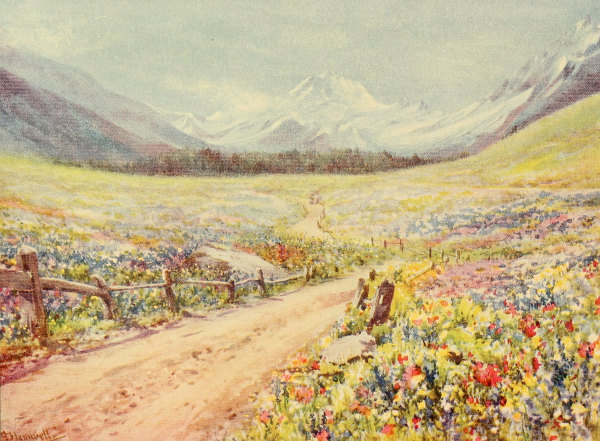
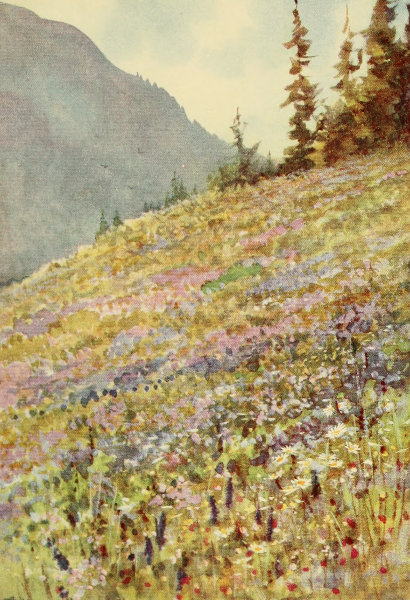
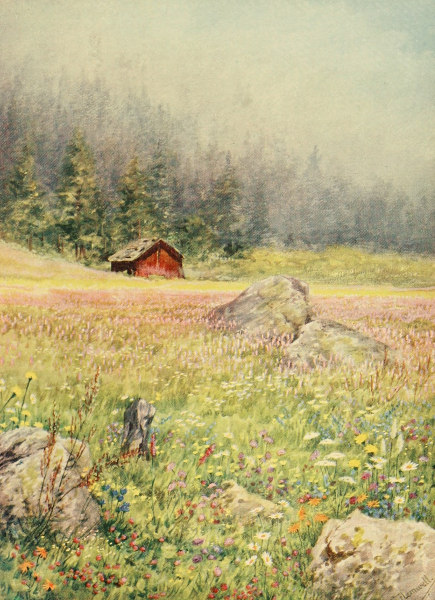
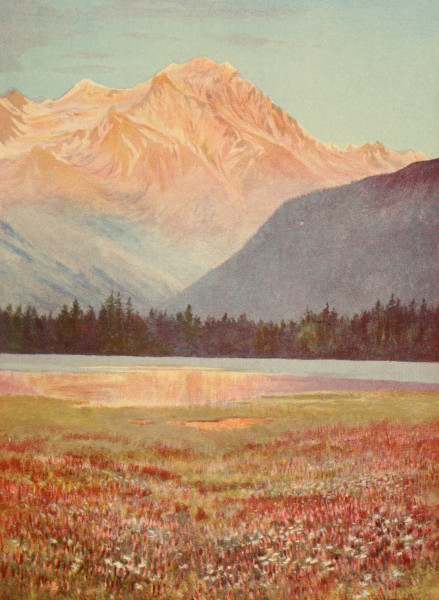
THE JULY FIELDS
“Through rich green solitudes,
And wildly hanging woods
With blossoms and with bell,
In rich redundant swell,
And the pride
Of the mountain daisy there,
And the forest everywhere,
With the dress and with the air
Of a bride.”
Duncan Ban MacIntyre
Amid
the brilliant floral gathering which crowds
into the arena of the Alps upon the blazoned entry
of July, one marks no sign of the fair and frail
St. Bruno’s Lily. Nor is this as it should not be.
Dainty to the point of extreme delicacy, this
flower of Paradise is justly of a season more
restrained, and one should not heap regrets upon
its absence from so flamboyant a concourse as this
present. The rich-blue Bell Gentian is likewise
absent from the gay and jostling crowd, having at
last vanished from the shadier nooks where, in
fond persistency, it has been continuing the cult
of spring. But these two precious field-flowers
form, possibly, the sum of June’s distinguished
absentees.
“Why fret about them if to-day be sweet!”
And, surely, to-day is as sweet as ever yesterday
was! The glory of the Bistort is not yet on the
wane, and to it the tall Buttercup has wedded its
lustre, and Ranunculus aconitifolius, the Fair Maid
of France; consequently, the moister meadows are
a knee-deep wealth of pink, yellow, and white.
On the drier fields, too, the rich blue and mauve
expanses of Salvia and Geranium are now reinforced
by the crowded blue bells of Campanula
rhomboidalis, and hosts of the mauve-blossomed
Scabious; while upon the slopes the now declining
Biscutella and Strawberry-flowered Potentilla
have for new companions Hieracium alpinum,
Hypochœris maculata, Crepis aurea, Campanula
barbata, and C. Scheuchzeri, the tall lemon-yellow
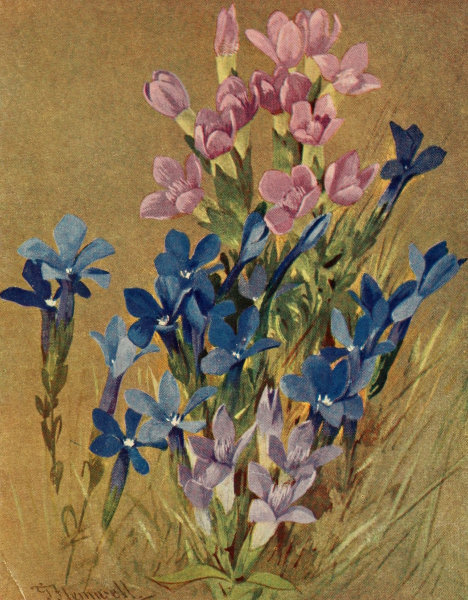
Hypochœris uniflora, and the lilac Gentiana campestris.
The tall blue and tall white Phyteuma
betonicæfolium, and the blue, round-headed P.
orbiculare are everywhere, and have been joined
by the tall blue P. Micheli and the little blue
P. hemisphæricum of onion-like leaves. The
Orchids, also everywhere, are still in full beauty,
their numbers having been swelled by the arrival
of Gymnadenia albida. The stately Veratrum
album is in flower, companioning the equally
stately Yellow Gentian, to which, in habit and
foliage, though not in blossom, it bears a strong
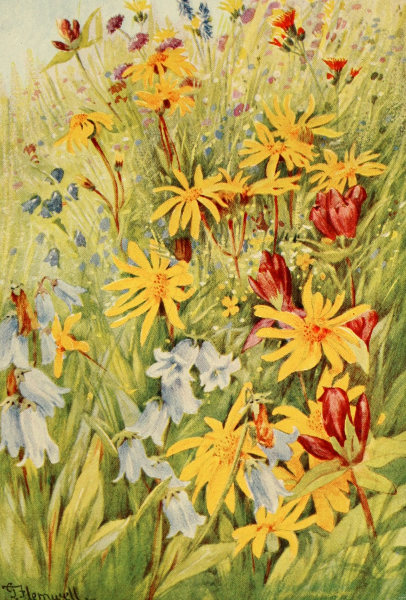
resemblance. The Arnica, also, is coming into
bloom: the tall, red-brown Martagon Lily is fast
filling out its buds; the Yellow Rattle and
Anthyllis are ubiquitous; the graceful Thesium,
with sprays of olive-coloured stems and leaves and
tiny white stars (and ugly English name of
Bastard Toadflax), is looking its daintiest; and
hosts of Ox-eyed Marguerites and pink Umbelliferæ
top the meadows far and wide. On the rough
banks and edges of the fields, or on the rocks that
so often crop up in these pastures, Saponaria
ocymoides, Helianthemum alpestre, Calamintha
alpina, Veronica saxatilis, and Silene rupestris
add respectively their bright pink, orange-yellow,
mauve, blue, and white abundance to the radiance
of the field-flowers proper. In “the grassy hollow
that holds the bubbling well-spring,” Myosotis
palustris is opening its myriad blue eyes; the
Bartsia lingers by “the flower-lit stream” and is
joined by the tiny bright blue Gentiana nivalis,
here and there showing its rarer white form;
whilst up upon the mountain-sides, backing and
dominating the whole of this crowded, gay array,
the Rhododendron is fast putting forth its red,
amazing fulness.
If June be reckoned as a millionaire, then surely
July must also, and with the additional prefix
“multi”! “It is with flowers as with men,” says
Major Reginald Rankin in “The Royal Ordering
of Gardens,” and “Providence is on the side of
big battalions.” And, of a truth, this is so in
these fields; bigger battalions it would indeed be
hard to find. Is there not here some striking
suggestion of an element in ultimate beauty—that
of an harmonious brotherhood? One certainly
seems to catch a glimpse of that economic state
where individuality is general rather than particular;
where personality is absorbed by the
mass, and beauty is conspicuous only in the whole;
where, so to speak, the red neckties of leadership
do not flare out in designed and conscious isolation.
Among themselves plants have their likes
and dislikes. It is well known that, for example,
certain flowers are only found in the company of
Corn, and it is said that in the kitchen-garden the
Radish simply detests the Thyme. But here, on
these meadows, all trace of discord seems lost in
one great accord, and the plants, both great and
small, blue-blooded and plebeian,
“A social commerce hold, and firm support
The full adjusted harmony of things.”
And what pageantry it all is; what consummate
pageantry! “The flowers are at their Bacchanals!”
The Old Mother, unlike many other parents, is not
outdistanced by her children. Though man be
loath to admit it, she holds the lead, and sets him
both pace and tune. What are his pageants
beside the pageantry of this his age-full parent?
He summons up his past for glory, and, rightly
or wrongly, sees magnificence only in what he has
been; but his old mother, as here on these fairy
fields, seeks naught further than the present.
Were it not well that he read in this the lesson:
“Nature must once more become his home, as it
is the home of the animals and angels”? Were
it not well that he should shift his ground and thus
amend his outlook? Scarcely does it befit him to
brag about
“Nature’s fair, fruitless, aimless world
Men take and mould at will!”
“Fruitless, aimless world”? Why, willy-nilly,
Nature moulds him—even by allowing him to
think he is moulding her.
Behold these meadows! Will he take them and
mould them to anything better than they are?
No, he certainly will not. Will he give them an
aim higher than they possess at present? Possibly.
There is, however, only one way by which
he may succeed: let him unbend, and let him
gather these meadows closer to his heart and
understanding: let him transport what he can of
them to his parks and gardens. But let him not
for one moment imagine that by so doing he is
“moulding” them; for, indubitably, it is they
who will be moulding him.
And for this reason: Alpine fields are such
superlatively true art that he cannot but find in
them, as in all true art, a common ground of
interest, fellowship, happiness, advancement; “a
means”—as Tolstoi says of true art—“of union
among men, joining them together in the same
feelings”—feelings that must ameliorate, must
refine.
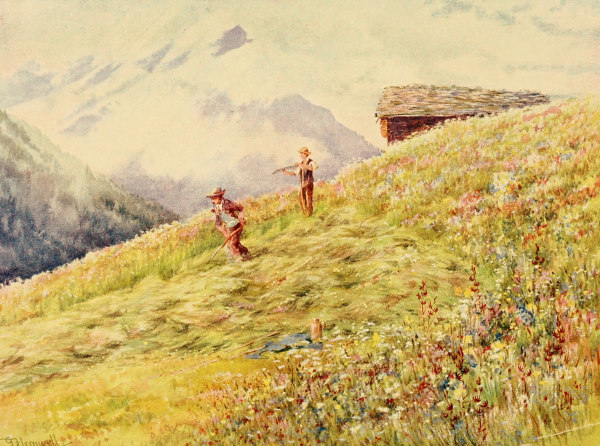
We are now nearing the dread but necessary
moment when the scythe will be laying low the
flowers; but ere the arrival of this careful, callous
friend of the cows, we have a few more hours in
which to cast another greedy look around. The
Bistort and Buttercup, Orchid and tall Rampion,
have become, or are fast becoming, dingy and seed-full,
but there are several handsome and interesting
newcomers; and many of these subjects, such
as the Martagon Lily and Field Gentian, which
at the commencement of the month had only a
bloom or two open here and there, are now at
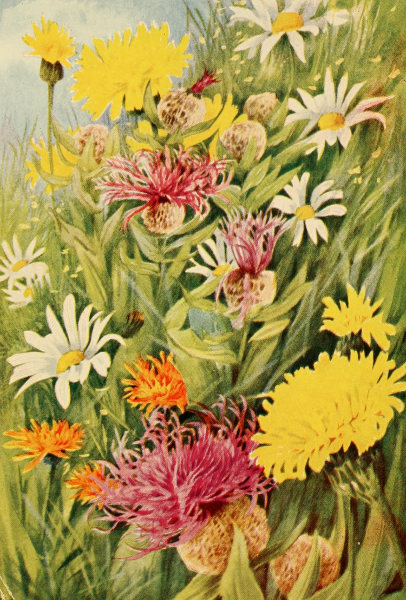
perfection. The red Centaurea uniflora is a vivid
object among the grasses: a “distinct advance,”
as nurserymen would say, upon C. scabiosa, our
common Hard-heads or Knobweed, blooming beside
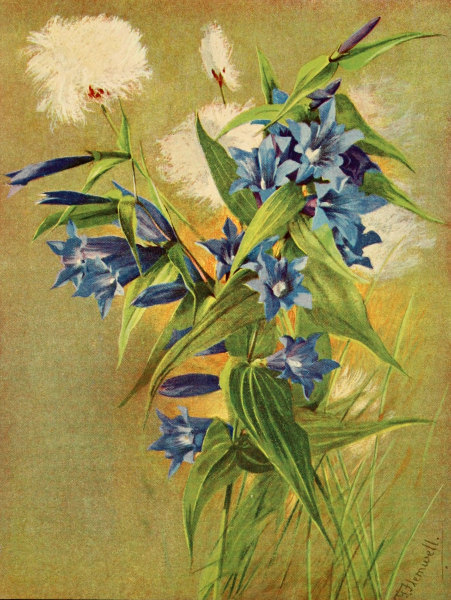
it. The sturdy Brown Gentian (Gentiana
purpurea) and its near relation, the cream-coloured
or greenish-yellow G. punctata, are conspicuous
objects, and Hieracium aurantiacum, the fiery,
orange-red Hawkweed or Grimm the Collier,
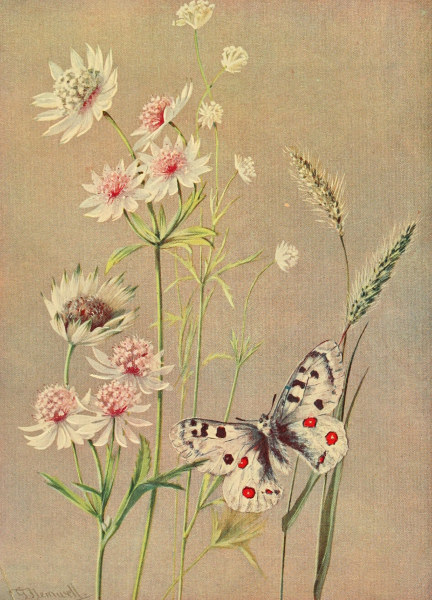
burns as a jewel among them. Astrantia major,
the Great Masterwort, unique and charming—more
particularly when its flower-heads take on
their truly Alpine tint of rosy magenta—is here
with its little brother, A. minor, pale and fragile,
perhaps from its habit of living in shadier places
than major. The Campanulas are glorious, and
the lilac pyramidal heads of C. spicata are striking
“bits of colour” where the grass is sparser.
So also are the lovely deep-blue, pea-like masses
of Vicia onobrychioides, associating with Rampion,
Arnica, and Martagon or Turk’s-cap Lily. Dianthus
superbus spreads a lace-like mantle of pink
and white over the shadier portions of the fields
by the forest’s edge; and D. sylvestris is a glory
of flesh-pink upon the hotter slopes by the rocks.
Aconitum Napellus, blue Monkshood or Char de
Venus, is not hereabouts as on the higher pastures;
neither are the yellow and orange pea-like
Orobus luteus and that curious Bellflower, Campanula
thyrsoides, with its stumpy hollow stem
surmounted by a close-set mass of washed-out
yellow flowers; nor is the handsome large-flowered
yellow Foxglove (Digitalis ambigua) so plentiful
in the Jura Mountains and in other limestone
districts. But Thalictrum aquilegifolium, most
seductive of the Meadowrues, raises its soft-lilac
or cream-white plumes—often beside the majestic
cream-white plumes of Spiræa Aruncus, Queen
of the Fields—in luxuriant hollows where dwell
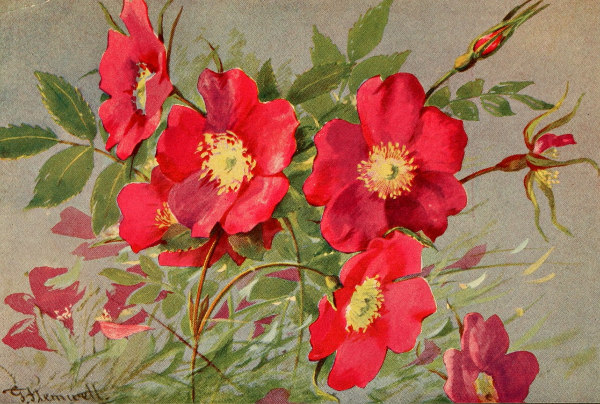
bushes of Alpine Eglantine and Honeysuckle. In
these rich, grassy hollows, too, are noble plants of
the sticky, yellow Salvia glutinosa, or Jupiter’s
Distaff; the tall mauve Mulgedium alpinum, the
Laitue des Alpes or Alpine Lettuce of the French;
the equally tall red Adenostyles albifrons; and the
Lesser Foxglove (Digitalis lutea), with dark, shiny
foliage and packed spikes of pale yellow blossoms.
The orange-yellow Leopard’s-Bane, Senecio Doronicum,
and the pink and white Valeriana montana,
are upon the dry, turfy banks; and down upon
the lower slopes, among the shrubs or out in the
sun-baked open, is a brilliant concourse of yellow
Ononis natrix, pink O. rotundifolia (here and there
white in form), blue, Thrift-like Jasione montana,
tall, rich-blue, open-flowered Campanula persicifolia,
and pure yellow, red-stamened Verbascum
phlomoides, finest of the Mulleins. Intense-blue
clumps of Hyssop enliven the hot, shaly spaces;
and here, too, is Linum tenuifolium, a Flax with
delicate lilac flowers; the Golden Thistle (Carlina
vulgaris), which, with the white C. acaulis, is so
useful for winter decoration: the exquisite pink
and white rambling Vetch, Coronilla varia; and
Dianthus sylvestris and D. Carthusianorum are
wellnigh everywhere in pink and red abundance—the
latter sometimes running to so deep and fiery
a shade as to be found worthy of the additional
name of atrorubens.
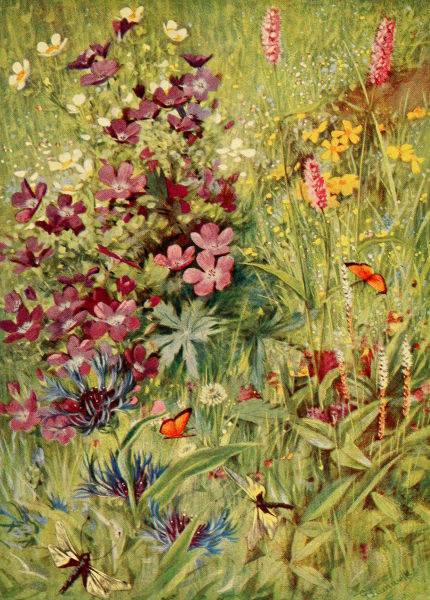
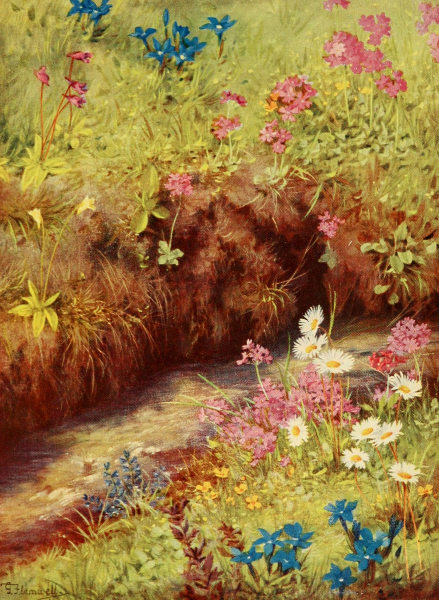
GERANIUM SYLVATICUM, POTENTILLA
RUPESTRIS, CENTAUREA MONTANA,
the pink Bistort, the little Alpine
Bistort, painted on the spot in the fields at
the beginning of July.
Truly, this is a “sun-kissed land of plenty,” with
July blazoned in tones of utmost triumph! Yet
harmony, restraint, refinement, have not in any
way been sacrificed. Our sense of this is so acute
that when we return to the plains, the gardens
and their gorgeous burdens are apt to jar upon
us, as will vulgarity or a flagrant want of taste.
After some three months spent in intimacy
with these slopes and fields, go down to the
swallow’s summer quarters—to Martigny, or elsewhere
on the plain—and mark the Zinnias and
French Marigolds, Asters and Sweet-Williams,
and the flaming beds of Petunias, Salvias, and
Geraniums. Mark how gross seems all this
“cultivation” after the Alpine wildness. You
are at once constrained to ask yourself. What
is there derogatory in wildness if to be cultivated
is to be as these garden flowers? You see at
once more clearly than possibly you ever saw
before that, after all, refinement is largely a
relative quantity, and that even the Rose, Dean
Hole’s “Queen Rosa,” can appear coarse after you
have spent a season with the Gentian.
And perhaps it is this feeling that can account
in some measure for our habit of isolating all
Alpines upon rockworks. Perhaps it prompts us
to treat them with special deference; and though
we will not, cannot deny the Balsam, or the
Tropeolum, or the Cactus Dahlia our loudest
acclamations; though we keep for these and suchlike
products of cultivation a proud place in our
affections, hailing them as familiars allied most
intimately to our ordinary, worldly natures,—though,
I say, we hold this grosser, gaudier
vegetation with loving tenacity to our hearts, yet
is our rarer self in instant touch with these Alpine
wild-flowers, and, as it were, conducts them
honourably to a shrine apart.
The Aster and the Edelweiss are now in bloom
above us, and we are “list’ning with nice distant
ears” to the chime of the cattle-bells, wind-wafted
from the higher pastures, half wishing it were our
business to climb. We could, if we would, be
again with the youth of the year; for one of the
delightful possibilities of Alpine residence is to be
able to follow spring and summer well into the
heart of autumn. But this year we dare not;
our task is to watch these half-way fields to the
end of the floral seasons. Nor is our lot a hard
one. Though flower-land hereabouts is now nearly
a dream of yesterday, yet have we much that can
still hold us to the spot, enchanted and instructed;
though for some few days past the fields have seen
their best, and are now for the most part spacious
park-like pleasaunces of yellowish-green, yet have
we still the famous setting of
“... dreaming mountains,
Lifted from the world together”;
yet have we still the vast, irreproachable arena
which, there is no gainsaying, has helped towards
the deep and lasting impression we have gathered
from the meadows.
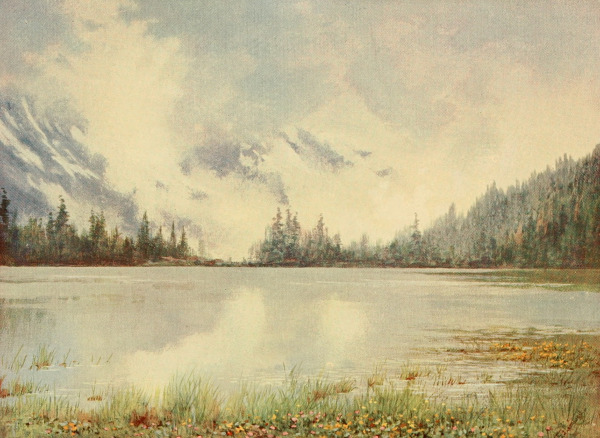
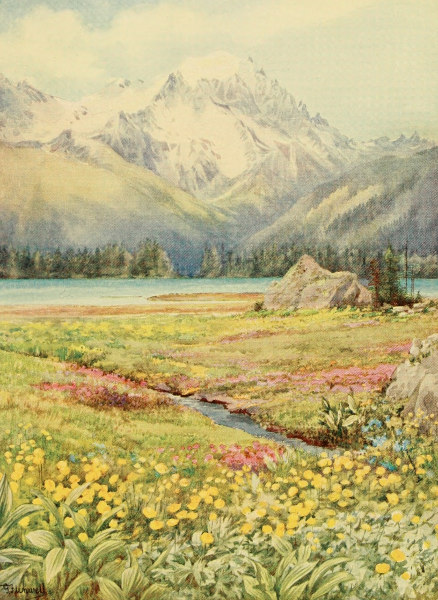
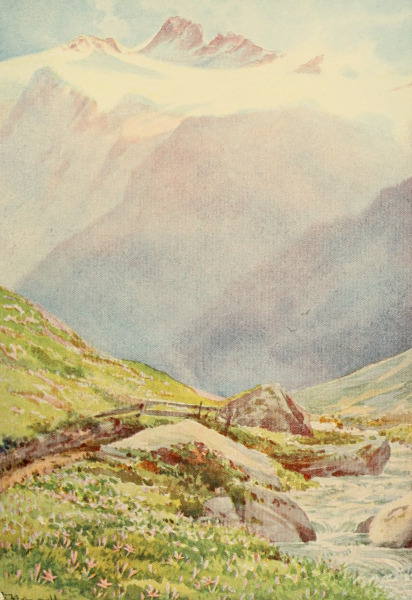
Over yonder, towering high above the Grand
St. Bernard road, and reflected snow for snow
and precipice for precipice in the placid waters of
the lake, is the Grand Combin, one of the noblest
units of “those great constellations of snow-peaks
which Nature has massed, in splendid and prodigal
confusion,” in this part of Switzerland; away, at
the end of the Val Ferret, are the white and
graceful lines of the Grand Golliaz, flanked on the
near side by the massif of Saleinaz, and on the
further side by the Groupe du Grand Saint-Bernard;
while, immediately above us, suffused
with the red of the flowering Rhododendron, are the
steep and rocky masses of the Breyaz, the Clocher
d’Arpette, and the Catogne, that curious mountain
that can be seen from Vevey and Lausanne, a
sugarloaf-like cone, blocking the very centre of the
Rhône Valley.
What a happy thing it is that in this neighbourhood
the mountains are reminiscent of nothing
except their own giant individualities. How
vexing when this is otherwise—when, I mean,
there is a lion rock, or a weeping woman, or a
head of Napoleon in the landscape; as when Mark
Twain discovered that one of the aiguilles flanking
Mont Blanc “took the shapely, clean-cut form of
a rabbit’s head.” At Château d’Oex, for instance,
the outline of the Gummfluh is a really creditable
profile likeness of the great Gladstone with his
collar, and that of the Rubli next door presents
the profile of O’Connell, the Irish patriot. Apart
from the damage inflicted upon the landscape by
the intrusion of party politics, such huge examples
of Nature’s unconscious incursions into portraiture,
when once they have made themselves plain,
become a distressing obsession; and especially is
this so for the artist who attempts to paint these
mountains without producing a puzzle-picture.
Fortunately, there are some places which up to
the present seem to know nothing of such untoward
resemblances in their surroundings; fortunately,
there are some beauty-spots which have
so far escaped the eye with the disturbing gift
of “seeing forms” in clouds and trees and whatnot;
and Champex is one such. At Champex we may
rest and dream without fear of our indulgence
degenerating into a nightmare.
But this is not such a season for dreaming as
was the spring; we are far more of the world than
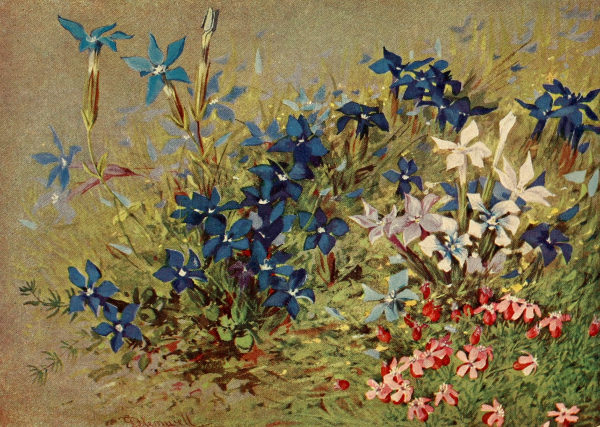
we were when the Vernal Gentian, that “turquoise
lighting a ground of green,” was heralding all that
is now so rapidly falling before the scythe. Yet it
must not be supposed that these fields have lost all
power to nourish or stimulate the imagination.
The configuration and nature of the ground are so
varied that haymaking is a more lengthy and
irregular operation than it is upon the plains. We
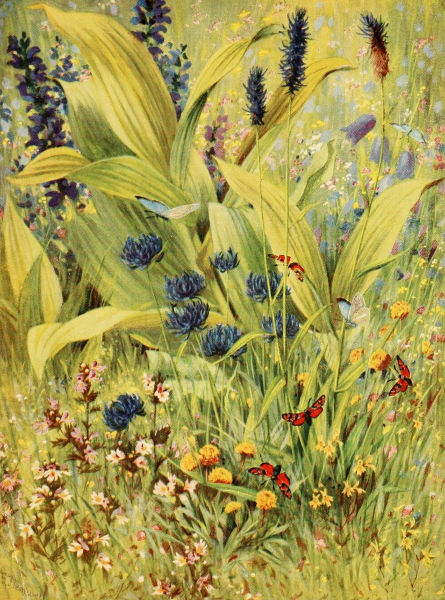
have only to turn to the ousy land where the
Grass-of-Parnassus
[1] opens its white, green-veined,
Ranunculus-like flowers among the large, rich-blue
bells of Campanula Scheuchzeri and the tall, paler
blue spikes of Polemonium cœruleum, the well-known
Jacob’s Ladder of our gardens; or to the
drier stretches where the Heather is just tinting
its olive-green branches with a suspicion of rose,
and the Rampions, Arnica, Hieracium, and Brown
Gentian are mingling with the warm grey, feathery
seed-heads of Anemone sulphurea. Here we find
the flowers and butterflies as numerous and as
gay as ever; here among the grasses is Banagna
Atrata, the little dull-black moth with white-tipped
wings, seeking sanctuary from the devastating
work of the reapers; Zygœna carniolica,
one of the most distinct and fascinating of the
bright Burnet butterflies, a stranger to England,
greedily absorbed upon the flowers of the
Scabious; numberless Fritillaries, speeding hither
and thither, their burnished pearl-backed wings
flashing in the sunlight,—here, in fact, we have
summer at its height, uninjured, undisturbed—a
place, as Walden was, where we may “transact
some private business with the fewest obstacles.”
[1]
The name “Grass-of-Parnassus” often occasions wonder; for the
plant, a member of the St. John’s Wort tribe, shows no affinity to
grass. Anne Pratt, in her celebrated book on English Wild-flowers,
says the name possibly arises from the fact that the plant “is as
common as the very grass itself on Mount Parnassus.”
Messieurs les étrangers
(how good a name!) are
now arriving by the hundred. Flora’s Feast in
this region may be said to be over, and the table
is all but cleared. For full two months have we
been revelling in a luxury of colour which no
other two months make any but an indifferent
attempt to approach; and it is when these two
months have run their unique, delightful course
that the vast majority of our fellows arrive. How
strangely perverse a state of things is this! How
curiously sunken in the groove of custom!
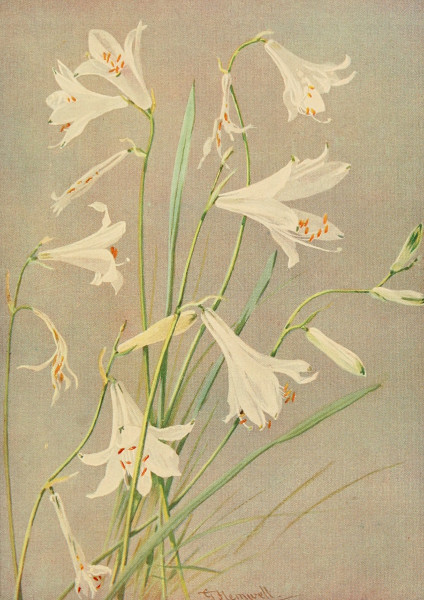
PARADISIA LILIASTRUM, the Paradise or
St. Bruno’s Lily.
The fields are bald, the slopes are shorn or
ragged, and the grass that is left standing is looking
for the most part very “seedy.” The golden-flowered,
pink-flowered, and white-flowered Sedums
are blossoming upon the field-rocks; the Willow-Herb
is lighting up the rough and stony places
with its rosy-red spikes; the Bilberry’s fruit is
turning a dusty blue and its foliage here and there
is showing promise of a fiery autumn; the Rhododendron
is developing on its thick leaves the
brilliant red excrescences which, like the hairy, red
excrescences on our common Dog Rose, are said
to be so efficacious in cases of rheumatism; the
dainty, black-bordered Damon “Blue” butterfly
flits from the Heather to stray blooms of Arnica
and Astrantia, and many a brown Erebia is
hampered and tired out by a horde of red parasites
beneath its wings. Summer, in fact, is leaning
obviously towards autumn, and we can expect
nothing more of note from these meadows, except
a lovely wealth of magenta-pink Colchicum or
“Autumn Crocus” in August and September.
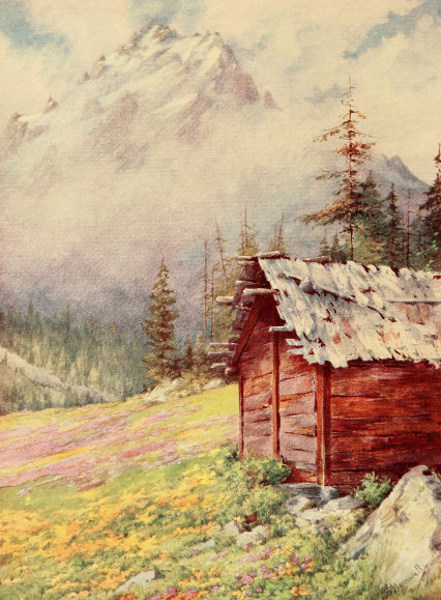
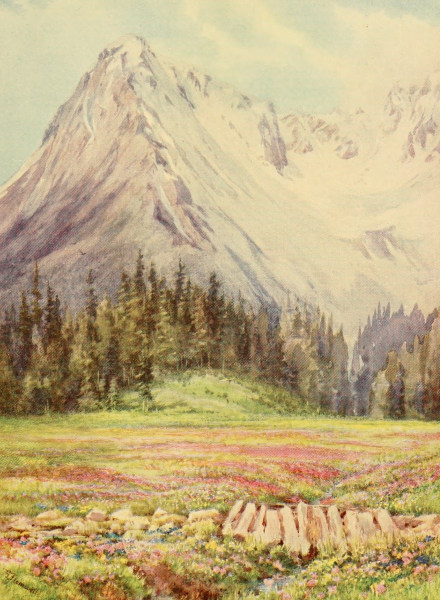
When visitors, arriving at this late stage in
Flora’s fortunes, see my coloured transcripts of the
fields in May and June, they think that I, like any
prejudiced enthusiast, have falsified my evidence.
They find the pictures ben trovato, and they say:
“How beautiful! but of course you have used
an artist’s licence?” They look at the shaven or
dingy fields, then again at my paintings, and they
tell me plainly they think they can prove an alibi
for the flowers in spring, or, at any rate, for a greater
part of those I have depicted. And I—I can only
assure them their case has “no leg to stand upon.”
I can only insist that if they knew of my despair
when seated with my picture among the flowers in
spring—my despair of ever being able to give
more than an inkling of the glorious riot that
surrounded me—they would suspect the truth; and
that if next year they came here and witnessed for
themselves, then, when again they looked upon
my pictures, they would curl the lip and speak of
insufficiency.
I am aware that it is, of course, not possible for
many of the late-coming visitors to leave the
home shores earlier in the year: business is business,
schooling is schooling, fixed holidays are fixed
holidays. But without doubt there are many
who could be more timely, if they chose—many
who in June are crowding at Montreux, or Geneva,
or Lucerne, thinking it too early for the mountains.
For there are many who are persuaded that
spring is a dangerous period in the Alps. They
will tell you in all seriousness, as they have told
me, that it is in spring in the Alps that the
microbes re-awaken after their winter’s sleep, and
that, therefore, it is better to be in the towns; in
the towns, mark you, where the microbes, more
monstrous and numerous, rarely if ever, slumber—or,
if they do so, it is with one eye open!
Then there are those who, because they know
nothing about flowers, are convinced that the Alps
for them would be a place of ennui in the spring
when high excursions are not yet possible. But
what a mistake it is to imagine we must be botanists
or gardeners in order to feel a full joy in these
fields! No particular knowledge is required to
appreciate them; there is no peremptory need to
know by name a Geranium from an Orchid, a
Pansy from a Cauliflower. Indeed, I am not at all
sure but that the “plain man” or woman does not
really enjoy them more than does the plant
specialist.
For joy comes mostly fuller with the
broader moments of life, and analysis is apt to
injure the soul-stirring harmony of things. And
as the merely emotional value of these fields is
immense, their appeal is quite as general as it is
particular, perhaps even more so; for the emotional
qualities of anything are more acceptable to the
man-in-the-street than are its precise and reasoned
quantities. And, just as there are far fewer
musicians within the ranks of executants than
outside, so there are more flower-lovers and lovers
of floral beauty outside the ranks of botany and
gardening than there are within. Thus amid
these fields the plain, expansive man or woman
need be in no fear of ennui.
Ennui!—why, even
when the visitors do come and the flowers have
seen their best, there is no ennui! Then how
much more inspiring must it be when the fields
are in their hey-day, not their hay-day!
It is, then, upon all and sundry that I urge the
claims of the Alps from the middle of May to
mid-July; it is to the merest tyro in plant-lore, as
well as to the botanical and gardening enthusiast,
that I say, and say in all persuasiveness of conviction:
“You know not what you miss by failing
‘To catch the master-note of Nature’s lyre’;
you know not what you lose by neglecting the call
of the flowers from off these Alpine fields.”
Go where you will—Champex alone is not the
Alpine throne of Flora; she reigns superbly to
right and left, from Neuchatel to Valais, from
Tessin to Geneva—go where you will amid the
Alps and you will find fields that shall enchant
you, rejuvenating your spirit and causing the
“knapsack of custom,” full of “city estimates of
great and small, wise and foolish,” to slip from
your back. The plains of the world are the
better for the mountains of the world, and in no
respect more so than when the mountains are
a-flower.