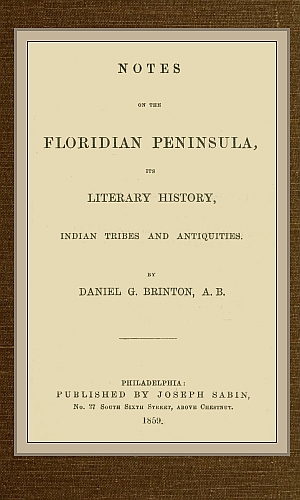
Introductory Remarks.—The Early Explorations.—The French
Colonies.—The first Spanish Supremacy.—The English
Supremacy.—The second Spanish Supremacy.—The Supremacy of the
United States.—Maps and Charts.
In the study of special and local history, the inquirer finds his most
laborious task is to learn how much his predecessors have achieved. It
is principally to obviate this difficulty in so far as it relates to a
very interesting, because first settled portion of our country, that I
present the following treatise on the bibliographical history of East
Florida. A few words are necessary to define its limits, and to explain
the method chosen in collocating works.
In reference to the latter, the simple and natural plan of grouping into
one section all works of whatever date, illustrating any one period,
suggests itself as well adapted to the strongly marked history of
Florida, however objectionable it might be in other cases. These periods
are six in number, and consequently into six sections a bibliography
naturally falls. The deeds of the early explorers, the settlement and
subsequent destruction of the French, the two periods when Spain wielded
the sovereign power, the intervening supremacy of England, and lastly,
since it became attached to the United States, offer distinct fields of
research, and are illustrated by different types of books. Such an
arrangement differs not materially from a chronological adnumeration,
and has many advantages of its own.
Greater difficulty has been experienced in fixing the proper limits of
such an essay. East Florida itself has no defined boundaries. I have
followed those laid down by the English in the Definitive Treaty of
Peace of the 10th of February, 1763, when for the first time, East and
West Florida were politically distinguished. The line of demarcation is
here stated as “the Apalachicola or Chataouche river.” The Spaniards
afterwards included all that region lying east of the Rio Perdido. I am
aware that the bibliography of the Spanish settlement is incomplete,
unless the many documents relating to Pensacola are included, but at
present, this is not attempted. It has been deemed advisable to embrace
not only those works specially devoted to this region, but also all
others containing original matter appertaining thereto. Essays and
reviews are mentioned only when of unusual excellence; and a number of
exclusively political pamphlets of recent date have been designedly
omitted.
As I have been obliged to confine my researches to the libraries of this
country, it will be readily understood that a complete list can hardly
be expected. Yet I do not think that many others of importance exist in
Europe, even in manuscript; or if so, they have escaped the scrutiny of
the laborious Gustav Haenel, whose Catalogi Librorum Manuscriptorum I
have examined with special reference to this subject. It is proper to
add that the critical remarks are founded on personal examination in all
cases, except where the contrary is specified.
No distinct account remains of the two voyages (1512, 1521,) of the
first discoverer and namer of Florida, Juan Ponce de Leon. What few
particulars we have concerning them are included in the general
histories of Herrera, Gomara, Peter Martyr, and of lesser writers.
However much the historian may regret this, it has had one
advantage,—the romantic shadowing that hung over his aims and
aspirations is undisturbed, and has given them as peculiar property to
the poet and the novelist.
Of Pamphilo de Narvaez, on the contrary, a much inferior man, we have
far more satisfactory relations. His Proclamation to the Indians[1] has
been justly styled a curious monument of the spirit of the times. It was
occasioned by a merciful(!) provision of the laws of the Indies
forbidding war to be waged against the natives before they had been
formally summoned to recognize the authority of the Pope and His Most
Catholic Majesty. Should, however, the barbarians be so contumacious as
to prefer their ancestral religion to that of their invaders, or their
own chief to the Spanish king, then, says Narvaez, “With the aid of God
and my own sword I shall march upon you; with all means and from all
sides I shall war against you; I shall compel you to obey the Holy
Church and his Majesty; I shall seize you, your wives and your
children; I shall enslave you, shall sell you, or otherwise dispose of
you as His Majesty may see fit; your property shall I take, and destroy,
and every possible harm shall I work you as refractory subjects.” Thus
did cruelty and avarice stalk abroad in the garb of religion, and an
insatiable rapacity shield itself by the precepts of Christianity.
Among the officers appointed by the king to look after the royal
interest in this expedition, holding the post of comptroller or factor
(Tesorero), was a certain Alvar Nuñez, of the distinguished family of
Cabeza de Vaca or the Cow’s Head; deriving their origin and unsonorous
name from Martin Alhaja, a mountaineer of Castro Ferral, who, placing
the bones of a cow’s head as a landmark, was instrumental in gaining for
the Christians the decisive battle of Las Navas de Tolosa (1212), and
was ennobled in consequence. When war, disease, and famine had reduced
the force of Narvaez from three hundred to only half a dozen men, Alvar
Nuñez was one of these, and after seven years wandering, replete with
the wildest adventure, returned to Spain, there to receive the
government of a fleet and the appointment of Adelantado to the
unexplored regions around the Rio de la Plata. Years afterwards, when
his rapacity and reckless tyranny had excited a mutiny among his
soldiers and the animosity of his associates, or, as his defenders
maintain, his success their envy and ill-will, he was arraigned before
the council of the Indies in Spain. While the suit was pending, as a
stroke of policy in order to exculpate his former life and set forth to
the world his steadfast devotion to the interests of the king, in
conjunction with his secretary Pedro Fernandez he wrote and published
two works, one under his own supervision detailing his adventures in
Florida,[2] the other his transactions in South America. Twenty-seven
years had elapsed since the expedition of Narvaez, and probably of the
few that escaped, he alone survived. When we consider this, and the end
for which the book was written, what wonder that we find Alvar Nuñez
always giving the best advice which Narvaez never follows, and always at
hand though other men fail; nor, if we bear in mind the credulous spirit
of the age and nation, is it marvellous that the astute statesman
relates wondrous miracles, even to healing the sick and raising the
dead, that he performed, proving that it was, as he himself says, “the
visible hand of God” that protected him in his perilous roamings. Thus
it happens that his work is “disfigured by bold exaggerations and the
wildest fictions,” tasking even Spanish credulity to such an extent that
Barcia prefaced his edition of it with an Examen Apologetico by the
erudite Marquis of Sorito, who, marshalling together all miraculous
deeds recorded, proves conclusively that Alvar Nuñez tells the truth as
certainly as many venerable abbots and fathers of the Church. However
much this detracts from its trustworthiness, it is invaluable for its
ethnographical data, and as the only extant history of the expedition,
the greatest miracle of all still remaining, that half a dozen
unprotected men, ignorant of the languages of the natives and of their
proper course, should have safely journeyed three thousand miles, from
the bay of Apalache to Sonora in Mexico, through barbarous hordes
continually engaged in internecine war. Of the many eventful lives that
crowd the stormy opening of American history, I know of none more
fraught with peril of every sort, none whose story is more absorbing,
than that of Cabeza de Vaca.
The unfortunate termination of Narvaez’s undertaking had settled
nothing. Tales of the fabulous wealth of Florida still found credence in
Spain; and it was reserved for Hernando de Soto to disprove them at the
cost of his life and fortune. There are extant five original documents
pertaining to his expedition.
First of these in point of time is his commission from the emperor
Charles V.[3]
The next is a letter written by himself to the Municipality of
Santiago,[4] dated July 9, 1539, describing his voyage and
disembarkation. Besides its historical value, which is considerable as
fixing definitely the time and manner of his landing, it has additional
interest as the only known letter of De Soto; short as it is, it reveals
much of the true character of the man. The hopes that glowed in his
breast amid the glittering throng on the quay of San Lucar de Barrameda
are as bright as ever: “Glory be to God,” he exclaims, “every thing
occurs according to His will; He seems to take an especial care of our
expedition, which lives in Him alone, and Him I thank a thousand times.”
The accounts from the interior were in the highest degree encouraging:
“So many things do they tell me of its size and importance,” he says,
speaking of the village of Ocala, “that I dare not repeat them.”
Blissful ignorance of the old cavalier, over which coming misfortune
cast no presageful shadow!
The position that Alvar Nuñez occupied under Narvaez was filled in this
expedition by Luis Hernandez de Biedma, and like Nuñez, he was lucky
enough to be among the few survivors. In 1544, shortly after his return,
he presented the king a brief account of his adventures.[5] He dwells on
no particulars, succinctly and intelligibly mentions their course and
the principal provinces through which they passed, and throws in
occasional notices of the natives. The whole has an air of honest truth,
differs but little from the gentleman of Elvas except in omission, and
where there is disagreement, Biedma is often more probable.
When the enthusiasm for the expedition was at its height, and the flower
of Spanish chivalry was hieing to the little port of San Lucar of
Barrameda, many Portuguese of good estate sought to enroll themselves
beneath its banners. Among these, eight hidalgos sallied forth from the
warlike little town of Elvas (Evora) in the province of Alemtejo.
Fourteen years after the disastrous close of the undertaking, one of
their number published anonymously in his native tongue the first
printed account of it.[6] Now which it was will probably ever remain an
enigma. Because Alvaro Fernandes is mentioned last, he has been supposed
the author,[7] but unfortunately for this hypothesis, Alvaro was killed
in Apalache.[8] So likewise we have notices of the deaths of Andres de
Vasconcelo and Men Roiz Pereira (Men Rodriguez); it is not likely to
have been Juan Cordes from the very brief account of the march of Juan
de Añasco, whom this hidalgo accompanied; so it lies between Fernando
and Estevan Pegado, Benedict Fernandez, and Antonio Martinez Segurado. I
find very slight reasons for ascribing it to either of these in
preference, though the least can be objected to the latter. Owing to
this uncertainty, it is usually referred to as the Portuguese
Gentleman’s Narrative. Whoever he was, he has left us by all odds the
best history of the expedition. Superior to Biedma in completeness, and
to La Vega in accuracy, of a tolerably finished style and seasoned with
a dash of fancy, it well repays perusal even by the general reader.
The next work that comes under our notice is in some respects the most
remarkable in Spanish Historical Literature. When the eminent critic and
historian Prescott awarded to Antonio de Solis the honor of being the
first Spanish writer who treated history as an art, not a science, and
first appreciated the indissoluble bond that should ever connect it to
poetry and belles-lettres, he certainly overlooked the prior claims of
Garcias Laso or Garcilasso de la Vega. Born in Cusco in the year
1539,[9] claiming by his mother the regal blood of the Incas, and by his
father that of the old Spanish nobility, he received a liberal education
both in Peru and Spain. With a mind refined by retirement, an
imagination attuned by a love of poetry and the drama, and with a vein
of delicate humor, he was eminently qualified to enter into the spirit
of an undertaking like De Soto’s. His Conquest of Florida[10] is a true
historical drama, whose catastrophe proves it a tragedy. He is said to
lack the purity of Mariana, and not to equal De Solis in severely
artistic arrangement; but in grace and fascination of style, in gorgeous
and vivid picturing, and in originality of diction—for unlike his
cotemporaries, La Vega modelled his ideas on no Procustean bed of
classical authorship—he is superior to either. None can arise from the
perusal of his work without agreeing with Southey, that it is “one of
the most delightful in the Spanish language.” But when we descend to the
matter of facts and figures, and critically compare this with the other
narratives, we find the Inca always gives the highest number, always
makes the array more imposing, the battle more furious, the victory more
glorious, and the defeat more disastrous than either. We meet with fair
and gentle princesses, with noble Indian braves, with mighty deeds of
prowess, and tales of peril, strange and rare. Yet he strenuously avers
his own accuracy, gives with care his authorities, and vindicates their
veracity. What then were these? First and most important were his
conversations with a noble Spaniard who had accompanied De Soto as a
volunteer. His name does not appear, but so thorough was his information
and so unquestioned his character, that when the Council Royal of the
Indies wished to inquire about the expedition, they summoned him in
preference to all others. What he related verbally, the Inca wrote down,
and gradually moulded into a narrative form. This was already completed
when two written memoirs fell into his hands. Both were short,
inelegant, and obscure, the productions of two private soldiers, Alonso
de Carmona and Juan Coles, and only served to settle with more accuracy
a few particulars. Though the narrative published at Elvas had been out
nearly half a century before La Vega’s work appeared, yet he had
evidently never seen it; a piece of oversight less wonderful in the
sixteenth century than in these index and catalogue days. They differ
much, and although most historians prefer the less ambitious statements
of the Portuguese, the Inca has not been left without defenders.
Chief among these, and very favorably known to American readers, is
Theodore Irving.[11] When this writer was pursuing his studies at
Madrid, he came across La Vega’s Historia. Intensely interested by the
facts, and the happy diction in which they were set forth, he undertook
a free translation; but subsequently meeting with the other narratives,
modified his plan somewhat, aiming to retain the beauties of the one,
without ignoring the more moderate versions of the others. In the
preface and appendix to his History of Florida, he defends the veracity
of the Inca, and exhibits throughout an evident leaning toward his
ampler estimates. His composition is eminently chaste and pleasing, and
La Vega may be considered fortunate in having obtained so congenial an
admirer. Entering fully into the spirit of the age, thoroughly versed in
the Spanish character and language, and with such able command of his
native tongue, it is to be regretted that the duties of his position
have prevented Mr. Irving from further labors in that field for which he
has shown himself so well qualified.
Many attempts have been made to trace De Soto’s route. Those of Homans,
Charlevoix, Guillaume de l’Isle and other early writers were foiled by
their want of correct geographical knowledge.[12] Not till the present
century was anything definite established. The naturalist Nuttall[13]
who had personally examined the regions along and west of the
Mississippi, and Williams[14] who had a similar topographical
acquaintance with the peninsula of Florida, did much toward determining
either extremity of his course, while the philological researches of
Albert Gallatin on the Choktah confederacy[15] threw much light on the
intermediate portion. Dr. McCulloh,[16] whose indefatigable labors in
the field of American archæology deserve the highest praise, combined
the labors of his predecessors and mapped out the march with much
accuracy. Since the publication of his work, Dr. J. W. Monette,[17] Col.
Albert J. Pickett,[18] Alexander Meek,[19] Theodore Irving,[20] Charles
Guyarre,[21] L. A. Wilmer,[22] and others have bestowed more or less
attention to the question. A very excellent resumé of most of their
labors, with an accompanying map, is given by Rye in his introduction to
the Hackluyt Society’s edition of the Portuguese Gentleman’s Narrative,
who also adds a tabular comparison of the statements of this and La
Vega’s account.
From the failure of De Soto’s expedition to the settlement of the French
at the mouth of the St. John’s, no very active measures were taken by
the Spanish government in regard to Florida.
A vain attempt was made in 1549 by some zealous Dominicans to obtain a
footing on the Gulf coast. A record of their voyage, written probably by
Juan de Araña, captain of the vessel, is preserved;[23] it is a confused
account, of little value.
The Compte-Rendu of Guido de las Bazares,[24] who explored Apalache Bay
(Bahia de Miruelo) in 1559, to which is appended an epitome of the
voyage of Angel de Villafañe to the coasts of South Carolina in 1561,
and a letter from the viceroy of New Spain[25] relating to the voyage of
Tristan de Arellano to Pensacola Bay (Santa Maria de Galve), are of
value in verifying certain important dates in the geographical history
of our country; and as they indicate, contrary to the assertion of a
distinguished living historian,[26] that the Spaniards had not wholly
forgotten that land, “the avenues to which death seemed to guard.”
Much more valuable than any of these is the memoir of Hernando
D’Escalante Fontanedo.[27] This writer gives the following account of
himself: born of Spanish parents in the town of Carthagena in 1538, at
the age of thirteen he was sent to Spain to receive his education, but
suffering shipwreck off the Florida coast, was spared and brought up
among the natives, living with various tribes till his thirtieth year.
He adds that in the same ship with him were Don Martin de Guzman,
Hernando de Andino, deputy from Popayan, Alonso de Mesa, and Juan Otis
de Zarate. Now at least one of these, the last mentioned, was never
shipwrecked at any time on Florida, and in the very year of the alleged
occurrence (1551) was appointed captain in a cavalry regiment in Peru,
where he remained for a number of years;[28] nor do I know the slightest
collateral authority for believing that either of the others suffered
such a casuality. He asserts, moreover, that after his return to Spain
he sought the post of interpreter under Aviles, then planning his attack
on the Huguenots. But as this occurred in 1565, how could he have spent
from his thirteenth to his thirtieth year, beginning with 1551, a
prisoner among the Indians? In spite of these contradictions, there
remains enough to make his memoir of great worth. He boasts that he
could speak four Indian tongues, that there were only two with which he
was not familiar, and calls attention to what has since been termed
their “polysynthetic” structure. Thus he mentions that the phrase
se-le-te-ga, go and see if any one is at the look-out, is compounded
partially of tejihue, look-out; “but in speaking,” he observes, “the
Floridians abridge their words more than we do.” Though he did not
obtain the post of interpreter, he accompanied the expedition of Aviles,
and takes credit to himself for having preserved it from the traitorous
designs of his successful rival: “If I and a mulatto,” he says, “had not
hindred him, all of us would have been killed. Pedro Menendez would not
have died at Santander, but in Florida, where there is neither river nor
bay unknown to me.” For this service they received no reward, and he
complains: “As for us, we have not received any pay, and have returned
with broken health; we have gained very little therefore in going to
Florida, where we received no advancement.” Muñoz appended the following
note to this memoir: “Excellent account, though of a man unaccustomed to
writing, which is the cause of the numerous meaningless passages it
contains.” Ternaux-Compans adds: “Without finding, as Muñoz, this
account excellent, I thought it best to insert it here as containing
valuable notices of the geography of Florida. It is often
unintelligible; and notwithstanding all the pains I have taken in the
translation, I must beg the indulgence of the reader.” The geographical
notices are indeed valuable, particularly in locating the ancient Indian
tribes. The style is crude and confused, but I find few passages so
unintelligible as not to yield to a careful study and a comparison with
cotemporary history. The memoir is addressed, “Tres puissant Seigneur,”
and was probably intended to get its author a position. The date of
writing is nowhere mentioned, but as it was not long after the death of
Aviles (1574), we cannot be far wrong in laΔιονυσιαying it about 1580.
Several distinct events characterize this period of Floridian history.
The explorations and settlements of the French, their extirpation by the
Spaniards and the founding of St. Augustine, the retaliation of De
Gourgues ——, as they constitute separate subjects of investigation, so
they may be assumed as nuclei around which to group extant documents.
Compendiums of the whole by later writers form an additional class.
First in point of time is Jean Ribaut’s report to Admiral Coligny. This
was never printed in the original, but by some chance fell into the
hands of an Englishman, who published it less than ten months after its
writer’s return.[29] “The style of this translation is awkward and
crude, but the matter is valuable, embracing many particulars not to be
found in any other account; and it possesses a peculiar interest as
being all that is known to have come from the pen of Ribault.”[30]
René Laudonniére, Ribaut’s companion and successor in command, a French
gentleman of good education and of cultivated and easy composition,
devotes the first of his three letters to this voyage. For the
preservation of his writings we are indebted to the collector Basanier,
whose volume of voyages will be noticed hereafter. The two narratives
differ in no important particulars, and together convey a satisfactory
amount of information.
The second letter of Laudonniére, this time chief in command, is the
principal authority on the next expedition of the French to Florida. It
is of great interest no less to the antiquarian than the historian, as
the dealings of the colonists continually brought them in contact with
the natives, and the position of Laudonniére gave him superior
opportunities for studying their manners and customs. Many of his
descriptions of their ceremonies are as minute and careful as could be
desired, though while giving them he occasionally pauses to excuse
himself for dealing with such trifles.
Besides this, there is a letter from a volunteer of Rouen to his father,
without name or date.[31] Interior evidence, however, shows it was
written during the summer of 1564, and sent home by the return vessels
which left Florida on the 28th July of that year. This was the earliest
account of the French colony printed on the continent. Its contents
relate to the incidents of the voyage, the manners of the “sauvages,”
and the building of the fort, with which last the troops were busied at
the time of writing.
This and Ribaut’s report made up the scanty knowledge of the colonies of
Coligny to be found in Europe up to the ever memorable year 1565;
memorable and infamous for the foulest crime wherewith fanaticism had
yet stained the soil of the New World; memorable and glorious, for in
that year the history of our civilization takes its birth with the first
permanent settlement north of Mexico. Two nations and two religions came
into conflict. Fortunately we are not without abundant statements on
each side. Five eyewitnesses lived to tell the world the story of
fiendish barbarity, or divine Nemesis, as they variously viewed it.
On the former side, the third and last letter of Laudonniére is a brief
but interesting record. Simple, straightforward, it proves him a brave
man and worthy Christian. He lays much blame on the useless delay of
Ribaut, and attributes to it the loss of Florida.
Much more complete is the pleasing memoir of N. C. Challeux (Challus,
Challusius.)[32] He tells us in his dedicatory epistle that he was a
native of Dieppe, a carpenter by trade, and over sixty years of age at
the time of the expedition. In another passage he remarks, “Old man as
I am, and all grey.”[33] He escaped with Laudonniére from Fort Caroline,
and depicts the massacre and subsequent events with great truth and
quaintness. He is somewhat of a poet, somewhat of a scholar, and not a
little of a moralizer. At the beginning of the first edition are verses
descriptive of his condition after his return, oppressed by poverty,
bringing nought from his long rovings but “a beautiful white staff in
his hand.” “The volume closes with another effusion of his muse,
expressing the joy he felt at again beholding his beloved city of
Dieppe.”[34] He is much given to diverging into prayers and pious
reflections on the ups and downs of life, the value of contentment, and
kindred subjects, seasoning his lucubrations with classical allusions.
When Laudonniére was making up the complement of his expedition he did
not forget to include a cunning limner, so that the pencil might aid the
pen in describing the marvels of the New World he was about to visit.
This artist, a native of Dieppe, Jacques le Moyne de Morgues by name,
escaped at the massacre by the Spanish, returned with Laudonniére, and
with him left the ship when it touched the coast of England. Removing to
London he there married, and supported himself by his profession. During
the leisure hours of his after years he sketched from memory many scenes
from his voyage, adding in his native language a brief description of
each, aiding his recollection by the published narratives of Challeux
and Laudonniére, duly acknowledging his indebtedness.[35] These
paintings were familiar to Hackluyt, who gives it as one reason for
translating the collection of Basanier, that the exploits of the French,
“and diver other things of chiefest importance are lively drawn in
colours at your no smal charges by the skillful painter James Morgues,
sometime living in the Blackfryers in London.”[36] When the enterprising
engraver De Bry came to London in 1587, intent on collecting materials
for his great work the Peregrinationes, he was much interested in
these sketches, and at the death of the artist, which occurred about
this time, obtained them from his widow with their accompanying
manuscripts. They are forty-three in number, principally designed to
illustrate the life and manners of the natives, and, with a map, make up
the second part of De Bry’s collection. Each one is accompanied by a
brief, well-written explanation in Latin, and at the close a general
narrative of the expedition; together, they form a valuable addition to
our knowledge of the aboriginal tribes and the proceedings of the
Huguenots on the Riviére Mai.
The Spanish accounts, though agreeing as regards the facts with those of
their enemies, take a very different theoretical view. In them, Aviles
is a model of Christian virtue and valor, somewhat stern now and then,
it is true, but not more so than the Church permitted against such stiff
necked heretics. The massacre of the Huguenots is excused with cogent
reasoning; indeed, what need of any excuse for exterminating this nest
of pestilent unbelievers? Could they be ignorant that they were breaking
the laws of nations by settling on Spanish soil? The Council of the
Indies argue the point and prove the infringement in a still extant
document.[37] Did they imagine His Most Catholic Majesty would pass
lightly by this taunt cast in the teeth of the devoutest nation of the
world?
The best known witness on their side is Don Solis de Meras. His
Memorial de todas las Jornadas y Sucesos del Adelantado Pedro Menendez
de Aviles, has never been published separately, but all the pertinent
portions are given by Barcia in the Ensayo Cronologico para la Historia
de la Florida, with a scrupulous fidelity (sin abreviar su contexto, ni
mudar su estilo). It was apparently written for Aviles, from the
archives of whose family it was obtained by Barcia. It is an interesting
and important document, the work of a man not unaccustomed to using the
pen.
Better than it, however, and entering more fully into the spirit of the
undertaking, is the memoir of Lopez de Mendoza Grajales,[38] chaplain to
the expedition, and a most zealous hater of heretics. He does not aim at
elegance of style, for he is diffuse and obscure, nor yet at a careful
historical statement, for he esteems lightly common facts, but he does
strive to show how the special Providence of God watched over the
enterprise, how divers wondrous miracles were at once proof and aid of
the pious work, and how in sundry times and places God manifestly
furthered the holy work of bloodshed. A useful portion of his memoir is
that in which he describes the founding of St. Augustine, entering into
the movements of the Spaniards with more detail than does the
last-mentioned writer.
When the massacre of the 19th September, 1565, became known in Europe,
“the French were wondrously exasperated at such cowardly treachery, such
detestable cruelty.”[39] Still more bitterly were they aroused when they
learned the inexcusable butchery of Ribaut and his men. These had been
wrecked on the Floridian shore, and with difficulty escaped the waves
only to fall into the hands of more fell destroyers on land. When this
was heard at their homes, their “widows, little orphan children, and
their friends, relatives and connections,” drew up and presented to
Charles IXL., a petition,[40] generally known as the Epistola
Supplicatoria, setting forth the facts of the case and demanding
redress.
Though the weak and foolish monarch paid no marked attention to this, a
man arose who must ever be classed among the heroes of history. This was
Dominique de Gourgues, a high born Bourdelois, who, inspired with an
unconquerable desire to wreak vengeance on the perpetrators of the
bloody deed, sold his possessions, and by this and other means raised
money sufficient to equip an expedition. His entire success is well
known. Of its incidents, two, histories are extant, both by unknown
hands, and both apparently written some time afterwards. It is even
doubtful whether either writer was an eyewitness. Both, however, agree
in all main facts.
The one first written and most complete lay a long time neglected in the
Bibliotheque du Roi.[41] Within the present century it has been twice
published from the original manuscript. It commences with the discovery
of America by Columbus; is well composed by an appreciative hand, and
has a pleasant vein of philosophical comment running throughout. The
details of the voyage are given in a careful and very satisfactory
manner.
The other is found in Basanier, under the title “Le Quatrièsme Voyage
des François en la Floride, sous le capitaine Gourgues, en l’an 1567;”
and, except the Introduction, is the only portion of his volume not
written by Laudonniére. By some it is considered merely an epitome of
the former, but after a careful comparison I am more inclined to
believe it writen by Basanier himself, from the floating accounts of his
day or from some unknown relator. This seems also the opinion of his
late editor.
The manuscript mentioned by Charlevoix as existing in his day in the
family of De Gourgues, was either a copy of one of these or else a third
of which we have no further knowledge.
Other works may moulder in Spanish libraries on this part of our
narrative. We know that Barcia had access to certain letters and papers
(Cartas y Papeles) of Aviles himself, which have never been published,
and possessed the original manuscripts of the learned historiographer
Pedro Hernandez del Pulgar, among which was a Historia de la Florida,
containing an account of the French colonies written for Charles II. But
it is not probable that these would add any notable increment to our
knowledge.
The Latin tract of Levinus Apollonius,[42] of extreme rarity, a copy of
which I have never seen, is probably merely a translation of Challeux or
Ribaut, as no other original account except the short letter sent to
Rouen had been printed up to the date of its publication. This
Apollonius, whose real name does not appear, was a German, born near
Bruges, and died at the Canary Islands on his way to America. He is
better known as the author of De Peruviæ Inventione, Libri V.,
Antwerpiæ, 1567,[43] a scarce work, not without merit. On the fly-leaf
of the copy in the Yale College library is the following curious note:
“Struvius in Bibl. Antiq. hunc librum laudibus affert; et inter raros
adnumerant David Clement, Bibl. Curieuse, Tom. I.; pag; 403, Jo. Vogt,
Catal; libror; rarior; pag; 40, Freytag in Analec; Literar; pag; 31.”
Some hints of the life of Levinus may be found in his Epistola
Nuncupatoria to this work, and there is a scanty article on him in the
Biographie Universelle.
A work of somewhat similar title[44] was published in 1578 by Vignon at
Geneva appended to Urbain Chauveton’s (Urbanus Calveton’s) Latin
translation of Benzoni. It is hardly anything more than a translation of
Challeux, whom indeed Chauveton professes to follow, with some details
borrowed from André Thevet which the latter must have taken from the
MSS. of Laudonniére. The first chapter and two paragraphs at the end are
his own. In the former he says “he had been chiefly induced to add this
short history to Benzoni’s work, in consequence of the Spaniards at the
time perpetrating more atrocious acts of cruelty in the Netherlands than
they had ever committed upon the savages.”
Items of interest are also found in the general histories of De Thou,
(Thuanus,) a cotemporary, of L’Escarbot, of Charlevoix, and other
writers.
In our own days, what the elegant pen of Theodore Irving has
accomplished for the expedition of De Soto, has been done for the early
settlements on the St. Johns by the talented author of the Life of
Ribault.[45] He has no need of praise, whose unremitting industry and
tireless endeavors to preserve the memory of their forefathers are so
well known and justly esteemed by his countrymen as Jared Sparks. With
what thoroughness and nice discrimination he prosecutes his researches
can only be fully appreciated by him who has occasion to traverse the
same ground. His work is one of those finished monographs that leave
nothing to be desired either as respects style or facts in the field to
which it is devoted—a field “the most remarkable in the early history
of that part of America, now included in the United States and Canada,
as well in regard to its objects as its incidents.” Appended to the
volume is an “Account of the Books relating to the Attempts of the
French to found a Colony in Florida.” The reader will have seen that
this has been of service to me in preparing the analogous portion of
this essay; and I have had the less hesitation in citing Mr. Sparks’
opinions, from a feeling of entire confidence in his judgment.
Before closing these two periods of bibliographical history, the labors
of the collectors Basanier and Ternaux Compans, to whom we owe so much,
should not pass unnoticed. The former is the editor of the letters of
Laudonniére, three in number, describing the voyage of Ribaut, the
building of Fort Caroline, and its destruction by the Spaniards, to
which he adds an introduction on the manners and customs of the Indians,
also by Laudonniére, and an account of the voyage of De Gourgues.[46]
In this he was assisted by Hackluyt, who speaks of him as “my learned
friend M. Martine Basanier of Paris,” and who translated and published
his collection the year after its first appearance. Little is known of
Basanier personally; mention is made by M. de Fétis in his Biographie
des Musiciens of a certain Martin Basanier who lived about this time,
and is probably identical. In the same year with his collection on
Florida he published a translation of Antonio de Espejo’s History of the
Discovery of New Mexico. The dedication of the “Histoire Notable” is to
the “Illustrious and Virtuous Sir Walter Raleigh.” According to the
custom of those days, it is introduced by Latin and French verses from
the pens of J. Auratus (Jacques Doré?), Hackluyt, and Basanier himself.
As a curious specimen of its kind I subjoin the anagram of the latter on
Walter Raleigh:
“Walter Ralegh.
La vertu l’ha à gré.
En Walter cognoissant la vertu s’estre enclose,
J’ay combiné Ralegh, pour y voir quelle chose
Pourroit à si beau nom convenir à mon gré;
J’ay trouvé que c’estoit; la vertu l’ha à gré.”
The first edition is rare, and American historians are under great
obligations to the Parisian publishers for producing a second, and for
preserving the original text with such care.
The labors of Ternaux Compans throughout the entire domain of early
American history, his assiduity in collecting and translating
manuscripts, and in republishing rare tracts, are too well known and
generally appreciated to need special comment. Among his volumes there
is one devoted to Florida, containing eleven scarce or inedited
articles, all of which are of essential importance to the historian.[47]
These have been separately considered previously, in connection with the
points of history they illustrate.
After the final expulsion of the French, Spain held the ascendancy for
nearly two hundred years. Her settlements extended to the south and
west, the natives were generally tractable, and at one period the colony
flourished; yet there is no more obscure portion of the history of the
region now included in the United States. Except the Chronological Essay
of Barcia, which extends over only a fraction of this period, the
accounts are few in number, meagre in information, and in the majority
of instances, quite inaccessible in this country.
The verbal depositions of Pedro Morales and Nicolas Bourguignon,[48]
captives brought by Sir Francis Drake to London, from his attack on St.
Augustine, (1586,) are among the earliest notices we possess. They were
written out by Richard Hackluyt, and inserted in his collection as an
appendix to Drake’s Voyage. Both are very brief, neither filling one of
his folio pages; they speak of the Indian tribes in the vicinity, but in
a confused and hardly intelligible manner. Nicolas Bourguignon was a
Frenchman by birth, and had been a prisoner among the Spaniards for
several years. He is the “Phipher,” mentioned in Drake’s account, who
escaped from his guards and crossed over to the English, playing the
while on his fife the march of the Prince of Orange, to show his
nationality.
Towards the close of the century, several works were published in Spain,
of which we know little but their titles. Thus, mention is made of a
geographical description of the country (Descripcion y Calidades de la
Florida) by Barrientes, Professor of the Latin language at the
University of Salamanca, about 1580. It is probably nothing more than an
extract from the Cosmographia, attributed by some to this writer.
Also, about the same time, Augustin de Padilla Davila, a Dominican, and
Bishop of St. Domingo, published an ecclesiastical history of the See of
Mexico and the progress of the faith in Florida.[49] Very little,
however, had been achieved that early in the peninsular and consequently
his work would in this respect interest us but little. The reports of
the proceedings of the Council of the Indies, doubtless contain more or
less information in regard to Florida; Barcia refers especially to those
published in 1596.[50]
Early in the next century there appeared an account of the Franciscan
missionaries who had perished in their attempts to convert the savages
of Florida.[51] The author, Geronimo de Ore, a native of Peru, and who
had previously filled the post of Professor of Sacred Theology in Cusco,
was, at the time of writing, commissary of Florida, and subsequently
held a position in the Chilian Church, (deinde commissarius Floridæ,
demum imperialis civitatis Chilensis regni antistes.)[52] He was a man
of deep erudition, and wrote various other works “very learned and
curious,” (mui doctos y curiosos.[53])
Pursuing a chronological order, this brings us to the peculiarly
interesting and valuable literature of the Floridian aboriginal tongues.
Here, as in other parts of America, we owe their preservation mainly to
the labors of missionaries.
As early as 1568, Padre Antonio Sedeño, who had been deputed to the
province of Guale, now Amelia Island, between the mouths of the rivers
St. Johns and St. Marys, drew up a grammar and catechism of the
indigenous language.[54] It was probably a scion of the Muskohge
family, but as no philologist ever examined Sedeño’s work—indeed, it is
uncertain whether it was ever published—we are unprepared to speak
decisively on this point.
The only works known to be in existence are those of Franceso de
Pareja.[55] He was a native of the village of Auñon,[56] embraced the
Franciscan theology, and was one of the twelve priests dispatched to
Florida by the Royal Council of the Indies in 1592. He arrived there two
years afterwards, devoted himself to converting the natives for a series
of years, and about 1610 removed to the city of Mexico. Here he
remained till the close of his life, in 1638, (January 25, 0. S.,)
occupied in writing, publishing, and revising a grammar of the Timuquana
language, prevalent around and to the north of St. Augustine, and
devotional books for the use of the missionaries. They are several in
number, but all of the utmost scarcity. I cannot learn of a single copy
in the libraries of the United States, and even in Europe; Adelung, with
all his extensive resources for consulting philological works, was
obliged to depend altogether on the extracts of Hervas, who, in turn,
confesses that he never saw but one, and that a minor production of
Pareja. This is the more to be regretted, as any one in the slightest
degree acquainted with American philology must be aware of the absolute
dearth of all linguistic knowledge concerning the tribes among whom he
resided. His grammar, therefore, is second to none in importance, and no
more deserving labor could be pointed out than that of rendering it
available for the purposes of modern research by a new edition.
A Doctrina Cristiana and a treatise on the administration of the
Sacraments are said to have been written in the Tinqua language of
Florida by Fray Gregorio Morrilla, and published “the first at Madrid,
1631, and afterwards reprinted at Mexico, 1635, and the second at
Mexico, 1635.”[57] What nation this was, or where they resided is
uncertain.
The manuscript dictionary and catechism of the Englishman Andrew Vito,
“en Lengua de Mariland en la Florida,” mentioned in Barcia’s edition of
Pinelo, and included by Ludewig among the works on the Timuquana
tongue, evidently belonged to a language far to the north of this,
probably to one spoken by a branch of the Lenni Lennapes.
Throughout the seventeenth century notices of the colony are very rare.
Travellers the most persistent never visited it. One only, Francesco
(François) Coreal, a native of Carthagena in South America, who spent
his life in wandering from place to place in the New World, seems to
have recollected its existence. He was at St. Augustine in 1669, and
devotes the second chapter of his travels to the province.[58] It
derives its value more from the lack of other accounts than from its own
intrinsic merit. His geographical notions are not very clear at best,
and they are hopelessly confounded by the interpolations of his ignorant
editor. The authenticity of his production has been questioned, and even
his own existence disputed, but no reasonable doubts of either can be
entertained after a careful examination of his work.
Various attempts were made by the Spanish to obtain a more certain
knowledge of the shores and islands of the Gulf of Mexico during this
period. A record of those that took place between 1685 and 1693[59] is
mentioned by Barcia, but whether it was ever published or not, does not
appear.
About this time the Franciscan Juan Ferro Macuardo occupied the post of
inspector (Visitador General) of the church in Florida under the
direction of the bishop of Cuba. Apparently he found reason to be
displeased with the conduct of certain of the clergy there, and with the
general morality of the missions, and subsequently, in his memorial to
the king,[60] handled without gloves these graceless members of the
fraternity, telling truths unpleasant to a high degree. In consequence
of these obnoxious passages, its sale was prohibited by the church on
the ground that such revelations could result in no advantage.[61]
Whether this command was carried out or not,—and it is said to have
been evaded—the work is rare in the extreme, not being so much as
mentioned by the most comprehensive bibliographers. Its value is
doubtless considerable, as fixing the extent of the Spanish settlements,
at this, about the most flourishing period of the colony. The
Respuesta which it provoked from the pen of Francisco de Ayeta, is
equally scarce.
The next book that comes under our notice we owe to the misfortune of a
shipwreck. On the “twenty-third of the seventh month,” 1696, a bark,
bound from Jamaica to the flourishing colony of Philadelphia, was
wrecked on the Floridian coast, near Santa Lucea, about 27° 8´, north
latitude. The crew were treated cruelly by the natives and only saved
their lives by pretending to be Spaniards. After various delays and much
suffering they prevailed on their captors to conduct them to St.
Augustine. Here Laureano de Torres, the governor, received them with
much kindness, relieved their necessities, and furnished them with
means to return home. Among the passengers was a certain Jonathan
Dickinson a Quaker resident in Pennsylvania. On his arrival home, he
published a narrative of his adventures,[62] that attracted sufficient
attention to be reprinted in the mother country and translated into
German. It is in the form of a diary, introduced by a preface of ten
pages filled with moral reflections on the beneficence of God and His
ready help in time of peril. The style is cramped and uncouth, but the
many facts it contains regarding the customs of the natives and the
condition of the settlement give it value in the eyes of the historian
and antiquarian. Among bibliopolists the first edition is highly prized
as one of the earliest books from the Philadelphia press. The printer,
Reinier Jansen, was “an apprentice or young man” of William Bradford,
who, in 1688, published a little sheet almanac, the first printed matter
in the province.[63] After his return the author resided in Philadelphia
till his death, in 1722, holding at one time the office of Chief Justice
of Pennsylvania. He must not be confounded with his better known
cotemporary of the same name, staunch Presbyterian, and first president
of the College of New Jersey, of much renown in the annals of his time
for his fervent sermons and addresses.
The growing importance of the English colonies on the north, and the
aggressive and irritable character of their settlers, gave rise at an
early period of their existence to bitter feelings between them and
their more southern neighbors, manifested by a series of attacks and
reprisals on both sides, kept alive almost continually till the cession
to England in 1763. So much did the Carolinians think themselves
aggrieved, that as early as 1702, Colonel Moore, then governor of the
province, made an impotent and ill-advised attempt to destroy St.
Augustine; for which valorous undertaking his associates thought he
deserved the fools-cap, rather than the laurel crown. An account of his
Successes,[64] or more properly Misfortunes, published in England the
same year; is of great rarity and has never come under my notice. Of his
subsequent expedition, undertaken in the winter of 1703-4, for the
purpose of wiping away the stigma incurred by his dastardly retreat,
so-called, from St. Augustine, we have a partial account in a letter
from his own pen to Sir Nathaniel Johnson, his successor in the
gubernatorial post. It was published the next May in the Boston News,
and has been reprinted by Carroll in his Historical Collections. The
precise military force in Florida at this time may be learned from the
instructions given to Don Josef de Zuñiga, Governor-General in 1703,
preserved by Barcia.
Some years afterwards Captain T. Nairns, an Englishman, accompanied a
band of Yemassees on a slave hunting expedition to the peninsula. He
kept a journal and took draughts on the road, both of which were in the
possession of Herman Moll,[65] but they were probably never published,
nor does this distinguished geographer mention them in any of his
writings on his favorite science.
Governor Oglethorpe renewed these hostile demonstrations with vigor. His
policy, exciting as it did much odium from one party and some discussion
in the mother country, gave occasion to the publication of several
pamphlets. Those that more particularly refer to his expedition against
the Spanish, are three in number,[66] and, together with his own letters
to his patrons, the Duke of Newcastle and Earl of Oxford,[67] and those
of Captain McIntosh, leader of the Highlanders, and for some time a
captive in Spain, which are still preserved in manuscript in the
Library of the Georgia Historical Society,[68] furnish abundant
information on the English side of the question; while the
correspondence of Manuel de Montiano, Captain-General of Florida,
extending over the years 1737-40, a part of which has been published by
Captain Sprague[69] and Mr. Fairbanks,[70] but the greater portion still
remaining inedited in the archives of St. Augustine, offers a full
exposition of the views of their opponents.
A very important document bearing on the relations between the rival
Spanish and English colonies, is the Report of the Committee appointed
by the Commons House of Assembly of Carolina, to examine into the cause
of the failure of Oglethorpe’s expedition. In the Introduction[71] are
given a minute description of the town, castle and military condition of
St. Augustine, and a full exposition of the troubles between the two
colonies, from the earliest settlement of the English upon the coast.
Coming from the highest source, it deserves entire confidence.
Besides these original authorities, the biographies of Governor
Oglethorpe, by W. B. O. Peabody, in Sparks’ American Biography, by
Thomas Spalding, in the publications of the Georgia Historical Society,
and especially that by the Rev. T. M. Harris, are well worthy of
comparison in this connection.
In the catalogue of those who have done signal service to American
history by the careful collation of facts and publication of rare or
inedited works, must ever be enrolled among the foremost Andres Gonzales
Barcia. His three volumes of Historiadores Primitivos de las Indias
Occidentales, are well known to every one at all versed in the founts of
American history. His earliest work of any note, published many years
before this, is entitled A Chronological Essay on the History of
Florida.[72] He here signs himself, by an anagram on his real name, Don
Gabriel de Cardenas z Cano, and is often referred to by this assumed
title. In accordance with Spanish usage, under the term Florida, he
embraced all that part of the continent north of Mexico, and
consequently but a comparatively small portion is concerned with the
history of the peninsula. What there is, however, renders it the most
complete, and in many cases, the only source of information. The account
of the French colonies is minute, but naturally quite one-sided. He is
“in all points an apologist for his countrymen, and an implacable enemy
to the Heretics, the unfortunate Huguenots, who hoped to find an asylum
from persecution in the forests of the New World.”[73] The Essay is
arranged in the form of annals, divided into decades and years,
(Decadas, Años,) and extends from 1512 to 1723, inclusive. Neither this
nor any of his writings can boast of elegance of style. In some portions
he is even obscure, and at best is not readable by any but the professed
historian. Among writers in our own tongue, for indefatigability in
inquiry, for assiduity in collecting facts and homeliness in presenting
them, he may not inaptly be compared to John Strype, the persevering
author of the Ecclesiastical Memorials.
His work was severely criticised at its appearance by Don Josef de
Salazar, historiographer royal to Philip V, “a man of less depth of
research and patient investigation than Barcia, but a more polished
composer.” He was evidently actuated in part by a jealousy of his
rival’s superior qualifications for his own post. The criticism repays
perusal. None of Salazar’s works are of any standing, and like many
another, he lives in history only by his abuse of a more capable man.
In the preface to his History of Florida, Mr. Williams informs us that
he had in his possession “a rare and ancient manuscript in the Spanish
language, in which the early history of Florida was condensed, with a
regular succession of dates and events.” He adds, that the information
here contained about the Catholic missions and the extent of the Spanish
power had been “invaluable” to him. If this was an authentic manuscript,
it probably dated from this period. Williams obtained it from Mr. Fria,
an alderman of New York, and not understanding the language himself, had
it translated. It is to be regretted that he has not imparted more of
the “invaluable information” to his readers. The only passages which he
quotes directly, induce me to believe that he was imposed upon by a
forgery, or, if genuine, that the account was quite untrustworthy. Thus
it spoke of a successful expedition for pearls to Lake Myaco, or
Okee-chobee, which I need hardly say, is a body of fresh water, where
the Mya margaratifera could not live. The extent of the Franciscan
missions is grossly exaggerated, as I shall subsequently show. Rome at
no time chartered a great religious province in Florida, whose principal
house was at St. Augustine;[74] nor does Mr. Williams’ work exhibit any
notable influx of previously unknown facts about the native tribes,
though he says on this point, his manuscript was especially copious. On
the whole, we need not bewail the loss, or lament the non-publication of
this record.
The latest account of the Spanish colony during this period, is that by
Captain Robinson, who visited the country in 1754. It is only a short
letter, and is found appended to Roberts’ History of Florida.
In the language of the early geographers, however, this name had a far
more extensive signification, and many books bear it on their title
pages which have nothing to do with the peninsula. Thus an interesting
tract in Peter Force’s collection entitled “A Relation of a Discovery
lately made on the Coast of Florida,” is taken up altogether with the
shores of South Carolina. The superficial and trifling book of Daniel
Coxe, insignificant in everything but its title, proposes to describe
the Province “by the Spaniards called Florida,” whereas the region now
bearing this name, was the only portion of the country east of the
Mississippi and south of the St. Lawrence not included in the
extensive claim the work was written to defend. In the same category is
Catesby’s Natural History of Carolina, Florida, and the Bahama Islands.
This distinguished naturalist during his second voyage to America,
(1722) spent three years in Carolina, “and in the adjacent parts, which
the Spaniards call Florida, particularly that province lately honored
with the name of Georgia.” How much time he spent in the peninsula, or
whether he was there at all, does not appear.
No sooner had England obtained possession of her new colony than a
lively curiosity was evinced respecting its capabilities and prospects.
To satisfy this, William Roberts, a professional writer, and author of
several other works, compiled a natural and civil history of the
country, which was published the year of the cession, under the
supervision of Thomas Jefferys, geographer royal.[75] It ran through
several editions, and though it has received much more praise than is
its proper due, it certainly is a useful summary of the then extant
knowledge of Florida, and contains some facts concerning the Indians not
found in prior works. The natural history of the country is mentioned
nowhere out of the title page; the only persons who paid any attention
worth speaking of to this were the Bartrams, father and son. Their works
come next under our notice.
John Bartram was born of a Quaker family in Chester county,
Pennsylvania, in 1701. From his earliest youth he manifested that
absorbing love for the natural sciences, especially botany, that in
after years won for him from no less an authority than the immortal
Linnæus, the praise of being “the greatest botanist in the New World.”
He was also the first in point of time. Previously all investigations
had been prosecuted by foreigners in a vague and local manner. Bartram
went far deeper than this. On the pleasant banks of the Schuylkill, near
Philadelphia, he constructed the first botanic garden that ever graced
the soil of the New World; here to collect the native flora, he esteemed
no journey too long or too dangerous. After the cession, he was
appointed “Botanist to His Majesty for both the Floridas,” and though
already numbering over three-score years, he hastened to visit that land
whose name boded so well for his beloved science. Accompanied only by
his equally enthusiastic son William, he ascended the St. Johns in an
open boat as far as Lake George, daily noting down the curiosities of
the vegetable kingdom, and most of the time keeping a thermometrical
record. On his return, he sent his journal to his friends in England
under whose supervision, though contrary to his own desire, it was
published.[76] It makes a thin quarto, divided into two parts paged
separately. The first is a general description of the country,
apparently a reprint of an essay by the editor, Dr. Stork, a botanist
likewise, and member of the Royal Society, who had visited Florida. The
second part is Bartram’s diary, enriched with elaborate botanical notes
and an Introduction by the editor. It is merely the daily jottings of a
traveller and could never have been revised; but the matter is valuable
both to the naturalist and antiquary.
The younger Bartram could never efface from his memory the quiet beauty
and boundless floral wealth of the far south. About ten years afterwards
therefore, when Dr. Fothergill and other patrons had furnished him the
means to prosecute botanical researches throughout the Southern States,
he extended his journey to Florida. He made three trips in the
peninsula, one up the St. Johns as far as Long Lake, a second from “the
lower trading house,” where Palatka now stands, across the savannas of
Alachua to the Suwannee, and another up the St. Johns, this time
ascending no further than Lake George. The work he left is in many
respects remarkable;[77] “it is written” said Coleridge “in the spirit
of the old travellers.” A genuine love of nature pervades it, a deep
religious feeling breathes through it, and an artless and impassioned
eloquence graces his descriptions of natural scenery, rendering them
eminently vivid and happy. With all these beauties, he is often turgid
and verbose, his transitions from the sublime to the common-place jar on
a cultivated ear, and he is too apt to scorn anything less than a
superlative. Hence his representations are exaggerated, and though they
may hold true to him who sees unutterable beauties in the humblest
flower, to the majority they seem the extravaganzas of fancy. He is
generally reliable, however, in regard to single facts, and as he was a
quick and keen observer of every remarkable object about him, his work
takes a most important position among our authorities, and from the
amount of information it conveys respecting the aborigines, is
indispensable to the library of every Indianologist.
A very interesting natural history of the country is that written by
Bernard Romans.[78] This author, in his capacity of engineer in the
British service, lived a number of years in the territory, traversing it
in various directions, observing and noting with care both its natural
features and the manners and customs of the native tribes. On the latter
he is quite copious and is one of our standard authors. His style is
discursive and original though occasionally bombastic, and many of his
opinions are peculiar and bold. Extensive quotations from him are
inserted by the American translator in the Appendix to Volney’s View of
the United States. He wrote various other works, bearing principally on
the war of independence. A point of interest to the bookworm in his
History is that the personal pronoun I, is printed throughout as a small
letter.
A work on a contested land title, privately printed in London for the
parties interested about the middle of this period,[79] might possess
some little interest from the accompanying plan, but in other respects
is probably valueless. There is a manuscript work by John Gerard
Williams de Brahm, preserved in the library of Harvard College, which
“contains some particulars of interest relative to Florida at the period
of the English occupation.”[80] Extracts from it are given by Mr.
Fairbanks, descriptive of the condition of St. Augustine from 1763 to
1771, and of the English in the province. This De Brahm was a government
surveyor, and spent a number of years on the eastern coasts of the
United States while a British province.
Among the many schemes set in motion for peopling the colony, that of
Lord Rolls who proposed to transport to the banks of the St. Johns the
cypriennes and degraded femmes du pave of London,[81] and that of
Dr. Turnbull, are especially worthy of comment. The latter collected a
colony from various parts of the Levant,—from Greece, from Southern
Italy, and from the Minorcan Archipelago—and established his head
quarters at New Smyrna. The heartless cruelty with which he treated
these poor people, their birth-place and their fate, as well as the fact
that from them most of the present inhabitants of St. Augustine receive
their language, their character, and the general name of Minorcans, have
from time to time attracted attention to their history. Besides notices
in general works on Florida, Major Amos Stoddard in a work on
Louisiana[82] sketches the colony’s rise and progress, but he is an
inaccurate historian and impeachable authority. It is the only portion
of his chapter on the Floridas of any value. In 1827, an article upon
them was published in France by Mr. Mease,[83] which I have not
consulted, and a specimen of their dialect, the Mahonese, as it existed
in 1843, in the Fromajardis or Easter Song, has been preserved by
Bryant, and is a curious relic.[84]
During this period few books were published on Florida and none whatever
in the land of the regainers of the territory. The first traveller who
has left an account of his visit thither is Johann David Schöpf,[85] a
German physician who had come to America in 1777, attached to one of the
Hessian regiments in the British service. At the close of the war he
spent two years (1783-4) in travelling over the United States previous
to returning home, a few weeks of which, in March, 1784, he passed in
St. Augustine. He did not penetrate inland, and his observations are
confined to a description of the town, its harbor and inhabitants, and
some notices of the botany of the vicinity—for it was to natural
history and especially medical botany that Schöpf devoted most of his
attention during his travels. The difficulties of Spain with the United
States in regard to boundaries gave occasion for some publications in
the latter country. As early as 1797, the President addressed a message
to Congress “relative to the proceedings of the Commissioner for running
the Boundary Line between the United States and East and West Florida,”
which contains a resumé of what had been done up to that date.
Andrew Ellicott, Commissioner in behalf of the United States, was
employed five years in determining these and other boundaries between
the possessions of our government and those of His Catholic Majesty. He
published the results partially in the Transactions of the American
Philosophical Society, and more fully several years afterwards in a
separate volume.[86] They are merely the hasty notes of a surveyor,
thrown together in the form of a diary, without attempt at digestion or
connection; but he was an acute and careful observer, and his
renseignements on the topography of East Florida are well worth
consulting. Among the notable passages is a vivid description of the
remarkable meteoric shower of November 12, 1799, which he encountered
off the south-western coast of Florida, and from which, conjoined with
the observations of Humboldt at Cumana, and others, the periodicity of
this phænomenon was determined by Palmer, of New Haven.
A geographical account of Florida is said to have appeared at
Philadelphia about this time, from the pen of John Mellish,[87] but
unless it forms merely a part of the general geography of that author, I
have been able to find nothing of the kind in the libraries of that
city.
The article on Florida in the important work on America of Antonio de
Alcedo,[88] derives some importance from the list of Spanish governors
it contains, which, however, is not very perfect; but otherwise is of
little service.
Serious difficulties between the Seminole Indians[89] and the whites of
Georgia, occurred at an early date in this period arising from attempts
of the latter to recapture fugitive slaves. These finally resulted in
the first Seminole war, and attracted the attention of the general
government. The action taken in respect to it may be found in the Ex.
Doc. No. 119, 2d Session, XVth Congress, which contains “the official
correspondence between the War Department and General Jackson; also that
between General Jackson and General Gaines, together with the orders of
each, as well as the correspondence between the Secretary of the Navy
and Commodore Patterson, and the orders of the latter officer to
Sailing-Master Loomis, and the final report of Sailing-Master Loomis and
General Clinch;”[90] also in two messages of the President during 1818,
on the Seminole war, one of which contains the documents relative to
Arbuthnot and Ambruster, the Cherokees, Chocktaws, &c., and in the
speeches of the Hon. Robert Poindexter, and others. Dr. Monette and Mr.
Giddings, in their historical works, have also examined this subject at
some length.
Two accounts of the fillibustering expeditions that resulted in the
forcible possession of Amelia Island by Captain MacGregor, have been
preserved; one, “the better of the two,” by an anonymous writer.[91]
They are both rare, and neither have come under my inspection.
An important addition to our knowledge of East Florida during this
period, is contained in the entertaining Letters of Dr. William
Baldwin.[92] This gentleman, a surgeon in the United States Navy, and a
devoted lover of botany, compelled to seek safety from a pulmonary
complaint by taking refuge in a warm climate during the winter months,
passed portions of several years, commencing with 1811, in East Florida
and on the confines of Georgia, occupying himself in studying the floral
wealth of those regions. He recorded his observations in a series of
letters to Dr. Muhlenberg of Lancaster, and to the subsequent editor of
his Remains, Dr. William Darlington, of West Chester, Pa., well known
from his works on the local and historical botany of our country, and
whom I have already had occasion to advert to as the editor of the elder
Bartram’s Correspondence. While those to the former have no interest but
to the professed botanist, his letters to the latter are not less rich
in information regarding the condition of the country and its
inhabitants, than they are entertaining from the agreeable epistolary
style in which they are composed, and the thanks of the historian as
well as the naturalist are due to their editor for rescuing them from
oblivion. It was the expectation of Dr. Baldwin to give these
observations a connected form and publish them under the subjoined
title,[93] but the duties of his position and his untimely death
prevented him from accomplishing this design. As far as completed,
comprising eight letters, twenty pages in all, this work is appended to
the Reliquiæ.
The cession of Florida to the United States, naturally excited
considerable attention, both in England and our own country, manifested
by the appearance of several pamphlets, the titles of two of the most
noteworthy of which are given below.[94]
Numerous manuscripts pertaining to the history of the colony are said to
have been carried away by the Catholic clergy at the time of the
cession, many of which were deposited in the convents of Havana, and
probably might still be recovered.
No sooner had the United States obtained possession of this important
addition to her territory, than emigrants, both from the old countries
and from the more northern States, prepared to flock thither to test its
yet untried capabilities. Information concerning it was eagerly demanded
and readily supplied. In the very year of the cession appeared two
volumes, each having for its object the elucidation of its geography and
topography, its history, natural and civil.
One of these we owe to William Darby,[95] an engineer of Maryland, not
unknown in our literary annals as a general geographer. It is but a
compilation, hastily constructed from a mass of previously known facts,
to satisfy the ephemeral curiosity of a hungry public. As far as is
known of his life, the author never so much as set foot in the country
whose natural history he proposes to give, and he will err widely who
hopes to find in it that which the pretentious title-page bids him
expect.
A much superior work is that of James Grant Forbes.[96] This gentleman
was a resident of the territory, and had ample opportunities for
acquiring a pretty thorough knowledge of its later history, both from
personal experience and from unpublished documents. He is consequently
good authority for facts occurring during the British and later Spanish
administrations. Though at the time of publication the subject of
considerable praise, his work has since been denounced, though with
great injustice, as “a wretched compilation from old works.”[97]
The next year a little book appeared anonymously at Charleston.[98] The
writer, apparently a physician, had travelled through Alachua county,
and ascended the St. Johns as far as Volusia. It consists of a general
description of the country, a diary of the journey through Alachua, and
an account of the Seminole Indians with a vocabulary of their language.
Some of his observations are not without value.
The next work in chronological order was written by Charles Vignoles, a
“civil and topographical engineer,” and subsequently public translator
at St. Augustine. In the Introduction he remarks, “The following
observations on the Floridas have been collected during a residence in
the country; in which period several extensive journeys were made with a
view of obtaining materials for the construction of a new map, and for
the purpose now brought forward.” He notices the history, topography,
and agriculture, the climate and soil of the territory, gives a sketch
of the Keys, some account of the Indians, and is quite full on Land
Titles, then a very important topic, and adds to the whole a useful
Appendix of Documents relative to the Cession.[99] Vignoles is a dry and
uninteresting composer, with no skill in writing, and his observations
were rather intended as a commentary on his map than as an independent
work.
Energetic attempts were shortly made to induce immigration. Hopes were
entertained that a colony of industrious Swiss might be persuaded to
settle near Tallahassie, where it was supposed silk culture and vine
growing could be successfully prosecuted. When General Lafayette visited
this country he brought with him a series of inquiries, propounded by an
intelligent citizen of Berne, relative to the capabilities and prospects
of the land. They were handed over to Mr. McComb of that vicinity. His
answers[100] are tinged by a warm fancy, and would lead us to believe
that in middle Florida had at last been found the veritable Arcadia.
Though for their purpose well suited enough, for positive statistics it
would be preferable to seek in other quarters.
In 1826, there was an Institute of Agriculture, Antiquities, and Science
organized at Tallahassie. At the first (and, as far as I am aware, also
the last) public meeting of this comprehensive society, Colonel Gadsden
was appointed to deliver the opening address.[101] This was afterwards
printed and favorably noticed by some of the leading journals.
Apparently, however, it contained little at all interesting either to
the antiquarian or scientific man, but was principally taken up with
showing the prospect of a rapid agricultural developement throughout the
country.
Neither were general internal improvements slighted. A project was set
on foot to avoid the dangerous navigation round the Florida Keys by
direct transportation across the neck of the peninsula—a design that
has ever been the darling hobby of ambitious Floridians since they
became members of our confederacy, and which at length seems destined to
be fulfilled. Now railroads, in that day canals were to be the means. As
early as 1828, General Bernard, who had been dispatched for the purpose,
had completed two levellings for canal routes, had sketched an accurate
map on an extended scale, and had laid before the general government a
report embracing a topographical and hydrographical description of the
territory, the result of his surveys, with remarks on the inland
navigation of the coast from Tampa to the head of the delta of the
Mississippi, and the possible and actual improvements therein.[102]
Notwithstanding these magnificent preparations, it is unnecessary to
add, the canal is still unborn.
One great drawback to the progress of the territory was the uncertainty
of Land Titles. During the Spanish administration nearly the whole had
been parcelled out and conferred in grants by the king. Old claims,
dating back to the British regime, added to the confusion. Many of both
had been sold and resold to both Spanish and American citizens. In the
Appendix to Vignoles, and in Williams’ View of West Florida, many pages
are devoted to this weighty and very intricate subject. Some of these
claims were of enormous extent. Such was that of Mr. Hackley, which
embraced the whole Gulf coast of the peninsula and reached many miles
inland. This tract had been a grant of His Catholic Majesty to the Duke
of Alagon, and it was an express stipulation on the part of the United
States, acceded to by the king, that it should be annulled. But
meanwhile the Duke had sold out to Mr. Hackley and others, who claimed
that the king could not legally dispossess American citizens. A pamphlet
was published[103] containing all the documents relating to the
question, and the elaborate opinions of several leading lawyers, all but
one in favor of Mr. Hackley. After a protracted suit, the Gordian knot
was finally severed by an ex post facto decree of His Majesty, that a
crown grant to a subject was in any case inalienable, least of all to a
foreigner.
The work of Col. John Lee Williams just mentioned,[104] though
ostensibly devoted to West Florida takes a wider sweep than the title
page denotes. Its author went to Florida in 1820, and was one of the
commissioners appointed to locate the seat of government. While busied
with this, he was struck with the marked deficiency of all the then
published maps of the country, “and for my own satisfaction,” he adds,
“I made a minute survey of the coast from St. Andrew’s Bay to the
Suwannee, as well as the interior of the country in which Tallahassie is
situated.” A letter from Judge Brackenridge, alcalde of St. Augustine,
principally consisting of quotations from Roberts, is all that touches
on antiquities. Except this, and some accounts of the early operations
of the Americans in obtaining possession, and the statements concerning
Land Titles, the book is taken up with discussions of proposed internal
improvements of very local and ephemeral interest.
All the details of any value that it contains he subsequently
incorporated in his Civil and Natural History of the Territory,[105]
published ten years later. Most of the intervening time he spent in
arduous personal researches; to quote his own words, “I have traversed
the country in various directions, and have coasted the whole peninsula
from Pensacola to St. Mary’s, examining with minute attention the
various Keys or Islets on the margin of the coast. I have ascended many
of the rivers, explored the lagoons and bays, traced the ancient
improvements, scattered ruins, and its natural productions by land and
by water.” Hence the chief value of the work is as a gazetteer. The
civil history is a mere compilation, collected without criticism, and
arranged without judgment; an entire ignorance of other languages, and
the paucity of materials in our own, incapacitated Williams from
achieving anything more. Nor can he claim to be much of a naturalist,
for the frequent typographical errors in the botanical names proclaim
him largely debtor to others in this department. His style is eminently
dry and difficult to labor through, and must ever confine the History to
the shelf as a work of reference, and to the closet of the painful
student. Yet with all its faults—and they are neither few nor
slight—this is the most complete work ever published concerning the
territory of Florida; it is the fruit of years of laborious
investigation, of absorbing devotion to one object, often of keen mental
and bodily suffering, and will ever remain a witness to the energy and
zeal of its writer.
As little is recorded about this author pioneer, I may perhaps be
excused for turning aside to recall a few personal recollections. It had
long been my desire to visit and converse with him about the early days
of the state, and with this object, on the 9th of November, 1856, I
stopped at the little town of Picolati, near which he lived. A sad
surprise awaited me; he had died on the 7th of the month and had been
buried the day before my arrival. I walked through the woods to his
house. It was a rotten, ruinous, frame tenement on the banks of the St.
Johns, about half a mile below the town, fronted by a row of noble live
oaks and surrounded by the forest. Here the old man—he was over eighty
at the time of his death—had lived for twenty years almost entirely
alone, and much of the time in abject poverty. A trader happened to be
with him during his last illness, who told me some incidents of his
history. His mind retained its vigor to the last, and within a week of
his death he was actively employed in various literary avocations, among
which was the preparation of an improved edition of his History, which
he had very nearly completed. At the very moment the paralytic stroke,
from which he died, seized him, he had the pen in his hand writing a
novel, the scene of which was laid in China! His disposition was
uncommonly aimable and engaging, and so much was he beloved by the
Indians, that throughout the horrible atrocities of the Seminole war,
when all the planters had fled or been butchered, when neither sex nor
age was a protection, when Picolati was burned and St. Augustine
threatened, he continued to live unharmed in his old house, though a
companion was shot dead on the threshold. What the savage respected and
loved, the civilized man thought weakness and despised; this very
goodness of heart made him the object of innumerable petty impositions
from the low whites, his neighbors. In the words of my informant, “he
was too good for the people of these parts.” During his lonely old age
he solaced himself with botany and horticulture, priding himself on
keeping the best garden in the vicinity. “Come, and I will show you his
grave,” said the trader, and added with a touch of feeling I hardly
expected, “he left no directions about it, so I made it in the spot he
used to love the best of all.” He took me to the south-eastern corner of
the neat garden plot. A heap of fresh earth with rough, round, pine
sticks at head and foot, marked the spot. It was a solemn and impressive
moment. The lengthening shadows of the forest crept over us, the wind
moaned in the pines and whistled drearily through the sere grass, and
the ripples of the river broke monotonously on the shore. All trace of
the grave will soon be obliterated, the very spot forgotten, and the
garden lie a waste, but the results of his long and toilsome life “in
books recorded” will live when the marbles and monumental brasses of
many of his cotemporaries shall be no more.
The next event that attracted general attention to Florida was the
bloody and disastrous second Seminole war, which for deeds of atrocious
barbarity, both on the part of the whites and red men, equals, if it
does not surpass, any conflict that has ever stained the soil of our
country.
The earliest work relative to it was published anonymously in 1836, by
an officer in the army.[106] He gives an impartial account of the causes
that gave rise to the war, the manifold insults and aggressions that
finally goaded the Indians to desperation, and the incidents of the
first campaign undertaken to punish them for their contumacy. It is well
and clearly written, and coming from the pen of a participant in many of
the scenes described, merits a place in the library of the historian.
The year subsequent, Mr. M. M. Cohen of Charleston, issued a notice of
the proceedings in the peninsula.[107] He was an “officer of the left
wing,” and had spent about five months with the army, during which time
it marched from St. Augustine to Volusia, thence to Tampa, and back
again to St. Augustine. The author tells us in his Preface, “our book
has been put to press in less than thirty days from its being
undertaken;” a statement no one will be inclined to doubt, as it is
little more than a farrago of vapid puns and stale witticisms, hurriedly
scraped together into a slim volume, and connected by a slender string
of facts. An account of the imprisonment of Oceola and the enslavement
of his wife, has been given by the same writer,[108] and has received
praise for its accuracy.
In 1836, when the war was at its height, an Indian boy was taken
prisoner by a party of American soldiers near Newnansville. Contrary to
custom his life was spared, and the next year he was handed over to the
care of an English gentleman then resident in the country. From his own
account, drawn from him after long persuasion, his name was Nikkanoche,
his father was the unhappy Econchatti-mico, and consequently he was
nephew to the famous chief Oceola, (Ass-se-he-ho-lar, Rising Sun,
Powell.) His guardian removed with him to England in 1840, and the year
after his arrival there, published an account of the parentage, early
days, and nation of his ward,[109] the young Prince of Econchatti, as he
was styled. It forms an interesting and pleasant little volume, though I
do not know what amount of reliance can be placed on the facts asserted.
An excellent article on the war, which merits careful reading from any
one desirous of thoroughly sifting the question, may be found in the
fifty-fourth volume of the North American Review, (1842,) prepared with
reference to Mr. Horace Everett’s remarks on the Army Appropriation Bill
of July 14, 1840, and to a letter from the Secretary of War on the
expenditure for supporting hostilities in Florida.
Though the above memoirs are of use in throwing additional light on some
points, and settling certain mooted questions, the standard work of
reference on the Florida war is the very able, accurate, and generally
impartial History,[110] of Captain John T. Sprague, himself a
participant in many of its scenes, and officially concerned in its
prosecution. Few of our local histories rank higher than this. With a
praiseworthy patience of research he goes at length into its causes,
commencing with the cession in 1821, details minutely its prosecution
till the close in December, 1845, and paints with a vigorous and
skillful pen many of those thrilling adventures and affecting passages
that marked its progress. A map of the seat of war that accompanies it,
drawn up with care, and embracing most of the geographical discoveries
made by the various divisions of the army, adds to its value.
Commencing his history with the cession, Captain Sprague does not touch
on the earlier troubles with the Seminoles. These were never properly
handled previous to the late work of the Hon. J. B. Giddings, entitled,
“The Exiles of Florida.”[111] These so-called exiles were runaway slaves
from the colonies of South Carolina and Georgia, who, quite early in the
last century, sought an asylum in the Spanish possessions, formed
separate settlements, and, increased by fresh refugees, became ever
after a fruitful source of broils and quarrels between the settlers of
the rival provinces. As they were often protected, and by marriage and
situation became closely connected with the Lower Creeks, they were
generally identified with them in action under the common name of
Seminoles. Thus the history of one includes that of the other. The
profound acquaintance with the transactions of our government acquired
by Mr. Giddings during a long and honorable public service, render his
work an able plea in the cause of the people whose wrongs and sufferings
have enlisted his sympathy; but unquestionably the fervor of his views
prevents him from doing full justice to their adversaries. He attaches
less weight than is right to the strict legality of most of the claims
for slaves; and forgets to narrate the inhuman cruelties, shocking even
to the red men, wreaked by these maroons on their innocent captives,
which palliate, if they do not excuse, the rancorous hatred with which
they were pursued by the whites. Including their history from their
origin till 1853, the second Seminole war occupies much of his
attention, and the treatment both of it and the other topics, prove the
writer a capable historian, as well as an accomplished statesman.
It is unnecessary to specify the numerous reports of the officers, the
official correspondence, the speeches of members of Congress, and other
public writings that illustrate the history of the war, which are
contained in the Executive Documents. But I should not omit to mention
that the troubles in Florida during the last few years have given
occasion to the publication of the only at all accurate description of
the southern extremity of the peninsula in existence.[112] It was issued
for the use of the army, from inedited reports of officers during the
second Seminole war, and lays down and describes topographically nine
routes to and from the principal military posts south of Tampa Bay.
The works relating to St. Augustine next claim our attention. Of late
years this has become quite a favorite rendezvous for casual tourists,
invalids from the north, magazine writers, et id omne genus, whence to
indite letters redolent of tropic skies, broken ruins, balmy moonlight,
and lustrous-eyed beauties. Though it would be lost time to enumerate
these, yet among books of general travel, there are one or two of
interest in this connection. Among these is an unpretending little
volume that appeared anonymously at New York in 1839.[113] The author, a
victim of asthma, had visited both St. Augustine and Key West in the
spring of that year. Though written in a somewhat querulous tone, it
contains some serviceable hints to invalids expecting to spend a winter
in warmer climes.
Neither ought we to pass by in silence the Floridian notes of the “Hon.
Miss Amelia M. Murray,”[114] who, it will be recollected, a few years
since took a contemptuous glance at our country from Maine to Louisiana,
weighed it in the balance of her judgment, and pronounced it wanting in
most of the elements of civilization. She went on a week’s scout into
Florida, found the charges exorbitant, the government wretchedly
conducted, and the people boors; was deeply disappointed with St.
Augustine and harbor because an island shut out the view of the ocean,
and at Silver Spring found nothing more worthy of her pen than the
anti-slavery remark of an inn-keeper,—who has himself assured me that
she entirely misconstrues even that.
Two works devoted to the Ancient City, as its inhabitants delight to
style it, have been published. One of these is a pleasant little
hand-book, issued some ten years since by the Rev. Mr. Sewall,
Episcopalian minister there.[115] He prepared it “to meet the wants of
those who may desire to learn something of the place in view of a
sojourn, or who may have already come hither in search of health,” and
it is well calculated for this purpose. A view of the town from the
harbor, (sold also separately,) and sketches of the most remarkable
buildings increase its usefulness. A curious incident connected with
this book is worth relating for the light it throws on the character of
the so-called Minorcans of St. Augustine. In one part Mr. Sewall had
inserted a passage somewhat depreciatory of this class. When the edition
arrived and this became generally known, they formed a mob, surrounded
the store where it was deposited, and could only be restrained from
destroying the whole by a promise that the obnoxious leaf should be cut
from every volume in the package. This was done, and the copy I
purchased there accordingly lacks the thirty-eighth and thirty-ninth
pages. An action on their part that calls to mind the ancient saw,
“’Tis the tight shoe that pinches.”
Another and later work that enters into the subject more at length, has
recently appeared from the competent pen of G. R. Fairbanks,[116] a
resident of the spot, and a close student of the chronicles of the old
colony. The rise and progress of the settlements both French and Spanish
are given in detail and with general accuracy, and though his account of
the former is not so finished nor so thoroughly digested as that of
Sparks, consisting of little more than extracts linked together, we have
no other work in our language so full on the doings of the subjects of
His Catholic Majesty in Florida, and the gradual growth of the Ancient
City. It thus fills up a long standing hiatus in our popular historical
literature.
Numerous articles on Florida have appeared in various American
periodicals, but so few of any value that as a class they do not merit
attention. Most of them are flighty descriptions of scenery, second-hand
morsels of history, and empty political disquisitions. Some of the best
I have referred to in connection with the points they illustrate, while
the Index of Mr. Poole, a work invaluable to American scholars, obviates
the necessity of a more extended reference.
Those that have appeared in the serials of Europe, on the other hand, as
they mostly contain original matter, so they must not be passed over so
lightly.
Though not strictly included among them, the article on Florida prepared
by Mr. Warden for that portion of L’Art de Verifier les Dates called
Historical Chronology of America, will come under our notice here. In a
compendium parading such a pretentious title as this we have a right to
expect at least an average accuracy, but this portion bears on its face
obvious marks of haste, negligence, and a culpable lack of criticism,
and is redeemed by nothing but a few excerpts from rare books.
Little attention has ever been paid to the natural history of the
country, least of all by Americans. The best observer of late years has
been M. de Castelnau, who, sent out by the Academie des Sciences to
collect and observe in this department, spent in Middle Florida one of
the seven years he passed in America. While the Seminole war was raging,
and a mutual slaughter giving over the peninsula once more to its
pristine wilderness, in the gloomy hammocks of the Suwannee and
throughout the lofty forests that stretch between this river and the
Apalachicola, this naturalist was pursuing his peaceful avocation
undisturbed by the discord around him. In April, 1842, after his return,
he submitted to the Academy a memoir on this portion of his
investigations.[117] It is divided into three sections, the first a
geographical description, the second treating of the climate, hygienic
condition, geology, and agriculture, while the third is devoted to
anthropology, as exhibited here in its three phases, the red, the white,
and the black man. In one passage,[118] speaking of the history of the
country, this author remarks that M. Lakanal “has, during his long
sojourn at Mobile, just on the confines of Florida, collected numerous
documents relative to the latter country; but the important labors of
our venerable colleague have not yet been published.” As far as I can
learn, these doubtless valuable additions to our history are still
inedited.
The subjoined list of some other articles published in Europe is
extracted from Dr. W. Koner’s excellent catalogue.[119]
1832. De Mobile, Excursion dans l’Alabama et les Florides. Revue des
Deux Mondes, T. I., p. 128.
1835. Beitrage zur Näheren Kenntniss von Florida. Anal. der Erdkunde, B.
XII., s. 336.
1836. Castelnau, Note sur la Source de la Riviére de Walkulla dans la
Floride. Soc. de Geographie, II. ser., T. XI., p. 242.
1839. David, Aperçu Statistique sur la Floride Soc. de Geog., II., ser.,
Tom. XIV., p. 144.
1842. Castelnau, Note de deux Itineraires de Charleston à Tallahassie.
Soc. de Geog. T. XVIII., p. 241.
1843. Castelnau, Essai sur la Floride du Milieu. Annales de Voyages, T.
IV., p. 129.
1843. De Quatrefages, La Floride. Revue des Deux Mondes, nouv. ser., T.
I., p. 774.
Though the need of a good history of the most important maps and charts
of America, enriched by copies of the most interesting, cannot but have
been felt by every one who has spent much time in the study of its first
settlement and growth, such a work still remains a desideratum in our
literature. As a trifling aid to any who may hereafter engage in an
undertaking of this kind, and as an assistance to the future historian
of that portion of our country, I add a brief notice of those that best
illustrate the progress of geographical knowledge respecting Florida.
On the earliest extant sketch of the New World—, that made by Juan de
Cosa in 1500—, a continuous coast line running east and northeast
connects the southern continent to the shores of the Mar descubierta
por Ingleses in the extreme north. No signs of a peninsula are visible.
Eight years later, on the Universalior cogniti Orbis Tabula, of
Johannes Ruysch found in the geography of Ptolemy printed at Rome under
the supervision of Marcus Beneventanus and Johannes Gotta, the whole of
North America is included in a small body of land marked Terra Nova or
Baccalauras,[120] joined to the countries of Gog and Magog and the
desertum Lob in Asia. A cape stretching out towards Cuba is called
Cabo de Portugesi.[121]
This brings us to the enigmatical map in the magnificent folio edition
of Ptolemy, printed at Venice in 1513. On this, North America is an
oblong parallelogram of land with an irregularly shaped portion
projecting from its south-eastern extremity, maintaining with general
correctness the outlines and direction of the peninsula of Florida. A
number of capes and rivers are marked along its shores, some of the
names evidently Portugese, others Spanish. Now as Leon first saw
Florida in 1512, and the report of his discovery did not reach Europe
for years, whence came this knowledge of the northern continent?
Santarem and Ghillany both confess that there were voyages to the New
World undertaken by Portuguese in the first decade of the century, about
which all else but the mere fact of their existence have escaped the
most laborious investigations; hence, probably to one of these unknown
navigators we are to ascribe the honor of being the first discoverer of
Florida, and the source of the information displayed by the editors of
this copy of Ptolemy.[122]
The first outline of the coast drawn from known observation is the
Traza de las Costas de Tierra Firme y de las Tierras Nuevas,
accompanying the royal grant of those parts to Francisco de Garay in the
year 1521. It has been published by Navarrete, and by Buckingham Smith.
Contrary to the usual opinion of the day, which was not proved incorrect
till the voyages of Francesco Fernandez de Cordova (1517), and more
conclusively by that of Estevan Gomez (1525), the peninsula is attached
to the mainland. This and other reasons render it probable that it was
drawn up under the supervision of Anton de Alaminos, pilot of Leon on
his first voyage, who ever denied the existence of an intervening
strait.[123] I cannot agree with Mr. Smith that it points to any prior
discoveries unknown to us.
On some early maps, as one in the quarto geography of Ptolemy of 1525,
the region of Florida is marked Parias. This name, originally given by
Columbus to an island of the West Indian archipelago, and so laid down
on the “figura ò pintura de la tierra,” which he forwarded to Ferdinand
the Catholic in 1499,[124] was quite wildly applied by subsequent
geographers to Peru, to the region on the shore of the Caribbean Sea, to
the whole of South America, to the southern extremity of North America
where Nicaragua now is, and finally to the peninsula of Florida.
We have seen that early maps prove De Leon was not, as is commonly
supposed, the first to see and name the Land of Flowers (Terra Florida);
neither did his discoveries first expand a knowledge of it in Europe.
Probably all that was known by professed geographers regarding it for a
long time after was the product of later explorations, for not till
forty years from the date of his first voyage was there a chart
published containing the name he applied to the peninsula. This is the
one called Novae Insulae, in the Geographia Claudii Ptolemaei,
Basileae, 1552.[125]
The only other delineation of the country dating from the sixteenth
century that deserves notice—for those of Herrera are quite
worthless—is that by Jacques Le Moyne de Morgues, published in the
second volume of De Bry, which is curious as the only one left by the
French colonists, though geographically not more correct than others of
the day. Indeed, all of them portray the country very imperfectly.
Generally it is represented as a triangular piece of land more or less
irregular, indented by bays, divided into provinces Cautio, Calos,
Tegeste, and others, names which are often applied to the whole
peninsula. The southern extremity is sometimes divided into numerous
islands by arms of the sea, and the St. Johns, when down at all, rises
from mountains to the north, and runs in a southeasterly direction,
nearly parallel with the rivers supposed to have been discovered by
Ribaut, (La Somme, La Loire, &c.)
Now this did not at all keep pace with the geographical knowledge common
to both French and Spanish towards the close of this period. The
colonists under Laudonniére and afterwards Aviles himself, ascended the
St. Johns certainly as far as Lake George, and knew of a great interior
lake to the south; Pedro Menendez Marquez, the nephew and successor of
the latter, made a methodical survey of the coast from Pensacola to near
the Savannah river (from Santa Maria de Galve to Santa Helena;) and
English navigators were acquainted with its general outline and the
principal points along the shore.
Yet during the whole of the next century I am not aware of a single map
that displays any signs of improvement, or any marks of increased
information. That inserted by De Laet in his description of the New
World, called Florida et Regiones Vicinæ, (1633,) is noteworthy only
because it is one of the first, if not the first, to locate along his
supposed route the native towns and provinces met with by De Soto. Their
average excellence may be judged from those inserted in the elephantine
work of Ogilby on America, (1671,) and still better in its Dutch and
German paraphrases. The Totius Americæ Descriptio, by Gerhard a
Schagen in the latter, is a meritorious production for that age.
No sooner, however, had the English obtained a firm footing in Carolina
and Georgia, and the French in Louisiana, than a more accurate knowledge
of their Spanish neighbors was demanded and acquired. The “New Map of
ye North Parts of America claimed by France under ye name of
Louisiana, Mississippi, Canada, and New France, with ye adjoining
Territories of England and Spain,” (London, 1720,) indicates
considerable progress, and is memorable as the first on which the St.
Johns is given its true course, information about which its designer
Herman Moll, obtained from the “Journals and Original Draughts” of
Captain Nairn. His map of the West Indies contains a “Draught of St.
Augustine and its Harbour,” with the localities of the castle, town,
monastery, Indian church, &c., carefully pointed out; previous to it,
two plans of this city had appeared, one, the earliest extant, engraved
to accompany the narrative of Drake’s Voyage and Descent in 1586, and
another, I know not by whose hand, representing its appearance in
1665.[126]
On the former of these maps, “The South Bounds of Carolina,” are placed
nearly a degree south of St. Augustine, thus usurping all the best
portion of the Spanish territory. This is but an example of the great
confusion that prevailed for a long time as to the extent of the region
called Florida. The early writers frequently embraced under this name
the whole of North America above Mexico, distinguishing, as Herrera and
Torquemada, between Florida explored and unexplored, (Florida conocida,
Florida ignorada,) or as Christian Le Clerq, between Spanish and French
and English Florida. Taking it in this extended sense, Barcia includes
in his Chronology (Ensayo Cronologico de la Florida) not only the
operations of the Spanish and English on the east coast of the United
States, but also those of the French in Canada and the expeditions of
Vasquez Coronado and others in New Mexico. Nicolas le Fer, on the other
hand, ignoring the name altogether, styled the whole region Louisiana,
(1718,) while the English, not to be outdone in national rapacity, laid
claim to an equal amount as Carolina. De Laet[127] was the first
geographer who confined the name to the peninsula. In 1651 Spain
relinquished her claims to all land north of 36° 30´ north lat., but it
was not till the Definitive Treaty of Peace of 1763, that any political
attempt was made to define its exact boundaries, and then, not with such
entire success, but room was left for subsequent disputes between our
government and Spain, only finally settled by the surveys of Ellicott at
the close of the century.
Neither Guillaume de l’Isle nor M. Bellin, both of whom etched maps of
Florida many years after the publication of that of Moll, seems to have
been aware of his previous labors, or to have taken advantage of his
more extensive information. In the gigantic Atlas Nouveau of the
former, (Amsterdam, 1739,) are two maps of Florida, evidently by
different hands. The one, Tabula Geographica Mexico et Floridæ, gives
tolerably well the general contour of the peninsula, and situates the
six provinces of Apalacha mentioned by Bristock; the other, Carte de la
Louisiane et du Cours du Mississippi, is an enlarged copy with
additions of that published five years previous in the fifth volume of
the Voyages au Nord, on which is given the route of De Soto. Bellin’s
Carte des Costes de la Nouvelle France suivant les premiéres
Decouvertes is found in Charlevoix’s Nouvelle France and is of little
worth.
The map of “Carolina, Florida, and the Bahama Islands,” that accompanies
Catesby’s Natural History of those regions, is not so accurate as we
might expect from the opportunities he enjoyed. The peninsula is
conceived as a nearly equilateral triangle projecting about two hundred
and sixty miles towards the south. Like other maps of this period, it
derives its chief value from locating Indian and Spanish towns.
The dangerous navigation of the Keys had necessitated their examination
at an early date. In 1718, Domingo Gonzales Carranza surveyed them, as
well as some portion of the northern coast, with considerable care. His
notes remained in manuscript, however, till 1740, when falling into the
hands of an Englishman, they were translated and brought out at London
under the title, “A Geographical Description of the Spanish West
Indies.” But how inefficient the knowledge of these perilous reefs
remained for many years is evident on examining the marine chart of the
Gulf of Mexico, by Tomas Lopez and Juan de la Cruz, in 1755. The
seafaring English, when they took possession of the country, made it
their first duty to get the most exact possible charts of these so
important points. No sooner had the treaty been signed than the Board of
Admiralty dispatched G. Gauld, a capable and energetic engineer to
survey the coasts, islands, and keys, east and south of Pensacola. In
this employment he spent nearly twenty years, from 1764 to 1781, when he
was taken prisoner by the Spanish, and shortly afterwards died. The
results were not made public till 1790, when they appeared under the
supervision of Dr. Lorimer, and, in connection with the Gulf Pilot of
Bernard Romans, and the sailing directions of De Brahm, both likewise
engineers in the British service, employed at the same time as Gauld,
constituted for half a century the chief foundation for the nautical
charts of this entrance to the Gulf.
Among the writers of the last century who did good service to American
geography, Thomas Jefferys, Geographer to his Majesty, deserves
honorable mention. Besides his more general labors, he edited, in 1763,
the compilation of Roberts, and some years after the Journal of the
elder Bartram; to both he added a general map of the region under
consideration, “collected and digested with great care and labor from a
number of French and Spanish charts,” taken on prize ships, correct
enough as far as regards the shore, but the interior very defective; a
plan of Tampa Bay; and one of St. Augustine and harbor, giving the depth
of water in each, and on the latter showing the site of the sea wall.
Besides those in the Atlas of Popple, of 1772, the following maps,
published during the last century, may be consulted with advantage:
Carolinæ, Floridæ nec-non Insularum Bajamensium delineatio, Nuremberg,
1775.
Tabulæ Mexicanæ et Floridæ, terrarum Anglicarum, anteriarum Americæ
insularum. Amstelodami, apud Petrum Schenck, circ. 1775.
A Map of the Southern British Colonies, containing the Seat of War in
N. and S. Carolina, E. and W. Florida. By Bernard Romans. London, 1776.
Plan of Amelia Island and Bar, surveyed by Jacob Blaney in 1775. London,
1776.
Plan of Amelia Island and Bar. By Wm. Fuller. Edited by Thomas Jefferys.
London, 1776.
Plano de la Ciudad y Puerto de San Augustin de la Florida. Por Tomas
Lopez. Madrid, 1783.
Nothing was done of any importance in this department during the second
Spanish supremacy, but as soon as the country became a portion of the
United States, the energy both of private individuals and the government
rapidly increased the fund of geographical knowledge respecting it.
The first map published was that of Vignoles, who, an engineer himself,
and deriving his facts from a personal survey of the whole eastern coast
from St. Marys river to Cape Florida, makes a very visible improvement
on his predecessors.
The canal contemplated at this period from the St. Johns or St. Marys to
the Gulf gave occasion to levellings across the peninsula at two points,
valuable for the hypsometrical data they furnish. Annexed to the report
(February, 1829,) is a “Map of the Territory of Florida from its
northern boundary to lat. 27° 30´ N. connected with the delta of the
Mississippi,” giving the features of the country and separate plans of
the harbors and bays.
The same year J. R. Searcy issued a map of the territory, “constructed
principally from authentic documents in the land office at Tallahassie,”
favorably mentioned at the time.[128]
The map prefixed to his View of West Florida, and subsequently to his
later work, by Colonel Williams, largely based on his own researches, is
a good exposition of all certainly known at that period about the
geography of the country. Cape Romans is here first distinguished as an
island; Sharks river is omitted; and Lake Myaco or Okee-chobee is not
down, “simply,” says the author, “because I can find no reason for
believing its existence!” Unparalleled as such an entire ignorance of a
body of water with a superficies of twelve hundred square miles, in the
midst of a State settled nigh half a century before any other in our
Union, which had been governed for years by English, by Spanish, and by
Americans, may be, it well illustrates the impassable character of those
vast swamps and dense cypresses known as the Everglades; an
impenetrability so complete as almost to justify the assertion of the
State engineer, made as late as 1855: “These lands are now, and will
continue to be, nearly as much unknown as the interior of Africa or the
mountain sources of the Amazon.”[129]
What little we know of this Terra Incognita, is derived from the notes
of officers in the Indian wars, and the maps drawn up for the use of the
army. Among these, that issued by the War Department at the request of
General Taylor, in 1837, embracing the whole peninsula, that prefixed to
Sprague’s History, which gives the northern portion with much
minuteness, and the later one, in 1856, of the portion south of Tampa
Bay, are the most important. The latter gives the topography of the
Everglades and Big Cypress as far as ascertained.
While annual explorations are thus throwing more and more light on the
interior of the peninsula, the United States Coast Survey, now in
operation, will definitely settle all kindred questions relative to its
shores, harbors, and islands; and thus we may look forward to a not
distant day when its geographical history will be consummated.