Florentine painting between Giotto and
Michelangelo contains the names of such artists
as Orcagna, Masaccio, Fra Filippo, Pollaiuolo,
Verrocchio, Leonardo, and Botticelli. Put beside
these the greatest names in Venetian art,
the Vivarini, the Bellini, Giorgione, Titian, and
Tintoret. The difference is striking. The significance
of the Venetian names is exhausted
with their significance as painters. Not so with
the Florentines. Forget that they were painters,
they remain great sculptors; forget that
they were sculptors, and still they remain architects,
poets, and even men of science. They
left no form of expression untried, and to none
could they say, “This will perfectly convey my
meaning.” Painting, therefore, offers but a
partial and not always the most adequate manifestation
of their personality, and we feel the
artist as greater than his work, and the man as
soaring above the artist.
MANYSIDEDNESS OF THE PAINTERS
The immense superiority of the artist even to
his greatest achievement in any one art form,
means that his personality was but slightly determined
by the particular art in question, that he
tended to mould it rather than let it shape him.
It would be absurd, therefore, to treat the
Florentine painter as a mere link between two
points in a necessary evolution. The history of
the art of Florence never can be, as that of
Venice, the study of a placid development.
Each man of genius brought to bear upon his
art a great intellect, which, never condescending
merely to please, was tirelessly striving to
reincarnate what it comprehended of life in
forms that would fitly convey it to others; and
in this endeavour each man of genius was necessarily
compelled to create forms essentially his
own. But because Florentine painting was pre-eminently
an art formed by great personalities,
it grappled with problems of the highest interest,
and offered solutions that can never lose
their value. What they aimed at, and what
they attained, is the subject of the following
essay.
The first of the great personalities in Florentine
painting was Giotto. Although he
affords no exception to the rule that the great
Florentines exploited all the arts in the endeavour
to express themselves, he, Giotto, renowned
as architect and sculptor, reputed as
wit and versifier, differed from most of his
Tuscan successors in having peculiar aptitude
for the essential in painting as an art.
But before we can appreciate his real value,
we must come to an agreement as to what in
the art of figure-painting—the craft has its own
altogether diverse laws—is the essential; for
figure-painting, we may say at once, was not
only the one pre-occupation of Giotto, but
the dominant interest of the entire Florentine
school.
IMAGINATION OF TOUCH
Psychology has ascertained that sight alone
gives us no accurate sense of the third dimension.
In our infancy, long before we are conscious of
the process, the sense of touch, helped on by
muscular sensations of movement, teaches us
to appreciate depth, the third dimension, both
in objects and in space.
In the same unconscious years we learn to
make of touch, of the third dimension, the test
of reality. The child is still dimly aware of the
intimate connection between touch and the
third dimension. He cannot persuade himself
of the unreality of Looking-Glass Land until he
has touched the back of the mirror. Later, we
entirely forget the connection, although it
remains true, that every time our eyes recognise
reality, we are, as a matter of fact, giving
tactile values to retinal impressions.
Now, painting is an art which aims at giving
an abiding impression of artistic reality with
only two dimensions. The painter must, therefore,
do consciously what we all do unconsciously,—construct
his third dimension. And
he can accomplish his task only as we accomplish
ours, by giving tactile values to retinal
impressions. His first business, therefore, is to
rouse the tactile sense, for I must have the
illusion of being able to touch a figure, I must
have the illusion of varying muscular sensations
inside my palm and fingers corresponding to
the various projections of this figure, before I
shall take it for granted as real, and let it affect
me lastingly.
It follows that the essential in the art of
painting—as distinguished from the art of colouring,
I beg the reader to observe—is somehow
to stimulate our consciousness of tactile values,
so that the picture shall have at least as much
power as the object represented, to appeal to
our tactile imagination.
GIOTTO
Well, it was of the power to stimulate the
tactile consciousness—of the essential, as I have
ventured to call it, in the art of painting—that
Giotto was supreme master. This is his everlasting
claim to greatness, and it is this which
will make him a source of highest æsthetic delight
for a period at least as long as decipherable
traces of his handiwork remain on mouldering
panel or crumbling wall. For great though he
was as a poet, enthralling as a story-teller, splendid
and majestic as a composer, he was in these
qualities superior in degree only, to many of
the masters who painted in various parts of Europe
during the thousand years that intervened
between the decline of antique, and the birth,
in his own person, of modern painting. But
none of these masters had the power to stimulate
the tactile imagination, and, consequently,
they never painted a figure which has artistic
existence. Their works have value, if at all, as
highly elaborate, very intelligible symbols, capable,
indeed, of communicating something, but
losing all higher value the moment the message
is delivered.
Giotto’s paintings, on the contrary, have not
only as much power of appealing to the tactile
imagination as is possessed by the objects
represented—human figures in particular—but
actually more, with the necessary result that
to his contemporaries they conveyed a keener
sense of reality, of life-likeness than the objects
themselves! We whose current knowledge of
anatomy is greater, who expect more articulation
and suppleness in the human figure, who,
in short, see much less naïvely now than
Giotto’s contemporaries, no longer find his
paintings more than life-like; but we still feel
them to be intensely real in the sense that
they still powerfully appeal to our tactile
imagination, thereby compelling us, as do all
things that stimulate our sense of touch while
they present themselves to our eyes, to take
their existence for granted. And it is only
when we can take for granted the existence of
the object painted that it can begin to give us
pleasure that is genuinely artistic, as separated
from the interest we feel in symbols.
ANALYSIS OF ENJOYMENT OF PAINTING
At the risk of seeming to wander off into the
boundless domain of æsthetics, we must stop
at this point for a moment to make sure that we
are of one mind regarding the meaning of the
phrase “artistic pleasure,” in so far at least as
it is used in connection with painting.
What is the point at which ordinary pleasures
pass over into the specific pleasures derived
from each one of the arts? Our judgment
about the merits of any given work of art
depends to a large extent upon our answer to
this question. Those who have not yet differentiated
the specific pleasures of the art of
painting from the pleasures they derive from
the art of literature, will be likely to fall into
the error of judging the picture by its dramatic
presentation of a situation or its rendering of
character; will, in short, demand of the painting
that it shall be in the first place a good illustration.
Those others who seek in painting what
is usually sought in music, the communication
of a pleasurable state of emotion, will prefer
pictures which suggest pleasant associations,
nice people, refined amusements, agreeable
landscapes. In many cases this lack of clearness
is of comparatively slight importance, the given
picture containing all these pleasure-giving
elements in addition to the qualities peculiar
to the art of painting. But in the case of the
Florentines, the distinction is of vital consequence,
for they have been the artists in Europe
who have most resolutely set themselves to
work upon the specific problems of the art of
figure-painting, and have neglected, more than
any other school, to call to their aid the secondary
pleasures of association. With them the
issue is clear. If we wish to appreciate their
merit, we are forced to disregard the desire for
pretty or agreeable types, dramatically interpreted
situations, and, in fact, “suggestiveness”
of any kind. Worse still, we must even
forego our pleasure in colour, often a genuinely
artistic pleasure, for they never systematically
exploited this element, and in some of their best
works the colour is actually harsh and unpleasant.
It was in fact upon form, and form alone,
that the great Florentine masters concentrated
their efforts, and we are consequently forced to
the belief that, in their pictures at least, form is
the principal source of our æsthetic enjoyment.
Now in what way, we ask, can form in painting
give me a sensation of pleasure which differs
from the ordinary sensations I receive from
form? How is it that an object whose recognition
in nature may have given me no pleasure,
becomes, when recognised in a picture, a source
of æsthetic enjoyment, or that recognition
pleasurable in nature becomes an enhanced
pleasure the moment it is transferred to art?
The answer, I believe, depends upon the fact
that art stimulates to an unwonted activity
psychical processes which are in themselves the
source of most (if not all) of our pleasures,
and which here, free from disturbing physical
sensations, never tend to pass over into pain.
For instance: I am in the habit of realising a
given object with an intensity that we shall
value as 2. If I suddenly realise this familiar
object with an intensity of 4, I receive the
immediate pleasure which accompanies a doubling
of my mental activity. But the pleasure
rarely stops here. Those who are capable of
receiving direct pleasure from a work of art,
are generally led on to the further pleasures of
self-consciousness. The fact that the psychical
process of recognition goes forward with the
unusual intensity of 4 to 2, overwhelms them
with the sense of having twice the capacity
they had credited themselves with: their whole
personality is enhanced, and, being aware that
this enhancement is connected with the object
in question, they for some time after take not
only an increased interest in it, but continue to
realise it with the new intensity. Precisely
this is what form does in painting: it lends
a higher coefficient of reality to the object
represented, with the consequent enjoyment
of accelerated psychical processes, and the
exhilarating sense of increased capacity in
the observer. (Hence, by the way, the greater
pleasure we take in the object painted than in
itself.)
And it happens thus. We remember that to
realise form we must give tactile values to retinal
sensations. Ordinarily we have considerable
difficulty in skimming off these tactile
values, and by the time they have reached
our consciousness, they have lost much of their
strength. Obviously, the artist who gives us
these values more rapidly than the object itself
gives them, gives us the pleasures consequent
upon a more vivid realisation of the object,
and the further pleasures that come from the
sense of greater psychical capacity.
Furthermore, the stimulation of our tactile
imagination awakens our consciousness of the
importance of the tactile sense in our physical
and mental functioning, and thus, again, by
making us feel better provided for life than
we were aware of being, gives us a heightened
sense of capacity. And this brings us back
once more to the statement that the chief business
of the figure painter, as an artist, is to
stimulate the tactile imagination.
The proportions of this small book forbid me
to develop further a theme, the adequate treatment
of which would require more than the
entire space at my command. I must be satisfied
with the crude and unillumined exposition
given already, allowing myself this further
word only, that I do not mean to imply that
we get no pleasure from a picture except the
tactile satisfaction. On the contrary, we get
much pleasure from composition, more from
colour, and perhaps more still from movement,
to say nothing of all the possible associative
pleasures for which every work of art is the
occasion. What I do wish to say is that unless
it satisfies our tactile imagination, a picture
will not exert the fascination of an ever-heightened
reality; first we shall exhaust its ideas,
and then its power of appealing to our emotions,
and its “beauty” will not seem more
significant at the thousandth look than at the
first.
My need of dwelling upon this subject at all,
I must repeat, arises from the fact that although
this principle is important indeed in other
schools, it is all-important in the Florentine
school. Without its due appreciation it would
be impossible to do justice to Florentine painting.
We should lose ourselves in admiration
of its “teaching,” or perchance of its historical
importance—as if historical importance were
synonymous with artistic significance!—but
we should never realise what artistic idea
haunted the minds of its great men, and never
understand why at a date so early it became
academic.
GIOTTO AND VALUES OF TOUCH
Let us now turn back to Giotto and see in
what way he fulfils the first condition of painting
as an art, which condition, as we agreed, is
somehow to stimulate our tactile imagination.
We shall understand this without difficulty if
we cover with the same glance two pictures of
nearly the same subject that hang side by side
in the Florence Academy, one by “Cimabue,”
and the other by Giotto. The difference is
striking, but it does not consist so much in a
difference of pattern and types, as of realisation.
In the “Cimabue” we patiently decipher
the lines and colours, and we conclude at last
that they were intended to represent a woman
seated, men and angels standing by or kneeling.
To recognise these representations we have
had to make many times the effort that the
actual objects would have required, and in consequence
our feeling of capacity has not only
not been confirmed, but actually put in question.
With what sense of relief, of rapidly rising
vitality, we turn to the Giotto! Our eyes
scarcely have had time to light on it before we
realise it completely—the throne occupying
a real space, the Virgin satisfactorily seated
upon it, the angels grouped in rows about it.
Our tactile imagination is put to play immediately.
Our palms and fingers accompany our
eyes much more quickly than in presence of
real objects, the sensations varying constantly
with the various projections represented, as of
face, torso, knees; confirming in every way our
feeling of capacity for coping with things,—for
life, in short. I care little that the picture
endowed with the gift of evoking such feelings
has faults, that the types represented do not
correspond to my ideal of beauty, that the
figures are too massive, and almost unarticulated;
I forgive them all, because I have much
better to do than to dwell upon faults.
But how does Giotto accomplish this miracle?
With the simplest means, with almost
rudimentary light and shade, and functional
line, he contrives to render, out of all the possible
outlines, out of all the possible variations
of light and shade that a given figure may have,
only those that we must isolate for special attention
when we are actually realising it. This determines
his types, his schemes of colour, even
his compositions. He aims at types which both
in face and figure are simple, large-boned, and
massive,—types, that is to say, which in actual
life would furnish the most powerful stimulus
to the tactile imagination. Obliged to get the
utmost out of his rudimentary light and shade,
he makes his scheme of colour of the lightest
that his contrasts may be of the strongest. In
his compositions, he aims at clearness of grouping,
so that each important figure may have its
desired tactile value. Note in the “Madonna” we
have been looking at, how the shadows compel
us to realise every concavity, and the lights
every convexity, and how, with the play of the
two, under the guidance of line, we realise the
significant parts of each figure, whether draped
or undraped. Nothing here but has its architectonic
reason. Above all, every line is
functional; that is to say, charged with purpose.
Its existence, its direction, is absolutely
determined by the need of rendering the tactile
values. Follow any line here, say in the figure
of the angel kneeling to the left, and see how
it outlines and models, how it enables you to
realise the head, the torso, the hips, the legs,
the feet, and how its direction, its tension, is
always determined by the action. There is not
a genuine fragment of Giotto in existence but
has these qualities, and to such a degree that
the worst treatment has not been able to spoil
them. Witness the resurrected frescoes in
Santa Croce at Florence!
SYMBOLISM OF GIOTTO
The rendering of tactile values once recognised
as the most important specifically artistic
quality of Giotto’s work, and as his personal
contribution to the art of painting, we are all
the better fitted to appreciate his more obvious
though less peculiar merits—merits, I must
add, which would seem far less extraordinary
if it were not for the high plane of reality on
which Giotto keeps us. Now what is back of
this power of raising us to a higher plane of
reality but a genius for grasping and communicating
real significance? What is it to render
the tactile values of an object but to communicate
its material significance? A painter who,
after generations of mere manufacturers of
symbols, illustrations, and allegories had the
power to render the material significance of the
objects he painted, must, as a man, have had a
profound sense of the significant. No matter,
then, what his theme, Giotto feels its real significance
and communicates as much of it as the
general limitations of his art, and of his own skill
permit. When the theme is sacred story, it is
scarcely necessary to point out with what processional
gravity, with what hieratic dignity,
with what sacramental intentness he endows it;
the eloquence of the greatest critics has here
found a darling subject. But let us look a moment
at certain of his symbols in the Arena at
Padua, at the “Inconstancy,” the “Injustice,” the
“Avarice,” for instance. “What are the significant
traits,” he seems to have asked himself,
“in the appearance and action of a person under
the exclusive domination of one of these vices?
Let me paint the person with these traits, and
I shall have a figure that perforce must call up
the vice in question.” So he paints “Inconstancy”
as a woman with a blank face, her
arms held out aimlessly, her torso falling backwards,
her feet on the side of a wheel. It
makes one giddy to look at her. “Injustice,”
is a powerfully built man in the vigour of his
years dressed in the costume of a judge, with
his left hand clenching the hilt of his sword,
and his clawed right hand grasping a double
hooked lance. His cruel eye is sternly on the
watch, and his attitude is one of alert readiness
to spring in all his giant force upon his prey.
He sits enthroned on a rock, overtowering the
tall waving trees, and below him his underlings
are stripping and murdering a wayfarer.
“Avarice” is a horned hag with ears like
trumpets. A snake issuing from her mouth
curls back and bites her forehead. Her left
hand clutches her money-bag, as she moves
forward stealthily, her right hand ready to shut
down on whatever it can grasp. No need to
label them: as long as these vices exist, for so
long has Giotto extracted and presented their
visible significance.
GIOTTO
Still another exemplification of his sense for
the significant is furnished by his treatment of
action and movement. The grouping, the gestures
never fail to be just such as will most rapidly
convey the meaning. So with the significant
line, the significant light and shade, the significant
look up or down, and the significant
gesture, with means technically of the simplest,
and, be it remembered, with no knowledge of
anatomy, Giotto conveys a complete sense of
motion such as we get in his Paduan frescoes
of the “Resurrection of the Blessed,” of the
“Ascension of our Lord,” of the God the Father
in the “Baptism,” or the angel in “Zacharias’
Dream.”
This, then, is Giotto’s claim to everlasting
appreciation as an artist: that his thorough-going
sense for the significant in the visible
world enabled him so to represent things that
we realise his representations more quickly
and more completely than we should realise
the things themselves, thus giving us that confirmation
of our sense of capacity which is so
great a source of pleasure.
FOLLOWERS OF GIOTTOFor a hundred years after Giotto there
appeared in Florence no painter equally endowed
with dominion over the significant. His
immediate followers so little understood the
essence of his power that some thought it resided
in his massive types, others in the swiftness
of his line, and still others in his light
colour, and it never occurred to any of them
that the massive form without its material significance,
its tactile values, is a shapeless sack,
that the line which is not functional is mere
calligraphy, and that light colour by itself can at
the best spot a surface prettily. The better of
them felt their inferiority, but knew no remedy,
and all worked busily, copying and distorting
Giotto, until they and the public were heartily
tired. A change at all costs became necessary,
and it was very simple when it came. “Why
grope about for the significant, when the obvious
is at hand? Let me paint the obvious;
the obvious always pleases,” said some clever
innovator. So he painted the obvious,—pretty
clothes, pretty faces, and trivial action, with the
results foreseen: he pleased then, and he pleases
still. Crowds still flock to the Spanish chapel
in S. Maria Novella to celebrate the triumph of
the obvious, and non-significant. Pretty faces,
pretty colour, pretty clothes, and trivial action!
Is there a single figure in the fresco representing
the “Triumph of St. Thomas” which incarnates
the idea it symbolises, which, without its labelling
instrument, would convey any meaning
whatever? One pretty woman holds a globe
and sword, and I am required to feel the majesty
of empire; another has painted over her
pretty clothes a bow and arrow, which are supposed
to rouse me to a sense of the terrors of
war; a third has an organ on what was intended
to be her knee, and the sight of this instrument
must suffice to put me into the ecstasies of
heavenly music; still another pretty lady has
her arm akimbo, and if you want to know what
edification she can bring, you must read her
scroll. Below these pretty women sit a number
of men looking as worthy as clothes and beards
can make them; one highly dignified old gentleman
gazes with all his heart and all his soul
at—the point of his quill. The same lack of
significance, the same obviousness characterise
the fresco representing the “Church Militant
and Triumphant.” What more obvious symbol
for the Church than a church? what more significant
of St. Dominic than the refuted Paynim
philosopher who (with a movement, by the way,
as obvious as it is clever) tears out a leaf from
his own book? And I have touched only on
the value of these frescoes as allegories. Not
to speak of the emptiness of the one and the
confusion of the other, as compositions, there is
not a figure in either which has tactile values,—that
is to say, artistic existence.
While I do not mean to imply that painting
between Giotto and Masaccio existed in vain—on
the contrary, considerable progress was made
in the direction of landscape, perspective, and
facial expression,—it is true that, excepting the
works of two men, no masterpieces of art were
produced. These two, one coming in the
middle of the period we have been dwelling
upon, and the other just at its close, were
Andrea Orcagna and Fra Angelico.
ORCAGNA
Of Orcagna it is difficult to speak, as only a
single fairly intact painting of his remains, the
altar-piece in S. Maria Novella. Here he reveals
himself as a man of considerable endowment:
as in Giotto, we have tactile values,
material significance; the figures artistically
exist. But while this painting betrays no peculiar
feeling for beauty of face and expression,
the frescoes in the same chapel, the one in
particular representing Paradise, have faces full
of charm and grace. I am tempted to believe
that we have here a happy improvement made
by the recent restorer. But what these mural
paintings must always have had is real artistic
existence, great dignity of slow but rhythmic
movement, and splendid grouping. They still
convince us of their high purpose. On the
other hand, we are disappointed in Orcagna’s
sculptured tabernacle at Or Sammichele, where
the feeling for both material and spiritual significance
is much lower.
FRA ANGELICO
We are happily far better situated toward
Fra Angelico, enough of whose works have
come down to us to reveal not only his quality
as an artist, but his character as a man. Perfect
certainty of purpose, utter devotion to his
task, a sacramental earnestness in performing
it, are what the quantity and quality of his
work together proclaim. It is true that Giotto’s
profound feeling for either the materially
or the spiritually significant was denied him—and
there is no possible compensation for the
difference; but although his sense for the real
was weaker, it yet extended to fields which
Giotto had not touched. Like all the supreme
artists, Giotto had no inclination to concern
himself with his attitude toward the significant,
with his feelings about it; the grasping
and presentation of it sufficed him. In the
weaker personality, the significant, vaguely perceived,
is converted into emotion, is merely
felt, and not realised. Over this realm of feeling
Fra Angelico was the first great master.
“God’s in his heaven—all’s right with the
world” he felt with an intensity which prevented
him from perceiving evil anywhere.
When he was obliged to portray it, his imagination
failed him and he became a mere child;
his hells are bogy-land; his martyrdoms are
enacted by children solemnly playing at martyr
and executioner; and he nearly spoils one of
the most impressive scenes ever painted—the
great “Crucifixion” at San Marco—with the
childish violence of St. Jerome’s tears. But
upon the picturing of blitheness, of ecstatic confidence
in God’s loving care, he lavished all the
resources of his art. Nor were they small. To
a power of rendering tactile values, to a sense
for the significant in composition, inferior, it is
true, to Giotto’s, but superior to the qualifications
of any intervening painter, Fra Angelico
added the charm of great facial beauty, the
interest of vivid expression, the attraction of
delicate colour. What in the whole world of art
more rejuvenating than Angelico’s “Coronation”
(in the Uffizi)—the happiness on all the
faces, the flower-like grace of line and colour, the
childlike simplicity yet unqualifiable beauty of
the composition? And all this in tactile values
which compel us to grant the reality of the
scene, although in a world where real people
are standing, sitting, and kneeling we know
not, and care not, on what. It is true, the significance
of the event represented is scarcely
touched upon, but then how well Angelico communicates
the feeling with which it inspired
him! Yet simple though he was as a person,
simple and one-sided as was his message, as a
product he was singularly complex. He was
the typical painter of the transition from
Mediæval to Renaissance. The sources of his
feeling are in the Middle Ages, but he enjoys
his feelings in a way which is almost modern;
and almost modern also are his means of expression.
We are too apt to forget this transitional
character of his, and, ranking him with
the moderns, we count against him every awkwardness
of action, and every lack of articulation
in his figures. Yet both in action and in
articulation he made great progress upon his
precursors—so great that, but for Masaccio, who
completely surpassed him, we should value him
as an innovator. Moreover, he was not only
the first Italian to paint a landscape that can
be identified (a view of Lake Trasimene from
Cortona), but the first to communicate a sense
of the pleasantness of nature. How readily
we feel the freshness and spring-time gaiety
of his gardens in the frescoes of the “Annunciation”
and the “Noli me tangere” at San
Marco!
MASACCIO
Giotto born again, starting where death had
cut short his advance, instantly making his own
all that had been gained during his absence,
and profiting by the new conditions, the new
demands—imagine such an avatar, and you will
understand Masaccio.
Giotto we know already, but what were the
new conditions, the new demands? The mediæval
skies had been torn asunder and a new
heaven and a new earth had appeared, which
the abler spirits were already inhabiting and
enjoying. Here new interests and new values
prevailed. The thing of sovereign price was
the power to subdue and to create; of sovereign
interest all that helped man to know
the world he was living in and his power over
it. To the artist the change offered a field of
the freest activity. It is always his business to
reveal to an age its ideals. But what room was
there for sculpture and painting,—arts whose
first purpose it is to make us realise the material
significance of things—in a period like the
Middle Ages, when the human body was denied
all intrinsic significance? In such an age
the figure artist can thrive, as Giotto did, only
in spite of it, and as an isolated phenomenon.
In the Renaissance, on the contrary, the figure
artist had a demand made on him such as had
not been made since the great Greek days, to
reveal to a generation believing in man’s power
to subdue and to possess the world, the physical
types best fitted for the task. And as this
demand was imperative and constant, not one,
but a hundred Italian artists arose, able each
in his own way to meet it,—in their combined
achievement, rivalling the art of the Greeks.
In sculpture Donatello had already given
body to the new ideals when Masaccio began
his brief career, and in the education, the
awakening, of the younger artist the example
of the elder must have been of incalculable
force. But a type gains vastly in significance
by being presented in some action along with
other individuals of the same type; and here
Donatello was apt, rather than to draw his
meed of profit, to incur loss by descending to
the obvious—witness his bas-reliefs at Siena,
Florence, and Padua. Masaccio was untouched
by this taint. Types, in themselves of the
manliest, he presents with a sense for the materially
significant which makes us realise to
the utmost their power and dignity; and the
spiritual significance thus gained he uses to
give the highest import to the event he is portraying;
this import, in turn, gives a higher
value to the types, and thus, whether we devote
our attention to his types or to his action,
Masaccio keeps us on a high plane of reality
and significance. In later painting we shall
easily find greater science, greater craft, and
greater perfection of detail, but greater reality,
greater significance, I venture to say, never.
Dust-bitten and ruined though his Brancacci
Chapel frescoes now are, I never see them without
the strongest stimulation of my tactile
consciousness. I feel that I could touch every
figure, that it would yield a definite resistance
to my touch, that I should have to expend
thus much effort to displace it, that I could
walk around it. In short, I scarcely could
realise it more, and in real life I should
scarcely realise it so well, the attention of each
of us being too apt to concentrate itself upon
some dynamic quality, before we have at all
begun to realise the full material significance of
the person before us. Then what strength to
his young men, and what gravity and power to
his old! How quickly a race like this would
possess itself of the earth, and brook no rivals
but the forces of nature! Whatever they do—simply
because it is they—is impressive and
important, and every movement, every gesture,
is world-changing. Compared with his figures,
those in the same chapel by his precursor,
Masolino, are childish, and those by his follower,
Filippino, unconvincing and without significance,
because without tactile values. Even
Michelangelo, where he comes in rivalry, has,
for both reality and significance, to take a second
place. Compare his “Expulsion from
Paradise” (in the Sixtine Chapel) with the one
here by Masaccio. Michelangelo’s figures are
more correct, but far less tangible and less
powerful; and while he represents nothing but
a man warding off a blow dealt from a sword,
and a woman cringing with ignoble fear, Masaccio’s
Adam and Eve stride away from Eden
heart-broken with shame and grief, hearing,
perhaps, but not seeing, the angel hovering
high overhead who directs their exiled footsteps.
Masaccio, then, like Giotto a century earlier,—himself
the Giotto of an artistically more
propitious world—was, as an artist, a great
master of the significant, and, as a painter, endowed
to the highest degree with a sense of
tactile values, and with a skill in rendering
them. In a career of but few years he gave to
Florentine painting the direction it pursued to
the end. In many ways he reminds us of the
young Bellini. Who knows? Had he but
lived as long, he might have laid the foundation
for a painting not less delightful and far
more profound than that of Venice. As it was,
his frescoes at once became, and for as long as
there were real artists among them remained,
the training-school of Florentine painters.
Masaccio’s death left Florentine painting in
the hands of three men older, and two somewhat
younger than himself, all men of great talent, if
not of genius, each of whom—the former to the
extent habits already formed would permit, the
latter overwhelmingly, felt his influence. The
older, who, but for Masaccio, would themselves
have been the sole determining personalities in
their art, were Fra Angelico, Paolo Uccello, and
Andrea del Castagno; the younger, Domenico
Veneziano and Fra Filippo. As these were
the men who for a whole generation after
Masaccio’s death remained at the head of their
craft, forming the taste of the public, and communicating
their habits and aspirations to their
pupils, we at this point can scarcely do better
than try to get some notion of each of them and
of the general art tendencies they represented.
PAOLO UCCELLO
Fra Angelico we know already as the painter
who devoted his life to picturing the departing
mediæval vision of a heaven upon earth. Nothing
could have been farther from the purpose of
Uccello and Castagno. Different as these two
were from each other, they have this much in
common, that in their works which remain to
us, dating, it is true, from their years of maturity,
there is no touch of mediæval sentiment, no
note of transition. As artists they belonged entirely
to the new era, and they stand at the beginning
of the Renaissance as types of two
tendencies which were to prevail in Florence
throughout the whole of the fifteenth century,
partly supplementing and partly undoing the
teaching of Masaccio.
Uccello had a sense of tactile values and a
feeling for colour, but in so far as he used these
gifts at all, it was to illustrate scientific problems.
His real passion was perspective, and
painting was to him a mere occasion for solving
some problem in this science, and displaying his
mastery over its difficulties. Accordingly he
composed pictures in which he contrived to get
as many lines as possible leading the eye inward.
Prostrate horses, dead or dying cavaliers,
broken lances, ploughed fields, Noah’s arks, are
used by him with scarcely an attempt at disguise,
to serve his scheme of mathematically
converging lines. In his zeal he forgot local
colour—he loved to paint his horses green or
pink—forgot action, forgot composition, and, it
need scarcely be added, significance. Thus in
his battle-pieces, instead of adequate action of
any sort, we get the feeling of witnessing a show
of stuffed figures whose mechanical movements
have been suddenly arrested by some clog in
their wires; in his fresco of the “Deluge,” he
has so covered his space with demonstrations
of his cleverness in perspective and foreshortening
that, far from bringing home to us the terrors
of a cataclysm, he at the utmost suggests
the bursting of a mill-dam; and in the neighbouring
fresco of the “Sacrifice of Noah,” just
as some capitally constructed figures are about
to enable us to realise the scene, all possibility
of artistic pleasure is destroyed by our seeing
an object in the air which, after some difficulty,
we decipher as a human being plunging downward
from the clouds. Instead of making this
figure, which, by the way, is meant to represent
God the Father, plunge toward us, Uccello deliberately
preferred to make it dash inward,
away from us, thereby displaying his great skill
in both perspective and foreshortening, but at
the same time writing himself down as the
founder of two families of painters which have
flourished ever since, the artists for dexterity’s
sake—mental or manual, it scarcely matters—and
the naturalists. As these two clans increased
rapidly in Florence, and, for both good
and evil, greatly affected the whole subsequent
course of Florentine painting, we must, before
going farther, briefly define to ourselves
dexterity and naturalism, and their relation to
art.
ART FOR DEXTERITY’S SAKE
The essential in painting, especially in figure-painting,
is, we agreed, the rendering of the
tactile values of the forms represented, because
by this means, and this alone, can the art make
us realise forms better than we do in life. The
great painter, then, is, above all, an artist with
a great sense of tactile values and great skill in
rendering them. Now this sense, though it
will increase as the man is revealed to himself,
is something which the great painter possesses
at the start, so that he is scarcely, if at all, aware
of possessing it. His conscious effort is given
to the means of rendering. It is of means of
rendering, therefore, that he talks to others;
and, because his triumphs here are hard-earned
and conscious, it is on his skill in rendering that
he prides himself. The greater the painter, the
less likely he is to be aware of aught else in his
art than problems of rendering—but all the
while he is communicating what the force of
his genius makes him feel without his striving
for it, almost without his being aware of it, the
material and spiritual significance of forms.
However—his intimates hear him talk of nothing
but skill; he seems to think of nothing
but skill; and naturally they, and the entire
public, conclude that his skill is his genius, and
that skill is art. This, alas, has at all times
been the too prevalent notion of what art is,
divergence of opinion existing not on the principle,
but on the kind of dexterity to be prized,
each generation, each critic, having an individual
standard, based always on the several
peculiar problems and difficulties that interest
them. At Florence these inverted notions
about art were especially prevalent because it
was a school of art with a score of men of genius
and a thousand mediocrities all egging each
other on to exhibitions of dexterity, and in
their hot rivalry it was all the great geniuses
could do to be faithful to their sense of significance.
Even Masaccio was driven to exhibit
his mere skill, the much admired and by itself
wonderfully realised figure of a naked man
trembling with cold being not only without
real significance, but positively distracting, in
the representation of a baptism. A weaker
man like Paolo Uccello almost entirely sacrificed
what sense of artistic significance he may have
started with, in his eagerness to display his
skill and knowledge. As for the rabble, their
work has now the interest of prize exhibitions
at local art schools, and their number merely
helped to accelerate the momentum with which
Florentine art rushed to its end. But out of
even mere dexterity a certain benefit to art
may come. Men without feeling for the significant
may yet perfect a thousand matters
which make rendering easier and quicker for
the man who comes with something to render,
and when Botticelli and Leonardo and Michelangelo
appeared, they found their artistic patrimony
increased in spite of the fact that since
Masaccio there had been no man at all approaching
their genius. This increase, however,
was due not at all so much to the sons of
dexterity, as to the intellectually much nobler,
but artistically even inferior race of whom also
Uccello was the ancestor—the Naturalists.
NATURALISM IN ART
What is a Naturalist? I venture upon the
following definition:—A man with a native gift
for science who has taken to art. His purpose
is not to extract the material and spiritual significance
of objects, thus communicating them
to us more rapidly and intensely than we
should perceive them ourselves, and thereby
giving us a sense of heightened vitality; his
purpose is research, and his communication
consists of nothing but facts. From this perhaps
too abstract statement let us take refuge
in an example already touched upon—the figure
of the Almighty in Uccello’s “Sacrifice of
Noah.” Instead of presenting this figure as
coming toward us in an attitude and with an
expression that will appeal to our sense of
solemnity, as a man whose chief interest was
artistic would have done—as Giotto, in fact, did
in his “Baptism”—Uccello seems to have been
possessed with nothing but the scientific intention
to find out how a man swooping down
head-foremost would have looked if at a given
instant of his fall he had been suddenly congealed
and suspended in space. A figure like
this may have a mathematical but certainly has
no psychological significance. Uccello, it is
true, has studied every detail of this phenomenon
and noted down his observations, but
because his notes happen to be in form and
colour, they do not therefore constitute a work
of art. Wherein does his achievement differ in
quality from a coloured map of a country? We
can easily conceive of a relief map of Cadore or
Giverny on so large a scale, and so elaborately
coloured, that it will be an exact reproduction
of the physical aspects of those regions,
but never for a moment should we place it beside
a landscape by Titian or Monet, and think
of it as a work of art. Yet its relation to the
Titian or Monet painting is exactly that of
Uccello’s achievement to Giotto’s. What the
scientist who paints—the naturalist, that is to
say,—attempts to do is not to give us what art
alone can give us, the life-enhancing qualities
of objects, but a reproduction of them as they
are. If he succeeded, he would give us the exact
visual impression of the objects themselves,
but art, as we have already agreed, must give
us not the mere reproductions of things but a
quickened sense of capacity for realising them.
Artistically, then, the naturalists, Uccello and
his numerous successors, accomplished nothing.
Yet their efforts to reproduce objects as they
are, their studies in anatomy and perspective,
made it inevitable that when another great
genius did arise, he should be a Leonardo or a
Michelangelo, and not a Giotto.
ANDREA DEL CASTAGNO
Uccello, as I have said, was the first representative
of two strong tendencies in Florentine
painting—of art for dexterity’s sake, and art
for scientific purposes. Andrea del Castagno,
while also unable to resist the fascination of
mere science and dexterity, had too much
artistic genius to succumb to either. He was
endowed with great sense for the significant,
although, it is true, not enough to save him
completely from the pitfalls which beset all
Florentines, and even less from one more
peculiar to himself—the tendency to communicate
at any cost a feeling of power. To make
us feel power as Masaccio and Michelangelo do
at their best is indeed an achievement, but it
requires the highest genius and the profoundest
sense for the significant. The moment this
sense is at all lacking, the artist will not succeed
in conveying power, but such obvious manifestations
of it as mere strength, or, worse still, the
insolence not infrequently accompanying high
spirits. Now Castagno, who succeeds well
enough in one or two such single figures as
his Cumæan Sibyl or his Farinata degli
Uberti, which have great, if not the greatest,
power, dignity, and even beauty, elsewhere condescends
to mere swagger,—as in his Pipo
Spano or Niccolo di Tolentino—or to mere
strength, as in his “Last Supper,” or, worse
still, to actual brutality, as in his Santa Maria
Nuova “Crucifixion.” Nevertheless, his few
remaining works lead us to suspect in him the
greatest artist, and the most influential personality
among the painters of the first generation
after Masaccio.
DOMENICO VENEZIANO
To distinguish clearly, after the lapse of
nearly five centuries, between Uccello and
Castagno, and to determine the precise share
each had in the formation of the Florentine
school, is already a task fraught with difficulties.
The scantiness of his remaining works
makes it more than difficult, makes it almost impossible,
to come to accurate conclusions regarding
the character and influence of their
somewhat younger contemporary, Domenico
Veneziano. That he was an innovator in
technique, in affairs of vehicle and medium, we
know from Vasari; but as such innovations, indispensable
though they may become to painting
as a craft, are in themselves questions of
theoretic and applied chemistry, and not of art,
they do not here concern us. His artistic
achievements seem to have consisted in giving
to the figure movement and expression, and to
the face individuality. In his existing works we
find no trace of sacrifice made to dexterity and
naturalism, although it is clear that he must
have been master of whatever science and whatever
craft were prevalent in his day. Otherwise
he would not have been able to render a figure
like the St. Francis in his Uffizi altar-piece,
where tactile values and movement expressive
of character—what we usually call individual
gait—were perhaps for the first time combined;
or to attain to such triumphs as his St. John
and St. Francis, at Santa Croce, whose entire
figures express as much fervour as their eloquent
faces. As to his sense for the significant
in the individual, in other words, his power as
a portrait-painter, we have in the Pitti one or
two heads to witness, perhaps, the first great
achievements in this kind of the Renaissance.
FRA FILIPPO LIPPI
No such difficulties as we have encountered
in the study of Uccello, Castagno, and Veneziano
meet us as we turn to Fra Filippo. His
works are still copious, and many of them are
admirably preserved; we therefore have every
facility for judging him as an artist, yet nothing
is harder than to appreciate him at his due. If
attractiveness, and attractiveness of the best
kind, sufficed to make a great artist, then
Filippo would be one of the greatest, greater
perhaps than any other Florentine before
Leonardo. Where shall we find faces more
winsome, more appealing, than in certain of his
Madonnas—the one in the Uffizi, for instance—more
momentarily evocative of noble feeling
than in his Louvre altar-piece? Where in
Florentine painting is there anything more fascinating
than the playfulness of his children,
more poetic than one or two of his landscapes,
more charming than is at times his colour?
And with all this, health, even robustness, and
almost unfailing good-humour! Yet by themselves
all these qualities constitute only a high-class
illustrator, and such by native endowment
I believe Fra Filippo to have been. That he
became more—very much more—is due rather
to Masaccio’s potent influence than to his own
genius; for he had no profound sense of either
material or spiritual significance—the essential
qualifications of the real artist. Working under
the inspiration of Masaccio, he at times renders
tactile values admirably, as in the Uffizi
Madonna—but most frequently he betrays no
genuine feeling for them, failing in his attempt
to render them by the introduction of bunchy,
billowy, calligraphic draperies. These, acquired
from the late Giottesque painter (probably
Lorenzo Monaco) who had been his first master,
he seems to have prized as artistic elements no
less than the tactile values which he attempted
to adopt later, serenely unconscious, apparently,
of their incompatibility. Filippo’s strongest
impulse was not toward the pre-eminently artistic
one of re-creation, but rather toward expression,
and within that field, toward the expression
of the pleasant, genial, spiritually comfortable
feelings of ordinary life. His real place is with
the genre painters; only his genre was of the
soul, as that of others—of Benozzo Gozzoli, for
example—was of the body. Hence a sin of his
own, scarcely less pernicious than that of the
naturalists, and cloying to boot—expression at
any cost.
NATURALISM IN FLORENTINE ART
From the brief account just given of the four
dominant personalities in Florentine painting
from about 1430 to about 1460, it results that
the leanings of the school during this interval
were not artistic and artistic alone, but that
there were other tendencies as well, tendencies
on the one side, toward the expression of
emotion (scarcely less literary because in form
and colour than if in words), and, on the other,
toward the naturalistic reproduction of objects.
We have also noted that while the former tendency
was represented by Filippo alone, the
latter had Paolo Uccello, and all of Castagno
and Veneziano that the genius of these two
men would permit them to sacrifice to naturalism
and science. To the extent, however, that
they took sides and were conscious of a distinct
purpose, these also sided with Uccello
and not with Filippo. It may be agreed,
therefore, that the main current of Florentine
painting for a generation after Masaccio was
naturalistic, and that consequently the impact
given to the younger painters who during this
period were starting, was mainly toward naturalism.
Later, in studying Botticelli, we shall see
how difficult it was for any one young at
the time to escape this tide, even if by temperament
farthest removed from scientific
interests.
Meanwhile we must continue our study of
the naturalists, but now of the second generation.
Their number and importance from 1460
to 1490 is not alone due to the fact that art
education toward the beginning of this epoch
was mainly naturalistic, but also to the real
needs of a rapidly advancing craft, and even
more to the character of the Florentine mind,
the dominant turn of which was to science and
not to art. But as there were then no professions
scientific in the stricter sense of the word,
and as art of some form was the pursuit of
a considerable proportion of the male inhabitants
of Florence, it happened inevitably that
many a lad with the natural capacities of a
Galileo was in early boyhood apprenticed as an
artist. And as he never acquired ordinary
methods of scientific expression, and never had
time for occupations not bread-winning, he was
obliged his life long to make of his art both
the subject of his strong instinctive interest in
science, and the vehicle of conveying his
knowledge to others.
ALESSIO BALDOVINETTI
This was literally the case with the oldest
among the leaders of the new generation,
Alessio Baldovinetti, in whose scanty remaining
works no trace of purely artistic feeling or
interest can be discerned; and it is only less
true of Alessio’s somewhat younger, but far
more gifted contemporaries, Antonio Pollaiuolo
and Andrea Verrocchio. These also we should
scarcely suspect of being more than men of
science, if Pollaiuolo once or twice, and Verrocchio
more frequently, did not dazzle us with
works of almost supreme art, which, but for our
readiness to believe in the manifold possibilities
of Florentine genius, we should with exceeding
difficulty accept as their creation—so little do
they seem to result from their conscious striving.
Alessio’s attention being largely devoted
to problems of vehicle—to the side of painting
which is scarcely superior to cookery—he had
time for little else, although that spare time he
gave to the study of landscape, in the rendering
of which he was among the innovators.
Andrea and Antonio set themselves the much
worthier task of increasing on every side the
effectiveness of the figure arts, of which, sculpture
no less than painting, they aimed to be
masters.
POLLAIUOLO AND VERROCCHIO
To confine ourselves, however, as closely as
we may to painting, and leaving aside for the
present the question of colour, which, as I have
already said, is, in Florentine art, of entirely
subordinate importance, there were three directions
in which painting as Pollaiuolo and Verrocchio
found it had greatly to advance before
it could attain its maximum of effectiveness:
landscape, movement, and the nude. Giotto
had attempted none of these. The nude, of
course, he scarcely touched; movement he suggested
admirably, but never rendered; and in
landscape he was satisfied with indications
hardly more than symbolical, although quite
adequate to his purpose, which was to confine
himself to the human figure. In all directions
Masaccio made immense progress, guided by
his never failing sense for material significance,
which, as it led him to render the tactile values
of each figure separately, compelled him also
to render the tactile values of groups as wholes,
and of their landscape surroundings—by preference,
hills so shaped as readily to stimulate
the tactile imagination. For what he accomplished
in the nude and in movement, we have
his “Expulsion” and his “Man Trembling
with Cold” to witness. But in his works neither
landscape nor movement, nor the nude, are as
yet distinct sources of artistic pleasure—that is
to say, in themselves life-enhancing. Although
we can well leave the nude until we come to
Michelangelo, who was the first to completely
realise its distinctly artistic possibilities, we cannot
so well dispense with an enquiry into the
sources of our æsthetic pleasure in the representation
of movement and of landscape, as it
was in these two directions—in movement by
Pollaiuolo especially, and in landscape by Baldovinetti,
Pollaiuolo, and Verrocchio—that the
great advances of this generation of Florentine
painters were made.
REPRESENTATION OF MOVEMENT
Turning our attention first to movement—which,
by the way, is not the same as motion,
mere change of place—we find that we realise
it just as we realise objects, by the stimulation
of our tactile imagination, only that here touch
retires to a second place before the muscular
feelings of varying pressure and strain. I see
(to take an example) two men wrestling, but
unless my retinal impressions are immediately
translated into images of strain and pressure
in my muscles, of resistance to my weight, of
touch all over my body, it means nothing to
me in terms of vivid experience—not more,
perhaps, than if I heard some one say “Two
men are wrestling.” Although a wrestling
match may, in fact, contain many genuinely
artistic elements, our enjoyment of it can never
be quite artistic; we are prevented from completely
realising it not only by our dramatic
interest in the game, but also, granting the
possibility of being devoid of dramatic interest,
by the succession of movements being too
rapid for us to realise each completely, and too
fatiguing, even if realisable. Now if a way
could be found of conveying to us the realisation
of movement without the confusion and
the fatigue of the actuality, we should be
getting out of the wrestlers more than they
themselves can give us—the heightening of
vitality which comes to us whenever we keenly
realise life, such as the actuality itself would
give us, plus the greater effectiveness of the
heightening brought about by the clearer, intenser,
and less fatiguing realisation. This is
precisely what the artist who succeeds in representing
movement achieves: making us realise
it as we never can actually, he gives us a
heightened sense of capacity, and whatever is
in the actuality enjoyable, he allows us to
enjoy at our leisure. In words already familiar
to us, he extracts the significance of movements,
just as, in rendering tactile values, the artist
extracts the corporeal significance of objects.
His task is, however, far more difficult, although
less indispensable:—it is not enough that he
should extract the values of what at any given
moment is an actuality, as is an object, but
what at no moment really is—namely movement.
He can accomplish his task in only one
way, and that is by so rendering the one particular
movement that we shall be able to realise
all other movements that the same figure may
make. “He is grappling with his enemy now,”
I say of my wrestler. “What a pleasure to be
able to realise in my own muscles, on my own
chest, with my own arms and legs, the life that
is in him as he is making his supreme effort!
What a pleasure, as I look away from the representation,
to realise in the same manner, how
after the contest his muscles will relax, and
rest trickle like a refreshing stream through
his nerves!” All this I shall be made to enjoy
by the artist who, in representing any one
movement, can give me the logical sequence
of visible strain and pressure in the parts and
muscles.
It is just here that the scientific spirit of the
Florentine naturalists was of immense service
to art. This logic of sequence is to be attained
only by great, although not necessarily more
than empiric, knowledge of anatomy, such perhaps
as the artist pure would never be inclined
to work out for himself, but just such as would
be of absorbing interest to those scientists by
temperament and artists by profession whom
we have in Pollaiuolo and, to a less extent, in
Verrocchio. We remember how Giotto contrived
to render tactile values. Of all the possible
outlines, of all the possible variations of
light and shade that a figure may have, he
selected those that we must isolate for special
attention when we are actually realising it. If
instead of figure, we say figure in movement,
the same statement applies to the way Pollaiuolo
rendered movement—with this difference,
however, that he had to render what in
actuality we never can perfectly isolate, the
line and light and shade most significant of any
given action. This the artist must construct
himself out of his dramatic feeling for pressure
and strain and his ability to articulate the figure
in all its logical sequences, for, if he would convey
a sense of movement, he must give the line
and the light and shade which will best render
not tactile values alone, but the sequences of
articulations.
“BATTLE OF THE NUDES”
It would be difficult to find more effective
illustration of all that has just been said about
movement than one or two of Pollaiuolo’s own
works, which, in contrast to most of his achievements,
where little more than effort and research
are visible, are really masterpieces of
life-communicating art. Let us look first at
his engraving known as the “Battle of the
Nudes.” What is it that makes us return
to this sheet with ever renewed, ever increased
pleasure? Surely it is not the hideous
faces of most of the figures and their scarcely
less hideous bodies. Nor is it the pattern as
decorative design, which is of great beauty indeed,
but not at all in proportion to the spell
exerted upon us. Least of all is it—for most
of us—an interest in the technique or history
of engraving. No, the pleasure we take in
these savagely battling forms arises from their
power to directly communicate life, to immensely
heighten our sense of vitality. Look
at the combatant prostrate on the ground and
his assailant bending over, each intent on stabbing
the other. See how the prostrate man
plants his foot on the thigh of his enemy, and
note the tremendous energy he exerts to keep
off the foe, who, turning as upon a pivot, with
his grip on the other’s head, exerts no less force
to keep the advantage gained. The significance
of all these muscular strains and pressures is so
rendered that we cannot help realising them;
we imagine ourselves imitating all the movements,
and exerting the force required for them—and
all without the least effort on our side.
If all this without moving a muscle, what
should we feel if we too had exerted ourselves!
And thus while under the spell of this illusion—this
hyperæsthesia not bought with drugs,
and not paid for with cheques drawn on our
vitality—we feel as if the elixir of life, not our
own sluggish blood, were coursing through our
veins.
“HERCULES STRANGLING DAVID”
Let us look now at an even greater triumph
of movement than the Nudes, Pollaiuolo’s “Hercules
Strangling Antæus.” As you realise the
suction of Hercules’ grip on the earth, the
swelling of his calves with the pressure that
falls on them, the violent throwing back of his
chest, the stifling force of his embrace; as you
realise the supreme effort of Antæus, with one
hand crushing down upon the head and the
other tearing at the arm of Hercules, you feel
as if a fountain of energy had sprung up under
your feet and were playing through your
veins. I cannot refrain from mentioning still
another masterpiece, this time not only of
movement, but of tactile values and personal
beauty as well—Pollaiuolo’s “David” at Berlin.
The young warrior has sped his stone, cut off
the giant’s head, and now he strides over it, his
graceful, slender figure still vibrating with the
rapidity of his triumph, expectant, as if fearing
the ease of it. What lightness, what buoyancy
we feel as we realise the movement of this wonderful
youth!
VERROCCHIO AND LANDSCAPE
In all that concerns movement, Verrocchio
was a learner from Pollaiuolo, rather than an initiator,
and he probably never attained his master’s
proficiency. We have unfortunately but few
terms for comparison, as the only paintings
which can be with certainty ascribed to Verrocchio
are not pictures of action. A drawing
however like that of his angel, in the British
Museum, which attempts as much movement
as the Hercules by Pollaiuolo, in the same collection,
is of obviously inferior quality. Yet in
sculpture, along with works which are valuable
as harbingers of Leonardo rather than for any
intrinsic perfection, he created two such masterpieces
of movement as the “Child with the
Dolphin” in the courtyard of the Palazzo Vecchio,
and the Colleoni monument at Venice—the
latter sinning, if at all, by an over-exuberance
of movement, by a step and swing too
suggestive of drums and trumpets. But in
landscape Verrocchio was a decided innovator.
To understand what new elements he introduced,
we must at this point carry out our
determination to enquire into the source of our
pleasure in landscape painting; or rather—to
avoid a subject of vast extent for which this is
not the place—of landscape painting as practised
by the Florentines.
LANDSCAPE PAINTING
Before Verrocchio, his precursors, first Alessio
Baldovinetti and then Pollaiuolo, had attempted
to treat landscape as naturalistically as painting
would permit. Their ideal was to note it down
with absolute correctness from a given point of
view; their subject almost invariably the Valdarno;
their achievement, a bird’s-eye view of
this Tuscan paradise. Nor can it be denied
that this gives pleasure, but the pleasure is only
such as is conveyed by tactile values. Instead
of having the difficulty we should have in
nature to distinguish clearly points near the
horizon’s edge, we here see them perfectly and
without an effort, and in consequence feel great
confirmation of capacity for life. Now if landscape
were, as most people vaguely believe, a
pleasure coming through the eyes alone, then
the Pollaiuolesque treatment could be equalled
by none that has followed, and surpassed only
by Rogier van der Weyden, or by the quaint
German “Master of the Lyversberg Passion,”
who makes us see objects miles away with as
great a precision and with as much intensity of
local colour as if we were standing off from them
a few feet. Were landscape really this, then
nothing more inartistic than gradation of tint,
atmosphere, and plein air, all of which help to
make distant objects less clear, and therefore
tend in no way to heighten our sense of
capacity. But as a matter of fact the pleasure
we take in actual landscape is only to a
limited extent an affair of the eye, and to a
great extent one of unusually intense well-being.
The painter’s problem, therefore, is not
merely to render the tactile values of the visible
objects, but to convey, more rapidly and
unfailingly than nature would do, the consciousness
of an unusually intense degree of well-being.
This task—the communication by
means purely visual of feelings occasioned
chiefly by sensations non-visual—is of such
difficulty that, until recently, successes in the
rendering of what is peculiar to landscape as an
art, and to landscape alone, were accidental
and sporadic. Only now, in our own days, may
painting be said to be grappling with this problem
seriously; and perhaps we are already at
the dawn of an art which will have to what
has hitherto been called landscape, the relation
of our music to the music of the Greeks or
of the Middle Ages.
VERROCCHIO’S LANDSCAPES
Verrocchio was, among Florentines at least,
the first to feel that a faithful reproduction of
the contours is not landscape, that the painting
of nature is an art distinct from the painting of
the figure. He scarcely knew where the difference
lay, but felt that light and atmosphere play
an entirely different part in each, and that in
landscape these have at least as much importance
as tactile values. A vision of plein air,
vague I must grant, seems to have hovered before
him, and, feeling his powerlessness to cope
with it in full effects of light such as he attempted
in his earlier pictures, he deliberately
chose the twilight hour, when, in Tuscany, on
fine days, the trees stand out almost black
against a sky of light opalescent grey. To render
this subduing, soothing effect of the coolness
and the dew after the glare and dust of the
day—the effect so matchlessly given in Gray’s
“Elegy”—seemed to be his first desire as a painter,
and in presence of his “Annunciation” (in
the Uffizi), we feel that he succeeded as only one
other Tuscan succeeded after him, that other
being his own pupil Leonardo.
GENRE ARTISTSIt is a temptation to hasten on from Pollaiuolo
and Verrocchio to Botticelli and Leonardo,
to men of genius as artists reappearing again
after two generations, men who accomplished
with scarcely an effort what their precursors had
been toiling after. But from these it would be
even more difficult than at present to turn back
to painters of scarcely any rank among the
world’s great artists, and of scarcely any importance
as links in a chain of evolution, but
not to be passed by, partly because of certain
qualities they do possess, and partly because
their names would be missed in an account,
even so brief as this, of Florentine painting.
The men I chiefly refer to, one most active toward
the middle and the other toward the end
of the fifteenth century, are Benozzo Gozzoli
and Domenico Ghirlandaio. Although they
have been rarely coupled together, they have
much in common. Both were, as artists, little
more than mediocrities with almost no genuine
feeling for what makes painting a great art.
The real attractiveness of both lies entirely outside
the sphere of pure art, in the realms of
genre illustration. And here the likeness
between them ends; within their common
ground they differed widely.
BENOZZO GOZZOLI
Benozzo was gifted with a rare facility not
only of execution but of invention, with a
spontaneity, a freshness, a liveliness in telling a
story that wake the child in us, and the lover of
the fairy tale. Later in life, his more precious
gifts deserted him, but who wants to resist the
fascination of his early works, painted, as they
seem, by a Fra Angelico who had forgotten
heaven and become enamoured of the earth and
the spring-time? In his Riccardi Palace frescoes,
he has sunk already to portraying the
Florentine apprentice’s dream of a holiday in
the country on St. John’s Day; but what a naïf
ideal of luxury and splendour it is! With these,
the glamour in which he saw the world began to
fade away from him, and in his Pisan frescoes
we have, it is true, many a quaint bit of genre
(superior to Teniers only because of superior
associations), but never again the fairy tale.
And as the better recedes, it is replaced by the
worse, by the bane of all genre painting, non-significant
detail, and positive bad taste. Have
London or New York or Berlin worse to show
us than the jumble of buildings in his ideal of
a great city, his picture of Babylon? It may
be said he here continues mediæval tradition,
which is quite true, but this very fact indicates
his real place, which, in spite of his adopting so
many of the fifteenth-century improvements, is
not with the artists of the Renaissance, but with
the story-tellers and costumed fairy-tale painters
of the transition, with Spinello Aretino and
Gentile da Fabriano, for instance. And yet,
once in a while, he renders a head with such
character, or a movement with such ease that
we wonder whether he had not in him, after
all, the making of a real artist.
GHIRLANDAIO
Ghirlandaio was born to far more science and
cunning in painting than was current in Benozzo’s
early years, and all that industry, all
that love of his occupation, all that talent even,
can do for a man, they did for him; but unfortunately
he had not a spark of genius. He
appreciated Masaccio’s tactile values, Pollaiuolo’s
movement, Verrocchio’s effects of light,
and succeeded in so sugaring down what he
adopted from these great masters that the superior
philistine of Florence could say: “There
now is a man who knows as much as any of
the great men, but can give me something that
I can really enjoy!” Bright colour, pretty
faces, good likenesses, and the obvious everywhere—attractive
and delightful, it must be
granted, but, except in certain single figures,
never significant. Let us glance a moment at
his famous frescoes in Santa Maria Novella.
To begin with, they are so undecorative that, in
spite of the tone and surface imparted to them
by four centuries, they still suggest so many
tableaux vivants pushed into the wall side by
side, and in tiers. Then the compositions are
as overfilled as the sheets of an illustrated newspaper—witness
the “Massacre of the Innocents,”
a scene of such magnificent artistic
possibilities. Finally, irrelevant episodes and
irrelevant groups of portraits do what they can
to distract our attention from all higher significance.
Look at the “Birth of John”; Ginevra
dei Benci stands there, in the very foreground,
staring out at you as stiff as if she had a photographer’s
iron behind her head. An even
larger group of Florentine housewives in all
their finery disfigures the “Birth of the Virgin,”
which is further spoiled by a bas relief to show
off the painter’s acquaintance with the antique,
and by the figure of the serving maid who
pours out water, with the rush of a whirlwind
in her skirts—this to show off skill in the rendering
of movement. Yet elsewhere, as in his
“Epiphany” in the Uffizi, Ghirlandaio has undeniable
charm, and occasionally in portraits
his talent, here at its highest, rises above mediocrity,
in one instance, the fresco of Sassetti in
Santa Trinità, becoming almost genius.
LEONARDOAll that Giotto and Masaccio had attained
in the rendering of tactile values, all that Fra
Angelico or Filippo had achieved in expression,
all that Pollaiuolo had accomplished in
movement, or Verrocchio in light and shade,
Leonardo, without the faintest trace of that
tentativeness, that painfulness of effort which
characterised his immediate precursors, equalled
or surpassed. Outside Velasquez, and perhaps,
when at their best, Rembrandt and Degas, we
shall seek in vain for tactile values so stimulating
and so convincing as those of his “Mona
Lisa”; outside Degas, we shall not find such
supreme mastery over the art of movement as
in the unfinished “Epiphany” in the Uffizi;
and if Leonardo has been left far behind as a
painter of light, no one has succeeded in conveying
by means of light and shade a more
penetrating feeling of mystery and awe than he
in his “Virgin of the Rocks.” Add to all this,
a feeling for beauty and significance that have
scarcely ever been approached. Where again
youth so poignantly attractive, manhood so potently
virile, old age so dignified and possessed
of the world’s secrets! Who like Leonardo
has depicted the mother’s happiness in her
child and the child’s joy in being alive; who
like Leonardo has portrayed the timidity, the
newness to experience, the delicacy and refinement
of maidenhood; or the enchantress intuitions,
the inexhaustible fascination of the
woman in her years of mastery? Look at
his many sketches for Madonnas, look at his
profile drawing of Isabella d’Este, or at the
Belle Joconde, and see whether elsewhere
you find their equals. Leonardo is the one artist
of whom it may be said with perfect literalness:
Nothing that he touched but turned into a
thing of eternal beauty. Whether it be the
cross-section of a skull, the structure of a weed,
or a study of muscles, he, with his feeling for
line and for light and shade, forever transmuted
it into life-communicating values; and all without
intention, for most of these magical sketches
were dashed off to illustrate purely scientific
matter, which alone absorbed his mind at the
moment.
And just as his art is life-communicating as
is that of scarcely another, so the contemplation
of his personality is life-enhancing as that
of scarcely any other man. Think that great
though he was as a painter, he was no less renowned
as a sculptor and architect, musician
and improviser, and that all artistic occupations
whatsoever were in his career but moments
snatched from the pursuit of theoretical and
practical knowledge. It would seem as if there
were scarcely a field of modern science but he
either foresaw it in vision, or clearly anticipated
it, scarcely a realm of fruitful speculation of
which he was not a freeman; and as if there
were hardly a form of human energy which he
did not manifest. And all that he demanded
of life was the chance to be useful! Surely,
such a man brings us the gladdest of all tidings—the
wonderful possibilities of the human
family, of whose chances we all partake.
Painting, then, was to Leonardo so little of
a preoccupation that we must regard it as
merely a mode of expression used at moments
by a man of universal genius, who recurred to
it only when he had no more absorbing occupation,
and only when it could express what
nothing else could, the highest spiritual through
the highest material significance. And great
though his mastery over his craft, his feeling
for significance was so much greater that it
caused him to linger long over his pictures,
labouring to render the significance he felt but
which his hand could not reproduce, so that
he rarely finished them. We thus have lost in
quantity, but have we lost in quality? Could a
mere painter, or even a mere artist, have seen
and felt as Leonardo? We may well doubt.
We are too apt to regard a universal genius as
a number of ordinary brains somehow conjoined
in one skull, and not always on the most neighbourly
terms. We forget that genius means
mental energy, and that a Leonardo, for the
self-same reason that prevents his being merely
a painter—the fact that it does not exhaust a
hundredth part of his energy—will, when he
does turn to painting, bring to bear a power of
seeing, feeling, and rendering, as utterly above
that of the ordinary painter as the “Mona
Lisa” is above, let us say, Andrea del Sarto’s
“Portrait of his Wife.” No, let us not join in
the reproaches made to Leonardo for having
painted so little; because he had much more
to do than to paint, he has left all of us heirs to
one or two of the supremest works of art ever
created.
BOTTICELLI
Never pretty, scarcely ever charming or even
attractive; rarely correct in drawing, and seldom
satisfactory in colour; in types, ill-favoured;
in feeling acutely intense and even
dolorous—what is it then that makes Sandro
Botticelli so irresistible that nowadays we may
have no alternative but to worship or abhor
him? The secret is this, that in European
painting there has never again been an artist so
indifferent to representation and so intent upon
presentation. Educated in a period of triumphant
naturalism, he plunged at first into mere
representation with almost self-obliterating
earnestness; the pupil of Fra Filippo, he was
trained to a love of spiritual genre; himself
gifted with strong instincts for the significant,
he was able to create such a type of the thinker
as in his fresco of St. Augustin; yet in his best
years he left everything, even spiritual significance,
behind him, and abandoned himself to the
presentation of those qualities alone which in a
picture are directly life-communicating, and
life-enhancing. Those of us who care for nothing
in the work of art but what it represents, are
either powerfully attracted or repelled by his
unhackneyed types and quivering feeling; but
if we are such as have an imagination of touch
and of movement that it is easy to stimulate,
we feel a pleasure in Botticelli that few, if any,
other artists can give us. Long after we have
exhausted both the intensest sympathies and
the most violent antipathies with which the
representative elements in his pictures may
have inspired us, we are only on the verge of
fully appreciating his real genius. This in its
happiest moments is an unparalleled power of
perfectly combining values of touch with
values of movement.
Look, for instance, at Botticelli’s “Venus
Rising from the Sea.” Throughout, the tactile
imagination is roused to a keen activity, by
itself almost as life heightening as music. But
the power of music is even surpassed where, as
in the goddess’ mane-like tresses of hair fluttering
to the wind, not in disorderly rout but in
masses yielding only after resistance, the movement
is directly life-communicating. The entire
picture presents us with the quintessence
of all that is pleasurable to our imagination of
touch and of movement. How we revel in the
force and freshness of the wind, in the life of
the wave! And such an appeal he always
makes. His subject may be fanciful, as in the
“Realm of Venus” (the “Spring”); religious,
as in the Sixtine Chapel frescoes or in the
“Coronation of the Virgin”; political, as in the
recently discovered “Pallas Taming a Centaur”;
or even crudely allegorical, as in the Louvre
frescoes,—no matter how unpropitious, how
abstract the idea, the vivid appeal to our tactile
sense, the life-communicating movement is always
there. Indeed, at times it seems that the
less artistic the theme, the more artistic the fulfilment,
the painter being impelled to give the
utmost values of touch and movement to just
those figures which are liable to be read off as
mere empty symbols. Thus, on the figure
representing political disorder—the Centaur—in
the “Pallas,” Botticelli has lavished his
most intimate gifts. He constructs the torso
and flanks in such a way that every line, every
indentation, every boss appeals so vividly to the
sense of touch that our fingers feel as if they
had everywhere been in contact with his body,
while his face gives to a still heightened degree
this convincing sense of reality, every line functioning
perfectly for the osseous structure of
brow, nose, and cheeks. As to the hair—imagine
shapes having the supreme life of line you
may see in the contours of licking flames, and
yet possessed of all the plasticity of something
which caresses the hand that models it to its
own desire!
LINEAL DECORATION
In fact, the mere subject, and even representation
in general, was so indifferent to
Botticelli, that he appears almost as if haunted
by the idea of communicating the unembodied
values of touch and movement. Now there is
a way of rendering even tactile values with
almost no body, and that is by translating
them as faithfully as may be into values of
movement. For instance:—we want to render
the roundness of a wrist without the slightest
touch of either light or shade; we simply give
the movement of the wrist’s outline and the
movement of the drapery as it falls over it, and
the roundness is communicated to us almost
entirely in terms of movement. But let us go
one step further. Take this line that renders
the roundness of the wrist, or a more obvious
example, the lines that render the movements
of the tossing hair, the fluttering draperies, and
the dancing waves in the “Birth of Venus”—take
these lines alone with all their power of
stimulating our imagination of movement, and
what do we have? Pure values of movement
abstracted, unconnected with any representation
whatever. This kind of line, then, being
the quintessence of movement, has, like the
essential elements in all the arts, a power of
stimulating our imagination and of directly
communicating life. Well! imagine an art
made up entirely of these quintessences of
movement-values, and you will have something
that holds the same relation to representation
that music holds to speech—and this art exists,
and is called lineal decoration. In this art of
arts Sandro Botticelli may have had rivals in
Japan and elsewhere in the East, but in
Europe never. To its demands he was ready
to sacrifice everything that habits acquired
under Filippo and Pollaiuolo,—and his employers!—would
permit. The representative
element was for him a mere libretto: he
was happiest when his subject lent itself to
translation into what may be called a lineal
symphony. And to this symphony everything
was made to yield; tactile values were translated
into values of movement, and, for the
same reason—to prevent the drawing of the
eye inward, to permit it to devote itself to the
rhythm of the line—the backgrounds were
either entirely suppressed or kept as simple as
possible. Colour also, with almost a contempt
for its representative function, Botticelli entirely
subordinated to his lineal scheme, compelling
it to draw attention to the line, rather
than, as is usual, away from it.
This is the explanation of the value put upon
Botticelli’s masterpieces. In some of his later
works, such as the Dresden predelle, we have,
it is true, bacchanals rather than symphonies of
line, and in many of his earlier paintings, in the
“Fortezza,” for instance, the harness and trappings
have so disguised Pegasus that we
scarcely know him from a cart horse. But the
painter of the “Venus Rising from the Sea,”
of the “Spring,” or of the Villa Lemmi frescoes
is the greatest artist of lineal design that
Europe has ever had.
POPULARISERS OF ART
Leonardo and Botticelli, like Michelangelo
after them, found imitators but not successors.
To communicate more material and spiritual
significance than Leonardo, would have taken
an artist with deeper feeling for significance;
to get more music out of design than Botticelli,
would have required a painter with even
greater passion for the re-embodiment of the
pure essences of touch and movement. There
were none such in Florence, and the followers
of Botticelli—Leonardo’s were all Milanese,
and do not here concern us—could but imitate
the patterns of their master: the patterns of the
face, the patterns of the composition, and the
patterns of the line; dragging them down to
their own level, sugaring them down to their
own palate, slowing them down to their own
insensitiveness for what is life-communicating.
And although their productions, which were
nothing but translations of great man’s art into
average man’s art, became popular, as was
inevitable, with the average man of their time,
(who comprehended them better and felt more
comfortable in their presence than in that of
the originals which he respectfully admired but
did not so thoroughly enjoy), nevertheless we
need not dwell on these popularisers nor on
their popularisations—not even on Filippino,
with his touch of consumptive delicacy, nor
Raffaelino del Garbo, with his glints of
never-to-be-fulfilled promise.
FRA BARTOLOMMEO
Before approaching the one man of genius
left in Florence after Botticelli and Leonardo,
before speaking of Michelangelo, the man in
whom all that was most peculiar and much
that was greatest in the striving of Florentine
art found its fulfilment, let us turn for a
moment to a few painters who, just because
they were men of manifold talent, might elsewhere
almost have become masters. Fra
Bartolommeo, Andrea del Sarto, Pontormo,
and Bronzino were perhaps no less gifted as
artists than Palma, Bonifazio Veronese, Lotto,
and Tintoretto; but their talents, instead of
being permitted to flower naturally, were
scorched by the passion for showing off dexterity,
blighted by academic ideals, and uprooted
by the whirlwind force of Michelangelo.
Fra Bartolommeo, who in temperament was
delicate, refined, graceful, and as a painter had
a miniaturist’s feeling for the dainty, was induced
to desert his lovely women, his exquisite
landscape, and his gentleness of expression for
figures constructed mechanically on a colossal
scale, or for effects of the round at any
cost. And as evil is more obvious than good,
Bartolommeo, the painter of that masterpiece
of colour and light and shade, of graceful movement
and charming feeling, the “Madonna with
the Baptist and St. Stephen” in the Cathedral at
Lucca, Bartolommeo, the dainty deviser of Mr.
Mond’s tiny “Nativity,” Bartolommeo, the artificer
of a hundred masterpieces of pen drawing,
is almost unknown; and to most people Fra
Bartolommeo is a sort of synonym for pomposity.
He is known only as the author of
physically colossal, spiritually insignificant
prophets and apostles, or, perchance, as the
painter of pitch-dark altar-pieces: this being
the reward of devices to obtain mere relief.
ANDREA DEL SARTO
Andrea del Sarto approached perhaps as
closely to a Giorgione or a Titian as could a
Florentine, ill at ease in the neighbourhood of
Leonardo and Michelangelo. As an artist he
was, it is true, not endowed with the profoundest
sense for the significant, yet within the
sphere of common humanity who has produced
anything more genial than his “Portrait of a
Lady”—probably his wife—with a Petrarch in
her hands? Where out of Venetia can we
find portraits so simple, so frank, and yet so
interpretive as his “Sculptor,” or as his various
portraits of himself—these, by the way, an autobiography
as complete as any in existence,
and tragic as few? Almost Venetian again is
his “St. James” caressing children, a work of
the sweetest feeling. Even in colour effect, and
technique, how singularly close to the best
Venetian painting in his “Dispute about the
Trinity”—what blacks and whites, what greys
and purplish browns! And in addition, tactile
values peculiar to Florence—what a back St.
Sebastian’s! But in a work of scarcely less
technical merit, the “Madonna of the Harpies,”
we already feel the man not striving to get the
utmost out of himself, but panting for the
grand and magnificent. Even here, he remains
almost a great artist, because his natural robustness
comes to his rescue; but the “Madonna”
is too obviously statuesque, and, good
saints, pray why all these draperies?
The obviously statuesque and draperies were
Andrea’s devices for keeping his head above
water in the rising tide of the Michelangelesque.
As you glance in sequence at the Annunziata
frescoes, on the whole so full of vivacity, gaiety,
and genuine delight in life, you see from one
fresco to another the increased attention given
to draperies. In the Scalzo series, otherwise
masterpieces of tactile values, the draperies do
their utmost to smother the figures. Most of
these paintings are closed in with ponderous
forms which have no other purpose than to serve
as a frame, and as clothes-horses for draperies:
witness the scene of Zacharias in the temple,
wherein none of the bystanders dare move for
fear of disturbing their too obviously arranged
folds.
Thus by constantly sacrificing first spiritual,
and then material significance to pose and
draperies, Andrea loses all feeling for the essential
in art. What a sad spectacle is his “Assumption,”
wherein the Apostles, the Virgin herself,
have nothing better to do than to show off
draperies! Instead of feeling, as in the presence
of Titian’s “Assunta,” wrapt to heaven,
you gaze at a number of tailor’s men, each
showing how a stuff you are thinking of trying
looks on the back, or in a certain effect of light.
But let us not end on this note; let us bear in
mind that, despite all his faults, Andrea painted
the one “Last Supper” which can be looked at
with pleasure after Leonardo’s.
PONTORMO
Pontormo, who had it in him to be a decorator
and portrait-painter of the highest rank,
was led astray by his awe-struck admiration for
Michelangelo, and ended as an academic constructor
of monstrous nudes. What he could
do when expressing himself, we see in the
lunette at Poggio a Caiano, as design, as colour,
as fancy, the freshest, gayest, most appropriate
mural decoration now remaining in Italy; what
he could do as a portrait-painter, we see in his
wonderfully decorative panel of Cosimo dei
Medici at San Marco, or in his portrait of a
“Lady with a Dog” (at Frankfort), perhaps the
first portrait ever painted in which the sitter’s
social position was insisted upon as much as
the personal character. What Pontormo sank
to, we see in such a riot of meaningless nudes,
all caricatures of Michelangelo, as his “Martyrdom
of Forty Saints.”
BRONZINO
Bronzino, Pontormo’s close follower, had
none of his master’s talent as a decorator, but
happily much of his power as a portrait-painter.
Would he had never attempted anything else!
The nude without material or spiritual significance,
with no beauty of design or colour, the
nude simply because it was the nude, was
Bronzino’s ideal in composition, and the result
is his “Christ in Limbo.” But as a portrait-painter,
he took up the note struck by his master
and continued it, leaving behind him a series
of portraits which not only had their effect
in determining the character of Court painting
all over Europe, but, what is more to the point,
a series of portraits most of which are works of
art. As painting, it is true, they are hard, and
often timid; but their air of distinction, their
interpretive qualities, have not often been surpassed.
In his Uffizi portraits of Eleanora di
Toledo, of Prince Ferdinand, of the Princess
Maria, we seem to see the prototypes of Velasquez’
queens, princes, and princesses: and for a
fine example of dignified rendering of character,
look in the Sala Baroccio of the Uffizi at
a bust of a young woman with a missal in her
hand.
MICHELANGELO
The great Florentine artists, as we have seen,
were, with scarcely an exception, bent upon
rendering the material significance of visible
things. This, little though they may have formulated
it, was the conscious aim of most of
them; and in proportion as they emancipated
themselves from ecclesiastical dominion, and
found among their employers men capable of
understanding them, their aim became more
and more conscious and their striving more
energetic. At last appeared the man who was
the pupil of nobody, the heir of everybody, who
felt profoundly and powerfully what to his precursors
had been vague instinct, who saw and
expressed the meaning of it all. The seed that
produced him had already flowered into a
Giotto, and once again into a Masaccio; in
him, the last of his race, born in conditions
artistically most propitious, all the energies remaining
in his stock were concentrated, and in
him Florentine art had its logical culmination.
ANTHROPOMORPHISM IN ART
Michelangelo had a sense for the materially
significant as great as Giotto’s or Masaccio’s,
but he possessed means of rendering, inherited
from Donatello, Pollaiuolo, Verrocchio and
Leonardo,—means that had been undreamt of
by Giotto or even by Masaccio. Add to this
that he saw clearly what before him had been
felt only dimly, that there was no other such instrument
for conveying material significance as
the human nude. This fact is as closely dependent
on the general conditions of realising
objects as tactile values are on the psychology
of sight. We realise objects when we perfectly
translate them into terms of our own states, our
own feelings. So obviously true is this, that
even the least poetically inclined among us, because
we keenly realise the movement of a railway
train, to take one example out of millions,
speak of it as going or running, instead of rolling
on its wheels, thus being no less guilty of
anthropomorphising than the most unregenerate
savages. Of this same fallacy we are guilty
every time we think of anything whatsoever
with the least warmth—we are lending this
thing some human attributes. The more we
endow it with human attributes, the less we
merely know it, the more we realise it, the more
does it approach the work of art. Now there is
one and only one object in the visible universe
which we need not anthropomorphise to realise—and
that is man himself. His movements,
his actions, are the only things we realise without
any myth-making effort—directly. Hence,
there is no visible object of such artistic possibilities
as the human body; nothing with which
we are so familiar; nothing, therefore, in which
we so rapidly perceive changes; nothing, then,
which if represented so as to be realised more
quickly and vividly than in life, will produce its
effect with such velocity and power, and so
strongly confirm our sense of capacity for living.
VALUE OF THE NUDE IN ART
Values of touch and movement, we remember,
are the specifically artistic qualities in
figure painting (at least, as practised by the
Florentines), for it is through them chiefly that
painting directly heightens life. Now while it
remains true that tactile values can, as Giotto
and Masaccio have forever established, be admirably
rendered on the draped figure, yet
drapery is a hindrance, and, at the best, only a
way out of a difficulty, for we feel it masking
the really significant, which is the form underneath.
A mere painter, one who is satisfied to
reproduce what everybody sees, and to paint
for the fun of painting, will scarcely comprehend
this feeling. His only significant is the
obvious—in a figure, the face and the clothing,
as in most of the portraits manufactured nowadays.
The artist, even when compelled to paint
draped figures, will force the drapery to render
the nude, in other words the material significance
of the human body. But how much more
clearly will this significance shine out, how much
more convincingly will the character manifest
itself, when between its perfect rendering and
the artist nothing intervenes! And this perfect
rendering is to be accomplished with the nude
only.
If draperies are a hindrance to the conveyance
of tactile values, they make the perfect
rendering of movement next to impossible. To
realise the play of muscle everywhere, to get
the full sense of the various pressures and resistances,
to receive the direct inspiration of the
energy expended, we must have the nude; for
here alone can we watch those tautnesses of
muscle and those stretchings and relaxings and
ripplings of skin which, translated into similar
strains on our own persons, make us fully
realise movement. Here alone the translation,
owing to the multitude and the clearness of the
appeals made, is instantaneous, and the consequent
sense of increased capacity almost as
great as can be attained; while in the draped
figure we miss all the appeal of visible muscle
and skin, and realise movement only after a slow
translation of certain functional outlines, so that
the sense of capacity which we receive from
the perception of movement is increased but
slightly.
We are now able to understand why every
art whose chief preoccupation is the human
figure must have the nude for its chief interest;
why, also, the nude is the most absorbing
problem of classic art at all times. Not only
is it the best vehicle for all that in art which is
directly life-confirming and life-enhancing, but
it is itself the most significant object in the
human world. The first person since the great
days of Greek sculpture to comprehend fully
the identity of the nude with great figure art,
was Michelangelo. Before him, it had been
studied for scientific purposes—as an aid in
rendering the draped figure. He saw that it
was an end in itself, and the final purpose of
his art. For him the nude and art were synonymous.
Here lies the secret of his successes
and his failures.
MICHELANGELO
First, his successes. Nowhere outside of the
best Greek art shall we find, as in Michelangelo’s
works, forms whose tactile values so increase
our sense of capacity, whose movements are so
directly communicated and inspiring. Other
artists have had quite as much feeling for tactile
values alone,—Masaccio, for instance;
others still have had at least as much sense of
movement and power of rendering it,—Leonardo,
for example; but no other artist of
modern times, having at all his control over
the materially significant, has employed it as
Michelangelo did, on the one subject where its
full value can be manifested—the nude. Hence
of all the achievements of modern art, his are
the most invigorating. Surely not often is our
imagination of touch roused as by his Adam
in the “Creation,” by his Eve in the “Temptation,”
or by his many nudes in the same ceiling
of the Sixtine Chapel,—there for no other purpose,
be it noted, than their direct tonic effect!
Nor is it less rare to quaff such draughts of
unadulterated energy as we receive from the
“God Creating Adam,” the “Boy Angel” standing
by Isaiah, or—to choose one or two instances
from his drawings (in their own kind the greatest
in existence)—the “Gods Shooting at a
Mark” or the “Hercules and the Lion.”
And to this feeling for the materially significant
and all this power of conveying it, to all
this more narrowly artistic capacity, Michelangelo
joined an ideal of beauty and force, a
vision of a glorious but possible humanity,
which, again, has never had its like in modern
times. Manliness, robustness, effectiveness,
the fulfilment of our dream of a great soul inhabiting
a beautiful body, we shall encounter
nowhere else so frequently as among the figures
in the Sixtine Chapel. Michelangelo completed
what Masaccio had begun, the creation of the
type of man best fitted to subdue and control
the earth, and, who knows! perhaps more than
the earth.
LAST WORKS OF MICHELANGELO
But unfortunately, though born and nurtured
in a world where his feeling for the nude and
his ideal of humanity could be appreciated, he
passed most of his life in the midst of tragic
disasters, and while yet in the fulness of his
vigour, in the midst of his most creative years,
he found himself alone, perhaps the greatest,
but alas! also the last of the giants born so
plentifully during the fifteenth century. He
lived on in a world he could not but despise, in
a world which really could no more employ
him than it could understand him. He was
not allowed, therefore, to busy himself where
he felt most drawn by his genius, and, much
against his own strongest impulses, he was
obliged to expend his energy upon such subjects
as the “Last Judgment.” His later works
all show signs of the altered conditions, first in
an overflow into the figures he was creating of
the scorn and bitterness he was feeling, then in
the lack of harmony between his genius and
what he was compelled to execute. His passion
was the nude, his ideal power. But what
outlet for such a passion, what expression for
such an ideal could there be in subjects like the
“Last Judgment,” or the “Crucifixion of
Peter”—subjects which the Christian world
imperatively demanded should incarnate the
fear of the humble and the self-sacrifice of the
patient? Now humility and patience were feelings
as unknown to Michelangelo as to Dante
before him, or, for that matter, to any other of
the world’s creative geniuses at any time.
Even had he felt them, he had no means of
expressing them, for his nudes could convey a
sense of power, not of weakness; of terror, not
of dread; of despair, but not of submission.
And terror the giant nudes of the “Last Judgment”
do feel, but it is not terror of the Judge,
who, being in no wise different from the others,
in spite of his omnipotent gesture, seems to be
announcing rather than willing what the bystanders,
his fellows, could not unwill. As the
representation of the moment before the universe
disappears in chaos—Gods huddling together
for the Götterdämmerung—the “Last
Judgment” is as grandly conceived as possible:
but when the crash comes, none will survive
it, no, not even God. Michelangelo
therefore failed in his conception of the subject,
and could not but fail. But where
else in the whole world of art shall we
receive such blasts of energy as from
this giant’s dream, or, if you will, nightmare?
For kindred reasons, the “Crucifixion of Peter”
is a failure. Art can be only life-communicating
and life-enhancing. If it treats of pain and
death, these must always appear as manifestations
and as results only of living resolutely
and energetically. What chance is there, I
ask, for this, artistically the only possible treatment,
in the representation of a man crucified
with his head downwards? Michelangelo could
do nothing but make the bystanders, the executioners,
all the more life-communicating, and
therefore inevitably more sympathetic! No
wonder he failed here! What a tragedy, by
the way, that the one subject perfectly cut out
for his genius, the one subject which required
none but genuinely artistic treatment, his
“Bathers,” executed forty years before these
last works, has disappeared, leaving but scant
traces! Yet even these suffice to enable the
competent student to recognise that this composition
must have been the greatest masterpiece
in figure art of modern times.
That Michelangelo had faults of his own
is undeniable. As he got older, and his genius,
lacking its proper outlets, tended to stagnate
and thicken, he fell into exaggerations—exaggerations
of power into brutality, of tactile
values into feats of modelling. No doubt he
was also at times as indifferent to representation
as Botticelli! But while there is such a
thing as movement, there is no such thing as
tactile values without representation. Yet he
seems to have dreamt of presenting nothing
but tactile values: hence his many drawings
with only the torso adequately treated, the
rest unheeded. Still another result from his
passion for tactile values. I have already
suggested that Giotto’s types were so massive
because such figures most easily convey values
of touch. Michelangelo tended to similar
exaggerations, to making shoulders, for instance,
too broad and too bossy, simply because they
make thus a more powerful appeal to the tactile
imagination. Indeed, I venture to go even
farther, and suggest that his faults in all the
arts, sculpture no less than painting, and architecture
no less than sculpture, are due to this
self-same predilection for salient projections.
But the lover of the figure arts for what in
them is genuinely artistic and not merely
ethical, will in Michelangelo, even at his worst,
get such pleasures as, excepting a few, others,
even at their best, rarely give him.
CONSTANT AIMS OF FLORENTINE ART
In closing, let us note what results clearly
even from this brief account of the Florentine
school, namely that, although no Florentine
merely took up and continued a predecessor’s
work, nevertheless all, from first to last, fought
for the same cause. There is no opposition
between Giotto and Michelangelo. The best
energies of the first, of the last, and of all the
intervening great Florentine artists were persistently
devoted to the rendering of tactile
values, or of movement, or of both. Now
successful grappling with problems of form
and of movement is at the bottom of all the
higher arts; and because of this fact, Florentine
painting, despite its many faults, is, after Greek
sculpture, the most serious figure art in existence.
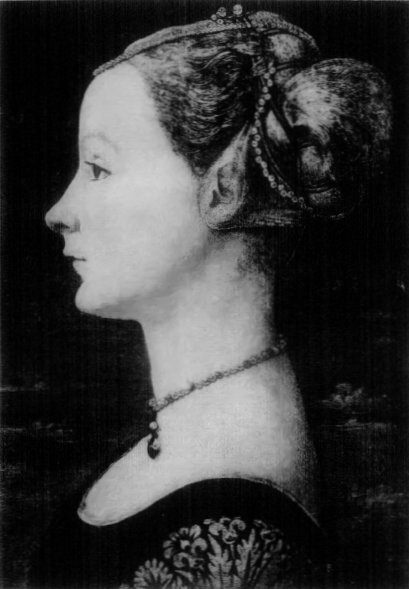 Portrait of a Lady.