Larger versions of most illustrations may be seen by right-clicking them
and selecting an option to view them separately, or by double-tapping and/or
stretching them.
Cover image created by Transcriber, using an illustration
from the original book, and placed into the Public Domain.
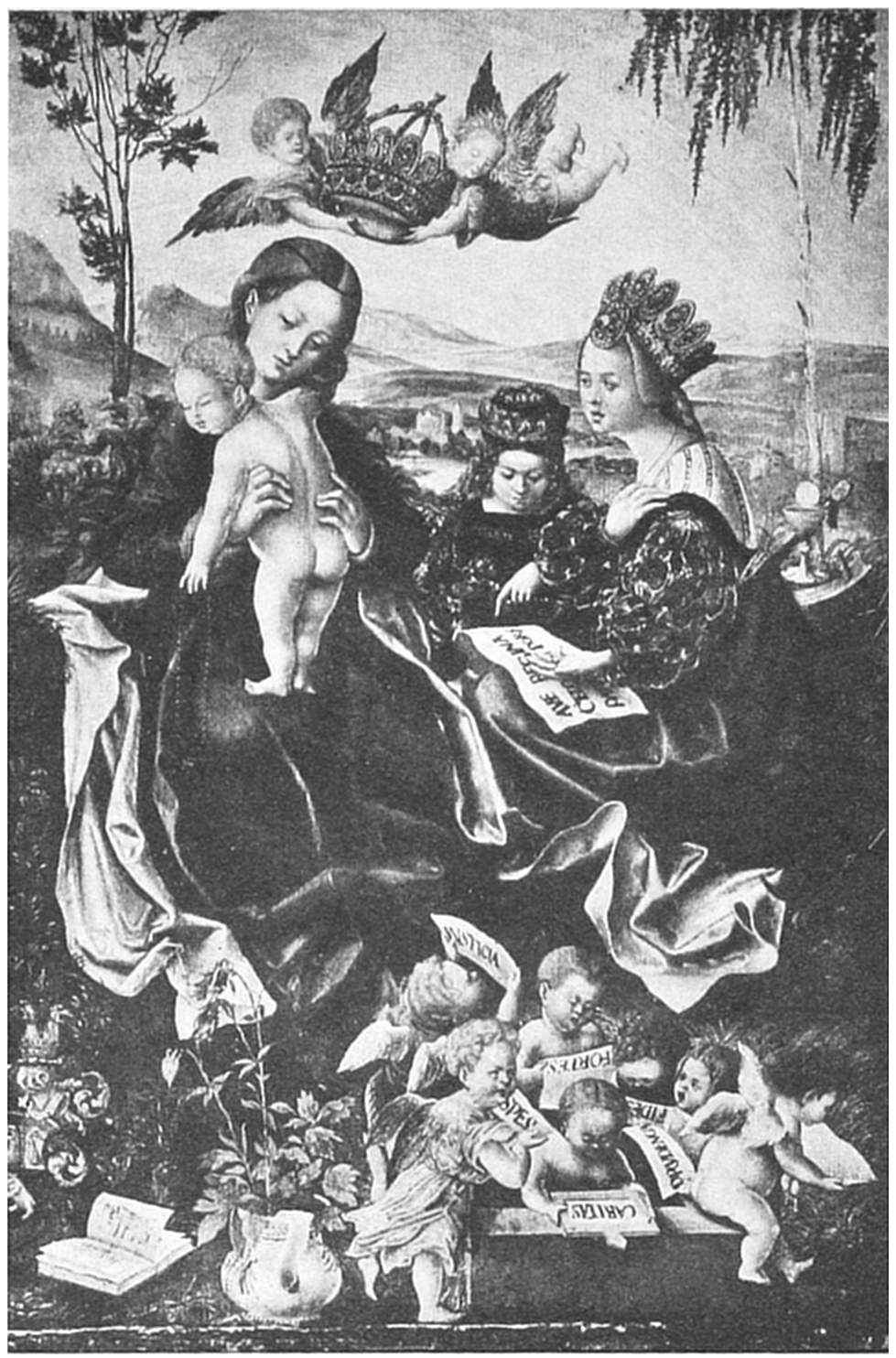
Lorenzo da Sanseverino
Photo Hanfstängl
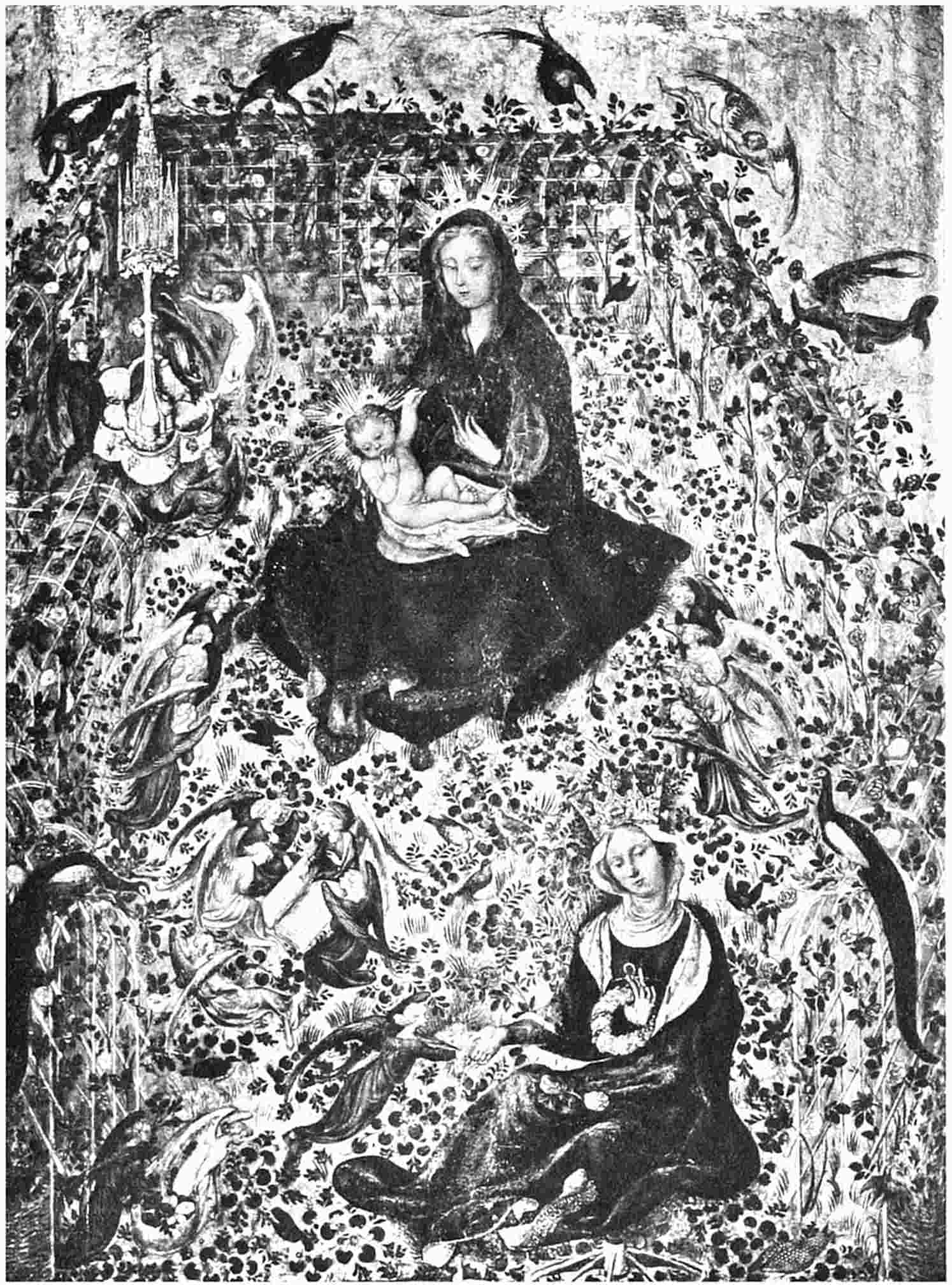
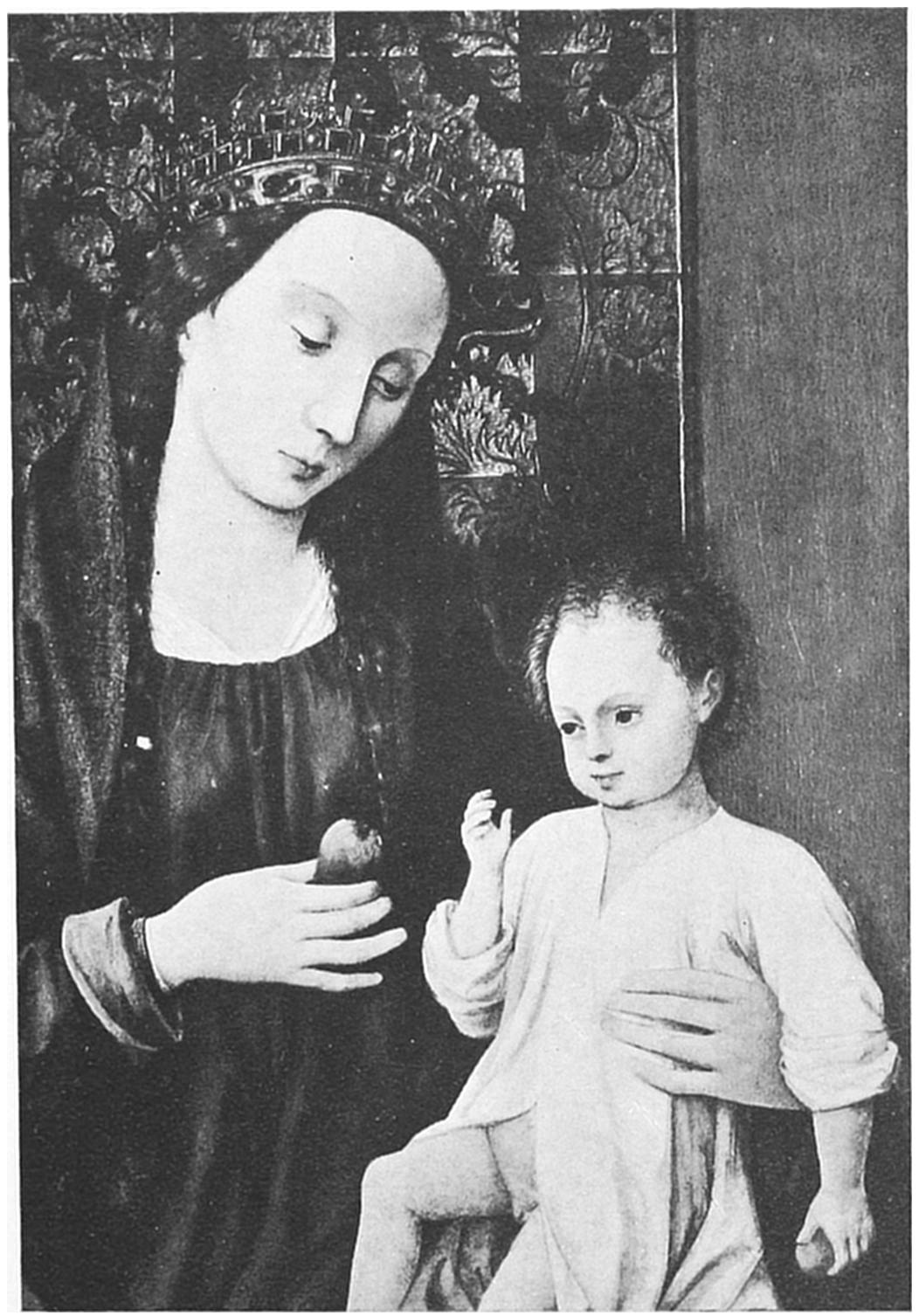
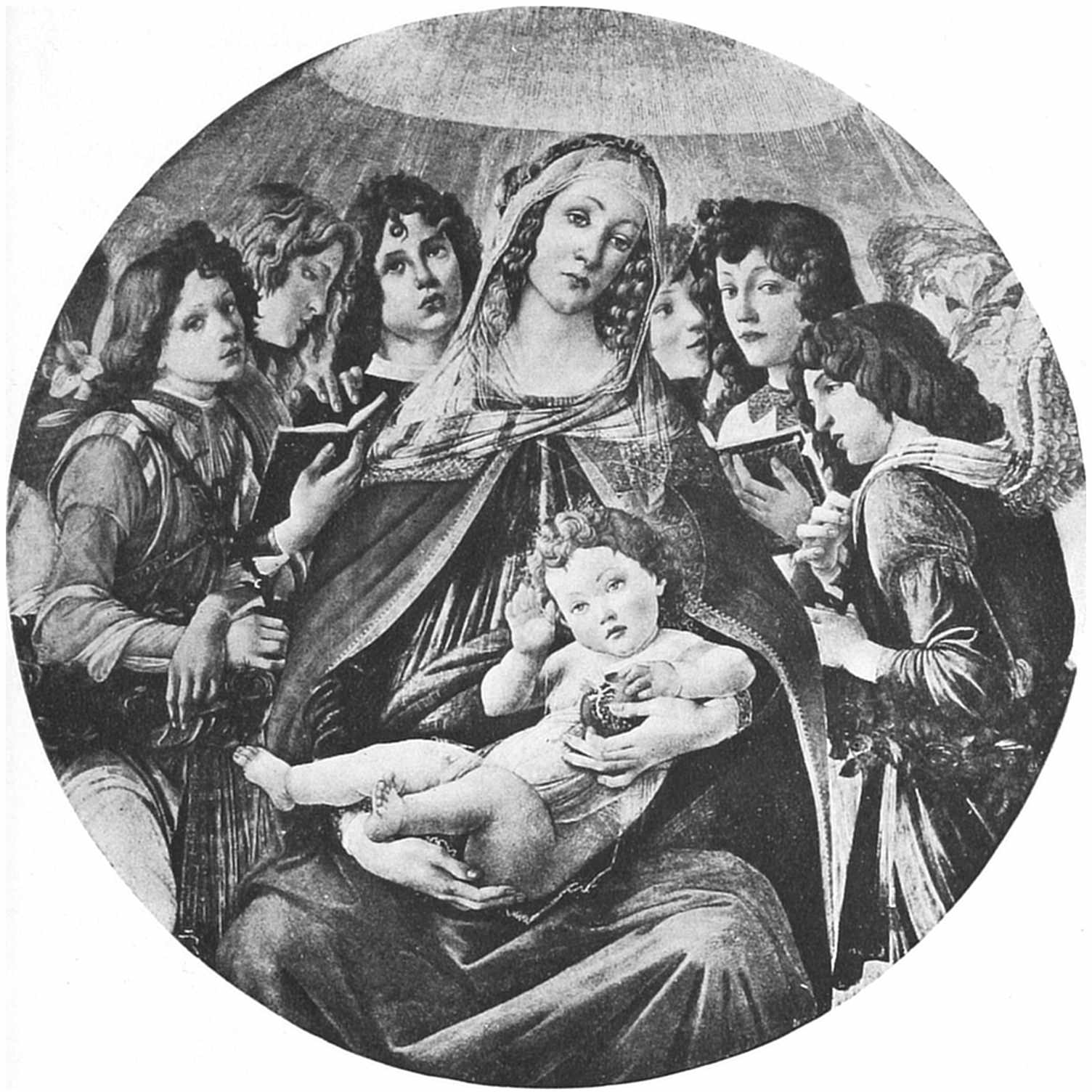
THE VIRGIN IN A STRAWBERRY-DECORATED MANTLE
Below are the Gourd and Apple, symbols of Resurrection and Death
This little book has been written for the pleasure
of those amateurs who are more interested in
the idea which inspires a picture than in the
picture’s workmanship. Naturally, the more
accomplished the artist, the more clearly and
attractively is he able to set forth his meaning;
but with art criticism this book has nothing to
do, and the attributions are, for the most part,
simply those of the official catalogues of the
respective galleries.
To explain completely even so small a branch
of Christian symbolism as that of flowers, an
exhaustive knowledge is required of the development
of Christian theology, and of the varying
force with which different doctrines appealed
at different times to the public mind. But still,
these notes may be of some interest to those who
care to trace in the work sanctioned by the
Church and reverenced by the people the history
of Western idealism, and who are sometimes
puzzled by the conventions employed by the
Masters to illustrate the Divine Mysteries.
THE FLORAL SYMBOLISM OF THE GREAT MASTERS — I EMBLEMS AND SYMBOLS 1
Since the earliest days of Christianity the
Church has made use of emblems. The Early
Church used them partly protectively to conceal
their faith from the pagans, and partly
because it lacked artists capable of worthily
depicting the Godhead in human form. Even
when the days of persecution had passed, the
Church, restrained by reverential tradition, by
poverty perhaps, and perhaps by the Eastern
fear of the ‘graven image,’ continued to represent
Christ as the True Vine and the Apostles
as sheep or as doves.
But at the beginning of the fourth century
the Emperor Constantine established Christianity
as the religion of the state. New, and
often magnificent, churches were built in each
town and the Emperor placed in the hands
of the ecclesiastics a large portion of the royal
revenues.
In these grand new basilicas the simple
decoration of the Catacombs and tiny ancient
chapels was not sufficient. The ample walls
offered a splendid field for the mosaicist and
Byzantine taste demanded elaborate pictorial
effects. Representations of the Redeemer
appeared surrounded by the Apostles, the prophets
and the four-and-twenty elders of Revelation.
Saints and martyrs were introduced,
and later we find imperial personages, Justinian
surrounded by his guards and Theodora followed
by the ladies of her court. It became necessary
to distinguish the figures one from another and
therefore symbolism was largely introduced.
The Deity was placed within the mandorla,
symbol of perfect blessedness. The prophets
were awarded broken wheels to denote their
imperfect revelation, and the apostles books,
to signify their fuller knowledge. Haloes were
carefully differentiated. Virgin saints carried
palms or laurel crowns, and martyrs had the
instruments of their martyrdom placed beside
them. Some figures carried scrolls on which
were inscribed texts which gave the clue to their
identity, others simply had their names written
above their heads, but both these latter devices
were useless to the ignorant.
At the Renaissance, when art had a fuller
life and wider aims, it was not sufficient to thus
merely label the persons represented. The
traditions of Byzantine art once broken, the
painter was free to set upon the panel all the
beauty that his mind could conceive and that
his hand could execute. He had no longer to
paint a Christ or a Madonna correct to a formula,
but none the less he was bound to depict figures
which should be instantly recognizable as God
incarnate and the meek Mother of Christ. So
from his freedom sprang the problem which has
occupied the religious painter ever since, the
painting of a soul’s quality, the making visible
to the world of the beauty of holiness.
During the great century of art, achievement
came. Raphael, Leonardo, Michael Angelo,
Perugino required and used no symbol to express
the majesty of Christ or the purity of the
Virgin Mother. They had that power to make
visible the intangible which, in art, is genius.
But among the earlier artists of the thirteenth
and fourteenth centuries, he who was unable
to show by the announcing angel’s attitude
and mien that his message was one of peace and
goodwill, placed a branch of olive in his hand,
and he who despaired of adequately depicting
the immaculate purity of the Virgin, emphasized
his point by setting a pot of spotless lilies
by her side. So was the intention of the least-accomplished
of artists made clear, even to
the unlettered.
After the first effervescence of the Renaissance
had died down, the laws of sacred art
became once more fixed, though never again
(except in Spain beneath the Inquisition) with
the strictness of the Byzantine school. Art
as a teacher of religion required to be as conservative
as the Catholic Church with which
it was allied, and the symbolism of the fourteenth
century has remained with few additions
or modifications to our own day. When devotional
pictures multiplied, emblems passed
into what may be termed the heraldry of the
Church. Though also used in decoration, their
primary use upon altar vessels and Church
furniture was to distinguish the object as sacred,
or as the property of the Church, in the same
way as the royal arms or a private crest indicated
the ownership of secular things. They appeared
on the banners used in processions of the Church
and on the badges and insignia of religious
orders, but were very seldom used in pictorial
art. Indeed, it is in the early Flemish school
alone that pictures similar to the van Eycks’
‘Adoration of the Mystic Lamb’2 or to their
‘Fountain of Life’3 are found, where angels,
prophets, saints and patriarchs bow down
before the emblem, not the figure, of the
Saviour.
During the first twelve centuries of Christianity
the emblems and symbols of the Church
were drawn from many sources; those that
were introduced at the Renaissance were fruits
and flowers. The Christ-Child holds the apple,
symbol of the Fall, or a pomegranate showing
the seeds, symbol of the Church. The lily typifies
the spotless purity of the Virgin. Saint
Dorothea is crowned with roses; Saint Joseph
holds the flowering rod. There were, of course,
other symbols used. Allegorical figures held
the sword of justice or the scales of judgment;
the mandorla, the halo, the orb of sovereignty
and the book of knowledge survived from the
Byzantine school; but those symbols which
first appeared or came into fashion, as it were,
at the Renaissance were fruits and flowers.
It was not strange that it should be so.
The new interest in the literature of ancient
Greece and Rome had revived the old classical
love of nature, of running brooks and leafy
forests, and of all the fresh unspoiled things
which shoot up clean and fragrant from the
earth. Saint Francis with his ‘jesters of the
Lord’ had gone singing through the vineyards
praising God for the light of the sun, for the
birds, for the grass. His song was taken up
by the troubadours, who also sang of the fair
things of the fields, though their leit motif was
earthly, rather than heavenly, love.
The minnesingers of Germany sang of roses,
spring-tide, love and chivalry, and three of the
sweetest-throated, Walther von der Vogelweide,
Godfried von Strassburg and Conrad von Würtzburg,
each before he died, composed a song in
honour of the Virgin.
In Provence the Lady Clémence Isaure instituted
the Jeux Floraux, and for those who
excelled in song there were three awards, a
violet, an eglantine and a marigold, all wrought
in gold. Later a silver lily was added as the
prize for the best sonnet celebrating the perfections
of the Virgin. The rules of this Mayday
tournament of song proclaimed that
‘these games are for the amusement of the
people, for the honour of God as the giver of
good gifts of trees and flowers, and to praise
Him, because nature, which had been dead, now
lives again.’
The world was now beginning to see the
value of these ‘good gifts.’ Chaucer could
find no higher emblem for the Virgin than a
flower:
‘And thou that art the floure of Virgins all;’
while Dante, who, more than any other single
writer, has influenced sacred art, uses the same
imagery:
‘Here is the Rose
Wherein the Word Divine was made incarnate,
And here the lilies, by whose order known
The way of life was followed.’
The Churchmen of the day caught the spirit
of the Humanists, and there sprang up a school
of symbolists who concerned themselves largely
with plants, fruits and flowers. The writings
of the early symbolists, Origen, Saint Melitus,
Bishop of Sardes, Saint Jerome, Saint Ambrose,
Walafrid Strabo and Raban Maur, Archbishop
of Mayence, were re-studied and their allusions
to the plant world noted. Durandus, Bishop
of Mende, whose Rationale, published in 1295,
is still considered the supreme authority on the
spiritual significance of Church architecture
and Church ornament, held flowers in general
to be the emblems of goodness. ‘They represent,
like the trees, those good works which
have the virtues for roots.’ Growing things,
he considered, could very beautifully supplement
the ritual of the Church, and he recommends
that ‘on Palm Sunday the people should
deck themselves with flowers, olive branches
and palms, the flowers to signify the virtues of
the Holy One, the olive branches His office as
peace-bringer and the palms His victory over
Satan.’
There were those symbolists who, like
Durandus of Mende and the Cardinal Petrus
of Capua, valued the symbol entirely as a means
of interpreting the doctrines of the Church.
Their definition was that of Hugues de Saint-Victor:
‘The symbol is the allegorical representation
of a Christian principle under a material
form’; and they simply searched for those
objects which best suited their purpose. Then
there were those symbolists who, like Saint
Hildegarde, Abbess of Rupertsburg, mixed their
symbolism strangely with herbalism and magic.
A plant of healing virtues was a good plant,
attributed to the Virgin or a saint, and typifying
their virtues, and a harmful plant was evil,
beneath the patronage of the Devil, typifying
and inducing envy, hatred, or perhaps
malice.
Lastly there were the mystic symbolists, and
it is they who have had most influence on
pictorial art. There were those who, like Saint
Bernard of Clairvaux, could discern through
the darkened glass of Old Testament metaphor
the divine facts of New Testament revelation,
and those who, like Saint Mectilda of
Germany, were favoured by Heaven with clear
and detailed visions, in which Christ Himself
deigned to explain the complicated symbolism
of His surroundings, His embroidered robes
and jewelled ornaments. And there were those
mystics who were not in holy orders, who did
not claim direct communication with Heaven,
yet who have, nevertheless, by giving shape
and colour to the vague indications of Holy
Writ as to the future state, and by materializing,
as it were, the illusive inner vision of
things invisible, profoundly influenced the religious
sentiment, if not the theology, of the
world. Chief among them is the poet Dante,
the friend of Giotto and the spiritual father
of both the poets and the artists of the Italian
Renaissance. In Germany his place was taken
by Conrad von Würtzburg, a poet of infinitely
less genius but who equally influenced his native
art, at least as far as devotional representations
of the Virgin Mary were concerned. He was
a minnesinger who consecrated the last effort
of a long life to praising the virtues of her whom
he terms ‘The Empress of Heaven.’ About
the year 1286 he wrote ‘The Golden Forge,’
which he describes as:
‘A golden song
Forged in the smithy of my heart
And beautifully inlaid
With the jewelled thoughts of my heart.’
It is an eulogy of the Virgin, close-packed with
allegory, simile and metaphor, which are borrowed
for the greater part from the Fathers of the
Church, but some few are of his own finding.
His work was never to be compared with
that of the great Italian, but it very strongly
influenced the hymnology and the pictorial
expression of the cult of the Virgin in both the
Netherlands and Germany.
In England there was no great symbolist
among the early poets. They were plain tales
of love and war that Chaucer told in ‘English
undefyled.’ But the Church in England produced
some beautiful mystical hymns, notably
the one to the Virgin, written, perhaps, about
1350, which begins:
‘Of a rose, a lovely rose,
Of a rose is al myn song.’
* * * * *
Religious pictures are of two types: the
historical, which aims at depicting a sacred
scene exactly as it did occur; and the devotional,
which presents a divine or holy figure in the
attitude and with the surroundings best calculated
to inflame the devotion of the worshipper.
To the first category belongs Rubens’
‘Descent from the Cross.’4 The dead Figure,
the sustained effort of the men who detach it
from the Cross, the grief-stricken women, are
all depicted with perfect realism and strict
attention to historical detail. It merely depicts
the scene as it might have occurred, and
no attempt is made to guide or suggest the
emotions of the beholder.
To the second category belong many of the
early Crucifixions. The figure of the Saviour
is emaciated to a painful degree. On each side
of the Cross hover angels catching in a chalice
the holy blood as it falls. At the summit a
nesting pelican tears its breast; at the foot a
skull is placed within a niche. Here a distinct
emotional appeal is made—to man’s pity, for
the sufferings of the Christ; to his gratitude,
since the preciousness of the holy blood is so
emphasized. The pelican in its piety is the
symbol of Christ’s devotion to His Church, and
the skull invites meditation upon the eternal
death from which He saved us.
In pictures of the devotional type the
spiritual cause or effect of the incident illustrated
is usually indicated by symbols. The reason
why the Godhead sits as a child upon His
Mother’s knee is indicated by the apple which
He holds in His hand. As the fruit of the Tree
of Knowledge of Good and Evil it is the symbol
of Adam’s fault, which, through His incarnation,
Christ repaired—and, thereby, to instructed
Christians, it foretells the tragedy of the Crucifixion.
So, in an Annunciation, the lily in the
angel Gabriel’s hand indicates the quality by
which Mary found favour in God’s sight, and it
foreshadows also the sinless birth of the Saviour.
It should be clearly understood to which
figure in a composition the symbols used refer.
When a personage of mortal birth, prophet,
apostle, martyr or saint, holds a symbol or
attribute, it almost invariably refers to his own
history. Archangels usually hold their own
attribute, but the symbols or emblems which
angels carry, or which are used decoratively,
placed against the sky or laid upon the ground,
are always to be referred to the principal figure
in the scene represented. The sword and lily
in a ‘Last Judgment’ represent the omnipotence
and integrity of the Judge; the rose
and lily in an ‘Assumption’ the love and the
purity of the Madonna; the palm in a martyrdom
the triumph of the martyr.
II THE FLOWER SYMBOLISTS
Christian symbolists divided the plant world
into three divisions—the good, the bad, and those
which, from want of definite characteristics,
were not worthy of notice. In their judgment
they were guided by several principles.
In the first place, and this was the most
important method, they searched the Scriptures
for their warrant as to the good or evil tendencies
of any plant or flower. Those with whom the
Divinity had identified Himself took precedence
of all others. Christ had said, ‘I am the True
Vine,’ and the vine, since the earliest days of
Christianity, has had the place of highest
honour in the decoration of Christian churches
as the emblem of Christ Himself. When the
difficulties were removed which prevented the
Early Church from representing Christ under
His own form, the emblem was less seen, but
it has always remained a sacred plant, and
designs based upon its form still frequently
decorate the altar and the sacred vessels.
Also those plants introduced as metaphors
in the Song of Solomon, ‘the flower of the
field,’ ‘the lily of the valleys,’ ‘the lily among
thorns,’ ‘the orchard of pomegranates,’ myrrh
and camphire, spikenard, saffron and cinnamon,
trees of frankincense and ‘the chief spices,’
which refer to the ‘Beloved’ and the ‘Spouse,’
are all considered holy plants, and by the
Roman Catholic Church are assigned to the
Virgin Mary.
In the beautiful twenty-fourth chapter of
Ecclesiasticus, too, Christian symbolists have
recognized the Virgin Mary beneath the figure
of Wisdom, and hold as sanctified those growing
things to which she is likened.
‘I was exalted like a palm tree in Engeddi,
and as a rose plant in Jericho, as a fair olive
tree in a pleasant field, and grew up as a plane
tree by the water.
‘As the turpentine tree I stretched out my
branches, and my branches are the branches of
honour and grace.
‘As the vine brought I forth pleasant savour,
and my flowers are the fruit of honour and
riches.’
In the second place, those flowers and plants
which are beneficial to man, as the wheat and
the olive, were decided to be good, and those
that were hurtful to man, as the tare and the
thistle, were evil. Here herbalism and magic
step very close to symbolism, for healing plants,
or those which were useful as a charm against
the devil, were good; those which were poisonous,
or used for evil purpose, such as raising a spirit,
were bad. Thus the nettle, which, when used
with due ceremony, dissipates fear, becomes a
symbol of courage, and myrrh, which is an antidote
to love-philtres and drives away voluptuous
thoughts, is held to be a plant of chastity. Of
this particular species of symbolism Albertus
Magnus,5 Master of Saint Thomas Aquinas, and
Saint Hildegarde,6 Abbess of Rupertsburg, were
the principal exponents.
Also a plant’s habit of growth was taken
as an indication of its character. The cedar,
with unbending head and grandly-spreading
branches, was considered, both by Saint Melitus
and Petrus of Capua, to typify pride, while the
violet, wearing the colour of mourning, and
keeping timidly beneath its leaves, they chose
as a symbol of humility.
Some symbols were of pagan origin, for the
palm of victory and the olive branch of peace
were borrowed from the Romans, who had themselves
inherited them from older civilizations.
Their significance was not changed but simply
limited and sanctified; the victory, for Christians,
was the victory over sin, and the peace,
the peace of God.
These various methods of determining the
value of different plants as symbols did not
always accord. M. Huysman, in La Cathédrale,
a very complete study in Christian symbolism,
instances the sycamore: ‘Saint Melitus proclaims
that the sycamore stands for cupidity....
Raban Maur and L’anonyme de Clairvaux qualify
it as the unbelieving Jew; Petrus of Capua compares
it to the Cross, Saint Eucher to wisdom.’
Even the sifting of the text of Scripture did
not always lead to identical conclusions. ‘I
am the rose of Sharon’ (or ‘the flower of the
field’) ‘and the lily of the valleys,’ sings the lover
of the Canticles, who prefigures, according to
Origen, Jesus Christ. But Saint Bernard of Clairvaux
found that the words veiled the personality
of the Virgin Mary, and other writers consider that
they refer to the Church of God upon earth.
There were, in fact, two schools of symbolists
though they did not differ greatly. There were
those who wrote before the eleventh century
and whose influence is traced in the mosaics of
Rome, Ravenna and the Baptistery of Florence,
and those later ones whose authority was accepted
by the painters of the Italian Renaissance
and through them spread throughout
the Christian world. Durandus, standing midway
between the two schools of symbolism,
held chiefly to the more ancient, though he also
recognized the newer, usage.
But after the twelfth century the painters
of Siena alone kept to the ancient meaning of
the symbols; Florence and the later schools
broke away entirely.
As far as flower-symbols were concerned
the chief difference was in the use of the lily,
which from being the flower indicative of
heavenly bliss became the especial flower of
the Virgin, typifying her purity. Also the rose,
the flower of martyrdom, became the symbol
of divine love, and the palm tree and the acanthus
dropped out of devotional representations
altogether.
In the main, after the twelfth century,
symbolists were agreed. There were certain
fruits and flowers about which there never had
been any doubt. The vine had been the emblem
of Jesus Christ from the beginning of Christian
theology. The white lily, as a symbol of chastity,
came perhaps from the Hebrews, but all Christian
writers were agreed as to its fitness as a symbol
of purity and as an emblem or attribute of the
Virgin Mary. The violet was the symbol of
humility, and therefore, say Petrus of Capua
and Saint Mectilda, the emblem of Christ when
on earth. Saint Mectilda and Bishop Durandus,
for the same reason, consider it the emblem of
confessors.
The rose was long in disgrace as the flower
of Venus. But even saints could not exclude
it from their lives, and gradually it crept into
Christian hagiology. Roses decorate some of
the most poetical of the histories in the Legenda
Aurea, which was compiled by Jacobus de
Voragine, Archbishop of Genoa, during the last
half of the thirteenth century, and there are
roses in plenty in the pictures of the fifteenth
century. Their meaning, at first sight, is not
so clearly defined as is that of some other flowers.
Raban Maur and L’anonyme de Clairvaux had
used them as the type of charity; Durandus
had explained them, red and white, as emblems
of martyrs and virgins. Walafrid Strabo also
considered them the symbols of martyrdom,
but in the Golden Legend and in the pictures
of the Renaissance, when plucked and falling,
or when sent from Heaven, they are symbols of
divine love; when they are woven into wreaths
they symbolize heavenly joy.
The symbolism of the lesser flowers is not
so clear, but the water lily and the saffron as
well as the rose were held by Raban Maur to
be symbols of charity; verdure, according to
Durandus, was the emblem of beginners in the
faith; the heath, hyssop, convolvulus and
violet all represent humility; the lettuce temperance;
the elder, zeal; and the thyme, activity.
Of these, however, with the exception
of the violet, Christian art has taken little note.
There are certain flowers which appear
repeatedly in pictures which represent the
garden of Heaven; they grow in the ‘Enclosed
Garden’ of the Madonna, and surround the
Infant Christ when He is laid upon the ground
to receive adoration. They are the rose and
the lily, and also the violet, the pink and the
strawberry, the last with fruit and flowers together.
The symbolists are unanimous in ascribing
humility to the violet; the pink or carnation,
which is usually introduced when there
are no roses, is, like the rose, the flower of divine
love; the strawberry with fruit and flower represents
the good works of the righteous, or the
fruits of the spirit.
To these are sometimes added the clover and
the columbine. According to the legend, Saint
Patrick was the first to use the trefoil as an
illustration of the Trinity in Unity, and the
shamrock or clover is the emblem of the Holy
Trinity. The little doves which make up the
flower of the columbine wonderfully resemble
the little doves which in early art, particularly
in the French miniatures of the thirteenth and
fourteenth centuries, represent the seven gifts
of the Holy Spirit. It is true that in the columbine
the little doves number five, not seven,
but the Flemish artists, always extremely careful
in their symbolism, rectified this by painting
the plant with seven blooms upon it. It should
only be used as the attribute of God the Son.
Towards the end of the fifteenth century a
tiny niche was made for the daisy in Christian
iconography. It is found almost exclusively
in ‘Adorations,’ where it replaces the lilium
candidum. It was felt that, suitable as the
tall austere lily might be to express the Virgin’s
purity or the celibacy of the monastic saints,
the little wide-eyed daisy was a prettier, sweeter
symbol of the perfect innocence of the Divine
Child.
The jasmine is not strictly a holy flower and
has been neglected by the writers on symbolism,
but it appears repeatedly in religious art. Its
star-shaped blossom seems to be the symbol
of divine hope or of heavenly felicity, and it is
found with roses and lilies beside the Madonna.
It forms the crowns of angels, of saints, and of
the Madonna herself. When it is the attribute
of the Infant Christ it recalls the Heaven from
which He came.
The English and Flemish miniaturists add
to these the pansy, which is the old herb
Trinity,7 bearing the same meaning as the
clover.
In the Netherlands and Germany the lily
of the valley was also used, with meek purity
as its significance.
All these flowers, on account of some accident
of shape, colour or habit of growth, were considered
holy flowers, while others, such as the
buttercup, the narcissus, the forget-me-not,
were rejected as meaningless. Fruit in general
represents good works, or the fruits of the
Spirit, faith, hope and peace, and is accounted
good; the vine is the emblem of Christ Himself,
but the fruit, usually taken to be the apple,
which grew on the Tree of Knowledge of Good
and Evil, is an accursed thing.
There are flowers, too, which are the flowers
of evil. The poppy is the emblem of sloth and
also dedicated to Venus; the tulip is beloved
of necromancers; the black hellebore and the
mandrake are used by witches in their spells,
though, strangely enough, Conrad von Würtzburg
compares the Virgin Mary to the ‘healing mandrake
root.’ Also the nettle is the symbol of
envy, the hellebore of scandal, and the cyclamen
of voluptuousness, for, according to Theophrastus,
it was used in the composition of love
philtres.
As to thorns and briars, Saint Thomas
Aquinas and Saint Anselm are agreed that
thorn branches signify the minor sins, and briars
(or thistles) those major ones ‘quæ pungunt
conscientiam propriam,’ etc.
Above all the buckthorn is blamed, for of its
branches, says Rohault de Fleury, was formed
the Crown of Thorns.
In art, however, the flowers of evil scarcely
appear. The rose is still sometimes the flower
of Venus and symbolizes the pomps and vanities
of the world, and there are the thorns of sin and
death. Some of the early Flemish and German
artists painted certain bitter herbs, notably the
dandelion, in scenes from the Passion, but
Christian iconography has concerned itself chiefly
with those plants and flowers which, with the
approval of theologians, represent the attributes
of the Divinity, of the Virgin Mary and of angels,
saints and prophets.
It may be noticed that while the sacred
flowers are not unfrequently introduced into
profane scenes, the non-sacred flowers, for instance
the daffodils and foxgloves of the hunting
scenes on old Flemish tapestry, are never introduced
as symbols, and rarely as details, in devotional
subjects.
The same symbolism holds good within the
whole Western Church, and those Reformed
Churches which have rejected painted and carved
images have preserved a good many of the
older symbols in the details of church decoration.
The most important symbols of Christianity,
the Lamb, the Dove, the Cross, the Glory, the
Halo, remain always unchanged. It is the
lesser, and more especially the flower symbols,
which vary in different countries and different
schools of painting. Italy being the headquarters
of the Church, and also the centre from which
pictorial art spread over Europe, most symbols
are of Latin origin; but they were modified and
often amplified by inherited tradition, climate
and the general trend of the national religious
sentiment. So in Italian art, after its re-birth,
we find a love of simple lines, of refined types,
of flowers, and a striving at first unconscious,
then definite, after classical ideals, while the
Northern nations, less happy in their traditions,
never quite conquered their love of barbaric
splendour; a rose wrought in pure gold was to
them more truly a symbol of divine love than a
fresh rose of the field.
The most important factor in the modification
of flower symbolism was climate. As the primary
use of a symbol was to instruct the unlearned,
the symbol which was to interpret the hidden
mystery must be a familiar object. A rare or
exotic plant would rather have complicated than
simplified the teaching. So we find the pomegranate
and the olive in Italian pictures, but not
in those of the Netherlands; the columbine and
the lily of the valley in German, but not in
Spanish art.
But it was not climate alone that determined
the use or disuse of any particular plant as a
symbol. If the fleur-de-lys, founded upon the
iris form, had not been borne by the House of
Burgundy, which protected the early Flemish
school, it is possible that the iris might not have
appeared in the early Flemish pictures as a
flower of the Virgin, and certainly had there not
been a continual interchange of Flemish merchandise,
which included painted panels, for
Spanish gold, the iris would not have taken its
place as the characteristic flower of a Spanish
‘Immaculate Conception.’
Also, had there not been ceaseless warfare and
everlasting hatred between Florence and Siena,
it is possible that Siena would have adopted the
lily as an attribute of Mary in an Annunciation
instead of using invariably the olive branch. But
the lily was the badge of Florence and the cities
were desperately jealous of each other, both in
painting and in politics, and this seems to be the
real reason of the conservatism of Sienese art.
On the whole the symbolism of the Netherlands
is the most careful and just, and each flower
was painted also with such exquisite minuteness
that there is no possibility of mistaking
the variety. Italian symbolism was always
apt to be superficial, and after the fifteenth
century often became confused with decoration.
Also the Italians painted flowers carelessly, and
the lesser kinds, those in the foreground of an
Adoration, for instance, are frequently impossible
to identify. In Germany symbolism is at times
extravagant and far-fetched though always
interesting. In Spain it is poor and almost
entirely borrowed. A modern writer8 observes
of Spanish art that it is material, brutal, Roman,
having, from its geographical position, escaped
the idealism of Greek or the mysticism of Celtic
influences; and the same cause may also explain
the prosaicness of its symbolism.
The English love of flowers, very noticeable
in early verse, found pictorial expression chiefly
in the work of the miniaturists and in the ‘flower
work’ details of architecture. The miniatures
executed by monks usually pay attention to the
symbolical value of each blossom, but the carved
stone flowers common in both French and English
Gothic churches were more often simply
those which the fancy of the architect or the
stone-cutter dictated and only represent vaguely
‘good works springing from the root of virtues.’
The happiest blooming time of these symbolical
flowers was the fifteenth century. In the
fourteenth century artists, still timid of innovations,
had limited themselves to the lily and the
rose. But with increasing skill they made a
wider choice, though always under the eye and
with the assistance of those learned in such
matters, for the majority of sacred pictures were
commissioned directly by the Church or were
ordered as a gift to be presented to some religious
community.
There were occasionally independent spirits
who, in some favourite blossom, so far unnoticed,
found beauty and symbolic fitness.
Thus Sano di Pietro of Siena constantly paints
the bright blue cornflower (which in Italy shares
its name of fiordaliso with the iris, the lily and
the heraldic fleur-de-lys) upon the heads of both
angels and saints, meaning, perhaps, by the blue
stars, to indicate that these beings were denizens
of the heavenly spaces. However, as a rule,
artists were conservative and glad to use the
recognized symbols as a means of emphasizing
and elucidating the sacred subject which they
depicted.
But even before the end of the fifteenth
century flowers began to be used for their own
sake and not for their hidden meaning. Leonardo
da Vinci and Albert Dürer painted just what
flower or weed they chose, simply for its form or
colour. In the sixteenth century flowers were
often used merely as decoration, and later, with
the exception of the rose, the lily, the olive
branch and the palm, they lost all meaning.
Carlo Maratta in the seventeenth century painted
a figure of the Virgin9 encircled by a heavy
wreath of every sort of flower—daffodils,
gentians, anemones, tulips, edelweiss, roses and
lilies, all mixed together.
In England, about the middle of the nineteenth
century, there was a revival of interest
in mystical and symbolical art. The Preraphaelite
Brotherhood was formed in 1848,
whose object was to bring back to modern art
the sincerity and earnestness of those painters
who had preceded Raphael. The originator of
the movement, Dante Gabriel Rossetti, adopted
in his early work not only the simplicity of type
and the exceedingly careful finish of the primitives,
but borrowed also their system of symbolism.
His followers, however, and in particular
Holman Hunt, broke away from the old
traditions of religious art, painting allegorical
subjects suggested by Christ’s parables and sayings
rather than the scenes of His birth and
Passion on which the dogmas of the Church were
founded, and with the traditional subjects they
left aside also the traditional symbols.
The greatest of modern English mystical
painters, George Frederick Watts, uses flowers
as details, and apparently as symbols. But their
exact meanings are obscure and apparently not
those attributed to them by the great masters of
past centuries.
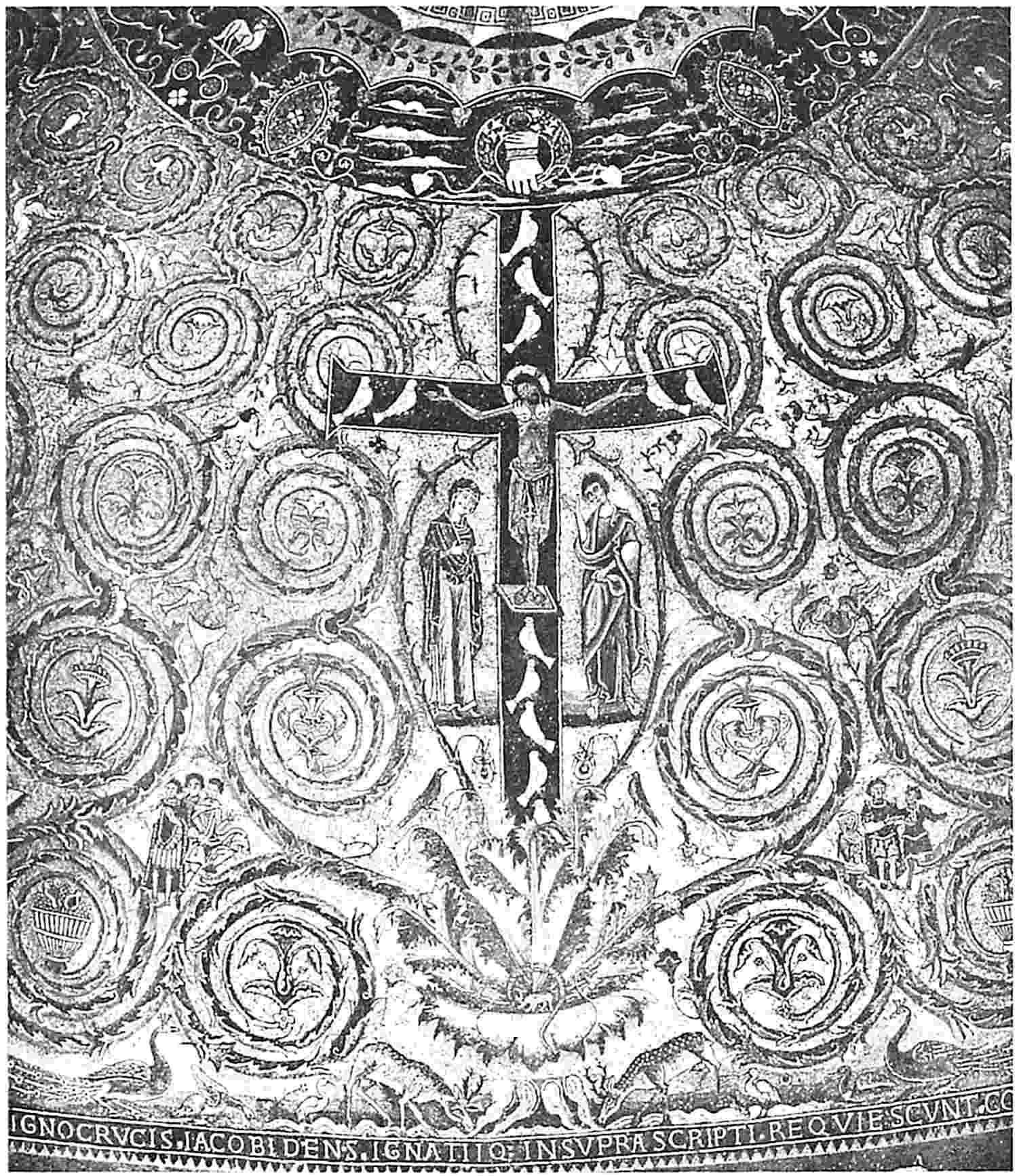
THE BADGE OF THE ORDER OF THE LILY OF NAVARRE
Photo Alinari
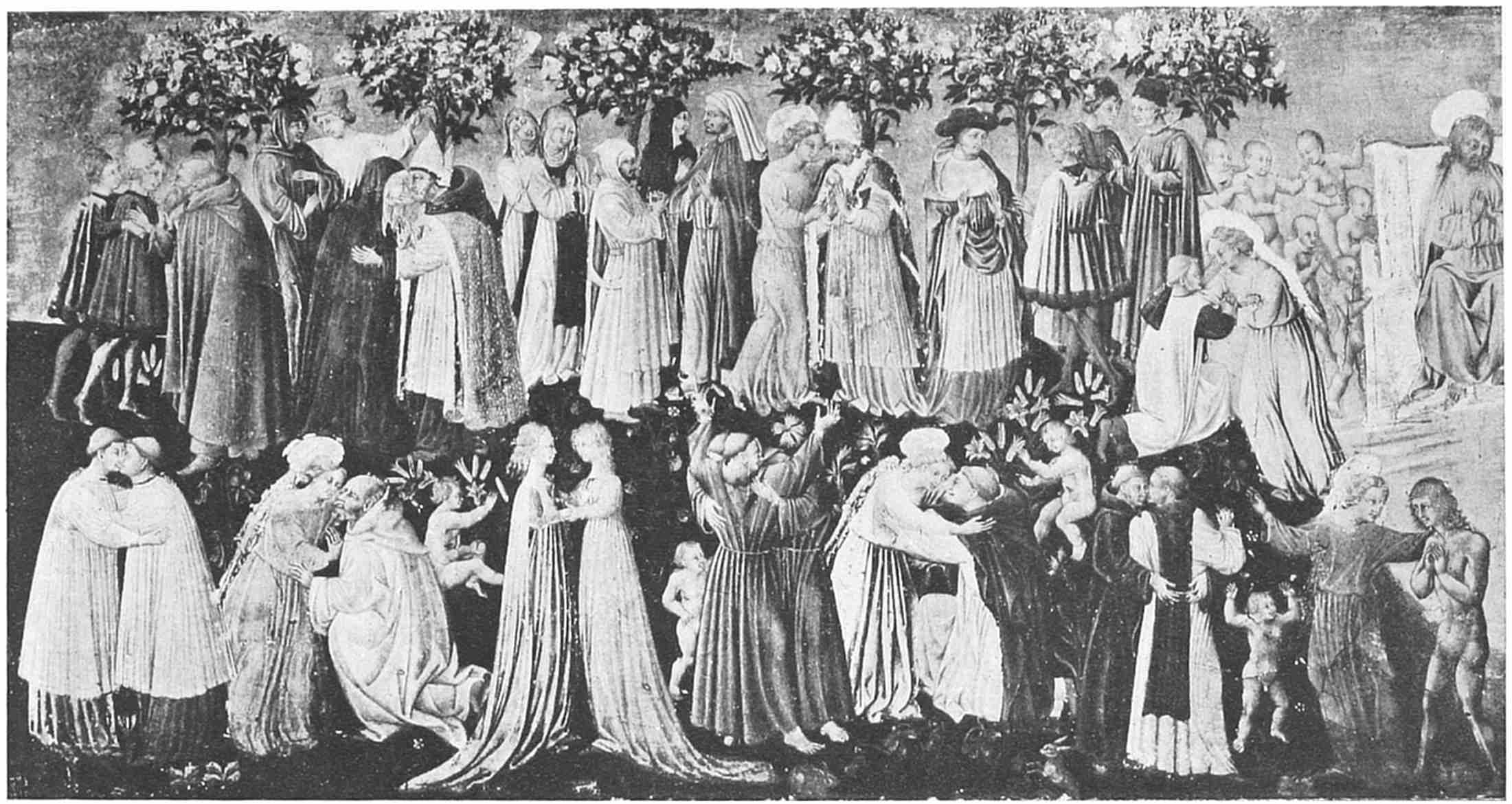
THE FLOWERS OF HEAVEN
Mosaic of the 13th century
(Baptistry, Florence)
III THE LILY
Gioacchino di Fiore, the mystical theologian
who founded the community of ‘The Flower,’
and who is held by some to be the spiritual
father of Saint Francis, writing in the last decade
of the twelfth century, divided the life of humanity
into three periods. In the first, during the
reign of the Father, men lived under the rule of
the law; in the second, reigned over by the
Son, men live beneath the rule of grace; in
the third the Spirit shall reign and men shall
live in the plenitude of love. The first saw
the shining of the stars; the second sees the
whitening of the dawn; the third will behold the
glory of the day. The first produced nettles;
the second gives roses; the third will be the
age of lilies.
Thus as daylight to dawn or starlight, and as
love to grace and fear, were lilies to every other
flower or weed, and since the twelfth century, in
Christian art, lilies have had precedence of every
other growing thing.
The earliest use of the lily by the artists of the
Christian Church was to indicate the delights of
Paradise. Raban Maur, Archbishop of Mayence
in 847, writes of lilies as the symbols of celestial
beatitude, and that is apparently what they represent
in the mosaics of Rome, Ravenna and the
Baptistery of Florence, where they spring from
the ground in the scenes which represent Heaven.
But by the tenth century the Church had
commenced to adopt the pre-Christian employment
of the lily as the symbol of purity, and the
rose gradually took the lily’s place as the flower
of heavenly bliss.
The lily of sacred art is the lilium candidum,
sometimes called the Madonna lily, or the lily of
Saint Catharine. It is said to be a native of the
Levant, but appears to have spread with Roman
civilization throughout Europe. The suggestion
of abstract purity is arresting and direct. The
stalk is straight and upright, the leaves narrow,
plain, almost austere. At the top of the long
stalk the flowers cluster, each chalice-shaped, and
sending to the sky a perfume which is singularly
sweet and piercing. Their form is simple but
noble, and they are above all remarkable for the
immaculate and luminous whiteness of their
firm petals.
After the twelfth century the lily is always
used as the symbol of purity in its perfection,
and is most usually associated with the Virgin
Mary and with saints of the monastic orders.
More rarely it is used as an attribute of the
Persons of the Holy Trinity. In a large picture10
representing the Trinity in Glory, by an unknown
Neapolitan painter of the seventeenth century,
God the Father holds a stalk of lilies in his left
hand, above which hovers the mystic Dove.
Since Christian iconography gives no attributes
to God the Father except the orb and crown of
omnipotence, the lily must be taken as the attribute
of the Holy Ghost; and in a rare subject,
The Adoration of the Holy Ghost,11 ascribed
by Behrenson to the Amico di Sandro, the two
angels with swinging censers and lovely floating
draperies, who adore the hovering Dove, carry
each a lily. The Dove in conjunction with the
lily is also found upon the great central doors of
Saint Peter in Rome. They are of bronze, and
were executed between 1439 and 1445 by Antonio
Filarete. There are two panels with elaborate
borders and much interesting detail. On one
is Saint Peter with the keys and on the other
Saint Paul. Saint Paul is of the traditional
type, bald and bearded, and holds in his right
hand a drawn sword. By his side is a large vase
of lilies, and on the highest flower, its beak
touching the sword’s hilt, is the Dove, encircled
by a halo. The lilies and the Dove are introduced
apparently to correct the impression of violence
given by the uplifted sword, the instrument of the
Apostle’s martyrdom, and together representing
the Holy Spirit, they recall Saint Paul’s own
phrase, ‘the sword of the Spirit.’
As an attribute of God the Son, lilies are used
in those pictures known as Adorations, where the
divine Child is laid upon the ground and the
Mother kneels before Him in worship; and in
those pictures where she holds Him, no longer a
very young infant, on a ledge or pedestal before
her. In these pictures all the symbolism refers
to the Child, and if He lie among roses and lilies
they signify respectively divine love and perfect
sinlessness. If angels hold vases of lilies on
either side, these lilies recall that He was born of a
Virgin.
The first Adorations were painted by the
Florentine masters of the fifteenth century. In
an early example by Filippo Lippi12 the flowers
are small and the species scarcely to be determined.
Neri di Bicci13 painted roses and lilies,
and Luca della Robbia14 has placed the Child
beneath a freely-growing clump of tall lilies.
The Virgin kneels before Him, while heavenly
hands hold above her head a crown ornamented
with the royal fleur-de-lys. Botticelli15 appears
to have been the first to have substituted the
daisy for the lily, and to the daisy he added the
violet of humility, and the strawberry, which
symbolized the fruits of the spirit. These
flowers were constantly repeated in this connection,
a comparatively late example of their use
being in the Adoration of Perugino, now in
Munich.
These same flowers are found in the North,
but as Northern artists preferred incidents definitely
recounted by the Scriptures to more imaginative
devotional subjects, they were transferred
to Nativities or Adorations by the
Shepherds.
In Siena during the fourteenth century, and
in the school of Giotto, the lily, usually a single
lily-cup, is sometimes placed in the hands of the
Infant Christ. Here it is not the symbol of
purity, but in accordance with the older symbolism
it is the flower of Paradise. Siena was extremely
conservative, and for its artists the Holy
Child was still the royal Child of the Byzantine
school, richly clothed, His right hand raised in
blessing or holding the orb of sovereignty. Sometimes
He holds a scroll, announcing His high
mission, with the words ‘Ego sum lux mundi’
or ‘Ego sum via veritas et vita.’ More stress is
laid upon His divinity than upon His humanity,
and there is absolutely nothing to hint at or
forecast His passion. He appears simply as the
bringer of peace and blessing, and in His hand is
still the flower of Paradise, the same lily which
grows beside His throne in the mosaics.
Gradually, however, a fruit replaced the
flower in the Christ-Child’s hand. At first the
fruit, following an artistic tradition as old as the
fourth century, was also a promise of heavenly
bliss, it was a fruit from the heavenly gardens;
but it was soon identified as the fruit of the tree
of Knowledge of Good and Evil, since He, as the
Second Adam, had come to repair the fault of the
first.
Meanwhile in Florence, during the fifteenth
century, the lily, already the flower of the virgin
saints, was attributed more especially to the
Virgin Mary as the symbol of spotless purity,
and it became accepted throughout Christendom
with this significance.
Therefore, on the rare occasions after the
fourteenth century when the lily is placed in the
hand of the Infant Christ it is the symbol of
purity, of His perfect sinlessness. In the
Enthroned Madonna of Luca Signorelli16 He
holds a large stalk of lilium candidum. In the
great majority of representations of the Madonna
with the Child in her arms only the symbol in
the Child’s own hand refers to Him; other
symbols refer to Mary. But in this picture, to
the jewelled cross of the Baptist is attached a
scroll with the legend, ‘Ecce Agnus Dei,’ and all
the symbols are the attributes of the Saviour.
Besides the lily, which denotes perfect sinlessness,
there are two transparent vases in which are
jasmine, violets and roses. The jasmine’s starry
blooms recall the Heaven which He has left, the
violet is a symbol of His humility, and the rose
of His divine love. In the wreath behind the
throne is jasmine again, with pendant trails of
white convolvulus, which is also an emblem of
humility.17
Occasionally the Infant Christ is represented
offering a branch of lilies to a Saint,18 and then the
lily represents the gift of chastity, which He
bestows.
It is only in modern times that Christ, grown
to manhood, has been represented with a lily in
His hand. An instance is the fresco illustrating
the parable of the Wise and the Foolish Virgins,
painted in 1864, by Lord Leighton, P.R.A., for
Lindhurst Church. The virgins stand on either
side of the Celestial Bridegroom, who holds in
His left hand the lily which emphasizes the
mystical character of the divine nuptials.
It may be noticed in this connection that
modern, and more particularly Protestant,
ecclesiastical art takes its subjects largely from
the parables of Christ, a usage unknown to the
Roman Catholic Church during the period when
the great masters of art were in her service.
Northern mediæval art, that is, the art of the
Flemish and German schools, introduced the
lily into representations of the Last Judgment,
placing the sword and stalk of lilies, ray-wise,
behind the head of the judging Christ. In the
very early representations of this subject Christ
is depicted with a two-edged sword issuing from
His mouth, in illustration of the text of the
Revelation of Saint John:
‘And out of his mouth went a sharp two-edged
sword.’
And again:
‘Which sword proceeded out of his mouth.’
But pictorially it was ugly and theologically it
was harsh, suggesting wrath rather than mercy as
the determining impulse at the final doom. Then
men remembered the promise to the righteous:
‘The wilderness and the solitary places shall
be glad for them; and the desert shall rejoice
and blossom as the rose.’19
And in a copy of the Biblia Pauperum20 of the
fifteenth century we find a branch of roses so
placed as to balance the sword, both set diagonally
like rays, one on each side of the head of
Christ. The rose was placed on Christ’s right
hand above the forgiven souls, and clearly
typified divine love and mercy; the sword on the
left was above the damned, and typified divine
condemnation.
But almost immediately the rose was replaced
by the lily. The lily was, in the fifteenth
century, the one distinctly sacred flower. Its
lance-like habit of growth made it a most symmetrical
pendant to the sword, and possibly, too,
the Church of the North, stern both in religious
sentiment and in its pictorial expression, preferred
the lily, which typified the integrity of the
judging God, to the rose, symbol of His mercy.
The Netherlands adopted the symbol. It
appears in Memling’s most impressive Last
Judgment,21 and in the Last Judgment of Lucas
van Leyden.22 The same device was used by
Albert Dürer23 and many of the less known
German masters; but Rubens, in his magnificent
picture now in Munich, has replaced the lily
by a sceptre.
The lily, used in this connection, is not found
in Italian art, for though the Netherlands,
Germany and England adopted the symbolism
of Italy, Italy, though admiring greatly the
technical excellence of the Flemish, rarely
assimilated the Northern conventions for the
expression of the intangible.
But the lily is usually reserved for virgin
saints and martyrs, and more particularly for
her whom Chaucer names
‘Floure of Virgins all’
—that is, the Virgin Mary.
The Venerable Bede, writing in the early part
of the eighth century, declares ‘the great white
lily’ to be a fit emblem of the resurrection of the
Virgin; the pure white petals signifying her
body; the golden anthers her soul within, shining
with celestial light.
According to Petrus Cantius, cantor of the
Cathedral School of Paris in the early part of
the thirteenth century, the lily represented the
daughter of Joachim herself, by reason of its
whiteness, its aroma, delectable above all others,
its curative virtues, and finally because it springs
from uncultivated soil as the Virgin was the issue
of Jewish parents.
As to its curative virtues, it may be added
that an anonymous English monk, writing in
the thirteenth century, prescribes the lily as a
sovereign remedy for burns; and for the reason
that ‘it is a figure of the Madonna, who also
cures burns, that is, the vices or burns of the
soul.’24
But though theologians occasionally used
the lily as a symbol of virginity, before the
eleventh century we do not find it associated
with the Mother of Christ pictorially, either as
her emblem or her attribute. There are no lilies
in the Catacombs, and those in the early mosaics
are decorative, or symbols of the joy of Heaven.
The miniaturists occasionally used the flower as
the attribute of virgin martyrs, but not in representations
of the Virgin.
It was by a Spanish king that the lily was first
definitely, and in a manner pictorially, associated
with the Mother of Christ—as her own flower.
In the eleventh century Spaniards and Moors
were each fighting for their faith, and the Moslems
instituted military orders called rábitos, the
members of which were vowed to perpetual
warfare against the ‘infidel.’
The Christian knights were not to be outdone,
and in 1043 Garcias of Navarre founded an order
of chivalry vowed to the service of the Virgin,
which he named ‘the Order of the Lily of
Navarre.’
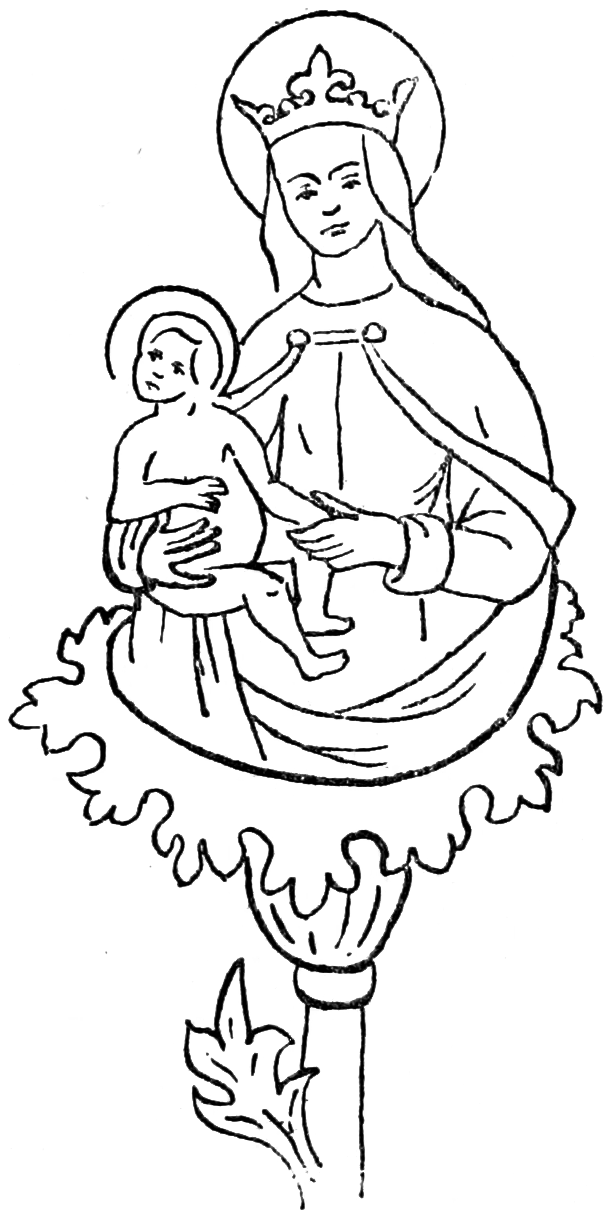
Edmondson25 writes: ‘The Order of “Our
Lady of the Lily,” or “of Navarre,” was instituted
in the city of Nagera by Garcias, the
sixth King of Navarre, in the year 1043, on the
occasion of a miraculous image of the Virgin
Mary issuing forth of a lily, and holding the
Infant Jesus in her arms, being then discovered in
that city. This order was composed of thirty
knights, chosen out of the principal ancient
families in Navarre, Biscay and old Castile.
Each of these knights wore on his breast a lily
embroidered in silver, and, on all festivals and
holy days, he wore about his neck a collar composed
of a double chain of gold interlaced with
Gothic capital letters ; and pendent thereunto
an oval medal, whereon was enamelled,
on a white ground, a lily of gold springing out of
a mount, supporting a Gothic capital letter ,
ducally crowned.’26
Thus the lily became the gage of the Virgin
borne by her knights. She was now gradually
moving from the subordinate though glorious
station as Mother of the Incarnate Word to a
position of her own as Queen of Heaven. Saint
Ferdinand, possibly unwilling to confront the
Moslem with the Christ whom they themselves
revered as a prophet, bore upon his saddle-bow
the ivory Virgen de las Batallas,27 and perhaps
what specially endeared her to the people of
Spain was the knowledge that in the fealty they
paid her the infidel could have neither part nor
lot. The chosen knight of the Immaculate
Virgin was, of course, Santiago, Saint James,
the patron saint of Spain, but every Spanish
cavalier acknowledged himself the servitor of the
Lady of the Lily.
Rather more than fifty years after the founding
of the Order of the Lily of Navarre the poet-saint,
Bernard of Clairvaux, was preaching his
famous series of Homilies on the Song of Solomon.
The sermons were eighty in number, each
based on the text of the Canticles, and each
celebrating the perfections of the Virgin. Differing
from Origen, he found the Virgin
Mary, not the Christ, to be the speaker of the
words: ‘I am the rose of Sharon and the lily of
the valleys.’ Differing again from the Church
father, he further identified ‘the lily among
thorns,’ she who is addressed as ‘my sister, my
spouse,’ with the Virgin and not with the Church
of God upon Earth.
Saint Bernard was the most popular preacher
of his time; his sermons became known throughout
the Christian world, and to his influence may
be traced the high position which the Mother
of Christ now holds in the Roman Catholic
Church. But, so far, the lily had not appeared
in pictorial art in connection with the Virgin.
In the twelfth century, however, we find
ecclesiastical seals which bear the figure of the
Virgin holding by the left hand (or right, as it
would appear on the impress) the Child, and in
her right a branch of lilies. Two of these seals,
that of the Dean and Chapter of Lincoln and
that of Thornholm Priory in Lincolnshire, are
now in the British Museum. It seems to have
been the fashion in the eleventh, twelfth and
thirteenth centuries to engrave the owner’s
figure on a seal with a flower in the hand. On
the seal of Capet Henri I he is shown with a
sceptre in one hand and a fleur-de-lys in the
other, and the figures on the seals of the Queens
of France have a flower in either hand. Therefore
it was only natural, when cutting the Virgin’s
figure on a seal, that the craftsman should give
her a flower too, and the Virgin’s own flower,
the lily.
The conservatism of churchmen and the
traditions of Byzantine art still kept lilies at the
threshold of the Church till the Renaissance
came. It came like the spring, uncertainly at
first, with puffs and gusts and relapses, but every
day the atmosphere grew more genial, more life-giving,
till at last every branch of human thought
was alive and growing. The old early Christian
fear of beauty as a devil’s lure was dying fast, and
as scholars and artists studied with new interest
the legacies of ancient Greece and Rome, the old
pagan joy of perfect form in art as in literature
revived once more. A representation of the
climax of the Christian tragedy could only be
an awful thing, but childhood and womanhood
had the right to beauty. The old Byzantine
panels of the Child-Christ and His Mother
were little more than a formula; the lines
and colour were not beautiful, though understood
to represent a thing of beauty. Now artists
and people required that she who, on the word
of Scripture, was ‘the fairest among women,’28
should be adequately presented, and the Church
gave consent. But it was understood that the
loveliness of the Virgin should be strictly the
beauty of holiness, for Saint Ambrose had
affirmed29 that, in the Mother of God, corporeal
beauty had been, as it were, the reflection of the
beauty of the soul, and the early artists, hampered
by lack of technical skill and confused by
monkish ideals of asceticism, too often rendered
their Madonnas emaciated and bloodless, even
languid and fretful in expression, mistaking the
outward signs of a subdued flesh for those of a
perfected spirit.
It was at this time that Saint Dominic came
to Italy with his fiery zeal, his devotion to the
Virgin and his Spanish traditions of the flower
of Our Lady. For him, the quality which
raised her so far above all other women was her
spotlessness; she was ‘sin pecado,’ ‘Maria
Purissima.’ Her other phases, as Mother
of the Sorrowful, Refuge of Sinners, or Consoler
of the Afflicted, were to him of secondary
importance.
Already through the preaching of Saint
Francis Italian intellect had been rendered
capable of appreciating the beauty of simplicity.
Each artist knew that the true beauty
of the Queen of Heaven was not to be
expressed by jewels or wonderfully-wrought
raiment, and as the words of Saint Dominic
passed from mouth to mouth, the people of
Italy came to understand that the most
precious virtue of Christ’s Mother was her
purity, symbolized very fitly by the lily. The
symbol, beautiful in itself, and so suggestive
of the quality it represented, impressed the
imagination clearly, and presently there was a
bloom of pictured lilies.
The mosaicist Cavallini,30 Duccio di Buoninsegna,31
Giotto,32 Simone Martini,33 and Orcagna34
led the way, and the Christian artists of the
world have followed. The earliest lilies flowered
in Rome; but Siena, Umbria, Florence, Venice,
and later the Netherlands and Germany, all soon
had their votaries of the mystic flower. The
French ivory workers of the fourteenth century,
influenced doubtless by the tradition of the seal-cutters,
frequently placed flowers in the hand of
the Madonna. These little ivory statuettes are
usually very sweet in type and often exquisite in
workmanship. The Child is held on the left
arm, and the right hand holds a large single lily
cup, a pear-like fruit, or, more generally, a natural
stalk of lilies with leaves and flowers. Always
when placed beside the Virgin, or in her hand, the
lily is the symbol of her purity, and a lily standing
alone, as does the beautiful stem in pietra-dura
work, which decorates the little oratory of
‘Our Lady of the Annunciation’ in the Church
of the Santissima Annunziata of Florence, is the
emblem of the Madonna herself, the ‘Lilium
inter Spinas.’
Modern Biblical commentators are agreed that
the ‘lily of the valleys’ of the Song of Solomon
is not the white lily of Europe but the scarlet
anemone. The lilium candidum appears never
to have grown in Syria. In the late spring and
early summer, however, the anemones grow
thickly in every grassy patch around Jerusalem
and throughout Palestine. That the flower mentioned
is red seems indicated by the comparison
between it and the lips of the ‘Beloved,’ and the
anemone, which responds so readily to the sun,
throwing back its scarlet petals and baring its
heart to the warmth, might well stand for the
passionate lover of the Canticles.
But the fathers of the Church held the flower
to be a lilium, and for the Church and for sacred
art it was and remains the lilium candidum.
From French MS. of 14th Century
IV THE IRIS
The only rival to the lilium candidum as the lily
of the Virgin is the iris. Strictly speaking, it is
not a lily at all, for the Iridacea and the Liliacea
are distinct botanical orders. But in Germany it
is known as the sword-lily, from its sword-shaped
leaves; in France it has always been identified
with the ‘fleur-de-lys’; in Spain it is a ‘lirio’—a
lily—and Shakespeare writes:
‘... And lilies of all kinds
The Flower-de-luce being one.’
Its first appearance as a religious symbol is in the
work of the early Flemish masters, where it both
accompanies and replaces the white lily as the
flower of the Virgin. Roger van der Weyden35
paints both flowers in a vase before the Virgin, and
the iris alone in another picture36 of Mary with
the Holy Child. In his ‘Annunciation’37 the vase
holds only white lilies. There is iris growing
among the roses in Jan van Eyck’s ‘Virgin of
the Fountain,’38 but in his Annunciations there
is only the white lily. Memling, however,
places an iris half hidden below the lilies in one
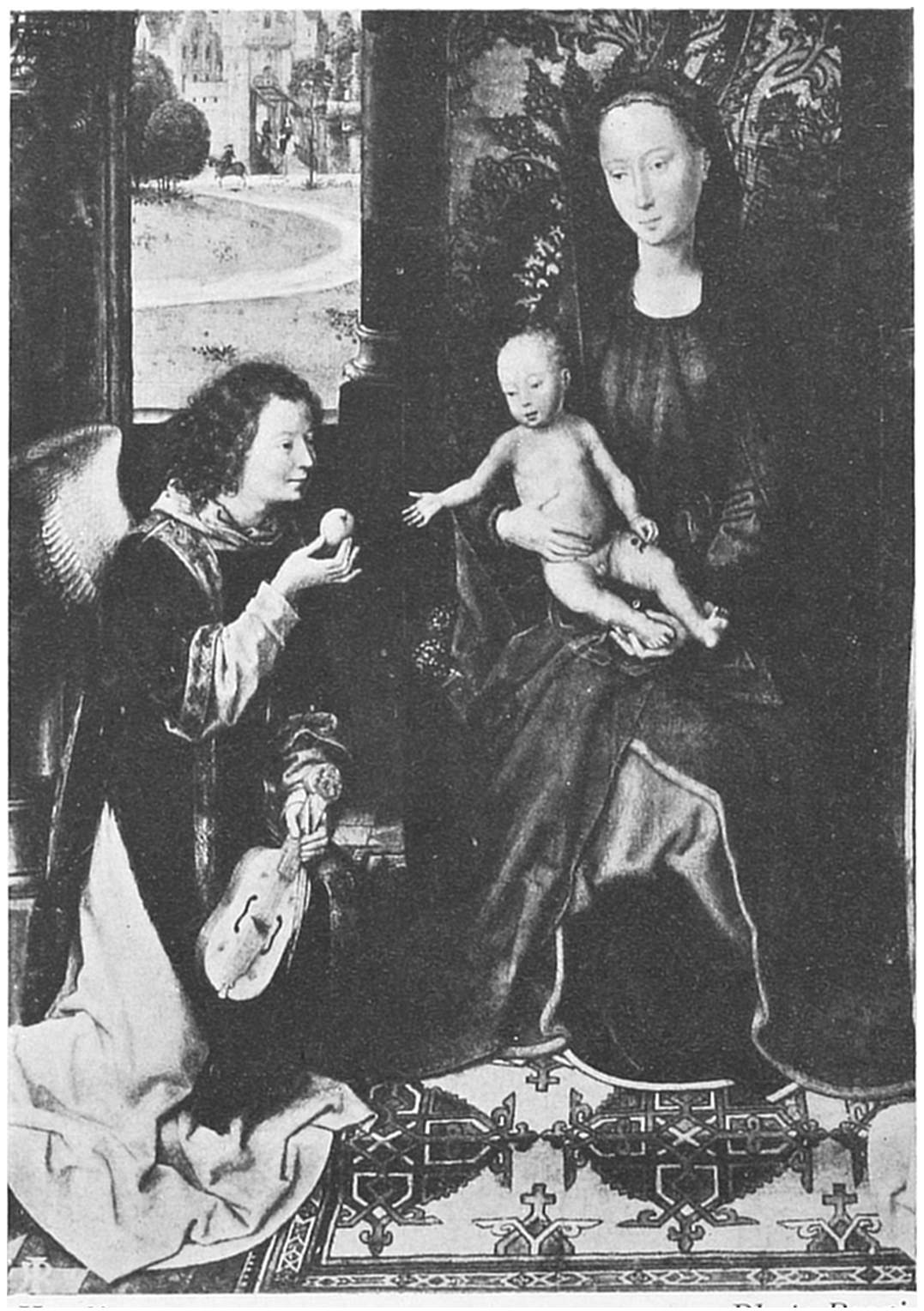
Annunciation,39 while in a ‘Madonna with the
Child’40 there is also a single iris, though in this
case the iris rises above the lilies.
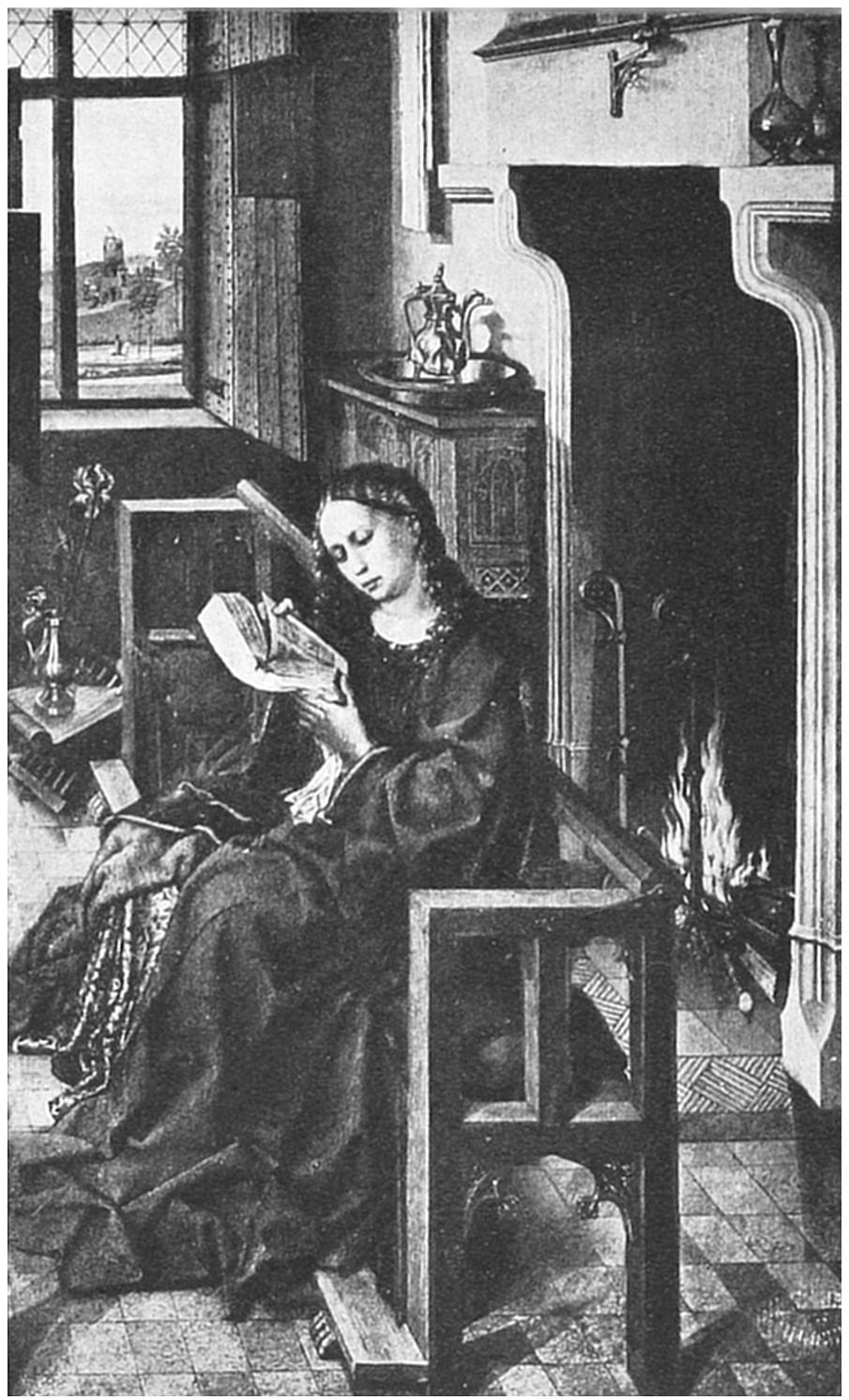
The Master of Flémalle in his fine ‘Saint
Barbara’41 places an iris in a vase beside the saint,
where the white lily of a virgin martyr might
have been expected.
The symbolism of the iris and the lily at first
sight appears to be identical, and the substitution
of the iris for the lilium seems to be the result
of some confusion between ‘lys’ and ‘fleur-de-lys,’
accentuated by the likeness between the iris
and the lilies of the French royal standard with
which the people of the Netherlands were familiar,
since they were emblazoned on the shield of the
Dukes of Burgundy.
In the mosaics of Ravenna, where the lily is
used to indicate the delights of Heaven, it is
drawn in silhouette, showing three petals, and
very closely resembles the ‘fleur-de-lys’ of
heraldry. The same convention born of the
extreme difficulty of giving modelled form in
utter whiteness, particularly in a medium unfitted
to express fine gradations of shade, is
found in woven work, tooled leather, and embroidery,
and the common likeness of the imperfectly-rendered
lilium candidum and the iris to
the sacred lily of the French and English royal
standards, is sufficient to account for any indecision
as to which was precisely the Virgin’s
lily. It is conceivable, too, that the artists of the
Netherlands, when they painted a Madonna for
their churches, set her in the midst of the iris
which grew so thickly round their doors rather
than limit her patronage to the white lily, which
was still exotic and confined to some few convent
gardens. For the iris made their Lady more
entirely their own—and so she would appeal more
strongly to the emotions of the simple.
But in the Netherlands, in the fifteenth century,
symbolism was usually very precise, and
there does seem to be a slight difference in the
use of the two lilies. The lilium candidum is
used exclusively as the symbol of virginal purity,
more particularly in relation to the fact that the
Virgin Mary was a mother, but the iris, the royal
lily, appears to be the emblem or attribute of the
incarnate Godhead. Though Saint Bernard of
Clairvaux had attributed the metaphor, ‘I am
... the lily of the valleys,’ to the Virgin, Origen,
the older and, in the North, weightier authority,
held Christ to be the lily. In the ‘Adoration of
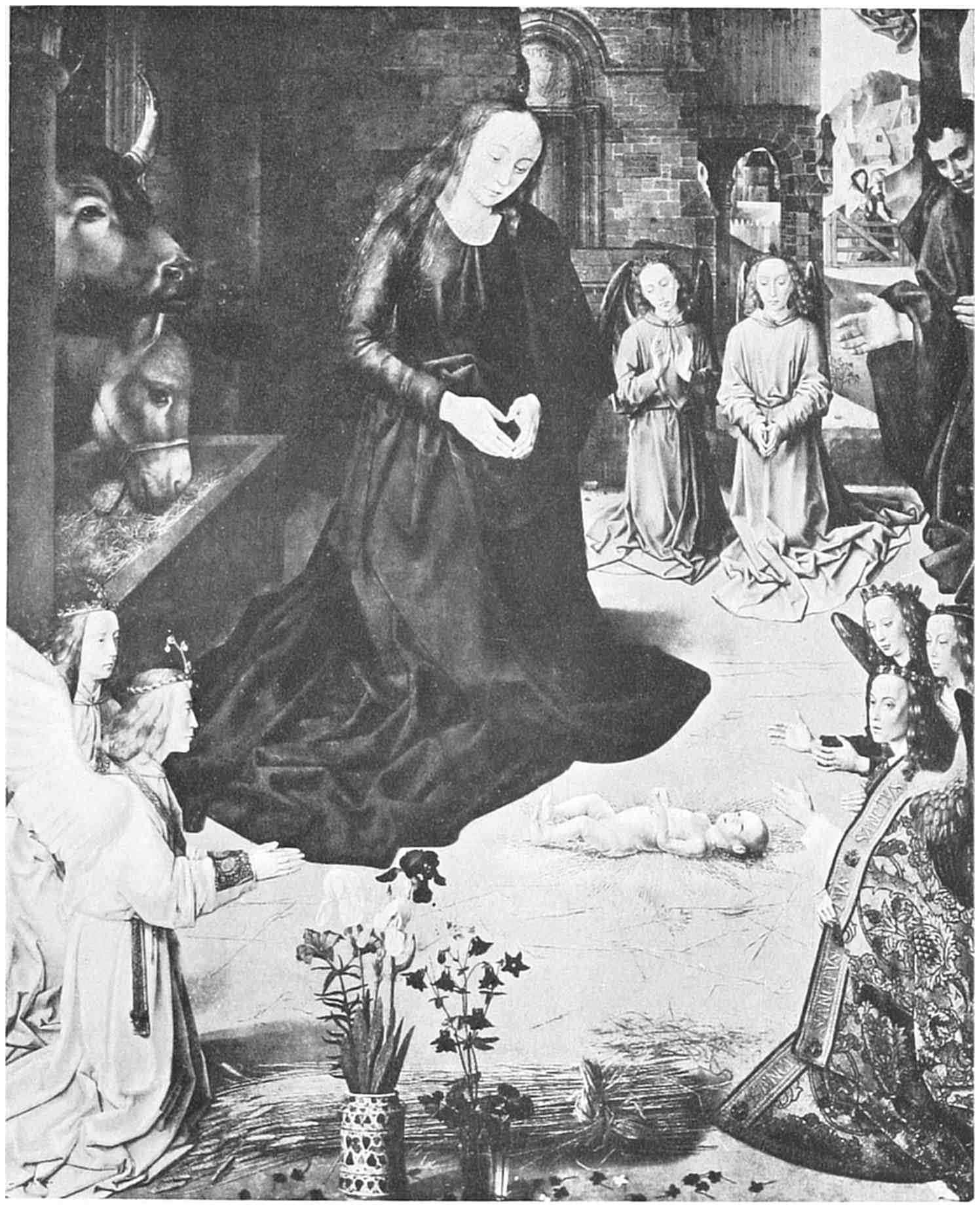
the Shepherds’42 of Hugo van der Goes, where the
symbolism all refers to the Child, there is no white
lily, but the orange lily and the purple and white
iris. In the Annunciation of Memling, the single
iris below the lilies may be the emblem of the
Prince of David’s house who was to be born of
virginal innocence—and it may have the same
meaning where it rises above the lilies in the
picture where the royal Child sits upon His
mother’s knee. It may also indicate royal birth
in the ‘Saint Barbara’ of the Prado. She was
the daughter of a King, but in this painting has
no crown or other attribute of royalty. It is
noticeable, too, that had there been a white lily
in the vase it would have been difficult to distinguish
this Saint Barbara from a figure of the
Virgin.
The idea of royalty in connection with the
iris received support from the constant recurrence
of the ‘fleur-de-lys,’ accepted as an iris
(though some contend that the form, as a symbol
of royalty, came originally from Egypt and was
founded on the lotus), on royal crowns and
sceptres. Memling and his school used such
crowns as the symbol of divine majesty, placing
them upon the heads of God the Father,43 of
God the Son,44 and also on the head of the
Virgin Mary.45
Dante also appears to use the ‘fleur-de-lys’
or ‘fiordaliso’ as a symbol of honour:
‘... Beneath the sky
So beautiful, came four-and-twenty elders (signori)
Some commentators, taking the four-and-twenty
personages as the four-and-twenty canonical
books of the Old Testament, consider
the crowns of flowers to be symbolical of the
purity of the doctrine found within the books,
holding a ‘fiordaliso’ to equal the white lily
as a symbol, but it is possible that the poet
meant the formal fleur-de-lys upon a golden
crown or the fresh iris blooms which would also
form a crown of honour.
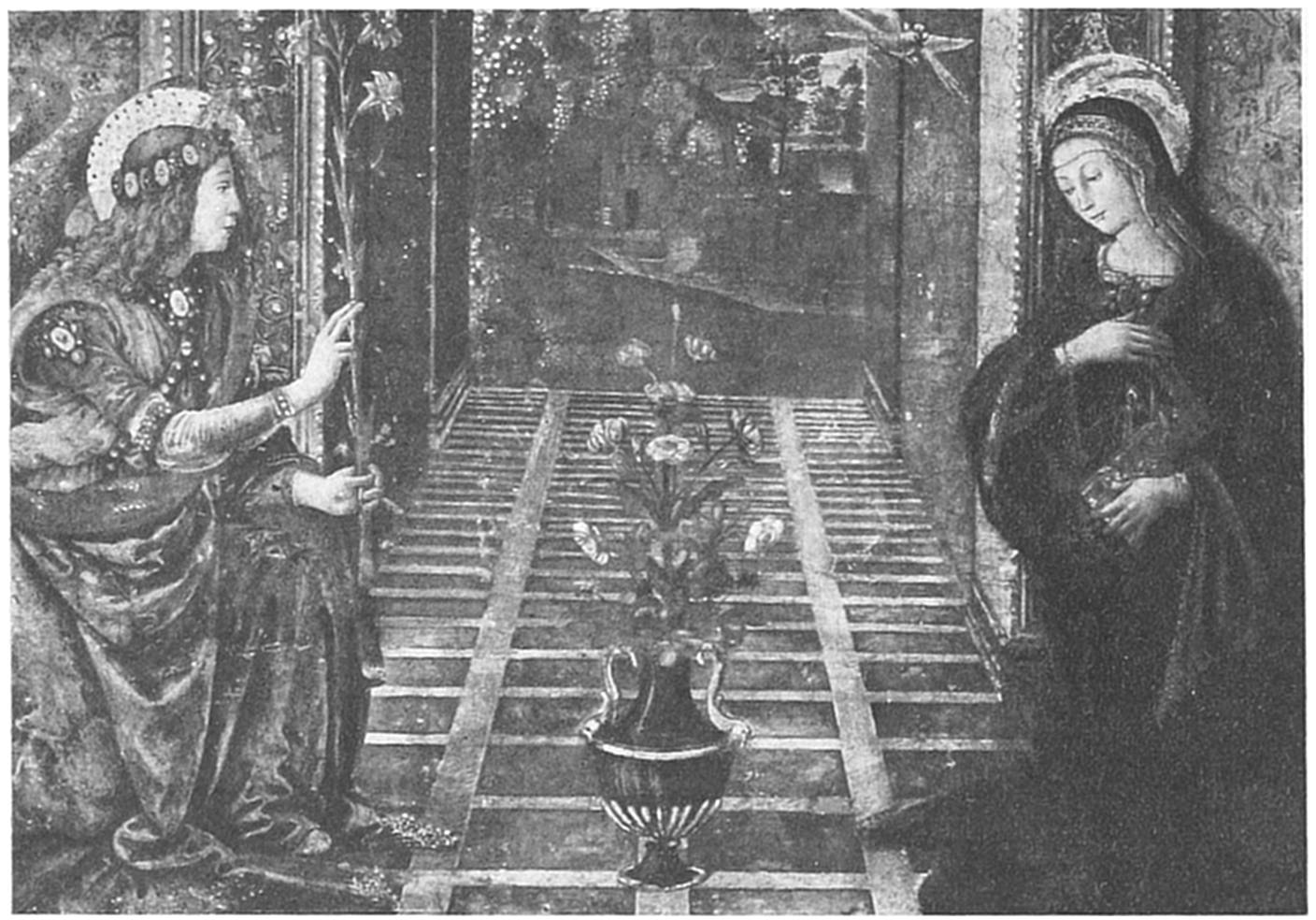
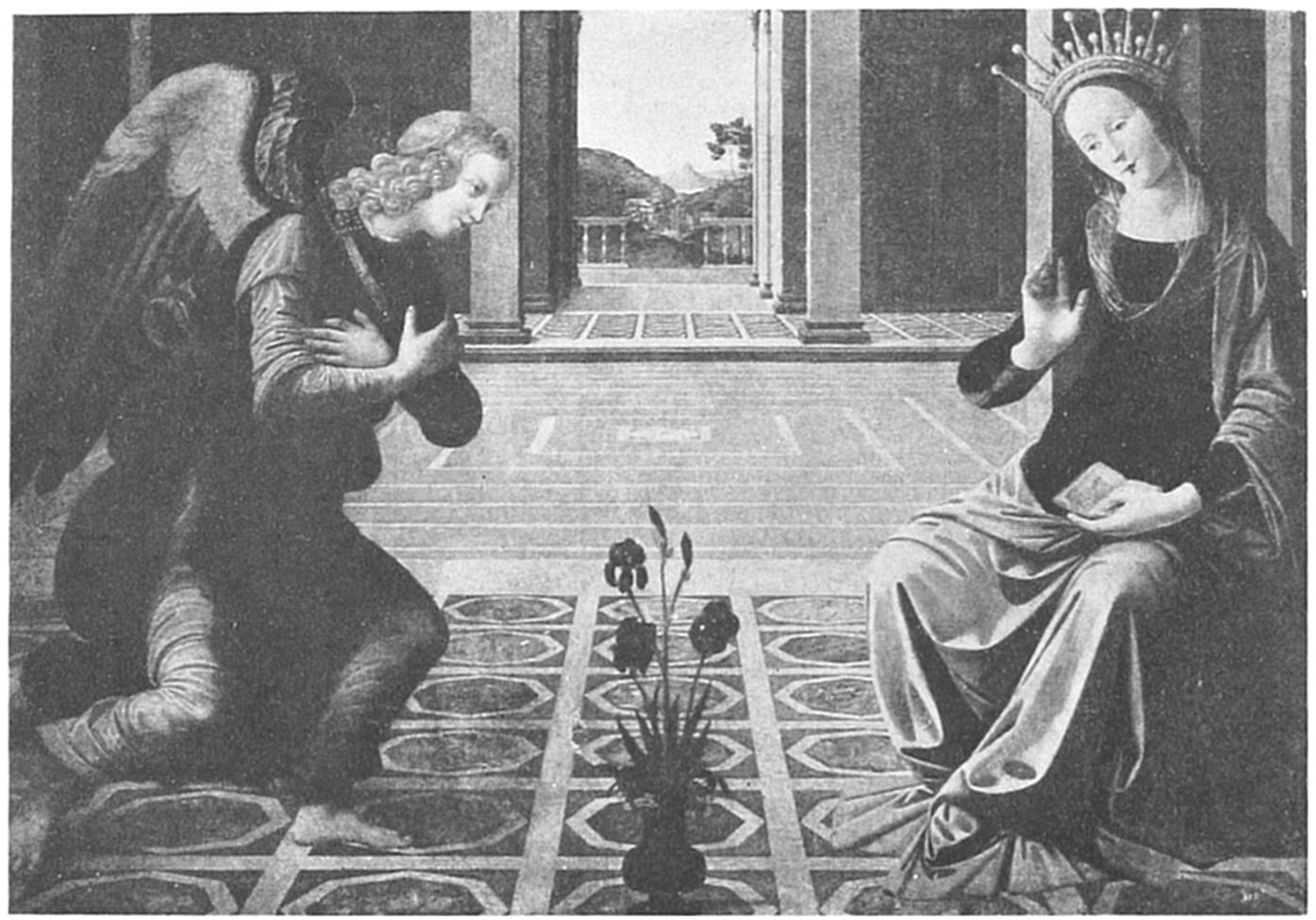
The iris is sometimes used symbolically in
Italy, and there is in the Church of S. Spirito
in Florence an ‘Annunciation’ now usually
ascribed to Pesello. Between Mary and the
angel stands a vase from which spring three
purple iris. This vase, on either side of which
the figures bend, is not merely a variation of
the vase of white lilies indicating the virginity
of Mary which is seen in so many early Annunciations,
but it is the same symbol developed
and enriched, till it represents the dogma of
the immaculate birth of Christ. The vase, in
many cases transparent, typifies Mary, and the
upspringing flower is the emblem of the incarnate
Godhead.47
Ghirlandaio places the iris, violet and daisy,
each growing up strongly and freshly from the
bare ground of the stableyard, in his ‘Adoration
of the Shepherds,’48 and in a picture of the sixteenth
century by Palmezzano of Forlì,49 the
Child, seated on His Mother’s knee, holds a
stem of iris as a sceptre; but, on the whole, the
iris was little painted in Italy.
In art which is purely German the iris is
very rarely used, though Albert Dürer painted
a ‘Madonna of the Sword-lily,’50 but in Spain it
holds an important place. Spanish art is poor
in symbolism, though it recognized early and
prized highly the white lilies of the Annunciation.
Except, perhaps, for the flame-tipped
dart of divine love, there seems to be no symbol
of truly Spanish origin, and those used by
Spanish artists were mostly taken from the
art of the Netherlands. Flemish art was profoundly
admired in Spain, and the Spanish were
well acquainted with it, for there was naturally
much intercourse between the two countries
in the days before the Netherlands established
their independence. Also Jan van Eyck visited
Portugal and Spain in the train of his patron,
Philip the Good of Burgundy, and from the
Hispano-Mauresque types in some of the later
work of the Master of Flémalle there is reason
to think that he, too, had been in the peninsula.
The symbol of the Flemish painters which
particularly appealed to the Spanish was the
iris, which grew small and wild upon their own
hills, and with a freer, heavier growth in the
palace gardens, whose admirable water-works
had been planned and executed by the despised
Moors. They adopted the iris as the royal
lily of the Virgin, the attribute of the Queen of
Heaven, as the lilium candidum was the attribute
of the Maid of Nazareth. The iris, therefore,
was deemed particularly suitable as a
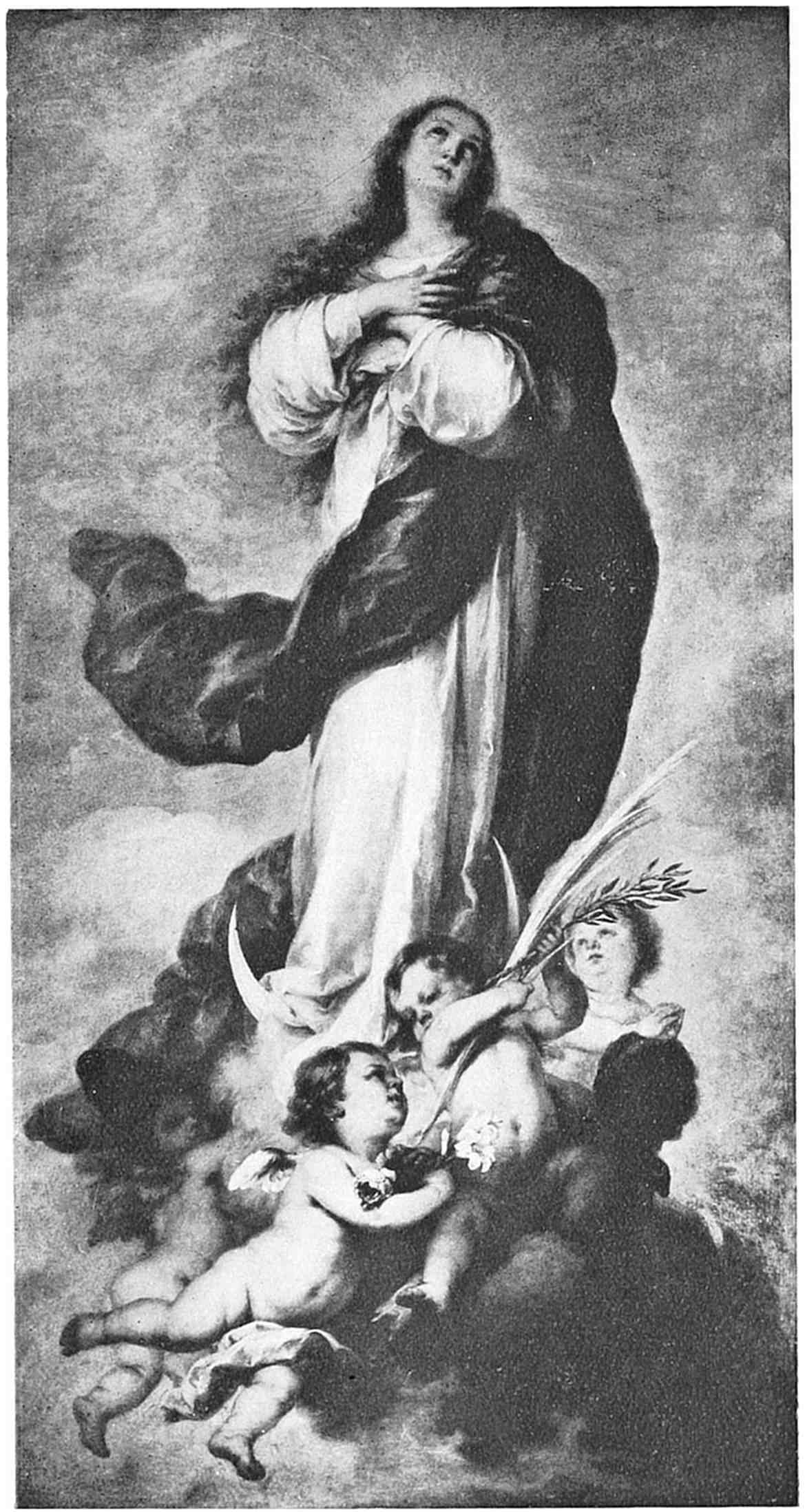
detail in that most favourite Spanish devotional
representation of the Virgin, an ‘Immaculate
Conception.’ The Virgin, represented as the
woman ‘clothed with the sun and the moon
beneath her feet,’ is usually attended by child
angels who carry roses, lilies, palm and olive.
The purple iris is generally added, and sometimes
the white lily is omitted and the iris only given.
The Spaniards, therefore, attached the same
idea of royalty to the iris as did the Flemings,
but transferred the attributes from the royal
Son to the crowned Mother, for in Spain it is
not found as the attribute or the emblem of the
Infant Christ.
Later, the whole Catholic Church seems to
have accepted both the iris and the lily, and the
mosaic altar-frontals of St Peter’s in Rome
bear a design in which the rose, the lily and the
iris are united.
V THE ROSE
Roses, among the Romans, were the symbol
of victory, of triumphant love, of the pride and
pomp of life, and were by long association as
pagan as the lily is sacred. The Madonna
lily (lilium candidum) was the flower of the
Virgin and of the virgin saints; the rose was
the flower of Venus.
In the ‘Triumph of Venus,’ by Cosimo Tura,52 the
goddess, who is in truth a modest-looking lady,
fully draped and firmly girdled, wears a crown
of roses, red and white. Beneath her cockle-shell
is another picture,53 the sea is ‘sucking
in one by one the falling roses, each severe in
outline, plucked off short at the stalk, but embrowned
a little as Botticelli’s roses always
are.’54
But the Church grudged Venus the flower.
Roses, said Wilfred Strabo, were the flower
of martyrdom. ‘Rosæ martyres, rubore sanguinis,’
wrote Saint Melitus, Bishop of Sardes,
in the second century, and Saint Bernard of
Clairvaux found the rose to be a fitting symbol
of the Passion of our Lord. But though the
rose was red to the colour of blood, and fenced
around with cruellest thorns, it had been so
long associated with the joys of life that the
world refused to recognize it as the flower of
death. Only as the sign of the triumphant
entry of the departed soul to Heaven was the
symbol acceptable. Roses sprang from the
blood of those who fell for their faith at Roncevaux
(as indeed they sprang from the spilt
blood of Adonis), but they were also the sign
of victory over the pagan, and when the Virgin
Mary was laid within her tomb it was in rejoicing
that ‘straightway there surrounded her
flowers of roses which are the blessed company
of martyrs.’55
But the Church, always wise in matters
æsthetic, did not insist upon the tragic significance
of the rose. It was allowed to be still the
symbol of love, but of divine love, and it is as
the symbol of the love of God that it now
decorates our churches in carvings of wood or
stone, in the silver work of church ornaments and
on embroidered vestments and altar frontals.
The rose has never been especially associated
with the person of Christ. Origen, who held
that the text which we render, ‘I am the rose
of Sharon,’ was a self-description of our Lord,
read the verse, ‘I am the flower of the field,’
so giving the Church no clear image. When
in art an emblem was required to represent our
Lord, the ancient catacomb devices of the
lamb and the vine were employed. Any reference
to Him under the metaphor of a flower
was rare and usually vague, as the charming
‘gold flower’ of the Blickling Homilies. ‘Then
the Queen of all the maidens gave birth to the
true Creator and Consoler of mankind, when the
gold-flower came unto this world and received
a human body from S. Mary, the spotless
Virgin.’
Or again as a fruit rising from the mystical
rose:
There are some mediæval Latin hymns for
the Nativity in which Christ is referred to as
the rose springing from the lily. The simile,
however, was by no means applied to Him
exclusively, for in a Visitation hymn of the
same period He is alluded to as the lily hidden
in the rose. But though the rose is not often
the emblem of Jesus Christ, both in literature
and art it is used as the symbol of His love.
Saint Mectilda, in the discourse on the
three perfumes of divine love, tells us that
‘the first of these perfumes is the rose-water
distilled in the still of charity from the most
beautiful of all roses, the heart of our Lord,’57
and repeatedly in ecclesiastical art, roses falling
or fallen from Heaven, signify divine love. The
lovely angels in Signorelli’s ‘Paradise’58 carry
roses in their looped draperies and scatter them
down upon the redeemed souls beneath, and in
Botticelli’s ‘Coronation of the Virgin’59 the air
is also full of roses, symbols of the love of God.
And symbols of divine love are also the falling
roses in that vision of Saint Francis which was
so often painted by Spanish artists and called
by them ‘La Portincula.’60 The saint, kneeling
in his cell one winter’s night, was much troubled
by the memory of a fair woman. To overcome
the temptation he went out and threw himself
among the briars of the wilderness. He was
rewarded by a vision of the Saviour, seated in
glory, with the Virgin by His side, and as a
token that his penitences were accepted the
thorns bloomed with roses. In most renderings
of the legend the mystical roses fall in a shower
around him, and in Murillo’s fine picture61 the
putti are energetically pelting the saint with
blossoms. It was a subject painted con amore
by the Spaniards, for—Assumptions apart—the
traditions of art in Spain were distinctly
gloomy and they seized where they could an
excuse for colour. Even Zurburan succumbed
to the roses.62
The roses which strew the floor of Heaven
in a famous diptych63 by an unknown English
painter are also symbols of divine love. The
panels show Richard II, who is presented to
the Virgin by Saint John the Baptist, Saint
Edmund and Saint Edward the Confessor. The
roses round the Virgin’s feet are pink and yellow,
and heavier, handsomer flowers than those
which are found in Italian pictures of the same
period. For the rest, this Heaven is especially
remarkable for the politeness of the blue-winged,
blue-robed angels, who each, in compliment to
their royal visitor, wear his badge—a white hart
couchant, collared and chained or—upon the
shoulder.
Red roses, said Saint Bernard, were symbolical
of the Passion of our Lord, but neither in Church
observances nor in art have they been generally
adopted with that meaning. There is, however,
a picture of the Christ-Child in Cadiz. He
holds the crown of thorns, and at His feet are the
globe and the apple. All around, filling the
background, are blood-red roses, symbol of the
Passion which was to come.
This forecast of pain in the Spanish renderings
of the Saviour’s infancy is even more
marked in a picture by Zurburan,64 where in
play He plaits a crown of rose thorns, the
flowers lying beside Him and at His feet.
Divine love and divine passion, intermingled,
may be what the roses indicate in many ‘Adorations’
of great beauty where the scene is laid
in a rose-garden. In the ‘Adoration’ of Neri
di Bicci65 the Holy Child lies surrounded by lilies
and red and pale roses. The lilies signify His
sinlessness and the roses apparently His love
and passion. The little Saint John stands
behind with a scroll on which is inscribed
‘ECCE AGNUS DEI.’
There is a lovely picture66 now ascribed to
Botticini, where angels playfully sprinkle rose
petals over the Infant Christ in a rose-trellised
garden. ‘They worship here always alone,
though there is no gate to the garden; the angels
have relinquished high Heaven for these delights;
for the scent of these roses which they
pluck, and the Child has relinquished Heaven
for these roses, and the thorns which he shall
gather from them ... the season of their
thorns is never over, and whilst it is the time of
roses in this picture, there is the forecast of
their thorns in it.’67
In the Speculum Humanæ Salvationis, a MS.
of the fourteenth century,68 the Holy Dove is
depicted upon a rose. From the bosom of a
seated figure, which represents David or Jesse,
a rose tree issues. At the summit of the tree
there is a five-petalled rose, in the centre of
which, as in a nest, sits a dove, which represents
the Holy Ghost.
The design is founded upon the text of
Isaiah which has been paraphrased by Pope:
‘From Jesse’s root behold a branch arise,
Whose sacred flower with fragrance fills the skies;
Th’ ætherial Spirit o’er its leaves shall move
And on its top descends the sacred Dove.’
The rose represents Christ, the perfect flower of
the human race, sprung from the root of Jesse, and
the dove descends upon it as the Holy Ghost descended
upon our Lord at His baptism in Jordan.
Saint Bernard, differing from Origen, identified
the Virgin Mary with the flower of the field and
also with the abstraction described as ‘Wisdom’
in Ecclesiasticus, ‘exalted like a palm tree in
Engeddi and as a rose plant in Jericho.’
‘Rosa Mystica, ora pro nobis!’
prays the Church.
‘Here is the Rose
Wherein the Word Divine was made Incarnate,’
wrote Dante.
An English hymn composed about the year
1300 has the lines:
‘Lavedy (Lady), flower of alle thing
Rosa sine spina
Thu bere Jhesu, hevene king
Gratia devina.’
And nearly two centuries later William Dunbar
wrote:
‘Hevins distil your balmy showris:
For now is risen the bricht day-stir
Fro the rose Mary, flour of flowris.’
Therefore, in the decoration of churches dedicated
to the Madonna, the rose frequently occurs.
It does not supersede the lily, which was the
flower especially consecrated to her, but it is
found beside it. The Church of S. Maria Maggiore
in Rome is ornamented along the aisles,
above the side chapels, with a series of panels,
gold on white, which show the floral emblems
of the Virgin. The rose, the lily, the olive, the
laurel and the vine alternate down the whole
length of the church. The beautiful little
chapel behind the shrine of the Santissima
Annunziata, in the Church of the Annunziata in
Florence, was decorated in the seventeenth
century with inlaid and raised pietra-dura work.
Each of the five onyx panels which form the walls
has upon it an emblem of the Virgin—the sun,
the moon, the Stella maris, the lily, and, most
lovely of them all, the branch of roses below
the words ‘Rosa Mystica.’ This rose is red,
and, strangely enough, the red rose, rather than
the white, was chosen to represent the Virgin.
Wrote Guido Orlandi in 1292:
‘If thou hadst said, my friend, of Mary,
Loving and full of grace;
Thou art a red rose planted in the garden;
Thou wouldst have written fittingly.’
In the Sarum Book of Hours, by Philippe
Pigouchet,69 published in 1501, the huge rose
held by the Virgin definitely illustrates her title
of ‘Rosa Mystica,’ but those pictures of the
early Florentine school, in which she holds a
small red or white rose, show her as the ‘Madonna
del Fiore,’ for as ‘Our Lady of the Flower’ she
had been installed patroness of the city of
Florence. It would have seemed natural, since
the lily was upon the shield of Florence, to have
placed a lily, her own flower, in the Madonna’s
hand. But the city of Florence had passed
through troubled times just before the revival
of her art, and the silver lily on her shield had
been replaced by one of crimson.
‘Had through dissension been with vermeil dyed.’70
Rather than paint her with the crimson lily, Florentine
artists gave her the rose, and she holds
a white leafless rose in the dainty little picture
by Fra Angelico which is now in the Vatican.71
There was an odd fancy about the beginning
of the eighteenth century to represent the Virgin
Mary as La Divina Pastora feeding her sheep
with roses. The original picture with this
title was by Alfonso da Tobar.72 He found
imitators both in Spain and France, and in
Southern Spain the popularity of the subject
still persists. There is a plastic group, nearly
life-size, in the Church of S. Catalina in Cadiz.
The Virgin is dressed à la Watteau with a
beribboned crook and a rose-wreathed hat.
She feeds with roses and lilies the sheep and
lambs gambolling round her knees; an almond
tree flowers above, and the Christ-Child, dressed
as a small shepherd boy, stands in front. It is
all pink and white, gay and dainty, in a corner
of the austere whitewashed convent chapel
which has Murillo’s beautiful ‘Marriage of
Saint Catharine’ above the altar. A similar
group, but more dignified in type and less frivolous
in detail, is in the Church of the Holy Trinity
at Cordova. They are strange artificial flowers
of that gloomy growth, Spanish Art.
VI THE CARNATION
In early German devotional poems the nelken,
the pink, carnation or gillyflower, is occasionally
used as the simile of the Virgin. Conrad
von Würtzburg writes:
‘Thou art a fragrant gillyflower sprig.’
But it has been given no definite and individual
status as a symbol.
Very frequently, however, in ecclesiastical
art, more particularly that of Venice and
Northern Italy, it is found where the rose
might be expected. It is placed with the lily
in a vase beside the Virgin, with the violet
before the Infant Christ, and with the wild
strawberries among the grass of Paradise.
In Germany the carnation is seen falling
from above with heavenly roses, and occasionally,
even, in spite of the written legend, it replaces
the roses in Saint Dorothea’s wreath.
It would appear, therefore, that the symbolism
of the carnation is identical with that of
the rose, and when, for any reason, the artist
did not care to paint the rose, he substituted
the carnation.
Each year thousands of carnation blossoms
are brought to the Lateran Church in Rome on
the feast-day of Saint John, and the people
bring carnations, not roses, because by midsummer’s
day the blooming time of Roman
roses is almost past. A scarcity of roses
would seem one reason at least in the Venetian
pictures of the fifteenth century why the carnation
replaces the rose. Earth, even sufficient
to grow a rose bush, was scarce in the sea-washed
city, but carnations then, as now, must
have grown in pots on every balcony. So the
Venetians painted their own familiar flower
rather than draw the rose, as Carpaccio did his
camels, from descriptions furnished by observant
travellers.
In the Netherlands and Germany artists
probably preferred the carnation to the rose.
It is more precise in shape, neater in its habit
of growth, richer in colour than the rose, and
therefore more in the spirit of Northern art,
which liked to express definite and closely-reasoned
symbolism with distinct bright colours
and sharply-realized form. In the South, the
artists, more concerned with the depicting of the
soul than with the outer shell of things, more
poetical and also more vague and less accurate
in their symbolism, were better pleased with the
more elusive charms of the loosely-petalled rose.
In an ‘Adoration’ by Botticelli73 the Holy
Child lies among violets, daisies and wild strawberries,
and the background is filled with freely-growing
roses, drawn apparently from memory,
not life. The roses signify the divine love
which impelled the Saviour of the world to be
born as a human Child. In the same subject
by Hugo van der Goes74 three carefully-painted
carnations are placed in a crystal vase, and are
symbols of the divine love of the Holy Trinity
by which God the Son became incarnate, the
crystal vase in Northern art typifying the Immaculate
Conception.
But in the Sienese and Florentine schools
also the carnation is sometimes found, and very
rarely in the same picture as the rose.75 Therefore
it would seem conclusive that when the
painter of the Church did not care to use the
rose because, probably, of its association with
Venus and scenes profane, he was free, if he
chose, to use the carnation as its substitute.
Strangely enough, the most famous carnations
in the history of art, those two which
have given the name of ‘The Master with the
Carnations’ to the anonymous Swiss painter
of the fifteenth century, seem to have no symbolical
significance. The picture76 shows Saint
John the Baptist preaching to King Herod from
the text: ‘It is not lawful for thee to have
thy brother’s wife.’ The King is in his chair of
state and the ladies of his court are seated upon
cushions on the tesselated pavement before
the pulpit. Directly below the pulpit lie the
two pinks; one is white and one red. Possibly,
since roses, according to Saint Melitus,77 Walafrid
Strabo78 and Saint Mectilda,79 are the symbols
of martyrdom, the carnation may foreshadow
the approaching death of the preacher, but they
are more probably simply a detail to give
verisimilitude to the composition, as is the dog
that worries a bone in the ‘Dance of Salome’
by the same master.
VII GARLANDS OF ROSES
‘Let us crown ourselves with rose-buds,’80
cried the revellers in the Book of Wisdom, and
at Roman feasts host and guests alike wore
roses on their hair or in garlands round their
necks.
So in the heavenly mansions, where life is
a perpetual feast, unfading roses crown the
elect. Wreaths of roses are the symbol of
heavenly joy and are worn alike by angels and
by the human souls who have entered bliss.
An early Christian prisoner dreamt that he
was already in Heaven:
‘Towards us ran one of the twin children
who, three days before, had been decapitated
with their mother. A wreath of vermilion
roses encircled his neck and in his right hand he
held a green and fresh palm.’81
Beneath Byzantine influence the rosy
wreaths turned to crowns of jewels, and in
the period between Constantine and Justinian
crowns were considered strictly necessary for
the guests at the heavenly feasts. But when
the King of Heaven Himself was present all
reverently uncrowned, and it is with their crowns
in their hands that the twelve apostles stand,
and the four-and-twenty elders in the mosaics
of Rome and Ravenna. In the Neapolitan
mosaics in the Chapel of Santa Restituta eight
figures, apparently of martyrs, hold large crowns
resembling a victor’s wreath, and the graceful
virgin saints on the wall of S. Apollinare Nuova
each carries her wreath.
The tall, grand angels of the mosaics have
neither wreaths nor garlands. They have
gained no crown because no strife has ever
troubled their serenity. They stand tall and
straight, haloed, with spear-like wands in their
hands.
After the twelfth century, however, the
apostles and martyrs no longer carry the crown
of victory, but it is the angels who wear wreaths,
usually wreaths of roses, which are the symbol
of heavenly joy. And, alas! what a lowering
in type there was from the grand, dignified
beings who guard the throne of Mary, on the
wall of S. Apollinare Nuova, to the childish,
peeping, rose-crowned little attendants which
crowd behind her chair in pictures of the Sienese,
Umbrian and early Florentine schools. The
archangels still keep some dignity, but the
sweet little doll-like creatures, rose-crowned
and golden-winged, of Fra Angelico seem an
inadequate representation of the hosts of
Heaven.
But a magnificent strong-limbed angel of
the Byzantine type would have overshadowed
the slight, transparent-fleshed Madonna whose
physique showed traces of the asceticism which
went towards the making of a saint. So the
angels, denied grand and vigorous frames, were
decked with dainty robes and crowns of roses.
Paul Bourget writes:
‘Ce double et contradictoire Idéal, celui
d’une extase monastique conquise dans le martyre
des sens et celui d’une beauté qui parle au
sens, semble avoir co-existé dans le Pérugin
et dans les peintres qui l’ont précédé ou accompagné,
particulièrement dans Benedetto Bonfigli,
dans Eusebio da San Giorgio, dans Giannicola
Manni et quelques autres dont la Pinacothèque
de Pérouse enferme les œuvres. Ce
rêve complexe a son symbole dans les anges de
Bonfigli, couronnés de roses, comme les impies
dont parle l’Ecriture “Couronnons-nous de roses
avant qu’elles ne soient flétries,” comme les convives
aussi des banquets paiens “Respirons
les roses tant qu’elles ressemblent à tes joues.
Embrassons tes joues tant qu’elles ressemblent
à tes roses.” Mais ces pauvres anges aux
cheveux fleuris tiennent dans leurs mains les
instruments de la Passion du Sauveur, et une
pitié douloureuse noie de rouge leurs douces
prunelles où roulent de grosses larmes.’82
But blissful souls as well as angels wear
roses. In the Paradise of Simone Martini,83
Saint Peter with his key has opened the gate
of Heaven and two angels standing by crown
with roses each soul as it enters.
And more particularly those souls are crowned
who in their earthly life could rejoice in their
faith even when overwhelmed with troubles.
Symbol of holy joy is the crown of roses
which Saint Cecilia wears. Her legend, like
other legends of the Early Church, is both more
poetic and more allegorical than those which
originated in later times.
Saint Cecilia lived in virginity with her
husband Valerian, who, through love of her,
became a Christian and was baptized.
‘And returning home he found Cecilia in
her chamber conversing with a glittering angel
... and he held in his hand two crowns of
roses and lilies, and he gave one of them to Cecilia
and the other to Valerian.
‘And on the morrow, when Tibertius came
to salute his sister-in-law Cecilia, he perceived
an excellent odour of lilies and roses, and asked
her, wondering, whence she had untimely roses
in the winter season.’ (That is, whence came
her holy joy during the season of persecution.)
‘And Valerian answered that God had sent
them crowns of roses and lilies but that he could
not see them till his eyes were opened and his
body purified’ (by baptism).
Then follows the account of the conversion
of Tibertius and the deaths of all three martyrs.
The ‘Second Nonne’ told the legend of the
saint very prettily to the Canterbury pilgrims:
‘Thou with thy gerlond wrought of rose and lilie
Thee, mene I, maid and martir Seint Cecilie.’
And her story appears to have been popular,
though strangely enough she has never ranked
in popularity with Saint Margaret, Saint
Catharine of Alexandria, or Saint Barbara, notwithstanding
that her story is certainly better
authenticated than theirs, the historical details
of her martyrdom having been proved beyond
dispute. But she is essentially a Roman saint,
her body lying in Trastevere on practically the
spot where she suffered martyrdom under
Marcus Aurelius, and with the strange jealousy
of Italian cities she was almost ignored by
Siena, Florence and Venice till Raphael, Roman
in all his sympathies, painted the fine picture
now in Bologna. In this picture, where she
appears as the patroness of Music, she has no
roses, but Luini84 dresses her head charmingly
with white roses and anemones.
More fortunate than Saint Cecilia, Saint
Dorothea is beloved in almost all Christian
countries, for coming from Cappadocia there
could be neither vauntings nor heart-burnings
on her account in the Christian cities of Europe.
She too wears the roses of her legend.
‘Send me then some roses from the Paradise
of your Christ,’ scoffed the noble youth, Theophilus,
as she passed to execution. At the
moment of death an angel appeared with three
roses and three apples. ‘Take them to Theophilus,’
said the saint, and Theophilus, believing,
died a martyr.85
Saint Dorothea is usually painted with both
apples and roses, symbols of the good works
of a Christian life and of the holy joy even in
the hour of death, which, reported to Theophilus,
astonished and finally converted him. She is
very popular both in the Low Countries and in
Germany. There is a charming triptych at
Palermo, the best picture Sicily possesses, attributed
usually to Mabuse. On one wing
Saint Dorothea is depicted seated on the ground
with her lap full of red and white roses, a quaint,
compact little figure, not a slender Italian
maiden, supported by angelic visions, already
half in Heaven, but of the sturdy Flemish type,
who, having with clear brain calculated the cost,
sets herself with stoicism to endure the pain
which would be rewarded by the martyr’s
crown of unfading roses.
Curiously enough, the Virgin’s crown is
usually of gold and precious stones, though in
one of Velasquez’s rare religious pictures, ‘The
Coronation of the Virgin,’86 God the Father places
upon her head a wreath of red and white rose
blooms. In the best period of Italian art the
Virgin wears no crown except at a ‘Coronation,’
when most often it is of gold. In Germany the
crowns are large and heavily jewelled, and in
the Netherlands a jewelled fillet was very
generally placed upon her hair. A notable and
beautiful exception to these fillet-like coronets
is the magnificent symbolical crown of jewels
and fresh flowers which she wears as Queen of
Heaven in Hubert van Eyck’s ‘Adoration of
the Lamb.’87 It was only in late art, that is,
after the sixteenth century, that representations
of Mary with the Child in her arms, as Queen of
Heaven, or as ‘La Purissima,’ became common.
Previously she had been painted as a human
mother with the sorrows of her motherhood
still upon her. As the mother, the greatest
of whose seven sorrows has not yet come, she
would not yet carry the rose crown which symbolized
joy, even though it were heavenly joy,
and by the time religious sentiment demanded
representations of Christ’s mother, risen to glory,
all sorrow past, the Church had decided to depict
her as the woman ‘clothed with the sun
and upon her head a crown of twelve stars.’
Akin to the wreaths of roses worn by angels
and saints are the hedges and rose-trellises of
Paradise.
Dante pictures Heaven as one great and
marvellous rose-bloom:
But the artists of the Church have usually depicted
Heaven not as a rose but as a rose-garden;
and as a second and more perfect Eden rather
than as the Holy City, the stupendous piece of
jeweller’s work described in the Revelation of
Saint John. A few Flemish and German artists
have attempted to realize the jasper wall, the
‘pure gold like unto clear glass,’ and the ‘foundations
garnished with all manner of precious
stones,’ but for the majority of artists on both
sides of the Alps Heaven was a paradise, a
garden. The prophet Esdras describes it in
detail:
‘Twelve trees laden with divers fruits,
‘And as many fountains flowing with milk
and honey, and seven mighty mountains, whereupon
there grow roses and lilies.’90
The Byzantine Guide to Painting91 directs
that Paradise be depicted as ‘surrounded by a
wall of crystal and pure gold, adorned with
trees filled with bright birds,’ so combining
both visions of the home of the blessed.
But Western art usually paints Heaven
simply as a garden with twelve or six fruit trees,
little fertile mounts, and grass thick with flowers,
among which lilies and roses predominate.
The celestial meadow of Hubert van Eyck92
has grouped trees as in a park and bushes covered
with roses, and there are roses on bushes and
trellises, crowns of roses and roses woven into
swinging garlands in that most alluring of all
painted paradises set by Benozzo Gozzoli upon
the walls of the Palazzo Riccardi.93 ‘Roses
and pomegranates, their leaves drawn to the
last rib and vein, twine themselves in fair and
perfect order about delicate trellises; broad
stone-pines and tall cypresses overshadow them;
bright birds hover here and there in the serene
sky; and groups of angels glide and float through
the glades of an entangled forest.’94
It is a paradise after the own heart of a
Medici, in which no monotony, no boredom need
be apprehended, full of gay and witty folk and
the most gorgeous angels that were ever seen.
The roses of Paradise must not be confused
with the rose hedge or trellis so often placed
behind the Virgin by the early German schools.
These hedges indicate the ‘Hortus Conclusus’
and identify the Virgin with the bride of the
Canticles by recalling the verse, ‘A garden enclosed
is my sister, my spouse.’ This enclosure
is sometimes fenced merely by a row of flowers,
sometimes by a fortress-wall, and is often an
elaborate garden. An early instance by a master
of the Middle Rhine,95 dating from about 1420,
gives eighteen recognizable species of flowers
and ten varieties of birds. The Madonna sits
reading beneath a tree. One saint gathers
cherries and another draws water from a fountain.
Saint George, Saint Michael and a young
man chat beneath a tree, and a pretty young
saint with flowers in her hair teaches the little
Christ to play the psaltery. Other gardens
contain no flowers but the various objects used
as similes of the Virgin—the Tower of Ivory,
the Closed Door, the Sealed Fountain, etc.
Very often there is merely a trellis with roses
climbing up it, and the flowers which express the
virtues of Mary, the lily, violet and strawberry,
grow at her feet. The thorns on the roses are
carefully drawn, even accentuated, illustrating
the verse, ‘As a lily among thorns, so is my
love among the daughters;’96 but in spite of
the thorns the general significance of these
roses also is joy and delight.
In the Netherlands, where theologians occupied
themselves less with this second chapter
of the Song of Solomon, Madonnas set en plein
air are scarcely found. The van Eycks and
Memling inaugurated the fashion of arranging
their devotional groups in chapel-like niches,
or in the aisle of some large church. Any garden
there is seen in glimpses between pillars
or through windows, and has no mystical
meaning.
Stefano da Zevio
Photo Anderson
THE ‘ENCLOSED GARDEN’ OF THE VIRGIN
(Royal Museum, Verona)
In the work of Botticelli and his school we
again see enclosed gardens of roses, but these
are rather gardens of adoration, for in the centre
the Virgin kneels before the divine Infant. As
in all Adorations the symbolism refers to the
Child, and these roses symbolize the Divine
Love which sent Him to this earth, and are not
the attributes of Mary or an indication of the
joy in Heaven. A true hortus conclusus of
Italian origin is that of Stefano da Zevio or
da Verona.97 The Virgin, with the Child upon her
knee, sits upon the ground in a carefully walled in
garden, of which the only other human occupant
is Saint Catharine, who strings a crown of roses.
The garden is full of birds and bird-like angels,
and in one corner is the ‘sealed fountain’ of the
Canticles.
As a general rule, roses massed together, in
garlands, in baskets, or thickly growing, are the
symbols of heavenly joys, and single roses are
the symbols of divine love. But there is one
single rose which is also the symbol of joy—it
is the golden rose which is the gift of the Popes.
Durandus writes: ‘So also on the Sunday,
Lœtare Jerusalem, the Roman Pontiff beareth
a mitre, beautified with the orfrey, on account
of the joy which the golden rose signifieth, but
on account of the time being one of sadness, he
weareth black vestments.98
‘St Leon is seen upon the châsse of Charlemagne99
with the golden rose in his right hand.
The golden rose being the image of Heaven,
according to the Liturgy, it became, in the hands
of the Pope, the equivalent of a benediction.
One remarks that, in the epoch of which we
speak, the very poetical rite of the golden rose,
most ancient in the Church, had just acquired
a new celebrity. The sending of the symbolical
flower had replaced, in the Roman court, that of
the keys of confession, and Innocent III had just
consecrated a discourse to explain its mysterious
signification.’100
The sending of the golden rose was a very
old custom, dating at least from the time of
Gregory the Great. The rose was solemnly
blessed by the Pope on the fourth Sunday in
Lent and sent by him to some sovereign, church
or community. Urban V first made the ceremony
annual about 1366.
This rose, symbol of the Church’s blessing,
was often a thing of beauty and fine workmanship.
Stefano del Cambio describes that one
which was sent in his time to Florence.
‘On Easter Sunday morning, the 2nd of
April 1419, Pope Martin V, after having performed
Mass, gave the golden rose to our magnificent
Signoria, in remembrance of the honours
paid him by the Florentine people.... Our
Signoria then returned to their palace with all
the court of Cardinals and Prelates and the afore-said
rose bush, which was a golden branch with
leaves of fine gold. On it were nine roses, and
a little bud on top of the nine, which contained
spices, myrrh and balsam.’101
Sometimes the ‘rose’ was a whole rose bush
about two feet high and covered with leaves and
flowers. Two such bushes, one thornless, the
gift of Pope Alexander VII, and the other,
with long sharp thorns, though curved harmlessly
downward, presented by Pius II, are still
treasured by grateful Siena.
VIII THE COLUMBINE
We read in Isaiah: ‘And there shall come
forth a rod out of the stem of Jesse, and a
Branch shall grow out of his roots; and the
Spirit of the Lord shall rest upon him, the Spirit
of wisdom and understanding, the Spirit of
counsel and might, the Spirit of knowledge and
the fear of the Lord.’102
‘These words were addressed to the Messiah.
The Divine Child was therefore clothed with
the Spirit of God, whose faculties are seven in
number, for He possesses as His peculiar gifts,
wisdom, understanding, counsel, strength, knowledge,
piety and fear.
‘This subject has frequently been portrayed
by Christian artists. A tree springs from the
bowels, the breast or the mouth of Jesse. The
symbolic trunk spreads to the left and right,
throwing forth branches bearing the Kings of
Judah, the ancestors of Christ; at the top,
seated on a throne, or the chalice of a gigantic
flower, is the Son of God. Surrounding the
Saviour, and forming as it were an oval aureole,
seven doves are ranged one above the other,
three on the left, three on the right, and one at
the top.... These doves, which are of snowy
whiteness, like the Holy Ghost, and adorned
like him with a cruciform nimbus, are simply
living manifestations of the seven gifts of the
Spirit. The Holy Ghost is drawn under the
form of a dove; each of the seven energies distinguishing
Him is also figured under the same
type.’103
These little doves surrounding the figure of
Christ, as a man or as an infant, occur very
frequently in the French miniatures of the
thirteenth and fourteenth centuries, and are
found upon the windows in the cathedrals of
S. Denis, Chartres, Amiens and Beauvais, and in
many other French churches.
It was an essentially French development
of Christian symbolism, and it is in Flemish
art, which drew its inspiration from the French
Renaissance, that we first find, not the little
white doves, but the columbine flower. The
columbine grows wild in most countries of
Europe and is usually dark blue in colour.
Each of its five petals is so shaped that it
is really very like a little long-necked dove.
The little doves are only five in number,
but the Flemish painters take each flower, not
each petal, as the symbol, and give seven
blooms upon each plant. There are six, and
the edge of the seventh is just showing, in the
mystical crown worn by Hubert van Eyck’s
‘Queen of Heaven.’104
Strictly speaking, however, Mary has no
right to these symbols of the gifts of the
Spirit, for it was to the expected Messiah
that the divine gifts were promised. The
columbine is more correctly used by Hugo
van der Goes, who in his ‘Adoration of
the Shepherds’105 places a columbine, with seven
flowers upon it, in a vase before the Infant
Saviour.
The seven gifts of the Spirit are according
to Isaiah:
Sapientia
Intellectus
Consilium
Fortitudo
Scientia
Pietas
Timor.
And according to the Apocalypse:
Virtus
Divinitas (in the Vulgate)
Sapientia
Fortitudo
Honor
Gloria
Benedicio.
But, at the Renaissance, Faith, Hope and
Charity were taken as the theological virtues,
and to them were added the four moral virtues
exalted in pagan times above all others,
namely, Prudence, Justice, Temperance and
Strength.106
In a picture by Jörg Breu of the Virgin
with the Child and two saints,107 a vase of
columbine, the only flowers introduced, is placed
in the foreground just below the Child, who stands
on His Mother’s knee.
Beside the vase is a sort of casket, out of
which seven little cupid angels take seven
scrolls. On the respective scrolls are inscribed:
FIDES, SPES, CHARITAS, JUSTICIA,
PRUDENCIA, FORTES. The seventh is
blank, reserved, perhaps, for TEMPERANCE.
A crowned saint, seated beside the Virgin, holds
upon her knee a scroll on which is written
‘AVE REGINA,’ and above the Virgin’s head
hover two putti with a heavy crown. It is
therefore to the Mother, rather than to the
Child, that devotion is directed, and the seven
Gifts are to be taken as her attribute.
In 1475 the ‘Adoration of the Shepherds’
by Hugo van der Goes was brought to Florence
by Tommaso Portinari, for the Chapel of the
Hospital of Santa Maria Nuova. Its technique
excited the greatest interest among the artists
of Italy, and the vase of columbine in the foreground
may have first drawn their attention to
this symbol. Cosimo Rosselli, perhaps the last
of the Florentine symbolists, painted it among
the daisies, strawberries and jasmine-shaped
flower in the ‘Madonna with the Child and SS.
Peter and James,’108 commissioned in 1492. After
the fifteenth century it is fairly frequent in
Italian art. Two of the most charming of the
Madonna pictures now in the Brera, ‘The Virgin
and Child with the Lamb,’ by Sodoma, and
‘The Virgin of the Rose-hedge,’ by Luini, both
introduce the columbine. But the Italian artists
use it vaguely, as the flower of the dove, the
flower in some degree sacred to the Holy Ghost,
and lost sight of the original connection with
the seven Gifts of the Spirit. Luini, who is
careless with his symbolism, though painting
flowers exquisitely, uses the columbine also as
an accessory in the famous portrait known
as ‘La Colombina,’109 but here, of course, it is
simply a graceful flower in the hand of a fine
woman.
It is most unusual to find any flower used
symbolically in scenes representing the Passion
of our Lord. Should plants or shrubs be there,
it is merely as an indication that the place of
Crucifixion was beyond the walls, and that the
place of burial was a garden. They have no
special meanings as symbols. An exception is
the ‘Entombment’110 of Hans Schüchlin of Ulm.
From a rock in the foreground springs a plant
of columbine with three drooping flowers. On
a smaller plant at the side are four more blossoms,
making up the mystic seven. There are only
these columbines and a little short grass. On
the step of the tomb lies the crown of thorns
which has fallen from the head of the dead
Saviour as the disciples lower His body to the
grave.
The seven blooms of the columbine appear
again in the Thomas-altar111 by the master of
the Bartholomew-altar, who painted during the
first twenty years of the sixteenth century. It
is a disagreeable picture, the types poor and the
action of the doubting Thomas, as he thrusts his
hand into the Saviour’s wound, distinctly brutal.
But all round the feet of the risen Saviour lie
flowers scattered on the broad stone step.
There are again the seven heads of the columbine,
snapped off short and showing scarcely any
stalk; there are the violets of humility and the
daisy, often seen with the violet as the symbol
of perfect innocence in Adorations of the Infant
Christ, but rare when He is represented as
a grown man. There is also the strawberry
flower but not the fruit.
After the sixteenth century the columbine
seems to have dropped from Christian symbolism,
and in modern religious art it has no place.
counselled the Greeks when conscious that the
deities were offended.
The olive was the gift of Pallas. The tale
ran that in the reign of Cecrops both Poseidon
and Athena contended for the possession of
Athens. The gods resolved that whichever of
them produced the gift most useful to mortals
should have possession of the land. Poseidon
struck the ground with his trident and straightway
a horse appeared. But Athena planted the
olive and the gods thereupon decreed that the
olive was more useful to man than the horse,
and gave the city to the goddess, from whom it
was called Athenæ.113
But the symbolism of the olive, founded
upon its healing qualities and its oil’s well-known
property of calming roughened water,
was not only Grecian: it was wide-spread, and
the Romans used it politically as well as religiously.
Their heralds carried olive on an embassy
of peace, and the custom lingered in Italy
through the Middle Ages; Dante describing how
the multitude ‘Flock round the herald sent
with olive branch.’
In Christian art the olive also invariably
represents peace or reconciliation, and it is first
found in the Catacombs, where there is a curious
painting of the mystic fish which swims towards
the Cross with a sprig of olive in its mouth. The
fish, by the well-known anagram, represents Christ,
who, through the Cross, brings peace on earth.
A dove with an olive twig in its beak is also
found upon early Christian tombs. And then,
as Tertullian says, ‘it is a symbol of peace even
older than Christianity itself’114—the herald of
the peace of God from the very beginning.
Sometimes the word itself, ‘Pax,’115 is added,
thereby marking the sense beyond all possibility
of dispute; viz., that it is meant to assert of the
soul of the deceased that it has departed in the
peace of God and of his Church.116
Tertullian refers, of course, to the dove sent
forth by Noah which returned across the waters,
and ‘Lo! in her mouth was an olive leaf plucked
off,’ sign that the wrath of God was appeased.
The dove, bearing the twig of olive, executed
in coloured marbles, occurs repeatedly in the
decoration of Saint Peter’s. Here the dove represents
the Church bearing the Gospel message of
peace to the world. The same emblem is found
in the decoration of St John Lateran, and Pope
Innocent X. incorporated it with his coat of arms.
The olive naturally appears as an attribute
in allegorical figures of Peace. One of the
earliest and most famous of these figures is in
Ambrogio Lorenzetti’s great fresco entitled
‘Good Government.’117 The golden-haired Peace,
who wears a white robe, is crowned with olive,
and carries an olive branch in her hand. She
has a beauty of her own, but compared with the
more virile figures in the composition, Fortitude,
Prudence, Temperance and Justice, she is a
little heavy and inert, a little wanting in interest,
as the citizens perhaps would have found their
daily life were they condemned to days of peace.
In small, fierce Siena the olive was a very
favourite symbol and found more frequently
than any other. One of the most curious characteristics
of religious art is the inexactitude with
which it reflects a people’s mood, for the ideal
upon the wall above the altar is often just precisely
that to which they do not strive. When
the Medici were in power and Florentine social
life was at its worldliest, simplicity and purity,
almost austerity, were demanded of the artist,
and the lily was the favourite symbol. Murillo
painted Madonnas to the Church’s order, sweet
and forgiving, kind to indulgence, almost voluptuous,
at a moment when not only the devotions
of Jews and heretics but the private life
of every citizen of Seville was under stern control.
And in Seville, with inquisitorial fires
blazing, the Virgin had as attribute the rose of
love and charity. So the turbulent Sienese, who,
when no enemy knocked at the gates, fought
with one another, loved a still and peaceful
art. It was conservative, for they cared for
no novelty, no variety of subject, pose or action.
And their favourite symbol was the olive branch
of peace. The angel Gabriel almost invariably
carries olive,118 Saint John the Evangelist119 and
Saint Ansano,120 their own saint, both hold
branches of it, and it crowns the blonde curls
of many a little angel.
In representations of the first and third
persons of the Holy Trinity the olive branch is
very rare. Upon some ancient crucifixes, however,
where a hand holding a wreath represents
the Eternal Father, the wreath, though usually
of laurel, in some instances is formed of olive.
In the Crucifix of the tenth century, known as
the Crucifix of Lothair,121 the wreath is distinctly
of olive, but since it encircles the Holy Dove the
olive is perhaps equally the attribute of the
Holy Ghost. In the Crucifix upon the Manual
of Prayer of Charles the Bald,122 the wreath is of
laurel and there is no dove.
Mabillon speaks of a group of the Trinity in
human form, sculptured by order of Abelard
at the Paraclete. In it the Father wore a closed
crown, the Son a crown of thorns, and the Holy
Ghost a crown of olive. The group has long
since disappeared, and there seems no other
instance of the Holy Ghost in human form
being represented with the olive. A dove
bearing an olive twig could not be an emblem
of the Holy Ghost unless the bird’s head were
encircled with a halo.
But Christian art uses the ancient symbol
of peace repeatedly when illustrating Christ’s
life upon earth. First we find the angel Gabriel
bringing to the Virgin a branch of olive as token
that his message is of peace. Sometimes he is
also crowned with olive. He comes crowned
with peace, and the branch in his hand foreshadows
the reconciliation between God and
man which is to come by the Child whose advent
he announces.
The olive branch took precedence of the lily
as the symbol carried by the announcing angel.
Originated probably by Simone Martini, one of its
earliest instances is in his Annunciation now in
the Uffizi. In the Florentine school the simple
stick carried by the herald angel evolved, as we
have seen, through the fleur-de-lys to the stem of
lilies. In Siena it was the meaning of the wand,
rather than the wand itself, which was developed.
The wand simply marked that Gabriel was a
herald; that it was a message of peace and
goodwill which he brought was shown by the
grey-green leaves of the olive. As a symbol
it was by no means of Simone Martini’s own
finding, for it was a very usual political symbol
of the day, but he seems to have been the first
to have placed it in the angel Gabriel’s hand, and
the school of painting in Siena whole-heartedly
and faithfully adopted his device. The general
trend of Sienese symbolism was to direct devotion
to the incarnate Godhead rather than to
Mary of Nazareth, and it is of Him, as the bringer
of peace on earth, that the branch of olive tells,
as elsewhere the white lily proclaims the
virginity of the coming motherhood.
Then again, on that night when the angels
sang of peace on earth and goodwill towards
men—
In one of the most naïve and fascinating of
all Botticelli’s pictures124 the angels crowned
with olive hold up branches of it against the
golden sky. Other angels, half distraught with
joy, run with waving olive-sprays to greet the
astonished shepherds.
The same subject is much more soberly
treated by Sano di Pietro.125 One angel, flying
through the twilight, brings a twig of olive
to the shepherd who is sleeping on the
hillside.
There are many symbolical fruits placed in
the hand of the Infant Christ. Botticelli paints
a pomegranate, Mabuse a quince, Memling an
apple, Il Moretto a pear, and each represents
the individual artist’s conviction as to what
really was the unnamed fruit of the Tree of the
Knowledge of Good and Evil which grew in
the midst of Eden. The placing of the olive,
symbol of reconciliation, where it might be
confused with the fatal fruit which made that
reconciliation so imperative was carefully
avoided, and we rarely find the olive branch in
the hand of the Child when seated on His mother’s
knee. And there was still another reason. He
had Himself said: ‘I come not to bring peace
upon earth, but the sword,’ therefore the earlier
and more literal artists refused Him the symbol
of peace, even as divine peace. There are,
however, instances of the Christ-Child with the
olive branch, of which the most important is
the ‘Holy Family’ by Mantegna.126 The Christ,
a beautiful and dignified childish figure of three
or four years old, stands on a sort of pedestal
with the little Saint John. He holds a branch
of olive in His right hand, upright like a sceptre,
and in the other is the crystal orb which symbolizes
sovereignty. Saint Joseph stands behind
and the Virgin lays a rosebud at her Son’s feet.
The Bringer of Divine Peace was an aspect
of the incarnate Son of God on which Mantegna
laid emphasis. In the ‘Holy Family,’ now in
Dresden, painted about the same period, the
little Saint John holds a branch of olive (from
which two tiny side-sprays grow naturally in
the form of a cross) as an attribute of the
Holy Child.
The olive branches of the ‘Entry into Jerusalem,’
like the olives of Gethsemane, were only
accidentally allegorical. The villagers of the
Mount of Olives cut down branches (presumably
olive branches) ‘and strewed them in the way.’
With palm branches they would salute any
popular leader, and it is scarcely to be believed
that they definitely selected the olive and
palm with the full understanding of the symbolism
which the Christian Church attaches to
them.
‘The olive branches signify his office as
peace-bringer and the palms his victory over
Satan.’127
There is in the Catacombs a figure of the
Virgin Mary praying between two olive trees.
Her name is inscribed above her head. She is
standing with raised hands in the early attitude
of prayer, and these olive trees apparently symbolize
‘the peace of God which passeth all
understanding.’ But after the twelfth century
the Church had identified the personality of
the Virgin with the figure of Wisdom eulogized
in Ecclesiasticus, and the olives which are sometimes
found beside her refer to the verse which
compares her to
Botticelli painted a beautiful ‘Madonna of the
Olives’ for the Church of S. Spirito. Vasari
writes of it: ‘In S. Spirito in Florence he has
painted a picture for the Chapel of the Bardi
which is carefully executed and well finished,
where there are some olives and palms painted
with great love.’129 In another picture by Botticelli130
angels hold above the Virgin’s head a
lightly-framed crown of gold which is decorated
with fresh sprays of lily, palm and olive.
The most popular of modern Italian representations
of the Virgin and Child is very justly
that painted by Niccolò Barabino131 and entitled
‘Quasi Oliva Speciosa in Campis.’ Large
branches of olive, painted also ‘with great love,’
are placed about the feet of the sweet-faced
Mother, who peeps through her heavy white
veil, and they almost hide the fruit of temptation
which lies on the ground beneath.
Martin Schöngauer
GABRIEL CROWNED WITH OLIVE BRINGS THE MESSAGE
OF RECONCILIATION
(Print Room, Alte Pinakothek, Munich)
One of the putti which fly round the feet
of the Madonna in a Spanish ‘Immaculate Conception’
usually carries a branch of olive, and
that, too, bears the same meaning. As an olive
tree in a pleasant field she brings peace and consolation
to mankind. She is the ‘Mater Consolatrix.’
Sodoma painted a stately figure of Saint
Victor,132 with sword and palm, and the little
rose-crowned child-angel who supports his shield
holds above it a branch of olive, symbol of the
peace which to a Christian warrior should be
the end of victory.
The same idea dominates the ‘Judith’133 of
Botticelli. The slayer of her country’s enemy
returns thoughtfully home, satisfied but not
exultant. In her right hand is her sword, carried
low; upright, in her left, a branch of olive.
Though her deed was bloody, she had brought
peace to the land.
Flemish art neglects the olive, and except in
the drawings of Martin Schöngauer,134 whose
grave gentle Gabriels wear olive crowns, it is
seldom seen in Germany. The reason is easy
to guess. The olive tree not growing in the
North, the painters would be at a loss to find a
branch from which to draw, and the people,
unacquainted with the leaf, would scarcely
recognize its hidden message of peace. In
France it is seen less rarely. On the sculptured
portal of the Cathedral of Amiens there is a
curious rendering of the parable of the Wise and
the Foolish Virgins. A withered olive tree, without
fruit or leaves, grows by the side of the
foolish maidens, and a healthy olive tree, laden
with fruit and ready with abundance of oil, is
beside those maidens who were wise.
But on the whole the olive is an Italian, and
more particularly a Sienese, symbol, though
Botticelli also loved the silvery leaves. In
his magnificent ‘Pallas taming the Centaur,’135
painted for Lorenzo de’ Medici, to commemorate
his diplomatic victory over the King of Naples
and the League in 1480, olive encircles the head
of the lovely goddess and is wreathed about her
dress. The surface meaning of the picture is
that, by the arts of peace taught them by the
beneficent goddess, men were enabled to overcome
the savagery of nature, typified by the
centaur. But it also shows, allegorically, how
the wise statesmanship of Lorenzo (with whose
badge, rings interlaced, the gown of Pallas is
‘semé’) guided the war-loving League, here
figured as the centaur, into the ways of Peace.
X THORNS
Thorns and thorn branches signify in general
grief and tribulation, the word tribulation itself
being derived from a Latin root signifying
thistles or briars. But, according to Saint
Thomas Aquinas, thorn bushes signify the
minor sins, and growing briars or brambles
those greater ones, ‘quæ pungunt conscientiam
propriam,’ etc.
He is supported in his opinion by Saint
Anselm, and both saints explain in this sense
the words of Saint Paul, who wrote to the
Hebrews:
‘That which beareth thorns and briars is
rejected and is nigh unto cursing, whose end is
to be burned.’
The crown of thorns with which jesting
soldiers crowned the Christ was in itself an
emblem, or at least a parody, of an emperor’s
festal rose-crown. According to The History
of the Crown of Thorns of the Holy One,136 the
first crown with which Jesus Christ was crowned
was made of white-thorn and was removed
before the Crucifixion and replaced by a second
de juncis marinis.
But in the great majority of scenes from the
Passion the crown is merely formed of large thorns
without any attempt to realize any particular
natural growth. In Germany, where Entombments
and Pietàs were more often painted
than in other countries, the crown is frequently
green, in allusion, it is suggested, to the words:
‘If these things be done in the green wood, what
shall be done in the dry?’
In these pictures the crown of thorns, if not
still upon the Saviour’s head, is usually placed
very prominently in the foreground, marking
to some extent the divinity of the dead Christ,
for, since life had fled, there could be no
halo.
In Northern art the crown of thorns remains
always unchanged, the symbol of Christ’s sufferings,
but in at least one Italian Pietà,137 the dry
prickles round the dead Christ’s brow have
bloomed with delicate white briar-roses—an
exquisite figure of Love’s triumph over Pain.
Sometimes, in pathetic forecast, the Child
Christ has the crown of thorns hung on His tiny
wrist138 or plays with it as with a toy, and in a
very charming picture,139 with less poignant and
more pleasing symbolism, a waiting child-angel
stands by with a wreath of the blue sea-holly.
In Spain the Christian faith was stern.
Faith and suffering were more closely allied
than faith and joy. They had no ‘jesters of
the Lord,’ and their saints glorified God by self-inflicted
pain rather than by acts of mercy.
So their Christ in childhood was not a smiling,
unconscious bambino, but a sad-faced child who
wounds Himself with the rose-twigs which He
twists into a crown. The rose-thorn tears His
flesh but the roses lie beside Him and round
His feet, for His griefs and sufferings were the
outcome of His divine love. Both Zurburan140
and Alonzo Cano141 painted fine pictures on this
theme.
Zurburan
Photo Anderson
THE CROWN OF THORNS
(Museo Provinciale, Seville)
There is a ‘Coronation of the Virgin’ by
Hans Burgkmair,142 painted in 1507, where beneath
a cross-surmounted imperial crown Christ
wears the Crown of Thorns. In several of the
French fifteenth-century miniatures of the
Trinity in Glory, God the Son still wears the
Crown of Thorns, but this combination of the
two crowns is rare. It was, however, in reverent
remembrance of the thorn-crowned King of
the Jews that the Crusader, Godfrey de Bouillon,
twisted a thorn-branch round his coronet when
he was crowned King of Jerusalem. His bronze
statue, wearing this double crown, stands with
those of the other Christian kings guarding the
tomb of Maximilian in Innsbruck Cathedral.
Among modern symbolists, Holman Hunt
has used thorns with finest effect. In his
‘Light of the World’ the Saviour wears again
the double crown, the thorns which symbolize
His sufferings intertwisted with the golden
crown of His divinity. He stands with the
lantern, which is the light of His Gospel, before
the closed door of the human heart, a door all
overgrown and blocked by the weeds and briars
which are the symbols of sin and things evil.
There is the poisonous hemlock, the ivy which
kills the tree that it embraces, thorns denoting
the lesser sins, and the brambles which are the
emblems of the greater ones. According to
Raban Maur the bramble is also an emblem of
the riches which destroy the soul.
In several modern pictures of ‘The Good
Shepherd’ Christ is depicted as rescuing a lamb
caught by its wool in the briars of the wilderness.
The lamb, of course, is the emblem of an erring
soul, and the briars represent those sins which
hold it back from answering the Shepherd’s
call.
In connection with the saints, the Crown
of Thorns is not used symbolically, except when
placed upon the head of Saint Catharine of
Siena,143 to indicate her austerities. According
to the legend, Christ in a vision offered her a
crown of roses or a crown of thorns and she chose
the thorns. When it is carried by Saint Louis
of France it is to recall the fact that it was he
who brought to France, as her most precious
relic, the Holy Crown itself.
The tonsure was originally instituted to
keep fresh in the memory the Saviour’s Crown
of Thorns. And in the ‘Paradise’ of Fra
Angelico144 the monks are crowned with roses.
Thus the emblem reverted to the original symbol.
The Crown of Thorns was the parody of the
rose-crown, symbol of rejoicing; the tonsure the
reverent imitation of the thorny wreath, and
angels at the entrance of Paradise change the
tonsure for a wreath of roses.
In early German art the Virgin is often
found seated in a garden of which each flower
has its significance. Behind and around her
there is usually a sort of trellis or bower covered
with roses. The roses have very pronounced
thorns, and the thorns are accentuated to recall
that Mary is the lily and the bride of the
Canticles, the ‘Lily among thorns.’ In an
Assumption of Seghers145 one of the attendant
putti flies towards her with a single lily
enclosed in branches covered with long-spiked
thorns.
On the other hand, when the rose is the direct
emblem, not the attribute of the Madonna, it
has no thorns, for then it illustrates her title,
‘rosa sine spina.’
The Roman Breviary likens the Virgin to
the burning thorn bush in which Jehovah revealed
Himself to Moses and the simile was
cited by Bishop Proclus in a Mary-sermon
preached in the fifth century. Though enwrapped
in the all-consuming flame of divine
love, she yet remains unharmed. It is only in
German art that this simile has been pictorially
translated. German artists were familiar with
the idea through Conrad von Würtzburg’s
apostrophe to the Virgin:
And we find this burning Thorn Bush with the
Ivory Tower, the Sealed Fountain, the Fleece
of Gideon and other emblems of the Virgin, in
the fifteenth-century renderings of the Hortus
Inclusus and in the background of the essentially
German allegory of the Incarnation, known as
the ‘Hunting of the Unicorn.’ There are some
fine embroideries and tapestries of the fourteenth
and fifteenth centuries in the Bavarian National
Museum,147 in which the burning thorn bush,
with the other symbols of the Virgin’s purity,
are worked with most careful detail.
The burning bush, not particularly a thorn
bush, but the ‘bush’ of our Authorized Version,
is now the chosen emblem of the Church of
Scotland.
There were neither thorns nor thistles in
Eden. It was not till the day when Adam fell
that God laid a curse upon the ground: ‘Thorns
also and thistles shall it bring forth to thee.’
Therefore thorns and thistles are in general the
symbols of sin and death. A little German
woodcut expresses eternal death with gruesome
completeness: a skull, with the apple of damnation
between its bare jaws, has round its brow
a wreath of twisted thorns.
XI THE PALM
The Romans took palms for their symbol of
Victory. There is a sarcophagus in the Vatican
on which is carved a Roman conqueror with
captive barbarians kneeling before him, and the
winged Victory who crowns him with laurel
holds a palm in her left hand.
Simon Maccabees, after he had taken the
Tower of Jerusalem, entered it ‘with thanksgiving,
and branches of palm trees and with
harps.’148 And the seers of Scripture saw palms
in heaven: ‘A great multitude, which no man
could number, of all nations, and kindreds and
people, and tongues, stood before the throne
and before the Lamb clothed with white robes,
and palms in their hands.’149 ‘These be they
that have put off the mortal clothing and put
on the immortal, and have confessed the name
of God; now are they crowned and receive
palms.’150
Palms were therefore the meed of martyrdom,
the symbol of the martyrs’ victory over death.
During the first three centuries of Christianity
Christian art concerned itself almost
exclusively with the events recounted in the
Old and New Testaments and the Apocryphal
Gospels. ‘But during the fourth century artists
began to represent the acts of the martyrs, at
the bidding of Saint Basil, who called to his aid
illustrious painters of athletic combats, to paint
with resplendent colours the martyr Barlaam,
the crowned athlete, whom he found himself
unable adequately to describe.... A fresco
came to light in 1887, under the Church of SS.
Giovanni e Paolo on the Celian Hill, which shows
three Christians being put to death beneath
the rule of Julian the Apostate, kneeling with
eyes bound and hands tied behind their backs.
This may be considered as the first representation
of a martyrdom....’152
Sixtus III (432–440), as is shown by the inscription
which is read above the principal door
of Santa Maria Maggiore, had had the instruments
of their martyrdom painted only beneath
the feet of the martyrs.
Thus in the fourth century there were representations
of martyrdoms, and in the fifth century
single figures of the martyrs more or less idealized,
but they apparently carried the crown of victory,
‘the crown of their high calling,’ not the palm.
But though the crown was generally used, the
palm of the primitive Christian Church was not
forgotten, for, as Cassiodorus, writing at the
beginning of the sixth century, points out, it
was palms which, in the eyes of the people,
indicated those strong athletes who were victorious,
and advocates their use as a religious
symbol.
Palms at this period seem to have been used
as an emblem of the public games themselves.
On the consular diptyches, the double tablets
of ivory which a consul had carved to commemorate
his entry into office, it was customary
to put palms beneath the figure of the consul,
among the bags of money and other objects that
were supposed to represent the benefits which
would accrue to the populace beneath his rule.
It was probably this secular use of the palm
which excluded it from the symbolism of the
Church during the early centuries, for it is palm
trees not palm branches which are found in
the early mosaics, notably those of S. Apollinare
Nuova in Ravenna, where palm trees alternate
with the figures round the frieze, and palm trees,
according to St Ambrose, were not the symbol
of victory but the emblem of the righteous
man, ‘for its roots are upon the earth but its
head is lifted towards the heavens.’
But by the thirteenth century the public
games had dropped from Italian social life, and
religious art reverted once more to the palm
branch of the catacombs as the symbol of
a martyr’s triumph over death. Durandus,
writing about the year 1286, unites the different
renderings of the palm’s significance. He says:
‘Martyrs are painted with the instruments
of their torture and sometimes with palms,
which signify victory, according to that saying:
‘“The righteous shall flourish like a palm
tree; as a palm tree flourishes, so his memory
shall be preserved.”’154
After the Renaissance martyrs were very
generally depicted with palms, either in place
of, or in addition to, the instruments of their
martyrdom. They varied in size and shape,
from the tiny closed palm no longer than a
human hand, used by Cimabue,155 to the magnificent
pedestal of palm branches on which Carpaccio
has set his ‘Saint Ursula in Glory.’156
Saint Christopher, the giant saint, in consideration
of his size, was always allowed a whole
palm tree as his staff, but a whole palm tree, or
the tiniest scrap of its foliage, carried exactly
the same meaning.
The palm is also given occasionally to several
saints who have not suffered a violent death,
but have been conspicuous for their victory
over pain and temptation; for instance, Saint
Francis, Saint Catharine of Siena and Saint
Clare.
Even in the Catacombs two palms are sometimes
placed crossways, not on the tombs of
martyrs only, but on other Christian tombs,
to signify the victory of the cross. For life as
a declared Christian in the early days of the
faith was sufficiently difficult and perilous, even
if it did not end in death at the hands of the
executioner. In the same way the pilgrim
who had overcome difficulties and encountered
possible death on a journey of piety to the holy
sepulchre was permitted to take the name of
palmer when he ‘brings home his staff enwreathed
with palm.’157
Meanwhile palms never fell into disuse as a
secular symbol. When they appear on the seals
and coins of emperors and kings they indicate
entirely worldly power and authority, and it is
not in recognition of sainthood that the winged
genius presents Henri IV with palm and wreath
of laurel in the fine allegorical picture of
his ‘Entry into Paris after the Battle of
Ivry.’158
In a hymn of Saint Augustine, Jesus Christ
is designated the ‘Palma bellatorum,’ but,
perhaps by reason of its pagan origin, and also
because it has never been exclusively a religious
symbol, Christ as the conqueror of sin and death
is seldom depicted with the palm of victory.
In a few devotional Crucifixions palms are
placed crossways above the Saviour’s head, and
very rarely it is seen in the hand of the newly-risen
Christ. He almost invariably carries instead
the banner of the Resurrection with a
scarlet cross upon a white ground. In one of
the rare representations159 where He holds a
palm He holds also the banner in His other
hand, and it is striking how the adding of the
lesser symbol to the greater, an error the early
masters carefully avoided, detracts from the
dignity of the figure.
In the four canonical gospels, palms as a
symbol are only mentioned once, the occasion
being the entry of Jesus Christ ‘riding lowly
upon an ass’ into Jerusalem before the feast of
the Passover.
‘They ... took branches of palm trees and
went forth to meet Him, and cried Hosanna!’
It was a respect paid to a reigning sovereign
and would support the accusation of the Jews
that He sought to make Himself a king.
The entry into Jerusalem is not an incident
in the life of Christ which is used for devotional
contemplation, though it occurred usually in
the series of scenes from the life of Christ which
were frequent in pre-Renaissance art, executed
in carved wood, ivory and marble; and in the
hands of the villagers of the Mount of Olives the
palms signified, of course, simply triumph, for
they had not yet gained the full Christian meaning
of victory through the Cross.
In representations of the entry of Christ into
Jerusalem, the palms are merely a historical
detail, but it is a true symbol, in defiance of
the probable fact, when the Saviour Himself
is represented carrying the palm, as in the
Biblia Pauperum of 1440.160 It is then purely
a symbol of His triumph over sin and death.
In this same edition of the Biblia Pauperum
the palm is also, strangely enough, placed in
the hand of Christ in the Ecce Homo; the ‘reed
in His right hand’ set there in mockery, changed
to the victor’s palm.
Occasionally the palm is given to the angel
Gabriel when he comes from Heaven to announce
the Saviour’s approaching birth. ‘Ave’ is
his salutation to the Virgin, and in Roman
fashion, as in salutation to a queen, he kneels
with a lifted palm.
Spinello Aretino paints Gabriel with the
palm. In his Annunciation at Arezzo161 the
angel is first seen above, flying with the palm
from before God’s throne. Below he kneels,
the palm in his hand, before the Virgin. Ambrogio
Lorenzetti162 and others follow the same
tradition, but the palm was soon superseded
in Siena by the olive and elsewhere by the lily,
which was adopted by painters of all nations as
the flower of the Annunciation.
The Legenda Aurea of Jacobus de Voragine
gives an account of the death and burial of the
Virgin. The legend is said to be an invention
of the Gnostics, and there is reason to believe
of Lencius in the second century.163
Shortly before the Virgin’s death the angel
Gabriel again appeared to her, and ‘he gave
her a branch of palm from Paradise which he
commanded should be borne before her bier.’
This branch of palm was clearly the symbol
of victory over sin, since she had passed a full
lifetime in perfect sinlessness and her surpassing
sorrows had entitled her to the reward of
martyrdom.
The Legend continues:
‘And the palm shone which he had left
behind with great clearness; it was green like
a natural branch and its leaves shimmered like
the morning star.’ The palm, therefore, is
distinguished from the palms of the martyrs
by being encircled with stars. A Sienese artist
paints seven,164 the sacred number, corresponding
with the Virgin’s sorrows; other artists
give twelve, foreshadowing that there should be
upon her head ‘a crown of twelve stars.’
Usually, in Italian pictures of the death or
‘Dormition’ of the Virgin, an angel, or Saint John
the Evangelist, appears at her bedside carrying
the palm. Northern art was almost entirely
uninfluenced by the details given by Jacobus
de Voragine of the Virgin’s death and burial,
and though in Germany ‘The Death of the
Virgin’ is a very favourite subject, the palm is
never introduced. Saint John frequently, however,
holds a lighted taper, and some form of
the starry palm tradition may have drifted
northwards, for the master of the Sterzing Altar165
paints a cluster of star-shaped flowers in the
hand of Saint John, who bends over the inanimate
form of the Virgin.
Her body was carried by divine command
to the valley of Jehoshaphat, ‘and John bare
the palm branch in front of it.’
This scene, too, belongs to Italian art, and
usually makes a beautiful processional group.
Saint John, with the privilege of a son, walks
before the bier. Duccio di Buoninsegna166 paints
him with the closed narrow palm of a martyr.
In the charming little long-shaped picture by
Fra Angelico167 the palm has its fan-shaped
leaves spread wide and it shines as if it were of
gold.
In the ‘Immaculate Conception’ of the
Spanish school one of the attendant putti usually
carries a palm. This may be the palm of victory
over sin and death, or, following another
authority, it may be a symbol of the Immaculate
Conception, since it bears fruit at the same
moment at which it flowers.168
According to Dr Anselm Salzer, O.S.B.,
‘The palm, when referring to Mary, is a figure
of her victory over the world and its temptations,
of her everlasting virtue, of her sovereignty
in heaven, of the protection that she offers to
mankind, of her triumphant motherhood and
of the beauty of her soul.’169
XII THE ACANTHUS
One plant, the acanthus, which was very much
used by pre-Renaissance artists, seems to have
dropped later from the flora of symbolism.
Photo Alinari
THE ACANTHUS OF PARADISE
Mosaic of 13th century
(S. Clemente, Rome)
Paradise was embowered, according to Saint
Paulino da Nola, in floriferi caeleste nemus
paradisi, and curving branches of acanthus indicate
Heaven in the mosaics of the Baptistery
of Ravenna and in the apse of St John Lateran.
The Trees of Jesse and the Trees of Life in early
art are also founded on the acanthus with various
symbolical details niched in the branches.
It surrounds the ‘Coronation’ and fills the space
above the heads of the saints in the large central
mosaic of S. Maria Maggiore170 and of the fine
mosaic in S. Clemente.171 Venturi writes of the
latter:
‘From the plant, whence rises the Cross,
spring two green boughs which wreath over all
the abside, enclosing with their spirals birds,
flowers and saints to give the idea of the garden
of felicity. In such a way, in the Dugento, at
the distance of so many centuries, the verses
of St Paulino da Nola are illustrated once
more.’
But after the thirteenth century acanthus
plants of vast proportions were no longer used
to symbolize the gardens of Heaven. Heaven
became a natural park-like place with fruit
trees and flower-grown grass, except for its
inhabitants, differing little from any princely
garden. The plant was still used as the motive
of much decoration, ecclesiastical and secular,
but it was no longer seen in connection with
devotional subjects as the representative plant
of Heaven.
XIII THE FLEUR-DE-LYS
Among the symbolical flowers of art, the golden
fleurs-de-lys of France hold a high position.
They were the arms of the King of France,
‘the eldest son of the Church’; they were
borne by Saint Louis, the royal saint, and are
typical of Christian royalty. Till the reign of
Henry VIII they appeared upon the royal
banner of England. Their origin, however, in
spite of latter-day legends, was non-Christian,
nor are they distinctively lilies. The learned
M. de Beaumont, who has made a special study
of the origins of the fleur-de-lys, or fleur-de-lis,
as he prefers to spell it, has thus summed up
his researches:
1. Armorial bearings did not commence in
France till after the first Crusade.
2. It was in imitation of the Arabs and
Persians that chivalry, tourneys and coats of
arms were adopted in Europe and France.
3. This flower, which we name the fleur-de-lis,
is the symbol of fecundity and royalty in
ancient Egypt; it is also the sacred plant and
tree of life, adopted with the same symbolical
significance by the Assyrians and Persians,
from whom it passed to Byzantium, to arrive
at last in the Teutonic countries bordering on
the East. It came at the same time to the
Venetians, and the Lombards, the Spaniards
and the French, and this significant form ornamented
sceptres and crowns, the attributes of
royalty.
4. When the laws of heraldry were at last
established in France, after the Crusades, this
symbol became the arms of the Kings of France,
who entitled themselves rois par excellence.
Later, the origin being forgotten and lost, the
Celtic root of the word li was ignored by the
heralds. They regarded this symbolical ornament
as the lilium or garden lily, in itself a
symbol of the Virgin, which for the most
Christian Kings of France must have been a
powerful motive for its adoption. Perhaps even
a religious scruple may have been the cause of
this transformation of the heathen into the
Christian symbol. It was not till then that the
heraldic writers, the greater part of whom belonged
to the Church, forced themselves to
recognize in the heraldic fleur-de-lys the form
of the lilium, even though, in place of being
or upon azur and having three petals, it ought
in that case to have five petals and appear in
argent.172
The monkish heralds found a very elaborate
symbolism in the royal shield of France. The
lilies were of gold, not silver, because in heraldry
gold signifies the four kingly virtues, nobility,
goodwill, charity and magnanimity.
They are three in number because this
number is complete as is the Holy Trinity....
Also, the centre one signifies the Christian faith,
that on the right the clergy, that on the left
the army. There was no end to the hidden
meanings.
‘Enfin,’ concludes Carlo Degrassalio of Carcassonne,
‘ces trois fleurs-de-lis d’or sont sur un
écu d’azur, parceque, de même que Dieu, le roi
des rois, la puissance des puissances, a en quelque
sorte pour écu le bleu firmament, resplendissant
d’astres d’or; de même le roi de France, fils aîné
de l’Eglise, porte pour la plus grande gloire du
Christ, l’écu le plus noble, écu sur lequel les lis
d’or brillent comme les astres sur un ciel serein.’173
Tradition says that the first appearance of
the fleur-de-lys upon this earth was at the
baptism of King Clovis. King Clovis was
married to Clotilda, a Christian Princess of
Burgundy, and her prayers having obtained the
victory for France at a critical moment, he in
gratitude became a Christian also. On the
occasion of his baptism by Saint Rémi an
angel presented him with three heavenly
lilies.
In the Bedford Missal,174 presented to Henry
VI when he was crowned King of France, the
legend is illustrated in miniature. The angel is
shown receiving the three lilies in Heaven. He
descends to earth and carries them to Saint
Rémi, who reverently receives them in a napkin
and gives them to Queen Clotilda. Lower down
in the picture Clotilda presents the emblazoned
shield bearing the three fleurs-de-lys to her
husband. This legend might seem disproved
by the decoration of fleurs-de-lys, which was
already upon the great brazen bowl now in the
Louvre, known as the Font of King Clovis, had
not recent archæological investigation discovered
the origin of the bowl to be neither Frankish nor
Christian, and the fleurs-de-lys prove merely that
the vessel was designed for royal use.
The confusion of the fleur-de-lys with the lily
of Heaven and the flower of the Virgin gave it a
semi-religious value, which excused its intrusion
into the decoration of churches and church furniture.
Sometimes it was used entirely heraldically,
as the indication of the giver of a gift.
It is used heraldically upon the silver shrine of
Saint Simeon at Zara, the gift of Louis the Great
and his wife, Elizabeth, where the fleur-de-lys
of the coat of arms is repeated throughout the
entire decoration. Heraldically, yet with some
sense of the right placing of the flower which
emblemizes purity, were the fleurs-de-lys embroidered
with the word amor upon the tiny shoes
of the Virgin de los Reyes. The figure, which is
still in Seville Cathedral, was a gift from Saint
Louis of France to his brother saint, Ferdinand
of Spain.
The flower is again heraldic upon the magnificent
tomb of Robert the Wise,175 the patron of
Giotto and Simone Martini, where it decorates
the background with fine effect, though it is
perhaps too insistently repeated on crowns,
sceptres, brooches and the floriation of crosses;
but the constantly-recurring fleurs-de-lys in the
architecture of the Cistercian Brotherhood appear
quite definitely as the flower of the Virgin. She
was the patron of the order, and their famous
saint, Bernard of Clairvaux—‘her own faithful
Bernard’—devoted his life to praising the ‘lily
of the valley.’ Her impress is upon the stone of
the Cistercian abbeys of England and of France,
where repeatedly we find the ‘carved work of
open lilies.’ But the Cistercians had no monopoly
of the symbol. Almost naturally the stone
work of French Gothic architecture seems to
bud and break into the formal flower. In the
great Church of Albi each upspringing slender
shaft ends in a fleur, alternating with shields
along the screen. In the rood-loft of St Florentin,
in the town of that name, fleurs-de-lys form
the centre of elaborate tracery, and in the rood-loft
of the Madeleine at Troyes a very beautiful
crowned fleur-de-lys fills the panels of the surmounting
balustrade.
In the panel176 designed for the tomb of Edward
VI by Torregiano, and now forming part of the
altar above Henry VII’s tomb, the rose and the
lily meet in a charming Renaissance decoration,
and the link between the heraldic and the
symbolical seems to be supplied, for the personal
badges of the king, the Tudor rose and the fleur-de-lys,
are woven together in flowing lines, till,
losing heraldic stiffness and personal application,
they become the Rose of Love and the Lily of
Purity, a fit decoration for the altar of God.
But it was not in France and England only
that the fleur-de-lys was used as a symbol of
royalty. In a Greek miniature of the tenth
century177 fleurs-de-lys are scattered over the
mantle of King David, and Didron mentions
that he saw a fleur-de-lys ornamentation of the
thirteenth century in the Church of Hecatompyli.
The miniature was, of course, painted before the
lilies had appeared on the royal banner of France,
and the decoration at Hecatompyli would be
drawn from Eastern sources.
The most noble use of the fleur-de-lys is to
express the majesty of God. Floriated crowns
as a symbol of Divine majesty were common in
French, Flemish and German art, but are
seldom seen in Italy. Most usually it is God the
Father only who is so distinguished. In a
French miniature of the end of the fourteenth
century,178 where the three persons are represented
under human form, God the Father
wears the floriated crown, the other persons the
cruciform halo. In a stained glass window, with
the figure of God the Father holding the Crucifix,179
He wears a tiara of five tiers, each decorated
with the fleur-de-lys.
Memling and his school, painting for the
Court of Burgundy, held to the French traditions,
and God the Father in the ‘Coronation’
on the shrine of St Ursula, God the Son in the
‘Christ surrounded by Angels’ in Antwerp,
and the Virgin on the wings (outer) of the ‘Last
Judgment’ at Danzig, all wear crowns ornamented
with fleurs-de-lys.
In German art there are fewer crowns bearing
the fleur-de-lys, the crowns of both the Deity
and the Virgin having usually the arched imperial
form. But very frequently towards the
end of the fifteenth century the rays of light,
which in Italian art make a cruciform bar across
the halo of the Saviour, in Germany take the
form of fleurs-de-lys. They are particularly
noticeable in ‘The Virgin and Saint Anne with
the Child’ of Hans Fries,180 and in a rather more
elaborate form in the work of Wolgemut.181
There are two saints who have always had the
right to wear the royal lilies of France.
They are Saint Louis of France, in his lifetime
Louis IX, and his grand-nephew Louis,
Bishop of Toulouse.
King Louis, the saintly soldier who brought
to France the Crown of Thorns and, to
enshrine it, built the Sainte Chapelle, died
in Crusade before the walls of Tunis in 1270.
Twenty-seven years later he was canonized, and
Giotto painted his portrait in Santa Croce.
Mr Gardner comments on this fresco:
‘St Louis the King (one whom Dante does
not seem to have held in honour), a splendid
figure, calm and noble, in one hand the sceptre
and in the other the Franciscan cord, his royal
robe besprinkled with the golden lily of France
over the armour of the warrior of the Cross, his
face absorbed in celestial contemplation. He is
the Christian realization of the Platonic
philosopher king; “St Louis,” says Walter
Pater, “precisely because his whole being was
full of heavenly vision, in self-banishment from
it for a while, led and ruled the French people
so magnanimously alike in peace and war.”
Opposite him is St Louis of Toulouse, with the
royal crown at his feet; below are St Elizabeth
of Hungary, with her lap full of flowers, and,
opposite to her, St Clare, of whom Dante’s Piccarda
tells so sweetly in the Paradiso—that lady
on high whom, “perfected life and lofty merit
doth enheaven.”’182 Saint Clare carries a lily.
In the Prado there is a Holy Trinity by C.
Coello, where Saint Louis is placed opposite to
Saint Elizabeth of Hungary, who holds a basket
of roses, and this grouping of the two royal saints
is often found. St Elizabeth was canonized
before St Louis was born, but they are well
matched in piety, both of noble birth, both
dying in the flower of their age, and both devoted
to their people’s welfare. There is a very
interesting figure of Saint Louis, intellectual,
earnest and strong, in the Mariage Mystique183
of Jean Perréal.
Saint Louis of Toulouse was the grandson of
Charles of Anjou, who was suzerain of Florence
for ten years. Perugia chose him as her patron
saint, and in Florence he was patron of the
Parte Guelfa. He is easily recognized by his
mitre and the fleurs-de-lys upon his cope.
There is a statue of him by Donatello at
Santa Croce, and pictures elsewhere by Bonfigli,
Simone Martini, Moretto and Cosimo Rosselli.
Perhaps the most sympathetic and individual
portrait of him is that of Bartolommeo
Vivarini.184 He carries book and crozier and his
youthful face is very sweet and earnest, though
it has the set lips of the true churchman. The
cope is bordered with a large design of fleurs-de-lys.
Both these saints wear the fleur-de-lys to
mark that they are members of the Royal House
of France. The purity which the lily symbolizes
when regarded as the flower of the Virgin
is a secondary significance. Now another holy
one has joined them, who also, though of lowly
birth, bore the golden lilies. But for her they
were the true lilies of maidenhood, their form
merely showing that the right to carry them
on her banner was the gift of a French
king.
‘With a wreath woven by no mortal hand shall
she (Jeanne d’Arc) at Reims engarland happily
the gardener of the Lily, named Charles, son of
Charles,’ prophesied Engélinde, the Hungarian
seer, and at the fulfilment Charles was not ungrateful.
Since a woman cannot heraldically
bear arms, he granted to the brothers of the maid
the right to wear two of the royal lilies on their
shield. The blazon was d’azur à la couronne
royale d’or soutenue d’une épée d’argent croisée et
pommetée d’or en pal, cotoyée de deux fleurs-de-lis
d’or. They were given at the same time
(December 1429) the surname of du lis.
The sword has the blade ornamented with
five fleurs-de-lys and is apparently the famous
one unearthed in the Church of St Catharine at
Fierbois, ‘decked with five flower-de-luces on
each side.’185 But in the least doubtful of the
many contemporary portraits of the Maid (those
in the collection of M. George Spetz) the fleurs-de-lys
do not appear. When questioned at her
trial as to any supernatural power held by her
sword, she declared: ‘It was a rusty sword in
the earth, with five crosses on it, and I knew it
through my voices.’186
The clergy of the Church of St Catharine,
however, after finding the sword by Jeanne’s
directions, had had a scabbard made for it of
crimson velvet, embroidered with fleurs-de-lys
in gold, and legend supported by heraldry seems
to have substituted the fleurs-de-lys of the
scabbard for the five crosses of the blade.
The device upon the banner was dictated to
her by her patron saints, Margaret and Catharine.
It was of white linen, fringed with silk, and embroidered
with a figure of the Saviour holding a
globe in His hands, while an angel knelt on either
side in adoration. Jhesus Maria was inscribed
at the foot. A repetition of this banner recopied
from age to age is said to be preserved at Tours.
XIV THE LILY OF THE ANNUNCIATION
There is one incident in the life of the Virgin
Mary which is particularly associated with
lilies. It is the Annunciation.
The Annunciation was not often depicted
before the twelfth century, though there are
instances of it on some early ivories, on a sarcophagus
at Ravenna of the fifth century, in
the famous sixth-century Syrian MS. of the
Laurentian Library,187 and among the mosaics
of Santa Maria Maggiore.188 During the twelfth
and thirteenth centuries, while the veneration
of the Virgin within the Catholic Church steadily
grew greater, the story of her life, as apart from
that of her Divine Son, appeared in sculpture
and stained glass, but still the Annunciation
was a comparatively rare subject and simply
treated. Early in the fourteenth century,
however, a whole flight of announcing angels
settled down over Italy, some drifting as far
north as Holland. We find them kneeling,
standing, just alighting, often with the wind of
swift movement still in their garments and almost
always on the left hand of the picture, with the
Virgin in the place of honour on the right. The
Annunciation, the announcing of the near approach
of ‘the dayspring from on high,’ which
was to bring light and joy and freedom to a world
groping in the twilight of an imperfect revelation,
was an incident which particularly appealed to
minds rejoicing in the intellectual liberation
of the Renaissance. It appealed, too, to the
joyous nature of the Florentines, who hated the
sad and tragic aspects of life, loving fresh and
spring-like things and rather elaborate simplicity.
Pictures of the Annunciation multiplied,
particularly in Florence, which was just
then evolving the school which was to influence
so powerfully the Western world’s pictorial conceptions
of the divine mysteries. And in the
great majority of Annunciations we find lilies,
for in this incident of the Virgin’s life above all
others it was necessary to emphasize the purity
which made the wonder of the angel’s salutation.
The most characteristic treatment of the lily,
as the lily of the Annunciation, was to place it in
a pot or vase. About the year 1291, Cavallini,
the mosaicist, was in Rome decorating the
Church of S. Maria in Trastevere, and beneath
the great centre mosaic of the apse he placed a
series of scenes from the life of the Virgin. In
the Annunciation the Virgin is seated on a
marble throne, which has broad, table-like arms.
On one arm there is a dish, apparently of fruit,
and on the other a vase filled with lilies. The
vase may or may not have been placed there
definitely as a symbol, but as a detail—in vulgar
English phraseology—it caught on. We find
it on the famous carved candlestick of Gaeta,189
worked by an unknown contemporary of Niccola
d’Apulia. It appears on an embroidered book-cover
of English work190 attributed to the end of
the thirteenth century, and is cleverly squared
out of the chequered background of a Netherlandish
music-book191 of 1330.
The vase of lilies soon became a more or
less elaborate detail in numerous illuminations,
carvings and paintings. The earliest of the
Flemish masters, Jan van Eyck,192 Roger van der
Weyden193 and the Master of Flémalle,194 make use
of it. It was particularly popular in Florence.
The Florentines loved the Annunciation as a
subject and were charmed by the easy, graceful
symbolism of the lilies. They were also, doubtless,
deeply gratified, as citizens and as churchmen,
to identify the lily, their city’s badge, as
the flower of the Virgin.
In Spain, even before there was any native
school of painting, the vase of lilies passed from
being a detail to be an almost essential factor in
every representation of the Annunciation, and
early in the fifteenth century we find it standing
detached as the special and distinguishing
attribute of the Virgin. In the insignia of the
Order of the Lily of Aragon, founded in 1410 by
Ferdinand, Duke of Pegnafiel, the chain was
composed of alternate griffins and pots of three
lilies, and Ford mentions that when the Regent
Fernando recovered Antequera from the Moors
he gave the city for arms the badge of his
military order, which was La Terraza, ‘the
vase,’ the pot of lilies of the Virgin.195
The symbol of the vase had come to the
Netherlands and Germany while they were still
pictorially inarticulate; but when they at length
found means of expression, the Germans slowly,
the Flemings in a splendid burst with the van
Eycks, it was their earliest and their favourite
symbol. Memling places it also beside his enthroned
Madonnas, and it is never omitted from
an Annunciation except on the occasions, comparatively
rare in the North, when Gabriel holds
a branch of lilies in his hand instead of the
herald’s wand. Then there is no vase, for there
is no necessity to repeat the symbol.
But in Italy itself the vase of lilies, though
popular, was never considered essential. No
vase decorates the loggias where sit the Virgins
of Giotto,196 Botticelli,197 Melozzo da Forlì,198 or
Leonardo da Vinci,199 though Giotto introduces
it with identical symbolism in the Visitation.
Indeed many of the most typical painters of
both the early and the high Renaissance, Taddeo
di Bartolo,200 Spinello Aretino,201 Fra Angelico,202
Lorenzo di Credi203 and Raphael,204 banish lilies
entirely, both from the vase and from the angel’s
hand. Ghirlandaio places a vase beside the
Virgin’s reading-desk, but alters its significance
by filling it with roses, daisies and jasmine, the
flowers of love, innocence and divine hope.205
On the other hand, some of the Florentine
artists who had a special fondness for the flower,
notably Fra Filippo Lippi,206 and the Della Robbias,207
use both, so doubling the symbolism; but
it was more correct, where there was a vase of
lilies, to show the angel with folded hands or with
a branch of olive, or, as in the beautiful Annunciation
of Jan van Eyck at St Petersburg, holding
the herald’s wand. In Jan van Eyck’s
Annunciation at Berlin, where Gabriel carries a
magnificent bunch of lilies, there is no vase.
According to Northern tradition the true
Annunciation lily should have no stamens, but
this was a refinement of symbolism largely
ignored by artists, who were discouraged probably
by the insipid appearance of the flower when
deprived of its gold-dusted centre. In Italy it
was entirely neglected, but some painters of the
sixteenth century have placed a tiny flame in the
centre of each lily-cup; a burning flame, according
to Vasari,208 signifying eternal love.
There seems to have been sometimes a doubt
in the minds of the Northern artists as to which
was really the Madonna’s flower, the lilium
candidum or the iris, which so closely resembled
in form the golden lilies on the royal shields of
France and England.
Memling, who had painted the fleur-de-lys
heraldically for the Duke of Burgundy,209 seemed
unable to decide, and in the vase of the Annunciation,210
as well as in the vase which stands beside
the enthroned Madonna,211 he has placed an
iris among the white lilies. Or possibly, with a
deeper symbolism, taking the iris as the fleur-de-lys,
the ancient symbol of royalty, which,
with its three united petals, recalls also the
nature of the Holy Trinity, he has striven to
interpret florally the message of the angel, that
God incarnate would spring from a lily-like virginity.
It may not be without design that the
iris in the Annunciation is overshadowed by the
lilies, while in the picture where the Holy Child
sits upon His Mother’s lap, the iris in the vase
(in this case marked with the sacred monogram)
has sprung upwards beyond the white
lilies.
Pinturicchio
Photo Alinari
THE ROSE OF DIVINE LOVE RISING FROM A PRECIOUS VESSEL
(Borgia Apartment, Vatican)
Pesello
Photo Alinari
THE ROYAL LILY SPRINGING FROM A HUMBLE VASE
(S. Spirito, Florence)
In the Church of S. Spirito in Florence there
is an altar-piece of the Annunciation which
was at one time attributed to Botticelli and
is now usually ascribed to Pesello. The vase,
placed midway between the two figures, holds
three purple irises. Perhaps the artist saw a
symbol of the Holy Trinity in the three royal
lilies growing on one stalk (though the Church
held a belief in the incarnation of the Trinity
in unity to be heresy), in which case the
colour, the purple of humility, would be
appropriate.
More difficult to explain is the symbolism
of the vase of lilies in the Annunciation upon the
cover of a psalter, in fine English needlework
of the thirteenth century.212 The book belonged
to Anne, daughter of Sir Simon Felbrigge, and
if the date given, the end of the thirteenth
century, is correct, it is a very early instance of
the Virgin’s vase of lilies. The figures have
much dignity and sweep of line, but the lily,
which is a fleur-de-lys in form, is red! Possibly
in the garden of the country convent where embroidery
was worked no liliums grew. The nun
would therefore take the only lilies she knew,
those of the royal standard. For colour she
would remember that they surpassed Solomon
in his glory. But, even so, the red lily argues an
insensitiveness to symbolic values scarcely to
be found among the Latins.
The original symbolism of the vase of lilies
was simple. It signified the purity of the Maid
of Nazareth, she of whom it was prophesied ‘A
Virgin shall conceive and bear a Son.’ She
does not hold the flower in her hand as do
the virgin martyrs who preserved their purity
through storm and stress, but it grows naturally
beside her and merely typifies her girlhood. In
the first half of the fifteenth century this seems
to have been the invariable intention. But in
the later half of that century the meaning
was developed and amplified. Distinction was
made between the vase and the flower it contained.
In France and in Spain, where religious
iconography is found in architectural detail
rather than in pictorial decoration, the favourite
arrangement of the Annunciation was to place
the vase midway between the Virgin and the
angel, a composition which from its equal
balance was most decorative. The Virgin with
drooping head and falling veil, Gabriel with
curved wings, both leaning forward towards the
central vase of lilies, formed an ideal filling for
a lunette or the spandrels of an arch, and the
simplicity of the group made it particularly
suitable for sculpture, both in wood and stone.
It is the central motive of many of the great
carved and gilded reredos in Spain and of the
simpler stone altars of France. The central vase
of lilies had, however, a tendency to become
ever larger, till, from being a detail, it became the
important centre-point, and in some French
Annunciations of the sixteenth century the
uninstructed heathen would merely see two
figures worshipping, apparently, a large vase of
flowers.
In two Italian pictures, that of doubtful
origin already mentioned which is in S. Spirito,
and the Annunciation of Pinturicchio in the
Vatican, where the large vase is placed exactly
in the centre of the composition, the flowers
within the vase are not white lilies; they are
iris, the royal lily, in one case, and roses, the
flower of divine love, in the other. Therefore
the flower-filled vase was no longer strictly the
symbol of the Virgin’s purity. A change, hinted
at when Memling placed the iris among the
lilies, had come about, for the flower which was
the attribute of Jesus Christ was now rising from
the vase and distinction had been made between
the vase and the flower which it contained.
Christ is the mystic flower springing from a
lowly vessel. He is the flower, Mary the vase.
The royal purple lily or the rose of love are,
therefore, as appropriate a filling for the vase as
was the lily, and there is no incongruity in any
attitude of homage towards the vase on the part
of the Virgin. But since the compound emblem
was the emblem of the Immaculate Conception,
naturally it is most often the lily of purity which
fills the vase.
In the Annunciation of Albert Dürer’s
‘Smaller Passion’213 the lily growing in its humble
earthen pot undeniably refers to the perfect
sinlessness of the soul which was yet to be born,
for the flowers are still each tightly folded in its
bud, while in the culminating scene of the
series, where the Saviour sits in judgment,
the lily, with each calyx fully expanded, is
shown with the sword of justice behind His
head.
Northern symbolism, always deeper and
more complicated than that of the South, required
that the vase which contained the lilies
should be transparent, thus indicating the perfect
purity of the body which enshrined the soul
of perfect innocence. ‘In so far that the glass
allows all surroundings to shine through without
being itself harmed, it has become the symbol
of the Immaculate Conception. Therefore in
pictures of the Annunciation a blossoming lily
stalk in a transparent glass is placed at the feet
of the Virgin.’214
The same idea is traced in the thirteenth-century
Christmas carol:
And somewhat akin is the mirror which occasionally
appears, held by an attendant putto in a
Spanish ‘Immaculate Conception.’
The transparent vase is not often seen in
Italian Annunciations, for it was usual in Italy
to place the stalk of lilies, a complete symbol in
itself of virginity, in the angel’s hand, and there
was no need to double the symbolism; but the
painters of the late fifteenth and early sixteenth
centuries, in pictures of Mary with the Child or
in a Holy Family, use the crystal vase frequently
as an attribute of the Infant Saviour,
filling it with those flowers which express His
virtues, the violet of humility, the rose or carnation
of divine love, the daisy of innocence, or
the jasmine of heavenly hope.216
The actual number of blooms upon the lily
stalk has also its significance. Some think they
should be three in number, two fully opened
flowers and one in bud, forming what Rossetti
terms the ‘Tripoint.’
‘I’ the centre is the Tripoint: perfect each
Except the second of its points, to teach
That Christ is not yet born.’
Several of the masters of the fourteenth
and fifteenth centuries painted the two flowers
with the bud or three fully-opened blooms, but
more often, arguing possibly that this lily was
the emblem of God the Son when made Man,
and not of the Holy Trinity, they painted simply
a natural lily plant with clustering buds and one
or many blossoms, taking the whole plant as the
symbol.
Sometimes the vase holds three distinct
stalks of lilies with a single bloom on each, an
arrangement which was suggested, it is said, by
the Dominican legend of the doubting Master.
A Master of the Dominicans, unable to believe
in the stainlessness of the Blessed Virgin, went
to ask help of the saintly brother Egidius.
‘O Master of the Preachers,’ said Egidius,
on meeting him, ‘Virgo ante partum.’ He
struck the ground with his staff and from the
spot there immediately sprang a lily. ‘O doubting
Master,’ he said again, ‘Virgo in partu.’
He struck the earth and again a lily sprang.
He spoke a third time, ‘O my brother, Virgo
post partum,’ a third lily bloomed, and the
Master of the Dominicans doubted no more.
A detached vase holding three lily blooms
occurs frequently as the motive of an architectural
decoration executed in low relief, one
beautiful example being above the door of the
Badia Church of Florence. But it is not confined
to buildings of Dominican origin, and the
arrangement seems to owe its popularity more
to its symmetry than to any supporting legend.
In pictures, where greater freedom of treatment
is desirable, the lilies are one, two, three or more—there
is no rule.
XV THE LILY OF THE ANGEL GABRIEL
In the majority of the Annunciations which were
painted during the fourteenth and fifteenth
centuries the archangel Gabriel carries a lily.
In the earliest representations of the subject he
has simply a herald’s wand, which in later
Byzantine art usually terminated in a fleur-de-lys,
the ancient symbol of royalty, or in a more
or less elaborate cross. More rarely he carries
a scroll on which are inscribed the words of his
message.
In the early Sienese school he still holds the
herald’s wand,217 or brings to the Virgin a branch
of olive,218 the symbol of peace and goodwill.
Once at least he holds a branch of laurel,219 the
meed of those who excel, and sometimes the
palm220 of victory over sin.
In the famous Annunciation of Simone
Martini,221 Gabriel, who carries a branch of olive,
is also olive-crowned, and this seems to be the
proper symbolism of the subject. The messenger
of God, crowned with peace, brings the olive
branch of reconciliation between God and man
to the Virgin, beside whom stands a vase filled
with the lilies which symbolize her purity. The
dove hovers above.
It has not been decided which artist was the
first to place the stalk of lilies in the angel
Gabriel’s hand, and first had come the lovely
symbol of the vase of lilies by the Virgin’s side.
But in the Annunciation, which forms part of
Simone Martini’s polyptych in the Museum of
Antwerp, we find the herald’s wand just turning
to a lily. Professor A. Venturi, in his magnificent
History of Italian Art, describes it. The angel
‘holds a lily with a long stem, which is all white.
Thus the stick or sceptre of ivory, which we have
already seen in Duccio’s picture, has become
partly stick, partly lily-stem. With Duccio it is
still the sceptre with three points, that Gabriel,
messenger of God, holds as sign of authority.
But look how the three points change themselves
to lily-buds, and open the corolla, as the
archangel extends the candid flower towards
the Virgin, who was saluted by David and the
Fathers as “The lily of the valleys.” The poetry
of Christian art thus overthrows mediæval
materialism and lavishes flowers on fair likenesses
of Mary.’
In this Annunciation we find the three types
of lilies used in art—the lily growing freely and
naturally in a vase beside the Virgin; the stiff
lily, half conventionalized in the angel’s hand;
and the fleurs-de-lys, wholly conventional, which
ornament the arms of the Virgin’s seat.
Simone Martini died in 1344, and by 1359, the
date of its completion, every Florentine artist
must have seen the wonderful tabernacle raised
by Orcagna in Or San Michele, and every artist
in Italy must have heard descriptions of the
shrine.
On a panel of the Tabernacle there is an
Annunciation which was the most beautiful
representation of the subject so far given to
the world, and the kneeling angel with the
sweeping wings carries in his left hand a heavy
stalk of lilium candidum.
It is interesting to trace the evolution of
the straight smooth stick which the angel held
in the earliest representations of the Annunciation
into the natural branch of lilies carried
by the typical Announcing Angel of Christian
art. First we find upon the wand the three-pointed
fleur-de-lys, which from the days of the
Assyrians had ornamented the royal sceptre.
The heavenly herald bore a wand ornamented
with the royal symbol when he brought a message
from the Lord of the Universe to the Maiden
of the House of David, who was to be the Mother
of His Son. Gradually the fleur-de-lys gained
some likeness to the natural lily. The sceptre
was made of ivory. It was white. Two leaves
appeared wreathing the stick. Midway in the
transformation are the lilies carried by the
lovely choir of seated angels in a picture by
Guariento.223 Each angel holds in his left hand
an orb and in the right a straight lily stem with
leaves growing naturally up its whole length.
At the top is a single flower, which, seen in profile,
has the shape of the fleur-de-lys. Simone
Martini indicates the blossom’s cup-like form.
With Orcagna we find the fully-realized stem
of lilies. One unidentified master of the fourteenth
century224 went even further in botanical
fidelity, and paints the bulb and pendent rootlets,
though, strangely enough, he at the same
time keeps to the old convention and places a
scroll in the hand of both Madonna and angel.
Meanwhile, in 1344, Ambrogio di Lorenzetti
had painted an Annunciation225 in which the
angel, crowned with olive, holds the palm branch
with which the ancient Romans were accustomed
to salute a conqueror. The symbol of the palm
was used also by Spinello Aretino,226 a pupil of
Giotto, and was supported by Dante, who describes
the angel Gabriel as:
‘He that bore the palm
Down unto Mary, when the Son of God
Vouchsafed to clothe Him in terrestrial weeds.’
But it did not come into general use in this connection,
and chiefly for the reason that the
palm became consecrated to representations of
the last scenes of the Virgin’s life. The Legenda
Aurea, when recounting how the angel Gabriel
announced to the Virgin her approaching death,
states: ‘He (Gabriel) gave her a branch of palm
from Paradise, which he commanded should be
borne before her bier.’
The palm was, therefore, a necessary detail
in this scene, and it was probably to avoid confusion
between these two separate appearances
of the angel to the Virgin that the palm has
been reserved entirely for the last Annunciation.
The religious sentiment of the age forbade the
portrayal of any sign of decrepitude in the
Virgin even at the hour of her death, and
except for the substitution of the palm for the
lily and the reversal of the usual places of the
figures, the Virgin being placed on the left and the
angel on the right, it would be difficult to distinguish
the scene where the Virgin receives the
news of her approaching death, from that in which
her approaching motherhood is announced to her.
It became the general rule, then, for Gabriel,
as the angel of the Annunciation of the Saviour’s
birth, to carry a lily. But the rule was not
invariable. The early Flemish artists, half
painters, half craftsmen, loved to depict the
delicately-chiselled gold of jewelled sceptres
topped by an elaborate fleur-de-lys or the cross-surmounted
orb which signified the sovereignty
of Christ upon earth. These precious sceptres
accorded well with the opulent and prosaic
comfort of the surroundings in which they set
the sacred drama, and reflect the spirit of the
Northern mystics. The clear detailed visions
of Saint Matilda, the inspired nun of Saxony,
which occurred during the last half of the
thirteenth century, and whose imagery has
distinctly influenced Northern religious art,
fairly scintillate with mystical gems. Even the
roses and the lilies, symbols, she tells us, of divine
love and innocence, which she saw in her glimpses
of Heaven, were embroidered in gold and silver
thread upon rich stuffs or cloth of gold.
Italian art had different traditions. It began
with the utter simplicity of Giotto and Fra
Angelico, though the Byzantine love of rich
trappings still lingered in Siena. As Florentine
art progressed it did indeed become more elaborate,
till its inclination to magnificence was severely
checked by Savonarola, whose influence on art
has usually been wrongly estimated. He was
no blind iconoclast, though without doubt
objects of great artistic worth were burnt in
his famous holocaust of ‘vanities,’ which
finished the Carnival of 1497. On the contrary,
as Senator Pasquale Villari points out, he was
always surrounded by the best artists of his
century. Fra Bartolommeo, for four years after
his death, did not touch a brush, such was his
grief. The Della Robbias were devoted to him;
two received the habit from his hands. Lorenzo
di Credi was his partisan; Cronaca ‘would speak
of nothing but the things of Savonarola.’ Botticelli
illustrated his works, and Michael Angelo
was a most constant listener to his preaching.
He spoke plainly to the painters from his
pulpit. The beauty of the Divinity, of the
Virgin and the Saints was the beauty of holiness,
not of outward adornment of fine raiment,
gold and jewels, and ‘the beauty of man or
woman in so far as it approaches to the primal
beauty, so is it great and more perfect.’227
We read of the Virgin that by her great
beauty the men who saw her were astonished
(stupefatti).
... ‘Do you believe that she went about in
the manner in which you paint her? I say to
you that she went dressed as a poor woman!’228
But he who taught for choice beneath the
damask rose in the centre of his cloister admitted
roses and lilies where he denounced
rubies and pearls. Flowers alone survived as
emblems or as votive decoration even after the
puritanical current towards the ideal set in
motion by the great Dominican became merged
in the over-sweeping wave of classicism—and
even those late artists who dispensed with every
other convention for the expression of the abstract,
placed a lily in the angel Gabriel’s hand.
Modern art has adopted the tradition and
in the ‘Ecce Ancilla Domini’ of Rossetti229 the
wingless angel carries a stalk of lilies. There
is also a white lily embroidered upon the strip
of material which is stretched upon an embroidery
frame at the foot of Mary’s bed.
The angel brings the lily to the Virgin in
recognition of her perfect purity, the transcendent
quality by which alone she found favour
with God. Through it tremendous honour came
upon her, and by the marvellous nature of that
honour she was eternally bound to her virginity.
‘Mary Virgin, ever a Virgin.’ In a very charming
picture by Filippo Lippi,230 Mary, with bent
head, and fully understanding the grave significance
of the gift, reverently accepts the lily
which the angel Gabriel places in her hand.
In another Annunciation by Filippo Lippi,231
a second angel, peeping through the entry behind
Gabriel, also carries a lily, but it is a fancy which
seems to have no particular significance and
rather impairs the dignity of the subject.
So constantly did painters and sculptors
of the Annunciation place a lily in the archangel
Gabriel’s hand that it gradually became
his special attribute, which he wore, as a knight
did his crest, to distinguish him from other
angels and archangels.
In the apocryphal Book of Tobit is the story
of Tobias, who was accompanied by the angel
Raphael on the famous journey which he took
to recover his father’s money, a journey in
which he not only caught the fish whose gall
was to cure his father’s blindness, but also found
a wife. It is the only subject from the Apocrypha
which now decorates Christian churches,
and owes this grace to the force with which the
story, despite its fantastic details, illustrates
the constant watchfulness of Heaven over those
still on their earthly pilgrimage. In the fifteenth
century it was a favourite subject for a votive
picture on behalf of one about to take a journey.
The young man, rather helpless in his youth
and inexperience, protected by the strong, wise
guardian angel, was a group painted with the
greatest pleasure, and the fascination of ideal,
sexless beauty, of curved, sweeping wings,
tempted to an amplification of the subject, and
though the Book of Tobit mentions one archangel
only—
‘... The affable archangel
Raphael; the sociable spirit that deign’d
To travel with Tobias, and secured
His marriage with the seven-times wedded maid—’232
there suddenly sprang up in Florence a short-lived
fashion for depicting Tobias with three
archangels.
There are two of these pictures in Florence;233
others at Verona,234 Turin235 and Munich.236 In each
Michael is armed, Raphael grasps Tobias by the
hand, and Gabriel carries a branch of lilies.
But the four figures in a row make an
awkward composition, and stiffness is avoided
at the expense of dignity. A mincing angel,
too conscious of his pretty wings and daintily-held
lily, is the Gabriel of the best known
of these pictures, attributed of late years to
Botticini.
Jörg Brue
THE COLUMBINE OF THE SEVEN GIFTS
(Berlin)
The Master of Flémalle
Photo Hanfstängl
SAINT BARBARA WITH THE ROYAL LILY
(Prado)
The lily is, of course, here used non-symbolically,
merely to distinguish one archangel from
another, and for the same reason that Michael
is given the sword and frequently the scales
for the weighing of souls, Raphael the traveller’s
staff and gourd, or, when with Tobias, a small
box. The angel Gabriel’s primary function
is to be the herald of God, as it is Michael’s to
lead the hosts of Heaven, and Raphael’s to guide
the straying. Therefore Gabriel carries the
herald’s wand, now developed to a lily, Michael
the sword, and Raphael the staff.
Thus Gabriel, when in company with other
archangels and angels, carries the lily to establish
his identity, but where, as in a Coronation237
or an Enthroned Madonna, he stands with Saint
Michael guarding the throne, he usually holds
also a scroll with ‘AVE MARIA’ upon it, showing
that the main function of the lily is to proclaim
the spotlessness of the Virgin.
A rather charming treatment of the Annunciation
lily, which originated in Germany, is to
strew the lily heads upon the floor. They then
have the appearance of having fallen from
Heaven in a shower, like those falling roses,
symbols of divine love, which were so often
painted by the artists of Italy and Spain. ‘The
Master of the Sterzinger Altar’238 introduces seven
of these lily blooms and buds, snapped off short,
and with only an inch or two of stalk, into his
fine Annunciation painted in 1458, and, satisfied
with these, he uses lilies neither in a vase nor
in the angel’s hand. Other artists of his day
liked the fancy well, but wished to keep the
mystic vase, so, to avoid doubling the symbol,
they turned the fallen flowers to roses, or roses
and carnations, symbols of the divine favour
which had fallen upon the maid. It was a
graceful exposition of the underlying meaning
of the scene, symbolically right and delightful
in pictorial effect.
XVI THE FLOWERS OF THE DIVINITY
The only growing thing which is used to represent
the Trinity in Unity is the trefoil or shamrock.
Saint Patrick is said to have plucked
from the ground a leaf of shamrock and by it
illustrated to the heathen Irish the mystery of
the Triune Godhead. Architectural details, and
more especially windows, based upon the trefoil’s
form, are common in Gothic churches. In
pictorial art it is rather unusual as an emblem,
but Michael Angelo, who so rarely used symbolical
detail, paints the triple-leaved plant
and no other leaf or flower in the foreground
of his Holy Family.239
But though the trefoil is the only direct
floral emblem of the Trinity, distinct reference
to it is often found in the triple grouping of the
flowers which are the attributes of the Saviour.
For instance, the three carnations of divine love
in the crystal vase before the Infant Christ in
Hugo van der Goes’ ‘Adoration of the Shepherds’;240
the three lilies (one in bud) which the
angel holds in Crivelli’s ‘Annunciation’;241 and
the three irises in the Annunciation of Pesello.242
There is no plant or flower used as the emblem
of God the Father. From time to time
the Hebrew metaphor of the Burning Bush has
been used pictorially to indicate His presence;
but as early as the fifth century this image was
appropriated to express the purity of the Virgin
Mother, enveloped but not consumed by the
divine love.
In the Catacombs and on many mediæval
crucifixes the Person of God the Father is indicated
by a hand issuing from the clouds and
holding a wreath of laurel, palm or olive. But
the wreath in this case is not the attribute of
the Divine Father, but the attribute of him
above whose head the wreath is held. In the
Catacombs it is the martyr’s crown; on the
crucifix it is Christ’s crown of victory over sin.
As already mentioned, the lily of purity and
the olive branch of peace are occasionally used
as the attributes of God the Holy Ghost. As
His direct emblem the dove only is employed,
since Scripture states that He descended in
‘the form of a dove.’ Sometimes in French
manuscripts of the fourteenth century He is
represented in human form, but such representations
are seldom found elsewhere.
Poetry and art have enwreathed the entire
life of Jesus Christ with flowers.
‘The Annunciation was the festival of early
spring. Christ, whose birth was foretold by
Gabriel, was a flower that blossomed from the
stem of Jesse; His Mother, to whom the imagery
of the Song of Solomon was applied, was a flower
of the fields and a “lily of the valley.” And the
place where the Annunciation occurred had a
name, Nazareth, which in Hebrew, according
to an old but incorrect interpretation, means
flower. Such a meeting of associations was
naturally not left unutilized by the theological
authors. It was often set forth in sermons how
the promise of the birth of God as man was connected
with the spring’s promise of flowers and
fruit. S. Bernard in particular worked out the
flower symbolism of the Annunciation in poetic
and ingenious conceits. The flower, he said,
had been willing, at the time of flowering, to
be born of a flower in a flower—i.e., Jesus permitted
Himself to be announced to Mary at
Nazareth in the spring: “Flos nasci voluit de
flore, in flore, et floris tempore.”’243
So we find a stem of lilies or a vase of flowers
as the symbol of His miraculous birth, and on
the morning of His nativity rejoicing angels
carried olive branches as they sang of peace on
earth and goodwill towards men. A helpless
Infant, He lay upon the ground to receive the
Adoration of His Mother and of angels, among
roses of love and lilies of purity, or in grass
thick with the daisies, violets and strawberries
which told of His innocence, humility and
righteousness.
As a boy, growing perhaps to a consciousness
of His mission, in Spain He is found with thorny
roses, wounding Himself sometimes with the
thorns of grief and suffering springing from His
divine love itself.
Early devotional art left Christ’s life with its
miracles and parables and passed to His Passion.
For the entry into Jerusalem there is the palm
of victory and the olive branch of peace. In
the Ecce Homo He wears the Crown of Thorns,
and the reed as a sceptre is placed in His hand.
For the Crucifixion Signorelli painted below the
Cross many pleasant flowers, among which are
noticeable the violet and daisy. But the
Northern schools reserved for this scene the
bitter herbs and flowers, the willow, dandelion
and thistle. These weeds, carefully chosen and
painted with marvellous minuteness, fill the foreground
in the Crucifixion by an unnamed German
master in the National Gallery.
In the last scenes of all of the divine tragedy
there is no symbol but the Crown of Thorns,
and to the Resurrection no flower is specially
dedicated. But in the Thomas Altar,244 by the
Master of the Bartholomew Altar, the newly-risen
Christ is shown, and round His feet, upon
the marble step, are lying blossoms of violets and
daisies and seven heads of the holy columbine.
The passion flower does not appear in art
before the seventeenth century. It was unknown
in Europe before the Spanish conquest
of South America, and it is said that when the
Jesuits brought home reports of the miraculous
flower bearing the insignia of the Passion, which
grew from tree to tree in the forests of the new
land, their tale was first received as a pious invention.
But the plant itself at length arrived,
and early in the eighteenth century Francesco
Trevisani painted a delightful little picture245 less
noticed than it deserves to be. The Virgin, who
is very sweet and gentle, both in pose and expression,
sits sewing beside a table on which
is a vase of roses and lilies. The little Christ,
who has apparently just run in from the garden,
points out to His Mother, with a most childlike
gesture, the little thorny crown upon the passion
flower which He holds in His hand. The picture,
which is not unlike the work of Andrea del Sarto
in miniature, is wonderfully attractive.
XVII THE FLOWERS OF THE VIRGIN
There were many flowers used by the early
writers as similes of the Virgin.
‘Thou art the myrtle and the blooming rose of Paradise,
Thou art the fairness of heaven, and
The feast-day of our hearts,’
wrote Saint Petrus Damiani in the eleventh
century.
In Saint Bernard we read:
‘Mary is the violet of humility, the lily of
chastity and the rose of charity.’
Conrad von Würtzburg compares her to the
balsam of purest perfume, the fairest among
flowers, the cedar of Lebanon, the cypress of
Zion, fennel and mint, the white lily, the early
flowering almond, the healing mandrake, the
musk-flower, the evergreen myrtle, the low
nard, the thornless rose in the dew of heaven,
the noble frankincense and the hidden violet,
and further addresses her as
But though poets, and particularly German
poets, ranged widely through the fields in their
search for blossoms which by their beauty or
by their healing virtues were fit to symbolize
the Virgin, the early artists painted very few.
In those mystical Enclosed Gardens which so
charmed the Germans of the fifteenth century,
only a few plants appear. The lily, which is often
the lily of the valley, the rose, the violet, and
the strawberry, are the most usual. Later the
iris, the royal lily, was added, and sometimes the
seven-blossomed columbine. Occasionally in
Italy the jasmine and the daisy are also found
in the vase beside her, but all other flowers of
the garden and field, the tulip, anemone, ranunculus,
primrose, daffodil, dahlia, etc., were rigidly
excluded.
It will be noticed that, with the exception of
the rose, all the flowers of the Virgin are white
or blue, her own colours. An exception, which
is unique, is the golden sunflower springing from
her halo on a twelfth-century window in the
Church of St Rémi at Reims, and even that is
not exclusively hers, since Saint John, on the
other side, bears the same flower. White and
blue are the two colours which are held most
sacred in the Christian Church. White, symbol
of the Supreme Being and of the Eternal Truth,
is used in the ornaments for the feast of Our
Lord and of the Virgin, for it announces loving-kindness,
virginity and charity.247 Blue is the
symbol of chastity, innocence and candour.
Only one yellow flower is used symbolically,
and that only in scenes from the Passion, by
artists of the early Flemish and German schools.
It is the dandelion, and its significance is, apparently,
bitterness of grief.
The white lily, which symbolizes purity, is
found chiefly in pictures of the Annunciation,
but it has been introduced in many other scenes
from the life of the Virgin. In the first exhibited
painting by Rossetti, entitled ‘The Girlhood
of Mary Virgin,’248 the Virgin, in grey robes, is
seated at a curiously-shaped frame embroidering
a white lily upon a ground of red material. The
flower she is copying grows in a vase beside her
and an angel with rose-coloured wings waters
it. St Anne stands near, and in the background
Joachim trims a trellised vine upon which the
Holy Dove is perched. In the ‘Ecce Ancilla
Domini’249 of Rossetti, this same strip of embroidery,
now finished, hangs beside the bed.
The older artists paint no lily in the early
scenes of the Virgin’s life; it first appears at the
Annunciation, where it was used so repeatedly
that it became in itself the symbol of the miraculous
birth of Our Lord. Giotto brings it forward
in the ‘Visitation.’250 Elizabeth, hurrying from
the house to meet the Virgin, passes beneath a
portico on which blooms a large vase of lilies.
There are endless pictures representing the
Virgin seated with the Holy Child, in which a
vase of lilies is placed as a votive offering before
her feet, or lilies are held by attendant angels.
One of the earliest of these pictures is the
‘Enthroned Madonna’251 of Giotto. Two angels
offer golden vases filled with lilies and roses.
The angels have searched Paradise for its most
precious flowers and have chosen those which
symbolize purity and divine love. As the
symbol of divine love the roses are very appropriately
mixed with the lilies in the vase which
Ghirlandaio252 places on the lowest step of the
Madonna’s throne. He has also added the
starry wild white campion which closely resembles
jasmine, a flower never definitely accorded
to the Queen of Heaven by the symbolists
of the Church, but its clear starlike form bringing
to mind both her title Stella Maris and the
starry crown described by Saint John, painters
frequently use it, and white flowers of the same
shape, as her attribute.
But the appearance of the jasmine in the
Madonna pictures may in part be owing to some
confusion between the jasmine and the myrtle,
for the latter was quite definitely one of the
Virgin’s flowers and is even used when addressing
her in metaphor.
Dr Anselm Saltzer, O.S.B., writes: ‘The Greeks
and Romans held the myrtle to be the symbol
of beauty, youth and marriage, because of its
delightful perfume, its evergreen leaves, white
blossoms and aromatic berries. In connection
with Mary, the myrtle serves as a figure of her
purity and other virtues as well as of her influence
over the unruly impulses of the human
soul.’254
Francesco Franciabigio255 places a vase of
single white roses at the Virgin’s feet. Double
roses, pink or red, are the symbol of divine love,
the love of Christ for His Church upon earth,
and the white single roses might be the symbol
of the passionless love of the ‘Mater Consolatrix.’
These flowers, placed in vases before the
Virgin, are usually significant and appropriate,
but they are really more votive than symbolical.
The Latins had brought to the shrine of Venus
the myrtle and roses, the apples and poppies
that were sacred to her, and painters of Central
Italy in the fourteenth and fifteenth centuries,
with the same desire to present and sacrifice
to their Lady the flowers which were by association
peculiarly hers, painted roses and lilies
carefully and beautifully in the foreground of
her pictures. It was their gift to the Madonna,
as the paper roses on so many modern altars
and the wild flowers on the wayside shrines are
also gifts.
In Northern Italy, particularly among those
who studied in the school of Squarcione, fruit
took the place of the votive flowers, and is
laid before the Madonna and the Child, or
hung in garlands across the upper part of the
picture.
The painters of the Italian Renaissance, in
spite of diligent classical study, were probably
quite unconscious of this survival of paganism
in their work. But the ancient traditions of
the soil did crop up from time to time, in the
same way that traces of the Norse conception
of Heaven as a magnificent big-game hunt
appear occasionally beneath the symbolism of
Christian mediæval art in Germany.
North of the Alps, where the pre-Christian
sacrifices had usually run with blood, there was
no inherited love of floral offerings, and we
seldom find these votive vases or wreaths.
The Madonna attributed to Mabuse in the
Prado has a large vase of roses placed directly
below her, but as a rule in Northern art the
flowers are introduced strictly as symbols to
recall some aspect or function of the Virgin or
of her Divine Son.
In an ‘Adoration’ the surrounding angels
bring their roses and their lilies in tribute to
the sinless Child. As Saint Mectilda says:
‘The lily figures His innocence and the rose
His invincible patience.’256
Where the Virgin is seated enthroned, surrounded
by saints and angels, even though
the Holy Child is upon her knee, all symbols
except that which the Child holds in His hand
refer again to her.
It is rare, however, that, when holding the
Child, she carries her own attribute herself.
Usually the symbols, flowers or fruit, are held
by angels or laid beside her throne, but in the
large ‘Enthroned Madonna’ of Signorelli,257 a
painter who showed some originality in his use
of symbols, Mary encircles the Child with her
right arm and in her left hand holds a handsome
stalk of lilies. That the flower refers to the
wonder of her own purity in conjunction with
her motherhood, and not to the Child’s sinlessness,
is proved by the words on the scroll of the
Prophet Isaiah, who stands below gazing up
at her with rapture:
‘Behold a Virgin shall conceive and bear a Son.’
Vasari says of this work:258 ‘In his old age he
painted a picture for the brotherhood of San
Girolamo in Arezzo, partly at the cost of Messer
Niccolò Gamurrini, doctor of laws, and auditor
of the Ruota, whose portrait, taken from life,
is in the picture; he is kneeling before the
Madonna, to whose protection he is recommended
by Saint Nicholas. In the same work
are figures of Saint Donatus and Saint Stephen,
with that of Saint Jerome, undraped, beneath;
there is likewise a figure of David singing to a
psaltery with two prophets who are seen, by
the written scrolls which they hold in their
hands, to be engaged in a conference on the conception
of the Virgin.’
In another altar-piece by Signorelli259 it is
the Infant Christ who carries the lily, the
symbol of His own sinlessness. In this picture
all the symbolism refers to the Holy Child, not
to the Virgin, which is unusual in an ‘Enthroned
Madonna.’ But the scroll upon the cross of
the Baptist, with the words ‘Ecce Agnus Dei,’
directs the devotion of the worshipper to the
Son.
In still another of Signorelli’s compositions260
the archangel Michael stands on one side of
the Madonna’s throne with his scales for the
weighing of souls, and Gabriel upon the other
side with a large stalk of lilies. The latter
carries the lilies, not merely as his own attribute,
to denote that he is Gabriel, but also in
greeting to the Madonna, for in his other hand
he holds a scroll with the words, ‘Ave Maria,
gratia plena.’
There is a Madonna and Child by Fra
Angelico,261 where the Virgin, whose features
are more strongly marked than is usual with
the Master, holds in her right hand a vase in
which are three roses and a stem of lilies. Her
left arm is round the Child, whose little hand
grasps a single lily cup. The composition is
not pleasing, for the Mother is embarrassed
and encumbered by the great vase; also the
symbolism is not very clear, but apparently
the roses and the lily in the vase are the attributes
of Mary, while the flower in His hand refers
to the Holy Child.
There are very few flowers which are
placed within the hand of the Madonna.
In Italy she sometimes holds the lilium
candidum of the virgin saints in her character
of Queen of Virgins. In Germany and
the Tyrol the large white lily is replaced
by the native lily-of-the-valley; and in the
‘Madonna with the Siskin’262 of Albert Dürer
she accepts some sprays of the sweet-scented
white bells from the hand of the
tiny Saint John. In many pictures she
holds a rose. Apart from symbolism, a
flower was a fitting thing to grace a woman’s
hand, and the rose was considered the fairest
of flowers.
‘As the rose is the flower of flowers,
So is Thy House the House of Houses,’
says the ancient inscription within York Minster,
and the rose was the flower par excellence in every
European country.
But when Mary places the rose within the
hand of the Infant Saviour, then it becomes
His attribute with the full significance of divine
love, and when she places a carnation between
the little fingers, divine love is again expressed.
But, as already noticed, in pictures of
Florentine origin, the rose in the Virgin’s hand
has a special meaning, for it illustrates her title
of ‘Madonna del Fiori,’ and the Cathedral of
Florence was dedicated to ‘Our Lady of the
Flower.’ Also in pictures painted for some
charitable institution the rose or roses of the
Virgin have still another meaning, for then,
following the interpretation of Raban Maur,
they are the symbol of charity. One picture
with such roses is that painted by Giambono
for the Congregazione di Carità at Fano. That
these roses are in no way the attribute of the
Child is shown by His attitude, for His back is
turned to the hand which holds the flowers.
One of the most beautiful things in the
beautiful city of Lucca is the little chapel of
Santa Maria della Rosa. It was originally
dedicated to Saint Paul and fell into disuse,
but in the very earliest years of the fourteenth
century a fresco was discovered beneath the
creepers which covered the walls. The fresco
was even then considered to be extremely
ancient, and represented the Virgin with the
Child and holding three roses in her hand. In
1309 the Bishop of Lucca conceded to the
Università de’ Mercanti the power to erect on
the spot a church dedicated to the Virgin of the
Rose and the Apostles Peter and Paul, and the
present exquisite little building was commenced.
The outside is ornamented with lovely
arabesques of roses in low relief executed in
1333, and upon one angle is a statue of the
Virgin with a rose in her hand, possibly by
Giovanni Pisano. In the sacristry are the arms
of the confraternity figuring Mary surrounded
by an oval nimbus and supported by two bushes,
which carry thirteen roses, and form a crown
from which rise patriarchs and prophets. The
original fresco has disappeared.
Very rarely the Virgin holds a violet. The
flower is used in Christian art almost exclusively
to indicate the humility of the Son of God in
taking upon Himself our human form, and in
the beautiful altar-piece by Stephen Lochnar263
the Saviour stretches up His tiny hand to grasp
the violet held by Mary, so making it His individual
attribute. The panel is rich in colouring,
but Mary is of the simple, placid type of the
early German school. She is gravely, deeply
happy in her motherhood, and not saddened,
as in Italy, by painful forebodings. The Child
reaches up His hand with a pretty gesture, accepting
from her, who had given Him His tender
little body, also the violet, symbol of His humility.
In a picture by Bruder Wilhelm264 the Virgin
holds a sweet-pea, bearing both the flower and
ripened pods. The symbolism of the pea is
obscure and is not to be traced in Christian
iconography, though there is the legend of the
erbilia, a species of pea which, springing first
from the footsteps of Saint Columban, still
grows upon the Tuscan mountains. Possibly
the symbolism may lie in the simultaneous
flowering and fruiting of the pea, for the palm
was held by some writers to be an emblem of
the Virgin, and for the reason that ‘it flowered
and fruited at one and the same time.’265
There are three subjects, all connected with
the Virgin’s death, where lilies are once more
found. They are her Ascension, the Giving
of her Girdle to Saint Thomas, and her Coronation.
In each of these the flower-filled tomb,
from which she has just arisen, is introduced,
usually as the base of the composition.
But the lilies in these pictures do not refer
to the immaculate purity of the Virgin Mother,
but represent the souls of ‘angels, confessors and
virgins.’ The legends which the Legenda Aurea
contains were collected by Jacobus de Voragine
during the last half of the thirteenth century,
while the lily was still the flower of virgin martyrs
and was not yet the Madonna’s lily. He gives
the following account of the burial of the Virgin:
‘The Lord commanded the Apostles that
they should carry the body into the valley of
Jehoshaphat and place it in a new tomb that
had been dug there, and watch three days
beside it, till He should return.
‘And straightway there surrounded her
flowers of roses, which are the blessèd company
of martyrs; and lilies of the valley, which are
the bands of angels, confessors and virgins.’
But the Byzantine Guide to Painting, in
the paragraph entitled ‘How to represent the
Assumption of the Divine Mother,’ directs that
in the lower part of the picture there should be
‘an open and empty tomb.’
There was therefore divergence of opinion,
and the Church apparently left the artist free.
Jacobus de Voragine seems to have collected
the many floating legends of the Virgin, and with
that poetic judgment which was the peculiar
gift of his generation, to have preserved those
forms particularly marked by sweetness or distinction
of incident. But some even of his own
countrymen apparently preferred the legend in
its balder form, for the astonished Apostles
surround a bare and empty tomb. Beyond
the Alps, where the Legenda Aurea never had
much influence, the tomb is almost invariably
empty, and indeed all three subjects are rare
in the North, though the death of the Virgin
is frequently represented.
The majority of Italian painters, however,
gladly seized the pretty detail, and the Virgin’s
tomb is usually flower-filled. But the painters
of the high Renaissance did not keep strictly to
the symbolism of the legend. There is a beautiful
fresco by Sodoma,266 in which the Virgin,
dignified and lovely, ascends from a tomb brimming
over with roses, and from among them
springs one mystic lily.
Raphael,267 too, gives a single lily rising from
among the roses, and both he and Sodoma
seem to have adopted the later fashion of considering
the lily as exclusively the Virgin Mary’s
flower, and instead of serried lilies, representing
bands of angels and virgin saints, they paint
one only flower, emblem of the Queen of Virgins
rising to Heaven attended by the glowing souls
of martyrs.
Botticelli,268 on the other hand, has left the
roses and painted lilies only, lilies crowded together
in such a mass of loveliness that the
mourners seem blinded even to the gorgeous
bow of angels in the sky and to the greater
wonder in the opening heavens high above.
Benozzo Gozzoli269 gives the flower-filled tomb,
but neglects the symbolism of the legend, for
to the roses he adds daisies and jasmine. It is
simply a collection of the flowers sacred to the
Virgin.
Giulio Romano,270 in the Madonna di Monteluce,
paints neither roses nor lilies, merely small,
indeterminate blossoms, mauve, blue and yellow.
On one panel,271 of the fifteenth century, which
represents ‘The Giving of the Girdle to Saint
Thomas,’ cut roses and lilies lie upon the top of
the closed tomb, which seems a misapprehension
of the legend, but possibly the artist merely
intended to paint the flowers usually used as
attributes of the Virgin—the rose of love and
the lily of purity—without any reference to the
story as told in the Golden Legend.
But though the lilies of the Virgin’s tomb
represent angels and virgin saints, in those
pictures of her Coronation or Assumption, where
no tomb is shown, the flower is the symbol of
her own purity. Through her perfect purity
she has attained the crown, therefore it is with
stems of white lilies that the rose-crowned
angels hail her Queen.
Fra Filippo Lippi272 paints her kneeling to
receive the crown from God the Father:
and the archangel Gabriel with a lily, painted
in a small lunette above the throne, recalls
the first beginning of the work now perfected;
while before the throne, and thick on either side,
is a waving grove of large white lilies, each
stalk held by an adoring angel.
The devotional figure of the Virgin known
as the ‘Immaculate Conception’ is usually
presented as the woman with ‘the moon under
her feet, and upon her head a crown of twelve
stars;’ four or five attendant child-angels each
carry a symbol of her virtues, and the lily is
always prominent among them.
This particular aspect of the Virgin was
especially popular in Spain, where Murillo was
its finest exponent. The flowers of an Immaculate
Conception are the rose, lily, olive and
palm, signifying love, purity, peace and victory.
Sometimes the iris, the royal lily, is added;
sometimes it replaces the lilium candidum.
José Antolines274 paints the iris only.
In the chapter on ‘Garlands of Roses’ we
remarked the thorns which in the mystic Enclosed
Gardens of Germany illustrate the verse:
‘As a lily among thorns, so is my love among
the daughters.’
With the closing of the fifteenth century
these thorn trellises passed from Northern art,
but the application of the metaphor to the
Virgin still persisted in Northern theology, and
since the Immaculate Conception had replaced
the Hortus Conclusus as a devotional subject,
it is as an attribute of the Virgin, risen to glory,
that we find the thorns, and in an Immaculate
Conception by Seghers275 a child-angel flutters
at the Madonna’s feet with a lily enclosed in
branches of thorns.
In the 24th chapter of Ecclesiasticus there
is a description of Wisdom with her attributes
in which the Roman Catholic Church has seen
a prefiguring of the Virgin Mary. Some pictorial
renderings of the Immaculate Conception
make special reference to this, notably
the large altar-piece, of unknown authorship,
but believed to date from the end of the fifteenth
century, which was painted for the Church of S.
Francesco in Lucca.276
In the upper part of the picture Christ is
seen seated, and holding out above the kneeling
Virgin the sceptre of His royal favour. Above
the sceptre is a scroll with the words from the
Book of Esther: ‘Not for thee was this law
made, but for all mankind.’ She alone was
immaculate. Around there is a wreath of
angels. Below stand King David, King Solomon,
Saint Augustine, Saint Anselm and Saint
Anthony of Padua. Behind these figures stretches
a charming garden. Against the horizon are the
cypresses of Mount Zion, the cedar of Lebanon,
the palm tree of Cades, and also a pomegranate
laden with fruit. Midway there is a rose hedge
thick with the roses of Jericho. A terrace runs
across the garden, and upon the parapet are two
stone vases, one labelled Mirra and the other
Balsamum.
These trees and plants are the trees and plants
to which Wisdom, and therefore Mary, is likened
in Ecclesiasticus, with the pomegranate of the
Canticles.
‘Quasi cedrus exaltata sum in Libano, et
quasi cypressus in Monte Sion: quasi palma
exaltata sum in Cades, et quasi plantatio rosae
in Jericho: ... Sicut cinnamomum et balsamum
aromatizans odorem dedi: quasi myrrha
electa dedi suavitatem odoris.277
‘Emissiones tuae paradisus malorum punicorum
cum pomorum fructibus.’278
XVIII THE LILY OF THE SAINTS
The ancient Hebrews took the lily as the symbol
of chastity. The name of the chaste woman of
the apocryphal story was Susannah, in Hebrew
Shusan, which signifies a lily. The derivation
was not forgotten by German artists, for a lily
is usually conspicuous in the elaborate garden
scenes in which they set this subject, though
the Italians reserved the flower for the Madonna
and the saints of the monastic orders.
Originally the lily was given to all virgin
saints, and it was considered their special attribute
before the flower was particularly associated
with the Virgin Mary.
‘Jesus, corona virginum
Qui pergis inter lilia
Septis choreis virginum
Sponsus decorus gloria.’
In the Catacombs there are no virgin martyrs
depicted, and the few lilies found there represent
merely the flora of Heaven with the general
significance of celestial bliss. In the early mosaics,
too, both in Ravenna and Rome, the lilies are decorative
and the virgins carry crowns of victory.
But as early as the ninth century the lily
is used pictorially as the indication of virginity
in the famous Beneditional of Saint Ethelwold
of Winchester.279 The Saxon queen, Saint Ethelreda
(Saint Audry), who leads the choir of virgin
saints, wears the Benedictine habit, is crowned,
and holds in one hand the gospel and in the
other a lily. She founded Ely Cathedral and, at
least after her second marriage, lived as a nun.
The miniature was executed in 980.
In the Church of S. Chiara in Naples there
is a picture executed in mosaic of the early
Christian martyr, Saint Reparata. The mosaic,
which is of the thirteenth century, is attributed
to Cavallini, and the saint has a lily by her side.
But after the thirteenth century the lily is
given almost exclusively to saints of the monastic
orders, the higher distinction of the palm being
awarded to the martyrs. ‘For,’ says Durandus,
‘the Martyrdom taketh precedence of the
Virginity; because it is a sign of the more perfect
love: according as the Truth saith, “Greater
love hath no man than this, that a man lay down
his life for his friends.’”
Occasionally these early saints are given the
lily in addition to the palm. Mantegna paints
Saint Euphemia with a lily in the right hand
and a palm in the left.280 But usually they have
the palm alone. The lilies of Saint Cecilia
allude to the celestial lilies of her legend.
À propos of Saint Cecilia, Chaucer’s very
charming, if fanciful, derivation of her name
may be recalled:
‘First wol I you the name of Sainte Cecilie
Expoune as men may in hire storie see:
It is to sayn in English, Hevens lilie,
For pure chasteness of virginitee,
Or for she whitnesse had of honestee,
And grene of conscience, and of good fame
The swote savour, lilie was her name.’
Since the lily was appropriated by the celibates
of the Church another symbol had to be
found for the chastity of those still in the world,
and for the virtue of the secular the unicorn was
chosen. The mediæval legend ran that the
unicorn was of all created beasts the fiercest and
most difficult to capture. But should a maid be
in his path he would lie down with his head
upon her lap and then the hunter could take him
with great ease.
‘The Triumph of Chastity’ with the
‘Triumph of Love’ as a pendant were rather
favourite subjects in the fifteenth century in
Italy, particularly as a decoration of the elaborate
bridal chests or cassoni, then in vogue.
‘The Triumph of Chastity’ of Liberale da
Verona281 is typical. The white-clothed figure
of a young woman stands upon a car drawn by
unicorns, while behind follows a rejoicing crowd.
She holds a cornucopia but no lily appears.
On the shutters in the Hall of Heliodorus,
in the Vatican, there is a very beautiful Renaissance
design in which the lily and the unicorn
are united, but usually in Italy the lily was kept
as an ecclesiastical and the unicorn as a secular
symbol.
In German art both lily and unicorn are
held to be symbols of the Virgin’s purity, and
in the fourteenth and fifteenth centuries there
were many tapestries and embroideries executed
in the convents illustrating that strange allegorical
version of the Annunciation known as
‘The Hunting of the Unicorn.’ But the unicorn
is never associated with the monastic saints, and
indeed, in Northern art, monastic saints themselves
are rather rare.
The lily was, therefore, latterly the symbol
of monastic celibacy. There is a curious allegorical
picture of Saint Francis by Sassetta.
The present owner, Mr B. Behrenson, describes
it thus:
‘Over the sea and the land, into the golden
heavens, towers the figure of the blessed Francis,
his face transfigured with ecstasy, his arms held
out in his favourite attitude of the cross, his feet
firmly planted on a prostrate warrior in golden
panoply. Cherubim and Seraphim, with fiery
wings and deep crescent halos, form behind the
saint a nimbus framing a glory of gold and azure,
as dazzling as the sky and as radiant as the sun.
Overhead, on opalescent cloudlets, float Poverty
in her patched dress, looking up with grateful
devotion, Obedience in her rose-red robe with
a yoke about her neck and her hands crossed
on her breast, and Chastity in white, holding
a lily.’282
All three maidens are attractive, and Chastity
the prettiest of the three, unlike the immured
‘Castitas’ of Giotto,283 whose guards, with surely
unnecessary vigour, drive off ‘Amor’ with
pitch-forks.
The two men not in holy orders, who are
permitted to carry the lily, are Saint John the
Baptist and Saint Joseph. The former, even
if he took no formal vow of celibacy, is looked
upon as the first of the Christian anchorites, and
the lily of Saint Joseph is the symbol of the self-abnegation
of his married life.
The history of the marriage of the Virgin
Mary is found in the apocryphal ‘Gospel of the
Birth of Mary,’ translated by Saint Jerome and
abridged in the Catalogus Sanctorum of Peter de
Natalibus.
‘And when Mary was fourteen years of age
the High Priest commanded that the virgins
brought up in the temple should return home
and be wedded according to law. And all
obeyed except Mary, who replied that she might
not, as her parents had dedicated her to the
Lord and she herself had vowed her virginity
to God. And the High Priest, being perplexed
by Mary’s vow (which ought to be kept) on the
one hand, and the introduction of a new custom
in Israel on the other, summoned the elders
together to consult upon the matter. And as
they prayed, a voice came from the sanctuary
commanding that every man of the house of
David, who was not wedded, should place his
rod on the altar, and he whose rod should bud,
and the Holy Spirit descend upon it in the form
of a dove, according to the prophecy of Isaiah,
should be the spouse of Mary.
‘And there was among the rest a certain
Joseph of the House of David, an old man and
a widower, and who had sons and grandsons.
And thinking it unseemly that an aged man
should marry a tender virgin, when the others
presented their rods he withheld his own. And
no miracle appearing, the High Priest inquired
of the Lord, who answered that he only to whom
the Virgin was to be espoused had not presented
his rod. So Joseph was brought forward, and
presented his rod, and straightway it budded,
and the dove descended from heaven and settled
upon it. And it was clear to all men that Mary
was to be his wife.’
In one of the earliest representations284 which
we have of the ‘Marriage of the Virgin’ Joseph
holds a stalk of lilium candidum with a single
flower at its summit, on which is poised the
holy dove. Thus Giotto, always thoughtful and
original in his symbolism, modified the legendary
flowering staff to the flower which should symbolize
Saint Joseph’s wedded life with the Virgin.
But the great majority of artists have followed
the legend more closely. Taddeo Gaddi285 gives
a bunch of leaves at the staff’s top, just such
leaves as would sprout from a staff of ash.
There is only one tiny bud upon the bare stick
above which the dove hovers in the ‘Marriage’
attributed to Fiorenzo di Lorenzo,286 and Gaudenzio
Ferrari287 paints a scarcely-budded staff.
Sometimes in the sixteenth and seventeenth
centuries the staff of Saint Joseph bears red or
pink flowers resembling the oleander, and to-day
the country people in Tuscany call the
oleander Il Mazzo di San Giuseppe, that is, ‘The
Staff of Saint Joseph.’
Northern art, uninfluenced by the Legenda
Aurea, gives Saint Joseph no flowering staff.
Lucas van Leyden288 paints him as an entirely
unidealized workman with tools upon his back
but places the lily in his hand. And he has also
a lily in the ‘Holy Family’ of Geertgen tot Sint
Jans,289 though in the many representations of
‘The Adoration of the Magi’ in North Germany
and the Netherlands he is undistinguished by
any attribute.
After the seventeenth century Saint Joseph
began to have a status of his own as patron of
married virtue. Single figures of him appear
carrying a lily, not a staff, and in the ecclesiastical
art of the present day he carries sometimes
the Child-Christ and sometimes a book, but also
invariably a lily. A large oleograph which hangs
in the Church of the Angels at La Verna shows the
Child-Christ crowning him with a wreath of lilies.
Occasionally the lily is given to young girls
who are neither saints nor martyrs. There is
an engraving from a gold medal in the royal
library at Windsor of the Empress Leonora of
Portugal. The portrait is half-length, standing,
with long hair, beneath the arched imperial
crown, and she holds in her hand a lily stem with
two flowers and three buds. It is inscribed:
‘Leonora Augusta Frederici Imp. Uxor.’
She was the daughter of King Edward of Portugal
and wife of Frederick of Austria, also great-grand-daughter
of John of Gaunt. It is a
pretty figure, childish but dignified. The long
hair, Mr Augustus Franks points out,290 is generally
looked upon as the mark of a virgin bride,
and it is explained by her coronation having
taken place before the consummation of the
marriage. The lily also, like the flowing hair,
proclaims her maidenhood.
But, as a rule, the lilium candidum is strictly
a flower of the church. Paul Veronese291 painted
a Juno with a white lily, but the flower has
sharply turned-back petals resembling the turn-cap
variety and gracefully curving stems.
It was not till the eighteenth century that
Cipriani and Bartolozzi, both members of the
English Royal Academy, could design and engrave
a heathen goddess, who, with one hand
caressing a peacock, held in the other the
traditional symbol of virginal innocence.
Lilies are proper to all virgin saints.
‘Liliis Sponsus recubat, rosisque;
Tu, tuo semper bene fida Sponso
Et rosas Martyr simil et dedisti
Lilia Virgo.’
But some carry them as a special distinction.
Among them Saint Catharine of Siena comes
first. She was still merely one of the many
children of a working tanner of Siena, her
sanctity unrecognized, when she was sent a
dream from Heaven. In her dream she saw
Saint Dominic, who held in one hand a lily
which, like the burning bush of Moses, burned
but was not consumed. With his other hand
he offered her the black and white habit of
the Dominican Tertiaries. Saint Catharine regarded
the dream as a definite call and later
joined the third Order of Saint Dominic. She
was a woman not only of most saintly life but
of wonderful force of character, and intervened
with altruistic motives and plain common sense
in the complicated politics of her day. She
experienced the mystical trances which were
the crown of holiness to the mediæval mind, and
was remarkable also for the austerities and good
works which her devoted friend and biographer,
Raimondo da Capua, likens to lilies.
‘Taught, nay rather compelled, by her
supreme Teacher, she learned every day more
and more both to enjoy the embraces of the
Celestial Bridegroom in the bed of flowers, and
to descend into the valley of lilies to make
herself more fruitful, nor ever to leave or lessen
the one for the sake of the other.’
The most interesting of the pictures of Saint
Catharine is that by her friend and disciple,
Andrea Vanni,292 and which is therefore a portrait
from memory, if not from life. It was probably
painted at the time of her canonization, thirteen
years after her death, and shows her as a tall,
slight woman with a refined enthusiastic face.
In her left hand she holds the lilies293 which represent
the austere virtues of a monastic life.
She is the most distinguished woman who wore
the veil, and since she is almost invariably represented
with a lily, the lilium candidum is sometimes
called Saint Catharine’s lily.
Saint Scholastica of the Benedictines294 and
Saint Clare of the Franciscans are also usually
depicted with lilies. The last, who styled herself
the Little Flower of Saint Francis, has met
with great good fortune at the hands of the
painters, for two at least, Simone Martini295 and
Luca Signorelli,296 have very beautifully materialized
her sweetness and humility.
Pictures which represent the mystic espousals
of any nun usually have the lily as a
detail.
Chief among the monks who carry the flower
is Saint Dominic. He was a Spaniard and had
all the chivalrous Spanish devotion to the
person of the Virgin. It was he who arranged
the rosary and instituted it as a religious exercise.
He founded a community of preachers
for the conversion of heretics, which afterwards
developed into the great Dominican order.
The great aim of his life was to guard the purity
of the Catholic faith, and to this end he hunted
forth the Albigenses with his hounds of the Lord—the
Domini canes. He is rewarded with the
lily which, in his picture by Bellini,297 has a singularly
rigid stem.
During the thirteenth, fourteenth and
fifteenth centuries sainted monks were comparatively
rarely painted, preference being
given to the more picturesque figures of the early
martyrs who suffered under Roman persecutions.
But the earliest to appear, and the most frequently
seen, is Saint Dominic. Duccio di
Buoninsegna puts him beside the Madonna;
Orcagna painted him among the happy souls
in the Paradise of Santa Maria Novella. And
the reason why he, rather than the other great
founders, should appear in heavenly groups is
not the fine relief of his black habit among the
gay gowns of the angels, but because his order
spent their gold on painted decorations at a
time when the Franciscans, vowed to poverty,
and the Benedictines, devoted to the making
and collecting of books, had less to spend on
the encouragement of art. Later, in the sixteenth
and seventeenth centuries, and more
particularly in Spain, saints in all habits constantly
appear.
Saint Dominic almost always carries a lily.
Saint Francis was sufficiently distinguished by
the stigmata, Saint Benedict by the chalice; but
Saint Dominic has a lily white as the austerity
of his faith.
Saint Anthony of Padua is to-day the most
popular of all the monastic saints. His sane
and gentle piety and his reputation for granting
little ordinary boons has endeared him to simple
folk. There seems no particular reason why
he, above other saintly monks, should be so
distinguished, but when he is not represented
with the Infant Christ in his arms he invariably
has a lily. In the very beautiful ‘Vision of
Saint Anthony,’ by Murillo,298 where the Holy
Child appears in a ray of light, a vase of lilies
stands upon the table. In another picture,
by Annibale Caracci, the Child-Christ Himself
holds the lily.
Another bearer of the lily is he
‘Whom Mary’s charms
Embellish’d, as the sun the morning star’—
Saint Bernard of Clairvaux.
Though opposing the doctrine of the Immaculate
Conception of the Virgin, he had a
very special devotion to the Mother of Christ.
Many of his sermons, called by Henault
Chefs d’œuvre de sentiment et de force, celebrate
her perfections, and, in particular, the famous
series of sermons upon the Bride of the Song of
Solomon.
It is said that it was his love for the ‘lily
of the valleys’ which so impressed the lily form
upon the architecture of his order, for again and
again in the Gothic stone-work of the Cistercian
abbeys ‘lily work’ is found.
The lily, it may be remarked, is given to
those saints in holy orders who were pious from
their earliest youth and not to those who had
passed a gay time in the world before conversion.
XIX THE VINE
The principal of the allegorical fruits is the vine.
It is one of the most ancient emblems of Christ,
and is founded upon His own words, ‘I am the
vine, ye are the branches.’
It is seen in the Catacombs, on early Christian
sarcophagi, and in the early mosaics, always as
the emblem of Christ or of His Church. A
fruiting vine very beautifully expresses a perfect
life rich with the fruits of the spirit, and even
were the analogy not suggested by Christ’s own
words, it is possible that Christians would have
seen in the tree whence comes the sacramental
wine, emblem of the holy blood, a likeness to
Him who shed that blood.
Where the cross, the sacred monogram or
the figure of Christ Himself is introduced, the
vine takes a secondary place as emblem of the
Christian Church, and taken in this sense the
symbolism admits of some complication, twelve
bunches of grapes typifying the twelve Apostles,
and birds among the branches Christian souls.
One example among many of its decorative
and symbolical use is on the gravestone of Saint
Cummian, an Irish bishop, who died a monk
at Bobbio about the middle of the eighth century.
Two vine branches spring from the holy chalice
and form a border of oval arabesques, one oval
enclosing fruit and leaves, the next framing a
star alternately. At the top, where the two
branches almost meet, are two doves standing
on either side of the holy monogram.
The vine is the Christian Church, springing
from the chalice of Christ’s blood; the fruit
represents the good works of the righteous; the
stars which shine through the branches Christian
hope. The doves, by the convention of the
Catacombs, signify departed Christian souls
adoring Christ, who is represented by the ancient
star monogram, formed of the two Greek letters,
I = Iota, and X = Chi, enclosed in the circle which
is the symbol of eternity. The gravestone was
executed by order of King Luitprand, and, by
an oversight not unique among Christian marbles
before the twelfth century, the border has been
placed reversed round the inscription—the
doves, with their feet in the air, being at the
bottom.
As directly emblematical of Christ Himself
the vine received the place of honour in all
Christian churches, and, even when our Lord
was represented in His own person, it was often
there by right of its secondary significance as
the Church of God—‘Ye are the branches.’
A mosaic in the Church of Saint Prisca299 shows
a half-length figure of Christ framed in branches
of vine, and the golden branches, often intricately
wreathed against a dark-blue ground,
occur repeatedly in the early mosaics.
But when it grew more usual not only to
represent Christ in His own person but also
the martyrs, saints and prophets of the Church,
the use of the vine became decorative rather
than devotional, and was chiefly applied to the
ornamentation of vestments, altar-cloths and
the vessels used in the celebration of the
Eucharist. When, in a painting, the vine is
introduced as the emblem of Christ or His
Church, it is usually in some detail, as in the very
beautiful design of the Pelican in its Piety among
grapes and vine leaves behind the figure of God
the Father, King of Heaven, in Hubert van
Eyck’s magnificent altar, ‘The Adoration of
the Lamb.’300
Botticelli, who handled symbols with a depth
of sentiment unknown to art before, paints
grapes with a different significance. For him
grapes, like the Eucharistic wine, are the symbol
of the Holy Blood, and in one of the most
beautiful and unaffected of all his pictures301
an angel, standing beside the Infant Christ,
holds grapes and corn ears, symbols of the
sacrifice of His death.
The Northern symbolists, also, took clustering
grapes to have the same value as the Eucharistic
wine as an emblem of Christ’s blood. This is
clearly seen in a tapestry of the fourteenth
century, formerly in the Spitzer Collection.
The Infant Christ, seated between the Virgin
and Saint Joseph, presses with His hands the
juice of a bunch of purple grapes into a chalice.
Another Flemish tapestry of the same period,
which was also in the same collection, depicts
the Holy Family with Saint Anne. Mary, from
whom the Saviour received His human blood,
hands to her Son the grapes which He crushes
till the wine drops down into the cup.
But the cluster of grapes which several of
the Flemish artists place in the hand of the
Infant Christ seems to be not only the emblem
of the holy blood, but also, in some sort, the
antithesis of the apple as the fruit of redemption,
which in the hand of the second Adam replaces
the fruit of the Fall.
In a picture by Mabuse, inscribed ‘Verus
Deus et Homo: casta mater et Virgo,’302 the
Virgin offers a bunch of grapes to the Infant
Christ, who holds a quince, foreshadowing that
He should exchange the fruit of Eden, by which
all men died, for the fruit of redemption, by
which they shall be saved, and this substitution
of the fruit of the vine for the apple of Eden
became in the North a rather favourite variation
of the symbolism of the fruit of the Tree
of Knowledge of Good and Evil.
XX THE FRUIT OF THE TREE OF KNOWLEDGE
The Scriptures give no indication whatever as
to the size, shape or colour of the Fruit of the
Tree of Knowledge of Good and Evil which
grew in the midst of Eden, and it has been
variously interpreted. Adam is depicted with
an apple, a pear, a quince, a fig, according to
the individual opinion of the painter. Milton
took the tree to be an apple:
And the majority of artists have chosen that
fruit. It grew in every part of Europe, and,
except the cherry, it was almost the only cultivated
fruit in Germany and the Netherlands.
Besides grapes, figs and pomegranates it is the
only fruit mentioned in Scripture, and it is also
possible that some found reason for identifying
it with the fruit which brought sin into the
world in the apparent similarity of the two
Latin words, ‘mălum’ = evil, and ‘mālum’ = an
apple.
And as the fruit varies in the hand of Adam
so it varies in the hand of the Infant Christ,
the second Adam. Memling and the painters
of Cologne depict Him with an apple. Il
Moretto paints a pear,304 Giovanni Bellini a
quince,305 and Botticelli a pomegranate.306 The
Eve of Jan van Eyck holds a lemon,307 but he
keeps to the older convention in the symbols
which he places in the hand of the Infant
Saviour: the bird, emblem of the human soul,
the inscribed scroll or the cross-surmounted
orb.
The apple, when in the hand of Adam, is
always the symbol of the Fall; when in the hand
of Christ, it is the symbol of the sin of the world
which He took upon Himself. ‘For as in Adam
all die, even so in Christ shall all be made
alive.’
But in the early instances of a fruit in the
Christ-Child’s hand it does not appear to be
definitely the death-giving apple of Eden. It
is fruit of Paradise, a delight promised to the
blessed which the King of Heaven brings down
with Him to earth.
In the early school of Siena, as we have
already seen, the little Christ was still the Royal
Infant, still ‘trailing clouds of glory,’ untouched
by shadow of suffering, and usually bearing in
His hand some indication of His high estate.
Often His hand was raised in blessing, sometimes
He held a lily of Paradise.
On an early fourteenth-century panel in the
manner of the Lorenzetti, in Siena Academy,
the Child holds a fruit, but it is not clearly defined.
In one of Sano di Pietro’s most attractive
works,308 however, which is dated 1444, the Child,
seated on the Virgin’s knee, holds a golden
orange with its foliage. To His right and left
are saints, and close around there are six angels
crowned with blue corn-flowers and carrying roses
and lilies. No attempt is made to realize earthly
conditions; the glowing scene is set in Heaven,
and the little Lord of Heaven holds in His hand
a celestial fruit, just one of such fruits as hang
upon the trees in Giovanni di Paolo’s ‘Paradise.’309
In another picture by Sano di Pietro,310 the
Child (perhaps the most charming ‘Bambino’
ever painted in Siena) holds in His hand a bunch
of cherries.
Cherries, painted more than once within the
tiny hand by Sano di Pietro, are always taken
as the delicious fruit. Like the lilies of the
earlier Paradises they typify the delights of
the blessed, and in German art particularly they
are painted often as the peculiar fruit of Heaven.
They are never taken as the Fruit of the Tree of
Knowledge of Good and Evil, and therefore,
at least in the early Sienese school, this fruit
held by the Infant Christ would seem to be the
fruit of Paradise.
In Northern art, in the work of the French
ivory cutters, and particularly in the work of
Memling and of those artists influenced by him,
the apple takes precedence of all other symbols
in the Christ-Child’s hand. Northern theologians,
studying the Old Testament carefully,
and deeply interested in types and anti-types,
saw in Adam the type of Christ. The Biblia
Pauperum, originally designed with the intention
of teaching the faith to the unlettered,
served as a pattern-book for stained glass and
other ecclesiastical decoration from the ninth
century onwards. Each page is divided into
three sections. In the centre is a scene from
the life of Christ; in the sections on either side
is a scene from Old Testament History, showing
some incident in the lives of those men who are
considered to be types of Christ, which foreshadowed
some act of the Redeemer. And
chief of these types is Adam. Therefore in the
Northern Church the idea of Jesus Christ as
the second Adam was familiar, and the fruit in
His hand was perfectly understood as a symbol.
Memling, who, if he did not originate the symbolism
of the apple of Eden, made it famous by
constant repetition on his magnificently executed
panels, usually treats it quite simply.
The apple is the symbol of the Fall, and therefore
of the world’s sin, which Christ accepts as
His own. In the fine example at Chatsworth,
the Infant Christ, with one hand pointing to
the book of prophecy, takes with the other the
apple held by an attendant angel. But one
painting by Memling311 is especially interesting,
since it links together the two symbols, the fruit
of heavenly bliss and the fruit of Man’s redemption.
The Child sits upon His mother’s knee,
and in one hand clutches cherries, the fruit of
Paradise. He seems, however, on the point of
relinquishing them to take the apple from the
angel’s hand, as He relinquished heavenly joy
to take upon Himself the sin of the world.
Hugo van der Goes
Photo Brogi
THE FRUIT OF DAMNATION EXCHANGED FOR
THE FRUIT OF REDEMPTION
Memling
Photo Brogi
THE FRUIT OF HEAVEN RELINQUISHED
FOR THE APPLE OF EDEN
Meanwhile the painters of Florence, Fra
Angelico, Neri di Bicci, Filippo Lippi and
Botticelli, had painted the Child with the pomegranate,
and it is not very clear whether they
held to the Sienese symbolism or sympathized
with the Northern tradition. But it was probably
the fruit of Eden, for in all other points
the Florentines had broken with the Byzantine
conventions, and the Child was for them no
longer the Royal Child, richly clothed and
dignified in gesture, but He was a little naked
human baby, born into the world to repair, as
the second Adam, the old Adam’s fault. That
He is the Saviour, rather than the King, is particularly
emphasized by Botticelli, who seldom
fails, even though it be only by the foreboding
in the grey eyes of the angels, to give some hint
of the coming tragedy.
On the other hand it may be possible that
the painters of Florence in the fifteenth century
had harked back to another source for their
symbolism and had taken the imagery of Saint
Gregory the Great, who used the pomegranate
as the emblem of the Christian Church ‘because
of the inner unity of countless seeds in one and
the same fruit.’ But in later Italian art, as
in all the Northern countries and in modern
Church symbolism, the fruit, most usually the
apple, which is in the hand of the Infant Christ,
is the fruit of redemption, as the apple of Adam
was the fruit of damnation.
Following the same analogy, the Virgin is
regarded as the second Eve, the second universal
mother, who, through her Son, is to repair the
fault of the first.
The symbolists of the thirteenth century
found what they considered proof of this in
the word of Scripture.
Therefore the apple, which masters of the
Flemish and early German schools sometimes
introduced into Annunciations, laying it, for
instance, upon the window-sill, is the apple of
redemption.
The apple in the hand of Eve is always the
apple of damnation. There is a curious drawing
by Martin Schöngauer of the ‘Descent into
Hell.’ Adam and Eve come forth first of the
released souls, Eve holding the apple, which
has the marks of her teeth still upon it.
In the hand of Mary it is again the apple of
redemption, but it is the fruit of the Fall when
it is between the jaws of the serpent or dragon,
which she, at her Assumption, treads under foot.
Martin Schöngauer
ADAM AND EVE DELIVERED FROM HELL
(Print Room, Alte Pinakothek, Munich)
In Italian art the apple is less often found
in the Madonna pictures, but the ancient analogy
was not forgotten. On the predella of Lorenzo
di Credi’s ‘Annunciation’313 there are three
exquisite little scenes from the life of Eve, and
Vasari introduces the Tree of the Knowledge of
Good and Evil into his ‘Conception of the
Virgin,’ painted in 1540. Vasari describes it
himself:
‘The Tree of the Original Sin was represented
in the centre of the painting, and at the roots
thereof were placed nude figures of Adam and
Eve bound, as being the first transgressors of
God’s commands. To the principal branches
there were also bound Abraham, Isaac, Jacob,
Moses, Aaron, Joshua, David and the rest of
the kings, law-givers, etc., according to their
seniority, all fastened by both arms, excepting
only Samuel and Saint John the Baptist, who
are bound by one arm only, to intimate that
they were sanctified before their birth. At
the trunk of the tree, and with the lower part
turning around it, is the Old Serpent, but the
upper part of the form has the shape of Man,
and the hands are confined behind the back;
on his head is one foot of the glorious Virgin,
which is trampling down the horns of the demon,
while the other foot is fixed on a moon. Our
Lady is clothed with the sun and crowned with
twelve stars, being sustained in the air within
a splendour of numerous angels, nude, and
illuminated by the rays which proceed from the
Madonna herself. These same rays, moreover,
passing amidst the foliage of the tree, give light
to the figures bound to the branches; nay, they
seem to be gradually loosening their bonds, by
the power and grace which they derive from
her out of whom they proceed. In Heaven,
meanwhile, that is, at the highest point of the
picture, are two children bearing a scroll, on
which are the following words:
‘“Quos Eva culpa damnavit, Mariæ gratia solvit.”’314
It was thus that Vasari united in one picture
the two universal mothers, the physical and
the spiritual, and his allegory was typical of
the mysticism of his day, for he tells us
that, being doubtful as to the due treatment
of the subject, he and his patron, Messer
Bindo, ‘took counsel with such of our common
friends as were men of letters,’ and Vasari’s
friends included the fine flower of Italian
intellect.
The picture, which is a good deal darkened
by time, and less interesting than the description
leads one to expect, is still in its original
place in the Church of SS. Apostoli in
Florence.
In some pictures, particularly those showing
the influence of Memling, an attendant angel
holds the apple, holding it ready till the time
shall come when the Infant Saviour, with growing
consciousness of His mission, holds forth His
hand to take it.
But there are various ‘Holy Families’315
of the early German school in which Saint Anne
sits holding the apple. It seems strange that
she should, but it is to be remembered that in
German popular religion and in German art
Saint Anne holds an important place. Altars
were often dedicated to her, and the holy family
might, in a manner, be called her attribute.
Frequently Saint Anne and the Virgin are
depicted seated on one seat, apparently with
equal possessive rights over the Holy Child,
who stands between them. There is also that
strange allegorical conception usually styled
‘Mutter Anna selb-dritt,’ where Saint Anne sits
with the Infant Christ on one knee and the
Child-Virgin on the other. She was the Virgin’s
nearest blood-relation, and if the Virgin was
without sin, it was Anne, born in sin but the
Mother of His Mother, who most nearly connected
the incarnate Godhead with the erring
human race. It was perhaps fitting, therefore,
that she, representing sinful humanity, should
offer to the Saviour the fruit of the Fall, which
in His hand would become the fruit of Redemption.
At other times it is Mary who holds the
fruit, but offering it to the Saviour, who raises
His hand to take it. She, as the second Eve,
places in His hand the apple by which mankind
is to be redeemed, not lost, since she, by giving
Him a human body, had made that redemption
possible.
In the Corsini Gallery316 there is a picture,
attributed to Hugo van der Goes, in which
Mother and Child hold each a fruit. At first
sight it seems as if it were a presentment in
one picture of Christ as the second Adam, and
Mary as the second Eve, with a doubling of the
symbolism of the apple which would be illogical.
But the fruit held by Mary is distinctly a pear,
that held by Christ apparently an apple. The
artist has, therefore, discriminated between the
apple of damnation and the sweeter, mellower
fruit, which may be the symbol of Redemption,
for the Holy Child seems to be in the act of
exchanging one for the other.
This may possibly also explain the thought
in the mind of the French ivory-cutters of the
fourteenth century, for they, too, not infrequently,
placed a small round fruit resembling
an apple in the hand of the Infant Christ and
a larger pear-shaped fruit in that of His mother,
though they give little indication of any action
of exchange.
Northern art, though realistic, was very
placid, and, except in scenes from the Passion,
quite unmarked by the sometimes painful pathos
of the Italian and Spanish schools. In the
Madonna pictures the only faint reminder of
the tragedy for which the Child was born into
the world is the rosy-cheeked apple in the tiny
hand. The mother is satisfied and untroubled,
the Child smiling happily, and an apple is a
natural, pleasant thing to place within a baby’s
hand. Rubens painted a delightful ‘Holy
Family beneath an Apple Tree’317—a little scene
of idyllic happiness; and scarcely noticeable is
the pathetic suggestion of the branch of apples
which Zacharias holds towards the little Christ.
The shifting of theological and artistic standpoints
at the Reformation in no way disturbed
the Northern love of Old Testament analogies or
the affection for this particular symbol, and in
Germany one of its most charming developments
was the Christmas tree, the evergreen tree laden
with golden and silver apples, set up in every
home to commemorate the birth of Christ. It
is the Tree of Eden, which Christ by His birth
and death transmuted into a tree of Paradise.
The apple is the most usual fruit in the hand
of the Infant Christ, but some Flemish painters
of the early sixteenth century give Him grapes
instead. The grapes symbolize the divine blood
by which souls lost through Adam’s fall are redeemed.
Gerard David318 puts a cluster of white
grapes in the tiny hand; Lucas van Leyden319 white
grapes also with leaves and tendrils; and in another
picture Lucas van Leyden320 places the apple
and the grapes together upon the broad ledge in
the foreground. In this last there is the same
idea of exchange which is found more clearly
expressed in the picture by Mabuse at Berlin.
This substitution of the fruit of the vine for
the apple of Eden seems only to be found in
the Netherlands. In a very beautiful picture
by Botticelli, the grapes held by the angel have
a simpler meaning. They, with the corn, are
the direct emblems of the body and the blood
of the Saviour, and foretell the coming sacrifice
of His death; the symbolism is identical with
that of the embroidered vine-leaves and wheat-ears
of so many modern altar frontals.321
Very often, as upon the façade of Orvieto
Cathedral, the fig-tree is taken as the Tree of
Temptation, for, it might be argued, our first
parents would take to make themselves garments
the leaves of the tree nearest to their hand, the
leaves of that same tree of whose fruit they had
just eaten. ‘It is possible that the erotic significance
which the fig had among the ancients
was also considered in this connection,’322 and it
is probably because of its classical associations
that the fig was never placed in the hand of the
Infant Saviour.
Except as the forbidden fruit the fig is not
found in Italian or Flemish ecclesiastical art,
but in Germany there appears to have been no
prejudice against it. It is painted frequently
in the Madonna pictures. A small fig-tree overshadows
the cot of the Infant Christ in a picture
by Matthias Grünewald;323 Hans Burgkmair324
paints it with the rose, the iris, the columbine and
other attributes of the Virgin; Hans Holbein325
the Younger sets his Saint Ursula against a
fig-tree; and it is the only growing thing introduced
in his best-known work, the beautiful
Madonna of the Bürgomeister Meyer.326
These fig-trees, unlike the barren fig-tree of
Scripture, always bear fruit and appear to be
the symbols of a holy life rich with the fruits of
the Spirit.
XXI THE GOURD
In the works of Crivelli, who painted in the cities
of the Marches between 1468 and 1493, the apple
repeatedly occurs with a gourd laid close beside
it. In the ‘Annunciation’327 they are together
upon the foreground’s edge. In ‘The Infant
Christ giving the Keys to Saint Peter’328 the
apple lies on the ground and the gourd is suspended
on the right hand of the throne. In the
triptych in the Brera they hang forward prominently
from the wreath above the Madonna’s
head. They are again suspended, singly, each side
of the head of Saint Giacomo della Marca329 (sometimes
taken to be Saint Bernadine), toning with
the colour scheme, which has all the subdued
richness of old Cordova leather; and exactly the
same apple and gourd lie on a ledge before the
‘Madonna with the Child’ by Francia,330 and
have the identical position in an ‘Enthroned
Madonna’ by Lorenzo da San Severino.331
As the grouping of these two fruits is so insistently
repeated there is reason to think that it
was no chance arrangement. The painter seems
to attach some definite meaning to their juxtaposition,
and since not Crivelli only, but also
Francia and Lorenzo da San Severino, place them
together, and well forward in the picture where
the eye cannot miss them, they are apparently recognized
symbols, not the whim of a single painter.
The apple is, probably, here as elsewhere,
the fatal fruit of Eden, and the gourd may represent
the fruit which is to be the antidote, in
the same sense that the grape is occasionally
used by painters of the early Flemish school.
In this case the gourd would represent the Resurrection
and be the revival of a very ancient
symbol which has an interesting history. Among
the wall paintings of the Catacombs the story
of Jonah is very repeatedly found. He is taken
as the type of the risen Christ,332 since Christ
Himself, answering the Pharisees, made the
comparison. He is represented both as being
cast up by the fish and, in the ensuing incident
of his history, reposing under the gourd
on the east side of the city of Nineveh. The
first subject being certainly grotesque, it became
more usual to depict him beneath the booth
covered with long-shaped gourds, and his sleeping
figure (usually with the legs crossed) is found
constantly both among the Catacomb paintings
and on fragments of the early Christian gilded
glass. Above him there is always the same
pergola-like booth with the hanging gourds.
One small disk of gold-ornamented Catacomb
glass333 has upon it the usual gourd, but below,
in place of Jonah, there is a large fish (Ichthys),
an emblem of Christ dating from the second
century. Thus the type of Christ has been replaced
by His emblem, but the gourd, by association
symbol of His Resurrection, remains.
Therefore in these pictures by Crivelli the
apple would be the symbol of our death by the
act of Adam, and the gourd of our Resurrection
by the act of the second Adam, Jesus Christ.
In a picture of the Fall, painted in 1570 by
Floris Francesco of Antwerp,334 Adam sits upon
the ground while Eve offers him an apple from
the tree. On the earth beside Adam lies a very
large gourd. This gourd may only exemplify
the fruitfulness of Eden, or it may be another
example of the antithetical use of this symbol.
XXII THE POMEGRANATE
Neri di Bicci,335 Fra Angelico,336 Filippo Lippi337
and other artists of the fifteenth century painted
the Infant Saviour with a pomegranate in His
hand.
On the wall of the Bargello,338 in the Chapel
of the Podestà, is a frescoed Paradise, which
contains a figure long believed to be a portrait
of Dante by Giotto. He is seen in profile,
wearing the characteristic hood, and holds in
his hand a small branch on which are two ripe
pomegranates. The fresco is not now considered
to be by Giotto, nor the portrait contemporaneous,
but that would not materially affect
the meaning of the pomegranates, if they be a
symbol, since the painting dates from the last
half of the fourteenth century.
Were it not for Dante’s pomegranate there
would be no particular reason to think that the
artists of the ‘Quattrocento’ meant more than
simply to indicate some heavenly fruit when they
placed the pomegranate in the hand of the Child
Christ. In accordance with the Byzantine
tradition to which Siena held, they regarded
Him as the Royal Child come to earth with
Heavenly gifts in His hand; they had not yet
adopted the symbolism of the North, which saw
in the Infant Christ the second Adam, holding
the fruit of the Tree of Knowledge of Good
and Evil, though indeed Botticelli, who almost
always gives some indication of coming sorrow
in Christ’s childhood, seems to have found some
sad inner meaning in the symbol.
But in Dante’s hand the fruit could not be
the fruit of Paradise, and it may therefore have
some further meaning even when held by the
Infant Saviour.
Botticelli
Photo Brogi
THE CHILD WITH THE POMEGRANATE SURROUNDED BY
ANGELS WITH LILIES AND ROSE-GARLANDS
(Uffizi Gallery, Florence)
Walter Pater writes: ‘The mystical fruit,
which because of the multitude of its seeds was
to the Romans a symbol of fecundity ... to the
middle age became a symbol of the fruitful earth
itself; and then of that other seed sown in the
dark underworld; and at last of the whole
hidden region, which Dante visited.... Botticelli
putting it into the childish hands of Him,
who, if men went down into hell, is there also.’
So, as the symbol of the life on the other side
of death, the pomegranate is exceedingly well
placed when given to the writer of the Divina
Commedia, and it is even more appropriate in
the hand of the incarnate Godhead—He who
holds our future destinies in the hollow of His
palm.
But it is difficult to ascertain if this was
really the thought in the minds of the Florentine
artists.
Mrs Jameson considers the pomegranate to
be the symbol of immortality, or, showing the
seeds, of hope in eternity.
But it would scarcely be the symbol of immortality
in the Infant Saviour’s hand, since the
symbol so placed is never His exclusive attribute,
but the indication of some relationship with
humanity. But showing the seeds—and the seeds
are usually shown—it might be the symbol of
a hope in eternity which He gives to man, the
parallel lying in the unexpected sweetness of
the fruit within the hard rind.
But possibly the authority followed by the
masters of the ‘Quattrocento,’ or by those
churchmen who gave them their commissions,
was Gregory the Great, for he says: ‘The pomegranate
is the emblem of congregations because
of its many seeds: also emblem of the Christian
Church because of the inner unity of countless
seeds in one and the same fruit.
Following this interpretation, the pomegranate,
when carried by Dante or any other
being of mortal birth, would indicate his faith
in the Holy Catholic Church.
In Northern art the pomegranate is very
rare. The Flemish artists ignore it, and those
few German artists who paint it are those who
had come under Italian influence. And it does
not seem entirely clear whether those German
artists who, like Hans Burgkmair,339 paint it
in the Infant Christ’s hand, give to the Southern
fruit the Southern significance, or if for them
it becomes the fruit of Eden in the hand of the
second Adam.
In scenes representing different events in
the life of Christ, trees of pomegranates are
occasionally introduced. Giovanni di Paolo sets
the ‘Nativity’340 in an orchard of pomegranates,
and in a Florentine picture of the fourteenth
century341 the newly-risen Christ is surrounded
by palms, pomegranates and flowers. These
pomegranates, however, do not seem to be used
attributively but merely to give some slight
geographical indication. Bethlehem was an
Eastern city; the tomb of Christ was in an
Eastern garden.
The pomegranate is also, theoretically, the
emblem of the Virgin. ‘In the symbolism of
the cult of Mary, the ripe pomegranate, because
of its pleasant fragrance and its numerous
seeds, represents her beauty and many virtues,
but the gradually-developing fruit refers to her
life.’342
‘The pomegranate with its crowned top is
her as queen, and typifies also hope and fruitfulness,
the “Virginitas fecunda” of the octave
of Christmas.’343
Jeremy Taylor, in a beautiful passage, describes
Mary as the pomegranate tree and Christ
as the fruit.
‘When the Holy Virgin now perceived that
the expectation of the nations was arrived at
the very doors of revelation and entrance into
the world, she brought forth the Holy Jesus,
who, like light through a transparent glass,
past through, or a ripe pomegranate from a
fruitful tree, fell to the earth, without doing
violence to its nurse and parent.’
In art, however, the pomegranate is very
seldom used as the attribute of the Virgin.
Occasionally the Florentine masters ornament
the Virgin’s throne with knobs which more or
less resemble the fruit, and Flemish artists,
Memling in particular, place behind her a brocaded
panel of the well-known pomegranate design.
But these pomegranate knobs were a very usual
detail in carved work, and the pomegranate
pattern, which still persists, was a standard
design of the silk-weavers of France and
Italy.
The fruit itself is not used by the older
masters. Even Crivelli, who lavishes fruit of
almost every sort upon his slender, long-figured
Madonnas, leaves the pomegranate aside.
In modern work, Podesti, in his vast fresco
of the Immaculate Conception,344 has placed a
large single pomegranate upon a book arranged
prominently in the foreground. It is the symbol,
apparently, of the fruitfulness of the Virgin.
The ancient Jews ornamented their temple
with the pomegranate, and their high priest’s
robes were bordered with alternate bells and
pomegranates. In the Christian Church, too,
they have been admitted as decoration, though
not with any very clear and definite symbolical
significance. There is a very handsome seventeenth-century
altar-rail of marble on which
rest candlesticks and huge brass pomegranates
before the high altar in the ancient church of
S. Cecilia in Rome; and a great bronze pomegranate,
worn by much caressing, is on the
balustrade in the tiny chapel which was once
the bathroom of the saint.
XXIII THE STRAWBERRY
The strawberry stands apart from all other
symbolical fruits. It is found in Italian,
Flemish and German art, and also in the English
miniatures. There is a finely-executed Spanish
miniature of the sixteenth century in South
Kensington Museum. The Pelican in her Piety
is in the centre and the border is formed of roses
alternating with strawberries. As a symbol
it is not only widespread, but of comparatively
early origin. In Siena it appears as a flower of
Heaven, growing with lilies, violets and carnations,
in the ‘Paradise’ of Giovanni di Paolo
painted in 1445;345 and, almost at the same time,
a master of the Upper Rhine painted the well-known
‘Madonna of the Strawberries,’346 which
represents the Virgin sitting upon the edge of a
raised bed filled with exquisitely-rendered strawberries.
Behind is a hedge of roses, and at her
feet violets and lilies of the valley. In the foreground
is a small figure of the donor kneeling
among tufts of snowdrops. The snowdrop is
rare as a symbol (though by no means misplaced
in a Madonna picture, having all the qualities,
except the perfume, of the lily of the valley),
and it was probably the individual fancy of
the donor.
The strawberry is not mentioned in Scripture,
neither does it seem to have been remarked by
those Fathers of the Church who concerned
themselves with symbolism, but it was very
successful in its appeal to the artists of the
Renaissance. It is a very perfect fruit, with
neither thorns nor stone, but sweet, soft and
delicious through and through. Its flowers
are of the whiteness of innocence and its leaves
almost of the sacred trefoil form, and since it
grows upon the ground, not on a tree, there is no
possibility of its being the dread fruit of the
Tree of Knowledge.
Its meaning always appears to be the same;
it is the symbol of perfect righteousness, or the
emblem of the righteous man whose fruits are
good works.
As the symbol of perfect righteousness, in
Italy it is chiefly used in ‘Adorations,’ where
the Infant Christ is laid upon the ground
among the grass. Botticelli seems to have
been the first to have placed it among
the violets and daisies, but he had many
followers, and a very charming picture, with
the little scarlet berries in the foreground,
is the ‘Adoration’ by Perugino, now in
Munich. Botticelli may, however, have borrowed
the symbol from Giovanni di Paolo,347
who painted a small minutely-finished picture
of the Virgin, seated on a cushion, with
the Holy Child in her arms. Behind
are fruit trees and strawberries, violets
and carnations are at her feet, and
since it was usual in Siena, in pictures
where the Infant Saviour appears, to refer
all symbols to Him, they are His attributes.
In German art of the fifteenth century,
on the other hand, the symbolical plants,
including the strawberry, which appears in
the mystical ‘Enclosed Gardens,’ express the
virtues of Mary.
The symbolical strawberry is almost invariably
accompanied by the violet, from which
we may gather that the truly fruitful soul is
always humble.
XXIV FRUIT IN GARLANDS
Fruit in general signifies ‘the fruits of the
Spirit—joy, peace and love.’ And therefore
the painters of Northern Italy wove peach and
plum, apples and grapes into heavy garlands,
which they looped above the place where the
Holy Child sat enthroned upon His mother’s
knee, or they laid fresh, ripe fruit upon the step
where the Virgin’s feet were resting.
The wreath of fruit, when festooned behind
or below a saint, was more particularly a symbol
of the good works of the righteous; when looped
above his head, it is a festal wreath equalling the
victor’s crown. Such a wreath is that of mingled
fruit and flowers above the head of Mantegna’s
‘Triumphant Saint George.’348
But the fruit in many of the devotional
pictures of the earlier Venetian masters would
seem, like the rose gardens of Florence, to be
partly votive. They wished to give of their
best, and the cool fruit which came in high-piled
boats to the gardenless city among the
lagoons seemed infinitely precious to them—more
precious, for they were a practical race of
traders, than the fragile blossoms of ephemeral
flowers. Besides, except for pinks, which,
judging from various pictures, grew then as now
in pots along the balconies, flowers to serve as
models were rare in Venice.
Garlands of fruit, excellently modelled but
somewhat wanting in softness and bloom, are
especially remarkable in the work of the pupils
of Squarcione, who taught in Padua during the
last half of the fifteenth century. This famous
School of Art is known to have been well
furnished with ancient marbles of Greek and
Roman origin, and it is to be supposed that there
the pupils acquired a love for the classical
festooned wreath. Mantegna’s wreaths, and
those in the earlier work of Crivelli, are firmly
bound and formal. But later, Crivelli laid
classicism aside, painting fruit with a freedom
and profusion which is quite his own, though
there is ever the feeling that it is sculptured
and coloured stone, not soft and perfumed
fruit-flesh. He, in one picture, paints fruit
decoratively, bound with its foliage into a
sort of bower for the Virgin, places it symbolically
in the hand of the Infant Christ,
and also lays it as a votive offering at the
Virgin’s feet.349
In a picture by Giorgio Schiavone, another
pupil of Squarcione, odd little angels offer dishes
of fruit to the Infant Christ.350
But, except in Northern Italy, fruit in garlands
was more used in decoration than in
devotional pictures. Magnificent wreaths of
carved stone fruit and foliage droop on either
side of the great circular windows of Siena
Cathedral; there are heavy painted wreaths of
it beneath the figures of the Apostles in the
chapel of the Vatican decorated by Fra Angelico;
and the Della Robbias enclosed some of their
most lovely works, with apples, pears, lemons,
pine-cones and pomegranates, growing stiffly
and beautifully into a symmetrical border.
Fruit-forms were, indeed, infinitely better suited
to the Della Robbia medium than were the
delicate petals of flowers.
The Florentines, too, often placed their
Madonnas in elaborate wooden frames of carved
and gilded fruit—remembering perhaps the
epithet of Saint Bernard, who styled the Virgin
Mary ‘the sublime fruit of the earth,’351 finding
in her the fulfilment of the prophecy:
‘In that day shall the branch of the Lord
be beautiful and glorious, and the fruit of the
earth shall be excellent and comely.’352
But many of these garlands of fruit, or of
mixed fruit and flowers, are entirely decorative
with no hidden meaning. They were a very
usual festal decoration in the fourteenth and
fifteenth centuries, and when swung above the
head of Memling’s ‘Enthroned Madonna,’353
they are no more a symbol than is the carpet
beneath her feet, for an almost identical wreath,
held in place by the same small putti, is above
the throne in Gerard David’s ‘Judgment of
Cambyses,’354 while one which is very similar
hangs above the enthroned ‘Emperor Sigis
mondo,’355 incised upon the pavement of Siena
Cathedral. These wreaths distinguish the
throne as being more than an ordinary seat,
but, beyond vaguely indicating pomp and
splendour, they have no special meaning.
The Sacred Heart (19th Century—German)
THE PARADISE OF GIOVANNI DI PAOLO
In the Gallery of Siena there is a panel by Giovanni di Paola, the
contemporary and occasional assistant of the better-known Sano di
Pietro. The panel, which was painted in 1453, represents the Last
Judgment, and, naturally, it is the portion of it which is given to Paradise,
that is interesting because of its flower symbolism.
Heaven is depicted as a hill, for in the 15th century the prophet
Esdras was the authority relied on for descriptions of the heavenly
land, and Paradise, he says, has ‘seven mighty mountains on which
grow roses and lilies.’356
At the summit of the hill there are six fruit-bearing trees, for the
prophet continues, ‘Saith the Lord, ... I have sanctified and
prepared for thee twelve trees laden with diverse fruit.’357
There are six trees, not twelve, in this picture, for, by a convention
common enough in early art, where the space did not admit of a certain
number, that number was halved.
Beneath the trees wander the happy souls, of whom the greater
part appear to have taken holy orders when in the flesh. Those just
arrived are welcomed joyfully by the angels or by friends who had
preceded them.
On the grassy bank there are lilies, the symbol of purity; the
carnation, equalling the rose as the flower of divine love, the violet of
humility and the strawberry, whose fruit symbolises the good works of
the righteous.
These are the values of the flowers as symbols; as emblems they
translate this Heaven as a perfected counter-part of the Church upon
Earth, ‘for’ says Durandus, commenting on the text, ‘See the smell
of my son is as the smell of a field which the Lord hath blessed.’ ‘This
field is the Church, which is verdant with flowers, which shineth with
virtues, which is fragrant with good works; and wherein be the roses
of martyrs, the lilies of virgins, the violets of confessors, and the verdure
of beginners in the faith.’ Following the same authority, the trees are
emblems of righteous men, rich in good works.358
So for three different reasons the flowers in this painted Paradise
appealed to the devout. They help to give a realistic picture of Heaven,
presenting in form and colour the description of the prophet; they
express mystically the Christian graces; they represent, to the instructed,
the bands of martyrs, the choirs of virgins, and the countless happy
souls for which the painter had no space.
The little childish beings, with wounds upon their necks or sides,
are the Holy Innocents. Two climb up the lilies which are their
attributes as virgin martyrs. Though unbaptised, the Innocents, since
they died for Christ, were permitted to enter Heaven.
In the foreground, among the violets, are hares, the hare being an
ancient emblem of a Christian, founded upon the words of Tertullian:
‘Upon us, as were we hares, is the hunt let loose.’359
Also the early naturalists averred that the hare slept with his eyes
open; whence the prayer of Saint Mectilda:
‘Grant, O Lord, that, like the hare, I may watch for Thee in
Spirit, even while my body takes its needful repose.’360
Giovanni di Paolo
Photo Brogi
PARADISE
(Instituto delle Belle Arti, Siena)
THE QUEEN OF HEAVEN BY HUBERT VAN EYKE
On the 6th of May, 1432, the great altar-piece painted by Hubert
and Jan van Eyke, entitled ‘The Adoration of the Mystic Lamb,’
was erected as a finished work in the Church of S. Bavon in Ghent.
Each of its twelve panels is extremely interesting but the detail
which is most important in connection with flower symbolism is the
crown of the Madonna. Mary as Queen of Heaven, is seated on the
right hand of God the Father, her head is slightly bowed as she reads
from the book which she holds open.
Her crown is of gold, set with pearls, sapphires and rubies. Above
each large square-cut ruby is placed a lily with two dark-blue
columbines at its base. Above the sapphires and alternate with the
lilies, are roses, each surmounted by three slender stalks of lily of the
valley. A cluster of diaphanous gold stars form a sort of aureole.
The symbolism of jewels is complicated and confused, varying with
different authorities, but that of flowers is almost always unchanged.
In this crown the lilium candidum, which takes the place of the golden
fleurs-de-lys that ornament the crowns of earthly queens, indicates the
purity of body and of soul by which the Virgin had found favour in
God’s sight. The roses, three in number, denote the Divine Love of
the Holy Trinity, and since these are placed, though singly, in a crown,
they hold also some measure of heavenly joy.
The seven blooms of the columbine, symbolize the seven gifts of the
Holy Spirit, which, when attributed to the Virgin, are, Faith, Hope,
Charity, Justice, Prudence, Temperance, and Strength.
The lily of the valley, found only in northern symbolism, typifies
the meekness and ‘low estate’ of the ‘hand-maid of the Lord.’
The twelve stars suggested by the starry crown of the Apocalypse,
are said by some authorities to represent the twelve Apostles, illustrating
Mary’s title of ‘Regina Apostolorum.’ The ‘great wonder’ had
appeared in Heaven and the lily-like maid was now a queen, ‘the
woman clothed with the sun, and upon her head a crown of twelve
stars.’
Hubert van Eyke
THE QUEEN OF HEAVEN
(From copy by Coxie, Alte Pinakothek, Munich)
THE ADORATION OF THE SHEPHERDS BY HUGO VAN DER GOES.
There has been lately placed in the Uffizi Gallery, the large
‘Adoration of the Shepherds,’ by Hugo van der Goes, which was
painted between 1470 and 1475 by order of Tommaso Portinari,
agent of the Medici in Bruges, for the Chapel of the Florentine Hospital
of Santa Maria Nuova.
It is a tryptich. On the side wings are the donor and his family;
in the centre is the ‘Adoration of the Shepherds.’
Upon the ground in the courtyard of a stable, the Holy Child lies
in a pool of light emanating from Himself. His mother kneels beside
Him, and plain little angels with jewelled head-dresses form a circle
round them. To the right is a group of adoring shepherds—to the
left Saint Joseph.
In the foreground of the picture, before the Infant Christ, there lies
a sheaf of corn. There are also two vases. One is of pottery, with a
conventional design of grapes and vine leaves, and is filled with orange
lilies and the purple and the white iris. In the other, which is of
transparent glass, there is columbine and three red carnations; upon
the ground are scattered blue and white violets. Each flower is painted
with the most exquisite precision. Here the flower symbols all
emphasize the spiritual significance of the scene. The scattered violets
symbolize humility, for the King of Heaven lies on the ground as a
little Child. The white ones among them may denote the innocence of
His babyhood. The transparent glass so often seen in Annunciations,
is the symbol of His immaculate conception, the group of carnations,
alike in shape and colour, typifies the divine love of the triune Godhead,
which moved the Son to take a human form for our salvation. The
seven blossoms of the columbine, the flower of the dove, are symbols of
the seven gifts of the Holy Spirit with which He was endowed at birth.
The lilies in the vase are His own emblem as the King of Heaven,
since He said: ‘I am the flower of the field, and the lily of the valleys.’
They are not the lilium candidum, the flower of the Madonna’s
purity, but the royal lilies of the field, orange, purple and white. Even
Solomon, in gold, purple and fine linen, ‘was not arrayed like one of
these.’
Lastly there is the vine, pictured upon the vase, and the sheaf of
corn, the eucharistic substances which in the sacrifice of the Mass, repeat
the sacrifice for which He was born into the world as a little child.
It has been said, and reproachfully, of the Northern artists that
they preferred gold, jewels and rich embroideries to the more ephemeral
loveliness of flowers. This dictum may be just when applied to the
early German schools; of Flemish Art it is not true. In this picture,
for instance, the little angels are richly dressed but not rose-crowned
like their Florentine cousins. They wear instead circlets of precious
stones and pearls, from which spring aigrettes with pendant jewels.
They carry no flowers and no flowers are used to fill vacant spaces in
the picture. Flowers are reserved instead for the highest use of all and
are placed in the forefront of the scene to represent the virtues of the
Holy One.
Hugo van der Goes has painted almost these same flowers of the
Adoration in his Fall.361 Adam and Eve stand beneath the tree from
which Eve reaches an apple. The lizard-bodied tempter stands behind.
In the centre of the foreground, in front of the figures, is the iris, the
columbine, the violet, a rose-bush not yet in bloom and the strawberry.
There is also a pansy (which is rare as a symbol, except in England
where it was named Herb Trinity,) and its meaning in this picture
does not seem clear.
These flowers, used elsewhere as the emblems and attributes of
Jesus Christ, here are introduced to recall the coming of the ‘second
Adam,’ exactly reversing the symbolism which places an apple in the
hand of the Infant Christ.
Hugo van der Goes
Photo Brogi
THE ADORATION OF THE SHEPHERDS
(Uffizi Gallery, Florence)
THE IMMACULATE CONCEPTION BY MURILLO
In the 17th century the Spanish Inquisition appointed certain
familiares whose warrant ran:
‘We give him commission and charge him hence forward that he
take particular care to inspect and visit all paintings of sacred subjects
which may stand in shops or in public places; if he finds anything to
object to in them he is to take the picture before the Lords of the
Inquisition.’
Murillo, painting for the Church in Seville, the most orthodox city
of Spain, may therefore be reckoned correct in his method of presenting
sacred subjects. At the period in which he painted, the particular form
of Madonna picture most often ordered by the Spanish Church, was
that known as the ‘Immaculate Conception.’
The sinless birth of the Virgin was a dogma that had been adopted
enthusiastically by the Spanish, so much so that Philip III and
Philip IV sent special embassies to Rome to obtain more explicit papal
recognition of the doctrine. It did not, however, become an article of
faith till 1854 and, as a subject, it is chiefly confined to the Spanish
School.
The scheme of the picture is invariably taken from the Revelation
of St. John.
‘And there appeared a great wonder in Heaven; a woman clothed
with the sun, and the moon under her feet, and upon her head a crown
of twelve stars.’
It was usual to add a group of putti about the Virgin’s feet (her feet,
according to an injunction of the Inquisition as to ‘decency’ being
carefully covered) and these putti almost always carried flowers, the
rose, lily, olive and palm. Sometimes the iris was added, and occasionally
the iris alone was used.362 Very often a putto carries a looking-glass,363
a symbol of the Immaculate Conception which appears to be of Spanish
origin, but which is perhaps a variation or development of the
transparent vase, which in the 15th century art was a symbol of the
virgin birth of Christ. The idea is that the glass, whatever be the
image cast upon it, remains in itself unstained.
In Murillo’s masterpiece, ‘La Purissima’ of the Prado, the flowers
indicate Mary’s virtues. The rose, symbol of love and mercy, show
her as the Mater misericordiæ; the lily shows her purity—she is
‘La Purissima:’ the palm of triumph is hers as the Queen of Heaven
and the olive tells of the healing she brings to mankind; she is the
Consolatrix Afflictorum.
And the Church having identified the Virgin with the ‘Wisdom’
of the 24th Chapter of Ecclesiasticus, these symbols are also her direct
emblems, for, says Wisdom:
‘I was exalted like a palm-tree in Engaddi, and as a rose-plant in
Jericho, as a fair olive-tree in a pleasant field.’
And the lily is always her emblem as ‘The lily of the valleys.’
It is noticeable that this figure of the Virgin, realized from the
word picture of the Revelation of Saint John, was one that appealed
strongly to the Spanish. She is ‘clothed with the sun and the moon
under her feet.’ The moon is represented as the crescent moon which
was the sacred device of the followers of Mahomet, and which had
surmounted innumerable mosques throughout the Iberian peninsula
for more than five hundred years. Ferdinand, husband of Isabella,
put an end to the Moorish dominion in 1492, but the impress of the
Moor is to this day strong on the land, and in the 17th century it seemed
a fitting thing that the Virgin’s foot should be upon the hated crescent
which symbolized Moorish rule and the faith of Islam. It was therefore,
as a symbol of the Mohamedan faith [rather than as a symbol of chastity
through its connection with the Goddess Diana, as is sometimes
suggested], that representations of the Virgin with her feet upon a
crescent, became so popular in Spain.
Murillo
Photo Anderson
THE IMMACULATE CONCEPTION
(Prado, Madrid)
THE GIRLHOOD OF MARY VIRGIN BY DANTE GABRIEL ROSSETTI
In the year 1848, three young English painters, Dante Gabriel
Rossetti, John Everett Millais and William Holman Hunt, founded
the Preraphaelite Brotherhood, the aim of which was to bring back
to modern art the sincerity of those painters who had preceded Raphael.
The original characteristics of the brotherhood’s work were a
simplicity in the types chosen and a workmanship almost Flemish in
its careful and minute finish. But later, and more particularly in the
work of Rossetti, ‘Preraphaelism’ became associated with a certain
mysticism of subject whose deeper meaning was accentuated and
elucidated by the use of symbols and more especially flower symbols.
Rossetti’s earliest exhibited work was ‘The Girlhood of Mary Virgin,’
painted in 1849.
The Virgin with Saint Anne by her side, sits at an embroidery
frame and works upon a strip of red material the lily with two flowers
and a bud which grows in a vase before her. A little rosy winged angel
waters the lily, and, lying crossed upon the ground, is a seven-leaved
palm and a seven-thorned briar, united by a little scroll bearing the
words ‘Tot dolores, tot gaudia.’
The second part of the double sonnet written by the artist for this
picture explains to some extent the symbolism.
II
These are the symbols. On that cloth of red
I’ the centre is the Tripoint: perfect each
Except the second of its points, to teach
That Christ is not yet born. The books—whose head
Is golden charity, as Paul hath said—
Those virtues are wherein the soul is rich:
Therefore on them the lily standeth, which
Is innocence, being interpreted.
The seven-thorn’d briar and the palm seven-leaved,
Are her great sorrow and her great reward.
Until the end be full, the Holy One
Abides without. She soon shall have achieved
Her perfect purity: yea, God the Lord
Shall soon vouchsafe His Son to be her Son.
Behind the Virgin is the trellis of the ‘Enclosed Garden.’ Beyond—for
still the ‘Holy One abides without’—is the vine, emblem of the
‘True Vine,’ the figure of Saint Joseph, who tends it, forecasting that
he would be the guardian of Christ’s infancy. Upon the trellis, up
which wreathes the white convolvulus, used in the 15th century as the
symbol of humility, sits the Holy Dove.
Finally, upon the balustrade is a rose in a transparent vase, the rose
of divine love conjoined with the symbol of transcendant purity.
Dante Gabriel Rossetti
Photo Mansell
THE GIRLHOOD OF MARY VIRGIN
LIST OF AUTHORITIES
Antony, Joseph, Symbolik der Katholischen Kirchen Gebrauche
Archæologia
Augustine, St, Confessions
Beaumont, de, Recherches sur l’origine du Blazon et en particulier la Fleur-de-Lis
Bernard of Clairvaux, St, Sermons
Biblia Pauperum, Heidelberg Copy, 1440; German Ed., 1471, Wolfenbüttel Copy
Byzantine Guide to Painting (Didron’s Translation)
Dante, Divina Commedia
Didron, Christian Iconography
Durandus, Rational of the Divine Offices
Edmonson, Complete Book of Heraldry, 1780
Ford, Spanish Handbook (First Edition)
Hirn, Yrjö, The Sacred Shrine
Huysman, J. K., La Cathédrale
Jacobus de Voragine, Legenda Aurea
Jameson, Mrs, Sacred and Legendary Art
Jenner, Mrs H., Christian Symbolism
Liebman, P. S., Kleine Handwörterbuch der Christlichen Symbolik
Martin, Arthur, Mélanges d’Archéologie
Mectilda, St, Spiritual Grace
Menzel, Wolfgang, Christliche Symbolik
Neale, J. M., Hymni Ecclesiae
Northcote and Brownlow, Roma Sotterana
Schmid, A., Christliche Symbole aus alter und neuer Zeit
Smith, Classical Dictionary
Strabo, Walafrid, Hortulus
Syrian Codice of 586, Laurentian Library
Taylor, Jeremy, The History of the Life and Death of the Holy Jesus
1 Dr March states very clearly the difference between a
symbol and an emblem. ‘A symbol stands for an abstract idea,
an emblem denotes a concrete thing, an attribute appears in
apposition with the person it qualifies; for example, in a presentment
of the Blessed Virgin, the lily that she holds in her
hand or that flowers by her side is her attribute. When the lily
appears alone it represents the Queen of Heaven and is her
emblem, but if it indicates purity it is a symbol.’
7 ‘This is that herb which such physicians as are licensed to
blaspheme by authority without danger of having their tongues
burned through with a hot iron called an herb of the Trinity;
it is also called, by those who are more moderate, three faces in a
hood ... and in Sussex we call them pancies.’ Culpeper’s
Herbal.
26 ‘The effigies of the Kings of Navarre, successors to Garcias,
are still to be seen with this order about their necks in the Church
of St Mary at Nagera, St Saviour’s de Layra and St Mary la
Reale of Pompelona, as also in the church at Ronceneux, and
at St John’s de la Pigna.’ (Edmondson.)
60 The Portincula or Porzuincola (the little portion) built by
Saint Benedict and rebuilt by Saint Francis was the first
church of the Franciscan order. It is now enclosed by the
Church of S. Maria degli Angeli, and, close by, the rose-bushes of
the legend, still thornless, are shown.
71 In France at the same period it was very usual to place
a ‘fleur-de-lys’ in the Madonna’s hand. For instance, the
beautiful statuette in silver gilt of the early fourteenth century,
now in the Louvre, carries a ‘fleur-de-lys’ of crystal in
the right hand.
75 An exception is the Assumption by Fungai in the Belle
Arti of Siena, where white roses and red carnations fill the tomb.
The prejudice appears to have been against the red rose.
216 The large transparent vase which stands beside the
Madonna with the Child, by Jean Perréal, in the Louvre, contains
iris, the white lily, lily of the valley and columbine.
332 “For as Jonas was three days and three nights in the
whale’s belly; so shall the Son of Man be three days and three
nights in the heart of the earth” (Matt. xii. 40).
THE CHILDHOOD OF ART; or, The Ascent
of Man. A Sketch of the Vicissitudes of his Upward Struggle,
based chiefly on the Relics of his Artistic Work in Prehistoric Times.
By H. G. Spearing, M.A., Queen’s College, Oxford. With 16
Plates in Colour and nearly 500 Illustrations in Black and White.
Royal 8vo, 21/- net.
BIBLE WAYS IN BIBLE LANDS: An
Impression of Palestine. By Maude M. Holbach, author of
“Dalmatia, the Land where East meets West.” With Thirty-two
beautiful Illustrations from Photographs taken by Otto Holbach.
Crown 8vo, 5/- net.
This interesting volume records the author’s impressions of the Holy
Land. She shows the unchangingness of the East, sketching for those
who cannot visit Bible Lands the landscapes and the people, and describes
the customs of everyday life that our Master drew upon to illustrate His
spiritual teachings as they are to-day—that is, almost exactly as they were
nineteen hundred years ago. The book makes a strong appeal to Bible
students.
FRANCIA’S MASTERPIECE: An Essay on
the Beginnings of the Immaculate Conception in Art. By
Montgomery Carmichael, author of “In Tuscany,” etc. With
10 Plates. Crown 8vo, 5/- net.
THE FLORA OF THE SACRED NATIVITY:
An Attempt at collecting the Legends and Ancient Dedications
of Plants connected in Popular Tradition with the Life of Our
Blessed Lord from His Nativity to the Flight into Egypt. By
Alfred E. P. Raymund Dowling, B.A., St John’s College,
Oxford. Demy 8vo, 7/6 net.
LEGENDS OF OUR LORD AND THE HOLY
FAMILY. By Mrs Arthur Bell. With 32 Illustrations from
the Old Masters. Crown 8vo, 6/- net.
KEGAN PAUL, TRENCH, TRÜBNER & CO. Limited
EDINBURGH
COLSTONS LIMITED
PRINTERS
Transcriber’s Notes
Punctuation, hyphenation, and spelling were made
consistent when a predominant preference was found
in the original book; otherwise they were not changed.
In particular, spelling variations in quotations of
archaic text and poetry were not changed.
Simple typographical errors were corrected; unbalanced
quotation marks were remedied when the change was
obvious, and otherwise left unbalanced.
Illustrations in this eBook have been positioned
between paragraphs and outside quotations. In versions
of this eBook that support hyperlinks, the page
references in the List of Illustrations lead to the
corresponding illustrations.
The phrase “to face page” have been removed
from the List of Illustrations and the caption
area of the illustrations, as the illustrations
are positioned within or adjacent to the pages
referenced in the List of Illustrations.
The index was not checked for proper alphabetization
or correct page references.
Footnotes, originally at the bottoms of pages, have been collected,
renumbered, and placed after the Index.
A painter’s name is spelled “van Eyck” in
most of this book, but as “van Eyke” on
pages 279-281. Both variants have been retained
here.
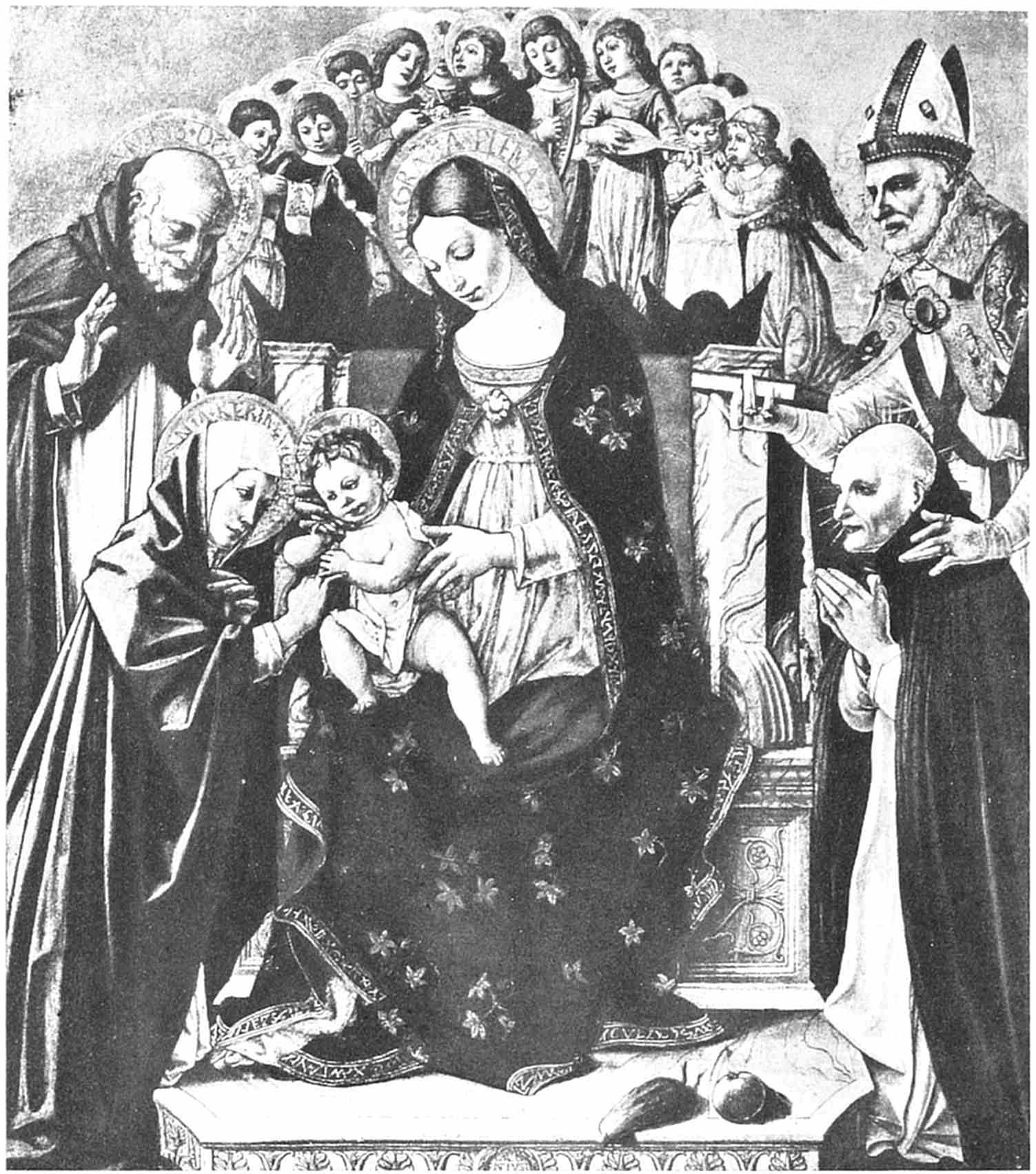
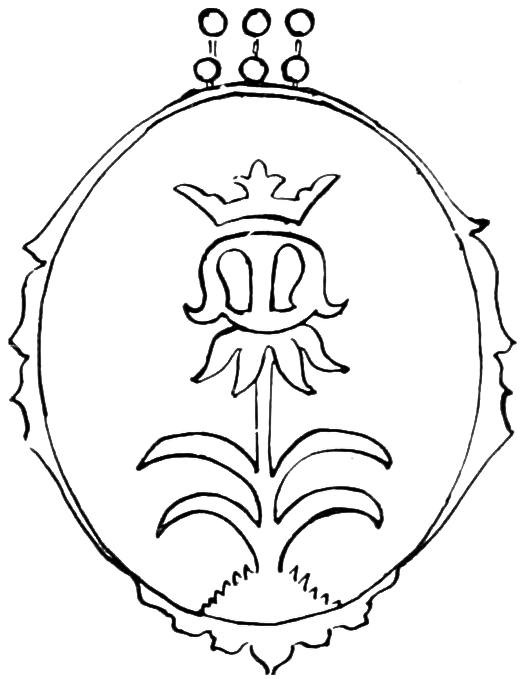
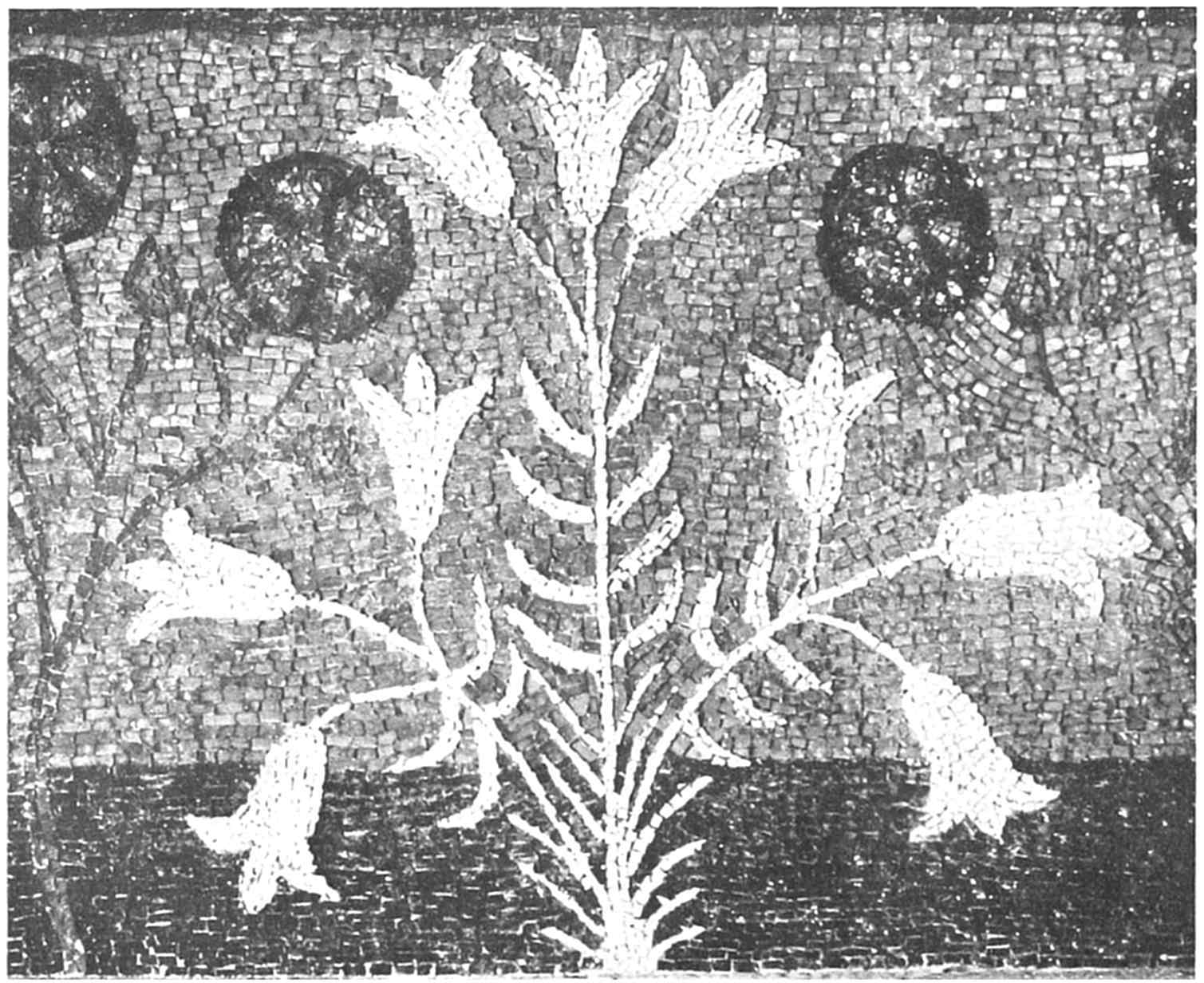
 ; and pendent thereunto
an oval medal, whereon was enamelled,
on a white ground, a lily of gold springing out of
a mount, supporting a Gothic capital letter