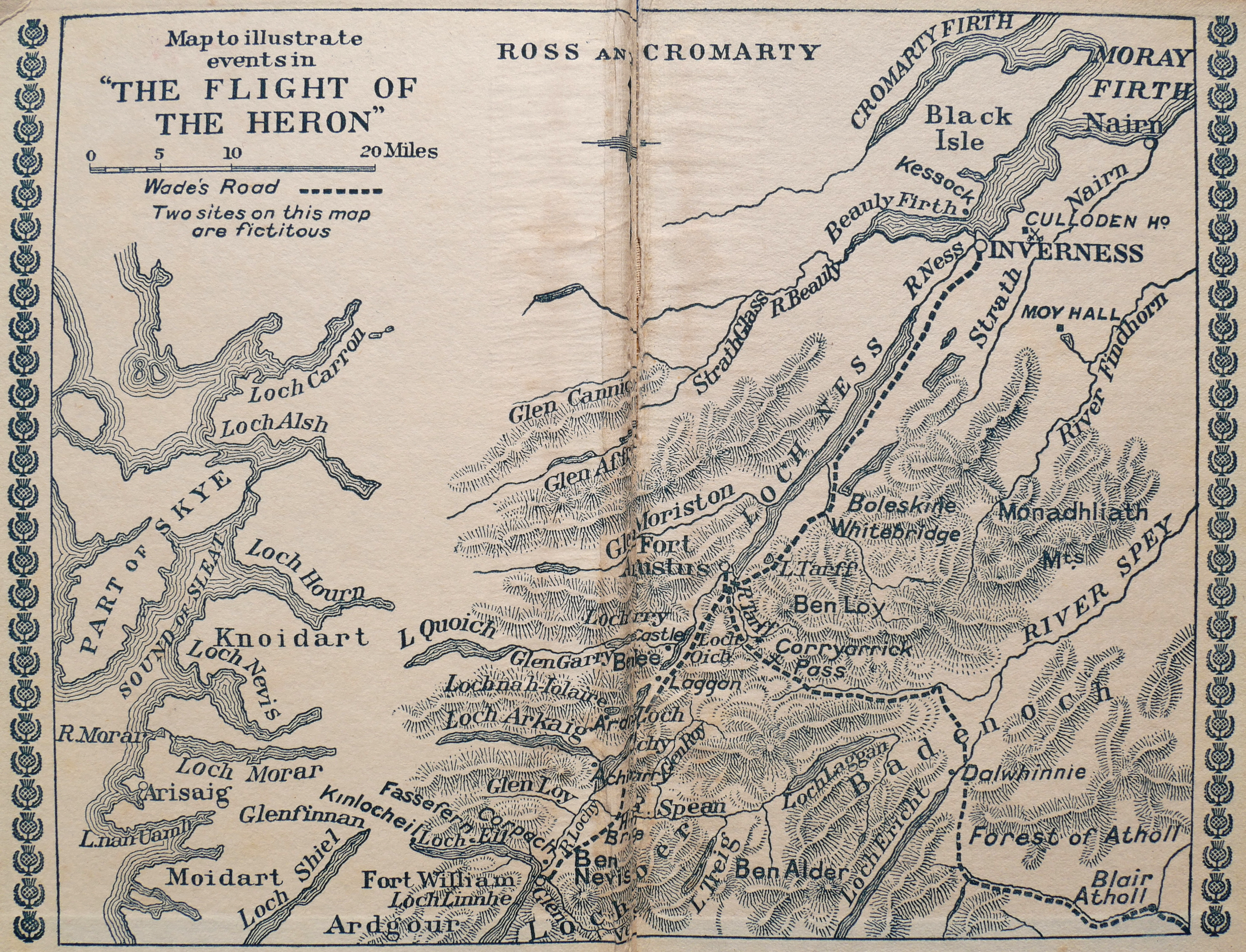
“So, in this snare which holds me and appals me,
Where honour hardly lives nor loves remain . . .”
—H. Belloc. On Battersea Bridge.
The mist shrouded every mountain-top, sagging downwards in some places
like the roof of a tent, and in others, where a perpetual draught blew
down a corrie, streaming out like smoke. How different from last week,
when, cold as it was up there, the top of the Corryarrick Pass had
presented to Major Windham’s eyes a view from Badenoch to the hills of
Skye. To-day, recrossing it, and looking back, he could hardly
distinguish through the greyish-white blanket more than three or four
of its many traverses winding away below him.
But here, on the lower levels of the mountain road, where it prepared
to debouch into that which ran along the Great Glen, this clogging
mist had become a fine and most penetrating rain, bedewing every inch
of the rider’s cloak and uniform, his hat, the edges of his wig, his
very eyebrows and lashes, and insinuating itself down his collar.
Major Windham did not know which was the more objectionable form of
moisture, and wished it were late enough in the day to cease exposing
himself to either, and to put up for the night at Fort Augustus, which
he should reach in another twenty minutes or so. But it was still too
early for that, and, bearer as he was of a despatch from Lord
Albemarle to the Duke of Cumberland, he must push on beyond Fort
Augustus before nightfall; must, indeed, reach the only halting-place
between that spot and Inverness, the tiny inn known, from Wade’s
occupation of it when he was making the road, as the General’s Hut.
However, he intended to stop at Fort Augustus to bait the horses—and
to make an enquiry.
It was six days since he had left Guthrie’s camp, and he was not
altogether surprised to-day to find it gone, but, to judge from the
litter lying about, only recently gone. There was, therefore, no one
to give him news of Ardroy, but he was sure that, if the Jacobite had
been made prisoner, he would have been sent or taken to Fort Augustus,
and he could get news of him there.
That night in the shieling, just a week ago, seemed to Keith much
farther off than that, and the emotions he had known then to have lost
their edge. ‘Gad, what a fit of philanthropy I had on me that day!’ he
reflected. If ‘Hangman Hawley’ came to know of it how he would sneer
at him, and the rest of the staff, too. Luckily they would not know.
So consoling himself, and cursing the rain anew, he came to Fort
Augustus, or rather to what remained of it. Its Highland captors who,
during their attack upon it, had partially demolished the new fort,
had, on the summons to face Cumberland, blown up and fired most of the
residue. A small temporary garrison had been sent there after the
victory to secure the abandoned stronghold for the Government; but it
had now been taken possession of by a larger force in the shape of the
Earl of Loudoun’s regiment, under the Earl himself, and eighteen
‘independent companies’. These had only marched in a few hours before,
in consequence of which influx the whole place was in a state of great
turmoil.
There was so little accommodation in the ruined fort that a small
village of tents was being erected in the meadows by the mouth of the
Tarff, and between the confusion of camp-pitching and the fact that
nearly everyone whom he encountered was a new-comer, Keith found it
difficult to discover who was or had been responsible for prisoners
sent in before Lord Loudoun’s arrival. He did, however, elicit the
information that Major Guthrie’s detachment was now somewhere on the
road between Fort Augustus and Inverness. And at last, though he did
not succeed in seeing anybody directly responsible, he was told that a
wounded Cameron, said to be the head of one of the cadet branches of
the clan, had been captured the previous week and sent in by that very
detachment, and that he had been given proper care and was progressing
favourably.
That was all Keith wanted to know for the moment, and he delayed no
longer. A certain vague disquiet which had teased him during the past
week about Guthrie’s possible treatment of his prisoner was allayed.
For the rest, he had already made his plans about Ardroy. It was at
Inverness, with Cumberland, that he could really do Ewen service,
especially if the Duke did take him on to his personal staff. To His
Royal Highness he could then represent what he owed to the captured
rebel, and, before he himself returned with the Commander-in-Chief to
Flanders, he might very well have the satisfaction of knowing that the
object of his ‘philanthropy’ had been set at liberty.
As he turned away from Fort Augustus, where the vista of Loch Ness was
completely blotted out in rain, and addressed himself to the long
steep climb up the Inverness road, Keith’s thoughts went back to the
Earl of Albemarle in Perth, craving like himself to get overseas once
more—whence, though colonel of the Coldstream Guards, he had come to
serve as a volunteer under Cumberland. His lordship, who had,
moreover, greatly preferred commanding the front line in the recent
battle to his present post with the Hessian troops in Perth, had
lamented his situation quite openly to Cumberland’s messenger; he
detested Scotland, he announced, and had fears, from a sentence in the
despatch which that messenger had delivered to him, that he might be
appointed to succeed Hawley in this uncongenial country. Having thus,
somewhat unwisely, betrayed his sentiments to Major Windham, he was
more or less obliged to beg his discretion, in promising which Keith
had revealed his own fellow-feeling about the North. When they parted,
therefore, Lord Albemarle had observed with much graciousness that if this
horrid fate of succeeding General Hawley should overtake him, he would
not forget Major Windham, though he supposed that the latter might not
then be in Scotland for him to remember. No; Keith, though grateful
for his lordship’s goodwill, distinctly hoped that he would not. He
trusted to be by then in a dryer climate and a country less afflicted
with steep roads . . . less afflicted also with punitive measures,
though, since Perth was not Inverness, he was not so much dominated by
those painful impressions of brutality as he had been a week ago.
The greater part of the lengthy and tiresome ascent from the level of
Loch Ness was now over, and Keith and Dougal Mackay found themselves
again more or less in the region of mist, but on a flat stretch of
road with a strip of moorland on one hand. Water glimmered ahead on
the left; it was little Loch Tarff, its charms dimmed by the weather.
Keith just noticed its presence, tightened his reins, and, trotting
forward on the welcome level, continued his dreams about the future.
Twenty-five yards farther, and these were brought abruptly to a close.
Without the slightest warning there came a sharp report on his right,
and a bullet sped in front of him, so close that it frightened his
horse. Himself considerably startled too, he tried simultaneously to
soothe the beast and to tug out a pistol from his holster. Meanwhile,
Dougal Mackay, with great promptitude and loud Gaelic cries, was
urging his more docile steed over the heather towards a boulder which
he evidently suspected of harbouring the marksman.
As soon as he could get his horse under control Keith also made over
the strip of moorland, and arrived in time to see a wild, tattered,
tartan-clad figure, with a musket in its hands, slide down from the
top of the boulder, drop on to hands and knees among the heather and
bogmyrtle, and begin to wriggle away like a snake. Major Windham
levelled his pistol and fired, somewhat at random, for his horse was
still plunging; and the Highlander collapsed and lay still. Keith
trotted towards him; the man had already abandoned his musket and lay
in a heap on his side. The Englishman was just going to dismount when
shouts from Dougal Mackay, who had ridden round the boulder, stayed
him. “Do not pe going near him, sir; the man will not pe hit
whateffer!” And as this statement coincided with Keith’s own
impression that his bullet had gone wide, he stayed in the saddle and
covered the would-be assassin with his other pistol, while Mackay, who
certainly did not lack courage, slid off his own horse and came
running.
And it was even as Mackay had said. At the sound of the feet swishing
through the heather the heap of dirty tartan lying there was suddenly,
with one bound, a living figure which, leaping up dirk in hand, rushed
straight, not at the dismounted orderly, but at the officer on the
horse. Had Keith not had his pistol ready he could hardly have saved
himself, mounted though he was, from a deadly thrust. The man was at
his horse’s head when he fired. . . . This time he did not miss; he
could not. . . .
“I suppose I have blown his head to pieces,” he said next moment, with
a slightly shaken laugh.
“Inteet, I will pe thinking so,” replied Mackay, on his knees in the
heather. “But it will pe pest to make sure.” And he put his hand to
his own dirk.
“No, no!” commanded Keith, as he bent from the saddle, for somehow the
idea of stabbing a dead man, even a potential murderer, was repugnant
to him. “It is not necessary; he was killed instantly.”
There could be small doubt of that. One side of the Highlander’s
bearded face was all blackened by the explosion, and as he lay there,
his eyes wide and fixed, the blood ran backwards through his scorched
and tangled hair like a brook among waterweeds. The ball had struck
high up on the brow. It came to Keith with a sense of shock that the
very torn and faded philabeg which he wore was of the Cameron tartan.
He was sorry. . . .
Deterred, unwillingly, from the use of his dirk, the zealous Mackay
next enquired whether he should not put the cateran’s body over his
horse and bring him to Inverness, so that, dead or alive, he could be
hanged at the Cross there as a warning.
“No, leave him, poor devil,” said Keith, turning his horse. “No need
for that; he has paid the price already. Let him lie.” He felt
curiously little resentment, and wondered at the fact.
Dougal Mackay, however, was not going to leave the musket lying too.
“Ta gunna—she is Sassenach,” he announced, examining it.
“Take it, then,” said Keith. “Come, we must get on to the General’s
Hut before this mist grows thicker.”
So they rode away, leaving the baffled assailant staring into vacancy,
his dirk still gripped in his hand, and under his head the heather in
flower before its time.
Once more the road mounted; then fell by a long steep gradient. The
General’s Hut, a small and very unpretentious hostelry, of the kind
known as a ‘creel house’, was at Boleskine, down on its lower levels,
and before Keith reached it he could see that its outbuildings were
occupied by soldiers. They were probably Major Guthrie’s detachment.
Indeed, as he dismounted, a uniformed figure which he knew came round
the corner of the inn, but it stopped dead on seeing him, then, with
no further sign of recognition, turned abruptly and disappeared again.
It was Lieutenant Paton.
So these were Guthrie’s men, and he could hear more of Ardroy. But
he would have preferred to hear it from Paton rather than from
Guthrie, and wished that he had been quick enough to stop that young
man.
The first person whom Keith saw when he entered the dirty little
parlour was Guthrie himself—or rather, the back of him—just sitting
down to table.
“Come awa’, Foster, is that you?” he called out. “Quick noo; the brose
is getting cauld.” Receiving no response he turned round. “Dod! ’tis
Major Windham!”
Keith came forward perforce. “Good evening, Major Guthrie. Yes, I am
on my way back to Inverness.”
“Back frae Perth, eh?” commented Guthrie. “By the high road this time,
then, I’m thinkin’. Sit ye doun, Major, and Luckie whate’er she ca’s
hersel’ shall bring anither cover. Ah, here comes Foster—let me
present Captain Foster of ma regiment tae ye, Major Windham. Whaur’s
yon lang-leggit birkie of a Paton?”
“Not coming to supper, sir,” replied Captain Foster, saluting the new
arrival. “He begs you to excuse him; he has a letter to write, or he
is feeling indisposed—I forget which.”
“Indeed!” said Guthrie, raising his sandy eyebrows. “He was weel
eneugh and free o’ correspondence a while syne. However, it’s an ill
wind—— Ye ken the rest. Major Windham can hae his place and his meat.”
Keith sat down, with as good a grace as he could command, at the
rough, clothless table. This Foster was presumably the officer whose
bed he had occupied in the camp, a man more of Guthrie’s stamp than of
Paton’s, but better mannered. Lieutenant Paton’s excuse for absence,
coupled with his abrupt disappearance, was significant, but why should
the young man not wish to meet Major Keith Windham? Perhaps because
the latter had got him into trouble after all over his ‘philanthropy’.
Between the three the talk ran on general topics, and it was not until
the meal was half over that Guthrie suddenly said:
“Weel, Major, I brocht in yer Cameron frien’ after ye left.”
Keith murmured that he was glad to hear it.
“But I got little for ma pains,” continued Guthrie, pouring himself
out a glass of wine—only his second, for, to Keith’s surprise, he
appeared to be an abstemious man. He set down the bottle and looked
hard at the Englishman. “But ye yersel’ were nae luckier, it seems.”
Keith returned his look. “I am afraid that I do not understand.”
“Ye see, I ken ye went back tae the shieling yon nicht.”
“Yes, I imagined that you would discover it,” said Keith coolly. “I
trust that you received my message of apology for departing without
taking leave of you?”
“Yer message of apology!” repeated Major Guthrie. “Ha, ha!
Unfortunately ye didna apologise for the richt offence! Ye suld hae
apologised for stealing a march on me ahint ma back. ’Twas a pawky
notion, yon, was it no’, Captain Foster?”
“I must repeat that I am completely in the dark as to your meaning,
Major Guthrie!” said Keith in growing irritation.
“Isna he the innocent man! But I forgie ye, Major—since ye gained
naething by gangin’ back.”
“Gained!” ejaculated Keith. “What do you mean, sir? I did not go
back to the shieling to gain anything. I went——”
“Aye, I ken what ye said ye gaed for,” interrupted Guthrie with a
wink. “’Twas devilish canny, as I said, and deceived the rebel himsel’
for a while. All yon ride in the nicht juist tae tak’ him food and
dress his wounds! And when ye were there tendin’ him sae kindly ye
never speired aboot Lochiel and what he kennt o’ him, and whaur the
chief micht be hidin’, did ye?—Never deny it, Major, for the rebel
didna when I pit it tae him!”
“You devil!” exclaimed Keith, springing up. “What did you say to him
about me?”
Guthrie kept his seat, and pulled down Captain Foster, who, murmuring
“Gentlemen, gentlemen!” had risen too. “Nae need tae be sae
distrubel’d, Captain Foster; I’m na. That’s for them that hae uneasy
consciences. What did I say tae him? Why, I tellt him the truth, Major
Windham: why ye set such store on saving his life, and how ye thocht
he micht be persuaded tae ‘drap a hint’ aboot Lochiel. Forbye he didna
believe that at first.”
Keith caught his breath. “You told him those lies . . . to his face .
. . and he believed . . .” He could get no farther.
“Lies, were they?” asked Guthrie, leaning over the table. “Ye ne’er
advised me tae bring him into camp tae ‘complete ma knowledge’? Eh, I
hae ye there fine! Aweel, I did ma best, Major Windham; nane can dae
mair. But I doot he has the laugh of us, the callant, for he tellt me
naething, either by hints or ony ither gait, a’ the time I had him in
ma care. So I e’en sent him wi’ a bit report tae Fort Augustus, and
there he is the noo, as ye may have heard, if ye speired news o’ him
when ye came by.”
Keith had turned very white. “I might have known that you would play
some dirty trick or other!” he said, and flung straight out of the
room.
Fool, unspeakable fool that he was not to have foreseen something of
this kind with a man of Guthrie’s stamp! He had had moments of
uneasiness at the thought of Ardroy’s probable interview with him, but
he had never anticipated anything quite so base as this. “Take me to
Lieutenant Paton at once!” he said peremptorily to the first soldier
he came across.
The man led him towards a barn looming through the mist at a little
distance. The door was ajar, and Keith went in, to see a dimly lit
space with trusses of straw laid down in rows for the men, and at one
end three horses, his own among them, with a soldier watering them.
The young lieutenant, his hands behind his back, was watching the
process. Keith went straight up to him.
“Can I have a word with you alone, Mr. Paton?”
The young man stiffened and flushed; then, with obvious reluctance,
ordered the soldier out. And when the man with his clanging buckets
had left the building, Paton stood rather nervously smoothing the
flank of one of the horses—not at all anxious to talk.
“Mr. Paton,” said Keith without preamble, “what devil’s work went on
in your camp over the prisoner from Ben Loy?” And then, at sight of
the look on Paton’s face, he cried out, “Good God, man, do you think
that I had a hand in it, and is that why you would not break bread
with me?”
Lieutenant Paton looked at the ground. “I . . . indeed I found it hard
to believe that you could act so, when you seemed so concerned for the
prisoner, but——”
“In Heaven’s name, let us have this out!” cried Keith. “What did Major
Guthrie say to Mr. Cameron? He appears to have tried to make him
believe an infamous thing of me—that I went back to the shieling that
night merely in order to get information out of him! Surely he did not
succeed in making him think so—even if he succeeded with you? . . .
Answer me, if you please!”
The younger man seemed very ill at ease. “I cannot say, sir, what Mr.
Cameron believed about you in the end. He certainly refused, and
indignantly, to believe it at first.”
“He cannot have believed it!” said Keith passionately. “‘In the
end’? How long, then, did Major Guthrie have him in his custody?”
“He kept him for twenty-four hours, sir—in order to see if he would
make any disclosures about Lochiel.” And Lieutenant Paton added, in a
very dry tone, turning away and busying himself with a horse’s
headstall, “A course which it seems that you yourself advised.”
Keith gave a sound like a groan. “Did the Major tell Mr. Cameron that
also?”
Paton nodded. “Yes, he did—and more, too: whether true or not I have
no means of judging.”
Keith had the sensation that the barn, or something less material, was
closing in round him. This honest boy, too—— “Look here, Mr. Paton, I
will be frank with you. I was so desperately afraid that Ardroy would
be left to die there in the shieling that I did suggest to Major
Guthrie that it might be of advantage to bring him into camp, though I
knew that he would have his trouble for nothing. Though I
unfortunately recommended that course I was perfectly certain that Mr.
Cameron would not give the slightest inkling of any knowledge that he
might have.”
“No, it was plain from the beginning that he would not,” said the
young man, “and that was why . . .” He broke off. “If Mr. Cameron is a
friend of yours it is a good thing that you were not in our camp that
morning . . . or no, perhaps a misfortune, because you might have
succeeded in stopping it sooner. I could not.”
“Succeeded in stopping what?” asked Keith. Then the inner flavour of
some of Guthrie’s recent words began to be apparent to him. He caught
Paton by the arm. “You surely do not mean that Major Guthrie resorted
to—violent measures? It’s impossible!”
Thus captured, the young soldier turned and faced him. “Reassure
yourself, sir,” he said quickly, seeing the horror and disgust on his
companion’s face. “He could not carry them out; the prisoner was in no
state for it. He could only threaten, and . . . question.”
“He threatened to shoot him after all?”
“No, not to shoot him, to flog him.” And as Keith gave an exclamation
and loosed his hold, Paton added, “And he went very near doing it,
too.”
“Threatened to flog him! Mr. Paton, you are jesting!” said Keith
incredulously. “Flog a badly wounded prisoner, and a gentleman—a
chieftain—to boot!”
“I am not jesting, sir; I wish I were. But I am thankful to say that
it was not carried out.—Now, if you will excuse me, Major Windham, I
must be about my duties.” His tone indicated that he would be glad to
leave a distasteful subject.
But Keith made a movement to bar his passage. “Mr. Paton, forgive my
insistence, but your duties must wait a little. You cannot leave the
matter there! For my own sake I must know what was said to Mr.
Cameron. You see how nearly it concerns my honour. I implore you to
try to recall everything that passed!”
Reluctantly the young man yielded. “Very well, sir; but I had best
speak to the sergeant to ensure that we are not disturbed, for this
barn is the men’s quarters.”
He went out to give an order. Hardly knowing what he did, Keith turned
to his horse, busy pulling hay from the rack, and looked him over to
see that Mackay had rubbed him down properly. Threatened with
flogging—Ewen Cameron!
Paton came back, closed the door and brought up a couple of pails,
which he inverted and suggested as seats. “You must be tired, Major,
after your long ride, and I am afraid that this will be a bit of a
sederunt.” So Keith sat down in the stall to hear what his ill-omened
suggestion had brought on the man whom he had saved.
It appeared that Major Guthrie, on learning next morning of Major
Windham’s departure on his errand of mercy, had been not only
exceedingly angry, but suspicious as well—“or at least,” said Paton,
“he declared that he was suspicious”—and sent off a party almost
immediately to fetch in the wounded rebel from the shieling. About a
couple of hours later they returned, carrying him on a litter, which
they deposited outside their commander’s tent, where Paton happened to
be at the moment. Guthrie immediately went out to him, and said—the
narrator remembered his first words exactly—‘Well, my fine fellow, and
so you know where Lochiel is like to be skulking!’ The prisoner
replied by asking whether Major Guthrie thought he should tell him if
he did? Major Guthrie retorted, with a grin, that he knew it was the
thing to begin with a little bluster of the sort, but that they had
better get to business without wasting time. “And he added, sir,” said
the young soldier, looking away, “‘I know that you know; Major Windham
says so.’”
Keith had put his hand over his eyes. “Yes; go on,” he said after a
moment.
“This was plainly rather a blow to Mr. Cameron,” continued Paton. “I
saw the blood rush to his face. ‘What did you say?’ he asked. The
Major replied that you, sir, being a loyal subject of King George,
were just as eager to secure Lochiel as himself, which was the reason
why you had very properly stopped him from having the prisoner shot.
To that Mr. Cameron replied, short and sharp, ‘I don’t believe it!’
The Major affected to misunderstand this, and . . . well, sir, he said
a good many things incriminating you in the affair, twisting what you
had, perhaps, said . . .”
“Try, for God’s sake, to remember what those things were,” begged
Keith miserably, without looking up.
The young man paused a moment, evidently trying to remember
accurately.
“First, I think, he told Mr. Cameron that you had said he was Cameron
of Ardroy, Lochiel’s cousin, and had had you as his prisoner after the
affair at High Bridge, and he added, ‘I doubt he wanted to get even
with you for that!’ And to make his assertion more credible he asked
Mr. Cameron how otherwise he should have known who he was, since he
took him for a gillie when he had him up against the shieling wall.
And the Major went on to say that for the news of Mr. Cameron’s
identity he was grateful to you, but not so grateful when he found
that you had stolen a march on him by sneaking back to the shieling by
night in order to get information out of the prisoner before he could.
But at that Mr. Cameron tried to raise himself on the litter, and
burst out, ‘That’s a lie!’ And then the Major silenced him by what I
can only suppose was an arrow drawn at a venture, since you . . . I
don’t suppose that you . . .” Paton began to stumble.
“Let me have it!” said Keith, looking up this time.
“He said, ‘And so he never speired about Lochiel . . . where he was .
. . if you kenned where he was?’”
Keith stared at the narrator half dazed. “How did he know that . . .
he could not have known it!”
“As I say, it seemed to silence Mr. Cameron altogether,” continued
Paton, glancing at him with a sort of pity. “He looked quite dizzy as
he dropped back on the litter. But the Major laughed. And he went on,
in that bantering way he has: ‘I hope you did not tell him, for I want
you to tell me. Did you tell him?’ The rebel took no notice of this
question; he had shut his eyes. It was as I looked at him then, sir,
and saw the effect which that question had had on him, that I first
began, I confess, to have doubts of your good faith.”
“You had cause,” answered Keith with a groan. “I did ask him about
Lochiel—in all innocence. My God, what he must think of me!” He took
his head between his hands. “Go on!”
“Finding that Mr. Cameron was silent,” resumed Paton, “Major Guthrie
went nearer and said something, I do not exactly remember what, about
dropping a hint inadvertently with regard to Lochiel’s hiding-place,
which it was easy to do, he said, and which he should give the
prisoner every opportunity of doing, keeping him there, indeed, until
he did. He kept harping for awhile on this question of dropping a
hint, and he brought you even into that, for he said that it was your
suggestion, that you had advised him to bring the rebel into camp and
watch him well for that purpose. . . . And from what you have just
told me, sir, it seems that that was true.”
Paton paused; but Keith, his head between his hands, said nothing; he
was beyond it. This was what came of doing evil in order to accomplish
good!
“Still Mr. Cameron took no notice,” pursued Paton, “even when the
Major went on to say in so many words that you had betrayed him—Mr.
Cameron—and had then ridden off, leaving him the dirty work to do.
Then he changed his tone, and said, ‘But I shall not flinch from it;
’tis my duty. Do you know, Mr. Cameron of Ardroy, how we deal with
folk that have valuable information and will not part with it?’ At
that the prisoner did open his eyes, and said with a good deal of
contempt that, from what he had seen of the Major, he could very well
guess.
“The Major at that bent over him and gripped him by the nearer arm. He
may not have observed that it was bandaged—I cannot say—and repeated,
‘Ah, you can quite imagine, can you? D’you think you’ll like it?’ Mr.
Cameron did not answer; perhaps he could not, for he was biting his
lip, and I saw the sweat come out on his brow. Major Guthrie let go
and stood up again, and said that a flogging with belts would soon
loosen his tongue; and that did rouse Mr. Cameron, for he coloured
hotly and said he thought the Major forgot that he was a gentleman.
But the Major replied with a chuckle that he looked so little like one
at present that it was easy to assume that he was not. Then he asked
him whether he intended to save himself from this unpleasant
experience, as he easily could do; Mr. Cameron’s look was sufficient
answer to that. So, to my horror, the Major sent for the drummers and
ordered a tent to be struck, in order to have the pole available to
tie him up to.”
“This is intolerable!” exclaimed Keith, starting up. “Stop! I had
rather not——” He pulled himself together. “No, I have got to hear it.
Go on!”
“I assure you that I did not enjoy it,” said the young officer, “for
I thought that the matter was going through. They lifted Mr. Cameron
off the litter; he could not stand, it appeared, owing to the wound in
his thigh, and the men were obliged to support him. But the Major said
to him that he would not be able to fall this time, as he had done
yesterday, because we had ropes here. . . . I myself, who would
willingly have interfered before, sir, had there been any chance of
being listened to, now took the Major by the arm and told him plainly
that he would kill the prisoner if he was so barbarous as to have him
flogged in his present condition. But he shook me off, and said, when
everything was ready (except Mr. Cameron himself, who was still held
up there, facing him, as white as you please, but perfectly unyielding
and defiant): ‘Now, before you make acquaintance with His Majesty’s
leather, will you tell me what you know about Lochiel?’ And the rebel,
with his eyes blazing, said, in a sudden access of fury, ‘Not if you
cut me to pieces!’
“Well, sir, though I am convinced that the Major was not acting a part
and merely threatening, but that he really meant to go through with
the horrid business, I think it must have come to him then that, if he
did, he would have Mr. Cameron dead on his hands, as I had warned him,
and there would be an end to that source of information. (It is
possible, too, that he thought he might be called to account for it
afterwards.) And even the men were looking uneasy and murmuring a
little. So he said that he would postpone the flogging until the
afternoon. He had the prisoner carried into his own tent, not much, I
fear, the better for this scene; and in his tent Mr. Cameron was all
the rest of the day and the night. I do not know what passed in there,
for whenever I made an effort to go in, I was stopped; but I am sure
the Major questioned him pretty continuously. He still spoke of the
flogging taking place, but it never did. Next morning I was not
surprised to hear that the prisoner seemed worse, and in a fever, so
that the Major resolved to be rid of him, and sent him to Fort
Augustus. I was heartily glad, for his own sake, to see Mr. Cameron
taken away. And at Fort Augustus he must have had care, or he would
not be alive now, which he is, for I asked news of him yesterday, as
we came by. But that I should be ashamed to meet him, I would fain
have seen him to ask his pardon.”
Paton’s voice ceased; in the silence one of the horses near them
stamped and blew out its nostrils. Keith, standing there very still,
released his own tightly gripped elbows.
“Mr. Paton, I thank you most heartily for your frankness. I, too, am
ashamed—with much more cause than you, I think—yet I am going back to
Fort Augustus to see Mr. Cameron.”
“Back to Fort Augustus—to-night!” said Paton, rather startled.
“Yes, to-night. My horse,” he glanced at that animal, “can still carry
me so far—a matter of ten or twelve miles, is it not? I intended to
lie here the night, and to start about six o’clock to-morrow morning
for Inverness. I shall lie at Fort Augustus instead, and start
proportionately earlier, that is all. I must find my orderly at once,
but I shall not take him back with me.”
Paton said no more, and they went out of the barn together, by which
evacuation the waiting soldiers outside, huddled against its wall for
shelter, were enabled to enter their sleeping-place. While the
surprised Mackay resaddled his officer’s horse, Keith strode back to
the inn parlour. But just outside, where he could hear Guthrie’s voice
in conversation, he paused. If he meant to get back to Fort Augustus
he must not enter Guthrie’s presence first; the fury and resentment
which possessed him could have but one result—a quarrel with the
Lowlander. Moreover, Lieutenant Paton might suffer for his
communicativeness. Clenching his hands, Keith turned away from
temptation.
But there was one last question to ask.
“Mr. Paton,” he said in a low voice as his horse was brought towards
him, “have you any notion why Major Guthrie hates me so, for it is
plain that he does?”
And to his surprise the young man answered, in a voice equally low:
“I have a very good notion why, sir. He had had great hopes of
securing that post on General Hawley’s staff which was eventually
given to you. Your obtaining it was a very sore point with him,
because he thought his claims superior to those of an officer who—who
. . .” Paton hesitated.
“Yes, I understand,” said Keith, his mouth tightening. “Who had lost
one of the companies at High Bridge.” Guthrie’s sneers on that fatal ride
were explained now. “So that was my offence!” he said under his
breath, as he swung into the saddle. “And this is how he has avenged
himself!”
The wind had risen greatly in the last hour, and the rain was no
longer a fine, almost caressing, drizzle; it beat upon the rider as he
urged his horse back along the lower levels with a vehemence which
predicted real difficulty in proceeding when he should reach the
higher. But he did not notice it.
There could not be the slightest doubt that Ewen Cameron must believe
him to have acted in a manner unspeakably treacherous and vile. From
the deadly success of Guthrie’s ‘arrow at a venture’, as Paton had
rightly called it, he must even think that his visitor had gone straight
back from tending him in the shieling to Guthrie’s camp with the news
that he had succeeded in gaining the fugitive’s confidence, and had
ascertained that he did know of Lochiel’s hiding-place. It was an
absolutely intolerable thought, and nothing, nothing should stop him
until he had seen Ardroy and assured him of his innocence—neither the
rising storm nor fatigue, nor the possible danger in riding thus alone
at night (though to that, despite the afternoon’s attempt on his life,
he gave scarcely a thought), nor Lord Albemarle’s despatch. It was a
mercy that this contained, as he knew, nothing of urgency, nothing but
a mere expression of compliments, and that he could therefore retrace
his steps consistently with his military obligations. In any case, the
letter would reach Inverness no later than if he had spent the night
at the General’s Hut, so on that score at least his mind was at rest.
It was certainly the only score on which it was. The more Keith
thought of the situation, the more it horrified him. Why, good God,
Ardroy might even imagine that the infamous proposal of flogging,
which turned him hot to think of, came from him! Guthrie was
evidently quite capable of stating that it had, and though Paton had
not reported him as having done so in his hearing, who knew what had
been said, what had been done, during the rest of the twenty-four
hours in Guthrie’s tent? He was utterly without scruple, and Ardroy
completely helpless.
Yet even now Keith could hardly blame himself for his total absence of
suspicion that Guthrie might be tempted to do more than question his
prisoner . . . rather closely perhaps. No, he told himself again and
again, he could not have guessed to what he was delivering up Ardroy.
A prisoner-of-war—above all, an officer—in a Christian country and a
civilised century stood in no danger of such proceedings. It was true
that there had been barbarity after the battle, barbarity which had
sickened him, but there had never been any suggestion of deliberately
torturing prisoners in order to extract information. (For Major
Lockhart of Cholmondeley’s regiment, Captain Carolina Scott of
Guise’s, and Captain Ferguson of H.M.S. Furness—all Scots, too—had
still to win their spurs in this field.)
Keith was up on the higher levels now, where the wind was really
savage, and the rain stung like missiles. It seemed as though the
elements desired to oppose his return. But his thoughts ran ahead of
him to Fort Augustus. Would there be difficulty in getting access to
the prisoner? There might be some, but an officer on Hawley’s staff,
riding on the Duke’s business, would be hard to gainsay. If necessary
he should approach the Earl of Loudoun himself. And in what state
should he find Ardroy? What sort of a captivity had been his now that
he was out of that scoundrel Guthrie’s clutches? Remembrances of
Inverness, very sinister remembrances, kept floating into his mind.
No, it would be different here; and, as Paton had pointed out, they
must have taken good care of the Highlander, or he would hardly be
alive now, judging from his state a week ago—a state which must have
been, which evidently had been, rendered even more precarious by
Guthrie’s damnable proceedings. On Guthrie himself he hardly dared
allow his mind to dwell; but there could not be another like him at
Fort Augustus!
And when he had got access to Ardroy? Surely it would not be difficult
to convince him that it was Major Guthrie’s almost incredible spite
and jealousy which had wrought this mischief, that nothing in the
world had been farther from his own thoughts than the belief that Ewen
would betray his Chief? Yes, but unfortunately, though he could deny
everything else (save the mere fact of having been forced to establish
Ardroy’s identity) he could not deny that most unlucky suggestion to
which, in desperation, he had been reduced on the hillside. Oh, if
only he had not shirked telling Ewen Cameron of it that night in the
shieling! Better, far better, to have faced a measure of shame on that
occasion than to have left in Major Guthrie’s hands a weapon capable
of working this havoc!
For Guthrie, it was clear, had, in his calculated spite, struck at him
through Ewen and at Ewen through him. He had evidently wished the
Highlander to believe himself betrayed. Did he then think the ties
between them so close when they were only . . . What were they then?
Was it really only philanthropy, as Keith had assured himself a few
hours ago, which had sent him back to the shieling that night? It was
certainly not philanthropy which was driving him to Fort Augustus now.
At nine o’clock, wet and buffeted, he was back in the lines of
Loudoun’s camp, still humming with life. Mentioning that he was on the
staff he asked, as he had asked that afternoon, to see the officer in
charge of prisoners there. Once again there was an obstacle; this time
it appeared that the officer, a certain Captain Greening, was closeted
with Lord Loudoun, who was very busy, and not to be disturbed save for
a matter of great importance.
Keith still retained enough sense of proportion to realise that a
private enquiry after the well-being of a rebel prisoner was not
likely to wear that aspect in the eyes of Cope’s late
adjutant-general. However, perhaps he could arrive at seeing Ardroy
without the consent of Captain Greening, so he said to his informant,
the officer of the guard:
“I wish to see a certain Mr. Ewen Cameron of Ardroy, who lies here a
prisoner. He was taken last week not far from the Corryarrick Pass. Do
you think this would be possible without deranging Captain Greening?”
“Cameron of Ardroy?” said the lieutenant with an accent of
enlightenment. “Oh, have you come from Inverness about the question of
Lochiel’s capture, sir? Then you will be glad to hear that we have got
the necessary information at last.”
Keith’s heart gave a great twist—foolishly, surely! “Ah, from whom?”
“Why, from him—from Cameron of Ardroy, naturally. We knew that he had
it.”
This time Keith’s heart did not twist—it seemed to die in his breast.
“Got it from him—from him!” he faltered with cold lips. “When?”
“Last night, I believe,” answered the lieutenant carelessly, pulling
his cloak closer about him. “But I fear that I cannot give you
permission to visit him, sir, and as Captain Greening is——”
But to his surprise the staff officer was gripping him hard by the
arm. “Tell me, in God’s name, what means you used? Ardroy would
never——” He seemed unable to finish.
“Means? I really don’t know,” replied the lieutenant, still more
surprised. “I should be obliged if you would let go my arm, sir! I
have nothing to do with the prisoners. Perhaps this Cameron was
promised his liberty or something of the sort—but on my soul I don’t
know . . . or care,” he muttered under his breath, rubbing his arm as
Keith released it.
“Promised!” cried Keith in a tempest of fury and horror. “No, he has
been tortured into it!—that is the only possible explanation of his
giving that information—if it be true that he has done so. My God,
what has this campaign reduced men to! Take me to Lord Loudoun at
once!”
“I cannot, sir,” protested the lieutenant. “He has given the strictest
orders——”
“Take me to him at once,” repeated Keith in a dangerous voice; and the
young officer, probably thinking that the safest way to deal with a
superior who seemed off his balance was to humour him, shrugged his
shoulders, and began to lead him in the rain between the tents.
Last night! That meant, then, that for nearly a week they had been
trying . . . and had succeeded at last in wresting the secret from a
man badly wounded, ill from starvation, and now, perhaps, dying—dying
as much of a broken heart as from their usage of him. It was with that
unbearable picture of Ewen Cameron in his mind that, after parleys
with sentries of which he heard nothing, Keith stepped into the Earl
of Loudoun’s presence without any clear idea of what he was going to
do there.
He found himself in a large, well-furnished tent, with a brazier
burning in one corner, and, round a table, several officers of various
ranks (most of them, like the Earl himself, wearing tartan), was
announced as an officer of the staff from Inverness, and, duly
saluting, gave his name and regiment.
The Earl of Loudoun—more Lowland Scot than Highlander in his
appearance—looked less annoyed at the interruption than might have
been expected; indeed his air showed that he supposed the intruder to
be the bearer of some tidings of importance from head-quarters.
“You are on His Royal Highness’s staff, Major Windham?” he asked.
“On General Hawley’s, my Lord,” replied Keith. “I am on my way back to
Inverness from Perth, and I have ventured to ask for this interview
because——”
“You have not a despatch for me from the Duke, then—or from General
Hawley?”
“No, my Lord. I have but seized this opportunity of appealing to your
Lordship on behalf of a prisoner here”—the Earl’s homely,
blunt-featured face changed—“who, if he has really made any
disclosures, can only have done so under violent measures, taken
unknown to your Lordship, and I——”
“What is all this about a prisoner?” interrupted Loudoun, frowning.
“You mean to say, Major Windham, that you are here on a purely private
matter, when I especially gave orders—— Who admitted you to me under
false pretences?”
But the officer of the guard had discreetly vanished.
“Is it a purely private matter, my Lord,” retorted Keith hotly, “that
a badly wounded Highland gentleman should be tortured into giving
information against his own Chief? It seems to me a matter affecting
the good name of the whole army. I only hope that I have been
misinformed, and that no such disclosures have been dragged from him.”
“Have you come here, sir,” asked Lord Loudoun with increasing
displeasure, “and on no one’s authority but your own, to dictate to me
on the treatment of prisoners?”
“No, indeed, my Lord,” replied Keith, making an effort to be properly
deferential. “I have come, on the contrary, because I feel sure that
your Lordship——”
“If you want news of any prisoner,” interrupted his Lordship with a
wave of the hand, “you must wait until Captain Greening here is at
liberty. Meanwhile you will perhaps have the goodness to remember that
I only marched in to Fort Augustus this morning, and am still so
pressed with business that I see small chance of sleep to-night if I
am to be interrupted in this manner.”
It was a dismissal: less harsh than at one moment seemed likely, but
proving to Keith that he had gained nothing. He tried another tack.
“My Lord, give me permission then, I implore you, to visit the
prisoner in question, Mr. Ewen Cameron of Ardroy.”
Loudoun’s eyebrows went up. “Is there anyone of that name confined
here, Captain Greening?” he asked in an annoyed voice, turning to a
fair, rather womanish looking young man on his left.
Captain Greening smiled a peculiar little smile. “Oh, yes, my Lord; he
has been here nearly a week. Major Windham has already made enquiries
for him once to-day, so I hear—when he passed on his way to Inverness
this afternoon. I was out of camp at the time.”
“What!” exclaimed the Earl, looking from the officer to Keith in
astonishment. “Major Windham has been through Fort Augustus once
already to-day? This is very singular! Instead of your questioning me,
Major Windham, I will ask you to explain your own conduct. Kindly tell
me on what errand you originally left head-quarters?”
Keith saw a possible gulf opening for himself now. But he was too
passionately indignant to care much. “I have been to Perth, my Lord,
with a despatch from His Royal Highness to Lord Albemarle. I was on my
way back to Inverness to-day when I heard that Cameron of Ardroy——”
“Leave Cameron of Ardroy out of it, if you please!” said Lord Loudoun
in growing anger. “What I want, Major Windham, is some explanation of
your own extraordinary behaviour. I gather that you are now on your
way back from Perth. Are you carrying despatches from Lord Albemarle
to His Royal Highness, or are you empty-handed?”
“I have a letter, of no particular moment, from Lord Albemarle to the
Duke,” replied Keith more warily.
“You have, at any rate, a despatch, sir. You have passed this place
already on your way to Inverness, carrying it. Some hours later you
are back again, making fresh enquiries about a rebel. Had you confided
your despatch to another hand in the interval?”
“No, my Lord,” confessed Keith. “Knowing that the matter was not
urgent, and that it was impossible for me to reach Inverness to-night,
I resolved to lie at the General’s Hut. There I heard something which
determined me to have more reliable news of Mr. Cameron of Ardroy, to
whom I owe it that I am alive at all to-day. Instead of going to bed
at the General’s Hut I rode back here, and whether I start from
Boleskine at six or from Fort Augustus at half-past four, Lord
Albemarle’s letter will reach His Royal Highness’s hands at exactly
the same hour.”
“You seem to have a strangely easy idea of your military duties, Major
Windham,” commented Lord Loudoun, drumming on the table. “May I ask
how long you have borne His Majesty’s commission?”
“Twelve years,” answered Keith curtly.
“And in all those years you have not learnt the sacredness of a
despatch! You are entrusted with one to the Commander-in-Chief, and
you take upon yourself to turn back in order to assure yourself of the
welfare of a rebel prisoner!—Is it true that this man has made a
disclosure?” he asked suddenly of Captain Greening.
“Quite true, my Lord,” responded the fair young officer. “I have notes
of it here; it was one of the matters which I desired to bring to your
Lordship’s notice. It relates to Lochiel’s hiding-place near Loch
Arkaig, and will prove of the greatest service in your Lordship’s
future operations.”
At that reply all thoughts of his own situation abandoned Keith; he
was caught up again in a wave of fury and shame. “My God!” he cried,
striding forward, his eyes fixed on Captain Greening, “are there
devils here too? You have tortured him into it . . . never deny it,
I’ll not believe you! As well be in a camp of Red Indians or African
savages! Inverness was bad enough, with its prisons stuffed with
purposely neglected wounded; then that man Guthrie, and now——”
Lord Loudoun sprang up, very threatening of aspect. “Major Windham,
may I ask you to remember where you are! I’ll not be spoken to in
such a manner!”
“I was not addressing you, my Lord,” said Keith fiercely. “I know that
you only reached Fort Augustus this morning. You are not responsible
for what has been going on—God knows what it was—before you came. But
this officer here——”
“Be silent, sir!” shouted the Earl of Loudoun. “Neither will I have
aspersions cast on officers now under my command . . . and by a member
of General Hawley’s staff, too! Are your own hands so clean, pray? You
do not deserve that I should reply to your insinuations, but—Captain
Greening, was this information got from the Cameron prisoner by
unlawful means?”
“No, my Lord, I assure you that it was not. He gave it . . .
voluntarily.” But again there was that little smile.
“There, you hear, sir!” said the Earl. “Your charges——”
“I don’t believe it,” said Keith in the same moment. “I will not
believe it until I hear it from Ardroy himself.”
And at that Lord Loudoun completely lost his temper. “God’s name, am I
to suffer you to browbeat me in my own tent?—you, who have just
behaved in a manner unpardonable in a soldier! Major Windham, I place
you under arrest for insubordination. You will kindly give up your
sword!”
It was as if a douche of cold water had descended on Keith’s head. His
left hand went to his swordhilt. “Insubordination, my Lord? No, I
protest!”
“Very well, it shall be for neglect of duty, then,” said the Earl,
still very angry. “Lord Albemarle’s despatch is in truth not safe with
a man who can go twenty miles out of his way while carrying it. I
shall send it on by one of my own aides-de-camp to-night. Give it up
at once, if you do not wish to be searched. Captain Munro, call a
guard!”
Like rain upon a bonfire, the cold douche had, after a temporary
extinction, only inflamed Keith Windham’s rage. He unhooked his sword,
scabbard and all, and flung it at Loudoun’s feet, saying that he was
glad to be rid of it. By this time—seeing too that the falling weapon
had nearly caught his Lordship on the toes—every officer in the tent
was rushing towards him. “Reassure yourselves, gentlemen,” said Keith,
laughing angrily, and, opening his uniform, took out Lord Albemarle’s
despatch and tendered it to the nearest. Then, without more ado, he
followed the guard out into the rain, his last memory, as he left the
lighted tent, not of Lord Loudoun’s affronted, angry face, but of
Captain Greening’s, with that sly, secretly amused smile round his
girlish mouth.
The early morning bugle, close at hand, woke Keith Windham with a
start. He had had little sleep during the night, and was all the
deeper buried now. Where was he? He stared round the tent—an
unfamiliar one. Then he remembered.
And all that endless day he sat in his canvas prison and did little
else save remember. For the first time in his life he was in the midst
of camp routine without a share in it—with no right to a share in it.
No sword hung upon the tent-pole, and a sentry paced outside whose
business was not to keep intruders out, but him in.
Had he not still been sustained by rage he might have felt more
dejection than he did. The rage was not against Lord Loudoun, to whose
severity he could not deny some justification, nor was it on his own
account; it was against the effeminate Captain Greening and other
persons unknown. Not for a moment did he believe that officer’s
half-sniggering asseveration of voluntary betrayal on the part of Ewen
Cameron . . . though at times the other alternative haunted him so
horribly that he almost wished he could believe it. Far better to have
let Ardroy go down riddled by bullets on the mountain-side than to
have saved him for agony and dishonour; far better had he not come
upon him in time!
And where was Ardroy? Unable to make personal investigations, Keith
could not well ask the soldier who brought him his meals. And, even if
he discovered, even if he were allowed an interview with the
prisoner—very improbable now—was he so sure that he himself wanted it?
Could he bear to see the Highlander again, in the state which must be
his by now?
His own plight seemed negligible in comparison. He thought of it,
indeed, but only with a sort of dull wonder. Up till now his own
advancement had been for him the one star in a grey heaven. Now the
heaven was black and there was no star at all.
A rainy yellow sunset was smearing the sky when the flap of the tent
was pulled aside and an officer came in—a very stiff young
aide-de-camp.
“I am to inform you, sir,” he said, “that as this tent is required
to-night a room has been prepared for you in the fort. And
Major-General Lord Loudoun supposes that rather than be marched
through the camp under escort, you will agree to make no attempt to
escape en route, in which case I am to conduct you there now
myself.”
“His Lordship is extremely considerate,” replied Keith. “I am only
surprised that he is willing to rely on my word. But no doubt he is
aware that I should hardly better my situation by deserting.”
“Then if you will kindly follow me,” said the aide-de-camp still more
stiffly, “I will lead you to the fort.”
But, for all his own sarcastic words, for all the absence of an
escort, Keith did not enjoy that short journey very much. Everyone
whom they met, either among the tents or on the brief stretch of muddy
road, must know why he went thus without a sword and whither he was
going; and it was with some instinct of avoiding their scrutiny that
he tried to lag behind two lieutenants of independent companies who
were strolling ahead of him deep in talk. It was impossible, however,
not to overtake them in the end; and, as he and his escort drew
nearer, scraps of their conversation floated backwards to the
Englishman’s ears bearing, so he thought, the word ‘Cameron’.
Instantly he strained his ears to catch more; perhaps they were
discussing Ardroy. As he drew still nearer he found that he was
mistaken, but that one officer must be concluding an account of his
experiences in a scouting party from which he had recently returned.
“. . . The same everywhere by Loch Lochy; and there’s not a doubt the
rebels are much more numerous in that neighbourhood than we had any
notion of—Camerons and MacDonalds, too. ’Tis thought they even
contemplate making a stand in a few days’ time. His Lordship will be
sending out a fresh reconnaissance . . .”
Here they passed the speaker, and the rest was lost; but what he had
heard did not particularly interest Major Windham. Only one Cameron
was in his mind at present.
And now they were at the shell of the fort, where the remains of the
burnt-out buildings within the enceinte hardly looked as if they could
afford any accommodation at all.
“I suppose,” said Keith carelessly to his guide, “that the rebel
prisoners, if you have any, are confined here?”
“Yes. But you must not think, sir,” explained the ever correct
aide-de-camp, “that Lord Loudoun has any wish to put your case on a
level with theirs. We are indeed short of tents, and you will not, I
believe, find the room assigned to you in the fort any less
comfortable.”
Keith thanked him for the assurance, but he was not really listening.
Ewen Cameron was somewhere in this half-ruined enclosure.
His new quarters turned out to be bare, but not more so, certainly,
than the tent. In the night, tossing on the camp bed, he made up his
mind that if it proved impossible to obtain access to Ardroy in
person, he would at least contrive to get a letter smuggled in to him
somehow. Surely he could find a venal sentry or gaoler. He wondered
what his own custodian was like, for on arrival, being much absorbed
in his own thoughts, he had only received an impression of someone
stout and middle-aged.
Morning and breakfast revealed him; a sergeant who might have been a
well-to-do sufferer from gout, so painfully did he hobble in with the
meal. Talkative upon encouragement, and apologetic for his bodily
shortcomings, he explained that his lameness was due to a wound in the
foot received when Fort Augustus was besieged by the Highlanders, he
being a sergeant of Guise’s regiment, three companies of which then
held it. When they surrendered and marched out, he was left behind.
“And though I looked to have my throat cut, sir, by the wild
MacDonalds and what not, I was very well treated, and my wound cared
for. Is this what you wish for breakfast, sir?”
“I am not in a position to exercise much choice,” said Keith. “You
know that Lord Loudoun has put me under arrest?”
The stout sergeant seemed shocked at this blunt reference to an
unfortunate fact. “If I may presume on your being English, sir, same
as I am myself——”
“You may,” replied Keith.
“I would say, sir, that it don’t seem right that a Scotchman should be
able——” But there he stopped, aware no doubt that he was about to make
a remark even blunter.
Keith could not help smiling. “I think, my friend, that we had better
not pursue that subject. May I ask whether it is by a delicate
attention of the authorities that you have been detailed to wait upon
me?”
“No, sir; I only come to the fort yesterday, the corporal that was
here before having gone off duty sick; and me not being capable of
much at present with this foot, I was told off in his place.”
“Are the ordinary prisoners—the rebels, I mean—in your charge?”
“Yes, sir, so I find; though there’s only a few, picked up in the last
week. Them’s in the rooms below, the dungeons as we call ’em—all but a
young man as has been kept by himself at the top of this very
building; he’s been ill, I understand.”
Small doubt who that was. “You have seen this young man already, I
suppose, sergeant,” asked Keith, making no attempt to begin his
breakfast. “How did he seem? I am interested in him.”
“Indeed, sir! Well, he looks in but a poor way, and seems very
melancholy like.”
“You do not know . . . you have not heard—anything particular about
his previous treatment?” asked Keith, his heart suddenly beating hard.
“You have not heard, for instance, that . . . that forcible measures
have been used to wring certain information out of him?”
“Lord, no, sir! Have they so? Yes, ’tis true he looks as though
something of the sort might have happened to him, but I put it down to
his having been ill with his wound.”
Keith had turned away his face. “Do you mean,” he said after a moment,
“that he is actually in this very corner of the fort?”
“Yes, sir; up a-top of you, as it were. ’Tis the least damaged
portion, and even at that there’s some holes in it. You know them
Highlanders used near twenty barrels of powder a-blowing of this place
up.—Have you all you want, sir?”
“By the way,” said Keith, as his attendant was hobbling out, “do not
tell the young man—Mr. Cameron of Ardroy—that I was asking about him.”
“No, sir, I won’t mention of it. Mr. Cameron, is that his name now?
Why, ’twas a Dr. Cameron dressed my foot; a very kind gentleman he
was, too.”
Keith’s breakfast was totally cold before he began it, and when the
sergeant appeared again he opened his campaign at once. His guardian
proved much less obdurate than he had feared. Obdurate indeed he was
not; it was quite natural caution on his own behalf which withheld him
from acceding sooner to Major Windham’s request to be taken up to see
the rebel prisoner ‘up a-top of him’. It was fortunate for Keith’s
case that Sergeant Mullins was unaware of the close connection between
that prisoner and the English Major’s arrest; he believed the latter
to be suffering merely for hot words to General Lord Loudoun, cause
unknown. The fact of Keith’s being a fellow-countryman went for
something, as did also the remembrance of the Highlanders’ good
treatment of himself. Finally he yielded, on condition that he chose
his own time for letting the sequestered officer out of his room, and
that Major Windham gave him his word of honour not to take any steps
to help the rebel to escape. Keith promised without difficulty that he
would not even speak of such a thing; it was the past, and not the
future, which was more likely to engage his tongue.
So about six o’clock in the evening he followed his limping guide up
the stair and found himself standing, with real dread in his heart,
outside a door which the sergeant unlocked, saying to an unseen
occupant:
“I have brought someone to see you, Mr. Cameron.”
The room was light and airy—rather too airy, for one wall had in it a
good-sized breach, across which a piece of canvas had been stretched
in an attempt to keep out rain and wind. Facing the door was a
semicircular embrasure pierced with three narrow windows, and having a
stone seat running round it. And on the floor of this embrasure, on
some sort of a pallet, with his back propped against the seat, his
legs stretched out in front of him, and his eyes fixed on the slit of
window opposite him (though from his position on the floor he could
not have seen anything but a strip of sky) Ewen Cameron was sitting
motionless. He did not turn his head or even move his eyes when the
door opened and closed again; and Keith stood equally motionless,
staring at a haggard and unshaven profile which he found difficulty in
recognising.
At last he took a few steps forward. Ewen turned his head
indifferently . . . and then was as suddenly frozen as one who looks
on Medusa. There was a long shivering pause.
“Why are you here . . . Judas?”
Half prepared though he was, Keith felt slashed across the face. He
caught his breath.
“If I were that, I should not be here,” he answered unsteadily. “I
have come . . . I came directly I had news of you, to explain . . . to
put right if I could . . .” But the words died on his lips; it seemed
a mockery to talk of putting anything right now.
“To explain!” repeated Ewen with an indescribable intonation. “To
explain why you told your confederate Major Guthrie everything you
knew about me, to explain why you came back that night and fooled me,
why you urged him to tear from me what I knew, having first made sure
that I knew it—it needs no explanation! You wanted to pay off old
scores—Edinburgh, Loch Oich side. Be content, you have done it—you
have more than done it!”
“Ardroy, no, no, as God’s my witness,” struck in Keith desperately, “I
had no such thought!” But he was not heeded, for Ewen tore on
hoarsely:
“Since you desired so greatly to be even with me for a moment of
triumph, could you not have let me be shot, and watched it? Or was
that not sufficient for you because I did not know that you were
there? . . . Oh, if God would but give me back that moment against
the shieling wall, and allow it to finish as it was meant to! Then I
should not be to-day what you have made me—a worse traitor than you
are yourself!”
After that there was silence. What use in talking of his good faith
and his charitable intentions when they had resulted in this! For it
was true then—Ardroy had given the information. Indeed the fact was
written on his haunted face.
But at last Keith said, in a scarcely audible voice and with his eyes
on the floor, “What did they . . . do to you?”
There was no answer, and, looking up, he saw that the wounded man’s
outburst had exhausted him; breathing fast, he had put his head back
against the edge of the seat behind him, and his eyes were half shut.
His appearance was so ghastly that Keith went forward and seized a
bowl of water from the floor beside him.
But a shaking hand came up to keep him off, and he hesitated. “What,
are you trying to act that night over again?” asked Ewen bitterly.
And Keith stood there helpless, his fingers tightening on the bowl.
Was this anguished hostility utterly to defeat him?
The Highlander looked as if he had not slept for nights and nights;
his eyes, naturally rather deepset, were fearfully sunk, and glittered
with a feverish brilliance. All his courtesy, all his self-command,
his usual rather gentle address, every quality which Keith had
observed and carelessly admired in him, seemed obliterated by the
event which had brought him almost to breaking-point. “Will you not
go?” he gasped out, clenching his hands; “will you not go now that you
are satisfied?”
Keith put down the bowl; the action seemed symbolic. “Ardroy, if you
would only listen for a moment!” he pleaded. “Indeed it is not as you
think! I never betrayed you—I would as soon betray my own brother!
There has been a horrible——”
“Why must I endure this, too, after all the rest?” broke out Ewen
violently. “You cannot make a fool of me again, Major Windham! Have a
little pity at the last, and leave me!”
“No, for your own sake you must hear me!” urged Keith. “It is Major
Guthrie who is respon——”
But Ewen Cameron, with a face like stone (save that no stone image
ever had eyes like that), had put his hands over his ears.
It was hopeless then! Baffled, Keith slowly turned and went to the
door. He had wrecked his own career to no purpose. . . . But it was
not of that catastrophe which he thought as, having rapped to be let
out, he stood there with bent head. He was not even conscious of
resentment at the more than taunts which had been flung at him, for it
was he who had brought the man who uttered them to this pass.
He knocked again, louder; but the sergeant must have gone away,
possibly to keep watch below. It came to Keith dimly, like a shape
seen through fog, that Ardroy and he had once before been locked in
together. . . . Then he was aware that the half-prostrate man on the
floor had moved a little, that he was leaning on his left hand, and
that those glittering blue eyes were on him again.
“Cannot you get out?” There was impatience in the icy voice.
“No, for I also am locked in,” answered Keith very low.
“You—the informer!”
Keith swallowed hard. “I am a prisoner . . . like you.” But the words
would hardly come.
“Why?”
“For neglect of duty,” replied Keith wearily. “For turning back while
carrying a despatch.”
“So you cannot even serve your own side faithfully!” observed Ewen
with contempt.
Keith turned a little whiter and gripped the handle of the locked
door. For an instant the flame of his hot temper flickered, only to
subside among the ashes. “No,” he answered after a moment; “no, so it
seems. I have disgraced myself, as well as ruining you. . . . The
gaoler must have gone away, I am afraid, and I cannot relieve you of
my presence until he returns.”
“It is of no moment,” replied Ewen coldly, and he shifted himself a
trifle so as to look at his visitor no longer, and propped his head on
his clenched fist. The plaid in which he was partly wrapped had
slipped from his shoulders when he put his hands up to his ears, and
there was now nothing to hide his torn and dirty shirt—which, after
all, was only of a piece with the general neglect of his person. The
only evidence of care or cleanliness was the fresh bandage round his
sword-arm. . . . ‘So that has been recently dressed,’ thought Keith,
‘and he can use it. . . . That must be the plaid which I spread over
him in the shieling. He was a very different man then. . . .’
He was surprised, after another appreciable silence, to find himself
being addressed again, though not looked at.
“Why did you turn back?”
“What is the use of telling you—you will not believe me! Indeed I
wonder whether you believe me when I say that I am under arrest; that
might be a lie also.”
He had at least succeeded in gaining Ardroy’s attention, for the
latter dropped his arm and once again looked across the room at him.
“I should like to know why you turned back?” he repeated, without
comment on the reply which he had drawn forth.
Yes, that at all events he should hear! Keith left the door, where
there was no sound of Sergeant Mullins’ approach.
“Cannot you guess? I came because of you—because, a dozen miles beyond
here, on my way back to Inverness, I learnt both of the abominable way
in which you had been treated in Guthrie’s camp, and of the manner in
which that scoundrel had twisted my words and my actions in order to
misrepresent me to you. It was the night before last; it was late, but
I resaddled and came back at once—neglecting my duty, Lord Loudoun
said. I rode back in the greatest haste to see you, I was in such
apprehension about you. When I got here I heard that you——” Ewen drew
his breath sharply, and the sentence was not finished. “I insisted on
seeing Lord Loudoun at once, and when I was told that you had . . .
had made disclosures of your own free will, I demanded to see you. I
said that I would never believe that unless you told me so yourself.
Then there was a scene of some violence, and I had to give up my sword
and my despatch—and I suppose that in a few days my commission will
go the same road. Should I have acted so—so madly against my own
interests if I had been what you think me? . . . But I am forgetting;
you will say that this is false also, though every officer in Fort
Augustus should tell you that it is true!”
Ewen had put his head down on his updrawn right knee. A shaft of
sunlight, striking through one of the narrow windows, fell across its
auburn disorder. And, looking with something more painful than pity at
the utter desolation of his aspect, Keith thought that life could
scarcely hold anything more terrible for a gallant man than to feel
himself at once a traitor and betrayed. But betrayed he had not been!
If only he could be brought to see that!
And perhaps Ewen was being brought to it, for from his huddled figure
there came a long sigh, and, after another silence, words which
sounded as though they were wrung from his very heart:
“I wish to God that I could trust you again!”
Keith ventured nearer. “Why is it so difficult? You trusted me that
night.” His own voice was not much less moved than the Highlander’s.
“I am not changed: it is circumstances which have brought about this
horrible situation.”
The head stirred, but did not raise itself. “Yes . . . that night I
thought you . . . generous, kind, charitable beyond anything that
could be imagined. . . . It was not what I should have expected from
you. Afterwards I saw what a simpleton I was to think you could have
done all that for me without some very good reason . . . for by that
time next day I had learnt what that reason was.”
“Is it fair, is it just,” pleaded Keith, “to believe what a brute, and
my enemy, said of me behind my back rather than to judge me by my own
actions, Ardroy?”
“You were . . . too humane,” said the voice dully. “And you did ask me
about Lochiel . . .”
“And must I have had an ill motive behind my humanity, as you call it?
You cannot say I pressed you for information about your Chief!”
“But you found out that I had it!”
It was so difficult to answer this that Keith did not attempt it.
“What motive, then,” he urged, “brought me hastening back here, into
disgrace, into complete ruin, perhaps? Is there nothing in your own
heart to tell you? When you hear that I have been broke for neglecting
my duty and offending my superior officer on your behalf, Ardroy, will
you still think that I betrayed you to Major Guthrie?”
Ewen raised his ravaged face. “Will you swear to me on your word of
honour that you never told him that I knew Lochiel’s hiding-place?”
“I do most solemnly swear it, on my honour as a gentleman. I never saw
Guthrie again till the day before yesterday.”
“And will you swear, too, that you had not already suggested to him
that I knew it, and would tell?” asked Ewen, narrowing his eyes.
“No, I never suggested that,” answered Keith, with a steady mien but a
sinking heart. Nothing but the naked truth would avail now . . . and
yet its nakedness might prove too ugly. “I am going to tell you
exactly what I did suggest.”
“You will not swear it—I thought as much!”
“No, I will not swear until I have made clear to you what I am
swearing to.—Yes, you must listen, Ardroy; ’tis as much for your own
sake as for mine!” He dragged forward a stool for himself. “Go back to
that scene on the mountain—if you can remember it. Do you think it was
easy for me to find weapons to save you with? When I rushed in and
caught you as you sank down by the wall, when I stood between you and
the firing-party, with that scoundrel cursing me and ordering me out
of the way and telling the men to set you up there again, I had to
snatch at anything, anything to stop your execution. I told Guthrie
who you were—too important to shoot out of hand like that. Afterwards
he asserted that I had implied that you, as Lochiel’s kinsman, would
give information about him. As God sees us, such an impossible notion
never entered my head, and I said that you would never do it. It was
as we were riding away; so he replied, that devil, ‘Then it is not
worth my while to fetch him into camp to-morrow; he can rot there in
the hut for all I care!’ And I saw that you would rot there unless I
could persuade him to send for you. Being at my wits’ end I made a
most disastrous suggestion, and said, loathing myself the while for
saying it, that it might perhaps be worth his while to fetch you into
camp on the chance of your . . . of your dropping some hint by
inadvertence. And he——”
Ewen had given a sharp exclamation. “You said that—you did say that!
It was true, then, what he told me! God! And how much more?”
“No more,” said Keith, wincing. “No more, on my soul. And I only said
that to hoodwink him into sending for you. You cannot think that I——”
“You advised him to take me for that reason!” interrupted Ewen,
dropping out every word, while his eyes, which had softened, began to
turn to ice again. “And, when you came back that night, you never told
me what you had done. Is not that . . . somewhat difficult to
explain?”
“No,” said Keith with a sigh, “it is easy. I was ashamed to tell
you—that is the explanation . . . and yet I only made the suggestion
because your life, so it seemed to me, was in the balance. When at
last I had brought myself to the point of confession you had fallen
into the sleep in which I left you. If I had guessed—— But of what use
is regret now! And, Ardroy, you cannot imagine that I really thought
that you would . . . or that anyone would try by force to . . .” He
suddenly covered his eyes with his hand.
And presently he heard the Highlander say, in a strange, dry,
reflective tone, “Yes, it ill becomes me to accuse another man of
treachery.” And then, even more quietly, “You say you did not believe
it when they told you that I had made a disclosure . . . voluntarily.
I ought to thank you for that.”
The tired voice seemed for the moment empty of emotion; and yet it
wrung Keith’s heart as its frenzied reproaches had not. He uncovered
his eyes. “Nor do I believe it now,” he said vehemently. “If it is
true that they have got your secret from you, then I know that they
must have . . . half killed you first.”
“No,” said Ardroy in the same dull tone, “they have not laid a finger
on me here. . . . Yet I have told them what Major Guthrie nearly
flogged me to get from me.”
If Keith had seen a visitant from the dead he could not have stared
more wildly. “That’s impossible!” he stammered. “I don’t believe
it—you don’t know what you are saying!”
Ewen’s lip twisted a little. “Why, by your own admission you said that
I might drop a hint inadvertently!” The shaft went visibly deep.
“Forgive me!” he exclaimed hastily. “It is true—I think I do not know
what I am saying!”
“Oh, let it pass,” said Keith, recovering himself. “Only, in God’s
name, tell me what happened!”
Ewen shut his eyes. “It is quite simple, after all. It seems that I
still at times talk in my sleep, as I used when a boy. I was warned of
it, not so very . . . not so very long ago.” He paused; Keith gave a
stifled ejaculation, and had time to taste the immensity of his own
relief. This then, was the explanation of what had been to him so
inexplicable—or else so abhorrent. Under his breath he murmured,
“Thank God!”
But Ewen, his eyes open now, and fixed on the other side of the room,
was going on.
“When I was first brought here I was too ill and feverish to realise
what they wanted of me. Afterwards, when I knew well enough (since
they openly asked me for it so often, and it was what Major Guthrie
had wanted too) and when I felt that the secret might slip from me in
sleep, because it was so perpetually in my mind, I resolved never to
allow myself to go to sleep except when I was alone. But I so seldom
was alone. At first I thought, very foolishly, that this was from care
for me; then I discovered the real reason, for I think they must have
been hoping for this result from the first. Perhaps I talked when I
was in Guthrie’s hands; I do not know. But, for all my endeavours,” he
gave a dreary smile, “it seems that one must sleep some time or
other. And the fifth night—two nights ago—I could hold out no longer,
and being left by myself I went to sleep . . . and slept a long time,
soundly. I had thought that I was safe, that I should wake if anyone
came in.” Ewen stopped. “I ought to have cut my tongue out before I
did it. . . . And I would have died for him—died for him!” His head
went down on his knee again.
“Good God!” murmured Keith to himself. The methods that he feared
might not have been used, but those which had been were pretty
vile. And though their victim had neither given the information
voluntarily—not, at least, in the true meaning of the word—nor had
had it dragged out of him by violence, his distress was not less
terrible. Yet surely——
“Ardroy,” he said quickly, and touched him on the shoulder, “are you
not leaping too hastily to conclusions? No doubt you may have said
something about your secret, since it was so much on your mind, but
that in your sleep you can have given any precise information about it
I cannot believe. Granted that you were told that you had—perhaps in
hopes that you would really betray yourself—why did you believe it,
and give yourself all this torment?”
Ewen raised his head, and out of his sunken, dark-rimmed eyes gave
Keith a look which wavered away from him as if undecided, and then
came back to his face and stayed there. Despair sat in those blue
windows, but behind despair could be caught now a glimpse of a more
natural craving for sympathy which had not been there before.
“Because,” he answered, his hand gripping hard the plaid over his
legs, “they had written down every word I said—every word. In the
morning they read it over to me. Of course I denied that it was
correct . . . but there it all was—the secret that only I and one
other besides Lochiel himself knew. Never having seen the actual spot
myself I had learnt the directions off by heart; ’twas the last thing
I did before the battle.” He shuddered violently, and once more
dropped his head on to his knee. “O God, that ever I was brought away
from Drumossie Moor!”
“Devils!” said Keith under his breath, “cold-blooded devils!” But who
had first suggested that Ardroy should be watched? He sprang up, and
began to pace distractedly about the room; but that thought could not
so be shaken off. Yet a rather stinging consolation dawned on him:
since the prisoner had acknowledged to him, what he had denied to his
inquisitors, that the information was correct, he must trust him
again—he must indeed, for he had thus put it in his power to go and
betray him afresh.
“You’ll tell me, I suppose,” began Ewen’s dragging voice again, “that
a man cannot be expected to control his tongue in sleep, and it is
true; he cannot. But they will keep that part out, and Lochiel, all
the clan, will hear that I gave the information of my own free
will. Is not that what you have been told already?” And as Keith,
unable to deny this, did not answer, Ewen went on with passion:
“However it was done, it has been done; I have betrayed my Chief, and
he will know it. . . . If I were only sure that it would kill me
outright, I would crawl to the breach there and throw myself down. I
wish I had done it two nights ago!”
From the camp, where a drum was idly thudding, there came the sound of
cheering, and the broken room where this agony beat its wings in vain
was flooded with warm light as the sun began to slip down to the sea
behind the hills of Morven, miles away. And Keith remembered, with
wonder at his obtuseness, that he had once decided that Ewen Cameron
was probably a very impassive person. . . .
What was he to say? For indeed the result of Ardroy’s disclosure might
very well be just the same for Lochiel as if he had made it when in
full possession of his senses. One argument, however, leapt unbidden
to Keith’s lips: his Chief would never believe that Ardroy had
willingly betrayed him. Would Ardroy believe such a thing of him, he
asked.
But Ewen shook his head, uncomforted. “Lochiel would not have allowed
himself to go to sleep—I did.”
“But you must have gone to sleep sooner or later!” expostulated Keith.
“Lochiel himself would have done the same, for no human being can go
very long without sleep.”
“How do you know?” asked Ewen listlessly. “I cannot sleep now when I
wish to . . . when it is of no moment if I do.”
Keith looked at him in concern. That admission explained a good deal
in his appearance. If this continued he might go out of his mind, and
yet one was so powerless to help him; for indeed, as Ardroy had said,
what was done, was done. He began to pace the room again.
Suddenly he stopped and swung round. Perhaps he was not so impotent to
help after all. Somehow that idle drum, still beating out there, with
its suggestion of march and movement, had revived a memory only
twenty-four hours old.
“Listen to me, Ardroy,” he said quickly, coming back and sitting down
again. “But tell me first: you would only expect Lochiel to take to
this refuge, would you not, if he were skulking, as the phrase goes
here, not if he had a considerable body of followers with him?”
“No,” admitted Ewen, looking faintly surprised. “Only if he were
alone, or nearly so. But he is alone, or at the best he can have but a
handful with him.”
“It is there that I think you are wrong,” retorted Keith. “Though that
may have been the case at first, it is evidently so no longer. This is
what I overheard yesterday.”
And he told him, word for word, what had fallen from the officer who
had been scouting down the Glen. Ardroy listened with the look of a
drowning man sighting a distant spar.
“My God, if only that is true! No, if the clan has rallied somewhat he
would not be in hiding. Yet, after a skirmish, or if he were
surprised——”
“But consider,” urged Keith, “that, if they are so numerous, only an
attack in force would be possible, and Lochiel could hardly be
surprised by that: he would have scouts posted, surely. And after a
skirmish, supposing the results unfavourable to him, he would probably
withdraw altogether with his men, not go to earth in the
neighbourhood. If the place is searched, believe me, it will be found
empty!”
The eagerness with which Ewen hung upon his words was pathetic to
witness.
“You are not,” he asked painfully, “inventing this story . . . out of
compassion?”
“No, no; I heard it exactly as I have told it to you, and I can see no
reason why the speaker’s statement should not have been true.”
(And, whether true or no, he thought, it will have served a very good
purpose if it prevents this too tightly stretched string from snapping
altogether.)
Ewen drew a long breath and passed his hand over his eyes as if to
wipe out a sight which was too much there. Then his head sank back
against the edge of the seat behind him, his hand fell away, and Keith
saw that he had fainted, or as near it as made little difference. He
supposed that his attentions would be permitted now, and, grabbing up
the bowl, dashed some of the water in the Highlander’s face; then,
putting his arms round him, succeeded in shifting him so that he could
lay him flat upon the pallet.
But Ardroy was not gone far. In a moment or two he raised a hand to
his head as he lay there, and murmured something about a ray of hope.
Then his eyes opened, and looking straight up into Keith’s face as he
bent over him he said clearly, but with a catch of the breath,
“Forgive me—if you can!”
“I have so much to be forgiven myself,” answered Keith, looking down
unhappily at the dirty, haggard wreck of his ‘young Achilles’, “that I
can scarce resent what you, of all people, have thought of me. Oh,
Ardroy, what a curst tangle it has been!—Are you well like that—your
wounded leg . . . ?”
The blue eyes held on to him. “You have not answered my question. If
you could forgive me for so wronging you . . . I know I have said
unpardonable things to you . . . you who saved my life!”
Keith took into his own the hand he had scarred. “Forgotten—if you
will forget what I said of you?”
“But what have I to forget?” asked Ewen, and he suddenly bit his lip
to keep it steady. “I think I have to remember! And indeed, indeed,
Windham, I did not doubt you lightly! I fought against it; but it all
fitted together so devilishly . . . and I was not sound in mind or
body. And now—selfish wretch that I am—if you are broke through what
you have done for me——”
But it seemed as if it were a third person who fancied himself in more
imminent danger of that fate, for Ardroy had got no farther when there
were hasty, hobbling steps outside the door, a fumbling with the lock,
and there stood Sergeant Mullins, much flustered.
“If you please, Major,” he said, sadly out of breath, “will you come
away at once? I misdoubt you’ll be found up here if you stay a minute
longer, for I saw Lord Loudoun’s aide-de-camp coming along the
road—and I shall be sent packing without the pension that’s been
promised me!”
“Go—go quickly, Windham,” said Ewen earnestly. “It will do you no
good, either, to be found up here.”
There was nothing for it. “Yes, I’m coming, Sergeant.—We cannot undo
the past, Ardroy, but for God’s sake try to torment yourself less
about a calamity which may never befall—a certain person.”
Ewen looked up at him with a faint, forlorn smile. “And your
calamity?” he asked.
“I must endeavour to take my own advice,” said his visitor rather
grimly. “I shall try to see you again if possible . . . that is, if
you . . .” he hesitated.
Ewen’s left hand reached up and gripped his wrist. “You say the past
cannot be undone. There are some hours in it which I am glad I can
never lose again—that night in the shieling, now I know that you were
. . . what at the time I thought you!”
Three minutes after Keith had got back to his quarters the correct
aide-de-camp appeared to announce to him that he would be taken to
Inverness under escort early next morning, as he had been sent for
from head-quarters. Keith shrugged his shoulders. That meant a
court-martial, in all probability, and the loss of his commission.
But at any rate the sacrifice was not all in vain, for he had cleared
himself, in Ewen Cameron’s eyes, of charges far worse than any
court-martial could bring against him.
All evening he thought of Ardroy up there, destitute in body and
tormented in mind—though less tormented, fortunately, by the time he
had left him. . . . Yet why, he asked himself, should he care what
Ardroy was suffering, now that he had cleared his account with him?
Was it because he had somehow become responsible for him by snatching
him from death? God knew.
But that, he supposed, was why, when Mullins hobbled in with his
supper, he handed the sergeant a sheet of paper.
“I want you to take this to Mr. Cameron to-night, Sergeant. Read it,
and you can satisfy yourself that it contains nothing which it should
not.”
The note briefly said that the writer would not be able to see the
recipient again, since he was obliged to go to Inverness next morning,
but that he would go thither with a mind vastly more at peace than he
had come; and would go even more cheerfully if he were permitted to
leave with the sergeant a sum of money sufficient to provide for the
captive’s immediate needs in the way of food and clothes. “You can
repay it at your convenience,” Keith had added, “but, if you will not
accept this loan, I shall depart feeling that you have not truly
forgiven me.”
As he expected, Sergeant Mullins made no bones about delivering a
missive when he had connived at a much more serious breach of
discipline. But when, on his return, he handed his letter back to
Keith, the Englishman’s heart fell, until he saw that Ardroy, having
no writing materials of his own, had used the back of it for his
reply. And thereon was scrawled with a blunt pencil of the sergeant’s
these words:
“If there is any Justice on Earth, you should not only be
reinstated but advanc’d at Inverness. I pray you to inform me, if
you can, of what happens. I accept your Loan with Gratitude; it
is for me to ask your Forgiveness still. Perhaps I shall sleep
to-night.—Your Debtor, Ewen Cameron.”
Keith at any rate slept, though he was rather bitterly amused at the
idea of being given advancement by the Duke of Cumberland because he
had got himself into a scrape for the sake of a rebel. The cause of
his dereliction of duty would be the chief count in his probable
disgrace.
It was raining hard, and blowing too, and rain and wind kept up a
constant siege of the inadequate canvas stretched over the breach in
Ewen’s place of confinement, the drops pattering against it like small
shot. Ewen himself, shaved and wearing a clean shirt, but the same
disreputable kilt, was sitting on the seat which ran round the
embrasure, to which, with some difficulty, he could now hoist himself.
His object in so doing was to see out, but this morning there was
little to see when he had got there.
Ten days had passed since his momentous interview with Major Windham,
ten days of wearing, grinding suspense. Every hour, almost, he had
expected to learn of Lochiel’s capture. But, as day followed day, and
nothing of the sort occurred, nor, from what Sergeant Mullins told
him, was any attempt being made against Achnacarry, the spar of hope
which his visitor had flung to him began to have more sustaining
qualities. It did look as if Windham’s information were correct, and
that the clan was known to be in such force that it was not a mere
question of hunting down the wounded Chief, of plucking him out of the
refuge whose secret was a secret no longer. For the comfort of that
thought he had to thank the generosity of an enemy whom he had accused
to his face of an infamous action.
Major Windham had always been something of an enigma to Ewen, and the
depth of the concern which he had shown the other day still surprised
him. That he had personally attracted the English soldier would never
have occurred to him. Apart from wishing to clear himself of the
charge of treachery, Major Windham, he supposed, felt a somewhat
exaggerated sense of obligation for having been allowed to go free in
Edinburgh—though indeed some men might have resented that clemency,
and there had been a time when Guthrie’s insinuations had driven Ewen
to the belief that this was so. Yet now the remembrance of the night
in the shieling hut was no longer a draught of poison, but what it had
been at the time, that cup of cold water which holds a double
blessing.
But it was strange how accurate had been his foster-father’s
prophecy, that the man to whom the heron would bring him should alike
do him a great service and cause him bitter grief. Both predictions
had been fulfilled; and by the same act on Major Windham’s part.
Ewen himself seemed to have been forgotten by the authorities. The
same military surgeon came from time to time and grumblingly dressed
his wounds, but, though rough and quite devoid of consideration, he
was tolerably skilful, and the patient’s own splendid physique was
doing the rest, now that he had proper care and that his mind was a
little more at ease. Old Mullins, mindful alike of a substantial
douceur from Major Windham and of his own good treatment by the
Highlanders, looked after him to the best of his ability, particularly
when he discovered him to be Dr. Cameron’s cousin. He still boggled,
however, at procuring the captive entirely new clothes (for how, he
said, should he account to Captain Greening for having the money to
pay for them), but he brought him better food than was provided, a
couple of clean shirts and a second blanket, and shaved him every
other day. But Captain Greening, whom Ewen loathed, he thought, even
more than he had loathed the brute Guthrie, never came near him now.
He had got what he wanted, presumably, and troubled no more about the
prisoner whom at one time he had had so assiduously watched.
The outcome of those horrible days and nights remained deeply branded
on Ewen’s soul: he was a traitor, if an unconscious and most unwilling
one; but the actual memory of them, and of the twenty-four hours in
Guthrie’s hands, he was now beginning, with the natural instinct of a
healthy mind, to put behind him. And with the slight relaxation of
tension due to Major Windham’s suggestion and the inactivity of the
authorities—due also to the wild hope which sometimes visited him, that
Lochiel was no longer near Achnacarry at all, and that they knew it—he
was beginning to feel the pressure of captivity, and would spend hours
peering hungrily through the narrow slits of windows. Even if, as
to-day, he could see little for the rain and mist, he could always
smell the blessed air, and he now screwed himself into a still more
uncomfortable position in an endeavour to get as much of this as
possible. Yes, the rain, as he thought, was stopping; the wind was
blowing it away. Often, on such a morning, on the braes above Loch na
h-Iolaire——
Several people seemed to be coming quickly up the stairs. The surgeon
and others? Ewen turned his head. No; when the door was unlocked and
flung open there came in three officers all unknown to him. The
foremost was of high rank, and Ewen, after a second’s astonishment,
realised that he could be none other than the Earl of Loudoun himself.
Sitting there, he instinctively stiffened. With the opening of the
door the wind had swooped through the breach in the wall, and even the
Earl’s dark, heavy tartans fluttered for a moment. There was a sheet
of paper in his hand, and he wore a look of great annoyance.
“Mr. Cameron,” he said, like a man too much pressed for time to
indulge in any preamble, “when you gave us this information about
Lochiel’s hiding-place a couple of weeks since,” he tapped the paper,
“why did you name as the spot a mountain-side which does not exist
anywhere near Loch Arkaig?”
Ewen’s heart gave a bound so sudden and violent that he thought it
must suffocate him. What did Lord Loudoun mean? He stared at him
breathlessly.
“Come, sir,” said the Earl impatiently, “do not play the innocent! On
May 7 you gave Captain Greening a detailed account of a cave on a
mountain-side which Lochiel would be apt to use in an emergency, how
its whereabouts could be recognised, its concealed opening found, and
the rest. The mountain, according to you, was called Ben Loy. But you
made a slip—or something more intentional—for guides who know the
district well declare that there is no mountain of that name in the
neighbourhood, though it is true that there is a Glen Loy farther
down the Lochy, but much too far to serve as a convenient refuge from
Achnacarry. This makes nonsense of your information.” His voice was
warm with a sense of injury. “The mistake has only been discovered in
the nick of time . . . Why, what’s wrong with you, man?”
For Ewen, with an exclamation, had leant forward and buried his face
in his hands. Was it possible that his rebel tongue had, all unknown
to himself and to his inquisitor, undone so much of the harm it had
wrought? And how had he not realised it himself?
Lord Loudoun much mistook the cause of his emotion. “The slip can
easily be repaired, Mr. Cameron,” he said impatiently. “You cannot
possibly have meant any of the heights of Glen Loy—none of which,
moreover, appears to be called Ben Loy. It must be one of the other
names I have on this paper.—Come, my time is precious! I am about to
set out for Achnacarry to-day.” And as Ewen, really too much overcome
by his ‘slip’ to pay much attention to these adjurations, still
remained with his face hidden, a new note crept into the Earl’s voice.
“You are not, I hope, indulging in scruples now, Mr. Cameron? ’Tis too
late for that; nor is it any manner of use to withhold a part when you
have told us so much. We shall know the place when we come upon it.”
Ewen raised his head at last and looked at him, but still dizzily.
“Withhold!” he said. “Is it possible, Lord Loudoun, that you do not
know how such information as you have was extracted from me?”
“Extracted from you!” repeated the Earl. “Why, you gave it of your own
free will when you were asked for it; I have Captain Greening’s word
for that.”
“My own free will! Did Captain Greening tell your Lordship that he had
me watched and questioned day and night for nearly a week, hoping that
I should tell it in my sleep, as at last I did, unknowingly? While I
had life in my body he should never have got it otherwise!” And,
seeing clearly from Loudoun’s face that this was indeed news to him,
Ewen went on with more heat, “Whatever lies you were told by your
English underlings, how dare you, my Lord, believe that a Cameron
would ever willingly betray Mac Dhomhnuill Duibh?”
“Go and see if you cannot find Captain Greening this time, and bring
him here,” said the Earl to one of the officers. He took a turn up and
down, his hands behind his back, looking very much disturbed.
“I had no idea of this; ’tis a method which should never have been
used,” he muttered after a moment. It was evident that he entirely
believed the prisoner’s assertion. “But you must admit, Mr. Cameron,”
he went on mildly, “that I am not to blame for it, seeing that I was
not here at the time. And, as to believing that you made the
disclosure willingly, I confess that I ought to have remembered—since
I have the honour to be one myself—that a Highland gentleman does not
willingly betray his Chief.”
Yet, having elicited this amende, Ewen said nothing, his racial
distrust of a Campbell inclining him to wait for what was to come
next.
“I cannot pretend, however,” began the Earl again, “that I am sorry to
possess this information, since I am a soldier, and must obey orders.
In accordance with these, I set out to-day with two thousand men for
Loch Arkaig and Achnacarry.” He gave time for this news to sink in.
“But, Mr. Cameron, though our clans have unfortunately been at enmity
in the past, that shall not prevent me from treating Lochiel, when he
is in my hands, with all the regard due to his position and merit.”
“As his kinsman,” replied Ewen to this, “I thank your Lordship for the
intention, even though I trust that you may never have the chance of
carrying it out.” Why had the Campbell become thus smooth-spoken, and
was it true that he was going with so overwhelmingly large a force
against Lochiel?
Before Lord Loudoun could offer any further remarks, Captain Greening
came in, apologising that he should have been sought for twice, and
evidently ignorant of what was in store for him. The Earl cut short
his excuses.
“Why did you assure me, Captain Greening, that the information about
Lochiel obtained from Mr. Cameron of Ardroy here was given of his own
free will? Mr. Cameron tells me that, as the result of unceasing
persecution on your part, it was dragged out of him in sleep, which is
a very different matter!”
Somehow Captain Greening, while appearing to have his eyes fixed
respectfully on his superior, contrived to shoot a glance of a very
different nature at Ewen.
“If your Lordship believes that story,” he said with a scarcely
concealed sneer, “it does credit to your Lordship’s nobility of
disposition—as well as to Mr. Cameron’s powers of invention! Sleep! As
if he could have given all that detail in his sleep! But the tale may
serve to patch the hole in his reputation, though I’ll wager he was no
more asleep than you or I!”
“You are a pretty consummate scoundrel, are you not!” observed Ewen
softly.
“Yet, whether he was asleep or awake, my Lord,” went on Greening
quickly, “I submit that what I said was perfectly correct—no force of
any kind was used. I certainly had no intention of misleading your
Lordship on that point, when you asked me that question in order to
satisfy . . . a somewhat indiscreet enquirer after Mr. Cameron.”
But Lord Loudoun, frowning heavily, declined to be drawn into a side
issue. “It was playing with words, sir, to call information thus given
‘voluntary’. I am very much displeased at the means employed. And even
so, as might have been foreseen, the matter was bungled, for the
information itself, on which you led me to rely, is not complete!”
“Not complete!” stammered Greening, flushing. “My Lord——”
“No, sir, it is not complete—and only now, within an hour or so of
setting out for the neighbourhood, has its insufficiency been
discovered! The guide, who knows that district well, swears that there
is no mountain of the name of Ben Loy anywhere near. And Ben Loy is
the name you have written here.”
Captain Greening almost snatched the paper from the Earl’s hand, and
ran his eyes feverishly over it.
“My Lord, the guide is perhaps mis——”
“I tell you that he knows that part of the country like the palm of
his hand,” interrupted Lord Loudoun angrily. “It might, he says, be
any of the three mountains whose names are written below. But how can
I hope to surprise Lochiel if I have to go searching every brae-side
near Loch Arkaig for this cave? And I tell you further, Captain
Greening, that this ridiculous wrong name, occurring thus, gives me
very much to doubt whether the whole description be not the product of
. . . of a dream, or of imagination—whether this cave near a waterfall
is to be found on any mountain-side whatever, be the mountain called
what it may!”
In the extremely mortified silence which ensued on Captain Greening’s
part at this, Ewen saw his opportunity.
“I was wondering,” he observed mockingly, “how long your Lordship
would be before you discovered the real value of Captain Greening’s
dirty work!”
“Do not believe him, my Lord,” urged Greening, his light, womanish
voice roughened by rage and disappointment. “If I cannot answer for
the name of the mountain, I can, by God, for the rest! Had you seen
the prisoner’s face when I read over to him next morning what he had
told me, you would know that his description was accurate enough. It
is only a question of finding out which mountain he had in mind, and
if your Lordship will give me half an hour or so with him——”
Lord Loudoun turned on him. “You have mismanaged this business quite
enough,” he snapped. “I do not desire you, Captain Greening, to meddle
with it any further. Nor is Mr. Cameron asleep now.”
There was that in Captain Greening’s expression as he turned away,
biting his lip, which suggested that he would not consider that state
necessary for his purpose.
Ewen shut his eyes and leant his head against the wall. The Earl and
his two officers were talking together in low voices, and he longed
for them to go away and leave him to turn over, as if it were a grain
of gold out of a muddy river, the thought of this wonderful and saving
slip of the tongue. He could not understand how he came to have
stumbled so mercifully; was it because in his illness he fancied
himself at times back in the shieling on that mountain which was, he
believed, called Beinn Laoigh, the calf’s mountain? That he had not
himself noticed the mistake in the name when Captain Greening read
over to him, next morning, what he was pleased to call his deposition,
he could, after all, understand; the horror of the accuracy of the rest
had too much swamped his soul. He tried now to calculate how much
security was given back to the secret place by his happy blunder, but
it was not easy.
Then he heard a movement to the door. Thank God, they had done with
him! No, feet were approaching him again. He opened his eyes and saw
Lord Loudoun standing looking out through one of the narrow windows
only a few feet away. Save for him, the room was empty, though the
door remained ajar. Evidently the Earl desired a measure of privacy.
“I am very sorry about your treatment, Mr. Cameron,” he began, his
eyes still fixed on the narrow slit. “It has been an unfortunate
business.”
“Which, my Lord,” asked Ewen coolly, “my treatment or the information
which proves to be worthless?”
“I referred, naturally, to your treatment,” said Lord Loudoun with
dignity (but Ewen did not feel so sure). “However, you must admit that
I may fairly consider the other affair a . . . disappointment. As a
soldier, with my duty to carry out, I must avail myself of any weapon
to my hand.”
“Evidently,” commented his prisoner. “Even of one which is not very
clean!”
Lord Loudoun sighed. “Alas, one cannot always choose. You yourself,
Mr. Cameron, had no choice in the matter of your disclosure, and are
therefore in no sense to blame. . . . I should wish everyone to know
that,” he added graciously, turning round and looking down at him.
“Then our wishes coincide, my Lord, which is gratifying,” observed
Ardroy. “And is it to discuss with me some means of compassing this
end that your Lordship is good enough to spare time for this interview
now?”
Although Lord Loudoun could not possibly have been insensitive to the
irony of this query, it apparently suited him to ignore it. In fact he
sat down upon the stone bench, on the opposite side of the embrasure.
“Chance made your revelation incomplete, Mr. Cameron,” he said, giving
him a rather curious look. “Yet, if the missing link in the chain
had been there, the same . . . blamelessness would have covered it.”
Ewen, his eyes fixed upon him, said something under his breath and
gripped the edge of the seat. But the Earl went on meaningly, “There
is still time for the true name of that mountain to have been . . .
spoken by you in your sleep!”
And still his captive merely looked at him; yet Lord Loudoun evidently
enjoyed his gaze so little that his own seemed to be caught by the
breach in the wall, and stayed there.
“This room appears a very insecure place of confinement,” he murmured.
“Has that thought never occurred to you?”
Ewen was still looking at him. “I cannot walk, much less climb, my
Lord.”
“But with a little help from outside, a little connivance,” suggested
the Earl, gazing at the breach. “Sentries, I am afraid, are sometimes
both venal and careless . . . especially when the commander is away.
But I dare say the negligence would be overlooked at head-quarters, in
view of the—the exceptional circumstances.” There was a little silence
as he turned his head and at last looked the Highlander in the face
again. “Is it useless to hope that you will see reason, Mr. Cameron?”
“Reason!” exclaimed Ewen. Contempt had warmed to rage by this time.
“Treason is what you mean, you false Campbell!” With difficulty he
shuffled himself along the seat to a greater distance. “I wish I had
the use of both my legs! I like ill at any time to sit upon the same
seat with a son of Diarmaid, and to sit near one who after all that
fine talk tries to bribe me to betray my Chief, who offers me my
liberty as the price of his——” And he somehow dragged himself to his
feet, and stood clutching at the corner of the wall, breathless with
anger and effort.
Lord Loudoun, his smile completely vanished, was on his feet, too, as
flushed as his prisoner was pale. “You have betrayed him, Cameron—what
use to take that tone? You might as well complete the disclosure . . .
and if your pride will not stomach the gift, I’ll not offer you your
liberty in exchange. I had already made you an offer which would mend
your self-esteem, not hurt it. Here’s another: tell me what is the
real name of that mountain and I’ll engage that Lochiel shall never
know who told us of the cave upon it!”
“And I’m to rely on nothing but a Campbell’s word for that!” cried
Ewen, still at white heat, but sinking down again on the seat despite
himself. “No, thank you, my Lord; the security’s not good enough! Nor
am I going to tell you the name on any security, so you were best not
waste your time.”
“Then,” said the Earl, and there was a new and dangerous note in his
voice, “I warn you that Cameron of Lochiel will have the mortification
of knowing that it was a Cameron who betrayed him. But I repeat that
if you will give it to me——”
“There is one place the name of which I feel at liberty to give you,”
interrupted Ewen, half closing his eyes, in which the light of battle
was gleaming. “I think I should be doing my Chief no harm if I told
you the way——” He paused as if uncertain, after all, whether to go on,
and Greening and the two other officers, who, hearing voices raised,
had reappeared in the doorway, pressed quickly forward.
Lord Loudoun fell into the trap. “The way to where?” he asked eagerly.
“The way to Moy,” answered Ewen, and the glint in his eyes was plain
to see now. “To Moy in Lochaber—there is a place of that name
there. Though whether you will encounter a second Donald Fraser too I
don’t know.”
Lord Loudoun gave a stifled exclamation and grew very red.
Consternation overcame his officers. The too-famous ‘rout of Moy’, as
Ewen had well guessed, was not mentioned in the Earl’s hearing. But
the Earl was the first to recover himself.
“You are not only insolent but foolish, Mr. Cameron. When Lochiel
falls into my hands I shall not now be inclined to keep silence on the
subject of his refuge, whether he is found in it or no, and it will
depend upon me whether he is told that you made your disclosure about
it involuntarily, as you declare that you did, or of your own free
will.”
And thus did the Earl of Loudoun, a not ill-natured nor inhumane man,
who in calmer moments would have been ashamed of such an impulse,
threaten to use a calumny which he knew to be such in order to bring a
captive foe to heel. The merest sign of pleading on the Cameron’s part
and he would have relented. But nothing was farther from Ardroy’s mind
than pleading. All he craved, in his wrath, was a fresh weapon with
which to draw blood. He found it.
“But you may not capture Lochiel at all,” he said with an appearance
of carelessness. “He may have followed your Lordship’s example when,
after your amusing performances on the Dornoch Firth, you ran away
from your captured troops and sought safety in Skye. Only,” he added
venomously, “in my Chief’s case, it will be after the battle, not,
as in yours, John Campbell, before it!”
The effect on Lord Loudoun, who was no coward, of this really
undeserved interpretation of his misfortunes was all that Ewen could
have wished. His hand clenched on his swordhilt. “By God, sir, if we
were . . . elsewhere . . . I’d make you pay for that!”
And alike from him, fourth earl of his line, representative peer of
Scotland and royal aide-de-camp, and from the defiant, ragged young
man on the seat before him, with his French training and his natural
courtesy (which an Englishman had not long ago thought almost
excessive), there slipped for a moment the whole cloak of
eighteenth-century civilisation, and they were merely two Highlanders,
heirs of an age-long feud, waiting to spring at each other, dirk in
hand, amongst the heather. The metamorphosis lasted but a second or
two, and they were themselves again, but John Campbell had had his
answer; he knew better now the temper with which he had to deal than
to expect an appeal for mercy, much less the revelation he coveted.
“I am only sorry that your future is not likely to allow of your
giving me satisfaction for that insult, Mr. Cameron,” he said grimly,
and turned his back upon him. “Captain Greening, you will have the
prisoner removed from this room to some securer place of confinement.
But bear in mind, if you please, that he is not to be ill-treated.”
And, without another look behind him, he left the room. Nor was his
going devoid of dignity.
As the hated Diarmaid tartan vanished Ewen’s whole body relaxed
against the wall. But he soon became aware that Captain Greening had
stayed behind, and was standing there in Loudoun’s place addressing
him, his delicate features contorted with rage.
“If I had only guessed, you dirty cattle-thief, that you had fooled me
after all! It would not have taken a fortnight to get the real name
out of you somehow!” His teeth ground together. “Perhaps in the
dungeons you’ll learn at least to keep a civil tongue in your head, as
long as it is on your shoulders.” He flung away towards the door, then
turned again. “Yes, smile while you can! ‘Not to be ill-treated’, eh?
We’ll see about that when the Earl is gone, my fine Highlander!”
As the door slammed behind his guardian the contemptuous smile died
off Ewen’s face, and, lowering himself with some difficulty from the
stone bench, he lay down on the pallet below and pulled his plaid over
his head. Now that the clash of the interview was over he felt shaken
and sick. A great consolation had indeed emerged from it, but even
that consolation could do little for him against the immediate anguish
of knowing that the hounds were on the trail at last, and the quarry
perhaps unsuspecting. How could Lochiel escape so large a force? He
and his few hundreds would be surrounded as in a net; he would be
killed or captured even if he did not take to the cave on Beinn
Bhreac. And, if he did, chance might always lead the pursuers straight
to it. Could Ewen in that hour have sent a message to Lochiel he would
willingly have bought the privilege not merely by his own death—that
went without saying—but by a death in any manner protracted and
horrible. Yet no suffering could buy that chance; there was nothing to
do but lie there helpless, at the lowest ebb of dejection, and hear
from the camp the drums and bugles of departure.
At last came evening, and Mullins with food and water.
“Is there any news, Sergeant?” asked Ewen, raising himself.
“Yes, sir, His Royal Highness the Duke’s expected here to-morrow with
nine regiments of foot and some horse. And Captain Greening ain’t in
charge of prisoners no longer; his Lordship saw to that before he
left—seems he was annoyed with the Captain about something or other.
I can’t say as I’m sorry. But I’m afraid, Mr. Cameron, you’re going to
be moved from here to-morrow, and put in one of them nasty places they
call the dungeons, though they ain’t scarcely that, so to speak,
and——”
Ewen cut short this bulletin. “You can put me in my grave for all I
care at present! It’s the expedition to Loch Arkaig I want news of. Is
there none?”
“No, sir, how could there be, so soon?—Bless me, how wild you look!
Have you kin in those parts?”
“More than kin,” said Ewen brokenly. “My heart and my honour . . . O
God, send a mist, a storm—send someone to warn him!”
Next day Cumberland and his ten regiments marched in from Inverness.
But of this great stir Ewen heard nothing. He was down in a damp
little cell under the fort, with fever once more in his blood,
fighting a desire to knock his head against the wall. The old
sergeant, who still had charge of him, could tell him nothing of what
he wanted to know, save that there was report of great burnings going
on down the Glen, and of quantities of cattle driven off.
So Ewen had to endure the suspense as best he might until the
following evening, when a light suddenly streamed through the open
door, and a kilted figure was roughly pushed down the steps by a
couple of redcoats. But in the short-lived radiance Ewen had
recognised the tartan of his own clan.
“Who is it—are you from Loch Arkaig?” he asked hoarsely, raising
himself on his heap of straw.
“Aye; Alexander Cameron from Murlaggan,” answered the new-comer. “My
sorrow, but it is dark in here! Who are you—a Cameron also?”
Ewen dragged himself to one knee. “Lochiel . . . Lochiel—is he safe?
Tell me quickly, for God’s sake!”
The Cameron groped his way to the corner. “Yes, God be praised! There
were but a handful of us captured; the rest scattered while the
redcoats were fording the river of Lochy.—There, honest man, sure
that’s good news, not bad!”
For—the first time in his grown life—Ewen was shaken by uncontrollable
sobs, by a thankfulness which tore at his heart like a grief.
Alexander Cameron sat down by him in the straw, seeming very well to
understand his emotion, and told him more fully the story of what had
happened: how the Argyll militia with Lord Loudoun had at first been
mistaken for a body of MacDonald reinforcements which were expected, but
distinguished in time by the red crosses on their bonnets; how the
Camerons had thought of disputing the passage over Lochy, but,
realising the overwhelming force of the enemy, had withdrawn swiftly
along the northern shore of Loch Arkaig, so that by the time the
latter got to the neighbourhood of Achnacarry the Chief must have been
well on his way to the wild country at the head of the loch, where
they would never pursue him. But the burnings and pillagings had begun
already, and one could guess only too well the heavy measure of
vengeance which was going to be meted out in Lochaber.
The two men lay close together that night under one plaid for warmth,
and Ewen at last knew a dreamless sleep. Not only had Lochiel escaped,
but he was not likely ever to hear now that the secret of the cave by
the waterfall had been partly betrayed; nor, if he had left the
district altogether, would he be tempted to make use of it in the
future. The horror was lifted.
It was the seventeenth of July, and Keith Windham in his quarters at
Inverness was turning over an official letter which had just come to
him from Fort Augustus. It was, he saw, in the handwriting of Sir
Everard Faulkner, Cumberland’s secretary, and as he looked at it hope
whispered to him that it might, perhaps, portend the lifting of the
cloud under which he had lived for the last two months. And, not to
silence that voice too soon, he left the letter unopened for a minute
or two, and sat staring at it.
His case had never come before a court-martial; it had been privately
dealt with by Hawley and the Duke. Three things had combined to save
him from being cashiered: the fact that Cumberland was graciously
pleased to set his conduct at Fontenoy against his present lapse, that
Lord Albemarle had written some words of appreciation of him in that
despatch which Keith had never delivered, and that Hawley had
regarded, and succeeded in making Cumberland regard, Lord Loudoun’s
action in putting his staff-officer under arrest as high-handed, and
to be resented. “I can’t understand your conduct, Windham,” he had
said angrily to his erring subordinate, “but I’m damned if I’ll stand
Lord Loudoun’s!” Hawley chafed all the more because he knew his own
star to be on the decline; and thus military jealousy played no small
part in saving Keith from complete disaster.
But all was over, naturally, with his chance of being appointed to
Cumberland’s staff, nor could Hawley keep him on his, even for the
short time that should elapse before he resigned his own
none-too-fortunate command. Although Major Windham’s might be regarded
as a mere technical offence—and even Cumberland, severe as he was
showing himself in matters of discipline, did not seem to regard it as
more—Lord Loudoun’s treatment of it had given it so much publicity
that for appearances’ sake the defaulter had to be punished. Keith had
hoped that he might escape from Scotland by being sent back to his own
battalion of the Royals, now in Kent, or that perhaps he would be
attached to the second, just proceeding to Perth; but he was offered
instead a vacancy in Battereau’s regiment, which was to remain behind
with Blakeney’s when the bulk of the army should move with Cumberland
to Fort Augustus. He was, in short, put on the shelf; but he was very
plainly shown that it was a choice between accepting this position or
sending in his papers altogether. He might indeed count himself
extremely lucky that he had escaped being broke, and so the Duke
himself had told him.
The last week in May, therefore, had found him left behind in
Inverness, no longer the centre of military activity now that
Cumberland was gone, but rather a depôt for prisoners, entailing on
the two regiments remaining in the town duties which were both dull
and—to Keith Windham at least—hateful. But the shelf has an
uncommonly sobering effect upon a hot-tempered and ambitious man, and
it did not require two months of it to bring reflection to Major
Windham. Before they were half over he was viewing his own irregular
conduct in a much more critical light, and from cursing his
impetuosity he had come to marvelling at his folly. Saving Ewen
Cameron’s life he did not for an instant regret; he would have done
the same again without a moment’s hesitation, nor did he regret his
return to the shieling in the guise of the Good Samaritan; but to have
dashed in that manner back to Fort Augustus while carrying a despatch,
still more to have thrust himself into Lord Loudoun’s presence and
almost to have brawled there—was it any wonder that he had found
himself under arrest? Prudence could not undo the past, but it might
modify the future, and he therefore set himself to practise this
virtue in Inverness, much as it went against the grain. Warned by the
fate of an officer who was court-martialled for having shown the
wretched captives there some kindness, he did not go out of his way to
emulate him, nor did his old wound again furnish a pretext for his
withdrawal from scenes which he disliked. If the officers of
Battereau’s had known him previously they would have thought him
remarkably changed. General Blakeney, a hard man, had no fault to find
with Hawley’s disgraced staff-officer.
The first fruit of this new prudence had been Keith’s abstention, not
only from writing to Ewen Cameron, but even from sending him a direct
message. He had sent instead by an acquaintance in Bligh’s regiment,
when it proceeded to Fort Augustus, a verbal recommendation to
Sergeant Mullins to be faithful to the ‘commission’ which he had given
him, in the hope that the sergeant would, besides obeying this
injunction, pass on unsolicited to Ardroy the scanty news of himself
which his messenger was instructed to add. A man under a cloud could
not, he felt, afford to compromise himself still further in the matter
of open friendship with a rebel—though to Cumberland and Hawley he had
vigorously denied any such relations with Ewen Cameron. Made wary by
his experiences with Guthrie, and afraid of giving a handle against
Ewen, he had merely urged in defence of his own conduct a not
unnatural anxiety about a Scottish acquaintance—the name, of course,
he had been unable to withhold—who had shown him hospitality and
kindness before the raising of the standard of rebellion. It was
disingenuous, but in the absence of close questioning the version had
served its purpose.
And as the weeks went by he had not only made no attempt to
communicate in any way with the captive Jacobite, but was careful
never to enquire for him by name whenever an officer came from Fort
Augustus, whence indisposition (induced, so they asserted, by their
melancholy surroundings) was always bringing a few. Yet, as the
clearing out of Lochaber and Badenoch proceeded, he did his best
always to ascertain what prisoners were arriving at Inverness for
transhipment to England, but he never found Ewen Cameron’s name among
them. And at last, since he felt sure that the latter would never have
been kept until July at Fort Augustus, he came to the conclusion that
he must have overlooked his name in the lists, and that he had been
shipped off from Inverness without his knowledge—unless he had been
despatched by land from Fort Augustus to Edinburgh. Keith hoped indeed
that the latter course had been taken, for he knew something of the
horrible condition in which the prisoners were kept in the ships,
packed together like cattle with nothing to lie upon but the stones
and earth of the ballast. He was sorry, very sorry, that he had not
been able to see Ardroy once more, but it was the fortune of war; and
there was no denying the fact, once recognised, that this young man,
to whom he had been so unusually attracted, had brought him nothing
but ill-luck.
The letter, its seal broken at last, merely said that His Royal
Highness the Duke of Cumberland commanded Major Windham’s attendance
without delay at Fort Augustus. Now Cumberland, as Keith knew, was on
the very eve of departure for England; the summons must evidently
have some connection with that fact, and it was full of the most
hopeful speculations that he went at once to procure leave of absence
from his colonel.
And when, some five hours later, he came down the descent to Loch
Ness, he could not but remember the last time that he had ridden into
Fort Augustus, on that wet night in May, on fire with indignation and
disgust. Well, he had learnt his lesson now!
Since Cumberland’s advent, Fort Augustus had naturally become an armed
camp of a much greater size; there were hundreds more tents pitched by
the Tarff, and besides these, the women’s quarters, the horse lines of
the dragoon regiment of Kingston’s Horse, and quantities of cattle and
ponies driven in from the ravaged countryside. As had been
foreshadowed, the Earl of Albemarle, who had already been there for
some time, was to succeed the Duke as commander-in-chief on the
latter’s departure to-morrow. Remembering his lamentations at Perth in
May, Keith wondered whether his Lordship were more reconciled to the
prospect now.
But the Duke sending for him at this juncture—it must mean
something to his own advantage!
He asked, as he had been instructed to do, for Sir Everard Faulkner,
and found the ex-banker, ex-ambassador to Constantinople and patron of
Voltaire at a table in a tent, very busy writing.
“Good afternoon, Major Windham,” said he, looking up. “You have made
good speed hither, which is commendable.”
“So your letter bade me, sir.”
“Yes,” said Sir Everard, laying down his pen. “I sent for you by His
Royal Highness’s recommendation, to request your assistance on a
certain matter of importance to His Majesty’s Government. If you can
give it, you will lay not only me, but the Duke also, under a
considerable obligation.”
“If you will tell me what the matter is . . .” murmured Keith, amazed.
To be able to lay Cumberland under an obligation was a chance not to
be made light of, but he could not for the life of him imagine how he
had it in his power to do so unlikely a thing.
“I have for some time,” proceeded Sir Everard, fingering the sheets
before him, “been collecting evidence against such prisoners in
Inverness and elsewhere as are to be sent to England in order to take
their trials. Yesterday I received a letter from the Lord Justice
Clerk in Edinburgh transmitting a copy of the Duke of Newcastle’s
order that prisoners are to set out as soon as may be, and that
particular care is to be taken that the witnesses sent to give
evidence against them should be able to prove”—he took up a paper and
read from it—“‘that they had seen the prisoners do some hostile act on
the part of the rebels, or marching with the rebel army’. You
appreciate that point, of course?”
“Certainly,” agreed Keith. “But surely there is no lack of such
evidence?”
“No, in most cases there is not,” replied the secretary. “But—to come
to the point—we have here in Fort Augustus a prisoner of some
importance, who is most undoubtedly guilty of overt acts of hostility
in this late unnatural rebellion, but to my chagrin (and His Royal
Highness’s) I cannot put my hand on any person who actually saw him
commit such acts, though there must be numbers who witnessed them—not
even on anyone who observed him in the company of the rebels. There is
indeed a probability—but only a probability—that if he is sent to Fort
William he may be identified by someone or other as having taken part
in the attack upon it in the spring, for it is pretty certain that he
was there with Cameron of Lochiel. The prisoner’s name, by the way,”
he added, with a carelessness too complete to be quite natural, “is
also Cameron—Ewen Cameron of Ardroy.”
There was a silence in the tent. “So he is still here!” said Keith
under his breath. “And that is why you have sent for me, Sir Everard;
because you think that I can supply the evidence which will bring
Cameron of Ardroy to the scaffold?” He checked himself, and added, in
a studiously expressionless tone, “Why, to what do you suppose that I
can witness against him?”
Deceived perhaps by the manner of his last words, Sir Everard referred
complacently to his notes.
“I understand that you can testify to his taking you prisoner by force
on the outbreak of hostilities at High Bridge in Lochaber. That in itself
would be more than sufficient, but it seems that you also encountered
him in Edinburgh, and can therefore bear witness to his being in the
Pretender’s son’s so-called army.”
Keith stared at Sir Everard Faulkner’s wig, which was awry, with
dismay in his soul. Surely Ardroy could not have been so mad as to have
admitted these facts—which he had so carefully suppressed—to anyone
at Fort Augustus! “Who told you these details, sir—not that I admit
their truth?”
“Major Guthrie of Campbell’s regiment was so obliging as to mention to
me the service which you could render to the Government in this
matter. And he had the facts, it seems, from you yourself, shortly
after the victory on Culloden Moor. Release from your duties at
Inverness,” pursued Sir Everard amiably, “can easily be obtained,
Major Windham, and no expense would be incurred by you for your
journey to Carlisle; it would be defrayed . . .”
But Keith was not listening; he was wishing that he had Guthrie in
some private spot with a couple of swords between them—no, better, one
horsewhip! This was his crowning piece of malevolence!
Sir Everard stopped short in his beguiling recital, which had reached
the assurance that the Duke would not forget the service which the
hearer was about to render. “What is the matter, Major Windham?” he
enquired. “You seem discomposed. Has Major Guthrie misinformed me?”
Keith did not answer that question. “Why does not Major Guthrie go as
witness himself?” he asked in a half-choked voice.
“Because he cannot testify to overt acts, as you can,” explained Sir
Everard. “It is true that he captured Cameron of Ardroy, badly
wounded—and there is no room for doubt where he took those wounds—but a jury
might not convict on that evidence alone, whereas yours, Major
Windham——”
“Whereas mine—supposing it to be what you say—would successfully hang
him?” finished Keith, looking straight at the secretary.
Sir Everard nodded with a gratified expression. “You would have the
satisfaction of rendering that service to His Majesty, and at the same
time—if you’ll permit me to be frank, Major Windham—of purging
yourself of any suspicion of undue tenderness towards the rebels. I
fancy,” he added with an air of finesse, “that the accusation arose in
connection with this very man, Ewen Cameron, did it not? You see how
triumphantly you could clear your honour of any such aspersions!” And
Sir Everard smiled good-humouredly.
“My honour must be in sad case, sir,” said Keith, “if to act hangman
to a man who spared my own life will cleanse it! I am obliged to you
for your solicitude, but I must beg to decline. Had it been some other
rebel I might perhaps have been able to gratify you, but against
Cameron of Ardroy I cannot and will not give evidence. I will
therefore wish you good day.” He bowed and turned to go, inwardly
seething.
“Stop, stop!” cried Sir Everard, jumping up; but it was not his
summons which stayed Keith (in whose head at that moment was some wild
idea of going to search for Major Guthrie), but the fact that he
almost collided with a stout young officer of exalted rank just coming
through the aperture of the tent. Keith hastily drew back, came to
attention, and saluted respectfully, for it was Cumberland himself.
The Duke took no notice of him, but went straight over to his
secretary. There had come in with him another stout officer of high
rank, twenty years or so his senior, in whom Keith recognised the Earl
of Albemarle. The couple of aide-de-camps who followed posted
themselves just inside the tent door.
“I hope you have completed those damned tiresome notes about evidence,
Faulkner,” said the Prince rather fretfully, “for there are a thousand
and one matters to be attended to before to-morrow, and Lord
Albemarle also desires some talk with you.”
“All are in order, your Royal Highness,” responded Sir Everard
deferentially, “save the case of Cameron of Ardroy, for which we shall
have to rely on evidence at Fort William. With your permission, my
Lord,” he turned to the Earl of Albemarle, “I will speak to your
secretary about it.”
“But have you not summoned Major Windham from Inverness, as I bade
you?” exclaimed the Duke. “You told me yourself that his testimony
would be invaluable. Why the devil didn’t you send for him?”
“Your Royal Highness’s commands were obeyed to the letter,” responded
Sir Everard with some stiffness. “But it seems that Major Windham has
scruples about giving his testimony—as he can explain in person to
your Royal Highness, since he is present.”
Cumberland swung round his bulk with an alertness which showed his
five-and-twenty years. He glanced at Keith, standing motionless at the
side of the tent. “Won’t give it—scruples? Nonsense! You must have
misunderstood him, Faulkner. Write a line to Major-General Blakeney
at once, informing him that Major Windham is seconded, as he sets out
with me for England to-morrow. Now, Major, you see how easy it is to
leave your new regiment, so no difficulty remains, eh?”
Keith’s head went round. Advancement at last—and good-bye to
Scotland! But his heart was cold. There was a condition to this favour
impossible of fulfilment.
He came forward a little. “If the honour your Royal Highness designs
to do me,” he said in a very low voice, “depends upon my giving
evidence against Cameron of Ardroy, I must beg leave, with the
greatest respect, to decline it. But if it is without such a
condition, your Royal Highness has no more grateful servant.”
“Condition, sir—what do you mean?” demanded the Prince sharply. “Are
you trying to bargain with me?”
“Indeed, no, your Royal Highness. I thought,” ventured Keith, still
very respectfully, “that it was rather the other way about . . . But I
was no doubt mistaken.”
The pale, prominent eyes stared at him a moment, and their owner gave
vent to what in any other but a scion of royalty would have been
termed a snort. “Indeed you are mistaken, sir! I do not bargain with
officers under my command; I give them orders. Be ready to start for
Edinburgh to-morrow with the rest of my staff at the time I design to
leave Fort Augustus. In England leave will be given you for the
purpose of attending the trial of this rebel at Carlisle, whenever it
shall take place. After that you will rejoin my staff and accompany
me—or follow me, as the case may be—to the Continent. It is part of the
duty of a commander-in-chief, gentlemen,” went on the Duke, addressing
the remainder of the company, “to remember and reward individual
merit, and Major Windham’s gallantry at Fontenoy has not passed from
my mind, although I have not until now been able to recompense it as
it deserves.”
The aides-de-camp, Sir Everard and even Lord Albemarle expressed in
murmurs or in dumb show their appreciation of His Royal Highness’s
gracious good memory. As for Keith, he was conscious of an almost
physical nausea, so sickened was he by the unblushing hypocrisy of the
bribe—it was nothing less. He looked at the ground as he answered.
“Your Royal Highness overwhelms me, and I hope to show my gratitude by
always doing my duty—which is no more than I did at Fontenoy. But
there are private reasons why I cannot give evidence against Cameron
of Ardroy; I am too much in his debt for services rendered in the
past. I appeal therefore to your Highness’s generosity to spare me so
odious a task.”
The Duke frowned. “You forget, I think, Major Windham, with what kind
of men we are dealing—bloody and unnatural rebels, who have to be
exterminated like vermin—like vermin, sir! Here is a chance of getting
rid of one rat the more, and you ask that your private sentiments
shall be allowed to excuse you from that duty! No, Major Windham, I
tell you that they shall not!”
Keith drew himself up, and this time he met Cumberland’s gaze full.
“I would beg leave to say to your Royal Highness, speaking as a
soldier to the most distinguished soldier in Britain, that it is no
part of military duty, even in the crushing of a rebellion, to play
the informer.”
The faces of the aides-de-camp (one of them a most elegant young man)
expressed the kind of shock produced on a refined mind by an
exhibition of bad taste; Lord Albemarle shook his head and put his
hand over his mouth, but Sir Everard Faulkner’s demonstration of
horror could not be seen, since he was behind his royal master, and
the latter had almost visibly swollen in size.
“What, you damned impertinent dog, are you to tell me what is a
soldier’s duty!” he got out. “Why, this is mutiny!”
“Nothing is farther from my thoughts,” replied Keith quietly and
firmly. “Give me any order that a soldier may fitly execute and your
Royal Highness will soon see that. But I have been accustomed to meet
the enemies of my country in the field, and not in the dock.” And as
the Duke was still incoherent from fury and incredulity he repeated,
“With the utmost respect, I must decline to give evidence in this
case.”
“Damn your respect, sir!” shouted the Commander-in-Chief, finding his
tongue again. “You’re little better than a rebel yourself! A
soldier—any soldier—under my command does what he is ordered, or I’ll
know the reason why!” He stamped his royal foot. “By Heaven, you
shall go to Carlisle, if I have to send you there under guard! But
you need not flatter yourself that there will be any vacancy for you
on my staff after this. Now, will you go willingly as a witness, or
must the provost-marshal take you?”
Keith measured his princely and well-fed opponent, the adulated
victor, the bloodstained executioner. He was tolerably certain that
the Duke, for all his powers, could not force him to give evidence,
and that this talk of sending him to Carlisle by force was only a
threat. But he knew that civilians, at all events, could be subpœnaed
as witnesses, and was not too sure of his own ultimate position. He
brought out therefore a new and unexpected weapon.
“If my presence should be constrained at the trial, I must take leave
to observe to your Royal Highness that I shall then be obliged to give
the whole of my testimony—how Mr. Cameron spared my life when he had
me at his mercy after the disaster at High Bridge last summer, and
how, in Edinburgh, he saved me from the hands of the Cameron guard and
gave me my liberty when I was abandoned by the soldiers with me and
trapped. Since those facts would undoubtedly have some influence on an
English jury, I cannot think that I should prove an altogether
satisfactory witness for the Crown.”
The victor of Culloden stood a moment stupefied with rage. When he
could command his voice he turned to his secretary. “Is this true,
Faulkner, what this—mutineer says?” (For indeed, owing to Keith’s
calculated reticence at Inverness, it was news to him.) To Sir
Everard’s reply that he did not know, the Duke returned furiously,
“It’s your business to know, you blockhead!” and after that the storm
was loosed on Keith, and a flood of most unprincely invective it was.
The names he was called, however, passed him by without really
wounding him much. They were nothing compared to those he would have
called himself had he sold Ardroy’s life as the price of his own
advancement.
But it was pretty clear that he had finally consummated his own ruin,
and when he heard the angry voice declaring its owner’s regret that he
had overlooked his previous ill-conduct with regard to this
misbegotten rebel, Keith fully expected the Duke to add that he
intended to break him for his present. Perhaps that would come later;
for the moment the Duke contented himself with requesting him, in
language more suggestive of the guardroom than the palace, to take his
—— face where he would never see it again. “And you need not think,”
he finished, out of breath, “that you will save the rascally rebel who
has suborned you from your duty; there are plenty other witnesses who
will see to it that he hangs!”
But that Keith did not believe, or the Duke and Sir Everard would not
have been so eager to secure his evidence. And as, at last, he saluted
and rather dizzily left the tent where he had completed the wreck of
his ambitions, it was resentment which burnt in him more fiercely than
any other emotion. That it should be supposed that anyone—even a
Prince of the blood—could bribe him into an action which revolted
him!
Late as it was, he would much have preferred to start back to
Inverness that evening, but his horse had to be considered. And, while
he was seeing that the beast was being properly looked after, he was
surprised to find himself accosted by an elegant young officer whom he
recognised as one of the two aides-de-camp present at the recent
scene.
“Major Windham, is it not? General Lord Albemarle requests that you
will not leave the camp without further orders, and that you will wait
upon him at some time after His Royal Highness’s departure to-morrow.”
“Do you mean, sir,” asked Keith bluntly, “that I am to consider myself
under arrest?”
“Oh, my dear Major, by no means!” answered the young man, greatly
shocked. “On the contrary! His Lordship—but I am being prodigious,
indiscreet—recognised in you, it seems, an acquaintance, so do not
fail to wait upon him to-morrow.”
“I will do so,” said Keith. “Meanwhile, can you tell me if a certain
Major Guthrie of Campbell’s regiment is in camp?”
“Major Guthrie—la, sir, I’ve not the pleasure of his acquaintance. But
stay, part of Campbell’s regiment marched the day before yesterday for
Badenoch, so it is like the Major is gone with them.”
“If it be a question of further burnings and floggings, I am sure he
will be gone with them,” commented Keith. “Perhaps it is as well. . .
. Tell his Lordship that I will certainly obey his commands
to-morrow.”
Once again he spent a night at Fort Augustus after a clash with
authority. But this time it was a collision with a much more
devastating force than Lord Loudoun. Cumberland was not likely to
forget or forgive. And Keith felt quite reckless, and glad to be rid
of the prudence which had shackled him since May. He had no more to
lose now. If he could have shaken the life out of Guthrie it would
have been some consolation. From Lord Albemarle’s message it did not
seem as if he were going to be relieved of his commission after all;
but, if he were, then, by God, he would get at Guthrie somehow, and
challenge him!
When Cumberland first came to Fort Augustus he had been housed in a
‘neat bower’ which was specially constructed for him, and
Lieutenant-General Lord Albemarle evidently preferred this abode of
his predecessor’s to a tent. It was there, at any rate, that he received
Major Windham next afternoon when the racket of the Duke’s departure
was over.
William Anne Keppel, second Earl of Albemarle, the son of King
William’s Dutch favourite, was at this time forty-two years of age,
but his portly habit of body made him look older. Plain as well as
stout, he gave the impression of a kind but easily flustered nature.
“We met at Perth, did we not, Major Windham?” he asked, and as Keith
bowed and assented the Earl said pleasantly, “I should like a few
minutes’ conversation with you. You can leave us, Captain Ferrers.”
And when the elegant aide-de-camp had withdrawn, Albemarle, pacing up
and down with short steps, his hands behind his broad back, began: “I
must say that I am very sorry, Major Windham, that you felt
constrained to take up such an attitude towards His Royal Highness
yesterday.”
“So am I, my Lord,” returned the culprit, with truth. “But I had no
choice. I hope your Lordship is not going to renew the same request,
for there are some things which a man cannot do, and one of those is,
to help hang a man who has spared his own life.”
“Is that so—the prisoner in question spared your life?” asked
Albemarle with an appearance of surprise, though, thought Keith,
unless he had not been listening he must have learnt that fact
yesterday. “Surely you did not make that clear to His Royal Highness,
who is as remarkable for clemency as for just severity!”
Keith looked at him askance; was my Lord Albemarle joking or sincere?
“No, Major Windham,” went on the new Commander-in-Chief, “I do not
intend to renew the request, for I should not presume to flatter
myself that I could succeed where one with so much stronger a claim on
your obedience has failed. Your revealing this fact alters matters; I
sympathise with your scrupulosity, and so must the excellent Prince
have done had you but presented the case fairly to him. A pity, Major
Windham!”
Keith inclined his head, but said nothing. A grim amusement possessed
him, and he could not imagine why Lord Albemarle should be at pains to
make this elaborate pretence.
“His Royal Highness’s zeal has been wonderful,” pursued the Earl. He
sighed, sat down, and began to drum his fingers on the table beside
him. “How I am expected to replace him I do not know. He has indeed
accomplished most of his great task, but I am left with part of it
still upon my hands—the capturing of the Pretender’s son, if indeed he
has escaped the last search party of fifteen hundred men sent out from
here and from Fort William three days ago. . . . And again, I fear
that relations with the Scottish authorities may be sadly difficult.
L’Ecosse est ma bête, Major Windham, as I think I said to you
before, on a certain occasion when I was very indiscreet. Had I then had
an indiscreet listener I might have harmed myself by my imprudence.”
He stopped drumming and looked up. “I shall see what I can do for you,
Major Windham,” he concluded, with a suddenness which took Keith’s
breath away.
“Your Lordship . . .” he stammered, and found no more words. Albemarle
smiled.
“The opportunity may shortly present itself of employing you. I must
see. Meanwhile I wish you to remain here; I will arrange that with
Major-General Blakeney and your colonel.”
And Keith murmured he knew not what. It seemed impossible that at
Perth he should have made an impression so deep as to lead to this;
and in a moment it appeared that there was another factor in the case,
for Lord Albemarle, fidgeting with the sandbox on the table, revealed
it.
“Years ago,” he said reflectively, “when I was a younger man, I used
to know a lady—the most beautiful, I think, whom I have ever met in my
life. Perhaps you can guess whom I mean? . . . I did not know when you
brought me the despatch at Perth, Major Windham, that Lady Stowe was
your mother; I have learnt it since. It would give me pleasure to extend
to her son a trifle of help at a crisis in his fortunes.—No, say no
more about it, Windham; ’tis but the payment of a debt to Beauty, who
allowed unreproved worship at her shrine!”
And he raised his eyes to the roof of the neat bower, apparently
absorbed in sentimental retrospect, while Keith, startled, grateful,
yet rather sardonically amused, tried to picture this plain and
unwieldy Anglo-Dutch peer paying his devoirs to a lady who had almost
certainly made game of him behind his back. Or had she found him
useful, like Lord Orkney, who, when Keith was a mere boy, had promised
the pair of colours in the Royal Scots which had saved his mother so
much trouble and expense—and had deprived him of any choice in the
matter of a regiment.
But the adorer in question at this moment had now brought his eyes to
the ordinary level again.
“You are not like the Countess, Major Windham,” he observed.
“My Lord, I am only too well aware of that. My half-brother Aveling
resembles her much more closely. He is a very handsome youth.”
“I must make Lord Aveling’s acquaintance some day,” said the Earl
rising. “Commend me meanwhile to Lady Stowe.”
“I shall not fail to do so, my Lord,” replied Keith, preparing to
withdraw, but hesitating. Yes, this unlooked-for and melting mood was
certainly that in which to proffer his request. “Your Lordship’s
extreme generosity towards a disgraced man,” he went on, “emboldens me
to ask a small favour, which is, that I may see Cameron of Ardroy once
before he goes south to his trial—giving my most sacred word of
honour that nothing shall pass between us relative to escape. I desire
only to say farewell to him, and your Lordship, who has shown yourself
so sensible of my obligation towards him——”
“Yes, yes,” interrupted his Lordship, putting up a plump hand. “Yes,
before he goes you shall see him, I promise you, Major Windham. But
not at present—not at present,” he added, as if he felt that the line
of his complaisance must be drawn somewhere. “Send me in Captain
Ferrers, if you please, as you go out.”
So Keith left, meditating on the hopeful change in his outlook. It was
strange that Lord Albemarle did not fear Cumberland’s wrath, if the
Duke ever learnt of the favour shown to a man under his extremest
displeasure. If it was solely for the sake of the beautiful Countess
of Stowe that his Lordship was braving this possibility, the situation
was still more ironical, for Keith knew well that his mother would not
feel any particular gratitude for this clemency towards her elder son.
She would rather that some special token of favour had fallen on the
head of his young half-brother, who had no need of it.
The next few days went slowly by, and Keith began to wonder whether
Lord Albemarle’s lenity were not going to end in nothing but the
assurance to him of an idle existence at Fort Augustus. He was glad,
however, to be there, for he could fairly well assure himself that
Ardroy was not taken away without his knowledge. Enquiries revealed
the fact that old Sergeant Mullins was no longer his gaoler, but Keith
got speech with his successor, a Scot, and learnt that Ewen was to be
taken on the twenty-fifth of the month to Fort William to be
identified. On the morning of the twenty-fourth, fearing to wait any
longer, he sought out the exquisite Captain Ferrers and begged him to
recall to Lord Albemarle’s mind his promise that he should see the
prisoner before departure; and in the afternoon was duly handed a
signed order permitting an interview.
In thinking of Ewen, Keith had always pictured him where last he had
seen him, in the upper room, light and wind-blown, and when he was
conducted to the regions under the remains of the fort, he realised
with something approaching dismay that Ardroy’s quarters had not been
changed for the better. And as the door was opened, and he saw before
him, down a few steps, a sort of cellar which seemed darker than it
really was, and which smelt of damp, he was horrified, though in
reality, the fort being of quite recent construction, its ‘dungeons’
were not nearly as noisome as their name suggested.
There was one small grated window, high up, and under this Ewen was
sitting on a stool with his back to the door, reading, though there
hardly appeared sufficient light for it. He did not turn his head. “Is
that supper already, Corporal?” he asked. “What time is it then?”
“No, Mr. Cameron, nae supper, but an officer tae veesit ye.—Hae a care
o’ yon steps, sir!”
But Ewen had turned on his stool, had seen who his visitor was, and
was getting to his feet. He clashed as he moved, for he was in irons.
“Windham!” he exclaimed with an accent of surprise and pleasure. “This
is very good of you! Where have you come from?”
And as Keith, distressed by everything, the darkness, the want of
accommodation and the chains, stood rooted, Ewen, with more jangling,
limped towards him, holding out a fettered hand. He was blanched by
two months of semi-darkness, worn down by illness and insufficient
food to the framework of himself, but he was shaven and respectably
clothed, and he had all his old erectness of poise.
Keith took the proffered hand. “How long have you had those on?” was
his first question.
“These irons? Only for a few days. They have just come off a man
imprisoned for a short time with me who had the distinction of helping
the Prince to escape when he was in Skye, MacDonald of Kingsburgh, and
when he was carried to Edinburgh they put them on me. I was flattered,
not having the same qualification for them. Sit down, Major, on the
stool he had, which still remains to me—or take mine, if you consider
that less treasonable. Faith, no, I suppose Kingsburgh, who was never
‘out’, is less of a rebel than I.” He laughed, shuffled to a corner,
and came back with another stool. “Now tell me how you came here, and
what your situation is now? Mullins gave me some news of you—very
scanty—in May. Are you quit of the cloud you drew upon yourself for my
sake?”
“It is of yourself that we must speak,” said Keith, hoarsely, thrown
off his balance by this unaffected cheerfulness, and deeply ashamed,
all at once, of the cowardly ‘prudence’ which had left Ardroy without
a letter. “Sit down; you should not stand, I am sure. How does your
wound?”
Rather stiffly, Ewen sat down. “Quite healed, though the leg is weak.
However, I am to ride thirty miles to-morrow, for I go to Fort William
to be identified, thence to Carlisle for trial—by what means of
transport I do not know.”
“You think that you will be identified by this man at Fort William?”
“Man? There is more than one; indeed there’ll be a measure of
jealousy, I’m thinking, who shall travel to Carlisle on my affair at
the expense of the Government.—Why, I vow it never occurred to me
before that you might go, Windham, and save me the journey to Fort
William; for you can identify me, none better!”
Keith winced. “Don’t jest,” he said in a sombre voice; “don’t jest on
such a theme, I beg of you. And, Ardroy,” he added earnestly, “I doubt
whether the authorities here really place very much reliance on this
testimony from Fort William, or they would not have——” He pulled up,
biting his lip, for he had no intention of speaking of his encounter
with Cumberland. Though he had no cause for shame, he was ashamed;
moreover he did not wish to parade his own self-abnegation.
In the dim light, momentarily becoming to Keith, however, a little
less dim, the prisoner looked at him with those clear eyes of his.
Then, with a jangle, he laid his bony hand on the Englishman’s wrist.
“My sorrow, I believe my jest went near the truth! They did want you
to go as a witness against me—was not that what you were about to say?
Why, then, did you not comply?”
Keith turned on him almost savagely. “How dare you ask me that, Ewen
Cameron! Do you think I baulked Guthrie only to go in cold blood and
bring you to the scaffold myself? Are you like the Duke, that you can
fancy I would do such a thing for any consideration on earth . . . and
witness moreover to acts by which I had been the gainer?”
“I beg your pardon,” said Ewen mildly. “In truth I was not thinking of
the implications of what I said. But, Windham,” he went on anxiously,
“has not your refusal involved you once more in Cumberland’s
displeasure? I’m sure it has!”
“No, no,” said Keith mendaciously. “He was angry, but he has not
punished me further. He could not force me to be a witness; and Lord
Albemarle has subsequently shown me some favour, and holds out hopes
of employing me, which is why I am here at Fort Augustus. As far as I
am concerned, therefore, good may yet come out of evil.—But, tell me,
to what does this evidence at Fort William amount?”
But Ewen replied by another question. “What was the bribe which
Cumberland offered you to give evidence against me?”
“Bribe!” exclaimed Keith, rather over-hastily. “I said nothing about a
bribe. I want to hear about these witnesses at Fort William.”
“But I want to know what you have sacrificed for my sake? Or perhaps
it would be truer to say, for the sake of your own self-respect?
Cumberland did offer you something, did he not?”
“Nothing of consequence,” answered Keith carelessly.
“You will not tell me what it was? Then I know that it was something
which you coveted. I seem fated to bring you misfortune, Windham,”
said the Highlander rather sadly. “And yet I never really wished you
other than well.”
“But I have brought you even more,” said Keith; “and indeed I wished
you well, too.” His eyes were on the heap of straw in the corner which
constituted Ewen’s bed. “If I had not ridden by the shieling hut that
day, you would be lying quietly among the mountains of your own land
and not—not about to set out for the chance, at least, of a death far
away, and . . . and much less merciful. I should like to hear you say
that you forgive me for that.”
“Forgive you for saving my life!” exclaimed Ewen. “My dear Windham,
you are really absurd! Don’t, for God’s sake, go recalling the crazy
things I said to you at our last meeting! You must remember that I was
nearly out of my senses then.”
“I know that, and I have never given them another thought, I assure
you. But there is a count,” said Keith rather hesitatingly, “on which
you must find it hard to forgive me—suffering of the mind for which I
must always hold myself in a measure responsible. You know to what I
refer.”
Ewen looked down at the floor. “I had some dark days, it is true. . .
. Yes, they were very dark . . . but not so dark after your return.
You gave me hope; and above all you gave me back that night in the
hut.” He smiled. “I often think of it. I think of it when I hear very
different stories of the English. And I suppose you know that nothing
came of my betrayal—they never even searched the place for Lochiel, I
believe. And, moreover”—he suddenly looked almost boyishly elated and
mischievous—“by some wonderful mischance I never gave the name of the
mountain where the secret place was. In my sleep I presented them with
the name of Ben Loy, where you came upon me, and they did not discover
the error until too late.”
Keith put his hand on the speaker’s knee. “I heard at Inverness, to my
satisfaction, that Lochiel had escaped capture. Then that is all over,
and your mind at rest; I am thankful.”
Ewen looked grave again. “No, it cannot be at rest until I am sure
that Lochiel knows the truth.”
“But why should he ever hear anything at all about the matter?”
“And I have thought that at my trial,” went on Ewen without taking
notice of the interruption, “I may get the chance of publicly denying
that I gave the information knowingly. And then I believe that I could
die in peace.”
Keith withdrew his hand. “Why do you make so sure of your
condemnation?” he asked almost irritably. “Of what real worth is the
testimony of persons who imagine that they saw you during a siege? No
one could swear to you out of so many Camerons!”
“You think we are all as alike as sheep?” queried Ewen, looking amused.
“But I had at least one hand-to-hand conflict with the Argyll
militia, and another day I encountered a writer of Maryburgh with whom
I had had dealings; he knew me at once, and will be only too glad to
give evidence against me; I cannot think how they have not got hold of
it already.—No, Windham, ’tis better to face the truth; once I reach
Fort William I am certainly for Carlisle, and with such good evidence
against me I have small chance of acquittal. I have known that for the
last ten days; though naturally I have not acquainted the authorities
with the excellent case they are like to have.”
And to this Keith found nothing to say. It was strange, it was
alarming, to feel, as by this time he did, how strongly their intimacy
had progressed in two months of absence and, on his side, of
deliberate abstention from communication—like the roots of two trees
growing secretly towards each other in darkness. But it was so; and
now the roots must be severed.
“I hear that some of the prisoners at Inverness intend to swear that
they were forced out,” he remarked after a silence.
“I dare say that may be true of some of them,” replied Ewen with
composure. “But you are not suggesting that I should employ that plea,
are you?”
“I know too well that you would not,” returned his visitor, and then
murmured something about transportation as a possible alternative to a
worse fate.
“Transportation!” exclaimed the Highlander. “To be sent to work in the
plantations oversea as an indentured servant! I’d far liefer be hanged
and quartered!”
Keith sighed heavily. “Yes, I have brought you nothing but harm. I
would give my right hand to save you—and I can do nothing!”
Ewen twisted round on his stool. “How can you say that? Who knows what
the want of your evidence at Carlisle may mean to me? For there is
always a chance that the witnesses at Fort William may have left or
died.”
“You have just said that once you reached Fort William there was no
chance of escaping Carlisle. I am not a child, Ardroy!” retorted
Keith, glowering at him in his own pain.
“Neither am I,” replied Ewen with a sudden smile. “Do not, therefore,
talk about wishing in vain to give your right hand for my sake, for I
strongly suspect that you have already given what means as much or
more to you.”
Keith got up, that the speaker might not see in his face how near this
guess went to the truth. “Even in my refusal to witness against you,”
he said gloomily, “I begin to think that I acted like a fool. For, as
I told His Royal Highness, if he sent me to Carlisle by force, as he
threatened to do, nothing should have prevented my testifying also to
your granting me my life in Lochaber and my liberty in Edinburgh. I
have thought since that, on that score, it might have been better to
agree to go. . . . But no, I could not have done it!” he added.
Ewen smiled up at him with a look that was almost affection, and laid
his manacled hand on his cuff. “I almost wish that you had consented,
so that we might meet again. For, if old Angus is right, this is our
last meeting—I have counted them many times. And, indeed, I do not see
how it could be otherwise. So”—his voice was very gentle—“we cannot
bring each other misfortune any more.”
The words knocked sharply at Keith’s heart. And how young the speaker
looked, for all his half-starved air; a boy going to extinction, while
he, only four years his senior, felt as if he were middle-aged. (But
no, at their last meeting, when he had trembled before him, Ewen had
not been a boy.)
“Is there nothing I can do for you?” he asked painfully. “Do your
kindred know of your situation; I suppose so?”
“I am not sure if my aunt knows. If she does, she has no doubt tried
to communicate with my wife in France, but——”
“Your wife! Then you——”
“Yes. Miss Grant and I were married at Inverness in March. She is in
France with her sick father, and since the battle I have been unable
to write to her, so that, unless my aunt has contrived to do so, she
may not know whether I am alive or dead. If you would write to her,
Windham—you remember her, no doubt—that would indeed be a kindness.
Will you?”
“Certainly, if you wish it,” answered Keith, though he did not like
the prospect. “But,” he went on with a little hesitation, “why do you not
write yourself, and I would use my best endeavours that the letter
should reach her.”
“I cannot write,” said Ewen. “They will not allow me the materials; I
have often tried to come by them. You must tell her of me, if you
will; and I particularly charge you not to omit how you saved my life
and visited me, and . . . and all the rest that you have done,” he
concluded a trifle unsteadily. “That is a last command, Windham.”
But Keith had drawn a pencil from his pocket. “You had a book in your
hand when I came in; can you not tear out a blank page and write upon
that? I promise you that, if I can compass it, no eye shall see the
letter but your wife’s.”
“A book?” queried Ewen. “Ah, yes, but ’tis only a little Gaelic
psalter which I contrived to get hold of. However——” He took it out of
his pocket, remarking that the pages were but small, and, carefully
tearing out the fly-leaf, accepted the proffered pencil. Keith, unable
to withdraw as he would have wished, walked slowly up and down the
narrow place with bent head. “I have saved him for this!” was still
the burden of his thoughts. Had Ardroy been shot that day he would
have known little about it; he was barely conscious. It would have
been over in a moment, and it would have been a man’s death, too. Now
. . . he shuddered to think of the alternative, purposely prolonged
and horrible, the death of an animal in the shambles. He hoped with
all his heart that Alison Cameron, away in France, did not know, and
would never hear, the details of the English sentence for treason.
Ewen did not write much, for there was not a great deal of space on
his paper. He read it over very composedly and signed his name. Then
he folded the letter, stooped his head and put his lips to it. Keith
turned his back, but the distance between them was so small that he
knew that the writer, after that, had buried his face in his hands.
Ah, if only he had listened to him on that evening last summer, which
now seemed such centuries ago, he would not now be giving up his love,
as well as his life and lands!
But there was a clashing behind him; Ewen was getting to his feet. “I
beg your pardon for keeping you waiting so long. Since you are so good
I think that I should like to send my wife also the only remembrance
that I can send. Have you a knife, and can you trust me with it?—or,
better still, will you cut off a piece of this for her?”
He indicated his hair, and coming closer, bent his head. So Keith,
with a rather blunt penknife, and not particularly good eyesight at
the moment, sawed off a little lock on his temple.
“Women like such things,” said the young man half apologetically as
Keith, his mouth tight shut, wrapped the trophy in his handkerchief.
“And the more of which one can cheat Carlisle gate the better.” He
spoke quite lightly and calmly, but his little letter, which he gave
Keith the moment after, had been so tightly held in his hand that it
was marked with his nail-prints. “I have written the direction upon
it,” he went on, watching the Englishman put it carefully away.
“Perhaps I may be able to write to her once more from Carlisle, but
who knows? And the messenger might not be trustworthy, whereas I know
that you are.—Now, Windham, there is another matter. The money you so
generously left for my use——”
“For God’s sake don’t think of that now!” cried Keith, quite
distracted.
“But I must! Miss Cameron, if I can communicate with her, which may be
allowed at Carlisle——”
“Will you waste time over a few guineas? In Heaven’s name, take them as
a gift—cannot you see that it would be kinder to me?”
Ewen evidently saw; he could hardly fail to see it. “Very well, then I
will; and thank you for the gift. After all, I took a greater at your
hands on Beinn Laoigh. And do you remember the money you left as
payment for my clothes at Fassefern House? My sorrow, but I was angry
with you! I threw it away into the bushes, and Clanranald’s and
Keppoch’s men hunted for it all night, so I heard afterwards.” His
tone suddenly changed. “Do you mean to leave this penknife here—is
that a gift, too?”
He pointed to that object, lying where Keith had laid it down on one
of the stools in order to have both hands free to wrap up the lock of
hair. The Englishman hesitated, looking from it to the prisoner, and
read, plain to see in his eyes, the value which he would set on even
so small and blunt a weapon to-morrow. For a moment he was tempted,
against honour and duty.
“Why did you put me in mind of it?” he asked reproachfully. “I had
indeed honestly forgotten it, and had I so left it, you could have
taken it with you to-morrow! . . . But I gave Lord Albemarle my word
not to help you in any way to escape . . .”
Ewen instantly picked up the penknife, shut it, and held it out to
him. “Take it. They are sure, too, to search me before I go to-morrow.
Come,” he still held it out, “you have sacrificed enough for me; your
honour you shall not sacrifice!”
As Keith reluctantly took the knife from the shackled hand he had a
shock as if a lightning flash had stabbed asunder the sky above him
and shown him something he had never seen—never wished to see—before.
The barren and solitary path which he had marked out for himself
through life was not the best! Here was a man who would never
willingly fail friend or lover, much less play them false. Now, at
this their last meeting, when friendship with him was a thing
impossible of realisation, he knew that he would have asked nothing
better—he who never wished for a friend.
Like a lightning flash too in its speed the revelation was over.
Mechanically he put the penknife away, and Ewen limped the few paces
back to his stool. “Come and sit down again, Windham,” he said, “for
once more you cannot get out if you wish to. And there is a matter
about which I have long been curious. Why do you bear a Scots name—if
I may ask without indiscretion? Have you perhaps Scottish kin?”
Keith, sitting down beside him again, shook his head. “There’s not a
soul of my blood north of Tweed. But my father, who was a soldier
also, had once a Scottish friend, killed at Malplaquet before I was
born, for whom he must have had a great affection, since he gave me
his name.”
They looked at each other, and the shadowy dead Scot of Marlborough’s
wars seemed, to his namesake at least, to assume the shape of a symbol
or a prophecy. Keith shivered suddenly.
“I can hardly hope,” said the Jacobite, “that you will care to name
your son after me when I have ended . . . not on a battlefield . . .
but I should like to feel that you will remember sometimes, not me,
but what you did for me. For whereas you think but poorly of your
fellow-men and yourself—or am I wrong?—you act, Keith Windham, very
much otherwise!”
Moved and startled, Keith dropped his gaze and stared between his
knees at the floor. Yes, they might have been friends; they were meant
to be friends—Ardroy felt that too, did he? “I . . . in truth I do not
well know what I think,” he murmured; “and, as for my actions, why, I
seem to have failed on every side.—But one thing I do know,” he went
on with a touch of defiance, “and that is, that I do not believe in
your Highland second sight. Who can say that we shall not meet again—and
you a free man?”
Ewen looked hard at him a moment. Outside the jangling of keys could
be heard coming nearer. “I wish very much that I could think so too,”
he answered simply, as he rose to his feet with a corresponding
clashing. And again the strange constriction in his throat betrayed
Keith into irritation.
“Are you so superstitious, Ardroy, that you’ll read into an old man’s
maunderings a menace that was never there? Did your foster-father say
a word about death in his precious prophecy? I warrant he did not!”
Ewen smiled. “My dear Windham, at bottom I believe as little in the
two sights as you. But surely ’tis not superstition to realise that I
am at least threatened with that fate. Yet who knows? If it pass me
by, and we ever meet again in this world, then maybe I’ll have more
time to thank you fitly for all you have done and given up for me. Yet
I do thank you now, from my heart—from my inmost heart!”
He held out his fettered hands, and Keith as he took them was hardly
capable of speech.
“I have failed in everything,” he muttered. “But your letter—I promise
you it shall go by a safe hand. I . . . I . . .” The door, opening,
recalled him to an Englishman’s last obligation, the suppression of
emotion before witnesses. “To-morrow,” he said, loosing his grasp, and
in a tolerably composed voice, “to-morrow you will at least be out of
this dismal place and free of those irons.”
“Aye, will he,” commented the gaoler in the doorway. “And riding a
braw horse forbye!”
“I doubt I’ll make much show as a horseman,” replied Ewen. “I fear I
shall fall off.”
“Ye’re no’ like tae hae the chance, Mr. Cameron,” replied the man
dryly. “Ye’ll be tied on.—Noo, sir, if ye please.”
“What time is he to start?” asked Keith.
“Sax o’ the clock.” The keys jingled impatiently.
Keith took a resolve. But he did not put it into words. All he said
was “Good-bye,” and, for fear of being totally unmanned, stole only
the most cursory glance at the pale, gravely smiling face under the
rather untidy auburn hair.
But Ewen held out his hand again. “Beannachd leat, as we say in the
Erse. ‘Blessings go with you; may a straight path be before you, and a
happy end to your journey’!”
Without answering Keith wrung the hand and went quickly up the steps
past the gaoler and into the passage. He was hardly there before the
heavy door clanged to between him and his last meeting with Ewen
Cameron.
“A peety,” said the gaoler reflectively, taking the key from the lock,
“a peety yon muckle young man behoves to hae a rope aboot his
thrapple. But there, wha will tae Cupar maun tae Cupar . . . Yon’s the
way up, sir.”
At twenty minutes to seven next morning Keith Windham, having propped
himself up on one elbow in his camp bed, was staring with incredulous
and remorseful eyes at the watch which he had just drawn from beneath
his pillow. That he should not wake in time to catch a final glimpse
of Ardroy as he rode away had never occurred to him; the question last
night had rather been whether he should ever get to sleep . . .
Well, evidently old Angus MacMartin’s fates were determined that he
should not see Ewen Cameron again. And after all, he thought, trying
to stifle regret, did I really desire to see him carried away, bound
upon a horse, by Kingston’s dragoons?
When he was dressed he went to the door of the tent, which opened
towards Loch Ness, and looked out. It was a beautiful, fresh morning,
and the loch was smiling up at the flanking hills. Even the ruins of
the fort, rearing themselves against that brightness, looked less
blackened in the sunshine. But for Keith those gutted buildings held
nothing now; and the busy camp around him was empty, too. How far on
the road were they got by this time, and were the troopers riding too
fast . . . ?
He dropped the flap of the tent and, going over to the table, took
out from the breast of his uniform the handkerchief with the curl of
hair and the scrap of a letter, and sealed them up carefully in a
little packet, first copying down the address and scrupulously
averting his eyes from the rest of the torn fly-leaf in doing so.
Then, wondering how soon and in what manner he should find an
opportunity of fulfilling his trust, he sat on, staring at the packet,
now directed in his own hand to Mrs. Ewen Cameron at an address in
Havre-de-Grâce.
What was it that Ardroy had wished him yesterday—a straight path and a
happy end to his journey. Ewen’s own path seemed straighter than his,
now, but the end to which it led? Keith had a sudden horrible vision,
corollary of those which had haunted him in the night. He pressed his
hands over his eyes and bade it begone, bade himself be as little
perturbed at the prospect as Ewen himself had been yesterday—Ewen who
would certainly go cheerfully and courageously to that ghastly
business, but who, had it not been for his interference, might be
lying now unmutilated under the turf of Ben Loy, with only the plovers
and the curlews to disturb his rest.
Keith suddenly got up and began to pace restlessly to and fro, his
head on his breast. He was finding his self-defensive philosophy of a
very meagre assistance now. If he were again the child he had been,
the child who every night at his nurse’s knee asked so simply and
naturally for what he desired, it would have been easy to utter the
prayer in his heart. But of what use such supplication to the Power
whose only concern with the world was that He had set it a-rolling?
Yet it was some time before he came to a standstill, and, with a heavy
sigh, replaced in his breast the little packet for Ewen Cameron’s
wife; with this for consolation in his mind, that he who was riding
southward was not yet condemned, and that till the sentence was spoken
his case was not hopeless.
All that afternoon there came marching wearily back to Fort Augustus,
in a woeful state of fatigue and rags, the various units of the
fifteen hundred men whom Cumberland had sent out in his last battue
for Prince Charles nearly a fortnight before. They had met with no
success whatever.
At nine o’clock that evening Keith, to his surprise, received a
summons from Lord Albemarle, and found him heated and discomposed.
“’Tis a most extraordinary and vexatious thing,” declared the Earl,
pacing up and down his quarters with his heavy tread. “It seems as
though the Pretender’s son must have broken through the chain of
sentry posts round Clanranald’s country, and yet I can scarce believe
it, they were so close together. I shall make a fresh effort, with
fresh men; these poor fellows are quite worn out with their exertions.
For my part, Major Windham, I declare that to capture that young man,
source of all our woes, I should with infinite pleasure walk barefoot
from Pole to Pole!”
Had Lord Albemarle but known, no such heroic pilgrimage was required
of him; a ten-mile expedition that night to a certain cave in
Glenmoriston would have been sufficient.
“Your Lordship’s zeal is common knowledge,” murmured Keith, wondering
what the Commander-in-Chief wanted him for. “If it could only be
crowned with success . . .”
“Aye, if only it could! One report says,” continued the Earl, going to
a table and turning over some papers, “that the Pretender’s son is in
Badenoch on his way to the east coast; another that he has gone north
to Caithness. Some say he is still in Morar and Knoidart; and the very
latest of all declares that he has gone back to the Long Island—as you
know they call that chain of islands from South Uist to Lewis. It is
distracting!”
It was; but Keith could not think why he should have been summoned to
hear this truth.
“Why, bless my soul,” said Albemarle, as if he had read his thoughts,
“I am so prodigiously put about that I have forgotten, I believe, to
tell you, Major Windham, that you are one of the officers whom I
design to employ in my new effort.”
“My Lord!” ejaculated Keith, flushing.
“Yes, I intend to send you without delay to the neighbourhood of
Arisaig, not because I think that the young man is there at the
moment, though one report says so, but because I think it not unlikely
he may try in the end to escape from the very spot where he landed
last July.”
“Your Lordship is really too good,” stammered Keith, rather overcome.
“If the most active vigilance——”
“Yes,” cut in Albemarle, “I depend upon you to show that, Major
Windham. Your future is in your own hands, and my reputation, too. For
reasons upon which I touched the other day, it is you whom I am
sending to what I cannot but consider the most likely spot for
securing the person of the arch-rebel. The day that you bring him back
a prisoner your difference with His Royal Highness will be no more
remembered against you. And perhaps I, too,” added the Earl with a
sigh, “shall be able to leave this most distasteful country.”
“I assure your Lordship,” said Keith with a beating heart, “that
failure shall not be due to any want of exertion on my part. Your
generous selection of me for this expedition overwhelms me with
gratitude, and whether I secure the prize or no I shall be your
Lordship’s lifelong debtor for the opportunity.”
Lord Albemarle nodded, pleased as one who knows that he confers a
benefit. “You will march at daybreak with a hundred men. I do not say
that you are to station yourself exclusively at this Loch nan—on my
soul, I cannot pronounce its outlandish name. Dispose your men as you
think best. My secretary is preparing a few notes for your guidance.
The devil of it is, however,” confessed the harassed commander in a
further burst of confidence, “that these informations, when one
receives them, are always a se’nnight or two out of date.” And, after
adding a few more recommendations as to Keith’s conduct, he said
kindly, “Now go and get some sleep, Windham—and good luck to your
endeavours!”
Keith went out as one who walks on air. A chance at last—the greatest,
if only he could seize it! So the day which had taken from him
something which he felt that he had never really possessed had brought
him . . . no, not compensation for the loss, for that, perhaps, he
could never have, but opportunity to do more than purge his
disgrace—to make himself the most envied man in the three kingdoms.