Quit now the dusty terraces and taverns of the town,
And to the great green meadows you shall with us go down;
By the long capes and islands the open highways run
For us the pilgrims of the sea, and pupils of the sun.
'Tis Neptune pours the wine for us, the deep-sea Muses sing,
And through our airy palaces the flutes of morning ring:
We traffic with the stars, we trade adown the Milky Way,
We are the pilots of romance, merchants of Arcady.
Unfold a map of the world and observe how
small a part of the earth's surface is land, how
much less habitable land, how vast on the other
hand—nearly three-quarters of the whole—the interminable
plain of sea. Here you have an almost
limitless expanse and without a barrier,
here you have what was once the dividing flood,
the estranging ocean, what is now Nature's great
medium of communication. There are no difficult
mountains to cross, no scorching deserts, the way
lies open. One can sail round the world without
touching land, one cannot walk round it without
somewhere crossing the sea. Imagine then a road
which leads everywhere and you have the first
clue to the meaning of that majestic thing, sea-traffic.
These immense regions, once so forbidding,
and until a few hundred years ago, unknown,
uncharted ocean solitudes, are now the broad highway
of all the nations. Across them vessels under
every flag, laden with all that men produce or
peoples require, follow the plotted curves of the
chart, and "toss the miles aside" with the same
confidence, the same continuity as the trains on
their iron tracks across Europe and America.
They depart and arrive along the familiar belts
of passenger and trade routes with the regularity
and exactness of the great land expresses. Safe
in times of peace from all dangers save the natural
perils of the sea, the freedom of this, the broadest
and busiest of all highways, open to all, used
by all, vital to the modern structure of civilisation,
is unchallenged. Imagine this highway closed and
the whole fabric falls to pieces, trade expires,
commerce is at an end, famine and chaos impend
over half the inhabited regions of the globe.
Seated between the old world and the new, at
the centre of traffic, at the midmost point of all
the markets Britain laid hold of her great opportunity.
All the great routes were open to her,
South to Africa, South West to the Spanish Main
and Panama, West to America and Canada, North
East to the Baltic, East through the pillars of
Hercules to the Mediterranean, a route prolonged
by the Suez Canal to India, China and Japan.
The opportunity was, indeed, great and to meet
it she built her merchant navy, "the most stupendous
monument," as Bullen wrote, "of human
energy and enterprise that the world has ever
seen." What the nations bought and sold the
ships of England carried. Necessity gave assistance,
for as islanders her own people had need
of overseas products and sent abroad their own
manufactures. Nor was it disadvantageous that
in order to build her fortunes she had to exhibit
enterprise and cultivate hardihood. No one will
say that the sea-farer's life is an easy one. But
its discipline and hardships brought their reward
in the courage and sustained vigour of the race.
When it was a new thing the romance of this ocean
travel took hold of the Elizabethan imagination,
and the poets rhapsodised over "Labrador's high
promontory cape," "the Pearled Isles," "the famous
island, Mogadore," "the golden Tagus or
the Western Inde."
"I should but lose myself and craze my brain
Striving to give this glory of the main
A full description, though the Muses nine
Should quaff to me in rich Mendaeum wine."
The Elizabethan poets gloried too in Britain's insularity,
"This precious stone set in the silver sea"
protected by the waters as a house is protected
by a moat "against the envy of less happier
lands." The historians have expounded the advantages
of her position. We were happy in that
we were islanders, inhabiting a natural and impregnable
fortress. The sea was our bulwark, to
us it was no barrier, to the enemy an impassable
one. The romantic mood is, however, difficult to
maintain and of late the coming and going of
some ten or eleven thousand British ships has
been productive of little emotion. As a rule the
landsman "dismisses the sea with a shudder."
Rocks and shoals and icebergs and dark nights
and fogs and the making of difficult harbours and
winds of strength "8" on the Beaufort scale, are
not things that habitually occupy his mind.
Hourly our seamen were engaged in the routine
of a perilous calling. Two thousand of them in
times of peace lose their lives every year. We
were not much concerned. But the submarine
has now come to our assistance. It has at least
this to its credit that we view our insularity with
less composure. We see now that there are two
sides to this blessing of insularity. We know now
that every ton of food brought into the country
is purchased with men's lives, and that is an arresting
thought. We know, too, that if they do
not continue to bring it we are in very evil case,
a still more arresting and unfamiliar idea. We
have had episodes and hours and experience it
will not be easy to forget. There is something
to be said for the submarine. It has proved to
us that not to our encircling sea, but to our sailors
we owe our good fortune; that the sea is as ready
to ruin as to enrich us; that in them, not in her,
we must put our trust. "The one thing," it has
been said, "that would really wake the nation to
the vital importance of the Merchant Navy would
be for the butcher, the baker and the grocer to
cease to ring the back-door bell every morning."
Well, we have come within measurable distance
of that and can now turn with the more appreciation
to the anxieties and trials of the men who
have averted the catastrophes.
"It was passing beautiful to see, and to think
of," says the old chronicler of a sea battle in the
Edwardian days; "the glistening armour, the flags
and streamers glancing and quivering in the
wind." The beauty and the bravado which lingered
on till Nelson's time are gone. Gone too
are the courtesy and chivalry of the old sea battles.
You need not go for romance, with the pleasant
sting of brine in it, to the ugly and stealthy
story of the German submarine. A dull monotonous
history from first to last, as he who cares
to turn over the Admiralty files will find; a baleful,
intolerable, damnable repetition. The very
extent and enormity of the record deadens all
sensibility, so that one soon reads mechanically,
giving no thought to the matter, however melancholy.
Let us set down some sentences, each a
verbal extract from the official record.
"The crew were mustered after the explosion
and five men were missing."
"While abandoning the ship the chief engineer
was killed by the enemy's fire, and two of the crew
were wounded."
"Two of the crew were not seen after the explosion."
"Two of the crew were killed and two were
scalded."
"Of the fifteen who left the ship only the chief
officer and three others were saved."
"While the ship was being abandoned the enemy
continued to fire, hitting the ship and wounding
five men."
"One man who had been badly scalded died on
board the patrol which picked up the boat."
"The chief officer's boat was picked up at 10
a.m., the boatswain who had been wounded dying
in the boat."
"Eighteen of the crew went down in the vessel.
One boat reached the shore, but there was a heavy
sea running and two men were drowned while attempting
to land."
"In one of the boats picked up twenty-four
hours after the vessel's destruction were seventeen
dead and frozen bodies."
"The submarine rendered no assistance. The
commander looked at the men in the water, and
shook his fist, saying something in German."
"The master's boat with seven men kept at
the oars for forty hours, having a heavy sea to
contend with. The steward died in the boat from
exhaustion. On reaching the shore the boat capsized,
but all six reached land, though the second
engineer and a fireman died immediately on the
beach."
"The ship was hove to in a gale of wind when
she was torpedoed without warning by an unseen
submarine. The ship was abandoned by the
crew in three boats. Two men were drowned while
manning the boats. The apprentice who made his
report states that the chief officer's boat when last
seen was apparently filled with water, lying broadside
on to the sea.... The boat of the apprentice
which had been lying to with a sea anchor
out, made sail at dawn and steered for the land.
At 9.30 the survivors were picked up. While
drifting in the gale six of the crew of this boat
died and were buried at sea.... Only nine men
from the steamship were landed, suffering from
exposure and frostbite."
"At 8.40 the boat capsized owing to the sea, and
sight of the other boat was lost. All hands (16)
regained boat, but she was full of water. Before
midnight she had again capsized three times and
then only four hands were left. About 8 a.m. two
seamen became exhausted and were washed overboard.
A handkerchief on a stick failed to attract
the attention of a passing vessel. About
5 o'clock the first mate dropped into the water
in the boat and died. His body and the only survivor
were picked up two days after the sinking
of the vessel." What profit in further citations
from this baleful volume? Multiply these records
by hundreds and one begins to appreciate
the prowess of the enemy in dealing with defenceless
vessels. Gentlemen of the German Navy, we
congratulate you!
The official phraseology does not help us to realise
these happenings. The records deal only in
flat commonplaces. There is not a picturesque
word anywhere, no sign of emotion, an utter absence
of psychology. We are not told how the
men felt when the shells struck the ship or the
torpedo tore out its entrails. They appear to do
just ordinary sensible things and probably the
ideas that occurred to them were ordinary sensible
ideas. When the steering gear is shattered
or the engines disabled they do their best to repair
the damage. If a boat capsizes they try to
right her. When attacked by aeroplanes they
take up a rifle, if there is one aboard, and fire at
them, usually without much effect. But what else
can you do? As for excitement, these men are
not given to it. Nerve storms are not in their
line of life.
The look-out man under the conditions of the
new warfare has need of his eyesight. Dangers
overhead, dangers on the surface, dangers underfoot.
To scan at one and the same moment the
horizon for the conning tower of a U. Boat, the
water around and ahead of him for mines and the
sky for approaching aircraft is a task inconsistent
with any form of contemplative philosophy.
"When the ship was 22 miles S.S.E. from Flambro'
Head," writes an officer, "the Second Mate
reported he saw a mine. To pass a mine involves
a penalty, so I turned back and got close to it. It
had five prongs on it, and was right in the track
of shipping. As I had no gun to destroy it, and in
the vicinity of Flambro' would be the nearest patrol
boat, I thought it best to put a mark on it,
as we would possibly lose it through the night, and
settle some one coming along. I ordered the small
boat out although there was a moderate breeze
S.W. with quite a choppy sea, also a N.E. swell.
I could not ask any one to go and make a line fast
to it, as it is a very dangerous object to handle,
so I decided to go myself. When lowering the
boat down, the Chief Officer and the Boatswain
got into her, and wished to share the danger. I
asked them to consider, and say their prayers. I
also ordered the Second Mate that as soon as he
saw we were connected with the mine to send the
lifeboat to take us off the small boat, as we intended
to leave her as a buoy or mark to the mine,
and then we would advise another ship to send a
patrol steamer. We got to the mine, but had great
difficulty making a rope fast to it, owing to its
peculiar shape. After two failures, we fell on
a plan to make the rope stop from slipping under
it. We put a timber-hitch round the body of the
mine and hung the hitch up with strands to two
of the horns. What with the bobbing up
and down and keeping the boat from coming
down on the horns, and cold water, it was
no nice job. Anyhow it got finished at last, and
it seemed so secure that I thought we would be
able to tow it until we met a patrol boat, so
when the lifeboat came I returned on board with
her, and took her on board. She got damaged
putting her out and taking in, owing to the ship
rolling. I now picked up the small boat with the
other two men and got another line connected on
to the one on the mine and went slow ahead. This
worked all right, but I thought she could go faster
so put on full speed. This was now 6 p.m. About
five minutes after full speed the mine exploded
and sent the water and a column of black smoke
from two to three hundred feet in the air. Several
pieces of the mine fell on deck, small bits,
also small stuff like clinker from the funnel. It
was a relief to all hands, and possibly saved some
other ship's mishap, as we met about twenty that
night on the opposite course to us."
A chapter on "Pleasant Half hours with Aeroplanes"
will form a part of future histories of
the Merchant Service. Witness the experience of
the Avocet on her voyage from Rotterdam. "The
weather being calm and clear, sea smooth, but
foul with drifting mines, three aeroplanes were
observed coming up from the Belgian Coast, one
being a large 'battle-plane.' In a few minutes
they were circling over the ship, and the battle-plane
dropped the first bomb, which hit the water
15 ft. away, making a terrific report, flames and
water rising up for 50 ft., and afterwards leaving
the surface of the sea black over a radius of
30 ft. as far as it was possible to judge. Altogether
36 bombs were dropped, all falling close,
six of them missing the steamer by not more than
7 ft.
"After apparently exhausting all the bombs, the
battle-plane took up a position off the port beam
and opened fire at the bridge with a machine gun.
The ship's sides, decks and water were struck with
many bullets—it was like a shower of hail. A
port in the chief engineer's room was pierced
and his bed filled with broken glass.
"The battle-plane was handled with great skill,
attacking from a height of from 800 to 1,000 feet.
Going ahead of the ship, he turned and came end
on to meet her, and when parallel to her dropped
his bombs so as to have her full length and make
sure of scoring a hit. The ship's helm was put
hard-a-starboard, and as she swung to port three
bombs missed the starboard bow and three the
port quarter by at most 7 ft. Had the vessel kept
her course these bombs would have landed on the
forecastle head and poop deck.
"The two smaller planes crossed and recrossed
the Avocet, dropping their bombs as they passed
over her. They all made a most determined attempt
to sink the ship which only failed because
they hadn't nerve enough to fly lower.
"After the first bomb was dropped a rapid rifle
fire was commenced which was kept up until the
rifles were uncomfortably hot. The chief officer of
the Avocet was lucky enough to explode a rocket
distress signal within a few feet of one Taube;
had it hit him there would have been a wreck in
mid-air. The action lasted 35 minutes, and when
it was over and the aeroplanes flew away the
decks of the Avocet were littered with shrapnel....
The look-out man on the forecastle head actually
reported a floating mine right ahead of the
ship while bombs were bursting all around. He
stuck to his post through it all, and kept a good
look-out."
It is the habit of nations to recall and glorify
their past, to dwell with satisfaction upon the
doings of their heroes, the achievements of their
great men. These enter into and become a part of
the national life. Perhaps the world may yet see
another and a rarer thing—a nation weeping at
the tomb of its honour. For with what emotion—will
it be one of happiness?—can the Germany
of to-morrow recall a history like the following?
French S. S. Venezia,
Fabre, Line,
At Sea, March 28th, 1917.
The Managers, Messrs. The Union Castle Mail
S. S. Co. (Ltd.) London.
Gentlemen,
With deep regret I have to report the loss of
your steamer Alnwick Castle, which was torpedoed
without warning at 6.10 a.m. on Monday,
March 19, in a position about 320 miles from the
Scilly Islands.
At the time of the disaster there were on board,
besides 100 members of my own crew and 14 passengers,
the Captain and 24 of the crew of the
collier transport Trevose whom I had rescued
from their boats at 5.30 p.m. on the previous day,
Sunday, March 18, their ship having been torpedoed
at 11 a.m. that day, two Arab firemen being
killed by the explosion, which wrecked the engine
room.
I attach a list of survivors from my lifeboat
rescued by the S. S. Venezia on Friday, March
23, together with those who perished from exposure
and thirst in the boat. It may be summarised
as follows:
Captain and crew of Alnwick
Castle | 13 souls |
| Third-class passengers | 6 |
| Crew of Trevose | 5 |
| —— |
| 24 survivors |
Crew of Alnwick Castle who
perished in lifeboat | 5 |
| Total occupants of No. 1 lifeboat | 29 |
I was being served with morning coffee at about
6.10 a.m. when the explosion occurred, blowing up
the hatches and beams from No. 2 and sending
up a high column of water and débris which fell
back on the bridge. The chief officer put the engines
full astern, and I directed him to get the
boats away. All our six boats were safely
launched and left the ship, which was rapidly
sinking by the head.
The forecastle was now (6.30 a.m.) just dripping,
though the ship maintained an upright position
without list. The people in my boat were
clamouring for me to come, as they were alarmed
by the danger of the ship plunging. The purser
informed me that every one was out of the ship,
and I then took Mr. Carnaby from his post, and
we went down to No. 1 boat and pulled away. At
a safe distance we waited to see the end of the
Alnwick Castle. Then we observed the submarine
quietly emerge from the sea end on to the ship
with a gun trained on her. She showed no periscope—just
a conning tower and a gun as she lay
there—silent and sinister. In about 10 minutes
the Alnwick Castle plunged bow first below the
surface; her whistle gave one blast and the main
topmast broke off, there was a smothered roar
and a cloud of dirt, and we were left in our boats,
139 people, 300 miles from land. The submarine
lay between the boats, but whether she spoke any
of them I do not know. She proceeded north-east
after a steamer which was homeward bound about
four miles away, and soon after we saw a tall
column of water, etc., and knew that she had
found another victim.
I got in touch with all the boats, and from the
number of their occupants I was satisfied that
every one was safely in them. The one lady passenger
and her baby three months old were with
the stewardess in the chief officer's boat. I directed
the third officer to transfer four of his men
to the second officer's boat to equalise the number,
and told them all to steer between east and
east-north-east for the Channel. We all made
sail before a light westerly wind, which freshened
before sunset, when we reefed down. After
dark I saw no more of the other boats. That was
Monday, March 19.
I found only three men who could help me to
steer, and one of these subsequently became delirious,
leaving only three of us. At 2 a.m. Tuesday,
the wind and sea had increased to a force
when I deemed it unsafe to sail any longer; also
it was working to the north-west and north-north-west.
I furled the sail and streamed the sea-anchor,
and we used the canvas boat-cover to afford
us some shelter from the constant spray and
bitter wind. At daylight we found our sea-anchor
and the rudder had both gone. There was too
much sea to sail; we manœuvred with oars, whilst
I lashed two oars together and made another sea-anchor.
We spent the whole of Tuesday fighting
the sea, struggling with oars to assist the sea-anchor
to head the boat up to the waves, constantly
soaked with cold spray and pierced with
the bitter wind, which was now from the north.
I served out water twice daily, one dipper between
two men, which made a portion about equal to
one-third of a condensed-milk tin. We divided a
tin of milk between four men once a day, and a
tin of beef (6 lbs.) was more than sufficient to
provide a portion for each person (29) once a
day. At midnight Tuesday-Wednesday, the northerly
wind fell light, and we made sail again, the
wind gradually working to north-east and increasing
after sunrise. All the morning and afternoon
of Wednesday we kept under way until about 8
p.m., when I was compelled to heave to again.
During this day the iron step of our mast gave
way and our mast and sail went overboard, but
we saved them, and were able to improvise a new
step with the aid of an axe and piece of wood fitted
to support the boat cover strongback. We were
now feeling the pangs of thirst as well as the
exhaustion of labour and exposure and want of
sleep. Some pitiful appeals were made for water.
I issued an extra ration to a few of the weaker
ones only.
During the night of Wednesday-Thursday the
wind dropped for a couple of hours and several
showers of hail fell. The hailstones were eagerly
scraped from our clothing and swallowed. I ordered
the sail to be spread out in the hope of
catching water from a rain shower, but we were
disappointed in this, for the rain was too light.
Several of the men were getting light-headed,
and I found that they had been drinking salt-water
in spite of my earnest and vehement order.
It was with great difficulty that any one could
be prevailed on to bale out the water, which
seemed to leak into the boat at an astonishing
rate, perhaps due to some rivets having been
started by the pounding she had received.
At 4 a.m. the wind came away again from north-east
and we made sail, but unfortunately it freshened
again and we were constantly soaked with
spray and had to be always baling. Our water
was now very low, and we decided to mix condensed
milk with it. Most of the men were now
helpless and several were raving in delirium. The
foreman cattleman, W. Kitcher, died and was
buried. Soon after dark the sea became confused
and angry; I furled the tiny reef sail and put out
the sea anchor. At 8 p.m. we were swamped by a
breaking sea and I thought all was over. A moan
of despair rose in the darkness, but I shouted to
them, "Bale, Bale, Bale," and assured them that
the boat could not sink. How they found the
balers and bucket in the dark I don't know, but
they managed to free the boat, whilst I shifted
the sea anchor to the stern and made a tiny bit
of sail and got her away before the wind. After
that escape the wind died away about midnight,
and then we spent a most distressing night. Several
of the men collapsed and others temporarily
lost their reason and one of these became pugnacious
and climbed about the boat uttering complaints
and threats.
The horror of that night, together with the
physical suffering, are beyond my power of description.
Before daylight, however, on March
23, the wind permitting, I managed with the help
of the few who remained able, to set sail again,
hoping now to be in the Bay of Biscay and to
surely see some vessel to succour us. Never a
sail or wisp of smoke had we seen. When daylight
came the appeals for water were so angry
and insistent that I deemed it best to make an
issue at once. After that had gone round, amidst
much cursing and snatching, we could see that
only one more issue remained. One fireman,
Thomas, was dead; another was nearly gone; my
steward, Buckley, was almost gone; we tried to
pour some milk and water down his throat, but
he could not swallow. No one could now eat biscuits;
it was impossible to swallow anything solid,
our throats were afire, our lips furred, our limbs
numbed, our hands were white and bloodless. During
the forenoon, Friday 23rd, another fireman
named Tribe, died, and my steward Buckley, died;
also a cattleman, whose only name I could get as
Peter, collapsed and died about noon.
To our unspeakable relief we were rescued about
1.30 p.m. on Friday, 23rd, by the French Steamer
Venezia, of the Fabre Line, for New York for
horses. A considerable swell was running, and
in our enfeebled state we were unable to properly
manœuvre our boat, but the French captain M.
Paul Bonifacie handled his empty vessel with
great skill and brought her alongside us, sending
out a lifebuoy on a line for us to sieze. We were
unable to climb the ladders, so they hoisted us
one by one in ropes until the 24 live men were
aboard. The four dead bodies were left in the
boat, and she was fired at by the gunners of the
Venezia in order to destroy her, but the shots did
not take effect.
I earnestly hope that the other five boats have
been picked up, for I fear that neither of the small
accident boats had much chance of surviving the
weather I experienced. At present I have not yet
regained fully the use of my hands and feet, but
hope to be fit again before my arrival in England,
when I trust you will honour me with appointment
to another ship.
I am, Gentlemen, your obedient servant,
(Signed) Benj. Chave.
Steamship Alnwick Castle torpedoed at 6.10
a.m. 19.3.17. Crew rescued by Steamship Venezia
23/3/17, and landed at New York:—B. Chave,
master; H. Macdougall, chief engineer; R. G. D.
Speedy, doctor; R. E. Jones, purser; N. E. Carnaby,
Marconi operator; K. R. Hemmings, cadet;
S. Merrels, quartermaster; T. Morris, A. B.; A.
Meill, greaser; F. Softley, fireman; H. Weyers,
assistant steward; S. Hopkins, fireman.
Deaths. R. Thomas, fireman;—Tribe, fireman
and trimmer;—Buckley, captain's steward; W.
Kitcher, foreman cattleman; Peter (?), cattleman.
Rescued passengers ex "Alnwick Castle" 3rd
class. J. Wilson, J. Burley, G. Fraser, D. J. Williams,
W. T. Newham, E. O. Morrison.
There are of course records which provide better
reading. Worthy of the best sea company is the
story of Robert Fergusson, a Glasgow man, but
a naturalised American, and his companions Smith
and Welch, who refused in the heaviest of gales
to leave the tug Valiant, when she was abandoned
by her Captain and crew in mid-Atlantic. "I
wouldn't have brought her back for all the money
in the world if the British Government hadn't
wanted her," he said, "but I knew that every ship
was wanted." Fortified by that thought Fergusson
determined to stand by the vessel and save
her if she could be saved. "Show your Yankee
spirit," he cried to the Americans in the crew.
And Welch responded, "I'm for you." "I'll not
quit either," said Smith the fireman. And the
great liner which had stood by and taken off the
others left them—the three men—to fight their
way homeward, if indeed that forlorn hope might
succeed, in the battered craft, through the worst
weather the Atlantic had known that winter.
Smothered by great seas, with all the tug's gear
on deck smashed or adrift, the three fought on,
Fergusson on the bridge, Welch at the engines,
and Smith toiling in the stokehold, each alone.
Then the steering gear went, and the vessel was
thrown on her beam ends. Wallowing in the
trough, it seemed impossible that she could live,
the seas mounting to her upper deck. But live she
did, and without food or drink, with the last ounce
of their strength spent and more than spent, supported
by their own dauntless determination and
that incalculable fortune which loves to side with
a superb undertaking, they made land and the
port of Cardiff, to the honour of both Britain
and America, an alliance we may believe invincible.
To read too of men like the trawler skipper,
who, when a shell from a pursuing submarine
smashed part of the wheel under his hands, "went
on steering with the broken spokes," fought his
enemy with his light gun and finally drove him
off, makes one feel that it is something to have
entered life under British colours. Sir Percy
Scott cannot have had the British sailor in his
eye when in his forecast of the character maritime
war would probably assume he wrote,
"Trade is timid, it will not need more than one or
two ships sent to the bottom to hold up the food
supply of this country." How overwhelming is
the evidence for this timidity. The timidity of
Captain Lane for instance, who continued to fight
the enemy submarine amid the flames which its
shell fire had produced; beat off his pursuer, and
when the crew were safely in the boats and the
vessel in a sinking condition, with the assistance
of the engineer himself beached his ship, and
finally subduing the flames, repaired the damages
and resumed his voyage. The timidity of the
Parslows, father and son—the father, killed at
the wheel, succeeded by the son, who resolutely
held on his course and saved his vessel. The
timidity of Captain Pillar, who saved seventy
men of the Formidable by incomparable seamanship
and a daring manœuvre in a furious gale, or
of Captain Walker of the transport Mercian, an
unarmed vessel, crowded with troops, who kept
on his way, undeterred by the storm of shells from
the enemy, though his decks were full of dead
and wounded. The timidity aboard the Thordis,
a heavily laden collier, attacked when head to
wind and sea, an easy victim, capable of no more
than 3 knots, whose Captain put over his helm,
and crashing into the astonished enemy sent her
to the bottom. There is the story of the timid
skipper of the Wandle, another collier, who, blown
off his feet on the bridge by the concussion of
a shell, gave back shot for shot, sank his enemy,
and in his little vessel, her flag still flying, made
a triumphal progress up the Thames with her
rent bulwarks as proof of her timidity; the sirens
on the tugs ahead and astern advertising
it; the bells ringing at Greenwich Hospital, and
riverside London cheering itself hoarse for joy
of it. There is the story of the timid Captain
Kinneir, who, ordered to stop by a German
cruiser, north of Magellan Straits, answered the
order by driving his ship, the Ortega, right into
Nelson's Straits, the most gloomy ocean defile in
the world, without anchorage, an unchartered
channel never before attempted, which no seaman
knows or desires to know, and so baffled his pursuers
who dared not follow. You cannot capture
the record for it outruns description. These timid
captains, in the spirit of the old English, fight
till none is left to fight.
Then there are the timid apprentices and deckhands
and engineers. The seas swarm with them,
they are to be found on every cargo tank and
collier and transport and ocean liner. You cannot
rid yourself of these nervous sea-farers.
There was Davies, second officer of the Armenian,
who saved thirty-five of her crew; and Hetherington
of the Jacona, who in somewhat similar
circumstances swam from the sinking ship to a
drifting boat, into which he dragged his shipmates
clinging to drifting wreckage. There were the
engineers of the Southport, at the Carolines,
seized by the German corvette Geier. Left with
her machinery dismantled that she might serve
as an enemy store ship, these men in twelve days
of feverish work replaced the essential parts, and
setting sail made Brisbane, 2,000 miles away, in
a ship capable only of steaming one way. There
was the half hour's work of three men, Engineers
Wilson, East and the mate Gooderham, of a fishing
boat mined in the North Sea, the first of whom,
heedless of the scalding steam in the damaged
engine-room, rushed in and after desperate exertions
plugged the hole caused by the explosion,
while East dragged from an almost hopeless position
in the bunker the imprisoned stoker, and
Gooderham swung a boat over and rescued under
the overhanging side of another trawler, mined at
the same time, seven of her crew. Look through
the long list of Admiralty rewards for timidity
in rescue work, in battles against odds, in seamanship.
Germany, hanging on the arm of the
false jade to whom she has sold herself, the creed
of frightfulness, was very sure.
"Swept clear of ships," was her description of
the Channel. Pathetic delusion! Why it is more
like a maritime fair. Never was there such a
bustle of shipping since the world was made. An
average of over a hundred merchant ships a day
pass through the narrow gateway guarded by the
Dover patrol. Motor boats, flocks of them; scores
of traders at anchor in the Downs; busy transports
on their way to Havre; up to windward a
cluster of mine-sweepers; down to leeward a line
of lean destroyers, it is night and day with them
as with all the ships, through every changing mood
of the Channel—rain, storm, snow blizzards, sunshine
and sweet airs or "wind like a whetted
knife." For this is the gate of all the gates, the
vital trade route, and from Foreland to Start,
from Start to Lizard in three years of war the
German fleet has not seen these famous headlands!
Very busy, but very much at home, are
the British vessels in that long sea lane. Talkative
too, for the gossip never ceases. Hoarse megaphone
conversations, rocket and semaphore talk,
wireless chatter without end. Within a few hours
steaming of the lively scene, when you may count
as many as fifty vessels within sight at one time,
lies the magnificent German fleet, for it is magnificent,
save the British the finest the world has ever
seen, equipped with all the most destructive engines
the heart of man could devise. Hindenburg
and his devoted divisions suffer terrible things
under the fire of 4,000 British guns, discharging
200,000 tons of shells within the passage of a few
short weeks. Admirals Von Scheer and Von Hipper
pace their quarter decks and take no notice.
They know that these guns, these shells, and the
troops behind them can enter France only by
water.
Here surely was their opportunity, and yet only
in the outer seas, and there only by furtive attacks,
is the transport upon which all depends anywhere
impeded. That the bridge from England
to France stands firm, that the Channel is no
sundering gulf, but as it were solid land, may seem
to us as natural as it is essential, but that it does
stand firm is not merely, if we ponder it, a wonder
in itself, it is perhaps the greatest of the wonders
that we have witnessed in these amazing years.
By the navy that vital area, that great and indispensable
bridge has been securely held, and when
we say "the navy" let us now and always mean
nothing short of British ships and sailors anywhere,
everywhere, in all the range and variety of
their sea-faring activities. Let us separate them
neither in our thoughts nor our affections, and
say of our merchant sailors and fishermen as of
the Royal Navy that—what was expected of them
they accomplished, what was required of them
they gave; if courage it was there, if skill it was
always forthcoming, if death they offered their
lives freely. There were among them no strikers
or conscientious objectors. In all the virtues that
mankind have held honourable they need not fear
comparison either with their own ancestors or with
their adversaries. From "the stoker who put his
soul into his shovel" to the Captain who was the
last to leave his ship they upheld beyond reproach
the chivalry of the great sea tradition. And if
we say that the last chapter of the Merchant Sailor's
history, tested by any standard you care to
apply, is nobler than any previously written, we
do him no more than justice, and yet ask for him
universal and wondering admiration.
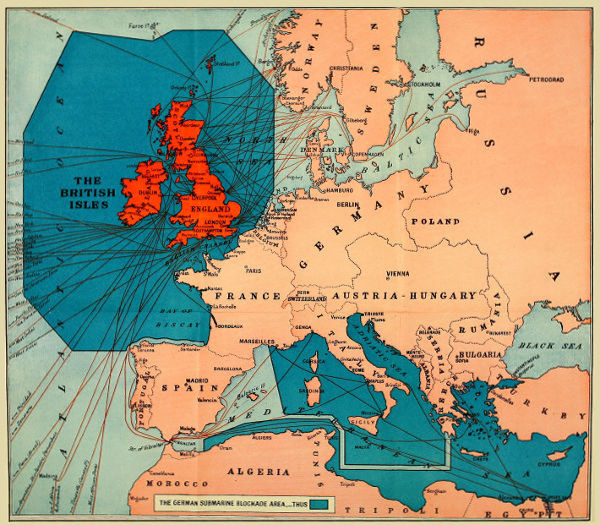
THE GERMAN SUBMARINE BLOCKADE AREA.—THUS MARKED IN DEEP BLUE
TRANSCRIBER'S NOTE:
Obvious printer errors have been corrected. The following
misspelled words have been changed from:
immeasureable to immeasurable — page 33
inadmissable to inadmissible — page 39
metal to mettle — page 69
stearing to steering — page 90
Otherwise, the author's original spelling, punctuation and
hyphenation have been left intact.