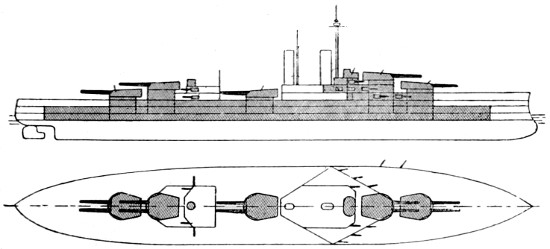
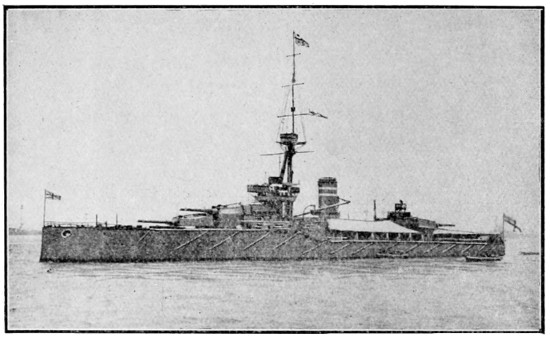
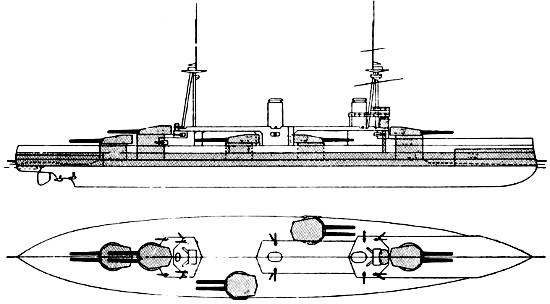
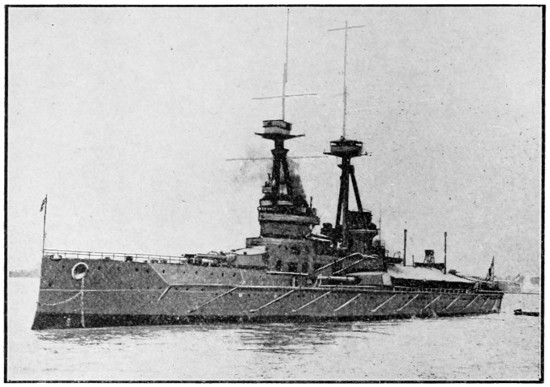
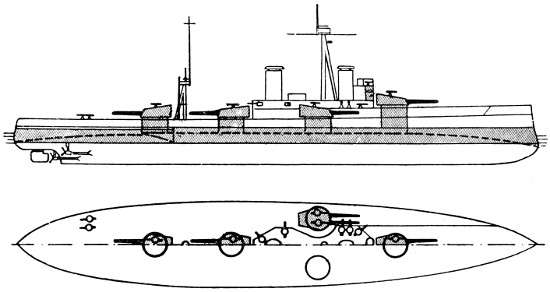
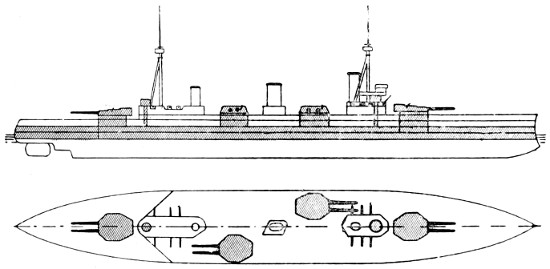
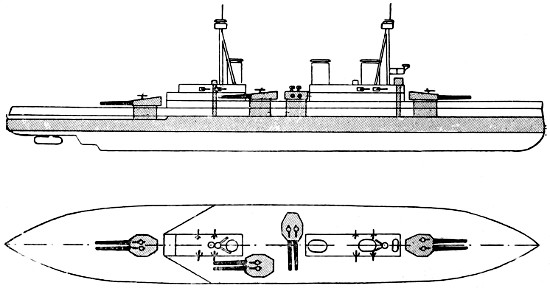
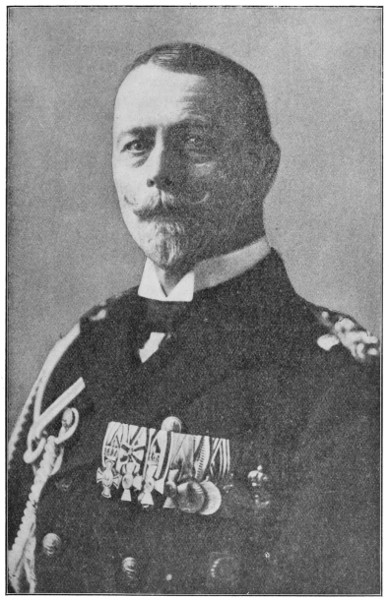
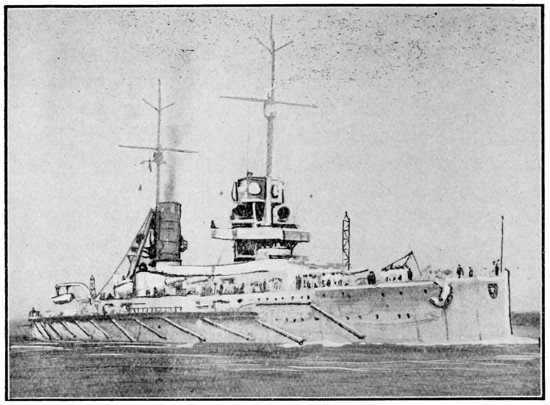
IRON DUKE
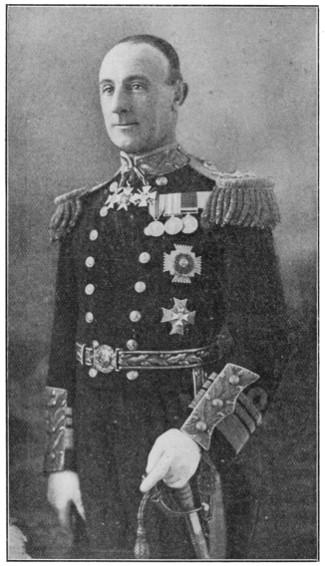
(Flagship of Vice-Admiral Sir John
Jellicoe, Commander-in-Chief of the Home
Fleets).
MARLBOROUGH.
EMPEROR OF INDIA.
BENBOW.
(Completed 1914.)
These fine ships are the very latest additions to
the British battle-fleet. The displacement is
25,000 tons, but with a full supply of coal, ammunition,
and stores on board the actual figure is
nearly 27,000 tons. The length over all is 645 ft.,
the maximum breadth is 891⁄2 ft., and under normal
conditions the ship draws 28 ft. of water. Parsons’
turbines, designed for 29,000 h.p., give a
speed of 21 knots, which was exceeded by over
one knot on trial. An extremely powerful armament
is carried. It consists of ten 13·5-in. and
twelve 6-in. guns, with some small quick-firers
on high-angle mountings for use against aircraft.
The big guns, mounted in twin turrets, are
all on the centre line, and can thus be trained
on either broadside, while four train ahead and
the same number astern. Ten of the 6-in. guns
are disposed in an upper-deck battery forward,
the remaining two in casemates right at the
stern. This disposition was adopted owing to
the fact that torpedo attacks are usually delivered
from ahead, and it is necessary, therefore,
that as many quick-firing guns as possible
can be trained on the approaching boats before
they are able to discharge their torpedoes.
Armour protection is very complete in this
class. On the waterline there is a 12-in. belt,
with 10-in. armour rising above this as far as
the upper deck. The belt thins to 6-in. forward
and aft, but the extreme ends of the ship are
unarmoured. On the turrets there is 12-in.
armour, with 6-in. plating over the secondary
battery. Four 21-in. submerged torpedo tubes
are fitted. The fuel supply is well over 3,000
tons. The complement of these ships totals more
than 1,000 officers and men. They each cost
over £2,000,000 to complete.
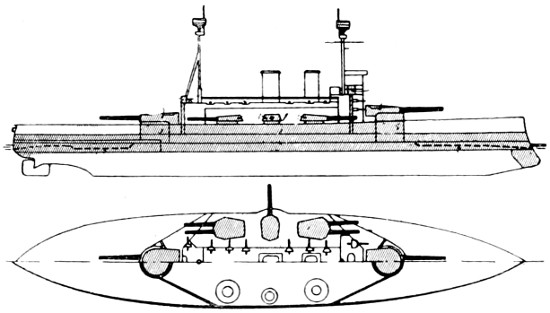
AGINGOURT.
(Completed 1914.)
This battleship, although she was only launched
in January, 1913, has had a very chequered
career. Originally laid down as the Rio de
Janeiro for the Brazilian Government at Elswick,
she was purchased before completion by
Turkey, and was on the point of leaving for
Turkish waters under the name of Osman I.,
when she was taken over by the British Admiralty
on the outbreak of war with Germany. Turkey
is understood to have made a protest, but the
transfer is an accomplished fact, and this fine
vessel has already passed into our battle fleet.
She is quite unique in design. The displacement
is 27,500 tons, length 632 ft., and the designed
speed, which was made on trial, 22 knots.
Her main armament consists of no fewer than
fourteen 12-in. guns, mounted in seven double
turrets on the centre-line, an arrangement which
permits all fourteen weapons to be fired on either
broadside. In the secondary battery are mounted
twenty 6-in. quick-firing guns, and the tale of
weapons is completed by sixteen small quick-firers
and three torpedo tubes. The ship is
armoured with 9-in. plates amidships, tapering
to 6 in. and 4 in. at the ends. Armour of the
same thickness (9-in.) protects the 12-in. turrets,
and there is 6-in. plating over the secondary guns.
The maximum coal capacity is 3,500 tons. A
complement of 1,100 officers and men is required
to work this huge vessel, which cost nearly
£2,700,000 to build and equip.
ERIN.
(Completed 1914.)
This vessel was laid down at Barrow for the
Turkish Government, and named Reshadieh,
but was taken over by the British Admiralty on
the outbreak of war with Germany. Launched
in September, 1913, she displaces 23,000 tons,
is 525 ft. long, and has turbines of 31,000 h.p.,
which are expected to give a speed of 21 knots.
In general her design corresponds to that of
the Iron Duke class. The armament consists
of ten 13·5-in., sixteen 6-in., and four 12-pounder
guns, with five submerged torpedo tubes.
The five double turrets in which the big guns
are mounted are on the centre-line, thus allowing
all ten weapons to be used on each broadside.
Armour protection is very complete, the main
belt being 12 in., the turrets 12 in., and the
secondary battery 5 in. thick. Her coal capacity
is 2,100 tons. The complement is 900 officers
and men. The price paid for this ship has not
yet been made public.
KING GEORGE V.
CENTURION.
AJAX.
AUDACIOUS.
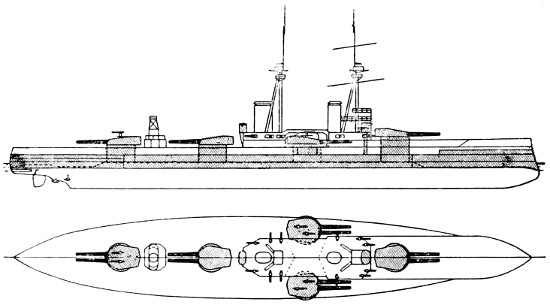
These fine vessels are among the most powerful
of our super-Dreadnought battleships. The displacement
is nominally 23,000 tons, but when in
service, with maximum fuel, stores, &c., on board,
they displace about 25,000 tons. They are 596 ft.
in length, with a beam of 89 ft., and their turbines
of 27,000 h.p. drive them at a speed of 211⁄2 knots.
The armament consists of ten 13·5-in. and sixteen
4-in. guns, with three submerged torpedo
tubes.
All the big guns, which are mounted in pairs
in turrets on the centre line, can fire on either
broadside. Protection is afforded by a 12-in.
armour belt amidships, with thinner plating
above and at the ends. The turrets are of 11-in.
armour. The secondary battery of 4-in. quick-firers
is practically unprotected. A maximum
fuel supply of 2,700 tons can be carried. The
complement is 900 officers and men. Each of
these ships cost more than £1,900,000 to build
and equip.
ORION.
MONARCH.
CONQUEROR.
THUNDERER.
Super-Dreadnoughts of 22,500 tons displacement
and 545 ft. in length. The Orion class,
to which these ships belong, inaugurated the
“super-Dreadnought” era by reason of the
super-calibre guns with which they are armed.
They are propelled by Parsons’ turbines of
27,000 h.p. at a speed of 21 knots, but did considerably
better than this on the trial runs.
The main armament comprises ten 13·5-in.
breech-loading guns, firing a 1,250 lb. projectile
at the rate of two per minute.
These guns are mounted in five twin turrets
on the centre line of the vessel, and all of them
can be trained on either broadside. Sixteen
4-in. quick-firers are mounted for use against
torpedo craft, and there are three 21-in. submerged
torpedo tubes. The armour belt is
12-in. thick amidships, the turrets 11-in.
Some of the smaller guns are protected by 4-in.
armour. Coal and oil to the amount of 2,700
tons can be carried. The complement of these
ships is 900 officers and men. They cost complete
nearly £2,000,000.
NEPTUNE.
HERCULES.
COLOSSUS.
These are Dreadnought battleships of 20,000
tons displacement. They are 510 ft. in length,
and have Parsons’ turbines of 25,000 h.p., which
give them a speed of 21 knots. The main battery
consists of ten 12-in. guns, 50 calibres (i.e., 50 ft.)
long, mounted in five twin turrets. Two of
these turrets are in echelon amidships, the remaining
three being on the centre line, an arrangement
that permits all ten guns to come into
action on either broadside through a limited
arc.
In the class to which these ships belong the
super-posed turret appeared for the first time
in the British Navy. Sixteen 4-in. quick-firers
and three submerged torpedo tubes complete
the armament. There is an 11-in. armour belt
on the waterline, similar protection being given
to the big guns. The fuel capacity is 2,700
tons. The complement numbers over 800 officers
and men. These vessels cost about £1,700,000
apiece to complete.
ST. VINCENT.
VANGUARD.
COLLINGWOOD.
These are Dreadnought battleships with a displacement
of 19,250 tons. They are 500 ft. long,
and have Parsons’ turbines of 24,500 h.p., which
give them a top speed of 21 knots. Their main
battery comprises ten 12-in. guns of powerful
type, mounted in five twin turrets, the disposition
of which allows eight guns to be used
on either beam. They also carry eighteen 4-in.
quick-firers, some mounted on top of the turrets,
and others in the superstructure. There are
three submerged torpedo tubes.
The waterline is protected by armour barely
10-in. thick, this being also the thickness of the
turret armour. Coal and oil to the amount of
2,700 tons can be carried. The complement of
these battleships numbers rather more than 800
officers and men. They cost about £1,700,000
to build and complete.
BELLEROPHON.
SUPERB.
TEMERAIRE.
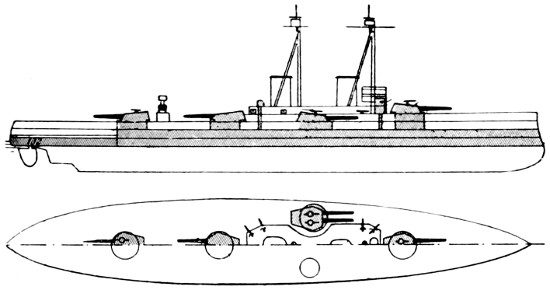
These ships are some of our earliest Dreadnoughts.
Their displacement is 18,900 tons, length
490 ft. Parsons’ turbines of 23,000 h.p. propel
them at a maximum speed of 21 knots, which they
can maintain for several hours without difficulty.
Ten 12-in. guns form the primary armament,
which is mounted in five twin turrets, so disposed
as to allow eight guns to fire on the broadside.
They carry, further, sixteen 4-in. quick-firing
guns to repel attack by torpedo craft, and
there are three torpedo tubes below water.
On the waterline and the big-gun positions
there is 11-in. armour. The maximum supply
of coal and oil is 2,700 tons. The complement
is 800 officers and men. These battleships cost
about £1,700,000 to build and complete.
DREADNOUGHT.
(Completed 1906.)
This famous battleship was laid down at Portsmouth
in October, 1905, and completed by
December, 1906, and thus established a record
for speedy construction. She was designed by a
committee of experts to meet the requirements of
modern naval tactics, and with various modifications
the main principles she embodied have
since been almost universally adopted. She displaces
17,900 tons, and is 520 ft. long. Parsons’
turbines of 23,000 h.p. give her a speed of 21
knots. She was the first battleship ever fitted
with turbine machinery.
The armament consists of ten 12-in. guns,
mounted in five twin turrets, which are so placed
as to give a broadside fire of eight and an axial
fire of six guns. For keeping off torpedo craft a
battery of twenty-four 12-pounder quick-firers is
provided. There are five submerged torpedo
tubes. Waterline and vitals are protected by
11-in. armour, as also are the gun turrets. The
ship has a great amount of internal protection
against mine or torpedo explosion. She can
carry 2,700 tons of coal. The complement numbers
about 800 officers and men. This battleship
cost upwards of £1,800,000 to build and equip.
LORD NELSON.
AGAMEMNON.
These battleships are sometimes called semi-Dreadnoughts,
because they approximate to the
Dreadnought type in tonnage and armament.
The displacement is 16,500 tons, length 410 ft.,
and engines of 16,750 h.p., giving a speed of over
18 knots. Each of these vessels is armed with
four 12-in. and ten 9·2-in. breech-loading guns,
all mounted in armoured turrets. The four 12-in.
and eight of the 9·2-in. guns are in twin turrets,
the other two 9·2-in. being in single turrets.
The disposition of the armament is such that
four 12-in. and five 9·2-in. can fire on each broadside.
An outstanding defect is the smallness of
the double 9·2-in. turrets, which hardly give
elbow room to the crews and do not allow full
advantage to be taken of the extraordinary
rapidity with which the 9·2-in. piece can be
worked when there is plenty of space.
On the whole, however, these ships are extremely
powerful units. For driving off torpedo
craft there are twenty-four 12-pounder quick-firers
mounted in the superstructure. Five torpedo
tubes are fitted. Armour protection consists
of a 12-in. belt amidships, and there is
similar plating on the 12-in. turrets, the smaller
turrets having 8-in. armour. The fuel capacity
is 2,500 tons. Each battleship carries 750
officers and men and cost £1,650,000 to build and
complete.
TIGER.
(Completed 1914.)
This is the largest battle cruiser in the British
Navy. She was built at Clydebank, and was
approaching completion at the outbreak of war.
The displacement is 28,000 tons, length 660 ft.,
and Parsons’ turbines of 100,000 h.p. give a speed
of at least 28 knots. Her armament comprises
eight 13·5-in., twelve 6-in., and some smaller
guns, with three torpedo tubes. The big
guns are in double turrets on the centre-line,
and all can be fired on either broadside. The
6-in. guns are mounted in an armoured battery.
For a battle cruiser this ship is heavily
armoured. She has a belt at least 10 in. thick
amidships, and the turrets are of equal thickness.
She can store as much as 4,000 tons of coal and
oil. The complement is about 1,100 officers
and men. In appearance the “Tiger” is quite
unlike other British battle cruisers. She has
three equal-sized funnels and only one mast.
Her total cost is understood to be not less than
£2,200,000.
LION.
QUEEN MARY.
PRINCESS ROYAL.
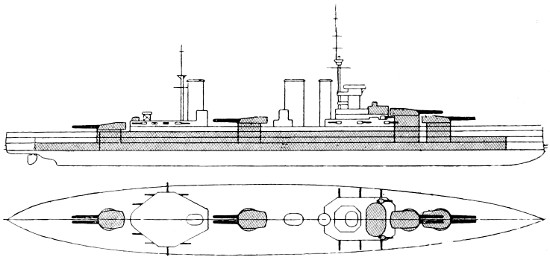
These battle cruisers displace 27,000 tons,
are 660 ft. in length, and 881⁄2 ft. broad. They
have turbines of about 70,000 h.p., which enable
them to steam at 28 knots, though this speed
has been greatly exceeded in service. The main
armament consists of ten 13·5-in. guns, discharging
a projectile of 1,400 lb. weight, at the
rate of two rounds per minute.
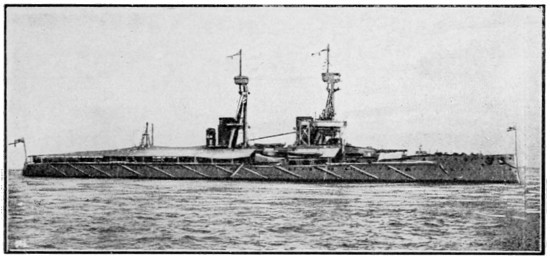
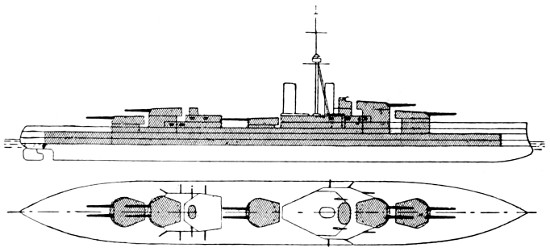
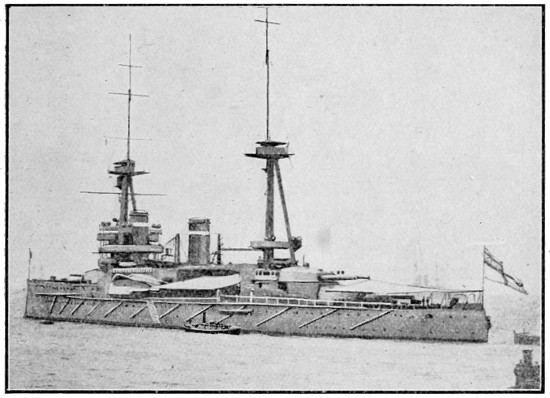
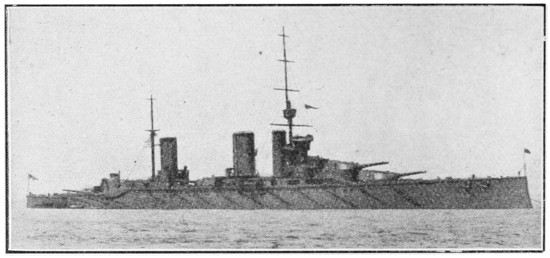
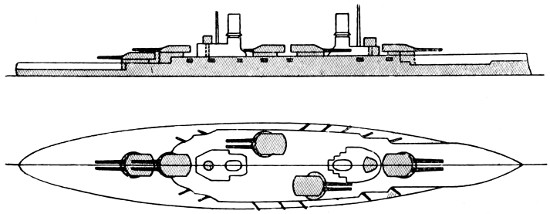
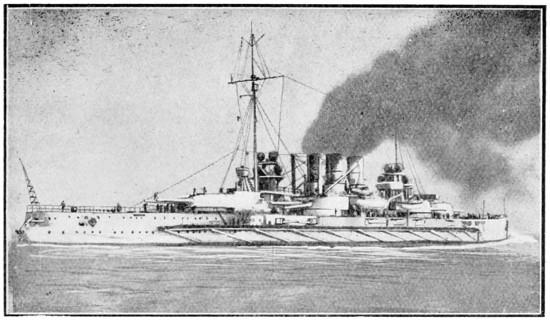
H.M.S. Bellerophon.
Photo: Symonds & Co.
BELLEROPHON CLASS.
BELLEROPHON, TEMERAIRE, SUPERB.
Displacement: 18,000 tons.
Speed: 22 knots; Guns: 10 12in., 16 4in.;
Torpedo tubes: 3.
| Astern fire: |
Broadside: |
Ahead fire: |
| 6 12in. |
8 12in. |
6 12in. |
These weapons are mounted in four double
turrets on the centre-line, and can thus be fired
on either broadside. Sixteen 4-in. quick-firers
are carried for repelling torpedo attack. There
are also two submerged torpedo tubes. The
main armour belt is about 9 in. thick, with 10-in.
plating on the turrets. The full fuel capacity
is 3,000 tons, and the complement numbers
980 officers and men. These ships averaged
£2,085,000 to build and complete.
INDEFATIGABLE.
NEW ZEALAND.
AUSTRALIA.
These vessels displace about 19,000 tons.
They are 555 ft. in length, 80 ft. broad, and are
designed for a speed of 25 knots, which was much
exceeded during trials. The main armament
consists of eight 12-in. guns, mounted in four
double turrets, two being placed fore and
aft, and two diagonally amidships, thus permitting
all eight guns to be discharged on
either broadside.
In addition there are sixteen 4-in. quick-firers
mounted in the superstructure, and two
submerged torpedo tubes. A 7-in. armour belt
protects the waterline, the same thickness being
on the turrets. The fuel capacity is 2,500 tons,
including oil. A complement of 790 officers
and men is carried. These ships cost about
£1,500,000 each to build and complete.
INVINCIBLE.
INDOMITABLE.
INFLEXIBLE.
The Invincible class were the first battle-cruisers
to be built. The type is a cruiser edition
of the Dreadnought, combining great offensive
qualities with high speed. The displacement is
17,250 tons, length 530 ft., and the turbines of
41,000 h.p. are designed for a speed of 25 knots.
In service, however, these vessels have steamed
at more than 28 knots. They are armed with
eight 12-in guns, mounted in four double turrets,
one turret being placed at each end and the
other two en echelon amidships.
This system enables all eight weapons to be
fired on either broadside through a very limited
arc. Sixteen 4-in. guns are mounted for repelling
torpedo attack. The waterline and vital
parts are protected by 7-in. armour, this being
also the thickness of the turret plates. Coal
to the amount of 2,500 tons can be carried. The
complement is 780 officers and men. These
vessels each cost over £1,700,000 to build and
equip.
KING EDWARD VII.
ZEALANDIA.
BRITANNIA.
HIBERNIA.
DOMINION.
COMMONWEALTH.
HINDUSTAN.
AFRICA.
The King Edward class is considered to be the
finest homogeneous group of pre-Dreadnought
battleships in the world. The displacement is
16,350 tons, length 425 ft., and engines of 18,000
h.p. give a speed of over 19 knots. The armament
consists of four 12-in., four 9·2-in., ten 6-in.,
twelve 12-pounder, and twelve 3-pounder guns,
with four torpedo tubes.
All eight big guns are mounted in armoured
turrets, the 6-in. weapons being in a box battery.
Broadside fire is from four 12-in., two 9·2-in.,
and five 6-in. guns. A 9-in. armour belt protects
vital parts. On the main turrets there is
12-in. plating, and the smaller guns also have
good protection. The maximum coal supply is
2,200 tons. A complement of 820 officers and
men is carried. These ships each cost about
£1,450,000 to build and equip.
SWIFTSURE.
TRIUMPH.
These battleships were built for the Chilian
Government, but both were purchased by Great
Britain before they were completed. The displacement
is 11,980 tons, length 436 ft., and
engines of 12,500 h.p. give a speed of 20 knots.
For their size the armament of these vessels is
most formidable. It comprises four 10-in., fourteen
7·5-in., and fourteen 14-pounder guns, with
two torpedo tubes. The 10-in. weapons are in
two twin turrets, the 7·5-in. guns being in an
armoured battery.
The waterline and vital parts are protected by
7-in. of armour, which is increased to 10-in.
on the turrets and there is 6-in. plating over
the secondary battery. The coal supply is
2,000 tons. A complement of 700 officers
and men is carried. The ships each cost
£845,000 to build and complete. In all but very
calm weather they lose much of their fighting
value owing to the nearness of the 7·5-in. battery
to the water, a position which makes it impossible
to work these guns in a seaway. In other
respects, too, the type is considered inferior to
standard British design.
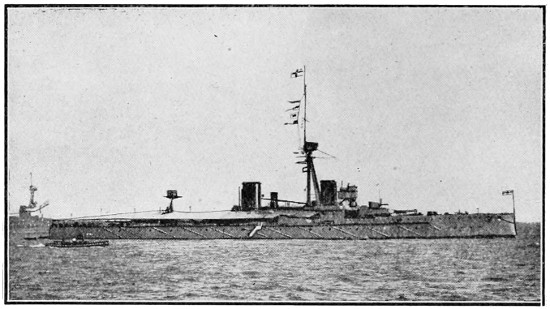
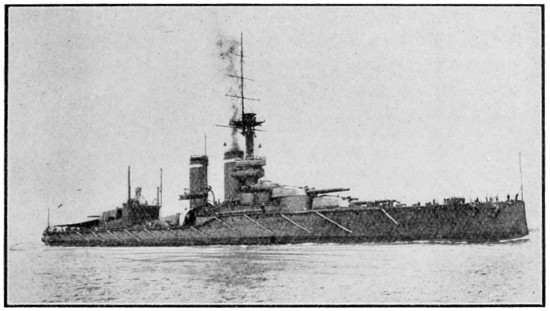
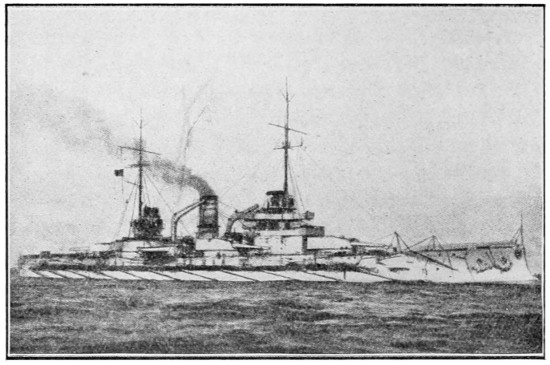
H.M.S. Dreadnought.
Photo: Sport & General.
DREADNOUGHT.
Displacement: 17,900 tons.
Speed: 22 knots; Guns: 10 12in., 24 12pdrs.;
Torpedo tubes: 5.
| Astern fire: |
Broadside: |
Ahead fire: |
| 6 12in. |
8 12in. |
6 12in. |
DUNCAN.
EXMOUTH.
CORNWALLIS.
ALBEMARLE.
RUSSELL.
These are vessels of 14,000 tons displacement,
405 ft. in length, with engines of 18,000 h.p., and
a speed of 20 knots. Their armament consists
of four 12-in., twelve 6-in., and ten 12-pounder
guns, with four submerged torpedo tubes. The
12-in. guns are in turrets, the 6-in. in casemates.
Broadside fire is from four 12-in. and six 6-in.
guns.
The class to which these ships belong was designed
with a view to speed, to gain which sacrifices
were necessary. Hence the armour protection
is very light, the thickness of the belt
being only 7-in. on the waterline. The turrets
are of the same moderate thickness. The maximum
fuel capacity is 2,000 tons. A complement
of 750 officers and men is carried. The average
cost was £1,000,000 to build and complete.
FORMIDABLE.
IMPLACABLE.
VENERABLE.
PRINCE OF WALES.
IRRESISTIBLE.
LONDON.
BULWARK.
QUEEN.
This class displaces 15,000 tons, is 400 ft. long,
and has engines of 15,000 h.p., giving a speed
of about 181⁄2 knots. It is armed with four 12-in.,
twelve 6-in., and sixteen 12-pounder guns, with
four submerged torpedo tubes. The waterline
is armoured with 9-in., the turrets with 12-in.
plates, and there is 6-in. armour on the casemates
containing the secondary guns. The full
coal capacity is 2,100 tons. These ships carry
780 officers and men. They cost more than
£1,000,000 to build and equip.
CANOPUS.
GOLIATH.
VENGEANCE.
OCEAN.
GLORY.
ALBION.
These ships belong to a class of old pre-Dreadnoughts
which are rapidly losing their fighting
value. They displace 12,950 tons, are 390 ft. long,
and have engines of 13,500 h.p., which give a
speed of nearly 19 knots. The armament comprises
four 12-in., twelve 6-in., and ten 12-pounder
guns, all of obsolescent pattern. There are four
torpedo tubes. A belt only 6-in. thick protects
the waterline, but there is 12-in. armour on the
gun turrets. Coal to the amount of 1,750 tons
can be carried. The complement numbers 750
officers and men. These ships cost about £850,000
each. They were designed with very light
draught to enable them to navigate the Suez
Canal. They are still comparatively fast steamers.
MAGNIFICENT.
MAJESTIC.
VICTORIOUS.
PRINCE GEORGE.
ILLUSTRIOUS.
JUPITER.
CÆSAR.
MARS.
HANNIBAL.
The Majestic class is the oldest group of
battleships in the Navy. The displacement is
14,900 tons, length 390 ft. and engines of 12,000
h.p. give them a maximum speed of 171⁄2 knots.
They are armed with four 12-in., twelve 6-in.,
and sixteen 12-pounder guns of old type, with
five torpedo tubes. The armour belt is 9-in.
amidships, and there is 14-in. armour on the
big gun turrets. Coal to the amount of 1,900
tons can be stowed. A complement of 750
officers and men is carried. The ships cost
slightly more than £900,000 each to build and
complete.
MINOTAUR.
DEFENCE.
SHANNON.
These vessels are armoured cruisers of 14,600
tons, 490 ft. in length, and have engines of 27,000
h.p., giving a speed of 23 knots. They carry
a very powerful armament, consisting of four
9·2-in., ten 7·5-in., and sixteen 12-pounder
guns. The 9·2-in. and 7·5-in. guns are in
armoured turrets, the four first named being
mounted in pairs, the 7·5 in. singly.
Protection is afforded by a 6-in. belt amidships,
with 8-in. armour on the 9·2-in. turrets, and 6-in.
armour on the smaller turrets. The maximum
coal supply is 2,250 tons. A complement of
about 800 officers and men is borne. These
ships cost more than £1,400,000 each to build
and complete.
WARRIOR.
ACHILLES.
NATAL.
COCHRANE.
These are armoured cruisers of 13,550 tons.
They are 480 ft. in length, and have engines of
23,000 h.p., giving a speed of 23 knots. The
armament consists of six 9·2-in. and four 7·5-in.
guns, all mounted in single turrets, and so disposed
that six heavy guns bear on each broadside.
There are, besides, twenty-four 3-pounder
quick-firers for use against torpedo-craft, and
three submerged torpedo tubes. The armour
belt and turrets are 6 in. thick. The maximum
coal capacity is 2,000 tons, and a complement
of over 700 officers and men is carried. Each
vessel cost about £1,200,000 to build and complete.
BLACK PRINCE.
DUKE OF EDINBURGH.
These armoured cruisers have a displacement
of 13,550 tons, are 480 ft. long, and have engines
of 23,000 h.p., giving a speed of 23·3 knots.
They are armed with six 9·2-in., ten 6-in., and
twenty 3-pounder guns, with three torpedo
tubes. The big guns are mounted in single
turrets, the 6-in. weapons being in an armoured
battery.
Owing to the low freeboard of these ships,
their 6-in. guns are too near the water to be
worked in rough weather. They are protected
on the waterline by a 6-in. armour belt, with
similar plating on the gun turrets and battery.
The full coal capacity is 2,000 tons. These
cruisers carry 700 officers and men. They cost
nearly £1,200,000 to build and complete.
ANTRIM.
CARNARVON.
HAMPSHIRE.
DEVONSHIRE.
ROXBURGH.
ARGYLL.
Armoured cruisers displacing 10,850 tons, 450 ft.
in length, with engines of 20,500 h.p., giving
a speed of 22·3 knots. The armament is weak
for vessels of this size, and consists only of four
7·5-in. and six 6-in. guns, with twenty small
quick-firers and two torpedo tubes.
The 7·5-in. guns are mounted in turrets, the
6-in. weapons in casemates. There is a 6-in.
belt amidships, and 6-in. plating on the turrets
and casemates. The maximum coal capacity
is 1,800 tons. A complement of 655 officers
and men is carried. The average cost, complete,
of these ships was nearly £900,000.
KENT.
ESSEX.
MONMOUTH.
BERWICK.
SUFFOLK.
DONEGAL.
LANCASTER.
CORNWALL.
CUMBERLAND.
The displacement of this class is 9,800 tons.
They are 440 ft. in length, and have engines
of 22,000 h.p., which drive them at a speed
of 23 knots. The armament consists of fourteen
6-in., eight 12-pounder, and three smaller quick-firing
guns. Four of the 6-in. weapons are
mounted in twin turrets placed at the bow
and stern, the remainder being in casemates.
There are two torpedo tubes.
Protection is very light throughout, there being
only a 4-in. belt amidships, with 5-in. armour on
the turrets. The full coal supply is 1,600 tons.
A complement of 540 officers and men is carried.
Each ship cost complete about £750,000.
DRAKE.
LEVIATHAN.
GOOD HOPE.
KING ALFRED.
These vessels are among the best of the older
armoured cruisers. Each displaces 14,100 tons,
is 500 ft. long, and has engines of 30,000 h.p.,
giving a speed of 23 knots. On trial and in
service this speed has been much exceeded,
and the ships can still steam at 24 knots. They
are armed with two 9·2-in. breech-loaders, sixteen
6-in., and twelve 12-pounder quick-firing
guns.
The big weapons are in single turrets, one
placed at each end of the ship, the 6-in. guns
being mounted in casemates. Two torpedo tubes
are fitted. The armour protection on the turrets,
casemates, and belt has a uniform thickness
of 6-in. Coal to the amount of 2,500 tons is
stored in the bunkers. The complement consists
of 900 officers and men. These cruisers averaged
about one million sterling complete.
CRESSY.
SUTLEJ.
ABOUKIR.
HOGUE.
BACCHANTE.
EURYALUS.
The Cressy group are the oldest class of armoured
cruisers on the active list. They displace
12,000 tons, are 440 ft. in length, and have
engines of 21,000 h.p., producing a speed of 21
knots, which was exceeded on trial by one knot.
The armament comprises two 9·2-in. breech-loaders,
twelve 6-in., and twelve 12-pounder
quick-firing guns, with two torpedo tubes.
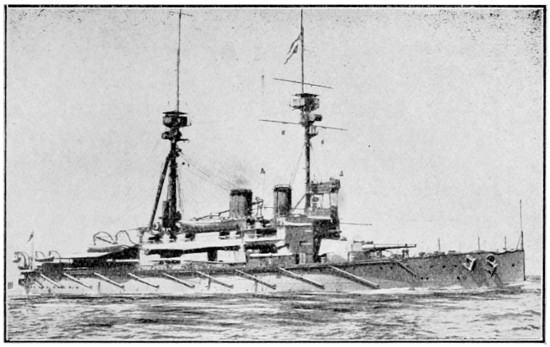
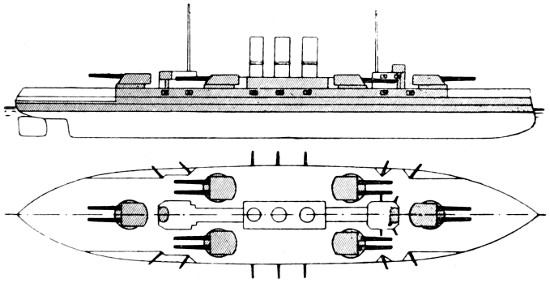
H.M.S. Agamemnon.
Photo: Cribb, Southsea.
AGAMEMNON CLASS.
AGAMEMNON AND LORD NELSON.
Displacement: 16,500 tons.
Speed: 181⁄2 knots; Guns: 4 12in., 10 9·2in.;
Torpedo tubes: 5.]
| Astern fire: |
Broadside: |
Ahead fire: |
| 2 12in. |
4 12in. |
2 12in. |
| 4 9·2in. |
5 9·2in. |
4 9·2in. |
The big guns are mounted in single turrets
fore and aft, the 6-in. weapons in casemates.
There is a 6-in. belt amidships, armour of the
same thickness on the turrets, and 5-in. plating
on the casemates. The coal bunkers can store
1,600 tons. A complement of 750 officers and
men is carried. The cost of this class when
complete averaged £750,000.
ARETHUSA.
AURORA.
GALATEA.
INCONSTANT.
PENELOPE.
PHAETON.
ROYALIST.
UNDAUNTED.
These are the light armoured cruisers which
Mr. Churchill has described as “destroyers of
destroyers.” They displace 3,600 tons, are 410
ft. long, and have turbines of 37,000 h.p., giving
a speed of 30 knots. The armament consists of
two 6-in., six 4-in., and four machine guns, with
four torpedo tubes.
There is a belt of 3-in. armour amidships,
with 31⁄2-in. plating above this. The boilers are
fired entirely by oil fuel, of which about 750 tons
are carried. The complement numbers about
270 officers and men. The cost of this class has
not yet been made public.
EDGAR.
HAWKE.
THESEUS.
ENDYMION.
GRAFTON.
GIBRALTAR.
These vessels are the oldest cruisers we possess,
displacing 7,350 tons, and having a speed of
191⁄2 knots. They are armed with two 9·2-in.,
ten 6-in., and seventeen smaller guns, with two
torpedo tubes. Coal capacity, 1,250 tons. Complement,
544 officers and men. Cost over
£400,000.
ROYAL ARTHUR.
CRESCENT.
This class displaces 7,700 tons, and has a speed
of 191⁄2 knots. The armament is one 9·2-in.,
twelve 6-in., and seventeen smaller guns, with
two torpedo tubes. There is a steel deck over
engines and boilers. Coal capacity, 1,250 tons.
Complement, 560 officers and men. Cost, about
£400,000.
TERRIBLE.
(Completed 1898.)
This is the largest protected cruiser in the
British Navy. She displaces 14,200 tons, and
can steam at 22 knots. Her armament consists
of two 9·2-in., sixteen 6-in., and many smaller
guns, with four torpedo tubes. Over engines
and boilers there is a steel deck 6-in. thick.
Coal capacity, 3,000 tons. Complement, 840
officers and men. Cost complete, £708,000.
DIADEM.
NIOBE.
AMPHITRITE.
ARIADNE.
EUROPA.
ANDROMEDA.
ARGONAUT.
SPARTIATE.
Protected cruisers of 11,000 tons and 201⁄2 knots
speed, armed with sixteen 6-in. and twelve
12-pounder quick-firing guns, with two torpedo
tubes. Engines and boilers are protected by a
4-in. steel deck. Coal capacity, 2,000 tons.
Complement, 677 officers and men. Cost, about
£550,000. The Niobe is now a unit of the
Canadian Navy.
MELBOURNE.
SYDNEY.
These are protected cruisers belonging to the
Australian Navy. They displace 5,600 tons,
are 430 ft. long, and have a speed of 251⁄2 knots.
The armament consists of eight 6-in. and some
small quick-firers, with two submerged torpedo
tubes.
The coal capacity is 1,000 tons. A complement
of 400 officers and men is carried. They
each cost complete about £350,000.
NOTTINGHAM.
BIRMINGHAM.
LOWESTOFT.
Three of our latest light cruisers. They are
of 5,440 tons, with turbines of 22,000 h.p., giving
a speed of 251⁄2 knots. The armament is nine
6-in. and four small quick-firers, with two submerged
torpedo tubes. There is a thin armour
belt on the waterline. Coal capacity, 1,000
tons. The complement is 400 officers and men.
LION CLASS.
LION, PRINCESS ROYAL.
Displacement: 26,350 tons.
Speed: 28 knots; Guns: 8 13·5in., 16 4in.;
Torpedo tubes: 3.
| Astern fire: |
Broadside: |
Ahead fire: |
| 2 13·5in. |
8 13·5in. |
4 13·5in. |
SOUTHAMPTON.
CHATHAM.
DUBLIN.
These vessels are light cruisers of 5,400 tons,
with turbines of 22,000 h.p., and a speed of 251⁄2
knots. They carry an armament of eight 6-in.
and four small quick-firers, with two torpedo
tubes submerged. Coal capacity, 1,000 tons.
Complement, 400 officers and men. Cost complete,
about £350,000.
FALMOUTH.
WEYMOUTH.
DARTMOUTH.
YARMOUTH.
Light cruisers displacing 5,250 tons, driven
by turbines of 22,000 h.p. at a speed of 243⁄4
knots. They are armed with eight 6-in. and
four small quick-firers, and two submerged
torpedo tubes. The coal capacity is 1,000 tons.
Complement, 390 officers and men. Cost complete,
about £335,000.
GLASGOW.
LIVERPOOL.
BRISTOL.
GLOUCESTER.
NEWCASTLE.
These vessels are light cruisers of 4,800 tons,
propelled by turbines of 22,000 h.p., at a speed
of 25 knots. The armament is two 6-in., ten
4-in., and some small quick-firers, with two submerged
torpedo tubes. Coal capacity, 850 tons.
Complement, 375 officers and men. Cost complete,
over £350,000.
ACTIVE.
FEARLESS.
These vessels belong to the Scout category,
and displace 3,440 tons. Their turbines of
18,000 h.p. give a speed of 25 knots, but this is
often exceeded. They are armed with ten 4-in.
and four smaller quick-firers, and have two deck
torpedo tubes. Coal capacity, 600 tons. Complement,
320 officers and men. They averaged
complete about £270,000. The ill-fated Amphion
was a sister-ship.
BLANCHE.
BLONDE.
Light cruisers of the Scout type. They displace
3,350 tons, and have turbines of 18,000
h.p., giving a speed of 25 knots. The armament
is ten 4-in. and four 3-pounder quick-firers, with
two torpedo tubes mounted on deck. Coal
capacity, 600 tons. Complement, 285 officers
and men. Cost complete, about £275,000.
BELLONA.
BOADICEA.
Light cruisers of the Scout type, displacing
3,300 tons, and having a speed of 25 knots,
which is frequently exceeded by two knots.
Armament: Six 4-in., four 3-pounder quick-firing
guns, two deck torpedo tubes. Coal
capacity, 600 tons. Complement, 263 officers
and men. Cost complete, £330,000.
ADVENTURE.
ATTENTIVE.
FORESIGHT.
FORWARD.
PATHFINDER.
PATROL.
SENTINEL.
SKIRMISHER.
These vessels were the first fleet scouts. They
are of about 3,000 tons displacement, and have
engines of 16,500 h.p., which give them a speed of
25 knots. As originally armed, they carried a
battery of 12-pounders, but these were replaced
recently by nine 4-in. quick-firers, a change which
much increased the fighting value. The coal supply
is 400 tons, and they have a complement of 268
officers and men. The average cost, complete,
was over £270,000.
AMETHYST.
TOPAZE.
DIAMOND.
SAPPHIRE.
Light cruisers of 3,000 tons, with a speed of
22 knots. Armed with twelve 4-in. and some
smaller quick-firing guns, with two torpedo tubes
on deck. The coal supply is 500 tons, the complement
296 officers and men, and the average cost,
complete, was about £235,000.
CHALLENGER.
ENCOUNTER (Australian Navy).
These vessels are protected cruisers of 5,880
tons, capable of steaming 21 knots. The armament
consists of eleven 6-in. and some smaller
quick-firing guns. Over the engines and boilers
there is a 3-in. steel protective deck. The coal
capacity is 1,225 tons, the complement 454 officers
and men, and they averaged, complete, £360,000.
HERMES.
HYACINTH.
HIGHFLYER.
These protected cruisers displace 5,600 tons.
They have a speed of 20 knots, and are armed with
eleven 6-in., several smaller quick-firing guns,
and two torpedo tubes. The coal capacity is
1,100 tons. They carry a complement of 456
officers and men, and each ship cost, complete,
over £280,000.
PROSERPINE.
PELORUS.
PEGASUS.
PYRAMUS.
PANDORA.
PERSEUS.
PROMETHEUS.
PSYCHE.
PIONEER.
The displacement of this class is about 2,200
tons, speed 20 knots, and the armament consists
of eight 4-in. and some smaller quick-firing guns,
with two torpedo tubes mounted on deck. The
coal capacity is 520 tons. They have a complement
of 234 officers and men, and each vessel cost
complete, about £150,000.
FURIOUS.
VINDICTIVE.
Protected cruisers of 5,750 tons and 19 knots
speed, armed with ten 6-in. and some smaller
quick-firing guns, and two torpedo tubes. Coal
capacity is 1,175 tons. The complement consists
of 429 officers and men. Each cost complete,
over £280,000.
ECLIPSE.
MINERVA.
TALBOT.
DIANA.
DORIS.
JUNO.
VENUS.
ISIS.
DIDO.
These vessels are protected cruisers of 5,600
tons, with a speed of 191⁄2 knots. They are armed
with eleven 6-in. and some smaller guns, and have
two torpedo tubes. The coal capacity is 1,050
tons, and the complement 416 officers and men.
Each cost complete about £275,000.
ASTRÆA.
CAMBRIAN.
CHARYBDIS.
FLORA.
FOX.
HERMIONE.
The displacement of these cruisers is 4,360 tons.
They have a speed of 191⁄2 knots, and are armed
with two 6-in., eight 4·7-in., and some smaller
guns. The coal capacity is 1,000 tons. A complement
of 312 officers and men is carried. They
averaged complete about £225,000.
SAPPHO.
A light cruiser of 1,400 tons displacement, with
a speed of 191⁄2 knots. She is armed with two
6-in., eight 4·7-in., and some smaller guns, and
has four torpedo tubes. The coal supply is 1,000
tons. Her complement is 273 officers and men.
She cost complete £176,000.
ÆOLUS.
RAINBOW (Canadian Navy).
SIRIUS.
MELPOMENE.
BRILLIANT.
These light cruisers displace 3,600 tons, and
have a speed of 20 knots. They are armed with
two 6-in., six 4·7-in., and some smaller guns,
besides four torpedo tubes. The coal capacity is
535 tons. The complement is 273 officers and
men.
PHILOMEL.
A light cruiser of 2,575 tons, with a speed of
19 knots. Armament: Eight 4·7-in., and thirteen
smaller guns. Two torpedo tubes. Coal capacity
440 tons. The complement is 217 officers and
men, and the ship cost complete about £164,000.
She is the only vessel of the Pearl Class remaining
on the active list.
MEDEA.
This is the oldest light cruiser on the active
list. She displaces 2,800 tons, has a speed of
19 knots, and is armed with six 4·7-in., and fourteen
smaller guns, besides four torpedo tubes.
The coal capacity is 400 tons. The complement
is about 200 officers and men.
LLEWELLYN.
LENNOX.
LOYAL.
LEGION.
LAFOREY.
LAWFORD.
LOUIS.
LYDIARD.
LEONIDAS.
LUCIFER.
LAERTES.
LYSANDER.
LANCE.
LOOKOUT.
LAUREL.
LIBERTY.
LARK.
LANDRAIL.
LAVEROCK.
LINNET.
These are among the very latest destroyers.
They were launched in 1913, and have a displacement
of 965 tons. The designed speed is 29 knots,
which was exceeded on trial. They consume oil
fuel only. The armament consists of three 4-in.
guns and four torpedo tubes, and they carry 100
officers and men.
ACASTA.
ACHATES.
AMBUSCADE.
ARDENT.
FORTUNE.
CHRISTOPHER.
COCKATRICE.
CONTEST.
GARLAND.
PARAGON.
PORPOISE.
UNITY.
VICTOR.
LYNX.
MIDGE.
OWL.
SHARK.
SPARROWHAWK.
SPITFIRE.
HARDY.
These destroyers were built under the 1911 programme.
The displacement is 935 tons, and
they can steam at more than 30 knots. The
armament is three 4-in. guns and two torpedo
tubes. Oil fuel only is consumed. The complement
is 100 officers and men.
LURCHER.
FIREDRAKE.
OAK.
BADGER.
BEAVER.
ACHERON.
ARIEL.
ARCHER.
ATTACK.
GOSHAWK.
HIND.
FORESTER.
HORNET.
HYDRA.
DEFENDER.
DRUID.
JACKAL.
TIGRESS.
LAPWING.
LIZARD.
SANDFLY.
PHŒNIX.
FERRET.
Ocean-going destroyers of about 700 tons, with
a speed of more than 30 knots. The armament
consists of two 4-in. and two 12-pounder guns,
with two torpedo tubes. Oil only is consumed.
The complement is seventy-two officers and men.
These boats were built under the 1910 programme.
ACORN.
ALARM.
BRISK.
CAMELEON.
COMET.
FURY.
GOLDFINCH.
HOPE.
LARNE.
LYRA.
MARTIN.
MINSTREL.
NEMESIS.
NEREIDE.
NYMPHE.
REDPOLE.
RIFLEMAN.
RUBY.
SHELDRAKE.
STAUNCH.
These destroyers were built under the 1909
programme. Their displacement is 760 tons,
the designed speed 27 knots. The armament is
two 4-in. and two 12-pounder guns, with two
torpedo tubes. Oil only is consumed. The
complement is 76 officers and men.
BASILISK.
BEAGLE.
BULLDOG.
FOXHOUND.
GRASSHOPPER.
HARPY.
MOSQUITO.
GRAMPUS.
PINCHER.
RACOON.
RATTLESNAKE.
RENARD.
SAVAGE.
SCORPION.
SCOURGE.
WOLVERINE.
These destroyers, which were built under the
1908 programme, have a displacement of 976
tons and a speed of 27 knots. They are armed
with one 4-in. and three 12-pounder guns, and
two torpedo tubes. The complement is 96
officers and men.
AFRIDI.
COSSACK.
GHURKA.
MOHAWK.
TARTAR.
These are ocean-going destroyers, displacing
about 880 tons, with a speed of more than 33
knots. They are armed with five 12-pounder
guns and two torpedo tubes. Oil only is consumed
in the furnaces. Complement, 60 officers
and men.
SARACEN.
AMAZON.
NUBIAN.
These destroyers are of 975 tons displacement,
and have a speed of more than 33 knots. The
armament is two 4-in. guns and two torpedo tubes.
Oil only is consumed. The complement is 67
officers and men.
CRUSADER.
MAORI.
ZULU.
Ocean-going destroyers of more than 1,000
tons displacement, with a speed of nearly 34
knots. They burn oil fuel only. Armed with
two 4-in. guns and two torpedo tubes. Complement,
71 officers and men.
VIKING.
An ocean-going destroyer of 1,090 tons and
a speed of 34 knots. She is armed with two
4-in. guns and two torpedo tubes. Oil only is
burned. The complement is 71 officers and
men.
SWIFT.
(Completed 1908.)
This is the largest destroyer in the British
Navy, and also the fastest. She displaces 2,170
tons, and is designed for a speed of 36 knots,
but is said to have done as much as 39 knots in
service. The armament is four 4-in. guns and
two torpedo tubes. She is officially classed as
a flotilla leader.
ARUN.
BOYNE.
CHELMER.
CHERWELL.
COLNE.
DEE.
DERWENT.
DOON.
EDEN.
ERNE.
ETTRICK.
EXE.
FOYLE.
GARRY.
ITCHEN.
JED.
KALE.
KENNET.
LIFFEY.
MOY.
NESS.
NITH.
OUSE.
RIBBLE.
ROTHER.
STOUR.
SWALE.
TEST.
TEVIOT.
URE.
USK.
WAVENEY.
WEAR.
WELLAND.
These destroyers comprise the “River” class.
They displace about 550 tons, have a speed of
251⁄2 knots, and are armed with four 12-pounder
guns and two torpedo tubes. The complement
is 72 officers and men.
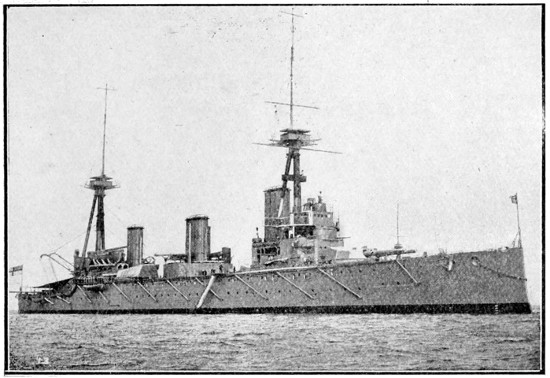
H.M.S. Indefatigable.
Photo: Cribb, Southsea.
INDEFATIGABLE CLASS.
INDEFATIGABLE, AUSTRALIA,
NEW ZEALAND.
Displacement: 18,750 tons.
Speed: 28 knots; Guns: 8 12in., 16 4in.;
Torpedo tubes: 3.
| Astern fire: |
Broadside: |
Ahead fire: |
| 6 12in. |
8 12in. |
6 12in. |
ANGLER.
COQUETTE.
CYGNET.
CYNTHIA.
DESPERATE.
FAME.
MALLARD.
STAG.
These boats represent the older type of destroyers.
They displace more than 300 tons,
have a speed of 30 knots, and are armed with
one 12-pounder, five smaller guns, and two
torpedo tubes. The complement is 60 officers
and men.
ALBATROSS.
AVON.
BAT.
BITTERN.
BRAZEN.
BULLFINCH.
CHEERFUL.
CRANE.
DOVE.
ELECTRA.
FAIRY.
FALCON.
FAWN.
FLIRT.
FLYING FISH.
GIPSY.
GREYHOUND.
KESTREL.
LEOPARD.
LEVEN.
MERMAID.
OSPREY.
OSTRICH.
RACEHORSE.
RECRUIT.
ROEBUCK.
STAR.
SYLVIA.
THORN.
VELOX.
VIGILANT.
VIOLET.
VIXEN.
VULTURE.
A comparatively old group of destroyers of
30 knots speed. Armed with one 12-pounder,
five smaller guns, and two torpedo tubes. The
complement is about 60 officers and men.
ALBACORE.
ARAB.
BONETTA.
EARNEST.
EXPRESS.
GRIFFON.
KANGAROO.
LIVELY.
LOCUST.
MYRMIDON.
ORWELL.
PANTHER.
PETEREL.
QUAIL.
SEAL.
SPITEFUL.
SPRIGHTLY.
SUCCESS.
SYREN.
THRASHER.
WOLF.
An early class of destroyer, with a speed of
30 knots. Armament: one 12 pounder, five
6 pounder guns, two torpedo tubes. Complement:
about 60 officers and men.
CONFLICT.
FERVENT.
LIGHTNING.
OPOSSUM.
PORCUPINE.
RANGER.
SUNFISH.
SURLY.
ZEPHYR.
These are our oldest destroyers, having been
launched nearly twenty years ago. The speed
is 27 knots. Armament: one 12-pounder, five
smaller guns, two torpedo tubes. Complement,
50 officers and men.
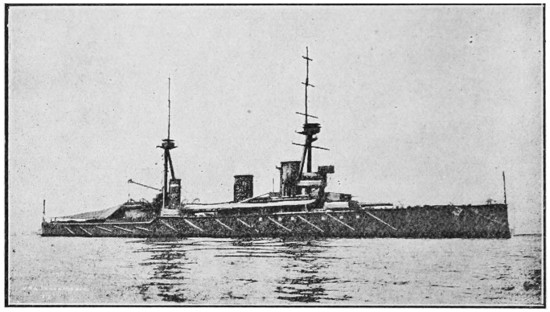
H.M.S. Indomitable.
Photo: Symonds & Co.
INDOMITABLE CLASS.
INDOMITABLE, INFLEXIBLE, INVINCIBLE.
Displacement: 17,250 tons.
Speed: 28 knots; Guns: 8 12in., 16 4in.;
Torpedo tubes: 3.
| Astern fire: |
Broadside: |
Ahead fire: |
| 6 12in. |
8 12in. |
6 12in. |
KEMPENFELT.
NIMROD.
These two large destroyers were ordered by the
Chilian Government from Messrs. White & Co.,
and purchased by the British Admiralty on the
outbreak of war. The displacement is 1,850
tons, speed more than 31 knots, and the armament
consists of six 4-in. quick-firers, two Maxims,
and three torpedo tubes. The complement is
about 110 officers and men.
“A” CLASS.—These submarines are the oldest
in commission. The displacement is 204 tons,
and on the surface they can travel at 12 knots,
below water at 9 knots. They are armed with two
torpedo tubes. Complement: 11 officers and
men.
“B” CLASS.—These boats displace 314 tons,
and have a surface and submerged speed of 13
and 9 knots respectively. They are armed with
two torpedo tubes. Sixteen officers and men are
carried.
“C” CLASS.—This class has a displacement
of about 320 tons. Above water their speed is
14 knots, below it is 10 knots. They are fitted
with two torpedo tubes, and have a crew of 16
officers and men.
“D” CLASS.—These are fairly new boats of
about 550 tons displacement. On the surface
the speed is 16 knots, below water it is 10 knots.
They are armed with three torpedo tubes, and
are also believed to have a quick-firing gun.
The complement is about 20 officers and men.
The “E” class comprises our latest boats, and
no official details of the class have been
published. The displacement, however, is about
800 tons, and the surface speed 16 knots. There
are four torpedo tubes and two quick-firing
guns, the latter being on disappearing mountings.
About 25 officers and men are carried.
A.E. 1 and A.E. 2.
(Australian boats.)
These boats are identical with the “E”
class.
NAUTILUS.
“F” CLASS.
SWORDFISH.
These boats, although not officially described,
are known to be of extremely powerful type.
They displace nearly 1,000 tons, can travel at
18 or 19 knots on the surface and 12 below, and
are armed with six torpedo tubes and two guns.
The complement is about 27 officers and men.