The unit numbered forty-five, and comprised seven
women doctors—Mrs. King-May Atkinson, M.B.,
Ch.B., Miss Beatrice Coxon, D.R.C.P.S.R., Miss Helen
B. Hanson, M.D., B.S., D.P.H., Miss Mabel Eliza
King-May, M.B., Ch.B., Miss Edith Maude Marsden,
M.B., Ch.B., Miss Catherine Payne, M.B., Miss Isobel
Tate, M.D., N.U.I.—eighteen trained nurses, together
with cooks, orderlies, chauffeurs, and interpreters.
The principle that women could successfully conduct
a war hospital in all its various departments, had
now been amply proved, and had been conceded even
by the sceptical. The original demonstration had
already borne ample fruit. Units of Scottish women
were doing excellent work in France, and also in
Serbia, and even in London, women doctors had now
been given staff rank in military hospitals. The
principle was firmly established, and I thought,
therefore, that no harm would now be done by
accepting the services of a few men orderlies and
chauffeurs.
Amongst the applications for the post of orderly,
were some Rhodes scholars; and an interesting
reversal of traditional procedure occurred. At the
last moment, the scholars asked to be excused, because,
owing to the additional risks of typhus involved
in the expedition to Serbia, they must first obtain
permission to run the risk, from their relatives in
America, and for this, they said, there would not
now be time. Our women, on the other hand,
braved their relatives, knowing that a woman's
worst foes, where her work is concerned, are often
those of her own household.
Determined, however, to dodge the typhus if
possible, I proposed to the Serbian Relief Fund that
our hospital should be housed—both staff and
patients—entirely in tents. It was only a question
of raising more money; and this was obtained through
friends and sympathetic audiences.
Typhus infection is carried by lice, and these would
naturally be more difficult to eliminate within
already infected houses than in tents in the open air.
Also by the use of tents we should render ourselves
mobile, and be more likely to be of service in emergency;
this was later amply proved.
The Committee of the Serbian Relief Fund agreed
to the proposal, and sixty tents, mostly double-lined,
were specially made to order, by Messrs.
Edgington of Kingsway, for wards, staff, X-ray,
kitchens, dispensary, lavatories, baths, sleeping,
etc., etc., with camp beds and outfit.
Lady Grogan and Mrs. Carrington Wilde, who
were giving up their lives to Serbian Relief Fund
work, did wonders for our unit, and in every way
helped to make things easy for us. Mr. B. Christian,
chairman, also gave wholehearted support, and the
Women's Imperial Service League, with Lady Muir
Mackenzie, Lady Cowdray, Mrs. Carr Ellison, Lady
Mond, Mrs. Ronald McNeill, and their indefatigable
secretary, Mrs. McGregor, were of invaluable service.
The Admiralty transport, for which during six
precious weeks we had waited impatiently, was an
old two thousand ton boat, of the Royal Khedivial
Mail Line, only accustomed to carrying passengers
from one port to another, short distances on the Mediterranean
coast, and she could only give us nineteen
places. It was arranged, therefore, for the remainder
of the unit to follow overland, and to arrive, if possible,
simultaneously at Salonica.
The captain of our boat received twenty-four hours'
notice of the fact that he was to carry to Salonica a
couple of hundred members of various hospital units.
His chief steward, to whom would have been entrusted
the purchase of food stores, was laid up with a broken
leg, and the captain had been obliged himself to go
from house to house, in Liverpool, to find a crew.
We were lucky, therefore, to get any food or any
crew at all, and still more lucky in the captain, who,
by his courtesy, and concern for our welfare, compensated
for little deficiencies in the ménu. Besides,
one was thankful to be on the way to work, after so
much delay.
But after having waited six weeks for the boat, I
nearly lost it at the last moment. The cabby who
drove me and two others from the station at Liverpool,
to the dock, was a fool, and couldn't find the dock in
which the Saidieh was berthed, and for half an hour, in
the rain, our four-wheeler crawled up and down, and
in and out of a tangled maze of nine miles of docks.
The horse, the cab, and the cabby were all extraordinarily
old, and when we were at the point farthest
from possibility of help, they all three collapsed. We
patched up the horse and cab, but had more difficulty
with the cabby. He couldn't see why we were so
fastidious about sailing in one boat rather than in
another, and time after time he drove, with triumphant
flourish of whip, through the dock gates, and stopped
in front of an old coal barge, and was much hurt by
our refusal to get on board. But all this worked a
miracle, for when at last we hit upon the right dock,
a short time before the departure of the Saidieh, I
was, for the first time in my life, thankful to find
myself on board a steamer.
No places had been reserved for our party, but
after a general scramble with the members of portions
of six other hospital units, mostly women, voyaging
with us, we all settled down comfortably to sea-sickness
and submarines. The rough weather provided
us with the former, but saved us from the latter.
Submarines were supposed to be waiting for us off
the Scilly Isles, and at first we were afraid that the
Saidieh would be sunk; but later we were afraid she
wouldn't.
The units, which kept to themselves in a remarkable
way, were a source of much abstract interest to each
other, and to me. It was particularly satisfactory to
notice the unstinting way in which the principle of
women's work in all departments, responsible as well
as irresponsible, of a war hospital, was—as represented
on this ship—now acknowledged. The woman
administrator, the woman surgeon, the woman
orderly, in addition, of course, to the woman nurse,
who had been the first to win her position in war
work.
I should like incidentally to suggest that uniform
for women employed in public work, should be as
compulsory always, as it is for men. Occasional
hobble skirts, and low-cut blouses, reminiscent of the
indecorums of the Society puppet, struck a peculiarly
jarring note amongst a boat-load of people prepared
for life-and-death realities, on a mission of
humanity.
Of all these doctors, nurses, orderlies, administrators,
chauffeurs, interpreters, how many would
return? One should be taken and the other left?
Laughing, singing, acting, reading, playing cards,
flirting, quarrelling—how many were doing these
things for the last time? Towards what fate were
each and all being borne? Were we, as adjuncts of
the Serbian Army, sailing to life or death, to victory
or defeat?
How quickly all grew accustomed to, and ignored,
the grandeur of moon, stars, planets, the wonders of
a firmament new to most, because generally hidden by
chimney-tops and smoke, and, conscious only of a
little shrunken circle, grew absorbed in trifles. The
vastness, the peace, the tumult, the joy of Nature, all
unseen; the main interests, hair washing, gossip,
fancy dress, bridge parties, quality of cigars, and
food. Nobility of character curiously hidden, but
ready to spring forth when pressed by the button of
emergency.
A little excitement at first, from rumours of submarines,
then boat drill, a sense of adventure, half
enjoyable, half unpleasant, followed by the comfortable
assurance that danger is passed, and enjoyment
now legitimate, for those who are not kept low by
sea-sickness. New friends and sudden confidences,
as suddenly regretted; the inevitable Mrs. Jarley's
waxworks, badly acted, but applauded; vulgar songs,
mistaken for humour; real talent shy in coming
forward, false coin in evidence; pride in attention
from the captain; the small ambitions, to be top dog
at games, to win a reputation as bridge player, to
become sunburnt: all pursued with the same vigour
with which work will later be attacked.
Danger from above, from below, from all around,
but none so harmful as the tongue of a jealous
comrade.
The story of one voyage is the story of all voyages.
It is the story of mankind caricatured at close
quarters, reflected on a distorting mirror.
The ship's first officer was a Greek; he was keenly
on the side of the Allies. He hoped shortly to enlist,
and he told me that it was his firm conviction that if
Greece did not join the Allies immediately the people
would revolt against the King.
The third officer, also a Greek, was a rabid pro-German.
His presence on board seemed particularly
undesirable; but the wonder was that there were not
more undesirables on the ship, for anyone could have
entered it at Liverpool.
Rough weather continued till we reached Gibraltar,
on April 8th, and, after one fine day, resumed sway
till the 11th, when we sailed past the Greek coast.
We reached Salonica on April 15th, the various
units full of eagerness to learn their respective
destinations.
We were met by the Serbian Consul, Monsieur
Vintrovitch, and by the English Consul-General,
Mr. Wratislaw, also by Mr. Chichester, who has
since, alas, succumbed to typhoid.
There was disappointment amongst members of
our unit, when they learned that we were to establish
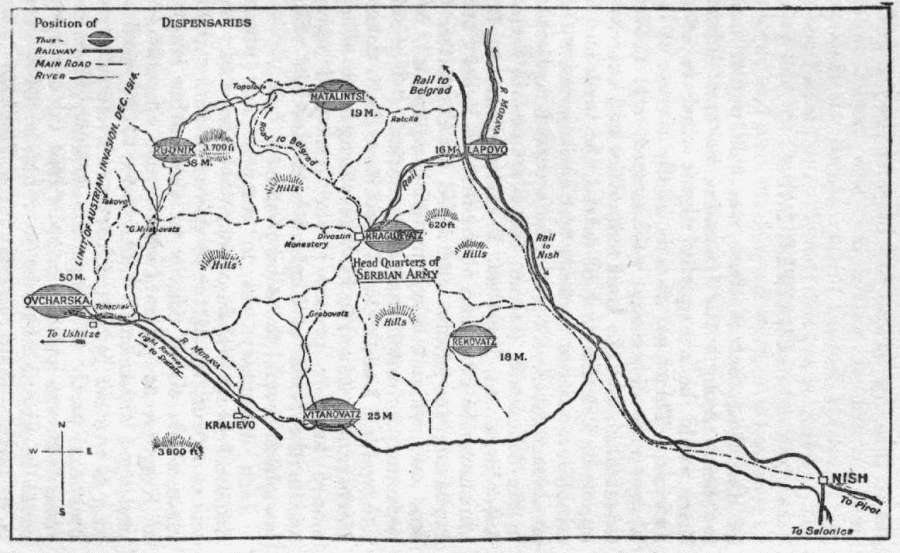
our hospital at Kragujevatz. They would have
preferred Belgrade, as being nearer to the supposed
front. Fronts, however, are movable, and as Kragujevatz
was the military headquarters, we were,
I knew, much more likely to get the work we
wanted, if we were immediately under the official
army eye; I was, therefore, more than content to go
to Kragujevatz.
We spent that night on board, at the kind invitation
of the captain, as there was a scrimmage for rooms in
the hotels. We then had comfortable time next day
in which to find quarters. The portion of the unit
travelling via Marseilles arrived, excellently timed,
by Messageries boat, on Saturday, the 17th. We spent
the next few days struggling with, or trying to find,
quay officials, and getting the stores and equipment
unloaded, and placed in railway trucks. It was
difficult to hit upon a working day at the dock, for
we were now in one of those happy lands in which
eight days out of every seven, are holidays. Friday
was a fast day—no work; Saturday was a feast day—no
work; Sunday was Sunday—no work; Monday
came after Sunday, Saturday and Friday—therefore
no work, a day of recovery was necessary after so
many holidays. One had to be awake all night, to
discover an odd moment when a little work was likely
to be smuggled into the day's routine of happy
idleness.
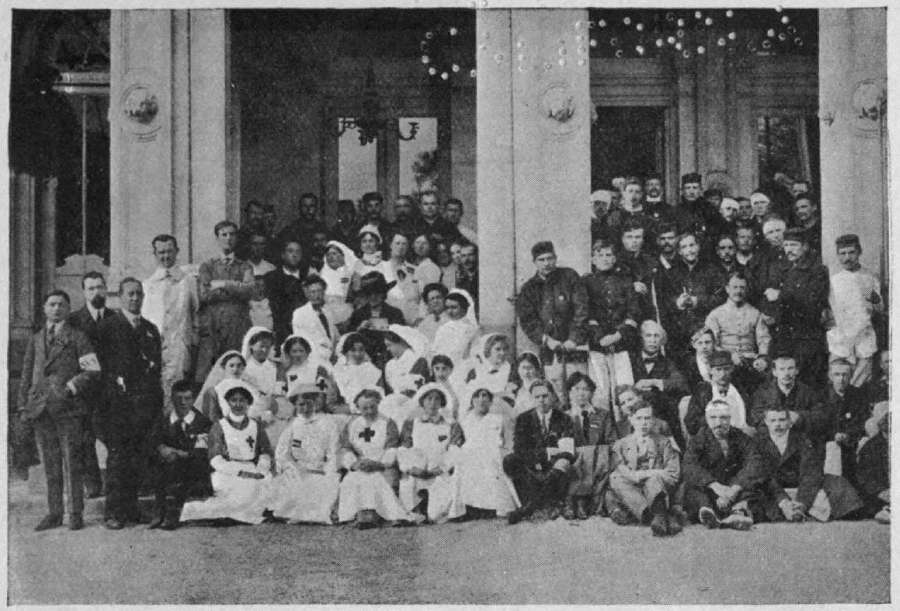
STOBART UNIT AND CONVALESCENTS OUTSIDE THEIR HOSPITAL
AT ANTWERP. (Concert Hall of Société de l'Harmonie)
Mrs. Stobart showing medals presented by grateful patients. Dr. F. Stoney on her
right; Dr. Ramsey left; Dr. Joan Watts, Dr. Emily Morris, Dr. Rose Turner and
Dr. Helen Hanson behind. Miss S. Macnaughtan in front, centre
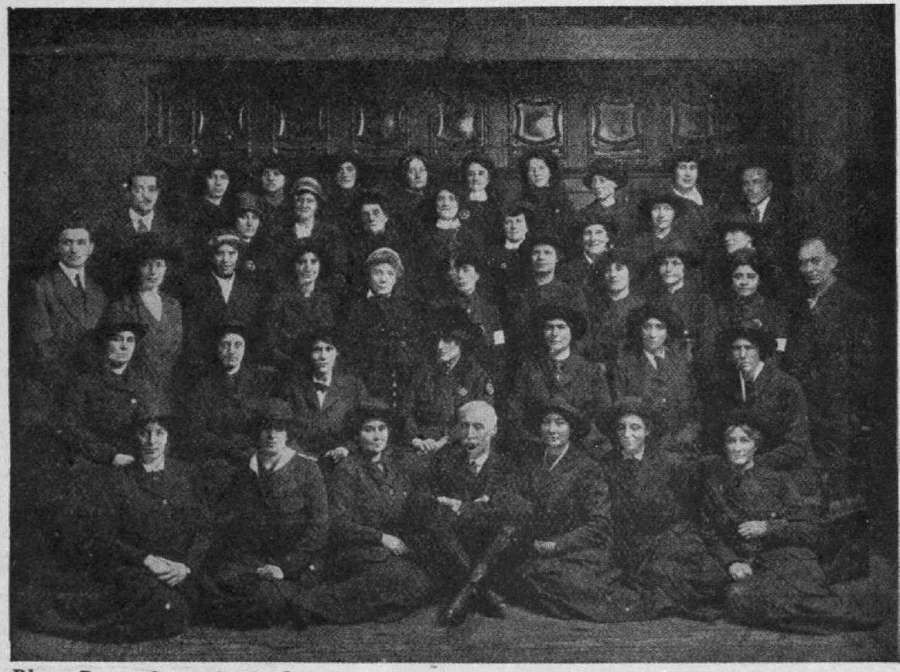
Photo. Dover Street Studios
STOBART HOSPITAL—SERBIAN RELIEF FUND UNIT No. 3
Mrs. St. Clair Stobart in centre second row, with (from left to right) Doctors
King-May, Payne, Marsden, Atkinson, Tate and Coxon. Dr. Hanson absent
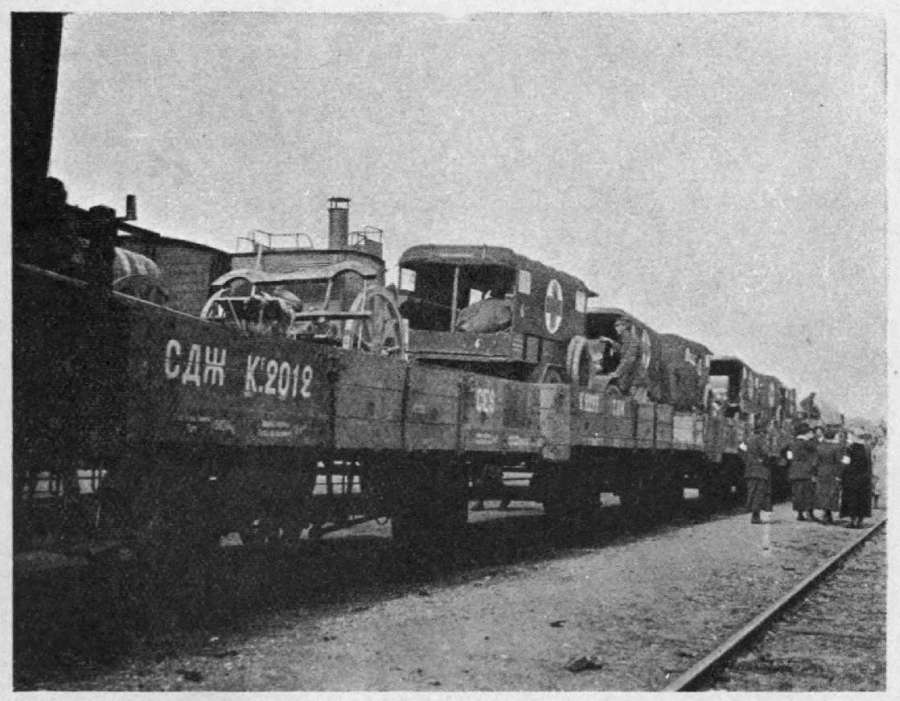
But by the evening of Monday, the 19th, everything—tents, equipment, stores, etc.—was on the trucks
and ready to travel with us. And I, with eleven
members, as advance party, left Salonica at 8 a.m. for
Kragujevatz. We had all duly, the night before,
performed the rite of smearing our bodies with
paraffin, as a supposed precaution against the typhus
lice. But it is probably a mistake to think that
paraffin kills lice. Paraffin is a good cleanser, and
lice, which flourish in dirt, respect their enemy, but
are not killed by it.
The railway journey was interesting, especially to
those amongst us who had never before been away
from England.
We were amused to see real live storks nesting on
the chimney-tops. So the German nursery tale, that
babies are brought into the world by storks, down the
bedroom chimney, must be true. German fables
will probably in future teach that babies are brought
through the barrels of rifles, double barrels being a
provision of Providence for the safe arrival of twins,
which will be much needed for the repopulation of the
country.
We reached Skoplye at 9 p.m. Sir Ralph Paget
kindly came to the train to greet us, and whilst we
had some very light refreshments at the station, he
stayed and talked with us. Lady Paget was then, we
were thankful to hear, recovering from the attack of
typhus which she had contracted during her hospital
work at Skoplye.
The country through which we passed, was magnificent;
mountains, rivers, gorges, and picturesque
houses—one-storied, of sun-dried brick—with clear
air, warm sunshine, and blossoming fruit trees.
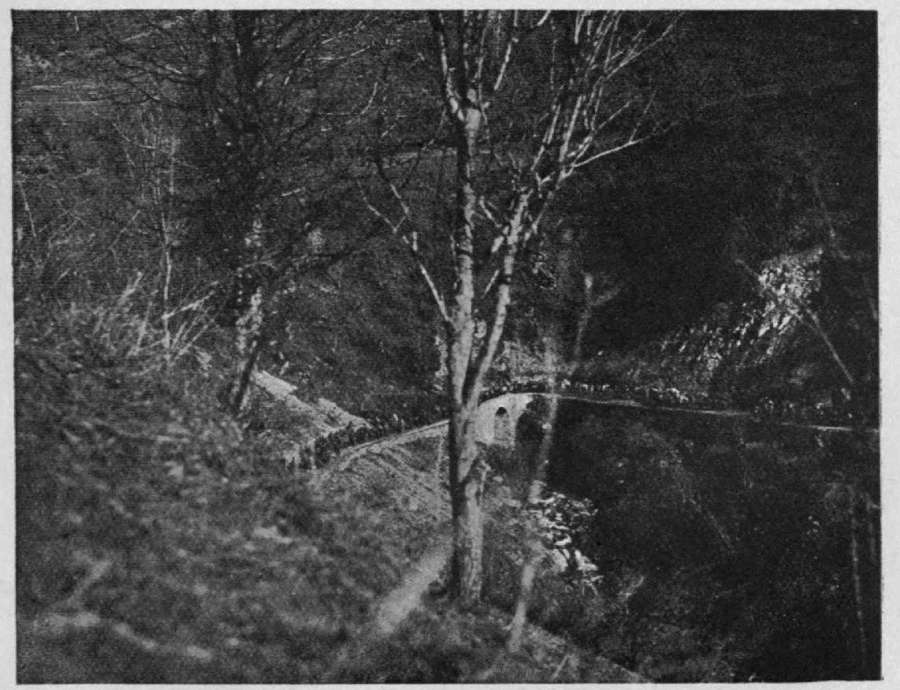
Occasionally a ruined village, or a new bridge replacing
one that had lately been destroyed by Bulgarian
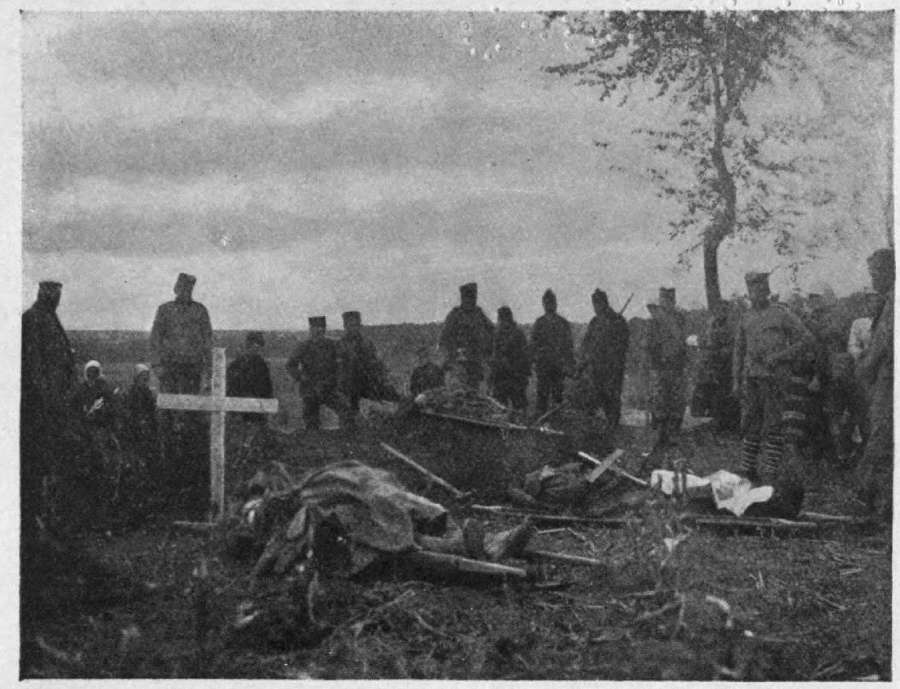
raids, or newly dug graves of those killed in the last
raid, were reminders that man, with his murderous
works, would see to it that enjoyment of Nature's
works should not enter for long into our programme.
We reached Nish at 7.30 next morning, April 21st.
At the station we were met by Dr. Karanovitch,
Chief Surgeon of the Army; Dr. Grouitch, Permanent
Under-Secretary for Foreign Affairs; Mr. Blakeney,
British Vice-Consul; Professor Todorovitch, Secretary
to the Chief Surgeon; Mr. Petcham, Official of
Foreign Affairs; and Dr. Soubotitch, President of
the Red Cross Society.
All were most courteous and hospitable, and during
the one and a half hour's halt they took us to breakfast
at the Red Cross Hospital, and later accompanied us
to the station to speed us on our last stage of the
journey to Kragujevatz.
We left Nish at 10 a.m., and reached Kragujevatz
at 7 p.m. The scenery was superb, and we were
sorry when the journey came to an end. At the
station, we were met by Colonel Dr. Guentchitch,
the head of the Army Medical Service. He had
most thoughtfully arranged sleeping quarters for
the staff in the empty wards of a hospital;
but it seemed wiser, and less trouble to all concerned,
for us to stay for the night in our train, in
a siding.
On arrival, the Colonel drove me and the Treasurer
and two of our doctors to see a proposed site for our
camp hospital—the racecourse, then disused, above
the town. Excellent—nothing more suitable was
likely to be found. The unit was then invited to
dine at the officers' club mess. Here we met Colonel
Harrison, British Military Attaché, and also Colonel
Hunter, who was in charge of the Royal Army Medical
Corps mission. The French and Russian attachés
were also there.
It was homely to meet once more the genus military
attaché; it was indeed difficult to imagine conducting
a hospital without them. For at Kirk
Kilisse, when we arrived in a starving condition, the
British attaché had found us food, and the Italian
attaché, whom, in the dark, I had mistaken for some
one else, had sportingly acted up to the character
of the some one else, and had provided us with
straw for mattresses.
Though some folks find Serbian cooking too rich,
the dishes have a distinctive and pleasing character
of their own, and the dinner, after two days of cold
meals, was much enjoyed. It was delightful to find
that the Serbian officers, both medical and military,
were cultured men of quick and sympathetic intelligence.
I knew at once that I should like them.
Most of them spoke German, a few talked French,
but all could converse fluently in either one or the
other language, in addition, of course, to their own.
One is always reminded abroad that all other nations
are better educated than we are. We are still so
insular, and are still, with the pride of ignorance,
proud of our defect. We have not yet reached the
stage of realising that we can never take a leading
part in the councils of Europe, till we can converse,
without interpreters, with the leading minds of
Europe.
Next day Colonel Guentchitch took us to see
alternative camp sites, but nothing half as suitable
as the racecourse was available, and upon this we
decided.
By the evening of Thursday, April 22nd, we had
unpacked, and pitched some small ridge tents in
which to spend the night, refusing the kind offer of
sleeping accommodation in the town, though we
again accepted the officers' hospitality for the evening
meal.
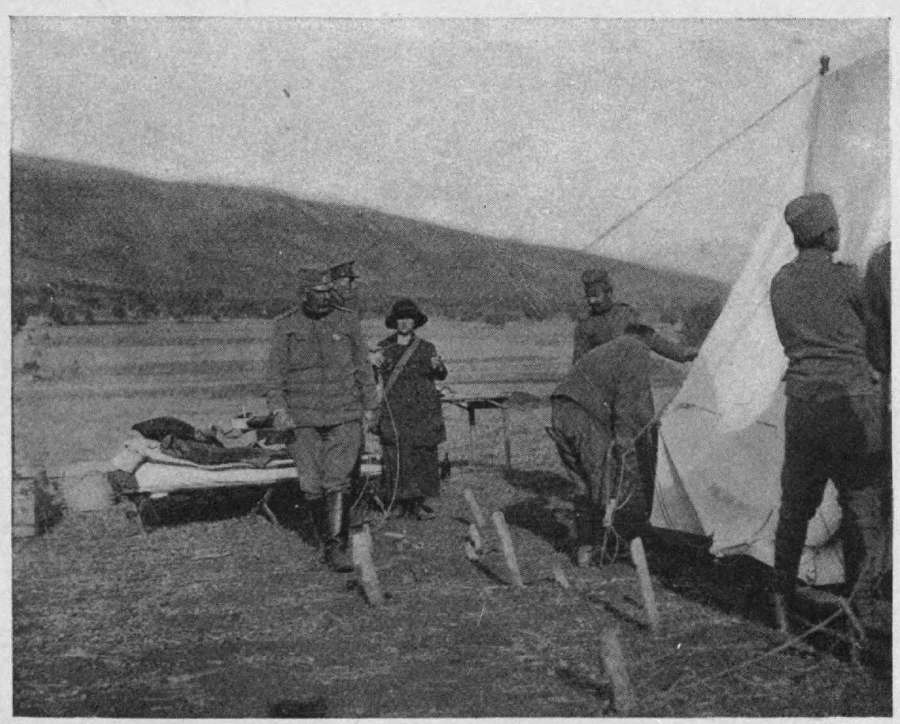
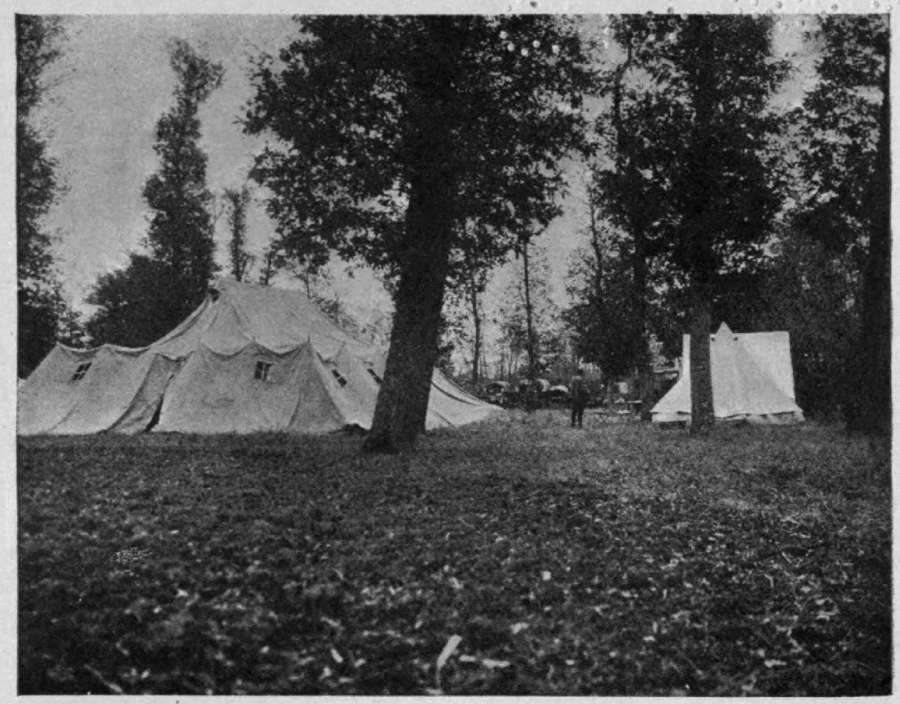
The next day was spent in pitching the camp,
and the authorities were pleased, and surprised,
because we refused all offers of help in putting up
the tents. We had gone to Serbia to help the
Serbians, and not to be a nuisance. Foreign units
which arrive and expect to have everything done
for them, are more bother than they are worth.
The remainder of the unit, with Dr. King-May,
arrived from Salonica, and under the supervision of
Dr. Marsden and Miss Benjamin (head orderly) a
small town of tents, gleaming white in the brilliant
sunshine, soon appeared in the local geography.
One long wide street of tents for the staff, then a
large interval of open grass space, and another
avenue of ward tents, with a connecting base line of
tents for offices, kitchens, X-ray, and dispensary.