In the year of our Lord, 1797, there was a right fair day in
February. The day was a Wednesday, the twenty-second of the
month, and it was indeed the most pleasant day for that harsh
season of the year that I can call to mind on looking back
through the course of a long life. But it was not only the
unusual beauty of it that made that Wednesday in February a day
of mark, or I might scarcely have kept it stored in a corner of
my mind for seventy years well-nigh—remarkable as fine
days are in this climate that is chiefly renowned for fine rain;
but for the reason that this particular Wednesday was a day of
utmost astonishment to all the dwellers on this North
Pembrokeshire coast, and (I may venture to add) a day of much
consternation to most of them.
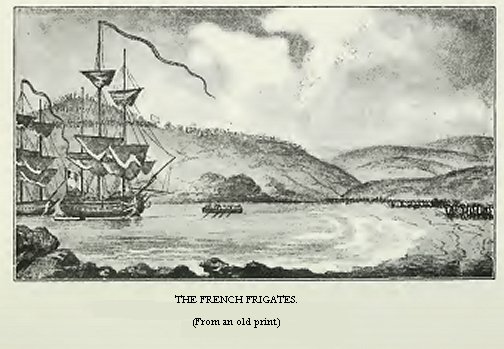
A day still remembered by old Welsh fishwives, and still used
by them as a means of terror wherewith to hush to sleep unquiet
grandbabes, or to stir to patriotism stout but supine
grandsons.
I was, at the time of which I speak, but a youth of fifteen,
as thoughtless and careless as most lads of that age; not very
sensible to danger, save when it presented itself face to face
with me at no more than arm’s length, under which
circumstances candour compels me to own I did not always enjoy
it. I trust that I may say without undue boasting that I did not
fear anything greatly as long as it was out of sight, for which
reason I have often thought that had I been born a generation or
two later, and had I selected a soldier’s career instead of
that of a divine I might have fought excellently at a distance of
a few miles from the enemy: though at close quarters I will admit
that any unexpected danger might perchance produce a sense of
amazement which the uncharitable might set down to
faint-heartedness.
But that my nephews, nieces, and neighbours generally may know
the truth concerning this matter—the landing of the French
at Fishguard in 1797, I, Daniel Rowlands, clerk, being aged, but
still of sound mind, have written this narrative—which when
duly set forth will, I hope, convince the most sceptical as to
the sort of spirit which animated my countrymen (if not myself),
and still more my countrywomen.
On this
fair morning then, at about ten o’clock, when I ought to
have been pursuing my studies under the fostering care of one of
the clergy at St. David’s, I was in reality strolling along
the headland of that name, led astray by the beauty of the day,
which seemed too fair for book-lore; I was strolling along, doing
nothing, thinking of nothing, wishing for nothing, yet, having
found for the nonce the secret of true happiness, when I
perceived a man on horseback approaching me at a furious
rate. In spite of the pace at which he was advancing I
recognised him as a servant of Trelethin.
“Whither so fast, John?” I shouted, in our own
tongue. He was past me as I spoke.
“The French, the French!” came back to me on the
breeze mingled with the sound of his horses’ rushing
hoofs. His voice or my ears failed, for I heard no more
save—when the thunder of the hoofs had ceased, the duller but more
continuous thunder of the waves rolling in freshly at the foot of
the rocks.
John’s words had left me much astonished. I
knew—from my studies under the divine above referred
to—that the French lived in France, where some of them had
lately been engaged in beheading the rest with the help of a
newly discovered machine. So much I knew, but why John
Trelethin should yell “French” at me as he passed,
riding apparently for his life, I knew not. What were the
French to him or to me? As I advanced pondering the
matter—but in a purely impersonal manner, and without any
keen interest—at a little distance further along the cliff
I espied the owner of Trelethin, John’s master, standing
very firm on his legs against a background of bright sea, his
head inclining somewhat backward, while with both his
raised-up hands he clutched a long spy glass, the small end
whereof was applied to his eye. Following the direction of
his spy-glass, I perceived a yet more astounding
sight—astounding to us used to the world of lonely waters
that lay stretched out in front of our homes. Three ships
of war were passing slowly along our coast not far from land,
they were accompanied by a smaller craft, which Mr. Williams
informed me was a lugger. As he had been a sailor I took
his word for it—but it did not make things clearer.
What did it all mean? What did those vessels—or their
inhabitants want here? They carried the English colours, I
saw that for myself when Mr. Williams obligingly lent me the
instrument.
“Take a look for yourself, my boy,” he
said—he was a man singularly free from
pride—“Take a look at the blessed
Frenchmen.” (He did not say exactly blessed, but out of
respect to my cloth I subdue his expressions slightly.)
“Frenchmen!” I cried. Then those were the
French in those three vessels. I did not count the lugger,
not being sure of her. Strange to say the first thought
that flitted through my brain was one of pure joy; here was an
excuse, real, tangible, and startling, for having shirked my
studies. With a little help from imagination (his and mine,
which might act on each other as flint on steel, for he was an
excitable man), I trusted I might so alarm my clerical guide and
master as to make him quite forget the fact that I had given to
St. David’s Head the time I should have given to my
own. The excuse might be made effective even should they
prove to be not quite really French.
“They’ve English colours, sir,” I said to
Mr. Williams.
“Foreigners are deceitful,” says he, “up to any
tricks. I can see the scoundrels swarming on the
decks.” (For by this time he again had applied the
spy-glass.) “Ah!” he continued, handing the
glass to his wife who had joined us, “If it was but night
now and a bit stormy, we might put out a false light or two and
bring them on the rocks in no time.”
This was the moment afterwards immortalised by a local bard in
these words—
“Mrs. Williams Trelethin was know every
tide
From England to Greenland without guide.
Mrs. Williams Trelethin was take the spy-glass,
And then she cry out—There they Wass!”
The three tall ships sailed on calmly, with the clear shining
of the sea around them, dark objects in all that flood of
light. They went northward—along our Pembrokeshire
coast, where (had Providence so willed it) they might have made
shipwreck on the sharp rocks anywhere. However the day was too fair
to admit of any such hope.
The alarm spread quickly; men and boys came bounding over the
gorse in every direction; even the women, with the curiosity of
their sex, came forth from their homesteads, leaving the cawl [51] and the children to mind themselves,
while their natural caretakers gaped open-mouthed at the tall
ships filled with untold dangers.
The crowd on the cliffs followed in the direction of the
ships, keeping them ever in sight. Helter-skelter we ran
along, crossing deep gullies, then along bare headlands covered
only with gorse and large grey stones, then passing under a great
mass of rock, like to some gaunt castle or fort (but alas,
lacking cannon), then, at rare intervals, where a stream ran into
the sea, we would dip suddenly into a smiling little valley
filled with trees and bushes. But the stones and crags
prevailed greatly over the softer scenes. I had now entered
so fully into the spirit of this race that all thought of my
studies passed away; the fear of the dominee was merged in the
far greater fear of the French. And yet it was not wholly
fear that possessed me, but a sort of tremor of excitement, and
curiosity as to what might happen next. Noon passed, but
none stopped for food—nor even (till we came to a village)
for a Welshman’s comfort in perplexity—a glass of
cwrw da. [52]
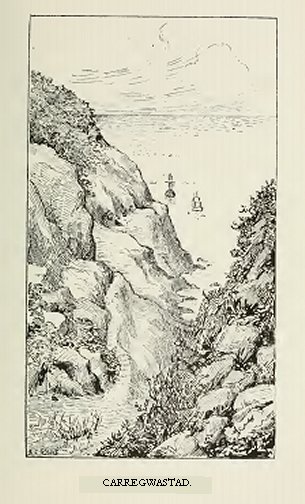
At two o’clock, for no apparent reason, the Frenchmen
came to anchor. This was opposite to a rocky headland
called Carn Gwastad, which forms a portion of Fishguard Bay, some
distance to the west of the town of that name, and, by reason of
an intervening headland, quite invisible from it, and in truth from
most other places. We had now come from St. David’s
Head, a distance of full ten miles, and I, for one, was glad to
sit down on a gorse-bush and meditate a little as to what all
these things might mean and where they were like to end, which I
hardly dared to hope might somehow take the form of a bit of
dinner for myself. To stay hunger I composed my mind for a
nap while I reflected dreamily that my elders were taking more
definite steps for the defence of their country; and the
knowledge of this was gratifying to me.
Besides Mr. Williams’ John, who had been despatched at
full speed to St. David’s to rouse the inhabitants, another
man was sent to give the news to the Lord-Lieutenant of the
county, while others wended their way to various points on the
range of mountains which divides Pembrokeshire into two parts;
the result of their mission being apparent when night fell and
beacons flared along the line of heights from Vrenny Vawr to Carn
Englyn—the mountain of the angels, so named from the
angel-visits received by a pious hermit who dwelt thereon, and
who probably lacked more ordinary society.
Many other messengers were sent in various directions, but
though in this way persons at a distance were warned of danger,
many of those who dwelt close by were as yet insensible of
it. Chiefest of these was the owner of the old manor house,
Trehowel, situated just above the bay where the ships were
lying-to—of which house we shall hear more anon. Mr.
Mortimer was of a generous and confiding disposition—and,
as a bishop should be, he was in truth—much given to
hospitality. He was, moreover, about to celebrate the
marriage of his son, and he had made ample provision of cakes and
ale, not to mention meats and spirits for this purpose. The
wedding was to be on the following day (Thursday, the 23rd of
February, to be exact); the new daughter-in-law was much to his mind,
and therefore heart and hand were even more lavish than usual,
when, looking out seaward from amidst the bridal greenery, his
spirit was stirred within him by the sight of the British
flag.
Nothing would serve this hospitable gentleman but that the
English officers should partake of his good cheer; so his orders
flew forth in every direction—compliments and invitations
to the officers, and directions to the servants as to the setting
forth of a sumptuous repast.
In the meantime one of the great ships, heaving anchor, had
quietly slipped round the corner—by which I would say,
rounded the next headland, Pen Anglas, in an undemonstrative
manner. Thus coming in sight of the men occupying the fort
near Fishguard; these fired as in duty and fair observance
bound—a salute to the flag that had braved a thousand
years, and had never in all that considerable period of time been
put to a viler use than the present, when—hey presto! down
came the British colours with a run, and up flew the tricolour in
its stead—the red, white, and blue colours of the Republic
of the French.
The astonishment of those men in the fort at this unexpected
transformation-scene must have been akin to an electric shock
such as may be produced on the unwary by the careless placing of
a hand on a magnetic eel. They had been completely deceived
by the mock flag, and were more unprepared for the change than
those men who had already scrutinised the three frigates with
very doubtful eyes as they made their way along the coast of
Pembrokeshire.
All disguise was now over; the enemy showed under their true
colours at last, and convinced even the most
liberal-minded (including Mr. Mortimer) that they were not
English. Though truly if they had desired to appear under
their most appropriate colour they should have sailed under the
black flag of piracy, for the men on board these frigates were
little better than freebooters. Many of the older persons
present were minded to take them for a new and enlarged edition
of the Black Prince—a pirate ship which had eighteen
years previously brought his broadside to bear on the town of
Fishguard, and kept up an animated fire all day with his
six-pounders. However, he caught a Tartar—the master
of a smuggling craft, who returned the fire with such goodwill,
aided by clever hands and a cannon at the edge of the cliffs,
that the Black Prince sheered off. “Set a
thief to catch a thief;” but it were ungrateful to think on
that proverb.
It was
this circumstance which caused the fort at Fishguard to be
erected, one of whose nine-pounders had just, in courtesy,
saluted the frigate, who, not caring to face the other seven guns
of the fort in anger, turned round speedily, and rejoined her
companions at Carn Gwastad Point without loss of time.
On her way she intercepted a sloop which had—perhaps out
of curiosity, perhaps from some nobler motive—ventured too
near; probably the master of the sloop had not expected this
sudden rearward movement—anyway he found himself a
prisoner, and his boat a prize. I had jumped up from my
reclining position, and stood watching his fate with anxiety and
awe, knowing him to be a friend (for I was a Fishguard boy, and
intimate with all the varieties of seamen to be found there), but
being, at that distance, unable to tell which friend.
All the
other boats in the bay stood out to sea with all speed, scudding
away with white sails stretched, reminding even a matter-of-fact
boy who abhorred poetry, similes, and all such inventions of
schoolmasters, suggesting even to me the sudden, outspread, white
wings of a flock of ducks frightened by the unwelcome appearance,
from round the corner, of a fox. They got away safe, but
the captive sloop was towed in triumph by the frigate back to
Carn Gwastad, where she found her sister ships were already
disgorging their freight of soldiers.
The sun was setting as the first boats set down their load on
British soil. There were not many spectators of this act
(the only one of a like nature since 1066, as far as my
knowledge—not very profound—of history went), the
inhabitants of the district, when they perceived that the landing
was to be
on their own coast, having dispersed as quickly as a swarm of
ants amongst whom a foreign body is introduced—each one
making with the utmost speed for his own home in order to retreat
with his valuables (including his family) further into the
interior. I, however, was but young, and concluded that my
family, who lived in Fishguard, could very well take care of
themselves; while it was possible that my father, who was a
somewhat stern parent, might not even accept the (to me) absolute
necessity of keeping an eye on the French as a valid excuse for
departing from my studies at St. David’s without leave from
my master. I had a certain amount of fear of the French, I
do not deny it; but it was as yet in the abstract, and was a very
different thing from the absolute fear I had of my father when I
caught him (and he caught me) in a bad mood. Besides, though I
considered curiosity a childish and feminine quality, and as such
infinitely beneath my dignity, still I must own I did feel a sort
of craving desire to know what those people were going to do
next. So, hidden in a gorse bush on a headland which
commanded the creek, I watched the sun go down like a red ball
into the sea, throwing a light as of blood on the muskets in the
boats beneath me, making the dark figures that swarmed over the
sides of the ships look darker and more grimy, lighting up the
three-coloured flags that unfurled themselves to the night
breeze. Then there came a long path of crimson right across
the grey sea, which, dying out as the sun set, showed that this
fair day was gone—a day too fair and sweet to be the
setting for foul deeds.
Suddenly there rose a shriek, or, rather, a succession of
shrieks breaking through the twilight quiet, and a young woman
shot out like an arrow from the back door of Trehowel, darted
past me without pausing to answer a question, and, shrieking all
the time, fled away into the interior, clutching tightly in her
hand a foaming jug of beer. I heard afterwards that she ran
on for miles, still clutching that jug of beer, which she had
been drawing for the (supposed) English officers; when at last
her master had awakened to the fact that the French were actually
at his doors. She ran thus for miles, not even stopping to
drink the beer.
She was shortly after followed by Mr. Mortimer himself, who
came across the courtyard laughing in spite of the seriousness of
the occasion, for he must needs smile at a joke. He spied
me, for indeed I had jumped up to question Sally, and he came
towards me.
“The poor maid has had a scare,” said he, with a
twinkle still in his eye. “But, in truth, Dan, my
boy, I suppose it is time to be off.”
“Oh, there’s a pity,” said I; “about
Master Mortimer’s wedding—and all the meats and
drinks!”
“Well, yes, I never meant them for the
parley-vous,” said he, mounting his horse which one of his
farm-boys had brought out; “but I dare say they’ll
enjoy them all the same—they won’t be
wasted.”
He turned in the saddle to give a last look at his old house,
standing dark against a yellow-green twilight sky, pranked out
with all the mockery of boughs and flowery arches. The
trees in the courtyard had not yet put forth their leaves, but
branches of myrtles and ever-blooming gorse and great bunches of
primroses had made the place gay. Mr. Mortimer’s face
changed as he looked; he made no movement with the reins; he
was very loath to leave his home. In his mind’s eye
he was viewing the heap of smoking ruins he might see when next
he came, and he seemed to be resolving to meet fate and the
French on his own threshold, when a woman’s quick step came
out of the now-deserted house.
“Oh, master,” she cried, running up to us,
“ar’n’t you off yet! Quick, there
isn’t a minute; they are coming up the hill. For the
young master’s sake,” she whispered.
“Remember, you have got the money and the papers.
Quick!”
He nodded, then shaking his rein, rode off without a word.
“And what are you going to do, Nancy?” said
I. “Isn’t it time for you to be off
too?”
“Oh, no odds about me. I’ll slip off
somehow, but I must get the silver spoons first.”
Then
she turned from me, and her voice broke suddenly.
“Wherever is Davy—oh, wherever is he?” she
sobbed.
“Cheer up, Nancy, my maid,” said I, being well
acquainted with her, and only ten years younger—an
inequality made up for by my superior station and parts.
“Wherever Davy is he’s in mischief—that you may
take your davy of; but he always comes out of it
somehow.”
I hope the reader will pardon this expression, but I was not
at this time even a curate—being but fifteen—and the
chance of my ever attaining that station seemed but remote.
At this moment the clang of arms and the sound of high-pitched
voices broke on our ears.
“I’ll have those spoons if I die for it!”
exclaimed Ann, who was not much given to the melting mood.
“Run, Dan, make for Fishguard as fast as you
can.” And without another word or a sign of personal
fear, Ann George disappeared into the house.
I will not deny now, after the lapse of so many years, that my
heart at this moment beat unpleasantly fast. I had already
watched the landing of some of the French troops, but from a
considerable distance, and there had been something unreal about
the scene, something like to play-acting, or a dream; but now
that I actually heard their voices, the effect was very
different. They were really here, close by; there was no
mistake about it. I had an almost overwhelming desire to
take to my heels and run for it, but in spite of a very real
fear, two feelings restrained me—one was a hesitation on
account of Nancy, whom it seemed mean to desert; the other was
that curiosity to which I have already alluded, and which
powerfully possesses most of the inhabitants of these regions,
but more especially the females. The twilight was rapidly
sinking into darkness as I crouched lower among the bushes and
peered out with eyes which doubtless resembled those of a
frightened bird. Never hare in its form felt more of a
flutter at the heart than I experienced as those screeching, and
yet savage, voices drew nearer and nearer. I did not
understand French, but if I had I trust I should not have
understood the nature of the expressions those men were
using. It must be remembered that at that time we were
accustomed to think of a Frenchman as of a two-legged
tiger—which we spelt with a y—and then perhaps the
horror that thrilled me may be understood. Suddenly the
vague terror was turned into reality, as between me and the dusky sky
loomed forth a wild figure, then another and another, then a
confused crowd.
I could stand no more. With one bound I passed from
behind my bushes in through the back door of the house—
“Nancy, hang those spoons!” I spoke in Welsh, and
I fear my expression was still more forcible. “Come
this minute, I’ll wait no longer.”
“Why, who asked you to wait?” said Ann George,
ungratefully. “I thought you’d be half-way to
Goodwick ere this.”
At this moment her speech was interrupted by a sound as of
thunder at the front door, while the parlour window came flying
into the room before the butt-ends of French muskets. Even
Ann George thought it now high time to take her leave.
So we departed as quickly and as silently as possible through
the back door, while the front door was being shivered to atoms,
and the
enemy was pouring into the house over its remains. Quickly,
indeed, we went now and the falling night favoured us; the
enemy’s own noise too rendered the slight addition of our
footfalls totally unobservable. All the space between
Trehowel and the cliffs swarmed with Frenchmen, and the uproar
was bewildering.
“They’ll make short work with your master’s
ale, Nan,” I gasped, as we ran along under the cover of the
earthen banks topped with gorse.
“Aye, and of the wine and the spirits, and of all the
poor young master’s wedding feast. Oh, indeed, I wish
I had known they were coming when I was baking those pies and
brewing that ale!”
I did not waste my breath by inquiring the reason of this
aspiration, for the hill was rather heavy on my lungs, and her
meaning was obvious. In a very short time we had reached
Brestgarn, the abode of a worthy divine, the Rev. David Bowen,
whom we found about to depart hurriedly, he having been no
quicker to hear the alarming tidings than his neighbour at
Trehowel; but, having heard it, he and his family were off for
the interior as fast as horses and fright could take them.
Only one of his servants, a man named Llewelyn, volunteered to
stay behind, to keep, as far as in him lay, an eye upon his
master’s place and goods.
“Let us go to the top of Carnunda,” suggested this
man. “We can see everything from there.”
Carnunda is a rock situated just above most things in this
region; more especially just under it lies the tiny village and
church of Llanunda—Unda being manifestly a saint, though I
cannot truthfully say I ever heard anything about him—or
her.
We got
up to the top of this carn then, and there snugly ensconced
between huge boulders of stone—the place is large enough to
hold six or seven hundred men, well protected by natural
rock-work—we gazed on the scenes all around us.
First at the creek beneath us. It was now pitch
dark—for the night was as black as the day had been
bright—but the three tall ships of war were lighted up with
cressets of fire; the lugger was there and the captured sloop,
and the sea around them was alive with boats, still conveying
troops to the land. The torches that they carried were
reflected on the waves, elsewhere inky black—but here
bearing long broken lines of light. Dark figures swarmed at
the landing place, if so one could call, what was merely some
flat slabs of rock; and all up the cliffs we saw ant-like beings
crawling, and even (by the aid of a little imagination) we could
fancy we heard their strong exclamations at the steepness of the
path—made even steeper to them by the nature of their
occupation, for they were rolling casks (evidently heavy) of
gunpowder from where the boats landed them up to the top of the
cliff. Some of these dark figures carried torches which
shed a fierce glow for a small space through the black
night. As we looked, one of the casks which had been by
much effort shoved up to well-nigh the top of the cliffs,
suddenly slipped from the Frenchmen’s hands and rolled
rapidly down the declivity—the roll speedily becoming a
succession of jumps and plunges, till with a wild leap the cask
fled over a final precipice and disappeared in the sea.
“Thank the Lord for that,” said Llewelyn.
Nancy and I laughed aloud. It is impossible to give any
idea of the exultation that we felt.
“What words they are using over that!” said
Nancy.
“Oh, don’t I wish we were near enough to hear
them!” said I, totally unmindful of my future
profession.
But shortly after we had even greater cause of
rejoicing. The enemy (as we had already learnt to call
them) were disembarking their cannon, and lowering these
unwieldly articles of war into a long boat, but zeal outstripping
discretion, they so over-weighted the boat, that lurching forward
heavily she upset, and the whole of her cumbrous cargo was
shortly at the bottom of the sea. It was a satisfaction
even to think of it. Aye, and we may think of it still, for
to this very day those foreign cannon are rolling about and
rusting in the unquiet waters of Carrig Gwastad creek—a
proof, should one ever be needed, of the truth of this strange
story.
“Thank the Lord again,” said Llewelyn.
Great bonfires now lit up the side of the hill beneath
Trehowel—in the place still called the French
camp—and scores of dark figures rushed about with torches
flaring wildly in their hands; the whole scene reminding one
forcibly of Pandemonium, that is, if one is capable of being
reminded of a place one has never seen and that one has no desire
to see.
Even the thought of it at the moment was unpleasant to me as
bringing my neglected studies to my mind, so I hastily turned my
attention once more to the French.
The
boats and the sailors had now returned to their ships, having
landed the invading hordes (which was the term we usually applied
to the Gallic soldiers), who now seemed more bent on cooking than
on conquering, on supping than on surprising.
We watched the erection of beams and bars over the huge fires;
and the slinging on to the bars of great pots and pans of all
sorts—mostly intimate friends of poor Nancy who watched all
these proceedings with many a groan and warm ejaculation as she
thought of all her wasted scrubbings in the back kitchen of
Trehowel. The precise number of the men who landed that
night on a bit (though remote) of Great Britain was fourteen
hundred; of whom six hundred were regular troops, and eight
hundred were convicts of the basest sort, described, indeed, in
the pamphlets of the time as the sweepings of the gaols.
Besides these, there were two women; and had the fourteen hundred
been animated by the spirit which possessed these two of the
weaker sex, the result might have been much more unpleasant to
the Principality than it actually was.
The Welsh woman beside me was not by any means deficient in
spirit either, it even sometimes took the form of temper, yet to
my astonishment I heard the sound of sobs which could only
proceed from her, as Llewelyn was hardly likely to relieve his
feelings in this way.
“Oh, Master Dan, wherever is Davy?” she again
asked. She called me “master” when she
remembered what I was going to be, otherwise my father being only
a small tradesman in Fishguard, I was more frequently called
Dan. I do not think I have given any description of Ann
George, boys do not, as a rule, think much of personal
appearance; nor did I. My idea of Nancy had been
chiefly connected with the peppermints she had been in the habit
of giving me as a child; I thought her a person of a free and
generous disposition. She was a tall, fine young woman of
five and twenty, with dark hair and eyes (these last being dark
grey not brown), decided but pretty eyebrows, a well-shaped nose,
and rather large mouth which disclosed when she laughed or talked
(which was frequently) handsome white teeth. In short, she
was the type of a good-looking Welsh woman. She had also a
healthy colour, a warm heart, and a splendid appetite. It
was not very surprising that she had (or had had) two
admirers.
I at once referred to this fact with a boy’s utter want
of delicacy in matters of sentiment.
“What are you bothering about Davy for? I thought
it was Jim you liked.”
“Don’t you ever say that fellow’s name
to me again, Dan’el,” said Nancy with animation, her
tears dried up and her eyes sparkling. “I hope never
to hear of James Bowen again so long as I live.”
I whistled. “Was that because he got into trouble
for horse-stealing? Why, as to that, Davy’s none too
particular.”
“Dear anwyl, Dan, talk of what you understand, or hold
your tongue! What do I care for their customs and
laws? ’Deed to goodness, nothing at all. As to
James Bowen if it had been only that—but there, a child
like you can’t understand things.”
“Can’t I!” I shouted, thoroughly
incensed—of course we spoke in Welsh, and used a good many
more exclamations than I have set down here.
“Can’t I, indeed. I only know smuggling
is—”
“Don’t quarrel, children,” said Llewelyn,
who was of a quiet disposition. “And don’t shout or
you’ll bring the French upon us. Silence holds it
here. [80] Just look there!”
He pointed towards the opposite direction to that in which we
had been looking, and where the French were still clambering
about the cliffs dragging up the last of their barrels of
ammunition and brandy. He pointed towards the steep road
which leads from Goodwick to Fishguard. This road was
thronged with people, horses, carts, furniture, cattle all mixed
together, and all (the animate ones at least) making their way
with such speed as their legs and the hill permitted away from
the immediate neighbourhood of the invaders. The lights
which some of them carried, and the glare from some gorse which
had been set on fire, lit up the straggling, toiling
multitude.
Further off the semi-circle of hills blazed with warning
beacons. It was a sight never to be forgotten; a sight that
had not been seen in this island for centuries. From our
high nest in the rocks we had but to turn our heads to see
all. In front of us to the north stretched the sea; a
little to the north-west was the creek where the French had
landed, where we could dimly discern the tall masts of the
war-ships lighted up fitfully by cressets of fire. At the
top of the cliff was Trehowel, and close by was the French camp
surmounted by the tricolor flag. A little nearer us was
Brestgarn, where Llewelyn lived, and just at our feet was the
village and church of Llanunda. Goodwick lay to the east of
us; there was a steep hill down to it, a magnificent flat of
sands, with sea on one side and marsh on the other, and then a
steep hill up from it leading ere long to Fishguard. The
sea came round the corner from the north in order to form that
deep and beautiful Goodwick Bay, where trees and rocks, gardens and wild
waves, luxuriant vegetation and marshy barrenness are so
strangely mixed. Behind all, to the south and southeast
came the mountains; and towards the fastnesses therein most of
these fugitives were wending their way.
“Deuks!” said Llewelyn, “they are coming out
to see what they can get, the scoundrels; I must run back to
Brestgarn.”
“Let me come,” said I, on the impulse of the
moment—though my knees shook as I saw small dark clumps of
men leaving the main mass and coming towards us; but Llewelyn
inspired confidence, and curiosity has a courage of its own; then
I suddenly bethought me of Ann George.
“But what will you do, Nancy?” I asked.
“I will go to my Aunt Jemima, I’ll be safe enough
with her; don’t trouble about me, my dear,” said Nancy, our
short-lived quarrel being happily over.
“That is in Fishguard, you can’t go there alone,
wait a bit for me,” said I, with youthful assurance.
“I can hide you at Brestgarn if you want to come, but
better go on to Fishguard,” said Llewelyn.
By this time, however, we were almost at the farm, for we had
run down the steep side of Carnunda without any delay.
As we drew near to the house we found from the uproar therein
that it was already full of Frenchmen. Very cautiously we
approached a window and peeped in. We saw a strange
sight. The kitchen was filled with ragged ruffianly
fellows, all gesticulating with all their limbs, and screeching
with all their lungs. Of course we did not understand a
word they said, which, perhaps, was no loss under the
circumstances. They were dressed in all sorts of uniforms—some
of them in a dusky red (our soldiers’ coats dyed, as I
afterwards heard), others wore the regular dark blue of the
French army. An enormous fire blazed on the hearth, on
which they had placed a large brass pan, geese and fowls only
half-feathered had been hastily thrown into it, and now they were
literally cramming it with butter, which they dug out of a cask
they had dragged in from the dairy. Suddenly a shout arose,
apparently from the ground beneath us.
“Deuks!” said Llewelyn, again.
“They’ve found the port.”
Llewelyn did not allude to any of the harbours in the
neighbourhood, but rather, it may be, to the lack of one, which
had perhaps occasioned the wrecking of a vessel from Oporto laden
with the wine of the district.
“No odds, don’t fret for the wine,” whispered
Nancy. “We’ll get plenty again. I only
hope there’s a good store of brandy in the houses,
too.”
We got our brandy in a different way, but also inexpensively,
and there was at times a considerable stock of it, and tobacco,
too, in the farmhouse cellars.
Llewelyn, however, was much perturbed: he had volunteered to
stay to look after the household goods, and he didn’t seem
to be able to do much. The delight of the Frenchmen at such
an unexpected treasure-trove was indeed exasperating. Down
flowed the generous liquid through throats the outsides of which
were much in want of shaving, elbows were raised, and voices also
in the intervals of quaffing. Suddenly one man paused in
his potations, the brass face of the old clock that stood in the
corner had caught his eye, and the loud ticking of it had caught
his ear. Screeching something that sounded like
“enemy,” he levelled his musket and fired straight at
the clock. The bullet went through the wood-work with a
loud sound of splitting.
“Brenhin mawr!” yelled Llewelyn, forgetting all
caution in his exasperation. “The scoundrels have
shot our eight day clock!”
Unfortunately his remark was overheard; and indeed his yell
shot into the midst of those rioting ruffians like a pebble into
a wasp’s nest. Out they flew, evidently infuriated;
but we waited for no explanations, taking to our heels on the
instant, with the promptitude of extreme fear. Nan and I
were light of heel, and favoured by the darkness—yet more
black to those who came from that blaze of light—we got
clear away; but turning ere long to look, we perceived that
Llewelyn had not been so fortunate, he was older and a good deal
heavier than we were; and then his righteous anger had rendered him
rather breathless before he began to run. He was now
surrounded by a crowd of foreigners, all jabbering and
gesticulating as hard as possible. Our hearts were sore at
having to leave our companion in this plight, but there was no
help for it, to attempt a rescue would have been, under the
circumstances, worse than folly. So we ran along across
country, avoiding all roads, and making straight for
Goodwick.
As Nancy and I puffed and panted in as noiseless a manner as
possible up the steep hill from Brestgarn, we saw, or, more
strictly speaking, we heard all around us, foraging parties of
the enemy, who were making off with everything they could lay
their hands upon. The screeching of poultry, the quacking
of ducks, the cackling of geese, the grunting and squealing of
pigs (I might go on as long as some foreign Delectus, but that I
fear to weary the reader) together with the oaths and laughter of
the Frenchmen, formed a medley of sound that might have been
pleasing to the ears of a musician composing a symphony on rural
sounds, but that to a more ordinary listener formed a hubbub of
noise that was bewildering and extremely distasteful; while poor
Nancy’s vexation at the fate of the dwellers in the
farm-yard equalled her indignation at the use made of her
well-scrubbed pans.
Not a single inhabitant of this district seemed to be left,
every cottage was deserted; all had fled for the present, in
order to turn again with greater force and rend the
intruder—as one may draw back for a space so as to gain the
necessary impetus for a spring.
We had reached the village of Llanunda, when we heard a
considerable body of the enemy marching along the road near us,
on their way to take possession of our rocky nest on the top of
Carnunda. This very strong position formed the
enemy’s outpost, and it ought to have been a matter of
no small difficulty to oust them therefrom, had they but planted
themselves firmly in it.
To our great dismay we now heard voices approaching us from
the other side; these proved to be some of the foraging parties
making themselves acquainted with the larders and cellars of all
the neighbouring houses. We crouched down lower among the
gorse bushes, and I at least knew precisely the sensations
experienced by a hunted and hiding hare. When this danger,
too, was happily overpast, at all events for the moment, Nancy
whispered to me—
“Dan, they are a deal too near us here, and
there’s more coming. I know a better hiding-place
than this. Let’s make for the church.”
I assented willingly; and we made as fast as we could for the
church. It was a small but ancient building, full of queer
holes and corners, with the which Nancy was better acquainted than
I was, it being her parish church. The door was happily
unfastened, but no Frenchmen had as yet invaded the sacred
building, for we took the precaution of looking through the
“leper’s hole” as soon as we had entered the
porch. The leper’s hole is a little square window,
the sides of which are so sloped as to command a view of the
interior of the church, more especially of the chancel; so that
in the old times even these miserable wretches—set apart in
the porch—might still behold the high altar.
We then looked with eagerness through this orifice, and
perceived gladly that the building was dark and empty. So
pushing open the door, we entered our sanctuary as though it had
been a veritable city of refuge. Our first care was to
secure the door as well as we could on the inside; then Nancy sat
down in
order to fetch her breath, while I reviewed the place and the
situation. Neither were to my mind when I came to think of
it.
“What have you come here for, Nan?” I
inquired. “I don’t like it—we’ll be
caught here like rats in a trap. We can’t hide in the
pulpit. I’d rather a gorse-bush in the open,
now.”
“Wait a bit, Dan, till I fetch my breath—and
don’t talk; they may hear you,” said Nancy, not
considering that she was talking herself.
“Oh do make haste with your breath,” said I,
“and tell me where it is.” I was full of
curiosity to know where her hiding-place could be: the church was
pitch dark, a few minutes of silence there seemed an age.
“It’s not in a vault, is it?” I continued.
“A vault—bless the boy—no! I’m
not going into a vault before I can help it. Well, if you
won’t be quiet, I suppose I’d better show you the
place. It is at the other side of the church. Come
across quietly, now.”
We did go across as quietly as we could, considering the pitch
darkness of the place, all blocked up with high pews according to
the fashion of the time. In my after-career I had often
occasion to reprove the occupiers of like boxes, who, trusting to
their wooden walls to screen them, slumbered happily within a few
yards of me, utterly forgetful of the treachery of their own
noses.
After having injured her shins several times over unexpected
obstacles, Nancy sighed forth, “Oh for a light!”
“Oh for something to eat!” I responded.
“I’ve got a flint and steel in my pocket; but I
can’t eat that. You can have it if you
like.”
“I daren’t strike a light,” said Nancy;
“but I’ve got a bit of cheese in my pocket along with
the silver spoons. Here, stretch out your hand.”
“Don’t you want it?” I felt
impelled by manners to say this, though I felt wolfish.
“Not I. I had my dinner as usual. I put it
in my pocket in case of meeting—a friend.”
“Do your—friends like cheese?” I asked with
my mouth full.
“You seem to, any way,” retorted Nancy.
“I hear them coming.”
I bolted the cheese in a panic. I felt much more afraid
of the French since I had seen them so near in Brestgarn kitchen,
and since they had nabbed Llewelyn.
“Here’s the hole—you go first.
I’ll close it up after us with a pew door.”
Nancy dexterously lifted one off its hinges, while I, mounted
on the back of a pew, groped my way into a pitch dark cavity in
the wall, the entrance to which was situated at the height of
some three or four feet above the floor-level.
“Take care, there are steps,” said Nan, just
as I had discovered the fact by the aid of my shin-bone.
She was still wrestling with the pew door, and I smothered my
agony chiefly, I must own, from fear of the French.
“Get on a bit higher up, Dan,” whispered Ann, as
she followed me, dragging the door after her as quietly as she
could. Nancy was certainly a wonderful woman, with a head
on her shoulders.
At this moment I felt that it was so, for I was propelled
somewhat violently upward by the member in question. I can
also add my testimony that she was a hard-headed woman. She
was also perhaps a little hard-hearted, for in answer to my
remonstrance, “Hold hard, Nancy, that hurts!” she
merely said,
“Oh, do get on, Dan; I expect them here every
minute.”
I did get on, and found after mounting half-a-dozen
steps of a twirling stair, that my head was opposite an opening
just at the place where the roof of the church sprung; one of the
oaken beams was, in fact, a little scooped out to make room for
this slit, which being under the heavy shadow of the woodwork was
almost completely screened from the glances of those below; while
to the person placed behind this coign of ’vantage the
whole of the interior of the church was visible—chancel as
well as nave.
“What a queer place—what’s it for,
Nancy?” I asked.
“That is called the Priest’s Peep-hole; I suppose
in old times he got a friend to go up there and keep an eye on
the congregation—see who went to sleep, and what they were
at altogether,” explained Nan; but at this moment her
eloquence came to a sudden end. Our voices and our hearts
died within us, for there came to our ears the dreaded but expected
sound—the clamorous jabber of many tongues.
The sounds came from the churchyard, but I doubt if even a
company of good Welsh ghosts would have frightened us as much as
these earthly foreigners. Very, very earthly and
carnal-minded did they seem to us at this moment.
“They won’t come into a church—they
won’t rob a church!” I whispered to Ann, leaning my
head down close to her’s—a difficult feat, but I was
as thin as a lath then.
“Won’t they?” said Ann, scornfully.
“You wait a minute—Hst!”
Nan’s appreciation of character and computation of time
proved equally correct. She had fixed the pew-door by this
time, and she held it firmly in its place by the handle, which
she had taken care to put on the inward side when she lifted up
the barrier across the entrance to the stair.
“I hope they won’t fire through that like
they did through the clock at Brestgarn, on the chance of finding
some one behind it,” I whispered to my companion as this
comfortable idea flashed through my mind, even the terror of the
French failing to curb my natural love of suggesting a
terror.
“Hst!” retorted Nan; “hold your tongue,
can’t you, and keep your head down; don’t let them
see you peeping, Dan!”
Nancy’s caution to me came not a moment too soon, for
crash! a rush of men and muskets at the door, whose rickety bolts
we had drawn when we entered, chiefly in the hope that they might
not be tried. But if we drew them as a sort of charm, the
spell was not strong enough, nor were the locks.
C-r-a-ck—crack! the feeble bolts gave a groan,
and open flew the door with a sharp, splitting sound. In
rushed ten or a dozen Frenchmen, tumbling over one another in their
haste. The church was lighted up with a sudden blaze from
their torches; this was all I saw, for on the entrance of the
enemy I had ducked my head speedily. Ann could see still
less, as she was crouched on the bottom step, and was keeping the
door in its place with her knees.
The noise in the church was terrific, but yet to my ears the
beating of my heart was still louder. The more I tried to
silence it, the more it ticked.
“Perhaps they’ll think it’s a clock,”
I reflected.
“Oh, dear! oh, dear!”
Yet after a while, as I grew more accustomed to the clamour, I
became possessed by a desire to know what these men were
doing. Very cautiously I raised my head. I feared my
hair must be standing on end, which would make it more
perceptible by an inch or two. Instinct had made me take
off my
hat as we entered the building; in crossing the dark aisle I had
dropped it, and I hoped sincerely no one would find it, as it
might lead to unpleasant investigations. Planted finally on
my hands and knees, I raised myself till my eyes were on a level
with the lowest part of the priest’s peep-hole, and then,
even veiling my eyes with half-closed lids as a precaution, I
glanced furtively forth at the foreign marauders beneath
me. They had not gone through the ceremony of removing
their hats, and their object in entering the sacred edifice was
evidently simply the hope of plunder. With the butt ends of
their muskets they knocked and thrust at everything, as if to
ascertain of what it was made, and whether anything of value
might not be concealed within it. One half-drunken fellow
came and gave a mighty bang to the cushion belonging to the
pulpit, which he snatched from its proper position and dashed
against the wall, immediately under my spy-hole. I imagine
that the worthy incumbent must have been less given to pulpit
thumping than most of his fellows, for out flew a cloud of dust,
reaching even to my nostrils. A smothered sneeze was the
result. Instantly I felt myself violently pulled by the leg
from below; indeed, so provoked was Nancy that she could not
resist giving me a shake, though I am sure the candid reader will
allow I was not to blame in the matter.
Unluckily the Frenchman had heard the sneeze, and some
animated conversation went on between him and his companions,
who, however, seemed inclined to ridicule his assertions.
Judging from the tone of their remarks (for Nancy held too tight
a grip of me to allow of my seeing anything), I should say that
their language to each other was not so polite as one might have
expected from men of their nation. However, my particular
enemy did not seem inclined to allow himself to be set down after
this fashion; for, dropping his cushion, he proceeded to make an
investigation with his clubbed musket. Walls, pews, and
benches, he thumped them all indiscriminately, giving a sounding
whack to the door which closed our retreat. But
Nancy’s knees did not flinch, though they must have
received a most unpleasant jar. Luckily the entrance to the
hidden stair was in a very dark and out-of-the way corner, and
also at a very unusual height from the ground. Mercifully
at this moment our tormentor’s attention was distracted by
a shout from his comrades, who had entered the little vestry, and
had forced open the cupboard containing the sacramental
vessels. These were very ancient, and were of silver, and
the glee of the finders was easily understood even by those in
our retired situation.
Others of the invaders broke open the chest containing
the parish records, but, much disappointed by the nature of the
contents, they tore forth the documents and tossed them on the
floor of the church. Human nature was no longer to be
restrained, neither by fear nor by Ann, so I once more popped my
head up and beheld a strange sight. One of the men had
thrown a torch in among the parchments and papers, a bright flame
lighted up the dark interior of the church, and shone on the
fierce faces of the men around the fire, two of whom were
struggling for the possession of the communion cup.
“Great Heaven, we shall be burnt like rats, Nan!”
I whispered to my companion, but she answered by her favourite
expression, “Hst!”
One soldier, I imagine by way of a joke, now threw the pulpit
cushion on the flames, whereupon such dense clouds of smoke
arose as speedily cleared the church of the invaders, but alas,
nearly stifled us, the lawful inhabitants. Luckily the
floor of the church was of slate, and the fire was not very near
any woodwork.
Nancy insisted that we must bear our suffocation in silence
and motionless, and though my eyes watered and my heart rebelled,
not a cough nor a wheeze, nor even a word, did I suffer to escape
me, but to my thoughts at least I gave free rein. After a
while these too played the truant, wandering away from my enemies
and dreamily fixing themselves on my master at St. David’s,
my school friends, my books, the moving waters that framed in
every picture of my life, till, becoming more and more
indistinct, I imagine that I must have fallen fast asleep, though
this is a matter that none can speak of with any certainty till
it comes to the sharp act of awakening, which act assures us, in the
most matter-of-fact manner, that we have been asleep.
In this way, by a sharp fact, indeed, no other than
Nancy’s elbow, I made the discovery that, in spite of my
uncomfortable position, I must have fallen sound asleep, tired
out by my long walk and many subsequent runs, and fatigued also
by the number of new ideas forced on my mind by the action of the
extraordinary events of the day and the many bewildering things I
had seen and heard since breakfast time that morning.
It seemed to me to have been but a few minutes from the time
the French left us choking in the smoke till I felt that elbow of
Nancy’s, of which I took no notice. Indifferent to
this silent scorn, she now pulled me vigorously by the leg.
“Wake up, Dan! Wake up, boy; we must get away
from here at once; we ought to have gone long ago, but I fell
asleep, worse luck. Come now, at once, it’s just
daylight.”
We had, indeed, quite suddenly, as it seemed to me, reached
the morning of Thursday.


