PREFACE
xiii
This book forms but a single chapter—the
latest one—in the eventful and ever-honorable
history of the First Massachusetts Regiment.
It has been written in the hope that
it may aid in maintaining the splendid esprit
de corps which always has been characteristic
of the command.
Nor does this corps-pride lack warrant.
Since 1844, under one designation or another,
the First Massachusetts, as a regimental organization,
has been continuously in the service
either of the Commonwealth or of the
Nation; through long years of peace it faithfully
has held itself in trained and disciplined
readiness against the hour of need; in two
wars it unhesitatingly has responded to the
call of the Government, returning from each
with an untarnished record of duty well done.
Furthermore—in part, at least, if not as a
xivwhole—it has been identified for over a century
with the making of American history;
for, like the sturdy oak, the regiment may
trace its growth from still vigorous roots
which reach far back into the historic past.
"D" Battery (Roxbury Train of Artillery)
was chartered in 1784, bearing upon its original
muster-rolls the names of many veterans
of the Revolution, and first seeing active service
in the Shay Rebellion of 1787; "G"
Battery (Boston Fusileers) dates its organization
from 1786 and its record of active service
from the War of 1812; "K" Battery
(Boston Light Infantry) was first enrolled at
the time of our brief naval war with France
in 1798, and served with the coast-guard in
1812.
The story of the heroic work of the regiment
in the Civil War already fills a volume
by itself: Blackburn's Ford, First Bull Run,
Yorktown, Williamsburg, White Oak Swamp,
Fair Oaks, Savage's Station, Glendale, Malvern
Hill, Second Bull Run, Chantilly,
Fredericksburg, Chancellorsville, Gettysburg,
Locust Grove, Spottsylvania—tremendous
names like these may hint at the regimental
xvrecord which was written in blood from 1861
to 1864. With an honor-roll of one hundred
and seventy-three dead, and with a grim list
of six hundred and forty-three discharges for
wounds and disease, the First Massachusetts
honestly bought and dearly paid for its treasured
place among the "Three Hundred Fighting
Regiments" of the Union Army.
This latest chapter in the regimental history
deals neither with battles nor with foreign
service—and yet it ill could be spared from
the records of the Old First. Nothing possibly
could have been finer than the spirit
in which the young men of the regiment
sprang to their places under its colors at the
call of 25th April, 1898, believing, as they
most sincerely did, that the very first of the
fighting was to be theirs; nothing could have
been more honorable than the unvarying
discipline maintained during the dull months
of garrison duty, when, day by day, their hope
for action waned.
Half forgotten by the very citizens for
whose protection the regiment was assigned
to its stations; wholly ignored by the press,
which ever has failed to comprehend the
xviexacting requirements of efficient coast-defence,—the
men of the First Massachusetts,
like their comrades of the regular artillery,
quietly stood to their guns during the time of
possible peril, and as quietly returned to the
routine of peace when that peril had passed.
Time alone can fix the relative value of many
things, and while that final adjustment is taking
place the regiment may rest content with
its own consciousness of having carried out
well and faithfully whatever orders came to it.
INTRODUCTORY
1
3
The Spanish-American War has passed
into history. Regiment by regiment the
troops of the United States have been transported
to Cuba and Porto Rico, to take quiet
possession of the stations relinquished by the
departing remnants of the Spanish colonial
army, and now our flag flies over even Havana
itself. Of the six regiments—the First Heavy
Artillery, Second, Fifth, Sixth, Eighth, and
Ninth Infantry—sent out by Massachusetts
in response to the calls of the President, all
now are home again, while the officers and men
of the gallant Naval Brigade have returned
from their service afloat on cruiser and monitor
to rejoin the command from which they volunteered.
Gradually, but none the less surely,
the stirring events of the spring and summer
of 1898 are becoming but memories—memories
to be recalled in years to come at the reunions
of those who served together in the war so
happily brought to a conclusion.
4Even today, after the lapse of but a year,
it has become difficult, if not impossible, to
realize the state of public feeling in Boston on
that wet, raw day in April, 1898, when the
First Massachusetts Heavy Artillery, then a
militia regiment, marched solidly and grimly
through the muddy streets on its way to Fort
Warren. The sight of the long, blue column—officers
on foot, men in heavy marching
order—told more plainly than any telegraphic
despatch that the long-expected war had come
at last. Day by day the feeling of uneasiness
in the cities and towns along the New England
coast had been growing in intensity. Bombardment
insurance was being written, securities
and valuables were being removed from
the safe-deposit vaults of shore cities to those
of inland towns, while letters by the hundred,
and delegations by the score were coming to
the governors of coast States, praying for protection
against naval raids. As in 1812, and
as again in 1861, the authorities at Washington
were overwhelmed with petitions for the naval
protection of local interests, and—even as in
former wars—they were compelled to reply
that the few ships of war on the navy list could
5not be spared to do the work of shore batteries.
The entire fleet of battleships, modern monitors,
and cruisers barely sufficed for the composition
of Dewey's squadron in the far East, of Sampson's
and Schley's in the West Indies.
Nor was this wide-spread feeling of alarm
entirely without foundation, or due to unreasoning
fear. More than one foreign service journal
had reckoned the opposing fleets as nearly
of equal strength, and even our own Captain
Mahan now writes: "The force of the Spanish
navy on paper, as the expression goes, was
so nearly equal to our own, that it was well
within the limits of possibility that an unlucky
incident, the loss, for example, of a battleship,
might make the Spaniard superior in nominal,
or even in actual, available force. Where so
much is at stake as the result of a war, or even
the unnecessary prolongation of war, with its
sufferings and anxieties, the only safe rule is
to regard the apparent as the actual, until its
reality has been tested." We are looking
backward now; then we were looking forward.
We now know, through the supreme tests of
May 1st and July 3d, that the paper strength
and the fighting strength of the Spanish navy
6were two widely differing qualities; but late
in April, 1898, all this yet remained to be determined,
and the memorable rush of the
Oregon from the far Pacific bears witness that
the Navy Department recognized the preponderance
that might be given by the addition
of even a single fighting-ship to our force
on the threatened Atlantic sea-board.
Of the result of a general fleet action the
country had small doubt; it was the possibility
of sudden and unexpected naval raids that
caused concern. The words of the English
naval critic, Steevens, applied with tenfold
force to our own case: "It is tolerably obvious
that no superiority in the world could
guarantee our whole empire against raids by
hostile cruisers. A fast cruiser could break
the closest blockade possible in the days of
torpedo boats, and though she would stand to
meet and be engaged by a cruiser or cruisers
of our own, yet she would also stand to elude
them. She might then shell or lay under contribution
unprotected coast towns, destroy
shipping lying in their harbors, or making for
or from them, besides landing small forces to
do serious, if not vital damage." And this
7fact was recognized no better by any one than
by Admiral Cervera himself, who, in a letter
written in February, 1898, after deploring the
lack of Spanish naval preparation, said:
"Under such conditions, a campaign would be
disastrous, if not an offensive one, and all that
could be done in an offensive war would be to
make some raids with a few fast vessels."
Reduced to its lowest terms, the situation
confronting the authorities was this: the Spanish
naval list showed—either in commission
or building—nine 20-knot cruisers,[1] heavily
armed and armored, and theoretically able to
run away easily from any armored ships in
our establishment save the Brooklyn and New
York, while (still theoretically) capable of
whipping without effort these two latter
cruisers, if brought to bay. Furthermore,
the operations of the army and navy, in the
West Indies and the Philippines, imperatively
required the services of every modern fighting-ship
at our disposal, and thus the long stretch
of Atlantic coast, with its teeming harbors
8and populous cities, practically was left at
the mercy of any chance squadron of swift
cruisers, or even—at least in the earlier days
of the war—of possible raids by privateers
or wandering torpedo-gunboats. There was,
it is true, the hastily improvised and costly
coast-patrol fleet, of something over forty
vessels—monitor relics of the '60's, armed
yachts, ferry-boats, and tugs—distributed
along the coast at stations from Eastport to
New Orleans, but this heterogeneous outfit
was brought into existence rather for scouting
than for fighting. As a factor in actual resistance
to determined naval attack it called
for no serious consideration, and as a matter
of record its organization was not complete
until the 16th of June, when the dreaded Vizcaya,
with her sister ships, finally had been
marked down and safely penned in the harbor
of Santiago.
It was evident that the coast States, in the
impending emergency, must turn for comfort
from the Navy to the War Department, and
it soon became most painfully evident that the
prospect of obtaining any immediate aid from
this quarter was far from reassuring. This
9especially was true in the case of the New
England States, and notably so in that of
Massachusetts. To make a broad statement,
modern defensive works, modern sea-coast
guns, and trained artillerymen to man them,
were lacking. In other words, the apathy of
thirty years had borne its legitimate fruit:
the Congressmen of New England—with
honorable exceptions, like Senators Hawley
and Lodge—while ever willing to exert themselves
in favor of "Protection" of the commercial
variety, had been sublimely indifferent
to their duty in providing protection of another
and very vital sort, and their constituents, in
consequence, were enabled to enjoy the sensation
of a war-scare which was far from being
unwarranted. For it did not require a high
order of intellect to comprehend that thirty
days would not suffice for the accomplishment
of the work of ten years—nor, indeed, could
any one furnish a satisfactory guarantee of
even thirty days' freedom from attack.
THE COAST-DEFENCE PROBLEM IN MASSACHUSETTS
11
13
Early in April, when war was imminent,
Governor Wolcott, with two officers
of his staff, sat down to the study of a
war-map of the Massachusetts coast which had
been prepared and carefully revised to meet
existing conditions. It is no exaggeration to
say that this map furnished material for the
most serious thought. The map pitilessly
showed that from the Merrimac River, on the
northern boundary, to the Taunton River, on
the southern, there were on navigable waters,
open to some of the many forms of naval
attack—whether by fleet bombardment,
cruiser raid, or torpedo-boat dash—no less
than forty-one cities and towns, none with
less than one thousand of population, whose
inhabitants aggregated one million seventy-seven
thousand, or over forty-three per cent.
of the population of the State. Furthermore,
it appeared that, at a low estimate, the property
interests exposed in these towns reached
14the enormous sum of $1,586,775,000—surely
a tempting bait for any adventurous naval
commander in the service of a desperate and
bankrupt enemy.
But the map relentlessly showed more than
this: it demonstrated the absolutely defenceless
condition of this rich strip of coast. At
Boston there were indications of a rudimentary
defence; at New Bedford stood the obsolete
granite walls of old Fort Rodman; Fall
River was protected by the guns at Fort
Adams and the batteries at Dutch Island;
but elsewhere along the coast there was not
to be found even the pretence of preparation
for the surely coming war.
The obsolete defenses, however, were not
alone in giving cause for grave concern. The
question of manning them had to be considered.
As a matter of record, there were
scattered along the coast from Fort Preble,
Me., to Fort Trumbull, Conn., eight batteries—one
("F") a light battery—of the
Second Artillery, whose duty-strength on the
16th of April may have been approximately
six hundred men. There were but three of
these batteries on duty on the Massachusetts
15coast—"C" (Schenck's) and "M" (Richmond's)
at Fort Warren; "G" (Niles') at the
yet incomplete battery at Long Island Head,
Boston Harbor. Where more trained gunners
were to be had was problematical. The bill
providing for the organization of the Sixth and
Seventh Regiments of regular artillery had
been passed by Congress as late as March 7th,
and these new commands were only in process
of evolution. It was not until the 16th of
May that the first of the newly raised batteries
took station in New England, and even then
its standard of efficiency was low, owing to
the heavy percentage of recruits in its ranks.
The condition of affairs in Boston Harbor
was most interesting. Here was a city with
an estimated population of five hundred and
fifty thousand; with an assessed valuation of
$1,012,750,000; with business interests to be
reckoned by daily bank-clearings of $20,000,000;
with annual exports and imports of
$189,879,839—in short, the second seaport
of the country in commercial rank. Naturally
it would be expected that the general Government,
which hardly could be ignorant of the
enormous interests just shown, would have
16made some pretence at giving them adequate
protection. But what were the grim facts in
the case?
In 1886, the so-called Endicott Board on
Fortifications—whose scheme of defence, with
some minor modifications, still remains the
standard project for the erection of our coast
works—recommended an expenditure of $10,910,250
for the defenses of Boston Harbor.
This sum covered the cost of guns, mounts,
emplacements, submarine mines, and a flotilla
of eighteen torpedo-boats for local service.
Large as it may seem, it yet represents a levy
of but one and seven-hundredths per cent. on
the assessed valuation of the property exposed
at this port, and furthermore it was intended
that its expenditure should be distributed
through a period of ten years. How faithfully
this programme was carried out by the
authorities at Washington may be shown by
the following table, in which the first column
of figures indicates the number of breech-loading
rifles and mortars required by the
complete scheme of defence, while the second
exhibits those actually mounted for service
during the late war:
| 17 |
|
Proposed |
Mounted |
| |
|
|
| 16-inch B. L. R. |
8 |
0 |
| 12-inch B. L. R. |
10 |
0 |
| 10-inch B. L. R. |
15 |
8 |
| 8-inch B. L. R. |
10 |
0 |
| 12-inch B. L. M. |
132 |
16 |
| |
--- |
-- |
| Total of pieces |
175 |
24 |
In other words, of the projected scheme of
defence—so far as concerned the main element,
gun and mortar fire—there remained
to be put into operation the trifling matter of
eighty-six per cent.! In twelve years elapsing
since the exhaustive report of the Endicott
Board, the Congress of the United States
had doled out appropriations barely sufficient
to complete thirteen and seven-tenths per
cent. of the required guns, mounts, and emplacements.
The essential matter of the
torpedo-boat flotilla had been put calmly aside
without even the courtesy of consideration.
Funds at the disposal of the Engineers had
enabled them, as early as March 1st, to begin
the work of submarine mining, but at no time
during the war was the complete system of
mines installed. And, last of all, when war
18actually had been declared, the garrisons of
the three main defensive positions of the
harbor—Fort Warren, Long Island Head,
and the Mortar Battery at Winthrop—aggregated
less than two hundred and fifty officers
and men for duty.
MARCHING ORDERS
19
21
Well aware of this condition of affairs,
Governor Wolcott thought it prudent—even
before the actual declaration of war—to
have his foot batteries assembled in the
vicinity of the guns at which it seemed more
than likely that their services soon might be
required, and by his direction permission was
asked from Washington to send the First
Heavy Artillery to Fort Warren, under State
orders. This request met with the prompt
approval of the Secretary of War, and on
Sunday, April 24th, there came to regimental
headquarters orders from General Dalton
directing the command to "hold itself in readiness
for immediate service in the defenses of
Boston Harbor."
It hardly need be said that this order caused
little surprise to the officers of the regiment.
From the day when the naval court of inquiry
reported the destruction of the Maine as
due to external explosion, until the day that
22marching orders actually came, the command
at any time could have reported for duty with
full ranks, and on three hours' notice. It is a
matter of official record that this regiment, for
years, has been held in constant readiness for
field service; the "Vigilantia" on the regimental
badge has long stood for something
more than an empty boast. As a strict matter
of fact, though the officers had been convinced
that war could not long be averted,
there had been but little extra effort made on
that account, for but little remained to be
done; here and there battery rolls were judiciously
weeded, all alarm-lists received final
and careful revision—and that substantially
was all. On the recommendation of the Military
Advisory Board, to be sure, enough
recruits had been enrolled to bring the
regimental strength up to twelve hundred,
and these new men had been faithfully drilled;
but, as events proved, this labor was to result
in small benefit to the regiment itself, though
other commands ultimately profited by it.
Matters now were moving swiftly enough
to suit the most impatient, and there were
many impatient ones among the officers and
23men of the Old First. On the 23rd of April,
President McKinley had issued his call for one
hundred and twenty-five thousand volunteers;
on the 24th, the regiment had been ordered to
hold itself ready for instant response to marching
orders; on the 25th, Congress resolved
that a state of war then existed—and late
in the afternoon of that day came the long-awaited
summons to duty.
"Colonel Charles Pfaff, commanding First
Regiment Heavy Artillery, First Brigade,
M.V.M.," so ran the third paragraph of
Special Orders, No. 42, from the office of the
Adjutant-General, "will report with his command,
fully armed and equipped, to the commanding
officer at Fort Warren, for eight
days' duty in the defenses of Boston Harbor."
An eight days' tour? It was destined to be
exactly two hundred and three days before the
regiment should be released from the service
on which it started under the order signed by
General Dalton that afternoon.
Colonel Pfaff was awaiting developments at
the State House when the decision was reached
to call out the regiment, and the order was
given to him direct. Hastening at once back
24to the South Armory, he handed the order to
Adjutant Lake, who lost no time in putting in
motion the mobilization machinery which for
years had been in readiness to meet just such
an emergency as this. Quietly and systematically
the orders for assembly went out over
the telegraph and telephone wires, until, in less
than an hour, every officer of the command
knew that the end of the long waiting had
come. And then the non-commissioned officers
passed the word to the men of their squads,
while staff officers hurried by rail to the stations
of each of the out-lying batteries, to make sure
that nothing was omitted in the carrying out
of the final orders. Long before midnight,
through their reports, the commanding officer
knew that his regiment would be ready to
march out with full ranks on the following
morning. There was little sleep for officers
or men; many passed the night in their armories,
while those who returned to their homes
spent the hours before daylight in making
hurried arrangements for an indefinite absence.
It would be idle to say that there was no
excitement, for each armory was a seething
whirlpool of enthusiasm; but in spite of it all,
25matters moved on methodically, and morning
found the twelve batteries ready in every respect
for the mobilization.
With the early dawn, the batteries of the
Third (Bristol-Plymouth) Battalion—years
ago christened the "Cape" Battalion—formed
at their armories for the march to the trains
which were to transport them to Boston. Their
departure was the signal for the wildest enthusiasm
in their respective cities. In Fall River,
Brockton, Taunton, and New Bedford the
same scenes were enacted: cheering crowds
lined the streets, and the Grand Army veterans,
cadet corps of the schools, and civic organizations
turned out to escort the departing
troops. Very much the same sort of feeling
prevailed in Cambridge and Chelsea; but in
Boston—though excited crowds gathered
about the great South Armory—there was
no organized demonstration.
By nine o'clock, the batteries of the First
and Second Battalions were assembled in the
South Armory, where they were joined, a
quarter of an hour later, by those of the Third
Battalion, just off their troop-trains. Arms
were stacked in the great drill-hall, knapsacks
26were unslung, and ranks were broken for a
brief rest, while a travel ration, with hot coffee,
was issued to the men, many of whom, in all
probability, had been too excited to do full
justice to breakfast at their homes.
It was at this time that a fact developed
which—though overlooked in the rush of
events at the time—must be placed on record
now to the credit of the regiment. It must be
recalled that definite orders for assembly were
received late on the afternoon of the 25th,
and that the men reported to their commands
almost at daybreak on the 26th; recalling
this, it certainly should give cause for
just pride to the friends of the regiment, as
well as to those who in the past have labored
long and untiringly for the efficiency of the
militia of Massachusetts, that in this emergency
over ninety-nine per cent. of the regimental
strength answered at morning roll-call, and
reported for whatever service might be forthcoming.
The commissioned and enlisted
strength, under the State organization, aggregated
seven hundred and ninety-three. The
morning reports handed to the adjutant, during
the short rest before the regiment took up its
27march towards the wharves, showed fifty officers
and seven hundred and thirty-six enlisted men
present, with only seven enlisted men absent—and
of the latter, all were satisfactorily
accounted for by reason of sickness or absence
from the State. Much has been said during
the past few months of the unreliability of
militia in grave national emergencies, and it
unfortunately is too true that in many States
the records of the late war have tended to
give force to such charges, but let it be remembered
in Massachusetts, so long as there
exists a First Regiment in its military establishment,
that when a sudden call came, to
meet what was felt to be a very real danger,
the absentees when assembly was sounded
numbered less than nine-tenths of one per
cent. of the strength borne upon the regimental
rolls.
Soon after ten o'clock, the regiment formed
in line of masses. The regimental colors were
brought from the colonel's quarters, and were
received with three hearty cheers. Then the
battalions stood at attention while Chaplain
Horton earnestly addressed the men on the
significance of the day's events. At the close
28of his remarks the regiment broke into column
of detachments, the heavy doors of the
armory swung wide, and the First Massachusetts
Heavy Artillery—literally the first
militia regiment in the country to come to
the assistance of the general Government—marched
out for the war, with its band at the
head of the column playing the time-honored
"March of The First."
OFF FOR ACTIVE SERVICE
29
31
It was a raw, gloomy day. A drizzling
rain fell at intervals, and the pavements
were slippery with mud. The batteries
paraded in heavy marching order—knapsack,
haversack, canteen, and mess-kit—and wore
great-coats and leggings. The line of march
was: Irvington Street, Huntington Avenue,
Copley Square, Boylston Street, Berkeley
Street, Beacon Street, School Street, Washington
Street, State Street, Broad Street,
to Rowe's Wharf. In spite of the inclement
weather, the streets were crowded, and it
seemed that the whole population of Boston
had turned out to give the regiment a fitting
farewell. The women were particularly enthusiastic.
At one place on the line of march an
elderly woman leaned far out of a window, as
the regimental colors were being borne past,
and cried to the men in the throng on the sidewalk
below, "Take off your hats; take off
your hats! I'm ashamed of you!" The wide
32granite steps of the Institute of Technology
were densely packed with students, who
cheered lustily as the batteries, with not a few
graduates and undergraduates of the school
in their ranks, swung by before them.
At the State House there came another
ovation. On the same spot where Governor
Andrew, on the 25th of May, 1864, had
welcomed back the regiment on its return
from three glorious years of service with the
Army of the Potomac, stood Governor Wolcott,
with the officers of his staff, to speed the
Old First on its way to yet another war.
There was little ceremony; there was no oratory—but
the moment, none the less, was
impressive. On the one hand, as the long
column took its way over the hill, was the
grand bronze memorial to Shaw and his
heroic men, mutely eloquent of duty done and
history made; on the other, as mutely eloquent
of duty yet to be performed and history
yet to be written, was the Governor of
the Commonwealth, erect and motionless,
standing uncovered under the lowering sky as
his troops, with his own son a private in the
ranks, tramped steadily past in parting review.
33
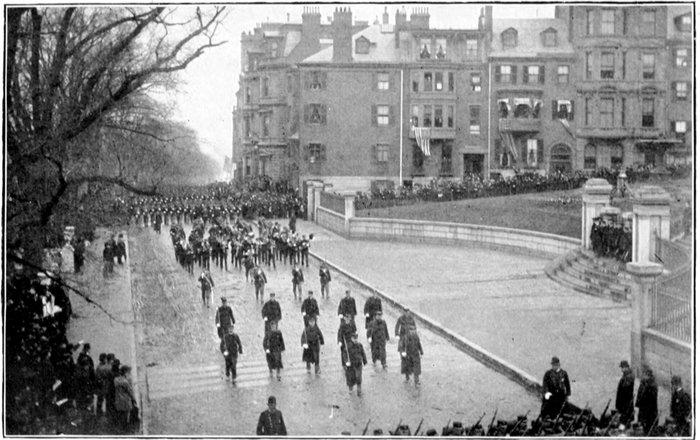
Copyrighted photograph by T. E. Marr, Boston.
RESPONDING TO THE CALL.
Governor Wolcott reviewing the Regiment, 26th April, 1898.
35On School Street, and again on State Street,
the regiment was loyally welcomed. In spite
of slippery and treacherous pavements, alignments
and distances were well maintained,
and the batteries marched with the long,
swinging step for which the command always
has been noted, though the unequal platoonfronts
due to the detachment formation of
foot artillery gave an odd effect to the
column. All through the business district
the applause and cheering were continuous,
and it was almost with a sense of relief that
the regiment finally boarded its transport, the
steamer General Lincoln, and escaped from
the patriotic uproar. But even here a parting
cheer was heard, for the men of the
Naval Brigade, on board the Minnesota, came
swarming from below in their white uniforms,
and strained their throats in fraternal desire
to start the regiment fittingly on its way to
the outer harbor-works.
With the regimental staff paraded Colonel
Richard H. Morgan, A.I.G. (formerly major
commanding the Third Battalion), who had
been detailed to accompany the command
as inspecting officer, and Lieutenant Erasmus
36M. Weaver, Second United States Artillery
(later lieutenant-colonel, Fifth Massachusetts
Infantry, U.S.V., and now captain in the regular
artillery), who for the year previous had
been attached to the regiment as instructor in
coast artillery work, and to whose untiring
efforts the regiment owed much for its efficiency.
The field, staff, and line officers of
the command on this date were as noted in the
following roster—the sequence of battalions
and batteries being that in which column was
formed for parade:
Colonel Charles Pfaff.
Lieutenant-Colonel Charles B. Woodman.
Staff.
1st Lieut. Charles H. Lake, Adjutant; 1st Lieut.
John S. Keenan, Quartermaster; Major Howard S.
Dearing, Surgeon; 1st Lieut. William A. Rolfe,
Assistant Surgeon; 1st Lieut. Horace B. Parker,
Paymaster; 1st Lieut. John B. Paine, Inspector Rifle
Practice; 1st Lieut. Horatio Hathaway, Jr., Signal
Officer; 1st Lieut. Joseph S. Francis, Range Officer;
1st Lieut. George S. Stockwell, Aide-de-Camp; Rev.
Edward A. Horton, Chaplain.
37FIRST BATTALION.
Major Perlie A. Dyar.
"G" Battery. (Station, Boston.)
Capt. Albert B. Chick.
First Lieut. Frank S. Wilson.
Second Lieut. James H. Gowing.
"H" Battery. (Station, Chelsea.)
Capt. Walter L. Pratt.
First Lieut. William Renfrew.
Second Lieut. Bertie E. Grant.
"A" Battery. (Station, Boston.)
Capt. John Bordman, Jr.
First Lieut. E. Dwight Fullerton.
Second Lieut. Sumner Paine.
"L" Battery. (Station, Boston.)
Capt. Frederick M. Whiting.
First Lieut. William L. Swan.
Second Lieut. Frederick A. Cheney.
SECOND BATTALION.
Major George F. Quinby.
"D" Battery. (Station, Boston.)
Capt. Joseph H. Frothingham.
First Lieut. Norman P. Cormack.
Second Lieut. William J. McCullough.
38"C" Battery. Colors. (Station, Boston.)
Capt. Charles P. Nutter.
First Lieut. Charles F. Nostrom.
Second Lieut. Arthur E. Hall.
"K" Battery. (Station, Boston.)
Capt. Frederic S. Howes.
First Lieut. P. Frank Packard.
Second Lieut. Albert A. Gleason.
"B" Battery. (Station, Cambridge.)
Capt. Walter E. Lombard.
First Lieut. John E. Day.
Second Lieut. Marshall Underwood.
THIRD BATTALION.
Major James A. Frye.
"M" Battery. (Station, Fall River.)
Capt. Sierra L. Braley.
First Lieut. David Fuller.
Second Lieut. Frederick W. Harrison.
"F" Battery. (Station, Taunton.)
Capt. Norris O. Danforth.
First Lieut. Ferdinand H. Phillips.
Second Lieut. William J. Meek.
39"E" Battery. (Station, New Bedford.)
Capt. Joseph L. Gibbs.
First Lieut. Harold C. Wing.
Second Lieut. (Vacancy.)
"I" Battery. (Station, Brockton.)
Capt. Charles Williamson.
First Lieut. George E. Horton.
Second Lieut. Wellington H. Nilsson.
The Non-Commissioned Staff and Headquarters' attachés
were the following: Sergeant-Major William
D. Huddleson; Quartermaster-Sergeant Edward
E. Chapman; Hospital Steward George Y. Sawyer;
Paymaster-Sergeant George R. Russell; Drum
Major James F. Clark; Chief Bugler Frederick
A. H. Bennett; Color-Sergeants Axel T. Tornrose
and Horace N. Conn; Orderly Samuel Weiss;
Bandmaster Frank L. Collins.
Almost exactly at noontide, and while the
cheers of the artillerymen in response to those
of their brethren of the Naval Brigade still
were echoing across the water, the General
Lincoln cast off her lines, and, amid ear-piercing
salutes from every vessel provided with
steam enough to start a whistle-valve, ran
down the channel between Forts Winthrop
and Independence, on her course for Fort
40Warren. In passing out of the upper harbor,
the transport ran close to the great British
cable-steamer Minia, whose crew swarmed at
her rail and yelled their enthusiastic approval
of the proceedings, while high on her bridge
her officers lifted their caps in acknowledgment
of the answering roar from the men in
blue. And then, at a sharp order from the
bridge, a petty officer ran aft on the Minia,
and the red ensign of England was thrice
dipped by way of wishing luck to the Yankee
volunteers. It was a pleasant incident, as well
as one not without significance, and the men
of the regiment promptly appropriated it as a
good omen.
Once more the Old First Regiment of Massachusetts
was off for service. Thirty-seven
years earlier, on May 27th, 1861, it had completed
its muster into the volunteer army of
the United States, leaving Boston on June
15th, and proceeding at once to Washington,
where it had the high honor of being the first
of the three-years' regiments to report, armed
and equipped, for duty. Since that time the
changes had been many; officers and men had
come and gone; batteries had been transferred,
41disbanded, or reorganized, until there
remained but six out of the twelve ("B," "D,"
"E," "G," "H," and "K") whose records
showed service in the previous war, while of
these only three ("D," "G," and "H") had
campaigned with the old War First from '61 to
'64. But through all the vicissitudes of over
a third of a century the traditions and spirit
of the early days had been reverently cherished
and kept sacred, until now, when the latest
call had come, the young men whose pride it
was that they bore the veteran name and number
were again first in ready response to the
summons.
Sheltering themselves as best they could
from the biting wind, for the cabins could accommodate
but a portion of the regiment, the
men prepared to make the best of their hour's
trip down the harbor. They were in the highest
of spirits, for the orders to move had come
as a relief to the previous strain of waiting for
the expected to happen. The singing men
promptly got to work, while the rest either
listened, or, true to the immemorial trait of the
newly enrolled volunteer, started cheers for
every passing craft. Meanwhile the colonel
42had assembled his battalion and battery commanders
to receive their final instructions looking
towards the comfort of the men when the
fort should be reached.
The regiment had been hurriedly called out,
and at an inclement season of the year, but its
officers felt that it was fairly ready, so far as
equipment went, for any service that might be
expected in the immediate future. In the
matter of small-arms there was little to be desired,
since an issue of the latest model Springfield
rifle—fresh from the national armory,
and in perfect condition—had been made
during the winter previous. Uniforms and
great-coats, if lacking in smartness, were at
least serviceable. Many batteries owned their
blankets, and in addition to these there was on
hand a full supply for the regiment, both woolen
and rubber, which only awaited issue. The
medical department had well-filled chests, with
the necessary equipment and furniture for a
small field hospital. Each battery had started
from its station with full travel rations for
forty-eight hours, which would tide over the
interval required to set in operation a consolidated
regimental mess. Several cases of
43heavy shoes had been ordered, to have at hand
in case delay should be experienced in filling
requisitions for foot-gear. There were on
hand twelve thousand rounds of small-arm
ammunition—not enough to go far in an infantry
fight, but sufficient for supplying the
belts of sentries and patrol-boat crews at a
coast fort.
Considered as a whole, and more especially
in contrast with the wretchedly found commands
sent into the field by most other States,
the regiment certainly was in efficient and serviceable
condition; it had the material necessary
for taking care of itself, and, better still, its
officers and men were self-reliant and capable.
The only cause for uneasiness lay in the matter
of quarters. On the New England coast, and
at this time of year, the use of canvas for sheltering
volunteer troops, just called from their
homes and yet unseasoned, seemed unadvisable;
arrangements, therefore, had been made
by General Dalton for the use of the portable
houses owned by the City of Boston, and
employed as polling-booths at the municipal
elections, and it was understood that something
over fifty of these had been erected on the
44parade at Fort Warren, in readiness for the
coming of the regiment. In this expectation,
however, the commanding officer was destined
to meet disappointment.
THE REGIMENT AT FORT WARREN
45
47
Shortly after one o'clock, the transport
drew alongside the pier at Fort Warren,
and the batteries disembarked and formed in
column, with the field music at the head. Then
the regiment marched up from the pier, in
through the main sallyport, and on to the parade,
where line of masses was formed, arms
were stacked and knapsacks unslung, preparatory
to the work of getting the baggage up
from the transport and settling down in
quarters. And here the regiment was treated
to an unwelcome surprise. The rain-proof
wooden village which it had expected to find
waiting for its occupancy had not yet come
into existence; over by the main magazine
stood two or three lonely booths, but the rest
of the cantonment still remained piled in disjoined
pieces on the lighters lying at the pier.
To be sure, a delegation from the institution at
Deer Island was engaged in giving a half-hearted
imitation of a working detail, but it
48was obvious to the most obtuse that the coming
of night would find the task of village-building
hardly begun—and this led the seven
hundred men standing at ease behind the line
of stacks on the soggy parade ground, and
lunching in the cold, drizzling rain, on hardtack
and canned beef, to make philosophical
comments on the horrors of war in general, and
of this war in particular.
But the time allowed for this innocent pastime
was brief. Battery by battery, details
were told off for pack-train duty, and in a
very short time an endless chain of men
circulated between the pier and the parade,
filing empty-handed through the little postern
in the northwestern bastion, and returning by
way of the main sallyport, heavy laden with
roof and wall sections. Even the wearied
men in brown from Deer Island—who
promptly had been christened by the batterymen
the "Third Corps of Cadets"—seemed
to catch the spirit of the occasion, and showed
more animation in putting one foot before the
other. And it was here that the regiment
added to its repertoire a new version of an old
song, with the merry refrain:
"They broke our backs
A-luggin' shacks,
In the regular army-O!"
49
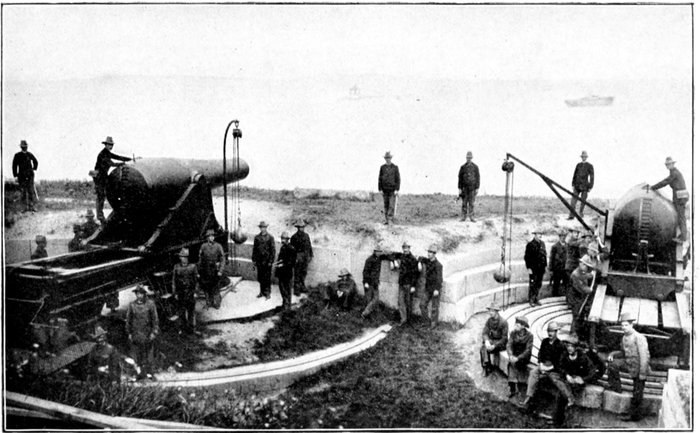
Photograph by W. H. Caldwell, Brockton.
15-INCH RODMANS, FORT WARREN.
Gun-laying Practice on Outward-bound Steamship.
51By night, there had been enough house-building
accomplished for the sheltering of
four batteries. The rest of the men stowed
themselves in odd corners of the fort, large
numbers bunking with their friends the regulars,
and many picking out soft spots on the
floor of the post recreation-room and gymnasium.
As a matter of fact, it was four days
before the entire command was settled in
quarters—wet, windy days at that—lack
of working tools for putting the houses
together delaying the completion of the task.
But when the village finally stood finished, it
was a model village indeed—with a city hall,
as exemplified by the office of the adjutant; a
city hospital, in the shape of the surgeon's
red cross shanty; eight straight, though narrow,
streets, with six houses in each; and last,
if far from least, a fire department, consisting
of two hose-reels manned by detachments
from "I" and "L" Batteries, with Captains
Williamson and Whiting serving as the Board
of Engineers. Later there was added a
52banquet hall, in the shape of a huge mess-tent,
which loomed up grandly in fair weather, but
tumbled ignominiously into the mud on the
stormy days when it was most needed; but in
the early days, officers and men took their
rations as best they could, in the stuffy casemate
of the gymnasium or amid the gloom of
the "Dark Arch." And it may be said here
that the messing problem was not a matter
for easy solution, since the crowded condition
of the fort made it impossible for the batteries
to cook with their Buzzacot outfits, while the
fixed kitchen appliances used by the regulars
were inadequate for rationing a garrison of
over nine hundred men. The question was
finally settled, however, by employing a contractor
to provide a general mess for the regiment,
and this method was followed in the
rationing of the command until it was broken
up and sent to its various coast stations, late
in May.
If the enlisted men were not luxuriously
quartered in the early days at Fort Warren,
the commissioned officers certainly were not
much better off. The colonel, with his fourteen
field and staff officers, went to housekeeping
53in three rooms in the second
casemate to the eastward of the sallyport,
while the first casemate to the westward
found its eight rooms well populated with the
thirty-five officers of the line. The room
assigned to the lieutenant-colonel, the three
majors, and the surgeon was a type of garrison
luxury. It was lighted and aired by
three narrow musketry loopholes, which afforded
a somewhat monotonous view of the
main ditch and sodded slope of the northern
cover-face, while its contracted area was
taken up in part by five cots, as many fieldchests,
and a variable number of camp-stools.
But it had an open grate, in which a coal fire
was always glowing, and on the nights when
the rain drove down upon the muddy parade,
or the impenetrable fog swept over the ramparts,
it was far from lacking in comfort. As
a matter of fact, the enlisted men were extremely
well provided for, since each house in
the battery streets ultimately was equipped
with a coal stove and with lamps in plenty,
while volunteer ingenuity was not long in
providing bunks, arm-racks, and cupboards.
As a rule, there were about fifteen men, under
54the proper non-commissioned officers, quartered
in each shack, an allowance which gave
ample space.
When the command reported at the fort, it
was in excellent condition so far as concerned
its health, and its officers purposed to keep it
so. It is worth noting that on the day after
its arrival, in spite of the fatigue, exposure,
and excitement attendant upon its departure
from home, there was not a single response at
morning surgeon's call, which was nothing
less than remarkable when it is recalled that
here were over seven hundred and fifty men,
fresh from office, shop, and factory, who had
slept in damp uniforms, and in most uncomfortable
quarters. This good record in the
matter of health was maintained to the end of
the regiment's term of service, and that it was
so maintained is due to more than mere
chance. Rigid rules, rigidly enforced, were
laid down for camp sanitary matters, and
minute inspections were daily made by both
battalion and battery commanders, while the
medical officers were alert and untiring in
looking to the welfare of the men. The trying
and unseasonable weather of late April
55and early May, together with the heavy details
brought under exposure on guard and
patrol duty, resulted in some sickness, but at
no time was the hospital list unduly large.
In its service of over six months there was
but one death in the regiment, and this
casualty occurred in the case of a man who
contracted scarlet fever, and died while on
mustering-out furlough. All through the
summer the regiment improved in health and
physique, and when finally it returned from
the field it was in the pink of condition for
further service. In justice to the officers of
the command, this point cannot be unduly
emphasized: the general condemnation of
volunteer officers, so common since the close
of the war, admits of certain sharply defined
qualifications. While no estimate yet can be
made of the dimensions of the pension bill for
1898, which finally will confront the country,
it may be stated as an assured fact that the
taxpayers need worry little over the item in
the account chargeable to the First Massachusetts.
A PERIOD OF SUSPENSE
57
59
While the work of settling the regiment
at its new station was in progress,
its officers found themselves confronted
by a new and serious cause for apprehension.
Up to the time of arriving at the fort, there
had been a marked lack of definite information
as to the future service of the command.
Only two facts seemed assured: that the President
had called for one hundred and twenty-five
thousand volunteers, and that the hurried
ordering out of the First had been in partial
answer to that call. Before the enthusiasm
attending the prompt assembly of the regiment
had died away, there came to Fort Warren a
bit of news which literally dumbfounded its
officers and men. Word was received from
the State House that General Corbin, in assigning
the quota of Massachusetts, had made
requisition for four regiments of infantry, and
but three batteries of heavy artillery!
The effect of this announcement may be
60better imagined than described. Here was a
regiment which since 1882 had received desultory
instruction in artillery work, and since
1892 had devoted itself seriously to the study
of the duties of this arm; year by year it had
improved in discipline and gained in efficiency
until its officers and men, beyond any doubt
or question, were fully capable of serving intelligently
and well the secondary armament—even
if not the most modern ordnance—in
any works on the coast; it had annually, in
its encampments, been brought into contact
with regulars, and had become thoroughly
familiar with the surroundings of permanent
fortifications; moreover, it was the only regiment
of militia heavy artillery in the entire
country—and yet a single telegram from
Washington threatened to overthrow the work
of long years, and to destroy by a stroke of
the pen an organization to whose up-building
patriotic men unselfishly had given their time,
their money, and their most earnest effort.
It hardly need be said that on the receipt of
this intelligence the officers of the regiment,
from the Chief to the last subaltern, passed
through the successive stages of astonishment,
61humiliation, and bitter chagrin, to a final condition
of supreme disgust. It seemed evident
that the First Massachusetts, after its half-century
of honorable service in peace and war,
either had been forgotten, or else was destined
to be entirely ignored. The action of the War
Department seemed inexplicable under the
circumstances. The country suddenly had
become involved in a war in which attacks on
its coast cities were possible, if not imminent;
while wofully lacking in trained troops of all
arms, it stood most distressingly in need of
garrison artillery; Massachusetts, alone among
the States, was ready and waiting to offer a
regiment of fairly disciplined and fairly trained
artillerymen—and was called upon for but three
batteries! And this, it should be noted, in the
face of an exigency which compelled the Commanding
Officer of the Department of the East
(General Orders, No. 21, 6th June, 1898) to
issue such instructions as these: "In case the
regular artillery troops at any post are not sufficient
properly to man all the guns, the commanding
officer will apply for such officers,
companies, or details from the infantry supports,
to be assigned to these duties, as may
62be necessary. At fortifications where no artillery
troops are stationed, the post commander
will select such companies or number
of troops as shall be necessary, and assign
them to that duty." It is a matter of record
that such assignments had to be made, and
that the raw troops used for the purpose not
only were absolutely useless as artillerists, but
even, in some instances, proved themselves incapable
of properly caring for the expensive
artillery material placed under their control.
63
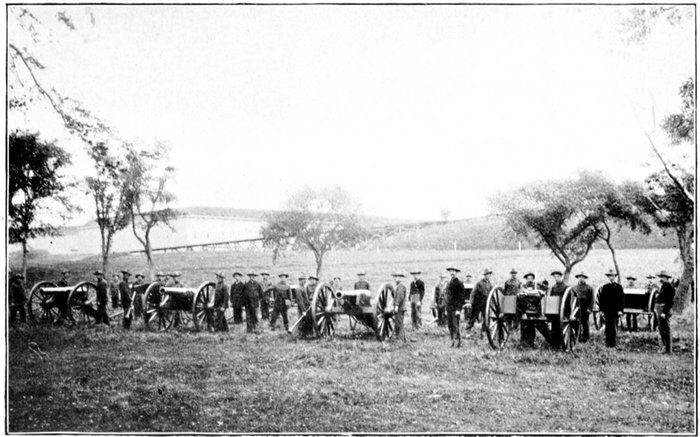
Photograph by W. H. Caldwell, Brockton.
FIELD AND MACHINE GUN BATTERY.
For Defence of Submarine Mines, Fort Warren.
65The War Department should not have been
in ignorance of the existence of this regiment,
or of its condition of comparative efficiency.
Yearly, from 1892 to 1897, reports upon its
progress had been compiled by Colonel Miller,
of the Third United States Artillery, and by
Colonel Kline, of the Twenty-first United
States Infantry—both of whom, to the satisfaction
of those in the Massachusetts service,
since have become general officers—and these
reports had shown uniform commendation of
the conscientious work that was being done.
In 1896 Colonel Kline reported: "With this
year's work, Massachusetts has a corps (the
First Regiment) for coast-defence. Should
an emergency arise necessitating the immediate
reënforcement of Fort Warren, the whole of
this fine regiment could in twenty-four hours
be sent to the post, and would now be of invaluable
service." And in his report for 1897,
submitted at a time when war was almost in
sight, he repeated with added emphasis his
comment of the preceding year: "The Legislature
of the State of Massachusetts, recognizing
the advisability of a coast-defence reserve,
promptly legislated the transfer of one of the
infantry regiments (First) for this duty. The
wisdom of this legislation cannot be questioned.
Under adverse conditions the regiment has
labored; without the means of receiving
proper instruction, save such as could be given
by officers when released from their duties,
given freely and unstintedly, yet they have
succeeded in fitting the organization as a reserve
force that could now be of invaluable
service." In both these extracts the italics
are those found in the original report, as
printed by the Military Information Division
at Washington.
Apparently the emergency requiring the
immediate reënforcement of Fort Warren had
66arrived; in less than twenty hours from the
time orders reached the men, the regiment
had reported at the post, armed, uniformed,
rationed, and equipped; officers and men stood
ready to render the invaluable services for
which an inspecting officer of the Government
had declared them fit—and yet now, at a
time when hastily raised and untrained infantry
was to be thrown headlong into artillery
posts, there came word from Washington that
the First Massachusetts Heavy Artillery, as an
organization, would receive no consideration
as a part of the volunteer army of the United
States.
It was small wonder that this verdict was
received with something very like consternation.
If it could not be reversed, the destruction
of the regiment was certain. For years
the men had been schooled in the belief that
they were in fact, if not in name, essentially a
part of the army of the United States; every
enlistment had been made on the understanding
that in time of peace faithful service was
to be rendered to Massachusetts, in time of
war, to the United States. The splendid esprit
de corps of the command had been carefully
67built up upon this supposition, and the men
had been taught to believe that the hard training
to which they were subjected was intended
to fit them for something more than
mere parade and ceremony, for something beyond
possible riot duty—in short, for something
no less serious than the defence of their
country in the hour of need.
All this was at once made known to Governor
Wolcott, who instantly appreciated the
disastrous effect of the proposed action, and
set himself to the task of finding a remedy.
By his direction, Colonel Sohier, A.D.C., of
his staff, hurried on to Washington, where
by personal effort he succeeded in securing a
reversal of the decision first made by General
Corbin, who not only accepted the regiment
as then organized, but even further directed
that its term of service should date from April
26th—thus officially recognizing the command
as first in the field for the war. The
regimental pay-rolls subsequently were made
up from this date, and officers and men were
paid accordingly.
But though Colonel Sohier was successful
in his mission so far as concerned saving the
68regiment for the national service, it was found
impossible to secure permission to recruit the
command to war strength, for the absurd
reason that to do so would exceed the quota
of volunteers allotted to Massachusetts. From
a purely technical point of view, this decision
seems inexplicable. There was crying need,
at the time, for garrison artillery, while it was
not expected that any serious demands would
be made upon the infantry of the army before
autumn; why, then, the proportion was not
maintained by recruiting the First, and accepting
one of the regiments of Massachusetts
infantry temporarily on its peace strength,
must always remain beyond the comprehension
of those unfortunate enough to have had
a professional knowledge of the coast-defence
conditions prevailing at the opening of the late
war.
FROM "M.V.M." TO "U.S.V."
69
71
The regiment was saved. Furthermore, it
was actually, if not legally, in the service
of the United States. But there yet remained
certain complex processes which had to be gone
through with before the "U.S.V." should supplant
the "M.V.M." By a pleasant legal fiction,
it had to be assumed that the militia regiment
which had set out for Fort Warren had
been lost somewhere en route, and that it had
become imperatively necessary to raise a new
regiment to take its place in the volunteer
service. All this, of course, was but the most
utter rubbish—and rubbish which under
easily supposable conditions might prove dangerous—yet
the obsolete militia laws which
Congress has left upon the statute books,
unaltered for nearly a century, made its observance
necessary. General Dalton therefore
(Special Orders, No. 45, 29th April) gravely
issued instructions for the formation of the
new regiment, though oddly enough he neglected
72the matter of making inquiries as to
what had become of the old one. These instructions
were brief and to the point:
"Colonel Charles Pfaff, having been designated
to command a volunteer regiment of heavy
artillery, under the call of the President of
the United States, will cause the enrolment of
such officers and men as may volunteer in such
regiment, and will cause to be prepared the
necessary papers for muster into service of
such volunteers, by Major Carle A. Woodruff,
commanding at Fort Warren."
This order meant two things for the officers
of the First. It required a final and most
careful revision of the battery rolls, and a last
searching scrutiny by the medical officers of
the physical condition of the rank and file.
Of these two requirements, the first was by
far the most important. Had the regiment
been formed in line, and the order been given
for volunteers to step to the front, there can
be no question that the command would have
responded to the last man. But it was
exactly this sort of thing that the officers
wished to avoid. The regiment was about
to enter upon a two-years' term of service,
73and its officers felt it their duty to discourage
the enlistment of all whose families
or dependents would suffer undue hardship
should that term prove necessary. It was felt
that any public call for volunteers would place
men in false positions—as such procedure
actually did in many States—and it was decided
quietly to inquire into the merits of each
individual case, refusing such men as could
not show that their entry into the service
would not work material injury either to themselves
or to others. By adhering to this rule,
the regiment lost a small percentage of the
strength with which it went out, but the drain
was easily made good by draft from the eager
recruits who had been left behind. Better
still, the men rejected for these reasons were
enabled to retain their self-respect, and they
left for their homes with the sympathy and
good-will of their late comrades.
The task of the two medical officers was a
trying one. Day after day they labored at
the monotonous physical examinations, until
they practically became worn out. Including
recruits drafted to fill the vacant places made
by rejections for business and family reasons
74or physical deficiencies, they were obliged to
pass upon the qualifications of nearly nine
hundred officers and men. It should be recorded,
to the credit of the battery commanders
as recruiting officers, that rejections for physical
causes were few and far between, the rigid
examination finding but one officer and fifteen
men—a surprisingly small number—unfit for
duty. General sympathy was felt for those
sent away by the surgeons, for without exception
they were men whose desire to go out
with the regiment was of the keenest.
But during all the uncertainty as to the final
disposition of the regiment, as well as while
the work of transferring it from the militia to
the volunteer service was in progress, the garrison
duty for which it had been so hastily
summoned was not neglected for a moment. On
the 27th of April, the day after the command
reported at the fort, the batteries had been
assigned to their fighting-stations, and steady
drill at the guns had begun. The drill was
no light matter; excluding the ceremonies
of guard-mounting and evening parade, the
regimental order called for four hours and a
half daily of solid work at the heavy guns, and
75that work was performed with an energy never
shown at the annual tours of instruction in
time of peace. On the many days when
weather conditions kept the men from the parapets,
schools of instruction were held in quarters,
for the study of guard duty, of army
regulations, and other matters of the sort. By
April 30th, the regimental signal corps, made
up of twelve non-commissioned officers and
thirty-six privates, under the signal officer with
an assistant, had been fully organized, and
was steadily employed in wig-wagging. On
May 1st, the light regimental guard mounted
during the first few days of the tour was replaced
by a strong guard of two officers with
fifty-seven non-commissioned officers and privates.
From these, details were made for the
patrol-boat crews, and reliefs were furnished
for the chain of posts by which the island was
surrounded.
With the assignment to gun-stations, the
organization of the garrison on a fighting-basis
stood completed. The two regular batteries—"C"
(Schenck's) and "M" (Richmond's)—were
stationed at the 10-inch,
breech-loading, disappearing rifles mounted in
76Bastion B and in the Ravelin Battery; with
them, for purposes of instruction, and to furnish
reliefs if required, were four batteries of
the volunteers, "A" (Bordman's), "C" (Nutter's),
"I" (Williamson's), and "L" (Whiting's).
To the 8-inch converted rifles on
the eastern face of the fort, commanding the
main ship channel, were assigned four more
batteries of the First, "B" (Lombard's), "F"
(Danforth's), "K" (Howes'), and "M"
(Braley's). The 15-inch Rodman guns,
mounted in barbette on Bastion A, were manned
by "G" (Chick's) and "H" (Pratt's) Batteries.
"E" Battery (Gibbs') was told off for
the 8-inch converted rifles in the casemate battery
of Bastion A, while "D" Battery (Frothingham's)
was assigned to the machine-gun
section, made up of Hotchkiss and Gatling
guns.
Variety in artillery work certainly was not
lacking, for the men of the regiment found
themselves called upon to handle every type
of ordnance, from the ponderous modern rifle,
on its complex mount, to the spiteful Gatling,
destined to spit its fire at prowling torpedo-boats
or chance landing parties. Nor was the
77drill in the manual of the piece all that was
required: attention had to be given to magazine-work,
mechanical manœuvres, and the
use of cordage, while range and position finding
were not neglected. "K" and "L"
Batteries also obtained a chance to demonstrate
their knowledge of the use of garrison-gin
and sling-cart by moving from the fort to the
pier certain spare 8-inch converted rifles, for
shipment to other points on the coast—a task
which they performed promptly and with credit
to their earlier training in the handling of
heavy weights. Infantry drill was not entirely
neglected, and daily marching manœuvres and
setting-up exercises were relied upon to keep
the men in form, while steadiness under arms
was taught at each evening parade.
Meanwhile progress in the preparations for
the muster of the regiment into the service
of the United States had not been delayed.
Colonel H. E. Converse, A.Q.M.G., assisted
by Colonel F. B. Stevens, A.D.C., had been on
duty at the post, representing the State in the
final settlement of property accountability on
the part of the battery commanders, and as the
result of their labors the title to the arms and
78equipments of the regiment was passed to the
general Government. The physical examinations
had been concluded, and recruits had
been received for all vacancies. Muster-rolls
and all other papers were ready on Saturday,
May 7th, and on the evening of that day
Colonel Pfaff reported his command as prepared
for the mustering-in ceremony. It was
first proposed to have this take place on Sunday,
but on second thought it was considered
better to defer it until the following day—which,
as it proved, resulted in giving to "K"
Company, of the Second Massachusetts Infantry,
the honor of being the first command in
the State to complete its actual muster.
79
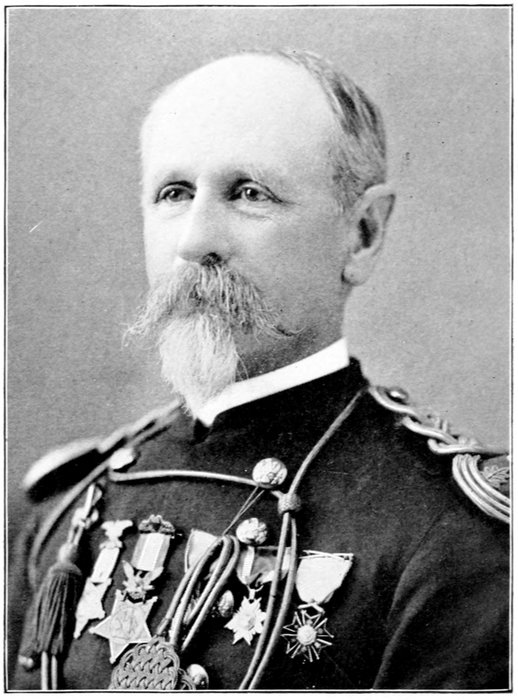
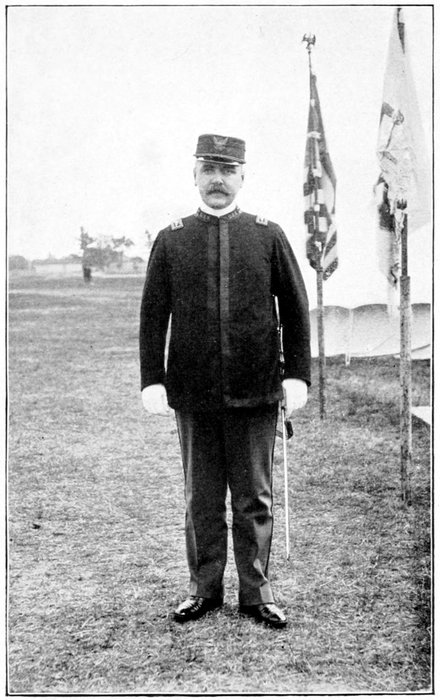
BVT. LIEUT.-COL. CARLE A. WOODRUFF, U.S.A.
(Major 2d Artillery.)
Mustering-in Officer for the Regiment.
81Contrary to the prevailing rule, Monday, the
9th of May, proved to be a sunny and pleasant
day. Early in the morning, the regiment was
formed in its battery streets, in readiness for
its entry into the volunteer army. Promptly at
eight o'clock, Major Carle A. Woodruff, Second
United States Artillery, commanding the post,
and with it the other defenses of Boston
Harbor, took his station before regimental
headquarters, in readiness for the ceremony.
The regiment felt itself honored by his detail
as its mustering-officer: a typical American
soldier, he had received the brevets of captain,
major, and lieutenant-colonel for gallant and
meritorious services at Gettysburg, at Trevillian
Station, and during the Civil War as a
whole, while he also had been decorated with
the medal of honor for distinguished gallantry
in action at Newby's Cross Roads. He had
been closely identified with the regiment since
its change from the infantry to the artillery
arm, and its officers held him in the warmest
esteem.
It had been arranged that the batteries should
be mustered in the order of the seniority of
their captains, and thus the first command to
march across the parade was "M" under
veteran Captain Braley, who was responding
for the second time to the call of his country
in time of war. His appearance before the
mustering officer was the signal for a round
of applause from the group of staff officers
gathered at headquarters. In a very few
minutes both he and his command had ceased to
be militiamen, and had become United States
Volunteers—to be followed rapidly by the
other eleven batteries of the regiment. As a
82matter of record, it was exactly 9.34 A.M. when
Colonel Woodruff finished administering the
oath to the field, staff, and non-commissioned
staff officers, thus completing the muster of the
regiment. Everything had moved with the
regularity of clock-work, and in but little over
an hour and a half more than seven hundred
and fifty officers and men had answered to their
names as called from the muster-rolls, and had
sworn to serve the United States faithfully and
well for the two years to come.
In this connection the statement made in the
newspaper history of the Second Massachusetts
Infantry must be corrected. It is but a
minor point, of course, yet soldiers are wont
to be jealously tenacious on minor points
affecting their own records. "This regiment,"
writes the historian of the Second, "was the
first to be mustered into the service of the
United States, the first to leave Massachusetts,
the first to invade Cuba—the first of our
regiments to enter the actualities of war." As
a strict matter of record, the Second Infantry
was mobilized at Framingham on May 3rd,
where it completed its muster-in (though "K"
Company had been mustered on May 8th) on
83May 10th. The First Artillery entered the
United States service as militia on April 26th,
dating its pay-rolls from that day, and had been
mustered complete before 10 o'clock in the
forenoon of May 9th. It was the first militia
regiment in the service; it became the first
volunteer regiment in the service. In contending
for this recognition it certainly does
not seek to rob the Second of its hard-won
laurels, for the First and Second, brigaded
together for long years, always have been
firm friends, though strong rivals. Chained
in its posts along shore, the First yet watched
with interest and admiration the career of the
men from western Massachusetts, and in their
trials and triumphs in far-away Cuba their
hearts would have warmed could they have
heard the verdict of their brethren of the
First—"Well done, Second Massachusetts!"
PERSONNEL OF THE REGIMENT
85
87
On the completion of the mustering-in there
came an incident which was characteristic
of the spirit of the First. Since all of the
volunteer commissions due the regiment would
bear the same date, it was evident that a decision
must be made to settle questions of
seniority. Army regulations prescribe that
lots shall be drawn in cases similar to this,
and, had this legalized lottery been held, there
was a tempting chance that the officer of less
than a year's commissioned service might find
himself out-ranking another who had served
faithfully in the militia for years in a like
grade. To the everlasting credit of the regiment,
its officers declined to avail themselves
of this opportunity for unearned advancement,
and by their wish the first general order issued
from headquarters of the newly-made volunteer
regiment published a roster of the command,
determining the rank and precedence
in the several grades, as established by previous
service in the militia of Massachusetts.
88As mustered into the volunteer service, the
regiment was officered as follows:
| 1. |
Col. Charles Pfaff. |
|
| 2. |
Lt.-Col. Charles B. Woodman. |
|
| 3. |
Maj. Perlie A. Dyar. |
|
| 4. |
Maj. George F. Quinby. |
|
| 5. |
Maj. Howard S. Dearing |
Surgeon. |
| 6. |
Maj. James A. Frye. |
|
| 7. |
Capt. Sierra L. Braley |
"M" Battery. |
| 8. |
Capt. Joseph H. Frothingham |
"D" Battery. |
| 9. |
Capt. Charles Williamson |
"I" Battery. |
| 10. |
Capt. Norris O. Danforth |
"F" Battery. |
| 11. |
Capt. Albert B. Chick |
"G" Battery. |
| 12. |
Capt. Frederick M. Whiting |
"L" Battery. |
| 13. |
Capt. Walter E. Lombard |
"B" Battery. |
| 14. |
Capt. Charles P. Nutter |
"C" Battery. |
| 15. |
Capt. Walter L. Pratt |
"H" Battery. |
| 16. |
Capt. John Bordman, Jr. |
"A" Battery. |
| 17. |
Capt. Frederic S. Howes |
"K" Battery. |
| 18. |
Capt. Joseph L. Gibbs |
"E" Battery. |
| 19. |
1st Lt. Horace B. Parker |
Adjutant. |
| 20. |
1st Lt. Charles F. Nostrom |
"C" Battery. |
| 21. |
1st Lt. John S. Keenan |
Quartermaster. |
| 22. |
1st Lt. John E. Day |
"B" Battery. |
| 23. |
1st Lt. David Fuller |
"M" Battery. |
| 24. |
1st Lt. Ferdinand H. Phillips |
"F" Battery. |
| 25. |
1st Lt. John B. Paine |
Range Officer. |
| 26. |
1st Lt. William L. Swan |
"L" Battery. |
| 27. |
1st Lt. William Renfrew |
"H" Battery. |
| 28. |
1st Lt. Frank S. Wilson |
"G" Battery. |
| 8929. |
1st Lt. E. Dwight Fullerton |
"A" Battery. |
| 30. |
1st Lt. P. Frank Packard |
"K" Battery. |
| 31. |
1st Lt. William A. Rolfe |
Assistant Surgeon. |
| 32. |
1st Lt. Norman P. Cormack |
"D" Battery. |
| 33. |
1st Lt. Harold C. Wing |
"E" Battery. |
| 34. |
1st Lt. George E. Horton |
"I" Battery. |
| 35. |
1st Lt. George S. Stockwell |
Signal Officer. |
| 36. |
1st Lt. William S. Bryant |
Assistant Surgeon. |
| 37. |
2d Lt. Marshall Underwood |
"B" Battery. |
| 38. |
2d Lt. Frederick A. Cheney |
"L" Battery. |
| 39. |
2d Lt. Bertie E. Grant |
"H" Battery. |
| 40. |
2d Lt. James H. Gowing |
"G" Battery. |
| 41. |
2d Lt. Albert A. Gleason |
"K" Battery. |
| 42. |
2d Lt. Frederick W. Harrison |
"M" Battery. |
| 43. |
2d Lt. Wellington H. Nilsson |
"I" Battery. |
| 44. |
2d Lt. William J. McCullough |
"D" Battery. |
| 45. |
2d Lt. Sumner Paine |
"A" Battery. |
| 46. |
2d Lt. Joseph S. Francis |
"C" Battery. |
| 47. |
2d Lt. James E. Totten |
"F" Battery. |
| 48. |
2d Lt. Charles H. Fuller |
"E" Battery. |
The non-commissioned staff, as finally mustered
in, was made up of Sergt.-Maj. William
D. Huddleson, Q.M.-Sergt. Edward E. Chapman,
Hospital Stewards George Y. Sawyer,
Ira B. Phillips, Thomas White, Principal
Musicians James F. Clark and Frederick A.
H. Bennett. Of the old non-commissioned
staff, Paymaster-Sergt. George R. Russell and
90Color-Sergt. Axel T. Tornrose, whose militia
grades were not recognized in the volunteer
service, refused to be left behind, and proved
their devotion to the regiment by enlisting as
privates. The regimental band, as well as
the corps of field musicians attached to headquarters
under the militia organization, could
not be mustered, and until the close of its
term of service the regiment was obliged to
rest satisfied with the music of its battery
buglers, save for the short period at Framingham
prior to going on furlough, when the
thoughtfulness of the State authorities allowed
the band to rejoin.
91
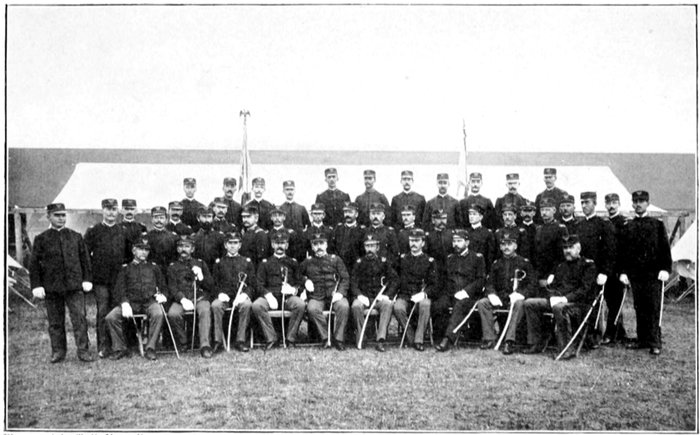
Photograph by T. E. Marr, Boston.
FIELD, STAFF, AND LINE OFFICERS.
93Under the terms on which the mustering of
the regiment had been ordered by the War
Department, it entered the service with forty-eight
commissioned officers and seven hundred
and three enlisted men, an aggregate for duty
of seven hundred and fifty-one. In its personnel
the command was exceptionally fortunate.
Of its officers, twenty-five per cent.
were college bred, while in its ranks were to
be found representatives of nearly every
college and technical school in New England.
In machinists, electricians, and skilled mechanics—the
sort of material without which an
artillery command never can attain its full
efficiency—the regiment was encouragingly
strong. A newspaper sketch of the Sixth
Massachusetts Infantry, recently published,
gives a roll of twenty-one Harvard men who
served in that command, and accompanies it
with this comment: "Harvard University contributed
her quota to the army last summer,
and the Sixth had as many of her sons in the
ranks as any regiment in the service." It is
perhaps worth noting, though it hardly need
be a matter for controversy, that no less than
thirty-four graduates and undergraduates of
the Cambridge University went out with the
First, of whom nine were commissioned officers,
while the remainder served faithfully
and with credit as enlisted men. It is a
matter for regret that statistics relating to
men from other colleges who served in the
regiment are not available, but it may be of
interest to record here the Harvard roll, which
may be considered approximately complete:
Commissioned officers: James A. Frye
(1886), major; John Bordman, Jr. (1894),
captain; John B. Paine (1891), first lieutenant
94and range officer; E. Dwight Fullerton
(1898), first lieutenant; William A. Rolfe
(M.S., 1890), first lieutenant and assistant
surgeon; William S. Bryant (1884), first
lieutenant and assistant surgeon, later promoted
major and brigade surgeon, and assigned
to Seventh Corps; Albert A. Gleason (1886),
second lieutenant; Sumner Paine (1890),
second lieutenant; Joseph S. Francis (1897),
second lieutenant.
Enlisted men: Louis H. Brittin (L.S.S.,
1901), corporal, "A"; Arthur H. Howard
(1898), corporal, "A"; Edward D. Powers
(1898), corporal, "A"; Ralph W. Black
(1886), private, "K"; Edward A. Bumpus
(1898), private, "A," later appointed second
lieutenant, Twenty-first United States Infantry;
John Corbett (temporary student),
private, "B"; Charles W. Cutler (1898),
private, "A"; Eugene H. Douglass (1898),
private, "A"; Howard B. Grose (1901), private,
"K"; Frederick Heilig (1897), private,
"A"; Edwin B. Holt (1896), private, "A";
Benjamin Kaufman (1900), private, "D";
Charles H. Keene (1898), private, "A";
James L. Knox (1898), private, "A"; John
95F. McGrath (1895), private, "A"; Moses I.
Reuben (1889), private, "K"; George R.
Russell (temporary student), private, "K";
Francis R. Stoddard, Jr. (1899), private,
"A"; Harry C. Strong (1899), private,
"K"; Edward A. Thurston (temporary student,
L.S.), private, "M"; Calvin S. Tilden
(1898), private, "A"; John A. White
(1896), private, "B"; Charles H. Williams
(L.S.S., 1900), private, "A"; Francis C.
Wilson (1898), private, "A"; Roger Wolcott,
Jr. (1898), private, "A."
THE SEASON OF RUMORS
97
99
These were stirring times for the regiment.
It was the period of rumors—of
rumors that at any time might develop into
realities. In order to obtain an adequate idea
of the atmosphere in which the command then
lived, it would be necessary to turn to the files
of the newspapers for the early spring of
1898, and make a classified list of the Spanish
naval bugaboos daily appearing in their
columns. One odd coincidence is well worth
recalling, as showing that all the misapprehensions
were not confined to our own cities.
On the evening of April 26th, the day on
which the regiment reported at Fort Warren,
mass meetings were held at Portsmouth and
New Bedford, to protest against the utter
disregard shown by the Government for the
defenses at those points—and on that very
night there was given in Havana a public
banquet to celebrate the bombardment of
Boston, of which rumors had spread in that
100city! Spook fleets were common in those
days, and the men of the First, happily forgetful
of the fact that they were manning
obsolete works, armed for the most part with
obsolete ordnance, and, worst of all, wofully
short of ammunition, daily hoped that the
spook cruisers might materialize into ships
of steel. What little time was left from their
duties they employed in pitying their less fortunate
comrades in inland camps, whom they
considered hopelessly out of the game of
coastwise attack and defence which was expected
to begin at any time.
And all this speculation, as a matter of
fact, was not so wild as it now may seem.
It was known that the Spanish torpedo
flotilla had rendezvoused at the Cape Verde
Islands on March 24th, where it was joined
on April 14th by the Infanta Maria Teresa
and Cristobal Colon, and later, on the 20th,
by the Vizcaya and Almirante Oquendo. On
the 22d of April this formidable squadron
was ordered to sea, and on the 29th it sailed—to
a destination then unknown to any one
on this side of the Atlantic. During the four
anxious weeks that followed, this threatening
101fleet was lost to sight; and throughout this
month of uncertainty, as Spears, the historian
of the Navy in its latest war, rightly says,
"Not only was it a mysterious squadron in
its movements: to a large part of our along-shore
population it was positively fearsome.
And there was good reason, when the makeup
of the squadron only is considered, for vigilance,
if not for alarm, in our more weakly
fortified harbors. Where it would make a
landfall was a question, for the whole United
States coast was, in a way, open to attack."
An added element of uncertainty was to be
found in the announcement made by Sagasta,
on April 24th: "The Spanish Government,
reserving its right to grant letters of marque,
will at present confine itself to organizing,
with the vessels of the mercantile marine, a
force of auxiliary cruisers, which will coöperate
with the navy, according to the needs of
the campaign, and will be under naval control."
It was believed that Spain, in accordance with
this policy, had taken and armed a number of
able, sea-going steamers, and the legitimate
inference was that they were to be employed
in attacks on our commerce, or in sudden descents
102upon our open ports, rather than in
fights with our own cruisers.
As a matter of fact, during the months of
May and June, the people dwelling along the
coast were much in the condition of the small
boy who is troubled by "seein' things at
night," and apparently the masters of incoming
vessels were laboring under a like affliction.
A very careful record of the Spanish
apparitions by which the coast was haunted
at this time was kept by an officer of the First,
and to read it at this late day is to become
convinced that the newspaper buyers of 1898
most certainly got their money's worth. It
is a weird catalogue of rumors, from the tale
of the mysterious cannonading heard at Eastport
to the reported sighting of the "three
long, low, rakish craft, sailing in column formation,
and signalling by masthead lights
as they steadily held their course in the darkness"—which
might have fitted a Spanish
squadron, but yet was equally applicable to
the case of a tow of coal-barges on its way
around the Cape to Boston.
103
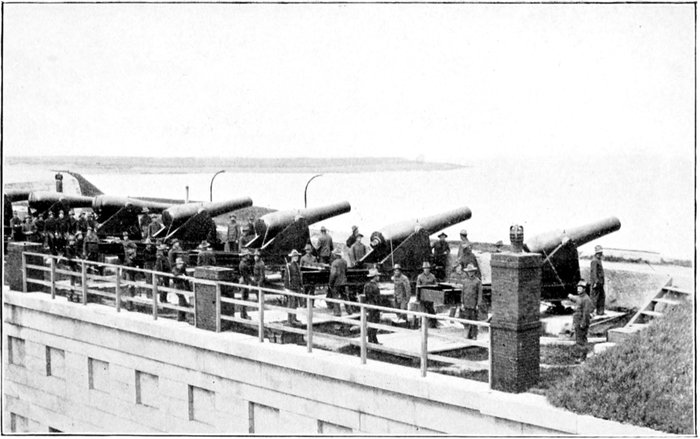
Photograph by W. H. Caldwell, Brockton.
8-INCH RIFLE BATTERY, FORT WARREN.
Covering Main Ship Channel, Boston Harbor.
105But in spite of the utter absurdity of many
of the reports, the officers of the First gave
much careful consideration to the diagrams in
Brassey's "Naval Annual," and Jane's "Fighting
Ships," with a view to putting 8-inch shot
in the spots where they would do the most
good should occasion arise; and nobody was unduly
surprised when, shortly after midnight of
May 13th, the Tourist, the steamer employed
by the Engineers in their harbor-mining work,
came puffing down from the city, announcing
her arrival at the fort by long blasts of her
whistle, and bringing word that at last the
long-expected fleet had been sighted off Nantucket,
steering a course for Boston. Coming
by way of the Navy Department, this bit of
intelligence seemed worthy of consideration,
and so in the early morning the officers of the
regular garrison sent their families away from
the island and out of danger, while the volunteers
uncased the last of the small store of 8-inch
projectiles for the guns in their charge, gave
a final look to their equipments, and then sat
themselves down on the parapets to await the
first glimpse of Cervera's armada. Fieldglasses
were at a premium that day, and the
wide expanse of water towards Boston lightship
became an object of much interest; but
106Cervera failed to appear, and to the disgust
of regulars and volunteers alike it became
evident, as the hours slipped away, that even
official warnings via the Navy Yard must be
received with proper and due allowances.
For some time now the port had been closed
at night. Electric signal lanterns had been
rigged upon the flagstaff of the fort, and every
evening the officer of the guard was given the
code signal for that especial date, by which
ships of our navy were to be recognized. The
orders of the post directed that any steamer
failing to acknowledge signals from the fort,
or replying by wrong combinations, should be
fired on. But no steamers, either of the navy
or of the merchant marine, attempted to make
port after dark, and the only firing required
was that done by patrol-boat crews, who were
obliged at times to use their rifles on the fishermen
and coasters which, under cover of
darkness, ignorantly or wilfully persisted in
blundering in among the mine-fields.
On the 3rd of May all troops of the Atlantic
States had been placed under command
of General Merritt, to be employed in coast-defence,
and to him Colonel Pfaff reported his
107regiment. Soon after, Lieutenant Strother,
(later major, U.S.V.), A.D.C. to General
Merritt, was ordered to Boston for the purpose
of inspecting the regiment, so far as
concerned its equipment for service, and recommending
stations for its assignment in the
general scheme of defence. Having visited
Fort Warren, where he made a careful inquiry
into the condition of the command, Lieutenant
Strother held a consultation with the State
authorities, and returned to New York to
report to his chief. On the 10th came telegraphic
orders from Headquarters, Department
of the East, detaching the Third Battalion
("E," "F," "I," and "M" Batteries, under
Major Frye), to report to Colonel Woodruff
for duty as part of the garrison at Fort Warren,
and directing the remainder of the regiment
to hold itself in readiness for assignment
under orders later to be issued.
Changes which ultimately concerned the
First had meanwhile been in progress among
the regular batteries stationed on the New England
coast. "K" Battery (Curtis'), of the
Second Artillery, had been ordered on April
28th from Fort Schuyler, N.Y., to the ungarrisoned
108defenses at Portsmouth, N.H. On
May 6th Colonel Woodruff, in addition to his
duties as commanding officer at Fort Warren,
was assigned to the general command of the
defenses of Boston Harbor; Major Charles
Morris, Seventh Artillery, was placed in command
of the Mortar Battery at Winthrop (up
to this time in charge of Lieutenant Ketcham,
Second Artillery, with a small detachment of
about thirty men taken from the batteries at
Warren) with a garrison made up of "M"
Battery (Richmond's), Second Artillery, and
"F" Battery (Anderson's), Seventh Artillery,
from Schuyler; the gap left in the garrison at
Warren by the withdrawal of Richmond was
filled by the transfer of "G" Battery
(Brown's), Seventh Artillery, from Schuyler;
and finally, Lieutenant Lyon, with a detachment
of thirty men from the batteries of the
Second Artillery at Fort Adams, Newport,
R.I., was ordered to the fort at Clark's Point,
New Bedford, later to be named Fort Rodman.
The shifting of regular batteries at Warren
occurred on May 16th, and the officers of the
First parted with regret from Captain Richmond,
who had made many friends among them.
109Most unexpectedly, on May 18th, a message
was received at the fort announcing the coming
of Governor Wolcott, to present to the officers
their volunteer commissions. On his arrival
the regiment formed for review, and after the
march-past stood closed in mass by battalions,
with the officers grouped at the centre, while
the Governor spoke a few words of farewell,
saying, among other things:
"It is your high privilege to have been summoned
into the service of the United States
at a time when the clouds of war with a foreign
Power threatened the Republic. I know
of no higher service that a citizen can be called
upon to render than to offer his life, if need be,
in the cause of his country. You enter this
service not as raw recruits, but with obedience
and discipline acquired in the militia service
of the Commonwealth. Whether you are
assigned the honorable duty of guarding the
sea-coast of the Commonwealth of your birth,
or are summoned to some distant point in
other lands or within the confines of your own
country, see to it that no act of yours shall
bring aught but added glory to the colors
you bear. Be of high courage and good
110cheer; the great heart of the Commonwealth
will follow you with pride and affection, whatever
the duty you may be called upon to perform."
Receiving the commissions from the hands
of Colonel Bradley of his staff, who had served
through the Civil War in the First Massachusetts
Heavy Artillery of 1861, the Governor
then presented them to the officers of the regiment
in the order of their rank, finally turning
to Colonel Pfaff to say, "I congratulate
you, Colonel, upon the regiment you have the
honor to command, and upon the service you
now enter."
On the conclusion of this very simple yet
impressive ceremony, the regiment was dismissed.
The Governor then made an informal
inspection of battery quarters, and afterwards
was conducted over the works in order that
he might see for himself whatever of progress
was being made towards installing modern
armament in the main fortification of his capital
city. Later, with the members of his staff,
he was the guest of the officers' mess at luncheon;
and early in the afternoon he took
final leave of the regiment, which always had
111considered it an honor to serve under him as
commander-in-chief, but now—though not
without a touch of regret—had passed for a
time beyond his authority.
ASSIGNMENT TO STATIONS
113
115
The day now had come when, after the
custom of the artillery service, the regiment
must be broken up and scattered in its
isolated posts along shore. General Merritt
was relieved of the command of the Department
of the East on May 20th, to go to the far
East as commanding officer of the Philippine
expedition. His successor was General Frank,
U.S.V., promoted from the colonelcy of the
First United States Artillery, who lost no time
in issuing orders (S.O., 112, H.Q., D.E., 23rd
May) for the final distribution of the regiment
to its stations. The text of this order read:
"The following assignment to stations of
the First Regiment Massachusetts Heavy
Artillery, now at Fort Warren—Colonel Pfaff,
commanding—is hereby ordered: Colonel
Pfaff, with headquarters and two batteries, to
Salem, and to command the various fortifications
and points on the North Shore of Massachusetts
where batteries of his regiment are
116placed. The Lieutenant-Colonel, and two batteries,
to Clark's Point, Mass. Major Frye,
with 'E,' 'F,' 'I,' and 'M' Batteries, will
remain on duty at Fort Warren, as heretofore
designated by telegraphic orders. The four
remaining batteries, one each to Gloucester,
Marblehead, Nahant, and Plum Island, Mass.
Colonel Pfaff will designate the unassigned
field officers and batteries for stations to the
points other than Fort Warren, as he shall
deem advisable, notifying these headquarters
of the letters of batteries, and the officers
so assigned, to the respective stations. The
troops will take tents, camp equipage, and ten
days' rations."
This order ended for the time being all
speculation as to the destination of the regiment
in the immediate future, and though it
certainly failed to please everybody, it yet was
received with little comment by those whom it
concerned. It was recognized that artillery
posts must vary from good to indifferent, or
even from indifferent to bad, and the officers
spent their leisure moments in pleasant conjectures
as to undesirability of the assignments
which were destined to fall to their lot.
117On May 30th Colonel Pfaff issued the orders
for the distribution of the First and Second
Battalions. "G" (Chick's) and "L" (Whiting's)
Batteries, with Lieutenant Paine, range
officer, and Lieutenant Bryant, assistant surgeon,
were ordered to report to Lieutenant-Colonel
Woodman, to take station at New
Bedford. For the garrison at Salem, "C"
(Nutter's) and "D" (Frothingham's) Batteries
were designated, under Major Dyar as
commanding officer of the post, to whom
was to report Lieutenant Rolfe, assistant
surgeon, so soon as relieved from his detail
as post surgeon at Fort Warren. Major
Quinby, with "K" (Howes') Battery, and Hospital
Steward White, were assigned to the defenses
at Gloucester. Captain Lombard, with
"B" Battery, and Hospital Steward Phillips,
were ordered to Newburyport, to establish a
post at the entrance of the harbor. Captain
Pratt, with "H" Battery, was assigned to the
works at Marblehead. Captain Bordman, with
"A" Battery, was directed to take station at
Nahant, for the protection of the mining casemate
at that point.
Preparation for these movements began
118promptly, but stormy weather and delay in
securing transportation made it over a week
before the last of the departing batteries was
able to leave Fort Warren. Meanwhile the
posts for which these detachments from the
regiment were destined had been garrisoned
temporarily by the militia—commanded at
first by General Mathews, and later by General
Bancroft. Influenced by the prevailing uneasiness,
Governor Wolcott, on May 7th, had prudently
ordered his remaining State troops into
the field for the protection of the coast until
such time as the general Government should
assume the responsibility, and the Fifth Infantry,
the First and Second Battalions of Cadets,
with the three light batteries, had been rendering
valuable service at exposed points, from
Hull to the mouth of the Merrimac. Unable to
enter the volunteer service, under the limits
imposed by the call of the President, these
commands eagerly had responded to the call
of the Commonwealth, and they most certainly
are entitled to recognition for the faithful work
performed, under most trying conditions as to
weather, during the thirty days of their tour.
119
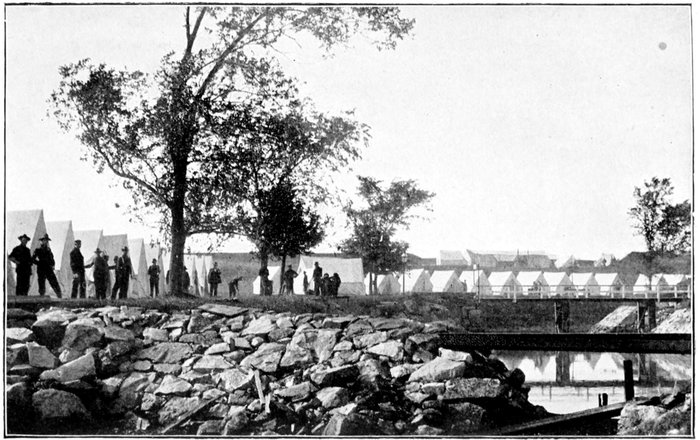
Photograph by T. E. Marr, Boston.
GARRISON ENCAMPMENT, FORT PICKERING.
121On June 1st, Lieutenant-Colonel Woodman
and his command left for New Bedford, proceeding
from Boston by rail; while, on the
3rd, Colonel Pfaff and the officers of his
staff established regimental headquarters at
Salem. On the 6th, Major Quinby and
"A," "C," "D," and "H" Batteries left for
their stations, followed on the 7th by "B"
and "K" Batteries. All these latter commands
were furnished with transportation by
water, and it may be noted that the small
steamers employed for the purpose were well
loaded down by the troops and their baggage.
It so happened that the departure of the
detachments took place during a period of
very heavy weather, and more than one
anxious watcher stood on the parapet at
Warren, to follow through field-glasses the
course of the receding transports, as they
rolled and pitched across the bay and towards
the North Shore.
The widely scattered detachments of the
First now settled themselves as best they might
at their respective coast-guard stations, and
prepared to make the most of the scanty
materials for defence which they found at
hand. Under the final assignments, the distribution
122of the regimental strength was as
follows:
| Station. |
Officers. |
Men. |
Total. |
| |
| Defenses of Newburyport |
3 |
59 |
62 |
| Stage Fort, Gloucester |
4 |
59 |
63 |
| Fort Sewall, Marblehead |
3 |
58 |
61 |
| Fort Pickering, Salem |
13 |
121 |
134 |
| Mining Casemate, Nahant |
3 |
58 |
61 |
| Fort Warren, Boston |
13 |
232 |
245 |
| Fort Rodman, New Bedford |
9 |
116 |
125 |
| |
-- |
--- |
--- |
| Aggregate for duty |
48 |
703 |
751 |
Hardly had the regiment begun to adapt
itself to the new conditions, when telegraphic
orders from the War Department arrived
directing that the batteries be at once recruited
to full artillery strength, two hundred enlisted
men each—or an aggregate of sixty officers
and twenty-four hundred men for the entire
command, since an additional second lieutenant
would be appointed to each battery when
on a war footing. It is needless to say that
this order was hailed with delight by both
officers and men: to the former it gave promise
of more active service, while to the latter it
meant unlimited promotion, since over two
hundred and fifty additional sergeants and
123corporals would be required in the expanded
batteries. No time was lost in preparing to
comply with this order. Major Dyar was detailed
as chief recruiting officer, with Captains
Williamson and Nutter as assistants, and plans
were made for opening recruiting offices in
Boston, New Bedford, Brockton, and Salem.
Battery commanders immediately attempted to
get into communication with the men whom
they had left behind, under former conditions,
in the hope of finding that not all of them had
yet enlisted in the regulars or in other volunteer
regiments. Everything was ready for
beginning the work of recruiting—when word
came by telegraph from Washington that the
whole matter was a mistake, and that the
recruiting order had been meant to apply alone
to the Massachusetts infantry regiments. It
was a bitter disappointment. The regiment
stood sadly in need of recruits, since its strength
as organized barely sufficed for the performance
of routine garrison duty, and when the
President, on May 25th, issued his call for
seventy-five thousand additional volunteers,
the officers of the First felt that from the allotment
of Massachusetts they should at least
124secure enough men to bring the regimental
enrolment up to twelve hundred. But for a
second time they were destined to see their
command passed by without consideration.
The pressure exerted to bring the Fifth Infantry
into the volunteer service, or it may
be some other cause yet remaining to be
explained, left the faithful First still serving
with skeleton ranks.
In spite of all disappointments, however,
the command never slackened in the performance
of its appointed work. There were many
problems to be solved, and of these the most
perplexing was how to evolve an efficient
defence from ridiculously inadequate materials.
In his command on the North Shore Colonel
Pfaff found himself confronted by a grave
situation of affairs. To him had been entrusted
the defence of five important points, among
them four towns aggregating over eighty-five
thousand inhabitants, and with property interests
to be reckoned by tens of millions; and,
to state unpleasant facts with relentless exactness,
every modern and effective appliance for
defensive operations had been denied him.
Newburyport, Gloucester, Marblehead, and
125Salem were all liable to bombardment from
the open sea, and the fire of heavy guns alone
could give even a promise of immunity from
that form of attack; but there were no heavy
guns mounted at any of these points. Eight
3-inch, muzzle-loading rifles (type of 1862)
had been brought to the coast by two of the
militia light batteries, and these had been
turned over to the volunteers relieving them,
while sixteen Driggs-Schroeder rapid-fire
guns, ranging in calibre from one-to six-pounders,
hastily purchased by the State from
its war emergency appropriation, also had
been placed in the hands of the batteries of
the First. Beyond these there was nothing in
the way of ordnance—not a gun, not a round
of ammunition was supplied by the general
Government for these five posts to which it
had seen fit to order artillery garrisons!
After making a rapid study of the situation,
it became apparent that serious resistance to
anything like a resolute fleet attack could not
be made, but it was confidently believed that,
with the means at hand, at least three other
forms of naval attack might be successfully
parried. Dispositions accordingly were made
126to meet sudden descents by Spanish auxiliary
cruisers, dashes into harbors by torpedo-boats,
or any attempts at operations by landing
parties; and it should be said here that nothing
was left undone towards providing, with
the material available, all possible protection
to the points garrisoned by these volunteer
batteries.
FORT PICKERING AND THE "NORTH SHORE" DEFENSES
127
129
From this time until the assembly of the
command at Framingham, preparatory to
going on mustering-out furlough, the regimental
history becomes that of the widely dispersed
fractions, while the record of events is
but a dull story of garrison duty, faithfully
performed in the face of every discouragement.
For administrative purposes the regiment
now formed three distinct divisions—that
under Colonel Pfaff, with headquarters
at Salem, and sub-posts at the points on the
North Shore already noted; the garrison
at New Bedford, under Lieutenant-Colonel
Woodman, reporting directly to the commanding
officer at Fort Adams, R.I.; and the battalion
commanded by Major Frye, at Fort
Warren, under the immediate orders of the
commanding officer of the defenses of Boston
Harbor. The record of these divisions, in
their order, may briefly be given:
Colonel Pfaff, with his staff and attachés,
130reached Salem on June 3d. Headquarters at
once were established at Fort Pickering, situated
on Winter Island, at the entrance of the
inner harbor. On the 6th, "C" and "D"
Batteries arrived at the post, reporting to
Major Dyar, who had been detailed as post
commander. The batteries at once pitched
camp on the glacis outside the wet ditch surrounding
the old fort, while the headquarters
tents were located inside the parapet of an outwork
covering the landward approach. The
fort itself was but a ruin. Since the earliest
colonial days the site had been occupied by
defensive works, and the present Fort Pickering
had been rebuilt and garrisoned in 1861;
but from that time on it had been allowed,
through the storms of a third of a century, to
crumble into decay. There were no quarters for
troops, there was no armament of heavy guns;
and, worst of all, the location of the work was
such that bombardment under modern long-range
conditions could not be prevented.
131
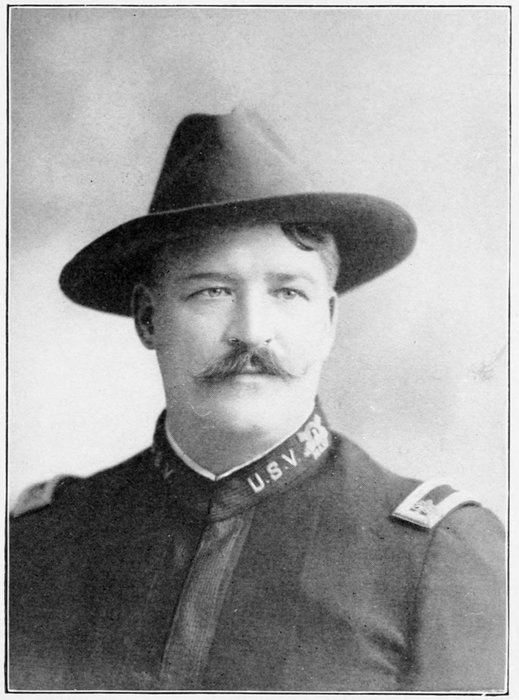
MAJOR PERLIE A. DYAR, U.S.V.
Commanding First Battalion.
133But Salem, with its heavy property interests,
its large coastwise trade, and its enormous
coal-pockets—so tempting to a coal-hungry
enemy—had to be protected as best might
be; and, as soon as the camp had been settled,
Captains Frothingham and Nutter, under the
supervision of Major Dyar, set their men at
work, with shovel, pick, and barrow, on the
feeble defenses. Time was lacking for the
remodelling of the entire work, even if the
numerical strength of the working details
had permitted, and work was confined to
strengthening the weak channel face of the
fort. Here, from plane drawn by Lieutenant
Francis, a civil engineer by profession, an
earthen parapet of strong profile, with stone
revetment, was constructed. The working
tools and derricks required in the undertaking
were supplied by the city authorities of Salem,
who in this, as in many other ways, showed a
desire to be of every assistance to the garrison.
Guns of at least medium calibre were urgently
needed, and Colonel Pfaff endeavored, through
the department commander, to obtain a battery
of six 8-inch converted rifles. In this attempt
he was unsuccessful, though a number of guns
of this type lay idle at Fort Warren, where
they had been dismounted and removed from
the casemates. While the carriages of these
guns were not properly adapted for use in a
134barbette battery, they yet might have served
the purpose after a fashion; especially since
this war, it always must be borne in mind, was
from first to last a war of makeshifts. As the
event proved, however, the garrison at Fort
Pickering was forced to remain content with
the armament of small-calibre, rapid-fire guns
supplied through the enterprise of the State
of Massachusetts. It so happened that both
Captains Frothingham and Nutter, prior to
the war, had been conspicuous for their devotion
to the study of modern artillery work;
their men were well grounded in the principles
of sea-coast gunnery, and their being
thus stationed at a post absolutely destitute
of modern heavy ordnance seemed no light
hardship.
135
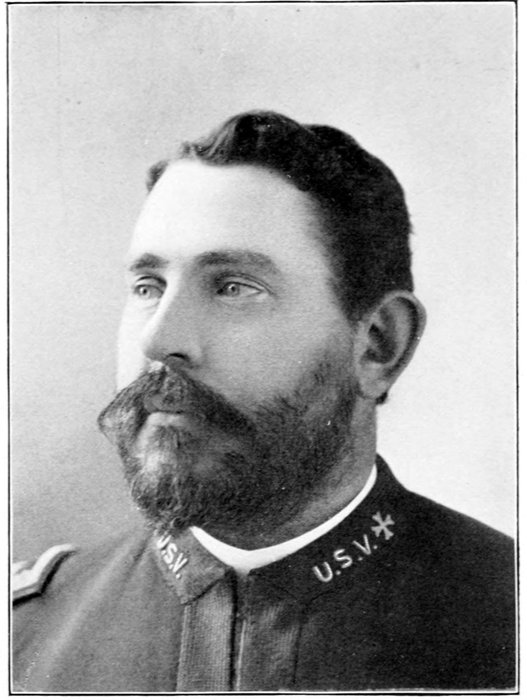
MAJOR HOWARD S. DEARING, U.S.V.
Regimental Surgeon.
137When such engineering work as was imperatively
required had been brought to completion,
both officers and men settled down to
the monotony of garrison routine. Lieutenant
Stockwell was appointed post adjutant, while
Lieutenant Keenan served in the triple capacity
of post quartermaster, commissary, and
ordnance officer. Though the health of the
command was uniformly good, the medical
officers yet found their time amply occupied,
since in addition to their duties at Pickering
they were required to visit the sub-posts at
Gloucester, Marblehead, and Nahant. On
June 24th, Lieutenant Rolfe, assistant surgeon,
was relieved from duty at Fort Warren,
reporting immediately at regimental headquarters;
but in July, failing to recover from
a severe illness contracted during the earlier
service of the regiment, he found himself
compelled to resign, thus depriving the command
of the services of an efficient and popular
officer. Later in the same month, Assistant
Surgeon Bryant received promotion which
took him from the First, and from this time
until the close of its volunteer service the
regiment had but one medical officer, Major
Dearing, senior surgeon, whose unflagging
devotion to the welfare of the command won
for him the gratitude and esteem of every
officer and man. On July 26th, Captain Frothingham,
with Lieutenants Nostrom, McCullough,
and Francis, proceeded to Fort Preble,
Me., for duty on a general court martial, making
several visits thereafter to that post before
the final adjournment of the court.
138For lack of opportunity at artillery drill,
attention was turned to infantry work, and
the garrison was hardened into condition for
field service by a succession of practice
marches and field manœuvres over the country
in the vicinity of the post. The garrison
evening parade, held outside the main work,
was a never-failing source of interest to the
people of Salem, and on every pleasant afternoon
crowds came out from the city to attend
the ceremony. On July 25th, "A" Battery
changed station from Nahant to Pickering,
marching in over the road with its field guns
and wagon train. Late in August, "B"
Battery was ordered to rejoin at Salem from
its station at Portsmouth, N.H., thus bringing
the garrison strength up to a battalion of four
batteries. Such officers as could be spared
from this post, with many from the other
posts garrisoned by the regiment, were present,
on August 12th, at the funeral of the
lamented Colonel Bogan, of the Ninth Massachusetts
Infantry, who long had been a friend
of the First, and had been detailed as its
inspecting officer while serving on the staff of
Governor Russell; and again, on August 30th,
139the battalion at Pickering performed a sad
duty by parading as escort, under command
of Major Dyar, at the funeral of Major O'Connor,
of the Ninth. No further event of
especial moment appears on the records of
the post until its abandonment on September
19th.
Major Quinby, with "K" Battery, under
command of Captain Howes, reached his
station at Stage Fort, Gloucester, on the
7th of June. This post, though admirable
as a camping site, hardly could be considered
desirable from an artillery point of view.
The old fort itself, an earthen battery commanding
the inner harbor and its approaches,
had lain abandoned since the close of the
Civil War, and this long period of neglect had
brought the inevitable results. Under the
action of wind and weather its parapets gradually
had worn away, and its magazine was in
a ruinous condition. For armament there
were rapid-fire guns, supplemented by 3-inch,
muzzle-loading field guns turned over by the
departing militia garrison. Fortunately for
the peace of mind of the people of Gloucester,
the fort was not the sole defence of the harbor;
140for the historic old monitor Catskill, manned
by volunteer seamen recruited from the ranks
of the Massachusetts Naval Brigade, lay there
at anchor during the greater part of the
summer. With the two 15-inch Dahlgren
guns in its battered turret, this relic of 1862
might still have been a factor in any dispute
with privateers or unarmored cruisers of the
enemy. It was the intention of Colonel Pfaff
to secure for this post two 8-inch converted
rifles, but his request for the guns was not
complied with.
There were no barracks at Stage Fort, and
the garrison went into camp under canvas.
After settling the matter of quarters, work
was begun without delay, and the ravages
of time on the old fort were repaired as
thoroughly as possible. When everything
had been put into condition for action, the
command quietly took up the customary post
routine. Lieutenant Packard was detailed as
post adjutant, performing the duties of the
position until July 18th, when he was ordered
to Fort Columbus, New York Harbor, where
he remained on detached service until relieved
on September 12th. After his departure from
the post, the adjutant's duties fell to Lieutenant
Gleason, who already had been acting as
post quartermaster and commissary. On September
15th, at the request of the city whose
name she bore, the famous little auxiliary
cruiser Gloucester, with laurels fresh from her
victorious fight with the Spanish torpedo-gunboats
Pluton and Furor, made a visit to the
harbor. As she came to her anchorage, the
garrison at Stage Fort fired a salute in her
honor; and on the following day, at the reception
given by the city, the battery paraded as
escort to Captain Wainwright and the men of
his crew.
141
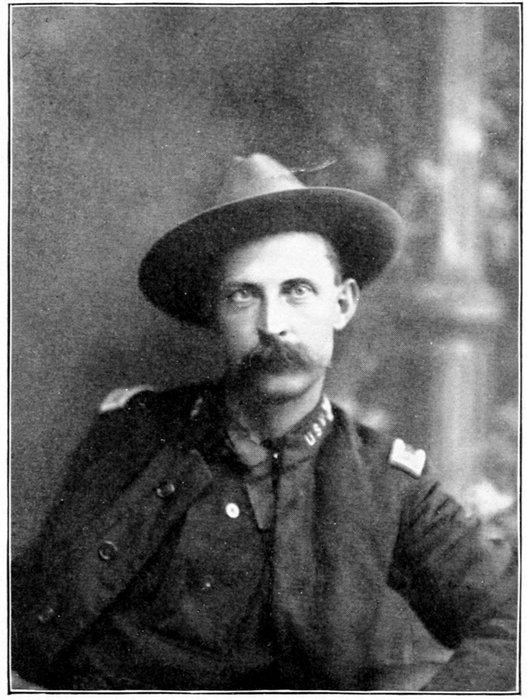
MAJOR GEORGE F. QUINBY, U.S.V.
Commanding Second Battalion.
143Captain Lombard, with "B" Battery, had
drawn what was perhaps the least desirable of
all the posts falling to the regiment, that at
Plum Island, covering Newburyport and the
entrance to the Merrimac. After a rough
passage around Cape Ann, he arrived with his
command at this station on June 7th. The
island is a low, sandy formation, ten miles in
length, commanding at its northern extremity
the channel leading into the harbor of Newburyport.
At this point, lying but three miles
and a half from the railway bridge marking
144the centre of the city, the command pitched
its camp, and threw up an earthwork of slight
profile for the reception of its field guns.
Shallow waters and a treacherous bar deter
vessels of any considerable draft from attempting
to enter this harbor; but the city offers a
tempting and easy mark for torpedo-boat raids,
and it was to discourage any enterprise of this
sort that "B" Battery was condemned to a
month of dreary duty among the sand dunes.
The order of July 2nd, directing the command
to change station to Fort McClary, Maine, was
received at the post with delight, and little
time was lost in preparing to leave behind the
brackish water, mosquitoes, and monotony of
Plum Island.
Before this order could be executed, it was
amended. These were the days when ugly
rumors were coming from before Santiago,
and the Government was making hurried
efforts to meet a possible disaster on land.
Captain Curtis, with his battery ("K") of the
Second Artillery, was garrisoning the defenses
at Portsmouth, of which McClary was a subpost,
and to him on July 6th came rush orders
to hasten with his battery to Tampa, to join
145the siege train there organizing, while Captain
Lombard was directed to relieve him in the
command of the Portsmouth defenses. On
the 8th, "B" Battery reached its new station,
taking post at Fort Constitution, and placing
detachments at Fort McClary, on the Maine
shore opposite, and at Jerry's Point, in the
outer line of defenses. The command now
occupied a most responsible position, with
more than enough work for its small enlisted
strength, for here there was much modern
artillery material to be cared for, while the
guard duty of the scattered posts made heavy
drafts on the endurance of the men. These
important defenses, covering not only the city
of Portsmouth, but also the Kittery Navy
Yard, were now added to the other posts
under command of Colonel Pfaff, who on the
last day of July visited the station, and inspected
the works and the garrison. After
becoming settled in quarters, details were
made for post administration, Lieutenant Day
being appointed post adjutant and Lieutenant
Underwood post quartermaster and commissary.
On August 19th, the Santiago campaign
having turned out luckily after all, Captain
146Curtis was ordered with his battery back
from Tampa, arriving a few days later to relieve
Captain Lombard. At this time Major
Crozier, A.I.G., reached the post on his tour
of inspection, and by his direction "B" Battery
demonstrated its ability to handle modern
ordnance by conducting the test-firing of the
newly mounted 8-inch breech-loading rifles,
on their disappearing carriages. Shortly
afterwards, Captain Lombard and his command
changed station to Pickering, reporting
to Colonel Pfaff on August 27th.
The garrison for Marblehead, "H" Battery,
under command of Captain Pratt, arrived on
June 6th at its station at Fort Sewall. This old
fortification, which properly should be classed
as a mere field work, not only commands the
entrance to the harbor of Marblehead, but also
plays an important part in the outer line of defence
for Salem. Having been ungarrisoned
for more than thirty years, it naturally was in
a dilapidated condition, and on the arrival of
"H" Battery it was without armament. As in
the case of Stage Fort, the request of Colonel
Pfaff for two 8-inch converted rifles was
ignored, and reliance had to be placed upon
147the rapid-fire guns brought to the post by the
incoming troops. After pitching its camp and
making the required repairs on the works,
the garrison settled itself for what proved to
be an uneventful tour of occupation. At this
post Lieutenant Renfrew acted as adjutant,
with Lieutenant Grant as quartermaster and
commissary. The only break in the monotony
of the summer came when a battalion from
Pickering, after a forced march from Salem,
feigned an attack on the post by a landing
party, which was met and repulsed in a workmanlike
manner by Captain Pratt and his
command.
The mining-casemate at Nahant, from which
the mine-fields in Broad Sound, Boston Harbor,
were to have been controlled, was placed
in charge of Captain Bordman, who arrived with
his command ("A" Battery) at this station on
June 6th, and at once laid out his camp near
the work to be guarded. Rapid-fire field guns
were issued to this post, but infantry guard
duty was practically all that was required of
its garrison. Lieutenant Fullerton served as
post adjutant until ordered to Fort Columbus,
New York Harbor, on July 18th, where he remained
148on detached service until the muster-out
of the regiment. The quartermaster and
commissary duties were performed by Lieutenant
Sumner Paine. Lacking the material for
artillery work, Captain Bordman turned to infantry
drill, and by constant road marches and
field exercises brought his command into prime
physical condition. The tour of the battery at
this station was not destined to be a long one.
In the rush of emergency harbor-work during
the early days of the war, the Engineers first
gave their attention to the mining of the main
ship channel and Nantasket Roads, leaving
Broad Sound—the water area for bombardment
of Boston, Lynn, and Chelsea—for later
consideration; but with the destruction of
Cervera's fleet, all active mining operations
came abruptly to a close, and the Broad Sound
system remained uninstalled. The post at Nahant,
therefore, was ordered to be abandoned
on July 25th, its garrison reporting at Fort
Pickering on that date.
FORT RODMAN AND ITS GARRISON
149
151
The second of the three general divisions
into which the regiment had been separated—Lieutenant-Colonel
Woodman's command,
"G" (Chick's) and "L" (Whiting's)
Batteries—arrived at its destination at New
Bedford on June 1st, reporting to Lieutenant-Colonel
Haskin, Second United States Artillery,
commanding officer at Fort Adams, R.I.
The post to be garrisoned was then borne on
the army register as the "Fort at Clark's
Point," the designation by which it had been
known since 1857, when ground first was
broken for its construction. The fort is an excellent
type of the clever military engineering
for which this country was noted at the middle
of the century. It is an enclosed work of
granite, with two tiers of casemate guns and
provisions for a third tier in barbette, though
the guns of the latter battery never have been
mounted. In June last its armament was
made up of 8- and 10-inch Rodmans, 100-pounder
152(6.4-inch) Parrott rifles, and 24-pounder
(5.8-inch) flank-casemate howitzers.
All through the summer and fall months
the Engineers were steadily at work on exterior
emplacements for 8-inch breech-loading
rifles, on disappearing mounts, while
mortar and rapid-fire batteries also were projected
for the post; but during its occupation
by its volunteer garrison the only available
ordnance was that of the types of the Civil
War.
The site of the works is at the extremity of
Clark's Point, three miles and a half from the
centre of New Bedford, at a point commanding
not only the channel entering the harbor,
but also all water areas for bombardment to
the southward of the city. Prior to the war
with Spain, a solitary ordnance sergeant formed
the garrison at the post, but on May 6th a detachment
of thirty men from the Second Artillery,
under command of Lieutenant Lyon
(later relieved, on May 27th, by Lieutenant
Connor), had been ordered over from Fort
Adams for guard duty. The casemates on the
landward face of the fort, originally intended
for use as quarters, never had been placed in
condition for occupancy, and the detachment
of regulars therefore was quartered in an old
building standing on the reservation, while the
battalion of volunteers pitched camp in an open
field to the northwest of the fort. It would
have been difficult to find a more desirable site
for the encampment. Lying on dry and level
ground, between two arms of the sea, it not
only afforded a pleasant outlook, but also was
constantly swept by cool breezes from off the
water. Under such circumstances, camp sanitation
afforded an easy problem, and during
its tour at this post the health of the command
remained excellent.
153
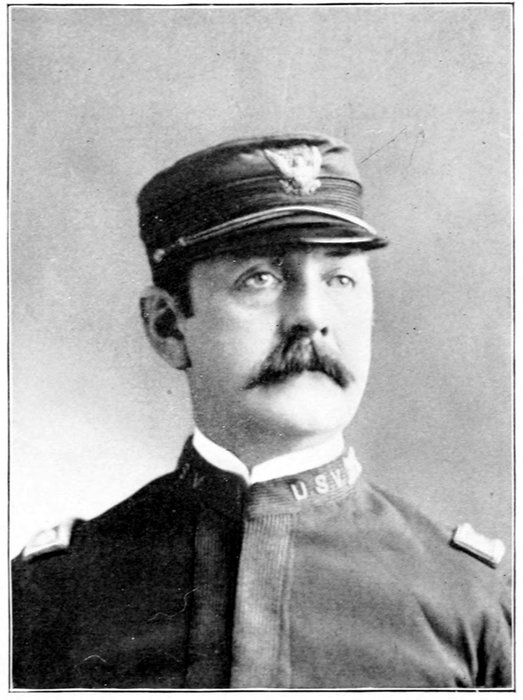
LIEUT.-COL. CHARLES B. WOODMAN, U.S.V.
Second-in-Command.
155At this station the post administrative staff
was made up of Lieutenant J. B. Paine, adjutant;
Lieutenant Gowing, quartermaster and
commissary; and Lieutenant Bryant, surgeon.
In addition to his duties as battery commander,
Captain Whiting also performed those
of ordnance officer, an assignment for which
he was eminently well fitted by previous study
and training. There was much work to be
done in the early days at the post, for its
armament, after long years of neglect, was in
horrible condition. Both batteries turned to
156with a will, however, and in a creditably short
time the fort itself was cleaned and swept
until it would have satisfied the most exacting
inspector, while guns and carriages were freed
from rust, scraped, painted, and put into condition
for immediate action. It is due to the
command to say that when it marched out, on
September 19th, it left behind it a post which,
in point of absolute neatness and readiness for
action, might well have served as a model for
any artillery garrison, regular or volunteer.
There was little to be recorded beyond the
ordinary garrison routine. One incident,
which occurred during the work of preparing
the fort for emergencies, is worth relating.
There were found one or two guns in which,
at some forgotten period, priming wires had
been broken off in the vents, eventually becoming
firmly fixed there by rust. With this
fact as a foundation, an enterprising New
Bedford reporter built up a lurid story of
spiked guns and Spanish spies, which went
the rounds of the newspapers, causing infinite
disgust to the garrison and endless amusement
to the rest of the regiment. The choked vents
were drilled out as soon as discovered, and the
157guns at once made available; but to this day
the mention of spiked guns will provoke an
explosion if made in the presence of any Fort
Rodman artilleryman.
On June 15th, Lieutenant Connor and his
detachment of regulars were relieved and ordered
back to Fort Adams, which meanwhile
had been reinforced by the Forty-seventh New
York Infantry, a fact mentioned to show the
straits in which the Government found itself
in obtaining garrisons for its artillery posts.
On the 9th of June, Lieutenants Wilson and
Cheney served as members of a general court
martial at Adams. Having been promoted
major and brigade-surgeon, Lieutenant Bryant
left the post on July 8th, to report for duty with
Lee's Seventh Corps, then at Jacksonville, and
from this date the affairs of the medical department
were placed in charge of a contract
surgeon from New Bedford. At one time
during the summer certain turbulent spirits
among the engineer employees at the post required
attention from the garrison, but firm
and prompt action by the artillerymen put an
instant end to the trouble, and effectually discouraged
any further outbreaks of a like sort.
158By general order from army headquarters,
dated July 23rd, the post officially was named
"Fort Rodman," in honor of the memory of
Lieutenant-Colonel William Logan Rodman,
Thirty-eighth Massachusetts Infantry, who fell
at the head of his regiment in the assault on
Port Hudson in 1863. Thus, after waiting
forty-one years for a name, the old fort at
last received that of a Massachusetts soldier,
while a garrison of Massachusetts volunteers
was on duty to assist at its christening.
THE THIRD BATTALION AT FORT WARREN
159
161
The last of the three regimental subdivisions—the
Third Battalion, under
Major Frye—meanwhile quietly had been
going on with its artillery work at Fort
Warren. Other than the ordering of Major
Morris, Seventh Artillery, from Winthrop to
Fort Schuyler, N.Y., on May 27th, leaving
Captain Richmond the ranking officer at the
mortar battery, there had been no changes
in the garrisons of the sub-posts about the
harbor. The departure of Colonel Pfaff and
Lieutenant-Colonel Woodman, with their commands,
had rendered necessary a reassignment
of battery duties at Fort Warren, and
Colonel Woodruff issued orders accordingly
on June 13th. Of the regular batteries, "C"
(Schenck's), Second Artillery, took charge of
the 10-inch rifle and 4-inch rapid-fire guns—at
that time in process of being mounted—in
Bastion B, while "G" (Brown's), Seventh
Artillery, had its station at the 10-inch rifles
162of the ravelin battery. Surplus men from
these two batteries, as the daily recruiting
swelled their ranks, were told off for manning
various groups of the older type guns in the
fort. Of the volunteer batteries, "M" (Braley's)
was assigned to the field and machine
gun sections for the protection of the channel
mine-lines, Nantasket Roads mine-field, and
the cable chute through which the entire
system was controlled; "I" (Williamson's)
went to the 15-inch Rodman guns in Bastion
A; "F" (Danforth's) drew the battery of
10-inch Rodmans on the channel face of the
fort; while to "E" (Gibbs') fell the barbette
and casemate batteries of 8-inch rifles at the
southeastern angle. These assignments were
made for a very definite purpose, and they
remained in effect until after the destruction
of the Spanish fleet at Santiago, when, to
break the monotony of gun-drill on one type
of gun, the volunteer batteries interchanged
at their stations.
163
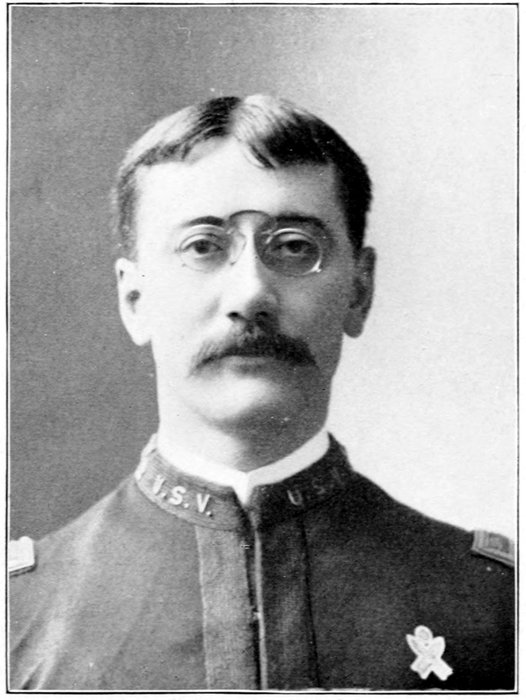
MAJOR JAMES A. FRYE, U.S.V.
Commanding Third Battalion.
165Since this battalion was a complete tactical
unit, under command of its own field officer,
it did not lose its identity on becoming a part
of the garrison at the fort. Both its officers
and men, sharing tours with the regulars, were
carried on the rosters of the post for guard
and fatigue duty; but for purposes of discipline
and administration the battalion organization
remained intact. The acting battalion
staff was composed of Lieutenant D. Fuller,
adjutant; Lieutenant Phillips, quartermaster;
Lieutenant Horton, signal officer; Lieutenant
Wing, commissary; and, until relieved on
June 23rd, Lieutenant Rolfe, assistant surgeon.
The officers of the volunteers also were called
upon for the performance of many duties
under post details: Major Frye served as
president of the post council of administration,
as presiding officer at garrison courts
martial, and later as trial officer of the
summary court; Lieutenant D. Fuller was appointed
post treasurer and librarian; Lieutenant
Totten was detailed as post adjutant and
recruiting officer, as well as mustering officer
for the regiment at large, the latter detail
requiring many visits to the scattered stations
of the command; for much of the time the
signal system of the works was under the
supervision of Lieutenant Horton, owing to
the absence on detached service of Lieutenant
166Catlin, the regular signal officer; Captains
Braley and Williamson, with Lieutenants D.
Fuller, Phillips, Wing, Harrison, Nilsson, and
Totten also served as members of general
courts martial.
As at the other posts of the regiment, the
earlier days of the detached tour at this station
found much work requiring immediate attention:
range charts for each gun-group were
plotted; guns, carriages, and equipments were
overhauled and made ready for action; ammunition
was prepared and stored at hand in
the service magazines. Department orders
called for three hours' gun-drill daily, and in
addition to this—in order that the command
might be ready for any kind of service required
by later developments—an hour more was
devoted to battalion drill as infantry. Evening
parade was held daily by the volunteers,
though the regular batteries at the post
omitted this ceremony. Aside from its record
of steady and faithful work there were but
few events during the summer which concerned
this portion of the regiment. On
August 16th it was presented a battalion color
by its friends in Boston, which it carried so
167long as on its detached service. Beginning
on August 20th, there was test firing of all the
recently mounted guns—12-inch mortars, 10-inch
rifles, and 4.7- and 4-inch rapid-fire guns—under
the supervision of Major Crozier,
A.I.G., who visited all the posts in the harbor
on this duty. It may here be noted, as a
curious matter of record, that poverty in
ammunition had forbidden the expenditure of
even a single round from these modern guns
until after the suspension of hostilities. On
September 2nd, the men of the garrison lined
the parapets and cheered lustily when the
squadron of nine warships, led by the grim
Massachusetts, steamed into the harbor for
the naval parade. On the following day the
Third Battalion paraded in Boston as escort
to Captain Higginson, and the officers, seamen,
and marines of the vessels under his
command—the Massachusetts, Machias, Detroit,
Castine, Wilmington, Helena, Marietta,
Topeka, and Bancroft. Orders for change of
station now arrived. On the 17th of September
the battalion tendered a final review to
Colonel Woodruff, and on the 19th marched
out from the fort, taking transport on the City
168of Philadelphia for Boston, and thence proceeding
by rail to rejoin the regiment in camp
at Framingham. Officers and men alike left
the post with feelings of sincere regret, since
their relations with the regulars of the garrison
had been most pleasant. On relieving the
battalion from duty under his orders, Colonel
Woodruff took occasion officially to compliment
it on its uniform state of efficiency and
discipline.
FINAL DAYS IN THE SERVICE
169
171
So through the long and weary summer
months the scattered batteries of the regiment
served faithfully at their posts along
the coast, patiently enduring the dull monotony
of garrison life, and hoping against
hope that the fortunes of war yet might bring
them their own chance for training their guns
upon an enemy. For a time rumor still
busied itself with the movements of the Spanish
fleet, while spook cruisers still held the
seas—as the men on Shafter's crowded troopships
could have testified to their sorrow—but,
as the final event proved, Spain either
was too blind or too feeble to improve her one
possible opportunity of inflicting injury on
her adversary by striking a sharp and sudden
blow at some point on our long and
weakly defended coast line. The national
salute fired on the Fourth of July at all the
posts along-shore answered a double purpose,
since, while complying with army regulations
172for the observance of the holiday, it also
served to celebrate the victorious fighting on
land and sea at Santiago. But the men of
the coast artillery, regulars and volunteers
alike, listened with heavy hearts to the booming
of their unshotted guns; rejoicing with
their brethren of the Navy over the signal
victory that had been won, they yet felt that
the destruction of Cervera's squadron had
deprived them of the one chance to which
they had trusted for obtaining distinction.
Like all thinking men, they had to face the
fact that the events at Santiago marked the
beginning of the end.
On July 11th, Governor Wolcott informed
the authorities at Washington that the people
of Massachusetts no longer were in uneasiness
regarding the safety of the cities and towns
on the coast, and requested that the First
might be relieved from its present stations and
assigned to more active duty. Colonel Pfaff
also urged that his command be retained in
service for any work that yet might remain
to be done, while General Lee, who had heard
of the efficient condition of the regiment
through Lieutenant-Colonel Curtis Guild of
173his staff, made strong efforts to secure its
transfer to his Seventh Corps, then completing
its organization for the occupation of Havana.
But the time had not yet arrived when conditions
would permit any further depletion of
our already weak artillery garrisons. It is
true that Spain, after the utter annihilation of
her sea power, had been humbled into asking
terms on July 26th, and that, with the signing
of the peace protocol on August 12th,
hostilities had been suspended; but there yet
remained possible complications with Germany
over the long and ugly succession of
unfriendly acts of which the vessels of her
fleet in Philippine waters had been guilty.
Within a very recent period Berlin has seen
fit officially to disavow any intention of interfering
at that time with our naval representatives
at Manila, but in spite of this disavowal
it still remains a fact that such interference
occurred, and it was not until early in the fall
that our military and naval authorities could
feel assured that the immediate future might
not find this country called upon to face a
fresh and really powerful adversary. Under
these circumstances, all our available artillery
174troops, both regulars and volunteers, wisely
were held at their stations until, on the final
passing of the German war-cloud, there
remained no further hope for active service
against Spain.
On September 4th, telegraphic orders from
the War Department were received at all the
posts garrisoned by fractions of the regiment,
directing preparations to be made for the assembly
of the command for furlough and ultimate
muster-out; and on the 17th, Colonel
Pfaff issued his orders for the concentration of
his widely scattered batteries at Framingham.
On the 19th, the regiment was again reunited
at the State camp ground, the batteries
from the posts on the North Shore, under
command of Colonel Pfaff, being first to arrive,
followed at short intervals by the battalion
from Fort Warren, under Major Frye, and the
garrison from Fort Rodman, under Lieutenant-Colonel
Woodman. It was found that camp
already had been pitched by Captain Landy
and his men, under direction of Colonel Converse,
and all that remained to be done by the
command was to settle in quarters and start in
operation the battery messes.
175After over three months of detached service
at isolated points along the coast the twelve
batteries again were welded together in the
regimental organization. For the time being,
all artillery drill and formations were dropped,
and the command easily and quickly settled
into the routine of an infantry encampment.
Regimental and battalion drills daily were held
on the broad field which, prior to 1896, had
been familiar territory to the command, and in
a surprisingly short time the regiment again
developed the snap and precision in infantry
work for which it had been distinguished before
its transfer to the artillery arm of the service.
Here, through the thoughtfulness and generosity
of the State authorities, the regiment was
rejoined by its band. None save those who
have learned by actual experience in service
how much may be done by music towards
alleviating the wearing monotony of camp and
garrison life can appreciate the welcome given
by the men of the regiment to Bandmaster
Collins and his musicians, on their return after
their long absence.
Meanwhile preparations for leaving the service
were pushed forward. The work was
176done under supervision of Lieutenant-Colonel
Weaver, U.S.V. (captain First United States
Artillery), detailed as mustering officer for
Massachusetts, to whom had been assigned as
assistants Lieutenants C. C. Hearn, Third
United States Artillery, and O. Edwards,
Eleventh United States Infantry. Slowly but
steadily the absurdly cumbersome and complex
tangle of "paper-work" was unravelled,
final muster and pay rolls were completed, and
the thousand-and-one accounts with ordnance,
quartermaster, medical, commissary, and signal
departments were closed. On October 5th this
work substantially was finished, and shortly
after noon on that day, in a drizzling rain, the
batteries for the last time formed line as a
regiment of United States Volunteers. Marching
across the soaked parade, the regiment
stood at attention while the garrison flag
slowly was lowered, in token of the abandonment
of the post, and then swung out through
the main gate of the reservation for the muddy
march to the waiting troop-train.
177
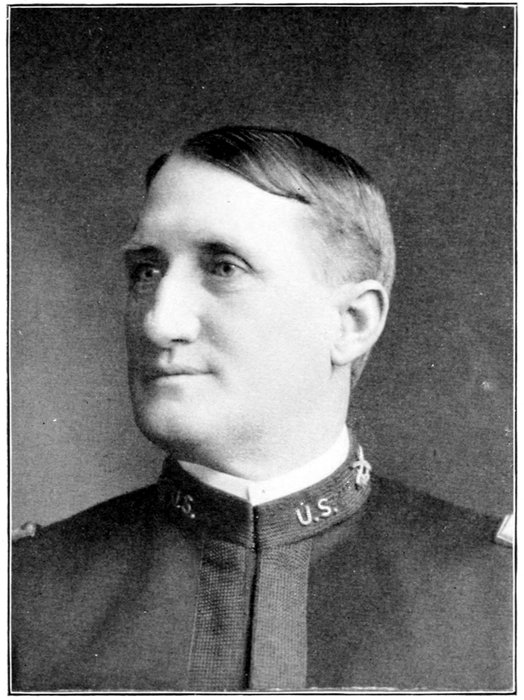
LIEUT.-COL. ERASMUS M. WEAVER, U.S.V.
(Captain 1st U.S. Artillery.)
Mustering-out Officer for Regiment.
179Reaching Boston at two o'clock, the command
formed in column for its final parade.
By this time the drizzle of the forenoon had
become a drenching downpour, but the men
now were thoroughly wet through, and no
attention was paid to the muddy streets. The
regiment had gone out under like conditions,
and was disposed to accept them as part of
the established order of things. Without
waiting for the rear-most batteries to emerge
from the station, the command for marching
was given, the band struck up the stirring
strains of the "Stars and Stripes," and the
regiment started over its route to the State
House. Here Governor Wolcott, with the
officers of his staff, reviewed the returning
artillerymen. On reaching the foot of Beacon
Hill, the Third Battalion halted, while the
leading battalions marched on and formed line
on Charles Street. Then the Bristol-Plymouth
batteries, with arms at port, tramped past their
Boston comrades, forming line on their right
and presenting arms as they, in their turn,
marched by—and with this brief ceremony
the twelve batteries, as volunteers of 1898,
separated forever. Colonel Pfaff, with his
staff, the band, and "A," "C," "D," "G,"
"K," and "L" Batteries, proceeded to the
South Armory, where, after cheering their
180commanding officer, the men broke ranks
and scattered to their homes. Major Frye,
with the Third Battalion, marched to the
Park Square station, where "I" Battery was
detached to entrain at Kneeland Street, and
"E," "F," and "M" Batteries took their
special train for their home stations. "B"
and "H" Batteries proceeded by the most
direct routes to their armories at Cambridge
and Chelsea. The thirty days' furlough had
begun, and all active service for the regiment
now was at an end.
On November 4th, the officers and men of
the twelve batteries reported back from leave
and furlough at the armories at their home
stations, and the final formality of physical
examination for discharge was begun. In the
First and Second Battalions this work was
carried on under direction of Captain Newgarden,
assistant surgeon, United States Army,
assisted by Lieutenants Gates and Hitchcock,
of the medical department, Second Massachusetts
Infantry, while in the Third Battalion the
examining surgeons were Major Magurn and
Lieutenant Shea, Ninth Massachusetts Infantry.
Owing to the small enlisted strength
181of the command, as well as to its magnificent
physical condition, the examinations were concluded
in a comparatively short time, and the
regiment was given a clean bill of health by
the board of surgeons through whose hands
it had just passed.
The last detail now had been attended to,
and on November 14th the First was ready
for the final step towards leaving the volunteer
service. Early in the forenoon of that day
Majors Dyar and Quinby assembled their batteries
at the South Armory, where, with the
field, staff, and non-commissioned staff, they
formally were mustered out of the service
of the United States by Lieutenant-Colonel
Weaver. At the same time Major Frye had
accompanied Lieutenant J. P. Hains, Third
United States Artillery, to the stations of the
"Cape" batteries on a like mission. Lieutenant
Hains enjoyed the distinction of having received
almost the last wound in the Porto Rican
campaign, having intercepted a Mauser bullet
in the action at Aibonito, almost at the time
when the peace protocol was being signed. He
had become very popular among the officers of
the First, and his selection as mustering out
182officer was much to the satisfaction of the
Third Battalion.
Of the seven hundred and fifty-seven officers
and men whose names had been borne on the
rolls of the regiment during its term of service,
there were mustered out at this time seven
hundred and eleven. The regiment had lost
two commissioned officers—Major Bryant by
promotion, and Lieutenant Rolfe by resignation—and
forty-three enlisted men, of whom
Private Henry A. Williams, "F" Battery, had
died while on furlough, one had received promotion,
six had been discharged for physical
disability contracted in the line of duty, and
the remainder had been transferred to the
regular service, the greater number of these
enlisting in the Second United States Artillery.
Major Dearing was not mustered out with the
other officers of the staff, remaining in the
service until Jan. 28th, 1899, for duty as examining
surgeon with other returning Massachusetts
regiments.
At this time what had threatened to be a
serious complication was averted through the
thoughtfulness of the regimental commander.
Though the final muster and pay rolls of the
183command had been prepared in ample time,
the pay department, through inadequate clerical
equipment at this station, found itself
unable to make the final settlements with the
men at the time of their muster-out. In addition
to money for clothing allowances and
commutation of furlough rations, there was
due to the batteries over six weeks' pay, a
very considerable sum in the aggregate. As
in all other volunteer regiments, not a few of
the men had returned from service only to
find their patriotism rewarded by the loss of
their situations in civil life, and cases were
not infrequent in which delay in final payment
meant serious hardship. Fully understanding
these conditions, Colonel Pfaff relieved
the stress of the situation by unhesitatingly
drawing his personal check for $10,000, thus
making it possible on the day of mustering
out to advance to each enlisted man $15 with
which to tide over the interval before the final
appearance of the paymaster. This thoughtful
act met with the appreciation which it merited,
and it hardly need be added that the trust
shown in the integrity of the men proved not
to have been misplaced. On November 18th
184the batteries of the Third Battalion were paid
off, and on the following day the remainder
of the regiment received its money—the last
dollar advanced by Colonel Pfaff being repaid
at the time the Government fulfilled its obligations.
This, from every point of view, was
a pleasant incident and one that reflected equal
credit on the commanding officer and his men.
AN HONORABLE REGIMENTAL RECORD
185
187
After bringing to its conclusion another
eventful chapter in its already long and
honorable history, the First Massachusetts
Heavy Artillery again has left the service of
the United States to reënter that of the Commonwealth.
In addition to the jealously cherished
"White Diamond" badge, eloquent of
its campaigning from 1861 to 1864 with the
old Second Division, Third Corps, Army of the
Potomac, it now has won the right to bear the
device emblematic of service in the Artillery
Corps of the War of 1898—the crossed conical
projectiles, surmounted by the spherical shot.
The record of the regiment in this, its latest
war, is in every way worthy of its proud traditions.
During its term of service there were
no desertions from its ranks, no dishonorable
discharges blemish its rolls, and the records
show that its men, in conduct and discipline,
steadily maintained the high standard for which
the command long has been noted. The work
188allotted to the regiment was intelligently and
well performed, and it is a most significant fact
that of the seven hundred and eleven discharge
papers issued to its officers and men on
Nov. 14th, 1898, there was not one which
failed to bear the endorsement coveted by
every true soldier: "Service honorable and
faithful."
It is much to be regretted that certain enlisted
men of the regiment, and even a few
among its officers, since their return from the
service, have felt constrained to apologize for
the nature of the duty which it fell to their lot to
perform. It equally is a matter for regret that
some of their civilian friends, unquestionably
through honest ignorance, have made the absurd
mistake of commiserating the command on
its failure to reach what they are pleased to term
"the front." While it seems almost a waste of
energy, it yet may be worth while to note here
a few facts concerning the functions of the
coast artillery in the late war, as well as to emphasize
the point that any probable foreign
war of the future will demand precisely the
same sort of service from troops of this arm.
189
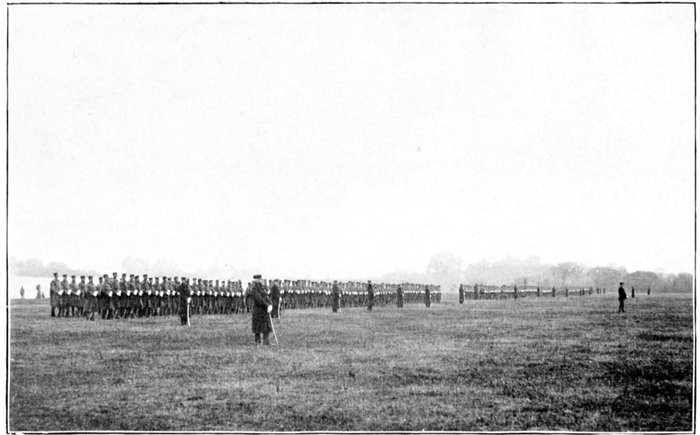
Photograph by T. E. Marr, Boston
THE LAST EVENING PARADE.
Framingham, 3 October, 1898.
191In the first place—and so long as the term
"front," in its accepted military sense, shall
continue to mean the point of expected or
probable contact with an enemy's forces—it
requires no argument to prove that the First
Heavy Artillery was at its post, at the front,
on the 26th day of April, 1898. This, to be
exact, was fifty-seven days before the Second
Infantry disembarked at Baiquiri, sixty-six
days before the Ninth Infantry landed at
Siboney, and ninety days before the Sixth
Infantry left its transport at Guanica, at
which points respectively these three Massachusetts
commands for the first time found
it possible to gain tactical touch with the
Spaniards. In other words, in a war with a
maritime power, every strategic point on navigable
waters accessible to an enemy's ships of
war is of necessity at "the front," so long as
the hostile fleet remains undestroyed, and the
First therefore justly may claim actual service
at the front from the day following that on
which Congress declared war to exist, until
the 3rd of July, when the annihilation of
Cervera's squadron finally and definitely relieved
the coast from the threat of Spanish
attack. While the five Massachusetts regiments
192of infantry were passing their earlier
weeks of service at inland camps of instruction,
absolutely beyond the reach of any possible
fighting, the First Artillery—from the
very day on which it left its home stations—was
continuously on duty at vital points open
to attack at any hour of day or night. This
claim, it should be well understood, is made
only in simple justice to the regiment and in
the interests of historical accuracy, for not an
officer or a man in the First would detract
from the hard-won honors of the Second, the
Sixth, or the Ninth—honors in which, as
Massachusetts soldiers, they ever will feel an
honest pride.
The earlier portion of this narrative may
have served to show roughly the condition of
our harbor defenses at the outbreak of the
last war, as well as the imperative need of
heavy artillery troops with which to garrison
them. The time has not yet arrived when the
whole truth may be told safely, or even with
propriety, but since the actual artillery strength
on duty during the war is a matter of easily
accessible record, it may here receive momentary
attention. Briefly summarized, there
193were in service for the protection of our four
thousand miles of sea-coast but ninety-three
heavy batteries, of which seventy were in the
regular establishment and twenty-three were
in the volunteers. Over one-half of the latter
were contributed by Massachusetts alone, in
her First Heavy Artillery, and it seems fitting
again to refer to the fact that her twelve
trained and disciplined batteries were the
only ones obtainable from the militia of the
entire country at the outbreak of hostilities.
Of the remaining volunteer heavy batteries,
four each were hastily recruited in California
and Maine, two in Connecticut, and one in
South Carolina. The event proved that but
six of the entire ninety-three batteries were
destined to take part in any actual fighting.
These were four from the Third United States
Artillery and two from the California volunteers,
which—when the destruction of Montojo's
fleet had allayed all fears for the safety
of the Pacific coast—were relieved from duty
in the fortifications and ordered to report to
General Merritt, under whom they saw service
as infantry in the land operations around
Manila.
194After what already has been said, it would
seem that no elaborate explanation should be
required to show why the heavy artillery arm
failed to obtain more brilliant service in the
last war. It must be borne in mind that its
first and most important function is the defence
of coast fortifications; its second, operations
with the siege train in the reduction of fortified
places; its third—and this only in rarely
occurring emergencies—service as infantry.
In the late war with Spain, as in any future
European war, it was a matter of vital necessity
to man our coast defenses, and to keep them
manned until the threatening fleet had been
swept from the seas; that once accomplished,
and the artillerymen might reasonably have
hoped for further service in the expected final
operations at Havana. But with the naval
victory off Santiago came the collapse of the
war—and the ending of hope for the artillery.
By the legislation which transferred the
First from the infantry to the artillery arm, the
regiment was deprived of its opportunity of
foreign service. Entrusted with the defence
of the coast, it quietly accepted the responsibilities
devolving upon it, and met them in a
195way that entitles it to the gratitude of the
Commonwealth. First in the field, it had the
mortification of finding itself soonest forgotten,
for no correspondents followed it in its faithful
service, and no newspaper filled its columns
with the daily gossip of its camps. Accepting
the situation, it faithfully went on with its
duties until the end came, and then returned
quietly to its place in the militia, content to
apply to its own case the words of its commander-in-chief,
President McKinley, "The
highest tribute that can be paid to the soldier
is to say that he performed his full duty. The
field of duty is determined by his Government,
and wherever that chances to be, there is the
place of honor. All have helped in the great
cause, whether in camp or in battle, and when
peace comes, all alike will be entitled to the
Nation's gratitude."
CHRONOLOGY OF THE WAR
251
253
It will be observed that in the following
table all regimental and battery notes refer
to the First Massachusetts Heavy Artillery:
15th.—U.S.S. Maine destroyed in harbor of Havana.
9th.—Congress appropriates $50,000,000 for national
defence.
12th.—U.S.S. Oregon starts from San Francisco on the
memorable voyage to the Atlantic coast.
24th.—Spanish torpedo-gunboat flotilla assembles at
Cape Verde Islands.
28th.—Congress receives report of naval board of inquiry
declaring Maine to have been destroyed by
exterior explosion.
9th.—General Lee leaves Havana.
14th.—Flotilla at Cape Verde Islands joined by Infanta
Maria Teresa and Cristobal Colon.
15th.—Legislature of Massachusetts appropriates
$500,000 for local defence and equipment of
troops.
25420th.—Cape Verde squadron augmented by Almirante
Oquendo and Vizcaya.
21st.—Spanish Government sends passports to Minister
Woodford.
22d.—Admiral Sampson sails from Key West to establish
Cuban blockade.
23d.—President McKinley calls for one hundred and
twenty-five thousand volunteers.
24th.—Spanish Government announces its intention of
organizing a fleet of auxiliary cruisers.
Regiment receives orders to hold itself in readiness
for service in defenses of Boston Harbor.
25th.—Congress declares war to have existed since 21
April.
Admiral Dewey sails from Hong Kong for
Manila.
Orders issued directing regiment to report at
Fort Warren, Boston Harbor, on following
day.
26th.—Regiment assembles in Boston—ninety-nine per
cent. present for duty—passes in review before
Governor Wolcott, and at noon reaches its
station.
29th.—Spanish fleet, under Admiral Cervera, sails from
Cape Verde Islands—destination unknown.
1st.—Destruction of Admiral Montojo's fleet in Manila
Bay.
9th.—Regiment mustered into volunteer service of
United States by Brevet Lieut.-Col. C. A.
255Woodruff, Second United States Artillery;
muster-in completed at 9.34 A.M.
10th.—Orders received detaching Third Battalion, to
report to Colonel Woodruff.
13th.—Reported sighting of Spanish fleet off Nantucket;
night alarm at Fort Warren.
18th.—Governor Wolcott visits post, inspects regiment,
and presents volunteer commissions to officers.
20th.—General Merritt, commanding Department of the
East, relieved by General Frank.
23d.—Orders received assigning Headquarters, First
and Second Battalions to stations.
24th.—U.S.S. Oregon reaches coast of Florida.
25th.—President McKinley calls for seventy-five thousand
additional volunteers.
First military expedition starts from San Francisco
for Manila.
30th.—Admiral Cervera's fleet definitely located and
blockaded in harbor of Santiago.
1st.—"G" and "L" Batteries take station at Fort
Rodman, New Bedford Harbor.
3d.—U.S.S. Merrimac sunk in harbor of Santiago.
Regimental Headquarters established at Fort
Pickering, Salem Harbor.
6th.—Changes of station: "A" Battery to Mining
Casemate, Nahant; "C" and "D" Batteries
to Fort Pickering; "H" Battery to Fort
Sewall, Marblehead Harbor.
2567th.—"B" Battery takes station in defenses of Newburyport
Harbor; "K" Battery at Stage Fort,
Gloucester Harbor.
11th.—Landing of United States Marines at Guantanamo.
12th.—Embarkation of General Shafter's corps at
Tampa.
15th.—Admiral Camara's squadron sails from Cadiz.
20th.—General Shafter's expedition lands at Baiquiri.
24th.—Action at Las Guasimas.
28th.—General Merritt's expedition sails for Philippines.
30th.—General Frank, commanding Department of the
East, relieved by General Gillespie.
1st-2d.—Actions at El Caney and San Juan Hill.
3d.—Annihilation of Admiral Cervera's fleet off Santiago.
8th.—Admiral Camara's fleet turns back to Cadiz.
"B" Battery changes station from defenses of
Newburyport to Port Constitution, Portsmouth
Harbor, New Hampshire.
11th.—General Miles arrives at Santiago.
Governor Wolcott requests foreign service for
regiment, informing War Department that
apprehension no longer is felt for coast-towns
of Massachusetts.
17th.—Surrender of Santiago.
25th.—General Miles lands with his expedition in Porto
Rico.
257"A" Battery changes station from Nahant to
Fort Pickering.
26th.—Spain asks terms of peace.
29th.—General Merritt's expedition reaches Manila.
31st.—United States forces at Manila repulse Spanish
attack.
12th.—Peace protocol signed; hostilities suspended.
27th.—"B" Battery changes station from Fort Constitution
to Fort Pickering.
19th.—Regiment withdrawn from coast-works and
assembled in camp at South Framingham.
4th.—General Gillespie, commanding Department of
the East, relieved by General Shafter.
5th.—Regiment breaks camp at Framingham, takes
transportation for Boston, marches in review
before Governor Wolcott, and is furloughed
for thirty days.
4th.—Batteries report at home stations from furlough.
14th.—Regiment mustered out of service of United
States by Lieut.-Col. E. M. Weaver, U.S.V.,
and Lieut. J. P. Hains, U.S.A.
10th.—Treaty of peace signed by Commissioners at
Paris.
11th.—Proclamation by President McKinley of ratification
of treaty officially terminates the war.