On September the 24th, 1524, Margaret's
youngest niece, Katharine, who had lived
most of her life shut up with her mad
mother in the gloomy palace of Tordesillas, was
married to John III., King of Portugal. The marriage
took place at Anyaguia, in the presence of
Charles, who had but lately recovered from a bad
attack of fever. In a letter to the Duke of Bourbon
on September 5th, he says: 'Regarding my own
person, I would most willingly have gone to Barcelona
according to your wish, if my affairs had permitted
me to do so. But I must first conclude the marriage
of my sister, Madame Katharine, and despatch some
affairs of this kingdom. Besides, I have for several
days been suffering from an intermittent fever, which
has hindered me from attending much to business.
The said fever is, however, much diminished, and I
hope, with God's help, to be soon restored to
health!...'[91]
During the spring of the same year Bourbon (who
together with Lannoy, Viceroy of Naples, and the
Marquis of Pescara was in command of the imperialist
army) had gained his first success over the French,
and driven them out of the Milanese with the loss of
the Chevalier Bayard (April 30th); but during the
following summer the rebel duke found great difficulties
to encounter. He had marched on Marseilles,
hoping to reduce that town, but lack of means and
provisions obliged him to retrace his steps to Italy,
where he was met by a powerful army under Bonnivet.
The French general soon retook Milan, and then
laid siege to Pavia, held for the emperor by Antonio
de Leyva. Francis I., disregarding all advice,
hastened to join his army in Italy determined, as
he said, to take Pavia or fall in the attempt. For
four weary months the siege dragged on, and then
came the news which startled all Europe. On
February the 24th (the emperor's birthday), 1525, was
fought the battle of Pavia, and before night fell the
French army was utterly defeated, the king a
prisoner, and the flower of the chivalry of France
either dead or taken captive.
Whilst the battle was still raging the Abbot of
Najera sent the following despatch to the emperor:—'At
midnight the army began to move. The soldiers
penetrated into the enclosure by three openings
they had made in the wall. At daybreak the enemy
attacked the rearguard, and the Imperial German
and Spanish troops engaged the Swiss, German, and
Italian troops of the King of France, who soon fled
as they heard the "good" Antonio de Leyva was in
their rear.
'The victory is complete. The King of France is
made prisoner. He has two very slight wounds in
the face. His horse has been killed. When he fell to
the ground the viceroy placed himself immediately
over him. The king has also an insignificant wound
in one of his legs. The whole of the French army
is annihilated.
'The Admiral of France died in my arms, not fifty
yards from the place where the king had fallen. La
Pallice is dead. The King of Navarre, Lescun,
Montmorency, and other captains are prisoners.
'A great number of French infantry have been
drowned in the Ticino. The imperial army is still
pursuing the enemy. It is expected that at the end
of the day 10,000 of the enemy will have been killed.
'The Marquis of Pescara has done wonders. He
has three wounds. The imperialists had sixteen
pieces of artillery, but not a single shot has been
fired.... (From the palace of Pavia, the 24th day
of February 1525.)
'Postscriptum.—To-day is the feast of the Apostle
Saint Matthew, on which, five-and-twenty years ago,
your Majesty is said to have been born. Five-and-twenty
thousand times thanks and praise to God for
his mercy! Your Majesty is from this day in a
position to prescribe laws to Christians and Turks
according to your pleasure.'[92]
Charles de Lannoy, Viceroy of Naples, wrote the
same day announcing the victory to the emperor:—
'Sire,—We gave battle yesterday, and it pleased
God to give you victory, which was so well followed
up that you hold the King of France a prisoner in
my hands. I beseech you, earnestly as it is possible
to do, to think of your affairs, and to make prompt
execution now that God has sent you such a favourable
opportunity; for you will never have a more
propitious time than the present to demand restitution
of the crowns justly appertaining to you, for
you owe no obligation to any prince in Italy; nor
can they longer hope for protection from the King of
France, as you hold him captive. Sire, I think you
remember the saying of M. de Bersale, "that God
sends to men once in their lives a fruitful August,
but if they allow it to pass without gathering a
harvest, it is a chance whether the opportunity is
given them again." I say not this believing that
your Majesty is disposed to neglect your advantages,
but only because I feel it a duty so to speak. Sire,
M. de Bourbon acquitted himself well, and performed
good service. Sire, the victory which God has given
you happened on St. Matthew's Day, which is the
day of your Majesty's birth.
'From the camp where the King of France was
lodged, before Pavia, the 25th day of February 1525.
Charles de Lannoy'[93]
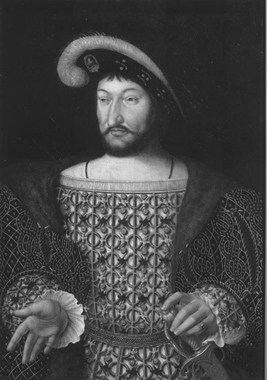
FRANCIS I
FROM A PAINTING IN THE LOUVRE (FRENCH SCHOOL)
View larger image
Francis showed extraordinary courage throughout
the battle. When surrounded, unhorsed, and wounded
he refused to yield to Bourbon, exclaiming: 'I know
no Duke of Bourbon but myself!' but handed his
sword to Lannoy, who received it on his knees, and
immediately offered the captive king his own, saying,
'It did not become so great a monarch to remain
disarmed in the presence of one of the emperor's
subjects.' Francis was immediately taken to the
imperial camp, and de Lannoy despatched Commander
Peñalosa to the emperor announcing the
great victory. Francis gave the envoy a passport
through France, and the following letter to his
mother, Louise of Savoy:—
'Madame,—To let you know the extent of my
misfortune—of all things nothing remains to me but
honour, and life which is safe. Knowing that in
your adversity and sorrow this news would give you
comfort, I requested permission to send you this
letter, which was readily granted. I beg you not
to yield to the extremity of grief, but to direct all
things with your accustomed prudence; for I have
firm hope that at last God will not abandon me.
I commend to your care my children and your own.
I beseech you, moreover, to grant free passage to the
messenger who brings you this letter, as he is bound
for Spain, on a mission to the emperor, to learn what
kind of treatment I am to receive. Commending
myself to your favour and affection, I remain, your
very humble and obedient son,
Francoys'
With Francis were also captured Henry, King of
Navarre, the Marshal de Montmorency, the Duke
de Nevers, the high treasurer Babou de la Bourdaizière,
the Count of Saint Paul, the Marshal of
Fleuranges, Du Bellay, and many others. Meanwhile
Margaret had been kept well informed of the progress
of affairs in Italy, and on the 6th of March
wrote to the Count of Gavre, Governor-General of
Flanders: 'I have had certain news to-day that on
the 24th of February the emperor's army attacked
the King of France in the camp of Forte; that,
although it was well fortified, the king was made a
prisoner, fourteen hundred men of war killed in the
camp, and that the rest who took flight were all
taken and killed, and it is not known if any escaped.
I require you, because of the consolation this news will
be to the vassals and subjects of your government,
to inform them of it, and exhort and command them
to give thanks to God for the victory he has sent us,
by fireworks, processions, prayers, and other devout
works, and above all to pray for the souls of those
who have died.'[94]
On the 13th of this same month she confirmed this
joyful news in a letter sent from Malines to the
Council of Flanders announcing the arrival of Grapain
'with letters in which he certifies that he was
present at the said battle, and the capture of the
King of France by the hand of the viceroy, he himself
helping to disarm the king, and confirms the capture
and death of the principal personages in the kingdom ... and
in the said battle only a hundred and
fifty of our men were killed ... and that the said
king has sent to release the Prince of Orange and
the Lord of Bossu and others of our side who were
prisoners.'[95]
This great victory was of the utmost importance
to the Netherlands, and Margaret hoped that it
would lead to the recovery of the duchy of Burgundy
and the county of Charolais and their dependencies.
Three days after the battle Francis received a
visit from the chiefs of the victorious army, who
offered him their sympathy, the Marquis of Pescara
even appearing in mourning. During the interview
the king showed great fortitude, and with a show of
cheerfulness discussed various points of the battle
with his capturers. The castle of Pizzighitone was
chosen for his temporary prison until instructions
were received from Spain.
The emperor was at Madrid when the messenger
arrived with the news of the victory. Charles showed
extraordinary self-control, and neither by voice nor
manner gave any outward sign of exultation. As if
dazed, he repeated the words of the messenger: 'The
battle is fought and the king is your prisoner!'[96] And
then, hardly permitting the congratulations of the surrounding
courtiers, he retired to his oratory, where,
falling on his knees, he spent a long interval in
prayer, after which he asked for details of his victory.
Bonfires and illuminations and all public rejoicings
were strictly forbidden as being unsuitable 'when a
Christian king had fallen into such great misfortune.'
This moderation and humility called forth the admiration
of all who witnessed it. Dr. Sampson,
King Henry's ambassador at the Court of Madrid,
wrote to Wolsey: ' ... The emperor hath used
such demeanour in all things, both by word, deed,
and countenance, and toward all manner of persons,
that every wise man hath been most joyful to
see it....'[97]
On the following day Charles went in procession
to the church of Our Lady of Atocha to give thanks
for the victory, the preacher, however, being forbidden
to enlarge on the triumph. But this extremely
humble attitude did not prevent Charles from making
the most of his success. On the 14th of March he
sent the following letter to his brother-in-law, the
King of Portugal:—
'It is known to you how the King of France, at
the head of a powerful army, made a descent upon
Italy, to seize and usurp territories appertaining to
our empire, and also our kingdom of Naples, which
he had sent the Duke of Albany to invade, and how
he had besieged the city of Pavia, and the progress
he had made, all which he wrote to you by Luis
Alvarez de Tavora, a noble hidalgo of your own
lineage. By a courier who came to us from thence
(Pavia), we learned the news of the victory which
God has given to our army against the said King of
France, whom we hold prisoner, all which we did
not then make known to you, because we were expecting
the arrival of a cavalier who was present at
the battle, bringing letters from the captains-general
of our said army. This said cavalier has since
arrived, from whom we have minutely heard all that
occurred, which is as follows: On St. Matthew's Day,
the day of our birth, which is the 24th of February,
although the said King of France was entrenched
very strongly, and tried by every possible means to
avoid giving battle, his camp was forced by our army
with no small labour; when it pleased God, who
knows how just is our cause, to give us victory. The
said King of France is taken, and the Prince of
Béarn, Seigneur d'Albret, with many other principal
nobles. The Admiral of France, M. de la Trimouille,
and M. de la Palice are killed, with numberless others
of equal note, so that all the chief nobles present at
the battle are either taken or slain. The loss of the
French, we are informed, amounts to 16,000 men,
while we on our side have lost only 400. We have
given, and do give thanks to our Lord for this
victory; and we hope that it may conduce to universal
peace throughout Christendom, which is a thing we
have always desired, and still desire. Remember to
avail yourself of the knowledge of these matters
which Don Alonzo Enriques de Guzman possesses,
who is the bearer of this letter, and a gentleman of
our household; for we know that this news will give
you pleasure, even as it pleases us to hear good
tidings of you. Most serene and very excellent king,
our dear and much-loved brother and cousin, may the
Holy Trinity have you in special keeping.
'From Madrid, this 14th day of March 1525.
'I, the King'
On the 30th of March Queen Katharine sent her
congratulations to her nephew from Greenwich:—
'I have charged the ambassadors of the king, my
husband and master, now going to Spain, to inform
your Highness of the great pleasure and content
I have experienced at hearing of the very signal
victory which God Almighty, by His infinite mercy,
has been pleased to grant to the imperial arms in
Italy, trusting that your Highness will offer thanksgiving
to that same God, as the king, my master, is
now doing, ordering solemn processions and other
religious acts, throughout this kingdom.
'As the king, my husband and master, has never
failed to be the constant and faithful ally of your
Highness—as his words and deeds have sufficiently
testified on every occasion—and as from the continuance
of such friendship and alliance the best results
may be anticipated, I humbly beseech your Highness
to persevere in the path of friendship and affection
towards us, since the king has always done his duty
and is now rejoicing at your success. I shall say no
more, but will refer entirely to the said ambassadors,
to whom your Highness will be pleased to give full
credence on my part.—Greenwich, 30th of March.
'(Signed) Your good aunt, Katherina'[98]
The emperor also received congratulations from
Henry VIII. and Pope Clement VII. On the 31st of
March the king wrote:—'My most beloved Son,—This
present letter is to congratulate you upon your
recovery, as also upon the honourable victory which
our Lord has been pleased to grant to your arms,
having vanquished and taken prisoner the French
king, our common enemy....' The letter is signed,
'C'est de la main de votre père, frère, et cousin, et
bel oncle, Henry.'[99]
Just before the battle of Pavia Margaret had sent
ambassadors to England with instructions to try and
persuade King Henry to send substantial help to the
imperial troops, which were badly in need of money,
suggesting that an attack might now be made on
France during the absence of the king in Italy.
Margaret concludes her instructions by proposing
that the Princess Mary (who was only nine years
old) should be sent to Spain with an increased dowry,
and placed under the emperor's care until old enough
to be married. The ambassadors are told to add
'that madame and the legate (Wolsey) having already
been match-makers in two different cases, there is no
reason for not promoting this one. She herself desires
this marriage more than any other thing whatsoever,
and will leave nothing undone that can bring it about.'[100]
Wolsey replied to these requests by stating that
the king, his master, was quite ready to cross the
Channel into France under the following conditions:
1st. That madame (Margaret) should provide
3000 horse and 3000 foot. 2nd. That the army
should enter France by way of Normandy. 3rd.
The emperor should procure sufficient money to keep
up his Italian army, etc., etc. But when the envoys
stated that 200,000 ducats, which the emperor was
sending to his army in Italy, had fallen into the
hands of the enemy, the cardinal replied, that if
madame agreed to make remittances of 50,000 crowns,
the king would contribute an equal sum, to which the
envoys answered: 'Madame has not the means to do
that; nobody will lend her money, though she is
willing, for the stipend of the said 3000 horse and
3000 foot, to sell or pawn her own rings and jewels.'
Respecting the delivery of Princess Mary, the cardinal
said 'that she was too young, and that the
English looked upon her as the treasure of the kingdom,
and that no hostages were sufficient security for
her.'[101] But soon after the small princess was made
to send a fine emerald to the emperor with a message
that when they married she would be able to know
by the clearness or otherwise of the jewel 'whether
his Majesty do keep himself as continent and chaste
as, with God's grace, she will.' The emperor being
twenty-five, whilst his little fiancée was only nine, the
cases were hardly similar; and three months later
Charles had engaged himself to marry his cousin,
Isabella of Portugal.[102]
A council was held in Spain in order to decide
what was to be done with King Francis, in which the
Duke of Alva suggested the most exorbitant terms
as the price of the king's freedom. The Bishop of
Osma pleaded for more generous treatment, but the
duke's advice prevailed, and Francis was offered the
most humiliating terms, which he indignantly rejected,
but finally agreed to the proposals that he
should marry the emperor's sister Eleanor, the
Dowager-Queen of Portugal, and settle the duchy
of Burgundy upon the issue of the marriage; that he
should pardon Bourbon, restore the whole of his
possessions, giving him his sister, the Duchess of
Alençon, in marriage; pay a large ransom, and
furnish troops to attend the emperor's coronation
in Rome.
Francis was sent to Genoa and thence to Spain in
charge of Lannoy, Viceroy of Naples, to the indignation
of Bourbon and Pescara, who both hoped to
have had the honour of escorting the royal prisoner
to Madrid.
On his arrival in Spain Charles sent a courteous
letter to Louise of Savoy, who was acting as regent
during her son's absence. Louise in reply says:
'Monseigneur! By the letter which it has pleased you
to write to me, I have learned the arrival of monseigneur
the king, my son, in your country, and the
goodwill and good disposition you entertain to treat
him well, for which I know not how sufficiently to
express to you my thanks and gratitude, humbly
beseeching you, sir, to continue to act in this liberal
manner, which so well befits your greatness and
magnanimity. As for the rest, monseigneur, in pursuance
of what you have required of me, I have
given a safe conduct to your courier, desiring to do
your pleasure in this and all other things, as I would
for the said monseigneur, my son, the king, and this
the Lord knows, whom I pray to give you a good and
long life.—Your most humble Loyse.'[103]
On June the 25th, 1525, Charles wrote a long
letter to his brother Ferdinand from Toledo, in which
he says: 'As to the movement of the Lutherans, and
the evil they have done, and to all appearance mean
to do, it has annoyed, and does continue to annoy me
bitterly. If it were in my power to remedy it speedily,
I would spare neither my person nor my estates in
the cause, but you see the difficulty there is in it,
especially since I hope to be in Italy so soon, in order
to take possession of my crowns[104] as I have already
written you word.
'When that is done, I mean to exert all my power
in the extermination of this said sect of Lutherans....'
Charles goes on to say, in answer to his brother's
request that he would use his influence to get him
(Ferdinand) elected King of the Romans, that for
the present the matter had better be kept secret
until he had been crowned emperor, as the electors
'would probably allege, and with truth, that at present
I am myself, in fact, no more than King of the
Romans, and that on this account the election of
another ought to be deferred....
'The King of France is now here. I have caused
him to be placed in the castle of Patina, where he
will be well treated. He has offered me certain
articles of peace, which I send you a copy of, and has
promised to do still better. I will let you know the
result; and if it tends to my honour and advantage,
and to the preserving of my friends, I will follow your
advice in coming to terms, well knowing that it
would be very propitious to my interests to make
peace before I leave this for Italy. If the said peace
cannot be concluded, I shall order the said King
of France to be kept here in all safety, and will
deliberate on the subject of a war for next year....
'In order to leave these kingdoms under good
government, I see no other remedy than to marry
the Infanta Donna Isabella of Portugal, since the
Cortes of the said kingdoms have required me to propose
myself for such a union, and that on his part the
King of Portugal offers me a million of ducats, most
of them to be paid at once, in order to assist in
defraying the expenses of our said journey to Italy.
Were this marriage to take place, I could leave the
Government here in the person of the said Infanta,
who should be provided with a good council, so that
there would be no apparent cause to fear any new
movement.'[105]
On the 31st of July Charles again writes to Ferdinand:
'As to the affairs of my marriage in Portugal,
it remains in the same state as when I last
wrote to you, waiting for the consent of England,
as also for your advice on the subject. Besides,
it is right that before my departure, I should
know whether I shall have peace or war; and
seeing that there is every hope of the said peace
being concluded, only that time is requisite for it,
I have settled to put off my Italian journey till next
March or April. Thus I shall have time enough
to be married in September, by which arrangement
also I shall be able to receive the said consent, and
your advice, and to ascertain the fact or failure of
the said peace.'[106]
The following letter from Charles to Henry VIII.,
breaking off his marriage with Princess Mary, and
giving all his reasons for so doing, is a most interesting
diplomatic document. It is a pity that King
Henry's answer has, as far as we know, not been
preserved:—
'My good Father and Brother,—I had ordered
Peñalosa to tell you what you must since have heard
through your ambassadors at this my Court, who
have likewise delivered your message to me. My
answer to them has been that no alliance in the whole
of Christendom could give me more pleasure than
yours, not only owing to the great friendship which
has existed of old between our royal houses, but on
account of the great affection and love which you
have shown me, whenever we have met together. I
believe that my sentiments are well known to you, and
I can assure you that my affection has not diminished
in the least, but, on the contrary, is daily increasing,
so as to become in time an almost indissoluble tie
betwixt two brothers.
'You must know as well as I do the disasters and
public calamities which this present war has brought
on the Christian world at large, and on the empire
in particular, and the great lack there is of appropriate
remedy. To the cure of those evils it is my
intention to apply myself entirely, since I am duly
bound to do so; but I find one great obstacle in my
way. You are aware of the great evils and disasters
which my absence from these kingdoms once caused,
owing to my not having been able to make such
provision as was needed for the government of this
country. In consequence whereof my subjects are
pressingly requesting me to marry a princess who
may fill my place, and govern during my absence,
which is, in my opinion, the only way to keep them
contented, and enable me to go about freely, and
attend to my personal affairs. The only remedy I
see for this difficulty, and for many others—which to
so poor a writer as myself would take too much time
to describe—is to anticipate the time of my said
marriage, and likewise the payment of the sums
to be allotted as the princess's dower. But as your
ambassadors here have positively declared to me, in
your name, that this expedient can nowise be adopted,
nor the said marriage effected until the conclusion of
a solid and lasting peace, I see no way to obviate
the said difficulties, and ward off the impending
evils. I hope you will be reasonable enough to
appreciate at its due value the answer I have just
given to your ambassadors, and will consider it as
both just and expedient in the present state of my
affairs. As to the continuance of our mutual friendship,
on that point there is not the least danger. I
can assure you there is nothing I desire so much,
being of opinion that, although the form and terms
of our alliance might be altered through my marrying
in another quarter, yet our amity is to continue the
same as ever, and so to be increased as to secure
the mutual and lasting alliance which would have
ensured from my union with the princess, your
daughter. The better to accomplish the said object,
and provide for our common interest, thereby promoting
the welfare of Christendom at large, I
propose that you and I should work together for
the conclusion of a durable peace, likely to turn
to our own mutual advantage and profit, so as to
satisfy our consciences and discharge our duty
towards God as Christian princes; and if, through
our enemy's fault, the said peace should not be made,
to devise together such means as may ensure the
fulfilment of our common wishes, and the satisfaction
of our claims.
'If, therefore, owing to the above-named reasons,
I were obliged to marry (another princess), I beg
you not to take it in bad part, or suffer it to be the
cause of our mutual love and affection being lessened,
for I can assure you that I shall wait for your
answer, and delay as much as possible the said marriage;
and that when the ambassadors receive your
powers and communicate your wishes to me, you will
be convinced of my goodwill and desire to foster and
increase our mutual amity, and to procure your
welfare as much as my own. And that you may
trust to the sincerity of my professions I hereby
affix my signature as a proof of my constant wish to
be for ever your good son, brother, nephew and good
friend.
Charles
'(Toledo) 12th August 1525'[107]
We do not know how King Henry received the
above communication, but soon after, the news reached
Margaret that he was thinking of entering into an
alliance with France. This she foresaw would probably
lead to another war, and at once prepared to
put the Netherlands into a state of defence. She
summoned the States, and again begged for 100,000
florins. The States refused to grant her request,
saying the country had been drained to the uttermost,
and commerce was at a standstill. But Margaret
would not give in, and the States were
convoked again at Gertruydenberg. The Count of
Hochstrate, as head of the council of finance, going
from town to town trying, by coaxing and promises,
to raise the desired sum.
Louise of Savoy now sent her secretary, Viardi, to
Brussels to persuade Margaret to arrange a truce of
six months in order to give her time to treat for the
king's ransom and conclude a peace. Margaret
listened favourably to Viardi's mission, and commanded
the Count of Hochstrate, the Archbishop
of Palermo, and the Count of Berg to meet him at
Breda, where a truce was arranged in Henry of
Nassau's palace. Charles does not appear to have
been consulted as to the terms of this armistice, and,
much annoyed, he sent the following sharp rebuke to
his aunt:—
'Madame, my good Aunt!—I have received your
letters by Richard, and quite approve what you were
able to communicate to him in what your memory
served you.
'I have received also a copy of the treaty of cessation
of hostilities, which you have concluded. But I
cannot conceal from you, madame, that I have found
it very strange, and very far from satisfactory, that
this should have been done without knowing my
intentions, and without receiving instructions on this
behalf, and powers from me. I have found it convenient,
both for the advantage of my affairs and the
preservation of my authority as heretofore, to declare
to the ambassadors of England, and still more to
those of France, that since the said treaty has been
entered into without instructions and powers from
me, I shall neither acknowledge it, nor ratify it, nor
cause it to be observed.
'Before the arrival of the said Richard, I was
already in communication on the subject of a cessation
of hostilities in all my kingdoms and countries
generally, which I consider much more suitable than
any partial or particular arrangement, and have just
concluded a treaty, with the participation and consent
of the said ambassadors of England (as principal
contracting parties jointly with myself), wherein the
articles are much more to my honour than they were
in yours. In fact, there are two points in the latter
so ill-advised as to condemn the whole. You bring
forward England alone as an ally (as does also the
Duke of Cleves), and promise to offer no assistance
to the enemies of France, which is directly in contradiction
with the treaties in force with England, and
tending to call forth war against Spain and other of
my states, in which case you become incapable of
offering any assistance whatever. Thus the ambassadors
of England know very well how to pretend
that they cannot escape from the position in which
they would be placed, which is in fact as much, or
more, to my disadvantage than theirs; and as to the
French, they may fairly say that all which has been
demanded has been granted them.
'I am quite sure that this great error, madame, is
not arising from any oversight of yours, and that you
have been led to understand that there was some
necessity for it; at the same time I am very far from
being satisfied with those who have allowed themselves
to proceed in this matter without my command,
and who have presumed to counsel you on subjects of
such grave importance as ought never to be treated
of without my knowledge and approval.
'Madame! I send you a copy of the cessation of
hostilities concluded here, in order that you may cause
it to be published duly, and at the time therein declared,
and to be strictly kept and performed according
to its form and tenor, setting aside your own as null
and void, as well as the publications which may have
taken place; for it is my express intention that it
should not be held of the smallest force or value;
insomuch that if I had not even concluded a treaty,
as aforesaid, here, I would not have permitted yours
to be carried into effect.
'Madame! may our Lord have you in His holy
keeping. Written at Toledo, the 13th of August.
'Further, madame, ... I have ratified the neutrality
of Burgundy, as you desire, and I have included you,
as well as my brother the archduke and all your
country and subjects, in the treaty for the cessation
of hostilities, which has been here negotiated; and in
all I may be able to do for you, for your affairs and
your welfare, I shall always and most willingly do
the same for you, my good mother and aunt, as for
myself, praying God to give you all your heart's
desire. Written at Toledo, the 15th of August
1525.'[108]
We can imagine how much upset Margaret must
have been at receiving this severe rebuke which was
called forth by the report that the emperor had just
received from his ambassadors in London giving an
account of an interview they had had with Wolsey,
in which he expressed great surprise and annoyance
at the truce which Margaret had just concluded with
France. 'The treaties of Windsor stipulated,' he
said, 'that neither of the contracting parties was to
conclude a truce without the consent and full approval
of the other one. We have so far adhered to this,
that, though the king has been often solicited by the
French, he has never given his consent to it.... I
should never have thought that, after so many stipulations,
promises, and declarations made by madame,
she would have been the first to break through
them.
'... Any plans and designs which the emperor,
Mons. de Bourbon, and the king, my master, may
have formed in this particular matter are ruined for
ever through madame having granted this truce to
our common enemy.
'... In fact, I do not know how I shall be able
to appease the king's anger when he hears of it, for
he has always maintained that madame was incapable
of doing anything in this matter without letting him
know first. The perplexity and doubt by which
madame is said to be assailed, and which have
induced her to take this step, are no excuse for her
acting thus; for she ought first to have consulted
the king, my master, and stated her reasons, instead
of deciding, as she has done, for herself,
and then sending an agent to acquaint him with her
resolution, which was by no means an honourable
proceeding....'[109]
Margaret's reply to her nephew explaining her
reasons for her conduct has unfortunately not been
preserved, but she evidently found means to soothe
his anger, for ere long they were again on the best
of terms. Charles was genuinely devoted to his aunt
and held her in the highest esteem, and to the end
of her life Margaret enjoyed his full confidence, and
was always consulted by him on every occasion of
importance.
King Francis had been brought to Spain in June,
but it was not until August that he was removed
from Valencia and its neighbourhood to Madrid.
On his arrival in the latter town he was bitterly
disappointed to learn that the emperor was away
hunting in Segovia, for he had hoped much from a
personal interview and his own powers of persuasion.
Although comfortably lodged and treated with every
mark of respect, the unaccustomed life of seclusion
soon told on his health, and the report spread that
he was dangerously ill. On hearing of his illness his
sister Margaret, Duchess of Alençon, hastened to
Spain, provided with full powers from her mother,
the regent, to treat for peace. On the evening of
September the 18th Charles was out hunting when
he received the news that the French king was dying.
Immediately he set out for Madrid, and without
hardly drawing rein he rode straight to the Alcazar.
Francis was asleep when he arrived, but the emperor
waited until his prisoner awoke, and then as the
invalid slowly raised himself, exclaiming, 'Here I am,
my lord emperor, your servant and your slave!'
courteously replied, 'Not so; you are my good friend
and brother, and I hope that you will always be so.'
He begged Francis to keep up his spirits, and only
to think of getting well: saying 'that when his sister
the Duchess of Alençon arrived, peace and liberty
would soon follow, for he only asked for what was
reasonable, and did not doubt that Francis would do
what was just.'[110] The next day Charles paid the
king another visit, and was equally kind and considerate,
leaving him very much improved in health.
As the emperor descended the stairs from the invalid's
room, he met the Duchess of Alençon, who had just
arrived, and after warmly greeting her, conducted
her to her brother. The Duchess Margaret was a
very attractive, graceful woman, and Charles had
been warned by his Ministers not to receive her, for
as they said, 'Being young and a widow she comes
... to see and to be seen,' and they feared that the
emperor might fall in love with her; but though
Charles kissed her and had private interviews, not
all her charms could make him relax one point in his
conditions of her brother's release. After many
fruitless efforts and endless discussions Margaret was
obliged to return to France without having secured
the much-desired peace. On the 19th of November
1525 Perrenot de Granvelle[111] wrote a long letter to
Margaret of Austria from Toledo, giving her an
account of the Duchess of Alençon's visit:—
'Madame!... In fulfilment of your wishes, and
in accordance with the good pleasure of the emperor,
... I forthwith went to take your letters to the
king (Francis I.), and on your part to pay him a
visit. I had long audiences with him, at four different
times after the fever had subsided, when I found him
in a good disposition to receive me, though extremely
weak from the severity of his malady. He told me
that he and his kingdom were much indebted to you,
madame, for the desire you had manifested for peace,
and a good intelligence and amity between the
emperor and him, and consequently for his deliverance;
which, if God should please to grant, he must
always esteem you, even as a second mother, with
whose advice and counsel he should be happy to
govern his affairs; adding many other fair and
courteous expressions. On this subject and his ardent
desire for peace, as well as for the friendship and
good graces of the emperor, he spoke much, devising
at large the means of effecting it, and always recurring
to the idea of a marriage as the principal
thing to build upon. He also repeated his assurances
of the desire he had to contribute to the aggrandisement
of the emperor, and to assist in forwarding all
his enterprises, referring all the means and details to
the aforesaid Madame d'Alençon.... Madame! I
met on my journey the said lady, and delivered to
her your letters; and whilst I had this opportunity,
with the knowledge and will of the emperor, I went
to visit her, and have reason to think that I gave
satisfaction without any cause of distrust on the one
side or the other.
'Madame! I have since recovered the copy of the
letter which the emperor had written to M. de Praet,
and of other writings which I now send, as a summary
of the communications which here took place. At
the commencement, the said lady recapitulated the
proposition which had already been entertained respecting
the marriage, the ransom, or the cession of
the duchy (of Burgundy) on condition that it should
be pronounced by the Parliament of Paris a possession
belonging of right to the king, who would be
ready to give hostages in this case, to ensure its
surrender. On this point, however, the emperor
declared, as he had before done, without any reference
to the marriage, that no ransom would satisfy him,
nothing less than the duchy, his ancient heritage,
the foundation of his order, of which he bore the
name and arms, rejecting the conditions attached to
it as wholly inadmissible. Some days afterwards,
the said lady made a proposition to the emperor, who
went to visit her at her lodgings, to choose arbitrators,
which he had before refused, and which he then, as
she told me the same day, was ready to agree to.
Afterwards, however, when she was in conference
with the ambassadors, they came to a standstill when
they touched on the aforesaid condition relating to
the Parliament of Paris, and the hostages which the
emperor, they maintain, would not accept.... Communications
have passed in writing on both sides, of
which the result has been nothing more than is above
related. They have now taken their leave, both the
Duchess of Alençon and the ambassadors, declaring
that the king has fully made up his mind not to
resign the said duchy except on the condition already
proposed, choosing rather to submit to perpetual
imprisonment; and this very day the said lady has
sent to demand her passports, that she may return to
France under the same security as she travelled
hither, which has been granted her. No further
movements or proposals have since taken place, the
emperor continuing in the same determination to
obtain possession of the duchy; and if the said lady
takes her departure, as appears her intention, the
hope of peace which has been excited by her arrival,
and the subsequent attempts at negotiation, as well
as by the arbitration supposed to be agreed on, will
altogether vanish for the present.
'Madame! On Sunday last, the 15th of this month,
I received by Richard the letters and other papers
which you were pleased to send me. The emperor
was at that time on a hunting expedition five leagues
hence, with a few attendants, having previously taken
leave of the Duchess of Alençon; and on his return
I presented to him your letters. I discussed with
him at length the two principal points relative to the
peace or truce, and the commercial arrangements in
which your country is concerned.... To all this his
Majesty gave a willing ear, and seemed to take in
good part all that was said....
'Madame! Whatever might have been the opinion
offered, it has certainly come to pass ... that peace
has been made with England, and according to articles
which had been proposed and resolved upon before
the battle and capture of the king.... Among
other causes, it has chiefly arisen, as is pretended,
out of the truce made in your country, as well as
from the correspondence which has passed, and your
frequent declarations, that as far as your interest
was concerned, you had abandoned all thoughts of
war. Concerning this matter I gave a sufficient
explanation, and satisfied his said Majesty, as I hope
thereupon....'[112]
At last, on the 14th of January 1526, the Treaty
of Madrid was signed between Charles V. and
Francis I., and the emperor at once wrote to Margaret
to inform her of the joyful news, enclosing a summary
of the treaty. In return for his freedom the French
king agreed to give up the much-coveted duchy of
Burgundy and the counties of Charolais and Hesdin,
to allow the sovereignty of Flanders and other
countries of the emperor within France. To renounce
all claim to Naples, Milan, Genoa, and Asti,
as well as to Tournay and Arras. To reinstate the
Duke of Bourbon in all his property; and set at
liberty the Prince of Orange without any ransom.
It was agreed that all prisoners on both sides should
be liberated; and that the Duke of Gueldres should
be allowed to retain his title during his lifetime, on
condition that at his death his duchy should pass to
the emperor.
The king's marriage with Queen Eleanor of
Portugal was to take place as soon as possible, the
queen bringing 200,000 crowns in gold as her dower,
besides the counties of Macon, Auxerre, and Bar-sur-Seine,
which were to be settled on her and her heirs.
It was especially stipulated that if the king should
be unable to restore Burgundy or carry out other
parts of the treaty, he should again return to captivity,
leaving the Dauphin and his second son as hostages.[113]
The emperor also wrote to Margaret on the 15th
January asking her to convoke the States-General
for the 22nd of May, to inform them of the peace
that had just been concluded.
But Francis had no intention of keeping the
promises which had been wrung from him under
compulsion, and he secretly resolved to break faith
with the emperor as soon as he regained his liberty.
A few days after the Treaty of Madrid had been
signed Margaret had the sorrow of losing her niece,
Isabel, the young Queen of Denmark, who died near
Ghent on the 19th of January, at the age of twenty-five,
and was buried in that city. Her life with
Christian II. had not been a happy one, and it was
said that she died of a broken heart. Her three
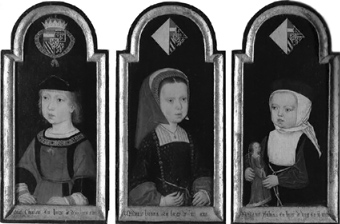
children, John, Dorothea, and Christina,[114] she left to
her aunt Margaret's care, 'whom she had always
called her mother.' Margaret nobly fulfilled this
trust, and tenderly watched over the children until
her death. She appointed the learned Cornelius
Agrippa, then residing at her Court, as tutor to
Prince John, who at the time of his mother's death
was only eight years old. In a letter to Ferdinand
Charles thus mentions their sister's death: 'I am
very sorry for the death of our sister the Queen of
Denmark, and have taken care that prayers should
be said for the repose of her soul. I would willingly
recommend to you her children our nephews, who
are at present in the hands of our dear aunt in
Flanders.'
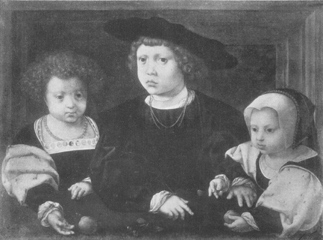
THE CHILDREN OF CHRISTIAN II AND ISABEL OF DENMARK
IN MOURNING DRESS FOR THEIR MOTHER
FROM THE PAINTING BY MABUSE AT HAMPTON COURT PALACE
View larger image
On Ash-Wednesday, the 14th of February, Charles
de Lannoy wrote to Margaret from Madrid to
inform her that the emperor had arrived the day
before, and King Francis had gone outside the city
to meet him. After supper they had spent two
hours talking together, and seemed well pleased with
each other. The king had begged permission to see
Queen Eleanor, which was granted, with the assurance
that as soon as he set foot in Provence she
should be delivered over to him.
Lannoy goes on to say that he has been ordered
to attend the king on his way to France.
On February the 26th the Abbot of Najera mentions
in a long letter to the emperor that peace had
been proclaimed in Milan on St. Matthew's Day, the
24th of February, which was looked upon as a good
omen as it was the emperor's birthday as well as the
anniversary of the victory of Pavia. But a little
later John Jonglet wrote to Margaret from London
that 'it was publicly asserted that the King of
France would not keep his treaty with the emperor,
as the States-General of his kingdom would never
sanction the dismemberment of his crown.'[115]
Charles himself seems to have suspected that
Francis might play him false, for, on the 19th of
February, he had written to De Praet that ... 'as
the said Seigneur King (Francis) is bound to deliver
up to us certain hostages, as you will see by this
treaty, we desire that you will well and carefully
inform yourself who the said hostages are to be,
whether the king's two eldest sons, or Monseigneur
the Dauphin, and twelve of the principal nobility ... that
you take especial notice of, and be regardful
of the persons of the three children of France,
that you make yourself thoroughly acquainted with
the visage, physiognomy, size, and person of each,
that when it comes to the delivering of them over
... there may be no trickery in substituting one
person for another, and that you may be able of
a certainty to recognise them as the identical persons
whom we ought to have. Our Viceroy of Naples is
to take the charge of the said delivery and acceptation,
and as you are aware he can have no particular
knowledge himself of the said children, it is a matter
of necessity that you should be well acquainted with
all these particulars....' In another letter to De
Praet he says: 'On Shrove-Tuesday we reached
Madrid, where we had the satisfaction of finding
ourselves with the Sieur King, reciprocally exchanging
such sentiments and good offices as two attached
friends and brothers entertain and exercise together....
'We remained at Madrid Tuesday evening, Wednesday,
and Thursday, and on the following day
departed thence with the said king our brother,
and slept four leagues from Madrid, in order to
reach Illescas, two leagues further, on Saturday.
At Illescas we shall find the queen our sister
(Eleanor). Here they will meet and see each other,
and speak together; and then the king will return
to Madrid, and we shall continue his companion in
the evening. The next day he will begin his journey
direct for Bayonne accompanied by our said viceroy.
Soon afterwards our sister the queen will also set off
for the same, attended by our Constable of Castile.
And as to ourselves, we intend to take the road
towards Seville, where we shall find our empress,
and where our marriage is to take place.'[116]
On the 16th of February Charles wrote to Louise
of Savoy:—
'Madame, my good Mother,—Since I have given
back a good brother to the king your son, and am
offering you the queen my sister for a daughter, it
appears to me that, in order not to present you one
son only, I should resume the name which I used
formerly to give you, and should again address you
as my good mother; and seeing that I do so consider
you, I pray you to act as such towards the said
queen my sister, as well as towards myself. I came
to this town of Madrid to see the king your son ... and
I was sorry not to have been able to do so
sooner, but I am greatly rejoiced at finding both his
health and his affections in so different a state from
what they were when I last saw him. The love and
friendship which he professes to bear towards me
have given me no small satisfaction, and I nowise
doubt the sincerity of these good feelings, which
I hope you will assist in confirming, as you have
promised me by your letters that you would do. On
my part I assure you that the love and friendship I
bear towards him are most sincere, and that I am
fully prepared to accomplish everything I have
promised.
'You request in your said letter that the king ... should
take the queen, his wife, my sister, with him.
As soon as the king ... has ratified and sworn to
the treaties, and that all things are concluded between
him and me, she shall be given up at Bayonne according
to your desire. This shall be done by my Viceroy
of Naples after he has liberated the king ... and
has received the hostages that are to be given.
'And now, madam, that he may no longer distress
you by his bad writing, he who looks upon you as
his good mother will conclude by recommending
himself with all his heart to your kindness, and
will sign himself,—Your good son,
Charles[117]
'To Madame the Regent of France, my good mother.'
From the emperor's Itinerary we learn that Queen
Eleanor left off her mourning on being affianced to
the King of France. On her arrival at Talavera she
was met by the emperor and the Duke of Bourbon.
On the 20th of February the emperor and the King
of France went together to Illescas, where they paid
a visit to the Queen Eleonora and Queen Germaine
de Foix, accompanied by the Countess of Nassau and
other ladies, who received them on the stairs. They
then went into a saloon, where the four sat down
under a canopy, and were engaged in conversation,
whilst the ladies of the Court amused themselves by
dancing.... On the 23rd of February the emperor
took leave of his sister, the Queen of France, who
remained at Illescas, and pursued his journey towards
Seville, where the Princess Isabella of Portugal, his
affianced bride, was to meet him on the 9th of March.
He made his entry into Seville on that day, and on
the 10th his marriage was celebrated with much
pomp. At the magnificent festivities which followed,
it is recorded that M. de la Chaux opened
the ball.[118]
In a letter to his brother Ferdinand, Charles thus
briefly refers to his wedding: 'I have now entered
upon the estate of marriage, which pleases me well.'
And yet this marriage, begun under such unromantic
conditions, turned out very happily, for Isabella was
a capable princess, who, besides her beauty and clear
complexion, had a good heart and sound judgment,
and Charles, we are told, 'lived in perfect harmony
with her, and treated her on all occasions with much
distinction and regard.'
Guillaume des Barres, one of Margaret's secretaries,
sent his mistress the following description of
the bride: 'I would give much that you could see
her, for if you have been told of her many beauties,
virtues, and goodness, you would find still more, and
you should see how happy they are together.'[119] On
April 26th, 1526, Margaret sent an embassy to Spain
to congratulate Charles on his marriage, and present
her good wishes to the empress, to whom she wrote,
'that she wished that things could be so arranged
that she could come and visit the countries over here
(Flanders), which are so beautiful and adorned with
such fine towns....'[120] Amongst other things her
ambassador was ordered to tell the emperor 'that
the archduchess had the greatest pleasure in trying
to extirpate the sect of the Lutherans,' and on his
own account he added that his mistress lived so
simply and economically that there was no chancellor
of a province, nor sub-governor or lieutenant in the
country, who lived as simply as she did.[121]
Meanwhile, on the 17th of March, King Francis
had been set at liberty. Charles in a letter to his
brother says: 'The King of France was restored to
his kingdom on the 17th of this month (February),
on my receiving the Dauphin and Duke of Orleans
as hostages, whom I have desired to be taken to
Burgos; and the said King of France promises to
accomplish all that he has engaged in by the treaty
of peace....'
Guicciardini gives the following interesting account
of the exchange of prisoners at Fuenterrabia: 'By
this time the French king was come to Fuenterrabia,
a town appertaining to the emperor, standing near
the Ocean Sea upon the frontiers of Biscay and the
duchy of Guyenne; and on the other side the Lady
Regent was arrived with the children of France at
Bayonne, which is not far from Fuenterrabia....
Then the 18th day of March, the French king,
accompanied by the viceroy, Captain Alarçon, with
fifty horse, came to the shore of the river that
divideth the realm of France from the kingdom of
Spain; at the same time M. de Lautrech, with the
king's children, and the like number of horse, presenting
themselves on the other side. There was in the
midst of the river a great barque made fast with
anchors, in which was no person. The king approached
to this barque in a little boat, wherein he
was accompanied by the viceroy, etc.... all armed
with short weapons, and on the other side of the
barque were likewise brought in a little boat, M. de
Lautrech, with the hostages ... after this the
viceroy went into the barque ... and the king
with him.... M. de Lautrech fetched out of the
boat into the barque the Dauphin, who being given
to the viceroy ... was forthwith bestowed in his
boat, and after him followed the little Duke of
Orleans, who was no sooner entered the barque than
the French king leaped out of the barque into his
boat with such swiftness that his permutation was
thought to be done at one self instant, and then the
king being brought to the shore, mounted suddenly
(as though he had feared some ambush) upon a
Turkish horse of a wonderful swiftness, which was
prepared for the purpose, and ran without stay to
St. John de Luz, a town of his obedience, four
leagues from thence; and being there readily relieved
with a fresh horse, he ran with the same swiftness to
Bayonne, where he was received with incredible joy
of all the Court.'[122]
In a despatch to the emperor, written on March
23rd, Ochoa de Ysasaga announced that 'The day
that the King of France was released from his
captivity he leaped from the boat, with water up to
his knees, mounted a horse that had been prepared
for him, and rode without stopping to St. Jean de
Luz, where he dined, and was visited by the flower
of the French nobility, who came to congratulate
him.[123]
And thus Charles let slip his chance, and omitted
to reap the fruitful August, which Lannoy, in
announcing the victory of Pavia, had declared
comes to a man once and once only in his life.