Although Queen Henrietta Maria had disapproved
of Newcastle’s marriage with her maid-of-honour, she
showed him considerable kindness. She invited him
to a great Council which was held at St. Germains,
attended by the Prince of Wales, Prince Rupert, the
Marquesses of Worcester and of Ormond, the Earl of
St. Albans, Lord Jermyn and others. At the Council,
Newcastle[130] “delivered his sentiment, that he could
perceive no other probability of procuring Forces for
His Majesty, but an assistance of the Scots; But Her
Majesty was pleased to answer my Lord, That he
was too quick”. An unpleasant expression; but Her
Majesty was quite right! For the King, unfortunately,
did seek “an assistance of the Scots,” with a
result only too well known.
The Queen did Newcastle a much greater service
than the empty compliment of an invitation to a Council
at which he was snubbed. She gave him £2000!
Fortunately at that time, she still had some money.
She received 12,000 crowns a month from Anne of
Austria, and she obtained help from some of her relations;
but she sent very large sums to her husband
in England, and she made handsome donations to
distressed cavaliers—such as Newcastle—in France
and Belgium, selling her jewels for the same purposes.
When the wars of the Fronde began, those who were
helping her became in want themselves, and they could
do nothing more for her. She then found herself in
sore straits.
Mademoiselle de Montpensier says in her Memoirs:
“The Queen of England appeared, during a
little while, with the splendour of royal equipage, she
had a full number of ladies, of maids of honour, of running
footmen, coaches and guards. All vanished,
however, by little and little, and at last nothing could
be more mean than her train and appearance.” And so
things went on, from bad to worse, until, about three
years after the time with which we are now dealing,
Cardinal de Retz found her, with her last loaf eaten,
her last faggot burned, and her little daughter in bed
at mid-day, because there was no fire on the hearth
and snow was falling heavily.
Things were a long way from being so bad as that,
however, when she gave Newcastle £2000. Having
got that money, and having squeezed a little more
cash out of his creditors, instead of economising,
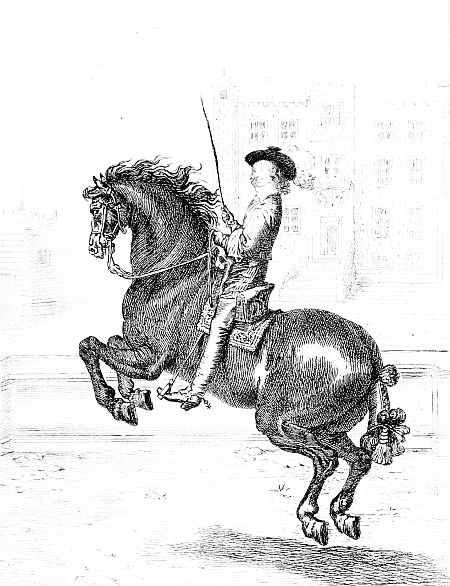
Newcastle left his lodgings and took a good house,
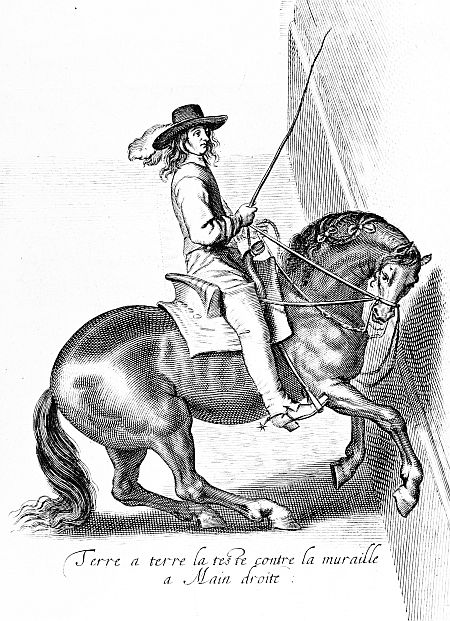
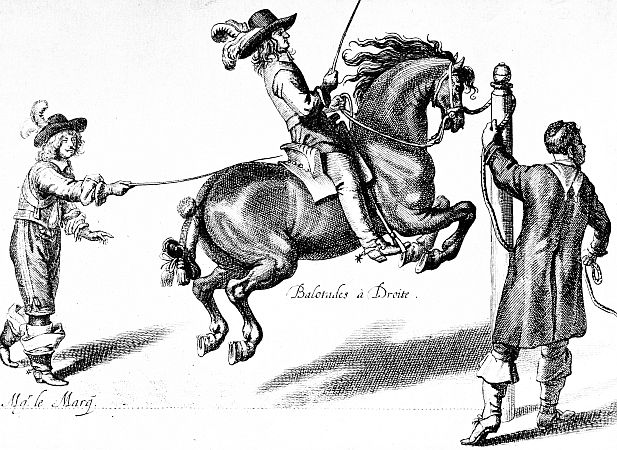
resolving, as his wife says, “for his own recreation and
divertisement in his banished condition, to exercise
the Art of Mannage, which he is a great lover and
Master of”. He gave £160 for one horse, and what
is now vulgarly termed an “I.O.U.” for £100, for
another. To estimate these prices as £480 and
£300 of our money would be to undervalue them.
But men in debt always seem to buy the longest-priced
horses.
Soon after he had made these purchases, the Queen
desired Newcastle to go to the Prince of Wales in
Holland; but his ungrateful creditors made a difficulty
about their debtor leaving Paris, whereupon the
Queen most generously made herself responsible for
his Parisian debts. On the morning of the day on
which he left Paris, his creditors, says his wife, showed
“so great a love and kindness for him” that they
came to “take their farewell of him”. No wonder!
It is easy to understand that they would be anxious,
to have a few words with him—perhaps a good many
words—and to come to a very clear understanding,
before losing sight of him. Love and kindness
indeed!
For about six months Newcastle lived at Rotterdam,
as his wife tells us, “at a great charge keeping
an open and noble table for all comers”; although he
was heavily in debt and seemed to have little prospect
of ever repaying his creditors.
In addition to the large sums he owed in Holland
and in Paris, he borrowed £2000, while in Rotterdam,
from Lord Hertford and Lord Devonshire, all
of which he spent there, as well as another £1000
which he borrowed; “his expense being the more,
by reason he lived freely and nobly,” which, of course,
he had no business to do.[131]
While at Rotterdam, he made visits to the Prince
of Wales at the Hague. Finding that he could be of
no help to the Prince, and probably also finding that
he could borrow no more money in Rotterdam, he
went to Antwerp, where he took a house[132] “that belonged
to the widow of a famous Picture-drawer, Van
Ruben”. Here, however, was a difficulty, for the
Widow Rubens’s house was “to be let unfurnished,”
and Newcastle had no cash with which to buy furniture.
Happily he was a past-master in the art of
borrowing.
His wife says:—
“About this time my Lord was much necessitated
for Money, which forced him to try several ways for
to obtain so much as would relieve his present wants.
At last Mr. Alesbury, the onely Son to Sir Th.
Alesbury, Knight and Baronet, and Brother to the
now Countess of Clarendon, a very worthy Gentleman,
and great Friend to my Lord, having some
Moneys that belonged to the now Duke of Buckingham,
and seeing my Lord in so great distress did
him the favour to lend him 200£. (which money my
Lord since his return hath honestly and justly repaid).”
No doubt! But that was some dozen years
later, and the delay may have been inconvenient to
the Duke of Buckingham. “This relief came so
seasonably, that it got my Lord Credit in the City
of Antwerp, whereas otherwise he would have lost
himself to his great disadvantage; for my Lord
having hired the house aforementioned, and wanting
Furniture for it, was credited by the Citizens for as
many Goods as he was pleased to have, as also for
Meat and Drink, and all kind of necessaries and
provisions, which certainly was a special Blessing of
God, he being not onely a stranger in that Nation,
but to all appearance, a Ruined man.”
While at Antwerp, Newcastle was exempted from
all taxes and excise dues. In 1650 he was made a
member of the Privy Council of Charles II, and he
urged the King to make an agreement with Scotland
on any terms and to go there in person. Hyde opposed
the Scotch policy advocated by Newcastle,
whom he describes in one of his letters “as a most
lamentable man, as fit to be a general as to be a
bishop”.[133] Yet Hyde and Newcastle remained on
good terms, and, when Hyde was accused in 1653
of betraying the King’s Councils, Newcastle wrote
him “a very comfortable letter of advice”.[134]
At Antwerp Newcastle’s chief amusement was riding
the two horses which he had bought for £160
and £100, until they both, unfortunately, suffered premature
death. This is remarkable; for tittupping
round a riding-school was a gentle form of exercise
more likely to lengthen than to shorten a horse’s
existence. Being desperately hard up, it might
naturally be expected that he would give up riding
and economise. Not a bit of it! On the contrary,
finding himself horseless, “though he wanted present
means to repair these his losses, yet he endeavoured
and obtained so much Credit at last that he was
able to buy two others, and by degrees so many as
amounted in all to the number of 8. In which he
took so much delight and pleasure, that though he
was then in distress for Money, yet he would sooner
have tried all other ways, then parted with any of
them; for I have hear’d him say, that good Horses
are so rare, as not to be valued for Money.” He had
excellent offers for two of these horses; but, poor as he
was, nothing would induce him to sell either of them.
So difficult did Newcastle find it to keep eight
horses and himself, to say nothing of his wife, with
scarcely any money in hand, and a rapidly diminishing
credit, that it became necessary, not to reduce his
stud, but to send his wife to England to try to raise
the wind. He could spare her, but not his horses.
With Lady Newcastle went Newcastle’s brother,
Sir Charles Cavendish, whose property, which had
been sequestered since he left England, was to be
sold outright if he did not quickly compound for it.
Lady Newcastle and Sir Charles had so little money
for their journey that they were obliged to stay at
Southwark, until Sir Charles had pawned his watch
to pay for their night’s lodging and for the very short
remainder of their journey into London, where they
found lodgings in Covent Garden. The Duchess’s
book relates what followed.
“Having rested our selves some time, I desired my
Brother the Lord Lucas, to claim, in my behalf, some
subsistence for my self out of my Lords Estate (for it
was declared by the Parliament, That the Lands of
those that were banished, should be sold to any that
would buy them, onely their Wives and Children were
allowed to put in their Claims:) But he received this
Answer, That I could not expect the least allowance,
by reason my Lord and Husband had been the
greatest Traitor of England (that is to say, the honestest
man, because he had been most against them).”
Newcastle had felt some compunction about compounding
with traitors to his King. Henrietta Maria
very kindly wrote to him, saying that she had heard of
his scruples from Lord Jermyn, adding: “I am sufficiently
assured of your affection and fidelity to tell you,
that I think the king cannot be displeased that you
should do what the late king his father”—it was after
the death of Charles I—“permited those to do who
had served him, when he was not in a condition to
assist them.... And I cannot forbear pitying you,
knowing well your repugnance to treat with these
abominable villains.”
The Duchess continues:—
“Then Sir Charles intrusted some persons to compound
for his Estate; but it being a good while before they
agreed in their Composition, and then before
the Rents could be received, we having in the mean
time nothing to live on, must of necessity have been
starved, had not Sir Charles got some Credit of several
Persons, and that not without great difficulty; for all
those that had Estates, were afraid to come near him,
much less to assist him, until he was sure of his own
Estate. So much is Misery and Poverty shun’d!”
No novel discovery.
“But though our Condition was hard, yet my dear
Lord and Husband, whom we left in Antwerp, was
then in a far greater distress than our selves.”
In fact his creditors had become very “impatient”—who
can wonder?—and he wrote to his wife that,
unless some money were sent to him immediately, he
would starve. With very great difficulty Sir Charles
Cavendish raised £200, which he sent out at once to
his brother. We need not enter into the details of
Sir Charles’s compounding for his estates, or of his
saving Welbeck and Bolsover for Newcastle.
During her stay in England, Lady Newcastle consoled
herself in her anxieties with pens and paper, of
which we shall hear a good deal later.
It was probably not very long before Lady Newcastle’s
visit to London that King Charles I was
beheaded, an incident unmentioned in her memoirs.
But perhaps she regarded it as a tragedy too well
known to require notice.
After being in England a year and a half, having
heard that her husband was “not very well,” and
having but “small hopes” of raising money out of
his estates, Lady Newcastle returned to him. Sir
Charles Cavendish was prevented from accompanying
her by ague, and she had reached her husband
only a short time, when news came of Sir Charles’s
death.
Clarendon[135] describes Sir Charles Cavendish as
Newcastle’s “brave brother, who was a man of the
noblest and largest mind, though the least, and most
inconvenient body that lived”. Almost the only words
at all approaching disparagement of her husband, occurring
in the Duchess’s story of his life, are in her
already quoted statement that he had “not so much
of scholarship and learning as his brother Sir Charles
Cavendish”.
As we have seen, Newcastle had written to his
wife, in England, that unless she or his brother sent
him money immediately, he would starve; therefore it
might be reasonably supposed that he had sold the last
of his horses. Such was very far from being the fact.
When Lady Newcastle returned, she found her starving
husband with “the Mannage of his horses,” as she
calls it, so splendid that “all strangers that were
Persons of Quality” came to see it.
It was at Antwerp that Newcastle wrote his famous
book on horsemanship, which we will notice when we
consider his literary works in a later chapter.
Ben Jonson had written, concerning Newcastle’s
horsemanship:—
When first, my Lord, I saw you back your horse,
Provoke his mettle and command his force
To all the uses of the field and race,
Methought I read the ancient art of Thrace,
And saw a Centaur past those tales of Greece,
So seemed your horse and you both of a piece!
You showed like Perseus upon Pegasus,
Or Castor mounted on his Cyllarus,
Or what we hear our home-born legends tell,
Of bold Sir Bevis and his Arundel;
Nay, so your seat his beauties did endorse,
As I began to wish myself a horse;
And surely, had I but your stable seen
Before, I think my wish absolv’d had been,
For never saw I yet the Muses dwell,
Nor any of their household, half so well.
So well, as when I saw the floor and room,
I looked for Hercules to be the groom;
And cried, Away with the Cæsarian bread!
At these immortal mangers Virgil fed.
Underwoods, lxxii.
Of his book on horsemanship, Newcastle wrote to
Secretary Nicholas from Antwerp, on 15 February,
1656: “I am so tormented about my book of horsemanship
as you cannot believe, with a hundred several
trades I think, and the printing will cost above £1,300,
which I could never have done but for my good friends,
Sir H. Cartwright and Mr. Loving; and I hope they
shall lose nothing by it, and I am sure they hope the
like”. Only the impecunious can afford to embark
upon literary extravagances of this sort.
Lady Newcastle’s return had one very inconvenient
effect. It had been generally known at Antwerp that
her expedition to England had been for the purpose
of raising money to pay her husband’s debts, and it
was naturally, though most erroneously, assumed that
she had returned with that money. In consequence,
there was a general rush of Newcastle’s creditors to
his house, crowding and clamouring for a settlement
of their little accounts. Wonderful to relate, when
Newcastle “had informed them of the truth of the
business, and desired their patience somewhat longer,”
they were “willing to forbear”. This, says the pious
Duchess, “was a work of Divine Providence”. Undoubtedly
it was; but did not Newcastle tempt Providence
very hard, when he lived in what she admits
to have been “so much Splendor and Grandure” on
borrowed money, with only a very problematical prospect
of ever being able to repay it?
It would seem, from the following letter, written
by Buckingham, that Newcastle had asked him to
beg on his account from Charles II; that Charles had
promised some money, and had been persuaded to
break his promise by Newcastle’s enemies. Buckingham
also advises Newcastle to make the best terms
he can with the Government of the Commonwealth
about his property.[136]
“(1650) December 5. St. Johnstone’s (Perth).
Your Lordship’s kindnesse to mee has beene ever
soe great, and you have beene pleased to lay soe
many obligations upon mee that, I showld bee a very
unworthy person if I did not take all occasions of
acknoledging them to your Lordship....
“I am very sorry that I have not beene able to
serve your Lordship at this present as I desired, but
the gentleman that delivers this to you will lett you
know how earnestly I have solicited his Majesty in
your lordship’s business.
“I had once gott a promise from the King to doe
it, but the death of the Prince of Orange, and—as I
beleeve—letters from some that are not your friends,
have perswaded the King to change his resolution.
Hee sayes that when hee receives a just accownt of
the somme my Lord Culpepper bringes with him, hee
will lett your Lordship have as much as his occasions
will give him leave to spare. But what that will bee, or
how long before it bee received, is soe uncertayne that
withowt doubt your Lordship ought not to rely upon it.
“The best cowncell that I am able to give you,
considering your owne condition, and the present state
of owr affayres, is to make your peace if it bee possible,
in Ingland, for certaynly your Lordship’s suffering
for the King has beene great enoughf to excuse
you if you looke a little after your selfe now,
when neither hee is able to assist you, nor you in a
possibility of doing him service.”
Some time later the Royalist affairs were going
very badly.[137]
“(1652) Feb. 18. The Hague.
“I doe extreamly longe to have some discowrse with
you concerning all our late misfortunes, and am therfore
resolved to stay five or sixe dayes at Anwerp
only to wayte upon your Lordship. The consequence
of owr miscarriages is soe sad, that it is hard to thinke
of them without affliction, and yett I am confident your
Lordships naturall good humour joyned to the rediculousnesse
of many passages which I have to tell
you, will goe neere to make you laugh, but I shall
deferre the giving you that satisfaction till I have the
honour to see you, and at the present only protest to
you, that there is noebody I have a greater value or
respect for then your Lordship.”
Among other correspondence of Newcastle’s of
the same period, is a letter from Clarendon, then Sir
Edward Hyde, asking him to try to prevent a duel.[138]
“1652, December 14. Paris.
“We are all here exceedingly troubled, that that
old quarrelling humour still rages amongst those of
our miserable nation in all places, and if your authority
hath not already prevented the mischeive which
must probably attend that duell betweene the Earl of
Oxford and Colonell Slinger, any commands from his
Majesty will come too late, and indeed if they doe
contemne your Lordships interposition, there may be
reason to beleive that they would not obey his Majesty
himselfe if he were upon the place, for if they consider
themselves as Englishmen, and will pay obedience to
the lawes and constitution of their country, they must
acknowledge that your Lordship as a Privy Councellour
hath authority over them; and if they will decline
it because they are out of his Majesty’s dominions,
they might have the same obstinacy, if the King himselfe
were at Antwerpe. His Majesty desires you if
it be not too late, to use his name in any way you
thinke necessary to prevent this mischeive, and will
conclude that if they refuse to be ordered by your
Lordship that they would not have obeyed his
owne person, if he had been there. The King
uses all endeavours to put himselfe into a readynesse
to remove from hence, when there shall be
occasion, which I pray God he may be able to doe.
God preserve your Lordship and keepe me in your
favour.”
Newcastle appears to have called himself, or at
least to have had some idea of calling himself, by
the title of Prince on the Continent. A letter from
so high an authority as Garter-King-at-Arms, at
the Herald’s College, asserted him to be justified in
so doing.[139]
“1657, August 20, Bruges.—Giving his reasons
why he held the opinion that the Marquis of Newcastle
was justified in assuming the title of Prince.”
Towards the end of his exile, Newcastle put his
son, who had succeeded in obtaining an income, probably
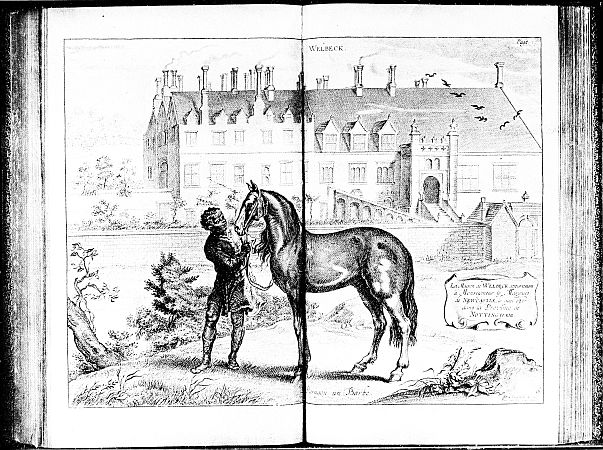
by his marriage, into his old home at Welbeck,
as will be seen by the following letters.[140]
“1659, October 11.
“Now, for what is in our power, I pray you live at
your own houses, We(lbeck) and Bo(lsover), which
will much conduce to your health. The next is for the
goods, which troubles me much, that so long gathering
by your ancestors, should be destroyed in a moment.
This is my earnest advice to you. First they are appraised,
and goods are never appraised at a third part
of their value; and then you may buy them and no ill
bargain if you took the money at interest or your
father-in-law laid out the money and had all the goods
in his hands for his security. My intention is but to
save the goods for you, that is all the design my wife
and I have in the business, for she is as kind to you as
she was to your brother, and so good a wife as that she
is all for my family, which she expresses is only you.”
“1659, October 25.—I can write no more about the
goods except that I and my wife give all our interest
therein to you wholly and totally. There are many
good pictures besides Vandykes and ‘Stennickes’.
Pray leave your dovecot where you are now and live
at Wel(beck), which will conduce much to your health
and your Lady’s and the little Ladies.”
“1659, November 15.—I give you hearty thanks
for preserving the remnants of those goods.... The
pictures there are most rare, and if you think they
are a little spoiled I will send over the painter to you
again.
“If ever I see you I will make W(elbeck) a very
fine place for you. I am not in despair of it, though
I believe you and I are not such good architects as
your worthy grandfather. If I am blessed with the
happiness of seeing you it will be many thousand
pounds a year better for you than if I should die
before.”
The change of title from Duke to Prince, if he
ever made it, did not soften the hearts of Newcastle’s
creditors. Their generosity steadily decreased, until
the poor men appeared to be losing their nerve altogether.
Newcastle, says his wife, “was put to great
plunges and difficulties”. Her chief fear was that
her husband “for his debts would suffer imprisonment,
where sadness of mind, and want of exercise and air,
would have wrought his destruction”. However,
when the yet unrestored Charles II “was pleased to
accept of a private dinner at” Newcastle’s house in
Antwerp, “he did merrily and in jest” tell Lady
Newcastle “that he perceived her Lord’s Credit could
procure better Meat than His own”.
The Newcastles also gave Charles something more
than “a private dinner”. Sir Charles Cotterell wrote
to Nicholas:—[141]
“At the ball at Lord Newcastle’s was the Duchess
of Lorraine and her son and daughter, with the King
and his brothers and sister, several French people, and
some of the town. The King was brought in with
music, and all being placed, Major Mohun, the player,
in a black satin robe and a garland of bays, made a
speech in verse of his lordship’s”—Newcastle’s—“own
poetry, complimenting the King in his highest hyperbole.
Then there was dancing for two hours, and
then my Lady’s Moor, dressed in feathers, came in
and sang a song of the same authors, set and taught
him by Nich. Lanier. Then was the banquet brought
in, in eight great chargers, each borne by two gentlemen
of the court, and others bringing wines, drinks,
etc. Then they all danced again two hours more,
and Major Mohun ended all with another speech,
prophesying his Majesty’s Re-establishment.”
The report of all this magnificence must have made
Newcastle’s creditors feel a little anxious.
Shortly afterwards, with the help of the remainder
of his brother Charles’s estate, Newcastle “sprinkled
something amongst his Creditors, and borrowed so
much of Mr. Top and Mr. Smith (though without
assurance) that he could pay such scores as were most
pressing, contracted from the poorer sort of Tradesmen,
and send ready mony to Market, to avoid cozenage
(for small scores run up most unreasonably,
especially if no strict accounts be kept, and the rate
be left to the Creditors pleasure) by which means there
was in a short time so much saved, as it could not have
been imagined”.
Thus, by borrowing from new creditors to pay old
ones, the Newcastles contrived to live in luxury for a
good many years; in short until the Restoration.
Newcastle’s correspondence with Nicholas, among
the Egerton Manuscripts in the British Museum, reveals
his alternate hopes and fears as to the probability
of that event. It is amusing to find a General, who
rightly or wrongly fled from his country, cavilling at
others for doing the same thing. In January, 1659, he
wrote from Antwerp to Nicholas: “There are many
noblemen, or at least lords, that are comed over to
Paris, it is true, but those lords that can take such
sudden apprehensions of fears so far off, I doubt will
hardly have the courage to help our gracious Master
to his throne—woful people—and the next generation
of lords they tell me are fools. It will be a brave
Upper House!”[142]