THE CONQUERORS
Many hundreds of years had passed, since
Ka-Ma and his wife Tula left the valley, and the
tribe of the cave people had grown very large.
The whole valley was now filled with them, and
they had spread out over the hills which surrounded
it, and far into the country beyond.
The head man, or chief of the tribe lived in the
largest of the rock caves, and had many wives
and children. Those who had gone outside the
valley formed separate tribes of their own, each
with a smaller chief, but all of them were under
the rule of the head chief.
The rocks all about the valley sides were
honeycombed with caves, and as the tribe grew,
and there were not enough caves for all, these
bands of adventurers would leave the valley, and
make new homes of their own on the hillsides,
and in other valleys beyond them.
There were no longer any animals to be killed
for food in the valley of the caves, and the people
there gave up being hunters, and spent their time
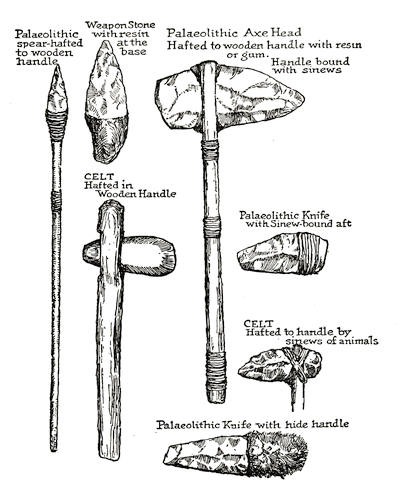
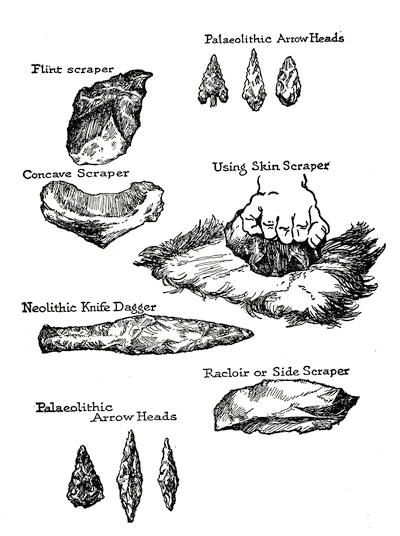
making things, such as pottery, stone implements
of all sorts, weapons, leather, moccasins, and
smoked meats and fish. They were the workers,
while the tribes outside were the hunters and
fishers. When any man in the outside tribes
killed more deer, or caught more fish, than he
needed, he would bring them to the people in the
valley, and exchange them for spear heads,
smoked meats, pottery, tanned leather, or any of
the other things he needed. This was the very
beginning of barter, or trade. When one tribe
had more than they needed of one thing, and
another tribe had more than they needed of another,
they would exchange with each other, so
that both were better off. This trading of things
between peoples is what makes up the business of
the world to-day. If the people in the United
States have more wheat, or beef than they need,
and the people in England have more leather
goods, or cutlery, or woolen cloth, or the people in
France more silks and satins, we send our wheat
or beef, or cotton to them, and bring back their
leather goods, or cutlery, or silk.
In the beginning, it was very easy for a hunter
to bring a bundle of skins, or a string of fish into
the valley, and exchange it for what he needed,
a stone axe, or a leather coat, or a pottery bowl.
Later on, when the tribes of men had spread far
over the country, it often happened that the
hunter who brought a bundle of skins to one
tribe, did not want to buy anything from that
tribe, but instead, wanted to go to some other
tribe, a long distance off, to get something they
had which he particularly wanted. This made a
difficulty, and to overcome it, something was
needed that could be exchanged with any tribe,
and yet could be easily carried about, on long
journeys. So the people began to use beads, and
later on, when metals had been discovered, ornaments
such as bracelets, or rings made of copper,
or gold, and these beads and ornaments became
the first money used by man. But this came later
on; now the traders exchanged one thing for another,
just as they do in savage countries to-day.
There were some grasses which grew in the
valley, which bore tiny hard seeds or grains on
their tops, and for a long time the cave people
had made use of these grains for food, when other
things were scarce. After a while, they noticed
that if they let any of these grains fall in the soft
earth, they would grow up again, and have more
grains on them. They saw that this was an easy
way to get food, so they took the grains and
planted them, scratching up the hard ground with
the points of their spears. Later on they made a
tool something like a hoe, by fastening a sharp
piece of stone crosswise at the end of a stick, and
used this to loosen the ground for planting
the grain.
All the grains, such as wheat, corn, rye, or oats,
the roots, such as potatoes, beets, carrots, parsnips,
and the like, and the many other vegetables
we eat, once grew wild, and were very small and
hard. But every sort of plant grows better, and
has larger seeds and roots and fruit, if it is cultivated,
that is, if the soil in which it grows is
loosened up and made soft, so that the rain can
easily get to its roots, and the roots can spread
out, sucking moisture and chemicals from the
ground. For this reason the early men found
that the grains, or roots which they planted, kept
growing larger and better to eat, year after year,
and as the valley and the country around it became
filled with people, and food became scarce
and harder to get, the people in the valley who
did not move away began to plant and grow
many of these roots and grains, and they were the
first farmers. As Mother Nature had so often
told the Sun, it was the search for food, the struggle
to keep alive, that taught the first people
almost everything they knew.
At first, the people chewed the hard grains,
and swallowed them, just as they would eat nuts,
but it was a good deal of trouble to do this, so
while the men were away hunting, the women
would take the grains and pound them up in a
hollow stone, with another stone, round and
smooth, and sometimes having a handle to it.
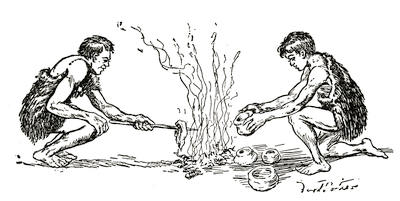
This made a coarse kind of flour. Adding a little
water to it, they mixed a sort of paste, which
they moulded into little cakes and placed in the
sun to dry. In this way they made the first
bread. Later on, instead of drying these cakes
in the sun, they found they could do it more
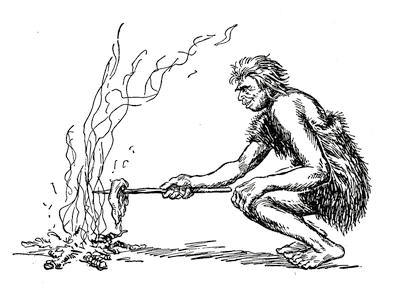
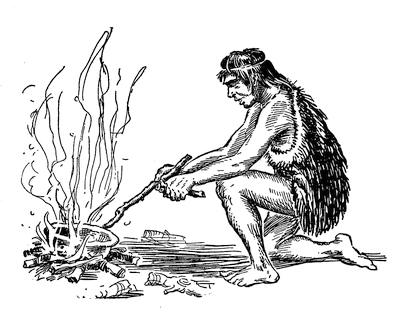
quickly by placing them on flat stones, heated
very hot in a fire, and these cooked cakes of oats,
and wheat and rye soon became one of their chief
articles of food.
They found it easy to keep the grains and roots
during the winter by storing them in their caves,
usually in great earthen jars. They tried to keep
some of the fruits in this way too, berries, and
wild grapes, but the fruits would not keep. Instead,
they turned sour and fermented, forming
wine, which the people drank, when they were
tired, and cold, to cheer them up. Among the
very earliest peoples of which we have any record,
wine was used; we find it spoken of often in
the Bible, and the writings on the tablets of clay
dug up in the most ancient ruins. Living as they
did a rough life in the open air, these early
peoples could drink wines without harm. It
was not until thousands of years later that men
found out how to distil the strong spirits and
liquors which are so harmful to people living the
indoor lives we lead to-day.
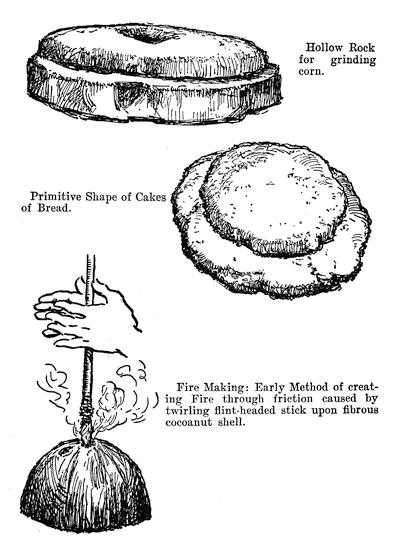
EARLY METHODS OF BREAD AND FIRE MAKING
The valley people were by now no longer savages.
Even in the arts they had made some
progress. Their pottery bowls and jars were
ornamented with designs in black, and red and
other crude colours. They made ornaments of
beads, and painted designs on their leather clothing,
or sewed coloured beads on them, in various
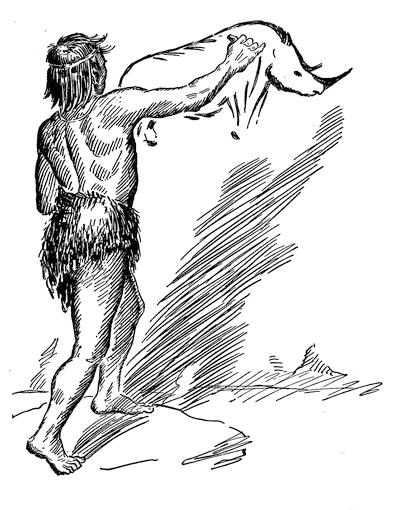
patterns. The walls of their caves were covered
with rude pictures or drawings, they carved drinking
cups from the horns of the animals they
killed, and their stone axes and other implements
were smooth and polished, and sometimes carved
with pictures and rude signs like letters. Weaving
had begun among them, as well as among the
sea tribes, but the cords they wove together, instead
of being made of grass, were of twisted
hair, or wool, scraped from the skins of animals.
They were much more civilized than the people
who lived by the sea, for although the sea people
had made boats, with sails, and hooks and nets for
catching fish, they knew nothing of planting
grains, or making bread from them. Each people
was going ahead in its own way.
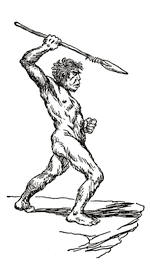
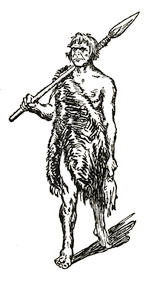
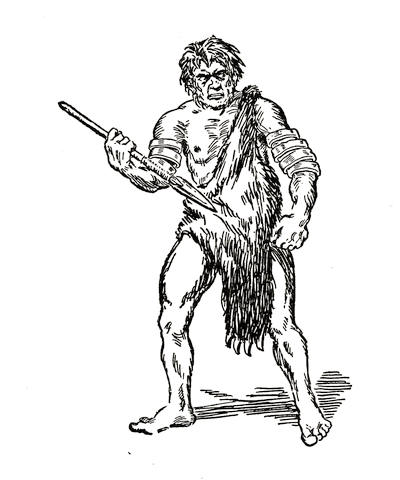
Among the hunters who spread from the valley
into the surrounding country was a young
chief named Ban. He was very strong and
brave, and nobody in his tribe could throw the
spear so far, or strike so hard a blow with the axe.
Being a mighty hunter, he pushed farther and
farther away from the valley, always seeking the
places where the most game was to be found.
Year after year he and his tribe moved nearer to
the sea, but this they did not know, for they had
never seen it.
One night, while chasing a huge bear, Ban and
his hunters reached the top of some low hills, and
here, having killed the bear, they made a camp
and slept. In the morning, Ban, who had climbed
upon a tall rock, found himself looking over a
great wide valley, which sloped down and down,
mile after mile, until the far side of it was lost in
the morning mists. Soon the sun dried up the
mists, and there, far away, was a wide strip of
water, shining in the early sunlight like a river of
silver. Ban called some of his companions to
him, and they gazed at it a long time in silence.
They knew it was water, but they did not know
it was the ocean, but supposed it to be a great
river.
Ban was tired of living in the hills, and wanted
to find a new home where fish and game were
more plentiful, so he told his companions to
go back and bring up the whole tribe.
Soon they came, several hundred of them, the
young men with their weapons, the old men, the
women and children bringing the pottery bowls,
the furs and skins, the food. They left the brush
huts they had been living in, and swarmed down
the slope of the hillside like so many bees. Whenever
the early tribes got tired of living in one
place, and decided to find another home, they
moved like this, in a great swarm, just as bees
do when the hive becomes overcrowded, and some
must seek a new place to live in. Later on, when
there were many more people on the earth, these
great movements or migrations of tribes and races
were made by hundreds of thousands, and even
millions, wandering through the country for
thousands of miles, destroying everything in their
path, and finally coming to rest in a new home,
and founding a new nation.
Ban and his people moved slowly toward the
sea, hunting and camping as they went. At last
one day they came to the seashore, and stood on
the smooth white sand, gazing at the ocean in
wonder. They saw no one about, and there
was very little to eat, so they set out along the
shore, hoping to find a better place to make
a camp.
For two days they wandered along the ocean,
shooting wild-fowl, catching some turtles, and
killing a few seals they saw on the rocks. When
they found they could not drink the ocean water,
some of them wanted to go back to the hills, but
Ban would not let them.
"Let us keep on," he said. "Somewhere there
will be water we can drink." So they went on,
slaking their thirst with the blood of the birds and
animals they killed, or with rainwater they found
in hollows in the rocks.
On the third day, some of Ban's men, who had
been going on ahead, came back, and said that
they saw smoke rising into the air, far up the
beach. They thought it might come from the
fires of one of the other valley tribes, on a hunting
trip. Ban gave the order to hurry on.
Soon they came to a point of rocks, on which
there were many seals. Far out on the point they
saw some men, hunting them. Ban's people set
up a great shout to these men, who stood looking
at them in surprise.
Ban and some of his fighters called to the
strangers, and the men on the rocks called back,
but neither could understand what the others
said, for in all the many years the children of
Ka-Ma and Tula had lived by the sea, they had
made a new language for themselves, different
from the language of the people of the valley.
When the hill people heard these strange words,
and saw the grass-cloth clothing the sea people
wore, they knew them to be strangers, and not of
the valley tribe. This at once made them
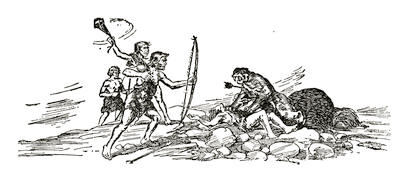
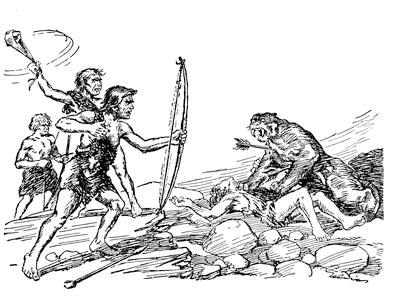
enemies, and they began to throw stones at them
with their slings, and to shoot at them with
arrows, and hurl their spears.
The little band of sea folk fought back as best
they could, but the hill people were too many for
them, and soon they were all killed. Then the
hill men took their weapons, and ornaments, and
clothing, and divided them up, and went on,
shouting, toward the smoke they had seen.
They found other bands of the sea people
along the shore, and some fought and were killed,
while others ran swiftly back toward their homes
to give warning to the tribe.
When Ban and his men reached the village of
huts, a little army of the sea tribe stood ready to
give battle, but they were not many, for most of
the young men were away in their boats, fishing.
A terrible fight now began. The sea folk tried
bravely to defend their homes, and killed many of
Ban's men, but there were not enough of them,
and before long they were overcome. Then the
hill tribe swarmed down on the village, killed the
old men and children, and took the women prisoners
to make them slaves. The village they set
on fire and burned.
Some few of the women escaped, and ran down
to the shore of the river, near where it emptied
into the sea. Here a path led to some rocks,
where the fishermen got aboard their boats.
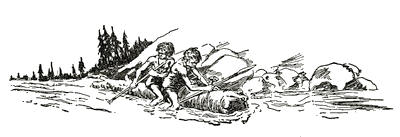
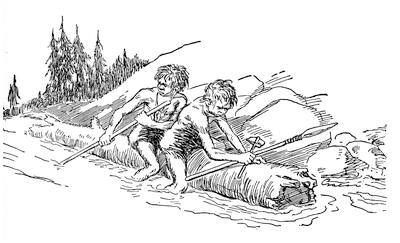
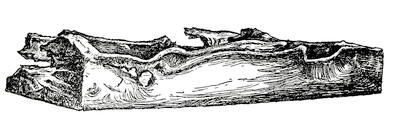
A great log canoe, seeing the smoke from the
burning village, came quickly down the river,
with ten men on each side paddling as hard as
they could. They knew that their people were in
danger, and came to save them. As they reached
the little landing, the women who were huddled
there cried out to them, telling them that a great
army of strange men had killed all their companions,
burned the village, and taken the women
prisoners. At first those in the boat wanted to
come ashore and fight, but in a moment Ban and
his followers came crowding down toward the
landing, shouting, and throwing stones and shooting
arrows. So the men in the canoe quickly
dragged the women aboard, and paddled away
from the shore, out into the middle of the river,
where the hill men could not get at them. Here
many of their companions, who had been fishing
in other canoes, joined them, shouting with rage
at the enemy on shore, and shooting at them with
bows and slings.
The battle raged in this way for hours, but
although more of the sea people came up in their
boats, they were not nearly as many as the hill
men were, because most of the tribe had been
lost in the first battle, defending their homes. So
they dared not go ashore, for they knew if they
did they would be killed.
All night they stayed in their boats, calling out
in rage against their enemies, who shouted back,
daring them to come ashore and fight. In the
morning a storm came up, and scattered the
boats. Some of them were driven ashore, and
the men in them captured or killed by the hill
people. Some were driven out to sea, and being
small and light, were sunk. But the great log
canoe in which the women had taken refuge had
a grass-cloth sail, and the storm drove it far out
over the ocean.
There was a young chief in this boat named
Tul-Ab, who was strong, and skilful and brave.
He divided the water they carried among the men
and women, and gave them fish, which they had
caught, to eat, and sat in the stern of the boat all
night and guided it with a paddle, to keep it from
being upset by the waves. He had heard, when
a child, of the land of the flying birds across the
Great Water, and he hoped that the storm might
carry them there, and so save their lives.
By the next afternoon the weather had cleared,
and Tul-Ab saw in the distance a high, rocky
coast, against which the waves were beating
fiercely. He roused the men in the boat, and told
them to take their paddles and keep the canoe
from being driven ashore until he could find a
safe place to land.
After a time they came to a place where a river
ran through the cliffs into the sea, and here they
found a little harbour, and were able to make a
landing on a quiet beach. Tul-Ab's companions
went ashore and threw themselves on the sand,
tired out after the terrible night. But Tul-Ab
went in search of water, and found some in hollows
in the rocks and filled their jars. Then
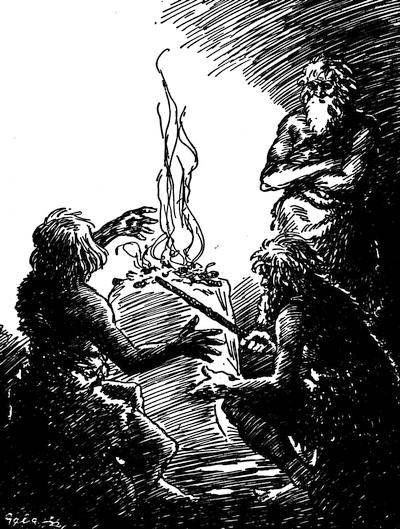
they caught some fish, and made a fire to warm
themselves, and spent the night in some holes in
the side of the cliff.
All these things the Sun had been watching,
and he was sorry to see the sea folk destroyed.
When Mother Nature came to look at the earth,
he spoke to her.
"What is the use of making such a nice tribe by
the sea, and then letting the people from the hills
kill them?" he asked sourly.
"They are not all killed," Mother Nature replied,
laughing at him. "I wanted some of them
to go to that big island they have just found, and
so I let Ban and his people come and drive
them there."
"Why did you want them to go to the island?"
asked the Sun. "Weren't they getting along
very nicely where they were?"
"Yes. They learned many things. But here,
on this new island, they will learn much more. It
is a very large island, as you can see, and there
are metals on it, and many other new things for
them to find out about. If I don't spread my
new men around a little, they will always stay in
one place, and the earth will never be populated."
"It is a pity they have to fight, and kill each
other," the Sun said.
"Yes," said Mother Nature. "It is a pity, but
men are going to keep on fighting and killing
each other for thousands and thousands of years.
The battle you saw between the sea people, and
the tribe from the hills, was the beginning of
war. These two peoples hated each other, because
their language, and their clothes, and their
ways of living, were different. And as one tribe
hates another, for these reasons, so will nations,
which are only great tribes after all, hate each
other, and fight and kill, for a very long time indeed,
even after they have become what they call
civilized, and fight with terrible engines of war,
which fly in the air, and swim under the water,
and blow thousands of persons to pieces in a single
moment. That is the law of force, that the
strong must overcome the weak, and only when
man has become really civilized, and learned the
law of love, will fighting stop. They have to
fight now, for in that way they become strong,
and brave, and get courage to conquer the
winds and the sea, and the cold and heat, and
spread to all the parts of the earth. Not until
long after this is done will men learn that they all
belong to one great tribe, and that it is not necessary
to fight each other any longer, but to help
each other. It is the same on all my other worlds—the
people fight each other for a long time,
like bad children, until one day they find that
they are not children any longer, but grown up
men and women, and then they do not fight
any more."
"I should think that God would make them
that way in the first place," grumbled the Sun.
"He could, you foolish creature," said Mother
Nature, with a frown, "but if He made His people
and His worlds perfect to begin with, there
would be no need to create them at all. God is
like a weaver, weaving a wonderful pattern. He
finds joy in His work. If it were all finished as
soon as it was begun, even God Himself would
have no purpose. All things must grow slowly
and beautifully, from the seed to the plant, from
the plant to the tree, from the tree to the perfect
fruit. You, Sun, are growing too. Some day,
your heat will be gone, and you will grow old and
die. You will be cold, and dark, without any
light to shine with. Then it may be that the
Great Mind that made you, will cause you to live
again. Meanwhile, do each day what you have
to do, and stop grumbling about things you do
not understand."