PETER STARKLEY got home to
Beaver Dam for New Year's Day
on a six days' pass. Jim Hammond
had also tried to get a pass, but he had
failed. Peter found his homesickness increased
by those six days; but he made
every effort to hide his emotions. He
talked bravely of his duties and his comrades,
and especially of Dave Hammer.
He said nothing about Jim Hammond except
when questioned, and then as little as
possible.
He polished his buttons and badges every
morning and rolled his putties as if for
parade. The smartness of his carriage
gave a distinction even to the unlovely khaki
service uniform of a British noncommissioned
officer. He looked like a guardsman
and felt like a schoolboy who dreaded the
approaching term. He haunted the barns
and stables of the home farm and of his
own place and tramped the snow-laden
woods and blanketed fields. In spite of
his efforts to think only of the harsh and
foreign task before him, he dreamed of
clearings here and crops there. The keen,
kindly eyes of his parents saw through to
his heart.
One day of the six he spent in the village
of Stanley. He called first at Hammond's
store, where he tried to give Mr. Hammond
the impression that he had dropped in
casually, but as he had nothing to sell and
did not wish to buy anything he failed to
hoodwink the storekeeper. Mr. Hammond
was cordial, but seemed worried.
He complimented Peter on his promotion
and his soldierly appearance.
"Glad you got home," he said. "Wish
Jim could have come along with you, but
he writes as how they won't give him a
pass. Seems to me it ain't more than only
fair to let all the boys come home for Christmas
or New Year's."
"Then there wouldn't be any one left to
carry on," said Peter. "They've fixed it
so that those who have been longest on the
job get the first passes; but I guess every one
will get home for a few days before we
sail."
"Jim says the training—the drill and all
that—is mighty hard," continued Mr. Hammond.
"Some find it so, and some don't," replied
Peter awkwardly. "I guess it's what
you might call a matter of taste."
"Like enough," said the storekeeper,
scratching his chin. "It's a matter of
taste—and not to Jim's taste, that's
sure."
Peter felt relieved to see that Mr. Hammond
seemed to understand the case. He
was about to elaborate on the subject of
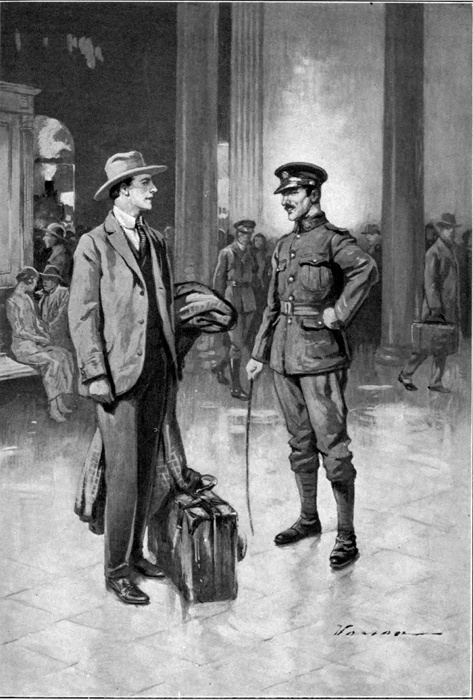
military training when a middle-aged man
wearing a bowler hat and a fur-lined overcoat
turned from the counter. He had a
square, clean-shaven face and very bright
and active black eyes.
"Excuse me, corporal," the stranger said,
"but may I horn in and inquire what you
think of it yourself?"
"You can ask if you want to, Mr. Sill,"
said Mr. Hammond, "but you won't hear
any kick out of Peter Starkley, whether he
likes it or not."
"It's easier than working in the woods,
either chopping or teaming," said Peter
pleasantly, "and I'll bet a dollar it is a
sight easier than the real fighting will
be."
"That's the way to look at it, corporal,"
said the stranger. "I guess that in a war
like this a man has to make up his mind
to take the fun and the ferocity, the music
and the mud, and the pie and the pain,
just as they come."
"I guess so," said Peter.
The stranger shook his hand cordially
and just before he turned away remarked,
"Maybe you and I will meet again sooner
than you expect."
"Who is he, and what's he driving at?"
asked Peter, when the stranger had left
the store.
"He is a Yank, and a traveler for Maddock
& Co. of St. John, and his name is
Hiram Sill—but I don't know what he is
driving at any more than you do," replied
Mr. Hammond.
The storekeeper invited Peter to call
round at the house and to stay to dinner and
for as long as he liked afterwards. Peter
accepted the invitation. The Hammond
house stood beside the store, but farther back
from the road. It was white and big, with
a veranda in front of it, a row of leafless
maples, a snowdrifted lawn and a picket
fence. Vivia Hammond opened the door
to his ring. From behind the curtain of
the parlor window she had seen him approach.
At dinner Peter talked more than was
usual with him; something in the way the
girl listened to him inspired him to conversation.
At two o'clock he accompanied her
to the river and skated with her. They
had such parts of the river as were not
drifted with snow to themselves, except for
two little boys. The little boys, interested
in Peter as a military man, kept them constantly
in sight. Peter felt decidedly hostile
toward those harmless boys, but he was
too shy to mention it to Vivia. He was delighted
and astonished when she turned
upon them at last and said:
"Billy Brandon, you and Jack had better
take off your skates and go home."
"I guess we got as much right as anybody
on this here river," replied Billy Brandon,
but there was a lack of conviction in his
voice.
"You were both in bed with grippe only
last week," Vivia retorted; "but I'll call in
at your house and ask your mother about
it on my way up the hill."
The little boys had nothing to say to that.
They maintained a casual air, skated in circles
and figures for a few minutes and then
went home. For ten minutes after that the
corporal and the girl skated in an electrical
silence, looking everywhere except at each
other. Then Peter ventured a slanting
glance across his left shoulder at her little
fur-cuddled face. Their eyes met.
"Poor Mrs. Brandon can't manage those
boys," she said. "But they are very good
boys, really. They do everything I tell
them."
"Why shouldn't they? But I'm glad
they're gone, anyway," he replied, in a voice
that seemed to be tangled and strangled in
the collar of his greatcoat.
When Vivia and Peter returned to the
house the eastern sky was eggshell green
and the west, low along the black forests,
as red as the draft of a stove. Their conversation
had never fully recovered after
the incident of the two little boys. Wonderful
and amazing thoughts and emotions
churned round in Peter's head and heart,
but he did not venture to give voice to them.
They bewildered him. He stayed to tea
and at that comfortable meal Mr. and Mrs.
Hammond did the talking. Vivia and
Peter looked at each other only shyly as if
they were afraid of what they might see in
each other's eyes.
At last Peter went to the barn and harnessed
the mare. Then he returned to the
house to say good night to the ladies. That
accomplished, Vivia accompanied him to
the front door. Beyond the front door, as
a protection against icy winds and drifting
snow, was the winter porch—not much bigger
than a sentry box. Stepping across the
threshold, from the warm hall into the
porch, Peter turned and clutched and held
the girl's hand across the threshold. The
tumult of his heart flooded up and smothered
the fear in his brain.
"I never spent such a happy day in all
my life," he said.
Vivia said nothing. And then the mischief
got into the elbow of the corporal's
right arm. It twitched; and, since his
right hand still clasped Vivia's hand, the
girl was jerked, with a little skip, right out
of the hall and into the boxlike porch.
Two seconds later Peter pulled open the
porch door and dashed into the frosty night.
He jumped into the pung, and away went
the mare as if something of her master's
madness had been communicated to her.
The corporal had kissed Vivia!
Peter returned to his battalion two days
later. In St. John he found everything
much as usual. Hammer was as brisk and
soldierly as ever, but Jim Hammond was
more sulky than before. Peter considered
the battalion with a new interest. Life,
even away from Beaver Dam, seemed more
worth while, and he went at his work with
a jump. He wrote twice a week to Vivia,
spending hours in the construction of each
letter and yet always leaving out the things
that he wanted most to write. The girl's
replies were the results of a similar literary
method.
The training of the battalion went on,
indoors and out, day after day. In March,
Jim Hammond went home for six days.
By that time he was known throughout the
battalion as a confirmed sulker. The six
days passed; the seventh day came and went
without sight or news of him, and then the
adjutant wired to Mr. Hammond. No
reply came from the storekeeper. Lieut.
Scammell questioned Peter about the family.
Peter told what he knew—that the
Hammonds were fine people, that one son
was an officer already in England, and that
the father was an honest and patriotic citizen.
So another wire was sent from the
orderly room. That, like the first, failed
to produce results.
The adjutant, Capt. Long, then sent for
Peter. This officer was not much more than
five feet high, despite the name of his
fathers, and was built in proportion. It
tickled the humor of the men to see such a
little fellow chase ten hundred bigger fellows
round from morning until night.
"You are to go upriver and find out why
Private Hammond has not returned to
duty," said the captain.
"Yes, sir," said Peter.
"Inform me by wire," continued the captain.
"Use your brains. I am sending
you alone, because I want to give Hammond
a chance for the sake of his brother
overseas. Here are your pass, your railway
warrant and a chit for the paymaster.
That's all, Corp. Starkley."
Peter saluted and retired. He reached
Fredericton that night and the home village
of Jim Hammond by noon of the next
day. He went straight to the store, where
Mr. Hammond greeted him with astonishment.
Peter saw no sign of Jim.
"I didn't expect to see you back so soon,"
said Mr. Hammond.
"I got a chance, so I took it," replied
Peter. "How's all the family?"
The storekeeper smiled. "The womenfolk
are well," he said.
Peter saw that he had come suddenly to
the point where he must exercise all the
tact he possessed. He felt keenly embarrassed.
"Did you get a telegram?" he asked.
"No. Did you wire us you were coming?"
"Not that, exactly. You see, it was like
this, Mr. Hammond: when Jim didn't get
back the day he was due the adjutant sent
you a wire, and when he didn't get an
answer he sent another—and when you
didn't reply to that he detailed me to come
along and see what was wrong."
The storekeeper stared at him. "I never
got any telegram. Jim came home on two
weeks' furlough, and he has five days of it
left. You and your adjutant must be
crazy."
"Two weeks," repeated Peter. "It was
six days he got."
"Six days! Are you sure of that, Peter
Starkley?"
"As sure as that's my name, Mr. Hammond.
And the adjutant sent you two
telegrams, asking why Jim didn't return to
duty when his pass was up—and he didn't
get any answer. If you didn't get one or
other of those telegrams, then there is something
wrong somewhere."
Mr. Hammond's face clouded. "I didn't
get any wire, Peter—and Jim went away
day before yesterday, to visit some friends,"
he said.
They eyed each other in silence for a
little while; both were bitterly embarrassed,
and the storekeeper was numbed with
shame.
"I'll go for him," he said. "If I fetch
him to you here, will you promise to—to
keep the truth of it quiet, Peter—from his
mother and sister and the folk about here?"
"I'll do the best I can," promised the
corporal, "but not for Jim's sake, mind you,
Mr. Hammond. Capt. Long is for giving
him a chance because of his brother, Pat,
over on Salisbury Plain—and that's why he
sent me alone, instead of sending a sergeant
with an escort."
"I'll go fetch him, Peter," said the other,
in a shaking voice. "You go along to
Beaver Dam and come back to-morrow—to
see Vivia. When Jim and I turn up you
meet him just like it was by chance. Keep
your mouth shut, Peter. Not a word to a
living soul about his only having six days.
He's not well, and that's the truth."
A dull anger was awake in Peter by this
time.
"Something the matter with his feet," he
said and left the store.
Here he was, told to be tactful by Capt.
Long and to keep his mouth shut by Mr.
Hammond, all on account of a sulky, lazy,
bad-tempered fellow who had been a disgrace
to the battalion since the day he
joined it. And not a word about stopping
for dinner!
He crossed the road to the hotel, made
arrangements to be driven out to Beaver
Dam and then ate a lonely dinner. He
thought of Vivia Hammond only a few
yards away from him, yet unconscious of
his proximity—and he wanted to punch the
head of her brother Jim. He drove away
from the hotel up the long hill without venturing
a glance at the windows of the big
white house on the other side of the road.
The family at Beaver Dam accepted his
visit without question. No mention was
made of Jim Hammond that night. Peter
was up and out early the next morning, lending
a hand with the feeding and milking.
After breakfast he and Dick went over
to his own place to have a look at his house
and barns.
"Frank Sacobie came home last week,"
said Dick. "He's been out to see us twice.
He wants to enlist in your outfit, but I am
trying to hold him off till next year so's we
can go over together."
"You babies had better keep your bibs on
a few years longer," said Peter. "I guess
there will be lots of time for all of you to
fight in this war without forcing yourselves
under glass."
They rounded a spur of spruces and saw
Sacobie approaching on snowshoes across
the white meadows. He had grown taller
and deeper in the chest since Peter had last
seen him. The greeting was cordial but not
wordy. Sacobie turned and accompanied
them.
"I see Jim Hammond yesterday, out Pike
Settlement way," he said.
"That so?" returned Peter, trying to
seem uninterested.
"No uniform on, neither, and drinkin'
some," continued Sacobie. "Says he's got
his discharge from that outfit because it
ain't reckoned as first-class and has
been asked to be an officer in another outfit."
Then Peter forgot his instructions. Jim
Hammond too good for the 26th battalion!
Jim Hammond offered a commission! His
indignant heart sent his blood racing
through him.
"He's a liar!" he cried. "Yes, and a deserter,
too, by thunder!"
Dick was astonished, but Frank Sacobie
received the information calmly, without so
much as a flicker of the eyelids.
"I think that all the time I listen to him,"
he said. "I figger to get his job, anyway,
if he lie or tell the truth. I go down to-morrow,
Peter, and you tell the colonel
how I make a darn sight better soldier than
Jim Hammond."
Peter gripped the others each by an
arm.
"I shouldn't have said that," he cautioned
them. "Forget it! You boys have got to
keep it under your hats, but I guess it's up
to me to take a jog out Pike Settlement way.
If you boys say a word about it, you get in
wrong with me and you get me in wrong
with a whole heap of folks."
They turned and went back to Beaver
Dam. There they hitched the mares to the
big red pung and stowed in their blankets
and half a bag of oats.
"I can't tell you where I'm going or
what for, but only that it is a military duty,"
said Peter in answer to the questions of the
family.
He took Dick and Frank Sacobie with
him. Once they got beyond the outskirts of
the home settlement they found heavy sledding.
At noon they halted, blanketed and
baited the mares, boiled the kettle and
lunched. The wide, white roadway before
them, winding between walls of green-black
spruces and gray maples, was marked with
only the tracks of one pair of horses and one
pair of sled runners—evidently made the
day before. Peter guessed them to be those
of Mr. Hammond's team, but he said nothing
about that to his companions.
Here and there they passed drifted clearings
and little houses sending blue feathers
of smoke into the bright air. They came to
places where the team that had passed the
previous day had been stuck in the drifts and
laboriously dug out.
They were within two miles of the settlement,
between heavy woods fronted with
tangled alders, when the cracking whang!
of exploding cordite sounded in the underbrush.
The mares plunged, then stood.
The reins slipped from Peter's mittened
hands.
"I'm hit, boys!" he said and then sagged
over across Dick's knees.
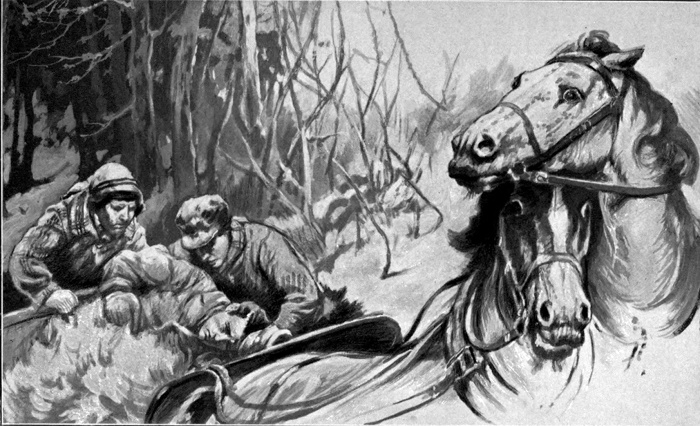
"'I'M HIT, BOYS!' HE SAID."
They laid him on hay and horse blankets
in the bottom of the pung and covered him
with fur robes. Then Sacobie got up in
front and drove.
No sound except the rapping of a woodpecker
came from the woods. Peter
breathed regularly. Presently he opened
his eyes.
"It's in the ribs, by the feel of it—but
it doesn't hurt much," he said. "Felt
like a kick from a horse at first. Remember
not to say anything about Jim Hammond."
They put him to bed at the first farmhouse
they reached. All his clothing on
the right side was stiff with blood. Dick
bandaged the wound; and a doctor arrived
two hours later. The bullet had nipped
in and out, splintering a rib, and lay just
beneath the skin. Peter had bled a good
deal, but not to a dangerous extent.
Before sunrise the next morning Dick
and Frank Sacobie set out on their return
journey, taking with them a brief telegram
and a letter for Capt. Long. Peter had
dictated the message, but had written the
letter with great effort, one wavery word
after another.
Mr. Hammond and John Starkley
reached Pike Settlement late at night. The
storekeeper seemed broken in spirit, but
some color came back to his face when he
saw Peter lying there in the bed at the farmhouse
with as cheerful an air as if he had
only strained his ankle.
"I must see you a few minutes alone before
I leave," he whispered, stooping over
the bed.
"Don't worry," answered Peter.
John Starkley was vastly relieved to find
his son doing so well. His bewilderment
that any one in that country should pull a
trigger on Peter almost swamped his indignation.
The more he thought it over the
more bewildered he became.
"You haven't an enemy in the world,
Peter—except the Germans," he said. "But
that was no chance shot. If it had been an
accident, the fellow with the rifle would
have come out to lend a hand."
"I guess that's so," replied Peter.
"Maybe it was a German. It means a lot
to the Kaiser to keep me out of this war."
His father smiled. "Joking aside, lad,"
he said, "who do you suppose it was?
What was the bullet? Many a murderer
has been traced before now on a less likely
clue than a bullet."
"Isn't the bullet on the table there, Mr.
Hammond? The doctor gave it to me, and
I chucked it somewhere—over there or
somewhere."
They looked in vain for the bullet. Later,
when the guests and the household were at
supper, Mr. Hammond excused himself
from table and ran up to Peter's room.
He closed the door behind him, leaned
over the bed and grasped Peter's left hand
in both of his.
"I did my best," he whispered. "I
found him and told him you had been sent
because the officer wanted to give him a
chance. But he had been drinking heavy.
He wasn't himself, Peter—he was like a
madman. I begged him to come back with
me, but he wouldn't hear reason or kindness.
He knocked me down—me, his own
father—and got away from that house.
What are you going to do, Peter? You
are a man, Starkley—a big man—big
enough to be merciful. What d'you mean
to do?"
"Nothing," said Peter. "I came to find
Jim, and I haven't found him. I got shot
instead by some one I haven't seen hair,
hide or track of. It's up to the army to
find Jim, if they still want him; but as far
as I am concerned he may be back with the
battalion this minute for all I know. I
hope he is. As for the fellow who made a
target of me, well, he didn't kill me, and I
don't hold a grudge against him."
Mr. Hammond went home the first thing
in the morning. John Starkley waited until
the doctor called again and dressed the
wound and said he had never seen any one
take a splintered rib and a hole in the side
so well as Peter.
"If he keeps on like this, you'll be able
to take him home in ten days or so," said
the doctor.
So John Starkley returned to Beaver
Dam, delivered the good news to his family
and heard in return that young Frank
Sacobie had gone to St. John and joined the
26th.