THE GERMAN ADVANCE ON PARIS—THE GOVERNMENT
QUIT THE CAPITAL FOR BORDEAUX—THE FORTIFICATIONS
OF PARIS—PREPARATIONS FOR A SIEGE—THE
GERMAN CHANGE OF PLAN—SIR JOHN
FRENCH’S DESPATCH—GERMAN VENGEANCE—THE
FAILURE OF THE CROWN PRINCE’S ARMY—DECLARATION
OF THE TRIPLE ENTENTE—CONCLUSION.
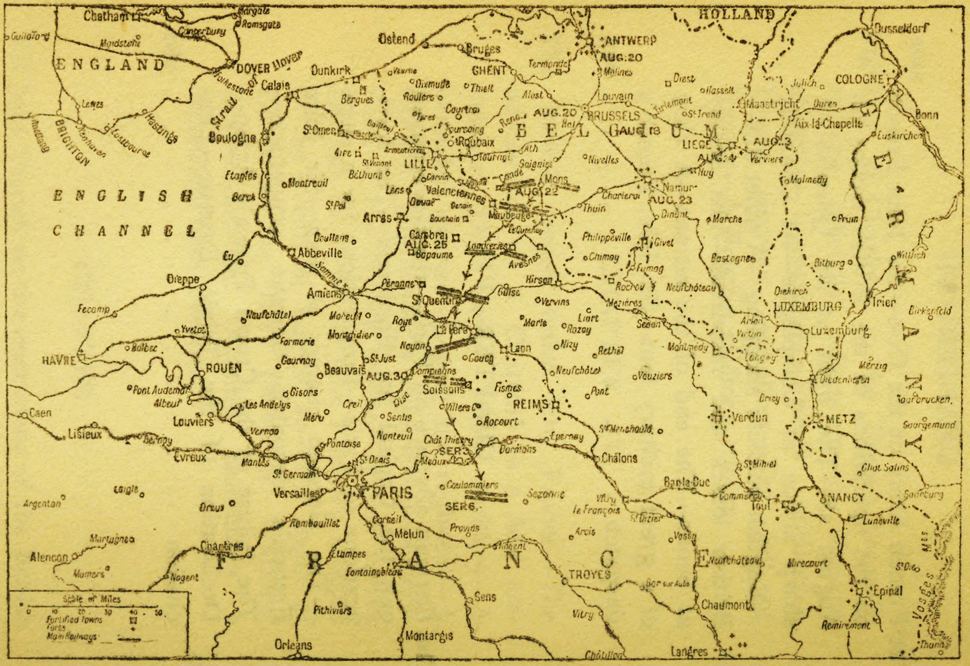
On September 2 the Germans were in the
neighbourhood of Senlis, which is situated
only 30 miles from Paris. The advance of
the enemy had been steady and it seemed
certain that in the course of a day, or at
most two, the advance guard would have
reached the line of the outer fortifications of
the capital. The lines of the Allies were
still unbroken, and they were falling back
methodically and in good order. The enemy
had failed in cutting off and destroying them,
but that they intended to siege Paris seemed
inevitable. And in this event the city would
be placed entirely under military rule. It
was essential, therefore, that the Government
should avoid being bottled up in the city.
As happened in 1870, for these reasons the
French Government decided to quit Paris for
the time being and proceeded to Bordeaux,
and before doing so, on September 2, the
following proclamation was addressed to the
country by the President and Ministers:—
For several weeks sanguinary combats
have taken place between our heroic troops
and the enemy’s army. The bravery of our
soldiers has gained for them at several points
marked successes, but to the north the pressure
of the German forces has compelled us
to retire.
This situation imposes upon the President
of the Republic and the Government the
painful decision that in order to watch over
the national safety the duty of the authorities
is to leave Paris.
Under the command of an eminent leader,
a French army full of courage will defend
the capital and the patriotic population
against the invader; but the war must be
continued at the same time on the rest of the
territory without peace or truce, without stay
or weakness.
The sacred struggle for the honour of the
nation and reparation for violated right will
continue.
None of our armies has been broken. If
some have sustained too perceptible losses,
the gaps will be immediately filled from the
depôts, and the call for recruits assures us
for the morrow new resources in men and
energy to endure and fight.
That must be the watchword of the allied
British, Russian, Belgian, and French
armies—to endure and to fight whilst on the
sea the British aid us to cut the communications
of our enemies with the world; to endure
and to fight whilst the Russians continue
to advance to deal a decisive blow at the
heart of the German Empire.
To the Government of the Republic belongs
the duty of directing this stubborn
resistance everywhere for French independence.
To give this formidable struggle all its
ardour and all its efficacy it is indispensable
that the Government should remain free to
act on the demand of the military authorities.
The Government is removing its residence
to a point where it can remain in constant
relations with the whole of the country.
The National Government does not leave
Paris without having assured the defence of
the city and the entrenched camp by all the
means in its power. The Government
knows there is no need to advise the Parisian
population to calmness, resolution, and
coolness.
Frenchmen, be worthy in these tragic circumstances.
We shall obtain a final victory.
We shall obtain it by untiring will, by endurance
and tenacity.
A nation which does not desire to perish,
and which wishes to live, recoils neither
before suffering nor sacrifices, is sure of
conquering.
Although a large number of the inhabitants
had left the capital, those who remained
maintained a calm demeanour. There was
no panic, only strenuous preparations for an
energetic defence. Some of the public
buildings, including the Louvre, had been
protected above against damage from shells
or bombs dropped from aircraft, and the
most valued treasures of that museum had
been withdrawn to a place of safety.
A correspondent of the Central News
wrote from Paris:—
Few of the thousands of artists and art-lovers
who have been wont to visit the
Louvre daily for instruction or pleasure
would recognise their haunt now. For the
last four weeks the staff has been working
hard to carry out the measures ordered for
the protection of the chief works of art from
what a French paper says is the only danger
that menaces them—aerial bombs.
In 1870 the “Venus” of Milo was walled
up in a subterranean niche. The advance of
civilisation has evolved a more prosaic and
more effective protection, and she is now
enclosed in a steel room. The “Winged
Victory” is sheltered behind heavy iron
plates, and the “Gioconda” smiles in obscurity
as inscrutably as ever. The Grecian
Hall, which contains the masterpieces of
Phidias, is protected by sacks filled with
earth against any aerial attack. The upper
stories of the Louvre, with their glass roofs,
have been turned into hospitals, and the flag
of the Red Cross protects the works which
remain there.
Many paintings and statues have been
transferred from the Luxembourg to the old
Seminaire, which will henceforth contain the
collection, and in all the other galleries, both
private and public, the treasures of art are
being hidden underground or placed behind
heavy screens.
Even with such a danger as a siege imminent,
it was recognised that the enemy’s
task was very great. His object was
obviously to push on to Paris as rapidly
as possible in order to disturb the preparations
for the defence of the city. M. Millerand,
however, from the first day of taking
office, ordered Paris to be got ready for immediate
defence; while General Gallieni, an
excellent commander and administrator, lost
no time, and the work of preparing the
defences proceeded without intermission, day
and night. As the Paris correspondent of
the Daily Telegraph said:—
Only an army of two million men could
invest the entrenched camp of Paris with its
outlying forts. The very worst eventuality
to be considered is a successful raid of the
vanguard of what may be left of the German
advancing column into Paris. The German
advance has undoubtedly been very strong,
and has not been withstood with success anywhere
up till now. The rush may at this
moment have been stopped. Should it not
be, and should the desperate onrush of a certain
number of German army corps break
through the French army, the enemy would
come up against the forts surrounding Paris.
Should the German advance column reach
these forts, it will arrive there already to
some extent spent, and certainly with its line
of communication cut off. If there is a battle
outside the forts of Paris it will be a desperate
encounter, and it is not likely that the
German force engaged will live to tell the
tale.
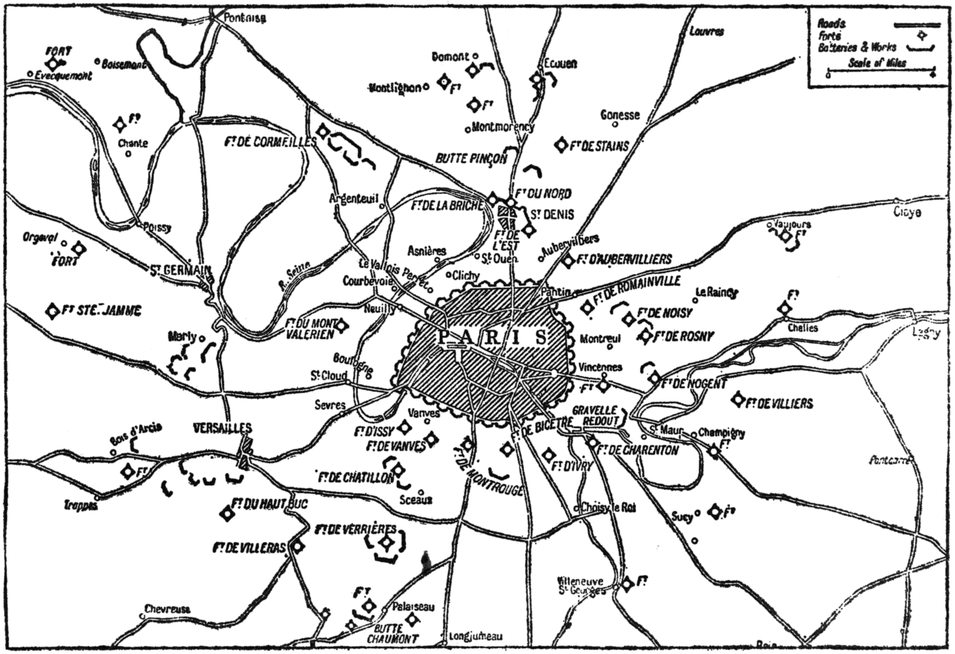
In describing the fortifications of Paris, he
says:—
The defensive works forming the almost
impregnable perimeter of forts and earthworks
around Paris would be nearly impossible
to invest by an invading army with a
field army in opposition, or would require an
enormous army for the purpose.
There are three lines of defences round
Paris—the first is the belt of old fortification
encircling the city, and built under the premiership
of M. Thiers in the reign of Louis
Philippe, and these old walls and earthworks
were of little use in 1870. Since 1878 a
second ring of fortified positions was built,
though it does not form a continuous circumference
of defensive positions, but several
separate fortresses.
The threatened approach to Paris lies to
the north, therefore these may be described
first. A number of very strong positions lie
between the Oise and the Seine—the middle
of these powerful lines resting mostly on hilly
eminences in the Forest of Montmorency.
The backbone, so to speak, of these defensive
works is composed of a number of forts.
Beginning with the defences of the Seine,
we have the Fort of Cormeilles, with the
Redoubt of Francaville in front, as well as
that of Les Cotillons supported throughout
by a number of batteries. The strong
fortified position of Cormeilles stands at
nearly 500 feet above the Seine. The slopes
are steep, and for defence these groups are
of great power.
The Valley of Ermont lies between the
great works of Cormeilles and the Forest of
Montmorency, but these forts and those of
Montlignon and Montmorency, placed on the
south-west fringe of the forest, sweep the
valley. At the north-east of the forest is
the Fort of Domont, and further on a pile
covered with trees, another strong defensive
group exists, including the Fort of Ecouen
and several connected batteries.
Southwards are the Forts of Stains and
the battery of Pincon Hill. This remarkably
powerful fortress, with its dependent
defences composed of batteries, permanent
trenches, timber-cleared expanses for shooting,
and barbed wire fences, render it secure
against a surprise attack. To the east of St.
Denis there is a low-lying plain showing no
favourable point for fortification, but which
can be flooded by the Rivers Morée and the
Trond. This plain is also exposed to the
fire of the Fort of Stains and the battery of
the “Butte Pincon,” and the defensive works
of Vaujours to the south.
The Fort of Vaujours and that of Chelles
bar access to Paris in the passage between
the “Canal de l’Durque” and the Marne.
Higher up the Marne than Chelles, and between
that river and the Seine, the Forts of
Villiers, Champigny, Sucy, and Villeneuve
St. Georges have been constructed. These
fortified bulwarks of Paris are exceedingly
strong. The defensive lines on the Marne
from Chelles to Charenton form a rampart
against any surprise rush, and as the positions
of Montmorency and between Vaujours
and Chelles, the fixed defences, have been
greatly strengthened by batteries, felled
timber and trenches, wire obstacles, and
other devices, a most determined resistance
could be made in this “sector” of fortified
positions. Some improvised field works
have been constructed all round Paris, therefore
there is no need to describe them in
detail.
Between the Seine and Palaiseau there are
no permanent fortifications in the wide plain,
but no attack could be made in this direction
or in the Plain of St. Denis unless the
powerful fortifications which can concentrate
their fire on these passages had been silenced.
The fortifications of an earlier date are
completely free from a possible dash and
render these zones literal mouse-traps. Like
Montmorency, the forts of Palaiseau, Villiers,
Haut Buc, Saint Cyr, and the batteries
of the Bois de Verrières to the south of Versailles
form a real fortress, of which the Fort
de Chatillon is the mainstay behind.
Behind Versailles and St. Germain, the
Forest of Marly is literally enclosed by batteries
outlying the extreme strong works of
“Le Trou de Fer.” Behind this group
stands the high and prominent fort of Mont
Valérien, which still maintains great military
value for defence.
While Paris was waiting for the approach
of the enemy, he altered his plans and made
an unexpected move. As Sir John French
said in his despatch of September 15:—
On Friday, September 4, it became apparent
that there was an alteration in the
direction of advance of almost the whole of
the First Germany Army. That army, since
the battle near Mons, on August 23, had
been playing its part in the colossal strategic
endeavour to create a Sedan for the Allies
by outflanking and enveloping the left of
their whole line, so as to encircle and drive
both British and French to the south. There
was now a change in its objective; and it was
observed that the German forces opposite
the British were beginning to move in a
south-easterly direction, instead of continuing
south-west on the capital.
Leaving a strong rearguard along the line
of the River Ourcq (which flows south, and
joins the Marne at Lizy-sur-Ourcq) to keep
off the French 6th Army, which by then had
been formed, and was to the north-west of
Paris, they were evidently executing what
amounted to a flank march diagonally across
our front. Prepared to ignore the British,
as being driven out of the fight, they were
initiating an effort to attack the left flank of
the French main army, which stretched in a
long curved line from our right towards the
east, and so to carry out against it alone the
envelopment which had so far failed against
the combined forces of the Allies.
On Saturday, the 5th, this movement on
the part of the Germans was continued, and
large advanced parties crossed the Marne,
southwards at Trilport, Sammeroy, La Ferté-sous-Jouarre,
and Château Thierry.
There was considerable fighting with the
French 5th Army on the French left, which
fell back from its position south of the Marne
towards the Seine. On Sunday, the 6th,
large hostile forces crossed the Marne and
pushed on through Coulommiers past the
British right. Farther east they were attacked
at night by the French 5th Army,
which captured three villages at the point of
the bayonet.
On Monday, the 7th, there was a general
advance on the part of the Allies in this
quarter of the field. Our forces, which had
by now been reinforced, pushed on in a north-easterly
direction, in co-operation with an
advance of the French 5th Army to the north
and of the French 6th Army eastwards,
against the German rearguard along the
Ourcq.
Possibly weakened by the detachment of
troops to the eastern theatre of operations,
and realising that the action of the French
6th Army against the line of the Ourcq and
the advance of the British placed their own
flanking movement in considerable danger of
being taken in rear and on its right flank, the
Germans on this day commenced to retire
towards the north-east.
This was the first time that these troops
had turned back since their attack at Mons
a fortnight before, and from reports received,
the order to retreat when so close to Paris
was a bitter disappointment. From letters
found on the dead there is no doubt that
there was a general impression amongst the
enemy’s troops that they were about to enter
Paris.
On Tuesday, the 8th, the German movement
north-eastwards was continued, their
rearguards on the south of the Marne being
pressed back to that river by our troops and
by the French on our right, the latter capturing
three villages after a hand-to-hand
fight and the infliction of severe losses on
the enemy.
The fighting along the Ourcq continued
on this day and was of the most sanguinary
character, for the Germans had massed a
great force of artillery along this line. Very
few of their infantry were seen by the French.
The French 5th Army also made a fierce
attack on the Germans in Montmirail, regaining
that place.
On Wednesday, the 9th, the battle between
the French 6th Army and what was now the
German flank guard along the Ourcq continued.
The British corps, overcoming some
resistance on the River Petit Morin, crossed
the Marne in pursuit of the Germans, who
were now hastily retreating northwards. One
of our corps was delayed by an obstinate
defence made by a strong rearguard with
machine guns at La Ferté-sous-Jouarre,
where the bridge had been destroyed.
On Thursday, the 10th, the French 6th
Army continued its pressure on the west,
while the 5th Army, by forced marches,
reached the line Château Thierry—Dormans
on the Marne. Our troops also continued
the pursuit on the north of the latter river,
and after a considerable amount of fighting
captured some 1,500 prisoners, four guns,
six machine guns, and fifty transport
wagons.
Many of the enemy were killed and
wounded, and the numerous thick woods
which dot the country north of the Marne
were filled with German stragglers. Most of
them appeared to have been without food for
at least two days. Indeed, in this area of
operations the Germans seemed to be demoralised
and inclined to surrender in small
parties, and the general situation appeared to
be most favourable to the Allies.
Much brutal and senseless damage was
done in the villages occupied by the enemy.
Property was wantonly destroyed, pictures
in the châteaux were ripped up, and the
houses generally pillaged. It is stated
on unimpeachable authority, also, that the
inhabitants were much ill-treated.
Interesting incidents occurred during the
fighting. On the 10th, part of our 2nd
Army Corps advancing north found itself
marching parallel with another infantry force
at some little distance away. At first it was
thought that this was another British unit.
After some time, however, it was discovered
that it was a body of Germans retreating.
Measures were promptly taken to head off
the enemy, who were surrounded and trapped
in a sunken road, where over 400 men surrendered.
On the 10th a small party of French under
a non-commissioned officer was cut off and
surrounded. After a desperate resistance it
was decided to go on fighting to the end.
Finally the N.C.O. and one man only were
left, both being wounded. The Germans
came up and shouted to them to lay down
their arms. The German commander, however,
signed to them to keep their arms, and
then asked permission to shake hands with
the wounded non-commissioned officer, who
was carried off on his stretcher with his rifle
by his side.
The arrival of the reinforcements and the
continued advance delighted the troops, who
were full of zeal and anxious to press on.
Quite one of the features of the campaign,
on our side, has been the success attained by
the Royal Flying Corps. In regard to the
collection of information it is impossible
either to award too much praise to our
aviators for the way they carried out their
duties, or to overestimate the value of the
intelligence collected, more especially during
the recent advance. In due course, certain
examples of what has been effected may be
specified, and the far-reaching nature of the
results fully explained, but that time has not
yet arrived.
That the services of our Flying Corps,
which has really been on trial, are fully
appreciated by our Allies is shown by the
following message from the Commander-in-Chief
of the French Armies, received on
September 9 by Field-Marshal Sir John
French:
Please express most particularly to
Marshal French my thanks for services
rendered on every day by the English
Flying Corps. The precision, exactitude,
and regularity of the news brought in by
its members are evidence of their perfect
organisation, and also of the perfect training
of pilots and observers.
To give a rough idea of the amount of
work carried out, it is sufficient to mention
that during a period of twenty days up to
September 10 a daily average of more than
nine reconnaissance flights of over 100 miles
each had been maintained.
The constant object of our aviators has
been to effect the accurate location of the
enemy’s forces, and incidentally—since the
operations cover so large an area—of our
own units. Nevertheless, the tactics adopted
for dealing with hostile aircraft are to attack
them instantly with one or more British
machines. This has been so far successful
that in five cases German pilots or observers
have been shot in the air and their machines
brought to ground.
As a consequence, the British Flying Corps
has succeeded in establishing an individual
ascendancy which is as serviceable to us as
it is damaging to the enemy. How far it is
due to this cause it is not possible at present
to ascertain definitely, but the fact remains
that the enemy have recently become much
less enterprising in their flights. Something
in the direction of the mastery of the air has
already been gained.
In pursuance of the principle that the main
object of military aviators is the collection of
information, bomb dropping has not been indulged
in to any great extent. On one occasion
a petrol bomb was successfully exploded
in a German bivouac at night, while, from a
diary found on a dead German cavalry soldier,
it has been discovered that a high explosive
bomb thrown at a cavalry column
from one of our aeroplanes struck an ammunition
wagon. The resulting explosion
killed fifteen of the enemy.
Ample evidence has been supplied by the
correspondents to the newspapers of the inhuman
treatment meted out to civilians by
the Germans. Reference has already been
made in the present book to this subject.
There is another unworthy characteristic of
the Germans by which they exact the utmost
penalty from non-combatants. Mr. William
Maxwell has illustrated this form of vandalism
in the following interesting article
contributed to the columns of the Daily Telegraph.
Apparently the same tale might be
told of any village or town in France or
Belgium through which the Germans advanced
or retreated:—
This is a story of German rage and vengeance,
not a story of mere looting. Every
army loots—even the British Army will condescend
to steal chickens and an occasional
sheep. In South Africa Lord Roberts had
to threaten severe penalties for raids on
private property, and I remember an Australian
colonel warning his men in this
fashion: “If I catch any one of you stealing
and killing a sheep—except in self-defence————”
The rest of the threat was
never spoken.
At three o’clock on Saturday afternoon,
September 5, several thousand of the enemy’s
cavalry—Uhlans, Dragoons, and Chasseurs—with
horse artillery and machine guns,
rode into the village of Beton-Bazoches,
south of the River Marne. At first they behaved
well enough toward the inhabitants,
most of them paying cash for what they took
for themselves, and giving receipts for the
stores they requisitioned for the army.
The General and senior members of the
Staff took possession of the inn, while the
junior members occupied the house of a
grocer, until a rifle and some ammunition
were found on the premises, whereupon they
removed to other quarters. The officer who
made this discovery acted like a sensible and
humane man. He advised the villagers to
give up their arms, and said to them: “Remember,
I am not le bon Dieu, and cannot
watch over you always. Those who come
after us are hard men.”
He was a true prophet. Next day there
was a sudden fall in the temperature of the
invaders. Something unforeseen and dreadful
seemed to have happened, and caused
the Germans to abandon those conciliatory
methods which they have usually adopted in
places they have occupied.
I have always been slow to accept stories
of atrocities—having heard them told about
every army—and I have never reported one
without giving my authority and having a
written and signed statement. But what I
am now about to describe I have seen with
my own eyes.
On Sunday afternoon the German soldiery
made the discovery that brigandage is one
of the privileges of war. They broke into
every house and shop, burst open all doors,
ransacked every room from cellar to attic,
searched every cupboard and drawer, tore
up letters and account books, and carried off
every portable article of any value. Beton-Bazoches—when
they had gone through it—looked
as if an earthquake had struck it and
left only the empty shell. The hotel that
sheltered and fed the General was not
spared. A uniformed ruffian rode up to the
door and called loudly for Madame, who
promptly appeared, and had a revolver
clapped to her cheek.
“The key to the wine cellar!” demanded
the ruffian. In the twinkling of an eyelid the
cellar was emptied, and several hundred
bottles of champagne and other wine—if
there is any other wine—were at the throats
of the German soldiers. The same thing
happened elsewhere. Stores and cafés
were cleared of their stock of wines and
liqueurs in bottle and barrel. What the
soldiers could not drink or carry away they
spilt.
“Pas une bouteille! Pas une bouteille!”
cried the distracted mayor as he showed me
over the devastated cellars of his son-in-law,
who had gone to the war. “Pas une
bouteille!” He emphasised his ejaculation
by biting his thumb.
“I gave a dozen bottles of good old wine
for the sick and wounded,” said the dame
of the inn, “but the brigands drank it,
laughed in my face, and said, ‘Krieg guerre
nichts payer.’” The result of this orgie was
that hundreds of German cavalrymen were
dead drunk on Sunday, and that fourteen did
not recover from their debauch until the
French arrived at Beton-Bazoches.
A French dragoon, wandering through the
town and hearing snores that sounded like a
whole battery of artillery in action, stuck
his lance into what looked like a huge parcel
wrapped in a blanket. To his amazement
the parcel stirred. Another prod of the
lance, and there came out of the blanket the
head of a bearded Uhlan. One more touch
of cold steel, and the mouth opened with a
roar of laughter.
“Ja! Ja!” cried the Uhlan, stepping in
lively style out of the blanket to avoid
another prod of the lance. He was immediately
recognised as the ruffian who had
taken the key of the inn cellar, and had
pleaded war as an excuse for non-payment
of his score. He was searched, and on him
were found 2,000 francs, which had doubtless
been stolen.
On Sunday the Germans set fire to the
stables and granaries of the modest little
château, whose owner was absent, and next
day they tried to burn some of the houses
and shops, but were in too great a hurry to
set them alight.
On Monday morning they posted their
artillery on a height commanding the road
to the west along which the French cavalry
was advancing. But the enemy did not wait
to be attacked. After firing a few shots they
removed the guns to another hill on the east,
only to abandon it promptly. Then they
rode away, leaving in the village seven
killed, twenty-three wounded, and fourteen
drunken brigands. As they retired the Germans
thrust their lances into the bodies of
two wounded French soldiers.
The German wounded were cared for by
the villagers. One of them, said a young
Frenchwoman, “was a very pretty boy—a
noble, I feel sure. He was shot through the
chest, and offered thousands of marks for a
motor-car to take him to hospital. But we
don’t take money for services of that kind.”
The enemy took with them all the motor-cars
and bicycles, many of the horses and
carts, all the petrol, wine, tobacco, jam and
provisions. They killed many sheep and
cattle, and kept the village baker busy night
and day, with a revolver at his head and a
bayonet at his back to prevent him from
falling asleep. They cleaned out the shop
of the jeweller and watchmaker.
In all the best houses were remnants of
interrupted feasts—stumps of cigars that
had burned holes in the table-covers, half-empty
champagne and liqueur bottles,
broken bread, and the remains of chickens
and omelettes. Silver was missing, though
plated goods were left, for they appear to
have a nice taste in such articles also.
The next village, Courtaçon, about eight
miles to the south of La Ferté, fared even
worse. When I entered between its
smoking walls and smouldering hayricks, I
was met by a weeping woman.
“They have killed my son—my only
son!”
He was a mere boy, and the German
soldiers shot him dead as he sat at table by
his mother’s side.
All the farmsteads, the gendarmerie, all
the best houses were heaps of burning ruins.
The Germans set fire to them before they
fled; they shot horses and cattle, they
threatened the unarmed villagers with death,
and they put the mayor at the head of their
retreating column. Courtaçon looked as
though it had been disembowelled and
thrown to the flames.
The following remarkable disclosure was
made by Mr. Granville Fortescue on a victory
of the French over the army of the
Crown Prince on September 6–7. As it will
be seen, this event undoubtedly had the far-reaching
result of saving Paris from siege:—
The first German army to be thoroughly
whipped on French soil was that of the Crown
Prince. This saved Paris. And this remarkable
piece of news has remained a secret
until now. At the time of their victory the
French did not know the extent of the
damage they had inflicted upon the enemy.
In fact, they did not make claim to a decisive
victory. In the official communication the
most they claimed was a drawn battle.
Actually they had smashed the flower of
German military power.
Contrary to the general impression the
great battles round Paris did not begin with
the defeat of General von Kluck. That
commander’s misfortunes were due directly
to the retirement of the German left wing on
the night of September 6–7. The mystery
which has surrounded the movements of the
German armies disappears now that we know
that the main body of the Crown Prince’s
army retired forty kilometres during that
night. Such a retirement amounts to a
rout.
In the plan of the German operations, the
path that promised the greatest glory was
reserved for the Crown Prince. This was in
accordance with the policy of bolstering up
the fast fading popularity of the House of
Hohenzollern. Throughout Germany he was
acclaimed as the hero of Longwy. His futile
demonstration against Verdun was magnified
into a series of glorious assaults. In official
bulletins he was declared to have inflicted a
severe defeat on the French. As a matter of
fact, the French army opposed to him has
been carrying out a splendid defensive retirement.
Opposed by superior numbers they
have contested with stubbornness every inch
of the ground lost. And in the end they
assumed the offensive in a most effective
manner.
The Germans advanced on the line
Verdun—Ste. Menehould—Chalons-sur-Marne.
Their progress was exceedingly
rapid. When the Uhlans of Kluck’s force
were in Chantilly the main body of the
Kaiser’s heir’s army was yet 200 kilometres
away. Then this army was ordered to push on
with all speed. The order of march of the
German army up the Champs Elysées was
being drawn up. And, as the Crown Prince
was to head this historic march, undoubtedly
dressed in the uniform of his pet regiment,
the Death’s Head Hussars, the French
troops opposing him must be brushed
aside.
The left wing of the Germans gave battle
on Sunday, September 6. The fighting began
at daybreak, and continued with unprecedented
fury until dark. The artillery fire
went beyond anything the history of warfare
has hitherto recorded. Shells were timed to
be falling at the rate of thirty in thirty
seconds. I have this from a trustworthy
source. In this day’s fighting the French
guns were served with undeniable superiority.
The loss they inflicted upon the Germans can
never be approximately estimated. The total
loss of the Germans is placed at figures so
high I hesitate to record them. One hundred
thousand, of whom 20,000 were killed. This
estimate is made by a trained observer, who
was on the battlefield before the dead had
been touched.
It must be remembered that the German
army was advancing on a front nearly forty
miles in extent, and the country north-east
of Sezanne is the most treacherous in all
France. Acres upon acres of marsh lands
line the valleys. Here it was the enemy
suffered most.
But the French also made the most severe
sacrifices. A certain corps was practically
wiped out of existence. Spurred by the
knowledge that they were fighting for the
very existence of Paris, each French soldier
was as three. Against the desperate resistance
they made the Germans could do
nothing.
When the night of September 6 closed
down neither army could claim much advantage
in position gained.
The French had made certain gains, but
then they had also fallen back at points. An
enormous quantity of ammunition had been
used up. The total artillery expenditure is
put at 4,000 shells. Hundreds of caissons
were empty.
Then, on the night of September 6–7, came
the German retreat. The long line was giving
way, not only on the right towards Paris,
but also on the left, where there seems to
have been heavy fighting about Verdun.
It has been suggested that there was a
breakdown on the transport service in this
direction. If this were the case, after the
enormous expenditure of ammunition during
the first day of action, the Crown Prince’s
army would have been obliged to fall back or
be captured.
The circumstances of their precipitate
flight incline me to the last explanation. Of
course, the fighting on this wing continued
for several days, but the Germans were only
trying to save what was left of a badly
crippled army from complete destruction.
With the Crown Prince retreating, there
was nothing left for von Kluck’s and von
Bülow’s armies but to execute the same
manœuvre. This brought about the battle of
the Aisne and all the subsequent fighting. In
the fighting the French have been uniformly
successful. It goes without saying that the
English troops contributed largely to this
success. Their bravery has passed into proverb
throughout France.
While I have been studying this extraordinary
battlefield I have everywhere met
the rumour that in the engagement the
Kaiser’s heir was wounded. Stranger things
have happened. Following an army in the
field one soon learns to put little credence in
the hundred and one stories that spring into
life daily. But the story of the wounding of
the Crown Prince has been clothed in so
much detail as to make it sound plausible.
At any rate, although he himself may be
unhurt, his army is hopelessly crippled.
At the moment when the German army was
suffering this defeat, the Allies were taking a
step which showed that they were united in
the issue as well as the purposes of the war.
On September 6 the Foreign Office made
public the subjoined important declaration
concerning the attitude of the Governments
of the Triple Entente regarding the terms
of peace when the time comes for discussing
them:—
The Undersigned, duly authorised thereto
by their respective Governments, hereby
declare as follows:
The British, French, and Russian Governments
mutually engage not to conclude peace
separately during the present war.
The three Governments agree that when
terms of peace come to be discussed, no one
of the Allies will demand conditions of peace
without the previous agreement of each of
the other Allies.
In faith whereof the Undersigned have
signed this Declaration and have affixed
thereto their seals.
Done at London in triplicate, this 5th day
of September, 1914.
(L.S.) E. Grey,
His Britannic Majesty’s Secretary
of State for Foreign Affairs.
(L.S.) Paul Cambon,
Ambassador Extraordinary Plenipotentiary
of the French Republic.
(L.S.) Benckendorff,
Ambassador Extraordinary and
Plenipotentiary of his Majesty
the Emperor of Russia.
* * * * *
An attempt has been made in the foregoing
pages to tell the story of how the Allied forces
retreated towards Paris, after the great battle
of August 22–24 at Mons on the Belgian
frontier, and continued to withdraw until
the battle at Senlis on September 1. This
account is chiefly concerned with the
actions of the British troops who undoubtedly
on the left, by their dogged
fighting, had saved the situation during the
first critical days. But their natural position
having been lost, it was the policy of the
Allies to retire, and with entrenched fortifications
protecting their left, prepare for a
counter-attack from the advancing Germans.
For the British the enemy’s assault was
especially furious, but it failed both in breaking
their lines and their spirit. Travel-stained,
bearded and unwashed, their courage
remained undaunted. The Allies fought as
they fell back and fought again, until they
met and defeated the army of the Crown
Prince on September 6–7. Here the march
of the invader was arrested, and the next
episode of the war was the victorious fight
against the Germans on the Marne.
The despatches of Sir John French and
the official communiqués issued by the French
War Office supply us with the barest events
of the war, but for a picture of the actual
fighting and the heroic deeds of our brave
men we must turn to the many stories told
by the soldiers themselves and other witnesses,
some of which we have quoted.
Ever since the South African Campaign
the art of war has changed and the combatants
in the present campaign are fighting
under circumstances that have never
before prevailed, in many cases with weapons
that have not before been used on the battlefield.
Air-craft for reconnaissances, and
armed motor-cars and motor-bicycles and
motor vehicles for transport and other
purposes, have gone far towards revolutionising
warfare; although introduced in the
Balkan war they are being utilised to a much
greater extent in the present conflict.
Sufficient has been said incidentally in this
book with regard to the German methods of
warfare. The justice of our cause has been
demonstrated by able statesmen as well as
by men of every shade of opinion and creed.
Their relentless persecution of the neutral
State of Belgium, and their brutal disregard
of all recognised canons of humanity, so far
from terrorising the Allies, have strengthened
their determination to fight to the bitter end
Germany the enemy of the world.
PRINTED IN GREAT BRITAIN BY R. CLAY AND SONS, LTD.,
BRUNSWICK ST., S.E., AND BUNGAY, SUFFOLK.
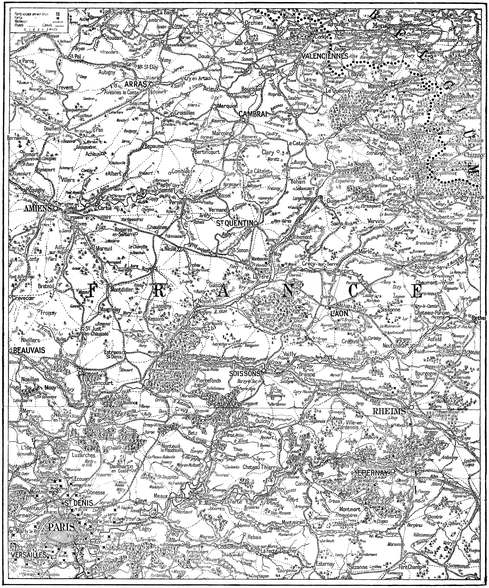
COPYRIGHT: SPECIALLY PREPARED FOR The Daily Telegraph
BY "GEOGRAPHIA" LTD 55 FLEET STREET LONDOON E C
ALEXANDER GROSS F.R.G.S.
(Large)