In this book as in the one that preceded it, The
Jungle Folk of Africa, the author endeavours to exhibit
the humanity of the African as it impressed
himself.
The difference between the two books is chiefly a difference
of emphasis, and is indicated in the titles. In the
former the African is described in relation to his surroundings—his
exterior world. Much is said about the
forest—deep, solemn, vast, impenetrably mysterious—wherein
he roams at large with nature’s own wild freedom;
contending also with its mighty forces, and wresting
from it the means of existence by his own resourcefulness
of expedient. In the present volume the author
essays the more difficult task of revealing the interior
world of the African—his mental habits and beliefs.
Much is said about fetishism and folk-lore.
If, despite all that is said herein, the philosophy of
fetishism should remain obscure—and there is no doubt
of it; if the reader should close this book with the consciousness
of a broad, comprehensive ignorance of the subject,
it may be to some extent the fault of fetishism itself,
which is the jungle of jungles, an aggregation of incoherent
beliefs. The world of the African is as wild and strange
as the weird world that we often visit on the brink of
sleep. It was far from Africa that Siegfried thought it
worth while to encounter the dread dragon, Fafner, and
slay him for the possession of the magic tarnhelm forged
by the Nibelung. In Africa everybody has a tarnhelm.
6Second-hand tarnhelms are for sale everywhere. I myself
had a rare one; but I have lost it, or mislaid it. To
us, who think of nature as the realm of law, order, and
uniformity, the world of the African seems to have gone
mad. This madness, however, is more apparent than
real. The African thinks in terms of the miraculous;
natural effects are explained by supernatural causes;
supernatural, but not therefore unintelligible, still less
irrational. Therefore, if we should not find the fabled
thread out of this amazing labyrinth of fetishism, it may
be possible to find a thread into it; and not only possible,
but also worth while, if within the labyrinth we shall find
the African himself and come to know him, mind and
heart, a little better.
One need not apologize for the space given to folk-lore
so long as Brer Rabbit and Brer Fox retain their present
popularity with old and young; for in African folk-lore
we have the originals of the stories of Uncle Remus.
Aside from the entertaining quality of folk-lore, its idealism
has a human value. In Mr. Lecky’s essay,
Thoughts on History, published since his death, the
great historian pays the following remarkable tribute to
idealism:
“Legends which have no firm historical basis are often
of the highest historical value as reflecting the moral
sentiments of their time. Nor do they merely reflect
them. In some periods they contribute perhaps more
than any other influence to mould and colour them and to
give them an enduring strength. The facts of history have
been largely governed by its fiction. Great events often
acquire their full power over the human mind only when
they have passed through the transfiguring medium of
the imagination, and men as they were supposed to be
have even sometimes exercised a wider influence than
men as they actually were. Ideals ultimately rule the
7world; and each, before it loses its ascendency, bequeaths
some moral truth as an abiding legacy to the human
race.”
Inasmuch as the history of most African tribes must
ever remain unknown to us, their legends and all that is
included in their folk-lore possess additional anthropological
value as a medium through which to study the
African mind.
The African, despite his degradation, is interesting;
and that, not merely as an object of religious endeavour,
but on the human level, as a man. The testimony of
Mr. Herbert Ward—traveller, adventurer, soldier and
artist—who first went to Africa with Stanley, and afterwards
went a second time and spent several years, is the
testimony of all sound-hearted men who have lived in
Africa. Mr. Ward, in A Voice From the Congo, says:
“There was a good side even to the most villainous-looking
savage.... They appealed strongly to me
by reason of their simplicity and directness, their lack of
scheming or plotting, and by the spontaneity of everything
they did.” And again: “It has been my experience
that the longer one lives with Africans, the more
one grows to love them. Prejudices soon vanish. The
black skin loses something of its unpleasant characteristics,
for one knows that it covers such a very human
heart.”
Nevertheless, the degradation of the African is a fact.
And it is being proved that there is no power of moral
renovation for him inherent in material progress. Christianity,
and nothing else, vitalizes his moral nature; and
therefore it contains the potentialities of civilization.
When Mr. Giddings, and other sociologists of a certain
class, ignoring spiritual values, demand a gospel for the
life that now is, we offer them the same Gospel of Christ,
and point to its actual results in Africa; maintaining that
8the missionary is the chief agent in Africa’s civilization,
and affirming that civilization is but the secular side of
Christianity.
One of the stories in this volume appears also in
Dr. Robert H. Nassau’s admirable book, Fetishism in
West Africa; and two of the stories are told, in slightly
different form, in Mr. R. E. Dennett’s interesting book on
the folk-lore of the Fjort. Most of the illustrations are
from photographs taken by Mr. Harry D. Salveter.
The Coast—The Old Coaster—His obsession—Angom—Loneliness—Gaboon—The seasons—Ice that burned—A peculiar climate—The mosquito—Quinine—Frightened into fever—A matter of coffins.
From palm-oil to trousers—Mpongwe and Fang—Making a king—Caste—Domestic slavery—Ndinga, a human leopard—A Gaboon belle—Native courtesy—A fight—A war-custom—The cause of the tide—A dying confession—A case of witchcraft—Curing the sick—A secret society.
Women who cannot marry—The slave-trade—The rum-traffic—Elida—Augustus—Trade and polygamy—Too proud to speak—Destruction of authority—Customs not irrational—The dowry—The foreign governments—The whipping-post—A fatal defect.
A taste for comic opera—An organ and an organist—The origin of music—Musical instruments—The sense of melody—A decomposed tune—Unfamiliar scales—Mourning—Rhythm—Extremely musical—Three songs.
The Ten Plagues—Killing flies—The driver ant—Other ants—The jigger—The sandfly—The mosquito—The centipede—The cockroach—The white ant—Divers other pests—Internal parasites—Rats—Snakes.
A discriminating palate—Not the worst cannibals—Appearance—The Negro face and the Greek face—Legs—The wheel—Dress—An overdressed woman—Food—Cannibalism—An affair of honour—Native art—Curiosity—Turning them into monkeys.
The native resourceful—Unambitious—Trade—Communism—Boiling the Bible—A quarrel—Marriage—The dowry—A case of torture—The head-wife—The tongue a woman’s weapon—Polygamy—Ogula and her Ngalo—Tragedy—Dancing—The story-teller—An interesting liar.
A talking corpse—A world of magic—Sympathy and expectoration—The dirge—Premature burial—A funeral incident—Death customs—Conventional mourning—An incident of the grass-field—A horrible burial custom—Two death scenes, a contrast.
A godsend—A gasoline palaver—Canoeing—The rapids—A pilot—A sudden stop—Passengers—The mangrove swamp—A wheelman and a bottle—Pirates—Towing a town—Nkogo—Ndutuma—Ndong Bisia—A saucepan and a ball of twine.
Lolo—Unwashed—Washed—A flying bucket—A little friend—The blessed Melchisedec—A parting—Ko-ko-ko-ko—The centre of a fight—The poetry of soap—A threat of suicide—The eloquence of sounding brass—A “rotten road”—Savages as soldiers—Ngema’s father—Across our bow—A tornado.
Mendam, the big brother—Clothing—A day’s program—Cutting grass—A python—Rations—A collapse—The dormitory—The dispensary—The jigger-palaver—Not stupid—A head that got hit—Singing—Interruptions—A picnic—Games—War-dances—Stories—A Tug-of-War—A Race—The Leopard and the Antelope—An evangelistic force.
The horseshoe—The charm—The fetish—The relic—The fetish-doctor—A psychological consequence—The African idea of nature—Incredible beliefs—Confession of a chief’s son—Two babes—The idea of God—The mental atmosphere—Making the rainbow—A problem—First lessons—Why the river is crooked—An old woman’s illustration.
A lost child—Worship of snakes—Demoralizing factors—A chief’s fetish—Ingredients—Human sacrifice—A royal death—Wives and witchcraft—Concluding a war—Destiny—Man’s nature—New conceptions—A revolt from cannibalism—Heaps of skulls—Deliverance.
A precocious boy—Killed his friend—Essentially moral—Cure for lying—The ordeal—A trial and death—The sense of guilt—Expiatory rites—The new ideal—The atonement—Self-sacrifice and self-assertion—Ndong Koni builds a church—Onjoga cuts grass—Makuba’s rheumatism—What is a missionary?—Onjoga’s wife—Children at play.
The noble savage—Story of a feud—Society and the individual—Progressive and unprogressive—Interdependence—Conquest of nature—Education—Authority of custom—Work—Trustworthiness—A civilizing experiment—A communion service—Equality of woman—A salutation—Attitude towards nature—A thirst for knowledge—Service—Legitimacy in government—The home—Thy kingdom come.
The missionary blamed for everything—Bewildering inconsistency—Professor Starr—Misfits—Criticism unjust—Unbelief—Antipathy towards the native—Cruelty—Vice—Lowering of ideals—Missions sociologically sound—The let alone policy too late—Miss Kingsley.
The best apologetic—Mb’Obam—Sara—A matrimonial bureau—Angona—A pot-palaver—A narrow escape—Amvama—A clean knife—A bet—Proving himself—A dowry palaver—Opposing a chief—Robert Boardman—Son of a “prince”—Blindness—Incident of a pipe—His love of music—His wife—A near-elopement—Walking in the light.
For that matter the whole west coast of Africa is
called by the natives The White Man’s Grave;
and everywhere the fever stalks along the beach
like a grim sentinel warning the stranger to stay away
and ready to beat him into delirium and death if he
lands. But the name, The White Man’s Grave, is especially
attached to several of the oldest of the coast settlements.
Notable among these is Gaboon, in the French
Congo, almost exactly at the equator, where I lived for
nearly six years, the period of my second term in Africa.
On the long voyage of five weeks from Liverpool to
Libreville I had been duly prepared for the worst by the
Old Coasters on board, who deem it their duty to instruct
all newcomers in regard to the evils of the climate
and the certainty of an early death. This duty constitutes
a daily exercise during the entire voyage and is
discharged faithfully and conscientiously. Each morning
at the breakfast-table the young missionary is told
that the African fever is inevitable, and to expect it will
bring it on in two days. The healthy die first. “Missionaries
die like flies.” The abnormal mortality among
missionaries is due to several persistent delusions; chief
among them, the temperance delusion, and the quinine
delusion. According to the Old Coaster, everybody
whose mind is open to conviction knows that temperate
habits are no defense and that total abstinence is a quick
method of suicide. Quinine only aggravates the fever;
everybody knows that also; but missionaries will not
16admit it. Then there is the minor delusion of the umbrella.
All those people who regularly carried umbrellas
are dead. Those who didn’t carry them are dead too,
but they lived longer.
The dreadful racking pain of the fever is adequately
described, and then there is added the consoling thought
that a man may sometimes escape having it fatally by
having it frequently. “Fatally, or frequently:” the
poets among them dwell fondly on the alliteration.
After we have begun to call at the African ports this
elementary instruction is reinforced by a circumstantial
and realistic account of the death of the “poor chaps”
who have “pegged out” since the last voyage. The
number is large: I did not know there were so many
white men on the coast. Many among them were of my
particular build, complexion and general appearance—I
was told.
It is not that the Old Coaster is indulging a barbarous
sense of humour in trying to frighten the newcomer, but
he has become fairly obsessed with the thought of the
climate. Sooner or later this morbid distemper seizes
upon most of those who live for any length of time in
West Africa.
After such an unappetizing conversation at the breakfast-table,
a certain young missionary escaped to the
upper deck where he was soon joined by an Old Coaster
who asked him if he happened to have a prayer-book.
Delighted that the conversation had taken a turn (and
such a good turn) he replied that he hadn’t a prayer-book,
not being an Anglican, but that he might procure
one from a fellow passenger.
“I’d be ever so much obliged,” says the Old Coaster,
“if you would; for I want to write down the burial
service. You see, no matter how a man may have lived,
it’s a comfort to him out here on the coast to think that
17he’ll have a decent burial; so we’re neighbourly, and we
read the service for one another.”
In one last desperate effort to turn the conversation
from the dead to the living, the missionary remarked,
with considerable force: “But people don’t all die of
fever out here! What about those that don’t?”
“Oh, no,” he replies; “they die of many other things
besides fever. Let’s see;”—and he counts them off on
his fingers:
“There’s kraw-kraw. Kraw-kraw is an awful nasty
disease that just decomposes a man’s legs and nothing
can stop it.
“There’s dysentery. A lot of people die of that.
There’s every kind of tuberculosis. There’s abscesses.
There’s pneumonia. There’s ulcers——”
“And kraw-kraw,” says another Old Coaster, coming
up behind him. “Why, there was my friend So-and-so——”
“I’ve already said kraw-kraw,” says the other, and
he passes on to the next finger.
“There’s Portuguese itch. Maybe you think you know
what itch is, but you don’t if you’ve never had the Portuguese
itch of the coast.
“There’s the Guinea worm. It favours the leg and is
sometimes ten feet long. You may possibly get it out if
you don’t try to wind it from the tail; but anyway it
leaves a wound that doesn’t heal in this climate.
“There’s enlarged spleen. There’s——”
“Kraw-kraw,” says another arrival. “Why, there
was So-and-so——”
“I said kraw-kraw,” answers the leader.
“There’s smallpox—in frequent epidemics,” he continues.
“And there are so many other parasites feeding on a
man, inside and out, that one who has lived on this coast
18for several years ought to be able to furnish in his own
body a complete course for a class of medical students.”
“Did you mention kraw-kraw?” says a late arrival.
“Kraw-kraw?” interposed the missionary. “I know
all about kraw-kraw. The highest authorities on tropical
diseases have declared that it is not a physical, but a
mental, malady that attacks the Old Coaster. The
victim imagines that he is an old crow, and he goes
around flapping his wings and crying, ‘Kraw-kraw.’”
One morning at the breakfast-table, when the conversation
turned for a moment to the cheerful subject of cocktails,
a youngster exclaimed: “Gentlemen, gentlemen, I
protest against this cheerfulness. For a whole minute
the conversation has been utterly irrelevant. Men are
mortal and the dead are accumulating. Let us therefore
return to the obsequies.”
A solemn-eyed Old Coaster leaned towards his neighbour
and in a loud, sepulchral whisper remarked: “I
give him a month.”
“I give him two weeks,” replied the other.
Many of those who came aboard, especially those from
the more lonely places, looked like haunted men. Extreme
isolation invites madness. There were moments
when the heart of the traveller faltered or stood still,
almost crushed by the pathos and tragedy of it all.
At the annual mission-meeting I was appointed not to
Gaboon, but to Angom, seventy miles up the Gaboon
River. Angom had a peculiarly evil reputation even in
Africa, and the appointment was made only after a prolonged
discussion in which some contended that the place
ought to be abandoned and the climate of that particular
station pronounced impossible. The facts arrayed in support
of this opinion presented such a gloomy outlook that
when, in conclusion, a missionary physician and his wife
and myself were assigned to Angom, the appointment
19sounded in our ears somewhat like an order for our
execution.
Three weeks after we reached Angom I stood one
morning on the bank of the river, exceedingly lonely as
I gazed after the boat that bore away the physician and
his wife, both of them sick and returning to the United
States. I remained alone at Angom only a few months,
but I was expecting to remain for the entire year, sixty
miles from the nearest white man, and unable as yet to
speak the language of the jungle folk around me. And
besides the barrier of an unknown language between
them and me, there was at first such a mental and moral
aloofness from the natives that their presence, and especially
the sound of their constant laughter, only drove
me to the centre of a vaster solitude.
Often in those first days I fought against loneliness and
fever together, each aggravating the other. When loneliness
would make its most terrible onslaught it assumed
a disguise—and invariably the same disguise. More than
half the battle was fought when I had penetrated the disguise
and learned to recognize the foe even from afar.
It invariably approached in the form of discouragement—the
intolerable feeling that all I was doing was useless;
that I was the fool of a pathetic delusion whose only redeeming
feature was a good intention. The doubt suddenly
emptied life of all that was worth while and left an
aching void; and nothing in the whole world can ache
like a void. In our nobler aims and enthusiasms doubt
is the worst foe of courage—the thought that one may be
making a fool of himself; the highest courage is to resist
the doubt, and the highest wisdom is to know when to
resist it. I think Hawthorne said something like that.
Let me anticipate the years so far as to say that,
although I was always more or less alone in Africa, and
drank the cop of solitude to the dregs, I completely outlived
20these attacks. And, strange enough, the very
question which had been my dreaded foe became my
strongest ally and defense, namely, the question, Is it
worth while? For I fought that question out to a sure
affirmative. In later years the dominant feeling, that
which constituted the irresistible attraction of missionary
life, and made its privations as nothing, was the constant
feeling that life in Africa was infinitely worth while, and
that nowhere else in the world could my life count for so
much to so many.
The first letters from missionaries at the coast advised
that I should not think of staying alone at Angom, but
should move to the coast and join them at Baraka, our
Gaboon station. This did not seem to me advisable,
since it would separate me from the interior tribe, the
wild Fang, among whom I was expecting to work and
whose language I was learning. The coast tribe, the
Mpongwe, were already provided for and did not need
me. But as time passed letters came from all over the
mission making so strong a protest that it seemed inadvisable
to “insist upon being a martyr”—as my fellow
missionaries expressed it, with naïve candour. One friend
added that if I died, or rather when I died, I would have
no one to blame for it but myself. That settled it. The
idea of dying with no one to blame for it, after the lonely
life at Angom, was entirely too unsensational; so I moved
to Baraka, where some one could be blamed when I died.
The name Gaboon is used, especially by the English, in
a general way to designate not only the river of that name
but all the adjacent territory. Most people prefer it to
the name Libreville, because it is of native origin; and
they like the far-away sound of it. If we would be strictly
accurate, however, the name belongs only to the great
estuary of the river. The Gaboon River is not long, but
it receives many tributaries and for the last hundred
21miles from the sea it is magnificent. Forty miles before
it reaches the sea it bends northward by northwest and
widens out into a broad estuary from five to fifteen miles
in width and forty miles long, which I have always called
the bay. It is one of the few, and one of the best, harbours
on the entire coast of Africa. Libreville, the old
French capital of the Congo Français, and Baraka, our
mission station, are situated on the east bank of the estuary
and opposite its broad mouth. They look therefore
directly over the sea.
Gaboon was known in the Middle Ages and probably
in the early centuries. Travellers and adventurers of a
superstitious age, passing upon the high seas, reported
that it was a dreadful land where at night strange fires
bursting from the earth leaped to the clouds and reddened
the sky, fires which probably came from “inferno” not
far beneath. It is quite possible that the fire which they
saw may have issued from Mount Kamerun, farther to
the north, which is now an extinct volcano; but there is
a more likely explanation. The country around Gaboon
is more open than most parts of West Africa. A dense
undergrowth of shrubbery and long grass grows up each
year, which towards the end of the dry season is burned
off by the natives, in some places to clear their gardens,
and in some places for the fun of seeing it burn. As
seen from the mission hill the fires are seldom extensive,
though the effect is a ruddy glow upon the clouds and is
beautiful. But as I have seen them when out upon the
bay at night, and upon the sea, the effect of their full
extent, the glowing sky and its reflection in the sea, were
sufficient to inspire awe and impress deeply the superstitious
mind of a sailor gazing on a strange land of savage
people.
Libreville as it is approached from the sea is one of the
most beautiful places on the entire West Coast. The government
22buildings stand upon a hill, the Plateau, from
which a handsome boulevard runs to the south parallel
with the beach, between rows of giant coco-palms. On
this boulevard are the trading-houses, French, Portuguese,
German and English. The buildings are nearly
all white, including the iron roofs; but some of them have
roofs of red tile. There are many beautiful trees. The
houses are only half visible through screens of foliage;
and along the walks every unsightly thing, every deserted
building or decaying hut is overgrown with vines of delicate
beauty and the wildest profusion of scarlet, purple
and lavender flowers.
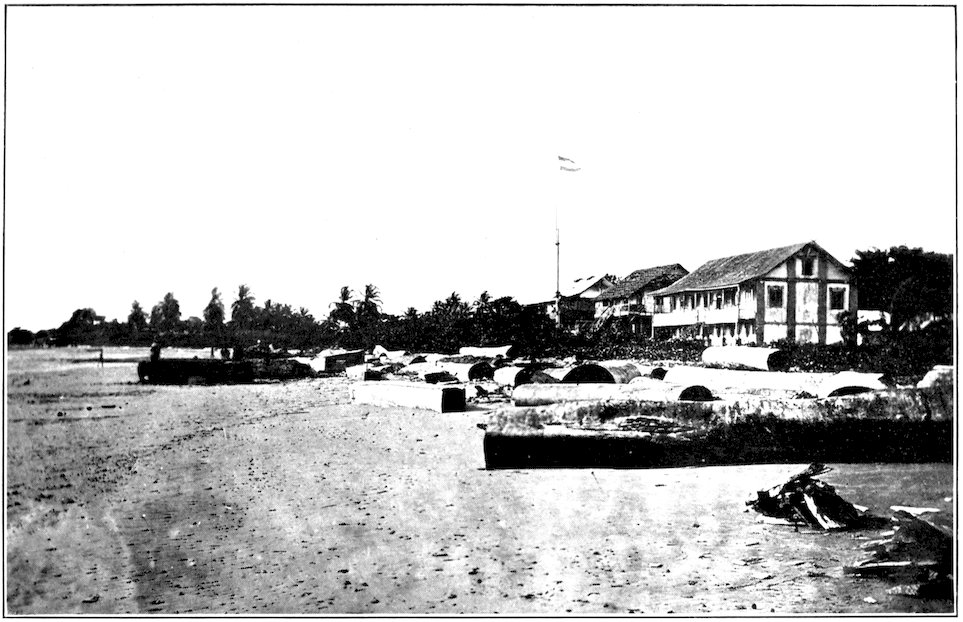
The beach is strewn with logs of African mahogany of
great value, which the traders are preparing to ship.
For these they have exchanged a variety of goods. They
carry a large stock of flint-lock guns especially for the interior
trade. The average price of a trade-gun is five
dollars. They are called “gas-pipe” guns in the vernacular
of the coast. The barrel is three feet four inches
long, and the bore Mr. Richard Harding Davis compares
to an artesian well. “The native fills four inches
of this cavity with powder and the remaining three feet
with rusty nails, barbed wire, leaden slugs, and broken
parts of iron pots.” This dreadful weapon “kicks” so
violently in the recoil that it is always a question as to
which is the more dangerous end. Of course, if the contents
of the barrel should actually enter a man’s body it
would tear him all to pieces. But there is always a
doubt about the aim, and there is no doubt about the
kick.
Two miles south of the Plateau there is another hill
nearly as high, and having the finest outlook towards
the sea. On this hill is the mission station, Baraka.
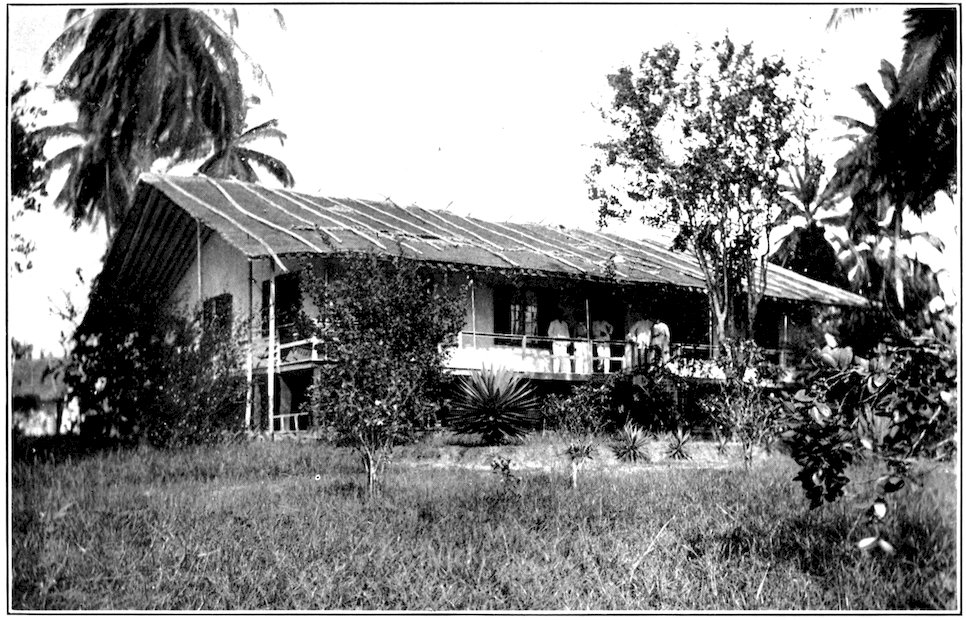
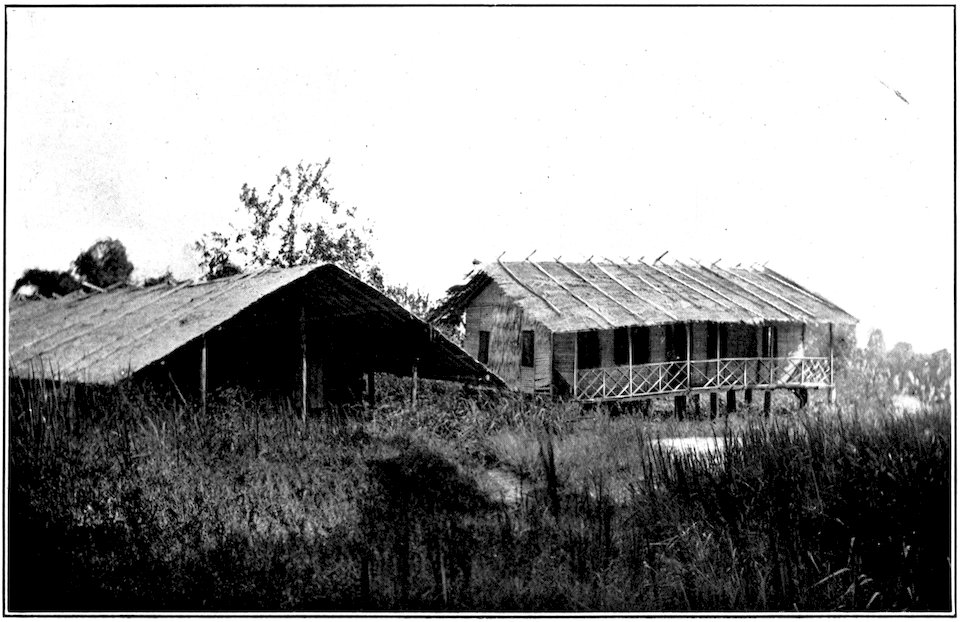
MISSION HOUSE AT BARAKA, GABOON.
The roof is of palm thatch, upon which poles of bamboo are placed.
23The house, as one approaches it, appears through a
screen of palms and orange-trees, of the strong-scented
frangipani, the scarlet hibiscus, and oleander growing
as high as the house. There is an abundance of roses
everywhere. There are also a few coffee-trees in the
yard, and one exquisite cinnamon.
The view from the veranda of the mission house at
Baraka is a scene of magic beauty. The joyous lavishness
of colour excludes from the mind the thought of the
deadly serpent and the relentless fever-fiend that stealthily
glide within the shadows. The long hillside sloping to
the beach is half covered with mangoes and palms,
oleander and orange-trees, and the graceful plumes of the
bamboo that wave to and fro and tumble in the breeze
like children at play. In front is the open sea. On the
left, looking up the estuary, one sees in the bright morning
light a fairy island of deep emerald set in a silver sea,
and beyond it a distant shore in dim purple and gold.
And even while one is looking, the island, the silver sea
and the golden-purple shore gradually dissolve and disappear
in the haze that gathers and deepens as the day
advances. But again, and always, it appears in the clear
evening light, more beautiful than ever.
I found it impossible to persuade my friends that
Gaboon is not the hottest place in the world, since it is
not only in Africa, but at the equator. This was also
my own idea of Gaboon until it was corrected by experience.
It is not as hot at the equator as it is several
hundred miles north or south of it. The thermometer
ranges between 72° and 86°, seldom going above or below
this range. But the humidity is extreme (not surpassed,
I believe, in the world) and this makes it seem hotter
than these figures would indicate. The atmosphere feels
as if it were about fifty per cent. hot water. At the
coast there is the delightful sea-breeze—but as soon as
one says it is “delightful” he is reminded that it is very
dangerous.
24One hears from the natives of the coast more complaints
of cold than of heat and in the hottest weather
their black skin is always cool. The hot months are December
and January; and the coolest are June and July.
The wet and dry seasons of Gaboon are very distinct.
The dry season begins in May and lasts for four months,
during all which time there is not a shower. Then the
wet season begins in September and lasts four months,
during which it rains almost incessantly. This is followed
by a short dry season of two months and a short
wet season of two months, thus completing the year.
This succession of the seasons is as regular and distinct
as our winter and summer. The effect of the long dry
season corresponds in some respects to our winter, giving
vegetation a rest. Europeans delight in the dry season,
although towards the last they long for the rain. But
the natives dislike the dry season, which is too cool for
their comfort; and since the land-breeze is very strong,
and their bodies but slightly protected with clothing,
there is much sickness among them in these months.
I never told the Africans about ice, nor described snow,
lest it would overtax their credulity and discredit me;
for if they should doubt I had no way of proving it.
But after the French hospital was built the Gaboon people
not only heard about ice but many of them actually
saw it. One day we obtained a piece of ice at Baraka,
sufficient to make ice-cream. When we had finished eating
I took some of it out to the men of my boat-crew and
after telling them that it was something which we liked
very much, I gave a teaspoonful to Makuba, the captain.
No sooner had it entered his mouth than he leaped into
the air with a wild yell—wild even for Africa. He
shouted: “I’m killed! I’m burned to death! I’m
burned to death!”
The extremest sensation of cold seems to be not distinguishable
25from that of extreme heat. Never having
tasted anything cold, it is positively painful to them.
Despite the exaggeration of the Old Coaster we are
constantly reminded that, after all, Gaboon is The White
Man’s Grave. There were a number of Anamese prisoners
of war whom the French had transported from Anam.
They were employed in the construction of two miles of
road along the beach. During the few months of work
seventy out of one hundred died. In this dreadful death
rate there were probably unusual factors. The road
crosses a marsh that is a first-class incubator for mosquitoes.
And besides, it is not likely that the men were
reasonably provided with food or medical attendance.
Even upon the subject of the climate opinions differ.
There are some persons—very few—who, after living in
West Africa a number of years, become so used to its
death record that they seem to think that every other
place is just the same. One or another of these occasionally
becomes an indignant champion of the climate.
At one of our annual mission meetings I offered a resolution
appealing to the Board of Missions in New York
for an extra allowance for health changes, in view of the
“hostile climate.” A veteran missionary, whose many
years in Africa made him the wonder of the coast, objected
to the word hostile, declaring that unless it were
stricken out he would vote against the resolution. But
with charming inconsistency he added that he fully realized
the need of the extra allowance and he would gladly
vote for it if only, for the word hostile, we would substitute
the word peculiar.
Next morning after breakfast, Mr. Gault, in whose
home I was staying, said to me: “Apropos of the objection
made yesterday to the word hostile as applied to
this salubrious climate, have you observed that every one
who asks a blessing at the breakfast-table seems to be
26thankful—and surprised—that none of us has been
stricken down during the night and that we are all again
able to get to the table?
“The more remarkable,” he added, “when we recall
that we were chosen by the Board not because we were
either good or clever, but chiefly because of our constitutions.”
It was only a short time afterwards that Mr. Gault
himself one morning was not able to get to the breakfast-table.
Two days later they buried him at Batanga. He
was one of the truest and best men I have ever known.
There is less fever now than there was a few years ago,
and the death record is decreasing. Not that the conditions
are much improved; but common sense has prevailed,
and men as soon as they become seriously ill
hasten away on the first steamer. Besides, the proper
use of quinine as a preventive is better understood as
the result of the knowledge of the sources of malaria and
its various stages.
The mosquito theory—that the Anopheles mosquito is
the carrying agent of the malaria parasite—is of course
generally accepted. The late Dr. Koch advised that a
liberal dose of quinine every eighth or ninth day ought to
be an effective preventive with most persons. Major
Ronald Ross, head of the Liverpool School of Tropical
Medicine, advised the destruction of the mosquito, chiefly
by drainage, and the segregation of white people from
the natives. The natives have become at least partially
immune; but there are numerous malaria parasites in
their blood constituting the source from which it is carried
by the mosquito, which after biting a native bites a
white person; and when the white man’s blood is malarious
a little exposure to the tropical sun, a slight chill,
even a mental shock or undue strain, anything that
lowers the vitality, is likely to precipitate the fever.
27I myself, after several years of frequent fever, at last
gained practical immunity by taking five grains of
quinine every night, which I did without omission for
three years, until I left the coast. If my vitality had
not been already reduced to the minimum I would not
have required so much quinine. Many persons, instead
of taking quinine regularly, wait until the fever actually
comes and then take very large, nerve-shattering doses
for successive days, from thirty to sixty or even ninety
grains a day. One may recover from the fever, but one
does not entirely recover from the quinine until he leaves
the coast.
Sometimes the newcomer is fairly frightened into a fever
by those who have lived in Africa long enough to have
become obsessed with the thought of the climate and
whose conversation it completely absorbs.
Near the end of my voyage to Africa I spent a night
ashore at a certain mission, where a good lady who was
in a very sociable mood, having shown me to my room,
stood in the doorway telling me of the various persons—not
a few—who had died in that particular room, and giving
some graphic detail of each death. It was gradually
borne in upon me that there must be some horrible
fatality attached to that room. Finally she advised me
not to lock my door. “For,” said she, “Mr. P——, who
always locked his bedroom door, was found dead in bed
one morning in this very room, although he went to bed
looking as well as you do now. About noon next day
they broke the door open, and sure enough there he was—lying
right there!”
I replied: “My dear lady, won’t you please knock on
my door very early in the morning, and if I do not answer,
open the door and walk in; for I fully expect to
be dead.”
A certain American lady, who was a missionary for
28some years in Liberia, tells how that when she landed,
expecting to proceed to a station some distance inland,
where she would join several other missionaries, she was
met with the news that the missionaries of that station
(four, I believe) had all died of fever a few days before
she landed, one immediately after another. Nevertheless,
the person who had the authority for her appointment
escorted her to that desolate station and left her there
alone. A partition of boards in the house was nearly all
gone; it was only a few feet from the floor. She asked
the explanation of this appearance and was told that the
boards had been used to make coffins. Having received
this interesting, though somewhat curious information,
she was left alone to find what comfort she could in the
reflection that there was enough of the partition left for
one more coffin.
She told me about it herself—many years afterwards.
II THE WISE ONES
29
At Gaboon, in the French Congo, one sees all the
successive stages in the process of civilization.
First, there is the savage, whose whole apparel
is a little palm-oil and a bit of calico half the size of a
pocket-handkerchief; then there is the man who wears
“two fathoms” of cloth wound about him gracefully and
falling below his knees; next, there is the man who wears
this same robe with a shirt; then the man who discards
the native robe and wears a shirt and trousers, but with
the shirt always outside the trousers; and, last of all, the
gentleman who wears his shirt inside his trousers.
These several classes are somewhat distinct. One does
not classify the man with a taste for simplicity who
wears a rice-sack with holes for his head and arms; nor
the untutored dude who wears a pink Mother Hubbard
or a lady’s undergarment. These freakish modes represent
attempts to hasten the process of civilization and to
pass prematurely from one of the above classes to another.
In general, the distinction of culotte and sansculotte
indicates the difference between the Mpongwe—the old
coast tribe—and the Fang—the interior tribe, who have
only reached the coast in recent years. The Mpongwe is
the most civilized of all the tribes south of the Calabar
River. Many of them, besides wearing trousers, live in
deck-houses, that is, houses with wooden floors. The
first floor ever seen by the natives was the deck of an
English ship; hence the name deck-house. It was also
30from contact with English sailors that the native learned
to speak of a “fathom” of cloth.
The Mpongwe are the proudest people of West Africa.
An African woman is never allowed to marry into an inferior
tribe; although the men may do so. And since
the Mpongwe have no social equals among the adjacent
tribes, it follows that no Mpongwe woman can marry outside
of her own tribe, unless with a north-coast man or a
white man. The Fang, the great interior tribe, are mere
“bush-animals” in the mind of the Mpongwe. A Fang
man, though he were perfectly civilized, and even educated
in France, would not be allowed the social status of the
meanest Mpongwe. The coast women can all speak
Fang; for they trade with them and buy their daily food
from them; but they are ashamed to be heard speaking it.
Often when I addressed them in Fang they would shake
their heads as if they had never heard the language before;
whereupon I nearly always asked them a question
on some matter of interest to themselves; the price of a
parrot, for instance, if I knew that the lady was anxious
to sell it. Such a question invariably made the dumb
to speak.
The Mpongwe call themselves The Wise Ones. And
other tribes generally admit their claim and take them at
their own self-estimate. In former days, when they had
real kings, they buried their kings in secret, not more
than ten persons knowing the hidden grave, lest some
other tribe might steal the body, for the sake of obtaining
the brains, which would be a very powerful fetish and
would make them wise like the Mpongwe.
The king was chosen from among the people by the
elders and was selected for his wisdom. The ceremonies
of his enthronement were such that he required not only
wisdom, but also courage, physical strength and a superb
digestion. The man’s first intimation that he had been
31chosen by the elders was an onrush of the people—not to
do him honour, but to abuse and insult him. They
would hurl opprobrious epithets at him, curse him, spit
upon him, pelt him with mud and beat him. For, they
said, from this time he would do all these things to them,
while they would be powerless to retaliate. This, therefore,
was their last chance. They also reminded him of
all his failings in graphic and minute particulars. If
the king survived this treatment, he was then taken to
the former king’s house, where he was solemnly invested
with the insignia of the kingly office, in the shape of a
silk hat. No one but the king was permitted to wear a
silk hat.
Following the inauguration ceremony, the people came
and bowed before the new king in humble submission,
while they praised him as enthusiastically as they had before
reviled him. Then he was fed and fêted for a week,
during which time he was not allowed to leave his house,
but was required to receive guests from all parts of his
dominion and eat with them all. These ceremonies
ended, he turned to the comparatively easy and commonplace
duties of his kingly office. This custom, like many
others, has passed away under the influence of civilization.
In former days the Mpongwe were divided into three
distinct classes. There were, first, the slaves, the largest
class of all. Then there was a middle class, of those who
although free were of slave origin, or had some slave
blood in their veins—even a drop. And then there was
a very small aristocracy of pure Mpongwe.
Of these three classes the middle class probably had the
hardest time. They had freedom enough for initiative
and trade enterprise and they often became rich. But so
sure as they did, they were at once an object of envy and
class hatred on the part of the aristocracy, with the result
that they were in constant danger of being accused
32of witchcraft and put to death, their goods being
confiscated for the benefit of the governing class—the
aristocracy.
Since slavery has been formally abolished by the
French government the line between slaves and this
middle class has almost disappeared—but not quite, for
slavery has not been entirely abolished. But the “aristocracy”
is as distinct as ever.
Domestic slavery is rarely attended with the usual
horrors of alien enslavement. Mpongwe slaves were
serfs rather than slaves. Until the advent of the white
slaver they were rarely sold or exchanged. Mpongwe
slaves were sometimes taken for debt and sometimes
stolen from other tribes.
Several Mpongwe men have told me that their slaves
were children of the interior whom they had rescued
when their parents had thrown them away, either into
the bush to perish by the beasts, or into the river. They
must have been driven to this by some cruel superstition;
for the African loves his children, and the mother of his
children is his favourite wife. Perhaps the children were
twins. In many tribes there is such a fear of twins that
they are often put to death and their mother with them.
In some of these tribes they are believed to be the result
of adultery with a spirit.
Many former slaves have chosen to maintain the old
relationship—somewhat modified—rather than accept full
freedom, and be left without friends, family or possessions;
a peculiar misfortune for those who have never
had an opportunity to acquire a habit of independence.
At one time a man named Ndinga was working for me.
He was a faithful workman, except for one inexplicable
fault. Occasionally he would stay away half a day or
the entire day without asking to be excused, or notifying
me. Several times he did this when I was about to make
33a trip up the river, and was depending upon him to
make one of the crew. At length I dismissed him and
he departed without explanation or complaint. But one
of the other men came to me and told me Ndinga’s plight.
He was really the slave of an Mpongwe chief, right under
the eyes of the government. The master allowed him to
work for himself, but I imagine he took part of his wages.
He also exercised the right to call upon him at any time
for personal services, and each time that he had stayed
away from his work he had been called by the master,
who ignored my claim upon Ndinga and the consequent
inconvenience to me, though he claimed to be my personal
friend. Ndinga was sufficiently civilized to feel
the degradation of his position, and the poor fellow submitted
to rebuke and final dismissal rather than tell me
he was a slave. I learned also that he had lost several
other positions in the same way and had usually been dismissed
with cursing and abuse. I sent for him immediately,
and without explanation told him that I had
changed my mind and that he could return to work.
Meantime, I called the master, and reminding him that
slavery was strictly forbidden, I told him that if he
should again call Ndinga away from work I would notify
the government. There was no further trouble.
This man, Ndinga, was in pitiable need of a friend. It
is extremely easy for a slave to get a bad reputation, and
Ndinga was said to be a “leopard-man,” that is, a man
who changes himself into a leopard—either in order to
kill an enemy or devour a sheep. I have heard Ndinga
accused of this frequently; and there were many who
regarded him with great fear. Every hysterical woman
who thought that she saw a leopard was ready to swear
that it was Ndinga. If the leopards had been active in
the community at that time all their doings would have
been charged against him.
34The Mpongwe women are regarded as the best-looking
and most graceful women on the entire coast. Wherever
there are communities of white men, even hundreds of
miles north and south of Gaboon, there are Mpongwe
women; for it is with them more than the women of any
other tribe that white men form temporary alliances.
The Gaboon belle has a brown complexion and faultless
skin, fine features and dreamy dark eyes with long
lashes. She moves so easily that she carries her folded
parasol, or bottle of gin, or other indispensable, on her
head. She dresses her hair neatly and with great pains;
usually parting it in the middle and arranging it in numerous
small braids which she fastens behind. Her dress is a
large square robe of bright colours, often of fine material,
wound around her, immediately below her arms, reaching
to her feet and kept in place by a roll around the top
of it—a peculiar twist of leger de main which only a black
hand can perform. Somewhere in this roll her pipe is
usually hidden away. This dress leaves her graceful
shoulders and arms uncovered. She wears slippers with
white stockings, and upon her head a very large silk
handkerchief of bright colour, beautifully arranged in a
turban. Add to this a lace or silk scarf thrown over one
shoulder, not forgetting her silk parasol carried unopened
on her head; then add a lot of jewelry and plenty of
perfume, and her attire is complete. Moreover, she has
a soft voice, and does not yell except when she quarrels,
and she seldom quarrels when she is dressed in her best.
Most of the Christian women wear an unbelted wrapper,
or Mother Hubbard.
The Mpongwe people are peculiarly gentle, and
courteous in their manners; and in this respect the men
even surpass the women. Travelling in a boat with an
Mpongwe crew, one is always surprised at their courtesy
and thoughtful consideration. Courtesy, indeed, which
35some one calls “benevolence in little things,” is a racial
characteristic. I was once obliged to make a very hard
journey from Batanga to Benito, a hundred miles down
the coast. For this purpose I purchased a bicycle in a
German trading-house at Dualla, the capital of Kamerun.
The bicycle weighed fifty pounds, and cost me a dollar a
pound. I did not realize what I was undertaking. The
sea-breeze was against me; portions of the beach were of
soft sand and parts of it were so rough and rocky that I
had to climb steep banks and stretches of rock, carrying
the fifty-pound wheel on my shoulders. I had been long
in Africa and my strength was greatly reduced. Several
times, almost overcome with exhaustion, I threw myself
down upon the beach and lay there for half an hour before
I could go on. There were various misadventures along
the way and a sensational escape from quicksand. It
was an opportunity, however, to test the kindness of the
native.
I took no food, but depended upon the hospitality of
those to whom I was a stranger; although if hospitality
had failed, I could have paid for food; but not once did
it fail along the way. Wherever there was a stream to
be waded, if a native was anywhere in sight, either on
the beach, or fishing out on the sea, in his canoe, I called
or beckoned to him, and he came and carried me over—for
a white man must not get wet when he is exposed to
the wind; then he went back and got my wheel. In one
place the water was to the man’s shoulders, and there
was a current, but he held me in a horizontal position
above his head, and exerting his whole strength, with
firm, slow step he proceeded, and set me down dry on the
other side. Then he cheerfully turned about and went
after my wheel. In another place heavy crags projected
into the sea and at high tide there was no beach for a
quarter of a mile, so that I was compelled to carry the
36wheel. At this place, I met a native carrying a load who
was evidently returning from a journey to the interior;
and upon my request for help, he at once hid his load by
the way and taking my wheel carried it over the rocks,
nearly all this distance, to the better beach beyond. In
every case I told the man beforehand that I did not expect
to pay him for his service except in friendship, and
friendship sufficed. Nor did I pay anything for my food;
and not once on the entire journey had I the least difficulty
in procuring it. Some of these people were of other
tribes; but in courtesy the Mpongwe surpass them all.
They generally live at peace within the family and the
village. The men, at least, rarely fight. Whenever I
heard that an Mpongwe fight was in progress, I rushed
to the scene; but I must confess to mixed motives. For
a fight among Mpongwe men is decidedly picturesque
and entertaining, since they fight by butting each other
in the stomach with their heads. The women are much
more quarrelsome, and these very belles, whose beauty
I have praised, have frequent quarrels and occasional
fights, the latter usually involving a number of women;
for though the quarrel commences with two women, when
it gets to a real fight the family and relations of each
woman take part in it. From this moment it proceeds
somewhat formally. They line up on two sides, and with
a lively accompaniment of appropriate language, they
rush upon each other, not usually striking, nor scratching,
but each woman seeking to tear off her opponent’s
robe. I witnessed such a fight in which eighteen women
engaged. A woman, when her robe is taken off, admits
defeat. For this reason, instead of preparing for a fight
by donning her oldest clothes, she prepares by putting
on her newest and strongest, which she doubles and ties
about her waist, letting it fall to her knees, but she wears
no upper garment.
37There is a strange war-custom in all the tribes of West
Africa unlike anything I have ever heard of elsewhere.
Sometimes when one of their number is killed, or a woman
stolen by an enemy, instead of avenging his death directly
they will kill some one of a third town which has nothing
whatever to do with the palaver. This third town is then
expected to join with them in punishing the first town,
which, being the original offender, was the cause of all
the trouble. In The Jungle Folk of Africa I have described
this custom thus:
“Among the Mpongwe, in the old days before the
foreign power was established, and among the closely
related tribes south of them, this custom prevailed in an
extreme form. A woman being stolen, the people of the
offended town would hurry to another town near by, before
the news had reached them, and would kill somebody.
This town would then hurry to the next and kill
somebody there, each town doing likewise until perhaps
five or six persons of as many different towns would be
killed in one night. The last town would then, with the
help of the others, demand justice from the first. It may
be that the object of this frightful custom was to restrain
men from committing the initial crime, that might be attended
with such wide-spread death, bringing upon themselves
the curses of many people. For above all things
the African cannot bear to be disliked and cannot endure
execration.”
The Mpongwe now have no war-customs. And I am
not sure that peace has proved an unmixed blessing.
They have lost something of courage and virility.
Despite the veneer of civilization, I fear that this
amiable and graceful people—excepting only the few
Christians—are as superstitious as ever. Nature is still
inhabited by myriad spirits to whose activity natural
phenomena are due. They still speak of the great spirit
38who causes the flow and ebb of the tide by dropping an
enormous stone into the sea and again removing it. Trial
by ordeal is common even among the most intelligent.
And not a death occurs among them that is not attributed
to witchcraft.
A man dying in the hospital at Gaboon turns his
solemn, beautiful eyes towards one who sits beside him,
and tells in confidence what has brought about his death.
It is strange how approaching death, as if to testify to
man’s divine origin in the hour of his most appalling defeat,
dignifies the features and countenance of the lowest
with a mysterious dignity that transcends all differences
of colour, transforms even natural ugliness, and brings
all men to one level. The greatest is no more than
human; the lowest is no less. This dying man tells how
that some weeks past, having gone on a journey to a
certain town forty miles north, and during the night
having wondered what his friends at home might be doing,
he thought he would visit Gaboon, leaving his body
while his spirit alone travelled through the air. But on
the way he met a company of spirits making a similar
journey, one of whom was an enemy; who, recognizing
him, gave him a fatal thrust in the side. He quickly returned
to his body; but in the morning he felt the weakness
resulting from the fatal stroke, and from that day
had grown weaker and weaker until death was upon him.
I was present at the trial of a slave, in a leading
Mpongwe town, who was accused of causing the death of
one of the relations of the chief, a man who had been ill
for a long time with tuberculosis. I had been calling on
the sick man regularly. One day, going again to the town,
I saw a crowd of people gathered in the street who were
very much excited. The man had just died, and as usual
the panic-stricken people were determined to blame
somebody. The chief who was trying the case was a well-educated
39man who had been closely associated with white
people all his life and was prominent in trade. Arbitrary
suspicion had about settled upon this slave—for
slaves are always the first to be suspected—when a boy
came forward and said that on the preceding night he
had discovered the slave standing behind the sick man’s
house and that he had watched him while he opened a
bundle of leaves which he had in his hand and in which
was a piece of human flesh like a fish in size and form.
No more evidence was necessary. No one asked the boy
how he knew that it was not a fish which he had seen;
nor how he knew that it was human.
They would have killed the man instantly but for their
fear of the French government; for the town was close
beside the capital. When I tried to reason with them,
they answered me with the all-sufficient exclamation:
“Ask the boy! Ask him yourself!” Those who took
the leading part in this trial were dressed like Europeans.
Sickness and death, they believe, may be caused by
fetish medicine, which need not be administered to the
victim, but is usually laid beside the path where he is
about to pass. Others may pass and it will do them no
harm. The parings of finger-nails, the hair of the victim
and such things are powerful ingredients in these
“medicines.” An Mpongwe, after having his hair cut,
gathers up every hair most carefully and burns it lest an
enemy should secure it and use it to his injury. When
sickness continues for a length of time they usually conclude
that some offended relation has caused an evil spirit
to abide in the town.
An Mpongwe man, Ayenwe, had a severe attack of inflammatory
rheumatism. I was going to see him regularly
and doing what little I could for him. But his
mother’s people, who lived in a town four miles away,
concluded that it was a spell of witchcraft, inflicted by
40his father’s people. So they came one stormy night at
midnight and stealing him out of his house, put him in a
canoe and carried him on the rough sea to their town.
The patient can always be prevailed upon by his relations,
if there are enough of them to wear out his resistance.
However strongly he may object at first he will
finally throw up his hands and say: “Kill me if you will
then. The responsibility is yours; I have nothing more
to do with it.” A man’s very soul is not his own in
Africa.
An Mpongwe woman, Paia, was suffering greatly from
salivation, through the injudicious use of calomel. She
was a Christian woman and a member in the Mpongwe
Church, although her relations were all heathen. She
was in agony and a fellow missionary and myself had already
reached the point where we could do nothing more
for her. The numerous heathen relations were all present.
They sat on the floor smoking and expectorating in
gloomy silence, with the windows closed, and filled the
house so that I could hardly pass in and out. I tried my
best to get them to take Paia to the French hospital, but
they were horrified at the bare suggestion. The tales in
free circulation concerning the hospital—poisons administered
by the doctor, mutilation, and death by slow torture—would
fill a volume. Several days passed: Paia
was worse. They concluded that the house was bewitched—and
perhaps the whole town—and resolved to
carry her away to another town, across the river. In
such cases it is advisable to put a body of water between
the victim and the bewitched town. Paia told me that
she was more than willing to go to the hospital if they
would let her; but she said they would never consent.
Next morning about daylight I suddenly appeared before
her door with four strong men and a hammock swung on
a pole. Before her relations knew what had happened
one of the men had carried her out to the hammock, and
we started to the hospital. The French doctor, one of
the very best on the coast, at my request gave her special
attention, and in a few days she was well.
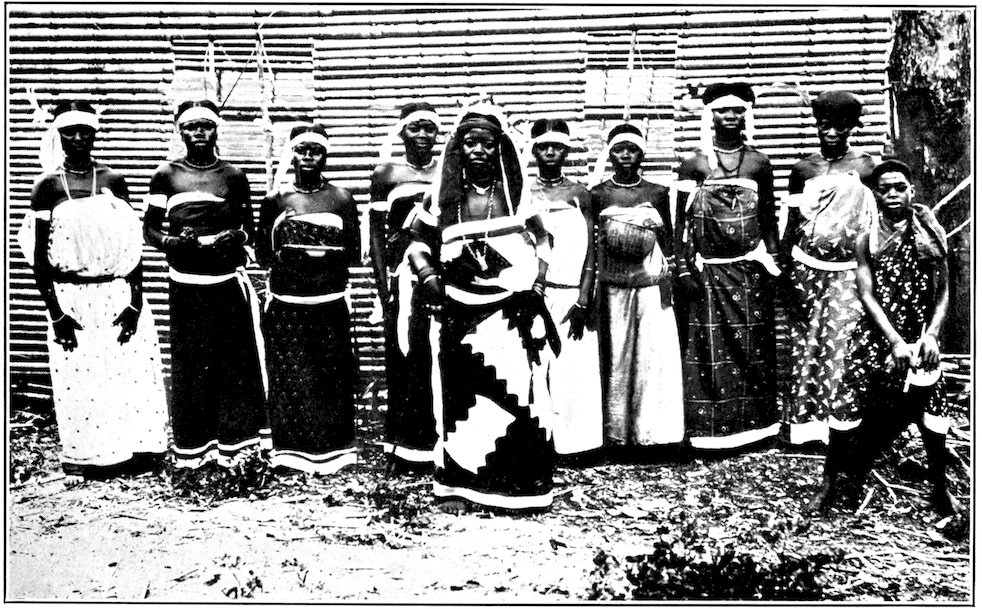
WOMEN’S SECRET SOCIETY OF GABOON.
41The lowest reach of Mpongwe degradation is represented
by the woman’s secret society, to which a majority
of the Mpongwe women belong—practically all, except
the Christians, who regard it with abhorrence. I know
of nothing in any interior tribe more degrading and immoral.
In former times of cruelty and oppression the society
probably served for the protection of women against
their husbands; but in these times it is the husbands
who need protection, and the society, having outlived
its usefulness, has degenerated. The women of the society
frequently meet together at night, usually in an
arbour of palms, and sing unspeakably lewd songs—phallic
songs—which are heard all over the village.
There is always a crowd of young men gathered around
the arbour; and the badinage which passes between
them and the women is shocking. And yet these same
persons, on all other occasions in their daily intercourse,
observe a degree of decorum which would astonish those
who think that there is scarcely any such thing as decorum
in Africa.
III A DYING TRIBE
42
This amiable and attractive people, the Mpongwe
tribe, is now but a dying remnant, hurrying to
extinction. It is not long since they were numbered
by tens of thousands; now there are probably not
more than five hundred pure Mpongwe. There are
women among them for whom marriage is impossible.
For, as I have already said, their social superiority makes
it impossible for them to marry into other tribes; but,
within their own tribe, many Mpongwe women are related,
nearly or remotely, to every surviving family, and
the very strict laws of consanguinity forbid the marriage
of related persons. It is expected, therefore, that these
women will make their alliances with white men; that
is, that they will not marry at all.
The first exterminating factor was slavery. Sir Harry
Johnston, in The Civilization of Africa, has this to say in
regard to the fatal adaptability of the Negro to a condition
of slavery:
“The Negro in general is a born slave. He is possessed
of physical strength, docility, cheerfulness of disposition,
a short memory for sorrows and cruelties, and
an easily aroused gratitude for kindness and just dealing.
He does not suffer from homesickness to the overbearing
extent that afflicts other peoples torn from their homes,
and, provided he is well fed, he is easily made happy.
Above all, he can toil hard under the hot sun and in the
unhealthy climates of the torrid zone. He has little or
43no race-fellowships—that is to say, he has no sympathy
for other Negroes; he recognizes and follows his master
independent of any race affinities, and as he is usually a
strong man and a good fighter, he has come into request
not only as a labourer but as a soldier.”
Sir Harry, speaking as an eye-witness of the capturing
and the exportation of slaves, gives a lurid description of
their sufferings, which, he says, “were so appalling that
they almost transcend belief.” He makes a conservative
estimate that in the modern period of the slave-traffic
twenty million Africans must have been sold into slavery.
The Mpongwe was one of the tribes that suffered most.
A large portion of their country was depopulated. The
slave-traffic was frightfully demoralizing to the Africans
themselves. It excited fiendish passions, stifled every instinct
of humanity and inspired craft and cruelty far surpassing
anything hitherto known. It was said that three
men of the same family dared not leave their town together
lest two of them should combine to sell the third.
More than half a century has passed since the last slave
ship sailed out of Gaboon harbour and disappeared over
the western horizon with its cargo of grief and rage, many
of them wailing vengeance in a mournful chant, improvising
the words as they sang. For the African sings his
bitterest grief as well as his joy. He sings where the
white man would weep, or curse; but to the accustomed
ear no cry could equal the pity of his song.
It was in this region that Du Chaillu hunted the
gorilla and gathered much of the material for his famous
books. An interior chief, in appreciation of Du Chaillu’s
visit to his town, once presented him with a fat slave;
and when Du Chaillu kindly declined the offer, protesting
that he would not know what to do with him, the chief
exclaimed in astonishment: “You must kill him and eat
him, of course.”
44Du Chaillu spat violently upon the ground—the African
way of expressing disgust and abhorrence.
“Then,” said the bewildered chief, “what do you do
with all our people who are sent down the river and far
away to your country? We have believed that you fatten
them and eat them.”
It is supposed that our present mission station was
formerly the site of a slave pen, where slaves were kept
until they were shipped—a barracoon; hence the name
Baraka.
The slave-traffic was succeeded by the rum-traffic; and
it would not be easy to say which of the two has proved
the greater evil for Africa. There is more drunkenness
in Gaboon, among the Mpongwe, than in most places on
the coast. Except among the few Christians, an abundance
of rum is used at every marriage and every funeral
and both men and women drink to drunkenness. The
women drink as much as the men, and there are a greater
number of hopeless dipsomaniacs among them.
One day, as I was walking along the beach, I met a
bright-looking Mpongwe woman who surprised me by addressing
me in English. I was eager to know who she
was. She said her name was Elida Harrington, and that
when she was very young the wife of one of our missionaries,
for whom she had been working, took her to
America when she went on furlough and that during the
period of the furlough she had attended school in
America. Those early days were evidently a sweet
memory, and Elida’s face was aglow with pleasure as she
told me. Finally I asked her why I had never seen her
at the mission. The glow faded from her face, and after
a moment of gloomy silence she replied: “You’ll know
soon enough.”
I afterwards learned that Elida, when she was young,
was married to a man who was given to nagging. He was
45continually making petty and groundless charges of infidelity
against his wife. There is no surer way to inspire
the dislike of the African. They are wonderfully generous
in forgiving impulsive cruelty, but continual nagging
will alienate them. At last, just to spite her husband,
Elida told him that all his charges were true; that she
had done all those things, and much worse—such things
as he had never thought of charging against her. Her
husband, when he recovered from a paroxysm of rage and
astonishment, told her to pack her things and leave his
house; to which she quietly replied that she would be
glad to do so, since she had already decided upon that
very course.
Soon after my first meeting with Elida I called at her
house. It was then that I learned why she kept away
from the mission. She was so intoxicated that she could
not get to the door. And this was habitual.
One day Elida went to see her sister Jane, who was sick
in bed. Jane wanted some bread and gave her the price
of a loaf and asked her to go out and buy it for her.
Poor Jane never got the bread. And poor Elida! She
went only as far as the first rum-shop.
I think of another, a young man who bore an honoured
name, Augustus Boardman, and who from his childhood
was closely connected with the mission. He spoke English
not like an African but as if it were his native tongue.
I never knew a native who understood the finer feelings
of white people as Augustus did. I never knew a native
who had in himself so much of what we call sentiment.
On one occasion he went with me to Angom where Mr.
Marling was buried. Mr. Marling, who had been dead
for five years, was the missionary whom Augustus had
known best and loved most. In the evening, just before
leaving for the coast, I happened to pass Mr. Marling’s
grave, and there I saw a beautiful wreath of flowers carefully
46woven, which Augustus had laid upon the grave.
The African is strangely indifferent to flowers, and I have
never known another who would have done what
Augustus did.
On another occasion I received a letter from him when
he was up the Ogowè River. He wrote that while visiting
at our old mission on the Ogowè he had come across
an English song-book, in which he had found a song, the
words of which were the most beautiful he had ever read
in his life; so beautiful that he had committed them to
memory; and he was wondering whether it was well
known and commonly sung among English-speaking
people. He copied the words of the entire song and enclosed
them in the letter. The song was The Lost Chord.
The anguish of the lost chord in his own life was the
secret of the deep impression that the song made upon
him.
In America a child can be kept out of the way of the
worst temptations until he has reached years of discretion,
but such separation is impossible in Africa. This
boy, when he was a little child, was taught to drink rum;
his mother died a hopeless victim of it; and by the time
he was a young man the appetite for it was insatiable and
complete master of him. The finer feelings which characterized
him seemed to make him all the more the
victim of this inordinate desire. He fought it as he
might have fought a python of his native jungles, but
in vain. On one occasion, in the presence of Mr.
Marling, he pledged himself with the solemnity of an
oath never to taste it again. A few days afterwards
he was walking down the street of an interior town
when most unexpectedly he met a boy with a bottle
of rum. He sprang at the boy, snatched the bottle
from him and drank the contents. Other efforts ended
similarly. He afterwards made such promises to me,
47weeping and fairly prostrated with shame and humiliation;
yet he soon fell again. He became at length
quite hopeless, and it was necessary to dismiss him
from all service in the mission. He got several good
positions, but lost them immediately. When I last saw
him he was a moral wreck and almost an outcast even in
Africa, where there are no outcasts. Augustus has since
died; one more victim of poisoned rum.
He is full of compassion and plenteous in mercy. And,
knowing Augustus as I knew him, I dare to hope that he
has again at last heard the long-lost chord, and the sound
of the great Amen.
The native is constitutionally incapable of being a
moderate drinker. And, besides, drunkenness is not
disgraceful; they have not the spirit that revolts from
it. I have personally seen little children intoxicated. I
have seen them intoxicated in the schoolroom. I have
known of parents getting their own children to drink to
intoxication for their amusement. It is doubtful whether
there is another tribe in all West Africa so besotted with
alcoholism as the Mpongwe. Physicians agree that it is
one of the chief causes of their increasing sterility.
Another factor in the extermination of the Mpongwe is
the demoralization of domestic life incident to methods
of trade. The Mpongwe man is a trader by instinct. In
shrewdness and diplomacy I doubt whether he has a
superior among all the tribes of West Africa. This
shrewdness he expresses in many homely proverbs; as,
for example, when he says: “If you must sleep three in
a bed, sleep in the middle.” White traders all along the
coast employ the Mpongwe as middlemen between them
and the interior people, who possess the export products.
The white man gives the middleman a certain
quantity of goods on trust. With these he goes to the
interior and establishes a small trading-post in one or
48several towns. It is a life of privation and danger, a
lonely, miserable existence, but he endures it with patience
for the joyful hope that at the end of a year or two
he may return to his beloved town and family in Gaboon,
so rich that he can afford to “rip” for six months; to
dress so that the women will adore him and the men
hate him. His goods being soon exhausted by his
numerous relations as well as himself, he starts off for
another year or two. He has a wife, or wives, at
Gaboon, and he takes to himself a wife or two at each
of his interior trading-centres.
In the dangers of these middlemen and the necessities
of trade Miss Mary H. Kingsley finds a plausible argument
for polygamy, amounting, in Miss Kingsley’s opinion,
to a full justification. Indeed, for various reasons,
the majority of traders defend and advocate native
polygamy. The journeys of these native traders to the
interior are dangerous, and I agree with Miss Kingsley
that they deserve credit for their courage. “Certainly
they run less risk of death from fever than a white man
would; but, on the other hand, their colour gives them
no protection; and their chance of getting murdered is
distinctly greater; the white governmental powers cannot
revenge their death in the way they would the death
of a white man, for these murders usually take place
away in some forest region, in a district no white man
has ever penetrated.”
There are two reasons why so many of them nevertheless
survive. The first is that trade follows definite
routes and the trader is expected about once in six
months by all the towns along the way, in which the
people are eager for trade-goods, the men “fairly wild
for tobacco” and the women impatient for beads and
other ornaments. Under these circumstances, for the
people of any one town to kill the trader would mean
49trouble between that town and the other towns along the
route.
But this consideration alone is not sufficient; and Miss
Kingsley gives us the means that he employs for his
further safety, as follows: “But the trader is not yet
safe. There is still a hole in his armour, and this is only
to be stopped up in one way, namely, by wives; for you
see, although the village cannot safely kill him and take
all his goods, they can still let him die safely of a disease,
and take part of them, passing on sufficient stuff to the
other villages to keep them quiet. Now the most prevalent
disease in the African bush comes out of the cooking-pot,
and so to make what goes into the cooking-pot—which
is the important point, for earthen pots do not
in themselves breed poison—safe and wholesome, you
have got to have some one who is devoted to your health
to attend to the cooking affairs; and who can do this like
a wife?—one in each village of the whole of your route.
I know myself one gentleman whose wives stretch over
300 miles of country, with a good wife base in a coast
town as well. This system of judiciously conducted alliances
gives the black trader a security nothing else can,
because naturally he marries into influential families at
each village, and all the wife’s relations on the mother’s
side regard him as one of themselves and look after him
and his interests. That security can lie in woman, especially
so many women, the so-called civilized man may
ironically doubt, but the security is there, and there only,
and on a sound basis; for remember that the position of a
travelling trader’s wife in a village is a position that gives
the lady prestige, the discreet husband showing little
favours to her family and friends, if she asks for them
while he is with her; and then she has not got the bother
of having a man always about the house, and liable to get
all sorts of silly notions into his head, if she speaks to another
50gentleman, and then go and impart these notions to
her with a cutlass, or a kassengo, as the more domestic
husband, I am assured by black ladies, is prone to.”[1]
This picture is not untrue to the facts. And yet some
of us who have old-fashioned ideas of morality are not
convinced that polygamy is thereby justified with its
beastly immorality on the part of those men and of all
those women who prefer not to have husbands hanging
about the house with silly notions—that is to say, moral
notions—about the behaviour of women. And however
heartrending may be the condition of those interior men
and women, without tobacco and without beads, we cannot
agree that their necessity justifies any such degrading
practice for its relief. As for the slight excess of rubber
and ivory that civilized folks obtain by this means, it may
soothe the civilized breast to know that all, or nearly all,
this trade produce would reach the coast in other and
more legitimate ways without these middlemen, whose
presence is a curse to the interior people, whose absence
is a curse to their own tribe, and who are above all a
curse to themselves.
This demoralization of domestic life is even worse for
the Mpongwe women than for their absent husbands.
There is a large settlement of white men in Gaboon, most
of them government officials. And because of the climate
the white population is always rapidly changing. Nearly
all the Mpongwe women become the mistresses of those
men. And the worst of it is that instead of being deemed
disgraceful this only gives them social prestige among
their own people. A woman said to me one day:
“Iga is so proud she won’t speak to me any more.”
“Why?” I asked.
“Oh, she is living with a white man now,” was the
reply.
51The marriage tie in Gaboon has long ceased to be a
“tie.” It was much more binding before the advent of
the white man, and it is more binding to-day among the
uncivilized Fang.
The dreadful diseases that have been imported into
Africa are certainly a factor in the extermination of the
Mpongwe. But the subject is too unpleasant to discuss
at length in this place.
Again, the disregard of native institutions and the
destruction of tribal authority by the foreign government
tends to break down all authority and remove all
moral restraints. This is more or less true in all West
Africa. The native form of government among the
Mpongwe is somewhat patriarchal; authority belongs to
the head of the family, the head of the clan and the head
of the tribe. The native reverence for the authority of
these men is the saving virtue that sustains the tribe.
But the chief’s authority and this reverence are destroyed
together when the people see him tied up occasionally
and flogged; or ruthlessly flung into prison; or his
authority superseded by that of a native policeman.
The kingly office goes begging for an occupant when men
find that the grandeur of royalty consists in being held
more or less responsible for all the misdoings of all the
tribe, while, perhaps, some black mistress of a government
official has more real power than the native king.
The authority of custom, in former times, even exceeded
the authority of kings. But the foreigner ignores
native customs, or ridicules them, or even condemns and
forbids them—often without understanding them. The
tribal customs of Africa, from the most trivial to the most
revolting, are not arbitrary, but have a moral meaning
and significance; though they sometimes outlive their usefulness.
They either embody such rude justice as the
African has attained; or else they represent the operation
52of the law of self-preservation. One can give a
rational explanation even of the most cruel and revolting
custom that I have ever known in Africa, namely,
the custom of burying a man’s wives alive with him
when he dies. Africa abounds with deadly poisons, and
African wives frequently contract an unpleasant habit of
using them in the cooking-pot. How common the practice
is may be judged by the African proverb: “We
don’t eat out of the same dish,” used for instance as follows:
“So-and-so is angry but what do I care? We
don’t eat out of the same dish.” The wife prepares her
husband’s food and has the daily opportunity of using
this deadly weapon. But this burial custom—the fact
that when he dies she will be buried with him—gives her
a personal interest in keeping him alive. It is scarcely
necessary to say that I think that this custom ought to be
suppressed and its observance severely punished. But
meantime something ought to be done to improve the
morals of the African wife.
The dowry paid for a wife among the Mpongwe is forty
dollars. Among the uncivilized Fang it is several times
this amount, although the Fang are very poor in comparison.
The Mpongwe dowry was reduced by the
French government as a step in the direction of its abolishment;
for it is nothing more than a purchase price.
But the result of this forced reduction of the dowry has
been demoralization rather than civilization. The custom
among all tribes is that if a wife desert her husband
her family must pay back the dowry or send back the
wife. It is not easy to send back a large dowry, and the
people, being unable or unwilling to do it, will send the
woman back unless she has a very strong case against her
husband. But forty dollars can easily be raised, especially
if there should be several white men to help. So
there is nothing to prevent the Mpongwe woman from
53leaving her husband when she pleases; and it pleases her
to change him frequently. Until the African attains the
moral sentiment that makes the marriage bond sacred
it is better that there should be the bond of outright purchase
and ownership rather than no marriage at all.
It is so with the whole body of custom. It expresses
the inward life of the people. It contains such rudimentary
morality as they know, or embodies a principle
that is necessary for the preservation of society. It is on
the level of the African’s moral culture. It corresponds
with his beliefs and has the consent of his mind. The
foreigner may by sheer force change his outward condition,
but unless there be also a corresponding inward
change he does not respond to the new obligations; his
moral responsibility is not equal to the new demands,
and the result is moral degeneration followed inevitably
by physical degeneration.
This very matter of the dowry illustrates the different
method of the missionary and, I believe, the true principle
of progress. Our early missionaries made no church
laws against the dowry, but they faithfully preached the
equality of woman and the higher idea of marriage; and
as the Christians became imbued with this sentiment
they themselves abolished the dowry within their own
society. But they did it at the instance of a moral sentiment
which made marriage more secure than ever. The
inward preceded the outward change. The missionary
does as much harm as anybody else when he adopts the
easy method of ruthless and indiscriminate assaults upon
native customs and beliefs. It was not the Master’s
method. Even slavery Jesus did not attack with violence;
that were as vain—if I may use the illustration of
Dr. Richard Storrs—as vain as to attack an Arctic ice-field
with pick and drill; but He turned upon it the
summer sunshine and it slowly melted away. He inspired
54men with a sentiment of human brotherhood and
destroyed slavery by expelling the spirit that made it
possible. The African has a rooted antipathy to the pick
and drill, but he loves the sunshine; he is responsive to
truth and capable of high and transforming affections.
It is said on the coast that England rules her African
colonies for commerce, France for revenue and Spain for
plunder. The English policy gives the utmost encouragement
to native enterprise and thrift, and on the whole
the English colonies are the most prosperous and promising.
The French policy of revenue imposes such a
burden of taxation that life no longer consists in eating
and drinking and talking palavers, but in paying taxes.
And the enormous import and export duty stifles enterprise
and in the end defeats its own purpose. But it
must be said that the French officials, of all classes, in
their personal intercourse with the natives, are free and
friendly, and in consequence are much better liked than
the English officials, who, though usually just, are often
arrogant, and, while they care for the welfare of the native,
care nothing for his feelings. One recalls that in
the early days of America the French got on with the
Indians much better than the English.
The German policy cannot be described in one word.
Their policy is commercial; but they love government
for its own sake and they govern far too much. There is
an element of militarism in their rule that is entirely too
rigorous for the African, and must ultimately destroy
him unless it becomes modified through knowledge and
experience. It is certain that Germany has not yet
solved the problems of colonial government in Africa.
Some years have passed since I lived in Kamerun and it
may be that conditions have improved—though I doubt
it; but it used to be that the first visible institution of
government in a new district was the whipping-post.
Whatever Germany does she does with all her might, and
the activity of this institution made the proximity of a
government station an undesirable neighbourhood if one
chanced to have a human heart. The outpost of civilization
in Africa is frequently a whipping-post.
TRADING-HOUSE AT GABOON.
The beach strewn with logs of mahogany in preparation for shipment.
55The fatal defect, both of trade and government, as independent
civilizing agencies, is that they have forcibly
altered the outward conditions of the native without
changing the inward man. The African is somewhat in
the position of the poor Indian in our own country a few
generations ago. He was a hunter in a land stripped of
game, a warrior deprived of arms and obliged henceforth
to seek his rights by legal technicalities—while he was
still the very same old Indian, inwardly not a whit better,
and by no means equal to the demands and moral obligations
which the new conditions imposed upon him.
One may clip the claws of the tiger and even pull his
teeth, but he is still a tiger; and a French uniform on an
African cannibal does not make him a vegetarian.
IV A LIVING REMNANT
56
The diminishing number of the Mpongwe, the
hostility of the climate, the insistence by the
government that French must be the language
of the schools, the great difficulty of procuring a corps of
French-speaking missionaries, the curse of rum, the presence
of a large community of white men and the natural
irresponsibility of the white man in Africa—all these
have combined to limit the work of our mission among
the Mpongwe and to make it exceedingly difficult. And
besides, there is, especially, the strong opposition of the
French Jesuits who have a large mission in Gaboon and
any number of missionaries that the work may demand.
Their hostility makes coöperation impossible. Their
methods, of course, are Jesuitical. We have the authority
of certain historians for the statement that in the early
days of missions among the American Indians the Jesuit
Fathers taught the Iroquois of Canada that Jesus was a
big Indian Chief who scalped women and children. If
that was ever true—and I doubt it—their object of course
was to gain first the outward adherence of the Indian,
submission to their authority, with the intention of afterwards
instructing him in the full content of Christianity,
as they understood it. The French Jesuits, perhaps with
the same good intention, have baptized nearly all the
polygamy, drunkenness, immorality and fetishism of
Gaboon, and they call it Christianity. But I believe it is
more inaccessible to moral and spiritual influence than it
was before.
57One day shortly after the news of the death of Pope
Leo XIII reached Gaboon, and before I had heard of it,
I was passing along the beach when I heard in a small
village the ululu of women who were wailing for the dead.
Their mourning has usually a local occasion, and I had
no doubt but that somebody was dead in their own village;
so I hurried over. The mourning ceased abruptly
at my approach—a triumph of curiosity over grief.
When I asked who was dead, the leader answered: “The
Pope!” She followed the answer with a prolonged howl
in which they all joined, and the tearless mourning proceeded.
That is how I learned of the death of Leo XIII.
The Protestant Christians of Gaboon are a very small
community; but they are the best Christians, and the
dearest people, I have known in Africa. They alone, of
the Mpongwe, have good-sized families of healthy children.
They are the living remnant of a dying tribe.
When I moved to Baraka the Mpongwe work, the oldest
in the mission, was in charge of a fellow missionary,
Mr. Boppell, and I had not expected to take any part in
it. But before the first year had passed, Mr. Boppell’s
health compelled him to leave Africa, his wife having
died at the beginning of the year. From that time I had
charge of the Gaboon Church, besides the work among
the Fang. In particular I undertook the training of
an Mpongwe candidate for the ministry, who since
Mr. Boppell’s departure was occupying the pulpit and
preaching very acceptably. This man, Iguwi, I instructed
four hours each week; but after most of the
year had passed, I felt that I could perhaps spend the
time to better advantage.
Iguwi was the best educated and the most eccentric
man of the entire Mpongwe tribe. He was a monk by
nature. The African is distinctly a marrying man. He
is usually very much married. But Iguwi at the age of
58forty-five was still single and was therefore a mystery to
the natives. He and myself were the only two single men
in the entire region of Gaboon. My own case seemed
strange enough to the natives. They never lost an opportunity
of asking me for an explanation. “Mr. Milligan,”
says a wistful and sympathetic inquirer, “you nebber get
wife?”
“No, I nebber get one.”
After a period of silence:
“Well, Mr. Milligan, why you nebber get wife? You
no have money for buy her? or she done lef’ you and run
’way wid odder man?”
In reply to these frequent queries, I gave so many answers
that I have almost forgotten which was the right one.
Iguwi was the only African I have ever known who
was not a marrying man. I have known other single
men among them, but they were either busy laying plans
to run away with some other man’s wife, or were working
day and night and stealing, according to opportunity,
to obtain sufficient dowry.
Iguwi was extremely bashful; and in this also he was
an exception to his race. On one occasion, an elder of
the church and his wife, intimate friends of Iguwi, invited
him to a chicken breakfast. They lived beside
him and he passed their house several times a day.
Nevertheless, he replied in a letter that he hoped they
would excuse him on account of his bashfulness; but that
he would be very grateful if they would send him his
portion of the chicken. Iguwi was born in slavery, and
as he became educated and somewhat cultivated he was
very sensitive in regard to his birth. This indeed may
account largely for his bashfulness.
But quite as prominent as Iguwi’s bashfulness and
quaint eccentricities was his transparent sincerity and
goodness. His religion had not the African tendency to
59exhaust itself in mental transports. The poor always
had a friend in him. I have had to remonstrate with him
for giving away all that he had. On one occasion, he
came to me and asked the monthly payment of his salary
in advance. I expressed surprise at his need of it, seeing
that only a few days before I had paid him for the past
month. But I found afterwards that he had expended
the whole mouth’s payment in helping a poor widow to
repair her house. She was not in any way related to him;
and she had relations who were able to help her; but she
had a sharp tongue and had turned them away from her,
and when poverty and distress came there was none to
help her. The most degraded of the heathen believed in
Iguwi and would never have doubted his honesty or truth.
In this sense, indeed, he was a “living epistle” of Christ
which all could read and which none misunderstood.
For so gentle a spirit he had a set of categories that were
especially drastic. On one occasion, when I asked him
how many persons had attended his village prayer-meeting,
he replied: “Fifteen Christians and six sinners.”
The attendance on the preceding Sunday was “ninety
Christians and twenty-five sinners.”
Iguwi was a remarkably good preacher. He had been
taught in the mission school at Baraka in the old days
when English was still permitted, but at best he received
there only the equivalent of a primary-school education.
After he decided to study for the ministry he received
further training in a theological class. It was a mystery
to me how a man so bashful and diffident had ever chosen
the ministry for a profession. But when Iguwi stood on
the platform his diffidence disappeared entirely and his
speech was perfectly free and courageous. The people
all enjoyed his preaching and were helped by it. He
was so absent-minded, however, in regard to his dress,
that a committee should have been appointed to look
60him over before he went into the pulpit, in order to
see that nothing essential had been omitted, and that
his clothes were fastened on him securely. A perpetual
problem to the native mind is how to get clothes
to stay on without buttons—a problem of which polite
African society anxiously awaits the solution. Even
with buttons, the imported garments of civilization are
still uncertain, when worn by those who are not to the
manner born. Sometimes, as if by a sudden act of disenchantment,
the buttons simultaneously unfasten, strings
untie and clothes fall off. Iguwi’s trousers were supported
by a red sash, which often got loose and began to unwind
slowly as he preached. When the loose end of the sash
touched the floor, it was a question as to what the climax
of the sermon would be. I finally advised him either
to preach shorter sermons or wear a longer sash.
Iguwi’s sermons were thoughtful and spiritual. It was
strange how so unpractical a man could preach such
practical sermons. They must have come to him by
intuition rather than by any exercise of judgment. It
was also indicative of a remarkable intellect that a man
without any library, who had read only a few books that
he had borrowed from missionaries, could preach sermons
that were always well constructed and thoughtful. I
happen to recall an outline which he submitted to me
one day on the text, “For as many as are led by the
Spirit of God, these are sons of God.” His three main
points were: First, The Spirit leads to the cross of
Christ; second, He leads to moral conflict (Iguwi probably
said to “war”); third, He leads to victory.
When I was leaving Africa, I gladdened Iguwi’s heart
with a set of Matthew Henry’s commentaries—which
more than doubled his library. The quaintness, the
homely simplicity and spirituality of Matthew Henry
were not unlike Iguwi himself.
61I have said that outside the pulpit Iguwi, with all his
goodness, was utterly unpractical. Often, indeed, he
seemed to lack common sense. I once gave him a book
to read in which the writer, by way of illustrating the
evanescence of human glory, referred to the gorgeous
palace of ice which was built by Catherine of Russia, and
so soon dissolved beneath the sun. Iguwi had heard of
ice and knew very well what it was, but being unfamiliar
with its resources of illustration he was deeply impressed.
While he was still reading this book, one night in prayer-meeting
he offered a prayer in which I, who did not understand
the Mpongwe language, was suddenly startled
by the English words, ice, palace, Catherine, Russia.
Even if the congregation had known English the
illustration would still have been unintelligible to them.
For aught they knew Russia might be the name of an
African tribe, or a river in America, and they were as
ignorant of the other words; and since those four words
comprised the whole illustration, the force and beauty of it
must have been somewhat lost upon them. It occurred
to me at the time that a library, instead of being a help
to Iguwi, would probably have spoiled his preaching.
Iguwi was so unpractical it seemed best not to ordain
him. If the worst heathen of Gaboon had asked admission
to the membership of the church Iguwi would have
received him with a God-bless-you. But he continued to
visit the sick and to give away his living to the poor.
His goodness shone along all the lowly paths of service.
A service in the Gaboon Church is much like a service
in one of our best coloured churches in America. There
is perfect order and good attention, and we need not
labour too much to be simple, for they listen intelligently.
Occasionally, however, one is reminded that it
is really Africa and not America. I have seen a man,
in the first pair of shoes that he ever possessed, come to
62church unusually late, tramp as heavily as reverence
would allow in coming up the aisle, and then sit in the
end of the seat, assuming an unnatural and uncomfortable
position in order to keep his feet in the aisle. What is
the use of spending money for shoes and wearing them
with so much discomfort if people are not to know that
you have them? Shoes for the African trade are purposely
made with loud-squeaking soles; the African will
not buy shoes that do not “talk.” Sometimes, in localities
further from the coast, the head of the family will
enter the church alone, wearing the shoes, and upon
reaching his seat will throw them out of the window to
his wife, who also will wear them into the church, and
perhaps others of the family after her.
Among the Mpongwe it was deeply impressed upon me
that the sincerity of piety is not to be judged by its
fluency. Most white people who acquire the art of
public speaking, especially in religious meetings, are
obliged to cultivate it; and only a small minority of
Christians can offer a prayer in public. But the African
speaks with perfect freedom and entire absence of selfconsciousness.
He can offer a public prayer long before
he becomes Christian, or has any such intention. It took
me a long time to put the proper estimate upon fluency.
One day I visited a woman, Nenge, who was going
further and further astray through rum and other
Mpongwe vices. I was so greatly impressed by her
eloquent expression of ideals and aspirations that I
inferred a great change in her life. I prayed with her
and asked her if she would pray for herself. Without
the slightest hesitation she began a prayer of considerable
length that almost brought tears to my eyes. She prayed
for herself and me. But I found out afterwards that she
had not the least intention of parting with either of her
great sins, and she was surprised that I had so misunderstood
63her. She had not meant to deceive me. The truth
is that any native could offer such a prayer. After
several such experiences I became wary. It is a great
gift, however, when it is truly consecrated. An
Mpongwe prayer-meeting never lags.
The Gaboon Church in its early history was ministered
to for many years by Toko Truman, probably the most
eloquent native preacher who was ever trained in the
West Africa Mission. He was entirely blind for seven
years before he died. The first time I visited Gaboon
Toko was still living. I was on my way home to America
and was detained several days at Gaboon, waiting for
a French steamer. I had heard much of Toko, and I
visited him every day. Among ever so many incidents
of interest which he related I recall his reply to a certain
white trader, a very profane man, who took pleasure in
mocking at Toko’s faith and self-denial. One day the
trader remarked that if there was any such place as
heaven, he himself was as sure of an entrance there as
anybody.
Toko replied: “I have read the words of Jesus, ‘Not
every one that saith unto Me, Lord, Lord, shall enter into
the kingdom of heaven,’ that is to say, not even all those
who pray shall enter; and the chances would seem to be
small for you, who do not pray at all. Heaven is not as
cheap as you think.”
Izuri is an elderly woman, a member in the Mpongwe
Church, whose charity towards the Fang of the interior
presents a striking contrast to the spirit of the coast people
generally. I have already said that, in the mind of
the coast people, the Fang belong to the orders of lower
animals, and that the coast women are ashamed to be
heard speaking Fang, though they all speak it; for they
trade with them daily. Izuri, when I had charge of the
Mpongwe Church, was sewing for a trading-house one
64whole day each week, thereby earning twenty cents, which
she gave to help support a native missionary among the
Fang. The Fang come down the river long distances to
sell food and building material in the Gaboon market.
They must travel with the tide, and often they remain at
the coast all night. It is sometimes hard for them to
obtain shelter; and, moreover, they are subjected to
every form of temptation by those who would get from
them the money or goods they have procured for their
produce. Izuri might often be seen going along the
beach in the evening, inviting these homeless people to
her town where she gave them shelter in a house which
she owned but did not occupy. And often in the evening,
sitting down in their midst, she would talk to them
in their own language, fairly scandalizing her neighbours.
I presume Izuri still continues her ministry to
the poor Fang.
An Mpongwe man, Ntyango, showed this same spirit
towards the Fang and went among them and preached to
them. He died about the time I went to Gaboon, and
was buried in the mission graveyard. Some years afterwards
the workmen were cutting grass in the graveyard.
Among them was a Fang man named Biyoga, whom
Ntyango had taught to read when he was a small boy.
As Biyoga was cutting grass and occasionally spelling
out the names on the tombstones he found Ntyango’s
name on one of them. Sacred memories stirred the heart
of the wild Fang. The next day he came to me and told
me that since the days, long ago, when he had known
Ntyango he had never met another man like him. All
the time since finding his name and while working beside
his grave he had been thinking of him, recalling his
kindness to the Fang, especially to the children, and his
Christian teaching, and now he wished only to be the
kind of man that Ntyango was.
AN MPONGWE WEDDING.
The bride is a daughter of Lucina, who stands at the left of the bride.
65I think of Sara whose honesty and goodness had beautified
her face. Left a widow with five young children,
and very poor, she often felt the burden of care too heavy
for her shoulders; but she went bravely on. When her
daughter was married and the customary dowry of forty
dollars was offered Sara by the young husband, she refused
to take it, believing that it was not in accord with
Christian principle. The king of the Mpongwe tribe,
being jealous for old customs, resented Sara’s action, and
having invited her to his town made her a prisoner,
thinking to intimidate her; but he failed even to pick a
quarrel with her, and after a few days he released her.
I think of Lucina, than whom the Mpongwe Church
never had a more faithful member. Lucina’s husband,
preferring a dissolute life of drunkenness and polygamy,
left her with five young children. Indeed, when he took
other wives he had to leave her; for her character embraced
the sensibility as well as the faithfulness of Christian
wifehood. She brought up her children under great
difficulties, working for them like a very slave; and
though she was young, educated and extremely attractive,
the breath of scandal never tarnished her reputation.
When her husband accepted a dowry for their daughter
and sent a portion of it to Lucina, she sent it back to him
saying that if he had sold their daughter for a price, her
conscience would not allow her to share it with him.
And, among others, there was Sonia, a white-haired
old man with the heart of a child. Sonia had as many
stories as Uncle Remus; but his best stories were the incidents
and adventures of his own life.
One still night as we lay at anchor, in the middle of
the swift-rolling river, with the moonshine lying in silver
ringlets across its surface, the boat-boys asked Sonia to
tell them a story. As usual his first reply was that he
did not know any stories—excepting a few foolish old
66stories that they had heard till they were tired of them.
But at length—as usual—he thought of one, and then another,
and still another.
He first told a typical story about the tortoise and his
creditors. The tortoise in African folk-lore is notorious
for unscrupulous cunning.
Once upon a time there was a great famine in the land
and food was very dear. So the tortoise called upon his
friends, the worm, the cock, the bushcat, the leopard
and the hunter, and borrowed from each a box of brass
rods, promising to pay them at the end of the season on
different days. On the day appointed the worm appeared
and asked for the payment of the loan. Then the tortoise
asked him to wait until he should go and fetch the money.
So the tortoise went off to get the money, and the next day
he came back with the cock, who also came according to
appointment for the payment of his loan. Then the worm
and the cock met, and the cock ate the worm.
Then the cock asked for his money and the tortoise
asked him to wait until he should go and fetch it. And
he went off again, and came back next day with the bushcat,
who had come for the payment of his loan. Then
the cock and the bushcat met and the bushcat killed the
cock and ate him.
Then the bushcat asked for his money and the tortoise
asked him to wait until he should go and fetch it. And
he went off again, and came back the next day with the
leopard, and the leopard killed the bushcat and ate it.
Then the leopard asked for his money, and the tortoise
asked him to wait until he should go and fetch it. And
he went off again, and came back with the hunter. And
the hunter and the leopard killed each other.
Then the tortoise laughed at them all for being fools.
And the moral is that it is not wise to lend to a man lest
he may wish you evil and seek to kill you. But Sonia
67reminds the boys that the story contains only the wisdom
of the heathen, and that Jesus teaches us to help those
who need our help even if we should lose by it.
After various comments on the moral of the story, to
the effect that “loan oft loses both itself and friend,”
Sonia tells a story of two friends and a wag.
There were two friends who had been friends from childhood,
and who were more than brothers to each other;
and these two friends had never been known to quarrel.
Now there was a wag in a neighbouring town, who one
day, when he heard the people talking about these two
friends who had never quarrelled, declared that he would
make them quarrel. That day he put on a coat of which
one side was blue and the other side red and then walked
down the road that ran between the two men’s houses.
In the evening the friends met as usual and one of them
said: “Did you see the wag pass to-day with a red coat
on?”
“Yes,” said the other, “I saw him pass; but it wasn’t
a red coat. It was blue.”
“I am sure it was red,” said the first.
“But it wasn’t. It was blue,” said the other.
And so they disputed until one of them called the other
a fool; and then they fought.
“Take that,” said one.
“And that,” said the other.
So they fought until their wives came running to them
and parted them. But they went to their houses with
heavy hearts. For they had been friends for a lifetime
and now their friendship was broken. And all the people
felt sorrow. But the wag, when he came along,
laughed and told them how he had worn a coat which
was red on one side and blue on the other. And the
friends and their wives ever afterwards hated the wag.
Sonia’s stories were most interesting when he recounted
68real incidents in his own life. When a young man, he
told us, he had lived as a trader at this Fang town opposite
which we were anchored. The noise of drumming,
dancing and singing had ceased and the town was wrapped
in untroubled sleep. There is no stillness in the world
like that of an African town in the night.
Sonia told us about a battle he had witnessed, which
was fought upon the river, at this very place where we
lay; a battle between this town and a town which then
stood on the opposite bank, but of which nothing now
remained. This town was already old at the time of the
war but the other was new, the people having come
recently from the far interior, being driven forth by the
hostility of more powerful clans behind. There was no
quarrel between the towns; but the people of the old
town thought that it would be good policy to give their
new neighbours a whipping upon their arrival in order to
insure a wholesome respect.
First, I believe, they stole a woman. Then followed a
guerrilla warfare, in which each side killed as they had opportunity,
waylaying individuals, or rushing from ambush
upon a party of venturesome stragglers from the enemy’s
town. In this way a number were killed on each side;
and the war, which was first undertaken more as a vain
exploit or adventure than from any serious motive, was
soon prosecuted with feelings of deadly hate and a purpose
of revenge. Every night, from each town, the wail
of mourning for the dead was wafted across the river;
and curses were mingled with the mourning.
At length one canoe attacked another in the river,
where they had been fishing. Immediately other canoes
came to their help, and still others, ever so many of them,
pushing off rapidly from each side until all the men of
the two towns, young and old, were in the middle of the
river where they fought to a finish. When fighting in
69canoes, whatever other weapons they may have, they
carry a small battle-ax, which is used especially to prevent
the capsizing of the canoe by those who are already
in the water. Sonia told how that, again and again, at
a blow they severed a man’s hand, or completely disabled
him. They swim so well that they could still make a
strong fight after being capsized. The battle was long,
and the river ran red with their blood. Those who were
killed were carried by the current out to the sea to feed
the sharks.
The people of the new town lost. Those of them who
were left pulled down their town and moved to another
place. In a few years nothing remained of it but one or
two skeletons with the grass growing through their ribs.
But for years afterwards the superstitious native passing
along the river in the dead of night heard again the
noise of battle—fierce cries and dying groans. And
whenever this sound is heard, they say, again the river
runs red like blood.
One incident of the war, prior to the final battle, I recall,
as Sonia told it that night.
The people of the old town captured a man of the other
side, and his son, a little boy. They bound the father,
and before his eyes deliberately killed his son—and ate
his flesh. The main motive of cannibalism, under such
circumstances, would be neither wanton cruelty nor a
vicious appetite, but fetishism. By eating one of their
number they render the enemy powerless to do them any
farther injury. Some time afterwards they slew the
father. But already they had broken his heart, and with
hands uplifted he welcomed the death-blow.
The emotion with which old Sonia told this whole
story indicated how his own heart had been wrung. He
said not a word about any effort of his to dissuade the
people from their cruelty; but I knew him well, and I
70was confident that the part he had taken was not unheroic.
That is a story that was never told.
Sonia in his latter years, between long intervals of
sickness, was a missionary to the Fang. They all regarded
him with love and reverence. The oldest savage
among them, and the wildest, were as children when they
addressed him.
In the little graveyard, on the mission hill at Baraka,
are the graves of those who have thought that life itself
was not too great a price to pay for the saving of such
men and women from degradation. Henry Drummond
said that while in Africa he had been in an atmosphere
of death all the time, and that he realized, as never before,
the awful fact of death and its desolation as something
calling for an answer. One of my first experiences
in Gaboon reminded me that I was again in the land of
death, when I assisted in the burial service of the beautiful
young wife and bride of a fellow missionary, less than
three months after their arrival in Africa. So far away
from home we enter deeply into each other’s sorrows. I
was standing by in the last hour, when with pale face the
stricken but silent husband stepped to the open door and
nervously plucked a flower growing there, a large crimson
hibiscus, the beauty of the tropics, which he laid on the
pillow beside his unconscious wife, and the two broken
flowers drooped and died together, while the shadows
darkened around us and the night came on. In the unconscious
act there was something more affecting than in
any words of grief. It seemed to relate this death to all
death everywhere, in a world where forms of life appear
only to vanish into darkness and day hurries to the night.
Soon after our patient sufferer had ceased to breathe,
in the midst of the stillness that followed the prolonged
struggle with the fever, a storm that had been gathering
with the darkness broke forth with great violence that
71shook the house. I had only arrived in Africa. I went
out into the storm unspeakably oppressed with doubt, to
which it was a kind of relief. Was it a noble sacrifice?
or an appalling waste? In the intervals of the storm,
and mingling with it, there came the sound of a dirge,
the hopeless death-wail, from a village close by, where
the poor natives were mourning for one of their number
who had died that day, a young man at whose bed I had
stood a few hours earlier, the only son of a heart-broken
mother. Those who have always known the words of
One who brought life and immortality to light cannot
realize the heathen view of death, and the abysmal darkness
of the invisible world. There is no sound so well
known in Africa, and none that so haunts the memory in
after years, as the mourning dirge, in which with united
voices they chant their sorrow for the dead—their despair
and desolation; the sound that is borne upon every night-wind
and becomes to the imagination the very voice of
Africa. The groaning of the palm-trees in the darkness
of that night, as they bent beneath the tempest, and in
the distance the sound of the troubled sea, were the fitting
accompaniment and interlude. But in our house,
beside our dead, there was light—and doubt was vanquished.
There, hope was whispering to a stricken heart
sweet promises of life; and faith was saying: “Let not
your heart be troubled, neither let it be afraid.”
V AFRICAN MUSIC
72
It was many years ago, among the Bulu, in Kamerun.
Dr. Good and myself were holding a religious service
in the town of a great chief, Abesula, whose
thirty-five wives were seated around him. After we
had sung several hymns Dr. Good began to preach,
but had not proceeded as far as secondly when Abesula,
interrupting, exclaimed: “Say, white man, won’t you
stop talking and sing again? And I wish you would
dance with your singing; for I don’t care for singing
without dancing; and I don’t like preaching at all.”
We found that Abesula’s whole family were united in
this preference for comic opera. But Dr. Good and I
were in hopeless disagreement as to which of us should
do the dancing. Besides, the Africans themselves are
expert dancers and qualified judges; and if our music
had “charms to soothe the savage breast,” I am afraid
that our dancing would have made more savages than it
would have soothed.
After a few months among the Bulu I had an organ
brought up from the coast, a baby-organ, which when
folded a man could carry on his head. The people had
heard that something wonderful was coming with the next
caravan; and on the day of its arrival it seemed as if the
whole Bulu tribe had assembled on our hill. Having unpacked
the organ I set it on the porch while they all stood
on the ground below. The tension of suspense during the
slow progress of preparation was a test of endurance. At
73last, everything being ready, I sat down at the organ,
filled the bellows, and amidst profound silence suddenly
sounded a loud chord. Instantly the crowd bolted.
Nothing was to be seen but disappearing legs. The
men, being more fleet of limb, reached the hiding-places
first; then the women and larger children, the smaller
children being left to their fate. To them the organ was
of course a fetish, and full of talking spirits. Gradually
they came out from their hiding-places. Then, as fear
subsided, each one began to laugh at the others and to
tell his ancestors all about it. In the ensuing noise the
organ had a rest. They soon became devotedly fond of
it, and it was a great help in our mission work. Regularly
on Sunday morning after the service I would set the
organ on the porch and play for them until I was tired—and
that was not very long; for in that climate the bellows
were soon in such condition that the playing was
prominently spectacular, done with the feet, reinforced
by all the muscles of the body. In after years, among
the Fang of the French Congo, I always carried an organ
with me.
To all the interior natives, Bulu and Fang, and even
to the coast tribe of Batanga, my playing of that little
organ was much the most wonderful thing about me. In
going to Africa a second time, after four years’ absence,
on my way to Gaboon I landed at Batanga for a few
hours. The natives remembered me as having a beard,
and I was now shaved. But there was with me a fellow
traveller who had just such a beard as mine had been;
so that, to the natives, he looked more like me than I did
myself. They of course mistook him for me; and the
stranger got a friendly reception which pleased him as
much as it surprised him. He said he never had met
such friendly natives. But upon my protest they discovered
their mistake and began to pay me some attention.
74I insisted that they had forgotten me and that my
feelings were hurt; at which they made the most excited
remonstrance. They remembered that I had played the
organ. One of the boys, in his eagerness to convince me
that they had not forgotten me, began to imitate my motions
at the organ, which he exaggerated to an outlandish
caricature in which hands, feet, head, mouth and eyes
were equally active, saying as he performed: “Look
me, Mr. Milligan; this be you.” Following his example,
they all engaged in a performance that would have scandalized
any company of self-respecting monkeys, saying
the while: “This be you, Mr. Milligan; this be you.”
My fellow traveller, who may have felt somewhat chagrined
at finding that the hearty reception accorded him
was intended for me, turned to me and made some remarks
that have no rightful place here.
We are all familiar with the legend that Pythagoras
invented the first musical instrument after listening to
the blacksmith’s hammers. Longfellow repeats it in the
poem, “To a Child”:
“As great Pythagoras of yore,
Standing beside the blacksmith’s door,
And hearing the hammers, as they smote
The anvils with a different note,
Stole from the varying tones that hung
Vibrant on every iron tongue
The secret of the sounding wire,
And formed the seven-corded lyre.”
Shakespeare also refers to this reputed origin of music
in “The Two Noble Kinsmen.” Pirithous, relating the
death of Arcite, tells how he rode the pavement on a
horse so black that the superstitious would have feared
to buy him, a prancing steed whose iron-shod feet seemed
75only to touch the stones—as if counting them, rather
than trampling them, and—
“thus went counting
The flinty pavement, dancing as ’twere to the music
His own hoofs made—for, as they say, from iron
Came music’s origin.”
Nevertheless, this story—like many others that cluster
about the name of Pythagoras, as, for instance, that he
was seen in two cities at the same time—is seriously
vulnerable, and is probably pure myth, without enough
of fact to qualify as a legend. The obvious objection, that
various hammers striking upon an anvil give out, not
different notes, but the same—for the notes vary with the
anvil and not with the hammers—Longfellow meets by
using the plural, anvils.
In the latest of Mr. H. E. Krehbiel’s learned and interesting
books, The Pianoforte and Its Music, the writer
holds that the first of all stringed instruments was the
bow. Every boy knows the musical twang of the bowstring
at the moment that the arrow flies. In the
Iliad, Apollo, the god of music, is also the god of archery,
and is called the “bearer of the silver bow.”
Mr. Krehbiel also recalls the passage in the Odyssey
in which Ulysses tries his bow, after the suitors of Penelope,
one by one, had tried and failed; and when Ulysses
drew the arrow to its head and let it go, the string rang
shrill and sweet as the note of a swallow. This theory of
the origin of musical instruments is strikingly supported
by the instruments in present use among the savage and
primitive tribes of West Africa.
A Kombe cook, at Gaboon, each day after dinner, lay
down for a nap and played himself to sleep upon an instrument
which was nothing but a bow with a single
string. The string was made of a certain runner, the
76fibre of which is very tough and gives a resonant note.
The cook found that by plucking the string with a metal,
rather than with his fingers, he produced a better note;
so for this purpose he regularly used the bread-knife and
took it to bed with him. When I first heard this unclassical
music I thought he was playing on a Jew’s-harp.
The native improves this instrument when he attaches
to one end of it a gourd or calabash, in the shape of a
bowl, to augment the sound—the first sound-box. When
he plays he places the flat side of the gourd against his
chest. He improves the instrument immensely when he
adds three strings, making four in all, successively shorter.
The four strings pass over a central bridge, which is
notched at different heights for the different strings.
This makes eight strings and produces eight different
notes. The gourd, or sound-box, is placed in the middle
of the bow, opposite the bridge. This instrument is
usually made from the midrib of a palm-leaf. The bent
midrib itself forms the bow; while the strings are the
loosened fibres of its own tough skin. These are made
taut by the vertical bridge, and their vibrating length is
regulated by strong bands passing around the ends of the
strings and the bow.
Another native instrument is a harp, both in shape and
in principle. The upper end is a bow, or half-bow; the
lower end is an oblong sound-box covered with a perforated
skin—monkey-skin or goatskin. The upper
ends of the strings are attached to pegs inserted in the
bow, by which the strings may be tuned. There is also
a five-stringed lyre, with a sound-box somewhat like the
harp, but instead of a single bow at the end, there are five
bent fingers, each with its string. There is a very
rudimentary dulcimer, and a xylophone, and various
modifications of the instruments which I have described.
The favourite of all these instruments, and the one of
77largest musical capacity, is the harp. The native uses it
most frequently to accompany his singing. There are
professional singers among them, whose position is somewhat
analogous to that of minstrels several centuries ago
in Europe. The songs of these professional singers are
usually lengthy ballads—traditional tales in lyric form.
The monotony of the solo, which is a dramatic recitative,
is broken by a somewhat regular and frequent choral response.
The singer half closes his eyes and sways his
body as he sings. He seems oblivious of time and place.
I have sometimes thought that there was an element of
hypnotism in his influence upon his audience. Upon the
instrument he plays a running and unvaried accompaniment
to his song. But it would be a great mistake to
judge the song, or the African capacity for melody, by
the miserably inadequate instrument. The singer’s voice
far exceeds the instrument, both in range and in the division
of intervals.
The fact is, however, that the only one of his musical
instruments which the African regards with profound
respect is his dearly-beloved tom-tom—the drum to which
he dances. From this some have inferred that, to the
African savage, rhythm without melody is music, which
of course is a mistake. It is even doubtful whether his
sense of melody be not altogether as keen as his sense of
rhythm, though not equally appealed to. The drum is
very easy to construct; but not so the harp or viol; and
the Negro is so lacking in mechanical genius that he cannot
invent an instrument capable of reproducing his
melodies. Therefore the melodies are always vocal.
They do not dance to the drum, by itself; for they invariably
sing when they dance. Dancing without singing
is almost impossible; at least I have never seen it
during seven years in Africa. They are passionately
fond of singing and have good voices. The voices of the
78men are much better than those of the women and have
sometimes the resonant sonority of a deep organ-tone, or
an exquisite melancholy, which it is to be hoped they
may never lose through future conditions of civilization.
The native songs are elementary but fascinating. Few
white men, however, can sing them; for the scales, or
tone-systems, upon which most of them are based, are entirely
different from our major and minor modes. Their
scales have not a distinct tonic, that is, a basal tone from
which the others in the system are derived, as, for instance,
the first tone, do, of our major scale. It follows
that the cadences of their music are not clearly defined;
or, as a friend of mine would say, “They don’t taper off
to an end like ours.”
Although their music is so difficult for the white man,
the natives learn our music with astonishing ease, even
their oldest men and women, and sing it well—if they
have half a chance. But is it surprising that—since our
scales are new to them—they at first need a little careful
training, or at least the lead of a clear-toned organ
reasonably well played? Otherwise they are not unlikely
to substitute the tones of their own scales. The result
is indescribable. Imagine a large congregation singing
the doxology with all their might, and about half of
them singing it in G minor instead of G major! But the
comparison is inadequate. The singing in some mission
congregations is enough to cause a panic. The first Sunday
that I spent in Africa was at Batanga, where the people
had learned the hymns before any white missionaries
went to live among them. I was near the church when
the large congregation started the first hymn. It was a
translation of “God is the Refuge of His saints, When
storms of sharp distress invade.” The tune of this storm of
sharp distress was good old Ward, but, alas, in such a state
of decomposition that I did not recognize it until they had
79sung it through twice. And so it was with many of the
tunes. Their own music has no extended range of high
and low notes; and so, in these hymns, whenever they
came to a high passage, or even a single high note, they
sang it an octave lower, and the low notes they sang an
octave higher. It was a vocal feat, and no audience of
white people could have done it without training; but it
did not sound much like music, still less like worship.
So great a musician as Dvorak, when he came to America,
was profoundly moved by the original melodies of
the American Negro, and became their enthusiastic champion.
Indeed, they inspired the most beautiful of all his
symphonies, the one entitled, “Aus der Neuen Welt.”
I do not refer, of course, to the so-called Negro melodies
composed by white men. Some of these are beautiful;
but they are not Negro melodies. They do not express
the Negro’s emotional life and he does not care much for
them. Those wonderful songs of the Fisk Jubilee Singers
are the real thing. Some of those very melodies may have
originated in Africa. Others are more developed than
any that I heard in Africa; but they are very similar,
and they use the same strange scales, which makes them
unfamiliar to our ears and difficult to acquire. Among
them, I really believe, are occasional motives as capable
of development as those of Hungary.
For a long time the music of Africa defied every attempt
on my part to reduce it to musical notation. Very
few persons have made the attempt; for it is easier to
reduce their language to writing than their music. At
first it seemed as inarticulate and spontaneous as the
sound of the distant surf with which it blended, or the
music of the night-wind in the bamboo.
The melody of African music is strange to our ears,
because, as I have said, it is usually derived from tone-systems
that are unlike either our major or minor scales.
80They have the pentatonic scale, that is, a major scale
without the fourth and the seventh notes, thus avoiding
the use of semitones; but their other scales are strange to
most people. Among them are some of the scales of the
plain-song of the Roman Catholic Church—the Gregorian
chant. The plain-song is the only survival (among ourselves)
of ancient music. Modern music is based upon
harmony, and consists essentially in a progression of
chords. The successive tones of a modern melody acquire
their character not chiefly from their own sequence, as do
ancient melodies, but from the chords to which they belong;
and the chords even when they are not voiced are
always understood. But harmony itself is modern, dating
from about the thirteenth century. African melodies
cannot always be harmonized, and when the harmony is
added it is not usually effective.
But in African music another scale is employed which
is not Gregorian, but oriental. It is a minor scale with
an augmented interval—a tone and a half—between the
sixth and seventh notes, that is, with a minor sixth and
a major seventh. This peculiarly effective interval imparts
an intense melancholy. Verdi, with delightful
propriety, makes use of this very scale in Aïda, in the
hymn of the Egyptian priestesses in the first act, where
an extant Arab melody is introduced. This scale is
probably the oldest tone-system in the world and may
have come originally from the banks of the Ganges, in
the far-distant past.
The African, like the oriental, conceives of the scales,
and the melodies derived from them, as moving downward,
instead of upward like our own. All African
music sings downward. Another striking peculiarity is
that they lack tonality, as the musician would say; that
is, they seem not to be in any particular key. The strong
feeling of the key-note which characterizes our major
81scale is entirely absent; and this, of course, accounts for
the absence of a well-defined cadence, to which I have
alluded. The weird fascination of the African dirge is
largely due to this absence of tonality. Musical genius
could hardly surpass this instinctive expression of despair—the
desolation of an everlasting farewell.
The emotion which it represents, however intense, is
rather disappointingly transient. Sometimes it is even
unreal; I mean to say that it is sometimes indulged for
its own sake. And this is true of the Negro everywhere.
A few days ago I came upon an article in an old magazine,
in which a Southern woman, in “Rambling Talks
About the Negro,” tells of a mourning party of Negroes
that assembled one night beside her house to finish a
mourning ceremony that ought to have been a part of a
funeral a few days earlier; but a storm had interrupted it.
The unearthly mournfulness of their music was intensified
by their beautiful voices until it became unbearable,
and the woman bowed her head upon the window sill and
cried without restraint, while imagination conjured up
fictitious woes, such as the sudden death of her children
and of all her friends, until she was alone in a bleak world.
Then it occurred to her that it was wrong for people to
indulge a voluntary anguish and make a luxury of
misery; so she sent a servant to offer a barrel of watermelons
to the party of mourners on condition that, instead
of mourning, they should dance and jollify; to
which they heartily responded, after first making sure
that the melons were in good condition, for they really
preferred to mourn.
When, to the peculiar scales which Africans employ,
one adds the further fact that in African music (and indeed
in the Negro melodies of our South) the note which
corresponds to our seventh in the scale (a step below the
tonic) is seldom a true seventh, but is slightly flatted,
82enough to make a distinct note with a character of its
own, one has probably accounted for the peculiar plaintiveness,
the elusiveness, the vague mysteriousness,
which constitutes the charm of all true Negro music.
The rhythm of African music is a further impediment
to our appreciation. In the music of the dance the
rhythm is of necessity somewhat regular. But even in
this music it is variable and does not conform throughout
to any one time-scheme but changes back and forth from
duple to triple within the same melody. This also is
characteristic of oriental music. In most African music
the rhythm is regulated by the words, like the recitative,
the rhythmic imitation of declamatory speech. But it
has the symmetry that feeling secures. The best way to
learn the African’s song is to watch the swaying of his
body and imitate it, and if the words have meaning let
their feeling possess one. Mr. William E. Barton, the
compiler of a small collection of choice Negro melodies,
tells how that “Aunt Dinah,” who had been trying to
teach a Negro hymn to a young lady, at last seeing her
begin to sway her body slightly and pat her foot upon
the floor, exclaimed: “Dat’s right, honey! Dat’s de
berry way! Now you’s a-gittin’ it sho nuff! You’ll
nebber larn ’em in de wuld till you sings ’em in de
sperrit.”
The African sings not only his joy, but his grief; not
only his love, but his anger, his revenge and his despair.
Livingstone was greatly surprised, upon approaching a
slave caravan, to hear some of them singing. But as he
listened he found that they were singing words of grief
and vengeance—for usually they were betrayed and sold
by some of their own people. So it was everywhere, as
old men of Gaboon have told me; they went away chanting
their desolation and their curses upon those who had
betrayed them.
83There is no doubt that music is the art-form of the
Negro. He is the most musical person living. His entire
emotional life he utters in song. He has not yet
done any great thing. His day is still future. But I believe
that when he comes, he will come singing.
The time signature is only approximately correct, and forces a rhythmic symmetry which African music does not possess. The energetic momentum is characteristic of African dance music.
This is chanted by an individual, or a succession of individuals, and is not the usual wail in which all join, though it is much like it. African music is not always based upon harmony; nor does harmony always improve it.
VI PESTS
85
It is part of the squalid commonplace of life in
Africa that the most exciting adventures are not
with elephants but with ants, and our worst danger
is not the leopard but the mosquito. And this struggle
against minute enemies requires more patience than the
fight with beasts, both because it is not occasional, but
an unremitting warfare, and because it does not appeal
to our love of the heroic, nor stimulate with the promise
of praise. When Paul tells us that he fought with beasts
at Ephesus, our hearts swell with admiration; but if he
had said: “I have fought with the mosquitoes in Africa,”
he would have elicited no sympathy and some ridicule;
although the latter is also a fight for life, and attended
by greater danger and weariness and pain.
It is significant that it was in Africa that Moses summoned
the ten plagues to his aid in humbling the haughty
Pharaoh. If ten had not been sufficient he might have
summoned ten times ten, and without exhausting the domestic
resources.
We are grateful that common houseflies are not sufficiently
numerous to constitute a pest, except where cattle
are bred in large numbers. In Gaboon there was no need
for screens on doors and windows.
But there are many kinds of flies, and the natives who
have not learned to wear clothing commonly carry a fly-brush
made of a bunch of stiff grass about two feet long,
that they may defend the whole area of the back, where
the fly usually makes its attack. When one sees a fly on
86a neighbour’s back it is regarded as a duty of friendship
to come up behind that neighbour slowly and stealthily,
giving the fly full time to bite his worst and so be deserving
of death, then to strike an awful blow on the neighbour’s
back, fit to bring him to his feet with a yell. It
seldom harms the fly, but it expresses great indignation,
and, by implication, sympathy with your neighbour.
The habit of killing flies, or attempting to kill them when
they alight, is an obsession with the native, and it seems
a physical impossibility for him to resist. He does it in
church. When I first preached in Batanga, to a large
congregation, I was very much disturbed by this unlooked-for
and constant slapping on bare backs. And
whenever I saw a man creep quietly across the aisle or
forward several seats to perform this friendly office, I
could not help watching until I heard the slap, when I
always felt like stopping the discourse long enough to
ask: “Did you kill it?” For in the mind of all those
around there seemed to be nothing else going on in that
church but this exhibition of applied Christianity.
Forgetting that the white man is protected by his
clothing, they vie with each other in the discharge of
this courtesy; and the exasperating blows that the white
man receives from his black friends are the chief discomfort
that he suffers from the larger flies. One day shortly
before leaving Africa I was riding in an open boat when
a native man sitting behind me suddenly gave me a slap
on the back that actually hurt, and so startled me that I
did some fool thing a little short of leaping into the sea.
I turned around and asked the man in a tone of cold
politeness whether he was trying to make my back the
same colour as his.
“Why, no,” said he, “I am killing flies.”
“I’m no fly,” I replied frigidly.
A few minutes later, when I was indulging in a
87somnolent reverie, he struck me again—I think it must
have been in the same place, it hurt so much worse than
the first time; whereupon I turned about and, striking
a very dangerous attitude (for a missionary), I threatened
that if he did it again I would land him a blow
in the stomach whether there was a fly there or not.
My boat-boys, who knew the uses of clothing and appreciated
the immunity of my back from fly-bites as well
as the greater tenderness and sensitiveness of the white
man’s body, laughed at this interesting diversion. Then
they undertook to enlighten their friend from the bush
as to the white man’s view-point, combining theoretical
instruction with practical sense by removing him to another
seat: for they well knew that if he should see
another fly on my back, even while they were talking,
he would strike again. He cannot help it: the habit is
coercive.
Among the worst pests, and peculiar to Africa, is the
driver ant. They go together in countless and incomprehensible
numbers. The first sight that one gets of
them is a glistening black, rapid-running stream about
two inches wide crossing the path before him. Upon
closer inspection he finds that the stream is composed
of ants; and recognizing the driver ant of which
he has heard many incredible stories on the way to
Africa, he feels like shouting “Fire!” and running for
his life. But as a matter of fact he may with impunity
examine them as closely as he pleases so long as he does
not touch them. They are so occupied with their own
serious purpose that they will take no notice of him.
In the middle of the black stream are the females,
about the size of our common, black wood-ant, while
along the sides run the soldiers guarding from attack,
and these are about four times the size of the others.
The defense of the females is no matter of necessity, but
88rather gallantry, for those female viragoes are abundantly
able to defend themselves. No creature so small ever
had such a bite. They are all provided with jaws and
with stings and they know how to work both vigorously.
Some fine day as the newcomer saunters along, his eyes
engaged with the beauty of the landscape, he walks into
the ants. It may be one minute, perhaps two, and possibly
five, before he knows anything of the serious
mistake he has made. Then suddenly he experiences a
sensation which is usually compared to numerous red-hot
pincers applied implacably; for these ants do not let go.
If he follows the course prescribed by ardent advisers, he
will do either of two things: he will instantly strip off
his clothing, even if he should be in the governor’s courtyard,
yelling the while at the top of his voice so that
those who object may go some other way; or he will
make a dash for the nearest rain-barrel and tumble into
it. Fortunately, their bite is not poisonous and leaves
no bad effects afterwards. After this experience he will
never allow more than one eye to dwell upon the charm
of the landscape; the other will be directed to the path
before him. If a man must go out at night he always
carries a lantern.
When these ants come to a place where there is food to
their liking, they scatter and spread out over a large
area. Then, of course, they are not so quickly discovered,
and one may easily walk into them. They are one of
the trials of bush-travel, and the worst living nuisance
of the bush, where the undergrowth hides them even
from the keen eye of the native. There is seldom a day
on a bush journey that the caravan does not march into
the drivers. Then there is some wild yelling by those in
the lead; the cry, “Drivers!” goes all along the line
and each man as he comes to them makes a lively dash
through them, stamping heavily as he runs; for it is
89possible thus to keep them off or to shake them off before
they get a hold. All other insects and animals flee
before them, including the python and the leopard.
Travellers have frequently told how that the silent,
sleeping forest has suddenly become all astir and vocal,
the angry boom of the gorilla or the frightened bleat of
the gazelle alternating with a cry of the leopard and the
scream of the elephant; all forgetful of their mutual
hostility and vying with one another in the speed of
their escape from the driver ant, abroad on a foraging
expedition, to the number of infinity.
They make frequent visits to the native villages and
the white man’s premises, usually in the night, spreading
over the whole place,—the ground, the houses, inside and
out, and through the roofs. Here they act as scavengers,
driving before them all other insect nuisances, such as
the cockroaches and centipedes, which especially infest
the thatched roofs. Nevertheless, if one should hear the
language of the average white man, upon the occasion of
one of these nocturnal visitations, when the drivers have
wakened him rudely and driven him headlong out into
the dark, and perhaps the rain, there to shiver during this
untimely house-cleaning, one would not for a moment
mistake it for an expression of gratitude.
Setting hens must be kept carefully out of their way.
In one instance I knew of the drivers visiting a nest one
night when the young chickens were just coming out of
the shells. The empty shells were there in the morning,
but no chickens. If they should gain undiscovered access
to a chicken-house in the night, they would leave
nothing but bones and feathers. At Efulen we built our
chicken-house against the workmen’s house, on the side
away from the bush, so that the drivers on their approach
should first visit the workmen and we should be warned
in time to save our chickens.
90We had been there only a short time when we were
awakened one night by the familiar outcry as the men
were driven out of their house. But the drivers had
come from a different direction that night, and when we
went to the chicken-house we found it already in their
possession. It was but the work of a minute or two to
tuck our pajamas inside our socks, bind our sleeves with
handkerchiefs around the wrists, tie another handkerchief
around the neck and pull a cap down over the head.
Thus prepared I entered the chicken-house, the ground
and walls of which were a glistening black mass. Stamping
my feet all the time, I snatched the chickens one by
one from the roost, stripped the handful of loose ants
from their legs and handed them out to Dr. Good and
Mr. Kerr, who picked off the remaining ants, after which
we brought the chickens into our house and put them
on the pantry shelves until morning, meanwhile building
a line of fire around the house to keep the drivers back.
But it was not long after this that they found the house
unguarded one morning just at daylight when I was
alone at Efulen. I was awake but not yet ready to rise
when I heard a low, rustling sound upon the floor of my
room. After a few minutes, observing that it was becoming
more distinct, I drew back my mosquito-net and
looked out. Almost the entire floor was black with
the drivers, and they were close to the bed. From the
foot of the bed towards the door it was still possible for
me to escape by a good jump; and in a moment I found
myself shivering out in the yard while my clothes were
still in the house.
One day, as Dr. Good and I were entering a native village,
Dr. Good walked through some stray drivers. He
began to preach to the people, who as it happened were
already gathered in the street where they had been taking
a palaver. Before he had been preaching more than a
91minute I observed that his gestures were more animated
than I had ever seen before. Soon they became violent,
noticeably irrelevant and even of questionable propriety.
It was a little like Brer Rabbit, one evening when the
mosquitoes were bad, telling the wolf about his grandfather’s
spots. I looked on with increasing amazement
and consternation, until at last even Dr. Good’s indomitable
will was overborne, and he shouted: “Drivers!”
and bolted abruptly for the bush. I tried to go on with
the service, but it was almost impossible because of the
laughter of the audience. Each one insisted upon telling
his neighbours all about it, to the accompaniment of a
broad caricature of Dr. Good’s gestures.
There was once a native man in Gaboon who was
slightly deranged in his mind. The government advised,
and at last insisted, that he should not be allowed at
large. His family, being averse to confining him, chiefly,
I imagine, because of the care it would entail upon them,
sent him to a village of their relations across the river
ten miles distant. There he remained for some time.
The people there bound him at night lest he might set
fire to the town while they slept. He objected to this
and at last became troublesome by calling out continually
during the night. Then they improvised a rude shelter
back a short distance from the town, where they placed
him at night and as usual bound him. One night he was
more noisy than ever before, yelling and screaming hideously
so that he wakened the people. They thought that
he had become demented but no one went to him until
morning, and then they made the horrible discovery that
the drivers had attacked and devoured him.
In some tribes criminals are sometimes punished by
being bound to the ground in the track of the drivers.
One can hardly conceive of anything more horrible; for
they would enter ears and eyes and nostrils. But I believe
92this is very rarely done. When death is decided
upon, the Africans usually accomplish it by quick means.
There is another ant which I would say is worse than
the driver, were it not that as yet its distribution is limited
and it may be only transient. It is a very small red
ant difficult to see with the naked eye except in a good
light and on a white surface. It takes to dark closets,
upholstered furniture, hair mattresses and those who
would sleep upon them. It has not been long known in
those portions of West Africa that are familiar to the
white man. It has come from the southeast towards the
coast. In 1900 it took possession of our mission-house at
Angom, which was not occupied at that time.
It is doubtful whether this ant would be likely to infest
a house when the grass around it is kept closely cut and
the house well opened to the light and air; but when
once infested it is not clear that these precautions would
drive it out. One of Woermann’s trading-houses on the
Ogowè had to be abandoned because of it.
My first experience with it was in 1900 when I visited
Angom and slept in the mission-house that had been
occupied only occasionally for more than a year. I was
no sooner asleep than I was awakened by an extremely
painful sensation, as if red-hot pepper had been sprinkled
all over me. I felt no sharp bite, but only this intolerable
smarting pain. It occurred to me that I might have been
poisoned during the day by some violently poisonous
herb in the bush or the overgrown garden; but I remained
in bed never thinking that the cause of it was
there. The natives told me in the morning what it was.
My flesh was badly inflamed and I had fever all that day.
After that I always slept in the boat, or in later years, the
launch, when I visited Angom.
Among African pests there is another red ant, very
small, though not so small as the last. It does not bite
93nor attack the person, but is nevertheless a great nuisance,
particularly to housekeepers. All table food must be
kept out of its way. Any food remaining on the table
even an hour is covered with them. They are especially
fond of sugar; and if it is left on the table or unprotected
from one meal to the next, it is found a living red mass.
By what powerful instinct they immediately discover the
place where food is, and where they come from in such
numbers, are among the mysteries that the white man will
often ponder. Most of our food is imported, in tins, and
once a tin is opened it is kept away from these ants by
being placed in a safe suspended from the ceiling by tarred
rope. The safe is a light frame of wood covered with wire
screen or netting.
Besides these, there are numerous other varieties of
ants, less harmful, or altogether harmless. The ground is
so infested with them that neither white man nor native
ever thinks of sitting down upon it, as we might sit upon
the grass in this country. Altogether, more than five
thousand varieties of ants have been described and
classified; and most of these are found in Africa.
Among the worst of the African pests is the jigger.
Those who are most sensitive to it would without doubt
call it the worst of all. If the pest of the small ant
travels from the interior towards the coast, this pest began
at the coast and is extending towards the interior. It has
evidently been imported—tradition says from Brazil, in
the cargo and sand ballast of sailing vessels. The older
inhabitants along the coast remember when it first became
known, and I am sure that it made itself known
very soon after it arrived. The jigger is a tiny species of
flea, so small that the naked eye sees it with difficulty.
It has all the reprehensible habits of its kind. The males
hop all over one’s person in a playful manner, giving him
a nip here and a nip there; but the females burrow beneath
94the skin. The favourite place is the feet, especially
under the nails, but they are frequently found also under
the finger nails and sometimes in the elbows and knees.
Here the female, unless discovered and removed, forms a
sac which expands to the size of a small pea, and which
contains hundreds of little jiggers who soon begin to “jig”
for themselves, and burrow again in the same flesh.
Many of them however are scattered on the ground; those
that remain keep multiplying, until if neglected the whole
foot becomes a festering sore.
To the African child the jigger is the occasion of its
worst suffering. I have seen children who could not
walk, some with toes eaten away, and several with nearly
the whole foot gone. For, to the African and to some
white men, they are not irritating while boring beneath
the skin, and afterwards they are very hard to see,
especially in the black skin of the native. One may know
nothing of their presence for several days, after which
they are so hard to remove that the native child will bear
the irritating itch that they first occasion rather than submit
to the pain of removing them; and when the itch has
become a painful sore, no child could remove them.
Some African mothers watch their children’s feet closely
but others neglect them cruelly. I am glad to say that
those who allow their feet to get full of jiggers, or mothers
who neglect the care of their children’s feet, are looked
down upon, as lousy persons would be among us, though
not to the same extent.
The jiggers are less troublesome in the wet season.
But with the dry season their numbers increase rapidly,
and towards the close of the season the soil and the sand
are fairly alive with them. If possible, missionary boarding-schools
ought to have vacation at this time; for the
white missionary is sure to get them in the schoolroom;
and the dormitories, which usually have only earthen
95floors, become so infested with them that even native
children are often kept awake at night, and the amount
of discipline necessary to make them keep their feet in
order may demoralize the school. There are always
children, large and small, who need no supervision, and
are sufficiently self-respecting to keep their feet clean; but
their task is made exceedingly difficult by the presence in
the same dormitory of those who breed jiggers by thousands.
As a rule, with but few exceptions, the children
who keep their feet clean are those who have been in the
school before and are known as mission-boys and mission-girls.
In my boys’ boarding-school of later years one would
see a strange sight each day during the dry season. The
whole school filed out at recess and sat down along either
side of the path leading to the mission-house. A committee
of boys examined the feet of the others and
reported to me the name of every boy who had jiggers in
his feet; while I stood with note-book in hand and wrote
down their names. Then when the food was given out at
noon these boys were left without food until their feet
were pronounced clean. The larger boys were responsible
for those of their own town or family who were too
small to attend to their own feet. I once kept a boy more
than a day without food until he removed his jiggers, and
one hopeless boy I at last expelled from the school for the
offense. For rigid insistence upon this discipline, I felt,
lay close to moral instruction.
The white man of course suffers from jiggers, but not so
much as the native, because of his shoes, his cleaner
house, and because his feet are more sensitive, so that he
becomes aware of them after several days at the most,
when they can be removed without injury, if it is very
carefully done. After one has been in Africa a length of
time he will detect their presence as soon as they begin to
96burrow. Some white men have a native boy examine
their feet every night or morning; for the boy has very
sharp eyes, and he removes the jigger with surprising
skill. It can be done with a pin; a needle is better and
a pair of tweezers is still better. If the sac that is formed
after several days be broken in the removal, it may cause
a sore that will take some time to heal. Indeed, if one
be greatly reduced in health and the blood in bad condition,
it may not heal at all until he leaves the country on
furlough. I have known men who for weeks were not
able to wear a shoe because of jigger sores.
After I had been a few months in Africa, one day,
while in bed with fever, I said to a friend that in allowing
my feet to touch the floor beside the bed where
natives had been standing, I must have caught the itch;
for a most irritating itch had been troubling me for several
days. My friend at once suggested jiggers as the cause.
I answered with great assurance that it certainly was not
jiggers, for I had watched my feet very closely, having
determined from the first that I should get no jiggers—which
of course was true, but I suppose I had been watching
for creatures the size of potato-bugs crawling over my
feet I at once called a native boy, however, wishing perhaps
to assure my friend, and the boy found seven
colonies of jiggers. It took my feet a long time to heal.
But it never happened again.
The male jigger, as I have said, does not burrow in the
flesh, but disports himself upon the surface and makes
himself very numerous. He is one of the great variety
of influences that keep the white man constantly scratching.
The native scratches too, scratches most of the time,
and often with both hands, but he does not get excited
about it, nor attract so much attention. But the habit is
disgusting in the white man, and after all it is a
habit rather than a necessity. A minority exercise the
97strongest self-restraint, a larger number exercise restraint
sometimes; many white men, however, exercise no restraint
at all, but scratch continually, regardless of the
occasion.
The sandfly, or midge, not known at the coast, but
widely distributed in the interior, must be counted among
the worst of African pests. They also are exceedingly
small. They do their utmost to make life intolerable in
the early morning hours after daylight, and again in the
evening before dark. Some are more sensitive to them
than others. When I was living in the interior, I bathed
my hands and face in kerosene or turpentine each morning
and evening as their hour approached and sometimes
repeated it once or twice before they retired.
The mosquitoes are so bad, especially in the low places
along the coast, that even the natives must sleep under
mosquito nets.
In the song of our childhood we were impressed with
the possibilities of such minutiæ—as little drops of water,
little grains of sand and little moments of time, when
these are multiplied by infinity. But infinity is the
status of all insect life in Africa. In order to realize the
pest of the mosquito in towns adjacent to mangrove
swamps one must multiply the insect until it seems to
compose about fifty per cent. of the atmosphere. Its
music too is impressive.
Wherever possible the white man builds his house upon
a well-cleared hill and so escapes them, sometimes almost
entirely as at Baraka. But this is not always possible.
Many missionaries have told of writing letters while sitting
cross-legged on their beds with the mosquito-net
drawn down around the bed.
The centipede is common, especially in those houses
that have thatch roofs. The African centipede is very
large, and its bite is poisonous, though rarely fatal. My
98first experience with it was one morning, in my bedroom,
when I took a bouquet of flowers off the table and
held them to my face. A large centipede glided out of
the flowers, and running swiftly across my hand and
along my arm to the elbow, dropped to the floor. Fortunately,
my sleeve was short, else I should have been
bitten. But one morning that I shall not forget I put on
a sock, and there was a centipede in the toe of it. Unfortunately
the sock was in a state of good repair; there
was no hole in the toe. I was badly bitten, for it was
some time before I could get the sock off; and the sickening
feeling of repulsion was worse than the bite. I
afterwards acquired the habit of shaking socks and shoes
and clothing before putting them on. It is well worth
while; for if one is disappointed in the matter of centipedes,
one may perhaps shed a scorpion or several
roaches, or sometimes even a snake. There are scorpions
in all parts of Africa and in some places they
abound. Their bite is always bad, and that of some varieties
is dangerous.
But if I were asked my opinion as to the very worst
pest in Africa, I would name the roach, or cockroach, and
I think that the majority of white men would agree with
me. My aversion to this creature is so strong that I do
not pretend to be able to give a dispassionate judgment.
It is a beast of an insect. It is much larger than the familiar
cockroach of this country and is often two inches
long; and all its powers and qualities of disposition are
proportionately developed. It multiplies with amazing
rapidity. It has an odour that for real nastiness takes
preëminent rank even in malodorous Africa. It has a
voracious appetite, eats almost everything and seems to
get fat on arsenic, which I have fed to it in large quantities;
though some persons declare that it thrives on
arsenic by not eating it and by detecting it even when
99mixed with sugar or anything else. It is found in the
pantry, in clothing, in the library, in furniture, in every
drawer and every corner, and a thatch roof is soon full of
them. Even in bed one is not always free from them,
for during sleep they often nibble one’s nails and hair.
The only way to kill the cockroach is to crush it, and the
result is so disgusting that one will feel that it has more
than avenged its death. Once in a while in the evening
all the cockroaches take to flying, as if seized with a panic
or madness. And when they do this they make one forget
all the other pests of Africa.
If the least bit of butter or grease should touch a suit,
one may depend upon it that unless it is put in a roach-proof
trunk the roach will find that spot, and in the morning
a hole will be eaten through. They devour wool as a
horse eats hay; but they will leave both wool and grease
for the starch contained in cloth bookbindings. They
show a decided preference for new books, the starch being
softer in these. If, in a moment of supreme folly,
one should leave a book uncovered on a table over night,
he will find it in the morning with several spots upon it
the size of a dime, where the starch and colour are eaten
out and the bare gray threads exposed. This happened
to my Memoirs of Tennyson; both volumes were badly
defaced in one night. Of course one will cover with
heavy paper—when he has the paper—every book in
his library, or, at least, those that are not already spoiled
by the time he gets round to them; but books so covered
lose their identity, like friends in masquerade. Besides,
books thus kept in paper in that damp atmosphere will
soon be covered with mould. If one adds to this that
while roaches or mould are destroying the outside of his
books white ants are doing their best to get at the inside,
he will see that the obstacles incident to literary pursuits
in Africa are well-nigh insuperable.
100I cannot dismiss the white ant with this passing notice,
for it also is one of the pests of Africa; indeed, there are
many who regard it as the worst of the African pests. It
is characteristic of the impudent hypocrisy of this
stealthy insect that it should somehow get itself called a
white ant, when, as a matter of fact, it is not an ant at all,
and is not white. It is a dirty-yellow termite, a soft-bodied
insect, in appearance like a very small piece of
impure tallow. It is commonest in Africa, but is also
found in South America, India and Ceylon, and one
species, it is said, is even found as far north as Bordeaux.
The admirable and interesting features of the white ant
(and it has some) have nowhere been better described
than in Henry Drummond’s charming chapter in Tropical
Africa.
The white ant lives underground in colonies of enormous
numbers. It feeds chiefly on dead wood, and its
presence is the explanation of the noticeable fact that
there is very little dead wood—rotting logs or fallen
branches—in an African forest. It does not wait until
dead branches fall, but climbs the trees in search of them.
But as its body is choice food for birds and other insects,
and as it is defenseless and even blind, it protects itself
whenever it comes above ground by building an earthen
tunnel over itself as it climbs. This yellowish brown
tunnel, a half tube in form, and half an inch wide, one
will see running up trees and posts everywhere in Africa.
In building it they carry the earth in grains or little
pellets from below the ground through the tunnel to the
open end of it; then having covered the pellet thoroughly
with a sticky secretion they place it firmly in its proper
position and hurry away for another. The soldiers of the
colony, which are very few comparatively, are armed with
formidable jaws. Two or three of these guard the open
end of the tunnel where the work is being done. They
101take no part in the work of construction. But if an
enemy, usually in the form of an ant, draw near with the
object of capturing a worker, the soldier in an instant
will be upon him. He may pound him to death, or
thrust him through, or using his mandibles like a pair
of scissors may cut him in two, or hurl him from the
battlement as with a catapult; these different methods
representing different species. After this the workers
again proceed with the building of the tunnel. These
tunnels are for temporary use and are not nearly as
substantial as the nests. They crumble into dust after
a few weeks and are blown away by the wind or washed
down by the rain.
The ant-hills and the ground below are filled with an
intricate network of tunnels. Professor Drummond tells
us that in the elevated plains of Central Africa these ant-hills
are mounds ten or fifteen feet high and thirty or
forty feet in diameter, and even then the greater part of
the ant habitation is underground; and that the amount
of reddish-brown earth plastered upon the trees is sufficient
to give tone to the landscape. And this he says
is the great agricultural process of the tropics, which in
temperate zones is accomplished by the earthworm carrying
the under soil to the surface, transposing the upper
and the lower layers, doing thoroughly what man does
rudely with the plough. In the lower plains of West
Africa, the white ant is not so abundant, nor the ant-hills
nearly so large as those which Professor Drummond
saw. Nor is there any such need of them, for the earthworm
is common enough. The more numerous ant-hills
are two or three feet high and are often shaped like
a series of bowls turned upside down one on top of another;
but the shape varies. A good way to provide for
young chickens is to send a boy to the bush to get an ant-hill,
then break off several small pieces at a time and
102give to the chickens. It will be full of ants, and the
happiness of the chickens will be ample reward: there is
nothing that they like better.
And that reminds me that Schweinfurth, in The
Heart of Africa, relates that he himself ate white ants
in unlimited quantities. He says they are especially
good with corn. And then he recommends them as best
when they are “partly boiled and partly fried.” I never
tried them that way.
The most painstaking study and the most elaborate
description of the white ant that has ever been made is
probably that of Karl Escherich, whose book, Termitenleben
auf Ceylon, has recently been published.
Escherich spent three months in Ceylon studying the
white ant. He describes thirty-five species of termite
existing in Ceylon.
In the nest (the termetarium) of many of the species of
white ants there are tunnels and chambers devoted to
the growing of a certain fungus—real fungus gardens.
Sometimes two different species of termite inhabit the
same nest, or termites and ants. They live in different
galleries which intermingle but never open into each
other. If by the breaking of a wall they should come
together fierce battles ensue. Sometimes other insects,
certain beetles, for instance, live with the termites as
guests, to whom they even feed the larvæ. Their presence
is probably a protection against their enemies; and
they seem to have many. An army of marauding ants
will sometimes invade the nest and seek to carry off the
occupants.
There are several distinct castes in the social organization
of the termites; the queen, the males, the soldiers,
the workers and the larvæ. The queen is enormous in
size as compared with the workers; sometimes three
inches long. And exalted to the throne she never moves
103again, but confines her activities to the laying of eggs,
which she deposits at the rate of several thousand a day.
But more remarkable than either her size or her ugliness
is the fact (stated by Escherich) that she sweats out to
the surface of her body a substance which is eagerly devoured
by the workers. It is this “exudate” which
binds them to her and for which they feed and cherish
her. The workers are continually licking her and
Escherich declares that he saw one worker tear out a
piece of the mother’s hide and eagerly drink the liquid
which flowed from the wound. And as her body was
scarred in many places it would seem that this was not
uncommon.
A certain “ant-exterminator” has been used successfully
in destroying the white ant. It consists of a
charcoal stove on one side of which is a hand-pump and
on the other a hose. A powder of eighty-five parts of
arsenic and fifteen parts of sulphur is thrown upon the
glowing charcoal and by means of the pump and the hose
the fumes are forced into the nest. Then the entrance is
plugged and the nest is left thus for several days.
But perhaps somebody is asking why an insect so
wonderful and interesting should be destroyed at all.
And that reminds me that I classified the white ant as a
pest—and one of the worst pests in Africa.
When the white ant devours an object, a dead branch, for
instance, it works inside, consumes the whole interior and
leaves the thinnest shell of an exterior, an empty shape,
which yields at a touch and falls into dust or nothing.
And unless one watches very closely, or provides some
special protection, it will do this same thing with his
house or the furniture in it, or the wooden posts under it.
White men’s houses are built upon posts and elevated
several feet from the ground. A post beneath the house,
though of the hardest wood, and appearing to the eye to
104be quite sound, may in fact be a hollow cylinder which
will collapse at a kick. Iron pillars are now generally
used instead of wood, iron being about the only substance
which the white ant cannot eat. But one must watch the
iron pillars closely for the earthen tunnel leading from
the ground to the wooden beams above; for once they get
into a house they can never be gotten out. A board in
the floor will collapse, or a trunk, of which they have left
only a shell. They are very fond of paper; so one must
especially watch his library, or some day he will take
down his favourite poet only to find that there is nothing
of it but cover and the edges of the leaves. I know this
very thing to have happened.
I contracted a special prejudice against them when
they came out of the floor into my barrel of sermons—and
I remembered the particular quality of food they
are supposed to relish. I was not using those sermons
in Africa and it is not likely I should ever have used
them again anywhere; neither am I the victim of any
delusion in regard to the loss that the world sustained
in their destruction. The loss was mine alone, and was
chiefly sentimental. But a minister usually has a unique
regard for his sermons, a regard proportioned to the extent
that they represent the sweat of the brain and the
heart. In this instance the destruction was only partial;
for by a mere accident I discovered them before they had
entirely chewed and digested all my sermons.
These are a few of the most troublesome insect pests,
and there are others.
There is the big flying beetle, purblind and stupid,
that comes in the evening and looks the size of a bat;
that circles around the table several times, with a noisy
boom, tumbles at length into the gravy and then flops
into your face. There is the hippo fly, like an enormous
horsefly, that thrusts a stiletto into one through his clothing.
105In the upper part of the Gaboon River, where
navigation with a launch was dangerous and I stood constantly
by the engine, I had a boy, sometimes two boys,
standing beside me with fly-brushes to keep them off.
There are caterpillars the very touch of whose hair is
poisonous and produces an irritation of the skin. There
are wasps that daub nests of mud on frames and furniture
and even on clothing if it is left hanging for a while without
being disturbed. In many parts there are myriads of
may-flies that swarm about sunset, that is, about dinnertime.
Sir Harry Johnston complains that these may-flies
give soup an aromatic flavour. There is the boring
beetle that burrows into the rafters, reducing them to dust.
There is the walking-stick, a slender dead twig, six or eight
inches long, with lateral stems, which you sometimes find
hanging to your curtains or mosquito-net, and which,
when you take it in your fingers to throw it out, suddenly
spreads aborted wings, nearly transparent and of
purple hue, and flies around you, a creature of only one
magnitude—length without breadth; a conglomeration of
dark lines plunging through the air. Then, startled out
of your wits, you think you have seen the devil for sure.
I have not touched upon the numerous internal parasites
that prey upon humanity. Only a scientific expert
ought to risk telling extensively of these incredibilities.
Among them is the eye-worm, one of the Filaria, which in
spite of its euphonious name is an abomination. It is a
white, thread-like worm, an inch long, that goes all
through the body beneath the epidermis. It becomes
visible only in the white of the eye, and while there a
doctor can remove it. But it must be done, not only
with extreme care, but promptly, for it does not stay
long in one place. It is extremely irritating in the eye,
but in other parts of the body, although it causes distressful
itching, it is not so irritating as one would expect. It
106sometimes causes swelling, especially in the back of the
hand. Every few days my forearm or my hand was
swollen from the presence of this worm. I have seen a
ridge across the nose where a colony was passing. I have
been told that the eye-worm and the worm that circulates
beneath the epidermis are not identical. I am not sure
about it; but I hope there are not two of them.
The guinea worm belongs to the same family, with the
beautiful name, the Filaria. The larva enters the human
body in drinking-water and makes its way to the subcutaneous
tissue of its host’s leg, where it often causes
serious abscesses. It grows rapidly, curling round and
round and raising the skin. It often reaches a length of
ten feet and sometimes more.
All African houses are infested with rats and mice.
The white man has introduced the cat. But there are
still very few and they are so highly valued that among
the Fang in late years a cat has been made a part of the
dowry which a man pays for his wife. It was several
months after our first house was built at Efulen before we
were able to procure a cat from the coast. In that time
the rats had full possession of the house and merely
tolerated us. They gambolled all night over the beds in
which we were sleeping, and over ourselves, sometimes
even getting under the cover. I had always abhorred
them, and I was led to use a mosquito-net, not for
mosquitoes, but to keep the rats out. I never got so used
to them but that I sprang out of bed whenever they got
into it. Finding that the mosquito-net did not altogether
suffice, I hit upon the happy expedient of keeping a lamp
lighted in my room all night. This was effective to some
extent, but only by driving them into the rooms occupied
by my fellow missionaries, Dr. Good and Mr. Kerr, whose
abhorrence of them, however, was not equal to mine.
They wondered why I kept the lamp burning, but I did
107not tell them; for if we all had lamps the rats would
have no choice of room, and surely a man has some right
to profit by his own discovery. I desisted from this practice
as soon as Dr. Good solved my purpose, which he did
one night after he had gone to bed, and instantly announced
it with a shout.
But at last a new missionary arrived in the shape of a
gray cat, and we welcomed her with a lavish entertainment
of sport and feast, delicately adapted to the instinct
and the palate of her feline ladyship. All that night
there was wild riot in the pantry where we had put
her. In the morning that cat was the shape of a beer-barrel;
and, besides, there lay on the pantry floor nine
dead rats.
When I slept in native houses I always wore socks at
night. The natives declare that the rats attack them
during sleep, especially their feet. And they say that
the rat blows upon the wound that it makes so that the
sleeper will not feel it. From this belief there is a current
proverb which they apply to a flatterer, or to one
who, while using smooth words, would inflict an injury:
“He blows upon the wound that he makes.”
The natives are perhaps more afraid of snakes than
anything else, and with good reason. Africa is the home
of deadly snakes. Most of them are nocturnal, and as
the white man stays within doors at night, he may be in
Africa many months before he realizes how abundant
they are. Whenever it was necessary to go out at night,
I always carried a long staff which I pushed along the
path ahead of me.
One of our schoolboys at Gaboon, one night about
eight o’clock, was walking down towards the beach in
the middle of a wide road, when he stepped on a small
snake. It bit him, and in about half an hour he died in
great agony. At Batanga a woman one night, stepping
108out of her door, placed her foot on a snake that was
coiled upon the door-step. She was bitten and died immediately.
Sometimes they get into the thatch roofs of
the houses, and between the bamboo walls; but this
rarely happens in the better houses in which the white
man lives. One of our missionary ladies at Benito, while
she was sick in bed with fever, found a snake coiled
under her pillow.
The natives upon being bitten by a snake immediately
cauterize the wound with a red-hot iron; or, when that is
not procurable, they will cut out a piece of the flesh
around it, often cutting off a finger or a toe to save a
life. They seem to have the idea that all snakes are deadly,
and if one ask, in regard to a particular snake, whether
it is poisonous, the certain response will be an exclamation
of astonishment at his ignorance. They solemnly
declare in regard to many varieties that they will spring
at a man and go straight through his body. This is a
strange delusion, considering their usual accuracy of observation
and knowledge in regard to animals. It is
probably accounted for by the superstitions that attach
to snakes. In many African tribes the snake is sacred.
In those tribes they are frequently used by the priests as
an ordeal in discovering criminals. The people are
ranged about the priest, who is a snake-charmer. He
passes around bringing the snake into contact with each
person. The person whom it bites is adjudged guilty.
The characteristic snakes, especially the deadly vipers
which abound, are of bright and variegated colours,
green, red, yellow and black. Some call them beautiful,
but in most of us the association of ideas makes it impossible
for us to see any beauty in a snake. Their colours
are the very colours of nature around them; and therefore,
instead of making them conspicuous, are really an
approximation to invisibility—though I believe that the
109protective colouration of animals, as a principle, has been
exaggerated.
A recent traveller says that in crossing the entire continent
of Africa he saw only two snakes, and he adds that
since he succeeded in killing both of them there are now
no snakes in Africa, so far as he knows. I am reminded
of a vivid experience when an American friend, Mr.
Northam, stayed some months in Gaboon and collected
biological specimens. Mr. Northam asked me whether
there were many snakes around Gaboon. I told him that
there were very few. At his suggestion I told my schoolboys
that he wished to collect snakes and would give
them something for all the valuable snakes they would
bring to him. The immediate result was enough to make
a man think that he had been suddenly precipitated into
a state of delirium tremens. I had not supposed that
there were so many snakes in all Africa. A continual
procession of boys passed my door, each with some horrible
kind of snake dangling from a stick, or dragging
along the ground. And I had said there were but few
snakes in Gaboon! The explanation is that I kept to
the paths while abroad, and snakes are seldom found in
the paths in the daytime; for they are mostly nocturnal
in their habits, and I was not. But the boys know where
to find them at any time.
After all, life in Africa is quite tolerable. As I think
back over this formidable array of pests, I am somewhat
surprised that I was not more conscious of them while in
Africa, and that I had leisure to do anything else but
fight them. The explanation is that, although one is
fighting some of them all the time, one is never fighting
them all at the same time.
VII THE “CANNIBAL” FANG
110
“The Mpongwe have plenty of salt in them,”
said one of my boat-boys. He was a Fang,
and he was speaking of the coast tribe.
“The Mpongwe have plenty of salt,” he repeated. I
drew out my note-book and credited the boy with a very
interesting and expressive designation of a moral quality.
Such an improvement on our word sand! It was not less
interesting, however, when I found that he meant it not
morally, but literally—that he was speaking not metaphorically,
but gastronomically. As a matter of fact, not
one of these boat-boys had ever tasted human flesh, and
they would have been insulted at the imputation of cannibalism;
but it is not long since their fathers emerged
from cannibalism, and tradition still distinguishes the
flesh of the various surrounding tribes, ascribing a preferable
flavour to this or that tribe. It is generally understood
that the coast tribes are better flavoured than
those of the interior.
The Fang are nearly always referred to as the cannibal
Fang; and the casual reader might suppose that they
were the worst cannibals in Africa. But the cannibalism
of the Fang does not compare, either in extent
or hideousness, with that of the Congo tribes, as we shall
see.
A FANG FAMILY.
111The Fang is one of the largest and most important of
the West African tribes. For many years they have been
moving from the far interior towards the coast, burning,
killing and even eating their way through the older coast
tribes. They have now emerged at many points along
the coast, of which Gaboon was probably the first. The
tributaries of the Gaboon form a network of waterways,
which are also the highways. There are but few bush
roads in this part of the jungle and they are of the worst
kind; in the wet season mud to the knees alternating
with water to the waist, and deeper. Along the rivers
and streams the Fang have built their towns. The population
of a town varies from fifty to two hundred.
Most of my work was done among the Fang. From
Baraka I reached their towns by boat and canoe, in later
years by the launch Dorothy.
The Fang are brown, not black in colour, and are
several shades lighter than the coast tribes. Their
colour is quite to their liking. They regard themselves
as far better looking than white people. The men are
usually tall, athletic and remarkably well formed, though
not as full in the chest as a perfect physique would require.
Most of the younger men are fairly good looking.
Many of the younger women have pretty faces, but they
are not nearly as intelligent looking as the men. Many
of the children are beautiful, with sweet faces and lovely
eyes.
“They think they are better looking than white people.”
And why not? I myself do not so regard them;
but I may be wrong. Questions of beauty are decided
by reference to some standard in the mind; but whether
the standard depends upon custom, and varies with it, is
a matter of doubt and dispute. My own judgment, like
that of others, was modified as I lived among the black
people. Sir Joshua Reynolds advanced the notion, according
to Hazlitt, that beauty was entirely dependent
on custom. I feel, with Hazlitt himself, that custom,
though powerful, is not the only principle of our preference
for the appearance of certain objects more than
112others; that what constitutes beauty is in some way inherent
in the object, and that “if custom is a second
nature there is another nature which ranks above it.”
Hazlitt in his argument contrasts the Greek and the
African face, doing injustice, I believe, to the latter.
Yet in general one must admit that Hazlitt is right. In
the Greek face he finds a conformity to itself, a symmetry
of feature with feature and a subtle, involuted harmony of
lines, which he says is wholly wanting in the African face.
The Greek face is beautiful, “because it is made up of
lines corresponding with or melting into each other;”
the African face is not so, “because it is made up almost
entirely of contradictory lines and sharp angular projections.”
“The general principle of difference between the two
heads is this: The forehead of the Greek is square and
upright, and, as it were, overhangs the rest of the face,
except the nose, which is a continuation of it almost in
an even line. In the Negro, or African, the tip of the
nose is the most projected part of the face; and from that
point the features retreat back, both upwards towards
the forehead, and downwards towards the chin. This
last form is an approximation to the shape of the head
of the animal, as the former bears the strongest stamp of
humanity.”
The African physiognomy, he further observes, is
made up of jagged, cross-grained lines, starting out in
every oblique direction, and in fact appears “splitting
in pieces.”
But the African physiognomy is also consistent with
itself; its abruptness is uniform. There is regularity in
the violence of its changes; and may not this also constitute
beauty to an accustomed eye? It is certain that
there is in such a face the possibility of an extraordinary
expression of grandeur and moral force; and these also
113are aspects of beauty, as well as the intellectual and
affectional elements that constitute the expression of the
Greek face. There is a beauty of mountains as well as
of meadows.
However it may be, we who have lived long among
the Africans, and without the distemper of racial
prejudice, do invariably find that our ideas, or our
standards, gradually undergo such a change that the
African face appears to us in varying degrees of beauty,
much as that of the white; beauty which at first we did
not see. Even the nose, which bears a striking resemblance
to the ace of clubs, at length, with custom, ceases
to appear ugly, and seems the absolutely proper nose for
the African physiognomy. And they surely have beautiful
eyes.
Yet one must admit that it is not eyes, nor noses, nor
even faces, but legs, that are most in evidence in African
society. I suppose it is because we are not used to seeing
those honourable and useful members exposed that
they are so conspicuous. Looking at an African crowd,
especially when seated on the ground as in a village service
or listening to a native “palaver,” with their knees
elevated in front of them, there seems to be ten times
as many legs as people. Their variety also commands
attention. There are long legs and short legs, lean legs
and fat legs, straight legs and crooked legs, gnarled legs,
knotted legs, brown legs and black legs.
Probably nowhere in the world is life more primitive.
How little a man can live on! How much he can do
without! An African can be happy with a pot, a pipe
and a tom-tom. I have shown some of them a wheel for
the first time, making use of a toy, and have explained
its use while they wondered. At Vivi, on the Congo,
they tell that when they began to build the railroad they
unloaded a shipment of wheelbarrows and ordered the
114workmen to use them in removing the débris. A little
later they observed the workmen marching in single file
with the loaded wheelbarrows on their heads. They
have only the vaguest idea of passing time. They never
know their own ages, of course; neither can they understand
why anybody should want to know. A man of
middle age makes a serious guess that he is ten years
old. A French judge in Senegal tells how that a man,
brought before him, gave his age as five years—when he
had been weaned at least twenty-five.
The Fang when they first come from the interior go
almost entirely naked. The men wear a bit of bark-cloth,
the women a few leaves, children to the age of nine
or ten years wear nothing. But as soon as they come in
contact with coast people they all begin to wear imported
cloth. A chief soon attains the dignity of a shirt. If
they have little use for clothes they are passionately fond
of ornamentation. When they first come from the interior
they are fairly loaded with beads and brass, the
latter made into heavy arm-rings, leg-rings, neck-rings
and coiled bracelets which cover the entire forearm. At
first they regard clothes also as ornamentation and they
think that white people, in comparison with them, are
exceedingly vain.
I was holding a service in a Bulu town when a woman
entered and immediately engaged the attention of the
feminine portion of the audience. On the preceding day
she had visited the mission and I had dressed and bandaged
an ulcer on her leg. The white bandage had caught
her fancy and she removed it that she might keep it
clean; and now she came to the service with it round her
neck. The women looked at her, drew a long loud
breath and nudged their neighbours. It was very plain
that in their opinion she was much overdressed. And,
strange to say, she impressed me in that same way. At
115least, compared with the others, she looked as if she
might be dressed for a sleigh-ride.
The staple food of the Fang is cassava—that which
Stanley calls manioc—which is the root of a shrub, a little
like our elder in appearance, from which our tapioca is
prepared. They use it however in a much coarser form
than tapioca. The root is left macerating in water for
several days which has the effect of removing certain
poisonous principles. Then it is placed in a wooden
trough and beaten into a mass with a wooden pestle.
After this it is made into straight slender rolls a foot
long, wrapped in plantain leaves, bound around with
fibre and boiled. It tastes a little like boiled tapioca.
But whereas we are accustomed to eat the tasteless tapioca
with cream and sugar, the native has neither of
these and thinks himself very fortunate if he has a little
salt to season it. Sometimes in travelling I have used
it for several days; but I have improved it by frying
it in butter. The cassava when properly prepared is
evidently wholesome; but one may frequently see it
soaking in a dirty, stagnant pool, the same pool that
the whole town has used, for that and other purposes,
week after week and month after month. No one can
imagine the variety of germs that it may soak up during
the several days that it lies in such a pool. The native
is chronically full of worms. He knows it and attributes
most pain to their presence. In declaring that he has a
headache he places his hand on his forehead and says:
“Worms are biting me.” A little kind teaching in the
better preparation of their food would be good missionary
employment.
Besides cassava, they have plantains, bananas, sweet
potatoes, corn, groundnuts and a few other foods that are
less common. None of these food products are indigenous.
Most of them, including even cassava, it is said,
116were introduced by the Portuguese, at intervals within
the last three hundred years. Meat is not regarded as a
necessity, although there is a chronic hunger for it, to
which some have attributed their practice of cannibalism.
In most towns there are a few goats and sheep and
chickens; but they are reserved for feasts and festive
occasions. They hunt and trap all the wild animals of
the forest and are not averse to eating any of them, including
snakes, even in an advanced stage of decomposition.
On the lower Gaboon they have abundance of fish,
which they catch with various baskets, nets, and seines.
There are certain insects, grubs and caterpillars which
they also eat. One day a boy reported to me that the
natives of a near-by town had found a bee-tree, and they
wished to know whether I would buy the honey. Buy
it? I should think so! I could scarcely wait for it.
They brought it at length; but instead of smoking the
bees out, they had smoked them in; they offered me a
great mass of honey and grubs and dead bees.
They do not eat eggs; neither do they ever drink milk
or use it in any form and our use of it is somewhat disgusting
to them. A friend once offered milk to a Kru-boy
just to try him, and he replied contemptuously:
“Milk be fit only for piccaninny; I no be piccaninny.”
They have seen white men milk the goat, which always
requires a number of natives to hold the animal. And
once when Mr. Gault of Batanga was explaining to a
group of natives about the cow, which gives the milk
that we import in tins, describing her size and her great
horns, one of the natives suddenly turning to the others
exclaimed: “Say, he is lying. How could they hold
her?” Since that time most of them have seen cattle.
The Fang wife prepares the food for her husband
and sets it in the palaver-house, or public-house of the
town, where he eats with the other men. She does not
117eat with them. There is no regular time in the day for
eating; and when they have begun to eat there is no
regular time for stopping. The quantity of food is the
only limit. On a journey they can go without food a
very long time, far surpassing the endurance of the white
man. And they are often compelled to travel with empty
stomachs from their habit of eating all their food the first
day. But afterwards they will make up for this abstinence,
however prolonged. Indeed, it is by their gluttony,
rather than in other ways, that they first exhibit
their degradation to the white man. I have said that the
children were usually pretty; but sometimes they are
dreadfully misshapen by a distended stomach. The last
mail brought me a charming picture of a little three-year-old
missionary boy of Gaboon, prodding the stomach of a
native child with his finger, and with eyes of wonder,
asking: “Is dat your tummy?”
One of their first efforts, after coming in contact with
the white man, is an attempt to acquire the noble art of
eating with a spoon. But in the first practice of it if
they forget themselves for a moment they are very likely
to put the hand to the mouth in the old way and drive the
spoon round to the ear. Considering their ignorance
they are surprisingly cleanly in their persons and their
habits. After eating they invariably rinse their mouths
with water and they regularly brush their teeth. For the
latter purpose they commonly use a brush of soft wood
with transverse ridges. They are very particular about
this. Often a carrier in the bush will carry his brush along
with him. Sometimes it is the sum-total of his personal
effects. Everybody knows that the African has beautiful
teeth. But in some tribes, and even among the Fang of
the far interior, they often file the front teeth to a point,
thinking to add to their beauty, but in fact adding
greatly to their ugliness.
118I have said that the Fang are cannibals. But this
loathsome custom is not as common among them as
travellers have generally reported. I doubt whether the
Fang eat any but their enemies—captives taken in war.
And their chronic meat-hunger is not the only reason for
eating their enemies. It is done as an insult to the
enemy, the most deadly insult that can be offered, and
means that the war will be fought to a finish, or at least
until the other side has eaten one of the enemy. But the
practice of cannibalism in war is intimately related to
fetishism. It is believed that after eating one of the
enemy, the latter can do them no harm. Their bullets
will glance harmlessly off their bodies, or will even go
through them without hurting, if indeed they hit them at
all. Cannibalism affords them the strongest possible
fetish protection.
The cannibalism of the Upper Congo tribes is much
worse than this and is almost indescribable. Some of
them eat their own dead. Sir Harry Johnston tells us
that the Basoko tribe bury none but their chiefs. Others,
who would not eat their own dead, exchange them for the
dead of a neighbouring clan.
This vicious taste often becomes a mania with the
African, an obsession, like the ungovernable appetite for
rum, until he thinks of man chiefly as food to satisfy this
craving. Among such tribes raids are made on their
neighbours for the express purpose of cannibalism. Sir
Harry Johnston speaks of the son of a celebrated chief
who once exclaimed: “Ah! I wish I could eat everybody
on earth!” and also of a Bangala chief who ate his
seven wives in succession, inviting his friends and close
associates to the feast. It is more than possible that
these lowest forms of cannibalism are due to the
demoralization incident to the slave-raids of the Arabs.
The Arabs were succeeded by the Belgians; but some of
119those who are best qualified to judge think that the
régime of the Belgians has been worse than that of the
Arabs.
Among tribes to whom such forms of cannibalism
would be revolting, there are probably individual inhuman
ghouls, who exhume the bodies of the dead in the
night and eat them. And it may be from this fact that
witches are always accused of eating people.
If it be true, then, throughout the entire Fang tribe,
that they eat only their enemies it will be seen that their
cannibalism is very different in extent and even in loathsomeness
from that of some other tribes. It is a fact,
however, that the cannibal tribes are not necessarily
lower than the others, but may be quite as gentle and
tractable and quite as capable. And from this some have
argued that, after all, our horror of cannibalism is purely
conventional, due to custom and training; and that there
is no essential difference between eating human flesh and
that of the lower animals, except in imagination. But
the readiness with which whole tribes renounce the
custom, become ashamed of it, and contract the white
man’s abhorrence for it, confirms the belief that it is never
legitimate and must always be regarded as a vice. In
such matters imagination may be closer to our moral
natures than we know.
A certain town on the Gaboon named Alum—when I
left Africa I knew personally most of the men, women
and children of the town—is populated by one of the most
intractable clans of the Fang. Though peculiarly fierce
in war, they are otherwise gentle and courteous. The
venerable chief I regarded as a particular friend. He
had a long beard—somewhat rare among the Fang and
highly esteemed. It was braided tightly and tied on the
end with a string as venerable as the beard itself. The
braid was not for fashion or beauty. It was intended to
120prevent the possible loss of stray hairs that might fall
into the hands of an enemy and be used as a powerful
fetish against him. Upon my leaving the town at the
conclusion of a visit it was in accord with custom for him
to express his personal regard for me by taking my hand
in his and spitting in it. In order to appreciate this
beautiful custom one must regard it spiritually—if he can.
It is called “blowing a blessing.” The blessing is blown
with the breath and the spitting is a trivial accessory.
It was when these people first migrated from the interior
bush that the following incident occurred—which
was told to me by Sonia of Gaboon who knew all the persons
concerned. A certain man’s wife having several
times eloped with a man of another town and having
caused the husband much trouble and humiliation, he at
last became so enraged that instead of seeking to procure
her return he determined upon a bloody revenge. With
several companions he immediately started in a canoe for
the town where her father and mother lived, arriving before
they had heard the news of their daughter’s latest
elopement. At some distance from the town they left the
canoe and entered the forest. All the others of the party
hid themselves near the path while the man himself went
on to the town and professed to have come just to make
his mother-in-law a friendly visit. Addressing her as
Mother, he told her that he had killed a bush-pig in the
forest and that he had come to ask her to go with him to
get some of it before he should take it home. The
woman, without doubting, followed him along the path.
After a while she said: “Son, it is far and I am
old.”
He told her that it was only a short distance ahead; so
she went on.
Soon again she exclaimed: “Ah, son, it is very far and
I am old.”
121He replied that it was now very near, thus enticing her
far from town.
At last he exclaimed: “Mother, here it is!”
At his word the party in ambush sprang upon her and
with their swords killed her. They then cut from her
body one entire leg, which they took to their town and
ate. He had avenged his injured dignity and had removed
his shame. He had no longer any reason to feel
ashamed!
He sent a brief message to the unfaithful wife: “Stay
where you are; the palaver is finished.”
I must say that this incident is not fairly representative
of the African savage. Not that it exaggerates his
brutality, when he is enraged; but there is in it an
element of treachery which is oriental rather than African.
He does not usually conceal his anger, but hastens to express
it in passionate words. And when one has succeeded
in allaying his passion and soothing his feelings,
and he has again smiled and sworn friendship, one may
reckon assuredly that the palaver is ended and that the
smile does not conceal malice nor intent of revenge. He
is passionate but not vindictive, cruel but not treacherous.
A few years have made such changes that the Fang of
the Gaboon, instead of boasting of cannibalism, would indignantly
deny it. In the interior they still practice it
as an insult to the enemy. But on the Gaboon they insult
the enemy by charging it against them.
“The African,” says Booker T. Washington, “lives
like a child, in the realm of emotion and feeling.” And
a white man among Africans lives much in that same
realm. His experience is largely a succession of contrasting
emotions. Sick with disgust and hopelessness,
when brought into contact with such loathsome features
of degradation as we have been considering, he consigns
122the whole black race to perdition, and anon some pathetic
circumstance reveals a wealth of moral possibilities,
which touches the heart and makes him ashamed;
some unconscious action of real friendship and confidence
in the white man, it may be; some expression of the profound
affection on the part of a savage towards his mother
and children; or some rude work of art which he displays
with pride, something upon which he has expended
astonishing labour for beauty’s sake alone—crude enough,
to be sure, but giving “thoughts that do often lie too
deep for tears.” He has a shapely stool which he cuts
out of a solid block of light mahogany, with only one
tool, a rude adz of his own making. He has absolutely
no knowledge of joinery, so he cuts it out of the solid
block, expending upon it an amount of patient labour of
which he is usually considered incapable. He also pyrographs
it with artistic decorations. Why all this labour
when the solid block itself is quite as serviceable, and far
more stable? He has an inward sense of beauty to which
he must make it conform, an ideal which commands him
and which he strives to execute. The brass handle of his
sword he decorates by ingenious and not unskillful repoussé
designs. The mats that the women weave are
decorated with patterns in colours, requiring care and
skill in their making.
The curiosity of those who have not seen a white man
before, or are not used to seeing him, is unbounded and
at first attaches to everything that he possesses. Magic
is their easy explanation of everything they do not understand.
A match (until they become accustomed to it)
will scatter a crowd as quickly as a Gatling gun. It is
the supernatural of which they are most afraid; as with
us, those who believe in ghosts are more afraid of them
than the worst of living enemies.
Nothing of ours is more wonderful or more desired
123than the looking-glass. Yet they are not always conceited
in regard to their appearance. One poor interior woman,
seeing her face in the looking-glass for the first time,
sank to the ground with a little cry, and said: “I did
not think I was so ugly.”
Their wonder is not always directed as we would expect.
It is not the greatest achievement that excites the
greatest wonder. One day, after my return to America,
in company with a friend I was passing one of the greatest
buildings of Chicago, when the friend said: “What
would your Africans think of such a building?”
“My Africans,” I replied (pointing to a man on the
corner with a tin monkey climbing a string), “would be
so entirely occupied with that tin monkey climbing a
string that you could not get them to look at the building.”
In the invention of the monkey they would have some
comprehension of the difficulties to be overcome, while
not knowing how it had been accomplished; hence the
mystery. But in the case of the great building they have
no present knowledge which would enable them in any
measure to realize the difficulties, or the principles involved.
The African wonders most at those things which
bear some relation to his present knowledge. For wonder
is not exactly an expression of ignorance, as it has
been called, but rather an expression of imperfect knowledge.
All things in our possession of which they did not
know the use were regarded as fetishes. I wore glasses
when studying. One day at Efulen I came out of the
house with the glasses on. A group of women were
standing in front of the house; and several of them, seeing
me look at them through the glasses, fell flat on the
ground; whereupon I discovered that they supposed my
glasses were a fetish by which I might (as one of them
124said) turn them into monkeys. They supposed that we
were “spirits,” and so they called us. Looking at my
black shoes one of them exclaimed: “The spirit’s hands
and face are white, but his feet are black, and I suppose
the rest of his body is black.”
Another said: “The spirit has feet, but he has no
toes.”
Another said: “What an ugly colour! But he would
be a beauty if he were black.”
Dear reader: Were you ever an object of curiosity?
Of course you have been on some single occasion—for a
passing moment, or even a whole evening. But I mean
day after day, and all the time, for an indefinite period.
If so, you have my profound sympathy.
VIII MANNERS AND CUSTOMS
125
The Fang is a resourceful man, though he has no
genius for mechanical invention. He wrests
from nature all that he needs and does not depend
upon his neighbour.
He lives in a house of bark or bamboo with a roof of
thatch, for which he gathers the materials, and builds it
all himself. In his primitive condition his only clothing
is bark-cloth which he skillfully hammers out of fibrous
bark. With the fibre of the pineapple, he weaves a
powder-pouch, or other similar convenience. He makes
himself an excellent canoe and is scarcely surpassed as an
expert in its management. He is also a fisherman; and
he knits his own fish-net. For the latter he now uses
imported string; but without the imported string he
could use some vegetable fibre. If he wishes to improve
his primitive bed of poles he makes a grass mat. An
old woman one day taught me the art of mat-making. I
sat beside her at the loom, in the street, and worked under
her supervision until she declared me quite proficient—so
much so, she said with some anxiety, that there was
no need of my doing any more. The African’s knowledge,
too, however meagre, is as varied as his skill. As
he becomes civilized he will specialize. There will be
division of labour in the community and mutual dependence
upon one another. No doubt he will gain much;
but he will also lose something, he will lose in resourcefulness;
he will lose something of freedom and the spirit of
independence. And unless he gain much in that which is
126moral and spiritual, his loss will be a misfortune wholly
grievous.
I venture the statement that the African is not lazy—at
least not very lazy. He is idle not so much because
he hates work, but rather because he is unambitious and
the unfortunate victim of a habit of content. He will
not work for the sake of working, because, unlike the
white man, he can be supremely content in idleness.
But offer him something that he really desires or deems
worth while and he will work amazingly. There are
only one or two things that the African will work for;
that is to say there are only one or two things that he
wants.
He will work to earn a dowry in order to marry;
especially if he has in mind some particular woman as
the prospective wife. Month after month he will labour
and even for a year or two he will engage in the hardest
work. But just as the white master is about to reverse
his opinion of the whole black race and proclaim that
they are the greatest workers in the world the man completes
the amount of the dowry, and immediately he
quits. No inducement will tempt him to continue. To
offer him double wages would only lower his estimate of
your intelligence. He will work for an end that he
desires; but the ordinary motives of the white man do
not appeal to him at all. He will never work for the
mere sake of accumulating wealth.
The men do all the building, and when a new garden is
made the men cut down the trees. Their hardest work
is incident to war or hunting, but it is occasional, and
most of their time is spent in absolute idleness. The
regular work is done by the women. It is chiefly that
of caring for the gardens (which are sometimes far from
the town), carrying home the produce, gathering wood
and carrying it from the forest, and cooking the food.
127They rise at daylight and start for the gardens, leaving
the care of the babies to older children or to their husbands.
I have seen the husband of six wives taking care
of several hungry babies whose mothers have been long
in the gardens; and it seemed to me that he, rather than
the wives, had the heavier end of the domestic responsibilities.
There is one other instinct besides that of matrimony
that will stir the dormant energy of the native, and that
is the love of driving a bargain. He is a born trader.
But if prices, however high, should become hopelessly
fixed, and shrewdness have no advantage, I am not sure
that he would care any more for the trade.
Wherever a foreign government has not interfered
with African custom the produce of the interior, chiefly
rubber and ivory, is carried from the far interior, in
brief stages, by successive caravans. The original owners
of the ivory start coastward in a company. Beyond a
certain limit they cannot go, as the people will not allow
them to pass. They must give over the ivory to others
who will carry it over the next stage and in turn deliver
it to others. There may be five or six stages in the
journey to the coast. The first company when they
deliver the produce to the next do not return home but
remain in the town of the second company until their return,
often assuming their marital relations in their absence.
The second company does the same in regard to
the third, and the others likewise. Since the goods
received in payment must come from the coast, no
bargain is made until the return journey. The last
company carries the ivory to the coast and obtains goods
in payment, returning to their town, where the preceding
company is waiting. Then follows a great palaver and
oceans of oratory. The company in possession seek to keep
as large a portion as possible of the goods and to give
128as little as possible to the interior people. The palaver
at last being settled, this company starts for home and
again, after an exciting palaver, divides the goods with
the next company, whom they find still waiting for them.
This is repeated with each successive stage until at last
the original owners, after weeks of waiting, get a small
remainder of the goods, or at least a souvenir, for their
ivory. The principal satisfaction is perhaps not the
actual amount of the goods, but the big palaver, and the
driving of a shrewd bargain.
With the establishment of the European government
this trade method is sooner or later reversed. The white
trader sends native sub-traders into the interior to buy
produce as directly as possible from the original owners.
This cuts off the people of the intermediate stages from
what they regard as their exclusive right of participation
as middlemen. The dissatisfaction usually grows until
it ends in war. Germany in her various colonies is
frequently engaged in this one-sided war; and she wages
it ruthlessly.
Meantime the Fang of the lower Gaboon and some
other tribes similarly situated have found far better employment.
The Fang raise food—cassava and plantains—for
the market at Libreville. For there are usually about
seventy-five white men in Gaboon, all of whom eat plantains;
and there are throngs of natives, servants of the
white men, and others employed by the government.
Besides, the Mpongwe women, except the Christians, are
mostly unwilling to care for gardens and they must buy
food for themselves and their families. The Fang therefore
can easily sell all the food they can raise. In the
morning looking from the mission-house one may see the
bay covered with white sails like a flock of sea-gulls—the
sails of the Fang canoes bringing food to the market.
This is surely the best fortune that can fall to any people
in West Africa. While it still gives opportunity for
their trade instinct, it turns them to agriculture, the
most wholesome of all occupations for such a people. It
keeps them at home, provides healthful work, extends
opportunity to all and distributes prosperity.
FANG TRADERS WITH IVORY.
129The white man in setting out for Africa divests himself
of every superfluous possession and provides only for the
bare necessities of life. If he is bound for the interior
he must feel that he has consecrated himself to poverty.
It is strange, therefore, and surprising to find the natives
regarding his meagre stock of goods as fabulous wealth
and himself as a sort of multi-millionaire. But it is
stranger still that he himself should gradually accept
their judgment and regard himself as rich. For the
sense of wealth depends upon having more than one’s
neighbours; and there is no feeling of privation in not
being able to procure those things that nobody else has.
The white man’s privations may be many, but they are
inevitable; he has all that is procurable in his situation,
and far more than those around him. He therefore has a
comfortable feeling of wealth, the more pleasant because
unexpected.
But this attitude of the natives towards the white
man, especially in new tribes, forebodes trouble. There
is not much danger of robbery or violence, but there is
danger to his moral influence. A kind of communism
obtains among them. A man having our “abundance”
would divide with the men of his town, all of whom are
related to him. If a man hunting in the forest should
kill a monkey or a python he will bring it to his town
before he cuts it up and it will be divided equally. For
this reason it is very hard to buy any game from them;
no one person has authority to sell it. Even at the coast
and in the old semi-civilized settlements, when a native,
after being employed by a white man, returns to his town
130with his wages he will be expected to assist everybody in
the town who happens to want anything and has not the
price—and there are always some of them who want to
get married and have not succeeded in raising the dowry.
So the wages of a hard year’s work are dissipated in less
than a month. It is hard, but it is custom. It cannot be
denied that the custom fosters an easy-going content and
precludes the unhappiness and cruelty of worldly ambition.
But, with ambition, energy also and industry are
discouraged and a premium is put upon laziness. The
tyranny of custom in Africa and other uncivilized lands
is not easy for those to realize who have not witnessed it.
It is “the only infallible rule of faith and practice.”
The people of the interior, when the white man first
goes among them, invariably expect him to divide his
goods with them just as soon as they understand that he
professes to be their friend. Such a profession seems
hypocrisy while he keeps his goods. They can yield
intellectual assent when he reasons that the white man
has a right to his own customs; but in the consideration
of a particular custom it still remains that theirs is right
and his is wrong; and when they actually see the goods,
greed masters reason and they are often enraged.
All worldly prosperity in Africa depends upon the
possession of proper fetishes. They are therefore quick
to conclude that we have very powerful fetishes; and it
is inevitable that before long they should conclude that the
Bible is the missionary’s fetish. At Efulen, among the
Bulu, when we had been there but a short time, a band of
men, setting out upon the war-path with their guns upon
their shoulders, marched up to our hill and asked if we
would give them a Bible to take with them to make their
guns shoot straight and procure their success. One day
Dr. Good missed a Bible. It had been stolen. He heard
nothing of it for a month; after which he was one day
131walking through a native village where the people, expecting
to go to war next day, were preparing a very
powerful fetish or “war-medicine” by boiling together
in a pot several of their most reliable fetishes; and in
the boiling pot he found his Bible.
Perhaps it is the frequency of war between towns that
keeps the people within a town, or in a company, generally
at peace among themselves. It is surprising how one
can trust workmen or carriers or schoolboys to divide
their food without quarrelling. In this respect they far
surpass white workmen, or white schoolboys. Where
we would expect a quarrel no quarrel occurs.
And then again, just when one has declared that
“Africans never quarrel,” a scandalous quarrel breaks
out over some infinitesimal matter. Individuals, especially
women, often have a reputation for quarrelling.
Some towns are notorious. I once visited such a town,
where no white man had been before. I found the
stormiest people I ever met in the jungles. During the
two days that I remained in the town there occurred an
almost continuous succession of palavers, each of which
seemed to involve the whole population of the town—men,
women and children. Long after they went into
their houses for the night some of them continued yelling
their anger loud enough to be heard by all whom it concerned.
The occasion of a general quarrel the day that
I arrived was this: A certain man’s hen had laid an egg
in another man’s house, and the latter man had kept the
egg. The town was rent in twain over the ownership of
that egg. Forcible arguments were presented on either
side but without avail. Before it was settled something
else had happened that required a vigorous exercise of
lungs for its adjustment, and the egg palaver was laid on
the table. There was not a spare moment in which to
resume it before I left, and it may be undecided to this
132day. Even while I was preaching, a woman in the congregation,
sitting immediately in front of me, continued
the palaver, occasionally yelling unladylike remarks to
some other woman whom she evidently supposed to be at
the end of the universe. In all such quarrels there is
much of bluff and bluster, but not so much anger as
one might suppose. Such a quarrel, if anything should
appeal to their keen sense of the ridiculous during its
progress, might break up in a laugh.
When two Fang women engage in a prolonged quarrel—usually
sitting immediately within the door of their
respective houses and cursing each other in shrill tones,
heard all over the town—the people sometimes become
impatient and demand that they shall come out into the
street and fight. I have witnessed such a fight. They
prepare for it by throwing off even the shred of clothing
that they wear. They fight more like men than women—if
it be true that women usually scratch and pull each
other’s hair when they fight. When one of them is repeatedly
thrown to the ground she confesses defeat. At
least it may be said to their credit that this usually ends
the matter; and the next day they may be as friendly as
ever.
The marriage relation, of course, dominates all customs
and is the foundation of the whole social structure. With
the Africans love is not so closely linked with sex as
among most modern races. Friendship is deemed nobler
than romantic love. This of course is due to the inequality
of the sexes; woman is not regarded as fit for
companionship with men. A wife is expected to love her
own people more than her husband. A man loves his
brothers and his friends at least as much as his wife; his
children he loves far more, and his mother he loves most
of all. Indeed, his love of his mother is the deepest emotion
of his heart and his best moral quality. The
133African young and old thinks he has fully justified the
most violent assault upon another when he says: “He
cursed my mother.” Any uncomplimentary reflection
more or less serious is a “curse.”
A wife is bought with a price and is part of a man’s
wealth. A man’s wealth is always reckoned by the number
of his wives. The chief of the town is the man who
has the most wives. But most men have only one wife
and some have none, because they cannot procure a
dowry. The size of the dowry differs in different tribes.
Among the Fang it is enormous, considering their very
primitive condition. The following dowry was paid by a
Fang near the coast: ten goats, five sheep, five guns,
twenty trade-boxes (plain wooden chests of imported
material), one hundred heads of tobacco, ten hats, ten
looking-glasses, five blankets, five pairs of trousers, two
dozen plates, fifty dollars’ worth of calico, fifty dollars’
worth of rum, one chair (with one leg missing) and one
cat.
In addition to such a dowry a man is required to make
frequent presents to his wife’s relations, who may be expected
to arrive at any time, and in any number, for an
indefinite visit. If he should fail in this they will induce
his wife to run away and return to her town, and it
will cost him many presents and perhaps a war to get her
back again.
A dowry is often kept intact so as to do service repeatedly.
A man is fortunate if he have one or several
sisters; for with the dowry which he procures for them he
will get himself as many wives. Children are frequently
betrothed to each other by their parents. A girl thus betrothed
is taken to her husband’s town and raised by his
mother. Little girls, even infants, are sometimes betrothed
to old men. I knew of an instance where a child
was betrothed before it was born, the dowry being kept
134intact so that it could be returned in case the child should
not be a girl. The frequent betrothal of little girls is
partly due to the fact that less dowry is paid for a child
than for “a whole woman,” as the Fang would say.
For those who are not so fortunate as to inherit
a dowry or to have a sister the proper thing is to steal a
woman from some adjoining town. Most women are glad
to be stolen and the affair is often an elopement. This
will precipitate a war between the two towns. At least
nine out of ten wars among the Fang begin this way.
After several or many have been killed the “palaver” is
settled by the whole town paying the dowry.
If a man have many wives it is regarded as magnanimous
for him to take little notice of infidelity. Seldom,
however, does he rise to this level of magnanimity and
many wives mean constant palavers. In either case it
means boundless immorality.
The aggrieved husband, in a case of adultery, may
punish with terrible severity, if he feel so disposed. In
some tribes it is punishable with death. In a tribe immediately
south of the Fang the injured husband frequently
cuts off the ears and even the nose of the guilty
woman. In one instance that I knew of, on the Ogowè
River, a man cut off his wife’s nose and lips. Among
the Fang I have never seen such mutilations, but in the
far interior the practice is probably not unknown. A
man suspecting his wife of wrong-doing, especially after
a prolonged absence from town, may upon the impulse of
his own suspicion and without a shred of evidence resort
to torture to compel a confession. And this recalls to my
mind an occasion upon which I administered physical
chastisement. I may say that there were three such occurrences
during more than twice so many years, and that
in each instance the occasion of my wrath was the outrageous
treatment of a woman.
135One Sunday morning in a town named Angon Nzok, on
a branch of the upper Gaboon, I was about to hold a
religious service when I heard, in the other end of the town,
a woman crying. For a long time she had been moaning
and crying in a low tone which had escaped my attention,
though I heard it. But now there followed an outburst
of piteous cries. I sprang to my feet and ran quickly
in the direction of the cries and to the house from which
they seemed to issue, but the door was closed as if no one
were within.
At first I thought that I had not rightly located the
sound, but I was told that a man and his wife were within
the closed house, the man torturing his wife to extort a
confession of unfaithfulness, and the name of the partner
in the wrong. The closed door was a sign, almost sacred
to the Fang, that no man must enter, but I disregarded it.
The man had returned from a journey, and without the
least evidence had accused the woman and had then resorted
to torture to extort a confession.
He bound the woman’s hands together, palm to palm,
by means of two bamboo sticks, which passed across the
back of the hands, the ends being tightly bound together.
Her hands were then raised above her head and kept there
by a cord which was attached to the roof. This mode of
torture may not seem horrible as one tells it; but it really
is exceedingly painful, and if long continued is enough
to drive a woman mad. The man at the moment when I
entered was probably tightening the cords or making
them more secure; wherefore the screams of the poor
woman. In the animated exercise which followed the
revelation of what was occurring behind that closed door
my mind retains a vivid recollection of three prominent
and important movements. The first movement was a
kick that broke the door in and landed me in the middle
of the cabin; the second was another kick that carried the
136man to the door; the third was another kick that lifted
him into the street, where he stood paralyzed with astonishment
and rubbing his injuries. It took only a moment
to cut the cords and set the woman free. I then went out
and found the man, who of course was not much hurt but
was greatly humiliated.
“Now,” I said to him, “if you will solemnly promise
never to do this again, the palaver will be finished and
you and I will be friends.”
After a brief conversation we vowed eternal friendship
and he came to the service. But long after the service the
woman was still crying with the pain, while other women
poured warm water upon her tortured hands, and murmured
their sympathy.
It may be supposed that this man would carry out his
purpose when I had left the town, and perhaps with increased
severity. But this he would not do. The African
is peculiarly superstitious in regard to interruptions.
And an interruption so extraordinary in the performance
of such an act would be regarded by him as a sign that
the act would be attended by misfortune to himself, and
he would not repeat it. Nevertheless I thought it well to
keep myself carefully informed for some time, so that in
case he should act in defiance of superstition he might
not be disappointed in his expectation of misfortune.
A man may punish his wife for any misdemeanour or
neglect of duty; and many of them bear upon their backs
ugly scars and wounds inflicted by the sword of an enraged
husband. However abused, it is vain for her to
appeal to the town; for it is the town of the husband’s
family, and she is the stranger. And, besides, the saying
among them is that you must never tell a woman that
she is right, lest she despise her husband.
A source of injustice, in the case of polygamy, is the
influence of the head-wife; for every man who has several
137wives recognizes one of them as the favourite, and
head over the others. Not that she sits in idleness while
the others work; for it is more likely that she is the
favourite because she works well and cooks well. But
she has every opportunity to tyrannize over the other
wives and make their lives a bitter bondage. If they desire
anything from the husband there is but little chance
of obtaining it unless the head-wife favours the request.
In a dispute between two of them the husband’s judgment
would depend upon the head-wife. She exercises
authority over all his children, even the children of other
wives.
Yet, not to leave an exaggerated impression, it must be
said that there is much less quarrelling than one would
expect between wives of the same husband. The African
wife also has far more independence in actual life than
their theories allow. She owns the garden, and her husband
is dependent upon her for his food. If she runs
away she leaves him much the poorer; at least there is
always a risk that he will not recover either her or the
dowry. And, then, he is mortally afraid of her tongue,
her chief resource; and well he may be; for in an outburst
of passion it is the tongue of a fiend, and scorches
like hell fire. Frequent storms of unrestrained passion
give to the face of the woman of middle age a permanent
expression of weakness and dissipation. She is the victim
of so much oppression and cruel wrong that one
would like to depict her as innocent; for it is human
nature to attribute virtue to those who suffer. But it
most be confessed that the African woman is at least as
degraded as the man. He is more cruel; but she is more
licentious.
It is exceedingly difficult to learn the attitude of the
African woman towards polygamy. Still, I believe it is
contrary to her natural instinct. I have known instances
138of heathen women cursing Christian husbands because
they would not marry other wives, and it happens—though
infrequently—that women leave their husbands
for this reason. But in all such cases I believe that the
woman acts upon the impulse of some lower motive and
at the expense of her better self. In civilized lands are
there not those who marry for wealth or social position,
even without love? In Africa, wealth and social position
are represented by a plurality of wives. The wife of a
monogamist is a “nobody,” and, besides, has an unusual
amount of work to do. But I believe that the majority
of women in Africa have in them enough of the true
woman to hate polygamy. Their fables and folk-lore are
full of this hatred.
Certain phases of polygamy one cannot discuss frankly.
Children are not weaned until the age of two or three
years. During this period of lactation the husband and
wife observe absolute continence in regard to each other.
But he has other wives and this continence imposes no
restraint upon him. And to the woman it is a source of
so much unhappiness and jealousy that she frequently
refuses to bear children, and resorts to abortion. This
practice of abortion, and its relation to polygamy, is curiously
overlooked by those who advocate polygamy for
Africa. It is doubtless more common in some tribes than
in others.
But while polygamy is obnoxious to the woman’s instinct,
it is impressed upon her that the instinct is selfish
and ought to be suppressed, and that it is right to be
willing to share her husband with other wives. It is just
at this point that the teaching of Christianity makes so
strong an appeal to the African woman; and her response
is whole-hearted. It truly “finds” her. I know
women in Gaboon who have suffered inexpressible humiliation
and grief when their husbands took other
139wives, and who immediately separated from them and
lived their remaining years in widowhood.
The Orungu tribe, immediately south of Gaboon, from
whom I often obtained workmen, have a peculiarly large
body of stories and legends, which form a kind of commentary
on all their customs. The following is an example:
Once upon a time there was a very great king, Ra-Nyambia,
who had many sons and daughters, and whose
servant was Wind. Now, one of this king’s daughters,
Ogula, had an ngalo. The ngalo is a very powerful fetish.
Some favoured persons are born with it. It is never acquired
by others. Ogula, when she became a “whole”
woman, declared that she was not willing to have a husband
who would have other wives, but must have one
who would be all her own. She waited a long time, but
found no man who was fit to be her husband. Then she
consulted her ngalo, who told her what to do. One day
shortly after this, when her father’s people were going
hunting, she said to them: “Find for me a wild goat,
and do not kill it, but bring it to me alive.”
So the hunters brought her a wild goat; and when
Ogula saw it she said: “It is well.”
She then requested one of the hunters to kill the wild
goat and skin it most carefully. She also requested another
hunter to fill her canoe with water. The skin she
burned in the fire till all that was left was ashes, and the
ashes she carefully wrapped in plantain leaves and put
away in a safe place. Then she commanded that the entire
body of the wild goat should be placed in the canoe,
which was full of water. There she left it for three days.
On the third day, standing beside the canoe, she addressed
her ngalo and said: “Oh, ngalo mine, turn this
goat into a handsome and stylish man.”
Immediately there leaped out of the canoe a very handsome
and stylish man.
140Then Ogula sent her servants to her father, Ra-Nyambia,
and bade them say to him that she had
procured a husband and that she was coming to present
him to her father. Ra-Nyambia made ready to receive
them properly. He called his servant, Wind, and told
him to clean up the street; whereupon Wind got busy
and swept the street clean. And Ra-Nyambia put on his
best ornaments. Soon Ogula appeared with her new
husband walking by her side, while all the people followed
in astonishment and admiration, saying to one
another: “Where did Ogula get this handsome and
stylish husband?”
Ra-Nyambia was greatly pleased; and Ogula and
her husband returned to her house. But everywhere,
through all the towns, there went out a report of
Ogula’s handsome and stylish husband.
Now there lived in a town not far away a beautiful
woman, named Ogondaga, the daughter of a king; and
Ogondaga had no husband. At length Ogondaga said:
“I am tired of hearing of Ogula’s handsome and stylish
husband. This day I shall go and see him for myself.”
She ordered her father’s servants to take her in a canoe
to Ogula’s town, saying also to her father that she would
return that same day. This, however, she did not intend
to do; for she had determined to win the love of Ogula’s
husband. Ogula received Ogondaga very kindly, and
when her husband returned from the forest she said to
him: “This is my friend Ogondaga.”
In the evening Ogondaga’s servants came and said to
her: “It is time to go home.”
But she replied: “You must go without me; for I am
going to visit my friend Ogula.”
Then they asked her when they should return for her,
and she said: “You need not come for me at all. I
shall go home when I please.”
141Ogula treated Ogondaga very kindly, and gave her
plenty to eat and a good bed. The next day Ogula’s
husband said to her: “I love Ogondaga; you must
speak to her for me. Will you do so?”
And Ogula, though her heart was sore, said: “I shall
speak to her.”
This she did; and her husband went with Ogondaga
and neglected her. The next day they had work to do
together and she called him; but he was angry. And
so it was the next day, and the next.
Now this continued for four days; whereupon Ogula,
taking some of the ashes of the goatskin, which she had
so carefully kept, came upon her husband while he was
washing, and suddenly rubbed the ashes upon his feet.
Instantly his feet were changed to hoofs. He stamped
upon the ground and cried out: “What is this? What
is this?”
His wife replied: “It is nothing at all. Why don’t
you go out on the street?”
Then he pleaded with Ogula until she relented and by
the power of her ngalo changed his hoofs again into feet.
But again he abandoned her.
Then Ogula, taking all the ashes of the goatskin, and
watching her opportunity, while he was washing threw
the ashes over her husband’s body, saying: “Go back
where you came from.”
Immediately her handsome and stylish husband was
changed into a wild goat and began leaping around the
room. Ogula opened the door, outside of which Ogondaga
was sitting, and the goat sprang through the door into
the street and scampered off into the forest, while all the
people laughed and shouted, saying one to another:
“So, Ogula’s handsome and stylish husband was only the
wild goat which Ra-Nyambia’s people caught in the
forest.”
142But Ogula turned to Ogondaga and said: “Do you see
your man? Call him to you. He always comes when
you call.”
Then Ogula called Ogondaga’s people to her town.
She also told her father, Ra-Nyambia, to prepare for a
big palaver. So Ra-Nyambia called Wind and told him
to sweep the town clean. When Ogondaga’s people came
Ogula brought them before Ra-Nyambia, together with
all Ra-Nyambia’s own people. Then Ogula told the
whole story: How she had got a handsome and stylish
husband for herself; how Ogondaga came; how kindly
she had received her; how she was even willing that
Ogondaga should share her husband’s heart; and how
Ogondaga had taken, not a part, but his whole heart.
Finally she said to her visitors: “You may go back
now to your town; but Ogondaga is not going with you.
She must stay here and be my slave as long as she lives.”
And Ra-Nyambia and all the people said that the
judgment was just. So Ogondaga became Ogula’s slave.
And that’s the end of the story.
The African woman is not cynical enough to mean that
the difference between a man and a goat is chiefly a matter
of the skin. But the wild goat of the story reminds
one inevitably of the ancient satyr, which was half man
and half goat; which men also imitated in pagan
festivals, covering themselves with goatskins, and singing
and dancing. Hence the origin of the word tragedy,
which means a goatsong, and which came to us by way
of the Greek drama, which was developed from those
early religious festivals.
The Fang have a variety of amusements to which they
are devoted. They have many games. A few of these
are always associated with gambling. But their chief
and constant amusements are music, dancing and story-telling.
Of music I have already said enough.
143The tom-tom supplies the rhythm for dancing, but the
melodies are vocal. The songs are solos with responsive
chants sung in chorus. They dance with the whole body,
setting in motion the limbs, head, shoulders, thighs and
stomach. In many of their dances they simulate love-making
or hunting, and the various animals they pursue.
Sometimes the movements of the dance are very obscene.
Among the women there are professional dancers; and
these are nearly always women of low reputation. Men
and women sometimes—not often—dance simultaneously,
but never in couples, nor is there any physical contact
between them. There are solitary dancers, men and
women, who dance themselves into a frenzy, leaping into
the air or whirling round and round until they fall in a
swoon, or a trance, during which, or immediately upon
recovering, they name persons who are guilty of witchcraft.
But no person is more popular among the Africans
than a good story-teller. There are professional story-tellers
whose performances correspond to those of the
theatre among civilized people. One of these takes his
place in the middle of the street with the whole population
of the town sitting on the ground before him.
“Shall we tell a story?” he says.
“A story!” they respond in chorus.
“Then let us away!”
“Away!”
In such a story as that of “Ogula and her Ngalo,” already
told in this chapter, the story-teller would occasionally
break into song or chanting; whereupon the
audience will take up the chant as a refrain and repeat it
over and over, until he is ready to proceed with the
story.
The African is a born story-teller. And we should expect
this from the fact that he is the most sociable man
144in the world. He cannot easily be killed with work;
but isolation will kill him quickly. The old men sit in
the palaver-house all their spare time (that is, all the
time between naps and meals) entertaining and amazing
the younger generation with the narration of their past
exploits—how many women have gladly eloped with
them, how many others they have captured, how many
enemies they have killed in war, and how they have
fought wild animals with unheard-of bravery. The conversation
is often a lying-match. But they turn out interesting
tales.
An old man—a famous hunter in former days, according
to his own story—tells at great length of a fierce fight
between a leopard and a gorilla which he witnessed; and
having at last exhausted his resources of invention, but
utterly unwilling that the story should end in an anticlimax,
he tells how the gorilla, watching an opportunity,
suddenly seized the leopard’s tail and swung him around
his head so swiftly that the leopard was hurled into
space leaving his tail in the gorilla’s hand. Observing
the look of incredulity in the faces of his audience, he
gravely adds:
“And this I saw with my own eyes. And when both
the leopard and the gorilla had gone I picked up the tail
and brought it home to my town, thinking that I would
use it to keep the flies off my back. Many people of the
town saw this tail; but all those who saw it are dead.
For, you see, it was a human leopard (a leopard that was
formerly a man) and it haunted the town so long as the
tail was there, and inflicted a plague upon the people, so
that every one who saw the tail died. And at length, for
the sake of the town and the health of the people, I carried
the tail to the forest and left it where the leopard
would find it.
“And that’s the end of the story.”
IX FUNERAL CUSTOMS
145
A Kru workman died at an English trading-house,
it is said—or was supposed to have died—and
his uncoffined form was being borne to
the grave upon an open bier by his fellow workmen,
when he suddenly embarrassed the funeral cortège by addressing
the bearers and demanding that he be instantly
informed of what they were intending to do—and why.
The affrighted bearers hastily dropped their load and
set out for the interior of Africa. Encountering a body
of water on the way they plunged into it and submerged
themselves as long as nature would allow, in order to effect
a disconnection with talking spirits—which are supposed
to have an aversion to water—and their fear being
thus quenched, they returned. The corpse meanwhile got
off the bier and went home.
Premature burials are common enough in Africa, for
reasons which I shall mention later. But the African
might offer an easier explanation and say that the
Kruman was really dead and came to life again. For the
African lives in a world of confusion and disorder, where
there is scarcely any such thing as a “course of nature”;
but, rather, a succession of unrelated wonders. Elsewhere
every effect has a cause; but Africa is run by
magic, and things happen without a cause. Elsewhere,
as some sage has remarked, every beginning has an end—implying
that the end bears a logical relation to the beginning
and may even be foreseen; but in Africa a beginning
is just a beginning, and affords no clue to the end—if
146there should be any end. One goes to a wedding, and
it turns out that the groom is a leopard in the form of a
man, who in the midst of the ceremony carries off the
bride. One goes to a funeral and the corpse sits up and
talks or breaks loose and runs away. This is the atmosphere
in which the African lives.
Among the semi-civilized Mpongwe of Gaboon, when
sickness seems likely to prove fatal, the friends and relations
from far and near gather into the house of the sick,
as many as can crowd inside, and sit about on the floor,
quietly expectorating, or smoking and expectorating, but
always expectorating. The effect of sympathy upon the
salivary glands has not been duly considered by physiologists.
There is more than one reason for their hastening
to the bedside of the sick. It is, of course, expected as
an expression of sympathy; and if the sick one should recover
he will resent the omission of this customary courtesy.
But if he should die there are sure to be charges of
witchcraft, and suspicion is likely to fall first on any who
did not come to sympathize, the supposition being that
they were kept away by a sense of guilt.
The low wail of mourning starts as soon as it appears
that the sick one is dying, although he may still be conscious.
Then when the death is announced there is a
great outburst of cries and shrieks, accompanied by
frantic actions of grief and protest. But this wild outburst
soon subsides into the regular wail of the mourning
dirge.
The mother is always the chief mourner. However
formal the mourning of others, hers is a poignant anguish
that rends the hearer’s heart. As she chants she breaks
forth into a rhapsody in which she recites the story of her
loved one’s life, dwelling upon those incidents the memory
of which only a mother cherishes. She sings because she
must. No other expression would be adequate; and certainly
147no other would be so affecting to the hearer. One
reflects that the strongest emotions naturally resort to
music for their expression, and that singing is as natural
as laughter or tears; and one understands how that
ancient orators—accounted the world’s greatest—chanted,
or intoned their orations without lessening, but rather
deepening the impression of sincerity and passionate conviction.
The mourning continues without interruption until the
burial, except while the coffin is being made—for the
Mpongwe use coffins. The coffin is made in the street, in
front of the house. If there should be any wailing at
that time the departed spirit will not like his new house,
and some of those who helped to make it will surely die
before the year is over. I have seen a man, who heard the
least sound of a wail while he was working on the coffin,
fling his hammer on the ground in great anger and refuse to
continue the work. The mourning is also suspended during
the digging of the grave, if it is near by. The making
of the grave must not be interrupted, but continued until
it is finished. Upon its completion a stick or other object
is thrown into it to keep other spirits from taking
possession before its proper resident comes to occupy it.
The corpse, having been prepared for burial by being
dressed in its best robe, is laid upon the floor, the mother
or nearest relation taking the head upon her lap and leading
in the mourning. But, before this, all the relations
put on their oldest rags and as few of them as decency
will allow. The most civilized among them, unwilling
to disrobe, often turn their dresses inside out. Owing to
the peculiar climate bodies are not usually kept long.
The funeral sometimes takes place within twelve or even
eight hours after death.
From the stories of natives one must conclude that
premature burial is far from uncommon. The short interval
148which custom allows between death and burial is
a partial explanation. And it may also be accounted for
among many tribes by the frequency of religious trance,
mistaken for death. The trance is usually self-induced,
for the purpose of reading the future, or when they commune
with the spirit of the moon; but the practice would
probably make them subject to involuntary trance. They
have abundant opportunity of proving the fact of premature
burial, since they so frequently exhume the bodies
of the dead; sometimes they find the body in an altered
position. There are various reasons for exhuming the
bodies of the dead. Sometimes the spirit of the departed
is dissatisfied with the grave and becomes troublesome to
the living, subjecting them to annoyance and injury until
the body is placed in another grave. If the departed was
a person of small importance the people may resent these
posthumous activities and seek to disable the spirit by
exhuming the body and throwing it into the sea, after
cutting off the head. Among the interior tribes the body
is frequently exhumed in order to obtain the brains or the
skull for fetish purposes. Thus the evidences are found
of premature burial.
But, besides the haste with which they bury their dead,
and the frequency of the trance, there is still another explanation
of premature burial. They are disposed to regard
a person as dead as soon as he becomes unconscious,
although the heart may still be perceptibly beating. They
cannot dissociate the personal spirit from seeing, hearing
and feeling. They will therefore say of the unconscious
one that he, the person, is gone, and that only the life of
the body is left; and they will lose no time in preparing
for the funeral.
The spirit of the deceased knows all that is going on
and is supposed to be very sensitive in regard to the
amount of mourning and the details of the funeral.
149Among the Fang, the wives of a man who has died,
when they are not put to death, are often beaten severely
to augment their sorrow, and they are compelled to go
entirely naked for a length of time—sometimes a whole
year. No one must speak to them, nor give them food.
It is especially respectful to the dead to manifest reluctance
in burying the body. And to act unreasonably
at such a time, or to seem a little foolish, is very pleasing
to the departed. The bearers usually belong half to the
father’s family and half to the family of the mother. The
coffin is of plain boards covered with blue cotton. There
are no handles: the bearers carry it on their heads. The
practice in former times, but not so common now, was for
some of the bearers on the way to the grave to refuse
to go further, as if unwilling to bury the body of their
friend and relation. The others would insist upon burial,
and a strange altercation would take place, with some
pushing, the bearers halting and starting, and halting
again, but at last yielding to necessity and mastering
their feelings.
A short time before I left Gaboon there was a peculiar
revival of this custom. A woman had died who was a
member of the church. According to our custom, they
were allowed to bury her in the mission cemetery. The
cemetery is on the back part of the premises and it is
necessary to pass through the front yard to reach it.
The family of this particular woman were all heathen,
and I presume they had been drinking; for rum is now
regarded as a necessity at an Mpongwe funeral, except
among the Christians. During the procession of the
funeral, as they were entering the cemetery, some of the
bearers objected to going further, and began to push the
other bearers back, according to the good old custom.
But in this instance custom was outdone. The two parental
families to whom the bearers belonged had not
150been friendly. The pushing of some was resented by
the others, and soon each party, under the guise of conventionality
and revered custom, delivered real blows
upon the other and paid off some old scores. In the ensuing
fight the coffin was precipitated to the ground.
Leaving it where it fell, the whole funeral procession
started for the police court. And experience with
French justice having taught them that much depends
upon getting there first, each party tried to outrun the
other. Some of the mourners, however, fearing trouble
with the officials if the body were not buried immediately,
dissuaded them from their purpose before they
reached the court, and they all came back together and
buried the body.
The coast tribes have regular burying places. But
most interior tribes bury in the street, or in the garden,
and sometimes even beneath the earthen floor of the
house. A prominent man in Batanga, whom I knew,
buried his favourite wife under his door-step. In such
burials probably something more is sought than merely
to honour the dead. They may also intend to procure
health and protection for the household. This idea is
borne out by the customs of certain far-interior tribes,
among whom when a great chief would build a house he
first kills a number of slaves and buries them beneath the
foundation.
Among the Fang, back from the coast, who have not
been influenced by contact with the white man, all the
funeral customs are more rude and barbarous, and often
revolting. The dead are buried without coffins, usually
in a sitting posture, and in very shallow graves. Some
of the tribes adjacent to the Fang on the south do not
bury at all. They have regular cemeteries in which they
leave the bodies above the ground and cover them with
palm branches or woven mats. In most tribes offerings
151of food and drink are placed beside the grave. As the
drink evaporates and the food wastes they say the spirit
is consuming it. Fire-wood is left on the grave that the
body may be kept warm. In the case of those accused
of witchcraft they often seek to disable the spirit by
burning the body. For the spirits of the dead still retain
some connection with the body. For this same
reason when slaves die, or others whom they have especial
reason to fear, they sometimes beat the body with
heavy clubs until they break every bone and reduce it to
a shapeless mass.
Wives charged with witchcraft are usually buried alive
with the dead body of the husband. In one instance, in
a certain town that I knew well, a very large grave was dug
in the middle of the street, and the body of the man—a
chief—was placed in the middle of it. Then his seven
wives, charged with having bewitched him, were brought
forward, and they were about to break their legs and
throw them into the grave, when the timely arrival of
the missionary prevented the deed and saved the women’s
lives. He interposed no physical force; but, knowing
his feelings, they were not willing to commit such an
atrocity in his presence.
The human shrinking from the dead with them takes
the form of fear that the dead will harm them, even their
own nearest relations. No matter how they may have
loved one while he was alive, yet they will not desire that
his spirit should linger; but rather in their mourning
they often entreat the dead one to depart. It is heartrending
to hear a mother in the midst of her grief entreat
her child to stay far from her and not to touch her.
They resort to various expedients to get rid of the spirits
of the dead. Sometimes, upon the announcement of a
death, while the women indulge in frantic shrieks, or the
mourning wail, the men beat drums or fire off their guns
152to frighten the spirit away. Nevertheless, the spirit remains
in the house as long as the body is there and accompanies
it to the grave. Therefore the bed that the
deceased lay upon is occupied continually between death
and burial to the supposed discomfort of the spirit.
After the burial they hurry home, sometimes running, in
order to escape from the spirit, which may not be able to
find its way back to the town alone. On the way home
it is advisable, if possible, to plunge into water. If one
should fall while thus running he will die within a year.
Sickness and other troubles are often attributed to the
spirits of those who have recently died. Little children
whose mothers have died often die themselves soon after;
it is because the dead mother cannot resist the temptation
to embrace them.
Among the Mpongwe blue is worn as mourning. The
men also shave their heads. The mourning chant is continued
at night, usually for a month after the funeral.
Near relations remain as visitors in the town during the
period of mourning. The usual activities are suspended
and children are neglected. The white man’s rum is now
regarded as a necessary factor in relieving hearts surcharged
with sorrow. As time passes gossip becomes incessant
and engenders estrangements and hatreds. There
are also criminal intimacies. Indeed, a period of mourning
is perhaps the most demoralizing experience through
which a community can pass.
With most of the mourners the mourning wail itself is
purely conventional, serving only for the assumption of
a sham grief rather than the relief of a real one. But no
one forgets the possible charges of witchcraft; and to
avert suspicion it is wise to be prompt and eager in the
mourning, especially on the part of those who were known
to be estranged from the deceased. A certain Mpongwe
woman, entering a house of mourning where a friend had
153just died, asked the husband of the deceased to excuse
her from mourning because she had a sore ear and it
hurt her to mourn.
Grief, however, is often very deep and real among the
Africans; and it can never in any land be measured by
conventionalities. The grief of parents for the loss of
children is, as I have said, the most poignant grief of the
African heart. Again and again, when I have asked a
father or mother to explain to the session of the church
their long absence from its services, they have confessed
in tears that they had been unable to believe in the Christian’s
God since He had taken away their little child—sometimes
an only child—and had left the parent heart
cold and joyless.
One day, walking across the lonely grass-field of
Gaboon, the stillness broken only by the rustle of the
long grass around me and the distant boom of the sea
beyond the horizon, I met a man of Gaboon who was
returning home after a trading expedition into the forest.
He was a shrewd man who had traded successfully both
with white and black and who seemed to care for nothing
else but trade, a man of materialistic mind and peculiarly
inaccessible to any spiritual message. We sat down and
talked for some time, first of course about trade; but
gradually the conversation became more intimate and he
talked about himself, at length revealing a great sorrow
that years ago had darkened his life and left it dark, like
the setting of the sun. He had lost in succession three
little children—all he had. He tried to tell me about it,
but he had not accustomed himself to speaking of it, and
the story ended half-way in a flood of tears. I told him
that little story that every minister tells more than once
in the course of his ministry—the story of the kind shepherd,
and the willful mother sheep that would not cross
the stream to the good pasture and the safe fold on the
154other side; and how the shepherd took the lamb in his
arms and carried it across, and how the mother sheep
stood a while and looked after it with longing and then
followed her lamb to the other side. It was a familiar
incident to him—some such thing he had done himself—and
the simple story moved him deeply. I never saw
him again; for I left Africa shortly afterwards. But I
have not forgotten the human tenderness that was revealed
beneath the surface hardness of the man’s heathen
heart; and I hope that if he be still alive he may not
have forgotten the vision of the “sweet fields beyond the
swelling floods,” and the message of God’s love and kindness
which he heard that day, like a still, small voice
sounding across the storms that had wrecked his life.
The tribes north of the Calabar River—the real Negro
tribes—are more cruel in all their customs than the tribes
further south. Even apart from any accusation of witchcraft,
when a man dies a number of persons are frequently
put to death to accompany his spirit to the other world.
When a great chief dies wives and slaves are killed that
the chief may enter the spirit world as a person of consequence.
For it is supposed that slaves sent with him
will still be his slaves and wives will still be wives. I have
known an instance of a native dying on shipboard, and
when the body was cast into the sea, the female relations
actually tried to leap after it in order to accompany the
spirit of the deceased to the other world.
Among some of the tribes of the Niger it was the
custom (until the English government suppressed it) that
when a chief died a number of persons, perhaps twelve
or more, usually women and slaves, were buried alive
with him, and without any accusation against them. An
enormous grave was dug; and all these persons were
lowered into it together with the dead body of the chief.
Then the grave was covered over with a roof, a small opening
155being left, upon which a stone was placed. Each day
the stone was removed and the question was asked of
those below whether they had yet followed the chief—each
day until at last no voice replied. Among the Fang I
have not known of any such practice. The only persons
put to death on such occasions are those who have been
charged with witchcraft. But multitudes die daily on
this charge.
My first contact with death in Africa was among the
Bulu, at a little town called Mon Nlam (if I remember
correctly) close to Efulen. One afternoon when I was
alone at Efulen I was startled by the firing of guns in the
little village at the foot of our hill. There were cries
also and shrieks such as I had never before heard.
Several of the many natives around me belonged to Mon
Nlam; and these started for home as fast as they could
run. I caught something of their alarm and ran after
them to the town. Following the lead of the natives I
ran through the town into the banana garden immediately
beyond, where all the people were gathered. There in
the midst were a number of women (I forget how many)
shrieking frantically and throwing themselves madly
upon the ground. They were entirely naked and their
bodies were smeared with white clay, even their faces
and their hair. Other women were vainly trying to restrain
them, while the crowd looked on.
Such a scene was quite new to me in those days, and
the horror of it I have never forgotten. I had only the
slightest knowledge of the language and it took me some
time to find out what had happened. Several men, the
husbands of these women, had gone hunting in the
forest. Two other towns near by were at war with each
other; but this town had nothing whatever to do with
the war. A number of men from one of the two towns
were hiding in the forest, lying in wait for the enemy,
156when they espied these men who were hunting. In the
dim light of the forest they mistook their friends for their
enemies and fired upon them. An African would rather
kill ten friends then let one enemy escape. They killed
all the men of the hunting-party. This was the news
that had just reached the town. It was the more pitiable
because the town was small, and the loss of several of its
strongest men seriously weakened its defense.
There were the usual charges of witchcraft against the
women; and when I in amazement pointed out to them
that in this instance there was no mystery whatever;
that those men, as they knew, had been killed by the
bullets of those who had fired upon them, they replied
that while this was doubtless true it was only half the
truth; for those men wore protecting charms that would
have made it impossible for bullets to injure them, and
that the spell of witchcraft must have destroyed the
power of the charms. I only convinced them that while
I knew considerable about bullets I knew nothing about
witchcraft and nothing about wives. The doubt, however,
which had been thus suggested, was sufficient to
enable us to protect the women from any fatal violence;
although the restraints and sufferings imposed upon
widows during their period of mourning is almost intolerable.
In contrast with that scene, where the elemental passions
of fear, grief and rage fairly made demons of men
and women, I think of another death that was not in any
way horrible or revolting; it was the death of a Fang
chief named Ndong, one of the first of the Fang Christians.
Ndong and his people had come recently from the far interior
and had settled on one of the branches of the
Gaboon. He had lived all his life among such death
scenes as I have just described, and himself had taken a
leading part in punishing witchcraft. When I first knew
157him he had more fetishes than any man in his town; for
he was in ill health and of course supposed that somebody
was bewitching him. The fetishes were an attempt to
protect himself; but they were a failure, and he was
in terror of everybody around him. After several conversations
with him he boldly renounced fetishism and
threw away all his fetishes. He told the people that if
God desired that he should live He would defend and
protect him; and that if God was calling him he was
ready to go. He lived six months to proclaim this new
faith, and then died, having been sorely tried by constant
suffering. I reached the town just as he died. There
was not a fetish in his house. But it was more surprising
that there was no heathen mourning. The town was
strangely quiet when I arrived. An elderly woman said
to me:
“Ndong has died. He died as one goes to sleep, without
fear, and without blaming anybody. We never saw
a death like this before. A new day is dawning.”
X THE DOROTHY
158
In response to my urgent appeal, a gasoline launch,
the Dorothy, was given for the work on the Gaboon
River, by a friend of missions living in Orange, New
Jersey. The gift was a memorial to a little daughter,
Dorothy, who had died.
The arrival of the Dorothy was the most joyful event of
all my years in Africa. Hitherto I had reached the
Fang only by canoe or small sailboat, the latter depending
upon oars more than sails. The area of the work
was therefore circumscribed and the incidental exposure
dreadful. But now we no longer regarded the heat by
day nor the rains by night; for there was a large
cabin provided with every comfort, including good beds.
And this latter was a main consideration. After the arrival
of the Dorothy I seldom stayed in a town over night
nor slept in a native bed—a few straight poles laid side
by side, sometimes with the additional luxury of a grass
mat. Besides a bed of poles, I escaped stifling heat, infinite
noise, rats, roaches, lizards, scorpions, centipedes,
ants, fleas, lice and a staggering combination of odours.
In the lower rivers that flow through the mangrove
swamps I also escaped the vile atmosphere and the
mosquitoes by running out to the bay at night. Added
to these considerations, its speed was such that I could
travel against wind and tide; and by means of it the
former work was multiplied many times, and spread over
the whole area of the Gaboon basin.
THE DOROTHY.
159The Dorothy was a house-launch, and was intended only
for the rivers. The walls of the cabin presented such an
area to the wind that on the bay or at sea, unless in the
calmest weather, it rolled as nothing else ever rolled; and
in a storm it was dangerous.
Ndong Koni, who had been long in my service, was
captain of the Dorothy; the rest of the crew I had to choose
with greater care than in former days, and it was difficult
to find men who were qualified both by intelligence and
trustworthiness. I discharged one man for disobedience
in smoking a pipe over an open tank from which they
were drawing gasoline.
On one occasion when I was preparing for a long trip up
the river, Ndong Koni was absent; and not having time
myself to look after every detail of the preparation, I entrusted
to one of the crew, a boy named Toko, the work
of filling the tank with gasoline. Toko was not a Fang,
but a coastman. He was so black that he seemed to
radiate darkness and create a kind of twilight in his
neighbourhood. The Fang were like mulattoes beside
him. He had worked some time for an English trader
and had picked up a smattering of very original English.
On this occasion Toko assured me that he “done fill the
tank proper full.” But on the return trip the engine
suddenly stopped one morning at daylight: the gasoline
was exhausted. We were thirty miles from home: and it
was the rough bay, not the river, that stretched between.
There was only one thing to do; and in a few minutes we
had anchored the Dorothy, and had started for Gaboon in
a canoe, our purpose being to get the gasoline we required
and return immediately.
The canoe was large and there were plenty of paddles,
so I took with me every man on board except Toko,
whom I left in charge of the Dorothy, to spend what I
supposed would be the longest and most miserable day of
his life. For I knew that we would not be back before
160midnight; and although the bay was now like glass the
sea-breeze would rise about ten o’clock and increase all
day long. The Dorothy was anchored in a very bad place
and it was enough to make one sick in anticipation.
But it was necessary that some one should remain in
charge, and I was so indignant at Toko for his neglect
that I had no compunction of conscience, but inwardly
gloated like a cannibal over a feast. We are all cannibals
by instinct when it comes to eating our enemies.
The sea-breeze later in the day became almost a gale,
and was directly against us; the waves were soon crested
with whitecaps and grew bigger and bigger. It took the
combined strength of six men with paddles to make any
headway in the last several hours. I felt quite safe, for
Ndong Koni whom we had picked up along the way was
steersman. The skill of the natives in canoeing—their
instinctive balancing, their knowledge of the waves, and
the proper way to receive each wave is marvellous; for
of a hundred waves no two may be alike. The degree of
tendency to careen at the stroke of each wave, or (if the
sea is abeam) as the peak of the wave passes under the
canoe, must be met by a dexterous stroke of the paddle
of the steersman, or the counterpoise of the body. It is
very exhilarating. Mind and muscle must act instantly.
No sooner is one wave passed than the mind, dismissing
it, leaps to the next encounter. One finds himself personifying
the waves and regarding them as personal
enemies whom he must fight or die. But our canoe was
large, and strength as much as skill kept us from being
swamped.
We reached Gaboon late in the afternoon and having
procured gasoline and rigged our largest sailboat, the
Lafayette, we immediately started back to the Dorothy.
It was a wild night and very dark; but the wind was
favourable, and there was not on all the coast of West
161Africa a better sailing boat of its size than the Lafayette.
Many a night I have sailed in her on the open sea, to
Corisco and Benito, sometimes when the night was pitch
dark and the wind howling. Such a situation is far from
conducive to sleep. But I had great confidence in the
Lafayette. She combined speed and daring with amiability
and was a boat to admire and love.
But we are now on our way back to the Dorothy and to
the rescue of poor Toko. We reached the Dorothy at
midnight. Long before this I had relented towards Toko.
Indeed, soon after the sea-breeze arose in the morning, and
I knew the Dorothy was rolling in the trough of the sea, I
was disappointed to find that I was not really enjoying
his discomfiture as much as I had anticipated. As the
wind blew harder I experienced an emotional reaction,
and I felt more and more sorry for him. When night
came on the loneliness of his situation, far from land, on
a rough sea, added another appealing element, and it
would have been the easiest thing in the world to have
obtained a promise from me to raise his wages if we
should succeed in rescuing him from his miserable plight.
Many hours before we reached him we saw the dim
solitary light, indicating that the Dorothy was at least
afloat. Then we could see the light swaying from side
to side with the rolling and plunging of the vessel. On
we sped, while the light seemed far away as ever; then,
all at once, it flashed with sudden nearness, and in a few
minutes we were at the gangway.
I called to Toko as we approached, but received no
answer. Even as we came alongside there was no response
to our united call. I sprang on board and rushed into
the cabin only to stumble over some unwonted obstacle
that nearly pitched me on my head. The obstacle was
the living body of Toko, who to my question replied:
“Mastah, I done pass fine day. I been sleep all time.
162All this day and all this night I no wake, only for eat
and for make them head-light.”
I muttered in reply: “You incorrigible rascal! You
ought to have been sick. You know you ought.”
Several times I ascended the upper Gaboon, called the
Como; further than any launch had ever gone, to a town
thirty miles above Angom, and one hundred miles from
the sea. The Como on its way to the sea cuts through
the Sierra del Crystal Mountains. The course of the
river through the mountains is tortuous and through
deep gorges. The current is exceedingly swift; and the
channel, which is deep but narrow, is filled with projecting
rocks and hidden snags. The water pours through
these gorges in a succession of rapids, or waltzes down in
whirling eddies, or, again, coils and twists like an angry
serpent. In contrast to the repulsive and evil-smelling
mangrove swamps of the lower river, the scenery of the
upper river is magnificent and exquisitely beautiful.
The hills part before us as if by magic; while with each
short curve the scene is changed. The high banks, from
the tops of the trees even to the water, are draped with a
veil of delicate vines, covered with flowers of white and
lavender, and festooned upon the banks with long, drooping
ferns, all swinging in the wind. A picturesque
native town, perched upon a high summit, is named
Home of the Moon.
Navigation through this channel is difficult and dangerous.
Ndong Koni had charge of the wheel, and no white
man could have surpassed him. A momentary glance at
the surface of the water was sufficient to tell him what
was beneath. He knew exactly the allowance to make
for the strength of a whirlpool, or the force of the current
in a short curve. An error of judgment, or a moment’s
hesitation, in some places might have been our destruction.
163The first time I ascended this dangerous part of the
river I engaged a pilot from one of the oldest towns; a
man who had known the river all his life, who had seen
it frequently at the lowest, and was therefore familiar
with the channel; for the native does not forget a
channel, but has a peculiarly tenacious memory for each
snag and boulder that has occasionally been exposed to
view. This pilot was picturesque, being dressed in a
nondescript felt hat and scarcely anything else. We
haggled for some time over the price of his services, but at
last he agreed to come for a bar of soap and a dose of salts.
As we ascended the river Ndong Koni stood at the
wheel, in the bow, while the pilot stood immediately behind
him, indicating with outstretched arms the channel
and the dangers on either side. I stood bending over the
engine, with one hand on the lever and the other on the
throttle, in an attitude of strained attention. Several
times we touched hidden snags that sent a shiver through
the launch and strangely affected my own vertebræ; and
once or twice we struck with such force as to disconnect
the propeller. Suddenly the pilot began to “take on”
like a maniac, yelling and calling to his ancestors, throwing
his precious hat and pursuing it from one end of the
cabin to the other, as if his mind had given way under
the weight of responsibility. I left the engine long
enough to rush forward, seize him by the neck and throw
him into a corner. Then the truth dawned upon me:
he had seen a fly and was trying to kill it. I have
already said that this disposition towards the fly is an
obsession with the native. In no other matter is he such
a fool. But if he were engaged in a life-and-death combat
with an enemy a sudden opportunity to kill a fly
might prove his undoing.
Upon our return we were sweeping down the river
with the speed of a locomotive when I chanced to look out
164and found that we were passing Atakama, where we were
intending to call. I shouted to the mate to stand by, and
added some ungentle words of remonstrance at his stupidity
in not observing that we had reached Atakama, where
I had told him we were going to stop. I probably overdid
the matter of remonstrance, for the mate got excited.
He sprang to the anchor, and without a moment’s hesitation
threw it overboard, while we were still going at
nearly full speed with the swift current. The ensuing
jar was such that it took me some time to realize that
we were still afloat, and I could never afterwards pass
the place without emotion.
Further down the river we were enlivened by the presence
of several passengers going to the coast to work, or
perhaps to visit. Visiting is a passion with the African.
It is regulated by custom, which prescribes a limit
(though a very generous one) beyond which it is not lawful
to extend a visit. More than once I have known of a
long-suffering host speeding the departing guest by an
appeal to this law. Upon every journey with the Dorothy
we were besieged with applications for a passage. No
tickets were issued, but the fare was always a chicken,
regardless of distance or destination. Ndong Koni was
purser and looked after the chickens, collecting them before
we started and feeding them on the journey. The
people would not sell chickens to me, but would give
them in pay for passage, since I would not accept anything
else. I was therefore glad enough to have a few
passengers, as it meant that I ate chicken instead of
sardines or Armour’s sausage. Toko, who often officiated
as cook, was always glad when he could make the announcement:
“Mr. Milligan, I go burn a chicken for
your chop.” When there were no chickens he had to
“kill a tin.”
The basin of the Gaboon with its network of small
165rivers filled by the tide, as I have said, is a contrast to
the scenery of the upper river. When the tide is high
the foliage of the mangrove lies upon the water and the
appearance is not displeasing except for its unapproachable
monotony. But when the tide is out these streams
are empty or nearly so and the receding water leaves the
mangroves standing up six or eight feet out of the water
on their mass of vertical roots as if on tiptoe. The dripping
roots are usually covered with small oysters. Below
this lies the deep, black, slimy mud, sometimes only half
seen through the brooding vapour and stretches forth uncanny
fingers and creeps from root to root. The ugliness
of it is only equalled by the smell. There is nothing more
hideous in the world, and I am sure that the Styx itself
flows through a mangrove swamp. Sometimes the receding
tide left us stranded in this black batter for several
hours, and the night consigned us to mosquitoes. But as
soon as the rising tide floated us we sped to the bay, leaving
mosquitoes and heat and fœtid banks behind us, and
blessing the Dorothy.
On several occasions I ventured out upon the open sea
with the Dorothy. Twice I went to Benito, one hundred
miles north of Gaboon. On the first of these journeys my
old captain, Makuba, was with me instead of Ndong Koni.
But Makuba’s home was at Benito, and he decided to remain
there. I hired an intelligent coast man in his place,
one who had had years of experience in sailing-craft and
knew the intervening coast perfectly. The sea was so
heavy that we kept as close to the shore as we dared,
although it was fringed with rocks and reefs. The night
we chose for our return was exceedingly dark and the sea
rough. The engine was in an obstinate mood and my
entire attention was occupied with it.
Suddenly I became conscious that the sea was abeam,
instead of on our starboard bow. Leaving the engine, I
166ran forward, and looked at the compass. We were going
directly towards the shore. I actually heard the sound
of the breakers on the reef. My intelligent wheelman,
in order to render me the best possible service, had
thought to stimulate his mind and muscle with a few
swags from a bottle of rum, which he had thoughtfully
brought with him. But, owing perhaps to the lurching
of the vessel, he swallowed more than he intended, with
the result that he was soon comfortably sleeping while
the Dorothy sped towards destruction. “Be ye angry,
and sin not,” is the twofold injunction of Scripture. I
may as well confess that I concentrated upon the first
part of the injunction and clean forgot the second part.
The wind blew harder, and we realized that we were
out on a stormy sea with a house-launch. On this occasion
a friend, Mr. Northam, was with me. The rough
sea made very hard work at the wheel, but the erstwhile
pilot lay on the floor in a somnolent drunk. Mr. Northam
and I took the wheel alternately an hour at a time, all
that night. For a while it was not a matter of making
progress but of weathering the gale. We were seventeen
hours running fifty miles, from Hanje to Corisco, and
when at last, next morning, we reached shelter and
dropped anchor, we all three, Mr. Northam, myself and
the Dorothy were about done out.
On one occasion the Dorothy, in the interest of humanity,
played the part of a man-of-war. We were out
on the bay, at least a mile from the shore, when our
attention was attracted by the strange manœuvres of
a large number of canoes all equipped with sails. They
were far from us, and were between us and the shore.
We soon saw that it was a case of piracy. In all,
there were six canoes. Five of them were sailing in
a wide circle around the other; but the circle became
narrower, and still narrower, as they closed in upon their
167victim like white-winged birds of prey. The poor canoe
in the centre turned first one way, then another, only
each time to find its escape cut off by the revolving circle
of canoes. Ndong Koni understood every move they
made and explained it to me. He begged me to interfere.
I consented, and he sprang to the wheel with a
shout. It was necessary at first to conceal our intention
lest the canoes should escape to the shore. So he took a
course towards a point beyond them, going towards the
shore, but at such an angle that they supposed we were
passing on. Then suddenly he turned towards them and
at full speed bore down upon them.
By the time we had reached them they had closed in upon
the central canoe and had taken everything that was in
it. There were thirty men against five. The five men
in the single canoe had been to Gaboon with their garden
produce, or perhaps a raft of mahogany logs, for which
they had bought several guns, one or two whole bolts of
calico, a web of sail-cloth, and a heap of sundry cheap
ornaments for their wives, which might have been sold
by the pound or bushel. The robbers took all these
goods and even took some of the paddles the men were
using. I was now at the wheel. I kept the Dorothy
under way and cut a circle around them, while I ordered
them to return all the stolen goods. They resented it as
much as if the goods were actually their own and I the
plunderer. But while they hesitated I ran against their
largest canoe, in which sat the chief, striking it at an
angle, near the bow, so as not to break it, but to send a
shiver through it that showed them how completely they
were at my mercy. They were willing to do anything
in the world if I would only agree not to repeat that
last manœuvre. They restored all the stolen goods;
and since the single canoe was going my way, I took it in
tow to the delight of the occupants.
168One day, calling at a town seventy miles from the
coast, I found it almost torn down and the people in great
distress. They had decided, months before, to move the
entire town to the coast, and therefore had not planted
their gardens that season. A month previous to my
visit the people of the town, with all their goods and
chattels, including chickens, goats and sheep, and in
some cases even the material of their houses, had been
loaded in a fleet of canoes of every size—some so small
that a single man sitting in one of them found it necessary
to straddle it and let his legs hang in the water, and
some large enough for a chief and half a dozen wives
and twice as many children, besides a few goats, and a
few bunches of plantains and bananas. When they were
ready to start a messenger arrived telling them that the
people of Alum, a large town thirty miles down the river,
were lying in wait for them, intending to kill some of
them or take them prisoners. These two towns had been
friendly of late; but the people down the river, knowing
that the up-river people with their families and possessions
would be at an extreme disadvantage, knowing also
that they could not long delay their journey because of
their limited supply of food, bethought them of some old
score resulting from a former war, and resolved to lie in
wait and take several prisoners in the hope of extorting
a ransom. So they kept men watching day and night on
the river.
The unfortunate people of the upper town proved their
resourcefulness by proposing to me that I should tow the
whole town down the river behind the Dorothy—and do
it at night. I, for some reason, was fascinated with the
idea, and it took only twelve chickens to persuade me.
Taking the entire town in tow, I started down the
river about nine o’clock at night. Shortly after midnight
I realized that we were approaching the enemy because
169of the extraordinary silence of those in the canoes,
who hitherto had maintained a deafening noise, but now
were hushed, having put out their torches, and were lying
down flat in their canoes for safety. The enemy was on
the watch; many canoes were on the river. It was pitch
dark, not a single light or sign of life visible. The
Dorothy as she suddenly burst upon their sight with all
her lights, and going full speed, must have looked very
formidable to people who had never seen anything of the
kind, for she had not before passed at night. They may
have supposed that a whole battalion of spirits of all
kinds and colours were coming against them. The effect
was an immediate panic. Calling loudly to each other
and to their ancestors they hastened to the bank. It was
only after we had passed that they discovered the canoes
in tow and suspected that their enemies had outwitted
them.
I visited the town soon afterwards for the purpose of
laughing at them. And they laughed with me; laughed
as only Africans can laugh.
One morning just at the break of day Toko burst into
my bedroom all out of breath and cried: “Oh, Mr.
Milligan, Doroty done loss! Doroty done loss! I look
him: he live for beach. I fear he never be good no more.”
Before he had finished I had jumped out of bed, and in
pajamas and bare feet was running to the beach where I
discovered the Dorothy nearly a mile down the beach,
stranded and lying on her side. It was the worst part of
the whole beach, full of rocks, a place where no one
would think of beaching even a small boat. It was a
mystery how she ever got there without breaking to
pieces. There had been a violent tornado during the
night and her cable had parted. Very fortunately she
was first carried out to sea. A calm followed and the sea
gradually became very quiet. With the turning tide she
170drifted towards the shore. By the time she was near the
beach there was neither wind nor wave and she drifted
with the current which of course was strongest where it
was deepest and unimpeded by rocks. So she wound in
and out, where no human pilot could have glided her,
until she stranded. Then the tide receded before the
wind again arose; else she would have pounded on the
beach. When I found her she was high and dry. I
could not tell how much damage she had received and
wondered whether she would ever float again. It was a
day of suspense as well as hard work.
It took until three o’clock in the afternoon to get her
straightened up and ready for the incoming tide to float
her. I stayed there all day, having sent a boy to the
house to fetch my breakfast and a pair of trousers.
When the tide was low we carefully marked the channel;
and when she floated we towed her until we were past the
last rock and then I sprang to the engine, started her up
and she was soon going full speed, nothing the worse for
her visit ashore and evidently glad to get back to sea.
It was a trying day. I was standing in water most of the
time. But the suspense was the hardest of all. It is not
easy to imagine all that the launch meant to me. Every
part of my work depended upon it. I gathered the
schoolboys from many towns, some of them far away, and
at the end of term returned them to their homes. I
visited regularly the various groups of Christians scattered
in widely separated towns, and by means of the launch
was preaching in all the towns on the Gaboon and its tributaries.
Its loss would have undone my work. And besides,
there was a sentimental attachment which I can
hardly explain. In that prolonged exile, this commodious,
and almost luxurious, launch represented civilization—fine
buildings, libraries, music, hotels, porterhouse
steak, ice-cream and so forth, besides friends, home and
all that. Well, when the suspense was completely relieved
and the Dorothy was going at full speed back to
her anchorage—but no one could understand who has
not been an exile from home and civilization.
CREW OF THE DOROTHY.
At the end of the line, on the left, is Toko; the tall man at the other end is Ndutuma; the small boy is Nkogo.
171At last and before very long, I had the kind of crew I
desired. Besides Ndong Koni and Toko, there were three
others in the crew of the Dorothy, Ndutuma, Ndong Bisia
and a small boy, Nkogo.
Nkogo was one of the brightest of my schoolboys. He
sang remarkably well and often led the singing in the
school. His beautiful voice was a great help to me in
holding services in the towns. He was the most energetic
boy I have ever known in Africa. The rest of us grew
tired once in a while, but Nkogo never. He was steward,
and my personal attendant besides. In the intervals of
his own work he was always relieving somebody else,
Ndong Koni at the wheel, or Toko at the engine, or the
cook in the galley.
Often we had to anchor a mile, or even two miles, from
a town, because of shallow water, and go the remaining
distance in a canoe, perhaps against a strong current.
Nkogo was always the first to volunteer for this extra work,
except when it was necessary several times in one day,
and then it taxed the strength of the men. Nkogo was
opposed to letting another canoe pass us, even if they
had twice our number of paddles. He thought it was
not loyal to the white man. At such times he would
still be racing when all his companions had eased up, or
until, as he used to say, “the canoe began to get hot.”
Life always presented its humorous side to Nkogo. It
was one of my few entertaining diversions to hear him
each night recount, to those who had remained on board
the Dorothy, the incidents of our visits in the towns and
all that we had seen and heard, while his audience
laughed. I myself had usually seen the sickness, the
172suffering, the ignorance, the cruelty and all that saddens
the heart. But the real truth of African life required
that my account should be supplemented by Nkogo’s observations.
Ndutuma was the willing horse that was often overworked.
The heavy end always came to him. It was
he who cast the anchor and weighed it; which was exceedingly
hard work, until, when the Dorothy had been in
Africa more than a year, we got a small anchor for the
river and used the heavy one only in the bay. He also
had charge of the canoe which we towed. If, upon
reaching a town at the ebb of the tide, an acre of black
mud of any or every depth separated us from the town,
it was always Ndutuma who carried me on his shoulders.
He was a large, homely, coarse-featured man, with a good
eye and a gentle voice that was the perfect expression of
his kindness and good-nature. And he was a direct
product of missionary effort. For he belonged to one of
the most savage clans of the Fang. His town was burned
several times by the French, and some of the people killed,
because of their unprovoked attacks upon their neighbours.
Ndutuma was one of Ndong Koni’s converts and
was a Christian before he ever saw a white missionary.
He was at that time about twenty years old.
About two years after his conversion there occurred an
event in his life which revealed the quality of his faith.
Until that time he was the only Christian in his town
and the way was hard for him; but shortly afterwards
there were more Christians in that town than in any
other. Ndutuma’s wife, preferring a more warlike husband,
managed to get herself stolen by a man of another
tribe. The chief of Ndutuma’s town, with some of his
allies, made war on the offending tribe; but Ndutuma
himself did not join them in the war. The result was
strange enough, from the American point of view—a
173whole community enraged over an elopement and hotly
pursuing the offenders, while the forsaken husband sat
quietly at home singing hymns. In Africa the interest
of each man belongs to the whole community, including
his interest in his wife.
It was not that Ndutuma was glad to be rid of her. For
he certainly did want a wife, and any other that he
would get would probably be as bad. Moreover he paid
a very large dowry for her and had no dowry with which
to procure another. It was Christian principle alone
that restrained him. He said he would use all peaceable
means to get her back, and even if such means failed he
would not shed blood. The hard part of it for him was
the brand of cowardice and the bitter reviling from his
people for enduring such an insult, and for resigning the
woman and the goods he had paid for her. It required
far more bravery for him to stay at home than to join in
the war. But he was firm; and in their hearts they
knew he was no coward. They also learned the meaning
of Christian faith. They were still more willing to learn
the lesson when several of their young men were killed
in this very war, notwithstanding the fetishes which they
wore for their protection.
Ndutuma never recovered his wife nor the dowry he
had paid for her; so he was left a poor man. But most
unexpectedly a rich uncle died and left him four wives.
This was wealth indeed, and most young men in such
luck would have strutted intolerably before their fellows.
But Ndutuma coolly announced that he was not a heathen
any more; that he would take one of these women for his
wife, whichever of them wanted him, and give the others
to his poor relations. He was not a noisy man, and that
was remarkable in Africa; but he was a man without a
price; who was ready at any time to act upon his faith
without regard to consequences. He made enemies
174among those who were tenacious of heathen customs.
Not long after I left Africa he died. His death was
wrapped in mystery; and in Africa such mysteries are
usually related to poison. I do not know that Ndutuma
was a martyr. But he was made of martyr stuff. And
many a bloodthirsty man and adulterous woman he led
into ways of peace and purity.
Ndong Bisia was one of the most interesting boys that
I met in Africa. He was not with me very long, but he
was one of those occasional Africans that appeal directly
to the affectional side of one’s nature. I have said that
the Mpongwe tribe have an instinct for good manners,
and are the most courteous people in West Africa.
But this Fang boy surpassed them all. He first came
to me as a schoolboy. When the school closed at the
end of the year I took the boys home with the Dorothy,
and I was obliged to stay two days at Fula where Ndong
and several of the boys lived. I had asked the Fula boys
to do my cooking on the journey. When we arrived at
this town, early in the morning, the boys hastened
ashore pell-mell to see their friends—all but Ndong. He
remembered that I would need breakfast and he stayed
to prepare it.
When he had set everything in order, he said: “Mr.
Milligan, I am going to town to see my people but I
shall come back and have your dinner ready for you
when you return from the town.”
He did this for two days. Some few of the other boys
would have done the same thing if I had asked them, but
Ndong did it without being asked: and it was always so.
He was also my best assistant in medical work.
Afterwards he worked on the launch and was with me
all the time, often in trying circumstances, but he always
presented the same contrast to the ingratitude and selfishness
of the heathenism around him.
175The two boys, Ndong Bisia and Ndong Koni, are associated
with an incident in which they displayed a heroism
of devotion that may perhaps enable the reader to
understand how it is that a white man can love the people
of the jungles.
One day we started on a journey with the Dorothy and
had gone twenty-five miles, across the bay, when an accident
occurred which stopped the engine. The remainder
of that day, and a considerable part of the night
and all the next day, I tried in vain to make the repair.
I then decided to leave the launch and go home in a
canoe, returning immediately with the Lafayette and crew
to tow the Dorothy back to Libreville. An approaching
fever also warned me not to work any longer at the engine.
It chanced that I had only a very small canoe in
tow. I was therefore dependent upon being able to procure
a larger one from some native who might pass that
way; and we were in an out-of-the-way place.
At last a canoe came in sight, in which was one solitary
woman. I called loudly to her across the water, but
she was afraid and would not come near. Among the
heterogeneous and somewhat outlandish variety of goods
which I always carried there happened to be a dress
which had once belonged to a white woman and which
had been discarded years before, when the woman returned
to America. It was a gorgeous purple affair,
much the worse for wear. The native woman (to whom
I offered it), yelling at the very top of her voice, answered:
“What do I want with a dress? I’m all right
as I am; I never had any such thing on in my life.”
I told her that this was a very fine dress which had once
been worn by a white woman.
She hesitated, but again answered: “It would only
cover my ornaments so that people would not know that
I have them; and besides it would not fit me.”
176Her “ornaments” were half a dozen large brass
leg-rings which she wore between her ankles and her
knees.
But necessity in this instance was not only loud, but
eloquent. I pleaded that she could rattle her ornaments
as she walked—which they know well how to do—and
the people would think that she had ever so many; and,
besides, when they were covered she would not need to
keep them polished. As to its fitting, I yelled to her
that I had scissors, needle and thread, and that I would
make it fit perfectly. Being at various times engineer,
carpenter and blacksmith, it was easy enough to be a
dressmaker.
There was some persuasion in my arguments, for again
she hesitated. But, after further reflection, she moved
on, replying: “I’m all right as I am;” in which mind
I presume she continues to this day.
Two hours after nightfall another canoe approached, in
which were several men whom on a former occasion I
had towed across the bay, and they were now eager
to do anything possible to help me. I borrowed their
canoe and engaged one of their men. The canoe was a
lamentable and ancient affair. One side was badly split,
and in the other side there was a part so rotten that I
thought I could have thrust my foot through it. The
sail was a mosaic of old shirts and other cast-off garments.
The sheet was a bit of rotten rope pieced out with vine.
After a thorough inspection I was unable to pronounce
the craft seaworthy, but I decided to risk it; and, in
case of emergency, I provided myself with a saucepan
and a ball of twine: the former to bail out water, and
the latter for a variety of uses.
Ndong Koni and Ndong Bisia, besides the stranger,
returned with me. Both boys made humorous comments
upon the canoe and begged me not to attempt to cross the
177bay in it. But I did not see that I had any alternative.
So we set out upon the deep with no other material resources
than a saucepan and a ball of twine. At first we
were in quiet water; but after a few minutes, having
turned a point of land, we were suddenly out on the bay.
As we got further out the wind increased and blew hard,
and the sea, though not really bad, was far too rough for
such a canoe. Nothing but sheer exhaustion saved me
from a state of fright. But, what was more significant,
the two Ndongs were also alarmed for our safety.
I was in the bottom of the canoe, reclining against a
thwart, on the verge of sleep, but conscious of all that
was going on. With the increasing wind and the straining
of the whole canoe I felt that something must soon
happen by way of climax. The only question was
whether the collapse, when it came, would be particular
or general. Suddenly a gust of wind was followed by a
crash. The boom was gone, the sheet broken, the sail
torn. A passing wave drenched us and almost swamped
the canoe. Then I plied the saucepan diligently, while
Ndong Koni dexterously managed the canoe—for we were
in the trough of the sea—and Ndong Bisia and the other
man, using the ball of twine, made a new sheet and tied
the torn sail. Before long we were again speeding ahead,
though not so fast, for we had no boom. We had other
startling experiences during the night; but at length we
reached the land shortly before daylight.
I have told more than enough for my purpose and have
admitted irrelevant details. We were in extreme danger
that night, and more than once we doubted whether we
would reach land. But through all the long night, with
its mischances and dangers, nothing else so impressed me
even at the time, and nothing else still remains with me
so vividly, as the devotion of those two boys, Ndong
Koni and Ndong Bisia; their anxiety for my safety and
178their utter disregard of their own danger. And if occasion
had come, I know that they would have sacrificed
their lives to save mine. Such boys are worth labouring
for and worth living for.
THE PRIMARY CLASS IN MELVIN FRASER’S BULU SCHOOL.
XI SCHOOLBOYS
179
Upon my first arrival in Africa—at Batanga—Dr.
Good, Mr. Kerr and myself immediately
prepared for an overland journey to the Bulu
interior.
Early one morning, the caravan being ready and in
form, we were about to move, when, at the last moment,
a small boy, frightfully dirty, came bounding out of the
dark forest, all out of breath as if chased by cannibals,
and throwing himself at my feet, entreated me to take
him to the interior as my personal attendant. Every
white man is supposed to have a “boy.” I had expected
to engage a Bulu boy upon reaching the interior.
But the African has a remarkable talent for importunity.
This boy said his name was Lolo, and I half relented at
the sound of it. Lolo might have been ten or eleven
years old; although, as Dr. Good remarked at the time,
it was not easy to understand how he could get so much
dirt on him in only ten years.
“Go and wash yourself in the Atlantic Ocean,” I
said; “and when I see what colour you are I shall consider
the matter of engaging you.”
As a matter of feet, the African is surprisingly clean—for
a savage; and this boy had probably accumulated
most of his dirt in his desperate plunge through the
jungle-paths that he might reach Batanga before the
caravan should set out. He proved to be a very handsome
boy, of delicate features and intelligent expression,
and with irresistibly beautiful eyes. He was lighter in
180colour than the average. And I take this opportunity of
saying that there are as many shades of complexion
among Africans as among other people. There are differences
between tribes and between individuals of the
same tribe. As one goes towards the interior the tribal
colour is decidedly lighter. The Mpongwe people are
black—sometimes almost coal-black—beside the light-brown
Fang. There are individual Fang who are yellow.
Ndong Koni is as fair as an average mulatto. And when
the skin is smooth and soft this colour is the favourite
complexion. But the albino (and they are not uncommon)
is an abhorrence.
Lolo’s eyes danced with joy when I engaged him.
African eyes as compared with others, besides being remarkable
organs of sight, serve a great variety of secondary
uses. They can laugh, or sing, or plead, or weep;
they can love, or they can break all the commandments.
But the most beautiful and expressive eyes in Africa are
those of the boys. Lolo at once regarded this new relationship
as a kind of fatherhood on my part; and he
amply repaid me, not only in faithful service, but also in
personal devotion which was quite pathetic, and which
in the course of events was put to an extreme test. He
was both brave and affectionate—a typical African boy.
On my part, it was my knowledge of Lolo that first
inspired me with a strong desire for a school, and
enabled me to realize what a moral factor a school of such
boys might become in transforming the life of the people.
The African baby is a beautiful, solemn-eyed little creature,
who looks out at the world as if he were undecided
whether to stay. About half of them decide not to stay.
The African baby is cunning and bright, but it seldom
cries, and it is not given to play nearly as much as the white
child. As the child grows older he cheers up. It has
been said that only when he reaches years of indiscretion
181does the African become joyful. From that time on
he is joyful to the end. But the African boy, before he
becomes stupidly happy, bears the strongest stamp of
humanity and is more interesting than at any other stage
in his career.
On the first long march into the forest, Lolo easily
kept up with the caravan and when we arrived in camp
busied himself in waiting upon “his white man”—opening
my box of clothing and getting everything that I
wanted, taking off my shoes, bringing water, making my
bed, helping the cook, waiting at supper and a score
of other duties. On the first day of this journey we
passed through Lolo’s town, about two or three hours
from the coast. The chief was Lolo’s own father and
there was some likelihood of trouble; for the boy had
slipped away without his father’s knowledge. Lolo hid
in the bush while I sat down in the palaver-house and
called for the chief, thinking it best to tell him that I had
employed his boy and in some way to win his consent.
He kept me waiting an unusually long time. But when
he appeared no explanation was necessary; it was evident
that he had been making his toilet. He was dressed in a
pink calico Mother Hubbard, which came about to his
knees and was longer in front than behind. I thought
he had it on wrong side to the front, but I was not sure.
It was the more incongruous because he was very tall and
strongly built. He was so preoccupied with this new robe
of state that it was the easiest thing in the world for him to
part with a son; and there was no need of a present, nor
even of diplomacy. During my first term in Africa, a
year and a half, Lolo was with me all the time.
He had been with me a whole month, and I had about
concluded that I had ensnared an angel, when one day I
discovered in him a large inheritance of latent savagery.
There was another boy at Efulen about the same age as
182Lolo. They used the same bucket to fetch water. A
dispute arose as to who should have the bucket first. The
dispute developed by rapid stages into a quarrel, and
then a fight. An extreme unwillingness to part with the
bucket was followed by excessive willingness; and when
I came in sight, they were passing it back and forth to
each other with deplorable vivacity, which threatened to
put the bucket out of service for all time. But their
savage yells and distortions of countenance were so amazing
and impressive that the flying bucket was reduced to
an insignificant detail. As I approached they closed in
upon each other, then fell to the ground each with his
arms tight around the other’s neck and intent upon nothing
short of murder. Having rolled over several times,
they came to the edge of a very steep hill that had been
cleared for a road. Down this hill they rolled together
at such a rate that they continued to cling to each other
for safety and because there was nothing else to cling to.
They received so many jolts and bruises on the way that
about the time they reached the bottom, or soon after, a
bond of sympathy united them and they were friends.
Shortly afterwards I fell sick with a fever and lay in
bed several weeks, first in a tent and then in a native
hut. It was through those long, weary weeks that I
fully tested the patience and the devotion of Lolo, and the
little servant of the jungles became a friend whom I shall
never forget. As I grew worse the people when approaching
had to be warned not to make a noise, and
warned again after their arrival, and warned once a
minute while they remained. When Lolo was not doing
this or engaged in some other urgent service he was sitting
beside my bed, sometimes keeping cold water on my
head, or fanning me, and if no immediate service was
necessary he still sat there so as to be on hand when I required
him. There was nothing to look at but bark
183walls and an earthen floor and he could not even see
those very well, for empty salt-bags had been hung over
the windows to darken the room. I marvelled at his devotion,
which I had done nothing in the world to earn,
except that I was fond of him. It was no sense of duty
that impelled him, nor any moral obligation—the African
is not strong on morals—but it was purely a service of
love, and it would have done credit to any white friend.
Often when he thought I was asleep I felt his hand laid
on my forehead to see if the fever was high. Often, indeed,
the little African boy in the service of the white
man regards him with an abandoned devotion peculiar to
his race, and with a love which his own father has never
awakened, although there is bound up with it all the
moral possibilities of the boy.
After leaving Kamerun I still kept track of Lolo.
Others followed me who were at least as good to him as I
was; and it is a great satisfaction to know that he did not
grow up into a savage. And yet of such stuff are savages
made. Hamlet, in the churchyard, reflecting sadly
upon the base uses to which our bodies may return, observes
that imagination may trace the noble dust of Alexander
till one finds it stopping a bung-hole; and that
“Imperius Cæsar, dead and turned to clay, May stop a
hole to keep the wind away.” It is a matter for at least
as grave reflection that out of the same living boy may
be made the bloodthirsty savage, or the kind of man
which is called “the noblest work of God.” Which of
the two a boy is destined to become depends somewhat on
whether his name happens to be Lolo, or John.
It was years after that I opened, at Baraka, in the
French Congo, a boarding-school for Fang boys. At the
beginning of the term I gathered the boys and brought
them to Baraka with the Dorothy. The mountain does
not come to Mahomet, so Mahomet goes and fetches it.
184As they were scattered over the entire area of the great
Fang field, the opening of the school was a formidable
labour of two weeks; and it was also the most exhausting
and trying experience of the whole year. For these two
weeks were spent not in actual travel, but nearly all of it
in the towns in red-hot contentions with the parents of
the boys, who at the first were always unwilling to let
them come to the school. In the more remote towns
many of them suspected that I wanted to sell the boys
into slavery, or even to kill them for some unknown purpose.
There were days, before the school was well known,
when I was utterly disheartened by their continual refusal,
in town after town, to let me have their boys,
though there were many bright lads in most of the towns.
The boys themselves would have come; the trouble was
with their parents. Sometimes I was constrained to say
that the parental institution was an intolerable nuisance;
or, at least, that the African child might well envy the
blessed Melchizedek who was without father or mother.
But orphans are not to be found. Each child has a score
of parents; for a child’s parents include all his uncles
and aunts even several degrees removed. The child of
course knows his own parents and makes a difference between
them and the rest; but he addresses them all as
“Father” or “Mother,” and they divide parental authority
among them, all taking a hand in the child’s
bringing-up: and it must be admitted that no better way
could be devised for bringing up a first-class savage.
I usually held a service in the town. Then I asked the
people for boys for my school, explaining the purpose of
the school. The first reply was always a loud general
consent—which did not deceive me; for I knew that it
was only general and did not apply to any particular
boy. As soon as a boy jumps up and says, “I want to
go,” immediately several fathers and a score of mothers
185order him to sit down; another boy expresses his desire
to come, and another score of parents protest. Then
the war is on; and during its progress I usually receive
a goodly share of cursing and abuse. With some I argue,
with some I plead; sometimes I flatter, sometimes I
scold—anything to get the boy. Besides diplomacy, a
present of a piece of laundry soap was a necessity. I carried
the yellowest kind of it, in long bars which I cut off
by the inch.
I would not take any boy, whom I had not had before,
without his parents’ consent. And if I failed to obtain
their consent, however unreasonable they might be, I declined
to take the boy, though I often left him crying on
the bank, or sometimes fighting a whole mob of his numerous
relations single-handed. But if the boy had been
in my school before and I had expended months of labour
upon him the question was quite different. I then felt
that I had a claim upon him, and I would take him if I
possibly could, even in spite of his parents.
In one town I met a fine boy, Ndong Nzenye, a tiny
and handsome child, who had already been in my school.
Of course he wished to return, and I was delighted that
there seemed to be no parental objections. But at the
last moment the inevitable mother appeared, and on general
principles vetoed his coming. When she saw that
she was unable to prevail she flew at him to give him a
parting blow. He ran the length of the street—the
woman following at his heels—and back again, and
towards me for protection. I also ran towards him; but
she was gaining on him, and just before we met she
struck him, on the back, a blow with her fist that hurt
him badly, and with a cry he fell into my arms. She
said: “Now you can go with your white father;” and
she went into the house looking as if she thought she had
done a good deed.
186He was leaving home for six months and that was his
farewell. One naturally wonders whether there are any
moral possibilities for a boy who comes of such stock and
from such a home. Yet that boy, as I knew him for two
years, in the school and out of it, was gentle, obedient
and lovable; though if he had remained in that town he
would have grown up a savage like his people.
Although such mothers are not uncommon, yet as a
rule when it was settled that the boy was coming to
school his mother would prepare him some little delicacy
to eat on the way; and occasionally, though seldom, I
have been touched by evidences of real tenderness. In a
certain far-away bush-town, more than one hundred miles
in the interior, I approached an old woman to plead her
consent for her boy who was eager to come with me.
The Fang word for no is koko (kaw-kaw). As soon as I
had spoken she began shaking her head, in regular time
with her words, and repeating in a continuous monotone:
“Ko-ko-ko-ko-ko-ko-ko-ko,” on and on, like an agitated
crow, all the time I was talking, and seeming not to stop
for breath. I talked loud however, and she heard. I
told her how much the other boys who belong to that
town would in future surpass her boy, until at length I
saw that her judgment was convinced and was gaining a
slow victory over her feelings. She was still shaking her
head, and she continued the ceaseless “Ko-ko-ko-ko”;
but big tears were rolling down her cheeks, for she knew
that she was going to yield. She was gradually lowering
her voice, while I went on to say that I would take good
care of her boy and that I could teach him many things
that she did not know. By this time, though she was
still shaking her head very slowly, her voice had died out.
I gave the woman a big piece of laundry soap—four
inches perhaps.
EKANG.
A little scholar.
DISPENSARY—THE DAILY CLINIC.
At the extreme end, on the spectator’s left, Mendam (see pp. 191, 198) is the boy who is kneeling, and has his hands on another boy’s shoulders.
187In one town a father whose boy had been in my school
refused to let him come the second time, giving as his
reason that I was teaching him not to kill people, while
he wished him to kill. The father had heard him, after
he had been in my school, teaching the people of the
town a new commandment: “Thou shalt not kill.” I
tried my best to get the boy back again in the school in
spite of his father; but I did not succeed. I wonder how
many he has killed by this time!
In a certain town at the head of one of the smaller
rivers of the lower Gaboon there was one of my boys,
named Ekang, a little fellow whom I regarded as the
brightest boy in school; at least he led them all in French.
I reached the town about ten o’clock at night. The people
were all asleep; but Ekang soon heard my voice in
the street and came quickly. He approached making
amusing and mysterious signs to me, enjoining silence,
which he explained when he came up by whispering:
“She’s asleep.”
There was no need to explain who “she” was. But
even while he was speaking “she” had awakened and
was charging furiously down the street. The boy proposed
that I should take his hand and run; but the suggestion
did not appeal to me; so I turned and faced the
foe. Ekang got behind me, and for further safety put
his arms around my waist. She made a dash at him, but
he circled around to the other side. Then began a
gymnastic performance of which I was literally the
centre, the two revolving about me, first one way, then
the other, the boy’s arms still around my waist, and both
of them keeping up a lively and impressive conversation,
which, with the African, is inseparable from action. If I
have the slightest degree of that personal dignity that
would seem to be the right of a man who believes the
first chapter of Genesis, neither mother nor son recognized
it. Failing to lay hold of him in this manner she
188then tried to catch his hands at my waist; but here I asserted
my rights and kept her at full arms’ length.
When I told her that I really could not have her so near
to me, she replied: “I’m not after you [which greatly
relieved me]: I’m after my boy; for I’m his mother.”
I said that it was impossible that she could be his
mother; that mothers love their children, and that she
talked as if she wanted to kill this child; and seeing that
he was one of my favourite boys I must take him away
from her cruelty. A long and trying altercation followed,
despite the late hour, and a hard day’s work. At last she
was so far reduced, or so sleepy that it was only a matter
of judging how much soap it would take to complete the
victory. It took nearly half a bar; but it sealed a strong
friendship.
I could almost write a poem on laundry soap. I had
never before imagined the intimate relation of soap and
sentiment. Even in our own land it ranks about next to
godliness: but in Africa godliness usually takes a second
place to laundry soap. My own method was to try godliness
first and then to follow up the effect with laundry
soap.
One mother, who was not in town when her husband let
me have their boy, having heard upon her return that
the boy had gone, immediately followed us in a canoe,
and overtook us at the next town. She came close to the
launch and, shrieking like a maniac, took a rank poison
which she had provided for the purpose, and holding it
up in her hand declared that if I would not deliver
the boy to her instantly she should swallow the poison.
I parleyed with her a while until I felt that she
probably meant what she said. After death, she assured
me, she would haunt me and cause me all kinds of
trouble as long as I lived. My wives would fall in love
with other men and would run away; as fast as I could
189marry others they also would leave me. This was an appalling
prospect for a single man; so I gave her the boy.
Towards the close of a tour of this kind the nights were
uncomfortable because of the many that had to be accommodated
in the launch. I have never laid claim to
genius except on the ground that I could put more boys
into one bed than any man of my generation. The
launch was supposed to provide sleeping room for six
persons. But more than once I made it accommodate as
many as thirty, ten of them being adults. The retiring
of such a company at bedtime was a strategic performance
that required strict and skilful oversight and called
for some very precise manœuvres.
It was much more difficult to get boys from the towns
of the upper river. The people were more ignorant and
savage. One day on one of these trips, after several
successive failures, I called at a certain town, Ikala,
where I held a service and asked for boys and after much
talking procured one boy. Then I went further up the
river to a town named Mfu, where I anchored for the
night. It was the hot season of the year. I had left
Angom at daylight that morning, had done some hard
work on the engine, had called at several towns and had
held a service in each, preaching in undershirt, overalls
and grease. Besides there was the responsible work of
navigating in these rapid waters of the upper river—in
short I was dead tired. After a hasty supper, I went
ashore and held a long service at Mfu. The attendance
was very large and was followed by endless conversation;
for a white face was a rare sight and the message of the
Gospel quite strange. When I asked for boys one boy
said he wanted to come; but he had overlooked the consideration
of his mother’s consent. A little later she
burst upon the scene in a tropical rage. She was fairly
crazed with anger. I tried to persuade her that I had no
190intention of eating her boy, nor of turning him into a
monkey or a hobgoblin. On the matter of the monkey
she was not easily convinced, for she had heard of white
men doing such things and selling the monkeys on passing
steamers. “Moreover (observing my eye-glasses),
what was that thing that I wore on my eyes,” she would
like to know, “but the very diabolical fetish by which I
changed people into monkeys? and I had best take care
how I looked at her through that fetish, for she was not
a person to be trifled with, but very dangerous when
roused, though naturally good.”
She was so ugly with anger, and so ferocious that if
my glasses had really been endowed with power to
change her into an average monkey I might have been
tempted to use them for the improvement of her looks
and her manners. There was no use in talking that
night; she scarcely heard me; and about ten o’clock I
returned to the launch, without the boy, and dreadfully
tired.
In the interval of my absence, the man of Ikala who
had given me his boy, repenting of his goodness (the
only thing the savage ever repents of), had followed me
up the river with several friends, all armed, and had
stolen the boy from the launch. Nor did he even have
the good manners to leave the two inches of soap that I
had given him.
Next morning before breakfast I again landed, hoping
by more substantial eloquence to persuade the woman of
Mfu. For the boy, whose name was Mfega, was a very
manly little fellow and wanted to come as much as I
wanted to have him. I took with me a pair of bright,
brass arm-rings that had cost seven cents—the largest
present I ever made for the purpose. I turned them
about in the sunlight as I passed her house, and indifferently
rattled them. After a while I went straight to
191her house and offered her the rings for the boy. Notwithstanding
Paul’s contempt, I found the eloquence of
sounding brass more persuasive than the tongue of an
angel, which I had before assumed. She surrendered
him to me, not even prescribing how he should be
cooked. Mfega returned to his town after several months
and he taught these same people to sing our hymns and
told them many things he had learned about the true God;
and my reception ever after that was friendly and cordial.
I then crossed the river to another town, called Fula,
where the government had lately established a post,
which was in charge of two black soldiers of Senegal,
imported by the French. I visited in Fula a while and
then set out to a bush-town, or group of towns, called
Nkol Amvam, more than two hours from the river. I
have said elsewhere that there is no such thing as a mile in
Africa, and that periods of time are used as terms of
linear distance. The road was at the very worst, much
of the way knee-deep in mud, for it was the wet season.
The boys called it ebol nzen—a rotten road. The part of
one that was above ground was kept moist by the dripping
undergrowth that met across the path, which was
also full of thorns and briers. Seldom had I travelled on
any such road, and not at all since the days, long past,
when I had walked with Dr. Good in the Bulu interior.
I had now been in Africa a long time, and this road was
almost too much for me.
I had with me for guide one of my schoolboys, Mendam,
who lived in a town a little further down the river.
Mendam was one of the characters of the school, independent
and original, a chucklesome boy with the best
laugh in the school. Mendam thought that the walk
over such a road was too much for “his white man” in
his present state of health, and I was touched by the
feeling of regard and sympathy that he showed. We
192came to a running stream almost to our knees, clear and
cool, so grateful and refreshing that I halted and stood in
the middle of it for some time, quite tired. Immediately
Mendam was on his knees washing the mud off my feet
and trousers.
Though I had never before been in Nkol Amvam I had
had five of their boys in my school the preceding year.
The chief had brought them out to the river. I was
therefore not entirely a stranger, and as usual the exceedingly
kind reception which I received from all the
people was in striking contrast to that of those towns
from which I had never had boys in the school; and the
boys themselves fairly shouted for joy. This time they
wanted me to take all the boys in the town. I held a
service and then started back to the river taking nine
boys from Nkol Amvam.
I reached Fula at noon, just in time to prevent a
quarrel between my crew and the two soldiers who were
in charge of the government post. These natives of
Senegal, although they know French, and many of them
have some education, are still savages; and it is a pity
that they should ever be armed and left among a people
who are foreign to them without the supervening authority
of a white man. They are cruel and bestial.
These two men were a terror to all the husbands in the
surrounding towns. This day they had come into the
town, and seeing two of my men, Ndong Koni and Toko,
who were chatting freely with the people and naturally
attracting a good deal of attention, they thought they
would let the townspeople see that they were the
superiors of these coastmen. To their insolence my men
responded with contempt, and the quarrel had gone
about as far as mere words could go when I arrived. I
soon settled that palaver and we hurried on board, and
started down the river.
193We had great difficulty in turning the launch. The
current was exceedingly swift, a roaring torrent, and the
channel narrow and dangerous. As we began to turn,
the bow necessarily came close to the bank into slack
water, while the stern was in the strong middle-current.
And before we could get sufficient way on her the stern
would be carried down leaving her bow still up-stream
and headed for the bank. Twice we had to drop the
anchor. Then we threw out a line from the stern and
passed it around a tree, and weighing the anchor let the
bow turn with the current. We were soon rushing down
the river through rapids and whirlpools, and swirling
currents. We called at one or two towns on the way,
and reached Angom about three o’clock, where I had
work for the rest of the day. It was a great relief to get
back into the well-known channel of the broad deep river
that “flows unvexed to the sea.”
On the way up the river the preceding day, we had
stopped at a town where one of my former schoolboys,
Ngema, whose father refused to let him come again, said
that he would like to go up the river with me to the
towns beyond, expecting to stop on the way back. I
told him that I could not stop at his town coming down;
so he took a small canoe in tow. Next day, when we
made our last stop before passing his town, he got into
the canoe and was towed behind us; but when he was
near home he suddenly scrambled upon the launch and
as we passed by he cut the tow-line and called out to the
people to send some one after the canoe, that he was going
back to school with me. I of course consented to his
coming, for he had already been in my school two terms
and I had a claim on him. I was delighted with the
plan and greatly enjoyed carrying him swiftly past his
town while a concourse of his scandalized parents stood
on the bank executing fantastic gestures of remonstrance;
194for, standing beside the engine, I could not hear their
words. I waved back at them pleasantly as we swept
around a curve out of their sight.
Later in the day, when we were at Angom, Ngema
came to me with a peculiar expression that combined
amusement and annoyance, with his head inclined to one
side as if he were too weak to hold it up, being quite
overcome by some piece of intelligence. He said, “Mr.
Milligan, father has come.” At the same time a loud
noise, increasing as it approached, confirmed the news.
But I was not alarmed, as I had the man at a disadvantage,
away from his own town. Supposing that we might
stop at Angom, he had followed us in a canoe. The boy
kept close to me, while I went on with my work, not
paying much attention to the father’s loud remonstrance,
but occasionally jesting with him on the score of the
boy’s success in getting away from his town. The
African likes to be teased; it is the consummate expression
of brotherly love. In the evening when I was
about to start for the coast I went to him and said:
“Now don’t you think you have cursed me enough for
this trip? Can’t we be friends before I go?”
Looking somewhat abashed, but no longer unfriendly,
he replied quietly: “A bar of soap would settle the
palaver.”
The African savage is more than “half child.” I
was sure that when I would take these boys back to their
towns, no matter what might have been the circumstances
under which I obtained them, their parents would be the
best friends I had in the town.
That evening I started down the river with the
Evangeline in tow, which had been at Angom while we
were up the river. I made two short stops to take on
more boys. An entertaining episode occurred at one of
these places. Eight boys, seeing the Dorothy coming
195down the river, came out in a large canoe, some of them
expecting to go with me to Baraka. They had not the
least idea of the speed or the momentum of the Dorothy,
and they ran straight across her bow. It was an exciting
moment when the river suddenly closed over a canoe
and eight boys and a terrific yell. I scarcely knew which
of the submerged elements formed the largest bubbles on
the surface. But they all came up—boys, canoe, and
yell—and we secured them.
I had in all fifty-one persons on board the Dorothy and
the Evangeline. I ran all that night and reached Baraka
in the early morning. But I must tell the story of that
night; for we encountered a tornado on the way.
I usually left Gaboon in the morning so as to have the
first thirty miles of the journey past and get into the
river before the sea breeze became strong. In returning
it was not so easy to choose the time for this part of the
journey; and I sometimes encountered a rough sea. On
this occasion I had intended to anchor over night at a
point sixty miles from Gaboon and finish the journey in
the early hours of the next day. But I felt the strain of
responsibility for this big human cargo and I was anxious
to reach home. Sleep would be impossible for me in the
crowded launch. When I considered also that the sea
is usually more quiet at night, I decided to go on the
remaining sixty miles to Gaboon. The moon and the
stars were shining brightly above us, and almost as
brightly in the depths of the swift, silent river. When
we reached the sea it was as smooth as satin, and it continued
so for a few hours. The air was so still that at
length the stillness became ominous, and I began to fear
that it was the calm that precedes a storm.
A black cloud loomed up from the horizon which we
recognized as the signal of the tornado. As usual there
seemed to be two skies, the one revolving within the
196other, in opposite directions. But the black cloud
hurried towards the zenith, spreading abroad, until in
the course of a few minutes it covered the entire sky,
blotting out every star. We hastily closed all the windows
and shutters and carried down some of the stuff
from the top of the launch; but there was not time to
save all. The darkness above and around us seemed
palpable like smoke, and beneath us the sea was like
ink. There was not a light on sea or land to guide us
and of course we could not see the shore-line, which we
had always followed instead of steering by the compass.
We could only take the soundings and keep out in deep
water. I do not want to frighten my readers as I was
frightened that night; so I hasten to say that nothing
came of it except the fright. But, having the sole responsibility
for the lives of those fifty persons, the strain
was great and I could have taken Jonah’s place and have
been flung overboard for the safety of the rest. We
moderns are more practical, however, and I took the
soundings, myself heaving the lead. In such a moment
I could not trust a native to do it—except Ndong Koni,
and he was at the wheel. For the native is accustomed
to the canoe, and in a storm his instinct would be to go
to the shore. In a moment of peril he would be not unlikely
to follow his own instinct instead of my orders.
Suddenly the wind came; the tempest was unchained.
We first heard its roar in the distance; and in a moment
the tornado was on. I fairly lost my breath at the first
swoop of it. The launch quivered and trembled like a
frightened horse. Once or twice she swayed so far over
that the small boys screamed, and then realizing that
this was a life-and-death struggle, and that it depended
entirely upon her, she braced herself for the battle.
The poor Dorothy! Like some of her fellow missionaries
she was overworked. Intended only for inland waters,
197she was not only greatly overloaded, but also required to
fight her way through a tropical tornado on a wide sea.
We gave her half speed and steered right into the storm.
The first blast carried away all that was on top of the
launch. The wind raged fiercer and louder; but the
Dorothy somehow held right on. Fortunately she had to
contend only with the wind; and not with wind and
wave, for the sea was not yet rough. At last the welcome
rain came, falling as it falls only in the tropics.
Soon afterwards the wind died down, but the rain continued
to fall for hours, and it seemed ice-cold.
Through all that storm, when the Dorothy was toiling
in the sea, and afterwards through the rain, for more
than two hours, I stood outside on the small forward
deck throwing the heavy lead without stopping, and
directing the man at the wheel. As we anchored the
day was breaking, which made twenty-four hours of
continuous work. But all the following day, whether
at work or rest, I was thinking of the long overdue
furlough.
XII A SCHOOL
198
I said that Mendam had the best laugh in the school;
and a good heart went with it. A much younger
boy, Mba, came from a town near where Mendam
lived. But they were not of the same clan. Both boys
were from towns far up the river and neither of them had
ever seen the sea until they came to my school. Like all
interior people they thought that the whole world was
one great “bush.” Mba was shy and sensitive and
Mendam became a big brother to him through the school
year. I think the Big Brother idea, now popular in
America, must have come from Africa. The two boys
became devotedly attached to each other. Mendam
helped Mba with his lessons; helped him also to take the
jiggers out of his feet.
One day just before dinner several boys were down in
the gully behind the school when they suddenly came
upon a python. They announced it with a shout that
brought the entire school stampeding down the hill.
Mba had his whole dinner of rice and smoked fish on his
plate at the moment when he heard the shout. He ran
with it in his hand until he came to the path leading
down into the gully, and then, naturally, he set the plate
down in the path while he hurried on. But how was
Obiang to know that Mba’s dinner was right in the
middle of the path when he came tearing down the hill
to kill the python? Obiang planted his foot fair on the
plate, leaving a large track and not much else. Mba,
after a vain hunt for the python, came back to enjoy his
dinner. I hope we shall never get so old that we cannot
199sympathize with the pangs of a hungry boy. Mba was
as inconsolable as the mother bird whose “brood is
stol’n away.” But it only lasted till Mendam arrived.
“Never mind, Mba,” he said, “I’ll give you half of
my dinner. I’ll give you more than half.” That was
some sacrifice for a healthy, hungry boy who was much
bigger than Mba.
But the tragedy of life begins early in Africa. One
day the news came that war had broken out between
neighbouring towns up the river and that Mba’s father
had killed Mendam’s father.
It was a bitter grief for both boys, and a hard struggle
on the part of Mendam; for the blood of countless generations
in his veins cried vengeance. By all the codes
and customs that ever he had heard of before he came to
school he should have hated Mba with a hatred that
would last for life. It was a hard struggle; but if the
Christian faith in him had not triumphed—if the friendship
of the two boys had been broken—I don’t think I
would have told the story.
Many friendships were formed in the school which in
after years would surely become a power for the prevention
of war and the shedding of blood. Boys of
neighbouring clans, mutually hostile, clans between which
there were old feuds; clans which are bred in the belief
that it is a virtue to hate each other—in that schoolboys
of such clans found themselves side by side; and in the
social alignments of the school these very boys were
drawn together by the fact that, coming from neighbouring
communities, they had much in common. These
school friendships were exceedingly strong; for the
African’s affections are his substitute for moral principles.
It is impossible that such boys should afterwards
contract the mutual hate of their fathers, or without compunction
shed each other’s blood.
200Many of the boys when they came to Baraka had only
the smallest rag of clothing and some had none. I got
just boys—nothing more. I had their clothes made and
ready for them before the school opened. The dress
which a fellow missionary devised for them was a gingham
shirt with a yoke, and loose sleeves to the elbow,
and the usual cotton robe (a cloth they call it) of bright
colours bound with red or white, fastened around the
waist and falling below the knees. They wore only the
cloth in the schoolroom, the shirts being kept for parade.
I disliked to see trousers on the natives, with a few exceptions
of those who were perfectly civilized in mind
and manners and somewhat cultivated in taste. It immediately
and unconsciously introduced a standard of
dress and taste to which they could not measure up; a
standard entirely different from that which was applicable
to a primitive people in conditions of simplicity
and freedom. Moreover, the natives, both men and
women, as well as children, look by far the best in bright
colours, not admissible in our style of clothing. They do
not look well in white; and in black they are ugly. But
red, yellow, blue, orange, purple, green—any of these
colours, or all of them, are becoming and appropriate to
their climate.
The day’s program for this school of seventy-five boys
was as follows: At 5:45 A. M. the rising bell rang and
at 6:15 I met the boys in the schoolroom for prayers,
after which they had breakfast. From seven o’clock until
nine they cut grass and did other necessary work in the
yard. In the proper season they picked the oranges and
gathered them. From nine o’clock until half-past three
they were in school, with a recess of half an hour in the
morning for taking jiggers out of their feet, and an hour
at noon for dinner. At half-past three the dispensary
was opened for the sick and ailing. From four o’clock
201till five they worked again in the yard, and at five they
all took a bath in the sea. On Saturday morning the
program was the same until ten o’clock. Then a small
piece of soap was given to each boy and they all washed
their clothing in a stream that passed near their house.
Extravagance always goes with improvidence, and both
are prominent characteristics of the African. But in
nothing else is their extravagance more flagrant than in
their use of soap, although they are so eager for it and
have so little of it.
The cutting of grass is a constant labour. There is no
such thing as a lawn; the grass is very coarse and rank,
and does not form a sod. There is every condition of
growth—good soil, heat and moisture; and the rapid
growth of vegetation is astonishing. Here and there on
the mission premises were large beds of the strange
sensitive-plant, which at the least disturbance folds its
petals together face to face. Before one, as he walks
through it, its beautiful foliage is spread like a heavy
green carpet, while behind him is nothing but scraggy,
wilted vines and no foliage at all. But in a few minutes
it opens again.
The Africans use a short, straight cutlass for cutting
grass, which requires that they stoop to the ground.
Even at the best, it is very slow work. I, like others before
me, imported a scythe, and showed several of the
workmen how to use it. But they did not take to it.
As soon as I disappeared it was put carefully away for
my own use.
Besides the cutting of grass, there were roads to keep
in repair, cargo to land, or carry from the beach to the
storeroom, and much other work. The work of the boys
saved the necessity of hiring a number of men; and so
the boys paid a large part of the expense of keeping
them. As a matter of fact, the maintenance of each boy
202(his food and clothing) cost six or sometimes seven dollars
for an entire year.
It required a vast expenditure of energy and continual
oversight to get seventy-five boys to go to work promptly
and to work well. They were just at the age when total
depravity takes the concrete form of laziness; but they
were not more lazy than so many white boys.
One day when they were cutting the very long grass in
the back of the garden, there was a sudden cry, “Mvom!”
(python). Lying in the grass was a monster python
with several coils around a dog which it was preparing
to swallow. It was a dog that we all knew, the only one
of a respectable size in the community. Being preoccupied
with the dog, and partly hidden in the grass,
it did not seem to pay any attention to the boys. About
twenty-five of them remained to watch it while fifty came
to call me. Baraka was well provided with various firearms,
but there was not a single piece that would actually
shoot. As a rule the appearance was all that was really
necessary. But in a real emergency this left something
to be desired. Finding myself without a weapon I went
to the garden and looked at the monster snake, and when
I saw that it did not seem disposed to leave so fine a
supper I cautioned the boys to keep away from it while
I ran to an English trading-house—Hatton & Crokson’s—in
search of a weapon. The traders were as defenseless
as the mission. The manager, however, recalled that
there was in his possession a pistol, a precious affair,
belonging to the firm. I waited exactly half an hour
while he put it “in perfect condition,” and loaded it. I
kept on waiting while he stood with it in his hand telling
me what a fine weapon it was, instructing me in its use,
and especially requesting that I should bring it back myself
and not entrust it to a native for reasons which he
fully explained. I then returned to the mission wondering
203whether the python might not take a fancy to something
more delicate than a poor dog, and how many boys
a python would hold. But it was still coiled about the
dog not having finished crunching his bones. I crept
very close, took deadly aim and fired. Deafening silence!
The pistol did not go off. Again I pulled the trigger,
with the same result, and again, and again. I withdrew
in disgust. It was the only big game that I had ever
attempted to shoot; and I had already considered what
I would do with the skin.
The older boys and several men who were present had
been eager all the while to attack it with their cutlasses;
and I now gave them permission. They formed in line.
One man was to strike first, back of the head, and all the
rest instantly to follow. It had lain quiet so long and
was so very sluggish that one could hardly conceive that
it was alert; but at the first stroke, before the other cutlasses
fell, it had gone like a flash. We could only guess
at its size; but I have vowed never to record my guess.
Pythons have been actually measured in Gaboon at thirty
feet.
One day the schoolboys killed a very young one twelve
feet long, and immediately returned to search for the
parents; for they said that a mere baby python like this
would not yet have left its parents’ care to shift for
itself. The next day after this several of the smaller
boys were taken sick and I was called to the dormitory
to see them. My immediate diagnosis was python, and I
found that I was right. But none of the boys who had
been in the school for more than one term joined in the
feast; and some of them would no more have eaten it
than I would.
The regular food of the boys was cassava and dried
fish. Plantains were sometimes substituted for cassava.
If we were out of fish I gave them sardines—one sardine
204to each boy as his allowance of meat for a whole day; I
believe that no devout contributor to missions will charge
me with extravagance. If I had neither fish nor sardines
I gave them coconuts. The meat of a very ripe coconut
is full of a strong oil and the natives like it. A
boy’s food costs less than a cent a meal.
The food for an entire day was given out at noon.
They cooked their fish all together in a large kettle.
During the entire year there was never a quarrel over
the division of their food. I provided knives and forks
and a beautiful service of tin plates and spoons, all of
which was new to them as well as eating off a table—in
this instance a broad shelf around the outside of the
house covered by the projecting eaves. The only plates
that they had ever known were leaves; so they called
the plates leaves, and had no other name for them. But
I was rather puzzled the first time a boy came and asked
me for a “leaf”—“a white man’s leaf.”
The schoolhouse was an old discarded residence, which
had been used by native ministers and others connected
with the mission. It had been good in its day, and it
had a board floor; but it was now in an advanced stage of
decay. It was divided into two rooms. One day I was
in the smaller room teaching a class of fifteen little boys
seated on three long benches when suddenly the floor
gave way and the whole class fell through. White ants
were probably responsible for the collapse. The floor
was elevated on posts and the ground was several feet below.
One side of the room went down before the other,
declining the benches so that the boys slid to the lower
end and fell off all in a heap. They got up after a while
and having crawled out they went around the schoolhouse
and marched in at the front door. Nduna, who
was teaching a class, being surprised at their entrance,
said: “I thought you boys were in this other room.”
Esona, the wittiest boy in the school, replied: “We
thought so too but we were mistaken.”
SCHOOLHOUSE AND DORMITORY AT GABOON.
205The dormitory was a long, low building with earth
floor, walls of bamboo and roof of palm thatch. The
teacher lived in one end of it, in a large room separated
by a partition. The bed was a bunk five feet wide
which ran around the walls of the whole interior. This
bunk was a simple device of my own. I made it with
the assistance of a native carpenter out of boxes, of
which there was always a great pile on hand, in which
shipments of goods had been received. The bare boards
with nothing else would have been by far the best beds
that the boys from the interior and many of the others
had ever slept upon. But there were rolls of discarded
matting in the storeroom which had been accumulating
for a generation. I had this washed, and spread on the
beds, and even doubled, which made them positively
luxurious. Their house was kept as clean as such a
house could be kept. They did their cooking outside
under a roof without walls, and the house was very little
used except for sleeping.
This all may seem very simple—ludicrously simple.
But the simple life is a popular vogue in these days, at
least in theory; and we were only practicing what others
preached. For those boys it was such a change as cannot
easily be imagined. They were taught habits of
order and cleanliness, self-respect and consideration for
others, to work and to think, all that is essential to
civilization, and the great religious truths which are its
foundation and which centre in the cross of Christ.
Even if they do not become professed followers of Christ
they are far removed from their former life. That life
and its surroundings will never be the same to them, and
will never again satisfy them.
Parents were more willing to give me sick children
206than any others, because these were of little or no use
at home, and they soon learned that those who went
away sick were more than likely to return well.
Each day after school hours I opened the dispensary.
At the beginning of the term there were usually twenty
or thirty boys who were treated daily. None of them, of
course, were very serious cases. Most of them had itch,
all of them had worms, many had ulcers, and there were
a few fevers and a few fits. In my last year in Africa a
fellow missionary relieved me of most of this medical
work. Some of the ulcers were dreadful, for the blood
of many of these children, especially those who live near
the coast, is so tainted with venereal disease that a small
cut or scratch is liable to become an ugly sore, and such
wounds are rarely cleansed. Long before the close of
the term, however, they were nearly all well and their
bodies clean and smooth.
In a former chapter I have told at some length of the
scourge of the jigger, and how the discipline of the school
was concentrated in an effort to make the boys keep them
out of their feet. A boy who had jiggers got no food
until his feet were clean. It was hard discipline, but it
would have been cruel to have done otherwise. The
whole of the morning recess was spent in examining
their feet. Without exception the boys who had been
long in the school kept themselves perfectly clean from
jiggers, and they in turn were willing to examine the
other boys’ feet and report to me. It was a measure of
self-protection; for one boy whose feet were full of jiggers
would scatter thousands of them. Sometimes in the dry
season, when they are worst, I had the boys haul barrels
of salt water from the sea and flood the house with it.
The program of daily studies covered the subjects
usually taught in primary schools, besides French and
the Bible. With the help of a missionary friend I
207translated into Fang a simple catechism of fifty questions
and answers and a number of hymns. They committed
to memory both catechism and hymns. These they
invariably taught in their towns upon their return home.
Some few of the boys are very bright in all their studies
and learn fast—as fast as American boys; others are
stupid in everything—as stupid as some American boys.
The average African schoolboy, however, is not as clever
as the average American boy. In the acquisition of a
foreign language the African boy far surpasses the
American. Yet this is not now regarded as a high
order of faculty. It rather belongs to the elementary
mind and the highly civilized nations tend to lose it.
I have never known an American school in which
there was better order and so little exercise of discipline
as in my African school. There was no flogging at all.
The entire matter of discipline was confined to the jigger-palaver.
Yet these boys were not by any means dull or
lacking in humour. Indeed, the humour of the Negro is
far more keen than that of any Asiatic race, and is nearest
to our own.
But even in the best-ordered schools there will be an
occasional lapse of discipline, and my school was no exception.
One day in the class I called on a certain boy,
Toma, to read. A knife had been stolen from my room
that morning—probably by a workman—and the boys
had been talking about it and wondering if any of their
number could have done it. Toma was one of the larger
boys and was dull at his books. Moreover, he was conscious
of being backward and was easily embarrassed
when he was reciting. This day as he rose to recite, a
certain smart boy, Esona, whom I have already mentioned,
said in a loud whisper: “Now, if anybody can’t
recite his lesson that will be a sign that he has stolen Mr.
Milligan’s knife.”
208The effect of the remark on Toma—as Esona expected
and intended—was that it embarrassed him and made it
impossible for him to recite. He stumbled on from bad
to worse, to the ill-concealed amusement of the class, until
at last he came to a dead stop, paused for a moment, and
then suddenly turned and flung his book across the room
at Esona’s head. It was well aimed, and it hit. Toma
evidently knew some things about books that Esona had
never thought of.
In singing they excelled. I am sure that only a choir
of well-trained American boys could sing as well as those
boys of my school. They soon acquired a reputation on
the coast, and visitors, from passing steamers, having
heard of them from the captains and others, asked to hear
them sing; and I do not think that they were ever disappointed.
There was a quartette of boys who sang beautifully.
I made some phonograph records of their singing,
but after bringing them all the way to New York in safety,
where I used them a few times, they got broken between
New York and Chicago.
The hymn, if well used, is the form in which the Christian
religion will reach more people than can be reached
by any other means. When these boys returned to their
towns the people old and young were eager to learn the
hymns, and had soon committed many of them to memory.
In far-away towns that no white man had ever visited
before, I have held a service, and when I started a
hymn the people all joined heartily in singing. He Leadeth
Me was the favourite of all the hymns, and was always
the first one that they learned.
The routine of the day’s work was liable to various interruptions.
Sometimes a boy was enticed by his relations
to run away from the school. I always followed,
and at any cost brought him back, for fear of the demoralization
of the school. I had always exacted a promise
209of each boy when I received him that he would stay until
the end of the term. And they never ran away except
when induced to do so by people of their town whom they
happened to meet. One day word was brought to me
that two of the boys had run away, having been persuaded
to do so by a relation who came selling food. I
set out in hot pursuit with several attendants, and soon
we met the man who had been overheard asking the boys
to go with him. He denied all knowledge of them, but I
had proof. I brought him to Baraka, bound him hands
and feet and said that he would be released as soon as the
boys were returned to me. In a few hours the boys
arrived.
There were other interruptions. For instance, while I
am engaged in the absorbing task of unfolding the implications
of monotheism to a class of theological students
whom I am preparing for the work of catechists, a naked
Fang from the bush stalks into the room unannounced
and says: “White man, what’s good for worms? I’m
full of them.”
“Santonine and castor oil,” roars the whole class in concert,
with such alacrity and assurance that I wish it were
one of the implications of monotheism.
“Well, I’ve brought two eggs,” says the Fang; “good
eggs—both of them laid this morning—and I want some
of that medicine.”
I leave the class and first spend considerable time testing
the eggs. One of them is probably the oldest egg in
the world. I complain to the man, and he tells me that
he took his wife’s word for its being laid that morning;
but that he might have known better, for she is the worst
liar that ever lived, and he—a lover of truth—is going to
send her home to her father and demand the dowry which
he paid for her. And if it be refused war will be declared
between that town and his own.
210I advise him that the matter of the egg is hardly worth
going to war over. The other egg is middling good; and
I give him the medicine. Then I resume the theological
lecture.
The most noticeable feature of this simple life is its bewildering
complexity. There is no mental perspective.
The clamour of the small but immediate interest constantly
claims the attention, as a mote may bolt a landscape.
Emerson’s observation, that Isaac Newton was
as great while engaged in tying his shoe-string as in computing
the magnitude of the fixed stars, was comforting
when much of my time was occupied in tying shoe-strings.
Yet, after all, such a life is exactly as great, or as petty, as a
man himself makes it. The shoe-string is the equivalent
of a cup of cold water. And it is a fact that these small
matters afford the very best kind of opportunity for personal
contact and personal influence with the native.
But the worst annoyance was due to parents coming to
visit their children. Sometimes half a dozen men and
women would come from a distant town to visit one small
boy, all of them claiming the parental relation. In the
first place, such visitors could not understand why the
boys should not be kept out of school while they were there.
And then they could not understand why they should not
stay over night or several nights, at my expense, and sleep
in the boys’ dormitory. Each of these matters involved
a long contention. Then they could not understand why
their boys should not be allowed to return home with
them and spend a few days. Then they could not understand
why I should not give each of them a present when
they were about to take their leave. Sometimes the
boys, themselves, who had been happy and content, became
unsettled and wanted to go home. About every
second or third day such visitors were announced. Parents
were always my chief trouble in Africa. Even in fevered
211dreams they haunted me. At first these contentions,
which usually occurred in the morning, fairly wore me
out before the day’s work was well begun, but I afterwards
learned to regard them as inevitable and to bear
them with the least mental expense possible. My answers
and protests became stereotyped, and I could carry
on a vigorous contention while thinking of something
else. But I tried hard not to offend these people, and
somehow we always parted on friendly terms. Within a
month I might meet them in some distant town, and an
unkindly reception or unkindly report would defeat the
purpose of my preaching.
In the middle of the term I had a picnic. Taking the
Lafayette or the Evangeline in tow behind the Dorothy we
went to a beach twelve miles away and spent the day.
We had many of the usual picnic sports. But nearly all
the prizes were soap, the pieces ranging from one to six
inches. Their deficiency in real sportsmanship is not
surprising, but it is rather amusing. A boy’s effort to
win a race consisted largely in attempting to disable his
competitors.
They showed more of the true spirit of the sportsman
in their native games and sports.
They are fond of wrestling, and they wrestle fairly
well. There is a game in which two sides are chosen, and
a boy of the first side, standing opposite a boy of the second
side, raises his arms above his head—which the other
boy must do at the same time—then claps his hands together
rapidly, as often as he pleases, at length suddenly
thrusting either arm in front of him as if striking a blow.
The other boy must keep with him as nearly as possible,
and at the right moment thrust out the corresponding arm.
A certain number of “wins” makes a chief. The chief
retires honourably from the game and becomes a spectator.
This game is a training both for mind and muscle.
212In their own towns, where they have spears, men and
boys play a game in which some object, perhaps a piece
of plantain stock, is hurled along the ground, while from
either side they throw their spears at it and try to
“wound” it.
They have an interesting variation of Hide and Seek.
One of their number is sent into the bush to hide. In his
absence some one “curses” him. Then they all call to
him and vociferously ask him: “Which of us cursed
you? Which of us cursed you?” His only guide is
their countenances, which he studies. If he names the
right one, then the latter must hide.
They have a “laugh” game in which a boy, standing
before his fellows, bids them laugh and tries in every
legitimate way to compel them. He mimics various animals,
or well-known persons, especially persons of great
dignity. The boy who laughs exchanges places with him
and in turn bids his fellows laugh. They have a mocking
song which they sing to one who fails to make anybody
laugh. This is a good training for oratory, which
occupies a large and important place in all Africa, the
land of the palaver. It is also a training in facial control,
in which, as it seems to me, the African is no amateur.
They also have gambling games in their towns; but I
do not know that habitual gambling is common.
Some of the games of the schoolboys, like some of
their stories and fables, may have been borrowed from
adjacent tribes. For the Fang, whom I know best, are
in contact with other tribes south of them and also with
the people of Gaboon, where many tribes intermingle.
The boys were very fond of dancing, in which they
often indulged in the cool evening after supper. African
dances are not in the least degree effeminate; and they
have nothing like our round dances. Their dancing is
as vigorous and masculine as their wrestling, and as a
213gymnastic exercise is far better than wrestling. They
dance with the whole body, keeping time with the feet,
while they wag the head, sway the shoulders, rotate the
thighs, agitate the muscles of the stomach until it seems
to gyrate. The African dance is distinctly a “stunt.”
In many of the dances they follow one another round and
round in Indian file.
But they also have hunting-dances and war-dances
with sham fights. Some terrific battles, with uncomputed
casualties, have been fought in my school yard.
In one of these battles they impressed into service an
enormous brass kettle which I had provided for their
cooking. This and a number of old kerosene tins did
noble service as a military band and reinforced their
yelling battle-song. They seriously damaged the brass
kettle. But I forgave them; for it was the only instance
of destruction of which they were guilty during the
whole year. One would scarcely expect them to study
economy when a battle was raging upon which—if I
might judge by the evidence of wild enthusiasm—the
future of their tribe was depending. Will it seem credible,
or even possible to the American, that never once
did a real fight occur as an incident in these battles?
When the grass was rankest, however, or when the
torrential rains had excoriated the hillside roads, and
there was plenty of hard work for the schoolboys each
day, they usually substituted story-telling and singing
for dancing and games in the cool of the evening.
Boys in Africa and everywhere else are fond of animal
stories. The story-teller imitates all the animals of his
story, and as this talent differs in different individuals,
the story loses nothing, but rather gains by repetition.
Mendam, Nkogo, Esona and Ekang were all good story-tellers.
The following stories are known widely in West
Africa:
214The tortoise (which corresponds to Uncle Remus’s
Brer Rabbit) challenged the hippopotamus to a tug-of-war.
The hippopotamus at first refused to believe that
the tortoise was serious, but at length he accepted the
challenge. Then the tortoise challenged the rhinoceros
to a tug-of-war. The rhinoceros at first did not believe
that the tortoise was serious, but at length he, too, accepted
the challenge.
At the appointed time the tortoise was on hand with
an enormous bush-rope (liana), and when the hippopotamus
arrived he fastened one end of it to him and
brought him to the bank of the river.
“Now,” said the tortoise, “I shall fasten the other
end to myself and we shall keep on pulling until you
pull me into the river or I pull you into the bush.”
Just then the rhinoceros came along to keep his appointment,
and the tortoise fastened the end of the rope
to him and said: “Now, I shall fasten the other end to
myself and we shall keep on pulling until you pull me
into the bush, or I pull you into the river.”
Then the hippopotamus and the rhinoceros pulled
against each other, and pulled and pulled. Sometimes
the rhinoceros was dragged almost into the river and
again the hippopotamus was dragged to the bush. At
length they became completely exhausted and each of
them decided to give up to the tortoise and admit defeat.
For this purpose they came walking towards each other
until they met. They looked at each other for a
moment in surprise, and then they both cursed the
tortoise.
The chameleon, despite its innocence, is an object of
superstitious fear to the African, and they are disposed
to regard it as superwise.
The chameleon challenged the elephant to run a race.
The elephant was amused, for the chameleon is one of
215the slowest creatures in the forest. But finding that the
chameleon was really in earnest, the elephant accepted
the challenge. So the chameleon and the elephant set
out on a long race through the forest. The chameleon
only started and then immediately turned back; for he
had arranged with different members of his family that
one of them should be present at the end of each stage
of the race. So at the end of the first stage when the
elephant came dashing in, all out of breath, he found the
chameleon already there.
“What? You here?” exclaimed the astonished elephant.
“Yes,” said the panting chameleon, “I just got in.”
“Aren’t you very tired?” said the elephant.
“Not very,” said the chameleon.
So they set out again. But the chameleon only started
and came back, while the elephant ran on.
At the end of the next stage the elephant was again
surprised to find that the chameleon had arrived a little
ahead of him. And so it happened at the end of each
stage until at last the elephant gave up, and confessed
that the chameleon had outrun him.
In all African fables the various animals are but thinly
disguised human beings.
The leopard bet his life to the antelope that if he would
hide the antelope would not be able to find him. The
antelope agreed, and the leopard went and hid in the
forest. But the antelope found him very quickly. Then
the leopard was very angry. So he told the antelope to
hide and see how quickly he could find him. The antelope
agreed, but he told the leopard that he would surely
have his life.
Then the antelope hid and the leopard searched for
him and searched and searched, but could not find him.
Then he said: “I am too tired to walk any more, and I
216am hungry; so I shall pick some of these nuts and take
them to town to eat.”
So the leopard filled a bag with the nuts, and when he
had carried them to town he called all his people together
to eat them, and he told a slave to crack the nuts for the
people to eat. But, lo, out of the first nut there jumped
a fine dog. Now, the leopard was married and had four
wives, and each wife had her own house in which she
cooked. The dog ran to the first house and asked the
wife for something to eat. But the wife beat the dog
and drove it out. Then the dog ran to the second house
and asked for something to eat. But the second wife
beat the dog and drove it out. Then the dog asked the
third wife, and she also beat it. Then the dog asked
the fourth wife, and she beat it and tried to kill it. But
just as it was dying the dog changed into a beautiful
maiden. Then the leopard wanted to marry the maiden.
“All right,” she said, “but you must first kill those
four wives who beat the dog and tried to kill it.” And
the leopard was so much in love with the maiden that he
killed his four wives for her sake.
Then he asked the maiden to marry him; but she
said: “I cannot marry a husband with such dreadful
nails. Won’t you please have them cut?” Then the
leopard cut his nails.
But again the maiden said: “I can’t marry a husband
with such awful eyes. Won’t you please take them
out?” And the leopard tore out his eyes.
Then the maiden said: “I can’t marry a husband with
such clumsy feet. Won’t you please chop them off?”
And the leopard had his feet chopped off for he loved
the maiden and wanted to marry her.
But again the maiden said: “There is just one more
thing that I wish you would do for me. Your teeth are
frightfully ugly. Won’t you have them knocked out?”
217And then the leopard sent to the fireplace for a stone and
had his teeth knocked out.
Then the maiden was suddenly changed into the
antelope; who said to the dying leopard: “You thought
to outwit me, but I have outwitted you and have taken
your life and the life of your whole family.”
Towards the middle of the term the boys began to come
to me voluntarily, one by one, saying that they desired
to be Christians; and before the term had closed nearly
all, at least four out of five, had professed faith in Christ.
How many of these would prove faithful no one could
tell; but very few of them gave me reason to doubt their
sincerity. They were not baptized, nor received into
the church, until they had been two years on probation.
At first my confidence in their profession of faith, compared
with that of adults, hesitated; but it grew stronger
with experience each passing year. The boys were not
the weakest, but the best Christians in Africa. Their
minds had never been warped with fetishism; and they
had a more intelligent grasp of Christian principles.
Separated from the heathen environment during a portion
of their formative years—from its degrading beliefs
as well as its immoral practices—and having that intimate
contact with the missionary which only a boarding-school
provides, the impression was nearly always lasting.
“As the twig is bent the tree is inclined.”
The very towns in which these boys lived became
different from all other towns. A stranger travelling
with me from town to town would surely notice the difference.
These boys became without doubt the greatest
evangelistic force in the Fang field. Africans are natural
orators; and even the small boy has not the least difficulty
in expressing his thoughts appropriately. Whatever
religious truth I taught the schoolboys they in turn
taught their people when they returned home. They did
218what neither myself, nor any other white man, could ever
have done. Boys of twelve years, or even ten, gathered
the people of their towns around them, both old and
young and taught them reading and whatever they had
learned of arithmetic. This is a matter of observation
and astonishment in all mission fields in Africa.
And all Africans have this beautiful childlike quality
that they are teachable—a quality that Jesus must have
had in mind when He set a child in the midst of the
disciples as the symbol of Christian attainment. The
biggest African chief will sit on the ground and listen to
the small boy, so long as the small boy knows anything
worth while that the chief does not know.
XIII THE MENTAL DEGRADATION OF FETISHISM
219
No; it was not among the Negroes, but among
the peasants of Germany that the horseshoe
acquired its power of luck.
One day very long ago, in a German village, an honest
blacksmith was hard at work making a horseshoe when
the devil, strolling about the village, was attracted by the
hammering. While looking on at the blacksmith it occurred
to him that it might be a very good thing to get
his own hoofs shod. Thereupon he made a bargain with
the blacksmith, and the blacksmith set to work to put
horseshoes on the devil. Now the honest blacksmith
knew very well that it was the devil and nobody else.
So he put on each of his feet a red-hot shoe, and drove
the nails straight into the devil’s hoofs. The devil then
paid him and went his way; but the honest blacksmith
threw the money into the fire. Meanwhile, the devil,
after walking some time, began to suffer pain from his
shoes, and as he went on the pain became worse and
worse. In his torment he danced and he kicked and he
raged and he swore, and still the pain became worse.
Then at last, in agony, he tore the shoes off and threw
them away. From that day to this whenever the devil
sees a horseshoe he runs away as fast as he can go.
The superstition of the horseshoe has been so eagerly
embraced by the Negro that most people seem to think
that it originated with him. It is precisely like many
of his own superstitions, and it shows that ignorance and
superstition in Africa are like ignorance and superstition
220anywhere else, and that the African mind is essentially
like our own.
The charm, the fetish and the relic represent ascending
grades of belief. They are all associated together in
what we call fetishism. The charm operates not by
reason of any intelligence within itself but by some influence
from without. The horseshoe is such a charm.
One of the numerous African charms is the string which
a mother ties around the waist of her child and which is
worn throughout childhood. This fetish is for health.
The Roman Catholic priests, in the early history of their
missions on the Congo, substituted for this health-fetish
a string made from the fibres of a palm that had been
blessed on Palm Sunday. There is no evidence, however,
that the substitution of the Roman fetish for the
African fetish resulted in any marked improvement in
the health of the natives.
A charm is not necessarily a physical object—like the
amulet. In Africa, as among the superstitious everywhere
else, it may be a word or action, a sign or symbol,
a formula or incantation. To count the number of persons
present on certain occasions will cause the death of
at least one of them within the year. The utterance of
the word salt at the wrong moment has been known to
produce appalling consequences.
The fetish proper represents a more intelligible form
of belief than the charm or amulet. One common kind
of fetish implies animism; that is, that the various objects
of nature have each a life analogous to that of man
to which their phenomena are due. This life is inseparable
from the object. The eagle’s talon, the wing
feathers of any bird, the claw of the leopard, the teeth
of animals, and all those objects which are associated
with that which is desirable or that which is fearful are
valuable fetishes, because one may avail himself of the
221powers inherent in such objects. The African sometimes
says that the surf is in a nasty temper; and when
he uses this expression he is not speaking figuratively.
The wind talks to the forest, and the forest talks to the
wind. The tornado is often nothing more than a quarrel
between mountain and forest, lightning against wind;
and, as one writer expresses it, we ourselves may get hit
with the bits. Not that they are angry at us, but at
each other, and we had best keep out of the way.
Closely related to this class of fetishes is a kind somewhat
higher than the animistic fetish. In this the relation
of the physical object and the power within it is
not that of body and spirit but that of a house and a
tenant residing in it. The spirit may leave the fetish,
and then it will be of no more use. But the skill of a
fetish-doctor may compel the spirit to remain. As long
as it remains it is under the control of the possessor of
the fetish and must do his bidding. If it should disobey
he will punish it, usually by hanging it in the smoke.
It is such a fetish, contained in a goat’s horn, that a man
walking in the forest carries suspended from his neck
to make him invisible to an enemy. Another he hangs
among his plantains to keep the wind from blowing them
down.
But the most powerful and sacred fetish is the ancestral
relic, possessed by every grown man. It is the skull of
the father or other ancestral relation. Here fetishism
becomes ancestor-worship. The skull is the residence
of the dead father, and if it be treated well, that is, kept
in a warm and dry place, the father will confer every
kind of favour—success in hunting and in war, in stealing
and attracting other men’s wives. For death has not
improved the morals of these ancestors. The son never
punishes the ancestral fetish. Indeed, if he neglect it—if
he let it get cold or wet—the ancestor will punish him.
222Many a hunter’s gun has refused to fire just at the
critical moment because of such neglect. He often talks
to the dead father and tells him his affairs and asks his
help. This fetish is only for men, not for women. If a
woman should see it she will surely die. If she even be
heard talking too curiously about it she is liable to die.
This is no imaginary fear on her part. For the ancestral
anger, like much of the occultism of Africa, has a material
basis of secret poison administered by living agents.
The fetish-doctor, or medicine-man, is to be feared.
He is more powerful in some tribes than in others; but
within his own tribe his reputation depends upon himself.
Any shrewd fellow, should good fortune attend
him for a while, may persuade the people that he can
make powerful fetishes. There will be application for
various fetishes at good prices. Every success enhances
his reputation; and if he is very clever he will
even convert failure into success. If a man return a
fetish and tell him it has failed—that his goods have
been stolen, his hens have not laid, his wives have
eloped, or his canoe has capsized with him—the doctor
will not usually dispute the failure, but will discover the
reason, and more than ever impress his customer with his
skill and knowledge. Sometimes as soon as he looks at
it he will say that it is dead; that the spirit has escaped
from it and it may as well be thrown away. Then by
some occult means he discovers how this has happened.
The owner, it may be, has not taken proper care of it;
or an enemy has lured it away from him into his own
service; or a witch has killed it. Thereupon he offers
to make him another fetish at a reasonable price.
The fetish-doctor soon acquires the power of detecting
witchcraft and sometimes even of discovering the witch.
His diagnosis and treatment of the bewitched are interesting
and varied. One particular treatment is as follows:
223Having discovered that the patient has really been bewitched,
he makes several incisions on the breast.
Then, after an exercise of howls and incantations, he
applies his lips to the incision and sucks the wound
until the patient screams; whereupon, he takes out of
his mouth some article, perhaps a goat’s horn, which he
is supposed to have sucked out of the body of the patient,
and which had been witched into him. He again applies
his lips, and when the patient screams a second time he
takes another article out of his mouth and displays it before
the credulous people. Having thus removed a miscellaneous
assortment of articles—roots, pebbles, broken
pottery and other objects entirely out of place in a human
anatomy—the patient is left in a fair way to recover;
and if he should not it is surely not the fault of the doctor.
It is always a question to what extent the fetish-doctor
is a conscious hypocrite. He usually begins practice by
exploiting some particular fetish in which he really believes
and whose power he has proved. Finding the
trade lucrative he invents other fetishes upon the same
principle—for there is a principle, that is to say, there is
always some apparent relation between the ingredients
of a fetish and the purpose for which it is designed. If
some of his first fetishes should be successful and gain
him a reputation he may come to believe in his own
power. He may consciously abuse that power—and
physicians in other lands have been known to do the
same; but he still believes in the power—believes in
fetishes and in witchcraft and in the possibility of its
detection.
Africa presents to the psychologist an unexplored
and inviting field. A man who possesses a fetish-skull
usually invokes its aid to prevent secret unfaithfulness
on the part of his wife. He compounds a certain fetish
the ingredients of which include a lock of his wife’s hair,
224cuttings of her nails, or her saliva. This fetish he puts
into the box with the father’s skull; and now, it is believed,
if his wife be unfaithful she will surely die;
death being inflicted by the ancestor. It seems to be a
fact that this fetish frequently proves effective without
the aid of poison; that is to say, the woman dies. Fear
often drives her to a tardy confession, which, however,
affords her but small relief; for everybody tells her that
she is going to die.
“You’re a corpse,” says one. “You’re failing every
day,” says another.
And the poor woman, as if yielding to some occult
compulsion, fails rapidly and dies. She dies, presumably,
as a psychological consequence of her belief in the
fetish.
One must never tell a sick person that he is going to
die lest one be charged with wishing his death. In some
tribes it is equivalent to a curse designed to effect death,
and is liable to severe punishment.
The following dying confession was made by a woman
in a Fang town of Gaboon: Years ago, when she was a
child, a man of her town had given her a certain fetish medicine,
concealing it in her food. After she had eaten
it he told her what he had done, and said that this medicine
would effect her death at the birth of her first child.
She must keep this matter secret from everybody, even
from her parents, lest the medicine kill her immediately.
This gloomy prospect darkened her life for years, and
just before the birth of her first child she sickened and
died—probably as a psychological consequence of her
belief in the fetish. Such confessions are not uncommon.
The mental degradation of the African is often overlooked
through the deeper regard for his moral degradation.
Therefore it is my present purpose to depict the
mental degradation of fetishism, and to set over against
225it the new and transforming conception of God and
nature which Christ imparts to the African mind.
Carlyle has said: “What notion each forms of the
universe is the all-regulating fact with regard to him.”
Looking out upon nature and knowing of no divine intelligence
ever present and presiding, the African does
not discover the reign of law nor the uniformity of
nature. Those phenomena of which the cause is not as
obvious as the effect he relates to a supernatural cause.
And since will is the cause that he knows by experience,
he instinctively attributes natural phenomena to a personal
will; not to one will, however, but to many; for
natural phenomena are various and the moods of nature
are inconsistent. He hears the crash of thunder, and if
he says, “Somebody threw something,” he is not very
far from the ancient conception of Jupiter hurling thunderbolts.
And, since that which is normal and regular
does not attract attention like that which is unusual and
fearful, therefore to the unreflecting mind the beneficence
of nature is far less obvious than its terrors; since the
laws of growth, seedtime and harvest, rain and sunshine,—all
the kindly ministry of nature, is quiet and unobtrusive,
while her cruelty thrusts itself upon the mind,
the African concludes that the innumerable spirits which
rule nature or constantly interfere with it are mostly evil
and hostile.
From this view it is not a long stride to the belief that
the spirits reside in the objects of nature, each in its
appropriate object; and this is fetishism. We are all
fetishists by instinct; though we may hear it with the
astonishment of Molière’s hero when he found that he
had been talking prose all his life. Every time one
slams a door in anger or kicks at a bucket—as if such
things had sentience and could be hurt—he exhibits a
fetish instinct.
226If we bear in mind, then, that the very axioms of the
African’s belief obliterate the line between nature and
the supernatural, and, further, that habitual lying makes
the character of truth vague and uncertain, and also that
he has an imagination almost as vivid as reality, we may
be somewhat enabled to understand the degraded mental
condition indicated by such incidents as the following,
which I repeat because they are representative:
A certain woman, knowing that the penalty would be
death, confessed—and with undoubted sincerity—that by
witchcraft she had caused another woman’s death, and
was herself killed by the people.
A certain man, evidently without the slightest intention
of untruthfulness, tells how that journeying one day
in the forest he had met two strange men who by fetish
power had thrown him to the ground, had opened his
body, and removing his intestines, had stuffed him with
dry grass instead, which would have injured him for life,
but that a doctor of his own tribe found him, reopened
him, removed the hay and put real intestines in its place.
I know a woman in Gaboon who claims and evidently
believes that she is constantly attended by several leopards,
invisible to all others but herself. There is a man
in Gaboon of whom the whole community believes that
he frequently changes himself into a leopard in order to
steal sheep and to devour a whole sheep at a meal. This
he does also when he would avenge himself upon his
enemies. This particular man denies that he has any
such power. But sometimes men confess or claim that
they themselves possess it; and in some cases they seem to
believe it. A broken-hearted chief once told Du Chaillu
how that his son, who had been his joy and hope, had
been accused of killing two men of the town by turning
into a leopard. The old man at first passionately defended
his son. But to his horror, the son, stepping forward,
227confessed the charge, and that he had turned himself
into a leopard and killed the two men—he did not
know why. With the chief’s consent the son was burnt
to death over a slow fire. And the sight of that horrible
death was ever in the old man’s eyes.
One day the Rev. Dr. Nassau (who relates this incident
in his book, Fetishism in West Africa) arrived in a native
village where he found an extraordinary commotion, the
people panic-stricken with fear. Upon making an inquiry
as to the cause, he was told that on the preceding
day the wife of the chief had borne a son, the only son
of the chief, who in his joy had this day made a great
feast, which they were about to celebrate, when suddenly
another woman of the village, carrying at her side a
baby girl three months old, passed through the crowd
straight to the house in which was the new-born boy, and
exchanging the children, came out bearing the baby boy.
Upon the loud protest of the people and a demand for an
explanation she told them the following story:
This baby boy, she said, although borne by the chief’s
wife, really belonged to her; while the baby girl which
she had borne three months ago belonged to the chief’s
wife. She and the other woman, she said, were both
witches. Until recently they had been intimate friends
and had been accustomed to go off together in the night
to witch-feasts and witch-dances in neighbouring villages.
Their unborn babes they were accustomed to leave upon
the grass while they joined in the dance. Her babe, she
said, was a boy, and the other was a girl. But one morning
the other woman, leaving the dance before her, took
the male child and left the other, thinking that she would
not know the difference. After that they had never gone
out together; a coolness had sprung up between them,
and she had waited her time and kept her secret. In
due time she had borne the baby girl, which really belonged
228to the chief’s wife; and now the chief’s wife had
borne the baby boy, which belonged to her.
The chief’s wife stood dumb, as if in self-condemnation.
No one doubted the story; and the woman bore the child
away.
The trial for witchcraft is by ordeal. In most cases
poison is administered. If the accused dies or is seized
with vertigo this is sufficient evidence of guilt; if no such
result follows, it is a sign of innocence.
The African believes in a God, who made all things;
but his idea of God is grossly anthropomorphic. God is
a very big African chief with a great many wives. Some
of their fables in which God figures are not repeatable.
He regards men and women with contempt, and as a rule
ignores them. I do not know that they ever worship
Him. Their worship is directed to the innumerable
spirits about them who infest the air, among whom are
their ancestors. The spirits are generally disposed to do
them harm; but they may be placated, and their own
dead may even be rendered favourable by certain ceremonies.
But an incomparably greater number of spirits
are always hostile, and the impulse of African worship is
fear.
Here, then, is a state of mental degradation that to us
looks almost like insanity. I have only touched upon the
salient points of their belief. One can never convey to
others any adequate impression of the stifling mental atmosphere
of an African community, with its stagnation
and torpor, depressing even the mind of the missionary
and in some instances fairly threatening his faith. My
experience of that atmosphere has been such that I have
the deepest sympathy and compassion for traders and
government officials living often solitary in such communities;
whose beliefs and morals are often not the result
of personal convictions, but merely a reflection of the
229beliefs, traditions and moral restraints of the social community
in which they have lived. Upon the beliefs of
such men there is a power of gravitation in the mentality
of an African community that acts like the Magnetic
Mountain of the Arabian fable, which, as ships approached
it from the sea, drew out of them every nail, bolt and
rivet, and left them a wreck of floating timbers, to be
flung at random upon the lonely shore or buried in its
sand.
At the first approach the mind of the African seems utterly
inaccessible. His mental powers are paralyzed; he
has forgotten how to think. If his mental redemption is
possible where must it begin?
One day long ago, when a fellow missionary and myself
were together in the Bulu interior, a native young man,
in response to our inquiry, expressed the African belief
that the rainbow is a snake. It has the power—which
many men also have—of making itself invisible. The
missionary, reflecting that superstition is simply ignorance
of nature and nature’s laws, resolved to undertake immediately
the boy’s education. The sun was shining
brightly, and the missionary, having sent the native to
fetch a bucket of water, told him that he himself would
then and there make a rainbow. He asked me to stand
on the porch and throw the bucketful of water in a certain
direction, while he took his stand on the ground
with the boy by his side. Now it happens that in matters
of science I have an inveterate inclination to be content
with theory. I never attempted a practical experiment
in my life that did not miscarry. Besides, everybody
knows that a bucket is an exceedingly awkward instrument
with which to take accurate aim. The water
came down on the upturned faces of the two eager scientists.
The black man has an abiding antipathy to the
fourth element; and this native evidently regarded the
230performance as a punishment for his unbelief in regard to
the substance of the rainbow. He ducked his head and
shouted: “I believe; I believe; master, please don’t do
it again.”
Later in the day he might have been heard telling his
friends not to let the white man hear them say that the
rainbow is a snake—if they did not want a bucket of water
thrown on them. So we made a conversion after the
Mohammedan fashion. But that native must have wondered
what might be the essential difference between the
reign of law and the law of rain.
A million such experiments, even if perfectly successful,
would not be worth while except as amusement; for
the native mind is wrong not merely in particulars, but
fundamentally. The idea of God must be injected into nature,
as a basis for law, before a scientific attitude is possible.
Only the idea of God can expel the multitude of
spirits whose activities make of nature a haphazard warfare
of conflicting forces. And how shall we convey this
idea to the degraded mind of the African?
Of course we should change his idea of nature if we
could persuade him of God’s unity, and that nature, therefore,
is the product of a single mind; His spirituality, and
that He is therefore present everywhere, in nature and
the hearts of men; His holiness, and that God and nature
are therefore on the side of righteousness; His love, and
that God and nature are therefore benevolent and sympathetic
with man. But to talk to the African about
God’s attributes is to speak in an unknown tongue. And
besides, God’s personality is something more than the
sum of His attributes, which no more make God, as some
one has said, than arms and legs and head and trunk
make my father. But we can present to the African mind
the personal Christ—God incarnate—and the African
heart responding can love Him; and loving Him he can
231know Him; for love is more knowing than reason. The
African is, above all, still capable of strong personal affection;
and looking into the face of Jesus he sees God—the
One God of conscience—and learns to call Him
Father, a word which even to the African mind implies
love and care. He knows nothing of attributes, but like
a child he can discern his Father’s will.
God’s fatherhood includes His care. And this relates
God to nature, through which that care is largely exercised.
His first lessons on nature the African learns not
from science, but directly from Jesus. Jesus multiplies
the loaves, and the value of the miracle for the African,
and for us, is not the wonder of it, but the lesson that it
is God who gives us our daily bread. Jesus stills the
storm on Galilee and thus teaches that the Father is present
in all storms and always rules the sea and the wind,
which are not under the control of demons. Jesus heals
the leper, and we learn His power over all disease, and
that a loving will afflicts and heals. He raises Lazarus
from the dead, and reveals that death is never in the
hands of a malignant foe, but under the control of a sympathetic
Power. The thought of the African is completely
reversed by this knowledge of God. Nature is
not the result of myriad spirits hostile to himself, but the
product of one single mind, and its laws, the expression
of a constant and loving Will. It is as if the forked
lightning at which he trembles in the darkness should
flash upon the storm-cloud the word Father; and fear
becomes faith. In Jesus the One God of conscience, the
Father, becomes supreme over nature.
A certain native named Toko, of the Mpongwe coast tribe,
who had been for some years a Christian, went back
into the interior among the Fang, preaching the Gospel.
The Fang were notorious robbers, who at every opportunity
plundered the cargo of traders as it passed in boats
232up and down the river. While Toko was preaching one
day, some one interrupting him said: “I don’t believe
that God is good, as you say. For why did He make
this river so crooked that in order to reach the coast we
have to travel nearly twice the straight distance?”
“My friend,” replied Toko, “God knew that you
wicked Fang were going to live along this river and that
you would plunder passing boats; and He made the river
crooked so that you can’t see the boat coming until it is
so near that you have not time to get out to it before it is
past.”
The wit aside, and however defective the teleology, observe
the underlying attitude towards nature, and the
fundamental change it implies. God is in nature, which
is therefore under law, is sympathetic towards man, and
working on the side of righteousness—a view that excludes
and dooms fetishism and witchcraft. This simple
man, and his fellow Christians with him, had the right
basis for a scientific knowledge of nature.
It is truly astonishing how the African mind, despite
its rude materialism, beginning with the idea of love, as
revealed in Jesus, grasps ultimately the spirituality of
God and the spiritual nature of true worship. One instance
must suffice for illustration:
The women of West Africa, in preparing their food,
bury it in the ground beside a stream for several days.
A fellow missionary, one day examining an old woman
who presented herself for baptism, and careful lest she
might regard the water of baptism as a fetish, asked her
a question regarding its significance, to which she replied:
“When I bury my food in the ground I mark the
place. What use would the mark be if there were no
food there? Baptism is but the mark: God dwells in
the heart.”
XIV THE MORAL DEGRADATION OF FETISHISM
233
An African woman was one day walking through
the forest to her garden when she found a little
child who was apparently lost and was crying
with hunger. She took pity on the child and immediately
carried him back to her town where she comforted
him and nursed him. The child remained a few days and
then mysteriously disappeared. Immediately a dreadful
plague broke out in the town and many people died and
there was much mourning. Then they knew that it was
not a real child whom the woman had found, but a spirit
in the form of a child, who had appealed to the woman’s
pity and had lain on her bosom in order to bring death
and desolation upon the people.
With such spirits, wanton and wicked, the African
mind has filled the invisible world. The powers above
him are hostile—all except the spirits of his immediate
ancestors.
The former worship of snakes in Dahomy (nearly
extinct by this time) throws a lurid light upon the
African’s conception of the powers above him. According
to the belief of the Dahomians snakes were spirits incarnate.
The Dahomians have a peculiar interest for
Americans since the World’s Fair of Chicago, where the
chief attraction of the Midway Plaisance was an African
village of real Dahomians, who regularly entertained a
gazing throng with war-songs and war-dances and also
scandalized feminine modesty. In one respect, however,
the Chicago village had been modernized, as we shall see.
234When Leighton Wilson first went to Dahomy he found
in each village a house in the middle of the street, provided
for the “exclusive” use of snakes—there was
probably not much difficulty in keeping it “exclusive”
considering the deadliness of many African snakes. The
snakes, Dr. Wilson tells us, were fed and better cared for
than the inhabitants of the town. If they were seen
straying away they were brought back. At the sight of
them the people prostrated themselves upon the ground.
It is not improbable that during the World’s Fair Dahomians
in far-away Africa were offering prayers to snakes
for the safety of their friends in Chicago.
The snakes are spirits; and such are all the innumerable
spirits which infest the air, excepting only a man’s
ancestors, who are more or less kindly disposed towards
him. The African, therefore, is not merely, like the
Mohammedan, the victim of inexorable fate; nor merely
the plaything of nature. But he is subject to the caprice
of evil spirits, or the object of their malignant hostility.
The following are chief factors in the demoralization of
African character: first, the African’s attitude towards
the powers above him is that of fear, for he deems them
hostile to him; second, his consequent attitude towards
his fellow men is that of distrust, culminating in the belief
in witchcraft; third, his conception of his own
destiny is not hopeful nor ennobling: the future life is
not better, but worse, than this life.
Against the hostility of the spirits a man’s ancestors
(especially his immediate father) afford him some protection.
But even such protection is uncertain; for the ancestors
themselves are very petulant and easily offended,
and when they are displeased they are as much to be
feared as other spirits. The favours which a son seeks
from his father are not spiritual blessings of any kind,
but temporal benefits. It cannot be said that the motive
235of this worship is entirely filial reverence. A father is
much more useful dead than living; and aged parents are
sometimes even afraid that their sons will put them to
death in order to procure the benefits which they could
afterwards confer. The skull of the father is the commonest
ancestral fetish, but not the only one.
An old chief, one day when I was visiting in his town
for the first time, came and laid at my feet his most
sacred fetish. It was contained in a small cylindrical
box of bark made for the express purpose of holding this
kind of fetish. The women, when they saw the box,
screamed with fear and fled for their lives, putting their
hands on their ears lest they should hear the old man’s
words and die. They are not supposed to know the contents
of the box, and they are ready at any moment to
take a solemn oath that they do not know, though as a
matter of fact they know very well.
The following were the interesting if somewhat repulsive
ingredients of this very powerful fetish. There was
first, and chiefly, the brains of the old man’s father, who
had gained eminence and success according to Fang
ideals. Some days after the father’s death, when the
body was partly decomposed, the son visited his grave at
midnight—entirely naked—opened the shallow grave,
severed the head from the body, and hung it up in a
house, letting the decomposing brain drip upon some
white chalk. To this he added one of the old man’s
teeth and a bit of his hair and cuttings of his nails, also
a strip of flesh cut from the dead man’s arm and dried
over the fire. When the owner of such a fetish is about
to engage in any considerable enterprise he rubs a portion
of the brains upon his forehead and thereby possesses
himself of all the serviceable qualities of the deceased—his
adroitness in lying, his skill in cheating, his cleverness
in stealing goods or other men’s wives or in killing
236his enemies. If he is going to talk a big palaver he
places the strip of dried flesh in his mouth, and keeps it
there all the time he is talking, that he may be eloquent
and successful. A man possessing this kind of fetish, if
he were going to a trading-house, would not hesitate to
rub a portion of the brains and chalk upon his hand, so
that in shaking hands with the white man it might pass
to the white man’s hand and make him benevolent.
Some of them think that having thus put medicine on
the white man’s hand he will give them anything they
ask.
The hostility of spirits other than ancestors is appeased
in various ways. Arbitrary restraints and prohibitions
are frequently imposed upon children soon after birth,
to be observed through life. Such prohibitions usually
have reference to a particular spirit which is always
present with the inhibited person. The commonest prohibition
is that of some particular food. Among my
schoolboys there were always several who could not eat
plantain, although it is the food that they like best. It
was often difficult to provide other food for them; but
they would have died rather than eat plantain. Women
are prohibited from eating certain kinds of meat, or certain
parts of an animal—usually (by a strange coincidence)
the very parts that the men like best. There is
scarcely a limit to the self-denial sometimes involved in
the observance of these arbitrary restrictions.
Among the Fang the offering of human sacrifice to
placate the spirits is not customary. Witchcraft probably
usurps the place of this form of human sacrifice.
But among the more highly organized tribes of the
Calabar and the Niger, where individuals wield despotic
power, multitudes have been offered in sacrifice to appease
the hostility of the spirits: and they would still be
offered but for the presence of foreign governments. It
237took the English many years to suppress the annual
sacrifice of human beings to the crocodiles of the Niger.
I once had the pleasure of travelling with that great man
and great missionary, Mr. Ramseyer (Father Ramseyer,
all white men called him), a member of the Basle Mission,
who for thirty years lived at Kumassi in the
Ashantee Territory; and I heard from Mr. Ramseyer
himself the story of Prempeh, that beastly king of
Kumassi, whose fetish-trees were regularly watered with
the blood of human beings; and who, when at length
his lust for blood had become insatiable, had a slave put
to death each night for his entertainment—and probably,
also, to appease the hostility of the spirits. King
Prempeh was finally captured by the English, and not
long afterwards died in the prison at Sierra Leone.
Next to fear of the spirits the most demoralizing factor
is the African’s distrust of his fellow men. The one is a
corollary of the other. The African, like other savages,
before giving one a drink swallows a mouthful of it himself
to prove that it is not poisoned. In some of the large
tribes of the Niger, where a king is a king, it was the
practice (until the English government interfered with
custom) for a king, upon his accession to the throne, to
put to death all his brothers and half-brothers. In one
of those tribes the blood royal was held in such reverence
that under no circumstances would they shed it; so they
used to put the royal brothers to death by stuffing the
mouth and nostrils full of cotton. It was a far more
horrible death than cutting the throat; but it was
respectful.
On one occasion, when my heart had been rent by the
dreadful cruelty inflicted upon a certain woman whom I
knew very well, who had been charged with witchcraft
because of the death of her husband, I addressed the
whole population of the town, and after holding forth for
238some time in wrathful denunciation of their unreasoning
suspicion, I asked why a man’s wives must always be the
first to be charged with his death. An elderly chief;
rising to his feet, gently interrupted me, and using my
native name, Mote-ke-ye (Man-who-never-sleeps), he said:
“Ah, Mote-ke-ye, I would like to ask one question:
Are you a married man?”
I was well aware, when I answered No, that the shrewd
old man had routed me. The guilty men looked at one
another with a relieved and peculiarly significant smile
which said politely but unmistakably: “Then you
are not qualified to judge us; for you know nothing
about the natural hostility of wives, and we know all
about it.”
A man’s wives are the first to be charged with his
death, even without evidence, because they are supposed
to have a latent desire for it. As I have already said,
much of the witchcraft of Africa is straight poison
usually administered in food. Africa abounds with
deadly poisons and many Africans are skillful in their
use. Wives do the cooking, and so have the constant
opportunity to inflict death by this powerful but invisible
weapon. One often finds that one bad custom is nothing
more than a pitiful attempt to correct another. And this
may explain the custom of killing wives at the death of
the husband. At any rate it tends to restrict a wife’s
use of poison and to inspire an earnest effort to keep her
husband alive.
It has been estimated that, in those tribes that are beyond
the restraints of foreign governments, nineteen out
of twenty Africans die by violence. This accounts for the
sparse population of Africa. For although the African
race is prolific, and the land in most parts capable of
sustaining a dense population, it is the most sparsely
populated country in the world.
239Many of this number are killed in war, which is a
chronic condition. Nothing is too trivial to occasion a
war. The usual beginning, however, is the stealing of a
woman by a man of another tribe or village. Following
this, the people of the two villages wage an aggressive
guerrilla warfare, killing each other at every opportunity,
not sparing women or children. The war usually continues
until on either side another woman is stolen by a
third party and another war begins. Then the first war
is closed: a great palaver is talked between the two
parties in some neutral town; and after oceans of oratory
it is usually agreed that the side that has done the most
killing shall pay over to the other side a corresponding
number of women and much goods, including a proper
dowry for the woman first stolen.
One of the first scenes that I witnessed in Africa was
that in which, at the end of a war, four women were
thus delivered to the enemy. The people were all gathered
together when the chief announced the names of the
four women. Each woman, as she heard her name,
sprang from the ground with a shriek and tried to escape
into the forest; but several men were on hand to catch
her. She struggled until they bound her. Then the
next name was called, and we heard another shriek.
Finally the four women were led away, all of them crying
bitterly. In the town to which they were taken
they would be given as wives to certain men, and soon
they would begin to make the best of the situation,
would probably form new attachments and forget the old.
Women are thus bought and sold. A man’s wealth is
reckoned by the number of his wives. On one occasion
in a native town a conversation with the chief led me to
preach on the future life; and I preached both heaven
and hell. The chief evidently inferred that he was
bound for the latter place. He asked me what I thought
240about it. I told him candidly that I thought so too.
For a moment he seemed troubled, and then his countenance
brightened with relief, and he exclaimed: “I
know what I’ll do. I’ll send my head-wife in my place.”
Belief in witchcraft is the extreme expression of
mutual distrust. It is supposed that as many Africans
are put to death for witchcraft as those who die in war.
The African seems not to believe that there is any such
thing as a natural death. Even when a man is killed in
war some one is usually charged with having bewitched
him; for it will be said that he wore a fetish for safety,
but that a witch had broken the spell of the fetish. A
witch’s spirit is “loose from her body.” In the night
she leaves her body and goes off to foregather with other
witches with whom she joins in wild and unspeakably
wicked revels, during which they feast upon the
“hearts” of people. The people whose hearts have
thus been eaten sicken soon afterwards and die. A
witch is always careful to return to her body before
daylight. If the vacant body be found during her absence
it would be wise to destroy it immediately.
When a number of deaths occur in close succession a
council is held in the presence of the witch-doctor.
When he announces witchcraft as the cause a panic
ensues in which the people become fairly dehumanized
with fear and a thirst for vengeance. Each one suspects
everybody else. The witch-doctor sometimes names
the guilty persons. And woe to any enemies that he
may have in that town! Usually, however, they resort
to the ordeal to find the guilty ones. The spectacle of
such a panic is very revolting. The horrors of war,
even at the worst, are never comparable to the horrors
of witchcraft. It is the constant fear of the African,
and his most powerful fetishes are those which protect
him against it.
241Except in the vicinity of the foreign governments
witches are put to death and always by cruel means,
wives charged with witchcraft being buried alive with
the dead body of the husband. In one town that I know
ten women, wives of one man, were thus buried with
him; in another town, twenty women. Their legs were
broken before they were thrown into the grave.
Even cannibalism, regarded as the lowest reach of
degradation, is not only a natural consequence of
fetishism, but is one of its logical forms. I doubt
whether, among the Fang, it is ever practiced on the
mere impulse of hunger. It is rather the last desperate
resort of fear seeking fetish protection. The strongest
protection against an enemy in war is to eat one of their
number. After that the enemy can do no harm and
need not be feared; unless (always this same dreadful
qualification)—unless some traitor in one’s own town
should break the spell even of this fetish by witchcraft.
The African is further demoralized by his idea of man’s
destiny. He believes in a future life. I never encountered
a doubt on this subject. But his belief is not ennobling,
nor a source of moral inspiration. Death is an
unmitigated evil, and the dead are always wishing to be
back in the flesh. The future does not hold rewards or
punishments for the good or evil of the present life; nor
has present goodness any future advantage. There, as
here, to have a great many wives and plenty to eat are
chief factors in happiness. They have big palavers there
as well as here. Sometimes palavers left unfinished here
are settled there. In some tribes (the Kru tribe, for instance)
when smallpox or other scourge visits a town,
and many people die about the same time, it is supposed
that an unfinished palaver has been resumed in the other
world and these persons were needed as witnesses.
It will be perceived that beneath all this moral degradation
242of the African, beneath his cruelty and licentiousness,
there lies a degrading conception of man’s nature.
Man has no divine origin and no noble destiny; therefore
he has no intrinsic value and human nature has no
inherent worth.
But to this seeming hopeless ruin of humanity Christ
in His own person imparts a new conception, first, of the
dignity of man’s nature; second, of the possibilities of
his character; third, of the greatness of his destiny.
In Jesus, God takes upon Himself this despised human
nature, and reveals the divine character in a human life.
That same life is at once a revelation of God and an
example to men; and without incongruity Jesus could
say, in words perhaps the sublimest ever uttered in the
ears of men: “Be ye perfect even as your Father in
heaven is perfect.” Man, therefore, even the most degraded
and the slave, is akin to God and the object of
His tender regard. The light of this revelation extinguishes
all minor differences between men; a human
soul is of more value than the whole world, and neither
wealth nor power can add anything to a man’s worth.
Much is added to this new conception of man when
Jesus reveals in Himself the possibilities of human character.
It was always a surprise to me to find how readily
the African recognizes in Jesus the human ideal; how
he accepts Him as the true moral standard, by which
henceforth he judges himself and realizes what he is and
what he ought to be.
The great destiny of man which Jesus discloses seems
not only credible, but even natural, in the light of man’s
kinship with God and the possibilities of human character.
Instead of the poor African’s fear of death and
his degrading conception of the future life, Jesus sets
before him a hope that thrills his heart with joy. Man
has many present faults and frailties, but he does not
243belong to the present. He is not a finality, but a possibility;
a possibility to be realized only in the perspective
of an infinite future, in which death itself is but an incident,
the end of nothing worth while; and beyond it is
the consummation of all our hopes, a consummation
which language becomes rhapsody when it would describe.
Is it wonderful that this new conception of humanity
should be morally transforming? that, for instance, it
should impress even the African mind with the sanctity
of human life?
Cannibalism disappears as soon as the Gospel becomes
intelligible, and long before they accept it as individuals.
A war arose between two villages, in a community where
I had preached not more than a year, for the people had
recently come from the far interior where cannibalism
was commonly practiced. The town making the attack
came on a very dark night, intending to set fire to the
other town, which only required that the blaze be started
in one place, the houses being so close that all must burn
together. They were led by two young men whom I knew.
While the rest of the party were hiding, these two, going
forward, saturated the thatch roof of the first house with
kerosene, and were striking a match, when the noise was
heard by the man inside. He quietly arose, moving
stealthily as a cat, opened the door, and discovered the
two young men standing a few yards in front of him. He
took deliberate aim and fired twice. One man fell dead
instantly; the other, frightfully wounded, reached his
friends, who put him in a canoe and took him back to his
town, where he died a few days later. I have said that
one of the two fell in the street. A few years ago they
would have eagerly devoured the body, both as a feast,
and as a fetish protection against the enemy. The fetish
belief still remained strong as ever, but they revolted
244from the practice; and having cut the body in pieces and
boiled it, they smeared the grease upon their foreheads
and breasts, hoping that it would thus avail for their
protection. But they did not taste it. In former times
they would actually boast of eating an enemy; now these
same people are ashamed to confess it, and it is the most
offensive charge that one town can make against another.
The old chief to whom I have already referred, who
laid at my feet the sacred fetish of his father’s brains,
told me how that he was persuaded to give it up by a
neighbouring chief (one whom I had instructed) who had
come to his town, not to make war and kill, as formerly,
but in a spirit of peace, and had stayed many days in
order to tell the people the things which he had recently
learned. He had said that he and they must stop making
war with each other; that one God was Father of
them all, who also loved them all; that they must throw
away their fetishes, entrust themselves to God’s care, believe
in His Son and do right; and even if they suffered
for it in this world there was a life to come in which they
would be fully rewarded. This same chief, who was
speaking to me, had had seven wives; but at the instance
of his new faith he put away six of them and refused to
accept a dowry for those whom he put away.
The Christians among them refuse to accept the dowry
for daughter or sister; and polygamy of course is forbidden.
Wars are less and less frequent; and the sanctity of
human life has taken such a hold of mind and heart that
it must henceforth be a governing principle among them.
How completely the Gospel of Christ can transform the
invisible world to the mind of the African and vanquish his
abject and demoralizing fear of spirits was proved by the
numbers of men who began coming to me, some of them
from towns far away, in order to surrender the skulls of
their fathers, the most potent fetish known to the African
245for protection against the hostility of the spirits. I found
myself in possession of heaps of these uncanny skulls, and
I did not quite know what to do with them. One day, a
man, having heard that I was going to bring them to
America, came to me in alarm to ask whether I had considered
the possible consequences of confusion at the resurrection
if the heads of these Africans should be transported
to the other side of the sea.
The voluntary surrender of a father’s skull is the
strongest possible evidence of the sincerity of an African’s
faith in Christ, and his salvation from the paralyzing fear
of spirits.
The disciples, that stormy night on Galilee, thought
they saw a ghost, and in their fear of the ghost they forgot
their fear of the tornado that was threatening to engulf
them. But at the sound of a well-known voice, “It
is I; be not afraid,” their fear becomes joy, and Peter
even cries out: “Lord, bid me come unto Thee.”
The story is one that always appealed to the Fang of
the Gaboon. For, in bringing their garden produce to
the morning market, they must cross the bay at night in
their frail canoes, and they all know what it means to be
overtaken by the sudden fury of a tropical storm until
they have despaired of reaching the land. And it is
with the African as with the disciples, his fear of the
supernatural is always greater than his fear of the natural,
and confidence in Christ casts out all fear. So also in the
last hour, when about to pass out of this life into the
dread world of spirits, I have seen him meet death without
fear. For he hears the voice of Jesus saying: “It is
I; be not afraid,” and he responds: “Lord, bid me come
unto Thee.”
XV FETISHISM AND THE CROSS
246
During my study of the language of the Fang I
was one day talking to a young boy and searching
for a better word for mercy than the very
vague word in general use. He was a bright lad, with
beautiful eyes and frank manner. I said to him:
“A man was hunting in the forest, when he discovered
a woman of a neighbouring town alone in her garden.
He decided to steal her and add her to the number of his
wives. He caught her and tied a bush-rope around her,
and himself holding the end of it he made her walk ahead
of him through the forest towards his town. On the way,
the woman, recovering from her first fright, began to cry
and to plead with him to let her go. She told him that
she had three little children and that the youngest was
sick and would probably die without its mother. The
man for some time hardened his heart, but the woman
continued to plead and to cry more bitterly. Then at
last the man’s heart was softened. He began to think
that perhaps two wives were enough for the present; and
he let the woman go.
“Now, when he reaches his town and tells the people
what he has done what will they say about him?”
Promptly came the answer: “They will call him a
fool.”
“Why will they call him a fool?” I asked.
“Because he is not a real man. He has a soft heart
like a woman’s heart. All women are fools.”
“And how about small boys?” I asked.
247“Oh,” said he, “small boys are very much like
women; but of course we will be real men when we grow
up.”
Not that the African is destitute of the instinct of
humanity—by no means; but a false ideal calls for the
repression of his best instincts.
In the course of a war between two villages, in which I
knew nearly all the people, a young man named Minkoa,
a bright and rather manly young fellow, was one day out
in the forest hunting when he was shot to death by a party
who were in hiding near the path. Minkoa’s sister was
married to the very man who first shot him, and they
had been intimate friends, like brothers in each other’s
regard, and had visited much together; but the man did
not know that it was Minkoa when he fired the shot in the
dark forest. Having wounded him, and seeing him fall
to the ground, he sprang forward to complete the work,
and instantly recognized his friend Minkoa. The savage
heart is never wholly savage. With a cry of grief he
fell beside the wounded man and with his own body
would have saved him from further injury; but the rest
of the party having come up, they dragged him back,
flung him aside with a curse, and standing over Minkoa,
fairly riddled his body with bullets. Compassion, or
even natural affection, under such circumstances, is a
weakness and must be suppressed as incompatible with
what they regard as manly courage.
All heathendom suffers for want of a perfect human
ideal. The first result is a variety of ideal and type in
different nations and different religions. Not only does
the Confucian type, the Mohammedan type, the Buddhist
type, differ from the Christian type, but they also differ
essentially from each other. In each, some one virtue,
parental authority, for instance, or courage, occupies
almost the entire foreground, while other virtues recede
248in the perspective of character. In Africa virtue is
almost identified with courage, and power is worshipped.
Woman, therefore, who in all lands represents the gentler
virtues—compassion, devotion, patience—is contemptible;
and the child also; for where power is worshipped
feebleness can have no claim. Woman, thus relegated to
a place of inferiority and contempt, sinks to a lower level
of degradation than the man. Cruelty is the characteristic
of the men; licentiousness, of the women.
But notwithstanding the imperfection of his ideal the
African is essentially moral. He knows the difference
between right and wrong; he knows that it is wrong to
lie and to steal. Sometimes I was disposed to doubt it;
when he told me lies for no possible advantage, or when
he committed wanton wickedness.
For instance, I ask a man what town he comes from,
and he answers that he comes from Jamanen, when he
really came from Atakama; and there is no conceivable
reason why he should deceive me, except that he lies by
preference. In the first days among the Bulu, before
there was an established friendship between them and
ourselves, when I have asked the road to a certain town
the men have directed me the opposite way, and I have
inferred the truth from the suppressed exclamations of
the tittering women. A man steals a woman, instead
of offering a proper dowry; and when I remonstrate,
indignant that he should precipitate a war with all its
bloodshed and suffering rather than pay a dowry, he
amazes me by confessing that he expects to pay the
dowry all the same—after the war. Why not pay it in
the first place and save the lives of his people? And
why does the African tell me a lie when the truth would
serve his purpose better? Has he sunken to such a depth
that “Fair is foul, and foul is fair?” So it sometimes
seemed. But a more intimate knowledge of him always
249compels one to abandon this theory. It is never the
love of bloodshed that leads him to act thus, but an excessive
admiration of courage. His attitude of distrust
towards his fellow men has bred in him a disposition to
secretiveness and deception, so that he lies even when
there is no occasion, not from preference but from force
of habit.
Let him discover that another has lied to him, or stolen
from him, and he will resent it as readily and as naturally
as ourselves. On occasion I have heard him preach
a fairly good extemporaneous sermon on these subjects.
In Old Calabar I was shown the leaf of a certain tree, the
lower side of which is like sandpaper, and I was assured
that it is frequently used upon the lips of persons convicted
of lying—though I did not observe that trees of
this kind were being rapidly defoliated by reason of
this custom. The African lies in self-defense, and
steals in the interest of success; but what he practices
himself he condemns in others; for he knows that it is
wrong.
Again, the universal practice of the ordeal is evidence
of the moral nature of the African; though at first sight
it would seem rather to indicate moral imbecility. Sometimes
a hen is set on eggs and the accused person is adjudged
guilty or innocent according as the greater number
of chickens hatched are male or female. This is a mode
of trial for less serious offenses. More commonly in the
case of witchcraft a mild poison is administered to the
accused in a drink. Sometimes it only produces vomiting
and does him no harm. But if he is seized with
vertigo and staggers, he is adjudged guilty.
Since the establishment of foreign governments it is
seldom that a white man is allowed to witness this
ordeal; but in earlier days they witnessed it frequently.
Du Chaillu tells of such a trial at which he was present,
250in a town near Gaboon. There lived in the town a
woman, Ogondaga, an unusual woman among her people,
he says; the one also who had kept his house and cooked
his food and had been exceedingly kind to him. A number
of deaths occurred in the town, and when the witch-doctor
was consulted he announced witchcraft as the
cause. The usual panic ensued. The terrified people,
exclaiming, “There are those among us who eat people,”
ran through the streets with drawn swords, athirst for
blood. The witch-doctor named three persons as possible
witches; and last among them he named Ogondaga. As
they dragged her from her house towards the river she
caught sight of her white friend and piteously begged
him to save her. The lonely white man, pale and
trembling, looked on, but could do nothing. They
made her drink the poison. There was a moment’s
terrible suspense; then she was seized with vertigo
and staggered. But even before she fell they sprang
upon her with savage yells, cut her body to pieces,
and with curses flung it piece by piece into the river.
And yet I am citing the ordeal as evidence of a moral
nature!
The roots of certain shrubs, the bark of certain trees,
and, above all, the notorious Calabar bean are used as
ordeal poisons. Sometimes both the accused and the
accuser are compelled to submit to the ordeal. In at
least one African tribe, when one person charges another
with certain serious offenses they are both (accused and
accuser) tied to stakes some distance apart, on the brink
of the river in the neighbourhood of crocodiles, and
whichever of the two is seized first is adjudged guilty.
The other is then set free.
The ordeal is a form of judicial trial in which supernatural
aid is relied upon to take the place of evidence
and to determine guilt or innocence. We must not forget
251that the ordeal was a medieval practice in Europe;
and that our fathers were required to prove their innocence
by dipping their hands into boiling water, or
carrying a red-hot iron nine paces. But our fathers
believed in a righteous God, and when evidence was
wanting the ordeal was a direct appeal to His judgment.
It is very different, and more strange, to find the African
relying upon the ordeal, who does not believe in a righteous
God. The God of African belief made the world;
but in character He is no better than the Africans themselves;
and, moreover, he is a God afar off and inactive,
while the spirits who are near and active are also evil
and hostile.
The principle of the African ordeal is that there is an
eternal connection between guilt and retribution; and
knowing of no righteous God to execute vengeance, they
attribute wrath to the dumb forces of nature; these, they
conceive, are in league against the wrong-doer and will
execute vengeance. The belief is the more impressive
because it is directly contradicted by the facts of experience.
Fire burns the innocent; the lightning-stroke is
no respecter of persons; the fury of the tornado is not
partial to the good. And yet the belief persists. It
persists because of the irrepressible instinct that wrong-doing
deserves punishment, and that somewhere at the
heart of the universe there is a moral power that connects
guilt and retribution.
The same instinct accounts for the sleepless Nemesis
and the whips and scorpions of the Furies of ancient mythology.
There is a peculiar and striking instance of it
in the Scriptures: Paul, having been shipwrecked on the
island of Melita, gathered a bundle of sticks and laid them
on the fire which the natives had kindled; but a viper,
by reason of the heat, came out and fastened on his hand.
Then the natives said one to another: “No doubt this
252man is a murderer, whom, though he hath escaped the
sea, yet vengeance suffereth not to live.”
But when, instead of falling dead suddenly, they saw
no harm come to him, they changed their minds and said
that he was a god.
One still night, as we lay at anchor in the middle of the
broad river, amidst profound darkness, a deep-voiced man
related to the crew a story of how a certain man, whose
father and sisters had been killed by another man in a
tribal war, not being able to avenge himself, at last
“threw his face on his enemy.” It is not necessary to
repeat the unpleasant details of how this is done; but in
many tribes they believe that where a great wrong has
been unavenged it really can be done, and, intentionally
or otherwise, it illustrates in a gruesome manner a principle
of remorse of which some suppose that the African
is incapable. Ever after the man threw his face on his
enemy the enemy saw that face. It haunted him in the
midst of all his joys, made his sorrows the heavier, and
poisoned all the pleasures of his life. Fetishes, prayers,
incantations were all in vain; he still saw it, saw it alike
in the darkness and the light, and saw it always. At
last, when madness threatened him because of this haunting
face, he killed himself to escape from it. But it is
very doubtful whether he would escape it even in death;
for there are those who say that a face thrown upon a
man will continue to haunt him in the next life even as in
this.
Again, even more clearly does the African prove that
he is essentially moral by the ceremonies which he has
instituted for the relief of a sense of guilt. I once witnessed
a peculiar ceremony of this kind in a native town.
A series of dire misfortunes, which had exhausted the
usual resources of fetishism, led them at length to search
their own hearts for the cause. By some means it was
253concluded that the infidelity of the wives of the town was
the cause of their calamities. Thereupon a fetish medicine
was prepared in a large bucket. An individual who
played the part of priest was hidden in a green booth in
the middle of the street. He was supposed by the women
to be a spirit, and not a human being. He spoke in a
false voice that was inhuman enough for any spirit. The
women as he called them by name, one by one, approached
and sat down on a seat a few yards from the
booth. The “spirit” within the booth held one end of
a rope of vine, while the woman seated without held the
other. Then he asked her whether she was guilty of the
sin that had wrought so much evil. The women believed
that the spirit already knew their guilt or innocence, and
they were afraid to lie. They all confessed their guilt in
the hearing of the people—probably every woman in the
town. Then an assistant, at the command of the priest,
dipped a bunch of grass into the medicine and sprinkled
it upon the guilty, thereby removing the curse.
Since that time they have all heard of the blood that
was shed on Calvary; and by its sprinkling some of those
some women, I trust, have been cleansed from a guilty
conscience.
Blood itself is often used in these ceremonies; the fresh
blood of fowls, or of sheep or goats. In such a ceremony
the people are seated on the ground, one behind another,
and the priest passing along pours the blood over their
heads and shoulders. To most of them it is a mere ceremonial
and removes the curse without reference to the
heart. Such a scene often recalled the observation of
George Adam Smith, that the essence of heathenism is
not idolatry but ritualism. Many of them shrink from
the blood, lowering their heads to keep it off their faces
and evidently desiring as little of it as possible. But occasionally
one may see a woman welcome it with eager,
254upturned face, and eyes of infinite and pathetic longing;
in the spirit of that disciple who said: “Lord, not my
feet only, but also my hands and my head.”
“Out of the depths,” said the psalmist—“Out of the
depths have I cried unto Thee, O Lord.” And must we
not believe that this inarticulate cry from the abysmal
depths of the poor African woman’s darkness and degradation
is heard by the attentive ear of Him who sitteth
upon the throne of the heavens and is very nigh unto
them that are of a contrite heart?
In nothing else does the African reveal his essentially
moral nature more than in his immediate recognition and
acceptance of the character of Jesus as the human ideal;
although it is an ideal that traverses all his former conceptions,
that subverts those ideas which are the basis of
his dearest social customs, and condemns utterly that conduct
which has been his very boast. Jesus is so immediately
understood by the African that we are often asked
whether Jesus was a black man. He is understood by
every tribe and nation, because He unites in Himself the
ideals of all. He also unites in Himself individual qualities
of seeming incompatibility. In Him the most masculine
qualities are united with those which are usually
regarded as feminine, such as gentleness, patience, devotion.
Christ redeems woman from oppression and bondage
by rescuing from contempt those virtues in which she
excels, and even giving them preëminence. He is the
ideal of woman as well as man.
But that which concerns us just now is the strange fact
that the African immediately accepts the new ideal. He
recognizes the character of Jesus as the authoritative
standard even when he refuses to conform to it; and its
authority is based wholly on his perception of its intrinsic
superiority. The African finds in Jesus the complete
definition of his own conscience. We shall not find a
255better explanation of this fact than that of the Bible; that
he was made in the image of God and has not forgotten
his origin.
If this depiction of the mind and heart of the African
be true, it will be almost a foregone conclusion that the
gospel which inspires his faith and becomes the power of
God unto his salvation is the gospel of the cross and the
atoning Saviour. Those who are called to preach Christ
to the most degraded of mankind are ever in accord with
the persistent instinct of the Church in all ages, embodied
in the beautiful tradition that the spear which wounded
our Saviour’s side on Calvary had henceforth the power
to heal every wound that it touched.
This gospel of the atonement, in the first place, relieves
his sense of guilt. His sense of guilt is very vague, indeed;
but the ceremonies which he has instituted for its
removal are the most concrete expression of his moral nature.
He knows nothing of the theological implications
of the atonement, nor does he understand the philosophy
of his own salvation; but he knows that the crucified
Christ satisfies his heart and relieves his conscience. For
man is always greater than his reasoning faculty, and
sometimes when it is impotent he still may know the truth
by faith direct. The justice of vicarious atonement is not
incredible to the African because he already has the idea.
In common with most oriental races he has an idea of
human solidarity which the occidental has lost (though
he is regaining it) by reason of his excessive emphasis
upon individualism. The African represents
the opposite extreme. Each member of a family or tribe
may be held justly accountable for any misdeed of any
other member. If, for instance, in conducting a caravan
through the forest one of them should desert, it would
be in strict accord with African justice to shoot all the
remaining members of that man’s tribe. White men (including
256some missionaries) have occasionally won a reputation
for generosity by foregoing their rights in this
respect. The human mind will never exhaust the divine
mystery of the cross; but somewhere in its neighbourhood
society will probably find the true mean between
the two extremes of individualism and social solidarity.
The voluntary sacrifice of Christ as our representative and
its procurement of our pardon is credible to the African
and relieves his sense of guilt.
Again, it is Christ as the atoning Saviour who secures
his repentance. Nowhere else but at the cross have men
united the ideas of holiness and love, God’s hatred of sin
and love of men. In heathen religions, when love is attributed
to God, as in some forms of Hinduism, He is indulgent
and indifferent to sin; when holiness is attributed
to Him, as in Mohammedanism, He is remote and indifferent
to men, because they are sinful. And even the
Pharisees were scandalized, not understanding how that
Jesus, while professing to be holy, could receive sinners
and eat with them. But the atoning death of Jesus, in
which the divine goodness is concreted, unites holiness
and love, hatred of sin and love of righteousness, and
makes them inseparable.
Those who have acquired an intimate knowledge of the
mind and heart of the heathen know that it is the consequences
of sin, rather than sin itself, which they would
escape. There is but little real abhorrence of sin. And
the missionary feels instinctively that to proclaim to such
an audience a gospel of forgiveness on a basis of repentance
alone, without either penalty or atoning sacrifice,
would only give license to indulgence, and make
repentance itself impossible. The atonement of Christ,
while offering free pardon, impresses even the mind of
the African with the enormity of sin and the impossibility
of pardon to the impenitent.
257And again, Christ the atoning Saviour is the highest
impulse to self-sacrificing service. The love of the
atonement is more than the love of complacence. The
atonement is love actualized as service.
It seems to me one must have lived among the heathen
in order to realize how this principle of self-sacrifice
stands over against the world’s principle of self-assertion.
It is claimed, and with some truth, that Buddhism also
has this principle of self-sacrifice. But, according to
that religion, self-sacrifice leads to death, practical
annihilation, which is therefore more desirable than life.
In Christianity self-sacrifice leads to more abundant life
and is the way not to a grave but to a throne. In Revelation
a Lamb slain from the foundation of the world is seated
upon the throne and rules: self-sacrifice is the principle
not of death but of life, the way to power and glory;
and this is not merely a temporal discipline, but
an eternal principle—“from the foundation of the
world.”
The African has a capacity for devotion not surpassed
in the world. And he easily construes Christian duty in
terms of service.
Ndong Koni was one of the first of the Fang Christians.
He chose Christ early in life, and his mind was as completely
purged of fetishism as was his heart of heathen
cruelty. He was gentle and affectionate; and through
all the years in which he was my constant companion, in
frequent sickness, and in toils long and hard, I received
from him so much kindness and affection that my heart
still grows tender when I think of him. Ndong Koni
was accounted very poor because he had no sisters. A
man gives his sisters in marriage, and with the dowry
which he obtains he procures for himself as many wives
as he has sisters. Ndong Koni had not even one sister;
and since he would not elope with another man’s wife
258his domestic future was a problem which neither he nor
his friends could solve. Therefore, when he came to the
mission and asked for work, I supposed that he had resolved
to procure a dowry by working for it—which
would require the labour of years. But I found, when I
visited his town, that, with only the assistance of an old
uncle, Ndong Koni had built a little church in his town;
and in order that it should be far better than any house
in town they had decided that it should have real
carpenter-made windows and doors swinging on real
hinges. This grandeur would be very costly, and Ndong
Koni had sought work at the mission in order to earn
money to pay for it. From that time, as long as I remained
in Africa, he never left me, except for an
occasional brief interval. He rose from one position to
another until he was captain of the crew of the Dorothy,
and, finally, a catechist. Many of the towns near Ndong
Koni’s home were new, the people having come recently
from the interior. I was the first white man to visit most
of these; but I always found that Ndong Koni had preceded
me and was the first missionary.
One of Ndong Koni’s converts was Onjoga, a remarkable
man, who afterwards became an elder in the
Fang church. Onjoga had reached middle age when he
became a Christian, and for a long time he was the only
Christian in his town. It was a peculiarly bad town.
Soon after his conversion he came to the mission to ask
me if I could send a teacher to his town; for, he said,
he would like to learn to read the Bible that he might
instruct his people. I had no teacher whom I could
send; but Onjoga was so determined that I concluded to
keep him at Baraka for a while and give him special
instruction. He remained several months during which
I taught him daily; and half of each day he worked in
the yard to earn the price of his food.
259He winced perceptibly when I told him that the only
work which I could give him at the time was that of
cutting grass. This is the one kind of work, above all
others, that the African soul abhors. The coarse, rank
grass grows with astonishing rapidity in that moist, hot
climate. But for reasons of health it must be kept
down. A lawn-mower is useless: it is cut with a short,
straight cutlass—the English matchet—and in wielding
this cutlass one must stoop to the very ground. It is
extremely hard work, and regarded also as peculiarly
menial. To keep half a dozen natives working at it
steadily for half a day is the final test of the white
man’s power of command in Africa.
One day I set the crew of the Evangeline at this work.
Makuba, the captain, was very resentful; and the next
day when I ordered him to get the boat ready for a missionary
journey he was still resentful—so much so that
he could scarcely walk. In answer to my stare of amazement
at his snail pace he informed me that he had
rheumatism as a result of cutting grass. Makuba was an
incomparable boatman and a faithful friend; but in that
mood he was sufficiently exasperating to demoralize both
crew and missionary and to make the heathen rage.
When we got well under way, and the Evangeline had
spread her white wings to the wind, the other men began
to eat; but Makuba would not even touch his food. At
length I said to him:
“Makuba, I am very sorry that your rheumatism is so
bad you can’t eat; for I am going to have a fried chicken
for my dinner and I was expecting to give you a portion
of it—about half, perhaps.”
I had already learned that the chicken is the one
African fetish whose potency survives all changes.
Makuba’s countenance was a study; but he replied:
“Mr. Milligan, chicken no be same as other chop. I
260be fit to eat chicken.” (Makuba was not a Fang, so he
always addressed me in English.)
“But do you think it would cure your rheumatism?”
I asked; “I am not sure that I can spare it unless it is
going to effect a complete cure.”
Makuba assured me that fried chicken was the specific
for his kind of rheumatism. And he was right; for it
cured him completely. We had a successful missionary
tour, Makuba doing extra service at every opportunity
and singing as he held the helm.
The reader will understand, therefore, that Onjoga,
the Fang Christian, a man of middle age, and of real
importance in his town and tribe, did an extraordinary
thing when he consented to cut grass that he might stay
at Baraka and be instructed in the Christian religion.
He was distinctly a man of brains. Before I left Africa
I saw him stand before a large audience and read a
chapter from the Gospel of Matthew; and he read it
well. It was he, by the way, who, after one of our missionary
tours, first gave me my African name, Mote-ke-ye:
Man-who-never-sleeps.
While Onjoga was living at Baraka I often took him as
one of the boat-crew in my work of itinerating. On one
occasion, after a long journey and a futile effort to reach
a certain town during the afternoon, we lost our way; for
there was a network of small rivers. We could neither
find that particular town nor any other. Our predicament
became serious when darkness approached and the
air became dense with mosquitoes. At length we espied
a canoe in the distance with several persons in it. We
pulled as fast as possible in order to overtake them; but
they evidently thought that we were pursuing them and
they tried to escape from us. Then Onjoga, rising in the
boat and calling to them as loud as he could yell (loud
enough to be heard at any finite distance) told them that
261we were lost and that we would like to go with them to
their town for the night. Having observed my helmet,
they knew that there was a white man in the boat and
they were afraid, and refused to take us to their town;
for the French had recently burned some of their towns.
Onjoga assured them that I was not a government officer.
Then they asked who I was.
Onjoga shouted back: “He is a missionary.”
Across the distance came the question: “What is a
missionary?”
Then Onjoga, shouting with all the strength of his
powerful lungs, gave them an outline of my work, a brief
character-sketch of myself, and a rapid synopsis of the
Gospel which would have laid the world under lasting
obligation if I could have preserved it. Much to my
surprise it had the desired effect. They waited for us and
took us to their town, one of considerable size of which I
had not before known the existence. We spent the
night there and preached to the people. In the evening,
when all the people were assembled, one of their own
number started a Fang hymn (one that I had translated)
in which they all joined, to my astonishment. Then
they sang another, and another. The explanation was
that Ndong Koni had frequently visited the town in
order to teach them.
Onjoga’s wife, Nze, was a great trial to him after he
became a Christian. At length he told me that he was
going to put her away and asked me to come to his town
and judge the palaver. For he wished me to know that
he was folly justified. I went to his town and held a
great palaver and heard many witnesses. I listened half
a day to the very unpleasant story of Nze’s infidelity.
Onjoga said that he did not care so much about it before
he became a Christian, but now it was revolting to him
and intolerable. After a long talk with Nze I asked Onjoga
262to take her back once more. He was at first very
unwilling. I said:
“I know it is hard; but she promises to do right in the
future; and besides, if you put her away you will probably
marry some one else just as bad; for they are all
alike, or nearly so.” This was before there were any
conversions among the women.
“I know it,” he replied; “but I shall procure a very
young wife and I am going to beg you to take her to
Baraka and raise her for me.”
His heart was so set upon this project that I had some
difficulty in persuading him that training wives for other
men was not exactly my specialty.
At last he consented to take Nze back once more.
“But,” he said, “I know she will not keep her promise.”
He was right. It was only a little while until Nze was
living as badly as ever. He put her away and remained
single for some time. Then he married a woman who had
become a Christian under his teaching, and they lived
most happily together. Shortly before I left Africa I
went to his town and baptized their infant daughter.
That service is still a sweet memory.
It was not a great move for Nze. She married a man
in the same town and lived next door to Onjoga. Onjoga
was a natural leader of men, and the influence of his life
transformed that town. Each time I visited him he told
me of men and women who had renounced their fetishes,
together with their cruelties and adulteries, and had confessed
the Christian faith. But the last time I visited his
town he came walking down the street to greet me, leading
by the hand none other than Nze, whom he presented
saying: “She is now a Christian; and she is in the class
that I am teaching.” When I left Africa Nze was still a
faithful member of Onjoga’s class.
He was a man of evangelistic fervour. He regarded
263himself as a debtor to all his people to make known the
gospel of Christ crucified, which was always the burden
of his preaching. There were but few towns on the
Gaboon where his voice was not heard. Ndong Koni was
gentle and winsome; but Onjoga was aggressive and forceful.
They represented extreme types; and there are
other types among the Fang equally pronounced. For
Christ lifted up upon the cross draws all men unto Him.
Onjoga’s own town instead of being one of the worst
became one of the best towns on the Gaboon. In the
early days when I first visited it the characteristic sound
which greeted me as I approached it (usually in the early
night) was perhaps the bitter cry of a woman who was
being tortured for witchcraft; or the uncouth howling of
a leopard-man whom women and children may not see
lest they die; or the weird wail of their mourning for the
dead; or the noise of war-drums and the savage shouts of
warriors who were keeping an expected enemy warned
that they were on the watch. Such were the sounds that
ascended in the darkness like the smoke of their torment.
A few years later, in that town one would hear every
evening at a regular hour the people, young and old,
singing hymns, and singing them as they ought to be
sung, from the heart. Nor was there any cry of torture,
nor any howl of a leopard-man, nor beating of war-drums,
nor any other sound that would strike fear into
the heart or quench the laughter of children at play.
XVI MISSIONS AND SOCIAL PROGRESS [1]
264
The “untutored child of nature” whom we meet
in the pages of Rousseau and Cooper, the
“noble savage” of sentimental fiction, is not
the savage of missionary literature.
Henry George, while repudiating the sentimental view,
contrasts the personal independence of the savage with
the dependence of the labourer of civilization whose skill
is specialized until his labour becomes but an infinitesimal
part of the varied processes which are required to supply
even the commonest wants. The following is Mr.
George’s attractive picture of the savage:
“The aggregate produce of the labour of a savage tribe
is small, but each member is capable of an independent
life. He can build his own habitation, hew out or stitch
together his own canoe, make his own clothing, manufacture
his own weapons, snares, tools and ornaments.
He has all the knowledge of nature possessed by his tribe—knows
what vegetable productions are fit for food, where
they may be found; knows the habits and resorts of
beasts, fishes and insects; can pilot himself by the sun or
the stars, by the turning of blossoms or the mosses on the
trees; is in short capable of supplying all his wants. He
may be cut off from his fellows and still live.”[2]
265This personal independence is a fact and it is one that
appeals strongly to the imagination of those who see the
savage at a distance and who think of him only as primitive,
instead of savage. His state seems closely akin
to that social condition, described by an ancient poet,
in which law, commerce, literature, science and religion
are not specialized, but implicit in the daily life of each
individual. Man loves the exercise of liberty for its own
sake, regardless of aim and consequence. It seems to be
a condition of manhood—of moral spontaneity and development.
But the personal independence of the savage
(when we see him not with the imagination but with the
eyes) is the expression of his brute selfishness. Even his
wife has no share in it; nor anybody else if he can help
it; for the desire for liberty is but a step from the desire
for power. There is no word in his vocabulary to express
the idea of justice. And when we pass from his
social condition to the inward man, himself, we find him
the victim of a thousand abject fears and cruel tyrannies
that enslave him.
Mr. George L. Bates, a naturalist, who spent several
years among the Fang and gave me both sympathy and
assistance in missionary work, tells a story of a Fang feud,
the last incident of which took place a few months before
I left Africa. I repeat the story told by Mr. Bates, almost
in his own words:
Nzwi Amvam, a man of the Esen clan, had been killed
by Bibane, chief of the Amvom clan, the enemies of the
Esen. After some days a palaver was held to divide the
dead man’s estate and decide to whom his seven widows
should be given. These seven women were seated on the
ground, in the middle of the street, while the assembled
company, a miscellaneous crowd from that and surrounding
villages, were seated on either side of the street in the
shade of the low projecting palm-leaf roofs. The important
men of the clan sat in the open palaver-house at the
end of the street. After much oratory it was agreed that
Ngon, eldest son of Nzwi Amvam, should receive two of
his father’s wives, the other five being distributed among
266the near relations. Then the palaver broke up to be
followed in the evening by a great dance with much
drumming.
When young Ngon lay down that night he considered
that he had become an important man. Before his father’s
death he had one wife; now he had three. He
had also received from his father’s estate a store of iron
rods and spearheads sufficient to purchase another wife.
And, besides, he had a gun—the only one in his town—which,
it is said, had come from the land of white men,
beyond the great sea. He was in a fair way to become a
great man. But Ngon was not happy. He was thinking
of the man who killed his father; he was thinking of
Bibane, and a passion stronger than the desire for wealth
and greatness took possession of him. He felt olun, that
is shame, grief, rage, an intolerable thirst for revenge—he
felt olun.
Many moons Ngon waited his opportunity. Many
times he had his men conceal themselves along the forest
paths that led to the village of the Amvom; but the
enemy was too wary for them. At length, the day came
that Ngon levelled his gun from behind a tree at the son
of his enemy, who was passing alone and unsuspecting,
and sent a rude fragment of an iron pot tearing into his
chest. The wound was mortal. In a few hours they
heard the wailing of the women of old Bibane’s village.
Then the death-drum of the Amvom boomed through
the forest and Ngon heard it with fierce delight. The
olun was removed from his breast. And, besides, he was
now a great man beyond question, for he had killed an
enemy with his own hands.
In Ngon’s village, however, when the shouting was
over they reflected that Bibane was a man to take revenge
with interest; and the Amvom were a powerful clan. It
was the beginning of a period of alarms. Often at dead
267of night the whole town was terrorized when the cry was
raised, “The Amvom are coming!” For many moons
the women never went to the plantations except when
armed men went before and behind them in the path.
Ngon himself usually headed the company. He also kept
strict watch of the gloomy border of the forest surrounding
the plantation while his wives dug cassava and filled
their baskets, or cut bunches of plantains and bananas to
carry home. But as time passed and the Amvom did not
appear Ngon began to keep less strict watch.
One day his most faithful wife, young Asangon, went
to a plantain grove under her care, far from the village,
and came back reporting other enemies to be watched besides
the Amvom. The plantain stocks were twisted
and eaten off and all the bushes around trodden flat.
Elephants! A few nights and their depredations would
cause famine in the village. So with some of his young
men, Ngon went to the place, built a booth of palm
branches, prepared a bed, gathered fuel for a fire, and returned
to the village. At dusk he set out for the plantain
grove, accompanied by his wife, Asangon, and their
little son, whom Asangon carried astride her right hip,
sitting in a wide strap of monkey-skin which was slung
over her shoulder. Ngon walked ahead with his gun and
a gum torch lighted to show the way and to frighten evil
spirits in the dark forest. They were going to sleep in
the booth among the plantains for the purpose of scaring
away the elephants. As he set out his white-haired
mother cautioned him to look out for the Amvom.
“They’re a crafty lot,” she said, “and want to cut your
throat and eat you.” But the young man declared that
Bibane’s people were far away on a hunt.
Four nights they slept among the plantains and scared
the elephants away. It was noticed also that Asangon
seemed to enjoy going out thus, and spending the night
268with only her husband and her baby. It had probably
never occurred to her to form a distinct wish to be Ngon’s
only wife, but her happiness in the present arrangement
was none the less keen, and was made all the keener by
the apprehension that it would not last long.
The fourth morning, as they went through a bit of uncleared
forest, suddenly at a turn in the path a spear
whizzed past Ngon, and he saw among the trees the face
of Bibane and the Amvom. He raised his gun and
pulled the trigger; but the white man’s weapon failed
him this time. The powder flashed in the pan and that
was all. At the same moment hearing a cry behind him,
he turned to see his little son pierced with the spear that
had missed himself, and dying in his mother’s arms.
The Amvom sprang out upon him; and it was all he
could do to break from them and escape into the forest,
leaving his wife a captive and his son dead. It was now
in the Esen villages that the wailing was heard; while
there was dancing and drumming among the Amvom.
But Ngon Nzwi again felt olun. In the dusk of the
following morning while the people were still in their
beds, his voice was heard in the street, rousing them from
their sleep.
“People of this village,” he cried, “descendants of
Ndong Amvam, who first came from the east and founded
this settlement, I am Ngon Nzwi, son of Nzwi Amvam,
son of Amvam Ndong, son of Ndong Amvam; I am head
man of this village. Bibane of the Amvom killed my
father, Nzwi Amvam, and now he has killed my child,
captured my wife, and tried to take my own life. May
that man of the family of Amvam who fails to help me
in my revenge see his own people dead corpses! And
my revenge will not be complete until I have eaten the
flesh of the arm that threw the spear yesterday.”
The gruesome threat was literally fulfilled. Many
269seasons passed before the opportunity came; but it came
at last and the dead body of Bibane lay at his feet. His
wives knew what was to be done with the right arm and
they prepared the feast for Ngon. Some of his closest
friends joined him in it, but there was no dancing or
story-telling, and not many words were spoken about it
by his people. For the memory of it weighed upon their
spirits.
The personal independence of the savage does not constitute
the simple life of our idealizing imagination.
There still are foes without and olun within,—not to
speak of hostile spirits and the fear of witchcraft.
Guizot in his History of Civilization defines civilization
as progress, the progress of society, and the progress of
individuals; the melioration of the social system and the
expansion of the intellectual and moral faculties of man.
And these two elements, according to Guizot, are so intimately
connected that they reciprocally produce one
another. When we speak of the authority of example
and the power of habit we admit, perhaps unconsciously,
that a world better governed, a world in which justice
more fully prevails, renders man himself more just.
That is true; but society is moralized by ideas; and
ideas must work through the brains and the arms of good
and brave men. Therefore Christianity addresses itself
primarily to the individual; though it does not ignore
social conditions. It is easier to love men, especially
alien men, in the mass than to love them individually.
Rousseau, it is said, loved mankind but hated each particular
man; and there are those among us who would fight
for the freedom of the Negro race but would not walk a
block with an individual Negro. The love of Jesus is an
aggregate of individual and personal loves. It was one
sheep that went astray whom the shepherd followed weary
and footsore till he found it; it is one sinner over whose return
270there is joy in heaven. The missionary is first of all
an evangelist, not a social reformer. Christianity aims
at the redemption of man, first in his individual character,
and then in his associate life.
Christianity is so intricately interwoven with our own
civilization, its influence upon our characteristic institutions
is so subtle, that it is not easy to say where its
beneficence begins or ends; and many among us are constantly
attributing its social effects to other causes. But
introduced into Africa its power as a social force at once
becomes obvious. It comes in contact with a social condition
which presents the extremest contrast to that of
our civilization, a condition which is hostile at almost
every point to the spirit of Christianity and that has
remained unchanged probably for ages; it comes as an
evangelistic agency, not working directly for social reforms;
but within the lifetime of one man society is
transformed almost beyond recognition by the abolishment
of social evils, the implantation of institutions of
education and philanthropy, and the beginning of all that
is highest and best in our civilization.
Let us not exaggerate the difference between civilization
and savagery. It is always necessary to check the
dramatic instinct, which for the sake of a telling contrast
would set the worst aspects of heathen barbarism over
against the best or even ideal aspects of Christian civilization.
Civilization is still far from perfect and savagery
is not wholly savage.
The interval between civilization and the savage state
is never so great as that between the latter and an animal
state. No animal uses fire; though I recall that Emin
Pasha declared that he had witnessed a procession of
African monkeys carrying torches;—but we didn’t see
it. No animal cooks its food; no animal wears clothing;
no animal makes either tools or weapons; no animal
271breeds other animals for food; no animal has an articulate
language. Moreover without a certain degree of
order, intelligence and justice, human society, even that
of the savage, could not continue to exist.
But one going from America to Africa is impressed only
by the contrast; and he necessarily reflects upon it and
seeks to define it.
The first contrast between civilized society and that of
Africa which impresses one is that of interdependence and
independence. I lived very simply in Africa, and yet the
whole world contributed to my simple fare. On my table
there was butter from Denmark, milk from Switzerland,
rice from India, sugar from Cuba, coffee from Brazil, dates
from Arabia, other fruits from France or from California,
vegetables from England, meats from America—and so
forth. I did not even know where the wheat was grown
from which my bread was made; nor whether the cattle
that supplied beef had first grazed in Argentina or on the
prairies of the Canadian Northwest. It was the same
with the materials and furnishings of the house I lived in
and the clothing I wore. The whole world contributes to
the material well-being of each civilized man. In contrast
to this the native African—before conditions are
modified by civilization—supplies all his own needs.
He has the assistance only of his wife and he could dispense
with that. The entire provision for his material
well-being is furnished within the area of his visible
horizon or within the radius of an hour’s walk from his
village. There is no regular buying or selling and no
money.
In this social condition men are very much alike, and
there is a close approximation to equality. Each man
possesses all the knowledge of his tribe and can do what
any other man can do; there is no “differentiation of
function,” and no interdependence. There is only nature’s
272own difference of male and female; the only real
society is that of the family. The village is an enlarged
family the maximum size of which depends upon the
necessity of combining against a common foe. African
society, therefore, beyond the family, has scarcely more
coherence than a herd of gregarious animals. It is not
an organism but a mere aggregation of individuals.
The interdependence of civilization is largely the result
of man’s increasing conquest of nature; and this is the
next contrast between civilized society and that of Africa.
The difference between the canoe and the steamship is
typical. Improved means of transportation, beginning
with the use of steam, has made possible the exchange of
products between remote countries. The ever-increasing
knowledge of nature, resulting in mechanical inventions,
has made near neighbours of the nations. We read the
news of the world each morning. Money contributed in
New York to-day for the relief of a famine in China is
distributed there to-morrow. The whole world is embraced
in our daily thought and interest. The African,
unless he lives by a river, knows nothing of the world
beyond the farthest village to which he has walked. Not
even the invention of the wheel has reached him. The
civilized man has made nature supplement himself; has
made himself swifter than the swiftest of animals and
stronger than the strongest, and has multiplied a thousandfold
the product of his labour. In order to disseminate
the benefits of this increasing conquest of nature there
arises a demand for skilled labour; and upon the principle
that a man can do but one thing in a lifetime and do
it well, different classes appear, performing different
functions in the social body, dependent upon one another
as the various organs of the body depend upon one another,
and society becomes an organism developing from
simplicity to complexity.
273The intellectual development of the civilized man as compared
with the savage—his knowledge of the world in
which he lives, and of man himself—his science and
philosophy, his refining enjoyments of literature and
music—all that is embraced in education creates even a
greater difference than that of material well-being. As
steam and electricity have annihilated space so the printing-press
has annihilated time. The knowledge and the
wisdom of the past are recorded for our benefit. A pigmy
standing on a giant’s shoulders (Macaulay observes) can
see further than the giant; and a schoolboy of our times
knows more astronomy than Galileo. Each generation
stands upon the shoulders of the preceding generation.
There is nothing in any way corresponding to this in
Africa. There is no increase of knowledge and no expanding
intelligence. The intellectual stagnation, the
stifling mental torpor of an African community must be
experienced in order to be realized.
Another striking difference between America and
Africa is the authority of custom in Africa, and its resulting
social immobility. Returning to America after only
a few years in Africa one is surprised and somewhat bewildered
by the changes that have taken place. It takes
considerable time to adjust oneself to altered conditions.
In Africa there is no trace of any change in customs, or
any alteration of methods, from time immemorial. Conduct,
even in its details, is governed by custom. Nobody
questions its authority; nobody violates it. The appeal
to custom is final.
For instance, the rite of circumcision is universally
practiced and rigidly regarded, but nobody knows why.
There may be a good reason for it—I believe there is—but
they have forgotten it. Or, to give an example of its
authority even in trivialities, the slavers in the old days
trained the men of the Kru tribe to work on ships and
274thereafter finding them useful allies persuaded them to
put a distinguishing mark upon themselves so that none
of them might be taken and enslaved by mistake. The
mark is a tattooed band running down the middle of the
forehead to the tip of the nose. With the suppression of
the slave-trade the usefulness of this ugly disfigurement
of course became obsolete; but the fashion was meanwhile
established and to this day every Kruman is thus tattooed.
He has forgotten its origin. If you ask him the reason
for this mark he thinks that he gives a perfect explanation
when he says: “It be fashion for we country.” To
ask him the reason for the custom is equivalent to asking
why right is right. The finality of the appeal to custom
is like our appeal to the ten commandments. Of course
the authority of custom in Africa serves to check personal
tyranny and to modify the principle that might is
right. It thus prevents society from going backward; but
it also prevents it from going forward; a thousand years
are as a day. Mobility is a condition of progress.
A more radical difference between the civilized man
and the African than any we have yet mentioned is that
of work. It is not merely a contrast between actual work
and idleness, but a contrast of attitudes that constitutes
this difference. “Use, labour of each for all,” says
Emerson, “is the health and virtue of all beings. Ich
dien, I serve, is a truly royal motto. And it is the mark
of nobleness to volunteer the lowest service, the greatest
spirit only attaining to humility. Nay, God is God, because
He is the servant of all.... All honest men
are daily striving to earn their bread by their industry.
And who is this who tosses his empty head at this blessing
in disguise, and calls labour vile, and insults the
workman at his daily toil?”
This is everywhere the sentiment of the truly civilized
man. He may be lazy but he still recognizes the dignity
275of labour. But the African recognizes only the dignity
of idleness and deems it the true badge of superiority.
Work is not so obnoxious to his laziness as it is to his
self-respect. It is the brand of inferiority. It is not
exertion that he hates: he exerts himself in war and in
hunting. It is when work assumes the form of service
that it offends him. Manhood, he believes, consists
in self-assertion as contrasted with self-sacrifice. His
ideal is not to minister but to be ministered unto.
Therefore work is relegated to women, who are weaker
and cannot resist the imposition.
It is only necessary to point out one more difference
between Africa and civilization; and in this last, it seems
to me, we have before us the difference that is really
fundamental: it is trustworthiness.
Civilization depends upon this quality in men. To the
entire social structure of civilization each individual contributes
strength or weakness according to his trustworthiness.
In New York it has sometimes been found,
upon investigation, that in the steel frame of certain high
buildings many of the rivet holes were filled with soap
and putty instead of rivets. In the same city not long
ago, in the family of a prominent physician, the maid
who had the care of the children went calling on a friend
and found that in the friend’s home there was scarlet
fever. The maid considered only that she had already had
scarlet fever and was therefore safe from it. So she made
the call, but she carried the fever back to the physician’s
home and his children died from it. Such exceptions
prove the rule, namely, that trustworthiness is the social
cement of civilization.
A Fang village of a hundred persons can hold together
constituting a society; but as soon as it grows to a group
of about two hundred it goes to pieces and forms new villages.
The men of the smaller village are more closely
276related, are brothers, and affection, a sentiment of brotherhood,
insures a certain amount of honesty in their mutual
relations. As the relationship widens this sentiment
weakens and distrust takes the place of confidence. And
the worst of it is that they distrust each other because
they really know each other; because they are untrustworthy.
Distrust is the dissolution of society.
Some years ago at Batanga the white traders introduced
a “trust system,” whereby a quantity of goods were entrusted
to a native, that he might go to the interior and
trade with the expectation of paying for the goods with
ivory or other trade produce upon his return to the coast.
This simple arrangement was regarded by the trader as
extremely satisfactory. He charged enormous prices in
ivory for his goods, and besides—theoretically—he got
the ivory, which otherwise was difficult to procure. He
did not worry about the payment; for the German
governor, being an obliging gentleman, and wishing to
stimulate trade, threatened long imprisonment and lavish
flogging to any and every native who should betray his
trust; who, for instance, would spend the goods in buying
a number of wives for the time being, in giving large
presents to all his relations, or in making merry with the
whole community and wasting his substance in riotous
living. The iron hand of the Kaiser would prevent all
that, and the trust-system would soon make Batanga a
centre of commerce and civilization. Of course all the
enterprising young natives hurried to get goods that they
did not have to pay for until some other time, realizing
only the foolishness of worrying about the future, and
that possession is ten-tenths of the law in Africa.
Well, after a great while they all came back accompanied
by the Kaiser’s soldiers. When the old matter of
the goods was mentioned to them and a longing for ivory
was expressed, the response was uniform: “Dem goods?
277Dem goods you done give me? Why, mastah, all dem
goods done loss.”
At the very earnest appeal of the missionaries, reinforced
by the limited capacity of the jail at Kribi, a law
was finally passed abolishing the trust-system in that particular
form.
It was not fair. The poor native’s sense of moral
responsibility was unequal to the demand made upon it.
For the same reason a high form of civilization cannot be
superimposed upon a morally degraded people. Their
moral responsibility would not be equal to its demands;
it would bear too hard upon them even as upon children;
it would crush them.
In thus recording the successive contrasts between
civilization and the savage state, I am not conscious of
exploiting a theory, but have rather recorded the differences
that impressed me in the course of actual experience
in Africa; and I have recorded them somewhat in
the order of their importance, passing from outward and
manifest differences to those that are less obvious and
more fundamental. But we find that we have gradually
passed from social conditions to individual qualities and
that the fundamental difference is personal character.
A short time after the organization of a church among
the Fang, the Ayol Church, I held a communion service
in which about sixty persons, some of them from distant
towns, sat together at the “Lord’s Table.” Let the
reader imagine himself at that service with me; and let
us consider briefly the social energy of the new moral
forces represented by that service.
The very first thing that we observe in contrast to the
surrounding heathenism is that both men and women are
partaking together of this symbolic feast. The Fang
man does not eat with his wife; so here immediately a
custom is violated and the equality of woman is recognized.
278This same principle has abolished polygamy, and
there is not a polygamist at this table. The authority of
custom in its chief stronghold is challenged and overthrown
by a divine law that judges all customs, however
ancient, and which is henceforth the highest authority.
The sacred institution of the family is purified. It is
not by ecclesiastical enactment that polygamy is
abolished; the enactment would be ineffective but for
the higher estimate of woman which Christianity has
introduced by exalting those qualities in which she
especially excels, and establishing a mutual relation as
incompatible with polygamy as with polyandry.
We also observe that these sixty persons represent
many various clans of the Fang, and even different
tribes, for there are two Mpongwe women present. The
heathen Mpongwe despise the Fang. And between the
different clans of the Fang themselves there are ancient
feuds and relentless hatreds. But the very meaning of
this service is fellowship.
The heathen Fang have no salutation, and need none;
their instinct is to hide rather than to meet. But the
people who meet at this service salute each other with
the word monejang—brother, or sister. And they did not
learn this salutation from me; for I had never used it
thus; but where the Spirit of Christ is, there is the
instinct of brotherhood. This Christian society, therefore,
although scattered far and wide, and having no
material interests in common, is yet drawn together by
an invisible bond which is already stronger than all the
disintegrating forces of the savage state. When the population
of a Fang village reaches the number of two hundred
its dissolution is imminent. But each member of
this Christian society has pledged himself to the conversion
of others; and as the society grows its coherence increases.
279In their worship also, as well as in their fellowship, we
find certain principles of social energy. Their view of
God and of the world makes possible the conquest of
nature, which is the basis of our material civilization.
These men and women have all parted with their
fetishes. That means that they have defied the multitude
of evil spirits in whom they once believed and have
definitely committed themselves to faith in one God, the
Father of all, in whom mankind are brothers.
But it means more than this. The spirits of evil in
whom they believed were localized in the objects of
nature and to their presence all natural phenomena were
due. Nature was therefore lawless and hostile. But
these demons have all been cast out by the presence and
power of God in nature. They now thank Him for the
fruitfulness of their gardens and they pray to Him in the
midst of the storm. One mind, a divine intelligence,
presides over nature and the world is not run by magic,
but governed by law. They do not comprehend the full
content of their faith; neither do we. But they are
fundamentally right and education will do the rest.
They already have that knowledge upon which the conquest
of nature depends.
We observe that many of those present in this service
have books. The books are the Gospel of Matthew and
the book of Genesis, which have been translated into
their own language—the first Fang books. Nearly all
the younger persons present and some of those who are
old have learned to read that they might read these
books. We are never quite prepared for the thirst for
knowledge, the intellectual awakening, incident to their
spiritual birth. They live in a new world; they are
citizens of a world-wide kingdom and they want to know
all about it. Poor as they are they will soon be giving
of their slender means for the spread of the Gospel
280among people whom they have never seen. We are
bound to respond to this desire for knowledge and to encourage
it to the utmost. Education is not a mere expedient
by which the missionary obtains the good-will of
the people and secures a hearing for the Gospel; it is a
demand created by the Gospel itself and henceforth the
necessary adjunct of evangelistic work. Many, like
myself, have gone to Africa intent upon evangelistic
work, and before long have chosen to spend most of their
time in the schoolroom.
Again, in this service, they celebrate, in the death of
Christ, a self-sacrificing service; and to this same spirit of
self-sacrifice as against self-assertion, they all are solemnly
pledged. This attitude of mutual service is another
strong factor of coherence. It constitutes not only the
best society possible, but also the most progressive, and
it is, for our purpose, especially significant in that it implies
an altered attitude towards work. They still have
to contend with natural laziness, but they are no longer
the victims of a false ideal. Service is not a disgrace,
but a duty.
In the organization represented in this service, as well
as in its fellowship and its worship, we shall find principles
of social progress; we shall find this Christian
society a model of organization for all the social institutions
and native governments that progress may in the
future demand.
Guizot, speaking of legitimacy in government, says:
“The conditions of legitimacy are the same in the government
of a religious society as in all others. They
may be reduced to two: the first is, that authority should
be placed and constantly remain, as effectually at least
as the imperfection of all human affairs will permit, in
the hands of the best, the most capable; so that the legitimate
superiority, which lies scattered in various parts
281of society, may be thereby drawn out, collected and delegated
to discover the social law,—to exercise its authority.
The second is that the authority thus legitimately
constituted should respect the legitimate liberties of those
whom it is called to govern. A good system for the
formation and organization of authority, a good system
of securities for liberty, are the two conditions in which
the goodness of government resides, whether civil or religious.
And it is by this standard that all should be
judged.”
And to this standard the government of this mission
church conforms. The two elders who officiate in this
service have been chosen by the members of the church
themselves, and for no reason whatever except their
moral worth and wisdom. One of the elders is Mb’Obam,
a noted chief, a man of wide influence even among the
heathen. The other, Okeh, is in all, except moral worth,
the opposite extreme from Mb’Obam; diminutive and
weak in body, he is useless for war and non-combative in
disposition, the kind of a man whom the heathen despise
and ridicule—but so kind, so pure in heart, so humble,
that none was more worthy to be exalted and these
Christians proved themselves by their perception of his
worth. The progress of this African community, implied
in the choice of such a one as Okeh for leader, has leaped
across uncounted centuries.
The man whom the Mpongwe church has recognized
as pastor for many years—though he was never ordained—was
born a slave. The place of highest authority is
attainable to those in every rank; no class is especially
privileged; no privileges are hereditary; there is no
such thing as caste within this society; and therefore it
is more likely to be progressive and not stationary. In
short, superiority, wherever found, is recognized, drawn
out, and invested with authority to govern.
282For the security of liberty it is only needful to mention
the Bible, the authoritative word, to which all have equal
access. But there is another factor. This government
uses no force. It declares that temporal and spiritual
authority are essentially different and must be kept forever
separate; that physical force has rightful authority
only over the actions of men, but never over the mind or
its convictions. This declaration of the liberty of conscience
is the parent of civil and political liberty.
It is difficult for the American, accustomed to the separation
of spiritual and temporal power, to realize the
utter confusion in the African mind—and in heathen
minds elsewhere—of moral authority and physical force.
Tyranny is the inevitable consequence of this confusion.
It is easy to object that Europe at one period in her history
had to contend against the Church itself for this very
principle of separation and the liberty of conscience
which it involves. But at an earlier period, it was the
Church which first instructed Europe in this principle by
insisting upon the separation of the two authorities, and
which implanted the idea of liberty; and when it became
obscured it was by rebellion within the Church that it
was recovered. The Church is not repeating on the field
of missions the mistakes of its history in Europe; and
therefore as a social force it progresses with accelerated
velocity.
Such then are the forces of social progress which are
inherent in this Christian society, forces which are altogether
new and strange in Africa, forces which place this
society in the line of continuous and indefinite progress
towards civilization.
A FASHIONABLE WEDDING IN KAMERUN.
283Already we may see the beginning of civilization in
material things. The first thing that emerges from the
inchoate society is the home. I have already spoken of
the abolishment of polygamy; but a home also implies a
house. The houses of a Fang village are built on either
side of one narrow street, under one continuous roof, and
consist of a single room separated from the next dwelling
by a half-open bamboo partition. But the Christian
wants a better house, because he is a better man. It is
noticeable that the Christian man separates himself from
this common village life and builds a single house of several
rooms for himself and his family. All Christians do
not immediately do so; but the tendency is sufficiently
marked to insure the certainty that the idea of the home
will prevail. These better houses have windows, and
doors on hinges, and sometimes even a board floor.
There is therefore a demand for carpenters and other
skilled workmen. Here is where the industrial school
responds to an exigent need and is both an adjunct and
a direct result of evangelization. Here also is the beginning
of a division of labour and that interdependence
which characterizes civilization.
The Fang Christians are all clothed; for decency is a
Christian instinct. The cloth which they now wear is
imported from England and America. They pay for it
with the produce of their gardens. For this purpose they
raise more than they need for their own consumption.
Their gardens are therefore much larger than they used
to be, and both men and women work in them. Having
better clothing they must take care of it; therefore they
want to sit on chairs, instead of on the ground. Neither
can they keep their clothing decently clean if they eat
their food with their hands. Knives and forks and plates
and tables are soon added to the household furnishings.
One thing demands another; each added comfort requires
more work. Those men now expend in productive
labour the energy which they formerly wasted in
conflict.
Such is the general course of development towards a
284social community having intercourse with the civilized
world; receiving much, and adding its increment to the
material welfare of the race and the sum of happiness.
All the constitutive elements of civilization may be
summed up in two things: a condition of interdependence
in material things, and a sentiment of human brotherhood.
But we have seen that the progressive interdependence
of civilization is based upon an increasing
knowledge of nature, and that this knowledge of nature
becomes possible to the African through the Christian
view of God and the world. We have seen that faith in
Christ effects a mental and moral regeneration of the
individual from which springs a sentiment of brotherhood
and spirit of mutual trust which is the coherence of
society without which it becomes a heap of sand. The
saying is reasonable, therefore, that civilization is but the
secular side of Christianity; and all the good which
social progress comprehends is embodied in the prayer
which these Fang Christians unitedly offer: Ayong dia
nzak—Thy kingdom come.
Commerce and government in our day are making the
claim that they are the all-sufficient forces of civilization
throughout the world. But however much they have
accomplished that is beneficial, we cannot forget the evils
which have attached to them; that in Africa and elsewhere
commerce is responsible for the sale of rum and for
other evils as degrading; and that government by the
civilized powers, despite such grandiloquent phrases as
“the onward march of civilization,” has consisted very
much in taking territory from those to whom it belonged,
because, forsooth, “they have a darker complexion or a
flatter nose.” Both commerce and government are invaluable
adjuncts of Christianity; but it has within itself
the potentialities of both.
That prayer, Thy Kingdom Come, is being offered daily
285in every land and in every language of the world and
everywhere it has the same meaning. It means that all
those who sincerely offer it, however great the contrast
of their history and traditions, are a community, united
by the stronger bonds of aims and ideals. It means that
they have a vision of a united race of mankind; a vision
of all nations drawn into one common brotherhood in
commerce, government and religion, and that they believe
in the abounding adequacy of the Gospel of Christ for its
realization. Society resounds with the cry of the oppressed
and the dissonance of human passion; but still
they cherish the vision of unity and peace; and they
believe that this kingdom of God is the end towards which
all social progress moves.
XVII THE CRITICS
286
Elsewhere I have represented the climate as the
theme of the Old Coaster whom the voyager meets
after leaving Liverpool, or some other European
port, for West Africa. He makes free use of all the
adjectives that have usually been appropriated to the
characterization of sin and death.
But I may not have said that the Old Coaster has what
musicians call a sub-theme. His sub-theme is Missions.
The unity of his conversation is secured by the use of the
same adjectives. If the missionary is coddled at home
or foolishly praised, the severe and relentless criticism to
which he is subjected after leaving Europe may be regarded
as a providential discipline. According to the
Old Coaster every evil that infests West Africa is due
directly or indirectly to the missionary. I have heard
him blamed for the Belgian atrocities of the Congo, and
for the Hut Tax War of Sierra Leone, and even for
the fatality of the climate. For, it is said, everybody
knows that it is not malaria but quinine that kills the
white man in Africa; the belief in quinine is simply
fatuous, and its use is criminal; and the missionary alone
is responsible. Rum, which is the only protection against
malaria, would keep the traders alive, but sooner or later,
following the example of the missionary, they take quinine
and die.
These criticisms serve to while away the time, and do
no harm unless there should be on board a smart traveller
who is bent upon learning all about Africa from the deck
287of a steamer and then giving his knowledge to the world
in a book. The Old Coaster (and the name often includes
the captain and officers of the ship) is obsessed with the
desire to impart information. The missionary has magazines
through which his voice is heard: but the smart
traveller is the Old Coaster’s opportunity and he makes
the best of it and pours forth a volume of misinformation
sufficient to fill the most capacious mental vacuum. The
Old Coaster thus employed is not more than half malicious.
He sometimes winks at a missionary standing
by, as much as to say: “The joke’s on you.” He generally
divides missionaries into two classes, deliberate
impostors and well-meaning fools, generously assuming
that the missionary present belongs to the latter class, so
that the relation of good-fellowship on board is not necessarily
disturbed by the anti-missionary acrimony.
One of these travelling critics was so wrought upon by
the reported misdoings of missionaries and their destructive
influence upon the religion and the morals of the
natives that before he reached the Congo he went clean
crazy—as witness the following from his book: “What
religions furies with unholy rage have demolished those
weird gods, and disturbed fervent but unobtruding piety
in the exercise of its duties?” It may have been the
result of going ashore without an umbrella. I never
heard whether this man recovered; but let travellers
take warning and not trifle with the dangers of the coast
and the Old Coaster.
One is impressed by the bewildering inconsistency of
the criticisms, so contradictory that if all were published
no further answer would be necessary than to cite critic
against critic. The more numerous class of critics contend
that the native is so morally inferior that he cannot
be improved; and a profession of Christian faith only
adds to his heathen vices a more disgusting hypocrisy.
288The other class of critics, less numerous, but more intelligent
and reputable, contend, on the contrary, that the
native is all right as he is, his pristine morality becomes
him; there is no need to improve him and we ought not
to try.
Not long ago Prof. Frederick Starr after a brief visit
to the Congo published his opinions in the Chicago
Tribune and made many strictures upon missionary work.
He wrote under the rather complacent caption, “The
truth about the Congo,” quite confident that his word
and hasty observations were sufficient to discredit the hundreds
who had gone before him, as able and as honest as
himself, and who had lived many years in the Congo.
Professor Starr confesses at the outset that he personally
“dislikes the effort to elevate, civilize, and remake a people,”
and that he “should prefer to leave the African as he
was before the white contact.” It is his opinion that civilized
folk have no right to change the customs, institutions
or ideas of any tribe, even with the purpose of saving
their souls. Such critics regard the African, not at all
with a human and sympathetic interest, as a fellow man,
capable of progress, and possibly endowed with an immortal
soul; but with an esthetic and historical interest,
as constituting a link between us and our ape-ancestry,
an object to be appraised like a piece of antique art, not
for its present or future use, but for the past. To change
him shows a want of good taste and historical imagination,
even if the change relieve his suffering and improve
his morals; that were a small compensation if we thereby
impoverish the variety of human types and leave the
world less interesting to the connoisseur. Incidentally,
Professor Starr denied categorically the reported atrocities
of the Belgians in the Congo Free State. He had
asked the Belgians themselves about the matter.
In seeking to explain the wide-spread criticism of missions
289and of missionaries it ought to be frankly admitted
that among missionaries there are misfits and occasional
freaks whose misconduct scandalizes the well deserving.
If we have any knowledge of human nature, and realize
that in every society there are unworthy and false members,
we should not even expect that the ranks of missionaries
alone would be exempt. By denying a palpable
fact we only exasperate our critics and lead them to
doubt the sincerity of all instead of a very few. It is always
wholesome to admit the truth, and indiscriminate
praise is as foolish and misleading as wholesale criticism.
On one of my voyages to Africa a certain missionary
was regarded as “the biggest liar on board.” What in
the world ever attracted him to the mission field it were
hard to imagine. Criticism of other and all missionaries
was his favourite employment, especially when conversing
with those who were hostile to the work. While we
were anchored at Accra I heard him say to a trader, as
he pointed ashore towards the splendid English mission:
“That is where the missionaries take in heathen and
turn out devils.” He did not stay long in the mission
but he did considerable harm in a short time and created
painful misunderstandings that were by no means removed
by his departure. Imagine the position of a missionary
placed perhaps alone with such a man, with no
other companionship and no escape from his neighbourhood!
Moreover the report of the missionary’s work,
and even his reputation, depends upon the other man;
he is therefore at his mercy. For the reputation of one
who labours in a lonely and distant field may be indefinitely
greater or less than he deserves. The man of
whom I speak, after his return to America, figured in
the police courts in New York City, where he was arrested
on a very serious and odious charge. His record
there is still accessible.
290Well-meaning missionaries sometimes make themselves
ridiculous in the eyes of white men by their attitude
and manner towards the natives. I once witnessed
such a scene, when a missionary standing on deck, in the
presence of white men, conversed with a group of natives
in a manner so unseemly and so silly that the comments
of the white men were chiefly oaths and ribald laughter.
When at last the natives after an hour on board were
about to go ashore, one of them, a young savage about
sixteen or seventeen years of age with scarcely a stitch of
clothing on him, came to the missionary and said: “Me,
I go for shore;” whereupon the missionary extended his
hand and lifting his huge helmet exclaimed in a very
loud voice accompanied by a sweeping bow: “Goodbye,
sir; good-bye; and I’m happy to have met you, sir.”
The captain in a voice of thunder turned to me and
said: “Who is that fool?” I have weakened the captain’s
forceful language by omitting his expletive, which
the average reader will easily supply.
More frequently, yet perhaps not often, the missionary
errs in his attitude towards his worldly-minded fellow
passengers on these long voyages—is unamiable, or indulges
in moral strictures in a way that cannot possibly
do good, and is calculated to create prejudice and antipathy.
I recall one Sunday when two army officers thought to
kill time by playing ball on deck. Like others of their
class, they regarded all civilians with contempt and missionaries
with abhorrence. They were interesting when
drunk, but extremely stupid when sober. A lady missionary
came and sat down in her chair on the side of
the deck where they were playing ball. As the man at
the bat began to strike more vigorously the ball occasionally
flew past the lady at an uncomfortably short distance.
There were chairs on the other side of the deck
291where she could have been quite as comfortable, and
there was only one place where there was room to play
ball; but those men were breaking the Sabbath, and she
must protest by staying there and looking righteous,
that is to say, very cross. She was naturally modest as
well as kind-hearted, and she remained there wholly
from a sense of duty. She was a small, scanty person,
with a prominent nose, and she sat bolt upright, her nose
looking like an intentional target for the ball. Once
when it whizzed past her one of the men said, “Aren’t
you afraid you will get hit with this ball if you stay
there?” It never seemed to occur to him that there was
another alternative, namely, for them to stop playing.
She seemed not to hear, but looked more cross than
ever, and appeared as if she wanted to get hit, so as to be
a martyr to her principles; or at least so as to have a
better reason for looking so cross. The captain came
along and after contemplating for a moment the smiling
levity of those worldly men and the contrasting acerbity
of the Christian woman’s countenance, as she sat there
keeping the Sabbath day holy, he went to the side and
laughed overboard. At length a fellow missionary approached
her and asked if she would go with him to the
other side of the deck, adding that he wanted to talk
with her on a matter of missionary interest. She was a
real good woman with a mistaken sense of duty. We
must surely seek to be amiable to people as we find them,
and try to like people as they are. Such conduct is a
source of irritation to those who indulge in it, and it inspires
dislike and consequent criticism.
Another source of criticism is the missionary magazines
of the various societies engaged in missionary work.
These magazines fall into the hands of the trader; and
sometimes he finds a glowing account of the great work
being done by Missionary A who happens to be his neighbour,
292and he is unable to reconcile the report with the
work which he has seen with his own eyes. Usually his
eyes are at fault. He is blind to spiritual values. There
are old traders in Gaboon who do not know that there is
a native Christian in the community.
But we cannot dismiss the whole matter in this cavalier
manner, and I feel like adding that the missionary
magazine, however necessary, is not an unmixed good.
It is not good that a man should let his left hand know
all that his right hand does. The missionary magazine
reports to the world what the missionary chooses to write
about his own work. If his letters are interesting and report
large success they are eagerly sought and published;
and he of course is not callously indifferent to his reputation.
But, inasmuch as there are few or no witnesses but
himself, the magazine puts a premium on egotism and
immodesty; and it sometimes fosters a kind of spiritual
impotence which needs the stimulus of publicity. One of
the bravest and best missionaries it has ever been my
privilege to know, the Rev. William Chambers Gault,
was seldom mentioned in a missionary magazine and little
known to the church at home, though he laboured for
many long years in Africa and is buried there. Mr.
Gault was incorrigibly modest.
But even with the utmost margin of excuse—admitting
the foolishness of fulsome and indiscriminate praise; admitting
that missionaries are mortal, and some few of
them desperately mortal—it remains that the wholesale
criticism and violent denunciation that one hears on the
voyage is unjust and outrageous. We must look for the
reason of it in the critics themselves—the non-missionary
white men residing in Africa. And in themselves we will
find reason enough.
First of all, many or most of these men, according to
their own confession, are not men of personal faith in
293Christ, but men who deride the Gospel in which we believe.
Of all those who have criticized missions, I have
only known of one man who himself professed to be a
Christian; his criticism was rather mild and was due
more to what he had heard than what he had seen.
Carlyle has said: “Unbelief talking about belief is
like a blind man discussing the laws of optics.” How
can a man think it worth while to expend lives and money
in preaching to the heathen a Gospel which he himself
rejects? If the Gospel itself is foolishness those who
preach it must be fools, and the greatest fools are those
who preach it at the greatest sacrifice. What does
cynicism know about enthusiasm? It was not “much
learning,” but much Christianity, that made Paul seem
mad to Festus. Manifestly the first question to ask the
disbeliever in missions is whether he is also a disbeliever
in Christianity and in Christ. It is really astonishing
that so many critics of missions, and so many of their
readers, should treat this latter question as entirely irrelevant.
Racial antipathy towards the black man is also a
reason of hostility to missions. The intensity of this feeling
where the inferior race is in the majority is surprising,
even in men who in all their other relations are
generous and considerate. In the opinion of many a
white man in Africa the black man is little better than a
beast, and they treat him accordingly. To speak of him
as a brother man is to insult the white man.
This antipathy actually prefers that the black man
should remain in his present degradation—perhaps to
justify itself. It resents every effort to elevate him; and
as it sees him actually rising to the moral level of the
white man it is only intensified into hatred. One soon
perceives that the object of the white man’s greatest
aversion is not the lowest native, but the best. The
294critic may therefore be sincere when he declares that he
can see no good in the native product of missions, for he
is blinded by this special prejudice. Racial antipathy is
much more marked in the government official than in
the trader; yet even the traders when they live in communities
often have a code of arrogant manners according
to which they ostracize any of their number who
may extend to the native a degree of social recognition.
This antipathy must necessarily be hostile to missionary
work. For the work of the missionary implies that
he regards the black man as a brother man; one who is
also capable of moral elevation. He is not necessarily
blind to the present degradation of the native; but he insists
that he does not belong to the present, but to the
future; that he is endowed with an immortal soul and the
moral possibilities which immortality implies. He admits
the worst but “sees the best that glimmers through
the worst,” and “hears the lark within the songless
egg.” And experience has justified his faith.
The missionary treats the native according to this belief,
and as he rises gives him exactly the social place to
which his character as an individual entitles him. He
takes very little interest in the abstract question of
equality, or whether the black man is inherently inferior
and different in kind from the white man. But he believes
that in Christian brotherhood there is neither Jew
nor Greek, neither black nor white. This attitude and
the behaviour which comports with it are obnoxious to
many white men, and are inevitably a source of much
hostility to missions.
To the impulse of racial antipathy there is often added
that of angry passion unchecked by social restraints,
and stimulated by the irritability of a malaria-infected
temper.
One day during a sea voyage a white man was telling a
295number of us how the native workman ought to be
managed. Addressing a missionary he said: “You
missionaries make a great mistake in being kind to the
native workman. To let him know that you value him
is to spoil him; to praise him is to make him impudent;
to trust him is to make him a thief. The proper way to
manage him is never to speak to him without swearing;
and to curse him even when he does his best. They are
all misbegotten sons of rum-puncheons, whose highest
idea of heaven is idleness and drink. They hate us all,
and the only way to get any service out of them is to use
the club. Every man who has ever worked for me bears
the mark of my club, and some of them I have maimed
for life. It is the only way to get the brutes to do anything.”
The missionary replied: “I believe every word that
you say in regard to your treatment of the native. But
this much at least is to be said for my method, as against
yours, that mine is a complete success, and yours a complete
failure, even according to your own confession.
Most men do not brag about their failures, nor try to
teach others what they themselves have not yet learned.
In spite of kicks and curses you do not get the natives to
work. One must conclude, therefore, that you like kicking
and cursing more than you like success. Now my
method succeeds to the extent that I usually get from the
native all the service for which I pay him; and, besides,
they have nursed me when I was sick; and they have
vied with each other in protecting me from the sun by
day and storms by night; they have exposed themselves
to danger for my sake, and they have even saved my life
at the extremest peril of their own. But would you
therefore exchange your method for mine? No; not
even for the sake of success.”
But the worst cruelty of the foreigner towards the
296native results from the union of trade and government—when
the government official is also a trader. This is
what happened in the miserable Congo Free State, when
the king of the Belgians became the king of traders.
The concession system of the Belgians was afterwards introduced
into the French Congo. But at length a voice
was heard that had long been silent, and De Brazza, rival
of Stanley and founder of the French Congo, came forth
from his well-earned retirement, and France was stirred
with the eloquence of a great man’s indignation. The
result was that the worn-out explorer himself was appointed
the head of a commission that was sent to investigate
the conditions in those parts of the French Congo
in which the concession system was in operation. De
Brazza died at Dakar on his return, a martyr to his
efforts for justice and humanity in Africa. But his
report was already written, in which he charged M.
Gentil, Commissioner General of the French Congo, with
maladministration and great cruelty towards the natives.
He reported a number of natives flogged to death with
knotted whips. He stated that on one occasion, at the
colonial office at Bangui, in order to force the natives to
bring trade produce—called taxes—fifty-eight women
and ten children were taken and held as prisoners and
that within five weeks forty-seven of these died of starvation.
Is it any wonder that to certain white men the
usual methods of the missionary seem very slow and
ineffective?
The missionary is the champion of the helpless native
against the white man’s cruelty, and if he sometimes
oversteps the limit of discretion, as is often said (though
I do not know of a single instance), his excessive zeal is
at least on the side of justice and humanity, and it is
also in behalf of the weak against the strong. The government
official seldom burns down native towns for
297pastime in the community where there is a missionary.
When remonstrance is unavailing the missionary will at
length report the matter to a higher official, and even the
highest. And if such cruelty be general and atrocities
abound, he even carries his remonstrance to the governments
of Europe, or appeals to the civilized world, as he
has done in regard to the Belgian Congo.
Again, there is no doubt that the particular vices
which so many white men practice in Africa are a source
of estrangement between them and the missionaries and a
reason for hostility and consequent criticism of missions.
It is easy to be uncharitable and even unjust when
writing on this subject. The contrast between the selfish
motives of the trader and the unselfish motives of the
missionary has been overworked. It is not necessarily
greed for gold that takes the trader to Africa, but often
a perfectly honourable ambition. Besides, I have known
traders who went to Africa chiefly because it offered the
most immediate opportunity in sight for them to help out
at home when younger brothers and sisters were to be educated
and the family was in straitened circumstances.
The pity is that they did not know the subtlety of the
temptations awaiting them. They were strong enough to
live up to their moral standards, but they did not see
that those standards themselves would imperceptibly be
lowered. Yet this is what happens.
In a recent book, The Basis of Ascendancy, the author,
Mr. Edgar Gardner Murphy, speaking of the small proportion
(as it seems to him) of the nation’s brains which
the Southern white man of the United States supplies as
compared with the New Englander, sets forth most earnestly
the danger to the white man in the Southern states
of contact with the low standards of an inferior race.
The significant fact, Mr. Murphy says, is not the mere
pressure of a lower racial standard, but the white man’s
298cumulative modification of his own standards of self-criticism
and self-direction:
“Through the conditions of his familiar contact with
less highly developed habits of efficiency, with forms of
will more immature than his, he is deprived of that bracing
and corrective force, resident in the standard of his
peers, which, manifesting itself within every personal
world as one of the higher forms of social coöperation,
is, in fact, the moral equivalent of competition. He may
sin and not die. His more exacting expectations of himself
are not echoed from without. Of himself, as he
would prefer to see himself, there is no spiritual mirror.
The occasional tendency to take himself at his second
best is socially unchecked, and both his powers and his
inclinations tend to assume the forms of approximation
imposed by a life of habitual relationship with a mind
lower than his own.
“To say that the stronger tends to become brutal because
the weaker is brutal, or slovenly because the weaker
is slovenly, is to touch the process only on its surface.
The deeper fact is not that of imitation, nor yet that of
contagion. It is that tragedy of recurrent accommodations,
of habitual self-adjustment to lower conceptions of
life and to feebler notions of excellence, which is nothing
less than education in its descending and contractive
forms.”
This is incomparably more true in Africa than it ever
has been or ever can be in the Southern states. The worst
of the remote possibilities which Mr. Murphy describes
are fully realized in Africa. The velocity of the process
is accelerated by the depressing effect of the climate.
The missionary too is more or less sensible of this influence
upon himself; but he is guarded by the fact that
his very purpose in Africa is to introduce and teach his
own standards to the natives and he is constantly occupied
299in pointing out the superiority of his own and the
inferiority of theirs. Moreover any definite accommodation
to native standards would mean disgrace and failure;
to other white men it means neither. Indeed the white
man, other than the missionary, who proposes to maintain
the home standards in Africa will sometimes find
himself ostracized by his fellows.
The use of rum by the natives the missionary is bound
to denounce and within the membership of the church it
is absolutely forbidden. But in doing this the missionary
by implication reflects very seriously upon many white
men. For the excessive drinking of the majority of
white men in Africa, with its appalling consequences, is
so well known that there is no need to exploit it. And
when the native connected with the mission church refuses
either to drink rum or to sell it, thereby professing
moral superiority to those white men, the latter are
exasperated. And shall the missionary not teach the
native the strict observance of the seventh commandment
because the white man so flagrantly violates it? The discord
arising from this source is greatly aggravated by the
fact that so many girls educated in mission schools are
enticed by the extraordinary temptations of the white
men to a life that the missionary, if he be true to his
Christian standards, must condemn; for the girls of the
mission are the most intelligent and attractive.
These various reasons are ample explanation of the
hostility to missions and the consequent criticisms that
are heard all along the coast, and which are occasionally
disseminated over the world by some writer who has made
a brief stay in Africa and who is so ignorant of the whole
subject of missions that it ought not to require much discretion
to be silent.
Those who condemn missions on sociological grounds—who,
like Professor Starr, think that civilized folk have
300no right to change the customs, institutions or ideas of
any tribe, even with the purpose of saving their souls—are
easily answered. For not only does such a view utterly
repudiate the claim of Christ to be the world’s
Saviour—the “Light of the world,” to which every man
and nation has a right—but it is also contrary to the accepted
principles of sociology. It is untrue and unscientific
to say that the social structure of any given people
has been fashioned by the people themselves, and therefore
meets their needs; and that progressive changes must
be brought about by the people themselves without the
introduction of outside elements. The student of social
evolution knows that the social structure is not always
fashioned by the people themselves: it is sometimes
altered radically by conquest. Neither does it always
meet the people’s needs. The first need of a people is
bread; and wherever the population is pressing too hard
against the means of subsistence, as in India and China,
with their recurring famines, there is a sure sign of
weakness and defect in the social structure. Neither is it
true that progressive changes must be brought about by
the people themselves; for there may be social evils—impediments
to progress, or tendencies to degeneration—which
can only be corrected by the introduction of new
ethical elements from without. Mohammedanism, a
foreign religion, has become perfectly naturalized in a
large portion of Africa, and our critics—most of them—vie
with each other in proclaiming the good it has
wrought. The spread of Buddhism in the Orient introduced
new ideals. Christianity, originating in the
Orient, brought new ideals to Europe. In Japan many
of the elements worked out by Western civilization have
been adopted and naturalized.
Besides, the let alone policy for Africa even if it were
rational is hopelessly late. Foreign trade and government
301have long been established and show no sign of
withdrawing. And the question is whether we shall
send to Africa our civilization, with all its burden of new
demands and moral responsibilities, without disclosing
to its primitive and childlike people that which alone
supports our material civilization and enables us to bear
its moral weight—that which is deepest and best in our
thought and life.
One of unusual gifts and attainments, who in all probability
would have occupied a position of great influence
in the church in America if he had remained at home,
after labouring more than forty years in Africa, speaks
thus of the temporal benefits consequent upon the spread
of Christianity:
“For the feeling with which I was impressed on my
very first contact with the miseries of the sociology of
heathenism, entirely aside from its theology and any
question of salvation in a future life, has been steadily
deepened into conviction that, even if I were not a Christian,
I still ought to, and would, do and bear and suffer
whatever God has called or allowed me to suffer or bear
or do since 1861 in my proclamation of His Gospel,
simply for the sake of the elevation of heathen during
their present earthly life from the wrongs sanctioned by
or growing out of their religion.”[3]
3. Rev. Robert Hamill Nassau, D. D., Fetishism in West Africa, p. 26.
But to this apologetic the missionary adds his confident
belief that the Christian faith affects not only the
Africans’ redemption from “the miseries of the sociology
of heathenism,” but also and chiefly the salvation of
their souls; for he has seen the evidence in the lives of
many who have been morally transformed by the power
of a new and transcendent hope. Christian missions have
made high claims, but their self-estimate has been justified
by their achievement.
302When I was on the voyage to Africa for the first time
it chanced that Miss Mary H. Kingsley, the famous
English traveller and writer, had just made one of her
journeys down the West Coast and her name was in everybody’s
mouth. Expressions of opinion were remarkable
for lack of moderation, and oscillated between extremes
of praise and criticism. When I went to Africa the second
time Miss Kingsley had finished her travels on the
coast and written her books, with their strong indictment
of missions. I was amazed at the frequency and
assurance with which Miss Kingsley was everywhere
quoted. The captain of the steamer upon which I travelled
knew her books almost by heart. He could repeat
whole pages; which he did with as much reverence as
if he were quoting from Science and Health. He had no
doubt but that she had dealt the final death-blow to missions,
and that the era of missionary activity was already
drawing to an inglorious close by reason of her indictment.
The captain himself seemed to feel real bad about
it.
Some years have passed since Miss Kingsley wrote;
but she is quoted as much as ever, especially in England.
The African Society was founded as a memorial to her,
and the organ of this society, The African Society Journal,
bears a medallion portrait of her on its title-page. In
short, in English trade circles Miss Kingsley is a kind of
religious cult.
Besides being a remarkably clever woman and a
brilliant writer, she had the prestige of a great name,
being the niece of Charles Kingsley and the daughter
of George Kingsley; a name of such historical
significance in the Church of England that we should
naturally expect Miss Kingsley to be in intellectual
and moral sympathy with the Christian religion. Such
however is by no means the case. She avows her
303disbelief in Christianity and frankly tells us that Spinoza
is the exponent of her creed,[4] which is therefore pure
pantheism. God does not transcend nature; nor is He
separable from it. Moreover, Miss Kingsley does not hold
this opinion dispassionately. For instance, the effort to
draw moral inspiration from our relation to a personal
God (which she chooses to call “emotionalism”), she
tells us she regards with “instinctive hatred.”[5]
With such views Miss Kingsley finds, when she comes
to the study of fetishism, that she half believes in it herself,
and she is reluctant to speak against it. She says:
“It is a most unpleasant thing for any religious-minded
person to speak of a religion unless he either profoundly
believes or disbelieves in it. For if he does the one he
has the pleasure of praise; if he does the other, he has
the pleasure of war, but the thing in between these is the
thing that gives neither pleasure; it is like quarrelling
with one’s own beloved relations. Thus it is with fetish
and me!”[6]
And not only was there a want of intellectual sympathy
with the Christian religion, but a want of moral sympathy
as well.
Miss Kingsley says: “An American magazine the
other day announced, in a shocked way, that I could evidently
‘swear like a trooper.’ I cannot think where it
got the idea from.”[8] I can. And I venture the simple
guess that the editor had read Miss Kingsley’s books—for
instance, the interesting preface to West African
Studies.
304But there are several more serious phases of this want
of sympathy with the spirit of Christianity which would
militate against Miss Kingsley’s competence as a critic of
missions, namely, her avowed belief in slavery, in polygamy,
and in the liquor traffic. Miss Kingsley, after contending
that domestic slavery is “for divers reasons
essential to the well-being of Africa,” appends the following
opinion in a foot-note: “I am of the opinion that the
suppression of the export slave trade to the Americas
was a grave mistake.”[9] Even more vehemently does
Miss Kingsley defend native polygamy; and still more
vehemently the liquor traffic.
We are grateful for the perfect frankness with which
she expresses her views on these three subjects, as it
makes it an easier task to discredit her opinion on Christian
missions; for, in this day and generation, to believe
in these three social evils of Africa and at the same time
to believe in missions were impossible. If these are not
evils it is a foregone conclusion that the missionary, who
is fighting them to the death, is doing more harm than
good, is wasting both blood and money, and is at the
best a “well-meaning fool.”
Miss Kingsley assures us that she went to Africa in the
belief that the missionary represented everything that
was good and the trader everything that was evil. But
on shipboard, long before she reached Africa, when Miss
Kingsley was mistaken for a missionary she thought it
the greatest joke of modern times—and I rather agree
with her. This is the one joke that she repeats with infinite
laughter every time that it occurs. Her laughter
of course measures her inward sense of utter incongruity
and want of sympathy. Her fellow passengers
knew her attitude before she reached the first African
port.
305Another marked feature about Miss Kingsley’s books
is the author’s want of sympathy for the sufferings of
the natives, and her want of pity when they bleed under
the cruel lash of the white man. Though written by a
woman, they are books without tears.
For instance, a story of heartrending wrong and suffering
was told me by a trader of Fernando Po, who,
although he had been on the coast for years, and, one
would think, had been hardened by cruel sights, was
yet deeply affected as he related it. I was able to verify
it afterwards. It was a story of the cruelty of Portuguese
planters to certain Krumen, whom by a false contract
they enticed to San Thomé Island and then compelled
them to remain and labour on the coco plantations as
slaves. The conduct of the Portuguese in Africa justifies
the opinion of the Kruman, who says: “God done make
white man and God done make black man but dem debil
done make Portuguee.” These enslaved Krumen,
watching their opportunity, after two years escaped
from San Thomé in canoes by night. They did not know
that they were one hundred and fifty miles from the
mainland, and they hoped that by some unforeseen means
they might reach their own country. They all perished;
most of them by hunger and thirst. After many days
one or two canoes drifted to Fernando Po. In these the
men were still alive—but scarcely alive, and they died
after being rescued.
This story Miss Kingsley tells, in substance, though in
abridged form, and with no comment except the following
apology for the Portuguese: “My Portuguese friends
assure me that there never was a thought of permanently
detaining the boys, and that they were only just keeping
them until other labourers arrived to take their place on
the plantation. I quite believe them, for I have seen too
much of the Portuguese in Africa to believe that they
306would in a wholesale way be cruel to natives.”[10] Surely
the quality of Miss Kingsley’s charity is not strained!
I scarcely know a white man in West Africa who would
offer any apology for those men, or who would call them
his “friends.” If the poor Krumen had been captured,
Miss Kingsley’s friends would probably have flogged
them to death. As a matter of fact, there are always a
number of escaped slaves leading a wretched existence
in the deep forest of San Thomé. And the Portuguese
have been known to go hunting them as we would hunt
wild animals. They sometimes find them hiding in the
tops of the tall trees, and it is considered uncommonly
fine sport to shoot them in the trees and bring them
crashing to the ground.
Miss Kingsley disliked any and every change that
threatened to improve the native and thus to mar the
picturesque wildness of his savage state. She is perfectly
consistent with her anti-mission views when she tells us
the kind of native that she admires, as follows: “A
great, strong Kruman, for example, with his front teeth
filed, nothing much on but oil, half a dozen wives, and
half a hundred jujus [fetishes], is a sort of person whom
I hold higher than any other form of native.”[11] Well,
it is proverbial that tastes differ; but the missionary
thinks that, as compared with this, the Christian ideal is
higher and nobler. Miss Kingsley informs us (through
the words of another whom she quotes with approval) of
the treatment received, at the hands of these same
Krumen, by shipwrecked and half-drowned passengers
cast helpless upon the shore: “If you get ashore you
don’t save the things you stand up in—the natives strip
you.” “Of course they are cannibals; they are all cannibals
when they get a chance.”[12] And this is the sort
of person whom Miss Kingsley holds “higher than any
other form of native”!
WOMEN OF THE INTERIOR RETURNING FROM THE GARDENS WITH CASSAVA AND FIREWOOD.
307That the native Christians should inspire aversion is
exactly what we should expect; and yet we are scarcely
prepared for the inveterate animosity, the almost fierce
hostility, that she everywhere reveals when she comes in
contact with a native Christian. Miss Kingsley’s attacks
upon the African Christians are the most unworthy of all
the things she has said. To give a single instance, I
would refer to her story told in Travels in West Africa
(p. 557) of a night which she spent in the house of a
Bible teacher of the Basle Mission. Two mission teachers,
together with a great many others, came into the
room. The teachers, she says, “lounge around and spit
in all directions.” Next morning again, she says, “the
mission teachers get in with my tea, and sit and smoke
and spit, while I have my breakfast. Give me the cannibal
Fang!”
Are we to conclude that cannibalism in Miss Kingsley’s
opinion is a less grievous offense against society than
smoking and spitting? For that matter, cannibals spit
too. And I should think they would! And, then, were
the other natives who were present, the untutored savages,
not smoking and spitting? It may be regarded as
certain that they were smoking if they had tobacco; and
whether or not they were smoking I am sure they were
spitting; for that nasty habit is racial and continental.
Even white men in Africa contract the habit; and, what’s
more, they scratch: they spit and scratch—the effect perhaps
of the climate. I have known a few native Christians
who neither smoke nor spit; but I have not known
a savage, either man or woman, who did not do both.
Why, then, single out these two poor boys from the rest
of the company? And why visit upon their heads all
the odium of a racial habit? If, at the instance of the
308preaching of the Gospel, they have left off cannibalism,
and killing, and adultery, and stealing, and lying, I think
they will scarcely be damned for spitting; and I am sure
they will leave that off too before they enter heaven.
I well know the manners of native boys who have been
in the mission long enough to become teachers. They
have an instinct for good manners. It would be far
easier to criticize their morals than their manners. At
this same place Miss Kingsley sent an attendant to ask
the teacher for wood to make a fire. The attendant returned
and said that the teacher would not give him wood
unless it was paid for. Knowing the cordial hospitality
and eager attention that would be given to a white woman
by any and every mission teacher that I have met in
Africa, I am compelled, from the extraordinary behaviour
of this teacher, to doubt whether Miss Kingsley was a
gracious guest. But we need not remain in doubt; for
Miss Kingsley, while she was the guest of this teacher, in
a mission house, had with her a demijohn of rum, which
she dispensed to the natives in pay and barter, as was her
custom everywhere; and it is more than possible that the
teacher’s message that his wood was for sale was a moral
protest, not only against the violation of hospitality, but
also against the violation of those moral and religious
principles to which his life and honour were committed,
and upon which depended, as he sincerely believed, the
salvation of his people.
It would be my duty to show that Miss Kingsley received
most of her so-called facts directly from the traders,
and that all that came under her own observation she saw
through the medium of their opinions. But Miss Kingsley
has forestalled the necessity by the following frank
confession: “All I know that is true regarding West
Africa, I owe to the traders.”[13] Miss Kingsley must have
309felt that she owed an enormous debt of gratitude to the
traders: for through two large volumes she sings a continual
pæan to the trader’s praise. I might by the citation
of facts within my own knowledge show that in some
instances Miss Kingsley was mistaken; but I have not
the least disposition to do so. For the life of the trader
on the far-away beaches of West Africa is so cheerless
and loveless—sometimes, indeed, an unremitting and
lonely fight with temptation, fever, delirium and death—that
sympathy is more becoming than criticism.
But my deepest sympathy and highest praise must be
for those who have gone to Africa not for gold, but at the
sacrifice of gold and other interests; who left home and
social pleasures not indifferently and impatient of restraint,
but with tears and aching hearts, that they
might carry the Gospel of peace to the most miserable of
human beings; whom they are not ashamed to call
brethren. Many such are now working in the unwholesome
jungles; but a far greater number lie in the grass-grown
cemeteries, who fell in the fight with a deadly but
invisible foe, a foe which became visible only in the incarnations
of delirium, when the fever like fire was
coursing through their veins. To them belongs the
greater praise, for they died not in seeking their own interest,
but for others.
XVIII SAINTS AMONG SAVAGES
310
Carlyle remarks: “If there are depths in man
as deep as hell, there are also heights as high as
heaven; are not both heaven and hell made out
of him?”
The final argument and the best apologetic for missions
in Africa is the native Christian. He is not much on
exhibition but he is there. The traveller does not find
him; for his voice is not heard in the streets. Many a
white resident in Africa is unaware of him and is incredulous
when he is pointed out; even as the people of
Nazareth did not know that there was any essential difference
between themselves and Jesus though He had
lived thirty years in their midst. But the spiritual eye
of John the Baptist discerned in Him one who had no
need of repentance. And the “seeing eye” will easily
discover the native Christian in Africa; and it is really
worth while, for at his best he is as much like his Master
as any that can be found anywhere, and particularly in
that gentleness that would not break the bruised reed.
The first elder of the Fang Church was Mba Obam
(shortened to Mb’Obam), chief of Makweña, and uncle
of Ndong Koni. He was tall, good looking, very quiet
and of strong personality.
On one occasion when I was staying in his town over
night it happened that there was a great celebration. A
month before this a big man of the town, more important
than popular, had died; and having mourned for him
311every night for a whole month, the people thought they
had done their full duty. It remained only to give him
a good “send-off” in a great dance and feast, which released
all his friends and relations from further obligation
of mourning. All the men from the neighbouring
towns had been invited and there was a great crowd and
infinite noise. In the midst of the furious dancing of
the men some untoward incident occurred that precipitated
a general row, in which every man drew his sword,
and they instantly divided, according to their tribal relationships,
into two lines of glaring, dangerous savages.
Before I had fully comprehended the situation Mb’Obam,
who had taken no part in the celebration, came from his
house down the street in long strides, every inch a chief,
as much so as the last of the Mohicans, but carrying no
sword. At the extreme risk of his life, as it seemed to me,
he pushed into the middle, between the lines of thrusting
and parrying swords, and commanded silence. To my
surprise, they obeyed him and became quiet, the sudden
silence contrasting strangely with the former uproar and
confusion.
Mb’Obam, with the gentleness of a father, reminded
them that they were no longer savages, but brothers, and
that if they should hastily shed each other’s blood they
would be sure to regret it afterwards. There was no
more quarrelling that night.
Mb’Obam and his wife, Sara, had lived at Angom in
the time of Mr. Marling and had there become Christians.
After Mr. Marling’s death they had moved down the
river to Makweña. Ndong Koni and Mb’Obam built a
beautiful chapel at Makweña. I have already told how
that Ndong Koni paid for the windows and doors by
working in the yard at Baraka. In this chapel Mb’Obam
held a service every Sunday, besides early morning
prayers each day, at which all the people assembled before
312going away to their gardens and their various occupations
of work or pleasure.
I have told elsewhere how that, when Mb’Obam was
dying, he called the people around him and begged them
to be good to his wife, Sara, and not to accuse her of bewitching
him when he was gone. He also reminded
them how in late years he had protected the women
against whom this charge was made. They promised, of
course, and they meant it; for they revered him; but as
soon as he was dead old beliefs prevailed and old customs
asserted tyrannous authority. They charged Sara
with having caused Mb’Obam’s death by witchcraft.
They dared not kill her; for they were in the vicinity of
the French government. But they drove her on her
hands and knees up and down the street with two men
sitting on her back. From this cruelty I rescued her one
day with a stout stick which I used somewhat freely;
otherwise it might have ended in her death. When Sara
was sufficiently recovered I said to her: “Sara, what
can I do to protect you against further cruelty?”
She replied: “Mr. Milligan, I think you had better
find me a husband.”
It wasn’t entirely out of my line—if there’s any such
thing as a line in a missionary’s work—for, as an essential
part of my pastoral duty, I found it necessary to run
a kind of matrimonial bureau. Well, we found a husband
for Sara, which was not difficult, for they all knew
that she was a good woman. A Christian man married
her and I hope they may still be living happily together.
One night Mb’Obam came to an Mpongwe prayer-meeting
in Gaboon and brought a number of his Fang friends.
The Mpongwe being a coast tribe, all but the Christians
among them despise the Fang. The meeting was in an
Mpongwe village and there were many present who were
not Christians. It happened that I was conducting the
313meeting; and after telling the Mpongwe who Mb’Obam
was I asked him to address them, which he did in their
own language. In the course of his talk he referred to
the ark that “Adam” built. Ndong Koni was sitting
not far from him, and when Mb’Obam referred a second
time to “Adam’s ark,” before these better-informed
Mpongwe, Ndong Koni quietly said to him: “Father,
you mean Noah.”
Mb’Obam, without the least embarrassment, replied:
“Was it Noah? Thank you, my son. I thought it was
Adam that built the ark; but it does not affect what I
was going to say.”
The simplicity of it was so beautiful that we scarcely
thought of its being amusing. Then he went on and
made a most fitting and touching comparison between his
own life and that of Noah, preaching through all those
years the while he was preparing the ark, a lonely believer
in the midst of unbelief and ridicule and wickedness
that rends a believer’s heart. “Yet Noah’s words
came to pass because they were God’s words; so God
will in His own time justify us. Meanwhile we will go
on preaching; and may we be faithful and uncomplaining.”
He made a profound impression on the Mpongwe
Christians; and often afterwards when I returned from
my journeys some of them would ask me if I had been
to Mb’Obam’s town and if he was well. When I heard
that he was very sick I sent a boat and brought him to
Baraka. I took him to the French hospital for a few
days. But nothing could save his life. It was only at
his death that I realized how much he was loved and
respected. He himself never knew.
Another man, Angona, had been an important man in
his town, having had several wives, and a great variety
of powerful and well-tried fetishes. Angona, on one occasion
314staying over night at Gaboon, took the opportunity
of spending the evening at Baraka and advising with
me on certain matters, moral and religions. He told me
how that recently he had nearly lost his life by his refusal
to observe a certain Fang custom which I venture to
mention. Angona had been visiting a friend in another
town and had refused to assume the marital relations of
his host, according to their friendly custom. The friend
was angry, suspecting that something was lacking in his
friendship, and not liking to see an old custom discarded.
His anger subsided however at Angona’s explanation
that he was a Christian. But not so the woman’s anger.
She tried to kill him by putting poison in his food.
Angona at the time of his conversion put away all
of his wives but one. He had paid a very large dowry
for each of them; so that in putting them away he had
also put away his wealth and to a large extent had
surrendered influence and social position. But the surrender
of his famous collection of fetishes, which he
had gathered among many tribes, to which no doubt he
owed his success and his possessions, occasioned greater
surprise than anything else. By the virtue of one of
these fetishes he had been successful in matrimony, and
by the virtue of another his wife had not deserted him;
one fetish had procured him success in trade, another
had made him successful in war; by means of one he
had recovered from a dangerous illness, and by another
his gardens had prospered; by the virtue of one he
could cause an aggressive enemy to “swell up and burst,”
and by another build an invisible fire around himself
when he slept, through which no witch could pass. And
most powerful of all was the sacred skull of his father.
All the people of the town stood by and stared as
Angona delivered to me all these fetishes; but at last
when he went to fetch the skull the women were warned
315to flee lest by any mischance the casket might open and
they should see what was inside and die. Angona by
this renunciation gained the reputation of being a particular
fool. But he at once began preaching to the people
and before many months there was a class of sixteen
Christians in that town.
As soon as I received this report of Angona’s work I
visited the town. After a brief service at which all the
people were present, I asked whether there were any sick
people in the town, and they directed me to the house
of a woman who was recovering from a long illness.
While I was talking to her another woman, one of the
Christians, came in and setting a pot on the ground beside
the sick woman, said: “The pot is yours. I am a
Christian. The palaver is finished.”
Another woman arose, and going over to the woman
who had brought the pot, put her arm around her in a
half embrace and said:
“Yes, you are a Christian indeed.”
The sick woman had been cared for by the other
woman during her illness and had given her this pot for
her kindness. Afterwards, when she was nearly well
she repented and asked for the pot. When it was refused
she gave free rein to a very sharp tongue and roundly
cursed the other woman. The whole community had
evidently become involved in the quarrel, which was
becoming more bitter, when this Christian woman suddenly
brought it to an end, as I have told.
A few weeks after this one of my catechists, Amvama,
visited Angona’s town. While there it was recalled by
the heathen people of the town that a party belonging to
Amvama’s town, in the days of cannibalism, and many
years before Amvama was born, had killed a man of
their tribe and had devoured him. In Africa, it is considered
a great insult to a man to eat him, an insult also
316to his friends, such an insult as may never be forgotten
until it is avenged. During the night, while Amvama
was sleeping in Angona’s house, the people, having surrounded
the house, called Angona out and told him they
were going to kill Amvama. It would have been a great
loss to the work and a grief to me if they killed him, for
Amvama was one of the best boys in all Africa. The
handful of Christians and their sympathizers, with
Angona at their head, replied that they would lay down
their lives in defense of him. The heathen probably did
not expect any such thing; for it is seldom that a town
is divided thus. They usually act as if by one impulse;
but Christianity draws new lines, makes new friends and
new foes. The Christian’s friends are sometimes those of
a hostile tribe, while his foes are “they of his own household.”
The Christians, with Angona at their head,
gathered close around Amvama and soon showed that
they meant what they had said. They were few of
course as compared with with the heathen; but the latter
were not willing to kill their own people. Before they
had time to plan for action the Christians had escorted
Amvama to a canoe and got him away in safety. The
next time I visited that town I had a “war palaver”
with those people. But I was greatly elated over the
conduct of Angona and the handful of Christians whom
he had taught.
This boy Amvama, who was rescued from savage
bloodthirst in Angona’s town, was the very first of those
African boys whom I gathered around me in the French
Congo and was also with me the day that I left Africa,
nearly six years afterwards. In that time he grew from
a small boy to a young man of probably eighteen years.
I used to say that he was the best-loved boy in Africa.
Amvama never was a heathen. He was born close to
Angom, and in his childhood never even saw the worst
317forms of heathenism. He was received into the church
by Mr. Marling while he was still a child; altogether
too young, some thought; but the years fully justified
Mr. Marling’s judgment. Among the most impulsive
people in the world, Amvama was peculiarly deliberate
and thoughtful. I have seen him in many trying situations,
but I never saw him angry. Among a people who
live in the realm of emotion, Amvama’s distinguishing
characteristic was common sense. In school he was not
as quick to learn as many others, but such was his
faithfulness and persistence that in the end he surpassed
them all, and he had a saving sense of humour that
always added gaiety to any company. On one occasion,
on a journey up the river, when I was accompanied by
a white man with an extremely bald head—the first that
the crew had ever seen—Amvama caused the natives
and one white man to smile by comparing it to a fresh-laid
egg—a comparison that was quite new in Africa.
In the early days before the Dorothy, Amvama was my
“boy,” or personal attendant, when I travelled about in
the Evangeline. He was always a cleanly boy, according
to Fang ideals, but the Fang ideal leaves something to be
desired. One day, in the Evangeline, the crew, after a
long pull at the oars, were eating oranges, of which I had
brought a supply from the orchard at Baraka. I gave
them my table-knife to cut their oranges. While they
were still eating I helped myself to an orange and asked
for the knife. It was passed to Amvama who handed it
to me; but, observing that it was dripping with the
orange juice, he wiped it carefully on his bare leg. A
short time before I left Africa I told Amvama of this
incident, which he had forgotten. Looking at me in
astonishment he said: “I? Did I do that?”
It seemed incredible to him. In after years he would
no more have done any such thing than a white man.
318However sincere the African Christian may be, the
knowledge of Christian morality in minute particulars is
a long, slow growth. One day, out on the bay in the
Evangeline and running before a fair wind, we sighted the
sails of a schooner coming towards the harbour but still
far out at sea. Amvama and Captain Makuba disputed
as to the name of the schooner. Makuba became impatient
and said to me: “Mr. Milligan, I wish you
would tell Amvama that he must not contradict me; for
he is a small boy and I am an old man.” I had always
thought that Makuba was a very young man.
Finally, these two, both of them Christians, and perfectly
sincere, decided to bet on the name of the schooner.
The bet was a franc cash and they asked me to hold the
money; whereupon I delivered my sermon on gambling.
I had hoped that Amvama would be the first ordained
minister among the Fang; but when he was about sixteen
the need of catechists became imperative and I felt compelled
to cut off his further education and send him out
into the whitening field of the harvest. This was a great
disappointment. For although he proved himself a
faithful and invaluable worker, he could never be as efficient
as if he had had adequate training, and could never
be entirely independent of the missionary’s supervision.
I placed Amvama in a large town, called Ndumentanga,
where there were a number of newly-professed Christians
who were eager to be taught. The work was difficult and
trying and he was a young boy and inexperienced; and,
as I have said, had never seen the worst of African
heathenism. It was with strange feelings that I left him
in the street of that town one very dark night when the
rain was pouring down,—left him to prove himself. For
four months I did not see him; but I had the fullest report
of his work, and it was most satisfactory. He conducted
a daily class for religious instruction, teaching
319hymns and catechism and on each question of the latter
giving explanations and practical talks. He also held a
service on Sunday; and, besides, taught a day-school each
morning in which all who desired might learn to read the
Bible. He also regularly visited other towns that were
not too far away. It was on one of these latter visits
that he had the narrow escape in Angona’s town.
For the next two years Amvama spent most of his time
at Ndumentanga. Shortly after his first arrival, a man of
the town, who had been visiting another town, returned
home very sick. Amvama called on him, and finding
that he and his wife had become Christians while away
from home, he instructed them daily in their house, frequently
calling all the Christians of the town to go with
him, and sing and pray with the sick man. He was with
him when he died, seeking to strengthen his faith; and
the people, perhaps for the first time, saw a man die without
fear. Then the heathen wished to open the body, in
order to see whether the man had been bewitched. But
Amvama with quiet authority took possession of the body
until it should be given a Christian burial. I marvel
that a young boy was able to hold out against them and
induce them to forego all their heathen rites; but he had
won the love and confidence of all these people. He held
a brief service at the house; and when the body was placed
in the grave he called upon the people to be quiet while
he offered a prayer. They all stood by, some in mute
astonishment at a Christian burial service, others laughing
and falling against each other in that weak abandon
everywhere characteristic of the very ignorant. What a
scene for an artist! A young boy standing in the midst
of a crowd of carnal and degraded men and women, some
of them aged; holding fast to the things that are spiritual,
contending for the reality of those things that are not
seen!
320For several years Amvama had been betrothed to a
young girl, who died when he was about seventeen. The
dowry, which included all that he had ever earned, had
been paid and the girl was living with Amvama’s mother
until she should be of marriageable age. It is the universal
custom among the Fang that when a girl dies before
reaching that age the dowry paid for her must be returned.
So Amvama was entitled to the dowry which he
had paid; and it was the more urgent because there was
no dowry for him anywhere else within sight. But the
girl’s people, probably taking advantage of the fact that
Amvama was a Christian, refused to return the dowry.
Such a refusal is always a matter of war.
One evening when he was back at Baraka for a few
days, he came to see me desiring my advice on this matter
of the dowry, wishing to know what he as a Christian
ought to do, but not wishing to ask me directly.
Politeness among some African tribes is reduced to a
fine art. One of its chief elements is indirection. I ask
a boy whether he will work for me; and he replies:
“Did I say I wouldn’t?”
Sometimes the third person is used instead of the first;
one is occasionally reminded of the French On dit.
After an interval of silence Amvama remarked:
“Those people ought to pay me back that dowry.”
I made no reply; and after a pause he said: “Those
people are treating me very badly.”
Another pause, and then: “My people all want to go
to war, and there are five or six towns of my people.”
Another pause, and he said: “I tell you there will be
blood spilled!”
At this I spoke and said: “We don’t need the help of
your people, Amvama; you and I will go, ourselves
alone, and will kill all the people of that town. Upon
our arrival in the town we will hold a service, and of
321course everybody will come, and they will come unarmed.
After singing one or two hymns I will ask you to offer a
prayer; and while you are praying I’ll open fire on the
congregation and we’ll make short work of them.”
He laughed and said: “I only wished to know what
you thought.”
“Why, then, did you not ask me?” I said.
He replied: “I think I have been asking you ever
since I came in.”
The people would not give back the dowry, and Amvama
would not let it come to a clash of arms; so he
surrendered it. But about a year later his brother (more
likely a cousin) died, leaving two wives, who by the law
of inheritance became Amvama’s property. Both of
them were eager to marry him. One of the two was as
good a woman as he could have found, and he afterwards
married her. The other he gave, with her consent, to a
cousin who was single.
In the examination of candidates for baptism I had to
rely very much upon Amvama’s judgment in regard to
those whom he had taught. In one of the towns where
he had taught there was a young man who had been a
Christian for more than two years and who had attended
the classes faithfully; and yet Amvama did not recommend
him for baptism. I asked him the reason, and he
said that there was only one thing against him, and nothing
else; he was lazy—so lazy that he was ridiculed in
the whole town. Amvama said: “He will bring reproach
on his religion. And I think that since his faith
enables him to do other things that he did not do before,
it ought also to enable him to do a little work.”
A few months before Amvama left Ndumentanga, war
broke out between that town and a town of the Bifil people,
a clan of the Fang who had come but recently from
the far interior and were very savage. A Bifil man had
322stolen a woman of Ndumentanga. The old chief, who
was a bloodthirsty heathen, told the town to prepare for
war. But he found a rival in Amvama who advised that
they must first make every effort to get the woman back
without shedding blood, which could probably be done
through her father’s influence. Amvama also told them
that the fetishes upon which they were depending for
protection were useless.
The chief was disgusted at the suggestion of a peaceful
settlement of the affair, and passionately cried for war;
and the people eagerly responded. The most that Amvama
could do was to hold the Christians firm to their
duty. As the chief exhorted Amvama exhorted too, but
without the least passion or excitement. The town was
divided between these two: an old chief, the very embodiment
of the heathenism of the past; and the young
boy, representing the future—the authority of a Christ-enlightened
conscience and the power of a Christian life.
The heathen went to war; but the Christians refused to
go and so broke with an immemorial custom.
They attacked the town of the Bifil, but the only result
was that several of their own men were killed. The Bifil
secured the body of one of them, and it was reported to me
that they followed the interior custom and cut the body
in pieces, sending a piece of it to each of their towns.
If they did this it would be a call to arms. The pieces
of the body would be boiled and eaten, and thus it would
become a strong fetish protection against the enemy.
The people of Ndumentanga returned home from the war
with sore hearts and with less faith in their fetishes.
The war went on more desperately and it became unsafe
for Amvama; so I went after him and brought him back
to Baraka. But he returned from the field of his labours
bringing his sheaves with him, in men and women rescued
from degradation and sin, and in the love of many.
FANG CHRISTIANS.
In the middle of the front row stands Amvama. Behind him, on his right, is Ndong Koni. The tall young man is Robert Boardman, the blind catechist.
323When I left Africa I felt that I was leaving many
friends behind me; humble friends but true, and I cherish
the memory of their devotion. Some of them I loved
because they were lovable, and others for the labour and
anxiety expended upon them—the sweat of the brow, and
the brain and the heart. But there were none whom I
loved more, and there are none whom I more often long
to see, than Amvama and Ndong Koni.
I cannot close these sketches without some reference to
another who was an invaluable helper in the work among
the Fang. He was totally blind. He bore an English
name, Robert Boardman, and had no African name. The
natives called him Bobbie. He was not a Fang but an
Mpongwe, and his mother was an American Negress.
His father was educated at Baraka away back in the
early days when the missionaries were allowed to use
English, and he spoke English well. When he was a
young man he came to America. In those days Africa,
to Americans, was a romance rather than a reality. Any
chief of a village or head of his own family coming here
was called a prince. So young Boardman (Robert’s
father) passed himself off as a prince, and probably
without any intentional deception. He married a Negress
of the South, who supposed that by her marriage
she became a princess. She left family and friends all
behind and went to Africa. The disillusionment was
very hard and very bitter; and at last, inevitably, she
sought relief in drink. She was evidently a woman of
superior mind, if one might judge by her children, of
whom there were five. One of these was poor Augustus
Boardman, of whom I have written in another chapter,
and whom drink brought to an early grave.
Robert was the youngest child. He was a very interesting
boy, and intellectually far above the average. As
a young man he lived the dissolute life that was general
324among the Mpongwe of Gaboon. His blindness was the
last result of his dissipation, and was also the cure. He
never walked alone again; a little boy led him by the
hand. Blindness is a more terrible affliction in Africa,
where the helpless are neglected, and where roads are
rough and often infested with ants or snakes.
He was extremely unhappy after his blindness. There
were times when it seemed that it would drive him mad.
In his misery he made others miserable around him.
Poor material, one would surely say, for the grace of God
or any other moral influence to work upon—this physical
and moral wreck. But, as I once heard a reclaimed outcast
say, “Jesus loves to walk by the seashore where the
wrecks come in.”
When I went to Gaboon I engaged Robert as my interpreter;
for he knew Fang as well as he knew Mpongwe.
Then, when I could speak Fang without him, I undertook
the Mpongwe work and I used him as my interpreter
to the Mpongwe; so he continued in my service.
The first year, when I was itinerating among the Fang
and travelling in the Evangeline, he went everywhere
with me. I recall one evening when we were setting out
from the beach in a very heavy sea and had got beyond
the surf we saw Robert’s little attendant on the beach
very much excited and waving to us to come back. He
was yelling something to us which we could not hear
distinctly across the roaring surf, but I thought he was
trying to tell us something about “Bobbie’s wife.” Very
reluctantly I told the crew to go back. We were already
in the surf and were going ashore as if pulled by wild
horses when at last we made out what the boy was saying,
namely: “Bobbie has forgotten his pipe.”
The African has no mental perspective, according to
our ideas; things great and small, the most momentous
and the most trivial, appear upon a flat surface of equality.
325But it would scandalize an African to hear one
speak of a pipe in this disrespectful way.
Robert had an unusual mind and was athirst for knowledge.
His interpreting was a kind of education for him
and he made the most of it. He was always alert for new
words and their exact meaning, and he had an excellent
memory. There was also a vein of poetry in him. I
once heard him, in offering an evening prayer, ask God
that Satan might not sow the tares of bad dreams in our
sleep—the more appropriate because of the native regard
for dreams and the habit of vivid dreaming.
But his chief love was music. He was passionately
fond of it, and he had a good tenor voice. Shortly after
I first knew him, when he was so unhappy, I began to
give him some instruction on the organ each day after
class. My only intention was to lighten his misery and
relieve his solitude. I had not the least thought of any
return in missionary service. The little organ which I used
in itinerating I left with him between journeys. It was
a new and delightful way of spending the hours, and he
became more cheerful. In two years a very great change
had taken place in him. He was both cheerful and devout.
When the time of harvest came in the Fang field
and I had need of catechists he was well equipped for
the work and I sent him. He took the organ with him;
for he played the Fang hymns and played them well.
When a secretary of the Board of Foreign Missions afterwards
visited Africa he found Robert Boardman among
the Fang, preaching and singing, and he made special
mention of him on his return to America.
Robert, through the agency of my matrimonial bureau,
married a Fang woman, Nze, who loved him devotedly.
She was a remarkably good-looking woman—almost beautiful.
Poor blind Robert never saw her; and one day,
after he had been married for some time, I delighted him—and
326saddened him too—by giving him a minute description
of her. For a while after his marriage I placed
him at Ayol, which was Nze’s town. After several
months, when I was at Ayol, I decided to take him to
another town. Then the heathen relations of Nze suddenly
discovered that he had not given sufficient dowry,
although he had given all they asked. It was never half
so hard to get my African friends married as to keep them
married.
The family of Nze secured her in a house while they
talked the palaver with Robert, telling him that he had
not paid what they had asked. The street was filled
with people and there was the wildest excitement. The
chief of the town was not there, and when I saw that my
powers of persuasion were not adequate for the occasion,
I told Robert that as it was now late in the night we
would go without Nze, and that I myself would afterwards
talk the palaver with the chief and would do all
that I possibly could to get Nze back. He yielded, but
he was almost broken-hearted.
We got into our canoe and started for the Dorothy,
which was anchored a little below the town. When we
came alongside whom should we find in the launch but
Nze! She had broken out of her prison-house when
night came—but I can’t imagine how, unless some Christian
woman helped her—and stealing through the dreadful
mangrove swamp, had reached her canoe and had gone
to the launch. At the very moment that I saw her we
heard the wildest yelling behind us. The people of the
town had just discovered her escape; and they, of
course, thought that we had stolen her. I shouted to
the crew to “stand by” for their lives. We sprang
aboard, and while weighing the anchor put out all the
lights. What if the anchor should be fouled, as it was
last time, when it delayed us half an hour!
327Our pursuers were rapidly drawing nearer and were
almost upon us. They included, I presume, every
heathen savage in the town, each of them yelling like
ten, and perhaps engaged meanwhile in loading their
guns with such deadly material as broken pots and
barbed wire. At last, “All right,” shouted the mate;
and we moved off just as the enemy in a fleet of canoes
came round the last curve of the narrow river. I had
made our party, including Nze, lie down flat in the bottom
of the launch; only Ndong Koni at the wheel and
myself at the engine remained standing. Despite rage
and excitement I did not expect that they would fire
upon us. But I very much feared that a stray shot, intended
only to intimidate us, might do us as much damage
as the “bow drawn at a venture” did to a certain
king a long time ago. We were soon beyond their
range; and then Robert’s gladness and the unbounded
joy of Nze were a sufficient reward for us all. For my
part, I was exceedingly glad that Nze’s husband was
present; otherwise an elopement would have been credited
to me.
A short time before I left Africa I was conducting a
prayer-meeting in an Mpongwe town, at which Robert
was present. He rose and told the people about his work
among the Fang and what great changes were taking
place through the preaching of the Gospel, which must
surely be the power of God. Then in closing he told
them something of the new joy that had come into his
own life. He said that although at first he had been bitter
and rebellious against the fate that had turned his day
into night, yet he had lived to thank God for sending
even this affliction; for, in his blindness, he had wearied
of the “far country,” and like the prodigal had come
home. In Christ he had found pardon and peace; and
finally he had been permitted to go as a missionary to
328the Fang, whom he had learned to love, and many of
whom, he was sure, loved him.
“I know,” said he, “that I shall never see this world
again, nor the faces of my friends; but I am walking in
the light of heaven.”
In a deep undertone, full of wonder, full of sympathy,
full of tears, they all responded: “A-y, Bobbie! A-y,
Bobbie!”
BY THE SAME AUTHOR
The Jungle Folk of Africa
Illustrated, 8vo, cloth, net $1.50
“A personal narrative, most realistic,
most truthful, most fascinating—the
author knows extremely well what
he is writing about.”—Chicago Tribune.
“As one reads, the mystery and
terror of the jungle seem to penetrate
his soul, yet he reads on reluctant to
lay down a book so grimly fascinating.”—Presbyterian.
“A book that is remarkable for its
vitality, picturesqueness, candor and
literary quality. Mr. Milligan saw a
lot during his seven African years.”
—N. Y. Times.
AFRICA
The Redemption of Africa
FREDERIC PERRY NOBLE
Illustrations, Maps and Tables, 2 vols., 8vo, Cloth, $4.00.
The subtitle of this book. “A Story of Civilization,” is
a most fitting supplement to the distinctive title. “No book
on any land surpasses this in thoroughness of preparation,
wealth of citation, impartiality of judgment, and the predominant
desire to tell nothing but the truth.”—N. Y. Sun.
Dawn in the Dark Continent: Or Africa and its Missions.
JAMES STEWART, M. D., D.D.
Colored Maps, 8vo, Cloth, $2.00 net.
There has probably been no man more competent to
outline the missionary work in Africa than the veteran
founder of the famous Lovedale Institute. This is just what
he has done in this volume, supplementing it by some invaluable
comments on the training of a missionary.
The Egyptian Sudan
REV. JOHN KELLY GIFFEN
Illustrated, 12mo, Cloth, $1.00 net.
This new mission field of the American United Presbyterian
Church has been recently brought into prominence
by John D. Rockefeller’s gift to it of $100,000. Mr. Giffen’s
book describes, in a most interesting style, the unique problems
faced in such a country. The Interior knows of “no other
book so full of information as to a great military and
economic center on the Cape-to-Cairo railway.”
On the Borders of Pigmy Land
Illustrated, 12mo, Cloth, $1.25 net. RUTH B. FISHER
Mrs. Fisher is a successful author and has written a book
which commands the enthusiastic approval of “all sorts and
conditions” of papers, missionary, religious and secular. The
Mountains of the Moon, the Great Lakes, the Uganda Railway,
Pigmies and other tribes combine to give a rare and significant
setting to the work of the missionary.
Pioneering on the Congo
REV. W. HOLMAN BENTLEY
Illustrated, 2 vols., 8vo, Cloth, $5.00 net.
The Jungle Folk of Africa
With introduction by Robert Mackenzie, D.D., LL.D.
Illustrated, net, $1.50. ROBERT H. MILLIGAN
“A book that is remarkable for its vitality, picturesqueness,
humor and literary quality. Mr. Milligan saw a lot
during his seven African years, and saw it all very clearly,
so that he came away with a pretty thorough knowledge
of the folk among whom he had lived.”—N. Y. Times.
Bishop Hannington and The Story of the Uganda Mission
Illustrated, net, $1.00. W. GRINTON BERRY
“One always reads the romance of Bishop Hannington’s
life with fascination. This record deals with the early
life of the martyr missionary and of the influences that led
to his giving his life to the cause. It is a graphic, racy and
altogether stimulating volume.”—United Presbyterian.
Daybreak in Livingstonia
JAMES W. JACK, M. A.
Illustrated, 12mo, Cloth, $1.50 net.
“One of the best missionary histories, combining possibilities
of romance almost as thrilling as King Solomon’s Mines,
with a calm presentation of visible and tangible results that
ought to open the eyes of any who still consider Christian
Missions a failure.”—Glasgow Herald.
In Africa’s Forest and Jungle
Illustrated, 12mo, Cloth, $1.00. REV. R. H. STONE
A record of Six Years Among the Yorubans on the
West Coast of Africa, with numerous tales of thrilling experiences
growing out of the wars between the great African
tribes. “A vivacious and deeply interesting volume.”
The Sign of the Cross in Madagascar
REV. J. J. KILPIN FLETCHER
Illustrated, 12mo, Cloth, $1.00.
With remarkably vivid touch the author describes the early
conditions, the coming of the “strange messengers,” the
“mighty faith,” the bitter persecution, the divine interposition,
the changes and the victory of the Cross.
The Personal Life of David Livingstone
W. GARDEN BLAIKIE, D. D.
Portrait and maps, 8vo, Cloth, $1.50.
This standard life of the great missionary and explorer
has the peculiar advantage of the special authorization by his
family to use unpublished journals and correspondence. There
is thus a peculiar power in its presentation of what the S. S.
Times calls his “simple but noble life of self-surrender to a
great motive.”
Pilkington of Uganda
C. F. HARFORD-BATTERSBY, M. A., M. D.
Illustrated, 8vo, Cloth, $1.50.
A fitting sequel to the biography of Alexander Mackay,
covering with that a moral transformation equal perhaps to
anything recorded even in apostolic days.
A Life for Africa
ELLEN C. PARSONS
Illustrated, 12mo, 1.25.
TRANSCRIBER’S NOTES
Moved Ad from the beginning to just before the ads at the end.
Silently corrected obvious typographical errors and variations in spelling.
Retained archaic, non-standard, and uncertain spellings as printed.
The music files are the music transcriber’s interpretation of the printed notation
and are placed in the public domain.