Introduction — Part One: The Third Sex — I. How This Book Came to Be Written. — II. The Place of the Androgyne in the Male Sex Scale. — III. Androgynes of Mythology and History. — IV. Man Is a Passional, Rather Than a Rational, Being.
vii
When, in 1918, I agreed to publish the author’s
Autobiography of an Androgyne, I did so because
persuaded that androgynism was not sufficiently understood
and that therefore androgynes were unjustly
made to suffer.
Owing to the subject matter, or rather on account
of the way in which it was presented by the author,
I was obliged to restrict the sale of the book to physicians,
lawyers, legislators, psychologists, and sociologists.
The sale of the book, while not as large as it
ought to have been, showed however that the interest
of the professional man could be awakened, and he
be made to realize that the androgyne is no more to
be punished for his harmless sexual transgressions
than a congenital physical cripple for the latter’s
unæsthetic physique.
Hardly had the Autobiography of an Androgyne
been published, when the author (who, it must
be understood, belongs to that despised class of
sexual cripples) started, to use his own words,
“to peddle the script” of The Female-Impersonators
around to general book publishers, and continued to
do so for two years, until ten publishers had returned
it to him as unsuited for general circulation.
It must be understood that the author wrote The
Female-Impersonators for the general reader as
viiihe felt that, although propaganda among scientists
was necessary, and would undoubtedly do some good,
really to help the suffering androgyne quickly, it was
necessary to reach the general public.
In this idea the author was not wrong. During
the last few years several suicides and murders of
androgynes have come to my personal notice, and
although a change of laws, which would do away with
the punishment of androgynes for their harmless
sexual lapses, would do a great deal to ameliorate the
conditions surrounding their lives (particularly prevent
much blackmail, from which they continually
suffer) yet the suicides of androgynes are almost
always due, not to fear of punishment by the law, but
to fear of exposure, which would cause the loss of their
positions and insure their being shunned by “decent”
society.
As to the frequent murders of androgynes, these
surely have not been committed by members of the
medical, legal or other learned professions, but by men
belonging to “the general public”—men more or less
“civilized,” but altogether brutal.
It can not be doubted that a repeal of those laws
which prescribe punishment for sexual lapses of
these “pseudo-men” would do good, as it would not
only save them from prison terms, but also enable the
braver of them to prosecute and stop blackmailers,
who make a regular business of draining the resources
of androgynes.
It is however impossible to achieve all that is
desirable until the general public has been thoroughly
impregnated with the fact that androgynism (as well
ixas its correlative, gynandrism) is a psychopathia
sexualis, a mental twist, as harmless to society as anything
can be, because it is neither infectious nor contagious,
and can not be induced in anybody through
either association with androgynes or through quasi-philosophical
(that is, sophistical) teachings or cults.
It must be understood that a normal man can not
develop sexual feelings or desires for another man,
although it must be admitted that homosexuality is
occasionally practiced under conditions where access
to the opposite sex is impossible (or next to impossible),
as, for example, among soldiers on campaigns,
among sailors during long voyages on sailing vessels,
in boarding-schools for adolescents, etc. This species
of homosexuality is indulged in only from “necessity”—so
to say—and is not considered by those indulging
as much different from self-manustupration. It is
gladly abandoned as soon as access to the opposite sex
has become possible.
An ultra-androgyne however, although he has the
male primary physical attributes, never feels himself
to be a real male, but a female incarnated in a male
body (often with feminine earmarks), and would no
more be able to develop sexual feelings for a female
than a normal man for another male.
It is therefore a consummation devoutly to be
wished that a book setting forth the facts of androgynism
could be distributed among the general public.
The author tried to write a compendium for such
readers, and The Female-Impersonators is the result.
That he has failed in his attempt is to me not
only very apparent, but also quite natural.
xTo the author nothing that he has written about
the practices of androgynes seems what we call immoral
or revolting. Because their own congenital
sexual tendencies appear to androgynes as the full-fledged
man’s appear to the latter.
To the author of The Female-Impersonators it
is as natural to fall in love with another male (bearing
in mind however that the androgyne is only a “pseudo-male”)
and write, what he calls poems, dedicated to
his “hero-boys” (who to me appear nothing but low
ruffians, blackmailers, and grafters) as it would be
for a normal man to fall in love with some good-looking
female, and write “poetry” about her, perhaps in
some of his later “poems” to bewail the fact that she
has proven herself “faithless, truthless, and makes a
sale of that which men call love, to him who bids the
highest.”
It is therefore but natural that, since the author
sees human beings, as it were, distorted through his
own mental astigmatism, namely females as belonging
to his own sex and males to the opposite, his second
book, The Female-Impersonators, contains a great
deal which to the average reader would be “shocking”,
and thus, instead of accomplishing the result which he
intended, would cause disgust, and make the treatment
of the androgyne even worse than at present.
After the author had submitted the manuscript of
his book to numerous publishers, trying in vain (as I
had predicted to him) to induce one of them to bring
out the book for general circulation, I agreed to publish
it for restricted sale.
Not because I really felt that the book presents
a great deal of new material of scientific interest, but
xibecause, by describing the life experience of various
other androgynes, their viewpoints, their sufferings,
it continues the missionary work begun by the author
in his Autobiography of an Androgyne and thus
helps in keeping up the good work. For, to achieve
results, it is not only necessary to awaken interest in
a subject, but also to keep that interest alive.
Gutta cavat lapidem, non vi, sed saepe cadendo.
“A drop of water wears a hole in a stone, not by force,
but by frequently falling.”
That the author is really doing missionary work
can not be doubted by me, for I know that he does
not derive any financial benefit from the publication
of his Autobiography of an Androgyne, nor do I
expect he will from the publication of the present
sequel.
Every cent which I have turned over to him as
royalties from the sale of his Autobiography he has
returned to me to be expended for advertisements in
various medical journals and, owing to the slight
interest in the subject which exists among physicians,
I am sorry to say that those advertisements have not
been financially remunerative.
As the author however feels that he has a mission
to fulfill; that he has been created by Providence one
of the despised androgynes for the purpose of taking
up their cause and ameliorating their state of almost
unparalleled sufferings, the missionary work will go
on, as it has begun.
As in the case of the first of the present trilogy,
The Female-Impersonators is published practically
as its author wrote it.
xiiFor my impressions of the author’s personality,
I refer to my Introduction in his Autobiography Of
an Androgyne.
March, 1922
1
My motive was humanitarian. My aim was to
save thousands of innocent step-children of Nature
from an aggregate of tens of thousands of years in
prison, and bring about a repeal of the laws under
which they are incarcerated and which are still in the
codes because civilized man has not yet entirely
emerged from the prejudice and superstition of the
Dark Ages. My second aim was to put a stop to
the continuous string of murders of these step-children, the
assassins laboring under the delusion that homosexuality
is due to deepest moral depravity, and feeling
that they are mandatories of society in ridding the
world of these “monsters.” My third aim was to save
hundreds of these superlatively melancholy sexual intermediates
from suicide as the result of bitter persecution
by those who pride themselves on the fact that
in their own case, sex has been thoroughly differentiated.
The Sexual The Worst Crippling.
2The problem of the bisexual girl-boy or androgyne
has been presented for the learned professions in my
Autobiography of an Androgyne and The Riddle of
the Underworld. But to accomplish my three aims,
it is necessary that the general reader have instilled
into his mind that sexual intermediates are not to
blame for their cross-sex idiosyncrasies. Such knowledge
could not besmirch the soul of the general reader,
but only benefit him morally.
In the present work I have a message for the general
reader such as, in nearly every individual case,
has never yet reached him. My God-given mission
is to be one of the first to cry: “Child of English
culture,[1] reflect a moment, and ask yourself whether
you are at last, in this the most enlightened century
of man’s existence, willing to grant justice and humane
treatment to the androgyne and gynander? Do you
still insist that these sexual cripples continue to suffer
physical and mental torture for another century because
your own pleasure bulks too large for you to hear
and bear the truth about the despairing cross-sexed?
Why should the Christian and the Jew have always
regarded as the one unpardonable sin the union
in one human body of the distinctive physical and
psychic earmarks of the two recognized sexes? Why
should they have pitied and assisted the club-footed
and the deaf-mute, but always endeavored to grind
sexual cripples to powder under their heels?
There is indeed no worse crippling than the sexual.
This is because sex, with all that it implies, is
3the principal physiological factor in life. Any abnormality
of sex is truly the greatest of tragedies.
Authors’ Trilogy.
Reader, what would have been your own attitude
on this question if God had created you, or your son
or daughter, a sexual intermediate, instead of some
stranger about whose banishment, suicide, or murder
you have read in the paper? Would you have driven
the ill-starred son or daughter from home, and henceforth
treated them as dead? Or would you, when
their dead body was fished out of the river, be able
to feel pity as did a father I read about in a New York
paper, who exclaimed at sight of it: “Poor Jimmie!
How you must have suffered!”[2]
My first three books on sexology form a trilogy.
They together set forth all phases of the life experience
of a bisexual university “man.” To only a trifling
extent do they overlap. Thus the scientist wishing
a full account of my unique life experience must read
the entire trilogy. For I was predestined to an unusual
role in the great drama we call “life.” I was
brought into the world as one of the rare humans who
possess a strong claim, on anatomic grounds as well
as psychic, to membership in both the recognized sexes.
I was foreordained to live part of my life as man and
part as woman.
The first of the trilogy, the Autobiography of
an Androgyne, was published in January, 1919. In the
following June, I began a supplement, The Female-Impersonators.
Before September, I began to submit
it to publishers. But they refused to do anything
4|Enemies of Truth and Justice.|
toward ameliorating the condition of the world’s most
oppressed class. It seemed to be their opinion that
the world must have its scapegoat—to punish, vicariously,
for the world’s own sins. For centuries, sexual
intermediates had served the world in that capacity.
After I had peddled the script around for two
years to a total of ten regular book publishers, the
Medico-Legal Journal, publisher of my first book,
consented to make the work available for those interested.
The long delay in publication was utilized by
myself in improving the form.
The third of the trilogy, The Riddle of the Underworld,
has been elaborated simultaneously with
The Female-Impersonators. Into the latter, I put
the “milk for babes” (in St. Paul’s language); into the
former, the “meat for strong men.” I wrote the latter
in a popular style because addressed primarily to
the general reader; the former more in the style suitable
for scientists.
In my Autobiography, I was almost exclusively
occupied with a frank exposition of what life meant
to me personally. In the two supplements, I have
been chiefly occupied in depicting characters with
whom I associated in the Underworld. The Bible says:
“Man is altogether born in sin!” But in Christendom
this is really true of only the one-tenth of the race
who people the Underworld. The other nine-tenths
are comparatively saints. But there exists no reason
for the latter’s prevalent Phariseeism. For the most
part their moral superiority is hereditary and environmental.
Because of my innate appetencies and avocation
of female-impersonator, I was fated to be a Nature-appointed
5|Author Repository for Underworld’s Secrets.|
amateur detective. I enjoyed entrée to the
hearts of both male and female denizens of the Underworld,
my stamping-ground when I surrendered my
bisexual body to the feminine side of my dual psyche.
They would whisper into my ears their innermost
secrets. Those who happened to be Roman Catholics
(because some whom I met in the Underworld were
only chance and rare visitors, and ordinarily able to
live up to high ideals) have doubtless revealed the mysteries
of their inner life to their priest in the vaguest
terms. But with me, because as a rule ignorant of the
confessor’s identity and not likely to meet him in
Overworld life, the confessions of Roman Catholic,
Protestant, Jew, and atheist were detailed and exhaustive.
Surely my having been thus favored by Providence
ought to qualify me to depict little known human
types for those who have missed the opportunity of
meeting all kinds of people.
Of course, after the lapse of more than a score of
years, I can not recall verbatim the individual confessions
and conversations. I remember only their general
drift. As outlined by me, they are merely representative.
But Nature has endowed me with a rare memory.
The earliest ascertainable date is the age
of two years and three months, when I recall having
seen the coffin of a great-grandmother carried out of
the house. I still preserve earlier memories, such as
being held on my mother’s lap and contemplating her
mountainous bare breast. I remember hearing the
moon whistle shrilly (the six P. M. factory whistles as
I gazed at the crescent moon).
No reader should conclude from my trilogy that
New York has been particularly immoral. Conditions
6|Why an Underworld.|
are about the same in all great cities, except that those
of the United States are puritan towns compared with
Europe. I have explored the Underworld in many
cities of both continents, being temperamentally qualified.
But in America’s smaller cities west of the meridian
of Kansas City, the sexual Underworld is more
bold and wields more political power than anywhere
else in the United States or Europe.
An Underworld exists in all cities of any size because
human nature is what it is, and because of the
social usages decreed by the blind Overworld, which
happens to include the vast majority of mankind.
Man is descended from the beasts, and still retains
many of their instincts—particularly true of the
atypic or atavic who throng the red-light districts.
As the Medical World said of my Autobiography
of an Androgyne, the present work also “will
be found a revelation of things undreamed of by most
people. It is a contribution to the almost unexplored
field of abnormal psychology.”
7
The Third Sex.
Throughout the ages that mankind have trod the
earth, a broad and endless stream of masculinity has
coursed along until swallowed in the ocean of eternity.
In all streams—whether of water, lava, or manhood—the
particles at the center flow most rapidly and the
speed gradually decreases toward the banks. At occasional
points along the latter, the particles are stationary,
or there is even an eddy.
(1) The Tremendously Virile cause the surging
rapids at the center of the masculine river. Their
pre-eminent characteristic lies in excessive venery and
excessive promiscuity. Sex holds by far the chief
place in their thoughts. A large part of their waking
hours is spent in the torture of unsatisfied longing.
Their conversation with business intimates tends to
sexual lines. They are the “black sheep” of families,
never letting an opportunity go by without improving
it. They are the seducers of girls under puberty.
They are largely instrumental in securing a continuous
flow of recruits to the rapidly decimating demimonde.
Indeed the tremendously virile constitute the latter’s
chief raison d’etre.
Their ambition being to be “the husbands of all
women,” the tremendously virile, among Christian
nations, often do not marry. If they do, a separation
or divorce follows within a few years.
As a rule, only these free lances—as long as under
thirty—appeal to androgynes as “heroes.” To them
8|The Tremendously Virile.|
alone do these pseudo-men yearn to devote themselves
as slaves.
As a rule, the tremendously virile are not gentlemen.
For they possess not even a vestige of mild or
semi-feminine traits. They are overbearing, quarrelsome,
and pugnacious. They will not take a back
seat for any one. They constitute the raw material
for the roughest, rudest, and most death-defying occupations,
as volunteer soldiers and sailors, pugilists,
highwaymen, and burglars. They abhor prosaic work.
As a rule, the tremendously virile are men of only
three interests in life: fighting (including the slaughter
of dumb beasts, in their inability to give the same
treatment to their fellow man); sport in the usual
sense of that word; and the sexual instinct. But a
mere handful, whom Nature endowed with unusual
brain power, have been leaders in war and politics.
In the United States, I dare instance only Mohammed,
Henry the Eighth, Louis the Fourteenth, and Bismarck.
But leaders of the American nation have belonged
to this tremendously virile class. I dare not
name them because cultured society, with their present
mediæval ideas on sex, severely censure men of this
class as “bestial.” But the latter are fundamentally
irresponsible.
In absolute monarchies and aristocracies almost
throughout history, the tremendously virile have been
at the helm of the ship of state. Because they have
been, by birth, the greatest fighters. They thus forged
to the front and pre-empted for themselves and their
posterity the best things of life. Their constituting
themselves the ruling class has rendered history, for
the most part, a record of wars. Tremendous virility,
9|The Ultra-Virile.|
combined with unusual brain power, makes the born
leader of men, before whose will the masses bow unquestioningly
and they blindly turn themselves into
“cannon fodder” at his beck and call. Only since the
dawn of the nineteenth century have the mildly virile
been coming into their own, and brain and science beginning
to get the upper hand over brute force. The
recent World War was the final resurgence of the tremendously
virile as moulders of the destinies of nations,
as well as the death blow to their ambitions in
this direction.
As the status of peoples descends from the enlightened
to the savage, the proportion that this class
forms of the entire male sex gradually increases.
Among enlightened nations, I estimate it at five per
cent on the basis of my intimate mingling, in the role
of a soubrette, with several thousand young bachelors
belonging exclusively to either the tremendously or
ultra-virile class, while nearly all my every-day associates
have belonged to the mildly virile.
On the basis of my reading in anthropology, I
estimate the proportion among savages at seventy-five
per cent. Among the adult males, I have read
that women constitute almost the sole topic of conversation.
Fighting and sport fill up the rest of life.
When an explorer has visited a savage or barbarous
tribe, the outstanding hospitality is the provision of
a bed-fellow belonging to the gentle sex.
(2) The Ultra-Virile, on either side of the sexually
fastest flowing particles just described, take
their less rapid course in the stream of masculinity.
Sex occupies their thoughts to a much less extent.
But, like the tremendously virile, they are naturally
10|Natural Polygamy.|
polygamous. Only these two classes of males, together
with ultra-androgynes and a small proportion
of the mildly androgynous, sow wild oats, beginning
in their later teens and ending usually in their later
twenties. Prior to settling down in marriage, the
ultra-virile secretly do not care a fig for the sexual
mandates of Christian society. But for the sake of
appearances, they hypocritically chime in with the
regnant note and openly condemn in the harshest terms
the least infraction of the conventions by another than
themselves. After marriage, however, their infidelities
are few and far between. Perhaps a score in a
life-time, as compared with a thousand upward for the
tremendously virile.
The ultra-virile make excellent husbands and divorce
is rare. The wife, however, while herself occupying
first place in the husband’s affections, has much
cause for jealousy.
While the ultra-virile do not regularly choose an
occupation free from prosaic toil and ministering to
love of sport and adventure, they are usually averse
to intellectual pursuits, favoring the manual. If
possessing unusual brain power, the ultra-virile man
heads some engineering or construction enterprise.
The ultra-virile build our railroads, great bridges,
leviathans, and sky-scrapers. A handful are distinguished
by a knack for political leadership and
have contributed the vast majority of such leaders.
Both the tremendously and the ultra-virile tend to
excel in physique and comeliness. Some athletes,
however, are only mildly virile. “Virility” refers
only to sexual power. More than the ordinary
erotic ardor, however, usually goes hand in hand with
11|The Mildly Virile.|
brawn, just as intellectual tastes and spirituality do
with brain. With the evolution of the race in culture,
erotic ardor, together with the animal side of
man’s nature in general, is declining. The goal for
which the race is headed is the minimum of sexual
consciousness, coitus for procreation only, just enough
offspring to keep the number of the human race on
earth stationary, lengthened life, and ever increasing
expansion of the intellectual in man at the expense of
the physical. With this evolution, the proportion of
sterile bisexuals will also increase.
The fighting forces of a nation are almost entirely
made up of the two more virile classes, although together
constituting only about twenty-five per cent of
the total manhood of civilized nations. It is dangerous
for the world’s peace when these two classes get control
of a great nation’s government. Of the five
classes of males being described, these two alone love
war and seek occasion for it.
(3) The Mildly Virile constitute, among so-called
“Christian” nations, about seventy-five per cent
of all males.[3] Only on rare occasions do thoughts
12|Natural Monogamy.|
about sexual congress enter their minds. That is, if
married, they desire it only about once a fortnight or
so, and up to the date of marriage, the incentive is so
weak that they never gratify it. Thus up to the bridal
night, this class three have usually been as chaste as
their better halves. They have usually never indulged
even in masturbation, while the generality of classes
one and two have indulged frequently from around
the age of ten to the period in which opportunities
cum femina or cum androgyna become plentiful. In
the mildly virile man’s ignorance of the force of sex
in classes one and two, however, he has been known to
be obsessed with the delusion that sex in himself is
strongly developed. The mildly virile always marry,
although a few postpone it until much past thirty.
Subsequently they have at most only negligible desires
to drink water at a strange cistern. They are content
to go to their graves having been absolutely faithful
to the lawful wife, or several successive ones, that God
gave them. Divorce is almost unknown, since its cause,
in nearly every case, is de facto polygamy in the husband,
or his excessive demands on the frigid wife—two
faults absent from the psyche of the mildly virile.
The sexual life of the latter flows on gently and
smoothly. It is called humdrum by the tremendously
virile, continuously wafted up and down in a dizzy
fashion in the rapids at the center of the masculine
river. But what the mildly virile miss of the “pep” of
life is more than compensated by the blissful peace
that characterizes their earthly journey.
Their abhorrence of androgynism is many times
as intense as in the case of the more virile. While not
a single mildly virile man would ever succumb to
13|Anaphrodites.|
androgyne allurements, I have ascertained through
many years’ association with thousands of tremendously
or ultra-virile that at least seventy-five per cent
readily suffer capture providing their sexual needs
are not already abundantly gratified. The chief
reason for the bitter antagonism of the mildly virile
is that they know androgynism only by hearsay.
They have not, like the more virile—to whom alone
androgynes gravitate—been eye-witnesses of the entirely
innocent, innocuous, and even pitiable sexuality
of these pseudo-men.
The mildly virile, constituting the vast majority
of all males in “Christian” countries, seek to impose
the dictates of their own sexual natures upon all men
whatsoever. The sexual mandates of “Christian”
society and of the New Testament express the sex
feelings in part of the mildly virile, and in part of the
anaphrodites. Whatever harmonizes with these feelings
is right; whatever fails to, is “bestial.”
The mildly virile are inclined toward the less
strenuous occupations, as agriculture, manufacturing,
and trade. They also include ninety-five per cent of
intellectuals.
(4) The cold Anaphrodites are the particles
that cling immovably to the banks of the masculine
river.[4] They neither progress nor regress. They
number about one-half of one per cent of all adult
males. Like the ultra-androgynes, they have a horror
of women from the sex point of view. But unlike the
14|St. Paul’s Sex Teachings.|
former, their minds are devoid of hero-worship and
they shudder violently at the very thought of any kind
of association grounded on sex differences. Their
anaphroditism is either an after-effect of an illness in
childhood or congenital.
For the most part, anaphrodites are intellectuals.
The exquisite joys associated with courtship and
marriage that they are predestined never to know are
more than compensated by Providence in the way of
extra allotment of intellectual enjoyment. Herbert
Spencer is the shining example of anaphroditism of
the nineteenth century.[5]
Since anaphrodites are not suffused with adoration
for any type of human, the vast majority are the
more inclined to lift their thoughts to their Creator.
Some great religious leaders have been anaphrodites.
St. Paul, in his epistles, shows little patience even with
normal sex phenomena. He advises that every man
imitate his own absolute celibacy. “But if they can
not contain, let them marry. For it is better to marry
than to burn [to lust].”
It is impossible for the tremendously or the ultra-sexed
to live up to the sexual ideals of an anaphrodite.
And yet St. Paul’s epistles bind them upon Christians.
It is infinitely easier for an anaphrodite to be a saint
than for the ultra-virile to be even decent. St. Paul’s
sex teachings constitute the greatest stumbling block
of the church. They have caused the human race a
15|Androgynes.|
world of woe. Belief in St. Paul’s inerrancy makes it
impossible to reconcile Christian ethics with the
incontrovertible teachings of Nature. While, in
respect to value to the human race, I give St. Paul’s
epistles first place among all published documents (the
woe they have occasioned being, a thousand times over,
outweighed by the light they have given man on the
greatest questions that puzzle his brain) I must, particularly
because of their false sex doctrines, deny
their inerrancy. If inerrant, the human race ought
to have ceased existence eighteen hundred years ago.
Jesus made no such blunders in his sex teaching.
He was the only biblical teacher apparently to recognize
the existence of androgynes without thundering
against them. As “eunuchs from their mother’s
womb,” he may of course have had in mind only
anaphrodites. But apparently he was aware of the
existence of androgynes. St. John the Divine,
apparently his favorite disciple, having possessed the
earmarks, particularly “softness” of disposition.
(5) Androgynes are the eddies along the banks of
the masculine river. Their movement is retrograde.
They are instances of arrest of development. In the
early fœtus sex is not apparent. Only later does differentiation
begin. In more than ninety-nine out of a
hundred humans, it is completed at puberty. But
the individual androgyne or gynander remains, down
to death, to a greater or less degree bisexual. Just as
a mule is part horse and part donkey, so an androgyne
or gynander is part man and part woman. To quote
from Krafft-Ebing: “They [androgynes] are neither
man nor woman: a mixture of both; with secondary
16|Acquired or Congenital?|
psychic and physical characteristics of the one as well
as the other sex.”[6]
Androgynes tend to occupations having to do with
17|Androgynes Are Aesthetes.|
art—in the widest sense of that word. They are extreme
æsthetes. I quote from Edward Carpenter’s
Love’s Coming-of-Age (published by Boni and Liveright)
page 135, where he speaks of male urnings,
called by myself “androgynes”: “At the bottom
lies the artist-nature, with the artist’s sensibility
and perception. Such a one is often a dreamer, of
brooding reserved habits, often a musician, or a man
of culture, ... almost always with a peculiar inborn
refinement. De Joux ... says...: ‘They are enthusiastic
for poetry and music, are often eminently skilful
in the fine arts, and are overcome with emotion and
sympathy at the least sad occurrence.... The nerve
system of many an urning is the finest and the most
complicated musical instrument in the service of the
interior personality that can be imagined.’” (R. W.’s
comment: An androgyne is usually a bundle of
nerves.)
In my university course in æsthetics, the professor
lamented that art tends to make its devotees
immoral. He probably had in mind the notorious
frequency of homosexuality among æsthetes. But
he got the cart before the horse. The æsthetes affected
were born bisexual and their devotion to art was a
consequence.
Androgynes are clearly of two types, each of
which, the author estimates, constitutes in the United
States about one out of every three hundred humans
possessing the male primary determinants:[7] (a) The
18|The Mildly Androgynous.|
mildly androgynous, of whom Oscar Wilde is the best
known of contemporaries; and (b) the ultra-androgynous,
of whom the present writer is the most widely
known of his generation.
(a) The anatomy of the mildly androgynous is
not conspicuously feminine. Only a few feminine
traits appear in the psyche. The mildly androgynous
always mingle with full-fledged males and seek to pass
as such themselves. As a cloak, they are prone to
fabricate about excesses cum femina. But while secretly
preferring homosexual romance, they are capable
of espousing a woman and begetting children.
19|The Ultra-Androgynous.|
Sexologists have therefore called them “psychic hermaphrodites.”
(b) In ultra-androgynes alone, the physique is
noticeably feminesque, and the psyche predominantly
feminine. As a rule, they alone have a craze to decorate
themselves in feminine finery and spread paint
and powder on their faces. They tend to avoid the
society of full-fledged males except to display to a
tremendously virile coterie—to whom they are generally
incognito—their skill in female-impersonation.
Unless otherwise indicated I shall use the terms
“androgyne” and “pseudo-man” only in reference to
the ultra-androgynous. All my androgyne associates
whom I shall portray in this book belong to this class,
because with a few exceptions they alone are Female-Impersonators.
In my Riddle of the Underworld
I describe some mild androgynes.
There exists vast diversity in the anatomy and
psyche of androgynes—just as, from the standpoint
of size and shape of the genitalia and sexual tastes, any
two full-fledged males or any two full-fledged females
differ more or less. In one androgyne, the only
conspicuous external feminine stigma may be absence
of beardal growth; in another, mammary glands; in
another, the complete skeleton or the complete muscular
system of the female. The one physical feminine
stigma that is indispensable to the possession of
a decidedly feminine psyche and the quasi-female
method of sexual expression is the female variety of
brain protoplasm. For there have probably lived
naturally beardless men, males possessing milk glands
or sissie voices, etc., who have nevertheless not been at
all homosexual. But such are exceptions to the rule.
A Medical Superstition.
20While an earmark of ultra-androgynism is sexual
passivity, the mildly androgynous may be active pederasts
or mutual onanists. Only in the case of ultra-androgynes
are the individual’s genitalia entirely
divorced—as a rule—from the sexual life. For them,
Nature has substituted other organs.
Ultra-androgynes are, by birth, practically identical
with males castrated in early childhood, except
that adult artificial eunuchs are usually overlarge.
Adult ultra-androgynes tend merely to plumpness as
a result of their dwarfed genitalia.
I have heard of ultra-androgynes, who, in their
early twenties, on their physician’s advice, married a
woman, when Nature intended they should marry a
man. All high-minded “homosexualists,” soon after
arrival at puberty, consult a medical man for a cure.
From time immemorial it has been one of the profession’s
superstitions that marriage would cure
homosexual tendencies. Some unsophisticated adolescent
androgynes put faith in their physician’s
positive assurance that marriage is a sure cure. If,
as a matter of conscience alone, the androgyne promises
the physician to marry, he sometimes goes insane
over the dread of it, or else commits suicide, either on
the eve of marriage, or a few days afterward. But even
if the marriage ceremony is performed, the consummation
never takes place in the case of ultra-androgynes,
and the wedded state proves very unhappy for both
parties. At least in the case of the ultra-androgynes,
such marriage possesses no curative value. Chronic
and extreme homosexuality is congenital and incurable.
It is monstrous to advise even a mild androgyne to
marry, and thus contribute to propagating a line of
21|Hermaphrodites.|
unhappy and unwelcome bisexuals down through the
centuries.
The two classes of androgynes do not mix well.
Just as the full-fledged man is averse to attendance at
a ladies’ sewing-circle. Particularly the mildly androgynous
fear suspicion of their secret if they associated
with ultra-androgynes. Coteries of ultra-androgynes
naturally form. Knowing their own nature,
they readily recognize one another, although down to
1921 at least, the sexually full-fledged have usually
been blind to the androgynism of daily associates, because
they were never permitted to learn of their existence.
(6) Pseudo-Hermaphrodites are humans possessing
in part both the male and the female genitalia,
or else organs so deformed that even sexologists are
unable to determine the sex until puberty. In half
such cases, the physician then pronounces the individual
to belong to the sex other than that with which he
or she has identified him or herself. As a rule, they
subsequently live and clothe themselves per prescription.
But some, accustomed to the dress and usages
of their first sex, choose to identify themselves with
it throughout life.
Pseudo-hermaphrodites are the limit toward
which the ultra-androgynous approach by slight gradations.
Their frequency is not greater than one in
a million to ten million humans.
(7) Full Human Hermaphrodites—possessing
both complete male and complete female genitalia—have
never been encountered. There exists in medical
annals, however, a pseudo-hermaphrodite who so nearly
approached full hermaphrodism that at one period
he-she claimed to have lived as husband and father,
22|The Sex Scale.|
and at a later, as wife and mother. This reputed transposition
is in accord with the observed phenomenon[8]
of an individual’s passing over from one sex class to
another at the climacteric corresponding to menopause
in woman.
I have a theory that the sex class of an individual
male depends on the size, but particularly the vigor,
of his physical reproductive apparatus. I have ascertained
such variety to be practically infinite, and
psychicly as well as physically.
There exist no sharp dividing lines among the
six classes of males. While the bulk of a particular
class correspond closely to the description, there are
individuals on each side of such mode who constitute
slight gradations over to the next class. Thus each
class gradually and almost imperceptibly shades off
into the next. There exists indeed a sex scale along
which all human beings can be theoretically arranged.
At one pole stands the tremendously virile man—for
example, the rough volunteer common soldier, as a rule
intensely polygamous; at the other the petite, cry-baby
species of woman. Androgynes and gynanders
occupy exactly the middle section, looking toward both
the male and the female side.
It is quasi-instinctive with each sex class to scorn
members of another class just because they happen to
be built on a different plan. It is the same phenomenon
prevalent in the religious domain in past centuries,
when the Roman Catholic yearned to murder the
Protestant and vice versa. Which intolerance the
23|Sex Animosity.|
gradual conquest of human affairs by reason is pushing
further and further into the background. But
still in the twentieth century, reason is a nonentity in
the domain of sex. There all is illogical instinct and
bigotry. Each sex class still revels in calling the
others bad names. The tremendously virile “fellow”
bellows out at the mildly: “You milk-sop!” The latter
calls back: “You rake!” The ultra-virile hisses
through his teeth at the anaphrodite: “You dried
tree!” The mildly virile points his finger at the
androgyne: “Unclean! Unclean! Child of the devil!
Monster!” And even if I do not say so here, the
reader will conclude after finishing this book: The
androgyne calls back at the mildly virile: “You hypocrite!
You Pharisee!” For the outstanding earmark
of the mildly virile is Phariseeism. They think they
themselves are the only moral and God-fearing men
in the world, and that all other men are sexually vile.
Is it right to chastise a horse because he prefers
to munch hay out of a manger instead of walking into
his owner’s dining-room; throwing himself backwards
into an enormous chair; squeezing with difficulty a
spoon between his two front hoofs; and with it carrying
to his mouth ice-cream and French pastry? The
average man (who is of the mildly virile type) says
that the latter is, for every creature, the superior
method of taking nourishment, and insists on all
others conforming to what is right in his own eyes.
If they do not, he ostracizes and even imprisons and
murders those who dare to offend his æsthetic sense.
In general, man is a free agent. But his sex class
is imposed by Providence. Just as he is not responsible
for the face he has to carry through life.
Poultry Bisexuality.
24Why should not every human be at liberty to live
out his life in the way Nature ordains for him so far as
he does not thereby transgress against any one else?[9]
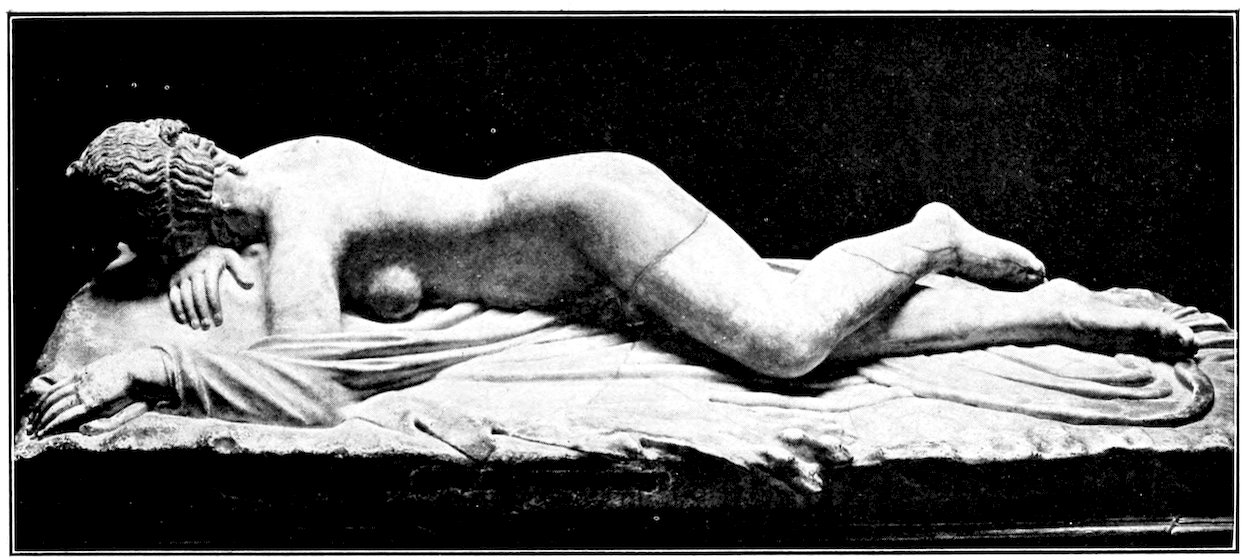
Ancient Greek Statue of an Androgyne, Called “Hermaphroditos,” Now in the Uffizi Gallery, Florence, Italy
25
The Third Sex.
Apollo is the pre-eminent androgyne god. He
was always represented with a feminine face and
coiffure, and therefore worshipped as the god of
beauty.
In conformity with his semi-femininity, he was
the life-giving and light-giving deity—both physical
and figurative life and light. He was the leader of
the muses—the spirits presiding over all human inspiration
in the fine arts.
The artistic instinct—the poetic temperament,
“sentimentality” in its highest sense—goes hand in
hand with a rounding-off of the sharp corners of masculinity.
Artistic or poetic decades have been conspicuous
because of a semi-slumbering of fundamental
masculine traits, that is, the instinctive relish for
wrangling and war. The sterner sex has temporarily
laid aside its primal fighting function ordained by
Nature and become to some degree effeminate.
As a rule, abstract beauty’s devotees—“æsthetes”
in the highest sense, that is: poets, novelists, painters,
sculptors, and superior musicians—have been characterized
by more or less effeminacy. They have been
particularly prone to homosexuality. While among
full-fledged males, the proportion that has achieved
proficiency in one of the fine arts is something like one
in a thousand, among androgynes (the two varieties
combined), it has been one in about twenty. I will
later point out that the pinnacle in poetry, sculpture,
and painting has been achieved by androgynes.
Apollo.
26But the feminesque Apollo was the god not only
of beauty, but of adolescence—the period of life during
which human beauty is at its culmination. He
possessed eternal youth. He is even referred to as
“the boy god.” Adoration of him sprang out of man’s
delight in the semi-womansouled and quasi-womanbodied
stripling just before arrival at puberty.
And ultra-androgynes remain—to a large extent—in
that pre-puberty period down to thirty-five.
Their development has been arrested. Full-fledged
male associates absolutely ignorant of the existence
of androgynism have described—in the author’s hearing—androgynes
even close to fifty years old as “still
mere boys.”
But an adolescent androgyne or boy god was also
worshipped by the Semite nations (other than the
Jews) under the name Ablu, and by the Celts under
the name Maponus.
Philologists will recognize that “Apollo,” “Ablu,”
“Maponus,” and “boy” are descended from the same
vocable in the language used by the Asiatic tribe from
which most of the civilized nations of the ancient and
modern world derive. B is only a strengthened p; the
liquid l has often been transmuted into the kindred n;
and the diphthong oy indicates the elision of a liquid.
We have here etymological evidence that an adolescent-androgyne
deity was worshipped before the dawn
of history.
To-day, among some primitive races, as the
aborigines of America, androgynes are the central feature
of the most sacred rites.
Hermaphroditos and Ganymede.
27Hermaphroditos stands second among androgyne
gods. The myth is that “he-she” was originally a full-fledged
human adolescent and an entirely separate
nymph in the full flower of feminine charm. The
nymph, falling in love, besought Zeus that the adolescent
and herself might be forever amalgamated. Excepting
the pudenda, the body remained that of the
nymph. The psyche became a compound of the masculine
and the feminine. This myth was a poetic
recognition of the existence, at the very dawn of history,
of androgynes such as exist to-day.
A picture or statue of Hermaphroditos adorned
nearly every Greek and Roman home of the better
class. This was because the ancients held the androgyne
in honor as the super-human—man and woman in
one individual.
Ganymede ranks third.[10] Originally a human adolescent
of extraordinary feminesque beauty, Zeus
snatched him up into the heavenly zone and conferred
immortality that the feminesque youth might be his
cup-bearer. The latter’s statues represent him with
a mademoiselle’s chevelure, hips, and legs, but with
male breasts and pudenda. The fact that the father-god
of the classic world entered into this most intimate
28|Socrates.|
union partly explains why the androgyne was held in
honor by the Greeks and Romans.
Socrates is the earliest historic character whom
sexologists have declared an androgyne. For centuries,
a common designation of male homosexuality has
been “Socratic love.” In Plato’s “Dialogues,” Socrates
is the teacher. His remarks of extreme affection to his
youthful disciples are sickening even to me, though an
androgyne myself. Present-day scholars who close
their eyes to the facts of androgynism, who cling to
mediæval sex ideas, and hence hold homosexuality to
result from deep-eyed moral depravity, have denounced
Socrates as the greatest moral leper that ever lived.
But from Socrates’ own generation down through the
nineteenth century, he was universally recognized as
the greatest saint of the classic world.
That Socrates was a married man and father and
wore a beard does not disprove the sexologists’ claim.
The mildly androgynous—psychic hermaphrodites,
like Oscar Wilde—occasionally marry and procreate;
chiefly for social reasons, not from the sexual incentive.
Secondly, the razor was practically unknown in
Socrates’ generation. Even to-day, some of the less
extreme androgynes wear a full beard because of horror
of a razor.
One of the three charges on which Socrates was
condemned to death was that he was “a corruptor of
youth;” the identic charge that landed Oscar Wilde in
prison. But neither of these geniuses ever corrupted
any youth. The prevalent idea that the association of
an older androgyne with a sexually full-fledged younger
man corrupts the latter is absolutely groundless.
The androgyne only benefits, in several ways, the adolescent
29|Plato.| whom he loves far more than a father loves
an only son. Socrates’ two most brilliant disciples,
Plato and Xenophon, wrote books, still extant, one of
the purposes of which was defence of Socrates from
the charge mentioned.
Plato, the St. Paul of the pagan classic world—as
was its Jesus (Socrates)—was an androgyne. His
voluminous “Dialogues”—one of the world’s two score
of literary masterpieces—are permeated with homosexuality.
In the Symposium, Plato confesses himself
a homosexualist. In his day, homosexuality was not
regarded a disgrace any more than heterosexuality.
The charge against Socrates was largely a pretext, the
politicians having to give some plausible reason for
ridding themselves of him.
Plato’s falsetto voice—a common characteristic of
androgynes—is commented on in writings of his day
still extant. He never married nor procreated.
Alexander the Great has been adjudged by sexologists
an androgyne of the mild type. He was the
first prominent Greek to dispense with hirsute decorations.
The probability is that he was naturally beardless.
But in imitation of the genius and leader of
their generation, all the men who wished to be somebody
started to shave clean. Knowledge of the razor
first became common in Greece because Alexander the
Great happened to be congenitally beardless!
As a monarch, Alexander was compelled to
espouse a woman. But he spent nearly all his married
life absent from his legal spouse, and was incapable of
procreation. All the evidence is that his real soul-mate
was a young warrior of his entourage. The two
were inseparable. His strange affection for other
30|Alexander the Great.|
young men of his entourage is remarked by contemporaries.
He bewailed the death of favorites in battle
as only a wife can mourn a husband.
Androgynes, because they possess the feminine
psyche in greater or less degree, are generally very
much opposed to war. But it is possible for a less
extreme androgyne—of the psychic hermaphrodite
type—to be a great general when the leadership of
armies is thrust upon him. Genius occurs far oftener
in connection with androgynism than with full-fledged
masculinity. The rare keenness of mind of an androgyne
like Alexander would enable him to plan successful
campaigns. But his feminine cowardice would
always keep him far from the battle-front, where there
was no danger of a hair of his head ever being touched.
And that is what happened with Alexander. Above
all things else, he was a sybarite.
Androgynes, though never mixing in a fight themselves,
are particularly attracted toward the war-loving
“hero.” Much more than half of my own associates
during my female-impersonation sprees belonged to
a profession whose object was to kill their fellow man.
For almost twenty years of my “youngmanhood,” I
was an habitué of barracks, etc., and a worshipper of
swords and rifles, although I would have been horrified
if required to take them into my own hands. I have
known other androgynes whose female-impersonation
sprees were staged before professional common soldiers.
A young androgyne acquaintance actually enlisted
in the hospital corps in the war with Germany
because he wished to be surrounded continually with
warriors—the type of manhood which androgynes in
general most servilely worship. Walt Whitman is
31|Julius Cæsar.|
celebrated for his work among the wounded in America’s
War of the Rebellion. I read in a medical journal
that during the World War, a problem with the
Italian army heads was to debar androgynes, who were
said to demoralize the army because of their cowardice
and seductive influence on their sexually full-fledged
comrades. I heard of an androgyne who received a
dishonorable discharge from the American conscript
army because wrongly judged to be the incarnation of
deepdyed moral depravity.
Perhaps the reason why Alexander and the next
mild androgyne to be described were two out of the
three greatest generals and conquerors of history was
their craze to pass practically all their adult lives surrounded
by warriors!
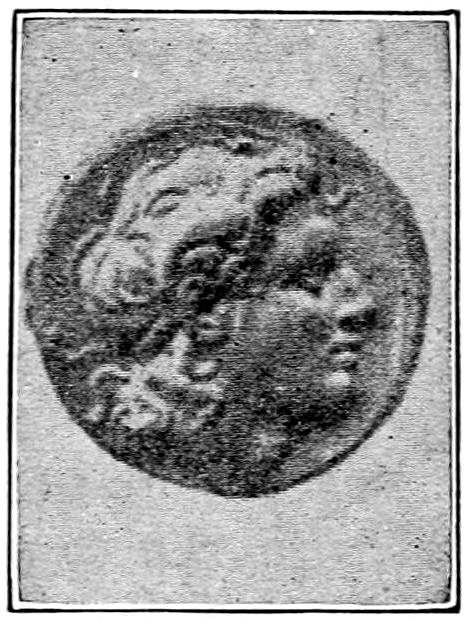
Alexander the Great
(Ancient Coin)
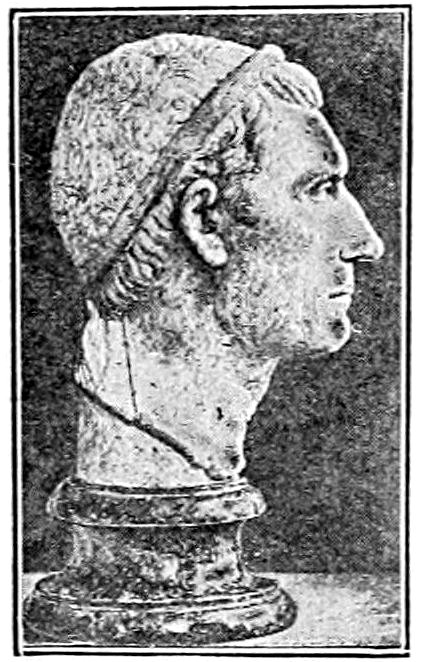
Julius Cæsar
(Bust in Louvre)
Julius Cæsar has been adjudged by sexologists
an androgyne of the mild type. He married, as social
custom demanded of aristocratic Romans, but spent
nearly all his wedded life absent from his legal spouse.
His offspring is said to have consisted only of a single
daughter. History says he had a son by Cleopatra.
But this is doubtful because that queen was every
32man’s wife. But even if Cæsar had offspring, he
would merely be proved a psychic hermaphrodite.
Cæsar was always clean-shaven, if not naturally
beardless. He even had his body depilated—as is
customary to-day with “fairies.” Like the latter also,
he was, in dress, notoriously fussy and feminine—in
order to prove attractive to his lieutenants. He was
an instinctive female-impersonator. His entourage
were accustomed to refer to him as “the queen.” Of
all historic characters, Cæsar excels in respect to the
sensational stories of homosexual excesses found in
contemporary authors still extant.
Cæsar was a great conqueror merely because circumstances,
largely beyond his control, placed him at
the head of an army. As in the case of Alexander,
Cæsar’s genius enabled him to plan successful campaigns.
Others, however, had to expose life and limb,
while he kept himself safe in the rear passing his days
and nights as an extreme voluptuary.
Michelangelo.
Michelangelo, with the renaissance of civilization
after the Dark Ages, heads the list of the mildly
androgynous. He never married or was known to have
a mistress. He left behind many hitherto unpublished
homosexual sonnets of such merit that his nephew-executor
gave them to the world after radical expurgation.
Angelo’s statues and paintings are pre-eminent
in their consummate, although sensual, outlines of the
nude adult male, the principal subject of his art. His
statues of the nude youthful Bacchus, Cupid, and
David of his middle twenties point the direction of his
sexuality. Before thirty he also produced the picture,
“The Battle of Cascina,” 288 square feet crowded with
33|Raphael.|
nude male figures. His favorite Greek sculpture was
a statue of Hercules.
Raphael was an ultra-androgyne. He was always
beardless (probably natural) and boylike in appearance.
Instead of choosing a Roman mademoiselle
to be mistress of his mansion in the then most aristocratic
residence district of the world, he took two
young men to live with him as “sons”,—a common
practice with well-to-do twentieth century androgynes.
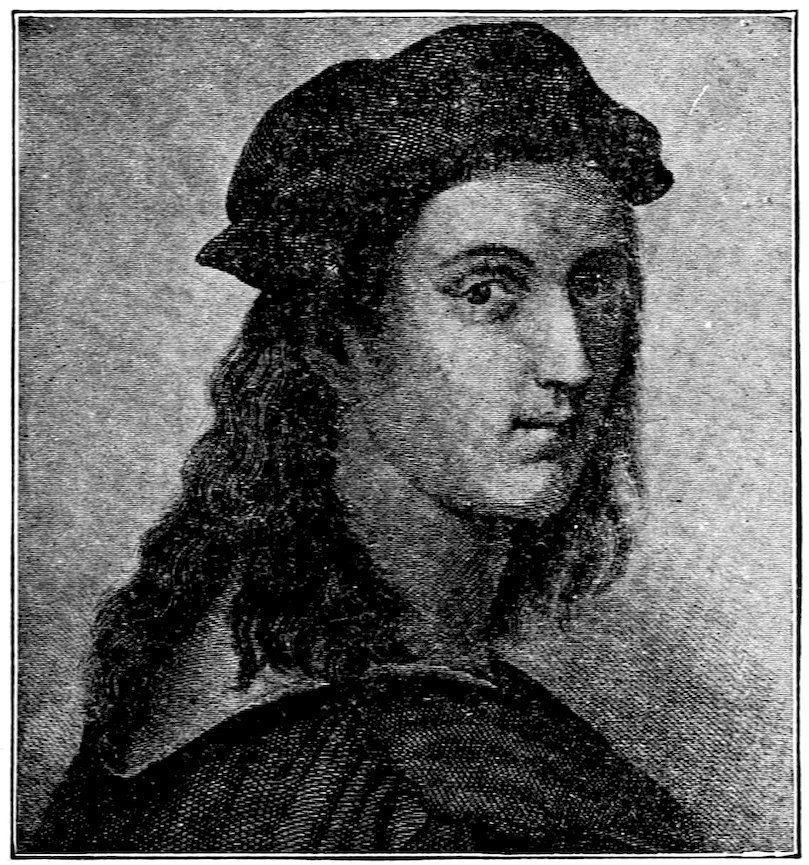
Raphael, the Most Gifted Ultra-Androgyne the World Has Known
The Shakespeare-Author was an androgyne.
The proof lies in the numerous homosexual passages
of his sonnets. The authorship of the Shakespeare
34|The Shakespeare-Author.|
literature is still undetermined after close to three
hundred publications on this question. If Providence
grants me time, I will finally prove beyond the shadow
of a doubt, by the homosexual argument original with
myself, that Francis Bacon was the Shakespeare-author.
I give below an outline of my proposed
thesis.
The young actor, Shakespeare, was a tremendously
virile male, but estranged from his wife and living
apart during most of his married life. Bacon was
an androgyne several years older than Shakespeare.
He married only in middle life and solely for
money. He was a great statesman, but sorely in need
of money to meet his extravagant tastes. Apparently
he was incapable of procreation. Both men lived in
London, and were at least acquaintances, during the
dozen years which saw the creation of the Shakespeare
literature.
Bacon was the foremost scholar and one of the
foremost statesmen of his generation. He and the
Shakespeare-author are recognized to-day as two out
of the three greatest intellects which have ever blossomed
forth in England—even by those who deny the
identity of the two, and hand the palm of Shakespeare-author
to the obscure actor, Shakespeare.
Numerous literateurs believe that evidence exists
that the incomparable Bacon’s fad was writing plays,
the theatre in his day being comparatively a new craze
(that is, for modern times)—as are the “movies” in
the first quarter of the twentieth century. It would
then have been regarded as incongruous for the dignified
statesman, Bacon, to write plays as for an expresident
of the United States to-day to write scenarios
35|The Shakespeare Problem.| for the “movies.” Through covering his
authorship, Bacon was spared the jests of his upper-crust
entourage.
Whatever credit, too, the plays had, Bacon would
wish his adored soul-mate to reap—just as the present
writer has sacrificed his own interests fundamentally
that his soul-mate might be benefited. But if Bacon
had thought the Shakespeare literature would survive
his own generation, he would doubtless, on his deathbed,
have confessed himself its author. But even for
many years after his death, everybody considered it
would be forgotten by man as soon as the shredded
leaves of the first printing were thrown into the fire
place.
Another reason why Bacon would never confess
his authorship is that in his age the law condemned to
burial alive any one guilty of such homosexual sentiments
as he was constrained, by passion, to express
in the “Shakespeare” sonnets.
Francis Bacon published extensively under his
own name. He published extensively—as a large body
of literateurs believe—under the name of “William
Shakespeare.” Just as the present writer has quite
a number of publications under his legal name, and a
number under the name “Ralph Werther—Jennie
June.” And no one suspects the identity of the two
present-day authors.
The actual Shakespeare—behind whose skirts
Bacon hid—was, down to his death, only an obscure
actor, not known personally to any writer of his own
generation except (by supposition) Bacon. The actor
Shakespeare has achieved immortality through having
been Bacon’s soul-mate.
Walt Whitman.
36Walt Whitman stands foremost among American
androgynes. But he was of the mild type.
Many passages of Leaves of Grass and Drumtaps exist
as proof. He never married, although closely pursued
by even wealthy women desiring him as husband.
In middle age he spent his hours for recreation in the
society of adolescents—as I was informed by Whitman’s
so-called “adopted son”. That is, he courted
them, as a normal man courts a woman. Chance
made me intimate with the “adopted son” in his seventies.
All three of us happened to belong to New York
City.
Surely we androgynes, who for two thousand
years have been despised, hunted down, and crushed
under the heel of normal men because they have misunderstood
biblical condemnations of homosexuality,
have no reason to be ashamed of our heritage.
America’s foremost poet; the world’s greatest sculptor
subsequently to Athens’ golden age; the two greatest
ethicists and two out of the three greatest intellects of
ancient Greece and Rome; two out of the three greatest
conquerors of history; the greatest painter of all
ages; and—to cap the climax—the greatest intellect
that the English-speaking world ever produced and the
greatest literary genius of all time (these two distinctions
united in Francis Bacon)—ALL WERE ANDROGYNES.[11]
And to you full-fledged males I say: “What God
hath cleansed [through endowment with sublime talents]
call not ye ‘Unclean!’”
39
The Third Sex.
Twentieth-century psychologists are coming
around to the view that even the leaders of thought are
governed by instinct and mores rather than reason.
Even for intellectuals, truth is what is intuitive or
what satisfies their prejudices and instincts. Still in
the twentieth century, the leaders of thought bow
down before intellectual idols, although other than
those overthrown by Francis Bacon. Still to-day—as
in the generation of Roger Bacon (13th century)—conservatives
yearn to imprison, or even burn at the
stake, those in whom a purer reason than their own
operates.
My own is thus a Herculean task: To be an intellectual
iconoclast. To break down the last remnant
of cultured man’s savage, criminal instincts and
mores. But, like Roger Bacon, I may comfort myself
with the thought that my views are centuries in advance
of my time; but, like him, I am therefore bitterly
persecuted.[12]
Prudery Triumphant.
40“Away with any one who attempts to bring out
the truth about sex!” cry the conservatives. “Crucify
him! Crucify him! Sex is a theme too disgusting
for discussion!”
In the university I took an extended course of lectures
on physiology. But not a word was said about
sex. The professor would not have thus befouled
his mouth, nor corrupted the morals of his students.
Martin’s Human Body, the standard text-book of the
time, had to be published in two editions: (1) That
which treated of human sexuality as viewed in the
Dark Ages, and (2) that which imagined the genus
homo to be asexual.
One presumed male out of every three hundred
belongs to the third sex, strictly speaking. That is,
the ultra-androgynes—the pseudo-men who possess
only undersized and non-functional male pudenda,
whose body otherwise tends toward feminesqueness,
and whose psyche, predilections, tastes, gestures, and
postures remind one of a female.
The third sex is a commonplace topic in the
Underworld, which comprises about one-tenth the population
of “Christian” lands. The Underworlders,
however, generally fail to understand the cause of the
effeminacy. The nine-tenths of the unlearned who
have never entered a more immoral place than a
“movie” theatre are almost entirely ignorant of the
third sex. What hazy ideas they have are criminally
incorrect. And except for a handful of sexologists,
41|Benighted Leaders of Thought.|
the learned still cling to views handed down from the
Dark Ages.
In the seventeenth century, when a cyclone demolished
a hamlet or an epidemic broke out, a council of
physicians, lawyers, and clergymen was called to determine
which semi-bearded old hag had wished the
catastrophe upon the community. After prayer for
divine guidance and an exhortation by a parson that
the Bible taught that witches ought to be ferreted out,
the high-brows would seek to determine who of the
several bags of bone known to all of them presented
the most loathsome appearance, and who should therefore
be burned at the stake as the witch responsible for
the catastrophe—as the necessary human sacrifice
to appease the anger of the Unseen Powers. For even
down to the twentieth century there survives in
Christendom the pagan superstition of the necessity
of a human sacrifice now and then.
But in the twentieth century, leaders of thought
have evolved from the belief in witchcraft. They
must look elsewhere than to semi-bearded hags for
their sacrificial victims on whom to load the sins of
mankind, and the blame for the decline and fall of
nations. Since, next to hags, they consider sexual
cripples as the most loathsome of humans, they make
the latter the scape-goats of present-day society.
While they no longer burn them at the stake or bury
them alive (as provided in old European law) they are
permitted by twentieth century statutes to imprison
inoffensive androgynes for twenty years. And these
archaic statutes are still frequently enforced. Only a
few months ago I read of a Boston clergyman who was
sentenced to prison on the testimony of a young ex-soldier.
42|Banishment of Androgynes.| But to-day these statutes serve chiefly as
ground for extensive blackmail of Nature’s step-children,
hardly one of whom, if belonging to the middle or
upper class, but has had to pay out considerable sums,
occasionally running into the thousands.
Instead of imprisonment, public opinion has generally
substituted banishment of the disclosed androgyne
forever from all he loves.
During the few months of composing this book,
the New York papers have told of the abrupt flight to
parts unknown of three intellectual leaders in their
communities, two just over the city line and the third
within a hundred miles. They had to flee, not because
they had done the least real harm (all three were
pastors of churches) but because of the mediæval
ignorance and bitter hatred that their communities
immediately manifested toward a “man” (reputedly)
all of a sudden disclosed to be a “monster” (though in
reality a harmless and pitiable sexual cripple). The
populace, ignorant that he had probably practiced a
thousand times more self-denial than any one of themselves,
but had at last been able to withstand Nature’s
demands no longer, chased him out of his community
for good and all with the feeling that he was the lowest
scoundrel that ever contaminated it.
I admit that these unfortunates did show bad judgment
in remaining in the ministry when they knew
they were afflicted with a powerful instinct abhorred by
the sexually full-fledged, and they showed the worst
kind of judgment in having recourse to boys under
puberty. But they were in a tight place, and besides
felt that they were doing no one any harm. For the
androgyne generally comes at last to the view that
43|Most Androgynes Ultra-Religious.|
what Nature demands can be no sin and, if properly
fulfilled, no transgression against any human.
The newspaper devotee runs across a similar item
every once in a while, and nearly always the “monster”
is a clergyman or a teacher. But the abhorred penchant
(fellatio) is, of course, not peculiar to these
professions. Simply their high ethical standing, and
the common fancy that they should therefore be proof
against what is incorrectly regarded as the worst of
vices, attract greater attention, and give news value to
the occasional disclosures.
But it is probable that among the occupations,
those two, together with all having to do with art of
any kind, have the largest proportions of androgynes.
As a rule, male bisexuals are goody-goody boys who
develop into ultra-religious adolescents. They are
enthusiastic to better the race morally and spiritually.
The robes commonly worn by clergymen are also a
powerful drawing card, since androgynes yearn for
apparel that conceals that they are bipeds. Thus
quite a number who were born intellectual and whose
sexual ardor, during adolescence, is comparatively
weak, gravitate into the two professions standing
highest ethically and religiously. When making his
choice, the adolescent is filled with religious fervor and
possessed of a strong determination to crucify his
“homosexual” tendencies. The androgyne already
yielding would never put on “the cloth,” although he
would go into pedagogy. But the puritan-minded
regards these tendencies as his “besetting sin” and
fights them for years in the strenuous manner described
in my own Autobiography of an Androgyne.
Throughout his teens, and perhaps even his twenties,
44|Abstinence Induces Melancholia.|
he never expects to be overmastered. But later in
life many a one of these sexual cripples who have put
on “the cloth” disgrace it notwithstanding his prior
unparalleled mental struggles against Nature’s behests.
Or if coming out victor in the lifelong struggle,
the pitiable woman-man lives down to death under
the obsession (due to misinterpreted biblical texts)
that the gratification of his unusual instinct is the
most heinous of sins, and spends all his days, in which
God meant that he should rejoice, in mourning over his
sexual ardor (for which he does not realize he is irresponsible),
in crucifying his body continuously, with
its affections and lusts (as commanded by the anaphrodite,
St. Paul), and is thereby, throughout adult
life, on the borderline of insanity. I have heard
sermons from such clergymen and was moved to pity
as they were shedding tears in the pulpit and rendering
themselves unpopular, both with their fellow
preachers who are sexually full-fledged and with the
laity, because their aspect was always that of tragedy.
I advise that all such melancholiacs immediately ask
that they be honorably deposed from the ministry.
As a result, their lives would be happy and satisfying.
The vast majority of preachers are manly. I
have a higher respect for that profession than for any
other. If it had not been for my androgynism, I
would have myself entered it. It would be well for the
Church authorities to question, as to their sexuality,
all candidates for beginning a theological course, and
in the kindest manner advise adolescents in the least
bisexual to choose some other profession because of
the public’s misunderstanding of this phenomenon.
45|Why Androgynes Are Hated.|
Sexual conduct is not primarily a voluntary matter or
an ethical question, but rooted in anatomy, physiology,
and psychology. The androgyne who yearns to
preach the Gospel can do so through the printed word.
Because of St. Paul’s sex teaching (that of an anaphrodite)
the profession of “the cloth” is rightly open
only to anaphrodites and the mildly virile. The more
virile are likewise excluded because it is next to impossible
for them to abstain from adultery.
Why are androgynes so hated? Primarily because
the leaders of thought have always identified
them with the men of ancient Sodom (mistakenly,
because the Sodomites were full-fledged males) and
historians have mistakenly (because they never met
androgynes personally and were taught in their boyhood
to hate them with all their heart, soul, mind, and
strength) laid upon them all the blame for the decline
and fall of nations, and declared that therefore effeminacy
or androgynism is a type of moral depravity to
be crushed mercilessly. Better that some thousands
of androgynes be deprived of life, liberty, and the
pursuit of happiness than that the general welfare of
the nation be imperilled! Androgynes—they argue—are
unavoidably the scape-goats of the race.
I answer: In the first place, such imperilment is
only a figment of the imagination. This superstition
can be disposed of by merely asking to what extent
the welfare of humanity was imperiled by the sex
functioning of the arch-androgynes listed in chapter
III? In the second place, androgynism is not moral
depravity or degeneracy. I myself—an extreme type
of androgyne—spring from the most puritan stock.
I was brought up to consider that on Sunday, reading
46|Androgynism Not Degeneracy.|
anything but Christian doctrine or walking a hundred
feet for mere pleasure were heinous sins. In addition
to springing from the most puritan stock, both
my paternal and maternal stock are of unusually
strong build. A paternal and also a maternal uncle
were professional athletes. A brother was the champion
athlete of my native village. My stock and early
environment are indeed the last that any one would
pick out as likely to bring into the world a homosexual
or androgyne as a result of moral degradation.[13] My
androgynism has, however, made me myself rather
lilliputian. With one exception, I grew up to be the
smallest man of my paternal and maternal families.
It is not necessary to crush androgynes in order
to guard against the spread of effeminacy. Effeminacy,
in the sense of androgynism, does not spread by
example. It is entirely congenital. Only a physical
male born with quasi-feminine predilections would
adopt the role of a female after becoming adult. An
androgyne’s predilections and practices are regarded
with such repugnance by all full-fledged males that
none would stoop to them unless constrained by instinct.
Why imprison and murder the androgyne any
more than the deaf-mute? The former is no more
abnormal than the latter; no more degenerate; no
more depraved. It is unfortunate that the human
47|Not Cause of Decline of Nations.|
race is handicapped with either of these defective
classes. But the androgyne deserves only pity, the
same as the deaf-mute.
Effeminacy in an entirely different sense, and a
kind that spreads rapidly through example, is the
actual cause of the decline and fall of nations; in the
sense of the weakening of the moral fibre of the males
of the upper crust or ruling class through their having
grown overfond of ease and pleasure and lost
their joy in industry and justifiable fighting. A neighboring
nation of superior moral fibre is quick to learn
of such effemination and subjugates the decadent one.
But these effeminates’ fondness for the gentle sex has
in no way declined. Generally it has greatly augmented.
Witness the decline and fall of the Greek, Roman,
and Turkish empires.
Where has androgynism been more prevalent than
formerly among the American aborigines? Probably
because the tribes were constantly underfed. Whenever
a male arrived at puberty, the weapons of the
warrior and the cooking vessels of the squaw were
ceremoniously placed before him that he might choose
his future social status. A not inconsiderable number
of adolescents (because congenital androgynes) always
chose the culinary utensils and passed the rest
of their lives as squaws, the hair of the beard being
plucked out as fast as it showed itself, and the costume
being that of the female sex. Surely savage tribes
continuously on the war-path can not be accused of
degenerative effeminacy!
About one-third the soul-mates of androgynes
who have come under my observation have been voluntary
common soldiers or blue-jackets. I am far
48|Androgynism Nationally Healthful.|
from being the only androgyne who has gravitated
toward the “supreme men” whose voluntary profession
has as its aim the killing of their fellow man.
Androgynism appears to go hand in hand with militarism
rather than vice versa. Havelock Ellis says that
homosexuality is particularly common among the
Sikhs, the most military of the Hindustan races.
It is more likely that the emergence of androgynism
is a sign of national health. The ultra-brilliant
Age of Pericles surpassed all other periods in the
recognition and influence of androgynism, which promotes
art and general culture. The androgyne, being
a combination of man and woman in a single individual,
has a wider view of life than the full-fledged man
or woman. He possesses, in a measure, the mental
qualities peculiar to each sex. That is why the Shakespeare-Author
knew both the masculine and the feminine
mind better than any other writer. Such duality
is the reason artistic genius crops out far more frequently
among androgynes than among the sexually
full-fledged. The amalgamated man-woman nature
gets nearest to sentiment and emotion—to the soul of
art.[14]
Why do cultured androgynes carefully conceal
their quasi-feminine sexual predilections? Why did
Angelo not publish any of his homosexual sonnets?
Why did Raphael not proclaim on the housetops the
happenings in his house at night? Androgynes hide
their sexual predilections and practices, not because
of consciousness of personal degeneracy, but because
49|Race Suicide.|
grossly misunderstood by the sexually full-fledged.
By exception, Oscar Wilde was open and above board,
and was therefore shut up in prison.
Only bigoted pseudo-scientists have pronounced
androgynes degenerates. Only mediæval medicine,
not modern medicine. Androgynism is merely an instance
of arrested development; or possibly of atavism—an
attempt on the part of Nature to return to the
original hermaphrodism of man’s early antecedents.
The androgyne who follows the dictates of Nature
is not a whit more degenerate morally than the full-fledged
man who marries. It is only the fallible mores
which make the full-fledged think that a person with
apparently male pudenda who impersonates a female
is infinitely below themselves morally. Were Socrates,
Plato, Angelo, Raphael, and Francis Bacon monsters
of depravity? Ought the Shakespeare-Author to
have been buried alive by his hare-brained fellow citizens
before he had a chance to pen a line?
The chief charge against androgynes is that they
are guilty of “the awful crime of race suicide.” But
it is the fault of Nature alone that the ultra-androgyne
is incapable of doing his part in the perpetuation of
the race.
The cultured androgyne, knowing his irresistible
instincts are harmless to his soul-mate, is unable to
discern in them any transgression against ethics or
against God.
But a very small proportion of adult androgynes
have been guilty of a lamentable transgression because
finding themselves in a tight place: that is, recourse
to boys under puberty. The prudery of full-fledged
men has hitherto prohibited androgynes from
50|Androgynes’ One Offence.|
scientific knowledge of themselves. Until thirty years
ago, American and British public opinion would not
tolerate the publication of the facts about androgynism
even for circulation among the medical profession.
Havelock Ellis’s Sexual Inversion, the earliest published
book in the English language on androgynism,
was promptly suppressed by the British government
thirty years ago. I myself had to bend the knee for
eighteen years to medical publishers before my Autobiography
of an Androgyne was fed into the printing-press in 1918.
Thus, because full-fledged men have interdicted
to cultured androgynes the means of understanding
themselves and knowledge of how they ought to pass
their lives, some—particularly those who have
achieved places of honor, because androgynes of lower
rank do not need to be so crafty in hiding their terrible
secret from the heartless world—have ultimately
been revealed guilty of recourse to the immature (because
they could not screw up their courage to disclose
their abnormality to an older and wiser male).
But on account of the tyranny of the full-fledged,
these erring androgynes merit mercy. Their offences
have probably not been at all harmful to the immature.
They are merely asserted to be so by men unable to
accept any scientific results except those inculcated
by mediæval savants. But this one offence of androgynes
will be a thing of the past when they are
permitted recourse to books which explain the riddle
of their lives, and when full-fledged men read such
books in order that they may do justice to Nature’s
step-children.
As already stated, ultra-androgynes, having a
51|Androgynes Are Goody-Goodies.|
woman’s psyche, are goody-goodies. Indeed goody-goodiness
may be regarded as their most marked characteristic.
For this reason, in France, they are called
“little Jesuses” (petits jesus) notwithstanding that the
more extreme are public female-impersonators in resorts
of ill repute. Ultra-androgynes are incapable of
doing any real harm. If all the human race were as
harmless, this world would be a far better place in
which to live.
The cultured androgyne is a desirable citizen and
a desirable member of any circle. While ultra-androgynism
makes its victims physically weak—like a
woman—it has no deteriorating effect morally or mentally.
The usual charge of gross immorality is merely
a relic of mediæval bigotry.
It matters not, however, that androgynes are absolutely
innocuous practically and ethically. Do they
not offend the æsthetic sense of the majority of mankind?
What better cause for grinding them under
one’s heel?
And this bitter persecution that has been the lot
of some androgynes has rendered them misanthropes.
Not their androgynism per se. A mildly androgynous
acquaintance—an intellectual giant of the highest
moral character except for his irresponsible and innocuous
passive pederasty—is, as a result of society’s
shutting him up in prison for the five years of his intellectual
prime, a chronic and bitter reviler of the
Church. Because zealous churchmen were responsible
for the wrecking of his life through their misunderstanding
of the biblical teaching on homosexuality.
But in general we androgynes, possessing the
long-suffering feminine psyche, are resigned to being
52|God Will Avenge Androgynes.|
ground to powder by the hypocritical world. It is
better to suffer than to inflict suffering. Though the
world despise and ostracise us, the All-Knowing is
still our refuge, and another life awaits us where conditions
will be more just. The bigoted and pharisaical
judges and juries who have haled hundreds of innocent
androgynes off to prison should remember the Old
Testament doctrine: “‘Vengeance is mine!’ saith Jehovah.”
Those who incarcerate the innocent in this
world will in the next have to serve time in the darkest
dungeons of a just God.
Note to Illustration Facing Page 53.
My father was a reversionary pure Alpine, but his brothers
were decidedly Nordic. My mother is a reversionary pure
Nordic, while most of her brothers and sisters were predominantly
Alpine. Evidences of Mediterranean blood in my paternal
or maternal stock are doubtful. I myself am predominantly
Alpine, particularly evident in my short stature and generally
brunette features. But the Nordic cross has given me a rather
ruddy complexion and “browned” my chevelure. My beard
hair is jet black, but always clean-shaven, if not eradicated. I
am of English, Scotch, Dutch, German, and French descent.
During adulthood, I have always considered the highest human
beauty to reside in adolescent Irish-Americans or Italian-Americans
of approximately pure Mediterranean stock.
The “Fairie Boy” Ready to Set Out on Life’s Journey
(See note on page 52.)
Part Two: How the Author Came to Be a Female-Impersonator — I. Reveries Suggested by My Infancy. — II. School Days. — III. An Androgyne’s Youth. — IV. I Grow into The Fairie Boy . — V. The Boy Who Never Grew to Be a Man.
53
(Part Two summarizes my pre-nineteen life and
my physical and mental traits for those not reading
my Autobiography of an Androgyne. Particularly
for details of purely medical interest, the scientist is
referred to that work, since the present volume is designed
primarily for the general reader. Part Two,
however, presents many facts not in mind when I
wrote the earlier work over twenty years ago.)
Connecticut, famous for its wooden nutmegs and
other freak products, gave to the world, in 1874, one
of its half-dozen most widely known girl-boys.
My mother has said that I was the greatest cry-baby
of her eleven children. I have really never outgrown
this characteristic. Still in my late forties, I
occasionally weep bitterly for a whole hour.
Up to my eighth birthday, timidity made me reluctant
to leave my mother’s side to play with other
children. Sticking very close to “mother” as a child,
and extraordinary devotion to her when adult are
common earmarks of androgynism. I have known of
no other reputed male so devoted to his mother, even
down to his late forties, as I. My mother is still, by
54|My Life-Long Soul-mate (in Dreamland).|
a kind Providence, spared to me. I frequently weep
bitterly at the thought of her dying and can not
imagine living when she is in the grave. I knew an
androgyne who, in his sixties, died from grief a few
days after the death of his mother around ninety.
In my early childhood, only one other person
attracted me in a comparable fashion—a neighbor’s
burly boy, F’ank, five years older than myself. All
my life I have seen him at least several times a year,
since he has remained a close friend down to the time
when we both count about half-a-century of life. His
influence is still strong, although sexual relations
ceased when I was seven. He was one of the most
amorous of boys. From my third to seventh year, he
sought me several times a week. Perhaps he also embraced
every chance for heterosexual relations—common
among the children under twelve in the “best
set” of the village, among whom I was privileged to
be brought up. And yet all these contaminated youngsters—excepting
myself—turned out fairly virtuous
adults. The ultra-amorous and active pederast F’ank
became, when adult, exclusively heterosexual and quite
promiscuous, being of the tremendously virile type.
But around thirty, he settled down into absolute monogamy.
He, however, never had a child. At past
fifty, he stands at perfection in health, strength, and
morality.
I say they “turned out”! That is, so far as I
ever heard. But they would all have said of me that I
passed through my adult life a cold anaphrodite! One
can never know! Some might secretly have been addicted
to venery as much as I. But they betrayed no
external sign. Neither have I.
Most Sheltered Two “Went to the Bad.”
55But while all those who indulged in “nastiness”
before reaching their teens grew up, so far as I was
able to observe, into men and women above reproach,
two of “my set”—those who were “kids” at the same
time within a radius of five hundred feet of my own
paternal roof, the several homosexualist schoolmates
elsewhere described having lived outside that radius—the
two that had been most carefully brought up and
shielded by their mother from corruption by other
children, almost the only two that were sexually unblemished
as children, “went to the bad” immediately
on arrival at puberty. They were brother and sister—the
only children of a wealthy, pious couple. The
brother became a chronic dypsomaniac and roué. The
sister, a beautiful and brilliant girl who had enjoyed a
college education, died before thirty as a result of excesses
in her chosen profession of fille de joie in New
York City. The mother died of a broken heart in her
early forties. The father, previously active in church
work, became despondent on seeing both his children
“go to the bad,” took to drink, and died a sot.
Debauchery was born in these two children, for
they had never missed Bible school up to their middle
teens. They were unusually innocent prior to puberty.
But religious teaching failed to convince them. They
thought the “goody-goodies” were trying to rob them
of the pleasures of life through false representations.
I believe both could have been saved from shipwreck
of life if, at puberty, a book, scientific, not goody-goody,
could have been put into their hands, demonstrating
that alcoholic and venereal excesses bring on ruin and
often early death. Children inclined to dissipation on
arrival at puberty are far more likely to heed the pronouncements
56|Inherited Lechery.| of a physician than of a Bible school
teacher.
In that same immediate puritan circle in my childhood’s
village, I have lately observed a similar case in
the next generation. I have known well a certain
gentleman of my own age since we were boys together.
He is of the tremendously virile type and sowed his
wild oats as hardly another young blood in the village.
But in his middle twenties he was “soundly converted”
in a puritan church (to which I myself belonged) and
married one of its purest daughters. In his subsequent
life, he attained rare success financially and
socially. He has had only two children—both girls
around twenty years of age at the date of writing. I
know the family intimately. I have direct information
that both girls are “fast going to the bad” (notwithstanding
they have always been under only puritan
influences) and that the father has “backslidden,”
evidently being no longer able to restrain his de facto
polygamous instincts. The purest of wives is heart-broken
and on the borderline of insanity.
Every one says the girls and their father are wilfully
depraved and their puritan community has already
begun to treat them as outcasts. I say the girls
inherited their craze for venery from their father, in
whom likewise it was inborn. He is a noble man in
every other respect. All three are largely irresponsible.
They are, by birth, not fitted for the puritan
society in which they were brought up. Under present
social ideas and usages, the only outlet for the girls is
prostitution and the consequent early loss of health
soon terminating in death. But their only fault is
57|Present Social Rules Inadequate.|
nymphomania. If society had some way by which it
could bring about the satisfaction of these needs of
these cultured girls, the latter could be saved from the
shipwreck of life and be useful members of their
community. In my own life I have proved that
Christian conversion and absorption in the teachings
of the Bible can not save one from innate nymphomania.
I could suggest a means of salvation for these
girls, but dare not. If only the leaders of thought did
not prescribe an identic sex life for every daughter of
Eve, although Nature has created them with such diversity
along these lines! If only the leaders of
thought permitted real sexual problems (as well as
namby-pamby) to be investigated, as all other phenomena
are searched out to the very bottom! If only
the leaders of thought permitted the truth to be told
about sex instead of continuing to propagate the hypocrisies
and fabrications regnant down from the
Dark Ages!
I have read statements of puritans of the dreadful
results that will follow the common sex relations of
children under twelve in city tenements. I have spent
a large part of my life in rural districts as well as in
great cities. My observations are that conditions are
the same among children of both types of environment.
Numerous youngsters receive their sex initiation before
twelve. But, unless carried to excess, it does not
seem to have any bad influence, particularly after they
become adults. The probability is that the same
practice has ruled among small children for thousands
of years. It is Nature.
And the context moves me to remark: It turned
58|Providence’s Favoritism Toward Author.|
out that of my several hundred schoolmates (prior to
the university) I achieved in adult life the highest
success. Not as a business man or money-maker, in
which line I did not excel. Not in art or politics.
But in the following fields, both individually and combined:
Intellectual and general cultural development;
enjoyment of (but not adeptness in) all species of art;
breadth and depth of life and knowledge of human
nature; enjoyment of the society of my fellow humans,
particularly sexual opposites; and, last but not least,
fame, or, as some would prefer to have me say, notoriety.
For I feel that I, as an extreme type of the
bisexual, am doomed to live in the minds of savants for
scores of years after every one of my hundreds of
schoolmates, and my other hundreds of university
associates, are eternally forgotten.
[Note Added in Galley: I omitted to mention that I have
also far excelled in suffering inflicted by man and in sorrow—which
two items together have about counterbalanced the advantages
enumerated.]
But I have achieved this last element (terrestrial
immortality) of the highest success in life denied to
all my wide circles of childhood and adolescence
through my “going to the bad”—as the saying is. But
though that was the fate marked out for me by the
Architect of the Universe, I was actually able to restrain
my “evil” propensities so as not to make shipwreck
of life. My girl-boy intimate described in the
early part of the second chapter following did make,
decidedly, shipwreck of his life, as have many other
girl-boys. My salvation lay in practicing relatively[15]
59|Temperance the Only Salvation.|
extreme temperance in the indulgence of the sexual
propensities except during my Bowery period described
in my Autobiography of an Androgyne and
Riddle of the Underworld. Extreme temperance
in indulgence of any fleshly appetite is, for all humanity,
the sole means of salvation from the shipwreck of
earthly life. Overindulgence of any appetite defeats
its own end.
Thus while nearly all other girl-boys are doomed
to be forgotten by mankind a few years after their
bodies return “dust to dust,” I myself am—I feel—destined
to live in the memory of savants primarily because
of my extensive self-restraint, and secondarily
because of my excelling the other girl-boys in innate
brain power.
It was F’ank who initiated me, at two, in the
mysteries which gullible parents think children do not
learn before puberty. But down to twelve, I considered
all species of sex relations as the monopoly of
naughty children. All adults had of course outgrown
such depths of nastiness.
Down to my present age of close to half-a-century,
F’ank has been the hero in half my many sexual
dreams. After I reached seven, we ceased to be confidential.
I therefore never confessed to him that his
influence prior to my seventh year almost wrecked my
adult life—probably consigning me to an irresponsible,
intensive fairie career—and a thousand times made me
wish, because a slave to fellatio, that I were dead.
For I firmly believe that girl-boys, if not repeatedly
60|Keep Tots Sexually Clean.|
seduced before puberty, will, as adults, have only
weak and controllable desires for the sexual functioning
ordained by Nature for their type. While they are
commonly fellators or else pathics congenitally, only
oft repeated seduction in early childhood makes them,
after puberty, irresponsible psychic nymphomaniacs
who recruit the ranks of fairies. But for those repeatedly
seduced in early childhood, the penchant is truly
irresistible in adulthood and would be followed regardless
of all legal penalties. Just as most men would
steal a loaf of bread if their only means of salvation
from death through hunger.
Not too often repeated homosexual acts on the
part of a small child, however, are not likely to make
him an adult pervert. An innate tendency is practically
indispensable. Early experiences along innate
lines merely strengthen a congenital bias, just as the
author became an intensive adult fairie as a result—I
am inclined to believe—of my intense fairieship from
three to six.
While I believe sexual relations of children under
twelve when not often repeated will not render them
particularly lustful as adults, an intensive sex life of
a small child—as in my own case—is likely to render
him or her extremely intemperate sexually after puberty.
Mothers should therefore keep a watchful eye
over the whereabouts and associates of the “angel
child,” and not allow it in secluded cosy nooks with
older children. A careful watch should be kept over
nurse-girls. Children under twelve, and even under
six, need chaperons almost as much as those just past
puberty.
Parents should take pains that the “angel child”
61|Criminal Prudery.|
regards them as confidants, sharers of its every secret.
If this had happened in my own case, I might have
been spared a world of woe after puberty. To preserve
the frankness of the “angel child,” not even
a mild rebuke should ever be administered for its
sexual lapses; but kind persuasion alone, and care
that the child does not again come into exciting surroundings.
My own parents and teachers never vouchsafed
the least sex knowledge. I once asked where babies
came from. Doctors found them in the street gutters
and brought them to people’s houses. Instinct and
older boys were my only instructors. Parents, teachers,
but preferably the school physician, should begin
with children of six a clean initiation into these mysteries—absorbing
even to youngsters of that tender age—to
replace the hitherto regnant nasty one wrought by
child lore handed down, from mouth to mouth, through
the centuries, and characterized by unprintable words,
in uttering, seeing, and hearing which numerous
children seem to take delight.
Or is the subject of sex irreformable and hopeless?
Is it really the crying shame of the human race?
From my third to seventh year, F’ank and I were
drawn toward one another. I yearned to recline in
his arms. “F’ank,” I once said, “I’m not af’aid on
your lap. But I’m af’aid nearly always. I’m af’aid,
when I get as big as papa, hair’ll grow on my cheeks,
like on his. How could I ever use a horrible wazor,
like him! I hope I’ll die before I get big!”
I was destined to be a sort of pet with others of
the more stalwart boys. It was because I retained my
babyishness—like an idiot—at least down to the age
62|A Wee Girl-Boy’s Outlook on Life.|
of seven, and was, besides, girlish. I commonly felt
myself a little girl and told playmates to call me Jennie.
They have remarked that I was “more girl than
boy.” Adults, however, were blind to my bisexuality.
They ridiculed me for carrying a doll in my arms
when I took a walk; etc. Because I was the only child
of my set thus violently crossed, I was the most unhappy.
Taunts sometimes drove me to throw myself
on the floor, bang my head, and exclaim: “I wish I
were dead!”
But, on the whole, my early childhood was happy.
With F’ank I would play “papa and mamma.” He
would “go to business,” while I took care of the dolls;
etc. I made and laundered their wardrobes. One day
a sudden shower surprised me. Gazing at the ill-fated
wash on the line, I sobbed: “Oh it yains! It
yains! And my c’ose’ll get wet!”
The day of thoroughgoing disillusionment came
early in my seventh year. It was the style for boys to
wear skirts up to that age. How I loved them! And
I never expected to clothe myself otherwise. Even
down to my middle forties, I have always felt more at
home in skirts.
Then I wasn’t to be allowed to go through life as
a girl and a woman? I was up against the choice of
spending the rest of life in my bedroom, or drawing
on a pair of the utterly loathed breeches. At first it
was the same as if I had to go on the street in my
underclothes. I would dodge behind a tree when an
acquaintance hove in sight. How poignantly I missed
petticoats as a screen for my shameful nether limbs!
Not to mention the deprivation of the pleasure of feeling
them dangling about my knees.
How I Came to Be a Female-Impersonator.
63
First year: How terrible the aspect of the big
brick academy! How awe-inspiring the smell of the
newly varnished floor on the first day of my school
life! How my heart jumped to my throat whenever I
caught the cold, stern eye of the school-marm piercing
through my own little self! How bold and bad and
rough all the boys were! Why must I sit with them
and enter by their door when I so longed to be with the
gentle and soft-voiced girls?
And could I ever bring myself to see what was on
the other side of the sign: “For boys only”? What
right had I there? For I already recognized I was
really not a boy! At that age I gloated over being a
girl-boy.
There was thus provision for the comfort of the
boys. There was provision for the comfort of the
girls. But architects have never thought to make
provision for the girl-boys!
The first week I suffered terribly rather than invade
the retreat barred to all but boys. Then an unprintable
experience right at my desk afforded the
room a good laugh and sent me home for dry clothing.
I now preferred the horror of the retreat to being
laughed at and sent home. But I made a virtue of
haste and watched for a moment when no other boy
was out.
Second year: I sat on a rear seat with a boy
whom I stared at and touched because of the softness
and radiance of his hair, the rich red of his cheeks,
64|Sexual Precocity.|
and his sturdy build. Now and then we kissed when
no one was looking. But once a loud smack reverberated
just after the near-sighted school-marm had requested
such stillness that one could hear a pin drop.
As she had never been kissed by a person of the opposite
sex, she considered a smack the unpardonable
sin. My hero-boy took his whipping with a cynical
smile. But I wept for a half-hour.
Third year: I was caught in an immeasurably
worse impropriety[16] under a desk. The teacher thought
my parents ought to know. Violently angry, my
father hammered my body with the heel of a boot.
In a dozen years, not one of my numerous brothers and
sisters (although I was the only goody-goody one)
suffered such a thrashing. All the rest of my home life,
father treated me the worst of all, notwithstanding I
far excelled in school-work. What a trial to have a
girl-boy son? Why had I ever been born? Subsequently
there existed a lifelong coolness between
father and me.
Fourth year: [A typical spring afternoon.]
After school, the west playground was thronged with
boys. I alone hastened directly to the street, embarrassed
as a little girl alone with two hundred boys.
One calls out: “Ralph, hurry to the girls’ yard where
you belong!” Another: “Ralph, your legs are as
shapely as a girl’s. You would make a good-looking
girl!” A third throws his arms around me and exclaims:
“Kissing you is as good as kissing a girl!”
My embarrassment prevented my relishing these
attentions at the moment. But I always gloated over
them after I got to bed.
Nature Indicated Rearing as a Girl.
65I had not quite reached the gate when a ball rolled
to my feet and the players shouted for it. With beet-red
face on account of what I knew would be said, I
gave the ball an awkward toss. “Hah hah hah! You
throw just like a girl! Miss Nancy!”
Often I went around Robin Hood’s barn to avoid
this particular embarrassment.
Arrived in the girls’ yard, I felt as if freed from
captivity and in my proper element. Shyness and
fright gave way to gleefulness. Moreover, I cared
only for the less strenuous games of the gentle sex.
Several boys mounted the high fence in order to
tease me. “Ralph, I promise you my sister’s doll carriage
to push to school!”... “Heigh, Miss Werther,
have you finished the mitten I saw you knitting?”...
“Say, Ralph, give me a kiss, will you?”
While with girls, I liked nothing better than such
bantering. I out-girled them in our reaction to the
boys’ teasing. We finally succeeded in provoking the
boys to chase us—my wish all along. To be chased by
boys was the highest of childhood’s pleasures.
I was always the ringleader of my girl clique,
never reflecting on its unnaturalness. They never regarded
me as a normal boy—only a “girl-boy.” We
would even discuss our boy favorites.
Fifth year: My parents thought that if I were
shut up closely with boys and away from even the sight
of girls, I would be cured of my effeminacy. Thus my
fifth to eleventh years of school life were staged at a
boys’ “prep” several miles from my home village and
numbering about a hundred students. But I was only
a day-pupil except during my senior year.
Childhood Female-Impersonation.
66The first week, it was an ordeal on a par with
being forced into breeches. I was in a state of chronic
fright. When addressed, my reply was inaudible six
feet away. But after becoming well acquainted with
class-mates, I have seated myself on their laps right in
the schoolroom. For they appeared demigods.
They would run a hand up my arm. “Your skin
is softer than velvet. And your pencils look as if you
had chewed them off with your teeth. And what
makes you scream when a fellow merely touches you?
Ralph, you certainly ought to have been born a girl!
You will never make a man!”
On holidays I would run off to the house of a girl
friend. With several of the gentle sex, I would play
hide-and-seek in remote nooks, as hay-mows. Later
I would exchange clothing with one, and we would seek
boy acquaintances that I might display my skill in
female-impersonation.
Adult intimates would point the finger of scorn
in vain. To pass life as far as possible like a girl was
the very essence of existence, for which I was willing
to sacrifice everything else.
The instinctive manner of coasting is a criterion
of psychic sex. Every boy of my set, excepting myself,
rode bellyflops—too strenuous for the soft-muscled
and timid girls. As I possessed their physical
and psychic softness, I also coasted upright.
In ascending the hill, I kept with the girls. I
enjoyed talking about only their interests. As the
boys passed, they would call out: “Girl-boy! Mollie
Coddle!”
One afternoon, two snow forts were built fifty feet
apart. All the boys, excepting myself, took their stand
67|Outlook on Life at Eleven.|
bravely behind the breastworks and rained snowballs
on the defenders of the opposite fort. The girls were
almost prostrate in the deep snow behind—out of
danger of being hit in the face—packing snowballs for
the throwers. And I, GIRL-BOYWISE, did as they, the
eternal impropriety never dawning on me.
But one of the girls cried out: “Why are you not
throwing snowballs with the boys? Afraid of getting
hit, are you? Why don’t you put on petticoats?”
After I retired that night, I had not yet recovered
from my speechless chagrin. “Why was it that I was
not taking a boy’s place in life? Why did I sit upright
when coasting? Why did I feel more at home in girls’
attire? Why did the boys tease me just as they did the
girls? Could it be that I was a girl imprisoned in the
body of a boy?
“How could I face manhood? Are men under
compulsion to go and vote? But how could I push my
way into the crowd of rough men always hanging [at
that period] around the polling places?
“How terrible to be a boy! Couldn’t I take papa’s
razor and in a minute rid myself of the excrescence?
A razor ought to be sharp enough to do the job! O
God, change my body this moment by a miracle! Turn
me into a girl!” I sobbed.
One day, being a goody-goody, I had felt it my
duty to tell the teacher on a mischievous boy. As I
left the school for my train, I was seized violently.
“If you were a big, strong fellow like us, we would
give you a good thrashing! We’ll only see if we can
lift you off the ground by your hair. The more you
cry, the better we like it. Keep your hands down!
68|Girl-Boys’ Reasons for Suicide.|
Slap! Slap! Slap! And stop carrying your books
on your arm like a girl!”
When they let go their grip, I started off on a run,
only one boy pursuing and shouting out threats. I
shall now reveal the girl-boy’s patented secret for getting
out of a predicament. I sprinted to the porch
of the first house, gave the door-bell several violent
jerks, and shrieked for help.
Sixth year: I was absorbed in fashioning a doll’s
dress. An older sister angrily exclaimed: “Why don’t
you get out on the ball-field like all other boys? I hate
effeminate boys! Mother, I’m afraid Ralph is not
normal!”
At the moment I felt ashamed ever to look my
disgusted sister in the face again. So ashamed that I
wanted to kill myself. (One of my girl-boy playmates,
because bitterly persecuted on account of his effeminacy,
actually committed suicide at twelve by swallowing
rat poison.) “I not normal? What did my sister
mean? Could she have had in mind my queer habit
of sitting on the boys’ laps? I was the only boy that
acted so queerly. I had not realized it could be described
as ‘abnormal.’”
On another occasion, I was, with two brothers,
skirting a creek on the way to the swimming-hole. We
came to a row of stepping-stones. My brothers trotted
across several times. But I lacked the courage even to
set foot on the first.
We found several “shavers” in the swimming-hole.
My two brothers joined them. But I liked only to
recline on the bank and feast my eyes. I would as
soon have stripped before boys as would a little girl.
69|“I Want to Die!”|
I only got a sight of the swimming-hole because I had
brothers.
For the first time it occurred to a “shaver” to
strip and duck me. My brothers were ashamed of my
being a girl-boy and thought it would contribute
toward making a man of me.
“Stop your screeching, Ralph! You’ve got to be
stripped so we can see if you are a real boy! Stop
your scratching, or we’ll give you a black eye!... Now
let’s dip him under to stop his yelling!... You can’t
come around the swimming-hole any more unless you
get into the water with the rest of us!... Cry-baby!
Cry-baby! You’re a hopeless case!... Clear out of
here!”
I half-way dressed and ran off in terror. Their
driving home the fact that I was a hopeless sexual
cripple brought on such melancholia as I had never
before experienced. I repeatedly blubbered out as I
ran: “I want to die! I want to die!”
How I Came to Be a Female-Impersonator.
70
It was not until my sixteenth year that I came to
a full realization that I am a male in name only. I had
always recognized my girl-likeness and wished Nature
had created me a female. At the same time I had,
during my early teens, sometimes reflected that I
would outgrow all my feminine predilections and be
a normal man. But at fifteen my bust development
made me think that perhaps God at last was answering
my fervent prayers, around the age of nine, to be
changed into a physical girl. For I was already one
psychicly.
In my middle teens, my desire changed radically,
due chiefly to my having just become a God-intoxicated
youth, with the work of a missionary in China as my
goal. I now prayed far more intensely for full-fledged
manhood than I ever had for physical femininity.
Superficially and according to man-made law, ultra-androgynes
are men. According to the unabridged
dictionary, they are neither men nor women.
That is, they are capable neither of begetting nor conceiving.
But in respect to mind and feelings, in respect
to their protoplasm—and thus essentially—they
are women.
Being neither male nor female, with whom do androgynes
associate? Up to the dawning of puberty,
pronounced specimens—like myself—gravitate toward
the gentle sex. As soon as the sexual life is fully
developed, the vast majority (not happening to be
71|A Village Fairie.|
overconscientious and ultra-puritan) give that sex the
widest berth and lean on the bosoms of the ultra or tremendously
virile of their acquaintance. But they
never join in the sports of the sturdy sex. For in
athletics, they are as awkward as girls, and besides
lack the necessary physique.
But Nature happened to make me overconscientious,
and my training was ultra-puritan. While, after
I entered my teens, I was ashamed longer to make myself
one with girl acquaintances, and besides was violently
repelled by our both approaching the full flower
of our sexuality, my now looking upon my attraction
towards youths as the most heinous of sins, together
with my aversion from masculine interests, forbade
association with boys outside the schoolroom. Thus
from the age of thirteen to eighteen, I endured an almost
companionless existence outside the home, the
schoolroom, and the church edifice. I did occasionally
take a walk with an androgyne of my own age, goody-goodiness,
education, and social standing. He, however,
was not religious or of puritan parentage, and
was even then extensively promiscuous with the economically
better class of the village’s youthful
“sports.”
I myself turned away in deep shame from the
propositions of tremendously virile youths, although
secretly I would rather have yielded than do anything
else at all. At middle life, I have had doubts as to
whether I did the right thing in resisting. I believe my
health and happiness were tremendously impaired by my
ultra-puritan views which made me obstinate before
Nature’s behests. On the other hand, through
yielding I would have lost my reputation and probably
72|Mine the Most Melancholy of Youthhoods.|
been barred from “prep” and university. I was expelled
from the latter as soon as the faculty learned
that I lived according to Nature’s behests. The university
training is, of course, worth erotic pleasures
ten thousand times over. But during the first two
years of my college course, my health and happiness
(as recounted in my Autobiography of an Androgyne)
were sorely wrecked by abstinence. Does the
wrong not after all lie in the groundless intolerance of
“prep” and university for androgynes who obey
Nature’s demands, and fill, in an unobtrusive manner,
the niche in the universe for which the Great Architect
predestined them?
Thus being excluded from the pastimes of both
the recognized sexes and from their joint social intercourse—on
account of my belonging to a third and outcast
sex—I found my only recreation from an ultra-studious
college-preparatory life in long walks on
country roads, during which I often brooded because
Providence had consigned me to membership in the
third sex. From the age of thirteen to eighteen, I
endured the most melancholy existence I have ever
heard or read of.[17]
Reasons for Melancholia.
73Can the reader conjure up any worse fate for a
youth than to make the startling discovery that he,
though extremely conscientious and offenceless, is a
type of sexual cripple that has always been regarded
by the sexually full-fledged—because of their ignorance
and Phariseeism—as the lowest of the low, a
monster of wickedness, and an outcast from society?
Can the reader conjure up any worse fate for a
girl—and a very high-strung one—than for Nature to
disguise her as a boy, and foreordain that she should
be brought up as a boy and be, at school, office, etc., always
shut up with the sterner sex?
Can the reader conjure up any worse fate for a
girl than to be doomed to pass through life incarnated
in a male body? How grief-provoking for a mademoiselle
to be cursed with a slight growth of hair on lip
74|Early Consciousness of Deformity.|
or cheeks! Only a trifling male stigma! How much
more heart-rending for a mademoiselle to possess the
male physique to such an extent that even all physicians
(except a handful of sexologists) with their
present lack of knowledge—or rather their closing
their eyes to all evidence—would declare her a male,
and prescribe that she should in life fill the latter role.
Such was my chronic burden almost throughout
my teens. (Subsequently, with the exception of brief
spells of melancholia, I became reconciled to my fate.)
And such is the burden imposed by Nature on one
youth out of every three hundred in every social set
of every country in the world. But because of my intellectuality,
high-class environment, and extreme androgynism,
my grief was exceptionally intense. I do
not believe the mildly androgynous are melancholy
during their teens. They have not yet become conscious
that they are abnormal.
My chronic lamentation during my seventeenth to
nineteenth years was: “Miserable wretch! Miserable
wretch! Miserable wretch! That’s all I am! I was
born with a deformed nature, despicable in the eyes of
all people! I am a soft effeminate youth who is wanted
nowhere! I am ashamed to look any one in the face!
I feel like putting an end to my life, or else losing myself,
to all who know who I am, in a distant city where
I could live according to my queer nature. I have
nothing to live for! I may be disgraced, disgrace my
family, be compelled to flee, be disowned by my
parents, be cursed and be despised throughout the
land!”
An older sister frequently vented her spite on me
because of her disgust at my effeminacy. The Sunday
75|Horror of Fire-arms.|
school picnic in my seventeenth year led up to one of
the greatest sorrows of my youth. “You little coward!”
my sister the next day began. “Even eight-year-old
George has more pluck! I was so mortified
to see you the only boy to refuse to pick up the rifle in
the shooting contest! The others could hardly wait
their turn. And to-day you do look like a freak in that
pink ruffled shirt! And with your hair banged!
Trying to doll yourself up as much like a girl as you
can, are you?”
“I am, too, so ashamed of your bangs, Ralph!” my
mother chimed in. “They make you look as if you
didn’t know anything!”
“Mother, make him go to C’s party next Wednesday.
He stays away from all gatherings of young
people. He will grow up a boor.”
“I would rather be thrashed than go to any party!
I do not like to pay gallantries to women!”
“You will never make a man unless you do, son.
I insist that you go to C’s party.”
Wednesday evening arrived, and with two score
youngsters, I was lounging in C’s parlors. My older
sister had managed to have me escort a girl. Unfortunate
female, to be attended by one of her own sex
whom Nature had disguised as a man!
It was extreme torture to have to go into society
and put myself forward as a gallant. Accordingly I
grasped the first opportunity to escape to the garden.
I could look into the brilliantly lighted drawing-rooms
filled with the youthful merry-makers. The spectacle
moved me to tears.
“To think that Providence permits to all young
people excepting myself the joys of love and courtship!
76|I Become a Religious Prodigy.|
Because if I followed my inclinations along these lines,
people would call me a monster and I would be a
pariah![18]
“I wish I might get away from the world and live
as a hermit! Then I would in a way be unsexed, and
would be so regarded by the world.
“People see that I am an effeminate youth! An
effeminate youth! And my sister has often expressed
her disgust for that type! Who can like them?
“I feel that there is nothing which can henceforth
give me interest in life! I feel so mortified that I am
a girl-boy! Oh it looks as if there were no God!”
At fifteen I developed into a religious prodigy.
Until my debut as a quasi-public female-impersonator
at nineteen, I, though the most melancholy person of
my community, was active in church work. During
these four years, I attended seven religious services a
week (exclusive of college chapel every morning during
two of these years) and from fifteen to seventeen,
spent two hours a day in private devotions in addition.
As early as fifteen, I was the leader of prayer meetings.
I preached from the pulpit a dozen times at
nineteen—a few months before I relinquished all
Church work because instinct drove me to female-impersonation.
All the ultra-pious of my ultra-puritan
entourage predicted for me a great career as a herald
77|My Life’s Motto.|
of Christianity—to which vocation I had already at
fifteen dedicated my life.
Thus as early as fifteen, I was frequently called
upon to lead the congregation in extemporaneous
prayer. Usually my keynote (for my private prayers
as well) was my life’s motto, which I adopted at fifteen:
“My times are in Thy hand,
Whatever they may be;
Pleasing or painful,
Dark or bright,
As best may seem to Thee!”
Tears would course down my cheeks and my voice
tremble with emotion. I never failed to remember
that I had the greatest need of all for the rest for
which I pleaded and which Jesus has promised to give
“the oppressed and heavy laden.”
After service, all other youths escorted a girl
home and lingered over the gate for blissful conversation.
But I had the habit of making my solitary way
to a desolate abandoned graveyard whose latest headstone
was set up in the twenties of the nineteenth
century.
Behold my Garden of Gethsemane, where not
merely once, but once each week, I would throw myself
on a grass-covered grave, writhe in an agony of moans,
and even shriek. All my muscles seemed to be rigid,
and my fists were clinched. I would dig my fingernails
into my palms, and throw my arms about wildly.
“Change my nature, O God,” I would cry. “This
very moment. By a miracle. Give me the mind and
powers of a man.
My Temptations Hardly Equalled.
78“Am I being ‘tried by fire’ as the Bible predicts
for God’s children? Are others so tried by fire as I
have been nearly all my life?”
[After half-a-century of rare opportunities to
learn human nature, I have ascertained that I was
tried worse than any one else I have heard of—that is,
by torture of sexual desire that must not be gratified,
and practically was not from seven to eighteen, inclusive.
I was tried by fire a hundred times as hot as the
average person ever knows. Probably so hot because
of my intense fairie-ism from two to six. I believe I
have, for years together, resisted lust many times as
intense as the average person ever knows.]
In My Garden of Gethsemane.
79“I am experiencing the enslaving power of sin.
I now know how to sympathize with poor drunkards
and harlots. I will flog and starve myself in order to
conquer my flesh. [I actually fasted and flagellated
myself to ascertain the effect in deadening my amorousness
but found these religious exercises useless.]
“I feel to-night that I can never become a preacher
of the Gospel. I feel that I must give up all plans
for a noble career, and that maybe I shall come to a
disgraceful end!
“Oh that all instinct would die in me! It makes
my life miserable. How gladly would I be free from
all desire so that I could make a name for myself in
the world! An extreme girl-boy can hardly become
a scholar and a preacher.
“Is it my divinely appointed task to learn the
lesson of resignation in affliction? To feel myself
crushed to earth by the Almighty Hand? Like Isaac,
to be tried in order to see whether I am willing to be
slain in my youth—in my own case morally?”[19]
Man’s Prudery Almost Fatal.
80After an hour of bitter tears and heart-broken
pleadings to the Architect of the universe, I would be
in a state of mental and physical collapse for twenty-four
hours. Can the reader wonder that, weighed
down by such a burden, I repeatedly meditated suicide
during these four terrible years? And I realize now—at
middle age—that I had to suffer these four years
of melancholia only because of cultured man’s misunderstanding
of androgynism, prohibition of any
one’s inquiring into the facts, and bitter persecution
of androgynes.[20]
Events have proved that it was the policy of the
All-Wise and All-Good not to answer my prayers, notwithstanding
their almost unexampled earnestness
and repetition. The Eternal foresaw that it was to
the best interests both of the human race and of myself
that I should leave to others the coveted work of
preaching the Gospel to the heathen and spend my
physical prime in New York’s Underworld as an avocational
female-impersonator. That was the cross
that God willed that I should bear. The role of female-impersonator
is the niche in the universe that its
Architect had created me to fill.
In middle life I have often thought that Providence
mercifully spared me from suicide—the fate of
so many youthful androgynes as a result of the world’s
persecution—and foreordained my career of female|Innocent
81Androgynes Now in Prison.|
impersonator that I might, through publishing the
present trilogy, remove the veil of ignorance and prejudice
as regards androgynism that now blinds the
cultured, and occasions terrible persecution to Nature’s
inoffensive step-children, who number one out of every
two hundred inmates of our state prisons, having been
incarcerated merely on the ground of homosexuality.
How I Came to Be a Female-Impersonator.
82
At sixteen, I entered a college in New York City.
I alone was responsible for the scene of my university
training. I had frequently visited New York and
wished to reside there. But I had then no intention of
ever yielding to my detested instincts for female-impersonation.
I had not realized that residence in a
great city would make temptation far stronger than in
a village. My being fated to make my home in New
York almost throughout my adulthood has had a tremendous
influence on my life, particularly from nineteen
to thirty-one.
My father gave me every educational advantage
because in the fairly large “prep” that I attended
from my tenth to sixteenth years, I attained the
highest scholarship in the history of the school. In an
address to the students, the principal named me as the
youthful scholar to be patterned after by the other
boys (!!!).
I know I shall be accused of exaggerated ego for the
way I talk about myself in this and the next chapter.
But seven articles have been published about myself
in medical journals, exclusive of numerous reviews of
my Autobiography of an Androgyne. How many
people can go into a library, call for magazines, and
gaze at pictures of themselves within their covers?
How many people have had a three-volume autobiography
published? With such a record, I suspect that
I am either insane or else one of the half-dozen most
|The Author’s Brain.|
remarkable sexual curiosities of my generation. On
the latter chance, I am moved to leave on record a full
account of both my inner and outer rare life experience.
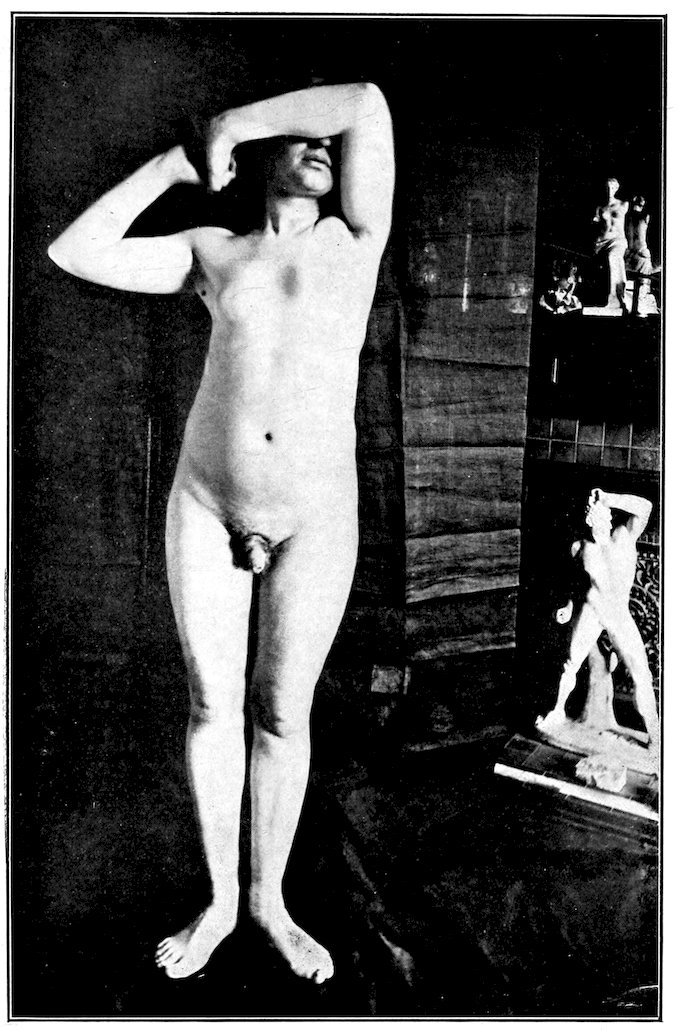
Front View of Author at Thirty-three
(Photo by Dr. R. W. Shufeldt)
83As to bragging about my intellect, my experience
of half-a-century is that in general, Providence makes
compensations in the lives of men so that as they, one
by one, pass on to the next world, all have fared equally
as concerns Heaven-sent boons and the opposite. As
a counterweight to having created me a bitterly persecuted
sexual cripple (for His inscrutable but surely
wise ends) the Architect of the universe endowed me
with a brain of such capacity as found in only one out
of twenty-five university graduates. I wrote stories
at eight. At thirteen I was confident I would become
an author and my name be chiselled on the walls of
fame.[21]
My college associates commented on my feminesqueness
and infantilism. I perceived that I was
looked upon as a curiosity.
I am a curiosity in that while throughout life remaining
a species of moron,[22] certain cerebral lobes
have nevertheless progressed to a high development
enabling me to graduate from a university almost at
the head of my class notwithstanding my general
psychic infantilism and my suffering from acute spermatorrhea
84|The Author a Curiosity.| and (during my freshman and sophomore
years) acute melancholia. If my physical health had
been as good as that of the three men who outstripped
me, I might have led my university class.
I am a curiosity in that down to twenty-five, I
was a fair specimen of physical infantilism or lilliputianism.
I was said to possess the skull and facial
lines of an infant. Down to twenty-five, I never
weighed more than 110 pounds on a height of five feet
five. Nearly all my brothers and uncles have been six-footers.
I am a curiosity in that I possess the light female
osseous structure. Even before I began to develop
adipose tissue after twenty-five, I would float on fresh
water without moving a muscle, my observation being
that the slim normal boy must vibrate his hands.
I am a curiosity in that form of skeleton and contour
of body are mostly feminine, particularly the bust.
Not until the age of nineteen, when I went successively
to two medical college professors and implored
them to make me a complete male, did I learn
that practically all the tissues of my body are of characteristically
feminine texture. My muscles, judged
by their weakness and my using them in general
woman-fashion, are those of a female. The beardal
growth is normally male except that it could never
reach the length of an eighth of an inch and has no
stiffness. If I had not shaved or eradicated the beard,
I would have been, after seventeen, one of the dog-faced
boys of the circus. Although the hair cells seem
as dense as on my scalp, I could never have exhibited
virile whiskers.
Coddled in College.
85Another feminine resemblance is that at the age
of half-a-century, I show not the least tendency to
baldness.
Several of my college associates coddled and
babied me. They would throw an arm around me and
cry: “Child!” They would hold me on their laps.
With the three ultra-virile with whom I became most
intimate and confidential, I would often in private
throw myself into their arms and pillow my head on
their bosoms, while they would exclaim: “Lovesick
boy!” They never betrayed my strange conduct to
others or appeared less friendly. Only one of the
three made greater advances than I myself—the only
one belonging to the tremendously virile class. What
chiefly kept me from even hinting at extremes was
fear of expulsion in case it should become generally
known. But I was also strongly influenced by the
dictates of society and the teaching of the Bible—as I
then erroneously understood the latter.[23]
“You still possess the real childlike naiveté,”
students have remarked. “And you possess childlike
features to harmonize with your decidedly childlike
manner of going about things. You are certainly
The Boy Who Never Grew to Be a Man.”
Childlike and Womanlike.
86“I like to watch you because of your childlike
grimaces. That is why the fellows are continually
teasing you; because it is just like teasing a child or a
girl. You react with a sort of pleased childlike pride
at being the object of attention.”
“Your voice, though hoarse, has a feminine timbre.
It possesses the penetrating and carrying power of a
child’s voice. It often breaks and changes, sometimes
in the middle of a sentence. From being masculine,
it suddenly changes timbre and becomes decidedly feminine,
passing over from a bass to a treble. Your
voice is sentimental, bland, caressing. It is the kind
of voice a dying woman would choose to hear.”
“I never saw the chevelure [as they shoved their
fingers through it] so fine and silklike in any one else
who wore trousers. Your hands [as they would hold
them] are as soft and hairless as those of a girl. And
you have the arms of a woman [when my sleeves
were rolled back]. And you blush just like a woman.
And you sob like her. I never saw tears run down the
cheeks of any other man as he sat in the class-room.”
I have jokingly replied with a smile at my classmate’s
mystification: “You do not know but what I am
a woman!” But I shrank from any serious disclosure
of the secrets of my sex, such a mystery to many of my
every-day associates.
If I live to old age, I intend to call the present
trilogy to the attention of some of my associates of
early years who have indicated great curiosity to know
the secrets of my sex life. I have permitted only three
friends (of course the closest) who know me under my
legal name to read my Autobiography of an Androgyne,
and one of the three dropped me from his friendship.
87|Feminine Figure Recognized.| Men are so biased on the subject of sex that I
can not let my friends read the secrets of my life until
I reach an independent old age when they can not make
me suffer much on account of my androgynism.
In college, I was compelled to exercise in the
“gym.” I hid my form. It was a terrible ordeal to
have to strip before the physical director, who remarked:
“Your figure is feminine.” Apparently he did
not suspect the sexuality that was bound up with that
figure. If military drill had been required—as in
1917—I would have quit the university.[24]
Since nineteen my yearning for skirts has been
in part met by habitually wearing about my home an
ornamental dressing-gown. Thus clad, I have often
gazed in a mirror, imagining myself a complete female.
I have taken pleasure in hearing the gown rustle, like
a silk dress; in feeling it strike against my legs; and
in holding up the front in ascending the stairs.
The Fairie Boy was my nickname from nineteen
to thirty-one outside my every-day circle. And outside
I was far more widely known. Inside I had the
reputation of being an insignificant, puritan, unpractical
book-worm and Mollie Coddle who knew nothing
of life and human nature. Outside I achieved wide
notoriety as an amateur actor—or, properly speaking,
actress.
Man, Woman, and Infant in One Body.
88That the distinction, among the sons of Adam, of
being The Fairie Boy came to me, is nothing for
which I can take credit to myself. It was merely because
Providence had made me, as an adult, physically
as well as psychicly, one-third man, one-third woman,
and one-third infant. Providence endowed me with
a “small-boy” aspect, the subject of comment in my
every-day circle down to my early forties; freshness
of complexion down to thirty; innocent expression of
features and marvellous absence of animality (in
appearance only); cry-baby mentality; eternal childlikeness
even in my professional life; and slender,
lithe, and lilliputian figure down to twenty-five.
The Fairie Boy! To be frank—I am proud of the
pretty nickname. This Providential distinction is
part of my compensation for my almost unparalleled
sufferings from persecution at present inseparable
from the lot of an ultra-androgyne.
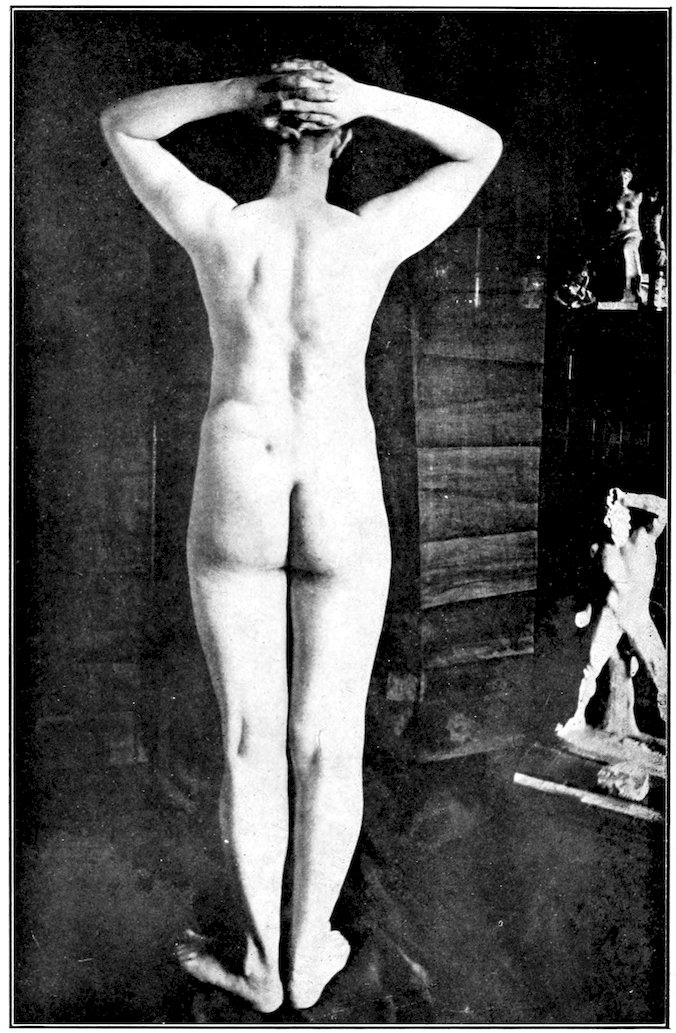
Rear View of Author at Thirty-three
(Photo by Dr. R. W. Shufeldt)
89
How I Came to Be a Female-Impersonator.
For the most part, the present chapter covers my
twenty-sixth to thirty-second years, during which my
most descriptive nickname was The Soldiers’
Friend. For I was foreordained to a sort of army
life for many years, detailed in my Autobiography of
an Androgyne, but omitted in the present volume.
Here I limit myself to some related personal description.
Physique and Psyche: My career as avocational
female-impersonator during the second half-dozen
years of my physical prime was even more remarkable
than during the first (outlined in Part Three).
My quasi-public career as female-impersonator ended
at thirty-one—at its very zenith—because I deemed
myself too old longer to play the part of “French doll-baby,”
and because the instinct thereto progressively
weakened from the age of thirty. My being able to
play that part down to thirty-one was possible only because
Nature had endowed me with the proper physique
and psyche, already described. Less extreme
androgynes lack the qualifications, while practically
all the extreme (commonly known as “fairies”, “fags”,
or “brownies”) lack the necessary good sense, modesty,
temperance, and high grade of general morality
that were mine because of my puritan childhood and
youth and university education.
The proneness of the eternal feminine greatly to
understate her age made me in my twenty-sixth year,
90|Infantilism, etc., a Bar in Business.|
when impersonating a doll-baby, pass as twenty-one,
and in my fortieth, as twenty-eight. An unmarried
female, as long as she has hopes of lassoing a husband,
never gets beyond the lingering years of twenty-eight
or twenty-nine.
Simultaneous “Male” Professional Life: In
my twenties, thirties, and forties, I have worked hard
in three successive learned professions. At nineteen
I had already relinquished my amateur work of
preacher of the Gospel on being forced by Nature into
the avocation of female-impersonator. Simultaneously
with my satisfying my frivolous and coquettish instincts
of French doll-baby, I also met the demands of
my male intellectual spirit by doing brain work of a
high order. My three successive professions have
seemingly been adopted by chance, although during
“boyhood” I manifested special aptitude for all three,
besides that of preacher. I did not choose them.
They were only makeshifts after I was barred from my
choice: preaching the Gospel. I can not name them
lest I disclose my identity.
I have achieved the average professional success.
But my extreme effeminacy and both facial and psychic
infantilism have prevented employers meting
out the full advancement that past work merited.
Men less capable than myself have been promoted over
me because my chiefs had the impression that I was
merely “a grown-up child”—that is, moron-like, although
as a matter of fact I possessed the intellectual
qualifications.
Office associates have now and then commented
in my hearing on my feminesqueness notwithstanding
they have not usually entertained the least idea
91|Feminesqueness Recognized in Business.|
that from nineteen to thirty-one, I impersonated, an
average of one evening a week, a French doll-baby.
Some remarks, however, even down to my middle forties,
indicated that some suspected the truth about my
sexual life. But I never betrayed that life to any of
my business associates excepting three or four confidants,
who—I must explain—were mere Platonic
friends. I was too much ashamed to ape the woman
before those acquainted with my intellectual accomplishments.
The following are samples of remarks
of office associates:
“Good morning, Baby!”
“Grinning kid!”
“You look like a frightened bunny!” (While being
teased. I was always the favorite subject for
teasing by full-fledged males. In school, university,
and office (the latter down to my middle forties only)
they teased me as they would a girl. Moreover, my
face expresses my emotions in an uncommon manner.)
“Your breasts are certainly beauts! You must
be half woman!”
“Look, Ralph, Ed is throwing kisses at you!”
“Ralph, I was just going to ask you for a kiss!”
“Ralph, you are nothing but a child half-a-century
old!” (When impressed by my childish grimaces and
childlike way of going about everything.)
“Say, Ralph, won’t you favor me with the recipe
for perennial youth? I never saw such a contrast between
apparent and actual age!” (During my early
forties.)
“Ralph, you are a tub of mush! You look like a
fat frau in the last stage of pregnancy!” (The reader
will pardon the vulgarity occasioned by my wish to
92|Simultaneous Life as Three Persons.|
give the exact words used by an office associate to describe
my figure after the age of forty-three.)
Nearly all my professional life has been under my
legal name. It has been completely apart from my
avocation of female-impersonator. I have sometimes
thought I might be an instance of the dual personality
recognized by psychologists. Only, while living out
either side of my own duality, I have always had a
complete memory of the other side and recognized the
oneness of my ego in my two widely opposed careers.
In my middle twenties, I lived under three names
and personalities. I worked seven hours a day for a
legal journal as “Earl Lind.” Because under that
name I had called on its editor to persuade him to
publish my Autobiography of an Androgyne, representing
myself as merely its author’s agent. The
editor was in his sixties, and happening just then to
need an assistant, immediately hired me, never questioning
the truthfulness of my representations as to
who I was. He was at the time also one of the leading
criminal lawyers in New York City. He employed me
in all sorts of confidential capacities and let me into
many of the secrets of his clients. Of course I would
never have proved false to his trust, even though he
never knew who I really was and where I lived. I
attended court with him as his clerk. I learned all the
intricacies of establishing a false alibi for a wealthy
androgyne whom he represented in a case originating
in blackmail by an adolescent. I was his assistant
while he was defending a client from prosecution by
Anthony Comstock, when the latter gentleman was
personally acquainted with me under the name of
“Earl Lind,” and knew I was trying to get the
93|Court Employee Was Ultra-Criminal.|
Autobiography of an Androgyne published, which
he had already interdicted.
Thus I was, in a sense, a court employee of New
York City, while at the same time one of its greatest
criminals—according to a statute that is a legacy from
the Dark Ages.
Simultaneously with my career as lawyer’s clerk,
I taught school five evenings a week under my legal
name, and every Saturday evening took up my avocation
of female-impersonator under the name of
“Jennie June.”
Though I passed as three separate personalities
within the same week, they had—poor things—to
share the identic body alternately.
Necessity of Aliases: I have used five: Raphael
Werther, Ralph Werther, Earl Lind, Jennie June, and
Pussie. When I began my double life, I told the
Underworld my legal name was Raphael Werther. I
named myself after “the Prince of Painters,” because
he was the greatest ultra-androgyne who ever lived.
He was my idol—my ideal. I wished him to pass
through the earthly life all over again in my body. I
further named myself after “the Prince of Amatory
Melancholiacs” since I was myself such during my
teens. Werther was Gœthe himself, the most brilliant
and most versatile man, “the Prince of Men,” born
subsequently to the Shakespeare-Author (Francis
Bacon).
As for the genesis of my first feminine name, I
chose “Jennie” at four. I have always considered
it the most feminine of names. When I began my
double life, I appended “June.” I adopted that surname
because of its beautiful associations, as well as
94|Choosing Aliases.|
because of the repetition of the j and n. I have always
considered “Jennie June” as the most exquisite of
names: the poetic name; the magic name; the “divine”
name (in the sense that we speak of the “divine” or
“godlike” human form). I later substituted the feminine
“Pussie” because so nicknamed, much to my
delight, by the tremendously virile.
I later adopted “Earl” primarily because it
rhymes with “girl”, the creature of enchantment that
I longed to be, and secondarily because it arouses noble
ideas. I adopted “Lind” after Jennie Lind, one of my
models.
Perhaps these fancies about names are proof of
insanity. A medical reviewer of my Autobiography
of an Androgyne, who devoted only five minutes to
the 70,000 words, declared me “clearly insane.”
When I transferred my female-impersonations
from Mulberry Street to the Fourteenth Street Rialto,
incredulity occasioned my transliterating the fancy
“Raphael” to prosaic “Ralph.”
As a result of my 1905 court martial making the
names “Ralph Werther” and “Jennie June” known
to some army heads, I found it advisable, when in 1907
renewing my kind of army life for seven years, to
choose new masculine and feminine names. I feared
it might become known to the army heads that the
fairie “Jennie June” had transferred “her” stage for
female-impersonations to a distant military post.
Hence the substitutions of “Earl Lind” and “Pussie.”
On a single day I have had to sign myself with
four different names. Always after writing my signature,
I must review it painstakingly to make sure I
have put down the proper one. Only once I have made
95|Two Handwritings.|
a mistake. In receipting for a registered letter addressed
“Earl Lind, General Delivery,” I signed my
legal name. To the clerk’s inquiry I replied that I
had been authorized by Lind. He sent word to Lind
for written authorization, which was promptly despatched.
I have had to acquire two entirely distinct handwritings—the
second for my numerous love letters.[25]
None were ever written more mushy than those of
“Jennie June” and I guarded against their ever being
traceable to the intellectual and puritan “Ralph
Werther” (by which name I refer to my every-day
self in my books). I have often, within an hour,
written letters in the two different hands.
Confidants: Throughout the three decades of my
double life, I have, outside several physicians, disclosed
it only to nine confidants of my every-day circle.
One expressed his amazement that I should disclose it
at all, affirming that even my best friend would be likely
to get me thrown out of my economic and social position.
All my lay confidants, however, proved helpful
and compassionate excepting one, who, while never disclosing
my secret, dropped me from his friendship, although
we had been the very closest of Platonic
friends. One physician brought about my expulsion
from the university and made me a Bowery outcast
and fairie.
Because of the terrible persecutions inflicted by
the criminally-minded “saints” who happened to be
born sexually full-fledged, hardly a single cultured androgyne
ever betrays his bisexuality to a single confidant
96|Author’s Contribution to Sociology.| of his every-day circle excepting the tremendously
virile bachelor whom he may have chosen as soul-mate.
I am an exception in outspokenness. Decades
ago I rose above the prudery and bias with which most
leaders of thought are to-day bound hand and foot. I
desire that men interested in the improvement of the
human race, and in the question of justice to all classes,
have the opportunity of getting at the facts concerning
the atypic and atavic types with whom I have
been intimately thrown through having been foreordained
to pass a large part of my life in the Underworld.
Part Three: The Fairie Boy — I. Female-Impersonation. — II. A Typical Female-Impersonation Spree. — III. The Gambler. — IV. A Stuyvesant Square Pick-up. — V. Evenings at Paresis Hall. — VI. Thoughts Suggested by the “Hermaphroditoi” in General.
97
In Part Three, I shall outline what kind of adult
career is the natural sequel of the childhood and adolescence
described in Part Two; what kind of adult
career is bound up with the physique and psyche with
which I am endowed. I shall disclose what Providence
had in store for the youthful religious prodigy of the
Connecticut hills—the delicate, lilliputian, chicken-hearted
girl-boy—after he had been swallowed up in
New York’s millions.
Since ultra-androgynes are, in a sense, instances
of dual personality—a male soul and a female soul
inhabiting the same brain and body—it is natural for
them to live a double life.
Moreover, as the “classy,” hypocritical, and bigoted
Overworld considers a bisexual as monster and outcast,
I was driven to a career in the democratic, frank,
and liberal-minded Underworld. While my male soul
was a leader in scholarship at the university uptown,
my female soul, one evening a week, flaunted itself as
a French doll-baby in the shadowy haunts of night
life downtown.
Since my student and subsequent professional
career were prosaic, I leave them almost unmentioned
98|The Fourth Sex.|
throughout Part Three. I, however, always gave
them first place in my life. But I here confine myself
to what I experienced and learned while impersonating
a French doll-baby because it constitutes something
novel to most readers.
Indeed Parts Three, Four, and Five portray the
social life and diversions of the most cultured New
York coterie of THE THIRD SEX during the last decade
of the nineteenth century. For, while little has yet
been published about instinctive female-impersonators
because of the prudery of the sexually full-fledged,
they form (necessarily sub rosa) quite a large class of
society—about one out of every three hundred physical
males. During the last decade of the nineteenth century,
the Fourteenth Street Rialto was their chief
stamping-ground in the New York metropolitan district.
I became acquainted with them because during
the decade indicated, I was myself in my prime as
a female-impersonator in two out of the three principal
bright-light quarters of the metropolitan district.
[There exists also A FOURTH SEX, the gynanders.
But experience has not qualified me to describe them
in detail. That task awaits some brave, high-minded,
and brilliant physical female. See, however, chapter
on Gynanders in my Riddle of the Underworld.]
The Overworld has enjoined complete silence
about female-impersonators because of their thoroughly
false view that any adolescent adopting the role must
do so from moral depravity. They argue: “If I myself
adopted the role, it could only be through unspeakable
depravity. Ergo, the same is true for every
male.” They overlook the fact that Nature did not
99|Female-Impersonation Instinctive.|
make all anatomical males of like passions. What
would be moral depravity for one is not for another.
Instinctive female-impersonators are sexual
cripples from their mother’s womb. They had no
choice in the matter. Thus they merit pity rather
than scorn. Further, since their impersonations
occasion no detriment to any one, but are a source of
much entertainment to their sexually full-fledged
associates, they are a positive ethical good. All beneficent
talents that the Creator has distributed among
mankind must have been meant for use—not for
strangling.
As to the ethical question, I myself, who from the
age of nineteen to thirty-one had an intensive career
as fairie—female-impersonator, can truthfully state,
on arrival in my late forties, that I was not once, during
that career, guilty of an irreligious or unethical
act—excepting alone that I seriously impaired my own
health. But it is doubtful whether the impairment
was permanent. In my late forties, my physical vigor
is not at a lower level compared with males of my own
age than it was during my childhood. My health has
always been delicate.
Numerous wives and mothers suffer in health
from the sex passion as much as I. If my having had
my health wrecked by it proves it immoral for me and
to be legally repressed, then the yielding to it by wedded
pairs is equally immoral and to be interdicted. If
it be objected that the human race is perpetuated by
the latter, I answer that this consideration would only
permit to married couples a sex-union when offspring
was the object—that is, for a cultured couple,
from one to three times throughout their married life.
Depilation.
100In the description of my own physique and psyche,
I have indicated the general characteristics of the extreme
type of androgynes foreordained to become
quasi-public female-impersonators. But the outstanding
feminesque physical stigmata of each “fairie” (as
they are commonly called in the United States) tend
to be sui generis. In one it is natural beardlessness
alone. In another, the possession of female breasts
alone. In a third, the female skeletal shape, particularly
an over-long spine, short legs, and broad pelvis.
In a fourth, natural soprano voice. Etc.
Whoever has beheld an instinctive female-impersonator
when keyed up, must confess that this type
are born actors—or “actresses,” as they prefer to be
called. Their histrionic skill is not primarily the result
of practice or instruction.
Their audiences have marvelled because the impersonators’
faces are devoid of any sign of beardal
hair. Usually the beard is eradicated. It is allowed
to grow for a full week in seclusion. By means of a
mask of depilatory wax, every hair is then pulled out
by the roots, the outer portion having become embedded,
like hair in wall-plaster. For three weeks, the
face is as glabrous as a baby’s. Then the week’s seclusion
and the final excruciatingly painful yank of
the wax mask all over again. The process has no
permanent effect, either good or bad.
All the impersonators adopt a fancy feminine
name, as Pansy, Daisy, and Lily. Often the names
of living star actresses are adopted and “dragged
into the mud,” as people say. For while the career
of a female-impersonator is a purely physiological and
101|Obedience to Nature Gave Peace.|
psychological phenomenon, it is incorrectly regarded
as deepdyed immorality.
All impersonators belonging to the middle and
upper classes also choose a masculine alias, represented
in the Underworld to be their legal name. They do
not wish to risk disgrace to their family name. Moreover,
on their sprees in the bright-light districts, they
are careful to wear nothing containing their every-day
initials.
Except for a few weeks, I myself was only an
avocational impersonator. I gave to it only three
hours a week, as compared with 109 waking hours to
my student (or later, professional) life. I did not
adopt the avocation until near the close of my sophomore
year. Almost throughout the preceding twenty-four
months, however, I had fought violently against
almost irresistible tendencies to disappear for an
evening in the Underworld on a female-impersonation
spree. But my ultra-puritan education had injected
into me such a moral horror of female-impersonation
that I was able to resist the tendencies for two whole
years after the date that Nature ordained them to
begin.
The “French doll-baby” spirit had dwelt in my
brain since birth. Throughout my life down to nineteen,
it had manifested itself strongly, although after
fourteen I had struggled to crucify it. At nineteen, it
refused longer to be suppressed. I (the puritan, book-worm
spirit in me) had to arrange a compromise. I
promised to yield my physical and mental powers to it
only one evening each week. And the doll-baby spirit
was satisfied. Previously I had been the most melancholy
person in the university. But dating from the
102|My Dual Personality.|
compromise, my life flowed on peacefully and blissfully.
Only occasionally—moments while suffused with ambition
to make a name for myself in the intellectual and
philanthropic world—would I turn against the doll-baby
spirit with abhorrence, and ask myself how I
could ever give place to it.
For the serious work of life, I realized that I must
practically strangle the feminine side of my duality
outside the three hours a week during which I conceded
to it full possession of my personality. While
at my every-day tasks, I sought to forget the doll-baby
spirit that dwelt in my brain side by side with the
scholar spirit.
The Fairie Boy.
103
The one evening a week on which I (the scholar spirit)
surrendered, I called “going on a female-impersonation
spree.” The typical spree did not occur
until the December (1894) of my senior year. I had
become somewhat adept in the art of impersonation
through a year’s apprenticeship in the Mulberry Street
Italian quarter. As that training has been detailed
in my Autobiography of an Androgyne and The
Riddle of the Underworld, I omit it here.
On the afternoon preceding a spree, I would be
overwhelmed with dread and melancholia. I dreaded
disclosure, which I realized would mean expulsion
from the university because of the full-fledged man’s
horror of a sexual cripple. I dreaded possible disfigurement
by blows—or even murder—by one of the
numerous prudes who detest extreme effeminacy in a
male (supposed). I was melancholy because about to
embark on something that my puritan training had
impressed me as in the highest degree disgraceful, and
that I secretly wished I did not have to undertake.
But to be contented and even happy for the following
week and to guarantee that tranquillity necessary for
the best scholarly success, the weekly spree was
unavoidable.
Only a handful of upper-class female-impersonators
adopt feminine attire for street wear. For myself
(being a university student, and subsequently an
honored member of a learned profession) it was too
104|Fairies Are Extreme Dressers.|
risky. I merely kept some feminine finery locked up
in my room for occasional decoration of my person
while I gazed in the mirror. But during the eighteen
months that my sprees were staged in the Fourteenth
Street Rialto and the six years on or near military reservations
in New York’s suburbs, my attire was as
fancy and flashy as a youth dare adopt. Fairies are
extreme dressers and excessively vain. To strange
adolescents whom I passed on the street I proclaimed
myself as a female-impersonator through always wearing
white kids and large red neck-bow with fringed
ends hanging down over my lapels.
I would set out from my lodgings with the feelings
of a soldier entering a terrific battle from which he
realizes he may never return. As the car carried me
farther and farther from where I staged the puritan
student life and nearer and nearer to where I staged
the “French doll-baby” life, my overwhelming melancholia
would gradually give way to a sense of gladness
that in a few minutes I would find myself again on
“Jennie June’s” stamping-ground. I had left at
home all my masculinity (a very poor variety). The
innate feminine, strangled for a week in order that I
might climb, round by round, the ladder to an honored
place in the learned world, now held complete sway.
During the last decade of the 19th century, the
Fourteenth Street Rialto ranked second only to the
“Tenderloin” as an amusement center in the entire
metropolitan district. While it still holds the same
rank in 1921, its present night life is only a shadow of
what it was. A quarter of a century ago, New York
was wide-open, whereas for more than a decade, the
lid has been down tight. Promenading the Rialto on
|The Fourteenth Street Rialto.|
an evening of 1921, the pedestrian would conclude that
no such phenomenon as sex attraction existed. But
during the period that I was an habitué, the Fourteenth
Street Rialto was as gay as European bright-light
districts, which I was fated to explore.
105
Fourteenth Street Rialto, Stamping-Ground of the Hermaphroditoi
Stuyvesant Square, One of Jennie June’s Stamping Grounds
(Usually the evening was spent on the bench where two girls are seated in picture.)
106The Rialto is confined principally between Third
Avenue and Broadway. While I was an habitué,
theatres, museums for men only, drinking palaces,
gambling joints, and worse abounded.
On pleasant evenings, when the sidewalks were
thronged with smartly dressed adolescent pleasure
seekers, I would promenade—up and down, up and
down—until I chanced to meet a coterie of young
bloods who invited me to join them. Our evenings
would be spent in pool-rooms, gambling joints, beer
gardens of ill repute, or worse resorts. Nature made
me proof against the vices I there witnessed. My
only weakness was the craze for female-impersonation.
My greatest joy was to flaunt myself as a bisexual before
those who did not know my identity. I realized
that every soul among my Rialto associates was turning
his or her back on the Creator. But I was always
determined to give Him first place in my affections.
However, for fear of bringing reproach on religion if
I made myself its representative—I, a misunderstood
female-impersonator, whom even the Underworld in
general regarded as one of the most impious of humans—I
never mentioned the theme except under extraordinary
circumstances.
If the weather were bad, I would immediately
enter a beer-garden and call for sarsaparilla. I would
consume it in driblets while watching for the opportunity
107|Female-Impersonators Popular.| to join some tremendously virile bachelors out
for a lark.
On the typical evening I have chosen to describe
of my many passed in the Rialto, I happened to run
across several youthful Lotharios waiting in front of
a theatre for something “to turn up”. Only one adolescent
“male” out of three thousand in New York City
adopts the role of quasi-public female-impersonator.
A Rialto habitué therefore does not often run
up against one. Judging by my own experience, a
female-impersonator proves an attraction of the first
order for young bloods having time hanging heavy on
their hands. Thus this coterie—as many others have
done—called out jubilantly on catching sight of me:
“Hello Jennie June!” ... “Hello sweetheart! That
is what you want us to call you, isn’t it?” ... “Let me
introduce you to Mr. A and Mr. B. They have never
met a female-impersonator, and are dead anxious to
see you take off a girl.”
“And you are Jennie June, are you?” A and B
exclaimed. “We have heard a lot about you and
longed to meet you.”
“Bon soir, messieurs,” I replied. I had a liking
for addressing chance-met beaux in a foreign tongue.
I happened to be the foremost linguist among the university
students.
“Bon soir, Jennie, bon soir!”
“Meine sehr geliebten junge Herren, wie geht’s
bei Ihnen?” I continued with a twinkle in my eye.
“Ganz gut,” sounded the reply. New York is a
Babel. On an hour’s promenade in the Rialto, conversation
in a score of languages would impinge on one’s
108|Female-Impersonators Gifted.|
ear. Bright young men brought up in a New York foreign
colony acquire a score of the commonest expressions
in several languages.
“I miei amici, siete amati da me,” I next declared
in a third language.
“Pee-an-gou, savez? We don’t understand Dago,
Jennie. Tell us in American how much you love us.”
I reply in Spanish: “Esto es lo mejor que podemos
hacer. Hablemos ingles.”
“Bert, Jennie seems to be a bright fellow—or girl—doesn’t
she? All these impersonators seem to be
brainy. Jennie, I don’t know whether to call you a
fellow or a girl. Which is proper?”
“Girl, of course,” I replied with a smile.
“Well, fellows, Jennie June is part he and part
she. He wears trousers, but she has breasts just like
a woman and wants us fellows to regard her as a girl.”
“Well, Jennie, if you are a girl, why do you wear
breeches? And why don’t you let your hair grow
long?”
“Because I have the misfortune to be only part
girl. I am only a girl incarnated in a boy’s body. But
besides my girl’s mind, my entire body is shaped very
much like a girl’s and I possess her bone and muscular
systems. Because I am part boy, the law prohibits
to me my natural or instinctive apparel. But you will
be so kind as to overlook my not appearing before
you in gown and picture hat, won’t you? I will make
up for that lack by out-womaning woman in my actions.
It is my nature to give up all I have, and do all I can,
for the entertainment of heroes—as you manly fellows
seem to be.”
The Hotel Comfort.
109“Jennie, let’s walk around to the ladies’ parlor
of the Hotel Comfort[26] and have a few drinks.”
We arrived in an artistically furnished room 25
feet by 75. At one side was a bar from which waiters
continuously carried drinks to the fifty-odd couples
seated around the small ornamental tables which occupied
most of the floor. Nearly all the patrons were
under thirty, and absolutely all, highfliers sexually.
The vast bulk merely smoked, drank, and “chinned.”
Only a few were playing cards for money. All were
refined and orderly. I have never circulated among
more delightful people than I met frequently at the
Hotel Comfort.
I had become well acquainted with the proprietor
and all his employees. For more than a year the
“hotel” was substantially the home of my feminine
personality, “Jennie June.” But this refined and luxurious
“hotel” would have tolerated only a cultured
and outwardly modest female-impersonator. Most examples
of that biological sport were far below the
standards of the Hotel Comfort, and would have been
barred. But I was looked upon as a personality likely
to attract a pecuniarily desirable class of patronage.
My five companions and I spent an hour sipping
beverages.
[While during my twelve years as quasi-public
female-impersonator, my companions always drank intoxicants,
I always called for non-alcoholics. The latter’s
price was double in order to discourage the consumption
of temperance drinks. I had been brought
up to loathe alcoholics, and during my twelve years
110intimacy with heavy drinkers, came to a more and
more rational loathing.
No Alcohol, No Venereal Disease.
Alcoholics are by far the greatest curse of the
Caucasian race. I have had almost unequalled opportunities
for studying venereal diseases. My twelve
years of having roues and filles de joies for bosom
friends taught me that the presence of alcohol in the
blood is the sine qua non of venereal disease. Perhaps
my greatest contribution to the betterment and happiness
of humanity is the epigram original with myself:
No Alcohol, No Venereal Disease. But it is
necessary to be a TOTAL ABSTAINER. Mere moderation
does not confer immunity. The total abstainer may
possibly contract venereal disease, but it is sure to be
benign, almost negligible, and inflicting no permanent
injury. Dr. Robert W. Shufeldt, who as army surgeon
had extensive experience in the treatment of venereal
disease, wrote in the Journal of Urology and Sexology,
1917, page 458: “In my opinion, alcohol bears
the responsibility more than any other single agent—indeed
more than all the others put together—for ensuring
venereal infection.”]
“Jennie, why not take a cocktail instead of a
lemonade? We want to warm you up. Then you will
give us some of your recitations and songs. Won’t
you drink a few cocktails for my sake?”
“I would not put the poison into my system for
anybody! I do not need that kind of stimulant. You
know what kind I need to get warmed up to declaiming
and singing!
Female-Impersonate Intoxication.
“‘I am a-thirst, but not for wine;
The stimulant I long for is divine;
Poured only from your eyes in mine!
111I am a-cold, and lagging lame;
Life creeps along my chilled frame;
Your love will fan it into flame.
I am a-hungered, but the bread I want;
The food that e’er my thoughts doth haunt;
Is your sweet speech, for which I pant!’”
[27]
“If that is all the stimulant you need, Jennie, it
can easily be supplied.”
We were the merriest party in the parlor. The attentions
of my beaux were having their usual effect.
To achieve my best success at female-impersonation,
the stimulus of an appreciative and responsive audience
of youthful Lotharios was necessary. Our
hilarity was more and more attracting the eyes and
ears of all other guests. Some recognized me as a
female-impersonator. Calls began to reach me: “O
you Jennie June, give us an impersonation of a prima
donna!” The old-timers were remarking to new
patrons of the “hostelry”: “The little fellow with the
red bow is a fairie!”
Hypnotized by the adulation of those whom I
looked upon as demigods, as well as by the well-disposed
attention of the other hundred-odd guests attracted
by my unique, yet fairly modest, behavior, I
broke into the “Old Oaken Bucket”—a song affording
unusual opportunity to display my masculine-feminine
tones: below middle A, baritone; from A upward,
alto; with an occasional soprano and tenor modulation
thrown in just to excite wonder. I fancy my singing
voice is unusual in its variety of possible modulation
112|Man and Woman in One Body.|
as a result of my body being both male and female.
In my singing voice particularly, these two elements
are ever striving for the upper hand. One stanza each
of several songs then in vogue followed: “After the
Ball Was Over”; “Sweet Rosy O’Grady”; “Just Tell
Them That You Saw Me”; etc.
Next I recited a dialogue, my naturally bland, sentimental,
and caressing voice now aping a cry-baby
mademoiselle, and now a stern, hoarse-voiced he-man.
Now I burlesqued feminine airs and cadences; and now
strove after the most virile and dare-devil effects.
I was, while the focus for all eyes, conscious only
of the joy of being alive and in the midst of an admiring
group. I experienced a feeling of exultation that
for a brief spell I was looked upon under my real character—a
bisexual. I was intoxicated with delight because
emancipated—though only for a few moments—from
a hated dissimulation and disguise, and enabled
to be myself. Assuredly another personality than that
of my every-day book-worm self was in possession of
my body and faculties. I realized I was the same I
who was one of the leaders in scholarship at the university.
At the same time, I realized I was doing
things incongruous with that position.
At midnight, I bade my convives a reluctant adieu.
Before boarding an elevated train, I turned several
corners abruptly and hid in the first dark doorway to
make sure of not being dogged. But no Rialto associate
ever did. After alighting from the train, I
adopted the same strategy, to make assurance doubly
sure.[28]
Being “Dogged”.
113Arrived in my room, I first dropped to my knees
to thank Providence for restoration to my every-day
world. I rejoiced that the ordeal of a female-impersonation
spree was over for a week. But the following
days, while resting my mind for a moment from hard
study, I gloated over the memory of my latest associations,
as a member of the gentle sex, with the tremendously
virile type of adolescent.
Note.—See “Memories” in Part VIII.
The Fairie Boy.
114
“Where is my wandering boy to-night—
The boy of my tenderest care,
The boy that was once my joy and light,
The child of my love and prayer?”
In chapter III I shall portray one of the most
remarkable of the Adonises that I met during my 18-months
Rialto career, to which the present Part
Three is devoted, and in chapter IV, the most remarkable
youthful Hercules. Other Adonises of the Rialto
are portrayed in my Riddle of the Underworld.
The remainder of the present book, to the end of Part
V, will describe some of the most remarkable ultra-androgynes
(female-impersonators) that I met in the
Rialto. For a description of my most noteworthy
“fallen angel” confidants, I refer to my Riddle, and
to my fourth book, now in preparation, Susa, which
gives the entire life of the Queen of the Rialto of the
middle of the last decade of the nineteenth century.
As I was fated to become the most widely known
female-impersonator of the Rialto, Susa was the most
widely known vampire. Two detested and cordially
loathed types, but actually not a hundredth as bad as
they had the name of being!
Numerous Rialto pals were adolescent professional
gamblers. Because of that, I have chosen to
devote an entire chapter to a characterization of the
type. More than that, the young blood forming the
subject of the present chapter was my “No. 1” friend
among the couple of hundred Lotharios with whom I
115|New York’s Beau Brummel.|
mingled in the Rialto. He became my favorite because
he was the most elegantly dressed—and close to
the handsomest—adolescent I ever met. Above all,
he possessed the most genial disposition.
Has the reader ever remarked that just that kind
of disposition generally goes hand in hand with deceit
and hypocrisy? Later—to my bitterest sorrow—the
hero-boy now being described was discovered to be
the greatest hypocrite I ever met. In January, 1895,
I made his acquaintance. For half-a-year he manifested
the greatest affection—all feigned as I later found.
When he had wrung me dry, he—entirely unexpectedly—flourished
a loaded revolver around my head, and
cried: “If you ever speak to me again, or even come
into the same room, I will put a bullet through your
head!”[29]
This quondam soul-mate had such a craze for acquiring
money—generally by foul means—as I have
never witnessed in another. He made it a condition
of our spending a couple of hours together that I put
into his palm a five-dollar bill. But though I could
get plenty of other company of his type gratis, I was
so fascinated with him that I never gave a second
thought to the self-sacrifice that such gifts demanded
during my student days. While promenading the
streets with him, I would, every other minute, glance
into his face, reflecting: “The handsomest and best
dressed young fellow of the Rialto is MINE.” While
we were seated in a theatre together, I would often
gaze into his face instead of at the players, reflecting:
“New York’s Beau Brummel is MY SOULMATE.”
For no soft hair, no rosebud cheeks in a
116|Apostrophe to Lost Soul-mate.|
male, no arched eyebrows—ever surpassed those of
the Adonis now being described. He was perfection
in face, head, and body. He was perfection in dress.
He was perfection in disposition—ONLY HE WAS
ULTRA-DECEITFUL.
Buddie McDonald! Whom for over twenty-five
years I have not seen or had news of! I am here
addressing you because it is the only possible way to
get through a message. If these lines should ever
fall under your eyes, and you should, in this chapter,
recognize yourself—somewhat covered in order to hide
our identities—I wish to tell you that I have through
the years always granted you first place in my heart
after my mother alone, and if we could ever run across
one another, I still stand ready to enslave myself to
you, notwithstanding you doubtless have lost (because
age deals no differently with you than with all other
sons and daughters of Adam) nearly all your litheness
and charm. But I still love you for what you were
in your earlier twenties. Throughout a quarter of a
century I have been longing and waiting for a chance
encounter with you. Many times have I eyed every
man passed in New York’s crowds hoping to recognize
your face. Nothing would I like better than to spend
my declining years knit to your genial personality and
heroic, grand-aired spirit. I freely pardon your past
treachery—though it almost drove me insane—if only
you would condescend to let my soul be knit to yours
until death do us part!
Buddie McDonald! The most precious of all
names! If it were my idol’s legal name, I would not
117|The Gambler’s Antecedents.|
disclose it. It was the alias he used in the Rialto and
the only name I knew him by.
Buddie told me that he was born and brought up
on a farm near Lake Ontario. His people were Methodists.
He had always gone to Sunday school and Epworth
league, because his parents required it. For
he was a black sheep by birth—the only one in his little
rural community. When nineteen, the seventeen-year
daughter of a neighbor appeared with her parents before
a justice of the peace. Buddie lived with his child-wife
only three days and then stole away for parts unknown.
What pangs the poor girl must have suffered
thus to lose a genuine Adonis—in beauty one man out
of a thousand—to the arms of the demimonde! She
had doubtless been comforting herself and congratulating
herself that she had won for life as her helpmeet
the most bewitching young blood of the community.
And after just three days to be forever left
in the lurch!
“Buddie McDonald” immediately bobbed up in the
Rialto under that alias. In the Rialto! At that time
one of the two chief amusement and gambling centers
of the Western Continent, the magnet for the black
sheep of pious families all over the United States.
He immediately adopted the profession of card sharper,
being endowed with the peculiar mentality necessary.
While we were pals, he was twenty-two—just
a year older than myself. From ten to midnight one
evening each week, I dogged him in one of the half-dozen
gambling joints among which he divided his
“working” hours.
Fairie a Bachelor of Arts.
118I was too much of a goody-goody ever to gamble
myself. I would merely sit for hours as spectator. It
was intense pleasure merely to have under my eyes the
type of adolescent that sows wild oats.
Among my associates in the Rialto resorts were
youthful actors playing at the several theatres, racetrack
book-makers, wealthy adolescents who spent
their evenings sipping gross pleasures, and highfliers
of the feminine persuasion—at that date as thick in
the Rialto as flies in summer around an open jug of
molasses.
I was now in my third year of leading a double
life. My every-day circle was without suspicion.
Outside my one evening per week in the Rialto, I led
a most industrious student life, even winning prizes.
I had already been awarded the bachelor’s degree cum
laude and was in my first year of graduate study. Of
course I had never revealed to any Rialto associate
that I was a university student. I was known there
merely as “Jennie June,” while the few who took the
trouble to inquire my legal name never questioned
“Ralph Werther.” And my three most intimate
Lothario friends of the Rialto were too busy evenings—Martin
and Paul,[30] chasing chippies, and Buddie,
victimizing youthful greenhorns—to investigate where
I spent my time while not in the Rialto. They have
each asked me where I lived. I gave a fictitious address,
hoping they would not investigate. And they
never did. And my three most intimate androgyne
friends—Roland Reeves, Eunice, and Phyllis—were,
like myself, living a double life incognito, and thus
119|“Things Are Not What They Seem.”|
were the more inclined to respect my disinclination
to refer to my every-day life.
To the university circle I thus continued the “innocent”
from whose view Heaven had mercifully shut
off the seamy side of life, particularly the Underworld.
They declared they never saw any one with such weak
sexuality! But I actually knew a thousand times as
much about passion and crime as any one of them.
Some complained because I “never associated with
men and learned human nature”! But I secretly knew
human nature far better than any of them. They
thought that my feminine predilections and lack of
worldly wisdom (seeming) were due to my being a
recluse! And I was a recluse so far as concerned university
social affairs. For I elected to take my diversions
as a mademoiselle—not as a gallant.
But to return to Buddie: I have picked out for
description that one of my numerous evenings spent
in part with him which best illustrates his character
and our relations. Afternoons and evenings he hung
around fashionable hotel lobbies and exhibition halls
to scrape acquaintance with moderately wealthy and
sportily inclined Reubs making their first trip to New
York. With his unmatched geniality and hypocrisy,
he was decidedly successful in getting a line aboard
some “sport” from upstate, and taking him in tow.
For with Buddie, it was “Brother, this” and “Brother,
that”. A large proportion of the Reubs whom Buddie
condescended to buttonhole congratulated themselves
doubtless on their good luck in happening on such a
friendly New Yorker—a gentleman of leisure and a
big roll of yellow backs (which Buddie always took
pains to wave before the eyes of Reubs, a manoeuvre
120|Gambling a Master Passion.|
tending to hypnotise them) who condescended to show
them the sights of the metropolis, and, above all, take
them where they could quadruple and quintuple their
funds in a single evening. The passion for enrichment
by a stroke of luck is, after woman and wine, the chief
pitfall for “he-men.” An appeal to this craze in Reubs
ambitious to be “sports” has good prospects of success
for brainy metropolitan prestidigitators.
On Buddie’s and my entering into a solemn contract—very
similar to a marriage bond—to be “best
friends,” he agreed to reserve one entire evening each
week for me alone. But it was only the fourth that I
had to sit in a Fourteenth Street restaurant for two
long hours waiting in vain. I was wiping my tear-bedimmed
eyes four times a minute. Other diners
probably thought I was experiencing some overwhelming
bereavement.
At ten I made the rounds of the gambling joints
frequented by my soul-mate. I finally caught sight
of his wondrous blonde hair and peachlike cheeks in
the very last—as always happens—of his half-dozen
stamping grounds. In the last decade of the nineteenth
century, it was pre-eminently New York’s
Monte Carlo (which name I give it in this book). The
walls were paneled in rosewood. Every six feet a
heavy gilt-framed plate-glass mirror reached half-way
to the 15-foot ceiling. The latter was painted with
Cupids and Venuses, in all sorts of poses, amid fleecy
clouds floating in such a blue sky as is actually beheld
only in Italy. The myriads of crystal prisms pendent
from the huge chandeliers emitted all the colors of the
spectrum. The floor was mosaic—in such exquisite
patterns that it seemed a sin to set foot on it. The
121|In New York’s Monte Carlo.|
ebony furniture was inlaid with mother-of-pearl in
floral patterns.
I rushed to Buddie’s side noiselessly because, with
three other smartly dressed young bloods, he was absorbed
in a game. I knelt beside my hero-boy with
head against his arm.
When the hand was played out, Buddie, throwing
at me the sweetest of smiles, addressed the only one of
the four who was a stranger: “Mr. Myers, let me introduce
Jennie June, the female-impersonator. I am
used to her hanging around while we fellows are playing.
Do not let her presence distract you. Jennie
and I call each other ‘Best Friend.’ Perhaps you
never before ran up against a person who is one-third
man, one-third woman, and one-third infant. That
explains why she nestles up against me so affectionately.”
But Mr. Myers appeared to be unutterably shocked.
Particularly since I was in male attire. He appeared
incredulous. He had never even dreamed that
a third sex exists.
After an hour Buddie said: “Jennie, take my keys,
go to my room, and wait for me there. Because I will
not get home until long after midnight.”
On arrival he exclaimed: “Jennie, what do you
think of your new friend, Mr. Abraham Myers, the
Beau Brummel of Myersville upstate, who is enjoying
his first visit to our village?”
“I think, Buddie, that before to-night he had never
been in any place worse than a church social. His
evening in the Monte Carlo must have been an eyeopener.
122|Crooks Are Boastful.| Whenever my gaze fell on the poor innocent,
the words of the Bible went through my head: ‘He is
led as a lamb to the slaughter! And as a sheep
before her shearers is dumb, so he openeth not his mouth!’ I
am sorry my hero-boy stoops to take advantage of an
unsophisticated Reub!”
While we ate our midnight lunch, Buddie confided
his evening’s adventure. I was always inquisitive
about the ways and habits of the tremendously virile—how
they looked upon the mystery we call “life”—and
habitually put to my numerous soul-mates a long list of
questions in case they did not spontaneously overflow.
But it is an earmark of crooks to be garrulous with
their soul-mates. The former are proud of their
sharpwittedness and gloat in unburdening their minds
to some one they think they can trust. Their characteristic
bragging to confidants is one of the chief means
by which many of them finally fall within the toils of
the law.
Secondly, Buddie was my soul-mate. At that
date, we felt ourselves husband and wife. For I
am myself fundamentally a woman, though possessing
the male primary determinants. The relationship
of knit souls—amalgamation of two
separate personalities of opposite sex into ONE
human being—I have discovered tends to mutual
confidences. I had already several times been
in Buddie’s presence when he had an intended victim
(always a Reub) in tow, and saw through everything
even if he had not told me. If it be asked how I, pretending
to be of high morals, could associate with
sharpers, I answer: Love is blind. In my subsequent
Bowery period, described in my Autobiography of an
123|Fairies Best Stool Pigeons.|
Androgyne and The Riddle of the Underworld, I
was knit into one being with youthful burglars, who,
to whet my admiration for themselves, have entertained
me with accounts of their burgling houses and
demonstrated their truthfulness by exhibiting terrible
scars from gunshot wounds suffered as they were
fleeing from a burglary they had “made a mess of.”
I would never have thought of contributing in any way
to bring them to justice; first, because I slavishly
adored them, and secondly, because I knew I would be
murdered if they should ever entertain the least suspicion
that I would “peach.”
Experience taught me, during my six years in
New York’s Underworld, that crooks are particularly
prone to confess to a fairie intimate. For they considered
fairies (under the legal ban of ten years’ imprisonment
in New York) far worse criminals and far
worse defiers of the law than themselves. Fairies—they
thought—would not dare “peach.”
Fairies would serve as the best stool pigeons for
ferreting out thieves, just as keen filles de joie are employed
as detectives.
Buddie McDonald had already received many
proofs that I idolized him and would never do anything
to his detriment. True: five months later he did
“shake” me definitely and emphatically. But this was
because he had discovered he had wrung out of me all
the money he could; he had become financially independent
beyond his wildest dreams; and I had come to
be a terrible bore through hanging around his room
several times a week and demonstrating myself insatiable.
The Abraham Myers Adventure.
124I summarize, as nearly as I can recollect, Buddie’s
account of the Abraham Myers adventure.
It was on account of my roping Abraham in,
Jennie, that I had to cause you that terrible crying
spell at the restaurant. But you will sure forgive me
when you come to realize that it is not every afternoon
that a fellow comes across a hundred-dollar wad on the
floor of Madison Square Garden waiting for some
bloke to pick her up.
While Abe and I were watching the poor devils
spinning around the track, I slyly pumped out that he
is the only son and hope of Jonathan Myers, owner of
the knitting-mill that put Myersville on the map.
Having once been a hayseed myself, Jennie, I know
what pulls strong with them. So, to get a line aboard
Abe, I first gave him an hour of soft soap. “Yes,
brother, I spent the summer of 1892 up in Squeedunk
in your part of the state. It sure is a garden of Eden....
How did this year’s potato crop pan out?... And
I myself know everything from A to Z about breaking
in a colt. I was raised on a farm up in New
Hampshire.”
After Abe showed he thought I am the best fellow
ever and I had found him to be an easy mark, it was
time to discuss money. “Money, brother! You have
a little and you love it. If only a fellow has money,
he can go everywhere and have everything. Wouldn’t
you like me to show where you can take your money,
AND IN THE SHAKE OF A LAMB’S TAIL MAKE MORE
MONEY OUT OF IT?”
Abraham right away bit hard. So I dropped the
subject for an hour. I didn’t want him to smell a
125|Blarney Triumphant.|
rat. And my silence would all the more make him
hanker after the magic place where one could see his
dough swell five-fold at a sitting.
After the first hour of blarney, I asked Abe to let
me show him some of the sights of the Tenderloin,
which all red-blooded Reubs hanker to see. “I swan!”
he exclaimed. “I never believed such charming and
handsome ladies existed!” I next took him to the
Waldorf to dine. Of course I did not let him pay out a
cent. Only one red-blooded hayseed out of a hundred
will, at the last, balk at sitting down at the card table,
where I can get every penny back with interest at
10,000 per cent. We sharpwitted fellows have to take
those chances, Jennie.
As we swilled such grub as Abe had never even
smelled of, he rubbernecked at the wonderful frescoes
and stared at the polished marble columns which
made the great dining-room like a forest. “This place
is like what I have dreamed heaven to be!” he broke
out over and over again. He was so soft! “You are
awful good, Mr. McDonald, to bring me to see all these
heavenly things. I never believed there lived such an
awful good fellow!” ... Hah hah hah, Jennie! He
was clean daft!
But, Jennie, I would never humbug a friend that
way. Specially you, because you and I are “best
friends.” You see, Jennie, Abe Myers was a stranger
with a big wad. I was loading him with favors and
pulling the wool over his eyes because my plan was to
wring him dry before I let him get out of my hands.
Such tricks are what we smarter straight men of
Fourteenth Street are for. We have to live off the
greenhorns....
How They Milk Cows on Fourteenth Street.
126Don’t, don’t begin to chew the rag, Jennie! My
only sorrow is that I haven’t enough dough. Abe
Myers’ old man has barrels full. Abe will not suffer
more than a few hours on account of the eighty-odd
bucks I wrung out of him.
At nine we boarded a car for Fourteenth Street.
We went into the bar-room of the Monte Carlo and
sent a few glasses of champagne chasing after the
many already swallowed. The poor innocent said
his head swam! Hah-hah! He acted bashful-like as
if he had never before tasted a drop. But he was too
scart of being set down as a sissie to balk at another,
and still another, glass while I waited for Pedro and
Tracy. For I had phoned them to meet me at the
Monte Carlo at nine to milk a cow. For they are my
regular partners, Jennie. They haven’t the brains
to get a line aboard a Reub, but know the ropes when
I am at their elbow to give them their cue. We have
an understanding that I will later make good their
evening’s losses, or take my share of the winnings
that I throw into their hands. I guarantee that they
will each be to the good by one-tenth of the night’s
clean-up; my share, for furnishing the brains and
taking all the risk, being eight-tenths.
Of course we made it look as if Pedro and Tracy
dropped in by chance. All three of us did our best
to give Abraham the happiest hour of his life. When
the time was ripe, I said: “Fellows, what do you say
to a hand at cards?”
Pedro and Tracy seconded my motion. I watched
Abe’s face to learn what I could count on and how far
I dared go. It looked awful sheepish, as you said,
Jennie. But I must say for Abraham that he is red-blooded
127|A “Reub” Seeing New York.| and would not back down in any manly undertaking.
Like ninety-nine out of every hundred Reubs
wanting to be sports, Abe Myers wouldn’t balk even
though he felt in his bones he was being led down to
hell. But he barely lagged after us into the card-room.
But this was probably on account of his Methodist
bringing up, like my own. He could not possibly have
thought we were plotting to fleece him. As we
swilled grub in the Waldorf, I had given his
hand a hearty shake when he told me he was a
member of the Epworth League. I said I also was,
as really when I lived back home. Besides all three of
us had patted him on the back and lionized him.
There were aristocrats all about. And the Monte
Carlo is such a high-class joint, decorated like Vanderbilt’s
palace. Abe probably thought—like he said
about the ceilings in the Waldorf: “Sure I ought not to
mind the loss of a few bucks. It is worth that to see
all this heavenly art, so much beyond anything I ever
believed existed on earth. Besides Mr. McDonald
has been awfully good! Spent a mint of money on me!
He sure couldn’t let any harm befall me!”
For, Jennie, just that is the secret of getting the
best of strangers. Treat them just lovely until the
moment comes to pluck out their feathers.
We were soon buried in faro, as you saw while
with us, Jennie. I played the banker and the others
staked their money against me upon the order in which
the cards would lie as dealt from the pack. The play
ran on for over two hours. We spoke hardly a word.
First along we each staked a dollar on each layout.
But later five. For the first hour—while you were
watching, Jennie—I turned things Abe’s way a little.
“Death to the Traitor.”
128I wanted to get him awfully interested. When the
time came to throw things in the other direction, I
had to send you home, Jennie, for fear you would make
some remark about my sleight-of-hand that would put
everything in bad. Of course if Abe had not been
awful green at cards, he would have got wise too.
And, Jennie, I remind you this once for all time.
The saying is: “Death to the traitor!” And I know
that you love life better than death. See how easy it
would be for me to grab your throat and in a few minutes
you would be a goner without being able even to
make a whisper. But I know you could never do anything
but help along your “hero-boy.”
After midnight, Jennie, there happened what I
had been looking for. With trembling hands, Abe
opened up his wallet to let us see the three one-dollar
bills still lining it. He said awful plucky: “Fellows,
I am almost at the end of my tether. I need this bit
until I can get some dough from dad.” I felt sorry
for the poor kid, patted him on the back, and handed
him ten dollars from my own wad. I said we would
play till he won back his losses. But at last he balked.
So I said: “Let’s go to the bar-room and have a drink.”
Pedro, Tracy, and myself spit out soft soap over
our drinks for a few minutes. For some time I had
seen that Abraham was awful worried. He now hardly
opened his mouth except to answer a question. He
looked as if he were all the time saying to himself:
“I’ll never get into another scrape like this again!”
But he did not dare even breathe a whisper about us
being sharpers. We were three against him alone, and
even sweller dressed. Besides, being a stranger in New
York, he lacked sense.
A Sadder, but Wiser “Reub.”
129I judged it time to escort him to his hotel, because
he needed some one to steady him. He looked a wreck.
Because he was not used to champagne and all. We
shook hands with Pedro and Tracy, and boarded a car
for the Grand Union, where all the middle-class Reubs
put up. Even when we were alone in front of his
hotel, he did not have the nerve to call me down. I
have fleeced Reubs who have given me a good punch
in the mug when they got me alone. Abe must have
thought I am straight.
I shook his hand good-night, patted him on the
back for the last time, and said I would call this coming
evening to give him a chance to win back his money.
Of course I never expected to keep the engagement.
I don’t suppose Abe did either. As soon as he got
inside his hotel, I sneaked away as fast as my legs
would carry me. For a week, I shall have to keep
away from the Monte Carlo.
The Fairie Boy.
130
It is August, 1895—several weeks after Buddie
McDonald had left me in the lurch, as he had his legal
wife, and as he probably through life went on deserting
quondam soul-mates when having no more use for
them. Furthermore, during this single summer that
I frequented the Rialto, I found it a barren stamping-ground
for myself. Nearly all my Lotharios were of
the moneyed class that go out of the city for the heated
term, or at least while away their evenings at a shore
resort in the suburbs. For I did not drift with solid
business young men, but with those who sought an
easy life. The book-makers were at Saratoga, the
vaudeville artists at seaside theatres. Even professional
gamblers preferred Saratoga or Long Branch
during the months that fools with money to burn went
to those places rather than to little old Fourteenth
Street.
But in June I was fortunate in being introduced
to some refined “young fellows” living near Stuyvesant
Square, five minutes walk from the Rialto.
Business or a slim pocketbook kept them in the city.
I therefore formed the habit of staging my impersonation
sprees in the Square—a park of about six acres.
Within four weeks I had been introduced to several
score young bloods—so many because all belonged to
a neighboring club the talk of which I came to be on
my advent because of my ultra-androgynism and female-impersonation.
The majority liked to flirt with
131|An Unrivaled Hercules.|
me an hour in the park as if I were a full-fledged
mademoiselle. I was always clothed as a youth, although
exceptionally loud, as fairies are wont. But
the present work will pass over my relations with the
Stuyvesant Square club-men because described in my
Autobiography of an Androgyne.
In that August occurred one of the most eventful
evenings of my twelve years’ career as overt female-impersonator.
I had promenaded every path in the
Square without running across any clubman—very unusual
on a balmy evening. Therefore just before dark
I seated myself next to the most attractive stranger in
the park, where two thousand people were enjoying
the cool of a scorching day. He looked to be twenty,
was rather shabbily clad, but clean. It was not his
features, but his powerful and well proportioned figure,
that attracted me. His hair was red—a favorite
color for neckties, but the very last I would choose for
a beau’s chevelure. His face, while well formed, was
close to the very worst among the more than one
thousand young bachelors with whom I have coquetted.
His eyebrows and lashes were blonde and barely visible.
His complexion resembled a sheet of faded
pink muslin—a solid color all over, not rosebud or
peachlike, as the lamented Buddie McDonald’s. Particularly
his cheeks were covered with pimples,
common in redhaired men, so that one wonders how
they shave. But because of his unapproached bone
and muscular development visible even through his
clothes, I did not like him a whit the less on account
of his pigmentary defects.
For several months after that night, I fell in love,
at first sight, with nearly every red-headed adolescent
132|Influence of Environment.|
I ran across, particularly if his cheeks were covered
with pimples.
In order to ascertain the trustworthiness, goodheartedness,
and liberalmindedness of the Hercules, I
first drew him out craftily by a long series of questions.
Even people in my every-day world have given
me the palm for inquisitiveness. I expected to put
myself in the power of Hercules and needed to find
out all about him. I was always ultra-wary about
falling into a trap, as I already had several times in
the Underworld. Androgynes are murdered every
few months in New York merely because of intense
hatred of effeminacy instilled by education in the
breasts of full-fledged males.
I learned Hercules’ entire history—providing
what he narrated was true. To my joy he told me he
had been reared in a village in the Mohawk valley.
Through heart-to-heart talks with hundreds of strange
young bloods in New York’s Underworld I discovered
that boyhood environment makes a vast difference in
adult honesty and altruism. The country-bred adolescent
manual-laborer is apt to be far less vile-mouthed
and pugnacious, and far less likely to assault and rob
one of Nature’s step-children than a young-blood product
of city slums.
Only after I had been able to form a favorable
judgment of Hercules’ disposition, I began to disclose,
by my talk, that I was an androgyne. From my dress
and mannerisms, however, any city-bred youth would
have already judged my sexual status. Hercules later
told me he had, but had feared saying something offensive.
He said he had been impatient for me to declare
myself.
Author’s Flirtations Mushy.
133The following conversation serves to illustrate
and analyze the hero-worship of the androgyne. It
is admittedly mushy. The question is whether the
reader wants the mushy or the untrue. Ordinarily
conversation with a sexual counterpart made me silly.
All my flirtations were mushy. The following phraseology
is very close to the actual except that I have
semi-translated Harvey’s dialect into ordinary English.
Further, the reader must educate himself
to judge justly even that with which, as he reads, he
does not like to identify himself or make his own sentiment.
For example, two confidential, Platonic literary
friends told me that my original songs published
in my Autobiography of an Androgyne were
“sickening.” They could not sympathize with the androgyne
sentiments and therefore the songs were
“shoddy.” Likewise the following conversation must
be judged objectively and the reader’s verdict be based
on absolute reason, not on personal bias—not on the
basis of the reader’s ability to put himself in the place
of the Hercules or myself. It is a conversation to be
analyzed scientifically.
“Beau, see how much bigger your hands are than
mine! And how horny the palms! I bet you would
give a good account of yourself in a fight!”
“I’ve had lessons in pugilism. Besides I come
from a strong-built family. Me father’s piano-mover
and me only brother steeple-Jack. Meself has worked
as riveter on sky-scrapers.”
“So you have wielded a sledge-hammer!” I exclaimed
enthusiastically because of his more and more
marvellous revelations.
Hero-worship.
134“All day long while steel-worker’s helper on the
sky-scrapers.”
“O you are such a wonderful young fellow!
Wonderful alone in your being brave enough to mount
the sky-scraper skeletons! And still more wonderful
in possessing the muscle necessary for wielding a
sledge-hammer all day! May I feel your biceps? I am
anxious to have my hands on the very muscle that
slung the sledge-hammer!”
“Anything at all!”
“O what a biceps! Like a tremendous boil protruding
out of your arm except that it is hard as steel.
Among the scores of Strong Hanses whose biceps I
have been privileged to pinch, you are the muscular
prodigy![31] You must be a terrible slugger! I pity
your opponent! Only a pyramid of jelly after you
got through with him! Do you know, Mr. Strong
Hans, that I have fallen in love with your biceps?”
“That’s a funny thin’ ter fall in love with! But
just feel me chest muscles and leg muscles.”
“They are steel!” I cried in ecstacy. “Because of
your being a muscular prodigy, I am driven beside myself
in hero-worship! Do you know what the word
‘worship’ means? It means that I could prostrate myself
with lips to your dirty shoes, and cry out, over and
over again, forever, forever, your wonderful endowments!
I could forever call you Sledge-hammer
135Wielder! Personification of Strength! Incarnation
of Power! Man of Iron! Mighty Man of
Valor! Mighty Man of Renown! Heaven wills that
I, a poor weakling, bow low in adoration of a muscular
prodigy!”
|A Rare Find.|
“You said it! I’ve got the build of a pugilist. But
it’s meself as needs ter go ter the dentist ter git me
teeth filled and haven’t the price.”
“I’ll attend to that. Because you are a rare find,
Mr. Strong Hans! You are one young fellow out of
ten thousand. I mustn’t lose track of you. Let me
tell you the plans that have been going through my
head since I met you. Nature has made it impossible
for me ever to marry a woman. For I am myself really
a girl whom Nature has disguised as a fellow. I
only dress as a fellow because the law ignorantly requires
it. Nature meant that I should go through life
with a husband—not a wife, as ignorant society commands.
For some years it has been my dream to take
to live under the same roof, as long as God leaves me
in this world, a young fellow who approaches my
ideal. And you do as hardly another I ever met. And
I want you to live with me as my husband. When you
reach twenty-five, you may also marry a physical
woman, and she will keep house for us. I shall always
regard your and her children as my own. God has
given me much above the average brain power, and I
can earn money enough to support all. You will never
have a care. You need never work unless you want
to. For I will be your slave. Because you possess in
by far the highest degree the bodily and mental endowment
that are for me a magnet. You will be paying
136|Full-fledged’s Instincts Equally Unæsthetic.|
for all I do by merely allowing me to gaze at your
marvellous build a few minutes every day.
“You—like every one else—probably think I am
a very bad sort of person. But perhaps you will discover
some counterbalancing good qualities. In reality
my bad side is no worse than that [sexuality] of all
other men. The virile call me ‘Child of the Devil!’
The pot has always liked to call the kettle black. A
person always considers right and high-minded whatever
he himself is inclined to, and wrong and devilish
whatever others are inclined to. Because people are
thus in love with themselves and their own tendencies,
they will not forgive my own bad side. Not because
it is in any way harmful; merely because it is so exceptional.
“I have the means to support you from this evening
on.[32] I guarantee you as good a start in life as
young fellow ever had. Wouldn’t you like to become
a lawyer or physician? Then why not tell me your
true name and address, lest I lose you? Because until
I know you thoroughly, I can not reveal my own legal
name and where I live. Because people misunderstand
so terribly women-men like myself.”
“Harvey Green, Eagle Hotel, Third Avenue.”
“I detest ‘Harvey’ because two acquaintances of
that name were such poor specimens of men. Since
you are to be my own personal sledge-hammer-slinger,
I change your name to ‘Tom.’ That is the most masculine
of names, and because you are the most masculine
of young fellows—indeed the Supreme Man—you must
137|Common Type of Sexual Insanity.|
be decorated with it. For you appear to be even more
than man. A wonderful visitant from some other
world. A super-man!
“I am afraid, Tom, you may be only a dream. I
am afraid you may be only an apparition with me a
brief hour, then to return, like Lohengrin, to the
heavenly realm where the hero is immeasurably beyond
anything we have on earth.
“So from to-night on, your legal first name is
‘Tom.’ And after I have tried you out, you will take
my own legal surname. But my pet name is ‘Prince
Wonderful!’ Can you feel, Prince Wonderful, that
you charm me as a serpent a bird that it creeps upon
in order to swallow? I know I am doing something
crazy in letting you swallow me; in turning my back
on all my own pleasures and prospects in order that
you may get more out of life. For I would rather be
the instrument through which a demigod like yourself
enjoys some good before my eyes than myself to enjoy
it. It is crazy of me; but my instincts lead that way,
and I have the will to act that way. Muscular prodigy!
Sky-scraper dare-devil! Your prodigious strength
and muscles cement me to you as with hoops of steel!”
We soon took a stroll of half-a-mile to the East
River, to a neighborhood of gas-houses, closed factories,
and store-yards. No one ventured here after dark
except homeless gutter-snipes in summer to sleep. I
myself would not have ventured at night anywhere
near these dingy and desolate blocks except under the
protection of a Strong Hans.
On female-impersonation sprees in the Rialto and
Stuyvesant Square, I was always richly clad and wore
jewelry. While during my year’s female-impersonation
138|The Ultra-Unexpected Happens.| apprenticeship on Mulberry Street my pockets
were rifled every night, I had not now for nearly a year
suffered the theft of even a copper. And why
should I entertain even the shadow of a suspicion of
“Tom” whom I wholeheartedly accepted as an unsophisticated
youth recently from the Mohawk valley
and to whom I had pledged the usufruct of my fairly
good earning capacity to enable him to live like a
nabob? For more than an hour, on the park bench, he
had demonstrated himself supergenial. He had
seemed so glad and so grateful over what I had promised:
To lift him from the slums to an honored professional
career. The story of his life did contain
some inconsistencies but I realized it only too late.
As soon as we arrived in an unlighted stone-yard
and there was not another soul within hearing—at
least we had seen no one for the last five hundred feet—Harvey
Green suddenly changed to just the opposite
of his supergenial and ultra-grateful mask. Only at
the moment that he had me completely at his mercy
did he disclose himself as a dyed-in-the-wool criminal—a
fiend who would never give a second thought to
having just committed a murder.
Since I had expected to take him under my own
roof and acquaint him with my every-day professional
personality, I had not gone to the extremes of frivolous
female-impersonation customary before young bloods
who would never meet me in every-day life. I had
feared I would forfeit his respect. Thus I had bidden
him call me “Ralph”—not “Jennie.”
“Ralph, what a ya think when I say I’ve served
time in Elmira Reformatory? I kin prove what kinder
man I am! Reach your hand here and feel this terrible
139|A Seance with a Burglar.|
scar. And then reach it here and feel this other.
Ralph, I got these scars from bein’ shot while runnin’
away after havin’ made a mess of burglin’ houses in
villages. For it’s better ter be shot than caught. And
I didn’t dare go ter any doctor. My pal dressed the
wounds the best he could, and it hurt awful—I tell
you! And both times the buggers bled and bled till
I close ter croaked. But luck was with me; me guts
escaped the pepperin’. And after I recovered from
loss of blood and after the wounds began ter heal, I
was as strong and husky as you see me to-night.
“But just to-night I happened ter be broke. I was
just loafin’ in the park waitin’ for a sissie like you,
Ralph, ter walk inter me trap, so I could git hold of
some dough.”
“Harvey,” I could only stammer, being next to
speechless because of surprise and terror, “I am
stunned at what you say. I never believed you could
so deceive me. Can I say nothing to bring you to
your senses? Don’t you realize you have ten thousand
times more to gain by being my friend?”
“Ralph, didn’t yez ever hear a bird in hand’s
worth two in bush? Besides I could never be friend
ter feller of your nature, Ralph! My hand’s agin’
you, Ralph! Because I’ve a criminal record, Ralph,
every man’s hand’s agin’ me. And my hand’s agin’
every man. I’m a man without any heart. I’d as soon
put a bullet through a bloke as look at him.
“No, Ralph, the burglar’s life I’ve chosen kin alone
afford the excitement I need. Up me sleeve, I didn’t
take the least stock in all your soft soap as we sat in
the park. Your pet names and promises mean nothin’
ter me at all! You sure must take me for a softy in
140|Method of Robbery.|
me promisin’ ter live with a feller like yourself!
You’re now goin’ ter have a taste of what use I have
for that kind of feller! Hand out your money! Hand
out your money!”
As he spoke, he clutched a shoulder with one hand
and clenched the other in my face. I handed over my
wallet.
“Here! I’ll relieve yez of that watch and chain....
And off with that ring!... Now take off every
stitch so I kin see if you’ve any concealed bills.”
Neighborhood Where Harvey Green Thought He “Finished” Jennie June
“You’re welcome to all I have on me, Harvey, and
I love you too much to prosecute. Only please, please,
let me depart unharmed! I forgive everything! If
only you will let me depart unharmed, I will immediately
141|Author Robbed Two Hundred Times.| take you around to my room and put into your
hand a hundred dollars I have locked in my desk.”
“I could n’t do that. It’d be too risky.”
While we argued, I undressed meekly and in unspeakable
terror. I realized I might be experiencing
my last five minutes of life. I took as much time as
possible in the hope that a watchman might chance
along. But why a watchman in a store-yard of paving
stones?
“I guess now I’ve got everythin’ of value, though
not as much as expected. You sneak, why didn’t yez
have more bills onter your carcass?”
On female-impersonation sprees in Stuyvesant
Square, I carried less than ten dollars. But judging
from my rich attire and not knowing I had set out
from home just for such a spree, Harvey must doubtless
have thought I had on me a big roll. The present
is only one of the most remarkable of about two hundred
adventures I have had with robbers, the thievishly
inclined regularly preying on androgynes because
knowing the latter are themselves outlaws and thus
unable to complain to the police.
Incensed over the disappointing size of his haul,
Harvey continued: “And now, you sneak, I’ve got yez
at me mercy! There’s not a man within hearin’! Shut
your d— throat, or you’ll be worse off yet! Hold down
your hands from in front of your mug! Hold down
your hands! You bastard! You cannibal! Your
nature’s so disgustin’ that every rightminded man
would agree your face oughter be used as a butcher’s
choppin’ block! And it’s me own great joy ter do the job!”
Only about so much of the fiend’s ranting was I
142able |Experiencing Death.| to catch. After I had received several sledge-hammer
blows in the face, fallen to the ground, been
kicked and stamped upon, I entirely lost consciousness.
Even while I still heard his ranting, I hardly noticed
any pain. I merely thought I was dying. I was fully
reconciled, and prayed: “Father, into Thy hands I
commend my spirit!”
The next thing of which I was conscious was violent
retching—due to internal injuries. In his youthful
verdancy, the fiend had probably thought he had
finished me. But Providence overruled, as in a number
of subsequent similar assaults when I was snatched
from the very jaws of death, whereas every few
months I see in the papers that some less fortunate
androgyne has not lived to tell the tale.
I was at first puzzled as to whether I was waking
up on the earthly plane or in another world. Until
I fully recovered my senses, I lay inert. Then I slowly
dressed and limped away, having to rest on the curb
every five hundred feet. I searched out a street fountain
to bathe my bloodstained face and try to counteract
the swelling and discoloration. For, most of all,
I feared arousing the suspicions of my every-day circle.
I then boarded a car for home, begging my fare.
In its regular hiding place in a stone wall of a neighboring
park, I obtained the key to the street door of
my boarding house.[33] Fortunately without encountering
anybody, I mounted the several flights of stairs
and secured my room-key from its hiding place. On
143|Struggling to Save Reason.|
arrival in my own snug harbor, the first thing I did—as
always—was to fall to my knees and bless Providence
for permitting me to see home again.
For several hours, I could not sleep. Every moment
I felt as if I would lapse into insane raving.
Every moment I besought God to show mercy on a
persecuted outcast. I reflected on my lot: To go
through life as a cordially hated bisexual. That was
my cross, and I repeated over and over again—in my
struggle to save myself from insanity—the identic
prayer that I had at fifteen repeated over and over
again on the night I had consecrated myself, and been
consecrated by the brethren of the puritan church to
which I then belonged, to be a preacher of the Gospel:
“Jesus, I my cross have taken,
All to leave and follow Thee;
Naked, poor, despised, forsaken,
Thou from hence my all shalt be:
Perish every fond ambition,
All I’ve sought and hoped and known;
Yet how rich is my condition,
God and heaven are still my own!”
Immediately following later similar assaults, I
have had to have my wounds dressed by a physician
before seeking my room, and on one occasion had to
enter a hospital. But on this occasion I waited until
the following morning to summon my physician. He
made one significant remark: “It would be worse
than useless for you to try to prosecute your assailant.
The court would immediately turn around and prosecute
you as a felon!”
For two weeks I had to keep to my room. Never
144|My Visage the Most Marred.|
in all my life have I seen such a swollen and discolored
face; with one exception, and that exception died a
few days later as a result of his terrible blows in the
face. I told my landlady I had been in a fight defending
a woman from her drunken husband. I telephoned
my office that I was slightly indisposed. Thus emphasized
so no business associate would call.[34]
After two weeks, when my face had become
somewhat presentable, I ventured to the office still
retaining only a black eye. “In my room in the dark,
I struck the edge of the eye-socket on a chair spindle.”
I doubt whether all believed me, but none proved so
impolite as to ask embarrassing questions.[35]
But Harvey Green! I here address you in case
your eyes should ever fall on these lines. I shall remember
you to my dying day as occupying third or
fourth place among the hundreds of hero-boys with
whom Providence permitted me to commune. I never
145|Apostrophe to the Supreme Man.|
met your equal in strength and muscle. Whenever I
think of you, the words, Supreme Man, come into my
mind. If I ever run across and recognize you after
the lapse of more than a quarter of a century, I shall
merely step up behind—where your eyes can not recognize
me—and call: “Supreme Man!” “Supreme
Man!” Then, without yet seeing me, you will
recognize “Ralph” to be behind you; because no one
else has probably thought to call you “Supreme Man”;
because no one else could ever have worshipped you
as I!
Poor deluded youth that you were in 1895! I
almost weep whenever I reflect what you have missed
in life through your poor judgment in robbing, and
even aiming to murder, your would-be benefactor. For
a few dollars worth of trinkets and for the satisfaction
of torturing effeminacy, you turned your back on
benefits to which could be attributed a money value of
at least ten thousand dollars. But I freely forgive.
Like the soldiers who crucified the world’s Savior, you
did not know what you were doing.
The Fairie Boy.
146
During the last decade of the nineteenth century,
the headquarters for avocational female-impersonators
of the upper and middle classes was “Paresis Hall,”
on Fourth Avenue several blocks south of Fourteenth
Street. In front was a modest bar-room; behind, a
small beer-garden. The two floors above were divided
into small rooms for rent. In 1921 I visited the site,
as well as that of the “Hotel” Comfort (the two Rialto
resorts with which I was most intimately identified)
in order to take photographs for publication in this
book, but found both structures supplanted.
Paresis Hall bore almost the worst reputation of
any resort of New York’s Underworld. Preachers in
New York pulpits of the decade would thunder Philippics
against the “Hall,” referring to it in bated breath
as “Sodom!” They were laboring under a fundamental
misapprehension. But even while I was an habitué,
the church and the press carried on such a war against
the resort that the “not-care-a-damn” politicians who
ruled little old New York had finally to stage a spectacular
raid. After this, the resort, though continuing
in business (because of political influence), turned the
cold shoulder on androgynes and tolerated the presence
of none in feminine garb.
But there existed little justification for the
police’s “jumping on” the “Hall” as a sop to puritan
sentiment. Culturally and ethically, its distinctive
clientele ranked high. Their only offence—but such
147|Is Bisexuality the Worst of Crimes?|
a grave one as to cause sexually full-fledged Pharisees
to lift up their own rotten hands in holy horror—was,
as indicated, female-impersonation during their evenings
at the resort. A psychological and not an ethical
phenomenon! For ethically the “Hall’s” distinctive
clientele were congenital goody-goodies, incapable (by
disposition) of ever inflicting the least detriment on a
single soul. They were of the type in the United
States, by every-day associates totally ignorant of the
secret sexual practices of Nature’s step-children, denominated
“innocents;” and in France, “little Jesuses”
even though in that country their sexual character is
an open book, since there the sexual appetite is regarded
as no more shameworthy than the alimentary.
But the “Hall’s” distinctive clientele were bitterly
hated, and finally scattered by the police, merely because
of their congenital bisexuality. The sexually
full-fledged were crying for blood (of innocents), as
did the “unco’ good” in the days of witch-burning.
Bisexuals must be crushed—right or wrong! The subject
does not permit investigation! The fact that it
is race suicide justifies the denial of all mercy! Let
Juggernaut’s car crush out their lives!
It was Nathan’s parable of the ewe lamb all over
again. (Second Book of Samuel, chapter 12.) The
full-fledged had innumerable opportunities for the satisfaction
of their instincts. Androgynes had only “the
Hall” with the exception of three or four slum resorts
frequented by only the lowest class of bisexuals who
had never known anything better than slum life.
Why deprive cultured androgynes of their solitary
rendezvous in the New York metropolitan district and
148|Homosexuals No Worse Than Heterosexuals.|
give carte blanche to the thousands of similar heterosexual
resorts?
Paresis Hall was as innocuous as any sex resort.
Its existence really brought not the least detriment to
any one or to the social body as a whole. More than
that: It was a necessary safety-valve to the social
body. It is not in the power of every adult to settle
down for life in the monogamous and monandrous
love-nest ordained for all by our leaders of thought.
For example: The existence of Paresis Hall was due
chiefly to the fact that in about one out of every one-hundred-and-fifty
presumed males, the internal testicular
secretion has failed to be of the right consistency.
While in this book I use the resort’s popular name,
androgyne habitués always abhorred it, saying simply
“the Hall.” The full nickname arose in part because
the numerous full-fledged male visitors—it was one of
the “sights” for out-of-towners who hired a guide to
take them through New York’s Underworld—thought
the bisexuals, who were its main feature, must be insane
in stooping to female-impersonation. They understood
“paresis” to be the general medical term for
“insanity.” The name also in part arose because in
those days even the medical profession were obsessed
with the superstition that a virile man’s association
with an androgyne induced paresis in the former, it
not yet having been discovered that this type of insanity
is a rare aftermath of syphilis.
By means of an introduction of the reader to several
androgyne patrons of Paresis Hall, I aim to demonstrate
that instinctive female-impersonation has no
relation to brain lesions, dementia præcox, or other
psychic disease. The prevalent diagnosis, by physicians,
149|Cause of Androgynism.| of androgynism as insanity is as rational as
for a male alienist to pronounce all women insane because
their psyche differs radically from his own. As
already stated, androgynism is a mere matter of arrested
development, due to imperfect internal testicular
secretion, in the natural sex differentiation that
begins in the early fœtus and ends at puberty. This
arrest has for its result an adult homo more or less
bisexual—a sexual intermediate, whose existence the
bigotry of the leaders of thought has hitherto prevented
their recognizing.
At the university, the student is taught all about
the anatomy of the frog, but the prevalent view among
the leaders of thought that everything connected with
sex is taboo has prevented even the professors of physiology
from investigating androgynism, which touches
the social body so intimately. They have turned
their backs because “the subject leaves a bad taste in
the mouth!”
You milk-and-water hypocrites! Is it nothing to
you that innocent androgynes are pining in prison an
aggregate of thousands of years, and being continually
murdered by prudes, like Harvey Green, because you
have taught them that no punishment is too bad for
so-called “homosexuality”? For prudery is common
to some ultra-criminals and to the leaders of thought.[36]
In the sight of God, you latter, when deliberately refusing
to hearken to the wailing of bitterly persecuted
150|Leaders of Thought Are Murderers.|
androgynes, are morally on a par with Harvey Green
and the murderers of X, Y, and “Jimmie Q”, the latter
being three bisexuals whose cases are outlined at the
close of this volume.
Paresis Hall was never my own headquarters. I
visited it only now and then. I had too early become
wedded to the “Hotel” Comfort. Moreover, I wandered
more widely, and in some respects flaunted my androgynism
to a greater extent, than any other female-impersonator
of my day. I took greater chances than
any other, except in the appearing in public places in
feminine apparel, but was never arrested in the Rialto
because always careful never to render myself liable.
Never for a moment did I forget the possibility of
being arrested. I was even hypersensitive in this matter.
A common dream was that of being arrested.
But this hypersensitiveness probably saved me, since
others of my type were continuously being arrested
and sent to the penitentiary. But the cultured androgyne
is almost never caught by the police. Only those
of poor mentality.
On one of my earliest visits to Paresis Hall—about
January, 1895—I seated myself alone at one of
the tables. I had only recently learned that it was the
androgyne headquarters—or “fairie” as it was called
at the time. Since Nature had consigned me to that
class, I was anxious to meet as many examples as possible.
As I took my seat, I did not recognize a single
acquaintance among the several score young bloods,
soubrettes, and androgynes chatting and drinking in
the beer-garden.
In a few minutes, three short, smooth-faced young
men approached and introduced themselves as Roland
151|Earmarks of Androgynism.|
Reeves, Manon Lescaut, and Prince Pansy—aliases,
because few refined androgynes would be so rash as
to betray their legal name in the Underworld. Not
alone from their names, but also from their loud apparel,
the timbre of their voices, their frail physique,
and their feminesque mannerisms, I discerned they
were androgynes. Indeed effeminacy stuck out all
over Prince Pansy. Manon Lescaut’s only conspicuous
anatomical feminesqueness was extraordinary
breadth of hips. While Reeves’ trunk and legs were
not so feminine, he excelled in womanly features, with
such marine-blue eyes and pink-peony cheeks as any
beholder regretted should be wasted on a member (?)
of the sterner sex. Moreover, Reeves alone, of the two
score ultra-androgynes that I at different times met
at Paresis Hall, was naturally beardless.
While Roland, Manon, and the “Prince” looked
to be between twenty and twenty-five, I later ascertained
the first mentioned was thirty-seven. As already
observed, perennial youth is an earmark of
ultra-androgynism.
Roland was chief speaker. The essence of his
remarks was something like the following: “Mr.
Werther—or Jennie June, as doubtless you prefer to
be addressed—I have seen you at the Hotel Comfort,
but you were always engaged. A score of us have
formed a little club, the Cercle Hermaphroditos.
For we need to unite for defense against the world’s
bitter persecution of bisexuals. We care to admit only
extreme types—such as like to doll themselves up in
feminine finery. We sympathize with, but do not care
to be intimate with, the mild types, some of whom you
152|The Cercle Hermaphroditos.|
see here to-night even wearing a disgusting beard!
Of course they do not wear it out of liking. They
merely consider it a lesser evil than the horrible razor
or excruciating wax mask.
“We ourselves are in the detested trousers because
having only just arrived. We keep our feminine wardrobe
in lockers upstairs so that our every-day circles
can not suspect us of female-impersonation. For they
have such an irrational horror of it!”
On the basis of different visits to an upper room
permanently rented by the Cercle Hermaphroditos, I
am going to build up a typical hour’s conversation in
order to disclose into what channels the thoughts of
ultra-androgynes run when half-a-score find themselves
together. The reason for its unnatural ring is
that I omit the nine-tenths that were prattle, retaining
only the cream that I consider of scientific value.
It was about eight o’clock on an evening of April,
1895. Some of the hermaphroditoi were still in male
apparel; some changing to feminine evening dress and
busy with padding and the powder-puff; some in their
completed evening toilette ready to descend to the
beer-garden below to await a young-blood friend.
I do not recall that a single hermaphroditos was
man enough to use tobacco, or even to spit. They affected
foreign languages, particularly French. I recall
one whose favorite method in beginning a conversation
was: “Mes cheris, qu’est ce que c’est que vous
savez de nouvelles?”
A second: “Have you observed the new styles?
153Very |Androgyne Talk.| narrow skirts,[37] and very large hats. The material
saved on the skirt goes into the chapeau.”
“Nothing could be more beautiful,” Angelo—Phyllis,
the most effeminate of the hermaphroditoi, opined
softly and sweetly, “than a feminine face framed in
a picture hat set sidewise, with rim reaching below the
shoulders. How I do like to stalk Fourteenth Street
myself with such a chapeau![38] How the young fellows
stare and throw remarks after me! I am glad the
petite turbans are going into the rag-bag. And what
low necks and short arms the new evening dresses are
showing! And the material hardly more than cobweb!
One could almost hide an up-to-date corsage in the
fist.”
“You seem, Phyllis, to be an expert on lingerie.”
“My woman friends tell me I have the best eye for
color effects they ever heard of. Millinery happens to
be my business. A star actress whom I happen to
know always asks me to accompany her to the modiste’s.
I must practically pick out all her robes, as
well as hats—including the way they are to be made
up. Just the sight of the artistic fabrics, as they are
unrolled by the saleswoman, is an exquisite delight.
My mind becomes crowded with emotions, and on the
spur of the moment I could pen a lyric sur les etoffes
jolies that any ladies’ magazine would publish.... The
154|A Gynander’s Fate.|
stupidity of some women! This actress has just divorced
her husband and is looking around for a new
alliance. If I happened to have been born a marrying
man, I could make her my wife, although all the front-row
bald-pates are crazy after her. She has given
every hint—everything except an actual proposal.
But if I did let her marry me, the morning following
the bridal night, she would apply to the court for an
annulment. She does not even suspect the existence of
pseudo-men.”
Another: “It is strange how often a girl falls in
love with us women-men. I myself have had three
proposals. Girls are particularly prone to fall in love
with members of their own sex disguised as men. Of
course we are really only girls ourselves whom Nature
has disguised as men. Particularly, rather mannish
women fall in love with us Mollie Coddles.”
Phyllis: “That reminds me of a young heiress[39]
whom I knew. Perhaps you read in the papers two
years ago how a New York young woman disappeared,
and the utmost efforts of the police were not rewarded
with the least trace. She was of that mannish type.
For months she was the pest of my life. I still have
a big pack of letters and poems—all sickening—which
she mailed me.
“I myself have no doubt of the fate of the poor
girl. When the papers were full of rumors and hypotheses
about her, I repeatedly wrote my theory to
her father. When he ignored my letters, I gave the
155|Gynanders Love Androgynes.|
police my theory. They likewise thought it absurd
and refused to investigate along the lines I suggested.
“When some mannish women find it impossible
to marry an effeminate man, they adopt some petite
cry-baby woman as their soul-mate. The papers stated
that the last trace of Mollie Dale was her carrying
away from O’Neil’s several purchases. The latter
immediately struck me as such alone as a gallant would
buy to present his lady-love. When I told the police,
they said: ‘Absurd! Who ever heard of one woman
being in love with another!’
“On leaving O’Neil’s, Mollie Dale absolutely dropped
out of sight for all time. It was as if the earth
had suddenly yawned for her body and closed again so
rapidly as to be unseen by the people nearby. Or as
if she, absent-minded, had stepped into an open sewer
man-hole and no one happened at the moment to have
his eyes on the spot.
“My theory, hermaphroditoi, is that Mollie went
right from O’Neil’s to her cry-baby chum’s. Probably
within walking distance, because every soul in New
York was asked through the newspapers over and over
again if they had met on any public conveyance the
morning of Mollie’s dropping out of sight a young lady
of her description, so detailed as to give even the
pattern of her shoes, besides her much published
photographs. Her disappearance was at the time the
seven-days wonder of New York and every one was
discussing it.
“The rule with men-women[40]—as with us women-men—is
156|Solution of Mollie’s Disappearance.| never to breathe to any one of their every-day
circle a word about their sweethearts because of the
misunderstanding and horror evidenced by people ignorant
of psychology. As a rule the soul-mates of us
better-class bisexuals belong to a much lower social
stratum. Very likely Mollie’s lived in one of the thousands
of tumbledown tenements within walking distance
of O’Neil’s.
“According to my theory, hermaphroditoi—and I
have seen a hundred times more of life than the average
man, and possess some sense notwithstanding
people not knowing me well set me down as only a
high-grade idiot because of my outward frivolousness
and an unfortunate infantile carriage—the cry-baby’s
husband or father had only just learned of what he, as
well as ninety-nine out of every hundred men, mistakenly
regarded as the horribly corrupting influence
of the poor martyr Mollie on the hare-brained cry-baby.
Ignorant that men-women are victims of birth
and that their so-called ‘depravity’ brings not the least
harm to any one, and insanely angry with Mollie into
the bargain, he that very morning bludgeoned her in
his apartment. And he happened to succeed in disposing
of the corpse.
“I thought of Mollie when last week the papers
told about an unrecognizable female body, bent double,
having been found in a trunk filled with salt that for
two years had rested unclaimed in the trunk-room of
the third-class Hotel X—just the type that a tenement-dweller
would select to harbor such a trunk. The
murderer was evidently a meat-packer, familiar with
the processes of salting down.
“In such strange ways a continuous string of both
157|Man’s Prudery Causes Many Murders.|
men-women and women-men are being struck down in
New York for no other reason than loathing for those
born bisexual. And public opinion forbids the publication
of the facts of bisexuality, which, if generally
known, would put an end to these mysterious murders
of innocents.”
“Hello, Mith Nighty!” several called as one of
the tallest, oldest, and most brunette of the hermaphroditoi
entered the Cercle’s dressing-room. The androgyne
who had adopted the name of a romantic woman
had, during his twenties, before becoming thick-set,
been a female-impersonator on the vaudeville stage.
“Mith Nighty!” one of the youngest hermaphroditoi
shouted in a falsetto. “Queenie and I want you
to coach us in female-impersonation. Next Friday at
the Masked Ball we make our debut as public female-impersonators.”
A senior: “The world would call our hobby insanity.
But the explanation is that we were created
psychic females, who yearn for the dress and role of
that sex—to feel skirts flapping about our ankles—and
nevertheless Nature has been so cruel as to incarnate
our woman-souls in the abhorred male body.”
Another: “But other than in us women-men, the
male figure is infinitely more artistic than the female.
The only disgusting thing in man is the beardal
growth. I can tolerate in a beau a small moustache
only, but prefer him clean-shaven. But feminine
breasts are the very badge of beastliness! You, of
course, excepted, Ralph-Jennie. The short, fat, knock-kneed
feminine legs are monstrosities! If you’ll pardon
158|Common Androgyne Practices.| me for saying it, Phyllis. On the other hand, the
muscles of an athlete compel the attention.”
Later it chanced that Roland Reeves and myself
entered into a soft-spoken dialogue: “Ralph, do you
know any woman-man whom we ought to get into the
Cercle?”
“Four! But they do not realize anybody is wise
outside the young athlete each has selected as chum.
No one but another woman-man, or a full-fledged man
who had read Krafft-Ebing,[41] would ever suspect them.
Their public conduct is always the height of propriety.
One of them even makes it a practice to boast of excesses
cum femina—to ward off suspicion, for he has
always shunned females as one would the plague. But
on the basis of self-knowledge, we women-men easily
recognize our own kind. I need only hear the voice
and glimpse the features and figure.
“But none of the four ever visits the Underworld.
They do not feel the need. Their being so fortunate
as to have secured soul-mates among their every-day
circle has proved their safety-valve. You, Roland,
and I have simply been denied by Providence a hero-confidant
from among our every-day circle. Moreover,
we have been unwilling to risk betrayal to that
circle. We are not hunting for high-figured blackmail
and possibly years in prison.
“One is a university student. The college body
refers to his ultra-virile room-mate and himself as “X
and wife.” But no user of the phrase ever dreams of
its real significance, not knowing of the existence of
intermediates. Of course they have heard of homosexuality,
159|An Androgyne Outcast.| but think only the scum of mankind
could be guilty. Impossible in the case of a high-minded
intellectual!
“Here’s Plum. Plumkin, you look as if you had
lost your last friend!”
The 23-year Mollie Coddle sobbed: “Everything
looks dark. Two days ago I was fired. I have hardly
slept a wink since. I have hope for the future only in
the grave. Some bigot denounced me to the boss. He
called me into his private office. As this had never
happened before, I guessed the reason....”
Plum outlined his conference. I have listened to
several similar confessions. The following is a
composite.
Plum: “I confess to being a woman-man and
throw myself upon your mercy.”
Fairsea: “That confession is sufficient, and proves
you an undesirable person to have around!”
Plum: “It will be hard to find a new job, since
I have been with you for five years and must depend
on your recommendation.”
Fairsea: “Knowing your nature, Plum, I could not
recommend you even to shovel coal into a furnace!”
Plum: “But you have steadily advanced me for
five years! Why should to-day’s discovery make any
difference in your opinion of my business ability?”
Fairsea with a sneer: “An invert ought to leave
brain work for others! He ought to exhaust himself
on a farm from sunrise to sunset so that the psychic
movings would be next to non-existent. He should pass
his life in the back woods; not in a city. He has no
160|Bigotry Unparallelled.|
right in the front ranks of civilization where his abnormality
is so out of place!”
Plum: “You mean that he should commit intellectual
and social suicide in obedience to the æsthetic
sense of Pharisees?”
Fairsea: “Certainly! The innate feelings and the
conscience, as well as the Bible, teach that the invert
has no rights! I myself have only deep-rooted contempt
for him! Every fibre in my body, every cell
in my tissues, cries out in loud protest against him!
He is the lowest of the low! I dare say that at the
bottom of your heart, Plum, you are thoroughly
ashamed of the confession you made a moment ago?”
Plum: “By no means. I have learned to look
upon bisexuality as a scientist and a philosopher. But
you have just shown yourself to be still groping in
the Dark Ages.
“No, Mr. Fairsea, I can hardly bring myself to
be ashamed of the handiwork of God. A bisexual
has no more reason than a full-fledged man or woman
to be ashamed of his God-given sexuality.
“You appear, Mr. Fairsea, to be unable to get my
point of view. All in my anatomy and psyche that you
gloat in calling depraved and contemptible I have been
used to since my early teens. If your views have any
justification in science or ethics, I am unable to see it.
Although it almost breaks my heart to be made an outcast
and penniless by yourself, I prefer that lot, knowing
I am in the right, than to be in the wrong even if
sitting, as yourself, in the chair of president of the
X—— Company.
“How do you define ‘depraved’, Mr. Fairsea?
161|Reasons for Non-Segregation.|
If in such a way as to exclude Socrates, Plato, Michael
Angelo, and Raphael, then you exclude me also.”
Fairsea: “But the phenomenon works against the
multiplication of the human race. Nature, with this
in view, instilled in all but the scum of mankind this
utter disgust for the invert. To the end of the continued
existence of the race, he must be condemned
to a life of unsatisfied longing. For this reason he
should be imprisoned for life, not for only ten or
twenty years as the statutes now provide!
“We strictly segregate diphtheria and scarlet
fever, Plum. Why should we not similarly quarantine
against inversion?”
Plum: “Because there is a vast difference. Contagious
disease, if not strictly segregated, would
occasion death and acute suffering to many additional
persons. Whereas the bisexuals’ being at liberty
occasions not the least detriment to any individual,
nor to the race as a whole.
“A second reason: The quarantining of contagious
disease is only a matter of shutting up a few
persons for a few weeks in their own homes. It
causes no serious privation or suffering. Whereas
the segregation of bisexuals would affect for a life-time
tens of thousands of our most useful members of
society. It would occasion, among these already accursed
by Nature, additional intense mental suffering,
despair, and suicide.
“Any one who can suggest the latter segregation
is unable to see farther away than the end of his nose.
“And as to race suicide, Mr. Fairsea. You should
be the very last to lecture anybody on that subject!
You are the father of only two children and have put
162|Leaders of Thought Ignore Evidence.|
three wives under the sod through your beastly, excessive
demands!
“Can it be that you shut your eyes to all evidence?
Do ocular proofs count for nothing? Hasn’t the
human race survived the best decades of classic
Greece? While the Greeks are acknowledged by all
modern historians to have attained the highest development
of mind and body ever known, they at the
same time gave to the women-men who happened to
be born among them—as among all races of all ages—an
honorable place. And by far more place, both in
their personal and social life, than in the case of any
other nation of the ancient or modern world.”
Fairsea: “But I had hoped that the human race
had evolved above this phenomenon! I hate to believe
it of the human race! Because the phenomenon lowers
humanity down to the lowest levels of animal life!
I——”
Plum: “So does eating!”
Fairsea: “I detest it! My disgust is innermost
and deepseated! To begin now to show any mercy
to the invert, after having for two thousand years
confined him in dungeons, burned him at the stake,
and buried him alive, would be a backward step in the
evolution of the race!
“Plum, the invert is not fit to live with the rest of
mankind! He should be shunned as the lepers of
biblical times! If generously allowed outside prison
walls, the law should at least ordain that the word
‘UNCLEAN’ be branded in his forehead, and should compel
him to cry: ‘UNCLEAN! UNCLEAN!’ as he walks
the streets, lest his very brushing against decent
people contaminate them!”
Bias Rules in Sex Domain.
163Plum: “All that is only bigotry and bias! Nearly
every man’s conduct is still governed by bias!”
Fairsea: “I even acknowledge that it is bias!
For bias is justifiable in matters of sex!... You say
that medical writers have declared inverts irresponsible!
That declaration proves that they know nothing
about them! You say inverts are assaulted and
blackmailed! They deserve to be! It would be
wrong for any one at all to show any leniency! Their
existence ought to be made so intolerable as to drive
them to lead their sexual life along the lines followed
by all other men! Your case, Plum, fills me with such
disgust that I could not rest knowing you were around
the office!”
Roland brought the conversation to a close:
“Mankind are so steeped in egotism! Whatever they
are not personally inclined to is always horribly immoral!
Whatever they are instinctively inclined to is
always supremely right!
“Why not go to the root of the matter and take
revenge on Nature, instead of her irresponsible and
pitiable step-children? Nature alone is to blame for
the existence of sexual cripples. Why not marshal
every son and daughter of Adam for the work of
honeycombing the entire crust of the earth with galleries
to be filled with dynamite? And then set off the
world-wide charge simultaneously so as to destroy all
terrestrial Nature at one coup, humanity included.
This would constitute man’s sole logical vengeance on
bisexuality.
“But man is truly a passional, rather than
a rational, being.”
The Fairie Boy.
164
I associated with the hermaphroditoi less than a
year. Paresis Hall then happened to be raided by
the police and the hermaphroditoi—who happened to
be the police’s chief quarry—afterward gave the resort
a wide berth for fear of arrest.
The hermaphroditoi numbered about a score.
All were highly cultured ultra-androgynes varying in
age from eighteen to forty. Half-a-score have given
me their life-story. But the careers of only two were
particularly tragic. I have therefore, in PARTS FOUR
and FIVE, detailed the life-stories of these two as nearly
as I can remember, having of course taken no notes
at the time.
In the lives of some hermaphroditoi, nothing particularly
remarkable had ever transpired beyond their
chronic female-impersonation sprees. For example,
Roland Reeves, the most brilliant, was, in every act,
moderate and sensible. He was of the type of cross-dressing
androgyne that possesses little animality. He
was by no means a coquette—as were most of the
hermaphroditoi. People would say that he had more
self-restraint and moral backbone than the coquettes.
But my unusually wide observations have taught me
that sexual moderation is as a rule due to weak instinct
when not to lack of opportunity.
The Author at Thirty-four
(Amateur Photo)
165A prime regulator of the sexual intensity of the
adult androgyne—as probably of all humans—consists
|Parents, Take Time for Your Children!|
of the influences toward sexual expression during
childhood. My own adult career had its prototype in
my intense fairie-ism from two until seven. Sexual
impressions of early childhood have often a powerful
influence down through middle life. In large measure
they determine the course to be taken by the adult
sexual life. Parents can not be too watchful of
the secret practices of small children, and of
the influence of servants.
Androgynes, during childhood, are particularly
prone to fall into bad habits (fellatio; or pathicism in
pædicatio) because always confined with their sexual
opposites. What would one expect of the chastity of
a high-strung girl of twelve marooned for a summer on
an island with merely a dozen ultra-virile youths?
That is the identical situation of youthful androgynes.
As a rule, when an androgyne reaches the middle
thirties, the instinct to dress and pose as a mademoiselle
gradually becomes feeble. Age sobers many and
they become practically asexual. I have observed the
same thing in ultra-virile men during my twelve years
career as their mignon. Their craze for the opposite
sex is strongest from twenty to twenty-five (just at
the time when Christian custom interdicts the propensity)
after which it gradually declines. It is the same
with animals. Poulterers cut off the heads of all
but “adolescent” roosters. I have myself been a
Guinea pig fancier. I discovered that the males gradually
lose their virility at middle age.
Indeed I have observed that as androgynes
approach fifty, they sometimes become more masculine
than they ever were, and will even marry. It
seems that in rare cases mild virility supplants sexual
166|“Change of Life” (Climacteric).|
passivity as fifty is approached. On the other hand,
I have heard of mildly virile men marrying in their
twenties, begetting children, and only after reaching
middle age, becoming somewhat sissified, acquiring
horror feminæ, like ultra-androgynes, and finally seeking
the latter’s sexual role.
These changes in ultra-androgynes and in the
mildly virile are like menopause in woman. There is
a turning point in the sex life. The hitherto passive
ultra-androgyne occasionally becomes active. The
mildly virile occasionally develops a quasi-feminine
leaning. The latter class were possibly mildly androgynous
by birth, but the idiosyncrasies did not come to
the front of the mental life until the climacteric corresponding
to menopause.
In my Autobiography of an Androgyne, I said
nothing about my personal “menopause” because it
came at about the close of my writing that book, and
I did not recognize it as such until after the latter’s
publication. On page 197, I described how, at the age
of forty-two, my weight, stripped, within six weeks,
jumped from 133 to 160. For ten years, it had been
stationary at 133. For the following five years, it has
been stationary at 160. I now attribute the change to
“menopause.” Moreover, a few months after the increase
in weight, I kept company with a young lady for
half-a-year. I drifted into it almost unconsciously
and involuntarily. I paid her gallantries immeasurably
beyond any other incident of my life. I even regarded
a Platonic marriage as a possibility, though not a
probability.
But I was too extreme an androgyne, in addition
to my having been castrated. The virility that occasionally
167|My Personal Menopause.| for the first time surges up in ultra-androgynes
at “the change of life” could not go very far
with me. After six months, I renounced the pseudo-courtship
entirely, with disgust at the feminine sex,
but particularly with the young female who had done
her best to rope me in as her husband. For she did
most of the courting. I merely let myself almost fall
into her trap.
Even in my twenty-second year—the period when
I belonged to the Cercle Hermaphroditos—I had already
written a brief Autobiography. But the bigotry
of cultured man made me wait twenty-three years
for publication. Already—because I happened to be an
ultra-androgyne myself—I had selected androgynism
as my special field in science and literature. I therefore
desired to collect all the data possible, although
not yet having acquired the habit of note-making.
In order to draw out atypic individuals—particularly
androgynes—I made it a practice first to reveal
my own secrets. This frankness generally led them
to confide to me what they never breathed to another—people
in general, and particularly cultured androgynes,
having an absurd reluctance to discuss the
sexual side of their lives. (Androgynes for fear of
persecution and prosecution, not by reason of prudery.)
And the human race has suffered so greatly as
a result of this obsession!
When God created human nature, his handiwork
was so horrible that mankind, as soon as they reached
the stage of civilization, have thrown a blanket over
their own nature, after the example of Shem and
168|Man Ashamed of His Nature.|
Japheth with their father Noah’s drunken nakedness.
Cultured man has interdicted human nature’s coming
out into the light of day because of its inexpressible
ugliness.
Even in the twentieth century in the English-speaking
world, next to nothing is known about human
sexuality. At least with the exception of a handful
of sexologists. Each individual simply knows his own
sexual life, refuses to divulge it because of its
“nastiness,” and is unable to overcome his shame to
inquire whether other humans (men and women, respectively)
are of like passions with himself. He
assumes yes. But the truth of the matter is that on
the sexual side of life, every individual is sui generis.
And if a man or woman does chance to discover that an
associate is different “from me,” right away he or she
is crazy to murder the associate for daring to be different!
On no side of life is charity so much needed
as on the sexual.
But Frank White (or Eunice)—whom, out of
deference to the predilections of the general reader, I
am going to let tell “his-her” own story in Part Four—needed,
by exception, little urging to draw him out.
He told me piecemeal. But I hand it on to my readers
without a break. Moreover, I endeavor to reproduce
his unconscious hifalutin, Johnsonese style of expression.
At the time he epitomized his life for me, Frank—Eunice
(as he was known in the Underworld) was a
comely blonde around forty, and five feet five tall. His
physique was not noticeably feminine. He possessed
merely a small-boy air and appearance, notwithstanding
his hair was nearly white, though not thin. The
169|Frank White Introduced.|
beardal growth was sparse, always clean-shaven, and
for special occasions, eradicated. The amative side
of life (“erotic ardor”, as he phrased it) was his only
fault. In leisure hours he could talk of little else than
modern exemplars of adolescent Adonis or Hercules.
In this respect he was one of the two or three extreme
hermaphroditoi.
Bowery, in the Nineteenth Century America’s Main Red-Light Street, and Stamping-Ground of Frank—Eunice, Angelo—Phyllis, and Ralph Werther—Jennie June
Part Four: Frank—Eunice — I. Debut as Adult Female-Impersonator. — II. The Pug Heaven. — III. A University Friendship. — IV. The Masked Ball. — V. Frank—Eunice’s Indiscretion.
170
Ralph, I was ushered into this mundane sphere in
the year of our Lord 1854. I was a lucky dog to be
brought up on the upper West Side a few blocks from
Central Park [New York City]. As a diminutive
urchin, I dolled myself up in feminine habiliments
at every opportunity. Eunice was my favorite playmate.
I opined her appellation the most melodious
that ever impinged upon my eardrums and regretted
it was not mine personally. Whenever I flaunted myself
in skirts, I adopted it.
In my early teens, father escorted me to a physician
that the latter might query me concerning my
feminine predilections and ridicule me out of same.
Simultaneously father, through severe castigation, imposed
a finis to female-impersonation in my own clique.
I therefore commenced, during periods of special obsession
to be a puella, the practice of perambulating
the slums, first by daylight, and later after the shades
of night had fallen. During these insensate peregrinations,
there would swarm through my mind visions
of flirtations with the ruffians around my age that I
encountered. These “huskies” riveted my gaze.
They fascinated me. But not until the fifth or sixth
171|The Pugilists’ Haven.|
peregrination could I screw up courage to insinuate
myself into the confidence of one of these magical
intelligences.
I chanced for the first time to run across a Bowery
bar-room, the “Pugilists’ Haven,” which, I had read in
the papers, was the rendezvous of prize-fighters,
gamblers, and gunmen [the most desperate type of
gangster who will murder for pay]. The press advocated
its obliteration. Curious that just because
of this reputation, I was immediately insane to enter.
For it was unholy ground. I reflected: “In this lowest
of dives, they may accept me as a puella, although
superficially a boy.” Because all early influences,
Ralph, had made me opine that taking the part of a
girl was the very lowest thing a boy could descend to.
I further pondered: “Between the luxurious mansion
of pater familias and this dingy dive, give me the
latter! For here alone I might be able to pass as a
puella. In my own cultured, Christian circle, female-impersonation
is castigated. But would not the attitude
of the offscouring of our mundane sphere—the
Pugilists’ Haven gunmen—be different?”
And how crazy I was to insinuate myself with the
adolescent gunmen, whom I had only read about! The
very supposition of their presence just within that
latticed door attracted me as a potent magnet snatches
steel filings to itself. I passed and repassed the dive,
continuously imagining what would transpire if I
should penetrate this unholy of unholies, and having
delectable visions of every species of flirtation with the
demigods who made the saloon their rendezvous.
I finally emboldened myself to thrust aside a leaf
of the latticed portal. It was my first appearance inside
172|“A Cat in a Strange Garret.”| a saloon, and I never had tasted any intoxicant.
In my diffidence and ignorance of the proper course to
pursue, I subsided into the first vacant fauteuil. For,
on one side, against the wall, were rude, wooden fauteuils,
almost all occupied by middle-aged cherry-nosed
individuals. Extending the full length of the other
side was a bar crowded with fast-looking younger men,
each with a glass before him. Doubtless because of
my verdancy, several commenced eyeing me, making
remarks, and laughing. The nearest bar-tender immediately
inquired: “Doll-baby, what’ll yer have ter
drink?”
“Nothing.”
“Jackass! Every bloke dat comes inter dis here
joint has ter take somethink!”
“Then give me a glass of beer,” I replied hardly
above a whisper. In my embarrassment, I imbibed
the beverage almost at a swallow. That gave all the
witnesses hysterics. They assured me: “We only sip
it!” They addressed me as “Siss!” “Pet!”
“Fairie!” I did not immediately perceive the significance
of the last appellation. I was encircled. Particularly
two sailors ingratiated themselves. They
requested me to purchase “schnapps” for them because
impecunious. I provided glass after glass, for they
were bewitchingly gallant. All the other individuals
were kidding me: “The doll-baby likes the blue-jackets,
sure Mike!” “Sailor-boy, take off your suit and make
it a present to her!” “How I wish I was one of Uncle
Sam’s boys and I’d git steeped in schnapps too!” I was
mortified by such observations, and as soon as the
sailor-boys invited me, departed under their escort.
I hired a chamber at a third-class hotel nearby.
173|A Transformation Not Bargained For.|
I gave them funds to secure another. For we did not
desire that the clerk perceive that we were all to occupy
the identic room. We pretended the sailors and I
were unacquainted....
They finished by inserting a handkerchief into my
buccal cavity, tying a strip of the bed linen over it,
binding my hands behind my back, and fastening my
lower extremities to the bed springs so that I could not
even kick. They then departed with my wallet and
outer clothing.
After an hour of helplessness, I discovered that
the partition to the adjacent chamber was scarcely
more than cardboard. Because I perceived sounds of
the entrance of an individual. I could even hear his
breathing. I discerned the words: “How I wish I had
three hundred dollars!”
I commenced a continuous jouncing up and down.
The uninterrupted tintinnabulation of the springs
attracted the individual’s attention and he addressed
me. I could respond only with a low gurgling. The
clerk soon liberated me. I had to confess everything.
But he manifested sympathy and donated a nickel for
carfare.
One blue-jacket was of about my own measurements.
Evidently he intended to desert. For he had
abandoned his uniform. I was compelled to attire myself
therein and boarded a car for my domicile.
My house-key had remained in my appropriated
habiliments. How to enter was my problem. If I
rang, my arrival at midnight costumed as a sailor
would disclose everything. I hoped the butler had neglected
to secure the covering of the coal-hole in front
of the basement windows.
Androgynes Resourceful.
174Every one had retired. Able to raise the covering,
I dropped to the coal-pile. I discovered that the
door at the head of the cellar stairs was also fortunately
unsecured. With trepidation and in absolute
silence, I ascended, in stocking feet, to my chamber
and devoutly thanked Providence for restoration to
my family without a hair injured.
I had only recently purchased the appropriated
habiliments. The subsequent day I visited the same
establishment and succeeded in securing an exact duplicate
so that my family would not observe the disappearance
of the original.
Frank—Eunice.
175
I henceforth visited the Pugilists’ Haven one evening
each week. After the appropriation of one good
suit, I always attired myself rather shabbily. After
seven o’clock dinner, I would change to the cast-off apparel
and noiselessly glide down the two flights of
stairs from my chamber. Fortunately father always
had prayers after dinner. While the family were in the
prayer-room and all the servants in their dining-room,
I succeeded in engineering my exit for an evening’s
revel with little risk, in my poverty-stricken disguise,
of encountering any individual in the halls. No one
ever suspected the reason for my absences. It was
several times remarked that I had been out late. But
I threw the observer off the scent by the pretext of a
perambulation to obviate insomnia.
As I proceeded rapidly from my domicile, I would,
if I detected a familiar figure advancing, cross to the
other side of the street and make a feint of ringing a
door-bell. In order, in my dilapidated apparel, to avert
the danger of encountering on the public conveyance
some one acquainted with my identity, I would perambulate
more than a mile in order to attain the Bowery
by an east-side car. On the way I would conceal my
house-key and an emergency greenback in a crevice
in the Central Park stonewall—always the identic
cavity in order to be regained with ease.
At Pug Heaven—as my dive was nicknamed—I
was universally given a hearty welcome and secured
176|A Female with Male Genitals.|
the society of adolescent ruffians fairly clean and
sprucely attired. Of course they always ransacked my
pockets the first chance that offered. Before it could
happen, I had treated liberally half-a-dozen of the
handsomest, and thus insinuated myself into their
good graces. I always kept a reserve five-dollar bill
sewed in the waistband of my trousers—a pair worn
on these sprees alone because too shabby to be a temptation
for appropriation.
On my second appearance at Pug Heaven, the
heroic gunmen entertained me with episodes about
other female-impersonators they had encountered. I
particularly remember stories about the “Duchess
of Austria,” from whom, they recounted, “some lucky
guys had pumped” hundreds of dollars. One narrated
anecdotes of a physician located south of Fourteenth
Street. Young fellows would visit his office to be medicated
and he would reveal his own bisexuality. My
pals did not marvel at all over my strange appetencies.
They entreated me to bring around other female-impersonators.
They were merely anxious for the money
it would bring them. When I apologized for my queer
penchant, they said: “It is nothing. It is Nature.”
Ralph, those adolescent Pug Heaven sluggers knew
more about the psychology of instinctive female-impersonators
than all the M. D.’s in America combined!
From that single hour’s conversation, I ascertained
more about my own personality than in my prior fourteen
years pilgrimage on this planet. For the first
time, the riddle of my existence was solved; I perceived
that I had been born a biological sport—a female
with male genitals.
I soon acquired half-a-dozen permanent favorites.
177|Impersonators Expert Actors.|
These adolescent sluggers and gunmen lost no time in
assuring me: “You’re only a doll-baby, Eunice, and so
need us big, strong fellows to fight your battles. But
you must stay with our gang! If we should catch
you running around with any other, we’d murder you!”
I coveted to be their slave, Ralph, and did all I
could for them without disclosing that I belonged to
a wealthy family, because a female-impersonator of a
higher social stratum associating incognito with gangsters
must conceal his status. At Pug Heaven, I became
an expert detective and actor—an accomplishment
requisite for every upper-class impersonator
destined to sprees in the Underworld.
A thousand times I desiderated female corporeality
so that I could have married one of these magic
gunmen. How I have envied many a young mother
before my eyes with babe in arms! How could a God
of love have created me physically a male when I have
always so coveted personal female corporeality, and, in
adulthood, the mothering of offspring!
These weekly female-impersonation explosions
continued more than two years, when my father
relegated me to a university several hours from New
York. I leave it nameless—to spare it the disgrace of
having once numbered “Frank White” among its students.
These evenings in Pug Heaven were the most
beatific feature of life. During college vacations, and
for several years following graduation, I occasionally
visited the joint. But finally, on my return from an
extended residence in Europe, I discovered a haberdashery
occupying the site. I was informed that an
application for renewal of license had been denied.
Its habitués became thus scattered.
Frank—Eunice.
178
Would it interest you, Ralph-Jennie, to hear how
I was blackmailed in college? The episode commenced
only in my junior year. Throughout the first two
years, because of the safety-valve I possessed in the
Pug Heaven gunmen, I had succeeded in restraining
my appetencies and presenting no occasion for chantage.
But early in my junior year, the janitor of my
dormitory happened to be an exquisite chocolate
cream-drop. Only twenty, and with such a “divine”
countenance! I could have gazed into it throughout
eternity without a second’s intermission—until I detected
the rascality underneath! Such dreamy brown
eyes! Perfect, arched eyebrows! Sun-flower cheeks!
And soft chestnut hair! Ralph, you never saw anything
so fascinating! For weeks I experienced anguish
at being denied a declaration of my admiration! I
then commenced making the “divine” creature presents.
And it was then not long before I began inviting
him around to my room after all the other students had
retired and there was little risk of any individual discovering
the unequal friendship. For I would have
been ostracized for entertaining a janitor. And again
it was not long before Jack manifested a roguish
streak in his character, which any one but an intimate
would have opined equally beautiful with his countenance
and figure. After I discovered his true character,
my fascination died down. But there was absolutely
nothing to do but tolerate him up to graduation.
Anglo-American Law Unintelligent.
179In the course of my two decades of adulthood, I
have repeatedly fallen victim to the physical charms
of some adolescent stalwart menial in my every-day
environment. I have lived much abroad. In the
United States and Great Britain, three out of four, if
of generally good reputation, demonstrate themselves
diamonds in the rough. They refuse to take advantage
of a step-child of Nature whose secret they happen to
unearth. But on the continent of Europe, the proportion
is as high as nineteen out of twenty. There a
correct knowledge of sexual intermediates is widely
disseminated and the courts deal out justice to the
woman-man. Even the Paris apache realizes that
these bisexuals are worthy of commiseration and not
responsible for their idiosyncrasies. But English-speaking
countries give carte blanche to every prude
actuated to pillage and even murder us women-men.
We are outlaws; enjoy no police protection; and are
denied recourse to the laws and courts. In English-speaking
lands, as already in other civilized countries,
even the scum of society should be educated, first by
newspaper propaganda whenever the murder of an
intermediate is described, and then from mouth to
mouth, that the woman-man and the man-woman are
irresponsible for their exceptional sexuality and should
not be tortured on account of it.
Notwithstanding that I immediately entered into
an arrangement by which Jack benefited fifty dollars
a month, I soon perceived evidences of whisperings
that “Frank White is abnormal!” An exasperated
classmate once even exclaimed sarcastically: “You
are not a proper person to associate with!”
In my senior year, I failed of a much coveted
180|Persecution of Androgynes.|
election to a senior society—an election which many
indeed had prophesied on the basis of my wealth and
scholarship. The failure was explicable only in the
rumors apparently being circulated. But fortunately
they were only rumors. In my college days, I would
never have been so reckless as to have permitted any
individual ever to discover me, even for a second, in
conversation with such as Jack. Thus Incredulity followed
closely on the steps of Rumor. Because of my
general goody-goodiness, the fellows probably thought
it impossible for me to be so utterly depraved! But
the actuality was far beyond rumor. The only mistake
was the rumormongers a priori assumption of
deepdyed depravity. I was not a whit more corrupt
than those Pharisees themselves! The worst of the
matter was that I am a girl incarnated in a fellow’s
body, and nevertheless doomed to be segregated exclusively
with males. If the world could only realize that
nearly all their anxieties and horrors are as groundless
as this abhorrence of myself in the university!
Because no busybody engaged a detective to ferret
out my secrets, I was privileged to graduate. But
commencement day was like that of my own funeral.
For I realized I was bidding alma mater a farewell
forever. First, on account of Jack’s treacherous character,
who had remained with the university because
of his advantages with me; and secondly, on account
of my questionable reputation. Tears even trickled
down my cheeks during the commencement exercises,
Ralph. For I felt that I was in my death throes so far
as the university is concerned. I was compelled henceforth
to keep out of touch, including all alumni gatherings.
In all class letters and address lists published
181|Wiles of Androgynes.|
the first five years, I engineered things so that there
appeared after my name: “Whereabouts unknown.”
Otherwise Jack might have ferreted me out. The
Pharisees doubtless concluded my “depravity” had
wrecked my life. But the fact was that I rose rapidly
in my business career.
Primarily in order to give Jack the slip, I spent
the year after graduation in Europe—for the most
part in Paris. I despatched Jack several cards in
order to put him on a false scent.
On resuming residence in New York, I had to
make the best of its Overworld. I ascertained that
they are incredibly bigoted as compared with the
liberalism of continental Europe. Only a person who
has resided there has acquired the acuteness of vision
to discern the legend on the hatbands of upper-class
New Yorkers: “I am holier than thou!”
I had heard that the Rialto is New York’s stamping-ground
for amateur female-impersonators. Accordingly
I commenced devoting one or two evenings a
week to its resorts. As soon as I learned that “the
Hall” is the home of cultured female-impersonation,
I made it my own headquarters.
Frank—Eunice.
182
You inquire, Ralph-Jennie, if I have been blackmailed
during my business career. I confess I have
been more negligent than most cultured women-men,
and as a punishment, have suffered more blackmail.
I have insanely betrayed my secret to several dishonest
young bloods who knew who I am and therefore forced
large sums out of me. I shall describe the most remarkable
case.
But first, why have I been the victim of blackmail?
Because my strongest passion is to get into
feminine finery now and then and play the coquette.
I also occasionally yield to instinct in the way Nature
ordained for me. But in all this I transgress not in
the least against God or man. Of course I have offended
against laws that are a legacy from the Dark
Ages.
No man should cast a stone at me who indulges
in marital joys more than once a week. For since my
Pug Heaven apprenticeship, I have not myself averaged
once a week. True I have changed partners
about thirty times. But if circumstances had rendered
it possible, I would have been satisfied with a solitary
permanent one. But in the case of women-men, there
do not exist the reasons for monandry and the permanency
of the bond.
But while I have been guilty of nothing to be
ashamed of in the eyes of the All-Wise, I have—owing
to irrational laws, fear of imprisonment, and particularly
183|Androgynes’ Families Unsuspicious.| of bringing bitter disgrace and sorrow on my
family—suffered myself to be bled unmercifully.
Ever since resuming residence in New York, I
have taken advantage of all the public masked balls
to gratify my instinct to pose as a belle. Even those
under the humble auspices of the Draymen’s Union,
the “Tonsorial Artists,” and the “Société Universelle
des Cuisiniers.”
A particularly great event has been the annual
Masked Ball of the Philhedonic Society. Every pair
of trousers may attend which can scrape together
$10 for self and “lady.” The patrons range from
scions of the aristocracy out for a lark, to crooks bent
on thievery. For conditions at the Philhedonic Ball
are ideal for the light-fingered fraternity, particularly
because every patron is in disguise, with a mask covering
at least the upper third of the face, and the millionaire
and the thief dance and flirt together.
Our families have, of course, no suspicion that we
hermaphroditoi are only pseudo-men. While marvelling
because we have never courted a girl, they have
not been so far enlightened as to discern what that
signifies. That they may always remain in their ignorance,
we hermaphroditoi—as you are aware—set out
from our respective domiciles for a public Masked Ball
in masculine attire. Later, with hired masculine escort,
we depart from [Paresis] Hall bewigged, bepadded,
bepowdered, bejewelled, and begowned to shine
as belles on the bewaxed floor of X——Garden. After
arrival there, we associate, without waiting for an introduction,
with whatever pair of trousers—that is,
presumably—appears fair to look upon. We hermaphroditoi
do our best to converse like real belles. An accidental
184|America’s Most Impious.| gruff note does sometimes betray us. But
usually the gallant comprehends, sympathizes, and
merely laughs at a good joke on himself.
The Philhedonic Ball is the spectacle of a life-time.
I do not approve all that transpires. The two large
orchestras, playing alternately, pour forth continuously
into the inebriated ears of the three thousand revellers
the thrilling music of the most voluptuous dances,
rightly tabooed by all decent society. The revellers are
as impious a crowd as ever gathers in America. I
would approve the police’s radically restricting the
present license. I am sure we hermaphroditoi are not
among those who give the ball a bad name.
Some of the costumes have been ordered from
Paris and London. Many have already graced the
Mardi Gras of New Orleans or Nice. Practically
every romantic or grotesque character ever heard of
is on the floor: monkeys, parrots, geese, yellow kids,
foxy grandpa, Happy Hooligan, Cupid, Mephistopheles,
and a thousand others.
At a Philhedonic Ball of about ten years ago—at
which the most remarkable blackmail episode of my
life had its origin—I impersonated Euterpe. Down to
my debacle, money fortunately came easy with me. I
therefore endeavored to adorn every Masked Ball with
the most elaborate feminine costume on display there.
My Euterpe gown, terminating at the knees, was of
turquoise satin. It was ornamented with several
flounces of miniature sleigh bells washed in gold.
Whenever I moved, they emitted a melodious jingle.
My silk, open-work stockings were of an azure hue,
and the pumps of purple kid, with mother-of-pearl
buckles. My chevelure was surmounted with a goldplated
185|The Belle of the Ball.| lyre, studded with hundreds of Paris diamonds,
which, under the myriad gas flames, scintillated
dazzlingly. I had had my beardal hair eradicated so
that I could glory in a countenance of an infantile softness
and an exquisite glabrity.
Until about three, everything transpired after a
beauteous fashion. My unrivalled costume had
attracted a score of flirts, begging a dance with me.
I finally fell to chattering with an individual in a bearskin.
He soon declared his conviction that I was
merely a female-impersonator. But by exception he
manifested irritation at being hoodwinked, and nausea
at the very idea of cross-dressing. A panic supervened
upon his strident tones. I was overwhelmed with
mortification and trepidation on discovering myself in
the clutches of what I supposed one of those charlatans
who attend the function in order to unearth a
moneyed female-impersonator of some prominence
with chantage as objective. I lost all heart for mimicking
a belle. Most terrible of all, the fellow next
denuded my face of the mask. Horrified lest my
identity be disclosed, I pressed the lacerated fabric to
my countenance and proceeded toward the dressing-room.
In the corridor, the fellow blurted out: “I think I
know you. Those eyes of yourn—how far apart they
are! They give you a queer look that no guy kin forgit
who has seen you several times. Any bloke’d recognize
you anywhere, even with a girl’s wig on. I
have often passed you down on Wall Street.”
Though actually employed a stone’s throw from
that street and promenading it almost every lunch
hour, I responded almost inaudibly, I was in a state of
186|Tony Neddo.|
such trepidation: “You are in error. I am employed
on 42d Street.”
“Don’t think I’m a fool! I’m so sure of meself
that I’m goin’ to hang ‘round Wall Street till I run
into you agin. And I’m sure comin’ up to say
‘Hoddo!’ Sure I remember your sissie stride
and, most of all, the way you stare at young
fellers as if you were goin’ to eat them up! I work
on that street meself; elevator man in the Z——
Buildin’. Me name is Tony Neddo. I’m not ashamed
to let any one know who I am! But you! Do you
know you’ve done an awful dirty, disgustin’ thin’ in
comin’ to the ball in a girl’s rig? For this you’ll have
to pay dear! But if you know on which side your
bread is buttered, no guy’ll ever be the wiser on account
of what I’ve just found out.
“But get rid of your tremblin’! You needn’t be
’fraid of me. I ain’t the mean guy you think. When
you meet me in my every-day clothes, you kin see for
yourself. You’ll see I’m a young feller of strong, pure
manhood. You’ll see I’ve the build of a pugilist. Whoever
you are, Mr. Skirt, I know, from the diamonds in
your harp, you’re rich! On the other hand, I know I
kin do for you far more than you kin for me. Any
how, let’s you and me be best friends? We’ll part now,
but you’ll sure see me comin’ up to you on Wall Street
soon. Bye-bye, sweetheart!”
O Ralph-Jennie, the fellow was really cute as he
took his departure. He captivated me by his good-humored
farewell. It dissipated all my depression.
While I realized he would descend to chantage, I already
perceived he possessed innumerable compensating
characteristics. Every individual is derelict in
187|Infatuation.|
some respect. Tony had never been enlightened on
the immorality of chantage. So I hardly devoted a
second thought to his cupidity. At the time I possessed
no “best friend”—no “adopted son”, as we older
hermaphroditoi designate our sweethearts. I immediately
commenced to gloat over Tony as my conquest—my
boy! How proud I already was of him,
although not yet having visioned his countenance!
But he had strutted away in such a manly fashion and
possessed such a deep bass, ultra-masculine voice! I
could perceive he was athletic and a little larger than
the average man. And I was particularly obsessed
with his blatant, nonchalant description of himself:
“Strong, pure manhood”!
Henceforth my stream of thought was surfeited
with visions of conversing with him again. But the
opportunity did not supervene until two awfully long
hours—in the closing half-hour of the ball. The floor
was ankle-deep with confetti, rendering further dancing
impracticable. A goodly proportion of the revellers
were anyway too tipsy or too fatigued to be on their
feet. The hundreds promenading the arena, besides
the couple of thousand in the boxes and balconies,
were sprinkled with red, white, and blue confetti
and wound round and round with paper streamers of all
colors. A steadily flowing river of humanity was discharging
into the street. I would myself have already
taken my departure, but had devoted the last half-hour
to dragging myself wearily to every nook and
corner in search of my bear.
Finally, in the main corridor, a handsome adolescent
stepped smilingly out of the stream of humanity
188|Chantage.|
slowly moving streetward: “Are you looking for me,
sweetheart? I am Tony Neddo.”
He dared excuse himself, for a moment or two,
from his “lady”—considering to what class she belonged!
We withdrew out of her hearing. I was
tickled to death on now beholding what I had drawn in
the lottery. I had known the fellow was ultra-masculine.
But not until that moment did I discover
that he was handsome into the bargain. Indeed he
was indisputably the best looker of the hundreds of
young fellows who, with their “ladies,” streamed by
as we whispered together.
“How old are you?” I began.
“Nineteen is all.”
“Eleven years younger than myself. Just my
ideal age for a young man to be adopted as my son.
Tell me frankly: Did anybody ever tell you that you
are unusually good-looking?”
“That’s not for me to say. But you yourself see
me now when I have my own clothes on. I don’t look
as if I belonged to the weak, crippled sex—as you do
yourself—do I? I look to be a he-man, don’t I?
While you are one of those awful she-men! Mr.
Skirt, just think of your own shameful, disgustin’
nature! Your secret and character have come into me
power. And it wouldn’t do you any good to hit back.
I have nothin’ at all to lose.
“But I’m only talkin’ business now. Every bloke
puts his foot into it now and again. And I did at our
first meetin’. Because I was then just crazy for
money. That’s all. But it only looks as if I’m after
your money. What I really and truly want is the
chance to make your life happy. I want to be your
189|Boon of an “Adopted Son”.|
best friend. Just let me see what you would do for a
young feller who would give himself to you, body and
soul. No one is poorer than me these days. All I
got is the suit on me back. I only rented that bear
rig for the evenin’.”
“Well, Tony, how much would you expect?”
“Two hundred bucks a month.”
I argued for one hundred—all that at the time I
cared to part with, although my infatuation soon after
augmented so that I voluntarily presented him three
times my first offer. But on this first night I repeatedly
assured him coaxingly, though sincerely, that he
was just the type of young fellow that appealed to me.
Over and over again he replied: “I wouldn’t sell me
goodwill so cheap! All your fine talk, Mr. Skirt,
doesn’t get us anywhere. It doesn’t have the least
effect on me. Only money talks. If you’ll part with
two hundred bucks, I’ll know you think that much of
me. Besides, if we don’t fix up matters now, don’t
ever show your face again on Wall Street!”
But when he had bluffed to his limit, he accepted
my first offer. And I didn’t mind the promise of
that stipend to him—so winsome and handsome and
assuring me he would be my soul-mate.
Because his “lady” was dancing attendance, our
conversation had to be broken off before the end of
five minutes. In parting, I said: “The more I have
heard you converse, the better I like you, Tony. You
are a pretty smart boy. I would be glad to give you
an education, so that you can rise to my own social
level instead of continuing in the servant class. We
shall not regard our agreement as blackmail. Instead
I now adopt you as my sole well-beloved son. I will
190|Now Man; Now Woman.|
even be your slave. We shall enjoy together all the
good things of life. But, remember, you must never
do anything to betray my character and our relations
to anybody. And, Tony, always call me ‘Frank.’
I would prefer that in private you called me ‘Eunice,’
but if you acquired the habit, you would sometimes
make a break before people.”
Frank—Eunice.
191
Would you like, Ralph-Jennie, to be enlightened
as to how I came to reside, five years of my prime,
within prison walls? You have censured me for
black-guarding the Church and religious people. But
do you marvel thereat after I disclose that it was they
who were instrumental in robbing me of five years of
man’s all too brief sojourn on earth? In my youth, I
was naturally religious. While no longer a church
member, not a Sunday passes but I attend morning
service. I continue to be a disciple of Christ in my
own way, and estimate church attendance as one of
the greatest privileges of existence. But religious
people, the Church, and the Bible have occasioned me
such terrible persecution that I can no longer do aught
than revile them for their hypocrisy. And the average
preacher, while meaning well, is so bigoted! Only
recently I heard one declaim about the deluge: “God
then drowned humanity as rats with the exception of
Noah’s family because MONSTERS were being born
in considerable numbers.” He claimed that “monsters”
is the correct translation for “giants” of King James’
version. And he made evident that he understood by
“monsters” us bisexuals. Must we poor sexual
cripples bear the blame not alone for the decline and
fall of nations, but also for the Noachian deluge?
You ask, Ralph-Jennie, my philosophy of life.
First: To brighten the lives of unfortunates. Secondly:
To get out of existence all the good times one can
without transgressing against any one else. We are
192|Making a Misanthrope.|
certain of nothing in this life except the passing
moment. I even do not know that you exist, Ralph,
otherwise than as a percept in my stream of thought.
My incarceration supervened, but not immediately,
upon my reception of Tony Neddo as adopted son.
Nature created me impotent. I could never
possess wife and children. And for the reason that
I accepted the only alternative of an adopted son,
society incarcerated me! Ralph, do you call that
Christianity and enlightenment? You, Ralph, recognizing
that I am a congenital goody-goody, are in condition
to accept my declaration that I have never in
all my earthly pilgrimage transgressed against a solitary
individual. In addition, Mother Nature endowed
me with such cerebral capacity that at the university
I was one of the leaders in scholarship. Nevertheless
policemen and jailers—who of course are not
responsible for their meager education in the rural
districts of Ireland, where they were instructed merely
to spell out the primer and scrawl their own names—have
tyrannized over me, handcuffed me, and compelled
me, when absolutely guiltless of any offence against
the Deity or society, though having transgressed
against mediæval jurisprudence, to accompany them
whither I strenuously did not desire, and to perform
hard labor for years without remuneration, and to
abide in a cell, amid vermin, and subsist on disgusting
nourishment! Do you marvel that such impositions,
continued for years, have rendered me a misanthrope?
For while I sympathize with and alleviate the sufferings
of humanity up to my capacity, I experience only
detestation for hypocritical humanity surfeited with
exuberant health and in influential positions.
Androgynes Nabobize Menials.
193After the Masked Ball of ten years ago, Tony
Neddo continued, for a longer period than any other
young fellow, to be my adopted son and soul-mate.
With the exception of his initial roguery, he rang true.
Of course the consideration that I loaded him with
benefits exercised an enormous influence. He realized
that solely by cultivating my affection, he could
play a good thing for all it was worth. My ambition
to educate him for a profession was doomed to disappointment.
While sufficiently intelligent in practical
affairs, he lacked the gray matter for acquiring
book knowledge.
The immediate reason for my incarceration was
merely an indiscretion. I had resided two years on the
continent of Europe, where every individual comprehends
bisexuality and nobody oppresses those so unfortunate
as to be afflicted therewith. That tolerance
unfitted me for residence in the United States, where
the words “sex” and “sin” are synonyms. I erroneously
opined I could be as overt in New York as in
Paris.
Therefore, while continuing to reside with my
aged parents, I, soon after adopting Tony (not legally
of course) leased for him a furnished apartment at
a high-class residential hotel. Two successive hostelries
finally refused to rent further to Tony and me.
In the third year, we were in our third caravansary.
But its personnel proved of unexampled bigotry—because
the manager was a narrowminded Methodist.
He opined that simply expelling Tony and myself
ignominiously was not sufficient. He was busybody
to the extent of praying for my incarceration. Therefore
he engaged an unusually handsome youthful
194|Immorality a Novelty in New York.|
detective to enmesh me. Attired as a Beau Brummel,
the sneak first scraped acquaintance and then insinuated
himself into my confidence. Soon he succeeded
in seducing me where it was possible for a confederate
to employ a camera without my suspecting anything.
It was on the basis of that photograph that I was
sentenced. My accomplice, who had been the sole
occasion of the so-called felony, and who alone had
proceeded deliberately and wilfully, received merely
the thanks of the court and of society.
You inquire about the element of suffering during
my incarceration. The first week in the Tombs jail,
I lay awake half of every night in mental anguish, for
I realized I was a martyr. Every one was accusing
me of deepdyed depravity when my life was actually
on a high ethical plane. All the journals announced
in big headlines that I had been surprised in a double
life—intimating wilful immorality. “Immorality”!
“Immorality”! That was the keynote of all newspaper
accounts of myself, as if hitherto “immorality”
had been an unknown quantity with Knickerbockers.
People could not get through singing the refrain: “At
last a New Yorker has been discovered who is infected
with immorality!!!” The journals stated that I had
been incarcerated in the Tombs to await trial, the evidence
against me being so incontrovertible and the
felony charged so revolting that bail had been refused.
At the time I was unenlightened as to what that
evidence was and a thousand possibilities coursed
through my stream of thought, none of which, however,
emerged in my subsequent trial.
I was terribly browbeaten by the plebeian police.
They resorted to subterfuge and endeavored by every
195|Intellectual Aristocrat Browbeaten by Plebeians.|
means to betray me into confession of the secrets of
my heart that they suspected. They adopted insulting
language. They inquired point-blank over and over
again in the common indecent expressions whether I
had not with such and such persons (particularly
Tony) been guilty of what jurists denominate ridiculously,
though solemnly and with bated breath, “the
crime against Nature,” when in fact nothing is more
natural than the conduct in question. It is exclusively
Nature’s feat. But I scrupulously guarded myself
from making a single incriminating statement. I
refused in any way to admit being a bisexual—because
all my inquisitors presented evidence that they considered
that condition the most horrible of crimes.
This was before I ascertained the existence of
the photograph and I fully expected to elude incarceration.
And the result proved that they were impotent
to lay their hands on any other legal evidence beyond
the detective’s statements.
That first week in the Tombs I would have committed
suicide if I had been vouchsafed an instrument.
For I was continuously immersed in the deepest
melancholia. But the jailers were careful to deprive
me of my pocket-knife and everything else by which
it was possible to do myself harm. Even while at
meals, I was continuously observed lest I utilize the
table knife on my body.
“Who ne’er his bread in sorrow ate,
He knows you not, ye heavenly powers!”
Before I experienced it, I did not believe an
individual could survive years of such depression.
196|Absurd Legal Superstitions.|
But, as you see, Ralph, it turned my hair white. Fortunately
it has not rendered me bald or wrinkled.
And the judge’s charge was so absurd: “The
crime of which you, Frank White, have been convicted,
is of such a disgusting character that it can not even be
defined!”
To think of relegating an individual to state’s
prison on a charge that no one comprehended; that no
one had ever been permitted even to investigate—because
the subject is beyond investigation, no intellectual
even being willing to define it!
The judge said: “It is as heinous as murder,
because it strikes at the very existence of the race!
No one but a criminal of the deepest dye could descend
to it! Frank White, you have been convicted of the
awful felony of race suicide!”——Unreason and
prejudice! There was hardly an individual within
the hearing of the judge who had not been guilty of
race suicide, though in a different way from my own!
And they for the most part deliberately, whereas I
was compelled by Mother Nature. They imprisoned
me for what they conceded to themselves: Following
Nature’s behests other than solely for the perpetuation
of the race!
And then the day following my sentence, in the
yard of the Tombs jail, being thrust into an iron-barred
bus along with a score of hardened male criminals—just
as if I were myself a male!—to be driven
to the Grand Central to board a train for Sing Sing.
I, the goody-goody girl-boy, having evolved into a felon!
But my prosecution by self-righteous Christians
for what were really offences against no one—simply
to satiate these Christians’ thirst for tormenting
197|Publicity Would Remove a World of Woe.|
people whose views differed from their own—had more
serious results than my five years in prison. My life
has been a wreck ever since. My having been incarcerated
on a conviction so utterly loathsome to the
ordinary mind—because it has never been permitted
access to the truth of the matter and is governed
solely by mediæval bias—completely alienated every
member of my family, who now regarded me as dead,
and disinherited me on the ground of deepdyed hypocrisy
and degeneracy. If we encountered one another
on the street, they would not speak.
When liberated from Sing Sing, I was compelled
to adopt a new appellation and strike out into a new
field of labor, where it has been possible only with
difficulty to make ends meet.
As for Tony, he escaped to parts unknown immediately
following my arrest. My deprivation of his
friendship was the severest blow of all, for he had
shown himself so devoted—but only, as results demonstrated,
because of the fortune he derived from me.
He merely left a memo declaring he would write me
some day, but never effectuated his promise.
If only the Javerts who prosecute Nature’s step-children
realized the world of woe they thereby
occasion these most unfortunate of mankind, they
would reflect twice before inaugurating the prosecution.
But society prohibits the reasons for the
conduct of bisexuals becoming known. Which knowledge
would prove a death blow to such prosecution.
Part Five: Angelo—Phyllis — I. Angelo Angevine’s Debut as Public Female-Impersonator. — II. Jailed for Wearing Petticoats. — III. George Greenwood. [45]
198
That fancy masculine name was only an alias,
androgynes having a penchant for such as are musical
and of exalted connotation. Further, its first element
was after Michelangelo, an arch-bisexualist.
In 1895, Angelo—Phyllis divulged what I have here
recorded as nearly as I can remember. As I said in
the first chapter of this book, I remember only the
general outlines of the originals of the monologues I
give. But I have listened to numerous confessions of
the sort of which I now present a sample. Where
definite memory fails me, I have had recourse to my
sea of general memories of the way the hermaphroditoi
talked, how they looked upon life, what they did, and
what befell them. I aim at a fairly full, but essentially
true, portrayal of the inner history and life experience
of cultured female-impersonators who were my bosom friends
during my own hey-day in that avocation in the
Rialto. In order to economize the reader’s attention,
I present all of Angelo—Phyllis’s life-story as if confessed
to me at one sitting.
In referring to Frank White it seems more
natural to use the masculine alias and pronoun, but
199|Cross-Dressing.|
the feminine with Phyllis. For the latter was conspicuously
womanish: beardal growth sparse and always
clean-shaven, if not eradicated; breasts as large
as in some women; hips very broad; spine disproportionately
long and legs correspondingly short. “His-her”
body approached the feminine to a higher degree
than that of any other androgyne I ever set eyes on
with the possible exception of myself. Phyllis surpassed
me in meagreness of beardal growth, sissie
voice, feminine strut and gestures, and craze and taste
for feminine finery. As a cross-dresser and female-impersonator,
the bisexual now to be portrayed was
one of the two or three extreme hermaphroditoi, while
ranking low in erotic furor.
[In a physical male, cross-dressing is the instinctive
wearing of feminine apparel, or, in default, of
the loudest and fanciest male styles. In a physical
female, it is similar adoption of masculine habiliments,
or in default, of feminine attire and aspect approaching
the masculine as nearly as possible: hair bobbed,
stiff linen collar, a man’s neck scarf, and always
severely plain tailor-made waist and skirt. The reader
will recall such photographs of brilliantly intellectual
women, particularly authoresses. Cross-dressing is
generally an earmark of sexual intermediacy. It is
not at all due—as bigots claim—to moral depravity,
but entirely to irreproachable instinct. It is not at
all due to childhood’s training, such as the stories of
parents’ bringing up their boy or girl as a girl or a boy
when they particularly wished a female or a male heir.
Such child, as soon as he or she became old enough,
would wholeheartedly rebel against such a travesty.
In nearly every case, cross-dressing is due to the fact
200that Nature injected a psyche of the one sex into a
corpus of the other. The cross-dresser is not usually
conscious of the oddity of taste for apparel. His or
her manner of dressing indicates what he or she
considers artistic. All ultra-androgynes—such as
made up the membership of the Cercle Hermaphroditos—would
always, if society permitted, clothe themselves
as women.]
Phyllis’s Antecedents.
In 1895, Angelo—Phyllis was a plump little body
looking to be a decade younger than “his-her” thirty-three,
and of decidedly brunette, Mediterranean type.
Ralphie, mon cheri, the sexual cripple now speaking
was born in 1862 and brought up in a town of
50,000 within 300 miles of New York City. I did not
move here until twenty. As soon as I became financially
independent of father, I chose New York as the
stage for my career because only in a great city can
an instinctive female-impersonator give his overwhelming
yearnings free rein incognito and thus keep
the respect of his every-day circle.
Father was one of the leading lawyers in my home
town and wanted me in his office, for he seemed blind
to my being a sissie. But just because of this fate, I
could not stand living in my home town. Furthermore,
I had no taste for law, and pined only one
year in father’s law office after leaving high-school.
I was all for Art, with a capital A! Art! Art!
Which taste turned me into millinery channels as soon
as I began life in New York in 1882.
Excepting the years that George Greenwood was
with me as “adopted son,” I have in New York lived
201|Not Willingly Half-and-half.|
all by myself in a 5-room apartment. Thus I have
been able to transform myself into a young woman and
set out for a female-impersonation spree without any
one getting wise.
If I had had my say at birth, Ralphie, my lot
would have been that of a full-fledged woman, or, less
to be wished, a virile man. Not half-and-half. But
at twenty I cut out the foolishness of all the time
shedding tears over my fate. Those tears were chiefly
due to the world’s forbidding a bisexual’s living
according to his-her nature. I could not assume the
responsibilities of a man and pay court to women—an
ordeal so horrible, but expected of me if I stayed
in my home town. I balked at having my life forced
into a masculine groove. In New York one can live
as Nature demands without setting every one’s tongue
wagging.
I was unconscious of sex until my fourteenth
year. Up to that age, I went to pay school. My dozen
schoolmates—including four sisters—were all of the
goody-goody type. No one ever tried to seduce me.
From fourteen to eighteen I went to public high-school.
Several boys hugged and kissed me now and
then. While I liked this, I shrunk away for shame.
Now for the first time I felt sorry I was a boy. I stole
a sister’s discarded garb, from corset to hat, which I
kept under lock and key in my room and put on now
and again in order to strut before a full-length mirror
and feast my eyes on myself as female-impersonator.
Because of shame, I never told a soul.
So counter to the fate of most hermaphroditoi, I
was a virgin until the beginning of my female-impersonation
202|Dressing for a Spree.| sprees. Because in high-school, morbid
bashfulness kept me from becoming well acquainted
with a single boy. Down to twenty I lived as sheltered
a life as any girl. I had really never been under any
kind of temptation.
Ralphie, mon cheri, I can never forget the entire
day spent in getting together my woman’s wardrobe
on arrival in New York. I went to a ladies’ store in
the Ghetto. I lacked the cheek to buy feminine finery
uptown. I gave the Russian Jewess the usual hoax
of amateur theatricals. And women are so dense as
to believe it! She helped hugely to the end of my
being able to turn myself into a stunning soubrette.
An evening or two later, in my flat, I dressed for
my first spree. I touched up eyebrows with a stick
of charcoal and cheeks with rouge; applied padding
where needed, laced on a corset, and adjusted a soubrette’s
wig. Lastly I put on my art gown, pinned on
a picture hat, threw an opera cloak about me, and was
ready to set out.
On my sprees I have always been careful to avoid
a clue to my identity. No one would have ever learned
who I really am even if I had been sent to Sing Sing.
Since the world thinks female-impersonation utterly
disgraceful, I had to spare my family all risk.
Furthermore, they themselves would disown me if
they ever learned of my mania for cross-dressing and
female-impersonation.
It is bitter to be so misjudged! And people balk
at being set right! While I get much joy out of life,
I often feel crushed to earth when seeing how I am
scorned, and now and again weep a full hour. When,
203|The Bowery a Magnet.|
in the pride of their manly vigor, the virile throw at
me a glance full of hatred or of ridicule, I feel like
killing myself!
I always closed my hall-door noiselessly and used
the stairs. The elevator boy might have recognized
me in my disguise. If, on the several flights, I heard
an approaching footstep, I would slink for a moment
to a dark corner of the spacious hall. Reaching the
street, I had my regular hiding place for my key and
a yellow back. It was most necessary to be able to
let myself in on my late return, when the street door
was locked, instead of ringing up the janitor.
On my first spree, Ralphie—as on all for several years—I
boarded an elevated train and alighted at a
Bowery station. Several times in later years, I spied
acquaintances of my every-day world either on the
train or on the Bowery. I always gave them a wide
berth, although having a great advantage in means of
recognition.
And why, on my very first spree, did I seek the
Bowery, Ralphie? Because only a few weeks before,
in my home town, I had seen a comic opera staged on
that avenue, its keynote the oft repeated refrain:
“The Bowery! The Bowery!
There they say such things!
And they do such things!
The Bowery! The Bowery!
I’ll never go there any more!”
So I was dead crazy to bring to pass there the female-impersonation
sprees of which I, for several
years, had had merely waking dreams in my home
town. Such realization was why I moved to New York.
204|The Goody-Goody Transformed.|
It was, mon cheri, all because I wanted to live within
half-an-hour’s journey of the enchanting old Bowery!
On my first spree, I made my way up and down
the crowded sidewalks for an hour, staring with all
my eyes at the brilliantly lighted fronts of beer gardens,
the many gaudily dressed girls strutting up and
down all alone, but, most of all, the sporty-looking
youthful laboring men seeking their evening’s fun.
How longingly and beseechingly I gazed into the
latter’s eyes! A hundred times I had accosting
words on the end of my tongue. I but barely lacked
the brass for utterance, notwithstanding that in my
every-day life I had always been morbidly bashful.
How I wished I were acquainted with at least one of
these powerfully built—and, to me at least, bewitchingly
handsome—foreign-looking young fellows!
Who, mon cheri, that knew me as a goody-goody
boy in my home town, always going to Bible school
twice on Lord’s day, and not merely once as nearly
all children of pious parents, would have foretold
that some day I would be tapping the sidewalks of
America’s greatest red-light district as a common
strumpet?[42]
Doctors claim to understand such as me a priori
and are too squeamish to investigate. They would say
I am insane. I have never shown any sign of a
diseased brain, nor has there been any taint of insanity
205|The “Rabbit.”|
in my family. Ours, mon cheri, is simply the case
of half-and-half as to sex. The only taint in my
family is that father is somewhat womanish: falsetto
voice, sissie mannerisms, and never any mind for
things thoroughly masculine. He ought never to have
married to perpetuate, and probably strengthen, his
own mild sexual intermediacy.
As I walked the Bowery on that first spree, I
was puzzling my mind as to which of the brightly
lighted dance-halls or the dark and fearsome dives—through
whose doors I saw pass only sailors, gutter-snipes,
and slovenly gangsters—would be the best
stage for my virgin effort at female-impersonation.
At last I slipped into the least prosperous-looking and,
to the stranger, most uninviting, dance-hall, the notorious
“Rabbit.” And why the “Rabbit”? Because
it looked to be the most crime-inviting of all the
dance-halls. I had stood and watched as there passed
in and out the most criminal-faced of the Bowery boys:
coal-heavers, dock-rats, and fierce-and-cruel-stalking
gunmen—not to speak of the poor, deluded “fallen
angels.”
I dropped into a chair. Almost in less time than I
can tell it, four youthful coal-heavers came up grinning:
“Hello Bright Eyes!”
Those three words were the most soulful, the most
infatuating, that had ever fallen on my ears. I was
also delighted because so lucky as to take in, right off,
some of the many bewitching Bowery boys I had
stared at that night, and cement them to myself. I
smiled back: “Hello!”
For the next few hours, I was in hitherto undreamed-of
bliss because of being wooed by all four in
206|Phyllis Finds “Herself.”|
their delightfully wild and rough way. Ever since
my later teens, I have always yearned to be treated by
young fellows as a girl, and on my female-impersonation
sprees now and again, I have had such yearnings
fully met. On that debut at the “Rabbit,” I was for
the first time in my life with sexual counterparts
before whom I could be myself because they did not
know who I was. And they treated me as their sexual
opposite. They danced with me in turn. Only after
four hours, I had to own up that I was not an out-and-out
female. But that knowledge seemed to count for
nothing with these lovesick coal-heavers.
Already two hours before, I had felt that I had
had more than enough flirtation for one night. All my
efforts to get away, however, were useless. At two
A. M., the “Rabbit’s” doors were locked. I had to
allow one of my beaux to escort me somewhere: to
the Grand Central waiting-room, for there I would be
safe. I now warned my beau that if he did not leave
me, I would sit there for a week. But it took him two
more hours to give up all hope of my yielding to his
goodhearted pleas.[43]
Five minutes after he left, I sought the street.
I turned half-a-dozen corners, lurking a minute around
each to see if the coast was clear. I then boarded a
car. I slowly dragged myself up the three flights of
207|Leader of a Bowery Gang.|
stairs and noiselessly let myself into my flat. Tired
out, I threw myself on the bed only half undressed
and slept until noon.
But, mon cheri, I had now found myself. For
seven years afterward, I sought the “Rabbit” or the
“Squirrel” once every other week, giving the rest of
my time to business or self-culture. One evening out
of fourteen was all I could spare for the female side
of my being. But the balance of my waking hours
were filled with blissful thoughts of my flirtations—memories
which will last as long as I. These sprees
have been to me the first thing in life. I would have
given up anything else for them. When now and again
something has blocked my fortnightly spree, I would
be the most melancholy person in New York.
On the Bowery, I always went with the same gang
of about a dozen savages. If any one took a look at
me, Ralphie—so soft-spoken, so chicken-hearted, so
wishy-washy—they wouldn’t set me down as leader
of a Bowery gang, would they? But that’s just what
I once was. All the members of my gang were of
foreign parentage, sturdy, possessed of well chiselled
features, and tolerably clean. I found nothing disgusting
about them. None had had more than three
years’ schooling, or the least training in morality or
religion. Nevertheless they were not a bad lot; far
from being as evil-minded as the upper class would
judge from the outside. None was more than twenty-five
while a member of my gang, and none bright
enough to earn his bread at an occupation of higher
grade than coal-heaver.
The average age remained low because one after
another settled down in marriage, having brought to
208|Androgynes’ Favorites Fortunate.|
an end his sowing of wild oats, and some budding
gangster took his place with me.
On my fortnightly hegiras, I was well supplied
with money so that I could give all a first-rate treat
in exchange for their wonderful kindness. They kept
good friends because I loaded them with gifts. Only
after seven years, a born criminal, who had happened
to worm his way into my gang, now and again sought
to dog me home. Twice I had to sit for an hour in
the Grand Central waiting-room to get him off my
trail. Up to that time no one had broken my firm
command that I should not be tracked the moment I
chose to fade away for a fortnight. For I was like
a good fairy—in the twinkling of an eye bobbing up
in the midst of my gang, gathered by appointment in
the “Rabbit,” and a few hours later as weirdly dropping
out of sight. Of course I could not let any of
the gangsters find out in what part of the city I lived.
At last, to put a stop to high-handed and high-figured
blackmail by this one rascal, and, most of all, to
escape murder, I was forced to say goodby forever to
the whole Bowery. Of course I did not dare let even
the most trustworthy gangster know that I was never
to see him again. It pained me fearfully to leave them
in the lurch, but I could do nothing else.
I henceforth made the Rialto my stamping-ground
when yielding my bisexual body to the woman in me.
And fortunately, for I thus met Roland and the
other hermaphroditoi who had likewise turned to the
Rialto to blow off now and again their ordinarily pent
up, but at last overwhelming, craze for female-impersonation.
209
Angelo—Phyllis.
A scrape that I like to tell about, mon cheri,
although very bitter in the happening, is my only
arrest for flaunting myself in feminine finery. Don’t
you think a jail a queer home for a wishy-washy
gentleman and art connoisseur? A softy whose swatting
a fly was the worst act he was ever guilty of, and
he almost had to weep when he did that.
Ever since driven from the Bowery six years ago,
I have, one evening out of fourteen, clad in my beloved
feminine finery, tried to get on the string strange
young fellows in the Rialto ladies’ parlors. My nerves
need such a lark now and again. Otherwise years
ago I would have gone crazy or killed myself.[44] In
my later teens, while living in my home town, where
I had to crucify my cross-dressing and female-impersonating
instincts, I was its most melancholy being.
Because I, a female soul, was imprisoned in a male
body. How dark life looked from inside my male
prison! How I pined to be free! To have my soul
wholly clothed in woman’s bone and flesh instead of
man’s for the most part—the latter so hated in my own
body, but slavishly worshipped when breathing out
210|Regimentals Overpowering.|
yells of joy in sport or the cry to battle and the clash
of arms!
One evening five years ago in the Rialto I ran
across two youthful artillerymen from Fort Q and
spent the evening with them. Regimentals have always
overpowered me. Even when I was as young as
ten, when an acquaintance enlisted in the national
guard, his mere donning the regimentals brought
about, in my eyes, a magic transformation. If already
handsome, the young fellow became supremely, unearthly
enchanting. If plain and unattractive in
civilian dress, he grew handsome. Blue clothing and
brass buttons surely bring out whatever charm was
born in a young fellow. Furthermore, his taste for
warfare, shown by his volunteering, proves him a
demigod. For I think warfare the highest function
of the real man.
Whenever I catch sight of a youthful soldier,
I rivet my gaze every second possible, even halting at
the curb to look back at the wonderful vision. I yearn
to fling myself at the soldier’s feet and cry out my
worship of all his magic traits. As the vision fades
away, a pang goes through my heart that he must pass
out of my life forever and I never be able to make
known to him that for the rest of my days I shall be
continuously burning incense in my heart to his memory.
O Ralphie, I am overwhelmed when I call to mind
the hundreds of the cream of physical youngmanhood
with whom I have flirted, and whom I wholeheartedly
loved! I have to weep at thinking that the way the
world is made, I must be forever barred from them.
In spirit, I am eternally joined, knit, dovetailed to
211|Eternally Dovetailed.|
every man of them, but in the flesh, must never lay
eyes on the demigods again. How I wish I could have
continued to heap blessings upon them and make their
sojourn on earth happy! But I am not God! In the
next world, how I wish, as a reward for my always
having tried in this to make my associates happy, I
might be placed by Providence in the position of a sort
of sub-deity to the hundreds of rough, uncultured
young bachelors whom I have made protegés in this
life, in order that I might be the means of affording
each the eternity of bliss I so covet for them!...
I do not lose an opportunity to see a parade of the
national guard, and particularly of regular soldiers,
marines, and blue-jackets. I do not give a straw to
see any other type of men marching. But while witnessing
warriors stalk by, I am seized with a craze
to prostrate myself in the roadway and have those
fierce, pugnacious young tigers—as they tramp, tramp,
tramp!—trample upon me until dead.
The two artillerymen I met in the Rialto begged
me to make an hegira out to the barracks to give a
female-impersonation before their buddies. One afternoon
I made the hour’s journey, clad as an extreme
dresser of the gentle, and at the same time hare-brained,
sex.
Around five P. M., I knocked at my friends’ barracks.
Being in woman’s garb, I would not step inside,
but jollied with them on the large porch. The
news spread that I was only a female-impersonator
and half-a-hundred crowded around, flirting for all
they were worth. That was, mon cheri, my apotheosis—far
above all other adventures. I was overjoyed at
hearing at one time from half-a-hundred demigods
212|Female-Impersonate Intoxication.|
cries of admiration and affection. For I would sacrifice
myself more for, and give more richly to, youthful
common soldiers than any other class of men.
When, after half-an-hour, the bugle sounded retreat,
how overwhelming, how unearthly, how infinite
and divine, its notes! The bugle-call, because closely
associated with the clash of arms and with that type
of human who shine as demigods, always lifts me up
into an unutterably blissful female-impersonate and
cross-dress intoxication. I seem to be raised to the
very zenith of the universe as THE SUPREME WOMAN,
THE FAIRIE QUEEN, and to have all the fighting men
that ever lived bowing low in worship of my feminine
attributes. During the minute that the bugle-call resounds
and reverberates, I live infinitely! I live out
a whole eternity!
But to come down to earth again, Ralphie: When
I went away at the supper call, my two friends said
they would meet me in a beer-garden in a neighboring
village. It was the favorite evening resort of the common
soldiers. My two friends arrived with four buddies.
Of the half-a-hundred patrons, none else, excepting
several additional soldiers of my friends’
company who happened to drop in, knew, up to the
very last, that I was only impersonating a female.
But toward eleven, some of my party had drunk a
drop too much. Their behavior became boisterous and
improper. When the waiters tried to curb them, a
terrible fight started. The waiters were themselves
ex-soldiers and born fighters. Heavy glass schooners
were thrown back and forth. I had to get under a
table.
After several minutes, two constables burst in and
213|The Woman-Man.|
put all my party under arrest. I had now to ‘fess up
that I was not really a girl. My faltering words filled
the constables with disgust and hatred. This is not
to be wondered at, because village constables do not
know psychology like Bowery and Rialto policemen.
The seven of us were locked up for the night. The
next morning the Justice of the peace discharged my
companions with a mere reprimand because members
of the army. But he was wild to punish me for putting
on woman’s garb. He sent a constable with me to the
White Plains jail, where I was to spend thirty days,
or until I could pay a hundred dollars fine. The Justice
thought I was a low-down poverty-stricken fairie
from New York’s worst slums. I did not have the
brass to tell him I was really a person of good character,
a regular church attendant, well educated, and
able to pay the fine.
The jailer, however, was sorry for me. I felt safe
in telling him the worst of my secrets. I let him feel
my woman’s breasts. That made him my best friend
and he helped me get into communication with my
New York lawyer. After only a second miserable
night in a cell, the lawyer paid my fine and escorted
me back to the city—even in my feminine “regimentals,”
as he had forgotten to bring along one of my
male outfits.
After that scrape, I made an hegira to the barracks
now and again, but always in male garb. The
whole fort marvelled at the “woman-man,” as they
called me. They always gave me a great time. Nothing
would I have liked better than to live with them in
the barracks as their most devoted slave. Because
they were my farthest opposites.
Angelo—Phyllis.
214
Ralphie, I am now going to tell you about the
foremost specimen of young manhood I ever met. If
a man show had been held five years ago, on the model
of the horse show, the young fellow I am going to tell
you about would have won first prize.
You know that most of us hermaphroditoi have a
single soul-mate. Of course they are uncultured.
Mere diamonds in the rough. For the past four years,
George Greenwood, whom you have seen with me, has
been my own soul-mate. For while I have flirted with
many others, he alone has been like an adopted son—as
we older hermaphroditoi look upon our soul-mates.
At present, George is twenty-nine, and in outer attractiveness,
only a wreck of what he was when I “adopted” him.[46]
George’s Antecedents.
215I must explain, mon cheri, that George is not well
bred. About twelve years ago a portrait painter of
my acquaintance ran across him selling papers on
Broadway. George was then only seventeen. At first
sight, the artist felt George’s unique beauty and asked
him to pose. Later other artists did George in oils
and with the chisel.
He has never known who his parents were. For
he was a foundling. When discharged from the
orphan asylum at fourteen, he was apprenticed to an
upholsterer. But on account of George’s quick temper
and nasty tongue, he could hold no position more than
a month. When my friend ran across him, George’s
thoroughly bad record had left him only one means of
earning his bread: selling papers. But ever since his
ideal physique was discovered by my friend, George’s
path through life has been strewn with roses.
Four years ago I happened to lay eyes on George
as he posed in my friend’s studio. Right away his lines
of face, head, limbs, and body—hitherto even undreamed
of—held me spell-bound and I took him into
my home. For I thought George was Michelangelo’s
Adam stepped down into flesh and blood out of the
painting on the ceiling of the Sistine chapel. Angelo’s
nude figures of youthful men have alone approached
George’s ideal lines.
But he has been such a drunkard and high-liver
in general that his beauty—particularly his head and
face—is now far below par. For two years he has
not been hired as a model. And he does not want to
earn in any other way. He has leaned wholly on me
to keep up his life in the Rialto as all-around sport.
216
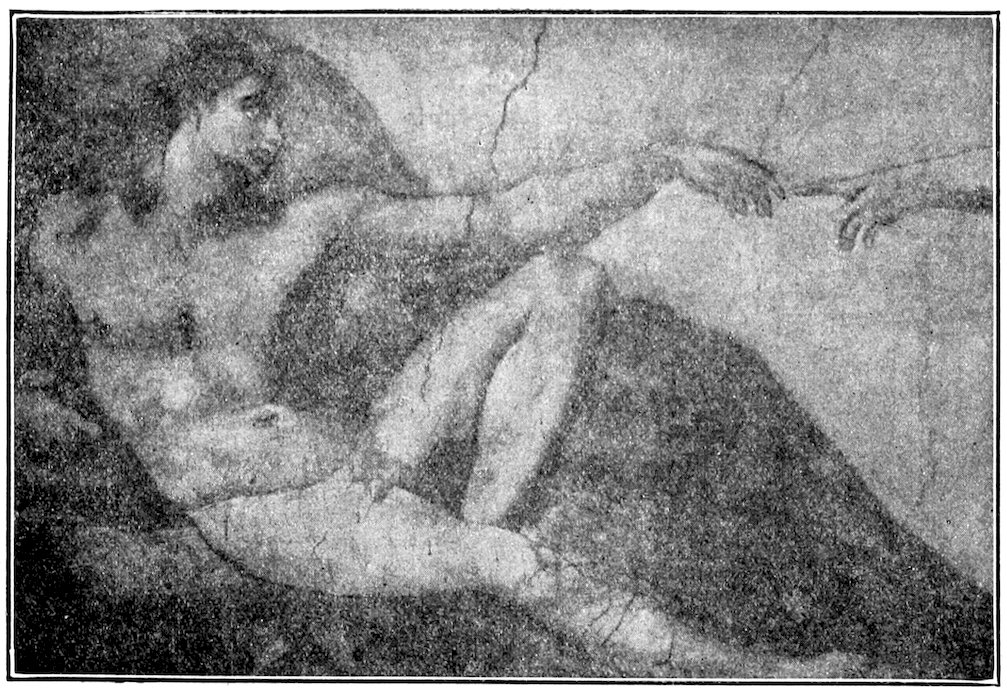
Defective copy of Michelangelo’s Adam in Sistine Chapel, Rome: An Androgyne’s Conception of the Ideal Adolescent
Michelangelo’s Adam.
I breathe to you, Ralphie, under pledge to keep
it forever locked in the chambers of your heart, that
George’s face and figure, once driving me beside myself,
have become hideous and loathsome. How I hate
his billiard-ball head! In order to stand his presence,
217|Androgyne Platonic Marriage.|
I have to ask him to keep his hat on. And a man’s wig
disgusts me even more than a bald pate. Three
months ago we stopped living together. I could no
longer put up with his all the time scolding and cursing
me, and spitting tobacco juice and vomit on the rugs.
While we see each other now and again—because he
wants a few yellow backs—we have come to hate the
very sight of one another.
Ralphie, I heartily wish I were forever rid of the
brute beast! It now comes hard, when I see nothing
of the hero in him, to fork over a roll of bills every
few days. Our relations the past year have been hardly
more than a case of blackmail. I do not wholly drop
him for fear of his telling abroad how I pass now as
a man and now as a woman.
Most of all I want to get out of George’s clutches
because five months ago I met a wonderful young fellow
whom I plan legally to adopt. When I took George
Greenwood, I planned the same thing. But his character
proved so terrible! I am now getting on in life,
mon cheri, and my health is delicate. I need a close
intimate in my home to wait on me during my many
sick days. It is difficult for any of us hermaphroditoi
to take a wife. One hates so to explain to a woman
that after marriage, the life must be that of brother
and sister. And no woman—excepting only the most
old-maidish—would marry under these conditions. But
I know one of us hermaphroditoi—before your time,
Ralphie—who did marry, after thirty, under that arrangement,
and only because he had political ambitions,
and his being known as a married man would
give pause to enemies who were backbiting him because
of the indiscretions of his youth. This hermaphroditos
218|Androgynes Wish a Wife for “Sons.”| was one of the brightest of men and rose,
as a result, to one of the foremost posts in the nation.
But if he had not been married, the politicians and the
voters would have turned him down. A legal marriage
surely covers a multitude of sins. But I myself
have such a horror of women that I could not live with
one even as a sister.
I have a maiden sister, whom I could get as housekeeper,
and who would take the best of care of me.
But I can not receive her into my home for fear she
might discover my bisexuality. I could not allow a
servant to live in my flat any more than my sister.
For even at the age of thirty-three, I, although half
the time almost too feeble to drag myself about, do
not feel like saying goodby forever to my female-impersonation
sprees. They are still such fun; about all
I have to live for! And God has made young fellows
so wonderful, so charming! I still admire their
beauty as much as I did ten years ago. And it is still so
easy to get them on the string, almost as easy as it was
ten years ago. But if I am able legally to adopt Calvin—about
whom I will tell you in a minute—I feel that I
then can, having him with me always in my home, always
in my office, always travelling with me wherever
I go: I then can say goodby forever to female-impersonation
sprees. For he would be to me a husband as
well as a son. He would be everything to me! I
would live only in and for him! Only to make him, his
female wife, and his offspring happy! For I would not
put anything in the way of his taking a full-female wife
in addition whenever he felt like it, because a full-fledged
young fellow is restless without one.
Of course I could have another hermaphroditos
219|Calvin Luther.|
live with me, as Ruby, Berenice, and the Duchess live
together. But it has always been my fondest dream
to adopt as son a young fellow who comes up to my
ideal.
For several months I have had my ideal under
my eyes every day as stenographer in my millinery
house. As “women’s men” are prone to take for private
secretary the prettiest face or “divinest” form
among the gentle sex, likewise I picked out the applicant
standing highest as an Adonis. He is only twenty
and possesses golden curly hair; deep-set, marine-blue
eyes; and radiant red cheeks. From his having been
baptized “Calvin Luther” you can tell what kind of
parents and breeding he was blessed with. He is
thoroughly pure-minded and unspoiled, having, until
fifteen months ago, lived on a farm.
I slavishly worship the youth. The biased world
would tremble at the thought of the harm I would
surely (as they fancy) do this pearl of great price.
For he is truly an angel; God’s child; very religious—a
trait so rare among the strongly virile. I have already
made something of a confidant of him in order
to learn his feelings toward a woman-man. Most
young fellows with a puritan bringing up would turn
the cold shoulder. But I found Calvin Luther open to
reason. He told me he has always, as a good church member,
struggled against his wanting the gentle sex.
While at business school in a small city, he earned his
board by delivering for a baker in the early morning.
A natural thing followed upon his being rarely good-looking.
I barely wormed it out of him when I was
administering the third degree. He ’fessed up that a
number of servant girls where he delivered played on
220|Prudery and Bigotry Now Regnant.|
him the trick of Potiphar’s wife on Joseph. Twice—he
’fessed up with face as red as a beet—he did not
show Joseph’s strength of character. And I did not
think the less of him.
And you, Ralphie, of course know that I would
never be guilty of anything that could bring the least
harm to this adored innocent. His health of body and
mind will not be damaged a particle. I shall give him
the best educational and cultural advantages. As I
have said, he will some day marry the girl of his choice,
and I shall live with the pair as a parent. He and his
children will be my heirs.
Is such an outlook for a poverty-stricken young
fellow just cause for Pharisees holding up their hands
in holy horror?[47] The sexually full-fledged cannot get
221|Phyllis “Passes On.”|
into their heads that we women-men are just as high-minded
and conscientious as themselves. They are
continually hurling insults—calling us “degenerates.”
But my only thought is to heap blessings on those
whom I worship. I have always lived up to the maxim:
Act in such a way as would be good if universally followed.
Those who through self-righteousness condemn
and crush me are a hundred times worse sinners.
Perhaps some day, mon cheri, the world will come to
believe that the actual presence of women-men in all
communities—which Nature brings about—is a distinct
blessing to society in several ways.
Author’s Note.—Within a year of the above confessions,
Angelo—Phyllis was found dead in “his-her”
apartment. The skull had been fractured with a hammer.
Part Six: Newspaper Accounts of Murders of Androgynes — I. Two Murder Mysteries Which, Strangely Alike in Many Ways, Baffled All Efforts to Solve. — Discovery of the Murder — A Midnight Caller — Made No Outcry — Motive Not Clear — THE MURDER OF Y — Strangled to Death — Probably an Expected Guest — II. Z Mystery Baffles Inquiry at Every Angle. — Family Sure Z Was Murdered — In High Spirits — III. College Student’s Death is Unexplained.
222
Author’s Note.—These excerpts from New York
dailies are presented in order to impress upon the
public that such murders of inoffensive androgynes
are a fairly common occurrence because that public has
tabooed, on the basis of prudery alone, enlightenment
of the general reader on the facts of androgynism. I
withhold names of journals and dates of issue, and
cover identities, out of respect for the victims and
their families. But I assure those families that one
of my present objects is to avenge, by enlightening the
public, the unmerited assassination of their dear ones
and thus prevent in the future such martyrdom of innocents.
The families have my most sincere sympathy,
particularly because I myself have several times
been brought near death’s door in the manner in which
their unfortunate—but not in the least immoral—relatives
were put out of the way.
Each of the first three murders was apparently
the work of some prude not at all criminally minded,
but feeling himself the mandatory of society in ridding
the world of “a monster of deepdyed depravity,” according
as he was taught by church and synagogue.
The hare-brained prude had been prohibited by public
opinion from learning the truth that androgynism is
223|Androgynes Not Sodomites.|
solely a matter of abnormal psychology and anatomy,
and not at all immorality. The term which best calls
up the sensations of revulsion of such a murderer is
“sodomite.” To its highly malodorous and fundamentally
false connotation and application can be traced
every year, in every corner of Christendom (particularly
puritan), murders of inoffensive androgynes.
The author’s comments are in brackets.
(Much condensed, and slightly edited for diction, by
author of The Female-Impersonators, from
article in a New York daily.)
VICTIMS WERE TWO ELDERLY BACHELORS OF MEANS,
LIVING IN THE SAME SECTION OF CITY—X AND Y
WERE BOTH FOND OF PERSONAL ADORNMENT AND
DISPLAY AND BOTH HABITUALLY CHOSE YOUNG MEN
AS ASSOCIATES—EACH WAS SLAIN IN HIS OWN
APARTMENT—ONLY TWENTY-NINE DAYS SEPARATED
THE TWO MURDERS—MANY CIRCUMSTANCES OF
THE TWO CRIMES BORE CURIOUS RESEMBLANCE
Consideration of recent terrible crimes in New
York which have halted agents of justice at dead walls
of mystery must bring to mind the X-Y murders of a
little more than a year ago. They were committed
within five weeks, the scenes within a few blocks on
fashionable Murray Hill.
In both, extraordinary interest was stirred by the
maniacal savagery unleashed. The settings of the
224|Androgynes Art Connoisseurs.|
crimes were alike bizarre. The characters of both
victims were most peculiar, yet alike. And the men
had been friends. [Androgynes, in all large cities,
form little cliques like the Cercle Hermaphroditos.]
X was a bachelor of fifty-six, an electrical expert,
an art connoisseur, and collector of jewels and weapons.
Though in more than comfortable financial circumstances,
he resided entirely alone, doing his own
housework [common manner of life of androgynes]
in a 6-room flat on the ground-floor of the Q Apartments.
[I know one androgyne who purposely chose a
ground-floor apartment in a house without hall-boy so
he could go and come in his disguise with less chance
of encountering other tenants.] He had made it his
home for ten years. [This proves his outward decency,
as well, as liberality to blackmailers.] The artistic
luxury of its furnishings was striking. The walls were
galleries of fine old prints, original oils, and copies of
masters, and displayed a strange collection of swords,
sabres, and barbarian spears. [Well-to-do androgynes
possess the most highly ornamented homes of any
class of society. While congenitally too “yellow”
themselves to handle the weapons of warfare, such are
generally sexual fetishes with them, being symbols of
the highest function of the true man.]
Live under Sword of Damocles.
In this handsome, lonely abode, the detectives
made a discovery of significance: X had lived in extraordinary
fear of the lawless invasion of his rooms.
[Cultured androgynes, realizing how bitterly they are
hated by prudes, live constantly under the sword of
Damocles. Every night they fall asleep in the fear
of being murdered. They are uncommonly careful in
locking themselves in. The author tries his locks twice
225before retiring. While a child, he, every night before
getting into bed, looked to see whether there was not
a murderer under it. Androgynes are extreme
cowards.] For he had used his expertness with delicate
electrical devices to set his rooms with a maze
of traps for any person who might try to enter it by
force or stealth. Doors, windows, etc., were invisibly
strung with delicate wires. With the controlling alarm
device set, scarcely an article might be touched without
the ringing of sharp bells of warning.
But that thieves were those of whom he lived in
dread was contradicted by other facts. X, far from
being a recluse, frequented hotels and cafes and was
prone to make chance acquaintances, especially of
young men, while going about extravagantly bejewelled
and habitually carrying a large roll of bills which
it was a pet vanity to display.
His social hours were spent almost entirely with young
men. He had been known to comment: “I keep
young because I associate with the young.” The Q
servants said these young-men callers never behaved
boisterously. All were decorous and well dressed. [A
small proportion of cultured androgynes who live alone
in their own homes entertain there adolescents who
bear the earmarks of trustworthy gentlemen. X’s
murderer could have been of no other type, but was
in addition an extreme prude so far as concerns homosexuality.
The cultured enjoin extreme noiselessness
so as not to arouse suspicions of co-tenants of the same
apartment house. The uncultured commonly receive
any adolescent at all in their homes because having no
fear of disgrace and blackmail. By “young men” the
author of the excerpt evidently means those from
226eighteen to twenty-five, the age-group preferred, and
almost exclusively cultivated, by androgynes.]
Androgyne Stamping Grounds.
The Q servants further said that X frequently
started alone on strolls, many times, however, returning
with a youthful companion, who would spend an
hour or two with the elderly host. [The favorite New
York localities for evening “strolls” of cultured androgynes
for scraping acquaintance with a strange Hercules
or Adonis are, in cold weather, the Broadway and
the Fourteenth Street Rialtos and cafes; and in summer,
Madison Square, Union Square, the southerly
quarter of Central Park (the three park spaces most
frequented at night by idle adolescents who would be
glad to pick up a few dollars), the Battery (because
frequented by common soldiers), and other localities
frequented by uncommissioned warriors, the ideal occupation,
as I have already said, for a real man in the
eyes of androgynes. In the case of X, the Q men-servants
probably saw through everything. The servant
class often respect a cultured moneyed androgyne
who treats them well, and they act only in a protecting
capacity.]
Of woman visitors, there could be recalled but one—whitehaired,
a few years older than X, said to be an aunt.
Investigators were astonished by the nicety, the
fond care, with which X had done his own housekeeping.
Floors, rugs, and every article were flawless of
dust. In spick and span appearance, thoughtful and
orderly arrangement of utensils, neatness of china
closets, refrigerator and provision store-room, a feature
of which latter were shelves lined with jars of
homemade preserves labelled in handwriting, the
227|Bent for Woman’s Toil.|
bachelor’s kitchen was fit to excite a housewife’s envy.
[Androgynes take naturally to woman’s tasks.]
It was not discovered until many hours after commission.
At noon of [date omitted by author of The
Female-Impersonators] the Q janitor saw a light
shining out of a transom of X’s. He was immediately
convinced such a methodical man would not have gone
away leaving the light turned on. He tried X’s entrance
and found it unlocked. He went to the room
where the light was burning. Stretched on the floor
beside a divan, with a couch pillow resting on the face,
was X. A few feet away was the sabre with which he
had been murdered.
The divan covers were half ripped off where the
falling man had clutched them as he was repeatedly
felled—repeatedly, for it was evident X had fought
hard for his life against the sabre-armed assassin. The
sabre had been ripped off the wall of the hall-way of
the apartment. The retaining wires were strong and
the hand must have been strong that snapped them.
[Androgynes cultivate only the best physically developed.]
The deduction was made that the assassin had not
entered X’s home with the intent to murder. He was
pictured as having, in all probability, left his host in
the “den” and started down the hall to make his exit
from the flat when the resolution to attack and kill—a
resolution which the weapons on the wall may have
suggested—came suddenly upon him. Ripping the
weapon from the wall, he is pictured as having dashed
back to the “den” and surprised X with a fury of murderous
228|Prudery Gone Insane.|
attack. [X probably entertained at his home
for the first time that night his well dressed and apparently
trustworthy assassin. Only when the two adjourned
to the “den” did X probably disclose his desire,
so nauseating to the unsophisticated and those
ignorant of abnormal psychology. Doubtless a minute
after the disclosure, the prude left X’s side in insane
disgust, and on passing through the hall entertained
his first thought to do his “duty by society and put
this monster where he could corrupt no more young
men”—an absolutely unfounded way of looking at the
matter. I have myself scraped acquaintance with a
youthful Hercules, who would lead me on hypocritically,
and when he got me where there could be no
witnesses, has half-murdered me because of disgust at
androgynism. My adventure with Harvey Green is
an example.]
Physical examination disclosed that despite his
fifty-six years, X possessed the preservation of a man
of thirty-five. [Perennial youth is an earmark of
ultra-androgynism.]
The autopsy showed that every character of blow
had been inflicted—deep stab wounds, slashes, and
fracturing strokes on the skull either with the broad
side or dull back of the sabre. The coat of X, who was
fully clothed when killed, had been slashed to tatters.
[The assassin wished not merely to kill, but to hack
X to pieces because of his loathing of androgynism. I
myself have not alone been half-murdered, but mutilation
has been practiced for its own sake. See page
132 of my Autobiography of an Androgyne.]
Murdered by a Guest.
229
X’s condition of being fully clothed proves of
course that he had not yet retired. [It also indicates
that his assassin had repulsed his amorous advances
immediately after the pair entered the “den.” On such
occasions, androgynes usually undress.] Further evidence
was that his web system of alarms had not been
set. It was his invariable custom, on retiring or
when he went out, to do this. There was no sign of
forcible entrance of the ground-floor apartment.
Therefore X is believed to have freely admitted the
man who was to murder him—probably such a chance
acquaintance as he appears frequently to have made in
his saunterings through the city’s streets and visits
to its resorts.
The examination of medical experts resulted in
the hour of the crime being placed between nine and
eleven of the evening previous.
It being evident that X had survived the first attack
at least for a few minutes before he finally succumbed
under the raining blows of the sabre, the police
were puzzled to understand why, with his life at stake,
the man did not make an outcry. There was only a
single wall separating the scene of combat from the
public lobby where were stationed throughout the
night a telephone operator and an elevator attendant.
Tests made showed that a shout of medium volume
from the “den” could be distinctly heard in the lobby.
The attendants were positive they had heard no calls
for help.
Death Preferred to Disclosure.
230One of the puzzles, therefore, was to determine
the character of X’s murderous guest and the circumstances
of his visit. Had X reason so grave for concealment
of the presence of his slayer as to prevent
him from calling for aid even with death immediately
upon him? [X’s consciousness of being a sexual eccentric
would likely be an inhibition to his alarming those
who lived in the same house. He probably did not suspect
that the servants saw through everything. Between
death and the disclosure to his co-tenants that
he was a sexual eccentric, he probably chose the former.]
None of the wounds was in his throat. The blow
that fractured his skull must have been among the last
as indicated by the evidence that X had fought his
slayer long and hard.
A diamond ring, whose value must have been close
to $1,000, habitually worn, together with X’s gold
watch and chain, were taken. Very little money was
found in his clothing, whereas it was known he usually
carried large sums. But there were at hand heavy
solid silver articles, and gold ornaments, and valuable
jewelry in a frail desk—none of which had been taken.
Only X’s body had been stripped. The police were
convinced that the robbery was committed to conceal
another deeper motive, as suggested by the savage
maltreatment of X’s body.
Whatever the motive, the murderer entered the
apartment unseen that night and departed unseen.
The police made haste to interview all persons whom
they could trace as having been associated with X.
There was a young sailor whom X had lately befriended
231|A Secret Guest.| and who had been his guest for several days. This
youth was traced to his ship and his presence aboard
the night of the murder established.
One clue was a bit of cardboard on which was
scribbled, in X’s handwriting, the latter’s address. It
looked as if made hastily for the guidance of the
stranger guest to X’s apartment. [And in the apartment
thrown away as being no longer of use.]
No slightest clue to the identity of the slayer was
uncovered.
On the night of [date omitted by author of The
Female-Impersonators] just twenty-nine days after
the murder of X, Y was slain in his home nearby. The
two murders instantly linked. For the two crimes presented
an almost perfect parallel. The scene was the
same—an elaborately furnished “den.” As with X,
Y’s murderer had been his guest. A secret guest—in
that nobody saw him enter Y’s residence, no sound betrayed
him in the act of killing, and he managed to
leave the “den” and Y’s house unobserved.
Of astonishingly the same stamp were X and Y.
Both were elderly bachelors and art connoisseurs.
[The latter an earmark of cultured androgynism.]
Both had specialized in the collection of ancient and
curious weapons. Both were addicted to an extravagant
display of jewelry on their persons. [Androgynes
are loud dressers.] Both lived in dread of attack
in their homes and had made elaborate preparations
against the possibility. Inspection of the lives
of both found them oddly empty of attachment to or
232|Loathing of Androgynes a Murder Motive.|
association with women. Both had a disposition for
the society of much younger men, and had many such
acquaintances.
Living in the same neighborhood, frequenting the
same hotels and restaurants, visiting the same art galleries
and antique shops as they were tireless in doing,
it was rather to be expected that they were found to
have been close friends.
The indicated motive for both murders was robbery
but in both cases only the valuables used in personal
adornment were stolen, while other jewels, and
silver and gold objects of art and service, plainly in
sight, were ignored. [Robbery being only a blind,
loathing of sexual eccentricity being the true motive.]
In only two particulars did the crimes differ: X
was hacked to death; Y was strangled by the bare
hands of his assailant. The marks of relentless fingers
were deeply imbedded in the victim’s neck. The other
difference was that in Y’s case, there had been no
struggle. He had had no chance to put up a fight for
his life. He had been taken by surprise and the strangler’s
grip been clamped on his throat before he could
make outcry.
Y was fifty-nine years old, and a native of rural
Illinois. He had prospered as owner of a fashionable
ladies’ dress-making concern in New York. But he
had retired and at the time he was murdered was renting
an ex-mansion of a millionaire, where he conducted
a boarding house of the highest class. There were
twenty lodgers, but scores of additional persons living
in the aristocratic neighborhood took their meals at
Y’s. He frequently organized card parties and dances
for his guests, and to these were always invited freely
233|Murderer Mandatory of Society!|
young men in war service on leave in New York.
[Warriors are androgynes’ special heroes. A common
soldiers’ and sailors’ club was situated next door,
where Y apparently made many acquaintances.]
Y’s body was found at seven A. M. [date here
omitted] by George, one of Y’s eleven negro servants.
[Y conducted his establishment on the plan of a multimillionaire’s
residence.] It was George’s daily duty
to go to his employer’s room on the first floor, directly
over the kitchen, awaken him at seven, and serve him
breakfast in bed. On that morning, George, receiving
no reply to his knock, pushed the door open and entered
the elaborately furnished “den” and bedroom.
The bed was in order, and the body of Y on the
floor nearby was clad only in pajamas. [Apparently
the assassin had pretended he was going to retire with
Y. Therefore Y got into his night clothes, as also
probably the assassin. But just before the bed covers
would have been turned down the latter fulfilled his
mandate from society by “ridding New York of the
monster!”] An autopsy showed that indubitably Y
had been strangled to death. The deep, purple marks
on his throat were valueless as furnishing finger-print
evidence, but they did stamp the murderer’s hands as
large and very strong. [Androgynes cultivate only
the best physically developed.] Y had been suddenly attacked
by the strangler and immediately choked into
helplessness, for nothing in the room had been disturbed.
He had been borne down to death on the very
spot where seized.
A Trusted Murderer.
234Y’s “den” was the scene of many late-hour parties,
in which young men figured exclusively as guests.
Frequently also he returned very late with a single
companion. His late-hour guests were never boisterous
and never gave cause for complaint by Y’s refined
lodgers.
As in the case of X’s apartment, Y’s house gave
no evidence of a forcible entry. Physicians determined
that Y’s death had occurred at eleven the night before
the body was discovered. At that hour the outer doors
of the house were always locked. Many of the lodgers
and some of the negro servants had not yet retired, and
must have heard, it would seem, a ringing of the door-bell.
None did.
The conjecture was consequently made that Y had
appointed a late meeting with his murderous guest and
given him a key to his house that he might enter quietly.
Of fully twenty-five persons in the house at the
time, not one heard the slightest sound of distress or
noise of any kind from the “den” at the hour of the
murder.
Even more futile than in the case of X were the
efforts of the investigators to round up the many
young men [evidently bachelors from eighteen to twenty-five]
whose acquaintance Y was constantly making.
Three diamond rings of a value of $2,000 had been
stripped from the dead man’s fingers, and his gold
watch and chain were taken. But as at X’s assassination,
many articles of jewelry and of gold and silver
easily accessible were not touched.
A Conscientious Murderer.
235Alike in mystery, the cases of both X and Y manifest
the strong likelihood that the same man effected
both murders, with a suggestion of a deeper motive
than robbery, of a desire to do violence aroused to
frenzy, judging by the stark ferocity with which both
crimes were committed.
[The motive of course was to rid New York of
androgynes; at least, extensively promiscuous ones. It
is quite likely the same prude was guilty of both murders.
Perhaps at first the assassin had known merely
through hearsay that both X and Y were sexual eccentrics.
But he was reasonable and merciful enough
not to put them out of the way until he possessed ocular
evidence. (I have myself associated with torturers
who would act only on such.) For X’s and Y’s murderer
was solemnly and conscientiously acting as the
mandatory of society.]
[From the murder of X he had learned that an
androgyne might put up resistance. Therefore in the
case of his second quarry, Y, he must adopt a safer,
more sudden, and an absolutely noiseless means of execution.
In sabre-slaughtering, there was too much
risk of the victim calling for help. Moreover, X lived
all by himself, whereas Y’s residence was alive with
people. Androgynes like to be treated by their virile
associates as if women, and the ultra-virile always
humor that liking. The assassin probably started in
with a pretended “love” embrace, and, before Y could
realize, turned it into a strangling death-grip.]
X and Y Offenceless.
[I will admit that X and Y were extensively promiscuous.
But they could not have been particularly
intemperate because my own experience proved that
excessive venery soon wrecks the health of an androgyne.
236As both were close to sixty, their lives had
doubtless been temperate. They had probably indulged
(the more humiliating role in fellatio) not more
than once a week throughout their adulthood. But although
they apparently sought intimacy with almost
every adolescent Adonis or Hercules (only one out of
every twenty adolescents could qualify under either of
these types) whose acquaintance they made, they
harmed these youthful rakes not in the least; nor did
they, throughout their lives, bring detriment to any
one else since all androgynes possess the inoffensive
psyche of women. For proof of the harmlessness
to an adolescent of an androgyne intimate, I refer to
my Autobiography of an Androgyne, pages 88, 89,
and 194.]
[Far from the adolescent suffering harm, he is
loaded with material benefits by the well-to-do androgyne
who worships him. He is pre-eminently a “lucky
dog.”]
[X and Y were entirely irresponsible for being androgynes
and sexual eccentrics. Absolutely no harm
came to any individual or to society collectively
through their condition or instinctive functioning.
They did not deserve that any one interfere with their
life, liberty, and pursuit of happiness.]
Newspaper Accounts of Murders.
237
(Much condensed, and slightly edited for diction, by
author of The Female-Impersonators, from
article in a New York daily.)
NO PROOF OF SUICIDE AND NO MOTIVE FOR MURDER
FOUND IN CASE OF YOUTH STRANGLED ABOARD HIS
OWN POWER YACHT—FRIENDS INSIST DEATH WAS
AN ASSASSIN’S WORK—DRESSING OF THE BODY IN
WOMAN’S CLOTHING FURNISHES NO CLUES TO
FAMILY OR POLICE—FULL DETAILS FOR STUDENTS
OF CRIME TO STUDY
After two weeks of many-sided investigation, the
death of Z remains as great a mystery as on the
evening of [date omitted by author of The Female-Impersonators]
when his mother discovered him
strangled aboard his power yacht in New York Harbor
dressed in woman’s apparel.
“No reason for suicide and no motive for
murder—no proof of suicide, no positive evidence of
murder.” Such is the conclusion reached by the police,
private investigators employed by Z’s family, and
by newspaper reporters who have worked on the baffling
case unique for its mass of contradictory theories
and circumstances.
|A Psychopathic Individuality.|
[And to the present writer, himself an androgyne
and instinctive cross-dresser, the strongest of reasons
for suicide and the strongest of motives for murder!
Androgynes, because so terribly misjudged by their
238associates, are the most melancholy and prone to
suicide of any class of mankind. Moreover, they are
often murdered on the strong motive of intense loathing
felt by prudes ignorant of abnormal psychology, in
whose eyes the androgyne is a “sodomite,” with all
the terrible, though false, connotation of that term.
Such prudes believe themselves mandatories of society
to rid the world of the “monster.” The present writer
did some detective work in this case “on his own hook.”
He ascertained that in the circle of those who knew Z
by sight but were not personal friends, he had the
reputation of being a fellator. I interviewed several
of this circle, but did not dare thrust myself into that
of Z’s close friends.]
The view of the police generally is that the death
was clearly suicide. But as to how the suicide was
accomplished, police officers hold theories no two of
which agree.
Z’s family, his closest chum, and his friends generally,
maintained from the first, and still believe, that
Z was murdered aboard the yacht by an assassin who
secreted himself in one of the cabins and afterwards
escaped in a fashion equally mysterious.
The fact that young Z wore woman’s clothing is
to the police the strongest evidence of suicide and
supplies to them evidence of a psychopathic individuality.
[That fact is to myself the strongest evidence
of murder since I have repeatedly witnessed the intense
revulsion of prudish bigots at any cross-sex
phenomenon, and have been myself half-murdered
solely on this incentive.]
Families Ignorant of Bisexual Members.
239Opposed to this is the most positive assertion
from Z’s family and friends: (1) That he was a
normal boy in every respect. [In nearly every case
of a cultured androgyne in the past, his family have
never suspected anything because of the veil of silence
that the deluded public has insisted be thrown over
the phenomenon of androgynism and the consequent
absolute ignorance of the truth about this phenomenon
on the part of the entire Overworld excepting a handful
of sexologists. Just to throw their associates off
the scent, some cultured androgynes purposely do some
courting of females, and have even contracted a
marriage (of course, Platonic) as mentioned by
Phyllis in the last chapter of Part Five. Moreover,
some androgynes are psychic hermaphrodites and
capable of sincerity in courting a girl, while at the
same time Nature insists on occasional female-impersonation
sprees. Z might have been a psychic
hermaphrodite.]
(2) That he had never shown any suicidal tendencies.
[Readers of my Autobiography of an Androgyne
know that I probably showed more suicidal tendencies
than almost any one else who has failed to carry
them out; yet I always hid them absolutely from my
family and every-day associates. Androgynes, because
they do not want their friends to become aware of the
cause of their melancholia (fearing it would alienate
them, as at present no one can forgive cross-sexism in
an intimate) habitually suffer in silence and seclusion
the most intense mental torture.]
Many Female-Impersonation Explosions.
(3) That no kind of woman's wear was ever
known to be in his possession. [For years together I
have myself kept woman’s wear under lock and key
240and occasionally put it on, but none of my every-day
associates ever discovered these facts. Cultured
androgynes always conceal such practices because
their every-day bigoted circles would make them
pariahs.]
And as yet nobody has been able to find where Z
got the feminine apparel. [It was later discovered
he had bought it of a ladies’ outfitter.] Nearly every
article found on him was soiled and showed unmistakable
signs of wear. [He had probably worn the
articles on scores of female-impersonation sprees.
Cultured androgynes never let their families get an
inkling of these psychic explosions.]
Z was twenty-one. The boy received a common-school
education, but left high-school in the second
year to work in the large manufacturing establishment
of his father. He had a strong bent for mechanics.
He took care of the family’s three automobiles, as well
as a motor-cycle. Three years ago his father gave
him a motor-yacht, which he himself took care of.
During the World War, Z enlisted as mechanician
in the navy, but was assigned to shore duty near New
York throughout the war.[48] [There exist all degrees
of psychic effemination in androgynes. I estimate my
own proportions as woman, 80 per cent; man, 20.
Evidently Z was around 60, woman and 40, man,
judging by his willingness to take a fire-arm into his
hands, a thing which I would never do, even as a child
shrinking from a cap-pistol. X and Y likewise were
less extreme effeminates than myself. They would
put up a resistance if attacked, whereas I depended for
escape merely on entreaty or flight (Nature gave me
241|Androgyne Expedients.|
the legs of a gazelle); or if they failed me, I pretended
loss of consciousness after the first terrific blow.
Through this complete passivity, I came out far better
than if I had shown fight, and probably saved myself,
on several occasions, from being one hundred per cent
murdered.]
Z often practiced with a revolver at a target in
the basement of his home. [He was pay-master in
his father’s factory and often had in his possession
large sums, and had to know how to defend himself
from robbers.] His rifle was found on his boat,
together with cartridges, on the day of his death.
Why, if he intended suicide, did he not use his revolver,
or else the rifle that was handy at the time on the boat?
[This, to me, is conclusive evidence of murder or man-slaughter.]
Z possessed the only key to the cabin of the boat.
The family say there were originally two keys, but
the duplicate was “lost” about a year ago. [Possibly
Z staged all his female-impersonation sprees on his
yacht and so gave the duplicate to an idol before whom
he regularly posed, just as I have given a trusted idol
a key to enter my own apartment whenever he felt
like it.]
On the afternoon preceding the day of his death,
Z took his motor-cycle apart in order to renew some
mechanism. On his last evening alive, he was in high
spirits, setting every one of his circle laughing. So
far from being depressed, he seemed flushed with
happiness at the prospect of future success in business,
having only just received a promotion. [His unusual
242|Androgynes Compelled to Fabricate.|
happiness on the very eve of the murder might indicate
that he had just succeeded in coming to terms with a
new idol, who, however, the next afternoon, on discovering
how “deeply depraved” Z was, strangled him
with the rope. I myself have several times been
half-murdered under similar circumstances. I have
also been elevated into the third heaven of bliss on
receiving a favorable message from an idol.]
On the morning of the day of Z’s death, he called
on a friend who was to give a party in a few days,
and assured the latter he would be present. He then
ate noon lunch with his family. It was his father’s
birthday, and Z promised to take the family out for an
automobile ride in the late afternoon. Right after
lunch, Z remarked: “I’ll first make a trip to the boat
to pump the water out. It hasn’t been touched for a
week, and you know how the water accumulates under
the engine. I won’t be gone long.” [It was two
miles from Z’s residence to the boat; twenty minutes,
by motor-cycle, to get on board. The reason given
impresses me as a mere pretext to hide his appointment
on the launch and prospective female-impersonation—because
the pretext sounds just like me. I am
one who has been compelled to falsify much because if
my associates had been granted the truth, they would
have impiously crushed me. In my university course
in ethics, I was taught that it is proper to tell a lie if
the persons deceived have no right to the truth. Always
those whom I deceived had no right, because the
truth would have rendered them insanely cruel.]
In a jovial mood [because about to meet his idol,
I suspect] Z departed on his motor-cycle at 1:30. On
the way he stopped at a dealer’s—full of laughter
243|Probably Man-Slaughter.|
here also—and filled his cycle tank with a gallon of
gasoline. [Two indications against suicide.] At the
wharf, he was seen to take oars out of his locker and
row to his power-boat anchored fifty yards out. He
was next seen, by two men on a yacht anchored fifty
feet from his own, to disappear down into his cabin.
[The last declaration by any one of having seen Z
before discovered dead in his cabin.] These two men
remained on the deck of their anchored launch all the
afternoon until 5:30, and both are positive that Z did
not reappear on his deck. They are equally positive
that no one came from or went to Z’s launch.
The owner of the power-boat continuously anchored
on the other side of Z’s was aboard from 2:30
until 4:30, and is positive no one approached Z’s boat
from that side. The owner of a third power-boat
continuously anchored thirty-five feet from Z’s in another
direction also spent the afternoon on board, and
tells the same story. Two men [custodians and renters
of boats] busy all the afternoon around the wharf
fifty yards away saw no one go to or come from Z’s
launch.
[To me the most probable solution of Z’s death
is that it was neither murder nor suicide, but
accidental man-slaughter. Perhaps Z had the habit,
to satisfy his mania for female-impersonation, of taking
on his yacht as an audience young bachelors who
owned launches usually anchored near his own. Perhaps
a launch, on that Sunday afternoon ideal for
yachting, was kept at anchor near Z’s because its owner
had plotted to teach Z a lesson, with the “good”
intention of curing him of his habit of female-impersonation,
believing—as nearly every one does at
244|Torturing an Androgyne.|
present because prohibited by public opinion from
learning the truth—that it is a wilful bad habit.
When Z had rigged himself in feminine garb (because
the female side of his duality demanded it), one or
more of the young men from one of the anchored
yachts—according to my theory—had tied ropes
around him, even around his neck, the latter merely
in order to frighten him and prevent his calling for
help. The newspapers stated that only a “seaman”
could display such skill in tying ropes, and these
yachtsmen were amateur seamen. They then, late in
the afternoon, after they had had their “fun” with the
pitiable androgyne, went ashore, having no thought
that the rope around the throat would tighten sufficiently
to strangle Z. They designed merely to punish
him for his androgynism (1) through his being compelled
to lie helpless on the cabin floor for several
hours, with a rope tight around his neck to prevent
him calling for help, and, (2) more than that, through
humiliating him before his family, who finally, anxious
over his not returning home, would visit the yacht and
discover him in his most ignominious garb and predicament.
[But Z, in his writhings to free himself from his
bonds, unfortunately tightened the rope about his neck
and was fatally strangled, the young men having departed
and no one being at hand to succor him in his
death agony. Z was only one more of the many
martyrs to the public’s prohibition of the showing up
of the myth that bisexuals are monsters of depravity,
deserving the crudest forms of torture and even
murder. Those guilty of Z’s death—under the theory
now being propounded—were fundamentally irresponsible.
245|Church and Public Opinion Guilty.| The guilt lies with the Church and public
opinion, both of which teach that no punishment is
too bad for an androgyne.
[A few days after Z’s death, I wrote letters to Z’s
father giving all my theories. I desired to do all I
could to avenge my brother in calamity by bringing
his assailants to justice. It would not be surprising
if Z’s father was disinclined to press matters because
of shame over the son’s being an androgyne combined
with the public’s so terribly misjudging androgynism.
Z’s near neighbor, a young college graduate whom I
“pumped,” told me first that the fact at the bottom of
Z’s death “was of such nature that it could not be
discussed”! I could get at the truth only by putting
repeated frank questions, since he labored under
the terrible delusion that sex is a subject beyond discussion.
This college man expressed the opinion that
Z was wilfully depraved and “got all that was coming
to him.” I interviewed several others who knew the
Z family merely by sight and reputation. They all
showed intense antipathy, being of the opinion
that a family’s having an androgyne relative was
sufficient cause for its ostracism.
[A personal parallel: To only one member of my
own family—a brother—have I ever confessed my
addiction to female-impersonation sprees. I did it
twenty years ago, at the age of twenty-seven, because
I then had enemies at Ft. X (at the time my regular
stamping-ground) who hated androgynism so fiercely
as to be capable of murdering an individual in whom
the phenomenon cropped up. I therefore explained
matters to a brother: that if ever I was found murdered,
to look for my assassin among the common
246|Androgynes’ Relations Ashamed to Prosecute.|
soldiers of Ft. X. He replied: “Ralph, if you are ever
murdered on one of your female-impersonation sprees,
the family would be too much ashamed ever to take
the first step to bring your murderer to justice!”]
At the supper hour, Z’s mother telephoned to the
wharf and was informed her son had not returned
from his yacht. Fearing he had met with an accident,
she and her daughter went by automobile to the wharf,
arriving at 6:30. It was then almost dark. A boatman
rowed the mother, shivering nervously, to the
launch. As Mrs. Z descended the forward hatch, her
foot struck a human body lying at the foot of the
steps, face downward. She felt the hands, which
stuck out above the body, and found them cold.
“Linnie has fainted!” Mrs. Z exclaimed. She
hastily lighted a lantern, while the boatman remained
at the top of the short flight of stairs, apparently
paralyzed with fear. But having a light, Mrs. Z
discovered the inert body to be clothed in a long blue
dress, while the head was covered with a black oilcloth
bag. [Such covering of the head indicates non-suicide.
The man-killer covered Z’s head because,
before abandoning him with the rope around his neck,
he (or they) tormented and tortured Z. I have myself
had a handkerchief thrust into my mouth to prevent
an outcry and been thereupon tortured merely because
of insane loathing of androgynism.]
Mrs. Z now exclaimed: “Why, it’s a woman!
She’s been strangled, and Linnie’s not here!”
Overcome with terror, she left the boat without
further examination. Mr. Z, when his wife greeted
him with the frantic cry: “A woman has been strangled
on our yacht!” immediately visited it. He removed
247|Father’s Assertions Discarded.| the hood from the form on the cabin floor, and
in amazement recognized the face of his son. Around
the neck was a tightened noose of Manila rope tied
with a hangman’s knot. Mr. Z is positive the knot
was at the back of the neck. [This position is an indication
of non-suicide. A suicide would naturally
have placed the knot in front.] Unable to loosen the
knot, Mr. Z cut the rope. He noticed that both his
son’s hands were behind the back, apparently tied with
a sash cord, although he did not think to make sure
both were tied. For, finding the body cold, he was
convulsed with grief and immediately left without
making further examination.
The next arrivals were policemen.
The Homicide bureau contends that although
there was a slip-knot around the left hand, the right
was free and Z used one or both hands to draw the
hangman’s noose about his neck. This theory presupposes
that the knot was at the throat, and discards
the father’s assertion that it was at the back of the
neck.
Z’s ankles were tied together with rope, as were
his knees and arms. [A queer way to commit suicide
for the victim to take the greatest pains to make
people think he had been murdered! And when there
were a rifle and cartridges on board the launch! And
only an hour or two before in a jovial mood, and laying
in a supply of gasoline!] A medical examiner calculated
that death had occurred between four and five
P. M. The two men on the deck of the power-boat on
one side of Z’s launch had gone ashore at 5.30, and the
single man on the power-boat on the other side, at 4.30.
None had heard any cry or other sound from the Z
248|Z’s Woman’s Apparel.|
launch [35 to 50 feet distant and on an ultra-still
Sunday afternoon when sounds carry unusually well.]
When these witnesses went ashore, Z’s rowboat was
fastened to his launch—in the same position as when
his mother arrived.
The woman’s apparel in which Z was found clad
consisted of a chemise; corset; corset-cover with rose-colored
baby ribbon running through the lace; a pair
of pink bloomers with ruffles at the knees; high black
stockings fastened by garters to the corset; a pair of
high laced woman’s shoes, with French high heels;
and finally, the blue-checked gingham dress. All the
apparel fitted Z well.
The clothing in which Z had left home was found
on a bunk in the cabin—excepting an overshirt, which
was pinned over the porthole nearest the launch fifty
feet distant on whose deck two men spent the
afternoon. Aside from this circumstance, the police
discovered no sign of disorder in any part of the
launch. They discovered no other articles or circumstances
having a bearing on the case. [Androgynes
are in general non-resistant. Z probably did not
struggle against his tormentor, as I myself have always
been absolutely passive on such occasions. Any way
he probably did not even imagine that he was under
any risk of death. He probably expected to return
home within an hour—as he had previously done after
dozens of female-impersonation explosions.]
But reporters, who later examined the boat, found
a thick hickory club in a drawer. [My theory is that
Z was accustomed to entertain on the boat, in the
absence of any of his family, adolescents before whom
he had a craze to impersonate a mademoiselle—the
249|Assassins of High Morality.|
common practice of the more extreme type of androgyne.
He probably entertained only one at a time.
Fearing he might be attacked by one of these perhaps
doubtful characters, he kept the club for self-defence,
as well as the rifle already mentioned. The fact that
he did not attempt to avail himself of these weapons
on this occasion indicates that his assailants were
young men whose high morality was known to Z.]
In a chest in an out-of-the-way place, the reporters
found a bundle of wrapping paper stained and torn.
Inside was a metal shoe-horn. [My theory is that Z
stored his feminine wardrobe in this paper and chest.
The paper was probably that in which the feminine
outfit had originally been brought to the launch and
was preserved for possible use in carrying it away.]
The Z family kept a supply of beer on the yacht,
but affirmed: “Linnie hated beer and never learned to
drink it.” [Very androgynesque. Girl-boys are inclined
to be puritans in every respect except female-impersonation
and coquetry.]
The only feminine article that Z wore which the
family recognized was a multi-colored silk ribbon fastened
around his waist and belonging to a sister.
The autopsy showed that death had resulted solely
from strangulation. All the ropes used in binding Z
belonged to his yacht. [The reason Z was done to
death with ropes is that there naturally were many on
board a yacht and it was a noiseless death. There was
a loaded rifle on the yacht. That a noiseless method
was chosen indicates murder rather than suicide. The
use of ropes also indicates a yachtsman as author of
the crime—because accustomed to handling ropes. He
lives and breathes ropes.]
Z of Androgyne Physique.
250Z was five feet four in height and weighed 145
pounds. [Short and plump build characteristic of
androgynes.] The city medical examiner noted that
the lower ribs were “retracted, possibly due to the use
of corsets.” He also noted that “the beard and
moustache are scanty.” [Meaning if not shaven close.
Such scantiness is common in androgynes.]
If the murder theory is true, the assassin must
have planned to murder with great care. [It was all
done on the spur of the moment, and the death
probably an accident.] He must have had an accomplice
who brought him to the boat before the murder,
and took him away afterward, and he must have
known in some mysterious way that Z was going to
visit the boat that Sunday afternoon. [If Z was
murdered, he had had an appointment on the yacht
with his assassin. The latter must have arrived before
the yachtsmen who spent the afternoon on the
closely encircling decks, and watched that they go
ashore before himself. At dusk he could have
swum away without being seen. At that hour on a
Sunday, there were many desolate points on the nearby
shore at which he could have unobservedly emerged.
But the most daring criminal would hardly have committed
a murder with several men only a few feet
away on the decks of the encircling yachts. A single
shriek from the victim would have immediately
brought several men on board.]
The care with which the clothing was put on certainly
seems to indicate that Z himself put it on, every
article being properly adjusted.
[The authorities, because ignorant of androgyne
psychology and habits and despising a bisexual (myself)
251|Author’s Own Foretaste of Z’s Fate.| too much to listen to his-her theories, were on a
false scent. At the date this volume goes to press
(December, 1921), the Z mystery—as well as the X, Y,
and Q—has not been cleared up by the authorities,
although none of the four is much of a problem to
myself, knowing how the world treats androgynes.
[It is a strange coincidence that about a score of
years before Z was strangled, within two miles of his
yacht’s point of anchorage, in a large patch of woods
at night, I was, as an aftermath of a female-impersonation,
being roughly teased by six “young fellows.”
To cap the climax, they led me toward a tree and said
they were “going to get a rope and hang” me. Horrified,
I feigned an epileptic fit to save myself. See my
Autobiography of an Androgyne, page 208.
[While I have never believed Z a suicide, it is a
possibility. A new idol with whom he had had an
appointment on the yacht that afternoon might have
shown utter disgust at Z’s revelations—as I have
myself witnessed in a confidant—and pitilessly abandoned
him. This misguided attitude might have
brought on Z a sympathetic disgust with himself as
female-impersonator and cross-dresser. According to
this theory, Z wished to punish and heap indignities on
his own body—just as I have myself, in my verdant
middle teens, taken a whip and chastised my own
body because lustful, homosexual thoughts had invaded
my mind, while crying out: “‘O wretched man that I
am, who shall deliver me from the body of this death!’”
Perhaps Z wished to punish his own body by depriving
it of breath while in female garb and so publish to the
world the despicableness of his own physical personality.
In no other way could Z’s spiritually minded
252|Suicide Theory.|
psyche better revenge itself on his carnal body than
to have the latter’s grossness proclaimed on the
housetops.
[In case Z was a suicide, the idol who had only a
few minutes before pitilessly scorned his advances was
very likely an adolescent spending that afternoon on
one of the three nearest yachts. As I have said, the
case came to a curious abrupt ending in the papers, as
if the entire solution had become known to those
immediately interested, but the public was not let into
the secret in order to shield unblameworthy parties.
[If Z was a suicide, I have myself passed through
a very similar experience. (See my Autobiography
of an Androgyne, page 235.) Because heartlessly
jilted by a new idol and afraid I would, as “a monster
of depravity,” be cast out of the caravan with which I
was travelling in an uninhabited region of the Rockies,
I walked away in the forest alone at dusk a mile from
camp having in mind suicide by being torn to pieces
by bears, with which the forest abounded, and several
of which I saw that night roaming within a hundred
feet. Like Z, I had not left behind a single oral or
written word as to suicide. I was acting on the spur
of the moment. For several hours I experienced such
depths of sorrow as not one human out of ten thousand
ever tastes. Continuously for an hour, out of hearing
of the camp, I wailed at the top of my voice over my
terrible lot in life—that of a despised, hated, and outlawed
“degenerate” (as the hypocritical nine-tenths of
civilized humanity delight to call me)—and over the
possibly impending unfathomable disgrace among a
party of rough men with whom I must travel until we
got back to a railroad. I experienced a violent desire
253|Author’s Attempt at Suicide.|
to be devoured by bears. But the All-Seeing overruled
that they did not attack me.][49]
Newspaper Accounts of Murders.
259
(The following are excerpts from a New York
paper. Every few months the press brings to light a
similar death of an androgyne. All because the world
misunderstands and grossly misjudges them, as well as
because public opinion has always deprived them of
the means of coming to an understanding of themselves.
Bracketed words and italics are those of the
author of The Female-Impersonators.)
STUDENT’S DEATH MYSTERY BAFFLING—NO KNOWN
BASIS IN Q’S LIFE TO SUGGEST MURDER OR SUICIDE
THEORY
Overdone detective fiction seldom presents so
many significant but mostly inexplicable circumstances
surrounding the victim of death by violence as those
developed concerning [Jimmie Q], twenty, quiet, studious,
religious [earmarks of androgynism], a [North
Atlantic] college junior, popular, not morbid, a cleancut
American youth, whose body was taken from the
river last Thursday night....
Q loved to roam the slums of large cities. [An
earmark of cultured androgynism. They thus roam
because realizing that in their Overworld, they are
prohibited outlet for the feminine side of their duality.
They roam with day dreams of how they would like
to impersonate a female in the Underworld, where
alone female-impersonators are welcome; and finally,
in many cases, they are carried away by their mania
for an actual female-impersonation spree.]... His
260|Female-Impersonation Obsession.|
college room-mate commented on the large number of
neckties, all Q had, which the latter was taking along.
[As he said, for a few days’ visit to his father, which
visit did not take place. My theory is that he went to
the great city, in whose harbor his dead body was
found, to spend an evening with chance-met gangsters
in the slums, as I have myself done, and he took the
many neckties as presents for them, just as I myself
have carried neckties with which to shower them and
thus win their goodwill. The androgyne, of course,
wishes the gangsters as an audience for his loved impersonations.
Androgynes always wish an audience
of tremendously virile “young fellows.”]
Q did not drink and never took special interest in
any woman. But he did like to rove about in the districts
of big cities in which the poorest classes live
and work.... Whenever he was in New York, he spent
most of his time in such districts....
At the Morgue, Mr. Q identified the effects of his
son. When the body was exposed for his inspection—it
appeared to have been in the water about ten days—the
father bowed his head and tearfully exclaimed:
“Poor Jimmie! How you must have suffered!”...
The fisherman who had pulled the body ashore
had used a grappling hook.... To it they attributed
the incision which the [City’s] Medical Examiner had
reported to have been made by some weapon. The
Medical Examiner denounced this report and suggested
that the police were forwarding a suicide theory to
escape responsibility for solution of a crime. He declared
there was evidence of hemorrhage in this wound
not producible by such an injury inflicted long after
death. He further recalled that the left arm of Q was
261|Methods of Torture.|
dislocated at the elbow, with the arm muscles twisted—positive
indications of external violence. [I myself
have been tortured by a ruffian’s seizing me by the
wrist and twisting around my arm so that I had to
shriek in agony.]
The Medical Examiner declared the absence of
water in the lungs developed by the autopsy showed
beyond question that Q was dead when his body entered
the water.... He had seventy-seven cents in his pockets
when his body was found. [Evidence of robbery,
considering that he was a well-to-do youth on a visit
to a great city distant from his college. My theory is,
on the basis of intimate knowledge of the practices of
androgynes, that he scraped acquaintance with one or
more gangsters, while adopting a girl’s role. Many
gangsters cordially hate bisexuals. Because of this
hatred, as well as to escape prosecution after robbing
Q, the gangsters murdered him and threw his dead
body into the river—probably in the vicinity. Again
the fundamental cause of the death of another androgyne
is the terribly false teaching of the Church and
public opinion as to the nature of bisexuality.]
Part Seven: Medical Writers on Androgynism — I. What a New York Official Physician Has to Say about Fairies. — II. What One of America’s Foremost Medical Writers Has to Say about Fairies.
262
In Medical Life of December, 1920, I had an
article: The Biological Sport of Fairieism. Readers
completely out of touch with Underworld life evidently
thought I was telling a fairy tale. Apparently the
editor of the Medical Review of Reviews appealed
for corroboration to a physician likely to be one of the
best authorities in the United States on my subject,
Perry M. Lichtenstein, M.D., Ll.B., Physician to City
Prison, “Tombs” (New York’s principal jail), House
of Detention, etc., all of New York City. Apparently
there resulted the valuable and interesting article, The
“Fairy” and the Lady Lover, in Medical Review of
Reviews of August, 1921. Its writer has enjoyed almost
unparalleled opportunities for examination of the
very fairies whose existence had been called in question.
I quote a small fraction, but the whole paper
should be read by every devotee of Aesculapius.
Knowledge of its contents is very necessary for
every practitioner. I use my spelling of “fairie.” My
own comments are in brackets. The Review for
November, 1921, contained quite a lengthy reply of
mine. Dr. Lichtenstein begins his paper:
“Does the ‘fairie’ or ‘fag’ really exist? This question
has been asked time and again. There is no doubt
263|Does the Fairie Really Exist?|
but that this type of degenerate is a reality. [Unprejudiced
science has not yet decided the matter of
the degeneracy of the androgyne in general, as I have
already shown in detail. There exists as much evidence
that the bisexual is a super-man or genius as that
he or she is a degenerate. The truth of the matter
probably is that degenerates are no commoner per
thousand among bisexuals than among the sexually
full-fledged, but that geniuses occur far oftener.] He
is a freak of nature who in every way attempts to
imitate a woman. In my official capacity I have come
in contact with several hundred of such individuals,
and have in every instance felt sorry for the unfortunate
being. [Such sympathy indicates that fairies
are not wilfully of that genre, and should not suffer
term after term in prison, as now, for acts that do nobody
harm beyond offending the æsthetic sense of the
unsophisticated. Of course, in the matter of accosting
on the street, etc., they should be treated the same as
full-fledged females. But their punishment should not
be augmented because they are “homosexuals”—a
word that is a misnomer.]
“In practically every case I have found the man to
be a young person of age ranging between sixteen and
thirty. [“man”!—Only a pseudo-man. Really a
woman whom Nature has disguised as a man; a
woman with male genitals.]... They are by no means
mental defectives. Most of them have had a good education
and come from respectable families.... Since
early childhood they have been seclusive and kept close
to their mother. They are emotional and affective....
They ... imitate the female as closely as possible.
They take feminine names, use perfume and dainty
264|Artificial Breasts.|
stationery which frequently is scented, and in many
instances they wear women’s apparel.
“Recently one of these individuals was arrested,
charged with soliciting. When he [“he-she” would be
the accurate pronoun] arrived in the city prison, he
was searched, and on him were found ... artificial
busts, a wig, and a box containing powder and rouge.
This young man [“androgyne” would be the proper
term] was twenty years of age. He was beardless
[evidently natural], had an effeminate voice, and a
distinctly feminine walk. He lisped and in speech
closely approached a bashful female.... He ... had
graduated ... from high-school.... He ran away
from home and met some boys [“girl-boys” would be
the proper term] whom he considered good company.
These young men [“androgynes” would be the proper
term] were of the same type as he.... In this way
[after a fashion, taking the place of the female of the
species], [he] made enough money to live.
“These individuals ... often occupy handsomely
furnished apartments which are paid for by men who
patronize them. As a rule several ‘fags’ occupy an
apartment. On one occasion ten such individuals were
arrested in a raid by the police.... I had an opportunity
to observe them closely. In every respect they
resembled the female. The names they used in calling
one another were feminine.... They had a typical
feminine walk.... [Because androgyne legs are sometimes
those of a woman.]
“I can distinctly recall two cases which occurred
quite recently.... The first ... was arrested for soliciting
and was sent to the female prison. This person
had wonderful hair which reached to the waist,
265|Legal Persecution of Androgynes.|
and it was not false. His face was as smooth as a
woman’s [naturally beardless evidently], his voice was
distinctly feminine, and his hands and feet were small.
He wore high-heeled shoes. In examining this person
the matron insisted that he strip. The prisoner refused,
and thereupon I was notified to make an examination....
When questioned, he stated that he preferred
to dress as a female because he found that he
was effeminately inclined.... He was sent to the workhouse,
and after serving his time was released. Several
months later I learned that he had again been arrested
for a similar offence. This time he wore a wig
in addition to the feminine garb. [Because during his
prior imprisonment, he had, under pressure, consented
to have his hair cut short, like a man, and promised to
live henceforth as a man—a promise hard to keep since
“he” was psychicly, and in part physically, a female.]
“The next case ... was arrested.... When taken
to the female prison, he refused to allow the matron to
search him.... I was called in. I found that the
prisoner wore a wig and artificial breasts. Every bit
of his attire was feminine.... The voice and mannerisms
were distinctly effeminate....
“Many of the so-called ‘social elite’ are to be included
among these people....” [“Many” only in the
aggregate. Proportionately, only about one out of
one-hundred-and fifty men. But the ratio is probably
higher among the cultured than among manual laborers.
They are not at all blameworthy, because they
were born with the strongest kind of instincts in that
direction, and do not thereby harm in the least any individual
or society as a whole. They carefully keep
their idiosyncrasy under cover.]
Medical Writers on Androgynism.
266
Dr. Robert W. Shufeldt, author of Studies in the
Human Form, has included at least one fairie among
the many human beings the results of his physical examination
of whom he has published. The following
are excerpts from his valuable and interesting article,
Biography of a Passive Pederast, in the October,
1917, issue of the American Journal of Urology and
Sexology. I use my own spelling of “fairie.” My
comments are in brackets. Those interested should
read the entire original article. Particularly two photographs
of the subject are given, one nude and the
other in full feminine garb.
“J. W. ... is a fairie from the slums of Brooklyn,
N. Y. ... twenty-three years of age. When fourteen ... the lobes of his ears had been pierced ... for ear-rings,
and these ornaments he commonly wears when
dressed in female attire.... He invited my attention
to the fine development of his breasts, whereas there
was not the slightest evidence of gynecomasty.... The
impression was left upon my mind that he was morphologically
male in all particulars.... I became
thoroughly convinced that the man was laboring under ... a most extraordinary delusion.... He claimed to
have his menses regularly every month.... [Evidently bleeding piles.]
“In July he admitted that he had never been pregnant;
while in November, when he brought with him
one of his numerous ‘husbands’ or lovers, he claimed
267|Yearning for Feminine Attire.|
that he had been pregnant a few years previously and
been operated on in a hospital and the conception removed
‘through his side.’... I am convinced that this
mendacity is due to his delusions.
“... While he could sing soprano well, he could
not whistle ... and he threw a stone like a girl. [Common
earmarks of androgynism.]... He did not, as he
moved about ... give one the impression that there
was anything in his demeanor simulating femininity,
nor did his behavior in any way betray the remarkable
manner in which his sexual life was being lived....
Apart from his extremely meagre education, he is no
fool or dullard in other particulars.... It would seem
that his trade [professional female-impersonator and
fairie] is plied chiefly for the money there is in it....
He claims he has never been arrested or otherwise
interfered with by the police....
“... He has always been possessed of the contrary
sexual instinct. He always shunned women and
girls more or less, while yearning at the same time to
assume female attire and enter into their domestic vocations....
Believing himself designed by Nature to
play the very part he is playing in life, it was truly
remarkable to hear this nervous, loquacious, foul-mouthed,
and foul-minded fairie of the most degraded
slums of the multi-millioned city chatter about his experiences....
“Few writers in the field of psychiatry have enjoyed
what I had next the opportunity to observe....
The putting on of female attire by a contrary sexed
male. [The paper details the putting on of the various articles.]...
He became very talkative ... telling of
some of his recent escapades ... gesticulating as we
268|A “Man” Transformed into a Soubrette.|
often see agitated girls do ... remarking that he was
very tired, owing to the fact that he had been ‘ironing
all the forenoon.’ [Androgynes gravitate toward
peculiarly feminine tasks.]... ‘What do you think of
that hat? Isn’t it a dandy? I trimmed it myself.’...
He was, without the slightest doubt, thoroughly in
earnest in all he said and did, and by no means was
he playing a part.... ‘Dear me,’ he said, ‘I’ve forgotten
my ear-rings; but you won’t mind that?’ Upon my
assuring him that I liked young girls better without
them, he seemed relieved and proceeded to fit to his
head a ... blonde wig.... As he had recently shaved,
his face was quite smooth, and in a twinkling he made
it up with ... pink powder, with red pomade for the
lips.... ‘Ha!’ he said [after fully transformed outwardly
into a soubrette, in the style of costume prevalent
among courtesans at the date of J. W.’s appearance
before the doctor for wear in their resorts only,
but in 1921 affected for street wear by all butterflies of
fashion] ‘I feel more like myself now, and I am ready
for the picture!’...”
Part Eight: Androgyne Verse — Emotion [50] — Recollection [51] — Memories [52] — French Doll-Baby [53]
269
The first of the following attempts to penetrate into Plato’s
“world of ideas” and get at the real essence of things, and then
to express them in an ideal manner, was inspired by a chance
visit to the Whitestone station in October, 1921. Subsequently
I was seized with the desire to try out my muse in incorporating
some of my other emotions and experiences in verse. I had
essayed no metrical composition since 1905, the year of writing
the last of my Fairie Songs, the best of which were published
in the Autobiography of an Androgyne.
I understand by “poetry” the version of things seen incorporeally;
things spiritualized or with a halo around them;
things as they exist in substance, in reality, back of their
superficial or phenomenal presentation—the version of things
that an individual’s subconscious or subliminal self utters.
At present when I evolve verse, I try to lose myself to the
phenomenal world—the domain of sensation—and to let down
my bucket into the well of the subconscious, the subliminal; to
peer into the eternal, the infinite world (the domain of fundamental
substance). The sensuous, material skin or crust of
this world of ideas is all that most children of Adam can
grasp. Only to poets and metaphysicians has Nature given a
rope of sufficient length that their buckets can reach as far
as the water level in the well of ideas. Nearly all poets even
of the first rank manage to flop into their buckets a few exquisite
thoughts as to eternal realities, and clothed in appropriate
language, only about once out of a score of attempts.
Nineteen-twentieths of their verse would better have been forever
withheld from the public’s eyes, since it is merely artificial,
nonsense doggerel. In that proportion of their work,
these poets of the first rank show themselves up merely as
bad rhymesters.
The editor of The Female-Impersonators declared “the book
would be better off without” my verse, but has kindly humored
my wish to include it. The reader’s verdict may be that I, too,
am merely a bad rhymester, and thus put my work on a level
with the vast bulk of the outpourings and outdronings of our
best poets.
But I, as a would-be poet, labor under the disadvantage
of expressing sentiments of an androgyne. Even if there should
270|Androgyne Verse.|
really be any poetry in my own outdronings, no one but another
androgyne could recognize the fact, since it is next to impossible
for anybody to appreciate any literature unless they can
make its sentiments their own and identify themselves with
one of the characters. And the sexually full-fledged, who constitute
more than ninety-nine per cent of the reading public,
are obsessed by an irrational horror of androgynes.
I therefore beg the reader, in judging the following
verse, to bear in mind that it is not written by a
man about men, as the reader first thinks; but about
men by a pseudo-man; by a physical “man” who is
psychicly a woman, and even physically a woman at
least thirty-three per cent.
I have read some of Mary Baker Eddy’s verse, which her
disciples place on a level with the Psalms of David. But I
think the former weak and the latter perfect. Here again
we see that to judge verse to be good, one has to imagine it
one’s own outpouring. I therefore do not expect any sexually
full-fledged person to declare of my verse (even if it were the
best ever written) anything else than that it is “far beneath
the worst doggerel. The mere thought of it is painful!”
For—I repeat—it is impossible for any one to judge poetry
objectively—only subjectively: that is, not according to the
merits of the verse, but according to whether the reader can
make the sentiments his own.
A sexually full-fledged literary confidant, who has read
the first two books of my trilogy, declared of my verse: “If
you publish it, it will cast ridicule and contempt on your whole
book. In the book, you have claimed culture, but when your
readers come to this verse, they will say that no one with the culture
of a longshoreman would try to pass off such stuff as verse
even in fun, and that if you had the slightest tincture of literary
taste, you would realize this. You will go down to posterity
in ridicule, and destroy all the good your books might otherwise
do.”
But I persist in including the verse. If the quoted verdict
is correct, then I have “a screw loose” intellectually, as well as
being sexually and anatomically “a freak of Nature.” The published
pieces show the psychologist what ultra-androgyne verse
is like. Besides, possible androgyne readers may be able to
appreciate this verse.
As three out of the four following “attempts” were first conceived
only in January, 1922—after The Female-Impersonators
had gone to press—it has been impossible that they benefit by
the author’s judgment after they have grown cold.
271
(Inspired by sight of Whitestone station in 1921.)
“Old Porte Cochere, with Memories Dear Thou Teemest!”
The Unreplaced Slats on Which the Author Communed
Still stands the selfsame Whitestone station,
So sombre as night’s shades fall;
At its north front do still halt trains,
While brakemen “Whitestone! Whitestone!” call.
My trysting-place in nineteen three
With warriors of the nation,
When I was frivolous and wild,
Was this old Whitestone station.
Yea, holy ground its platform is;
It makes me sigh and ponder;
In my mind’s eye those blue-clad forms
Still wait for me just yonder!
272They met me at the train when I
From New York came, directed
To see and stroll about with “braves”
Of manhood unsuspected!
On balmy eves we stalked dark lanes,
No other person near us;
No other’s eye upon us gazed,
No other’s ear could hear us.
What gallant, passionate lovers they!
Considerate of my pleasure!
Uplifting to the highest bliss
That Eve on earth can measure!
Returning to the porte cochere
Of that selfsame old station,
We lingered, till the whistle blew,
In blissful conversation.
273What eyesore thou, old Porte Cochere,
To every traveller seemest!
To me, howe’er, thou shelter gave;
With memories dear thou teemest!
The station’s waiting-room with seats
Extending all around it,
‘Whelms me with recollections fond,
Because unchanged I found it!
For ’twas on these rude benches there,
When winter’s winds were hurtling,
And travellers few and far between,
All evening sat we flirting.
274In words our conversation lagged;
In substance it was silly!
For all I said the evening through
Was: “How I love thee, Willie!”
We every confidence but breathed,
Lest some strange ear o’erhear us;
They guessed not—travelers—what we said;
There were none very near us.
Whene’er the train I took for town,
And we “Goodnight!” repeated,
“Farewell!” o’erwhelmed me as I left
And in the coach was seated.
Once rode with me a gallant three
To College Point, first station;
To have with me five minutes more
Before farewell ovation.
How charmed was I that period brief!
Its memory ever lingers;
As we sat holding hidden hands,
I felt their horny fingers.
“Three cheers for Jennie June!” they cried,
When finally they must leave me;
“The soldiers’ friend, and sweetheart too!
Let not our parting grieve thee!”
Gone are ye from my life for years,
You heroes! Wonder boys!
In memory though I hold you fast—
Forever perfect joys!
Farewell!
275
O thou Fair as the sunrise on deep sea’s green surge,
While the whitecaps seem dancing all around!
Fair as sunset from mountain’s sheer precipice’s verge,
Seen o’er maze of high ridges snowbound!
Even Fairer than the rose, of all flowers the fairest;
Beyond Vatican’s Apollo Belvedere;
Bud McDonald, youth’s soul-mate, of beauty the rarest,
Adolescent wert thou without peer!
First, Beau Brummel wert thou, so fussy about clothes,
O immaculate Buddie McDee!
Dirt and slovenness cat, never more than thou, loaths;
Must be brushed every hour from dust free;
Every lock of thine hair with worried care laid in place;
As a girl didst thou prink—I can vow!
But of all the young bloods of Rialto’s fast race,
Not one sweller was costumed than thou!
Beheld one the shining patent leather of thy shoe,
And both hands decorated with rings;
Marked thy wiles through which dude hoi polloi’s favor doth woo,
One would say: “All from effeminacy springs!”
“Not a bit!” I must answer. For Mack, Sport as well,
Was a crack shot with pistol and ball;
How he hunted, coldblooded, dumb beasts he did tell;
Furry creatures clubbed dead; cursed them all!
276Best of all:—an Adonis wert thou, Bud McDee,
With incomparable red peachlike cheeks;
Threads of eyebrows so cleancut!—in memory I see—
As o’er her eyes a soubrette alone seeks;
With thy pearls of teeth, cherry lips—beloved sir—
And as well chiselled nose as can be,
How I’ve wondered that thou and I intimates were!—
Explanation:—God gave thee to me!
I again in fond memory behold before me,
Pinkish mountain of loveliness tower;
Buddie’s forma divina, au naturel, see;
How his charms, yea unmatched, did o’erpower!
An “eyeful” his two breasts, with fine gold scraggy hair;
Graceful curves; rotund body and limb;
With his robust ribs bursting through skin O so fair,
And his deep-channeled back breathing vim!
Once Unequaled “Young Fellow”! Six-and-twenty long years
Now have rolled by since thou wert All That!
Art to-day gibbering sot, maybe suffering jeers,
With foul trousers and torn greasy hat?
For the cup cherished thou that glad makes the sad heart.—
How I wonder! Where sleptest last night?
Is vitality wasted? In grave resting art?—
Us together soon lead, Kindly Light!
277
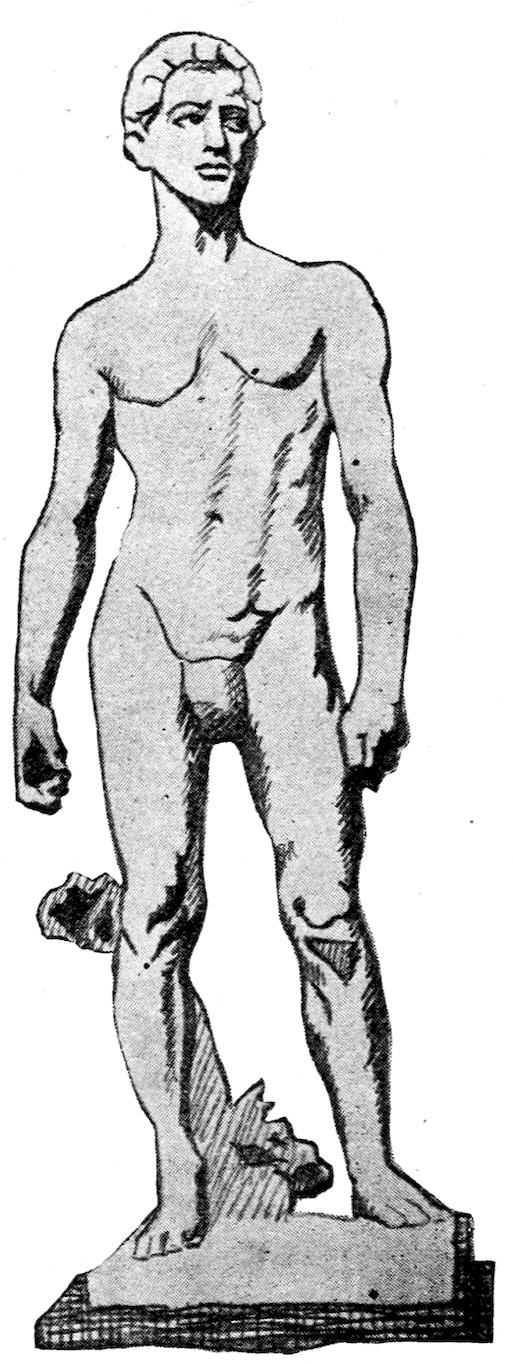
“The Boy of the Piave”
(America’s Gift to Italy in 1921)
278
I dream to-night of the gay bright lights
Where I sought recreation;
While meek I sat at feet of profs
To gain an education:
I studied hard six dreary eves,
But when the seventh came,
Bade “au revoir” to books and grind,
And skipped to Rialto’s game.
There where lurked pleasure’s devotees
Giant Kill-joy never came;
I met there New York’s wildest swains,
And buxoms of ill fame:
We revelled all the evening through—
Fine fellowship, I say!
I ne’er happed on politer folk
Than in Rialto gay.
And which was I, kind sir, dost ask?
Was I a bad roué?
Or shameless demi-virgin wild,
In paint and powder gay?—
“But I was neither this nor that!”
Such answer here I set;
While youth in form, I chose to take
Diversion as soubrette.
The young bloods pardoned me—they said—
For wearing hated breeches!
“For thou art not a real male;
Thou’rt like yon winking witches
279Who throng these noisy promenades
Their favors fair to sell;
And kissing thee we deem as sweet
As kissing ma’moiZelle!
“Lik’st thou that we thee sweetheart call?—
We’ll humor thy desire;
Sit on our laps while we sip wine;
Let’s flirt until we tire;
To break thy shapely corset stays,
We’ll try our best, dear Jenn;
But thou must mimic maid thy best;
For us:—the part of men!”....
To have love made by youthful swains,
To me was highest bliss;
In the bright dives where scores beheld,
No,—shrinked we not to kiss:—
Of yore in gay Rialto’s halls
Knew folk no self-restraint;
Insane e’en sometimes acted fools!
Those dens no place for saint!....
I’m prone to-night to philosophize:—
Why did I gravitate
Toward Rialto’s racy denizens
When moved to dissipate?
’Twas just because I sought and found,
In Rialto’s “swell” gallants,
The opposites and complements
For whom my spirit pants....
O comrade of Rialto’s halls
Of nineties of century past—
280Should’st read these lines, some former pal,
“Jennie June” remembered hast;
Now after twenty-six years,
I hail thee with heartfelt greeting;
Beseech Benediction on thine head,
In lieu of present meeting.
Young bloods prom’nade Fourteenth Street’s pave—
Each eve out for a lark;
Their eyes “peeled” for French doll babies;
With whom they sigh to spark;
Why admire the fraidcat babies,
Who weep easily?
The helpless crippled sex e’en seek!—
Hare-brained gentility!....
Cheeks a beauteous red through rouge puff;
Pink powder (pretty, pretty!!!) ‘pon nose;
One inhales as she nigh minceth,
Such soothing scent of rose!
Locks—so silklike—reach to shoulders;
Gown of “art” design;
Coquette extreme must she be sure;
All signs she doth combine.
281When a young blood spieth dolly,
Cutely mincing Fourteenth Street;
Then the young blood smileth sweetly,
And, stranger e’en, doth greet:
Replies she smilingly “Good evening!”
Surely she is fly!
Too, overjoyed because of having
Bewitched a stalwart “guy.”
“Little tootsy-wootsy!” cries guy,
“Art ravishingly cute!
Thou art, yea, a pretty Pussie! Pussie, Pussie!!!
Ne’er saw I such a beaut!”
Answereth she in mellifluous voice:
“And I ‘Strong Hans’ thee call!
Thy frame so large and powerful!
Not spindling thou, yet tall!”
They acquainted barely minute,
Such confidences express!
As only hubby—hidden, secret—
Doth glad to spouse confess:
Bold gallant the French doll calls “Wifie!”
While she e’en feels that he
To her already united is—
The twain, twin souls, to be!
Reader, never heardst thou such words!
Much mush! (as “Kiddo! Kiddo!”—“Kitty! Kitty!”
[54])
282Passing strange the way of young blood
With French doll baby pretty!
That sexual difference existeth
Renders twain insane;
Except for Nature’s procreative plan,
These instincts—how inane!....
Holdeth French doll from “guy” a secret;
Yes, surely she can act!
Only after hour’s deception,
Revealeth she the fact;
When she’s found that she can trust him;
Can reveal her whim:
In burst of laughter doth disclose:
“My real, true name is ‘Jim’!”
283
ANNOUNCEMENT OF THIRD OF TRILOGY
The Riddle of the Underworld
Sequel to Autobiography of an Androgyne and The Female-Impersonators
By Ralph Werther—Jennie June
Edited by
Alfred W. Herzog, Ph.B., A.M., M.D.
(Editor Medico-Legal Journal)
To be published, in the fall of 1922, by the MEDICO-LEGAL JOURNAL. At least 65,000 words and a dozen illustrations. Cloth. Price three dollars, including postage within United States. The three volumes of the TRILOGY, (an aggregate of over 200,000 words) ordered on the same date, eight dollars, including postage. The AUTOBIOGRAPHY OF AN ANDROGYNE, ordered on the same date with one other of the TRILOGY, six dollars. Price of AUTOBIOGRAPHY alone, four dollars including postage.
The author of the Trilogy, one of the half-dozen
most remarkable bisexuals known to medical science,
while living in New York City as college student and
subsequently professional “man,” had, incidentally,
a six years’ variegated experience (age nineteen to
twenty-five) in the Underworld of the metropolis. In
284|The Riddle of the Underworld.|
the Autobiography, besides an exhaustive analysis of
his own intuitions, beliefs, courses of reasoning, emotions,
penchants, and instincts, the author merely outlined
his manner of life and adventures, particularly
while impersonating a female. In The Female-Impersonators,
he undertook little more, in description
of Underworld life, than to detail the experiences of
cultured ultra-androgynes.
In the Riddle of the Underworld, the author of the Trilogy—
Gives the history of New York’s white-light and red-light
districts since the beginning of the nineteenth
century; analyzes the causes of vice and
crime on the basis of his intimate mingling with
the Underworlders; shows why a “vicious tenth”
exists in all cities, and how the Overworld (which
constitutes nine-tenths of the population of
Christian lands) should regulate the former.
Depicts life in New York’s poorest immigrant quarters
and tenements—in its reality because he saw
it as an insider, the denizens of the slums and the
Underworld shamefacedly veiling the fundamental
facts of their existence from charity and sociological
investigators, but admitting the author
to everything because he mingled with them as a
non-intellectual and fairie.
Depicts life in the lowest type of slum lodging-house,
once the author’s home, and the night life in general
of the Bowery at the height of the latter’s
vogue as New York’s principal red-light street,
the author at the time being one of its “filles de joie.”
The Riddle of the Underworld.
285Depicts, lastly, in great detail, his career as female-impersonator
in New York’s slums and red-light
and white-light districts and the life of “bosom
friends” of the Underworld: Young bloods sowing
their wild oats; middle-aged extreme alcoholic
wrecks; extreme drug addicts; intellectual mild
androgynes during the hours when Nature drives
them to a double life in the Underworld; low-class
“fairies”; filles de joie in their hey-day; wrecks
of such in their thirties; “confidence men”; gangsters,
gunmen, and burglars (whom Providence
gave the author as soul-mates).
THE CLOSING VOLUME OF THE TRILOGY DEPICTING THE LIFE EXPERIENCE OF A BISEXUAL UNIVERSITY “MAN”