OUR MARCH OVER LAND AND SEA.
We had our boats to prepare now for a long and adventurous
navigation. They were so small and heavily laden as
hardly to justify much confidence in their buoyancy; but,
besides this, they were split with frost and warped by sunshine,
and fairly open at the seams. They were to be
calked, and swelled, and launched, and stowed, before we
could venture to embark in them. A rainy south-wester
too, which had met us on our arrival, was now spreading
with its black nimbus over the bay, and it looked as if we
were to be storm stayed on the precarious ice beach. It
was a time of anxiety, but to me personally of comparative
rest. I resumed my journal:—
“July 18.—The Esquimaux are camped by our side,—the
whole settlement of Etah congregated around the ‘big
caldron’ of Cape Alexander, to bid us good-bye. There
are Metek and Nualik his wife, our old acquaintance Mrs
Eider-duck, and their five children, commencing with
Myouk, my body-guard, and ending with the ventricose
little Accomodah. There is Nessark and Anak his wife;
and Tellerk the ‘Right Arm,’ and Amaunalik his wife;
and Sip-su, and Marsumah and Aningnah—and who not?
I can name them every one, and they know us as well.
We have found brothers in a strange land.
“Each one has a knife, or a file, or a saw, or some such
treasured keepsake; and the children have a lump of soap,
the greatest of all great medicines. The merry little
urchins break in upon me even now as I am writing—‘Kuyanake,
kuyanake, Nalegak-soak!’ ‘Thank you,
thank you, big chief!’ while Myouk is crowding fresh presents
of raw birds on me as if I could eat for ever, and
poor Aningnah is crying beside the tent-curtain, wiping
her eyes on a bird skin!
“My heart warms to these poor, dirty, miserable, yet
happy beings, so long our neighbours, and of late so
staunchly our friends. Theirs is no affectation of regret.
There are twenty-two of them around me, all busy in good
offices to the Docto Kayens; and there are only two women
and the old blind patriarch Kresuk, ‘Drift-wood,’ left
behind at the settlement.
“But see! more of them are coming up—boys ten years
old pushing forward babies on their sledges. The whole
nation is gipsying with us upon the icy meadows.
“We cook for them in our big camp-kettle; they sleep
in the Red Eric: a berg close at hand supplies them with
water; and thus, rich in all that they value,—sleep, and
food, and drink, and companionship,—with their treasured
short-lived summer sun above them, the beau ideal and
sum of Esquimaux blessings, they seem supremely happy.
Parting With the Esquimaux
“Whatever may have been the faults of these Esquimaux
heretofore, stealing was the only grave one. Treachery
they may have conceived; and I have reason to believe
that, under superstitious fears of an evil influence from our
presence, they would at one time have been glad to destroy
us. But the day of all this has passed away. When
trouble came to us and to them, and we bent ourselves to
their habits,—when we looked to them to procure us fresh
meat, and they found at our poor Oomiak-soak shelter and
protection during their wild bear-hunts,—then we were so
blended in our interests as well as modes of life, that every
trace of enmity wore away. God knows that since they
professed friendship—albeit the imaginary powers of the
angekok-soak and the marvellous six-shooter which attested
them may have had their influence—never have friends
been more true. Although, since Ohlsen’s death, numberless
articles of inestimable value to them have been scattered
upon the ice unwatched, they have not stolen a nail. It
was only yesterday that Metek, upon my alluding to the
manner in which property of all sorts was exposed without
pilfering, explained through Petersen, in these two short
sentences, the argument of their morality:—
“‘You have done us good. We are not hungry; we
will not take (steal).——You have done us good; we want
to help you; we are friends.’”
I made my last visit to Etah while we were waiting the
issue of the storm. I saw old Kresuk (Drift-wood) the
blind man, and listened to his long good-bye talk. I had
passed with the Esquimaux as an angekok, in virtue of
some simple exploits of natural magic; and it was one of the
regular old-times entertainments of our visitors at the brig,
to see my hand terrible with blazing ether, while it lifted
nails with the magnet. I tried now to communicate a
portion of my wonder-working talent. I made a lens of
ice before them, and “drew down the sun,” so as to light
the moss under their kolupsut. I did not quite understand
old Kresuk, and I was not quite sure he understood himself.
But I trusted to the others to explain to him what
I had done, and burned the back of his hand for a testimony
in the most friendly manner. After all which, with
a reputation for wisdom which I dare say will live in their
short annals, I wended my way to the brig again.
We renewed our queries about Hans, but could get no
further news of him. The last story is, that the poor boy
and his better-half were seen leaving Peteravik, “the halting-place,”
in company with Shang-hu and one of his big
sons. Lover as he was, and nalegak by the all-hail hereafter,
joy go with him, for he was a right good fellow.
We had quite a scene distributing our last presents.
My amputating knives, the great gift of all, went to Metek
and Nessark; but every one had something as his special
prize. Our dogs went to the community at large, as
tenants in common, except Toodlamick and Whitey, our
representative dogs through very many trials; I could not
part with them, the leaders of my team.
Farewell!
And now it only remained for us to make our farewell
to these desolate and confiding people. I gathered them
round me on the ice-beach, and talked to them as brothers
for whose kindness I had still a return to make. I told
them what I knew of the tribes from which they were
separated by the glacier and the sea, of the resources that
abounded in those less ungenial regions not very far off to
the south, the greater duration of daylight, the less intensity
of the cold, the facilities of the hunt, the frequent
drift-wood, the kayack, and the fishing-net. I tried to explain
to them how, under bold and cautious guidance, they
might reach there in a few seasons of patient march. I
gave them drawings of the coast, with its headlands and
hunting-grounds, as far as Cape Shackleton, and its best
camping-stations from Red Head to the Danish settlements.
They listened with breathless interest, closing their
circle round me; and, as Petersen described the big ussuk,
the white whale, the bear, and the long open water hunts
with the kayack and the rifle, they looked at each other
with a significance not to be misunderstood. They would
anxiously have had me promise that I would some day
return and carry a load of them down to the settlements;
and I shall not wonder if—guided perhaps by Hans—they
hereafter attempt the journey without other aid.
It was in the soft subdued light of a Sunday evening,
June 17, that, after hauling our boats with much hard
labour through the hummocks, we stood beside the open
sea-way. Before midnight we had launched the Red Eric,
and given three cheers for Henry Grinnell and “homeward
bound,” unfurling all our flags.
But we were not yet to embark; for the gale which had
been long brooding now began to dash a heavy wind-lipper
against the floe, and obliged us to retreat before it, hauling
our boats back with each fresh breakage of the ice. It
rose more fiercely, and we were obliged to give way before
it still more. Our goods, which had been stacked upon
the ice, had to be carried further inward. We worked our
way back thus, step by step, before the breaking ice, for
about two hundred yards. At last it became apparent
that the men must sleep and rest, or sink; and, giving up
for the present all thoughts of embarking, I hauled the
boats at once nearly a mile from the water’s edge, where a
large iceberg was frozen tight in the floes.
But here we were still pursued. All the next night it
blew fearfully, and at last our berg crashed away through
the broken ice, and our asylum was destroyed. Again we
fell to hauling back the boats; until, fearing that the continuance
of the gale might induce a ground-swell, which
would have been fatal to us, I came to a halt near the
slope of a low iceberg, on which I felt confident that we
could haul up, in case of the entire disruption of the floes.
The entire area was already intersected with long cracks,
and the surface began to show a perceptible undulation
beneath our feet.
It was well for us I had not gratified the men by taking
the outside track; we should certainly have been rafted off
into the storm, and without an apparent possibility of
escape.
I climbed to the summit of the berg; but it was impossible
to penetrate the obscurity of mist, and spray, and
cloud further than a thousand yards. The sea tore the ice
up almost to the very base of the berg, and all around it
looked like one vast tumultuous caldron, the ice-tables
crashing together in every possible position with deafening
clamour.
The gale died away to a calm, and the water became as
tranquil as if the gale had never been. All hands were
called to prepare for embarking. The boats were stowed,
and the cargo divided between them equally; the sledges
unlashed and slung outside the gunwales; and on Tuesday
the 19th, at 4 P.M., with the bay as smooth as a garden-lake,
I put off in the Faith. She was followed by the Red
Eric on our quarter, and the Hope astern. In the Faith I
had with me Mr M’Gary, and Petersen, Hickey, Stephenson,
and Whipple. Mr Brooks was in the Hope, with
Hayes, Sontag, Morton, Goodfellow, and Blake. Bonsall,
Riley, and Godfrey made the crew of the Eric.
Boat Disasters
The wind freshened as we doubled the westernmost point
of Cape Alexander, and, as we looked out on the expanse
of the sound, we saw the kitty-wakes and the ivory-gulls
and jagers dipping their wings in the curling waves. They
seemed the very same birds we had left two years before
screaming and catching fish in the beautiful water. We
tried to make our first rest at Sutherland Island; but we
found it so barricaded by the precipitous ice-belt that it
was impossible to land. I clambered myself from the
boat’s mast upon the platform and filled our kettles with
snow, and then, after cooking our supper in the boats, we
stood away for Hakluyt. It was an ugly crossing: we had
a short chopping sea from the south-east; and, after a
while, the Red Eric swamped. Riley and Godfrey managed
to struggle to the Faith, and Bonsall to the Hope: but it
was impossible to remove the cargo of our little comrade;
it was as much as we could do to keep her afloat and let
her tow behind us. Just at this time, too, the Hope made
a signal of distress; and Brooks hailed us to say that she
was making water faster than he could free her.
The wind was hauling round to the westward, and we
could not take the sea abeam. But, as I made a rapid
survey of the area around me, studded already with floating
shreds of floe-ice, I saw ahead the low, grey blink of the
pack. I remembered well the experience of our Beechy
Island trip, and knew that the margin of these large fields
is almost always broken by inlets of open water, which
gave much the same sort of protection as the creeks and
rivers of an adverse coast. We were fortunate in finding
one of these, and fastening ourselves to an old floe, alongside
of which our weary men turned in to sleep without
hauling up the boats.
When Petersen and myself returned from an unsuccessful
hunt upon the ice, we found them still asleep, in spite of a
cold and drizzling rain that might have stimulated wakefulness.
I did not disturb them till eight o’clock. We then
retreated from our breakwater of refuge, generally pulling
along by the boat-hooks, but sometimes dragging our boats
over the ice; and at last, bending to our oars as the water
opened, reached the shore of Hakluyt Island.
In the morning of the 22d we pushed forward for
Northumberland Island, and succeeded in reaching it a
little to the eastward of my former landing-place.
We crossed Murchison Channel on the 23d, and encamped
for the night on the land-floe at the base of Cape Parry;
a hard day’s travel, partly by tracking over ice, partly
through tortuous and zigzag leads. The next day gave us
admirable progress. The ice opened in leads before us,
somewhat tortuous, but, on the whole, favouring, and for
sixteen hours I never left the helm. We were all of us
exhausted when the day’s work came to a close.
The next day’s progress was of course slow and wearisome,
pushing through alternate ice and water for the
land-belt. We fastened at last to the great floe near the
shore, making our harbour in a crack which opened with
the changes of tide.
The imperfect diet of the party was showing itself more
and more in the decline of their muscular power. They
seemed scarcely aware of it themselves, and referred the
difficulty they found in dragging and pushing to something
uncommon about the ice or sludge, rather than to
their own weakness. But, as we endeavoured to renew
our labours through the morning fog, belted in on all sides
by ice-fields so distorted and rugged as to defy our efforts
to cross them, the truth seemed to burst upon every one.
We had lost the feeling of hunger, and were almost satisfied
with our pasty broth and the large draughts of tea which
accompanied it. I was anxious to send our small boat,
the Eric, across to the lumme-hill of Appah, where I knew
from the Esquimaux we should find plenty of birds; but
the strength of the party was insufficient to drag her.
We were sorely disheartened, and could only wait for
the fog to rise, in the hope of some smoother platform than
that which was about us, or some lead that might save us
the painful labour of tracking. I had climbed an iceberg,
and there was nothing in view except Dalrymple Rock,
with its red brassy face towering in the unknown distance.
But I hardly got back to my boat, before a gale struck us
from the north-west, and a floe, taking upon a tongue of
ice about a mile to the north of us, began to swing upon it
like a pivot, and close slowly in upon our narrow resting-place.
An Ice Nip
At first our own floe also was driven before the wind;
but in a little while it encountered the stationary ice at the
foot of the very rock itself. On the instant the wildest
imaginable ruin rose around us. The men sprang mechanically
each one to his station, bearing back the boats and
stores; but I gave up for the moment all hope of our
escape. It was not a nip, such as is familiar to Arctic
navigators; but the whole platform where we stood, and
for hundreds of yards on every side of us, crumbled, and
crushed, and piled, and tossed itself madly under the pressure.
I do not believe that of our little body of men, all
of them disciplined in trials, able to measure danger while
combating it,—I do not believe there is one who this day
can explain how or why—hardly when, in fact—we found
ourselves afloat. We only know that in the midst of a
clamour utterly indescribable, through which the braying
of a thousand trumpets could no more have been heard
than the voice of a man, we were shaken, and raised, and
whirled, and let down again in a swelling waste of broken
hummocks, and, as the men grasped their boat-hooks in
the stillness that followed, the boats eddied away in a
tumultuous skreed of ice, and snow, and water.
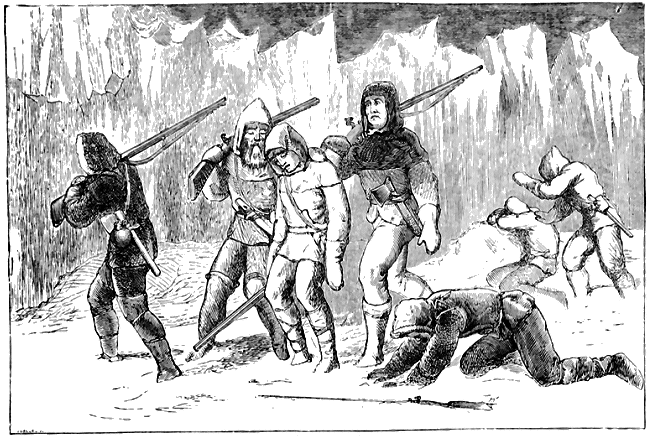
We were borne along in this manner as long as the unbroken
remnant of the in-shore floe continued revolving,—utterly
powerless, and catching a glimpse every now and
then of the brazen headland that looked down on us
through the snowy sky. At last the floe brought up
against the rocks, the looser fragments that hung round it
began to separate, and we were able by oars and boat-hooks
to force our battered little flotilla clear of them.
To our joyful surprise, we soon found ourselves in a stretch
of the land-water wide enough to give us rowing-room,
and with the assured promise of land close ahead.
At three o’clock the tide was high enough for us to scale
the ice-cliff. One by one we pulled up the boats upon a
narrow shelf, the whole sixteen of us uniting at each pull.
We were too much worn down to unload; but a deep and
narrow gorge opened in the cliffs almost at the spot where
we clambered up; and, as we pushed the boats into it on
an even keel, the rocks seemed to close above our heads,
until an abrupt turn in the course of the ravine placed a
protecting cliff between us and the gale. We were completely
encaved.
Just as we had brought in the last boat, the Red Eric,
and were shoring her up with blocks of ice, a long-unused,
but familiar and unmistakable sound startled and gladdened
every ear, and a flock of eiders darkening the sky for a
moment passed swiftly in front of us. We knew that we
must be at their breeding-grounds; and as we turned in
wet and hungry to our long-coveted sleep, it was only to
dream of eggs and abundance.
We remained almost three days in our crystal retreat,
gathering eggs at the rate of twelve hundred a day. Outside,
the storm raged without intermission, and our egg-hunters
found it difficult to keep their feet; but a merrier
set of gourmands than were gathered within never surfeited
on genial diet.
“Weary Man’s Rest”
On the 3d of July the wind began to moderate, though
the snow still fell heavily; and the next morning, after a
patriotic egg-nog, the liquor borrowed grudgingly from our
alcohol-flask, and diluted till it was worthy of temperance
praise, we lowered our boats, and bade a grateful farewell
to “Weary Man’s Rest.” We rowed to the south-east end
of Wostenholme Island; but the tide left us there, and we
moved to the ice-foot.
In the meantime, the birds, which had been so abundant
when we left Dalrymple’s Island, and which we had counted
on for a continuous store, seemed to have been driven out
by the storm. We were again reduced to short daily
rations of bread-dust, and I was aware that the change of
diet could not fail to tell upon the strength and energies
of the party. I determined to keep in-shore, in spite of
the barricades of ice, in the hope of renewing, to some extent
at least, our supplies of game. We were fifty-two
hours in forcing this rugged passage: a most painful labour,
which, but for the disciplined endurance of the men, might
well have been deemed impracticable.
Once through the barrier, the leads began to open again
,
and on the 11th we found ourselves approaching Cape
Dudley Digges, with a light breeze from the north-west.
It looked for some hours as if our troubles were over, when
a glacier came in sight not laid down on the charts, whose
tongue of floe extended still further out to sea than the
one we had just passed with so much labour. Our first
resolve was to double it at all hazards, for our crews were
too much weakened to justify another tracking through
the hummocks, and the soft snow which covered the land-floes
was an obstacle quite insuperable. Nevertheless, we
forced our way into a lead of sludge, mingled with the
comminuted ice of the glacier; but the only result was a
lesson of gratitude for our escape from it. Our frail and
weather-worn boats were quite unequal to the duty.
I again climbed the nearest berg,—for these ice-mountains
were to us like the look-out hills of men at home,—and
surveyed the ice to the south far on toward Cape
York. My eyes never looked on a spectacle more painful.
We were in advance of the season: the floes had not broken
up. There was no “western water.” Here, in a cul-de-sac,
between two barriers, both impassable to men in our
condition, with stores miserably inadequate and strength
broken down, we were to wait till the tardy summer should
open to us a way.
I headed for the cliffs. Desolate and frowning as they
were, it was better to reach them and halt upon the inhospitable
shore than await the fruitless ventures of the
sea. A narrow lead, a mere fissure at the edge of the land-ice,
ended opposite a low platform; we had traced its
whole extent, and it landed us close under the shadow of
the precipitous shore.
Providence Retreat, as I called this spot, abounded in
life. We found the lumme, nearly as large as canvas-backs,
and, as we thought, altogether sweeter and more
juicy; their eggs, well known as delicacies on the Labrador
coast; the cochlearia, growing superbly on the guano-coated
surface;—all of them in endless abundance: imagine
such a combination of charms for scurvy-broken, hungry-stricken
men.
I could not allow the fuel for a fire, our slush and tallow
being reduced to very little more than a hundred pounds.
The more curious in the art of cooking made experiments
upon the organic matters within their reach,—the dried
nests of the kitty-wake, the sods of poa, the heavy mosses,
and the fatty skins of the birds around us. But they
would none of them burn; and the most fastidious consoled
himself at last with the doubt whether heat, though
concentrating flavour, might not impair some other excellence.
We limited ourselves to an average of a bird a-piece
per meal,—of choice, not of necessity,—and renewed the
zest of the table with the best salad in the world—raw
eggs and cochlearia.
Providence Halt
It was one glorious holiday, our week at Providence
Halt; so full of refreshment and all-happy thoughts, that I
never allowed myself to detract from it by acknowledging
that it was other than premeditated. There were only two
of the party who had looked out with me on the bleak ice-field
ahead, and them I had pledged to silence.
On the 18th of July the aspects of the ice about us gave
me the hope of progress. We had prepared ourselves for
the new encounter with the sea and its trials by laying in
a store of lumme; two hundred and fifty of which had
been duly skinned, spread open, and dried on the rocks,
as the entremets of our bread-dust and tallow.
My journal tells of disaster in its record of our setting-out.
In launching the Hope from the frail and perishing
ice-wharf on which we found our first refuge from the
gale, she was precipitated into the sludge below, carrying
away rail and bulwark, losing overboard our best shot-gun,
Bonsall’s favourite, and, worst of all, that universal
favourite, our kettle,—soup-kettle, paste-kettle, tea-kettle,
water-kettle, in one. I may mention, before I pass, that
the kettle found its substitute and successor in the remains
of a tin-can which a good aunt of mine had filled with
ginger-nuts two years before, and which had long survived
the condiments that once gave it dignity. “Such are the
uses of adversity.”
Our descent to the coast followed the margin of the fast
ice. After passing the Crimson Cliffs of Sir John Ross, it
wore almost the dress of a holiday excursion,—a rude one
perhaps, yet truly one in feeling. Our course, except
where a protruding glacier interfered with it, was nearly
parallel to the shore. The birds along it were rejoicing in
the young summer, and when we halted it was upon some
green-clothed cape near a stream of water from the ice-fields
above. Our sportsmen would clamber up the cliffs
and come back laden with little auks; great generous
fires of turf, that cost nothing but the toil of gathering,
blazed merrily; and our happy oarsmen, after a long day’s
work, made easy by the promise ahead, would stretch
themselves in the sunshine and dream happily away
till called to the morning wash and prayers. We enjoyed
it the more, for we all of us knew that it could not
last.
We reached Cape York on the 21st, after a tortuous but
romantic travel through a misty atmosphere. Here the
land-leads ceased, with the exception of some small and
scarcely-practicable openings near the shore, which were
evidently owing to the wind that prevailed for the time.
Everything bore proof of the late development of the
season. The red snow was a fortnight behind its time.
A fast floe extended with numerous tongues far out to the
south and east. The only question was between a new
rest for the shore-ices to open, or a desertion of the coast,
and a trial of the open water to the west.
We sent off a detachment to see whether the Esquimaux
might not be passing the summer at Episok, behind the
glacier of Cape Imalik, and began an inventory of our
stock on hand.
On their return they gave us no reason to hesitate.
The Esquimaux had not been there for several years.
There were no birds in the neighbourhood.
I called my officers together, explained to them the
motives which governed me, and prepared to re-embark.
The boats were hauled up, examined carefully, and, as far
as our means permitted, repaired. The Red Eric was
stripped of her outfit and cargo, to be broken up for fuel
when the occasion should come. A large beacon-cairn was
built on an eminence, open to view from the south and
west; and a red flannel shirt, spared with some reluctance,
was hoisted as a pennant to draw attention to the spot.
Here I deposited a succinct record of our condition and
purposes, and then directed our course south by west into
the ice-fields.
The Way Lost
I was awakened one evening from a weary sleep in my
fox-skins, to discover that we had fairly lost our way.
The officer at the helm of the leading boat, misled by the
irregular shape of a large iceberg that crossed his track,
had lost the main lead some time before, and was steering
shore-ward far out of the true course. The little canal in
which he had locked us was hardly two boats’-lengths
across, and lost itself not far off in a feeble zigzag both
behind and before us: it was evidently closing, and we
could not retreat.
Without apprising the men of our misadventure, I
ordered the boats to be hauled up, and, under pretence of
drying the clothing and stores, made a camp on the ice.
A few hours after, the weather cleared enough for the first
time to allow a view of the distance, and M’Gary and myself
climbed a berg some three hundred feet high for the
purpose. It was truly fearful: we were deep in the recesses
of the bay, surrounded on all sides by stupendous icebergs
and tangled floe-pieces. My sturdy second officer, not
naturally impressible, and long accustomed to the vicissitudes
of whaling life, shed tears at the prospect.
There was but one thing to be done: cost what it might,
we must harness our sledges again and retrace our way to
the westward. One sledge had been already used for firewood;
the Red Eric, to which it had belonged, was now
cut up, and her light cedar planking laid upon the floor of
the other boats; and we went to work with the rue-raddies
as in the olden time. It was not till the third toilsome
day was well spent that we reached the berg which had
bewildered our helmsman. We hauled over its tongue,
and joyously embarked again upon a free lead, with a fine
breeze from the north.
Our little squadron was now reduced to two boats. The
land to the northward was no longer visible; and whenever
I left the margin of the “fast” to avoid its deep sinuosities,
I was obliged to trust entirely to the compass. We
had at least eight days’ allowance of fuel on board; but
our provisions were running very low, and we met few
birds, and failed to secure any larger game. We saw
several large seals upon the ice, but they were too watchful
for us; and on two occasions we came upon the walrus
sleeping,—once within actual lance-thrust; but the animal
charged in the teeth of his assailant and made good his
retreat.
Although the low diet and exposure to wet had again
reduced our party, there was no apparent relaxation of
energy; and it was not until some days later that I found
their strength seriously giving way.
The Boats in Danger
I well remember our look of blank amazement as, one
day, the order being given to haul the Hope over a tongue
of ice, we found that she would not budge. At first I
thought it was owing to the wetness of the snow-covered
surface in which her runners were; but, as there was a
heavy gale blowing outside, and I was extremely anxious
to get her on to a larger floe to prevent being drifted
off, I lightened her cargo and set both crews upon her.
In the land of promise off Crimson Cliffs, such a force
would have trundled her like a wheelbarrow: we could
almost have borne her upon our backs. Now, with incessant
labour and standing hauls, she moved at a snail’s
pace.
The Faith was left behind, and barely escaped destruction.
The outside pressure cleft the floe asunder, and we
saw our best boat, with all our stores, drifting rapidly
away from us. The sight produced an almost hysterical
impression upon our party. Two days’ want of bread, I
am sure, would have destroyed us; and we had now left
us but eight pounds of shot in all. To launch the Hope
again, and rescue her comrade or share her fortunes,
would have been the instinct of other circumstances; but
it was out of the question now. Happily, before we had
time to ponder our loss, a flat cake of ice eddied round
near the floe we were upon, M’Gary and myself sprang to
it at the moment, and succeeded in floating it across the
chasm in time to secure her. The rest of the crew rejoined
her by only scrambling over the crushed ice as we brought
her in at the hummock-lines.

CHAPTER XX.
STARVATION—PLENTY—THE ESCAPE WELCOME.
Things grew worse and worse with us: the old difficulty
of breathing came back again, and our feet swelled to such
an extent that we were obliged to cut open our canvas
boots. But the symptom which gave me most uneasiness
was our inability to sleep. A form of low fever which
hung by us when at work had been kept down by the
thoroughness of our daily rest; all my hopes of escape
were in the refreshing influences of the halt.
It was at this crisis of our fortunes that we saw a large
seal floating—as is the custom of these animals—on a
small patch of ice, and seemingly asleep. It was an ussuk,
and so large that I at first mistook it for a walrus. Signal
was made for the Hope to follow astern, and, trembling
with anxiety, we prepared to crawl down upon him.
Petersen, with the large English rifle, was stationed in the
bow, and stockings were drawn over the oars as mufflers.
As we neared the animal, our excitement became so intense
that the men could hardly keep stroke. I had a set of
signals for such occasions, which spared us the noise of the
voice; and when about three hundred yards off, the oars
were taken in, and we moved on in deep silence with a
single scull astern.
He was not asleep, for he reared his head when we were
almost within rifle-shot; and to this day I can remember
the hard, care-worn, almost despairing expression of the
men’s thin faces as they saw him move: their lives depended
on his capture.
Capturing a Seal
I depressed my hand nervously, as a signal for Petersen
to fire. M’Gary hung upon his oar, and the boat, slowly
but noiselessly sagging ahead, seemed to me without certain
range. Looking at Petersen, I saw that the poor fellow
was paralysed by his anxiety, trying vainly to obtain a rest
for his gun against the cut-water of the boat. The seal
rose on his four-flippers, gazed at us for a moment with
frightened curiosity, and coiled himself for a plunge. At
that instant, simultaneously with the crack of our rifle, he
relaxed his long length on the ice, and, at the very brink
of the water, his head fell helpless to one side.
I would have ordered another shot, but no discipline
could have controlled the men. With a wild yell, each
vociferating according to his own impulse, they urged both
boats upon the floes. A crowd of hands seized the seal
and bore him up to safer ice. The men seemed half crazy;
I had not realised how much we were reduced by absolute
famine. They ran over the floe, crying and laughing, and
brandishing their knives. It was not five minutes before
every man was sucking his bloody fingers or eating long
strips of raw blubber.
That night, on the large halting-floe, to which, in contempt
of the dangers of drifting, we happy men had hauled
our boats, two entire planks of the Red Eric were devoted
to a grand cooking-fire, and we enjoyed a rare and savage
feast.
This was our last experience of the disagreeable effects
of hunger. In the words of George Stephenson, “the
charm was broken, and the dogs were safe.” The dogs I
have said little about, for none of us liked to think of
them. The poor creatures, Toodla and Whitey, had been
taken with us as last resources against starvation. They
were, as M’Gary worded it, “meat on the hoof,” and
“able to carry their own fat over the floes.” Once, near
Weary Man’s Rest, I had been on the point of killing
them; but they had been the leaders of our winter’s team,
and we could not bear the sacrifice.
I need not detail our journey any further. Within a
day or two we shot another seal, and from that time forward
had a full supply of food.
And now, with the apparent certainty of reaching our
homes, came that nervous apprehension which follows upon
hope long deferred. I could not trust myself to take the
outside passage, but timidly sought the quiet-water channels
running deep into the archipelago which forms a sort of
labyrinth along the coast.
Thus it was that at one of our sleeping-halts upon the
rocks—for we still adhered to the old routine—Petersen
awoke me with a story. He had just seen and recognised
a native, who, in his frail kayack, was evidently
seeking eider-down among the islands. The man had once
been an inmate of his family. “Paul Zacharias, don’t you
know me? I’m Carl Petersen!” “No,” said the man;
“his wife says he’s dead;” and, with a stolid expression
of wonder, he stared for a moment at the long beard that
loomed at him through the fog, and paddled away with all
the energy of fright.
Two days after this, a mist had settled down upon the
islands which embayed us, and when it lifted we found
ourselves rowing, in lazy time, under the shadow of Karkamoot.
Just then a familiar sound came to us over the
water. We had often listened to the screeching of the
gulls or the bark of the fox, and mistaken it for the
“Huk” of the Esquimaux; but this had about it an inflection
not to be mistaken, for it died away in the familiar
cadence of a “halloo.”
“Listen, Petersen! oars, men!” “What is it?”—and
he listened quietly at first, and then, trembling, said, in a
half whisper, “Dannemarkers!”
Carlie Mossyn
By-and-by—for we must have been pulling a good half-hour—the
single mast of a small shallop showed itself;
and Petersen, who had been very quiet and grave, burst
out into an incoherent fit of crying, only relieved by
broken exclamations of mingled Danish and English. “Tis
the Upernavik oil-boat! The Fraulein Flaischer! Carlie
Mossyn, the cooper, must be on his road to Kingatok for
blubber.”
It was Carlie Mossyn, sure enough. The quiet routine
of a Danish settlement is the same, year after year, and
Petersen had hit upon the exact state of things. The
Mariane was at Proven, and Carlie Mossyn had come up
in the Fraulein Flaischer to get the year’s supply of blubber
from Kingatok.
Here we first got our cloudy, vague idea of what had
passed in the big world during our absence. The friction
of its fierce rotation had not much disturbed this little
outpost of civilisation, and we thought it a sort of blunder
as he told us that France and England were leagued with
the Mussulman against the Greek Church. He was a good
Lutheran, this assistant cooper, and all news with him had
a theological complexion.
“What of America, eh, Petersen?”—and we all looked,
waiting for him to interpret the answer.
“America?” said Carlie; “we don’t know much of that
country here, for they have no whalers on the coast; but
a steamer and a barque passed up a fortnight ago, and
have gone out into the ice to seek your party.”
How gently all the lore of this man oozed out of him!
he seemed an oracle, as, with hot-tingling fingers pressed
against the gunwale of the boat, we listened to his words.
“Sebastopol is not taken.” Where and what was Sebastopol?
But “Sir John Franklin?” There we were at home
again,—our own delusive little speciality rose uppermost.
Franklin’s party, or traces of the dead which represented
it, had been found nearly a thousand miles to the south of
where we had been searching for them. He knew it; for
the priest had a German newspaper which told all about
it. And so we “out oars” again, and rowed into the fogs.
Another sleeping-halt has passed, and we have all washed
clean at the fresh-water basins, and furbished up our ragged
furs and woollens. Kasarsoak, the snow top of Sanderson’s
Hope, shows itself above the mists, and we hear the yelling
of the dogs. Petersen had been foreman of the settlement,
and he calls my attention, with a sort of pride, to
the tolling of the workmen’s bell. It is six o’clock. We
are nearing the end of our trials. Can it be a dream?
We hugged the land by the big harbour, turned the
corner by the old brew-house, and, in the midst of a crowd of
children, hauled our boats for the last time upon the rocks.
For eighty-four days we had lived in the open air. Our
habits were hard and weather-worn. We could not remain
within the four walls of a house without a distressing sense
of suffocation. But we drank coffee that night before
many a hospitable threshold, and listened again and again
to the hymn of welcome, which, sung by many voices,
greeted our deliverance.






 The distinctive features are: The subjects of each Volume have
been selected with a due regard to Instruction and Entertainment;
they are well printed on fine paper; they are Illustrated with Coloured
Frontispieces and beautiful Engravings; and they are elegantly bound.