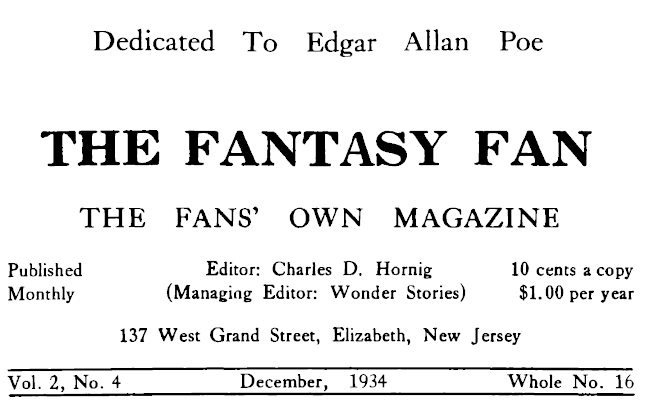
(copyright 1927 by W. Paul Cook)
Part Fifteen
VII. Edgar Allan Poe
In the eighteen-thirties occurred a literary dawn directly affecting
not only the history of the weird tale, but that of short fiction as
a whole; and indirectly moulding the trends and fortunes of a great
European aesthetic school. It is our good fortune as Americans to be
able to claim that dawn as our own, for it came in the person of our
illustrious and unfortunate fellow-countryman Edgar Allan Poe. Poe's
fame has been subject to curious undulations, and it is now a fashion
amongst the "advanced intelligentsia" to minimise his importance both
as an artist and as an influence; but it would be hard for any mature
and reflective critic to deny the tremendous value of his work and the
pervasive potency of his mind as an opener of artistic vistas. True,
his type of outlook may have been anticipated; but it was he who first
realized its possibilities and gave it supreme form and systematic
expression. True also, that subsequent writers may have produced
greater single tales than his; but again we must comprehend that it
was only he who taught them by example and precept the art which they,
having the way cleared for them and given an explicit guide, were
perhaps able to carry to greater lengths. Whatever his limitations, Poe
did that which no one else ever did or could have done; and to him we
owe the modern-story in its final and perfected state.
Before Poe the bulk of weird writers had worked largely in the dark;
without an understanding of the psychological basis of the horror
appeal, and hampered by more or less of conformity to certain empty
literary conventions such as the happy ending, virtue rewarded, and in
general a hollow moral didacticism, acceptance of popular standards and
values, and striving of the author to obtrude his own emotions into the
story and take sides with the partisans of the majority's artificial
ideals. Poe, on the other hand, perceived the essential impersonality
of the real artist; and knew that the function of creative fiction
is merely to express and interpret events and sensations as they
are, regardless of how they tend or what they prove—good or evil,
attractive or repulsive, stimulating or depressing, with the author
always acting as a vivid and detached chronicler rather than as a
teacher, sympathiser, or vendor of opinion. He saw clearly that all
phases of life and thought are equally eligible as subject matter for
the artist, and being inclined by temperament to strangeness and gloom,
decided to be the interpreter of those powerful feelings and frequent
happenings which attend pain rather than pleasure, decay rather than
growth, terror rather than tranquility, and which are fundamentally
either adverse or indifferent to the tastes and traditional outward
sentiments of mankind, and to the health, sanity, and normal expansive
welfare of the species.
Poe's spectres thus acquired a convincing malignity possessed by none
of their predecessors, and established a new standard of realism in
the annals of literary horror. The impersonal and artistic intent,
moreover, was aided by a scientific attitude not often found before;
whereby Poe studied the human mind rather than the usages of Gothic
fiction, and worked with an analytical knowledge of terror's true
sources which doubled the force of his narratives and emancipated
him from all the absurdities inherent in merely conventional
shudder-coining. This example having been set, later authors were
naturally forced to conform to it in order to compete at all; so that
in this way a definite change began to affect the main stream of
macabre writing. Poe, too, set a fashion in consummate craftmanship;
and although today some of his own work seems slightly melodramatic
and unsophisticated, we can constantly trace his influence in such
things as the maintenance of a single mood and achievement of a single
impression in a tale, and the rigorous paring down of incidents to such
as have a direct bearing on the plot and will figure prominently in
the climax. Truly may it be said that Poe invented the short story in
its present form. His elevation of disease, perversity, and decay to
the level of artistically expressible themes was likewise infinitely
far-reaching in effect; for avidly seized, sponsored, and intensified
by his eminent French admirer Charles Pierre Baudelaire, it became the
nucleus of the principal aesthetic movements in France, thus making Poe
in a sense the father of the Decadents and the Symbolists.
Poet and critic by nature and supreme attainment, logician and
philosopher by taste and mannerism, Poe was by no means immune from
defects and affectations. His pretence to profound and obscure
scholarship, his blundering ventures in stilted and laboured
pseudo-humorous, and his often vitriolic outbursts of critical
prejudices must all be recognized and forgiven. Beyond and above them,
dwarfing them to insignificance, was a master's vision of the terror
that stalks about and within us, and the worm that writhes and slavers
in the hideously close abyss. Penetrating to every festering horror in
the gaily painted mockery called existence, that vision had power to
project itself in marvelous crystallisations and transmutations; till
there bloomed in the sterile America of the thirties and forties such a
moon-nourished garden of gorgeous poison fungi as not even the nether
slope of Saturn had known in the days of the unutterable blasphemies.
Verses and tales alike sustain the burden of cosmic panic. The raven
whose noisome beak pierces the heart, the ghouls that toll iron bells
in pestilential steeples, the vault of Ulalume in the black October
night, the shocking spires and cones under the sea, the "wild, weird
clime that lieth, sublime, out of Space—out of Time"—all these
things and more leer at us amidst maniacal rattlings in the seething
nightmare of the poetry. And in the prose there yawn open for us the
very jaws of the pit—inconceivable abnormalities slyly hinted into
a horrible half-knowledge by words whose innocence we scarcely doubt
till the cracked tension of the speaker's hollow voice bids us fear
their nameless implications; demoniac patterns and presences slumbering
noxiously till waked for one phobic instant into a shrieking revelation
that cackles itself to sudden madness or explodes in memorable and
cataclysmic echoes. A Witches' Sabbath of horror flinging off decorous
robes is flashed before us—a sight the more monstrous because of the
scientific skill with which every particular is marshalled and brought
into an easy apparent relation to the known gruesomeness of material
life.
Poe's tales, of course, fall into several classes; some of which
contain a purer essence of spiritual horror than others. The tales of
logic and ratiocination, forerunners of the modern detective story, are
not to be included at all in weird literature; whilst certain others,
probably influenced considerably by Hoffman, possess an extravagance
which relegates them to the borderline of the grotesque. Still a third
group deal with abnormal psychology and monomania in such a way as to
express terror but not weirdness. A substantial residuum, however,
represents the literature of supernatural horror in the acutest form;
and give their author a permanent and unassailable place as deity
and fountain-head of all modern diabolic fiction. Who can forget the
terrible swollen ship poised on the billow-chasm's edge in "Ms. Found
in a Bottle"—the dark intimations of her unhallowed age and monstrous
growth, her sinister crew of unseeing greybeards, and her frightful
southward rush under full sail thru the ice of the Antarctic night,
sucked onward by some resistless devil-current toward a vortex of
eldritch enlightenment which must end in destruction?
Then there is the unutterable "M. Valdemar," kept together by hypnotism
for seven months after his death, and uttering frantic sounds but a
moment before the breaking of the spell leaves him "a nearly liquid
mass of loathsome, of detestable putrescence." In the "Narrative of
A. Gordon Pym" the voyagers reach first a strange south polar land of
murderous savages where nothing is white and where vast rocky ravings
have the form of titanic Egyptian letters spelling terrible primal
arcana of earth; and thereafter a still more mysterious realm where
everything is white, and where shrouded giants and snowy-plumed birds
guard a cryptic cataract of mist which empties from immeasurable
celestial heights into a torrid milky sea. "Metzengerstein" horrifies
with its malign hints of a monstrous metempsychosis—the mad nobleman
who burns the stable of his hereditary foe; the colossal unknown horse
that issues from the blazing building after the owner has perished
therein; the vanishing bit of ancient tapestry where was shown the
giant horse of the victim's ancestor in the Crusade's; the madman's
wild and constant riding on the great horse, and his fear and hatred
of the steed; the meaningless prophecies that brood obscurely over the
warring houses; and finally, the burning of the madman's palace and
the death therein of the owner, borne helpless into the flames and
up the vast staircase astride the beast he has ridden so strangely.
Afterward the rising smoke of the ruins takes the form of a gigantic
horse. "The Man of the Crowd," telling of one who roams day and night
to mingle with streams of people as if afraid to be alone, has quieter
effects, but implies nothing less of cosmic fear. Poe's mind was
never far from terror and decay, and we see in every tale, poem, and
philosophical dialogue, a tense eagerness to fathom unplumbed wells of
night, to pierce the veil of death, and to reign in fancy as lord of
the frightful mysteries of time and space.
Certain of Poe's tales possess an almost absolute perfection of
artistic form which makes them veritable beacon-lights in the province
of the short story. Poe could, when he wished, give to his prose a
richly poetic cast; employing that archaic and Orientalised style with
jeweled phrase, quasi-Biblical repetition, and recurrent burthen so
successfully used by later writers like Oscar Wilde and Lord Dunsany;
and in the cases where he has done this we have an effect of lyrical
phantasy almost narcotic in essence—an opium pageant of dream in the
language of dream, with every unnatural colour and grotesque image
bodied forth in a symphony of corresponding sound. "The Masque of the
Red Death," "Silence, a Fable," and "Shadow, a Parable," are assuredly
poems in every sense of the word save the metrical one and owe as much
of their power to aural cadence as to visual imagery. But it is in two
of the less openly poetic tales, "Ligeia," and "The Fall of the House
of Usher,"—especially the latter—that one finds those very summits
of artistry whereby Poe takes his place at the head of fictional
miniaturists. Simple and straight-forward in plot, both of these tales
owe their supreme magic to the cunning development which appears in the
selection and collocation of every least incident. "Ligeia" tells of
a first wife of lofty and mysterious origin, who after death returns
through a preternatural force of will to take possession of the body of
a second wife; imposing even her physical appearance on the temporary
reanimated corpse of her victim at the last moment. Despite a suspicion
of prolixity and topheaviness, the narrative reaches its terrific
climax with relentless power. "Usher," whose superiority in detail
and proportion is very marked, hints shudderingly of obscure life in
inorganic things, and displays an abnormally linked trinity of entities
at the end of a long and isolated family history—a brother, his twin
sister, and their incredibly ancient house all sharing a single soul
and meeting one common dissolution at the same moment.
These bizarre conceptions, so awkward in unskillful hands, become under
Poe's spell living and convincing terrors to haunt our nights; and
all because the author understood so perfectly the very mechanics and
physiology of fear and strangeness—the essential details to emphasise,
the precise incongruities and conceits to select as preliminaries or
concomitants to horror, the exact incidents and allusions to throw
out innocently in advance as symbols or prefigurings of each major
step toward the hideous denouement to come, the nice adjustments of
cumulative force and the unerring accuracy in linkage of parts which
make for faultless unity throughout and thunderous effectiveness at the
climactic moment, the delicate nuances of scenic and landscape value to
select in establishing and sustaining the desired mood and vitalising
the desired illusion—principles of this kind, and dozens of obscurer
ones too elusive to be described or even fully comprehended by any
ordinary commentator. Melodrama and unsophistication there may be—we
are told of one fastidious Frenchman who could not bear to read Poe
except in Baudelaire's urbane and Gallically modulated translation—but
all traces of such things are wholly overshadowed by a potent and
inborn sense of the spectral, the morbid, and the horrible which gushed
forth from every cell of the artist's creative mentality and stamped
his macabre work with the ineffaceable mark of supreme genius. Poe's
weird tales are alive in a manner that few others can ever hope to be.
Like most fantaisistes, Poe excels in incidents and broad narrative
effects rather than in character drawing. His typical protagonist is
generally a dark, handsome, proud, melancholy, intellectual, highly
sensitive, capricious, introspective, isolated, and sometimes slightly
mad gentleman of ancient family and opulent circumstances; usually
deeply learned in strange lore, and darkly ambitious of penetrating to
forbidden secrets of the universe. Aside from a high-sounding name,
this character obviously derives little from the early Gothic novel;
for he is clearly neither the wooden hero nor the diabolical villain
of Radcliffian or Ludovician romance. Indirectly, however, he does
possess a sort of genealogical connexion; since his gloomy, ambition
and anti-social qualities savour strongly of the typical Byronic
hero, who in turn is definitely an off-spring of the Gothic Manfreds,
Montonis, and Ambrosios. More particular qualities appear to be derived
from the psychology of Poe himself, who certainly possessed much of the
depression, sensitiveness, mad aspiration, loneliness, and extravagant
freakishness which he attributes to his haughty and solitary victims of
Fate.
(Part Sixteen next month deals with the eighth section of this article,
"The Weird Tradition in America," dealing mostly with Nathaniel
Hawthorne and his comparison with Poe. Don't miss it.)
| "The Yellow Sign" by Chambers |
| "The House of Sounds" by Shiel |
| "The Willows" by Blackwood |
| "A View from a Hill" by James |
| "The Death of Halpin Frayser" by Bierce |
| "The House of Usher" by Poe |
| "The Masque of Red Death" by Poe |
| "The White Powder" by Machen |
| "The Call of Cthulhu" by Lovecraft |
| "The Colour out of Space" |