Neither our voyages to the wreck, nor
the laboriousness of our occupations at Tent
House had made us forget the regular
observance of our duties on the sabbath-day,
which now again occurred the day after our
return to Falcon’s Stream; and we
accordingly distinguished it by consecrating the
forenoon to reading the church prayers,
some chapters in the Bible, singing psalms,
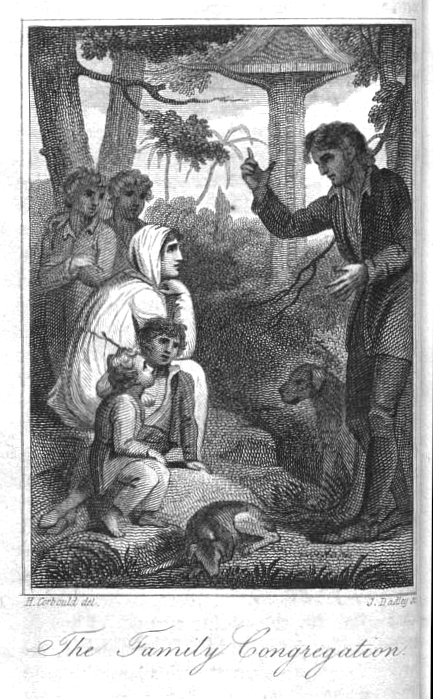
and lastly, the recital of a new parable I had
invented, and which I had named the
Arabian Travellers. I reminded my children in
it, by the help of imagery and fictitious
names, of all the aid and all the benefits
bestowed upon us by an all-beneficent
Providence, from the moment of our being cast
upon our present abode;—that it was his
compassion for our station which had
endued us with sagacity and perseverance in
the discovery of so many things necessary
for our existence; and one treasure, valuable
above all the rest—a talisman, bestowed by
the good genius who watched over poor
defenceless wanderers. This talisman was
such as to inspire them on every occasion
with the knowledge of what was best for
their happiness, and that by listening to these
inspirations, they might be sure of always
keeping in the right path, and finding every
want supplied. I need not explain that by
the good genius I alluded to the ever-watchful
care of the exemplary wife and mother;
and by the talisman, the sacred volume she
had so miraculously preserved and concealed
in her enchanted bag. I was well
understood by my hearers; and as I finished my
discourse, the children all ran spontaneously
at once to embrace their mother, addressing
her by the term Good Genius, and thanking
her for having been the means of securing
the Bible, to which we might all resort for
consolation and instruction.
After dinner I again addressed my family
with a short moral discourse, and then
allowed them to use whatever kind of
recreation they pleased; one feature of my system
being, not to tire them with the subjects I
wished them to feel an attachment for. I
recommended to them, for the sake of
uniting usefulness with their amusement, to
resume the exercise we began upon the first
Sunday of our abode in these regions, the
shooting of arrows; for I had an extreme
solicitude about their preserving and increasing
their bodily strength and agility, which in a
situation like ours, might prove of such
critical importance. Nothing tends more to
the extinction of personal courage in a
human being, than the consciousness of wanting
that strength of limb, or that address,
which may be necessary to aid us in
defending ourselves, or in escaping from dangers.
On this occasion, I added the exercises of
running, jumping, getting up trees, both by
means of climbing by the trunk, or by a
suspended rope, as sailors are obliged to do
to get to the mast-head. We began at
first by making knots in the rope at a foot
distance from each other; then we reduced
the number of knots, and before we left off,
we contrived to succeed without any. I
next taught them an exercise of a different
nature, with which they were unacquainted,
and which was to be effected by means of
two balls made of lead, fastened one to each
end of a string about a fathom in length.
While I was preparing this machinery, all
eyes were fixed upon me.—What can it be
intended for? cried one: How can we use
it? asked another: Will it soon be ready?
continued a third.
Father.—Have a little patience, boys, if it
be not quite impossible for you to practise
this precious virtue; for though the thing I
am endeavouring to make for you may turn
out extremely useful, yet this said virtue of
patience is much more likely to be a constant,
steady, and efficient friend.—But now for the
object of your curiosity. It is nothing less than
an imitation of the arms used by a valiant
nation remarkable for their skill in the chase,
and whom you all must have heard of: I
mean the Patagonians, inhabitants of the
most southern point of America; but
instead of balls, which they are not able to
procure, they tie two heavy stones, one at
each end of a cord, but considerably longer
than the one I am working with: every
Patagonian is armed with this simple
instrument, which they use with singular
dexterity. If they desire to kill or wound an
enemy or an animal, they fling one of the
ends of this cord at him, and begin instantly
to draw it back by the other, which they
keep carefully in their hand, to be ready for
another throw if necessary: but if they wish
to take an animal alive, and without hurting
it, they possess the singular art of throwing
it in such a way as to make it run several
times round the neck of the prey,
occasioning a perplexing tightness; they then throw
the second stone, and with so certain an aim,
that they scarcely ever miss their object:
the operation of the second is, the so
twisting itself about the animal as to impede his
progress, even though he were at a full gallop.
The stones continue turning, and
carrying with them the cord: the poor animal is
at length so entangled, that he can neither
advance nor retire, and thus falls a prey to
the enemy.
This description of the field sports of the
Patagonians was heard with much interest by
the boys, who now all entreated I would that
instant try the effect of my own instrument
upon a small trunk of a tree which we saw
at a certain distance. My throws entirely
succeeded; and the string with the balls at
the ends so completely surrounded the tree
that the skill of the Patagonian huntsmen
required no further illustration. Each of the
boys must then needs have a similar
instrument; and in a short time Fritz became quite
expert in the art, as indeed he was in every
kind of exercise that required strength or
address: he was not only the most alert of
my children, but being the eldest, his muscles
were more formed, and his intelligence was
more developed, than could yet be expected
in the other three.
The next morning, as I was dressing, I
remarked from my window in the tree that
the sea was violently agitated, and the waves
swelled with the wind. I rejoiced to find
myself in safety in my home, and that the
day had not been destined for out-of-door
occupation. Though such a wind was in
reality quite harmless for skilful sailors, for us
it might be truly dangerous, from our
ignorance in these matters. I observed then to
my wife that I should not leave her the whole
day, and should therefore hold myself ready
to execute any little concerns she found
wanting in our domestic arrangement. We now
fell to a more minute examination than I had
hitherto had time for, of all our various
possessions at Falcon’s Stream. She showed me
many things she had herself found means to
add to them during my repeated absences
from home: among these was a large barrel
filled with small birds half-roasted and stowed
away in butter to preserve them fresh: this
she called her game, which she had found
means to ensnare with birdlime in the branches
of the neighbouring bushes. Next she
showed me a pair of young pigeons which
had been lately hatched, and were already
beginning to try their wings, while their
mother was again sitting on her eggs. From
these we passed to the fruit-trees we had laid
in earth to be planted, and which were in
real need of our assistance, being almost in a
decaying state. I immediately set myself to
prevent so important an injury. I had
promised the boys the evening before, to go all
together to the wood of gourds, for the
purpose of providing ourselves with vessels of
different sizes to keep our provisions in: they
were enchanted with the idea, but I bargained
that they must first assist me to plant all the
young trees; which was no sooner said than
executed, excited as we were by our eager
desire for the promised excursion.
When we had finished, a little
disappointment however occurred; the evening, I
thought, seemed too far advanced for so long
a walk, especially as my wife and little Francis
were to be of the party. By the time that
all were ready, it was too late to think of
setting out, and we accordingly postponed
the expected pleasure till the following
day, when we made the necessary
preparations for leaving Falcon’s Stream very early
in the morning. By sun-rise all were on
foot; for nothing can exceed the alertness of
young persons who act in expectation of a
pleasurable change of scene. The ass,
harnessed to the sledge, played on this occasion
the principal character; his office was to be
the drawing home the empty gourds for the
service of our kitchen and the table, and in
addition, little Francis, if he should be tired:
in the journey out, he carried our dinner, a
bottle of the Canary wine, and some powder
and shot. Turk, according to custom, led the
way as our advanced guard; next followed
the three eldest boys, equipped for sporting;
after them, their amiable mother, leading the
little one; and Ponto brought up the rear with
the monkey on his back, to which the boys
had given the name of Knips. On this
occasion I took with me a double-barreled gun,
loaded on one side with shot for game, and
on the other with ball, in case of meeting
with an enemy.
In this manner we set out, full of good
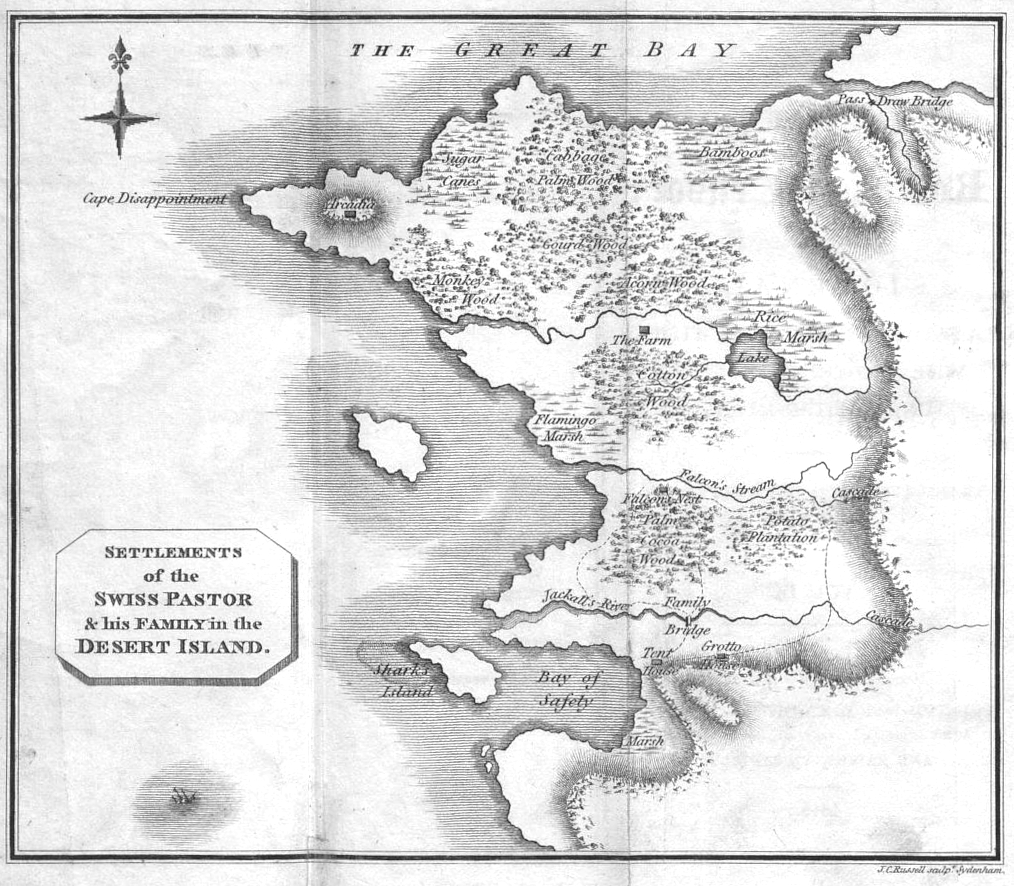
humour and high spirits, from Falcon’s
Stream. Turning round Flamingo Marsh,
we soon reached the pleasant spot which
before had so delighted us. My wife, who
now beheld for the first time its various
beauties, was never tired of praising and admiring
it. Fritz, who longed to be engaged in some
sporting adventure, took a direction a little
further from the sea-shore; and sending Turk
into the tall grass, he followed himself, and
both disappeared. Soon, however, we heard
Turk barking loud, a large bird sprang up,
and almost at the same moment a shot from
Fritz brought it down: but the bird though
wounded was not killed; it raised itself and
got off with incredible swiftness, not by
flying, but by running. Turk pursued with
the eagerness of an animal enraged; Fritz,
bawling out like a mad creature, followed;
and Ponto, seeing what was going on, threw
the monkey off his back, and fell speedily
into the same track. It was Ponto that seized
the bird, and held it fast till Fritz came up.
But now a different sort of scene succeeded
from that which took place at the capture
of the flamingo. The legs of that bird are
long and weak, and it was able to make but
a poor resistance. The present captive was
large in size, and proportionately strong; it
struck the dogs, or whoever came near, with
its legs, with so much force, that Fritz, who
had received a blow or two, retired from the
field of battle, and dared not again approach
this feathered antagonist. Turk, who had
gallantly assailed the bird, was also
discouraged by some severities applied to his head
by the sturdy combatant, and yielded the
contest. The brave Ponto alone withstood
the animal’s attacks; he seized one of its
wings, and did not let it go till I reached the
spot, which I was long in doing on account
of the height of the grass and the great weight
of my gun; but when I was near enough to
distinguish the bird as it lay on the ground,
I was overjoyed to see that it was a female
bustard of the largest size2. I had long
wished to possess and to tame a bird of this
species for our poultry-yard, though I foresaw
that it would be somewhat difficult.
To effect the complete capture of the bird
without injuring it, I took out my
pocket-handkerchief, and seizing a favourable
moment, I threw it over the head of the bustard;
it could not disengage itself, and its efforts
only served to entangle it the more. As in
this situation it could not see me, I got
sufficiently near to pass a string with a running
knot over its legs, which, for the present, I
drew tight, to prevent further mischief from
such powerful weapons. I gently released its
wing, which was still in the possession of
Ponto, and tied that and its fellow close to
the bird’s body. In short, the bustard was at
length vanquished, though not till each and
all of us had felt the powerful blows it was
capable of inflicting.—But it was our own,
and that in a condition to promise its
preservation when we should once have conveyed
it to Falcon’s Stream, and could administer
abundance of care and kindness to
compensate for the rough treatment it had
experienced at our hands.
Without further delay we removed the
prisoner to the spot on the shore where some
of our companions had been waiting our
return. On seeing us, Ernest and Jack ran
briskly forward, bawling out, Oh what a
handsome bird! And what a size! What
beautiful feathers!—I will lay a wager that it
is a female bustard, said Ernest, the instant
he had cast his eyes upon it. And you
would win, my boy, answered I; it is a
female bustard; its flesh is excellent, having
somewhat of the flavour of the turkey, to
which it also in some other respects has a
resemblance. The male spreads its tail in
the form of a wheel, as is said, to please its
female. Let us endeavour to tame and
preserve it by all means.
Mother.—If I had the choice, I would give
it back its liberty: most likely it has young
ones which stand in need of its assistance.
Father.—For this once, my dear, the
kindness of your heart misleads you; the poor
bird, being wounded, would perish if set at
liberty, for want of care. If, when I have
examined its wound, I find it too serious to
admit of cure, I shall kill it, and thus secure
an excellent dish. But if the wound is slight,
we shall have gained for our poultry yard a
bird of rare value on account of its size, and
which will, it may be hoped, attract its mate,
and thus furnish us with a brood of its species:
should it even happen that it has at this time
a young brood, it is not improbable that they
will find the way to take care of themselves,
for no doubt, like chickens, they were able to
run as soon as they came out of the egg.
While conversing on this subject I had
been fixing the bustard on the sledge, taking
care to place it in such a posture as to be the
least painful, and to avoid exciting it to
struggle against its fetters. We then pursued our
way towards the wood where Fritz and I had
seen such troops of monkeys, who in their
spite thought to beat us from the field by
assailing us with showers of cocoa-nuts. Fritz
now again repeated the adventure with much
humour to his mother. During this recital,
Ernest was employed in going a little from
us in every direction, in admiration of the
height and beauty of the trees: he stopped
in ecstasy at the sight of one in particular
which stood alone, gazing with rapturous
wonder at the prodigious distance from the
root to the nearest bunches of cocoa-nuts,
which he saw hanging in clusters under their
crown of leaves, and which excited an eager
desire to possess some of them. I glided
behind him without his perceiving me, and was
highly amused with the expression of his
features: at length he drew a deep sigh and
uttered these words:—Heavens! What a
height!
Father.—Yes, my Ernest, they are indeed
at a most unaccommodating height, and not
a monkey in the way to throw them down to
you! Even were I to set Knips at liberty,
besides that he is not in the habit of giving
away what he might keep for himself, he
would perhaps take it into his head to stay
in the tree when once there, so fond is every
creature that lives of liberty! It is really
a pity, and I am sure you are of my opinion,
that those fine cocoa-nuts cannot find a way
to drop down into your mouth.
Ernest.—No indeed, father, this is not the
case; I have no great mind to them, I assure
you; they are too hard, and would fall from
too great a height: I should expect to have
a tooth or two knocked out at least.
Scarcely had he ended his sentence, when
a nut of the very largest size fell down.
Ernest, alarmed, stepped aside, and looked up
at the tree: another fell, and almost near
enough to touch me; so that I was no less
surprised than he, not being able to imagine
the cause of the phenomenon. Not the
smallest sign of a living creature appeared, and I
was certain that cocoa-nuts never fall of
themselves, but when in a state of over-ripeness,
while those were absolutely hard and
immature.
Ernest.—This is somewhat like the
adventures of Fairy-land, father, I think—No
sooner do the personages form a wish, than it
is granted.
Father.—I begin indeed to think so.
However, it may be that the magician who
is so ready to oblige us, may lie concealed
behind some of the leaves in the tree in the
form of a wicked little monkey, which all the
time may not intend so much to do us a
favour, as to drive us from the place.
Ernest now ventured to take up the nuts.
We found them even too unripe to be made
use of, and were more than ever at a loss to
account for their falling from the tree, round
which we continually paced, endeavouring to
explain the mystery. In vain, however, we
strained our eyes; we saw nothing, but now
and then a slight motion of the leaves: but
neither bird nor beast appeared; and not a
breath of wind was stirring.
Fritz had by this time concluded his
narration to his mother; and observing that
Ernest and I seemed occupied by something of
a perplexing kind, and looked up repeatedly
at one tree, he supposed we must have
discovered some animal in it, and ran to have
his share of the adventure, bringing also his
younger brothers. We told him what had
passed:—he shewed us that he had the eyes
of a lynx. I shall soon, said he, see what
it all means, raising his face to gaze at the
tree; if one would but fall at this moment,
I would soon tell you who threw it.—At the
very instant two nuts fell, and so near to the
speaker as to bruise his lip and his chin.
Ernest could not refrain from laughing heartily.
The magician is at least polite, said he; he
conducts his gifts to your very mouth; and
it is no fault of his if the dimensions of yours
are not large enough to receive it:—but look,
look, there are two more falling close to our
mother and Francis. How well-behaved this
magician shows himself;—In proportion as
the guests increase, he takes care to send one
for each. Let us quickly open one of them
and refresh ourselves with the liquor it
contains, in drinking to the health of our
unknown friend. We did so; and each
obtained a small quantity of the milk, in the
fragments of the shell; and all called out together
as they drank it, looking up at the tree, Long
life and thanks to the good magician!—Ah,
ah, I see him; there he is, exclaimed Jack.
Oh, heavens! what a hideous creature! what
an ugly shape he has! he is as large as my
hat, and has two monstrous pincer claws.
Where is he then? said I, for I do not see
him.—There, that is he, father, crawling
slowly down the tree; do you see him now?—It
was a land crab, an animal that, to say
the truth, deserved Jack’s description of him.
The land crab resembles the sea crab, but is
ten times more hideous: some kinds of them
are excellent food, and are the principal
subsistence of the natives where they are found.
The one we now met with was of the kind
called cocoa crab, on account of its fondness
for that fruit. It crawls with great difficulty
and slowly, up the trunk of the tree; when it
has reached the clumps of leaves, it conceals
itself in them, and falls to pinching off the
bunches of cocoa-nuts at the stalks; he
separates and then throws them down one by one,
which often bruises them considerably. The
crab then descends, and finds below a
plentiful regale. It is said by some that their
claws are strong enough to break the shell
of the nut; but for myself, I doubt this,
having always believed rather that they suck
the milk by means of the small hole found
in the fruit near the stalk. The land crab is
not dangerous unless you are within reach of
its claws, or, which is rarely the case, when
they are found together in great numbers.
Little Francis on seeing the animal was
terribly frightened, and hid himself behind his
mother; even Ernest drew back, and looked
for a place of refuge: Jack, with a menacing
air, raised the end of his gun; and we all cast
some looks of curiosity as the creature slowly
descended the tree. The moment he was on
the ground, the intrepid Jack aimed a blow
at him with his gun, which missed him. The
crab, finding himself attacked, turned round
and advanced with his claws stretched open
towards his enemy. My little ruffian
defended himself valiantly; he did not retreat a
single step, but his attempts to strike, entirely
failed, for the crab was perfect in the art of
evading every blow. I however determined
not to interfere: I saw that there could be no
danger to the boy, and that the scene would
conclude by his subduing the animal, if he
conducted the affair with prudence and
address. I must observe that nothing could be
more amusing than this exhibition of a fight
between a little boy and a crab.
After some time, being tired out with so
many fruitless attempts, and perhaps
recollecting that the pinches he might get from
the animal’s claws would not be very
agreeable, and finding himself likely to be brought
to close quarters with him, suddenly gave him
the slip and ran off. The other boys now
burst into peals of laughter, bawling out: So
the magician has conquered you! he has
made you run away! poor Jack! but why
did you engage with a magician, Jack? On
this, the lad piqued by their jeers, stopped
short, threw his gun and his game-bag on the
ground, stripped off his coat, spread it before
him, and made a stand at his adversary, who
was making up to him with his claws stretched
out in a menacing sort of motion. Jack,
without a moment’s hesitation, threw his coat
upon the creature, and wrapped him round
in it; then tapping on the outside upon his
shell: Wicked magician, cried he, I have you
at last! I will teach you to brandish your
horns another time.
I laughed so heartily at this scene, that I
had not the power to give him any
assistance. I saw by the motion under the coat
that the crab was still alert and angry. I
therefore took my hatchet and applied two
or three powerful blows with it on the coat,
which I took for granted would finish the
affair at once. I lifted up the coat; and, as I
expected, the terrible animal was dead, but
still preserved a menacing posture.
What an ugly monster! cried Jack, as he
stood over him: but far from being terrified
by his ugliness, it only served to quicken my
ardour:—one must always be glad to deliver
the earth of such a monster.
You would have something to do, my
young Hercules, said I, tapping him on the
shoulder; no animal is so common as the
crab on the shores of the sea: they are of
numerous kinds, and may be seen by
millions, all equally ugly. This, if I mistake
not, is distinguished by the name of the poet’s
crab. What say you, Jack, to a thought just
come into my head, of creating an order of
knighthood for you, in which you shall be
dubbed—Sir Crab? This is the second time
that you have engaged in combat with these
pincer-clawed animals. We will say nothing of
the first, in which you got a bite by the leg;
but this time you have evinced considerable
courage and presence of mind. The thought
of throwing your coat over the creature was
well imagined; I doubt if you would have
subdued him by any other means. It must
be an animal of prodigious strength for its
size, to be able to open a cocoa-nut, so that
it was no inconsiderable enemy you were
engaged with: but human prudence and
reason give man the advantage over even the
most formidable of the brute creation.
Jack.—May we eat crabs, father?—they
are so very ugly!
Father.—Use makes all things easy. Many
ugly things find their way to the most
delicately served tables. For our crab, it is the
favourite food of the negro slaves of the
Antilles, and frequently of their masters also. I
should think its flesh must be hard and
indigestible; but we will make trial of it for
dinner.
I put the famous animal along with the
cocoa nuts it had been the means of
procuring us, together on the sledge, and we
resumed our march. As we advanced, the
wood became thicker and more difficult to
pass; I was frequently obliged to use the
hatchet to make a free passage for the ass.
The heat also increased, and we were all
complaining of thirst, when Ernest, whose
discoveries were generally of a kind to be
of use, made one at this moment of a most
agreeable nature. He has already been
described as a great lover of natural history,
and now he was continually gathering, as he
proceeded, such plants as he met with, and
examining them with care, with the view of
adding to his stock of knowledge. He found
a kind of hollow stalk of a tolerable height,
which grew at the foot of the trees, and
frequently entangled our feet in walking. He
cut some of the plants with his knife, and
was much surprised in about a minute to
see a drop of pure fresh water issue from
them at the place where the knife had
been applied: he showed it to us, put it to
his lips, and found it perfectly agreeable, and
felt much regret that there was no more. I
then fell to examining the phenomenon
myself, and soon perceived that the want of air
prevented a more considerable issue of water.
I made some more incisions, and presently
water flowed out as if from a small conduit.
Ernest, and after him the other boys,
refreshed themselves and quenched their thirst at
this new fountain, in the completest manner.
For my own part, touched with deep
gratitude for the goodness of God towards me
and my beloved family, I raised my eyes to
heaven: See, children, said I, what a blessing
is sent us by Providence in these beneficial
plants, the name of which I am much
concerned to be unacquainted with. What
would become of poor travellers in this
burning climate, in crossing such immense
forests far from the relief of water-springs!
they must inevitably perish with heat and
thirst, if the Almighty did not extend his
goodness to the providing these necessary
benefits.
I tried the experiment of dividing the plants
longways, and they soon gave out water enough
to supply even the ass, the monkey, and the
wounded bustard. We were still compelled
to fight our way through thick bushes, till at
length we arrived at the wood of gourds,
which was the object of our excursion, and we
were not long in finding the spot where Fritz
and I had once before enjoyed so agreeable
a repose. Our companions had not soon done
admiring and wondering at the magnificence
of the trees they now beheld, and the
prodigious size of the fruit which grew in so
singular a manner upon the trunk. Fritz, who was
already acquainted with particulars respecting
them, now performed the office of lecturer
to the rest, as I before had done to him.
I was glad to observe that he had not forgot
any part of the detail he received from me
during our first visit; and while he was
talking, I strolled about the wood, choosing among
the numerous sizes of the gourds, such as
were particularly suited for our necessities, and
marking the places in my mind’s eye. I
sought also to discover whether the
malicious horde of monkeys were not still in the
same neighbourhood, for I a little
apprehended being molested by them during our
occupation. I, however, to my great
satisfaction, discovered no trace of them, and I
returned to my companions.
I found Jack and Ernest actively employed
in collecting dried branches and flints, while
their mother was occupied in attending to the
poor bustard, which however she saw reason
to believe was not materially injured. She
remarked to me that it was cruel to keep her
any longer blinded and her legs tied together
on the sledge. To please her, I took off the
covering and loosened the string on the legs,
but still left it so as to be a guard against its
running away or inflicting blows on those
who might approach. I contented myself
with tying her by a long string to the trunk
of a tree, that she might relieve herself by
walking about. She had by no means the
savageness of manners I should have
expected, excepting when the dogs went near her.
She did not appear to have any dread of man;
which confirmed my previous belief, that the
island in which we existed, had absolutely no
human inhabitants but ourselves.
The boys now amused themselves with
making a large fire, which they joyously
surrounded. I took the liberty to laugh at
them, and asked if they had become
salamanders, or inhabitants of the planet Mercury,
who, it is said, make fires to refresh themselves
from the burning heat of the sun; the heat
of our island could scarcely be less ardent,
and this irony was therefore fair and
admissible.
The fire, father, is to enable us to cook the
magician.—Ah, hah, that is quite another
thing, replied I. It was then for the same
purpose, I suppose, that I saw you picking
up some large shells: you mean no doubt to
use them in the cooking, instead of the rind
of the gourds which would not bear
sufficient heat.
They all agreed to my conclusion. Begin
then, continued I, by making the dish you
will want for dressing your crab, before you
make a large fire and get roasted yourself
by its side.
I require also, said my wife, that some
vessels to contain milk, and a large flat spoon
to cut out my butter by pieces, and next
some pretty plates for serving it at table,
should be completed, gentlemen, among you
all.
Father.—You are perfectly reasonable in
your demand, dear wife, said I; and for me
there must be manufactured some nests for
the pigeons, some baskets for eggs, and some
hives for bees.
All.—Oh yes, these things must all be
made, we will set earnestly to work.
Jack.—But first, father, let me make a
dish for my crab; the excessive heat would
certainly make him unfit to be eaten by the
evening, and I should be sorry to be obliged
to throw away what it cost me so much
trouble to obtain: I should soon have finished, if
you will tell me how to divide one of the
rinds with a string.
Father.—Well, well, it is but fair to allow
you to enjoy the fruit of your victory. As
to the cutting with a string, it was good for
something when we had no saw. I will
however show you, for fear of the worst, how
to do it, though I took care to bring here the
different instruments I thought we might
want. Gather then a sufficient quantity of
the gourds, of different sizes, and you shall
see how soon we will cut them.
They all began to gather or collect, and
we were soon in possession of a sufficient
number of this valuable commodity. We found
a certain quantity already dry upon the tree,
and these we considered fit for immediate
use: many also were so bruised or broken
in falling, and others so immature, that we
threw them aside as useless. We now began
our work: some had to cut; others to saw,
scoop out, and model into agreeable forms.
It was a real pleasure to witness the activity
exhibited in this manufacture of porcelain:
each tried what specimens of imagination he
could present for the applause of his
companions. For my own part, I made a pretty
basket, large enough to carry eggs, with one
of the gourds, leaving an arch at the top to
serve as a cover. I likewise accomplished a
certain number of vessels, also with covers, fit
to hold our milk, and then some spoons to
skim the cream. My next attempt was to
execute some bottles large enough to contain
a supply of fresh water, and these occasioned
me more trouble than all the rest. It was
necessary to empty the gourd through the
small opening of the size of one’s finger which
I had cut in it; I was obliged after loosening
the contents by means of a stick, to get them
out by the friction of shot and water well
shaken on the inside. Lastly, to please my wife
I undertook the labour of a set of plates for
her use. Fritz and Jack engaged to make
the hives for the bees, and nests for the
pigeons and hens. For this last object, they
took the largest gourds, and cut a hole in front
proportioned to the size of the animal for
whose use it was intended: they had when
finished so very pretty an appearance, that
little Francis was ready to cry that he was
not quite small enough to get into and live
in one of them. The pigeons’ nests were
intended to be tied to the branches of our tree;
those for the hens, the geese, and the ducks,
were to be placed between its roots or on the
sea-shore, and to represent a sort of hen-coop.
When the most essential of the utensils were
finished, I allowed them, as they had
requested, to add a dish to dress their crab in. This
also was soon accomplished; but when the
cooking was completed, they discovered that
they had no water. We found nothing on
this spot like our providential fountain plants,
as we had named them. The boys
entreated me to go about with them in different
directions, and try to find a small supply of
this precious article, not daring by themselves
to venture further into the wood.
I was therefore of necessity compelled to
accompany them. Ernest with great eagerness
proposed relieving me of this trouble,
and putting himself in my place. He had
found it impossible to succeed in assisting to
make the utensils; he broke more than half
the pieces of gourd he took in hand, and to
make amends for his awkwardness, he exerted
himself in every direction to discover a
water-spring, or to do something else that might be
useful. It was not long before we heard
him calling loudly to us, and saw him
returning in great alarm. Run quick, father,
said he, here is an immense wild boar. Oh,
how he frightened me! I heard him grunting
quite close to me, and then he scampered
away to the wood, and I hear him at this
very moment.
Here, here! I then called out to the boys:
call the dogs quickly; here is fine game for
us, if we are so lucky as to catch it. Halloo,
here, Turk, Ponto! The dogs arrived full
gallop. Ernest was our leader, and conducted
us to the place where the boar had approached
him; but he was gone, and we saw
nothing but a plot of potatoes which had the
appearance of having been ransacked by the
animal. The ardour for the chase had been
somewhat checked in Jack and Ernest, when
they considered for a moment that they had so
formidable a creature as a boar to encounter;
they stopped short, and began to dig potatoes,
and left it to Fritz and me to follow the
traces of the dogs. We soon heard the cry
of the latter; for they had overtaken the
runaway, and soon after the most hideous
growling assailed our ears from the same quarter.
We advanced with caution to the spot,
holding our guns before us in readiness to fire
together, the instant the animal should show
itself within the proper distance. Presently
the spectacle of the two brave creatures
attacking him on the right and left presented
itself; each held one of his ears between their
teeth. But the beast was not a boar, as the
account of Ernest had made me suppose, but
a pig of the true common breed, which on
our approach, appeared rather to ask for our
assistance, than to have any inclination to
attack us. Contrary to our expectation,
Fritz and myself also suddenly lost the relish
for sporting against this animal; for we
immediately recognised in the supposed boar, our
own sow which had run away and had so long
been lost. After the first surprise we could
not resist a hearty laugh; and then we
hastened to disincumber our old friend of the
teeth of her two adversaries. Her frightful
squalling resounded through the wood and
drew the attention of our companions, who
now ran to the place, when a warfare of
banter and accusation went round among the
parties:—Fritz knew certain persons whose
passion for the chase ended in digging
potatoes! Jack and Ernest returned the sally
by complimenting Fritz on the fine martial
appearance of the wild boar they had been
so fortunate as to make captive!—Why, Fritz,
we knew in a moment, by the grunting, that
it was only our old sow.—You however
believed it to be a wild boar, Mr. Ernest,
returned Fritz, and even after you had seen it.
I know not what Ernest would have
answered; for the attention of all was attracted to
a kind of small potatoe which we observed
lying thick on the grass around us, and which
had fallen from some trees which appeared
loaded with the same production: our sow
devoured them greedily, thus consoling
herself for the fright she had been put into, and
the pain the dogs had occasioned her.
The fruit was of different colours, and
extremely pleasing to the eye. Fritz expressed
his apprehension that it was the pernicious
kind of apple called the Mancenilla, against
which I had so strenuously cautioned them;
but the sow ate them with so much
eagerness, and the tree which bore them being
neither so high, and having neither the form
nor foliage ascribed by naturalists to the
Mancenilla, made me doubt of the truth of
his idea. I forbore from immediately pronouncing its condemnation; but I desired my
sons to put some of the fruit in their pockets,
to make an experiment with them upon the
monkey. I was shortly after nearly satisfied
of their harmless quality, from seeing that
the two dogs also fell upon them with
eagerness; but I persisted in forbidding the boys
to taste them till I had further examined
into their nature and properties; and they all
of course obeyed me. We now again, from
extreme thirst, began to recollect our want
of water, and determined to seek for some
in every direction. Jack sprang off and
sought among the rocks, hoping, and with
reason, that he should discover some
little stream: but scarcely had he left the
wood, than he bawled to us that he had found
a crocodile.....
A crocodile! cried I with a hearty laugh,
you have a fine imagination, my boy! who
ever saw a crocodile on such scorching rocks
as these, and with not a drop of water near?
Now, Jack, you are surely dreaming.....
Not so much of a dream as you may
think, father, answered Jack, trying to
speak in a low voice;—fortunately he is
asleep;—he lies here on a stone at his full
length;—he is exactly like our mother.
Father.—This is excellent, upon my word!
So then your mother is like a crocodile?—This
is really an indiscreet sort of a joke.
Jack.—I meant, father, that the
crocodile is about as long as the height of our
mother; I had not, I assure you, the least
idea of a joke; for it is certainly a crocodile,
though perhaps only a young one.....
Do, father, step here and look at it, it does
not stir in the least.
I knew not what to think: we stole softly
to the place where the animal lay; but
instead of a crocodile I saw before me an
individual of a large sort of lizard, named by
naturalists Leguana or Yguana3, and the
flesh of which is considered in the West
Indies as the greatest delicacy. I explained
this to my sons, and tranquillised them as
to the danger of approaching this animal,
formed by nature of a mild character, and
excellent as food. All were then
immediately seized with the hope of seizing the
lizard and presenting so rare a prize to their
mother. Fritz in a moment had his gun
ready, and was taking his aim, but that I
was in time to lay hold of his arm and
prevent him: You are always too quick, said I,
in your determinations; your piece might
have missed, or you might have wounded
him only slightly; for this sort of animal is
protected by a coat of scales as you see,
and it is extremely difficult to destroy him.
I think too that he is known to be extremely
dangerous if approached when he is angry.
Let us try another sort of experiment; as he
is asleep, we need not be in a hurry: only a
little contrivance is necessary to have him
safe in our power alive, and the process will
afford us all an amusing spectacle.
I cut a stout stick from a bush, to the
extremity of which I tied a string with a
running knot. I guarded my other hand simply
with a little switch, and thus with cautious
steps approached the sleeping animal. When
I was very near to him, I began to whistle a
lively air, taking care to make the sounds low
at first, and to increase in loudness till the
lizard was awaked4. The creature
appeared entranced with pleasure as the sounds
fell upon his ear; he raised his head to
receive them still more distinctly, and looked
round on all sides to discover from whence
they came. I now advanced by a step at a
time, without a moment’s interval in the
music, which fixed him like a statue to the
place. At length I was near enough to reach
him with my switch, with which I tickled
him gently, still continuing to whistle, one
after the other, the different airs I could
recollect. The lizard was bewildered by
the charms of the music; the attitudes he
threw himself into were expressive of a
delirious voluptuousness; he stretched himself
at full length, made undulating motions
with his long tail, threw his head about,
raised it up, and by this sort of action,
disclosed the formidable range of his
sharp-pointed teeth, which were capable of tearing
us to pieces if we had excited his hostility.
I dexterously seized the moment of his
raising his head, to throw my noose over
him. When this was accomplished, the
boys drew near also, and wanted instantly to
draw it tight and strangle him at once; but
this I positively forbad, being unwilling to
cause the poor animal so unmerited a
suffering. I had used the noose only to make
sure of him in case it should happen that a
milder mode of killing him, which I intended
to try, failed of success, in which case I
should have looked to the noose for
protection; but this was rendered unnecessary.
Continuing to whistle my most affecting
melodies, I seized a favourable moment to
plunge my switch into one of his nostrils;
the blood flowed in abundance, and soon
deprived him of life, without his exhibiting
the least appearance of being in pain; on the
contrary, to the last moment he seemed to
be still listening to the music.
As soon as he was dead I allowed the
boys to come quite near and to tighten the
noose, which we now found useful to draw
him to the ground from the large stone on
which he lay. My sons were delighted with
the means I had used for killing him without
pain. But little praise is due to me, I replied;
for I have often in books of travels, read the
description of the manner of deluding and
destroying this animal, so well known in the
West Indies. But now let us consider of
the best way for transporting to Falcon’s
Stream so large and valuable a booty. After
a moment of reflection, I perceived that I
had better come at once to the
determination of carrying him across my shoulders:
and the figure I made with so singular an
animal on my back, with his tail dragging on
the ground, was not the least amusing
circumstance of the adventure. Fritz and
Jack presented themselves as pages,
contending which should support my train, as they
called the tail, which, independently of the
good-humour inspired amongst us,
considerably eased me of the weight, and gave
me the air of an old Chinese emperor
habited in a superb royal mantle of many
colours, for those of the lizard shone like
precious stones in the eyes of the sun.
We were already far advanced in our
return, when we distinguished the voice of
my wife calling upon my name in a tone
which indicated great uneasiness; and in
addition, we heard loud sobs from little
Francis. Our long absence had excited
painful apprehensions concerning us: we had
forgot on this occasion to give them notice
of our approach, by firing our gun, and they
had imagined some terrible disaster must
have befallen us. No sooner, however, did
our cheerful notes in speaking reach their
ear, than their fears and lamentations were
changed to joy, and we soon found ourselves
assembled together, the happiest of beings,
under a large gourd-tree, where we related
to our dear companions every particular of
the excursion we had made; not forgetting
Jack’s singular fancy of finding a
resemblance between his mother and the lizard,
who now lay extended at her feet. We had
so many things to inform her of, that we
lost sight of the principal object which caused
our separation; and till she reminded us with
some regret at our ill success, we forgot to
mention that we had failed of procuring any
water. My sons had taken out some of the
unknown apples from their pockets, and
they lay on the ground by our side. Knips
soon scented them, and according to custom
he came slily up and stole several, and fell
to chewing them with great eagerness. I
myself threw one or two to the bustard, who
also ate them without hesitation. Being
now convinced that the apples were not of a
poisonous nature, I announced to the boys,
who had looked on with envy all the time,
that they also might now begin to eat
them, and I myself set the example. We
found them excellent in quality, and I began
to suspect that they might be the sort of
fruit called guava, which is much esteemed
in such countries. The tree which bears
them is sometimes twenty feet in height;
no doubt therefore, those from which we
procured the fruit, were too young to have
attained their full stature. The tree itself is
of so fertile a nature, that in inhabited
countries they are constantly obliged to be
thinned and cut down, on account of the
quantity of land they would occupy.
This regale of the apples had in some
measure relieved our thirst; but on the other
hand, they had increased our hunger; and
as we had not time for preparing a portion
of the lizard, we were obliged to content
ourselves with the cold provisions we had
brought with us. But we contrived to have
an excellent dessert of potatoes, which the
boys had had the foresight to lay under the
cinders of the fire they had made to cook
their crab.
We had scarcely finished taking this
refreshment, before my wife earnestly entreated
that we might immediately begin our journey
home, to be sure of arriving before dark.
In fact, it appeared to me, as the evening
was so far advanced, that it would be
prudent to return this once without the sledge,
which was heavy laden, and the ass would
have drawn it but slowly: I was besides,
inclined to take a shorter road by a narrow
path that divided a plantation of thick bushes,
which would have been too difficult a
passage for the ass burthened with the sledge.
I therefore determined to leave it on the spot
till the following day, when I could return
and fetch it, contenting myself with loading
the ass for the present, with the bags which
contained our new sets of porcelain; with the
lizard, which I feared might not keep fresh
so long; and our little Francis, who began to
complain of being tired. I took these
arrangements upon myself, and left to my wife
and Fritz, the care of confining the bustard
in such a manner that she could walk before
us without danger of escaping.
When these preparations were complete,
our little caravan was put in motion, taking
the direction of a straight line to Falcon’s
Stream. On leaving the wood of gourds,
we arrived at a spot where we found more
of the guava trees, and could not resist the
temptation to stay a few moments and secure
a new supply. The course of our route lay
next along a majestic wood of oaks, agreeably
interspersed with fig-trees of luxuriant
growth, and of the same species as those at
Falcon’s Stream. The ground in this place
was absolutely covered with acorns. My
young travellers, ever on the watch for something
new and gratifying to the palate, could
not refrain from tasting them: in form they
exactly resembled the same fruit in Europe,
though from the difference of climate, they
would probably not be the same in regard
to quality and flavour. One of the boys bit
an acorn in two; and finding it both sweet
and mild to the taste, he told his brothers,
who soon fell eagerly to filling their own
pockets with them, as well as mine and those
of their mother. I always hailed with
satisfaction every occasion that presented, of
increasing the number of our resources for
support: in the one that now presented
itself, I perceived the hope that we might not
only be ourselves nourished but our poultry
also: I more than ever admired the
magnificence of the trees which at this moment
covered us with their shade, and made us a
present of so inestimable a value: on
considering, I recognised that they were a kind
of oak which remains always green, and are
a common production of the woods in
Florida, and that the Indians of North
America extract from its fruit an excellent kind
of sweet oil, which they use in cooking their
rice. Numerous kinds of birds subsist upon
these acorns. This we were led to remark, by
the wild and discordant cries of several sorts
of jays and parrots, which were skipping
merrily among the foliage and the branches.
The boys would instantly have fired their
guns; and I could only prevail upon them to
desist, by observing how late it was, and
promising that we would return another time,
and thus procure them an opportunity for
their favourite amusement.
We arrived shortly, and sooner than we
expected, at Falcon’s Stream; the path we
had taken had so considerably lessened the
distance, that we were in time to employ
ourselves in some trifling arrangements,
before it was completely dark. My wife had
great pleasure in taking out her service of
porcelain and using some of the articles that
very evening; particularly the handsome
egg-basket and the vessels for the milk.
Fritz was instructed to dig a place in the
ground to serve for a kind of cooler, the
better to preserve the milk; and we covered
it with boards and put heavy stones to keep
them down. Jack took the pigeons’ nests,
and scampered up the tree, where he nailed
them to the branches; he next laid some
dry moss within, and placed one of the
female pigeons we had contrived to tame, and
which at the time was brooding, upon it;
he put the eggs carefully under the mother,
who seemed to accept his services, and to
coo in return, with gratitude.
Ernest was occupied in distributing and
fixing those intended for the fowls among
the roots of the trees: when he had finished,
it was of importance to observe how well
they would accustom themselves to this their
new abode; they were already on their
perches, with their head under their wing
and half asleep, and took very much amiss
the being thus disturbed; while Ernest, for
his part, was enraged at the little inclination
they discovered to inhabit their new abode.
My own employment was to clean the
inside of the lizard and prepare a piece of it
for our supper, my wife having expressed an
extreme repugnance to both the lizard and
the crab; we therefore added some potatoes
and some acorns, and dressed them together,
and thus suited every palate. Francis had
the care of turning the spit, and liked his
office all the better, for its allowing of his being
constantly near his mother. We all drew
near a clear brisk fire while the supper was
in hand: a sea breeze had refreshed the air,
and after great fatigue, a good fire seldom
fails to occasion agreeable sensations. This
well-spent and useful day was concluded by
a refreshing repast, at which all but my wife
bestowed encomiums on the palatable
properties of the leguana. My wife could not prevail
upon herself even to taste it; she therefore
supped on the potatoes. The crab was found
to have but little flavour, and was put aside
as useless. We concluded the exertions of the
day, by contriving a comfortable bed for the
bustard by the side of the flamingo, and then
hastened to stretch our weary limbs upon
the homely couch, but rendered by fatigue
luxurious, that waited for us in the giant tree.