Judge Porter—General Porter—Goat Island—Origin of its
name—Early dates found cut in the bark of trees and in the
rock—Professor Kalm's wonderful story—Bridges to the
Island—Method of construction—Red Jacket—Anecdotes—Grand
Island—Major Noah and the New Jerusalem—The Stone Tower—The
Biddle Stairs—Sam Patch—Depth of water on the Horseshoe—Ships
sent over the Falls.
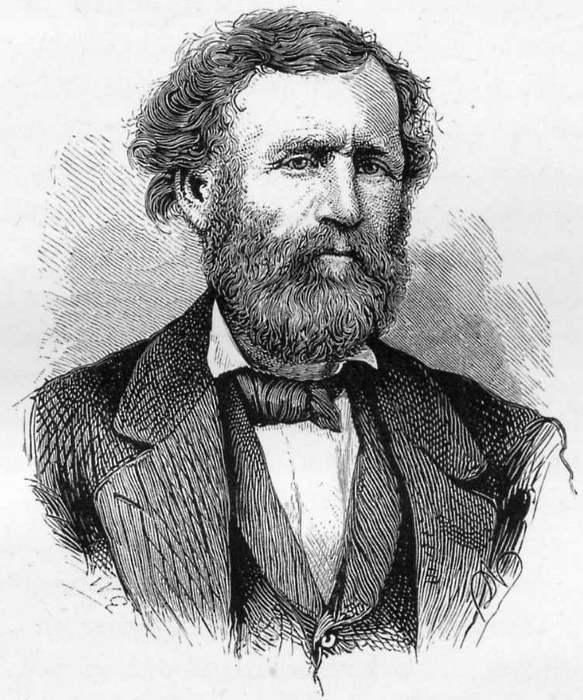
In preparing this narrative, the writer has had the good fortune to
listen to many recitals of facts and incidents by the late Judge
Augustus Porter and the late General Peter B. Porter, whose names are
intimately and honorably connected with the more recent history, not
only of this particular locality but of the Empire State.
Judge Porter, after having spent several years in surveying and lotting
large portions of the territory of Western New York and the Western
Reserve in Ohio, came from Canandaigua to Niagara Falls with his family
in June, 1806, where he continued to live until his death, nearly fifty
years afterward.
General Porter settled as a lawyer at Canandaigua in 1795, removed to
Black Rock in 1810, and to Niagara Falls in 1838.
In 1805, the two brothers became interested with others in the purchase
from the State of New York of four lots in the Mile Strip lying both
above and below the Falls.
A few years later, they purchased not only the interest of their
partners in these lots, but other lands at different points along this
strip. In 1814, they bought of Samuel Sherwood a paper since named a
float—an instrument given by the State authorizing the bearer to
locate two hundred acres of any of the unsold or unappropriated lands
belonging to the State. This float they fortunately anchored on Goat
Island and the islands adjacent thereto lying "immediately above and
adjoining the Great Falls."
The origin of the name of Goat Island is as follows: Mr. John Stedman,
who came into the country in 1760, had cleared a portion of the upper
end of the island, and in the summer of 1779 he placed on it an aged and
dignified male goat. The following winter was very severe, navigation to
the island was impracticable, and the goat fell a victim to the intense
cold. Since which the scene of his exile and death has been called Goat Island.
By the terms of the Treaty of Ghent, December 24, 1814, the boundary
line between Great Britain and the United States, on the Niagara
frontier, was to run through the deepest water along the river-courses
and through the center of the Great Lakes. As the deepest water, at this
point, is in the center of the Horseshoe Fall, the islands in the river
fell to the Americans. General Porter, acting as Commissioner for the
United States, proposed to call the largest one Iris Island, and it was
so printed on the boundary maps. But the public adhered to the old name
of Goat Island.
One of the early chronicles states that the island contained two hundred
and fifty acres of land. At the present time there are in it less than
seventy. A strip some ten rods wide by eighty rods long has been worn
away from the southern side of it since 1818, when Judge Porter made the
first road around it.
The earliest date he found on the island was 1765, carved on a
beech-tree. The earliest date cut in the rock on the main-land was 1645.
Human bones and arrowheads were found on the island. The Indians went to
it with their canoes, which they paddled up and down in the
comparatively quiet water lying on the rocky bar which extends upward
nearly a mile above the head of the island.
Notwithstanding this fact, the Swedish naturalist, Kalm, who visited the
place in 1750, relates a fabulous story of two Indians who, on a hunting
excursion above the Falls, drank too freely from "two bottles of French
brandy" which they brought from Fort Niagara; becoming drowsy, they laid
themselves down in the bottom of their canoe for a nap.
The canoe swung off shore and floated down-stream. Nearing the rapids,
the noise awakened one of them, who had apparently been more fortunate
in learning the English language from the French than most of his tribe,
for, seeing their perilous situation, he exclaimed: "We are gone!" But
the two plied their paddles with such aboriginal vigor that they
succeeded in landing on Goat Island. From the sequel it would seem that
they must have destroyed or lost their canoe. Finding no houses of
refreshment, nor cairns of stores left by former explorers, and most
naturally getting hungry, they concluded it would be desirable to get
back to the fort—a wish more easily expressed than accomplished.
But it was necessary for them to "do or die." So, as the story runs,
they stripped the bark from the basswood trees, and with it made a
ladder long enough to reach from a tree standing on the edge of the
precipice at the foot of the island down to the water below.
After dropping their ladder they followed it downward. Reaching the
water, and being good swimmers, they plunged in with great glee,
expecting to be able to swim across to the opposite shore, which they
could easily climb. But the counter current forced them back to the island.
After being a good deal bruised on the rocks, they were compelled to
abandon the attempt to cross, and then returned up their ladder to the
island. There, after much whooping, they attracted the notice of other
Indians on the shore. These reported the situation at the fort, and the
commandant sent up a party of whites and Indians to rescue them. They
brought with them four light pike-poles. Going to a point opposite the
head of the island, they exchanged salutations with the new Crusoes, and
began preparations for their rescue. Two Indians volunteered to
undertake the task. "They took leave of all their friends as if they
were going to their death." Each Indian rescuer, according to the
wondrous fable, took two pike-poles and waded across the channel to
the island, gave each of the Crusoes a pike-pole, and then the four
waded back to the main-land, where they were joyfully received by their
anxious, waiting friends, after having been "nine days on the island."
Remembering that the water in mid-channel is twelve feet deep, with a
twelve-mile current, we must concede this to be the most marvelous of
all aquatic achievements.
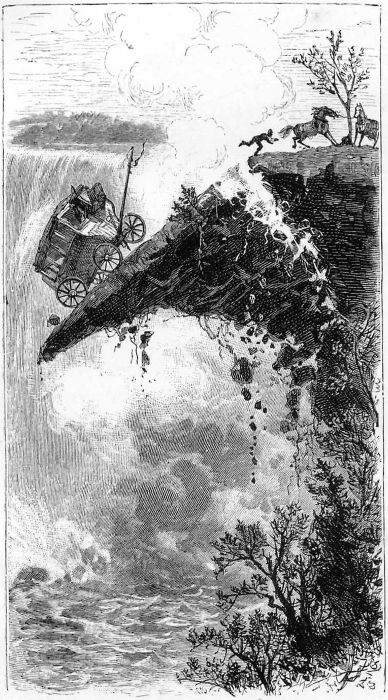
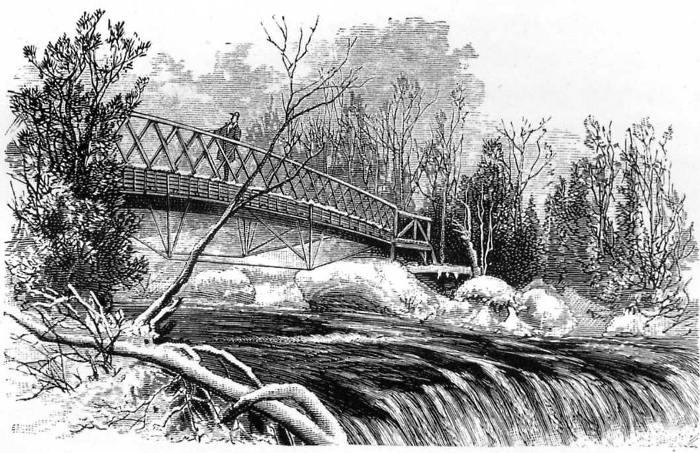
In 1817 Judge Porter built the first bridge to Goat Island, about forty
rods above the present bridge. In the following spring the large cakes
of ice from the river above, not being sufficiently broken up by the
short stretch of rapids over which they passed, struck the bridge with
terrific force, and carried away the greater part of it. With the
courage and enterprise of a New-Englander, the next season he
constructed another bridge farther down, on the present site, rightly
judging that the ice would be so much broken up before reaching it as to be harmless.
That bridge, with constant repairs and one almost entire renewal, stood
firm in its place until the year 1856, when it was removed to make room
for the present iron bridge. The old piers were much enlarged and
strengthened, and also raised about three feet higher to receive the new
bridge. As nearly every stranger inquires how the first bridge was
carried over the turbulent waters, a brief description of the process
may be acceptable. First, a strong bulkhead was built in the shallow
water next to the shore; a solid backing was put in behind this, and
the upper surface properly graded and well floored with plank. Strong
rollers were placed parallel with the stream and fastened to the floor.
In the old forest then standing near by were many noble oaks, of
different sizes and great length. A number of these were felled and
hewed "tapering," as it was termed, so that, when finished, they were
about eighteen inches square at the butt, fifteen at the top, and eighty
feet long. Through the small ends were bored large auger-holes. These
sticks were placed, as required, on the rollers, at right angles to the
stream, the small ends over the water, and the shore ends heavily weighted down.
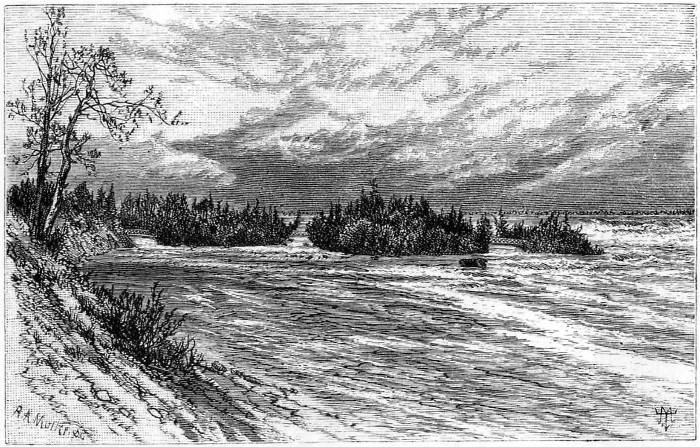
Second Moss Island Bridge
The first stick being properly placed, levers were applied to the
rollers and the stick was run out until the small end reached an eddy in
the water. Then another similar stick was run out in like manner,
parallel to the first, and about six feet from it. A few light, strong
planks were placed across and made fast. Two men were provided each with
strong, iron-pointed pike-staffs, each staff having in its upper end a
hole, through which was drawn some ten feet of new rope. Thus provided,
they walked out on the timbers, drove their iron pikes down among the
stones, and tied them fast to the timbers. Thus the whole problem was
solved. Around these pike-staffs the first pier was built and filled
with stone. Then other timbers were run out, all were planked over, and
the first span was completed. The other spans were laid in the same way.
The great Indian chief and orator, Red Jacket, occasionally visited
Judge and General Porter—the latter then living at Black Rock. Judge
Porter told this anecdote of the chief: He visited the Falls while the
mechanics were stretching the timbers across the rapids for the second
bridge. He sat for a long time on a pile of plank, watching their
operations. His mind seemed to be busy both with the past and the
present, reflecting upon the vast territory his race once possessed, and
intensely conscious of the fact that it was theirs no longer. Apparently
mortified, and vexed that its paleface owners should so successfully
develop and improve it, he rose from his seat, and, uttering the
well-known Indian guttural "Ugh, ugh!" he exclaimed: "D——n Yankee!
d——n Yankee!" Then, gathering his blanket-cloak around him, with his
usual dignity and downcast eyes, he slowly walked away, and never
returned to the spot.
Before parting with the distinguished chief, we will repeat after
General Porter two other anecdotes characteristic of him. He lived not
far from Buffalo, on the Seneca Reservation, and frequently visited the
late General Wadsworth, at Geneseo. Indeed, his visits grew to be
somewhat perplexing, for the great chief must be entertained personally
by the host of the establishment.
Of course he was a "teetotaler"—only in one way. When he got a glass of
good liquor he drank the whole of it. He was very fond of the rich
apple-juice of the Geneseo orchards. Having repeated his visits to
General Wadsworth, at one time, with rather inconvenient frequency, and
coming one day when the General saw that he had been drinking pretty
freely somewhere else, his host concluded he would not offer him the
usual refreshments. In due time, therefore, Red Jacket rose and excused
himself. As he was leaving the room the orator said, "General, hear!"
"Well, what, Red Jacket?" To which he replied with great gravity:
"General, when I get home to my people, and they ask me how your cider
tasted, what shall I tell them?" Of course he got the cider.
His determined and constant opposition to the sale of the lands
belonging to the Indians is well known. At the council held at Buffalo
Creek, in 1811, he was selected by the Indians to answer the proposition
of a New York land company to buy more land. The Indians refused to
sell, although, as usual, the company only wanted "a small tract." To
illustrate the system, after the speech-making was over, Red Jacket
placed half a dozen Indians on a log, which lay near by. They did not
sit very close together, but had plenty of room. He then took a white
man who wanted "a small tract," and making the Indians at one end "move
up," he put the white man beside them. Then he brought another
"small-tract" white man, and making the aborigines "move up" once more,
the Indian on the end was obliged to rise from the log. He repeated this
process until but one of the original occupants was left on the log.
Then suddenly he shoved him off, put a white man in his place, and
turning to the land agent said: "See what one small tract means; white
man all, Indian nothing."
Colonel William L. Stone, in his "Life of Red Jacket," relates the
following: In 1816, after Red Jacket took up his residence on Buffalo
Creek, east of the city, a young French count traveling through the
country made a brief stay at Buffalo, whence he sent a request to the
sachem to visit him at his hotel.
Red Jacket, in reply, informed the young nobleman that if he wished to
see the old chief he would give him a welcome greeting at his cabin. The
count sent again to say that he was much fatigued by his journey of four
thousand miles, which he had made for the purpose of seeing the
celebrated Indian orator, Red Jacket, and thought it strange that he
should not be willing to come four miles to meet him. But the proud and
shrewd old chief replied that he thought it still more strange, after
the count had traveled so great a distance for that purpose, that he
should halt only a few miles from the home of the man he had come so far
to see. The count finally visited the sachem at his house, and was much
pleased with the dignity and wisdom of his savage host. The point of
etiquette having been satisfactorily settled, the chief accepted an
invitation to dinner, and was no doubt able to tell his people how the
count's "cider" tasted.
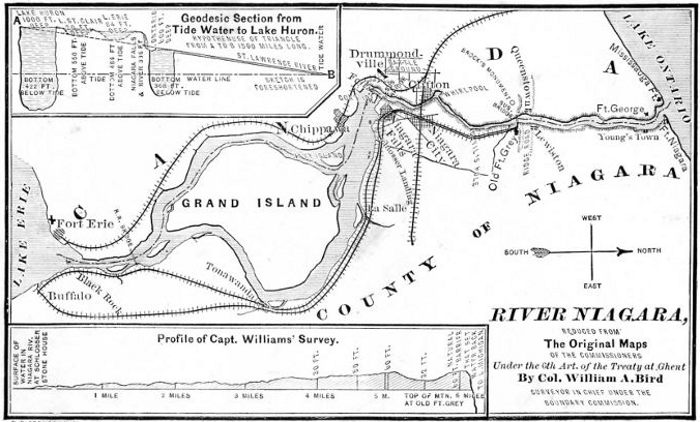
In 1819, when the boundary commissioners ran the line through the
Niagara River, Grand Island fell to the United States, under the rule
that that line should be in the center of the main channel. To ascertain
this, accurate measurements were made, by which it was found that
12,802,750 cubic feet of water passed through the Canadian channel, and
8,540,080 through the American channel. To test the accuracy of these
measurements, the quantity passing in the narrow channel at Black Rock
was determined by the same method, and was found to be 21,549,590 cubic
feet, thus substantially corroborating the first two measurements.
The Indian name of Grand Island is Owanunga. In 1825, Mr. M. M. Noah, a
politician of the last generation, took some preliminary steps for
reëstablishing the lost nationality of the Jews upon this island, where
a New Jerusalem was to be founded. Assuming the title of "Judge of
Israel," he appeared at Buffalo in September for the purpose of founding
the new nation and city. A meeting was held in old St. Paul's Church, at
which, with the aid of a militia company, martial music, and masonic
rites, the remarkable initiatory proceedings took place.
The self-constituted judge presented himself arrayed in gorgeous robes
of office, consisting of a rich black cloth tunic, covered by a
capacious mantle of crimson silk trimmed with ermine, and having a
richly embossed golden medal hanging from his neck. After what, in the
account published in his own paper of the day's proceedings, he called
"impressive and unique ceremonies," he read a proclamation to "all the
Jews throughout the world," informing them "that an Asylum was prepared
and offered to them," and that he did "revive, renew, and establish (in
the Lord's name), the government of the Jewish nation, * * * confirming
and perpetuating all our rights and privileges, our rank and power,
among the nations of the earth as they existed and were recognized under
the government of the Judges." He also ordered a census to be taken of
all the Hebrews in the world, and levied a capitation tax of three
shekels—about one dollar and sixty cents—"to pay the expenses of
re-organizing the government and assisting emigrants." He had prepared a
"foundation stone," which was afterward erected on the site of the new
city, and which bore the following inscription:
"Hear, O Israel, the Lord
is our God—the Lord is one."
"ARARAT,
A CITY OF REFUGE FOR THE JEWS,
FOUNDED BY MORDECAI MANUEL NOAH,
IN THE MONTH OF TISRI 5586—SEPT. 1825,
IN THE FIFTIETH YEAR OF
AMERICAN INDEPENDENCE."
After the meeting at St. Paul's, the "Judge" returned at once to New
York, and, like the great early ruler of his nation, he only saw the
land of promise, as he never crossed to the island.
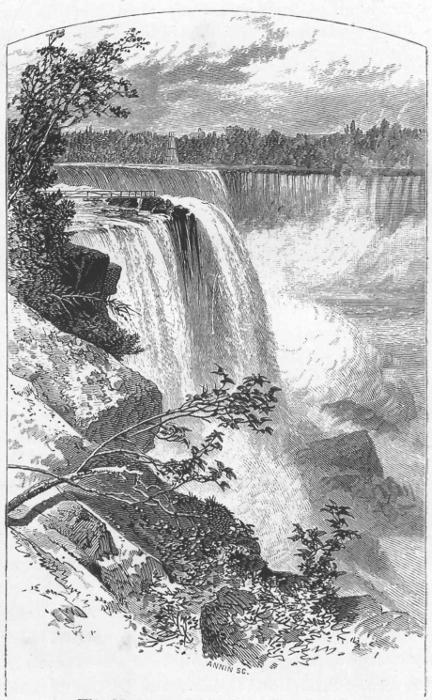
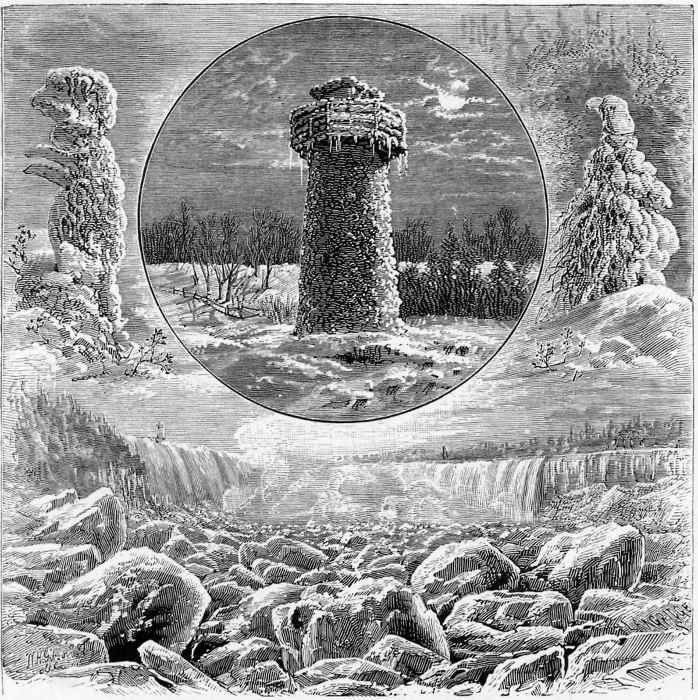
The strong round tower, called the Terrapin Tower, which stood near Goat
Island, not far from the precipice, was built in 1833, of stones
gathered in the vicinity. It was forty-five feet high, and twelve feet
in diameter at the base. So much was said in 1873 about the growing
insecurity of the tower that it was taken down.
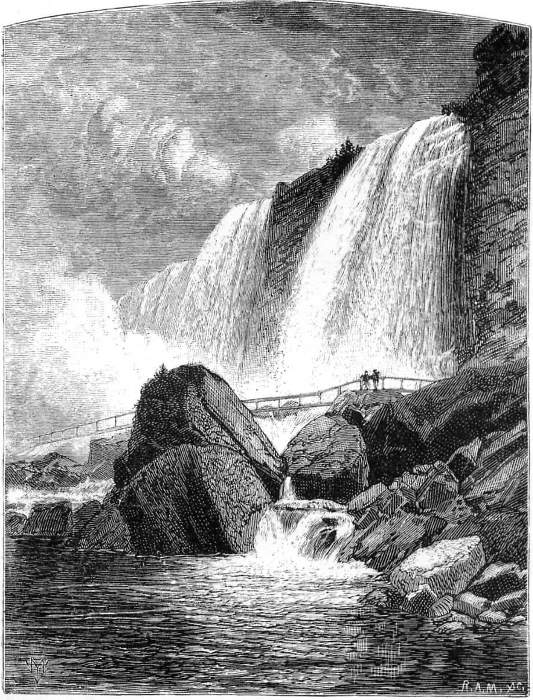
The Biddle Staircase was named for Mr. Nicholas Biddle, of Philadelphia,
who contributed a sum of money toward its construction. It was erected
in 1829. The shaft is eighty feet high and firmly fastened to the rock.
The stairs are spiral, winding round it from top to bottom. Near the
foot of these stairs, at the water's edge, Samuel Patch, who wished to
demonstrate to the world that "some things could be done as well as
others," set up a ladder one hundred feet high, from which he made two
leaps into the water below. Going thence to Rochester, he took another
leap near the Genesee Falls, which proved to be his last.
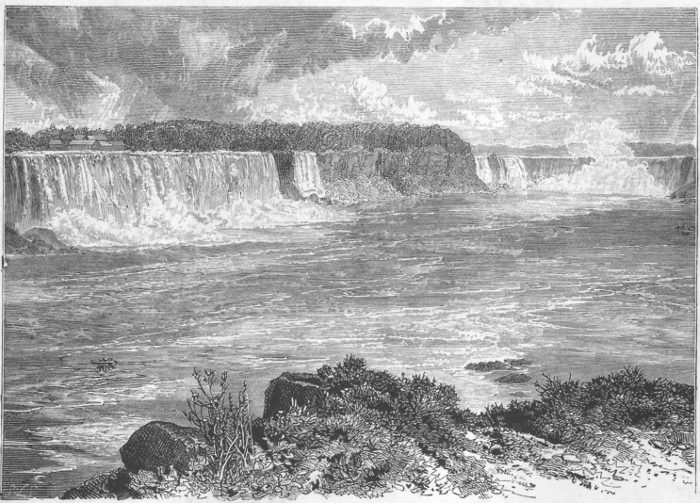
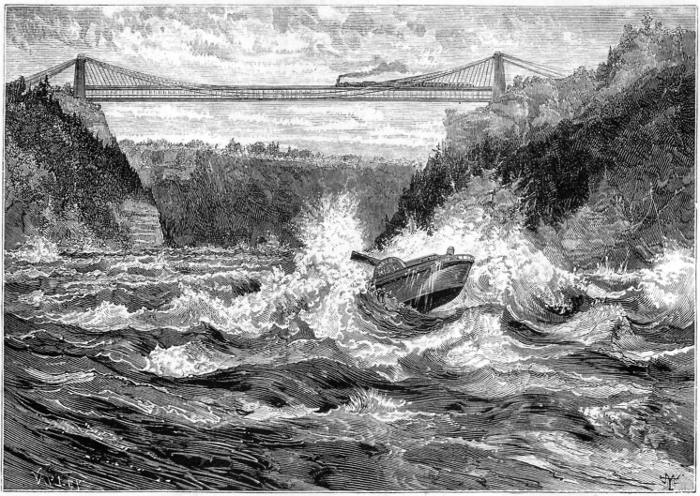
The depth of water on the Horseshoe Fall is a subject of speculation
with every visitor. It was correctly determined in 1827. In the autumn
of that year, the ship Michigan, having been condemned as unseaworthy,
was purchased by a few persons, and sent over the Falls. Her hull was
eighteen feet deep. It filled going down the rapids, and went over the
Horseshoe Fall with some water above the deck, indicating that there
must have been at least twenty feet of water above the rock. This voyage
of the Michigan was an event of the day. A glowing hand-bill, charged
with bold type and sensational tropes, announced that "The Pirate
Michigan, with a cargo of furious animals," would "pass the great
rapids and the Falls of Niagara," on the "eighth of September, 1827."
She would sail "through the white-tossing and deep-rolling rapids of
Niagara, and down its grand precipice into the basin below."
Entertainment was promised "for all who may visit the Falls on the
present occasion, which will, for its novelty and the remarkable
spectacle it will present, be unequaled in the annals of infernal
navigation." Considering that the Falls could be reached only by road
conveyances, the gathering of people was very large. The voyage was
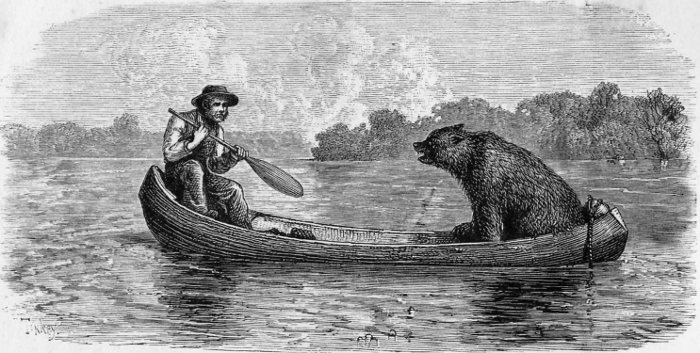
successfully made, and the "cargo of live animals" duly deposited in the
"basin below," except a bear which left the ship near the center of the
rapids and swam ashore, but was recaptured.
Two enterprising individuals made arrangements to supply the people
assembled on the island with refreshments. They had an ample spread of
tables and an abundant supply of provisions. As there was much delay in
getting the vessel down the river, the people got impatient and hungry.
They took their places at the tables. When their appetites were nearly
satisfied, notice was given that the ship was coming, whereupon they
departed hurriedly, forgetting to leave the equivalent half-dollar for
the benefit of the purveyors.
In after years, one of the proprietors of this unexpected "free
lunch"—the late General Whitney—established here one of the best
hotels in the country, and left his heirs an ample fortune.
A few geese in the cargo were only badly confused by their unusual
plunge, and were afterward picked up from boats. It was noticed as being
a little singular that geese which went over the Falls in the Pirate
Michigan were for sale at extravagant prices all the next season.
Another condemned vessel of about five hundred tons burden, the
Detroit, which had belonged to Commodore Perry's victorious fleet, was
sent down the rapids in 1841. A large concourse of people assembled from
all parts of the country to witness the spectacle. Her rolling and
plunging in the rapids were fearful, until about midway of them she
stuck fast on a bar, where she lay until knocked to pieces by the ice.
From Baron La Hontan we know that the Indians went on the water, just
below the Falls, in their canoes, to gather the game which had been
swept over them. For more than a hundred years there has been a ferry of
skiff and yawl boats at this point, and in all that time not one serious
accident has happened.