WITH only half a chance our smaller wild animals—the fox, the mink,
the ’coon, the ’possum, the rabbit—would thrive, and be happy forever
on the very edges of the towns and cities. Instead of a hindrance,
houses and farms, roads and railways are a help to the wild animals,
affording them food and shelter as their natural conditions never
could. So, at least, it seems; for here on Mullein Hill, hardly twenty
miles from the heart of Boston, there are more wild animals than I
know what to do with—just as if the city of Boston were a big skunk
farm or fox farm, from which the countryside all around (particularly
my countryside) were being continually restocked.
But then, if I seem to have more foxes than a man of chickens needs to
have, it is no wonder, living as I do on a main traveled road in
Foxland, a road that begins off in the granite ledges this side of
Boston, no one knows where, and, branching, doubling, turning, no one
knows how many times, comes down at last along the trout brook to the
street in front of my house, where, leaping the brook and crossing the
street, it runs beside my foot-path, up the hill, to the mowing-field
behind the barn.
When I say that last fall the hunters, standing near the brook where
this wild-animal road and the wagon road cross, shot seven foxes, you
will be quite ready to believe that this is a much-traveled road, this
road of the foxes that cuts across my mowing-field; and also that I am
quite likely to see the travelers, now and then, as they pass by.
So I am, especially in the autumn, when game grows scarce; when the
keen frosty air sharpens the foxes’ appetites, and the dogs, turned
loose in the woods, send the creatures far and wide for—chickens!
For chickens? If you have chickens, I hope your chicken-coop does not
stand along the side of a fox road, as mine does. For straight across
the mowing-field runs this road of the foxes, then in a complete
circle right round the chicken yard, and up the bushy ridge into the
wood.
How very convenient! Very, indeed! And how thoughtful of me! Very
thoughtful! The foxes appreciate my kindness; and they make a point of
stopping at the hen-yard every time they pass this way.
It is interesting to know, too, that they pass this way almost every
night, and almost every afternoon, and at almost every other odd time,
so that the hens, with hundreds of grubby acres to scratch in, have to
be fenced within a bare narrow yard, where they can only be seen by
the passing foxes.
Even while being driven by the dogs, when naturally they are in
something of a hurry, the foxes will manage to get far enough ahead of
the hounds to come by this way and saunter leisurely around the coop.
I have a double-barreled gun and four small boys; but terrible as that
combination sounds, it fails somehow with the foxes. It is a
two-barreled-four-boyed kind of a joke to them. They think that I am
fooling when I blaze away with both barrels at them. But I am not.
Every cartridge is loaded with BB shot. But that only means
Blank-Blank to them, in spite of all I can do. The way they jump
when the gun goes off, then stop and look at me, is very irritating.
This last spring I fired twice at a fox, who jumped as if I had hit
him (I must have hit him), then turned himself around and looked all
over the end of the barn to see where the shots were coming from. They
were coming from the back barn window, as he saw when I yelled at him.
It was an April morning, cold and foggy, so cold and foggy and so very
early that my chattering teeth, I think, disturbed my aim.
It must have been about four o’clock when one of the small boys
tiptoed into my room and whispered, “Father, quick! there’s a fox
digging under Pigeon Henny’s coop behind the barn.”
I was up in a second, and into the boys’ room. Sure enough, there in
the fog of the dim morning I could make out the moving form of a fox.
He was digging under the wire runway of the coop.
The old hen was clucking in terror to her chicks. It was she who had
awakened the boys.
There was no time to lose. Downstairs I went, down into the basement,
where I seized the gun, and, slipping in a couple of shells, slid out
of the cellar door and crept stealthily into the barn.
The back window was open. The thick wet fog poured in like dense
smoke. I moved swiftly in my bare feet and peered down upon the field.
There stood the blur of the coop,—a dark shadow only in the fog,—but
where was the fox?
Pushing the muzzle of my double-barreled gun across the window-sill, I
waited. And there in the mist stood the fox, reaching in with his paw
under the wire that inclosed the coop.
Carefully, deliberately, I swung the gun on the window-sill until the
bead drew dead upon the thief; then, fixing myself as firmly as I
could with bare feet, I made sure of my mark and fired.
I do not wonder that the fox jumped. I jumped, myself, as both barrels
went off together. A gun is a sudden thing at any time of day, but so
early in the morning, and when everything was wrapped in silence and
ocean fog, the double explosion was extremely startling.
The fox jumped, as naturally he would. When, however, he turned
deliberately around and looked all over the end of the barn to see
where I was firing from, and stood there, until I shouted at him—I
say it was irritating.
But I was glad, on going out later, to find that neither charge of
shot had hit the coop. The coop was rather large, larger than the
ordinary coop; and taking that into account, and the thick, uncertain
condition of the atmosphere, I had not made a bad shot after all. It
was something not to have killed the hen.
But the fox had killed eleven of the chicks. One out of the brood of
twelve was left. The rascal had dug a hole under the wire; and then,
by waiting as they came out, or by frightening them out, had eaten
them one by one.
There are guns and guns, and some, I know, that shoot straight. But
guns and dogs and a dense population have not yet availed here against
the fox.
One might think, however, when the dogs are baying hard on the heels
of a fox, that one’s chickens would be safe enough for the moment from
that particular fox. But there is no pack of hounds hunting in these
woods swift enough or keen enough to match the fox. In literature the
cunning of the fox is very greatly exaggerated. Yet it is, in fact,
more than equal to that of the hound.
A fox, I really believe, enjoys an all-day run before the dogs. And as
for house dogs, I have seen a fox, that was evidently out for mischief
and utterly tired of himself, come walking along the edge of the knoll
here by the house, and, squatting on his haunches, yap down lonesomely
at the two farm dogs below.
This very week I heard the hounds far away in the ledges. I listened.
They were coming toward me, and apparently on my side of the brook. I
had just paused at the corner of the barn when the fox, slipping along
the edge of the woods, came loping down to the hen-yard within easy
gun-shot of me. He halted for a hungry look at the hens through the
wire fence, then trotted slowly off, with the dogs yelping fully five
minutes away in the swamp.
How many minutes would it have taken that fox to snatch a hen, had
there been a hen on his side of the fence? He could have made
chicken-sandwiches of a hen in five minutes, could have eaten them,
too, and put the feathers into a bolster—almost! How many of my hens
he has made into pie in less than five minutes!
As desserts go, out of doors, he has a right to a pie for fooling the
dogs out of those five crowded minutes. For he does it against such
uneven odds, and does it so neatly—sometimes so very thrillingly! On
three occasions I have seen him do the trick, each time by a little
different dodge.
One day, as I was climbing the wooded ridge behind the farm, I heard a
single foxhound yelping at intervals in the hollow beyond. Coming
cautiously to the top, I saw the hound below me beating slowly along
through the bare sprout-land, half a mile away, and having a hard time
holding to the trail. Every few minutes he would solemnly throw his
big black head into the air, stop stock-still, and yelp a long doleful
yelp, as if begging the fox to stop its fooling and try to leave a
reasonable trail.
The hound was walking, not running; and round and round he would go,
off this way, off that, then back when, catching the scent again, he
would up with his muzzle and howl for all the woods to hear. But I
think it was for the fox to hear.
I was watching the curious and solemn performance, and wondering if
the fox really did hear and understand, when, not far from me, on the
crown of the ridge, something stirred.
Without moving so much as my eyes, I saw the fox, a big beauty, going
slowly and cautiously round and round in a small circle among the
bushes, then straight off for a few steps, then back in the same
tracks; off again in another direction and back again; then in and
out, round and round, until, springing lightly away from the top of a
big stump near by, the wily creature went gliding swiftly down the
slope.
The hound with absolute patience worked his sure way up the hill to
the circle and began to go round and round, sniffling and whimpering
to himself, as I now could hear; sniffling and whimpering with
impatience, but true to every foot-print of the trail. Round and
round, in and out, back and forth, he went, but each time in a wider
circle, until the real trail was picked up, and he was away with an
eager cry.
I once again saw the trick played, so close to me, and so
deliberately, with such cool calculating, that it came with something
of a revelation to me of how the fox may feel, of what may be the
state of mind in the wild animal world.
It was a late October evening, crisp and clear, with a moon almost
full. I had come up from the meadow to the edge of the field behind
the barn, and stood leaning back upon a short-handled hayfork,
looking. It was at everything that I was looking—the moonlight, the
gleaming grass, the very stillness, so real and visible it seemed at
the falling of this first frost. I was listening too, when, as far
away as the stars, it seemed, came the cry of the hounds.
You have heard at night the passing of a train beyond the mountains?
the sound of thole-pins round a distant curve in the river? the
closing of a barn door somewhere down the valley? Strange it may seem
to one who has never listened, but the far-off cry of the hounds is
another such friendly and human voice, calling across the vast of the
night.
They were coming. How clear their tones, and bell-like! How mellow in
the distance, ringing on the rim of the moonlit sky, as round the
sides of a swinging silver bell. Their clanging tongues beat all in
unison, the sound rising and falling through the rolling woodland, and
spreading like a curling wave as the pack broke into the open over the
level meadows.
I waited. Rounder, clearer, came the cry. I began to pick out the
individual voices as now this one, now that, led the chorus across
some mighty measure of The Chase.
Was it a twig that broke? Some brittle oak leaf that cracked in the
path behind me? A soft sound of feet! Something breathed, stopped,
came on—and in the moonlight before me stood the fox!
The dogs were coming, but I was standing still. And who was I, anyway?
A stump? A post? No, he saw instantly that I was more than an ordinary
post. How much more?
The dogs were coming!
“Well,” said he, as plainly as anything was ever said, “I don’t know
what you are. But I will find out.” And up he came and sniffed at my
shoes. “This is odd,” he went on, backing carefully off and sitting
down on his tail in the edge of a pine-tree shadow. “Odd indeed. Not a
stump; not a man, in spite of appearances, for a man could never stand
still so long as that.”
The dogs were crashing through the underbrush below, their fierce
cries quivering through the very trees about me.
The fox got up, trotted back and forth in front of me for the best
possible view, muttering, “Too bad! Too bad! What an infernal nuisance
a pack of poodles can make of themselves at times! Here is something
new in the woods, and smells of the hen-yard, as I live! Those silly
dogs!” and trotting back, down the path over which he had just come,
he ran directly toward the coming hounds, leaped off into a pile of
brush and stones, and vanished as the hounds rushed up in a yelping,
panting whirl about me.
Cool? Indeed it was! He probably did not stop, as soon as he was out
of sight, and make faces at the whole pack. But that is because they
have politer ways in Foxland.
It is no such walking-match as this every time. It is nip and tuck,
neck and neck, a dead heat sometimes, when only his superior knowledge
of the ground saves the fox a whole skin.
Perhaps there are peculiar conditions, at times, that are harder for
the fox than for the dogs, as when the undergrowth is all adrip with
rain or dew, and every jump forward is like a plunge overboard. His
red coat is longer than the short, close hair of the hound, and his
big brush of a tail, heavy with water, must be a dragging weight over
the long hard course of the hunt. If wet fur to him means the same as
wet clothes to us, then the narrow escape I witnessed a short time ago
is easily explained. It happened in this way:—
I was out in the road by the brook when I caught the cry of the pack;
and, hurrying up the hill to the “cut,” I climbed the gravel bank for
a view down the road each way, not knowing along which side of the
brook the chase was coming, nor where the fox would cross.
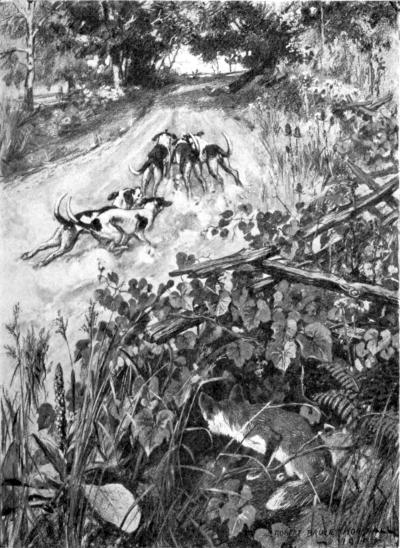
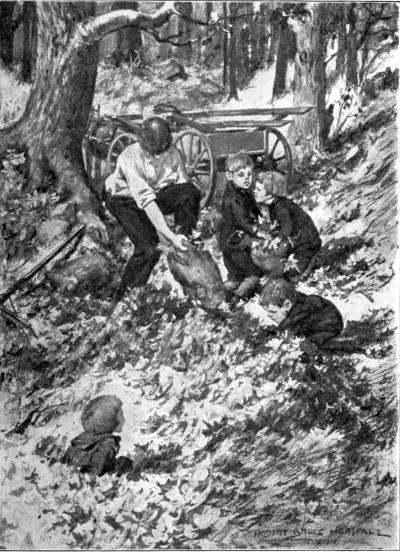
“OVER THE HILL IN A WHIRLWIND OF DUST AND HOWLS”
Not since the Flood had there been a wetter morning. The air could not
stir without spilling; the leaves hung weighted with the wet; the very
cries of the hounds sounded thick and choking, as the pack floundered
through the alder swamp that lay at the foot of the hill where I was
waiting.
There must be four or five dogs in the pack, I thought; and surely now
they are driving down the old runway that crosses the brook at my
meadow.
I kept my eye upon the bend in the brook and just beyond the big swamp
maple, when there in the open road stood the fox.
He did not stand; he only seemed to, so suddenly and unannounced had
he arrived. Not an instant had he to spare. The dogs were smashing
through the briars behind him. Leaping into the middle of the road,
he flew past me straight up the street, over the ridge, and out of
sight.
I turned to see the burst of the pack into the road, when flash! a
yellow streak, a rush of feet, a popping of dew-laid dust in the road,
and back was the fox, almost into the jaws of the hounds, as he shot
into the tangle of wild grapevines around which the panting pack was
even then turning!
With a rush that carried them headlong past the grapevines, the dogs
struck the warm trail in the road and went up over the hill in a
whirlwind of dust and howls.
They were gone. The hunt was over for that day. Somewhere beyond the
end of the doubled trail the pack broke up and scattered through the
woods, hitting a stale lead here and there, but not one of them, so
long as I waited, coming back upon the right track to the grapevines,
through whose thick door the hard-pressed fox had so narrowly won his
way.