I will now ask the reader to make a note of the passage of a fortnight.
By so doing he will find himself close upon the 24th of June,—another
memorable day in the drama of the conquest.
’Tzin Guatamo, as is already known, had many times proven himself a
warrior after the manner of his country, and, in consequence, had long
been the idol of the army; now he gave token of a ruling faculty which
brought the whole people to his feet; so that in Tenochtitlan, for the
first time in her history, were seen a sceptre unknown to the law and a
royalty not the king’s.
He ruled in the valley everywhere, except in the palace of Axaya’; and
around that he built works, and set guards, and so contrived that
nothing passed in or out without his permission. His policy was to wait
patiently, and in the mean time organize the nation for war; and the
nation obeyed him, seeing that in obedience there was life; such,
moreover, was the will of Huitzil’.
As may be thought, the Christians thus pent up fared illy; in fact, they
would have suffered before the fortnight was gone but for the king, who
stinted himself and his household in order to divide with his keepers
the supplies sent in for his use.
In the estimation of the people of the empire, it was great glory to
have shut so many teules in a palace, and held them there; but the
success did not deceive the ’tzin: in his view, that achievement was not
the victory, but only the beginning of the war; every hour he had news
of Malinche, the real antagonist, who had the mind, the will, and the
hand of a warrior, and was coming with another army, more numerous, if
not braver, than the first one. In pure, strong love there is an element
akin to the power of prophecy,—something that gives the spirit eyes to
see what is to happen. Such an inspiration quickened the ’tzin, and told
him Anahuac was not saved, though she should be: if not, the conquerors
should take an empty prize; he would leave them nothing,—so he
swore,—neither gods, gold, slaves, city, nor people. He set about the
great idea by inviting the New World—I speak as a Spaniard—to take
part in the struggle. And he was answered. To the beloved city, turned
into a rendezvous for the purpose, flocked the fighting vassals of the
great caciques, the men of the cities, and their dependencies, the
calpulli, or tribes of the loyal provinces, and, mixed with them,
wild-eyed bands from the Unknown, the wildernesses,—in all, a multitude
such as had never been seen in the valley. At the altars he had but one
prayer, “Time, time, O gods of my fathers! Give me time!” He knew the
difference between a man and a soldier, and that, likewise, between a
multitude and an army. As he used the word, time meant organization and
discipline. He not only prayed, he worked; and into his work, as into
his prayers, he poured all his soul.
The organization was simple: first, a company of three or four hundred
men; next an army of thirty or forty companies,—a system which allowed
the preservation of the identity of tribes and cities. The companies of
Cholula, for example, were separate from those of Tezcuco; while the
Acolmanes marched and fought side by side with the Coatopecs, but under
their own chiefs and flags. The system also gave him a number of armies,
and he divided them,—one to raise supplies, another to bring the
supplies to the depots, a third to prepare material of war; the fourth
was the active or fighting division; and each was subject to take the
place of the other. To the labor of so many hands, systematized and
industriously exerted, though for a fortnight, almost everything is
possible. One strong will, absolutely operative over thousands, is
nearer omnipotency than anything else human.
The climate of the valley, milder and more equable than that of Naples,
permits the bivouac in all seasons. The sierra west of the capital, and
bending around it like a half-drawn bow, is marked on its interior, or
city side by verdant and watered vales; these were seized; and the
bordering cliffs, which theretofore had shaded the toiling husbandman,
or been themselves the scenes of the hunter’s daring, now hid the hosts
of New World’s men, in the bivouac, biding the day of battle.
War, good reader, never touches anything and leaves it as it was. And
the daughter of the lake, fair Tenochtitlan, was no exception to the
law. The young master, having reduced the question of strategy to the
formula,—a street or a plain, chose the street, and thereby dedicated
the city to all of ruin or horror the destroyer could bring. Not long,
therefore, until its presence could have been detected by the idlest
glance: the streets were given up to the warriors; the palaces were
deserted by families; houses conveniently situated for the use were
turned into forts; the shrubbery garnishing roofs that dominated the
main streets concealed heaps of stones made ready for the hand; the
bridges were taken up, or put in condition to be raised; the canoes on
the lakes were multiplied, and converted to the public service; the
great markets were suspended; even the sacred temple were changed into
vast arsenals. When the ’tzin, going hither and thither, never idle,
observed the change, he would sigh, but say to himself, “’Tis well. If
we win, we can restore; if we lose,—if we lose,—then, to the
strangers, waste, to the waters, welcome!”
And up and down, from city to bivouac and back again, passed the
minstrels, singing of war, and the pabas, proclaiming the oracles and
divine promises; and the services in the temples were unintermitted;
those in the teocallis were especially grand; the smoke from its
turrets overhung the city, and at night the fire of Huitzil’, a new star
reddening in the sky, was seen from the remotest hamlet in the valley.
The ’tzin had faith in moral effects, and he studied them, and was
successful. The army soon came to have, like himself, but one
prayer,—“Set us before the strangers; let us fight!”
And the time they prayed for was come.
The night of the 23d of June was pleasant as night can be in that region
of pleasant nights. The sky was clear and starry. The breeze abroad
brought coolness to outliers on the housetops, without threshing the
lake to the disturbance of its voyageurs.
Up in the northeastern part of the little sea lay a chinampa at
anchor. Over its landing, at the very edge of the water, burned a
flambeau of resinous pine. Two canoes, richly decorated, swung at the
mooring. The path from the landing to the pavilion was carpeted, and
lighted by lamps pendent in the adjoining shrubbery. In the canoes the
slaves lay at rest, talking idly, and in low voices crooning Indian
songs. Close by the landing, on a bench, over which swayed the leaves of
an immense banana-tree, rested a couple of warriors, silent, and
nodding, as it were, to the nodding leaves. From the rising to the
setting of the day’s sun, many a weary league, from the city to the
vales of the Sierra in which bivouacked the hope of Anahuac, had they
travelled,—Hualpa and Io’. One familiar with the streets in these later
days, at sight of them would have said, “Beware! the ’tzin is hereaway.”
The three were almost as one,—so had their friendship grown. The
pavilion, a circular canopy, spread like a Bedouin’s tent, was brightly
lighted; and there, in fact, was the ’tzin, with Tula and Yeteve, the
priestess.
Once before, I believe, I described this pavilion; and now I know the
imagination of the reader will give the floating garden richer colors
than lie within compass of my pen; will surround it with light, and with
air delicious with the freshness of the lake and the exhalations of the
flowers; will hover about the guardian palm and willow trees, the latter
with boughs lithe and swinging, and leaves long and fine as a woman’s
locks; will linger about the retreat, I say, and, in thought of its
fitness for meeting of lovers, admit the poetry and respect the passion
of the noble Aztec.
Within, the furniture was as formerly; there were yet the carven stools,
the table with its bowl-like top, now a mass of flowers, a couch draped
with brilliant plumage, the floor covered with matting of woven grasses,
the hammock, and the bird-cage,—all as when we first saw them. Nenetzin
was absent, and alas! might never come again.
And if we enter now, we shall find the ’tzin standing a little apart
from Tula, who is in the hammock, with Yeteve by her side. On a stool at
his feet is a waiter of ebony, with spoons of tortoise-shell, and some
xicaras, or cups, used for chocolate.
Their faces are grave and earnest.
“And Malinche?” asked Tula, as if pursuing a question.
“The gods have given me time; I am ready for him,” he replied.
“When will he come?”
“Yesterday, about noon, he set out from Tezcuco, by way of the shore of
the lake; to-night he lodges in Iztapalapan; to-morrow, marching by the
old causeway, he will re-enter the city.”
“Poor, poor country!” she said, after a long silence.
The words touched him, and he replied, in a low voice, “You have a good
heart, O Tula,—a good heart and true. Your words were what I repeat
every hour in the day. You were seeing what I see all the time—”
“The battle!” she said, shuddering.
“Yes. I wish it could be avoided; its conditions are such that against
the advantage of arms I can only oppose the advantage of numbers; so
that the dearest of all things will be the cheapest. I must take no
account of lives. I have seen the streets run with blood already, and
now,—Enough! we must do what the gods decree. Yet the slaughter shall
not be, as heretofore, on one side alone.”
She looked at him inquiringly.
“You know the custom of our people to take prisoners rather than kill in
battle. As against the Tlascalans and tribes, that was well enough; but
new conditions require new laws, and my order now is, Save nothing but
the arms and armor of the strangers. Life for life as against Malinche!
And I could conquer him, but—”
He stopped, and their glances met,—his full of fire, hers sad and
thoughtful.
“Ah, Tula! your woman’s soul prompts you already of whom I would
speak,—the king.”
“Spare me,” she said, covering her face with her hands. “I am his child;
I love him yet.”
“So I know,” he replied; “and I would not have you do else. The love is
proof of fitness to be loved. Nature cannot be silenced. He is not as
near to me as to you; yet I feel the impulse that moves you, though in
a less degree. In memory, he is a part of my youth. For that matter, who
does not love him? He has charmed the strangers; even the guards at his
chamber-door have been known to weep at sight of his sorrow. And the
heroes who so lately died before his prison-gates, did not they love
him? And those who will die to-morrow and the next day, what else may be
said of them? In arms here, see the children of the valley. What seek
they? In their eyes, he is Anahuac. And yet—”
He paused again; her hands had fallen; her cheeks glistened with tears.
“If I may not speak plainly now, I may not ever. Strengthen yourself to
hear me, and hear me pitifully. To begin, you know that I have been
using the king’s power without his permission,—that, I say, you know,
and have forgiven, because the usurpation was not of choice but
necessity, and to save the empire; but you will hear now, for the first
time probably, that I could have been king in fact.”
Her gaze became intent, and she listened breathlessly.
“Three times,” he continued, “three times have the caciques, for
themselves and the army, offered me the crown. The last time, they were
accompanied by the electors,[48] and deputations from all the great
cities.”
“And you refused,” she said, confidently.
“Yes. I will not deny the offer was tempting,—that for the truth. I
thought of it often; and at such times came revenge, and told me I had
been wronged, and ambition, whispering of glory, and, with ready
subtlety, making acceptance appear a duty. But, Tula, you prevailed;
your love was dearer to me than the crown. For your sake, I refused the
overture. You never said so,—there was no need of the saying,—yet I
knew you could never be queen while your father lived.”
Not often has a woman heard such a story of love, or been given such
proofs of devotion; her face mantled, and she dropped her gaze,
saying,—
“Better to be so loved than to be queen. If not here, O ’tzin, look for
reward in the Sun. Surely, the gods take note of such things!”
“Your approval is my full reward,” he replied. “But hear me further.
What I have said was easy to say; that which I go to now is hard, and
requires all my will; for the utterance may forfeit not merely the
blessing just given me, but your love,—more precious, as I have shown,
than the crown. You were in the palace the day the king appeared and
bade the people home. The strangers were in my hand at the time. O, a
glad time,—so long had we toiled, so many had died! Then he came, and
snatched away our triumph. I have not forgotten, I never can forget the
disappointment. In all the labor of the preparation since, I have seen
the scene, sometimes as a threat, sometimes as a warning, always a
recurring dream whose dreaming leaves me less resolved in the course I
am running. Continually I find myself saying to myself, ‘The work is all
in vain; what has been will be again; while he lives, you cannot win.’ O
Tula, such influence was bad enough of itself. Hear now how the gods
came in to direct me. Last night I was at the altar of Huitzil’,
praying, when the teotuctli appeared, and said, ‘’Tzin Guatamo, pray
you for your country?’ ‘For country and king,’ I answered. He laid his
hand upon my shoulder, ‘If you seek the will of the god with intent to
do what he imposes, hear then: The king is the shield of the strangers;
they are safe while he lives; and if he lives, Anahuac dies. Let him who
leads choose between them. So the god says. Consider!’ He was gone
before I could answer. Since that I have been like one moving in a
cloud, seeing nothing clearly, and the duty least of all. When I should
be strongest, I am weakest. My spirit faints under the load. If the
king lives, the empire dies: if it is to die, why the battle, and its
sacrifices? This night have I in which to choose; to-morrow, Malinche
and action! Help me, O Tula, help me to do right! Love of country, of
king, and of me,—you have them all. Speak.”
And she answered him,—
“I may not doubt that you love me; you have told me so many times, but
never as to-night. I thank you, O ’tzin! Your duties are heavy. I do not
wonder that you bend under them. I might say they are yours by gift of
the gods, and not to be divided with another, not even with me; but I
will give you love for love, and, as I hope to share your fortunes, I
will share your trials. I am a woman, without judgment by which to
answer you; from my heart I will answer.”
“From your heart be it, O Tula.”
“Has the king heard the things of which you have spoken?”
“I cannot say.”
“Does he know you were offered the crown?”
“No; the offer was treason.”
“Ah, poor king, proud father! The love of the people, that of which you
were proudest, is lost. What wretchedness awaits you!”
She bowed her head, and there was a silence broken only by her sobs. The
grief spent itself; then she said, earnestly,—
“I know him. He, too, is a lover of Anahuac. More than once he has
exposed himself to death for her. Such loves age not, nor do they die,
except with the hearts they animate. There was a time—but now—No
matter, I will try. ‘Let him who leads choose’: was not that the decree,
good ’tzin?”
“Yes,” he replied.
“Must the choice be made to-night?”
“I may delay until to-morrow.”
“To-morrow; what time?”
“Malinche will pass the causeway in the cool of the morning; by noon he
will have joined his people in the old palace; the decision must then be
made.”
“Can you set me down at the gate before he passes in?”
The ’tzin started. “Of the old palace?” he asked.
“I wish to see the king.”
“For what?”
“To tell him the things you have told me to-night.”
“All?”
“Yes.”
His face clouded with dissatisfaction.
“Yes,” she continued, calmly; “that, as becomes a king, he may choose
which shall live,—himself or Anahuac.”
So she answered the ’tzin’s appeal, and the answer was from her heart;
and, seeing of what heroism she dreamed, his dark eyes glowed with
admiration. Yet his reply was full of hopelessness.
“I give you honor, Tula,—I give you honor for the thought; but forgive
me if I think you beguiled by your love. There was a time when he was
capable of what you have imagined. Alas! he is changed; he will never
choose,—never!”
She looked at him reproachfully, and said, with a sad smile, “Such
changes are not always of years. Who is he that to-night, only to-night,
driven by a faltering of the will, which in the king, my father, is
called weakness, brought himself prayerfully to a woman’s feet, and
begged her to divide with him a burden imposed upon his conscience by a
decree of the gods? Who is he, indeed? Study yourself, O ’tzin, and
commiserate him, and bethink you, if he choose not, it will be yours to
choose for him. His duty will then become yours, to be done without
remorse, and—”
She hesitated, and held out her hand, as if to say, “And I can love you
still.”
He caught the meaning of the action, and went to her, and kissed her
forehead tenderly, and said,—
“I see now that the heart can be wiser than the head. Have your way. I
will set you down at the gate, and of war there shall be neither sign
nor sound until you return.”
“Until I return! May be I cannot. Malinche may hold me prisoner.”
From love to war,—the step was short.
“True,” he said. “The armies will await my signal of attack, and they
must not wait upon uncertainties.”
He arose and paced the floor, and when he paused he said, firmly,—
“I will set you down at the gate in the early morning, that you may see
your father before Malinche sees him. And when you speak to him, ask not
if I may make the war: on that I am resolved; but tell him what no other
can,—that I look forward to the time when Malinche, like the
Tonatiah, will bring him from his chamber, and show him to the people,
to distract them again. And when you have told him that, speak of what
the gods have laid upon me, and then say that I say, ‘Comes he so,
whether of choice or by force, the dread duty shall be done. The gods
helping me, I will strike for Anahuac.’ And if he ask what I would have
him do, answer, A king’s duty to his people,—die that they may live!”
Tula heard him to the end, and buried her face in her hands, and there
was a long silence.
“Poor king! poor father!” she said at last. “For me to ask him to die! A
heavy, heavy burden, O ’tzin!”
“The gods help you!” he replied.
“If Malinche hold me prisoner, how will the answer avail you?”
“Have you not there two scarfs,—the one green, the other white?”
“Yes.”
“Take them with you, and from the roof, if your father resolve not, show
the green one. Alas, then, for me! If, in its stead, you wave the white
one, I shall know that he comes, if so he does, by force, and that”—his
voice trembled—”it is his will Anahuac should live.”
She listened wistfully, and replied, “I understand; Anahuac saved means
Montezuma lost. But doubt him not, doubt him not; he will remember his
glory’s day, and die as he has lived.”
An hour later, and the canoe of the ’tzin passed into one of the canals
of the city. The parting on the chinampa may be imagined. Love will
have its way even in war.
As predicted by the ’tzin, the Spaniards set out early next morning—the
morning of the 24th of June—by the causeway from Iztapalapan, already
notable in this story.
At their head rode the Señor Hernan, silent, thoughtful, and not well
pleased; pondering, doubtless, the misconduct of the adelantado in the
old palace to which he was marching, and the rueful condition it might
impose upon the expedition.
The cavaliers next in the order of march, which was that of battle, rode
and talked as men are wont when drawing nigh the end of a long and
toilsome task. This the leader at length interrupted,—
“Señores, come near. Yonder ye may see the gate of Xoloc,” he
continued, when they were up. “If the heathen captains think to obstruct
our entry, they would do well, now that our ships lie sunken in the
lake, to give us battle there. Ride we forward to explore what
preparations, if any, they have made.”
So they rode, at quickened pace, arms rattling, spurs jingling, and
found the gate deserted.
“Viva compañeros!” cried Cortes, riding through the shadow of the
battlements. “Give the scabbards their swords again. There will be no
battle; the way to the palace is open.” And, waiting till the column was
at their heels, he turned to the trumpeters, and shouted, cheerily,
”Ola, ye lazy knaves! Since the march began, ye have not been heard
from. Out now, and blow! Blow as if ye were each a Roland, with Roland’s
horn. Blow merrily a triumphal march, that our brethren in the leaguer
ahead may know deliverance at hand.”
The feeling of the chief spread rapidly; first, to the cavaliers; then
to the ranks, where soon there were shouting and singing; and
simultaneous with the trumpetry, over the still waters sped the
minstrelsy of the Tlascalans. Ere long they had the answer of the
garrison; every gun in the palace thundered welcome.
Cortes settled in his saddle smiling: he was easy in mind; the junction
with Alvarado was assured; the city and the king were his, and he could
now hold them; nevertheless, back of his smile there was much thought.
True, his enemies in Spain would halloo spitefully over the doughty deed
he had just done down in Cempoalla. No matter. The Court and the
Council had pockets, and he could fill them with gold,—gold by the
caravel, if necessary; and for the pacification of his most Catholic
master, the Emperor, had he not the New World? And over the schedule of
guerdons sure to follow such a gift to such a master he lingered
complacently, as well he might. Patronage, and titles, and high
employments, and lordly estates danced before his eyes, as danced the
sun’s glozing upon the crinkling water.
One thought, however,—only one,—brought him trouble. The soldiers of
Narvaez were new men, ill-disciplined, footsore, grumbling,
discontented, disappointed. He remembered the roseate pictures by which
they had been won from their leader before the battle was joined. ‘The
Empire was already in possession; there would be no fighting; the march
would be a promenade through grand landscapes, and by towns and cities,
whose inhabitants would meet them in processions, loaded with fruits and
flowers, tributes of love and fear,’—so he had told them through his
spokesmen, Olmedo, the priest, and Duero, the secretary. Nor failed he
now to recall the chief inducements in the argument,—the charms of the
heathen capital, and the easy life there waiting,—a life whose sole
vexation would be apportionment of the lands conquered and the gold
gathered. And the wonderful city,—here it was, placid as ever; and
neither the valley, nor the lake, nor the summering climate, nor the
abundance of which he had spoken, failed his description; nothing was
wanting but the people, THE PEOPLE! Where were they? He looked at the
prize ahead; gyres of smoke, slowly rising and purpling as they rose,
were all the proofs of life within its walls. He swept the little sea
with angry eyes; in the distance a canoe, stationary, and with a
solitary occupant, and he a spy! And this was the grand reception
promised the retainers of Narvaez! He struck his mailed thigh with his
mailed hand fiercely, and, turning in his saddle, looked back. The
column was moving forward compactly, the new men distinguishable by the
freshness of their apparel and equipments. “Bien!” he said, with a
grim smile and cunning solace, “Bien! they will fight for life, if not
for majesty and me.”
Close by the wall Father Bartolomé overtook him, and, after giving rein
to his mule, and readjusting his hood, said gravely, “If the tinkle of
my servant’s bell disturb not thy musing, Señor,—I have been through
the files, and bring thee wot of the new men.”
“Welcome, father,” said Cortes, laughing. “I am not an evil spirit to
fly the exorcisement of thy bell, not I; and so I bid thee welcome. But
as for whereof thou comest to tell, no more, I pray. I know of what the
varlets speak. And as I am a Christian, I blame them not. We promised
them much, and—this is all: fair sky, fair land, strange city,—and all
without people! Rueful enough, I grant; but, as matter more serious,
what say the veterans? Came they within thy soundings?”
“Thou mayest trust them, Señor. Their tongues go with their swords. They
return to the day of our first entry here, and with excusable
enlargement tell what they saw then in contrast with the present.”
“And whom blame they for the failure now?”
“The captain Alvarado.”
Cortes’ brows dropped, and he became thoughtful again, and in such
temper rode into the city.
Within the walls, everywhere the visitors looked, were signs of life,
but nowhere a living thing; neither on the street, nor in the houses,
nor on the housetops,—not even a bird in the sky. A stillness possessed
the place, peculiar in that it seemed to assert a presence, and palpably
lurk in the shade, lie on the doorsteps, issue from the windows, and
pervade the air; giving notice so that not a man, new or veteran, but
was conscious that, in some way, he was menaced with danger. There is
nothing so appalling as the unaccountable absence of life in places
habitually populous; nothing so desolate as a deserted city.
“Por Dios!” said Olmedo, toying with the beads at his side, “I had
rather the former reception than the present. Pleasanter the sullen
multitude than the silence without the multitude.”
Cortes made him no answer, but rode on abstractedly, until stopped by
his advance-guard.
“At rest!” he said, angrily. “Had ye the signal? I heard it not.”
“Nor did we, Señor,” replied the officer in charge. “But, craving thy
pardon, approach, and see what the infidels have done here.”
Cortes drew near, and found himself on the brink of the first canal. He
swore a great oath; the bridge was dismantled. On the hither side,
however, lay the timbers, frame and floor. The tamanes detailed from
the guns replaced them.
“Bartolomé, good father,” said Cortes, confidentially, when the march
was resumed, “thou hast a commendable habit of holding what thou
hearest, and therefore I shame not to confess that I, too, prefer the
first reception. The absence of the heathen and the condition of yon
bridge are parts of one plan, and signs certain of battle now ready to
be delivered.”
“If it be God’s will, amen!” replied the priest, calmly. “We are
stronger than when we went out.”
“So is the enemy, for he hath organized his people. The hordes that
stared at us so stupidly when we first came—be the curse of the saints
upon them!—are now fighting men.”
Olmedo searched his face, and said, coldly, “To doubt is to dread the
result.”
“Nay, by my conscience! I neither doubt nor dread. Yet I hold it not
unseemly to confess that I had rather meet the brunt on the firm land,
with room for what the occasion offers. I like not yon canal, with its
broken bridge, too wide for horse, too deep for weighted man; it putteth
us to disadvantage, and hath a hateful reminder of the brigantines,
which, as thou mayest remember, we left at anchor, mistresses of the
lake; in our absence they have been lost,—a most measureless folly,
father! But let it pass, let it pass! The Mother—blessed be her
name!—hath not forsaken us. Montezuma is ours, and—”
“He is victory,” said Olmedo, zealously.
“He is the New World!” answered Cortes.
And so it chanced that the poor king was centre of thought for both the
’tzin and his enemy,—the dread of one and the hope of the other.
A long interval behind the rear-guard—indeed, the very last of the
army, and quite two hours behind—came four Indian slaves, bringing a
man stretched upon a litter.
And the litter was open, and the sun beat cruelly on the man’s face; but
plaint he made not, nor motion, except that his head rolled now right,
now left, responsive to the cadenced steps of his hearers.
Was he sick or wounded?
Nathless, into the city they carried him.
And in front of the new palace of the king, they stopped, less wearied
than overcome by curiosity. And as they stared at the great house,
imagining vaguely the splendor within, a groan startled them. They
looked at their charge; he was dead! Then they looked at each other, and
fled.
And in less than twice seven days they too died, and died horribly; and
in dying recognized their disease as that of the stranger they had
abandoned before the palace,—the small-pox, or, in the language which
hath a matchless trick of melting everything, even the most ghastly,
into music, la viruela of the Spaniard.
The sick man on the litter was a negro,—first of his race on the new
continent!
And most singular, in dying, he gave his masters another servant
stronger than himself, and deadlier to the infidels than swords of
steel,—a servant that found way everywhere in the crowded city, and
rested not. And everywhere its breath, like its touch, was mortal;
insomuch that a score and ten died of it where one fell in battle.
Of the myriads who thus perished, one was a KING.
Scarce five weeks before, Cortes sallied from the palace with seventy
soldiers, ragged, yet curiously bedight with gold and silver; now he
returned full-handed, at his back thirteen hundred infantry, a hundred
horse, additional guns and Tlascalans. Surely, he could hold what he had
gained.
The garrison stood in the court-yard to receive him. Trumpet replied to
trumpet, and the reverberation of drums shook the ancient house. When
all were assigned to quarters, the ranks were broken, and the
veterans—those who had remained, and those who had followed their
chief—rushed clamorously into each other’s arms. Comradeship, with its
strange love, born of toil and danger, and nursed by red-handed battle,
asserted itself. The men of Narvaez looked on indifferently, or clomb
the palace, and from the roof surveyed the vicinage, especially the
great temple, apparently as forsaken as the city.
And in the court-yard Cortes met Alvarado, saluting him coldly. The
latter excused his conduct as best he could; but the palliations were
unsatisfactory. The general turned from him with bitter denunciations;
and as he did so, a procession approached: four nobles, carrying silver
wands; then a train in doubled files; then Montezuma, in the royal
regalia, splendid from head to foot. The shade of the canopy borne above
him wrapped his person in purpled softness, but did not hide that other
shadow discernible in the slow, uncertain step, the bent form, the
wistful eyes,—the shadow of the coming Fate. Such of his family as
shared his captivity brought up the cortege.
At the sight, Cortes waited; his blood was hot, and his head filled with
the fumes of victory; from a great height, as it were, he looked upon
the retinue, and its sorrowful master; and his eyes wandered fitfully
from the Christians, worn by watching and hunger, to the sumptuousness
of the infidels; so that when the monarch drew nigh him, the temper of
his heart was as the temper of his corselet.
“I salute you, O Malinche, and welcome your return,” said Montezuma,
according to the interpretation of Marina.
The Spaniard heard him without a sign of recognition.
“The good Lady of your trust has had you in care; she has given you the
victory. I congratulate you, Malinche.”
Still the Spaniard was obstinate.
The king hesitated, dropped his eyes under the cold stare, and was
frozen into silence. Then Cortes turned upon his heel, and, without a
word, sought his chamber.
The insult was plain, and the witnesses, Christian and infidel, were
shocked; and while they stood surprised, Tula rushed up, and threw her
arms around the victim’s neck, and laid her head upon his breast. The
retinue closed around them, as if to hide the shame; and thus the
unhappy monarch went back to his quarters,—back to his captivity, to
his remorse, and the keener pangs of pride savagely lacerated.
For a time he was like one dazed; but, half waking, he wrung his hands,
and said, feebly, “It cannot be, it cannot be! Maxtla, take the
councillors and go to Malinche, and say that I wish to see him. Tell him
the business is urgent, and will not wait. Bring me his answer, omitting
nothing.”
The young chief and the four nobles departed, and the king relapsed into
his dazement, muttering, “It cannot be, it cannot be!”
The commissioners delivered the message. Olid, Leon, and others who were
present begged Cortes to be considerate.
“No,” he replied; “the dog of a king would have betrayed us to Narvaez;
before his eyes we are allowed to hunger. Why are the markets closed? I
have nothing to do with him.”
And to the commissioners he said, “Tell your master to open the markets,
or we will for him. Begone!”
And they went back and reported, omitting nothing, not even the
insulting epithet. The king heard them silently; as they proceeded, he
gathered strength; when they ceased, he was calm and resolved.
“Return to Malinche,” he said, “and tell him what I wished to say: that
my people are ready to attack him, and that the only means I know to
divert them from their purpose is to release the lord Cuitlahua, my
brother, and send him to them to enforce my orders. There is now no
other of authority upon whom I can depend to keep the peace, and open
the markets; he is the last hope. Go.”
The messengers departed; and when they were gone the monarch said,
“Leave the chamber now, all but Tula.”
At the last outgoing footstep she went near, and knelt before him;
knowing, with the divination which is only of woman, that she was now to
have reply to the ’tzin’s message, delivered by her in the early
morning. Her tearful look he answered with a smile, saying tenderly, “I
do not know whether I gave you welcome. If I did not, I will amend the
fault. Come near.”
She arose, and, putting an arm over his shoulder, knelt closer by his
side; he kissed her forehead, and pressed her close to his breast.
Nothing could exceed the gentleness of the caress, unless it was the
accompanying look. She replied with tears, and such breaking sobs as are
only permitted to passion and childhood.
“Now, if never before,” he continued, “you are my best beloved, because
your faith in me fell not away with that of all the world besides;
especially, O good heart! especially because you have to-day shown me an
escape from my intolerable misery and misfortunes,—for which may the
gods who have abandoned me bless you!”
He stroked the dark locks under his hand lovingly.
“Tears? Let there be none for me. I am happy. I have been unresolved,
drifting with uncertain currents, doubtful, yet hopeful, seeing nothing,
and imagining everything; waiting, sometimes on men, sometimes on the
gods,—and that so long,—ah, so long! But now the weakness is past.
Rejoice with me, O Tula! In this hour I have recovered dominion over
myself; with every faculty restored, the very king whom erst you knew, I
will make answer to the ’tzin. Listen well. I give you my last decree,
after which I shall regard myself as lost to the world. If I live, I
shall never rule again. Somewhere in the temples I shall find a cell
like that from which they took me to be king. The sweetness of the
solitude I remember yet. There I will wait for death; and my waiting
shall be so seemly that his coming shall be as the coming of a restful
sleep. Hear then, and these words give the ’tzin: Not as king to
subject, nor as priest to penitent, but as father to son, I send him my
blessing. Of pardon I say nothing. All he has done for Anahuac, and all
he hopes to do for her, I approve. Say to him, also, that in the last
hour Malinche will come for me to go with him to the people, and that I
will go. Then, I say, let the ’tzin remember what the gods have laid
upon him, and with his own hand do the duty, that it may be certainly
done. A man’s last prayer belongs to the gods, his last look to those
who love him. In dying there is no horror like lingering long amidst
enemies.”
His voice trembled, and he paused. She raised her eyes to his face,
which was placid, but rapt, as if his spirit had been caught by a sudden
vision.
“To the world,” he said, in a little while, “I have bid farewell. I see
its vanities go from me one by one; last in the train, and most
glittering, most loved, Power,—and in its hands is my heart. A shadow
creeps upon me, darkening all without, but brightening all within; and
in the brightness, lo, my People and their Future!”
He stopped again, then resumed:—
“The long, long cycles—two,—four,—eight—pass away, and I see the
tribes newly risen, like the trodden grass, and in their midst a
Priesthood and a Cross. An age of battles more, and, lo! the Cross but
not the priests; in their stead Freedom and God.”
And with the last word, as if to indicate the Christian God, the report
of a gun without broke the spell of the seer; the two started, and
looked at each other, listening for what might follow; but there was
nothing more, and he went on quietly talking to her.
“I know the children of the Aztec, crushed now, will live, and
more,—after ages of wrong suffered by them, they will rise up, and take
their place—a place of splendor—amongst the deathless nations of the
earth. What I saw was revelation. Cherish the words, O Tula; repeat them
often; make them an utterance of the people, a sacred tradition; let
them go down with the generations, one of which will, at last, rightly
interpret the meaning of the words Freedom and God, now dark to my
understanding; and then, not till then, will be the new birth and new
career. And so shall my name become of the land a part, suggested by all
things,—by the sun mildly tempering its winds; by the rivers singing in
its valleys; by the stars seen from its mountain-tops; by its cities,
and their palaces and halls; and so shall its red races of whatever
blood learn to call me father, and in their glory, as well as misery,
pray for and bless me.”
In the progress of this speech his voice grew stronger, and insensibly
his manner ennobled; at the conclusion, his appearance was majestic.
Tula regarded him with awe, and accepted his utterances, not as the song
habitual to the Aztec warrior at the approach of death, nor as the
rhapsody of pride soothing itself; she accepted them as prophecy, and as
a holy trust,—a promise to be passed down through time, to a generation
of her race, the first to understand truly the simple words,—Freedom
and God. And they were silent a long time.
At length there was a warning at the door; the little bells filled the
room with music strangely inharmonious. The king looked that way,
frowning. The intruder entered without nequen; as he drew near the
monarch’s seat, his steps became slower, and his head drooped upon his
breast.
“Cuitlahua! my brother!” said Montezuma, surprised.
“Brother and king!” answered the cacique, as he knelt and placed both
palms upon the floor.
“You bring me a message. Arise and speak.”
“No,” said Cuitlahua, rising. “I have come to receive your signet and
orders. I am free. The guard is at the door to pass me through the gate.
Malinche would have me go and send the people home, and open the
markets; he said such were your orders. But from him I take nothing
except liberty. But you, O king, what will you,—peace or war?”
Tula looked anxiously at the monarch; would the old vacillation return?
He replied firmly and gravely,—
“I have given my last order as king. Tula will go with you from the
palace, and deliver it to you.”
He arose while speaking, and gave the cacique a ring; then for a moment
he regarded the two with suffused eyes, and said, “I divide my love
between you and my people. For their sake, I say, go hence quickly, lest
Malinche change his mind. You, O my brother, and you, my child, take my
blessing and that of the gods! Farewell.”
He embraced them both. To Tula he clung long and passionately. More than
his ambassadress to the ’tzin, she bore his prophecy to the generations
of the future. His last kiss was dewy with her tears. With their faces
to him, they moved to the door; as they passed out, each gave a last
look, and caught his image then,—the image of a man breaking because he
happened to be in God’s way.
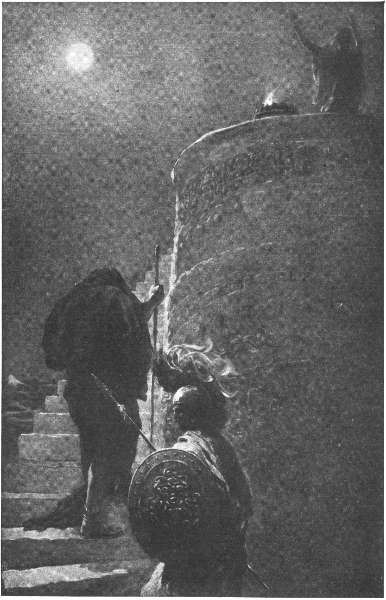
As the guard passed the old lord and the princess out of the gate
opposite the teocallis, the latter looked up to the azoteas of the
sacred pile, and saw the ’tzin standing near the verge; taking off the
white scarf that covered her head, and fell from her shoulders, after
passing once around her neck, she gave him the signal. He waved his hand
in reply, and disappeared.
The lord Cuitlahua, just released from imprisonment and ignorant of the
situation, scarcely knowing whither to turn yet impatient to set his
revenge in motion, accepted the suggestion of Tula, and accompanied her
to the temple. The ascent was laborious, especially to him; at the top,
however, they were received by Io’ and Hualpa, and with every show of
respect conducted to the ’tzin. He saluted them gravely, yet
affectionately. Cuitlahua told him the circumstances of his release from
imprisonment.
“So,” said the ’tzin, “Malinche expects you to open the market, and
forbid the war; but the king,—what of him?”
“To Tula he gave his will; hear her.”
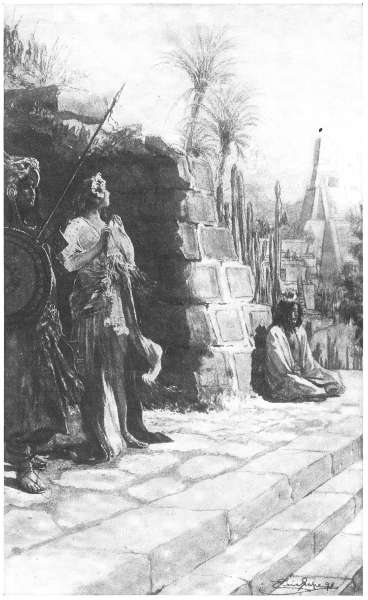
SHE GAVE HIM THE SIGNAL
And she repeated the message of her father. At the end, the calm of the
’tzin’s temper was much disturbed. At his instance she again and again
recited the prophecy. The words “Freedom and God” were as dark to him as
to the king, and he wondered at them. But that was not all. Clearly,
Montezuma approved the war; that he intended its continuance was equally
certain; unhappily, there was no designation of a commander. And in
thought of the omission, the young chief hesitated; never did
ambition appeal to him more strongly; but he brushed the allurement
away, and said to Cuitlahua,—
“The king has been pleased to be silent as to which of us should govern
in his absence; but we are both of one mind: the right is yours
naturally, and your coming at this time, good uncle, looks as if the
gods sent you. Take the government, therefore, and give me your orders.
Malinche is stronger than ever.” He turned thoughtfully to the palace
below, over which the flag of Spain and that of Cortes were now
displayed. “He will require of us days of toil and fighting, and many
assaults. In conquering him there will be great glory, which I pray you
will let me divide with you.”
The lord Cuitlahua heard the patriotic speech with glistening eyes.
Undoubtedly he appreciated the self-denial that made it beautiful; for
he said, with emotion, “I accept the government, and, as its cares
demand, will take my brother’s place in the palace; do you take what
else would be my place under him in the field. And may the gods help us
each to do his duty!”
He held out his hand, which the ’tzin kissed in token of fealty, and so
yielded the crown; and as if the great act were already out of mind, he
said, ——
“Come, now, good uncle,—and you, also, Tula,—come both of you, and I
will show what use I made of the kingly power.”
He led them closer to the verge of the azoteas, so close that they saw
below them the whole western side of the city, and beyond that the lake
and its shore, clear to the sierra bounding the valley in that
direction.
“There,” said he, in the same strain of simplicity, “there, in the
shadow of the hills, I gathered the people of the valley, and the flower
of all the tribes that pay us tribute. They make an army the like of
which was never seen. The chiefs are chosen; you may depend upon them,
uncle. The whole great host will die for you.”
“Say, rather, for us,” said the lord Cuitlahua.
“No, you are now Anahuac”; and, as deeming the point settled, the ’tzin
turned to Tula. “O good heart,” he said, “you have been a witness to all
the preparation. At your signal, given there by the palace gate, I
kindled the piles which yet burn, as you see, at the four corners of the
temple. Through them I spoke to the chiefs and armies waiting on the
lake-shore. Look now, and see their answers.”
They looked, and from the shore and from each pretentious summit of the
sierra, saw columns of smoke rising and melting into the sky.
“In that way the chiefs tell me, ‘We are ready,’ or ‘We are coming.’ And
we cannot doubt them; for see, a dark line on the white face of the
causeway to Cojohuacan, its head nearly touching the gates at Xoloc; and
another from Tlacopan; and from the north a third; and yonder on the
lake, in the shadow of Chapultepec, a yet deeper shadow.”
“I see them,” said Cuitlahua.
“And I,” said Tula. “What are they?”
For the first time the ’tzin acknowledged a passing sentiment; he raised
his head and swept the air with a haughty gesture.
“What are they? Wait a little, and you shall see the lines on the
causeways grow into ordered companies, and the shadows under Chapultepec
become a multitude of canoes; wait a little longer, and you shall see
the companies fill all the great streets, and the canoes girdle the city
round about; wait a little longer, and you may see the battle.”
And silence fell upon the three,—the silence, however, in which hearts
beat like drums. From point to point they turned their eager
eyes,—from the causeways to the lake, from the lake to the palace.
Slowly the converging lines crawled toward the city; slowly the dark
mass under the royal hill, sweeping out on the lake, broke into
divisions; slowly the banners came into view, of every color and form,
and then the shields and uniforms, until, at last, each host on its
separate way looked like an endless unrolling ribbon.
When the column approaching by the causeway from Tlacopan touched the
city with its advance, it halted, waiting for the others, which, having
farther to march, were yet some distance out. Then the three on the
teocallis separated; the princess retired to her chinampa; the lord
Cuitlahua, with some nobles of the ’tzin’s train, betook himself to the
new palace, there to choose a household; the ’tzin, for purposes of
observation, remained on the azoteas.
And all the time the threatened palace was a picture of peace; the flags
hung idly down; only the sentinels were in motion, and they gossiped
with each other, or lingered lazily at places where a wall or a
battlement flung them a friendly shade.
By and by a Spaniard came out through the main gateway of the palace;
after brief leave-taking with the guard there, he walked rapidly down
the street. The ’tzin, observing that the man was equipped for a
journey, surmised him to be a courier, and smiled at the confidence of
the master who sent him forth alone at such a time.
The courier went his way, and the great movement proceeded.
After a while Hualpa and Io’ came down from the turret where, under the
urn of fire, they too had been watching, and the former said,—
“Your orders, O ’tzin, are executed. The armies all stand halted at the
gates of the city, and at the outlet of each canal I saw a division of
canoes lying in wait.”
The ’tzin looked up at the sun, then past meridian, and replied, “It is
well. When the chiefs see but one smoke from this temple they will enter
the city. Go, therefore, and put out all the fires except that of
Huitzil’.”
And soon but one smoke was to be seen.
A little afterwards there was a loud cry from the street, and, looking
down, the ’tzin saw the Spanish courier, without morion or lance,
staggering as he ran, and shouting. Instantly the great gate was flung
open, and the man taken in; and instantly a trumpet rang out, and then
another and another. Guatamozin sprang up. The alarm-note thrilled him
no less than the Christians.
The palace, before so slumberous, became alive. The Tlascalans poured
from the sheds, that at places lined the interior of the parapet, and
from the main building forth rushed the Spaniards,—bowmen, slingers,
and arquebusiers; and the gunners took post by their guns, while the
cavalry clothed their horses, and stood by the bridles. There was no
tumult, no confusion; and when the ’tzin saw them in their
places—placid, confident, ready—his heart beat hard: he would win,—on
that he was resolved,—but ah, at what mighty cost!
Soon, half drowned by the voices of the captains mustering the enemy
below, he heard another sound rising from every quarter of the city,
but deeper and more sustained, where the great columns marched.
He listened intently. Though far and faint, he recognized the
susurrante,—literally the commingled war-cries of almost all the
known fighting tribes of the New World. The chiefs were faithful; they
were coming,—by the canals, and up and down the great streets, they
were coming; and he listened, measuring their speed by the growing
distinctness of the clamor. As they came nearer, he became confident,
then eager. Suddenly, everything,—objects far and near, the old palace,
and the hated flags, the lake, and the purple distance, and the
unflecked sky,—all melted into mist, for he looked at them through
tears. So the Last of the ’Tzins welcomed his tawny legions.
While he indulged the heroic weakness, Io’ and Hualpa rejoined him.
About the same time Cortes and some of his cavaliers appeared on the
azoteas of the central and higher part of the palace. They were in
armor, but with raised visors, and seemed to be conjecturing one with
another, and listening to the portentous sounds that now filled the
welkin. And as the ’tzin, in keen enjoyment, watched the wonder that
plainly possessed the enemy, there was a flutter of gay garments upon
the palace, and two women joined the party.
“Nenetzin!” said Io’, in a low voice.
“Nenetzin!” echoed Hualpa.
And sharper grew his gaze, while down stooped the sun to illumine the
face of the faithless, as, smiling the old smile, she rested lovingly
upon Alvarado’s arm. He turned away, and covered his head. But soon a
hand was laid upon his shoulder, and he heard a voice,—the voice of the
’tzin,——
“Lord Hualpa, as once before you were charged, I charge you now. With
your own hand make the signal. Io’ will bring you the word. Go now.”
Then the voice sunk to a whisper. “Patience, comrade. The days for many
to come will be days of opportunity. Already the wrong-doer is in the
toils; yet a little longer. Patience!”
The noise of the infidels had now come to be a vast uproar, astonishing
to the bravest of the listeners. Even Cortes shared the common feeling.
That war was intended he knew; but he had not sufficiently credited the
Aztec genius. The whole valley appeared to be in arms. His face became a
shade more ashy as he thought, either this was of the king, or the
people were capable of grand action without the king; and he griped his
sword-hand hard in emphasis of the oath he swore, to set the monarch and
his people face to face; that would he, by his conscience,—by the blood
of the saints!
And as he swore, here and there upon the adjacent houses armed men
showed themselves; and directly the heads of columns came up, and,
turning right and left at the corners, began to occupy all the streets
around the royal enclosure.
If one would fancy what the cavaliers then saw, let him first recall the
place. It was in the heart of the city. Eastward arose the
teocallis,—a terraced hill in fact, and every terrace a
vantage-point. On all other sides of the palace were edifices each
higher than its highest part; and each fronted with a wall resembling a
parapet, except that its outer face was in general richly ornamented
with fretwork and mouldings and arches and grotesque corbals and
cantilevers. Every roof was occupied by infidels; over the sculptured
walls they looked down into the fortress, if I may so call it, of the
strangers.
As the columns marched and countermarched in the streets thus
beautifully bounded, they were a spectacle of extraordinary animation.
Over them played the semi-transparent shimmer or thrill of air, so to
speak, peculiar to armies in rapid movement,—curious effect of changing
colors and multitudinous motion. The Christians studied them with an
interest inappreciable to such as have never known the sensations of a
soldier watching the foe taking post for combat.
Of arms there were in the array every variety known to the Aztecan
service,—the long bow; the javelin; slings of the ancient fashion,
fitted for casting stones a pound or more in weight; the maquahuitl,
limited to the officers; and here and there long lances with heads of
bronze or sharpened flint. The arms, it must be confessed, added little
to the general appearance of the mass,—a deficiency amply compensated
by the equipments. The quivers of the bowmen, and the pouches of the
slingers, and the broad straps that held them to the person were
brilliantly decorated. Equally striking were the costumes of the several
branches of the service: the fillet, holding back the long, straight
hair, and full of feathers, mostly of the eagle and turkey, though not
unfrequently of the ostrich,—costly prizes come, in the way of trade,
from the far llanos of the south; the escaupil, of brightest
crimson; the shield, faced with brazen plates, and edged with flying
tufts of buffalo hair, and sometimes with longer and brighter locks, the
gift of a mistress or a trophy of war. These articles, though half
barbaric, lost nothing by contrast with the naked, dark-brown necks and
limbs of the warriors,—lithe and stately men, from whom the officers
were distinguished by helmets of hideous device and mantles
indescribably splendid. Over all shone the ensigns, indicia of the
tribes: here a shining sphere; there a star, or a crescent, or a radial
sun; but most usually a floating cloth covered with blazonry.
With each company marched a number of priests, bareheaded and frocked,
and a corps of musicians, of whom some blew unearthly discords from
conchs, while others clashed cymbals, and beat atabals fashioned like
the copper tam-tams of the Hindoos.
Even the marching of the companies was peculiar. Instead of the slow,
laborious step of the European, they came on at a pace which, between
sunrise and sunset, habitually carried them from the bivouac twenty
leagues away.
And as they marched, the ensigns tossed to and fro; the priests sang
monotonous canticles; the cymbalists danced and leaped joyously at the
head of their companies; and the warriors in the ranks flung their
shields aloft, and yelled their war-cries, as if drunk with happiness.
As the inundation of war swept around the palace, a cavalier raised his
eyes to the temple.
“Valgame Dios!” he cried, in genuine alarm. “The levies of the valley
are not enough. Lo, the legions of the air!”
On the azoteas where but the moment before only the ’tzin and Io’ were
to be seen, there were hundreds of caparisoned warriors; and as the
Christians looked at them, they all knelt, leaving but one man standing;
simultaneously the companies on the street stopped, and, with those on
the house-tops, hushed their yells, and turned up to him their faces
countless and glistening.
“Who is he?” the cavaliers asked each other.
Cortes, cooler than the rest, turned to Marina: “Ask the princess
Nenetzin if she knows him.”
And Nenetzin answered,—
“The ’tzin Guatamo.”
As the two chiefs surveyed each other in full recognition, down from the
sky, as it were, broke an intonation so deep that the Christians were
startled, and the women fled from the roof.
“Ola!” cried Alvarado, with a laugh. “I have heard that thunder
before. Down with your visors, gentlemen, as ye care for the faces your
mothers love!”
Three times Hualpa struck the great drum in the sanctuary of Huitzil’;
and as the last intonation rolled down over the city the clamor of the
infidels broke out anew, and into the enclosure of the palace they
poured a cloud of missiles so thick that place of safety there was not
anywhere outside the building.
To this time the garrison had kept silence; now, standing each at his
post, they answered. In the days of the former siege, besides preparing
banquettes for the repulsion of escalades, they had pierced the outer
walls, generally but little higher than a man’s head, with loop-holes
and embrasures, out of which the guns, great and small, were suddenly
pointed and discharged. No need of aim; outside, not farther than the
leap of the flames, stood the assailants. The effect, especially of the
artillery, was dreadful; and the prodigious noise, and the dense,
choking smoke, stupefied and blinded the masses, so unused to such
enginery. And from the wall they shrank staggering, and thousands turned
to fly; but in pressed the chiefs and the priests, and louder rose the
clangor of conchs and cymbals: the very density of the multitude helped
stay the panic.
And down from the temple came the ’tzin, not merely to give the effect
of his presence, but to direct the assault. In the sanctuary he had
arrayed himself; his escaupil and tilmatli, of richest feather-work,
fairly blazed; his helm and shield sparkled; and behind, scarcely less
splendid, walked Io’ and Hualpa. He crossed the street, shouting his
war-cry. At sight of him, men struggling to get away turned to fight
again.
Next the wall of the palace the shrinking of the infidels had left a
clear margin; and there, the better to be seen by his people, the ’tzin
betook himself. In front of the embrasures he cleared the lines of fire,
so that the guns were often ineffectual; he directed attention to the
loopholes, so that the appearance of an arbalist or arquebus drew a
hundred arrows to the spot. Taught by his example, the warriors found
that under the walls there was a place of safety; then he set them to
climbing; for that purpose some stuck their javelins in the cracks of
the masonry; some formed groups over which others raised themselves;
altogether the crest of the wall was threatened in a thousand places,
insomuch that the Tlascalans occupied themselves exclusively in its
defence; and as often as one raised to strike a climber down, he made
himself a target for the quick bowmen on the opposite houses.
And so, wherever the ’tzin went he inspired his countrymen; the wounded,
and the many dead and dying, and the blood maddened instead of daunting
them. They rained missiles into the enclosure; upon the wall they fought
hand to hand with the defenders; in their inconsiderate fury, many
leaped down inside, and perished instantly,—but all in vain.
Then the ’tzin had great timbers brought up, thinking to batter in the
parapet. Again and again they were hurled against the face of the
masonry, but without effect.
Yet another resort. He had balls of cotton steeped in oil shot blazing
into the palace-yard. Against the building, and on its tiled roof, they
fell harmless. It happened, however, that the sheds in which the
Tlascalans quartered consisted almost entirely of reeds, with roofs of
rushes and palm-leaves; they burst into flames. Water could not be
spared by the garrison, for the drought was great; in the extremity, the
Tlascalans and many Christians were drawn from the defences, and set to
casting earth upon the new enemy. Hundreds of the former were killed or
disabled. The flames spread to the wooden outworks of the wall. The
smoke almost blotted out the day. After a while a part of the wall fell
down, and the infidels rushed in; a steady fire of arquebuses swept
them away, and choked the chasm with the slain; still others braved the
peril; company after company dashed into the fatal snare uselessly, as
waves roll forward and spend themselves in the gorge of a sea-wall.
The conflict lasted without abatement through long hours. The sun went
down. In the twilight the great host withdrew,—all that could. The
smoke from the conflagration and guns melted into the shades of night;
and the stars, mild-eyed as ever, came out one by one to see the wrecks
heaped and ghastly lying in the bloody street and palace-yard.
All night the defenders lay upon their arms, or, told off in working
parties, labored to restore the breach.
All night the infidels collected their dead and wounded, thousands in
number. They did not offer to attack,—custom forbade that; yet over the
walls they sent their vengeful warnings.
All night the listening sentinels on the parapet noted the darkness
filled with sounds of preparation from every quarter of the city. And
they crossed themselves, and muttered the names of saints and good
angels, and thought shudderingly of the morrow.
Guatamozin took little rest that night. The very uncertainty of the
combat multiplied his cares. It was not to be supposed that his enemy
would keep to the palace, content day after day with receiving assaults;
that was neither his character nor his policy. To-morrow he would
certainly open the gates, and try conclusions in the streets The first
duty, therefore, was to provide for such a contingency. So the ’tzin
went along all the streets leading to the old palace, followed by strong
working-parties; and where the highest houses fronted each other, he
stopped, and thereat the details fell to making barricades, and carrying
stones and logs to the roofs. As a final measure of importance, he cut
passages through the walls of the houses and gardens, that companies
might be passed quickly and secretly from one thoroughfare to another.
Everywhere he found great cause for mourning; but the stories of the day
were necessarily lost in the demands of the morrow.
He visited his caciques, and waited on the lord Cuitlahua to take his
orders; then he passed to the temples, whence, as he well knew, the
multitudes in great part derived their inspiration. The duties of the
soldier, politician, and devotee discharged, he betook himself to the
chinampa, and to Tula told the heroisms of the combat, and his plans
and hopes; there he renewed his own inspirations.
Toward morning he returned to the great temple. Hualpa and Io’, having
followed him throughout his round, spread their mantles on the roof, and
slept: he could not; between the work of yesterday and that to come, his
mind played pendulously, and with such forceful activity as forbade
slumber. From the quarters of the strangers, moreover, he heard
constantly the ringing of hammers, the neighing and trampling of steeds,
and voices of direction. It was a long night to him; but at last over
the crown of the White Woman the dawn flung its first light into the
valley; and then he saw the palace, its walls manned, the gunners by
their pieces, and in the great court lines of footmen, and at the main
gate horsemen standing by their bridles.
“Thanks, O gods!” he cried. “Walls will not separate my people from
their enemies to-day!”
With the sunrise the assault began,—a repetition of that of the day
before.
Then the guns opened; and while the infidels reeled under the fire, out
of the gates rode Cortes and his chivalry, a hundred men-at-arms. Into
the mass they dashed. Space sufficient having been won, they wheeled
southward down the beautiful street, followed by detachments of bowmen
and arquebusiers and Tlascalans. With them also went Mesa and his guns.
When fairly in the street, environed with walls, the ’tzin’s tactics and
preparation appeared. Upon the approach of the cavalry, the companies
took to the houses; only those fell who stopped to fight or had not time
to make the exit. All the time, however, the horsemen were exposed to
the missiles tossed upon them from the roofs. Soon as they passed, out
rushed the infidels in hordes, to fall upon the flanks and rear of the
supporting detachments. Never was Mesa so hard pressed; never were helm
and corselet so nearly useless; never gave up the ghost so many of the
veteran Tlascalans.
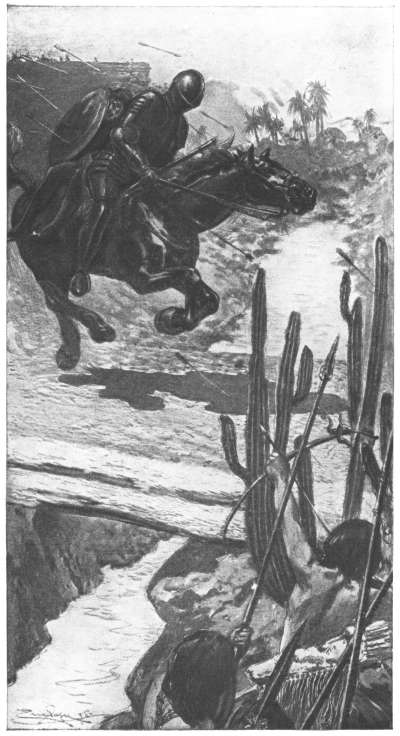
At length the easy way of the cavalry was brought to a stop; before them
was the first barricade,—a work of earth and stones too high to be
leaped, and defended by Chinantlan spears, of all native weapons the
most dreaded. Nevertheless, Cortes drew rein only at its foot. On the
instant his shield and mail warded off a score of bronzed points,
whirled his axe, crash went the spears,—that was all.
Meantime, the eager horsemen in the rear, not knowing of the obstacle in
front, pressed on; the narrow space became packed; then from the roofs
on the right hand and the left descended a tempest of stones and lances,
blent with beams of wood, against which no guard was strong enough. Six
men and horses fell there. A cry of dismay arose from the pack, and much
calling was there on patron saints, much writhing and swaying of men
and plunging of steeds, and vain looking upward through bars of steel.
Cortes quitted smashing spears over the barricade.
“Out! out! Back, in Christ’s name!” he cried.
The jam was finally relieved.
Again his voice,—
“To Mesa, some of ye; bring the guns! Speed!”
Then he, too, rode slowly back; and sharper than the shame of the
retreat, sharper than the arrows or the taunts of the foe, sharper than
all of them together, was the sight of the six riders in their armor
left to quick despoilment,—they and their good steeds.
It was not easy for Mesa to come; but he did, opening within a hundred
feet of the barricade. Again and again he fired; the smoke wreathed
blinding white about him.
“What sayest thou now?” asked Cortes, impatiently.
“That thou mayest go, and thou wilt. The saints go with thee!”
The barricade was a ruin.
At the first bridge again there was a fierce struggle; when taken, the
floor was heaped with dead and wounded infidels.
And so for hours. Only at the last gate, that opening on the causeway to
Iztapalapan, did Cortes stay the sally. There, riding to the rear, now
become the front, he started in return. Needless to tell how well the
Christians fought, or how devotedly the pagans resisted and perished.
Enough that the going back was more difficult than the coming. Four more
of the Spaniards perished on the way.
At a late hour that night Sandoval entered Cortes’ room, and gave him a
parchment. The chief went to the lamp and read; then, snatching his
sword from the table, he walked to and fro, as was his wont when much
disturbed; only his strides were longer, and the gride of the weapon on
the tiled floor more relentless than common.
He stopped abruptly.
“Dead, ten of them! And their horses, captain?”
“Three were saved,” replied Sandoval.
“By my conscience, I like it not! and thou?”
“I like it less,” said the captain, naïvely.
“What say the men?”
“They demand to be led from the city while yet they have strength to
go.”
Cortes frowned and continued his walk. When next he stopped, he said, in
the tone of a man whose mind was made up,—
“Good night, captain. See that the sentinels sleep not; and, captain, as
thou goest, send hither Martin Lopez, and mind him to bring one or two
of his master carpenters. Good night.”
The mind of the leader, never so quick as in time of trouble, had in the
few minutes reviewed the sortie. True, he had broken through the
barricades, taken bridge after bridge, and driven the enemy often as
they opposed him; he had gone triumphantly to the very gates of the
city, and returned, and joined Olmedo in unctuous celebration of the
achievement; yet the good was not as clear and immediate as at first
appeared.
He recalled the tactics of his enemy: how, on his approach, they had
vanished from the street and assailed him from the roofs; how, when he
had passed, they poured into the street again, and flung themselves hand
to hand upon the infantry and artillery. And the result,—ten riders and
seven horses were dead; of the Tlascalans in the column nearly all had
perished; every Christian foot-soldier had one or more wounds. At
Cempoalla he himself had been hurt in the left hand; now he was sore
with contusions. He set his teeth hard at thought of the moral effect of
the day’s work; how it would raise the spirit of the infidels, and
depress that of his own people. Already the latter were clamoring to be
led from the city,—so the blunt Captain Sandoval had said.
The enemy’s advantage was in the possession of the houses. The roofs
dominated the streets. Were there no means by which he could dominate
the roofs? He bent his whole soul to the problem. Somewhere he had read
or heard of the device known in ancient warfare as
mantelets,—literally, a kind of portable roof, under which besiegers
approached and sapped or battered a wall. The recollection was welcome;
the occasion called for an extraordinary resort. He laid the sword
gently upon the table, gently as he would a sleeping child, and sent for
Lopez.
That worthy came, and with him two carpenters, each as rough as himself.
And it was a picture, if not a comedy, to watch the four bending over
the table to follow Cortes, while, with his dagger-point, he drew lines
illustrative of the strange machine. They separated with a perfect
understanding. The chief slept soundly, his confidence stronger than
ever.
Another day,—the third. From morn till noon and night, the clamor of
assault and the exertion of defence, the roar of guns from within, the
rain of missiles from without,—Death everywhere.
All the day Cortes held to the palace. On the other side, the ’tzin kept
close watch from the teocallis. That morning early he had seen workmen
bring from the palace some stout timbers, and in the great court-yard
proceed to frame them. He plied the party with stones and arrows; again
and again, best of all the good bowmen of the valley, he himself sent
his shafts at the man who seemed the director of the work; as often did
they splinter upon his helm or corselet, or drop harmless from the close
links of tempered steel defending his limbs. The work went steadily on,
and by noon had taken the form of towers, two in number, and high as
ordinary houses. By sunset both were under roof.
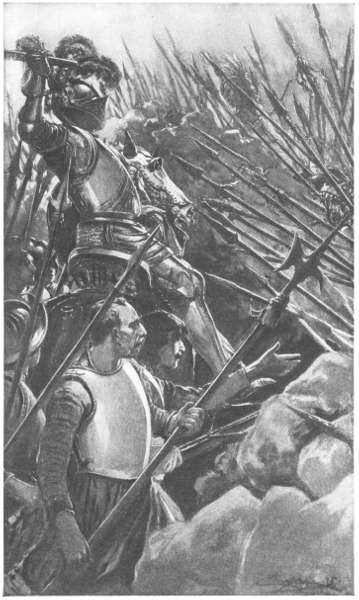
CORTES DREW REIN ONLY AT ITS FOOT
When the night came, the garrison were not rested; and as to the
infidels, the lake received some hundreds more of them, which was only
room made for other hundreds as brave and devoted.
Over the palace walls the besiegers sent words ominous and disquieting,
and not to be confounded with the half-sung formulas of the watchers
keeping time on the temples by the movement of the stars.
“Malinche, Malinche, we are a thousand to your one. Our gods hunger for
vengeance. You cannot escape them.”
So the Spaniards heard in their intervals of unrest.
“O false sons of Anahuac, the festival is making ready; your hearts are
Huitzil’s; the cages are open to receive you.”
The Tlascalans heard, and trembled.
The fourth day. Still Cortes kept within the palace, and still the
assault; nor with all the slaughter could there be perceived any
decrease either in the number of the infidels or the spirit of their
attack.
Meantime the workmen in the court-yard clung to the construction of the
towers. Lopez was skilful, Cortes impatient. At last they were finished.
That night the ’tzin visited Tula. At parting, she followed him to the
landing. Yeteve went with her. “The blessing of the gods be upon you!”
she said; and the benediction, so trustful and sweetly spoken, was
itself a blessing. Even the slaves, under their poised oars, looked at
her and forgot themselves, as well they might. The light of the great
torch, kindled by the keeper of the chinampa, revealed her perfectly.
The head slightly bent, and the hands crossed over the breast, helped
the prayerful speech. Her eyes were not upon the slaves, yet their
effect was; and they were such eyes as give to night the beauty of
stars, while taking nothing from it, neither depth nor darkness.
The canoe put off.
“Farewell,” said Io’. His warrior-life was yet in its youth.
“Farewell,” said Hualpa. And she heard him, and knew him thinking of his
lost love.
In the ’tzin’s absence the garrison of the temple had been heavily
reinforced. The azoteas, when he returned, was covered with warriors,
asleep on their mantles, and pillowed on their shields. He bade his
companions catch what slumber they could, and went into the grimy but
full-lighted presence-chamber, and seated himself on the step of the
altar. In a little while Hualpa came in, and stopped before him as if
for speech.
“You have somewhat to say,” said the ’tzin, kindly. “Speak.”
“A word, good ’tzin, a single word. Io’ lies upon his mantle; he is
weary, and sleeps well. I am weary, but cannot sleep. I suffer—”
“What?” asked the ’tzin.
“Discontent.”
“Discontent!”
“O ’tzin, to follow you and win your praise has been my greatest
happiness; but as yet I have done nothing by myself. I pray you, give me
liberty to go where I please, if only for a day.”
“Where would you go?”
“Where so many have tried and failed,—over the wall, into the palace.”
There was a long silence, during which the supplicant looked on the
floor, and the master at him.
“I think I understand you,” the latter at length said. “To-morrow I will
give you answer. Go now.”
Hualpa touched the floor with his palm, and left the chamber. The ’tzin
remained thoughtful, motionless. An hour passed.
“Over the wall, into the palace!” he said, musingly. “Not for country,
not for glory,—for Nenetzin. Alas, poor lad! From his life she has
taken the life. Over the wall into the—Sun. To-morrow comes swiftly;
good or ill, the gifts it brings are from the gods. Patience!”
And upon the step he spread his mantle, and slept, muttering, “Over the
wall, into the palace, and she has not called him! Poor lad!”
The report of a gun awoke the ’tzin in the morning. The great uproar of
the assault, now become familiar to him, filled the chamber. He knelt on
the step and prayed, for there was a cloud upon his spirit, and over the
idol’s stony face there seemed to be a cloud. He put on his helm and
mantle; at the door Hualpa offered him his arms.
“No,” he said, “bring me those we took from the stranger.”
Hualpa marked the gravity of his manner, and with a rising heart and a
smile, the first seen on his lips for many a day, he brought a Spanish
shield and battle-axe, and gave them to him.
Then the din below, bursting out in greater volume, drew the ’tzin to
the verge of the temple. The warriors made way for him reverently. He
looked down into the square, and through a veil of smoke semilucent saw
Cortes and his cavaliers charge the ranks massed in front of the palace
gate. The gate stood open, and a crowd of the Tlascalans were pouring
out of the portal, hauling one of the towers whose construction had been
the mystery of the days last passed; they bent low to the work, and
cheered each other with their war-cries; yet the manta—so called by
Cortes—moved slowly, as if loath to leave. In the same manner the other
tower was drawn out of the court; then, side by side, both were started
down the street, which they filled so nearly that room was hardly left
for the detachments that guarded the Tlascalans on the flanks.
The fighting ceased, and silently the enemies stared at the
spectacle,—such power is there in curiosity.
At sight of the structures, rolling, rocking, rumbling, and creaking
dismally in every wheel, Cortes’ eyes sparkled fire-like through his
visor. The ’tzin, on the other hand, was disturbed and anxious, although
outwardly calm; for the objects of the common wonder were enclosed on
every side, and he knew as little what they contained as of their use
and operation.
Slowly they rolled on, until past the intersection of the streets; there
they stopped. Right and left of them were beautiful houses covered with
warriors for the moment converted into spectators. A hush of expectancy
everywhere prevailed. The ’tzin shaded his eyes with his hand, and leant
eagerly forward. Suddenly, from the sides of the machine next the walls,
masked doors dropped out, and guns, charged to the muzzle, glared over
the house-tops, then swept them with fire.
A horrible scream flew along the street and up to the azoteas of the
temple; at the same time, by ladders extended to the coping of the
walls, the Christians leaped on the roofs, like boarders on a ship’s
deck, and mastered them at once; whereupon they returned, and were about
taking in the ladders, when Cortes galloped back, and, riding from one
to the other, shouted,—
“Ordas! Avila! Mirad! Where are the torches I gave ye? Out again!
Leave not a stone to shelter the dogs! Leave nothing but ashes! Pronto,
pronto!”
The captains answered promptly. With flambeaux of resinous pine and
cotton, they fired all the wood-work of the interior of the buildings.
Smoke burst from the doors and windows; then the detachments retreated,
and were rolled on without the loss of a man.
Behind the mantas there was a strong rear-guard of infantry and
artillery; with which, and the guards on the flanks, and the cavaliers
forcing way at the front, it seemed impossible to avert, or even
interrupt, an attack at once so novel and successful.
The smoke from the burning houses, momentarily thickening and widening,
was seen afar, and by the heathen hailed with cries of alarm: not so
Cortes; riding everywhere, in the van, to the rear, often stopping by
the mantas, which he regarded with natural affection, as an artist
does his last work, he tasted the joy of successful genius. The smoke
rising, as it were, to Heaven, carried up his vows not to stop until the
city, with all its idolatries, was a heap of ashes and lime,—a
holocaust to the Mother such as had never been seen. The cheeriness of
his constant cry, “Christo, Christo y Santiago!” communicated to his
people, and they marched laughing and fighting.
Opposition had now almost ceased; at the approach of the mantas, the
house-tops were given up without resistance. A general panic appeared to
have seized the pagans; they even vacated the street, so that the
cavaliers had little else to do than ride leisurely, turning now and
then to see the fires behind them, and the tall machines come lumbering
on.
As remarked, when the mantas stopped at the intersection of the
streets, the ’tzin watched them eagerly, for he knew the time had come
to make their use manifest; he saw a door drop, and the jet of flame and
smoke leap from a gun; he heard the cry of agony from the house-tops,
and the deeper cry from all the people; to the chiefs around him he
said, with steady voice, and as became a leader,—
“Courage, friends! We have them now. Malinche is mad to put his people
in such traps. Lord Hualpa, go round the place of combat and see that
the first bridge is impassable; for there, unless the towers have wings,
and can fly, they must stop. And to you, Io’,” he spoke to the lad
tenderly, “I give a command and sacred trust. Stay here, and take care
of the gods.”
Io’ kissed his hand, and said, fervently, “May the gods care for me as I
will for them!”
To other chiefs, calling them by name, he gave directions for the
renewal of the assault on the palace, now weakened by the sortie, and
for the concentration of fresh companies in the rear of the enemy, to
contest their return.
“And now, my good lord,” he said to a cacique, gray-headed, but of
magnificent frame, “you have a company of Tezcucans, formerly the guards
of king Cacama’s palace. Bring them, and follow me. Come.”
A number of houses covering quite half a square were by this time on
fire. Those of wood burned furiously; the morning, however, was almost
breathless, so that the cinders did little harm. On the left side of the
street stood a building of red stone, its front profusely carved, and
further ornamented with a marble portico,—a palace, in fact, massively
built, and somewhat higher than the mantas. Its entrances were
barricaded, and on the roof, where an enemy might be looked for, there
was not a spear, helm, or sign of life, except some fan-palms and long
banana-branches. Before the stately front the mantas were at length
hauled. Immediately the door on that side was dropped, and the ladder
fixed, and Avila, who had the command, started with his followers to
take possession and apply the torch. Suddenly, the coping of the
palace-front flamed with feathered helms and points of bronze.
Avila was probably as skilful and intrepid as any of Cortes’ captains;
but now he was surprised: directly before him stood Guatamozin, whom
every Spaniard had come to know and respect as the most rodoubted of all
the warriors of Anahuac; and he shone on the captain a truly martial
figure, confronting him with Spanish arms, a shield with a face of iron
and a battle-axe of steel. Avila hesitated; and as he did so, the end of
the ladder was lifted from the wall, poised a moment in the air, then
flung off.
The ’tzin had not time to observe the effect of the fall, for a score of
men came quickly up, bringing a beam of wood as long and large as the
spar of a brigantine; a trailing rope at its further end strengthened
the likeness. Resting the beam on the coping of the wall, at a word,
they plunged it forward against the manta, which rocked under the
blow. A yell of fear issued from within. The Tlascalans strove to haul
the machine away, but the Tezcucans from their height tossed logs and
stones upon them, crushing many to death, and putting the rest in such
fear that their efforts were vain. Meantime, the beam was again shot
forward over the coping, and with such effect that the roof of the
manta sprang from its fastenings, and nearly toppled off.
The handiwork so rudely treated was not as stout as the ships Martin
Lopez sailed on the lake. It was simply a square tower, two stories
high, erected on wheels. The frame was enclosed with slabs, pinned on
vertically, and pierced with loopholes. On the sides there were
apertures defended by doors. The roof, sloping hip-fashion, had an outer
covering of undressed skins as protection against fire. The lower floor
was for the Tlascalans, should they be driven from the drag-ropes; in
the second story there was a gun, some arquebusiers, and a body of
pikemen to storm the house-tops; so that altogether the contrivance
could hardly stand hauling over the street, much less a battery like
that it was then receiving. At the third blow it became an untenable
wreck.
“Avila!” cried Cortes. “Where art thou?”
The good captain, with four of his bravest men, lay insensible, if not
dead, under the ladder.
“Mercy, O Mother of God, mercy!” groaned Cortes; next moment he was
himself again.
“What do ye here, men? Out and away before these timbers tumble and
crush ye!”
One man stayed.
“The gun, Señor, the gun!” he protested.
Spurring close to the door, Cortes said, “As thou art a Christian, get
thee down, comrade, and quickly. I can better spare the gun than so good
a gunner.”
Then the beam came again, and, with a great crash, tore away the side of
the manta. The gun rolled backward, and burst through the opposite
wall of the room. The veteran disappeared.
By this time all eyes were turned to the scene. The bowmen and
arquebusiers in the column exerted themselves to cover their unfortunate
comrades. Upon the neighboring houses a few infidels, on the watch,
yelled joyously,—“The ’tzin! the ’tzin!” From them the shout, spread
through the cowering army, became, indeed, a battle-cry significant of
success.
To me, good reader, the miracles of the world, if any there be, are not
the things men do in masses, but the sublimer things done by one man
over the many; they testify most loudly of God, since without him they
could not have been. I am too good a Christian to say this of a
heathen; nevertheless, without the ’tzin his country had perished that
morning. Back to the roofs came the defenders, into the street poured
the companies again; no leisure now for the cavaliers. With the other
manta Ordas moved on gallantly, but the work was hard; at some houses
he failed, others he dared not attack. From front to rear the contest
became a battle. In the low places of the street and pavement the blood
flowed warm, then cooled in blackening pools. The smoke of the consuming
houses, distinguishable from that of the temples, collected into a
cloud, and hung wide-spread over the combat. The yells of Christians and
infidels, fusing into a vast monotone, roared like the sea. Twice Mesa
went to the front,—the cavaliers had need of him,—twice he returned to
the rear.
The wrath of the Aztecs seemed especially directed against the
Tlascalans tugging at the ropes of the manta; as a consequence, their
quilted armor was torn to rags, and so many of them were wounded, so
many killed, that at every stoppage the wheels were more difficult to
start; and to make the movement still more slow and uncertain, the
carcasses of the dead had to be rolled or carried out of the way; and
the dead, sooth to say, were not always Aztecs.
Luis Marin halted to breathe.
“Ola, compañero! What dost thou there?”
“By all the saints!” answered Alvarado, on foot, tightening his
saddle-girth. “Was ever the like? It hath been strike, strike,—kill,
kill,—for an hour. I am dead in the right arm from finger to shoulder.
And now here is a buckle that refuseth its work. Caramba! My glove is
slippery with blood!”
And so step by step,—each one bought with a life,—the Christians won
their way to the first bridge: the floor was gone! Cortes reined his
horse, bloody from hoof to frontlet, by the edge of the chasm. Since
daybreak fighting, and but a square gained! The water, never so placid,
was the utmost limit of his going. He looked at the manta, now, like
that of Avila, a mocking failure. He looked again, and a blasphemy
beyond the absolution of Olmedo, I fear, broke the clenching of his
jaws,—not for the machines, or the hopes they had raised, but the days
their construction lost him. As he looked, through a rift in the cloud
still rising along the battle’s track, he saw the great temple; gay
banners and gorgeous regalia, all the splendor of barbaric war, filled
that view, and inspired him. To the cavaliers, close around and in
waiting, he turned. The arrows smote his mail and theirs, yet he raised
his visor: the face was calm, even smiling, for the will is a quality
apart from mind and passion.
“We will go back, gentlemen,” he said. “The city is on fire,—enough for
one day. And hark ye, gentlemen. We have had enough of common blood. Let
us go now and see of what the heathen gods are made.”
His hearers were in the mood; they raised their shields and shouted,—
“To the temple! To the temple! For the love of Christ, to the temple!”
The cry sped down the column; and as the men caught its meaning they
faced about of their own will. Wounds, weariness, and disappointments
were forgotten; the rudest soldier became a zealot on the instant. Al
templo! Adelante, adelante! rose like a new chorus, piercing the
battle’s monotone.
Cortes stood in his stirrups, and lo! the enemy, ranked close, like corn
in the full ear, yet outreaching his vision,—plumed, bannered,
brilliant, and terrible.
“Close and steady, swords of the Church! What ye see is but grass for
the cutting. Yonder is the temple we seek. Follow me. Adelante! Christo
y Santiago!”
So saying, he spurred in deep amongst the infidels.
The duty Hualpa had been charged with by the ’tzin was not difficult of
performance; for the bridges of the capital, even those along the
beautiful street, were much simpler structures than they appeared. When
he had seen the balustrades and flooring and the great timbers that
spanned the canal—the first one south of the old palace—torn from
their places, and hauled off by the canoemen whom he had collected for
the purpose, he returned to the temple to rejoin his master.
The assault upon the palace, when he reached that point, was more
furious than at any previous time. The companies in the street were
fighting with marvellous courage, while the missiles from the azoteas
and westward terraces of the temple, and all the houses around,
literally darkened the air. Amidst the clamor Hualpa caught at intervals
the cry,—“The ’tzin, the ’tzin!” He listened, and all the loyal
thousands seemed shouting, “The ’tzin, the ’tzin! Al-a-lala!”
“Has anything befallen the ’tzin?” he asked of an acquaintance.
“Yes, thanks to Huitzil’! He has broken one of Malinche’s towers to
pieces, and killed everybody in it.”
Hualpa’s love quickened suddenly. “Blessed be all the gods!” he cried,
and, passing on, ascended to the azoteas. It may have been the battle,
full of invocations, as battles always are; or it may have been that
Io’, in full enjoyment of his command, and so earnest in its
performance, stimulated his ambition; or it may have been the influence
of his peculiar sorrow, the haunting memories of his love, and she, its
star, separated from him by so little,—something made him restless and
feverish. He talked with the caciques and priests; he clomb the turret,
and watched the smoke go softly up, and hide itself in the deeper blue
of the sky; with Io’, he stood on the temple’s verge, and witnessed the
fight, at times using bow and sling; but nothing brought him relief. The
opportunity he had so long desired was here calling him, and passing
away. O for an hour of liberty to enact himself!
Unable to endure the excitement, he started in search of the ’tzin,
knowing that, wherever he was, there was action, if not opportunity. At
that moment he saw a cacique in the street plant a ladder against the
wall of the palace not far from the main gate. The Tlascalans defending
at that point tried to throw it off, but a shower of stones from the
terrace of the temple deluged them, and they disappeared. Up went the
cacique, up went his followers; they gained the crest; then the conflict
passed from Hualpa’s view.
“Io’,” he said, “when the ’tzin comes back, tell him I have gone to make
a way for him through yon wall.”
“Have a care, comrade; have a care!”
Hualpa put an arm around him, and replied, smiling, “There is one over
the wall now: if he fears not, shall I? And then,”—he whispered
low,—“Nenetzin will despise me if I come not soon.”
A dawning fell upon Io’, and from that time he knew the power of love.
“The gods go with you! Farewell.”
Hualpa set about his purpose deliberately. Near the door of the
presence-chamber there was a pile of trophies, shields, arms, and armor
of men and horses; he made some selections from the heap, and carried
them into the chamber. When he came out, under his panache there was
a steel cap, and under his mantle a cuirass; and to some dead Spaniard
he was further beholden for a shield and battle-axe,—the latter so
called, notwithstanding it had a head like a hammer, and a handle of
steel pointed at the end and more than a yard in length.
Thus prepared, he went down into the street, and forced his way to the
ladder planted near the gate; thence to the crest of the wall. A hundred
arrows splintered against his shield, as he looked down upon the combat
yet maintained by the brave cacique at the foot of the banquette.
The wall, as I think I have elsewhere said, was built of blocks of
wrought stone, laid in cement only a little less hard than the stone,
and consequently impervious to any battery against its base; at the same
time, taken piece by piece from the top, its demolition was easy. Hualpa
paused not; between the blocks he drove the pointed handle of his axe: a
moment, and down fell the capping-stone; another followed, and another.
Alike indifferent to the arrows of the garrison and the acclamations of
the witnesses outside, looking neither here nor there, bending every
faculty to the task, he did in a few minutes what seemed impossible:
through a breach wide enough for the passage of a double sedan, foemen
within and without the wall saw each other.
And there was hastening thither of detachments. Up the ladder and over
the wall leaped the devoted infidels, nothing deterred by waiting swords
and lances; striking or dying, they shouted, “The ’tzin, the ’tzin!
Al-a-lala!” Live or die, they strove to cover the steadfast workman in
the breach.
De Olid, at the time in charge of the palace, drew nigh, attracted by
the increasing uproar.
“Ye fools! Out on ye! See ye not that the dog is hiding behind a
Christian shield! Run, fly, bring a brace of arquebusiers! Bring the
reserve guns! Upon them, gentlemen! Swords and axes! The Mother for us
all! Christo, Christo!”
And on foot, and in full armor, he pushed into the press; for, true to
his training, he saw that the laborer behind the shining shield was more
worthy instant notice than the hordes clambering over the wall.
Still the breach widened and deepened, and every rock that tumbled from
its place contributed to the roadway forming on both sides of the wall
to facilitate the attack. But now the guns were coming, and the
arquebusiers made haste to plant their pieces, against which the good
shield might not defend. Suddenly Hualpa stood up, his surcoat whitened
with the dust of the mortar; without a word he descended to the street:
the work was done,—a way for the ’tzin was ready! Scarcely had he
touched the pavement before the guns opened; scarcely had the guns
opened before the gorge was crowded with infidels rushing in. The
palace, wanting the column absent with Cortes, was in danger. To the one
point every Christian was withdrawn; even the sick and wounded staggered
from the hospital to repel the attack. With all his gallantry, De Olid
was beaten slowly back to the house. Cursed he the infidels, prayed he
the return of Cortes,—still he went back. In the midst of his
perplexity, a messenger came to tell him the enemy was breaking through
the wall of the western front.
Hualpa had not only made another breach,—De Olid found him inside the
enclosure, with a support already too strong for the Tlascalans.
The fight the good captain was called to witness was that of native
against native; and, had the peril been less demanding, he would have
enjoyed its novelties. An astonishing rattle of shields and spears,
mixed with the clash of maquahuitls, and a deafening outcry from the
contending tribes saluted him. Over the fighting lines the air was
thick with stones and flying javelins and tossing banners. Quarter was
not once asked. The grim combatants engaged each other to conquer or
die. Hither and thither danced the priests, heedless of the danger, now
cursing the laggards, now blessing the brave. And at times so shrilly
blew the conchs that where they were nothing might be heard but the
shriller medley of war-cry answering war-cry.
I doubt if the captain took other note of the fight than its menace to
the palace; and if he prayed the return of Cortes a little more
fervently than before, it was not from fear, or confusion of mind; for
straightway he appealed to that arm which had been the last and saving
resort of the Christians in many a former strait. Soon every disengaged
gun was in position before the western door of the palace, loaded full
of stones not larger than bird’s-eggs, and trained, through the crowd,
upon the breach,—and afterwards there were those who charged that the
captain did not wait for all his Tlascalans to get out of the way. The
guns opened with united voices; palace and paved earth trembled; and the
smoke, returning upon the pieces, enveloped everything, insomuch that
the door of the house was not to be seen, nor was friend distinguishable
from enemy.
If my reader has been in battle, he knows the effect of that fire too
well to require description of me; he can hear the cries of the wounded,
and see the ghastly wrecks on the pavement; he can see, too, the recoil
of the Aztecs, and the rush of the Tlascalans, savagely eager to follow
up their advantage. I leave the scene to his fancy, and choose rather to
go with a warrior who, availing himself of the shrouding of the smoke,
pushed through the throng behind the guns, and passed into the palace.
His steps were hurried, and he looked neither to the right nor left;
those whom he brushed out of the way had but time to see him pass, or to
catch an instant’s view of a figure of motley appurtenances,—a
Christian shield and battle-axe, a close cap of steel, and the gleam of
a corselet under the colorless tatters of a surcoat of feather-work,—a
figure impossible to identify as friend or foe. The reader, however,
will recognize Hualpa coming out of the depths of the battle, but
going—whither?
Once before, as may be remembered, he had been in the ancient
house,—the time when, in a fit of shame and remorse, he had come to lay
his lordship and castle at the king’s feet; then he had entered by the
eastern portal, and passed to the royal presence under guidance: this
time his entry was from the west, and he was alone, and unacquainted
with the vast interior, its halls, passages, courts, and chambers. In
his first visit, moreover, peace had been the rule, and he could not go
amiss for friends: now the palace was a leaguered citadel, and he could
hardly go amiss for enemies.
Whatever his purpose, he held boldly on. It is possible he counted on
the necessities of the battle requiring, as in fact they did, the
presence of every serviceable man of the garrison. The few he met passed
him in haste, and without question. He avoided the courts and occupied
rooms. In the heart of the building he was sensible that the walls and
very air vibrated to the roar without; and as the guns in the eastern
front answered those in the western, he was advised momentarily of the
direction in which he was proceeding, and that his friends still
maintained the combat.
Directly three men passed clad in nequen; they were talking earnestly,
and scarcely noticed him; after them came another, very old, and
distinguished by a green maxtlatl over his white tunic,—one of the
king’s councillors.
“Stay, uncle,” said Hualpa, “stay; I have a question to ask you.”
The old man seemed startled.
“Who are you?” he inquired.
Hualpa did not appear to hear him, but asked, “Is not the princess
Nenetzin with the king, her father?”
“Follow this hall to its end,” replied the ancient, coldly. “She is
there, but not with the king, her father. Who is he,” he continued,
after a pause,—“who is he that asks for the false princess?”
With a groan Hualpa passed on.
The hall ended in a small patio, which, at sight, declared itself a
retreat for love. The walls were finished with a confusion of arabesque
moulding, brilliantly and variously colored; the tracery around the open
doors and windows was a marvel of the art; there were flowers on the
floor, and in curious stands, urns, and swinging baskets; there were
also delicate vines, and tropical trees dwarfed for the place, amongst
which one full grown banana lifted its long branches of velvet green,
and seemed to temper the light with dewy coolness; in the centre, there
was a dead fountain. Indeed, the patio could have been but for the one
purpose. Here, walled in from the cares of empire, where only the day
was bold enough to come unbidden, the wise Axaya’ and his less fortunate
successors, Tecociatzin and Avizotl, forgot their state, and drank their
cups of love, and were as other men.
All the beauty of the place, however, was lost on Hualpa. He saw only
Nenetzin. She was sitting, at the time, in a low sedilium, her white
garments faintly tinted by the scarlet stripes of a canopy extended high
overhead, to protect her from the too ardent sun.
At the sound of his sandals, she started; and as he approached her, she
arose in alarm. In sooth, his toilette was not that most affected for
the wooing of women; he brought with him the odor of battle; and as he
knelt but a little way from her, she saw there was blood upon his hands,
and upon the axe and shield he laid beside him.
“Who are you?” she asked.
He took off the steel cap and shapeless panache, and looked up in her
face.
“The lord Hualpa!” she exclaimed. Then a thought flashed upon her mind,
and with terror in every feature, she cried, “Ah, you have taken the
palace! And the Tonatiah?”—she clasped her hands
despairingly,—“dead? a captive? Where is he? I will save him. Take me
to him.”
At these words, the uncertain expression with which he had looked up to
her upon baring his head changed to utter hopelessness. The hurried
sentences tore his heart, like talons. For this he had come to her
through so much peril! For this he was then braving death at her feet!
His head sunk upon his breast, and he said,—
“The palace is not ours. The Tonatiah yet lives, and is free.”
With a sigh of relief, she resumed her seat, asking,—
“How came you here?”
He answered without raising his eyes, “The keepers of the palace are
strong; they can stay the thousands, but they could not keep me out.”
The face of the listener softened; she saw his love, and all his
heroism, but said, coldly,—
“I have heard that wise men do such things only of necessity.”
“I do not pretend to wisdom,” he replied. “Had I been wise, I would not
have loved you. Since our parting at Chapultepec, where I was so happy,
I have thought you might be a prisoner here, and in my dreams I have
heard you call me. And a little while ago, on the temple, I said to Io’,
‘Nenetzin will despise me, if I come not soon.’ Tell me, O Nenetzin,
that you are a prisoner, and I will take you away. Tell me that the
stories told of you on the streets are not true, and—”
“What stories?” she asked.
“Alas, that it should be mine to tell them! And to you, Nenetzin, my
beautiful!”
With a strong effort, he put down the feeling, and went on,—
“There be those who say that the good king, your father, is in this
prison by your betrayal; they say, too, that you are the keeper of a
shrine unknown to the gods of Anahuac; and yet more shamelessly, they
say you abide here with the Tonatiah, unmindful of honor, father, or
gods known or unknown. Tell me, O Nenetzin, tell me, I pray you, that
these are the tales of liars. If you cannot be mine, at least let me go
hence with cause to think you in purity like the snow on the mountain
top. My heart is at your feet,—O crush me not utterly!”
Thereupon, she arose, with flushed face and flashing eyes, never so
proud, never so womanly.
“Lord Hualpa, were you more or less to me than you are, I would make
outcry, and have you sent to death. You cannot understand me; yet I will
answer—because of the love which brought you here, I will answer.”
She went into a chamber, and returning, held up the iron cross, more
precious to her, I fear, as the gift of Alvarado than as the symbol of
Christ.
“Look, lord Hualpa! This speaks to me of a religion better than that
practised in the temples, and of a God mightier than all those known in
Anahuac,—a God whom it is useless to resist, who may not be
resisted,—the only God. There, in my chamber, is an altar to Him, upon
which rests only this cross and such flowers as I can gather here in the
morning; that is the shrine of which you have heard upon the street. I
worship at no other. As to the king, I did come and tell the strangers
of the attack he ordered. Lord Hualpa, to me, as is the destiny of every
woman, the hour came to choose between love and father. I could not
else. What harm has come of my choice? Is not the king safe?”
At that moment, the noise which had all the time been heard in the
patio, as of a battle up in the air, swelled trebly loud. The tendrils
of the vines shook; the floor trembled.
“Hark!” she said, with an expression of dread. “Is he not safer than
that other for whom I forsook him? Yet I thought to save them both; and
saved they shall be!” she added, with a confident smile. “The God I
worship can save them, and He will.”
Then she became silent; and as he could tell by her face that she was
struggling with a painful thought, he waited, listening intently. At
length she spoke, this time with downcast eyes:—
“It would be very pleasant, O Hualpa, to have you go away thinking me
pure as snow on the mountain-top. And if—if I am not,—then in this
cross”—and she kissed the symbol tearfully—“there is safety for me. I
know there is a love that can purify all things.”
The sensibilities are not alike in all persons; but it is not true, as
some philosophers think, that infidels, merely because they are such,
are incapable of either great joy or great grief. The mother of El Chico
reviled him because he took his last look at Granada through tears; not
less poignant was the sorrow of Hualpa, looking at his love, by her own
confession lost to him forever; his head drooped, and he settled down
and fell forward upon his face, crushed by the breath of a woman,—he
whom a hundred shields had not sufficed to stay!
For a time nothing was heard in the patio but the battle. Nenetzin
stirred not; she was in the mood superinduced by pity and remorse, when
the mind merges itself in the heart, and is lost in excess of feeling.
At length the spell was broken. A woman rushed in, clapping her hands
joyfully, and crying,—
“Be glad, be glad, O Nenetzin! Malinche has come back, and we are
saved!”
And more the Doña Marina would have said, but her eyes fell upon the
fallen man, and she stopped.
Nenetzin told his story,—the story women never tire of hearing.
“If he stays here, he dies,” said Marina, weeping.
“He shall not die. I will save him too,” said Nenetzin, and she went to
him, and took his hands, bloody as they were, and, by gentle words, woke
him from his stupor. Mechanically he took his cap, shield, and mace, and
followed her,—he knew not whither.
And she paused not until he was safely delivered to Maxtla, in the
quarters occupied by the king.
“Al templo, al templo! to the temple!” shouted Cortes, as he charged
the close ranks of the enemy.
“Al templo!” answered the cavaliers, plunging forward in chivalric
rivalry.
And from the column behind them rolled the hoarse echo, with the words
of command superadded,—
“Al templo! Adelante, adelante!—forward!”
Not a Spaniard there but felt the inspiration of the cry; felt himself a
soldier of Christ, marching to a battle of the gods, the true against
the false; yet the way was hard, harder than ever; so much so, indeed,
that the noon came before Cortes at last spurred into the space in
front of the old palace.
The first object to claim attention there was the temple against which
the bigotry of the Christians had been so suddenly and shrewdly
directed,—shrewdly, because in the glory of its conquest the failure of
the mantas was certain to be forgotten. In such intervals of the fight
as he could snatch, the leader measured the pile with a view to the
attack. Standing in his stirrups, he traced out the path to its summit,
beginning at the gate of the coatapantli, then up the broad stairs,
and around the four terraces to the azoteas,—a distance of nearly a
mile, the whole crowded with warriors, whose splendid regalia published
them lords and men of note, in arms to die, if need be, for glory and
the gods. As he looked, Sandoval rode to him.
“Turn thine eyes hither, Señor,—to the palace, the palace!”
Cortes dropped back into his saddle, and glanced that way.
“By the Mother of Christ, they have broken through the wall!”
He checked his horse.
“Escobar,” he said, calmly, through his half-raised visor, “take thou
one hundred men, the last in the column, and attack the temple. Hearest
thou? Kill all thou findest! Nay, I recollect it is a people with two
heads, of which I have but one. Bring me the other, if thou canst find
him. I mean the butcher they call the high priest. And more, Señor
Alonzo: when thou hast taken the idolatrous mountain, burn the towers,
and fear not to tumble the bloody gods into the square. Thy battle will
be glorious. On thy side God, the Son, and Mother! Thou canst not fail.”
“And thou, Olea,” he added to another, “get thee down the street, and
hasten Mesa and his supports. Tell them the infidels are at the door of
the palace, and that the captain Christobal hath scarce room to lift his
axe. And further,—as speed is everything now,—bid Ordas out with the
gun, and fire the manta, which hath done its work. Spare not thy
horse!”
With the last word, Cortes shut his visor, and, griping his axe, spurred
to the front, shouting,—
“To the palace, gentlemen! for love of Christ and good comrades. Rescue,
rescue!”
Down the column sped the word,—then forward resistlessly, through the
embattled gate, into the enclosure; and none too soon, for, as Cortes
had said, though at the time witless of the truth, the Aztecs were
threatening the very doors of the palace.
Escobar, elated with the task assigned him, arranged his men, and made
ready for the assault. The infidels beheld his preparation with
astonishment. All eyes, theretofore bent upon the conflict in the palace
yard, now fixed upon the little band so boldly proposing to scale the
sacred heights. A cry came up the street: “The ’tzin, the ’tzin!” then
the ’tzin himself came; and as he passed through the gate of the
coatapantli, the thousands recognized him, and breathed freely. “The
’tzin has come! The gods are safe!” so they cheered each other.
The good captain led his men to the gate of the coatapantli. With
difficulty he gained entrance. As if to madden the infidels, already
fired by a zeal as great as his own, the dismal thunder of the great
drum of Huitzil’ rolled down from the temple, overwhelming all other
sounds. Slowly he penetrated the enclosure; closely his command followed
him; yet not all of them; before he reached the stairway he was fighting
for, the hundred were but ninety.
Twenty minutes,—thirty: at last Escobar set his foot on the first step
of the ascent. There he stopped; a shield of iron clashed against his;
his helmet rang with a deadly blow. When he saw light again, he was
outside the sacred wall, borne away by his retreating countrymen, of
whom not one re-entered the palace unwounded.
Cortes, meantime, with sword and axe, cleared the palace of assailants;
and, as if the day’s work were done, he prepared to dismount. Don
Christobal, holding his stirrup, said,—
“Cierto, Señor, thou art welcome. I do indeed kiss thy hand. I thank
thee.”
“Not so, captain, not so. By my conscience, we are the debtors! I will
hear nothing else. It is true we came not a moment too soon,”—he
glanced at the breach in the wall, and shook his head gravely,—“but—I
speak what may not be gainsaid—thou hast saved the palace.”
More he would have said in the same strain, but that a sentinel on the
roof cried out,—
“Ola, Señores!”
“What wouldst thou?” asked Cortes, quickly.
“I am an old soldier, Señor Hernan,—”
“To the purpose, varlet, to the purpose!”
“—whom much experience hath taught not to express himself hastily;
therefore, if thy orders were well done, Señor, whither would our
comrades over the way be going?”
“To the top of the temple,” said Cortes, gravely, while all around him
laughed.
“Then I may say safely, Señor, that they will go round the world before
they arrive there. They come this way fast as men can who have to—”
A long, exulting cry from the infidels cut the speech short; and the
party, turning to the temple, saw it alive with waving sashes and
tossing shields.
“To horse, gentlemen!” said Cortes, quietly, but with flashing eyes.
“Satan hath ruled yon pile long enough. I will now tilt with him. Let
the trumpets be sounded! Muster the army! God’s service hath become our
necessity. Haste ye!”
Out of the gate, opened to receive Escobar and his bruised followers,
marched three hundred chosen Christians, with as many thousand
Tlascalans. In their midst went Olmedo, under his gown a suit of armor,
in his hand a lance, and on that a brazen crucifix. Other ensign there
was not. Cortes and his cavalry led the column, which was of all the
arms except artillery; that remained with De Olid to take care of the
palace.
And never was precaution more timely; for hardly had the gate closed
upon the outgoers, before the good captain sent his garrison to the
walls, once more menaced by the infidels.
The preparations of Escobar, as we have seen, had been under Io’s view;
so the prince, divining the object, drew after him a strong support, and
hastened to keep the advantage of the stairways. On one of the eastern
terraces he met the ’tzin ascending. There was hurried salutation
between them.
“Look you for Hualpa?” asked Io’, observing the ’tzin search the company
inquiringly.
“Yes. He should be here.”
The boy’s face and voice fell.
“I would he were, good ’tzin. He left me on the azoteas. With the look
of one who had devoted himself, he embraced me. His last words were,
‘Tell the ’tzin I have gone to make for him a way into the palace.’” And
thereupon Io’ told the story through, simply and sorrowfully; at the end
the listener kissed him, and said,—
“I will find the way he made for me.”
There was a silence, very brief, however, for a burst of yells from
below warned them of the fight begun. Then the ’tzin, recalled to
himself, gave orders.
“Care of the gods is mine now. Leave me these friends and go, and with
the people at command, bring stones and timbers, all you find, and heap
them ready for use on the terraces at the head of each stairway. Go
quickly, so may you earn the double blessing of Huitzil’ and Tezca’!”
In a little time the ’tzin stood upon the last step of the lowest
stairway; nor did he lift hand until Escobar, half spent with exertion,
confronted him shield to shield. The result has been told.
And then were shown the qualities which, as a fighting man, raised the
’tzin above rivalry amongst his people. The axe in his hand was but
another form of the maquahuitl; and that his shield was of the
Christian style mattered not,—he was its perfect master. With a joyous
cry, he rushed upon the arms outstretched to save the fallen captain;
played his shield like a shifting mirror; rose and fell the axe, now in
feint, now in foil, but always in circles swifter than eye could follow;
striking a victim but once, he amazed and dazzled the Spaniards, as in
the Moorish wars El Zagel, the Moor, amazed and dazzled their fathers.
Nor did he want support. His followers, inspired by his example,
struggled to keep pace with him. On the flanks poured the masses of his
countrymen, in blind fury, content if, with their naked hands, they
could clutch the weapons that slew them. Such valor was not to be
resisted by the lessening band of Christians, who yielded, at first inch
by inch, then step by step; at length, in disorder, almost in rout, they
were driven from the sacred enclosure.
The victory was decided; the temple was safe, and the insult punished!
The air shook with the deep music of the drum; in the streets the
companies yelled as if drunk; the temple was beautiful with waving
sashes and tossing shields and banners; and on the azoteas of the
great pile, in presence of the people, the priests appeared and danced
their dance of triumph,—a horrible saturnalia. The fight had been a
trial of power between the gods Christian and Aztec, and lo, Huitzil’
was master!
The ’tzin felt the sweetness of the victory, and his breast filled with
heroic impulses. Standing in the gate of the coatapantli, he saw the
breach Hualpa had made in the wall enclosing the palace, noticed that
the ascent to the base of the gorge was easy, and the gorge itself now
wide enough to admit of the passage of several men side by side. The
temptation was strong, the possibilities alluring, and he fixed his
purpose.
“It is the way he made for me, and I will tread it. Help me, O God of my
fathers!”
So he resolved, so he prayed.
And forthwith messengers ran to the chiefs on the four sides of the
palace with orders for them to pass the wall. From the dead Spaniards
the armor was stript, and arms taken; and the robbers, fourteen
caciques, men notable for skill and courage, stood up under cuirass, and
helm or morion, and with pike and battle-axe of Christian manufacture,
covered, nevertheless, with pagan trappings.
Still standing in the gateway, the ’tzin saw the companies in the street
begin the assault. Swelled their war-cries as never before, for the
inspiration of the victory was upon them also; rattled the tambours,
brayed the conchs, danced the priests, and from the temple and housetops
poured the missiles in a darkening cloud. Within his view a hundred
ladders were planted, and crowded with eager climbers. At the gorge of
the breach men struggled with each other to make the passage first. He
called a messenger:—
“Take this ring to the prince Io’,” he said. “Tell him the house of the
gods is once more in his care.” Then to his chosen caciques he turned,
saying,—“Follow me, O countrymen!”
With that, he walked swiftly to the breach; calm, collected, watchful,
silent, he walked. His companions shouted his war-cry. From mouth to
mouth it passed, thrilling and inspiring,—
“Up, up, Tlateloco! Up, up, over the wall! The ’tzin is with us!”
Meantime the beseiged were not idle; over the crest of the parapet the
Tlascalans fought successfully; through the ports and embrasures the
Christians kept up their fire of guns great and small. Nevertheless, to
the breach the ’tzin went without stopping.
“Clear the way!” he cried.
The guns within made answer; a shower of blood drenched him from head to
foot. Except of the dead, the way was clear! A rush through the slippery
gorge,—a shout,—and he was inside the enclosure, backed by his
caciques. And as he went in, Cortes passed out, marching to storm the
temple.
No doubt or hesitation on the ’tzin’s part now; no looking about,
uncertain what to do, while bowmen and gunners made a mark of him. He
spoke to his supporters, and with them faced to the right, and cleared
the banquette of Tlascalans. Over the wall, thus cleared, and through
the breach leaped his people; and as they came, the iron shields covered
them, and they multiplied rapidly.
About eight hundred Spaniards, chiefly Narvaez’ men, defended the
palace. They fought, but not with the spirit of the veterans, and were
pushed slowly backward. As they retired, wider grew the space of
undefended wall; like waves over a ship’s side, in poured the companies;
the Aztecs fell by scores, yet they increased by hundreds.
Again the sick and wounded staggered from their quarters; again De Olid
brought his reserves into action; again the volleys shook the palace,
and wrapped it in curtains of smoke, whiter and softer than bridal
veils: still the infidels continued to master the walls and the space
within. By and by the gates fell into their hands; and then, indeed, all
seemed lost to the Christians.
The stout heart of the good Captain Christobal was well tempered for the
trial. To the windows and lesser entrances of the buildings he sent
guards, stationing them inside; then, in front of the four great doors,
he drew his men back, and fought on, so that the palace was literally
girt with a belt of battle.
An hour like that I write of seems a long time to a combatant; on this
occasion, however, one there was, not a combatant, to whom, possibly,
the time seemed much longer. In his darkened chamber sat the king,
neither speaking nor spoken to, though surrounded by his court. He must
have heard the cries of his people; knowing them so near, in fancy, at
least, he must have seen their heroism and slaughter. Had he no thought
in sympathy with them? no prayer for their success? no hope for himself
even? Who may answer?—so many there are dead in the midst of life.
At length the ’tzin became weary of the mode of attack, which, after
all, was but a series of hand-to-hand combats along lengthened lines,
that might last till night, or, indeed, as long as there were men to
fill the places of the fallen. To the companies crowding the conquered
space before the eastern front of the palace, he passed an order: a
simultaneous forward movement from the rear took place; the intervals
between the ranks were closed up; a moment of fusion,—a pressure; then
a welding together of the whole mass followed. After that words may not
convey the scene. The unfortunates who happened to be engaged were first
pushed, then driven, and finally shot forward, like dead weights.
Useless all skill, useless strength; the opposite lines met; blood flew
as from a hundred fountains; men, impaled on opposing weapons, died,
nailed together face to face. As the only chance for life, very many
fell down, and were smothered.
The defenders broke in an instant. Back, back they went,—back to the
guns, which, for a time, served as breakwaters to the wave; then past
the guns, almost to the wall, forced there by the awful impetus of the
rush.
The truly great leaders of men are those who, invoking storms, stand out
and brave them when they come. Such was Guatamozin. The surge I have so
faintly described caught him foremost in the fighting line of his
people, and flung him upon his antagonists. With his shield he broke the
force of the collision; the cuirass saved him from their points; close
wedged amongst them, they could not strike him. Tossed like so much
drift, backward they went, forward he. Numbers of them fell and
disappeared. When, at last, the impetus of the movement was nigh spent,
he found himself close by the principal door of the palace. But one man
stood before him,—a warrior with maquahuitl lifted to strike. The
’tzin raised his shield, and caught the blow; then, upon his knee, he
looked up, and saw the face, and heard the exulting yell, of—Iztlil’,
the Tezcucan! Whirled the weapon again. The noble Aztec summoned all his
spirit; death glared upon him through the burning eyes of his hated
rival; up, clear to vision, rose all dearest things,—gods, country,
glory, love. Suddenly the raised arm fell; down dropped the
maquahuitl; and upon the shield down dropped Iztlil’ himself, carrying
the ’tzin with him.
The Tezcucan seemed dead.
A friendly hand helped the ’tzin to his feet. He was conscious, as he
arose, of a strange calm in the air; the clamor and furious stir of the
combat were dying away; he stood in the midst of enemies, but they were
still, and did not even look at him. A shield not his own covered his
breast; he turned, and lo! the face of Hualpa!
“Whence came you?” asked the ’tzin.
“From the palace.”
“Thanks—”
“Not now, not now,” said Hualpa, in a low voice. “The gods who permitted
me to save you, O ’tzin, have not been able to save themselves. Look! to
the temple!”
His eyes followed Hualpa’s directing finger, and the same astonishment
that held his enemies motionless around him, the same horror that, in
the full tide of successful battle, had so instantly stayed his
countrymen, seized him also. He stood transfixed,—a man turned to
stone!
The towers of the temple were in flames; and, yet more awful, the image
of Huitzil’, rolled to the verge of the azoteas, was tottering to its
fall! A thousand hands were held up instinctively,—a groan,—a long
cry,—and down the stairway and terraces, grinding and crashing,
thundered the idol. Tezca’ followed after, and the sacrificial stone;
then the religion of the Aztecs was ended forever.
As if to assure the great fact, when next the spectators raised their
eyes to the azoteas, lo! Olmedo and his crucifix! The faithful servant
of Christ had performed his mission; he had burst the last gate, and
gained the last mountain in the way; and now, with bared head, and face
radiant with sublime emotion, he raised the symbol of salvation high up
in view of all the tribes, and, in the name of his Master, and for his
Master’s Church, forever, by that simple ceremony, took possession of
the New World.
And marvellous to relate further, the tribes, awed if not conquered,
bowed their heads in peace. Even the companies in the palace-yard
marched out over their dead, and gave up the victory so nearly won.
Guatamozin and Hualpa followed them, but with their faces to the foe.
Needless the defiance: as they went, not a word was spoken, not a hand
lifted. For the time, all was peace.
As Cortes, at the head of his column, drew near the gate of the
coatapantli, he saw the inclosure and the terraces on that side of the
temple occupied by warriors, and the edge of the azoteas above lined
with pabas, chanting in dismal harmony with the deep music of the
great drum. Ensigns and symbols of unknown meaning, and rich regalia
pranked the dull gray faces of the pile with holiday splendors. Little
note, however, gave he to the beautiful effect.
“God helping us,” he said to his cavaliers,—and with such gravity that
they knew him unusually impressed with the task before them,—“God
helping us, gentlemen, we will do a deed now that hath no likeness in
the wars of men. Commend we ourselves each, and all who follow us, to
the holy Christ, who cometh yonder on the staff of Father Olmedo.”
So saying, he reversed his sword, and carried the crossed handle softly
and reverently to the bars of his helmet, and all who heard him did
likewise.
In front of the gate, under a shower of arrows, he stopped to adjust the
armlets of his shield, for his hand was yet sore; then, settling in his
saddle again, he spurred his horse through the entrance into the
enclosure.
Right into the mass waiting to receive him he broke, and whom his sword
left untouched the trained steed bore down. After him charged the
choicest spirits of the conquest, animated with generous rivalry and
the sublime idea that this time the fight was for God and His Church.
And so, with every thrust of sword and every plunge of horse, out rang
their cries.
“On, on, for love of Christ! Death to the infidels! Down with the false
gods!”
On the side of the infidels there was no yielding, for the ground was
holy ground to them. When their frail weapons were broken, they flung
themselves empty-handed upon the nearest rider, or under the horses,
and, dying even, tried to hold fast locked the hoofs that beat them to
death. In their aid, the pavement became heaped with bodies, and so
slippery with blood that a number of the horses fell down; and, in such
cases, if the rescue came not quickly they and their riders were lost.
Indeed, so much did this peril increase that Cortes, when his footmen
were fairly in the yard, dismounted the horsemen the better to wage the
fight.
At length resistance ceased: the inclosure was won. The marble floor
bore awful evidences of the prowess of one party and the desperation of
the other.
The Christians took up their wounded, and carried them tenderly to the
shade, for the sun blazed down from the cloudless sky.
Around Cortes gathered the captains, resting themselves.
“The Tlascalans must hold the yard,” he said, well pleased, and with
raised visor. “That charge I commit to thee, Lugo.”
Lugo bared his face, and said, sullenly,—
“Thou knowest, Señor, that I am accustomed to obey thee questionless;
but this liketh me not. I—”
“By the love of Christ—”
“Even so, Señor,” said Lugo, interrupting him in turn. “I feel bidden by
love of Christ to go up, and help cast down the accursed idols.”
The face of the crafty leader changed quickly.
“Ola, father!” he said. “Here is one malcontent, because I would have
him stay and take care of us while we climb the stairways. What say’st
thou?”
Olmedo answered solemnly, “What ye have in mind now, Señores,—the
disgrace of the false gods who abide in this temple of abominations,—is
what hath led us here. And now that the end is at hand, the least
circumstance is to be noted; for the wise hear God as often in the small
voice as in the thunder. Doubt not, doubt not; the prompting of the good
captain is from Him. Be this lower duty to the unassoilzied Tlascalans:
go we as the love of Christ calleth. Verily, he who doeth this work
well, though his sins be many as the sands of the sea, yet shall he
become as purity itself, and be blessed forever. Take thy measures
quickly, Señor, and let us be gone.”
“Amen, amen!” said the cavaliers; and Cortes, crossing himself, hastened
in person to make dispositions for the further emprise.
The Tlascalans he set to hold the coatapantli from attack without. To
the arquebusiers and cross-bowmen he gave orders to cover him with their
fire while he climbed the stairways and was driving the enemy around the
terraces. When the azoteas was gained, they were to ascend, and take
part in the crowning struggle for the sanctuaries. The cavalry, already
dismounted, were to go with him in the assault. To the latter, upon
rejoining them, he said,—
“In my judgment, gentlemen, the fighting we go to now is of the kind
wherein the sword is better than axe or lance; therefore, put away all
else.”
He took place at the head, with Alvarado and Sandoval next him in the
column.
“And thou, father?” he asked.
Olmedo raised his crucifix, and, looking up, said,—
“Hagase tu voluntad en la tierra asi como en el cielo.”[49] Then to
Cortes, “I will follow these, my children.”
“Forward, then! Christ with us, and all the saints!” cried Cortes.
“Adelante! Christo y Santiago!”
In a moment they were swiftly climbing the lower stair way of the
temple.
Meantime Io’, from the azoteas, kept watch on the combats below. Two
figures charmed his gaze,—that of Cortes and that of the ’tzin,—both,
in their separate ways, moving forward slowly but certainly. Before he
thought of descending, the Christians were in the precinct of the
coatapantli, and after them streamed the long line of Tlascalans.
As we have seen, the prince had been in battles, and more than once felt
the joyous frenzy nowhere else to be found; but now a dread fell upon
him. Did Malinche’s dream of conquest reach the gods? Again and again he
turned to the sanctuaries, but the divine wrath came not forth,—only
the sonorous throbs of the drum. Once he went into the presence chamber,
which was full of kneeling pabas. The teotuctli stood before the
altar praying. Io’ joined in the invocation; but miracle there was not,
neither was there help; for when he came out, all the yard around the
temple was Malinche’s.
Then Io’ comprehended that this attack, unlike Escobar’s, was of method;
for the ways of succor, which were also those of retreat, were all
closed. The supreme trial had come early in his career. His spirit
arose; he saw himself the stay of the religion of his fathers; the gods
leaned upon him. On the roof and terraces were some two thousand
warriors, the fighting children of the valley: Tezcucans, with countless
glorious memories to sustain their native pride; Cholulans, eager to
avenge the sack of their city and the massacre of their countrymen;
Aztecs, full of the superiority of race, and the inspiration of ages of
empire. They would fight to the last man. He could trust them, as the
’tzin had trusted him. The struggle, moreover, besides being of special
interest on account of its religious character, would be in mid-air,
with the strangers and all the tribes and companies as witnesses. So,
with his caciques, he went down to the landing at the top of the lower
stairway.
A yell saluted Cortes when, at the head of the cavaliers, he appeared on
the steps, and, sword in hand and shield overhead, commenced the
perilous ascent. At the same time javelins and spears began to rain upon
the party from the first terrace. Up they hurried. Half the height was
gained and not a man hurt,—not a foot delayed! Then, slowly at first,
but with longer leaps and increasing force, a block of stone was started
down the stairs. Fortunately, the steps were broad, having been built
for the accommodation of processions. Down sped a warning cry; down as
swiftly plunged the danger. Olmedo saw three figures of men in iron
follow it headlong to the bottom; fast they fell, but not too fast for
his words of absolution; before the victims touched the pavement, their
sins were forgiven, and their souls at rest in Paradise.
The stones and timbers placed on the landing by the ’tzin’s order were
now laid hold of, and rolled and dragged to the steps and hurled down.
Thus ten Christians more were slain. Even Cortes, deeming escape
impossible, turned his battle-cry into a prayer, and not in vain! From
below, the arquebusiers and cross-bowmen suddenly opened fire, which
they kept so close that, on the landing, the dead and wounded speedily
outnumbered the living.
“The saints are with us! Forward, swords of the Church!” cried Cortes.
Before the infidels recovered from their panic, he passed the last step,
and stood upon the terrace. And there, first in front of him, first to
meet him, was Io’, whom pride and zeal would not permit to retire.
The meeting—combat it can hardly be called—was very brief. The blades
of Io’s maquahuitl broke at the first blow. Cortes replied with a
thrust of the sword,—quick, but true, riving both the shield and the
arm. A cacique dragged the hapless boy out of reach of the second
thrust, and took his place before the conqueror.
The terrace so hardly gained was smoothly paved, and wide enough for ten
men to securely walk abreast; on the outer side there was no railing or
guard of any kind, nothing but a descent of such height as to make a
fall certainly fatal. Four times the smooth, foot-worn pavement extended
around the temple, broken in its course by six grand stairways, the last
of which landed on the azoteas, one hundred and fifty feet above the
level of the street. Such was the highway of the gods, up which the
adventurous Christians essayed to march, fighting.
“To my side, Sandoval! And ye, Alvarado, Morla, Lugo, Ordas, Duero,—to
my side!” said Cortes, defending himself the while. “Make with me a line
of shields across the way. Let me hear your voices. No battle-cry here
but Christ and St. James! When ye are ready, shout, that I may hear ye!”
One by one the brave gentlemen took their places; then rose the cry,
“Christo y Santiago! Christo y Santiago!”
And then the voice of Cortes,—
“Forward, my friends! Push the dogs! No quarter! Christo y Santiago!”
Behind the line of shields moved the other cavaliers, eager to help when
help should be needed.
And then were shown the excellences of the sword in a master’s hand. The
best shields of the infidels could not bar its point; it overcame
resistance so quietly that men fell, wounded, or slain outright, before
they thought themselves in danger; it won the terrace, and so rapidly
that the Christians were themselves astonished.
“Ola, compañeros!” said Cortes, who in the fiercest mêleé was still
the watchful captain. “Ola! Yonder riseth the second stairway. That
the heathen may not use the vantage against us, keep we close to this
pack. On their heels! Closer!”
So they mounted the steps of the second stairway, fighting; and the
crowd which they kept between them and the enemy on the landing was a
better cover even than the fire of the bowmen and arquebusiers. And so
the terraces were all taken. Of the eight other Christians who fell
under the stones and logs rolled upon them from the heights above, two
lived long enough to be shrived by the faithful Olmedo.
The azoteas of the temple has been already described as a broad, paved
area, unobstructed except by the sacrificial stones and the sanctuaries
of Huitzil’ and Tezca’. A more dreadful place for battle cannot be
imagined. The coming and going of worshippers, singly or in processions,
and of barefooted pabas, to whom the dizzy height was all the world, had
worn its surface smooth as furbished iron. If, as the combat rolled
slowly around the terraces, rising higher, and nearer the chiefs and
warriors on the summit,—if, in faintness of heart or hope, they looked
for a way of escape, the sky and the remote horizon were all they saw:
escape was impossible.
With many others disabled by wounds, Io’ ascended to the azoteas in
advance of the fight; not in despair, but as the faithful might, never
doubting that, when the human effort failed, Huitzil’, the Omnipotent,
would defend himself. He passed through the ranks, and with brave words
encouraged the common resolve to conquer or die. Stopping upon the
western verge, he looked down upon the palace, and lo! there was a rest
in the assault, except where the ’tzin fought, with his back to the
temple; and the thousands were standing still, their faces
upturned,—each where the strange truce found him,—to behold the hunted
gods in some majestic form at last assert their divinity. So Io’ knew,
by the whisperings of his own faith.
Again he turned prayerfully to the sanctuaries. At that instant Cortes
mounted the last step of the last stairway,—after him the line of
shields, and all the cavaliers,—after them again, Olmedo with his
crucifix! Then was wrought an effect, simple enough of itself, but so
timely that the good man—forgetful that the image of Christ dead on the
cross is nothing without the story of his perfect love and sorrowful
death—found believers when he afterwards proclaimed it a miracle. He
held the sacred effigy up to be seen by all the infidels; they gazed at
it as at a god unfriendly to their gods, and waited in awe for the
beginning of a struggle between the divine rivals; and while they
waited, Cortes and his cavaliers perfected their formation upon the
azoteas, and the bowmen and arquebusiers began to climb the second
stairway of the ascent. The moment of advantage was lost to the Aztecs,
and they paid the penalty.
Io’ waited with the rest; from crucifix to sanctuary, and sanctuary to
crucifix, he turned; yet the gods nursed their power. At last he awoke;
too late! there was no escape. Help of man was not possible, and the
gods seemed to have abandoned him.
“Tezcuco! Cholula! Tenochtitlan! Up, up, Tlateloco, up!”
Over the azoteas his words rang piercing clear, and through the ranks
towards the Christians he rushed. The binding of the spell was broken.
Shook the banners, pealed war-cry, conch, and atabal,—and the battle
was joined.
“Hold fast until our brethren come; then shall our swords drink their
fill! Christo y Santiago!”
Never was the voice of Cortes more confident.
Need, nevertheless, had the cavaliers for all their strength and skill,
even the nicest cunning of fence and thrust. Every joint of their
harness was searched by javelin and spear, and the clang of
maquahuitls against the faces of their shields was as the noise of a
thousand armeros at work. The line swayed and bent before the surge,
now yielding, now recovering, at times ready to break, and then—death
awaited them all on the terraces below. For life they plied their
swords,—no, not for life alone; behind them to and fro strode Olmedo.
“Strike, and spare not!” he cried. “Lo, the gates of hell yonder, but
they shall not prevail. Strike for Holy Church, whose swords ye are! For
Holy Cross, and room to worship above the Baals of heathendom! For glory
here, and eternal life hereafter!”
So he cried as he strode; and the crucifix on his lance and the saintly
words on his lips were better than trumpets, better than a hundred Cids
in reserve.
The great drum, which had been for a while silent, at this juncture
burst out again; and still more to inflame the infidels, forth from the
sanctuaries the pabas poured, and dispersed themselves, leaping,
dancing, singing, through the ranks. Doubtless they answered the
Christian priest, promise for promise, and with even greater effect; the
calm and self-possessed among their people became zealots, and the
zealots became frantic madmen.
At last the bowmen and arquebusiers appeared upon the scene. When Cortes
saw them,—their line formed, matches lighted, bows drawn,—he drew out
of the combat to give them directions.
“Viva compañeros!” he said, with a vivacity peculiar to himself, “I
bid ye welcome. The temple and its keepers are ours. We with swords will
now go forward. Keep ye the stairway, and take care of our flanks. Ply
your bolts,—ply them fast,—and spare not a cur in the kennel!”
They made no answer, spake not a word. Stolidly, grimly they gazed at
him under their morions; they knew their duty, and he knew them. Once
more he turned to the fight.
“To the sanctuaries!” he shouted, to the cavaliers. “We have come for
the false gods: let us at them. Charge, gentlemen, Christ with us!
Forward all!”
Back came their response, “Forward! Christo y Santiago!”
They advanced their shields suddenly; the play of their swords
redoubled; the weapons in front of them splintered like reeds; war-cries
half uttered turned to screams; under foot blood ran like water, and
feathered panoply and fallen men, dying and dead, blotted out the
pavement. Surprised, bewildered, baffled, the bravest of the infidels
perished; the rest gave way or were pushed helplessly back; and the
dismay thus excited rose to panic when the bowmen and arquebusiers
joined in the combat. A horrible confusion ensued. Hundreds threw away
their arms, and ran wildly around the azoteas; some flung themselves
from the height; some climbed the sanctuaries; some took to piteous
imploration of the doomed idols; others, in blind fury, rushed
empty-handed upon the dripping swords.
Steadily, as a good craft divides the current and its eddies, Cortes
made way to the sanctuaries, impatient to possess the idols, that, at
one blow, he might crush the faith they represented, after which he made
no doubt of the submission of the nations in arms. A rare faculty that
which, in the heat of battle, can weave webs of policy, and in the
mind’s eye trace out lines of wise conduct.
When, at last, the end was nigh, such of the pabas as survived withdrew
themselves from the delirious mob, and assembled around the sacrificial
stones. Some of them were wounded; on many the black gowns hung in
shreds; all of them had one purpose more, usually the last to linger in
an enthusiast’s heart. There, where they had witnessed so many
sacrifices, and, in eager observance of auguries, overlooked or savagely
enjoyed the agony of the victims, they came themselves to die,—there
the sword found them; and from their brave, patient death we may learn
that Satan hath had his martyrs as well as Christ.
About the same time another body collected in the space before the
presence chamber of Huitzil’. They were the surviving caciques, with Io’
in their midst. Having borne him out of the fray, they now took up a
last position to defend him and the gods.
Upon them also the battle had laid a heavy hand; most of them were hurt
and bleeding; of their beautiful regalia only fragments remained; some
were without arms of any kind, some bore headless javelins or spears; a
few had maquahuitls. Not a word was spoken: they, too, had come to
die, and the pride of their race forbade repining.
They saw the last of the pabas fall; then the rapacious swords, to
complete the work, came to them. In the front strode Cortes. His armor
shone brightly, and his shield, though spotted with blood, was as a
mirror from which the sun’s rays shot, like darts, into the eyes of the
infidels attracted by its brightness.
Suddenly, three warriors, unarmed, rushed upon him; his sword passed
through one of them; the others caught him in their arms. So quick, so
bold and desperate was the action that, before he could resist or his
captains help him, he was lifted from his feet and borne away.
“Help, gentlemen! Rescue!” he cried.
Forward sprang Sandoval, forward Alvarado, forward the whole line. The
caciques interposed themselves. Played the swords then never so fast and
deadly,—still the wall of men endured.
Cortes with all his armor was a cumbrous burthen; yet the warriors bore
him swiftly toward the verge of the azoteas. No doubt of their
purpose: fair and stately were the halls awaiting them in the Sun, if
they but took the leap with him! He struggled for life, and called on
the saints, and vowed vows; at the last moment, one of them stumbled and
fell; thereupon he broke away, regained his feet, and slew them both.
In the door of the sanctuary of Huitzil’, meantime, Io’ stood, biding
the sure result of the unequal struggle. Again and again he had striven
to get to the enemy; but the devoted caciques closed their circle
against him as compactly as against them. Nearer shone the resistless
blades,—nearer the inevitable death. The rumble and roar of the drum
poured from the chamber in mighty throbs; at times he caught glimpses of
the azoteas strewn with bloody wreck; a sense of the greatness of the
calamity seized him, followed by the sullen calm which, in brave men
dying, is more an accusation of fate than courage, resignation, or
despair; upon his faculties came a mist; he shouted the old war-cry of
the ’tzin, and scarcely heard himself; the loves and hopes that had made
his young life beautiful seemed to rise up and fly away, not in the
air-line of birds, but with the slow, eccentric flight of star-winged
butterflies; then the light faded and the sky darkened; he reeled and
staggered, but while falling, felt himself drawn into the presence
chamber, and looking up saw the face of the teotuctli, and heard the
words, “I loved your father, and he loved the god, who may yet save us.
Come, come!” The loving hands took off his warlike trappings, and
covering him with the frock of a paba set him on the step of the altar
at the feet of the god; then the darkness became perfect, and he knew no
more.
Directly there was a great shout within the chamber, blent with the
clang of armor and iron-shod feet; the teotuctli turned, and
confronted Olmedo, with Cortes and the cavaliers.
The Christian priest dropped his lance to the floor, threw back his
cowl, raised his visor, and pointing to the crucifix gazed proudly into
the face of the infidel pontiff, who answered with a look high and
scornful, as became the first and last servant of a god so lately the
ruler of the universe. And while they faced each other, the beating of
the drum ceased, and the clamor stilled, until nothing was heard but the
breathing of the conquerors, tired with slaughter.
Then Cortes said,—
“Glory to Christ, whose victory this is! Thou, father, art his priest,
let thy will be done. Speak!”
Olmedo turned to that quarter of the chamber where, by permission of
Montezuma, a Christian shrine and cross had been erected: shrine and
cross were gone! Answered he then,—
“The despoiler hath done his work. Vengeance is mine, saith the Lord.
Take this man,” pointing to the teotuctli, “and bind him, and lead him
hence.”
Alvarado stepped forward, and took off the massive silver chain which he
habitually wore twice encircling his neck, and falling down low over his
breast-plate; with it he bound the wrists of the prisoner, who once, and
once only, cast an appealing glance up to the stony face of the idol. As
they started to lead him off, his eyes fell upon Io’; by a sign and look
of pity, he directed their attention to the boy.
“He is not dead,” said Sandoval, after examination.
“Take him hence, also,” Olmedo ordered. “At leisure to-morrow we can
learn what importance he hath.”
Hardly were the captives out when the chamber became a scene of wild
iconoclasm. The smoking censers were overthrown; the sculpturings on the
walls were defaced; the altar was rifled of the rich accumulation of
gifts; fagots snatched from the undying fires in front of the
sanctuaries were applied to the carved and gilded wood-work; and amid
the smoke, and with shouting and laughter and the noisy abandon of
school-boys at play, the zealots despoiled the gigantic image of its
ornaments and treasure,—of the bow and golden arrows in its hands; the
feathers of humming birds on its left foot; the necklace of gold and
silver hearts; the serpent enfolding its waist in coils glistening with
pearls and precious stones. A hundred hands then pushed the monster from
its sitting-place, and rolled it out of the door, and finally off the
azoteas. Tezca’ shared the same fate. The greedy flames mounted to the
towers, and soon not a trace of the ages of horrible worship remained,
except the smoking walls of the ruined sanctuaries.
Down from the heights marched the victors; into the palace they marched;
and not a hand was raised against them on the way; the streets were
almost deserted.
“Bien!” said Cortes, as he dismounted once more in front of his
quarters. “Muy bien! We have their king and chief-priests; we have
burned their churches, disgraced their gods, and slain their nobles by
the thousand. The war is over, gentlemen; let us to our couches. Welcome
rest! welcome peace!”
And the weary army, accepting his words as verity, went to rest, though
the sun flamed in the brassy sky; but rest there was not; ere dreams
could follow slumber, the trumpets sounded, and the battle was on again,
fiercer than ever.
The sun set, and the night came; then the companies thought to rest;
but Cortes, made tireless by rage, went out after them, and burned a
vast district of houses.
And the flames so filled the sky with brilliance that the sun seemed to
have stood still just below the horizon.
During the lurid twilight, Olmedo laid away, in shallow graves dug for
them in the palace-garden, more than fifty Christians, of whom six and
forty perished on the temple and its terraces.
The chinampa, at its anchorage, swung lightly, like an Indian cradle
pendulous in the air. Over it stooped the night, its wings of darkness
brilliant with the plumage of stars. The fire in the city kindled by
Cortes still fitfully reddened the horizon in that direction,—a direful
answer to those who, remembering the sweetness of peace in the beautiful
valley, prayed for its return with the morning.
Yeteve, in the hammock, had lulled herself into the sleep of dreams;
while, in the canoe, Hualpa and the oarsmen slept the sleep of the
warrior and laborer,—the sleep too deep for dreams. Only Tula and the
’tzin kept vigils.
Just outside the canopy, in sight of the meridian stars, and where the
night winds came sighing through the thicket of flowers, a petate had
been spread for them; and now she listened, while he, lying at length,
his head in her lap, talked of the sorrowful time that had befallen.
He told her of the mantas, and their destruction; of how Hualpa had
made way to the presence of Nenetzin, and how she had saved his life;
and as the narrative went on, the listener’s head drooped low over the
speaker’s face, and there were sighs and tears which might have been
apportioned between the lost sister and the unhappy lover; he told of
the attack upon the palace, and of the fall of Iztlil’, and how, when
the victory was won, Malinche flung the gods from the temple, and so
terrified the companies that they fled.
“Then, O Tula, my hopes fell down. A people without gods, broken in
spirit, and with duty divided between two kings, are but grass to be
trodden. And Io’,—so young, so brave, so faithful—”
He paused, and there was a long silence, devoted to the prince’s memory.
Then he resumed,—
“In looking out over the lake, you may have noticed that the city has
been girdled with men in canoes,—an army, indeed, unaffected by the
awful spectacle of the overthrow of the gods. I brought them up, and in
their places sent the companies that had failed me. So, as the sun went
down, I was able to pour fresh thousands upon Malinche. How I rejoiced
to see them pass the wall with Hualpa, and grapple with the strangers!
All my hopes came back again. That the enemy fought feebly was not a
fancy. Watching, wounds, battle, and care have wrought upon them. They
are wasting away. A little longer,—two days,—a day even,—patience,
sweetheart, patience!”
There was silence again,—the golden silence of lovers, under the stars,
hand-in-hand, dreaming.
The ’tzin broke the spell to say, in lower tones and with longer
intervals,—
“Men must worship, O Tula, and there can be no worship without faith. So
I had next to renew the sacred fire and restore the gods. The first was
easy: I had only to start a flame from the embers of the sanctuaries;
the fire that burned them was borrowed from that kept immemorially on
the old altars. The next duty was harder. The images were not of
themselves more estimable than other stones; neither were the jewels
that adorned them more precious than others of the same kind: their
sanctity was from faith alone. The art of arts is to evoke the faith of
men: make me, O sweetheart, make me master of that art, and, as the
least of possibilities, I will make gods of things least godly. In the
places where they had fallen, at the foot of the temple, I set the
images up, and gave each an altar, with censers, holy fire, and all the
furniture of worship. By and by, they shall be raised again to the
azoteas; and when we renew the empire, we will build for them
sanctuaries richer even than those of Cholula. If the faith of our
people demand more, then—”
He hesitated.
“Then, what?” she asked.
He shuddered, and said lower than ever, “I will unseal the caverns of
Quetzal’, and,—more I cannot answer now.”
The influence of Mualox was upon him yet.
“And if that fail?” she persisted.
Not until the stars at the time overhead had passed and been succeeded
by others as lustrous, did he answer,—
“And if that fail? Then we will build a temple,—one without images,—a
temple to the One Supreme God. So, O Tula, shall the prophecy of the
king, your father, be fulfilled in our day.”
And with that up sprang a breeze of summery warmth, lingering awhile to
wanton with the tresses of the willow, and swing the flowery island half
round the circle of its anchorage; and from the soothing hand on his
forehead, or the reposeful motion of the chinampa, the languor of
sleep stole upon his senses; yet recollection of the battle and its
cares was hard to be put away:—
“I should have told you,” he said, in a vanishing voice, “that when the
companies abandoned us, I went first to see our uncle, the lord
Cuitlahua. The guards at the door refused me admittance; the king was
sick, they said.”
A tremor shook the hand on his forehead, and larger grew the great eyes
bending over him.
“Did they say of what he was sick?” she asked.
“Of the plague.”
“And what is that?”
“Death,” he answered, and next moment fell asleep.
Over her heart, to hush the loudness of its beating, she clasped her
hands; for out of the chamber of the almost forgotten, actual as in
life, stalked Mualox, the paba, saying, as once on the temple he said,
“You shall be queen in your father’s palace.” She saw his beard of
fleecy white, and his eyes of mystery, and asked herself again and
again, “Was he indeed a prophet?”
And the loving child and faithful subject strove hard to hide from the
alluring promise, for in its way she descried two living kings, her
father and her uncle; but it sought her continually, and found her, and
at last held her as a dream holds a sleeper,—held her until the stars
heralded the dawn, and the ’tzin awoke to go back to the city, back to
the battle,—from love to battle.
“Leave the city, now so nearly won! Surely, father, surely thou dost
jest with me!”
So Cortes said as he sat in his chamber, resting his arm on the table,
the while Olmedo poured cold water on his wounded hand.
The father answered without lifting his face,—
“Go, I say, that we may come back assured of holding what we have won.”
“Sayest thou so,—thou! By my conscience, here are honor, glory, empire!
Abandon them, and the treasure, a part of which, as thou knowest, I have
already accounted to his Majesty? No, no; not yet, father! I
cannot—though thou may’st—forget what Velasquez and my enemies, the
velveted minions of the court, would say.”
“Then it is as I feared,” said Olmedo, suspending his work, and tossing
his hood farther back on his shoulders. “It is as I feared. The good
judgment which hath led us so far so well, and given riches to those who
care for riches, and planted the Cross over so many heathen temples is,
at last, at fault.”
The father’s manner was solemn and reproachful. Cortes turned to him
inquiringly.
“Señor, thou knowest I may be trusted. Heed me. I speak for Christ’s
sake,” continued Olmedo. “Leave the city we must. There is not corn for
two days more; the army is worn down with wounds and watching; scarcely
canst thou thyself hold an axe; the men of Narvaez are mutineers; the
garden is full of graves, and it hath been said of me that, for want of
time, I have shorn the burial service of essential Catholic rites. And
the enemy, Señor, the legions that broke through the wall last evening,
were new tribes for the first time in battle. Of what effect on them
were yesterday’s defeats? The gods tumbled from the temple have their
altars and worship already. Thou may’st see them from the central
turret.”
The good man was interrupted. Sandoval appeared at the door.
“Come,” said Cortes, impatiently.
The captain advanced to the table, and saluting, said, in his calm,
straightforward way,—
“The store for the horses is out; we fed them to-night from the rations
of the men. I gave Motilla half of mine, and yet she is hungry.”
At these words, the hand Olmedo was nursing closed, despite its wound,
as upon a sword-hilt, vice-like, and up the master arose, brow and cheek
gray as if powdered with ashes, and began to walk the floor furiously;
at last he stopped abruptly:—
“Sandoval, go bid the captains come. I would have their opinions as to
what we should do. Omit none of them. Those who say nothing may be
witnesses hereafter.”
The order was given quietly, with a smile even. A moment the captain
studied his leader’s face, and I would not say he did not understand the
meaning of the simple words; for of him Cortes afterwards said, “He is
fit to command great armies.”
Cortes sat down, and held out the hand for Olmedo’s ministrations; but
the father touched him caressingly, and said, when Sandoval was gone,—
“I commend thee, son, with all my soul. Men are never so much on trial
as when they stand face to face with necessity; the weak fight it, and
fall; the wise accept it as a servant. So do thou now.”
Cortes’ countenance became chill and sullen. “I cannot see the
necessity—”
“Good!” exclaimed Olmedo. “Whatsoever thou dost, hold fast to that. The
captains will tell thee otherwise, but—”
“What?” asked Cortes, with a sneer. “The treasure is vast,—a million
pesos or more. Dost thou believe they will go and leave it?”
But Olmedo was intent upon his own thought.
“Mira!” he said. “If the captains say there is a necessity, do thou
put in thy denial; stand on thy opinion boldly; and when thou givest up,
at last, yield thee to that other necessity, the demand of the army. And
so—”
“And so,” Cortes said with a smile, which was also a sneer, “and so thou
wouldst make a servant of one necessity by invoking another.”
“Yes; another which may be admitted without danger or dishonor. Thou
hast the idea, my son.”
“So be it, so be it,—aguardamonos!”
Thereupon Cortes retired within himself, and the father began again to
nurse the wounded hand.
And by and by the chamber was filled with captains, soldiers, and
caciques, whose persons, darkly visible in the murky light, testified to
the severity of the situation: rusted armor, ragged apparel, faded
trappings, bandaged limbs, countenances heavy with anxiety, or knit hard
by suffering,—such were the evidences.
In good time Cortes arose.
“Ola, my friends,” he said, bluntly. “I have heard that there are
among ye many who think the time come to give the city, and all we have
taken, back to the infidels. I have sent for ye that I may know the
truth. As the matter concerneth interests of our royal master aside from
his dominion,—property, for example,—the Secretary Duero will make
note of all that passeth. Let him come forward and take place here.”
The secretary seated himself by the table with manuscript and pen.
“Now, gentlemen, begin.”
So saying, the chief dropped back into his seat, and held the sore hand
to Olmedo for further care,—never speech more bluff, never face more
calm. For a time, nothing was heard but the silvery tinkle of the
falling water. At length one was found sturdy enough to speak; others
followed him; and, at last, when the opinion was taken, not a voice said
stay; on the contrary, the clamor to go was, by some, indecently loud.
Cortes then stood up.
“The opinion is all one way. Hast thou so written, Señor Duero?”
The secretary bowed.
“Then write again,—write that I, Hernan Cortes, to this retreat said,
No; write that, if I yield my judgment, it is not to any necessity of
which we have heard as coming from the enemy, but to the demand of my
people. Hast thou so written?”
The secretary nodded.
“Write again, that upon this demand I ordered Alonzo Avila and Gonzalo
Mexia to take account of all the treasure belonging to our master, the
most Christian king; with leave to the soldiers, when the total hath
been perfected and the retreat made ready, to help themselves from the
balance, as each one may wish. Those gentlemen will see that their task
be concluded by noon to-morrow. Hast written, Duero?”
“Word for word,” answered the secretary.
“Very well. And now,”—Cortes raised his head, and spoke loudly,—“and
now, rest and sleep who can. This business is bad. Get ye gone!”
And when they were alone, he said to Olmedo,—
“I have done ill—”
“Nay,” said the father, smiling, “thou hast done well.”
“Bastante,—we shall see. Never had knaves such need of all their
strength as when this retreat is begun; yet of what account will they be
when loaded down with the gold they cannot consent to leave behind?”
“Why then the permission?” asked the father.
Cortes smiled blandly,—
“If I cannot make them friends, by my conscience! I can at least seal
their mouths in the day of my calamity.”
Then bowing his head, he added,—
“Thy benediction, father.”
The blessing was given.
“Amen!” said Cortes.
And the priest departed; but the steps of the iron-hearted soldier were
heard long after,—not quick and determined as usual, but slow and
measured, and with many and long pauses between. So ambition walks when
marshalling its resources; so walks a heroic soul at war with itself and
fortune! He flung himself upon his couch at last, saying,—
“In my quiver there are two bolts left. The saints help me! I will speed
them first.”
Guatamozin’s call at the royal palace to see the king, Cuitlahua, had
not been without result. When told that the monarch was too sick of the
plague to be seen, he called for the officer who had charge of the
accounts of tribute received for the royal support.
“Show me,” said the ’tzin, “how much corn was delivered to Montezuma for
Malinche.”
A package of folded aguave leaves was brought and laid at the
accountant’s feet. In a moment he took out a leaf well covered with
picture-writing, and gave it to the ’tzin, who, after study, said to a
cacique in waiting, “Bring me one of the couriers,” and to another,
“Bring me wherewith to write.”
When the latter was brought, he sat down, and dipping a brush into a
vessel of liquid color, drew upon a clear, yellow-tinted leaf a picture
of a mother duck leading her brood from the shore into the water; by way
of signature, he appended in one corner the figure of an owl in flight.
On five other sheets he repeated the writing; then the missives were
given each to a separate courier with verbal directions for their
delivery.
When he left the palace, the ’tzin laid his hand upon Hualpa’s shoulder,
and said, joyfully,—
“Better than I thought, O comrade. Malinche has corn for one day only!”
The blood quickened in Hualpa’s heart, as he asked,—“Then the end is
near?”
“To-morrow, or the next day,” said the ’tzin.
“But Montezuma is generous,—”
“Can he give what he has not? To-night there will be delivered for his
use and that of his household, whom I have had numbered for the purpose,
provisions for one day, not more.”
“Then it is so! Praised be the gods! and you, O my master, wiser than
other men!” cried Hualpa, with upraised face, and a gladness which was
of youth again, and love so blind that he saw Nenetzin,—not the
stars,—and so deaf that he heard not the other words of the ’tzin,—
“The couriers bear my orders to bring up all the armies. And they will
be here in the morning.”
In the depth of the night, while Cortes lay restlessly dreaming, his
sentinels on the palace were attracted by music apparently from every
quarter; at first, so mellowed by distance as to seem like the night
singing to itself; afterwhile, swollen into the familiar dissonant
minstrelsy of conch and atabal, mixed with chanting of many voices.
“O ho!” shouted the outliers on the neighboring houses, “O ho, accursed
strangers! Think no more of conquest,—not even of escape; think only of
death by sacrifice! If you are indeed teules, the night, though
deepened by the smoke of our burning houses, cannot hinder you from
seeing the children of Anahuac coming in answer to the call of Huitzil’.
If you are men, open wide your ears that you may hear their paddles on
the lake and their tramp on the causeway. O victims! one day more,
then,—the sacrifice!”
Even the Christians, leaning on their lances, and listening, felt the
heaviness of heart which is all of fear the brave can know, and crossed
themselves, and repeated such pater nosters as they could recollect.
And so it was. The reserve armies which had been reposing in the vales
behind Chapultepec all marched to the city; and the noise of their
shouting, drumming, and trumpeting, when they arrived and began to
occupy its thoroughfares and strong places, was like the roar of the
sea.
To the garrison, under arms meantime, and suffering from the influence
of all they heard, the dawn was a long time coming; but at last the sun
came, and poured its full light over the leaguered palace and courtly
precincts.
But the foemen stood idly looking at each other; for in the night,
Cortes, on his side, had made preparations for peace. Two caciques went
from him to the king Cuitlahua, proposing a parley; and the king replied
that he would come in the morning, and hear what he had to say. So there
was truce as well as sunshine.
“Tell me truly, Don Pedro,—as thou art a gentleman, tell me,—didst
thou ever see a sight like this?”
Whereupon, Alvarado, who, with others, was leaning against the parapet
which formed part of the battlements of the eastern gate of the palace,
looked again, and critically, over that portion of the square visible
from his position, and replied,—“I will answer truly and lovingly as
if thou wert my little princess yonder in the patio. Sight like this I
never saw, and”—he added, with a quizzical smile—“never care to see
again.”
Orteguilla persisted,—
“Nay, didst thou ever see anything that surpassed it?”
Once more Alvarado surveyed the scene,—of men a myriad, in the streets
rank upon rank; so on the houses and temple,—everywhere the glinting of
arms, and the brown faces of warriors glistening above their glistening
shields; everywhere escaupiles of flaming red, and banners; everywhere
the ineffable beauty and splendor of royal war. The good captain
withdrew his enamoured gaze slowly:—
“No, never!” he said.
Even he, the prince of gibes and strange oaths, forgot his tricks in
presence of the pageant.
While the foemen looked at each other so idly, up the beautiful street
came heralds announcing Cuitlahua. Soon his palanquin, attended by a
great retinue of nobles, was brought and set down in front of the
eastern gate of the palace. Upon its appearance, the people knelt, and
touched the ground with their palms. Then there was a blare of Christian
trumpets, and Cortes, with Olmedo and Marina, came upon the turret.
The heralds waved their silver wands: the hush became absolute; then the
curtains of the palanquin were rolled away, and the king turned his head
languidly, and looked up to Cortes, who raised his visor, and looked
down on him; and in the style of a conqueror demanded peace and quick
return to obedience.
“If thou dost not,” he said, “I will make thy city a ruin.”
The shrill voice of Marina, interpreting, flew wide over the space, so
peopled, yet so still; at the last word, there was a mighty stir, but
the heralds waved their wands, and the hush came back.
On Cuitlahua’s face the pallor of sickness gave place to a flush of
anger; he sat up, and signed to Guatamozin, and upon his shoulder laid
his hand trustingly, saying,—
“My son, lend me your voice; answer.”
The ’tzin, unmindful that the breath he drew upon his cheek was the
breath of the plague, put his arm around the king, and said, so as to be
heard to the temple’s top,—
“The king Cuitlahua answers for himself and his people. Give ear, O
Malinche! You have desolated our temples, and broken the images of our
gods; the smoke of our city offends the sky; your swords are
terrible,—many have fallen before them, and many more will fall; yet we
are content to exchange in death a thousand of ours for one of yours.
Behold how many of us are left; then count your losses, and know that
you cannot escape. Two suns shall not pass, until, amidst our plenty, we
shall laugh to see you sick from hunger. For further answer, O Malinche,
as becomes the king of his people, Cuitlahua gives you the war-cry of
his fathers.”
The ’tzin withdrew his arm, and snatching the green panache from the
palanquin, whirled it overhead, crying, “Up, up, Tlateloco! Up,
Tlateloco!”
At sight of the long feathers streaming over the group, like a banner,
the multitude sprang to foot, and with horrible clamor and a tempest of
missiles drove the Christians from the turret.
And of the two bolts in Cortes’ quiver, such was the speeding of the
FIRST ONE!
An hour passed,—an hour of battle without and dispute within the
palace.
To Cortes in his chamber then came Orteguilla, reporting.
“I gave the king the message, Señor; and he bade me tell thee thy
purpose is too late. He will not come.”
The passion-vein[50] on Cortes’ neck and forehead rose, and stood out
like a purple cord.
“The heathen dog!” he cried. “Will not! He is a slave, and shall come.
By the holy blood of Christ, he shall come, or die!”
Then Olmedo spoke,—
“If thou wilt hear, Señor, Montezuma affects me and the good Captain Oli
tenderly; suffer us to go to him, and see what we can do.”
“So be it, so be it! If thou canst bring him, in God’s name, go. If he
refuse, then—I have sworn! Hearken to the hell’s roar without! Let me
have report quickly. I will wait thee here. Begone!”
Olmedo started. Cortes caught his sleeve, and looked at him fixedly.
“Mira!” he said, in a whisper. “As thou lovest me do this work well.
If he fail—if he fail—”
“Well?” said Olmedo, in the same tone.
“Then—then get thee to prayers! Go.”
The audience chamber whither Oli and the priest betook themselves, with
Orteguilla to interpret, was crowded with courtiers, who made way for
them to the dais upon which Montezuma sat. They kissed his hand, and
declining the invitation to be seated began their mission.
“Good king,” said the father, “we bring thee a message from Malinche;
and as its object is to stay the bloody battle which is so grievous to
us all, and the slaughter which must otherwise go on, we pray thy pardon
if we make haste to speak.”
The monarch’s face chilled, and drawing his mantle close he said,
coldly,—
“I am listening.”
Olmedo proceeded,—
“The Señor Hernan commiserates the hard lot which compels thee to listen
here to the struggle which hath lasted so many days, and always with the
same result,—the wasting of thy people. The contest hath become a
rebellion against thee as well as against his sovereign and thine.
Finally there will be no one left to govern,—nothing, indeed, but an
empty valley and a naked lake. In pity for the multitude, he is disposed
to help save them from their false leaders. He hath sent us, therefore,
to ask thee to join him in one more effort to that end.”
“Said he how I could help him?” asked the king.
“Come and speak to the people, and disperse them, as once before thou
didst. And to strengthen thy words, and as his part of the trial, he
saith thou mayst pledge him to leave the city as soon as the way is
open. Only let there be no delay. He is in waiting to go with thee, good
king.”
The monarch listened intently.
“Too late, too late!” he cried. “The ears of my people are turned from
me. I am king in name and form only; the power is another’s. I am
lost,—so is Malinche. I will not go. Tell him so.”
There was a stir in the chamber, and a groan from the bystanders; but
the messengers remained looking at the poor king, as at one who had
rashly taken a fatal vow.
“Why do you stay?” he continued, with a glowing face. “What more have I
to do with Malinche? See the state to which my serving him has already
reduced me.”
“Remember thy people!” said Olmedo, solemnly.
Flashed the monarch’s eyes as he answered,—
“My brave people! I hear them now. They are in arms to save themselves;
and they will not believe me or the promises of Malinche. I have
spoken.”
Then Oli moved a step toward the dais, and kissing the royal hand, said,
with suffused eyes,—
“Thou knowest I love thee, O king; and I say, if thou carest for
thyself, go.”
Something there was in the words, in the utterance, probably, that drew
the monarch’s attention; leaning forward, he studied the cavalier
curiously; over his face the while came the look of a man suddenly
called by his fate. His lips parted, his eyes fixed; and but that battle
has voices which only the dead may refuse to hear his spirit would have
drifted off into unseemly reverie. Recalling himself with an effort, he
arose, and said, half-smiling,—
“A man, much less a king, is unfit to live when his friends think to
move him from his resolve by appeals to his fears.” And rising, and
drawing himself to his full stature, he added, so as to be heard
throughout the chamber, “Very soon, if not now, you will understand me
when I say I do not care for myself. I desire to die. Go, my friends,
and tell Malinche that I will do as he asks, and straightway.”
Oli and Olmedo kissed his hands, and withdrew; whereupon he calmly gave
his orders.
Very soon the ’tzin, who was directing the battle from a point near the
gate of the coatapantli, saw a warrior appear on the turret so lately
occupied by Cortes, and wave a royal panache. He raised his shield
overhead at once, and held it there until on his side the combat ceased.
The Christians, glad of a breathing spell, quit almost as soon. All eyes
then turned to the turret; even the combatants who had been fighting
hand to hand across the crest of the parapet, ventured to look that way,
when, according to the usage of the infidel court, the heralds came, and
to the four quarters of the earth waved their silver wands.
Too well the ’tzin divined the meaning of the ceremony. “Peace,” he
seemed to hear, and then, “Lover of Anahuac, servant of the
gods,—choose now between king and country. Now or never!” The ecstasy
of battle fled from him; his will became infirm as a child’s. In the
space between him and the turret the smoke of the guns curled and
writhed sensuously, each moment growing fainter and weaker, as did the
great purpose to which he thought he had steeled himself. When he
brought the shield down, his face was that of a man whom long sickness
had laid close to the gates of death. Then came the image of Tula, and
then the royal permission to do what the gods enjoined,—nay, more than
permission, a charge which left the deed to his hand, that there might
be no lingering amongst the strangers. “O sweetheart!” he said, to
himself, “if this duty leave me stainless, whom may I thank but you!”
Then he spoke to Hualpa, though with a choking voice,—
“The king is coming. I must go and meet him. Get my bow, and stand by me
with an arrow in place for instant use.”
Hualpa moved away slowly, watching the ’tzin; then he returned, and
asked, in a manner as full of meaning as the words themselves,—
“Is there not great need that the arrow should be very true?”
The master’s eyes met his as he answered, “Yes; be careful.”
Yet the hunter stayed.
“O ’tzin,” he said, “his blood is not in my veins. He is only my
benefactor. Your days are not numbered, like mine, and as yet you are
blameless; for the sake of the peace that makes life sweet, I pray you
let my hand do this service.”
And the ’tzin took his hand, and replied, fervently,—
“There is nothing so precious as the sight that is quick to see the
sorrows of others, unless it be the heart that hurries to help them.
After this, I may never doubt your love; but the duty is mine,—made so
by the gods,—and he has asked it of me. Lo, the heralds appear!”
“He has asked it of you! that is enough,” and Hualpa stayed no longer.
Upon the turret the carpet was spread and the canopy set up, and forth
came a throng of cavaliers and infidel lords, the latter splendidly
bedight; then appeared Montezuma and Cortes.
As the king moved forward a cry, blent of all feelings,—love, fear,
admiration, hate, reverence,—burst from the great audience; after which
only Guatamozin and Hualpa, in front of the gate, were left standing.
And such splendor flashed from the monarch’s person, from his sandals of
gold, tunic of feathers, tilmatli of white, and copilli[51]
inestimably jeweled; from his face and mien issued such majesty that,
after the stormy salutation, the multitude became of the place a part,
motionless as the stones, the dead not more silent.
With his hands crossed upon his breast he stood awhile, seeing and being
seen, and all things waited for him to speak; even the air seemed
waiting, it was so very hushed. He looked to the sky, flecked with
unhallowed smoke; to the sun, whose heaven, just behind the curtain of
brightness, was nearer to him than ever before; to the temple, place of
many a royal ceremony, his own coronation the grandest of all; to the
city, beautiful in its despoilment; to the people, for whom, though they
knew it not, he had come to die; at last his gaze settled upon
Guatamozin, and as their eyes met, he smiled; then shaking the
tilmatli from his shoulder, he raised his head, and said, in a voice
from which all weakness was gone, his manner never so kingly,—
“I know, O my people, that you took up arms to set me free, and that was
right; but how often since then have I told you that I am not a
prisoner; that the strangers are my guests; that I am free to leave them
when I please, and that I live with them because I love them?”
As in a calm a wind sometimes blows down, and breaks the placid surface
of a lake into countless ripples, driving them hither and thither in
sparkling confusion, these words fell upon the listening mass; a yell of
anger rose, and from the temple descended bitter reproaches.
Yet the ’tzin was steady; and when the outcry ended, the king went on,—
“I am told your excuse now is, that you want to drive my friends from
the city. My children, here stands Malinche himself. He hears me say for
him that, if you will open the way, he and all with him will leave of
their own will.”
Again the people broke out in revilements, but the monarch waved his
hand angrily, and said,—
“As I am yet your king, I bid you lay down your arms—”
Then the ’tzin took the ready bow from Hualpa; full to the ear he drew
the arrow. Steady the arm, strong the hand,—an instant, and the deed
was done! In the purple shadow of the canopy, amidst his pomp of
royalty, Montezuma fell down, covered, when too late, by a score of
Christian shields. Around him at the same time fell a shower of stones
from the temple.
Then, with a shout of terror, the companies arose as at a word and fled,
and, panic-blind, tossed the ’tzin here and there, and finally left him
alone in the square with Hualpa.
“All is lost!” said the latter, disconsolately.
“Lost!” said the ’tzin. “On the temple yonder lies Malinche’s last hope.
No need now to assail the palace. When the king comes out, hunger will
go in and fight for us.”
“But the people,—where are they?”
The ’tzin raised his hand and pointed to the palace,—
“So the strangers have asked. See!”
Hualpa turned, and saw the gate open and the cavaliers begin to ride
forth.
“Go they this way, or yon,” continued the ’tzin, “they will find the
same answer. Five armies hold the city; a sixth keeps the lake.”
Down the beautiful street the Christians rode unchallenged until they
came to the first canal. While restoring the bridge there, they heard
the clamor of an army, and lo! out of the gardens, houses, and temples,
far as the vision reached, the infidels poured and blocked the way.
Then the cavaliers rode back, and took the way to Tlacopan. There, too,
the first canal was bridgeless; and as they stood looking across the
chasm, they heard the same clamor and beheld the same martial
apparition.
Once more they rode, this time up the street toward the northern dike,
and with the same result.
“Ola, father!” said Cortes, returned to the palace, “we may not stay
here after to-morrow.”
“Amen!” cried Olmedo.
“Look thou to the sick and wounded; such as can march or move, get them
ready.”
“And the others?” asked the good man.
“Do for them what thou dost for the dying. Shrieve them!”
So saying, the Christian leader sank on his seat, and gave himself to
sombre thought.
He had sped his second and—LAST BOLT!
The rest of the day was spent in preparation for retreat.
Again Martin Lopez had long conference with Cortes; after which, with
his assistant carpenters, he went to work, and, until evening time, the
echoes of the court-yard danced to the sounds of saw and hammer.
And while they worked, to Cortes came Avila and Mexia.
“What thou didst intrust to us, Señor, we have done. Here is a full
account of all the treasure, our royal master’s included.”
Cortes read the statement, then called his chamberlain, Christobal de
Guzman.
“Go thou, Don Christobal, and bring what is here reported into one
chamber, where it may be seen of all. And send hither the royal
secretaries, and Pedro Hernandez, my own clerk.”
The secretaries came.
“Now, Señores Avila and Mexia, follow my chamberlain, and in his
presence and that of these gentlemen, take from the treasure the portion
belonging to his Majesty, the emperor. Of our wounded horses, then
choose ye eight, and of the Tlascalans, eighty, and load them with the
royal dividend, and what more they can carry; and have them always ready
to go. And as leaving anything of value where the infidels may be
profited is sinful, I direct,—and of this let all bear witness,
Hernandez for me, and the secretaries for his Majesty,—I direct, I say,
that ye set the remainder apart accessible to the soldiers, with leave
to each one of them to take therefrom as much as he may wish. Make note,
further, that what is possible to save all this treasure hath been
done. Write it, good gentlemen, write it; for if any one thinketh
differently, let him say what more I can do. I am waiting to hear.
Speak!”
No one spoke.
And while the division of the large plunder went on, and afterwards the
men scrambled for the remainder, Montezuma was dying.
In the night a messenger sought Cortes.
“Señor,” he said, “the king hath something to ask of you. He will not
die comforted without seeing you.”
“Die, say’st thou?” and Cortes arose hastily. “I had word that his hurts
were not deadly.”
“If he die, Señor, it will be by his own hand. The stones wrought him
but bruises; and if he would let the bandages alone the arrow-cut would
shortly stop bleeding.”
“Yes, yes,” said Cortes. “Thou wouldst tell me that this barbarian,
merely from being long a king, hath a spirit of such exceeding fineness
that, though the arrow had not cut him deeper than thy dull rowel
marketh thy horse’s flank, yet would he die. Where is he now?”
“In the audience chamber.”
“Bastante! I will see him. Tell him so.”
Cortes stood fast, thinking.
“This man hath been useful to me; may not some profit be eked out of him
dead? So many saw him get his wounds, and so many will see him die of
them, that the manner of his taking off may not be denied. What if I
send his body out and indict his murderers? If I could take from them
the popular faith even, then—By my conscience, I will try the trick!”
And taking his sword and plumed hat and tossing a cloak over his
shoulder he sought the audience chamber.
There was no guard at the door. The little bells, as he threw aside the
curtains, greeted him accusingly. Within, all was shadow, except where
a flickering lamplight played over and around the dais; nevertheless, he
saw the floor covered with people, some prostrate, others on their knees
or crouching face down; and the grim speculator thought, as he passed
slowly on, Verily, this king must also have been a good man and a
generous.
The couch of the dying monarch was on the dais in the accustomed place
of the throne. At one side stood the ancients; at the other his queens
knelt, weeping. Nenetzin hid her face in his hand, and sobbed as if her
heart were breaking; she had been forgiven. Now and then Maxtla bent
over him to cleanse his face of the flowing blood. A group of cavaliers
were off a little way, silent witnesses; and as Cortes drew near,
Olmedo, who had been in prayer, extended toward the sufferer the ivory
cross worn usually at his girdle.
“O king,” said the good man imploringly, “thou hast yet a moment of
life, which, I pray thee, waste not. Take this holy symbol upon thy
breast, cross thy hands upon it, and say after me: I believe in One God,
the Father Almighty, in our Lord Jesus Christ, the only begotten Son of
God, and in the Holy Ghost, the Lord and Giver of Life. Then pray thou:
O God the Father of Heaven, O God the Son, Redeemer of the World, O God
the Holy Ghost, O Holy Trinity, One God, have mercy upon my soul! Do
these things, say these words, O king, and thou shalt live after thy
bones have gone to dust. Thou shalt live forever, eternally happy.”
Courtiers and cavaliers, the queens, Nenetzin, even Cortes, watched the
monarch’s waning face; never yet were people indifferent to the
issue—the old, old issue—of true god against false. Marina finished
the interpretation; then he raised his hand tremulously, and put the
holy sign away, saying,—
“I have but a moment to live, and will not desert the faith of my
fathers now.”
A great sigh of relief broke from the infidels; the Christians
shuddered, and crossed themselves; then Cortes stepped to Olmedo’s side.
“I received your message, and am here,” said he, sternly. He had seen
the cross rejected.
The king turned his pale face, and fixed his glazing eyes upon the
conqueror; and such power was there in the look that the latter added,
with softening manner, “What I can do for thee I will do. I have always
been thy true friend.”
“O Malinche, I hear you, and your words make dying easy,” answered
Montezuma, smiling faintly.
With an effort he sought Cortes’ hand, and looking at Acatlan and
Tecalco, continued,—
“Let me intrust these women and their children to you and your lord. Of
all that which was mine but now is yours,—lands, people,
empire,—enough to save them from want and shame were small indeed.
Promise me; in the hearing of all these, promise, Malinche.”
Taint of anger was there no longer on the soul of the great Spaniard.
“Rest thee, good king!” he said, with feeling. “Thy queens and their
children shall be my wards. In the hearing of all these, I so swear.”
The listener smiled again; his eyes closed, his hand fell down; and so
still was he that they began to think him dead. Suddenly he stirred, and
said faintly, but distinctly,—
“Nearer, uncles, nearer.”
The old men bent over him, listening.
“A message to Guatamozin,—to whom I give my last thought as king. Say
to him, that this lingering in death is no fault of his; the aim was
true, but the arrow splintered upon leaving the bow. And lest the world
hold him to account for my blood, hear me say, all of you, that I bade
him do what he did. And in sign that I love him, take my sceptre, and
give it to him—”
The voice fell away, yet the lips moved; lower the ancients stooped,—
“Tula and the empire go with the sceptre,” he murmured, and they were
his last words,—his will.
A wail from the women proclaimed him dead.
The unassoilzied great may not see heaven; they pass from life into
history, where, as in a silent sky, they shine for ever and ever. So the
light of the Indian King comes to us, a glow rather than a brilliance;
for, of all fates, his was the saddest. Better not to be than to become
the ornament of another’s triumph. Alas for him whose death is an
immortal sorrow!
Out of the palace-gate in the early morning passed the lords of the
court in procession, carrying the remains of the monarch. The bier was
heavy with royal insignia; nothing of funeral circumstance was omitted;
honor to the dead was policy. At the same time the body was delivered,
Cortes indicted the murderers; the ancients through whom he spoke were
also the bearers of the dead king’s last will; back to the bold
Spaniard, therefore, came the reply,—
“Cowards, who at the last moment beg for peace! you are not two suns
away from your own graves! Think only of them!”
And while Cortes was listening to the answer, the streets about the
palace filled with companies, and crumbling parapet and solid wall shook
under the shock of a new assault.
Then Cortes’ spirit arose.
“Mount, gentlemen!” he cried. “The hounds come scrambling for the
scourge; shame on us, if we do not meet them. And hearken! The prisoners
report a plague in the city, of which the new king is dying, and
hundreds are sick. It is the small-pox.”
“Viva la viruela!” shouted Alvarado.
The shout spread through the palace.
“Where God’s curse is,” continued Cortes, “Christians need not stay.
To-night we will go. To clear the way and make this day memorable let us
ride. Are ye ready?”
They answered joyously.
Again the gates were opened, and with a goodly following of infantry,
into the street they rode. Nothing withstood them; they passed the
canals by repairing the bridges or filling up the chasms; they rode the
whole length of the street until the causeway clear to Tlacopan was
visible. St. James fought at their head; even the Holy Mother stooped
from her high place, and threw handfuls of dust in the enemy’s eyes.
In the heat of the struggle suddenly the companies fell back, and made
open space around the Christians; then came word that commissioners from
king Cuitlahua waited in the palace to treat of peace.
“The heathen is an animal!” said Cortes, unable to repress his
exultation. “To cure him of temper and win his love, there is nothing
like the scourge. Let us ride back, gentlemen.”
In the court-yard stood four caciques, stately men in peaceful garb.
They touched the pavement with their palms.
“We are come to say, O Malinche, that the lord Cuitlahua, our king,
yields to your demand for peace. He prays you to give your terms to the
pabas whom you captured on the temple, that they may bring them to him
forthwith.”
The holy men were brought from their cells, one leaning upon the other.
The instructions were given; then the two, with the stately
commissioners, were set without the gate, and Cortes and his army went
to rest, never so contented.
They waited and waited; but the envoys came not. When the sun went down,
they knew themselves deceived; and then there were sworn many full,
round, Christian oaths, none so full, so round, and so Christian as
Cortes’.
A canoe, meantime, bore Io’ to Tula. In the quiet and perfumed shade of
the chinampa he rested, and soothed the fever of his wound.
Meanwhile, also, a courier from the teotuctli passed from temple to
temple; short the message, but portentous,—
“Blessed be Huitzil’, and all the gods of our fathers! And, as he at
last saved his people, blessed be the memory of Montezuma! Purify the
altars, and make ready for the sacrifice, for to-morrow there will be
victims!”
At sunset a cold wind blew from the north, followed by a cloud which
soon filled the valley with mist; soon the mist turned to rain; then the
rain turned to night, and the night to deepest blackness.
The Christians, thinking only of escape from the city, saw the change of
weather with sinking hearts. With one voice they had chosen the night as
most favorable for the movement, but they had in mind then a
semi-darkness warmed by south winds and brilliant with stars; not a time
like this so unexpectedly come upon them,—tempest added to gloom, icy
wind splashing the earth with icy water.
Under the walls the sentinels cowered shivering and listening and, as is
the habit of wanderers surrounded by discomforts and miseries, musing of
their homes so far away, and of the path thither; on the land so beset,
on the sea so viewless. Recalled to present duty, they saw nothing but
the fires of the nearest temple faintly iridescent, and heard only the
moans of the blast and the pattering of the rain, always so in harmony
with the spirit when it is oppressed by loneliness and danger.
Meantime, the final preparation for retreat went on with the
completeness of discipline.
About the close of the second watch of the night, Cortes, with his
personal attendants,—page, equerry, and secretaries,—left his chamber
and proceeded to the eastern gate, where he could best receive reports,
and assure himself, as the divisions filed past him, that the column was
formed as he had ordered. The superstructure of the gate offered him
shelter; but he stood out, bridle in hand, his back to the storm. There
he waited, grimly silent, absorbed in reflections gloomy as the night
itself.
Everything incident to the preparation which required light had been
done before the day expired; outside the house, therefore, there was not
a spark to betray the movement to the enemy; in fact, nothing to betray
it except the beat of horses’ hoofs and the rumble of gun-carriages, and
they were nigh drowned by the tempest. If the saints would but help him
clear of the streets of the city, would help him to the causeway even,
without bringing the infidels upon him, sword and lance would win the
rest: so the leader prayed and trusted the while he waited.
“My son, is it thou?” asked a man, close at his side.
He turned quickly, and replied, “Father Bartolomé! Welcome! What dost
thou bring?”
“Report of the sick and wounded.”
“I remember, I remember! Of all this bad business, by my conscience! no
part so troubled me as to say what should be done with them. At the last
moment thou wert good enough to take the task upon thyself. Speak: what
did thy judgment dictate? What did thy conscience permit?”
The good man arranged his hood, the better to shield his face from the
rain, and answered,—
“Of the Christians, all who are able will take their places in the line;
the very sick will be borne by Tlascalans; the litters are ready for
them.”
“Very well,” said Cortes.
“The Tlascalans—”
“Cierto, there the trouble began!” and Cortes laid his hand heavily on
the priest’s shoulder. “Three hundred and more of them too weak to rise
from the straw, which yet hath not kept their bones from bruising the
stony floor! Good heart, what didst thou with them?”
“They are dead.”
“Mother of God! Didst thou kill them?” Cortes griped the shoulder until
Olmedo groaned. “Didst thou kill them?”
The father shook himself loose, saying, “There is no blood on my hands.
The Holy Mother came to my help; and this was the way. Remembrance of
the love of Christ forbade the leaving one Christian behind; but the
heathen born had no such appeal; they must be left,—necessity said so.
I could not kill them. By priestly office, I could prepare them for
death; and so I went from man to man with holy formula and sacramental
wafer. The caciques were with me the while, and when I had concluded,
they spoke some words to the sufferers: then I saw what never Christian
saw before. Hardly wilt thou believe me, but, Señor, I beheld the poor
wretches, with smiles, bare their breasts, and the chiefs begin and
thrust their javelins into the hearts of all there lying.”
An exclamation of horror burst from Cortes,—
“’Twas murder, murder! What didst thou?”
Olmedo replied quickly, “Trust me, my son, I rushed in, and stayed the
work until the victims themselves prayed the chiefs to go on. Not even
then did I give over my efforts,—not until they made me understand the
purpose of the butchery.”
“And that? Haste thee, father. What thou tellest will stagger
Christendom!”
Again Cortes caught the priest’s shoulder.
“Nay,” said the latter, shrinking back, “thy hand is hard enough without
its glove of steel.”
“Pardon, father; but,—”
“In good time, my son, in good time! What, but for thy impatience, I
would have said ere this is, that the object was to save the honor of
the tribe, and, by killing the unfortunates, rescue them from the gods
of their enemy. Accordingly, the bands who are first to enter the palace
to-night or to-morrow will find treasure,—much treasure as thou
knowest,—but not one victim.”
The father spoke solemnly, for in the circumstance there was a strain of
pious exaltation that found an echo in his own devoted nature; greatly
was he shocked to hear Cortes laugh.
“Valgame Dios!” he cried, crossing himself; “the man blasphemes!”
“Blasphemes, saidst thou?” and Cortes checked himself. “May the saints
forget me forever, if I laughed at the tragedy thou wert telling! I
laughed at thy simplicity, father.”
“Is this a time for jesting?” asked Olmedo.
“Good father,” said Cortes, gravely, “the bands that take the palace
to-night or to-morrow will find no treasure,—not enough to buy a
Christmas ribbon for a country girl. Look now. I went to the
treasure-room a little while before coming here, and there I found the
varlets of Narvaez loading themselves with bars of silver and gold;
they had sacks and pouches belted to their waists and shoulders, and
were filling them to bursting. Possibly some gold-dust spilled on the
floor may remain for those who succeed us; but nothing more. Pray thou,
good priest, good friend, pray thou that the treasure be not found in
the road we travel to-night.”
A body of men crossing the court-yard attracted Cortes; then four
horsemen approached, and stopped before him.
“Is it thou, Sandoval?” he asked.
“Yes, Señor.”
“And Ordas, Lugo, and Tapia?”
“Here,” they replied.
“And thy following, Sandoval?”
“The cavaliers of Narvaez whom thou gavest me, one hundred chosen
soldiers, and the Tlascalans to the number thou didst order.”
“Bien! Lead out of the gate, and halt after making what thou deemest
room for the other divisions. Christ and St. James go with thee!”
“Amen!” responded Olmedo.
And so the vanguard passed him,—a long succession of shadowy files that
he heard rather than saw. Hardly were they gone when another body
approached, led by an officer on foot.
“Who art thou?” asked Cortes.
“Magarino,” the man replied.
“Whom have you?”
“One hundred and fifty Christians, and four hundred Tlascalans.”
“And the bridge?”
“We have it here.”
“As thou lovest life and honor, captain, heed well thine orders. Move
on, and join thyself to Sandoval.”
The bridge spoken of was a portable platform of hewn plank bolted to a
frame of stout timbers, designed to pass the column over the three
canals intersecting the causeway to Tlacopan, which, in the sally of the
afternoon, had been found to be bridgeless. If the canals were deep as
had been reported, well might Magarino be charged with particular care!
In the order of march next came the centre or main body, Cortes’
immediate command. The baggage was in their charge, also the greater
part of the artillery, making of itself a long train, and one of vast
interest; for, though in the midst of a confession of failure, the
leader did not abate his intention of conquest,—such was a peculiarity
of his genius.
“Mexia, Avila, good gentlemen,” he said, halting the royal treasurers,
“let me assure myself of what beyond peradventure ye are assured.”
And he counted the horses and men bearing away the golden dividend of
the emperor, knowing if what they had in keeping were safely lodged in
the royal depositaries, there was nothing which might not be
condoned,—not usurpation, defeat even. Most literally, they bore his
fortune.
A moment after there came upon him a procession of motley composition:
disabled Christians; servants, mostly females, carrying the trifles they
most affected,—here a bundle of wearing apparel, there a cage with a
bird; prisoners, amongst others the prince Cacama, heart-broken by his
misfortunes; women of importance and rank, comfortably housed in
curtained palanquins. So went Marina, her slaves side by side with those
of Nenetzin, in whose mind the fears, sorrows, and emotions of the
thousands setting out in the march had no place, for Alvarado had
wrapped her in his cloak, and lifted her into the carriage, and left a
kiss on her lips, with a promise of oversight and protection.
As if to make good the promise, almost on the heels of her slaves rode
the deft cavalier, blithe of spirit, because of the happy chance which
made the place of the lover that of duty also. Behind him, well
apportioned of Christians and Tlascalans and much the largest of the
divisions, moved the rear-guard, of which he and Leon were chiefs. His
bay mare, Bradamante, however, seemed not to share his gayety, but
tossed her head, and champed the bit, and frequently shied as if scared.
“Have done, my pretty girl!” he said to her. “Frightened, art thou? ’Tis
only the wind, ugly enough, I trow, but nothing worse. Or art thou
jealous? Verguenza! To-morrow she shall find thee in the green
pasture, and kiss thee as I will her.”
“Ola, captain!” said Cortes, approaching him. “To whom speakest thou?”
“To my mistress, Bradamante, Señor,” he replied, checking the rein
impatiently. “Sometimes she hath airs prettier, as thou knowest, than
the prettinesses of a woman; but now,—So ho, girl!—now she—Have done,
I say!—now she hath a devil. And where she got it I know not, unless
from the knave Botello.”[52]
“What of him? Where is he?” asked Cortes, with sudden interest.
“Back with Leon, talking, as is his wont, about certain subtleties,
nameless by good Christians, but which he nevertheless calleth
prophecies.”
“What saith the man now?”
“Out of the mass of his follies, I remember three: that thou, Señor,
from extreme misfortune, shalt at last attain great honor; that to-night
hundreds of us will be lost,—which last I can forgive in him, if only
his third prediction come true.”
“And that?”
“Nay, Señor, except as serving to show that the rogue hath in him a
savor of uncommon fairness, it is the least important of all; he saith
he himself will be amongst the lost.”
Then Cortes laughed, saying, “Wilt thou never be done with thy quips?
Lead on. I will wait here a little longer.”
Alvarado vanished, being in haste to recover his place behind Nenetzin.
Before Cortes then, with the echoless tread of panthers in the glade,
hurried the long array of Tlascalans; after them, the cross-bowmen and
arquebusiers, their implements clashing against their heavy armor; yet
he stood silent, pondering the words of Botello. Not until, with wheels
grinding and shaking the pavement, the guns reached him did he wake from
his thinking.
“Ho, Mesa, well met!” he said to the veteran, whom he distinguished amid
a troop of slaves dragging the first piece. “This is not a night like
those in Italy where thou didst learn the cunning of thy craft; yet
there might be worse for us.”
“Mira, Señor!” and Mesa went to him, and said in a low voice, “What
thou saidst was cheerily spoken, that I might borrow encouragement; and
I thank thee, for I have much need of all the comfort thou hast to give.
A poor return have I, Señor. If the infidels attack us, rely not upon
the guns, not even mine: if the wind did not whisk the priming away, the
rain would drown it,—and then,”—his voice sunk to a whisper; “our
matches will not burn!”
At that moment a gust dashed Cortes with water, and for the first time
he was chilled,—chilled until his teeth chattered; for simultaneously a
presentiment of calamity touched him with what in a man less brave would
have been fear. He saw how, without the guns, Botello’s second
prediction was possible! Nevertheless, he replied,—
“The saints can help their own in the dark as well as in the light. Do
thy best. To-morrow thou shalt be captain.”
Then Cortes mounted his horse, and took his shield, and to his wrist
chained his battle-axe: still he waited. A company of horsemen brushed
past him, followed by a solitary rider.
“Leon!” said Cortes.
The cavalier stopped, and replied,—
“What wouldst thou, Señor?”
“Are the guards withdrawn?”
“All of them.”
“And the sentinels?”
“I have been to every post; not a man is left.”
Cortes spoke to his attendants and they, too, rode off; when they were
gone he said to Leon,—
“Now we may go.”
And with that together they passed out into the street. Cortes turned,
and looked toward the palace, now deserted; but the night seemed to have
snatched the pile away, and in its place left a blackened void. Fugitive
as he was, riding he knew not to what end, he settled in his saddle
again with a sigh—not for the old house itself, nor for the comfort of
its roof, nor for the refuge in time of danger; not for the Christian
dead reposing in its gardens, their valor wasted and their graves
abandoned, nor for that other victim there sacrificed in his cause,
whose weaknesses might not be separated from a thousand services, and a
royalty superbly Eastern: these were things to wake the emotions of
youths and maidens, young in the world, and of poets, dreamy and
simple-minded; he sighed for the power he had there enjoyed,—the weeks
and months when his word was law for an empire of shadowy vastness, and
he was master, in fact, of a king of kings,—immeasurable power now
lost, apparently forever.
In the afternoon the king Cuitlahua, whose sickness had greatly
increased, caused himself to be taken to Chapultepec, where he judged he
would be safer from the enemy and better situated for treatment by his
doctors and nurses. Before leaving, however, he appointed a deputation
of ancients, and sent them, with his signet and a message, to
Guatamozin.
The ’tzin, about the same time, changed his quarters from the
teocallis, now but a bare pavement high in air, to the old Cû of
Quetzal’. That the strangers must shortly attempt to leave the city he
knew; so giving up the assault on the palace, he took measures to
destroy them, if possible, while in retreat. The road they would move by
was the only point in the connection about which he was undecided.
Anyhow, they must seek the land by one of the causeways. Those by
Tlacopan and Tepejaca were the shortest; therefore, he believed one or
the other of them would be selected. Upon that theory, he accommodated
all his preparations to an attack from the lake, while the foe were
outstretched on the narrow dike. As sufficient obstructions in their
front, he relied upon the bridgeless canals; their rear he would himself
assail with a force chosen from the matchless children of the capital,
whose native valor was terribly inflamed by the ruin and suffering they
had seen and endured. The old Cû was well located for his part of the
operation; and there, in the sanctuary, surrounded by a throng of armed
caciques and lords, the deputies of the king Cuitlahua found him.
If the shade of Mualox lingered about the altar of the peaceful god, no
doubt it thrilled to see the profanation of the holy place; if it sought
refuge in the cells below, alas! they were filled by an army in
concealment; and if it went further, down to what the paba, in his
poetic madness, had lovingly called his World, alas again! the birds
were dead, the shrubs withered, the angel gone; only the fountain lived,
of Darkness a sweet voice singing in the ear of Silence.
So the ’tzin being found, this was the message delivered to him from the
king Cuitlahua:—
“May the gods love you as I do! I am sick with the sickness of the
strangers. Come not near me, lest you be taken also. I go to Chapultepec
to get ready for death. If I die, the empire is yours. Meantime, I give
you all power.”
Guatamozin took the signet, and was once more master, if not king, in
the city of his fathers. The deputies kissed his hand; the chiefs
saluted him; and when the tidings reached the companies below, the cells
rang as never before, not even with the hymns of their first tenants.
While yet the incense of the ovation sweetened the air about him, he
looked up at the image of the god,—web of spider on its golden sceptre,
dust on its painted shield, dust bending its plumes of fire; he looked
up into the face, yet fair and benignant, and back to him rushed the
speech of Mualox, clear as if freshly spoken,—“Anahuac, the
beautiful,—her existence, and the glory and power that make it a thing
of worth, are linked to your action. O ’tzin, your fate and hers, and
that of the many nations, is one and the same!” and the beating of his
pulse quickened thrice; for now he could see that the words were
prophetic of his country saved by him.
Then up the broad steps of the Cû, into the sanctuary, and through the
crowd, rushed Hualpa; the rain streamed from his quilted armor; and upon
the floor in front of the ’tzin, with a noise like the fall of a heavy
hammer, he dropped the butt of a lance to which was affixed a Christian
sword-blade.
“At last, at last, O ’tzin!” he said, “the strangers are in the street,
marching toward Tlacopan.”
The company hushed their very breathing.
“All of them?” asked the ’tzin.
“All but the dead.”
Then on the ’tzin’s lip a smile, in his eyes a flash as of flame.
“Hear you, friends?” he said. “The time of vengeance has come. You know
your places and duty. Go, each one. May the gods go with you!”
In a moment he and Hualpa were alone. The latter bent his head, and
crossing his hands upon his breast said,—
“When the burthen of my griefs has been greatest, and I cried out
continually, O ’tzin, you have held me back, promising that my time
would come. I doubt not your better judgment, but—but I have no more
patience. My enemy is abroad, and she, whom I cannot forget, goes with
him. Is not the time come?”
Guatamozin laid his hand on Hualpa’s:—
“Be glad, O comrade! The time has come; and as you have prepared for it
like a warrior, go now, and get the revenge so long delayed. I give you
more than permission,—I give you my prayers. Where are the people who
are to go with you?”
“In the canoes, waiting.”
They were silent awhile. Then the ’tzin took the lance, and looked at
the long, straight blade admiringly; under its blue gleam lay the secret
of its composition, by which the few were able to mock the many, and
ravage the capital and country.
“Dread nothing; it will conquer,” he said, handing the weapon back.
Hualpa kissed his hand, and replied, “I thought to make return for your
preferments, O ’tzin, by serving you well when you were king; but the
service need not be put off so long. I thank the gods for this night’s
opportunity. If I come not with the rising of the sun to-morrow,
Nenetzin can tell you my story. Farewell!”
With his face to his benefactor, he moved away.
“Have a care for yourself!” said the ’tzin, regarding him earnestly;
“and remember there must be no sign of attack until the strangers have
advanced to the first causeway. I will look for you to-morrow.
Farewell!”
While yet the ’tzin’s thoughts went out compassionately after his
unhappy friend, up from their irksome hiding in the cells came the
companies he was to lead,—a long array in white tunics of quilted
cotton. At their head, the uniform covering a Christian cuirass, and
with Christian helm and battle-axe, he marched; and so, through the
darkness and the storm, the pursuit began.
The movement of the fugitive army was necessarily slow. Stretched out in
the street, it formed a column of irregular front and great depth. A
considerable portion was of non-combatants, such as the sick and
wounded, the servants, women, and prisoners; to whom might be added the
Indians carrying the baggage and ammunition, and laboriously dragging
the guns. The darkness, and the rain beaten into the faces of the
sufferers by the wind, made the keeping order impossible; at each step
the intervals between individuals and between the divisions grew wider
and wider. After crossing two or three of the bridges, a general
confusion began to prevail; the officers, in dread of the enemy, failed
to call out, and the soldiers, bending low to protect their faces, and
hugging their arms or their treasure, marched in dogged silence,
indifferent to all but themselves. Soon what was at first a fair column
in close order became an irregular procession; here a crowd of all the
arms mixed, there a thin line of stragglers.
It is a simple thing, I know, yet nothing has so much to do with what we
habitually call our spirits as the condition in which we are at the
time. Under an open sky, with the breath of a glowing morning in our
nostrils, we sing, laugh, and are brave; but let the cloud hide the blue
expanse and cover our walk with shadow, and we shrink within ourselves;
or worse, let the walk be in the night, through a strange place, with
rain and cold added, and straightway the fine thing we call courage
merges itself into a sense of duty or sinks into humbler concern for
comfort and safety. So, not a man in all the column,—not a cavalier,
not a slave,—but felt himself oppressed by the circumstances of the
situation; those who, only that afternoon, had charged like lions along
that very street now yielded to the indefinable effect, and were weak of
heart even to timidity. The imagination took hold of most of them,
especially of the humbler class, and, lining the way with terrors all
its own, reduced them to the state when panic rushes in to complete what
fear begins. They started at the soughing of the wind; drew to strike
each other; cursed the rattle of their arms, the hoof-beats of the
horses, the rumble of the carriage-wheels; on the houses, vaguely
defined against the sky, they saw sentinels ready to give the alarm,
and down the intersecting streets heard the infidel legions rushing upon
them; very frequently they stumbled over corpses yet cumbering the way
after the day’s fight, and then they whispered the names of saints, and
crossed themselves: the dead, always suggestive of death, were never so
much so to them.
And so, for many squares, across canals, past palaces and temples, they
marched, and nothing to indicate an enemy; the city seemed deserted.
“Hist, Señor!” said Duero, speaking with bated breath. “Hast thou not
heard of the army of unbelievers that, in the night, while resting in
their camp, were by a breath put to final sleep? Verily, the same good
angel of the Lord hath been here also.”
“Nay, compadre mio,” replied Cortes, bending in his saddle, “I cannot
so persuade myself. If the infidels meant to let us go, the going would
not be so peaceful. From some house-top we should have had their
barbarous farewell,—a stone, a lance, an arrow, at least a curse. By
many signs,—for that matter, by the rain which, driven through the
visor bars, is finding its way down the doublet under my
breastplate,—by many signs, I know we are in the midst of a storm. Good
Mother forfend, lest, bad as it is, it presage something worse!”
At that moment a watcher on the azoteas of a temple near by chanted
the hour of midnight.
“Didst hear?” asked Cortes. “They are not asleep! Olmedo! father! Where
art thou?”
“What wouldst thou, my son?”
“That thou shouldst not get lost in this Tophet; more especially, that
thou shouldst keep to thy prayers.”
And about that time Sandoval, at the head of his advanced guard, rode
from the street out on the open causeway. Farther on, but at no great
distance, he came to the first canal. While there, waiting for the
bridge to be brought forward, he heard from the lake to his right the
peal long and loud of a conch-shell. His heart, in battle steadfast as a
rock, throbbed faster; and with raised shield and close-griped sword, he
listened, as did all with him, while other shells took up and carried
the blast back to the city, and far out over the lake.
In the long array none failed to interpret the sound aright; all
recognized a signal of attack, and halted, the slave by his prolong, the
knight on his horse, each one as the moment found him. They said not a
word, but listened; and as they heard the peal multiply countlessly in
every direction,—now close by, now far off,—surprise, the first
emotion, turned to dismay. Flight,—darkness,—storm,—and now the
infidels! “May God have mercy on us!” murmured the brave, making ready
to fight. “May God have mercy on us!” echoed the timid, ready to fly.
The play of the wind upon the lake seemed somewhat neutralized by the
density of the rain; still the waves splashed lustily against the
grass-grown sides of the causeway; and while Sandoval was wondering if
there were many, who, in frail canoes, would venture upon the waste at
such a time, another sound, heard, as it were, under that of the conchs,
yet too strong to be confounded with wind or surging water, challenged
his attention; then he was assured.
“Now, gentlemen,” he said, “get ye ready; they are coming. Pass the
word, and ride one to Magarino,—speed to him, speed him here! His
bridge laid now were worth a hundred lives!”
As the yells of the infidels—or, rather, their yell, for the many
voices rolled over the water in one great volume—grew clearer their
design became manifest.
Cortes touched Olmedo:—
“Dost thou remember the brigantines?”
“What of them?”
“Only, father, that what will happen to-night would not if they were
afloat. Now shall we pay the penalty of their loss. Ay de mi!” Then he
said aloud to the cavaliers, Morla, Olid, Avila, and others. “By my
conscience, a dark day for us was that in which the lake went back to
the heathen,—brewer, it, of this darker night! An end of loitering! Bid
the trumpeters blow the advance! One ride forward to hasten Magarino;
another to the rear that the division may be closed up. No space for the
dogs to land from their canoes. Hearken!”
The report of a gun, apparently back in the city, reached them.
“They are attacking the rear-guard! Mesa spoke then. On the right hear
them, and on the left! Mother of God, if our people stand not firm now,
better prayers for our souls than fighting for our lives!”
A stone then struck Avila, startling the group with its clang upon his
armor.
“A slinger!” cried Cortes. “On the right here,—can ye see him?”
They looked that way, but saw nothing. Then the sense of helplessness in
exposure smote them, and, knightly as they were, they also felt the
common fear.
“Make way! Room, room!” shouted Magarino, rushing to the front, through
the advance-guard. His Tlascalans were many and stout; to swim the
canal,—with ropes to draw the bridge after them,—to plant it across
the chasm, were things achieved in a moment.
“Well done, Magarino! Forward, gentlemen,—forward all!” so saying,
Sandoval spurred across; after him, in reckless haste, his whole
division rushed. The platform, quivering throughout, was stancher than
the stone revetments upon which its ends were planted; calcined by fire,
they crumbled like chalk. The crowd then crossing, sensible that the
floor was giving way under them, yelled with terror, and in their
frantic struggle to escape toppled some of them into the canal. None
paused to look after the unfortunates; for the shouting of the infidels,
which had been coming nearer and nearer, now rose close at hand,
muffling the thunder of the horses plunging on the sinking bridge.
Moreover, stones and arrows began to fall in that quarter with effect,
quickening the hurry to get away.
Cortes reached the bridge at the same time the infidels reached the
causeway. He called to Magarino; before the good captain could answer,
the waves to the right hand became luminous with the plashing of
countless paddles, and a fleet of canoes burst out of the darkness. Up
rose the crews, ghost-like in their white armor, and showered the
Christians with missiles. A cry of terror,—a rush,—and the cavaliers
were pushed on the bridge, which they jammed deeper in the rocks. Some
horses, wild with fright, leaped into the lake, and, iron-clad, like
their riders, were seen no more.
On the further side, Cortes wheeled about, and shouted to his friends.
Olmedo answered, so did Morla; then they were swept onward.
Alone, and in peril of being forced down the side of the dike, Cortes
held his horse to the place. The occasional boom of guns, a straggling
fire of small arms, and the unintermitted cries of the infidels, in tone
exultant and merciless, assured him that the attack was the same
everywhere down the column. One look he gave the scene near by,—on the
bridge, a mass of men struggling, cursing, praying; wretches falling,
their shrieks shrill with despair; the lake whitening with assailants!
He shuddered, and called on the saints; then the instinct of the soldier
prevailed:—
“Ola, comrades!” he cried. “It is nothing. Stand, if ye love life.
Stand, and fight, as ye so well know how! Holy Cross! Christo y
Santiago!”
He spurred into the thick of the throng. In vain: the current was too
strong; the good steed seconded him with hoof and frontlet; now he
prayed, now cursed; at last he yielded, seeing that on the other side of
the bridge was Fear, on his side Panic.
When the signal I have described, borne from the lake to the city, began
to resound from temple to temple, the rear-guard were yet many squares
from the causeway, and had, for the most part, become merely a
procession of drenched and cowering stragglers. The sound alarmed them;
and divining its meaning, they assembled in accidental groups, and so
hurried forward.
Nenetzin and Marina, yet in company, were also startled by the noisy
shells. The latter stayed not to question or argue; at her word, sharply
spoken, her slaves followed fast after the central division, and rested
not until they had gained a place well in advance of the non-combatants,
whose slow and toilsome progress she had shrewdly dreaded. Not so
Nenetzin: the alarm proceeded from her countrymen; feared she,
therefore, for her lover; and when, vigilant as he was gallant, he rode
to her, and kissed her hand, and spoke to her in lover’s phrase, she
laughed, though not understanding a word, and bade her slaves stay with
him.
Last man in the column was Leon, brave gentleman, good captain. With his
horsemen, he closed upon the artillery.
“Friend,” he said to Mesa, “the devil is in the night. As thou art
familiar with wars as Father Olmedo with mass, how readest thou the
noise we hear?”
The veteran, walking at the moment between two of his guns, replied,—
“Interpret we each for himself, Señor. I am ready to fight. See!”
And drawing his cloak aside, he showed the ruddy spark of a lighted
match.
“As thou seest, I am ready; yet”—and he lowered his voice—“I shame not
to confess that I wish we were well out of this.”
“Good soldier art thou!” said Leon. “I will stay with thee. A la Madre
todos!”
The exclamation had scarcely passed his lips when to their left and
front the darkness became peopled with men in white, rushing upon them,
and shouting, “Up, up, Tlateloco! O, O luilones, luilones!”[53]
“Turn thy guns quickly, Mesa, or we are lost!” cried Leon; and to his
comrades, “Swords and axes! Upon them, gentlemen! Santiago, Santiago!”
The veteran as promptly resolved himself into action. A word to his
men,—then he caught a wheel with one hand, and swung the carriage
round, and applied the match. The gun failed fire, but up sprang a
hissing flame, and in its lurid light out came all the scene about: the
infidels pouring into the street, the Tlascalans and many Spaniards in
flight, Leon charging almost alone, and right amongst the guns a
fighting man,—by his armor, half pagan, half Christian,—all this Mesa
saw, and more,—that the slaves had abandoned the ropes, and that of the
gunners the few who stood their ground were struggling for life hand to
hand; still more, that the gun he was standing by looked point-blank
into the densest ranks of the foe. Never word spoke he; repriming the
piece, he applied the match again. The report shook the earth, and was
heard and recognized by Cortes out on the causeway; but it was the
veteran’s last shot. To his side sprang the ’tzin: in his ear a war-cry,
on his morion a blow, and under the gun he died. When Duty loses a good
servant Honor gains a hero.
The fight—or, rather, the struggle of the few against the many—went
on. The ’tzin led his people boldly, and they failed him not. Leon drew
together all he could of Christians and Tlascalans; then, as game to be
taken at leisure, his enemy left him. Soon the fugitives following
Alvarado heard a strange cry coming swiftly after them, “O, O luilones!
O luilones!”
And through the rain and the night, doubly dark in the canals, Hualpa
sped to the open lake, followed by nine canoes, fashioned for speed,
each driven by six oarsmen, and carrying four warriors; so there were
with him nine and thirty chosen men, with linked mail under their white
tunics, and swords of steel on their long lances,—arms and armor of the
Christians.
Off the causeway, beyond the first canal, he waited, until the great
flotillas, answering his signal, closed in on the right hand and left;
then he started for the canal, chafing at the delay of his vessels.
“Faster, faster, my men!” he said aloud; then to himself, “Now will I
wrest her from the robber, and after that she will give me her love
again. O happy, happy hour!”
He sought the canal, thinking, doubtless, that the Christians would find
it impassable, and that in their front, as the place of safety, they
would most certainly place Nenetzin. There, into the press he drove.
“Not here! Back, my men!” he shouted.
The chasm was bridged.
And marvelling at the skill of the strangers, which overcame
difficulties as by magic, and trembling lest they should escape and his
love be lost to him after all, he turned his canoe,—if possible, to be
the first at the next canal. Others of his people were going in the same
direction, but he out-stript them.
“Faster, faster!” he cried; and the paddles threshed the water,—wings
of the lake-birds not more light and free. Into the causeway he bent, so
close as to hear the tramp of horses; sometimes shading his eyes against
the rain, and looking up, he saw the fugitives, black against the
clouds,—strangers and Tlascalans,—plumes of men, but never scarf of
woman.
Very soon the people on the causeway heard his call to the boatmen, and
the plash of the paddles, and they quickened their pace.
“Adelante! adelante!” cried Sandoval, and forward dashed the
cavaliers.
“O my men, land us at the canal before the strangers come up, and in my
palace at ease you shall eat and drink all your lives! Faster, faster!”
So Hualpa urged his rowers, and in their sinewy hands the oaken blades
bent like bows.
Behind dropped the footmen,—even the Tlascalans; and weak from hunger
and wounds, behind dropped some of the horses. Shook the causeway,
foamed the water. A hundred yards,—and the coursers of the lake were
swift as the coursers of the land; half a mile,—and the appeal of the
infidel and the cheering cry of the Christian went down the wind on the
same gale. At last, as Hualpa leaped from his boat, Sandoval checked his
horse,—both at the canal.
Up the dike the infidels clambered to the attack. And there was clang of
swords and axes, and rearing and plunging of steeds; then the voice of
the good captain,—
“God’s curse upon them! They have our shields!”
A horse, pierced to the heart, leaped blindly down the bank, and from
the water rose the rider’s imploration: “Help, help, comrades! For the
love of Christ, help! I am drowning!”
Again Sandoval,—
“Cuidado,—beware! They have our swords on their lances!” Then,
observing his horsemen giving ground, “Stand fast! Unless we hold the
canal for Magarino, all is lost! Upon them! Santiago, Santiago!”
A rally and a charge! The sword-blades did their work well; horses,
wounded to death or dead, began to cumber the causeway, and the groans
and prayers of their masters caught under them were horrible to hear.
Once, with laughter and taunting jests, the infidels retreated down the
slope; and once, some of them, close pressed, leaped into the canal. The
lake received them kindly; with all their harness on they swam ashore.
Never was Sandoval so distressed.
Meantime, the footmen began to come up; and as they were intolerably
galled by the enemy, who sometimes landed and engaged them hand to hand,
they clamored for those in front to move on. “Magarino! The bridge, the
bridge! Forward!” With such cries, they pressed upon the horsemen, and
reduced the space left them for action.
At length Sandoval shouted,—
“Ola, all who can swim! Follow me!”
And riding down the bank, he spurred into the water. Many were bold
enough to follow; and though some were drowned, the greater part made
the passage safely. Then the cowering, shivering mass left behind
without a leader, became an easy prey; and steadily, pitilessly,
silently, Hualpa and his people fought,—silently, for all the time he
was listening for a woman’s voice, the voice of his beloved.
And now, fast riding, Cortes came to the second canal, with some
cavaliers whom he rallied on the way; behind him, as if in pursuit, so
madly did they run, followed all of the central division who succeeded
in passing the bridge. The sick and wounded, the prisoners, even king
Cacama and the women, abandoned by their escort, were slain and
captured,—all save Marina, rescued by some Tlascalans, and a Spanish
Amazon, who defended herself with sword and shield.
At points along the line of flight the infidels intercepted the
fugitives. Many terrible combats ensued. When the Christians kept in
groups, as did most of the veterans, they generally beat off the
assailants. The loss fell chiefly upon the Tlascalans, the cross-bowmen,
and arquebusiers, whose arms the rain had ruined, and the recruits of
Narvaez, who, weighted down by their treasure and overcome by fear, ran
blindly along, and fell almost without resistance.
One great effort Cortes made at the canal to restore order before the
mob could come up.
“God help us!” he cried at last to the gentlemen with him. “Here are
bowmen and gunners without arms, and horsemen without room to charge.
Nothing now but to save ourselves! And that we may not do, if we wait.
Let us follow Sandoval. Hearken to the howling! How fast they come! And
by my conscience, with them they bring the lake alive with fiends!
Olmedo, thou with me! Come, Morla, Avila, Olid! Come, all who care for
life!”
And through the mêlée they pushed, through the murderous lancers, down
the bank,—Cortes first, and good knights on the right and left of the
father. There was plunging and floundering of horses, and yells of
infidels, and the sound of deadly blows, and from the swimmers shrieks
for help, now to comrades, now to saints, now to Christ.
“Ho, Sandoval, right glad am I to find thee!” said Cortes, on the
further side of the canal. “Why waitest thou?”
“For the coming of the bridge, Señor.”
“Bastante! Take what thou hast, and gallop to the next canal. I will
do thy part here.”
And dripping from the plunge in the lake, chilled by the calamity more
than by the chill wind, and careless of the stones and arrows that
hurtled about him, he faced the fight, and waited, saying simply,—“O
good Mother, hasten Magarino!”
Never prayer more hearty, never prayer more needed! For the central
division had passed, and Alvarado had come and gone, and down the
causeway to the city no voice of Christian was to be heard; at hand,
only the infidels with their melancholy cry, of unknown import, “O, O
luilones! O, O luilones!” Then Magarino summoned his Tlascalans and
Christians to raise the bridge. How many of them had died the death of
the faithful, how many had basely fled, he knew not; the darkness
covered the glory as well as the shame. To work he went. And what
sickness of the spirit, what agony ineffable seized him! The platform
was too fast fixed in the rocks to be moved! Awhile he fought, awhile
toiled, awhile prayed; all without avail. In his ears lingered the
parting words of Cortes, and he stayed though his hope was gone. Every
moment added to the dead and wounded around him, yet he stayed. He was
the dependence of the army: how could he leave the bridge? His men
deserted him; at last he was almost alone; before him was a warrior
whose shield when struck gave back the ring of iron, and whose blows
came with the weight of iron; while around closer and closer circled the
white uniforms of the infidels; then he cried,—
“God’s curse upon the bridge! What mortals can, my men, we have done to
save it; enough now, if we save ourselves!”
And drawn by the great law, supreme in times of such peril, they came
together, and retired across the bridge.
Then rose the cry, “Todo es perdido! All is lost! The bridge cannot be
raised!” And along the causeway from mouth to mouth the warning flew, of
such dolorous effect as not merely to unman all who heard it, but to
take from them the instincts to which life so painfully intrusts itself
when there is no judgment left. Those defending themselves quitted
fighting, and turned to fly; except the gold, which they clutched all
the closer, many flung away everything that impeded them, even the
arquebuses, so precious in Cortes’ eyes; guns dragged safely so far were
rolled into the lake or left on the road; the horses caught the
contagion, and, becoming unmanageable, ran madly upon the footmen.
When the cry, outflying the fugitives with whom it began, reached the
thousands at the second canal, it had somewhere borrowed a phrase yet
more demoralizing. “The bridge cannot be raised! All is lost! Save
yourselves, save yourselves!” Such was its form there. And about that
time, as ill-fortune ordered, the infidels had gathered around the fatal
place until, by their yells and missiles there seemed to be myriads of
them. Along the causeway their canoes lay wedged in, like a great raft;
and bolder grown, they flung themselves bodily on the unfortunates, and
strove to carry them off alive. Enough if they dragged them down the
slope,—innumerable hands were ready at the water’s edge to take them
speedily beyond rescue. Momentarily, also, the yell of the fighting men
of Tenochtitlan, surging from the city under the ’tzin, drew nearer and
nearer, driving the rear upon the front, already on the verge of the
canal with barely room for defense against Hualpa and his people. All
that held the sufferers passive, all that gave them endurance, the
virtue rarer and greater than patience, was the hope of the coming of
Magarino; and the announcement, at last, that the bridge could not be
raised, was as the voice of doom over their heads. Instantly, they saw
death behind them, and life nowhere but forward,—so always with panic.
An impulse moved them,—they rushed on, they pushed each with the might
of despair. “Save yourselves, save yourselves!” they screamed, at the
same time no one thought of any but himself.
To make the scene clear to the reader, he should remember that the
causeway was but eight yards across its superior slope; while the canal,
about as wide, and crossing at right angles, was on both sides walled
with dressed masonry to the height, probably, of twelve feet, with,
water at least deep enough to drown a horse. Ordinarily, the peril of
the passage would have been scorned by a stout swimmer; but, alas! such
were not all who must make the attempt now.
The first victims of the movement I have described were those in the
front fighting Hualpa. No time for preparation: with shields on their
arms, if footmen, on their horses, if riders,—a struggle on the verge,
a cry for pity, a despairing shriek, and into the yawning chasm they
were plunged; nor had the water time to close above their heads before
as many others were dashed in upon them.
Cortes, on the further side, could only hear what took place in the
canal, for the darkness hid it from view; yet he knew that at his feet
was a struggle for life impossible to be imagined except as something
that might happen in the heart of the vortex left by a ship foundering
at sea. The screams, groans, prayers, and execrations of men; the
neighing, snorting, and plunging of horses; the bubbling, hissing, and
plashing of water; the writhing and fighting,—a wretch a moment risen,
in a moment gone, his death-cry half uttered; the rolling of the mass,
or rather its impulsion onward, which, horrible to think, might be the
fast filling up of the passage; now and then a piteous appeal for help
under the wall, reached at last (and by what mighty exertion!) only to
mock the hopes of the swimmers,—all this Cortes heard, and more. No
need of light to make the scene visible; no need to see the dying and
the drowning, or the last look of eyes fixed upon him as they went down,
a look as likely to be a curse as a prayer! If never before or never
again, his courage failed him then; and turning his horse he fled the
place, shouting as he went,—
“Todo es perdido! all is lost! Save yourselves, save yourselves!”
And in his absence the horror continued,—continued until the canal from
side to side was filled with the bodies of men and horses, blent with
arms and ensigns, baggage, and guns, and gun-carriages, and munitions in
boxes and carts,—the rich plunder of the empire, royal fifth as well as
humbler dividend,—and all the paraphernalia of armies, infidel and
Christian; filled, until most of those who escaped clambered over the
warm and writhing heap of what had so lately been friends and comrades.
And the gods of the heathen were not forgotten by their children; for
sufferers there were who, snatching at hands offered in help, were
dragged into canoes, and never heard of more. Tears and prayers and the
saving grace of the Holy Mother and Son for them! Better death in the
canal, however dreadful, than death in the temples,—for the soul’s
rest, better!
Slowly along the causeway, meantime, Alvarado toiled with the
rear-guard. Very early he had given up Leon and Mesa, and all with them,
as lost. And to say truth, little time had he to think of them; for now,
indeed, he found the duties of lover and soldier difficult as they had
been pleasant. Gay of spirit, boastful but not less generous and brave,
skilful and reckless, he was of the kind to attract and dazzle the
adventurers with whom he had cast his lot; and now they were ready to do
his bidding, and equally ready to share his fate, life or death. Of them
he constituted a body-guard for Nenetzin. Rough riders were they, yet
around her they formed, more careful of her than themselves; against
them rattled and rang the stones and arrows; against them dashed the
infidels landed from their canoes; sometimes a cry announced a hurt,
sometimes a fall announced a death; but never hand of foe or flying
missile reached the curtained carriage in which rode the little
princess.
Nor can it be said that Alvarado, so careful as lover, failed his duty
as captain. Sometimes at the rear, facing the ’tzin; sometimes, with a
laugh or a kiss of the hand, by the palanquin; and always his cry,
blasphemous yet cheerful. “Viva á Christo! Viva Santa Cruz! Santiago,
Santiago!” So from mistress and men he kept off the evil bird Fear. The
stout mare Bradamante gave him most concern; she obeyed
willingly,—indeed, seemed better when in action; yet was restless and
uneasy, and tossed her head, and—unpardonable as a habit in the horse
of a soldier—cried for company.
“So-a, girl!” he would say, as never doubting that she understood him.
“What seest thou that I do not? or is it what thou hearest? Fear! If one
did but say to me that thou wert cowardly, better for him that he spoke
ill of my mother! But here they come again! Upon them now! Upon them,
sweetheart! Viva á Christo! Viva la Santa Cruz!”
And so, fighting, he crossed the bridge; and still all went well with
him. Out of the way he chased the foe; on the flanks they were beaten
off; only at the rear were they troublesome, for there the ’tzin led the
pursuit.
Finally, the rear-guard closed upon the central division, which, having
reached the second canal, stood, in what condition we have seen, waiting
for Magarino. Then Alvarado hurried to the palanquin; and while there,
now checking Bradamante, whose uneasiness seemed to increase as they
advanced, now cheering Nenetzin, he heard the fatal cry proclaiming the
loss of the bridge. On his lips the jest faded, in his heart the blood
stood still. A hundred voices took up the cry, and there was hurry and
alarm around him, and he felt the first pressure of the impulsive
movement forward. The warning was not lost:—
“Ola, my friends!” he said, at once aroused, “Hell’s door of brass
hath been opened, and the devils are loose! Keep we together—”
As he spoke the pressure strengthened, and the crowd yelled “Todo es
perdido! Save yourselves!”
Up went his visor, out rang his voice in fierce appeal,—
“Together let us bide, gentlemen. We are Spaniards, and in our saddles,
with swords and shields. The foe are the dogs who have bayed us so to
their cost for days and weeks. On the right and left, as ye are!
Remember, the woman we have here is a Christian; she hath broken the
bread and drunken the wine; her God is our God; and if we abandon her,
may he abandon us!”
Not a rider left his place. The division went to pieces, and rushed
forward, sweeping all before it except the palanquin; as a boat in a
current, that floated on,—fierce the current, yet placid the motion of
the boat. And nestled warm within, Nenetzin heard the tumult as
something terrible afar off.
And all the time Hualpa kept the fight by the canal. Hours passed. The
dead covered the slopes of the causeway; on the top they lay in heaps;
the canal choked with them; still the stream of enemies poured on
roaring and fighting. Over the horrible bridge he saw some Tlascalans
carry two women,—neither of them Nenetzin. Another woman came up and
crossed, but she had sword and shield, and used them, shrilly shouting
the war-cries of the strangers. Out towards the land the battle followed
the fugitives,—beyond the third canal even,—and everywhere victory!
Surely, the Aztecan gods had vindicated themselves; and for the ’tzin
there was glory immeasurable. But where was Nenetzin? where the hated
Tonatiah? Why came they not? In the intervals of the slaughter he
began to be shaken by visions of the laughing lips and dimpled cheeks of
the loved face out in the rain crushed by a hoof or a wheel. At other
times, when the awful chorus of the struggle swelled loudest, he fancied
he heard her voice in agony of fear and pain. Almost he regretted not
having sought her, instead of waiting as he had.
Near morning from the causeway toward the city he heard two
cries,—“Al-a-lala!” one, “Viva á Christo!” the other. Friend most
loved, foe most hated, woman most adored! How good the gods were to send
them! His spirit rose, all its strength returned.
Of his warriors, six were with the slain; the others he called together,
and said,—
“The ’tzin comes, and the Tonatiah. Now, O my friends, I claim your
service. But forget not, I charge you, forget not her of whom I spoke.
Harm her not. Be ready to follow me.”
He waited until the guardians of the palanquin were close by,—until he
heard their horses’ tread; then he shouted, “Now, O my countrymen! Be
the ’tzin’s cry our cry! Follow me. Al-a-lala, al-a-lala!”
The rough riders faced the attack, thinking it a repetition of others
they had lightly turned aside on the way; but when their weapons glanced
from iron-faced shields, and they recognized the thrust of steel; when
their horses shrunk from the contact or staggered with mortal hurts, and
some of them fell down dying, then they gave way to a torrent of
exclamations so seasoned with holy names that they could be as well
taken for prayers as curses. Surprised, dismayed, retreating,—with
scarce room for defence and none for attack, still they struggled to
maintain themselves. Sharp the clangor of axes on shields, merciless the
thrust of the blades,—cry answered cry. Death to the horse, if he but
reared; to the rider death, if his horse but stumbled. Nevertheless,
step by step the patient Indian lover approached the palanquin. Then
that which had been as a living wall around the girl was broken. One of
her slaves fell down, struck by a stone. Her scream, though shrill with
sudden fear, was faint amid the discordances of storm and fight; yet two
of the combatants heard it, and rushed to the rescue. And now Hualpa’s
hand was on the fallen carriage—happy moment! “Viva á Christo!
Santiago, Santiago!” thundered Alvarado. The exultant infidel looked
up: right over him, hiding the leaden sky,—a dark impending
danger,—reared Bradamante. He thrust quickly, and the blade on the
lance was true; with a cry, in its excess of agony almost human, the
mare reared, fell back, and died. As she fell, one foot, heavy with its
silver shoe, struck him to the ground; and would that were all!
“Ola, comrades!” cried Alvarado, upon his feet again, to some horsemen
dismounted like himself. “Look! the girl is dying! Help me! as ye hope
for life, stay and help me!”
They laid hold of the mare, and rolled her away. The morning light
rested upon the place feebly, as if afraid of its own revelations. On
the causeway, in the lake, in the canal, were many horrors to melt a
heart of stone; one fixed Alvarado’s gaze,—
“Dead! she is dead!” he said, falling upon his knees, and covering his
eyes with his hands, “O mother of Christ! What have I done that this
should befall me?”
Under the palanquin,—its roof of aromatic cedar, thin as tortoise
shell, and its frame of bamboo, light as the cane of the maize, all a
heap of fragments now,—under the wreck lay Nenetzin. About her head the
blue curtains of the carriage were wrapped in accidental folds, making
the pallor of the face more pallid; the lips so given to laughter were
dark with flowing blood; and the eyes had looked their love the last
time; one little hand rested palm upward upon the head of a dead
warrior, and in it shone the iron cross of Christ. Bradamante had
crushed her to death! And this, the crowning horror of the melancholy
night, was what the good mare saw on the way that her master did
not,—so the master ever after believed.
The pain of grief was new to the good captain; while yet it so overcame
him, a man laid a hand roughly on his shoulder, and said,—
“Look thou, Señor! She is in Paradise, while of those who, at thy call,
stayed to help thee save her but seven are left. If not thyself, up and
help us!”
The justice of the rude appeal aroused him, and he retook his sword and
shield, and joined in the fight,—eight against the many. About them
closed the lancers; facing whom one by one the brave men died, until
only Alvarado remained. Over the clashing of arms then rang the ’tzin’s
voice,—
“It is the Tonatiah! Take him, O my children, but harm him not; his
life belongs to the gods!”
Fortunately for Alvarado a swell of Christian war-cries and the beat of
galloping horses came, about the same time, from the further side of the
canal to distract the attention of his foemen. Immediately Cortes
appeared, with Sandoval, Morla, Avila, and others,—brave gentlemen come
back from the land, which they had safely gained, to save whom they
might of the rear-guard. At the dread passage all of them drew rein
except Morla; down the slope of the dyke he rode, and spurring into the
lake, through the canoes and floating débris, he headed to save his
friend. Useless the gallantry! The assault upon Alvarado had
ceased,—with what purpose he knew. Never should they take him alive!
Hualpa’s lance, of great length, was lying at his feet. Suddenly,
casting away his sword and shield, he snatched up his enemy’s weapon,
broke the ring that girdled him, ran to the edge of the canal, and
vaulted in air. Loud the cry of the Christians, louder that of the
infidels! An instant he seemed to halt in his flight; an instant more,
and his famous feat was performed,—the chasm was cleared, and he stood
amongst his people saved.
Alas for Morla! An infidel sprang down the dike, and by running and
leaping from canoe to canoe overtook him while in the lake.
“Sword and shield, Señor Francisco! Sword and shield! Look! The foe is
upon thee!”
So he was warned; but quick the action. First, a blow with a Christian
axe: down sank the horse; then a blow upon the helmet, and the wave that
swallowed the steed received the rider also.
“Al-a-lala!” shouted the victor.
“The ’tzin, the ’tzin!” answered his people; and forward they sprang,
over the canoes, over the bridge of the dead,—forward to get at their
hated enemies again.
“Welcome art thou!” said Cortes to Alvarado. “Welcome as from the grave,
whither Morla—God rest his soul!—hath gone. Where is Leon?”
“With Morla,” answered the captain.
“And Mesa?”
“Nay, Señor Hernan, if thou stayest here for any of the rear-guard, know
that I am the last of them.”
“Bastante! Hear ye, gentlemen?” said Cortes. “Our duty is done. Let us
to the land again. Here is my foot, here my hand: mount, captain, and
quickly!”
Alvarado took the seat offered behind Cortes, and the party set out in
retreat again. Closely, across the third canal, along the causeway to
the village of Popotla, the ’tzin kept the pursuit. From the village,
and from Tlacopan the city, he drove the bleeding and bewildered
fugitives. At last they took possession of a temple, from which, as
from a fortress, they successfully defended themselves. Then the ’tzin
gave over, and returned to the capital.
And his return was as the savior of his country,—the victorious
companies behind him, the great flotillas on his right and left, and the
clouds overhead rent by the sounding of conchs and tambours and the
singing and shouting of the proud and happy people.
Fast throbbed his heart, for now he knew, if the crown were not indeed
his, its prestige and power were; and amidst fast-coming schemes for the
restoration of the empire, he thought of the noble Tula, and then,—he
halted suddenly:—
“Where is the lord Hualpa?” he asked.
“At the second canal,” answered a cacique.
“And he is—”
“Dead!”
The proud head drooped, and the hero forgot his greatness and his
dreams; he was the loving friend again, and as such, sorrowing and
silent, repassed the second canal, and stood upon the causeway beyond.
And the people, with quick understanding of what he sought, made way for
him. Over the wrecks of the battle,—sword and shield, helm and
breastplate, men and horses,—he walked to where the lover and his
beloved lay.
At sight of her face, more childlike and beautiful than ever, memory
brought to him the sad look, the low voice, and the last words of
Hualpa,—“If I come not with the rising sun to-morrow, Nenetzin can tell
you my story,”—such were the words. The iron cross was yet in her hand,
and the hand yet rested on the head of a warrior lying near. The ’tzin
stooped, and turned the dead man over, and lo! the lord Hualpa. From one
to the other the princely mourner looked; a mist, not of the lake or the
cloud, rose and hid them from his view; he turned away,—she had told
him all the story.
In a canoe, side by side, the two victims were borne to the city, never
to be separated. At Chapultepec they were laid in the same tomb; so that
one day the dust of the hunter, with that of kings, may feed the grass
and color the flowers of the royal hill.
He had found his fortune!
Here the chronicles of the learned Don Fernando abruptly terminate. For
the satisfaction of the reader, a professional story-teller would no
doubt have devoted several pages to the careers of some of the
characters whom he leaves surviving the catastrophe. The translator is
not disposed to think his author less courteous than literators
generally; on the contrary, the books abound with evidences of the
tender regard he had for those who might chance to occupy themselves
with his pages; consequently, there must have been a reason for the
apparent neglect in question.
If the worthy gentleman were alive, and the objection made to him in
person, he would most likely have replied: “Gentle critic, what you take
for neglect was but a compliment to your intelligence. The characters
with which I dealt were for the most part furnished me by history. The
few of my own creation were exclusively heathen, and of them, except the
lord Maxtla and Xoli, the Chalcan, disposition is made in one part or
another of the story. The two survivors named, it is to be supposed,
were submerged in the ruin that fell upon the country after the conquest
was finally completed. The other personages being real, for perfect
satisfaction as to them, permit me, with the profoundest respect, to
refer you to your histories again.”
The translator has nothing to add to the explanation except brief
mention that the king Cuitlahua’s reign lasted but two months in all.
The small-pox, which desolated the city and valley, and contributed,
more than any other cause, to the ultimate overthrow of the empire, sent
him to the tombs of Chapultepec. Guatamozin then took the vacant throne,
and as king exemplified still further the qualities which had made him
already the idol of his people and the hero of his race. Some time also,
but whether before or after his coronation we are not told, he married
the noble Tula,—an event which will leave the readers of the excellent
Don Fernando in doubt whether Mualox, the paba, was not more prophet
than monomaniac.