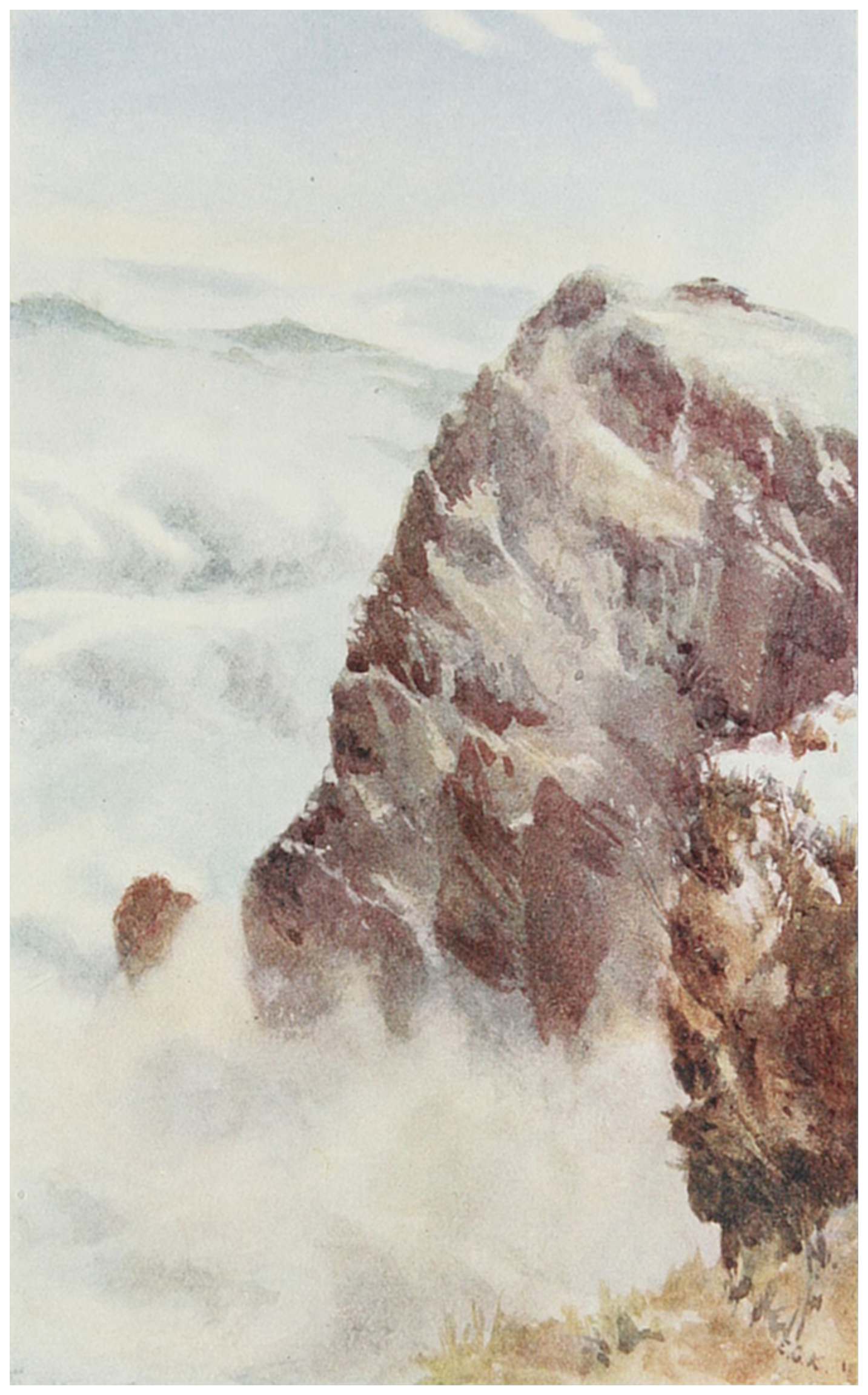
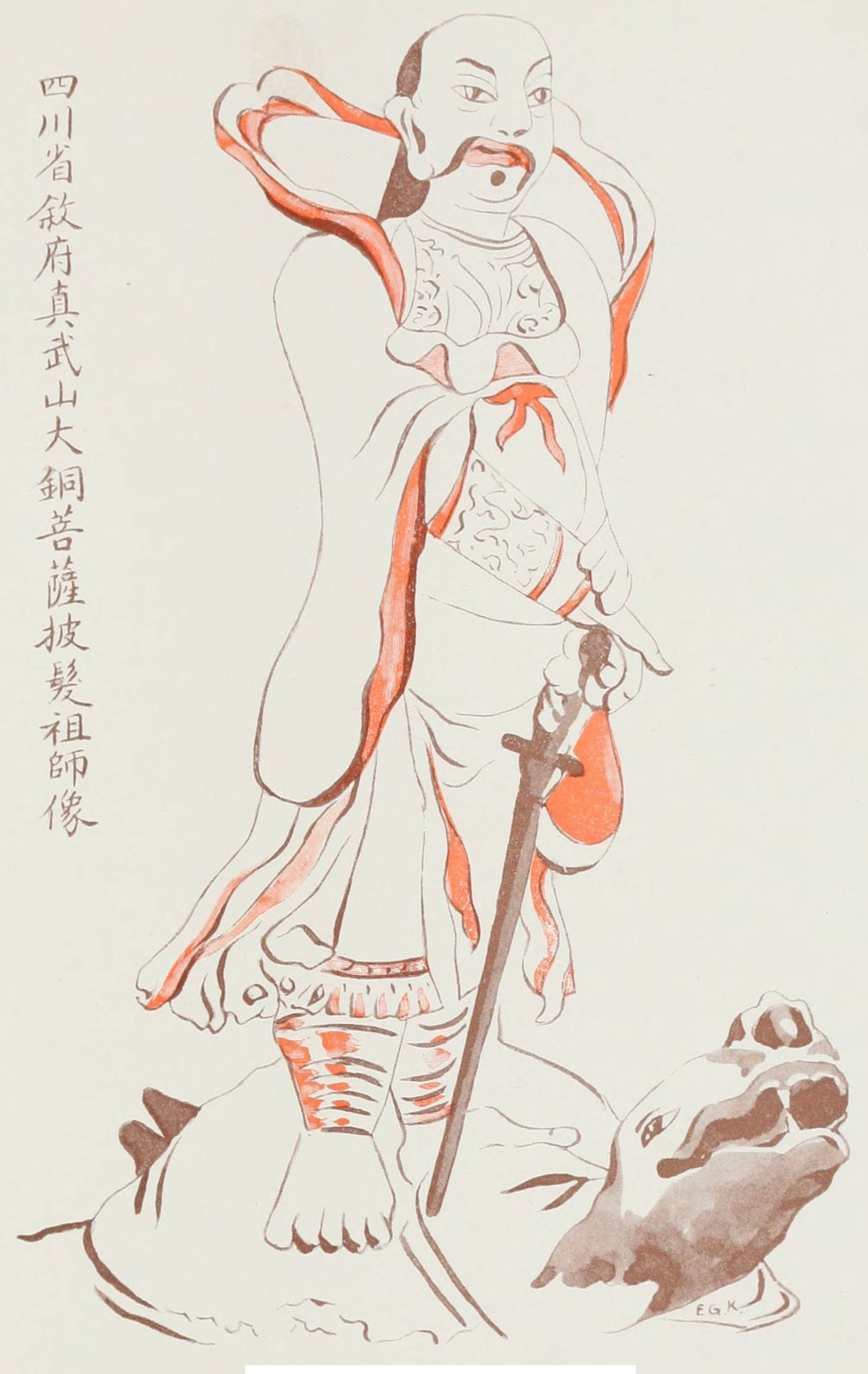
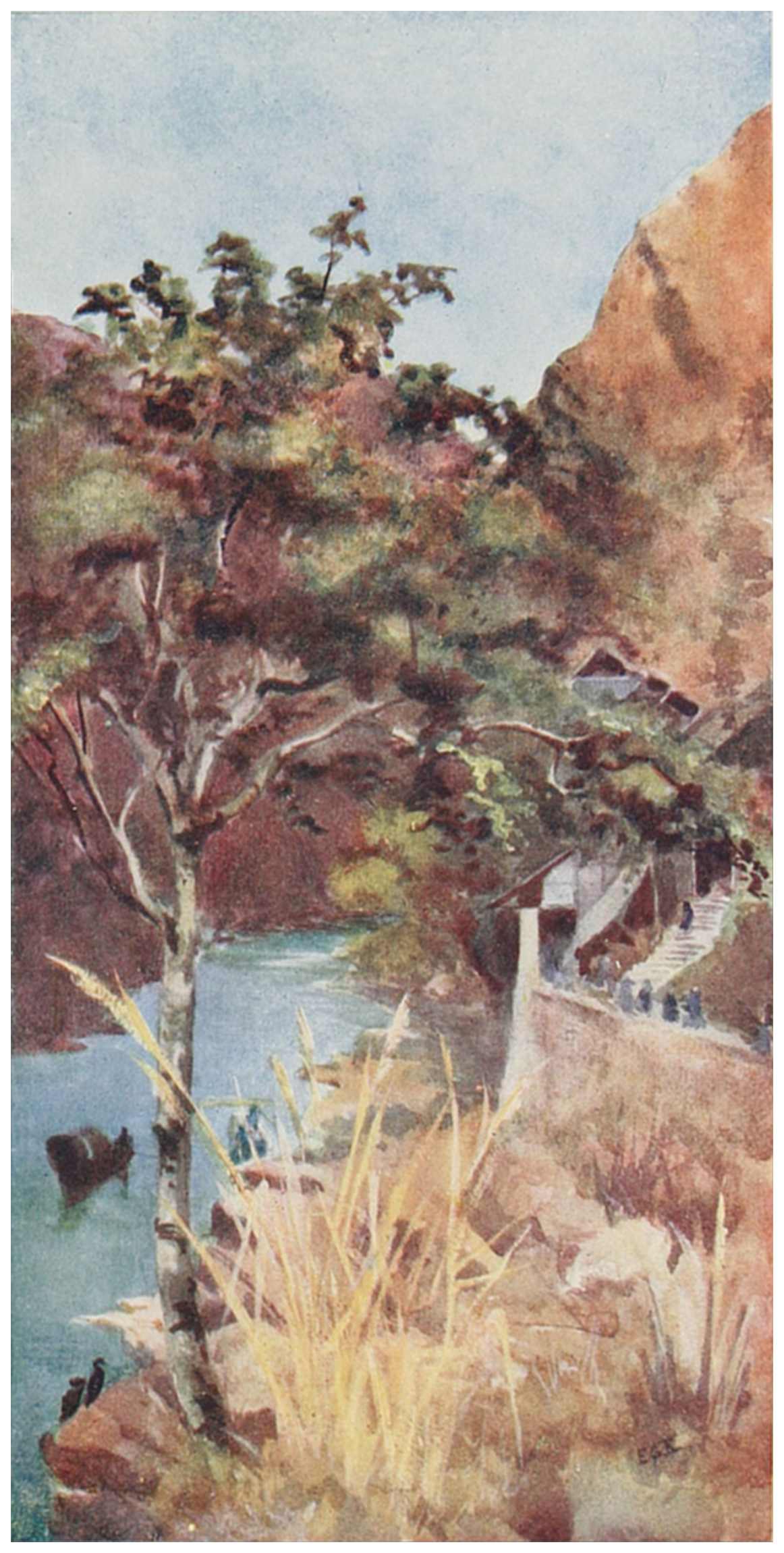
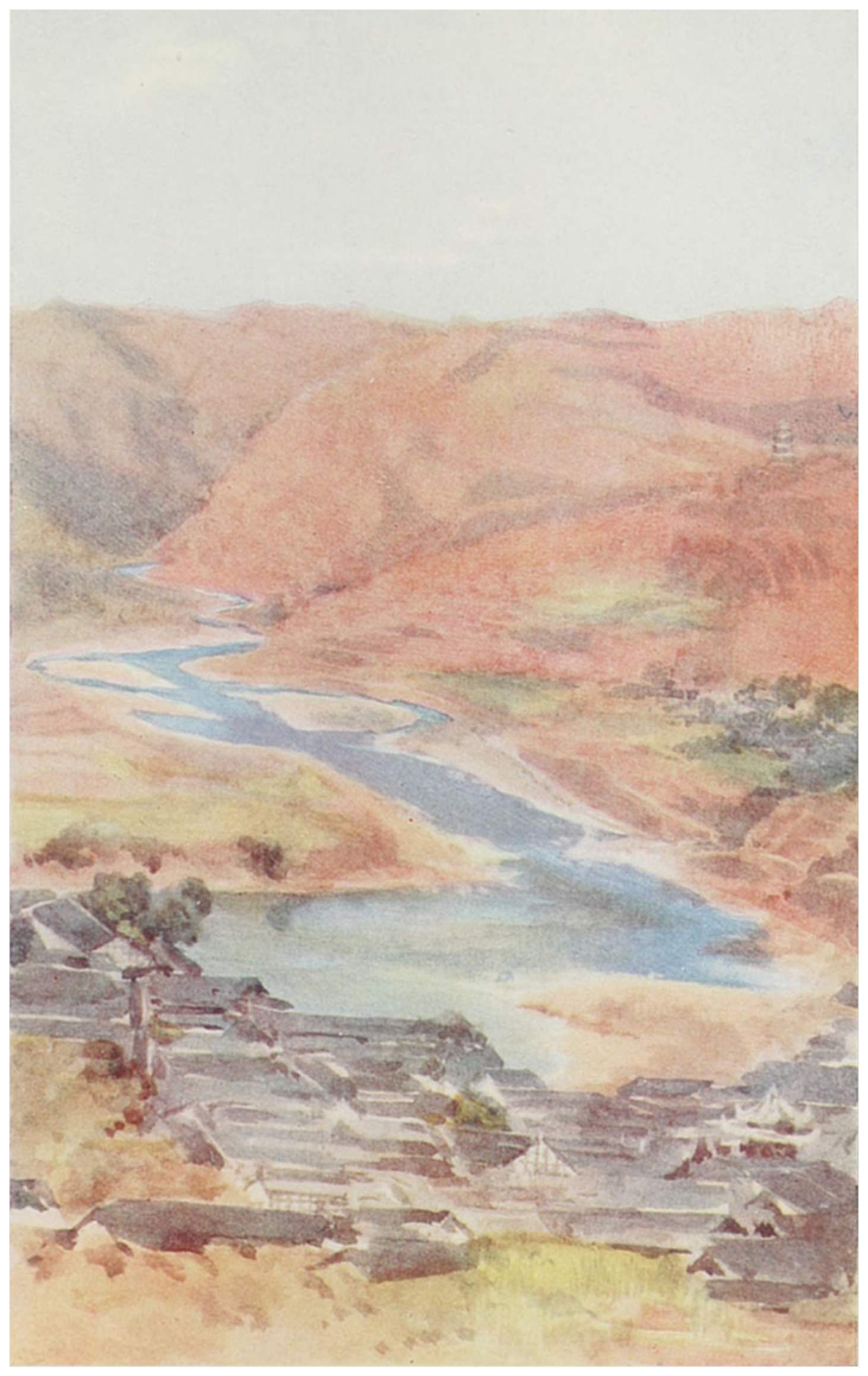
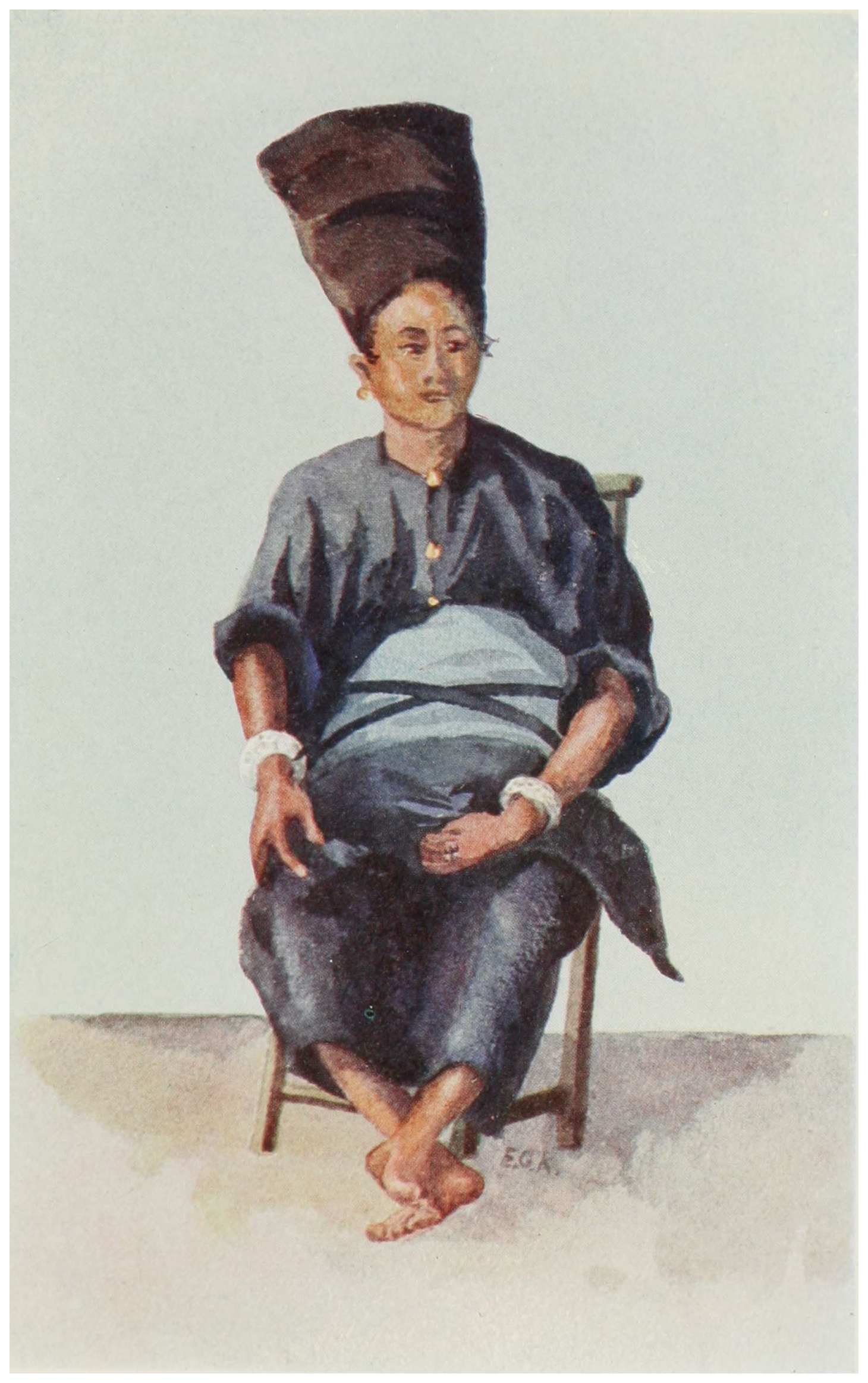
Larger versions of most illustrations may be seen by right-clicking them
and selecting an option to view them separately, or by double-tapping and/or
stretching them.
TRAVELS IN EAST, NORTH, CENTRAL
AND WESTERN CHINA ¶ WITH SOME
ACCOUNT OF THE NEW SCHOOLS, UNIVERSITIES,
MISSIONS, AND THE OLD
RELIGIOUS SACRED PLACES OF CONFUCIANISM,
BUDDHISM, AND TAOISM
THE WHOLE WRITTEN & ILLUSTRATED
BY E. G. KEMP, F.R.S.G.S.
NEW YORK DUFFIELD & COMPANY 1909
All rights reserved
THIS BOOK IS DEDICATED TO THE FRIEND
TO WHOSE SUGGESTION AND ENCOURAGEMENT
IT OWES ITS EXISTENCE
PRINCIPAL MARCUS DODS, D.D.
PREFACE
Every intelligent person that I have met
whose good fairy has led him to the Celestial
Empire has fallen under the spell of that
marvellous people and marvellous land. I am fired
with the ambition to cast that spell even on those
who have never been there, by showing them as
accurately and vividly as I can, with pen and brush,
what the face of China actually is.
People may describe with success the soul of a
people, provided it is sufficiently near the surface,
but the foreigner who has known and loved China
for a lifetime would be the first to repudiate the
possibility of doing this in the case of China. I
would rather take Browning’s view—“Nor soul helps
body more than body soul”—and try to set down
faithfully the things I have seen, that they may lead
others to study China for themselves.
It may be objected that the picture is too much
couleur de rose, because I have not dwelt on the dark
side of things: but there is a use for eyelids as well
as for eyes.
This book is the result of a year spent in Shansi,
1893–94, and six months spent in travel through the
provinces of Shantung, Chili, Hupeh, Szechwan, and
Yünnan during 1907–8. The former visit was mainly
spent at a medical mission at Taiyüanfu, which was
then remote from Western influences; now everything
has changed, and I travelled from north-east
to south-west of the Empire and found no village
untouched by the great awakening. On the first
occasion I was always conscious of a certain hostility
in the attitude of the people towards foreigners; this
time it was quite the reverse. Considering the behaviour
of many travellers towards the Chinese, this
seems to me really astonishing; but they are very
sensitive in their appreciation of mental attitude, and
they responded unhesitatingly to the call we made
on their chivalry by placing ourselves unreservedly
in their hands. We were repeatedly warned not to
do this, but our confidence was justified by the event.
In no European country could we have been more
courteously treated, and in very few have I travelled
so happily and so free from care.
The journey was one long series of pleasant surprises,
and my friend expressed the feelings of both
of us when, on crossing the frontier into Burma, she
exclaimed: “If only we could turn round and go all
the way back again!” If any one is induced by reading
this book to make personal acquaintance with China,
it will not have been written in vain.
NOTE
There is so little in this volume which is
drawn from other sources than personal
observation, and information obtained from
our Chinese and missionary friends on the
spot, that I have thought well not to
burden the reader with foot-notes. The
various details as to the religions of China
are mainly drawn from an interesting little
volume by Giles, “Religions of Ancient
China,” Smith’s “Uplift of China,” and
Hackmann’s “Buddhism as a Religion”;
while the account of the railways is from
Kent’s “Railway Enterprise in China.”
The spelling of Chinese names is according
to the most recent standard map,
giving the orthography of the Chinese
Imperial Post Office.
My first voyage to China was unspeakably
distasteful, and as we neared Hong Kong we
were suddenly caught up in the tail of a
typhoon and carried for forty-eight hours wherever
it pleased to take us. Most of that time we were
without food, and could not even get a cup of tea;
while we found it hard work to cling to a seat.
When we emerged from the storm, and steamed into
the wonderful bay of Hong Kong, it seemed like
Paradise; it looked to my eyes the most beautiful
harbour I had ever seen: and I have seen nearly all
the most celebrated ones, without feeling tempted to
change my opinion. The first introduction to a new
country, if it happens to be when the faculties are
specially quickened, makes an indelible impression,
and from this time China has been to me a land of
infinite charm and beauty. The more I have seen
of it, the more I have realised its fascination; even
its ugliness is interesting.
Hong Kong lies along the shore, with a steep cliff
rising abruptly behind it, called the Peak, and the
typhoon had laid parts of it in ruins, and unroofed
many of the houses, so that it was by no means
looking its best. British pride swelled within me as
I thought of the transformation that had taken place
in half a century. When it was ceded to the British
it was a barren island, with a population of 5000
inhabitants; now it is the second largest port in the
Empire, with a population of 238,724. There is
an immense boat population; whole families have
lived from generation to generation in their boats
along the shore. In Hong Kong, East and West live
happily together, learning to appreciate one another.
Chinese merchants are members of its council and
take an active part in its government. It has become
not only the greatest shipping but also the greatest
banking centre of the East, and it is a significant fact
that it contributes annually £20,000 to the British
Treasury as its military contribution.
From Hong Kong to Shanghai is but a step, and
at first sight the latter seems almost as European as
the former. The landing, after coming up one of the
mouths of the Yangtze River, is in the centre of a
promenade, with broad grass borders between it and
the road, along which lie the finest commercial buildings
of the city for the distance of more than a mile.
This is the Bund, the most imposing part of the
concession. It may be well to mention what a
“concession” is, as this is a term continually used
with regard to the treaty ports, such as Tientsin,
Hankow, and Shanghai. It is a right granted to
Europeans to inhabit a certain defined area, to possess
property in it (no private individual except a Chinaman
has the right to buy land for building on, in
China, although it is occasionally done in the interior),
to live under European law, to have their own police
and manage their own affairs. The Shanghai concession
was mapped out in 1843 by Sir George (then
Captain) Balfour, and is on a broad cosmopolitan
basis: later on the French obtained one adjoining it,
and then the Americans. Many Europeans live outside
the concession, especially in a quarter where the
English have laid out a charming shady road, perhaps
the most tortuous in existence—so as to avoid desecrating
graves; it is called the Bubbling Well Road.
The concessions have their own post-offices, where
you call for letters, if you happen to expect any from
the country to which they belong. We found the
Russian post-office up a staircase in a thoroughly
unofficial-looking house.
The traveller, however, on landing at Shanghai
ought not to drive along the Bund to the pleasant
Astor House Hotel, but should make a détour into
the Chinese streets Nankin Loo, or Foochow Loo,
densely thronged streets, where nineteen out of every
twenty people wear blue robes, varying in shade from
deepest ultramarine to palest aquamarine. One is
accustomed to think of the Chinese as quiet, slow-going
people, but the traffic of Shanghai is so great
that I know no place where you are more conscious
of business bustle. The crowd in the streets is almost
entirely composed of men and boys, so that it is hard
to imagine where room is found for the women and
children, even the balconies and shops as well as streets
being packed with men. It is estimated that Shanghai
has 160,000 inhabitants to the square mile. It is
necessary to visit old Shanghai really to see what it
can be, and it is a mistake to be deterred from doing
this (as many visitors are) on account of its special
squalor and dirt, or by the absurd statement that all
Chinese cities are alike.
You pass into the real Shanghai through two low
gateways, set at right angles from one another, where
no vehicle is ever allowed to enter; indeed, such a
thing is practically impossible. The streets are so
narrow and tortuous that it is hard even for carriers
to force a passage through the crowd. The houses
are fairly high, and innumerable signboards (long,
narrow boards covered with gilt characters which
read from bottom to top) hanging overhead block
out the light and hinder any current of air from
driving away evil smells. The entrances to the shops
are lined with Chinese lanterns of every shape, size,
and colour: when lit, they cast a kindly glamour
over the celestials below, very different from the pitiless
glare of electric light. There is no gaudy display
of goods in shop windows, for there are no windows;
just an open counter on which a few specimens may
be lying, probably in a glass case. The walls are
lined from floor to ceiling with shallow drawers,
filled with endless little parcels containing the rest of
the stock-in-trade. Despite the squalid surroundings
and the tininess of the shops, this may be very valuable
(for the Chinese are great lovers of curios), jade,
bronze, ivory, china, or silver. Along with such
things are mixed the most absurd rubbish, mainly
European goods. Many shops contain a row of
finely carved chairs to accommodate purchasers, and
elaborately decorated woodwork, such as screens with
beautiful groups of figures at one end. We should
have liked to buy many things, but this is not to be
done lightly, and several days of diplomatic dealing
are required before purchaser and seller can come to
terms in the orthodox way. No Eastern would be
satisfied with the monotony of our Western methods.
The whole street is interested in the performance, and
looks on as at a play. The amount of business transacted
appears to be in inverse proportion to the number
of shops.
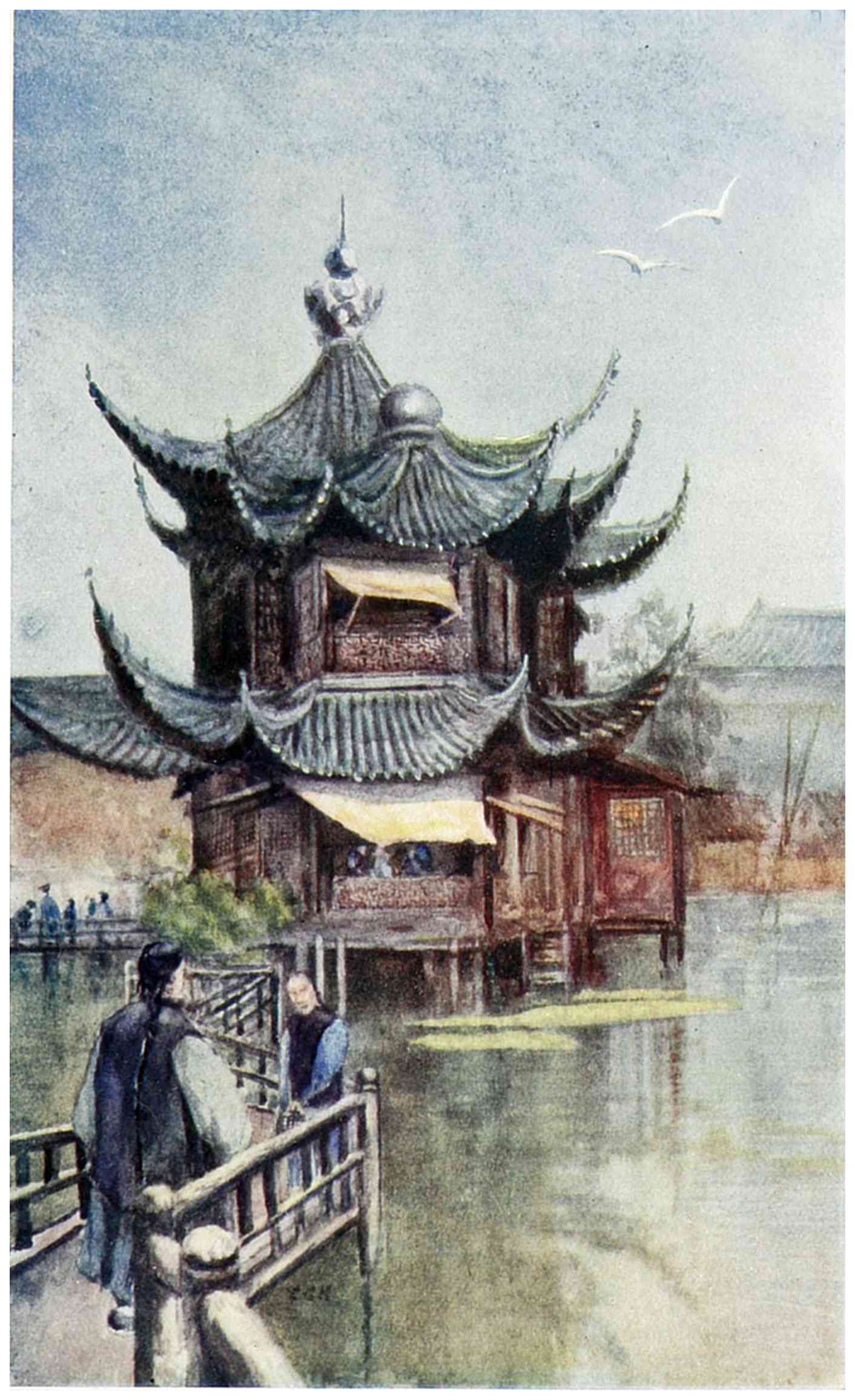
We threaded our way through a maze of lanes till
we came to the centre of the town—the original of
the celebrated willow pattern1—and as picturesque a
spot, in the mellow evening light, as you could possibly
imagine. A weed-covered pond, fringed by
willows, surrounds the group of tea-houses, which
are reached by a zigzag bridge, across which passes a
ceaseless stream of blue-robed passengers: gentlemen
carrying their birds out for an airing; mothers with
babies in their arms, wearing gaily coloured caps surmounted
by scarlet tufts; coolies with heavy loads;
children dangling sundry purchases, such as a bit of
meat or vegetables, from the end of a string or blade
of grass—a fascinating throng to watch, if not to be
absorbed into!
Close to the garden is a mandarin’s palace, into
which we gained admittance after much hammering.
The reception-rooms were lofty and dignified, furnished
only with Chinese lanterns, some handsomely
carved chairs, alternating with little tables (just large
enough to accommodate tea-things) set in two rows
facing one another, and scrolls on the walls. The
garden was entirely composed of rockwork, with the
greatest possible length of pathway comprised in the
smallest possible area. One of the stairways led up
to a handsome summer-house with a balustrade consisting
of a sinuous dragon, some forty feet long, carved
in stone. Beside his gaping jaws sat a little stone frog,
preparing to leap in—a good specimen of the humour
which makes Chinese art so attractive. A few willows
and shrubs adorned the garden, but no flowers—a
feature characteristic of Chinese gardens, where design
and architectural work such as summer-houses, bridges,
and walls are the most important matters. On different
parts of the inner walls of this garden were
stone medallions, representing scenes in the Mandarin’s
life.
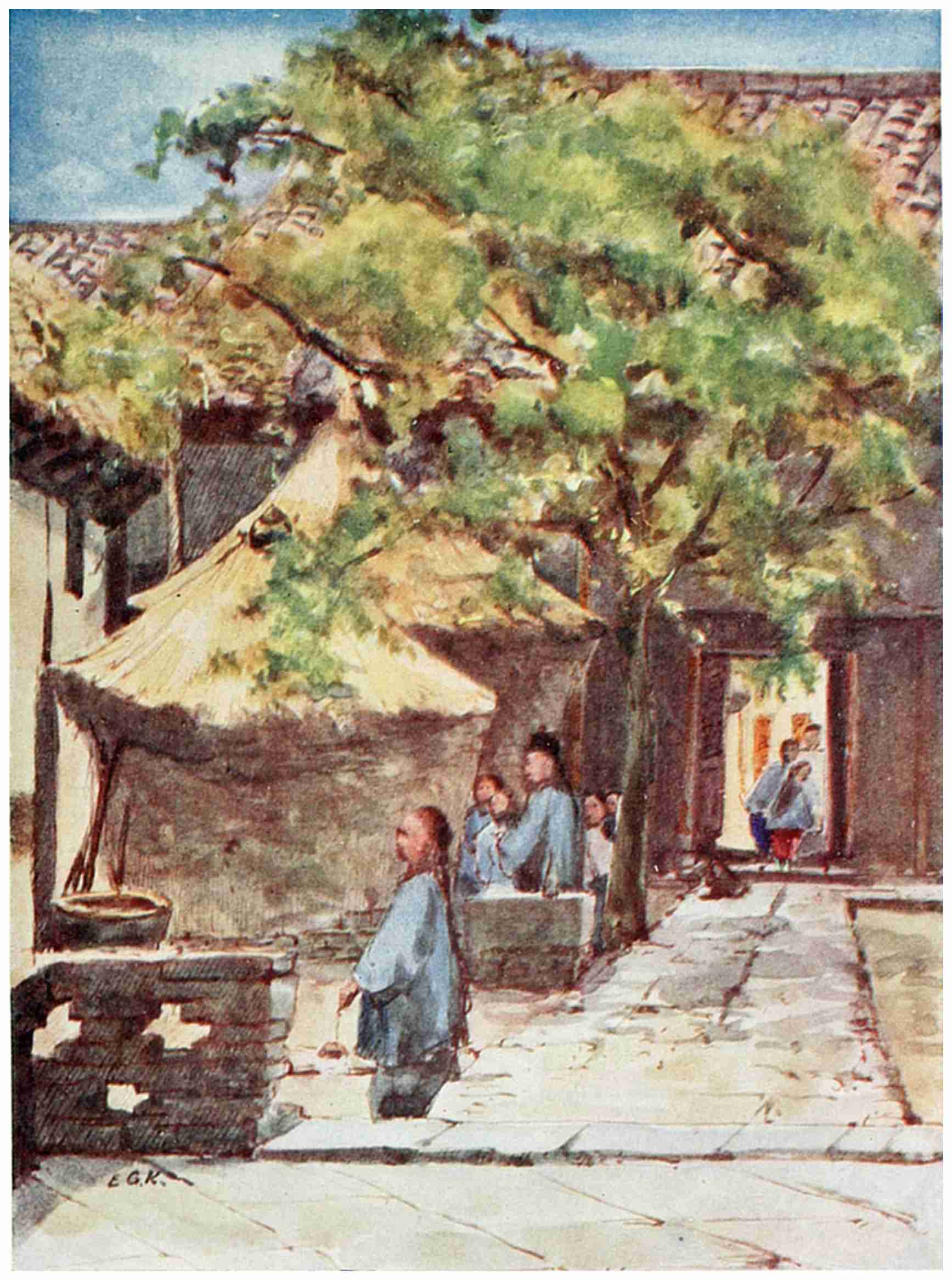
TEA-HOUSE IN OLD SHANGHAI
On emerging from the garden by a different door
from the one we came in at, we were confronted by
a row of images, and found it was a joss (= worship)
house; the few worshippers present were prostrating
themselves—two at a time—before the altar, behind
which stood the gods. The air was laden with the
smell of incense, joss-sticks burning in a stand on the
altar; and huge stone lions guarded the door. It
was apparently the quietest and least frequented part
of the city.
In the courtyard was a fine bronze monument, said
to be over 2000 years old, round which a market was
going on; the people sitting on the ground, surrounded
by their wares, mainly vegetables. By way of variety
there was a man with a large assortment of coal-black
tresses of hair for sale, as even the poorest Chinaman
is not above improving his queue with a false addition:
also there was a large basket full of grasshoppers
in cages about an inch square, “shrilling” at the top
of their voices. From this courtyard ran a street full
of shops of cooked meats. Above the counters hung
split dried ducks, which looked as if they had been
petrified in the act of flying with outstretched necks
and wings. Below them were baskets full of eggs,
black with age, preserved in a mixture of straw and
lime, esteemed a great delicacy, as also seaweeds and
sea-slugs—the most revolting, evil-smelling things—like
fat caterpillars. Rows of little dishes contained
various kinds of relishes, and there were piles of white
square steamed flour dumplings, which is the Chinese
form of bread.
Passing up the street, you come to a vegetable stall,
the most exquisite harmony in reds and yellows;
scarlet persimmons, bananas, pomeloes like yellow
cannon-balls, yellow and scarlet capsicums, all sorts of
nuts, a yellowish fruit shaped like a hand and called
“Buddha’s fingers,” and baskets of dingy-coloured
grapes, were some of the things for sale. Rotten
pears cut in half seemed to find a ready sale; and à
propos of pears, I must tell how a lady in Peking peeled
one for my sister with her finger-nail! and how
another, in describing the shocking extravagance of
her neighbour, ended as a climax with the statement,
“She actually throws away her pear skins!”
The next street was full of coffin shops, particularly
dear to the Chinese heart, as a coffin is a complimentary
gift from a son to his father. They were mostly
black, and would probably be ornamented with gilt
lettering; but in Canton scarlet coffins are the fashion.
Nauseous smells rose from the open gutters.
Myriads of mosquitoes are wont to settle upon hapless
visitors, but a solution of eau de Cologne and pyrethrum
rubbed over face, ankles, and other vulnerable
spots kept us fairly immune.
Leaving old Shanghai, you come into a whirling
throng of carriages, wheelbarrows, and rickshas, of
which there are thousands darting about. When an
Englishman happens to be the occupant, the speed
of the ricksha is automatically accelerated. Whole
families of Chinese women and children, dressed in
every colour of the rainbow, manage to pile themselves
on the barrows. At the street corners stand
Sikh policemen, tall handsome men with dazzling
white turbans, who contrast finely with the celestials.
There is a greater variety of vehicles in use here than
in any other place that I have visited in the East, and
they all go much too fast for the safety of passengers,
considering the narrowness of the roads. The slightest
push upsets a barrow. The swiftest of all the vehicles
is a sort of low victoria, drawn by a rat-like pony.
This is specially used by stockbrokers, who dash out
of an office into it, one foot in the carriage and one
on the step: they never think of sitting down, but
are whisked away to another office, into which they
dash like lunatics, and so on ad infinitum. A feverish
activity seems to possess all the business population,
and every movement says “Time is money.” It is
only in the evening that the business folk of Shanghai
may be seen strolling along the Bund or sitting on
the benches, which are labelled “Europeans only.”
Hard by is the public garden, where no Chinaman
is allowed to enter—an offensive piece of insolence
as long as other Eastern races can strut about in it;
but it is in keeping with the attitude, unfortunately,
of a large number of Europeans towards the race
among whom they dwell. Not long ago a notice
might have been seen, “No Chinamen or dogs admitted.”
It may seem strange that the Chinese post-office is
in the foreign concession, but the reason is that it
is under European management together with the
customs, which are under the same roof. If you wish
to send off a parcel to Europe, you must first take it
to the Customs House, where it has to be opened for
examination. If you happen to be a lady you are
shown into a division marked “Ladies only,” and the
Chinese officials save you all further trouble: they do
your parcel up with a dexterity which makes you
envious, and seal it according to regulation; and it is
all accomplished with a swiftness and courtesy that
might well be copied at home.
One day we drove to the fine American college of
St. John’s, about five miles from the city. We passed
along the Nanking Road, where the most beautiful
Chinese shops are. The façades are of handsome
carved gilt woodwork, with balconies in which there
were parties of men drinking tea. Unfortunately,
these shops are gradually being replaced by European
shops with plate-glass windows, and soon this part
of the city will be quite spoilt. Gay carriages were
following the same direction as our own, the Bubbling
Well Road, and we were amused to see in one a party
of Chinese girls evidently returning from school, and
with their little handmaiden hanging on to the perch
behind, where you would expect to see a boy in livery.
Inside the carriage was a mirror and a sort of dressing-table
and a flower-vase, as the custom is at Shanghai.
On arrival at the college, we were taken first to see
the orphanage, where tiny little creatures of about two
or three years old came and solemnly bowed to us,
with folded hands. The two youngest members of
the establishment were babies, one of whom had been
rescued from destruction. The father and mother had
both been born on unlucky days, and when the baby
girl had the same misfortune they utterly refused to
have anything to do with it. She was accordingly
taken to St. John’s at two days old, and has thriven
capitally. We visited successively the boys’ and girls’
schools, and finally were taken round the college by the
principal, Dr. Pott, to whom is mainly due the great
success it has achieved. There are about 120 scholars,
all of whom have to pass an entrance examination in
English, and they pay what are considered somewhat
heavy fees, so that the bulk of the expense has not got
to be met from mission funds (American Episcopal).
At present the only two final schools of the college
are theology and medicine, but many of the students
go on to America for further college courses. We
visited the dormitories, and were interested to compare
the boys’ belongings with those of English
schoolboys. Each boy has his own teapot, and can
always get a supply of boiling water. Many of
them had musical instruments, some flowers, some
birds, some crickets. They are fond of having
“cricket matches”—that is to say, with live crickets.
In winter the boys all bring hand-warmers into class,
and Nelson’s ink-bottles are the most approved for
this purpose.
As regards games, Dr. Pott said that it was with the
utmost difficulty that Chinese boys can be got to exert
themselves; but they are gradually getting keener, and
the average of attainment is steadily rising. On a
board in the college they have a list of honours won,
and this keeps up the interest. In answer to a geography
examination question, “What are the five principal
races?” the answer was, “Fifty yards, hurdle race,
&c.”! The college has a fine library, alumni hall,
chapel, and playing grounds, but the laboratory leaves
much to be desired. It is affiliated to an American
university, and has the highest reputation of any educational
establishment in China. Certainly, to judge
by one of its students, who travelled with us for six
months as interpreter, it is worthy of the highest
praise.
Since our visit a new hall has been added to it, and
there will be accommodation for another 100 students
when the building is completed. The cost is being
largely defrayed by Chinese well-wishers, £600 having
been already contributed by them.
CHAPTER II Shantung, the German Sphere of Influence
We left Shanghai by steamer on October
2nd, and reached Tsingtao (the port
of Kiaochow) at about 8 P.M. on the
3rd. We were grateful to be allowed to stop on
board for the night, as our train started from a
station close at hand at 7 A.M., and we were saved
the trouble of going to an hotel. The harbour is
picturesquely situated at the mouth of the bay,
surrounded by hills which have all received German
names since the occupation. We were up betimes,
and rather disturbed by the non-appearance of the
Customs House official, without whose presence we
could not go ashore. However, he appeared in time
to let us get to the little wayside station, and we
found other passengers waiting there, seated on the
line with their luggage in a haphazard way. The
Germans have not only got the concession known as
Kiaochow, but also thirty miles on each side of the
railway line which they have built from Tsingtao to
Tsinan, the capital of the province, a distance of
about 250 miles, through the centre of the province.
The port is laid out just like a German town, and has
hotels, statues, a post-office, commercial buildings, and
private houses. The place is a fashionable summer
resort, consequently the prices are high, and have
gone up at least 50 per cent. since the coming of the
Germans, who spend money lavishly.
The German Government has just decided to build
a High School for Chinese boys of the upper class,
at a cost of £30,000.
The rail is the dearest and dirtiest I have ever
seen. The officials treat foreigners with indifference,
and the Chinese with brutality—at least, so we heard at
every place at which we stayed, and from the people
who most appreciated the coming of the railway. One
can only hope that things may be improved later,
and a better class of officials put in charge of the
line. There was but one train per day going in each
direction, and the journey from Tsingtao to Tsinan
takes about twelve hours. Occasional trains run on
sections of the line. Although money has been
poured out like water to make the German occupation
a success, the object has so far not been accomplished,
perhaps owing to lack of harmony between
the three principal German officials in China—the
Governor of Kiaochow, the Ambassador, and the
Commander of the Fleet. The bulk of the trade
on the line is still in Chinese hands, and the merchants
have succeeded in getting permission to build
a branch line from the treaty port, Chefoo, to
Weihsien, which will be a great advantage to them.
Naturally the Germans, after spending so much on
their port, do not like to see trade diverted to
another. They not only refuse to build the line
themselves, but have memorialised the Throne to
prevent the Chinese from being allowed to build one
either: however, their representations have failed.
The province of Shantung is considerably larger
than England, and is the most densely populated
of any in China—557 persons to the square mile.
Although it is well cultivated and prosperous in
appearance, the partial failure of the crops has the
immediate effect of throwing 50,000 of the inhabitants
into a state of beggary. When this happens,
the Government grants each beggar daily a bowl of
rice. It is hard to realise this state of affairs when
you pass through such a prosperous-looking country;
the crops are wheat, different kinds of millet, sorghum,
maize, sweet potatoes, beans, peas, hemp,
and indigo. A large quantity of fruit is also grown—pears,
apples, apricots, peaches, cherries, grapes, persimmons,
&c. Every now and then you pass brilliant
patches of vegetables of various sorts. A villager’s
plot of land usually contains all the requisites of life—cotton
(for clothes and bedding), wheat, potatoes, a
fruit-tree, and last, but not least in China, a castor-oil
plant; a few fowls and pigs will give him what most
he loves in the way of food. I have known a Chinese
woman eat fifteen eggs at a sitting, and she was surprised
at the fit of indigestion which followed this
meal! There is a curious specimen of fowl cultivated
in this province, called the Cottonwool fowl; it is
small, white and fluffy, looking just like a toy out of
a cardboard box, and is exclusively used as medicine,
especially for the diseases of women. Its flesh is dark,
and the bones black; the chickens are the sweetest-looking
objects. In contrast, the pigs of this part are
black and hairy.
After leaving Tsingtao the train travelled slowly,
stopping at every station, and these stations are all
alike except a few large ones. There was a ticket
office, and a row of five wooden-looking Chinese
policemen standing at attention and drawn up in
line as long as the train was in the station. They
wear black sailor-hats, and hold batons as if they were
rifles. For all the world they look like toy soldiers
at 11¾d. per dozen, made in Germany. There are
no platforms on these stations, and passengers squat
on the line surrounded by their bedding, teapots, and
birdcages. The Chinese take to railway journeys
like ducks to water, so the trains are well filled. A
woman may be seen approaching on her donkey,
which travels at about the same rate as the train, so
she stands a good chance of catching it even if she
has started rather late. She is a picturesque object
sitting astride on the top of her bedding, attired in a
blue coat and pink trousers, tied in at the ankle with
pea-green ribbons over white socks; the finishing
touch of the costume being the coyest imaginable
little pointed embroidered shoes.
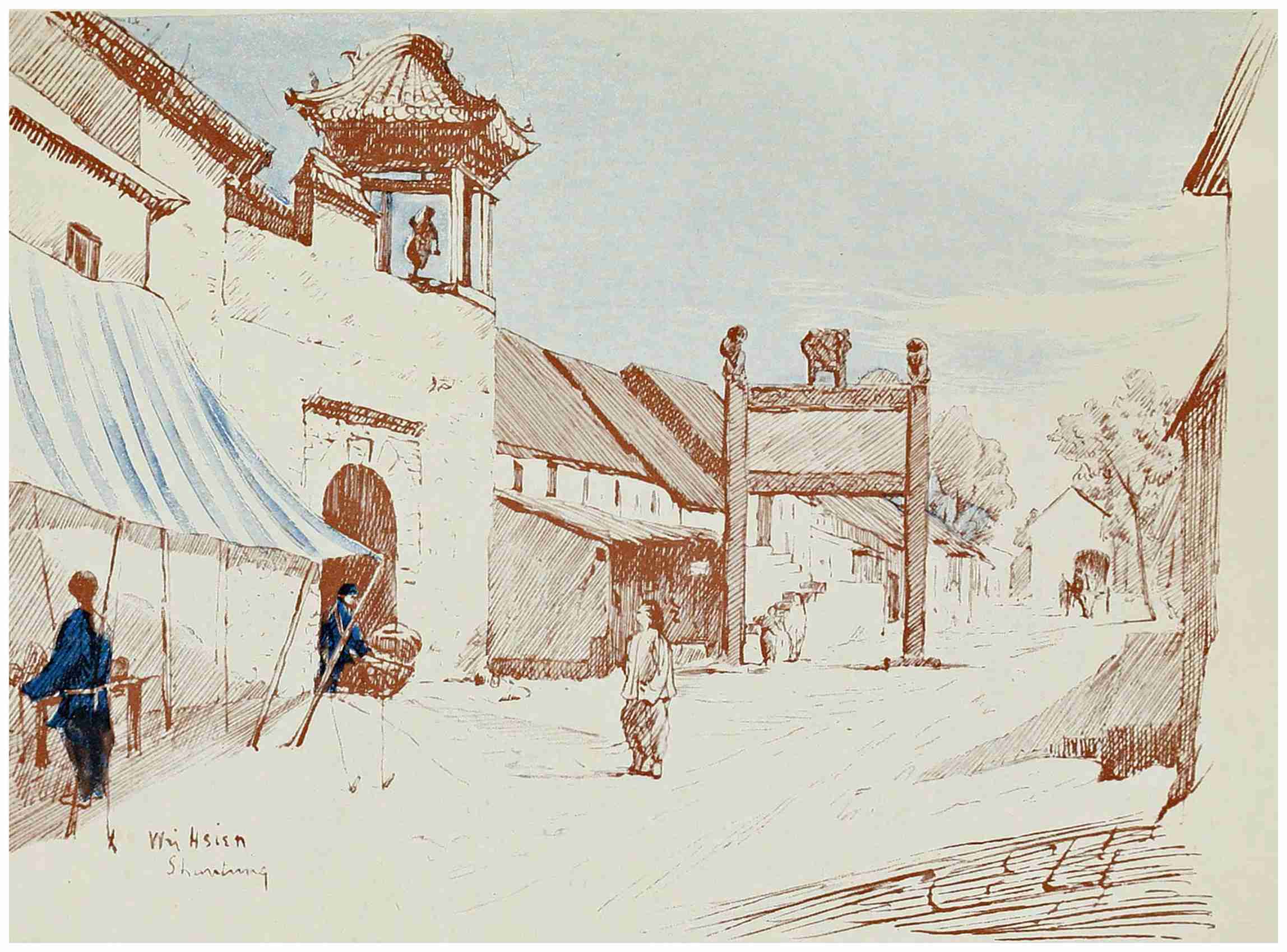
A SUBURB OF WEIHSIEN
At Weihsien, which we reached after some five
and a half hours’ travelling, we were met by a friend,
and passing out of the station, we found on the “cab-stand”
a row of wheelbarrows waiting to take passengers
to the town, about half a mile distant. The
country is dotted with a good number of trees, mainly
willows, poplars, cypresses, and mulberries, above
which tower the walls of the city. We were carried
in chairs, and were charmed with the view, as a lovely
clear stream flowed at the base of the walls, reflecting
a deep blue sky. Weihsien is an important business
city, and its streets are named after the trades
plied in them, such as Forge Street, Gold Street, and
Silversmith Street. To us they appeared picturesque,
but some people might call them squalid, and it is
certainly wisest to look up, not down. We passed
through the outskirts of the town to a fine-looking
mission station, mainly built and worked by American
Presbyterians who had recently coalesced with
the English Baptists. This mission station was completely
destroyed by Boxers in 1900, but now there
is a fine group of buildings, including boys’ and
girls’ schools, hospitals, a church, college buildings,
and houses for workers (who number about twenty),
and the whole is enclosed within a high wall. So
far the teaching, even of Western science, has been
entirely carried on in Chinese, but the demand for
the knowledge of English is so pressing that it has
recently been added to the curriculum.
From Weihsien we went next day to Tsingchowfu
by rail, a journey of about two hours, and this is one
of the great historical centres of the Empire. Here,
again, the railway station was at a little distance from
the town, and we found chairs waiting to convey us
thither. The town has an imposing position on the
hill, with a stream flowing round the greater part of
it; consequently the walls look an astonishing height
from the outer side, at least twice as high as from
within, and the main entrance is across a bridge.
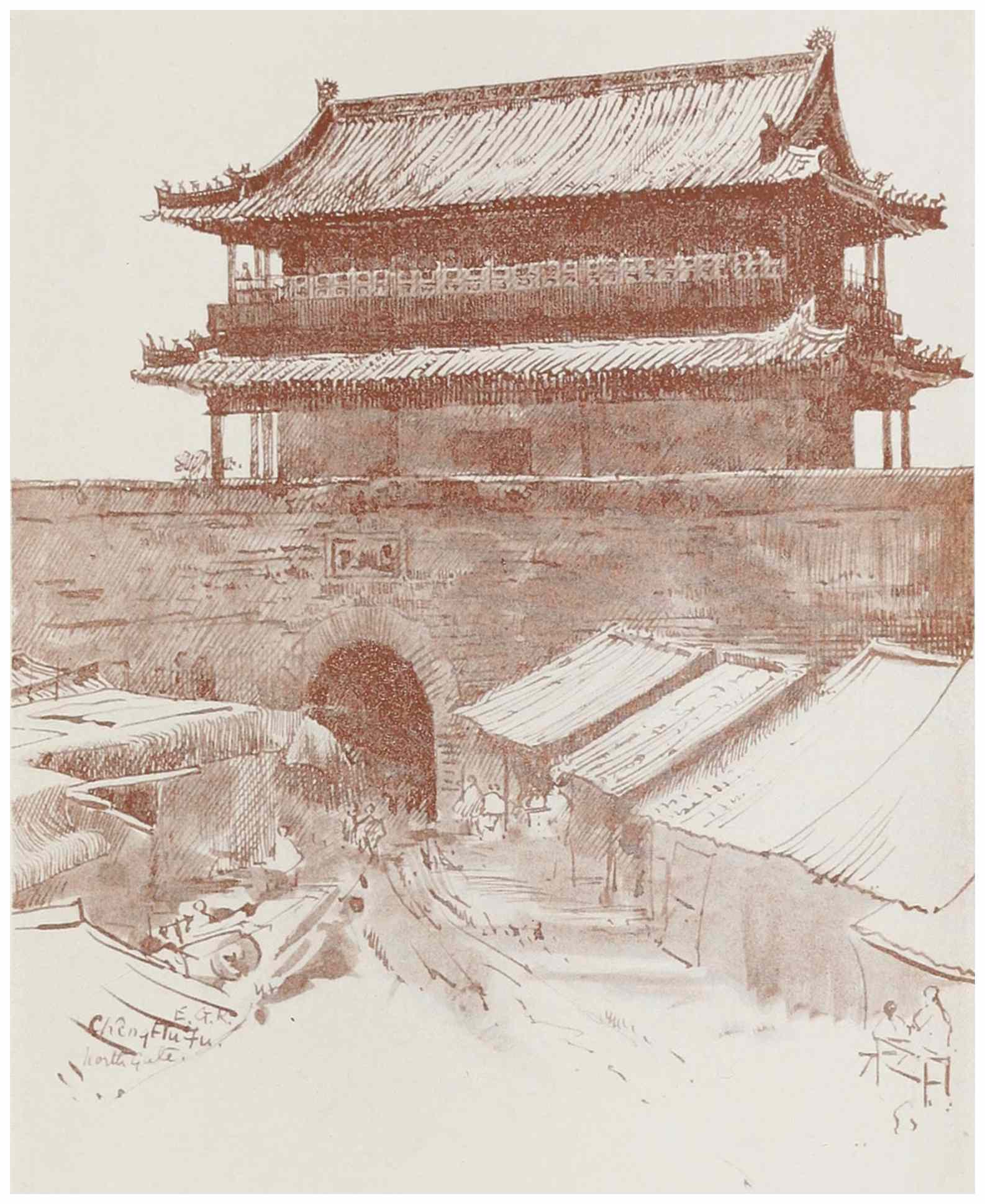
Within the gloomy north gate hangs a group of
cages containing magistrates’ boots, but it is probable
that they were originally used to hold something very
different, namely, criminals’ heads. In Les derniers
Jours de Pékin, Pierre Loti describes those he saw
just after the siege, all with the queue hanging down
between the bars.
There are many fields within the city, and if time
had allowed I should willingly have stayed several
weeks sketching there. The ruins of the palace belonging
to the Ming dynasty are fast falling to decay,
and as, unfortunately, the Government does not take
any interest in the preservation of national relics,2 it
is not unlikely that they may entirely disappear one
of these days.
Both here and at Weihsien we were struck with
what we heard of the village girls’ mission schools,
showing the stability of character and also the capacity
of Chinese girls. When a village wishes to establish
a school, its inhabitants ask some mission to supply a
teacher, and they make themselves responsible for the
rest. The girl teacher is probably lodged in the home
of the village elder, and he makes arrangements for
the schoolroom, &c., and acts as guardian to the
teacher. She organizes work, and has entire control
as long as she manages it properly. About twice a
year a missionary goes to inspect it and examine the
scholars. We felt it would be interesting to see one
of these schools, so our hostess offered to arrange the
matter, and took us one day to the village of Wang
Mu Chiang Chwang, some ten miles distant, which
she was intending to visit for the purpose of inspection.
CHAPTER III A Day in the Country (Shantung)
Days in early October are perfect for visiting
the country. The thermometer stands at
70° to 80°. We set out one clear, fresh
morning at about eight o’clock. I went in a sedan-chair,
and the two others in a wheelbarrow—not such
an uncomfortable conveyance as might be supposed,
except when the roads are very rough. The occupants
recline on each side of the wheel, and parallel
to it, in a padded seat with back rests and cushions,
their feet extended full length in front; the barrow
is wheeled from behind, and has a man harnessed like
a beast in front. As this was a heavy barrow there
were two additional men pulling, one on each side of
it. The sedan-chair travelled quicker than the barrow,
and had the advantage of taking short cuts across the
fields. It was carried by four men, two in front and
two behind; the front ones carried by means of a
pole, to which the shafts were suspended—which ran
parallel to them—while the carriers at the back were
in the shafts themselves. When the men wished to
shift the weight from one shoulder to the other, they
supported the pole by means of an upright one which
they carry for the purpose. Owing to these arrangements
the chair can be equally well carried by three
men as by four, two in front and one behind, in which
case the back carrier is much farther from the chair
than the front men.
I was soon well ahead, and did not witness the
catastrophe that happened to the barrow shortly after
starting. Going round a corner rather too fast, the
barrow was upset, and one of my friends was tipped out
into the dust; but the other, on the upper side, managed
to hold on. Happily, no damage was done, as the fall
was into a soft, clean heap of dust. But it was not so
pleasant a matter for another friend to whom this
happened when she was travelling the same road earlier
in the year. She was tipped over into a sea of mud,
and as she happened to be carrying a basket full of
eggs, she suddenly found herself in a “Yellow Sea.”
Leaving the city behind us, we passed through open
country where every one was still busy harvesting
in the fields. Some fields were already ploughed, in
others green wheat stood a few inches high; it would
not be much higher before the snow came to cover
it for winter. Much of the foliage looked more like
spring green than autumn, and many of the villages
lay embowered in trees—willows, aspens, cryptomerias,
the last-named always belonging to temples or
adjoining graves. The threshing-floors were filled
with golden grain being prepared for winter storage.
Bean pods were being broken up by means of stone
rollers, worked by donkeys, blindfolded with neat
straw goggles. On one occasion I saw a donkey
wearing a pair of ornate blinkers, bright blue cotton
with protuberant black eyes surrounded by a white
line. The Chinese love to decorate the things in
common use, and it is a perpetual joy to see the skill
and ingenuity expended on simple objects. After the
bean pods have been crushed the different parts of the
plant are raked into separate heaps on the threshing
floor—bean, husk, stalk, and chaff—for every particle
is used in one way or other. If one were asked to
state what was the most striking feature of this great
empire, I almost think it would be this: the carefulness
which prevents waste, the ingenuity which
finds a use for everything. Even the green weed
covering the ponds is used as fodder for pigs. When
the fields look quite empty after harvest, the women
and girls gather together the few remaining straws.
Every inch of ground is cultivated, except the endless
mounds, the graves of countless generations.
The country was a scene of delightfully cheerful
energy, whole families working together; a tiny child
lying naked, basking in the sun, the women (despite
their bound feet) as busy as the men. Barrows passed
along, groaning under loads so heavy that it needed a
friend to drag in front, while at the end of some five
yards of traces a donkey trotted along, waiting to give
its assistance till it was more urgently needed, as, for
instance, going uphill or over difficult ground. The
reins were attached to each side of the barrow, and
could only be manipulated by a dexterous twist of the
wrists. Occasionally a man rode by on a pony, whose
coming was heralded by a tinkling of bells. As the
country is covered with crops, not many cattle are to
be seen, and any there may be are mainly fed on bean
cakes. We were swiftly borne through village after
village, and my men only set me down for one ten
minutes’ rest during the ten miles, which we covered
in two hours and forty minutes.
As we entered Wang Chia Chuang (Wang = family
village), the whole community, headed by the Wang
family, turned out to meet us, having been warned the
day previous of our intended arrival, and we were
ceremoniously led to the Guest Chamber. On the
outside of the entrance to the house little strips of red
or orange paper were pasted up, and in the inner courtyards
as well. On these papers are sayings from the
writings of Confucius, or other mottoes, such as the
following:
When you sit quietly, think of your own fault;
When you chat together, mention not another man’s.
In teaching children, good must be taught;
To win a reputation, study may be required.
Diligence and frugality are the principal thing in maintaining a house;
Humility and mildness are the boat for crossing this world.
Honesty keeps the family great;
Classics make the generation long.
These couplets are renewed at the beginning of the
year, and the village schoolmaster has a busy time
writing them.
Tea was brought in, and not only the family and
schoolgirls, but also the neighbours came to see us,
pouring out a flood of talk, of which we understood
nothing. Then we went into the schoolroom across
the courtyard, and found it and the girls as clean as
soap and water could make them. The certificated
teacher was about twenty years of age, and in this case
happened to be Mr. Wang’s daughter. Her room
opened out of the schoolroom, and was a pattern of
neatness—it was ornamented with photos. Her salary
is £3 per annum. The curriculum of these village
schools consists of the three R’s, singing, drill, and
sewing, and it is wonderful to see the difference in
the appearance of the girls after they have been a
short time under training, the awakened intelligence
showing to a marked degree. The more promising
students get drafted on to the boarding-schools for
further training, with a view to their becoming
teachers. The largest of these schools only contain
thirty scholars, but they have two teachers for that
number of scholars. An official who happened to visit
one of these schools was filled with astonishment at the
behaviour of the girls; as soon as he entered they all
stood up, and answered the questions he put to them
with modesty and clearness. He said how different
this was from the behaviour in the national schools
for boys, and sent a large sum of money (comparatively
speaking) to be divided among the scholars, as a mark
of his appreciation. In the large towns Government
schools for girls are being started, but in the country
there are only mission ones. Dating from the new
year (1909) school attendance is compulsory for boys
throughout the Empire, therefore the Government is
responsible for the establishment of the requisite
number of schools—at least one in every village. At
first there was a difficulty in starting village girls’
schools; now they are in great demand, and sufficient
teachers cannot be obtained.
A VILLAGE SCHOOL
After we had heard the children sing and had inspected
their writing and sewing, &c., we watched
Mr. Wang doling out medicine in a patriarchal way
in the courtyard. Several people had taken the opportunity
of our visit for killing two birds with one stone,
namely, seeing foreigners and obtaining medicine.
One of them showed us her unbound feet with great
pride, as she had just achieved the process of unbinding,
and she presented us with her old shoe, much worn,
but beautifully embroidered, in which she used to work
in the fields. The Chinese naturally have remarkably
small feet, and in this village most of them are unbound,
as the majority are Christians, but the feet are so tiny
that in many cases it is difficult to believe that they
are not bound. The women wear white linen socks,
and their wide trousers are neatly fastened over them
with different coloured braids. Village life here looks
eminently patriarchal. The sons do most of the work,
all living with their families under the same roof.
One of the daughters-in-law had a beautiful Madonna-like
face, as she sat nursing her baby, with other
youngsters crowding round her knees. No one could
have failed to admire the saintly expression and graceful
pose. The two married daughters of the house
were living in a neighbouring camp with their husbands,
who are Manchu officers. All the prefectural
towns have Manchu garrisons, but it would not be
possible for a foreigner to tell the difference between
Manchu and Chinese soldiers.
Our visit came to rather an abrupt close, as we were
warned that we must reach the city before sundown
or the gates would be closed. Mr. Wang brought in
preserved pears and tomatoes strewn with sugar, which
are esteemed a great delicacy, and then we started on
our homeward way. Work in the fields was ended
for the day, but for many of the Chinese work is never
ended. Until all the grain is housed, watch must
be kept by day and night. Small huts are erected in
the fields for this purpose, sometimes perched on tall
poles, from which a wide outlook can be kept over
the country, or on the threshing-floors adjoining the
farms.
CHAPTER IV Shantung Silk
The next morning we pursued our railway
journey as far as Chowtsun, but we had great
difficulty in getting tickets. Before leaving
Shanghai we inquired at the bank what sort of money
we should take for Shantung, and were told that notes
would go everywhere, so we accepted what the bank
gave us. On the railway they demurred at every
place where we offered notes, and at Chowtsun they
absolutely refused to take them. In vain I expostulated
in German. The Chinaman pretended not to
understand. Nothing would induce him to say a
word or give us tickets, but he said in Chinese that
he must have Mexican dollars. Finally, we left the
office, and when the train arrived we had our luggage
put in, and got in ourselves. The man came out of
his office, and looked surprised. He then poured
forth a flood of German. I told him that he would
be reported for incivility at the station to which we
were going, and where we would pay for our tickets.
He had evidently imagined we should be intimidated
and should produce the dollars. Chowtsun is a charming
place, and we found plenty of the now fashionable
Shantung silk to be bought there, but much finer in
quality than one sees in London shops. We were
taken to look at it in an inner room, and provided
with tea. The merchant said that the Shantung silk
blouse which I was wearing was very poor quality,
and he showed us some lovely stuffs, all hand-woven.
On the counter were lying Manchester cotton goods,
which are imported all over the Empire. It is interesting
to learn that Shantung has been noted for its
silks since 2640 B.C. In the Chinese classics of that
date silk is referred to as being made in the south-west
of the province, where the mulberries grow well.3
At the present time the silkworms are fed on dwarf
oak in the eastern part of the province, and pongée is
made from their silk; but all the finer silks come from
the west. From the time of Yu (who flourished
B.C. 2640) there is continual reference made in the
classics to sericulture. A later writer says that
in his time it was forbidden to rear more than one
breed of silkworms in a season, because astrologers
had discovered that horses and silkworms belonged to
the same constellation, and therefore must be of the
same origin. Later on, in a classical book of the Han
dynasty (B.C. 204), the ceremonies connected with it
are described, and how the Empress herself took part
in it, none of her ladies being allowed to wear jewelry
when picking mulberry leaves to feed the young
insects, and “none dare indulge in indolence”; “lewd
conversation” was said to disturb the worms. From
this time onwards it appears that successive empresses
had to take a ceremonial part in the rearing of silkworms.
Silk was the most interesting product of
the province to us, but the main interest of the
country to others lies in its mineral worth. The
Germans have got mining rights, and have carried
a branch line of the railway down to the coalfields
at Poshan.
From Chowtsun we went on a barrow, through
interesting country, to the town of Tsowping to visit
a friend, and as the roads were good we quite enjoyed
our four hours’ ride. Specially careful barrow-men
had been selected, so that we might run no risk,
and certainly this was desirable, as the path often lay
along the edge of steep banks. We found a good
mission hospital up there, where we heard astonishing
stories of the recuperative powers of the Chinese.
The Scotch doctor said that when he told them to
his friends at home, one would remark, “I am not
a bad liar myself, but I would not dare to go so
far as that.” My own experience at a hospital in
China makes me think that it is impossible to beat
the reality, no matter how exaggerated the story
sounds!
From Tsowping we returned by barrow to Chowtsun,
and thence by rail to Tsinan, which boasts three
railway stations.
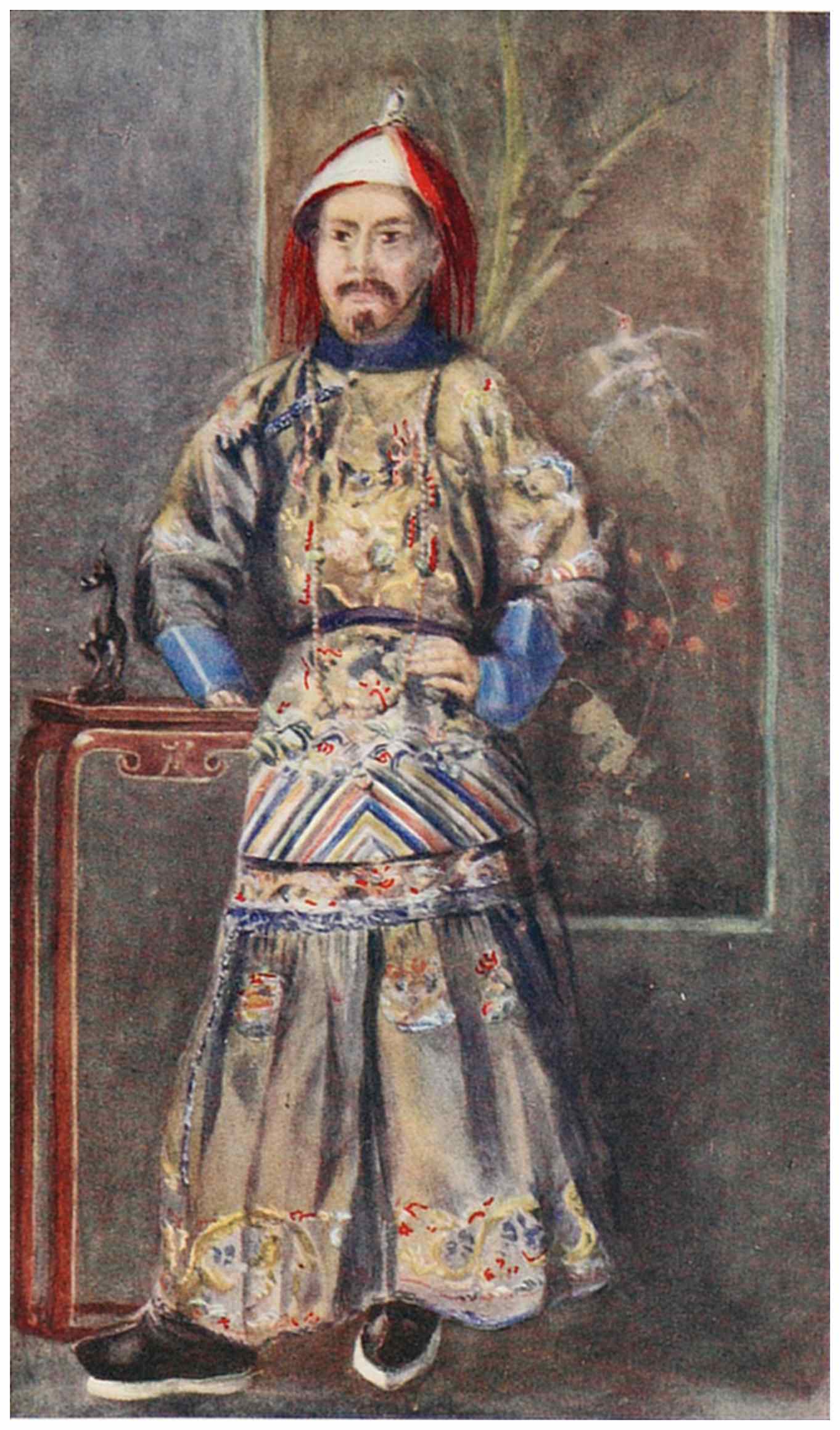
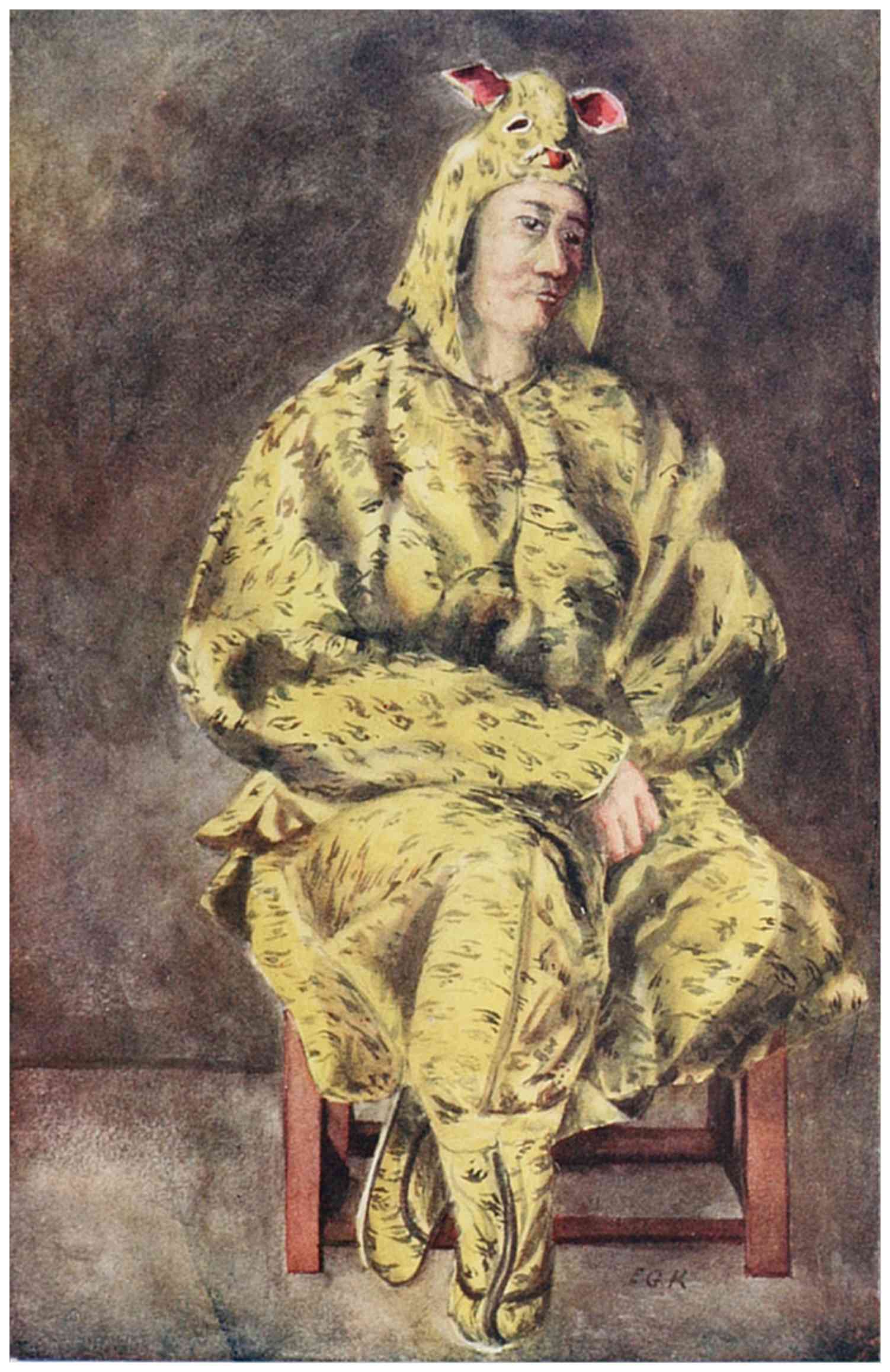
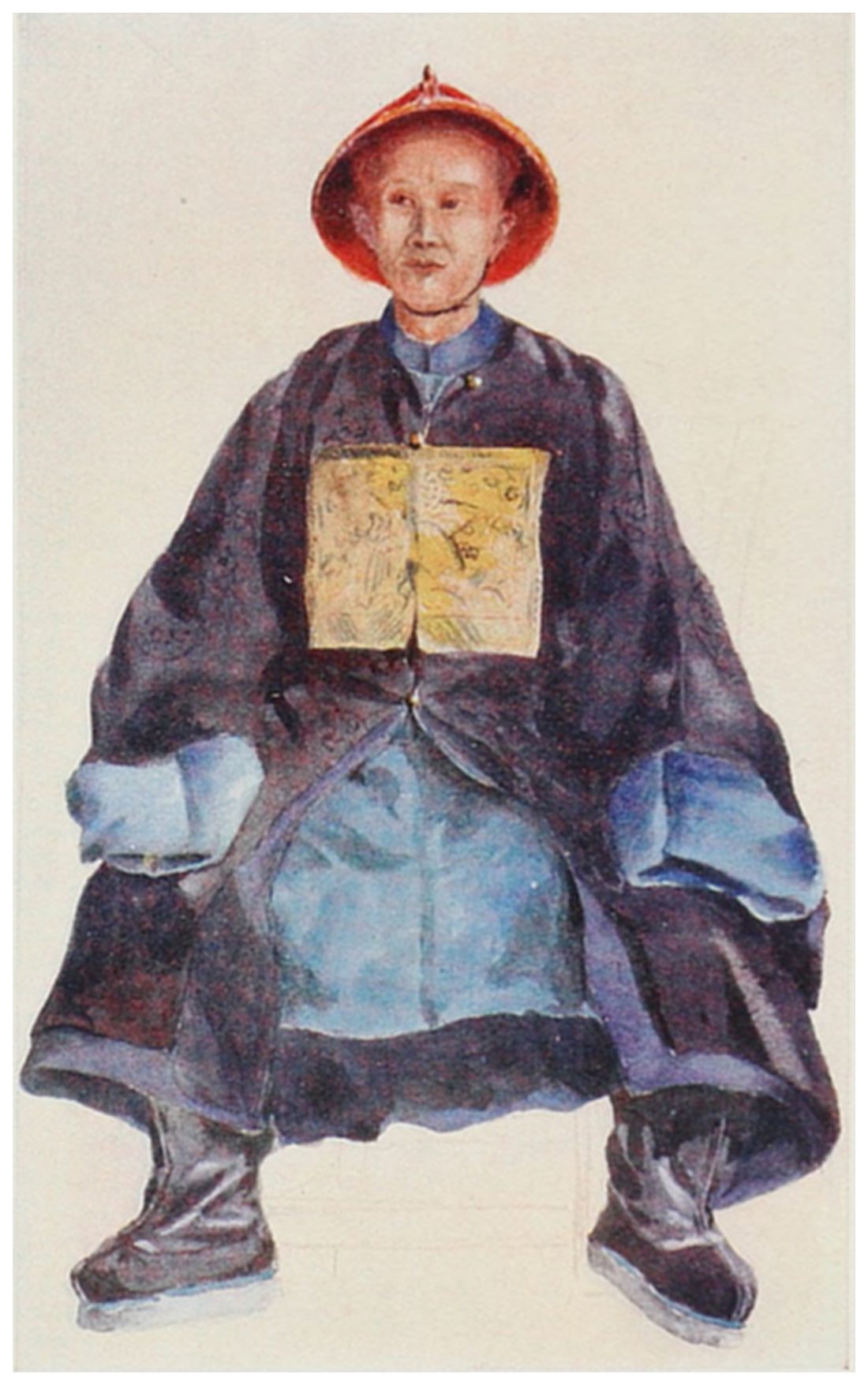
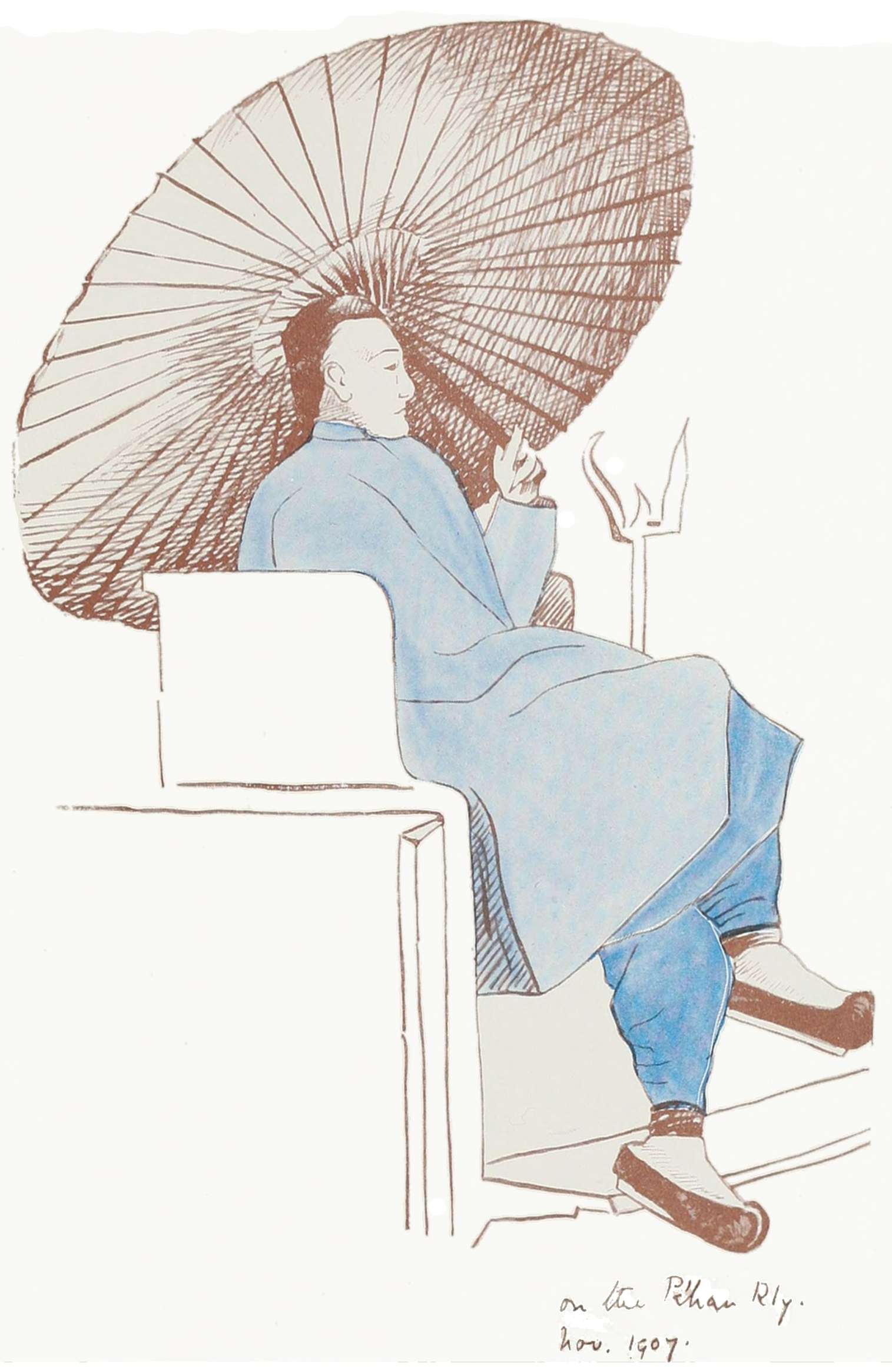
The accompanying illustration gives an idea of what
is worn by officials. The self-complacent pose of
a Chinese official’s feet is eminently characteristic.
Much has been written about character as seen in
the human hand, but I think a character study of
feet might still be written, even when the feet are
disguised by boots or shoes.
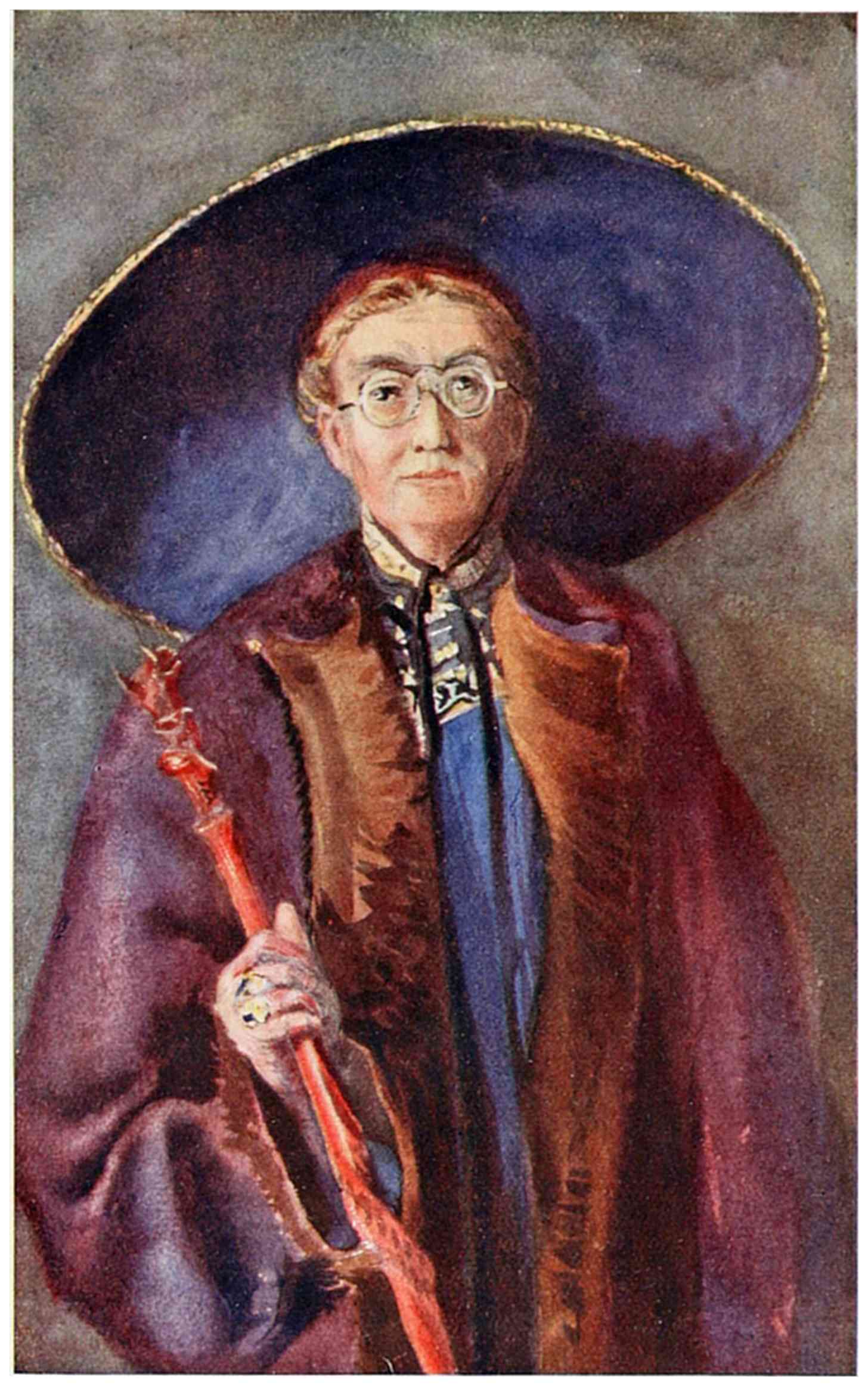
OFFICIAL (COURT DRESS)
CHAPTER V Tsinan
The capital of Shantung is a large city, containing
a population of about 150,000 inhabitants.
Tsinan is a city of real beauty,
owing to the fact that there are bubbling streams in
all parts of it, so that the trees grow well. The
water is singularly bright and sparkling, and looks
attractive even in the dirtiest gutters. As it comes
bubbling up in every direction there is a radiance
about it which seems untarnishable. In the very
centre of the town is a temple, standing on a terrace
with fine carved balustrades round it, in front of
which is a large pond full of this bubbling water,
overhung by willows—a typical Chinese picture.
On the other side of the pond is a busy market,
whence crowds soon collected round us to watch our
sketching and photographing. They were quiet and
polite, and it was quite unnecessary for the policeman
to come and keep them at a distance. But then
that manœuvre gave him the advantage of an excellent
view for himself! Everywhere we found a
Chinese crowd of spectators preferable to one composed
of Europeans. The market interested us
greatly, having every kind of ware for sale, from
rags and silk scraps, out of which elegant shoes are
made, to all sorts of weird medicines, of which the
emblem was a life-sized, double-headed fowl, planted
in the centre of the counter. Hard by the medicine
stalls was an enclosed space, where a woman was
telling a story to an interested crowd. The professional
story-teller is quite an institution here, as elsewhere
in the East, but it is rarely that a woman
is seen in that capacity. In fact, women take but
small part in the business life of the country, and
men do all the selling in shops.
Not far from the market, but situated on the outskirts
of the town, is the University, a recent institution
(1902), and built mainly in European style; the
professors’ houses being of two stories and entirely
un-Chinese. The entrance, however, is the usual
native one with carved and painted woodwork decorations;
facing it, and crossing a little bridge over an
empty tank, was the guest-room, supposed to be purely
Chinese, but full of European lapses, in the shape of
lace curtains, wall-papers, European carpet, chairs,
clock, electric bells, and, most striking of all, a centre
candelabra for the electric light. There are lecture-rooms,
libraries, museum, laboratory, and dining-rooms,
and thirty-two baths with hot and cold water laid on;
these are so popular that their use has had to be
limited. Amongst the institutions may be named a
fife and drum band, and the latest novelty is a brass
band. The University is only open to the students of
the province of Shantung, and naturally the standard
of Western knowledge is still low; but there are professors
of English, German, French, and Japanese,
though the respective numbers of their classes are
seven, five, five, two. At present Japanese is not so
popular as it used to be. Indeed, in the Imperial
College in Kaifeng the Educational Board has just cut
out Japanese: whether this is an exceptional case I
cannot say.
The English section includes a study of European
history (Freeman’s) and political economy, but
other subjects, such as geography, are popular among
students, to judge by their use of the small English
library. Curiously enough, the most popular book
both here and elsewhere is “Little Lord Fauntleroy.”
Half the lectures are devoted to Western knowledge
and half to the Chinese classics, and the course of
study at present covers three years.
In connection with the scheme of education, and
under the same jurisdiction, are normal schools, secondary
and primary schools. One of the principal ones
has an English headmaster, so that there will soon
be a set of students prepared to profit much better by
university training, and fitted to go to some European
university later. There are no fewer than fifteen
schools and colleges, with about two thousand five
hundred students. Another interesting feature of the
education question is the opening of a girls’ school for
the daughters and wives of the officials. It was built
three years ago by two Chinese gentlemen, and they
have an English teacher there. The school was formally
opened by the Literary Chancellor, and on
entering he saluted the girls deferentially, and gave
them an admirable address. In the south of China
many ladies learn reading in private, but in the north
this is extremely rare, and so lately as 1902 there was
not a single girls’ school in the Empire, except the
mission schools; now they are cropping up in all
directions, and the Government is taking an active
interest in all their concerns. Possibly it may be
thought that it shows this in somewhat exaggerated
fashion, for a recent order has been issued from the
Education Department in Peking prohibiting the
wearing of a long fringe of hair, or “bang” as our
American friends call it, in any of the girls’ schools
throughout the Empire. This fashion had become
rather general last year. It would have been of much
more practical value if all scholars had been forbidden
to paint, as this is one of the most time-wasting processes.
At Tsinan the school hours have been obliged
to be fixed late because the scholars require some hours
for the morning toilette. In the girls’ schools they
are now very anxious to learn English, music, and
drawing; “accomplishments” are more valued than
serious study. It is quite evident that there is no lack
of ability to learn, though the girls are called “wooden-heads”
sometimes in contempt. In the American
Board School at Peking the girls gave an admirable
rendering of Wagner’s and Mendelssohn’s music in
part-singing. The piano is also very popular among the
girls. Like the boys, they have astonishing memories,
and think nothing of reciting a whole Gospel; it is
even not ranked as a feat by the Chinese to know the
whole of the Bible by heart.
Tsinan is a most progressive town: it has a British
postmaster, who has organised, not to say revolutionised,
the postal system of the province. Letters now
go to Peking in four days, and to Tientsin in three and
a half days; the runners carrying them reckoning to
do fifty or sixty miles at a stretch, with an average
speed of three and a half miles per hour. They receive
about five shillings a week as wages. Sir Robert Hart
is responsible for the selection of postmasters, and
even in a remote place we found a very nice one
who could speak a little English. Sir Robert Hart
was appointed head of the Customs Department in
1862, and the Customs and Post-Office form part of
one system.
One of the prettiest places at Tsinan is the lake, the
main pleasure resort of the Chinese. After threading
our way in chairs through incredibly dirty and narrow
lanes, filled with a jostling crowd and traffic, often
brought to a standstill by a hopeless-looking impasse
of rickshas, barrows, beasts, and chairs, we came to
a gateway, and stepped thereout straight on to the
edge of the lake, where boats, with graceful latticed-work
windows, and a broad couch to lie on in the
front, awaited passengers. Tea was ready on the
table, and we set off along one of the water highways
through the tall reeds and beds of lotus. Gorgeous
kingfishers darted to and fro like a flash of light; tiny
wild-ducks bobbed up out of the water, and then
scuttled into the reeds, as we slowly made our way to the
various points of interest. The lake has been chosen
as a place for putting up memorial monuments to
distinguished people, and they are certainly a singular
contrast to ours. They stand like temples on little
islands, and to the uninitiated appear to be such, with
their tablets of incense and altars. For instance, there
is a fairly recent one erected in memory of a former
Governor of Shantung. Above the altar, and almost
hidden by the inscribed tablet, is a life-size seated
figure of the Governor. The head is a photograph,
and the rest is a painting, but in the dim light it required
close inspection to ascertain this fact. Incense
is offered before it by any one, and not only by the
members of his family, as in ancestral worship. Opposite
this building, and as part of the memorial, is an
ornate theatre, where plays are acted on public occasions.
Another recent memorial has been put up to
Li Hung Chang, and it is extremely strange. It
includes a little summer-house and a rock-garden
(without rock-plants), a theatre, a house containing
a tablet, altar, &c., and a guest-house where distinguished
visitors can be lodged. This last building
is two-storied, and quite European in style, perched
on an elevation with a well-built wall below it, surmounted
by barbed wire. Another little group of
buildings had corrugated iron walls; on another was a
Taoist temple, where we found a travelling showman
who was exhibiting a popular cinematograph in the
neighbourhood. The Chinese frequent the lake for
pleasure parties, and a good deal of drinking goes on,
not of tea only. A visit by moonlight is as enchanting
as anything that could be imagined. On one of
the islands we noticed the most fascinating of all the
fascinating birdcages we had yet seen. It was the
usual round shape made in bamboo, but the centre
of the roof inside was a well-executed portrait of the
handsome, black talking bird which inhabited it. The
seed- and water-pots were of different colours and
shapes, and fastened in with tiny figures of men carved
into wooden buttons. I have never been in any
country where there were so many caged birds, and
where they were so well looked after. Every cage
has its well-made night-cover, and often this is fastened
down the side with neat little buttons. We continually
saw men carrying cages along the streets, taking
their birds for walks, as we do dogs. At one place
we saw a man take the cage to a stream, and after he
had cleaned it out with a sort of tooth-brush, he left
it in the stream for the bird to have its bath, after
which he hung it up to dry, and whistled to the bird.
The fashion of carrying birds about is said to be for
the purpose of showing that the owner is a man of
leisure; as this is now creating a good deal of ridicule,
the custom is likely to go out of fashion.
One of the interesting sights of Tsinan, which is
quite up to date, is a large camp, lighted by electricity,
about two miles outside the city. It is built like rows
of little cottages; the men are well drilled, and have
to attend lectures. We found them, when they acted
as our military escort through the province, very civil,
and in every way pleasant and obliging men. A party
of them was brought by an officer to visit the mission
museum, and the men were much interested in having
the various kinds of natural history and geological
specimens, models of architecture, electrical machines,
steam-engines, &c., explained to them. Visitors are
surprised to see a model of an English cemetery, but
it throws a new light on English character when the
Chinese receive an explanation of our views with
regard to the dead, and the care lavished on their last
earthly dwelling-place. Models are of great value
when wisely used for dispelling misconceptions, but
we are often prevented by our insular pride from
taking the trouble to disabuse foreigners of false impressions
they may have conceived of us. One of
the most attractive models is a dredge worked by
electricity, for the province of Shantung suffers terribly
from the inundations of the Yellow River,
and the means used to cope with this difficulty are
wofully inadequate.
This museum was originally started by Mr. Whitewright,
of the Baptist Mission at Tsingchowfu, where
the prefectural examinations used to take place, attracting
to it 10,000 or more students from all parts of the
province. When the old examination system was
abolished the city of Tsingchowfu was no longer of
importance from this point of view, and it was decided
to move the Institute to the capital, Tsinan, a
treaty port whose importance, on the other hand, was
rapidly increasing. The Mission obtained an excellent
site, and put up a lecture-hall to seat six hundred
persons, reception-rooms for men and for women, a
reading-room, and the museum. The first block of
buildings was opened in 1905 by the Governor, and
ever since then the place has attracted an increasing
number of visitors of all kinds. In the second year
of its existence there were 187,000 admittances; at
the great annual religious festivals it is specially
crowded, as thousands of pilgrims pass through Tsinan
on their way to the sacred mountain, Tai Shan. From
8.30 A.M. till 6 P.M. preaching goes on without intermission,
a specially selected staff of native preachers
assisting the missionaries in this work; for the Chinese
prove themselves more able than Europeans to win
converts to Christianity.
Many of the students from the university and the
schools frequent the museum and lecture-hall, the
walls of which are hung with charts and diagrams
calculated to give the thoughtful Chinaman much
food for reflection. After studying the comparative
tables of commerce, population, &c., a visitor is said
to have exclaimed, “Why! the only thing that China
is ahead in is population!” Lectures on history,
science, and religion are given in the hall, and are
largely attended by university students on Sunday, as,
in imitation of our Western custom, they have no
classes at the university that day.
One day a week the museum is open to ladies only,
and we met the wife of the retiring Governor of the
province just leaving the building after an exhaustive
examination of its contents. She was accompanied
by a considerable retinue on horseback and in chairs,
not to mention a motley crowd composed of the rag-tag
and bobtail of the town, carrying absurd little
flags.
It has now been decided to attach a medical school
to the Institute, as there is none in the province, and
a church is also to be built. The American Presbyterians
and the English Baptists are combining for
this medical school. The former society has had
medical work here for the last twenty-eight years,
and for many years they have had a hospital and dispensary
in the eastern suburb. There is also a free
dispensary in the city, a Government affair, where
the patient is at liberty to choose either Eastern or
Western treatment. The majority choose the latter,
and are treated by a German naval doctor; they are
indebted for his services to the German Government,
who have lent him for this purpose. There are
already classes for medical students in connection
with several of the mission hospitals in the province,
who will form an excellent nucleus with which to
start the new college. The importance of medical
mission work in China is great, not only for its own
sake, but also for the purpose of familiarising the
Chinese in the most remote corners of the Empire
with the benefits of Western science and the goodwill
felt towards them by Europeans and Americans, of
which this is the practical demonstration. The two
continents are about equally represented, and there
are over three hundred doctors scattered throughout
the Empire: their fame extends far beyond the
limits of the neighbourhoods where they happen
to be residing. They are training numbers of intelligent
young Chinamen to carry on their work, but
the establishment of colleges to complete the training
of these students is now becoming increasingly
necessary.
The work already achieved by medical missionaries
in China is by no means small or unimportant.
They form an association, by means of which the
task of fixing the terminology of medical science has
already been accomplished. They have published a
standard dictionary in Chinese, as well as the latest
American and English text-books on this subject.
The Chinese medical student, therefore, is not entirely
dependent on oral teaching, if he has no knowledge
of English. Another branch of this work is the
organised labour of their research committee. The
geographical distribution of disease, the various forms
of it prevalent in different districts, and the methods
of treatment come under this heading. Men of undoubted
ability and with the highest medical qualifications
are engaged in this work.
The Chinese Government has recognised the value
of what has been already done by its official sanction
of the Union College at Peking—the first attempt
made in China to give a full medical education.4 The
late Dowager Empress contributed to its initial cost,
and the Government has pledged itself to grant degrees
to the students who have successfully passed its
examinations. There are about seventy to a hundred
students in it at the present time.
This is a somewhat long digression, but I think it
will not be without interest to readers to have a
general idea of the scope of medical mission work in
China at the present time.
There is an arsenal near Tsinan, where an English
officer, who had just been allowed to see over it, told
us they seemed thoroughly expert, and able to reproduce
anything they tried. They were busy making
locks for a canal, and less than a hundred miles away
we passed another large arsenal where they were busy
making ammunition. The smoky chimneys were
quite suggestive of home!
The most interesting feature of our stay at the
capital was an interview with the Governor of the
province, to whom we had an introduction. His
Excellency Lord Wu is an intellectual-looking man,
but worn and bowed with age. He had granted us an
audience one afternoon, and on our arrival at his yamen
(= official residence) we were led through a circular
doorway in the wall, into the gardens, in which were
little ponds and bridges, and an arbour made in the
shape of a boat. We waited the Governor’s coming
in a summer-house, a terrible European erection, furnished
with a crimson and “Reckitt’s blue” plush sofa
and revolving chairs to match. On the table were
glasses and plates, with proverbs inscribed round them,
and cups of the type seen at a Sunday-school caterer’s.
Cake, champagne, and tea were set out on a parti-coloured
table-cloth, which was ornamented with a
florid design in chain-stitch composed of every colour
of the rainbow. His Excellency soon made his
appearance, accompanied by an exquisite-looking
interpreter who spoke English well—better than he
understood it, I fancy. For nearly an hour he plied
us with all sorts of questions as to my education
(he had been much exercised by F.R.S.G.S. on my
Chinese visiting-card), occupation, our past and future
travels. He not only gave us good advice with regard
to our journey, but practical assistance—as we afterwards
discovered—by sending word to the magistrates
on our route through the province. An interested
but somewhat ragged audience watched us from the
doorway, and the Governor’s personal attendant played
with his queue, but somehow nothing could disturb
the dignified impression of the old man. He had
known Gordon, and at the time of the Boxer troubles
he had sent the missionaries safely out of the province,
in direct opposition to the orders he had received from
his Government. He is a strong, good man, and I
much regretted that our conversation had to be carried
on through an interpreter, for that process is paralysing
to thought, not to mention that one had grave
doubts as to the accuracy of the interpretation. The
interview lasted about an hour, and was terminated by
His Excellency inviting us to drink champagne or tea,
after which he escorted us back through the garden
to our chairs.
CHAPTER VI The Sacred Shrine of Tai Shan
Shantung is the most interesting (historically)
of all the provinces in the Empire, and
we determined to visit two particularly sacred
spots which were not far from the capital—Tai Shan
(one of the four sacred mountains of China) and
Küfow, the home of Confucius.
We started on a beautiful autumn morning, with
quite an imposing cortège. First came our mounted
military escort, then ourselves in two light mountain
chairs, each carried by two men and with two to relieve
them. Next came the cart, with our interpreter (a
minute person clad in khaki, boasting the name of
Fergus Summer—though a Chinaman), the cook,
some baggage, and the men’s bedding. Finally a mule
brought up the rear, carrying our baggage, some one’s
bedding, and our other servant perched cross-legged
on the top. It was a delightfully exhilarating day,
and not less so the thought that we were really beginning
our adventures off the beaten track, and had said
good-bye to the railway for at least three weeks, to try
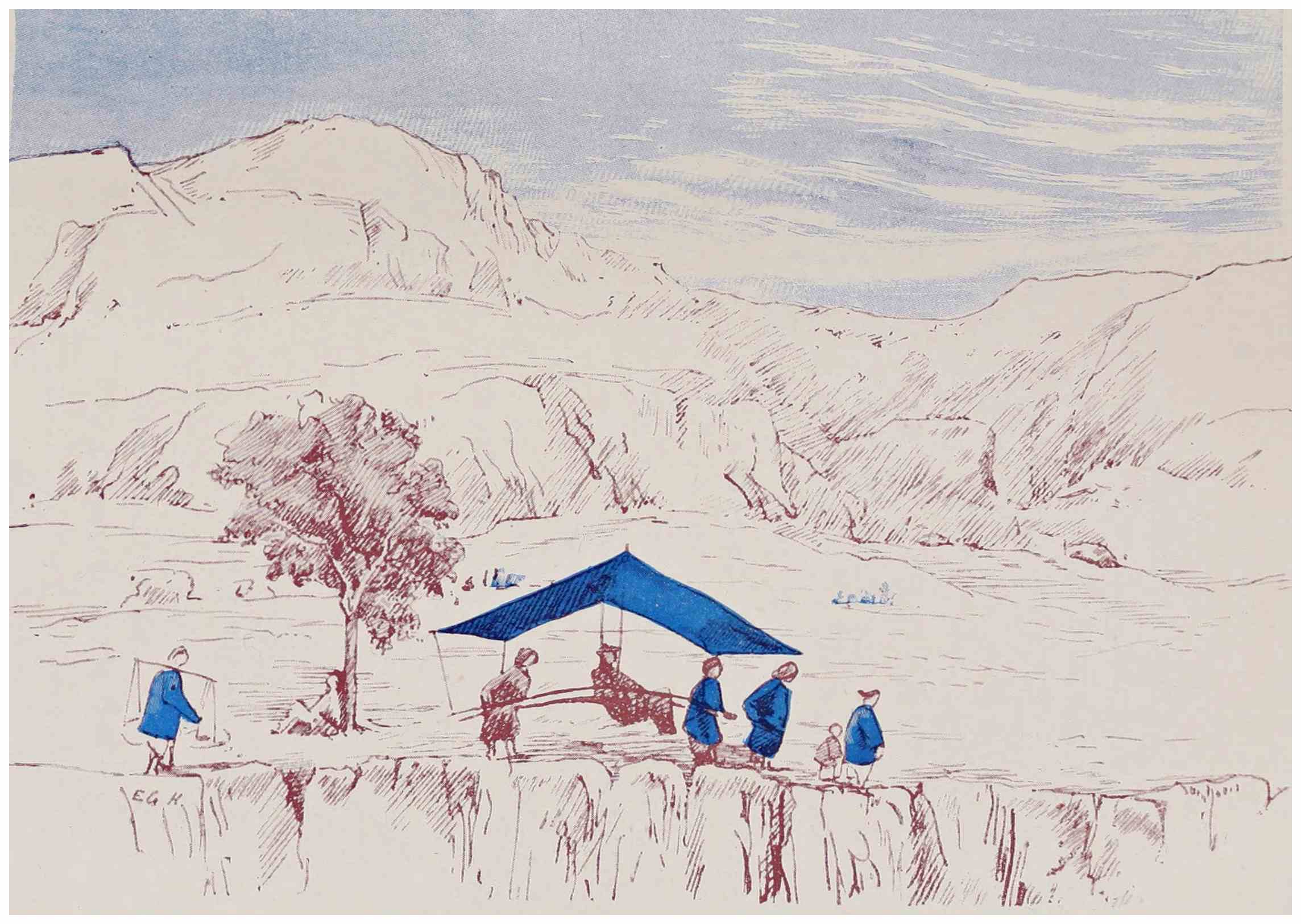
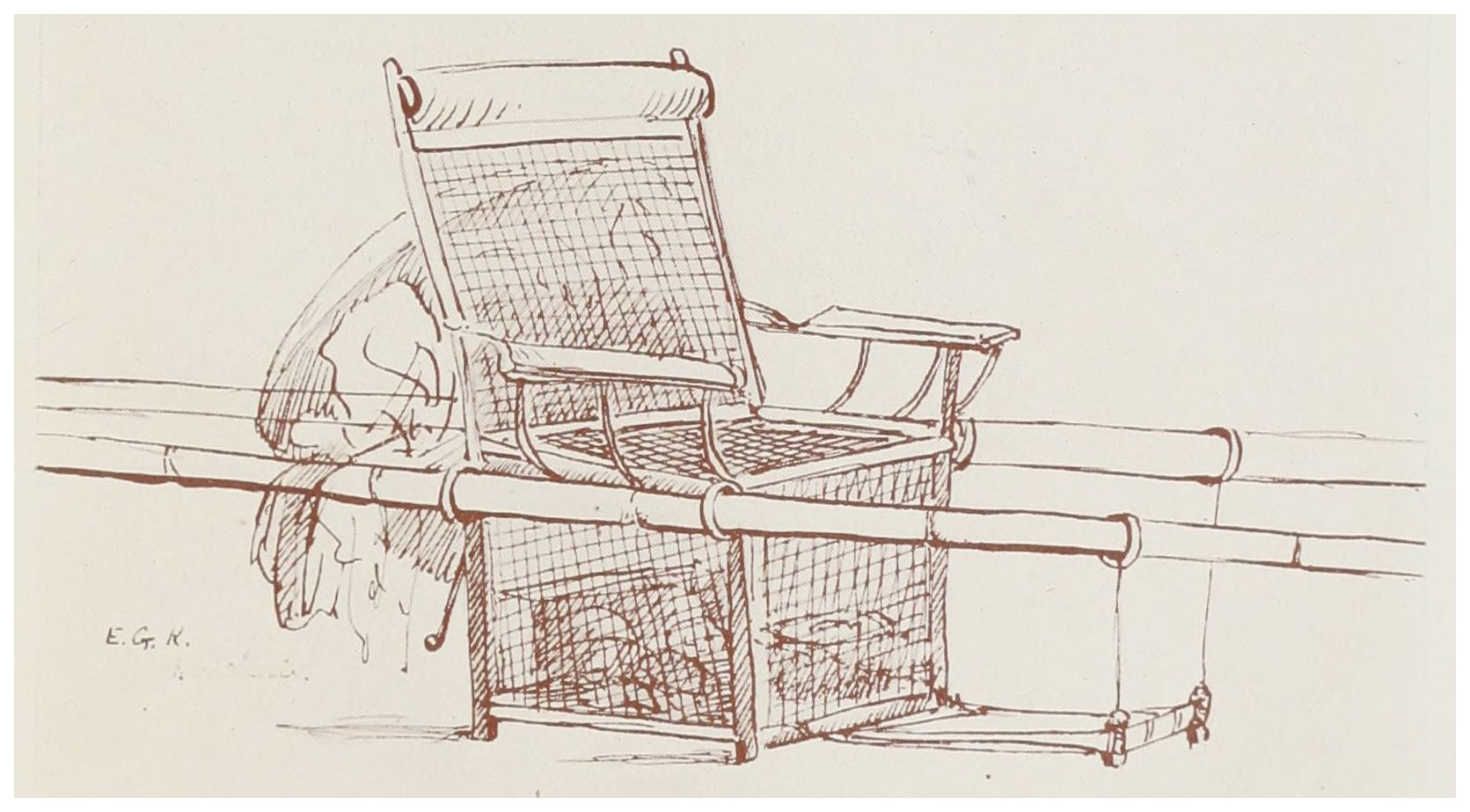
far pleasanter, if slower, means of transit. The chairs
were light frames with a hanging foot-rest, quite comfortable
when padded with our bedding, and with an
awning fastened on light bamboo rods above us. We
were well manned, so we comforted ourselves as to the
fact of their carrying us between twenty and thirty
miles a day by remembering that they were only too
pleased to get the job. They were pleasant, cheery
fellows, with fine mahogany-coloured backs, and did
not seem the least bit jaded at the end of the day’s
march. They go lightly clad, the most solid part of
their clothing being the pig-tail curled round their
heads. The rest of their garments were well ventilated,
and sometimes seemed in danger of falling to
pieces altogether. Their food seemed most inadequate—a
chunk of bread, an onion (alas for the passenger
who hates the smell of an onion!), endless cups of tea
at wayside restaurants, and frequent whiffs of smoke
from their tiny pipes. They are wonderfully good-tempered,
always ready for a laugh, and most attentive
and careful for one’s comfort.
MOUNTAIN CHAIR
The first day passed without any adventure, but
was pleasantly spent in charming scenery, and we
passed a somewhat uneasy night trying to accustom
ourselves to our new beds (light camp mattresses with
an air pillow under the hips—an excellent arrangement)
and strange surroundings in an inn. It was
an easy task to get up early next day, and we started
at 6 A.M., so as to do a four hours’ stage before breakfast—fifteen
miles. The country was full of interesting
sights: one hamlet we passed through seemed to
have a monopoly of whips; every shop was full of
them and of nothing else. In another plaited straw
for hats was the only article for sale. Farther on, we
came to a district where each village had large bunches
of maize hanging in golden clusters from the trees,
looking like fruit. As we turned a corner into a deep
gully we came into a bevy of barrows in full sail—like
a fleet of blue-sailed boats—bearing down upon
us. They were the only ones we saw, as there was
not much wind, but it was an unforgettable sight.
As we approached the city of Tai An we were met
by a fine soldier in red plush breeches, but the rest of
his costume was not to match! He had come six
miles from the city to act as our escort, and told us of
a noted Buddhist temple that we must stop and visit.
There was an extraordinary seated gilt Buddha, with
a broad grin on his face, and another grave one standing,
but there was nothing particularly noteworthy,
as far as we could see. The soldier told us that preparations
had been made for our entertainment at the
inn, but we had arranged to stay with a hospitable
American lady, who had lived out here for over fifty
years, and as soon as we arrived she sent to engage
chairs to take us next day up the holy mountain.
Chinese books say that it has been the holy mountain
of the East for the last 4000 or 5000 years; it is
certainly one of the most frequented to-day, and at the
usual times of pilgrimage (February and March) as
many as 10,000 will go up in a day. Most of the
pilgrims go up on foot, a few on their knees, and the
wealthy ones in chairs.
We started betimes in chairs—there is a special
guild of chair-bearers, and they are simply wonderful—they
are called “climb-mountain tigers,” and as
soon as they saw my size they demanded an extra
man. I was quite willing to comply with the demand,
though they would not have suggested it to
a Chinaman of twice my bulk! It was a lovely
morning, worthy even of such an expedition. We
were carried about two miles across the fields before
we came to the foot of the mountain, and from there
to the top the way is well paved or made in flights
of granite steps, some ten to twelve feet wide, up to
the top of the mountain. There is even a well-built
wall of cut stone on either side, the cost of this road
being defrayed (as well as the upkeep of the temples)
by the gifts of worshippers. The road was not very
steep at first, and was lined by houses, where no doubt
a profitable trade is plied by the sellers of paper
money, shoes to be presented to the goddess P’i-Hsia
Yuam-Chun, incense, and “light refreshments.” There
are many temples on the mountain—in fact, there
seems to be one every few yards—but we had not time
to spend in visiting them; and we set our faces to
walk up a large part of the 6600 steps which lead to
the top. It took us some five and a half hours to
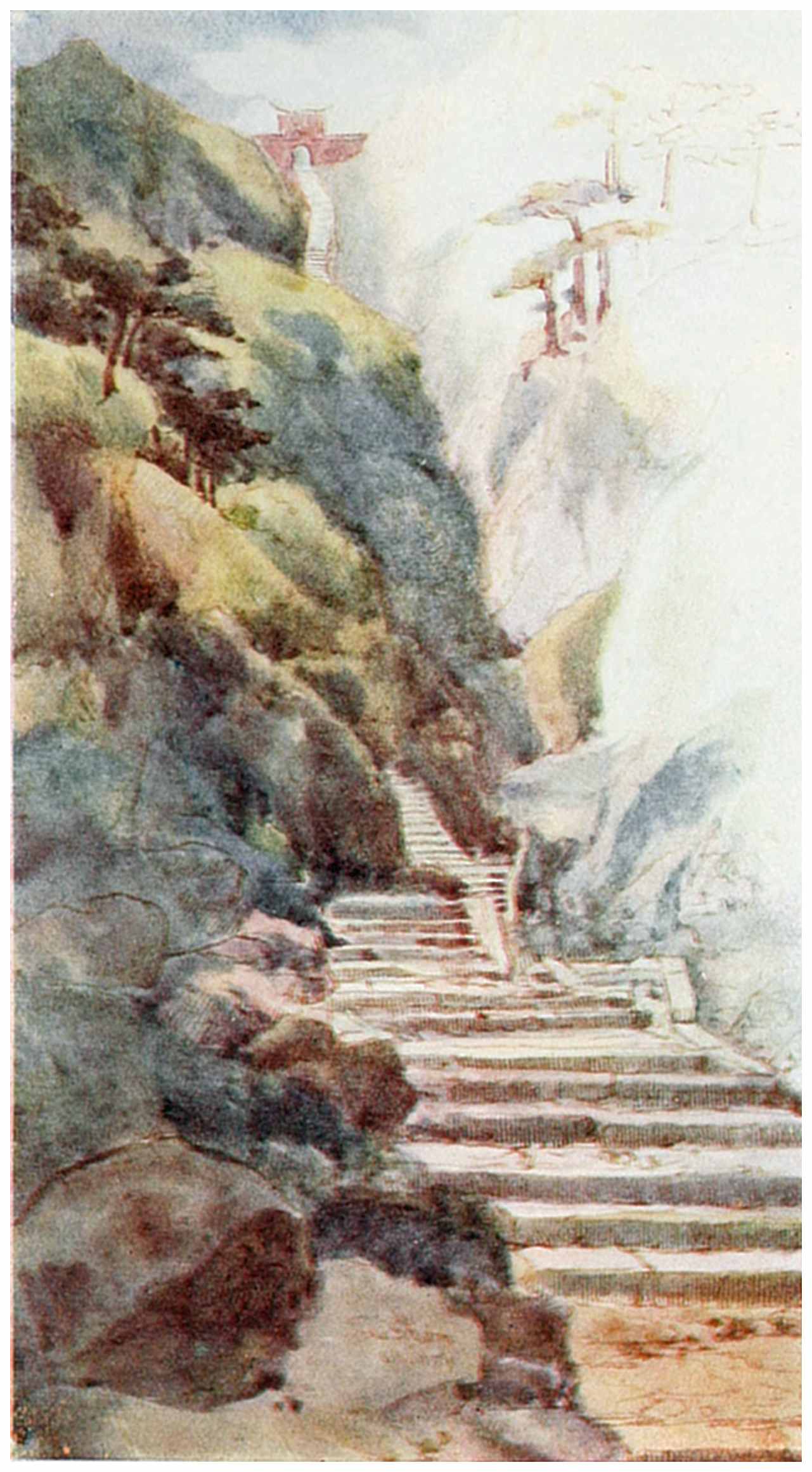
climb up, and as we neared the Gate of Heaven (the
pink gateway in the sketch) the steepness grew, the
last flight being over 1000 steps (I counted them),
most of which were so narrow that not more than
part of the foot could be accommodated: the steps
were much higher than they were wide, so that it
was more like a ladder than a staircase. Heavy iron
chains were suspended at the sides for the worshippers
to drag themselves up by, and a Chinese woman with
us went up on all-fours. The way towered above us
in contrast to the “Peaceful Mile,” a shady part of
the road lower down; but it was very lovely, with its
scent of wild thyme, fragrant grasses, and yellow
chrysanthemums. Earlier in the year it is bright
with violets, forget-me-nots, and honeysuckle, and
the cypresses and pine trees give great dignity to the
landscape. We followed the rocky bed of the stream,
which becomes a brawling torrent after rain. We
only halted for half-an-hour on our way up, and the
“tigers” did their work well. After we had passed
through the Gate of Heaven we came on to a comparatively
flat piece of tableland with thatched cottages,
which might have been a Scotch moor. On
the top were several temples, one to Confucius, in
which was a replica of his big statue in the temple
of Küfow; another to Yu-Huang, the Taoist Emperor
of the Sky, who first drained the Empire; and—most
sacred of all—a rough block of granite, said
to have been erected there by the conqueror Ch’in
Shih-Nuang.
TAI SHAN
The great Emperor Shun (B.C. 2255–2205) is said
to have visited Tai Shan, “where he presented a burnt
offering to God and sacrificed to the Mountains and
Rivers.” Certainly he could not have selected a
better spot for the purpose: from the summit you
look down upon a vast expanse of hilltops, like the
waves of the ocean, and the lovely shining rivers
below wind away like silver threads between them.
This represents the oldest form of worship in China,
existing before the rise of Taoism, Confucianism,
and Buddhism. The earliest sacrifices are said by
Chinese writers to have been organised by Fu Hsi,
nearly 3000 years B.C. His successor built a temple
for the worship of God, where sacrifices were offered
to the mountains and rivers. This was followed by
the worship of the sun, moon, and five planets, and
there are traces of this still to be found in Chinese
Buddhism, which has incorporated so many alien
ideas from other religions.
The great sacrifices to God and to earth were
offered at the winter and summer solstices by the
Emperor: he also sacrificed to the four quarters and
to the mountains and rivers of his Empire. The
nobility sacrificed each to their own quarter, with
its rivers and mountains. The royal sacrifice was a
young ox of one colour, which had been specially
reserved for the purpose. The sacrifices of the people
varied according to rank and to the season of the year—a
bull, a ram, a boar, scallions and eggs, wheat, fish,
millet, a sucking pig, unhulled rice, a goose.
The sacrifices in early times consisted of meat and
drink; those offered to heaven were burnt, and those
to earth were buried, accompanied by the beating of
an earthen drum. But sacrifices were not very frequent;
in the “Book of Rites” it says: “Sacrifices
should not be frequently repeated. Such frequency
is indicative of importunateness; and importunateness
is inconsistent with reverence. Nor should they be
at distant intervals. Such infrequency is indicative
of indifference, and indifference leads to forgetting
them altogether. Therefore the superior man, in
harmony with the course of nature, offers the sacrifices
of spring and autumn. When he treads on the
dew, which has descended as hoarfrost, he cannot help
a feeling of sadness which arises in his mind, and
cannot be ascribed to the cold. In spring, when he
treads on the ground, wet with the rains and dews that
have fallen heavily, he cannot avoid being moved by
a feeling as if he were seeing his departed friends.
We meet the approach of our friends with music, and
escort them away with sadness, and hence at the sacrifice
in spring we use music, but not at the sacrifice in
autumn” (Legge’s translation).
Such a poetic description of worship is worthy of
the scene which greeted our gaze on the mountain
after we had passed through the Gate of Heaven, the
fine culminating point of the steep ascent. The view
from the summit, which is but a gentle ascent from
the Gate of Heaven, was absolutely glorious—range
upon range of mountains, countless villages dotted
over the forty miles of plain and in the folds of the
hills, and above all the winding, shining river, going
away, away, away, till it was lost in infinite space.
Was it that the effect of such a vision unhinged the
minds of worshippers, since this became the place
where people cast themselves down into the abyss?
There were so many deaths that the authorities have
had it walled in, and the place is called “Cliff of the
Love of Life.”
When we began our descent we resolved to do the
correct thing—despite the terror it inspired in us—and
be carried down the almost perpendicular stairway.
The men carry the chairs sideways, because of
the narrowness of the steps, and run down, pitter-patter,
as hard as they can go. I had my watch in
hand and timed them—a thousand steps in six minutes.
The most horrible moment was when they flung the
chair, with a dexterous turn of the wrist, from one
shoulder to the other. One false step and we should
all have been killed together; but the “tigers” never
make a false step. Really the only danger is that the
carrying poles may snap. The whole return journey—reckoned
at thirteen miles—took only two and a
half hours. The height of the mountain is 5500
feet, whereas Tai-an is only 800 feet above sea-level.
Stones are carried from it to all parts of the province,
and when a house is built with an unlucky aspect—namely,
facing a cross-road or a turning—one of these
stones is built into the wall, with an inscription, “The
stone from Tai Shan accepts the responsibility.”
CHAPTER VII The Home of Confucius: Küfow
The next morning we were just about to
start, when the magistrate of the city was
announced (imagine a ceremonious call at
7 A.M.!), and he was ushered in, together with his
present to us—a tray containing fine pears, pomegranates,
dates, and nuts. We accepted part (in
Chinese etiquette this stands for “gratitude for his
generosity”), and returned part (“humility of the
recipient”). He was immediately served with tea
and cakes, and explained to us that, owing to a message
from the Governor of the province, he had been expecting
our arrival and had prepared an inn for us.
Understanding that we were just setting out on our
journey, he only stayed a short time after we had
thanked him for his hospitality, so that we were able
to do our day’s stage in good time.
The following day we started at 6 A.M., and managed
our thirty-six miles in twelve hours, as the roads were
in good condition. At midday we halted for lunch
at an inn, where we were told that the magistrate
had made preparations for our entertainment. A
scarlet curtain was hung in front of the door; there
were mats and carpet on the floor of the two rooms,
coverlets on the khangs (= brick bedsteads), a good
table and European chairs, scrolls on the walls, a white
table-cloth, and, to complete all—a champagne lunch!
We declined the champagne, lager-beer, and most of
the “plats,” but enjoyed the chicken and eggs. The
advantage of having the inns cleaned up and fresh
mats put down is great. Our military escort, varying
from one to four, is highly diverting, and they are
usually mounted on shaggy ponies, on which they
look quite fine, especially when they have their scarlet
or yellow umbrellas up.
As we approached our destination, Küfow, a man
came dashing across the plain at full gallop, and flung
himself off his horse at our feet, announcing that the
magistrate had ordered a private house in the city to
be prepared for our reception, to which he would
conduct us. Just outside the gates we found four
soldiers standing at attention: they gave us a military
salute, bobbing down till their right hands touched
the ground and then emitting a startling yell. Accompanied
by them (they remained with us in attendance
till we left Küfow) we soon reached our quarters,
a characteristic Chinese gentleman’s house, very nice
and clean, in which a suite of three rooms was placed
at our disposal (the block seen in the sketch). A
major-domo received us at the entrance and led us
ceremoniously to the inner courtyard, where tea was
at once served, and we were told that dinner would be
ready shortly, and that the magistrate would call on
us as soon as we had dined.
PRIVATE HOUSE: KÜFOW
Our interpreter, Mr. Summer, had informed us that
he was the son of an official and knew exactly what
ought to be done; so we placed ourselves in his hands,
and our visiting-cards and thanks were at once despatched
to the magistrate. After dinner the chairs
were arranged in rows, and tea and cakes set on the
table in readiness for his arrival. He asked particularly
if we had enjoyed our dinner, which he had
ordered to be cooked in European style, and it was
quite good and palatable, especially as we had the best
of sauces after our long day’s march. It appeared
that our host had provided three cooks (trained in
European ways), three other servants, four soldiers, and
two policemen to look after us, but our own men
undertook all the personal attendance.
Next morning we went in procession to the temple—the
Holy of Holies of Confucianism—for all the
establishment seemed to think they should accompany
us. We decided to make a détour in order to approach
it from the most picturesque side, and the view was
certainly charming as we walked along the moat outside
the city wall, where lotus leaves floated on the
still water, and tall rushes and flags rustled under
the leafy trees. Nothing was needed to enhance the
beauty of the spot, and a few minutes’ walk brought
us to the celebrated avenue of cypresses leading to the
south gate of the city, within which is the fine entrance
to the temples. They are enclosed in a park which
occupies a whole quarter of the town, and has plenty
of trees to form a worthy setting for the large groups
of buildings connected with Confucianism, temples
not only to Confucius but to his parents, followers,
and to the other great sages, Mencius and Yentzu.
The buildings are some of the finest in the Empire,
and very lofty, with their double-storied roofs covered
with orange and green tiles. The eaves are heavily
decorated with fine coloured woodwork, protected
with netting from the vast flocks of birds and bats
that hover round them, and the pillars of the Hall of
Perfection are magnificently carved monoliths. In
the first courtyard are many interesting stone tablets,
eight or ten feet high, standing on the backs of stone
tortoises or mythical beasts of similar shape in picturesque
little temples with yellow-tiled roofs and Venetian
red woodwork. Hoary cypresses towered above them.
In the next courtyard was a preaching hall (not in use
for that purpose, however), from which we ascended
by a long steep flight of stairs, with folding gates half-way
up, to a dark upper chamber. Another flight of
steps took us to a room surrounded by a balcony, from
which we had a splendid view over the many temples
clustered round a great central one, which appears
above the orange and green tiled temple in the sketch
which I took from this point of view. It is the most
imposing of the group of buildings, and is entirely
tiled with orange, none but Confucian temples being
allowed to have this colour. Flocks of crows, pigeons,
and other birds were circling round it; indeed, we had
been awakened by the deafening noise they made in
the early morning. In the courtyard as well as in the
temples were fine old bronzes; carved marble steps
led up to the principal hall, a lofty building with pillars
and red painted woodwork. Here Confucius sits
under a canopy, with handsomely embroidered curtains
partly shrouding him, and an altar bearing bronze
incense bowls in front. On either side, at right angles,
are the figures of two other great Chinese sages,
Mencius and Tze-Sze, seated in shrines, and behind
them again are six disciples seated against the walls
on either side.
CONFUCIAN TEMPLE
The sacrifices to Confucius were formally established
by an emperor (A.D. 59), who also ordered that
the teaching of Confucius should be studied in all
schools throughout the Empire. This is still done
everywhere, even in the new universities, but the actual
sacrifices—pigs, sheep, and cattle—are reserved for
temple worship. These take place before dawn in the
second and eighth month. There is plenty of room
in the grounds belonging to the temple for pasturage,
even for the vast number of animals required, as it is
about 8000 acres in extent. More than 500 years
elapsed after the death of Confucius before he was
universally worshipped, but the worship had the royal
sanction, for his teaching is aristocratic in character,
whereas that of the yet greater but less noted sage,
Mencius, was as thoroughly democratic.
Confucianism is rather a system of ethics than a
religion. Confucius merely accepted (and that only
to a limited extent) the religion of the age and country
in which he lived, and he added to it a code of morals
dealing largely with the government of the State.
He said, “I am not an originator, but a transmitter.”
Confucius lived contemporaneously with the Buddha,
but no two great teachers of mankind could have
differed more widely from one another than did these,
both in character and in teaching. In the Buddha,
love and pity for the sorrows of humanity drowned
every other feeling, and he resolutely refused to use his
powerful intellectual faculties for any other purpose
than to lessen suffering, and eventually to rid the
world of it. Confucius, on the other hand, allowed
his intellect free play, and it appears to have led him
to look with tolerance, and a certain measure of acquiescence,
on the religious beliefs of the age. There
is a famous saying of his, “Respect the spirits, but
keep them at a distance.” At the same time, he was
conscious of his mission as a teacher sent by God;
he says, when threatened by the people of K’uang:
“After the death of King Wen, was not wisdom lodged
in me? If God were to destroy this wisdom, future
generations could not possess it. So long as God does
not destroy this wisdom, what can the people of
K’uang do to me?” Confucius seems to have been
a superstitious man; he was apt to turn pale at a
thunderclap, and he sanctioned the practices of the
village folk for driving away evil spirits.
The most important features of his teaching are the
high ideals which he inculcated for the ruling of the
State, and the stress he laid on the obligations of men
to their fellow-men, even more than on their obligations
towards God. One of his fundamental doctrines
was that all men are born radically good. This
doctrine is not accepted—at all events, at the present
day—with regard to women; the Chinese would be
more inclined to say, “All women are born radically
stupid,” or, as the women themselves frequently put
it, “We are only wooden-heads.” Confucius also
strongly advocated the duty of reverence and sincerity,
and “protested against any attempt to impose on God.”
He rose from his seat in the presence of any one dressed
in mourning. The five cardinal virtues taught by
Confucius are righteousness, benevolence, politeness,
discernment of good, and sincerity.
It will be readily understood from the above brief
account of Confucianism that it is quite possible to
combine it as a religion either with Buddhism or
Taoism, and in point of fact it is not unusual for a
Chinaman to profess all three religions at the same
time, or by turns. I was told in Shansi that sometimes
a village would feel aggrieved at their gods not
having protected them from some disaster, or given
them sufficiently good crops, so they would decide to
try another religion for a time. The transformation
in a village temple is easily effected.
Not only were divine honours paid to Confucius,
but his family also were promoted to places of honour
in the cult, and had adjoining temples raised to them,
though only his father was granted a statue. In one
of the temples is a fine series of stones engraved like
brasses, descriptive of the life of Confucius. These
are so greatly admired that it has been found necessary
for their preservation to have papers pasted across
them intimating that rubbings are not to be taken
from them. Some of these tablets are fine specimens
of writing—for Küfow is above all places the home
of Chinese literature—and the inscriptions aim at
being brief, telling, and enigmatic. Their value
depends also on beauty of style and calligraphy.
The temples are only about two hundred years old,
as they have twice been destroyed by lightning. The
first time it happened, a thrill of terror ran through the
whole Empire: nothing further happened, so the next
time the nation took it quite calmly. There are no
priests to look after the place, and, to judge by its
neglected appearance, the five families exempted from
taxation by some bygone emperor, in order that they
might devote themselves to the care of it, have become
extinct. The emperor used formerly to come
at stated times in order to offer sacrifices, as being the
visible head of Confucianism, but now he contents
himself with sending every two or three years to
decorate the temple and keep it in repair.
As we were leaving it began to rain a little, so the
soldiers and police put on their hats, till then slung
on their backs: when it rains heavily they put up
the scarlet umbrella as well!
CEMETERY OF CONFUCIUS
After lunch we called on the magistrate to thank
him for his hospitality and to take leave of him,
attended by all our retinue, plus the rag-tag and bobtail
of the town, with our card-case (measuring 11½
inches by 6½ inches) carried in front by the servant;
then came “Mr. Summers,” who had managed to
raise a horse for the occasion. Tea and cigarettes
were handed round, and we were placed in seats of
honour on a sort of platform. We did not linger, as
we were anxious to complete our pilgrimage by visiting
the grave of Confucius, situated in a park a short
distance outside the town. It is approached through
a series of gateways of varying sizes and importance.
Long avenues of cypresses lead from one gateway to
another, and at last a spot is reached from which
every one is commanded to approach the grave on
foot. This is simple and dignified, as befits a sage—nothing
but a tablet bearing an inscription, set up on
a plain low pedestal, shaded by trees. Near it are the
graves of other members of the family of Confucius,
which are much less modest. His grandson’s tablet
has two curious tall stone figures of servants on each
side. This descendant wrote a celebrated treatise
called the “Doctrine of the Mean.”
In the evening the ladies of the family of the
official to whom the house in which we were staying
belonged asked permission to call on us. We entertained
them and asked all the polite questions we
could think of, such as their names, where they came
from (Chinese officials always seem to be moving
about the country), number of children, their age,
&c., and we were asked similar questions in return.
Suddenly a hitherto silent member of the party asked
in a shrill tone, “What is your rank?” a most difficult
question to answer so that they could understand,
except in an ambiguous way. They were much
pleased to drink “English” tea, which is quite different
from what is prepared for the Chinese market,
and to eat English cakes, some of which they carried
away in their handkerchiefs.
The following morning we took our leave, hoping
that our guide would prove his official skill by correctly
tipping the various members of the establishment,
and the same ceremonies were gone through as
on our arrival. The guide sent the cook to “buy
cash,” which was carried after him, as he felt far too
important to carry it himself. The money worry
was beginning to grow acute, as its value varies every
day, and at Küfow we found two complete systems of
coinage in use, one reckoning only half as much as
the other; the 100 cash meaning anything between
80 and 97, but never by any chance meaning 100.
The Government, not to mention banks and officials,
reckons to get a “squeeze” out of everything, so it
is lucky that money is subdivided into infinitesimally
small values; 100 cash being worth about twopence-halfpenny.
On leaving Küfow we took a somewhat different
route from what we did in coming, as we wished to
visit a Buddhist monastery, and again we were entertained
by hospitable magistrates on the road. Evidently
they have found former travellers thirsty for
something else than the national beverage, so Münchenes
Bier was provided. On the second day we
had a long stage—38 miles—to do, so we got up at
4.30. Alas! No sooner were we ready than down
came the rain, in a most uncompromising way, and
the men refused to set out. After waiting a couple
of hours it seemed to be clearing; we made a feeble
start, but the men crept along like snails, and their
steps were so uncertain on the slippery ground as to
make us quite nervous. We got safely across the
ferry, though the water had risen a good deal considering
how little rain had fallen. Our soldier
escort galloped away under his red umbrella, and we
saw him no more. The men set us down in an inn
doorway on the farther side of the river, provided
themselves with hot sweet potatoes from an itinerant
vendor who happened to be passing, and refused to
go any farther in the rain. By dint of persuasion
and the promise of sixpence each extra (exorbitant
sum!) if they would do the stage that day, we got
them to make a fresh start. We plodded slowly on
for five hours, and found we had done twenty miles
by the time we reached our midday rest; we halted
for an hour, and the rain stopped, so that we got on
much better afterwards. During the rain there was
not a creature to be seen except ourselves in all the
wide landscape, but the minute it stopped the people
appeared in every direction as if by magic. In the
village streets we found great difficulty, as the rain
had converted them into one big puddle, and the
men tried to hop about from stone to stone. When
it grew dark we were terrified, and I clutched a large
eider-down pillow in readiness to cover my face when
I should take the seemingly inevitable plunge into
the morass. However, we escaped all disaster, and
the men walked without stumbling through dry
water-courses and over rough boulders, and the cart
jogged along over impossible places. When the moon
rose it was like fairyland; and at eight o’clock we
triumphantly trudged into our inn.
The following morning we started at six o’clock for
the celebrated Buddhist monastery of Lu, and reached
it about 11.30. This monastery is situated up a solitary
valley about six miles from the high-road, and
the situation was splendid. It nestled in a hollow of
lofty hills, its tall pagoda standing out sharply from
the trees. There was a pylon part way up, and two
stone bridges with yew-trees overarching them. The
buildings round the temple are not at all imposing,
but the entrance gate has a gilt Buddha seated in the
centre, surrounded by four huge statues, each of a different
colour, representing tutelary deities belonging
to the Taoist religion; and back to back with Buddha
was another god.
MOUNTED MILITARY ESCORT
The first temple we came to contained three seated
Buddhas with a curious rockwork background, but
beyond it and up a flight of steps was a much more
imposing temple, of which both design and colouring
were a facsimile of what we had just seen at Küfow,
only on a smaller scale. It was impossible, judging
by the exterior, to tell that it was Buddhist and not
Taoist or Confucian, but inside there was no mistake.
Buddha sat enthroned on a large lotus blossom, with
a halo behind him and a thousand little seated gilt
Buddhas on shelves all round the hall. Life-size figures
of the 42 Lo Han were seated against the walls, and
amongst them were the two emperors, pointed out to
us by one of the monks. We discovered for ourselves
a figure who we felt sure was Marco Polo: he had
the face of an Arab and wore a drapery over his head,
unlike any of the other figures; the monk could only
tell us that he was a man from the West. What would
Marco Polo have said if he could have foreseen that
he would be placed among the Buddhist “holy ones”?
The rest of our journey back to Tsinan was accomplished
safely in two and a half days.
CHAPTER VIII The Yellow River and Grand Canal
We had little difficulty in deciding which
route to take from Tsinan to Tientsin, as
the railway journey to Tsingtao and by ship
thence were both equally disliked by us. We determined
to strike across country (travelling in the same
way as to Küfow) as far as Tehchow on the Grand
Canal, and to go up it by boat to Tientsin—in all,
a week’s journey. The country is flat and not nearly
so varied as the rest of the province, but it contained
one most interesting experience for us, the crossing of
the Yellow River. When we reached its banks we
saw a far more turbulent flood than that of the Yangtze,
and of the same dull mud colour. It took a little time
to arrange for us to be ferried across and then to get
our cart and mules on board, and we had time to study
the route to be taken, as there was a large amount of
traffic at this point. It seemed strange that there was
no bridge across, especially when we saw the difficulty
of navigating it; but it may be that, as the river is
so capricious in its choice of a bed, the authorities
consider it not worth while to build a bridge. The
enormous amount of silt and mud which it brings down
with it soon fills up the bed and causes frightful inundations.
Dikes have to be built, and when they are
broken through by flood a most extraordinary method
of repairing them is used. A sort of gigantic pad of
earth and stones, in a basket-work made of kaoliang
(= sorghum) stalks and roots, is prepared and lowered
into the breach by means of ropes, thousands of coolies
being employed on the task. None but Chinese could
devise or manage to execute such a work. On one
occasion over 4000 people were drowned by the breaking
down of a dike. Now the Government is seriously
considering how to deal with the difficulty of controlling
the course of the river. When we were safely on
board the large ferry-boat, the boatmen towed us up
the river-bank for about half-an-hour till we came to
a point at which we could start, and then they came
on board to row. It taxed their powers to the utmost,
and by dint of straining every nerve they landed us at
a point just opposite to that from which we originally
started. Their work looked the most arduous I have
ever seen.
In the year 1852 the Yellow River took a new
course (which was still further changed in 1887) from
the south of the province of Honan, in a north-east
instead of a south-east direction, so that now it falls
into the Gulf of Chili instead of into the Yellow Sea,
to the south of the province of Shantung. Its present
mouth is some three hundred miles distant from its
former one. It has with good reason been named
“China’s Sorrow.” Like the Yangtze, it rises in the
mountains of Tibet, and follows a devious course of
2500 miles through northern China; but unlike the
Yangtze, the main highway of commerce, the Yellow
River or Hwang Ho is of no use for trade purposes.
A decree has just been issued granting ten sticks of
great Tibetan incense to be burnt at the altar of the
Dragon King Temple (riverine deity) in token of
Imperial gratitude because there was a peaceful
river last year. This is done in response to the report
of the Governor of Chili; and rewards have been
given to a number of officials for their vigilance in
connection with the Yellow River conservancy.
The following day we wanted to visit an American
hospital a little more than a mile off the high-road to
Tehchow, and had no end of difficulty in first persuading
the men to permit the visit and then in finding
the road. We decided to let “Mr. Summer” and
the luggage go straight on to Tehchow, to get arrangements
made for the boat, the kind Irish postmaster at
Tsinan having sent word to his subordinate there to
get us one. We progressed but slowly, asking every
creature we met which was the way. The Chinese
peasant is a stolid being, doing his task and taking
little account of anything else, but at last we did
arrive, and spent a couple of hours seeing school,
hospital, &c. The result of our slow progress in the
morning was that we did not reach Tehchow till it
was pitch-dark, and by mistake our men were not told
to go to the post-office for “Mr. Summer,” while we
waited at the mission-room of the people whom we
had just visited. In vain we tried to make the servant
understand, and the evangelist’s household was equally
uncomprehending, but kindly brought us tea. After
much consultation over our affairs they fetched a
young man who spoke English beautifully, and he at
once set about finding “Mr. Summer” and getting
food for us. He was a student from Peking, and asked
what we should have done if no one had been found
who knew English, and after a short time “Mr.
Summer” and the postmaster turned up. They had
been hunting for us outside the city, and somehow
had missed us in the dark.
OUR HOUSEBOAT, GRAND CANAL
Next morning we went on board the house-boat, and
had a comfortable but somewhat tame journey up the
Grand Canal, which hardly comes up to its name. I
spent nearly an hour sketching our house-boat in the
rosy light of sunrise before the men were ready to
start; certainly the spot was not very picturesque.
This was by no means the first canal to be made in
China, though it is the one best known to Europeans.
I shall venture to quote at length an interesting description
of a much earlier canal from a paper read to the
China Society in London by H. E. Lord Li Ching-Fong,
the Chinese Ambassador5 to our own Court:
“Once during an inundation in China artificial channels
were cut in order that the nine rivers might carry all
the surplus water to the sea. Even mountains were
tunnelled for the purpose of constructing canals.
Henceforth the ground was cultivated again and the
havoc was avoided. To the sagacity of Yew we attribute
the merit of this undertaking, which we regard
as one of the most remarkable works of man. It was
begun in 2283 B.C. and ended in 2272 B.C.” The
Grand Canal was begun in the thirteenth century, and
is over 2000 miles long, but where we entered it it
is really a small natural river, and we were either towed
or rowed most of the way to Tientsin, with not much
assistance from the sail. It was formerly used for the
transport of grain (the imperial tribute), but since
1900 the sea route has been used instead, and the value
of the canal decreases daily, owing to the continually
increasing facilities of transport, both by rail and by
sea. We passed many villages, but only one of the
forty-one cities which lie on its banks. On the fourth
day we came to the custom-house outside Tientsin at
9 A.M., and asked “Mr. Summer” to inquire if we
could not go by ricksha to our destination, as that
would save time. He came back with the information
that it could not be done, so we resigned ourselves to
wait. Afterwards we learnt that it is always done,
and that it would have taken us less than an hour to
go by ricksha or steam tram, and saved us six hours
of passing through the dirtiest conceivable waterway,
which our noses told us was the sewer of the town!
It is impossible to describe the disgustingness of what
we saw, really quite the nastiest thing in China, and
one could only feel thankful that at least a good
deal of the native quarter had been destroyed during
the siege.
Tientsin is one of the most Europeanised towns of
China, and it is not only an active commercial port
but is the centre of the Chinese educational movement.
This was vigorously and successfully organised
by Yuan Shih Kai. He made a complete system of
primary and secondary schools for both sexes, and
besides the middle schools there are special schools of
engineering, languages, medicine, &c., including a
medical training-college for women, with a well qualified
Chinese lady doctor at the head of it, who was
trained in America.
There is also an excellent Anglo-Chinese Mission
College, founded in 1902, of which Dr. Lavington
Harl, M.A., D.Sc., is the principal. Last year the
students numbered 320, of whom sixty were boarders
and the remainder day scholars. The curriculum now
includes full training for chemical analysts and a school
of electrical engineering, while it is intended to open
a law school during the current year, 1909. Yuan
Shih Kai gave evidence of his broad-mindedness by
contributing 6000 taels to the building fund of the
last block, opened in 1907. Some of the students have
found this college an excellent preparation for school
life in England.
Tientsin is the first city in the Empire to boast of
municipal government on Western lines, and for this
also Yuan Shih Kai is responsible. The Chinese are
a wonderfully law-abiding people, and it is only necessary
to look at our neighbouring port of Wei-hai-wei
to see a remarkable instance of this. With an area
of 285 square miles and a population of 150,000 inhabitants,
a force of fifty-seven native police and three
English inspectors is found quite sufficient to keep
perfect order.
It can be no matter for surprise that Tientsin is now
to be made the capital of the province of Chili instead
of Paoting-fu, a city of much less importance under
the changed conditions produced by recent events.
Here we took leave of “Mr. Summer,” having
already made arrangements for another Chinaman to
go with us from Peking to Burma.
CHAPTER IX Journey into Shansi in 1893
I now must go back to my first coming to
Tientsin in 1893. From Shanghai I came in a
coasting steamer, and it was after starting that I
made the rather disconcerting discovery that I was
the only woman on board. Nevertheless it was the
pleasantest voyage I ever had, as my cabin had a proper
bed in it and its own bathroom, and I made the happy
discovery that Chinese servants could be the best in
the world, while the officers all conspired to amuse
me. The voyage lasted a week, and the slow passage
up the mouth of the Peiho (ho means “river”) was quite
a new experience. We ran into the soft banks pretty
frequently, and they crumbled like dust; sometimes
we were in imminent danger of carrying away a hut
as well, but happily that did not occur. One dreadful
object kept recurring again and again—a tall pole
on the river-bank with a basket on the top, containing
a criminal’s head.
At Tientsin I was met by one of my sisters and her
husband, who had come to take me into Shansi. The
European town was very dull and prosaic, and the
native city abjectly squalid, but now the former is well
laid out and there are plenty of large houses, shops,
schools, colleges, and tramways. I was not sorry to
get away from it, however, as I was anxious to see
the real China, and we soon got our things accommodated
in a small house-boat to travel up the river to
Paoting-fu. Three little compartments were all we
had, but we spent a good part of each day walking on
the banks and admiring the lovely autumn colouring
of the rushes. On my return a year later we were
not so fortunate, as the war with Japan was in full
swing, so that the country was too disturbed for us to
walk about, and we had to take whatever could be got
in the way of a boat, namely, one infested with cockroaches
and other vermin. For three days and nights
we sat in misery, scarcely able to eat or sleep, and when
we opened our trunks at Tientsin we found them
simply swarming with cockroaches. They had eaten
all the straw of a bonnet, leaving nothing but lining
and trimmings!
CAMEL INN
At Paoting-fu we left the river, and I had a mule
litter while the others rode. These litters are the
most horrible invention, as the mules perpetually
tumble down, and even though you pad the sides with
your bedding you get much shaken. When we came
to a river we had to ford it or be ferried across, for
there are no bridges in this part, and often the rivers
are very dangerous. On the roads we met long strings
of camels carrying packs, the tail of one animal being
attached to the nose of the one behind. They have
inns of their own, being cantankerous beasts, and are
supposed to travel at nights, because of being such an
obstruction to traffic. Certainly if you lie awake you
can generally hear the tinkle of their bells. They are
a most attractive feature of the landscape in the north,
whether seen in the streets of Peking, or on the sandy
plains of Chili. My sketch was taken in the summer
when the camels were changing their coats, so that
the one in the front has a grey, dishevelled look, corresponding
with Mark Twain’s description. He says
that camels always look like “second-hand” goods;
but it is clear that he cannot know the fine stately
beast of North China.
The road leading to Taiyüanfu—our objective—was
always thronged with traffic, men on foot, on
horseback, in chairs, or in carts. The official messengers
wore yellow, and dashed along faster than any
one else; but one day we met six mandarins in four-bearer
chairs, carrying an important document from
the Emperor at Peking into Szechwan, the western
province. They were received everywhere ceremoniously,
and crackers sent off in their honour; they
were accompanied by a military escort and gorgeous
banners.
At nights we often had to put up in wretched inns.
The cold was extreme at this time of year (November),
and the brick bedsteads were heated from underneath
by a fire. This was all very well if it was properly
regulated, but sometimes it was allowed to get too
hot, and then you woke to find yourself baked like a
biscuit. The nights were short, for we often arrived
after dark and had to get up at 4.30. Even then it
was difficult to get the men started at six, sometimes
only at seven o’clock. The clear cold moonlight mornings
were very lovely, and I was glad enough to walk
to keep warm.
One day my brother-in-law made a détour to visit
a village where there is an interesting Christian community,
whose history is a remarkable one. It was
the home of a thief, who in his wanderings happened
to go into a mission hall and heard the story of the
life of Christ. The next time he returned home,
amongst other items of news he retailed what he could
remember of this strange story, and so deeply interested
the listeners that they found his knowledge far too
meagre to satisfy them; they decided to send two
of their most respected seniors to learn more about
it. These men went to the mission station, were
carefully instructed and became Christians. They
returned to their village in course of time, taking a
supply of Christian literature, and thenceforward they
have given themselves entirely to the work of evangelisation
at their own cost. Occasionally a missionary
goes round to see them—as in the present instance—but
otherwise they work steadily and successfully,
without any assistance from Europeans. This is an
example of a fact which holds good in China generally,
namely, that the people do not leave mission work to
be done only by the missionaries, but become the best
workers themselves when they have accepted Christianity.
What Mr. James (of the Bombay Civil
Service) says of the work of the Presbyterians in
Manchuria exemplifies this same fact: “Of 600 people
who have been baptized since Mr. Ross came to Manchuria,
not more than a dozen owe their conversion
primarily or chiefly to the foreign missionaries; the
others have become disciples of these converts, and
this spiritual seed has produced within a dozen years
the sixth or seventh generation.” This is the experience
of workers throughout the Empire, and was
expressed by a Chinese lady visiting England in a
pathetic appeal for more missionaries: “If only you
will send us teachers now—for a few years—we will
do the rest.”
To return to our narrative, my brother-in-law
brought the two Chinese elders with him when he
rejoined us on the road, and they greeted us like old
friends, with radiant happiness. It was inspiring to
see their simple, heartfelt piety and their absolute
realisation of Christian brotherhood. We chanced to
come across them again a year later on my return
journey to the coast, and again I saw their simple,
joyous faith, the sincerity of which could not be
doubted by the most cynical sceptic. It was the one
bright spot in an otherwise very trying and anxious
journey, for the country was much disturbed, owing
to the war with Japan, and one of our party was ill
with fever—a boy of seven—and growing daily worse,
so that when we at last reached Tientsin he had a
temperature of 107°.
When we approached the province of Shansi we
got into a hilly district, and crossed several ridges called
“the Heavenly Gates.” In some cases the ascent was
pretty steep (2860 feet), and there were temples at
the bottom where the coolies prayed for a safe journey
up. When I stopped to sketch it aroused much
interest, and spectators always treated me with respect.
It was explained to them that I desired to show my
mother the beauties of their country, so I became the
type of English “filial piety”!
The dangers of the road are numerous, and crossing
the rivers is often a very perilous proceeding: sometimes
it is possible to ford them, but the river-beds are
so changeable that it was usually necessary to have the
guidance of experienced men. Sometimes we had
to be carried across on men’s backs, and it is not
altogether a pleasant experience to cling on to a bare,
greasy back in a kneeling position, with your arms
round a most unwashed neck! Sometimes we were
ferried over, which was much the safest and pleasantest
way of crossing, and the charge is infinitesimally
small.
Another danger of the road arises from the nature
of the soil, which is largely a loess formation. The
road runs through deep gulleys, often over 100 feet
deep and quite narrow, but the loess walls are apt to
give way, especially after rain. One day we were
walking quietly along under a high cliff, when a
deafening thunderclap close behind us made us start
and look back, to see a dense cloud of dust where
the cliff had fallen right across the path we had just
traversed. We had a very close shave that time.
About a year later my cousin was killed by the similar
breaking down of a road alongside a river; she was
riding in a cart, and was buried under it in the river.
A friend who was with her had just got out to walk
a little, and consequently escaped.
During the rains travellers are often drowned by the
sudden rush of water down the gullies, and there are
places of refuge in the high banks—little caves or
hollows. In some of the villages where we had to
stop the night the houses were dug in these cliffs, and
were really caves. The smells were atrocious, as there
was but little ventilation. The chimneys form danger
traps to the unwary traveller walking along the top of
the cliffs; he may easily step into one, if he is not
looking carefully where he is going.
The day before we reached Tai Yuänfu, the capital
of Shansi, we stopped at a mission station in the
charge of a delightful, courtly old Chinese evangelist,
whose hospitality I enjoyed several times. He treated
us royally, cooking dinner for us in European style,
and would have been sorely grieved had we offered
him any remuneration. When the troubles came
later, not only he but every member of his little flock—forty-one
in all—were “faithful unto death,” refusing
to accept life at the price of recantation.
The journey from the coast took altogether a fortnight,
and I was glad when at last we reached the
wide plain in which Tai Yuänfu is situated. In May
it is a vision of loveliness with its crops of millet,
sorghum, and poppy—white and puce colour—but
now it was one monotonous expanse of dust. The
dust storms which blow across the plain are terribly
trying; they are as bewildering and as blinding as
a fog, and they sometimes go on daily for weeks
during the early part of the year.
Shansi is one of the worst provinces of all as regards
opium-smoking, and the poppy is largely cultivated.
In the accompanying sketch a group of patients is
seen, who have come to a mission refuge to try and
break off the habit. They are allowed to smoke
tobacco, but are mostly resting or sleeping on the
khang; the brick bed seen in every inn and in most
private houses. On the floor in front of it is seen
a small round aperture, where the fire is fed, which
heats the whole khang. The present Governor of
Shansi is taking active steps to put down opium cultivation,
and the prospect seems hopeful. Revenons à
nos moutons. When we reached the city gate there
was a slight delay, as carts are apt to get jammed in
it. Though the gateway is large it is considerably
blocked by stones, set up by a former governor to
prevent carts of above a certain gauge from entering
the city: this was to encourage the trade of the
wheelwrights. Now there is a railway right up to
the walls of the city, but from what I have already
said it will be easily understood how difficult a task it
has been to construct a safe line. The railway joins
the Péhan line at Cheng Ting.
OPIUM REFUGE
CHAPTER X Taiyüanfu
Taiyüan is surrounded by a lofty wall, with
a gateway at each of the four points of the
compass. The Chinese always use these
terms when we should use “right” and “left”: they
speak of the position of furniture in a room, for instance,
as being north, south, east, or west, and can
always tell you the relative positions of places and
things in that way. It is the seat of the Government
of the province, and was the first place in the
Empire to have a Western university after the 1900
troubles.
The finest of all its temples—whether Confucian,
Buddhist, Mohammedan, or Taoist—is the temple of
Heaven and Hell. The entrance is magnificent in
colouring, with roof and walls covered with turquoise-coloured
tiles peculiar to this province, which
make its temples so much more beautiful than those
in the west. There are interesting but repulsive
statues within, mostly depicting the torments of hell.
In one temple, however, there is a deity to which
childless women especially come to pray. She is a
hideous figure about life size, with a gaping mouth,
into which they stuff raw eggs by way of offering.
On the adjoining wall is a fresco representing people
receiving babies out of a cash-bag full of them, which
a man carries over his shoulder.
I visited the temple at the time of a large fair,
which was held in its courtyards (a common custom
in China), and had one of the teachers in attendance,
to his great disgust, as it is not the correct thing for
Chinese ladies to go to fairs, and European manners
had not yet penetrated to this part of the Empire.
It was a very fine sight, notwithstanding the absence
of the élite, for the women and children were most
gaily attired—and then the setting! They were all
perfectly civil to us and ready to talk. A woman
was feeding her five-year-old baby, not yet weaned.
Family parties kept arriving on donkeys, and women
had their feet tied up in bags to protect their dainty
shoes from the dust of the road. At one side theatricals
were going on, to a loud and ceaseless accompaniment
of drums. The theatres are all connected with
the temples, a visible sign of their origin in the East
as well as in the West; and the theatre and temple
dues are collected together. Actors are looked down
on, and none is allowed to compete in the literary
examinations; they are in the lowest grade of society.
The accompanying sketch gives some idea of the
beautiful colour scheme of temple and theatre eaves.
It is the open-air stage of a theatre at Showyang,
about sixty miles from Taiyüan. The little figures
of beasts on the roof are a characteristic feature.
THEATRE STAGE
The stalls were full of interesting objects from all
parts of the province, and we went round buying
various things that took our fancy. There were
handsome embroideries and lovely silks, and I was
surprised to find that we could take whatever we
liked without paying for it; it was sufficient to say,
“Come to the mission hospital to-morrow and the
doctor will pay.” No Chinaman could have had
better credit, and few, I think, as good, in this city.
From the temple of Heaven and Hell we returned
past the barracks, and saw the men practising walking
on stilts; apparently that was part of their drill,
as finally they all filed off into the yard on them.
The soldiers are quite a decent set of men, and one
of the officers frequently sent them to the hospital
to be broken of the opium habit. It is terribly
common here. In a neighbouring town it is estimated
that 90 per cent. of the population (men,
women, and children) are smokers.
From Taiyüanfu we made an interesting little excursion
to a place to the south-west called Tsinssu,
where there is a magnificent old temple on the rocky
hillside dominating the village. The temple is overshadowed
by hoary trees, and has remarkable golden
dragons twisted round the pillars of the façade. In
the grounds are hot springs, and the water flows
under an ornamental bridge leading to the terrace on
which the temple stands. Had it not been for the
hot water it would have been impossible to sketch,
as the water froze on the surface of the paper, and
every few minutes I had to put my paint-box in the
stream to thaw the coating of ice formed on the
colours. The subject, however, was so charming
that I could not waste the one chance I had of sketching,
and in the afternoon I made a rapid drawing of
a pagoda, with the little bells hung on each story
tinkling in the breeze; an adjacent tower looked
precisely like an English church, but its real use was
as a granary. The hot springs are valuable in enabling
the people to grow rice, which is not grown
elsewhere so far north, and it is the motive-power of
many paper-mills in the district. In a recent expedition
roe-deer, leopards, boars, and David squirrels
have been found in this neighbourhood, but we saw
nothing more interesting than a beautiful pastoral
scene—a shepherd lad piping a melancholy ditty to
his sheep under the clear blue sky. I should like to
have sketched him, but the shadows were already
lengthening, and we had to hasten our return before
the city gates were closed.
PAGODA
We attended a review one day, and saw the old
régime in its full glory, now already a thing of the
past. We started at 7 A.M. in the cart, and although
the parade-ground was only a quarter of a mile away
we were none too early. The soldiers were already
mustered, and two gorgeously arrayed officials were
seated in state under a canopy waiting for the Governor,
with a fine sort of helmet on a stand behind them.
He arrived shortly after we did, and although there
was a drizzling rain the numberless banners looked
lovely, bowing down while the Governor passed, and
then floating proudly up again. Many of them were
pale-blue silk and carried on long bamboo rods. There
were a good many soldiers mounted on smart ponies
that scampered along bravely; but the black turbans
surmounting the blue or red uniforms made them look
rather like women. Some of them were armed with
bows and arrows, slung on their backs; others had
prehistoric guns which required two men to work
them, one to hold and the other to fire off by means
of a lighted stick of incense, which at other times was
thrust (lighted) into the soldier’s chest, where also he
carried his powder!
One regiment was a great contrast to the others—the
celebrated tiger braves. They were clad cap-à-pie
in yellow cloth striped with black, even the boots
and cap being of the same material. The latter
was most cunningly made, with little pink-lined
ears which stood erect, and ferocious black eyes, and
white fangs, and a red tongue hanging out. This
alarming costume was supposed to render all further
equipment unnecessary, and I asked one of the
“braves” if he had no weapon, on which he
showed me merely an ordinary knife stuck in his
waistband. I asked if he would sell me his uniform,
but as he could not do that he lent it, and I
had an exact copy made. On my return home
Mr. Chamberlain saw it, and was struck with the
idea that the braves scared away the enemy by
their uniform and their roaring, and made a telling
use of it later on in describing the tactics of “the
opposition”!
Yet a step farther back in history, it is interesting
to learn how the soldiers used to travel in earlier
times. A model has recently been constructed (by
Professor Hopkinson) of the chariot used to convey
eighteen soldiers. This chariot was in use about a
thousand years ago in China, and registered distance,
a gong sounding at the end of every “li” (about one-third
of a mile), and a bell at the end of every ten
“li.” This vehicle was called the “measure-mile
drum carriage,” and it is from the description of the
mechanism given in the writings of the period that
the professor has made his model. An ode was
written in its honour. The chariot was drawn by
four horses.
TIGER BRAVE
The main features of the review were the sword
exercises, varied with turning somersaults, the charging
of soldiers with two-pronged pikes, accompanied
by roaring—and various feats of horsemanship. The
men rode about clinging to their horses from underneath,
or jumped on them going at full gallop. The
review lasted all day, and we got tired long before it
was over. The military examinations of officers were
on the old lines, and success in getting promotion depended
on the strength shown in drawing a bow, or
lifting a weight. Two officers came to hospital for
treatment on account of having overstrained themselves
by their exertions, and were anxious lest they
should be disqualified in consequence. Now everything
is changed. There are military colleges springing
up, where everything is modelled on the military
systems of the West, and students go in increasing
numbers to Europe to study these at first hand. The
Ministry of War has decided to adopt the same
gradations of rank as those of the British army and
navy respectively; thus a second lieutenant in the
navy will be of equal rank with a senior lieutenant
in the army, and so on. In the past, military service
was one of the two only ways in which it was possible
in China to climb the social ladder.
In September 1904 I saw one of the last great
triennial examinations, to which students came from
all parts of the province. It opened with a great
procession, headed by the Governor and examiners
who had come from Peking. Some of the big men
rode in chairs, preceded by scarlet umbrellas, and boys
carrying boards enjoining silence, many banners and
discordant drums. It seemed as if all the rag-tag and
bobtail of the city had been collected to grace the
occasion; they were decked out in magenta felt hats
and scarlet cloaks which by no means covered their
rags and dirt. Some wore scarlet and gilt, others
green and gilt caps, but no shoes on their feet. The
three principal men were carried on chairs, raised on
little platforms and covered with yellow rugs, supposed
to represent the imperial dragon. The imperial letters
were carried (wrapped in yellow cloth) across the
shoulders of men on horseback, and the imperial seals
under gay canopies. The examination buildings are
extensive, and are well seen from the city wall. There
are 10,000 cells, arranged in rows of 100 each in alleys
closed by a door. Each cell is about 6 feet high,
4 feet wide, and 5 feet deep, and is provided with a
sliding seat and a board for writing on, which the
student can slide into the same groove as the seat to
curl up on at night, for he has to spend three days and
nights without leaving it. The cell is open in front,
and an invigilator walks up and down to see that no
cheating goes on. If the student is taken ill he may
not leave, and if he dies (not an infrequent occurrence
at examination times) his body is simply put over the
wall at the outside end of the alley. These examinations
are competitive, and there may be only thirty
or forty vacancies for thousands of students. At
Canton there are 25,000 cells in the examination
hall, and each province has its own examination,
to which students of other provinces may not
come. There are characters at the end of the rows
of cells, drawn from one of the classics, which are
used as numerals, to distinguish the rows from one
another.
It is interesting to observe what supreme importance
is attached by the Chinese to learning and to morals.
Learning is the main road to eminence; the only other
one—the military service—is quite subsidiary. The
highest grade of the people is the Sze, the scholar, and
from it all public servants are drawn. There is no bar
to prevent men of other grades passing into this class,
provided they fit themselves to do so and pass the
necessary examinations. There are six examinations
possible.
OLD EXAMINATION BUILDINGS
The first examination is held yearly by the district
magistrate; it lasts for three days, and the candidate
has to write two essays, one on poetry. The second
examination is held (generally a few months later) in
a prefectural town, and is therefore called Fu Kau, or
country examination. The students who pass this
examination are called Shu Tsai. The third examination
(only open to those who have passed the previous
one) is the triennial one, which takes place in the
capital of each province, as above described, and is
called the Ju Jen degree. This time the candidate has
to write several more essays than for the Shu Tsai
degree; the quality most valued in these essays is skill
in quotation, both as to the number of quotations made
from the classics and the way in which they are combined—this
might aptly be compared to a string of
pearls. The candidates who obtain the Ju Jen degree are
alone eligible for the degree of Tsin Sze. This fourth
examination takes place triennially at Peking. The
candidate is confined for nine days in a small compartment
in the examination building. No matter how
great the discomfort of this confinement may be, he
has to write nine essays. I obtained the most fascinating
little crib containing the whole classics, not
larger than one inch square, which would offer a severe
temptation under such circumstances to the most conscientious
student! If the candidate is successful with
his nine essays he receives the title of Tsin Sze, but if
not, he may be appointed to a clerkship of a more or
less important nature, according to the merit of his
essays.
A yet higher degree may be obtained called the Tien
Sze, because it is held in one of the buildings of the
Imperial Palace. The student at the head of the list
is called Cheong Yuan; the second is Paun Yien; the
third is called Tua Hwa, and the fourth Chuan Lo
To. Their official title, which is also given to other
successful candidates in this examination, is Han Lin
Yuan Shu Chi Sze, and they are obliged to study for
the next three years at the Han Lin Yuan for the next
examination. The successful candidates are retained
at the Han Lin, and the unsuccessful ones receive
posts of lesser importance, such as magistracies and
other civil appointments. They are considered to have
a first claim to all such appointments.6
This old examination system is being replaced by
one in which Western subjects are to a large extent
taking the place of the classics. Since 1904 the degrees
of the Ju Jen and Han Lin have been granted
in this way to students educated abroad and examined
on their return to China. At the present time there
are about 300 Chinese students in England, studying
mainly law, medicine, engineering, and manufactures:
some are still in public schools, grammar schools, &c.;
others are at the English or Scotch universities.
SOUTHERN SERVANTSCHOLAR
In the accompanying sketch of a scholar, the gold
square worn on the chest and a corresponding one on
the back are equivalent to the hoods granted by our
universities, and the different designs on them indicate
the kind of degree. Wives of scholars have also the
right to wear the same insignia as their husbands.
The city of Taiyüanfu as described in this chapter
is already a thing of the past. Now a railway comes to
its very gates. New European-looking buildings are
springing up in every direction; the streets are being
widened and properly paved, officials drive about in
smart broughams, and there is a daily delivery of letters
instead of a private post once a fortnight.
I return to Tientsin and take up the thread of my
narrative in 1907. No sooner had we arrived there
than a Chinese friend, clad in a beautiful maize-coloured
silk gown, came to call. He had come from
Peking expressly to meet us, and escorted us there next
day, being an old friend of my Taiyüanfu days. We
were seen off in the Chinese railway (so much preferable
to the German and Belgian lines) next day by
one of the directors, who had kindly ordered a special
reserved carriage for us. A few hours of pleasant
travel, with tea served on board, brought us to the
special goal of our ambition—Peking.
CHAPTER XI Peking
We reached Peking after dark, which was
fortunate, as the glamour of all one’s youthful
dreams was not at once dispelled by
being brought face to face with the prosaic European
Legations which lie just within the gates. At the railway
station, which is close to the great gate leading
to the Summer Palace, we emerged into a shouting,
jostling Chinese crowd, and were put into rickshas by
the friends—Chinese and American—who had come
to meet us. Police were keeping order after a fashion
most necessary, for I saw a pushing fellow seize an
unlucky man who was having a dispute and fling his
ricksha to the ground as if it were a dirty rag. When
we and our luggage had been safely packed into a
ricksha we were swiftly drawn over the most shocking
roads, through the great gloomy gates, into the
city. Everywhere we seemed surrounded by towering
walls of vast thickness. Over the chief gateway is a
large temple containing the tutelary deities, which
may give some idea of this thickness. It rises tier
above tier and is painted a beautiful Venetian red,
and the tiles are a bright blue-green; the overhanging
eaves are of carved woodwork, painted blue and
green and gold. Opposite this entrance is that of
the imperial palace, above which one sees its orange-coloured
tiles. From the top of the wall one gets a
fine view of the long approach to the palace, gateway
beyond gateway, in true Chinese style, and stretching
on every side an endless vista of trees and roofs of the
city. Formerly this was a favourite point de vue for
watching royalties when they drove out, but now
no one is allowed to do this, and notice is sent to the
various embassies requesting foreigners to stay indoors
when the royal family is taking an airing!
CITY WALL OF PEKING
From the great gate eastward, part of the wall was
held during the siege by the Americans, aided by
twenty British and twenty Russian soldiers. One
morning they awoke to find that during the night
the Chinese had built a tower on it, of about twenty
feet high, overlooking them. All the next day they
had to lie close under their criss-cross defences, but
it was clear that unless the tower were seized the
Chinese would soon be masters of the situation.
Captain Myers planned its capture, inviting volunteers
to help him, and naturally the twenty British
soldiers responded promptly. It was arranged that
the Americans and British should get round it from
the outer side of the wall, and the Russians join them
from the inner side. When the time came for the
plan to be carried out it was quite successful, except
for the fact that no Russians took part in it, and that
Captain Myers was severely wounded. As we stood
listening to the story from one of the besieged we
saw a touching scene in the American barracks below
us. A man entered carrying home mails, and shouted
out the fact. In a moment men came flying from
every quarter of the hitherto empty yard with hands
outstretched; one could almost see the throb of delight
with which the letters were seized. But this was in
time of peace, and we could but dimly realise what
far greater excitement was caused by the arrival of a
messenger from Tientsin during the siege, after the
sickening suspense of hope deferred. How deadly
must have been the disappointment when the brief
message ran that help was coming, but not a word as
to when, merely the egoistic remark that in Tientsin
they also had been besieged!
My sketch is taken on the top of the wall, and
shows the part held by the Americans: it extends
from the spot where I was standing as far as the
building over the great gate, and the embassies are
close below the wall on the right-hand side.
The accounts of the siege which we heard from all
those who had lived through it agreed in one respect—the
singular defencelessness of the besieged, and
the ease with which they might have been wiped
out—leading one to conceive the probability of what
a Chinese resident told me, that their commander-in-chief
determined that this should not be done. The
time that followed the siege seems to have been really
in many ways worse than the siege itself for those
who remained in Peking.
Far the most impressive monument here is the altar
of Heaven, which lies at a short distance outside the
inner city in an ancient park, surrounded by a high
wall. Passing through a simple doorway, you drive
in your ricksha up an avenue of acacias for a short distance
till you come to another wall, and here you must
get out before entering the inner park. The trees
were already beginning to look autumnal (November)
as we made our way across the coarse grass into another
high-walled enclosure, surrounded by a moat; we had
to knock for admittance to a large courtyard, where
the Emperor spends the night once a year before offering
the great national sacrifice to Heaven. All the
roofs of the buildings round the courtyard were of
brilliant green tiles, and contrasted beautifully with
the marble terrace, balustrades, and bridges. From
here the Emperor goes at 5.30 A.M., accompanied by
his courtiers, to the great marble altar of Heaven, about
one-fifth of a mile distant across the park. Fine stone
pylons lead to the altar, but the paths are overgrown
with grass, and there is a look of desolation brooding
over the place. The altar is a high circular platform
of marble, with three short flights of steps leading up
from each of the four points of the compass. The
Emperor ascends these steps, accompanied by his
courtiers, but only those over seventy years of age
may go up the top flight and remain with him while
he kneels in the centre, under the vault of Heaven,
to offer his sacrificial prayer. No spectator is ever
allowed to be present. At the foot of the steps the
sacrifice is offered, but the Emperor is no longer
obliged to slay the bullock himself, as in the old days.
This act is delegated to a high official. The sacrificial
beasts are reared and kept in the surrounding park.
Twelve bales of cloth are burnt in great braziers as an
offering to Heaven; they are placed at short distances
from one another, and each time there is a new
emperor a new brazier is erected. Everything is
round, as being emblematic of Heaven, while in the
temple to Earth everything is square, because the
earth is supposed to be square, and in the latter the
sacrifices are buried instead of being burnt, so that
they may go down instead of up!
Close to the altar of Heaven is a small round enclosure
containing a temple roofed with gorgeous
lapis-lazuli blue tiles, like the adjoining temple of
Heaven, which is erected on a marble platform exactly
similar to the altar of Heaven.
TEMPLE OF HEAVEN
There are two particularly fine Buddhist temples at
Peking, one outside and the other inside the walls, the
former being a monastic establishment and swarming
with degraded-looking monks. It has the imperial
double-storied roofs of a noble orange colour, and it
was a picturesque sight to see the orange-robed monks
trooping into the courtyard to evening prayer. There
were many young boys amongst them, probably sent
from Manchuria as a thank-offering for the recovery
of a father from severe illness, and consequently
doomed to a life of idleness and ignorance. The
Buddhist monks are notorious in this city for their low
morals, and the signs of it are unmistakably stamped
upon their faces; they do no work of any kind, and
live upon the alms given by worshippers or which
they have begged, according to the rules of the order.
It is comic to see the Buddhist monks strutting along
under huge orange umbrellas, nose in air, followed
by a servant carrying the compulsory begging bowl!
The head of the monastery is an incarnate Buddha.
In the chief temple of this monastery is a gigantic
standing figure of Buddha, and you can go up a staircase
to inspect the head, which is otherwise hardly
visible in the gloom of the lofty building, whose only
light comes from the doorway. In the smaller buildings
are other Buddhas of various kinds, and the
Bodhisattwa, the 1000-handed goddess Kwanyin.
In the Lama temple, three miles outside the city,
there are figures of the goddess of mercy, beside the
three seated Buddhas, and she is to be found in many
of the temples. She was originally a man, but had
the heart of a woman! Here we were dreadfully
pestered by dirty children, whom the priest tried ineffectually
to keep in order. Each courtyard we came
to had to be unlocked, but he always let them pass
through with us, clamouring for money. The great
feature of the yellow temple is a marble monument to
the memory of a lama who came from Tibet and died
of smallpox. It is composed of white marble, and the
centre has a fine series of carvings round it illustrating
scenes from the life of the Buddha. Unfortunately,
after the siege of Peking French soldiers were quartered
here, and they are said to have amused themselves by
knocking off the head of every single figure. The
effect of the white marble and gold in the midst of
hoary cypresses is very fine. This is where the Dalai
Lama was lodged during his stay in Peking.7 It must
have been a picturesque scene on his arrival, when
he entered the sacred precincts, passing between two
long rows of yellow-clad monks. Would that we
had been there to see it, instead of at such a dreary
season! We had come in the face of considerable
difficulties, but it was well worth while; the wind
blowing when we started in rickshas soon developed
into a typical Chili dust-storm, and soon after leaving
the city the men declared they could go no further.
Having no other chance of visiting the place, we
determined not to be baulked and set out on foot.
We struggled bravely forward through stinging,
blinding dust till we got under the lee of its high
wall. The return journey was not so bad, as the wind
was behind us, and we could enjoy watching other
passengers whom we met in the city lying as flat as
they could in rickshas, and with handkerchiefs spread
over their faces. We were almost unrecognisable
when we got in, and it was a well-nigh hopeless
task to get rid of the dust from hair and clothes.
For once a Chinese cart seemed a desirable thing,
and we were glad to find one waiting to take us to a
Chinese friend’s house, where we were to spend the
remainder of our time at Peking. The streets are broad
and fairly well policed, but their roughness is extraordinary,
and when you sit cross-legged in the place of
honour at the back of a springless cart you are tossed
from side to side like a ball, and your head bumped
unmercifully, till you have learned how to avoid it.
You get much more exercise than if you walk; the
only compensation is that you know you are doing the
correct thing. Our host, who is a successful young
doctor, explained that he was obliged to go in a cart
to visit high-class patients, instead of on his bicycle,
though it took up a great deal more time.
We were glad to have a Chinaman to take us shopping,
for our mouths watered to see the attractive
things in the native shops. The minute that a European
enters, up go the prices to at least double, if
not treble; so we had an amusing but not very successful
time in them. Our kind host could not bear
to see us being cheated, and it was with the utmost
difficulty that I persuaded him to get me a black
spotted leopard-skin coat lined with lovely blue silk,
on which I had set my heart, as the shopman refused
to come down to what he considered a reasonable price.
He begged us to let him in future get what we wanted
and have the things brought to his house for inspection:
the main difficulty lay in the fact that we did
not know what we wanted, for the most part; but about
one thing I had no doubt, and that was specimens of
the noted nail paintings. There was only one celebrated
artist, and he was about to retire to his native
province of Szechwan, but by great good luck we secured
a book containing nine paintings done with the finger-nail,
and two white silk scrolls. The designs are
excellent, and it is difficult to see any difference from
that of a brush in execution. The book is bound in
Chinese style, simply between two wooden boards,
with a plain band of gold running down one side for
about three-quarters of its length, but no title on it.
A comparison between Chinese and Japanese art
shows plainly their close connection, and if the
Japanese excel in certain qualities, they have not the
virility which characterises the Chinese, from whom
all their art is derived. It was towards the close of
the fourth century A.D. that a systematic criticism of
art and a history of painters was begun in China. The
canons of pictorial art were laid down, and it will help
us to understand and appreciate Chinese art better if
we remember that the first and most important of their
six canons is “the Life movement of the Spirit through
the Rhythm of Things.” Though their art is mainly
decorative, it possesses marvellous vitality and poetic
imagination. At the Chinese Court there were fifteen
artists in attendance, ready to depict anything that the
Dowager Empress might wish to have painted.
AN OFFICIALA LADY OF QUALITY
A distinguished lady, closely allied to the Empress,
kindly gave me a sitting one morning; but as she was
at the time exempted from attendance at Court on account
of ill-health, she was unable to wear full dress—namely,
the large Manchu coiffure—which is so heavy
that the Empress decided to allow it to be replaced by
large black satin bows. It is difficult to fasten the
framework securely to the head, over which the hair
is arranged, so the coiffure is usually made with false
hair, and it is funny to see withered old hags in the
streets wearing these, with a large flower stuck jauntily
at the side. I found my sitter a very difficult one to
paint, as she was heavily painted (in a different sense),
and the square scarlet under-lip and absence of line
in the upper eyelid gave a wooden expression to the
whole face, which was unusually large, and surmounted
by a perfect flower-bed. It would have been easier to
express the dignity of her carriage had she been standing,
but although she offered to do so, I felt it was
impossible to take advantage of her good-nature when
I knew she was ill. Her hands were slender and
beautifully shaped, but she wore no rings; her feet
were very small and shod in artistically embroidered
Manchu shoes with white soles—nearly two inches
thick (the Manchus never bind their feet). Unfortunately,
the handsome heliotrope gown and short
jacket were trimmed with European braid, and owing
to the cold weather they were wadded, which lends a
clumsy appearance to the whole figure. Her charming
little black pug belongs to the celebrated palace
breed.
It was not till after we had enjoyed tea and cakes
that I was allowed to begin the portrait; and the
prince came in to make our acquaintance, so that a
good deal of time was taken up, and I was only able
to make a hasty sketch, to be finished later on. Then
the lady said we must certainly be hungry and insisted
on our stopping to dinner, saying she herself was very
hungry—how much more so must we be, who had
worked while she did nothing. My friend protested
that she had done nothing at all, being reduced to
silence by her ignorance of the language, to which
came the charming retort, “You will be fatigued,
then, by your good intentions!” All our protests as to
other engagements were overruled, and we sat down,
at the other end of the room from where we had been
sitting before, to a sumptuous repast, consisting of
every kind of meat and vegetable, served in small
pieces in innumerable little dishes. In the centre of
the table there was a charming set of nine dishes,
which are generally used for sweetmeats, but which
our hostess had thought would be equally nice for
meat—an innovation we thoroughly appreciated, as
they looked so much prettier than separate ones.
From these dishes we were continually helped to cold
chicken, duck, sausage, pigeons, eggs, ham, and other
less recognisable dainties. Round these were more
dishes of hot vegetables, pickled meat and vegetable,
rissoles, fried meat balls, stewed meat, cabbage and
meat, &c., &c., from all of which our hostess continued
to serve us with her own chopsticks, eating
but little herself, according to the Chinese etiquette.
We were given spoons and forks, as she shrewdly
suspected our inability to wield chopsticks. Little
bowls of rice were also handed round, and as soon as
we stopped eating she did the same. Next came
bowls of soup, each containing two eggs, and this concluded
the solid part of the feast; as soon as we had
retired to the other end of the room tea was brought,
with preserved crab-apples, apple jam, and peanuts.
Part of the dinner, we were told, was prepared by men
and part by women cooks.
Before we took leave the children came in to
be introduced. All the young people are learning
English, and shook hands in English style—namely,
with us, instead of with themselves. Many polite
questions were asked as to our families, our clothes,
and the price of the Viennese gown I was wearing,
and my amethyst pendant. Silk is considered the
only material for a handsome dress in China, and
precious stones are practically unknown, jade being
the only one worn.
Finally we made our adieux, accompanied to the
outermost courtyard by our kind hostess; and the next
day she sent me a fascinating assortment of Chinese
paints, each done up separately in the neatest little
parcel, containing either a bottle or a little box. We
came away much impressed by the indescribable
charm of Chinese manners, and many a time afterwards
I felt how gauche we were in comparison.
We drove away in our cart for politeness’ sake, but
a short ride in it after such a feast would have had
disastrous consequences, so we quickly transferred ourselves
to rickshas as soon as we were out of sight of
the palace.
It would be wearisome to the reader to describe
all the interesting places we saw in Peking, but there
is still one that I must mention—the Hall of the
Classics. It is the centre of the great examination
system of the past, and probably will never again have
its old importance. Here the final examination took
place of all the students, from every part of the vast
Empire, who had succeeded in passing all other
examinations. The Emperor himself presided, and
received the homage of successful candidates, seated
upon a handsome carved throne. Round the walls
of the great court are tablets on which are inscribed
the whole of the classics. The old examination
system has been abolished, and already at Peking the
very building where the provincial examinations were
held has been destroyed.
Before leaving Peking our host introduced us to the
friend whom he had found to act as our interpreter
during our long journey from north-east to south-west
of the Empire. Mr. Ku was a young man of official
family, who had been trained at St. John’s College,
Shanghai, and spoke English well. He was essentially
a scholar, of gentle and amiable manners, honourable
and guileless. During our five months together
we never found him lacking in tact or discretion, and
we were able without hesitation to place our affairs
entirely in his hands. Fortunate is the traveller who
likes his companions better at the end of such a journey
than at the beginning!
BOXERKACHIN WOMAN
Mr. Ku’s father had a narrow escape for his life,
like many other Chinese officials, during the troubles
of 1900. He was seized one day by Boxers, who
prepared to kill him: when he asked why they were
doing this they said it was because he was a Christian.
He assured them he was not, but they refused to
believe it, and it was only after repeated remonstrances
that they said they would put it to the proof. This
was done by means of lighting a piece of paper: if it
burnt away entirely, the Boxers said that would show
he was not a Christian, but if it didn’t, then he should
be put to death. Happily the paper was dry and
burnt up, but the Boxers, although they spared life
in this case, demanded a heavy sum of money and
a quantity of rice. Although the Boxers began by
being patriotic fanatics, they soon turned into mere
plunderers. The sketch gives the costume of a Peking
Boxer, with upraised hand making a military sign;
but they had no regular uniform, and merely wore
red as a distinctive mark.
We only spent six days at Peking, as we felt we
must hurry on, much as we should have liked to spend
weeks there instead of days.
CHAPTER XII The Péhan Railway: from Peking to Hankow
This line extends a distance of 700 English
miles from Peking to Hankow. The railway
was constructed by a Belgian syndicate, but it
is really a combination of French, Belgian, and Russian
interests, which were successful in outbidding American
proposals. The Belgians proved themselves more successful
diplomatists than the Americans, and struck a
bargain with the Chinese, in 1897, of such a nature
that it had to be completely altered afterwards. The
arrangement certainly does not bear a creditable aspect.
Indeed, the whole history of railway enterprise in China
makes sorry reading. British protests were ignored,
and a working agreement was made, giving the Belgian
syndicate full rights over the line for forty years. In
the prospectus which they issued they professed to
have obtained the right to carry the railway through
from Hankow to Canton, but events have conclusively
proved that, although they attempted to obtain this
right, it was refused. An American combination
won the concession in 1898, but it was cancelled in
1905—little progress having been made—and it is to
be a Chinese line from Hankow to Canton. An
English engineer had already strongly advocated the
value of such a line, and the Chinese are made to
realise more clearly every day the advisability of
keeping the railways as far as possible in their own
hands.
MR. KU
One of the most striking drawbacks of the Péhan
railway is that no goods can safely be sent by it. Our
luggage was fortunately so small that we had it all in
the carriage with us—two suit-cases, two bed-bags,
and a hold-all being all that we allowed ourselves for
the journey through the interior. We had sent our
other luggage round from Shanghai to Burma, so that
we might travel as lightly as possible. During the
whole of our journey we never lost a single article,
and it was a disheartening consideration that it was
only when we came in contact with Europeans that
we had any need for care.
Together with the right to build the Péhan line,
the Belgian syndicate obtained a mining concession
of great value at Lincheng in the province of Chili.
So much with regard to the Chinese railways.
We started in the grey dawn to take the 7 A.M. train
to Hankow, and as the only weekly express started the
wrong day for us, we decided to go by the ordinary
mail. According to continental custom, there is a
considerable difference in price between the two, and
we paid the same price for first-class ordinary tickets
as we should have done for second-class by the express.
The carriages are not so good, but we found them
comfortable, and infinitely cleaner than on the German
line. In fact, a man came round periodically with a
feather brush to dust us out, and this was sadly needed
across the dusty plains of Chili and Honan, which it
took us two days to traverse. The carriages are broad,
and we had one to ourselves, next door to a handy little
kitchen. Perhaps it was with this fact in view that
mine host’s cook brought us two live chickens, tied
by a string, as provision for the journey! But we
had started in such excellent time that the doctor
sent him off from the station post-haste to get cooked
ones instead, and he returned triumphant with two
well-spiced creatures packed in a basket, covered with
leaves. We were only dependent, therefore, on the
kitchen for hot water, and it was a great boon to have
as much as we wanted both for drinking and washing.
Our servant Liu—who had been found for us and
partially trained by the doctor—was allowed to come
along and wash up for us and do any odd jobs we
might want.
The train only runs during the day, but we got permission
to stay in it at night, and having bedding with
us, we were able to be quite comfortable. It was much
less fatiguing than having to turn out and go to an
inn, especially as we started again at 6 A.M. The
vast plains that we passed through looked very deserted,
as the harvest is practically over: the persimmon trees
were nearly bare of fruit, but the Indian corn still
made vivid patches of colour on the threshing-floors,
and occasionally we saw monkey-nuts being sifted from
the sandy soil, which is particularly adapted to their
culture.
THE BRAKEMAN ON THE PÉHAN RAILWAY
We found the stations on the Péhan railway more
varied and amusing than those in Shantung; we could
really have supplied all our needs in the way of food
at them, as there were excellent bread, chickens, eggs,
various kinds of fruit, and many Chinese delicacies to
be had; but naturally we preferred carrying our own
supplies.
On the second day we came to the most interesting
point in the journey—the crossing of the Hwang Ho
(Yellow River). It is a single-line bridge, nearly two
miles long, and looks far too fragile to withstand the
swirl of the waters when the river is full. It is a
screw-pile erection, and was extremely difficult and
costly to build, owing to the shifting sands and depth
of mud.
The choice of a spot for a bridge has been criticised
somewhat severely on account of changes in the course
of the river, but its nine changes during 2000 years
make an engineer study the matter with very great
care, and one must hope that the right spot has been
chosen. The bed of the river is simply a quicksand,
and it proved extremely difficult to reach any solid
foundation. The rock and stone at first used to
strengthen the foundations was simply swallowed by
the quicksand, and it was necessary to make a foundation
of what can only be described as matting, made
by twisting together the branches of trees, on which
tons of stones were piled round the screw-piles, and
these were again protected from the down-flowing tide
by triangular arrangements of wooden piles. The
screw-piles are placed in sets of four, six, eight, and
ten, and joined together by powerful stanchions and
girders, and they reach a depth of some forty-four feet.
The train crawled across the bridge in a most gingerly
way, and one would certainly hesitate to risk crossing
it at flood-tide. As one looked down on the water
(more like chocolate cream than anything else) eddying
round the supports, there was an evil fascination about
it. An Indian engineer explained to us that the
Chinese method of damming the river is exactly the
opposite to ours—namely, they dam it below the bridge,
and we above. It was a relief to get safely across its
interminable length: the time went so slowly that
one might almost forget the notice-board at one end,
saying, “Fleuve jaune, rive nord,” before reaching the
one at the other end, “Fleuve jaune, rive sud.” At
this point in the journey we left the Great North
China Plain extending to the farther side of Peking,
came into more varied country, and approached the
hills, which before we had only seen at intervals
looming in the distance. The railway goes through
a tunnel, the first to be made in China, and emerges
into the Yangtze valley.
GREAT WALL
On the third day the scenery we passed through
was beautiful, and we came to quite a different vegetation.
The Scotch firs on the steep loess hillsides reminded
us pleasantly of home, and even a view of the
Great Wall at one point did not altogether dispel the
illusion. Why the Great Wall extends down here it
would be hard to say, for it could scarcely be of much
use in its shrunken dimensions to keep out invaders.
The Great Wall was erected along the northern frontier
of China for a distance of about 1500 miles, in the year
214 B.C. by Chin Hwang Tu. The amount of material
required to build it is said to be seventy times as much
as that required for building the largest of the pyramids.
The part of the wall we saw was a spur running down
from the Great Wall between the provinces of Shansi
and Chili; there are other similar spurs from the Great
Wall. At the foot of the hill are rice-fields.
As we came farther south the vegetation changed.
Instead of cornfields we saw rice-fields, mostly under
water; and more and more the water increased in
volume, till we found ourselves skirting large lagoons,
with countless little boats on their surface, and large
fishing-nets, which brought up a shining harvest of
little fish. Many huts are built on land which must
frequently be submerged, as is the case along the
Yangtze valley.
Sometimes we saw beds of bamboos, for which the
climate is too cold farther north. Water buffaloes
replaced the other cattle, for the obvious reason that
they are much better suited to work in swampy
grounds.
At sunset we reached Hankow (so called because it
is on the Han river), and were kept waiting a long
time at the first station, close to the banks of the
Yangtzekiang, so that it was dark by the time we
reached the town. We drew up alongside a crowd
of people, dimly illumined by the gay Chinese lanterns
they were carrying, and found it difficult to distinguish
the friends who had come to meet us. Nearly
every one carries a lantern, or has a servant to do it,
for the place is miserably lighted. The station is in
the middle of the foreign concession, and you might
easily imagine yourself in a poorly lighted London
suburb, as you pass big warehouses and shops and
suburban villas. It is the centre of the commercial
life of the place, and there is a large European population.
All along the river-bank the city stretches for miles,
and across the river is the town of Wuchang, to which
ferries ply continually. If the wind is against you it
may take an hour or more to get across, and you could
easily imagine yourself on the sea. Indeed, it is nothing
uncommon to go across in calm weather to pay a call,
and for the wind to rise suddenly and prevent your
coming back for a couple of days. At Wuchang
there are various missions with hospitals and schools.
At one of these we saw a slave girl who had been
almost burnt to death with incense sticks by an enraged
mistress, and then bricked up in a wall to die
of starvation. She will probably never entirely recover
the shock to the system. Large boat-loads of girls
are continually passing down the river from the
province of Szechwan, we were told, for sale at the
ports; and although there has recently been an edict
prohibiting the traffic, that edict is a dead letter.
Many slave girls are not badly treated, but in fits of
passion a Chinese mistress becomes capable of diabolical
cruelty. One child was brought to the hospital
at Taiyüanfu, some years ago when I was there,
almost dead. She had been beaten and knocked about
and bitten till she was one mass of bruises and sores,
and was almost blind and quite lame. She screamed
at first if any one came near her, and it was plain that
kindness was a thing unknown. Soon she learnt that
she had come into a new world, and responded beautifully
to the new treatment. Her face lighted up
with joy at any small gift, a flower or a sweet, and
the necessary suffering caused by dressing her wounds
was borne in heroic silence. Her one dread was lest
she should recover so as to have to return to her old
mistress. Several months of diplomatic negotiations
passed before her mistress was persuaded to make her
over as a gift to the hospital, on account of her incurable
lameness and blindness, which rendered her
practically useless.
So much has been said about the cruelty of the
Chinese as a race, that I cannot forbear pointing out
one or two things that have struck me. The Chinaman
never appears to be cruel from innate love of
cruelty for its own sake of sport, and I have never
seen or heard in China of the atrocities which make
travelling in southern Italy and Spain a misery to
any one who loves animals. Cruelty for the love of
money—such as that witnessed on the Congo and elsewhere—is
not to be found in China, except in isolated
cases, such as in the gaols. If it were not for the
humanising influences of Christianity, I believe that we
should be a more brutal race than the Chinese, for
unhappily the sporting instinct, which we so strongly
possess, is closely allied to cruelty. A Chinaman looking
on at many a football match in Lancashire or Yorkshire
might reasonably have much to say on the subject
of kicking, for instance, as a proof of our brutality.
Another point that is apt to be overlooked is that the
Chinese are extraordinarily insensitive to pain; witness
every operating theatre in the country, where
anæsthetics are much less used or required than for
Europeans. There is no denying that the Chinese
can be unspeakably cruel when under the influence of
passion, but not more so than Europeans; and that
Chinese punishments are barbarous in the extreme;
but there is little doubt they will soon be altered and
brought into line with Western ideas, if one may judge
from other changes now taking place.
There is a Bund at Hankow running along the
river-side as at Shanghai, but it is not nearly so fine a
one. Large ships pass daily between the two cities;
for Hankow is a most flourishing place, the centre of
the tea trade, and in its warehouses is packed all the
tea for the Russian market which can be despatched
to Russia without transhipment.8 Immediately to
the east of Hankow, and only separated from it by the
Han river, is the large town of Han-Yang, and this
and Wu Chang form one big city with Hankow.
We had to wait a few days before we could get a
steamer going to Ichang, and though small, we found
it remarkably comfortable, so that we enjoyed our
three days’ trip. The country at first was flat, but
there was always something to see—long, V-shaped
flights of geese, or solid blocks of ducks. Herons,
too, and many other kinds of birds we saw; and wild
turkeys we ate, as well as pheasants.
The river was unusually high, but not too high,
we ascertained, for us to get up the rapids. In consequence
of the height of the river the tiny steam-launch
had to be let down at one point, as well as continual
soundings to be made to test the depth of the river-bed.
This is always changing, especially during the
fall of the river, and is one of the main difficulties of
river navigation in China, making it most tiresome
and dangerous.
Wet weather set in next day and lasted more or
less for a week, so that the crags overhanging the
banks near Ichang looked grand and forbidding as we
steamed up to it.
CHAPTER XIII On the Yangtze: Ichang to Wanhsien
We reached Ichang on Sunday afternoon, and
were glad to be in time for a service in the
Presbyterian church, the last really homelike
church we attended till we reached Burma. In
all other churches there were things to remind us
that we were in China, but here we were in Scotland
once more, and this is the only station of the Scotch
Established Church in China proper: they have a
flourishing work, however, in Manchuria.
Ichang has quite a colony of Europeans. They
were anxious to have a good road outside the town for
the sake of exercise, and when we visited the tennis
club we saw the one they had made. The whole
surface of the ground for miles and miles is covered
with mounds (= graves), so closely packed together
that it is impossible to help treading on them if you
leave the path. The Europeans knew there would
be great difficulty in obtaining permission to make the
road they wanted, so they subscribed the requisite
funds among themselves and took French leave to
make it. Before the Chinese had recovered from their
surprise, or had decided what to do, the road was
made. Then the Chinese acted in a truly magnanimous
way. Instead of simply seizing it, as they had
every right to do (according to my informant’s story),
they paid the Europeans all they had spent upon
it, saying they must have the road in their own
hands.
CHINESE GRAVES
From my sketch some idea may be formed of the
vast multitudes of graves outside Ichang: some have
sticks planted in them with little paper streamers.
Wherever we travelled we saw the same sight—endless
graves speaking of the innumerable dead.
It took some time to make an agreement for a
house-boat to take us from Ichang to Wanhsien, as the
boatmen prefer to go as far as Chungking, where they
can usually secure a fresh cargo for the return journey;
but eventually the matter was satisfactorily settled. A
nice clean boat was engaged, with three compartments
and a good space for cooking at the back, above which
a little god sat in a shrine. We decided to inhabit
the two front rooms, and Mr. Ku and Liu the back
one, and we hung up curtains to supplement the flimsy
partitions, as they consisted of a few loose planks, with
gaps of one or two inches wide between them, and at
quite a slight touch they fell down.
It was a great convenience that our interpreter and
our servant (who had also formerly been his servant)
shared a room and always had their meals together.
This is quite a usual arrangement in China, as there
never seems to be any desire for privacy amongst the
Chinese, and servants are on a much more intimate
footing with their masters than is the case with us.
The agreement for the boat was drawn up in writing,
and the crew was to consist of nineteen men: the sum
to be paid for the whole trip was 95 taels (about £14).
As Hosie mentions in his book that he had to pay
£45 for his boat to Chungking (about twice the distance,
though the latter half is much the least arduous
and dangerous), we were not dissatisfied with our bargain,
although we were told we were paying quite
too much.
The captain received 75 taels at starting, ten taels
when half-way, and the remaining ten on arrival.
Though the bargain was struck on Tuesday, we did
not succeed in starting till Saturday morning, and in
the mean time both we and the captain were busy with
our preparations. We got wadded Chinese clothes,
for it was beginning to get cold, and we thought (though
in this we proved to be mistaken, for no curiosity
was exhibited about us at any place we visited in
European clothes) that they would save us from much
inquisitive inspection in the western provinces. Long
fur-lined silk coats we had got in Peking (about
£3. 10s.), tall black velvet felt-lined boots (7s. 6d.),
wadded silk jackets (7s. 6d.), black cloth (European)
skirt, described on the bill in Mr. Chang’s best English
as “brewen fine cloth beetticoat” (£1. 2s. 6d.). Our
heating and cooking apparatus had to be made—two
impromptu charcoal stoves made out of packing-cases
lined with bricks, a little oven to stand on the top,
three pans with lids (made out of the ubiquitous kerosene
tin), two tins, and a zinc kettle, all for the modest
sum of 6s. 6d. As our servant’s cooking capacity
proved to be very limited—he proudly announced he
could cook both a chicken and a pudding—we decided
to trust rather to my experience, and we laid in a supply
of stores, which are easily obtainable at Ichang.
The next point was to secure a red-boat (= lifeboat),
for which we applied to the British Consul, and he
again had to apply to the Chinese General, who
is always willing to provide one gratis to foreign
travellers. The Consul—like many of his class in
China—at once suggested every possible difficulty,
and seemed to think that at his request we should
meekly turn round and go home again. He told us
that he had just refused to give the bishop a passport
for some ladies travelling into Szechwan, and we were
thankful that we had got ours—though not without
difficulty and vexation—elsewhere. As we were
backed up by advice received at the British Embassy
at Peking with regard to our journey, the Consul
could not refuse to apply for the red-boat escort,
though later in the day he had the satisfaction of
telling us that none was available. Happily, however,
one came in before we started, so that we had No. 48
assigned to us on Friday evening. It was very wet
all day, but I found an interesting subject to paint
in a family ancestral tablet. On the right-hand side
is a drum for worship, and on the altar in front of the
tablet is a bronze vase in which burning sticks of
incense are placed. On certain days the members of
the family prostrate themselves before it, and offerings
of cakes and fruit are presented by them.
Ancestral worship dates from the earliest times, and
has even to the present time the strongest hold upon
people of all classes. The Emperor possesses seven
shrines, representing his various ancestors; the nobles
are allowed five shrines, and ordinary people have only
one. The offerings are by no means costly or lavish,
but at the same time they must not be mean; and
it is related of a certain high official, with censure,
that the sucking pig which he offered for his father
was not large enough to fill the dish! Closely allied
with ancestral worship is that greatest virtue of the
Chinese, filial piety; and Confucius lays stress in his
teaching on the spirit in which its duties are to be
carried out, pointing out that it is best seen in endeavouring
to realise the aims of the forefathers.
After dinner we made our way through the rain
down the slippery bank to our boat, across a most
shaky plank. The bare boards looked rather dull
quarters for the night, and the wind whistled dismally,
so our kind hosts offered to lend us deck-chairs and a
good supply of newspapers to keep out draughts—an
offer we thankfully accepted. Soon we had everything
ship-shape, and began to accustom ourselves to the
lullaby provided by nineteen snorers, packed like
herrings into the few yards composing the forepart
of the boat.
ANCESTRAL TABLET
We made a pretence of starting the next morning
between seven and eight o’clock, heralded by a tremendous
trampling overhead on our little roof, which
must have been remarkably tough not to have given
way. The mats used as an awning over the boatmen
at night were stacked on our roof during the day.
We slowly made our way by the aid of a sail for
about half a mile up the river, alongside the town;
then the men stopped for breakfast, and we were
told that the captain had gone ashore to buy more
bamboo towing-ropes. This took another hour or
two. Again we started, but after another half-mile
we drew up beside an island for a very long spell.
Festina lente was evidently the watchword, and it
took a great many exhortations through Mr. Ku,
as interpreter, before we got the men started again.
Eventually we succeeded in reaching the custom-house
(ten miles up the river) by dusk, and there tied
up for the night.
From that time we always started soon after daylight,
and there was no lack of interest. The scenery
became very grand—the banks were nearer to each
other, and lofty crags rose precipitously from the river-side,
often to a considerable height, 200 or 250 feet.
Though the colour of the water is ugly and muddy,
the vegetation is most beautiful, and the foliage of the
azalea added greatly to the charm of the landscape.
There was so little wind that the sail was practically
useless, and the men shouted for the wind in vain.
It is curious how much faith they have in shouting,
despite their frequent failure. They were obliged to
row, or go ashore and track. There is one long oar
on each side of the boat, and it is worked by five or
six men, who twist it to the accompaniment of a
hoarse vocal noise—it can hardly be called a chant—and
it sometimes rises to a veritable howl! Not
infrequently one of the rowers stands on a plank on
the outer side of the oar—namely, above the river—fixed
at right angles to the boat. When the current
is strong the men work in a sort of frenzy and stamp
like elephants, their voices rising to a deafening din,
assisted by those of the rest of the crew. Despite the
cold they strip to the waist, and only put on their thin
blue cotton coats when they go on shore to track.
BLUE DAWN
One of the men, clad in a long coat, utilised an unwonted
lull in his labours to wash his nether garment
in the rice-tub which had just been emptied by the
hungry men! His teeth were chattering with cold,
and he shivered wofully in the raw air. The ten
men who act as trackers and tow the boat are as nimble
as cats and scale the rocks with marvellous rapidity,
keeping up a rapid trot over the most uncompromising
boulders, while two men follow them to clear the rope
from obstructions. The ropes are made of bamboo,
and look little qualified to stand the heavy strain of
pulling the laden junks up the rapids. To these ropes
the men are harnessed by short ropes, which they
detach at pleasure. The trackers are often a quarter
of a mile distant from the boat, for the river is very
wide and winding in places, and frequently extra men
have to be hired, augmenting their numbers up to
one hundred or more for the worst rapids. Many a
time a tracker has to dash into the swirling waters to
free the rope, and his scanty clothing is flung off in
the twinkling of an eye. Our red-boat was quite
useful in taking the trackers on and off the shore,
where the water was too shallow for us to go—and
the red-boat men were friendly creatures, continually
hovering round us night and day, ready for service.
By means of little offerings of hot tea, &c., we soon
got on the pleasantest terms, and often had little dumb-show
conversations. These boats are very light, and
have long narrow blue sails and blue-and-white striped
awnings; the boat and military uniform are scarlet,
so that they are readily distinguishable from all other
craft on the river. Even their chopsticks are red:
altogether they look extremely smart, and the
boatmen are skilful and experienced men. Parcel-post
boats have blue-and-white striped sails and a
yellow sort of box in the centre of the boat to distinguish
them. The letters do not go by water, but
are carried by men overland.
There have been so many accidents on the river
this season, owing to its fulness, that we determined
to go ashore whenever we came to a rapid, and to take
our luggage with us. We duly instructed the captain
and also the red-boat men on the subject, but, to our
surprise, on the third day we discovered that we had
already come up one rapid, and before we knew it we
were into a second. The fact is that the current is
so strong, and the river altogether so tumultuous and
vicious-looking, that to the uninitiated the rapids are
not always different in appearance from the rest of
the Yangtze, and most of the way through the gorges
seems full of rapids. Getting round the sharp bends
of the river is a difficult matter, and they frequently
tie a rope from the boat round a boulder, while the
trackers hold on to another fastened to the top of the
mast, from which it can be lowered at will by means
of a slip rope. The trackers strain every nerve, and
frequently go on all-fours, and yet can’t budge an inch.
Sometimes they are obliged to let go, and then the
junk slips back in the swirl of water, to the great
danger of any others that may be in the rear.
The fourth day after leaving Ichang we had a very
narrow escape of this sort. I had been admonishing
the captain about his stupidity in following close
behind a heavy large junk, and told him we ought
to have been in front of it, by starting a little earlier
in the morning. He was surly, and complained that
it would have been necessary to get up so very, very
early; but he was soon brought to repentance by
something much more unpleasant than my words.
We were waiting our turn to get round a sharp
corner, and were moored to the bank, so we had no
means of escape when the big junk suddenly swooped
down upon us. A horrible grinding, tearing, crashing
sound ensued, accompanied by violent yells from the
men; but we gasped with relief to see our walls still
intact, though our windows were shivered and the
shutters torn off. The damage done was quite small,
but it delayed us several hours that day, and caused
us to be at the end of a long string of boats for getting
up the big rapid next day.
YEH TAN RAPID
The Yeh Tan rapid (nicknamed Mutton Point by
the prosaic foreigner) is one of the most dangerous,
and we made great preparations in case of accident,
packing up our things carefully in oiled paper—a
most useful Chinese article, as it is a very cheap kind
of waterproof. Our men made quite other preparations,
which they firmly believed in. A quantity of
special sacred paper was waved—burning—over the
front of the boat; incense sticks were fixed up and
lighted; finally a cock was killed, and its blood and
feathers plentifully bespattered around. This was
extremely distracting to me, as I was well embarked
on a sketch when it took place under my very eyes.
The subject of the sketch was quite characteristic—a
beautiful rosy russet hillside, with a temple peeping
out of the trees, and a long narrow line of village above
the high-water mark of the river. On the shingly
river-bed were temporary booths used as restaurants.
Finding ourselves tied to the bank for an indefinite
time, we began to cook our lunch; but no sooner was
the pot boiling than our red-boat men appeared saying
they had got up the rapid (they were not obliged to
wait their turn like ordinary boats), and were come to
escort us on shore. We asked if our boat was allowed
to take precedence of the big junks, and were told that
it was; and as our trackers had already gone ashore, it
lent colour to the fiction, and we started off cheerfully
enough. The boatmen shouldered our suit-cases,
which we were afraid to risk, as they contained not
only clothes and sketches, but money in the shape of
lumps of silver called “tings,” that were to last us for
several weeks, and which weighed many pounds. It
is really tiresome to have to carry money in this form
and have it cut up and weighed in little bits, with
which to buy the cash of the district, before you can
purchase anything. In the more Europeanised East,
Mexican dollars are used, also bank-notes; but from
this time on we were obliged to use only the rough
silver lumps and copper cash. Sometimes the reckoning
was by taels and sometimes by dollars. The tael
is an ounce of silver—namely, one and one-third English
ounces—but there is no coin to represent the tael.
The silver shoe is about fifty taels, but the taels vary
in value at different places—the Peking tael is not the
same, for instance, as the Hankow tael: altogether, the
money system is hopelessly complicated. It made us
feel, however, that we had got beyond the pale of
civilisation, and we never attempted after this to do
any purchasing ourselves, but were fortunate enough
to be able to leave our money matters with perfect
confidence in Mr. Ku’s hands. The result was that
we did our journey much more economically than
other similar travellers, and were saved all worry.
It may be of interest to the reader to see one of
the latest Government edicts on the subject of the
currency, and to know that it has decided in favour
of a uniform tael, the value of which is fixed at the
astonishing figure of 1549 cash. According to the
reports of the governors of the eighteen provinces,
there were eleven provinces in favour of the tael as
against eight in favour of the dollar currency. As
the tael has never existed in coin form, and dollars
are largely used, there is much to be said in favour
of the latter; but the Chinese stick tenaciously to
their own peculiar belongings, and in all financial
transactions with foreign countries the tael has been
the term used in the past.
The following edict appeared in the Peking Gazette,
October 5, 1908:
“An Imperial Decree in response to a memorial
of Prince Ching and other Ministers of the Government
Council, and of Prince P’u-lun and other
Members of the Senate, who, in obedience to our
Commands, have deliberated upon the subject of a
uniform national currency.
“A standard currency is the fundamental principle
of public finance, and various countries have adopted
a gold coin as their unit of value, with the subsidiary
currency of silver and copper tokens. Under well-framed
regulations such currencies have been found
convenient and profitable. But it requires years of
preparation to be ready for such a measure, which
can by no means be attained at one step. The finances
of China are in confusion, and the standardising of
the currency is an urgent necessity. If actual gold
coin were to be taken as the standard unit, it would
be difficult to raise the necessary amount; while if
gold were merely taken nominally as the standard
unit, grave dangers would be incurred. It is evident,
therefore, that we should first standardise and render
uniform the silver currency, and then carefully proceed
to take measures for a further advance; with a view to
assuring the adoption of a gold standard in the future.
“The memorialists have pointed out that the use of
the tael and its fractions has been so long established
that it would be difficult to substitute any other
denomination in its place. The Committee of Finance
in a previous memorial also recommended the determination
of the tael as the silver coin to be used.
“We, therefore, command that a large silver coin
shall be struck weighing one K’up’ing tael, and that
large quantities of silver coins weighing .5 of a
K’up’ing tael shall also be minted for general convenience
in use. Also there shall be small pieces of
one mace and of five candareens, of less pure silver,
which will serve as subsidiary currency. The two
silver coins aforesaid shall be .980 fine, while the two
small silver pieces will be .880 fine.
“This silver currency, except in so far as calculations
under treaties and agreements with the Foreign
Powers will require to be made as before, shall be
uniformly used by all Yamens, great or small, in
Peking or the provinces in all their Treasury transactions,
and all allowances for differences of weight
or touch, or meltage fees, &c. &c., shall henceforth
be perpetually forbidden.
“Let the Governors-General and Governors of
Provinces examine the conditions in their jurisdictions,
and devise means in conjunction with the Board of
Finance for determining afresh, either by increasing or
decreasing as the case may be, the allowances and rice
money of territorial authorities and tax-collectors while
on duty, together with the expenditure for travelling
on the public service, and let the rates be published
openly by proclamation, so that the speculations of
clerks and Yamen runners may be abolished for ever.
“As regards the diversity of silver currency in the
various provinces, and differences of touch, which
give dishonest traders and market-dealers the opportunity
for demanding discounts and profits off each
transaction, grievous injury is inflicted thereby on all
classes, and the Board of Finance is now commanded
to issue stringent regulations forbidding such practices
in the future, with the view that in a given number
of years the national silver currency may become
completely uniform.
“Until the new coinage has been minted in sufficient
quantities, the dollar and subsidiary silver pieces
in use in the provinces, as well as the sycee, may be
used as before, for the time being, on the market; and
Treasury payments may still be made in sycee for the
present, but must year by year be diminished by the
substitution of the new silver coinage. On these
questions let the Board of Finance carefully consider
the circumstances and take satisfactory steps for the
execution of this measure.
“Let this Decree be generally circulated in all
parts.
“Memorial of the Government Council (Hui I Cheng Wu Ch’u) on the question of a Uniform National Currency.”
To return to our subject: we made our way along
the shingly beach, covered with large loose boulders,
past the meat-market, where goats stood ready to be
converted into mutton “while you wait,” up to a
broad platform of masonry, about twenty feet high,
from which the trackers haul the boats up the rapid.
They must have been certainly a quarter of a mile
distant, and it takes about half-an-hour for some 60
or 100 men to get a heavy junk up the rapid—about
100 yards. We waited our turn from 7.30 A.M. till
5.30 P.M., and there were only thirteen boats ahead
of us.
We found we had a short walk to the red-boat, but
the men were so nice, and had rigged up the awning
for us, and were so anxious that we should be comfortable
and rest, that although we felt exasperated at
having left our boat and our meal so unnecessarily
early, we could not be angry with them. The red-boat
was exquisitely clean, and the men clever, daring,
and trustworthy: the captain was very tall, and had
his head tied up because of a swelling, which made
him look particularly interesting.
We sent Liu to procure provisions, as our last fowl
had just been put in the pot, and he returned with
three live ones (which appears to be the Chinese
equivalent to a pair), price 2s. 3d. The fowls took
French leave to dine on persimmons, which had been
left within reach, casting a furtive glance at intervals
to where the boy was sitting meditating on the bank.
The day gradually wore away, and we were very tired
with the deafening noise of drums, guns, crackers, and
shouting, without which accompaniment the junks
could not be towed up the rapid in safety! The
men on board yell and wave their arms as if in frantic
desperation to scare away the evil spirits. At last our
turn came, and our boat rode triumphantly up the
rapid by means of two towing-ropes in the space of
ten minutes. Ten hours’ wait for a ten minutes’ job!
China certainly needs patience. Our men evidently
thought they had done enough for the day: they tied
up to the bank, and were soon snugly snoring for the
night. They lie like rows of sausages, so tightly
packed that it hardly looks possible for one to turn
in his sleep, unless they did like seven sisters whom I
know. When they were young and the house was
full, they slept in one capacious bed: when one got
tired and wanted to turn over, she said “turn,” and
all the seven had to turn together!
One of the men groaned heavily for some time, and
then began to weep. This was too much for the
others, who put an effectual stop to it, so that he
groaned no more. In the morning I looked for the
culprit, but no one looked particularly ill, as many
are opium-smokers and always look a horrible dead
colour.
The scenery grows grander and grander as you go
up the gorges, and the vicious-looking tide grows
more and more threatening. Passing wrecks from
day to day is by no means reassuring, but when one
sees the slender rope on which the weight of a heavily
laden junk depends, the marvel seems that any escape
being wrecked. To the traveller who enjoys a spice
of danger and loves glorious scenery no trip could be
more attractive than a journey up the Yangtze for a
month or six weeks, and it is quite easy to go almost
the length of the empire by it. The return journey
is performed in a very short time, and is certainly not
lacking in excitement; for the boats seem to fly past
us, and all hands on board are needed to keep the junk
at all head foremost; while steering is a work demanding
the utmost coolness, strength, and intrepidity,
for the river is full of hidden rocks. The change in
the height of the water adds immensely to the danger
and difficulty of navigation. For the journey downstream
the masts are taken down, and on a large junk
fifteen or more men are kept rowing as if for dear life;
and even then the junk often threatens to be carried
down sideways.
VILLAGE AND JUNK
When there is a strong wind blowing it is wonderful
to see how the boats go up-stream, despite the current,
while the men sit down with beaming faces for a few
minutes’ rest, or seize the opportunity to do a little
washing. One merry fellow—the wag of the party—explained
in pantomime that he wanted to see the
soap with which we wash our hands, and was delighted
when we gave him a little bit with which to wash a
piece of cotton that he wraps round his head. They
use very hot water but no soap for washing, and it is
astonishing to see how clean they succeed in making
their things. The tracker’s next bit of work was
philanthropic to a degree! He carefully washed
out his mouth, then filled it again with water and
applied it to a gathering on the sole of the foot of
another man, and began to draw out the pus. I put
a stop to it, however, and attended to the foot in a
more Western manner. This was the beginning of
my looking after the various sores of our party, and
from this time on I rarely lacked patients. It soon
became rather ludicrous, for any one who got a
scratched finger seemed to think it required my
attention, and I much regretted not having supplied
myself with a dresser’s case and a few simple requisites.
Directly the man had had his foot attended to,
he had to go on shore to track, with nothing but
a straw sandal to protect the foot from stones and
dirt. The endurance of the men is extraordinary, but
happily they are insensitive to pain. A few days
later a man came to me with a dreadful foot, swelled
to almost double its proper size, and it was with great
difficulty that I got the captain to allow him to stay
on the boat instead of tracking (for one day), as he
would have forfeited his wages for the whole trip if
he were unable to fulfil his duty on a single occasion.
At intervals we passed small hamlets, and boats
came alongside with various eatables, or charcoal, for
sale. Half a pig was eyed most longingly by the men,
and eventually they secured the head for a ridiculously
small number of cash—exactly how many farthings
they paid I could not see. Five pomeloes were to be
had for one farthing apiece, and the cook was glad
to get a fresh supply of charcoal. He spends the
livelong day in his well—I do not know how else to
describe it—with only his head and shoulders above
the level of the deck. Close at hand is the drum on
which it is his duty to beat instructions to the trackers
when they are ashore. He is a most attractive subject
for sketching, but is never still a moment except
when he takes a nap, and then his head also disappears
into the well, and he curls up, so that only his
toes are visible. In my little sketch of him enjoying
the fruits of his labour his long nails look like talons,
and this is invariably the case when the nails are
allowed to grow long: they are singularly repulsive,
and the long silver nail-sheaths used by the gentry to
conceal them are to be commended.
The days on the river slipped by very quickly, as
there is always something fresh to watch, and if not
rapids to go up every day, at all events there are difficult
bits of navigation, and a certain anxiety attends
the rounding of corners, when the current twists
round with a threatening snarl. The picturesque
villages make one long to stop and sketch, but one
has to be content instead to try and jot down notes
while passing alongside them. The accompanying
sketch shows a typical one: the red flag was in
honour of a royal birthday. A similar village is
Kweichow (Hupeh), quite near the big town of
Kweichow Fu (Szechwan). It lies along the high bank,
and the lofty city wall extends in a sort of wide semi-circle
up the bank above it, enclosing quite a large
space of cultivated ground on the upper side of the
town. The gates are closed at night, and no one can
go in or out after the keys have been carried to the
magistrate’s yamen.
THE LOOK-OUT ON THE YANGTZE
On the ninth day after leaving Ichang we came to
a village which in the distance we took to be on fire,
owing to the dense clouds of smoke rising from it.
It proved, however, to be one of the famous salt-springs,
and had only emerged from the river-bed
about a week earlier, owing to the fall of the water.
The people had at once set to work erecting huts
alongside it, and preparing the salt for use; and they
live there till the spring, when the rise of the river
drives them up the bank again. These salt-springs are
one of the most valuable products of the province, but
the principal ones are nearer the centre of Szechwan,
and they are all a Government monopoly. Dr. Macgowan
states—as an illustration of the extraordinary
patient perseverance of the Chinaman—that it takes
forty years in some cases to bore a salt-well.
Close to this village is the picturesque city of
Kweichow Fu, extending some distance along the
river-bank, with temples and palaces, and a Union
Jack flying over a mission-house, which rises high
above the city wall. The steep slope below it, from
which the river had so recently subsided, was already
ploughed ready for a crop of corn. The Chinese
seem always on the watch to use every inch of ground
available for cultivation: they never seem to lose
an opportunity, or to grudge any amount of trouble.
We climbed up the bank and a flight of steps, leading
through a lofty gateway into the town. The
streets were narrow and dirty, and thronged with
people; but we turned aside to the attractive Union
Jack, where we met with a warm welcome, even before
we announced that we were bringing up belated
stores from down the river. We set out almost immediately
to visit an interesting palace, belonging to an
Earl who had become famous during the Taiping
war—a case of “la carrière ouverte aux talents.”
The façade and walls of the palace were curiously
decorated with mosaic, formed from broken bits of
pottery. There are shops for the purchase and sale
of broken china and earthenware for this express
purpose.
On entering the courtyard we saw handsome square
gilt tablets—the gift of the Emperor to the late Earl—which
were set up corner-wise over the entrance
to an inner courtyard. At the farther end of this
second court was a sort of reception-room, entirely
open in front, containing chairs and tables and other
beautiful furniture from Canton, a series of family
portraits, and an ancestral tablet, with incense sticks
burning in front of it. On either side of this room
were doors leading into the living-rooms of the family.
We wandered through side courts into the spacious
garden, laid out in true Chinese style, with little
stucco fountains and pools and streams, and many
summer-houses, all furnished with couches for the
guests attending opium-smoking parties. There were
many kinds of shrubs and trees, some brought from
long distances; also pomelo and orange trees laden
with fruit. A beautiful oblong tank was full of lotos
plants, and had a tiny boat on it; but over everything
brooded the sadness of decay and the memory
of a departed glory.
As we stood talking to the brilliantly dressed
daughters of the house, a young cousin came in, who
spoke excellent English, having been trained at St.
John’s College, Shanghai, and he proved to be a friend
of Mr. Ku’s. He offered to take us round to his
father’s palace, which was close by. It is built on
exactly the same plan, and was in every way similar
to the other; but we noticed one curious object in the
reception-room—a large rough stone behind a screen
under the ancestral tablet. This, he told us, was a
stone used for divination in time of war, and above it
was a most curious diagram hanging on the wall,
representing men riding on tigers (= soldiers). There
was also a scroll hanging on the opposite wall, given
to the family by the Emperor after the death of the
young man’s father, recording the eminent deeds
which he had performed. Among the curios which
he showed us were some wooden ornaments formed
out of little shrubs, which had been trained to grow
into peculiar shapes, such as a lion, an old man, &c.;
these are particularly admired by the Chinese. Some
parts of the decorations were quite charming in colour
and in design, as for instance the double doors, decorated
with golden bats on a dark-green background,
and the gargoyles, formed like fishes, carved in stone.
Altogether it was a fascinating place and a worthy
setting to the courtly gentleman, who entertained us
hospitably and took us round with his son. Unfortunately,
his English was almost as limited as our
Chinese. I should have very much liked to do his
portrait, but dusk was coming on and we were leaving
early next morning.
Two rather dreary days succeeded, as there was a
west wind blowing, which took all the colour out of
the landscape, just as an east wind does at home, and at
the same time it added colour to one’s temper. There
is really much sense in the old French law, which
prescribed special leniency of judgment in the case of
murder and suicide committed when the mistral was
blowing. Sketching was out of the question, and the
poor trackers had a hard time—no rest all day long,
for the wind was blowing dead in our teeth. We
laboriously won our way up some small rapids, but
nothing important was gained and we travelled very
slowly.
The last rapid before Wanhsien is the worst, and
as usual we got out, despite the reassuring news that,
owing to the considerable fall in the level of the water,
we should have an easy ascent. Our luggage was
hastily transferred to the red-boat—as we imagined,
to be taken ashore as usual—and we then landed, to
allow our boat to start at once, for there were no
other boats waiting ahead of us. The red-boat men,
however, got some of our men to help them, and
started first. We stood on a rock watching her come
bravely through the flood, and were in the very act
of photographing her, when she seemed to stagger,
the men gave a great shout, dropped the towing-rope,
the water dashed over her, and she was whirled down
the stream like an utterly helpless log. We were
horrified to see her carried down and out of sight
round a bend, and the thought of our luggage added
not a little, I must admit, to our dismay. It was
some time before the two men on board succeeded in
getting her to the bank, for the large steering-oar in
front had snapped, which was the cause of the disaster.
Hence the shout to the men to loose the towing-rope,
or she would have gone on the rocks. About an
hour later the men came back to us, carrying our
luggage, which was none the worse for the wetting;
but they told us it would be impossible for them to
accompany us any farther, as it would take some time
to repair the damage. We regretfully took leave of
them, as the men had quite endeared themselves to
us by the kindness and courtesy with which they were
always on the alert to render us small services. Only
the night previous our men were noisy and quarrelsome,
and I was obliged to remonstrate sharply. At
once the red-boat captain came to my assistance, and
restored peace instantaneously. I wrote a note of
thanks to the general at Ichang for the captain to
give him, with our visiting-cards, when he reported
himself on his arrival. I also gave visiting-cards to
the captain for himself, as nothing seems to please a
Chinaman more than this small courtesy, together
with a lump of silver to be divided with his crew,
and he received them with a beaming smile and a
military salute.
After the accident we strolled along the bank for
some distance, waiting for our junk to come up, and
were much amused by inspecting a river-bank village.
The whole of it is built of the most flimsy materials,
and put together so lightly that it can be taken down
and moved to another spot at the shortest possible
notice, according to the height of the river. Even
the god’s shrine is thoroughly perambulatory, and
is dedicated to the god of the earth. Many of the
shanties are lofty erections, but the walls and roofs
consist entirely of mats hung on to poles, which are
merely tied together and stuck into the ground.
There was quite a good village street, containing a
barber’s shop, a butcher’s, a draper’s (where most
attractive wadded quilts made quite a goodly show),
a chemist’s, greengrocer’s, &c.
There were several delightful restaurants, with
pretty bowls and natty cooking arrangements, which
made us long to purchase and experiment with them
instead of using our primitive stove, where my bread
refused to rise, though I never failed with it at home.
So far, it can only be considered successful for making
poultices, but we eat a little of it daily, as there
is no sort of bread which we should find palatable
in this part of the empire. The counters of the
restaurants had many tempting dainties displayed
upon them, especially tiny saucers full of relishes;
among them we saw several Escoffier sauce bottles,
but no doubt the original contents had disappeared
long ago!
RIVER-SIDE SHRINETHE CHEF ON THE YANGTZE
The women of the place seemed nice and friendly
and clean, and were dressed in the gayest colours of
the rainbow; green, scarlet, blue, and black was quite
an ordinary combination on one person. They wear
tight wadded trousers to just below the knee, and
from there to the ankle the leg is neatly bound.
Often the legs are very thin, and look like sticks,
while the out-turned tiny feet and stiff knees all
combine to give the appearance of goats’ legs. While
I was sketching the little shrine one came and stood
beside it, with a very evident desire to be included in
the sketch. I at once took advantage of this unusual
occurrence—they generally flee directly they see I
am doing them—but as the spectators laughed at
her, she kept folding her arms across her face. She
had a large basket on her back, and many women
carry their babies in this way.
As one gets farther west the climate changes—growing
milder—and the vegetation is different.
Beautiful groups of bamboos are frequently seen, and
crops of sugar-cane in patches of vivid green suggest
the month of May rather than December. You
reach the native home of oranges, and they seem to
have a better flavour than anywhere else.
Mr. Ku came to me with a long face one day, to
say that he had been told that the natives of Szechwan
were barbarians, “and do you not think that Liu
and I had better wear suits of uniform?” We had
no hesitation as to the answer—a decided veto, having
already discussed the question of carrying firearms,
many of our friends having strongly urged us to do
it. I am more than ever convinced that it is apt to
lead to trouble, rather than avert it, and that it is
safer to have none, especially when you have not
been thoroughly trained in the use of them. My
friend suggested that if you shot one Chinaman there
would be ten to kill you, and a smile would be at
least as efficacious as a revolver.
The last part of our river journey was rather disturbing,
owing to our twice dashing upon the rocks;
but happily no serious damage was done, and we had
an excellent opportunity of seeing how these people
set about repairs. The water was coming in rather
fast under the floor of our cabin, so the carpenter
took up the boards, baled out the superfluous water,
and stuffed the hole with cotton wadding, which he
extracted from his winter coat. This he adjusted
neatly in the hole by means of his chopstick, and
finally put a plaster over it, composed of the sole of
an old shoe, which he tore up for the purpose, and
nailed it over the spot. A good deal of baling had
to be done, and no sooner was order restored in the
cabin than we had a second collision, and the flooring
had to be taken up again to see if there was any fresh
mischief. Happily there was none.
Two sets of our friends have each been wrecked
three times this season on their way up the river,
and on one occasion the boat broke completely in
half. Every one hastened to save what they could,
except a Chinaman, who was observed busily washing
his clothes with the soap that was oozing out of one
of the cases of stores! No goods are worth insuring
on the Yangtze, as the insurance rates are so high, and
it is so difficult—often impossible—to prove what has
been lost. In the case when the boat was a total
wreck, our friends were obliged to encamp for a week
on the river-bank in a hut which they constructed
out of their stores and luggage, with the sail of the
boat spread over the top by way of roof—a somewhat
ineffectual one when the rain came pouring
down.
The river-banks are studded with temples, pagodas,
and shrines, and the people in this part of the country
are far more assiduous in their worship than anywhere
else: we continually noticed them offering incense
or paper money to the gods. The temples are less
interesting than in the north, and ugly in colour,
mostly a cold grey ornamented with black and white,
and they are also less artistic architecturally.
On the fourteenth day we reached Wanhsien, whence
we had decided to travel overland, though we were
sorry to miss seeing the celebrated salt-wells, which
we should have passed if we had taken the other
more frequented route to Chengtu. We regretfully
said good-bye to our boatmen, and made the eighteen
men thoroughly happy and content with a gratuity
of 7s. to be divided amongst them. We notice that
the Chinese always seem more pleased and satisfied
when they get the usual tip than when they get
more. Wanhsien looked doubly attractive to us
from the fact that we saw a British gunboat lying on
the farther side of the river, but in itself the town is
eminently picturesque, though dirty. A camel-back
bridge, spanning a stream just before it entered the
Yangtze, was perhaps the prettiest bit of all. Below
it were endless yards of cotton hanging out to dry,
after being dyed. This was a sight with which we
soon became familiar, passing through many a village
where the main street was draped in this way.
CAMEL-BACK BRIDGE
CHAPTER XIV Szechwan High-roads
Some friends who preceded us up the Yangtze
had arranged for sedan-chairs to be made in readiness
for our arrival, so we were able to start on
Monday morning at 7.45 on our journey to Chengtu,
the capital of the province of Szechwan. We made
quite an imposing array. The party was arranged as
follows: first, two soldiers (our military escort); then
my chair carried by four men; my friend’s ditto; Mr.
Ku’s chair carried by two men, as it was a much lighter
one than ours; then Liu’s, which was a similar one
(servants are always supposed to walk, but as Liu was
from Peking, and totally unaccustomed to walking,
we thought it best to let him ride); then came four
coolies carrying luggage (each man reckons to carry
107 lbs.); and a head coolie, who is responsible for all
the others, brought up the rear. The total cost of the
seventeen coolies for fourteen days was 90,100 cash
(£9), and the soldiers each received 2½d. per day wine
money. The soldiers were most attentive, and would
hardly leave our side except to go ahead and engage
a room in the inn and have it made ready for us—namely,
swept out and clean mats put on the bedsteads.
They kept an eye on the luggage, though
that is really unnecessary when there is a head man,
as it is his duty, and he is responsible for everything.
It is only when you have as many as fifteen coolies
that a head man is considered requisite, but it is a
great advantage in any case to have one.
The military escort is practically compulsory in
this part of the country, for things are not very
settled, though foreigners are much better treated
than they were a few years ago. Our soldiers were
most assiduous in their attentions, rushing to fetch
hot water the moment we arrived at an inn, and eager
to wash up our plates after meals, although we had a
servant whose main duty it was to do this.
We had been told that Szechwan was flat, so we had
a pleasant surprise in finding that our route lay almost
the whole way through hilly, not to say mountainous
country, and that the mountains were beautifully
wooded. On the second day we reached Liang Shan,
a pretty little town in a valley surrounded by steep
hills; and after we left it the scenery was particularly
beautiful. We passed through a thick forest of bamboos,
whose pale, graceful, feathery foliage contrasted
finely with the tall, dark pine-trees. The way led
straight up a precipitous mountain by thousands of
well-made stone steps. It seemed as if we should never
reach the top, and the coolies must have thoroughly
appreciated the fact that we were British travellers,
and not Chinese; for the Chinese sometimes walk
down-hill when it is very steep, but rarely indeed uphill.
When we asked Mr. Ku if he were accustomed
to walking, he said, “Oh yes, I can walk two and a
half miles,” so evidently that is considered a long distance.
In reality he proved to be a first-rate walker,
and was soon able to do several hours a day without
fatigue. The banks were full of all sorts of lovely
ferns and mosses, reminding us of the most beautiful
ferneries (under glass) at home; but here was of course
the charm of nature instead of art. There was evidently
a great variety of flowers in the spring-time;
masses of orchids, and anemones, violets, and other
plants we recognised, but there were far more whose
species were unknown to us.
When we reached the summit at last there was a
wonderful panoramic view of hill and plain as far as
the eye could reach; miles upon miles of shimmering
rice-fields, with trees and farmsteads reflected in them.
A ceaseless stream of coolies passed us, carrying various
kinds of loads suspended from each end of long sticks,
which they carried across their shoulders. The loads
were mainly baskets, paper, coal, hand-warmers, and
pottery in this district. The hand-warmers are very
neat; they are made of bamboo baskets containing
a little earthenware bowl for charcoal. The people
sometimes sit on them, or carry them in their hands,
or even hang them under their coats, either before
or behind—which at first aroused our pity, for we
took them to be suffering from some terrible growth!
The Szechwan inns are not at all to our taste, nor
do they compare favourably with those of Shantung,
being mostly in bad repair and with paper hanging
in shreds from the window-frames. There are large
holes in the floors—mainly used for emptying slops
through, on to the pigs living below—and decidedly
perilous to the unwary traveller. The month of
December, however, is the best time for visiting these
inns, as the rats are then the only active foes; but
they are painfully bold. I turned a sudden gleam of
electric light from my private lantern on one of the
rats in the middle of the night and startled him a
good deal, but the scare wore off all too soon. Hosie
has translated a Chinese verse which he met with in
a Szechwan inn, and added a second one of his own.
He says that the Chinaman’s own description errs on
the side of leniency, and I think he is quite correct.
“Within this room you’ll find the rats
At least a goodly score;
Three catties each they’re bound to weigh,
Or e’en a little more.
At night you’ll find a myriad bugs
That stink and crawl and bite;
If doubtful of the truth of this,
Get up and strike a light.
Within, without, vile odours dense
Assail the unwary nose;
Behind the grunter squeaks and squeals
And baffles all repose.
Add clouds of tiny, buzzing things,
Mosquitoes—if you please,
And if the sum is not enough,
Why, bless me! there are fleas.”
After passing through most beautiful scenery for
five days, we came to a comparatively dull part of the
country. Still, there were plenty of interesting things
to look at, and continually something fresh which we
had never seen before. The women wear very prettily
embroidered clothes (worked in a sort of cross-stitch),
though often appallingly dirty; and the clothes of the
little children are lavishly decorated with delightful
designs of butterflies and animals, and monsters, besides
having worked pockets. I actually saw a toddler with
a pocket-handkerchief, but I am convinced he did not
know the proper use of it. If only there were not
such a terrible dearth of these everywhere! I presented
some to Liu as a New Year’s gift, but the
result was not altogether satisfactory, as the gift did
not include lessons in the use of them.
It was only at the close of five days’ journey from
Wanhsien that we met the first beasts of burden
(other than human ones). They were all cattle, and
there were quite large numbers of them, neatly shod
with straw sandals like those which the men wear.
The crops were much more advanced here, and we
even saw a field of beans in full flower. There is a
good deal of corn, some peas and sugar-cane, but most
of the land is devoted to the growing of rice, and is
under water at the present season of the year. These
fields are not large, and on each narrow little bank
enclosing them there is a fringe of beans planted.
The mandarin oranges grow extremely well, and are
of a most lovely colour. The trees are often so heavily
laden that they look as if they would break under the
strain. Every wayside stall has quantities of oranges
for sale at a merely nominal price. One cannot but
suppose they are indigenous, and they certainly require
little or no cultivation. The houses in this part look
very pretty with their lath and plaster walls and overhanging
eaves, but they are bare and dreary inside, as
they rarely have any windows; what little light penetrates
comes from the door and from holes in the roof.
The high-road has a most curious way of running
straight through the houses (mostly restaurants), as
seen in the accompanying sketch, in which also it
may be noticed that the smoke issues from cracks in
the walls. Chimneys are conspicuous by their absence
throughout the empire. I think this may be the
reason why photographs of Chinese towns look so unreal
to us. Sometimes you think as you pass through
a doorway that you are entering an inn, whereas it
proves to be a village street, completely covered in by
mats, stretched on rods from roof to roof, and making
the streets quite dark in broad daylight.
The people seem friendly and good-tempered, and
we passed one day through a district where nearly all
the women had unbound feet; but this is the only one
I have ever come across in north, south, east, or west.
Even the women working in the fields have bound
feet, and it is astonishing how fast they are able to get
about and what an amount of work they do. To be
sure, they often carry little stools to sit on while they
are weeding or planting in the fields. Sometimes they
have a baby tied on their backs, but not infrequently
this duty is relegated to the children, and you may
see a toddler of not more than four or five years old
carrying another nearly as large as himself, and trying
to soothe its cries by swaying to and fro.
SZECHWAN HIGHWAY
We found it most important to keep to the regular
daily stages while travelling in the interior, but sometimes
this is impossible, and then the most villainous
inns have to be faced. We were delayed by rain,
which made the roads extremely slippery and difficult.
My men fell no fewer than three times one day, and on
one occasion they flung the chair heavily on its side,
smashing the windows; happily, I escaped with only
scratches. The glass windows should have been replaced
at their expense, but, fortunately for their purses,
I felt that it was safer to be without windows after
such an experience.
On the slippery days we usually began by walking,
and as we skirted the hillsides, gradually climbing
upwards, for the greater part of the way the sounds of
labour rising from the valley reached us clearly. Often
a heavy hoar-frost lay on everything, and the sun had
been up for some hours before it had power to dispel
it. Nevertheless, fellow-travellers found it strong
enough to warrant the putting up of European
umbrellas. Certain foreign articles are increasingly
used by the Chinese, and the umbrella is a special
favourite. We, on the other hand—delighted with
novelty and picturesqueness—had taken to Chinese
umbrellas, which were certainly much prettier, though
rather heavy. The enamelled basin is especially attractive
to the Chinese, and is perhaps the most used
of all foreign articles. A pair of English boots may
frequently be seen fastened on to the luggage—I think
they are too precious to be used on the high-road and
are reserved for the cities—and we have met soldiers
wearing European gloves as a curious addition to their
very unofficial-looking dress.
Yesterday our men found it so warm that they entirely
uncovered their right arms and shoulders, like
the images of the Buddha. When the people want
to take their coats off, they take off three, four, or
five together, like a plaster, and put them on in the
same way.
In this district the irrigation is done by means of
large wheels worked like a treadmill by two or three
men at a time, and there are great numbers of these
wheels to be seen; but, as is so commonly the case, the
custom is purely local, and we only saw them for a day
or two. It seems to me as if it were specially characteristic
of China to have customs and appliances
confined to the most limited areas, outside which they
are not to be seen. This adds very much to the interest
of slow travelling, as it keeps you constantly on
the watch, and you are rewarded by always seeing
something fresh. The trying thing about it is that if
you do not buy the thing you want directly you see
it, most likely you will never have another chance.
It is amusing to watch the harvesting of the peanuts
which is now going on. Owing to the clayey nature
of the soil, it is impossible to sieve them as in Shantung,
so whole families establish themselves in a field,
attended by their poultry and pigs, which are picketed
out over the surface of the ground. This has been
already dug up and cleared by the gatherers, but the
family gleans what has been overlooked, and the
poultry and pigs again glean what they may have left.
Little Chinese children sit in baskets, but at a very
tender age they begin to share the toils of their elders.
It is astonishing to see the loads of salt, coal, or firewood
which some of these tiny creatures manage to
carry with a manly energy. There must be a good
deal of country life in this district, for there are
numbers of nice-looking farms situated on the hilltops
(as in the sketch of “Sunlight and Mist”), surrounded
by haystacks and vegetable gardens and
clumps of the useful bamboo. The bamboo seems to
be used for every possible purpose, and many of the
implements made from it are as ingenious as they are
simple. Take, for instance, the rake; one end of the
bamboo rod is split, the ends bent, and a tiny bit of
plaiting spreads the prongs out fan shape. A greater
variety of baskets, too, is made from bamboos than
I have ever seen elsewhere, and they are used for a
much larger number of purposes than at home.
As we plodded along the rice-fields one morning,
after about an hour’s walk we came to a wayside booth,
where our men stopped for their first snack of food,
and some particularly fresh-looking eggs tempted us
to join their meal. The salesman proceeded to poach
them, and would have added sugar if we had not
stopped him. Declining chopsticks, I was provided
with a nice little pottery spoon, and my friend took
possession of a saucer about the size of a penny
(commonly used for sauce) for the same purpose.
Long strings of mules passed us, carrying taxes in the
shape of small basket-loads of bullion, accompanied
by a military escort. The leading mules were gaily
decorated with flags, showing that they were on
government duty. The road was bad and slippery,
and our men soon decided to shorten the day’s journey
by one-third, which we declined to allow, having
already spared their strength by walking for several
hours; we agreed, however, to shorten the stage to a
certain extent. The natural result was that we found
a horrible inn with only two tiny rooms at our disposal,
an inner one being already occupied by several
people. We agreed to remain there only on one
condition—that these people should be put elsewhere;
and we found the three cells were more than filled by
ourselves and our staff. There were no windows, but
there was plenty of ventilation. The house was like
a large barn, the end of which was divided off by a
thin partition, in the centre of which was a round
door. This part was again subdivided into three
cubicles. The outer part of the barn was like a big
restaurant, and after a while the many inhabitants
rolled themselves up like sausages in the wadded
quilts provided by the inn, and bestowed themselves
as comfortably as might be on tables or benches, and
comparative silence reigned for a few hours. Happily,
the rain stopped, for there was quite enough open
space in the roof above my head and in the walls for
us to study astronomy had it been a clear night. We
found it unnecessary to have our pan of charcoal taken
out at nights, for there was always a lovely breeze to
carry away any fumes there might be.
In this district the beds are made of straw, covered
with a bamboo matting, and are not uncomfortable;
but we always felt happier when we got a plain
wooden bedstead like a large, low table.
We passed a night at an interesting large town
called Shun King Fu, and were greatly charmed with
the lovely silks we saw being made there, and the
silver work. Everywhere the people were busy with
the various processes of silk-making. Hand-looms,
of course, are used, and we saw the most exquisite
golden shades of silk in all stages of manufacture.
It is, however, never sold in its natural golden colour,
or white (as that is the Chinese mourning), unless
some European succeeds in getting hold of a piece in
its unfinished state. Some of the natural dyes are
wonderfully brilliant, but unfortunately none of them
seemed to be fast colours. The red and yellow
vegetable dyes and indigo are grown in the province
of Szechwan, but, sad to say, aniline dyes have
been introduced, and are becoming more and more
common.
The missionaries who were entertaining us kindly
sent out to a silk merchant to bring pieces for us to
select from, as it is not very usual for ladies to go
out shopping in this city. When we had chosen
what we wanted, the silk had to be weighed, instead
of measured, to ascertain what the price was. The
merchant, who brought lovely embroidery silks for
sale, had neat little scales in a case with which to
weigh the skeins. A long discussion as to the price
ensued, as it had gone up since our hosts bought
similar silks a month before, and no valid reason
could be produced for the change. Of course
the system of bargaining is universal, and we were
thankful to have some one to tell us what the price
ought to have been and to do the bargaining for us.
Next the silversmith was summoned, and he brought
a trayful of various silver ornaments, ready to be
inlaid with kingfishers’ feathers. This is an art
peculiar to China; in fact, no one but a Chinaman
would have the patience requisite for doing it. The
effect is that of the most brilliant, iridescent, blue-green
enamel, and usually beads or red-coloured glass
or coral are introduced instead of jewels. It is particularly
effective when combined with jade. This
jewelry was also sold by weight, and we had to leave
our purchases to be “feathered” and sent after us, as
everything of that sort is only made to order. Brides
frequently wear a sort of crown made of silver and
kingfishers’ feathers, which looks extremely effective.
There are some fine examples of this work in the
Chinese Section of the South Kensington Museum.
We were told that we must make an early start
next day, as it was a very long stage—between thirty
and thirty-five miles—so we were up betimes, and
ready at six o’clock. Luck was decidedly against
us. First one of the coolies said he was ill and could
not go, so another had to be got, which delayed us
nearly an hour. The morning was very grey, and a
cold drizzle soon set in. My chair-bearers fell down
even before we got outside the city, and the road
became more and more sticky every moment. The
men hate cold water, and had to walk round every
puddle, which took up a great deal of time. The
ground is composed of a particularly sticky clay,
which is perhaps the reason why not only the cattle
but also the funny little black pigs wear straw
sandals when they travel.
After our chairs had been upset more than once we
decided that it was less unpleasant to walk, and the
soldiers came valiantly to the rescue when the road
was specially difficult, as in the case of long flights of
slippery steps. Sometimes they gave us a hand, and
sometimes they clutched an elbow to save us. The
descriptions of slippery places and the perils of the
road, as given in the Book of Psalms, were perpetually
before our mental vision. Nothing could more accurately
describe Chinese roads in wet weather. The
coolies tied little metal things on to their sandals,
which was somewhat of a help, but we felt almost
thankful when at midday the rain settled into a
steady downpour; for, though it was rather dreary, it
was less slippery. There were a large number of chairs
on the road, and some as important-looking as our own.
This was the only bit of the journey when we travelled
like mandarins, but we lacked the smart military uniforms
of the mandarins’ coolies; ours were the most
disreputable, ragged-looking crew, and much less satisfactory
as carriers than those we had in Shantung or
Yünnan. In the nine days that we had been travelling
from Wanhsien we had only once met a four-bearer
chair, but now we were nearing the capital—Chengtu—the
road was much more crowded with
traffic of all sorts. The last stage of the journey is
through comparatively level country. After a breakneck
descent from the mountains we entered the plain
in which Chengtu is situated. It is about ninety miles
in length by forty broad, and has been well described
as a garden. Colonel Manifold estimates that it contains
a population of 1700 to the square mile, and
there are seventeen cities in it. The old familiar groan
of wheelbarrows greeted our ears once more, though
the type is slightly different here from that of Shantung;
they are much smaller and only accommodate
one person, or (as we frequently saw) one fat pig, lying
on his back, with his legs in the air. The seat is
immediately behind the wheel, and it looks decidedly
comic to see a woman, wearing tight pink trousers,
with a leg cocked jauntily on either side of the wheel.
SUNLIGHT AND MIST IN THE MOUNTAINS
In this part of the country we passed through
villages much more frequently, and the people had a
busier air. There are markets held every few days in
one or other of the villages, so that we continually met
people coming from them laden with their spoils.
They kept passing us on the road wearing paper caps
over their hats, and on inquiry we learnt that this was
done to preserve their pristine freshness. The fields
were full of people weeding, and they looked very
comfortable, seated on their little stools, and with
warming-pans between their feet; for it was the week
before Christmas, and the weather was growing cold.
The minute kind of care the peasants here give to their
crops is most interesting, each individual plant in a
field being carefully attended to and manured. Each
member of a family seems to share in the toil and to
have implements suited to his or her size, some of them
the “cutest” little weapons imaginable. The people
look well fed and attended to, but their clothing is often
a network of rags, and their houses are singularly dark
and forbidding. If there is any scarcity through unfavourable
crops, they suffer immediately and acutely,
as agriculture is the most important industry of the
province. The men have such long pipes that they
frequently use them as walking-sticks. Often the
women came round and smilingly interrogated us.
Then we went through an amusing dumb conversation
of the most friendly sort. The subject is usually
the same—feet—and they never fail to admire our
English boots, if not our feet. We, on our side, express
much admiration of the exquisite embroidery of
their shoes, though we do not admire their feet. Everywhere
they seem to think we must be doctors, and they
come and explain what a pain they have in the region
of the digestion. We administer a harmless and comforting
dose of ginger, and they swallow it with the
utmost faith, which we hope may cause it to be doubly
efficacious. In any case it is a sign of our goodwill,
and establishes a friendly feeling among the people,
and I do not see that it can do any harm.
We reached Chengtu on the morning of the fourteenth
day, and spent a full hour wandering in search
of the English missionary’s house, on whose kind
hospitality we were reckoning; for there are many
missions in this large city, and our men at once
made for the most imposing, which, needless to say,
is American.
It may seem strange to people at home to hear
that travellers habitually swoop down on missions,
often without even giving notice beforehand, and
are invariably welcomed with courtesy and kindness.
Travelling in China would be a much more difficult
matter than it is if it were not for the ungrudging
helpfulness and hospitality of the missionaries. Those
to whom we had been directed were unable to take
us in, on account of illness, but had made arrangements
for us to be entertained at the Friends’ mission,
and helped us in many other ways.
CITY GATE, CHENGTU
CHAPTER XV Chengtu
Chengtu is unquestionably the cleanest city
in China, and probably is the most progressive
and enlightened of any purely native city.
The streets are broad and well kept, and the foreigner
can walk anywhere without the slightest fear of
molestation. At almost every street corner there is a
policeman, and many of them have sentry-boxes. They
are neatly dressed in a sort of European uniform, and
are decidedly clean and civil. They wear a kind of
small black sailor-hat, and the smarter ones wear black
thread gloves of native manufacture and carry stout
walking-sticks. Altogether, they are the best type
of police we met. There are no beggars with their
hideous whine and incomparable dirt. This is a
magnificent triumph for the head magistrate, as a few
years ago they numbered twenty thousand in Chengtu;
but he was determined to put an end to the system,
and has entirely succeeded. We met a large school
of boys neatly dressed, and were told that these were
the children of the beggars, whom he had collected
into a large school, where they are taught trades at
the expense of the municipality.
On the day of our arrival a kind friend offered to
take us round the city. For the first time since leaving
Shanghai, we found we could go on a real shopping
expedition, and we had a glorious afternoon of it. It
would be hard to find a more fascinating place than
Chengtu for shopping. The curio shops had much
that was attractive, though nothing of any great value.
We were told that we must proceed with great caution
if we wished to get things at a reasonable price; and
fortunately we were able to discuss in an unknown
tongue, which was a great advantage to us in dealing
with the shopkeepers. Our method of procedure was
as follows:—firstly, to look with interest at all the
things we did not want, such as a baby’s feeding-bottle
or old beer-bottles; secondly, to point out all the flaws
in anything that we did want, turning up our noses
till they were nearly out of joint; thirdly, to ask the
prices of many things, and to exclaim “Ai-ah” in an
incredulous tone on hearing the price of the things
that we wanted to purchase. Then we named a price
about five times below what was asked. Finally we
left the shop and strolled away up the street, while
our kind friend further discussed the matter with the
shopkeeper, we having previously arranged with him
in English how high we were willing to go. On an
average we got the things at about half the price
named originally, but sometimes we got them considerably
cheaper. There was not much old china to
be seen, but a few bronzes and a good deal of interesting
brass, mostly modern. Chengtu is a great place
for the manufacture of horn things, especially lanterns,
which are most ingeniously constructed. The sheets
of horn are joined by being melted together, and Hosie
gives a most interesting description in his trade report
of the way that these and other things are made in
Chengtu. There is a great manufacture of masks, and
of whole heads of the same kind, which are painted
brilliant colours, especially pink. In another street it
is interesting to watch the sacred money being made.
Outside each shop a tree trunk is set up about six feet
high; the top of it is carved to form a mould, the
shape of a silver shoe. Into this the paper—made
from bamboo or rice straw—is beaten into shape with
a hammer by a man standing upon the counter in
order to reach up to it. The basket-shops, too, are
most enticing, and here they make the largest baskets
I have ever seen, about four feet high and about two
yards in diameter. This is the place from which
loofah comes; it is the inside of a peculiar kind of
melon. Chengtu is the great trade centre, too, for
spices and musk, furs, &c., which come from Tibet;
but the great trade of the place is in silks, as in the
days of Marco Polo—and these were brought to the
house another day for us to see. The figured crêpe
de Chine was beautiful, and the shades were different
from those to be seen at home. I got a lovely figured
brocade at about 3s. 9d. per yard, and crêpe de Chine
at 1s. 6d. You can see these silks being woven in
numbers of the dark-looking houses, and the design is
made by a person sitting above the loom, almost in the
roof. Another charming industry is that of ribbons
and braids, which are made on the most ingenious
little machines. The people sit outside their doors
working at them, as you see the women with their
lace bobbins in European countries.
The people seem a poor, cheerful, thrifty folk, and
there is an air of prosperous activity throughout
the whole city. Many parts of it are extremely
picturesque, and there are beautiful trees of various
kinds shading the wide thoroughfares. In the evening
our attention was attracted by tall poles, with lights
placed so high up that they could have been of no
possible use to anybody. We found that they were
put up by pious persons to light the “orphan spirits”—that
is to say, to show the way home to people who
had died away from their own city.
The following day we visited the famous Buddhist
monastery, enclosed by a wall above which rose lofty
trees. Passing through the fine entrance, we faced a
large gilt Buddha in a narrow shrine; back to back
with this, and divided off by a thin partition, was
another figure of the Buddha, facing the court. Here
the Abbot received us most courteously, and sent for
his secretary to show us round. The accompanying
diagram shows the ordinary sort of arrangement both
of temples and monasteries. The temples generally
form a group of buildings separated from one
another by courts one behind the other in a straight
line, the principal buildings forming the ends, and
minor buildings running along the sides of the courts.
The hall of meditation of the monks was an imposing
room with seats along the walls, on which the monks
sit cross-legged, looking very much like Buddhas.
Everything was beautifully clean in the dining-hall,
which was filled with long tables, on which three bowls
and a pair of chopsticks were placed at intervals for
each monk. In the kitchen we saw an enormous
boiler, where over a bushel of rice is cooked for each
meal, to supply the appetites of a hundred and fifty
monks. A large wooden fish acts as a gong for summoning
the monks to meals, and another gong is used
to summon them to tea.
PLAN OF MONASTERY, CHENGTU
One of the monks looked as if he had been recently
branded for sainthood with nine marks about the size
of threepenny-bits, symmetrically dotted over his skull.
Hackmann gives an interesting description of the way
this is done in his book Der Buddhismus. The candidate
for sainthood has small pieces of incense fastened
on to his shaven head by means of resin. These are
lighted and allowed to burn into the flesh, while a
chant is kept up by the other monks, and the sufferer
has some one to press his temples with his thumbs to
relieve the pain.
BUDDHIST MONASTERY
At the end of the third courtyard we were taken
into a lofty temple, where the Abbot’s throne faced
the doorway. A gilt Buddha, with fruit and flowers
placed on a table, formed a sort of altar in front of it.
Round doorways, without doors, led to guest-rooms
on either side of this hall, and we were hospitably
entertained in one with tea and cakes. By permission
of the Abbot, I returned next day to make a sketch of
this picturesque interior, and in this sketch the doorway
is shown, which is very characteristic of Szechwan
architecture. Many of the inns in this province have
circular doorways and windows. The Abbot came
and talked with us very politely, and on inquiry I
learnt that a most beautiful painting of lotus blossoms
in black and white, which hung over the doorway, was
by a celebrated artist, and had been presented to the
monastery by a pious worshipper. The Abbot sat
down and began discussing our respective religions,
which he said were exactly the same. While agreeing
as to their fundamental principle being the same,
I felt unable to discuss their differences, being somewhat
inattentive, I fear, owing to my endeavour to get
on with the sketch as rapidly as possible. Next the
Abbot was sure we must be hungry, though we had
just been regaled with excellent sweets and tea, and,
despite our refusing it, he insisted on sending us some
of the meal to which he had been summoned. A
monk soon appeared with bowls of vermicelli and
greens. It was not unpalatable, and much easier to
manage with chopsticks than might be supposed, as
the bowl is held close to the mouth and the food
shovelled in with chopsticks aided by suction. At
intervals the novices came in to worship, and prostrated
themselves before the altar. Most of the monks were
dressed in pretty silver-grey robes, but some in the
orthodox orange, and the Abbot wore a blue cloak.
It was certainly an attractive community, a great contrast
to those we saw in Peking.
Educationally Chengtu stands in the front rank of
Chinese cities. Everywhere there are schools and
colleges established on the new lines, and more are
being built. The people are so enthusiastic that they
have rather overshot the mark, it may be thought.
In order to facilitate the girls’ going to school they are
being dressed as boys, so that they may pass through
the streets unnoticed to attend the various schools
which have been started for them. One girl came
to a friend of mine to seek admission to her school,
and not only did the European take her for a boy
(telling her the boys’ school was on the other side of
the road), but so also did the Chinese gatekeeper, who
insisted she had come to the wrong place. At the
recent athletic sports the students put up a notice
that no lady with bound feet would be admitted to
the ground, and we hear that this notice is now being
put up everywhere throughout the empire on such
occasions. Anti-foot-binding is certainly making good
progress among the upper classes, and we even saw
a shoe-shop with large shoes for ladies prominently
displayed on the counter. Nowhere else have we
seen this.
There is a large military medical college at which
there are three French doctors. Their presence is not
altogether agreeable to the Chinese, and when one
retired recently the officials took the opportunity of
suggesting that he should not be replaced. They
said that they could not afford his salary. How great
must have been their disappointment when they were
informed that their new professor had already arrived,
and that the French authorities were quite willing to
pay for him! Foreign competition in China has its
funny side, but I marvel at the way the Chinese
endure it.
The University is an interesting but eminently
unpicturesque place, and the students are cramming
Western subjects in a way to cause intellectual dyspepsia.
As everywhere in China, English is the main
subject, and they have a professor from Cambridge, with
two English assistants and a Dane. French, German,
and Japanese are also taught, and there is only one
professor for Chinese classics. Sunday is a holiday,
and many students spend the week-end at home. The
walls of the class-rooms are nearly all window, but it
is in no ways disturbing to Chinese students to have
any number of spectators, or to be able to see into the
adjoining class-rooms. Each study is occupied by
three or four students, and the studies are simply partitioned
corridors with a passage down the centre and
a railing on either side of it, instead of walls. The
dining-rooms are like outdoor restaurants with a roof
over them, and the students sit four at a table. The
fees for the year, including everything, are thirty dollars
(about £3. 10s.). Many students are very anxious
to study in England, but cannot possibly raise the
necessary funds; and until proper arrangements are
made to look after them when they do come, it is
hardly a desirable plan. America is far ahead of us
in this respect, and England would do well to follow
her example. Everything is in our favour at present,
and it might be of the utmost value as regards the development
of China, and the commercial interests of
England, to seize the opportunity of educating some
of her ablest scholars. A Chinese gentleman told me
that students returning from England are very apt to
be full of bumptiousness because they have come out
head of their class in English schools, while they have
failed to assimilate what they have learnt. We spent
an evening with some students, answering questions
about the different countries we had visited. They
wanted to know about the government, the religious
and general conditions of other lands. Naturally the
questions covered far too big an area to admit of satisfactory
answers, but probably the men would have
been willing to listen all night, if we had been willing
to go on talking. They were most interested to hear
the reasons why we admire China and the points of
superiority which it possessed.
MILITARY YAMEN
On the last day of the year the Viceroy and the
Tartar general sent presents to all the foreign community.
Their visiting-cards were brought in, and
a list of the presents which were waiting outside—hams,
pigeons, ducks, fruits, and sweetmeats. We
went outside to see them, and found the presents displayed
on trays on the top of large boxes, or hung
round them. It is customary to select about two
things; visiting-cards are sent back with the remainder,
and a small present of money is given to
the servants who bring the gifts. They replace what
has been selected from a supply inside the box, and
then carry them on to the next house. We went to
see the Tartar general’s yamen in the Manchu city,
a very pretty spot embowered in trees, and quite
typical of Chinese official buildings. The inscription
over the entrance is “Yamen of the greatest
General,” and on the doors and walls are highly
coloured pictures of the tutelary gods, two celebrated
generals of the T’Ang dynasty (A.D. 618 to 905);
one is white-faced, and the other red-faced. These
pictures are repeated all along the wall, and also
on the doorways of the inner courtyard, which in
the sketch appears in the background. They are
singularly ugly, but as the pictures of the door-gods
are seen on the houses of all, even the poorest, the
sketch of them may not be devoid of interest. On
private houses some of them are quite little papers
like advertisements, while again some of the private
houses have large gilt figures covering the whole
doors. One day we went outside the city to visit a
fine temple, and came to a place where there is a
road on which you can drive in carriages. This is
the only place in the province where there is a
carriage, but we did not have the privilege of seeing
it. The walls are broad enough and smooth enough
on the top to make a splendid carriage drive—four
or five vehicles might easily drive abreast—and as
they are ten miles round, it would really be a fine
promenade. In the spring the view must be very
beautiful, for there is a range of snowy mountains in
the distance, and many branches of the Min River
water the intervening plain. During the whole week
that we spent at Chengtu we never saw the mountains,
on account of the mist; but it was not hard to
imagine the beauty of the place when the flowers are
out and the brilliant butterflies hovering round them.
We took part in an interesting event while we
were staying here—the purchase of land for a Christian
university. Heavy bundles of silver “tings”
had to be weighed before the payment was settled.
Four different missionary societies have each agreed
to build a college and to provide a certain number of
qualified teachers. It is also proposed that Etonians
should furnish a hostel. This university scheme
for the west seems likely to be the forerunner of one
also in the east of the empire, but the latter will be
on more ambitious lines.
We were sorrier when the time came for us to
leave Chengtu than we were to resume our journey
on any other occasion. We had decided to go by
river to Kiating, despite the fact that it was very low;
and as we left the city we came to the wall where
the new barracks are situated, and saw some soldiers
doing the goose-step. Others were jumping into a
trench, where nearly every one landed on all-fours.
There was very great hesitation before they dared
leap at all. The city is enclosed by one of the
branches of the river, and we had not to go very far
outside the wall before we reached the point where
our boat was moored.
CHAPTER XVI The Min River
We reached the riverside—it looked merely
a stream—and found our boat, with the
luggage already aboard, looking most unpromising,
despite the efforts of our men. It was a
small river craft about eight feet broad. Bamboo
matting not more than five feet high formed our house-room,
with a few planks for a door in front. Fragments
of matting made a partial screen in the centre.
The floor was of a rudimentary character, just a few
boards with large gaps between them, through which
one could study the depth of water over which our
luggage was precariously poised on low props. In
order to prevent all our small things from dropping
through the floor, we spread over it our invaluable
sheets of oil-cotton (a kind of waterproof largely used
everywhere in China), and fastened up a curtain at
each end of the tiny boat to secure a small amount of
privacy. There was just space for our two carrying-chairs
and our mattresses. One of the chairs we used
as a wardrobe, and the other as a store-cupboard. The
bamboo chairs we had procured at the penitentiary of
Chengtu, despite the advice of our friends, as we found
sedan-chairs very irksome, and decided that open ones
would be more comfortable and enable us to see the
country better. With long fur coats and foot muffs
we felt that we could brave the cold, and there was
always the resource of walking if we got too chilly.
We never for a moment regretted our decision,
and we found that the men carried the open chairs
far better than the heavy closed ones. We profited
at once by the exchange, as they were able to be
used for going to Mount Omi, and we were carried
some distance up the mountain. Under the seat was
a box in which we could carry all our small things,
and the coolies hung their coats, hats, &c., on the
back.
As our room was so small we sat mostly on the
floor, so as to have everything within reach without
getting up. The cooking was a somewhat difficult
matter, as the brazier on which it was done was only
six inches in diameter, and rather apt to burn a hole
in the floor if it was heated sufficiently to do any
cooking. We were glad of its warmth, as the weather
was very cold. Chopsticks were evidently the correct
fireirons, and are just the right size to match the
charcoal. With practice I got fairly expert at making
palatable dishes, as naturally the range of the menu
was much limited. From this time onward I did all
the cooking, and I cannot help attributing to this fact
mainly the excellent health we enjoyed throughout
the whole journey.
It was on his way from Chang Te to Mount Omi
that the unfortunate Lieutenant Brooke was murdered
by Lolos about a year later than we were there.
We were strongly warned about the care requisite
in dealing with Lolos, and told that it was imprudent
even to mention the name in public, as it is considered
a term of reproach. It was suggested that
we should spell it if desirous of speaking of them.
Their country is marked on the maps as “Independent
Lolos,” and covers about 11,000 square miles:
no Chinaman dare penetrate into it without the safe-conduct
of a Lolo. Their speech, dress, customs,
religion, and laws are entirely different from those of
the Chinese. No one has yet come into sufficiently
close contact with them to ascertain even approximately
the number of Lolo tribes in existence at
the present time, speaking different dialects. What
was true at the time that Baber explored Western
Szechwan is equally true to-day—that practically
nothing is known about them. He gives a graphic
description of the Lolos whom he met, which I quote
at length: “They are far taller than the Chinese;
taller probably than any European people. During
the journey we must have met hundreds of them, but
we never saw one who could be called, even from
an English standard, short or undersized. They are
almost without exception remarkably straight-built,
with thin muscular limbs. Their chests are deep, as
becomes mountaineers: the speed and endurance with
which they scale their native mountains is a prodigy
and a proverb for the Chinese. Their handsome
oval faces, of a reddish brown among those most
exposed to the weather, are furnished with large,
level eyes, prominent but not exaggerated cheekbones,
an arched but rather broad nose, an ordinary mouth,
somewhat thin-lipped, and a pointed and characteristic
chin from which the beard has been plucked.
The same process has denuded the upper lip, which
is of good proportion. Their teeth are remarkably
white and regular, a preservation for which they
account by asserting that they never eat roast meat,
but always boil their food. Perhaps the most marked
character of their faces is a curious tendency to
wrinkles, especially on the forehead, which is low, but
broad and upright. The lowness of the features may
be merely an illusive appearance, since it is overshadowed
by a peculiar style of hairdressing. With
very rare exceptions the male Lolo, rich or poor,
free or subject, may be instantly known by his horn.
All his hair is gathered into a knob over his forehead,
and then twisted up into a cotton cloth, so as
to resemble the horn of a unicorn. The horn with
its wrapper is sometimes a good nine inches long.”
Baber mentions slave raids made by the Lolos to
capture Chinese children, whom they usually bring
up like their own children. They tattoo the slaves
on the forehead with a blue cross. Apparently it is
to have a place of safety in case of such raids that
the Chinese have built towers like the one I have
sketched on the borders of Yünnan. Many of the
customs of the Lolos are peculiar and interesting, and
the position of woman is far above that enjoyed in
China. The birth of a girl is more highly esteemed
than that of a boy, and a stranger introduced by a
woman Lolo has the best possible guarantee. Baber
considered that a European would be quite safe in
Lololand if properly introduced and of honest character.
The most experienced and successful travellers
always seem to emphasise the importance of the
latter fact.
We were escorted by two soldiers, as usual. Our
progress was far from rapid, as the river is extremely
low at this season. For the first two days we were
generally able to see to the bottom, and often we
scraped the stones if we did not actually stick fast.
The men seemed to spend nearly as much time in
the river, pushing and pulling us, as on the boat. It
was a picturesque and interesting journey, as we continually
came to the dams made for irrigation purposes.
We much regretted that we were unable to
visit Kwan Hsien (thirty-six miles north of Chengtu),
where the system of irrigation of the plain can be
seen at its source. As we were short of time, and
also heard that we should not see much at this time
of the year, it did not seem worth while going there.
The Min River flows from the Min Hills, and just
near Kwan Hsien a cutting was made in order to
divide it into two large branches. These again were
subdivided into many others, forming a network to
irrigate the whole of the plain in which Chengtu
lies. This was done by an able governor more than
200 years B.C., and the original system, which is still
in use to-day, has turned an unproductive plain into
one of great fertility. Naturally, there have been
many improvements made in the course of centuries,
and dams and dikes have been erected to regulate
the flow of water. We were able to see quite a
number of these after leaving Chengtu, and to marvel
at their simple and successful construction. They
are mostly made of bamboo crates, filled with stones,
and rising about three feet above water. These are
placed in long lines, and the temporary dike is made
of sand. The channels have to be cleaned regularly,
and large sums have to be spent on repairs. The
farmers pay a tax of about ½d. an acre, and, in order
to get the money in regularly, they are compelled to
pay double if it is not paid before a certain date.
For about a month yearly the river below Chengtu
is closed, and there is always a great crowd of boats
at that time, both above and below the dam, waiting
for the re-opening. The opening of a big dam, such
as the “Frog’s Chin,” is an imposing ceremony, preceded
by a day of worship at the temples and the
inspection of dikes. All the officials attend, and when
the sluice is opened the runners of the officials lash
the water, and the women and the children throw
stones in to make the water run faster to irrigate the
fields!
HOUSE ON MIN RIVER
Throughout the plain there are many water-wheels
to raise the water to higher levels, and some also are
apparently used for grinding corn. At the close of
our first day’s journey on the river there was a great
deal of loud talk when we halted for the night, added
to the tiresome beating of the drums by the night
watchmen, who patrol the towns and big villages all
night long. It turned out that a man had come to
try and persuade our captain to undertake a bigger
job than ours. On being warned that the interpreter
would hear what he said, he remarked that it did not
matter, as he would not be able to understand the
dialect. Mr. Ku, however, had studied the dialect
when he was at college, and thoroughly understood
the plan that was being devised. This was that we
should slip down the river in the middle of the night,
while the escorts were away sleeping at the inn. Then
some story would be trumped up that the boat could
not take us any farther, and we should have been
obliged to find another one. Mr. Ku had the good
sense to go ashore at once and apply to the Yamen for
a couple of soldiers to come and sleep on board, so that
there was no opportunity for the captain to undertake
the new job even if he had been willing to do so, and
we had no further trouble. Certainly, one could hardly
be surprised if the captain wished to make a little more
money, for he receives about 6s. for a trip which lasts
four days, and out of this money he has to pay and feed
two other men besides feeding our two. We hear that
a man can live (without starving) on a penny a day
for food, and the regular allowance of soldiers is only
2d. per day.
We passed many picturesque villages, some built
in lath and plaster, which, at a little distance, might
almost have been taken for Cheshire villages, if it
were not for the beautiful blue figures flitting about;
for blue is the universal colour of the clothing here.
We were much interested to see a large number of
fishing cormorants at one place; but unfortunately
they were not at work. Very light rafts are used for
this purpose, turned up at one end, as in the sketch.
We also twice saw otters used for the same purpose.
The Chinese declared to us that the otter brings the
fish up in its paws, and not in its mouth; but they
always invent an answer so glibly to your question,
whether they know the answer or not, that I should
certainly not believe the above without further corroboration.
We were surprised to see in one place that
the cormorants (after diving) were fished up to the
surface in baskets very much the same shape as the
birds, and evidently made for the purpose.
OTTER FISHING ON MIN RIVER
About forty miles below Chengtu, the two main
branches of the river unite and form something more
worthy of the name of river. The branch which
flows through Chengtu is called the “Walking Horse
River” at its division from the main current—a very
dangerous spot for navigation, and one where there are
constant disasters. It is said that the rafts generally
carry coffins with them in consequence; and certainly
the number of those carrying coffins which passed us
going upstream gives colour to the story. It was
curious to see the boats being towed along by men
walking beside them in the water harnessed as trackers.
Lower down, the river becomes deeper, and some of the
rapids look very pretty, as the water is a bluish-green
colour and the rocks are red sandstone. Sometimes
the road from the riverside leads up precipitous hills by
long stone staircases. The reflections of the common
blue clothes of the people, as seen in the river, are an
exquisite turquoise colour. The scenery becomes increasingly
beautiful as one proceeds down the river.
Our escort was changed daily, and one man brought a
fowling-piece on board with which to beguile the time.
He tried to shoot the wild ducks, which are the size
and colour of our tame ones, but he had not the smallest
success. We were interested to see the loading of the
weapon, which had a piece of smouldering rope finally
thrust down the barrel, preparatory to its being fired
off. The gun had to be balanced on a bundle of sticks
while careful aim was taken at a very near bird sitting
quite still. Even then, the bird was in no danger, so
far as we could see, but ineffectual attempts to shoot
kept the man busy all day. The soldier wore a silver
ring, of which he was extremely proud. This had to
be entrusted to the other soldier each time that he
fired his weapon. Part of the way we had police
boatmen, who spent some time in rowing, and were
of material assistance to us; but unfortunately this
was only a rare occurrence.
Kiating was the first large town we reached, and
here we left the boat in order to make our expedition
to Mount Omi.
CHAPTER XVII Mount Omi
We reached Kiating in the morning, and set
to work at once on our preparations for the
next day. The people there considered us
very extraordinary for wishing to make the ascent at
such an unusual time of year, and told us that it would
be worse than useless, for we should certainly see nothing
at all from the top. They pointed out how arduous
an ascent it would be, as the snow would make climbing
extremely difficult. The weather had been cloudy
for some time, and we were in the land of mists, but
nothing would deter us from our intention. We had
read discouraging accounts of other travellers who had
been up there, and it certainly sounded as if we should
find the ascent beyond our strength, but we determined,
at all events, to try. We arranged to take as little
luggage as possible, but it was necessary to take food
for six days, as on the sacred mountain there are no
inns. There are plenty of monasteries, which give
you reasonable accommodation, but it was quite unlikely
we should get food there. The first day we
travelled across the plain some twenty miles to the
foot of the mountain. The scenery was pretty, but
nothing remarkable was to be seen at this time of the
year. One of the principal objects of interest is the
white wax tree, a sort of ash, called by the Chinese
“Pai-la-Shu.” The white wax insects are bred in the
celebrated valley of the Chien-ch’ang, some 200 miles
away among the mountains. When they reach the
right stage of development they are put in paper
boxes, in bamboo trays, and brought to the plain of
Kiating by the swiftest runners. These men only
travel by night, as it is essential that the process of
development should not proceed too rapidly. The
boxes have to be opened every day and ventilated, and
the men secure the best rooms in the inns, so that
other travellers have much to suffer if they are on the
road at the same time. Finally, the education of the
grub is finished in the plain round Kiating.
POLICE BOATMAN: MIN RIVERSIGNBOARD OF INN
We crossed a large river, and cliffs were pointed out
to us containing caves called Man-tsi dwellings, and
we were told that they were formerly inhabited by
aborigines of that name. The banks of the Min River
are honeycombed with them, and it is only quite
recently that this Chinese tradition has been called in
question. A resident in that district, who was interested
in the pottery mounds left by the Man-tsi when
they were driven farther west by the Chinese during
the Han dynasty (200 B.C.-200 A.D.), was told of the
existence of an earthenware coffin. He went to see
it, and further investigation proved that such coffins
were to be found habitually in the caves, together
with fragments of household implements. He found
also drawings of architectural columns and figures of
winged gods and winged animals carved on the rock,
of a totally different character from anything Chinese.
The caves differ very much in size, varying from small
ones, ten feet deep by seven broad and seven high, to
large ones, a hundred feet in depth and eight or ten
feet broad and seven or more high. Some of the
larger ones have side compartments. Sometimes large
simple caves are to be found some thirty or forty feet
square, and they are supported by pillars of rock, with
well-chiselled chapiters and ornamental masonry above
them. These caves have all the same kind of doorways,
but they vary considerably in fineness of design
and execution. Some of the lintels and sides are well
carved. The entrances have been built up, and sometimes
so skilfully filled in with earth that all external
traces of them are obliterated.
As may be supposed, a large number of these caves
have been broken into by the Chinese and rifled of
their contents. In a cave opened at Penshau in 1908,
two skeletons were found lying on either side of the
entrance, one with a long sword lying beside it, and
the other with a short sword. There were small
images in niches at the upper end of the cave, and a
large jar full of cash, besides many household dishes.
As this was evidently the burying-place of a poor
family, there were no earthenware coffins; but in a
similar one, evidently belonging to a rich family, the
corpses were all in earthenware coffins, the material
of which was the same as that now used in the district
for making tiles for the houses. In this cave
there were a number of birds and domestic animals
in burnt clay, a variety of crockery, and various traces
of its former wealth, but it had evidently been robbed
of such things as the brass basins and cash which are
found in these wealthier tombs. The writer of the
article in the North China Herald (Dec. 26, 1908),
from whose account I have made this brief summary,
goes on to say that the coffins are made in two pieces,
the main body and the lid. He investigated a large
number of these caves, which are being ruthlessly
destroyed by the natives, who have no idea of the
value of what they find in them, and will sell such
things as swords for a few pence to be used as old
iron. Stone coffins are also not uncommon in them.
The caves were evidently closed about the beginning
of the Christian era, when the Man-tsi were still
living on the banks of the Min River. It is to be
hoped that some capable archæologist will soon take
up the study of these caves before it is too late, as
evidently there is much to be learnt with regard to
the history of the Chinese as well as of the Man-tsi
in that district.
Marco Polo, in referring to the Man-tsi district,
mentions the widespread culture of cinnamon, and
what we procured in Chengtu was certainly the most
delicious we had ever tasted.
Rain began to fall as we neared the town of Omi,
and we found there was no chance of our getting
farther that night. Fresh coolies had to be engaged
the next day, as it requires experienced men for going
up the mountain. The usual method of being carried
is to sit on a wooden perch attached to the shoulders
of the coolies. A young American whom we met
had been carried up to the top in this way. At one
point the coolie stopped on the edge of a precipice
to take a little rest, and suddenly stooped down, so
that the American hung over the abyss. On his
uttering a remonstrance, the coolie remarked quite
unconcernedly, “Have no fear; I am only picking up
a pebble with my toes.” He was standing on one leg!
MOUNT OMI BRIDGE
We arranged to start at our usual hour, 6.30; but
we waited for a long time in vain. A few coolies
came and fussed round the luggage, but while the
others were being brought they disappeared, so that
we began to fear we should never do our stage. A
great deal of scolding and losing of one’s temper (no
simulation in the present case, though that is often
necessary in China in order to make the coolies start)
had to be gone through before we started. At last we
got off at 8 o’clock, with the understanding that the
coolies were to get us as far as Wan Yen Sz that day,
for we had been told that we must be sure to go to
that place and stop at a comfortable monastery. There
are seventy monasteries on the mountain; some of
them very large, but others small and ill-kept. As
soon as we left the plain the scenery became more
and more beautiful. At the foot of it magnificent
banyans and groups of sacred cedars formed a fine contrast
to the slender trunks of the other trees. Then
we came to a charming crystal stream, shaded by
arching bamboos. The path was so narrow that
whenever we met any one, they had to stride across
the stream to let us pass, or they would scuttle away
(if they were women) to some spot where there was
room to stand, for the chair-bearers never pause or
give way to other passengers; they simply ignore their
being there and walk straight into them. Maidenhair
and every kind of lovely fern was reflected in the
green water. As we went up the valley the path led
perilously round lofty rocks; once my chair stuck fast,
unable to be moved either way, with the horrible precipice
yawning below. My bearers yelled (from anger,
not fear, I think), and one of the soldiers happily came
to the rescue, for I cannot think what would have
happened otherwise. Another time one of the front
coolies fell flat coming down a flight of steps, so that
on the whole we found that part of the journey very
anxious work, both going up and coming down. We
soon abandoned our chairs and began walking up endless
flights of steps. We crossed an interesting little
bridge ornamented with a dragon facing up the stream,
whose tail projected from the farther side of the bridge,
as in the sketch. These dragons are a favourite ornament
of bridges in this province, and are there not
merely for ornament but also to ward off the evil
spirits. That is why they always face up the stream.
The person crossing the bridge is a typical Szechwan
woman.
We reached Wan Yen Sz much earlier than we expected.
The bronze elephant in the temple there is
considered very interesting, but it is certainly not ornamental.
It is said to have come from India, and how
it was conveyed thence nobody can explain. It had
been damaged by fire, and there was a large hole in
the under side, so a shrine had been made there, and
two little Buddhas put in it, with incense in front.
The tail was also extremely defective, so bits of incense
like hairs had been stuck at the end of it. The
Chinese really have no sense of the ludicrous in such
matters, though they have a keen sense of humour,
and one is constantly tempted to laugh in the temples.
Happily, they do not mind this at all, and would not
think that we were showing any lack of reverence.
In the adjoining temple the monks were chanting,
while two or three of them kept up a continuous
beating on the Buddha fish and other gongs, as seen
in the sketch. In front of the Buddha, and almost
concealing him, was a large stone monument put up
by an Indian prince. Near here we were shown a
piece of stone which was said to be the Buddha’s
tooth. It weighed several pounds, and is much venerated
by pilgrims.
We provided ourselves with stout pilgrim staves,
which we found of the utmost value on both our up
ward and downward journeys. They have quaintly
carved dragons or tigers at the top, with a loose
wooden pea which rattles in their mouths. These
sticks cost from a penny to 2½d., and after the pilgrimage
has been performed it is the correct thing
to have them painted red and black and gold. The
tiger is the mountain god who was worshipped long
before the existence of the Buddha, and whose shrines
are still to be seen all the way up the mountain, with
incense burning before them.
BUDDHIST MONK, CHANTINGTIGER SHRINE
It was interesting to find on Mount Omi the two
great Chinese symbols of power, the dragon and the
tiger. As Laurence Binyon puts it: “In the superstitions
of literal minds the Dragon was the genius of
the element of water, producing clouds and mists; the
Tiger the genius of the Mountains, whose roaring is
heard in the wind that shakes the forest. But in the
imagination of poets and of artists these symbols
became charged with spiritual meanings, meanings
which we should regard as fluid rather than fixed, and
of imports varying with the dominant conceptions of
particular epochs. In the Dragon is made visible the
power of the spirit, the power of the infinite, the
power of change; in the Tiger the power of material
forces.”
It is worthy of note that the Buddhists selected
mountains already sacred, where they might establish
themselves and form Buddhist sanctuaries. They
tolerated the gods in possession, so that they still
continue to be worshipped simultaneously with the
Buddha. The mixing up of religions is seen everywhere
in China, but nowhere did we notice it so
grotesquely carried out as here. We counted no fewer
than twelve tiger shrines on the way up the mountain,
many of them with vivacious beasts half out of their
shrines, as if they were tired of their rôle and were
meditating a raid on their worshippers. In the evening
the Abbot had prepared a feast for us, but we
declined it, so he sent in a tray of nuts and sweets
instead.
The following morning we set off betimes on foot,
and very soon the coolies left the carrying-poles behind,
and were obliged to carry our chairs on their backs.
Soon the steps became almost continuous and increasingly
slippery. The longest flight was over 1200
steps, and as the steps sloped downwards and were
covered with ice the ascent was most fatiguing and
toilsome. The day was grey and cloudy, but the shifting
mists revealed crags and abysses, and all along our
path there was a wealth of lovely shrubs—camellias,
rhododendrons, bamboos, and ferns. The frost had
coated everything, and the leaves were reproduced
in ice, looking exactly like clear glass; sprays of dead
blossom, tall grasses, delicate ferns, everything was
duplicated in ice, and the slight thaw early in the
day detached this ice from the vegetation. We were
sorry not to see in full beauty the flowers and ferns for
which Mount Omi is justly celebrated, but it would
have been impossible to conceive anything lovelier
than what we did see.
Our midday halt at a monastery was provokingly
long, as the men’s food had to be cooked, so that we
did not start for a couple of hours. The sight of
fowls here was a pleasant surprise to us, as the Buddhists
obviously could have no use for them and our
larder needed replenishing. We secured some eggs,
and asked for a fowl also. When we came to pay for
it, however, the monks said that they did not sell anything.
If we liked to put our names down on their
subscription list (which a monk forthwith produced)
for the restoration of the monastery, we should be
welcome to a fowl as a gift, not otherwise. We set
out again, and found our way grow more and more
precipitous and slippery. We met Tibetan pilgrims,
a wild and fierce-looking company, toiling painfully
upwards like ourselves, or slithering down. All these
are welcomed and entertained in the monasteries.
Our soldier escort was evidently very much afraid of
them, and had a great deal to say of their evil doings,
warning us to keep close together and close to himself.
As I approached a group of pilgrims in one of
the monasteries, in order to watch a man blowing up
his fire with a goatskin bellows, one of them scowled
at me and waved me away, as if he feared our sharing
his thieving propensities. This is the season for
Tibetan pilgrims, and many of them had travelled
far, bringing their beasts of burden with them. The
Chinese pilgrims come in the spring, and there was a
big pilgrimage ten years ago—so a monk told us. The
air grew intensely cold and dense, and, as twilight fell,
our men urged us to halt about two miles short of the
summit, where there was a good monastery. To this
we willingly agreed, the more so as my breathing had
grown extremely difficult, and I was beginning to feel
at the end of my strength. Our lofty room was clean
and well built, and the ten beds around it all stood
empty. Soon a large glowing brazier was brought in,
and we were thankful not only to get warm, but also
to dry our clothes, which were heavy with mist.
Mount Omi is 11,000 feet high, and Kiating is
only 1200, so we had come into a wholly different
temperature, and when we woke in the morning it
was to find everything frozen hard—sponges like
boards, oranges as hard as bullets, and the water in
my sketching-bottle a lump of ice. But the sun was
shining brilliantly, and the mountain-top was a dazzling
vision of loveliness emerging from a vast ocean of
clouds. It took us about an hour to arrive at the
summit, and the priest told us that as the sun shone
we were evidently good people. This was highly
satisfactory, as so many people thought us fools for
attempting the ascent at this time of year, telling us
of all the people who had toiled to the top and seen
nothing. We anxiously inquired at what time of
day we could see “Buddha’s Glory,” a sort of Brocken
spectre which is rarely seen by travellers, and which
we were told could not be seen at all at this time of
year. Standing on the edge of the summit, you look
down a precipice of more than a mile, and we could
only feast our eyes on the ever-changing scene, the
clouds looking as if they were boiling up from some
hidden caldron, now concealing, now revealing the
peaks of distant mountains. On a clear day the far-distant
snowy peaks of Tibet are visible, and the
glorious fertile plain out of which the limestone peak
of Mount Omi rises.
SUMMIT OF MOUNT OMI
I established myself in a sunny nook under the
temple eaves, and sent for hot water with which to
sketch the neighbouring crag of the “10,000 Buddhas.”
After lunch I sketched the interior of the Buddha
shrine with all its gaudy, squalid trappings, a harmony
in reds. I was amazed to see the brevity of the
worshippers’ prayers; owing, I think, to their fear of
my introducing them into the sketch. The three
figures of the Buddha were behind a large red curtain,
in which were openings through which they could
be dimly discerned. We went back to our former
quarters for the night, but had very little rest, as the
coolies went in for a night of revelry, in which we
felt sure the monks shared, although our suggestion
to that effect next day was vehemently repudiated.
The descent of the mountain we found extremely
arduous, despite our being shod with straw sandals and
having the support of our pilgrim sticks; it was dreadfully
slippery, and for six and a half hours we toiled
steadily down flights of steps, or glissaded down them
on our backs. We calculated the distance as not
much less than twelve miles. The stiffness produced
was not quite so bad as I had anticipated, but it makes
you feel extremely foolish to have to watch each step
you take in order to be sure that your feet are obeying
your bidding. Then you see the coolies pick up the
chairs and carry you for another three hours after you
are dead beat as if they had done nothing. We spent
the night at a clean new inn about three miles from
the town of Omi, and for the first time we occupied
an upstairs bedroom in a Chinese house. After this
occasion we always used to try and secure one, but
our stiffness then made it extremely painful to get
up the steep staircase. It was like mounting into
a loft, and was a very pleasant variety from any inn
we had yet encountered.
The following morning we made an early start, so
as to have a little time in Kiating to collect our belongings
and go on board a boat to take us to Sui Fu.
Our temper was sorely tried by the delay of our men
and the changing of some of them at Omi Hsien,
which delayed us about an hour. By dint of offering
extra pay, however, we made up some time, and came
upon an interesting sight to beguile us on the way—namely,
cormorants and an otter fishing. When we
got to the Tong River—the third river that we saw
at the base of the mountain—we were rowed down
to Kiating, a distance of some four miles. We were
curious to see what the coolies would pay for the boat
journey, as they had arranged the matter. For the
four chairs and the eighteen people, the whole cost
was thirty cash—namely, three farthings. We got back
to Kiating soon after four o’clock, and found that our
friends had kindly got everything ready for our departure.
The thought of two quiet days on the boat
was not unacceptable after a somewhat laborious but
entirely satisfactory trip up Mount Omi, and it was
many days before we recovered from our stiffness.
Owing to mist, we did not see the impressive view of
Mount Omi as it rises from the plain.
CHAPTER XVIII From Szechwan into Yünnan
The boat in which we continued our journey
down the Min River was rather larger than
the one we had previously, but still we could
not stand upright in it. It is not always easy to get
just what you want in the way of boats, especially at
this time of year; but it was not a long journey,
although our men took about four times as long as
they ought to have done, and it was only by offering
extra payment that we managed to do it in two days.
We had one piece of good luck on the way. Our kind
friends at Chengtu, when replenishing our stores, had
lamented the non-arrival of a large case of biscuits
sent out by friends in England, mentioning the name
of the firm from which they were coming. As we
neared Sui Fu we were watching divers getting up
cases which had evidently been shipwrecked, and conspicuous
amongst them was a large case bearing the
name referred to. On arrival at Sui Fu we reported
this at the mission station where we stayed, and learnt
that they had heard of the wreck and sent to inquire
whether the case had been got up. Shortly afterwards
their messenger returned, saying that it could
not be found. Our information being explicit, we
described exactly the spot where we had seen the wreck,
a few miles above the town; the man was sent again
and told that he must bring the case, as we had seen
for ourselves that it had been got up. This time he
returned in triumph with it. Probably the divers
thought that they would get a better price by selling
the contents, and if we had not seen it our friends
would not have seen it either.
The town of Sui Fu is most charmingly situated,
lying at the junction of the Yangtze and the Min
rivers, and is enclosed in a fork between the two, with
beautiful hills rising above it. Its name is both spelt
and pronounced in various ways, to the great bewilderment
of those who address letters. It is Sui Fu, or
Hsui Fu, or Sú Cheo, or Schow, or Su Chau, or it may
be rendered in various other ways. Well might the
London telegraph clerk say to my sister, “If you send
a wire it is only at your own risk,” in answer to my
wire from Peking giving the Pekinese spelling. It is
a busy and flourishing place, and possesses a Roman
Catholic cathedral as well as a convent.
COPPER IMAGE, SUI FU
A Roman Catholic priest is deeply interested in the
local divinity, which is certainly an interesting specimen
of art, if nothing more; but the priest is firmly
persuaded that it is St. Thomas, and takes all his friends
to see it. The god is enshrined in a temple on a hillside
overlooking the town. It is a most beautiful
situation, but somewhat spoilt by the fact that it is
entirely covered with graves. Hills are frequently
utilised for this purpose, and contain thousands of
graves. The gaudily painted figure is 18 feet high
and 5½ feet broad, made of fine red copper. It stands
on a large bronze turtle, from which, unfortunately, a
good part has been stolen; the head alone is in excellent
preservation. It was erected some hundreds
of years ago by the Lolos or Ibien, an aboriginal
tribe who then held possession of this part of the
country. They believed that he was a saint who
came over the seas on a turtle, and this certainly
corresponds with the legend of St. Thomas going to
India. It is a very truculent-looking saint, not lightly
to be parted from his sword. The figure is well fenced
off from view by large bars, though one has been removed,
so that people can push through and get a
closer look at him. While I was busy sketching, a
priest came up to look, with his long hair fastened
on the top of his head by a carved wooden pin. The
priests do not plait their hair, but simply twist it up
into a sort of “bun.” A woman came up with offerings—fowl,
sweets, &c.—which, after they had been
offered to the god, she would take home and eat with
the greater relish. This is certainly a way of killing
two birds with one stone, as she was too poor to have
eaten chicken on ordinary occasions. As we came
down the hill we met the chief mourner of a funeral,
wearing the coarsest sackcloth, which he could scarcely
prevent from falling off, as it is incorrect on such
occasions to gird it round the waist.
We left Sui Fu on January 14th, en route for Yünnan
Fu, and felt that the seasons had got strangely mixed
up, as we wended our way along the banks of the
Yangtze. This part of it is called the “river of the
golden sand.” It is quite a misnomer, for it is as
mud-coloured as ever. The peas were in various
stages of growth in the part of the river-bed from
which the water had subsided. Some looked lovely
with their white, pink, or plum-coloured blossoms;
others were quite small, only a few inches high; and
others again we enjoyed for our evening meal. The
people were all busy harvesting the sugar-cane, and
we seemed to be the only persons here not chewing
it. Our soldiers surreptitiously stole it from the loads
that were being carried along the road. Beautiful
orange groves on the steep slopes above the river were
full of ripe fruit. Men were busy preparing the soil
for other crops by breaking the sods with mallets after
they had been ploughed. The whole land is one
great ceaseless field of labour, where every one works
from early childhood to extreme old age.
CORMORANTS ON THE CORMORANT RIVER
On the fourth day’s journey we reached the borders
of the province of Yünnan. Our road parted from
the Yangtze and ran for many days parallel with a
lovely river (of a deep blue-green colour like those in
the Pyrenees), whose course we followed from the
point where it fell into the Yangtze up to its birthplace
in the mountains. Sometimes the pathway winds
high up the hillsides, and sometimes almost down
to the river’s edge. The cormorants were busy fishing—not
for John Chinaman, but for themselves. We
had the merriest set of sturdy carriers, who treated our
weight as if it were a mere joke, and laughed and
ran with us, despite the roughness of the way, and
rather to our terror sometimes. They are much
stronger than the ordinary Szechwan coolies. Indeed,
that is a necessity in the case of these roads, which are
no better than sheep-tracks in the Cumberland fells,
despite their being the great trade-route between the
two largest provinces of Western China. Day by day
we revelled in the beauty of the scenery and its ever-varying
charms. There was subtler charm in them
than there would have been when the flowers are in
blossom, for it was the moment when the earth was
awakening after its winter sleep; every twig was beginning
to change colour; the buds were swelling;
the delicate fronds of innumerable ferns were uncurling;
the birds were hesitatingly trying their notes;
and the sun had not yet given the dazzling blue to
the sky which comes later on. It only illuminated
and irradiated, but did not dazzle the eyes. We felt
that we had come exactly at the right moment, for
the weather was perfect for walking, and it was not
nearly so cold as we expected. The inns are not so
bad as they have been described, and we came on one
where there was a beautiful large window—above the
pig-sty—overlooking the country, and the unwonted
light had encouraged travellers to make remarks on
the walls in French, German, and English, as well as
Chinese.
After entering Yünnan we came to a substantial
suspension-bridge, made of eight parallel iron chains,
and with chain hand-rails; but the planks on it were
strewn about in a desultory way, calculated to upset
unseasoned travellers. At either end of the bridge
was a solid block of masonry, surmounted by a temple
through which the chains passed and were buried deep
into the ground. These bridges are often a considerable
length, and do not hang at a natural swing, but
are drawn up as tightly as possible with hawsers; which,
of course, makes a heavy strain upon the chains. This
kind of bridge is to be found throughout the province,
and they always seem in good condition. We cannot
help wishing that a little of the engineer’s skill had
also been expended on the steep rough track which
led up from the bridge. The roads are apparently
never mended, and in some places had fallen away, or
had been covered by a small landslip.
It was curious to see the change of vegetation when
we crossed the border, the poppy replacing the pea to
a large extent. Yünnan is the greatest opium-growing
province in the Empire, and the best; but there is
already a perceptible diminution since the new anti-opium
Acts. We saw peas of various kinds, and one
that is grown for making oil is quite peculiar: the
peas grow three together like a berry. As we approached
a somewhat barren district the men had to
have a feast at our expense, and in view of the future
scarcity of their much-esteemed pork, our soldiers had
provided themselves with a large joint, which I found
in one of the coolies’ hats attached to the back of my
chair. They never scrupled to hang their dainties,
besides an extensive wardrobe, pipes, &c., on to our
chairs, and as the day proceeded they peeled off
their coats till they had shed three or four at the
least.
LAOWATAN RIVER
We noticed an odd procession one day wending its
way along the opposite river-bank. First came a
white banner with apparently two mourners; then a
few people carrying little pennons of various colours;
then a pig borne aloft on a shutter; then more boys
and men carrying pennons; the whole accompanied by
the beating of drums. The procession was on its way
to a grave to pay homage to a dead ancestor, in which
ceremony the pig would be the pièce de résistance at a
sort of perennial feast for the dead. Later on we met
a procession carrying a corpse on a stretcher, with
no signs of mourning beyond a man strewing paper
money after it.
We followed the beautiful river Laowat’an as far as
the village of that name, and up to this point we were
continually accompanied by the unmelodious cries of
trackers pulling large junks up the rapids; beyond that
point navigation is impossible. Laowat’an means “Cormorant
rapid,” and although it is quite a good-sized
village, we found that the only room at the inn was
very small, filled with four dirty beds, with no window,
and close to the most noxious open drain. Having
seen in Little’s pamphlet about this journey that he
had stayed at a native evangelist’s house here, we took
the hint and sent to see if we could do likewise. We
received an answer in the affirmative, and found that
the house was close by. Though the evangelist himself
was not at home, we were warmly welcomed by
his wife. She took us to a nice large upper room,
with a most attractive window overlooking the street,
which was full of an amusing crowd busy marketing.
One man’s occupation appeared to be carrying a pipe
round, from which people had a whiff or two. We
found our new quarters vastly more entertaining than
the inn, and held an interesting conversation with our
hostess by means of pictures and dumb-show, as we
had no one to interpret. I hope we did not tell many
lies by mistake, but fear that it is not improbable.
The next morning we felt quite sorry to leave these
nice people, who had been so friendly to us. We were
greatly struck with the fine poultry all through this
district. My Aberdonian poulterer would with great
justice describe them as “some fine beasts.” There
are the handsomest pure white and coal-black hens,
besides fowls of various colours. The eggs, too, are a
splendid size, and are to be obtained everywhere. The
peculiarity of the fowls is that many of them have
black skins and black bones, which are most unappetising
to look at, but they are considered the best
kind for eating. There were plenty of vegetables,
pears, oranges, and peanuts to be had, and so far we
could see no signs of the dearth of food of which we
had heard such alarming accounts. There are everywhere
pigs in abundance: some of them are a curious
fawn colour.
OUR MILITARY ESCORT“ORPHAN SPIRIT” SHRINE
We crossed a fine suspension-bridge after leaving
Laowat’an, and took a path leading upwards for about
a couple of hours over the mountains. A light for
the “orphan spirits” might well be needed on such
a road. The chair-carriers found it difficult work, and
we got on much more quickly on our own feet; though
the coolies made no suggestion that we should walk,
despite the fact that we had authorised them to do so
whenever the road was difficult. They are so willing
and attentive in performing any little service—such
as cleaning one’s boots after walking through a quagmire—that
one the more gladly saves them when the
road is stiff. One coolie fell and wrenched his knee
rather badly, but he went on most uncomplainingly,
and showed intense gratitude on getting it bathed and
bandaged. In fact, from this time on he was our
devoted slave. We were interested to meet quite a
new god in this region. He has three faces, and often
wears a large stone hat. He is carved in stone, and
stands by the roadside like a little milestone at intervals
all along the way; but frequently there are no signs
of worship about him. He is called by the Buddhist
formula “O mi to fu,” and is worshipped by the coolies
to prevent their getting sore feet, so they frequently
burn sandals (quite new ones) before him, and incense
sticks may be seen in front of his image. Day by
day we went up and down the most precipitous
places, gradually rising to the Yünnan plateau. The
road grew worse and worse, being much injured by
the long trains of pack-animals. Ponies, mules, and
donkeys are driven in parties of from ten to thirty; and
not only do they make the road full of little round holes,
but also they are a dreadful hindrance, frequently completely
blocking the way. The path, besides, has large
round stones embedded in it, which are polished by the
coolies’ sandals till they shine like porphyry. One day
we met dozens of mules going down a breakneck zigzag
staircase in the rocks, and we were bespattered
by them with mud from head to toe, being compelled
to wait while they went past. How they keep their
footing it is hard to tell, and it is sad to see their
sore backs when their loads are off. The loads being
carried are of a most varied description: copper, tin,
coal, salt, skins, spices, chillies, armadillo skins, paper,
bowls, opium, and later in the season large quantities
of the wax insect “larvæ.” In a recent official report
the road from Sui Fu to Chaotung is described as one
of the worst in the Empire, but it is good compared
with others in the north of the same province. The
Chinese have given picturesque names to some of these
bad ones, such as “The King of Hell’s Slide,” the
“Gate to Hell,” the “Last Look at Home,” the
“Place where the Soul is Lost.” Describing this road
on the borders of Babuland, where the Lolos live, S.
Pollard writes that from one spot he counted no fewer
than sixty towers of refuge.
TOWER OF REFUGE“OMI TO FU” SHRINE
For ten days we followed the course of the
Laowat’an, or Taquan River, till at last we traced it
to its source where it gushes out of a hole from the
bowels of the mountain as quite a large, brawling
stream in a sort of cul-de-sac of the hill. Its banks
are frequented by the ubiquitous wagtail, the fierce-eyed
cormorant, and the most cheery little blackbird
with a white cap and black-tipped chestnut tail, which
it flirts as assiduously as the water wagtail does. In
one part there was a fine limestone crag overshadowing
the river, and high up in its ledges there are still
to be seen dilapidated fragments of coffins, said to date
back as far as the time of the Ming dynasty. How
they were conveyed to such a position it is difficult
to conceive. For an hour after leaving the stream
we climbed laboriously up the hillside till we were
swallowed in the mist, and at last emerged into quite
a different and much more familiar landscape, a bog
moorland, on which were scattered thatched cottages
from which a pleasant smell of burning peat greeted
our nostrils. We felt as if we were suddenly transported
to Ireland. We sat down to rest by a cottage
where a woman was selling inviting-looking sweets,
and she was as pleased as our men were when we
distributed them among the party. They were
made of the nuts and sugar grown in the neighbourhood.
Not an hour before, we had left groups
of bamboos and tall fan palms, and the contrast of
the new country was certainly very startling. The
cottagers looked poor and scantily clad, and from
this point on they seemed to be poorer and poorer
looking.
WHA MIAO
All the next day we gradually descended towards
the city of Chaotung, and it appeared to be a specially
auspicious day for pig-killing (the people are very
particular in such matters), in preparation for their
New Year festivities. Every house almost that we
passed that morning was the scene of these preparations,
and the keenest interest and expectation was
depicted on every face but our own. Our coolies
would have dearly loved to stop to watch the entertainment,
but, as may be supposed, we did not
allow this.
MIAO WOMAN
The prefectural town of Chaotung was reached after
passing through a dull plain, across which a piercing
wind was blowing, which is characteristic of this
district. It is an interesting little place, and is much
frequented by many of the Miao (aboriginal tribes)
in their picturesque dress. The Wha Miaos (= flowery
Miao) are so called because of the colour of their
dress, which is dyed blue and red by an ingenious
method of stencilling the cloth, using beeswax to
make the design. They are totally unlike the Chinese,
the only point of similarity being the wearing of the
pigtail by the men; but they have a religion and
language of their own, and keep absolutely aloof from
the Chinese. The women, when married, wear their
hair erected into a horn, which sticks out from the
side of the head; but as soon as they have children the
horn is erected straight up from the top. They are
very shy people, but as I was anxious to get a sketch
of a woman, I got the missionary to persuade her to
sing while I made a few notes. She was dressed in a
pretty red and blue garment, with a large felt cape
over it, and wore a full short petticoat of blue and
white. Both men and women wear gaiters and
loose leather boots, and the men’s sleeves are looped
up in a picturesque way as in the accompanying
sketch. The women carry their babies slung on
their backs.
CHAPTER XIX The Road to Yünnan Fu
After a couple of days’ halt we started for the
capital, with new coolies for the most part—fine,
strong men—who had arranged to do
the twelve days’ stages at four taels per man, with the
additional inducement of a pork-feast on New Year’s
Day. The first day we passed through somewhat uninteresting
country, but then we climbed up amongst
the mountains and reached one specially fine point of
view, from which we saw five ranges, one beyond the
other, and to the west a lovely snow range. From
there we made our way down a most precipitous slope
to the bottom of a valley, where a noisy brook was
spanned by one of the fascinating iron suspension-bridges.
This bridge is composed of eight parallel
thick iron chains with connecting links, and the
masonry at each end is very fine. The hand-rails
were decorated with graphic carvings of monkeys and
other apocryphal beasts at each end. The little village
was eminently picturesque, and the willows were
already in their delicate spring green, contrasting well
with the stiff blue-green prickly pears. Coming down
the slope, our eyes had feasted on the sight of pink
fruit blossom, and on the farther side of the stream we
came next day to dazzling white pear-trees. Certain
shrubs blossom even while snow is on the ground,
and this is a favourite motif both in Chinese and in
Japanese art.
UPLAND VILLAGEUH CHAI
All the trees were beginning to bud, and the birds
to sing and mate, although it was only the end of
January. As we neared Tungchwan Yun we saw
various new species of birds, and especially large numbers
of cranes, mainly grey, but some white, and one
solitary black one standing alone on the edge of the
stream, as their habit is. The first view of the city
is picturesque, as it is seen from the high hills overlooking
the plain full of rice-fields. The city nestles
under the farther hillside and looks as if it could
be reached in an hour or so, whereas it takes at least
three times as long. In a village at the foot of the hill
the preparations for the New Year were in full swing.
Every door was being cleaned for the new gods to
be pasted up together with mottoes and other decorations.
Great washing was going on in a large puddle
in the middle of the village; clothes, bowls, cooking
utensils, fowls for the feast, vegetables, &c. Close
by were large flocks of wild ducks, teal, and other
birds, which made one’s mouth water to see, now that
we had reached a part of the country where the residents
can rarely get anything except pork and fowls in
the way of meat. Tungchwan is quite pretty, owing
both to its situation and to the number of trees in it.
Also it looked remarkably clean and bright with its
decorations, red, orange, blue, and gold, on all the
doors; but that may have been merely because it was
New Year’s Eve (January 31st). There was much less
noise of crackers all night than we had expected, and
we were told that the custom of keeping New Year’s
Day is much less formally observed than it used to be.
Nothing would have induced our coolies, however, to
travel that day, and all the shops were closed, and
people were walking about in their new clothes and
cleanly shaven. We went to see a Confucian temple
on the outskirts of the town, which had evidently been
visited by the scholars of the place, and in which there
were little heaps of offerings, each consisting of five
oranges in front of every tablet. There were a number
of courtyards and some fine trees in them, especially
some interesting specimens of the sensitive tree.—If
you scratch the trunk every twig quivers. There are
a great many insect trees throughout the whole district,
in which the white wax insect is bred. Before
they come out of the trunk little bunches of straw
about the size of two fingers are tied to it, in which
the larvæ are afterwards found. We were very sorry
that lack of time prevented our making an excursion
into the neighbouring district, which is inhabited by
aboriginal tribes. The Wesleyan missionaries have
been civilising some of these people, and one of their
number has successfully reduced the Miao language
to writing by an ingenious adaptation of Pitman’s
shorthand system. The tribesmen are able to read
and write in a few weeks, and have taken to writing
letters to one another like ducks to water. There are
many different tribes among the mountains, some very
shy and unapproachable, and with curious customs of
their own. A member of the mission described to us
a curious race that takes place in Bábú land where the
Manzas live, but which had never been visited before
by European women. The course is strewn with the
feathers of fowls, and the men wear very full, short,
circular dark capes, and a sort of crest on their heads.
Then they put their ponies at full gallop, and extend
their arms so that they look like eagles with extended
wings as they sweep round the course ventre à terre,
enveloped in a cloud of feathers and dust. Some of
the tribes are very wild; not infrequently the Lolos or
Ibien, as they prefer to be called, kidnap the Chinese
and make them pay a heavy ransom, so that little
towers of refuge are built in this district. The number
of these aboriginal tribes is probably unknown
to any one; we always heard conflicting accounts of
them, and until recently no systematic attempt has
been made to approach them. Hosie describes how
difficult it was even to catch a glimpse of any of them
when they were close beside the road, as they lurk in
the bushes to try and see others, themselves unseen.
YÜNNAN HATLOLO WOMAN
When we left Tungchwan the following morning
we passed a temple at the entrance of which the
tutelary gods and horses, larger than life-size, stand
on either side in heavily barred halls, looking most
ferocious. The gentry of the place have recently
erected a new temple to the God of Riches, which
we only saw from a distance. This has been done by
means of a lottery, and perhaps the choice of a god
is due to the great poverty of the district, where the
people are always on the verge of starvation, and where
a poor harvest means utter ruin to a large number.
The result of this state of things shows itself in a
repulsive way, for infanticide is extremely prevalent.
In one hamlet near which we passed no fewer than
thirty-three baby girls were thrown out recently in a
single year; though it looked such a small place that I
should not have imagined so many babies had been
born in it altogether in the time. We were told that
it was by no means uncommon to see such babies lying
in the fields, and we were dreadfully exercised to know
what we should do if we found one alive. Happily,
our sense of humanity was not put to the test. We
travelled through a long valley all day under a very
hot sun, and longed for thinner clothing.
Next day we climbed the greater part of the way
up precipitous hills in a cold, wet mist, longing for
warmer winter clothes. Soon our hair was white like
the bushes with rime, and we were truly thankful to
be saved from the piercing wind which is usually
found on these particular heights. The coolies are
extremely superstitious about this wind, and would not
dare to say anything in the way of complaint for
fear the spirits should hear, even if it blew a hurricane.
They are often obliged to turn round and wait
till the fierce blasts are over; so they told us. The
ice was so thick on our hair that we had to take
it down before we could get it free from ice, and
our clothes were thoroughly wetted with it. For a
couple of days the cold continued somewhat severe;
then we got into the hot sunshine again, and even
with a wind to refresh us we found travelling too
hot. The hedges reminded one more of home, and
there was a flowering tree not unlike hawthorn; also
the hedges were full of cotoneaster, rose-bushes, and
clematis.
BRIDEGROOMFUNERAL PAGODA
The last three days of the journey to the capital
are comparatively uninteresting across the plain, but
we saw a quaint wedding journey as we left the hill
country. First came four musicians, making a noise
extremely like a bad performance on the pipes. Next
rode the bridegroom, heavily adorned with scarlet and
pink rosettes and sashes; his pony also decorated with
scarlet, followed by a couple of men riding. Then
came the scarlet wedding sedan-chair, sadly dilapidated
by age and neglect, conveying the bride. She was
followed by a finely dressed woman, riding, and one
or two other people. Lastly came the bride’s furniture—a
very meagre supply of two chests and small
boxes. We reached her destination before she did,
and found the village awaiting her. In the street
was a table spread as an altar, on which were two
vases full of wild camellias, a vase of incense, and a
tray containing three bowls of rice, one bowl of pork,
with chopsticks standing erect in it, and two small
bowls of spirit. In front of the table was a mat for
prostration, and at each side of the street a bench with
a red mat over it. When the cortège arrived we
were among the onlookers, which seemed by no means
acceptable to the people. After waiting for a few
minutes and exchanging greetings, the whole party
retired into the house, the bride being most carefully
lifted out of her chair in as secret a manner as possible.
We were much disappointed to see nothing
of the ceremony, but Mr. Ku told us that evidently
they had no intention of doing anything whilst
strangers were looking on, so we had reluctantly to
withdraw. As we heard that the wedding lasts three
days, and that the guests are expected to sit and talk
and eat each day from about 10 A.M. to 6 P.M., we
comforted ourselves with the thought that it was
better to see nothing than to endure that, and went
away to our two-storied inn (the second that we
have met), where we inhabited the attic with the
fowls. This inn was so costly that our coolies had to
go elsewhere, as we paid the exorbitant price of 2½d.
each for board, bed, and bedding. Needless to say,
the first and last items were of no use to us.
In one village we saw an interesting tall paper
pagoda meant to be burnt at a funeral. It was painted
mainly red. Throughout the empire it is customary
to see extraordinary paper horses, servants, &c., as
part of the requisites for a rich person’s funeral. They
are burnt at the grave, and are supposed to go to the
other world with the spirit of the deceased, for his
use. It is only rich people, who possess horses,
servants, &c., for whom they are provided. As white
is the colour of mourning in China, these models are
made of white paper on light bamboo frames. Not
infrequently I have seen a white cock in a basket
on a coffin that is being taken to the grave, as the
white cock is called a “spiritual” or “divine” fowl
and is supposed to guide the spirit of the dead. These
customs are already being superseded amongst the
educated Chinese, and they are following our European
plan of having flowers at funerals.
In the Viceroy Chang Chih-Tung’s interesting book,
“China’s Only Hope,” he arrives at a curious conclusion
upon this point. He says: “Although they [Europeans]
have no such things as ancestral halls and tablets
of deceased relatives, in lieu of these they place the
photographs of their dead parents and brothers [note
the absence of sisters!] on the tables in their houses
and make offerings of them. And while they make
no sacrifices at the tombs of their ancestors, they
repair their graves and plant flowers upon them as an
act of worship.”
Ancestral worship is so much the most important
part of religion in China, that the foregoing account
of our habits is meant to dispel an injurious prejudice
against us.
There was one compensation in leaving the mountains
and crossing the hot and dusty plain: the larks
were singing as blithely as in England, the cranes were
thoroughly busy over their livelihood, and squirrels
were frisking in the trees. Villages are far more
plentiful, and there is much more traffic on the road
as the capital is approached. There are large fields
of beans, and they are the sweetest-scented harvest
there is, to my thinking.
The day we reached Yünnan Fu was one long aggravation,
as the head coolie had made up his mind that
we should not arrive that day, declaring that one
hundred li (about twenty-six miles) was too far. We
also had made up our minds that we should arrive, so
we started an hour earlier, or, more correctly speaking,
we got up an hour earlier. For the first time our men
kept us waiting, and when at last they were ready to
start they crept like snails. In vain we urged them
on and held out promises of a pork feast in the evening.
They stopped perpetually, and out of the first
seven hours of the day they spent two hours resting.
Finally, they were told that if they did not go on
immediately and quickly they would forfeit the feast
entirely, and then they almost ran, saying that the city
gate would be shut. We thought that this was their
usual excuse, but as we neared the walls in the fast-closing
twilight a gun sounded which filled us with misgivings.
My friend’s chair had gone in front, contrary
to our usual custom, as she was much the lighter load,
and her coolies were apt to run away with her! When
she reached the gateway she was in time to see the
big gates slowly swing to, and to hear the bolt shut,
after which the keys are at once carried to the magistrate’s
office. By the time we had all arrived we found
that it would be possible to have the gates reopened
by sending in a visiting-card to the magistrate along
with our military escort. The power of a visiting-card
is very great in China, and we had the satisfaction
of winning the day after a great twelve hours’
tussle with our men. It would be hard to say whether
an Englishman or a Chinaman is the keener to get
his own way!
CHAPTER XX Yünnan Fu
The approach to Yünnan Fu is really lovely,
and pagodas and tall temples surmounting
the walls give it an imposing air. It is much
the most important city in the province, and is following
hard in the wake of Chengtu in the matter of
progress. As regards improvements, new schools,
barracks, a mint, and a railway station have sprung up
within the last few years, not to mention street lamps
and foreign-looking police, a French hospital and a
French post-office. The French have been gradually
pushing their way here, but not altogether successfully.
The railway station exists, but no railway.
According to the contract it ought to have been
already completed, but owing to the extreme unhealthiness
of the districts through which it passes
a great many of the engineers have either died or been
incapacitated for work, so that the railway is not
likely to be completed for several years to come. In
fact, they can only work on it at certain times of the
year, in consequence of malaria. The French post-office
also exists, but has been shut by order of
the authorities, and the relations between French
and Chinese authorities are decidedly strained. The
presence of the French in the city has sent up the
price of everything. In fact, many ordinary commodities
are double the price they were a few years
ago.
We were much disappointed to find nearly all the
shops closed, owing to its being the Chinese New Year,
but we managed to find a few small things of interest
to buy. What particularly charmed us was a set of
painted scrolls. There was a whole series of different
designs of birds, some of them beautifully coloured,
which we bought for the modest sum of 10s. for the
set of eight. Throughout China scrolls are hung on
the walls for decorative purposes as we use pictures,
and sometimes you find quite charming designs either
hung up or painted on the walls of unpretentious
inns. When we were in the main street standing
chatting together at a short distance from our host,
who was making a bargain for us, a woman came
along and eyed us up and down attentively. She
then began to speak to us, and although we did not
understand anything she said, the subject was very
obvious, as she pointed at her own waist (or rather
the place where it should be visible) and then at ours,
after which she made a small circle with her fingers
and said, pointing at us, “Very pretty.” Who would
have dreamt that such a thing could have happened
in China, where a visible waist is considered so extremely
improper!
We found the most amusing time to be in the
streets, however, was in the evening, when there were
nightly exhibitions of Chinese lanterns, as ingenious
as they are effective. A tiny lady’s shoe made of
coloured paper, with half an egg-shell for the heel and
a few drops of oil to hold the floating wick in it,
makes a charming little lantern. Large fishes with
movable heads and tails look extremely pretty, and
grotesque lions are made to promenade above the heads
of passengers with life-like palpitations. Their eyes
are also made of egg-shells, which were effectively
used in many other lanterns also. Some of the more
elaborate lanterns were hung outside the shops; others
were for sale. For a few “cash” you can get little
toy theatres, within which the warmth of the candle
sets in motion revolving figures whose shadows are
thrown on the front of the stage. There was an
infinite variety of lanterns exhibited, and we much
regretted that they were too flimsy to carry home; for
they are all made on the lightest bamboo frames with
thin coloured paper. Later on we saw the most
interesting of all the lanterns, a large dragon which is
many yards in length and of which the sections are
carried by men; but as there had been considerable
disturbances lately when this had been carried about
the city, the authorities refused to allow it for the
time being. It is at the time when people are
holiday-making that they seem difficult to manage,
but their vices are not such as to make them troublesome
to travellers. Opium-smoking and gambling
are certainly the worst of these vices, and they are the
curse of this place.
TEMPLE OF THE GOD OF LITERATURE
Yünnan is surrounded by pretty places for excursions,
so we set off one fine morning in our chairs to
visit a metal temple about five miles distant, called
“Gin Tien”—namely, “Golden Temple.” As we
passed through the sweet-scented bean-fields we saw
many children enjoying swings, a sight we had not
met before in any other part of the country. Soon
we reached the foot of the hills and ascended through
woods filled with a delicious aromatic scent; but the
trees were quite unfamiliar to us, and whether it was
from them or the brushwood that the scent came we
could not determine. The temple was beautifully
situated on the hillside, and the courts rose one above
the other, with long flights of steps leading from one
to another. At the top of the first flight was an archway
surmounted by a temple containing a small
wooden “god of literature.” The design on the cover
of “The Face of China” is the god of literature: in
one hand he holds the brush and in the other a tablet,
and he stands on one foot on a fish. Doolittle explains
it thus: “There are two stars which the Chinese
profess to have discovered to have the supervision of
the affairs of this world relating to ‘literature and
the pencil.’ One of these, Kue Sing, is said to be
the fifteenth star of the twenty-eighth constellation,
answering to parts of Andromeda and Pisces.”
A miscellaneous collection of gods lined the sides
of the court in open corridors, but they were much
neglected and in a ruinous-looking condition. At the
top of the steps was a terrace on which was a fine
camellia tree in full bloom, and other shrubs, while
chattering groups of white-and-black starlings lent
animation to the scene. Another flight of steps led
to a court in which was the fine copper temple,
painted black and gold, standing on a platform made
of the celebrated Tali marble. A metal flag and bells
that tinkled in the wind hung from an adjoining flagstaff,
and another camellia tree was a sheet of pink
blossom standing in glorious contrast behind the
temple close to a gateway. This gateway led into
another courtyard, where there were rooms which
could be hired by any one who wishes to spend a few
days there. Europeans often make use of these hill
temples in the hot weather, even inhabiting sometimes
the same rooms as the gods, of whom a new use
is made as pegs on which to hang clothes in lieu of
wardrobes—a proceeding which in nowise shocks the
Chinese worshippers.
We were by no means the only visitors to the
temples. There was quite an array of chairs waiting
in the courtyards. Some of the people were gambling,
others having their midday meal, others lying on
couches smoking opium or admiring the view; but of
worship there was no sign whatever. While I sketched
some women came to look on, and had a little conversation
(strictly limited, owing to my ignorance). They
carried beautiful orchids which they said they had
gathered in the mountains. In fact, Gin Tien is to
Yünnan Fu what Richmond is to London.
Another interesting excursion which we made was
to the Rock Temples above the lake of Yünnan. There
is a canal, about two miles long, leading directly from
the city to the lake, and our host sent to hire a boat
the day previous to our excursion. The arrangement
made was that we were to have a crew of four men,
in order to convey us as rapidly as possible to our
destination; but when we got on board we found that
our four men were represented by a woman and her
three boys, aged approximately sixteen, ten, and three.
We remonstrated, but it was so comic that we could
do nothing but laugh; and finally she hired a man to
come and row, paying him about twopence a day,
whereas we paid her five shillings. Arrived at the
farther side, we had a steep climb through pine woods
to the temples, which are impartially Buddhist and
Taoist. They must have been hewn out of the cliffs
with an immense amount of labour and cost, for the
approach to the upper ones was through winding
galleries cut in the solid rock. The gods themselves
are in shrines cut in the rock, and at the top of all is
a little temple dedicated to the “god of literature,”
which was also carved out of stone; and there were
other gods carved above the entrance. From the little
platform in front of it there is a marvellous view of
the lake and plain stretched far below, where fishing-boats
looked like insects, and over which floated the
shadows of the clouds.
On our way down our servant had prepared tea at
a Buddhist temple, where we sat on stools (on a platform)
at a low table. At an adjoining table there
was a large family party of men and boys also having
a meal, the ladies and girls of the family taking theirs
in an inner room. We could not help admiring the
charming sets of baskets in which they had brought
their provisions, and we found them very friendly and
talkative. They had many questions to ask of us, and
informed us that they were jewellers in the city, finally
suggesting that we should all go home together!
We felt that this would be far too slow a process when
we saw the ladies with their tiny feet laboriously
toiling downwards, with the help of walking-sticks to
steady them. So we made our excuses and hastened
back, as the sun was already getting low.
We dedicated our last day at Yünnan to shopping,
for the shops were beginning to reopen after their
long inaction for the New Year. This place was in
former times a happy hunting-ground for bronzes,
but there are not many to be had now, and none of
any value, while all the prices have gone up, many of
them a hundred per cent. Copper work is the special
industry of Yünnan, though all the copper is supposed
to go direct to Peking. There are two families
who for many generations have had the monopoly of
making beautiful little copper boxes inlaid with silver.
The work is very fine, and some of the designs are
particularly attractive. Skin boxes are a speciality of
this place, and we found it necessary to get some in
which to carry our purchases; we also added a coolie
to our party, as the loads carried here are not allowed
to exceed eighty pounds per man. If we could fly,
how quickly should we reach Bhamo!—only 360 miles
through the air, instead of 967 miles by the road,
with a total ascent of 26,000 feet. This is a computation
in Hosie’s book, “Three Years in Western
China,” but I think the distances are decidedly over-estimated.
When we left Yünnan Fu our party
numbered twenty-four, and our chairs looked much
more dignified than on arrival. The poles were all
carefully bandaged with bright-blue cotton like a
mandarin’s chair, because of the winds, as our head
coolie informed us that otherwise the poles were apt
to crack. We were told to expect high winds all the
rest of our journey through this province, for they
are prevalent at this time of year. The prospect
sounded discouraging, for the sun was hot, and we
were obliged to wear large hoods, as the sun and the
wind together had nearly skinned our faces. However,
like all our previous information about the journey,
the difficulties proved much less serious than we
expected. In fact, so far we had had nothing to
complain of beyond the inevitable disagreeables one
encounters on travelling away from the beaten track.
As we left the city we noticed a curious mingling of
the past and present at the city gate: on the one
side a dismantled cannon made by, or under the
direction of, the French Jesuit Fathers, and stamped
with the Christian symbol; on the other side of the
gate, a notice-board warning passengers to keep to
the right side of the road.
Leaving the city, we soon reached the mountains,
and day by day skirted the upper part of them; sometimes
plunging down deep into the valleys, especially
for our resting-places at night. The people seem a
sturdy, solid race, but through the greater part of
the province which we have traversed, and especially
round the capital, they are greatly disfigured by goitre.
Every day we see scores of people (even quite young
children) suffering from this disease. The women
do a large share of all the hard work, carrying heavy
loads, despite their small feet; the loads are fastened
on by broad bands passed round the forehead, like those
of Newhaven fishwives. These bands are frequently
run through holes in a big wooden collar worn both
by men and women. Some of these collars have
pretty little bits of carving on them.
On the roads we met innumerable droves of pack-animals,
mostly laden with blocks of salt. The pack-men
have special inns where they put up, which are
nothing more than stables, and scores of animals can
be accommodated in them. Despite the badness of
the roads and the rough way in which they are hustled
along, we have not seen a single beast with broken
knees. They are allowed to rest free from loads or
saddles at midday, and to roll in the dust at pleasure.
The loads are fastened on to a framework which fits
into the saddle and so avoids the necessity of being
adjusted on the animal itself. There are regular
camping grounds for the pack-animals all along the
road, and they seem the best tempered beasts imaginable.
The leaders usually wear bright red rosettes
on their heads, often with mirrors in them, and also
the Government loads have brilliant flags attached,
which give them a picturesque look. Some of them
wear the long tails of the Amherst pheasant fastened
between their ears, and look as proud of themselves
as a fashionable London lady with the huge plumes
now in fashion. Some of them wear bells, which
are necessary so as to herald their approach on these
narrow, winding, and precipitous highways.
FELLOW-TRAVELLERS
Every day we were more enchanted with the beauty
of the country and the delights of spring. The banks
are carpeted with primulas, and the hill slopes bright
with rose-coloured camellias, scarlet azalea, white and
crimson rhododendrons, yellow jessamine, clematis,
begonias, and numberless flowering shrubs, many of
which we have never seen before. This is the part
of the world from which the majority of our flowering
shrubs have originally come. It would be a paradise
for botanists, and makes one long for more knowledge
of many subjects, so as to be able to enjoy the journey
still more and profit by it more thoroughly.
The second day after leaving Yünnan Fu, there
was an earthquake, and it is a mystery why the front
of our room did not entirely collapse. The inns here
are really superior, but on this occasion the outer wall
of our room happened to be constructed in sections
at all sorts of angles, none of them what they were
meant to be, and with extensive gaps between. It
was quite impossible to shut the doors, and there was
no pretence of a fastening, so we had put up a curtain
in order to obtain a small measure of privacy. Happily,
the people did not seem so inquisitive as they used to
be when I was travelling in China fifteen years ago.
In fact, we rarely see eyes peering through holes in
the paper windows. Glass windows are still unknown
in the inns, except in an occasional one in Shantung.
At Lu Feng Hsien we had an amusing experience.
As we were resting after our evening meal there was
suddenly a great noise of drums, and we were told
that the dragon lantern was in the street. It turned
out to be a sort of entertainment given by a cash
shop next door, and not only was there a very bedraggled-looking
dragon about twenty feet long, but
also fish lanterns and sundry fireworks. The men
carrying the sections of the dragon leapt about like
demons as the shower of “golden rain” (fireworks)
was turned full upon them, and the dragon withed
with unwonted energy. The drums never ceased
for a moment, so that it was rather a relief when the
show came to an end by the exhaustion of the internal
illumination of the dragon. We were stopping at
an inn just outside the city wall, and when we left
the next morning we crossed a fine suspension-bridge
with an imposing archway at each end of it. The
chief magistrate of the district happened to be travelling
on the same road with us, and sent word ahead
that we were to be accommodated in a charming
inn that day, having invited us to stop at his Yamen
in the city the previous night. When magistrates
are travelling they always send to engage an inn
beforehand, and a little official flag is then hung outside
to show that the inn is full. Mr. Ku suggested
that we should go in for an official flag, but we feared
lest complications should arise.
TOMB OF A PHILOSOPHER AMONG RICE-FIELDS
The fresh New Year mottoes put up on the doorposts
of our room stated encouragingly that “all
cultured people inhabit this room,” and “the courtyard
is full of chairs and carts,” but, true to Chinese
incongruity, our coolies filled one of the rooms and
the pigs occupied the background!
Day after day new flowers and birds appear on
our pathway—white camellias, daphne, dog-roses, a
flight of brilliant green parrots, long-tailed tits, seagulls;
though what they are doing out here we
cannot imagine. At one village where we spent a
night the magistrate sent word that the people were
in a somewhat disturbed condition, so he would send
a special watch to guard us. We strolled out into
the fields to try and get a sketch of the large flocks
of cranes feeding in the rice and bean fields, but they
seemed disturbed and would not let us get anywhere
near them, flying away screeching loudly. As we got
back to the village everything looked as peaceful as
possible, and the guard had duly arrived. They
seemed to think it part of their duty to share our
room, one settling down to a comfortable smoke, the
other helping to shell the beans for our evening meal.
When we thought they had sufficiently studied us and
our surroundings we invited them to go outside, and
they soon had a cheerful fire blazing in the courtyard,
where they remained all night. We got infinite
amusement out of the naïve ways of our coolies and
the soldiers. A heavy storm of rain, for instance,
came on while we were halting at a village, and
immediately one of my carriers came and sat upon
the ground beside my chair in order to share the
benefit of my umbrella. He had not the slightest
idea, of course, that I might not wish for his close
neighbourhood, for fear of participating in more than
the shelter of an umbrella.
One thing seems strange as one travels day by day
from one end of this great empire to the other, and
that is the utter absence of any landed gentry; never
a country seat or any house larger than a farmer’s,
and never a garden of any kind for the cultivation of
flowers except within the cities; cottage gardens are
unknown here. Pots in a courtyard show a certain
love of flowers, and the poorest coolie will stop to
gather a handful of camellias to decorate his load, or
a flower to stick behind his ear. Rich people all
love to live in big towns, where they are close to
their associates.
One day the head coolie came in with our suit-cases
in a state of great agitation, dragging with him
a frightened-looking creature whose horse he said
had pushed the luggage into the stream. To our
dismay, the luggage was dripping with water, and the
culprit had been hauled along to see the extent of the
damage. Our usual good luck, however, had followed
us; though a new silk dressing-gown was soaked with
mud and water, my sketches (next to it) had only
mud traces on their backs, and nothing else was hurt.
The man said he was very sorry, and evidently expected
we should charge damages. He protested that he
was only a poor farmer and had no means of payment.
No doubt the head coolie, who is responsible for any
loss and is bound to make good any breakage caused
by the carelessness of the carriers, would have extorted
damages from him, but as we did not, he told him to
kotow; our servants sternly repeated the command,
and an interested crowd of spectators watching the
show added their injunctions, so that when the man
grovelled in the dust and knocked his forehead on
the ground, we were sorely tempted to laugh. The
tragi-comic effect was irresistibly funny. It was
necessary, however, to impress our men with the
heinousness of the offence, lest our curios should come
into greater danger. A diversion was caused by the
entrance of several coolies begging me to look at their
sprains, gatherings, &c., so we dismissed the poor
farmer and set to work with our out-patient department.
At this stage of the journey the coolies were
very apt to give out a little, as the strain began to tell
upon them. The weather grew warmer daily, and
the crops seemed almost to grow visibly before our
eyes. Fields of mustard in the plains were dazzlingly
yellow and sweet-scented, and the poppies and wild
roses were coming into bloom. We were struck
with the beauty of various kinds of wild vines and
the enormous leaves of Senecio wilsonianus. There
are a great many varieties of these vines and of the
roses, and on the eastern side of Yünnan we found
particularly sweet-scented white banksia roses. Mr.
Wilson, who spent a considerable time in studying the
flora of China, discovered no fewer than 2000 new
varieties of plants, and Messrs. Veitch of Chelsea have
a most interesting collection of the plants which he
brought back. The fact that he was able to bring
back over 5000 specimens seems almost incredible to
any one who knows the difficulties of transport. But
perhaps the most striking of all the flowers that we
met growing profusely in this region was the Jasminum
primulinum, a large, brilliant jasmine of which there
were the most magnificent hedges. If only we could
have stayed a little longer we should have been able to
see far more of the shrubs in blossom, as everywhere
we noticed they were full of promise.
VILLAGE SCREEN WALLCARRYING CHAIR
The architecture is more ornate in this district than
in the centre of China, many of the houses in the
villages being elaborately decorated, and having beautiful
wooden carved screens and balustrades in front of
them. Some of the shops had most knowing little
beasts carved at the end of the counter, and the signboards,
which were formed into Chinese lanterns, were
extremely picturesque. At the entrance of one of
the villages there was the most grotesque design on
the large screen which is frequently to be seen facing
the entrance gate of villages. This particular one
had a gigantic creature (a cross between a cat and a
toad) hanging on to a fleeing mouse, whose hind leg
had been stretched out to an abnormal length in its
endeavour to escape. Every village of any size has
such a screen (called in Chinese, “shelter”), standing
about fifteen feet high and twenty-five feet in length.
Some of the designs on them are really artistic, but as
a rule their best quality is the spirited action of the
various beasts which are represented, of which the one
I have sketched (from memory) is a good example.
The chair below it shows what we travelled in for
some 1200 miles; the most comfortable way of seeing
the country that can be imagined. Under the
seat we carried all our small impedimenta, while the
coolies made use of the back for theirs.
CHAPTER XXI Tali Fu
The first glimpse of the Tali lake with snow-capped
mountains running along its western
bank is very beautiful. It is a typical Chinese
landscape, namely, a “mountain and water picture”;
but at this time of year (the beginning of March)
the winds are so high that the distant range of snow
mountains to the north is invisible, and during the
five days that we spent in the neighbourhood we did
not once catch a glimpse of them. At the south of
the lake is a large and important village, Siakwan,
much more important in some respects than the
prefectural town of Tali Fu itself, as it lies on the
high-road from Yünnan Fu to Teng Yueh. All the
trade caravans pass directly through Siakwan without
branching off to Tali. At the markets, which are
frequently held, there may be seen various aboriginal
tribes such as the Miaos, the Lolos, the Ming Chiaos,
and the Shans. The place is noted for being one of
the windiest spots to be found anywhere, and we found
it unpleasant both coming and going to Tali. At
Tali the wind was most riotous at nights, and came in
great gusts, dismantling the walls of our rooms and
covering my bed with a little shower of photographs
and texts, and nearly blowing us out of bed. The
lake is always dangerous on account of these winds,
and when we visited the shore, about an hour’s walk
from the city, there were only a few little fishing-boats
to be seen close inland. The villages along it
are mainly inhabited by Ming Chiaos, who speak a
language of their own. It is but few comparatively
of these villagers who can speak or even understand
Chinese, and those who learn it do so for the sake of
trading in the city. The women and girls wear their
hair dressed rather differently from the Chinese, and
have a different type of face. Also, they do not bind
their feet, nor wear such elegant shoes. They seemed
quite friendly, but were rather too inquisitive, which
prevented our enjoying our picnic as much as we
should have done.
TALI FU
I made a sketch of a little bridge with a picturesque
archway in the shape of a tower leading on to it,
behind which may be seen the mountains towering
up to a great height. These mountains are very little
known, and a European who went up to visit a temple
some hours distant got lost, and was three days before
he was able to find his way back; when he returned
he was quite exhausted for lack of food, and his clothes
were almost torn to pieces by the bushes through
which he had been obliged to force his way. There
are very few inhabitants amongst these mountains,
and they are of a fierce and uncertain character.
The Tali Fu women were the most pleasant and
responsive we met in the province, and some looked
decidedly intelligent. They did beautiful embroidery
of various kinds, and we were glad of the opportunity
to order straw hats from them with which to
protect ourselves from the sun. We were not glad,
however, to see them being brought home on the
heads of the woman and child; though this seems to
be considered quite the correct thing in China. There
was no alternative between having these particular
hats or going without any, which was too risky. We
are quite convinced that the wearing of a “bandeau”
inside the hat must have originated in China, where
the use of it is universal from the lowest to the
highest. The poorest coolie has a basket bandeau in
the huge, pancake-like straw hat which shelters him
equally from sun or rain. The size of these hats is
two feet in diameter, and the bandeaux raise them so
high above the head that the effect is extremely comic,
and they have to be held on by an elaborate system
of strings at the sides and back, sometimes ornamented
by the gayest of tassels, and with bright-green strings
tied under the chin. The favourite colour of a bandeau
is magenta, and the material of which it is made is
satin. The portrait of myself at the beginning of this
volume shows our complete travelling costume, together
with the Buddhist pilgrim stick and the horn
spectacles which were formerly a distinctive mark of
the “scholar.” On returning home we found the
hats were hardly an exaggeration of the size worn in
London. Liu had procured himself a different variety
of straw hat (see page 211) and a bright-green waterproof
cover for it.
Few foreign ladies visit Tali Fu, so our arrival
created a mild excitement in the place. An official
lady (the highest but one in the city) took the opportunity
of paying a call on the missionary nurse who
was our hostess. She had assisted at the operation performed
by the doctor on the lady’s daughter, who was
suffering from a disfigurement of the face. The lady
called at the moment lunch had been served, so of course
it had to be indefinitely postponed (the Chinese calls
not unfrequently last for several hours). She was gorgeously
attired in a heliotrope skirt embroidered with
magenta and green, which had come from Chengtu,
and a fur-lined plum-coloured coat. She wore gold
pins galore in her hair, and a large amber bead; gold
tooth-picks and ear-picks hung from a button, and she
used these with French aplomb. Our clothes were
examined with much minuteness; she even pinched
my toe to see if it could really extend to the full
length of my shoe, so I took it off to satisfy her on
the subject. Perhaps it was this that encouraged her
to begin to undress my friend down the back in order
to see how her clothes were put on; but the unfastening
of the blouse and camisole still left it a mystery how
the skirt could be made to encompass so small a waist—a
problem which I fear will never be solved, for
Chinese skirts are completely open down one side and
are merely folded round the person. On the opposite
side they also are open up to the waistband, though
this does not show, owing to the upper part of the
dress hanging over it. We spent some time drinking
tea, and the lady talked impartially with her hostess
and her hostess’s servants, her own remaining in the
room all the time and also drinking tea. Our ages
had to be discussed, and as it appeared that mine almost
coincided with her own, I learnt the interesting fact
that I was born in the cycle of the dog. Owing to
my fair hair I have always been considered by the
Chinese to be well over eighty years of age, both now
and on my previous visit. This is an extremely useful
illusion, as it renders me worthy of great reverence, and
made it much more proper for me to be travelling
about and sitting by the high-road sketching.
The call still dragged on, and we next discussed
the price of our clothes and the places we had visited,
why we were unmarried, and many other topics of
equal interest. After about an hour of this conversation
the caller expressed a wish to see the bedrooms, and
having to pass through the dining-room in order to
get there, she perceived with surprise that the table
was laid for a meal. The white table-cloth was a
new object to her, and one of deep interest. She
begged to be allowed to watch us eat, so of course
she was invited to join the belated meal. While this
was being brought in she went upstairs, and having
inspected everything carefully, she tried the bed
(poor hostess!), and asked for some “flea medicine,”
alias Keating.
We sat down to lunch, and the lady sent her servant
to bring from her sedan-chair a beautifully coloured
silk serviette, which she fastened to a button at the
neck of her coat with a gold clasp. She got on very
well with a fork instead of chopsticks, but found the
combined use of knife and fork as difficult as we did
that of chopsticks. According to Chinese etiquette,
all the company use their own implements to help
themselves, and the dish was conveniently near to the
lady! When she had no further use for the chicken
bones she handed them over her shoulder to the maid,
to be thrown into the courtyard; the more natural
course, which would have been adopted had she been
at home, would have been to put them under the
table. Carpets are not in use even in the houses
of the wealthy, except on special occasions such as
the New Year, so that the floors are treated in the
same way as the ground out of doors! Any “plat”
which was not to the lady’s liking was also handed
to the maid to eat, and it struck us as quite a new
use for servants. When the table boy was not otherwise
employed, she questioned him minutely as to
household arrangements, the buying of food, &c., as
if his mistress were not present, and the information
she received seemed to interest her vastly. She continually
pressed us to eat, and did full justice to the
meal herself, ladling the gravy out of the dish at
intervals with her own spoon, despite the fact that
she was on her way to a feast. I presented her with
a piece of English ribbon and explained its use, which
happily coincided with what she had already heard
of English dress; but I was disappointed that she did
not follow the Chinese custom of presenting me with
something in return. My curiosity to see what her
gift would be was justly punished. Finally she left,
seemingly well pleased with her visit, which would
not have been considered at all a long one in “the
middle kingdom,” although we had found it somewhat
exhausting.
CHAPTER XXII Tali Fu to Teng Yueh
We left Tali Fu on a stormy-looking morning,
accompanied by the usual windy gusts,
and after about a couple of miles we
reached the famous temple of the goddess of mercy,
the Buddhist Kwanyin. Our coolies went in to offer
incense and to invoke the goddess, as they did on their
arrival at Tali Fu; for she is a great favourite with
the coolie class. There is a beautiful little shrine
perched on a big rock in a sort of small tank, which
the goddess (under the guise of an old woman) is
supposed to have brought here. In the courtyard
beyond is a Buddhist temple, and in one of the side
courts a temple to a famous general, containing a
statue of him much more life-like than any we have
yet seen. The head coolie took this opportunity of
consulting the goddess as to his mother’s welfare—he
has not seen her for over ten years—but the
answer was both unsatisfactory and vague! Our
head coolie is a quaint individual, but decidedly attractive.
When we gave him a tael for a pork-feast
for the men he kept back part of it, and they were
extremely angry. In order to appease them, he not
only had to pay up, but also to give them a pork-feast
on his own account. He wears a most beautiful jade
bangle, and is always immaculately clean to look at,
however dust-stained the rest of us may be. Some
Chinamen have that delightful quality of always
looking clean and keeping tidy.
When we were ready to start again the rain came
down in torrents, so the men put on their hats and
every one demurred to going on. There was no time
to waste, however, so we insisted on setting out, and
after a time the rain stopped and the wind soon dried
our wet clothes. Turning down the valley after passing
through Siakwan, we entered the defile through
a heavy gateway, which is part of the fortifications,
through which the wind tore like a hurricane, snatching
off the black scarf I had wound round my hair
in Chinese fashion, for it was impossible to keep on
our gigantic hats. We made our way through an impressive
gorge, following the river till we came to our
halting-place at night. We had learnt at Tali that
the official rest-houses are open to travellers when
not occupied by officials, so we sent on to engage
rooms in one, and certainly gained both in quality and
quantity, as we occupied a sort of large barn with
pillars in it, which looked as if it had formerly been
used as a stable. The next night we were not so
lucky, and had the most riotous party of rats in the
loft above us that I have ever encountered. Their
revels brought down no inconsiderable portion of the
ceiling on our heads, and finally the rats themselves
came down in a sort of stampede upon us, showing
no respect whatever for the British face or form.
The early dawn was further made hideous by a chorus
of geese, pigs, fowls, and mules, a horrid discord from
which we hurried away into the lovely dew-drenched
country. Crossing a suspension-bridge, we began a
long, steep climb through the pine woods, and the
miseries undergone were soon forgotten in the ever
fresh beauties of the day. The long range of snow-capped
mountains lay behind us, and for three hours
we mounted higher and higher, coming to large trees
of brilliant crimson rhododendrons, and various kinds
of roses climbing high up amongst them.
SUSPENSION BRIDGE
As we sat in the shade near our coolies, taking a
little rest, a stranger coolie came and sat down in his hat
beside us, to the great indignation of one of our men,
who promptly administered a kick in the rear. He
returned the kick as soon as our man turned his back,
but otherwise quite acquiesced in his dislodgment.
A much dirtier man of our own then came and
occupied the seat, perhaps in order to prevent any
other intruder from doing so. The journey from Tali
to Bhamo was one, if possible, of more beauty than
any former day’s travel of this beautiful tour. The
hedges were ablaze with blossom, and the Pyrus
japonica was wonderful. The size and colour of the
blossom astonished us, and also the size of the plant,
which is more like a tree than a shrub. The air
was sweet with jasmine and orange blossom and
other shrubs of which we did not know the names.
The ascents and descents grew longer and more precipitous.
We saw a new variety of bridge of great
interest, entirely composed of creeper. The bridge
was like a hammock, but fully a hundred feet long,
and very loosely woven together; the only part of it
not made of creeper was a narrow plank along the
centre for walking on, and the upright poles at each
end. There was a creeper hand-rail, but it would
have been of very little use to hold on to it, as it was
only attached at the ends.
The seventh day after leaving Tali Fu, we crossed
the Mekong, a most picturesque river sunk in a
narrow gorge and spanned by a fine suspension-bridge.
As I sat and sketched it in the early morning the air
was fragrant with wild orange blossom and jessamine,
and handsome plants of orange-coloured abutilon
reared themselves by the roadside. My sketching of
the suspension-bridges might naturally strike the eye
of the engineer as incorrect, owing to the slightness
of the curve; but the fact is that they are tightened
up after construction with very great labour, by means
of windlasses, till they are (comparatively speaking)
horizontal. On the board above the entrance of the
bridge was inscribed, “Built by the god.”
BRIDGE MADE OF CREEPERS
The mountains are part of the great Himalayan
range, and the spurs run almost directly from north
to south, so that our road from east to west was
always up and down. On reaching our halting-place
for the night we found all the inns occupied, except
one where there was a room but no beds. After much
altercation, they agreed at one of the inns to turn out
some of the coolies and to give us their room; but on
inspection the look of it was so unalluring that I went
to see what the bedless room was like, and found a
large barn over a stable, which contained nothing but
a family altar and some fodder. This seemed infinitely
preferable to us, especially as it had two large windows
looking on to the mountains. We spread our oilcloth
on the floor and our mattresses on it, and passed
a far more comfortable night than many that we had
had, being undisturbed by cats or rats. Only a night
or two before, a cat had raided our larder, which we
thought we had made quite secure, overturning the
pan, getting the lid off, and departing with our tender
young chicken, of which one leg only was left in the
pan. We always had to be very careful in packing
up all food before going to bed, but that mattered
little, as we took none in the morning before starting.
Indeed, we found we required much less food on this
journey than elsewhere, and two light meals a day
were amply sufficient for our needs. At midday we
always lunched al fresco, being set down outside the
village where the men were to get their meal.
The next day after the theft we were unable to
get a chicken of any sort, and the following day we
had to put up with a prehistoric beast. In fact, our
hands became horny from wrestling with tough fowls.
Sometimes unexpected dainties turned up, and certainly
we had a novel surprise on arriving at the
town of Yung Chang Fu. While sitting at supper,
a visiting-card was brought in from the magistrate,
with a tray containing two fine ducks, two tins of
sardines, and a bottle of House of Commons whisky;
two lively fowls also were deposited on the floor.
We sent our thanks to the magistrate for his kindness,
and accepted the fowls, but returned the remainder
of his gift according to custom. Our servant had
vainly been trying to get a chicken for us, so the
gift was most opportune, and we should have liked
to thank the polite magistrate in person.
After dinner we sent for the head coolie, as this
was one of the places where we paid the wages, and
were amused to see him secrete thirty-six ounces of
silver up his sleeve as if it were nothing. The total
cost of hire for eighteen coolies from Yünnan to
Bhamo, a journey which occupied thirty-three travelling
days, was a little under £34.
For the first and last time in the whole of our six
months’ journey, we met a European on the road,
and he kindly gave us permission not only to stay at
his house at Teng Yueh, but gave us the keys of his
store-room; having heard previously of our coming,
he had given instructions to the caretaker to be on
the look-out for us. In any case, we should not have
been likely to miss him on the high-road, except at a
spot where they have made a new road to shorten the
distance, and where Liu took the opposite road from
the one we did when he went ahead to get rooms.
Three days after we had crossed the Mekong, we
had a stiffer climb down to the Salween, which is
2300 feet above sea-level. It has a shocking reputation
for malaria, but at this season there was nothing
to fear. However, I offered a dose of quinine to
whoever wished to have it, and every one eagerly
applied. The only member of the party who was
unable to take quinine tried what is frequently found
to be a good alternative, cinnamon. The Salween
has a two-span bridge, connected in the centre by a
fine block of masonry. The village close by seems to
be inhabited by Shans, and the coolies took a long rest
before beginning the toilsome ascent. We climbed
up for about two hours, and were thankful for a
night’s rest before climbing the remaining three.
We had sent one of our escort ahead in good time
to secure the only inn, which was of primitive construction,
and of which, as not infrequently happens,
the partitions were so flimsy as to allow of a fairly
good view from one room into another.
The scenery next day was particularly fine, and
from this point the vegetation became semi-tropical.
The monkeys barked and chattered, but kept out of
sight, and we spent a long day in climbing down
from the eight-thousand-foot elevation to which we
had climbed so laboriously on the previous evening.
The following day we reached Teng Yueh in a
tearing wind. In fact, we have found the wind the
most fatiguing element in our travels.
Teng Yueh (or Momein, as it was formerly called)
boasts an English consulate, and we were kindly entertained
there by the Consul’s arrangement, although
he himself was absent. His delightful Chinese major-domo
received us with his best English welcome,
and delighted us by at once asking “Missee want
hot bath?” “Other Missee want hot bath?” and
promptly went to get them ready. He proved to be
the most attentive of servants, and told us we were
to ask for whatever we wanted. Naturally, the first
requisite seemed a washerwoman, and he promised
to send “catchee female,” and the next morning he
introduced an elegant native laden with jewelry.
To a further request that he would procure a small
piece of mutton for us to take on our journey, he said,
“No can catchee mutton, but goat very good.”
The neighbourhood of Teng Yueh is picturesque,
surrounded by mountains, and the town itself is more
open and clean than most. The people have pleasant
manners and are friendly to the foreigner. There is
a new Custom House and post-office, and houses for
the European staff, which are not yet all completed.
These stand out conspicuously, surrounded by their
walls, and we saw them many miles away as we
descended from the mountains. We felt that this
was our last chance of getting Chinese things, so we
spent the afternoon shopping, but were not altogether
successful. The jade for which the place is celebrated
we found more expensive than we had expected,
and there did not seem much choice. The threatening
look of the sky made us procure waterproof hat-covers
at one penny apiece, and they proved quite
efficacious in dispersing the clouds. There were
pine-apples, bananas, tomatoes, and various vegetables
in the market; and we also succeeded in buying
postage-stamps, of which we had found the post-office
of Tali Fu practically empty. We had some
difficulty, in fact, in getting them at most of the post-offices
in the province of Yünnan.
SHAN WOMAN
And now we started on our last Chinese journey,
after one day’s rest, feeling each day more regretful
at the thought that it would so soon be ended. The
days grew hotter and the wind stronger, and the
road not nearly so beautiful, and the inns decidedly
worse, yet still we looked back with wistful eyes to the
“Flowery Land” (so justly named) we had passed
through. The country seemed mainly inhabited by
Shans, a fine, well-built race, very clean-looking, and
the women picturesquely dressed. Most of them
were entirely dressed in black, with large silver
ornaments, and they looked very attractive with
jaunty bunches of jasmine stuck in their tall black
turbans. Their villages looked quite different from
the Chinese villages. The inns look miserable, but
are less abject than they appear; and when, to my
surprise, in the dim light I saw through the airy
bamboo screen (which formed the wall) a portly pig
arise from my side, I thought how often one had
passed much less comfortable nights in pleasanter
surroundings! I think the pig must have taken
up her residence there when I was asleep.
From Teng Yueh to Bhamo the route lies all the
way along the river-side of the Taping, and the first
part of it is most tiresome, as it is constantly in the
shingly bed of the river itself, where the heat of the
sun is reflected from the stones. Our coolies’ clothing
grew daily less, and even the chilly creature who wore
an eighteenpenny skin coat discarded it. In fact, the
coolies began to look like the conventional pictures
of John the Baptist with one bare arm exposed to
view. One of our attentive boys always presented us
with our hats when he thought it time to put them
on in the morning on account of the heat. We tied
them very securely to our chairs ever since one of the
coolies thought fit to carry my friend’s hat on his
own head.
There was an amusing theatrical performance of an
elementary kind held close to our inn in a small village.
It was a sort of votive offering as a thanksgiving for
the recovery of a sick person. The stage was in the
middle of the road. It consisted in a table and a
small bench in front of it, on which stood the principal
figure, representing the Emperor. He recited
a good deal under the large flowing beard which
covered his mouth, and which he occasionally pretended
to pull. As it was attached with string round
his ear, a slight tweak would have detached it. Before
him stood three gaudily dressed figures, who made a
few dance steps at intervals, and turned round; they
also recited now and then. Their main occupation,
however, seemed to be fanning themselves and expectorating.
When they got tired they withdrew
behind the table for tea, and the Emperor twitched
off his beard and imperial clothes in the twinkling of
an eye, with an air of infinite relief. The clothes were
thrown into a large basket which seemed to contain
all the stage properties. The spectators were really
the most interesting part of the show, as several of
the women had evidently got on their best clothes,
and fine silver ornaments all over their high turbans,
and massive necklaces and bangles. We were beginning
at last to get away from the prevalent plague
of goitre, and it was a relief to see clean, healthy
people again.
CHAPTER XXIII From China into Burma
Gradually the scenery changed as we
approached British territory, and then, quite
suddenly, the vegetation became tropical
within a day’s march of the frontier. The trees are
much more lofty, and rise as straight as darts up into
the blue. Often they are strangled by the huge
creepers which wind round and round them, and seem
to draw their life-blood from the trees which they
kill, becoming almost as large in the trunk, and with
great bloated leaves concealing their victims. Long
feelers hang down from the tree-tops, and orchids and
ferns grow profusely, high up among the branches.
Everything possesses a brilliancy and size and vitality
which has in it something fearful; indeed, it is as if
it were an evil power brooding over everything and
crushing weaker things in a relentless grasp. The
spider-webs are like gauze handkerchiefs spread over
the banks, in the centre of which are gaping doorways,
where you see the monster spider sprawling
with an insolent, will-you-walk-into-my-parlour air.
The monkeys chatter and jabber unseen; some of
them—the “gibbons”—are of a large size. Parrots
scream, and modest-plumaged familiar birds are replaced
by brilliant ones with shrill, unsympathetic
voices. We met, too, various tribes-people, such as
Shans and Kachins.
Our spirits fell somewhat, too, at the thought of
leaving China, of parting from our pleasant company,
and ending the most delightful tour we had ever had.
The last night we spent at a “head man’s” house,
but his Excellency was away from home. We had a
pleasant upstairs room overlooking a large courtyard
filled with pack-animals, whose driver slept with them
in the open, according to custom, despite a terrific
thunderstorm in the middle of the night. There
was no door to our room, but we hung up a curtain,
and a soldier slept just outside. Mr. Ku and Liu
slept one on each side of the family altar downstairs.
We started next morning at the usual hour, and after
some miles our military escort took leave of us, at
the edge of the stream which divides the two greatest
empires in the world. A rude trunk acted as bridge,
and we saw Liu timorously hesitating on the edge,
till one of the coolies took pity on him and came and
handed him across. As this was the first time that
our men had been on British soil (with the exception
of two of them), we felt we ought to do something to
celebrate the event, and I was very anxious that they
should look their best when we came to the British
outpost. It was in vain, however, that I had offered
to have them all shaved and coiffed, as I found it
would practically take a day to get it done; and also
there was a difficulty in even procuring a barber in
any of the adjoining villages. It is astounding the
difference the shaving makes in their appearance, as
the larger part of the head is kept shaved. We had
to give up the hope of making a brave show, but this
did not signify so much when we found that there
was no British outpost. In fact, the only thing that
marked the difference of territory was that now we
came on to a splendid road and found excellent bridges.
We promised the men “tooth-worship” (namely,
pork-feast) that evening, but there was nothing very
attractive to be obtained when we got to the extremely
imperfect inn where we halted for the night. It was
a bamboo erection, rather like cellular clothing in its
porousness, and, as usual, our room lay in the centre.
The place was conspicuously large, airy, and clean, but
it required all our luggage and the curtains to make
any sort of screen. After supper we set out all our
empty tins and bottles, as there is nothing which
coolies esteem more. They had been begging us all
the time to give them our biscuit-tins, which were
the greatest prizes, though jam-and butter-tins were
useful for cooking purposes. The biscuit-tins had
been promised to those who were thought most deserving.
When they put them in our chairs for us,
they would tap them and give us a wink, as much
as to say, “This is going to be mine some day,” or
shake them to see if they were nearly empty. By
this time we had got a thoroughly large selection,
and had an amusing time in distributing them. The
men also petitioned for quinine to take with them
for recrossing the Salween; each man received two
doses, to his great satisfaction.
The last morning dawned; for the last time we
heard the familiar awakening cry, “Arise, wash
your faces, eat your rice,” and we reluctantly made
our way along the beautiful road through the forest,
a road such as the coolies had never seen before.
We had ordered a gharri (= carriage) to meet us ten
miles from the town, as it was too long for a one
day’s stage, now that the hot weather had set in; so
we arranged for the men and coolies to follow us to
Bhamo the next day with our chairs and luggage.
We halted at the Dak Bungalow, where we were
met by one of our friends from Bhamo, and after
tea we transferred our requisites to the gharri and
set out for Bhamo. As we rattled along in the noisy
and uncomfortable vehicle we longed for our comfortable
chairs, but were soon pulled up short by the
harness giving way. A piece of cloth proved ineffectual
to hold it together for more than about
half a mile. I then provided a piece of string which
proved more efficacious, but only a few minutes later
there was a hopeless crash as the axle split in two
between the front wheels. We had to sit down
ignominiously by the roadside for at least an hour,
while the man rode off on the horse to get another
carriage. Oh, to be back in China, where we found
things so slow and steady!
Next morning our men arrived with the luggage,
and after settling accounts with them and presenting
them with the two sedan-chairs and our carrying-poles,
we regretfully bade them good-bye. I think
the desire was exceedingly strong on both sides that
we should meet again and have just such another
journey. With many journeys it requires the mellowing
distance of time to forget the disagreeables, but
we had but one thought in looking back, and that
was one of entire satisfaction.
CHAPTER XXIV The Present Situation in China
Since the preceding chapters were written
great changes have taken place in the Chinese
Empire, and a new reign has begun. The
sudden, simultaneous death of the Emperor and the
Dowager Empress at first caused a feeling of general
consternation; but it soon became evident that the
reins of government had passed into strong and capable
hands. The Regent has already shown that he
intends to pursue the policy of his predecessor, both
with regard to external and internal matters, and
reform is the order of the day.
In the concluding pages of this volume I venture
to give a brief summary of the special points under
consideration at the present time, which foreshadow
the changes to be expected in the near future. It is
impossible for any one, no matter how intimately
acquainted with Chinese affairs, to foretell what will
be the outcome of the great constitutional change
which is contemplated; but it is of importance that
the European public should understand the conditions
under which it takes place. It would be presumption
on my part to do anything more than call attention
to the problems and the difficulties which beset the
path of the reformer.
At the present time the government of China is
an absolute monarchy, and as the new Emperor is
but four years old, the supreme power is vested in a
Regent, his father, Prince Chun: he was really appointed
by the late Dowager Empress, though nominally
by the Emperor. The Regent is assisted by a
Grand Council, composed of five leading State officials,
and contains some of the ablest statesmen in the
Empire. There are, moreover, several boards for the
control and management of various State departments,
such as the Wai wupu, the Board for Foreign Affairs
(formerly called the Tsung Li Yamen); the Lung-kung-shangpu,
the Board of Agriculture, Industry,
and Commerce; the Tuchihpu, the Board of Finance;
the Boards of Education, of Justice, of War, of Naval
Affairs, &c.; but all these boards are under the absolute
control of the Regent. He has the supreme authority,
and can depose, banish, or execute at will, and without
any form of trial, any official of whatsoever rank,
as was seen in the recent case of H.E. Yuan Shih
Kai, one of the ablest Chinese statesmen and one
of the leading figures in educational reform. The
Regent appoints all officials on these several boards,
all viceroys and governors of provinces, and all
envoys to foreign countries. Since the troubles of
1900 there has been a growing desire for constitutional
reform, and a few years ago H.E. Tuan Fang,
Viceroy of the Liangkiang, was despatched on a
mission of investigation to several large European
countries, to America, and to Japan. I cannot do
better than quote his own words as to the result of
his mission. They form part of a preface written by
him (as an introduction) to Green’s “Short History
of the English People,” which has recently been
translated into Chinese. “In the various civilised
countries my object was to select and compare their
constitutions. Arriving in London, I saw the excellent
order of the constitution in ruler and people. In
Japan’s reformation she got much from England;
much more will our country by-and-by take England
for her model.... Excellent is the word of Dr.
Macklin [the translator], ‘If you desire to establish
a constitution you must follow England. To follow
England you must read English history.’”
The determination has been arrived at to have a
representative assembly; other envoys have been sent
to Europe to obtain fuller information about constitutional
methods, and measures are being taken to
prepare the Chinese people for the momentous change.
The development of local government is an important
step in this direction, and the Regent has strongly
commended the successful work done in the Liangkiang
provinces, urging others to follow the good
example of H. E. Tuan Fang. The elective body
will be a very limited one: it will consist of (i) all
holders of literary degrees (students only holding degrees
granted by Christian colleges are debarred from
voting); (ii) all holders of property to the amount
of 5000 taels (about £750). Those eligible for the
vote are further restricted by the prohibition against
opium-smokers, Buddhist monks, &c. The date is
not yet fixed for the summoning of the first assembly,
but it is proposed that it should take place in the
fourth year of the present reign.
The salient characteristic of the present Government
is the divorce of the executive from the legislative
faculty. Edicts are issued incessantly, but very
little is done to give practical effect to the majority
of them. Official corruption is almost universal, and
the difficulties of combating it are so great that many
good men are deterred from entering official life
because they feel the impossibility of putting a stop
to bribery in their own Yamens. Up to the present
time bribery has been legitimatised and nothing done
to check it, except in flagrant cases; now there is to
be a serious attempt made to put it down, and the
fact is recognised that it is a public wrong, as may be
seen from the edict quoted on page 129.
While the general public in China does not show
much interest in the question of representative government,
nor indeed understand anything about it, there
is a growing interest taken in the question of social
reforms. One of the most pressing ones is that of
prison reform. The extra-territoriality agreement is
a source of constant irritation to the Chinese, although
they are forced to admit the necessity for it, so long
as the administration, the prisons, and the laws are
in such an unsatisfactory condition. Commissioners
have been appointed to thoroughly investigate the
whole question and to study European prison methods,
while newspaper intelligence informs us that a gallows
has been imported from Great Britain! New prisons
are being erected in many places, but that is the least
important change which humanity demands.
Of more importance than prison reform is the
opium question. Since the conference at Shanghai
in the early part of this year more strenuous efforts
are being made to combat the evil, and real progress
is reported from those parts of the Empire where
officials are loyally and enthusiastically enforcing the
imperial decrees. In a report of H.E. Tuan Fang it is
stated that during the three years which have elapsed
since the anti-opium campaign was started 60 per
cent. of the smokers have given up the habit. The
mowage of the poppy-planted ground and the number
of opium shops have been decreased more than 50
per cent.
From the province of Yünnan, where we saw much
poppy cultivation, news comes that the traveller sees
practically none; from Szechwan and Shansi similar
reports state that other crops have entirely replaced
the poppy except in isolated districts. Opium dens
are being closed, and fines and other punishments are
imposed on growers and sellers of the drug. In addition
to the severe penalties already in force, yet worse
are to follow in case opium-smoking is not abandoned
within the prescribed time limit. From the current
year—according to a recent edict—to the fifth year
of Hsuan Tung the maximum penalty for officials
smoking opium is strangulation; in the sixth year this
penalty is to be extended to the gentry, and in the
seventh to the common people. There is no doubt
but that China is in real earnest in her determination
to root out what she considers the worst evil in her
national life, and it will be a disgrace to the British
Empire if we let selfish considerations prevent our
loyal co-operation with her. What is to be said of
such double-dealing as is shown in the fact that the
British Government has agreed to reduce the import
of opium from India, and to let it entirely cease by
1917, provided the Chinese Government shows her
sincerity in putting down the traffic, while at the
same time the very efforts made by the Chinese
officials are checkmated by the protests of his
Majesty’s Government? This has actually stopped
the splendid work of H.E. Tuan Fang in the
Kiangsu province during the last two years. “His
action was suspended on the protest of his Majesty’s
Government that it came in conflict with treaty
provisions. The whole scheme is now in abeyance,”
&c.9
Other difficulties which China has to face in dealing
with the opium question are set forth in an
imperial decree of March 15, 1909:—
“Opium suppression is a necessary measure to the
strengthening of our Empire, as well as the main-spring
of the development and instruction of the
people, involving, as it does, questions of hygiene,
of enriching the people, of developing terrestrial profits,
and of arresting a drain on the national wealth.
All eyes are turned to this subject, and much universal
sympathy and assistance have been exhibited.
“On the question, three steps are closely interrelated
and dependent, and these are: prohibition of smoking
and of plantation, and devising of means to raise
revenue to fill the deficit caused in the opium duties.
Should any one of these be inefficiently carried out,
the other two will in consequence be hampered, and
success would be looked for in vain.
“In recent years, though officials addicted to the
smoking habit have been examined and denounced
on repeated occasions by the Anti-Opium Commissioners
and Viceroys and Governors of the provinces,
there still exists a number of them who trifle with the
interdict and veneer their faults in that respect.
“With regard to the prohibition of the poppy plantation
in the provinces, it was first decided to decrease
the plantation gradually in ten years. Later,
the authorities of Yünnan, Szechwan, Shansi, Chili,
Heilungkiang, and other provinces asked permission
to forbid plantation entirely in one year. This, no
doubt, shows great energy of purpose; but whether
their intention is thoroughly carried out in all their
provinces, and whether the local officials succeed in
inducing the people to plant other profitable products
on their soil to yield them a living so that they gladly
submit to the suppression, remains to be seen.
“The duties and likin on this drug are required
for the bulk of the army estimates. Recently the
Ministry of Finance memorialised us and obtained
permission to increase the price of salt to make up
for these duties and likin. This plan, however, only
aggregates four or five million taels, and there still
remains a large deficit.
“We are eagerly bent on introducing a better
government, and between our agitation at the long
weakness of our people, in whom it is difficult to infuse
energy, and the fear that the expectations of the
friendly Powers may not be easily satisfied, we are
filled with constant and pressing anxiety. We hereby
reiterate the prohibition against smoking. The Anti-Opium
Commissioners and the high officials in the
capital and provinces are held responsible to forbid,
faithfully and with energy, all officials, civil or military,
to smoke. Those in command of troops or in charge
of educational institutions are made responsible for
suppression of smoking among soldiers and students.
As to merchants and the people, the responsibility
must rest with the Ministry of the Interior, the
Viceroys, Governors, Military Governors, and the
Governor of the Imperial Prefecture of Shuntienfu.
They will try to obtain the best prescriptions, establish
anti-opium institutes, and distribute free medicines
when necessary. They should encourage their sense
of honour, and adopt the plans and practices of foreign
countries, so that the people’s vices may be gradually
lessened and finally eradicated.
“As to the prohibition of plantation, Viceroys or
Governors, the Governor of the Imperial Prefecture
of Shuntienfu, and Military Governors are commanded
to direct their subordinates to carry out the suppression
with care and thoroughness. They should also
cause other grains to be planted in place of the pernicious
drug, and they will be rewarded according to
the degree of success they attain. The Ministry of
the Interior will supervise these measures being put
in operation.
“In regard to devising means to fill the deficit of
duties and likin, the Ministry of Finance is desired
carefully to consider the question. It is, undoubtedly,
an important point to be dealt with, but it may be
disposed of by weighing advantages and drawbacks
and considering all possible resources. Viceroys and
Governors who may have valuable suggestions on
the question are ordered to memorialise the Throne
for their adoption, so that those carrying out the
suppression need not be hampered by financial considerations.
Though the Government is in straitened
circumstances, it will neither seek to satisfy its hunger
nor quench its thirst at the expense of this harmful
poison, so that it may rid its people of this great bane.
“Dividing, in this way, the responsibilities and
actions, no evasion of burden will be permitted, and
all concerned are commanded to put forth their best
energies to aid us in securing prosperous rule by taking
natural advantages to ameliorate the conditions of life
among our people. After receipt of this Edict each
office in the capital or provinces is commanded to
make a careful report of its plan of operation in this
affair.”
[The above edict is sealed by the Prince Regent,
and is signed by the Grand Councillors Prince Ching,
Shih Hsü, Chang Chih-tung, and Lu Ch’uan-lin.]
This decree leads us to another problem the solution
of which will task the ablest of her statesmen, namely,
the financial problem. It may well be that she would
be wiser to seek foreign expert knowledge to grapple
with it, rather than to tide over present difficulties by
having recourse to foreign loans.
There seems no reasonable doubt that China possesses
untold mineral wealth, and that railway enterprise
ought also to become a valuable source of income.
Foreign nations have realised it only too well, and
railway and mining concessions have been granted,
which China is now trying to win back into her own
hands. She has not been altogether faithful to her
agreements, and the foreign Powers remind one of a
pack of snarling hounds quarrelling over the booty.
It is certain that China cannot dispense at the present
time with foreign assistance, but she would probably
find it more profitable in the long run to obtain the
best expert knowledge, and to pay for it, rather than
to try and make bargains and to obtain quick returns.
At the present time the mineral wealth of the country
can only be successfully developed under the direction
of trained Europeans, but the Chinese—not unnaturally,
one must admit—are suspicious of foreign aid.
The mining concessions already granted to foreign
nations are a constant source of friction, and entail
perpetual controversy. Misunderstandings inevitably
arise.
Perhaps the most important of all the changes
taking place in China to-day is in its system of education.
It has been somewhat unfairly said that the
only things she cared for in her old educational
scheme were Scholarship and Style. Had there not
been some more vital quality in it, it could hardly
have held on so securely for many hundred years.
That vital element may have been the love of morals
so inseparably connected with scholarship in China.
Now the old system has been completely abolished,
and the Chinese classics are in danger of being
relegated to the background. As soon as the change
was commenced by the abolition of the triennial
examinations thousands of students flocked to Japan,
eager to absorb the new learning which was to replace
the old. This was no difficult task in one way,
for the cultivation of the memory was the main object
of the former education, and they learnt what was
taught them with a readiness which naturally led
them to suppose that they had mastered a subject
when they had committed its terms to memory. The
result was as unsatisfactory as might have been anticipated;
for they merely brought home with them a
second-hand, unassimilated collection of information
without any satisfactory foundation. Japanese influence,
which was paramount after the amazing
success of Japan during the recent war, soon waned,
and even the Japanese themselves have deplored the
rashness of their policy with regard to China.10 The
returned students were by no means fitted for the
position of becoming teachers of “Young China.”
The impossibility of obtaining competent teachers
of Western science for so vast an empire as China
must be obvious to every one, and the appointment
of unqualified teachers has brought much confusion
into the schools. The spirit of unrest and insubordination
has been steadily growing, and the Government
has tried to check this by enjoining a stricter
worship of Confucius.
In mission schools the influence of this spirit has
also been felt, although in a less degree. It is of the
utmost importance that all missions should do their
best to counteract this feeling and to inculcate loyalty
and obedience, while endeavouring as far as possible
to correlate the education with that given in the
Government schools. They are seriously handicapped
by the much larger salaries now offered by Government
in order to get capable teachers, and the
missions must be prepared to make large sacrifices
if they are to continue the educational work which
they have so successfully inaugurated. They have
at least 1500 primary schools, in which there are
not less than 30,000 scholars. In these the teaching
is usually superior to that of the Government schools,
but the equipment is very inferior.
It would be out of place to describe here the
various schemes which are now being put before the
British public for carrying on the education of those
trained in mission schools into the higher branches
of knowledge implied in a college training, but it
is of supreme importance that the education which
is given by Europeans—whether in mission or in
other schools—should be first-rate in quality. It
were better, if need be, to restrict the scope of operations
rather than allow any defect in the quality
of the work. It has been the tendency of most
missions to undertake more work than they could
successfully cope with; and while admiring the results
they have achieved, often under a heavy strain,
I cannot but hope that in the future a more generous
support, especially in the matter of increased staff,
will be given to those who are labouring for the
educational regeneration of China.
An increasing number of students are going to
Great Britain and America for education, but it is
recognised that there are difficulties and dangers in
this course. One of the most far-sighted of China’s
statesmen, H.E. Tuan Fang has instituted a wise
scheme of preparation for such students. There is
an annual examination held at Nanking for all
students going abroad under Government auspices.
In 1907 eighty-four candidates presented themselves,
of whom seventy-two were men and twelve women.
They were examined in the following subjects:
English composition, translation from English into
Chinese and vice versa, Latin, French, German,
chemistry, physics and physiology, history, geography,
Chinese composition, geometry, trigonometry,
algebra. The only failures were in languages.
In a recent lecture to the China Society, Mr.
Cantlie stated the fact that the average size of the
Chinese brain is greater than that of any other race;
and certainly the students who have come over to
Europe show a capacity of not only keeping up with
our students in their work, but frequently of surpassing
them.
The whole civilised world looked on with astonishment
and admiration at the rapid evolution of
the Japanese nation in recent times, and now the
Chinese Empire has resolved to make a similar change.
It has a much more difficult task to achieve, and
one which, on account of the size of the Empire,
is likely to have a far greater importance for the
world at large. The Chinese are strongly animated
by the spirit of patriotism; they have great qualities
of heart and mind, and a set determination to carry
through the necessary reforms. In the dark ages of
the past they were the pioneers in art, science, and
philosophy; therefore one can with hopefulness look
forward to a yet nobler future, and trust that the new
era which is beginning may be one of ever-increasing
greatness for the Celestial Empire.
TABLE OF THE PRINCIPAL CHINESE DYNASTIES — FOOTNOTES
Legendary Chinese history extends from the twenty-ninth
to the tenth century B.C., the first dynasty emerging from
the mists being the
Chow dynasty
1122 to 249 B.C.
Han dynasty
206 B.C. to 220 A.D.
Tang dynasty
618 A.D. to 906 A.D.
Sung dynasty
960 A.D. to 1279 A.D.
Yuan (the Mongol)
1280 A.D. to 1367 A.D.
Ming
1368 A.D. to 1643 A.D.
Ching, or Ts’ing (Manchu)
1643 to the present day.
1 The legend of the Willow Pattern (introduced into England by Minton in
1780) is as follows:—Koong-Shee, the daughter of a wealthy mandarin, fell in
love with her father’s secretary, Chang. She had been already affianced to
a wealthy suitor, so her father shut her up in his house close by the tea-garden.
Koong-Shee begged Chang to help her to escape before the peach
came into blossom, and he succeeded in doing so. In the willow pattern
they are seen escaping across the bridge. They were followed, alas! by the
irate suitor to a distant island, where he set fire to their house. The spirits
of the lovers were transmuted into doves, which are seen hovering over their
old haunts.
2 A society has been formed in China this year (1908) for the purpose of
preserving ancient monuments, as they are suffering not only at the hands
of travellers, but of native officials.
3 The first Chinese settlers are said to have come from the shores of the
Caspian Sea, bringing with them the silkworm and the mulberry.
4 Five missionary societies have combined to provide a good teaching
staff. It is to be hoped that several other such union colleges may be
established in different parts of the Empire.
5 H. E. is a nephew of the late Li Hung Chang, and was adopted by him.
6 For these details I am indebted to the courtesy of Mr. Ivan Chen, of the
Imperial Chinese Legation.
7 The late Dowager Empress conferred on him the title of “Sincere and
loyal Spreader of Civilization,” in addition to his old title of “The great,
righteous, and complacent Buddha of Western Heavens.”
8 Hankow is six hundred miles from the sea-coast, but ocean-going ships
can come right up the river to that point, and smaller steamers go yet another
four hundred miles to Ichang.
9 Extract from Sir John Jordan’s correspondence with the Foreign Office—Paper
China, No. 1, 1908, page 36. For full details of this matter, see
Arnold-Forster’s “International Commission for the Investigation of the
Opium Trade” (Hodder & Stoughton).
Printed by Ballantyne, Hanson & Co.
Edinburgh & London
Punctuation, hyphenation, and spelling were made
consistent when a predominant preference was found
in the original book; otherwise they were not changed.
Simple typographical errors were corrected; unbalanced
quotation marks were remedied when the change was
obvious, and otherwise left unbalanced.
Illustrations in this eBook have been positioned
between paragraphs and outside quotations. In versions
of this eBook that support hyperlinks, the page
references in the List of Illustrations lead to the
corresponding illustrations.
Transcriber made
some minor adjustments to the List of Illustrations
to make it more useful with electronic media.
Transcriber copied captions in the List of Illustrations
to the corresponding illustrations that did not have
captions or whose captions were unclear. Transcriber
also attempted to increase the contrast of very
light text within some illustrations.
Footnotes, originally at the bottoms of the
pages from which they were referenced, have
been collected, sequentially renumbered, and
repositioned just before the Index.
The index was not checked for proper alphabetization
or correct page references.
Some Roman numerals ended with “j”. Transcriber
changed those to “i”.