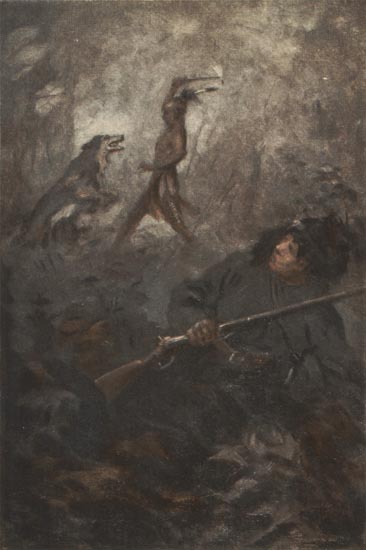
THE LETTER
Henry was quite sure that the beaver king had given him a direct
warning, and he never liked afterward to disturb or impair the belief,
and, moreover, he was so alive with gratitude that it was bound to be
so. Lying perfectly still in the depths of the thicket he watched the
Indians, powerful warriors, who, nevertheless, showed signs of strain
and travel. Doubtless they had come from the edge of the lake itself,
and he believed suddenly, but with all the certainty of conviction, that
they were following him. They were on the back trail, which, in some
unexplained manner, they had struck merely to lose again. Chance had
brought them to opposite sides of the pond, but he alone had received
the warning.
They stood at the water’s edge three or four minutes, looking at the
beaver houses and talking, although Henry was too far away to understand
what they said. He knew they would not remain long, but what they did
next was of vital moment to him. If they should chance to come his way
he would have to spring up and run
for it, but if they went by another
he might lie still and think out his problem.
The leader gave a word of command, and, dropping into the usual single
file, they marched silently into the south. Henry lay on the north side
of the pool, and when the last of the warriors was out of sight, he rose
and walked back to his canoe, which he must now reluctantly abandon. He
could not think of continuing on the water when he had proof of the eye
that many warriors were in the woods about the creek.
The canoe had served him well. It had saved him often from weariness,
and sometimes from exhaustion, but dire need barred it now. He put on
the painted coat, made the blankets and provisions into a pack which he
fastened on his back, hid the light craft among weeds and bushes at the
creek’s margin, and then struck off at a swift pace toward the west and
south.
While bands would surely follow him, he did not believe the Indian hosts
could be got together again for his pursuit and capture. After their
great failure in the flight and pursuit northward they would melt away
largely, and winter would thin the new chase yet more. His thought now
was less of the danger from them than of his four brave comrades from
whom he had been separated so long and whom he was anxious to rejoin. It
was more than likely that they had left the oasis and had come a long
distance to the north, but where they were now was another of the
serious problems that confronted him from day to day. In a wilderness so
vast
four men were like the proverbial needle in the haystack.
But Henry trusted to luck, which in his mind was no luck at all, rather
the favor of the greater powers which had watched over him in his flight
and which had not withdrawn their protection on his return, as the king
of the beavers had shown. All the following day he fled southward,
despite the heavy pack he carried, and made great speed. Here, he
judged, the winter had not been severe, since the melting of the great
snow that he had encountered on his way toward the lake, and he slept
the next night in the lee of a hill, his blankets and the painted coat
still being sufficient for his comfort.
At noon of the next day, coming into low ground, mostly a wilderness of
bushes and reeds, he heard shots and soon discovered that they came from
the rifles and muskets of Indians hunting buffalo and deer, which could
not easily escape them in the marshes. For fear of leaving a trail, sure
to be seen in such soft ground, he lay very close in a dense thicket of
bushes until night, which was fortunately very dark, came. Then he made
off under cover of the darkness, and saw Indian fires both to the right
and to the left of him. He passed so close to the one on his right that
he heard the warriors singing the song of plenty, indicating that the
day had yielded them rich store of deer and buffalo. Most of the Indians
were not delicate feeders and they would probably eat until they could
eat no more, then, lying in a stupor by the fire, they would sleep until
morning.
He did not stop until after midnight, and slept again
in the protection
of a steep hill, advancing the next day through a country that seemed to
swarm with warriors evidently taking advantage of the weather to refill
the wigwams, which must have become bare of food. Henry, knowing that
his danger had been tripled, advanced very slowly now, traveling usually
by night and lying in some close covert by day. His own supplies of food
fell very low, but at night, at the edge of a stream, he shot a deer
that came down to drink, and carried away the best portions of the body.
He took the risk because he believed that if the Indians heard the shot
they would think it was fired by one of their own number, or at least
would think so long enough for him to escape with his new and precious
supplies.
He was correct in his calculations, as he was not able to detect any
trace of immediate pursuit, and, building a low fire between two hills,
he cooked and ate a tender piece of the deer meat.
That night he saw a faint light on the horizon, and believing that it
came from an Indian camp, he decided to stalk it. Placing all his
supplies inside the blankets and the painted robe, he fastened the whole
pack to the high bough of a tree in such a manner that no roving wild
animal could get them, and then advanced toward the light, which grew
larger as he approached. It also became evident very soon that it was a
camp, as he had inferred, but a much larger one than his original
supposition. It had been pitched in a valley for the sake of shelter
from cold winds, and on the western side
was a dense thicket, through
which Henry advanced.
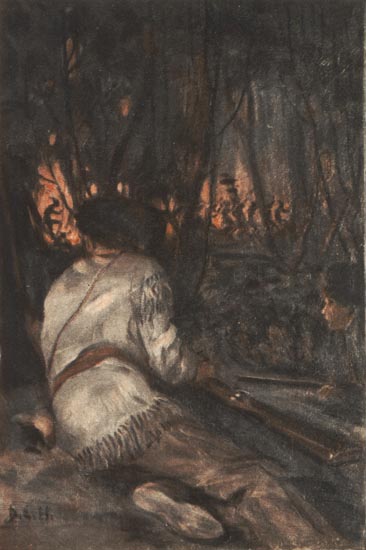
The Indians were keeping no watch, as they had nothing to guard against,
and he was able to come so near that he could see into the whole bowl,
where fully two hundred warriors sat about a great fire, eating all
kinds of game and enjoying to the full the warmth and food of savage
life. Henry, although they were his natural foes, felt a certain
sympathy with them. He understood their feelings. They had gone long in
their villages, half starved, while the great snow and the great cold
lasted, but now they were in the midst of plenty that they had obtained
by their skill and tenacity in hunting. So they rejoiced as they
supplied the wants of the primeval man.
The scene was wild and savage to the last degree. Most of the warriors,
in the heat of the fires, had thrown off their blankets, and they were
bare to the waist, their brown bodies heavily painted and gleaming in
the firelight. Every man roasted or broiled for himself huge pieces of
buffalo, deer or wild turkey over the coals, and then sat down on the
ground, Turkish fashion, and ate.
At intervals a warrior would spring to his feet and, waving aloft a
great buffalo bone, would dance back and forth, chanting meanwhile some
fierce song of war or the chase. Others would join him, and a dozen,
perhaps twenty, would be leaping and contorting their bodies and singing
as if they had been seized by a madness. The remainder went on with the
feast, which seemed to have no ending.
The wind rose a little and blew, chill, through the forest. The dry
boughs rustled against one another, and the flames wavered, but roared
the louder as the drafts of air fanned them to greater strength. The
warriors, heated by the heaps of coals and the vast quantities of food
they were devouring, felt the cold not at all. Instead, the remaining
few who wore their blankets threw them off, and there was a solid array
of naked brown bodies, glistening with paint and heat. Innumerable
sparks rose from the fires and floated high overhead, to die there
against the clear, cold skies. When a group of singers and dancers
ceased, another took its place, and the fierce, weird chant never
stopped, the wintry forest continually giving back its echoes.
The wilderness spectacle had a remarkable fascination for Henry, who
understood it so well, and, knowing that there was little danger from
men who were spending their time in what to them was a festival, he
crept closer, but was still well hidden in the dense thicket. Then his
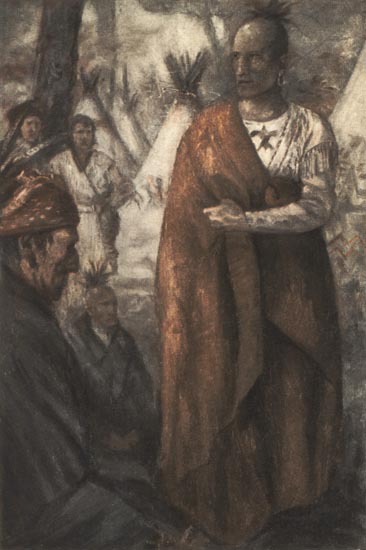
pulses gave a great leap, as four figures which had been on the other
side of the fire came distinctly into his view. They were Red Eagle,
head chief of the Shawnees; Yellow Panther, head chief of the Miamis;
and the renegades, Braxton Wyatt and Moses Blackstaffe, who had pursued
him so long and with such tenacity. They were talking earnestly, and he
crept to the very edge of the thicket, where scarcely three feet divided
him from the open.
He knew that only a chance would bring the four near
enough for him to
understand their words, but after a half hour’s waiting the chance came.
Blackstaffe, who took precedence over Wyatt because of his superior
years and experience, was doing most of the talking, and the subject,
chance or coincidence bringing it about, was Henry himself.
“The warriors discovered a white trail, the trail of one,” said the
renegade, “but we don’t know it was Ware’s. He may have perished in the
great freeze, and if so we are well rid of a dangerous foe, an eye that
has always watched over our movements, and a bold spirit that always
takes the alarm to the settlements below. I give him full credit for all
his skill and courage, but I’d rather his bones were lying in the
forest, picked clean by the wolves.”
Henry felt a little thrill of satisfaction. “Picked clean by the
wolves?” Why, the wolves themselves had saved him once!
“I don’t think he’s dead,” said Braxton Wyatt. “I don’t know why, but I
believe I understand him better than any of you do. I tell you he’s even
stronger and more resourceful than you suppose! Look how often he has
escaped us, when we were sure we held him fast! He’d find a way to live
in the big freeze, or anywhere. I’ve an idea that he’s back up there by
the lake somewhere, and that the trail the warriors found was that of
another of the five, perhaps the traces of the fellow Shif’less Sol.”
Henry’s pulse leaped again, now with joy. The
shiftless one had not
been taken nor slain, and doubtless none of the others either, or they
would have referred to it. But he waited to hear more, and not a dead
leaf nor a twig stirred in the thicket, he was so still.
“It seems strange,” said Blackstaffe, thoughtfully, “that we have not
been able to take him, when more than a thousand warriors were in the
hunt, carried on without stopping, except during the big snow and the
big freeze. And the warriors are the best in the west, men who can come
pretty near seeing a trail through the air, men without fear. It almost
seems to me that there’s been something miraculous about it.”
Then one of the chiefs spoke for the first time, and it was Yellow
Panther, the Miami.
“Blackstaffe has spoken the truth,” he said. “Ware is helped by evil
spirits, spirits evil to us, else he could not have slipped from our
traps so often. He has powerful medicine that calls them to his aid when
danger surrounds him.”
Yellow Panther spoke with all the gravity and earnestness that became a
great Miami chief, and, as he finished, he looked up at the skies from
which the fugitive had summoned spirits to his help. The great Shawnee
chief, Red Eagle, standing by his side, nodded in emphatic confirmation.
Henry felt a peculiar quiver run through his blood. Had he really
received miraculous help, as the two chiefs thought? Lying there in such
a place at such a time there was much to make him think as they did.
“We’ve spread a mighty net, and we’ve caught nothing,” said Braxton
Wyatt, deep disappointment showing in his tone. “We’ve not only failed
to get the leader of the five, but we’ve failed to take a single one of
them.”
Now Henry’s heart gave a great leap. He had inferred that all of his
comrades were yet safe, but here was positive proof in the words of
Wyatt. Why had he ever feared? He might have known that when he drew off
the Indian power they would be able to take care of themselves.
“I think,” said Blackstaffe, “that we’d better continue our march to the
south, and also keep a large force in the north. If we don’t stumble
upon him in a week or two our chance will be gone, at least until next
spring. All the wild fowl flew south very early and the old men and
women of the tribes have foretold the longest and hardest winter in two
generations. Is it not so, Yellow Panther?”
“The cold will be so great that all the warriors will have to seek their
wigwams,” replied the Miami chief, “and they will stay there many days
and nights, hanging over the fires. The war trail will be deserted and
the Ice King will rule over the forest.”
“I’ve no doubt the old men and old women are right,” said Braxton Wyatt,
“and you make me shiver now when you tell me what they say. Perhaps the
spirits will turn over to our side and give all the five into our
hands.”
They moved on out of hearing, but Henry now knew
enough. His comrades
were untaken and he understood their plan of campaign. If he and the
four could evade it a little longer, a mighty winter would shut in, and
that would be the end. He was glad he had come to spy upon the host. He
had been rewarded more richly than he had hoped. Now he crept silently
away, but for a long time, whenever he looked back, he still saw the
luminous glow of the great fires on the dusky horizon.
He was so sure that no warriors would come, or, if they did come, that
his trained faculties would give him warning in time, that he slept in a
thicket within two miles of the camp. He was up before dawn and on the
southern trail, knowing that the Indian host would soon be on the same
course, though going more slowly. His trail lay to the east of that
which had led him north, but the country was of the same general
character. Everywhere, save for the little prairies, it was wooded
densely, and the countless streams, whether creeks or brooks, were
swollen by the winter thaw.
The desire to rejoin his comrades was very strong upon Henry, and he
began to look for proofs that they had been in that region. He knew
their confidence in him, their absolute faith that he would elude the
pursuit and return in time. Therefore they would be waiting for him, and
wherever they had passed they would leave signs in the hope that he
might see them. So, as he fled, he watched not only for his enemies, but
for the trail of his friends.
He was compelled to swim a large river, and the cold
was so great that
he risked everything and built a fire, before which he warmed and dried
himself, staying there nearly two hours. A half hour before he left, he
saw distant smoke on his right and then smoke equally distant on his
left. Each smoke was ascending in spiral rings, and he knew that they
were talking together. He knew also that their engrossing topic was his
own smoke rising directly between. A fantastic mood seized him, and he
decided to take a part in the conversation. Passing one of his blankets
back and forth over his own fire, he, too, sent up a series of rings,
sometimes at regular intervals, and again with long breaks between.
It was a weird and drunken chain of signals and he knew that it would
set the Indians on the right and the Indians on the left to wondering.
They would try their best to read his signals, which he could not read
himself; they would strive to put in them meaning, where there was no
meaning at all; and he worked with the blanket and the smoke with as
much zest and zeal as he had shown at any time in his flight for life.
No such complicated signals had ever before been sent up in the
wilderness, and he enjoyed the perplexity of the warriors to the utmost
as he saw them talking to one another and also trying frantically to
talk to him. The more they said, the more he said and the more
complicated was the way in which he said it, until the smoke on his
right and the smoke on his left began to sweep around in gusts of
indignation and disappointment.
His fantastic humor deepened. He sincerely hoped
that Blackstaffe was
at the foot of one smoke and that Braxton Wyatt was at the foot of the
other, and the more they were puzzled and vexed the better it suited his
temper. He sent up the most extraordinary spirals of smoke. Sometimes
they rose straight up in the heavens, now they started off to the right,
and then they started off to the left. Although they meant nothing, one
could imagine that they meant anything or everything. They were a
frantic call for help or an insistent message that the trail of the
fugitive had been discovered, or merely a wild statement that the night
was not going to be cold, nor the next day either, or an exchange of
compliments, or whatever those who saw the things chose to imagine.
After hoping for a while so intensely that Braxton Wyatt and Blackstaffe
were on either side of him, Henry felt sure it was true, so ready is
eager hope to turn its belief into a fact, and he rejoiced anew at their
vexation, laughing silently and long. Then he abruptly kicked the coals
apart, smothered the smoke, and taking up his pack fled again, much
amused and much heartened, for further efforts. He could not remember
when he had spent a more enjoyable half hour.
He maintained his flight until far after midnight, when, coming into
stony ground, he found excellent shelter under a great ledge, one
projecting so widely that when he awoke in the morning and found it
raining, he was quite dry. It poured heavily until the afternoon, and he
did not stir from his covert, but, wrapped in the painted
coat and
blankets, and taking occasional strips of the deer meat, he enjoyed the
period of rest.
It rained so hard that he could not see more than fifty yards away, and
in the ravine before his ledge the water ran in a cold stream. The
forest looked desolate and mournful, and he would have been desolate and
mournful himself if it had not been for the single fact that he was able
to keep dry. That made all the difference in the world, and the contrast
between his own warm and sheltered lair and the chill and dripping woods
and thickets merely heightened his sense of comfort.
When the rain stopped it was followed by an extremely cold night that
froze everything tight. Every tree, bush and the earth itself was
covered with glittering ice, a vast and intricate network, a wilderness
in white and silver. It was alike beautiful and majestic, and it made
its full appeal to Henry, but at the same time he knew that his
difficulties had been increased. He would have to walk over ice, and, as
he passed through the thickets, fragments of ice brushed from the twigs
would fall about him. For a while, at least, the Ice Age had returned.
It was sure, too, to make game very scarce, as all the animals would
stay in their coverts as long as they could at such a time, and he must
replenish his supplies of food soon. But that was a difficulty to which
he gave only a passing thought. Others pressed upon him with more
immediate force.
His moccasins had become worn from long use and they slipped on the ice
as if it were glass. He met this
difficulty by cutting pieces from one
of the blankets and tying them tightly over his feet with thin strips
from his buckskin garments. He was then able to walk without slipping,
and he made good progress again through the forest, the exertion of
travel keeping him warm. Meanwhile he watched everywhere for a sign, a
sign from the four, keeping an especial eye for the trees, for it was
upon them that the forest runners wrote their letters to one another. In
his soul he craved such a letter and he did not really know how
intensely he craved it. The bonds of friendship that united the five
were the ties of countless hardships and dangers shared, and not one of
them would have hesitated an instant to risk his life for any one of the
others.
It was characteristic of Henry’s patience and thoroughness that, though
he found nothing, he kept on looking. He wanted a letter, and he wanted
it so long and with so much concentration that he began to believe he
would find it. It was only a short letter that he wished, merely a word
from his friends saying they had passed that way. A straight, tall
figure, with eager, questing eyes, he went on through the silver forest.
When the light wind blew, fragments of the ice that sheathed every bough
and twig fell about him and rattled like silver coins as they struck the
ice below, but mostly the air was quiet, and the glow from a mighty
setting sun began to shoot such deep tints through the silver that it
was luminous with red gold. Thinking little now of its beauty and
majesty, the hunter pressed
on, not the hunter of men nor even a hunter
of game, but a hunter for a word.
The mighty sun sank farther. Most of the gold in its rays was gone, and
it burned with an intense red fire, lighting up the icy forest with the
glow of an old, old world. Henry still looked. The dark would come soon,
when he must abandon the search for the word and seek shelter instead.
But his hope was still high that he would find it before night closed
down.
When the red glow was at its deepest he saw in the very core and heart
of it that for which he was looking. Eye-high on the stalwart trunk of
an oak were four parallel slashes from the keen blade of a tomahawk.
They could not have been put there by chance. A powerful hand had
wielded the weapon and the four cuts were precisely horizontal and close
together. He had found his word. It was as plain as day. The four had
passed there and they had left for him a letter telling him all about
it. This was only the first paragraph in the letter, and he would find
others farther on, but he devoted a little time to the examination of
the first.
He studied minutely the cuts and the cloven edges of the bark, and he
decided that they were at least two weeks old. So the letter had been
posted some time since, and doubtless its writers had gone on to another
region. But if they posted one letter they would post others, and he
felt now that communication had been established. True, the chain
connecting them was long, but it could be shortened inch by inch.
He made a series of widening circles about the tree, looking for the
second paragraph of the letter, and he found it about a hundred yards to
the eastward, exactly like the first, four parallel slashes of a
tomahawk, eye-high, deep into the trunk of a stalwart oak. He found a
third paragraph precisely like the first and the second, a hundred yards
farther on, and then no more. But three were enough. They indicated
clearly the course of the four which was into the northeast. In the
morning he would change his own direction to conform with theirs.
The letter gave him a great surge of the heart, but the night came down
quickly, dark and cold, the bitter wind blew again, and the ice fell
about him in a rain of chill crystals. He knew that the temperature was
falling fast, and that it would be his hardest night so far. He must
have a fire, risk or no risk, and it was a full three hours before he
was able to coax one from dead wood that he dragged from sheltered
recesses. Then it felt so good that he built a second, intending to
sleep between them. His supply of food was low, but knowing how needful
it was to preserve his strength and the full fresh flow of his blood, he
ate of it heartily, and, then when the ground, wet between the fires
from the melted ice, had been dried by the heat, he made his bed and
slept well, although he awoke once in the night and finding the cold
intense put fresh wood on the fires.
The next morning was one of the coldest he had felt, and he was
reluctant to leave the beds of coals, but his comrades had given him a
sign, and he would not dream
of ignoring it. He threw ice upon the
fires, and with a sigh felt their heat disappear. Then he followed the
trail to the northeast, hunting at intervals for a renewal of the sign
lest he go wrong. Three times he found it, always the four cuts,
eye-high, always in the trunk of a stalwart oak, and always they led in
the direction in which he was going. The cuts were very deep, and he was
quite sure that they had been made by Shif’less Sol, who added to
remarkable strength wonderful cunning and mastery in the use of a
tomahawk.
About noon, he came to a vast, shallow, flooded area, a third of a mile
or more across, but extending farther to north and south than he could
see either way. Doubtless the four had crossed there before the heavy
rains made the flood, and as he was unwilling to take the long circuit
to north or south he decided to make the passage on the ice which was
thick and strong.
He had been so free from danger for some time that he took little
thought of it now, but when it was absent from his mind it came. When he
was well out upon the ice he heard the crack of a rifle behind him and a
bullet whizzed by his ear. He ran forward at great speed before he
looked back, and then he saw a dozen warriors standing at the edge of
the ice, but making no motion to pursue. As he was now out of range, he
stopped and examined them, wondering why they did not follow him. The
solution came quickly.
The band suddenly united in a tremendous war whoop and from the woods on
the other side of the ice came an
answering whoop. He was trapped
between them, and they could afford to be deliberate. His heart sank,
but as usual his courage came back in an instant, stronger than ever.
Alert, resourceful, the best marksman in all the West, he did not mean
to be taken or slain, and he looked about for the means of defense. As
it was not a lake, upon the frozen surface of which he stood, merely a
great shallow flooded area, there were clumps of bushes and little
islands of earth here and there, and he ran to one not twenty feet away,
a tiny place, well covered with big bushes. The Indians, seeing him take
refuge, set up a yell from both shores, and Henry, settling down in his
covert, waited for them to make the first move.
He knew that the warriors would be deliberate. Considering their victim
secure in the trap, they would reckon time of no value, and would take
no unnecessary risk. He believed they were hunting bands, not those that
had trailed him directly, and that his encounter with them was chance, a
piece of bad fortune, nothing more than he should expect after such a
long run of good fortune.
Warriors of the different bands sent far signals to one another across
the ice, and then slowly and with care each party built a large fire,
around which the men sat basking in the heat, and now and then, with a
cry or two, taunting the fugitive whom they considered so tight in the
trap. The red gleam of the flames upon the ice, contrasting with his own
situation, struck a chill into Henry. The wind had a clear sweep over
the frozen lagoon, and
the rustling of the icy bushes above him was
like a whisper from the cold. He wrapped himself thoroughly in the
painted coat and the two blankets, put the rifle in front of him, where
he could snatch it up instantly, and beat his hands together at times to
keep them warm, and at other times held them under the blankets.
He understood human nature, and he knew that they were rejoicing in
their own comfort, while he might be freezing. They felt that way
because it was their way, and he did not blame them. It was merely his
business to thwart their plans, so far as they concerned himself. He
recognized that it was a contest in which only superior skill could
defeat superior numbers, and he summoned to his aid every faculty he
possessed.
The Indians did not move for an hour, luxuriating by their fires, and
occasionally taunting him with cries. Then four warriors from either
shore went upon the ice at the same time, and began to advance slowly
toward his island, making use of the clumps of bushes that thrust here
and there through the frozen surface of the lagoon.
Henry slipped his hands from the blankets and watched both advancing
parties with swift glances, right and to left. They were using shelter
and advancing very slowly, but beyond a certain point both were bound to
come in range. He smiled a little. Much of his forest life recently had
been in the nature of an idyll, but now the wild man in him was
uppermost. They came to kill and they would find a killer.
He knelt among the bushes, which were thin enough
to allow him a clear
view in every direction, and put his powder horn and bullet pouch on the
snow in front of him. He could reload with amazing rapidity. They did
not know that. Nor did they know that they were advancing upon the king
of riflemen. Naturally, they would suppose him to be a wandering hunter
lost in a dangerous region.
The party on the west presently began to pass from the shelter of one
tuft of bushes to another, twenty yards away, and in doing so the four
were wholly exposed. It was a long shot, much too long for any of the
Indians, but not too long for Henry. He fired at the leading warrior,
and, before he had time to see him crashing on the ice, he was reloading
his rifle with all the speed of dexterous fingers. He heard a yell of
rage from the Indians, and, glancing up, saw the three dragging away the
body of the fallen man. But the party on the other side, knowing that
his rifle had been emptied, but not knowing with what speed he could
reload, came running.
His weapon flashed a second time, and with the same deadly aim. The
leading warrior in the second party fell also, dead, when his body
touched the ice, and his comrades gave back in fear. They had not known
such terrible sharpshooting before, and the man whom they had thought so
securely in the trap must have two rifles at least. Both parties,
carrying their dead with them, retreated swiftly to shore, and gathered
about the fires again.
Henry reloaded a second time, patted affectionately the rifle that had
served him so well, put it once more in front of him, and sheltered his
hands as before under the blankets. The bands had received a dreadful
lesson. The loss of two good warriors was not to be passed over lightly,
and he knew they would delay some time before taking further action.
Meanwhile, the night was coming fast and the cold was increasing so
greatly that it alarmed him, despite the blankets and the painted robe.
The wind sweeping over the frozen surface of the lagoon had an edge that
cut like steel. The very blood in his veins seemed to grow chill, and he
felt alarm lest his hands grow too stiff with cold to handle the rifle.
The bushes, although they hid him from a distant enemy, did not afford
much protection. Instead, they were like so many icicles.
The two bands built their fires higher, until the flames threw a glow
far out on the ice, and Henry saw their hovering figures outlined in
black against the red. They filled him with anger, because they could
maintain the siege in comfort, while he had to fight not only a human
foe, but the paralyzing cold as well. He stood up now, stretched his
arms, stamped his feet and exercised himself in every manner of which he
could think, until a certain amount of warmth came to his body. But he
knew it would not last long. Presently the cold would settle back
fiercer and more intense than ever.
The night advanced, the dusk deepened and the siege of Henry by the
warriors and the cold grew more
formidable. He was anxious for the
Indians to make another attack, but he knew now they would not do it.
They would wait patiently for the fugitive in the trap to fall inert
into their hands. After all he was in the trap! And it was a trap worse
than any other he had ever met. Then he said fiercely to himself that he
might be in the trap, but he would break out of it.
For the second time, he took violent physical exercise to drive away the
creeping and paralyzing cold, and then he resolved upon his plan to
burst the trap. The night was fairly dark with streamers of cloud
floating across the heavens, and it might grow darker. Far to north and
south stretched the glimmering white ice, with dark spots here and
there, where the clumps of bushes or trees thrust themselves above the
frozen surface.
Wrapping himself as thoroughly as he could, and yet in the best way to
leave freedom of action, he crept from the bushes and bending low on the
ice ran to a clump about thirty yards to the south, where he crouched a
while, watching the warriors at the two fires. He could still see very
clearly their figures outlined in a black tracery against the flames,
and they might have sentinels posted nearer, but evidently his own
change of base had not been suspected. Perhaps the fear of his deadly
rifle kept them from coming so near that they could see his movements,
and they relied upon the great cold to hold him within the original
clump of bushes. The blood in his veins that had grown chill seemed
suddenly to turn warm again. Even a passage of a few yards from
one
little island to another was enough to create hope. There was no trap so
tight in which he could not find a crevice, or make one, and he prepared
for the second stage in his journey, a cluster of trees a full hundred
yards to the south.
He would have dropped to his hands and knees if it had not been for the
fear of freezing his fingers, a risk that he could not afford to take
for a moment, alone in the desolate wilderness and surrounded by deadly
perils. So he merely stooped low and ran for the trees, the wrappings of
blanket on his feet saving him from slipping.
But he gained them and there was yet no alarm. The black tracery of the
Indian figures still showed before the fires, where they were hovering
for the sake of the grateful heat, and, as well as he could judge, his
flight was unsuspected.
The third island was much better than the first two. Although it was
only eight or ten yards across, it supported a cluster of large trees,
and had a little dip in the center, in which he lay, while the cruel
wind was broken off by the trees or passed over his head. There was an
access of warmth, and he had a tremendous temptation to lie there, but
he fought it. It was hard to distinguish warmth from numbness, and, if
he remained without motion, he would surely freeze to death, despite the
trees and the dip.
Reluctantly he began the fourth stage in his flight, and his reluctance
was all the greater because the island
for which he was making was at
least three hundred yards away, and the wind, cold as the Pole and cruel
as death, was rising to a hurricane. It made him waver as he ran, and
his fingers almost froze to his rifle. But he reached the fourth island,
where he sank down exhausted, the fierce wind having taken his breath
for the time. The fires now were far away and he could not distinguish
the Indians from the flames, but he did not believe any of them had come
upon the ice to attack him or to spy him out. While the tremendous cold
almost paralyzed him, it would also withhold their advance upon him for
a while.
He rose from his covert and started again, although he felt that he was
growing weaker. Such intense exertion, under such conditions, was bound
to tell even upon a frame like his, but he would not let himself falter,
passing from island to island, resting a little at every one, bearing
toward the southeast, and intending to enter the forest about a mile
from the fire on that side. Meanwhile, the chill of the deadly cold and
elation over his escape fought for the mastery of him. He reached the
last little island, scarcely ten yards from the shore, and as he stepped
upon it, two dusky figures threw themselves upon him.
Henry was thrown back upon the ice, but though the blow was like a
lightning flash, he realized, in an instant, what it meant. The warriors
had not been wholly paralyzed by the cold, and they had stationed guards
at other points along the lagoon to prevent his escape, but
these two
were seeking so hard to protect themselves from the cruel wind that they
had not seen him until he was upon them. Knowing that the question of
his life or death would be decided within the next half minute, he put
forth every ounce of his mighty strength, and swept the two warriors
together in his arms.
His rifle clattered upon the ice, and with the two men clinging to him,
struggling vainly to reach tomahawk or knife, he rose to his feet, still
clutching the warriors. But the feet of all three slipped from under
them, and down they went again with a tremendous impact. The warriors
were on the underside, and Henry fell upon them. There was a rending
crash, as the ice, thinner at that point, owing to the protection of the
island, broke beneath the blow.
Henry felt the grappling fingers slip from him, and he sprang back just
in time to see the two warriors sink into a narrow but icy gulf, from
which they never rose again. Uttering a cry of horror, he picked up his
rifle and ran for the forest. He knew that chance, or perhaps the will
of the greater powers, had saved him again, but, as he ran, he shuddered
many times, not from the cold, but at the ghastly fate that had
overtaken the warriors. The impression faded by and by. When one is in a
bitter struggle for life he does not have time to think long of the fate
of others, and the savage wilderness through which he fled was too
bitter of aspect then to breed a long pity.
He was quite sure that he had shaken off the Indians,
for the time,
anyhow, and again the vital question with him was warmth. The running
was bringing a measure of it, but he could not run forever, and he soon
sank to a walk in order to save himself. But he maintained this gait for
a long time, in truth, until dawn was only three or four hours away, and
then he decided that he would build a fire. It was a risk, but he chose
to take the smaller risk in order to drive off the greater.
It never before took him so long to kindle his blaze. He found a place
sheltered from the wind, whittled many shavings from dead wood, and used
his flint and steel until his hands ached, coaxing forth the elusive
sparks and trying to make them ignite the wood. They died by hundreds,
but, after infinite industry and patience, they took hold, and he
sheltered the tiny and timid blaze with his body, lest it change its
mind and go away after all. Though it sank several times, it concluded
finally to stay and grow, and, having decided, it showed vigor, burning
fast while Henry fed it.
As the fire threw out abundant heat he reveled in it. Now he knew better
than ever before that fire was life. He could feel the blood which had
seemed to be ice in his veins thawing and flowing in a full warm flood
again. The beat of his heart grew stronger and the stiff hands acquired
their old flexibility. His face stung at first, but he rubbed ice over
it, and presently it too responded to the grateful heat. An immense
comfort seized him and he felt drowsy. Comfort would become luxury if he
could lie down and sleep, but he knew too much to yield
to the demands
of his body. After spending two hours by the fire and becoming
thoroughly soaked in heat, he put out the coals and went on again. As he
walked, he ate the last of his food, and now he must soon find more. The
problem of his escape from the Indians had been solved, but the problem
of finding his comrades was upon his mind, though it must be put off
while he solved that of food.
He considered it a miracle that his rifle had not gone into the water
with the two warriors. But was it a miracle? Was it not rather another
intercession of the greater powers in his favor? Alone in the wilderness
at such a time a rifle was at least half of life, even more, it was the
very staff of it. Without it he would surely perish. He patted the rifle
with the genuine affection one must feel for so true a weapon. It was a
fine rifle, beautiful in his eyes, with a long, slender barrel of blued
steel, and a polished and carved stock. It had never failed him, and he
knew that it would not fail him now.
He thought of the rabbits which had been such an abundant resource once.
Many of them must be in their nests under the ice and snow, and he
searched for hours but found none. Yet he could go two or three days
without food, and he did not despair, showing all his usual pertinacity,
never ceasing to look. The hunt led him into rocky ground, and, between
the ledges, he noticed an opening that caused him to take a second look.
Several coarse hairs were on the stone at the entrance, and when he saw
them he knew. It was his animal brother
at home, and he did not forget
his gratitude, but he must live.
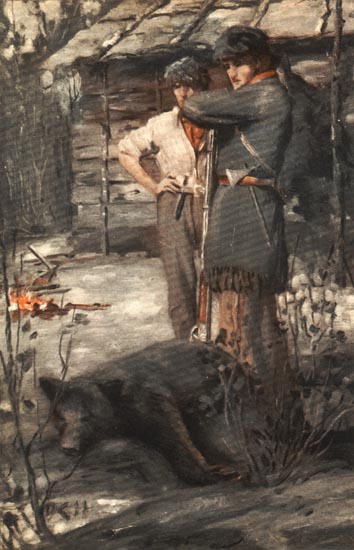
He seized a long stick and thrust it savagely inside. The bear, awakened
from the winter sleep which he had begun luxuriously not long ago,
growled fiercely and rushed out. Then Henry snatched up his rifle and
shot him. The bear had lost much of his fat, but he was a perfect
treasure house of supplies, nevertheless, and steaks from his body were
soon broiling over the coals. Henry, remembering how much food he needed
in such intense cold, and, while he was undergoing physical exertions so
great, ate heavily. As much more as he could conveniently carry he added
to his pack, knowing that he could freeze it at night, and that it would
keep indefinitely. He would have liked the bearskin too, but he did not
care to add so much to his burden, and so he left it reluctantly.
He was a new man now, made over completely. The wilderness, so far from
being desolate and hostile, took on its old comfortable aspects. It was
a provider of food and shelter to one who knew how to find them, and
certainly none knew better than he. The wants of the body being
satisfied, he began to plan anew for the junction with his comrades. The
great cold would not last much longer. A temperature twenty or thirty
degrees below zero never endured more than a few days. Like as not, it
would break up in a warm rain, to be followed by moderate weather, and
then he could hunt the trail of the four in comfort.
His pack was much heavier when he started and the icy coating of the
earth was still slippery, but he made excellent progress, and he was
able to fix in his mind the direction in which the marks on the trees
had pointed. He knew that he must turn back somewhat toward the north in
order to reach that line, and such a change in his course would increase
the danger from the Indians, but he did not hesitate. He made the angle
at once, and then he began to observe the trees with all the patience
and minuteness of which a forest runner in such a crisis was capable.
It was almost dusk when he found the sign, four slashes of a tomahawk,
eye-high on the stalwart trunk of an oak, and a hundred yards farther on
a similar sign. He traced them fully a mile, and then as the night shut
down, dark and impenetrable, he was compelled to stop. He dared another
fire, the cold was so intense, and began his journey again the next
morning over the ice.
The rise in the temperature that he had expected did not occur, nor were
there any signs of a change. Evidently the great cold had come to stay
much longer than usual, and, while it hindered his own journey, it also
hindered possible pursuit by the Indians, of whom he saw no traces
anywhere until the third day after he had killed the bear. Then he
observed a great smoke in the south, and he approached near enough to
discover that it was an Indian village, probably Shawnees. It seemed to
be snowed up for the winter, holed up like a bear, and,
anticipating no
danger from it, he continued his leisurely hunt eastward.
He lost the traces for a whole day, but recovered them the next morning,
and now they were much fresher. Sap, not yet dead in some of the trees,
had oozed but lately into the cuts, and his heart beat very hard. His
comrades could not be far away. He might reach them the next day or the
day after, and now he was actuated by a curious motive, and yet it was
not curious, when his character is considered.
He built a fire by the side of one of the pools, with which the forest
was filled. Breaking the ice and daring the fierce chill of the water,
he took a quick bath. Then, while he was wrapped in the blankets and the
painted coat, he washed all his clothing thoroughly, as he had done once
before, and dried it by the fire. When he was able to put it on again,
he washed the blankets in their turn and dried them. He would have
served the painted coat in a similar manner, but, as that was
impossible, he rubbed and pounded it thoroughly.
His forest toilet complete, Henry felt himself a new man once more,
inwardly and outwardly, freshened up, made presentable to the eye. He
knew that he was haggard and worn. Hercules himself would have been,
after such a flight and pursuit, but at least he was dressed as a forest
runner, neat by nature and careful in his attire, should be.
Now he followed the traces with renewed strength and speed, and he found
that they came more closely
together, a fact indicating the absence of
Indians from the immediate region, as the four would not leave so broad
a trail, unless they knew it would not bring a strong force of Indians
upon them. Straight now it led, and he crossed numerous frozen streams
and pools or lagoons, and then the night that he felt sure was to be the
last one came, as bitterly cold as ever.
The next morning he did not put out his fire as usual, instead he built
it up higher, and, passing one of the blankets rapidly back and forth
over it, sent up ring after ring of smoke. They did not thin away and
vanish until they were high in the clear, intensely cold blue sky.
When his eyes had followed the rings a little while he turned them
toward the eastern horizon and watched there closely. Despite all the
efforts of his will his heart throbbed hard. Would the answer come? He
waited a full half hour, and then his pulses gave a great leap. Rings of
smoke began to rise there under the sky’s rim a full mile away,
ascending like his own into the cold air, where, high up, they thinned
away and vanished. Then his pulses gave another great leap as a second
series of rings rose close beside the first, to be followed quickly by a
third and a fourth. Four fires and four groups of smoke rings rising
into the air! The last doubt disappeared. Paul, the shiftless one, the
silent one, and Long Jim were there. Doubtless they had signaled before,
and now at last he had called to them.
In his wild exultation he kicked the coals of his own
fire apart and
started swiftly toward the four groups of smoke rings. On his way he
sent forth a long thrilling cry that pierced and echoed far through the
wintry forest, and like the distant song of a bugle a similar cry came
back. As he broke into a run, four human figures appeared upon the crest
of a low hill and burst into a simultaneous shout. Then they exclaimed,
also together:
“Henry!”
After that, although their emotion was deep, they made no great show of
it. The border was always terse.
“I knowed you’d shake ’em off, Henry,” said the shiftless one.
“But it must have been a long chase,” said Paul.
“Wish I’d been with you,” said Long Jim.
“Big work,” said Tom Ross.
“I didn’t do it all my myself,” said Henry. “I was helped by the people
of the forest. They came to my aid again and again.”
Paul looked at him wondering, and Henry told them how he had been warned
by the animals one after another, and he could not believe it was mere
chance.
“The woods are full o’ strange things,” said Shif’less Sol,
thoughtfully. “An’ I never try to explain ’em all to myse’f. I let ’em
go fur what they are.”
“How has it been with all of you?” asked Henry.
“We stayed a long time on the oasis in the swamp,” replied Paul, “and
then we started toward the north, hanging on to the rear of the pursuit,
and trying for a chance to help you, though we never found it. At last
the great cold made us seek shelter, but we were sure it would compel
the warriors to abandon the chase and drive them into their villages.”
“After all, it was King Winter that intervened finally in my behalf.”
“That’s true. And while we were hovering about, hoping to help you, we
left the long trail which I suppose you saw.”
“Yes, I came upon it, and it led me to you.”
“An’ now,” said Shif’less Sol, “sence all the warriors hev been drove
into winter quarters, an’ none o’ us hez been killed or took, s’pose we
go into them kind a’ quarters ourselves, an’ keep warm.”
“Whar?” asked Silent Tom.
“Why, our old hollow in the cliff!” exclaimed Paul. “The warriors would
not think of marching against it again before next spring, if at all,
and it’s the warmest, safest and finest place in all the wilderness.”
“A good choice,” said Henry.
“Right thar we’ll go,” said Shif’less Sol.
“Ez soon ez we kin make tracks fur it,” said Long Jim.
“Shore,” said Tom Ross.
They started at once, and all things turned in their favor. The
wilderness remained frozen and bitter cold, but there was no pursuit. By
all rules, game should have been scarce at such a time, but they found
plenty of it. Day after day they traveled through the woods, crossing
the Ohio on the ice, and at last they drew near the rocky
home they had
defended so valiantly, and which once more extended to them a silent
welcome.
Now they built their fires anew, killed game and obtained abundant
supplies of food and furs, though for two weeks Henry was not allowed to
join the others in the chase, resting like Hercules after his mighty
labors. Then, while the great cold lasted, they, the eyes of the woods,
built up their strength and spirit for new labors and dangers in the
spring.