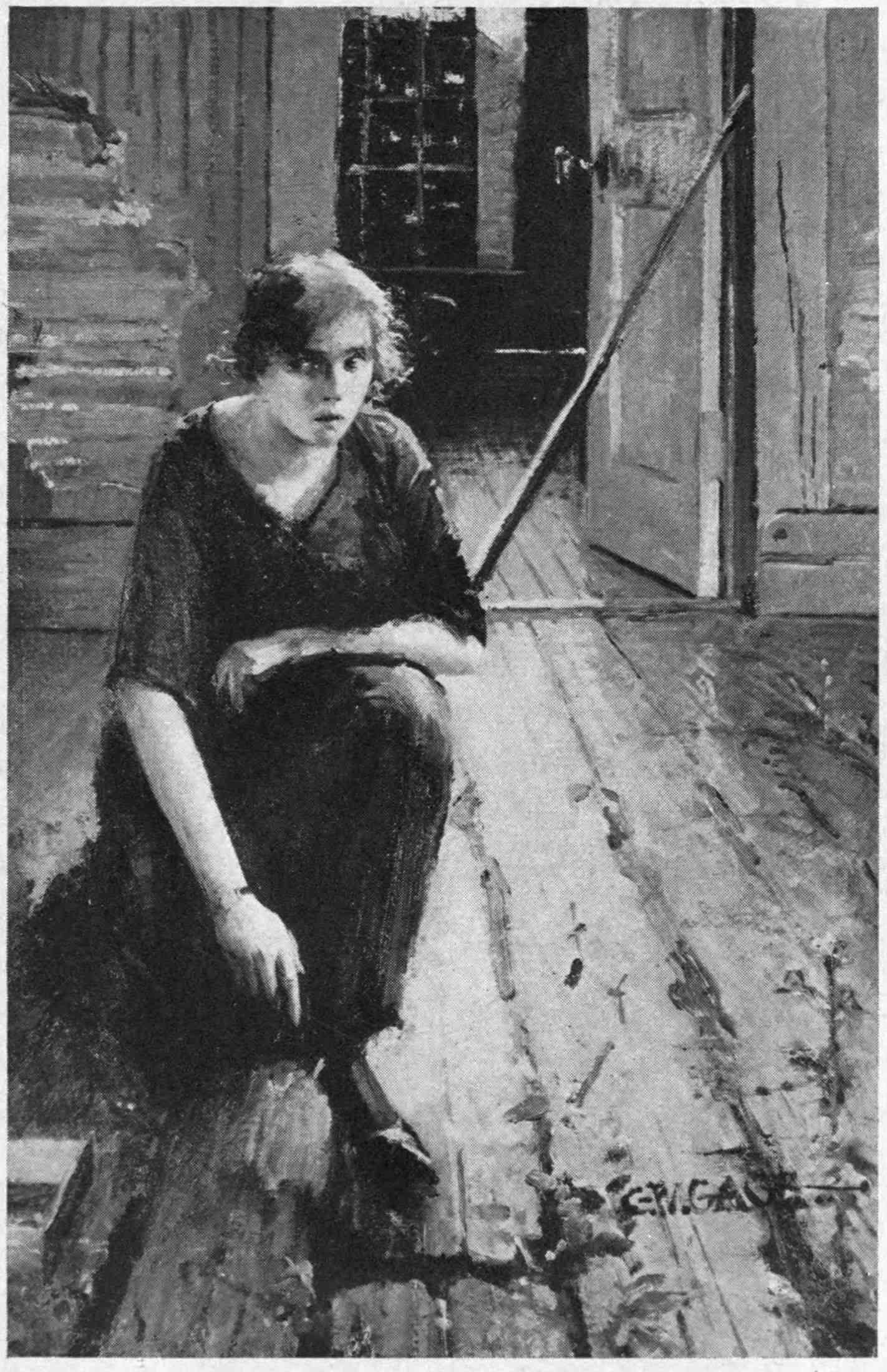
Gilberte, who was less proof against joy than sorrow, awaited her
solicitor’s promised letter with feverish impatience. Another four or
five days, a week perhaps; and the mystery would be cleared up and the
only obstacle to her marriage swept away.
She kept more and more indoors. What was the use of short, stealthy
walks, when her imagination, which was now unfettered, took her across
the immensity of the world, on Guillaume’s arm, under Guillaume’s eyes?
She tried to read novels, to calm her excitement. But what are
fictitious adventures worth at a time when our own destiny is on the
point of fulfilment and when it is to be fulfilled in cloudless
happiness? The one and only adventure was that which was leading her
towards Guillaume. The story began and ended with Guillaume. Guillaume
was its sole hero.
“It will come to-morrow,” she said, each day, with the fixed intention
of sending the letter, the moment she received it, to Mme. de la
Vaudraye.
The morning came and the afternoon and brought no letter. She felt not
the least disappointment:
“It will come to-morrow,” she thought, all a-quiver with hope.
The postman became a person of importance in her eyes, a gentleman worth
considering. She shot her prettiest smiles at him, as though she were
trying to win his confidence and to persuade him that he must have a
letter for her in his bag.
Adèle was enraptured:
“Oh, ma’am, you’re becoming as you used to be! And high time too! Yes, I
was growing uneasy at seeing you always sad, taking no interest in
things and looking so pale. But, there, you’re right: there’s as good
fish in the sea as ever came out of it!”
Released from her silence, Adèle was at last able to repeat all that
Domfront had said about the breach and all that was happening now. And
Gilberte learnt that Mme. de la Vaudraye’s salon, after closing for
three weeks, had reopened. M. Beaufrelant and M. le Hourteulx had been
invited. Mme. Duval even predicted an approaching reconciliation with
the younger Simare, whose father had never ceased pleading in his
favour. At the last reception, the duet from Mireille, as sung by M.
Lartiste the elder and Mle. du Bocage, both of whom were making great
progress, had been vigorously applauded. But the chief thing was the
transformation undergone by Guillaume, whom everybody considered changed
for the better.
“They can’t get over it,” said Adèle. “I hear that he is the life and
soul of the party and so amiable and so polite: just like a proper
young man. He seems on the best of terms with his mother. The young
ladies are all gone on him. Bless my soul, he’s a good-looking lad ...
and it won’t take long before he’s turned all their heads....”
Gilberte reflected:
“He’s quite right to make himself amiable. It’s the only way to get
round his mother.”
Nevertheless, she had to make a certain effort to look upon this as the
only explanation of Guillaume’s conduct.
Two more days followed without a letter. Then, one morning, Adèle came
back from her shopping:
“Here’s a bit of news!” she said. “There’s no harm in telling you, now
that you’ve got over things. M. Guillaume is engaged to the eldest
Charmeron girl.”
Gilberte burst out laughing:
“It’s one of Mme. Duval’s matches!”
“No, no, I hear it from others as well: the Bottentuits’ servant told
me; so did M. Beaufrelant’s gardener. Mme. de la Vaudraye announced it
last night when every one was there.”
Not for a moment did Gilberte admit the possibility of so great a
perfidy. Nothing evil could ever come from within her: no suspicions, no
doubts, no base thoughts; and whatever came from without broke against
her love like impotent waves. How could she have pictured treachery, who
did not know that treachery existed?
She was therefore very cheerful all day long. Nevertheless, at sunset,
an irresistible force drew her to the ruined summer-house. Guillaume was
not among the rocks in the valley.
Nor did she see him the next day. That night, she had a touch of fever
and her mind wandered a little, mingling the picture of Guillaume with
that of Mlle. Charmeron.
She laughed merrily at all this on waking. Nothing could touch her faith
in her lover. She was as sure of him as of herself.
She rose in good spirits, resolved to be happy came what might. And she
was happy: a plucky creature judging others by her own lofty standards,
whose nerves and woman’s instinct may be alarmed for a moment, without
allowing a breath to disturb the serenity of her soul.
She played and sang until lunch-time. After lunch, she strolled in her
garden and picked some flowers. When she went in, she found Guillaume
waiting for her in the drawing-room:
“You ... you ...!” she murmured, half-swooning with emotion.
She was obliged to sit down and they remained at some distance from each
other, not daring to raise their eyes. It seemed to Gilberte as though
her whole life would not be enough to take in all the joy that wrapped
her round. How right had she been to be happy in spite of all things and
to prepare herself for this greater happiness, which she could never
have borne, had she been sad and suspicious.
Guillaume asked:
“Did you not meet my mother? She is looking for you in the garden.”
“Is your mother here?”
“Oh, Gilberte, would I have come without her, when I would not even go
over there, among the rocks, for fear of displeasing you?”
She recalled her disappointment of the last evening and the evening
before and was on the point of accusing herself ... but of what? Had she
lent a willing ear to the calumnies of the town? She said, simply:
“I am glad of what you have done for Mme. de la Vaudraye.”
“What have I done?”
“Was it not a sacrifice to be at her parties?”
He went up to Gilberte:
“A sacrifice? Not at all.... Ah, that’s because you don’t know what has
happened during the last few days!... Why, I am prepared to do all that
she wishes and to take an interest in all that interests her and to
like everything that she likes!... If you only knew, Gilberte.... Listen
... or rather, no, I prefer that she should tell you....”
“Oh,” cried Gilberte, “if they are hopeful words, precious words, why
not say them yourself, Guillaume? Will they not be sweeter if I hear
them from your lips? Speak, Guillaume ... I want them to be associated
in my memory with the sound of your voice ... please, please....”
She besought him with her gentle, loving smile. He at once said:
“Very well, Gilberte, I will.”
He was interrupted by Adèle, bringing in a letter on a tray. Gilberte
took the letter and, while the servant was leaving the room,
mechanically cast her eyes upon the postmark. A cry escaped her:
“Guillaume!”
Her fingers trembled. She could only whisper:
“A letter from Dieppe ... from my solicitor.... Oh, I was waiting for it
so anxiously!... Think, Guillaume: it brings me a name ... nothing can
separate us now....”
The excitement was too much for her. She felt herself small and feeble
in the grip of an over-great happiness. And, covering her face with her
crossed hands, as was her wont at moments of perturbation, she wept
tears of delight.
Some minutes passed in silence. She heard Guillaume open the
garden-door. Steps approached, some one sat down beside her, a hand
unlocked her fingers: it was Mme. de la Vaudraye.
She shrank back imperceptibly. But Mme. de la Vaudraye said:
“Gilberte, are you afraid of me?”
And the voice was so gentle that Gilberte was quite stirred. She looked
at her through her tears and hardly recognized her. Her features had
lost their customary hardness, her countenance the expression of
implacable pride that deprived it of all its charm. And this charm now
showed itself in the eyes, which had lost their severity, in the
pathetic wrinkles of the forehead, in all that sad and withered face.
“Gilberte, you wished to be my daughter: do you wish it still?”
She had no time to reply. Guillaume had rushed up to both of them and
was kissing them by turns. And he said, fervently:
“Let us love her, Gilberte. We owe her the greatest gratitude for what
she is doing. It means the sacrifice of her most cherished ideas and she
has consented to that sacrifice of her own accord.”
“Come, Guillaume, don’t make me out better than I am!” protested Mme. de
la Vaudraye, in a playful tone. “Are you quite sure that I have not
merely yielded to sordid motives? If Gilberte had been a poor girl,
without any money....”
“Oh, madame,” said Gilberte, “that counts for so little!”
“Yes, with you and Guillaume, who are young and think only of your
happiness, but not with me, who have suffered so much from the change in
my fortunes. I can’t help it: one cannot alter at my age; I have a name
of which I am very vain; and my dream has always been to restore it to
all its brilliancy.”
She playfully stroked Gilberte’s hair:
“And think of all my blandishments, from the very beginning, Mme.
Armand! You can’t say that I wasn’t clever in getting round you and
making you do what I wanted! Well, then, one day, you tell me that you
have bought up my family estates and you offer to reinstate me as
mistress of the Logis. How could I have the courage to refuse?”
She displayed a sort of unspoken wish to make amends to Gilberte, a wish
which her pride prevented her from revealing as openly as her heart
would have prompted her, but which, nevertheless, appeared in her manner
of confessing, as though in fun, the shabby side of her behaviour.
Gilberte had too much delicacy of mind to take pleasure in this
admission and replied:
“It’s your son’s happiness which you have not had the courage to reject.
It is so easy to tell that all your ambitions and all your hopes are
only for him.”
But Guillaume was less indulgent and exclaimed:
“Really, mother, one would think that you were trying to cheapen your
consent! Come, tell her of our talks of the past fortnight, tell her
that you know the whole story of our love and that you understand
Gilberte, as she deserves, and that that is why you agree.”
Mme. de la Vaudraye made a last stand. It was the final effort of her
vanity. She seemed undecided, bewildered, staggering, like one trying to
keep her footing before falling; and then, suddenly vanquished, she
took Gilberte in her arms:
“Yes, child, yes, it was you who conquered me ... I have come to you not
because you are rich and generous, but because you are good and sincere
and the noblest creature that ever lived.... Yes, I have thought of the
future, from the start, and I think of it still; but, also from the
start, your goodness has been working on me as on every one else. I
loved you apart from any sort of calculation. And, after refusing my
consent, it was no use my heaping up reasons to confirm me in my
resolve: I could only remember your dear gentleness, your innocence,
your childlike simplicity.”
“Oh,” whispered Gilberte, “how happy you make me!”
“You shall always be happy, child, where it depends on me: that I
promise you.... As for Guillaume, oh, if you knew how he speaks of his
sweetheart! I know you now as well as he does. But did I need his words
in order to know you? What he feels in you, that delicate bloom and
innocence, I have always felt. And I know all the power of your eyes:
they bring purity and peace ... one is better for looking at them ...
one sees more clearly....”
Gilberte, in her confusion, nestled her head against the friendly
shoulder. She was delaying, as a joy in reserve, the news of her
recovered name; and the thought of the pleasure which she held in store
gave her tiny thrills of impatience. She said, in a whisper:
“Then ... my name ... my past....”
“Rubbish!” cried Mme. de la Vaudraye. “What did all that matter where
you were concerned, my innocent Gilberte? Those prejudices fade away
into nothing when we look at them with your eyes and judge them with
your candour.”
“Do you mean that?” asked the girl, releasing herself and looking at her
with a radiant air. “Have you no regrets?”
“None at all.”
“Then read this letter, which has just come: it will tell you the secret
... I too have a family.... Ah, madame, you will have no need to blush
for me!”
Mme. de la Vaudraye did not at first understand; then, when Gilberte had
told her of the search conducted by the solicitor, she could not conceal
her satisfaction:
“So you have succeeded? Oh, I am glad!... Why should I deny it? I was
bothered in advance about what other people would say: pardon my
weakness, I can confess it now that I have accepted you as a daughter
before knowing that your parents were worthy of you. The fear that they
might not be was the only obstacle; and that was irrevocable. But I
overcame that fear. Something to boast of, was it not? As though it were
difficult to know them, when one knows you!”
She took the letter, felt it and said:
“We shall soon learn the name of two good people. Your father must have
had your fascination, Gilberte; and your mother: I picture your mother
as an exquisite, charming creature like yourself.... Did you love her
very much?”
“More than my life, madame.”
“Here, Guillaume, read it out.”
Guillaume took and opened the envelope. As he was unfolding the letter
which it contained, he had a momentary hesitation.
“Why, what’s the matter?” asked Mme. de la Vaudraye.
“Nothing,” he said, presently.
And he unfolded the letter.
They were there, all three of them, affected in different ways, but
anxious and even a little timorous, as we are at the approach of the
solemn events of our lives, even when we expect nothing from them but
pleasure and satisfaction.
“Well?” asked Gilberte, who was certainly the least excited of the
three.
Guillaume made up his mind and read, aloud:
“Mademoiselle,
“As I expected, our friend Renaudeau did not persist in his silence
very long and, without further procrastination, has told us as much
of your father’s story as interests you. We now know that, at the
time when he was living in France....”
Guillaume stopped. He hesitated once more and the letter fell from his
hands to his knees.
Mme. de la Vaudraye grew impatient:
“What are you thinking of, my boy?”
He replied, in a dreamy voice:
“I am thinking that we are about to violate the secret of two persons
who must surely have had their reasons for keeping it so carefully. They
may have been the offspring of two rival families, or a pair of lovers
who were kept apart by convention, but whose hearts drew them together.
Who can tell? In any case, don’t you think that their secret belongs to
them and that there is no reason that authorizes us to violate it?”
“What do you mean?”
“Oh, mother, tell me what reasons you can have, tell me before that
angel who is listening to us! You treated them as rubbish just now: have
they become graver reasons since? State them: express your fear of
public opinion, your dread of evil tongues, your horror of comment; and,
as you do so, look into that pair of child-eyes and ask yourself if they
understand what you are saying.”
She protested feebly:
“What a strange wish, Guillaume! There is something which you are
keeping back.”
“Yes,” he cried, rising from his chair, “there is something else which I
do not see clearly.... It is my love that objects.... I don’t want to
lift the veil that shrouds Gilberte.... I prefer her so.... She is more
mine like this....”
He was walking up and down excitedly. Gilberte held out her arms to him.
He flung himself on his knees before her:
“Gilberte, I beseech you, remain for me the dear unknown whom I loved
from the first day that I saw her. I do not know what prompts me to beg
this of you, but I want you to give me the intense joy of feeling that
you exist only through me, that you are commencing your life with me,
that you are heaping still more darkness upon your past so that your
eyes may be obliged to turn still more towards the future. Be the
unknown lady of the Logis. Be the unknown who mingled her dreams with
mine, the dear unknown who came from I know not where, but who came to
me, of that I am certain.”
She hung on his words. He stammered, incoherently:
“Oh, you will do it ... I feel it!... And yet, Gilberte, listen ... the
secret is yours ... you yourself have the right to know....”
She answered, with a smile that lifted him into the seventh heaven:
“Guillaume, I do not want to know what you will not know.... Besides, it
matters so little! I was only happy for your mother’s sake.”
He bent his head and kissed her hands. Presently, they heard Mme. de la
Vaudraye tearing up the letter. She said, simply:
“It shall be as you wish, my dear children. But don’t you think,
Guillaume, that there will be difficulties, that the law requires ...?
“Never mind the difficulties!” he cried. “We shall see to that later.
Everything will be settled as we intend, I am sure of it.”
A long silence followed, full of grave sweetness. At the end of it,
however, Guillaume, smitten with a vague remorse, murmured:
“And so, dearest, you will never know your name?”
She smiled:
“But I know my name: is it not Gilberte de la Vaudraye?”
“But your mother?”
“Oh, my mother!” she said, with shining eyes. “Mother’s name was mamma!”
THE END
Typographical errors corrected by the etext transcriber:
all this preamable=> all this preamble {pg 64}
brillant talker=> brilliant talker {pg 86}