THE EXPERIENCES OF UNCLE JACK — PREFACE — INTRODUCTION — CONTENTS
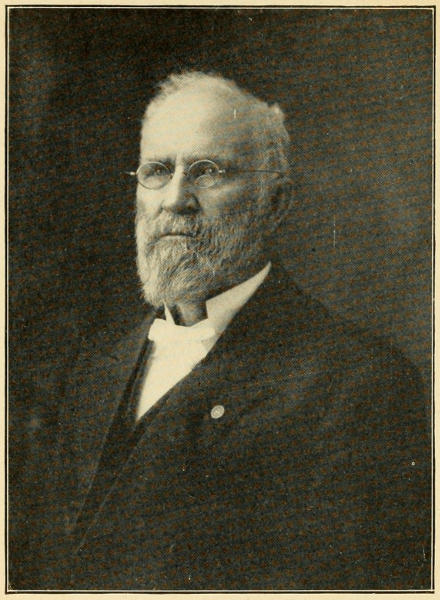
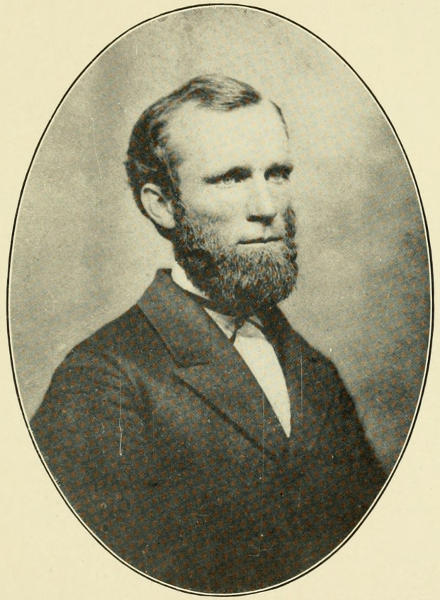
REV. ANDREW JACKSON NEWGENT
Latest Photograph.
Being a Biography of
REV. ANDREW JACKSON NEWGENT
BY
REV. W. ED. SNYDER a Minister in the United Brethren Church
Nineteen Hundred and Eleven
United Brethren Publishing House
W. R. Funk, Agent
Dayton, Ohio
Printed by
United Brethren Publishing House
W. R. Funk, Agent
Dayton, Ohio
That which requires an apology should be left
undone. Hence, the author of this humble work
offers no apology in sending it forth. If it finds
favor in the sight of those into whose hands it may
fall, he will appreciate it. If not, it is confidently
assumed that the world will pursue its wonted course, and
no one will be the worse, if not the wiser.
No special literary excellence is claimed for it. It is
a feeble, though honest, attempt to preserve from the cold,
merciless realm of oblivion a life story that is well worth
preserving—the life story of one for whom I have come
to have the profoundest reverence and affection. My
only regret is that it has not been done better.
Its chief value consists in the fact that it reveals the
fundamental elements of true character and true success.
The life of “Uncle Jack” Newgent is a conspicuous illustration
of the fact that each individual is the architect of
his own fate or fortune, that the conditions of success are
internal and not external. This has been his life philosophy
and has been abundantly vindicated by his life
record. His right to a proper regard among his fellows
rests upon his sterling qualities of manhood, devotion to a
great purpose, and personal achievements that have added
to the sum total of the world’s weal and worth. He
belongs to a worthy line of foundation builders whose
work underlies the great superstructures of both church
and state of the present day.
Hence, two purposes have been kept in view in the
writing of this sketch—to acknowledge, if not to pay, a
debt of honor and gratitude the Church owes to a worthy
man; and by giving special attention to those personal
qualities that make for success always and everywhere,
and which were so strikingly exemplified in his character,
to preserve the lessons of his life to the present and
future generations in the hope that they may thus contribute
to the further progress of righteousness. If in
this unpretentious little volume these purposes are in any
degree fulfilled, I shall be abundantly satisfied.
W. E. Snyder.
The pleasing task of writing an introduction to the
life of my noble friend, Rev. A. J. Newgent, has
fallen upon me. The intimate association which I
have had with him for many years gives me a
peculiar pleasure in seeing the record of his splendid life
placed before the Church.
Biography is one of the most important departments
of literature, and Mr. Newgent is eminently worthy of the
permanent place in history which this volume accords
him. I feel that fitting tributes in historic sketches
should not only be paid the men of God who have planted
the Church in this nation, but posterity should come and
say over their graves, as Pericles did over the bodies of
his fallen fellow soldiers: “You are like the divinities
above us: you are known only by the benefits you have
conferred.” It is of such a man, though still living
among us, that Dr. W. E. Snyder gives the accurately
drawn portraiture in the chapters of this well-written
biography. The work has been prepared with good judgment
and much skill. The incidents of his life are given
in sufficient detail, and make the volume exceedingly interesting
and instructive. Such a publication is of great
value, not only to those who enter the ministry, but to the
whole Church, and especially to the young. To study the
career of one, who, by fortitude and zeal, has carved his
way from humble surroundings to a high place of honor
among his fellow-men—passing through varied and striking
vicissitudes in the struggle—can but inspire and
ennoble other lives.
Entering the ministry before our pioneer style of life
had passed away in the west, Mr. Newgent adapted himself
to the humblest conditions of society. The fields of
labor which he occupied in those early years of his pastorate
were sufficient to remind him of the privation and
hardships of those who had preceded him; but no condition
was humble enough or severe enough to deter him
from the work to which his young life had been consecrated.
He could lodge in the loft of the lowliest cabin
and subsist upon the cheapest fare. In quest of souls he
thought little of anything else. Living among the people,
a very small salary would suffice for him. He knew what
it was to live on a moiety of one hundred dollars and less.
There have been no dangers or hardships, no toils or
privations, no suffering or sorrow sufficient to daunt his
heroic spirit. Fortunately, Mr. Newgent is so constructed
as to see the bright side of every difficulty, and his inimitable
humor has made his family and friends laugh in the
darkest hours of his ministerial life.
Unflinching loyalty to the Church has ever marked
the career of Mr. Newgent. Though he has been peculiarly
free from sectarian prejudices or bitterness, his
attachment to his own people has been conscientious and
unwavering. All his energies have been devoted to the
advancement of the Church of his choice. He has stood
for the defense of its doctrines and polity, and those who
have drawn him into debate over any feature of our system
have not challenged him a second time. In the
earlier days of his ministry he was many times called in
debate with the strongest men of other denominations,
and has proved himself equal to any antagonist who has
met him in discussion. Many have gone down before his
unanswerable arguments, and not a few have been driven
from the contest because they could not stand before the
torrent of his eloquence and the indescribable power of
his wit. In all his ministerial work these qualities have
often been of great advantage to him. Few men could
possess such wit and eccentricities as Mr. Newgent commands,
and use them to advantage without some objection
by the people. But like all his other gifts, these peculiar
qualities have been consecrated to the service of doing
good, and in their use he has maintained his ministerial
consecration and influence with never a breath of suspicion
cast upon his good name.
It is gratifying to his many friends that Mr. Newgent,
though retired from the active work of the ministry, is
still in possession of all his mental powers, and no doubt
will live to read his own biography. Few men have been
so fortunate. To have spent his long and useful life in
the most interesting period of the history of the Church,
and then remain to read the part he has played in the
making of that history, is a privilege that most of Christ’s
embassadors have never enjoyed. Back when the Publishing
House was struggling for existence, he loyally
supported the little plant, and never failed to circulate
our books and push our periodicals in every charge he has
filled. When our institutions of learning were in their
infancy, and much opposition was brought against education,
he was a friend of the schools, and again and again
has gone into the field to raise money for their support.
He has seen the great benevolent boards of the Church
and nearly all our connectional institutions come up from
the smallest beginnings, and has never failed to espouse
the cause of these important agencies for the promotion
of Christ’s kingdom. Even the conference in which he
began his ministry has grown in his day from a handful
to a host, and no man has watched its growth with deeper
pride or more anxious concern than himself.
I could write much more in the line of these thoughts,
but the chapters of this volume will give in clear light the
characteristics which can only be hinted at in the limits
of an introduction. The skilled pen of the biographer
will bring out in forceful and charming manner the noble
traits of the gifted brother whose career he has studied
with great care and painstaking interest. Let the book
have a wide circulation, let the youth read its inspiring
sentiments, and the horizon of their thoughts will be
enlarged and the desire to be loyal to God and to every
good work will be stimulated and strengthened.
Ancestry—Picture of pioneer life—Imprisonment and
release of Pompey Smash—Little Jack’s short-cut
in the study of astronomy—The fate of his first
pair of breeches
Conference membership—Brulitz Creek ministry—The
modern knight and his steed—Abrupt closing of
family devotions by a dog-on-the-preacher—An original
marriage ceremony—A case of mistaken identity—A
banner missionary collection—Shawnee
Prairie pastorate—A cold day in April—The redemption
of Hell’s Half Acre—Baiting for a perverse
fish—An experience in the whisky business
Six months at Rainsville—A hot-bed of Southern sympathizers—A
mix-up with saloon men—A sermon
on slavery—Fire and brimstone—An antagonist outwitted—A
sermon from the book of Newgent—Can
any good thing come out of Rainsville?
The war spirit in Indiana—Breaking up a traitorous
plot—Narrow escape from enemies—Assists in securing
recruits—Becomes chaplain of his regiment—Exchange
of courtesies with a Presbyterian minister—An
embarrassing predicament—Saves his
regiment from capture—Organizes military church—Chased
by Johnnies—An exciting homeward
journey
Plants the United Brethren banner in Terre Haute—Prairieton
pastorate—Difficulty with the sons of
Anak—A prayer without an “Amen”—Another community
redeemed—Going to the wrong doctor—A
perverse colt—An unintentional immersion—One
sermon that was not dry
The New Goshen pastorate—An old grudge healed—Dry
bones revived—Memorable year at “Dogtown”—“Death
in the pot”—The Hittites captured—The
“Jerks”—Other remarkable demonstrations—A
rooster in the missionary collection—First debate—Unpleasant
sequel to a horse trade
Labors at Mattoon, Illinois—A persistent campaign and
a great victory—Second New Goshen pastorate—A
coincidence—Success at Prairieton—Laboring in the
shadow—The death of Mrs. Newgent—A bishop’s
tribute to her character
First great debate—The debate as an institution—The
challenge—Opponents get weak-kneed—Prolonging
maneuvers—A hungry multitude unfed—Battle begins—Questions
discussed—An improvised creed for
his opponent—A premature baptism—An opponent’s
tribute to his genius—Crowning the victor
Subsequent debates—The Owen contest—He got his
“Treat”—Opponent’s confession—Dressing “Stone”—A
scared Baptist—Invades the Lutheran ranks—Measures
steel with Doctor Ingram—Dissertation
on infant baptism—Opponent’s early flight—Concludes
the debate alone—The Haw debate
Perrysville and Centerpoint—Industry rewarded from an
unsuspected source—A “slick wedding”—Fruitful
labors at Centerpoint—A one-sided union meeting—The
doctrine of the resurrection again demonstrated
Becomes a missionary superintendent—Second marriage—An
unexpected welcome—Forms a Quaker friendship—The
Spirit moves in a Quaker meeting—A
Quaker’s prayer answered—Builds a college—Shows
what to do for a dead church—Another tilt
on the doctrine of baptism—Conversion of a Dunkard
preacher—Turns a great movement in the right
direction
Ancestry—Picture of Pioneer Life—Imprisonment
and Release of Pompey Smash—Little Jack’s
Short Cut in the Study of Astronomy—The Fate
of his First Pair of Breeches.
Once upon a time, so long ago that the
chronology of it has become hidden in the
mists of historical uncertainties, a man with
his family emigrated from the hill section
of northern Ireland to the vicinity of Dublin.
What his real name was also belongs
to the realm of the unknown, but among the
unsophisticated rural inhabitants with
whom he had cast his lot he was characterized
simply as the “new gentleman.” In
course of time, the somewhat cumbersome
title became abbreviated to “new gent,” the
original appellation finally passing from
common usage entirely. That this new
gentleman was a person of some force of
character may be inferred from the distinction
he seems to have achieved among his
new neighbors and the fact that the name
has been honored by men of rank and eminence
among his descendants, a conspicuous
example being Lord Robert Newgent (or
Nugent), the celebrated Irish scholar and
statesman.
Among the later descendants were three
brothers who decided to cast their fortunes
with the land of dreams and fancies across
the Atlantic. Their names were Edward,
William, and Thomas Newgent. On reaching
America Edward directed his course toward
the sunny South, William remained
somewhere in the East, while Thomas struck
out toward the vast region of unbroken forests
on the western slopes of the Alleghenies.
His pilgrimage terminated somewhere
in the bounds of Kentucky. He secured a
tract of land near Cincinnati, and in process
of time met, wooed, and won a wealthy
daughter of Virginia. He was contemporary
with the Boones in reclaiming this
great region of possibilities for civilization;
helped to survey the State; taught school on
both sides of the Ohio River, winning for
himself the title of “Irish Schoolmaster,”
which, in this case, carried with it no small
degree of distinction. He was a soldier in
three wars, that of the Revolution, of 1812,
and the Blackhawk War, for which services
he received a pension from the Government.
He professed religion at the ripe age
of eighty, and was spared to redeem in part
his long neglected opportunities by spending
almost a quarter of a century in active
Christian service, his long and eventful life
closing, according to an uncertain tradition,
in the 103d year of his age. He was the
father of Charles Newgent, who was the
father of Andrew Jackson Newgent, the
hero of this simple narrative.
In Charles Newgent the elements of character
peculiar to his race were exceptionally
strong. A most marked propensity was his
fondness for a joke. He would take more
interest in concocting some new trick to be
played on a neighbor or in devising a scheme
for merrymaking than in a critical study of
the Sermon on the Mount, or in solving an
intricate theological problem. But while
the religious faculty remained somewhat
dormant, he was warm-hearted and generous,
a good neighbor and citizen, according
to the simple requirements of the times.
In educational attainments he was far
above the average. He was a prominent
figure in local political circles, being a Jeffersonian
Democrat of a rather emphatic
type. His ever ready wit and fluency of
speech made him a master on the stump
and a formidable antagonist in political debates.
The ability to give a humorous turn
to any remark or incident served him well
upon such occasions. His peculiar temperament
gave him special aptitude as an auctioneer,
in which capacity he had no superior.
People would attend his sales as
much to be entertained by his witticisms
as for the bargains he might have to offer,
and those who came to laugh often remained
to settle a bill for something they had no
thought of purchasing.
At the age of nineteen, in the year 1825,
he was married to Mary Pugh, of Shelby
County, Kentucky, his native county. Her
parents had come from Scotland and were
substantial citizens.
Soon after their marriage they moved to
Parke County, Indiana, and settled on a
tract of land which the wife had received
as a dower from her father.
Pioneer life in Indiana need not here be
enlarged upon. A solitary dwelling in the
interminable and trackless forest; the building
consisting of a single room built of unhewn
logs, roofed with hand-split clapboards;
the chimney covering one entire end
of the building; the rough doors swung on
wooden hinges; the small windows with
greased paper or the tanned skins of animals
through which a bit of daylight finds
its way with difficulty; the huge fireplace
used for both cooking and heating purposes;
the few pieces of hand-made furniture—these
were some of the outward aspects of
domestic life out on the ragged edge of civilization.
The cabin of the Newgents was typical
of those of their neighbors, the nearest
of whom lived some fifteen miles distant.
The larger wild animals were frequent visitors
and the war whoop of the Indian had
scarcely died away.
After a brief residence at this place they
moved to Sullivan County. Here, on Saturday,
September 15, 1838, the subject of
this sketch was born. He was the youngest
of seven sons. Subsequently the family circle
was enlarged by the addition of two
daughters. The father’s political bias was
again asserted in the name, Andrew Jackson,
assigned to this youngest son, after the
great hero of early Democracy. The name
often has given occasion for humorous
touches by the owner, especially in referring
to his early life. By the neighbors and
older members of the family, he says, he
was dubbed General Andrew Jackson.
Later the military title was dropped and he
became plain Andrew Jackson, and by successive
stages the name was further abbreviated
until the boy was doomed to answer to
the simple cognomen of “Jack.” Whether
this was a process of evolution or of degeneration,
he was destined to win for himself
a title that would stand for real worth and
attainment; that would represent the love
of little children, as well as the esteem of
men and women, when the affectionate appellation
of “Uncle Jack” would become a
household term in multitudes of homes.
Perhaps it is to the Scotch blood of his
mother that he owes the more solid elements
of his character. The Scotch character
stands for thrift, energy, and integrity, so
that wherever the hardy Scotchman goes he
carries with him the best elements of citizenship.
These combined with the quick
wit and genial temperament of the sons of
Erin produced in our subject a personality
rich in depth and resourcefulness.
The emigration instinct, always strong in
the pioneer, again became active, and the
family set out for a new destination. This
time it was Paw Paw Bend in Knox County,
Indiana, so named because of its location in
a bend of White River, and the prolific
growth of paw paw trees for which the fertile
lands were especially adapted. Our subject
was then about eighteen months old.
Here he spent the years of early childhood.
Some incidents numbered among his earliest
recollections and which serve to illustrate
the home life and social conditions in which
these years were passed, will not be out of
place in this connection.
During this period religious services were
practically unknown in Paw Paw Bend.
The chief diversions were such social functions
as shooting matches, wood choppings,
log rollings, husking bees, and dances. The
spelling bee was still of too intellectual a
character to win popularity. At all such
gatherings the familiar demijohn of corn
whiskey was considered an indispensable
adjunct.
Hence, the announcement of a preaching
service to be held at the Newgent home on
a following Sunday morning was hailed
throughout the settlement as a new thing
under the sun. Of course everybody would
go. The preacher was to be Rev. Nathan
Hinkle, a Methodist itinerant. It was out
of no particular religious scruples that the
host, Charles Newgent, volunteered to entertain
the assemblage on this occasion, yet he
had no aversion to preachers or churches,
and in common with his neighbors, he was
always ready to encourage anything that
would break the monotony and afford social
diversion.
It so happened that on Saturday evening
before this memorable day, Pompey Smash,
a negro fiddler, was passing through the
neighborhood and asked to stay over night
at Mr. Newgent’s. He was informed by the
head of the house that he would be furnished
lodging on condition that he dispense music
for a family dance. The terms were accepted
and there was a sound of revelry by
night as the little company beat time on the
puncheon floor to the droll tunes of their
musical guest.
Early next morning the congregation began
to assemble for worship. The presence
of the fiddler led to the suggestion that the
time spent in waiting for the arrival of the
preacher be used to the best possible advantage.
Accordingly the Ethiopian turned his
fiddle—for it was before the violin was invented;
the familiar demijohn was set in a
conspicuous place, and the gentlemen chose
their partners. Lest the preacher’s sudden
arrival in the midst of such hilarious scenes
be the occasion of a shock or an offense to
his ecclesiastical dignity, a member of the
party was dispatched to do picket service.
The watchman, having imbibed too freely of
the contents of the jug, fell asleep at his
post. The dance had gone on merrily for
some time in its rapturous excitement; the
preacher and church service were utterly
forgotten. When, lo! the alarm was
sounded. The faithless watchman had allowed
the company to be taken by surprise.
The approach of the reverend was discovered
in the nick of time; the dance came to
an abrupt stop. To prevent the minister
from “smelling a rat,” a puncheon was removed
hastily from the floor, and the fiddler,
the fiddle, and the whiskey jug were thrust
unceremoniously through the opening into
the cellar excavation below. And the people
put on their Sunday faces for church.
After the services a part of the congregation,
including the shepherd of the flock,
remained for dinner. This necessarily prolonged
the imprisonment of the negro, but
when it is recalled that the whiskey jug
was a prison companion, we may surmise
that the hours were not so “tedious and
tasteless” as otherwise they might have
been. The solemnities of the day came to
an end with the departure of the minister;
the prison was then opened and the prisoner
released. An “after service” followed,
which, it may be conjectured, was more in
harmony with the tastes of the congregation.
While unlimited resources lay at the very
doors of these pioneer cabins, the backwoodsmen
lacked the facilities for developing
them. Their tastes were not so exacting
as in later days, and beyond the sheer
necessities and comforts of the household,
ambition did not spur them on. While ordinarily
the family dined on homely fare, the
industrious housewife often became so proficient
in the culinary art as to be able to
concoct most tempting dishes with the raw
products that nature placed in easy reach.
The sap of the maple tree, wild grapes, paw
paws, and persimmons, as well as the products
of garden, orchard, and field were utilized
in providing for their physical wants.
Persimmons ripened with the early frosts,
and when put up in maple syrup, became a
staple and most delicious article of diet.
By the addition of the proper quantity of
whiskey, the standard remedy for most of
the ills the flesh is heir to, the mixture afforded
in addition to its other virtues, a
sure cure for ague, commonly called “ager.”
This led to an episode in which little Jack
and three older brothers were the leading
figures, and which he facetiously labeled
“a short cut in the study of astronomy.”
The children were left alone one afternoon.
The oldest of the quartet was familiar
with the process of preparing the common
ague antidote. The necessary ingredients
were, as usual, within easy reach. So
he proceeded to administer the remedy to
his younger brothers on the principle that
“if a little did good, more would do better.”
The bearing of this procedure upon the
science of astronomy becomes apparent
when we remember that among the unschooled
of that day it was a mooted question
as to whether or not the world is round
and revolves upon its axis, as the geographies
teach. Jack declared that after taking
a few doses it was painfully evident to
him that the world did turn round and
turned at such a rapid rate that he found it
difficult to keep from falling off. When the
mother returned she found the three
younger boys lying on the floor unconscious,
and the author of the mischief sitting
astride a joist overhead the unceiled room
in a hilarious condition. By the free use
of sweet milk the younger boys were restored
to consciousness, but a special treatment
was reserved for the one who led
them into temptation. However, Jack
found this short course in astronomy sufficient
for all practical purposes, and he has
never had the occasion or inclination to
extend it.
His early years were as happy and free
from care amid these primitive surroundings,
as childhood life could well be, even
in what might be considered more favorable
circumstances. Life was simple in the extreme,
even crude, but it was the best he
knew. There was nothing in the lives of
his associates calculated to excite envy or
cause discontent with his own lot. But in
this connection one incident stands out in
bold relief to mar the picture of boyish contentment.
A single garment of homespun, or “tow
linen,” was all that was considered necessary
in the way of clothing under ordinary
circumstances for a boy of that age. It
marked a new era in his life when the loose
garment which covered the anatomy down
to the knees was supplemented by a pair of
breeches of the same material. Upon one
occasion as Jack stood watching his mother
as she was measuring the material for the
older boys’ winter suits, he heard her remark
that there would probably be enough
scraps left over to make him a pair of
breeches. With emotions alternating between
hope and fear, he waited impatiently
for the outcome. His joy was unbounded
when he found that his hopes were to be
realized. His mother laid him on the
floor and thus marked the pattern. It
was seen that the closest economy had
to be used to make the goods hold out;
so instead of the regulation number of
two suspenders which were one piece with
the breeches, the material would only warrant
the making of one. By extending it
from one side on the back diagonally across
the shoulder, making connection on the opposite
side in front, the new habiliment
maintained its balance and no special inconvenience
was suffered.
But alas! his rejoicing was soon to be
turned into mourning. A few days later,
clad in his new outfit, he went with his
brothers to the woods to gather pecans. It
was a warm autumn afternoon, and in
climbing and clubbing the trees and picking
up the nuts, the boys found it convenient to
cast off unnecessary articles of clothing.
As Jack had scarcely become accustomed to
more than one garment, he could easily dispense
with the breeches for the time. Accordingly
they were removed and hung on
a bush near by, and for a time forgotten in
the fascination of nut hunting. When the
party was ready to start home with the
fruits of their toil, he was alarmed to find
that his cherished breeches had disappeared.
The boys searched diligently but found
them not. When about ready to give up
in despair, they chanced to observe, a short
distance away, a mellow-eyed, crinkly-horned,
brindle cow making a meal off the
lad’s wearing apparel, or perhaps using it
for dessert, as though it were a dainty morsel.
And the last Jack saw of his first pair
of breeches was the lone suspender dangling
from the innocent old brindle’s mouth, the
major part of them having been engulfed in
her capacious maw. And to the sorrow of
his heart, his wardrobe for another year
was limited to the single piece of homespun.
Chapter Two.
The Tragic Death of the Father—Removal to Parke
County—School Days—Conversion—Change of
Church Relationship—A Remarkable Providence.
Thus far our narrative has covered the
childhood of our subject up to the ninth
year of his age. At this juncture occurred
an event that cast the first real shadow over
his youthful pathway. It was the death of
his father, the tragic nature of which and
the subsequent effect it was to have upon
his career, made the shadow all the deeper
and more significant. Charles Newgent
went with a company consisting of sixty
adventurous spirits, upon an expedition to
the West, the real object of which seems to
be somewhat indefinite. The restless and
venturesome spirit of the pioneer, a curious
desire to penetrate the mysteries of the
great western world, the dream of untold
treasures that nature had in store for those
who dared to conquer the dragons that
guarded them—all may have figured in
this ill-fated enterprise. However that may
have been, while crossing the western plains
the company was attacked and massacred
by a band of hostile Indians. As in the
calamities that befell Job’s household, one
of the number was left to tell the story.
This one was supposed by the savages to
have shared the fate of all the rest, being
left on the field for dead; but it so happened
that in his case the weapon of death
did not do complete work. He was picked
up the next day by a party of hunters to
whom he was able to give a vague account
of the preceding day’s terrible tragedy.
After the father’s death, the mother with
her nine children moved back to their
former home in Parke County. Life then
took on a sterner aspect for the boy. His
tender hands must perform their part in
the maintenance of the family. Accordingly
he hired out to Mr. Jesse Maddox, a
neighboring farmer. His wages the first
year were to be a pair of shoes, ten bushels
of corn, and the privilege of attending the
district school. The market price of corn
was ten cents per bushel. Even at this modest
stipend he admits that he made money,
“though not very much.” While in after
years of fruitful labors in the ministry he
often remarked that the question that most
perplexed him was how to earn what he received,
it is not probable that the question
at this time had assumed very serious proportions.
The most important stipulation in the
contract was the privilege of attending
school. But even this is subject to shrinkage
when we recall that the school system
of Indiana was then in its first stage of
development. It afforded no royal path
to learning, and the common thoroughfare
was neither smooth nor flowery. We would
scarcely expect to find in the schoolroom
comforts that the home itself was a stranger
to. Strikingly suggestive of the interior aspect
of those primitive seats of learning are
the lines from Whittier’s “In School Days”:
“Within, the master’s desk is seen,
Deep scarred by raps official;
The battered seats, the warping floor,
The jack knife’s carved initial.
“The charcoal frescoes on the wall,
The door’s worn sill betraying
The feet that creeping late to school,
Went storming out to playing.”
To fit the particular building in which
our subject first tasted the fruit of the tree
of knowledge, the picture needs but slight
modification. If anything, it should be
made even more simple and primitive. The
“battered” seats were made of puncheon.
Since this word is passing from common
usage, it may be well to explain that puncheon
is made by splitting a small log in
two equal parts. The split edges are then
trimmed down, and the pieces thus treated
served as a rough substitute for sawed lumber.
To make them into seats, two holes
were bored near each end in the unhewn
side. These being at proper angles, wooden
pins were inserted into them for legs. The
rude seat was then ready for service. It is
not to be taken for granted that these seats
were always made perfectly smooth. What
was lacking to smooth them down by the
workmen was expected to be completed by
the pupils. They finished the task, but often
it was a long and painful process, with
many a protest from a new gown of homespun
or a pair of “tow-linen,” home-grown
breeches. Thus, with no rest for the arms
or the back, with one side scorched by the
heat from the great fireplace and the other
chilled by the winter winds creeping through
cracks in floor and walls and roof, the
children wore away the dreary hours. The
floor, being composed of this same puncheon,
did not easily warp. The recess recreation
consisted mainly in carrying fuel from the
surrounding forest to feed the every-hungry
fireplace.
Whatever dignity the schoolmaster may
have possessed in the eyes of his pupils, certain
it is he was not the original of Goldsmith’s
creation in the “Deserted Village,”
of whom the wonder was “that one small
head could carry all he knew.” Beyond the
traditional essentials of scholarship, consisting
of reading, writing, and ciphering,
with a specially intimate acquaintance with
the spelling book, he did not pretend to
lead. His chief business was to govern the
school. He proved his divine right to his
throne in the schoolroom by his ability to
handle the most obstreperous cases the district
could produce. The scholars were on
hand as a challenge to his generalship. The
hero of the school was the one who held out
longest against his despotic authority. To
lick the teacher was the height of his ambition.
This realized, his place in the local
hall of fame was secure. According to the
philosophy of the times “lickin’ and larnin’”
went hand in hand, lickin’ being essential,
while larnin’ was incidental.
The school house was three miles from
the Maddox home. The school was maintained
on the basis that “whosoever will
may come.” There was no penalty for
tardiness or absence, but as young Newgent
possessed a real thirst for knowledge and
was in the habit of making the most of
whatever he undertook, his attendance was
more regular than the average. However,
the sum total of his schooling was limited to
three terms of about three months each, an
aggregate of nine months. Meager as were
his school advantages, they were well improved
and furnished a foundation for self-culture
upon which he built as only a genius
can. He learned to read in less than four
weeks, and his progress was correspondingly
rapid throughout. His real school was not
bounded by the walls of the log school
house; it was rather the great school of life
with its harsh discipline and inexhaustible
curriculum; and in this he grew to be the
peer of the ripest products of educational
institutions. “Opportunities,” he says, in
his characteristic way, “the woods has always
been full of opportunities. I had
splendid opportunities when I was a boy,
and so did my companions; but many of
them, like some young folks now, failed to
see them.” He saw what many fail to see,
that opportunities are not so much in our
environment as in ourselves, and that success
is not determined by outward circumstances,
but by one’s own will and energy.
A habit early formed was that of turning
everything to account in the pursuit of
knowledge. Mrs. Newgent, anxious to encourage
her children’s propensities for
study, furnished the home with such reading
matter as her means would permit.
Though the family were separated most of
the time, they came together at frequent intervals.
On these occasions the time was
well spent in reading and in discussing current
topics. Whatever was read became the
subject of conversation. These conversations
often took the form of argument, in
which the various sides of a subject were
presented and zealously defended. Thus,
he early displayed and developed an aptitude
for argumentative discussion, which
made him a master in debate, and is a
strong element in all his public discourses.
His conversion occurred when he was
about ten years old, while still in the service
of Mr. Maddox, a benefit which was not considered
in the contract with his employer.
This took place during a gracious revival
at the Canaan Methodist church, of which
his employer was a member and was serving
at the time as class leader and janitor. The
meeting had been in progress for a number
of days; many had found the Savior, and
the community was deeply stirred. He had
been sent to open the church and build the
fire for the evening service. While going
quietly about his duties, all alone, the impression
came to him quite vividly that he
ought to be a Christian, and he resolved to
go to the “mourner’s bench” that night. He
was never long in making up his mind,
and when a decision was once made, it was
as a law of the Medes and Persians. So he
went to the altar that night and each succeeding
night for more than a week. One
evening as he was listening to the sermon,
conviction became so intense that in his extremity
he left the house. Though it was a
cold night and the ground was covered with
snow, he stole out in the woods. Kneeling
in the snow, this youthful Jacob wrestled
with God in prayer. How long he tarried,
he could not tell, but faith triumphed, and
the next he knew the woods were resounding
with his shouts of victory. Rushing
into the church while the preacher was yet
talking, he put an end to the sermon by his
shouting and praising God. The congregation
was electrified. Soon the demonstration
became general, and for a time pandemonium
held sway; but it was of a sort in
which there were both method and meaning,
for its source was from above.
Like God’s servant of old, he could say,
“My heart is fixed.” He joined the church
and from that time never missed an opportunity
to pray and testify in public or private.
At that time children did not receive
much attention from the church. Churches
were strong on saving souls from damnation,
but the idea of saving the entire
life for service had not taken deep root.
As a result of the revival there was a large
class of “probationers.” When the period
of probation had expired, according to the
church law, and they were to be admitted
into full membership, his name was not on
the list. He was not considered a member;
at least that was his version of it, and the
only logical conclusion the case would warrant.
It was a sore disappointment, but of
too delicate a nature to mention to his
elders. So he kept his feelings to himself.
Thus matters stood for little more than a
year, when he learned that there was to be
a quarterly meeting at the Otterbein United
Brethren Church a few miles away. This
church belonged to the Rockville Circuit of
the Wabash Conference. Rev. William
Sherrill was the pastor. The presiding
elder, who was to hold the quarterly conference,
was Rev. Samuel Zuck. Both were
strong and good men. Jack had never attended
a United Brethren service. What
knowledge he had of the Church was gained
through conversations overheard in the
Maddox home. Ministers being frequently
entertained there, conversation at such
times naturally took to religious channels.
As this was an age when churches did not
entertain the most fraternal feelings toward
one another, these conversations were not
calculated, as a rule, to produce a favorable
opinion of a rival denomination. His interest
in churches and religion was genuine,
born of a desire to know the truth. Hence,
is was not mere curiosity that led him to
obtain his employer’s permission to spend
Saturday and Sunday with a neighbor in
the Otterbein community so that he might
attend the services of the quarterly meeting.
The Church proved to be his affinity.
Whatever misgivings he had, vanished one
by one. The general atmosphere of the
first service harmonized with his temperament.
There was spirit in the singing. His
heart burned within him as he listened to
the eloquent sermon by the presiding elder;
and when the pastor followed, as the custom
was, with a warm exhortation, he was enraptured.
He resolved to join the Church.
As usual, the decision was made without
much preliminary. He knew where he
stood, and stood there with both feet. When
he returned, his employer, as well as his
own folks, was thunderstruck to learn that
he had become a full-fledged United Brethren.
Having put his hand to the plow, he
never turned back. “I have been so busy,”
is a common saying with him, “that I have
never had time to backslide.”
It should be said in justice to the church
where he first joined, that his name had
been entered upon the book, but by mistake
it was placed in the list with the full members.
This accounts for his not being received
with the probationers, to which class
he belonged, and led to the conclusion that
he was not considered a member. Thus an
apparently insignificant thing may prove to
be a matter of vital importance.
As a boy he possessed pronounced convictions
and a keen sense of religious obligation.
This is demonstrated by an incident
which occurred while he was in the employ
of Mr. Jerry Rush, a short time after leaving
the service of Mr. Maddox. Mr. Rush
was a well-to-do farmer and stock dealer.
Neither he nor his wife made any profession
of religion, though their lives were regarded
as exemplary and above question in
other respects. Some of the men who
worked on the farm, however, were of the
baser sort. It seemed strange to young
Newgent that a man of Mr. Rush’s habits
would surround himself with men who were
utterly destitute of moral scruples or of the
commonest decencies. To him their vulgarity
and profanity were a source of constant
annoyance. At one time as their coarse
jests were grating on his sensitive ears, he
was impressed with the idea that this uncouth
crowd afforded him a field for missionary
work. The impression was not long
in taking definite shape. It came with the
force of a challenge, a bugle call to duty,
a call that he never failed to heed. His
mind was made up that he would offer
prayer with these men before they retired
that evening if Mr. Rush would grant him
the privilege.
It was a bold resolve, an ordeal from
which a braver heart might well have
shrunk. Let eloquent tongues proclaim the
praise of those who face death at the cannon’s
mouth, or the inspired pen immortalize
the hero, who, amid the applause of
admiring multitudes, imperils his own life
to save another; but who would not count
it a worthy act to place a laurel wreath
upon the brow of a fourteen-year-old lad
who dared to face, not one Goliath, but a
company of Goliaths, with the simple
weapon of faith, and demand that they bow
before their God while he offered a petition
in behalf of their needy souls? Yet this
resolute purpose was to undergo a severe
test. The fiercest battles are fought in our
own hearts. As the time drew near, he felt
his courage slipping away. He stole out to
the barn for a time of secret prayer, that he
might be equal to the emergency. Feeling
comforted and strengthened, he started to
the house to execute his plan. On reaching
the yard gate his courage seemed to take
flight, and he could go no farther. He went
back to the place of prayer. On the second
venture he got as far as the door, when his
strength again vanished. Not to be beaten,
he went back to the barn to fight the battle
to a finish. The third effort won the day.
He hastened to the house, determined not to
give the enemy a chance. The men were sitting
about the fire. Without a word by
way of preliminary, he stepped up to Mr.
Rush and asked permission to kneel with
them in prayer. The permission was
granted, and a solemn hush came over the
startled company as they listened while
the boy, with trembling voice and stammering
accents, poured out his soul to God. He
then sought his bed with the consciousness
that he had done his duty. A sweet peace
filled his soul and he lay for hours in
ecstacy of joy.
The next evening the family devotions
were repeated. But on the third evening
the prayer was forestalled by a preconcerted
plan on the part of the men. As the time
for prayer approached, one after another, they
arose and stalked out of the room, and the
victor in two hard-fought battles was left
alone—defeated and dejected. His spirits
dropped down to zero. The fiery dart had
pierced him through and through. In agony
of soul he sought his bed, but not to rest.
Out of the depth of his troubled heart he
called upon God for comfort. But the fury
of the storm seemed only to increase. In
his desperation he felt that something must
be done. So, about the hour of midnight,
he arose, dressed himself, and left the house
to go—he knew not where. Through the
remaining hours of the night he wandered,
directing his course toward the West. Daylight
came, the sun rose above the horizon
and pursued its course toward the zenith,
but his pilgrimage continued. At noon he
found himself in the city of Terre Haute,
then a mere village. Here he tarried for a
time to seek employment. Failing in this,
he resumed his westward journey. He asked
for work at the various farm houses which
he passed. While he found kind hearts who,
touched by pity for the youthful pilgrim,
gave him food and temporary shelter, he
found no man to hire him until he reached
Mattoon, Illinois, nearly a hundred miles
from whence he started. Work at that season
of the year was scarce, and his term
of service at Mattoon was brief. At the end
of three days his employer gave him his
wages with the intelligence that his services
were no longer needed.
He now decided to go back to Indiana.
With his three days’ wages in his pocket,
with which he expected to pay for his transportation
at least part of the way, he set
out upon the return journey. Within the
vicinity of Terre Haute he succeeded in finding
steady employment and a congenial
home.
There were two sides to this story, and
some months after Jack was settled in his
new home he learned the other side. It was
glorious news to him. The sequel was that
Mr. Rush was converted, joined the Baptist
Church, and became a zealous leader in
religious work. It came about in this way:
When Mr. Rush found that Jack had disappeared
and diligent effort failed to solve the
mystery of his disappearance, a feeling of
remorse over his unchristian conduct so
possessed him that for days he was almost
in a state of frenzy. Remorse took the form
of spiritual conviction and genuine repentance
which led to a glorious conversion.
On learning of the whereabouts of his
young benefactor, Mr. Rush at once went
to see him, and told him his side of the story.
He confessed to Jack that he was a guilty
party to the scheme the men had used to
defeat him. The boy’s awkward prayer together
with their own antipathy for such
pious exercises was a source of embarrassment
to the men, and they agreed among
themselves to use the method described to
rid themselves of further annoyance. Little
did Mr. Rush realize that those awkward
prayers were to be the means of his salvation.
“God moves in a mysterious way,
His wonders to perform,
He plants his footsteps on the sea,
He rides upon the storm.
“Judge not the Lord with feeble sense,
But trust him for his grace,
Behind a frowning providence
He hides a smiling face.”
Chapter Three.
Call to the Ministry—First Sermon—The Boy
Preacher—Answering a Fool After his Folly—Turning
a Camp Meeting Tide—Quieting a
Skirmish—Takes a Wife.
Providence seemed to ordain that there
should be one preacher in the Newgent family
and that that one should be Jack. As
has been observed, his religious zeal from
the time of his conversion at the age of ten,
was exceptional. Just when the first impression
looking toward the ministry came
to him he could scarcely tell, such impressions
having been associated more or less
with his religious experience from the beginning.
By the time he was thirteen the
conviction that he had a “divine call” to
preach the gospel became clear and definite.
And the conviction deepened with the passing
of time. Of course, no one dreamed of
the emotions that were stirring the boy’s
breast, and to him the ministry was so high
and sacred a calling as to seem infinitely
beyond his possibilities. Hence, he dared
not express his feelings to even his most
intimate friends, and so received no sympathy
or encouragement from any human
source. He went about his Father’s business
in his own way, rendering such service
to the cause of his Master as a boy of his
years was capable of. His zeal knew no
abatement, and such diligence is sure to lead
to recognition and reward.
The minister who first took a special interest
in him was Rev. Ira Mater, an able
preacher and a sympathetic discerner of the
thoughts and intents of the heart. Between
the man and the lad there sprang up
a beautiful friendship, suggestive of that between
Paul and Timothy. Rev. Mr. Mater
frequently invited his young friend to accompany
him to his appointments, and by
way of stirring up the gift that was in this
prospective Timothy, sometimes called upon
him to open the service, to exhort after
the sermon, or perform such other public
ministrations as were convenient. Rev.
Mr. Newgent has always gratefully acknowledged
his indebtedness to this spiritual
father.
This association with Rev. Mr. Mater was
during his sixteenth and seventeenth years.
He was small and rather delicate for one of
his age. His entire youth was a continual
conflict with disease, the entire category of
which seemed to try their hand upon his
slender frame. But while his body was
frail, his mind was strong and alert. That
his positive temperament and seeming disposition
to never give up had somewhat to
do in staving off the grim monster, death, is
not at all unlikely.
His first regular discourse was preached
at the Stedd School House near Fontanet,
in Clay County, Indiana. The school house
was used as a preaching point and weekly
prayer meetings were maintained. He was
a frequent attendant at these services, and
one evening, on entering the house, he was
met by the leader who said, “Jack, the people
are expecting you to preach to-night.”
That he was to preach was simply a surmise,
his association with Rev. Mr. Mater
being the probable foundation of it. But
some one surmised out loud and the rumor
gained currency. Observing his surprise at
this intelligence, the leader continued, “You
had just as well begin here and now,” in a
manner that indicated that it was a foregone
conclusion that preaching was to be
his life business. And Jack preached. At
any rate, if the effort could not be classed as
preaching, it was a splendid substitute for
it. He announced as a text, “If the righteous
scarcely be saved, where shall the ungodly
and the sinner appear?” The congregation
was visibly affected by his fervor
and earnestness, some of the more demonstrative
ones giving vent to their feelings
in shouts of praise. He was urged to preach
the next night, and the meetings were continued
for more than a week, being held at
various private homes, Newgent preaching
at each service. The divine seal was thus
placed upon his ministry, and the meeting
marked the beginning of a new epoch in his
career.
A few weeks later the Rockville quarterly
conference granted him a license to preach.
The action was taken in his absence. J. P.
White was the preacher in charge and
Thomas M. Hamilton was the presiding
elder. The action of the quarterly conference
was almost a superfluous formality,
as he was now so greatly in demand that
he could not well avoid preaching.
The boy preacher was a popular character.
To see a man on the ante meridian of
life in the pulpit was at that time quite
unusual. The popular prejudice was in
favor of men who had spent the major part
of their lives on the farm or in business, thus
acquiring a competence that would enable
them to proclaim that salvation is free
without being embarrassed or embarrassing
their congregations on the money question.
Hence, a diminutive lad of seventeen, weighing
only about eighty pounds, exercising the
ministerial function was in itself sufficient
to attract the multitudes. Wherever he
preached he was greeted by immense audiences.
By many he was regarded as a
prodigy, though he could not be classed as
such, prodigies seldom accomplishing more
than to afford amusement for curious spectators.
It is true, however, that he displayed
qualities unusual for one of his
years, though it must be admitted that the
greater part of his power lay in his intense
religious zeal and earnestness.
Some characteristic incidents in this
part of his ministry will not only be of interest
in themselves, but will at the same
time serve to illustrate his unique individuality.
He went on one occasion to fill an
appointment at what was known as the
Rough and Ready School House. The name
was justified by the prevailing social conditions.
Like Paul on Mars Hill, he found
that at least some of the people were very
religious, though their religious energy was
not always directed to the best advantage.
Not infrequently does it transpire that men
will fight for their religion even when they
are utterly averse to the practice of it, a
fact which had a forcible illustration in this
particular service. He preached with his
usual energy. The house was crowded and
the sermon seemed to be well received. There
happened to be present a minister of what
was designated as the Campbellite persuasion.
Evidently the sermon did not coincide
with his theological bias. He asked
permission to say a few words as the
speaker took his seat. The permission
granted, he sallied forth with a tirade of
abuse and denunciation of the young
preacher and his theology in which his passion
played a larger part than either his
judgment or his conscience. When he
finally ran down, Newgent arose in a calm
manner and said, “Brother, with your way
of applying Scripture, I can prove that Eve
was the mother of a turkey buzzard.”
“Prove it, then,” shouted back the irascible
theologue. “Well, the Bible says that Eve
was the mother of all living, and that includes
turkey buzzards. Let us be dismissed,”
and calling the audience to their
feet, he pronounced the benediction before
his assailant had time to reply.
At another time, with his brother, John
Newgent, he happened to drop in at a Methodist
camp meeting in Sullivan County.
They arrived just in time for the morning
service. A number of ministers were seated
on the platform, among them being Rev.
Hayden Hayes, the presiding elder. Rev.
Mr. Hayes had met Newgent on a former
occasion, and as soon as he saw him enter
the camp, rushed back and taking him by
the arm, led him to the platform. Hayes
was a strong, portly man, and the delicate
lad was helpless in his grasp; thus he was
led as a lamb to the slaughter, and was informed
that he must preach. Though he
vainly sought to be excused, yet he was
equal to the emergency. He had proceeded
about ten minutes with his discourse, when
a man sitting a few feet in front of the
platform was converted and began to shout.
He continued, and four others in the congregation
broke loose in like manner, all of
them having been converted through the effect
of the sermon, and the discourse disappeared
in a whirlwind of praise that completely
drowned the speaker’s voice. Up to
that time there had been no move in the
meeting.
John Newgent was imbued with the old-school
Baptist doctrine and had not sympathized
with his brother’s preaching propensities.
After resuming their journey they
rode for a time in silence. Finally the older
brother said, “Jack, you know I have always
opposed your preaching. But I want
to say that I have no further objection to
it; but,” he added with quivering lips, “I
want you to pray for me.” The sermon had
touched his heart.
Though urgent demands were made upon
the boy preacher to stay and assist in the
meeting, he was unable to do so, and heard
nothing further from it until after he had
returned from the war, when by chance he
again passed through the vicinity. He
stopped at the home of a Mrs. Mayfield, on
whose farm the camp was located, to get
his dinner and his horse fed. As he was
taking his leave, having paid his bill, he
chanced to observe the camp ground a short
distance away. Up to that time he was not
aware that he was in the immediate vicinity
of it. He inquired of his hostess concerning
the camp meetings. She told him that but
one such meeting had been held, though the
intention was to make it a permanent institution.
The unsettled condition of times
during the Rebellion prevented the plan
from being carried out.
“How was that meeting?” Newgent asked,
as one who had a peculiar interest in it.
“Oh, it was a grand success. There was
a little Baptist preacher from near Lafayette
happened in and preached one morning,
and just set things on fire. From that time
on the meetings were powerful.”
“What was the fellow’s name?” he asked,
but she could not recall it.
“Was it Newgent?” She said that sounded
like it.
“Well,” he said, “I know him. He isn’t
considered much of a preacher up there
where he lives, but,” he added, “you are
mistaken about his being a Baptist. He is
a United Brethren.”
She looked at him curiously for an instant
and said, “I believe you are the fellow.”
And his smile told that she had guessed
aright.
His money was returned at once, and she
insisted that he stay and preach at the
Methodist church near the camp ground
that night, assuring him that he would have
a good hearing as there had been much
talk about the little preacher who had “set
the camp meeting afire.” This he was unable
to do, but promised to return at a later
date.
A short while after the camp meeting, he
filled an appointment for his pastor, Rev.
J. F. Moore, at the Leatherwood church,
which was a part of the Rockville charge.
The pulpit arrangement of this church was
in strict harmony with the fashion of the
times. It consisted of a sort of wall which
shut the preacher in almost completely from
the congregation, suggesting a military fortification.
Newgent, being small of stature,
could with difficulty peer over the top of the
ramparts. He was led to believe, however,
that the fortification was a necessary precaution,
for his artillery had been turned
loose but a short time when it was evident
that there was a hearty response. Bang!
Some sort of a missile struck the rampart
just in front of him with a loud report. It
was followed immediately by another, and
the bombardment, continued until six discharges
were fired. The preacher withdrew
within the breastworks that small fraction
of his anatomy that was exposed, and waited
for hostilities to cease. The congregation
was at once thrown into a state of confusion
and excitement. When the preacher finally
surveyed the situation after the heavy batteries
were silenced, he saw that a hand-to-hand
skirmish was on between two men in
the rear of the room. One was making a
desperate effort to get the other to the door
and out of the house. With the help of the
congregation, he succeeded in putting down
the rebellion, and going back to his fortifications
he finished the discourse and the
service was concluded in fairly good order.
The difficulty was only a side issue, the
culmination of a grudge between a couple
of natives. The missiles were not aimed at
the preacher, but were fired from ambush
through the open door; the man for whom
they were intended happened to be sitting
in range with the pulpit.
Rev. Mr. Moore resigned the Rockville
charge during the year and Newgent was
appointed to serve the unexpired term.
This was his first experience in the pastorate.
His brief term of service here was
characterized by a revival of extraordinary
results at Otterbein, his home church. Converts
were numbered by the scores and the
community was shaken by such a spiritual
upheaval as it had never known.
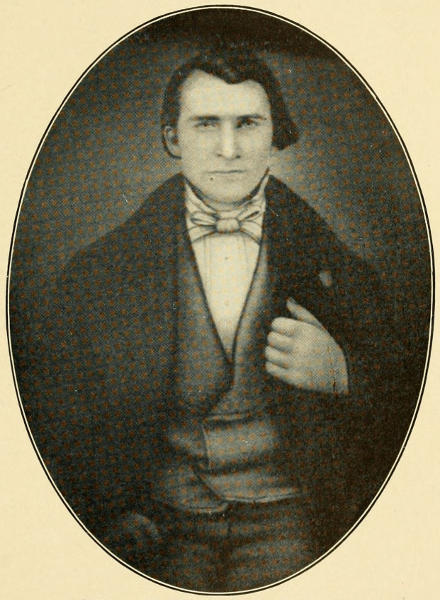
REV. ANDREW JACKSON NEWGENT
When he traveled his first circuit.
Another adventure should be chronicled
here. It has been said that there are but
three real important events in a man’s life,
namely, his birth, his marriage, and his
death. The second of this great trio in the
life of our subject occurred during the
period embraced in this chapter. It is a
common saying with him that he does not
believe in early marriages, hence, he deferred
this important step until he was
eighteen years old. And on the seventh of
January, 1857, he took to himself a wife in
the person of Miss Katharine Copeland.
She proved to be a worthy and sympathetic
companion, heroically assuming her part of
the burdens and responsibilities that belong
to the family of an itinerant preacher. That
her lot was not an easy one may be readily
assumed when we consider what the ministerial
calling involved in that early day.
Its peculiar hardships fell most heavily
upon the wife, yet these she endured without
protest. Brave in heart, gentle in temper,
and in heartiest accord with her husband’s
interests, she proved to him a real
helpmeet, and an inspiration to his loftiest
endeavors.
Chapter Four.
Conference Membership—Brulitz Creek Ministry—The
Modern Knight and his Steed—Abrupt Closing
of Family Devotions by a Dog on the
Preacher—An Original Marriage Ceremony—A
Case of Mistaken Identity—A Banner Missionary
Collection—Shawnee Prairie Pastorate—A Cold
Day in April—The Redemption of Hell’s Half
Acre—Baiting for a Perverse Fish—An Experience
in the Whiskey Business.
Rev. Mr. Newgent was received into the
Upper Wabash Conference at Milford, Indiana,
in the spring of 1859. Bishop David
Edwards presided. The Conference had
been formed the preceding year by a division
of the Wabash Conference territory.
As a matter of coincidence he was ordained
four years later at the Conference in session
at the same place with the same Bishop
presiding. He was now in his twenty-first
year, having been quite prominent in ministerial
labors for about four years, and had
a record for zeal, earnestness, and success
in revival work that commended him favorably
to the Conference.
He was appointed by this Conference to
the Brulitz Creek Circuit, which gave him
an unlimited field for the exercise of his
zeal and talents. The circuit consisted of
eighteen appointments, only two of which
were at church-houses; the others were at
school houses and in private homes. With little
or no competition, the circuit-rider was
monarch of all he surveyed, though in most
cases when he received his appointment he
found enough already surveyed to tax his
time and energy to the limit. Preaching
services were not confined to the Sabbath,
but would fall upon any day of the week,
and even then the intervals between appointments,
except during the periodic “big
meeting,” were usually not less than five or
six weeks.
The standard mode of travel was by horseback,
and the circuit-rider, in addition to
his other qualifications, needed to be efficient
in horsemanship. This was scarcely necessary
in Newgent’s case, however. Not
being able to own a horse at this time, he
secured the loan of one from an accommodating
neighbor. The horse was as accommodating
as its owner. It was quite well
“broke,” having endured the rigors of some
nineteen winters, and was experienced in
the various departments of farm work. It
had sowed and reaped—and eaten—its wild
oats, and was absolutely reliable, at least
to the limit of its physical endurance. At
any rate the horse had many acknowledged
good points, as a faithful portrait would
have demonstrated. While it may not have
been in its real element on dress parade, it
served the more practical purpose of locomotion—to
a somewhat limited extent.
As the rider weighed scarcely a hundred
pounds, the horse had no cause to complain
at his burden. And when it came to matters
of appearance, the odds were not so unevenly
balanced as might be supposed. The
spare-built, smooth-faced youth, clad in his
suit of homespun, which was made with a
reckless disregard of the lines and proportions
of his anatomy, might well have recalled
the lines of Shakespeare:
“Would that he were fatter, but I fear him not;
Yet if my name were liable to fear,
I know of no one whom I would so much avoid.”
Thus, mounted upon his trusty steed,
armed with all the weapons of spiritual warfare,
this modern knight errant of the saddle-bags
rode forth valiantly to the scenes
of the year’s conflicts and triumphs. En-route
to his first appointment, he found an
opportunity to do some pastoral work which
led to an episode, without mention of which
these chronicles would be incomplete. Passing
by the home of one of his prominent
members, he stopped for a brief call. The
house stood on the side of a hill, some distance
from the road. A flight of steps led
up to the front door. Ascending the steps,
he rapped at the door and was kindly admitted
by the good housewife. All went merry
as a marriage bell and the time of his departure
was at hand all too soon. He asked
the privilege of bowing with the family in
prayer before going, which was freely
granted. The weather was warm and it
was not thought necessary to close the door,
though had it been done in this case, it
would have prevented a bit of embarrassment
and incidentally spoiled a good story.
As all was so congenial within, the pastor
anticipated no molestation from without,
and so injudiciously knelt with his back to
the open door.
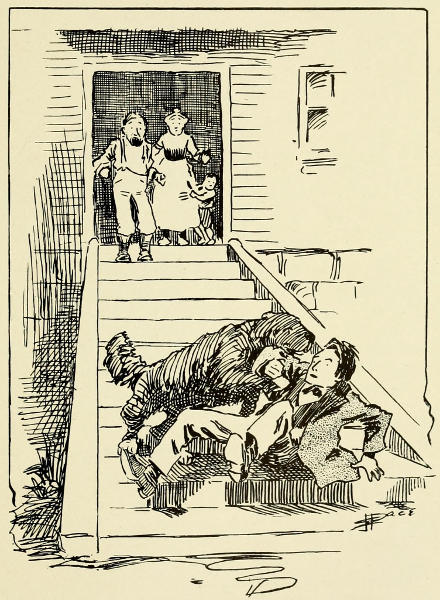
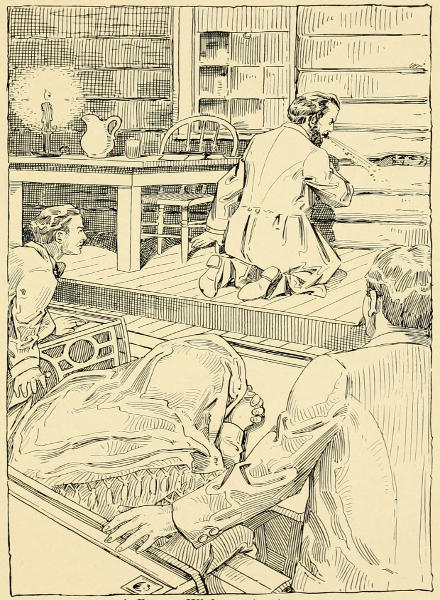
As he warmed up to his devotions, he
aroused from his slumbers a large Newfoundland
dog, that had evidently not noticed
the approach of the stranger, and up
to that time was unaware of his presence.
The aroused canine at once began an investigation,
and when he saw what was going
on, seemed much offended that he had not
been consulted about the matter. He
bounded up the steps into the room, and,
seizing the preacher by the luxuriant
growth of black hair that covered his dome
of thought, affording an excellent hold for
his teeth, he zealously set about the task of
removing the supposed intruder from the
premises. The preacher was taken unawares.
Before he could assume a defensive
attitude, he and the dog were rolling pell-mell,
higgledy-piggledy over each other,
down the steps, and landed in a confused
heap on the ground. Devotions thus came
to an abrupt close; the family came to the
preacher’s rescue. All formalities were dispensed
with for the time. By the united
efforts of the family, the dog and preacher
were finally separated without either of
them being seriously damaged, and the new
pastor of Brulitz Creek Circuit went on his
way to face new adversaries and new experiences.
Family Devotions Interrupted.
He reached the home of Mr. Jacob Wimsett,
in Vermilion County, on Saturday
evening as the sun was dropping below the
horizon, and there put up for the night.
This was in the vicinity of his Sunday
morning appointment. It was an old-fashioned
home even for that day; the home atmosphere
was more hospitable than conventional.
As the preacher himself was quite
democratic in his temperament, no formalities
were required. He noticed among the
various members of the household a young
man and a young woman who seemed as unobtrusive
and as awkward as himself. No
introductions being given, he took it for
granted that they both were members of the
family and so gave them no particular
thought until he was ready to start to
church the next morning. As he was about
to take his leave, the young man approached
him rather diffidently and requested him to
wait a few minutes.
“Me an’ the girl,” he explained, pointing
to the blushing lass on the opposite side of
the room, “are a goin’ to git married, an’
we want you to say the words for us before
you go.”
“All right,” said Newgent, in a manner
that left the impression that he understood
the situation all the while, “give me your
license.”
The document was produced and the
twain took their place in front of the
preacher, while the rest of the company
looked on. Up to this time he had never
served in that capacity and had not the
slightest idea of a marriage ceremony. Examining
the document in a seemingly critical
manner for an instant as if to make
sure that it conformed to all requirements,
he looked gravely at the trembling
young couple. “If you are agreed to live
together,” he said so rapidly as to render his
words scarcely intelligible, “according to
the marriage covenant, join your right
hands.” Scarcely had they time to heed the
injunction when he continued, “In the name
of God I pronounce you man and wife.”
And the twain were made one.
He then hastened to his morning appointment,
reaching the church before the people
began to gather. This was one of the two
church-houses on the circuit, and was called
Nicholls’ Chapel. “Father” Nicholls, one of
the wheel-horses of the church, and in whose
honor it was named, was sweeping the floor
and putting the house in order. His task
completed, he went home to get ready for
the morning service, without making the
acquaintance of the young stranger. Ere
long the people began to arrive. By the
time Sunday school commenced the house
was quite well filled. Newgent took his seat
in the rear of the house and received no particular
attention. He was not even invited
to a place in a Sunday-school class. However,
his presence incognito gave him a good
opportunity for taking notes. He overheard
frequent remarks concerning the new
preacher. The people had heard nothing
of him and were expressing doubts about
his being in the neighborhood. And when
Sunday school closed without his presence
being made known, their doubts seemed to
be confirmed.
Rev. William Jones, a retired preacher
and a member of the local class, came in
just as Sunday school was closing and at
once made inquiry concerning the pastor.
“We haven’t seen or heard anything of
him,” was the information he received from
Father Nicholls.
“Why, there he is now,” and Rev. Mr.
Jones pointed to the diminutive lad near
the door.
“That fellow?” Father Nicholls was dumfounded.
“That fellow has been here all
morning. I supposed he was some hired
hand in the neighborhood that had just happened
in.”
Explanations and apologies were freely
indulged in, the supposed hired hand entering
heartily into the joke. He was introduced
to the astonished congregation, and
the service proceeded to their entire satisfaction
and delight. Father Nicholls treated
him kindly; he piloted him to the afternoon
appointment, introducing him to all whom
they chanced to meet, invariably accompanying
the introduction with the story of
the forenoon experience.
“If I had been out hunting for preachers,”
he would say, in telling the story, “I would
not have snapped a cap at him.”
The year’s work on this field was a most
fruitful one. The membership was doubled,
and though the charge was not above the
average in financial strength, he received
the largest salary of any member of the
conference.
Little attention was given, at this time,
to the cause of missions. Money was not
generally recognized as a vital factor in
Christian service. Salaries were meager
and often consisted in provisions rather
than cash. In many places a strong sentiment
prevailed against a paid ministry.
Poverty and ignorance were considered necessary
prerequisites to ministerial piety.
The General Missionary Board was only
about nine years old, and missionary sentiment
had not taken deep root. But Newgent
sowed missionary seed with a lavish
hand, and had the pleasure of reaping at
least part of the harvest. His ability to
lead men to loosen their purse strings even
then began to be asserted in a marked degree.
More than half of the missionary contributions
of the entire conference that year
was reported from Brulitz Creek Circuit.
His report attracted attention and won
him considerable distinction at the annual
conference. According to custom each pastor
reported in person in the open conference
relative to the different interests of his
charge. When asked about his missionary
offering, Newgent replied, “Here it is,” and
taking a woolen bag, commonly called a
sock, from his pocket he emptied its contents
on the table. The contents consisted
of coins of various denominations just
as he had gathered them to the amount
of $33.40, the small change giving it the appearance
of a larger sum than he actually
had. However, this was considered remarkable.
Most of the pastors reported nothing.
Dr. D. K. Flickinger, the first missionary
secretary of the Church, was occupying a
seat on the platform near the Bishop, and
joined heartily with him in applause at the
splendid report and the unique manner of
presenting it.
The year’s work placed the “boy preacher”
in a most favorable light, and led to his appointment
to the Shawnee Prairie Circuit,
the strongest charge in the Conference. The
charge had had the pastoral service of Rev.
Thomas H. Hamilton, a mighty man who
stood high in the counsels of the denomination.
It was characterized by more than the
usual amount of wealth and culture, and
withal an air of aristocracy that led to
demands upon a pastor that were most exacting.
Rev. Mr. Hamilton was a favorite
on the circuit, and the people had no
thought of losing him. His election to the
office of presiding elder, however, necessitated
the change, and when the awkward,
and, as they thought, inexperienced lad
came among them, they felt that their aristocratic
tastes were outraged. It was a wet,
chilly day in April when he arrived, and
the crestfallen spirits of the people made it
still more chilly for him. And when he
learned that the matter of rejecting him was
being seriously considered, the situation was
anything but cheerful.
He told the people he would remain until
the first quarterly meeting, when the presiding
elder, Rev. Mr. Hamilton, would be present,
and that he would willingly abide by
their decision at that time. This was a
judicious step, as it gave him an opportunity
to prove himself. So he went to work
with his usual zeal and by the time of the
quarterly meeting he had sixty conversions
with about an equal number of additions to
the church. All thought of rejecting the
pastor had completely vanished. In fact
they would not have swapped him off for
the “biggest gun they had ever heard fired.”
Such success as the charge had never known
crowned the labors of that year—great revivals
at all the appointments, the circuit
more than doubled in strength, and enthusiasm
at high tide. Thus their mourning
was turned into laughing. A unanimous
demand was made for his return for
another year, but his restless spirit sought
new worlds to conquer. His motto has always
been that it is better to go to a needy
field and build it up than to go where
further advancement is impossible. On this
ground he asked to be sent to a new field.
One experience on Shawnee Prairie Circuit
is worthy of special mention. Contiguous
to the circuit, near Attica in Fountain
County, was a section of country known
as Hell’s Half Acre. Its leading spirit was
an infidel doctor. His influence and teachings
had so dominated the community that
it was found impossible to maintain religious
services there. Ministers were considered
proud, indolent, and altogether an undesirable
lot. Newgent determined to do
some missionary work in that benighted
place, though repeated efforts to that end
had been made in vain.
In order to make a favorable impression
and avoid the imprecation of being proud,
he dressed in his everyday clothes and visited
the district school, which was the geographical
and social center, and the only
place where meetings could be held. He
announced that there would be services at
the school house that evening, to be continued
indefinitely, and urged the children to
spread the news.
The announcement, however, did not produce
satisfactory results. The attendance
the first three or four evenings did not exceed
a half-dozen. The atmosphere was
rather chilly and the spiritual barometer
did not indicate an early change. It soon
became apparent that the old doctor was the
key to the situation. If the people were to
be reached, it must be done mainly through
him. How to capture this Goliath was now
the problem, and this problem Newgent set
about to solve.
The Sunday services having been no better
attended than the preceding ones, he
decided upon a bold move. On Monday
afternoon he called at the doctor’s home.
The doctor answered his knock at the door
in person. The old fellow’s rough demeanor
and uncouth appearance, his ancient cob
pipe that had long been entitled to a superannuated
relation, the musty, dingy room
which the half-open door disclosed—all
seemed in striking harmony with his attitude
toward religion. The preacher introduced
himself and explained that he was
holding a revival over at the school house.
The grizzled old sinner looked him over
from head to foot, but said nothing, though
the expression on his sin-hardened face
seemed to say more plainly than words,
“Well, you little rascal, you had better be
at home with your mother.”
“I understand,” persisted the preacher,
ignoring the old gentleman’s contemptuous
frown, “that you are a good singer and a
prominent citizen, and I would like to consult
you about the work and get you to help
me.”
“Help in a revival? Why, don’t you know
that I don’t believe in the Bible or churches,
or religion of any sort?”
“Well, that needn’t stand in the way.
The evenings are long and the young people
want somewhere to go. You can do the singing
and I’ll do the preaching.”
The Boy Preacher Visiting the Infidel.
That put a different complexion on
things. Here was a chance for some fun,
and incidentally an outlet for his musical
propensities, for he was well versed in
music. The idea seemed to take hold. The
grim features began to relax. The boys
were called and told to “put up the preacher’s
horse,” and the preacher was invited
into the house. The invitation was heartily
accepted. Newgent understood fishing; he
had fished before. The hook was baited and
he now perceived that he had got a nibble.
The afternoon was spent to a good advantage.
Conversation flowed in various channels,
but fought shy of religion—no time
for that yet. He waited for his fish to take
the cork under before pulling in. The doctor
had a large family of children, and their
appearance bore testimony to the fact that
they were strangers to church and Sunday
school. The boys spread the startling news
that “dad was goin’ to help the boy preacher
in the big meetin’.” And such news traveled
as it were with seven-leagued boots.
That was all the advertisement the meeting
needed. The infidel accompanied the
preacher to the meeting, taking his place up
front, and led the singing after the droll
manner then in vogue. An earthquake or a
man from the dead would not have created
more excitement or comment. From that
time the little school house did not accommodate
the crowds.
The sermon that evening was not calculated
to create a very profound impression.
It was more saturated with Irish humor
than with real gospel truth. The time for
seriousness had not yet arrived. But the
axe was laid at the root of the tree, and the
kingdom was nearer at hand than any of
them supposed. As a fisher of men, the
preacher was still baiting for the fish.
The next night he took for his theme the
Judgment. This was the occasion for solemn
and serious facts. He turned loose all
the artillery at his command in storming
the batteries of infidelity and sin, and felt
the presence of the Spirit in directing the
message. As he neared the close of his discourse,
he turned to the doctor. The wind
had been taken out of the old man’s sails;
his face was in his hands and he was weeping
bitterly.
“What’s the matter, doctor?” he shouted,
in a strong, firm voice, striving to make his
words as impressive as possible.
The doctor did not answer.
“Get down on your knees,” he commanded
as one who spoke with authority.
And the great exponent of infidelity went
down, and his example was followed by a
number of others. He wrestled in agony
and prayer until near midnight, when the
light broke in upon his long benighted soul—and
the fish was caught. Such demonstrations
had never been seen in Hell’s Half
Acre as took place in the rude school house
that night. The tide had surely turned and
the redemption was at hand.
As he dismissed the service, Newgent announced
that he was ready to go home with
the first man who invited him. A tall,
threadbare, weather-beaten fellow accepted
the challenge. But when the preacher
started to go, he explained that he didn’t
mean it. “I can’t take care of you; I haven’t
any room,” he protested.
“Go ahead,” said the preacher, “I can
sleep on dry coon skins and eat roasted
potatoes.” And he went in spite of the protests
of his host.
The man was surely honest in his protest.
He dwelt in a hut built of round poles. In
one corner was a badly cracked stove that
had long done service for both cooking and
heating purposes. Two large box-like arrangements
partly filled with leaves gathered
from the forest, together with some
ragged covering, served as feeble apologies
for beds, and between these beds was a barrel
of whisky. Though it was past midnight,
the wife was sitting up. She was
scantily clad, yet her face, though careworn,
revealed a high degree of intelligence,
bearing evidence that she had seen better
days. Two little girls whose appearance
harmonized only too well with their
wretched surroundings, completed the family
circle. As Newgent entered this hovel
his eyes rested upon such a picture of destitution
as he had never seen. The whisky
barrel, however, told the whole story.
Newgent soon had the entire family feeling
perfectly at ease. He played with the
children and proved himself a most congenial
guest. But he was there for their
spiritual good. That night the wretched
home, for the first time, became a house of
prayer. Before the light of a new day
dawned the light from heaven broke in upon
the sad heart of that wife and mother, and
a new day dawned in her life. The next
morning the husband likewise found the
Savior, and the whisky barrel, the cause of
so much misery and poverty, vacated its
place in the home, for old things had passed
away and all things had become new. Another
stronghold was lost to the enemy. A
glorious night’s work it was, and a mighty
step toward the final conquest of this spiritual
Canaan.
The man asked Newgent to roll the barrel
of whisky into the river. But he said, “No;
let us sell it to the druggist. We can use
the money to a good advantage.” So he borrowed
a team and wagon, and hauled the
whisky to the nearest drug store, and received
eighteen dollars for it. With the
money he bought some much needed clothing
for the wife and children. It was his
first and only experience in the whisky business.
The entire community was swept by the
revival. Multitudes were converted, a
church was organized, and a church-house
built. The whisky man and the ex-infidel
became pillars in the church, one serving
as class leader and the other as steward.
Never was a work of grace more complete,
or the power of God more wonderfully or
graciously displayed in the transformation
of a community than in the case of Hell’s
Half Acre.
Chapter Five.
Six Months at Rainsville—A Hotbed of Southern Sympathizers—A
Mix-up with Saloon Men—A Sermon
on Slavery—Fire and Brimstone—An Antagonist
Outwitted—A Sermon from the Book of
Newgent—Can Any Good Thing Come Out of
Rainsville?
In 1861, the time of holding the Upper
Wabash Conference was changed from
spring to fall. Hence, two sessions were
held that year with an interim of but six
months between them. This period was
spent by Rev. Mr. Newgent on the Williamsport
Circuit in Warren County, Indiana.
He moved with his family to Rainsville, a
village of about one hundred and fifty inhabitants,
located on Vermilion River. The
town was still in the rough, its chief activities
centering about two rival saloons. As
it had no church and not a single inhabitant
who professed religion, the saloons
had things pretty much their own way.
The Newgents occupied part of a building
that formerly did service as the village inn;
the rest of it was occupied by one of the
saloon keepers. The two families, however,
did not have undisputed possession of the
place, as it seemed to have been preempted
by bed bugs and fleas, which were no inconspicuous
feature of life in Rainsville. While
the saloon keeper and the preacher maintained
peaceable relations with each other,
these aboriginal neighbors maintained an
attitude of hostility with a persistence that
was worthy of a better cause than they represented.
Another thing that made life in Rainsville
interesting during this period was the
war which was then in its first year of
progress. The sympathies of the inhabitants
were decidedly with the South. But
one man could be found who claimed to be
loyal to the Union, and as might be expected
under such circumstances, he was
not very enthusiastic about it. They could
safely be counted on the off side of any
question or movement that involved a moral
element. With the war agitation to stir
their blood, the well patronized saloons doing
business seven days and nights in the
week, and the absence of any religious institution
or influence, Rainsville might well
have served as a basis for the doctrine of
total depravity.
The Williamsport Circuit, like most of
the country parishes of its day, afforded a
man plenty of room to grow in. If a pastor
rusted out it was his own fault. But Newgent,
with his active temperament and fondness
for adventure, was not the man to rust
out. Not only the Sabbath, but most of the
evenings between Sabbaths were taken up
with preaching services. Each alternate
Sabbath during the Williamsport pastorate
he preached four times, which entailed forty-two
miles of travel by horseback. The day’s
program was as follows: Leaving home at
daybreak, he rode twenty miles to a ten
o’clock appointment. After the service he
would get a “hand out” for dinner and reach
the next appointment at two o’clock, then to
a 4:30 service, and on home for meeting at
night. Life was both simple and strenuous
in the extreme.
The first Sunday in this village was a
memorable one. Leaving his plucky young
wife to hold the fort, the new pastor made
his forty-two-mile round, reaching home
about sundown. No provision had been
made for preaching in town, but Newgent
resolved to give the inhabitants of this inferno
a chance to hear the gospel. A rowdy
mob was collected about each saloon. An
air of general lawlessness, recklessness, and
cussedness prevailed. Games and sports of
various sorts were maintained on the
streets. Horseback riders were galloping
here and there, firing pistols and performing
various stunts in imitation of life among
the untamed cowboys and Indians. Their
boisterous talking and hollowing, with here
and there a man staggering under his load
of Rainsville’s chief product, all combined,
might well have led to the conclusion that
the demons of the lower regions had been
liberated and were holding high carnival in
celebration of the event.
When Newgent told his wife that he had
decided to preach at the school house that
night, she tried to dissuade him, fearing for
his safety. And well she might after what
she had seen of life in Rainsville that day.
But he gloried in heroic tasks and heeded
not her wise counsel. He at once set about
to publish the appointment. In order to
find the people he went to one of the saloons.
The saloon was full of men, and the
men were full of the saloon. Stepping up to
the bar-tender he told him that he was going
to hold a religious service at the school
house at 7:30. “As there are no church
services in town,” he said, “I am sure you
will be willing to encourage such a movement
by closing your place of business and
attending.”
“You can preach all you d—— please;
I haven’t been to church for twenty years,”
answered the booze dispenser with a look
that seemed to add, “and I don’t propose to
commence now.”
“But I am a stranger here, and you don’t
know but I am the smartest man in the
country, or may be the biggest fool. You
had better come and find out for yourself.”
The idea of a church service struck the
saloon patrons as a desirable innovation,
and as they were in favor of anything that
promised a diversion, they began to take
sides with the preacher. Their enthusiasm
waxed intense, due mainly to the reflex influence
of tarrying long at the grog shop.
They were unanimous and emphatic in demanding
that the saloon be closed and that
all go to church.
The proprietor finally said that he would
consent on condition that his competitor
would do likewise.
“All right, I’ll see him,” and Newgent
broke for the other saloon where a similar
situation prevailed. Several of the men volunteered
to accompany him and assist in
enforcing the demand, so that an ambassage
that carried with it no small authority
presented itself before the high priest of
Gambrinus of the rival saloon. A delegation
from one saloon to another, headed by
a preacher, was an uncommon sight, especially
in Rainsville, but it had the desired
effect. For once the saloons were closed
and the center of interest transferred to the
school house. News of the meeting spread
in short order. The new preacher made
himself an object of curiosity and comment
by his establishing diplomatic relations
with the governing bodies of the village,
and everybody was anxious to see more of
him. So all Rainsville turned out to church—men,
women, boys, girls, and dogs—all entering
heartily into the novelty of a religious
service with a real, “sure enough”
preacher at the head of it.
Newgent prudently made the service
brief. The sermon was not as spiritual as
it might have been under different conditions,
as the congregation was quite sympathetic
and responsive, and he considered it
injudicious to encourage their emotions at
that time. He was more especially concerned
about laying plans for the future.
How to get them back was the question,
which he sought to solve by a bit of strategy.
So, in addition to giving them a few morsels
of wholesome advice, well sugarcoated
with his native good humor, he made the
startling announcement that at the next
meeting he would preach on the subject of
slavery. If anything were calculated to
bring them back, surely that was.
It was taken for granted, of course, that
he was an Abolitionist and would denounce
the South. The blood of those southern
sympathizers at once began to boil. Everybody
anticipated a lively time, and interest
became intense. All felt that the foolhardy
young fellow did not realize the danger to
which he was exposing himself. An old
gentleman, the village blacksmith, whose
father had been a United Brethren preacher,
felt it his duty to warn the reverend gentleman
and have him to call off the entire
proceedings. As usual, Newgent was firm.
He told the gentleman, however, that he
wanted to be fair to both sides, so if those
who disagreed with him desired, they might
get a man to follow him and present the
other side of the question.
This they were only too anxious to do.
When the time came, they had their man.
By the time Newgent and his wife arrived
at the little school house that evening it was
completely packed and an immense crowd
was gathered on the outside. It was with
the greatest difficulty that they forced themselves
through the anxious throng and made
their way to the front of the building. The
opponent was on hand, ready to take his
measure and smash all of his arguments.
As might be surmised, sympathy was plainly
and emphatically with the southern advocate.
If he could not demolish the frail Abolitionist,
there were enough present who
were ready to lend all the assistance he
needed. The smell of brimstone was in the
air, indicating the presence of that commodity
in unlimited quantities. All that was
lacking for a real conflagration was something
to touch it off. And that something
was momentarily expected.
After a brief preliminary exercise, the
preacher opened the discussion. Like the
great apostle on Mars Hill, he complimented
his hearers on their seeming interest
in the subject at hand. “As the subject
of slavery,” he said, “is stirring our country
from one end to the other, and as it is a
subject of such vital importance, I take
pleasure at this time in presenting one
phase of it.
“I wish to observe in my remarks, First,
the slave; Second, his master; Third, the
law by which he is held in bondage; Fourth,
how he is to be liberated; Fifth, where he is
to be colonized.” Thus far, well and good.
These were familiar topics, and had been
discussed pro and con even by the school
children. Hence, his opening remarks were
according to expectations, and breathlessly
they awaited what was to follow.
Their consternation and chagrin can only
be imagined when he proceeded to state that
the slave is the sinner; his master is the
devil; the law by which he is held in bondage
is sinful lusts and habits; he is to be
liberated through the blood of Christ; and
heaven is the place of his colonization.
Around these propositions he built his discourse
without any reference to slavery as
a civil institution. It was strictly a gospel
sermon, and his antagonist had no disposition
to reply.
“Well, we are beat,” said the old blacksmith
after the service was dismissed, “but
the boy is the sharpest fellow that ever
struck this town.” And he was not alone
in his conclusion.
With a view to holding the audience for
the next appointment, he announced that
he would preach at that time from the Book
of Newgent, the twenty-eighth chapter and
thirty-third verse, “Can any good thing
come out of Rainsville?”
A few days after this announcement, he
received a call from an old gentleman. The
unsuspecting brother had been having
trouble over the Book of Newgent. He
stated that he and the old woman had been
searching the Bible all week and were unable
to find it. He was kindly urged to be
present at the preaching service and assured
that his troubles would all be cleared up.
Presumably the matter was explained to his
satisfaction, as he was not heard from
again.
The Rainsville pastorate, though brief,
was full of thrilling interest, and was not
without substantial results for good. He
won the respect and confidence of this uncouth
people, and had the satisfaction of
seeing many of the grosser evils disappear
under his ministry. Before he left, the signs
of a brighter day were plainly discernible.
His influence with them was turned to good
account, as will be seen in the next chapter.
Chapter Six.
The War Spirit in Indiana—Breaking up a Traitorous
Plot—Narrow Escape from Enemies—Assists
in Securing Recruits—Becomes Chaplain of his
Regiment—Exchange of Courtesies with a Presbyterian
Minister—An Embarrassing Predicament—Saves
Regiment from Capture—Organizes
a Military Church—Chased by Johnnies—An Exciting
Homeward Journey.
Indiana was a storm center during the
Civil War. Her position was a strategic one.
She was regarded as the keystone of the
North. With Oliver P. Morton, “Indiana’s
great War Governor,” at the head of affairs,
she was held firmly to her moorings, and
furnished a larger number of soldiers for
the Union Army in proportion to population
than any other State. Yet the State
was constantly harassed by citizens who
were unfriendly to the Union cause, and
who secretly or openly sympathized with
the South. Secret organizations for the
purpose of aiding the Confederacy were
common. Conspicuous among these was the
Knights of the Golden Circle. Yet many
not identified with these traitorous organizations
were utterly disloyal. Hence, much
bitterness and not infrequently bloodshed
prevailed. It was not unusual for men in
official position to use their influence
against the Government, or even to join the
army with traitorous intent.
Rev. Mr. Newgent was serving as pastor
for the second year on the Clark’s Hill
charge, when in the fall of 1863, he was
“persuaded,” as he said, “to go into the
army for safety.” With his wife he was paying
a visit to his father-in-law in Parke
County. In the neighborhood lived a man
who was captain of Home Guards, but
whose loyalty was strongly suspected. A
small brother of Mrs. Newgent sometimes
visited with his children, and on returning
from one such visit, incidentally mentioned
having seen some pretty guns in the barn
where they had been playing. Newgent understood
the meaning of these guns secreted
on the premises of this traitorous man, and
telegraphed the news to Governor Morton.
A squad of soldiers was dispatched to the
place and some three hundred guns were
found. They were confiscated and a traitorous
scheme was thus frustrated.
Newgent at once became the object of a
great deal of attention. That he was responsible
for the exposure, was generally
surmised. A plan was formed to do away
with him. On Sunday evening following
the episode he was to preach at the Oak
Ridge United Brethren Church in the community.
In the midst of the service, by a
preconcerted plan, the lights were suddenly
extinguished, and his adversaries were
about to execute their design. He succeeded
in making his escape in the darkness by the
assistance of an uncle. The outlook seemed
rather stormy, and he was convinced that it
was safer in the army than out of it. Leaving
his wife in the care of her father, he
hastened to Lafayette where a regiment,
the 116th Indiana Infantry, was being
formed by Colonel William C. Kise.
At that period recruits were hard to get
and the work proceeded slowly. Newgent
asked the colonel what the chance would be
for him to get the appointment of chaplain.
“What church do you belong to?” the colonel
asked.
“I am a United Brethren,” was the answer.
“I am sorry,” said the colonel, “I like the
United Brethren Church and would like to
give you the appointment; but this is to be
a Methodist regiment; all the officers are to
be Methodists, and it is understood that the
chaplainship is to be given to a Methodist
preacher up in the city.”
“Will you take me, then, as a private?”
he asked.
“Certainly,” was the eager reply, “we
shall be glad to take you, for recruits are
coming in awfully slowly.” There were
then only seven companies started. None of
them were complete. Newgent offered to
assist in raising recruits.
“If you will give me transportation papers,”
he said, “I think I can get some men
over in Warren County.”
“Warren County!” exclaimed the colonel
in disgust. “It’s of no use to go there for
recruits. I have had a couple of good men
over there for three weeks and they have got
only four men.” But Newgent insisted that
he be allowed to try. He understood those
people and felt that he knew how to approach
them. The papers were finally given
him, and he set out for Rainsville in this
doubtful territory.
Rainsville, it will be remembered, was a
headquarters for southern sympathizers,
where little more than a year before but
one Union man could be found. The task
was a challenge to Newgent, the kind of a
task he delighted in. Taking a boy with a
drum and flag, he went to the village and
nearby points, and soon had the inhabitants
inoculated with the war microbe. The prospects
of a draft about this time proved an
effective argument in favor of enlistment,
which was used for all it was worth. After
an absence of six days he returned to camp
with 104 men, which was the first full
company in the regiment, this, too, from
territory that was as completely southern
in sentiment as though it had been in the
very heart of the Confederacy.
The march to camp was a triumphal procession.
The company of volunteers was
accompanied by several hundred men and
boys who fell in on the way. As they came
into camp about twelve o’clock on Saturday
night with colors flying and giving vent
to their enthusiasm by singing and hollowing,
it had the effect of a small army, not
unlike that of Gideon’s band, when they
multiplied the effect of numbers by noise
and enthusiasm and scared the Midianites
out of their wits. The colonel met them
with a drum corps and the company was
welcomed amid the most extravagant expressions
of delight. The fact that recruits
were coming in so slowly gave increased
cause for demonstration. When the general
hubbub had somewhat abated, the crowd
demanded a speech from Newgent, and the
demand was imperative. Though worn by
physical exertion and hoarse from much
haranguing, he gave a brief talk, at the
close of which, amid great applause, some
one moved that “Rev. Mr. Newgent be made
chaplain of the regiment.” It was heartily
seconded, and shouts of approval burst
from every section of the camp. So, by general
consent the rule to make it a Methodist
regiment was waived, insofar as it related
to the chaplainship, much to the satisfaction
of Colonel Kise, and Newgent became
their spiritual adviser.
The Methodist brother, who, it was understood,
was to receive the appointment, came
out the next afternoon (Sunday) to preach
to the boys and get acquainted; but on being
apprised of what had taken place the
night before, he quietly withdrew, leaving
Newgent in undisputed possession of the
honors which his tact and energy had won.
The regiment was finally completed and
mustered in for a term of six months,
though it served considerably over time. Its
first service was rendered in guarding the
U. S. Armory at Detroit, Michigan. The
armory was threatened by General Vallandigham,
who had been banished from the
United States because of treasonable expressions,
and had placed himself at the head
of a force in Canada with the purpose of
threatening the Union from the north. The
regiment was later sent to reënforce General
Burnsides in east Tennessee.
This was during the terrible winter of ’63
and ’64, when Burnsides was besieged by
Confederate General Longstreet and was
shut up in Knoxville. The hardships suffered
by the Union soldiers during that
memorable siege are matters of history and
need not be recounted in detail here.
Among the foremost of the sufferers was
Newgent’s regiment, the 116th Indiana. All
supplies having been cut off, the boys for
many weeks had a hard struggle to keep
from succumbing to hunger and cold. For
a time they each had but one ear of corn a
day; no tents, and not sufficient clothing
for protection even under favorable circumstances.
In the midst of the severest winter
weather, over three hundred of the men
were barefooted. Newgent was the best
dressed man in his regiment, and it was
with difficulty that he got his dress coat to
hang together at the collar; and he suffered
no little uneasiness lest his trousers would
dissolve partnership with him.
A few characteristic army experiences
will suffice in this connection and occupy
the remainder of this chapter.
On reaching Tennessee, the regiment was
stationed temporarily at Greenville. The
care-free boys attended services the first
Sunday morning at the Presbyterian church
in the city. The pastor, Rev. Samuel McCorkle,
treated them kindly. They were delighted
with the reception accorded them,
and on the following Sabbath a large part
of the regiment, including the chaplain,
turned out to worship at Rev. Mr. McCorkle’s
church. When Newgent appeared
in his chaplain’s uniform, McCorkle at once
led him up to the pulpit and insisted that
he preach. The chaplain was never averse
to preaching whenever there was occasion
for it, and so consented, under slight pressure.
He observed the pastor’s manuscript
neatly tied up with red ribbon, which told
him he had barely escaped listening to a
manuscript sermon. Newgent had little
sympathy for a written discourse and took
advantage of the situation to indulge in
some pleasantries at the learned parson’s
expense. He told the congregation, the
greater part of whom were soldiers, that he
had no set discourse, and that he never tried
to palm off a written sermon upon a helpless
congregation, as such a procedure was
“like a doctor writing a prescription before
examining the patient.” Rev. Mr. McCorkle
accepted the criticism good-naturedly
and invited Newgent to take dinner with
him after the service. After several weeks
of army rations, the dinner at Rev. Mr. McCorkle’s
home was a most delightful change.
He returned the courtesy that had been
accorded him by inviting his host to preach
to his “boys” in the afternoon. The invitation
was accepted. McCorkle did not deem
it judicious to use his manuscript after the
episode of the forenoon, and was visibly
handicapped and embarrassed in his attempt
at extemporaneous delivery. He
talked but a few minutes and turned the
service over to the chaplain.
After the service the two men had a heart-to-heart
talk. McCorkle confessed his chagrin
at not being able to preach without his
manuscript, and expressed a determination
to cultivate the habit of extemporaneous delivery.
That the determination was carried
out was seen in the fact that he became a
leader in this method of preaching. And
the two preachers continued fast friends.
An incident more pleasing to relate than
to undergo occurred at Tazewell, Tennessee,
where Newgent’s regiment had been dispatched
with twenty-four others to check a
Confederate force that was approaching
from that quarter. They went into camp,
building temporary fortifications with the
grave stones of a nearby cemetery. About
midnight the army was surprised by the sudden
arrival of a force of Confederate cavalry
that captured some of the outposts.
Newgent, with some of his regiment, was
garrisoned in an old building that had been
used for a granary. As the fire was opened
he caught up his clothes in his arms, and,
mounting his horse, started down the hill
for a more healthful location. The horse
stumbled over some rocks, throwing the
rider to the ground and scattering his precious
wearing apparel to the four winds.
There was no time for trifles, and the clothes
were abandoned for the time. They were
recovered about nine o’clock the next morning,
much to the relief of the reverend,
whose situation in the meantime was as embarrassing
as it was uncomfortable.
On one occasion his coolness and ingenuity
were the means of saving his entire regiment
from capture. The regiment had been
ordered across the Clinch River in east Tennessee
to guard a narrow passage in the
mountains at what was called Bean’s Station.
They had gotten across and were camping
in a bend of the river when news came
that the rebels had superseded them, and
three brigades were between them and the
gap. They might easily have retreated, but
the river became swollen from heavy rains,
and to cross a swift, mountain stream under
such circumstances was practically out of
the question.
Newgent was sick at the time, being cared
for at the colonel’s headquarters. During
the early part of the night the colonel came
to him, trembling with fear, and said,
“Chaplain, what on earth is to be done?
There is a strong rebel force on one side of
us, and an unfordable stream on the other.
If we are not out of here by morning every
one of us will be captured.”
The rebels were confident that they could
not get away and so waited until morning to
bag their game.
“Bring six or seven of the boys here,” said
Newgent. The boys were brought. He told
them to go down to the river where they
would find an old canoe partly filled with
water. “Build a fire on the bank so that its
light will shine across the stream, bail
the water out of the canoe, put it in as good
shape as possible, and then report.”
They followed his instructions, after
which they came back to headquarters, and
the sick chaplain got out of his bed and
went back with them to the river. Though
it was a perilous undertaking, the men got
in the water-soaked canoe, and by the uncertain
light of the fire, made their way to
the other side of the angry stream. They
went to General Curtain’s headquarters, related
the situation, and procured a supply
of cannon rope. With the rope they made
a cable across the river. They thus devised
a rude ferry by means of an abandoned and
partly submerged barge which they raised
and repaired for the purpose. The barge
would carry about twelve men or one horse
at a trip. It was propelled by the men holding
to the cable and thus laboriously working
their way from one side of the stream to
the other. Through the dark, stormy night
they toiled, and before daybreak the entire
regiment with all appurtenances was out of
reach of the enemy. When the rebels
reached forth their hand next morning to
bag their game, lo! it wasn’t there!
It was a terrible night’s work, however.
The sick chaplain stayed with the barge until
the last man was saved. He was twice
thrown into the water, and ran a fearful
risk in thus exposing himself at so critical
a time. After the excitement of the night,
by which alone his physical strength was
sustained, he suffered a serious relapse. He
was confined to his bed at General Curtain’s
headquarters for about two weeks, when he
again reported for duty. The men regarded
him as their deliverer, and the satisfaction
of having saved his comrades from the horrors
of a southern prison compensated for
all he suffered. For this heroic deed he was
complimented on dress parade by a special
order from the general.
The following reference to this incident
is found in the “Official Records of the
Army,” Series I., Vol. XXXI.:
Tazewell, Tenn., December 14, 1863.
Major-General Foster, Knoxville:
General: I have the honor of reporting that I
arrived here this evening at about dark, having
left Rutledge at 9:00 a. m., and Bean’s Station at
1:30 p. m.... At the crossing of the Clinch
River (Evan’s Ford) I found a sufficient guard,
under the command of Colonel Kise. The river
was rising quite rapidly, but the guard had raised
and repaired the ferry-boat, which was crossing successfully,
being pulled back and forth by hand upon
a cable stretched from one shore to another. I
think that it would be well, as a matter of security,
to have another boat built there, and will so notify
Colonel Babcock....
I am, general, very respectfully, your obedient
servant,
O. M. POE,
Captain and Chief Engineer, Army of the Ohio.
As a means for the spiritual welfare of
the “boys,” he conceived and carried out the
idea of organizing a military church.
Though there were various religious organizations
among the soldiers, and some doubtless
on similar lines, yet this was an entirely
original conception with him. His church
took no denominational name, but was made
up of all who were willing to become members.
It was completely officered, and maintained
prayer meetings and church services
at stated intervals. Two special revival
meetings were held in which about 250 of
the “boys” were converted.
His spiritual ministrations were not limited
to the soldiers. Whenever an opportunity
presented itself he would hold services
at nearby churches and school houses.
On one such occasion he incidentally, to use
his own expression, “chased seven Johnnies
for three and a half miles.” It was a merry
race; like Jehu the entire party rode furiously.
But as the chaplain had more at
stake than his companions in the chase, he
managed to maintain his position well in
advance of the seven, and was quite willing
to abandon the chase by the time he reached
camp.
Not least among the interesting army “experiences”
was the homeward journey. As
previously stated, the regiment served over
the time for which they enlisted. The men
were impatient and homesick. Their destitute
condition rendered many of them almost
desperate. Almost half of them were
barefooted and all were weakened by hunger
and exposure. The morning on which they
were to start home the colonel announced
that they would proceed to Barbersville,
Kentucky, and that there they would find a
supply of much-needed clothing and provisions.
This was a two-days’ march, which,
in itself, was no pleasing prospect under the
circumstances. The promise of food and
clothing, however, nerved them for the ordeal.
It was midnight when Barbersville
was reached, and to their utter consternation
the promised supplies were not there.
Things were looking blue. The colonel
said to Newgent, “You have the best horse
in the regiment. Take a couple of the boys
and get out and find something to feed these
men before morning.” He started, not to
forage, but to beg. At the first house he
came to be was met by a woman to whom
he stated his mission. She showed him a
blood spot on the floor where her husband
had been killed by the rebels, and said that
all she had was a half-bushel of meal, but
she was willing to divide. It was all he secured,
though he continued the search until
daylight. Returning to camp, he threw the
bit of meal at the colonel’s feet, and fell
down exhausted, dropping at once into a
deep sleep.
What happened during the time he slept,
when the real situation dawned upon the
men, he could only surmise. The next he
knew, the colonel had him aroused and was
ordering him to ride ahead of the regiment
to a little water-mill about twelve miles distant
to see what could be found there, and
to arrange if possible to feed the men when
they arrived. He found a few bushels of
grain, most of it in a bad condition. When
ground into meal it made just one pint each
for the men. After they had eaten their
morsel, the colonel made them a little speech
in which he told them that the next objective
point would be Camp Dick Robinson,
and for every man to look out for himself
until they reached the camp. This they
were quite glad to do. And when in a few
days they met at the camp, they were in better
spirits, and were pretty well supplied
for the rest of the journey.
The next way station was Camp Nelson.
Here they were met by the Provost Marshal
who declared the regiment under arrest
for pillaging, and ordered them to stack
arms. While the authorities were arranging
the details for taking care of them, the
colonel took advantage of the delay. “Attention,
Battalions,” he shouted, “Shoulder
arms—forward march—double quick!”
The order was eagerly obeyed. A “double-quick”
march was made to Nicholasville.
This was a railroad town. Here they ordered
a train for Cincinnati. The train
steamed out of the station with its load of
animated freight just as the Marshal with
his guard galloped in sight.
The authorities at Cincinnati were notified
by wire to arrest the regiment on its
arrival there, but this was anticipated. So
they got off the train at Covington, crossing
the Ohio River by ferry to Cincinnati.
There they got a train for Indianapolis
without being detected. The train was
pressed into service to convey them on to
Lafayette, the home of the regiment. They
reached the city on Sunday evening, as the
church bells were ringing for the evening
services. Newgent, as his custom was, went
to church. Possibly he felt the need of it
after what he had gone through. He went
to the First Methodist Episcopal Church,
and at the urgent request of the pastor, delivered
the evening discourse to the delight
of the splendid audience.
It should be said in justice to Rev. Mr.
Newgent that he was not a party to any of
the irregularities that almost brought his
regiment into disrepute after it had acquitted
itself so well on the field. He remonstrated
with the men and exhorted them to
better conduct, but when the pressure of
army discipline was removed, the pent-up
energies of these raw backwoodsmen were
turned loose along various channels and
could neither be suppressed nor regulated.
The officers of the regiment, with the exception
of Newgent, were summoned before
the proper military tribunal at Indianapolis,
to answer for their depredations. They
were acquitted, however, being ably defended
by Lieutenant-Colonel G. O. Beam.
Whether or not the verdict was a just one,
is of no special concern to us here. Suffice
it to say that our subject, though a young
man, so ordered his life as not only to keep
himself unspotted from the world, but at the
same time to win for himself the confidence
of even the most hardened sinners. He was
exonerated from all blame in advance, and
his name was not brought before the court.
Chapter Seven.
Plants the United Brethren Banner in Terre Haute—Prairieton
Pastorate—Difficulty with the Sons of
Anak—A Prayer Without an “Amen”—Another
Community Redeemed—Going to the Wrong Doctor—A
Perverse Colt—An Unintentional Immersion—One
Sermon That was not Dry.
It was in April, 1864, when Rev. Mr. Newgent
returned from the war. His own conference
did not meet until fall, but the
Lower Wabash Conference met in its annual
session in Vermilion, Illinois, about
the time of his return. With the view to
getting back on the firing line at once, he
attended the latter conference, and was appointed
to Terre Haute (Indiana) Mission.
This was strictly prospective work, as the
mission was projected at this session. The
conference at the same session, following
the example of the Upper Wabash Conference,
decided to change the time of its annual
meetings from spring to fall, hence the
appointment was made for a period of only
six months. During this time Rev. Mr.
Newgent devoted himself with characteristic
zeal to laying broad and deep the foundations
of his church in this new Macedonia.
That his labors were fruitful is seen in the
fact that he reported to the fall conference
an organized church on Second Street, with
splendid prospects of a prosperous future—prospects
which subsequent history has
abundantly fulfilled. To him belongs the
credit of first planting the United Brethren
banner in this thriving city, where the
Church has since steadily grown to a place
of prestige and influence.
The Terre Haute pastorate was followed
by a year at Prairieton, in Vigo County,
Indiana. Some experiences on this field are
worthy of note. A revival meeting was held
in an unevangelized community at what was
known as the Battle Row School House,
near the Wabash River. The school house
was a primitive log building with plenty of
ventilation. The wide cracks between the
logs in the walls not only admitted a sufficiency
of fresh air, but were a source of
temptation to the untamed sons of the natives
who were wont at critical times to
inject missiles of various sorts through them
into the midst of the congregation, causing
more or less uneasiness and often confusion
to the worshipers. It was not a place
where one could worship under his own vine
and fig tree with no one to molest or make
afraid. During the early stage of the meeting
reapers were scarce, and to all appearances,
were wholly inadequate to the demands
of the great, over-ripe harvest. The
sons of Anak seemed to have a perpetual
title to the place, and showed no intention
of evacuating it. At one time, as Newgent
was making an earnest plea for penitents to
come to the altar, he observed a company of
ruffians in the rear of the room in a rather
impenitent condition, bantering one another
to go forward to the mourner’s bench. The
quick wit of the preacher frustrated their
evil designs. Constant vigilance had to be
exercised to prevent outbreaks and demonstrations
of a similar character. As the
meeting proceeded converts multiplied and
the odds became more and more to the advantage
of the faithful.
There was one wheel-horse who was the
pastor’s right hand man in the great conflict
with primitive elements. A splendid
man he was, though his droll manner was a
subject of sport for the lewd fellows of the
baser propensities. A characteristic attitude
when he offered public prayer was to
kneel facing the wall, with his back toward
the congregation. Then with his eyes closed
and oblivious to all his surroundings, he
would soar to a high altitude in his eloquence
and fervency of spirit. In such surroundings,
however, it would have been better
had Father Scott, as he was affectionately
called, not forgotten his relation to
this mundane sphere, for the situation
surely demanded watching as well as praying.
Especially would it have prevented an
awkward hitch in the services one evening
when the interest and enthusiasm were at
their greatest height. Intense conviction
was capturing and humbling proud and defiant
hearts, and victory was perching upon
the banners of the loyal band.
But, as in the days of Job, when the sons
of God went to worship, Satan went also.
Battle Row School House furnished a good
demonstration of the fact that,
“Wherever God erects a house of prayer,
The devil’s sure to build a chapel there;
And ’twill be found upon investigation,
The latter has by far the larger congregation.”
While the worshipers were in the midst
of great rejoicing, Satan’s hosts were holding
high carnival on the outside. Father
Scott was called upon, as he frequently was,
at the most critical stage in the meeting, to
lead in prayer. As his custom was, he knelt
with his face to the wall, and by chance his
mouth was dangerously near a huge crack.
While sailing away in the ether world, and
the people were hanging breathlessly upon
his earnest and eloquent words, all unexpectedly,
for some strange reason, the machinery
stopped. It was unusual for a
prayer to be terminated so abruptly without
the conventional “amen.” All eyes were
fixed upon Father Scott. What could have
happened? It was painfully apparent that
he was in distress. He was making a desperate
effort to clear some obstruction from
his throat, get his breath, and regain his
equilibrium.
The proximity of Father Scott’s mouth
to the opening in the wall was too great a
provocation for the unregenerates on the
outside of the house to forego. One of them
had prepared a ball of mud, and with accurate
aim, threw it through the crack into the
brother’s mouth, putting him temporarily
out of commission. There was, of course,
confusion in the midst of Zion, but Father
Scott, whose battery had been silenced by
this unexpected maneuver, was soon able to
resume operations, and the battle was
pressed with increased vigor.
A Prayer Without An Amen.
There was another neglected community
adjacent to this charge. It was entirely
without church services or religious influences
of any kind. In the community lived
a well-to-do gentleman of the name of Owen,
whose wife was an invalid. Being of a religious
turn of mind, and deprived of church
privileges, she desired to have a meeting
held at her home mainly for her benefit.
Rev. Mr. Newgent was invited to conduct
the service. His Sundays being taken up by
his regular work, the meeting was held in a
forenoon during the week. A goodly company
of neighbors gathered out of respect
to the dear sister, and she enjoyed the occasion
so much that she invited them all back
for a service in the evening. The evening
meeting proved still more interesting, and it
was decided to continue the services indefinitely.
It developed into a grand revival
which resulted in many conversions, the organization
of a church, and the building of
a church-house. Among the first to come
to the mourner’s bench was Mr. Owen, the
generous host. He “came through” shouting
and became a strong, staunch, and
stormy defender of the faith.
Among attendants at the revival were two
brothers, “Dave” and “Joe” Walker, notable
characters in a local way. Both were
proficient in the use of the violin, or, in the
vernacular of the day, they were great fiddlers.
Even if there was nothing else to
place them under the ban of pious sentiment,
this in itself would have been sufficient, for
the fiddle had been so exclusively associated
with bad company that it was supposed to
have absorbed something of the evil spirits
of its companions, and in the superstitious
imaginations of many it possessed invisible
hoofs and horns, and a strange, infernal
power that was to be zealously avoided.
Hence, Dave and Joe were regarded as typical
“hard nuts,” and it cannot be denied
that they made an honest effort to live up
to their reputations. They were more familiar
with the conventionalities of the
country “hoe-down” than with the atmosphere
of a “big meetin’.” Until the revival
at the Owen home attracted their attention,
they had not been present at a church service
since they were boys. They became
fairly regular attendants at the meeting,
and in consequence, both got sick. Their illness
seemed to be of a peculiar character, as
neither of them could explain his symptoms
or give any clue as to the seat of the trouble.
Joe became much worse one evening and
by midnight he began to think he was being
beckoned across the border. Dave, whose
condition was not so critical, was dispatched
to Prairieton for medical aid. While he
was gone, Joe got religion. This proved to
be all the treatment he needed. All unfavorable
symptoms disappeared, and he set
out post haste to meet his brother. Just before
he reached the village, he met Dave on
his way home, when the following colloquy
took place:
“Oh, Dave, I’ve got all the medicine I
need. It ain’t pills we need, but religion.”
“Bless the Lord, I’ve took the medicine,
too,” said Dave. He had also been converted
on his return from the doctor’s office.
It thus became apparent that their malady
was spiritual rather than physical, but being
unfamiliar with symptoms of that character,
they were unable to diagnose the case
until the remedy had been applied. The two
brothers were made every whit whole, soul
and body. They hung up “the fiddle and the
bow,” and their talents and energies were
turned loose along more legitimate channels.
Vermilion Circuit, in Illinois, was the
scene of the next pastorate. Here a memorable
experience took place as he was making
his second “round” on the charge. Newgent,
like other strong men, has always had
some hobbies, legitimate hobbies in his case,
however, that were elements of strength in
his ministry. One of these is punctuality.
He has always been scrupulously punctual
in meeting his engagements. He never
misses a train from the fact that he is far
more likely to be at the station three-quarters
of an hour ahead of time than three-quarters
of a minute late. He is a strict
believer in the maxim of the muse,
“Better be an hour early and stand and wait,
Than to be a moment behind the time.”
In filling appointments he observes the
same rule. He finds it helpful to be on
hand sufficiently early to meet and shake
hands with the advance guards of the congregation.
It affords a tonic for his wits
and puts him in a mood to be at his best.
On his new charge was a church known
as Prairie Chapel. As usual, in his introductory
services he exhorted his people to
be punctual in their attendance, stating that
he made it a point to be on time, and that
if he at any time was not strictly “on the
dot,” they might know that something was
wrong. It so happened that at the very next
service the scrupulously punctual preacher
was behind time, and it also happened that
something was desperately wrong.
As a sort of background to the scene to be
here presented, it would be well to state
that he was clad in a new suit, as preachers
usually were at the beginning of the year.
The new suit consisted of a complete outfit
from boots to hat and gloves, including also
that luxury which not every circuit rider
could afford, a fine shawl. It should further
be explained that he was riding a colt, not
the nineteen-year-old variety with which he
traveled his first circuit, but a genuine
three-year-old, with all the fire and perverseness
of its kind. It might also be in order
to add, by way of parenthesis, that the Illinois
roads after the rains and frosts of September
began their maneuvers, were no respecters
of new clothes.
Just before reaching Prairie Chapel, the
road crossed a slough some three hundred
feet wide. At this point the road was covered
by about three feet of water, or perhaps,
as it was difficult to tell just where
the water left off and the mud began, it
would be more exact to say that it was three
feet from the top of the water to the bottom
of the mud. It was covered with a thin
coating of ice. Newgent, being the first to
pass that way on that Sunday morning, had
to break the ice as he went. The colt did not
like the task to begin with, but as this was
the only road to the church and was fenced
on either side with a picket fence, a straightforward
course was the only alternative.
The colt proceeded reluctantly until it
reached the middle of the slough. There it
became possessed with the spirit of Balam’s
beast and refused to go farther. Its purpose
seemed to be fixed as all the entreaties
of the rider were unavailing. The church
was in plain view, and, like the wedding
guest of Coleridge’s immortal “Rime,” the
preacher could see and hear the people as
they were assembling, while he was transfixed
to the spot. Finally giving up hope
of going forward, he tried to turn the colt’s
head in the opposite direction, when, lo, he
found that it was as averse to turning back
as it was to going forward. Just what the
beast’s plan for the future was, could not
well be divined, for, to be in the middle of
a lake with no purpose of going either forward
or backward was, to say the least, a
position difficult to explain or defend. The
final bell rang for the morning service, and
the preacher began to realize that his reputation
for punctuality was in danger of being
water-soaked. A final desperate effort
was made to induce locomotion, but to no
avail.
It was a real Slough of Despond. The
reverend’s heart sank to the bottom of his
new boots when he found that his only
chance was to dismount. This he proceeded
to do, supposing that he could at least lead
the beast out of the water. The water was
by no means comfortable, the mud filled his
boots, and apprehensive thoughts concerning
the unpresentable appearance he would
make at church, and the damage being done
to his new suit, and at the same time the
humiliation of being beaten out by a perverse
colt, all together did not tend to a
devotional frame of mind.
An Unintentional Immersion.
Taking the rein, he waded forward, expecting
the colt to follow, but it had no disposition
to be led; he gave the rein a sharp
pull, but the animal also had scruples
against being pulled. He then gave the rein
a jerk, putting all of his physical strength,
and possibly a bit of his temper into the
jerk, when, lo! the rein broke, and the
preacher, not thinking of such a contingency,
went splash into the water, being
completely submerged. Things were rapidly
going from bad to worse. It was of no use
under the circumstances, to try to maintain
ministerial dignity. Gathering himself together,
he made his way to the fence, and,
loosing a picket, he got behind the animal,
and with a few strokes where they would do
the most good, and unministerial maneuvers,
he got it started, and by an aggressive
follow-up campaign, they reached the shore
without further ceremony or delay.
He hastened on to the church. The people
were waiting for the belated pastor, and
when he arrived, they saw at once there
had been a valid excuse for his tardiness.
There were four other ministers present,
and Newgent tried to get one of them to
preach in his stead, but all declined. So he
went on with the regular program, and
preached with his usual zeal while the water
was still dripping from his new suit. It
was one time at least when the congregation
was not bored with a dry preacher.
After service he went home with one of
his members, borrowed some dry clothes,
and proceeded to fill his other appointments
for the day.
Chapter Eight.
The New Goshen Pastorate—An Old Grudge Healed—Dry
Bones Revived—Memorable Year at “Dogtown”—“Death
in the Pot”—The Hittites Captured—The
“Jerks”—Other Remarkable Demonstrations—A
Rooster in the Missionary Collection—First
Debate—Unpleasant Sequel to a Horse
Trade.
Following the Vermilion pastorate, two
years were spent on the New Goshen Circuit
in Vigo County, Indiana. This circuit
had ranked among the best in the conference,
but unfortunately had become weakened
and despoiled through internal dissension.
A chronic grudge between two of
the most prominent members had leavened
the whole lump with its unsavory effects. It
was one of those situations that afford a
pastor a splendid opportunity of losing his
ecclesiastical scalp, the very thing that happened
to a number of former pastors who
undertook to heal the sore. It was not Newgent’s
policy to take a hand in neighborhood
broils, or to break to the woods in the face
of such contingencies, but rather to “stand
still and see the salvation of the Lord.”
His presiding elder told him that his first
duty on going to the circuit would be to get
the difficulty adjusted. It was suggested
that as he was a stranger to both parties,
he would be the proper one to do it. He replied
that God had not called him to fix up
old grudges between church members, but
to save sinners.
“But unless you get this done,” he was
told, “you had as well not go, for you can
never accomplish anything until the difficulty
is removed. He said he would not
bother the old grudge directly, and that if
there were sinners who wanted salvation, he
was sure God could save them in spite of
old, grouchy church members. He proceeded
at once to plan a revival campaign.
It is part of his philosophy that if a pastor’s
first revival effort is a success it begets confidence
on the part of the people and paves
the way for other victories. It is, therefore,
the part of wisdom to choose the easiest
place to begin with. Accordingly, he began
a meeting in the latter part of September
at the Rose Hill class, where he thought
there were the fewest hindrances. But the
people were still busy with their farm work,
and with the old trouble still visible around
the edges, producing a melancholy Indian
summer effect, he had very little encouragement.
Two weeks passed and only four persons
could be mustered for day services. He
preached to this quartet of faithful souls,
held prayer and class meetings with them,
and encouraged them in every possible way.
“Tell the people to come,” he said to his
little band one day, as if seized with a sudden
revelation, “for we are going to have
the biggest revival they have ever seen. If
you can’t tell it on your own faith, tell them
the preacher said so.” They perhaps half-way
believed what he said. At least they
did as they were urged, and the crowd was
slightly increased the next day. And with
that service the revival really did begin.
The prophecy was fulfilled. It was by far
the greatest revival the community had
ever known, abundantly demonstrating the
preacher’s philosophy that when folks want
salvation, a few backslidden church members,
even with their bristles up, cannot prevent
them from getting it.
New Goshen Class was the head and heart
of the circuit, likewise the seat of the
trouble that had been its thorn in the flesh.
Newgent proceeded to carry out his policy
of capturing the outposts before storming
this stronghold of opposition. The plan
worked admirably. Three meetings were
held, each of which resulted in a sweeping
revival. He was now ready for the Herculean
task, the final charge, New Goshen itself!
Here it was seen how God moves in mysterious
ways, using the weak things to confound
the mighty. Some two miles from
town lived a family, all of whom were utterly
irreligious. The father was a drunkard
and a notably rough character. The
oldest daughter was an invalid, but on
learning of the meeting, she was taken with
a keen desire to attend. So she went to
visit with a family who lived just across
the street from the church, so that it would
be convenient for her. In the first service
she attended, she went to the altar, and was
not there long until she fell into a trance.
This was repeated the second and third
evenings. One of her brothers was present
the third evening, and when he saw his sister
so strangely affected, conviction seized
upon him so intensely that he likewise fell
over in an unconscious condition. When he
“came through” he was a new creature in
Christ. One after another of this wicked
family was taken captive by the power of
God until all were graciously saved.
By this time the church began to rub its
eyes and take notice. The dry bones were
surely beginning to shake and show signs
of life. One evening as the power of God
was moving upon the people, the two brethren
who were responsible for the old trouble
on the circuit, were seen edging toward each
other, and when they got together, they
threw their arms around each other’s necks
and wept like children. The mother of one
of the men was present and when she saw
what was taking place, she sent up a shout
that really did wake the dead—the spiritually
dead of the congregation. Walls of
opposition suddenly gave way. The fire
from heaven fell as it fell on Sodom and
Gomorrah, not to destroy, but to wipe out
old scores and to make men and women
alive to God. The fortified city was taken.
The victory was complete.
During this pastorate of two years, over
four hundred persons were added to the
church.
One of his most successful and memorable
pastorates was that on the Charlestown Circuit,
in Illinois. The circuit had a very unsavory
reputation at the time. It was commonly
known by the undignified and uncomplimentary
name of “Dogtown.” Newgent
had asked to be sent to the worst charge the
conference had, and the reputation of Dogtown
made this a matter easily determined.
His predecessor had been egged and otherwise
badly handled.
It was a serious question with the conference
as to whether a pastor should be
appointed to it, as it had proven itself so
unworthy. Besides, it was a proposition
that few men were willing to face, Newgent
being the only aspirant for the situation.
The salary the preceding year was $180, and
there was not a church paper taken on the
entire charge.
Dogtown, the place which gave the name
and largely the reputation to the circuit,
was a straggling village noted only for its
general cussedness. Newgent declared that
it had never been named after a good dog,
but more likely after the lowest bred cur in
the country. The name, however, was partially
a corruption of Diona, by which name
the town had been christened; but the appropriateness
of the former name was so evident
that it naturally stuck, and the original
name was well nigh forgotten. Though the
place was utterly fallen from righteousness—if
it ever possessed any—and was inclined
to evil and evil only, it had the one advantage
of being well churched. It had two
church-houses, each serving as the home for
two denominations. Thus, four denominations
were diligently casting their pearls
into this swine-wallow only to have them
trampled under foot. The Methodists and
Baptists occupied one house, and the Cumberland
Presbyterians and United Brethren
the other. They suffered no inconvenience
through lack of room, as the combined membership
of the four churches numbered only
fourteen, seven of whom belonged to the
United Brethren.
It was one of those melancholy days, a
Sunday afternoon in September, when the
new circuit rider arrived to fill his first appointment
at Dogtown. Of course the seven
members of his flock were present to take
his measure. The task was soon done.
They were crestfallen when they saw as
their spiritual advisor an unpretentious,
boyish-looking fellow, somewhat below the
standard size, and possessing little of the
air and dignity and gravity of a ripe circuit
rider, according to their staid notions. The
faithful seven, like the proverbial birds of
a feather, occupied a portion of the house
to themselves; their long faces turned full
upon the pastor, added to the melancholy of
that autumn afternoon. Nor did the small
sprinkling of stray sheep throughout the
plain old building serve to any considerable
extent as a counter-irritant.
Newgent was keeping a “stiff upper lip”
as he introduced the services. The preliminary
exercises were about finished, and he
was about to begin the sermon; the congregation
was droning out a familiar tune
when a raw, strapping native came stalking
in. He presented a unique appearance. He
was barefooted, his trousers were rolled up
to his knees, he wore no coat, and his
checked shirt was unbuttoned at the collar.
No sooner was he seated than another in exactly
similar manner and costume followed.
One after another followed until upwards in
thirty came in, all dressed exactly alike, and
so timing their movements as to give time
for each to be seated before another followed,
making the procession as long as
possible—to the amusement of the pastor
and the stray sheep, and the utter consternation
of the faithful seven.
It struck the witty Irishman at once that
they were not trying to install him as the
Presbyterians do their pastors, but rather
to forestall him after the manner of Dogtown;
and he made up his mind not to be
forestalled. He was certain they did not
want any religion and he had no religion to
throw away. He had his subject in mind,
but he thought it best to select a more appropriate
one. Accordingly, he announced
as his text, “Oh, man of God, there is death
in the pot.” He talked about twenty minutes,
putting in the entire time telling his
funniest stories, and pouring in one broadside
after another of his Irish wit and
humor. It was a diplomatic move. All
seemed heartily to enjoy the “sermon,” except
the seven members of his own congregation.
The proceeding was most too irregular
for their conventional tastes. The
members of his uniformed guard were especially
delighted. Every witticism was
greeted with vociferous applause, by the
stamping of their bare feet, clapping of
hands, and unrestrained, boisterous laughter.
“I would not black my boots to hear a
long, dry sermon,” said the preacher by
way of conclusion. “You are a fine looking
set of fellows. I have been sent by the conference
to preach to you, and I am sure we
will get along well together. Now, if you
see me at any time looking hungry, or if it
is near night, take me in. I am an Irishman
and easily pleased. And if I see any
of you near my home, I will treat you the
same. But, gentlemen, I have the most
beautiful little wife you ever set eyes on.
Now, I expect to bring her with me the next
time, and you must be sure to put your boots
on and fix up a little.”
When he dismissed he went back among
this raw element, shaking hands and talking
freely with each one. Much of his time
between that and the next appointment was
spent studying “mischief”—loading up for
the next discharge. His second talk was
even more humorous than the first, having
been prepared especially for the crowd and
the occasion. In the meantime his fame had
been spread broadcast, and an immense
crowd was present to see and hear the “wild
Irishman.” A number were congregated at
the door for the purpose of greeting him
upon his arrival at the church.
At the third appointment he had an overflow
crowd. As he was walking down the
aisle to the pulpit, a brother whom he recognized
as one of the true and blue seven of
the first service, plucked him aside and
whispered:
“Parson, you’ve got ’em. You’re the
smartest feller that ever struck this place.
These fellers say you’ve got to have order if
they have to fight for it.”
“That’s what I’ve been fishing for,” said
Newgent. He began a revival at this time.
Ere long the great, rough fellows who
laughed so heartily at his jokes were crowding
to the mourner’s bench, shedding tears
of penitence, crying for mercy, and piercing
the air with shouts of victory as one after
another emerged into the light and liberty
of God’s children. A marvelous work was
wrought in that sin-polluted community. As
the lives of these hardy backwoodsmen were
transformed by the power of Christ, they
became as potent for righteousness as they
had been for evil. Just how many were converted
could not be definitely ascertained.
One hundred sixty-one members were added
to the United Brethren Church, besides
those that joined the other churches of the
town.
There was an appointment some few miles
from Dogtown named Liberty. It was practically
dead as a church, there being but
five names on the roll, and they represented
very little in spiritual assets. He began a
revival campaign here immediately following
the meeting in town, which proved even
more far-reaching in its results. He has always
regarded it as the most remarkable
revival in his entire ministry. The power
of God in the conviction of sinners was irresistible.
Strong men and women were
stricken unconscious in almost every service.
As many as fifty persons could be
counted lying in an unconscious condition
at one time.
A peculiar feature of this revival was the
presence of that strange, nervous phenomenon
among the people, known as the “jerks.”
This strange manifestation prevailed in
many of the early revivals where unusual
power was displayed. It was especially
prevalent in what is known as the great
Cumberland revival which swept over the
eastern part of Kentucky and Tennessee.
Whatever the explanation of this phenomenon,
it usually accompanied a deep emotional
state, saints and sinners alike being
subject to it. The mystery of it and the fact
that it often became quite violent, especially
on persons who resisted the influence of the
meetings, gave it much weight in these early
revivals. Peter Cartwright, in his well-known
autobiography, describes the physical
effects of the jerks as follows:
“No matter whether they were saints or
sinners, they would be taken under a warm
song or sermon, and seized with a convulsive
jerking all over, which they could not
by any possibility avoid, and the more they
resisted, the more they jerked. If they
would not strive against it and would pray
in good earnest, the jerking would usually
abate. I have seen more than five hundred
persons jerking at one time in any large
congregation. Most usually persons taken
with the jerks, to obtain relief, would rise
up and dance. Some would run but could
not get away. Some would resist; on such
the jerks were usually very severe.”
The meeting was accompanied by a variety
of spiritual demonstrations, remarkable
both in their character and extent. It was
entirely beyond human control. It continued
four months, day and night. Most of
the time there was no preaching, for there
was no opportunity for a sermon, and none
was needed. The people would gather, singing
and shouting as they came, and the singing,
shouting, and praying would continue
spontaneously. Penitents would go to the
altar without an invitation, often as soon as
they arrived.
The entire community was charged with
a peculiar spiritual atmosphere, the limit of
which seemed distinctly drawn. It was
termed the “dead line.” On reaching this
line the individual, whether a Christian or
not, would at once be seized with intense
religious emotion. On passing out of this
region the change was as distinctly felt as
on entering it.
So great was the interest in the surrounding
country that six schools were closed.
One teacher sent to the church for help.
Some brethren went to see what was the
matter, and found the entire school practically
prostrate with conviction. School was
turned into prayer meeting. A number, including
the teacher, were converted, and
school was indefinitely suspended.
The pulpit and platform were smashed
into kindling wood at one of the services.
People performed physical feats utterly
impossible under ordinary circumstances,
such as walking across the house on the
backs of the pews with their faces turned
straight upward. Late one night after the
service had closed, a family in the neighborhood
heard singing in the direction of the
church. Not knowing what it meant, they
investigated. But on approaching the
church they noticed that the singing was
overhead as if produced by an invisible
choir in the upper air.
Whatever question may enter the mind as
to the nature of these phenomena, there is
no question as to the genuineness of the
work of grace wrought in that section of
country. It was swept as completely by the
revival as a prairie is swept by fire. And
the effects were abiding, even the more extraordinary
forms of spiritual fervor continuing
indefinitely.
This was a season of strenuous physical
activity on the part of Rev. Mr. Newgent.
This meeting lasted four months, and for
three months in addition he was in revival
meetings continuously.
From being the worst circuit in the conference,
Dogtown suddenly became the best.
It reported the largest salary. And that
year it led the entire denomination in the
number of church papers taken. Prizes
were offered by the publisher for the largest
club in any conference, and also a sweepstakes
prize for the largest club in the
Church. Newgent won both the conference
and the sweepstakes prize, which was the
more remarkable when we recall that there
was not a paper taken on the charge when
he was appointed to it.
Near the close of his memorable meeting
at Dogtown, he announced that he would
take a missionary offering the following
Sunday, and urged the people to come prepared.
The missionary meeting was full of
enthusiasm, as all his meetings were when
a collection was involved. As he was exhorting
the congregation to give freely to
send the gospel to the heathen, the door
opened and a boy bearing in his arms a large
rooster came walking down the aisle. As an
evidence that the old-time Dogtown spirit
was not wholly dead, some mischievous fellows
planned to have some fun at the
preacher’s expense by putting a rooster in
the missionary collection. The bird was not
only large, but also quite game, and was
almost too much for the lad who was to
do the presentation act in behalf of the
gang. As he proceeded toward the pulpit,
his courage began to fail and he hesitated,
possibly waiting to see what sort of effect
he was producing. The preacher took in
the situation at a glance.
“Come on,” he said to the half-frightened
lad, “I’m the fellow who likes chicken.”
With this encouragement the boy went
forward and placed his gift in the hands of
the preacher, who received it smilingly and
thanked him for his generous contribution
to the missionary cause. He asked one of
the brethren in the “amen corner” to care
for his charge while he finished the service.
He kept the rooster until fall and took it
to the annual conference. In presenting his
report, he related the incident and asked in
a jocular vein what should be done with the
rooster. A dignified, sober-minded brother
moved that the rooster be sold and the proceeds
be reported to the missionary fund,
and that the undignified proceedings be
closed. The motion carried.
“All right,” said the wiley Irishman, assuming
the pose of an auctioneer, “how
much am I offered for the rooster? How
much do I hear? How much?” Some one
ventured a bid. “Sold,” said the preacher-auctioneer
amid a roar of laughter, and the
conference proceeded to more serious matters.
A Unique Missionary Offering.
It was on this charge that he had his first
debate. His popularity and success in winning
converts led to a challenge from a
brother in the Christian (Disciples) church,
who was then serving as pastor at Charlestown,
Illinois. The question discussed was
the divinity of Christ. Newgent took the
positive position, affirming that “Christ is
the very and eternal God apart from his
human nature.” The debate was held at
Salisbury, Illinois, creating a great deal of
interest and attracting a large crowd. That
the contest resulted in an easy victory for
our subject was attested by the fact that he
received an offer from the elders of his opponent’s
church of fifteen hundred dollars
a year to become their pastor, which, at that
time, was considered an enormous sum.
“I would not preach your doctrine for
fifteen hundred dollars a year,” he said, “to
say nothing of losing my time and self-respect.”
“We are not asking you to preach the doctrine,”
they said, “all we ask is that you
become our pastor; you are at liberty to
preach your own convictions.” But he was
not on the market.
Another interesting experience during
this pastorate came as the sequel to a horse
trade. One of his neighbors, a brother in
the Church, coveted his fine driving horse,
and bantered him for a trade. “I have the
very horse you need,” he urged, and offered
what seemed to be a fair bargain. And
after the usual ceremonies and preliminaries,
the deal was pulled off.
The next day being Sunday, the pastor
hitched up his new horse early, and taking
his wife and babe, started for his appointment.
The animal soon showed signs of
treachery, arousing the suspicions of its
owner, but they went on. They got on quite
well until they came to a low swale in the
road over which the water stood several inches
deep. When they were about half-way
across, the horse stopped and looked
back to see if they were coming. But they
had also stopped. Newgent, who had some
knowledge of “horseology,” saw that they
were in for it. It being a warm, summer
day, an innumerable multitude of mosquitoes
soon collected to express their sympathy
and to divert the attention of the unfortunate
family from their troubles.
“Here’s a chance to show that we can
keep sweet,” said the preacher to his wife,
“even under trying circumstances.”
The circumstances were indeed trying,
for he spent a couple of hours trying to
argue the horse out of his position, but the
horse was not open to conviction. At the
same time he was making a desperate effort
to keep sweet, which, with the mosquitoes
diligently plying their trade—as it was too
good a business opportunity for them to let
pass—and the hour for the morning service
passing, was not as easy a task as it
would have been under less trying circumstances.
“Well,” he finally said to his wife, sweetly,
“we are going out of here.”
“When?” was her meek reply.
“Just as soon as possible.” And removing
his boots and some other parts of wearing
apparel that could be temporarily dispensed
with, he got out of the buggy and
carried the baby to a dry place. He then
removed his wife to the shore, after which
he proceeded to unhitch the horse from the
buggy, or rather to unhitch the buggy from
the horse, as the buggy was movable and the
horse was not. A strategic plan was then
inaugurated by making a natural appeal to
the animal’s stubbornness. This was done
by hitching the horse to the rear axle-tree of
the buggy, which proved a decided success,
at least to the extent of getting both the
horse and buggy out of the water. Newgent
then hitched up according to the conventional
style, and with his family started
homeward in deep meditation. He filled no
appointment that day. He found it difficult
to see the point in his neighbor’s argument
that “this was the very horse he needed,”
unless it was to stimulate the grace of patience,
which is a much-needed quality in a
preacher. Since then he has stoutly maintained
that it is a bad thing for a preacher
to swap horses—unless he is sure he can
make a better trade.
Chapter Nine.
Labors at Mattoon, Illinois—A Persistent Campaign
and a Great Victory—Second New Goshen Pastorate—A
Coincidence—Success at Prairieton—Laboring
in the Shadow—The Death of Mrs.
Newgent—A Bishop’s Tribute to her Character.
The scene of his next labors was Mattoon,
Illinois. This was a city of some ten thousand
inhabitants. It had been marked by
a mushroom growth, having sprung from a
small village within a few years. More attention,
however, had been given to its material
development than to its moral and religious
welfare. It had eleven churches, but
what members they had, were received
mostly by letter. Like the city itself, the
churches were made up of a conglomeration
of heterogeneous elements. All were lacking
in efficient organization, stability, and
vital godliness.
Rev. Mr. Newgent’s church, the United
Brethren, like most of the others, was new
in the city. It had but twelve members
when he took charge. He at once conceived
the idea of enlisting the various churches in
a great and much-needed revival campaign.
He met the local pastors and proposed that
all join in a concerted, evangelistic effort—each
to begin a meeting in his own church
on the same date and continue until victory
was achieved. The plan was unanimously
agreed to, and on New Year’s Day the campaign
began.
It was a stubborn fight. The bombardment
was kept up by all the churches
through the entire month of January with
no apparent results. One after another of
the pastors then became discouraged and
hauled down his colors. By the end of February
all the batteries had ceased except
two, one of them being Newgent’s. Some of
his members, convinced of the utter futility
of the effort, counseled him to quit. But he
was determined to fight it out on that line
if it took all summer; and it looked as
though it might take several summers. The
largest congregation he had during those
two months numbered twenty-four.
With the beginning of the third month
there were unmistakable evidences of a
thaw. Interest was awakened, congregations
increased, and on the fifth day of
March the ice gave way completely. At the
morning service the altar was crowded with
anxious penitents, and twenty-one were graciously
converted. The news was heralded
throughout the city. It was as though a
mighty miracle had been wrought. Newgent’s
church became the center of intense
interest, the subject of conversation in the
stores and shops and on the streets. At
night it seemed as if all Mattoon was seized
with a sudden impulse to go to church. The
house was filled long before the appointed
hour for worship, and the sexton reported
that over five hundred people were turned
away. The few days following witnessed
stirring scenes in that church. Multitudes
were converted; no definite account could
be taken of their number. One hundred and
twenty-eight members were added to the
United Brethren Church, and other churches
of the city profited largely from the fruits
of the meeting. It was the first genuine
revival Mattoon had ever enjoyed.
“What I lacked in sense, I made up in
holding on,” was Rev. Mr. Newgent’s modest
comment on the situation. But in this case
holding on was only in keeping with his
usual good judgment. It was a case where
not only prayer and fasting, but also perseverance
were required. Perseverance, however,
is one of his strong points. As a pastor
he made it a rule to continue a meeting
until success was realized, a rule that seldom
had to be waived.
His labors at Mattoon were followed by
a pastorate of two years on the New Goshen
charge, making, with a former pastorate of
the same length, an aggregate of four years
of pastoral services on this field. During
these four years he received over six hundred
members into the Church and built two
church-houses. His work here was also
made memorable by what might be termed
his first great debate, the details of which
are reserved for the next chapter.
The year following was a dark year in
his experience, made so by the failure of his
wife’s health, which resulted in her death.
He was serving the Prairieton charge, a
charge he had served some years before.
His labors here were attended by the usual
success—gracious revivals, increased spiritual
life and activity, churches thrilled with
new zeal and power. A coincidence worth
noting in this connection is that his two
terms of service on this field resulted in an
equal number of accessions to the Church,
203 in each case. “I do not think,” he
quaintly remarked concerning his second
pastorate, “that these were the same 203
that I received when I was there before.”
The sorry experiences of many pastors with
vacillating church members occasioned and
justified the remark.
A great meeting at Prairieton stirred up
the congregation and led to the rebuilding
of their church. It was, however, a great
struggle. The church was not strong financially,
and the task almost overtaxed their
resources. Rev. Mr. Newgent labored unceasingly
to pull the enterprise through to a
successful consummation, contributing of
his own scanty means over three hundred
dollars, which necessitated the selling of
some of his household goods.
And now, to add to his already heavy burdens,
came that which for some time had
been recognized as inevitable, and under
the deep shadow of which he had been laboring
with a heavy heart—the death of his
companion. “Kitty” Newgent, as she was
affectionately called by her husband and intimate
friends, was never strong in body,
and for many months she had lingered near
the land of shadows. On the day set for
the dedication of the church, for the success
of which they both prayed and toiled and
struggled so heroically, she passed triumphantly
to her heavenly home. “Her sun went
down while it was yet day.”
She died about eight o’clock in the morning.
Bishop Jonathan Weaver, who had
been secured to dedicate the church, was on
the ground for that purpose. When it was
learned that the pastor’s wife had passed
away, the Bishop and members of the
church suggested that the dedicatory services
be postponed. But as she had helped
to plan the day’s program, and was so anxious
for the success of the occasion, Rev.
Mr. Newgent urged that the plans be carried
out. So the program of the day was
carried out tenderly and lovingly, the
church set apart to the worship of Almighty
God, while he and his three motherless little
ones remained in their sad home by the
silent form of the precious wife and mother.
Bishop Weaver remained to conduct her
funeral. The following account and worthy
tribute from his gifted pen was published
at the time in the Religious Telescope, the
official organ of the United Brethren
Church:
“Some time ago I arranged with Brother
Newgent of the Prairieton Circuit, Lower
Wabash Conference, to attend the dedication
of a church on his field of labor. Accordingly
I left home on Saturday, June 13,
and reached Prairieton late in the evening.
Upon my arrival there I learned that
Brother Newgent’s wife was very ill; yet I
supposed she might recover. Sunday morning
the bell tolled and I knew that some one
had passed away. I immediately started for
Brother Newgent’s home, and on reaching
it learned that his wife had just died. It
was, indeed, a sad sight. For seventeen years
they had shared the sacrifices and trials incident
to the life of an itinerant. Now he
was left with the care of three little children
to fight the battles of life alone. Brother
Newgent, as he is wont to do, labored hard
to get the church in readiness for dedication,
anticipating a good time. But it was
a sad day. We attended to the service and
dedicated the church with feelings of deep
sympathy for the pastor, who, with his little
ones, sat beside the earthly remains of
a beloved wife.
“Sister Newgent was a patient, kind-hearted
Christian woman. She had been in
delicate health for a number of years, but
neither murmured nor complained. And
when the end came, she quietly fell asleep
in Jesus. On account of her delicate health,
Brother Newgent, for a number of years,
seldom remained away from home over
night. He would fill his appointment and
ride home after services. But no matter
how late at night he would return, he would
always find a light burning, and usually
she would sit up until he returned. But the
light is gone out—no, it is burning still.
‘There’s a light in the window for thee,
brother.’”
Chapter Ten.
First Great Debate—The Debate as an Institution—The
Challenge—Opponents get Weak-Kneed, Prolonging
Maneuvers—A Hungry Multitude Unfed—Battle
Begins—Questions Discussed—An Improvised
Creed for his Opponent—A Premature
Baptism—An Opponent’s Tribute to his Genius—Crowning
the Victor.
In the earlier days of the church great
stress was laid upon matters of doctrine.
Mooted theological questions occasioned
much controversy among the “brethren.”
Preachers gave special attention to the particular
tenets of their respective churches,
often decrying with heavy hearts the doctrinal
shortcomings of sister denominations.
While this was a fault of the times which
a broader Christian spirit is overcoming, yet
it had its compensating features. In an age
of controversy it became every man to have
some knowledge, not only of his own church,
but also of other churches. It is a fact that
people generally were better informed on
doctrinal lines than in these latter days
when the church is swinging so near the opposite
extreme. The doctrinal sermon was
then the order of the day, while now it is
the rare exception.
The public debate was a popular means
of testing the merits of rival religious systems,
though in reality it was more a test
of the men engaged than of their theology.
Nor was the debate confined to matters religious.
Its field was unlimited. In politics
it was a favorite method of testing
political issues and leaders, and of spreading
political information. The great Lincoln-Douglas
debate is a notable instance.
Hence, while it has lost prestige somewhat,
the debate once was an honorable and
powerful institution. The victor in such
a contest was regarded much as the ancient
Greeks regarded the winners in the Olympian
games. And he was greatly in demand
to defend the doctrines of his church against
their adversaries. Every pastor needed to
cultivate the debating faculty to some extent,
at least, for self-protection, just as it
was necessary for the early New Englanders
to carry their guns with them to church.
It was during Rev. Mr. Newgent’s second
pastorate at New Goshen that he had his
first great debate, and was thrust by force of
circumstances into the debating arena.
Among his numerous converts were a large
number who held the faith enunciated by
the Rev. Alexander Campbell, and commonly
designated as “Campbellites.” This
stirred the controversial fires, and in consequence
he received a challenge from members
of that body to debate publicly certain
questions on which the two churches were,
perhaps, more content to differ than to
agree.
He was quite content to promulgate his
faith in the ordinary way, feeling that the
results of his work were sufficient proof of
the genuineness of his theology. Hence, he
sought to avoid being pressed into this sort
of contest, even proposing to secure a man
to represent his church. But they regarded
him as the high priest of his profession, and
as they had suffered at his hands, they demanded
that he represent his side in person.
Seeing there was no honorable way of
escape, he reluctantly consented, and preliminaries
were arranged.
His opponent was a Rev. Mr. Price. The
place selected was a beautiful grove near
the village of West Liberty, Vigo County,
Indiana. A vast throng of people were
present the day the debate was to open. But
they were doomed to disappointment. Just
as they were getting ready to begin, representatives
from the opposition approached
Rev. Mr. Newgent and asked if they might
be permitted to let the Rev. William Holt,
D.D., champion their side instead of Mr.
Price. Doctor Holt was a recognized giant
among the Campbellites. He was a veteran
of thirty-two battles in the debating field,
and was one of the foremost expounders of
the tenets of his church.
Whether or not it was the wish of Mr.
Price to be relieved, it was quite evident
that there was a lack of confidence somewhere.
At any rate the opposition felt
more secure with their cause committed to
the hands of their great captain, armed, as
he was, with education and eloquence, and
skilled in the art and science of debate. All
felt that it was to be a great contest, significant
in its results, and that no chances
should be taken.
Rev. Mr. Newgent consented to the
change on condition that the debate be postponed
a couple of months to afford time for
further preparation. The condition was
accepted, and the multitudes were sent away
hungry, disappointed, and dejected. The
responsibility was thrown upon the Campbellites,
as their unwillingness to let Mr.
Price champion their side was the cause of
the postponement. For the Irish circuit
rider it was a diplomatic stroke, a bloodless
victory to begin with.
The two months were well spent by Rev.
Mr. Newgent in preparation for this greater
contest. The delay only seemed to increase
popular interest in the affair; and when
they again met, the crowd was even larger
than before. The discussions consumed
eleven days. However, the time was divided
into two sections with an intervening period
of four or five weeks. It was estimated
that from eight thousand to ten thousand
people attended daily throughout, among
them being a large number of ministers of
various denominations. Six boarding tents
did a thriving business. In fact, the debate
was the great event of the year. A political
campaign could not have created more interest
and excitement.
The discussions covered six propositions,
as follows:
1. The church of which I, William Holt,
am a member, is identical in doctrine and
practice with the Church of Christ, as revealed
in the Scriptures. Holt affirmed.
2. Jesus Christ is the very and eternal
God, separate and apart from his human
nature. Newgent affirmed.
3. Water baptism is for the remission of
the past sins of the penitent believer. Holt
affirmed.
4. The Holy Spirit bears a direct, immediate,
and personal testimony to the believer
of his pardon. Newgent affirmed.
5. Immersion is the only act of Christian
baptism. Holt affirmed.
6. After a person is sufficiently instructed
in the written Word, the Holy
Spirit operates directly upon the heart in
regeneration. Newgent affirmed.
In most respects the two men were well
matched. Holt was a man of scholarship,
a deep, logical thinker, and possessed oratorical
ability of a high order, which, with
the practice afforded by thirty-two debating
bouts, rendered him an antagonist not to be
despised. Newgent, then in his prime, possessed
a splendid physique, a strong, musical
voice that seemed never to tire, which
was especially adapted for out-door speaking.
Though not a product of the schools,
as was his opponent, his mind was strong,
clear, and alert. He was ever a close student,
not only of books, but of human nature.
He could readily analyze a proposition
as much by intuition as by logic, and
discern at a glance the weak places in his
opponent’s position. His wit and humor
served him well in such matters. When he
turned the shafts of ridicule upon a weak
point in the position of an opponent, it was
as though all the batteries, field pieces,
grape and canister, and every other instrument
of destructive warfare had been turned
loose at once. As there were none of the
scholastic or bookish elements in his style,
he invariably had the sympathy of the
masses.
Doctor Holt made the opening address,
affirming that his was the only true church—“identical
in doctrine and practice with
the Church of Christ as revealed in the
Scriptures.” He referred to various doctrines
held by his church and supported
them by Scriptural authority. In most
cases they were doctrines accepted by all
evangelical churches, affording no ground
for controversy. The address was eloquent
and logical.
When Newgent arose to reply, he complimented
the brother’s address and expressed
his approval of much that was said.
“But now, Mr. Moderator,” he continued, “I
would like to know what church my brother
belongs to when he asserts that they believe
thus and so. He frequently referred to ‘My
church.’ If he belongs to a church, how are
we to know, in the absence of a written
creed, what the doctrines of his church are?
Shall we take his statements? That would
not be safe, for I find that they differ among
themselves on various important points.
“According to Mr. Webster, he has no
church. Webster says, ‘The Church of
Christ is the universal body of Christ.’ Paul
speaks of the ‘whole family in heaven and
earth.’ All saints in heaven and on earth
belong to the Church of Christ. This includes
the children. When the disciples
asked Jesus who was greatest in the kingdom
of heaven, he ‘called a little child unto
him and set him in the midst of them, and
said, Verily, I say unto you, except ye be
converted and become as little children, ye
shall not enter into the kingdom of heaven.’
“Hence, his church is not THE Church of
Christ, neither is it A church of Christ.
Again, according to Webster, ‘A church of
Christ is a body of Christian believers, observing
the same rites and acknowledging
the same ecclesiastical authority.’ It denies
all creeds and all ecclesiastical authority.
Hence, it cannot be A church of Christ.”
He then appealed to the president, urging
that, in the absence of a written creed, they
should take the writings of their recognized
church leaders to ascertain what the doctrines
of his opponent’s church—granting
that it was a church—were. The president
so ruled. It then became the duty of Doctor
Holt to show that the doctrines indicated
were the doctrines of his church according
to the church authorities, and also that they
were Scripturally sound; and furthermore
to prove that other doctrines promulgated
by the church leaders, which he had not
mentioned, were in strict harmony with the
Word.
This opened up a bigger field than even
the great high priest of Campbellism was
prepared to occupy. Newgent was as familiar
with the teachings of his opponent’s
church as Doctor Holt was himself, and had
foreseen and prepared for this emergency.
“I knew you would not be prepared for
this, so I thought I would be good to you,”
he said in a manner suggesting a cat’s habit
of playing with a mouse just before crushing
its bones, “I have, therefore, prepared a
creed from the writings of Mr. Campbell
and other leaders of your church, which will
enable us to ascertain what your church
teaches.”
He then read the following improvised
creed, the different items of which were
based upon statements cited in the writings
of recognized authorities of the church Doctor
Holt was so zealously defending:
I. We profess before all men that we believe
in water baptism by immersion; that
it is the great panacea for all spiritual maladies.
II. Immersion is the line between the
saved and the lost.
III. Immersion is regeneration, conversion,
and the new birth.
IV. Immersion is obeying the gospel; it
alone is the act of turning to God.
V. Repentance, pardon, justification,
sanctification, reconciliation, adoption, salvation,
a good conscience, a pure heart, love
to God, saving faith, acceptable prayer, the
reception of the Holy Spirit, and the intercession
of Christ for us, all depend upon
immersion.
VI. Immersion is the converting act, and
is the most important of all the commandments.
VII. The water is the mother of all
Christians.
VIII. We further believe that the Apostles
set up the kingdom of Christ on the Day
of Pentecost.
IX. That the gospel was first preached
by Peter, that the first Christian baptism
was administered, and that the reign of
grace began on the Day of Pentecost.
X. That the kingdom of Christ has apostatized
and become totally corrupt.
XI. That the meaning of the Christian
institutions was lost in the Dark Ages, and
that no one pleaded the true cause of Christ
from the great apostasy until Mr. Campbell’s
day.
XII. That the true foundation of the
millennial church was lost, and that it was
laid again in the present century.
XIII. That we have restored the ancient
gospel.
XIV. That Mr. Campbell, with others,
has from nothing reorganized and established
the kingdom of Christ on earth.
XV. That salvation is alone in the society
to which we belong, and which was established
in the present century.
XVI. We believe in a reformation produced
without the Holy Spirit, without
godly sorrow, or mourning, or prayer, or
any act of devotion whatever.
XVII. That a mere persuasion that the
gospel is true is all the faith required.
XVIII. That even a believer is not pardoned,
born of God, or in possession of
spiritual life until after immersion.
XIX. That no sinner has a right to pray
before immersion.
XX. That in regeneration there is no
change of the moral powers or inward evidence
of the same.
XXI. That sinners are buried in the water
in order to kill them to sin.
XXII. That salvation is by works.
XXIII. We deny the divine call to the
work of the ministry.
The foregoing propositions had been carefully
selected with proof statements by Rev.
Mr. Newgent. To square them by the Word
of God was a task that even a greater than
Doctor Holt might well have shrunk from.
And the opening battle which was to decide
the question as to whether or not the church
of Doctor Holt’s choice was identical in doctrine
and practice with the New Testament
church resulted in a decided advantage in
favor of the Irishman.
Among the amusing incidents connected
with the occasion was an attempt on the
part of the Holt allies to create a demonstration
favorable to their cause. On the
day when the subject of baptism was up, a
rumor came to Newgent’s ears that a pretended
convert to his opponent’s doctrine
would present himself for admission to the
Campbellite Church at the evening service.
A baptismal service would then be held the
following morning in a nearby creek in the
presence of the crowd, affording ocular evidence
that the champion of immersion
was gaining ground. This, attended with
all the pomp and display necessary to make
it impressive, it was expected, would prove
a staggering blow to Newgent, from which
even his wit and humor would not enable
him to rally.
He did not give much credence to the
rumor, scarcely believing that any one
would resort to such tactics, but thought it
best to keep at least one eye open. The
evening services were held in the churches,
both denominations being represented in the
village. Each church would have preaching
by a visiting minister of its own faith. Ordinarily
those who cared to attend would
go to their own church, the champions themselves
remaining at home to rest and gird
themselves for the next day. Newgent, however,
curious to learn whether there was any
foundation for the rumor, on that particular
evening attended the service at his opponent’s
church. To his surprise, he saw
Doctor Holt there. He then smelled a rat.
At the close of the sermon, Doctor Holt
arose, delivered a brief exhortation and
opened the doors of the church. And the
rat smelled stronger.
All doubts were dispelled when an old,
rusty-looking gentleman limped forward
and gave the preacher his hand. This was
the convert that the eloquence of Doctor
Holt had won to the standard of Campbellism—an
old, decrepit man, by no means distinguished
for learning or intelligence, who
had been imported from an adjoining county
for the occasion!
REV. ANDREW JACKSON NEWGENT
At age of forty.
The doctor was, of course, glad that one
penitent was making the “good confession,”
and announced that on to-morrow morning
at eight o’clock, just before the day’s exercises
would begin, they would repair to the
creek and “baptize the brother into Christ.”
At this juncture Rev. Mr. Newgent arose
and asked if he might say a few words. The
permission was granted. “Doctor,” he said,
“I have been taking it for granted that you
were sincere in advocating that the penitent’s
sins were pardoned only in the act
of baptism. Now, here is a dear brother
desiring to flee the wrath to come. Suppose
he should die before eight o’clock to-morrow
morning, and thus be lost. Who would be
responsible? He is getting old. Aren’t you
running an awful risk in exposing his soul
to eternal death until to-morrow? Doctor,
don’t you think it would be safer and more
consistent to take this brother at once to
the creek and baptize him into Christ?”
The doctor admitted that he was right,
and ordered the candidate to be baptized
immediately. A small bodyguard took him
to the creek and reluctantly performed the
task. Thus evaporated the scheme from
which the opposition had hoped to reap so
largely. They did reap largely, but not
what they expected. In his opening remarks
the next morning, Newgent recited
with dramatic effect the story of the exploded
plot, taking ample time to do it
justice. The story was told with many a
humorous and oratorical flourish, producing
roar after roar of laughter from the
great audience. The house thus built upon
the sand fell upon the heads of the unwise
builders with most disastrous effect.
As an illustration of his peculiar power
over the minds of his hearers, the following
tribute from a titled minister of the Campbell
faith will serve well. He was taking
his usual rest during the noon intermission,
when the reverend gentleman who wore a
D.D. and a silk hat, approached him, and
after introducing himself, said:
“Rev. Mr. Newgent, they have told me
that you attended school but three months
in your life, and also that this is your first
debate. I am convinced that in this you
have been misrepresented. I heard Doctor
Holt deliver his opening address to-day, and
I thought no man on earth could answer his
argument. But when you got up to speak,
you had not proceeded five minutes until
the people had forgotten all he had said.
The same was true of the second address,
and I saw at once that our man was
beaten.”
Newgent told him that he had had but
meager school advantages. In a former
chapter it is stated that he attended school
three terms of three months each. But as
school attendance then was very irregular
at the best, the gentleman’s information was
not far from the truth. He informed his
friend, however, that he had always been a
hard student, and thus had atoned in some
measure for the meagerness of his school
advantages.
“Well,” said the doctor of divinity, “I
expected to remain until the close of the debate;
but I see that our man is fighting a
losing battle, and I do not care to stay and
see him defeated.” And after a few further
remarks, he bade Rev. Mr. Newgent a courteous
good by and left the grounds, not desiring
to see the end of a contest that boded
no good thing for his cause.
The gentleman’s unwilling prophecy was
fulfilled, no doubt, to a larger degree than
he himself anticipated. Newgent seemed to
gain power and momentum to the last.
When the great contest closed, defeat was
plainly written upon the countenance of
every Holt sympathizer, while Newgent was
showered with compliments and congratulations
from his admiring friends. A delegation
of Baptist brethren, headed by the
pastor of the First Baptist Church of Terre
Haute, rushed forward and placed a ten-dollar
hat on his head in behalf of that
denomination. Commendations and substantial
tokens of approval came from representatives
of a number of denominations.
And the occasion ended pleasantly for all,
except the number whose theological bias
was plainly and painfully indicated by their
crestfallen spirits.
Chapter Eleven.
Subsequent Debates—The Owen Contest—He Gets
his “Treat”—Opponent’s Confession—Dressing
“Stone”—A Scared Baptist—Invades the Lutheran
Ranks—Measures Steel with Doctor Ingram—Dissertation
on Infant Baptism—Opponent’s
Early Flight—Concludes the Debate Alone—The
Haw Debate.
As the preceding chapter has shown, our
subject was not a debater from choice. He
was thrust into the debating arena by circumstances.
His memorable victory over
Doctor Holt placed his name in big letters
among the leading debaters of the time,
creating demands for his services in this
capacity that could not well be resisted.
Besides being in constant demand to expound
and defend the doctrines for which
he stood, by his own, and other denominations
of a kindred faith, he figured in some
thirteen debating bouts, a detailed account
of which would of itself make a good-sized
volume. Hence, a few passing references
to some of these contests, with some characteristic
incidents, is all that will be attempted
here.
Shortly after the debate with Doctor
Holt, he received an urgent appeal from
Rev. James Griffiths of the United Brethren
Church at Potomac, Illinois, to come over to
his Macedonia and help him. Controversy
between the Christian and United Brethren
churches of that section was at white heat.
The Christian Church, under the leadership
of a Rev. Mr. Owen, was pressing the battle
to the gates and making things unpleasantly
interesting for Rev. Mr. Griffiths,
who was not of a controversial turn of
mind. He felt, however, that the safety of
his cause demanded that his adversaries be
met upon their own ground with their own
weapons. His presiding elder, Rev. J. W.
Nye, joined in the request that Rev. Mr.
Newgent go to the rescue.
Accordingly, a debate between Owen and
Newgent, covering the usual mooted questions
between the two denominations, was
arranged. Rev. Mr. Owen was scholarly
and serious, but utterly lacking in the
humorous element. His dry logic was no
match for the fiery eloquence and quick wit
of his Irish antagonist. Like the bridegroom
at a wedding, he was a rather inconspicuous
figure, except that his part was
necessary to the carrying out of the program.
It was an easy victory for the United
Brethren and their allies, resulting in a
cessation of hostilities and a reign of peace
in that section of Zion.
A more notable contest was that with
Dr. W. B. F. Treat, then president of Indiana
State University, at Bloomington. Doctor
Treat, as his position would indicate,
was a man of fine scholarship. He was a
minister in the Christian Church, zealous
in the defense of its doctrines, and had won
many trophies as a debater.
The preliminary arrangements for this
debate were made by a couple of ministers,
one a representative of the Christian
Church, and the other a United Brethren.
Newgent and Treat were secured by the two
churches as their respective champions.
As the two champions were introduced
on the occasion of the debate, the following
bit of repartee was indulged in by Newgent,
who had been suffering from some slight
temporary ailment: “I am sorry you are not
in good trim,” said Doctor Treat, “I had
hoped to find a man who would be able to
put up a good fight.”
“Oh,” said Newgent, “I think I’ll feel better
when I get my Treat.”
In his opening remarks, Doctor Treat
again indulged in some pleasantry at Newgent’s
expense. He referred to his opponent
as having been born in Green County
and cradled in a sugar trough. Newgent replied
that he had missed it four miles as to
the place of his birth. The sugar trough
part of it, however, he did not deny; but as
the trough had served well to cradle the different
members of his mother’s small family
of nine children, he was quite sure the rude
cradle suffered no violence at his hands.
The learned doctor further tried to discount
the scholarship of his opponent by
referring to a postal card received from him
on which there were two words misspelled.
To this Newgent also had an answer.
“Great speakers,” said he, “are usually deficient
in other lines. I now understand
why the doctor is short on debating; all his
strength has gone into his spelling.”
The usual questions were discussed, six
in number, the same as in the great Holt
debate. The arguments were listened to by
thousands of interested and enthusiastic
spectators, among them ministers and dignitaries
of various denominations, and persons
of prominence in educational, political,
and professional circles. As to the result of
the contest, Doctor Treat’s own confession,
as brought out in the following incident,
will suffice:
A debate between Newgent and a Rev.
Dr. J. W. Stone, of St. Louis, Missouri, also
a minister of prominence in the Christian
Church, was scheduled to take place a few
weeks later. In the meantime Doctor
Stone, anxious to learn all he could concerning
his opponent, sought an interview
with Doctor Treat. He met him at a church
dedication at which Treat was officiating.
The two men, with others, were entertained
for dinner at the same home after the morning
service. At an opportune time, Doctor
Stone introduced the subject in which he
was especially interested, and the following
conversation between the two men took
place, being overheard and reported to Newgent
by a gentleman who leaned toward his
side of the question:
“Are you acquainted with a United
Brethren preacher in Indiana of the name
of Newgent?” Doctor Stone inquired.
“I am,” was President Treat’s answer.
“Did you not debate with him some time
ago?”
“I did.”
“Is he a scholar?”
“I do not know.”
“Is he logical?”
“I cannot tell. He claimed that he went
to school only a few months.”
“How long did you debate with him?”
“Six days.”
“What?” said Doctor Stone in astonishment,
“You debated with him six days, and
could not tell whether or not he is educated?”
“Well,” continued the university president,
in a meditative mood, “I will say that
he is—forceful.”
Doctor Stone looked blank for a moment,
and then ventured with a smile, “May be
he whipped you?”
“I don’t know,” was the guarded answer,
“but I am inclined to believe that my people
thought he did.” Observing that Stone
was intensely interested, Treat inquired:
“Are you thinking of debating with
him?”
Stone answered in the affirmative.
“Can’t you get out of it in some honorable
way?”
Stone replied that he was not wanting
“out of it.”
“But you may want out of it,” was Treat’s
not very assuring reply.
“Why, is he not fair in debate? Is he not
a gentleman?”
“Yes,” answered Treat, “so much so that
all your people who know him love to be
with him and hear him talk.” And the
conversation drifted into other channels.
But Doctor Stone, being from Missouri,
waited to be shown. And the debate was
held according to schedule.
About this time Doctor Stone was enjoying
no small degree of notoriety. He had
debated with a Methodist minister in southern
Illinois, and so completely mastered
him that he acknowledged his defeat in
sack cloth and ashes, and joined the Christian
Church. Stone was taking advantage
of his newly-acquired popularity in waging
a relentless war against the “sects,” as he
termed them, when some of the Pedo-Baptists
secured Newgent to meet him in debate.
And the challenge was brought to the
great, self-important Doctor Stone.
“Newgent!” said this supposed Goliath
with a contemptuous sneer. “He can’t debate.
He’s an Irish peddler who used to sell
table-cloths in my father’s neighborhood.”
The committee informed him that they were
willing to risk their case with the Irish peddler.
However, Stone’s visit to Doctor
Treat to get information concerning the
Irishman would indicate that his contempt
was more feigned than real.
The debate was held in a small town in
southern Illinois, where the doctor had been
making havoc of the “sects.” The table-cloth
story became current, and much speculation
was indulged in concerning the supposed
vender of household commodities.
His coming to the village was awaited with
intense interest. When the train on which
he was scheduled to arrive pulled in at the
station, a curious and enthusiastic crowd
was waiting to get a view of the man who
dared to dispute the wisdom of Doctor
Stone. As he stepped from the car, a gentleman
who knew him said, pointing him
out, “There’s the table-cloth peddler.”
A hearty salute was given by the crowd.
Newgent, having been apprised of the story,
was equal to the occasion. As soon as the
hubbub ceased, he addressed the crowd,
turning the table-cloth story against his
opponent in the following speech:
“Gentlemen, if you have come here to
buy table-cloths, you will be disappointed.
I have changed my occupation. I have been
informed that there is some fine stone in
southern Illinois, so I have come down here
to set up my shop and spend a few days
dressing Stone.”
The “Stone dressing” joke superseded the
table-cloth story and became a catch phrase
throughout the debate.
It is likely that Stone often called to
mind the friendly advice of Doctor Treat,
and regretted that he did not take it. He
could cope neither with the argument, the
quick wit, nor the physical endurance of his
opponent. His voice failed completely, and
the last two addresses of Newgent were unanswered.
The Stone-dressing business
proved eminently successful.
An amusing incident occurred in connection
with a debate in Kentucky with a
Doctor Fairchilds, an eminent Baptist minister.
A story came to the ears of Doctor
Fairchilds after he came on the ground, to
the effect that Newgent was a man of extraordinary
scholarship, that he was master
of some thirteen languages, etc. The doctor
was visibly disconcerted by the story,
and after hearing Newgent’s first address,
was fully persuaded that it was true, especially
the part relating to the thirteen languages.
He was quite nervous, and utterly
broke down about the middle of the program,
leaving the supposed master of thirteen
languages easily master of the situation.
While on his official rounds as superintendent
of the Tennessee Mission Conference,
he once chanced to invade a Lutheran
community, which set in motion a train of
influences that terminated in a debate with
a representative of that body. This was
about eight miles from Greenville. He was
visiting a United Brethren family that had
moved into the community, and in company
with his host, called at the district school,
and made a talk to the pupils. Through the
influence of his host, the school house was
secured for a preaching service that evening.
Other influences then began to be felt,
and the meeting was continued indefinitely,
resulting in a sweeping revival, the organization
of a United Brethren church, and
the building and dedication of a church-house
within two months from the close of
the revival.
This occasioned great concern among the
Lutherans who lost quite heavily as a result
of the United Brethren invasion. To
regain their lost ground, they challenged
Rev. Mr. Newgent to debate certain doctrinal
questions with a representative of
their church. Newgent was then in his element,
in the debate, and answered that he
would be ready at any time to accommodate
them.
The Lutheran champion was Dr. J. C.
Miller, president of one of their church
schools. The much-mooted question as to
what body constituted the true church was
the first taken up, Doctor Miller posing as
the representative of a church whose doctrines
and usages are identical with those
taught and exemplified in the New Testament.
This placed upon Miller the Herculean
task of defending the various tenets and
practices peculiar to his church. Among
other specimens of Lutheran creed, Newgent
read the following: “The infant’s heart
is corrupt, and it cannot be saved unless
baptized by a Lutheran minister with heavenly,
gracious water.” When asked if his
church taught that, Doctor Miller admitted
that it did.
Newgent showed this bit of dogma up in
a bad light by the use of an object lesson.
Borrowing a baby from a mother in the
audience, he held it up before the crowd, stating
that the “little rascal’s” heart is corrupt
and its only chance for salvation was by
being baptized according to the Lutheran
formula. “Now,” he continued, “I want
this brother to demonstrate to this audience
how a baby must be saved. I want
him to change this baby’s heart from a state
of corruption to a state of purity. I want
to see how a baby is saved, for, according to
his theology, I have three babies in hell.”
The brother winced under this outburst
of sarcasm. He refused to baptize the child,
which, had he done so under the circumstances,
would scarcely have made his doctrine
appear less obnoxious. Other peculiar
Lutheran tenets appeared to the same disadvantage
under similar treatment, and the
church’s hope of gaining its lost ground
completely vanished. The debate popularized
the United Brethren Church, giving it
a strong hold in the community. Flag
Branch, a flourishing rural church, stands
as a monument to Rev. Mr. Newgent’s labors
in that section.
Another contest worthy of special note
was with a Baptist minister at Blue
Springs, Tennessee, in 1882. The mode of
baptism was a live question throughout
that region. The battle line was drawn by
the Baptists and Pedo-Baptists. They
finally agreed to have the question discussed
in a public debate, each side to furnish its
champion. Three churches were represented
on the immersion side, and seven on
the other. The immersionists secured as
their representative, Doctor Ingram, a
prominent Baptist divine of Virginia. Newgent
was selected by the anti-immersionists.
The debate was to cover six propositions
and to continue six days, one subject being
slated for each day.
The Baptists were very desirous of including
infant baptism in the list of subjects to
be discussed. This was a question that
Newgent had never debated, and in which
he had very little interest. But to accommodate
the Baptists, he consented to defend
the practice of infant baptism. His opponent
proposed the question, stating it as
follows: “Resolved, That infants are fit subjects
for baptism.” Newgent consented to
affirm it.
It was slated for the second day. In his
opening remarks, Newgent said: “Mr. President,
this is a peculiar question; but my
brother wrote it and insisted that I affirm it.
It is peculiar from the fact that I am not
to prove that the child needs baptism, or
that there is any command for infant baptism,
or that there ever was an infant baptized.
I am simply asked to prove that a
child is a fit subject for baptism.”
At these remarks a storm of protest arose
from the immersionists. They expected him
to defend the vast array of teaching that the
various Pedo-Baptist bodies had put forward
on the subject.
“Keep cool,” he said to the immersionist
part of the crowd as they were clamoring
for a hearing and creating no little confusion.
“Doctor Ingram and I signed these
papers, and we agreed to be governed by the
board of moderators. This question simply
deals with the child’s fitness for baptism.
I appeal to the moderators.” The moderators
sustained his position.
He then asked his opponent whether or
not the Baptist Church would baptize a subject
until he was converted and became as
a little child. His opponent stated that it
would not. This gave him a splendid foundation
for his address, and, at the same
time, removed the last foundation stone
from under his opponent, so far as infant
baptism was concerned. He made an earnest
and eloquent address, showing that the
child is a type of the heavenly citizen, and
as such possesses special fitness for all the
sacraments of God’s house.
While he was talking, his attention was
called to Doctor Ingram. The doctor, grip
in hand, was making rapid strides toward
the railroad station. His moderator and
some friends were accompanying him, trying
to persuade him to remain. But he
could endure it no longer.
The doctor’s retreat caused a great sensation,
relished immensely by the Pedo-Baptists,
but a bitter dose to the immersionists.
There were yet four days of the program
remaining. Newgent’s side demanded, as
they were paying him for his work, that he
remain and carry out his part of the program.
This he did, but as the debate had
only one end to it during those four days,
it spoiled the excitement, though it served
well the purpose of those who had employed
him.
Among his later debates was one held in
1898 at Mechanicsville, Indiana. Dr. J. W.
Haw, of the Christian Church, was his opponent
on this occasion. Doctor Haw had
been holding revival meetings in that part
of Indiana, and being dogmatic in style and
controversially inclined, was unsparing in
his denunciations of other denominations.
His aggressions and criticisms were disturbing
the equilibrium of some of the brethren
whose churches were being used as a target
by this ecclesiastical Nimrod. They wrote
to Newgent, then in Tennessee, urging him
to champion their side against Doctor Haw
in debate, offering him fifty dollars per day
and expenses for his time. He consented on
condition that the propositions were fair
and that the reverend gentleman in question
was a representative man in his church.
He was referred to a two-column article
in a current number of the Christian Standard
relating to Doctor Haw. The article
was extravagant in the use of adjectives describing
the doctor’s ability and achievements,
stating that he was the leading debater
in the Christian Church, having had
more such battles than any other man in it
at that time. This was quite satisfactory
to Newgent, as at that period he did not
care to waste any shot or shell on small
game.
In this, as in all other such contests, Newgent
abundantly sustained his position and
satisfied the expectations of his supporters.
His experience, self-control, complete mastery
of the subjects in hand, humor, and
physical endurance made him an antagonist
that even the greatest debater in a debating
church could illy cope with. The
general verdict of even Doctor Haw’s own
sympathizers was that it was decidedly a
one-sided affair.
Chapter Twelve.
Perrysville and Centerpoint—Industry Rewarded
from an Unsuspected Source—A “Slick” Wedding—Fruitful
Labors at Centerpoint—A One-Sided
Union Meeting—The Doctrine of the Resurrection
Again Demonstrated.
A year on the Perrysville charge in the
Upper Wabash Conference, followed by a
year at Centerpoint, in his own conference,
the Lower Wabash, covering 1874 to 1876,
closed Rev. Mr. Newgent’s work in the pastorate
for a season. It was from the latter
charge that he received his appointment
from the Home, Frontier, and Foreign
Missionary Society as Superintendent of
the Tennessee Mission Conference. From
thenceforth he was destined to serve the
Church in a larger capacity, though there
is no work that he regards as more exalted
or more vital to the progress of the kingdom
than that of the pastor. And it is but just
to say that there is no work in which he
has been happier or more in his element.
The pastor, he regards, as the pivotal man
in the church militant, around whose personality
must revolve all the machinery of
its organized life. Hence, in whatever position
he has been placed, he has ever been
in fullest sympathy with the men on the
firing line, and has sought in every way to
encourage and magnify their work.
His going to Perrysville was in response
to an urgent appeal from his intimate
friend, Dr. J. W. Nye, then a popular presiding
elder in the Upper Wabash Conference.
His work here was fruitful and congenial,
and marked by some rich experiences,
which he carries with him as refreshing
memories. One of these teaches a practical
moral lesson, namely, that honest industry
has its reward in more ways than
one.
It need not be explained here that industry
is a part of his religion. He believes
with Paul that it does not injure, or lower
the dignity of a minister to labor with his
hands. In this, as in other respects, he
made himself an example to the flock. Odd
moments are always occupied in diversions
of a practical character. The outward appearance
of the parsonage never failed to
testify to his thrift and good taste. A garden
served as an outlet to his surplus physical
energies as well as a means of supplementing
the usually modest income. Under
his skillful hand it invariably became a
thing of beauty and an object of just pride.
Some five miles from Perrysville lived
a horny-handed son of the soil, a man who
made industry not only the chief element
in his religion, but the sum total of it. He
was an infidel in his belief—or disbelief—and
regarded the church as an imposition,
and preachers as an indolent, worthless lot.
Passing through the village one day, he
noticed Rev. Mr. Newgent’s garden. It was
by far the finest he had seen. His surprise
can only be imagined when, upon inquiry,
he learned that the owner of it was one
of those lazy preachers.
A few days later he drove up to the parsonage
with a barrel of flour, which he unloaded
and unceremoniously rolled upon
the porch. This time the surprise was on
the preacher, as a reputation for benevolence
was a thing of which, up to that time,
the infidel could not boast. He explained
that ordinarily he had no use for preachers,
but as he had found one that was not
lazy, he “wanted to help him.” The donation
was an expression of his regard for the
minister who showed a willingness, according
to the infidel’s conception of the term,
to earn his bread in the sweat of his face.
Another incident, picked up at random,
occurred one cold day during the winter of
his stay at Perrysville. A couple whose
appearance did not indicate a superabundance
of worldly prosperity, came to the parsonage
to be married. They had come from
the adjoining county, the boundary between
the two counties being the Wabash River,
on the bank of which Perrysville was located.
The river was frozen over. The
couple traveled afoot, having crossed the
river on the ice. The preacher explained
that they would have to recross the river
before the ceremony could be performed, as
the law required that marriages be solemnized
in the county in which the license was
issued. So he conducted the matrimonial
candidates to the river.
When the preacher was satisfied that they
had proceeded beyond the half-way point on
the river, he ordered the couple to halt and
join hands. By this time their presence
had attracted the attention of the young
people who were out on the ice in large
numbers enjoying the fine winter sport of
skating. As the wedding was a public function,
no restrictions being placed on attendance,
the ceremony was performed in the
presence of an enthusiastic multitude.
The service completed, the groom, who
was unacquainted with ministerial usages,
inquired as to the amount of the fee. To
save him the responsibility and further embarrassment
of determining the sum to be
paid for the service, the preacher suggested
that a dollar would be sufficient, fearing
lest he might set the price too high for his
purse. Even at that it was painfully evident
that the young man’s financial rating
was overestimated. After nervously fumbling
through his pockets he was able to
produce but fifty cents. In his dilemma he
found it necessary to call upon his bride
for financial assistance. Happily she was
equal to the emergency, and supplied the
deficit from her own purse.
The Young Man’s Financial Rating Was Over-estimated.
“This is the fairest wedding I have ever
seen,” said the preacher. “It has always
been my opinion that the lady ought to help
pay the preacher, and she receives as much
benefit from the ceremony as does the man.
I hope you will always share each other’s
burdens in this way.” And wishing them
happiness and prosperity, he sent them on
their way rejoicing.
The local paper gave a flowery account of
the wedding that took place on the ice, stating
that it was the “slickest” wedding that
had ever occurred in that section. But the
minister’s fee and the manner of paying it
was not allowed to become public, lest it
should become a troublesome precedent in
matrimonial circles.
The following year, which was spent on
the Centerpoint charge, was a most fruitful
one. Here, as in so many other places, he
found a splendid opportunity of demonstrating
his favorite doctrine of the resurrection—the
resurrection of dead churches.
The spiritual life of the churches at Centerpoint
was at ebb tide, and had been for an
indefinite time. Soon after his arrival the
Methodist pastor, who was also new in the
town, called upon him to confer as to their
plans for revival work. As workers were
scarce, it was thought best to plan their
meetings so that they would not conflict.
Rev. Mr. Newgent, Abraham-like, let his
brother do the choosing, and the brother,
perhaps as anxious as Lot to get in on the
ground floor, decided to commence a revival
at once. Newgent began a meeting at the
same time some few miles in the country.
Newgent’s meeting immediately developed
into a revival of so great proportions that
it became the one overshadowing event of
the whole country, drawing the Methodist
pastor’s congregation from him and rendering
it impracticable for him to continue.
His situation was a rather lonely one. In
his extremity he sought another interview
with his fellow pastor, proposing to close
his meeting at once if Newgent would join
him later in a union revival effort.
This Newgent consented to do on three
conditions, as follows:
1. That the meetings be held in the
United Brethren church.
2. That the United Brethren pastor do
all the preaching.
3. That the United Brethren pastor do
the managing.
Hard as the conditions seemed, the brother
agreed to them. The conditions, in fact,
look egotistical and perhaps selfish on the
surface, but when the United Brethren pastor
explained his reasons for them they were
seen to be neither. On the contrary they
were meant for the highest good of both
churches, and were abundantly vindicated
by the outcome. He was intensely anxious
that Centerpoint have a genuine revival of
religion. To promote such a revival at any
cost was his purpose. That this purpose
might be realized he would not permit modesty,
formality, or any other creature to
stand in the way.
The United Brethren Church was the
more commodious and had the advantage in
location. This was the reason for the first
condition. The reason for the second and
third conditions was that Centerpoint had
been preached to death. A change of methods
was imperative if the people were to be
reached. He wanted a meeting without
preaching, without too much human agency,
but where God himself might control to
his own glory. Only by having the management
left to him could he apply the remedy
needed according to his diagnosis of the
case.
His plan was now to be put to the test—a
revival without preaching, the laity to do
the work as they felt divinely moved. The
meeting began on a Friday evening. But
with no life there could be no real activity.
The chariot wheels dragged heavily at the
first. On Sunday morning he announced
that at four o’clock p. m., a children’s meeting
would be held. Aside from selected
helpers, only children within a certain age
limit would be admitted. Such meetings
even at that date were quite uncommon.
The announcement, therefore, aroused a
great deal of curiosity. But that was one
point in the announcement. Something must
be done to stir the people. There must be
a new avenue of approach to their cold
hearts.
The children’s service produced the desired
effect. At the appointed hour the
house was filled to overflowing. There were
three helpers, all ministers, present, who
did their part according to Newgent’s directions.
Songs were sung, prayers offered
by the ministers as they were called upon, a
brief talk by the leader, some simple propositions,
and the meeting closed in less than
a half-hour from the time it began. But
that half-hour turned the tide in Centerpoint.
The children became the vanguard
in a religious movement that was to shake
the town from center to circumference.
Many of them went home weeping to speak
of the longing of their tender hearts to
fathers and mothers, who, in turn, were
awakened to a consciousness of their own
need.
At the evening service which followed,
seventy-five persons came to the altar, most
of whom professed conversion. The revival
was no longer a problem. It spread
throughout the town and community like
fire in dry stubble. The church arose from
the grave of lethargy and formalism, cast
off her grave clothes—and the doctrine of
the resurrection was again abundantly demonstrated.
Chapter Thirteen.
Becomes a Missionary Superintendent—Second Marriage—An
Unexpected Welcome—Forms a Quaker
Friendship—The Spirit Moves in a Quaker Meeting—A
Quaker’s Prayer Answered—Builds a College—Shows
What to do for a Dead Church—Another
Tilt on the Doctrine of Baptism—Conversion
of a Dunkard Preacher—Turns a Great
Movement in the Right Direction.
In the fall of 1876, Rev. Mr. Newgent entered
upon his duties as Superintendent of
the Tennessee Mission Conference, under
appointment of the Home, Frontier, and
Foreign Missionary Association. In the
meantime he had married Miss Annie Crowther,
of Terre Haute, Indiana, who, under
the divine blessing, abides as the companion
of his joys and sorrows amid the lengthening
shadows. She is a woman of rare and
excellent qualities, which especially fitted
her for her position as the wife of an active
and ambitious minister. She is in fullest
accord with her husband’s ambitions and
tastes, and has contributed her part toward
the success of his career. He freely accords
to her this credit. With this queenly woman
ordering its affairs, the Newgent home has
ever been a haven of real rest, a retreat for
God’s servants especially. It extends a welcome
and hospitality—a true home spirit—that
at once makes the wayworn pilgrim
feel at ease in body and mind, and charms
the hearts of the young as well.
At the time of their removal to Tennessee,
the United Brethren Church was new in the
South. Its attitude of open hostility to
slavery largely shut it out of regions south
of Mason and Dixon’s line. The Tennessee
Conference then had less than four hundred
members, with only six houses of worship.
So a great field spread out before the new
Superintendent, taking him back to conditions
in many respects similar to those in
which he began his ministerial labors. It
was still a time of reconstruction in church
affairs as well as in matters political. But
his was a work of construction rather than
of reconstruction.
Aside from the need of laborers and the
vast opportunities afforded for building up
the church in this section, one reason he had
for accepting this appointment was the
condition of his own and his wife’s health.
Both were threatened with failing health,
and a change of climate was advised, the
high altitude of eastern Tennessee being
recommended as especially adapted to their
physical needs.
They arrived at Limestone, Tennessee, on
a Friday evening in September. Here was
illustrated how his fame as a genial, good
humored personality had spread throughout
the Church, so that the people felt that they
were acquainted with “Jack” Newgent
(later Uncle Jack) even though they had
never met him personally. Arriving at the
city some time after dark, worn by the long
journey, the discomforts of which were aggravated
by their poor health, they little
dreamed of finding in that particular realm
an acquaintance or anyone who had any concern
for them.
Great indeed was Newgent’s surprise
when, as he alighted from the train, a gentleman,
a total stranger, with a lantern on
his arm, stepped up and in a familiar manner
accosted him, “Hello! Is this Jack Newgent?”
He had been so familiarly known as
“Jack,” that he had resolved to be known
by the more grave and dignified appellation
of Andrew J. Newgent when he came into
his new kingdom. But his expectation
perished, as it would have done even had
the circumstances been otherwise. A man’s
name, like his clothes, is a part of him,
and if it does not fit, his friends will persist
in trimming it until it does. The personality
and the title cannot be unequally
yoked together.
“Well,” said the reverend gentleman from
the Hoosier State, “I suppose if I should
land in the heart of Africa, some Hottentot
would come rushing out of the jungle and
say, ‘Hello, Jack Newgent!’ Who are you,
anyway?” The stranger was Mr. W. C.
Keezel, a prominent layman in the conference,
who had been advised of their coming
by Dr. D. K. Flickinger, Secretary of the
Missionary Society, and was there to take
them to his hospitable home. It was a pleasant
surprise, and they felt at once that they
were among friends whose hearts God had
touched with his spirit of kindness and
tenderness. Their anxieties were dispelled,
and they felt as near heaven in Tennessee
as in Indiana.
Next day his host took him on a ten-mile
ride by horseback over a mountain road to
a quarterly conference, where he met a number
of ministers, and began to get acquainted
with his new co-workers. His
presence filled the little band of faithful
toilers with new hope and courage. He
preached the following day (Sunday) at a
neighboring church to an immense crowd.
Here he met Rev. Eli Marshall, a minister
of repute in the Quaker—or Friends—church,
with whom he was destined to form
a close friendship, a friendship which revealed
later to both of these servants of God
how mysteriously God moves in answer to
the earnest prayers of his faithful children.
Rev. Mr. Marshall was not only an able
minister, but was also a successful business
man, being the owner of several plantations.
He took Newgent to his home, and later
showed him a congenial cottage on one of
his plantations. “This is at thy disposal,”
he said, “if it suits thee.” Newgent replied
that it was just such a place as he was looking
for, as it was but a short distance from
town and the railroad station, and inquired
as to the rental value.
“Just move in,” said Marshall, “we will
talk about that some other time.”
But when Newgent insisted, he set a
nominal price, which indicated that he was
not especially concerned about the financial
side of the transaction. He furthermore
insisted on transporting Newgent’s household
goods from the station, but this privilege
he was compelled to share with Mr.
Keezel. While they were moving his goods
from the train, his Quaker neighbors set to
work and filled the smoke-house with provisions,
and supplied sufficient fuel to last
him through the winter. Such expressions
of kindness and generosity seldom had been
seen.
The fourth week in October was the time
for the Quakers’ yearly meeting, to be held
at Rev. Mr. Marshall’s home church. He
had issued an order to Newgent to have no
engagement for that time, as his presence
and help were desired at the meeting. Under
the circumstances there was but one
thing to do, and that was to respect the
order. These meetings were matters of no
small significance in that denomination.
They usually lasted several days, and were
great seasons of fellowship. They were
very largely attended so that the program
sometimes had to be carried out in several
sections. Newgent had never had the privilege
of attending a Quaker meeting, but his
appreciation of the Quakers by this time
knew no bounds.
He first went to the meeting on Saturday
morning and was surprised to find more
than a thousand people on the ground. His
friend, Rev. Mr. Marshall, met him immediately
and said, “If the Spirit moves thee
to preach to-day, we want thee to preach in
the church this morning.” Some one was
to preach in the school house nearby. The
Spirit moved, and Newgent preached.
In the afternoon he was “moved” to
preach again. He was urged to preach
again at night. This time the Spirit was
not consulted, but his preaching had
touched a responsive chord in the Quaker
heart, so it was taken for granted that the
Spirit would be favorable. An out-door
service and a service in the school house
besides that in the church were required in
order to accommodate the crowd. Newgent
declined to preach at this time, not wishing
to usurp the honors that belonged to the
Quaker preachers. But the Quaker “Spirit”
refused to let him off. He was even urged
to sing a special song, which was a great
departure from Quaker usage in those days.
While preaching with his usual power, it
was evident to him that great conviction
prevailed in the congregation. As he had
been invited to depart from one of the
Quaker usages, he now felt bold to depart
from another. Indeed he felt strongly
moved by the Spirit to give an invitation for
seekers to come to the altar. The invitation
given, the altar was soon crowded with anxious
penitents. He then called upon the
Quakers to come forward and to sing and
pray with the seekers. This a considerable
number did, casting aside all reserve, and
the meeting became a typical United Brethren
revival. It was one time when the
Spirit “moved” beyond question in a
Quaker meeting.
He was given right of way in the church
on Sunday morning, Sunday evening, and
Monday evening. A new element was thus
diffused into Quakerdom. He held a meeting
in that same community a few weeks
later, in which the Quakers took a leading
part, and which resulted in about a hundred
conversions.
The best part of the whole procedure
came to light when Newgent called to pay
his landlord the small pittance that was
due on rent. Rev. Mr. Marshall refused to
accept even the nominal amount that had
been agreed upon.
“Let me explain,” he said, “I have never
told anybody what I am going to tell thee—not
even my wife. Some three months ago
I moved my foreman out of that house, and
began to pray for the Lord to send us a
good, live preacher from the North. I had
got tired of these slow-going Southern fellows.
But I forgot to tell the Lord to send
a Quaker. So the Lord was free to send
whomsoever he pleased. And the first time
I heard thee preach, I said, ‘There is the
answer to my prayer.’ Now, it would not
do for me to charge rent of the man the
Lord sent in answer to my prayer, when he
is living in the property I vacated for him
when I besought the Lord to send him.
That house is for thee as long as thee wants
it.”
When this noble soul was called to
heaven some years later, Rev. Mr. Newgent
was called from a distant State to preach
his funeral. Truly, he was a man of God.
When the conference projected a college
enterprise at Greenville, Rev. Mr. Newgent
took up his residence at that place so as to
give personal attention and encouragement
to the institution. This college was afterwards
moved to White Pine, Newgent being
the leading spirit in the matter of relocation.
He served as financial agent and
supervised the construction of the building.
Through his personal efforts the building
was erected and paid for.
The evangelistic gift and executive faculty,
both of which were prominent in our
subject, peculiarly fitted him for the duties
of Missionary Superintendent amid such
conditions as the Tennessee Conference presented.
Much incipient work had to be
done. The routine work of his office required
only a small portion of his time, leaving
him free to do the work of an evangelist,
to encourage weak churches and to survey
new territory to conquer. This narrative
has already afforded many examples of
his constructive work along these lines.
One more characteristic incident may not
be out of place.
Near Limestone, Tennessee, was a church
which was so unpromising that the quarterly
conference seriously considered abandoning
it and disposing of the property. It
was well located, but there were strong
churches on either side, and the little
church, overshadowed as it was by these
older organizations, had never been able to
gain a proper standing.
“Let us give it another chance,” said Newgent,
who was presiding at the meeting. “I
will hold a meeting there at the first opportunity,
and we will see if it can be saved.”
He held the meeting accordingly and received
ninety-seven members into the
church, and the little, struggling church
was lifted to such a position of prestige
and prominence that it overshadowed its
rivals, becoming a strong center of religious
influence.
But it was not enough to merely get people
converted and brought into the church.
They must be taught in the doctrines of the
church, so as not to get their doctrinal ideas
from other sources.
One of the strong churches of this community
was of the Dunkard order, and
mainly through its influence a strong immersion
sentiment prevailed. At the close
of the revival there were a large number of
applicants for baptism. According to prevailing
custom, all expected to be immersed.
It was in order on such occasions for the
baptismal service to be prefaced by a sermon
on baptism. Rev. Mr. Newgent took
advantage of the opportunity to make some
remarks on the mode of baptism, which was
the one live subject in religious circles. In
his discourse he said:
“We often hear people say, ‘I want to be
baptized as Jesus was.’ I do not share this
sentiment. For in one essential respect Jesus’
baptism was different from ours. It
was for a different purpose. He was baptized
to fulfill the law; we, because we are
sinners, either for the forgiveness of sins
or because they are forgiven.
“But we may be baptized in the same
manner in which he was baptized, and if
you wish, I will tell you what that was.
Paul said, ‘He was made a priest like unto
his brethren.’ Jesus said, ‘I am come, not
to destroy the law or the prophets, but to
fulfill.’ He fulfilled every jot and tittle of
the law. The law required a priest to have
the water of consecration sprinkled upon
his head when he was thirty years of age.
Hence, if Christ was made a priest like his
brethren, it is easy to see that his baptism
was the same as that of the priests, his
brethren, and that the water was sprinkled
upon his head at the age of thirty; otherwise
he would not have fulfilled every jot
and tittle of the law.”
A prominent Dunkard preacher present
made a public statement at the close of the
discourse to the effect that, while he had always
believed and taught that Christ was
baptized by immersion, he was now fully
convinced that he had been mistaken. When
they came to the baptismal service, all the
applicants chose the mode of sprinkling,
though they had come prepared to be immersed.
Under his capable and aggressive leadership
the conference maintained a steady
growth. At first its territory was confined
to the eastern part of the State. But in
the early nineties he, with some other ministers,
advanced to the central and western
parts of the State on a sort of missionary-evangelistic
campaign. They held a number
of meetings and were successful in winning
quite a sprinkling of converts. The
work thus accomplished made possible the
organization of what was then known as
the Tennessee River Conference in 1896.
One of the most important events in connection
with the Tennessee Conference, and
which was brought about mainly through
his influence, occurred in 1895. It is referred
to as follows in Berger’s History of
the United Brethren Church, page 614:
“About two years ago a movement which
had been for some time in process of development,
began to take definite form, resulting
in considerable additions both of ministers
and laymen to the United Brethren
Church. The greater number of these came
from the Methodist Episcopal Church, some
from the M. E. Church, South, and a few
from other denominations. Those coming
from the Methodist churches were attracted
chiefly by the milder form of episcopal government
in the United Brethren Church.
There was for them no possible inducement
in material or worldly considerations. They
could not look for larger salaries or easier
fields of labor or lighter sacrifices, nor was
the prospect of official promotion better
than in the churches from which they came.
Nor could they bring with them any of the
church-houses or other property which they
had aided in building. No thought or hope
of this kind was entertained; much less was
any effort made to do so. Influenced by
principle alone, and in the face of present
loss, they chose to cast in their lot with us,
and they have addressed themselves earnestly
to the work in their new relations.
About twenty-five ministers in all, with a
considerable number of members, have thus
connected themselves with the United
Brethren. Among the leading ministers of
the movement are: Dr. T. C. Carter, Rev.
W. L. Richardson, J. D. Droke, and others.
They have been given a cordial welcome by
the United Brethren Church, not in any
spirit of proselytism, for no proselyting was
done, nor from any desire to reap where
others have sown, but with an open heart
and door to receive any persons who love
our common Lord and desire to cast their
lot with us.”
It seems a pity, however, that church history
is so silent in regard to Rev. Mr. Newgent’s
connection with this event, for it was
he who turned this movement toward the
United Brethren Church. Those who refused
to tolerate what they considered
abuses of episcopal supervision in the two
great Methodist bodies were in the very act
of forming a new church. In this movement
Dr. T. C. Carter, now Bishop Carter, occupied
a conspicuous place of leadership, as
he did in every great religious movement in
that part of the country. His name was a
household word in all that realm, and when
he spoke, multitudes reverently listened.
Rev. Mr. Newgent met him, and showed him
a Discipline of the United Brethren Church,
believing that it set forth the very principles
of church government for which these
great souls were contending, and thus presented
the alternative of connecting themselves
with a denomination that afforded
what they wanted, or of adding to the number
of denominational organizations which
many believed were already too many. Doctor
Carter suggested that Disciplines and
other United Brethren literature be sent to
the leading ministers of the movement.
This was accordingly done; and as a result
they decided to connect themselves
with the United Brethren Church.
They were formally received in a special
conference held in Knoxville. A number of
the Bishops, general officers, and leading
ministers and laymen throughout the denomination
attended this conference, which
was presided over by Bishop Weaver. One
of the leading ministers of the movement,
in delivering the welcome address on that
occasion, made use of the following language:
“I am certain that one-half the membership
of both churches (the Methodist bodies)
heartily prefer a church government of
the people, by the people, and for the people,
to their own.... In view of these
things, I may venture to say that a strong
church that will fill the valleys and mountains
of this country with a religious paper
devoted to Arminianism and liberty, and
will follow up this plan with men and with
churches may expect a glorious welcome.”
Chapter Fourteen.
Autumn—The Fading Leaf—Fruit in Old Age—His
Later Labors—Present Home.
“We all do fade as a leaf,” was the lamentation
of an ancient prophet in a melancholy
mood. The fading leaf speaks in sad
but beautiful language of waning vitality.
It is the harbinger of autumn, telling us that
nature is getting ready to close her books
for the season. It brings with it a tinge
of sadness mingled with sweetness; for there
is compensation in even the saddest experiences.
What would the year be without the
pensive days of autumn? They are the
golden fringes of the bounteous summer
season. Sad, indeed, would they be if the
summer has been ill spent. Then might
the melancholy wail arise from the forlorn
heart, “The harvest is past, the summer is
ended.”
But when autumn looks back upon a
springtime of bountiful seed-sowing, and a
summer of bountiful reaping, it becomes the
year’s climax of joy, the beneficiary of all
its blessings. Enriched by the summer’s
heritage, it is beautiful and peaceful and
happy.
“We all do fade as a leaf.” May it be said
philosophically. The fading of the leaf reveals
more perfectly its innate qualities,
and rounds out its brief existence. The red
or brown or yellow, in mute language, tells
its life history and closes the book.
It is said of the aged, sometimes, “They
are set in their ways.” That is because in
them character has become a finished product.
The incidentals and accidentals have
become eliminated, and the accumulated
results of years of striving and hoping, sorrow
and pain, defeats and victories are
plainly discernible. Personal traits stand
out in bold relief so that all may fittingly
say, “Behold the man.”
Thus, Uncle Jack—for we may now use
this affectionate designation, having passed
his three score and ten, is now in the autumnal
glory of a life beautiful and bountiful
in its fruitage. And so the autumn of
his life is enriched and made fragrant by the
year’s benedictions. Blessed, indeed, is he
to whom it is given to enjoy a long period
of service, and who can then gracefully let
his mantle pass to others whom God has
called and prepared to receive it. To grow
old sweetly, to let the sun go down amid
the splendors of an unclouded evening sky,
is the crowning glory of old age.
Blessed, indeed, then, is Uncle Jack. He
approaches this period in life, not only in
the spirit of a true philosopher, but in the
spirit of a true Christian. He still lives in
the sunshine, he keeps the windows open to
the breezes that bring to him the fragrance
of flowers, the song of birds, and the “music
of the spheres.” The world smiles upon him
and he returns its smile.
He has lived in an active, changing age,
but has always kept up with the procession.
He performed a vital part in the changing
order in which he lived and moved and had
his being; and he who helps to fashion
events, who has a part in directing the movements
of progress, is not likely to be left
behind or to be trampled under foot. He
not only kept pace with the world, but with
a prophet’s vision, he anticipated the course
of human events. So, as great changes approached,
he was ready to march out to
meet them. Like a true prophet, he had a
message for his own day and generation,
but the message was more potent because
he had a vision of things yet to be.
In him is illustrated the Psalmist’s observation
concerning the children of God,
“They shall bring forth fruit in old age.”
For him there is no “dead line.” The body
may lose its agility; it may fail to do the
bidding of the mind properly, but the mind
and heart remain abreast of the times. The
dead line means more than physical infirmity,
and it often occurs that the mind lingers
near that dread spot while the body is in its
prime. The dead line belongs to the mind
and not to the body, and hence, taking that
view of it, there is no dead line for Uncle
Jack.
It is given to but few men to continue in
the public ministry until they pass their
three score and ten. Uncle Jack had never
been out of the active connection in some
form from the time he entered the ministry
until his seventy-third year, giving more
than a half-century of unbroken service to
the public work of the Church.
In the interest of accuracy and completeness,
more specific mention should be made
of his later work. After spending eleven
years as presiding elder in Tennessee Conference,
he returned North for a time, serving
as pastor at Veedersburg, Indiana, as
college pastor at Westfield, Illinois, as pastor
at Olney, Illinois, and three years as
presiding elder in Upper Wabash Conference.
His work as pastor at Veedersburg
included two periods, one of three years’,
and the other of four years’ duration. This
was one of the wealthiest and most influential
churches in Upper Wabash Conference.
Returning to Tennessee—now East Tennessee—Conference,
he was again elected to
the presiding eldership, serving five years in
that relation. Altogether he spent twenty-one
years in the Tennessee Conference, serving
five years in the pastorate besides sixteen
years in the presiding elder’s office.
His last work in the pastorate was at
Clarinda, Iowa, being called from there to
the field agency for Indiana Central University
at Indianapolis by the trustees of
that institution. He has always been interested
in the educational work of the
Church. In his varied experience in religious
work he has seen demonstrated in so
many ways the need of an educated ministry.
So he entered upon this latter work
with a deep conviction of its importance,
and with the earnestness and zeal which
characterized his labors all through life;
but finding his physical strength insufficient
for its taxing demands, he was compelled
to relinquish it.
In the fall of 1910 he again attended the
East Tennessee Conference session, desiring
only to enjoy its fellowship. He had no
thought of assuming again an active relation
in the conference, but his brethren were
loath to let him escape. When the election
of presiding elder was called, their minds
once more centered upon him, and he lacked
but four votes of being the unanimous
choice of the conference. This, however,
brought him to face a delicate matter which
set a task for his tender conscience. Seeing
that his election meant the crowding of a
worthy young man out of an appointment,
he very generously resigned the office with
instructions to the Bishop that this young
man be given the place.
His present home is at Odon, Indiana.
Here he finds himself among sympathetic
friends, and is near the scenes of his early
childhood. He takes pleasure in doing what
he can in the local church, setting a wholesome
example to the membership by his
faithful attendance at all the services and
by loyal and liberal support of all its interests.
Here he enjoys the hearty good will
of old and young alike, and has frequent
calls for addresses at various functions,
where he is always greeted with unfeigned
delight.
While not employed in a regular way by
the Church, an appreciative public will continue
to recognize his worth, and keep ajar
the door of opportunity for rendering valuable
service to his fellow men.
Chapter Fifteen.
Character Sketch.
The analysis of a flower is the work, not
of the florist, but of the botanist. The florist
sees in the combination of the various
parts the beauty of a perfected whole, while
the botanist sees the parts separated and
classified but loses sight of the flower itself.
The florist’s viewpoint is preferable to that
of the botanist. This is no less true in dealing
with human life than in the treatment
of a flower. However, in the interest of
thoroughness, some attention should be
given to a study of the particular elements
of character which give to our subject his
peculiar individuality and made possible
that degree of eminence which he has won
for himself. The task is not an easy one.
This is true in the case of all men of superior
strength. The sources of power are
so embedded in the depths of one’s personality
as to make them difficult to trace. In
the presence of such men we are instinctively
aware of their superiority, but if
asked to give a reason for our impressions
we would be unable to do so. The power of
a personality is to be felt rather than explained
or analyzed. It is this invisible, undefinable
something that lifts the man above
the level of the commonplace and gives him
a commanding influence among his fellows.
The strength of some characters is due to
one or two exceptionally strong traits, while
in other particulars they may be correspondingly
weak. The world sees only the mountain
peaks of strength and upon them it
builds its estimate of the man. To this rule
Rev. A. J. Newgent is one of the rare exceptions.
“Like a tree planted by the rivers
of water,” the distinctive feature of his life
is rather in the full and symmetrical development
of the various qualities of mature
and well-rounded manhood. Hence, he is
essentially a man of the people—not a man
of one class, but of all classes, the embodiment
of the true spirit of democracy. Like
Paul, he can be all things to all men without
sacrificing principle or dignity or losing
the respect of any of them. His sympathies
are broad and deep, and go out to all
alike. There is no assumed or conscious
superiority to create a barrier between himself
and the humblest soul. He observes no
arbitrary distinctions. Whoever he chances
to meet is at once a friend and brother. He
possesses in a large degree the rare faculty
of making people feel at home in his presence.
Fads and snobs and artificiality he
hates as he hates sin. The glitter and tinsel
show of life are counted as dross, but the
pure gold of human character that needs no
outward adornment is his delight.
His well-balanced temperament enables
him to so adjust himself to different conditions,
that he is invariably master of the
situation in which he may be placed. In the
home, whether marked by riches or poverty,
culture or illiteracy, he is always the same
genial guest. To the children, young people,
and old folks alike, the presence of
“Uncle Jack” is always welcome. In his
public ministry, whatever the demands of
the occasion, he is ready to meet them.
Never is he at the mercy of his surroundings.
Not many months ago, while doing
service as field secretary for Indiana Central
University, he was secured by the pastor
of a country church to hold an all-day
meeting. The morning program was interfered
with by a severe rainstorm, so that besides
himself and the pastor, only three persons
were present. Yet, he preached to his
small audience with his wonted zeal and
earnestness, the effort being pronounced by
those who heard it superior to the one in
the afternoon, when he had the inspiration
of a full house.
He never follows the beaten paths simply
because others have walked therein. The
fact that some one else did a thing in a certain
way is not sufficient reason why he
should proceed upon the same plan. He
imitates no one and it is safe to say no one
imitates him, for the reason that he is so
intensely original; the processes of his mind
are so completely his own that no one could
well repeat them. Bishop Edwards once
said, “There is one man whose sermons no
one has ever tried to copy; that man is Newgent.”
This originality has been a valuable
asset in debate. His opponent might come
with his mind well furnished with all the
laws of logic, the tactics known to debaters,
and the arguments on both sides of the question
well in hand, only to find his materials
practically useless. Rev. Mr. Newgent’s
method being so unique, his approach to the
subject from such unexpected angles, and
his presentation of unheard-of arguments in
defending his position, while transgressing
no valid law of debate or of logic, made him
a law unto himself. The opinions of other
men rather than being accepted as authority,
only serve to quicken his thought and
incite to investigation. In preaching he is
purely extemporaneous, often deferring the
selection of a text or theme until after he
enters the pulpit. But his resourceful
mind, well stocked with information, the result
of general reading and observation,
and his aptness at illustration, rendered
safe for him what to some men would be a
hazardous undertaking.
While original in his thinking, he never
discredits the opinions of others, no matter
how widely they may differ from his
own. Honesty and sincerity he regards as
superior to articles of faith. “If no one
gets to heaven except those who believe as I
do,” he often says, “the audience there will
be rather small.” David said, in his haste,
“All men are liars.” If Rev. Mr. Newgent
should err in his judgment of mankind, it
would more likely be in the opposite direction.
A source of strength is his faith in
men, their possibilities and aspirations for
better things. To be a leader of men, this
faith is imperative. Beneath the surface
shale of human differences, selfishness and
error, may be found a sub-stratum of genuine
manhood. And upon this the true
builder must build. He must recognize that
he is dealing with intelligent beings who can
think and feel, and who are possessed with
a sense of honor and self-respect. The man
who would inspire others to higher things
must not despise or ignore these vital factors
of individual consciousness. There are
sacred precincts in every life which the
owner has a right to guard as with a flaming
sword, and which should not be approached
except with unsandaled feet and
sanctified hands. That there is more real
incentive to noble effort in a vision of the
possibilities and beauty of a noble life than
in the lash, is a prominent article in Rev.
Mr. Newgent’s faith. The spirit of “anti-ism”
and the methods used by a certain
type of evangelists of pouring out the vials
of their sarcastic and vituperative wrath
upon men and things in general are offensive
to him in the extreme. Hence, the positive
note is always dominant in his preaching.
The secret of getting on with men is in
knowing what chord to strike to get the desired
response. That he knows well the
secret, the achievements of his career bear
ample testimony. An incident in his boyhood
may not be out of place here, as it illustrates
the principle by which he has been
actuated throughout his entire life in his
relations with men. He was employed at
a saw-mill. The logs were hauled from the
forest to the mill with oxen. That an ox
team is no friend to grace, is the general
verdict of those who have experimental
knowledge of ox-driving. One large, burly
team in particular that was noted for obstinacy
and general degeneracy, had defied
all the skill and whips and profanity the
driver could produce. He repeatedly had
gone to the woods for his load and returned
with the empty wagon. At a critical point
in the road the team would balk and refuse
to budge until the wagon was unloaded. It
became a standing challenge to the entire
crowd, different ones of whom accepted the
challenge, with the same result. Finally
Jack, as he was then called, asked permission
to try. He was only a spindling lad of
a hundred-weight avoirdupois, and the very
suggestion was met with jeers. “Have you
ever driven oxen?” he was asked. “No,”
was the reply, “but I think I have ox sense.”
They finally consented, but no one expected
anything but another failure. The driver
offered him the whip. “I don’t need the
whip,” he said, and started for his charge.
He made friends with his dumb servants,
rubbed their ears, spoke to them coaxingly,
and soon had them on the way to the woods.
He took the precaution to provide himself
with a small bag of corn. He succeeded in
getting the log on the wagon and again
patted the oxen, and as a reward of merit,
gave them each a nubbin, letting them see
that there was more in the bag that would
be available if they proved worthy. Thus,
as he said, he “sooked” them along, and to
the astonishment of the mill hands, arrived
in an unusually short time with a large log.
It was not only a lesson to the men, but to
himself as well, by which he has profited
throughout his entire life. He has verified
the fact many times that “sooking” will succeed
with men as well as oxen when the
whip will fail.
There are two kinds of leadership among
men. One is the arbitrary leadership of the
boss; the other is natural, a true leadership,
which has for its basis personal strength and
merit. The former is transient, having no
real place among thinking and liberty-loving
people. The other is abiding, for the
true leader is ever in demand.
This latter type is quaintly set forth in
Longfellow’s “Song of Hiawatha”:
“As unto the bow the cord is,
So is unto man the woman;
While she bends him, she obeys him,
Though she leads him, yet she follows.”
It is the woman’s leadership—controlling
by obedience, leading by following. A paradox,
perhaps, but supported by the logic of
actual achievements in every realm of human
endeavor. The workman controls the
force of a stream by obeying that force.
Should he plant his turbine on the hilltop
and command the water to flow up the hill
and turn the wheel, the stream would only
laugh at his impudence as it rippled on its
way. But when he plants his wheel in the
current, the stream at once becomes his
servant. It is the principle observed by the
engineer, the sailor, the electrician, or the
aviator in harnessing and utilizing the various
forces of nature. The same principle
lies at the basis of all true leadership in society,
church, or state. The strict observance
of it has enabled Rev. Mr. Newgent to touch
the motive springs of character by means
of which men are aroused to action. His
close sympathy with men ever gives him an
unconscious, commanding influence. And
this influence is always turned to account
in their own uplifting and in the advancement
of righteousness. Out of over a half-century
in the public ministry, about one-half
of his time has been spent as presiding
elder. This official relation does not afford
the opportunity for evangelistic and other
forms of direct church work as does the pastorate;
so that definite, visible results cannot
readily be computed. Yet, few men have
built for themselves greater or more enduring
monuments in the line of tangible
results. More than six thousand members
have been gathered into the denomination
through his labors. Thirty church-houses
stand to his credit as a church builder. He
has officiated at about one hundred dedicatory
exercises, a recognition of his ability as
a money-getter. On Chautauqua platforms
and special occasions of both a religious and
semi-religious character he has been a
prominent figure. And his advice is always
at a premium in the counsels of the denomination.
It has been well said, “When God made
wit, he pronounced it good.” Rev. Mr.
Newgent has demonstrated the practical
utility of sanctified wit and humor. It is
possible, however, that his humor has led
to more misconception of his character than
any other thing that could be mentioned.
The trait that touches the most popular
chord is likely to be so magnified as to shut
from view others of equal or greater significance.
The fame of an author not infrequently
rests upon a single production, and
that by no means his best. Edward Eggleston
did not regard the “Hoosier Schoolmaster”
as the best of his works, but multitudes
who have been charmed by that simple
story will never know that he ever wrote
anything else.
That Rev. Mr. Newgent has in some degree
suffered in a similar manner is, therefore,
nothing more than might be expected.
Yet, if his humor, in the minds of some,
would reduce him to the level of a mere
jokesmith, to him it has been an invaluable
asset. It has served to open the way for the
assertion of the more substantial and practical
qualities; it has enabled him to capture
hostile and even riotous audiences; with it
he has battered down strongholds of opposition;
it has been an effective weapon
against false doctrine, hypocrisy, and deep-seated
vice in its various forms; it has
served as the sugar coating for truths that
were unpleasant because of a perverted
taste; he has found it a splendid tonic to
dispense with more solid food to aid the
digestion of mental and spiritual dyspeptics.
His humor is of the spontaneous sort, ready
to boil over whenever the lid is removed.
It flows out through his discourses and conversations
as naturally as the stream gushes
from the fountain, and is always mellowed
by tenderness and a deep human sympathy.
“Where dwellest thou?” was asked of the
Son of Man. The question was of greater
significance than the interrogator supposed,
and the answer was even more significant.
The Savior did not say, in Galilee or Palestine,
or Nazareth, but simply, “Come and
see.” A man’s habitation is not a matter of
geographical boundary. Should the question
be addressed to Rev. Mr. Newgent, he
would say, “I live on the sunny side of the
street.” A critic of Emerson said that because
of his unorthodoxy he was doomed
to go to hell. A contemporary who was acquainted
with Emerson’s kindly and genial
disposition remarked that if he did, he
would change the climate. Rev. Mr. Newgent
not only lives on the sunny side of
the street, but he carries sunshine with him.
He has a knack of distilling sunshine from
every circumstance of life. He changes the
climate to suit his own temperament. With
Solomon, he believes in the medical virtues
of a smile, that “a merry heart doeth good
like a medicine.”
He was once called to visit a woman in
the mountains of east Tennessee, whom he
had never seen. She was supposed to be
dying of consumption. It was late at night
when he arrived and the weather was inclement.
The physician was leaving the
house as he approached. On learning who
he was, the physician told him he was too
late; the lady was dying. He went at once
to her bedside, and found that the death
sweat had begun to gather and the death
rattle was in her throat. He lifted up her
head gently and spoke to her. Her face
brightened, and presently she began to talk.
She told him that she was glad he had come,
that she must soon die, and feared she would
have to go without seeing him.
But in a voice tender but cheerful, he told
her he was glad to do her any favor, and
added, “But don’t be in a hurry about going.
I wouldn’t go to-night, if I were you.
The night is dark and stormy, and you
might get lost in these mountains. You had
better wait until morning. It will be so
much better to go in the day time.” She
smiled at the eccentricity of the remarks,
and seemed to make up her mind to take the
advice. Morning found her much improved,
having apparently decided to postpone the
matter indefinitely. And contrary to the
predictions of her physician and friends,
she recovered to thank the preacher rather
than the physician for prolonging her days.
To him there are “sermons in stone, and
books in the running brooks.” He finds in
the commonest things and most commonplace
occurrence of everyday life, lessons of
practical truth that enrich and adorn his
discourses. Once while in his company we
were stopping at a hotel for dinner. While
we were seated at the table, some one
dropped a coin in the slot of an automatic
music machine, at which it began to grind
out a familiar tune. Rev. Mr. Newgent on
observing the operation, quoted the language
of Job, “I caused the widow’s heart to
sing for joy,” and added, “Don’t you suppose
that was Job’s way of making people
sing for joy—with a bit of money?” And
subsequently the illustration was used with
fine effect in a discourse on benevolence.
Underlying all, and harmonizing all the
elements of his personality is a firm and
abiding faith in God. It is doubtless easier
for some persons to be religious than for
others. In this respect he has been favored.
The natural bent of his mind from earliest
childhood was toward religion. Converted
at the age of ten, his entire life has been
controlled by a strong and steady devotion
to religious ideals. His faith is broad and
well balanced. Religious affectation and
fads have no part with him. His religious
character was formed amid the strife and
controversies of various creeds in a day
when creed was everything. These controversies
drove him to a critical study of the
various systems of theology in the light of
the Bible. He made the Word of God his
sole authority in all doctrinal matters.
That which he recognized as supported by
the Book, he made his own. That he defended
without apology or compromise.
While he is dogmatic to a large degree, his
dogmatism is of a practical sort. He believes
that there is a vital relation between
doctrine and Christian character. A true
life cannot be built upon erroneous or
crooked theology. He often deplores the
fact that the church has swung away from
the strict, doctrinal teaching of the past, believing
that in consequence it has suffered
the loss of spiritual vitality and zeal.
His faith is as simple as it is broad and
deep. The essentials of religion are few and
easily comprehended. The simplicity of
gospel truth when properly presented is one
of its strongest attractive elements. In
many instances the simple gospel has been
complicated and obscured by a mass of theological
rubbish heaped up by men more interested
in a creed than in the ultimate
truth. If the rubbish is cleared away, the
truth will shine forth clear and distinct in
its beauty, and men will accept it. To remove
the rubbish and give a clear setting
to the simple, vital elements of Christian
faith seems to have been a large part of his
appointed task. This is among his chief
contributions to the cause of pure and undefiled
religion.
To the simplicity of his faith should be
added another quality, perhaps best described
by the word “practical.” With him
faith is an intensely practical thing. The
faith that expresses itself merely in stock
phrases, articles of a creed or church membership
is, to say the least, a base counterfeit,
a useless commodity. Nothing seems
to him more irreligious than the religion
that begins and ends in noise. Genuine
faith has a personal, spiritual, and commercial
value. Its highest expression is in doing
something that ought to be done. It
crystallizes into character, and contributes
to human welfare. It places its possessor
upon the broad highway of the world’s need,
bringing him into sympathetic touch with
the throbbing heart-life of humanity. Thus
he maintains the sound Scriptural philosophy
that faith is to be tested by works.
The church has profited largely from his
beneficence. A habit which he has followed
throughout his ministry is, as he says, “to
live like a poor man and give like a rich
man”—that is, like a rich man ought to
give. He never turns down a worthy call
for help. Even should there be a question
as to the merit of the call, he usually gives
it the benefit of the doubt. “His house is
known to all the vagrant train,” and, to
borrow another quaint phrase from Goldsmith,
“even his faults lean to virtue’s side.”
The tramp that comes to his door gets with
his dinner a genial smile and wholesome
words of admonition, even though the dinner,
the smile, and the admonition are lost
upon a worthless subject.
In dedicating churches he has made it a
general rule to give his own subscription for
an amount equal to the largest on the list.
On a number of occasions, under pressure of
a great need, he has pledged more than he
was worth, in the faith that God would
open the way for meeting the obligation.
And his faith in every such case has been
vindicated. His life illustrates the Bible
doctrine of increasing by scattering. He
surely has scattered with a lavish hand. He
has not only observed the Lord’s tithe in his
benevolence, but has gone quite beyond it,
even to the giving, in some instances, of
the greater part of his income to the Lord’s
cause. Yet with it all, he has increased in
temporal possessions. He has honored God
with his substance, and God has smiled
graciously upon him, so that with David he
can well say, “I once was young, but now
am old, yet have I not seen the righteous
forsaken, nor his seed begging bread.”
Chapter Sixteen.
“Lights Out”—A Dirge of the War.
A marked characteristic of Uncle Jack,
as these pages have shown, is his peculiar
ability to establish and maintain strong
ties of personal friendship. This has been
evident even from his youth. He has gathered
friends from all walks of life, and their
name is legion. The list has always been
characterized by names that were written
large in the annals of Church and State.
Conspicuous among these is the late Lieutenant-Colonel
James T. Johnson, of Rockville,
Indiana, a man distinguished for
talent and achievement in various fields.
The twain were boys together, and the
friendship thus early formed continued until
severed by the death of Johnston in 1904.
When Newgent was first winning laurels as
a boy preacher, Johnston often walked five
miles to attend his services. They were
young men, mere youths, when the Civil
War broke out. Both heard and responded
to their country’s call at that dark time
when not only the country’s honor, but her
very existence was at stake. Both served
under General Burnsides, and both held official
positions in the army, Newgent as
chaplain of his regiment, and Johnston as
lieutenant, later lieutenant-colonel. After
the war was over, each won honors and
served well his generation in his chosen profession,
the one as a minister of the gospel,
the other as a lawyer and politician. Johnston
found room near the top in the legal
profession, and at the same time represented
his district three successive terms in
Congress. He ranked high as an orator,
and, like his clerical friend, was much in
demand at reunions and other gatherings
of the soldiers, the two men frequently dividing
time upon such occasions. Had Newgent
chosen politics as a career, he would
doubtless have become a political leader.
Had Johnston turned his attention to the
ministry, he would have taken rank in all
probability among the leading preachers of
his day.
But there was one sad difference between
them—Johnston was skeptically inclined.
While the two men maintained the highest
regard for each other, and frequently were
associated together in their work, the subject
of religion was one point on which, to
the regret, possibly, of both parties, they
were not in accord. Johnston’s skepticism
however, was not of the positive sort. He represented
the honest doubter rather than the
avowed disbeliever. His wife was a devout
Presbyterian, and while he could not subscribe
to the tenets of the church, he never
disparaged the church or its work. Every
worthy cause found in him a sympathizer
and liberal supporter. His honor and integrity
were never questioned, and he enjoyed
the full confidence and esteem of his fellows.
It is a matter of satisfaction that such a life
was not permitted to go out in the dark.
And Newgent had the joy of finally leading
him, just as his sun was sinking below the
horizon, to a simple faith in Christ and a
blessed assurance of his acceptance with
God.
During his last illness, which covered a
period of six months, the colonel was visited
frequently by local ministers, but owing to
his reputed skepticism and his high professional
standing, the subject of religion
was not pressed upon him. There is a tendency
to fear big men in matters of religion
not easily explained and not easily overcome,
and it is quite probable that many a
great life has ended without the consolations
of religion that, were it not for this
tendency, might have been led into the light
as readily as a little child. Oh, how Christians
fear the logic of the world, and yet,
the sword of the Spirit is a greater weapon
than all the world’s artillery!
Newgent visited him almost daily during
this time, and on one occasion determined
to broach the subject of religion. “Colonel,”
he said, in his usual tactful manner,
“while you are shut in here, would it not be
a fine opportunity for you to read the Bible
through?”
“Well,” he answered, “Laura and I tried
it; we took it up by books, but we got
stalled.” It was, of course, the colonel himself
who “got stalled.” Laura, his wife, was
a Christian, as has been noted, and her faith
was not shaken by Scriptural difficulties.
“What was your trouble?” Newgent questioned,
with a view to encouraging conversation
along that channel.
“Well,” he said, “we got to the book of
Job. I could not reconcile the book of Job
with the idea that God is our Heavenly
Father, full of love and mercy. If Job was
God’s child and a good man, as the Bible
says he was, how could a loving father allow
a loving, obedient child to be so abused
and tempted by the devil? I can’t see
through it.”
After he had delivered his speech on the
difficulties of the book of Job, and unburdened
his mind somewhat, Newgent drew
near to him, and speaking very simply but
earnestly, said: “Colonel, you are a great
lawyer, but you are only a child in the
Bible. Your trouble is that you commenced
at the wrong place. When, as a little child,
you started to school, your teacher did not
start you in the advanced studies. She put
you in the A, B, C class. Now, don’t be in
too big a hurry to get out of your A, B, C’s
in the study of the Bible, for there is where
you belong. I have been making a study of
God’s Word for many years, and I want you
to listen to me a while. I think we can get
over the rough places after a while. Do you
have any trouble with Jesus Christ? He
was God’s dear son, yet he had to suffer
more than any man, but his suffering was
for others. So we learn from Job’s sufferings
that he has helped millions to trust
God in the dark.”
This was the colonel’s A, B, C lesson in
religion. The visits and conversations were
continued day after day, until a couple of
days before his death, when the truths of
the preceding lessons were clinched in the
following conversation:
“Colonel,” said the preacher, resuming
their lessons, “you had one of the best mothers
in the world, did you not?” He admitted
that he had.
“She taught you to say your little prayers?”
“Yes,” said the great man, as the tears
started from his eyes.
“And you never doubted her word?”
“No—never.”
“That was simple faith in mother. Now,
in your mind go back to mother, and though
she is dead, look up into her face as when
you were a child, and trust her as you did
then. That will represent the soul looking
up to Jesus and trusting him for salvation.
That is all Christ requires of a sinner.”
As the preacher finished this little homily
on faith, the colonel was weeping like a
child. “Jack,” he sobbed, “is that all there
is in coming to Christ to be saved?”
“That is all there is,” and before the
preacher could continue the discussion
further, the light broke in upon the humble
and contrite heart. “I’ve got it,” he interrupted
with much emotion, at the same time
grasping the preacher’s hand with all the
strength his six-months’ illness had left
him. Thus, the man who all the years of
his eventful career, by his own wisdom and
logic and learning knew not God, was at
the last critical moment melted and transformed
by the light from Calvary, and a
great life was snatched as a brand from the
eternal burning. The lawyer, the statesman,
the scholar, the orator received the
kingdom of heaven on the Savior’s easy
terms, “as a little child,” and two days later
his soul passed into the presence of Jehovah.
Rev. Mr. Newgent delivered the funeral
oration. Men of prominence from various
parts of the country helped to swell the
vast throng that was present at the funeral
service. The story of the colonel’s conversion
from skepticism to simple, saving faith
in Christ was related by the speaker, and
produced a profound impression.
The paper with which this chapter is
concluded refers to the life-long association
of the two men, Johnston, the “young cavalryman
of Indiana,” and Newgent, the “boy
chaplain.” It was read before a special
meeting of the Steele Post G. A. R., and auxiliary
orders of Rockville shortly after
Johnston’s death by Mrs. White, the wife of
Judge A. F. White of that city. Judge
White was also a soldier and a life-long
friend of Johnston and Newgent. The doctor
referred to in the paper had served as
a physician in the Confederate army, but
afterward took up his residence in Rockville,
where he built up a large practice.
The three men were present with the wife
when Colonel Johnston died, and helped to
make up the scene in the death chamber so
dramatically described in the paper.
“LIGHTS OUT.”
“It is midwinter in east Tennessee in
1863. The rivers are flooded, the valleys
desolate, the mountain gaps gorged with
snow. It is the home of mountain patriots;
it must be held at all hazards to the last.
This is Lincoln’s solemn wish; it is a part
of Grant’s giant plan when Mission Ridge
is stormed. A young cavalryman of Indiana
is one of the ten thousand who keep
freedom’s vigils along the Clinch, the Holstein,
and the French Broad. He munches
his meager rations of parched corn; he rides
the wild mountain roads night and day; he
obeys to the letter his orders to hold to the
last man the ford of a remote mountain
stream. A buckshot buries itself in his
wrist, making a wound which heals long
after the war and a scar which he carries
to his grave. The old flag stays in east Tennessee.
“He has a comrade from a neighboring
county who shares with him the suffering
and sacrifice of that desperate campaign,
he is the “boy chaplain” of the brigade.
“It is the same winter along the Rappahannock
and the Rappidan. The snow, like
a measureless shroud, covers the numberless
dead of the debatable land between the Potomac
and the James. There is another
soldier, a mere boy, a young artilleryman
from the Shenandoah, who is one of the
thousands who hold Lee’s unbroken lines.
His battery long since won its title to glory.
It helped to clear the mountain gaps of the
Blue Ridge; its red guns helped feed the
fires which lighted up the valley of death
for Pickett’s dauntless charge. Ill fed,
ragged, but inbred with the chivalry of the
South, he is in it all. There is victory at
Chancellorsville, but defeat at Gettysburg;
but St. Andrew’s cross still gleams blood red
on the breast of the South, The Stars and
Bars still flash defiance from Marye’s Hill.
“The young artilleryman also has a comrade
from the valley, a young trooper who
rides with Ashby’s cavaliers in all their wild
forays.
“Two flags, two oaths of allegiance, the
culminating hates of a hundred years, separate
these two young soldiers of the North
and the South. But they are not alien in
blood, they are brothers of the same race,
Anglo-Saxon from the first Americans to the
last. They speak the same tongue, their
mothers read the same Bible, prayed to the
same God; their forefathers fought for the
same country—Nathaniel Greene at Yorktown,
Washington on Cambridge Heights.
“It is midsummer of 1904. The cavalryman
of ’63 is dying; not in the weary hospital
of pain; not on the perilous edge of
battle. More than forty years have passed
since the grim midwinter of east Tennessee.
“It is the home he has made for his declining
years. The rooms are cool and
sweet, a broad porch looks down a quiet
street, familiar books are everywhere; his
escutcheon over the mantel shows his soldier
record from ’62 to ’65—the old, old story of
duty and glory. A blue book on the table
tells briefly his struggle from the farm to
the halls of Congress; the faces of statesmen,
kinsmen, and friends look down from
their appropriate places on the walls.
“The good right hand of the veteran lies in
that of another; grief-stricken she keeps her
vows, ’till death do us part.’
“A grey-haired man holds the other. It is
the soldier of the Rappahannock. Lee’s
battery boy of ’63 is the trusted physician,
the medical confidant, and ministrant of the
Union soldier. With all the knowledge of
a learned and skillful physician, he has
fought the common enemy for the life of
his dying friend. But the odds are too
great. Old pains, old ailments, old wounds
of ’63 outmatch the medical arts of 1904.
But the doctor has known the grief of defeat
before. Once a long time ago he yielded
to the inevitable in the orchards of Appomattox.
He lays his ear close over the failing
heart to catch, if he can, its last lingering
drum-beats in the battle of life. He
places his fingers on the pulseless wrist,
searching for its last faint throb—and they
rest motionless for a moment on the old
scar of ’63. ‘It is over,’ he says very softly.
“A low word of prayer for the widow and
fatherless falls from the lips of the grey-haired
minister at the foot of the bed. It is
the ‘boy chaplain’ of the dead veteran’s old
brigade—youthful to the end. Another
man beside him, thin-visaged and bent. It
is Ashby’s old trooper, and his eyes are full
of tears as he walks slowly out of the room.
“‘Lights out.’ ‘The bands in the pine
woods cease. A robin sings close by, as they
will in summer evenings; the fragrance of
old-fashioned flowers steals in through the
white window curtains. The sun sinks behind
the church across the street, the
shadow of its belfry coming in at the open
door. And over all, Lincoln’s worn face
looks down from its place among the pictures
on the wall. Even now with the hush
of death upon us all, we hear his plaintive
prophecy of long ago: ‘We are not enemies
but friends. We must not be enemies.
Though passion may have strained, it cannot
break the bonds of our affection. The
mystic chord of memory, stretching from
every patriot grave and battlefield to every
living heart and hearthstone all over this
broad land, will yet swell the chorus of the
Union when touched again, as they surely
will be, by the better angels of our nature.’”