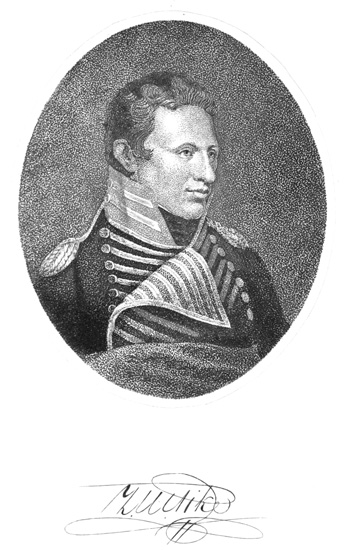
The best Life of Pike we have had is that which was
prepared by Henry Whiting and published in 1845 in
Jared Sparks' Library of American Biography, vol. xv. (or
new series vol. v.), pp. 217-314. This excellent memoir
might be now reproduced, were it not mainly occupied with
the account of those expeditions to which these volumes
are devoted, and thus for the most part superfluous in the
present connection. It still continues to be a main source
of our information concerning the events of Pike's life
before and after those exploits of 1805-7 which immortalized
his name, and is particularly valuable in all that relates
to his closing career, as the biographer was himself a distinguished
soldier and competent military critic.[M-1]
But I have much new matter to offer, derived from
a thorough examination of the archives of the War Department,
which include many original and hitherto unpublished
documents in Pike's case,[M-2] from diligent search among
contemporaneous records of the war of 1812-15, and from
various other sources.
The Pike family resided in New Jersey for several
generations. One Captain John Pike acquired his military
title in Indian warfare. Zebulon Pike, the father of Zebulon
Montgomery Pike, had been a captain in the Revolutionary
army, and had served in the levies of 1791, when he
was made a captain of infantry Mar. 5th, 1792; he was
assigned to the Third sub-Legion Sept. 4th, 1792, and to
the 3d Infantry Nov. 1st, 1796; he became major Mar. 21st,
1800, and was transferred to the 1st Infantry Apr. 1st,
1802; he was brevetted lieutenant-colonel July 10th, 1812,
and honorably discharged June 15th, 1815. He died July
27th, 1834. His son, Zebulon Montgomery, was born at
Lamberton, afterward a south part of Trenton, N. J.,
Jan. 5th, 1779.[M-3]
During Zebulon Montgomery's childhood his parents
removed to a place in Bucks Co., Pa., near the Delaware
river, and thence to Easton, Pa. Whiting says
that he was remembered by some of his schoolmates
who were living in 1845, "as a boy of slender form, very
fair complexion, gentle and retiring disposition, but of resolute
spirit. Instances are mentioned in which his combative
energies were put to a test, which would reflect no
discredit upon his subsequent career." He had only a common
school education, which appears to have been as slight
in quality as it was short in duration, though he was at one
time under the tuition of a Mr. Wall, a person of local
repute in mathematics. He entered the army as a raw,
shy country youth, of the most slender acquirements in any
direction, whose main making of a man was ambition.
The records of young Pike's earliest military service are
variant in some particulars not of much consequence. In
one of his letters, printed beyond, p. lxv, he says that he
entered the army when he was 15 years old. This would
be in or about 1794, and doubtless refers to his cadetship.
According to his biographer, he entered his father's company
as a cadet, date not given; was commissioned as an
ensign of the 2d Infantry Mar. 3d, 1799; promoted to
be a first lieutenant in the same regiment Apr. 24th, 1800,
and arranged to the 1st Infantry in 1802. In Heitman's
Historical Register[M-4] it appears that Zebulon Montgomery
Pike, of New Jersey, was first appointed from New Jersey
to be a second lieutenant of the 2d Infantry, Mar. 3d,
1799; was next promoted to be first lieutenant of the same
regiment, Nov. 1st, 1799; and then transferred to the 1st
Infantry, Apr. 1st, 1802. Whatever may have been the
facts in the discrepant cases of the earlier dates, there is no
uncertainty from April 1st, 1802, when the name and rank
became First Lieutenant Z. M. Pike, 1st Regiment of
U. S. Infantry. It was as such that this young officer was
first detailed for detached service in the exploration of the
Mississippi, by order of General James Wilkinson, dated
from the Commanding General's headquarters at St. Louis,
Mo., July 30th, 1805.
Pike had not before been distinguished from any other
meritorious and zealous subaltern, though his qualities had
already attracted favorable attention. His selection by
General Wilkinson for this duty was the beginning of all
his greatness. The letter in which the detail was made will
be found elsewhere (vol. ii, pp. 842-844). The principal
other dates of Pike's brief but brilliant military career may
be conveniently given here, though in so doing I anticipate
events which will come up again in their regular order: His
promotion to a captaincy in his regiment occurred by
routine Aug. 12th, 1806, when he was voyaging up the
Osage, early in his second expedition. He became major
of the 6th Infantry May 3d, 1808, in less than a year
after his return from his tour in Mexico—a journey which
was directly continuous with his second, or Arkansaw expedition,
but one which, having been involuntarily performed,
he chose to separate formally from the other, and to
make known as his "third" expedition. He became the
lieutenant-colonel of the 4th Infantry Dec. 31st, 1809.
From Apr. 3d, 1812, to July 3d of that year, he was on duty
as deputy quartermaster-general. He became the colonel
of the 15th Infantry July 6th, 1812, and was appointed to
be brigadier-general Mar. 12th, 1813. But before this
appointment was confirmed General Pike had been killed at
the head of the troops he led to the assault on York, Upper
Canada, April 27th, 1813, aged 34 years, 3 months, 22 days.
I am favored by Lieutenant J. R. Williams, of the army,
with the following copy of the rough draught of a hitherto
unpublished letter from General John R. Williams of
Detroit to Major Amos Holton, giving an interesting
picture of Pike, framed in his early environment:
Detroit, May 20, 1845.
Major Amos Holton,
Dear Sir,
I have recd your esteemed favor of the 14th April last, on the interesting
subject of your contemplated publication of a Biographical memoir,
illustrative of the Character and services of the late Brigadier Genl.
Zebulon Montgomery Pike of the U. S. Army. The half Sheet of the
Albany Argus which you designed to accompany your letter, and which
gives an account of a night battle on the Champlain frontier, I regret to
say, has not been received.
The period of my acquaintance with the subject of your contemplated
memoir, is indeed distant and remote; and altho' those days are still
cherished in my recollection as the halcyon and pristine days of my
youth and vigor, Yet, I cannot but be truly sensible that many interesting
incidents have escaped my recollection in the lapse of forty-five
years.
Soon after my arrival at Camp Allegheny in the month of May 1800 I
became acquainted with Lieut. Zebulon Montgomery Pike of the 2d
Regt. U. S. Infy, he was shortly afterwards appointed Adjutant of the
Regiment, in which Capacity he served during the Years 1800 & 1801.
No officer could be more attentive prompt and efficient in the execution
of the several duties of his office—nor was there any more emulous to
acquire a perfect knowledge of the Military profession, nor more zealous,
ardent and persevering in the pursuit of scientific improvement.
It was these qualities and disposition of mind that laid the foundation
of the subsequent Character and fame of Zebulon M. Pike and would
probably have introduced him had he lived, to the highest honors, at
least, in the military profession under the Republic.
I then understood that his only means of Education had been such as
could be obtained in Garrison under the eye of his father then Major
Pike at the several posts he commanded, notwithstanding these disadvantages
he was a tolerable good english scholar and wrote a good hand
when I knew him and had also acquired by his own persevering industry
a tolerably good knowledge of the french language—this I know from the
fact of having frequently corrected, at his own request, several of his
translations from Fenelon's Telemachus.
Pike was very gentlemanly in his deportment—manners agreeable &
polished, rather reserved in general and somewhat taciturn except when
incited to conversation on some topic in which he felt interest and considered
worthy of his attention he had less levity in his character than
even many of his brother officers Senior to him in Years and Rank. His
appearance was military yet somewhat peculiar he generally leaned or
inclined his head on one side so that the tip of his Chapeau touched his
right shoulder when on parade—His Stature was about five feet eight
inches tolerably square and robust for his Age which I think must have
been Twenty Years in 1800. His Complexion was then Ruddy, eyes
blue, light hair and good features his habits were in keeping with his
character, uniformly abstemious and temperate his attention to duty
unremitted. At that period the most vexatious evil and obstacle that
attended the maintenance of discipline in the Army was the general and
extensive use of Ardent Spirits, Whiskey among the Men which was constantly
being introduced in Camp by the Men & Women attached to the
service and other hangers on around the Camp—On one occasion returning
to Camp from Pittsburgh about ten o'clock in the evening Pike and
myself being desirous of detecting the Soldiers in their Clandestine
manoeuvres in the introduction of whiskey approaching the Camp
silently through the bushes and occasionally halting to listen succeeded
in capturing several fellows with jugs & bottles of their favorite beverage,
not however without a race after them. On another occasion while
going down the Ohio river in flats—The flats always halted for the night
at some convenient place furnishing good ground & conveniences for
Bivouacking for the Night a guard being mounted and Sentinels placed
at suitable points around the Camp. The Soldiers were then permitted
to Land build fires and bivouac on shore if they thought proper to do so
in preference to remaining in the flats crowded as they were—there was
about 70 men detailed for the purpose of managing Ten flats containing
the Provisions under my Charge. The Signal for embarking in the
Morning was the Reveille at day break and the General immediately
after. It being then about the 20 December the weather was Cold and
a good deal of ice drifting in the River. The men generally preferred
the Company boats where they had to labor less than in those of the
Commissariat where they had to labor constantly to keep up in the line
agreeably to the order regulating the movement of the troops. One
morning they appeared to be desirous of escaping from the Commissariat
boats to their respective Company boats in hopes of getting rid of the
duty to which they were detailed and left the boats as fast as they were
ordered to embark until Pike observing their disobedience seized and
threw several fire brans at those in the Act of leaving the boats to which
they had been detailed and called to me to assist him by which means
the men were taught a lesson which was not required to be repeated the
residue of the journey down the River.
This prompt and decided course on the part of Pike was not only
well timed but very important as it prevented much disorder and Confusion
which would inevitably have ensued had he taken the ordinary and
regular but slow steps to punish the Mutineers, to bring them to a sense
of duty. the moment of departure had arrived, the boats were unmoored,
and those which had precedence were already under way floating
down the rapid current of the Ohio; The Colonels boat particularly,
to whom he would have had to Report was already at some distance—The
alternative then, which he adopted as quick as lightning was not only
judicious but necessary and indispensible under the Circumstances of the
Case. It operated a Salutary and instantaneous effect upon the insubordinate
Soldiery which at once brought them to a sense of duty and
order. This circumstance in my opinion speaks volumes in favor of
Pike. The quickness and decision which characterized the transaction
furnishes an index to his character neither to be mistaken nor misunderstood.
After our arrival at a point equidistant between Fort Massac & the
Confluence of the Ohio & Mississippi Rivers, about eighteen miles below
Fort Massac the Army landed on the 5th January 1801 at a high Bluff
on the right Bank of the River where they encamped cleared the ground
which was covered with heavy timber laid out an encampment after the
plan of Greenville built with log huts which was named Wilkinsonville.
Some time in the summer of 1801 he obtained a furlow to visit Cincinnati
as it was believed, on a matrimonial expedition at which time he was
married to his present relict Mrs. Pike.
During the period alluded to, the duties of the Adjutant were arduous
and unremitting—especially during the encampment on the Allegheny in
addition to guard and police duty—We had Battalion drill twice or thrice
a week and Company drill every day; and Officer drill once or twice a
week, thus you can perceive that our time was industriously appropriated
to the acquisition of military knowledge—We had also the advantage of
being drilled by officers that served under the gallant Genl. Wayne and
who composed part of his Army at the memorable and decisive Battle of
the 20th of August 1794 at the Miami Rapids—
Colonel John Francis Hamtramck[M-5] of the 1st Regt U. S. Infy acted as
Brigadier Genl. under Genl. Wilkinson being the senior Colonel of the
U. S. Army—his remains now lie within a stone's throw of my Office, near
the Roman Catholic Church of St Anne—As a Memorial of affection
the principal Town above this City and within the County of Wayne
bears his name Hamtramck as he was much beloved by the inhabitants
of this Country.
Allow me here to make mention of the principal Officers composing
the Command at Camp Allegheny. Colo. David Strong, Commandg
2d Regt Infy, Major Moses Porter with his Co. of Artillery—Major
Turner Brigade Inspector Captains Graeton, Sedgwick, Shoemaker,
(Visscher, stationed at fort Fayette) Grey, Lukens, Claiborne—Lieuts.
Rand, Whipple, Schiras, Hook, Meriwether Lewis, Wilson—John Wilson—Z.
M. Pike, Dill—& to which was added at Wilkinsonville Lieuts.
Williams, Brevoort, Hughes, Hilton Many Blue & Others together with a
Battalion of the 4th Regt. under Major Butler—making in the aggregate
a force of about 1000 effective men.[M-6]
During the summer and autumn we were visited by Genl. Wilkinson &
his staff Composed of Lieuts Walbach & Macomb & Lieut. Colo. Williams
of the Engineer Corps.[M-7] about this period sickness among the
troops and many deaths occurred in consequence of which the Troops
were removed by order of Genl. Wilkinson to Cumberland Heights[*] a
season of inactivity and a prospect unfavorable to Military life prevailing—many
Officers resigned and sought to obtain a livelihood by other
means than the profession of arms. These and other subsequent events
are matters of history and I shall therefore close these short notes by
pointing to the subsequent life and services of the lamented Zebulon M.
Pike.
My opportunities of acquaintance with him arose from the Circumstance
of having messed with Captain Peter Shoemaker and himself
about Eight Months without intermission we three being the only members
of the Mess.
In conclusion, it may not be inappropriate to remark that the period
alluded to was during a state of peace. Yet, whilst the prospect lasted
that the Troops might soon expect active service against the frontiers of
the then possessions of Spain—The Zeal, Ardor, Enterprize and ambition
of our Army could not have been surpassed; and would have sustained
a comparison with the best and most glorious days of the
Revolution, or of the late War with Britain, or the later achievements of
our Braves against the forces of Mexico.
You are at liberty to use these notes in such manner as will meet the
object you have in view.
With respectful Consideration
I am Dear Sir Your Obedt Servt
Jno. R. Williams.
Major Amos Holton
Washington City, D. C.
transmitted the foregoing by
Mail Augt 26th 1846.[M-8]
The "matrimonial expedition" to which the foregoing
letter quaintly alludes was successful, like Pike's other
expeditions of later date and greater celebrity. The young
lieutenant was married in 1801 (day of the month not ascertained)
to Clarissa Brown, daughter of General John Brown
of Kentucky. Whiting says that the issue of this connection
was "three daughters and one son. Only one of these
children reached the maturity of life, a daughter, who married
Symmes Harrison, the son of General [William Henry]
Harrison, and became a widow, many years since, with
several children." Whiting continues with the following
statements, embodying perhaps as much as has hitherto
been published of Pike's domestic relations:
Mrs. Pike withdrew to the seclusion of a family residence [at North
Bend] on the Ohio River just below Cincinnati, soon after the fall of
her gallant husband, where she has since lived. It is well recollected by
most of the officers who served on Lake Ontario in the early part of the
campaign of 1813, that he regarded her with enthusiastic sentiments,
believing her to share in all his ardent longings after distinction, and
willing to make any sacrifice for their fulfilment. No doubt it was with
a heart strengthened by such feelings, that she parted with him on the
eve of the expedition in which he fell; though she may have felt, during
her long widowhood, that the sacrifice, with all its honorable alleviations,
has been at times as much as that heart could bear.
There was found an interesting memorandum on one of the blank
pages of a copy of "Dodsley's Economy of Human Life,"[M-9] which General
Pike habitually carried about with him. After affectionately alluding to
his wife, and his son then living, he lays down two maxims, which he
wishes may ever be present to the mind of his child, "as he rises from
youth to manhood." "First: Preserve your honor free from blemish.
Second: Be always ready to die for your country." This son was cut off
too soon to exemplify the former in his life, or the latter in his death;
but the father, in his life and in his death, exemplified them both.
On seeking for information in regard to General Pike's
daughter and her children, I first wrote to ex-President
Benjamin Harrison, by whom I was favored with prompt
reply, in part as follows:
674 North Delaware Street,
Indianapolis, Ind., May 24, 1894.
My Dear Sir:
I have your letter of May 21st. My uncle, Symmes Harrison, married
the daughter of General Pike and left several children; but I do not
think I know of but one who survives—William Henry Harrison, who
lives in the neighborhood of the old Pike homestead on the Ohio River,
about two and a half miles below my grandfather's old home at North
Bend.... I cannot give you the names of General Pike's children; I was
too young to have any knowledge of them. Possibly my eldest sister,
Mrs. Bettie H. Eaton, who is now residing at El Paso, Texas, may be
able to give you some information about the Pike family.
Very truly yours,
[Signed] Benjamin Harrison.
Mrs. Bettie Harrison Eaton was kind enough to reply to
my further inquiries, in a letter dated El Paso, Tex., July
2d, 1894, from which I quote in substance:
My cousin's, William Henry Harrison's, mother was a daughter of
General Pike, whose maiden name was Clarissa Harlowe Pike. She
was married to my uncle, John Cleves Symmes Harrison, but in what
year I do not know. Indeed, I know very little about the Pike family,
as I always understood that my aunt was General Pike's only child; if
he had others I never heard of them. I remember her very slightly, as I
was quite a little girl when she died. Her mother, Mrs. General Pike,
of whom I have a better memory, was a tall, dignified, rather austere
looking woman, who always dressed in deep black, wearing always a
large black Canton crape shawl and a black crape turban on her head,
which to my childish eyes gave her a somewhat awe-inspiring appearance.
She was a highly educated and accomplished woman, and a fine French
scholar. She kept for many years a diary, which was written in French.
My cousin, to whom I refer you, lives on the old Pike homestead, and
could probably give you the dates you wish, as he no doubt has the
family Bible, and the old graveyard where the family are buried is on
the place.
On applying to William Henry Harrison of North Bend,
O., I received a brief note dated Sept. 10th, 1894, in which
the following information is given: "My house burned
some years ago, when all General Pike's private papers
were lost. He had but one child, my mother Clara. His
wife's maiden name was Clara Brown; she was the daughter
of Captain John Brown of Revolutionary fame."
With thus much—none too complete, but all that I have
in hand—concerning Pike's private life, we return to his
public career. The unnumbered extant notices to which
the fame that he acquired gave rise are mainly and most
naturally devoted to the consideration of the Mississippian,
Arkansan, and Mexican exploits which form the matter of
the present volumes, but which need not occupy the present
biographer, as they speak for themselves. These cover the
dates of 1805-6-7; and before taking up Pike's life in 1808,
we may next consider the bibliography of the books to
which his expeditions gave rise.
The earliest one of these, forerunner of the regular
edition of 1810, is entitled:
An Account | of a | Voyage | up the Mississippi River, from St. |
Louis to its source; | made under the orders of the War De- |
partment, by Lieut. Pike, of the Uni- | ted States Army, in the
Years 1805 and | 1806. Compiled from Mr. Pike's Jour- | nal. |
Pamphlet, 8vo., pp. 1-68, no date, no author, no editor, no publisher, no
printer, no place of publication; title, verso blank, pp. 1, 2; text,
pp. 3-67, with colophon ("Finis."); p. 68 being "Extract of a letter
from N. Boilvin [Nicholas Boivin] Indian agent, | to the Secretary
of War, dated St. Louis, | Oct, 6, 1806. |"
This is an extremely rare tract. I have handled two
copies, one of which I own, title page gone; the other
being a perfect example in the Library of Congress at
Washington. There is a third in the Ridgway Library of
Philadelphia; and Sabin's Bibl. Amer. cites a fourth, in the
library of the American Antiquarian Society at Worcester,
Mass. These are all that I know of, though of course
others exist. The authorship and circumstances of publication
remain unknown, to me at least. Sabin gives the
date 1807; this is probably correct, certainly true within a
year, but questionable. I adopt it, in view of its probability,
and in the absence of conclusive evidence against it,
though Whiting says 1808. But early in 1808 Pike was
already arranging for the publication of his own book,
which appeared in 1810. Pike does not even allude to this
publication, either in his own book, or in any of the manuscripts
I have seen in which the latter is mentioned. On
consultation with Mr. A. R. Spofford over the general
aspect and "make-up," no definite conclusion could be
reached by that exceptionally well-versed librarian. It
is supposed by some, not without plausibility, to have
been a government publication; but Mr. Spofford's ignorance
of the fact, if it be such, is against this supposition;
for a publication which he cannot recognize on sight
as having been issued in Washington is unlikely. The
tract looks as if it formed a part of something else; witness
the peculiar set of the title page, the conclusion of the
Pike matter on p. 67, and the appearance on p. 68 of the
Boivin letter, having no obvious connection with the rest.
However all this may really have been, there is no question
of the genuineness of this unauthenticated narrative.
Pike never penned it—he could not write so well as the
anonymous author of this tract did. But whoever wrote it
had Pike's original manuscript journal or note-book before
him, and followed him closely, faithfully, and accurately.
Pike's case is put in the third person by the writer, who
gives in narrative form a better account of the Mississippi
voyage than Pike's slender literary attainments enabled
him to write for himself. This "text of 1807," as I shall
call it, when I have occasion to cite it in my commentary,
is an invaluable check upon Pike's own itinerary; he cannot
have been unaware of its existence, and the friendly hand
which thus first gave to the world the best account extant
of the Mississippi voyage should not have been ignored
when Pike came to write out his notes for publication in the
princeps edition of his several expeditions, of date 1810.[M-10]
Immediately upon his escape from his Spanish captors
and hosts, and his return to his native land, Pike set about
writing his book. This was finished—or at any rate so far
advanced that a contract for its publication had been made—early
in 1808 (see letter of May 27th, 1808, beyond, p. lxi).
The original edition of his Expeditions is as follows:
[1810.]—An Account of Expeditions | to the | Sources of the Mississippi,
| and through the | Western Parts of Louisiana, | to the
Sources of the | Arkansaw, Kans, La Platte, and Pierre | Jaun,
Rivers; | performed by order of the | Government of the United
States | during the years 1805, 1806, and 1807. | And a Tour
through | the | Interior Parts of New Spain, | when conducted
through these Provinces, | by order of | the Captain-General, |
in the Year 1807. | —— | By Major Z. M. Pike. | Illustrated by
maps and charts. | —— | Philadelphia: | Published by C. and A.
Conrad, Co. No. 30, Chesnut Street. Somer- | vell & Conrad,
Petersburgh. Bonsal, Conrad, & Co. Norfolk, | and Fielding
Lucas, Jr. Baltimore. | —— | John Binns, Printer......1810. |
One Vol. 8vo.
CONTENTS.
Portrait of Pike, frontispiece.
Title, backed with copyright, pp. [1], [2].
To the Public, being Preface by Pike and publisher's Apology, pp. [3]-[5];
blank, p. [6].
Dedication, To the President and Members of the U. S. M. P. S., one
leaf not paginated, verso blank (= pp. 7, 8).
Part I., being the Mississippi Voyage: Pike's Itinerary, pp. 1-105; blank,
p. 106; Meteorological Tables, 5 unnumbered leaves, raising pages to
116, last blank.
Part II., being the Arkansaw Journey: Instructions to Pike, pp. 107-110;
Pike's Itinerary, pp. 111-204.
Part III., being the Mexican Tour: Pike's Itinerary, pp. 205-277; p. 278
blank; one blank leaf; Meteorological Table, one unpaged leaf.
Appendix to Part I., pp. 1-66 (last not numbered) + 2 folding Tables;
contains Documents Nos. 1-18, and some others (No. 18, pp. 41-66,
is Observations, etc., on the Mississippi Voyage); the folders are
Tables C and F (other tables being on pages), respectively to face p.
40 and p. 66.
Appendix to Part II., pp. 1-53 (p. 54 blank), + 1 folding Table to face p.
53; contains (No. 1) A Dissertation, etc., on the Arkansaw Journey,
pp. 1-18; (No. 2) Lieut. Wilkinson's Report on his Arkansaw
Expedition, pp. 19-32; and other Documents to No. 15.
Appendix to Part III., pp. 1-87 (p. 88 blank); contains (No. 1) Geographical,
Statistical, and General Observations, etc., on the Mexican
Tour, pp. 1-51, by far the most important thing in the book; No. 2,
pp. 52, 53, a certain Vocabulary belonging to the Mississippi Voyage,
and therefore to App. to Part I.; with other Documents to
No. 19.
Map, Falls of St. Anthony, page size.
Map, Mississippi river, about 29⅞ × 9 inches.
Map, the First Part of Pike's Chart of Louisiana, folding, about
17½ × 17½ inches, called Plate I.
Map, the Second Part of Pike's Chart of Louisiana, folding, about
17 × 15½ inches, called Plate II.
Map, Internal Provinces of New Spain, about 18¼ × 17¾ inches.
Map, Sketch of the Viceroyalty of New Spain, about 15⅝ × 12⅞ inches.
Total pages 8 + 278 + 10 + 4 + 66 + 54 + 88 = 508, some not paginated, a few
blank; 5 sets of pagination. Inserts 1 portrait, 3 folding tables, 6
maps (5 folding) = 10. Folders all may be found in a separate vol. in
some copies.
It has been said, "The pen is mightier than the sword."
Pike's pen proved mightier than his sword, and pistols too,
in putting bookmaking to confusion and editors to despair.
It would be hard to find a match for the disorder in which
Pike's materials were set forth in print, especially in the
several Appendixes: Even the patient printer would not let
it go without published apology. No editor has hitherto
been found expert or rash enough to reproduce anything
like the original arrangement of the "Parts," "Appendixes"
with their numerous pieces, folding "Tables," etc. The
English editor, who first undertook to bring something like
cosmos out of this chaos, created a new book by weaving as
much as he could of the matter of the Appendixes into the
main text, or into footnotes thereto, thereby greatly reducing
the bulk of the appendicial texts. But these contained
documents which proved refractory to such treatment; the
plan could not be fully carried out, for there was a residuum
which still called for an Appendix. In fact, the real bulk of
Pike's cargo is in these Appendixes; his Itineraries—the
only portions of his book which were printed in large type,
as main text—being less important, if not less interesting,
than the rest of the freight. In approaching my own editorial
labors, my intention was to adhere as closely as possible to
the arrangement of the original. This I flatter myself I
have succeeded in doing, with a few important exceptions
to which attention is pointedly directed in my notes. These
transpositions, with the introduction of chapter-heads,
and co-ordination of all of the original book in uniform
typography, have probably effected the required result.
In 1811 Pike's work was also published, from another
MS. copy, with many modifications, in a handsome quarto
edition, as follows:
[1811.]—Exploratory Travels | through the | Western Territories | of
| North America: | comprising a | Voyage from St. Louis, on the
Mississippi, | to the | Source of that River, | and a | Journey
through the Interior of Louisiana, | and the | North-eastern Provinces
of New Spain. | Performed in the years 1805, 1806, 1807,
by Order of the Government of the United States. | —— | By
Zebulon Montgomery Pike, | Major 6th Regt. United States
Infantry. | —— | London: | Printed for Longman, Hurst, Rees,
Orme, and Brown, | Paternoster-Row. | —— | 1811. |
One vol., 4to. Half-title, 1 leaf, verso blank; title, 1 leaf, verso blank;
advertisement, dated Jan. 28th, 1811, and signed Thomas Rees, pp.
v-ix; Congressional matters taken from the App. to Part III. of the
orig. ed., pp. xi-xviii; contents, pp. xix, xx; main text, pp. 1-390;
Appendix, pp. 391-436; colophon, J. G. Barnard, Printer, Skinner-street,
London. The copy examined has only two maps—the
Mississippi, reduced to 4to page size; Louisiana and New Mexico,
prepared by putting together two of Pike's orig. maps and reducing
the result to 10⅛; × 13⅞ inches. Folding tables reset to page size.
This is the standard English edition, prepared under the
careful and able editorship of Dr. Thomas Rees, from a
manuscript copy transmitted to England at the time that
the original manuscript went to press in America. This
edition, and not the American of 1810, is the basis of the
French and Dutch versions, and is also the one which was
textually reprinted as the Denver edition of 1889. Dr. Rees
made Pike a much better book than the author made for
himself. The very great differences from the American
original, due to the English editor's literary skill, are modestly
set forth in the latter's Advertisement. It appears from
this that the MS. transmitted to England "was divided into
six parts, comprising the three journals which follow, and
the observations pertaining to each in a separate portion."
As the appendicial matters were received "in the desultory
manner in which they were originally composed, the editor
judged it for the advantage of the work to restore them, as
nearly as he possibly could, in distinct paragraphs, to the
places they had first occupied in the journal, thus rendering
it unnecessary to lead the reader a second time over the
same ground." In other words, Dr. Rees picked the helter-skelter
Appendixes to pieces, and wove most of their contents
into the main text, as already said. The accounts of
the Indians on the Upper Mississippi, and the Observations
on New Spain, he "preserved in their original state. The
Notes and Appendixes, with some variation of arrangement,
have been printed after the manuscripts, but a few articles
have been omitted, as containing only repetitions of what
had already appeared in the body of the work. With
respect to the language and style of the Author, the Editor
felt he had a much more delicate task to perform than in
the disposal of the materials." He therefore preserved
Pike's language in substance, but corrected his grammar
freely. Dr. Rees' avowal of the trouble he had with proper
names of persons and places will surprise no one who reads
the present edition and sees with what extraordinary perversions
of Indian, French, and Spanish names both Dr.
Rees and myself had to contend. Dr. Rees speaks also of
the "ignorant and careless transcriber" of the copy which
reached him, and observes further: "It is mortifying to find
that in America, where the Author was accessible, and
might readily have elucidated any accidental obscurities in
his manuscript, the work has been printed in very nearly as
incorrect a state as it appeared in the present editor's copy.
The sheets of the American Edition reached here some time
after his own had been in the printer's hands, but its numerous
errors, discreditable certainly to the American press, left
him little to regret that they had not arrived at an earlier
period." For the rest, Dr. Rees remarks that he furnished
"some cursory notes, which are distinguished by the letter
E," and adds: "In the account of New Spain he has subjoined
the population of several places from Humboldt's
recent 'Essai Politique,' in order to furnish the reader with
the means of instant comparison. It is pleasing to observe
how nearly these statements agree in the most material
instances; and the circumstance affords no slight evidence
of the general accuracy of Major Pike's information." He
is charitable enough to refrain from adding what else this
circumstance evidences. Dr. Rees' further introduction to
his main text consists of the Congressional papers, which in
the orig. ed. form a part of the App. to Pt. 3, and which
are given this prominence, apparently, to authenticate the
whole work in the eyes of the English public by these
officialities. In the copy of the Rees edition which I have
handled I find but two maps, reduced as above said.
This was followed in 1812 by a French version, the title
and collation of which are here given:
[1812]—Voyage | au | Nouveau-Mexique, | a la suite a'une expédition
ordonnée | par le Gouvernement des États-Unis, | pour reconnoître
les sources des rivières | Arkansas, Kansès, la Platte et Pierre-jaune,
| dans l'intérieur de la Louisiane occidentale. | Précédé
| a'une Excursion aux Sources du Mississippi, | Pendant les
années 1805, 1806, et 1807. | Par le Major Z. M. Pike. | Traduit
de l'anglais | Par M. Breton, Auteur de la Biblioth. géographique.
| Orné d'une Nouvelle Carte de la Louisiane, en trois parties. |
Tome Premier [Second]. | A Paris, | Chez D'Hautel, Libraire,
Rue de la Harpe, no. 80, | près le Collége de Justice. | — | 1812. |
Two vols., 8vo. Vol. I., pp. i-xvi, 1-368; Vol. II., pp. 1-373, with 3
maps. In Vol. I. the half title p., backed de l'imprimérie de L.
Hausmann, Rue de la Harpe, No. 80, is pp. i, ii; full title p., verso
blank, is pp. iii, iv; Préface du Traducteur, pp. v-xiv; sub-title,
Voyage au Mississippi, backed with errata, pp. xv, xvi; Avertissement
de l'auteur, pp. 1-6; Wilkinson's instructions to Pike of July
30th, 1805, abstracted from one of the pieces of App. to Pt. 3 of the
orig. ed., pp. 7, 8; main text of the Mississippi Voyage, pp. 9-236,
ending Pt. 1 of the orig. ed.; thence the Arkansaw Journey, with
separate sub-title, Voyage au Nouveau-Mexique, pp. 237-368, ending
Vol. I., with end of Pt. 2 of the orig. ed.—In Vol. II., half title
p. backed blank, pp. 1, 2: full title, backed blank, pp. 3, 4; main
text, pp. 5-373, beginning at date of Feb. 27th, 1807, when Pike was
starting on his involuntary Mexican tour; this tour ending on
p. 236, with end of the main text of Pt. 3 of the orig. ed.; thence to
end of vol. various matters from the Appendixes of Pts. 2 and 3,
including Lieutenant Wilkinson's Arkansaw Report, pp. 325-363,
and a piece of padding, pp. 293-324, this last being Remarques
Additionelles sur le sol, les productions et les habitans de la
Nouvelle-Espagne, of which the editor says that "ces détails sont
extraits en partie de l'excellente histoire d'Amérique par Winterbotham,
et de l'ouvrage de l'abbé Clavigéro." These 32 pages
of padding have no business in the book; I suppose they were
wanted to balance the bulk of the two volumes. The maps of this
edition are three in number, supposed to belong in Vol. II. They
are the Mississippi and the two Arkansaw maps, prepared by
Antoine Nau, redrawn and re-engraved, with French names instead
of English ones; the size is about the same as that of the original;
the execution is rather better. The editor apologizes, Vol I., p. xiii,
for not reproducing Pike's two maps of Mexico, because he would
not venture "d'attenter à la propriété de M. de Humboldt," i. e.,
steal Humboldt's thunder. For it seems that Humboldt thought
Pike had done so, and he had just previously so expressed himself
in a réclamation in Le Moniteur. Humboldt compliments Pike pro
formâ, and proceeds to protest: "Mais les cartes du Mexique,
publiées sous son [Pike's] nom, ne sont que des réductions de ma
grande carte de la Nouvelle-Espagne, sur laquelle le voyageur a
tracé sa route de Santa-Fé par Cohahuila à Nacodolhes
[Nacogdoches or Natchitoches]."
Humboldt's direct and unqualified charge of plagiarism
against Pike, which has never been answered and is probably
unanswerable, is reiterated in that one of his works
entitled: Personal Narrative of Travels to the Equinoctial
Regions of the New Continent during the Years 1799-1804.
By Alexander de Humboldt and Aimé Bonpland. Written
in French by Alexander de Humboldt, and translated into
English by Helen Maria Williams, Philadelphia, M. Carey,
1 vol., 8vo, Dec. 23d, 1815, on p. xxii of which we read:
"Mr. Pike displayed admirable courage in an important
undertaking for the investigation of western Louisiana; but
unprovided with instruments, and strictly watched on the
road from Santa Fe to Natchitoches, he could do nothing
towards the progress of the geography of the provincias
internas. The maps of Mexico, which are annexed to the
narrative of his journey, are reduced from my great map of
New Spain, of which I left a copy, in 1804, at the secretary
of state's office at Washington." In this connection Humboldt
also makes the same well-founded charge against
Arrowsmith, saying, p. xxi: "My general map of the kingdom
of New Spain, formed on astronomical observations,
and on the whole of the materials which existed in Mexico
in 1804, has been copied by Mr. Arrowsmith, who has appropriated
it to himself, by publishing it on a larger scale under
the title of New Map of Mexico, compiled from original
Documents, by Arrowsmith. It is very easy to recognize
this map from the number of chalcographical errors with
which it abounds," etc.
Of all forms of dishonesty, literary larceny is the most
futile, because the surest of detection. Plagiarism is worse
than a crime—it is a blunder. If the matter stolen is worth
stealing, the transaction is certain to be exposed, sooner or
later. The distinction between the use and misuse of the
literary labors of another is so plain and simple that it
cannot be misunderstood. It depends solely upon whether
acknowledgment be made or not. Plagiarism acknowledged
is no plagiarism—one has only to say "by your leave," to
appropriate with impunity whatever he desires. But this
instant formula is indispensable. Subsequent apology or
explanation is impossible. Humboldt took Pike red-handed;
this the present biographer deplores; but he can
neither discover nor invent a defense. Pike's senselessness
in this matter aggravates the offense. To have acknowledged
his indebtedness to Humboldt and Bonpland, and
then utilized their work to any extent he chose, would have
been shrewd policy, as well as honest conduct; for Humboldt's
was already a name to conjure with, and the hitherto
nameless young writer could not have done better for
himself than to cite such high authority in connection with
his own work.[M-11] I have reluctantly satisfied myself that
Pike's map of New Spain is no other than Humboldt's Carte
Générale du Royaume de la Nouvelle Espagne, with Nau's
errors and some little further modification.
The Dutch edition of Pike, 1812-13, is as follows:
[1812-13.]—Reize | naar | Nieuw-Mexico | en de Binnenlanden van
| Louisiana, | Voorgegaan door eenen togt | naar de Bronnen
der | Mississippi, | gedaan op last van het Gouver- | nement der
Vereenigde Staten | in de jaren 1805, 1806 en 1807, | door den
Majoor | Z. M. Pike. | — | Uit het Engelsch vertaald. | — | Eerste
[Tweede] Deel. | met Kaarten. | — | Te Amsterdam, bij | C. Timmer.
| MCDCCCXII [MDCCCXIII]. | Stilsteeg, No. 18. |
Two vols., 8vo. Vol. I., 1812 (notice misprint of date on title page),
pp. i-viii, 1-327. Vol. II., 1813, two prel. leaves, and pp. 1-374,
with three maps. Printed at Amsterdam by A. Breeman & Co.
In Vol. I., title leaf, verso blank, pp. i, ii; Voorberigt van den
Vertaler (Translator's Preface), pp. iii-viii, dated Amsterdam, Nov.
7th, 1812; main text, pp. 1-327, of which the Mississippi voyage
runs to p. 218 inclusive, and the remainder finishes the Arkansaw
journey, these being respectively Pt. 1 and Pt. 2 of the orig. ed. In
Vol. II. a half title and a full title make each one unpaged leaf, and
the main text runs pp. 1-374, being Pt. 3 of the orig. ed. The three
maps belong in this vol.
The general form and style of this version are most like
those of the French translation, from which, however, the
Dutch differs in various particulars. It appears to have
been based upon the English quarto rather than upon the
original Philadelphia octavo, and to have been translated
independently therefrom, as the French also was. Both
the Dutch and the French editions follow the English one
in working the matter of the Appendixes into the main
text—in fact, no edition that I know of has hitherto followed
the awkward and exasperating form of Pike's own
book. The anonymous Dutch translator introduces a new
preface, and a few short footnotes, not reproducing those
of the French translator; the three maps are re-engraved
from those prepared by Antoine Nau, as in the French
edition, but with lettering of the names in Dutch instead of
French.
The foregoing English, French, and Dutch editions were
speedily followed by a German version. This seems to be
a scarce book; I have not yet been able to find a copy.
I presume that, like the French and Dutch, it was modeled
upon the London quarto; but with what modifications, if
any, aside from translation into another language, I have
no idea.
The latest and best edition of Pike which has hitherto
appeared in the United States, was published in 1889, as
follows:
[1889.] Exploratory Travels | through the | Western Territories | of
| North America: | comprising a | Voyage from St. Louis, on the
Mississippi, | to the | Source of that river, | and a | Journey
through the Interior of Louisiana, | and the | North-eastern Provinces
of New Spain. | Performed in the years 1805, 1806, 1807,
by Order of the Government of the United States. | — | By Zebulon
Montgomery Pike, | Major 6th Regt. United States Infantry.
| — | London: | Paternoster-Row. | — | 1811. | — | Denver:
| W. H. Lawrence & Co. | 1889. |
One vol., large 4to. Engr. portrait, frontispiece, answering to pp. i, ii;
title, verso copyright, pp. iii, iv; introduction (new, by Wm. M.
Maguire, Denver, 1889), pp. v-xii; missing, pp. xiii, xiv; Report
of Committee, etc. (1808), pp. xv-xxii (abstracted from Doc. No. 6
and accompanying papers of Appendix III. of the original); contents,
pp. xxiii, xxiv, or pp. 23, 24; main text, pp. 25-351; blank,
p. 352; Appendix, pp. 353-394; Mississippi map, reduced, opp. p.
24; 1st Louisiana map, reduced, opp. p. 146; 2d do., do., opp. p.
208; maps of Falls of St. Anthony and of Mexico not found;
folding tables reset to page size.
As appears from the foregoing title and collation, this
is a faithful and complete reprint of the English quarto.
The title page is facsimiled with the camera, down to the
publishers' names; the text is identical throughout, barring
such slight literal or punctual differences as are necessarily
incident to resetting type. The only noticeable change
from the London edition is that Dr. Rees' advertisement is
replaced by a new introduction, from the pen of William
M. Maguire, Esq., of Denver. This is a valuable feature;
my only regret is that so competent and conscientious an
editor as Mr. Maguire—one familiar with much of Pike's
route, and enthusiastic on the subject—did not give the work
that extended critical revision which would have forestalled
my own commentary and left me to exercise my editorial
wits in some other direction. As it is, I am indebted to
my valued correspondent in several particulars which
appear in their proper connections in the course of my
notes.
It is needless to cite here the multiplied notices of Pike
and of his travels or his book which appear in ordinary
biographical and encyclopedic publications. But, aside
from Whiting's Memoir, already adduced, I may notice
some special articles of more or less recent date.
The Pacific Railroad Reports, XI. 1855, pp. 19-22, contain
a notice of Pike's Expeditions, by the late eminent geographer,
General Gouverneur Kemble Warren. The routes
are traced correctly, except in the instance of sending Pike
over the Continental Divide to headwaters of the Colorado
of the West; for General Warren says: "It appears that
Lieutenant Pike has the honor of being the first American
explorer that reached the sources of this large river [the
Arkansaw], and the second that crossed the divide between
the waters of the Atlantic and Pacific oceans." The first
clause of this statement is correct; in the second, the writer
was misled.
"Mungo-Meri-Paike" is not the name of the celebrated
Ethiopian explorer who was born at Fowlshiels, in Selkirkshire,
Scotland, Sept. 20th, 1771, and became known to
fame as Mungo Park, but a phonetization of the way "Montgomery
Pike" reverberated in Spanish ears. Colonel James
F. Meline's Two Thousand Miles on Horseback, etc., New
York, Hurd and Houghton, 1867, exploits Pike in an interesting
manner, especially in Letter xxix, pp. 234-245.
Meline's contribution to the present biography is particularly
valuable, as it gives some documentary evidence of the
Spanish view of Pike's invasion of New Mexico. Most of
this we have in Pike's book; but one of the papers which
Colonel Meline presents, both in the original Spanish and in
an English version, must find a place here; I give it in
English, from Meline's pp. 243-245.[M-12] It is Governor
Allencaster's report to General Salcedo, of date Santa Fé,
N. M., Apr. 1st, 1807: compare Pike at p. 607 and following
pages; also, p. 809.
The Topeka Commonwealth, a Kansan newspaper, during
the summer and autumn of 1877 published a series of articles
by Noble L. Prentis. These were afterward gathered in a
volume entitled: A Kansan Abroad, what purports to be
the second edition of which appeared in 1878, Topeka, Geo.
W. Martin, sm. 8vo, pp. 240. One of the articles in this book,
pp. 191-214, is thus described by its author, who seems to
have been something of a wag: "The sketch, Pike of Pike's
Peak, was first delivered at Topeka, February 19th, 1877,
under the patronage of the Kansas State Historical Society.
Afterward, in the cheerful month of March, the author went
around the country with his production in the form of a
'lecture.' It was not as funny as was expected, and, as a
lecture, was not an overwhelming success. It now appears
for the first time in print; and may it find more readers
than it ever did hearers." In this wish I concur with
pleasure; for Mr. Prentis evidently had read his Pike with
interested attention, and his essay is one of the best short
biographies of our hero that I have seen. I have occasion
to cite it twice in the present memoir.
In his Explorers and Travellers, forming a volume of the
Men of Achievement series, New York, Charles Scribner's
Sons, 1893, Art. VI., pp. 163-193, General A. W. Greely,
Chief Signal Officer, U. S. A., who himself illuminates
achievement in exploration, has given an appreciative
sketch of Pike's career, in the main correct, though inaccurate
in certain particulars. If I here specify two of
these, it is in no spirit of detraction, but with the good
feeling that General Greely reciprocated when I called his
attention to them. It is said, p. 173, that "Pike visited
Red Lake and passed to the north, which carried him to
the drainage-basin of the Red River"; but Pike was never
out of the Mississippian watershed on that voyage, his
furthest point being Cass lake. This was formerly known
as Red Cedar lake, whence perhaps General Greely's misapprehension.
Again, it is said, p. 183, that Pike "doubtless
crossed into Middle Park [in Colorado] and saw the head-waters
of the Colorado"; but Pike went directly from
South Park back into the valley of the Arkansaw, and
never viewed a Pacific watershed. The general's summary,
p. 175, of Pike's results on the Mississippi is judicious—a
conservative estimate, colored with a generosity which
none would wish to have been withheld:
Pike had more than carried out his orders to explore the sources of
the great river, and did something more than give to the world the first
definite and detailed information as to the upper river and its tributaries.
He discovered the extent and importance of the British trade in that
country, brought the foreign traders under the license and customs regulations
of the United States, and broke up for all time their political
influence over the Indians. He did much to restrain the unlawful sale
of liquor to Indians by domestic traders, and not only inspired the
Indians with respect for Americans, but also induced them to at least
a temporary peace between themselves. He replaced a foreign flag by
the ensign of his own country, and for the first time brought into this
great territory the semblance of national authority and government.
Hon. Alva Adams of Pueblo, Col., delivered an address
before the students and faculty of Colorado College, Colorado
Springs, July 12th, 1894, which was published under
the title: The Louisiana Purchase and its first Explorer,
Zebulon Montgomery Pike, 8vo, pp. 23. This is a spirited
oration, befitting the occasion and inspiring to read. It is
true that Pike's book appeared in 1810, thus anticipating
by four years the publication of Lewis and Clark; but can
Governor Adams have forgotten who first explored the
Louisiana Purchase, and returned from their expedition to
the Pacific at noon of Sept. 23d, 1806? At that date
Pike was at the Pawnee village on the Republican river;
and on the 4th of October he had the news of Lewis
and Clark's return to St. Louis. His western expedition
had been in progress only since July 15th, 1806. If Governor
Adams had Pike's Mississippi voyage in mind, that
does not alter the case. Lewis and Clark started up the
Missouri May 24th, 1804; and when Pike began to navigate
the Mississippi, Aug. 9th, 1805, Lewis and Clark were on
Jefferson river, in Montana. Furthermore, Pike was preceded
in exploring Louisiana, from Missourian waters to
those of the Rio Grande, by James Pursley, who had
himself been preceded by Jean Baptiste Lalande, as we are
duly informed by Pike himself; and it is probable that
French traders reached Santa Fé by the same way half a
century before Pike.
The Annals of Iowa, 3d series, Vol. I. No. 7, Oct.,
1894, pp. 531-36, contains an article entitled: Pike's Explorations.
This is anonymous, but was written by my much
esteemed friend, Hon. Charles Aldrich, editor of the Annals
and curator of the Iowa State Historical Department at
Des Moines. The article is clear and concise; and it traces
Pike's several journeys with absolute accuracy.
We return from this bibliographical excursus to resume
the thread of Pike's biography—would that there had been
many more years to chronicle in the gallant and patriotic,
but all too brief, life of the young soldier! No longer lieutenant,
but captain, since Aug. 12th, 1806, Pike was delivered
out of the hands of "our friends the enemy" on the Sabine
river, to which he had been escorted by his Spanish captors,
June 29th, 1807; and arrived at Natchitoches about 4 p. m.,
July 1st. The following letter was received at the War Department
Sept. 29th, 1807; it is not included in the Appendix
to Pt. 3 of the book, and has probably never been
published. I print verbatim from a copy of the original
now on file in the office of the secretary of war:
Natchitoches 15 July. 1807.
Sir
I arrived here a few days since with part of my command only, the
ballance being yet in New Spain, but expect them daily; as the Capt.
General assured me they should follow me in a short period; he detaining
them I presume, to put them through an examination, when he
conceived they would be more easily intimidated into some equivocal
expressions; which might palliate the unjustifyable conduct of the
Spanish Government with respect to the expidition which I had the honor
to command.
Whatever may be the sentiments of the Executive of the United States
as to the conduct of the Spaniards to myself and command, I am bound
to submit. Yet I am conscious that our Honor and Dignity, as a nation
will not permit us to tranquilly view, the violation of our Territories;
infringements of Treaties; Hostile communications to our Savages; and
oppression of our Citizens; in various Instances: all of which I can make
manifest.
The unreasionable Ideas of the Vice Roy, & His Excelly the Capt.
Genl. (the immediate representatives of his Catholic Majesty on our
Spanish Frontiers) as it respects the line of Demarkation, is such that in
my humble oppinion almost precludes the possibility of a thought that
they can ever be amicably adjusted.
On that subject I flatter myself I have acquired some important and
interesting information.
Although the Capt. Genl. seized on (what he conceived all) my papers,
I yet possess by a little strategem, the whole of my Journals; courses;
and distances; and many other Geographical; Historical; and Philosophical
notes; which I presume will be worthy of particular notice.
I conceive by a fortuitous event, that information has been acquired
of the Spanish Kingdom of New Spain, which a foreigner never yet
possessed; and which in case of a rupture between the United States,
and that Govt, will be of the highest importance: but should peace still
continue to bless those happy climes, will afford pleaseing subjects of
contemplation, for the statesmen, the philosopher; and the Soldier.
I received from Genl. Wilkinson, some Conditional Orders on my
Arrival at the place [this place—Natchitoches]; to which I have
replied; but as the destination of that Gentleman, was uncertain, I
thought it my duty to make a short report to you: I shall remain
here waiting for my men a short time longer (as I expect some important
information by their hands) when I shall march by the way of Kentucky,
for the City of Washington. My papers being in such a mutilated and
deranged state it will require some time to arrange them & (to which
object every moment shall be devoted) likewise at Washington: I can
obtain some necessary assistance as it would take one person a great
length of time to make fair copies, and draughts of the plans, Journals
&c &c of a tour of upwards of 4000 Miles—
The Surveys of Capns Lewis & Clark; mine of the Mississippi; Osage;
upper Arkensaw; L'Platte; and Kans rivers; with Lieut Wilkinson's, &
Mr. Freemans, of the lower parts, of the Red, and Arkensaw rivers;
together with the notes I intend takeing on my route from hence up the
Mississippi; will I presume form a mass of matter; which will leave but
three, more objects, to be desired in forming a compleate chart of
Louisiana.
I am Sir with High Consideration
Your obl. Sert.
[Signed] Z. M. Pike, Capt.
The Honl.
Henry Dearborne
Sect. W. Dept.
While at Natchitoches, Captain Pike made it one of his
first concerns to move in the matter of Captain Nolan's
men, then prisoners in Mexico: see beyond, pp. 609, 657,
660, 666, 767, 811. The case is little known, and has not
proved an easy one to recover. But through the kind
attentions of the eminent historian, Reuben T. Durrett,
LL. D., president of the Filson Club of Louisville, Ky.,
I am put in possession of an article which appeared in the
Natchez Herald of Aug. 18th, 1807, setting forth the facts
in full. This I have the pleasure of presenting, literally
according to the type-written copy which Dr. Durrett transmits,
Apr. 12th, 1895:
Nachitoches, July 22, 1807.
Dear Sir—Inclosed you have a statement of the situation of the
companions of the deceased Philip Nolan, and a short account of the
ineffectual application I made, to rescue them from the eternal slavery,
which it is to be feared, is destined for them, unless our government
should be pleased to interfere in their behalf. Certainly the court
of Spain would be too generous to refuse liberty to a few debilitated
and half-lost wretches, who have at least expiated their crime, (if any)
tenfold.
As I promised on my arrival in the United States, to give their friends
an account of their situation, I could conceive no more certain and
expeditious a method than through the medium of your Herald, and
therefore wish you to give this communication publicity; and hope the
Editors of the Gazettes of the states in which the friends of those
unfortunate young men may belong, will republish it, that their connections
may receive the melancholy assurances of some being in existence,
and that others are beyond the power of tyranny and oppression.
I am, &c.,
[Signed] Z. M. Pike.
In a late involuntary tour which I made through part of his Catholic
majesty's dominions of New Spain, whilst at St. Affe [Santa Fé], the
capitol of N. Mexico and Chihuahua, I met with a number of the poor
unfortunate companions of the deceased Nolan. One of whom gave me
the following cursory statement of their treatment, &c. since their being
taken, and on their joint application, I addressed a letter to his excellency
Nemeio [sic] Salcedo, in their favor, of which an extract is subjoined, with
the verbal reply of the general.
"We crossed the Mississippi on the 1st day of November, 1800, at the
Walnut hills [Nogales], and in January following arrived at the river
Brassus [Brazos], in the provinces of Texus, and proceeded to build pens
[for the capture of mustangs]. In March, 1801, we began to run wild
horses, and having caught several hundreds of them we selected the
handsomest and let the ballance go. On the 22 of March, we were
attacked at break of day, by sixty regular troops, and two hundred and
forty militia and Indians, with one field piece. Our commander, (Nolan)
being killed, we capitulated in the evening, on the assurance that Nolan
was killed, who only was to blame, we should be conducted to Naggadoches
[Nacogdoches], from whence there was no doubt, we would
have permission to return to our country, as soon as the circumstances
were stated to the governor of St. Antonio. We remained there under
promises and daily expectations of being released until July, when we
were all put in heavy irons.
"In August we were marched, in irons, to St. Antonio [Texas]; and
in December through the province of Coqquella [Coahuila] and [New]
Biscay, into the vice-royalty of Mexico, to the city of St. Louis Potosi,
where we remained fourteen months, ironed, and in close confinement.
In February, 1803, we were dispatched to Chihuahua, where after some
time, our irons were struck off. From which to the present time, we
have experienced various treatment, sometimes enjoying the liberty of
the town, sometimes the barracks, and for three months in irons and
close confinement.
"David Fero, from near Albany, state of New York, has been alternately
in irons, the guard-house, limits of the fort or procedie [presidio]—is
now confined to the limits of a fort called Cayome [sic], eight
leagues distant from Chihuahua—in bad health. [See beyond, pp. 660,
665, 811.]
"Simon M'Coy, of the Oppelousas, or Natchez, a carpenter by profession,
has the liberty of the town of Chihuahua—in good health.
"Joseph Reed, state of Kentucky, in the province of Biscay, but in
what part and how situated unknown.
"Solomon Cooley [Colly of pp. 609, 613, beyond], of the state of
Connecticut, a taylor by profession, carries on his business in the town
of St. Affee, which is his limits.
"William Danton, of Natchez, residence and situation unknown.
"Charles King, of Natchez, works at the carpenter's trade, is confined
by night to the quartel at Chihuahua—in good health.
"Ephriam Blackburn, of Natchez, is in some of the procedios of the
province of Biscay—situation unknown.
"Joel Pears, of North Carolina, deceased at Chihuahua.
"John Waters, of Winchester, Virginia, a hatter, and carries on his
business at Chihuahua, has embraced the Roman Catholic faith, after
betraying a well concerted plan of his companions to effect their escape,
and in which it is supposed they would have succeeded: his treachery
caused them a close confinement in irons, and in a loathsome prison for
three months—he is hated and despised, not only by his own countrymen
but by every honest Spaniard in the place.
"Ellis Bean, of Granger county, state of Tennessee, a hatter, formerly
carried on his business in the city of Chihuahua, but being detected in
an intrigue with the daughter of an officer, and refusing to marry her,
was in close confinement at St. Jeronime [San Jeronimo], a few leagues
distant, in good health.
"Thomas House, of Jefferson county, Tennessee, blacksmith, confined
to the quartel at night, but at that time was at the hospital, in a very bad
state of health.
"Stephen Richards, of Natchez, has inlisted in the Spanish service,
was lately at Baton Rouge with his father, in the quality of a citizen—belongs
to the troops at Nagadoches."
[Here follows the above-mentioned letter from Pike to his Excellency,
General Salcedo, given beyond, pp. 810-812.]
This letter I presented personally, & after the general had learned its
contents, through an interpreter, he observed in reply That having found
those men, on his arrival from Europe, to take the command of the
internal provinces of New Spain, in the dungeons of St. Louis Potosi, he
had demanded them of the Vice-Roy, and brought them to Chihuahua,
where their irons were struck off, and every indulgence allowed them
which his responsibility would admit—that he had felt a particular desire
to serve Fero, but whose haughtiness of soul would not permit him to
be under any obligation to the government, further than his allowance
of twenty-five cents per day. That he had reported their situation to the
King, and consequently must await the orders of his majesty; that with
respect to the letters, they had always been permitted to correspond
through him, with their friends—but that I might use my own pleasure
as to taking letters, but he thought the peculiar delicacy of my own
situation, should prevent me from taking any written communication out
of the country.
Thus ended the conference, and thus stands the situation of those
unfortunate men at present. But as I knew some part of the general's
information to be incorrect, and especially as it related to the freedom of
communication with their friends, I felt no such peculiar delicacy as to
prevent my bringing out letters—but brought every one intrusted to
my care.
[Signed] Z. M. Pike.
The records I have examined do not show Captain Pike's
movements for the next few months. But imagination
easily forges the missing links of the return of an intrepid
and successful explorer who had been a captive in foreign
lands, given up by his friends as lost to them forever—a
loved husband, whom domus et placens uxor awaited—a
hero, whose story remained to be told to a public eager to
hear of El Dorado. He was in Washington soon—most
likely before the end of the year, certainly in Jan., 1808—and
already in hot water. For he took a header into the
political caldron, which perpetually boils there, but had
been superheated for him in consequence of his supposed
confidential relations with his military commander-in-chief.[M-13]
His name came before Congress in a way which ruffled his
plumes, and extorted the following mettlesome effusion:
Washington 22 Feby 08.
Sir
The Honorable John Rowan of the House of representatives from
Kentucky; has this day made some observations before that Honarable
body from which a tacit inference might be drawn that my late Tour to
the Westward was founded on Views intirely unknown to the Government;
and connected with the nefarious plans of Aaron Burr and his associates.
Had those insinuations arisen in any other quarter I should have concieved
that my early choice of the military life, the many ardious and
confidential duties I have performed, with the perfect knowledge which
the Goverment must have of my military and political Character; would
have been a sufficient justification for me to have passed over them in
silence: but comeing from so respectable a source. I feel it a duty to
myself; my family; and my profession; to request of you a testimonial
which may shut the mouth of Calumny—and strike dumb the voice of
slander. I have therefore to request of you Sir! to Honor me with
a communication which may be calculated to present to the Speaker of
the House of representatives; or a Committee of their Body, who have
been appointed to inquire whether any, or what, extra Compensation
should be made me & my Companions; for our late Voyages of Discovery,
and exploration; and that I may have permission to give publicity
to this letter which I have the Honor to address you, and your answer.
I am Sir with High Consideration
Your obt. Sert.
[Signed] Z. M. Pike Capt1st.
UStates Regt. Infy
The Hon.
Henry Dearborne
Sec. War. Dept.
On the same sheet of paper which has this letter, General
Dearborn drafted a reply, with many interlineations and
erasures, to be copied in a fair clerk's hand and signed by
himself. In its final form, as received by Captain Pike, it
was published, with other papers relating to Congressional
action, as a part of Document No. 6 of the App. to Pt. 3
of the orig. ed. of this work: see p. 844. Its first form is as
follows:
Feb: 24. 1808, War Dept.
Sir. In answer to your letter of the 22d Inst. I with pleasure observe
that alth'o the two exploring expeditions you have performed were not
previously ordered by the President of the U. S. there were frequent
communications on the subject of each, between Genl. Wilkinson &
this Department, of which the President of the U. S. was aquainted
from time to time, and it will be no more than what justice requires to
say, that your conduct in each of those expeditions met the approbation
of the President; and that the information you obtained and communicated
to the Executive in relation to the sources of the Mississippi & the
natives in that quarter and the country generally as well on the uper
Mississippi as that between the Arkansas & the Missouri, and on the
borders of the latter extensive river to its source, and the adjacent
countries, has been considered as highly interesting in a political,
geographical & historical view. And you may rest assured that your
services are held in high estimation by the President of the U. S.; and if
opinion of my own can afford you any satisfaction I can very frankly
declare that I consider the public very much indebted to you for the
enterprising persevering and judicious manner in which you have
performed them.
[No signature.]
To the above Pike made reply at once:
Washington City 26 Feby 08
Sir!
Suffer me to offer through you, to the president of the United States
the effusions of a Heart impress'd with Gratitude for the very honarable
testimonial of his approbation received by the Medium of Your Communication
of the 24 Inst.
The Confidence of the Executive, and the respect of our fellow
Citizens, must be the grand desiderata of every man of Honor, who
wears a sword in the republican Armies of the United States; to acquire
which has been the undeviateing pursuit of the earliest part of my life, &
shall mark the colour of my future actions.
Suffer me to add Sir! that I feel myself deeply impressed by the Sentiments
of personal respect and consideration with which you was pleased
to Honor me—and shall always be proud to be considered as one who
holds for your person and character Sentiments of the Sincerest Respect
& Esteem
I am Sir
Your ob Sert
[Signed] Z. M. Pike Capt
The Honl.
Hen. Dearborne
Sec War Dept.
Meanwhile Captain Pike was panting for promotion—dear
to every soldiers heart, and in his case well deserved.
His majority was in sight but not in hand. There appears
to have been a technical obstacle in his way. We often
smile at the witticism expressed in the phrase: "the United
States and New Jersey." Like most such things, it is not
new. Being a Jerseyman, Captain Pike was required to
establish the fact that he was not an alien to the United
States—not for that reason, perhaps—still he was required
to produce certain evidence of citizenship, as the following
curious correspondence shows:
New-Jersey. Trenton 23d March 1808.
It appears by the records of this State, that Capt. John Pike, in the
Year 1666, was one of the Original purchasers of & Settlers in Woodbridge—a
magistrate & member of Council under the Proprietory government.—I
have been well acquainted with Major Zebulon Pike, from my
Childhood and with Capt. John Brown (Lieutent. of Cavalry in the
revolutionary War) also a Native of Woodbridge—and whose daughter
Capt. ZM. Pike married; so that Capt Pike has good reason to claim
New-Jersey, not only as his Native State, but as the residence of his
family for near a Century & a half.
[Signed] Joseph Bloomfield
The above certificate of Governor Bloomfield was inclosed
by Pike to the War Department with the following
letter:
Washington City 4 Apl 1808
Sir!
Having received the enclosed document from Govr. Bloomfield on the
27th Ulto.—who has particularly interested himself in my promotion
in the profession my inclination has induced me to persue; I should not
have conceived it necessary to have laid it before you had I not understood
that you expressed a doubt as to the place of my nativity; and
whether, the state of Jersey, was that of which I had a right to claim
a Citizenship. I had not conceived that it would be requisite for
a native of America who had served his country in Arms for Years (And
his forefathers before him) to establish the Locality of his birth right but
the prevoy prevoyance of my respected friend His Excells Govr. Bloomfield
has laid it in my power to satisfy Genl. Dearborne on that Subject—I
hope I shall be pardoned for thus intrudeing myself on the time of
the Secy of War, and beg leave to offer assurances of High respect
& Esteem——
[Signed] Z. M. Pike
The Honl.
Henry Dearborne.
Secy War Dept.
Having thus proven that he was a citizen of New Jersey
and of the United States, the captain could feel that the
coveted majority was his. His commission as major of
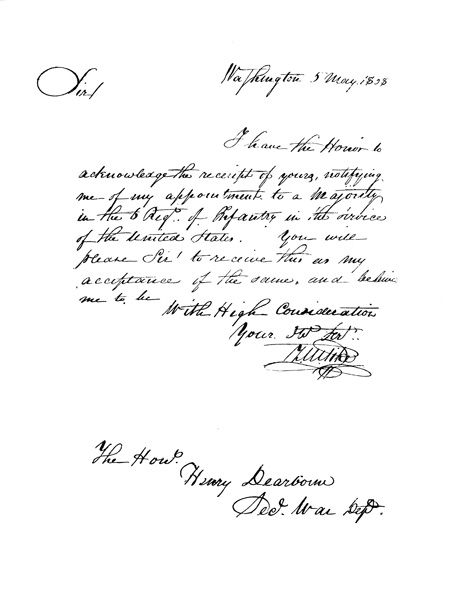
the 6th Infantry, of date May 3d, 1808, was acknowledged
by him in the following letter, which I have also chosen as
the one to be reproduced in facsimile for the present work:
Washington 5 May. 1808
Sir
I have the Honor to acknowledge the receiipt of yours, notifying me of
my appointment to a Majority in the 6th Regt. of Infantry in the Service
of the United States. You will please Sir! to receive this as my acceptance
of the same, and believe me to be
With High Consideration
Your Obt. Sert.
[Signed] Z. M. Pike
The Honl.
Henry Dearborne
Sec. War Dep.
Among other things which had engaged Major Pike's
attention was of course his book—that story of his adventures
which he had fondly dreamed would immortalize
his name, and respecting which his dream was realized.
He had already made such progress in his literary work
that he entered into official correspondence with the
Secretary of War on that subject. For instance:
Washington, 14th, April 1808.
Sir:—
[A two-page letter concluding thus:]
I shall in a day or two address an unofficial letter to the President,
requesting the favour of his advice, on the Subject of the publication of
my Voyages, on which, he having read them, in Manuscript, will be a
Competent Judge—In this I shall speak as having the permission of your
Department for the publication.—
I am Sir,
with great Consideration,
Your obt. servt.
[Signed] Z. M. Pike Captain.
The inside history of books which the world will not let
die is always interesting. Here is a letter which speaks for
itself:
Philadelphia 27 May. 1808.
Dr. Sir!
I have entered into an agreement with the firm of Conrad, Lucas &
Co of this place to print and publish my Tours, for which I allow them 20
pr. Cent on all the sales, and pay besides the expences of printing &c.—This,
with bad debts and other Casualties will leave to myself but an
extreame small profit but as a soldiers views are more Generally directed
to fame than interest I hope that one object will at least be accomplished.—The
Work will not exceed four dollars pr. Copy but the exact price
we cannot yet ascertain but hope Genl. Dearborne will give it all the
patronage which he may deem it entitled to; and Signify to Messrs.
Conrad and Lucas the number of Copies you will take on ac of your Department.
I have taken the Liberty of encloseing under cover to you a
letter addressed to Nau [the draughtsman] which the Secy can read, and
if he does not wish to retain that man, in the Service of the Goverment
at the present time he will be good enough to have the letter presented
to him, and should the Goverment wish his services in the Autumn or
after he has done my business he can return to Washington: But if he
cannot be spared by the Departt. the letter can be distroyed look out for
another person—
I beg leave to remind the Secy of War of the applications which have
been made in favour of my friend Docr. Robinson—and hope he may yet
be brought in for a Company Vice some one who did not accept.
Will Genl. Dearborne accept of my sincere acknowledgements for
the many favours he has conferred on me and believe me to be with
sincere respect and Esteem.
His obt Sert
[Signed] Z M Pike
The War Department proved to be a liberal subscriber;
for General Dearborn indorsed the above in his own handwriting,
"We will take 50 copies."
Matters thus being satisfactorily arranged for the publication
of his book, Major Pike seems to have returned at
once, or very soon, to military duty in his new rank—unless
he went to see his wife on leave of absence. We find him
at Belle Fontaine in August of this year, as evidenced by a
letter I will transcribe in part, epitomizing the rest:
Camp Belle Fontain—
18 Augt. 1808.
Sir!
Col. Hunt[M-14] deceased last night at half past 12 O. C. after an illness of
some weeks—He has left a distressed widow and nine children unprovided
for, and unprotected. [The letter recommends military appointments
for Col. Hunt's two sons, George and Thomas; states that the
command of the district has devolved on Capt. James House of the
artillery; that Capt. Clemson's company of the 1st Infantry had
marched 10 days before for Fire Prairie, 25 miles up the Missouri, and
Capt. Pinckney's company was to march in about 10 days for the Des
Moines r., which would leave only one company of artillery at Belle
Fontaine; wishes to know when he shall have definite orders to join his
battalion in New Jersey; expects to be at Pittsburgh next October;
and continues:] which is my anxious wish as from appearances we shall
again have to meet the European Invaders of our country and if I know
myself, I feel anxious to have the honor of being amongst the first to
rencounter their boasted phalanx's—and to evence to them that the sons
are able to sustain the Independence handed down to us by our Fathers
[Signed] Z. M. Pike, Majr.
6th Regt Inf
Before the year closed Major Pike had come East, and
found his hands full, no doubt, in presenting to Congress
the claims of himself and his men to the generous consideration
of that body, in the little matter of an appropriation
for their benefit. Those who have ever had occasion
to cool their heels in the halls of greatness, till the mercury
of their hopes congealed in the bulbs of their thoroughly
refrigerated boots, will best appreciate Pike's plight. The
novelist's realism of little Miss Flite in Chancery is out-realized
in the Bleak House on Capitol Hill, which William
McGarrahan haunted for a lifetime, and from which his
injured ghost may not yet be freed. The following letter
was written when Pike had not lost hope:
Capitol Hill, 2 Decemr. 08.
Sir
I am informed by Mr. Montgomery that some members of the committee
(on the resolutions moved in favour of my late exploreing parties)
wish to have our members officially notified; and the time we were employed
in each Expedition, which information you requested from General
Wilkinson—Inclosed you have a return of the party on each tour
and the commencement & expiration, but as all the intervening time between
my return from the source of the Mississippi to our departure to
the West we were employed in prepareing for the second tour; I submit
to your Judgment whether the whole should not be engrossed—Also
there being a number of men still in new Spain the time will necessarily
be extended to them. [This matter makes chap. vi., pp. 840-855,
beyond.]
The Committee meet to-morrow morning will Genl. Dearborne have
the goodness to furnish them with the necessary information by that
time—I would have waited on you personally but am this day to set on
General Court Martial which convenes at 9 OC. A. M.
I am Sir with High Respect
& Esteem your ob. sert
[Signed] Z M Pike Majr.
6 Regt Infy
The Honl.
Henry Dearborne
Sec W. Dept.
Nothing came of this move. Pike was less fortunate than
Lewis and Clark. The difference did not all depend upon
merit; simply, he had no political "pull." His expeditions
originated with General Wilkinson; they were military
movements with which the President had nothing to do.
Jealousy is the most nearly universal of human weaknesses,
in high as well as low places; besides which, Thomas Jefferson
had his own opinion of James Wilkinson. Whatever
Major Pike may have thought of it, he certainly lost little
time in dancing attendance on Congress; he was not built
for a lobbyist. In Dec., 1808, we find him on military duty
at Fort McHenry, Md., as appears from various official letters
of his before me, but which need not be transcribed, as
they represent merely the routine correspondence of an
army officer. At some period in 1809 he was transferred to
the West; and he was on duty as military agent in New
Orleans from Sept. 13th, 1809, to Mar. 10th, 1810, or later,
by virtue of the following order:
Camp Terre au Bœuf,
Sept. 13th. 1809—
Sir
The Situation of the public service and the impossibility of finding a
suitable Character in private life to undertake the temporary duties of
Military Agent, Obliges me to impose that Office on you.... [instructions
follow.]
[Signed] J. Wilkinson
Majr. Z. M. Pike
During his tour of duty in New Orleans Major Pike became
lieutenant-colonel of the 4th Infantry Dec. 31st, 1809.
One of Lieutenant-Colonel Pike's letters shows that he did
not forget "Baroney," his quondam companion in arms on
the Arkansaw:
New Orleans
March 4th. 1810
Sir
Ensign Vasquez of the 2d Infantry who was late Interpreter on the
tour of Discovery to the source of the Arkansaw &c presented himself to
me at this place. After being three years in the United States service
without receiving any settlement I made a statement of his accounts and
gave him an advance in Cash and a draft for the balance, in order that
if the form of settlement did not meet your approbation they might be
corrected. He has been absent going on four years, and begs permission
to return to St Louis to see his Aged parents, which I hope will be
granted him by the Honl. Secretary of War. The French language is
his proper one; but he speaks Spanish very well, and is beginning with
the English, but very imperfectly as yet. Under those circumstances I
should conceive his services would be most important on the Spanish
Frontiers. As he is about to embark for the City of Washington, I shall
furnish him with a duplicate of this letter, and remain Sir, with
the highest Respect & Esteem
Your Obdt. Servt.
Z. M. Pike
The Honl William Eustis
Secretary War Department
There is little to mark Lieutenant-Colonel Pike's career in
1810-11, or until the breaking out of the war of 1812.
From many letters I have seen by which he can be traced
in these years, uneventful for him, I select one which shows
the workings of his mind at this time, as well as his readiness
to ventilate the views which he entertained. Characters
such as his have visions which they may freely express
without carrying conviction to others. The following communication
was received at the War Department from
Mississippi Territory:
Cantonment, Washington June 10, 10
Sir
Although, it may be deemed unmilitary in me (a Subordinate in Command)
to address myself immediately to the War Department yet the
purport of this Communication being principally of a private nature, I
presume it will not, be deemed a great deviation from propriety.—I
entered the Army at the early age of fifteen, and have continued to
pursue my profession with enthusiasm to the present time a period
upwards of Sixteen years during which I have had every practical experience
which the times offered of becoming a Soldier.—Together with a
Careful perusal of numerous Millitary authors in the French & English
languages.—But hapily for my Country her Councils have been guided
by Such Judicious Measures; That the opportunity which I have so long
panted for, of Calling into Action, The Experience I possess, has never
Occured.—Knowing that it must be the interest of the U.S to keep at
peace with the world, and despairing of ever being Calld Into actual
service I should some time since have resignd the sword and became a
farmer, (The only proffession I can acquire) only for the unsettled state
of our foreign affairs.—Fortune has at length placed me (Through the
instrumentality of General Hampton) at the Head of the Compleatest
body of Infantry in the US.—If this Regiment should be Consolidated
and the Col. not join, I should be very happy to retain the Command and
remain in this quarter.—If not I would hope to be ordered to join my
Regiment in New England, a quarter of the Union I should be gratifyd.
in spending some time in.—Should I remain here and be permitted to
introduce the modern Discipline—into the Corps I would pledge my
existance it would be equal to any in the U S. in one year. This is a
subject of much diversity of Oppinion, as many gentlemen wish to Confine
us to Stuben.[M-15]—The value of whose system no man appreciates more
justly than myself. But the Battle of Jena but too fatally evinced to the
Prusian Monarch that the mordern improvements in the Art of War had
been such, as entirely to overturn the principles of manourvres of the
Malboroughs—Eugenes and Fredericks. The Millitary Establishment of
the United States can only be viewed as the nuclues of an Army in Case
of War, from whence Could be drawn Staff Officers well versed in tactics
and police—In the foregoing observations I mean to cast no reflections
on my superior officers;—but Conceive at the same time the Ideas may
not be deemed obtrusive On the Honl Secty of War.—Whilst makeing
this unofficial Communication I think it my duty to intimate the situation
in which the neighbouring province of Florida now stands. The Goverment
is in a Compleat state of Lethargie.—The Citizens are forrming
committees and appear to be disposed to offer their allegiance to the U
S. when if it should be refused, they will Make it a tender to Great
Britain this would have been done some time since had they not feared
the Isle of Cuba.—That Cuba is competant to keep them in Subjection
by force is extremely doubtful; But what line of Conduct the U. S will
persue on the Occasion is an important question.—our views should only
be turned to the effect our interferance would have abroad for we have
disposible force in this territory & Orleans when joined to the Malcontents
amply sufficient to secure possession of the province; But with
respect to the effect this would have on Mexico is seriously to be taken
into concideration Mexico including all the possessions of Spain North
of Terra Firma [Tierra Firme], must constitute ere long a great and
independant power of at least seven millions of souls, with more of the
precious metals than any other nation in the world will it not be an
object of the first Magnitude for the U S to secure the trade, friendship
and alliance of this people. They never will become a maratime or
manufactoring nation they are at present pastorial and On trial will
prove Warlike. I hesitate not to say they Can pour forth thousans of
Calvary surpass'd by none in the World. To this power We might
become the Carryers and Manifactories, for which no Nation Could vie
with us; which would be sources of immence Wealth.—And an Augmentation
of our power.—To this very important object I humby Conceive
a too early attention Cannot be paid—On this subject I have probaly
intruded my oppinion on Mr. Eustis, but I could not forbear giveing
those intimations which I conceived might be beneficial to my Country.—I
had a brother in the Millitary Academy from whom I have not heard for
some time should he merit the favour of his Country;—or if his Fathers
Thirty Years service or my own claim some small indulgence for him, I
hope he may be appointed an Ensign of Infantry and sufferd to join the
Regiment to which I may be attached; the latter part of this request is
not made from a desire that I may have it in my power to shew him any
favour;—far from it,—but that, I may have him near me to Restrain the
Disposition which all youths evince for irregularities. And point out to
him the paths of propriety and Honor, also that he may benefit [by] the
few years he can appropriate to study by the use of a variety of Millitary
Authors I have collected.—Such are my reasons for wishing my brother
with me. I hope this may meet the approbation of the Honbe Secrty.—And
this letter may be attributed to its true motives, and that the Honble
Secty may beleive me as I am from Duty and inclination Sincerely
devoted to my Country and his obedt
Hble Sert—
[Signed] Z M Pike
The Honl.
Wm. Eustis
Secy War Dept—
Lieutenant-Colonel Pike's "despair of ever being called
into service" was of short duration. He was soon to be
called upon to lay down his life for his country on the battlefield.
From April 3d, 1812, to July 3d of that year he
had been deputy quartermaster-general. He was promoted
to the colonelcy of the 15th Infantry July 6th, 1812. The
war was upon us. Colonel Pike's qualifications for the
command of a regiment may be best estimated in the
terms of his military biographer, General Whiting, who
says, pp. 309-311:
Probably no officer in the army, at that time, was held in higher
estimation. This was not because he had seen much actual service, for
he had hardly been in the presence of the enemy before the day on
which he fell. It was on the promise, rather than the fulfilment, that
the public mind rested his character for boldness and enterprise; and
his fitness to direct and control men had been determined, to an extent
that warranted much confidence, by his expeditions in the north-west
and the south-west. He had there given such proofs of those qualities,
as established a reputation in advance. He had exhibited, moreover, an
indefatigable activity in the drill of his regiment, requiring of all under
his command an unwearied devotion to duty, and an exact and prompt
obedience to orders.
His regiment became an example of zeal, discipline, and aptitude in
movements; his men had an unbounded belief in his capacity, and his
officers looked up to him with unusual respect and affection. He
inspired that confidence in all under his orders, which is almost a certain
evidence that it is merited.
At the opening of the war of 1812, we were almost without any
fixed guides in tactics and discipline. The standard of the latter part of
the revolution, and of subsequent times, "Old Steuben," which had been
approved by Washington, and had led to some of the best triumphs of
the closing years of that glorious period, had become obsolete, even
before any substitute was provided. Hence, when new regiments
came into service by scores in 1812, nothing was prescribed for regulation
or for drill. The old regiments had their forms and customs, which
preserved in them the aspect of regulars. But even these presented
no uniform example. Some adopted the "nineteen manœuvres" of the
English; others, the ninety-and-nine manœuvres of the French; while a
few adhered to old Dundas; and fewer still to older Steuben.
Nothing was laid down by the proper authority; therefore all manner
of things were taken up without any authority at all. Amid
this confusion, or wide latitude of choice, General Pike, though brought
up in the old school, was often tempted, by his ambitious desire for
improvement, to run into novelties. With a prescribed rule, he would
have been the most steady and uncompromising observer of it. But,
in such a competition for beneficial change, he most naturally believed
himself as capable as others of changing for the better.
In this spirit of innovation, the 15th regiment underwent many
changes, and exhibited, even in times when novelties and singularities
were no rarities, perhaps the widest departure from common standards
of any regiment in service. Adopting the French system of forming in
three ranks, his third rank was armed in a manner peculiar to itself,
having short guns, being the ordinary musket cut off some inches, and
long pikes. It was said, by the wags of the day, that his own name
suggested the manner, and the regiment was often called "Pike's regiment
of pikes."
These pikes presented a formidable appearance on drill
and dress parade, when the men could display their tactics
with the precision of automata. They were even retained
in the assault of Fort York. But at the first engagement
after the fall of General Pike, the men threw them away,
together with the cut-off pieces, and picked up English
muskets to fight with. The experiment of putting his regiment
on snow-shoes which Pike tried—doubtless remembering
their serviceability to himself and his company on
the upper Mississippi in the winter of 1805-6—does not
seem to have proven any more lasting or decided a success.
Colonel Pike's sword was stronger than his pen, as we
know; but he could sharpen either weapon on occasion, as
the following spirited repulse of a newspaper attack on his
regiment will show:[M-16]
Camp near Plattsburg [N. Y.], Oct. 12th, 1812.
Sir:
However incompatible it may be with the character and profession
of a soldier, to enter into the party politics of the day, yet when the
honor of the government, the corps he commands, and his personal
fame are wantonly attacked, and attempted to be sacrificed to satiate the
malignant venom of party purposes, it becomes his duty as a man, a
patriot, to come forward and boldly contradict the base calumniator.
The following piece "from the Connecticut Herald" and republished in
the New York Herald of October 3d, is not only calculated to bring disrepute
on the government, but to hold up our army as a mob wanting
in discipline as well as in patriotism. The piece alluded to is as
follows, viz.:
"The multiplied proof of folly, or of madness, or some worse cause,
that have driven the nation into a ruinous, offensive war, are accumulating
with every day's experience. Barely to enumerate the evidence
would occupy columns. Two or three facts of recent occurrence, which
have come to my knowledge, are in point and worthy of record. It is
then a fact (for I state it on the best authority) that either the national
treasury is so miserably empty, or the proper department so deficient in
duty, that the army under General Dearborn, which has so long been
idling away their time near Albany, was not only unpaid, but unprovided
with the common necessaries of a camp; and when, a few days since,
a part of these troops were ordered to the frontiers, one whole regiment
(Colonel Pike's) absolutely refused, and deliberately stacked their arms,
declaring they would not move until paid. In this refusal they were
justified by their colonel, and an old soldier, who admitted they ought
not to march unless the government would first pay the arrears due
them. It fortunately happened that Mr. Secretary Gallatin was then at
Albany, and on learning the state of affairs at the encampment, he borrowed
$20,000 from one of the banks on his private credit, by which
means the troops were paid, and cheerfully followed their commander."
In contradiction to this statement it will be sufficient to give the
following facts:
[Firstly]—That the regimental paymaster had in his hands funds to
pay the whole regiment up to the 31st. And [that] within three days of
the period when the troops moved, three companies were paid previous
to the march and the balance so soon as the troops halted a sufficient
time to give the officers an opportunity to adjust the rolls and prepare
the accounts of the recruits.
Secondly—That those funds were received by the regimental paymaster
from the district paymaster, Mr. Eakins, who was then at
Albany, and not from Mr. Gallatin whom, it is believed, did not arrive till
after the regiment moved from Greenbush.
These facts can be corroborated by every officer of the 15th Infantry,
who one and all deem the paragraph published in the Herald a base
calumny, a direct attack on their honor as soldiers, and declare that the
author, whoever he may be, has asserted gross untruths. As for myself,
I have had the honor to serve in the army from the rank of volunteer to
the station I now hold, during the Administration of Gen. Washington,
Mr. Adams, Mr. Jefferson, and Mr. Madison, and can affirm that I
have known some troops under the three first to have been upward of a
year without a payment, and under the latter for eight months. This
was owing to the dispersed state of our troops on the western frontiers.
But never did I hear of a corps shewing a disposition to refuse to do
their duty, because they had not received their pay; nor do I believe the
American army has been disgraced by an instance of the kind since the
Revolutionary War. But ask any man of consideration, what time it
requires to organize an army, or a corps of new recruits—if, owing to the
want of a knowledge of the officers to forms of returns, accounts, etc., it
will not be some time before a new corps can be as well equipt, or
appear as much like soldiers, as an old one? Every soldier will reply
that it will require two years at least to teach both officers and men to
reap the same benefit from the same supplies as old soldiers. And
although at this time the 15th regiment has been as regularly supplied
as any other corps with clothing, pay, arms, and accoutrements, even to
watch coats to protect the centinel against the winter storms, yet were
there an old regiment laying by their side, who had received the same
supplies, they would most indubitably be better equipped and make
themselves more comfortable, having the saving of two or more years'
supplies on hand. But whether ill or well supplied, the soldiers and
officers have too just a sense of the duty they owe their country and their
own honor, ever to refuse to march against the enemy. And the colonel
begs leave to assure the author of the above paragraph, that he hopes he
will forbear any future attempt to injure his reputation by praising an
action which, if true, must have forever tarnished the small claim he now
has to a military character.
[Signed] Z. M. Pike,
Colonel 15th U. S. Infantry.
Colonel Pike seldom had occasion to make proclamations
of a politico-military character. But one such which he
issued while he was in command of a district may be here
cited. It is not dated, in the printed form before me, but
was no doubt given out in Jan., 1813, as it appears in Niles'
Register for the week ending Jan. 30th, III. No. 22,
p. 344:
To all whom it may concern. The state of hostility which exists between
the Kingdom of Great Britain and the United States makes it necessary
that the intercourse which may take place between this country and
the adjacent province of Canada should be regulated on the principles
which govern belligerent nations. I have had it in charge from the commanding
general, Chandler [John Chandler, of New Hampshire, d. 1841]
that no person should be permitted to pass in or out of Canada without
his permission, or, in his absence, the permission of the commandant of
the district of Champlain. This order has been communicated to the
commanding officer on the lines, and will be strenuously enforced.
Some members of the community have been found so void of all sense
of honor, love of country, or any other principle which has governed the
virtuous of all nations and ages, as to hold correspondence with and give
intelligence to our enemies. It therefore becomes my duty to put the
laws in full force. The two following sections of the rules and articles
of war, which are equally binding on the citizen and the soldier, are published
for the information of the public, that no one may plead ignorance,
as from this time henceforward they shall be enforced with the greatest
severity.
"Art. 56. Whosoever shall relieve the enemy with money, victuals, or
ammunition, or shall knowingly harbor or protect an enemy shall suffer
death, or such other punishment as shall be ordered by the sentence
of a court-martial.
"Art. 57. Whosoever shall be convicted of holding correspondence
with, or giving intelligence to, the enemy, either directly or indirectly,
shall suffer death, or such other punishment as shall be ordered by the
sentence of a court-martial."
[Signed] Z. M. Pike, Col. 15th Regt. Inf.
Commanding West Lake Champlain.
During the winter of 1812-13, when the 15th regiment
was stationed on the northern frontier, in view of the operations
to be undertaken against the posts of the enemy on
the lakes, great confidence in this well-disciplined and zealous
body of troops was felt by General Henry Dearborn,
formerly secretary of war, and then the senior major-general
of the army, in immediate command. As we have just seen,
General Pike was in charge of a military district on Lake
Champlain; his command was then of about 2,500 men.
Various desultory demonstrations against the enemy had
proved futile, in some cases fatuous and disgraceful. The
War Department determined upon a more consistent and
apparently feasible plan of concerted operations, which had
in view the reduction of all the British posts on the St.
Lawrence river and Lake Ontario. The capture of Kingston
(site of old Fort Frontenac) was a measure of first importance.
The garrison was supposed to be small, and lulled
in a sense of security, owing to the rigors of the season and
the numerical insignificance of our troops at Sackett's Harbor;
nor was Kingston likely to be re-enforced from below,
as the British forces were menaced on the Lower St. Lawrence
by Pike's troops on Lake Champlain. It was proposed
to transport these in sleighs to the foot of Lake
Ontario with such promptitude that the movement could
not be counteracted. General Dearborn also proposed to
concentrate other forces at Sackett's Harbor, to which place
his headquarters at Albany were to be moved at once. This
was in Feb., 1813. But while these measures were pending,
Sir George Prevost, Governor-General of the Canadas, prorogued
the Parliament then in session, and moved to Kingston
with re-enforcements for that place. According to
General Dearborn's dispatches of Mar. 3d from Sackett's
Harbor, this demonstration seemed so alarming that operations
against Kingston were suspended in favor of others
which had regard to the safety of Sackett's Harbor; though
it appears in General Armstrong's History of the War that
Sir George Prevost had executed a clever ruse with few
troops, and "countervailed his antagonist only by dexterous
and well-timed reports," Whiting's Pike, p. 290 seq.
The proposed attack on Kingston over the ice having
been abandoned, the Secretary of War's alternative plan of
reducing in succession the several posts on and about Lake
Ontario engaged General Dearborn's attention. The Secretary
indicated the order in which the successive attacks
were to be made, viz.: Kingston and York on Lake Ontario;
George and Erie on the Niagara river. But this sequence was
not strictly regarded by General Dearborn, who determined
to attack Kingston last instead of first; considering the rotation
of the assaults to be of minor consequence, in view of
the main features of a campaign which had for its object
the reduction of all the posts named in the order of the
Secretary. The general commanding, on consultation with
Commodore Isaac Chauncey, concluded to make York
the initial point of attack; George to come next, and then
Kingston.
The prospect held out by this plan of the campaign was certainly
very promising. It had all such probabilities in its favor as could be
commanded by those who control only one side of the current of events.
The force that could and would be brought to bear on each point of
attack was ample, and left as little to hazard as prudence would suggest.
The plan was founded on the best principles of strategy, and highly
creditable to the generalship which dictated it. Had it been carried out
with the spirit and perseverance with which it was commenced, there
was every reasonable prospect of a successful issue. The causes of its
failure were obvious: delays, without proper objects, after the capture of
Fort George; and a change of command, wholly unnecessary and inexpedient,
which led to the waste of nearly an entire season of inactivity
(Whiting, p. 297).
As noted by this military critic and historian, General
Dearborn was relieved from command early in July, 1813,
his successor being enjoined to rest on his arms, except in
the event of certain improbable contingencies which never
arose, until the arrival of General Wilkinson, who did not
reach Fort George until September, or resume operations
until Oct. 1st; so that "nearly three months were utterly
wasted by a body of 4,000 troops."
But I have digressed from the attack on Fort York, with
which alone are we here concerned.
In the latter part of April, 1813, the navigation of Lake
Ontario was open, and no molestation was apprehended, as
it was known that Sir James Yeo's fleet was not operative.
Agreeably with the plan of the campaign above briefly
noted, therefore, General Dearborn embarked on board Commodore
Chauncey's fleet, with about 1,700 troops, under the
immediate command of Brigadier-General Pike, Apr. 25th.
On the morning of the 27th the fleet reached York harbor,
where it was intended to debark for the assault on Fort
York. This military post defended the place which had
been known as Toronto till 1793, and was then called York
till 1834, when it resumed its aboriginal name.
The true signification of the Iroquois word which has
settled in the form Toronto, after long fluctuation of all
its vowels, is uncertain, or at any rate, is still questioned.
It is now most frequently translated "trees in the water,"
or by some equivalent phrase, with reference to the formerly
wooded, long, low spit of land which still encompasses
the harbor of Ontario's metropolis. Irrespective of its etymology,
the various connotations of Toronto in successive
historical periods are to be carefully discriminated. If we
turn to old maps, we see that the present Georgian bay of
Lake Huron was Toronto bay; the present Lake Simcoe
was Toronto lake; present Severn river and the Humber
were each of them Toronto river. In the seventeenth
century, Toronto was the official designation of a region
between Lake Simcoe and the Georgian bay—the country
of the Hurons, on the large peninsula which intervenes
between Lake Huron and Lake Ontario. The comparatively
narrow neck of this peninsula offered, by means of
Humber river and certain portages, a convenient way to
pass between these two great lakes—it was, in fact, an
Indian thoroughfare. The mouth of the Humber consequently
became an Indian rendezvous, and the name of the
whole region thus became best known in connection with
the locality of the present city. As the southern terminus
of this highway, on Lake Ontario, offered an eligible site
for a trading-post, advantage was taken of such an opportunity
to cut off trade from Chouagen (Oswego) by planting
the original establishment of the Whites near the mouth
of the Humber. Such was the French Fort Rouillé, built
in 1749, and named in compliment to Antoine Louis
Rouillé, Comte de Jouy, then colonial minister. This post
was destroyed in 1756, to prevent it from falling into the
hands of the English. It became better known as Fort
Toronto than it had been by its proper French name, and
later on passed into history as Old Fort Toronto, in distinction
from the two other establishments to which the
name was successively bequeathed. Fort Rouillé, by whatever
name called, was never lost sight of entirely. Lossing's
Field Book of the War of 1812, New York, 1868, p. 593, has
a cut which shows its appearance when it had been to some
extent renovated in 1812-13. The exact site is now marked
by a monument, lying alongside which is an inscribed stone.
These memorials are pointed out to visitors, on the lake
shore, in the southwest corner of the present Exposition
grounds, on the western side of the city of Toronto. After
the abandonment of old Fort Rouillé the region round
about remained for nearly half a century a wild whose solitude
may have been only relieved by the lodges of a few
Misisagas—those Indians of Ojibwa affinities who had
become members of the Iroquois confederation in 1746,
three years before the fort was built. In 1791, Upper and
Lower Canada were instituted by parliamentary measures
which Pitt guided to success; the latter was practically the
province of Quebec; the former became the province of
Ontario, the refuge and future home of the United Empire
Loyalists. For the capital of Ontario, a site was to be
chosen in then unbroken wilds. The first provincial Parliament
of the new province of Upper Canada was held in
May, 1793, at Newark, the present town of Niagara, where
the river of that name enters Lake Ontario. But this place
was ineligible; the river became an international boundary;
the guns of the United States Fort Niagara could be
trained upon Newark; and in August of the same year the
seat of government of the new province was transferred to
the new site which had been surveyed to that end by
Bouchette, and selected for the purpose by General and
Governor John Graves Simcoe (b. Feb. 25th, 1752, d. Oct.
6th, 1806). To this place Simcoe gave the name of York,
after the duke, second son of George III. The evolution
of this embryo of future greatness was slow; for many
years "Little York," or "Muddy York," as it was styled
by some in derision, had but a few hundred inhabitants;
its maintenance was mainly due to the United Loyalists
already mentioned. In April, 1813, the works by which
York was defended, and which General Pike carried by
assault, were those called Fort York; later they were
known as Fort Toronto, or "the Fort at Toronto." The
town which Simcoe had christened York did not resume
the original designation of the locality till 1834, when it
was incorporated as the city of Toronto.
This magnificent metropolis, which so admirably illustrates
the effect of American momentum upon English
stability, is situated upon the north side of Lake Ontario,
39 miles northeast of Hamilton (which occupies the fond
du lac) and 310 miles west-southwest of Montreal; at the
observatory the position is calculated to be in latitude 43°
39´ 35´´ N. and longitude 79° 23´ 39´´ W. of the Greenwich
meridian. The city extends westward from the vicinity of
the Don in the direction of the Humber, across the small
stream known as Garrison creek. It thus has several miles
of lake front on the south, at the bay or harbor of Toronto,
partly shut off from the lake by low land which was once
a peninsula, and some small islands, with an entrance only
from the west; but the peninsula has been artificially cut
off from the mainland. At its end stood a blockhouse, in
a position known as Gibraltar point; another blockhouse
stood at the mouth of the Don, on the left or east bank of
that river. One now drives a few blocks from any hotel in
the heart of the city to "old" Fort York, at present dismantled,
but very much in evidence still of the scene of
General Pike's victory and mortal hurt. The visitor will be
warned off the premises by the functionary who has these
disjecta membra in charge, as Lossing had been before I
was; but may nevertheless keep on the main street or road
through the frowning earthworks, and will presently find
himself on Garrison Common. This is the large level piece
of ground, the middle of the lake front of which is occupied
by the present barracks, or "new fort." At points
included within the present garrison and parade ground
were the positions of two outer defenses of old Fort York,
respectively called at that time the Western and the Half
Moon battery; these were the first and second obstacles
for Pike to surmount in advancing upon the main defenses
of York. Crossing Garrison Common in a few minutes we
enter the Exposition grounds, at the further corner of
which, to the left, and directly upon the lake shore, stand the
Rouillé monument and inscribed cairn already mentioned,
together with a historical cabin; a pier juts into the lake
close by these objects. The direct distance between the
Rouillé monument and old Fort York is about 6,000 feet—little
over a mile by the road; the present barracks are
nearly midway between those two places. Old Fort York
occupies a position about the mouth of Garrison creek,
between Front Street and the water's edge, at the foot of
Tecumseh Street, and close to Queen's Wharf, in the midst
of railroad tracks, freight houses, and depots. The magazine,
which was exploded at the cost of many American and
some British lives, stood in a depression at or near the
mouth of the creek, with its top nearly on a level with
higher ground on either hand; it is said that its existence
was not suspected by the enemy. It was a comparatively
large structure of its kind, solidly built of heavy stone
masonry, and contained a great quantity of powder, shot,
and shell. All the positions here in mention may be inspected
in a leisurely drive of an hour. Those who have
not been over the ground, or have not a city map at hand,
will be helped to a clear understanding of the situation by
the diagram given in Lossing, p. 590; together with the
sketches there given of York, of Fort York, of the magazine
which was blown up by General Sheaffe's order, and of
the Western battery whose explosion was accidental. Of
the latter, the picture represents the remains as they were
in 1860.
The conflicting accounts of uninformed, unconsciously
biased, or willfully mendacious writers have shrouded in
obscurity the clear and intelligible relation which can be
given of the battle of York. Especially have the two
explosions which occurred during the assault been confounded
and falsified in history. It is necessary, at the outset,
to dissociate in mind these two catastrophes, namely:
(1) The accidental explosion of a portable magazine at the
Western battery during the advance of the Americans upon
the main works. (2) The intentional explosion of the fixed
magazine during the retreat of the British from the main
works. The latter was somewhat premature, owing to overmuch
zeal of the soldier who had been ordered to fire the
train; but it was premeditated.
A diligent comparison of many different descriptions of
the battle of York has satisfied me that the account in
Whiting, Pike's most formal biographer, leaves much to be
desired, and that Lossing's relation is decidedly preferable
in most particulars. The latter gives, on the whole, the
clearest and truest picture which any modern historian has
painted. Lossing consulted the official reports of the
commanders, both British and American; the accounts
given by Thompson, Perkins, James, Auchinleck, Armstrong,
Christy, Ingersoll, and others; Whiting's Biography
of Pike; Hough's County histories; Roger's Canadian History;
Smith's Canada; Cooper's Naval History; Niles'
Register; the Portfolio; the Analectic Magazine; he had
some manuscripts of actors in the scene, besides various
verbal relations; and he went over the ground in person.
In the following sketch I shall lean more heavily upon
Lossing than upon Whiting; but for numerous particulars
shall refer back of both to contemporaneous records and
official reports, on both sides. I shall also adduce a certain
obscure author, P. Finan, who is among those who witnessed
the fight, and who describes what he saw in his
little-known Journal of a Voyage to Quebec in the Year
1825, with Recollections of Canada during the late American
War in the Years 1812-13, Newry, printed by Alexander
Peacock, 1828. H. A. Fay's Collection of Official Documents,
etc., 1 vol., 8vo, New York, 1817, gives General Dearborn's
and Commodore Chauncey's reports to the Secretary of
War and of the Navy, respectively, and the terms of the
capitulation after the capture. Brannan's Official Letters,
etc., 1 vol., 8vo, Washington, 1823, gives in full Pike's vigorous
and rigorous brigade order, pp. 144-146; the reports
said of Dearborn and of Chauncey; and various other
items. These and many other materials are also contained
in earlier form in Niles' Weekly Register, IV. Mar.-Sept.,
1813. What here follows is derived mainly from the
sources I have thus indicated, but also includes a certified
copy of the most important one of the original Sheaffe documents
in the Archives of Ontario at Ottawa.
General Pike's brigade order for the attack on York
appears as follows in Niles' Register, IV. pp. 229, 230:
Sackett's Harbor, April 25, 1813.
Brigade Order. When the debarkation shall take place on the
enemy's shore, Major Forsyth's light troops, formed in four platoons,
shall be first landed. They will advance a small distance from the shore,
and form the chain to cover the landing of the troops. They will not
fire unless they discover the approach of a body of the enemy, but will
make prisoners of every person who may be passing, and send them to
the general. They will be followed by the regimental platoons of the
first brigade, with two pieces of Brooks' artillery, one on the right and
one on the left flank, covered by their musketry, and the small detachments
of riflemen of the 15th and 16th Infantry. Then will be landed
the three platoons of the reserve of the first brigade, under Major Swan.[M-17]
Then Major Eustis, with his train of artillery, covered by his own
musketry. Then Colonel M'Clure's volunteers, in four platoons, followed
by the 21st regiment, in six platoons. When the troops shall move in
column, either to meet the enemy or take a position, it will be in the following
order, viz.: First, Forsyth's riflemen, with proper front and flank
guards; the regiments of the first brigade, with their pieces; then three
platoons of reserve; Major Eustis' train of artillery; volunteer corps;
21st regiment; each corps sending out proper flank guards. When the
enemy shall be discovered in front, the riflemen will form the chain, and
maintain their ground until they have the signal (the preparative) or
receive orders to retire, at which they will retreat with the greatest
velocity, and form equally on the two flanks of the regiments of the first
brigade, and then renew their fire. The three reserve platoons of this
line under the orders of Major Swan, 100 yards in the rear of the colors,
ready to support any part which may show an unsteady countenance.
Major Eustis and his train will form in the rear of this reserve, ready
to act where circumstances may dictate.
The second line will be composed of the 21st Infantry in six platoons,
flanked by Colonel M'Clure's volunteers, equally divided as light troops.
The whole under the orders of Colonel Ripley.[M-18]
It is expected that every corps will be mindful of the honor of the
American arms, and the disgraces which have recently tarnished our
arms; and endeavor, by a cool and determined discharge of their duty,
to support the one and wipe off the other. The riflemen in front will
maintain their ground at all hazards, until ordered to retire, as will every
corps of the army. With an assurance of being duly supported, should
the commanding general find it prudent to withdraw the front line, he
will give orders to retire by the heads of platoons, covered by the riflemen;
and the second line will advance by the heads of platoons, pass
the intervals, and form the line, call in the light troops, and renew the
action. But the general may find it proper to bring up the second line
on one or both flanks, to charge in columns, or perform a variety of
manœuvres which it would be impossible to foresee. But as a general
rule, whatever may be the directions of lines at the commencement of
the action, the corps will form as before directed. If they then advance
in line, it may be in parallel eschelons of platoons, or otherwise, as the
ground or circumstances may dictate.
No man will load until ordered, except the light troops in front until
within a short distance of the enemy, and then charge bayonets; thus
letting the enemy see that we can meet them in their own weapons. Any
man firing or quitting his post without orders, must be put to instant
death, as an example may be necessary. Platoon officers will pay the
greatest attention to the coolness and aim of their men in the fire; their
regularity and dressing in the charge. Courage and bravery in the field
do not more distinguish the soldier than humanity after victory; and
whatever examples the savage allies of our enemies may have given us,
the general confidently hopes that the blood of an unresisting or yielding
enemy will never stain the weapons of the soldiers of his column.
The unoffending citizens of Canada are many of them our own
countrymen, and the poor Canadians have been forced into the war.
Their property must therefore be held sacred, and any soldier who shall
so far neglect the honor of his profession as to be guilty of plundering
the inhabitants, shall, if convicted, be punished with death. But the
commanding general assures the troops that, should they capture a large
quantity of public stores, he will use his best endeavors to procure them
a reward from his government.
This order shall be read at the head of each corps and every field
officer shall carry a copy, in order that he may at any moment refer to
it; and give explanations to his subordinates.
All those found in arms in the enemy's country, shall be treated as
enemies; but those who are peaceably following the pursuits of their
various avocations, friends—and their property respected.
By order of Brigadier-general Z. M. Pike.
Charles G. Jones,[M-19]
Assistant aid-de-camp.
Of quite another character than the foregoing order is the
next word which reaches us from General Pike—probably
from the last letter he ever wrote. It is always the soldier,
but now the son and not the officer who speaks, in this
letter addressed to his father. The extract is undated and
unsigned, but was penned at Brownsville, near Sackett's
Harbor, on the day before the expedition sailed from the
latter place. I cite from Niles' Register of Saturday, July
10th, 1813, p. 304, these affecting passages:
"I embark to-morrow in the fleet at Sackett's Harbor, at
the head of a column of 1,500 choice troops, on a secret
expedition. If success attends my steps, honor and glory
await my name—if defeat, still shall it be said we died like
brave men, and conferred honor, even in death, on the
American name.
"Should I be the happy mortal destined to turn the
scale of war, will you not rejoice, O my father? May
Heaven be propitious, and smile on the cause of my
country. But if we are destined to fall, may my fall be
like Wolfe's—to sleep in the arms of victory."
His aspiration was answered, for he turned the scale of
war; his dream of glory came true, for he fell asleep, like
Wolfe, in the arms of victory!
Commodore Isaac Chauncey's fleet, which conveyed the
American troops from Sackett's Harbor to York, consisted
of 14 vessels: the Madison, flagship; Oneida, Fair American,
Hamilton, Governor Tompkins, Conquest, Asp, Pert,
Julia, Growler, Ontario, Scourge, Lady of the Lake, and
the transport Raven.
On that fateful 27th of April, 1813, about seven o'clock in
the morning, when this fleet had reached York, the intention
was to land the troops at old Fort Rouillé, whence the
advance to the assault of Fort York would have been only
about a mile, along the lake front, over the level ground of
present Garrison Common. But a strong east wind drove
the boats "a considerable distance" leeward, to some
wooded point in the direction of the Humber. Exactly
how far this was does not appear; but there is evidence
that it was not more than some fraction of a mile—probably
not as far west of Fort Rouillé as the latter was west of
Fort York. General Dearborn says, "about a mile and
a half" from Fort York, which would be about half a mile
west of Fort Rouillé; and the place called Grenadier Point
has been named in this connection. Doubtless the whole
of the troops were not landed at precisely the same spot.
General Dearborn remained with the fleet, which was to
bombard York after landing the troops under the command
of General Pike. The former's official report to Hon. John
Armstrong, Secretary of War, dated Headquarters, York,
Upper Canada, Apr. 28th, 1813, includes this passage
(Brannan, p. 149):
I had been induced to confide the immediate command of the troops
in action to General Pike, from a conviction that he fully expected it, and
would be much mortified at being deprived of the honor, which he highly
appreciated.
As rendered in Niles' Register, IV. p. 179, it is to the
same effect, but somewhat differently worded:
To the general I had been induced to confide the immediate attack,
from a knowledge that it was his wish and that he would have been
mortified had it not been given to him.
We will hear from Pike himself once more before he falls.
It is before any landing has been effected. Forsyth's boats
are nearing the shore; they are fired upon from the woods,
but have not yet answered a shot. Pike is standing on the
deck of the flagship, surrounded by his staff, straining his
eager eyes impatiently at the boats, which he sees have been
driven beyond the intended point of debarkation. "'By
God! I can't stay here any longer!' and addressing himself
to his staff—'Come, jump into the boat!' which we immediately
did, the commodore having reserved a boat specially
for him and his suite; the little coxswain was ordered immediately
to steer for the middle of the fray, and the balls
whistled gloriously around; probably their number was
owing to seeing so many officers in one boat; but we
laughed at their clumsy efforts as we pressed forward with
well-pulled oars."[M-20]
The first troops which effected a landing were Forsyth's[M-21]
Rifles, conveyed in two boats. Their debarkation was
promptly resisted by a choice body of light troops from
Fort York, consisting of a company of Glengary Fencibles,
with some Indians, under Major Givens. From an advantageous
position in the woods which had been taken up, the
enemy opened a galling fire as our troops left the boats.
Concerning this opening engagement I cite Whiting, pp.
300-303:
The riflemen were formed on the bank as promptly as possible, when
the boats returned to the fleet for other troops. In the meantime, this
gallant little band, assisted by some few other troops that were thrown
on shore in other boats, sustained the brunt of the combat. The
numbers in this initial struggle were about equal, and it became a fair
and close fight, to be turned either way as re-enforcements should happen
to arrive. The British light troops were choice men, and commanded
by a brave officer.
Forsyth's men were undisciplined, but had seen some desultory service
on the Ogdensburg frontier, and had unbounded confidence in their
leader, who was rather an extraordinary man, and regarded as a most
promising partisan officer. He had peculiar notions as to the manner
of training men. The common rules of discipline were looked upon by
him with the utmost contempt. All he seemed to require of those under
him was, that they should be good marksmen, and ready to follow
him....
At the time of this expedition, Major Forsyth was a fat man, probably
weighing some 200 pounds. The uniform of his men was green, and, at
the time he landed, he wore a broad-skirted coat of that color, which was
unbuttoned and thrown back, displaying a white vest spread over his
ample chest, that afforded a mark for an enemy equal to the chalked circle
of a common infantry target. He had on his head a broad-brimmed
black hat. Soon after the landing, the armorer of his regiment, a
favorite of both himself and his men, was killed. The skill of this man
was such as enabled him to give the rifle its most deadly character;
and the efficiency of the regiment was consequently supposed, both by
officers and men, to depend much upon him. When he fell, every man
felt as if a deed had been perpetrated by the enemy that demanded
revenge; and the whole detachment, from Major Forsyth down to the
most indifferent marksman, entered into the combat with a fierce spirit of
retaliation that, no doubt, contributed much to the obstinacy of the stand
they made, and the unusual loss sustained by the enemy immediately
opposed to them.
Taking to the woods in which the British light troops were posted, the
riflemen, after their loose manner, placed themselves behind trees, and
thus carried on the contest with their more concentrated, better ordered,
and, therefore, more exposed opponents. It is said that Major Forsyth
continued, throughout the action, to move to and fro, armed only with a
light sword, immediately in the rear of his men, pointing out with an
earnest solemnity that partook both of sorrow and anger, to one rifleman
and another, some one of the enemy, and exclaiming that he was the
man who had killed the favorite armorer. This suggestion was almost
sure to be fatal to the enemy thus specially branded with the guilt of
having taken off the best man of the corps. The British light troops
were nearly all left on the ground they first occupied, being too strong to
retreat while the landing was only partially made, and too much exposed
to stand before such expertness of aim, rendered so fierce and unyielding
by one of the chance shots of an opening fight.
The force under Forsyth was soon supported by Major
King's[M-22] battalion of the 15th Infantry, consisting of three
companies—Captain John Scott's, Captain White Youngs',
and that of Captain John Lambert Hoppock, who had been
mortally wounded in the boats. When General Pike had
landed with the whole body of his troops, the attacking
force was represented by the 6th, 15th, 16th, and 21st Infantry,
Colonel Maclure's 3d regiment of New York Militia,
and several pieces of artillery.
At the first sharp collision, as we have seen, the British
were defeated, not without much loss on both sides. On
their retreat, the bugles sounded the advance, and the
troops pressed forward along the lake shore toward Fort
York, which was meanwhile bombarded from the fleet.
One of General Pike's staff says: "Our march was by the
lake road in sections, but the route was so much intersected
by streams and rivulets, the bridges over which had been
destroyed by the enemy as they retreated, that we were
considerably retarded in our progress. We collected logs,
and by severe efforts at length contrived to pass over one
field piece and a howitzer, which were placed at the head of
our column, in charge of Captain Fanning[M-23] of the 3d Artillery;
and thus we proceeded through a spacious wood, as
we emerged from which we were saluted by a battery of 24-pounders.
The general then ordered one of his aids (Fraser)
and a sergeant to proceed to the right of the battery, in
order to discover how many men were in the works. We
did so, and reported to him the number, and that they were
spiking their own guns. The general immediately ordered
Captain Walworth of the 16th [sic] with his company of
grenadiers to make the assault. Walworth gallantly ordered
his men to trail arms and advance at the accelerated pace;
but at the moment when they were ordered to recover and
charge the enemy, the enemy broke in the utmost confusion,
leaving several men wounded on the ground which they
abandoned."
This first serious obstacle to Pike's advance was the
Western battery already described, p. lxxvii, where the explosion
occurred before Captain Walworth[M-24] could carry out
the order to charge this work. This accident caused some
loss of life to the defenders, but none to the assaulters.
Lossing has, concerning it:
The wooden magazine of the battery, that had been carelessly left
open, blew up, killing some of the men, and seriously damaging the defences.
The dismayed enemy spiked their cannon and fled to the next,
or Half Moon battery. Walworth pressed forward, when that, too, was
abandoned, and he found nothing within but spiked cannon. Sheaffe
and his little army, deserted by the Indians, fled to the garrison near the
governor's house, and there opened fire upon the Americans. Pike
ordered his troops to halt, and lie flat upon the grass, while Major
Eustis,[M-25] with his artillery battery, moved to the front, and soon silenced
the great guns of the enemy.
Finan is more circumstantial in describing the casualty
which did so much to decide the fate of the day:
While this part of our force was contending with the enemy in the
woods, an unfortunate accident occurred in the battery opposed to the
fleet which proved a death blow to the little hope that might have been
entertained of a successful issue to the proceedings of the day. A gun
was aimed at one of the vessels, and the officers, desirous of seeing if the
ball would take effect, ascended the bastion: In the meantime the artilleryman,
waiting for the word of command to fire, held the match behind
him, as is usual under such circumstances; and the traveling magazine,
a large wooden chest, containing cartridges for the great guns, being
open just at his back, he unfortunately put the match into it and the
consequence, as may be supposed, was dreadful indeed! Every man in
the battery was blown into the air, and the dissection of the greater
part of their bodies was inconceivably shocking! The officers were
thrown from the bastion by the shock, but escaped with a few bruises;
the cannons were dismounted, and consequently the battery was rendered
completely useless.
I was standing at the gate of the garrison when the poor soldiers who
escaped the explosion with a little life remaining, were brought in to the
hospital, and a more afflicting sight could scarcely be witnessed. Their
faces were completely black, resembling those of the blackest Africans;
their hair frizzled like theirs, and their clothes scorched and emitting an
effluvia so strong as to be perceived long before they reached one. One
man in particular presented an awful spectacle: he was brought in a
wheelbarrow, and from his appearance I should be inclined to suppose
that almost every bone in his body was broken; he was lying in a powerless
heap, shaking about with every motion of the barrow, from which
his legs hung dangling down, as if only connected with his body by
the skin, while his cries and groans were of the most heart-rending
description.
Although Spartan valour was evinced by our little party, it proved unavailing
against the numbers that pressed them upon all sides; and in
consequence of the loss of the battery, and the reduction that had been
made in the number of our troops, their ground was no longer tenable;
but after nobly and desperately withstanding their enemies for several
hours, a retreat towards the garrison became inevitable, although every
inch of the ground was obstinately disputed.
It is remarkable that Whiting's relation of the attack has
nothing about this marked affair; it is in fact impossible to
follow the course of events in his narrative, between the
conclusion of the opening engagement and the final explosion
of the main magazine. Lossing, having brought
our troops to a halt, when they were lying upon the grass,
continues with the result of Major Eustis' operations:
The firing from the garrison ceased and the Americans expected every
moment to see a white flag displayed from the blockhouse in token of
surrender. Lieut. Riddle[M-26] was sent forward to reconnoitre. General
Pike, who had just assisted, with his own hands, in removing a wounded
soldier to a comfortable place, was sitting upon a stump conversing with
a huge British sergeant[M-27] who had been taken prisoner, his staff standing
around him. At that moment was felt a sudden tremor of the ground,
followed by a tremendous explosion near the British garrison. The
enemy, despairing of holding the place, had blown up their powder
magazine, situated upon the edge of the water at the mouth of a ravine,
near where the buildings of the Great Western Railway stand. The
effect was terrible. Fragments of timber, and huge stones of which the
magazine walls were built, were scattered in every direction over a space
of several hundred yards. When the smoke floated away, the scene was
appalling. Fifty-two Americans lay dead, and 180 were wounded. So
badly had the affair been managed that 40 of the British also lost their
lives by the explosion.[M-28]
General Armstrong states, in his History of the War of
1812, that General Sheaffe said this explosion was accidental,
his own soldiers having been involved in its effects.
General Whiting repeats this. But both Armstrong and
Whiting are clearly in error. If General Sheaffe ever said
this, he said what he knew was untrue. His words—such
as they may have been—may have referred to the earlier
explosion at the Western battery and been mistaken to
apply to the main explosion. We have his own reiterated
writings, that the magazine was exploded by his order.
One of these statements is made in a hurried letter, whose
almost illegible handwriting betrays the state of mind to
which this gentleman had been reduced. It was written
while he was on his retreat to Kingston, and is addressed to
his superior officer, Sir George Prevost. The published
text before me reads in part as follows (italics editorial):
Haldimand, 30th April.
My Dear Sir George,—I have the mortification of reporting to you
that York is in the possession of the enemy, it having on the 27th inst.
been attacked by a force too powerful to resist with success. Sixteen
vessels of various descriptions full of men, including their new ship the
Madison, formed their flotilla. The Grenadiers of the King's suffered
first in the action with the enemy (in which Captain W. Neale was
killed), and afterwards severely, in connection with other corps, by the
accidental explosion of a battery magazine, which at the same time disabled
the battery. I caused our grand magazine to be blown up....
I am, my dear Sir George, your very faithfully devoted servant,
R. H. Sheaffe.
Another letter from General Sheaffe, dated Kingston,
May 5th, when he had become more composed in mind
than he seems to have been during his inglorious if not disgraceful
flight, gives a more coherent account and many
further details. I cite it in full, from the original MS. now
in the Department of Archives at Ottawa, as kindly copied
and certified for me by Mr. L. P. Sylvain of the Library of
Parliament:
Kingston, 5th May, 1813.
Sir,
I did myself the honour of writing to Your Excellency on my route
from York to communicate the mortifying intelligence that the Enemy
had obtained possession of that place on the 27th of April, and I shall
now enter into a fuller detail, than I was enabled to do at the date of that
letter.
In the evening of the 26th of April I received information that many
Vessels had been seen from the Highlands to the Eastward of York,
soon after daylight the next morning the Enemy's Vessels were discovered
lying to not far from the shore of the peninsula in front of the town;
they soon afterwards, sixteen in number of various descriptions, made
sail with a fresh breeze from the [p. 2] eastward, led by the Ship lately
built at Sackett's harbour, and anchored off the point where the french fort
[Rouillé] formerly stood; many boats full of troops were soon discovered
assembling near the Commander's Ship, apparently with an intention of
effecting a landing on the ground off which he was anchored: our troops
were ordered into the Ravine in the rear of the Government Garden
and fields; Major Givens and the Indians with him were sent forward
through the wood to oppose the landing of the Enemy—the Company of
Glengary Light Infantry was directed to support them, and the Militia
not having arrived at the Ravine, The Grenadiers of the King's Regiment
and the small portion of the Royal Newfoundland Fencibles
belonging to the Garrison of York were moved on, led by Lt Colonel
Heathcote of that corps, commanding the Garrison; this movement was
directed to be made within the wood, [p. 3] parallel to the Lake-side, and
only so far from it, as not to be discovered by the Enemy's Vessels, several
of which were not at a great distance from the shore: Captain
Eustace's company of the King's Regiment, and some Militia that were
quartered at the east end of the town, and had been left there during
the night, lest the Enemy might make some attempt on that flank, were
ordered, with the exception of a small party of the Militia, to join these
troops—which was soon effected: while these operations were going on
Major General Shaw, Adjudant General of Militia led a portion of the
Militia on a road at the back of the wood to watch our rear, and to act
according to circumstances; by some mistake he led the Glengary company
away from the direction assigned to it, to accompany this detachment,
so that it came late into action, instead of being near the Indians
at its commencement; the movement of the other troops was retarded
[p. 4] by the difficulty of the wood, while the Enemy being aided by the
wind, rapidly gained the shore under cover of a fire from the commodore's
ship and other vessels, and landed in spite of a spirited opposition
from major Givens and his small band of Indians; the Enemy was
shortly afterwards encountered by our handful of troops, Captain McNeal
of the King's Regiment was early killed while gallantly leading his Company
which suffered severely: the troops fell back. I succeeded in rallying
them several times, and a detachment of the King's with some Militia,
whom I had placed near the edge of the wood to protect our left Flank
repulsed a column of the Enemy which was advancing along the bank at
the Lake side: but our troops could not maintain the contest against
the greatly superior and increasing numbers of the Enemy—they retired
under cover of our batteries, which were engaged with some of their
Vessels, that had begun to beat up towards [p. 5] the harbour, when their
troops landed, occasionally firing, and had anchored at a short distance to
the westward of the line from the Barracks to Gibraltar Point; from that
situation they kept up a heavy fire on our batteries, on the Block House
and Barracks, and on the communications between them, some of their
Guns being thirty two pounders; to return their fire, we had two complete
twelve pounders, and old condemned guns without trunnions (——
eighteen —— pounders) which, after being proved had been stocked
and mounted under the direction of Lieut. Ingouville of the Royal Newfoundland
Regiment, whom I had appointed Assistant Engineer; a twelve
pounder of the same description was added during the Engagement;
with these defective means the Enemy was kept at bay for some time,
when, by some unfortunate accident, the traveling Magazine at the
Western battery blew up and killed and wounded a considerable number
of men [italics editorial]; many of them belonging to the [p. 6]
Grenadier Company of the King's Regiment, the battery was crippled,
the platform being torn up, and one of the eighteen pounders overturned:
the Magazine was replaced and the battery restored to some
order, but it was evident that our numbers and means of defence were
inadequate to the task of maintaining possession of York against the
vast superiority of force brought against it, though providentially little
mischief had hitherto been done by the long continued cannonade of
the Enemy, except to some of the buildings: the troops were withdrawn
towards the town, and the grand Magazine was at the same time
blown up [italics editorial], the Enemy was so near to it, that he sustained
great loss, and was, for a time, driven back by the explosion;
some of our own troops were not beyond the reach of fragments of the
stone, though they escaped with very little injury; Captain Loring, my
aide-de-camp, received a severe contusion, and [p. 7] the horse he rode
was killed.
The troops were halted at a ravine not far to the westward of the
ship yard, I there consulted with the Superior Officers, and it being too
apparent that a further opposition would but render the result more
disastrous, some of the Enemy's vessels indicating an intention to move
up the harbour, in order to co-operate with their land forces, I ordered
the troops of the line to retreat on the road to Kingston, which was
effected without any annoyance from the Enemy; when we had proceeded
some miles we met the Light Company of the King's Regiment
on its march for Fort George, I had sent an express the preceding evening
to hasten its movement, but it was at too great a distance to be able
to join us at York.
The ship on the stocks and the naval stores were destroyed to prevent
the Enemy from getting possession of them. [p. 8] An attempt to set
fire to the Gloucester that was fitting out for purposes of transport,
proved abortive; she was aground a mere hulk, her repairs not being
half finished: I have been informed that the enemy succeeded in getting
her off, and putting her into a state to be towed away; a number of
shipwrights having arrived from Sackett's harbour with the expectation
of employing them in a similar task on our new ship.
The accounts of the number of the Enemy landed vary from eighteen
hundred and ninety to three thousand [!], our force consisted of a Bombardier
and twelve Gunners of the Royal Artillery to assist whom men
were drawn from other corps, two companies of the 8th or King's Regiment,
one of them, the Grenadiers, being on its route for Fort George,
about a company in number, of the Royal [p. 9] Newfoundland regiment,
and one of the Glengary Light Infantry, and about three hundred
Militia and Dock Yard men; the quality of some of these troops was of
so superior a description, and their general disposition so good, that
under less unfavourable circumstances we might have repulsed the
Enemy in spite of his numbers, or have made him pay dearly for success;
as it was, according to the reports that have reached me, his loss
was much greater than ours, a return of which I have the honour of
transmitting, except of that of the Militia, of which a return has not yet
been received; but I believe it to have been inconsiderable: Donald
McLean Esqr Clerk of the House of Assembly gallantly volunteered his
services with a musket, and was killed.
[p. 10] Captain Jarvis of the Incorporated Militia, a meritorious
Officer, who had a share in the successes at Detroit and Queenston, had
been sent with a party of Militia in three batteaux for the Militia
Clothing, which had been left on the road from Kingston, he came to me
during the action to report his arrival, and soon afterwards he was
severely wounded: a few of the Indians (Missasagus & Chipeways)
were killed and wounded, among the latter were two chiefs.
Thinking it highly probable that the Enemy would pay an early visit
to York, I had remained there long beyond the period I had originally
assigned for my departure to fort George, in order to expedite the preparations
which the means in my power enabled me to make for the
defence of the place; Your [p. 11] Excellency knows that I had
intended to place Colonel Myers, Acting Quarter Master General, in the
command there, at least for a time; I afterwards learnt that Colonel
Young was in movement towards me with the 8th or King's Regt. I
then decided to give him the Command to avoid the inconvenience of
seperating (sic) the head of a department from me, and being informed
that he was to move up by himself as speedily as possible, I was for
some time in daily expectation of seeing him; at length, having reason
to believe that he was to accompany one of the divisions of his Regiment,
I wrote to him both by the land and by the water route to come
to me without delay; about the 25th of April I received certain intelligence,
of what had been [p. 12] before rumoured, that he was detained
at Kingston by a severe illness, and on the 26th I learnt that Colonel
Myers was to leave Fort George that day for York, I therefore determined
to wait for his arrival, and to leave him in the command until Colonel
Young might be in a state to relieve him; it was in the evening of
the same day that I heard of the approach of the Enemy: I have
thought it proper to enter into this explanation, as Your Excellency may
have expected that I had returned to Fort George before the period at
which the attack was made on York. I propose remaining here until I
shall have received Your Excellency's Commands.
I have the honour to be,
With great respect,
Your Excellency's
Most obedient
humble servant
[Signed] R. H. Sheaffe.
M. Gen. Command.
His Excellency
Sir. George Prevost. Bt
et. et. et.
Certified a true copy of the original letter in the Department of
Archives, Ottawa.
[Signed] L. P. Sylvain, Assist. Libr., Nov. 2d, 1894.
Here is the clear and intelligible testimony of the British
commanding general to the facts that there were two explosions,
one of which was accidental and destructive to his
own men, the other designed and executed by his own command.
It is believed to have been a little premature, in the
confusion of an evacuation that was nothing short of a rout,
before the defenders were quite out of reach of its effects;
but that they suffered little from what wrought such havoc
with the Americans, is incontestable. The ethics of the
catastrophe I leave to be discussed by professional military
critics; but it seems to me that General Sheaffe was justified
in inflicting the utmost possible injury upon the enemy, and
that he would have been chargeable with culpable neglect of
duty if he had allowed valuable munitions of war to fall into
their hands.
Before resuming the main thread of this painful narration
I will introduce two accounts, both by eye-witnesses.
One of these is contained in an extract of a letter from a
field officer in the force which landed at York, name not
given, to the War Department, as published in Niles' Register,
IV. p. 193. It is explicit regarding both explosions,
though loose in statement of numbers killed by each, and
in some other respects:
The column of attack consisted of the 6th, 15th, 16th, and 21st regiments
of infantry, and a detachment of the light and heavy artillery.
Major Forsyth's corps of riflemen, and Lieut. Col. M'Clure's corps of
volunteers acted on the flanks. There was a long piece of woods to go
through, which offered many obstructions to our heavy ordnance. As
was expected, we were there annoyed on our flanks by a part of the
British and Indians, with a six-pounder and two howitzers. One of the
enemies batteries [the Western] accidentally blew up, by which they lost
50 men of the 8th regiment. A part of our force was detached from our
column, as it came into the open ground, who carried the second battery
by storm. The troops were halted a few minutes to bring up the heavy
artillery to play on the blockhouse. General Sheaffe, despairing of holding
the town, ordered fire to be put to the magazine, in which there were
500 barrels of powder, many cart loads of stone, and an immense quantity
of iron, shells and shot. The explosion was tremendous. The
column was raked from front to rear. General Pike and his three aids,
and 250 officers and men were killed or wounded in the column. Notwithstanding
this calamity and the discomfiture that might be expected
to follow it, the troops gave three cheers, instantly formed the column,
and marched on toward the town. General Sheaffe fled and left his
papers and baggage behind him.[M-29]
Finan gives a vivid picture of what he saw of the catastrophe.
It must be taken with some allowance, perhaps,
for the force of the impression which the terrible scene
made upon him at the moment, and the subsequent insistence
with which his memory dwelt upon such a spectacle;
but it can hardly be much overdrawn:
The governor's house, with some smaller buildings, formed a square,
at the center battery, and under it the grand magazine, containing a large
quantity of powder, was situated. As there were only two or three guns
at this battery, and it but a short distance from the garrison, the troops
did not remain in it, but retreated to the latter. When the Americans
commanded by one of their best generals, Pike, reached this small
battery, instead of pressing forward, they halted, and the general sat
down on one of the guns; a fatal proceeding—for, in a few minutes, his
advance guard, consisting of about 300 men and himself, were blown
into the air by the explosion of the grand magazine.
Some time before this horrible circumstance took place, the vessels
had commenced firing upon the garrison, which obliged the females, and
children, &c. to leave it; we therefore retired into the country, to
the house of an officer of the militia, where we remained a short time;
but feeling anxious to know the fate of the day, I left the house without
the knowledge of my mother, and was proceeding toward the garrison
when the explosion took place. I heard the report, and felt a tremendous
motion in the earth, resembling the shock of an earthquake; and, looking
towards the spot, I saw an immense cloud ascend into the air. I was
not aware at the moment what it had been occasioned by, but it had
an awfully grand effect; at first it was a great confused mass of smoke,
timber, men, earth, &c. but as it rose, in a most majestic manner, it
assumed the shape of a vast balloon. When the whole mass had
ascended to a considerable height, and the force by which the timber,
&c. were impelled upwards became spent, the latter fell from the cloud
and spread over the surrounding plain. I stopped to observe the cloud,
which preserved its round shape while it remained within my view. I
then advanced towards the garrison, but had not proceeded much farther
until I discovered our little party collected in a close body between the
town and that place, which latter they had been obliged to evacuate.
It is said, "Death loves a shining mark." One of the
missiles that hurtled down on that devoted band sought out
their heroic leader with fatal effect. A piece of rock fell on
General Pike's back, and "broke in upon the very springs of
life," to use Whiting's words. A sadly realistic memento of
the speedily fatal injury reaches us from one of his aids,
who was by his side and was himself gravely wounded.
Lieutenant Fraser says, in a private letter he wrote by
Pike's special injunction, which appeared in the Aurora, and
afterward in Niles' Register, IV. p. 225: "Without the
honor of a personal acquaintance, I address you at the particular
order of the late General Pike. After he had been
mortally wounded, his words were exactly these: '...
I am mortally wounded—my ribs and back are stove in—write
my friend D... and tell him what you know of
the battle—and to comfort my ....' Some things else
he said, on which I shall again write you; and many things
he said for your ear have escaped me through the severity of
my own bruises."
The dying general was carried to a boat at the lake side
and conveyed to the Pert, whence he was taken aboard
the flagship Madison. Some recorded words of his last
moments need not be scanned with critical eye. When
those who bore their fallen leader reached the boat the
huzza of the troops fell upon his ears. "What does it
mean?" he feebly asked. "Victory!" was the reply; "the
Union Jack is coming down, General—the Stars and Stripes
are going up!" The dying hero's face lighted up with a
smile of ecstasy. His spirit lingered a few hours. Before
the end came, the British flag was brought to him. He
made a sign to place it under his head; and thus he
expired.[M-30]
Military history hardly furnishes a closer parallel than
that between the death of Pike before York and of Wolfe
before Quebec. Each led to the assault; each conquered;
each fell in the arms of victory; each is said to have
pillowed his head on the stricken colors of the defenders.
On the other hand, no contrast could be more obtrusive
than that between the fall of Brock before Queenstown
Heights and the conduct of his successor, Sheaffe, at York.
The latter fled on the heels of disaster across the Don and
on toward Kingston; even his personal baggage and papers
fell into the hands of his enemy; the very terms of the
surrender of York were agreed upon by others, in the
absence of its late defender. But it is needless to pursue
this subject. General Sheaffe has by none been more
severely criticised than by British writers.
When General Pike fell, the command devolved by seniority
upon Colonel Pearce,[M-31] of the 16th Infantry, until General
Dearborn arrived upon the scene. Lieutenant Riddle's
detachment was so near the place of explosion that it
escaped the deadly shower; but the Americans scattered
in dismay at the catastrophe. They were rallied by
Brigade-Major Hunt and Lieutenant-Colonel Mitchell of
the 3d Artillery. The column was formed again and led
into the captured town without further resistance. Colonel
Pearce sent a flag, demanding immediate and unconditional
surrender—and surrender it was, with the single stipulation
that private property should be respected. As soon as
practicable General Dearborn left the fleet for York, where
he was in command before night fell. His first dispatch to
the Secretary of War appears as follows in the text of Fay's
Collection, p. 81, and is substantially the same in Niles'
Register, IV. p. 178:
Headquarters, York, Capital of U. C.
April 27, 1813—8 o'clock, P. M.
Sir—We are in full possession of this place, after a sharp conflict, in
which we lost some brave officers and soldiers. General Sheaffe commanded
the British troops, militia, and Indians, in person.—We shall be
prepared to sail for the next object of the expedition, the first favourable
wind. I have to lament the loss of the brave and active Brig. Gen.
Pike.
I am, &c.
H. Dearborn.
Hon. J. Armstrong.
The official reports of General Dearborn and of Commodore
Chauncey to their respective Secretaries of War and of
the Navy appear in full in Niles' Register, IV. pp. 178-180;
in Brannan's Official Letters, pp. 146-149, and in Fay's Collection
of Official Documents, pp. 81-85. The text of Dearborn's
in Niles is in greater part as follows:
Headquarters, York, Capital of Upper Canada,
April 28, 1813.
Sir:
After a detention of some days by adverse winds, we arrived at this
place yesterday morning, and at eight o'clock commenced landing the
troops, about three miles westward from the town, and one mile and
a half from the enemy's works. The wind was high and in unfavorable
direction for the boats, which prevented the landing of the troops at
a clear field, the scite of the ancient French fort Toronto [Rouillé]. It
prevented, also, many of the armed vessels from taking positions which
would have most effectually covered our landing, but everything that
could be done was effected.
The riflemen under Major Forsyth first landed, under a heavy fire
from the Indians and other troops. General Sheaffe commanded in
person. He had collected his whole force in the woods near the point
where the wind compelled our troops to land. His force consisted of
700 regulars and militia, and 100 Indians. Major Forsyth was supported
as promptly as possible; but the contest was sharp and severe for nearly
half an hour, and the enemy were repulsed by a number far inferior to
theirs. As soon as General Pike landed with 700 or 800 men and the remainder
of the troops were pushing for the shore, the enemy retreated to
their works. Our troops were now formed on the ground originally intended
for their landing, advanced through a thick wood, and after carrying
one [the Western] battery by assault, were moving in columns toward
the main work; when within 60 rods of this, a tremendous explosion
took place from a magazine previously prepared, which threw out such
immense quantities of stone as most seriously to injure our troops.
I have not yet been able to collect the returns of the killed and
wounded; but our loss will I fear exceed 100 [see p. xci
]; and among
those I have to lament the loss of that brave and excellent officer,
Brigadier-General Pike, who received a concussion from a large stone,
which terminated his valuable life within a few hours. His loss will be
severely felt.
Previously to this explosion the enemy had retired into the town,
excepting a party of regulars, to the number of 40, who did not escape
the effects of the shock....
General Sheaffe moved off with the regular troops and left the commanding
officer of the militia to make the best terms he could. In the
mean time all further resistance on the part of the enemy ceased, and the
outlines of a capitulation were agreed on....
I have the honor to be, Sir, &c.,
[Signed] Henry Dearborn.
Hon. Gen. John Armstrong,
Secretary of War, Washington.
The "Terms of capitulation entered into on the 27th of
April, 1813, for the surrender of the town of York, in Upper
Canada, to the Army and Navy of the United States, under
the command of Major-General Dearborn and Commodore
Chauncey," appear as follows, in Niles' Register, IV. p.
180—omitting the clauses which relate to the disposition of
individuals as prisoners of war:
That the troops, regular and militia, at this post, and the naval officers
and seamen, shall be surrendered prisoners of war. The troops, regular
and militia, to ground their arms immediately, on parade, and the naval
officers and seaman to be immediately surrendered.
That all public stores, naval and military, shall be immediately given
up to the commanding officers of the army and navy of the United States.
That all private property shall be guaranteed to the citizens of the town
of York.
That all papers belonging to the civil officers shall be retained by
them. That such surgeons as may be procured to attend the wounded
of the British regulars and Canadian militia shall not be considered
prisoners of war.
These articles bear the signatures of: Lieutenant-Colonel
G. E. Mitchell,[M-32] 3d U. S. Artillery; Major S. S. Conner,[M-33]
aid-de-camp to General Dearborn; Major William King,
15th U. S. Infantry; Lieutenant Jesse D. Elliott, U. S.
Navy; Lieutenant-Colonel W. Chewitt, commanding 3d
regiment of York Militia; Major W. Allen (or Allan), of
the same; and F. Gaurreau, "lieut. M. Dpt."—the last
name perhaps misprinted.
General Pike's body was prepared at York and conveyed
to Sackett's Harbor for interment. It was first buried at
Fort Tompkins, at a little distance from the shiphouse,
together with that of his aid-de-camp, Captain Nicholson,[M-34]
who had been mortally wounded by his side. Among the
defenses of Sackett's Harbor was one named Fort Pike,
which stood on Black River bay. A view of this work, as
it was in 1855, is given by Lossing. Madison Barracks was
built close by Fort Pike, soon after the war, and in the
burying-ground there were deposited the remains of several
officers, to whose memories a simple wooden monument
was erected in 1819. Lossing figures this, p. 617, as it
was when he examined it in July, 1855, "more leaning than
the Pisa tower." In 1860 it was rapidly crumbling into dust;
the urn which had surmounted it was gone, and the inscription
was illegible. A part of the legend on the west panel,
copied by Lossing at his previous visit, had been: "In
memory of Brigadier General Z. M. Pike, killed at York,
U. C. 27th April, 1813."
A tablet to the memory of General Pike has for many
years been set in St. Michael's church, at Trenton, N. J.
For a description of this object and a copy of the inscription
I am indebted to the courteous attentions of the rector,
Rev. O. S. Bunting. It consists of a marble slab, about 36
inches high by 20 inches wide, inserted in the outer wall of
the church on the east side, the base being about two feet
from the ground. On this slab is carved in relief an urn,
which occupies the whole surface, as nearly as the shape of
an urn can fill a rectangle; and on the urn is engraven the
following inscription:
Sacred
to the memory of
GEN. Z. M. PIKE,
of the U. S. Army,
who fell in defence
of his country
on the 27th April
A. D. 1813,
at York
Upper Canada.
On the base is inscribed: "This small tribute of respect
is erected by his friend, Z. R." The stone is in a good state
of preservation, and its position affords considerable security.
Mr. Bunting has no particulars of the erection of the
tablet, and does not identify "Z. R."
Upon the fall of York, the press of the whole country
teemed with jubilant notices of the auspicious event—the
first signal success of our arms after a period of defeat,
doubt, and almost despair. The death of Pike was on every
tongue, in terms of affection for the man and honor to his
name, coupled with expressions of horror and detestation of
the manner in which he and so many of his companions had
met their fate. The feeling in the latter regard was spontaneous
and natural under the circumstances—it appears
differently in the cold gray light of history. Among uncounted
tributes to Pike's memory, a few may be selected
for reproduction in the present biography.
The editor of Niles' Register was in the habit of dedicating
a completed volume. The fourth volume, from Mar.
to Sept., 1813, is inscribed: "In Testimony of Respect to
the Memory of Zebulon Montgomery Pike, Brigadier-General:
who fell gloriously before York, in Upper Canada.
And James Lawrence, Captain in the Navy: Killed on
board the Chesapeake frigate, fighting the Shannon. This
volume of the Weekly Register, is dedicated. The former
happily expired on the conquered flag of the foe, the latter
died exclaiming, 'Don't give up the ship.'"
The same volume prints the following tribute in No. 14,
for the week ending June 5th, 1813, pp. 228, 229:
It has been the lot of few men, unassisted by many adventitious circumstances
to acquire and possess that high confidence and respect of
all classes of his fellow-citizens, the late General Pike so happily enjoyed.
Without the splendor of achievement that surrounds the fortunate hero,
and commands the applause of the populace, the lamented man forced
his way into the public affection by the power of his virtues and
strength of his talents alone. Careless of popularity, a great and good
name was "buckled on him" by a discriminating people. He was an
ægis of the army; and the soldiery looked upon him with admiration and
reverence; love, mixed with the fear of offending his nice ideas of right,
governing them all. He was a severe disciplinarian; but had the
felicity to make his soldiers assured that his strictness had for its object
their glory—their ease—their preservation and safety. With a mind
conscious of its own rectitude, he was not easily diverted from his
purpose; and difficulty only invigorated exertion. To all the sweetness
of a familiar friend, he added a strength of remark and pungency
of observation, that delighted all around him. Though the camp was
his delight, he was fitted for any company; and could make himself
agreeable on every proper occasion. His courage was invincible, for it
was the result of his reason; and his death is a proof of it. The pride
of his countrymen in arms, the pattern for a military life, he fell, at the
moment of victory, on the first opportunity that had been afforded to
reduce to practice the perfection of his theory—"but he fell like a man."
His transcendent qualities were opening to the view; but they were
nipped in the bud by the base stratagem of a beaten foe.[M-35] His name is
unperishable; and will descend to posterity with the Warrens, Montgomerys
and Woosters, of the other war. Though dead, he shall yet
speak to the army of the United States. His scheme of tactics and
practice of discipline shall be the criterion of the soldier's worth. He
has left behind him many accomplished scholars, who, "while memory
holds her seat," shall teach his rules to others, and sacredly preserve
them as landmarks whereby to govern themselves. The labors of the
illustrious dead are not lost. His body has descended to the tomb, and
the gallant spirit taken its flight to Him that gave it—but his virtues shall
live, and be with us, many generations.
Mr. Niles' eulogy concludes with a dramatic incident
which commends itself for insertion here, in further illustration
of the strong hold General Pike acquired upon public
sentiment:
It may not be amiss, perhaps, to notice a humble mark of respect
offered by the managers of the Baltimore theatre, a few evenings ago, to
the memory of the general. The house was crowded in consequence of
several spectacles designed in honor of the day (the review of the Baltimore
brigade). Between the second and third acts of the play the curtain
slowly, but unexpectedly, rose to solemn music, and exhibited
a lofty obelisk on which was inscribed "Z. M. Pike, Brigadier General—Fell
gloriously before York—March [April] 27, 1813." On the left hand
of the monument was that elegant actress, Mrs. Green, in character as
Columbia, armed, kneeling on one knee, and pensively pointing with her
spear to the name of the hero. Her dress was uncommonly splendid
and very appropriate to the idea [she] designed to sustain. On the other
side was a lady, an elegant figure, dressed in the deepest mourning,
gracefully leaning against the pedestal, immovably fixed, "in all the
solemn majesty of woe." The curtain being fairly raised, a death-like
silence for a considerable time reigned in the house, the music excepted;
which did not interrupt the pleasing melancholy by any ill-timed boisterousness:
but soon the feelings of the people burst forth in one unanimous
expression of applause, such has been rarely witnessed, certainly
never surpassed in any country, on a similar occasion.
In the House of Representatives of the national Congress,
on Tuesday, July 27th, 1813, the following resolution was
submitted by Mr. Nelson:
Resolved, That a committee be appointed to examine and report on
the propriety of conferring public honors on the memory of James
Lawrence, late of the U. States frigate Chesapeake, and of Zebulon M.
Pike, late a brigadier-general in the armies of the U. States, whose distinguished
deaths in the service of their country add lustre to the character
of the American nation; the propriety of adopting, as the peculiar
children of the Republic, the sons of those distinguished heroes; and
the propriety of making provision for the support and comfort of the
families of these deceased officers.
Among the many measures which were adopted to
honor General Pike's name and fame, there is perhaps
none more marked than the action of the officers of
the regiment of which he was the colonel. We have a
glimpse of the hearts that still beat for him in the proceedings
recorded in the Register of May 14th, 1814, VI.
p. 176:
Burlington, April 29, 1814.
At a meeting of the Board of Honor of the 15th, or Pike's regiment
held on the 24th inst., it was resolved, that the following articles of the
constitution governing said Board be carried into effect.—"Article 2d.
Each succeeding 27th April, the day on which the immortal Pike fell;
the standard will be dressed in mourning; each officer to wear crape,
and all unnecessary duties dispensed with during the day, as a token of
respect for our departed friend and commander," and that captain
Vandalsem, captain Barton, and lieutenant Goodwin be a committee of
arrangement for the day.[M-36]
Agreeably to the above resolution, the regiment formed at eleven
o'clock a. m. on the grand parade, and proceeded in funeral order
through town, to the court house square, and from thence through Pearl
street, to the cantonment, where by the request of the commanding
officer, lieutenant Goodwin delivered the following pertinent address:
Fellow soldiers—Thus far have we solemnized this day in commemoration
of the immortal father of our regiment, our beloved Pike. When
our political horizon was darkened by the confusion that pervaded the
whole world, he was among the first that advanced to meet our barbarous
and unjust enemy. Stimulated by a love of country, and a thirst
for glory, he solicited with ardor, the honor of facing the enemy's batteries
on all occasions, he panted to invade in the just cause of his
country, and lived with the lively hope of perpetuating our freedom and
handing it down unpolluted to future generations.
As an officer, the remotest corners of our country are filled with his
fame. Let the learned record his deeds, and let us improve the principles
he has left imprinted in our minds, and like him live but "for honor
and happiness in this life, and fame after death." Nor let us confound
him with the list of ordinary heroes. He will compare with [Joseph]
Warren and [Richard] Montgomery, for like them he fell at the head of
his column, bravely fighting in his country's cause.
With body shattered by an inhuman and unequalled explosion, he
smiled in death, while our flag waved triumphant in his sight, and
expired without regret, on a pillow purchased with his life.
May the omnipotent hand which directs all things, cause his spirit to
hover around our councils in the field, and at all times be with his beloved
regiment.
After which the regiment fired three vollies and retired to their
quarters.
White Youngs,[M-37] capt 15th inf.
President of the Board, pro tem.
Danl. E. Burch,[M-38] lt. 15th inf.
Secretary of the Board, pro tem.
Within some months, probably, of General Pike's death,
a man-of-war was named in his honor. The Register for
Aug. 7th, 1813, p. 374, describes it: "The General Pike is
a strong, stout, and well built vessel. Length on deck 140
feet, beam 37 feet, burthen about 900 tons—has 14 ports on
a side, and carries on the main deck long 24's—has also long
24's on the forecastle and poop, (one each), moving on a
circle, and four guns on her top gallant forecastle; in all
34 guns." General A. W. Greely, who interested himself to
procure the information, tells me that this frigate, a twin
ship with the Madison, was built in 63 days and launched on
Lake Ontario, at Sackett's Harbor, where she barely escaped
destruction by fire, owing to the mistaken zeal of an officer
who applied the torch, supposing the American victory to
be a defeat; and that it does not appear that the vessel was
ever brought into action.
I have already alluded to the Fort Pike on Lake Ontario.
There was another Fort Pike, the name of which still finds
place in current gazetteers. This was a military post on
Petites Coquilles island, in Orleans parish, Louisiana, 35
miles E. N. E. of New Orleans. While it is not probable
that all the counties, towns, etc., called "Pike" were named
for our hero, certainly most of them bear his own name,
alone or in combination or composition. There is a Pike
county in Alabama, Arkansas, Georgia, Illinois, Indiana,
Kentucky, Mississippi, Missouri, Ohio, and Pennsylvania.
There are about 20 Pike townships in different counties of
Indiana, Kansas, Missouri, Ohio, and Pennsylvania. Pike
is the name of several small places in Illinois, New York,
North Carolina, and Ohio. Pike City is a village in Sierra
Co., Cal. Pike Creek is a township of Shannon Co., Mo.,
and another township, of Morrison Co., Minn., besides designating
the stream itself which flows through the latter:
see beyond, pp. 104, 123, 316. Pike Five Corners is a
hamlet of Wyoming Co., N. Y. Pikeland is a station on
the Pickering Valley R. R., in Chester Co., Pa. Pike Mills
is a hamlet in Pike township, Potter Co., Pa. Pike rapids
are those in the Mississippi, otherwise Knife rapids: see pp.
100, 104, 122. Pike's bay is the gulf at the southern part of
Cass lake: see pp. 157, 158, 324. Pike's fork of the Arkansaw
river, is present Grape creek: see pp. 463, 482. Pike's
island, in the Mississippi at the mouth of the Minnesota
river, is historic: see pp. 76, 197, 239. Pike's mountain is
the range of bluffs opposite Prairie du Chien: see p. 37.
Pike's Peak is not only the famous mountain so called,
but a hamlet in Brown Co., Ind., a hamlet in Wayne
Co., Mich., and a mining-camp in Deer Lodge Co.,
Mont. Pike Station is a village in Wayne Co., O.
Piketon is a hamlet in Stoddard Co., Mo., and a village
in Pike Co., O. Piketon or Pikeville is the capital of Pike
Co., Ky. Pikesville or Pikeville is a village in Baltimore
Co., Md.; a hamlet in Pike township, Berks Co.,
Pa.; the capital of Marion Co., Ala.; a post-office of
Pike Co., Ind.; a hamlet in Pikeville township, Wayne
Co., N. C.; a village in Darke Co., O.; and the capital of
Bledsoe Co., Tenn. Some of these places are no doubt
named for other persons of the same surname; some are
called for the pike, a fish, as is the case with several
Pike rivers, creeks, or ponds not included in the above
list; and some may refer to a turnpike road, or have yet
another implication.
To those of the foregoing geographical and political
names which commemorate our hero is to be added the
designation of "Pikes" as an epithet of the "Forty-niners"
and later emigrants who navigated the great plains with
their "prairie schooners." Thus Mr. Prentis, in the address
already cited, says, pp. 193, 194:
To these people thus described, and to all who bore to them a family
resemblance, and who in 1849 and in subsequent years crossed the Plains
to California, came to be applied, by whom I know not, the general name of
"Pikes." Various explanations have been given of the origin of the name.
The most reasonable one is, that, there are in Missouri and Illinois two
large counties named Pike, and separated from each other by the
Mississippi river. In 1849 an immense emigration set in from these
counties to California. In consequence, the traveler bound for the States,
meeting teams, and asking the usual question, "Where are you from?"
was answered frequently with, "Pike county" meaning in some cases
one Pike county, in some cases the other. This led to the general
impression that everybody on the road was from Pike county, or that the
inhabitants of Pike had all taken the road. Hence the general name
of "Pikes," as applied to emigrants, especially to those traveling from
Missouri, and, generally, those migrating from southern Illinois and
southern Indiana. Thus the popular song—the only poetry I ever heard
of applied to this class of "movers," commences:
"My name it is Joe Bowers,
I've got a brother Ike;
I'm bound for Californy,
And I'm all the way from Pike."
Pike County, Ill., and Pike County, Mo., are certainly
both named for the general, and I have no doubt that Mr.
Prentis' explanation of "Pikes" is correct. With the above
doggerel compare the slang phrase noted beyond, p. 454,
and duly legended as the head-line of p. 457.
Another curious word, to which Pike has given rise
indirectly, is "Peaker," as a designation of persons who
came to the vicinity of Pike's Peak. Thus, we read in
Colonel Meline's book, p. 89: "Most of the people who
have settled on these farms [between Colorado Springs and
Denver] were disappointed 'Peakers'—either those who had
thrown down the shovel to take up the plough, or those
who, with exhausted means, found a long mountain journey
still before them after they had reached the Peak."
There is a sameness about the many published portraits
of Pike which shows that they were probably all taken from
one original painting. Lossing's cut looks a little different
from the rest, as it faces the other way, but it is the same
picture reversed in copying, no doubt with the camera
lucida. There is no mistaking the extremely long, large
nose, above the full compressed lips, denoting the forceful
character which Pike displayed conspicuously throughout
his career, whether in leading a handful of men through
an unbroken wilderness, or in heading the columns which
assaulted an intrenched foe. The same uniform coat, with its
epaulets, its high standing, embroidered collar, unbuttoned
across the breast and the flap turned down on one side,
appears in all these likenesses. Such are inserted in some
of the editions of Pike's work; one of the reproductions
forms the frontispiece of an early popular history of the
war, and is called "a striking likeness" on the title page.
They are all doubtless traceable to the painting which has
long hung and still hangs in the historical gallery of Independence
Hall at Philadelphia, alongside the portraits of
Meriwether Lewis, William Clark, and many other noble
men who loved and lived for their country. The painting
which hangs in one of the rooms of the Minnesota Historical
Society at St. Paul is believed to be a copy of this,
though it differs in the introduction of a spirit hand, extended
from an invisible arm, holding a wreath over the
head—an attempt at symbolism in which the unknown
artist has not been very successful. This portrait is dim
and much cracked. I am informed by Mr. William M.
Maguire of Denver, that a prominent citizen of Colorado
has recently executed a bronze bust of Pike, to be placed in
Manitou. Facsimiles of Pike's signature are seldom seen
in print; Lossing gives one with the portrait on p. 586 of
his Field Book. I am not aware that any facsimile of a
letter in Pike's handwriting has hitherto been published.
That one which is given in the present volume was selected
from among many I have examined in the archives of the
War Department, both for its intrinsic historical interest,
and for the unusually well-formed signature it bears—that
of one who died, as he had lived, for his country—of one
whose fame that country will never permit to perish.
PIKE'S EXPEDITIONS.
Part I.
THE MISSISSIPPI VOYAGE.