THE EXHIBITION DRAMA: COMPRISING DRAMA, COMEDY, AND FARCE, TOGETHER WITH DRAMATIC AND MUSICAL ENTERTAINMENTS, FOR PRIVATE THEATRICALS, HOME REPRESENTATIONS, HOLIDAY AND SCHOOL EXHIBITIONS .
Transcriber's Note:
The cover image was created by the transcriber and is placed in the public domain.
ENLISTED FOR THE WAR.
PREFACE.
In the preparation of "The Exhibition Drama," the author has endeavored to present as great a variety as in the previous volumes of this series, and to comply, as far as possible, with the requests of numerous correspondents. Thus "Enlisted for the War" was written in response to a demand for something, based on the late civil war, which should meet the requirements of various Posts of the G. A. R. The musical allegories, "The Visions of Freedom," and "The Tournament of Idylcourt," were prepared for the graduating-class in a Boston grammar-school, and are of the same general character as those previously issued. The Christmas entertainment, and the dramatization of Dickens's "Christmas Carol," have both been successfully performed at sabbath-school entertainments. These, as well as the allegories, are plentifully supplied with tableaux, easily represented, and are adapted to the wants of many occasional exhibitions.
That "Amateur Dramas" are successful, the appearance 4of a fifth volume is convincing testimony. In addition to this, the warm commendations of the press, frequent testimonials from public teachers, and last, though not least, a steadily increasing demand for the old as well as the new, convince the author that he is honorably catering to a healthy appetite for innocent and wholesome recreation.
CONTENTS.
| PAGE. | |
|---|---|
| Enlisted for the War; or, The Home-Guard | 9 |
| Never say Die | 85 |
| The Champion of her Sex | 109 |
| The Visions of Freedom | 135 |
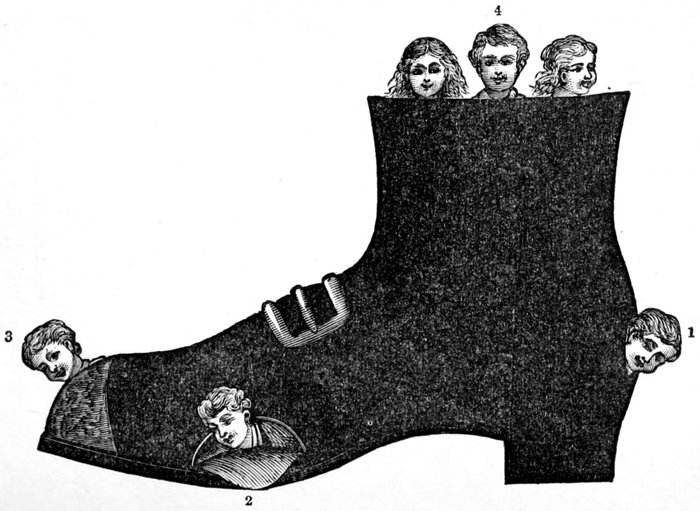
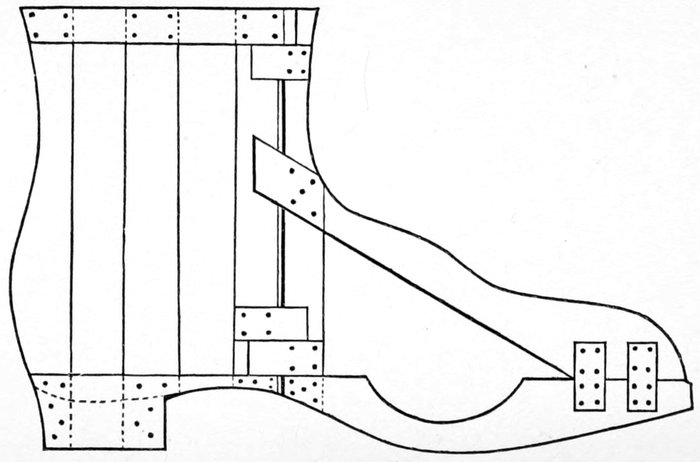
| The Merry Christmas of the Old Woman who lived in a Shoe | 157 |
| The Tournament of Idylcourt | 173 |
| A Thorn among the Roses | 201 |
| A Christmas Carol | 227 |
ENLISTED FOR THE WAR; OR, THE HOME-GUARD. — CHARACTERS. — COSTUMES.
Robert. Acts 1 and 2, Uniform of a private. Act 3, Uniform of a colonel.
Rowell. Act 1, Modern dress, change to colonel's uniform. Act 2, Colonel's undress uniform. Act 3, Fashionable dress.
10Hosea. Act 1, Make up "fat;" blue coat with brass buttons; nankeen pants; striped vest; white necktie; face florid; nose a little pimply; curly gray wig. Act 3, Something like the same, but figure rather emaciated; cheeks sunken; and a little more bald than in first act.
Hiram Jenks. Act 1, Short jacket, through which his arms protrude; light pants, very short; blue stockings; thick shoes; crop wig; general juvenile appearance. Act 3, Short dress bob-tail coat, &c.; not dandified, but neat; should be an entire change from Act 1.
Crimp. Act 1, Black woolly wig; gray pants; white shirt, sleeves rolled up; wide-rimmed straw hat. Act 2, Disguise of an old darkey; gray wig; gray side-whiskers; blue shirt; white duck pants, with one suspender. Act 3, Black coat and pants; white vest; white necktie.
Gen. Grant. Uniform of major-general, with cloak; military slouch hat, full beard, and make up as usual.
Gaylie Gifford. Act 1, Neat travelling-suit. Act 3, Handsome evening-dress.
Mrs. Trueworth. Black dress, white collar and cuffs, and widow's cap, very neat.
Mattie. Act 1, Muslin dress and white apron; sleeves rolled up. Act 3, Evening dress.
NOTE.—"Enlisted for the War," here presented in its most simple form, can be elaborately produced, if preferred. Where a military display is desirable, the second act will allow of "an awkward-squad drill," "relieving guard," a bayonet-drill, or the introduction of a camp song. At the end of the third act, the returning company might march across the stage, behind windows and door, illuminated with white and red lights, with the chorus "Marching through Georgia."
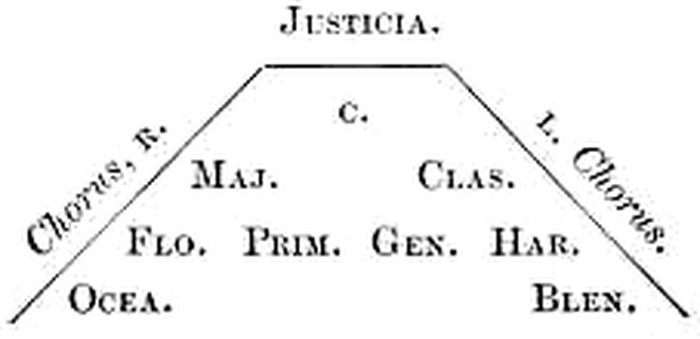
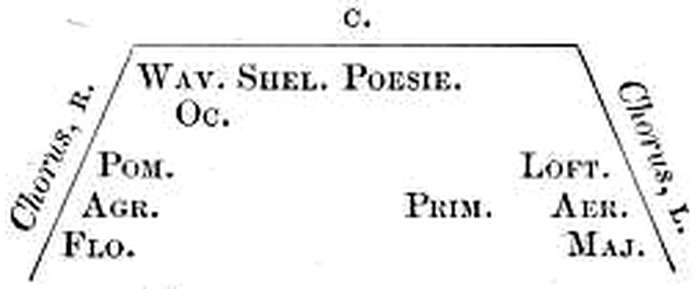
11Act I.—Scene. Interior of farm-house. Door in flat, R. C. Window in flat, L. C. Outside the window arrange flowers in pots, and shrubbery. Inside, muslin curtain draped up at L. Window open; between it and door, bureau or secretary. Lounge or sofa, L. Rocking-chair, R. C. Small table with a chair beside it, L. C.; writing-materials on table. Chair, L. Mrs. Trueworth discovered in rocking-chair, knitting and rocking. Mattie in chair beside table, her arms folded on table, her face hidden in her arms.
- Hosea
- (outside). It's a downright shame. Look at it; a fine piece of property like this going, going at such a ruinous sacrifice; and I'm only offered nine hundred and fifty dollars for it; literally flowing with milk and honey. Shall I have ten,—ten, do you say? Quick, or you lose it; nine hundred and fifty once, nine hundred and fifty twice, nine hundred and fifty,—going, going, and gone to Wilder Rowell, Esq., for nine hundred and fifty dollars. You've got a bargain.
- Mattie
- (raising her head). Do you hear, mother? To Wilder Rowell.
- Mrs. T.
- It's a shame to let it go for that price, and to a stranger.
- Mattie.
- Mr. Rowell is no stranger, mother. It's now five years since he came to Grainlow with Mr. Gifford.
- Mrs. T.
- For all that, he's a stranger,—a proud, 12haughty man, whom nobody likes, nobody has confidence in.
- Mattie.
- Mr. Gifford had confidence enough to give him the guardianship of his daughter when he died two years ago; and Gaylie likes him. As for being proud and haughty, to me he is always pleasant and condescending.
- Mrs. T.
- Condescending, indeed! You're just as good as he is. Bless you, child, the Trueworths held their heads as high as the best of folks until our troubles commenced. Your father took to borrowing to experiment with his patent wrinkles, and mortgaged the farm to that mean skinflint, Hosea Jenks. Ah, well! he did it for the best, no doubt. Only six months dead, and now the old farm has gone too.
- Mattie.
- Mother 'tis hard, 'tis cruel, to leave you homeless in your old age. Had father been wise—
- Mrs. T.
- Hush, child! not a word against him. He was a good, kind father, and a husband to be proud of. In all his troubles he never would touch a cent of the money we had put by to push Rob through college. That was safely locked up; and the lad came through with all the honors.
- Mattie.
- What good can his learning do him now?
- Mrs. T.
- That remains to be seen. When the call came for men, our boy, bless him! stepped out with the first, and enlisted for the war. Then came the hard blow, hardest of all to bear. My own dear, noble husband breathed out his life in my arms, and joined the true and noble in that better land. Hark! I hear Robert's step. (Mattie rises, and goes up 13to the window. Robert enters slowly door in flat; comes down, places his hand on the back of his mother's chair.)
- Rob.
- Mother, the farm has gone. We are homeless.
- Mrs. T.
- (wipes her eyes, and endeavors to suppress emotion). Yes, Rob, the old home is ours no more. Perhaps it is as well we made a change. Now he who, who (rises, and stretches out her arms)—O Rob, Rob! I can't bear it; I can't bear it. (Sobs, and falls upon his neck.)
- Rob
- (embracing her). O mother! this should not have been. Had I known the worst, I could have prevented it. I have strong arms and a cool head. I could have managed the farm. I thought father was so comfortably settled; and now my enlistment binds me. Oh, I could have done bravely!
- Mrs. T.
- (recovering). And you will do bravely now, where every true man should stand in the hour of his country's peril, in the ranks of brave defenders. Fear not for us: there's a power of strength in these old arms yet, and a stout heart to struggle; ay, and a brave one. Am I not the mother of a man who leaves all to serve his country?
- Rob.
- Brave mother, you shall have a son to be proud of.
- Mrs. T.
- Right, boy. And my prayers and blessing shall cheer you on to victory.
- Rob.
- Yet you are homeless, mother. Our regiment is ready for the field: it only awaits the
appointment of a colonel. I may be called away at an hour's notice. If I could only have
secured the old home for you, I should have been content.
14
- Mattie.
- Rob, why did you not ask the assistance of Gaylie Gifford? She is rich, and I know would have helped us,—her old home too.
- Rob.
- Yes, her old home. Dear little girl! how fond we all were of her, and she of us! But she went away to school two years ago, perhaps has forgotten us.
- Mrs. T.
- Why, Rob, not a week passes but I have a letter from her; such a good, kind letter too!
- Rob.
- Yes, I know; and yet I could not ask her assistance.
- Mattie.
- Perhaps you are right, Rob; but it does seem hard, after all the care and attention she
has received from mother, she could do nothing for us. But they do say money makes inward
changes as well as outward. Thank Heaven, we're out of its temptation!
[Exit R.
- Rob
- (seating his mother in her chair, and kneeling at her side). Mother, there's one reason why I could not ask Gaylie for assistance. I should like to tell you, for I would want her to know it should I never return.
- Mrs. T.
- Never return! O Rob! do not say that.
- Rob.
- That is one of the chances of war, mother. We must think of it. 'Tis the unlucky chance in this game of life, when so much depends on my success. But Gaylie, mother.
- Mrs. T.
- Well, Rob, what of Gaylie?
- Rob.
- Mother, you will, perhaps, call me mad; but, since Gaylie left us, a wild and strong desire has taken possession of my heart. I could not see her growing up so good and beautiful, without becoming more and 15more strongly attached to her. At college my dreams were of her; my waking thoughts again and again fashioned her image into dear companionship; and I have at last dared to believe that I might one day woo her, perhaps win her.
- Mrs. T.
- Rob, my boy, 'tis a wild dream. She is a rich heiress; in a year will be mistress of that grand estate yonder. (Enter door in flat Wilder Rowell.)
- Rob.
- Yes, mother; but I am a soldier of the Union; and, out of that glorious majority who are to battle for its rights, the North will pick its trusty leaders. Why may not I rise? Why may not I win rank and glory? and, when that is gained, why may not I dare to ask the hand of her I love so dearly, Gaylie Gifford?
- Rowell
- (at back). I beg your pardon if I intrude. (Rob rises.) Mr. Jenks asked me to step inside. He will soon join me to complete the sale.
- Mrs. T.
- (rising). You are in your own house, sir. 'Tis we who intrude.
- Rob.
- Mr. Rowell, I shall take immediate steps to find another home for my mother and sister. We will not long trespass.
- Rowell
- (down L.). Oh, take your own time: perhaps 'twill not be necessary to remove.
- Rob.
- How? I do not understand you.
- Rowell.
- I will speak with you again: for the present, make yourself perfectly at home in my house.
- Rob
- (aside). His house. Poor old house! you have fallen among thieves. Come, mother. (Puts his arm about his mother's waist, and they exeunt R. Rowell 16looks after them, then places his hat on bureau at back, and sits at table.)
- Rowell.
- Well, I certainly have heard something to my advantage. So, my fine soldier-boy, you love my ward, Gaylie Gifford. So do I. There we are perfectly agreed. But, when it comes to possession, I think we shall quarrel. Forewarned, forearmed. I have purchased this farm for the purpose of pleasing my ward; well knowing, that, had she been informed of the sale, she would have requested its purchase, that in gratitude she might have restored it to her old protectress. Her gratitude to me, for my wise forethought, would, no doubt, bring me one step nearer to my ambition. But this soldier loves her; should she be allowed to carry out her wishes, would love her all the more, perhaps arouse an answering affection. No. I'll keep the farm for my own pleasure; perhaps play the rôle of benefactor myself. Gaylie's large fortune must be shared with me. I never dreamed of this fellow's ambition. He rise? If fortune only smile upon me, I will guard against that.
- Crimp
- (outside). I'm obleeged to you, Massa Jinks. I jes w-w-want to know w-w-w-whar you gwine t-t-t-ote dis yere farm?
- Hosea
- (outside). Oh, bother! do you suppose we're going to dig it up, and cart it off, you stupid? (Enter door in flat, followed by Crimp.)
- Crimp.
- S'pose, s'pose; donno nuffin 'bout s'posin, Massa Jinks. You cum down here, Massa Jinks, betwixt eleben and seben, A.M., into de forenoon. You stick up a red frag ober de do', and you gets up onto 17de barril; and, when you's onto de barril, you gets a crowd round de barril, and deliber a Fourfe-ob-July speech onto de barril, and you jaw away, and ax 'em for dollars, nine hundred dollars, fify dollars, and tell dat ar assemblin' dis yere farm am gwine, gwine, gwine; and all I ax you for to tole me, whar it am gwine for to go. I'm obleeged to you.
- Hosea.
- Oh! that's only a figurative expression. I've sold the farm: that's all.
- Crimp.
- Figger-who? Sole de farm; who tole you? who ax you?
- Hosea.
- My interest.
- Crimp.
- In-ter-which? who's he?
- Hosea.
- I had a mortgage on the property, foreclosed, and sold out.
- Crimp.
- M-m-m-orgages onto de property. No, sar, don't raise 'em; heaps ob cabbages, but no morgages. I'm obleeged to you.
- Hosea.
- Well, I've sold the property,—house, land, farming-utensils, and live stock.
- Crimp.
- Live stock; horses, cows, by golly, and de hogs (Hosea nods), and de chickens and roosters?
- Hosea.
- Yes, sold them all.
- Crimp.
- By golly, you don't mean it; w-w-w-what we gwine to do for Fanksgibben? And de ole ram Jim,—he gwine too?
- Hosea.
- Yes, the old ram Jim.
- Crimp.
- Golly, dat so? I'm obleeged to you, Massa Jinks. Dat are ole ram Jim am de mos' dyspeptic biped—
- Hosea.
- Quadruped, Crimp. Bipeds walk on two legs: he goes on four.
18
- Crimp.
- Does he, Massa Jinks? You jes' don't know ole Jim: by golly, he's on two legs mos' de time, and gwine for me so (imitates butting), see, so. Hope I may die, Massa Jinks, if dat ar ole Jim didn't creep up a-hind me las' night when I was a-leanin' ober de pig-sty, jes' as easy, and lif' me ober dat ar fence into de mud, afore you could ax no questions. Nearly took away my bref. I'm glad he's gwine; he's too sociable; he is always teasin' folks to take a horn wid him, always wantin' to help gib you a boost. By golly, I's glad ole Jim gwine.
- Hosea.
- Suppose you go and tell him so.
- Crimp.
- What, me? Guess not, Massa Jinks. We ain't on speakin' terms; de conbersation am always
interrupted wid so many buts, can't get on at all. But I'll jes' go and gib him a hint,
Massa Jinks,—wid a stone. By golly, ole Jim gwine! Hi! de jubilum am come. I'm obleeged
to you.
[Exit F.
- Hosea.
- Now, Mr. Rowell, I'm at your service; sorry to have kept you waiting.
- Rowell.
- It's of no consequence, Jenks: by the way, Miss Mattie Trueworth is a very pretty girl.
- Hosea.
- Isn't she? If she only went with the farm you'd get the true worth of your money. You see: ha, ha, ha! I'm always doing it: can't help it; will pop out in my office, at my table, even in my dreams. It's a bad habit,—a punicious habit, for which I ought to be punished. There it is again! Ha, ha, ha! I can't help it. I try, but it's no use; in my office, at my table—
- Rowell.
- I'm to pay you one hundred dollars.
19
- Hosea.
- Exactly, to bind the bargain; balance in ten days.
- Rowell
- (takes out pocket-book). These Trueworths are evidently in a bad way.
- Hosea.
- Very. Farm gone, all gone. Poor folks! my heart bleeds for them.
- Rowell.
- Does it, indeed? The farm is sold to pay your claim.
- Hosea.
- Yes, and you've got a bargain. It's wartimes, and folks ain't a-goin' to put out their money. A year ago, three thousand dollars could not have bought this farm. What's the use of buying land when there's no telling but what the Southern Confederacy will sweep every thing afore the war's over?
- Rowell.
- Indeed! then you've not much faith in the success of Northern arms?
- Hosea.
- It does look a leetle black for the North.
- Rowell.
- If that's your opinion, perhaps I'd better withdraw before the bargain's closed.
- Hosea.
- What! back out? Don't you do it! It's always blackest just afore day. The right must conquer: it's a magnificent farm. It's only a question of time: a hundred dollars if you have it ready. The Union must be preserved: best cows in the country. Look at the uprising: a million freemen in arms,—ninety acres of meadow-land,—marching on to victory. And we're so far north, you know, it's a safe investment. I'll write a receipt.
- Rowell
- (throws down money, and rises). There's your money.
- Hosea.
- That's good. (Snatches the money.) The 20best investment you ever made. (Sits and writes.) There's your receipt. Thank you. (Rises and shouts.) Hi, sonny, take down the flag: bargain's closed. That's my son out there; a mere boy, but awful smart if he's kept in his place. Hiram Jenks is his baptismal name. I call him Hi, for short: see the pun? ha, ha, ha! Hi Jenks, when I'm in a highly humorous vein,—that's another; and when he's in a teasing humor, I call him Hi, son. There's another! Ha, ha, ha! Can't help it: I'm always doing it. I must be funny; in my office, at my table—
- Rowell.
- You seem to be a very busy man, Mr. Jenks.
- Hosea.
- I am. I'm a auctioneer, funeral undertaker, coroner, lawyer, expressman, carpenter, shoemaker, any thing by which I can gain an honest penny. There's only one office that seems necessary to my happiness. I would be a postmaster; and Stamps is on his last legs. Poor fellow! he's nearly stamped out of existence. You see: ha, ha, ha! I can't help it; it will pop out. Perhaps it's better, for humor is dangerous when it strikes in. See? Ha, ha, ha!
- Rowell.
- Your humor is not of the strikin' kind, Mr. Jenks.
- Hosea.
- Ha, ha, ha! very good; it's catching. Strike in: that's (looks grave) rather good.
- Rowell.
- There's a son at the head of this Trueworth family, I believe?
- Hosea.
- Yes; a splendid fellow, who enlisted a week before his father died. Poor chap! he's awfully cut up. Thought the old folks nicely settled, and was 21chock full of patriotism. Was disappointed in that, but could not get out of Uncle Sam's clutches. I couldn't afford to lose my money, so foreclosed and sold out. (Enter door in flat Hiram Jenks with a long pole, on which a red auction-flag is rolled, on his shoulder.)
- Rowell.
- 'Twas a hard blow for the family. (Hiram turns to shut the door: pole swings round, and hits Hosea in the head.)
- Hosea.
- Oh, murder! you clumsy chap, you've broke my head.
- Hiram.
- 'Twas a hard blow for you, dad,—an auctioneer knocked down under his own flag.
"When pole meets poll, then comes the crack of skull."
- Hosea.
- Shut up, sonny! Where's your manners? Hold up your head. (Hiram obeys the directions as spoken.) Boys should be seen, not heard. Turn out your toes. That was good, though, "when pole meets poll:" ha, ha, ha! He can't help it: takes it from me. I can't help it; in my office, at the table—
- Rowell.
- I'm anxious to settle this business at once, and get possession of the farm. If you will arrange the papers, my check is ready to-day for the whole amount of purchase.
- Hosea.
- I like that. My son, hold up your head: here's an example for you; a man who's anxious to pay,—turn out your toes,—who never puts off until to-morrow what can be done to-day. When you grow up, sonny, remember ready is the color of the winning 22horse on the racecourse of life,—Ready-cash; by whom that dun-colored nag Promise-to-pay is always distanced. Ha, ha, ha! There's a pair of 'em. I can't help it; it will pop out; in my office, at my table—
- Rowell.
- I'm in something of a hurry.
- Hosea.
- All right: step over to my office, and we'll settle up at once. Sonny, straighten up! You are released from official business, and may go off fishing. (Pats him on the head.) That's good, Ha, ha, ha! I can't help it; 'twill pop out regardless of time and place. We wits know no pent-up Utaca. You take, hey, Rowell? Ha, ha, ha! I really can't help it; in my office, at my table—
- Rowell.
- Mr. Jenks, I really must insist—
- Hosea.
- You can't stand it, hey? Then we'll move on. Sonny, stand by the flag. I'm going, going, gone. Ha, ha, ha! [Exit, followed by Rowell, door in flat.]
- Hiram
- (stands C., and looks after them). Sonny, sonny! Well, if the old man keeps on his degenerating pace, he'll be in his second childhood in six months. Calls me a boy, a mere boy: twenty last month. Keeps me in a short jacket, and shorter pantaloons. Makes me keep my hair sandpapered like an urchin of ten. It's about time this thing was stopped. If my arm creeps through this jacket much farther, I'm very much afraid it will rise in indignation, and smite my aged sire. "Honor your parents" is a very good maxim, but it may be carried a little too far. I'd go into the army, but he won't let me; swears I 23shall stand by the old flag. (Clasps the auction-flag in his arms.) No matter: it's only a year, and I am free. Ah! here's Mattie Trueworth, a girl I would lay down my life for, and who laughs at me. Heigho! if I wasn't a boy, I should be very much in love with her. How d'ye do, Mattie? (Enter Mattie R.)
- Mattie.
- Oh! it's you, Hiram Jenks.
- Hiram.
- Yes, it's me, Mattie: the standard-bearer, (pompously) bearing the old flag, that has conquered in so many battles; under whose folds so many household gods have fallen, never to rise again.
- Mattie.
- Pshaw! you'd look more manly bearing the flag of your country.
- Hiram.
- S'pect I would, Mattie: it's what I'd like. But dad says No.
- Mattie.
- Oh, indeed! a dutiful son, truly. The house is sold: why do you wait here?
- Hiram.
- To get a word with you, Mattie. I've a great admiration for you. If I dared, I would tell you that I love you. (Places flag in R. corner back.)
- Mattie.
- Don't you dare do any such thing. You must know I detest you, a mere boy; why, you're not yet out of jacket and trousers!
- Hiram
- (stretching up his arms). You're mistaken, Mattie: I'm a long way out of them.
- Mattie.
- Hiram Jenks, you're a fool.
- Hiram.
- That's just what dad says, Mattie; but he's awfully mistaken. He's old and queer, so I think it no harm to humor his fancies, though I do get laughed at. He does not know, that, long after he's asleep, the fool is studying by candle-light, way into 24the night; that, while he's about his business, the fool's ears are open, and his eyes sharp set, watching the kinks and tricks of trade. Only a year, Mattie, and I shall be free,—free to laugh at him, free to win you.
- Mattie.
- Win me! Hiram Jenks, have you lost your senses?
- Hiram.
- Sometimes I think I have, Mattie, when I look at you. Don't be hard on me. Think me a boy, if you will: only remember that I love you dearly; for your sake, would die a thousand deaths.
- Mattie.
- What unparalleled devotion! (Sits in chair R., and turns her back.)
- Hiram.
- Mattie, Rob must soon leave for the battle-field. You will then need a friend. Let me take his place, be a brother to you; or give me the right to be nearer and dearer. (Kneels, and takes her hand.) Speak, Mattie: I love you dearly, truly. (Enter door in flat Hosea, followed by Rowell.)
- Hosea.
- Good gracious, boy! what are you about? You're spoiling your trousers. (Hiram jumps up.) Mattie, don't let that boy pester you with
his nonsense. Sonny, go home. (Aside.) 'Pon my word, I believe the boy was
making love to that girl. I must look after him a little closer. (Aloud.) Hiram,
hold up your head, turn out your toes, 'bout face, march! (Hiram
looks at his father as if he would defy him, then obediently marches off.) Now,
Mr. Rowell, you are in possession. There is the deed (giving paper), where you
may read your title clear. What's to prevent? Ha, ha, ha! there it is again! I can't help
it; in my office—
[Exit D. in F.25
- Rowell.
- Miss Mattie, will you be kind enough to inform your brother that I would speak with him?
- Mattie
- (rising). Certainly sir, he's somewhere about the place: I'll find him.
[Exit R.
- Rowell.
- I will make an attempt to dispose of this farm to advantage. I must be quick: Gaylie is expected home to-day, may return at any moment. If this fellow was only out of the way, 'twould be clear sailing. Yet if I can manage to spike his guns before the prize heaves in sight, the victory is mine. (Sits at table. Enter R. Rob.)
- Rob.
- You would speak with me, Mr. Rowell?
- Rowell.
- Yes: take a chair. (Rises, and offers chair to Rob, then goes L., and brings chair to L. of table: both sit.) This farm has passed from the possession of your family into my hands; the purchase-money is all paid; and I now hold by right the title-deed. Here it is. (Lays it on table.)
- Rob.
- I understand. Your property shall be vacated at once.
- Rowell.
- Not so fast, my dear fellow: hear me out. You are a brave man; you have enlisted in your country's cause. You must go to the battle-field, and leave your dear ones to the tender mercies of this little world. I cannot be insensible to such patriotism, and I would befriend you in this emergency.
- Rob.
- You befriend me! I have no claim upon you.
- Rowell.
- But you have upon my ward. She was reared beneath this roof. Were she here, I think she
would uphold me in what I am about to do,—restore to you this farm.
26
- Rob.
- Restore it! I have no right to it. 'Tis yours by lawful purchase.
- Rowell.
- You're right; and as an act of justice to one who gives himself to a great cause, that his dear ones shall not be left helpless, I give you back the farm.
- Rob.
- You do this, Mr. Rowell: you give me the farm freely, unconditionally?
- Rowell.
- Not exactly. There is one condition, and only one. (Mattie appears at window outside, with a pair of scissors, and is arranging and clipping her flowers, overhearing the following dialogue.)
- Rob.
- One condition. Mr. Rowell, before you state that condition, let us understand one another. I do not like you. I have felt an instinctive dislike from the time you first entered this town. I have heard hard stories concerning you,—that you have wronged men, ay, and women too. With all that, I have no right to prevent my mother and sister from remaining in their old home. I will not, can I do so honorably. But I will accept no favor from you. Show me any way in which I can redeem this place, the way to win it back by good service that shall repay in full all expenses you have incurred in its purchase, or encumber it with a mortgage and heavy interest; but give me time to redeem, and I will believe you are my friend, will trust you. Come, I have spoken plainly: now let me hear your condition.
- Rowell.
- Ha! I like plain speaking. You are an adept at it. You don't like me. Well, then, in place of favor, I will offer a bargain. Here it is: this farm 27to you and yours forever, for a promise—a pledge—that you never offer your hand to my ward, Gaylie Gifford.
- Rob.
- Gaylie Gifford,—my hand!—Mr. Rowell, you are jesting.
- Rowell.
- No, I am serious. When I entered this house for the first time to-day, I heard your confession to your mother. I know how grateful Gaylie is for the kind care bestowed upon her here in childhood; and I would not have her kind heart wounded by the belief that one with whom she has been so intimate should presume upon her friendship, to seek to gain her hand, and with it a fortune.
- Rob
- (rising). Mr. Rowell, you are insulting.
- Rowell.
- Come, be reasonable! You can never hope to win her. Give me your promise, and the farm is yours.
- Rob.
- No! A thousand times no! You know my secret, but you know not me. I do love Gaylie Gifford, and with a hopeless love. The very fortune you taunt me with seeking is a bar to keep me silent.
- Rowell.
- Then take the farm. I will willingly give it up to purchase your silence. She can never be yours: 'twas her father's wish, that, when she became of age, her hand should be given to another.
- Rob.
- And that other, yourself. Am I not right, Wilder Rowell?
- Rowell.
- 'Twas a pretty shrewd guess.
- Rob.
- It is a lie. He had no such wish. My father was with him when he died.
- Rowell
- (rising). Lie! this to me?
28
- Rob.
- Ay, a lie! You like plain speaking. I know he left her free to choose her own mate, and bade you, as her guardian, to respect her choice.
- Rowell.
- I am her choice. Already she trusts me, with a confidence that only love can bring; and I, I love her, dearer than all else in the world.
- Rob.
- Except her fortune. You love her, Wilder Rowell, and she is in your power. Poor Gaylie! You shall not win her. She is too good, too pure, to mate with such as you, an adventurer, a fortune-hunter.
- Rowell.
- Indeed! Come, we are rivals. I will be magnanimous: you shall have the first chance. Speak, tell her of your love. If she says, Yes, I'm silent.
- Rob.
- O villain! you know your power. Speak to her, tell her of my love; I a poor soldier, she a rich heiress! She would think me as mercenary as I know you to be. No, no, I cannot: I love her dearly, truly, but must still love on in secret. (Falls into chair, and buries his face in his hands on table).
- Rowell
- (rising. Aside). Honorable to the last! There's no fear of him.
(Aloud.) Think well of it, Trueworth. Take the farm, and make your dear ones
comfortable. The prize you covet hangs too high. (Aside.) Silent! I'll look in
on him again (takes deed): an hour's reflection may awaken a better spirit.
[Exit door in flat, passing Mattie, who enters.
- Mattie
- (going to Rob). Why, Rob, what's the matter?
- Rob.
- Nothing, Mattie: I was only thinking over a plan I have for your future.
- Mattie.
- Gaylie's back, Rob: I just saw her carriage drive up to the house.
[Down R.29
- Rob.
- Indeed! Then I shall see her before I go. Where's mother? (Enter Mrs. Trueworth, R.)
- Mrs. T.
- Here, Rob. What had Mr. Rowell to say to you?
- Rob.
- Nothing, mother, to benefit us. I must go out, and look about for a new home. Home! home! that's a hard place to find, when the roof that has so long sheltered us is stripped from our heads.
- Mrs. T.
- Home is where the heart is, Rob; and, while the old love binds us together, we can bid defiance to adversity, beneath the humblest roof.
- Rob
- (C.). That's right, mother. Keep up a brave heart. We shall weather the storm. (Aside.) Oh! who will care for these dear ones when I am gone? (Crosses to L.)
- Gaylie
- (outside). Ha, ha, ha, old Jim! you know me, don't you? keep away! Open, locks, whoever knocks. I'm home, I'm home! (Runs in door in flat.) Home, home again! You dear, good Mother Trueworth! (Runs into Mrs. Trueworth's arms, C.; Mattie R., Rob L.)
- Mrs. T.
- Dear child, welcome, a thousand times welcome!
- Gaylie.
- I knew you'd be glad to see me; and Mattie (runs to her R., and embraces her), you dear darling, how rosy you look!
- Mattie.
- Gaylie, this is a surprise. I'm real glad to see you.
- Gaylie.
- Of course you are; isn't it jolly? But where's Rob?
- Rob
- (advancing). Here he is; patiently waiting to be recognized.
30
- Gaylie
- (runs to him, and catches his hands, shaking them heartily). Oh, you dear old fellow! How glad I am to see you! Why don't you kiss me?
- Rob
- (kissing her). That was certainly an oversight. So you are back again, the same dear, good Gaylie. Two years' schooling has made little alteration in you.
- Gaylie
- (C. with Rob; Mrs. Trueworth sits in rocking-chair; Mattie stands L., with arms akimbo). Yes, it has. I'm spoiled, completely spoiled. Got a beau yet, Mattie?
- Mattie.
- No, indeed! I hope not.
- Gaylie.
- Ha, ha, ha! what a girl! sneers at her destiny. She'll get over it. Yes, I'm completely spoiled. Went away a cheild of nature, fresh, buoyant, and all that sort of thing: I've come back a cultivated woman. Ahem! (Struts across stage: comes back.) Oh, my poor little head! it's had Latin squeezed into it, Greek pounded into it, and French, German, Spanish, and Italian filtered through it. Oh, it's a learned head! Then my fingers have been calloused into familiarity with all the ugly notes in the musical scale; my feet twisted and turned about all the figures a French dancing-master could invent; and my poor little figure tortured with elegant movements and graceful poses. Oh, bless you! I'm not myself at all. (Goes back to Rob.)
- Rob.
- You are our own Gaylie still. I know it; I can feel it in the warm clasp of your hand, in the clear light of your eyes.
- Gaylie.
- Right, Rob: you're always right. For this dear old home, you, my earliest, best friends, are a 31part of this my heart; and that not all the teaching in the world could change. (Goes to Mrs. Trueworth, and kneels at her side. Rob goes up stage, and watches her.) So here I am again, mother, at your feet. When my father went to that far-off land, years ago, in search of wealth, he left me here, and asked you to be a mother to his child. How well you took the place of her who died when I was so little, let this testify. I am now the heiress to his wealth; I have a home rich and attractive, servants at my call, much that can make life bright and beautiful: but I could part with all, sooner than lose the right to call this home, and you mother.
- Mrs. T.
- (putting her arms about her). Dear, dear child! You are my own; still the same fresh, warm heart.
- Rob
- (aside). She's an angel. Had I but the power to call her mine!
- Crimp
- (outside). Go 'way dar, you Jim! don't yer shake yer head at me. Go' way dar! help! murder! help! (Tumbles in at door, as if "butted;" jumps up, runs, and shuts door, placing his back against it.) Go 'way, yer fool! Nobody to hum.
- Rob.
- What's the matter, Crimp?
- Crimp.
- Dat ole fo-fo, Jim, he will insist on squartin' me to de door, an' I don't want none of his attention. Go 'way, out dar: stop dat knockin' at do'!
- Gaylie.
- Oh, here's our black Cupid! Why, Crimp, old friend, aren't you going to speak to me?
- Crimp
- (comes down). Why, bress my soul! No, 32'tain't. Yes, it am: it's Miss Gaylie hersel'. You dear little honey! bress us an' save us, am dat yerself?
- Gaylie
- (taking his hand). Yes, it's your old torment; home again, and ready for a frolic.
- Crimp.
- Wh-wh-at! bress yer purty face; yer ain't grown a mite; gwine fur a frolic; climb de yapple-trees, ride onto de darky's back. Oh, golly! what times we did hab, to be sho'!
- Gaylie.
- Only give me a chance, Crimp. I'm as spry as ever.
- Crimp.
- What! would you, dough, ride onto dis year darky's back? By golly! I'm obleeged to you. I's powerful glad to see ye back, honey. Comfort de ole lady, now Massa Rob gwine fur a sojer.
- Gaylie.
- What! our Rob a soldier?
- Crimp.
- Yaas, indeed! Don't you see de uniform? gwine along de tramp, tramp, tramp fellars, he am.
- Rob.
- Yes, Gaylie, enlisted for the war.
- Gaylie.
- But where are your shoulder-straps, your sword?
- Rob.
- I am but a private, Gaylie. The emblems of command are yet to be won: they'll come in time, I hope.
- Gaylie.
- I know they will. O Rob! I'm proud of you.
- Crimp.
- Same here, Massa Rob. I'm obleeged to you. Golly! if I was only a white man, I'd
jist go down dar, I would. Hi! I'd lay 'em out. I'd go for dem are fellars, like ole Jim,
so (butting). But dey don't want no brack guards; oh, no! S'pect dey will,
dough, glad to git 'em afore de war am ober; and, when de do, hi! Tumms Jeffsum Crimp am
dare, he am.
33
- Rob.
- It strikes me, Crimp, you are rather monopolizing the conversation. Fall back, sir.
- Crimp.
- I'm obleeged to you, Massa Rob. I's dumb. (Goes to window, and in dumb show pesters the imaginary Jim by shaking his fist, throwing things out of the window, &c.)
- Rob
- (L. C.). Yes, Gaylie, I am expecting daily orders to march. I only hope I shall have time to completely settle mother and Mattie in their new home.
- Gaylie
- (R. C.). Their new home! what do you mean?
- Rob.
- The farm has been sold, Gaylie,—sold to-day, to satisfy the claim of Hosea Jenks.
- Gaylie.
- Sold! Why have I heard nothing of this?
- Rob.
- You must have known it. Pardon me: I see I have been mistaken. Your guardian—
- Gaylie.
- Has not written me a word concerning you; not a word have I heard of this. But 'tis not too late: the farm can and must be redeemed. Who is the purchaser?
- Rob.
- Your guardian, Wilder Rowell.
- Gaylie.
- He bought it? then it's all right. Dear, good fellow! he knew I could not desert you. That's just splendid! (Enter hurriedly, Rowell, door in F.)
- Rowell.
- Miss Gaylie, I have this moment heard of your arrival. Welcome home! (Gives his hand.)
- Gaylie
- (eagerly shaking it). A thousand, thousand thanks, Guardy: you have indeed made
me welcome. So, sir, you have a surprise in store for me. Come, disclose it: I am all
impatience. It's so splendid to be surprised, when you are all prepared for it!
34
- Rowell.
- A surprise? I do not understand.
- Gaylie.
- O Innocence! thy name is Wilder Rowell. But I know your secret. You have bought this farm.
- Rowell.
- Yes: a good piece of property, they say.
- Gaylie.
- Indeed it is! the very investment I should have proposed. Thank you for your thoughtful consideration. So it's my property?
- Rowell.
- No, it's my property. Not as your agent, but for myself, I bought this farm. I mean to settle down, and become a sober, plodding farmer, and, in time, take to myself a wife. (Looks at Rob, who is in L. corner.)
- Gaylie.
- Guardy, I have been mistaken. But you will sell me the farm. Come, you never yet refused me a request; and it is one of the dearest wishes I have, to possess this farm.
- Rowell.
- Sorry I cannot oblige you. But, for particular reasons, I would not sell this farm for ten times the money I gave for it.
- Gaylie.
- But you are turning from their dear home the best friends I have in the world.
- Rowell.
- They are not very much attached to it, Gaylie; for, not an hour ago, 'twas offered them on easy terms.
- Gaylie.
- Offered them, by you?
- Rob.
- Yes, Gaylie: on terms no honest man could for a moment consider.
- Rowell.
- I offer it again. Consider, Robert Trueworth, 'tis you who are driving your family from home.
- Rob.
- You have had your answer. Scoundrel!
- Rowell.
- That name again!
35
- Rob.
- Ay, again and again! Plead no more, Gaylie. Ask no favors for me or mine, of that man: even from your dear hands, I could never take the fair farm which he has polluted by ownership.
- Rowell.
- Robert Trueworth, you shall repent this. (Comes close to him.) You are making me your enemy.
- Rob.
- I am satisfied. Better open war than false friendship with a heartless foe.
- Gaylie.
- No more of this, I beg. You have quarrelled. For my sake, be friends.
- Mattie
- (R.). Silence, Gaylie! you know not what you ask.
- Gaylie.
- You too, Mattie? What means this mystery? (They pass to R., and converse in dumb show. Rob goes up stage, and passes round to back of his mother's chair, on which he leans, conversing with her, as Hosea Jenks enters, followed by Hiram. Crimp runs to Hiram, and keeps him back, conversing in dumb show about "Jim;" Crimp going through pantomime, to convey an idea of an attack. Hosea comes down, C.)
- Hosea
- (speaks as he enters). Oh, here you are, Rowell! I thought I should find you. I've just been down to the post-office. Poor Stamps has gone. He has distributed his last batch, and been transferred to the dead-letter office. Ha, ha, ha! that's a grave pun; but I can't help it; you know my weakness.
- Crimp.
- Weakness? am you got de lumbago, Massa Jinks? Golly! I had de rheumatiz awful, las'
winter. Tell you what you do, Massa Jinks: you jis get a poorhouse plaster; only draw a
quarter out ob yer pocket, and all de anguish out ob yer back.
36
- Hosea.
- Ha, Ha, Ha! he little understands my facetious humor.
- Crimp.
- Oh, humor! face itches; den clap it onto yer face. Draw out all de pain, and some ob yer cheek too.
- Rob.
- Crimp, be silent!
- Crimp.
- Ob course, ob course! I'm obleeged to you.
- Rowell.
- So Stamps is dead?
- Hosea.
- Yes: poor fellow, I grieve for him. Who can take his place?—I should say, his post. Postmaster, see? ha, ha, ha! There it is again! I can't help it.
- Rowell.
- Mr. Jenks, if you could contrive to drop this jesting humor—
- Hosea.
- But I can't. I try, but I can't drop it: it's a drop too much. Ha, ha, ha!
- Crimp.
- Ya, ya, ya! dat's good: de ole man's been drinking jes' a drop too much.
- Rowell.
- If I understand you, Mr. Jenks, you would be his successor.
- Jenks.
- That's just it. I know you have influence. See, here's an official envelope addressed to you, and from the war-office too.
- Rowell
- (snatches and opens it). For me? Ah, good, good! Jenks, I shall remember you. Now comes my turn. Gaylie, I must home at once: will you go with me?
- Gaylie.
- I prefer remaining here.
- Rowell.
- As you please. Mr. Trueworth, a word with you. (Rob
advances.) I give you one more opportunity to embrace my offer. 'Tis the last
chance. This fine property for your silence.
37
- Rob.
- I will make no terms with you. When I have won the right, I will speak. (Turns up stage.)
- Rowell
- (walking up slowly to door). When you have won the right: that time will never
come. Fool! you have made an enemy of one who can strike deep and well.
[Exit door in F.
- Hosea.
- Rowell, Rowell! don't forget me. I must run after him: there's no time to be lost. Come,
Hiram! fall in, or we shall fall out. Ha, ha, ha!
[Exit door in F.
- Crimp.
- Take care, Massa Jinks, you don't fall onto ole Jim's horns! (Looks out at door.) golly, he's a-laying fur him. Dere de go! Go in, ole man; he's a arter ye! By golly, see 'em run: see 'em run! (Exit. Hiram starts for door, stops irresolutely, and then comes, and stretches himself upon lounge.)
- Hiram.
- It's right comfortable here: I think I'll stop.
- Gaylie
- (aside). He denies my request. What motive can he have in thus appropriating the property of my friends? I must know more of this. (Aloud.) Come, mother, show me to my old room. I want to talk to you: I've so much to say! I shall not tell you what I have bought for you. Such a cap, a perfect beauty! and such a shawl! You'll be the envy of the town.
- Mrs. T.
- (rising). Dear, dear child! ever thoughtful of my comfort.
- Gaylie.
- If I were not, I should not deserve so good a mother. Good-by, Mattie: good-by, Rob! [Exit with arm about Mrs. Trueworth.]
- Rob.
- Good-by, Gaylie. Bless her dear heart! mother 38will have one friend when I am gone. Now, Mattie, I'll take a look about, and see if there's a poor but neat tenement to be had: I won't be gone long.
- Mattie.
- O Rob! where can we go?
- Rob.
- Trust all to me, Mattie: I will not leave you homeless. (Going.)
- Hiram
- (on sofa). Sh—sh—sh!
- Rob
- (returning). Why, Hiram, what's the matter? (Hiram rises, walks on tiptoe to the window, looks out, turns, "Sh!" then walks to the door, and performs the same manœuvre; then comes down C. on tiptoe, beckoning Rob down.)
- Mattie.
- What ails the boy? is he crazy?
- Hiram.
- Don't mind me. If the old man should happen about, I'm ruined. But, sh—you want a friend.
- Rob.
- Well, Hiram, I am not quite destitute.
- Hiram.
- Sh—if I only dared, I could find a friend for you. If I only dared; but I'm such a coward. No matter, I'll take the risk. You know the Widow Smith place?
- Rob.
- Yes: 'twas sold at auction six months ago.
- Hiram.
- Exactly. Sh—it's mine: I bought it.
- Rob.
- You? why, 'twas knocked down to Crane!
- Hiram.
- Yes; and Crane crooked his long neck round, and took his cue from me. I bought it: my money paid for it. Never you mind where the money came from; it was an honest purchase. Now you're in trouble: you want a home. Take mine, and welcome; only don't let the old man dream I'm its owner. Crane holds it now; but, when I am free, 'twill be known as my property. Will you have it? Not a cent will I take 39for it until the war is over. It's a pretty place: not much land; but flowers, good gracious! and woodbine, why, the front is completely covered. Will you take it? Quick! the old man will return, and then I am a boy again.
- Rob
- (takes his hand). Hiram, you're a man: you are a true friend. Thank you: I will accept your offer.
- Mattie.
- O Hiram! I've treated you shamefully. Forgive me: I never dreamed you had such a noble heart.
- Hiram.
- I haven't any heart, Mattie: you had it all long ago. So you'll take the place (enter Gaylie R.), and be my tenant until the war is over. Sh—sh! not a word!
- Gaylie.
- You're too late, conspirators: I have heard all. Rob, you have found a home?
- Rob.
- Yes, Gaylie, thanks to a true friend.
- Hiram.
- Sh—not so loud; the old man drops round mighty sudden.
- Gaylie.
- Rob, you have done this without consulting me. Why am I shut out from your counsel?
- Rob.
- Ah, Gaylie! you cannot befriend me. You are not of age, and I will not be indebted to your guardian.
- Gaylie.
- Tell me, why have you quarrelled with my guardian? What means this enmity between you and him?
- Rob.
- Gaylie, you must not ask me.
- Gaylie.
- But I must know: you have no right to keep it from me.
- Rob.
- I cannot tell you, Gaylie. Let it suffice, we 40are enemies; that he would do much to crush me and mine.
- Gaylie.
- Let him dare! I stand between you and him. You go to battle in a noble cause: fear not; if he has the will to wrong the dear ones you leave behind, I have the power to crush him, and I will. Face the enemy in the South with a brave heart, Rob. Against the enemy here, I will be the Home-Guard.
- Rob.
- You, Gaylie? what can you do, little woman?
- Gaylie.
- Woman's work. Think you we will sit idle at home, while husbands, fathers, brothers, are in the field? No! there is work for tender hands and willing hearts. To care for the needy, to protect the helpless, at home; to heal the wounds, and charm away the pain, in the hospitals,—this is our work: to it I give my whole heart; my whole fortune, if need be. Henceforth I am the guardian of your mother and your sister. (Enter Crimp door in flat). Alone, if need be, I will stand the Home-Guard, a bulwark against adversity.
- Hiram.
- You shall not stand alone, Miss Gaylie. They say I'm but a mere boy, but I'm heart and hand with you in this cause.
- Crimp.
- Same here. I'm obleeged to you; I'll be de drum-major in dat ar corpse.
- Gaylie.
- See, Rob; they muster at my call. Home-Guard, attention! fall in! (Stands L. C. Hiram steps up beside her; Crimp up stage next him; form in line up and down stage. Mattie sits in rocking-chair, R.; Rob leans upon the back of her chair.)
- Rob.
- Raw recruits, Gaylie!
41
- Gaylie.
- Yes, almost as raw as those who take the field, Rob. Company, attention!
- Crimp.
- Hole on, Miss Cap'n. Whar's de colors? mus' have a frag. Golly, dis year's de ticket. (Takes auction-flag from corner, and unrolls it). Dar! look at dat; and, as I's de only pusson ob color in dis yer corpse, I'll be de color-bearer.
- Gaylie.
- Attention, company!
- Crimp.
- Yes, Missy Cap'n; I's all attention.
- Gaylie.
- Eyes right: eyes left: salute! (They bring their hands to a salute. Enter door in F. Rowell, in full uniform of a colonel.)
- Rowell.
- Ah! what new recruits have we here?
- Gaylie.
- Mr. Rowell, what does this mean?
- Rowell.
- That an honor for which I have exerted much influence has, at the last moment, been conferred upon me. I am appointed colonel of the 10th. (Bows, and comes to L. corner.)
- Gaylie
- (C.) Rob's regiment, and his enemy at its head! Oh, this is cruel!
- Rob.
- He in command! He our colonel! Another blow: fate can do no more. (Goes up C.)
- Rowell.
- Robert Trueworth, you will join your regiment at once. All furloughs are countermanded. We march at sunrise to-morrow.
- Gaylie
- (aside). Oh, this is terrible! Rob's bitter foe in command: oh, why have they quarrelled? (Goes to rocking-chair, and leans upon it.)
- Rob
- (aside). To serve under that man, whom I detest! There is no escape. I must submit. There's one comfort: his position takes him away from Gaylie. 42(Enter Mrs. Trueworth R.) The time has come, mother. I have orders to join my regiment at once: we march at sunrise. Keep a stout heart, mother. I leave kind friends behind, who will see to it you do not suffer.
- Mrs. T.
- (her arms about his neck). My brave boy, serve well your country, and do not forget your mother. She gives you up freely, with a prayer that you may be found true to your duty. Heaven bless and keep you, Rob! (They stand together conversing.)
- Gaylie.
- Mattie, before Rob goes, I must know the meaning of this quarrel between him and my guardian. Why is it kept from me? You must know: I conjure you, as you value my friendship, as you love your brother, speak before 'tis too late.
- Mattie.
- O Gaylie! I do know; for his sake I will speak. You are the cause of this quarrel. Both these men love you.
- Gaylie.
- Indeed! Oh, I'm so glad!
- Mattie.
- Glad! You should be ashamed of yourself. You can't marry them both.
- Gaylie.
- Oh! you don't know what I can, what I will do.
- Rob
- (approaching). Mattie, sister, good-by.
- Mattie
- (rising, and running into his arms. Gaylie slips into her seat, and covers her face). O brother! so soon? what shall we do without you?
- Rob.
- Keep a good heart, sister. You will do bravely. (Kisses her. Mattie goes to her mother, C. Rob comes down, looks at Gaylie,
sighs, and turns up stage.) Good-by, Crimp. (Shakes hands.)
43
- Crimp.
- Good-by, Massa Rob. I'm obleeged to you. You'll come home a drum-major, sartin sure.
- Rob.
- Thank you, Crimp. Good-by, Hiram, and thank you for your friendly aid.
- Hiram.
- Good-by, Rob. I'll look out for the women-folks, sharp too. (Rob goes to door.)
- Gaylie
- (running up stage). Rob, Rob! you've forgotten me!
- Rob.
- True, Gaylie. I had not the heart to say farewell to you. You are so dear—
- Rowell.
- This is but tardy obedience.
- Rob.
- Ah! you fear me, Col. Rowell, no more than I fear myself. But am I not bound in honor to be silent? Gaylie, farewell: you have been a kind friend to us, will still be to my dear ones when I am gone. Good-by.
- Gaylie.
- Rob, is there nothing more you would say to me? (Looks at him tenderly.)
- Rob.
- Nothing, Gaylie: were you but the poor girl I once thought you; but no, no—
- Gaylie.
- Rob, whatever you would have said to the poor girl, say to the rich heiress: there's the same heart here.
- Rowell.
- Confusion! is she leading him on to confession?
- Rob.
- O Gaylie! am I awake? You give me life; you give me hope: you make me bold to speak. Gaylie, I love you, dearly, truly.
- Gaylie
- (placing her hands on his shoulders). As dearly and truly as I love you? O Rob!
it must be deep and strong.
44
- Rob
- (clasping her in his arms). Mine, Gaylie, mine! oh, this is happiness indeed!
- Crimp.
- Hi, das a fac. De Union foreber!
- Rowell.
- Girl, are you losing your senses? I forbid this folly.
- Gaylie.
- And who are you?
- Rowell.
- Your guardian. You shall not throw yourself away upon a common soldier.
- Rob
- (comes down). A common soldier! True. I glory in my rank. You leap to a command by power and influence. My spurs must yet be won. I am content. Should I rise by merit, no emblems of rank could shed a brighter glow than gleams from the trusty bayonets of Liberty's common soldiers.
- Rowell.
- Enough! To your regiment. You forget I am your superior.
- Rob.
- No, I do not forget it; and I know what to expect,—hard service, and an enemy in command. I am satisfied, for I have won the victory here. (Takes Gaylie's hand.)
- Rowell.
- Be not so sure of that. You forget the enemy has a long arm, and it may reach even here.
- Gaylie.
- And, if it does, I fear it not.
- Rowell.
- Indeed!
- Gaylie.
- Ay, indeed, Col. Rowell. You are my guardian, true; but you forget my father's will. In one year I am free: even now I have the power of appeal to two noble men, should you distort your power. I will be mistress of my fortune. I will be free to bestow my hand. With the one, I will protect the homeless; with the other, cheer him at whom you 45sneer, a common soldier. Deny my right at your peril.
- Rowell.
- No more of this. Quit that man's side. I command you, obey me!
- Gaylie.
- You command? You forget I am a leader here. I entreat you, in the name of justice, to deal fairly and honorably by this true hero, who leaves all to serve his country, to recognize his right to the hand which I freely give. Come, sir, do we part friends?
- Rowell.
- Not on such terms as you offer. (Crosses to R.)
- Gaylie.
- Then beware! you make yourself my enemy. Already you disgrace the rank you've bought, not won. You have command, and my hero in your power. I have love, wealth, and a loyal heart, that abhors injustice. Against all treachery and deceit, against the wily arts you may contrive to shame my hero, I am the Home-Guard, the firm friend, enlisted for the war.
- Tableau:
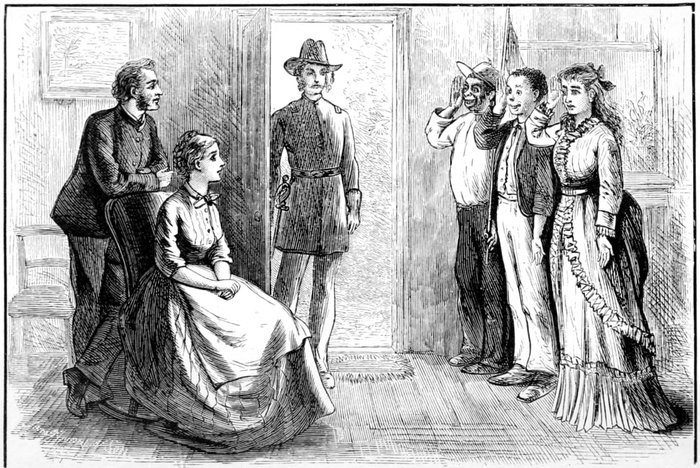
- Rob and Gaylie, C. Rob has his right arm about her waist, her left hand in his left; she bends forward, with her right hand outstretched to Rowell, R., defying him. Mrs. Trueworth sits on sofa, L., with her handkerchief to her eyes. Mattie with her hand on her mother's shoulder. Crimp, back R., has the flag rolled up, and is menacing Rowell with it. Hiram catches it in his hand as it descends, and holds him back. Slow curtain.
46Act II.—(After two years.) Headquarters of Col. Rowell in Virginia. Room in a farm-house. Door in flat L., open; window in flat R., open. Landscape behind, moonlight if possible. Set the "moon" L., so the light will fall through the door and window. Writing-desk or table, against R. side; writing-materials, a candle to light, a pile of letters and papers, upon it. Chair in front of this. Give the scene a military character by placing a stack of arms in L. corner back, a pile of knapsacks in R. corner with an American flag thrown over it; hang up a drum between the door and window. Robert discovered, with musket, on guard outside the door; passes door and window twice. A "distant" fife plays, "The Girl I left behind me," through: as it ceases, Rob should be at door; he leans against the doorway L.
- Rob.
- The boys are making merry to-night around the camp-fire; but that lively air brings only sadness to me. "The girl I left behind me," two years ago, in Grainlow, Gaylie Gifford, is still silent. Not a line in reply to my frequent letters. Has she repented of her choice? No, I cannot believe that; for my sister writes me she often speaks of me, longs for my return. But yet she never writes. Perhaps she has never received mine; 'tis hardly possible, and yet her silence—Can my enemy, the colonel, be conspiring to keep us apart? He is base enough to use any means to serve 47his purpose. By his orders, the mail is brought here, and inspected by him, before delivery; perhaps, that he may intercept any letters for me. If I could only get a single line from her, I would be content. Oh! I am ground down worse than any slave that tills the earth beneath the overseer's lash. Two years of service, and still a private! I know I have been honorably mentioned many times by my captain; and yet poorer men step above me: and I toil on, fight on, with no hope of promotion. Well, they shall not say I have not done my duty. Will the end never come, and free me from this bondage, give me liberty to turn my steps northward, to seek the star of promise that gleams in Gaylie's eyes? Halt! Who goes there?
- Crimp
- (comes from L., passes the window, and appears at door speaking). D-d-d-on't shoot! d-d-d-on't shoot! I's only a poor old darky, Massa Sentenull.
- Rob.
- Your business here?
- Crimp.
- Pressing b-b-business; d-d-d-on't shoot! Want to see de colonel.
- Rob.
- The colonel is absent.
- Crimp.
- Den I'll walk into de parlor, take a cheer, and wait for um. D-d-d-on't shoot!
- Rob.
- Business. Your pass, uncle.
- Crimp.
- Pass: yes, massa, got a pass. Here she am! (Searches pocket.) Golly! it am gone. No, here she am! (Searches bosom.) Not a pass; had um, sure; hope I may die—
- Rob.
- What's that sticking out of your hat?
- Crimp.
- Golly, dat's so! (Takes off hat, paper sticking out of crown). Put um up dar to
keep um safe. (Hands pass.)
48
- Rob
- (examines paper). The pass is right: pass in. (Resumes march.)
- Crimp.
- Tole you so. Dar aint no inception about dis chile: he's de sole ob honor. (Comes
down.) Now, w-w-what's a-gon to be did? Missy Cap'n sends me away down here, in dis
yer benighted regium, to bring a letter to Massa Rob. Tote about forty mile afore I find
him, and den he's on guard. 'Twon't do to gib him de letter now: these sojer fellars so
stiff onto de tictacs, dat if I was to gib him de letter, jes as likely to put de bagonet
into me, or blow my head off, as not. No, sar: Crimp don't take no risks in dis yer
camplain; no, sar, I'm obleeged to you. I'll wait till he's reliebed. Missy Cap'n say,
gib 'im de letter, and den lay round, and see what de colonel was about. I'll hab a smoke
(takes out pipe, lights it), an' I'll lay round. (Takes the American flag,
and wraps it round him.) Glory, hallelujah! dat's de warmest cobering dat eber a
darkey got into. Yaas indeed. It am de protector ob virtue. Dat's me. (Takes a
knapsack for a pillow.) I'l jles hab a snooze into de corner, till Massa Rob is
reliebed. (Lies down.) Hi! das a heap ob comfort in de arms ob Morphine.
(Smokes.) 'Spect Missy Gaylie tink a heap ob dat ar Massa Rob. Oh, lub, lub!
when you got into dat Miss Gaylie's heart, you jist found de warmest place in de whole
world. Yaas, indeed! (Drops pipe.) Dar going to be some fun, down dar in
Grainlow. By golly! de Home Guard am gwine to commence operations. Now, Massa Colonel,
mind your eye; for de Home Guard am onto de war-path.
49
- Rob.
- Halt! Who goes there? (Lieut.-Col. Boxer enters L., passes the window to door. Rob salutes. Boxer enters.)
- Boxer.
- The colonel away still? Hallo! (Snuffs the air.) Tobacco, and pipe-tobacco too! Smoking in my quarters! Bah! who is it? I won't have it. If there's any thing I detest, it's smoking; under my very nose too. Here, sentinel! (Rob steps inside door.) Have you been smoking?
- Rob.
- I never smoke, sir.
- Boxer.
- Right: it's a filthy habit. But somebody's been here with a pipe. Now, mind, no more of
it. Let no smokers pass that door. 'Tis a strict order which must be obeyed. That's all.
(Rob salutes, and retires.) Plague take the fellow,
whoever he is! The smoke of battle is inspiring; gunpowder is soothing to the nerves; but
tobacco-smoke, bah! it makes me sick.
[Exit L.
- Crimp
- (raising his head). By golly! dat ar hossifer am riled. Don't like smoke. He's proficient in a liberal heducation, he am. (Drops head. Gen. Grant appears L., slowly passes window, and crosses to door, is stopped by Rob.)
- Rob.
- Halt!
- Grant.
- I have business with the colonel.
- Rob.
- The colonel is absent.
- Grant.
- Then I will await his return.
- Rob.
- Halt! I have my orders. No smokers can enter here. If you would pass, put out that cigar.
- Grant.
- Indeed! Your orders are strict. (Looks at Rob keenly, then throws away cigar, and enters. 50Boxer enters L., meeting him.) Good-evening, colonel.
- Boxer
- (saluting). Good-evening, general. You have surprised our post. The colonel is absent. Can I be of service?
- Grant
- (sitting in chair, and tilting back against table). Your sentinel ordered me to throw away my cigar.
- Boxer.
- He did? confound him! Here, sentinel! (Rob steps inside door.) Do you know what you have done?
- Rob.
- Obeyed orders, colonel.
- Grant.
- Do you know me, sentinel?
- Rob
- (saluting). I do, general.
- Boxer.
- And didn't you know better—
- Grant.
- One moment, colonel. Sentinel, you are the first man that ever dared put out my cigar. You did perfectly right: orders must be obeyed. Your name.
- Rob.
- Robert Trueworth.
- Grant.
- How long have you been in service?
- Rob.
- Two years.
- Grant.
- That's all. (Waves his hand. Rob salutes and retires.) Colonel, your orders are too strict. I cannot talk without a cigar.
- Boxer.
- Sorry I have not one to offer you, for I do like to see a man enjoy himself. My orders could not apply to you, general.
- Grant.
- Thank you; having permission, I can find the cigar. (Takes out cigar, and lights
it.) I always go armed. That man at the door,—what is his record?
51
- Boxer.
- Excellent: every inch a soldier; the bravest of the brave.
- Grant.
- Two years of service, and still a private?
- Boxer.
- Yes, general; although he has been honorably mentioned. (Coughs.) (Aside.) Confound his nasty cigar! (Aloud.) There's not the best of feeling towards him on the part of our colonel. A brave soldier, general, but queer. It seems they quarrelled before entering service. (Coughs.) (Aside.) Oh, I shall choke! (Aloud.) A love-affair, I believe. The private won the girl, and so he's not pushed.
- Grant.
- Indeed! the colonel brings his private piques into the battle-field. I rather like this boy. (Looks round.) Can't we get out of earshot?
- Boxer.
- Certainly; in my room. (Crosses stage, and then opens door L.) Walk in, general. (Grant rises, and crosses stage.) We shall be secure from interruption here.
- Grant.
- No: it's pleasant outside; let's walk awhile. (Passes out door off L., smoking.)
- Boxer.
- Bah! I foresee a smoky campaign here. (Following him.)
- Crimp
- (raising his head). By golly! dat ar fellar's a high buck. Ain't dey nebber gwine to reliebe dat guard? (Col. Rowell appears R., passes window to door. Rob salutes, he enters. Crimp drops his head.)
- Rowell.
- That fellow's on guard to-night. How I hate him! Rebel bullets come fast and thick, but
they never reach him. Pity! I should lose a good soldier, no doubt; but I could spare
him. (Goes to table, and lights candle.) Here's the mail for my inspection;
let 52me see if there's any thing contraband. (Examines letters.) "Robert
Trueworth." His sister's handwriting; that shall go through. "Robert Trueworth." Gaylie's
hand; detained for the present. (Places it in his bosom. Robert is at the window outside, watching him.) I have managed
to keep many sweet morsels from his parched lips. Not a letter of hers shall ever reach
him while I have the power to prevent. My guardianship has expired: she has come to her
fortune, and yet she loves this man. Not a thought of me; and I love her madly. Ah!
what's this? (Takes letter.) For me, and—Gaylie's hand! (Tears it
open.) So, so; at last she thinks of me. (Reads.) "Dear Colonel: Pardon my
long silence. I have not forgotten you. A business matter which I feel it impossible to
adjust makes me bold to ask your assistance. Come to Grainlow at once. I have repented of
my rudeness to you, long to see you. If you can obtain a furlough, come; if you cannot, I
think I could repay you for the loss of your commission should you feel inclined to
resign. Believe me, I am not ungrateful for your former kindness, and earnestly entreat
you to return. You shall be made happy here if 'tis in my power. Gaylie." So, so; the
wind has changed. There is only one construction to be placed upon that letter. She has
repented of her folly, and I can win her. (Soldier enters R., and relieves guard.) What's that? Ah! relieving guard;
I'm glad of that: I cannot bear to have that fellow near me. (Rob
is about to pass off; stands irresolute a moment, then steps inside door. The colonel
is again busy with his letters.)
53
- Crimp
- (aside). Golly! de guard am reliebed.
- Rob
- (removes hat). Your pardon, colonel. Can I speak with you? (Comes down L.)
- Rowell
- (turns round). Eh? oh, Private Trueworth! Certainly, if it is important.
- Rob.
- You have the mail. Are there letters there for me?
- Rowell.
- If there are any, they will be forwarded to your company quarters. (Rob is about to turn away.) Stay! here is one. (Hands letter. Rob takes it eagerly, looks at it, and sighs.)
- Rob.
- Are there no more?
- Rowell
- (sneeringly). No. She does not seem inclined to write.
- Rob.
- I think she has written, not once, but many times.
- Rowell.
- Indeed! 'Tis strange you should never have received them, for our mails come very regular.
- Rob.
- Not so very strange, colonel. We are in an enemy's country. Craft and deceit are all about us, even in our own ranks. I suspect an enemy has intercepted my letters. I suspect you, colonel.
- Rowell
- (rising). Do you dare, Robert Trueworth? Remember who I am,—one high in authority, your superior. You are but a private soldier. There is no love between us. Be warned in time.
- Rob.
- Yes, I do remember; but I do not fear you. You have used your power to degrade me, by keeping me in the ranks, when I have won a higher place. I have not murmured. But when you step between me and the girl I love, the girl I have won, mark me, 54colonel, won in spite of you, you are no longer my superior: you are a base and treacherous spy.
- Rowell
- (furious). Robert Trueworth, you lie! you have not won her.
- Crimp
- (rises to a stooping position, throws off flag). By golly! dere's gwine to be a fight here. Wish Massa Rob jes had dat letter. (Creeps round to L. on "all fours" while the others are speaking.)
- Rob.
- In the sight of Heaven she is mine. We have exchanged vows; and, as I am true, I believe she is true. O man, man! have you no honor? Your strategy is unworthy a soldier of the Union. (Grant and Boxer cross stage L. to R., outside.)
- Rowell.
- I repeat, you have not won her. True, there was a foolish plighting of vows; but one year ago, when, as her guardian, I met her in Grainlow to surrender my trust, I found her changed. I felt she had repented of her rashness: now I am sure of it. She no longer loves you.
- Rob.
- I will believe that when I hear it from her lips. You cannot shake my faith in her.
- Rowell
- (handing open letter). Then read that. I am recalled to Grainlow.
- Rob
- (takes letter, and looks at it, then at Rowell, then at letter). "Come to Grainlow: I have repented of my rudeness to you—long to see you—earnestly entreat you to return—you shall be made happy."—oh! what is this? (Crushes letter in his hand.) She has forgotten me, repents. Oh! would I were dead!
- Crimp
- (aside). Yaas, Guess not. What a muss! If he only had dat ar letter! (Creeps
nearer.)
55
- Rowell.
- There is only one construction to be placed upon that. 'Tis I who am the favored suitor. (Grant and Boxer saunter across stage outside from R. to L. Grant appears at window, leans on the casing, and watches the scene, smoking; Boxer with him.)
- Rob.
- 'Tis false! more of your treachery. She would never have rejected me without a word, a sign.
- Rowell.
- Still incredulous; poor fool! To your quarters! Another word to your superior, and you are under arrest. I have waited my time; and now Gaylie Gifford and her fortune shall be mine, in spite of trusting love and plighted vows. Away! (Goes to R.)
- Rob.
- No: I will not stir. I know you have intercepted my letters; I know you have one in your bosom now; I saw you from my post secrete it; I saw the direction upon it; and by this (showing letter) I recognize the hand. 'Tis my property, and I claim it. Give it to me; or forgetting all distinctions, remembering only I am a man persecuted and wronged, I'll tear it from you.
- Rowell
- (taking pistol from his bosom). Approach me but a step, and I'll have your life! I should be justified, for this is mutiny.
- Rob.
- No, this is justice. I claim my rights. Give me the letter. (Approaches.)
- Rowell.
- Take that instead! (Raises arm.)
- Crimp
- (running between, and throwing up his arm). D-d-d-don't shoot! (Pistol discharged.) W-w-what you 'bout? w-want to blow dis yer darky's head off?
- Rowell
- (runs to door). Guard, guard! Quick, quick! (Guard has passed out of
sight, L.)
56
- Crimp
- (running to Rob, and falling on his knees at his side, L.; speaks quick). Massa Rob, you's made a fo-fo ob yourself. Here's de letter right straight from Miss Gaylie. (Passes letter into his hand.)
- Rob.
- Who are you?
- Crimp.
- Done ye know me? I'se Crimp ob de Home-Guard. (Rowell returns; guard enters door: should all be done quick.)
- Rowell
- (to guard). Arrest that man. To the guard-house with him!
- Rob
- (presses Gaylie's letter to his lips). At last, at last! (To Rowell.) Ay! to the guard-house let it be. She has outwitted you. Here's a letter from her own dear hand.
- Rowell.
- Ah! who has done this? Away with him! (Guard places his hand on his shoulder.) To the guard-house. (Enter Grant door in F., writing on tablet in his hand.)
- Grant.
- Right. To the guard-house: orders must be obeyed. (To Rob.) If it comes to a trial, you may want a friend. (Gives paper.) Count on me.
- Rowell
- (R.). And who are you?
- Grant
- (takes off hat). Your superior, sir.
- Rowell
- (confused). Gen. Grant? (Salutes.)
- Crimp.
- By golly! it's de ole smoke-jack. Hi! whose pipe's out now?
- Tableau.
- Gen. Grant C. Boxer at door. Rowell R., saluting but confused. Rob L. C., saluting. Guard with his hand on his shoulder. Crimp on his knees L., squeezing himself, and laughing internally, with a show of white eyeballs and grinning teeth. Slow curtain.
57Act III.—(Two years later.) Parlor in Gaylie Gifford's house. Door in flat, C., windows each side of it, with drapery curtains; shrubbery outside. Table, R. C., with books, &c.; a lighted astral lamp upon it. Lounge, L. Arm-chair, R., with small table beside it. Easy-chairs, R. and L. Should be handsomely furnished; elegantly, if possible, by adding statuettes, screens, &c. Mrs. Trueworth discovered in arm-chair, R., knitting. Mattie sitting at table, L. C., reading a newspaper.
- Mattie
- (dropping paper). And so at last this cruel war is over, mother. Richmond has fallen, and our brave soldiers are already marching homeward. Only think of it! any day, any hour, may bring back our dear Rob, after four years' absence. Oh! 'twill be a happy return for all of us.
- Mrs. T.
- For you and me, Mattie, yes. I shall see my brave boy again; you, a noble brother, whose record in the long struggle is spotless. But how will Gaylie receive him?
- Mattie.
- With open arms, mother: are they not lovers?
- Mrs. T.
- They parted as lovers: but you know two years ago Wilder Rowell resigned his command, and returned to Grainlow; that from that time he has been a constant visitor to this house; that he is always welcomed by its mistress; that he attends her in all her walks and drives; that she smiles upon him, and 58evidently delights in his company. You know this, and I know it, and I don't like it. There, I've dropped a stitch!
- Mattie.
- Why, mother! I really believe you are jealous of Col. Rowell's attentions. Do you doubt Gaylie's affection for us, her love for Brother Rob?
- Mrs. T.
- Doubt her affection for us? No! Has she not been a dear daughter to me for these years? Has she not made us members of her own household? Have I not had, every day, convincing proofs of her affection? No, no! bless her dear heart, for Mother Trueworth has a warm corner in it. It's only for the boy I fear. Suppose he should come home, and find our Gaylie's heart turned from him, caught by this man whom I don't like, never did like, and never will like. There goes another stitch!
- Mattie.
- Suppose, suppose! O mother, you ought to be ashamed of yourself! Why, I should no more doubt Gaylie's love for our Rob, than I should doubt—
- Mrs. T.
- Your love for Hiram Jenks, eh, Mattie?
- Mattie.
- There's another jealous one! He thinks Mr. Rowell is in love with me, or pretends he does, and continually quarrels with me about him. But we always make up, and I really believe that it's for the pleasure of being reconciled every day that he does it.
- Mrs. T.
- Ah! Hiram Jenks is a good, honest, smart, reliable young man: so you be careful, and not quarrel too often. There may be a time when there will be no reconciliation.
- Mattie.
- I'm not afraid of that, mother. He loves 59me dearly. But I mean to cure him of this folly the very next time he attempts it.
- Crimp
- (outside). Hi! whar's Missy Gaylie? whar she be? Hallelujum! (Enters, C., running, in a high state of excitement.) Babylum am fallen! Got a telegram down dar: de boys am coming dis yer night, got mos' home. Der a-lighting up down dar. "Johnny am marching home" double-quick. Yaas, indeed! Whar Miss Gaylie? Hi! lots ob fun.
- Mrs. T.
- Coming, Crimp, to-night?
- Crimp.
- Don't I tole you? Don't I tole you? I'se jes' gwine to 'luminate dis yer mamsum from de crown to de heel, regardless ob expense. Hi, golly! Jubilum am a-comun, and de darkies are jes' gwine into glory. Whar's Miss Gaylie? Whar she be? Golly! I can' hole myself still: mus' do somfum, or I shall combusticate and smash all to pieces. Whar's Miss Gaylie? (Runs off, L.)
- Mrs. T.
- (rising). Coming to-night! Dear, dear boy! I must dress myself to receive him. Just see what a state I'm in,—this old cap and this poor dress.
- Mattie.
- Why, mother, you never looked better in your life.
- Mrs. T.
- It's no such thing. I'm looking shabby, and my boy's coming home. Oh! I wish I had the regal robes of a queen, that I might receive him as he deserves. Dear, dear boy! (Hurries off, L.)
- Mattie.
- And so Rob is really coming home: how glad somebody will be to see him! She care for Wilder Rowell? I, for one, do not believe it. She's some reason for allowing his attentions: what it is, I cannot 60find out. When I ask her, she laughs, and breaks away singing, "Trust her not, she is fooling thee. Beware! Take care!" But I do trust her. She is all goodness. (Enter Rowell, C.)
- Rowell
- (aside). Ah! only pretty Mattie Trueworth. If I hadn't higher aspirations, I should dearly like to make love to that girl. (Aloud.) Good-evening, Miss Mattie.
- Mattie.
- Ah! Mr. Rowell, good-evening.
- Rowell.
- There seems to be a hubbub about this usually quiet mansion. What is going on?
- Mattie.
- Why, don't you know our soldiers are coming home to-night?
- Rowell.
- To-night! That is news. Is the war over?
- Mattie.
- Why, what a man! Don't you read the papers? Don't you take any interest in the war?
- Rowell
- (aside). Not since I resigned two years ago. (Aloud.) Oh, certainly! Is Richmond taken?
- Mattie.
- A week ago. Here's the whole account. (Rises with paper, and comes forward.)
- Rowell.
- Indeed! show it to me. (Puts his arm about her waist. Hiram appears at door, C.)
- Hiram.
- Ahem! a-hem! (Mattie starts to L. Rowell, with paper in his hand, starts R.)
- Hiram
- (with bombastic fury). Oh, yes, oh, yes! it is all true, all true.
- Rowell.
- What! is the news confirmed?
- Hiram
- (contemptuously). Confirmed! my suspicions are confirmed. (To
Mattie.) Oh, you cruel, deceitful, perfidious, ungenerous,
ungrateful, unkind, unjust, un—un—unsociable young woman! what have you done?
61
- Rowell
- (aside). Hallo! this fellow's in his jealous humor again. (Aloud.) Miss
Mattie, as you have company, I'll take the paper, and find the news myself.
[Exit L.
- Mattie.
- Mr. Hiram Jenks, what's the matter?
- Hiram.
- What's the matter? You ask me? Matter, what's the mattie? I mean Wattie, matts the water? Oh, pshaw! I can't speak. My tongue is paralyzed. False woman! you have shattered the shrine of affection in this bosom. Young lady, you have burst the bonds of devotion. Young maiden, you have lacerated my heart, crushed my soul, blasted my hopes, destroyed my—my—Go, deceitful maid! After my long devotion, oh! this is too much, after all I have done for you. Oh! (Tears hair.)
- Mattie.
- Well, what have you done for me?
- Hiram.
- Eh! well, what I was going to do for you,—marry you. To see you fondly reclining upon the bosom of another, another's arm about your waist,—oh, this is torture! madness! (Tears his hair, and rushes about stage.) Mattie Trueworth, you are a cartless hoquette; no, a—
- Mattie.
- You got the cart before the horse that time, Hiram. How silly you are! It's all a mistake.
- Hiram
- (coolly). Oh! it's a mistake: I'm glad of that; so let's kiss and make up. (Approaching her.)
- Mattie.
- Stop! you have opened my eyes. You saw his arm about my waist. Then he loves me. Oh, joy! rapture! bliss!
- Hiram.
- Why, Mattie! you don't mean, you can't mean, you can't be so mean as to say you love Col.
Rowell.
62
- Mattie.
- Why not? he's rich; he is the owner of Trueworth Farm; and I, I might be again its mistress.
- Hiram.
- Yes: but, Mattie, wh-wh-what's to become of me?
- Mattie.
- You? why, you unjustly suspected me; but then you opened my eyes. You have my thanks: all else is at an end between us.
- Hiram.
- Good gracious! I don't want your thanks. I wouldn't thank you for your thanks. I want you, Mattie. Come, let's make up (coaxingly). Now, do, Mattie, now, do. You ain't a-going to throw me over for that man?
- Mattie.
- Why, he owns Trueworth Farm.
- Hiram
- (aside). Confound it! she means it. (Aloud.) Hang Trueworth Farm! what's that to a heart filled with devotion! No, don't be hard on a feller. You know I love you. Come, let's make up. Do, now, do.
- Mattie
- (drawing herself up to her full length). No, sir! You have trifled with me, and we must part. Seek another mate: be happy if you can. (Imitating Hiram's coaxing.) Do, now, do. I wish you well: particularly, fare-well. (Courtesies, and goes off, L.)
- Hiram
- (looks after her). Why! she's gone. She means it! Jealous of her? why, it's absurd! She might have known it. I only wanted to tease her into a reconciliation: these make-ups are so jolly! But she don't tease well; and now I've set her to setting her cap for Rowell. Pshaw! Humbug! the jealous game is all up. (Enter Crimp, L.)
- Crimp.
- Hallo, Hi-ram! am dat you? Jes' you 63come down to de barn wid me. I'll show you, free gratis, for nuffin, no extra charge, and no postfonemet, de greatest dissemblage ob sky—sky—sky—what dat man call 'em? skyrotechnicks, golly! rickets, fourteen pounders, and—and Rum-and-candles, and—and Bungola lights, and squabs, and bombs—golly! Jes' busters; de take de roof right off; yaas, indeed! Come down, do, Hi-ram: gwine to let 'em shoot slam bang, when de boys come home.
- Hiram.
- That's right, Crimp: give them a welcome.
- Crimp.
- Yaas, indeed, Hi-ram! gwine to make 'em smell brimstone. I tole you. Serve 'em right: wish we could get up a yearthquake: wouldn't be a bit too good for 'em. Come on, Hi. I say, Hi-ram, am you any relation to ole Jim? he was de highest old ram eber I see. Yah, yah, yah! (Exit, C., laughing, followed by Hiram. Enter from L., Rowell.)
- Rowell.
- And so the war is over, and the boys are marching home, and with them comes, of course, Mr. Rob Trueworth. Hang the luck! I fear that fellow's appearance. Two years ago I resigned my command in the army for two reasons. First, an unfortunate rencontre with Trueworth, whom I kept in the ranks after he had been several times honorably mentioned, awakened the suspicions of Grant, and a court-martial was threatened; second, a very pressing invitation from Gaylie to return, the pretext being business which required my assistance, but the real motive, an evident desire for my society. Of the first reason, I took good care to let her know nothing; and having the postmaster, Hosea Jenks, well under my thumb, I am sure she 64has received no hint from Trueworth. She has evidently repented of her folly, and takes kindly to my presence. Never a word about Rob Trueworth. Yet I seem no nearer the attainment of my heart's desire, than when I returned. I have assiduously courted her: we walk, ride, and sail together. I am attentive, devoted, and she enjoys every thing. But, when I speak of love, she evades it, or talks of her freedom, or we are interrupted. I will speak plainly: she must be bound to me ere he returns, or I fear my two-years' campaign will be wasted. Ah! here she is. (Enter Gaylie, L.)
- Gaylie.
- Oh, isn't it glorious! the war is over. (Sees Rowell.) Why, colonel, is that you? Have you been waiting long? I'm so sorry.
- Rowell
- (taking her hand). Yes: I have been waiting long, two years, Gaylie, to give you full assurance that I love you. Is my love returned?
- Gaylie
- (excitedly). Returned! O colonel! have you heard the news? Our brave soldiers have returned; that is, they are coming home to-night, crowned with victory. Oh, I'm so happy! ain't you?
- Rowell.
- Gaylie, I am miserable.
- Gaylie.
- Because they are coming home? Oh, fie! colonel. And you a soldier?
- Rowell.
- Gaylie, you must listen to me. You evade a question of the utmost importance to my welfare. I asked you, Do you love me?
- Gaylie.
- As you have asked me a dozen times in the last fortnight; and I answer you as I have before, Wait until the war is over.
- Rowell.
- Ah, but the war is over: there is no reason for delay. Gaylie, will you be my wife?
65
- Gaylie.
- That's a serious question, colonel. I'll consider it.
- Rowell.
- Gaylie, you'll drive me mad.
- Gaylie.
- Then I won't consider it: will that suit you? O colonel! do you suppose there have been any changes in the regiment?
- Rowell.
- Will you answer my question, Gaylie?
- Gaylie.
- Will you answer mine, colonel?
- Rowell
- (biting his lips). I don't know; I don't care. Boxer, who took my place, has been made a brigadier-general; but, for the rest, I know nothing.
- Gaylie.
- I wonder if Rob Trueworth is still a private. Perhaps he's a captain, or a sergeant. I do hope he has risen.
- Rowell.
- You still have an interest in that fellow?
- Gaylie.
- Of course. Isn't he my brother?
- Rowell
- (aside). That's good. She ignores the other tie. (Aloud.) Now, Gaylie, speak. (Takes her hand.) Surely my devotion deserves a recompense. Will you? (Enter Crimp, L., with a lighted candle in each hand.)
- Crimp
- (speaking as he enters). Hi! Miss Gaylie, de hole circumbendence ob de exterior ob de house up stairs am in a blaze ob glory; lights into all de windows, an' greeze all ober de glass and de carpets. Took sum pains up dar, I tole you. Shall I light dese yer windows, Miss Gaylie?
- Gaylie.
- No, Crimp, I will attend to this.
- Crimp.
- Yaas, indeed! I'm obleeged to you. Jes' put your bright eyes into de windows, and de
illumination 66up stairs won't be no circumstance. I'll jes' stick 'em into de bay
window, out yunder.
[Exit R.
- Rowell
- (runs to Gaylie, and puts his arm about her waist; takes her hand). Gaylie, am I never to get an answer? Speak before we are again interrupted. (Mrs. Trueworth appears, L.)
- Rowell
- (goes L.). Confusion! Will this never end?
- Gaylie.
- Come in, mother.
- Mrs. T.
- No: when two young people are so closely interested in conversation, an old woman's presence is unpleasant. I'm not blind, Gaylie Gifford; and I'm not likely to hold my tongue, when I see injustice done one I love; so I'll go away. O Gaylie! Gaylie! have I been deceived in you? (Going.)
- Gaylie
- (running to her). No, mother, no! Believe me, trust me.
- Mrs. T.
- I try to, Gaylie; but it is so hard, so hard!
[Exit L.
- Gaylie
- (comes down R. at table). Have I wounded her dear heart? Am I doing right?
- Rowell
- (approaching). Gaylie—
- Gaylie.
- Silence, sir! Speak to me now, and I shall hate you. (Rowell returns L. Enter C. Hosea Jenks, followed by Hiram. Mattie enters L. Hosea comes down. Hiram stops up stage, and tries to make up with Mattie; she snubs him.)
- Hosea.
- I—I—really, really, I beg pardon, colonel, if you are having a tety-tety; but I
thought you'd like your mail, and so I brought it. (Comes down L. of table, and hands letters to Rowell, who stands R. of table;
then goes back to L. C.)
67
- Rowell.
- Ah! thank you, Jenks. (Aside.) Confound his kindness! I know you'll excuse me, Gaylie. Here's my mail.
- Gaylie.
- Certainly, colonel. (Hiram comes down R. of table, where Gaylie is standing, and hands her a letter secretly.) (Aside.) And here's mine. (Presses it to her lips.)
- Rowell
- (his back to Gaylie). (Aside.) Here's one for Gaylie, in the old familiar hand. (Looks round to her: she is looking down; he turns to L., and slips it into his pocket; as he does so, she bends forward, and watches him, then shakes her head.)
- Gaylie.
- Nothing for me, Mr. Jenks? (She looks at Jenks keenly: he tries to look in her face, drops his eyes, and nervously plays with his hat.)
- Hosea.
- Oh, no! Nothing for you, not a thing. Do you suppose I should have failed to bring them? (She goes up stage; he comes down R.) (Aside.) That's a lie, a wicked lie. I can't help it. I try; but it will pop out, anywhere, everywhere. Once I was a punster. "Alas, poor Jenks! where are your jests now, that were wont to set the table in a roar?" All lies now.
- Gaylie
- (goes up, takes Hiram's hand). (Aside.) Thanks, faithful sentinel. (Aloud.) Come, Mattie, we'll go and look at Crimp's preparations, and leave the colonel to his letters. (Puts her arm about Mattie's waist, and they go off C.)
- Rowell
- (who has opened a letter, and is reading it, seated at table, L.). Confound it! another call for money, and no way to raise it. (Jenks starts for door; 68Rowell looks round.) Yes; there's Jenks: he must help me out. Jenks!
- Hosea
- (turns trembling). Ye-yes, colonel.
- Rowell
- (rising). Jenks, I must have money at once. I have a pressing call, and my funds are completely exhausted. Come, you shall give me fifteen hundred dollars, and I'll transfer to you the Trueworth Farm.
- Hosea
- (aside). That's cool. (Aloud.) But—but you see, colonel, I—I—I don't want the Trueworth Farm.
- Rowell.
- Neither do I. But I do want money; so look round and raise it, and don't keep me waiting long (rises, and comes close to him), or Grainlow will have a new postmaster. (Exit C. Jenks falls into chair he has left.)
- Hosea.
- New p-p-p-postmaster! well, that's the old threat. Oh, the villain! This comes of meddling with public affairs. When I was a private citizen, I was gay and happy, with such a flow of humor, punning from morning till night. I never pun now; I can't; it's sure to turn into a lie. I'm a miserable old rascal, that's ashamed to look an honest man in the face. I'm a swindler, a cheat, a liar, and a coward. I can't help it. I sold my birthright for a mess of pottage; no, potash, for it's all lie. O Jenks! when you parted with honesty, you knocked down a rich estate at an awful sacrifice. I'm in daily dread of these infernal detectives. In my office, at home, at my table, in bed, I feel the hand of justice on my shoulder, and the voice of outraged Uncle Sam thunders in my ear.
- Hiram.
- The colonel wants his money, dad.
69
- Hosea
- (starts to his feet). Yes, yes. I'm a-going for it, I'm a-going for it. (Starts up stage.)
- Hiram.
- Halt! 'bout face! hold up your head, turn out your toes. (Hosea obeys.) Now, dad, you will do no such thing!
- Hosea.
- Hey! what do you mean, boy?
- Hiram.
- Come, dad, straighten up; drop that. I've changed that name with you. You are the boy,—a weak, silly, foolish boy.
- Hosea.
- Do you want to insult my gray hairs?
- Hiram.
- Insult them? Tell me, dad, have you respected them as you should?
- Hosea.
- Eh! wh-what do you mean?
- Hiram.
- Why does that man order you to find money for him? Why does he treat you with such cool contempt?
- Hosea
- (nervously). Eh? oh! ha, ha, ha! it's only his way, you know. We are great friends,—great friends. He got me my office; and, you know, if I can do him a favor, why, I ought; certainty I oughter be proud to—to do him a favor: see? (Aside.) How he looks at me! he knows it's a lie. I can't help it: it will pop out.
- Hiram.
- That won't do, dad. You're afraid of him: you're a coward.
- Hosea.
- Coward, boy! this to me?
- Hiram.
- Yes, and more. You have sold yourself to this man; you are accomplices in crime. You have made yourself liable to a long imprisonment, for you have robbed the mail.
- Hosea
- (alarmed). Hush! don't speak so loud, boy! 70Who told you this? Do you want to see me hung? do you want—O Hiram, Hiram! pity me, pity me! I'm a poor old sinner, a poor old sinner! (Wrings his hands, falls on his knees, and hides his face.)
- Hiram.
- That's the truth, dad; a tool in the hands of a crafty man. O dad, you were hard on me in the old days! You sought to crush out my ambition to be manly while yet a boy,—an ambition which should have been encouraged, not crushed. Your example made others slight me, and look upon me as a fool. But you were an honest man, and you made me honest; and for that I shall always be grateful. Now you have parted with your high estate; sold yourself, body and soul, to the—well, Col. Rowell is his name. I have kept mine, and I mean to rescue you from the clutches of this villain.
- Hosea.
- No, boy, you can't do that; I'm sold, delivered: it's too late. I see my folly. But that man! O Hiram! he could deliver me up to justice: he could have me imprisoned.
- Hiram.
- Why, dad, you forget he is your confederate; that, in sacrificing you, he must betray himself.
- Hosea.
- Eh? I never thought of that. Of course he must. What a fool I have been! He dare not move. I'm safe, I'm safe!
- Hiram.
- But I dare, dad, and I will. For four years you have intercepted letters belonging to Gaylie, and Rob Trueworth. I know it: I have full proof. Ah! I've watched you closer than you watched me when I was a boy.
- Hosea.
- Yes, yes: but you can't betray me; you 71couldn't have the heart. Hiram, I was a good father to you; that is, I tried to be. You won't give me up to justice?
- Hiram.
- You have wronged my friends. Unless you immediately resign your office, I will give information that shall lead to your arrest.
- Hosea.
- I'll resign, I'll resign! but he won't let me.
- Hiram.
- He shall not prevent you. You must also decline to furnish him with money.
- Hosea.
- I'll do that, I'll do that!—any thing you ask, Hiram, only don't give me up.
- Hiram.
- He's coming back. Remember, no money to that man. (Goes up R. Enter Rowell, C.)
- Rowell.
- Why, Jenks, what are you about? Didn't you hear? I want that money to-night,—must have it. Why are you not after it?
- Hosea.
- You want fifteen hundred dollars, colonel?
- Rowell.
- That's the sum I named.
- Hosea
- (comes close to him). Don't you wish you may get it, colonel? (Snaps his fingers in his face.) Do you understand that? not a dollar from me. You've been drawing heavily on my conscience, but you can't draw on my bank-account: understand that.
- Rowell.
- Fool! do you know that I could hang you, unless—
- Hosea.
- We hang together. That's good, a pun, ha, ha, ha! the first for many a day. Oh, I'm
feeling decidedly better! No, colonel, you couldn't hang me: you dare not molest me; for
we are both in the same boat.
72
- Rowell.
- Indeed! Well, my honest friend, we can find a new postmaster for Grainlow.
- Hosea.
- Do, colonel! the sooner you write to Washington, "Off with his head: so much for Jenks," the better for said Jenks.
- Rowell.
- Do you refuse to purchase the Trueworth Farm?
- Hosea.
- Decidedly I do.
- Hiram
- (comes down). Do I understand you, colonel? You wish to dispose of Trueworth Farm?
- Rowell.
- What's that to you?
- Hiram.
- If you want to sell, I'm your customer.
- Rowell.
- You?
- Hosea.
- You? Why, Hiram Jenks, where can you find the money?
- Hiram.
- No matter, dad. Name your price, colonel.
- Rowell.
- Fifteen hundred dollars.
- Hiram
- (takes a wallet from his pocket, and slaps it on table). There's your money.
- Hosea.
- The boy's crazy. (Aside to H.) I say, Hiram, what are you about? You wouldn't let me buy it, and now—
- Hiram.
- I want it: you forget you are under suspicion. Uncle Sam might confiscate your property at any moment, and the farm would go with it.
- Hosea.
- Oh, what a head, what a head! And I thought him a boy!
- Hiram.
- If you want the money to-night, write a receipt, and take it. We will pass the papers in the morning.
- Rowell
- (goes to table, R., and writes). Certainly.
73
- Hiram
- (takes paper from his pocket). As I have had some thoughts of making you an offer for the property, I have drawn up an agreement. Sign that, and I am satisfied.
- Rowell
- (takes paper, and looks at it). This is satisfactory. (Signs.)
- Hiram.
- Now, dad, if you will witness it. (Takes bills from wallet.)
- Hosea.
- Certainly. (Signs. Aside.) Where could that boy have got his money?
- Hiram
- (taking paper, and laying down bills). You'll find that all right.
- Rowell
- (counting money). All correct. I will see you at Lawyer Ware's office, to-morrow at nine. Is that satisfactory?
- Hiram.
- Perfectly. Come, dad, let's look after the office.
- Hosea.
- Yes, to the office, where I shall take the first opportunity to write to the Postmaster General, resigning my office.
- Rowell.
- Do it at your peril!
- Hosea.
- No: I shall do it at my office. Ha, ha, ha! Why, I'm getting back into my old humor, thanks to the boy. What a head! I used to look in his face, and think I saw a fool. I was wrong: I should have looked in a glass.
- Rowell.
- I hope the farm will pay you better than it has me, Hiram.
- Hiram.
- No doubt it will. (Aside.) If Miss Mattie Trueworth wants Trueworth Farm, she'll
have to look this way. Come, dad!
74
- Hosea.
- Good-by, colonel: if you want your next mail, you'll have to come for it. (Hiram goes up, followed by Hosea; meet Gaylie and Mattie coming in; Mattie comes down R., is stopped by Hiram; Gaylie speaks with Hosea, L. C.)
- Hiram.
- Mattie, won't you make up?
- Mattie.
- No, sir: I have higher aspirations.
- Hiram
- (tragically). I know: to the owner of Trueworth Farm! Mattie, it's hard to lose you, but it's for the best: I see my error. I cannot win you; and so I freely give you up to a better, a richer man,—the owner of Trueworth Farm. Farewell! (Clasps her in his arms quick, and kisses her: she screams; he runs off C.)
- Mattie.
- Well, I never! what does he mean? He give me up? He shall do no such thing. Dear, dear! have I lost him? Hiram, Hiram! (Runs off C.)
- Gaylie.
- Your son has gone, Mr. Jenks.
- Hosea.
- Has he? I must run after him. I can't bear to have him out of my sight: I'm so proud of
him! (Aside.) He might repent, and give me up.
[Exit C.
- Rowell
- (as Gaylie comes down). Gaylie, may I ask a favor of you? I have been making a sale to-night, and have here fifteen hundred dollars: will you give me your check for it? I want to send it to-night.
- Gaylie.
- Certainly! you'll find my check-book in the next room. Please bring it to me, colonel. (Rowell bows, and exits L.; Gaylie sits in chair R., and looks after him.) That man loves me, for two years has been my devoted slave; and now the time has come for me to speak plainly. He tells me there is no 75longer reason for delay: he is right. He thinks his long period of devotion deserves a recompense: he shall have it. And the other, Rob Trueworth, who left here four years ago,—does he still love me? (Smiles.) Can I doubt it? Yet I must speak to-night, speak plainly. He believes that he has won me: I can see it in his proud step, the triumphant glance of his eye. Is he right? (Smiles.) Can I doubt that? (Enter Rowell L., with check-book.) I'm so sorry to trouble you, colonel! (Takes book.) Fifteen hundred, you say? (Writes check.)
- Rowell
- (laying down bills). Yes: you'll find the bills here.
- Gaylie.
- So you have made a sale to-night, colonel?
- Rowell.
- Yes: Trueworth Farm.
- Gaylie.
- Sold Trueworth Farm? And you refused to sell it to me four years ago!
- Rowell.
- Yes,—yes, I remember. I didn't like to part with it now, but I wanted money—
- Gaylie
- (rising). Oh! I bear you no malice, colonel. (Gives check.)
- Rowell.
- Thank you. And now, Gaylie, that we are alone, may I once more press you for an answer? (Takes her hand, and puts his arm about her waist.) You know how dearly I love you: make me happy by saying that you return that love.
- Gaylie.
- And would that really make you happy, colonel?
- Rowell.
- Happy? The happiest of men!
- Gaylie
- (drawing herself up). Then hear me, Col. Rowell! (Enter L. Mrs. Trueworth, with shawl and 76bonnet added to her former costume, and a large band-box in her hand.)
- Rowell.
- Oh, speak, Gaylie! tell me you love me!
- Mrs. T.
- Before you do, Gaylie, let me get out of this house. (Gaylie goes R., Rowell L.)
- Gaylie.
- Mother, what does this mean?
- Mrs. T.
- Mother! you have no right to call me by that name: you have disgraced it. Four years ago you plighted vows with my dear boy; he went to battle, trusting in your promise: and now another's arms are about you, another's voice pleading to you for words which tremble on your lips. O Gaylie! how I have loved you, you may never know; but I love my boy, and he shall not come here to have his noble heart broken at the sight of his rival, a favored suitor. No: I thank you for all your kindness to me, but—my boy's coming, and I'll go to meet him: he has no one to love him now so tenderly as his old mother, bless him! 'Twill be a hard blow after all his love and hope and faith. O Gaylie, Gaylie! you've broken my heart! (Drops her box, and staggers forward; Gaylie runs, and catches her in her arms.)
- Gaylie.
- O mother, mother! this must not be! Stay here; this is your home: here Rob will come—
- Mrs. T.
- Not in that man's presence will I meet my boy.
- Rowell
- (aside). The old lady's complimentary. (Aloud.) I think Mrs. Trueworth is right, Gaylie. It would certainly be unpleasant to young Trueworth to see our happiness.
- Gaylie.
- I beg your pardon, colonel; I have not spoken yet.
77
- Mrs. T.
- Let me go, Gaylie: I cannot stay here!
- Gaylie.
- You must, you shall, mother! You have heard the colonel: now hear me.
- Mrs. T.
- No, no! I will go. Hark! what's that? (Distant chorus; sings the chorus of "Marching through Georgia.")
- Gaylie.
- At last, at last! They've come, mother, they've come. Hear me. Within myself, and to myself, I made a vow that I would keep Col. Rowell in suspense until I heard the victorious shouts of our returning heroes. They come, and I can speak; hear me: Col. Rowell, you have asked me to be your wife: I answer, No; for I detest you. (Mrs. Trueworth goes over to chair, R.)
- Rowell.
- Gaylie, what is this? are you in earnest?
- Gaylie.
- Four years ago I defied you; enlisted, for the war between you and my hero, on his side, not yours. I have kept the faith: I have battled you from that time to this, and won the victory.
- Rowell.
- Battled! victory! I do not understand you.
- Gaylie.
- You sought to keep us apart, and, to that end, intercepted our letters.
- Rowell.
- No, no! you are mistaken! I—I am innocent of any such crime. (Enter Hiram, R.)
- Gaylie.
- Here is my witness. 'Twas he who aided me in outwitting you. For the last two years our letters have passed under cover of his name. Those you have stopped were decoys.
- Rowell
- (aside). What a fool I have been!
- Gaylie.
- You sought to keep my hero in the ranks. Perhaps you will recollect the first letter which reached 78him. 'Twas sent by the hands of a trusty messenger. (Enter Crimp, L.) 'Twas delivered in your presence.
- Crimp.
- Yaas, colonel; d-d-don't shoot!
- Rowell
- (aside). Oh, curse the girl! she has outwitted me.
- Gaylie.
- You sought to keep him down; and so I decoyed you here, believing that your presence, hateful as it had become, was necessary to the exaltation of Rob Trueworth. I have used a woman's art, coquetry; but the end justifies the means. So you see, colonel, the Home Guard has a right to claim the victory. Home Guard, attention! fall in! (She stands L. Hiram takes his place next her, and Crimp next up stage. Gaylie then faces them.)
- Gaylie.
- Comrades, your general, ahem! is proud of you; we have fought together; we have conquered. Now let us march to meet the returning heroes. (Steps back beside Hiram.) Home Guard, attention! Eyes right! eyes left! Salute! (They salute. Chorus repeated outside, "Marching through Georgia," nearer. Enter Rob, in full uniform of a colonel.) Ah! Rob, Rob! he's come, mother, he's come! (Runs into Rob's arms.)
- Mrs. T.
- (springing up). O Rob, boy! welcome, welcome, welcome!
- Rob.
- Dear, dear mother! (Enter Mattie, L.)
- Mattie.
- Where is he? O Brother Rob! (Runs into his arms.) This is glorious!
- Rob.
- Thanks for your hearty welcome. Ah, Hiram! (Shakes hands.) And Crimp!
- Crimp.
- Yaas, indeed! how is yer? an' how is 79Boxer? an'—an' ole smoke-jack? Gay times in ole Virginny, two years ago. I'm obleeged to you.
- Rob
- (comes down to L., where Rowell stands with his back to him, and his arms folded). Wilder Rowell, the regiment with which you set out for the battle-field has returned under command of its new colonel, myself.
- Rowell
- (turns round). You the colonel of the 10th?
- Rob.
- I am happy to say I have won that distinction. Won it! do you hear? You would have kept me in the ranks; but thanks to woman's wit, and military justice, you were removed in time. I now return to claim my bride. (Turns up stage.)
- Rowell
- (turns away). Oh, I have failed,—miserably failed! I cannot bear to see their
happiness. (All are gathered about Rob, up
stage.) I was so sure of her! and she has been laughing at me all this time. I wish
I could hate her; but no, no, it's impossible. I played for her fortune, and I ended in
loving her as I can never love again. They are busy: I'll slip away. Oh! this may be
justice for them: 'tis ruin, utter ruin, for me.
[Exit L.
- Hiram
- (leads Mattie down R.) Now, Mattie, Rob has returned, and Gaylie is true to him. Col. Rowell, of course, is in the market.
- Mattie.
- I don't care if he is: I don't want him!
- Hiram.
- But you want Trueworth Farm.
- Mattie.
- Not if I must take its owner.
- Hiram.
- No? not when his name is Hiram Jenks? It's mine, Mattie: I bought it to-night. Come,
let's kiss and make up: do, now, do! (Kiss and retire up, arm in arm. Rob and Gaylie come down.)
80
- Rob.
- Gaylie, how can I ever thank you for making me what I am?
- Gaylie.
- Nonsense, Rob! you made yourself. If I did help a little, 'twas for my own pride; for I always wanted to be a colonel's wife. Ahem!
- Crimp
- (down L.). So did I. Yaas, yaas! I'm obleeged to you. No, no, dat's a bifstake: dat's a bifstake. I mean—I mean—wh-w-w-what do I mean? I mean to go an' let off dem ar squabs; make a blaze; cos de colonel's come; yaas, indeed!
- Hiram
- (R.). Wait, Crimp: the colonel's going to speak.
- Crimp.
- Yaas, indeed! I's waiting with both years wide open tight. I'm obleeged to you.
- Rob
- (C. with Gaylie). Ladies and gentlemen of the Home Guard, accept my thanks for your kind and valuable assistance in the campaign just closed. Ever grateful must our country's defenders be to the strong arms and tender hands, loving hearts and watchful eyes, that cared for the old folks at home, when they were in the field.
- Gaylie
- (C.). Ahem! Colonel, in behalf of the Home Guard, I give you a hearty welcome home. If our efforts have won your approbation, if—There, I've broken down! O Rob, Rob! I'm so glad to get you back! we'll be a happy family now, won't we, mother?
- Mrs. T.
- (comes down R. C.). Indeed we will, Gaylie. My own boy back again, thank Heaven! The skies will be bright now.
- Rob.
- Ay, mother! bright to herald the coming of peace, with all its blessings. We have fought the 81good fight: we have conquered. Henceforth the land we love is free.
- Crimp.
- Das a fac', an' I am one on 'em; I'm obleeged to you.
- Gaylie.
- Yes, we have conquered; and, though "the girl you left behind you" has done but little
for the cause, she carried into it a loyal and a willing heart; and, if her hero is
satisfied, she will never regret having "enlisted for the war."
Hiram and Mattie, R. Mrs. T., Rob, Gaylie, C.Crimp, L. Curtain.