Away beyond Stonehenge stretches Salisbury Plain, in future to be
vulgarised by military camps and manœuvres, and to become an
Aldershot on a larger scale, but hitherto a solitude as sublime in its
own way as Dartmoor and Exmoor. Dickens gives us his meed of
appreciation of this wild country, and finds the boundless prairies of
America tame by comparison.
‘Now,’ he says, writing when on his visit to America, ‘a prairie is
undoubtedly worth seeing, but more that one may say one has seen it,
than for any sublimity it possesses in itself.... You stand upon the
prairie and see the unbroken horizon all round you. You are on a great
plain, which is like a sea without water. I am exceedingly fond of wild
and lonely scenery, and believe that I have the faculty of being as much
impressed by it as any man living. But the prairie fell, by far, short
of my preconceived idea. I felt no such emotions as I do in crossing
Salisbury Plain. The excessive flatness of the scene makes it dreary,
but tame. Grandeur is certainly not its characteristic ... to say that
the sight is a
SALISBURY PLAIN
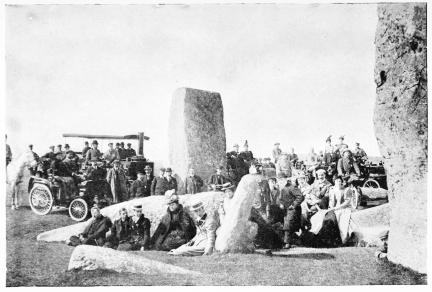 ANCIENT AND MODERN: MOTOR CARS AT STONEHENGE, EASTER
1899.
landmark in one’s existence, and awakens a new set of sensations, is
sheer gammon. I would say to every man who can’t see a prairie—go to
Salisbury Plain, Marlborough Downs, or any of the broad, high, open
lands near the sea. Many of them are fully as impressive; and Salisbury
Plain is decidedly more so.’
Salisbury Plain is the very core and concentrated essence of the wild
bleak scenery so characteristic of Wiltshire. An elevated tract of
country measuring roughly twenty-four miles from east to west, and
sixteen from north to south, and comprising the district between
Ludgershall and Westbury, and Devizes and Old Sarum, it is by no means
the Plain pictured by strangers, who, misled by that geographical
expression, have a mind’s-eye picture of it as being quite flat. As a
matter of fact, Salisbury Plain is not a bit like that. It is a long
series of undulating chalky downs, ‘as flat as your hand’ if you like,
because the hand is anything but flat, and the simile is excellently
descriptive of a rolling country that resembles the swelling contours of
an outstretched palm. Unproductive, exposed, and lonely, Salisbury Plain
opposes even to this day a very effectual barrier against intercourse
between north and south or east and west Wiltshire, and was the
lurking-place, until even so late as 1839, of highwaymen and footpads,
who shared the solitudes with the bustards, and attacked and robbed
those travellers whose business called them across the dreary wastes.
Many a malefactor has tried his prentice hand and learned his business
in these wilds, and has, after robbing elsewhere, retired here from
pursuit. Salisbury Plain, in short, bred a race of highwaymen who
preyed upon the neighbourhood and levied contributions from all the rich
farmers and graziers who travelled between the Cathedral City and other
parts, and sometimes graduated with such honours that they became
Knights of the Road at whose name travellers along the whole length of
the Exeter Road would tremble.
Among them was William Davis, the ‘Golden Farmer,’ whom we have already
met at Bagshot. His career was a long one, and was continued, here and
in other parts of the country, for forty years. They hanged him, at the
age of sixty-nine, in 1689. His most famous exploit was on the borders
of the Plain, near Clarendon Park, when he attacked the Duchess of
Albemarle, single-handed, and, in the presence of her numerous
attendants, tore her diamond rings off her fingers, and would probably
have had her watch and money as well, despite her cursing and torrents
of full-flavoured abuse, had not the sound of approaching travellers
warned him to fly.
‘Captain’ James Whitney, too, was another desperado who at times made
the Plain his headquarters, and harried the Western roads, in the time
of William the Third. He was probably a son of the Reverend James
Whitney, Rector of Donhead St. Andrews. He raised a troop of highwaymen,
and was captured at the close of 1692 after his band had been defeated
in battle with the Dragoon Guards. He ‘met a most penitent end’ at
Smithfield.
THOMAS BOULTER
Then there was Biss, perhaps a descendant of the Reverend Walter Biss,
minister of Bishopstrow, near Salisbury, in the reign of Charles the
First. Biss the highwayman was hanged at Salisbury in 1695, and was not
succeeded by any very distinguished practitioner until Boulter appeared
on the scene.
The distinguished Mr. Thomas Boulter was born of poor but dishonest
parents at Poulshot, near Devizes, and ran a brief but brilliant and
busy course which ended on the gallows outside Winchester. Mr. Boulter’s
parentage and the deeds that he did form splendid evidence to help
bolster up the doctrine of heredity. He came of a very numerous clan of
Boulters and Bisses, whose names are even to this day common at
Chiverell and Market Lavington, on the Plain. His father rented a grist
mill at Poulshot, stole grain for years, and was publicly whipped in
Devizes market-place for stealing honey from an old woman’s garden.
Shortly after that unfortunate incident, in 1775, on returning from
Trowbridge, he stole a horse, the property of a Mr. Hall, and riding it
over to Andover sold it for £6, although worth at least £15. This
injudicious deal aroused the suspicions of the onlookers, so that he was
arrested, and being convicted was sentenced to death. But the Boulters
and the Bisses made interest for him, so that his sentence was commuted
to transportation for fourteen years.
Mrs. Boulter, the wife of this transported felon and the mother of the
greater hero, is said to have also suffered a public whipping at the
cart’s tail, and Isaac Blagden, his uncle, also did a little in the
footpad line on Salisbury Plain between the intervals of agricultural
labouring. He never attained eminence, having met in an early stage of
his career with a sad check while attempting to rob a gentleman near
Market Lavington. The traveller drew a pistol and lodged a couple of
slugs in his thigh, leaving him bleeding on the highway. Some humane
person passing by procured assistance, and had him conveyed to the
village. The wound was cured, but he remained a cripple ever afterwards,
and being unable to work was admitted into Lavington Workhouse. He was
never prosecuted for the attempted crime.
Thomas Boulter, junior, the daring outlaw who shared with Hawkes the
title of the ‘Flying Highwayman,’ and whose name for very many years
afterwards was used as a bogey to frighten refractory children, was born
in 1748. He worked with his father, the miller, in the grist-mill at
Poulshot until 1774, when, his sister having opened a millinery business
in the Isle of Wight, he joined her there, and embarked his small
capital in a grocery business.
THE BEGINNING OF A CAREER
But the business did not flourish. Perhaps it could not be expected to
do so in the hands of so roving a blade, for he only gave it a year’s
perfunctory trial, and then, being pressed for money, set out to find it
on the road. He went to Portsmouth, procured two brace of pistols,
casting-irons for slugs, and a powder-horn, and, lying by a little
while, started in the summer of 1775, on the pretence of paying his
mother a visit at Poulshot. Setting out from Southampton, mounted on
horseback, he made for the Exeter Road, near ‘Winterslow Hut.’ In less
than a quarter of an hour the Salisbury diligence rewarded his patience
and enterprise by coming in sight across the downs. The perspiration
oozed out of his every pore, and he was so timid that he rode past the
diligence two or three times before he could muster sufficient
resolution to pronounce the single word ‘Stand!’ But at length he found
courage in the thought that he must begin, or go home as poor as he came
out, and so, turning short round, he ordered the driver to stop, and in
less than two minutes had robbed the two passengers of their watches and
money, saying that he was much obliged to them, for he was in great
want; and so, wishing them a pleasant journey, departed in the direction
of Salisbury and Devizes. By the time he reached Poulshot he had robbed
three single travellers on horseback and two on foot, and had secured a
booty of nearly £40 and seven watches.
This filial visit coming to an end, he returned home to Newport, Isle of
Wight, by way of Andover, Winchester, and Southampton. On his way across
Salisbury Plain he stopped a post-chaise, several farmers on horseback,
one on foot, and two countrywomen returning from market, going in sight
of the last person into Andover, and putting up his horse at the ‘Swan,’
where he stayed for an hour.
This successful beginning fired our hero for more adventures, and the
autumn of the same year found him, equipped with new pistols, a fine
suit of clothes, and a horse stolen at Ringwood, making his way to
Salisbury, with the intention of riding into the neighbourhood of Exeter
before commencing business. But between Salisbury and Blandford he could
not resist the temptation of robbing a diligence and a gentleman on
horseback, resulting in the rather meagre booty of a gold watch, two
guineas, and some silver. He then pushed on through Blandford towards
Dorchester, robbing on the way; all in broad daylight. When night was
come he thought it prudent to break off from the Exeter Road and lie by
at Cerne Abbas until the next afternoon, when he regained the highway
near Bridport, very soon finding himself in company with a wealthy
grazier who was jogging home in the same direction. The grazier found
his companion so sociable that he not only expressed himself as glad of
his society, but gossiped at length upon the successful day he had
experienced at Salisbury market, where he had sold a number of cattle at
an advanced price. He was well known, he said, for carrying the finest
beasts to market, and could always command a better price than his
neighbours.
Boulter broke in upon this self-satisfied talk with the wish that he had
been so lucky in his way of business. Unhappily, repeated misfortunes
had at last reduced him to distress, and he had taken to the road for
relieving his distresses, and was glad he had had the fortune to fall in
with a gentleman who appeared so well able to assist him. Suiting the
action to his words, he pulled out a pistol, and begged he might have
the pleasure of easing his companion of some of the wealth he had
acquired at Salisbury market.
ROBBERY BY WHOLESALE
The grazier thought this was a joke and supposed that it was done to
frighten him; whereupon Boulter clapped the pistol close to his breast
and told him he should not advance a single step until he had delivered
his money. In a few minutes his trembling victim had handed over, in
bank-notes and cash, nearly £90. His watch, which he seemed to set a
value upon for its antiquity, together with some bills of exchange,
Boulter returned, and, wishing him good-day, and observing that he
should return to London, continued, instead, his journey to Exeter.
Altogether, in this trip, he secured a booty of £500, in money and
valuables, and spent the winter and these ill-gotten gains among his
relatives on Salisbury Plain.
He opened his next campaign in May 1776, having first provided himself
with a splendid mare named ‘Black Bess,’ which he stole from Mr. Peter
Delmé’s stables at Erle Stoke. This horse, scarce inferior to Turpin’s
mare of the same name, is indeed supposed to have been a descendant of
hers. Starting from Poulshot, he rode to Staines, reaching that place on
the second night out. Rising at four o’clock the next morning, he was on
the road, in wait for the Western coaches; but he was a prudent man, and
at the sight of blunderbusses on their roofs, he concluded that to
attack them would be a tempting of Providence. Accordingly, he confined
his attentions to the diligences and the post-chaises, and was so active
that day that he visited Maidenhead, Hurley, Wokingham, Hartley Row,
Whitchurch, and Eversley, reaching Poulshot again the same night with
nearly £200, and with the ‘Hue and Cry’ of five counties at his heels.
His exploits on this occasion would not shame the first masters of the
art of highway robbery, and the performances of his mare were worthy of
her distinguished ancestry. At Hartley Row he called for a bottle of
wine, drank a glass himself, and pouring the remainder over a large
toast, gave it to his steed, repeating it at Whitchurch and Eversley.
Two months’ retirement at Poulshot seemed advisable after this, but
during the latter part of the summer and through the autumn he was very
busy, his operations extending as far as Bath and Bristol. To give an
account of his many robberies would require a long and detailed
biography. He did not always meet with travellers willing to resign
their purses without a struggle, and on those occasions he generally
came off second best; as in the case of the butcher whom he met upon the
Plain. Although Boulter held a pistol at the heads of travellers, he
never really meant to use it, and it was his boast, at his last hour,
that he had never taken life. Perhaps the butcher knew this, for when
our friend presented his firearm at his head, and asked him to turn his
pockets out, he said, ‘I don’t get my money so easily as to part with it
in that foolish manner. If you rob me, I must go upon the highway myself
before I durst go home, and that I’d rather not do.’
What was a good young highwayman, with conscientious scruples about
shedding blood, to do under those circumstances? It was an undignified
situation, but he retreated from it as best he could, and with the
words: ‘Good-night, and remember that Boulter is your friend,’
disappeared.
BOULTER AND PARTNER
In 1777 he took a journey up to York, and was laid by the heels there,
escaping the hangman by enlisting, a course then left open to criminals
by the Government, which did not tend to bring the Army into better
repute. After three days in barracks he deserted, and made the best of
his way southwards. Reaching Bristol, he found a fellow-spirit in one
James Caldwell, landlord of the ‘Ship Inn,’ Milk Street, and with him
entered upon a new series of robberies. But, first of all, he paid a
visit to his relatives at Poulshot, doing some business on the way, and
scouring the country round about that convenient retreat. He stopped the
diligence again at ‘Winterslow Hut,’ emptying the pockets of all the
passengers, and robbed a Salisbury gentleman near Andover, who, after
surrendering his purse, lamented that he had nothing left to carry him
home.
‘How far have you to go home?’ asked Boulter.
‘To Salisbury,’ said the traveller.
‘Then,’ rejoined the highwayman, ‘here’s twopence, which is quite enough
for so short a journey.’
Boulter, according to his biographers, had the light hair and complexion
of the Saxon. ‘His bonhomie, not untinctured with a quiet humour,
fascinated and disarmed his victims, who felt that, had he been so
disposed, he could have descended upon them like the hammer of Thor.’
His companion henceforward, Caldwell, was of a dark complexion and
ferocious disposition. Together they visited the Midlands in 1777, and
with varying success brought that season to a close, Boulter returning
alone to Poulshot for a short holiday from professional cares. Riding on
the Plain early one morning, he was surprised to meet a
gentlemanly-looking horseman, who looked very hard at him, and who,
after passing him about a hundred yards, turned round and pursued him at
a gallop. ‘Well,’ thought Boulter, ‘this seems likely to prove a kind of
adventure on which I never calculated. I am about to be stopped myself
by a gentleman of the road. In what manner will it be necessary to
receive the attack.’
The stranger came up rapidly, and whatever his intentions were, merely
observed, ‘You ride a very fine horse; would you like to sell her?’
‘Oh yes,’ replied Boulter; ‘but for nothing less than fifty guineas.’
‘Can she trot and gallop well?’
‘She can trot sixteen miles an hour, and gallop twenty, or she would not
do for my business,’ said Boulter, with a significant look.
By this time the stranger, becoming uneasy, desired to see her paces,
probably thinking thus to rid himself of so mysterious a character.
‘With all my heart,’ rejoined the highwayman, ‘you shall see how she
goes, but I must first be rewarded for it,’ presenting his pistol with
the customary demand. That request having been complied with, Boulter
wished him good-morning, saying, ‘Now, sir, you have seen my
performance, you shall see the performance of my horse, which I doubt
not will perfectly satisfy you’; and putting spur to her, was soon but a
distant speck upon the Plain, leaving the stranger to bewail his foolish
curiosity.
A HUE AND CRY
The winter of 1777 and the spring of 1778 were employed by Boulter and
Caldwell in scouring Salisbury Plain and the neighbouring country. A
reward had long been offered for the apprehension of the robber who
infested the district, and the appearance of a confederate now alarmed
Salisbury so greatly that private persons began to advertise in the
local papers their readiness to supplement this sum. A public
subscription, amounting to twenty guineas, was also raised at Devizes,
so that there was every inducement to the peasantry to make a capture.
Yet, strange to say, no one, either private or official persons, laid a
hand on them, even though Boulter appears to have been identified with
the daring horseman who robbed every one crossing the Plain. The
following advertisement appeared 10th January 1778:—
Whereas divers robberies have been lately committed on the road
from Devizes to Salisbury, and also near the town of Devizes: and
as it is strongly suspected that one Boulter, with an accomplice,
are the persons concerned in these robberies, a reward of thirty
guineas is offered for apprehending and bringing to justice the
said Boulter, and ten guineas for his accomplice, over and above
the reward allowed by Act of Parliament:—to be paid, on
conviction, at the Bank in Devizes. If either of these persons are
taken in any distant part of the country, reasonable charges will
also be allowed. Boulter is about five feet eleven inches high,
stout made, light hair, crooked nose, brownish complexion, and
about thirty years of age. His accomplice, about five feet nine
inches high, thin made, long favoured, black hair, and is said to
be about twenty-five years of age.
This publicity did not hinder their enterprises, and speaking of
Boulter, a little later, the Salisbury Journal says: ‘The robberies he
has committed about Salisbury, the Plain, Romsey, and Southampton, and
the several roads to London, are innumerable.’
CAPTURE OF BOULTER
But what local law and order could not accomplish was effected at
Birmingham, to which town the confederates had made a journey in the
spring of 1778, for the purpose of selling some of the jewellery and
watches they had accumulated. Boulter had approached a Jew dealer on the
subject, and was arrested, together with Caldwell, and thrown into
Birmingham Prison. They were sent thence to Clerkenwell, from which,
having already secured by bribery a jeweller’s saw and cut through his
irons, he escaped, with two other prisoners, carrying the irons away
with him, and hanging them in triumph on a whitethorn bush at St.
Pancras. With consummate impudence he took lodgings two doors away from
Clerkenwell Prison, and, procuring a new outfit, set off down to Dover,
to take ship across the Channel. But, unfortunately for him, the country
was on the eve of a war with France, and an embargo had been laid upon
all shipping. He could not even secure a small sailing-boat. Hurrying
off to Portsmouth, he found the same difficulty, and could not even get
across to the Isle of Wight. Thence to Bristol, haunted with a constant
fear of being arrested; but not a single vessel was leaving that port.
Then it occurred to him that the desolate Isle of Portland was the most
likely hiding-place. Setting out from Bristol, he reached Bridport, and
went to an inn to refresh himself and his horse. When he asked what he
could have for dinner, he was told there was a family ordinary just
ready. He accordingly sat down at table, beside the landlord and three
gentlemen, one of whom eyed him with a searching scrutiny, until,
becoming fully satisfied that this was none other than Boulter, the
escaped prisoner, he beckoned the landlord out of the room, and reminded
him of the duty and necessity which lay upon them of securing so
notorious an offender. The landlord then returned to the dining-room and
desired Boulter to accompany him to an adjoining parlour, where he
revealed to him the perilous state of affairs; but added, ‘As you have
never done me an injury, I wish you no harm, so just pay your reckoning,
and be off as quick as you can.’
Boulter bade him tell the strangers that they were totally mistaken,
that he was a London rider (that is to say, a commercial traveller), and
that his name was White; but having no wish to be the cause of a
disturbance in his house, he would take his advice and go on his way.
The landlord went back to his guests, and Boulter got on his horse with
all possible expedition. Once fairly seated in the saddle, a single
application of the spur would have launched him beyond the reach of
these hungry pursuers, nor in such an emergency as this would his pistol
be harmlessly pointed against those who thus sought to earn the rewards
offered for his capture. Alas! he had but placed his foot in the stirrup
when out rushed the false landlord and his guests. They secured him, and
being handed over to the authorities, he was lodged in Dorchester Gaol.
He was arraigned at Winchester with Caldwell (who had been removed from
London) on 31st July, and both being found guilty, they were hanged at
Winchester, 19th August 1778.