PROFESSOR OF ZOOLOGY IN THE UNIVERSITY OF FREIBURG IN BREISGAU
TRANSLATED WITH THE AUTHOR'S CO-OPERATION
BY
J. ARTHUR THOMSON
REGIUS PROFESSOR OF NATURAL HISTORY IN THE UNIVERSITY OF ABERDEEN
AND
MARGARET R. THOMSON
ILLUSTRATED
IN TWO VOLUMES
VOL. I
LONDON
EDWARD ARNOLD
41 & 43 MADDOX STREET, BOND STREET, W.
1904
All rights reserved
AUTHOR'S PREFACE
When a life of pleasant labour is drawing towards a close,
the wish naturally asserts itself to gather together the main
results, and to combine them in a well-defined and harmonious
picture which may be left as a legacy to succeeding generations.
This wish has been my main motive in the publication
of these lectures, which I delivered in the University of
Freiburg in Breisgau. But there has been an additional
motive in the fact that the theory of heredity published
by me a decade ago has given rise not only to many investigations
prompted by it, but also to a whole literature
of 'refutations,' and, what is much better, has brought to
light a mass of new facts which, at first sight at least, seem
to contradict my main theory. As I remain as convinced
that the essential part of my theory is well grounded as
I was when I first sketched it, I naturally wish to show how
the new facts may be brought into harmony with it.
It is by no means only with the theory of heredity by
itself that I am concerned, for that has served, so to speak,
as a means to a higher end, as a groundwork on which to
base an interpretation of the transformations of life through
the course of the ages. For the phenomena of heredity, like
all the functions of individual life, stand in the closest
association with the whole evolution of life upon our earth;
indeed, they form its roots, the nutritive basis from which all
its innumerable branches and twigs are, in the long run,
derived. Thus the phenomena of the individual life, and
especially those of reproduction and inheritance, must be
considered in connexion with the Theory of Descent, that
the latter may be illumined by them, and so brought nearer
our understanding.
I make this attempt to sum up and present as a harmonious
whole the theories which for forty years I have been gradually
building up on the basis of the legacy of the great workers of
the past, and on the results of my own investigations and
those of many fellow workers, not because I regard the picture
as complete or incapable of improvement, but because I believe
its essential features to be correct, and because an eye-trouble
which has hindered my work for many years makes it
uncertain whether I shall have much more time and strength
granted to me for its further elaboration. We are standing
in the midst of a flood-tide of investigation, which is ceaselessly
heaping up new facts bearing upon the problem of evolution.
Every theory formulated at this time must be prepared
shortly to find itself face to face with a mass of new facts
which may necessitate its more or less complete reconstruction.
How much or how little of it may remain, in face of the facts
of the future, it is impossible to predict. But this will be so
for a long time, and it seems to me we must not on that
account refrain from following out our convictions to the
best of our ability and presenting them sharply and definitely,
for it is only well-defined arguments which can be satisfactorily
criticized, and can be improved if they are imperfect,
or rejected if they are erroneous. In both these processes
progress lies.
This book consists of 'Lectures' which were given publicly
at the university here. In my introductory lecture in 1867
I championed the Theory of Descent, which was then the
subject of lively controversy, but it was not till seven years
later that I gave, by way of experiment, a short summer
course with a view to aiding in the dissemination of Darwin's
views. Then very gradually my own studies and researches
and those of others led me to add to the Darwinian edifice,
and to attempt a further elaboration of it, and accordingly
these 'Lectures,' which were delivered almost regularly every
year from 1880 onwards, were gradually modified in accordance
with the state of my knowledge at the time, so that they
have been, I may say, a mirror of the course of my own
intellectual evolution.
In the last two decades of the nineteenth century much
that is new has been introduced into biological science;
Nägeli's idea of 'idioplasm'—the substance which determines
form; Roux's Struggle of the Parts, the recognition of a special
hereditary substance, 'the germ-plasm,' its analysis into chromosomes,
and its continuity from generation to generation;
the potential immortality of unicellular organisms and of the
germ-cells in contrast to the natural death of higher forms and
'bodies'; a deeper interpretation of mitotic nuclear division,
the discovery of the centrosphere—the marvellous dividing
apparatus of the cell—which at once allowed us to penetrate
a whole stratum deeper into the unfathomable mine of
microscopic vital structure; then the clearing up of our ideas
in regard to fertilization, and the analysis of this into the two
processes combined in it, reproduction and the mingling of
the germ-plasms (Amphimixis); in connexion with this, the
phenomena of maturation, first in the female and then in the
male cell, and their significance as a reduction of the hereditary
units:—all this and much more we have gained during this
period. Finally, there is the refutation of the Lamarckian
principle, and the consequent elaboration of the principle
of selection by applying it to the hitherto closed region of
the ultimate vital elements of the germ-plasm.
The actual form of these lectures has developed as they
were transcribed. But although the form is thus to some
extent new, I have followed in the main the same train
of thought as in the lectures of recent years. The lecture-form
has been adhered to in the book, not merely because
of the greater vividness of presentation which it implies,
but for many other reasons, of which the greater freedom
in the choice of material and the limiting of quotation to
a minimum are not the least. That all polemics of a personal
kind have thus been excluded will not injure the book, but
it is by no means lacking in discussions of opinion, and will,
therefore, I trust, contribute something towards the clearing
up of disputed points.
I have endeavoured to introduce as much of the researches
and writings of others as possible without making the book
heavy; but my aim has been to write a book to be read, not
merely one to be referred to.
If it be asked, finally, for whom the book is intended,
I can hardly answer otherwise than 'For him whom it
interests.' The lectures were delivered to an audience consisting
for the most part of students of medicine and natural
science, but including some from other faculties, and sometimes
even some of my colleagues in other departments.
In writing the book I have presupposed as little special
knowledge as possible, and I venture to hope that any one
who reads the book and does not merely skim it, will be
able without difficulty to enter into the abstruse questions
treated of in the later lectures.
It would be a great satisfaction to me if this book were
to be the means of introducing my theoretical views more
freely among investigators, and to this end I have elaborated
special sections more fully than in the lectures. Notwithstanding
much controversy, I still regard its fundamental
features as correct, especially the assumption of 'controlling'
vital units, the determinants, and their aggregation into
'ids'; but the determinant theory also implies germinal
selection, and without it the whole idea of the guiding of
the course of transformation of the forms of life, through
selection which rejects the unfit and favours the more fit,
is, to my mind, a mere torso, or a tree without roots.
I only know of two prominent workers of our day who
have given thorough-going adherence to my views: Emery
in Bologna and J. Arthur Thomson in Aberdeen. But
I still hope to be able to convince many others when the
consistency and the far-reachingness of these ideas are better
understood. In many details I may have made mistakes
which the investigations of the future will correct, but as
far as the basis of my theory is concerned I am confident:
the principle of selection does rule over all the categories of
vital units. It does not, indeed, create primary variations,
but it determines the paths of evolution which these are to
follow, and thus controls all differentiation, all ascent of
organization, and ultimately the whole course of organic
evolution on the earth, for everything about living beings
depends upon adaptation, though not on adaptation in the
sense in which Darwin used the word.
The great prominence thus given to the idea of selection
has been condemned as one-sided and exaggerated, but the
physicist is quite as open to the same reproach when he
thinks of gravity as operative not on our earth alone, but
as dominating the whole cosmos, whether visible to us or
not. If there is gravity at all it must prevail everywhere,
that is, wherever material masses exist; and in the same way
the co-operation of certain conditions with certain primary
vital forces must call forth the same process of selection
wherever living beings exist; thus not only are the vital
units which we can perceive, such as individuals and cells,
subject to selection, but those units the existence of which
we can only deduce theoretically, because they are too minute
for our microscopes, are subject to it likewise.
This extension of the principle of selection to all grades
of vital units is the characteristic feature of my theories;
it is to this idea that these lectures lead, and it is this—in
my own opinion—which gives this book its importance.
This idea will endure even if everything else in the book
should prove transient.
Many may wonder, perhaps, why in the earlier lectures
much that has long been known should be presented afresh,
but I regard it as indispensable that the student who wishes
to make up his own mind in regard to the selection-idea
should not only be clear as to what it means theoretically,
but should also form for himself a conception of its sphere
of influence. Many prejudiced utterances in regard to
'Natural Selection' would never have been published if
those responsible for them had known more of the facts;
if they had had any idea of the inexhaustible wealth of
phenomena which can only be interpreted in the light of this
principle, in as far, that is, as we are able to give explanations
of life at all. For this reason I have gone into the subject
of colour-adaptations, and especially into that of mimicry,
in great detail; I wished to give the reader a firm foundation
of fact from which he could select what suited him when he
wished to test by the light of facts the more difficult problems
discussed in the book.
In conclusion, I wish to thank all those who have given
me assistance in one way or other in this work: my former
assistant and friend Professor V. Häcker in Stuttgart, my
pupils and fellow workers Dr. Gunther and Dr. Petrunkewitsch,
and the publisher, who has met my wishes in the most
amiable manner.
Freiburg-I-Br., February 20, 1902.
PREFATORY NOTE TO ENGLISH EDITION
Professor Weismann'sEvolution Theory, here translated
from the second German edition (1904), is a work of compelling
interest, the fruit of a lifetime of observation and
reflection, a veteran's judicial summing up of his results, and
certainly one of the most important contributions to Evolution
literature since Darwin's day.
As the author's preface indicates, the salient features of
his crowning work are (1) the illumination of the Evolution
process with a wealth of fresh illustrations; (2) the vindication
of the 'Germ-plasm' concept as a valuable working
hypothesis; (3) the final abandonment of any assumption of
transmissible acquired characters; (4) a further analysis of
the nature and origin of variations; and (5), above all, an
extension of the Selection principle of Darwin and Wallace,
which finds its logical outcome in the suggestive theory of
Germinal Selection.
The translation will be welcomed, we believe, not only
by biological experts who have followed the development of
'Weismannism' during the last twenty years, and will here
find its full expression for the time being, but also by those
who, while acquainted with individual essays, have not
hitherto realized the author's complete system. Apart from
the theoretical conceptions which unify the book and mark
it as an original contribution of great value, there is a lucid
exposition of recent biological advances which will appeal to
those who care more for facts than theories. To critics of
evolutionism, who are still happily with us, the book ought
to be indispensable; it will afford them much material for
argumentation, and should save them many tilts against
windmills. But, above all, the book will be valued by workers
in many departments of Biology, who are trying to help
in the evolution of Evolution Theory, for it is characteristic
of the author, as the history of recent research shows, to
be suggestive and stimulating, claiming no finality for his
conclusions, but urging us to test them in a mood of 'thätige
Skepsis.'
The translation of this book—the burden of which has
been borne by my wife—has been a pleasure, but it has also
been a serious responsibility. We have had fine examples
set us by previous translators of some of Weismann's works,
Meldola, Poulton, Shipley, Parker, and others; and if we
have fallen short of their achievements, it has not been for
lack of endeavour to follow the original with fidelity, nor for
lack of encouragement on the part of the author, who revised
every page and suggested many emendations.
Every one knows in a general way what is meant by the doctrine
of descent—that it is the theory which maintains that the forms of
life, animals and plants, which we see on our earth to-day, have not
been the same from all time, but have been developed, by a process of
transformation, from others of an earlier age, and are in fact descended
from ancestors specifically different. According to this doctrine of
descent, the whole diversity of animals and plants owes its origin to
a transformation process, in the course of which the earliest inhabitants
of our earth, extremely simple forms of life, were in part
evolved in the course of time into forms of continually increasing
complexity of structure and efficiency of function, somewhat in the
same way as we can see every day, when any higher animal is
developed from a single cell, the egg-cell, not suddenly or directly,
but connected with its origin by a long series of ever more complex
transformation stages, each of which is the preparation for, and leads on
to the succeeding one. The theory of descent is thus a theory of
development or evolution. It does not merely, as earlier science did,
take for granted and describe existing forms of life, but regards them
as having become what they are through a process of evolution, and
it seeks to investigate the stages of this process, and to discover the
impelling forces that lie behind it. Briefly, the theory of descent is
an attempt at a scientific interpretation of the origin and diversity of
the animate world.
In these lectures, therefore, we have not merely to show on what
grounds we make this postulate of an evolution process, and to
marshall the facts which necessitate it; we must also try to penetrate
as far as possible towards the causes which bring about such transformations.
For this reason we are forced to go beyond the limits
of the theory of descent in the narrow sense, and to deal with
the general processes of life itself, especially with reproduction and
the closely associated problem of heredity. The transformation of
species can only be interpreted in one of two ways; either it depends
on a peculiar internal force, which is usually only latent in the
organism, but from time to time becomes active, and then, to a
certain extent, moulds it into new forms; or it depends on the
continually operating forces which make up life, and on the way in
which these are influenced by changing external conditions. Which
of these alternatives is correct we can only undertake to determine
when we know the phenomena of life, and as far as possible their
causes, so that it is indispensable to make ourselves acquainted with
these as far as we can.
When we look at one of the lowest forms of life, such as an
Amœba or a single-celled Alga, and reflect that, according to the theory
of evolution, the whole realm of creation as we see it now, with Man
at its head, has evolved from similar or perhaps even smaller and
simpler organisms, it seems at first sight a monstrous assumption, and
one which quite contradicts our simplest and most certain observations.
For what is more certain than that the animals and plants
around us remain the same, as long as we can observe them, not
through the lifetime of an individual only, but through centuries, and
in the case of many species, for several thousand years?
This being so, it is intelligible enough that the doctrine of
evolution, on its first emergence at the end of the eighteenth century,
was received with violent opposition, not on the part of the laity only,
but by the majority of scientific minds, and instead of being followed
up, was at first opposed, then neglected, and finally totally forgotten,
to spring up anew in our own day. But even then a host of
antagonists ranged themselves against the doctrine, and, not content
with loftily ignoring it, made it the subject of the most violent and
varied attacks.
This was the state of affairs when, in 1858, Darwin's book on
The Origin of Species appeared, and hoisted the flag of evolution
afresh. The struggle that ensued may now be regarded as at an end,
at least as far as we are concerned—that is, in the domain of science.
The doctrine of descent has gained the day, and we can confidently
say that the Evolution theory has become a permanent possession of
science that can never again be taken away. It forms the foundation
of all our theories of the organic world, and all further progress must
start from this basis.
In the course of these lectures, we shall find at every step fresh
evidence of the truth of this assertion, which may at first seem all too
bold. It is not by any means to be supposed that the whole question
in regard to the transformation of organisms and the succession of
new forms of life has been answered in full, or that we have now
been fortunate enough to solve the riddle of life itself. No! whether
we ever reach that goal or not, we are a long way from it as yet, and
even the much easier problem, how and by what forces the evolution
of the living world has proceeded from a given beginning, is far from
being finally settled; antagonistic views are still in conflict, and there
is no arbitrator whose authoritative word can decide which is right.
The How? of evolution is still doubtful, but not the fact, and this
is the secure foundation on which we stand to-day: The world of
life, as we know it, has been evolved, and did not originate all at
once.
Were I to try to give, in advance, even an approximate idea of the
confidence with which we can take our stand on this foundation,
I should be almost embarrassed by the wealth of facts on which
I might draw. It is hardly possible nowadays to open a book on the
minute or general structural relations, or on the development of any
animal whatever, without finding in it evidences in favour of the
Evolution theory, that is to say, facts which can only be understood
on the assumption of the evolution of the organic world. This, too,
without taking into account at all the continually increasing number
of facts Palæontology is bringing to light, placing before our eyes the
forms which the Evolution theory postulates as the ancestors of the
organic world of to-day: birds with teeth in their bills, reptile-like
forms clothed with feathers, and numerous other long-extinct forms
of life, which, covered up by the mud of earlier waters, and preserved
as 'fossils' in the later sedimentary rocks, tell us plainly how the
earlier world of animals and plants was constituted. Later, we shall
see that the geographical distribution of plant and animal species of
the present day can only be understood in the light of the Evolution
theory. But meantime, before we go into details, what may justify
my assumption is the fact that the Evolution theory enables us to
predict.
Let us take only a few examples. The skeleton of the wrist in
all vertebrate animals above Fishes consists of two rows of small
bones, on the outer of which are placed the five bones of the palm,
corresponding to the five fingers. The outer row is curved, and there
is thus a space between the two rows, which, in Amphibians and
Reptiles, is filled by a special small bone. This 'os centrale' is
absent in many Mammals, notably, for instance, in Man, and the
space between the two rows is filled up by an enlargement of one
of the other bones. Now if Mammals be descended from the lower
vertebrates, as the theory of descent assumes, we should expect to
find the 'os centrale' even in Man in young stages, and, after many
unsuccessful attempts, Rosenberg has at last been able to demonstrate
it at a very early stage of embryonic development.
This prediction, with another to be explained later, is based upon
the experience that the development of an individual animal follows,
in a general way, the same course as the racial evolution of the
species, so that structures of the ancestors of a species, even if they
are not found in the fully developed animal, may occur in one of its
earlier embryonic stages. Further on, we shall come to know this
fact more intimately as a 'biogenetic law,' and it alone would be
almost enough to justify the theory of evolution. Thus, for instance,
the lowest vertebrates, the Fishes, breathe by means of gills, and these
breathing organs are supported by four or more gill-arches, between
which spaces, the gill-slits, remain open for the passage of water.
Although Reptiles, Birds, and Mammals breathe by lungs, and at no
time of their life by gills, yet, in their earliest youth, that is, during
their early development in the egg, they possess these gill-arches and
gill-slits, which subsequently disappear, or are transformed into other
structures.
On the strength of this 'biogenetic law' it could also be predicted
that Man, in whom, as is well known, there are twelve pairs of ribs,
would, in his earliest youth, possess a thirteenth pair, for the lower
Mammals have more numerous ribs, and even our nearest relatives,
the anthropoid Apes, the gorilla and chimpanzee, have a thirteenth
rib, though a very small one, and the siamang has even a fourteenth.
This prediction also has been verified by the examination of young
human embryos, in which a small thirteenth rib is present, though it
rapidly disappears.
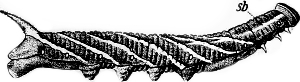
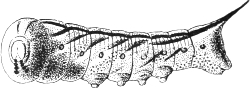
During the seventies I was engaged in investigating the development
of the curious marking which adorns the long body of many
of our caterpillars. I studied in particular the caterpillars of our
Sphingidæ or hawk-moths, and found, by a comparison of the various
stages of development from the emergence of the caterpillar from the
egg on to its full growth, that there is a definite succession of
different kinds of markings following each other, in a whole range
of species, in a similar manner. From the standpoint of the
Evolution theory, I concluded that the markings of the youngest
caterpillars, simple longitudinal stripes, must have been those of the
most remote ancestors of our present species, while those of the later
stages, oblique stripes, were those of ancestors of a later date.
If this were the case, then all the species of caterpillar which
now exhibit oblique stripes in their full-grown stage must have had
longitudinal stripes in their youngest stages, and because of this
succession of markings in the individual development, I was able to
predict that the then unknown young form of the caterpillar of our
privet hawk-moth (Sphinx ligustri) must have a white line along each
side of the back. Ten years later, the English zoologist, Poulton,
succeeded in rearing the eggs of Sphinx ligustri, and it was then
demonstrated that the young caterpillar actually possessed the postulated
white lines.
Such predictions undoubtedly give the hypothesis on which
they are based, the Evolution theory, a high degree of certainty, and
are almost comparable to the prediction of the discovery of the
planet Neptune by Leverrier. As is well known, this, the most
distant of all the planets, whose period of revolution round the sun is
almost 165 of our years, would probably never have been recognized
as a planet, had not Adams, an astronomer at the Greenwich Observatory,
and afterwards Leverrier, deduced its presence from slight
disturbances in the path of Jupiter's moons, and indicated the spot
where an unknown planet must be looked for. Immediately all
telescopes were directed towards the spot indicated, and Galle, at the
Berlin Observatory, found the sought-for planet.
We might with justice regard as lacking in discernment those
who, in the face of such experiences, still doubt that the earth
revolves round the sun, and we might fairly say the same of any one
who, in the face of the known facts, would dispute the truth of the
Evolution theory. It is the only basis on which an understanding of
these facts is possible, just as the Kant-Laplace theory of the solar
system is the only basis on which an adequate interpretation of the
facts of the heavens can be arrived at.
To this comparison of the two theories it has been objected that
the Evolution theory has far less validity than the other, first, because
it can never be mathematically demonstrated, and secondly, because
at the best it can only interpret the transformations of the animate
world, and not its origin. Both objections are just: the phenomena
of life are in their nature much too intricate for mathematics to deal
with, except with extreme diffidence; and the question of the origin
of life is a problem which will probably have to wait long for
solution. So, if it gives pleasure to any one to regard the one
theory as having more validity than the other, no one can object; but
there is no particular advantage to be gained by doing so. In any
case, the Evolution theory shares the disadvantage of not being able
to explain everything in its own province with the Kant-Laplace
cosmogony, for that, too, must presuppose the first beginning, the
rotating nebula.
Although I regard the doctrine of descent as proved, and
hold it to be one of the greatest acquisitions of human knowledge,
I must repeat that I do not mean to say that everything is clear
in regard to the evolution of the living world. On the contrary,
I believe that we still stand merely on the threshold of investigation,
and that our insight into the mighty process of evolution, which has
brought about the endless diversity of life upon our earth, is still
very incomplete in relation to what may yet be found out, and that,
instead of being vainglorious, our attitude should be one of modesty.
We may well rejoice over the great step forward which the dominant
recognition of the Evolution theory implies, but we must confess that
the beginnings of life are as little clear to us as those of the solar
system. But we can do this at least: we can refer the innumerable
and wonderful inter-relations of the organic cosmos to their causes—common
descent and adaptation—and we can try to discover the ways
and means which have co-operated to bring the organic world to
the state in which we know it.
When I say that the theory of descent is the most progressive
step that has yet been taken in the development of human knowledge,
I am bound to give my reasons for this opinion. It is justified,
it seems to me, even by this fact alone, that the Evolution idea is not
merely a new light on the special region of biological science, zoology
and botany, but is of quite general importance. The conception of
an evolution of the world of life upon the earth reaches far beyond
the bounds of any single science, and influences our whole realm of
thought. It means nothing less than the elimination of the miraculous
from our knowledge of nature, and the placing of the phenomena
of life on the same plane as the other natural processes, that is, as
having been brought about by the same forces, and being subject
to the same laws. In the domain of the inorganic, no one now
doubts that out of nothing nothing can come: energy and matter
are from everlasting to everlasting, they can neither be increased or
decreased, they can only be transformed—heat into mechanical
energy, into light, into electricity, and so on. For us moderns, the
lightning is no longer hurled by the Thunderer Zeus on the head
of the wicked, but, careless alike of merit or guilt, it strikes where
the electric tension finds the easiest and shortest line of discharge.
Thus to our mode of thought it now seems clear that no event in the
world of the living depends upon caprice, that at no time have organisms
been called forth out of nothing by the mighty word of a Creator,
but they have been produced at all times by the co-operation of the
existing forces of nature, and every species must have arisen just
where, and when, and in the form in which it actually did arise, as
the necessary outcome of the existing conditions of energy and
matter, and of their interactions upon each other. It is this
correlation of animate nature with natural forces and natural laws
which gives to the doctrine of evolution its most general importance.
For it thus supplies the keystone in the arch of our interpretation of
nature and gives it unity; for the first time it makes it possible to
form a conception of a world-mechanism, in which each stage is the
result of the one before it, and the cause of the succeeding one.
How deeply all our earlier opinions are affected by this doctrine
will become clear if we fix our attention on a single point, the
derivation of the human understanding from that of animal ancestors.
What of the reason of Man, of his morals, of his freedom of will? may
be asked, as it has been, and still is often asked. What has been
regarded as absolutely distinct from the nature of animals is said to
differ from their mental activities only in degree, and to have evolved
from them. The mind of a Kant, of a Laplace, of a Darwin—or to
ascend into the plane of the highest and finest emotional life, the
genius of a Raphael or a Mozart—to have any real connexion, however
far back, with the lowly psychical life of an animal! That is
contrary to all our traditionary, we might say our inborn, ideas, and it
is not to be wondered at that the laity, and especially the more cultured
among them, should have opposed such a doctrine whose dominating
power was unintelligible to them, because they were ignorant of
the facts on which it rests. That a man should feel his dignity
lowered by the idea of descent from animals is almost comical to the
naturalist, for he knows that every one of us, in his first beginning,
occupied a much lowlier position than that of our mammalian
ancestors—was, in fact, as regards visible structure, on a level with
the Amœba, that microscopically minute unicellular animal, which
can hardly be said to possess organs, and whose psychical activities
are limited to recognizing and engulfing its food. Very gradually at
first, and step by step, there develop from this single cell, the ovum,
more and more numerous cells; this mass of cells segregates into
different groups, which differentiate further and further, until at last
they form the perfect man. This occurs in the development of every
human being, and we are merely unaccustomed to the thought that it
means nothing else than an incredibly rapid ascent of the organism
from a very low level of life to the highest.
Still less is it to be wondered at that the Evolution doctrine
met with violent opposition on the part of the representatives of
religion, for it stood in open contradiction to that remarkable and
venerable cosmogony, the Mosaic story of Creation, which people had
been accustomed to regard, not as what it is—a conception of nature
at an early stage of human culture—but as an inalienable part of our
own religion. But investigation shows us that the doctrine of
evolution is true, and it is only a weak religion which is incapable
of adapting itself to the truth, retaining what is essential, and letting
go what is unessential and subject to change with the development of
the human mind. Even the heliocentric hypothesis was in its day
declared false by the Church, and Galilei was forced to retract; but
the earth continued to revolve round the sun, and nowadays any one
who doubted it would be considered mentally weak or warped. So
in all likelihood the time is not far distant when the champions of
religion will abandon their profitless struggle against the new truth,
and will see that the recognition of a law-governed evolution of the
organic world is no more prejudicial to true religion than is the
revolution of the earth round the sun.
Having given this very general orientation of the Evolution
problem, which is to engage our attention in detail, I shall approach
the problem itself by the historical method, for I do not wish to bring
the views of present-day science quite suddenly and directly into
prominence. I would rather seek first to illustrate how earlier
generations have tried to solve the question of the origin of the
living world. We shall see that few attempts at solution were made
until quite recently, that is, until the end of the eighteenth and the
beginning of the nineteenth century. Only then there appeared a
few gifted naturalists with evolutionist ideas, but these ideas did not
penetrate far; and it was not till after the middle of the nineteenth
century that they found a new champion, who was to make them
common property and a permanent possession of science. It was
the teaching of Charles Darwin that brought about this thorough
awakening, and laid the foundations of our present interpretations,
and his work will therefore engross our attention for a number of
lectures. Only after we have made ourselves acquainted with his
teaching shall we try to test its foundations, and to see how far this
splendid structure stands on a secure basis of fact, and how deeply its
power of interpretation penetrates towards the roots of phenomena.
We shall examine the forces by which organisms are dominated, and
the phenomena produced, and thereby test Darwin's principles of
interpretation, in part rejecting them, in part accepting them, though
in a much extended form, and thus try to give the whole theoretic
structure a more secure foundation. I hope to be able to show
that we have made some real progress since Darwin's day, that
deductions have been drawn from his theory which even he did not
dream of, which have thrown fresh light on a vast range of phenomena,
and, finally, that through the more extended use of his own
principles, the Evolution theory has gained a completeness, and
an intrinsic harmony which it previously lacked.
This at least is my own opinion, but I cannot ignore the fact
that it is by no means shared by all living naturalists. The obvious
gaps and insufficiencies of the Darwinian theory have in the last few
decennia prompted all sorts of attempts at improving it. Some of
these were lost sight of almost as soon as they were suggested, but
others have held their own, and can still claim numerous supporters.
It would only tend to bewilder if I gave an account of those of the
former class, but those which still hold their own must be noticed
in these lectures, though it is by no means my intention to expound
the confused mass of opinions which has gathered round the doctrine
of evolution, but rather to give a presentation of the theory as it
has gradually grown up in my own mind in the course of the last
four decades. Even this will not be the last of which science will
take knowledge, but it will, I hope, at least be one which can be
further built upon.
Let us, then, begin at once with that earliest forerunner of the
modern theory of descent, the gifted Greek philosopher Empedocles,
who, equally important as a leader of the state of Agrigentum, and as
a thinker in purely theoretical regions of thought, advanced very
notable views regarding the origin of organisms. We must, however,
be prepared to hear something that is hardly a theory in the modern
scientific acceptation of that term; and we must not be repelled by
the unbridled poetical fancy of the speculative philosopher; we have
to recognize that there is a sound kernel contained in his amusing
pictures—a thought which we meet with later, in much more concrete
form, in the Darwinian theory, and which, if I mistake not, we shall
keep firm hold of in all time to come.
According to Empedocles the world was formed by the four
elements of the ancients, Earth, Water, Fire, and Air, moved and
guided by two fundamental forces, Hate and Love, or, as we should
now say, Repulsion and Attraction. Through the chance play of
these two forces with the elements, there arose first the plants, then
the animals, in such a manner that at first only parts and organs
of animals were formed: single eyes without faces, arms without
bodies, and so on. Then, in wild play, Nature attempted to put
together these separate parts, and so created all manner of combinations,
for the most part inept monsters unfit for life, but in a few
cases, where the parts fitted, there resulted a creature capable not
only of life, but, if the juxtaposition was perfect, even of reproduction.
This phantastic picture of creation seems to us mad enough, but
there slumbers in it, all unsuspected though it may have been by the
author, the true idea of selection, the idea that much that is unfit
certainly arises, but that only the fit endures. The mechanical
coming-to-be of the fit is the sound kernel in this wondersome
doctrine.
The natural science of the ancients, in regard to life and its
forms, reached its climax in Aristotle (died 322 B. C.). A true polyhistorian,
his writings comprehended all the knowledge of his time,
but he also added much to it from his own observation. In his
writings we find many good observations on the structure and habits
of a number of organisms, and he also had the merit of being the
first to attempt a systematic grouping of animals. With true insight,
he grouped all the vertebrates together as Enaimata or animals with
blood, and classed all the rest together as Anaimata or bloodless
animals. That he denied to the latter group the possession of blood
is not to be wondered at, when we take into account the extremely
imperfect means of investigation available in his time, nor is it
surprising that he should have ranked this motley company, in
antithesis to the blood-possessing animals, as a unified and equivalent
group. Two thousand years later, Lamarck did exactly the same
thing, when he divided the animals into backboned and backboneless,
and we reckon this nowadays as a merit only in so far that he was
the first, after Aristotle, to re-express the solidarity of the classes of
animals which we now call vertebrates.
Aristotle was, however, not a systematic zoologist in our sense
of the term, as indeed was hardly possible, considering the very small
number of animal forms that were known in his time. In our day
we have before us descriptions of nearly 300,000 named species
wherefrom to construct our classification, while Aristotle knew hardly
more than 200. Of the whole world of microscopic animals he could,
of course, have no idea, any more than of the remains of prehistoric
animals, of which we now know about 40,000 named and adequately
described species. One would have thought that it would have
occurred to a quick-witted people like the Greeks to pause and ponder
when they found mussel-shells and marine snail-shells on the hills far
above the sea; but they explained these by the great flood in the
time of Deucalion and Pyrrha, and they did not observe that the
fossil molluscs were of different species from the similar animals
living in the sea in their own day.
Thus there was nothing to suggest to Aristotle and others of
his time the idea that a transformation of species had been going
on through the ages, and even the centuries after him evoked no such
idea, nor did there arise new speculations, after the manner of
Empedocles, in regard to the origin of the organic world. On the
whole, the knowledge of the living world retrograded rather than
advanced until the beginning of the Roman Empire. What Aristotle
had known was forgotten, and Pliny's work on animals is a catalogue
embellished with numerous fables, arranged according to a purely
external principle of division. Pliny divided animals into those
belonging to earth, water, and air, which is not very much more
scientific than if he had arranged them according to the letters of the
alphabet.
During the time of the Roman Empire, as is well known, the
knowledge of natural history sank lower and lower; there was no
more investigation of nature, and even the physicians lost all scientific
basis, and practised only in accordance with their traditional esoteric
secrets. As the whole culture of the West gradually disappeared,
the knowledge of nature possessed by earlier centuries was also
completely lost, and in the first half of the Middle Ages Europeans
revealed a depth of ignorance of the natural objects lying about them,
which it is difficult for us now to form any conception of.
Christianity was in part responsible for this, because it regarded
natural science as a product of heathendom, and therefore felt bound
to look coldly on it, if not even to oppose it. Later, however, even
the Christian Church felt itself forced to give the people some mental
nourishment in the form of natural history, and under its influence,
perhaps actually composed by teachers of the Church, there appeared
a little book, the so-called Physiologus, which was meant to instruct
the people in regard to the animal world. This remarkable work,
which has been preserved, must have had a very wide distribution
in the earlier Middle Ages, for it was translated into no fewer than
twelve languages, Greek, Armenian, Syriac, Arabic, Ethiopic, and so
on. The contents are very remarkable, and come from the most
diverse sources, that is, from the most different writers of antiquity,
from Herodotus, from the Bible, and so forth, but never from original
observation. The compilation does not really give descriptions of
animals or of their habits, but, of each of the forty-one animals which
the Physiologus recognizes, something remarkable is briefly related
in true lapidary style, sometimes a mere curiosity without further
import, or sometimes a symbolical interpretation. Thus the book
says of the panther: 'he is gaily coloured; after satiating himself he
sleeps three days, and awakes roaring, giving forth such an agreeable
odour that all animals come to him.' Of the pelican the well-known
legend is related, that it tears open its own breast to feed its young
with its blood, thus standing as a symbol of mother-love. Fabulous
creatures, too, appear in these pages. Of the Phœnix, that bird
whose plumage glitters with gold and precious stones, which was
known even to Herodotus, and which has survived through Eastern
fairy-tales on to the time of our own romanticists (Tieck), we read: 'it
lives a thousand years, because it has not eaten of the tree of knowledge';
then 'it sets fire to itself and arises anew from its own ashes,'
a symbol of nature's infinite power of renewing its youth.
But while among the peoples of Europe all the science of the
ancients was lost, except a few barely recognizable fragments, the old
lore was preserved, both as regards organic nature and other orders
of facts, among the Arabs, through whom so many treasures of
antiquity have eventually been handed down to us, coming in the
track of the Arabian conquests across North Africa and Spain to the
nations of Europe.
It was in this way, too, that the writings of Aristotle again
found recognition, after having been translated into Latin at Palermo
at the order of that enthusiast for Science and Art, the Hohenstaufen
Emperor, Frederick the Second. Our Emperor presented
one copy of Aristotle's writings to the University of Bologna, and
thus the wisdom of the ancient Greeks again became the common
property of European culture. From the thirteenth century to the
eighteenth, the study of natural science was limited to repeating and
extending the work of Aristotle. Nothing new, depending upon
personal observation, was added, and it does not even seem to have
occurred to any one to subject the statements of the Stagirite to any
test, even when they concerned the most familiar objects. No one
noticed the error which ascribed to the fly eight legs instead of six;
there was in fact as yet no investigation, and all knowledge of
natural history was purely scholastic, and gave absolute credence
to the authority of the ancients.
A revulsion, however, occurred in the century of the Reformation,
with the breaking down of the blind belief in authority which
had till then prevailed in all provinces of human knowledge and
thought. After a long and severe struggle, dry scholasticism was
finally overcome, and natural science, with the rest, turned from a
mere reliance on books to original thinking and personal observation.
Thenceforward interpretations of natural processes were sought
for no longer in the writings of the ancients, but in Nature herself.
Of the magnitude of this emancipation, and of the severity of the
struggle against deep-rooted authority, one could form a faint idea
from experience even in my own youth. Our young minds were so
deeply imbued with the involuntary feeling that the ancients were
superior to us moderns in each and every respect, that not only the
hardly re-attainable plastic art of the Greeks and the immortal songs
of Homer, but all the mental products of antiquity seemed to us
models which could never be equalled; the tragedies of Sophocles
were for us the greatest tragedies that the world had ever seen, the
odes of Horace the most beautiful poems of all time!
In the domain of natural science the new era began with the
overthrow of the Ptolemaic cosmogony, which, for more than a
thousand years, had served as a basis for astronomy. When the
German canon, Nicolas Copernicus (born at Thorn, 1473, died 1543),
reversed the old theory, and showed that the sun did not revolve
round the earth, but the earth round the sun, the ice was broken and
the way paved for further progress. Galilei uttered his famous
'e pur si muove,' Kepler established his three laws of the movements
of the planets, and Newton, a century later, interpreted their courses
in terms of the law of gravitation.
But we have not here to do with a history of physics or
astronomy, and I only wish to recall these well-known facts, in
order that we may see how increased knowledge in this domain was
always accompanied by advances in that of biology.
Here, however, we cannot yet chronicle any such thoroughgoing
revolution of general conceptions; the basis of detailed empirical
knowledge was not nearly broad enough for that, and it was in the
acquiring of such a foundation that the next three centuries, from
the sixteenth to the end of the eighteenth, were eagerly occupied.
The first step necessary was to collate the items of individual
knowledge in regard to the various forms of life, and to bring the
whole in unified form into general notice. This need was met for
the first time by Conrad Gessner's Thierbuch, a handsome folio
volume, printed at Zurich in 1551, and embellished with numerous
woodcuts, some of them very good. This was followed, in 1600, by
a great work in many volumes, written in Latin, by a professor of
Bologna, Aldrovandi. Not native animals alone but foreign ones also
were described in these works, for, after the discovery of America
and the opening up of communication with the East Indies, many
new animal and plant forms came to the knowledge of European
nations by way of the sea. Thus Francesco Hernandez (died 1600),
physician in ordinary to Philip II, described no fewer than forty new
Mammals, more than two hundred Birds, and many other American
animals.
Again, in a quite different way, the naturalist's field of vision
was widened, namely, by the invention of the simple microscope, with
which Leeuwenhoek first discovered the new world of Infusorians, and
Swammerdam made his notable observations on the structure and
development of the very varied minute animal inhabitants of fresh
water. In the same century, the seventeenth, anatomists like Tulpius,
Malpighi, and many others extended the knowledge of the internal
structure of the higher animals and of Man, and a foundation was laid
for a deeper insight into the nature of vital functions by the discovery
of the circulation of the blood in Man and the higher animals. In
the following century, the eighteenth, this path of active research was
eagerly followed, and we need only mention such names as Réaumur,
Rösel von Rosenhof, De Geer, Bonnet, J. Chr. Schäfer, and Ledermüller,
to be immediately reminded of the wealth of facts about the structure,
life, and especially the development of our indigenous animals, which
we owe to the labours of these men.
All these advances, great and many-sided as they were, did not
at once lead to a renewal of the attempt of Empedocles to explain the
origin of the organic world. This was as yet not even recognized as
a problem requiring investigation, for men were content to take the
world of life simply as a fact. The idea of getting beyond the naïve,
poetic standpoint of the Mosaic story of Creation was as yet remote
from the minds of naturalists, partly because they were wholly
fascinated by the observation of masses of details, but chiefly because,
first by the English physician, John Ray (died 1678), then by the
great Swede, Carl Linné, the conception of organic 'species' had been
formulated and sharply defined. It is true enough that before the
works of these two men 'species' had been spoken of, but without
being connected with any definite idea; the word was used rather in
the same vague sense as the word 'genus,' to designate one of the
smaller groups of organic forms, but without implying any clear
idea of its scope or of its limitations. Now, however, for the first
time, the term 'species' came to be used strictly to mean the
smallest homogeneous group of individual forms of life upon the earth.
John Ray held that the surest indication of a 'species' was that its
members had been produced from the same seed; that is, 'forms
which are of different species maintain this specific nature constantly,
and one species does not arise from the seed of another.' Here we
have the germ of the doctrine of the absolute nature and the
immutability of species which Linné briefly characterized in these
words: 'Species tot sunt, quot formæ ab initio creatæ sunt,'
'there are just so many species as there were forms created in the
beginning.' It is here clearly implied, that species as we know them
have been as they are from all time, that, therefore, they exist in
nature as such and unchangeably, and have not been merely read into
nature by man.
This view, though we cannot now regard it as correct, was
undoubtedly reasonable, and thoroughly in accordance with the spirit
of the time; it was congruent with the knowledge, and above all with
the scientific endeavours of the age. In the eighteenth century there
was danger that all outlook on nature as a whole would be lost—smothered
under the enormous mass of isolated facts, and especially
under the inundation of diverse animal and plant forms which were
continually being recognized. It must therefore have been regarded
as a real deliverance, when Linné reduced this chaos of forms to
a clearly ordered system, and relegated each form to its proper place
and value in relation to the whole. How, indeed, could the great
systematist have performed his task at all, if he had not been able to
work with definite and sharply circumscribed groups of forms, if he
had not been able to regard at least the lowest elements of his system,
the species, as fixed and definite types? On the other hand, Linné was
much too shrewd an observer not to entertain, in the course of his
long life, and under the influence of the continually accumulating
material, doubts as to the correctness of his assumption of the fixity
and absoluteness of his species. He discovered from his own
experience, what is fully borne out by ours, that it is easy enough to
define a species when there are only a few specimens of a form to deal
with, but that the difficulty increases in proportion to the number
and to the diversity of habitat of those that are to be brought under
one category. In the last edition of the Systema Naturæ we find very
noteworthy passages in which Linné wonders whether, after all, a
species may not change, and in the course of time diverge into
varieties, and so forth. Of these doubts no notice was taken at the
time; the accepted doctrine of the fixity of species was held to and
even raised to the rank of a scientific dogma. Georges Cuvier, the
great disciple of the Stuttgart 'Karlschule,' accentuated the doctrine
still further by his establishment of animal-types, the largest groups
of forms in the animal kingdom within which a definite and fundamentally
distinct plan of architecture prevails. His four types,
Vertebrates, Molluscs, Articulate and Radiate animals, furnished a
further corroboration of the absolute nature of species, since they
seemed to show that even the highest and most comprehensive groups
are sharply defined off from one another.
Let me add that this doctrine of the absolute nature of species
was not fully elaborated till our own day, when the Swiss (afterwards
American) naturalist, Louis Agassiz, went so far as to maintain that not
only the highest and the lowest categories, but all those coming between
them, were categories established and sharply separated by Nature
herself. But in spite of much ingenuity and his wide and comprehensive
outlook he exerted himself in vain to find satisfactory and
really characteristic definitions of what was to be considered a class,
an order, a family, or a genus. He did not succeed in finding a
rational definition of these systematic concepts, and his endeavour
may be regarded as the last important attempt to prop up an
interpretation of nature already doomed to fall. But in referring to
Louis Agassiz I have anticipated the historical course of scientific
development, and must therefore go back to the last quarter of the
eighteenth century.
The first unmistakable pioneer of the theory of descent, which
now emerged for the first time as a scientific doctrine, was our great
poet Goethe. He has indeed been often named as the founder of the
theory, but that seems to me saying too much. It is true, however,
that the inquiring mind of the poet certainly recognized in the
structure of 'related' animals the marvellous general resemblances
amid all the differences in detail, and he probed for the reason of
these form-relations. Through the science of 'comparative anatomy,'
as it was taught at the close of the century by Kielmeyer, Cuvier's
teacher, and later by Cuvier himself, Blumenbach, and others,
numerous facts had become known, which paved the way for such
questions. It had, for instance, been recognized that the arm of man,
the wing of the bird, the paddle of the seal, and even the foreleg of
the horse, contain essentially the same chain of bones, and Goethe had
already expressed these relations in his well-known verse,
'Alle Gestalten sind ähnlich, doch keine gleichet der andern,
Und so deutet der Chor auf ein geheimes Gesetz.'
As to what this law was he did not at that time pronounce an opinion,
though he may even then have thought of the transformation of species.
At first he contented himself with seeking for an ideal archetype or
'Urtypus' which was supposed to lie at the foundation of a larger or
smaller group. He discovered the archetypal plant or 'Urpflanze,' when
he rightly recognized that the parts of the flower are nothing more
than modified leaves. He spoke plainly of the 'metamorphosis of
plants,' meaning by that the transformation of his 'archetype' into the
endless diversity of actual plant forms. But at first he certainly
thought of this transformation only in the ideal sense, and not as
a factual evolutionary process.
The first who definitely maintained the latter view was, remarkably
enough, the grandfather of the man who, in our own day, made
the theory of descent finally triumphant, the English physician
Erasmus Darwin, born 1731. This quiet thinker published, in 1794,
a book entitled Zoonomia, and in it he takes the important step of
substituting for Goethe's 'secret law' a real relationship of species. He
proclaims the gradual establishment and ennobling of the animal
world, and bases his view mainly on the numerous obvious adaptations
of the structure of an organ to its use. I have not been able
to find any passage in the book in which he has expressly indicated
that, because many of the conditions of life could not have existed
from the beginning, these adaptations are therefore, as such, an
argument for the gradual transformation of species. But he assumed
that such exact adaptations to the functions of an organ could only
arise through the exercise of that function, and in this he saw a proof
of transformation. Goethe had expressed the same idea when he
said, 'Thus the eagle has conformed itself through the air to the air,
the mole through the earth to the earth, and the seal through the
water to the water,' and this shows that he too at one time thought
of an actual transformation. But neither he nor Erasmus Darwin
were at all clear as to how the use of an organ could bring about its
variation and transformation. The latter only says that, for instance,
the snout of the pig has become hard through its constant grubbing in
the ground; the trunk of the elephant has acquired its great mobility
through the perpetual use of it for all sorts of purposes; the tongue
of the herbivore owes its hard, grater-like condition to the rubbing to
and fro of the hard grass in the mouth, and so on. How acute and
thoughtful an observer Erasmus Darwin was, is shown by the fact
that he had correctly appreciated the biological significance of many
of the colour-adaptations of animals to their surroundings, though it
was reserved for his grandson to make this fully clear at a much
later date. Thus he regarded the varied colouring of the python,
of the leopard, and of the wild cat as the best adapted for concealing
them from their prey amid the play of light and shadow in a leafy
thicket. The black spot in front of the eye of the swan he considered
an arrangement to prevent the bird from being dazzled,
as would happen if that spot were as snow-white as the rest of the
plumage.
At the end of the book he sums up his views in the following
sentences: 'The world has been evolved, not created; it has arisen
little by little from a small beginning, and has increased through the
activity of the elemental forces embodied in itself, and so has rather
grown than suddenly come into being at an almighty word.' 'What
a sublime idea of the infinite might of the great Architect! the Cause
of all causes, the Father of all fathers, the Ens entium! For if we
could compare the Infinite it would surely require a greater Infinite
to cause the causes of effects than to produce the effects themselves.'
In these words he sets forth his position in regard to religion,
and does so in precisely the same terms as we may use to-day when
we say: 'All that happens in the world depends on the forces that
prevail in it, and results according to law; but where these forces
and their substratum, Matter, come from, we know not, and here we
have room for faith.'
I have not been able to discover whether the Zoonomia, with its
revolutionary ideas, attracted much attention at the time when it
appeared, but it would seem not. In any case, it was afterwards so
absolutely forgotten, that in an otherwise very complete History of
Zoology, published in 1872 by Victor Carus, it was not even
mentioned. About a year after the appearance of Zoonomia, Isidore
Geoffrey St.-Hilaire in Paris expounded the view that what are called
species are really only 'degenerations,' deteriorations from one and
the same type, which shows that he too had begun to have doubts as
to the fixity of species. Yet it was not till the third decade of the
nineteenth century that he clearly and definitely took up the position
of the doctrine of transformation, and to this we shall have to return
later on.
But as early as the first decade of the century this position was
taken up by two noteworthy naturalists, a German and a Frenchman,
Treviranus and Lamarck.
Gottfried Reinhold Treviranus, born at Bremen in 1776, an
excellent observer and an ingenious investigator, published, in 1802,
a book entitled Biologie, oder Philosophie der lebenden Natur
[Biology, or Philosophy of Animate Nature], in which he expresses and
elaborates the idea of the Evolution theory with perfect clearness.
We read there, for instance: 'In every living being there exists
a capacity for endless diversity of form; each possesses the power of
adapting its organization to the variations of the external world, and
it is this power, called into activity by cosmic changes, which has
enabled the simple zoophytes of the primitive world to climb to
higher and higher stages of organization, and has brought endless
variety into nature.' But where the motive power lies, which brings
about these transformations from the lowliest to ever higher forms
of life, was a question which Treviranus apparently did not venture
to discuss. To do this, and thus to take the first step towards
a causal explanation of the assumed transformations, was left for
his successor.
Jean Baptiste de Lamarck, born in 1744 in a village of Picardy,
was first a soldier, then a botanist, and finally a zoologist. He won
his scientific spurs first by his Flora of France, and zoology holds
him in honour as the founder of the category of 'vertebrates.' Not
that he occupied himself in particular detail with these, but he
recognized the close alliance of the classes of animals in question—an
alliance which was subsequently expressed by Cuvier by the
systematic term 'type' or 'embranchement.'
In his Philosophie zoologique, published in 1809, Lamarck set
forth a theory of evolution whose truth he attempted to vindicate
by showing—as Treviranus had done before him—that the conception
of species, on the immutability of which the whole hypothesis of
creation had been based, was an artificial one, read into nature by us;
that sharply circumscribed groups do not exist in nature at all; and
that it is often very difficult, and not infrequently quite impossible,
to define one species precisely from allied forms, because it is connected
with these on all sides by transition stages. Groups of forms
which thus melted into one another indicated that the doctrine of
the fixity of species could not be correct, any more than that of their
absolute nature. Species, he maintained, are not immutable, and are
not so old as nature; they are fixed only for a certain time. The
shortness of our life prevents our directly recognizing this. 'If we
lived a much shorter time, say about a second, the hour-hand of the
clock would appear to us to stand still, and even the combined
observations of thirty generations would afford no decisive evidence
as to the hand's movement, and yet it had been moving.'
The causes on which, according to Lamarck, the transformation
of species, their modification into new species, depends, lie in the
changes in the conditions of life which must have occurred ceaselessly
from the earliest period of the earth's history till our own day, now
here, now there, due in part to changes in climate and in food-supply,
in part to changes in the earth's crust by the rising or sinking of
land-masses, and so forth. These external changes have sometimes
been the direct cause of changes in bodily structure, as in the
case of heat or cold; but they have sometimes and much more
effectively operated indirectly. Thus changed conditions may have
prompted an animal of a given species to use certain parts of its body
in a new way, more vigorously, or less actively, or even not at all,
and the more vigorous use, or, conversely, the disuse, has brought
about variations in the organ in question.
Thus the whales lost their teeth when they abandoned their fish
diet, and acquired the habit of feeding on minute and delicate
molluscs, which they swallowed whole without seizure or mastication.
Thus, too, the eyes of the mole degenerated through its life in the
dark, and a still greater degeneration of the eyes has taken place in
animals, like the proteus-salamander, which always inhabit lightless
caves. In mussels both head and eyes degenerated because the
animals could no longer use them after they became enclosed in
opaque mantles and shells. In the same way snakes lost their legs
pari passu with the acquisition of the habit of moving along by
wriggling their long bodies, and of creeping through narrow fissures
and holes. On the other hand, Lamarck interpreted the evolution of
the web-feet of swimming birds by supposing that some land-bird or
other had formed the habit of going into the water to seek for food,
and consequently of spreading out its toes as widely as possible so as
to strike the water more vigorously. In this way the fold of skin
between the toes was stretched, and as the extension of the toes was
very frequent and was continued through many generations, the web
expanded and grew larger, and thus formed the web-foot.
In the same way the long legs of the wading birds have been,
according to Lamarck, gradually evolved by the continual stretching
of the limbs by wading in deeper and deeper water, and similarly for
the long necks and bills of the waders, the herons and the storks.
Finally we may mention the case of the giraffe, whose enormously
long neck and tall forelegs are interpreted as due to the fact that the
animal feeds on the foliage of trees, and was always stretching as far
as possible, in order to reach the higher leaves.
We shall see later in what a different way Charles Darwin
explained this case of the giraffe. Lamarck's idea is at once clear; it
is true that exercising an organ strengthens it, that disuse makes
it weaker. Through much gymnastic exercise the muscles of the arm
become thicker and more capable, and memory too may be improved,
that is to say, even a definite part of the brain may be considerably
strengthened by use. Indeed, we may now go so far as to admit that
every organ is strengthened by use and weakened by disuse, and so
far the foundations of Lamarck's interpretations are sound. But he
presupposes something that cannot be admitted so readily, namely,
that such 'functional' improvement or diminution in the strength of
an organ can be transmitted by inheritance to the succeeding
generation. We shall have to discuss this question in detail at a later
stage, and I shall only say now that opinions as to whether this is
possible or not are very much divided. I myself doubt this possibility,
and therefore cannot admit the validity of the Lamarckian
evolutionary principle in so far as it implies the directly transforming
effect of the functioning of an organ. But even if we recognize the
Lamarckian factor as a vera causa, it is easy to show that there are
a great many characters which it is not in a position to interpret.
Many insects which live upon green leaves are green, and not a few
of them possess exactly the shade of green which marks the plant on
which they feed; they are thus protected in a certain measure from
injuries. But how could this green colour of the skin have been
brought about by the activity of the skin, since the colour of the
surroundings does not usually stimulate the skin to activity at all? Or
how should a grasshopper, which is in the habit of sitting on dry
branches of herbs, have thereby been incited to an activity which
imparts to it the colour and shape of a dry twig? Just as little, or
perhaps still less, can the protective green colour of a bird's or insect's
eggs be explained through the direct influence of their usually green
surroundings, even if we disregard the fact that the eggs are green
when they are laid—that is, before the environment can have had any
influence on them.
The Lamarckian principle of modification through use does not,
in any case, nearly suffice as an interpretation of the transformations
of the organic world. It must be allowed that Lamarck's theory
of transformation was well founded at the time when it was
advanced; it not only attacked the doctrine of the immutability of
species, but sought for the first time to indicate the forces and
influences which must be operative in the transformations of species;
it was therefore well worth careful testing. Nevertheless it did not
divert science from its chosen path; very little notice was taken of it,
and in the great Cuvier's chronicle of scientific publications for 1809,
not a syllable is devoted to Lamarck's book, so strong was the
power of prejudice.
But, although the new doctrine was thus ignored, it did not
altogether fall to the ground; it glimmered for a while in Germany,
where it found its champions in the 'Naturphilosophie' of the time,
and especially in Lorenz Oken, a peasant's son, born at Ortenau, near
Offenburg, in 1783.
Oken professed views similar to those of Erasmus Darwin,
Treviranus, and Lamarck, though they were not clothed in such
purely scientific garb, being, in fact, bound up with the general
philosophical speculations which came increasingly into favour at
that time, chiefly through the writings of Schelling. In the same
year, 1809, in which Lamarck published his Philosophie zoologique,
Oken's Lehrbuch der Naturphilosophie appeared.
This book is by no means simply a theory of descent; its scope
is much wider, including the phenomena of the whole cosmos; on
the other hand, it goes too little into details and is too indefinite to
deserve its title. Its way of playing with ideas, its conjectures and
inferences from a fanciful basis, make it difficult for us now to think
ourselves into its mode of speculation, but I should like to give some
indication of it, for it was just these speculative encroachments
of the 'categories' of the so-called 'Naturphilosophie' which played
a fatal part in causing the temporary disappearance of the Evolution-theory
from science, so that, later on, it had to be established anew.
Oken defines natural science as 'the science of the everlasting
transmutations of God (the Spirit) in the world': Every thing,
considered in the light of the genetic process of the whole, includes,
besides the idea of being, that of not-being, in that it is involved in
a higher form. 'In these antitheses the category of polarity is included.
The simpler elementary bodies unite into higher forms, which are
thus merely repetitions at a potential higher than that of their causes.
Thus the different genera of bodies form parallel and corresponding
series, the reasonable arrangement of which results as an intrinsic
necessity from their genetic connexion. In individuals these lowlier
series make their appearance again during development. The contrasts
in the solar system between planets and sun are repeated in
plants and animals, and, as light is the principle of movement, animals
have the power of independent movement in advance of the plants
which belong to the earth.'
Obviously enough, this is no longer the study of nature; it is
nature-construction from a basis of guesses and analogies rather than of
knowledge and facts. Light is the principle of motion, and as animals
move, they correspond to the sun, and plants to the planets! Here
there is not even a hint of a deepening of knowledge, and all these
deductions now seem to us quite worthless.
On the other hand, it must be allowed that good ideas are by no
means absent from this 'philosophy,' nor can we deny to this restlessly
industrious man a great mind always bent on discovering what
was general and essential. Much of what we now know he even
then guessed at and taught, as, for instance, that the basis of all forms
of life in this infinitely diverse world of organisms was one and the
same substance—'primitive slime,' 'Urschleim' as he called it, or,
as we should now say, 'protoplasm.' We can therefore, mutatis
mutandis, agree with Oken when he says,'Everything organic has
come from slime, and is nothing but diversely organized slime.'
Many naturalists of the present day would go further, and agree with
Oken when he suggests that 'this primitive slime has arisen in the
sea, in the course of the planet's (the earth's) evolution out of inorganic
material.'
Thus Oken postulated, as the specific vehicle of life, a primitive
substance, in essence at least homogeneous. But he went further,
and maintained that his 'Urschleim' assumed the form of vesicles,
of which the various organisms were composed. 'The organic world
has as its basis an infinitude of such vesicles.' Who is not at
once reminded of the now dominant Cell-theory? And, in fact, thirty
years later, when the cell was discovered, Oken did claim priority for
himself. In so doing, he obviously confused the formulating of
a problem with the solving of it; he had, quite rightly, divined
that organisms must be built up of very minute concentrations of the
primitive substance, but he had never seen a cell, or proved the
necessity for its existence, or even attempted to prove it. His vesicle-theory
was a pure divination, a prevision of genius, but one which
could not directly deepen knowledge; it did not prompt, or even
hasten, the discovery of the cell. Here, as throughout in his natural
philosophy, Oken built, not from beneath upwards, by first establishing
facts and then drawing conclusions from them, but, inversely, he
invented ideas and principles, and out of them reconstructed the
world. In this he differs essentially from his predecessors Erasmus
Darwin, Treviranus, and Lamarck, who all reasoned inductively, that
is, from observed data.
Thus the whole evolutionary movement was lost in indefiniteness;
because men wanted to find a reason for everything, they
missed even what might then have been explained. Moreover, the
theory of evolution still lacked a sufficiently broad basis of facts;
the 'Naturphilosophie,' by its want of moderation, robbed it of all
credit; and it is not to be wondered at that men soon ceased to occupy
themselves with the problem of the evolution of the living world.
A few indeed held fast to the doctrine of evolution during the first
third of the century, but then it disappeared completely from the realm
of science.
Its last flicker of life was seen in France, in 1830, at the time
of the July revolution, when the legitimate sovereignty of Charles X
was overthrown. It is interesting to note the lively interest that
Goethe, the first forerunner of the theory, and then aged eighty-one,
had in the intellectual combat that took place in the French Academy
between Cuvier and Isidore Geoffroy St.-Hilaire. A friend of Goethe's,
Soret, relates that on August 2, 1830, he went into the poet's room,
and was greeted with the words: 'Well, what do you think of this
great event? The volcano is in eruption, and all is in flames. There
can no longer be discussion with closed doors.' Soret replied: 'It is
a terrible business! But what else was to be expected with things
as they are, and with such a ministry, than that it should end in
the expulsion of the reigning family?' To which Goethe answered:
'We don't seem to understand each other, my dear friend. I am not
talking of these people at all; I am thinking of quite different affairs.
I refer to the open rupture in the Academy between Cuvier and
Geoffroy St.-Hilaire; it is of the utmost importance to science.'
In this conflict of opinions, Cuvier opposed Geoffroy's conception
of the unity of the plan of structure in all animals, confronting him
with the four Cuvierian types, in each of which the plan of structure
was altogether different, and strongly insisting on the doctrine of the
fixity of species, which he maintained to be the necessary postulate of
a scientific natural history.
The victory fell to Cuvier, and it cannot be denied that there
was much justification for his opinions at the time, for the knowledge
of facts at that stage was not nearly comprehensive enough to give
security to the Evolution theory, and moreover the quiet progress of
science might have been hindered rather than furthered by premature
generalization and theorizing. It had now been seen how far the
interpretation of general biological problems could be carried with the
available material; the 'Naturphilosophie' had not merely exploited
it as far as possible, but had burdened it much beyond its carrying
power, and the world was weary of insecure speculations. The
'Naturphilosophie' was for the time quite worked out, and a long
period set in, during which all energies were devoted to detailed
research.
LECTURE II
THE DARWINIAN THEORY
Period of detailed research—Appearance of Darwin's Origin of Species—Darwin's
life—Voyage round the world—His teaching—Domesticated animals, dog, horse—Pigeons—Artificial
selection—Unconscious selection—Correlated variations.
The period of wholly unphilosophical, purely detailed research
may be reckoned as from about 1830 to 1860, though, of course,
many of the labours of the earlier part of the century must be
counted among the investigations which were carried out without
any reference to general questions, and even after 1860 numerous
such works appeared. Nor could it be otherwise, for the basis of
all science must be found in facts, and the thorough working up
of the fact-material will always remain the first and most indispensable
condition of our scientific progress. During the period
referred to, however, it had become the sole end to be striven for;
and all energies were concentrated exclusively on the accumulation
of facts.
The previous century had added much to the knowledge of the
inner structure of animals, the so-called 'comparative anatomy,' and
in the nineteenth century this line of investigation was pursued even
more extensively and energetically, so that the knowledge increased
enormously. Up till this time it was chiefly the structure of the
backboned animals and of a few 'backboneless' animals, so called,
that had been studied, but now all the lower groups of the animal
kingdom were also investigated, and became known better and in
more detail as the methods of research improved.
Not content, however, with a knowledge of the adult animal,
naturalists began to investigate its development. In the year
1814 the first great work on development appeared, on the development
of the chick, by Pander and Von Baer. It was there shown
for the first time, how the chick begins as a little disk-shaped
membrane on the surface of the yolk of the egg, at first simply as
a pale streak, the 'primitive streak,' then as a groove, the 'primitive
groove,' by the side of which arise two folds, the 'medullary folds,'
and further how a system of blood-vessels is developed around this
primitive rudiment on the upper surface of the yolk, how a heart
arises before the rest of the body is complete, and how the blood begins
to circulate; in short, there was disclosed all the marvel of development
to which we are now so much accustomed, that we can hardly
understand the sensation it made at that time.
Later on, attention was turned to the development of Fishes and
Amphibians (Agassiz and Vogt, later Remak), then to that of the
Worms (Bagge), of Insects (Kölliker), and gradually the development
of all the groups of the animal-kingdom—from Sponges to Man—was
so thoroughly investigated that it almost seems to-day as if there
could not be much that is new to discover in this department. This
impression may indeed be true as far as the less complex processes
and the more obvious questions are concerned, but it is impossible
to predict what new problems may confront us, whose solution will
depend on a still more detailed study of development.
As embryology is a science of the nineteenth century, so also
is histology, the science of tissues. Its pioneer was Bichat, but its
real foundations were not laid till Schwann and Schleiden formulated
the conception of the 'cell,' and proved that all animals and plants
were composed of cells. What Oken had only guessed at they now
proved, that there are very minute form-elements of life which build
up all the parts of animals and plants or produce them by processes
of secretion. New light was thus shed on embryonic development,
and this gradually led to the recognition of the fact that the egg, too,
is a cell, and that development depends on a cell-division process in
this egg-cell. This led further to the conception of many-celled and
single-celled organisms, and so on to many items of knowledge to
speak of which here would carry us too far.
For it is not my intention to attempt a complete review of the
development of biology in the nineteenth century, or even in the
period which we have mentioned as devoted to detailed research;
it is rather my desire to convey a general impression of the enormous
extent and many-sidedness of the progress that was made in this
time. Let us therefore briefly recall the entirely new facts which
were brought to light in this period with regard to the reproduction
of animals. Asexual reproduction by budding and division was
already known, but parthenogenesis is a discovery of this period,
and so also is alternation of generations, so far-reaching in its
bearing on general problems. It was first observed (1819) by
Chamisso in Salpa, then by Steenstrup in Medusæ and trematodes,
and was later made fully clear in its most diverse forms and relations
by the researches of Leuckart, Vogt, Kölliker, Gegenbaur, Agassiz,
and other illustrious investigators. Reproduction by heterogony, too,
which occurs in many crustaceans, and in aphides and certain worms,
was recognized at that time, and in the sixties Carl Ernst von Baer
added to the list precocious reproduction, or pædogenesis, which is
illustrated in certain insects which reproduce in the larval state.
This may suffice to convey some idea of the great mass of new,
and in some cases startling facts previously unguessed at, which were
then brought to light in the department of animal biology alone. To
this must be added the vast increase in the number of known species
and varieties, their distribution on the earth, and all this, mutatis
mutandis, for plants also. Nor can we omit to mention the rapidly
growing number of fossil species of animals and plants.
Thus there gradually accumulated a new mass of material;
investigation became more and more specialized, and the danger
became imminent that workers in the various departments would
be unable to understand each other, so completely were they independent
of one another in their specialist researches. There was lack
of any unifying bond, for workers had lost sight of the general
problem in which all branches of the science meet, and through which
alone they can be united into a general science of biology. The time
had come for again combining and correlating the details, lest they
should grow into an unconnected chaos, through which it would be
impossible to find one's way, because no one could overlook it and
grasp it as a whole. In a word, it was high time to return to general
questions.
Though I have called the period from 1830 to 1860 that of
purely detailed research, I do not mean to ignore the fact that,
during that time, there were a few feeble attempts to return to
the great questions which had been raised at the beginning of the
century. But the point is, that all such attempts remained unnoticed.
Thus there appeared, in 1844, a book entitled Vestiges of the Natural
History of Creation, the anonymous author of which revealed himself
much later as Robert Chambers, an Edinburgh publisher. In this
book the evolution of species was ascribed to two powers, a power
of transformation and a power of adaptation. Two Frenchmen,
Naudin and Lecoq, also published a work in which the theory of
evolution was set forth, and from 1852 to 1854 the well-known
German anthropologist Schaafhausen was writing on similar lines.
But all these calls sounded unheard, so deeply were naturalists
plunged in detailed investigations, and it required a much mightier
voice to command the ear of the scientific world.
It is impossible to estimate the effect of Darwin's book on The
Origin of Species, published in English in 1858, in German in 1859
unless we fully realize how completely the biologists of that time had
turned away from general problems. I can only say that we, who
were then the younger men, studying in the fifties, had no idea that
a theory of evolution had ever been put forward, for no one spoke
of it to us, and it was never mentioned in a lecture. It seemed as
if all the teachers in our universities had drunk of the waters of
Lethe, and had utterly forgotten that such a theory had ever been
discussed, or as if they were ashamed of these philosophical flights on
the part of natural science, and wished to guard their students from
similar deviations. The over-speculation of the 'Naturphilosophie'
had left in their minds a deep antipathy to all far-reaching deductions,
and, in their legitimate striving after purely inductive
investigation, they forgot that the mere gathering of facts is not
enough, that the drawing of conclusions is an essential part of the
induction, and that a mass of bare facts, however enormous, does not
constitute a science.
One of my most stimulating teachers at that time, the gifted
anatomist, Jacob Henle, had written as a motto under his picture,
'There is a virtue of renunciation, not in the province of morality
alone, but in that of intellect as well,' a sentence which expressly
indicated the desirability of refraining from all attempts to probe
into the more general problems of life. Thus the young students
of that time were nourished only on the results of detailed research,
in part indeed interesting enough, but in part dry and, because
uncorrelated, unintelligible in the higher sense, and only here and
there awakening a deeper interest, when, as in physiology and in
embryology, they formed a connected system in themselves. Without
being fully clear as to what was lacking, we certainly missed the
deeper correlation of the many separate disciplines.
It is therefore not to be wondered that Darwin's book fell like
a bolt from the blue; it was eagerly devoured, and while it excited
in the minds of the younger students delight and enthusiasm, it
aroused among the older naturalists anything from cool aversion
to violent opposition. The world was as though thunderstruck, as
we can readily see from the preface with which the excellent zoologist
of Heidelberg, Bronn, introduced his translation of Darwin's book,
where he asks this question among others, 'How will it be with you,
dear reader, after you have read this book?' and so forth.
But before I enter on a detailed examination of the contents of
this epoch-making book, I should like to say a few words about the
man himself, who thus revolutionized our thinking.
Charles Darwin was born in 1809, the year of the publication
of Lamarck's Philosophie zoologique, and of Oken's Lehrbuch der
Naturphilosophie. There was thus a whole generation between
the first emergence of the Evolution theory and its later revival.
Darwin's father was a physician, and his education was not a regular
one. In his youth he seems to have devoted much time and enthusiasm
to hunting, and only very slowly to have taken up regular studies
towards a definite end. In accordance with his father's wishes, he
studied medicine for a time, but soon abandoned it to devote himself
to botany and zoology. Before he had had time to distinguish
himself in any special way in these subjects, he was offered, in his
twenty-first year, the post of naturalist on an English war-ship
which was to make a voyage round the world, and that at a
leisurely rate.
This was decisive not only for Darwin's immediate studies, but
for the work of his life, for, as he tells us himself, it was during this
voyage on the Beagle that the idea of the Evolution theory first came
to him. While the vessel made a stay at the Galapagos Islands, west
of South America, he noticed that quite a number of little land-birds
occurred there which closely resembled those of the neighbouring
mainland, but yet were different from them. Almost every little
island had its own species, and so he concluded that all these might
be descended from representatives of a few species which had long
before drifted over from the mainland to these volcanic islands,
become established there, and in the course of time taken on the
character of new species. The problem of the transformation of
species opened up before him, and he made up his mind to follow
up the idea after his return, in the hope that by a patient collecting
of facts, he would by and by arrive at some security with regard
to this great question.
I need not linger over any detailed account of his travels;
one can readily understand how a voyage round the world, lasting
for five years, would offer to the inquiring mind of a Darwin rich
opportunities for the most varied observations. That he did not
fail to make use of these is evidenced not only by his book on The
Origin of Species, but by several more special works, published
shortly after his return—his natural history of those remarkable
sessile crustaceans, the barnacles or Cirripedia, and his studies on
the origin of coral reefs. The first-named book still holds its own
as a classic monograph on this animal group, with its wealth of forms;
and the theory of the origin of coral reefs which Darwin elaborated
has still many adherents, in spite of various rival interpretations.
But Darwin would hardly have achieved what he did if he had
been compelled to secure for himself a professional position in order
to obtain bread and butter. Such great problems demand not only
the whole of a man's mental energy, they monopolize his time.
Studies of detail may well be taken up in leisure hours, but big
problems absorb all the thoughts and must always be present to the
mind, lest the connexion between the many individual inquiries,
which make up the whole task, be lost sight of. Darwin had the
good fortune to be a free investigator, and to be able to retire, on
his return from his travels, to a small property at Down in Kent,
there to live for his family and his work. Here he followed up the
idea of evolution which he had already formulated, and it has always
seemed to me the most remarkable thing about him, that he was able
to keep in mind and work up the hundreds of isolated inquiries that
were eventually to be brought together to form the main fabric of
his theory. When one studies his many later writings, one cannot
but be surprised afresh by the number of different sets of facts he
collected at the same time, partly from others, partly from personal
observation, and continually also from his own experiments. He
made experiments on plants and on animals, and the number of
people with whom he carried on a scientific correspondence is simply
astounding. In this way he brought together, in the course of twenty
years, an extraordinarily rich material of facts, from the fullness of
which he was able later to write his book on The Origin of Species.
Never before had a theory of evolution been so thoroughly prepared
for, and it is undoubtedly to this that it owed a great part of its
success; not to this alone, however, but still more, if not mainly,
to the fact that it presented a principle of interpretation that had
never before been thought of, but whose importance was apparent
as soon as attention was called to it—the principle of selection.
Charles Darwin championed, in the main, the same fundamental
ideas as had been promulgated by his grandfather, Erasmus Darwin,
by Treviranus, and by Lamarck: species only seem to us immutable;
in reality they can vary, and become transformed into other species,
and the living world of our day has arisen through such transformations,
through a sublime process of evolution which began with the
lowest forms of life, but by degrees, in the course of unthinkably long
ages, progressed to organisms more and more complex in structure,
more and more effective in function.
It is interesting to note at what point Darwin first put in his
lever to attempt the solution of the problem of evolution. He started
from quite a different point from the investigators of the early part
of the century, for he began with forms of life which had previously
been markedly neglected by science, the varieties of our domesticated
animals and cultivated plants.
Previously these had been in a sense mere step-children of
biology, inconvenient existences which would not fit properly into
the system, which were therefore as far as possible ignored or dismissed
as outside the scope of 'the natural,' because it was difficult
to know what else to do with them. I can quite well remember that,
even as a boy, I was struck by the fact that one could find nothing in
the systematic books about the many well-established garden forms
of plants, or about our domestic animals, which seemed to be regarded
as in a sense artificial products, and as such not worthy of scientific
consideration. But it was in these that Darwin particularly interested
himself, making them virtually the basis of his theory, for he
led up from them to the very principle of transformation, which was
his most important addition to the earlier presentations of the
Evolution theory.
He started from the existence of varieties which may be
observed in so many wild species. His line of thought was somewhat
as follows: If species have really arisen through a gradual process
of transformation, then varieties must be regarded as possible first
steps towards new species; if, therefore, we can only succeed in finding
out the causes which underlie the formation of any varieties whatever,
we shall have discovered the causes of the transformation of
species. Now we find by far the greatest number of varieties, and
the most marked ones, among our domesticated animals and plants,
and unless we are to assume that each of these is descended from
a special wild species, the reason why there has been such a wealth of
variety-formation among them must lie in the conditions which
influence the relevant species in the course of domestication; and
it remains for us to analyse these conditions till we come upon the
track of the operative factors. With this conviction, Darwin devoted
himself to the study of domesticated animals and plants.
The first essential was to prove that every variety had not
a separate wild species as ancestor, but that the whole wealth of our
domesticated breeds originated, in each case, from one, or at least from
a few wild species. Of course I cannot here recapitulate the multitudinous
facts which were marshalled by Darwin, especially in his
later works, notably his Animals and Plants under Domestication,
but this is not necessary to an understanding of his conclusions,
and I shall therefore restrict myself to a few examples.
Let us take first the domestic dog, Canis familiaris, Linné. We
have at the present day no fewer than seven main breeds, each of
which has its sub-breeds, often numerous. Thus there are forty-eight
sub-breeds which are used as guardians of our houses, 'house-dogs'
in the restricted sense, thirty sub-breeds of dogs with silk-like hair
(King Charles dogs, Newfoundland dogs, &c.), twelve of terriers,
and thirty-five of sporting dogs, among them such different forms
as the deerhound and the pointer. We have further nineteen sub-breeds
of bulldogs, thirty-five of greyhounds, and six of naked or hairless
dogs. Not only the main breeds, but even the sub-breeds often
differ as markedly from one another as wild species do, and the
question must first be decided whether each of the very distinct
breeds has not a special wild species as ancestor.
Obviously, however, this cannot be maintained, for so many
species of wild dog have never existed on the earth at any time. We
know, too, that 4,000 or 5,000 years ago a large number of breeds
of dogs were in existence in India and Egypt. There were Pariah
dogs, coursers, greyhounds, mastiffs, house-dogs, lapdogs and terriers.
It is not possible that the products of all lands could, at that time,
have been gathered into one, and it is inconceivable that so many
wild species could have existed in the one country of India.
On the other hand, however, it cannot be maintained that all
our present breeds have descended from a single wild species; it is
much more probable that several wild species were domesticated in
different countries.
It has often been supposed that the manifold diversity of our
present breeds has been brought about by crossing the various tamed
species. That cannot be the case, however, because crossing gives
rise only to hybrid mongrel forms, not to distinct breeds with quite
new characters. It is true that all breeds of dogs can be very readily
crossed with each other, but the result is not new breeds, but those
numberless and transient intermediate forms which the dog-breeder
despises as worthless for his purpose. It must therefore have been
through the influence of domestication, combined with crossing, that
a few wild species gave rise to the various breeds of dogs.
The pedigree of the horse is rather more clear than that of
the dog. Even in this case, indeed, one cannot definitely name
the ancestral wild form, but it is very probable that it was of a grey-brown
colour, and similar to the wild horses of our own day. Darwin
supposes that it must also have had the black stripe on the back
which is exhibited by the domestic ass, and by several wild species of
ass, basing his opinion on the fact that the spinal stripe often occurs
in foals, especially in those of a grey-brown colour.
But though there can be no doubt that this is to be interpreted
as a reversion to a character of a remote ancestor, it by no means
follows that the direct ancestral form must have had this stripe.
I am more inclined to believe that the ancestor which bore this mark
was considerably more remote, and lived before the differentiation
of the horse from the ass. Darwin himself noted the remarkable fact
that in rare cases, especially in foals, not only may the stripe on the
back be present, but there may be more or less distinct zebra-striping
on the legs and withers: this, however, must be interpreted as a
reversion to the character of a very much more remote ancestor, to
a common ancestor of all our present-day horses and asses, which
must have been striped over its whole body, like the zebra living in
Africa now.
It cannot be proved of any of the wild horses of to-day that
they are not descended from domesticated ancestors; indeed, we can
say with certainty that the thousands of wild horses which roam the
plains of North and South America are descended from domestic
horses, for there was no horse in America at the time it was discovered
by the Europeans. In all probability our horse originated in
Middle Asia, was there first domesticated, and has thence been
gradually introduced into other countries. In Egypt it appears
first on the monuments in the seventeenth century B.C., and it seems
to have been introduced by the conquering Hyksos. On the ancient
Assyrian monuments the chase after wild horses is depicted, and
they were not caught, but killed with arrow and lance, like the lion
and the gazelle.
But even if two wild species of horse had been tamed in different
parts of the great continent of Asia, these two domesticated animals
would have varied much and in the most diverse manner, as we may
infer from our different breeds of horses at the present day. There
are a great many of these, and many of them differ very considerably
from each other. If we think of the lightly built Arab horse, and
place beside it the little pony, or the enormous Percheron, the
powerful cart-horse from the old French province of La Perche,
which easily draws a load of fifty kilograms, we are face to face with
differences as great as those between natural species. And we may
realize how many breeds of horses there are now upon the earth if we
remember that nearly every oceanic island has its special breed of
ponies. Not only in the cold Shetland Islands, England, Sardinia
and Corsica, but in almost every one of the larger islands of the
extensive Indian Archipelago there is one, and Borneo and Sumatra
have several.
But the most conclusive proof of descent from a single wild
species is afforded by the pigeons, and as the production of new
breeds among them has been, and will continue to be, carried on with
particular enthusiasm and deliberateness, I propose to deal with them
somewhat more in detail.
Darwin's work proves beyond a doubt that all our present-day
breeds of pigeons are descended from a single wild species, the rock-dove,
Columba livia. In appearance, this form, which still lives in
a wild state, differs little from our half-wild blue-grey field-pigeon.
It has the same metallic shimmer on the feathers of the neck, the
same two black cross-bars on the wings as well as the band over the
tail, and it has also the same slate-blue general colour. Now, all
breeds of pigeons are without restriction fertile inter se, so that any
breed can be crossed with any other, and it often happens that, in
the products of such crossing, characters appear which the parents,
that is, the two or more crossed breeds, did not possess, but which
are among the characters of the rock-dove. Thus Darwin obtained,
by crossing a pure white fantail with a black barb, hybrids which
were partly blackish brown, partly mixed with white, but when he
crossed these hybrids with others from two breeds which were
likewise not blue, and had no bars, he obtained a slate-blue rock-pigeon,
with bars on the wings and tail. We shall inquire later on
how far it is correct to regard such cases as reversions to remote
ancestors, but if we take it for granted in the meantime, we have
here a proof of the descent of our breeds from a single wild species.
This is corroborated, too, by everything that we know about the
distribution of the rock-pigeon and the place and time of its
domestication. It still lives on the cliff-guarded shores of England,
Brittany, Portugal, and Spain, and both in India and in Egypt there
were tame pigeons at a very early period. Pigeons appear on the
menu of a Pharaoh of the fourth dynasty (3000 B.C.), and of India
we know at least that in 1600 A.D. there were 20,000 pigeons
belonging to the court of one of the princes.
The beauty of this bird, and the ease with which it can be tamed,
obviously called man's attention to it at a very early date, and it has
been one of man's domestic companions for several thousands of years.
Now we can distinguish at least twenty main races (Fig. 1), which
differ from each other as markedly as, if not more markedly than, the
most nearly allied of the 288 wild species of pigeons which inhabit
the earth. We have carriers and tumblers, runts and barbs, pouters,
turbits and Jacobins, trumpeters and laughers, fantails, swallows,
Indian pigeons, &c.
Fig. 1. Group of various races of domestic pigeons (after Prütz). 1. Pouter. 2. Indian barb. 3. Bucharest trumpeter with a whorl
of feathers (Nelke) on its forehead. 4. Nürnberger swallow. 5. Nürnberger bagadotte. 6. English carrier. 7. Fantail. 8. Eastern
turbit. 9. Schmalkaldener Jacobin. 10. Chinese owl. 11. German turbit.
Each of these races falls into sub-races; thus there is a German,
an English, and a Dutch pouter-pigeon. The books on pigeons
mention over 150 kinds which are quite distinct from one another,
and breed true, that is, always produce young similar to themselves.
Without entering upon a detailed description of any of these,
I should like to call attention to the way in which certain characters
have varied among them. Colour is a subordinate race-character,
in so far that colour alone does not constitute a race, yet the colouring
within a particular sub-race is usually very sharply defined, and in
every breed there are sub-races of different colours. Thus there
are white, black, and blue fantails, there are white turbits with
red-brown wings, but also red ones with white heads, and white
tumblers with black heads, &c. Very unusual colours and colour-markings
sometimes occur. Thus one sub-race of tumblers exhibits
a peculiar clayey-yellow colour splashed with black markings, otherwise
rare among pigeons, and almost suggestive of a prairie-hen; there is
also a copper-red spot-pigeon, a cherry-red 'Gimpel'-pigeon, lark-coloured
pigeons, &c. Then we find all possible juxtapositions of
colours, limited to quite definite regions of the body; thus we have
white tumblers with a red head, red tail, and red wing-tips, or white
tumblers with a black head, red turbits with white head, Indian
pigeons quite black except for white wing-tips, and so on. The
distribution of colour is often very complicated, but nevertheless, all
the individuals of the breed show it in exactly the same manner. Thus
there are the so-called blondinettes in which almost the whole body
is copper-red, but the wings white, save that each quill bears at the
rounded end of its vane a black and red fringe. I should never come
to an end, if I were to try to give anything like a complete idea of the
diversity of colouring among the various breeds of pigeons.
Even such an important and, among wild species, unusually
constant organ as the bill has varied among pigeons to an astonishing
degree. Carrier-pigeons (Fig. 1, No. 6) have an enormously long and
strong bill, which is moreover covered with a thick red growth of the
cere, while in the turbits and owls (Fig. 1, Nos. 8 and 10) the bill is
shorter than any we find among wild birds. In many breeds even the
form of the bill deviates far from the normal, as in the bagadottes
(No. 5) with crooked bill.
Like the bill, the legs vary in regard to their length. The
pouters (No. 1) stand on their long legs as on stilts, while the legs of
the 'Nürnberger swallow' are strikingly small. Remarkable, too, and
very different from the wild species, is the thick growth of feathers
on the feet and toes of the pouters and trumpeters (Fig. 1, No. 1),
as well as of some other breeds, which suggests the arrangement of
feathers on a wing.
Furthermore, the number and size of wing and tail-feathers in
the different breeds often deviate considerably from the normal.
The fantail (No. 7) in its most perfect form possesses forty tail-feathers,
instead of the twelve usual in the wild rock-pigeon, and they
are carried upright like a fan, while the head and neck of the bird are
bent sharply backwards. In the hen-like pigeons the tail-feathers
are few and short, so that they show an upright tail like that of a hen.
I have already referred to the extraordinary carunculated skin-growth
on the bill of many breeds; such folds also often surround the eye,
and, as in the Indian barb (No. 3), are developed into well-formed thick
circular ridges, while in the English carrier (No. 6) they lie about the
bill as a formless mass of flesh.
Even the skull has undergone many variations, as can be
observed even in the living bird in many of the breeds with short
forehead. Differences are to be found, too, in the number and breadth
of the ribs, the length of the breast-bone, the number and size of the
tail-vertebræ in different breeds. Of the internal organs, the crop in
many breeds, but particularly in the pouters (No. 1), has attained an
enormous size, and with this size is usually associated the habit of
blowing it out with air, and assuming the characteristically upright
position.
That variations have taken place, too, in the most delicate
structure of the brain, is shown by certain new instincts, such as the
trumpeting of the trumpeters, the cooing of others, and the silence
of yet other breeds, as well as by the curious habit of the tumblers of
ascending quickly and vertically to a considerable height, and then
turning over once, or even several times, in the course of their descent.
In contrast to this, other breeds like the fantails have altogether
given up the habit of flying high, and usually remain close to the
dove-cot.
Lastly, let me mention that the unusual development of individual
feathers, or of groups of feathers, has become a race-character, upon
which depend such remarkable structures as the feather-mantle
turned over the head in the Jacobins (No. 9), the cap or plume on
the head of various breeds, the white beard in the bearded tumbler,
the collars which lie like a shirt-collar on the breast, or run down the
sides of the neck (Nos. 8 and 10), and the circle of feathers which
marks the root of the bill in the Bucharest trumpeter (No. 3).
After what has been said, it is hardly necessary to add that the
size of the whole body differs in different races. But the differences
are very considerable, for, according to Darwin, one of the largest
runt-pigeons weighed exactly five times as much as one of the
smallest tumblers with short forehead, and in the illustration (Fig. 1)
the pouter looks a giant beside the little barb to its left.
Thus we see that nearly every part of the body of the pigeon has
varied under domestication in the most diverse ways, and to a high
degree; and the same is true of several other domesticated animals,
poultry, horses, sheep, cattle, pigs, and so on, though the matter is not
altogether so clear in their case, since descent from a single wild
species cannot be proved, and is in many cases improbable. But in
the case of pigeons this common descent is certain, and we have now
to inquire in what manner all these variations from the parent form
have been brought about.
The answering of this question is rendered easier by the fact
that new breeds arise even now, and that, to some extent at least,
they can be caused to arise, consciously and intentionally. In
England, as well as in Germany and France, there are associations for
the breeding of birds, and in England especially pigeon and poultry
clubs are numerous and highly developed. These by no means confine
themselves to simply preserving the purity of existing breeds, they
are continually striving to improve them, by increasing and accentuating
their characters, or even by introducing quite new qualities,
and in many cases they succeed even in this last. Prizes are offered
for particular new variations, and thus a spirit of rivalry is fostered
among the breeders, and each strives to produce the desired character
as quickly as possible. Darwin says: 'The English judges decided
that the comb of the Spanish cock, which had previously hung
limply down, should stand erect, and in five years this end was
achieved; they ordained that hens should have beards, and six years
later fifty-seven of the groups of hens exhibited at the Crystal Palace
in London were bearded.' The transformation does not always come
about so quickly, however; thus, for instance, it required thirteen
years before a certain breed of tumblers was furnished with a white
head. But the breeders cause every visible part of the body to vary
as seems good to them, and within the last fifty years they have
really brought about very considerable changes in many breeds.
Their method of procedure is carefully to select for breeding those
birds which already possess a faint beginning of the desired character.
Domesticated animals have on the whole a higher degree of variability
than wild species, and the breeder takes advantage of this. Suppose
it is a question of adding a crown of feathers to a smooth-headed
breed, a bird is chosen which has the feathers on the back of the
head a little longer than usual, and mated for breeding. Among its
descendants there will probably be some which also exhibit these
slightly prominent feathers, and possibly there may be one or other
of them which has these feathers considerably lengthened. This one
is then used for breeding, and by continually proceeding thus, and
selecting for breeding, from generation to generation, only the
individuals which approach most nearly to the desired end, the
wished-for character is at last secured.
Thus it is not by crossing of different breeds, but by a patient
accumulating of insignificant little variations through many generations,
that the desired transformations are brought about. That is
the magic wand by means of which the expert breeder produces his
different breeds, we might almost say, as the sculptor moulds and
remoulds his clay model according to his fancy. Quite according to
his fancy the breeder has brought about all the fantastic forms we
are familiar with among pigeons, mere variations which are of no
use either to the bird itself or to man, which simply gratify man's
whim without in many cases even satisfying his sense of beauty.
For many of the existing breeds of pigeons, hens, and other domesticated
animals, are anything but beautiful, the body being often
unharmonious in structure and sometimes actually monstrous.
Among pigeons, as well as among other domesticated animals,
some changes have been brought about, which are not only of no use
to their possessors, but would be actually disadvantageous if they
were living under natural conditions. Some of the very short-billed
breeds of pigeons have the bill so short and soft that the young can
no longer use it to scratch and break the egg-shell, and would perish
miserably if human aid were not at hand. The Yorkshire pig has
become such a colossus of fat on weak, short legs, that if it were
dependent on its own resources, it could not secure its food, much less
escape from a beast of prey; and among horses the heavy cart-horse
and the racer are alike unfit to cope with the dangers of a wild life,
or the vicissitudes of weather.
Breeding has done much to bring about variations useful to man.
Thus we have breeds of cattle which excel in flesh, or in milk, or as
draught animals, and sheep which excel in flesh or in wool, and to
what a height the perfecting of a useful quality can be brought is
shown, in regard to fineness of wool, by that finest breed of sheep,
the merino, which instead of the 5,500 hairs borne by the old German
sheep on a square inch, possesses 48,000.
Not infrequently it is a particular stage of a species that has
been bred by man, and the other stages have remained more or less
unaltered. Thus it is with one of the few domesticated insects, the
silk-moth. Only the cocoon is of use to man, and according to the
cocoon different breeds are distinguished, differing in fineness, colour,
&c.; but no breeds can be distinguished in reference to the larvæ, or
the perfect insects. Among gooseberries there are about a hundred
varieties distinguished according to the form, colour, size, thickness
of skin, hairiness, &c., of the fruits, but the little, inconspicuous,
green blossoms, of which the breeders take no account, are alike in
them all. In the pansies (Viola tricolor), on the other hand, it is
only by the flowers that the varieties are distinguished, while the
seeds have remained alike in all.
It may be asked how it could have occurred to any one, when
pigeons, for instance, first began to be domesticated, to wish to
produce fantails or pouters, since he could have no mental picture
of them in advance. Darwin replies to this objection, that it was not
always conscious and methodical artificial selection, such as is now
practised, that brought about the origin of breeds, but that they have
very often resulted, and at first perhaps always, from unconscious
selection. When savages tamed a dog, they used the 'best' of their
dogs for breeding, that is, they chose those which had in the highest
degree the qualities they valued, watchfulness, for instance, or if the
dog were intended for the chase, keen scent and swiftness. In this
way the body of the animal would be changed in a definite direction,
especially if rivalry helped, and if it was the ambition of each to
possess a dog as good as, or better than those of his tribal companions.
That perfectly definite changes in bodily form can thus be brought
about unconsciously is well illustrated by the case of a racehorse.
This has arisen within the last two hundred years simply because the
fleetest of the products of crossing between the Arab and the English
horse were always chosen for breeding. It could not have been
predicted that horses with thin neck, small head, long rump, and
slender legs would necessarily be the swiftest runners; but this is
the form which has resulted from the selection,—a very ugly, but
very swift horse. This unconscious selection must undoubtedly have
played a large part in the early stages of the evolution of the breeds
of our domestic animals.
But even in the fully conscious and methodical selective breeding
of particular characters, the breeder rarely alters only the one his
attention is fixed on; generally quite a number of other characters
alter apart from his intention as an inevitable accompaniment of the
desired variation on which attention was riveted. There are breeds
of rabbits whose ears hang limply down instead of standing erect,
and in these so-called lop-eared rabbits the ear-muscles are partly
degenerated, and as a consequence of this lack of muscular strain the
skull has assumed another form. Thus the variation of one part may
influence the development of a second and a third organ, and may
even not stop there, for very often the influence has penetrated much
deeper and affected quite remote parts of the body.
If any one were to succeed in adding a heavy pair of horns to
a breed of hornless sheep, there would run parallel with the course of
this variation, which was directly aimed at, a long series of secondary
changes which would affect at least the whole of the anterior half
of the body; the skull would become thicker and stronger to support
the weight of the heavy horns; the neck-tendon (ligamentum nuchæ)
would have to become thicker to hold up the heavy head, and so also
with the muscles of the neck; the spinous processes of the cervical
and dorsal vertebrae would become longer and stronger, and the forelegs,
too, would need to adapt themselves to the heavier burden.
Every organism thus resembles, as it were, a mosaic, out of which no
individual group of pieces can be taken and replaced by another
without in some measure disturbing the correlation and harmony of
the whole: in order to restore this, the pieces all round about the
changed part must be moved or replaced by others.
According to Darwin, it is to this correlation of parts that we must
refer the variation of other parts besides the one intentionally altered in
the course of breeding. It must be admitted that the mutual dependence
of the parts plays a very important rôle in the economy and development
of the animal body, as we shall see later, and these connexions
still remain very mysterious to us. Especially is this the case with
the connexion between the reproductive organs and the so-called
secondary sexual characters. Removal of the reproductive organs
or gonads induces, in Man, for instance, if it be effected in youth,
the persistence of the childish voice and the non-development of the
beard; in the stag the antlers do not appear, and in the cock the
comb does not develop perfectly, &c., but we are not yet able to
understand clearly why this should be so.
LECTURE III
THE DARWINIAN THEORY (continued)
Natural selection—Variation—Struggle for existence—Geometric ratio of rate of
increase—Normal number and ratio of elimination in a species—Accidental causes
of extinction—Dependence of the strength of a species on enemies—Struggle for
existence between individuals of the same species—Natural selection affects all organs
and stages—Summary.
In artificial selection, through which, with or without conscious
intention, our domesticated animals and cultivated plants have arisen,
there must obviously be three kinds of co-operative factors: first,
the variability of the species; second, the capacity of the organism
for transmitting its particular characters to its progeny; and third,
the breeder who selects particular qualities for breeding. No one of
the factors can be dispensed with; the breeder could effect nothing,
were there not presented to him the variations of parts in the
particular direction in which he wishes them to vary; an indefinite
variation, that is, a variation not guided by selection, would never
lead to the formation of new breeds; the species would probably
become in time a motley mixture of all sorts of variations, but
a breed with definite characters, transmissible in their purity to its
descendants, could never be formed. Finally, every process of selective
breeding would be futile, if the variations which appeared could
not be transmitted.
Darwin assumes that processes of transformation quite similar
to those which take place under the guidance of Man occur also in
nature, and that it is mainly these which have brought about and
guided the transformations of species which have taken place in
the course of the earth's history. This process he calls natural
selection.
It will readily be admitted that two out of the three factors
necessary to a process of selective breeding are present also in the
natural conditions of the life of species. Variability in some degree
or other is absent from no species of animal or plant, though it may
be greater in one than in another, and it cannot be doubted that the
inborn differences which distinguish one individual from another are
capable of transmission. It is only to untrained observers that all the
individuals of a species appear alike; for instance, all garden whites,
or all the individuals of the small tortoiseshell butterfly (Vanessa
urticæ), or all the chaffinches. If the individuals are carefully compared
it will be recognized that, even in these relatively constant
species, no individual exactly resembles another; that even among
butterflies twenty black scales may go to form a particular spot on
the wings in one individual and thirty or twenty-five in others; that
the length of the body, the legs, the antennæ, the proboscis exhibit
minute differences; and it is probable that the same combination of
quite similar parts never occurs twice. In many animals this cannot,
of course, be proved, because our power of diagnosis is not fine
enough to be able to estimate the differences directly, and because
a comparison of measurements of all the parts in detail is not practicable.
So we may here confine ourselves to the differences in the
human race, which we can recognize with ease and certainty. Even
as regards the face alone, all men differ from one another, and,
numerous and complete as likenesses may be, it is impossible to find
two human beings in which even the characters of the face are
exactly similar. Even so-called 'identical twins' can always be
distinguished if they are directly compared either in person or in
a photograph, and if the rest of the body be also taken into consideration
we find numerous small, sometimes even measurable
differences.
The same is true of animals, and it is only our lack of practice
that is at fault if we frequently fail to detect their individual
differences. The Bohemian shepherds are said to know personally,
and be able to distinguish from all the rest, every sheep in their herds
of many thousands. Thus the factors of variability and transmissibility
must be granted, and it remains only to ask: Who plays the
part of selecting breeder in wild nature? The answer to this question
forms the kernel to the whole Darwinian theory, which ascribes this
rôle to the conditions of life, to definite relations of individuals to the
external influences which they meet with during the course of their
lives, and which together make up their 'struggle for existence.'
To make this idea clear I must to some extent diverge.
It is a generally observed fact that, in every species of animals
or of plants, more germs and more individuals are produced than
grow to maturity, or become capable of reproduction. Numerous
young individuals perish at an early stage, often because of unfavourable
circumstances—cold, drought, damp, or through hunger, or at the
hands of their enemies. When we ask which of the progeny perish
early, and which survive to carry on the species, we are at first sight
inclined to suppose that this is entirely a matter of chance; but this
is just what Darwin disputed. It is not chance alone, it is, above all,
the differences between individuals, which enable them to withstand
adverse circumstances better or worse, and thus decide, according to
his view, which shall perish and which shall survive. If this be so,
then we have a veritable process of selection, and one which secures
that the 'best,' that is, the most capable of resistance, survive to breed,
being thus, so to speak, 'selected.'
It may be asked, however, why so many individuals must perish
in youth, and whether it could not have been arranged that all, or at
least most, should survive till they had reproduced. But this is an
impossibility, unrealizable for this among other reasons, that organisms
multiply in geometrical progression, and that their progeny
would very soon exceed the limits of computability. This does not
occur, for there is a limit set which they can in no case overstep,—which,
indeed, as we shall see, they never reach—I mean the limits
of space and food-supply. Every species, by the natural requirements
of its life, is restricted to a particular habitat, to land or to water, but
most are still more strictly limited to a definite area of the earth's
surface, which alone affords the climate suited to them, or where alone
the still more specialized conditions of their existence can be realized.
Thus, for instance, the occurrence of a particular species of plant
determines that of the animal which is dependent on it for its food-supply.
If they could multiply unchecked, that is, without the loss
of many of their progeny, every species would fill up its area of
occurrence and exhaust the whole of its food-supply, and thus bring
about its own extermination. This seems to be prevented in some
way, for as a matter of fact it does not happen.
It may, perhaps, be imagined that this might be prevented by
a regulation of the productivity of the species, and that those which
have not a large area of distribution, or can only count on a relatively
limited food-supply, have also a low rate of multiplication, but this is
not the case; even the lowest rate of multiplication would very soon
suffice to make any species fill up its whole available space and completely
exhaust its food-supply. Darwin takes as an example the
elephant, which only begins to breed at thirty years of age, and
continues to do so till about ninety, but so slowly that in these sixty
years only three pairs of young are produced. Nevertheless, in 500
years an elephant pair would be represented by fifteen millions of
descendants, if all the young survived till they were capable of reproduction.
A species of bird with a duration of life of five years,
during which it breeds four times, producing and rearing four young
each time, would in the course of fifteen years have 2,000 millions of
descendants.
Thus, although the fertility of each species is, as a matter of fact,
precisely regulated, a low rate of multiplication is not in itself
sufficient to prevent the excessive increase of any species, nor is the
quantity of the relevant food-supply. Whether this be very large or
very small, we see that in reality it is never entirely used up, that, as
a matter of fact, a much greater quantity is always left over than has
been consumed. If increase depended only on food-supply, there
would, for instance, be food enough in their tropical home for many
thousand times more elephants than actually occur; and among
ourselves the cockchafers might appear in much greater numbers
than they do even in the worst cockchafer year, for all the leaves of
all the trees are never eaten up; a great many leaves and a great
many trees are left untouched even in the years when the voracious
insects are the most numerous. Nor do the rose-aphides, notwithstanding
their enormously rapid multiplication, ever destroy all the
young shoots of a rose-bush, or all the rose-bushes of a garden, or
of the whole area in which roses grow.
At the same time it must be noted, that the number of individuals
in a species undoubtedly does bear some relation to the amount of the
food-supply available; for instance, it is very low among the large
carnivores, the lion, the eagle, and the like. In our Alps the eagles have
become rarer with the decrease of game, and where one eagle pair
make their eyrie they rule alone over a hunting territory of more than
sixty miles, a preserve on which no others of the same species are
allowed to intrude. If there were several pairs of eagles in such a
preserve, they would soon have so decimated the food-supply that
they would starve. On the other hand, numerous herbivores, e.g.
chamois and marmots, live within the bounds of the pair of eagles'
hunting grounds, since the food they require is present in enormously
greater quantity.
While it is true that the number of individuals of a given species
which live in a particular area is not exactly the same year in
year out, being subject to small, and sometimes, as in the case of the
aphides and cockchafers, to very great fluctuations, nevertheless we
may assume that the average number remains the same, that in the
course of a century, or, let us say, of a thousand years, the number of
mature individuals inhabiting the particular area remains the same.
This, of course, only holds true on the supposition that there has been
no great change in the external conditions of life during this period.
But before Man began to interfere with nature, these external
conditions would remain uniform for much longer periods than we
have assumed. Let us call the average number of individuals
occurring on such a uniform area, the normal number of the species;
this number will be determined in the first instance by the number
of offspring that are annually brought forth, and secondly by the
number that annually perish before reaching maturity. As the
fertility of a species is a definite quantity, so also will its elimination
be definite, or, as we may say, when the normal number under
uniform conditions of life remains constant, the ratio of elimination
will also remain constant. Each species is therefore subject to a
perfectly definite ratio of elimination which remains on the average
constant, and this is the reason why a species does not multiply
beyond its normal number notwithstanding the great excess of the
food-supply, and notwithstanding the fertility which, in all species, is
sufficient to lead to boundless multiplication.
It is not difficult to calculate the ratio of elimination for a
particular species, if one knows its rate of multiplication; for if the
normal number remains constant, it follows that only two of all
the offspring which a pair brings forth in the course of its life can
attain to reproductive maturity, and that all the rest must perish.
Suppose, for instance, a pair of storks produced four young ones
annually for twenty years, of these eighty young ones which are born
within this period, on an average seventy-eight must perish, and only
two can become mature animals. If more than two attained maturity
the total number of storks would increase, and this is against the
presupposition of constancy in the normal number. It is important,
in reference to the fact on which we are now focusing our attention,
that we should consider some other illustrations from the same point
of view. The female trout yearly produces about 600 eggs; let us
assume that it remains capable of reproduction for only ten years,
then the elimination-number of the species will be 6,000 less two,
that is, 5,998, for of the 6,000 eggs only two can become mature
animals. But in the majority of fishes the ratio of extermination is
enormously greater than this. Thus a female herring brings forth
40,000 eggs annually, the duration of life is estimated at ten years,
and this means an elimination number of 400,000 less two, that is,
399,998. The carp produces 200,000 eggs a year, and the sturgeon
two millions, and both species live long, and remain capable of
reproduction for at least fifty years. But of all the 100 million eggs
which are produced by the sturgeon, only two reach their full
development and reproduce; all others perish prematurely.
But even with these examples we have not reached the highest
elimination number, for many of the lower animals—not to speak
of many plants—produce an even greater number of offspring.
Leuwenhoek calculated the fertility of a thread-worm at sixty
million eggs, and a tape-worm produces hardly less than 100 millions.
There exists, therefore, a constant relation between fertility and
the ratio of elimination; the higher the latter is, the greater must the
former be, if the species is to survive at all. The example of the
tape-worm makes this very obvious, for here we can readily understand
why the fertility must be so enormous, as we are aware of the
long chain of chances on which the successful development of this
animal depends. The common tape-worm of Man, Tænia solium,
does not lay its eggs, they remain enclosed within one of the
liberated joints or 'proglottides.' Only if this liberated joint or one
of the embryos within it happens to be fortuitously eaten by a pig or
other mammal can there be successful development, and even then
under difficulties and possible failures, and not right away into adult
animals, but first into microscopically minute larvæ which may bore
their way into the walls of the intestine, or, if they are fortunate
enough, may get into the blood-stream and be carried by it to
a remote part of the body. There they develop into 'measles,' the
so-called bladder-worms, within which the head of the tape-worm
arises. But in order that this may become a complete and reproductive
adult worm the pig must die, and the next step necessary is that
a piece of the flesh of the infected first host must happen to be
swallowed raw by a man or other mammal! Only then does the
fortunate bladder-worm—swallowed with the flesh—attain the goal
of its life, that is, a suitable place to mature in, the food-canal of
a human being. It is obvious that countless eggs must be lost for
one that succeeds in getting through the whole course of a development
depending so greatly on chance. Hence the necessity for such
enormous productivity of eggs.
In many cases the causes of elimination, which keep a species
within due bounds, are very difficult to determine. Enemies, that is
to say, other species which use the species in question as food, play an
important rôle; often, however, the cause lies in the unfavourableness
of external conditions, in chance, which is favourable only to one of
a thousand. The oak would only require to produce one seed in the
500 years of its life, if it were certain that that one would grow into
an oak-tree; but most of the little acorns are eaten up by pigs, squirrels,
insects, &c., before they have had time to sprout, thousands fall on
ground already thickly covered with growth where they cannot take
root, and even if they do succeed in finding an unoccupied space in
which to germinate, the young plants are still surrounded by a thousand
dangers—the possibility of being devoured by many animals large and
small, of being suffocated by the surrounding vegetation, and so on.
We can thus understand, to some extent, though only approximately,
why it is that the oak must year by year produce thousands of seeds
in order that the species may maintain its normal number, and not be
exterminated; for it is obvious that a constant, even though slow
diminution of the normal number, a regular deficit, so to speak, can
end in nothing else than the gradual extinction of the species.
But even this prodigality of seeds is not the greatest reach of
fertility that we meet with in nature; it is, perhaps, amongst the
simpler flowerless plants that we find the climax. It has been
calculated that a single frond of the beautiful fern so common in our
woods, Aspidium filix mas, produces about fourteen million spores.
They serve to distribute the species, and are carried as motes by the
wind, but comparatively few of the millions ever get the length of
germinating at all, much less of attaining to full development into
adult plants. Thus we see that the apparent prodigality of nature is
a real necessity, an indispensable condition of the maintenance of the
species; the fertility of each species is related to the actualities of
elimination to which it is exposed. This is clearly seen when
a species is placed under new and more favourable conditions of life,
in which it has an abundant food-supply and few enemies. This
was the case, for instance, with the horses introduced from Europe
into South America, where they reverted to a feral state, and are now
represented by herds of many thousands roaming the great grassy
plains. If the small singing-birds of a region diminish in number,
there is a great increase of caterpillars and other injurious insects
which form part of their food-supply. The colossal destruction
which the much-dreaded nun-moth from time to time brings about
in our woods probably depends in part on the diminution of
one or another of the many animals inimical to insects; but the
occurrence of several years of weather-conditions favourable to the
larvæ must also be taken into account. How enormously, indeed
almost inconceivably, the number of larvæ may increase under
favourable conditions is shown by such devastations as that in
Prussia in 1856, when many square miles of forest were absolutely
eaten up. The caterpillars were so numerous that even from some
distance the falling excrement could be heard rustling like rain, and
ten hundredweights of the eggs were collected, with an average of
20,000 eggs to the half-ounce!
But it would be a great mistake to conclude, from this enormous
and sudden increase in the number of individuals, that the normal
number of individuals is determined by the number of enemies alone.
The average number of individuals in a species depends on many
other conditions, especially on the extent of the available area, and
on the amount of the food-supply in relation to the size of body
in the species. I cannot dwell on this now, but I wish to point out
that, for the continuance of a species, it is indifferent whether it is
'frequent' or 'rare,' if we presuppose that its normal number remains
on an average constant for centuries, that is, that its fertility suffices
to make good the continual losses through enemies and other causes
of elimination. One would be inclined to conclude from such cases
of sudden and enormous increase in the number of individuals as
these caterpillar-blights, that enemies and other causes of destruction
played the major part in the regulation of the normal number of the
species. But this is only apparently the case. Enemies necessitate
a certain fertility in the species on which they prey, so that the
elimination in each generation may be made good; but the number of
pairs capable of reproduction is not thereby decisively determined.
We must not forget that the number of enemies is also, on the other
hand, dependent on the number of victims, and that the normal
number of enemies must rise and fall with that of the species preyed
upon.
For this reason, such an enormous increase as that of the caterpillars
cannot last long; it carries its corrective in itself. The
appearance of the caterpillars in such enormous numbers in itself
increases the host of their enemies; singing-birds, ichneumon-flies,
beetle-grubs, and predaceous beetles find abundant and available
food, and therefore reproduce and multiply so rapidly, that, with the
help of the caterpillar's plant-enemies, especially the insect-destroying
fungi, they soon reduce the caterpillars to their normal number, or
even below it. But then the reverse process begins; the enemies of
the caterpillars diminish because their food has become scarce, and
their normal number is lowered, while that of the caterpillars
gradually rises again.
When the number of foxes in a hunting district increases, the
number of the hares that they prey upon diminishes, and, on the other
hand, the decimating of the foxes by Man brings about an increase in
the number of hares in the district. Under natural conditions, that
is, without the intervention of Man, there would be a constant
balancing of the numbers of hares and foxes, for every noteworthy
increase of the hares would be followed by a similar increase of foxes,
and this, in its turn, would diminish the number of hares, so that
they would no longer suffice for the support of so many foxes, and
these would decrease in number again, until the number of hares had
again increased because of the lessened persecution and elimination.
In nature the case is not quite so simple, because the fox does not
live on hares alone, and the hare is not preyed upon only by the fox;
but the illustration may serve to elucidate the point that a moving
equilibrium is maintained between the species of a district, between
persecutors and persecuted, in such a way that the number of
individuals in the two species is always varying a little up and
down, and that each influences the other so that a regulative process
results. Throughout periods of considerable length the average
remains the same; that is to say, a normal number is established.
This normal strength of population is the mean above and below
which the number of individuals is constantly varying. It is, of
course, seldom that the mutual influences and regulations are so
simple as in the example given; usually several or even many
species interact upon each other, and not beasts of prey and their
victims alone, but the most diverse species of animals and plants,
which do not stand in any obvious relation to one another at
all. Moreover, the physical, and especially the climatic conditions, also
cause the normal number of the species to rise and fall.
The inter-relations between species living together on the same
area are so intricate that I should like to give two other illustrations.
Let us first take Darwin's famous instance of the fertility of clover,
which depends on the number of cats. It is of course only an
imaginary one, but the facts it is based upon are quite correct. The
number of cats living in a village to a certain extent determines the
number of field-mice in the neighbourhood. These again destroy the
nests of the humble-bees, which live in holes in the ground, and thus
the number of humble-bees depends on that of the field-mice and cats.
But the clover must be pollinated by insects if it is to produce fertile
seed, and only the humble-bee has a proboscis long enough to effect
the pollination. Therefore the quantity of clover-seed annually
produced depends on the number of humble-bees, and ultimately upon
the number of cats. And, as a matter of fact, humble-bees were introduced
into New Zealand from England, because without them the
clover would produce no fertile seeds.
On the grassy plains of Paraguay there are no wild cattle and
horses, because of the presence of a fly which has a predilection for
laying its eggs in the navel of the newly-born calves and foals, with
the result that the calves or foals are killed by the emerging maggots.
We may reasonably assume that the numerical strength of this fly-species
depends on the distribution of insect-eating birds, whose
numbers in turn are determined by certain beasts of prey. These
again vary in number in relation to the extent of the forest-land, and
this is determined by the number of ruminants which browse on the
young growth of the woods (Darwin).
That forests can actually be totally destroyed by ruminants is
proved by the case of the island of St. Helena among others. On its
discovery the island was covered with thick wood, but in the course
of 200 years it was transformed into a bare rock by goats and pigs,
which devoured the young growth so completely that trees which
were felled or which died were not replaced.
This point is vividly illustrated by Darwin's observation of a
wide heath on which stood only a few groups of old pine-trees. The
mere fencing in of a portion of the heath sufficed to call forth a thick
growth of young seedling pines within the enclosure, and an examination
of the open part of the heath revealed that the grazing cattle had
eaten up all the young pine-trees which sprang from seed, and that
again and again. In one small space thirty-two little trees stood concealed
in the grass, and several of these showed as many as twenty-six
yearly rings.
How definitely the number of individuals in different species
living on the same area mutually limit and thereby regulate each
other, Darwin sought to illustrate also by the case of the primitive
forest, where the numerous species of plants occur, not mixed together
irregularly, but in a definite proportion. We can find examples of the
same kind wherever the plant-growth of a district has been left to
itself. If we walk along the banks of our little river, the Dreisam, we
see a wild confusion of the most diverse trees, shrubs and herbaceous
plants. But, even though it cannot be demonstrated, we may be
certain that these are represented in definite numerical proportions,
dependent on the natural qualities and requirements of each species,
on the number of their seeds and the facilities for their distribution,
on the favourable or unfavourable season at which they ripen, and on
their varying capacity for taking root in the worst ground, and
springing quickly up, &c. They limit each other mutually, so that
the whole flora of the river-bank will be made up of one per cent. of
this species, one per cent. of that, and, it may be, five per cent. of a
third, and the same combination will repeat itself in the same
proportions on the banks of other rivers of our country in as far as
the external conditions are the same. The same must be true of the
fauna of such a plant-thicket; the animal species also limit one another
mutually, and thereby regulate the number of individuals, which
becomes relatively stable over any area on which the conditions remain
the same. That is to say, a 'normal number' is attained and persists.
Thus we see that the capacity for boundless multiplication
inherent in every species is limited by the co-existence of other
species; there is, metaphorically speaking, a continuous struggle
going on between species, plant and animal alike; each seeks as far
as possible to multiply, and each is hemmed in by the others and
as far as possible prevented from doing so. The 'struggle' is by no
means only the direct limitation of the number of individuals, which
consists in the use of one species by another as food, as in beasts of
prey and their victims, or locusts and plants; it is much more the
indirect limitation—figuratively speaking, the struggle for space, for
light, for moisture among plants, for food among animals. But all this,
important as it is, does not yet exhaust the content of that 'struggle
for existence' to which Darwin and Wallace ascribe the rôle of the
breeder in the process of natural selection. The struggle, that is, the
mutual limiting of species, may indeed restrict a species in its distribution,
and may reduce its normal number possibly to nil. In
other words, it may bring about extinction, but it cannot make a
species other than it is. This can only be done by a struggle within
the limits of the species itself, and this struggle is due to the fact that
of the numerous offspring, on an average those survive—that is,
attain to reproduction—which are the most fit, whose constitution
makes it most possible for them to overcome the difficulties and
dangers of life, and so to reach maturity. We see, in fact, that a
large percentage of each generation in all species always perishes
before attaining maturity. If, then, the decision as to which is to
perish and which is to reach maturity is not a matter of chance alone,
but is in part due to the constitution of the growing individual; if
the 'fittest' do on the average survive, and the 'least fit' are on the
average eliminated, we have here a process of selection entirely comparable
to that of artificial selection, and one whose result must be
the 'improvement' of the species, whether that depends on one set of
characters or on another. The victorious qualities, which earlier were
peculiar to certain individuals, must gradually become the common
property of the species, if in each generation the individuals which
attained to reproduction all possessed them, and thus could transmit
them to their progeny. But those of the descendants which did not
inherit them would again be at a disadvantage in the struggle for
existence, or rather for reaching maturity, if in each generation a
higher percentage of individuals which possess these characters reach
maturity than of those which do not possess them. This percentage
must increase in each generation, because, in each, natural selection
again chooses out the fittest, and it must finally rise to 100 per
cent., that is to say, none but individuals of this fittest type will be
left surviving.
This does not yet exhaust the process, however, for we can infer
from the results of artificial breed-forming that the selected characters
may intensify from generation to generation, and that they will
continue to do so as long as it gives them any advantage in the struggle
for existence, for so long will it lead to the more frequent survival
of its possessors. The increase will only stop when it has reached
the highest degree of usefulness, and in this way new characters
may be formed, just as, in artificial selection, the short upward-turning
feathers of the Jacobin pigeon have been intensified into
the peruke, a feather canopy covering the head.
A few examples of natural selection will make the process
clearer. Our hare is well secured from discovery by his fur of
mixed brown, yellow, white, and black, when he cowers in his form
among the dry leaves of the underwood. It is easy to pass close
to him without seeing him. But if the ground and the bushes are
covered with snow, he contrasts conspicuously with them. Suppose,
now, that our climate became colder, and that the winter brought
lasting snow, the hares which had the largest mixture of white
in their fur would have an advantage in their 'struggle for
existence' over their darker fellows; they would be less easily
discovered by their enemies—the fox, the badger, the horned owl,
and the wild cat. Of the numerous hares which would annually
become the prey of these enemies, there would be, on an average, more
dark than light individuals. The percentage of light-coloured hares
would, therefore, increase from generation to generation, and the
longer the winter the keener would be the selection between dark
and light hares, until finally none but light ones would remain. At
the same time, the colour of the hares would become increasingly
light, first, because it would happen more and more frequently that
two light hares would pair, and secondly, because, after a time, the
struggle for existence would no longer be between light and dark
hares, but between light hares and still lighter ones. Thus ultimately
a race of white hares would arise, as has actually happened
in the Arctic regions and on the Alps.
Or let us think of a herbaceous plant, in appearance something
like a belladonna, rich in leaves and very juicy, but not poisonous.
It would doubtless be a favourite food with the animals of the forest,
and it would not, therefore, attain to more than a sparse occurrence,
since few of the individuals would be able to form seeds. But now
let us assume that a stuff of very unpleasant taste develops in
the stem and leaves of some of the individuals, as may easily happen
through very slight changes in the chemical metabolism of the plant,
what, then, could result but that such individuals would be less
readily eaten than the others? A process of selection must, therefore,
ensue, and the unpleasant-tasting specimens of the plant would be
much more frequently spared, and consequently would bear seed
much oftener than the palatable ones. Thus the number of unpalatable
plants would increase from year to year. If the stuff in
question were not only unpalatable but poisonous, or gradually
became so, a plant would in time be evolved which would be
absolutely safe from being devoured by animals, just as the deadly
nightshade (Atropa belladonna) actually is.
Or let us suppose that a stretch of water is inhabited by a species
of carp, which have hitherto had no large enemy, and so have become
lazy and slow, and that there migrates from the sea into this stretch
of water a large species of pike. At first numerous carp will fall
victims to the pike, and the pike will rapidly increase in number.
But if all the carp were not equally lazy and dull-witted, if some of
them were quicker and more intelligent, these would, on an average,
become more rarely the victims of the pike, and numerous individuals
with these better qualities would survive in each generation, till
ultimately there were no others, and the useful characters would
gradually become intensified, and so a more active and wary race of
carp would arise.
Let us suppose, however, that the increased activity and
wariness would not alone suffice to preserve the colony from extinction;
it might require also an increased fertility to prevent the
normal number from being permanently lowered; but even this could
eventually be brought about by natural selection, if the nature of
the species and the general conditions of its life permitted. For there
are variations of fertility in every species, and if the chance of seeing
some of its eggs become mature animals were greater for the more
fertile female than for the less fertile, ceteris paribus, a process
of selection must take place, which would result in an increase of
fertility as far as that was possible.
Obviously, such processes of natural selection can affect all parts
and characters—size and form of the body, as well as isolated
parts, the external skin and its colour, every internal organ—and
not bodily characters alone, but psychical ones as well, such as
intelligence and instincts. According to this principle, it is only
characters which are biologically indifferent that cannot be altered
through natural selection.
Natural selection can also bring about changes at every age,
for the elimination of individuals begins from the egg, and any kind
of egg which is in some way better able to escape elimination
will transmit its useful characters to its descendants, because the
resulting young animals will thus more frequently reach full development
than the young from other eggs. In the same way, at every
succeeding stage of development, every character favourable to the
preservation of the individual will be maintained and intensified.
We see from all this that natural selection is vastly more
powerful than artificial selection by Man. In the latter, only one
character at a time can be caused to change, while natural selection
may influence a whole group of characters at the same time, as
well as all the stages of development. Through the weeding out
of the individuals which are annually exterminated, it is always
on an average the 'fittest' which survive, that is to say, those which
have the greatest number of bodily parts and rudiments of parts
in the fittest possible condition of development at every stage. The
longer this process of selection continues, the smaller will be the
deviations of the individual from this standard, and the more minute
will be the differences of fitness determining which is to be eliminated
and which is to survive to reproduce its characteristics. In the
immeasurable periods of time which are at the disposal of natural
selection, and in the inestimable numbers of individuals on which
it may operate, lie the essential causes of superiority of natural
selection over the artificial selection of Man.
To sum up briefly: Natural selection depends essentially on
the cumulative augmentation of the most minute useful variations
in the direction of their utility; only the useful is developed and
increased, and great effects are brought about slowly through the
summing up of many very minute steps. Natural selection is a self-regulation
of the species which secures its preservation; its result
is the ceaseless adaptation of the species to its life-conditions. As soon
as these vary, natural selection changes its mode of action, for what
was previously the best is now no longer so; parts that before had to
be large must now perhaps be small, or vice versa; muscle-groups
which were weak must now become strong, and so on. The conditions
of life are, so to speak, the mould into which natural selection
is continually pouring the species anew.
But the philosophical significance of natural selection lies in
the fact, that it shows us how to explain the origin of useful, well-adapted
structures purely by mechanical forces and without having
to fall back on a directive force. We are thus for the first time in
a position to understand, in some degree, the marvellous adaptation
of the organism to an end, without having to call to our aid any supernaturally
intrusive force on the part of the Creator. We understand
now how, in a purely mechanical way, through the forces always
at work in nature, all forms of life must conform to, and adapt
themselves precisely to the conditions of their life, since only the
best possible is preserved, and everything less good is continually
being rejected.
Before I go on to expound in detail the phenomena which we refer
to natural selection, I must briefly state that Darwin did not ascribe
to natural selection by any means all the changes which have taken
place in organisms in the course of time. On the one hand, he
ascribed a not inconsiderable importance to the correlated variations
we have already mentioned; still more, however, he relied on the
direct influence of altered conditions of life, whether these consist
in climatic and other changes in the environment, or in the assumption
of new habits, and the increased or diminished use of individual
parts and organs thereby induced. He recognized the principle
so strongly emphasized by Lamarck, of use and disuse as a cause
of heritable increase or decrease of the exercised or neglected part,
though he did so with a certain reserve. I shall return later to these
factors of modification, and shall then attempt to show that these
too are to be referred to processes of selection, which are, however, of
a different order from the phenomena which the Darwin-Wallace
principle of natural selection serves to interpret. But, in the first
instance, it appears to me to be necessary to show how far the
Darwin-Wallace interpretation will suffice, and in the next lectures
we shall occupy ourselves with this question exclusively.
LECTURE IV
THE COLORATION OF ANIMALS AND ITS RELATION
TO THE PROCESSES OF SELECTION
Biological significance of colours—Protective colours of eggs—Animals of the
snow-region—Animals of the desert—Transparent animals—Green animals—Nocturnal
animals—Double colour-adaptation—Protective marking of caterpillars—Warning
markings—Dimorphism of colouring in caterpillars—Shunting back of
colouring in ontogeny—'Sympathetic' colouring in diurnal Lepidoptera—In nocturnal
Lepidoptera—Theoretical considerations—The influence of illumination in the production
of protective colouring, Tropidoderus—Harmony of protective colouring in
minute details—Notodonta—Objections—Imitation of Strange objects, Xylina—Leaf-butterflies,
Kallima—Hebomoja—Nocturnal Lepidoptera with leaf-markings—Orthoptera
resembling leaves—Caterpillars of the Geometridæ.
We have seen what Darwin meant by natural selection, and
we understand that this process really implies a transformation of
organisms by slow degrees, in the direction of adaptive fitness—a
transformation which must ensue as necessarily as when a human
selector, prompted by conscious intention, tries to improve an animal
in a particular direction, by always selecting the 'fittest' animals
for breeding. In nature, too, there is selection, because in every
generation the majority succumb in the struggle for life, while on
an average those which survive, attain to reproductive maturity, and
transmit their characters to their descendants, are those which are
best adapted to the conditions of their life—that is, which possess
those variations of most advantage in overcoming the dangers of life.
Since individuals are always variable in some degree, since their
variations can be inherited by their progeny, and since the continually
repeated elimination of the majority of those descendants
is a fact, the inference from these premisses must be correct; there
must be a 'natural selection' in the direction of a gradually increasing
fitness and effectiveness of the forms of life.
We cannot, however, directly observe this process of natural
selection; it goes on too slowly, and our powers of observation are
neither comprehensive nor fine enough. How could we set about
investigating the millions of individuals which constitute the numerical
strength of a species on a given area, to find out whether they possess
some variable character in a definite percentage, and whether this
percentage increases in the course of decades or centuries? And
there is, furthermore, the difficulty of estimating the biological
importance of any variation that may occur. Even in cases where
we know its significance quite well in a general way, we cannot
estimate its relative value in reference to the variation of some other
character, though that other may also be quite intelligible. Later
on, we shall speak of protective colouring, and in so doing we shall
discuss the caterpillars of one of the Sphingidæ, which occur in two
protective colours, some being brown, others green. From the greater
frequency of the brown form we may conclude that brown is here
a better adaptation than green, but how could we infer this from
the character itself, or from our merely approximate knowledge of
the mode of life of the species, its habits, and the dangers which
threaten it? A direct estimation of the relative protective value of
the two colours is altogether out of the question. The survival of the
fittest cannot be proved in nature, simply because we are not in
a position to decide, a priori, what the fittest is. For this reason
I was forced to try to make the process of natural selection clear by
means of imagined examples, rather than observed ones.
But though we cannot directly follow the uninterrupted process
of natural selection which is going on under natural conditions, there
is another kind of proof for this hypothesis, besides that which
consists in logically deducing a process from correct premisses; I should
like to call this the practical proof. If a hypothesis can be made
to explain a great number of otherwise unintelligible facts, it thereby
gains a high degree of probability, and this is increased when there
are no facts to be found which are in contradiction to it.
Both of these criteria are fulfilled by the selection-hypothesis,
and indeed the phenomena which may be explained by it, and are
intelligible in no other way, present themselves to us in such enormous
numbers, that there can be no doubt whatever as to the correctness of
the principle; all that can be still disputed is, how far it reaches.
Let us now turn our attention to this practical way of proving
the theory by the facts which it serves to interpret, beginning with
a consideration of the external appearance of organisms, their colour
and form.
The Colour and Form of Organisms.
Erasmus Darwin had in many cases already rightly recognized
the biological significance of the colouring of an animal species, and
we may be sure that many of the numerous good observers of earlier
times had similar ideas. I can even state definitely that Rösel von
Rosenhof, the famous miniature-painter and naturalist of Nürnberg
in the middle of the eighteenth century, recognized clearly, and gave
beautiful descriptions of what we now call colour-adaptation. It is
true that he gave them only as isolated instances, and was far from
recognizing the phenomenon of colour-adaptation in general, or even
from inquiring into its causes. From the time of Linné, the endeavour
to establish new species overshadowed all the finer observation of
life-habits and inter-relations, and, later on, after Blumenbach,
Kielmeyer, Cuvier, and others, the eager investigation of the internal
structure of animals also tended to divert attention from these
œcological relations. In systematic zoology, colour ranked only as
a diagnostic character of subordinate value, because it is often not
very stable, and indeed is sometimes very variable; it was therefore
found preferable to keep to such relatively stable differences as are to
be found in the form, size, and number of parts.
Charles Darwin was the first to redirect attention to the fact
that the colouring of animals is anything but an unimportant matter;
that, on the contrary, in many cases it is of use to the animal, e.g. in
making it inconspicuous; a green insect is not readily seen on green
leaves, nor a grey-brown one on the bark of a tree.
It is plain that the origin of such a so-called 'sympathetic'
coloration, harmonizing with the usual environment of the animal,
can be easily interpreted in terms of the principle of selection; and it
is equally evident that it cannot be explained by the Lamarckian
principle of transformation. Through the accumulation of slight
useful variations in colour, it is quite possible for a green or a brown
insect to arise from a previous colour, but a grey or a brown insect
could not possibly have become a green one simply by getting into
the habit of sitting on a green leaf; and still less can the will of the
animal or any kind of activity have brought the change about.
Even if the animal had any idea that it would be very useful to it to
be coloured green, now that it had got into the habit of sitting on
a leaf, it could not have done anything towards attaining the desirable
green colour. Quite recently the possibility of a kind of colour-photography
on the skin of the animal has been suggested, but there
are many species whose colouring is in contrast to their environment,
so that the skin in these cases does not act as a photographic plate,
and it would, therefore, have to be explained how it comes to pass
that it functions as such in the sympathetically coloured animals.
I do not ask for proof of the chemical composition of the stuff which
is supposed to be sensitive to light. Whether this be iodide of silver
or something quite different, the question remains the same: how
comes it that it has only appeared in animals to which a sympathetic
colouring is advantageous in the struggle for life? And the answer,
from our point of view, must read: it has arisen through natural
selection in those species to which a sympathetic colouring is useful.
Thus even if the supposition that sympathetic colouring is due to
automatic photography on the part of the skin were correct, we
should still have to regard it as an outcome of natural selection; but
it is not correct—at least in general—as the above objection shows,
and as will be further apparent from many of the phenomena of
colour-adaptation which I shall now adduce.
To explain sympathetic coloration, then, we must assume, with
Darwin and Wallace, a process of selection due to the fact that, as
changes took place in the course of time in the colouring of the
surroundings, those individuals on an average most easily escaped
the persecution of their enemies which diverged least in colour from
their surroundings, and so, in the course of generations, an ever
greater harmony with this colouring was established. Variations
in colouring crop up everywhere, and as soon as these reached such
a degree as to afford their possessors a more effective protection than
the colouring of their fellows, then natural selection of necessity
stepped in, and would only cease to act when the harmony with the
environment had become complete, or, at least, so nearly so that any
increase of it could not heighten the deception.
Of course, it is presupposed in the working out this selective
process that the species has enemies which see. This is the case,
however, with most animals living on the earth or in the water,
unless they are of microscopic minuteness. Many animals, too, are
subject to persecution not only in their adult state, but at almost
every period of their life, and so, in general, we should expect that
many of them would have attained at each stage that coloration
of body that would render them least liable to discovery by their
enemies.
And this is in reality the case: numerous animals are protected
in some measure by so-called sympathetic colouring, from the egg to
the adult state.
Let us begin with the egg, and of course there is no need to
speak of any eggs except those which are laid. Of these many are
simply white in colour, e.g. the eggs of many birds, snakes, and
lizards, and this seems to contradict our prediction; but these eggs
are either hidden in earth, compost, or sand, as in the case of the
reptiles, or they are laid in dome-shaped nests, or concealed in holes
in trees, as in many birds; thus they require no protective colouring.
In other cases, however, numerous eggs, especially of insects and
birds, possess a colouring which makes it very difficult to distinguish
them from their usual surroundings. Our large green grasshopper
(Locusta viridissima) lays its eggs in the earth, and they are brown,
exactly like the earth which surrounds them. They are enough in
themselves to refute the hypothesis that sympathetic colouring has
arisen through self-photography, for these eggs lie in total darkness
in the ground. Insect-eggs which are laid on the bark of trees are
often grey-brown or whitish like it, and the eggs of the humming-bird
hawk-moth (Macroglossa stellatarum), which are attached singly to the
leaves of the bedstraw, have the same beautiful light-green colour as
these leaves, and, in point of fact, green is a predominant colour of
the eggs in a very large number of insects.
But the eggs of many birds, too, exhibit 'sympathetic' colouring;
thus the curlew (Numenius arquata) has green eggs, which are laid in
the grass; but the red grouse (Lagopus scoticus) lays blackish-brown
eggs, exactly of the colour of the surrounding moor-soil; and it has
been observed that they remain uncovered for twelve days, for the
hen lays only one egg daily, and does not begin to brood until the
whole number of twelve is complete. Herein lies the reason of
the colour-adaptation, which the eggs would not have required, if
they had always been covered by the brooding bird.
The eggs of birds are frequently not of one colour only; those of
the Alpine ptarmigan (Lagopus alpinus), for instance, are ochre-yellow
with brown and red-brown dots, resembling the nest, which is carelessly
constructed of dry parts of plants. Sometimes this mingling of
colours reaches an astonishing degree of resemblance to surroundings,
as in the golden plover (Charadrius pluvialis), whose eggs, like those
of the peewit (Vanellus cristatus), are laid among stones and grasses,
not in a true nest, but in a flat depression in the sand, and, protected
by a motley speckling with streaking of white, yellow, grey and
brown, are excellently concealed. Perhaps the eggs of the sandpipers
and gulls are even better protected, for their colouring is a mingling
of yellow, brown, and grey, which imitates the sand in which they are
laid so perfectly, that one may easily tread on them before becoming
aware of them.
But let us now turn from eggs to adult animals. Darwin first
pointed out that the fauna of great regions may exhibit one and the
same ground-colouring, as is the case in the Arctic zone and in the
deserts. The most diverse inhabitants of these regions show quite
similar coloration, namely, that which harmonizes with the dominant
colour of the region itself. It is not only the persecuted animals,
which need protection, that are sympathetically coloured in these
cases, the persecutors themselves are likewise adapted, and this need
not surprise us, when we remember that the very existence of a beast
of prey depends on its being able to gain possession of its victims,
and that therefore it must be of the greatest use to it to contrast as
little as possible with its surroundings, and thus be able to steal on
its quarry unperceived. Those that are best adapted in colour will
secure the most abundant food, and will reproduce most prolifically;
and they will thus have a better prospect of transmitting their usual
colouring to their offspring. The Polar bear would starve if he were
brown or grey, like his relatives; among the ice and snow of the
Polar regions his victims, the seals, would see him coming from afar.
In the Arctic zone the adaptation of the colouring of the animals
to the white of the surroundings is particularly striking. Most of
the mammals there are pure white, or approximately white, at least
during the long winter; and it is easily understood that they must be
so if they are to survive in the midst of the snow and ice,—both
beasts of prey and their victims. For the latter the sympathetic
colouring is of 'protective' value; for the former, of 'aggressive'
value (Poulton). Thus we find not only the Polar hare and the
snow-bunting white, but also the Arctic fox, the Polar bear, and
the great snowy owl; and though the brown sable is an exception,
that is intelligible enough, for he lives on trees, and is best concealed
when he cowers close to the dark trunk and branches. For him
there would be no advantage in being white, and therefore he has not
become so.
Desert animals are also almost all sympathetically coloured, that
is, they are of a peculiarly sandy yellow, or yellowish-brown, or
clayey-yellow, or a mixture of all these colours; and here again the
beasts of prey and their victims are similarly coloured. The lion
must be almost invisible from a short distance, when he steals along
towards his prey, crouching close to the ground; but the camel too, the
various species of antelope, the giraffe, all the smaller mammals, and
also the horned viper (Vipera cerastes), the Egyptian spectacled snake
(Naja haje), many lizards, geckos, and the great Varanus, numerous
birds, not a few insects, especially locusts, show the colours of the
desert. It is true that the birds often have very conspicuous colours,
such as white on breast and under parts, but the upper surface is
coloured like the desert, and conceals them from pursuers whenever
they cower close to the ground. It has even been observed that
a locust of the genus Tryxalis is of a light sand-colour in the sandy
part of the Libyan desert, but dark brown in its rocky parts, thus
illustrating a double adaptation in the same species.
Another group, which agrees in colour with the general surroundings,
is that of the 'glass-animals,' as they have been called,
though perhaps 'crystal animals' is a better term. A great number
of simple free-swimming marine forms, and a few fresh-water ones,
are quite colourless, and perfectly transparent, or have at most
a bluish or greenish tinge, and on this account they are quite
invisible as long as they remain in the water. In our lakes there lives
a little crustacean about a centimetre in length, of the order of
water-fleas (Leptodora hyalina), a mighty hunter among the smallest
animals, which swims forward jerkily with its long swimming-appendages,
and widely spreads its six pairs of claws, armed with
thorny bristles, like a weir basket, to seize its prey. We may have
dozens of these in a glass of water without being able to see a single
one, even when we hold the glass against the light, for the creatures
are crystal-clear and transparent, and have exactly the same refractive
power as the water. It requires a very sharp scrutiny and
a knowledge of the animals to be able to detect in the water little
yellowish stripes, which are the stomachs of the animals filled with
food in process of digestion, for which, as we can readily understand,
invisibility cannot very well be arranged. If the water be then
strained through a fine cloth, a little gelatine-like mass of the bodies
of the Leptodora will remain on the sieve.
A great many of the lower marine animals are equally transparent,
and as clear as water; most of the lower Medusæ, the ctenophores,
various molluscs, the barrel-shaped Salpæ, worms, many crustaceans
of quite different orders, and above all an enormous number of larvæ
of the most diverse animal groups. I can remember seeing the sea
at the shore at Mentone so full of Salpæ, that in every glass of sea-water
drawn at random there were many of them, and sometimes a glass
held a positive animal soup. But one did not see them in the glass of
water, and only those who knew what to look for recognized them by
the bluish intestinal sac that lies posteriorly in the invisible body.
But when the water was poured off through a fine net, there remained
on the filter a large mass of a crystalline gelatinous substance.
It is obvious that this must serve as a protective arrangement,
for the animals are not seen by their pursuers; but it is not an
absolute protection, for they have many pursuers who do not wait till
they see their prey, but are almost constantly snapping the mouth
open and shut, leaving it to chance to bring them their prey. No
protective arrangement, however, affords absolute security; it protects
against some enemies, perhaps against many, but never against all.
But now let us turn to a group of a different colouring, the green
animals. We are familiar with our big grass-green grasshopper, and
we know how easily it is overlooked when it sits quietly on a high
grass-stem, surrounded by grasses and herbage; the light grass-green
of its whole body protects it most effectively from discovery: for
myself, at least, I must confess that in a flowery meadow I have
stood right in front of one, and have looked close to it for a long
time without detecting it. In the same way countless insects of the
most diverse groups—bugs, dipterous flies, sawflies, butterflies—and
especially the larvæ (caterpillars) of the last, are of the same green as
the plants on which they live, and this again applies to the predaceous
species, as well as the species preyed upon. Thus the rapacious
praying-mantis (Mantis religiosa) is as green as the grass in which it
lurks motionless for its victim—a dragonfly, a fly, or a butterfly.
There are also green spiders, green amphibians like the edible
frog, and especially the tree-frog, green reptiles like lizards and the
tree-snakes of tropical forests. It is always animals which live
among green that are green in colour.
We may wonder, for a moment, why there are so few green
birds, since they spend so much of their time among the green leaves.
But this paucity of green birds is only true of temperate climates.
In Germany we have only the green woodpecker, the siskin, and
a few other little birds, and even these are not of a bright green, but
are rather greyish-green. The explanation lies in the long winter,
when the trees are leafless. In the evergreen forests of the tropics
there are numerous green birds belonging to very diverse families.
Yet another group with a common colour-adaptation deserves
mention—the beasts of the night. They are all more or less grey,
brown, yellowish, or a mixture of these colours, and it is obvious that,
in the duskiness of night, they must blend better with their environment
on this account. White mice and white rats cannot exist under
natural conditions, since they are conspicuous in the night, and the
same would be true of white bats, nightjars, and owls; but all of these
have a coloration suited to nocturnal habits.
A very remarkable fact is that in many animals the colour-adaptation
is a double one. Thus the Arctic fox is white only in
winter, while in summer he is greyish-brown; the ermine changes
in the same way, and the great white snowy owl of the Arctic regions
has in summer a grey-brown variegated plumage. Many animals
which are subject to persecution also change colour with the
seasons, like the mountain hare (Lepus variabilis), which is brown
in summer and pure white in winter, the Lapland lemming, and
the ptarmigan (Lagopus alpinus), which do the same. It has been
doubted whether natural selection can explain this double coloration,
but I do not know where the difficulty lies, and there is certainly no
other principle whose aid we can evoke. The mountain hare must
have had some sort of colour before it attained to seasonal dimorphism.
Let us assume that it was brown, that the climate became
colder and the winter longer, then those hares would have most
chance of surviving which became lighter in winter, and so a white
race was formed. Poulton has shown that the whiteness is due to
the fact that the dark hairs of the summer coat grow white as they
lengthen at the beginning of winter, and the abundance of new hairs
which complete the winter coat are from the first white throughout.
If the white hairs were to persist throughout the summer it would
be very disadvantageous to their wearer; so a double selection must
take place, in summer the individuals which remain white, in
winter those which remain brown, being most frequently eliminated,
so that only those would be left which were brown in summer and
white in winter. This double selection would be favoured by the fact
that there would be, in any case, a change of fur at the beginning of
summer; the winter hairs fall out and the fur becomes thinner. The
process does not differ essentially from that which takes place in any
species when two or more parts or characters, which are not directly
connected, have to be changed, such as, for instance, colour and
fertility. The struggle for existence will in this case be favourable,
on the one hand, to the advantageously coloured, and on the other to
the most fertile, and though the two characters may at first only
occur separately, they will soon be united by free crossing, until
ultimately only those individuals will occur which are at once the
most favourably coloured and the most fertile. So in this case there
remain only those which are brown in summer and white in winter.
We must ascribe to the influence of the processes of selection the
exact regulation of the duration of the winter and summer dress,
which has been carefully studied in the case of the variable hare.
In the high Alps it remains white for six or seven months, in the
south of Norway for eight months, in Northern Norway for nine
months, and in Northern Greenland it never loses its white coat at all,
as there the snow, even in summer, melts only in some places and for
a short time. But apart from concealment there is certainly another
adaptation involved here—namely, the growth of the hair as a
protection against the cold. From an old experiment made in 1835
by Captain J. Ross, and recently brought to light again by Poulton,
we learn that a captive lemming kept in a room in winter did not
change colour until it was exposed to the cold. The constitution of
animals which become white in winter is thus so organized that the
setting in of cold weather acts as a stimulus which incites the skin
to the production of white hairs. This predisposition also we must
refer to the influence of natural selection, since it must have been
very useful to the species that the winter coat should grow just when
it was necessary as a protection against cold. This explains at the
same time why the predisposition to respond to the stimulus of cold
by a growth of winter fur finds expression earlier in those colonies of
Arctic animals, such as the hare, which live in Lapland, than in those
which live in the south of Norway.
But that it is not the direct influence of cold which colours the
hair of a furred animal white we can see from our common hare
(Lepus timidus), which, in spite of the winter's cold, does not become
white, but retains its brown coat, and not less so from the mountain
hare (Lepus variabilis), which in the south of Sweden also remains
brown, although the winter there may be exceedingly cold. But as the
covering of the ground with snow is not so uninterrupted there as in
the higher North, a white coat would be not a better protection
than a brown one, but a worse. The white colouring of Arctic animals
is therefore not directly due to the influence of the climate, as has
often been maintained, but is due to it indirectly, that is, through the
operation of natural selection. I have tried to make this clear by
means of this example, so that we may not have to repeat it in
considering those which are to follow.
But all attempts at any other explanation are even more decidedly
excluded when we turn our attention to more complicated cases of colour-adaptation,
which are not confined to the simple, general coloration, but
are helped by markings and colour-patterns, that is, by schemes of colour.
Thus numerous caterpillars exhibit definite lines and spots on
their ground-colouring, which, in one way or another, aid in protecting
them from their enemies.
Fig. 2. Longitudinally
striped caterpillar of a Satyrid.
After Rösel.
The green grass-eating caterpillar of many of our Satyridæ
has two or more darker or lighter lines running down the sides of its
body, which make it much less conspicuous among the grasses on
which it feeds than if it were a uniform green mass (Fig. 2). Not
infrequently the colour and form present a remarkably close resemblance
to the inflorescences or fruit-ears of the grasses. Caterpillars
marked thus are never found on the leaves of trees, where they
would immediately catch the eye. It is true that longitudinal
striping often occurs on caterpillars which live on other plants
besides grass, but as these other plants grow among the grasses the
protective efficacy is just the same. This is the case with the Pieridæ
(Garden Whites).
All the caterpillars of our Sphingidæ, on the other hand, which
live on bushes and trees, have on the sides of the segments light
oblique stripes, seven in number, which are
disposed to the longitudinal axis of the body
at the same angle as the lateral veins of a
leaf of their food-plant have to the mid-rib.
It cannot of course be said that the caterpillar
thereby gains the appearance of a leaf,
indeed, if one sees it apart from its food-plant
it does not look in the least like a leaf,
but among the leaves of a bush or tree this
marking secures it in a high degree from discovery.
Thus the caterpillar of the eyed hawk-moth
(Smerinthus ocellatus), when it is sitting
among the crowded foliage of a willow, is often
very difficult to find, because its large green
body does not appear as a single green spot, but
is divided by the oblique lateral stripes into sections
like the half of a willow leaf, so that even
a searching glance is led astray, there being
nothing to focus attention on the animal as
distinguished from its surroundings (Fig. 3).
As a boy I often had the interesting experience
of overlooking a caterpillar which was sitting
just before me, until after a time I chanced to hit upon the exact spot
in the field of vision.
Fig. 3. Full-grown caterpillar of the Eyed
Hawk-moth, Smerinthus ocellatus. sb, the subdorsal
stripe.
In the majority of these caterpillars with oblique stripes, the
likeness to the half of a leaf is heightened by the fact that the
light oblique row is accompanied
by a broader
coloured band, suggesting
the shade of the leaf's
mid-rib. The caterpillar
of Sphinx ligustri has a
lilac band, and that of
Sphinx atropos a blue one.
In both cases it is difficult to believe that such striking colours can secure
the animals from discovery, yet among the blending shadows of the
leaf-complex of their food-plant they greatly increase their resemblance
to a leaf-surface. Of the death's-head caterpillar (Sphinx
atropos) this sounds almost incredible, for this form is chiefly a bright
golden yellow, and the narrow white oblique stripes have sky-blue
borders becoming darker towards the under side; but it must not be forgotten
that the potato is not the true food-plant of the species, for it lives,
in its true home in Africa, and also in the south of Spain, on wild
solanaceous plants, which, we are informed by Noll, have precisely
these colours—golden-yellow and blue in the blossom, the fruit, and in
part also in the leaves and stem. There the caterpillars sit the whole
day long on the plants, while with us they have formed the habit of feeding
only in the twilight and at night, and concealing themselves in the
earth by day, a habit that is found in other caterpillars also, and
which we must again ascribe to a process of natural selection.
Fig. 4. Full-grown caterpillar of the Elephant Hawk-moth (Chærocampa elpenor) in its
"terrifying attitude."
Some caterpillars exhibit other, more complex markings, which
do not protect them by rendering them difficult to detect, but by
terrifying the enemy who has discovered them, and warning him
away. Such terrifying or aggressive colours are to be found, for
instance, in the caterpillars of the Sphingid genus Chærocampa in
the form of large eye-like spots, which occur in pairs close together
on the fourth and fifth segments of the animal. Children and those
unfamiliar with animals take these for true eyes; and as the
caterpillar, when it is threatened by an enemy, draws in the head and
anterior segments, so that the fourth one is greatly distended, the
eye-spots seem to stand on a thick head (Fig. 4), and it cannot be
wondered at that the smaller birds, lizards, and other enemies are
so terrified that they refrain from attacking. Even hens hesitate to
seize such a caterpillar in its defiant attitude, and I once looked on
for a long time in a hen-coop while one hen after another rushed to
pick up a caterpillar I had placed there, but, when close to it, hastily
drew back the head already prepared to strike. Even a gallant
cock was a long time in making up his mind to attack the terrible
beast, and drew back repeatedly before he at length ventured to strike
a deadly blow with his bill. After the first stroke the caterpillar, of
course, was lost. Thus even this disguise is only a relative protection,
effective only against smaller enemies. But that these are really
frightened away, I had once an opportunity of observing, when I put
a caterpillar of the common elephant hawk-moth (Chærocampa
elpenor) in the feeding-trough of a hencoop, and a sparrow flew down
to feed from the trough. It descended at first with its back to
the caterpillar and fed cheerily. But when by chance it turned round,
and spied the caterpillar, it scurried hastily away.
Fig. 5. The Eyed Hawk-moth in its 'terrifying attitude.'
Among Lepidoptera, too, eye-spots often occur on the wings, and
to some extent, at least, they have in this case also the significance
of warning marks. Take, for instance, the large blue and black
eye-spots on the posterior wings of the eyed hawk-moth (Smerinthus
ocellatus). When the insect is sitting quietly the two spots are
not visible, as they are covered by the anterior wings, but as soon as the
creature is alarmed it spreads all four wings, and now both eyes stand
boldly out on the red posterior wings and alarm the assailant, as they
give the impression of the head of a much larger animal (see Fig. 5).
There are also eye-like spots which have not this significance and
effect, as, for instance, the 'eye-spots' on the train-feathers of the
peacock and the Argus pheasant, or the little eye-like spots on the
under surface of many diurnal butterflies. In the first case, it is
a matter of decoration; in the second, perhaps of the mimicry of dewdrops,
which increases still further the resemblance to a withered
leaf; but there are undoubtedly many cases in which the eye-spots
serve as means of frightening off enemies, and these cases are especially
common among butterflies.
Such warning marks are in no way contradictory to the
sympathetic colouring of the rest of the body, and indeed we usually
find them in combination with it. In some cases the eye-spot, though
very conspicuous, is covered, as in the eyed hawk-moth, when at rest,
by the sympathetically coloured parts—in this instance the anterior
wings. In other cases eye-spots of considerable size lie clearly
exposed, but exhibit the same sympathetic colours as the whole of the
rest of the wing-surface. In this case they do not interfere with the
protective influence of general colouring, because they are only visible
from a very short distance. This is the case in the large Caligo
species of South America, which only fly for a short time in the early
morning and in the evening, remaining concealed throughout the day
in dark shadowy places, where the mingled colouring of brown, grey,
yellow, and black on the under surfaces of the wings prevents their
being recognized from a distance as butterflies at all. But even the
best sympathetic colouring is not
an absolute protection, and when
the insect is discovered by an
enemy near at hand, the terrifying
mark, a large deep-black spot
on the posterior wing, comes into
effect, and scares the assailant
away.
Fig. 6. Under surface of the wings of
Caligo.
In such cases the sympathetic
colouring was probably the first
to arise, and the eye-spot was
developed later by a new process
of selection, brought about by the
necessity of protecting the species
more effectively than by mere inconspicuousness
alone. In many
cases it can be proved that the
power of scaring off an enemy
did not begin with the formation
of the eye-spot, but with the development
of a new instinct. When the caterpillar of Chærocampa
elpenor is attacked it immediately assumes the defiant attitude described
above, but the same striking attitude is assumed by the caterpillars
of the allied American genus Darapsa, as I learn from an old
illustration by Abbot and Smith, although this form possesses
no eye-spots (Fig. 7). Thus, then, metaphorically speaking, the caterpillar
at first attempted to scare off its enemy by a terrifying attitude
alone, and it was only subsequently, in the course of the phyletic evolution,
that the eye-spots were added, in the elephant hawk-moths
and other species, to heighten the terrifying effect. But that
the eye-spot did not make its appearance suddenly is proved by several
American species of Smerinthus, in which they are much less perfectly
developed than in the European species. In these Sphingidæ, too, the
defiant attitude was evolved earlier than the eye-spots, as we may see
from our poplar hawk-moth (Smerinthus populi), which, when alarmed,
spreads out all four wings in the same peculiar manner which in the
eyed hawk-moth (Smerinthus ocellatus) displays the eye-spots; it
strikes about with its wings as if to scare off the enemy, an effect which
will certainly be more surely achieved if, at the same time, a pair of
eyes becomes suddenly visible.
Fig. 7. Caterpillar of a North American Darapsa in its "terrifying attitude" (after
Abbot and Smith).
Sympathetically coloured caterpillars are, however, by no means
the only ones; there are some with such striking, glaring colours that,
far from rendering their possessors inconspicuous, they make them
visible from a long way off; but this apparent contradiction of the
theory of the colour-adaptation of animals that require protection has
been explained by the acuteness of Alfred Russel Wallace. We know
that among insects, and also among caterpillars, there are many which
have a repulsive taste. In any case, certain caterpillars are
rejected by many birds and lizards.
Such species are, therefore, relatively
safe from being devoured.
If they were protectively coloured,
or if, moreover, they resembled
caterpillars with an agreeable
taste, they would gain little advantage
from their unpalatability;
for the birds would at first take them for eatable, and would only discover
their repulsiveness on attempting to eat them. But a caterpillar which
has received a single stroke from a bird's bill is doomed to death. It
must therefore be of the greatest advantage for unpalatable caterpillars,
and unpalatable animals generally, to be in their colouring as conspicuously
distinguishable as possible from the edible species. Hence,
then, the glaring colours, which we can now refer without any further
difficulty to the process of natural selection, for every individual of an
ill-tasting species that is more conspicuously coloured than its fellows
must have an advantage over them, and must have a better chance of
surviving, because it will be less easily mistaken for a member of an
edible species.
I should like to discuss one other phenomenon, which is well
calculated to give us a deeper insight into the transformation processes
of organisms—I refer to the remarkable dimorphism of colour
which occurs in many of the species of caterpillar just described.
The caterpillar of the convolvulus hawk-moth (Sphinx convolvuli)
is in its full-grown stage green, like the wild convolvulus on which it
lives, or brown like the ground on which its food-plant grows. It thus
shows a double adaptation, each of which is capable of protecting it to a
certain extent, and we might think to the same extent. But that is
not so, the brown colouring is a more effective protection than the
green, as we may learn from two facts. In the first place, the four
young stages of the caterpillar are green, and it only becomes brown
in the last stage, though sometimes even then it remains green. This
shows that the brown is a relatively modern adaptation, and it could
not have arisen had it not been better than the original green. In the
second place, the green-coloured caterpillars of the convolvulus hawk-moth
are nowadays much less numerous than the brown ones, and this
implies that the latter survive oftener in the struggle for existence.
We have here an interesting case of an easily recognizable process of
selection still going on between the old green and the newer brown
variety.
It is hardly necessary to ask why the brown colour should in this
case be a better protection than the green, for it is obvious that such
a large green body as that of the full-grown convolvulus-caterpillar
would be but badly concealed among the little leaves of the convolvulus
plant in spite of its green colour; while the brown caterpillar,
on the brown soil, with its pebbles, hollows, and irregular shadows, is
excellently protected, especially if it passes the day concealed in the
ground, as is actually the case.
Our view is materially strengthened by the fact that the same
phenomenon of double colouring occurs in several allied species of
Sphingidæ, but in a manner which shows us that we have to do with
a similar process of transformation, only at a more advanced stage.
The caterpillar of Chærocampa elpenor (Fig. 4) shows the same state
of things as that of the convolvulus hawk-moth; it is brown or green,
and the green form is the less common. But in the two other European
species of Chærocampa the full-grown caterpillar is always brown,
and indeed it becomes brown in the fourth stage, instead of, like
Chærocampa elpenor, only in the fifth and last. Another indigenous
sphingid species, Deilephila vespertilio, only remains green during the
first two stages, and assumes in the third stage the grey-brown colour
which it afterwards retains. The dark colour has obviously prevailed
among the full-grown caterpillars for a considerable length of time,
for it is in this, the largest and most conspicuous stage, that the
change of colour must have been most necessary, and consequently
the process of selection must have begun in it, and only after the more
protective brown became general would it have extended to the next
stage below, if it were of use there too, and, later on, to still earlier
stages in the life-history.
One might be inclined to ascribe this shunting back of a new
character from the later to the earlier stages of development to purely
internal forces, which brought it about of necessity, and quite independently
of whether the extension of the character was useful or
injurious. We shall come back to this later, and try to find out how
far this is the case, but in the meantime we may regard at least so
much as established, that this shunting back does not take place
everywhere and without limits, but that natural selection calls a halt
as soon as its effect would be injurious.
Fig. 8. Caterpillar of the Buckthorn Hawk-moth, Deilephila hippophaës. A, Stage
III. B, Stage V. r, ring-spots.
There could be no continuance of insect-metamorphosis if every
character of the final stage had to be shunted back to the one next
below, for then, for instance, the characters of the butterfly must, in
the course of the phyletic evolution, be carried back to the pupa and
larva. But even in the larval stage alone it can be seen that this
carrying back is kept within well-defined limits. Thus, for instance,
in the dimorphic caterpillars of the Sphingidæ the brown of the full-grown
stage never comes so far down as the earliest stages, for the
little caterpillars are all green, like the leaves and stems on which
they sit. On the other hand, there are species in which the green
persists, as apparently the most advantageous colour. Thus in the
buckthorn hawk-moth (Deilephila hippophaës) (Fig. 8), which lives in
the warm valleys of the Alps, and especially in Valais, the caterpillars
are grey-green in all stages, and are exactly of the shade of the lower
surface of the buckthorn leaves; they possess no oblique lines, for
these would not make them more like the leaves, as the full-grown
caterpillars are much bigger than an individual leaf of buckthorn,
on which, moreover, the lateral veins are not very conspicuous.
Nevertheless the caterpillar enjoys very fair security, as it does not
feed through the day, but only in twilight and at night; it passes the
daytime concealed in the dry leaves and earth about the base of the
bush. Its resemblance to the leaves is very great, and is increased by
the fact that it bears on the last segment a comparatively large
orange-coloured spot (r), exactly the colour of the buckthorn berry,
which ripens just at the time that the caterpillar attains its full
growth.
But butterflies are as much persecuted, and have as much need
of protection, as caterpillars, and among them, too, we find many
instances of protective colouring, which are the more interesting in
that they occur, as a rule, only on such parts of the body as remain
visible when the insect is at rest, which is exactly what we should
expect if the coloration has been wrought out in the course of
natural selection. But it is well known that the resting position of
diurnal Lepidoptera is quite different from that of the nocturnal forms,
and is not even the same among all families, and in accordance with
this we find the sympathetic colouring occurs on quite different areas
in the different families.
The reason why the butterflies only require to be protected by
their colour in the sleeping or resting position is that no colour whatever
could make a flying butterfly invisible to its enemies, because
the background against which its body shows is continually changing
during its flight, and, moreover, the movement alone is enough to
betray it, even if it is of a dull colour.
Thus, in general, only those parts of a butterfly's wing that are
invisible at rest could safely bear bright or conspicuous colour, while
the visible portions had to acquire sympathetic coloration through
natural selection.
As the diurnal butterflies, when at rest, turn their wings upward
and bring them together, it is only the under side which is
sympathetically coloured, and that only as far as it is visible, that
is, the whole of the posterior wing, and as much of the anterior one
as is not covered by it. Many diurnal butterflies, when at rest, fold
the anterior wing so far back that only its tip remains visible, and in
such cases only this tip is protectively coloured, while in other forms,
which have not this habit, almost the whole surface of the wing is
sympathetically coloured.
A very simple protective colouring is exhibited by our 'lemon
butterfly' (Rhodocera rhamni), in which the under surface is a
whitish yellow, which protects the insect well when it settles on
the dry leaves on the ground in the light woods which it is fond of
frequenting.
Our gayest diurnal butterflies, the species of Vanessa, all have the
under surface of a dusky colour, sometimes passing into a blackish
brown, as in the peacock-butterfly, Vanessa (v. io), sometimes more
into greyish brown, or brown-yellow, or reddish brown. They are
never simple colours, but always consist of mixtures of different
colour-tones—indeed, there is often a complex mingling of many
colours, as grey, brown, black, white, green, blue, yellow, and red,
made up of dots, strokes, spots, and rings, into a wonderful and very
constant pattern, which, taken as a whole, has the effect of being
uniform, and harmonizes with the soil, or with the highway, on
which the species loves to settle, with much greater accuracy than
a monochrome grey or brown would do. When the 'painted lady'
(Vanessa cardui) settles on the ground it is hardly distinguishable
from it, and this species in particular has a preference for settling on
the ground. Other species of Vanessa, such as the peacock and the
Camberwell beauty (Vanessa antiopa), are underneath of a dark
blackish grey, or even black; when resting they press themselves
into the darkest corners and crevices, and are thus most effectively
secured from discovery.
Many diurnal Lepidoptera, on the other hand, especially the wood-butterflies
of the family Satyridæ, have the habit of resting on the
trunks of trees, as Satyrus proserpina does on the great beech-trunks
of the forest clearings. These large butterflies, coloured conspicuously
on the upper surface in deep velvety black and white, are marked on
the under surface exactly to match the whitish bark of the great
beech, covered over with white, grey, blackish-brown, and yellow spots,
and the butterfly whose flight one has just been carefully following
disappears as it suddenly alights on such a tree-trunk. As I have
already stated, the protective colour only extends over as much of the
insect as is seen when it is at rest. As the anterior wings are folded
far back between the posterior ones, the protective colouring is limited
to the whole surface of the posterior wing, and the tip of the anterior
one, as far as that is visible in the resting attitude; the protectively
coloured area is somewhat sharply bounded, and it is often of very
different extent in quite nearly allied species, according to whether
the species folds the anterior wing far back or not. Thus in our
common small tortoiseshell-butterfly (Vanessa urticæ) the protective
area is considerably wider than in the large tortoiseshell (Vanessa
polychloros), much as the two resemble each other in other details.
This harmony between the wing tips and the posterior wings is
nowhere wanting, where the under side is protectively coloured at all,
but in many cases the protective colouring spreads over almost the
whole of the anterior wings, and these are then not folded far back
when at rest, as will be seen later in the so-called leaf-butterflies.
There is one genus of diurnal butterflies which seems to contradict
the law that all the surface that is visible in the resting position
exhibits the protective coloration—the South American wood-butterflies
of the genus Ageronia. They have on the upper surface
a very complicated bark-like pattern of mingled grey on grey, and
this confirms the usual rule, for we know that these butterflies—a
striking exception among all the other diurnal forms—settle with
outspread wings on the trunk of a tree in exactly the same attitude
as many of the nocturnal Lepidoptera of the family of the
Loopers or Geometridæ, in which the upper surface is also deceptively
like the bark of the tree on which they rest.
Fig. 9.Hebomoja glaucippe, from India; under surface. A, in flight. B, in resting
attitude.
In all the nocturnal Lepidoptera it is the upper side of the wing
which is sympathetically coloured, if protective coloration has been
developed at all. In all the Sphingidæ, many 'Owls' and Bombycidæ,
the anterior wings are grey banded with darker zigzag lines,
and mottled with many shades of black, grey, yellow, red, and even
violet. As the anterior wings cover the body and the posterior wings
like a roof, they make the resting insect very inconspicuous when
it has settled on wooden fences, trunks of trees, or even old timber.
When bright colours—red, yellow, or blue—occur in these moths
it is always on the posterior wings, which are covered when at rest.
This can best be observed in the species of the genus Catocala.
Let us now, however, interrupt our survey of the facts for
a moment, and let us inquire whether all the cases of protective
colouring in Lepidoptera we have considered can be referred to natural
selection, or whether it is not conceivable that other causes may have
evoked them.
Fig. 10.Xylina vetusta, after Rösel. A, in flight. B, at rest.
The first thing to be said is that the Lamarckian principle of
the inherited effects of use and disuse cannot here be taken into
account, as the colours of the surface of the body do not exercise any
active function at all; their effect is due simply to their presence,
and it is for them quite indifferent whether and how often they have
opportunity to protect their bearers from enemies, or whether no
enemies ever chance to appear. It has frequently been suggested,
too, that these colorations are associated with the differences in the
strength of the illumination to which the different parts and surfaces
are exposed. But this again is untenable, as is proved even by the
dimorphism frequently occurring in caterpillars, for the green and the
brown individuals are exposed to precisely the same light; and still
more clearly by the sympathetic colouring, which is so exactly
defined and yet so different on the under surface of the diurnal
butterflies. Yet there are isolated cases in which it seems as if the
direct influence of the light had brought about certain striking
differences in the colouring of the parts of an insect, and I shall
describe perhaps the prettiest of these cases, to which Brunner von
Wattenwyl directed attention. It concerns one of the Orthoptera of
Australia, a Phasmid, Tropidoderus childreni, Grey, which has
a general colouring of leaf-green, but with singular deviations from
it on certain areas of the body. In this insect the anterior wings
which form the wing covers or elytra (Fig. 11, V) are so short that they
scarcely cover the half of the long abdomen. Their place is taken by
the anterior margin of the posterior wing (H. horn), which is hard and
horny like the elytra, and in the resting position protects the whole
abdomen. All these covering parts are grass-green, except at the
places where they overlap; on these areas they have a faded look, and
are yellowish instead of green. Brunner says of this: 'The phenomenon
gives the impression that the more brilliant colour is
a character due to daylight. If several sheets of white paper of
unequal dimensions be placed one above the other, ... and exposed
to the sun, after a short time silhouettes of the smaller sheets will
appear on the larger ones, either in a lighter or in a darker colour.
Probably this "fading" of the covered parts in the Phasmid also
belongs to this "category of photographs."' This seems convincing,
but analogous phenomena in other insects prevent our regarding the
pretty comparison with the photograph as a sufficient explanation.
If it were a question of a diurnal butterfly, such an assumption would
have to be rejected on this ground alone, that the wing colouring is
developed in the pupa, and appears perfect and unalterable as soon
as the perfect insect emerges. But in the pupa the position of the
wings is exactly the reverse of that seen in the resting attitude of
a butterfly, that is, the protectively coloured under side of the wing
is not turned towards the light but away from it. Moreover, in the
pupa the anterior wings cover the posterior ones completely, no
matter what the wing position may be later in the perfect insect.
Furthermore, the thick and often darkly coloured sheath of the pupa
prevents the light having any effect, and not a few species pass their
pupal stage in such dark places—for instance, under stones, as in the
case of many 'Blues'—that the light can hardly reach them. And if
the light did exercise an influence, how could it produce such diverse
coloration as the protective colours of diurnal butterflies, on the one
side dark, even to blackness, on the other side, yellow, reddish, and
even white and pure green; and how should the same rays of light
call forth complicated colour patterns on one and the same surface,
for instance, the white, sprinkled with green, of the Aurora butterfly
(Anthocharis cardaminis)? Finally, we have only to remember that
numerous nocturnal Lepidoptera pass through their pupa stage underground,
although they exhibit brilliant as well as protective colours
in the most appropriate distribution, to reject once for all the
hypothesis that the influence of light plays any decisive rôle in determining
the distribution of the colours on the wings of Lepidoptera.
But it is otherwise with Tropidoderus. In this case the wings
grow gradually during the slow growth of the animal, which takes
place in full light, and the wings of the young insect probably lie one
above the other, in exactly the same position, and cover the same
places as in the full-grown form; we might, therefore, from the facts
of the case, admit the possibility that the yellow of the covered
portions is due to the exclusion of light.
Fig. 11.Tropidoderus childreni, after Brunner von Wattenwyl, in flying pose.
V anterior wing. H. häut, membranous part of posterior wing. H. horn, horny portion.
But as soon as the conditions that obtain among Lepidoptera are
also taken into consideration we recognize the insufficiency of the
interpretation suggested, for among butterflies we have precisely the
same phenomenon—sharp limitation of the protective colouring to
the parts visible in the resting position, a fact which, in the case of the
said butterflies, admits of no other interpretation than that of natural
selection. Let us therefore see if we cannot, in the case of Tropidoderus,
arrive at some better understanding of the phenomenon than
that implied in the theory of direct light-influence. Obviously, the
yellow parts of the animal do not require to be green, since they are not
visible in the sitting position, and the locust in flight could not by
any device be made invisible. It therefore only remains to be
explained why the yellow parts are not colourless, and why they are
not also green. We cannot at present answer with any confidence;
it is possible that the colouring matter which causes the green only
becomes green under the influence of direct sunlight, and otherwise
remains yellow; it is possible, too, that, as in Lepidoptera (see
Fig. 9), the full protective colour is only developed by natural
selection in the places which are visible in the sitting position, and
that the covered parts take on any indifferent colour, which might
be readily afforded by the metabolism of the insect. But this much
is certain, that the covered parts would be green, if that were
advantageous to the survival of the species, just as the under surface
of the wings of some diurnal butterflies is green. Had it been
required, the green colour would have resulted in the course of
natural selection, just as it has resulted in the most different parts
of the most diverse insects, even in those whose development takes
place entirely removed from the influence of light. Therein lies the
difference between our interpretation and that of Brunner von
Wattenwyl: without natural selection no explanation of this case
is possible.
Fig. 12.Notodonta camelina, after Rösel. A, in flight. B, at rest.
Hitherto I have spoken only of the diurnal butterflies in which
the anterior wings show an extension of the protective colouring
which marks the whole surface of the posterior wings, and it was
always the tips of the anterior wings that were thus coloured. But
among the nocturnal Lepidoptera there are corresponding cases, in
which a little tip of the posterior wing forms the continuation of
the protective surface of the anterior wing. Some species of
Notodonta and allied genera show in the posterior corner of the
otherwise whitish posterior wings a little grey spot, and a hair tuft
which in colour, and—when it is big enough—in marking, exactly
resembles the protectively coloured anterior wings (Fig. 12). The
'why' is at once clear, when one looks at the insect in the resting
position, for only this little corner of the wing projects beyond the
covering anterior wing. This has been regarded as telling against
natural selection, for such a little spot could not possibly, by its
colour, turn the scale as to the life or death of the individual, and
so could not be selected. But one might say the same of the
tip of the anterior wing in the diurnal forms, although there
the protective surface is larger, often much larger. But who is to
decide how large an exposed, unprotected spot must be in order to
attract the attention of an enemy on the look out for food? Or
who can prove that the best and most familiar protective colouring
really protects its possessors? What if, after all, it is all a game,
a joke, which the Creator is playing with us poor mortals? Did not
a trustworthy observer recently watch carefully, and see how a pair
of sparrows daily cleared a wooden fence on which moths of the
genus Catocala and other species of nocturnal Lepidoptera, excellently
furnished with protective colours, were wont to settle by day? They
did their work thoroughly, and hardly overlooked a single individual.
But who has a right to see anything more in this than—what surely
goes without saying—that the best protective colouring is not an
absolute protection, and never preserves all from destruction, but
always only some, and it may be very few.
How else could there be such a high ratio of elimination, and
such a constancy in the number of individuals of a species on any
unchanging area? These sparrows had simply made full use of
an experience, probably acquired by chance to begin with, and their
vision had become sharpened for this particular species on the almost
similarly coloured wooden fence, just as that of the expert butterfly
collector does. It certainly does not follow from this that the
protective colouring was useless, nor can we regard the harmony
between the protruding tip of the anterior or posterior wing and the
large protectively coloured surface of the covering wing as of no
importance. On the contrary, if the tips were white or conspicuously
coloured like the rest of the posterior wing, they would
assuredly attract the sharp eye of hungry enemies to the spot, and so
betray the victim. Instead of this, the spot in question is not only
dark, but, in the case of Notodonta, is furnished with a tuft of hairs,
which, in the insect's resting position (Fig. 12, B), lies on the back,
and looks like a dark, somewhat curved projecting tooth, in front
of which there stands another, quite similar, which arises from the
anterior wing, and behind there are other seven, rather smaller,
dark teeth of the same kind, springing from the outer edge of the
anterior wing. Taken altogether, they mimic the dentated edge of
a withered leaf, and thus, in spite of their diverse origins, form
a unified picture, and one with a considerable protective value. How
is it possible to doubt that each of these hair-tufts has arisen under
the influence of natural selection, and that its absence or imperfect
development might result in the discovery and elimination of the
insect concerned?
These cases seem to me particularly beautiful proofs of the
productive efficiency of selection. The wing is protected just
as far as it protrudes from beneath the other—not a millimetre
further! How should it be otherwise, when the colouring of the
parts just beside these is indifferent for the species, so that any
variations in these parts in the direction of protective colouring
never survive to be transmitted and accumulated?
It is precisely this restriction to what is absolutely necessary
that is the surest sign, here and elsewhere, that the character in
question has been brought about by natural selection. And if this is
the only possible, and at the same time quite sufficient explanation of
the remarkably well-defined colour deliminations in all Lepidoptera,
there can be no reason why we should try to drag in any other factor
to explain the case of Tropidoderus, the less so as here again selection
alone can account for the green of the exposed surfaces; and furthermore,
the modification, common in other Phasmidæ, of the most anterior
green stripe of the posterior wing into a firm cover protecting the
soft abdomen, also points to natural selection; the cover-wings
proper have here become too short, and so the edge of the posterior
wing has been modified into a hard rib, which protects the soft body
of the insect (Fig. 11, H. horn). No differences in illumination,
and no direct effect of any external influence whatever could have
brought that about.
How much more I might adduce in this connexion! The
manifold diversity of colour and form adaptation is so great
among insects, to which protection from their enemies is so necessary,
and especially among butterflies, that I should never come to an
end if I were to try to give even an approximate idea of it. Let
us, therefore, turn now from such cases to a higher—the highest—grade
of adaptation, that in which there is not only a mimicry of
special and complex coloration, but in which the whole animal has
become like some external object, and is thereby secured from
discovery.
We must first consider the case of our lappet moth (Gastropacha
quercifolia), which in its copper-red colour and in the remarkable
shape and dentated edges of its wings, and finally in the quite
extraordinary clucking-hen-like attitude of the wings when at rest,
greatly resembles some dry oak-leaves lying one above the other.
Not unlike this is a 'shark' moth found in this country, Xylina
obsoleta, which, as the name indicates, looks when at rest like
a broken bit of half-rotten wood (Fig. 10, p. 77). It 'feigns death,'
as we commonly say, that is, it draws the legs and antennæ close to the
body, and does not move; indeed, one may lift it up and throw it
on the ground without its betraying by a single twitch that it lives.
Only after it has been left undisturbed for some time does it show
signs of life again, and makes off hastily, to find a better hiding-place.
The colouring of this moth is so curiously mingled—brown,
whitish, black, and yellow—and traced with acute-angled
lines and curves, that one cannot distinguish it at sight from a bit of
rotten wood. I experienced that
myself once when, passing a
hedge, I thought I saw a
Xylina sitting on the ground,
and picked it up to examine it.
I thought it was a bit of wood,
and, disappointed, I threw it
down again on the grass, but
then I felt uncertain, and picked
it up once more—to find that it
was a moth after all[1]!
[1] Rösel says in this connexion: 'The marvellous form of this Papilio preserves it
from injuries, for, when he hangs freely on a trunk of a tree, he would be taken ten
times sooner for a piece of bark than for a living creature. By day, too, he is so little
sensitive, that if he be thrown down from his resting-place he falls to the ground as
if lifeless, and remains lying motionless. One may also throw him into the air, or
turn him about, and he will rarely give a sign of life. I have impaled many of them
on needles, without seeing any sign of sensitiveness on their part. This is the more
remarkable that these birds (sic), after they have submitted to all the torment and misery
one can inflict on them, without showing any sign of feeling, will, whenever they are
left in peace and have no further disturbances to fear, quickly creep off to a dark
corner and attempt to conceal themselves from future attacks.'—Insektenbelustigungen,
Nürnberg, 1746, vol. i. p. 52.
This case of Xylina is hardly
less remarkable, and its likeness
to the mimicked object is scarcely
less wonderful than that of the
often discussed mimicry of a leaf,
with stalk, midrib, and lateral
veins, by many of the forest
butterflies of South America and
India.
Fig. 13.Kallima paralecta, from India,
right under side of the butterfly at rest. K, head. Lt, maxillary palps. B, limbs. V,
anterior wing. H, posterior wing. St, 'tail'
of the latter, corresponding to the stalk of
the leaf. gl1 and gl2, transparent spots. Aufl,
eye-spots. Sch, mould-spots.
The best known of these is
the Indian Kallima paralecta,
which, when it settles, is deceptively
like a dead leaf, or rather
like a dry or a half-withered
one, on which brown alternates
with red, and on which there
are one or two translucent spots,
without scales, presumably representing dewdrops. The upper surface
of this butterfly is simply marked, but gorgeously coloured—blue-black
with a reddish yellow, or bluish white band—and quite constant. The
under surface, on the other hand, although it always resembles a dead
leaf, shows very varied ground colours, being sometimes greyish, sometimes
yellowish, or reddish yellow, or even greenish. Often it shows the
lateral veining of the leaf quite as distinctly as in Fig. 13, but often
quite indistinctly, and the black, mouldy spots (Sch) of our figure may
be more strongly marked, or they may be absent. It would seem as
if the mimicry of different kinds of leaves was here aimed at—so to
speak—just as in the case of the varied and numerous species of the
South American genus Anæa, which usually live in the woods, and
are all more or less leaf-like, but each species is like a different leaf,
or like a leaf in a different condition, dry, moist, or decomposing. It
is simply astounding to see this diversity of leaf mimicry, and the
extraordinary faithfulness with which the impression of the leaf
is reproduced. But it is by no means always the venation which
causes the resemblance, for this is often inconspicuous; the high
degree of deceptiveness is due to the silvery-clear yellow, dark
yellow, red-brown to dark black-brown ground-colouring, which
is never quite uniform, and over which there usually spreads
a whitish ripple, combined with the remarkable imitation of the
sheen of many leaves. The upper side of this butterfly is almost
always conspicuously decorated with violet, dark blue or red, but
always without any relation to the under surface. Not in all, but
in many of the species of this genus, we find the round, translucent
mirrors on the wing already mentioned in the case of Kallima, and
in some species quite remarkable means are made use of to make the
resemblance to a leaf thoroughly deceptive. Thus Anæa polyxo,
when sitting, looks like a leaf out of the edge of which a caterpillar
has eaten a little piece; in reality there is nothing missing from the
wing, but on the front margin of the anterior wing a semicircular
spot of a bright, soft, yellow colour stands out so sharply from the
rest of the chestnut-brown wing surface, that it has the effect
of a hole in the leaf.
Fig. 14.Cœnophlebia archidona, from Bolivia, in its
resting attitude. mr, midrib of the apparent leaf. st, the apparent stalk.
A modern opponent of the selection theory (Eimer) has suggested
that the marking of the lateral veins, and other resemblances to
a leaf in Kallima, represent nothing more than the pattern which
was present in any case, inherited from ancestors, and which in
the course of time arranged itself in a particular manner according
to internal developmental laws. Not selection—that is, adaptation
to surroundings—but the internal developmental impulse has brought
about the resemblance to the leaf. It is astonishing how a preconceived
idea can blind a man and weaken his judgment! It goes
without saying that the adaptations do not start from a tabula rasa,
but from what is already present; of course, natural selection makes
use of the markings inherited from ancestors; it takes what already
exists, and alters or extends it as suits best. Thus it is easy to prove
that the clear mirrors (Fig. 13, gl1 and gl2) on the wings of Kallima
have arisen from a modification of the nuclei of eye-spots, just as
the dark mould-spots which often occur, frequently develop in
association with the inherited eye-spots; not always however, for
many such accumulations of black scales occur in spots on which
there has never been an eye-spot. Thus, too, the 'midribs' of the
butterfly have in part
arisen from a gradual
displacing, extending, and
altering of the direction
of inherited stripes as,
for instance, is clearly
recognizable in the posterior
wing of Fig. 13, but
sometimes they are new
formations. But the veining
of a leaf is never
found on the wing of
any butterfly of a species
which has not the habit
of resting among leaves,
or which has not had it
at one time, and it never
corresponds to the natural
marking of any genus
which does not live in
forests. This impression
of leaf-venation has obviously
arisen from quite different patterns of markings, and it has been
reached now by one way, now by another. We can see this from
the fact that, in different butterflies, it lies in quite different positions
on the wing. In the Kallima species the stalk of the leaf lies in the
tail of the posterior wing, the tip of the midrib lies near the tip of
the wing; in Cœnophlebia archidona it is exactly reversed, the tip
of the anterior wing (Fig. 14) is prolonged, and forms the stalk, while
a broad, dark, stripe, the midrib (mr), runs from there across the
middle of both wings, and seems to give off two or three lateral ribs
running outwards. If it be asked whether this butterfly always sits
down so artistically that the 'upward turning leaf-stalk is in juxtaposition
to a twig,' we may answer that a bird flying fast is not
likely to look to see whether every leaf in the profusion of foliage
in the primitive forests is properly fastened to its stalk or not, any
more than we should do in the case of a painted bush, on which many
a leaf has the appearance of floating in the air, just as in nature, or in
its faithful copy, the photograph.
Fig. 15.Cærois chorinæus, from the lower Amazon, in its
resting attitude. V, anterior wing. H, posterior wing. mr,
midrib of the apparent leaf. sr, lateral veins. st, hint of
a leaf-stalk.
Quite different from the leaf-marking either of Cœnophlebia
or Kallima is that of one of the Satyrides of the lower Amazon
valley, Cærois chorinæus (Fig. 15). If one spreads this butterfly
out in the usual
way it does not
look in the least
like a leaf, and one
only sees a number
of curiously placed
disconnected stripes
on the under surface
of the wing.
But if the wings
be folded together
to correspond with
the sitting position
of the butterfly,
there appears the
figure of a leaf,
of which, however,
only half is present,
and whose midrib
(mr) runs obliquely
forward from the
inner angle of the
posterior wing. Here, again, it is not difficult to guess that this
straight stripe has arisen, by displacement and straightening, from
a curved line inherited from some remote ancestor, and it is these
precise changes which are the work of the adaptive processes of
natural selection. The same applies to the lateral ribs (sr), which are
here four in number.
But even the division of the wing surface by a single dark line,
such as that which crosses the middle of the posterior wing of
Hebomoja (Fig. 9), an Indian butterfly, heightens not inconsiderably
the resemblance of the resting butterfly to a leaf, a resemblance which
has already been shown in the form and colour. Indeed, even the
sharp division of the wing surface into a darker inner and a lighter
outer portion, which occurs in many species of Anæa, gives a very
vivid impression of a leaf crossed by a midrib.
It is not without a purpose that I have lingered so long over the
leaf-butterflies. I wished to make it clear that we have by no means
to do with a few exceptional cases, but with a great number, in all of
which resemblance to a leaf has been aimed at, although it has been
attained in varying degrees, and by very diverse ways. Whoever
surveys this wealth of fact must certainly receive the impression,
that, wherever it was advantageous to the existence of the species,
the evolution of such a deceptive resemblance has also been possible.
In any case one cannot but be convinced that it is not a case of
chance resemblance, as some naturalists
have recently tried to
maintain.
But I have not yet quite
finished my outline-survey of the
facts, for I must not omit to mention
that, in the evergreen tropical
forests, there are also large nocturnal
Lepidoptera, which mimic
leaves, sometimes green ones, sometimes
brown, dead ones.
Fig. 16.Phyllodes ornata, from Assam.
Upper surface with leaf-like marking only
on the anterior wing, which is the only
part visible when at rest; 2/3 nat. size.
Fig. 16 gives a good picture,
reduced to two-thirds, of such a
species, Phyllodes ornata, from
Assam. The posterior wings are conspicuously coloured in deep black
and yellow; in the resting position they are covered by the anterior
wings, and these are red-brown with black markings which precisely
and clearly mimic the ribs of a leaf. The midrib begins near the tip
of the anterior wing, but breaks off half-way across the wing at two
silvery white spots, similar to those in many of the diurnal forms, which
also mimic decaying leaves. Three pairs of side veins go off backwards
and forwards with remarkable regularity from the midrib, almost at the
same angle, and parallel to one another, and three more are indicated
by vague shading. Then the midrib begins again in the internal half
of the wing, though only represented by a broad shading. The whole
suggests two torn, rotten leaves, one partly covering the other; and
the deception will certainly be perfect when the moth rests on the
ground or among decaying leaves.
That all these extremely favourable protective colorations find
their explanation in the slow and gradually cumulative effects of
natural selection cannot be disputed; it is beyond doubt that they
cannot be explained, so far as we know, in any other way.
If, however, it were possible for a species of butterfly living in
the forest and among leaves to become, through natural selection,
in any degree, and in a continually increasing degree, like a leaf,
surely many insects living in the woods, and especially in the tropical
woods, would also have followed such an advantageous path of
variation—at least, so we should be inclined to think. And this is
indeed the case; numerous insects, of different orders, if they are
as large as a leaf, have taken on the colour, form, and usually also
the markings, of a leaf. Thus green and also decaying and dead
leaves are most realistically imitated by many tropical Locustidæ.
Besides Tropidoderus, figured on p. 79, a Pterochroa of South Brazil
affords a particularly fine illustration of this, for not only does the
ground-colour, brown or green, harmonize with that of a dead or
fresh leaf, but, at the same time, all sorts of details are marked on the
insect, which help to heighten the deceptive impression. Even the
outline of the wings is leaf-like, and leaf-veins are marked on the wing-covers
with the most beautiful distinctness, and finally there is,
especially in the light-green individuals, a spot at the wing tip which,
by means of a mixture of brown, yellow, reddish, and violet colour-tones,
mimics a decaying spot with astonishing fidelity. Here, again,
the origin of this special adaptation can be clearly recognized, for the
vaguely concentric arrangement of the colours indicates that, in
the ancestors of the species, an eye-spot had occurred on this area,
of the same kind as we still see on the posterior wing, which is
covered in the resting position. Thus we can again look back on the
history of the species and conclude that the dissolution and degeneration
of the eye-spot began at the time when the leaf resemblance was
evolved, and this was probably caused by some change of habitat,
which we can now no longer guess at.
Many species of leaf-like Orthoptera, both in the Old and New
World, have tough, green, parchment-like wing-covers which bear a
remarkable resemblance to the thick Magnolia-like leaves of tropical
plants. Along with these we must also mention the 'walking leaf,'
which has been well known for centuries. In its case, not the wing-covers
alone, but the head and thorax, and even the legs, are of the
colour and shape of a leaf.
The stick-insects, too, must not remain unnoticed; those quaint
inhabitants of warm countries, whose elongated brown body looks like
a knotted twig, and whose long legs, likewise stick-like, are stretched
out irregularly at different angles to the body, and usually remain
motionless when the insect is resting. These creatures are vegetarian,
and generally keep so still, that even the naturalist who is on
the look-out for them may easily overlook them. Even such an
experienced student of insects as Alfred Russel Wallace was deceived,
for a native of the Phillipines once brought him a specimen as a
'walking-stick' insect, which he rejected, saying that this time it was
no animal but really a twig, until the native showed him that it was
an insect whose likeness to a twig was increased by the fact that it
bore on its back a ragged green growth, which looked exactly like
a liverwort (Jungermannia), which occurs on the twigs of the trees
in that region.
We must also notice here the thorn-bugs, which are numerous on
the prickly shrubs of tropical deserts and plateaux, especially in
Mexico. These bear on the relatively very small body two or three
large spines, which make them look like a part of the thorny bush on
which they sit. But this masking by mimicry of thorns is not
confined to insects, it is seen in lizards as well, notably in Moloch
horridus, a lizard that lives in the Australian bush, and is covered all
over with thorn-like scales.
These examples should be enough to show that mimicry of
the usual surroundings on the part of animals which are in need
of protection, or are wont to lurk on the watch for their prey, are not
isolated exceptions, chance resemblances, or, as they used to be called,
'freaks of nature,' but that, on the contrary, they are the rule, depending
on natural causes, and always occurring when these causes are
operative. That such protective resemblances seem to be much more
frequent in warmer climates than with us is probably a fallacy due
to the fact that the number of species (especially of insects) is very
much greater there, and that many insect types have their representatives
of considerable size of body, which not only makes them
more conspicuous to us, but makes some protective device in relation
to their enemies or victims much more necessary.
But we must here take account of one more example which
occurs in our fauna in many modifications: the caterpillars of
Geometridæ. Many of these soft and easily injured caterpillars
resemble closely, in colour and shade, the bark of the tree or shrub on
which they live (Fig. 17). At the same time they have the habit,
when at rest, of stretching themselves out straight and stiff, so that
they stand out free, at an acute angle from the branch, thus seeming
like one of its lateral twigs. In many species the resemblance is
heightened by the extraordinary pose of the head (K) and of the
claw-like feet (F), which, partly pressed close to the head, partly
standing out from it, give the anterior end of the caterpillar the
appearance of two terminal buds, while various little pointed, knotlike
warts, scattered over the body, represent the sleeping buds of the
little twig. Who has not at one time or other taken such a caterpillar
for a little branch, and not inexpert observers only, but even
trained naturalists? Many a time I have not been able to make
quite sure of what I had before me until I touched it!
Fig. 17. Caterpillar of Selenia tetralunaria, seated on a birch twig. K, head. F, feet.
m, tubercle, resembling a 'sleeping bud'; nat. size.
LECTURE V
TRUE MIMICRY
Mimicry: its discovery by Bates—Heliconiidæ and Pieridæ—Danaides—Papilio
merope and its five females—The females lead the way—Species with mimicry in both
sexes—Objections—Enemies of butterflies—The immunity of the models—Poisonousness
of the food-plants of immune species—Several mimics of the same immune species—Persecuted
species of the same genus resemble quite different models—Elymnias—Degree
of resemblance—Differences between the caterpillars of the model and the copy—The
same resemblance arrived at by different ways—Transparent-winged butterflies—The
gradually increasing resemblance points to causes operating mechanically—Rarity
of the mimetic species—Danger to the existence of the species not a necessary
condition of mimetic transformation—Papilio meriones and Papilio merope—Comparison
with the dimorphic caterpillars—Papilio turnus—'Mimicry rings' of immune species—Danais
erippus and Limenitis archippus—Marked divergence of mimetic species from their
nearest relatives—Mimicry in other insects—Imitators of ants and bees.
Let us now turn to the most remarkable of all protective form- and
colour-adaptations, the so-called Mimicry, including all cases of
the imitation of one animal by another, which we came to know first
through Bates, and to a fuller understanding of which A. R. Wallace
and Fritz Müller have especially contributed.
While the English naturalist, Bates[2], was collecting and observing
on the banks of the Amazons—as he did for twelve years—it
sometimes occurred that, among a swarm of those gaily coloured,
quaintly shaped butterflies, the Heliconiidæ (Pl. II, Fig. 13), he
caught one which, on closer examination, proved to be essentially
different from its numerous companions. It was certainly like them
both in colour and form, but it belonged to quite a different family of
butterflies, that of the Pieridæ or Whites (Pl. II, Fig. 19). These
whites with the colours of the Heliconiidæ always occurred singly in
swarms of the latter form, and Bates found that, in the different
districts of the Amazon, they always resembled in a striking manner
the species of Heliconiidæ there prevalent. Many of them had been
previously known to entomologists, and because they diverged so far
from the usual type of the Pieridæ, especially in the form of the
wing, the name Dysmorphia, the 'mis-shapen,' had been given to
them, although the meaning of this 'mis-shapenness' long remained
a mystery. The French Lepidopterist, Boisduval, went a step further
when he pointed out as something remarkable that nature sometimes
makes several species of quite different families exactly alike, and
called attention to three African butterflies, of which we shall have to
speak later in detail. But even he was too much fettered by the old
views of the immutability of species to arrive at a correct interpretation.
Thus it was reserved for Bates to take the decisive step.
Observing that the Heliconiidæ occurred frequently, and usually in
large swarms, he concluded that they must have few enemies, and as
he never saw the numerous insectivorous birds and insects hunting
them, he further concluded that they must have something disagreeable
which secured them from the attacks of these predaceous forms.
On the other hand, he found that the heliconid-like Whites were
always rare, and he took this as a sign that they were much persecuted,
and that they must, therefore, be palatable tit-bits for the
insectivores. If it were possible, then, that a species of Whites with
the usual white colour of the family should give rise to variations,
which would make them in any degree resemble the Heliconiidæ,
which are secure from persecution, and if, in addition, those that
exhibited the profitable variation attached themselves to swarms of
the mimicked form, then these variants would be to a certain extent
secured from attack, and more and more so in proportion as the
resemblance to the protected model increased. The great likeness of
these Whites to the Heliconiidæ, Bates further argued, would depend
on a process of selection, based on the fact that, in each generation,
those individuals would on the average survive for reproduction
which were a little more like the model than the rest, and thus the
resemblance, doubtless slight to begin with, would gradually reach its
present degree of perfection.
[2]Contributions to an Insect Fauna of the Amazon Valley, Trans. Linn. Soc., Vol.
XXIII, 1862.
Bates's hypotheses have been subsequently confirmed in the most
striking way. The Heliconiidæ do possess a disagreeable taste and
odour, and are utterly rejected by birds, lizards, and other animals.
It has been directly observed that puff-birds, species of Trogon, and
other insectivorous birds, looking down from the tops of trees in
search of food, allowed to pass unheeded the swarms of gaily coloured
Heliconiidæ which were fluttering among the leaves, and experiments
with various insectivorous animals yielded the same result:
the Heliconiidæ are immune. We can, therefore, not only understand
that it must be advantageous to resemble them, we can also
appreciate many of their peculiar characters, such as their gay
coloration, which must serve as a sign of their disagreeable taste, and
their slow, fluttering flight, as well as their habit of flocking together,
which must make it easier for the birds to recognize them as
uneatable. Everything which marks out these unpalatable morsels,
and makes them more readily recognizable, must be to their advantage,
and therefore must have been favoured by natural selection
(Pl. II, Fig. 13).
In the same way, every increase of resemblance on the part of the
mimics would increase their chances of escaping notice, and any one
who is accustomed to observe butterflies in nature can well understand
that even very slight resemblances may have formed the
beginning of the selection process; perhaps even a mere variation in the
manner of flight, combined with the habit of associating with the
swarms of Heliconiidæ. I myself have many times been momentarily
deceived in our own woods by a White of unusually majestic flight, so
that I took it for an Apatura or a Limenitis. If, therefore, individual
Whites occurred here and there in the Amazon valley, which flew
somewhat after the manner of the Heliconiidæ, and associated with
them, they might possibly have attained a certain degree of security
through that alone, and it would be greatly increased if at the same
time they varied somewhat in colour in the direction of their
companions.
In any case there can be no doubt whatever that in these cases
a real transformation of the species in colour and marking, and
perhaps often, too, in form of wing, has taken place, and that within
comparatively modern times—let us say during the distribution of a
species which required protection over a large continent, or since the
last breaking up of an immune species into local species. Various
facts prove this; above all, the circumstance that it is often only the
females which exhibit this protective mimicry; and that one and the
same species may mimic a different immune species in different areas,
but always the one occurring abundantly in that area, and so on.
Definite examples will make this clearer, and I will only say in
advance that, since the discovery of Bates, numerous cases of mimicry
in butterflies have been found, not only in South America, but in all
tropical countries which have a rich Lepidopteran fauna. And it is
not only between the Heliconiidæ and the Pieridæ that such relations
have been evolved; many much-persecuted, unprotected species of
different families everywhere mimic species which are rejected on
account of their nauseous taste, and these, too, belonging to different
families. The Heliconiidæ are a purely American group, but in the
Old World and in Australia their place is taken by the three great
families of Danaides, Euplœides, and Acræides, since, as it seems, they
all taste unpleasantly, and are rejected by all, or at least by most, of
the insectivorous birds. Numerous species of the genus Danais
(Pl. I, Fig. 8), Amauris (Pl. I, Fig. 5), Euplœa (Pl. III, Fig. 25, 27),
and Acræa (Pl. II, Fig. 2), and also many species of Papilio and
other genera, enjoy the advantage of unpleasant taste, if not even of
poisonousness; they are, therefore, secure from pursuit, and are, in
consequence, much mimicked by palatable butterflies.
As a further example, I now select a diurnal butterfly from
Africa, Papilio merope Cramer[3], which was shown by Trimen in
1868 to be mimetic. The species has a wide distribution, for, if we
except slight local differences in the marking of the male, its range
extends over the greater part of Africa, from Abyssinia to the Cape,
and from East Africa to the Gold Coast.
[3] The West African form of Papilio merope has been quite recently distinguished
from the southern form and regarded as a distinct species, the latter being now called
Papilio cenea. The differences in the males are very slight—somewhat shorter wings,
shorter wing-tail, and so on—differences which seem relatively unimportant in comparison
with the differences between the males and the females.
The male is a beautiful large butterfly, yellowish white, with a
touch of black, and with little tails to the posterior wings (Pl. I, Fig. 1),
like our own swallowtail. A very nearly related species occurs in
Madagascar, and there the female is similarly coloured, though it may
be distinguished by having a little more black on the wing. On the
mainland of Africa, however, the females of Papilio merope are so
different in colour and form of wing that it would be difficult to
believe them of the same species as the male had not both sexes more
than once been reared from the eggs of one mother. The females
(Pl. I, Fig. 6) in South Africa imitate a species of Amauris, A. echeria
(Pl. I, Fig. 7), of a dark ground-colour with white, or brownish-white,
mirrors and spots, and they resemble it most deceptively. But what
makes the case more interesting in its theoretical aspect is that
Danais echeria of Cape Colony is markedly different from Danais
echeria of Natal, and the female of Papilio merope has followed those two
local varieties, and has likewise a Cape and a Natal local form. Even
this is not all, for in Cape Colony there are two other females of
Papilio merope. One of them has a yellow ground-colour, and resembles
Danais chrysippus, which is extremely abundant there (Pl. I, Fig. 3);
the other is entirely different (Pl. I, Fig. 4), for it closely mimics another
Danaid occurring in the same districts of Africa, and also immune,
Amauris niavius (Pl. I, Fig. 5), not only in the beautiful pure white
and deep black of the wing surface, but also in the distribution of
these colours to form a pattern.
We have thus in Africa four different females of Papilio merope,
each of which mimics a protected species of Danaid. They are not always
locally separate, so that each is exclusively restricted to a particular
region, for their areas of distribution often overlap, and, at the Cape
for instance, one male form and three different forms of female have
been reared from one set of eggs. In addition, we have the fact that
between the two local forms of Danais echeria transition forms occur,
and that the mimetic females of Papilio merope show the same transition
forms locally, and we must admit that all these facts harmonize most
beautifully with the selection interpretation, but defy any other. And
that the last doubt may be dispelled, nature has preserved the primitive
female form on the continent of Africa—namely, in Abyssinia,
where, along with the mimetic females, there are others which are
tailed like the males (Pl. I, Fig. 1), and are like them in form and
colour, a few minor differences excepted.
Thus we have in Papilio merope a species which, in the course
of its distribution through Africa, has scarcely varied at all in the
male sex, but in the female has almost everywhere lost the outward
appearance of a Papilio, and has assumed that of a Danaid, which is
protected by being unpalatable, and not even everywhere the
appearance of the same species, but in each place that of the
prevailing one, and sometimes of several in one region. These
females thus show at the present day a polymorphism which consists
of four chief mimetic forms, to which has to be added the primitive
form—that resembling the male. This has survived in Abyssinia
alone, and even there it is not the only one, but occurs along with
some of the mimetic forms.
To the question why only the females are mimetic in this and
other cases, Darwin and Wallace have answered that the females are
more in need of protection. In the first place, the males among
butterflies are considerably in the majority, and, secondly, the females
must live longer in order to be able to lay their eggs. Moreover, the
females, which are loaded with numerous eggs, are heavier in flight,
and during the whole period of egg-laying—that is, for a considerable
time—they are exposed to the attacks of numerous enemies. Whether
one of the abundant males is devoured sooner or later is immaterial to
the persistence of the species, since one male is sufficient to fertilize
several females. The death of a single female, on the other hand,
implies a loss of several hundred descendants to the species. It
is, therefore, intelligible that, in species already somewhat rare, the
female must first of all be protected; that is to say, that all variations
tending in the direction of her protection would give rise to a
process of selection resulting in an augmentation of the protective
characters.
But there are also butterflies in which both sexes mimic a
protected model. Thus many imitators of the unpalatable Acræides
(Pl. II, Fig. 21) resemble the model in both sexes, and of the South
American Whites which mimic the Heliconiidæ there are some
which have the appearance of the Heliconiidæ even in the male sex
(Pl. II, Fig. 18, 19), while others look like ordinary Whites (for
instance, Archonias potamea). But in many of these species, which
are mimetic in the female sex, we find also in the male some indications
of the mimetic colouring, but in the first instance only on the under
surface. Thus the females of Perhybris pyrrha (Pl. II, Fig. 17) resemble
in their black, yellow, and orange-red colour-pattern the immune
American Danaid, Lycorea halia (Pl. II, Fig. 12), but their mates are,
on the upper surface, like our common Whites, though they already
show on the under surface the orange-red transverse stripes of the
Lycorea (Pl. II, Fig. 16). In other mimetic species of Whites a similar
beginning is even more faintly hinted at, and in others, again, the
upper surface of the male is also provided with protective colours, and
only a single white spot on the posterior, or sometimes even on the
anterior wing as well, shows the original white of the Pieridæ (Fig. 18).
I do not know how any one can put any other construction on
these facts than that the females first assumed the protective colouring,
and that the males followed later, and more slowly. Whether
this is due to inheritance on the female side, and thus ensues as
a mechanical necessity, in virtue of laws of inheritance still unknown
to us, or whether it arose because there was a certain advantage
in protection to the males—though not such a marked one—and that
these, therefore, followed independently along the same path of
evolution as the females, has yet to be investigated. Personally,
I incline to the latter view, because there are protected mimetic
species, in which the female mimics one immune model, and the male
another, quite different from the female's. A case in point is that of
an Indian butterfly, Euripus haliterses, and also Hypolimnas scopas,
in the latter of which the male resembles the male of Euplœa
pyrgion, and the female is like the somewhat different female of the
same protected species. The Indian Papilio paradoxus, too, seems to
show the independence of the processes of mimetic adaptation, for the
male is like the blue male of the immune Euplœa binotata (Pl. III,
Fig. 25), while the female resembles the radially-striped female of
Euplœa midamus (Pl. III, Fig. 27), and this double adaptation is
repeated in another of the persecuted butterflies, Elymnias leucocyma
(Pl. III, Fig. 26, 28).
Many objections have been made to the interpretation of mimicry
by selection. It has been asserted that butterflies are exposed to
injury from birds only to an inconsiderable extent, not sufficient to
account for such an intense and persistent process of selection,
because they are not very welcome morsels, on account of the large
and uneatable wings and the relatively small body. Doubt has also
been raised as to the immunity of the models, which has not been
proved in many of the species in regard to which it is assumed.
Finally, it is maintained that the advantage which resemblance to an
immune model brings is not proved, but is purely hypothetical; and
that it is probable that the birds do not distinguish the colours
and markings of the flying butterflies at all, but are at the most
only deceived by resemblances in their manner of flight.
The last objection contains a certain amount of truth, inasmuch
as the manner of flight always plays a part in the mimicry of
a strange species. We shall see later how much the instincts of
a species contribute to the deception in all cases of protective colouring.
It is, therefore, not improbable that, in many cases, the imitation
of the flight of an immune species, and a gradually increasing
familiarity with the habitats of the same immune species, preceded the
modification of the colour. Indeed, the slow flight of immune species
(Heliconiidæ) has been unanimously emphasized by observers, as
a factor in facilitating the recognition of the butterflies by the sharp-sighted
birds.
That it was not only in earlier ages of the world's history that
butterflies were much persecuted, as some have supposed, but that
they are so still, seems to me indisputable in view of the observations
of the last quarter of a century. Even in this country, where both
butterflies and insect-eating birds are being more and more crowded
out through cultivation, a considerable number of butterflies in flight
fall victims to the birds. Kennel gives observations on this point
in regard to the white-throat; Caspari for the swallows. The latter
let about a hundred little tortoiseshell butterflies (Vanessa antiopa)
fly from his window, 'but not ten of them reached the neighbouring
wood,' all the rest being eaten by swallows, 'which congregated in
numbers in front of his window.' Kathariner observed, in the
highlands of Asia Minor, a flock of bee-eaters (Merops) which caught
in flight and swallowed a great many individuals of a very beautiful
diurnal butterfly (Thais cerisyi).
Finally, Pastor Slevogt has collected much evidence to show that
our indigenous butterflies have a great deal to suffer in the way
of persecution from birds. And in regard to tropical countries, the
chase of butterflies by insectivorous birds has long been known.
Thus Pöppig says that in the primitive forests one can easily
recognize the place which has been selected by one of the Jacamars
(Galbulidæ) as its favourite resting-place, for the wings of the largest
and most beautiful butterflies, whose bodies alone are eaten, lie on
the ground in a circle for a distance of several paces. We owe direct
observations on the hunting of insects by birds of the primitive forest
especially to Dr. Hahnel, who found many opportunities for observation
in the course of his enthusiastic collecting journeys in Central
and South America. He writes: 'No other family of butterflies
suffered so much from birds as the Pieridæ (Whites), and these freebooters
often snapped away the prettiest and freshest specimens
from quite close to me. Every time I was amazed anew at the
unfailing security of their flight, and I gladly paid for the spectacle
by the loss of a few specimens.' Of the pursuit of one of the large
Caligo species, whose leaf-like under surface, marked with eye-spots,
I have already described, (Fig. 6, p. 70), he says: 'With incredible
skill this fairly large insect avoided every blow of the bill of the bird
which followed it in close chase, and saved itself by flying from one
shrub to another, till at last it was lost to sight in the thickest tangle
of branches, and the exhausted bird gave up further attempts at
pursuit.'
But, in addition to the birds, the butterflies of the primitive
forest have to dread the persecution of other insects, especially of the
large predaceous dragon-flies, which throw themselves upon them in
the midst of their flight. Hahnel often saw a specimen of the large,
beautiful, blue Morpho cisseis, which was fluttering peacefully about
the crown of a tree, suddenly shoot head downwards, 'like an ox
with horns lowered, and then reascended apparently with difficulty,
after it had torn itself free from its sudden assailant, whose jaws
left distinct short scars.'
In addition to birds and predatory insects the butterflies are
persecuted by the whole army of lizards. In order to entice the
butterflies, Hahnel laid bait in the wood, 'sugar-cane, little sweet
bananas, and such like.' Various kinds of butterfly settled on it,
'Satyrides, Ageroniæ, Adelpha and other Nymphalidæ.' He saw
that they 'were persistently stalked and attacked by greedy lizards,
which, in spite of their plump figure and uncouth gait, showed
themselves able to spring suddenly out and snatch their prey with
great adroitness. It is, however, very wonderful to see the agility
such a persecuted insect displays in evading the repeated attacks of
these marauders.' Thus on one occasion an Adelpha was driven off
a dozen times from the exposed bait by a lizard, which pounced upon
it, but it always settled down for a short time on a leaf, and soon
returned to its repast, whereupon the enemy 'instantaneously rushed
upon it in a fury, until at last he was obliged to give in,' abandoning
the attempt to catch a creature so adept in retreat.
Many butterflies assemble at midday on sandbanks in the middle
of the river, in order to drink, and there, too, the lizards are always
lurking about. Hahnel gives a pretty and undoubtedly accurate
description of the protective value of the long tail borne by many of
the sail-like Papilios at the end of the posterior wing; they 'quite
obviously' afford protection against the lizards, 'which, after
snapping, often find themselves obliged to be content with the tail
alone, while the rest of the animal flies away practically uninjured.'
Not only is the great persecution of the butterflies a fact, the
immunity of the known species, which are models for mimicry, is
also certain. For numerous species, at any rate, this has now been
established. First of all—as has already been said—this is true of
the Heliconiidæ, in regard to which Wallace long ago showed that,
if the thorax be pressed, they exude a yellowish juice of unpleasant
smell. This is probably the blood of the insect, but that does not
hinder the repulsive odour of the living butterfly being perceptible
at a distance of 'several paces,' as Seitz observed in Heliconius
besei.
Repeated experiments have been made, which have shown that
such butterflies are rejected not only by the insectivorous birds of
the primitive forest, but also by tame turkeys, pheasants and partridges,
usually so greedy. Hahnel has recently repeated these experiments
in Brazil with hens, and he obtained the same result.
The hens, 'which otherwise devoured all butterflies eagerly,' rejected
all Ithomidæ, Heliconiidæ, the white Papilios, as also some of
the gaily coloured Heliconiid-like moths which fly by day, such
as Esthema bicolor and Pericopis lycorea. Obviously, the gay or
conspicuous colour of these Lepidoptera acts as a warning signal of
their unpalatability, and protects them from attempts on the part
of the birds to investigate their flavour. Hence we find that the
under surface of these insects is coloured like the upper. Even the
numbers of these species which fly about indicates that they must
be little decimated, and, in point of fact, we never find the wings of
Heliconiidæ lying on the ground in the forests of South America,
while those of the Nymphalidæ and other butterflies are by no means
uncommonly seen as the remains of birds' meals.
There is just as little room for doubt, as in the case of the
Heliconiidæ and their allies, that the Danaidæ, Acræidæ, and the
Euplœidæ in the tropical regions of the Old World enjoy a certain
immunity on account of their repulsive odour and taste. Here, too,
observation and experiment have shown that birds, lizards, and
predaceous insects leave the butterflies of these families unmolested.
I need only mention the observation of Trimen that, under an acacia
much visited by butterflies, on which Mantides—the so-called
praying-insects—caught and devoured large numbers, the wings of an
Acræa or a Danais were never found. These unpalatable butterflies
also possess a motley or at least striking dress, recognizable from
afar, and alike on both surfaces; and they also have a slow flight, by
which they are readily recognized. They, too, usually assemble in
large swarms, and both sexes are alike, or resemble each other
closely in colouring, or at least they are both equally conspicuous.
But even these cases do not complete the list of butterflies which are
protected by their unpalatability; among the otherwise much-persecuted
and therefore palatable Pieridæ (Whites) there is an
Asiatic genus, Delias, which in all probability belongs to the immune
butterflies, as their gaily coloured under surface indicates, and among
the nocturnal Lepidoptera of different countries and families there are
isolated generations which are very gaily and conspicuously coloured,
and which are rejected by birds, their unpleasant odour being
perceptible at a distance of several feet (Chalcosiidæ and Eusemiidæ).
The latter no longer fly under cover of night, like their relatives, but
have assumed diurnal habits.
It is to be supposed that the repulsiveness of such 'unpalatable'
butterflies is associated with the food-plant on which the caterpillar
lives. Acrid, nauseous, astringent, and actually poisonous substances
are produced in many plants, and we shall see later that this is to their
own advantage; these substances pass into the insect, and they do so
probably in part unaltered, in part certainly altered, but still they are
protective, perhaps even in an increased degree. This is borne out by
the fact that many caterpillars of immune butterflies live on more or
less poisonous plants: the Acræidæ and Heliconiidæ on Passiflores,
which contain nauseous substances; the Danaidæ on the poisonous
Asclepiadæ, which are rich in milky juice or latex; the Euplœæ on
the poisonous species of Ficus, the Neotropinæ on the Solanaceæ, and
so on. But there are many genera, rich in species, and distributed
over the whole earth, the caterpillars of which live on plants of very
various families and characters, and of these the majority of species
are palatable, though a few are repulsive in taste and odour, and
therefore immune. This is the case in the genus Papilio. As far
back as the sixties Wallace discovered that there were immune
species of Papilio, and that these were mimicked by other species.
Later it was shown that these immune species live chiefly on
poisonous plants (in the wide sense), on various Aristolochiæ; and
Haase has recently grouped these together as poison-eaters
(Aristolochia-butterflies or Pharmacophagæ). They are distinguished
by a conspicuous red on the body. In some of them, as
in Papilio philoxenus, a repulsive odour as of decomposing urine has
been detected in the living animal.
We see, then, that the much-persecuted and easily injured butterflies
make use of a poisonous substance (in the widest sense), prepared
in the plant for its own protection, and, wherever their own
metabolism makes it possible, they use it to protect themselves.
We need not wonder, therefore, that so many butterflies are immune,
nor that among the numerous palatable species a small proportion
have endeavoured to become like the protected species,
as far as natural selection was able to bring such a resemblance
about.
There is hardly any adaptation phenomenon so widely distributed
and diverse in its manifestations, which has been at the
same time so much observed and followed out into all its details, as
Mimicry; and it must surely be regarded as a justification of the
validity of interpreting it in terms of Natural Selection that all
the observed phenomena tally so beautifully with the deductions
from the theory. I at least know of no facts which contradict the
theory, but of many which might have been predicted from it.
For instance, it might have been predicted from the theory alone
that an immune species would often have several mimics, as, in point
of fact, is frequently the case, and it would be easy to give numerous
examples of this. Thus the two Danaids of South and Central
Africa, Amauris echeria and Amauris niavius, are mimicked, not
only by the two female forms of Papilio merope, as we have already
described in detail, but the latter is also mimicked by Nymphalid,
which requires protection, Diadema anthedon, and the former by two
diurnal butterflies of different families, Diadema nuina and Papilio
echerioides.
Similarly, the black-and-red coloured Heliconius melpomene in
Brazil is mimicked both by the female of a White (Archonias
teuthamis), and by a Papilio, which has received the name of
P. euterpinus on account of this resemblance. Thus, too, the
immune Methona psidii, Cr. of Brazil, with its half-transparent
wings marked with black bands, has five mimics, belonging to five
different genera, and one of these is not a true diurnal butterfly at all,
but one of the day-flying species of the genus Castnia, whose
systematic position is doubtful.
Fig. 18. Upper surfaces of A, Acræa
egina, from the Gold Coast, immune. B, Papilio ridleyanus, from Gaboon, not
immune. C, Pseudacræa boisduvalii,
from the Gold Coast, not immune.
The West African immune Acræid, Acræa gea (Pl. II, Fig. 21),
is deceptively mimicked, both as to the
narrow, long shape of the wing and
its blackish-brown and white mottled
markings, by a Nymphalid, Pseudacræa
hirce, by the female of a Papilio
(P. cynorta) whose mate is quite different,
and by the female of a Satyrid
(Elymnias phegea) (Pl. II, Fig. 20). In
the Papilio the resemblance extends to
the peculiar pitch-black shining spot
on the under side of the base of the
posterior wing, and all three are like
the model on both surfaces, and therefore
in flight as well as in the resting
attitude.
On the same West African coast
occurs the strange greyish-black Acræa
egina, with brick-red spots and bands,
and coal-black dots (Fig. 18, A). This
immune species is deceptively mimicked
in its native country by two other
butterflies—a Nymphalid, Pseudacræa
boisduvalii (Fig. 18, C), and by a female
Papilio (P. ridleyanus) (Fig. 18, B), by
the latter not so exactly as by the
former, but quite sufficiently to be confused
with its model in flight.
It would have been less easy to
predict with certainty from the theory
that, conversely, the different species
of a genus which stood in need of
protection would be able to mimic
quite different immune models, for who
would have ventured to prophesy how
far the capacity of a species for variation
might go, and how many different
kinds of coloration it was able to
assume? But the facts teach us that there is a wide range of possibility
in this respect.
Most interesting in this respect is, perhaps, the Asiatic-African
genus Elymnias, a Satyrid whose numerous (over thirty) species all
seem to be in need of protection, for many of them mimic immune
butterflies, while the rest are inconspicuous and are provided with
protective colouring on the under surface. On Plates II and III
some of the former are depicted beside their models. The single
African species (Elymnias phegea) (Pl. II, Fig. 20) mimics, as has
been already mentioned, the prevalent Acræa gea (Pl. II, Fig. 21).
Many of the Asiatic Elymniidæ are mimics of the immune Euplœæ,
especially the dark-brown species with steel-blue shimmer, such as
E. patna in India, E. beza in Borneo, and E. penanga in Borneo. In
Amboina there flies an E. vitellia, the female of which mimics
accurately the plain, light-brown, inconspicuous Euplœa climena
which occurs there. The male of Elymnias leucocyma (Pl. III,
Fig. 26) resembles the brown and blue shimmering Euplœa binotata
(Pl. III, Fig. 25), while the female mimics the dusky, radially-striped
female of Euplœa midamus (Pl. III, Figs. 27 and 28): the male of
Elymnias cassiphone resembles the blackish-brown and deep-blue
iridescent Euplœa claudia, while the female is like the female of
Euplœa midamus. A number of species of Elymnias copy Danaids:
thus both sexes of E. lais are like Danais vulgaris (Pl. III, Figs. 29
and 30), and E. ceryx and E. timandra are like another similar
Danaid, D. tytia. The female only of E. undularis of Ceylon
mimics the brown-yellow D. genutia (Pl. II, Fig. 22) in general
appearance, though not minutely, while the male (Pl. II, Fig. 24)
seems to attempt an imitation of the blue EuplϾ. A rare form,
not often represented in collections, Elymnias künstleri, bears a
striking resemblance to the Danaid, Ideopsis daos Boisd., with its
white wings spotted with black, while three species mimic the
probably immune Pierid genus Delias, especially on the under
surface, which is decorated with yellow and red. Perhaps the one
which has diverged farthest from the original type is Elymnias
agondas Boisd. (Pl. II, Fig. 32) of the Papua region and the island of
Waigeu, for it bears two large blue eye-spots on the posterior wings,
and thus, especially in the case of the almost white female, closely
resembles Tenaris bioculatus (Pl. III, Fig. 31). There are thus seven
or eight types of marking and colouring differing from one another,
and belonging to six different genera and a much greater number of
species, which are mimicked by this one genus Elymnias.
It is most interesting to note how these mimetic species give
up, more or less, the original sympathetic colouring of the under
surface, and use in establishing their mimicry the marking elements
which were originally directed towards concealment. According to
the beautiful observations of Erich Haase on this genus Elymnias,
the ground-colouring on the under surface must have been 'a grey,
darkly mottled protective one,' as still occurs, for instance, in several
mimetic species, such as Elymnias lais (Pl. III, Fig. 30). This leaf-colouring
disappears more and more the more perfect the mimicry
of the model becomes, until, finally, the model is repeated on the
under surface also. Compare, for instance, Figs. 30 and 32. From
this we may conclude that a dress which makes Lepidoptera appear
unpalatable morsels is a more effective protection than resemblance
to a leaf. That might indeed be deduced even from the theory, for
resemblance to a leaf never protects absolutely, and does so, in any
case, only during rest, while apparent unpalatability repels assailants
at all times.
Those unversed in butterfly lore usually ask, when these mimetic
relations are expounded to them, how we know that copies which are
so like their models really belong to a different genus, or even family.
There are certainly cases in which model and copy resemble each
other so closely that even a zoologist cannot tell one from the other
without close examination, as, for instance, in the case of certain
transparent-winged Heliconiidæ of Brazil (Ithomiides) and their
mimics belonging to the family of Whites. But even in such cases
the likeness only extends as far as is theoretically requisite, that is,
only to those characters that make the butterfly appear to the eye
of its pursuer like another species, known to it to be unpalatable.
The likeness does not extend to details, which can only be seen with
a magnifying-glass or a microscope, and above all, it does not extend
to the caterpillar, pupa, or egg. Thus, in the case cited, we may be
certain that the caterpillar of Ithomia is quite different from that
of the mimicking White, since the former will be, in structure, of the
type of Ithomia caterpillar, and the other of the usual type of
Whites. As yet, indeed, these two species are not known in their
caterpillar stages, but other cases are known. A species belonging
to the same genus as our indigenous 'kingfishers' (Limenitis populi),
a diurnal butterfly of North America, Limenitis archippus (Pl. I,
Fig. 9), strongly resembles the brown-yellow, immune Danais erippus
(Pl. I, Fig. 8), while the caterpillars of both species are quite different,
that of Danais erippus possessing the remarkable, soft and flexible
horn-like processes of the Danaid caterpillars (Pl. I, Fig. 10a), while
the caterpillar of Limenitis archippus (Pl. I, Fig. 11a) is at once
recognizable by its blunt, club-shaped and spinose papillæ as a Limenitis
caterpillar. The adaptation of the butterfly to its protected model has
thus exercised no influence upon the caterpillar. Nor has it affected
the pupa, which in both cases exhibits the very different and quite
characteristic form of the Danais pupa and the Limenitis pupa
respectively (Pl. I, Fig. 10b, and 11b).
But even in the butterfly itself nothing is altered, except what
increases the resemblance to the model. All else has remained unchanged,
above all, the venation of the wings. Since the painstaking
and valuable work of Herrich-Schäfer the venation has been made
the basis of the whole systematic arrangement of butterflies, and it
enables us, in point of fact, to distinguish with precision, not the
families alone, but often even the genera, for the course of the veins
in the different species of a single genus is the same, and that is true
for the mimetic species as well as for others. Thus the Danaid-like
Limenitis has the usual Limenitis venation, of the kind seen in our
own indigenous species of Limenitis, and the already described
Elymnias species of the African and Indian forests and grassy
plains have always the venation characteristic of this genus, whether
they be protected only by sympathetic colouring or imitate an
immune Euplœa, a Danais, an Acræa, or a Tenaris. However
much the contour of the wing may vary, the venation is unaffected,
and we can distinguish model from copy by this means alone, so that,
even when there is the closest resemblance, no doubt is possible. In
its theoretical aspect this constancy of venation is obviously important,
for as nothing about the organism is incapable of variation, the veining
of the wings might have varied, as indeed it has varied from genus
to genus in the course of the phylogenetic history; but as changes in
venation could not be detected by the butterflies' enemies, however
sharp-sighted, there has been no reason in these cases for variation
in this respect.
In this connexion Poulton has brought forward interesting facts
showing that the mimics of one model, belonging to different genera,
often secure the same effect in quite different ways. Thus the glass-like
transparency of the wings in the Heliconiidæ of the genus
Methona depends on a considerable reduction of the size of the scales,
which ordinarily cover both sides of the wing as thickly as the tiles
on a roof, and produce the colour. In another quite similar species,
also transparent-winged, the Danaid Ituna ilione, the transparency
is due to the absence of most of the scales, and in a third mimic,
Castnia linus, var. heliconoides, the scales are not altered either in
size or number, but have become absolutely unpigmented and transparent.
In a fourth mimic, a Pierid, Dismorphia crise, the scales
have not decreased in number, but have become quite minute, while
in a fifth case, the nocturnal Hyelosia heliconoides Swains., the same
thing has happened as in Castnia, but the scales are also fewer in
number. Thus in each of the mimics the changes which have taken
place in the scales are quite different, but they bring about the same
effect, the glass-like transparency of the wings, on which the resemblance
to the model depends: what we have before us is, therefore,
not a similarity of variation, but only an appearance of similarity in
external features.
In the face of such facts there can be no further question of the
often repeated objection, that the resemblance of model and copy
depend on the similarity of external influences upon species living
in the same latitude, even if that were not already sufficiently refuted
by the frequent restriction of the mimicry to the female. And that
mimicry should be a mere matter of chance is negatived even by the
single fact that model and copy always live in the same area, and that
the local varieties of the model are faithfully followed by the mimic.
An interesting example of this is furnished by Elymnias undularis,
already mentioned, for in this case the female (Pl. II, Fig. 23) mimics
the brown-yellow Danais plexippus (Pl. II, Fig. 22), not wherever
E. undularis occurs, but only in Ceylon and British India. In Burmah,
where another Danaid, D. hegesippus, is common, it mimics that; and
in Malacca it does not copy a Danaid at all, but resembles the male
of its own species, which in India is very different from it, since
there the female mimics one of the blue iridescent EuplϾ (Pl. III,
Fig. 24). It cannot therefore be a matter of 'chance,' and we should
have to give up all attempt at a scientific interpretation if we were not
prepared to accept that of natural selection. Even the interference of
a purposeful Power can hardly be seriously considered in this case,
even by those who are inclined to such a view, for the gradual
approximation to the model, which is a matter of course in a process
of evolution, could only appear, if referred to the benevolent intelligence
of a Creator, as an unworthy trick, designed to lead humanity
astray in its strivings after knowledge. On the other hand, this
gradual increase of resemblance, which becomes apparent when we
compare several mimetic species—this carrying over, step by step,
from the female to the male—and many other facts point to the
working of natural forces according to law, and, if there is to be
found anywhere in living nature a complicated process of self-regulation,
it certainly lies before us here, clearer and less open to
objections than almost anywhere else. I do not mean to say, however,
that we can verify it statistically in detail, as has been demanded by
the fanatical opponents of natural selection. A direct testing of
natural selection is, as has been already shown, nowhere possible:
we can never exactly estimate how great the advantage is which
a species requiring protection derives from a slight increase in the
resemblance to an immune model; and I for one do not know how we
could even definitely prove that a certain species needed a greater
degree of protection than it had previously enjoyed in order to ensure
its persistence in the struggle. It would be necessary to know the
total number of individuals living on a certain area for many generations.
If it appeared that there was a progressive diminution in the
number of individuals, we should be justified in concluding that the
species had not an adequate power of persistence, and that it therefore
required a more effective protection. But it is impossible for us to
collect such exact data for any species living under natural conditions,
although we can often say approximately that a species is progressively
decreasing in numbers. Even this, however, we can usually do only
in cases which are influenced directly or indirectly by the interference
of Man in nature, and in which the falling off in the species occurs so
rapidly that there is no time for the slow counteractive influence
of natural selection. We shall see later that in this way many species
have been eliminated even within historic times.
I have just spoken of the 'need of protection,' and I have a few
remarks to add on that subject. It is a mistake to believe that every
'rare' species, that is, one represented by few individuals, is already
in process of disappearing. It is not the absolute number of individuals
that determines the survival of a species, but the fact of the number
remaining the same. It is equally mistaken to suppose that an
amelioration of the conditions of existence for any species by natural
selection is possible only when its persistence is already threatened;
that is, when the number of individuals (the 'normal number') is
steadily decreasing. On the contrary, it is of the essence of natural
selection that every favourable variation which crops up is, ceteris
paribus, preserved, and becomes the common possession of the species,
quite independently of whether this improvement is absolutely
necessary to its preservation or not. In the latter case it will simply
become a commoner species instead of a rare one; and every species is,
so to speak, striving to become common and widely distributed, since
every advantageous variation that can possibly be produced is
accumulated and made the common property of the species. But
this has its limits, not only in the constitution and the structure
of each species, but also in the external conditions of its life. If
a species of butterfly be restricted, in the caterpillar stage, to a single,
rare species of plant, its normal number will be, and must remain,
a small one. But if there arise within it a variation in the food-instinct
whereby a second and it may be a commoner plant becomes
available, then the normal number of the species will rise, and perhaps
the original number of individuals may be more than doubled. It is,
however, by no means necessary to assume that the species was
previously in process of decadence; on the contrary its normal number
may have remained quite constant.
So, in the case of the mimetic butterflies, we do not need to
assume that they all previously required protection in the sense that
they would have become extinct had they not assumed a likeness to
an immune species. We may indeed conclude, on other grounds, that
it was the rarer species which increased their number of individuals
by the mimetic protection, and in doing so they certainly enhanced
at the same time their chance of survival as a species. In the
more abundant species mimetic resemblance to species whose unpalatability
rendered them immune could not have been evolved, as it
would have been disadvantageous, not only for the model, but for the
mimicking species itself, while in species less rich in individuals, such
resemblance would necessarily have a protective value, no matter
whether the species was in danger of extinction or not. The process
of selection must have started simply because the mimetic individuals
survived more frequently than the others, and the mimetic resemblance
must have gone on increasing as long as the increase brought
with it a more effective protection. It is, therefore, a fallacious
objection to say that a species, whose existence was threatened,
would, considering the slowness of the process of selection, have
died out altogether before it could have acquired effective protection
by mimicking an immune species. The assumption is false—the
widespread, hazy idea that the process of natural selection can only
begin when the existence of the species is threatened. On the
contrary, every species utilizes every possibility of improvement; and
every improvement for which variation supplies the necessary
material is possible. The augmentation of the profitable variations
follows as a necessity from the more frequent survival of the best-adapted
individuals, and this 'more frequent survival' will be not
only a relative one, due to the fact that the better adapted individuals
will be less decimated, it will also be absolute, because more
individuals of the species will survive than before. Of this Papilio
merope may serve as an example; in Madagascar it now flies about
only slightly varied from the original form, var. meriones. Here,
therefore, the species is maintained, without the aid of mimetic
protection. We do not know if the reason for this lies in the absence
of an immune model, or in the non-appearance of suitable mimetic
variants, or in other conditions; but we know that without mimicry
the species holds its own against its enemies. But if, in Abyssinia,
a female of this butterfly exhibited variations which would make her
resemble, in any degree, the unpalatable Danias chrysippus, these
mimetic variants would be less decimated than the original form of
female, and would, therefore, gain stability, and gradually increase
both in mimetic resemblance and in the number of individuals. But
is this any reason why the original form of the female should
diminish in numbers? In itself, certainly not; the red mimetic
females could increase in number without causing any decrease of the
yellow ones, for the red are in no way in conflict with the yellow,
and we must not think of the number of individuals as so fixed for
each species that it cannot increase. On the contrary, it must
increase, as soon as the conditions of existence are permanently
improved, and this happens, in this case, through the mimetic protection
of the red female. We can thus easily understand how mimetic
and non-mimetic females can live side by side in Abyssinia.
In all the rest of Africa, however, there are only mimetic females
of Papilio merope, and none of the colour of the male; these last,
therefore, have been crowded out by the mimetic form, not actively,
but through the more frequent survival of the mimetic form, so that
those like the male became gradually rarer, and finally died out—that
is, ceased to occur. The matter is not so simple as it seems, and
we shall best understand it by thinking of the dimorphism of the
caterpillars of our hawk-moths, which we discussed before, in which
the green form in the full-grown caterpillar is less well protected than
the brown. In many species the brown form has crowded out the
green, in others brown and green occur side by side, but the green is
less abundant, and in some species very rare. This must be regarded
as the simple result of the circumstance that a higher percentage of
the green than of the brown caterpillars fall victims to enemies, and
thus, in the course of generations, the green form becomes slowly
but steadily rarer. This will be the case even if the newer and
better adaptation raises the number of individuals (the 'normal
number') in the species, for this increase must always be a limited
one, even if it be very great, which is hardly likely in this case. For
the normal number is not determined by the mortality at one stage,
but by that at all the stages of life taken together. Thus a normal
number always persists, notwithstanding the improved conditions for
the species, and, on this assumption, the form under less favourable conditions
cannot permanently hold its own with that under better conditions,
but must gradually disappear. We can understand, then, that
the primitive form of the Papilio merope female may persist even for
a long time side by side with the mimetic form in certain habitats.
It is, probably, not a mere chance, that this should have happened
just in Abyssinia, for, in that region, the mimetic female is still
tailed—that is, she has not yet reached the highest degree of resemblance
to her immune model. In the whole of the rest of Africa the
process of the transformation of the female has already reached its
highest point, and on the east and west coasts, as well as in South
Africa, the primitive form of the species is now represented only by
the male.
The gradual dying out of the less favourably conditioned forms
of a species is a law which follows as a logical necessity from the
essence of the process of selection, but its reality may be inferred
from the phenomena themselves. On it depends, as far at least as
adaptations are concerned, the transformation of species.
A beautiful example of the crowding out of a less favoured form
of a species by a more favoured one is afforded by a butterfly of
North America, of which the two female forms have long been
known, although the reason for their dimorphism was not understood.
A yellow butterfly, Papilio turnus, not unlike our swallow-tail, has
yellow females in the north and east of the United States, but black
ones in the south and west. There was much guessing as to what
the cause of this striking phenomenon might be, and it was for
a time thought that this difference was directly due to the influence
of climate, and, later, the black form of female was regarded as
protectively coloured, because of the supposed greater persecution
by birds in the south, since the female would be less easily recognized
if of a dark colour, and would thus be better protected. This
last explanation could hardly be looked upon as satisfactory, for
a black butterfly in flight would be very easily seen by sharp-sighted
birds; indeed, against a light background, it would be even more
readily seen than a light one.
Since we have acquired a more exact knowledge of the immune
species of Papilio this case has become clear to us. For on those
stretches of country on which the black female of Papilio turnus
lives there occurs another Papilio which is black in both sexes,
Papilio philenor, and this is one of those species which are protected
by their unpleasant taste and odour. Here, therefore, we have a case
of mimicry, the female of Papilio turnus imitates the immune Papilio
philenor, and thereby secures protection for itself; but as the immune
model only occurs in the southern half of the distribution of Papilio
turnus a somewhat sharp separation of the two forms of female
has been evolved; the black, mimetic form, being the most fit,
has completely crowded the primitive yellow form out of the area
inhabited by Papilio philenor, while beyond this area, to the north
and west, the yellow form alone prevails. The extensive and careful
studies of Edwards have shown that the two forms occur together
only in a very narrow transition region.
We thus see that the facts, wherever we scrutinize them carefully,
harmonize with the theory. Of course we can only penetrate to
a certain depth with the theory of selection, and we are still far
from having reached the fundamental causes of the phenomena.
Indeed, our understanding must in the meantime stop short before the
causes of variations and their accumulation, but up to that point the
theory gives us clearness, and discloses the causal connexion of
phenomena in the most beautiful way. Although we do not yet
understand how the southern female Papilio turnus was able to
produce the advantageous black, we do see why a black variation,
when it did occur, should increase and be strengthened, until it
crowded out the yellow form from the area of the immune model,
and we are able in a general way to refer the whole complicated
phenomena of mimicry to their proximate causes.
This is true also of other phenomena which have had no part in
establishing the theory, since attention was only directed to them
later, and it is true even of some which, at first sight, seem to contradict
the theory altogether. To this class belongs, for instance, the
phenomenon that immune species not unfrequently mimic each other,
as was first observed among the Heliconiid-like butterflies of South
America. In four different families, the Danaidæ, the Neotropidæ, the
Heliconiidæ, and the Acræidæ, there are species, distributed over
the same area, which resemble each other in their conspicuous
colouring and marking, and also in the peculiar shape of the wings.
After what has been said one might be inclined to regard one of
these species as the unpalatable model and the others as the palatable
mimics, but they are all unpalatable, and are not eaten by birds.
The puzzle of this apparent contradiction was solved by Fritz Müller[4],
who pointed out that the aversion to non-edible butterflies is not
innate in birds, but must be acquired. Each young bird has to learn
from experience which victim is good to eat, and which bad. If
every inedible species had its particular and distinctive colour-dress
a considerable number of individuals of each species would fall victims
to the experiments of young birds in each generation, for a butterfly
which has once been pecked at, or squeezed by the bill of a bird,
is doomed to die. But if two inedible species which resemble each
other inhabit the same area they will be regarded by the birds as
one and the same, and if five or more inedible species resemble each
other all five will present the same appearance to the bird, and it
will not require to repeat on the other four the experience of
unpalatability it has gained from one. Thus the total of five species
will be no more severely decimated by the young birds than each of
them would have been if it had occurred alone; the same number
of victims of experiment, which are necessary every year in the
education of the young birds, will, when all five species look alike,
be divided among the whole 'mimicry ring,' as we may say. The
advantage of the resemblance is thus obvious, and we can understand
why a process of selection should develop among such inedible
species which should result in their being readily mistaken for one
another; we can understand why, in the neighbourhood of Fritz
Müller's home, Blumenau, in the province of Santa Catarina in South
Brazil, the Danaidæ, species of Lycorea; the Heliconiidæ, Heliconius
eucrate and Eueides isabella; and the Neotropinæ, Mechanitis
lysimnia and species of Melinæa, should all exhibit the same colours,
brown, black and yellow, in a similar pattern, on similarly shaped
wings. The agreement is by no means perfect in detail, but it can
be noticed in all parts of South America inhabited by species of these
genera, and the same differences which distinguish, for instance, the
two species of Heliconius flying in two different regions, also
distinguish the two species of Eueides and the two species of
Mechanitis. In Honduras we find the same mutually protective
company of inedible genera as in Santa Catarina, but represented
by other species, which all differ from the species in Santa Catarina
in the same characters, as, for instance, that they have two instead
of one pale yellow cross-stripe on the anterior wings. The species
are: Lycorea atergatis, Heliconius telchinia, Eueides dynastes,
Mechanitis doryssus, and Melinæa imitata[5]. In the environs of
Bahia this mimicry ring consists of the following species: Heliconius
eucrate, Lycorea halia, Mechanitis lysimnia, and Melinæa ethra, as
figured on Pl. II, Fig. 12, iv, and such a mutual assurance society
has always one or other edible species as mimic. The larger the
mimetic assurance company is, the less harm can mimics do to it.
In the case figured it is two Pieridæ already known to us that have
fairly well assumed the Heliconiid guise, namely, Dismorphia astynome
(Pl. II, Figs. 18 and 19) and Perhybris pyrrha (Pl. II, Figs. 16 and 17).
In the latter of these the male still has, on the upper surface, just
the appearance of one of our common Garden-whites, while the female
is coloured quite like the Heliconiidæ, but without having lost the
form of wing of the Whites. The larger the mimetic company is
the greater will be the protection afforded to its palatable mimics,
since they will be the more rarely seized by way of experiment. It
is, of course, obvious that in this kind of mimicry—that is, in the
imitation of an unpalatable and rejected species for protection—it
is presupposed as a general postulate that the edible mimics are
considerably in the minority, as Darwin showed; for if it were otherwise
their enemies would soon discover that among the apparently
unpalatable species there were some which were pleasant to taste.
Here, too, the facts bear out the theory, although exceptions can
easily be imagined, and do seem to occur.
[5] According to Poulton's report in Nature, July 6, 1889, of 'Sykes, Natural Selection
in the Lepidoptera,' Trans. Manchester Microscop. Soc. 1897, p. 54.
PLATE I
FIG
1.
Papilio merope, male, Africa.
2.
The same species, one form of mimetic female.
3.
Danais chrysippus, Africa, immune model of Fig. 2.
4.
Papilio merope, second form of mimetic female, S. Africa.
5.
Amauris niavius, S. Africa, immune model of Fig 4.
6.
Papilio merope, third form of mimetic female, S. Africa.
7.
Amauris echeria, S. Africa, immune model of Fig. 6.
8.
Danais erippus, immune model of Fig. 9, Central N. America.
9.
Limenitis archippus, Central N. America, mimics the foregoing species.
10.
Danais erippus, (a) CATERPILLAR, (b) PUPA.
11.
Limenitis archippus, (a) CATERPILLAR, (b) PUPA.
To face Plate I
This comparative rarity is true of the imitators of the Heliconiidæ
and their great mimicry ring of unpalatable species, and is very
general. Thus, for instance, there is a series of palatable mimics of the
beautiful blue EuplϾ of the Indo-Malayan region (Pl. III, Figs. 25
and 27), but each of these mimics is rare compared with the hosts of the
blue unpalatable company, for these immune butterflies also occur in
many species, all similar to Euplœa midamus or binotata (Pl. II,
Figs. 1 and 3); and the same applies to the mimics of the Indo-Malayan
Danaidæ. There are a great many Danais species, all of them
resembling Danais vulgaris (Pl. III, Fig. 20), which, when they occur
together, form an inedible ring, and this ring is imitated by a whole
series of edible species, each of which is comparatively rare. And there
are no fewer than six species of Papilio which resemble these Danaids
to the point of being easily mistaken for them, while another
rare Papilio effectively copies the iridescence of the blue Euplœæ—a
coloration so unusual in the genus that the species has received the
name of Papilio paradoxus.
But even in single species of butterflies immune through
unpalatability there is usually a great abundance of individuals.
Thus Danais chrysippus, which is distributed over the whole of
Africa, is a very common butterfly wherever it can live at all; and
in North America, in which country there are only two widely
distributed species of Danais, these often occur in enormous numbers.
The beautiful large Danais erippus Cramer (Pl. I, Fig. 8), is
distributed over almost all America, and in many places is not only
frequent, but occurs in great swarms. Usually it peoples the broad,
open stretches of the western prairies of the United States, but when
violent winds blow, as they do there in September especially, the
insects are driven together into the small wooded spots of the prairie,
and then they cover the trees in incredibly large crowds, often so
thickly that the leaves are entirely hidden, and the trees look brown
instead of green. Millions of butterflies go to make up such swarms,
which have been observed in many parts of the United States, even
quite in the East, in New Jersey, and elsewhere.
Considering this extraordinary abundance of the immune species,
it is not surprising that its palatable copy, Limenitis archippus
(Pl. I, Fig. 9), should also be widely distributed in North America,
and in many places it is not rare, but even abundant. The enormous
majority of Danais erippus will protect the species which resembles
it so closely, even though it is not rare. Any doubt as to this being
a case of mimicry disappears in face of the fact that, in Florida, there
flies a second very similar but much darker brown North American
Danais, and that it is accompanied there by an equally dark variety
of Limenitis archippus (L. eros).
To prove the correctness of the hypothesis of an actual process
of selection—which we assume in our interpretation of mimicry—I
mean the assumption that the disguise of the species seeking
protection really deceives the enemy, and thus actually affords protection,
I need only cite the evidence of an acute and experienced
entomologist who was himself deceived by it. Seitz[6], to whom we
owe many valuable biological observations on butterflies, relates that,
while he was collecting in the neighbourhood of the town of Bahia,
he was surrounded by swarms of Catopsiliæ, similar to our lemon
butterfly, especially the common Catopsilia argante, but he took no
notice of these, as he 'had already collected as many of them as he
wanted.' It was only when he saw a pair in copula that he caught
them in his net. But to his extreme surprise he found that he had
not caught a Catopsilia, but a butterfly of the family Nymphalidæ,
one of those Anææ whose numerous species are distributed over
South America. These Anææ are dark, or beautifully bright on the
upper surface, but on the under side are leaf-coloured, and one of
them bears the name Anæa opalina, because it is quite clear and
pale, and of opal-like brilliance. The captive was nearly related to
this species. Seitz was so much surprised by the discovery that the
male, which had quickly detached itself from the female, escaped
him, and he could only make out that, 'as it flew away, it unfolded
dark wings, which certainly bore little resemblance to those of the
lemon butterfly.' In the hope of securing more of this rare booty he
then hunted only for Catopsilia argante, without however securing
another coveted specimen—he caught no more Anœæ, which shows
that in this case, too, the mimetic species was much rarer.
[6] In citing this observation of Seitz, I do not mean to assert that there is true
mimicry between Anæa opalina, or its allied species in Bahia, and the Catopsilia, though
I regard this as extremely probable, because of the marked dimorphism between the
male and the female, in conjunction with the very striking resemblance of the female
to the Catopsilia. The example was given only to show how very deceptive such
resemblances may be. To assert with confidence that it is a case of mimicry we
should require to know that Catopsilia is immune, and on that point we have as yet no
information.
PLATE II
FIG.
12-15
REPRESENT A 'MIMICRY-RING' COMPOSED OF FOUR IMMUNE
SPECIES BELONGING TO THREE DIFFERENT FAMILIES AND FOUR
DIFFERENT GENERA.
12.
Heliconius eucrate, Bahia.
13.
Lycorea halia, Bahia.
14.
Mechanitis lysimnia, Bahia.
15.
Melinæa ethra, Bahia.
16, 17.
Perhybris pyrrha, male and female, S. American
'Whites' (Pieridæ). The female mimics an immune
Heliconiid, while the male shows only an indication
of the mimetic colouring on the under surface.
18, 19.
Dismorphia Astynome, male and female, also belonging
to the family of 'Whites,' and mimicking immune
Heliconiids; a white spot on the posterior wing of
the male is all that remains of the original 'White'
coloration.
20.
Elymnias phegea, W. Africa, of the family Satyrides,
mimics the foregoing species.
21.
Acræa gea, an immune W. African species.
22.
Danais genutia, an immune Danaid from Ceylon.
23.
Plymnias undularis, female, one of the mimics of Fig. 22.
The male, which is quite different, is figured on
Plate III (Fig. 24).
To face Plate II
We see, then, that the need for protection in butterflies has
a great influence on their external appearance, especially as regards
their colour and marking. First, because the resting insect frequently
has the visible surfaces sympathetically coloured, and also, because
there are numerous species, indeed whole families, which contain
nauseous, perhaps even actually poisonous, juices, and these have been
subject to a double process of selection, directed towards the increase
of the nauseousness, and at the same time towards acquiring as
conspicuous a dress as possible. Thus the whole surface of these
butterflies became gaily coloured, and often—as in many of the
tropical nocturnal Lepidoptera which fly by day, the Agaristidæ,
Euschemidæ, and Glaucopidæ—quite glaringly bright. We thus
understand the striking or at least readily recognizable colours of
the Heliconiidæ, the Euplœæ, the Danaidæ, and the Acræidæ.
Finally, the unpalatable species influence many others which are
edible, since the latter strive to resemble an immune species; and how
considerable the variations and colour transformations thus induced
can be is shown by the Whites of the genus Perhybris (Pl. II, Figs. 16
and 17) and Archonias, in which the male has wholly or partially
retained the primitive dress of the Whites, and in which, side by side
with wholly mimetic species, other species occur in which both sexes
exhibit the garb of the Whites unaltered. Such cases tell decidedly
against the often expressed view that mimetic species must have had
from the outset a great resemblance to the model; they show rather
that very great deviations in form, but more especially in colour, have
been brought about solely by the necessity for mimetic adaptation, and
that they have come about only slowly and step by step, as the
different grades of resemblance to the model in different species of
the same genus clearly show.
Lepidoptera are by no means the only insects which exhibit the
phenomenon of mimicry, nor are insects the only animals in which it
occurs; and unpleasant taste and odour are not the only protective
characters; there are many others, as, for instance, among insects, the
hardness of the chitinous cuticle.
One of the most beautiful examples of mimicry was discovered
by Gerstäcker, not in free nature, but in the entomological collection
at Berlin. There he found beside a green, metallic weevil-beetle, one of
the Pachyrhynchidæ from the Philippines, two other insects with the
same metallic sheen and very similar form of body. They had been
put in beside the weevil as duplicates, but more careful observation
showed that they were delicate Gryllidæ, which mimicked the hard
beetles so deceptively that even the practised eye of the entomologist
was misled by them. Later on it was shown that these Gryllids live
in the Philippines beside the weevils, and even on the same leaves with
them, and that the beetles are protected from the attacks of birds and
other enemies by the extraordinary hardness of their cuticle. The
case is especially remarkable because in general the Gryllidæ have no
metallic shimmer, and the form of body must have been considerably
altered to make them resemble the beetle. The usually broad head of
the Gryllids is in this case narrower, the usually flat wing-covers are
arched and pear-shaped, and the legs have become quite beetle-like.
The security enjoyed by the weevil must be very perfect, for it is
mimicked by three other species of beetle in the Philippines.
Animals can also be protected from attack by the possession of
dangerous weapons. To this class belong insects with poisonous
stings, like the bees, wasps, and ants, and in some degree also the
ichneumon-flies. We cannot wonder, therefore, that these dreaded
species find imitators. In this case it is not of so much importance
that the copy should be rarer than the model, for anything that looks
like a dangerous insect will be avoided, since close investigation is in
this case attended with danger. So we find that hornets, wasps, and
bees are frequently imitated by other insects, by beetles, flies, and
butterflies; and these must derive a certain advantage, even when the
resemblance is only a general one. Many Longicorns, which visit
flowers, are striped black and yellow, like a wasp, and so are many
flies, like the species of Syrphus, and so on. The Longicorn Necydalis
major bears a strong resemblance to a large ichneumon-fly; it
has the same long-drawn-out body, the same swellings on the femur
and tibia, the curved antennæ, the glossy brown colour, and its wing-covers
are quite short, leaving the wings free, so that the deception is
very complete.
Bees, too, are sometimes so well imitated that they are hardly
to be distinguished from their mimics, not in flight only, but also
when visiting flowers. The best and commonest mimic of our honey-bee
is a perfectly harmless fly of the same size and colour, the drone-fly
(Eristalis tenax). The two are often to be seen together on the
same flowering shrub, as, for instance, in autumn, on the Japanese
buckwheat of our gardens (Polygonum sieboldii), both busily seeking
for honey. I once noticed a boy catching the flies with a net in
order to imprison them, but a bee stung him severely in the finger.
He immediately abandoned the chase, and gave up the flies, perceiving
the dangers of confusion. So the animal enemies of Eristalis will
often prefer to leave it in peace rather than run the risk of
being stung.
PLATE III
FIG.
24.
Elymnias undularis, male of the species of which the
mimetic female is depicted in Fig. 23.
25.
Euplœa binotata, immune Indian species, mimicked by
26.
Elymnias leucocyma, male, of which
27.
Euplœa midamus.
28.
THE FEMALE MIMICS FAIRLY CLOSELY
29.
Danais vulgaris, immune Indian Danaid.
30.
Elymnias lais, mimetic of the foregoing species, but only
on the upper surface. The lower surface retains the
original protective colouring representing a decaying
leaf.
31.
Tenaris bioculatus, from the Papua region.
32.
Elymnias agondas, mimics the foregoing species from the
same locality.
To face Plate III
There is still another relation between two species which can be
induced by mimicry—namely, parasitism, when, for instance, the
so-called cuckoo-bees and parasitic humble-bees deceptively resemble
in colour, arrangement of hair, and form of body, the species into
whose nests they smuggle their eggs, to have them brought up at the
expense of the bee or humble-bee in question. In the same way,
among the numerous parasites of ant nests, there are some which
copy the ants themselves, and so secure themselves from molestation,
although they devour the ants' eggs and pupæ. Thus, among the
hosts of South American driver-ants (Eciton prædator) there lives
a predaceous beetle of the family Staphylinæ, which has received
the name Mimeciton because it resembles the ant in form and in
the nature of the external surface, though not in colour, which is to
be explained by the fact that this ant has no compound eyes, and is
therefore almost blind, or at any rate cannot see colours.
I should never come to an end were I to attempt to exhibit the
great wealth of observations now available in regard to mimicry.
But this at least may be added, that isolated cases of mimicry have
been found even among Vertebrates. Thus, according to Wallace,
the red-and-black striped poisonous coral snake of South America
(Elaps) is most realistically imitated by a non-poisonous snake
(Erythrolampus) of the same region. Among birds, Wallace cites
a few cases which may be regarded as mimicry, but none are known
among mammals, which is not to be wondered at when we consider
how very much less numerous in individuals the species are which
live together on one area, and how much less likely it is that two
species should be, to begin with, so near each other in size, habit, and
form that the process of natural selection could bring about a
deceptive degree of resemblance. Without doubt it is among insects
that the conditions for mimicry are especially favourable, partly
because of the enormous number of species which live together and
have interrelations on the same area, even in our latitudes and much
more so in the tropics, and also because of their usually great
fecundity, and their rapid multiplication, both of which are factors
favourable to starting and continuing the processes of natural
selection. Furthermore, we have to take into account the hosts of
enemies which depend wholly or in great part on insects for food,
and destroy them in enormous numbers, eliminating them in inverse
proportion to the perfection of their adaptation. Finally, there is
the extreme susceptibility of many insects to injury. This makes
it very desirable that they should have some disguise sufficient to protect
them from even the first attempt at an attack, since that would in
many cases prove fatal.
LECTURE VI
PROTECTIVE ADAPTATIONS IN PLANTS
Protection against large animals—Poisons—Ethereal oils—Spines and thorns—Sharp
and stinging-hairs—Felt-hairs—Position of the thorns: buckthorn—Tragacanth
shrub—Prigana scrub—Alpine shrubs—Protection against small enemies—Chemical
substances—Mechanical protective arrangements—Raphides—Conclusion.
We have seen in how many different ways animals are able to
adapt themselves to the conditions of life, both protectively and
aggressively; how they approximate in their colour to that of their
surroundings so that they harmonize with it; how they copy lifeless
objects, or parts of plants, leaves, or twigs, or even mimic, in form
and colour, other animals which are in some way protected. When
we consider that by far the greater number of species find protection
in some degree through their colouring, and often through their form,
and when, at the same time, we remember how different this colouring
is in nearly related species, and even within the same species (dimorphism),
we can scarcely avoid the impression that the forms of life
are made of a plastic material, which, like the sculptor's clay, can
be kneaded at will into almost any desired form.
This impression is corroborated when we turn our attention to
plants, and consider the different ways in which they are able to
protect themselves from the attacks of animals.
That plants stand in need of some protection is obvious enough,
since their leaves and other green parts contain much nourishment,
and an endless army of animals, large and small, depends upon these
alone for sustenance. Indeed, the existence of animals depends
altogether on the occurrence of plants, for carnivorous and saprophytic
animals could only arise after vegetarian forms had been already in
existence. But if the green parts of the plants were left defenceless
at the mercy of the multitude of herbivorous animals, it would not be
long before they were exterminated from the face of the earth, for the
animals would devour unsparingly whatever was within their reach,
and, as their increase does not depend on their ratio of elimination
alone, but also on their fertility, and on their rapidity of multiplication,
they would go on increasing in numbers at the expense of the
superabundant nourishment until the plants on which they depended
were themselves consumed.
When we inquire into the means whereby plants evade such
a fate we are astonished at the endless diversity of the devices
employed.
Let us consider first of all the menace to plants from the larger
herbivores, from elephants and cattle down to the hare and the roe-deer;
we find that many plants are protected by poisons, which
develop in the sap of their stems, leaves, roots, and fruits. The juicy
and beautifully leaved Belladonna (Atropa belladonna) is never
touched by roe-deer, stags, or other herbivores, and the same is true of
the thorn-apple (Datura stramonium), the henbane (Hyoscyamus
niger), the spotted hemlock (Conium maculatum), the danewort of
our woods (Sambucus ebulus), and many others; they all contain a
poison. Like the unpalatable butterflies, these unpalatable plants are
also furnished with a warning sign of their undesirability, namely,
a disagreeable odour, perceptible even by man, which scares off animals
from touching them. The development of this through natural
selection presents no very serious difficulty.
But, strangely enough, there are not a few poisonous plants in
which we, at least, are unable to detect any such warning sign.
Among these are the blue aconite (Aconitum), the black hellebore
(Helleborus niger), the meadow-saffron (Colchicum autumnale), species
of Gentian, of spurge (Euphorbia), and others. Yet these are avoided
by deer, roe-deer, chamois, hares, and marmots, and our cattle, horses,
and sheep also usually leave them untouched. A case has, however,
been reported from the valley of the Aur, on the lower Rhine, which
seems to contradict this. On the rocky grass-slopes of the valley the
poisonous hellebore (Helleborus viridis) grows in great abundance, and
the sheep of that region, which were wont to graze on the slopes,
avoided these plants. But some sheep from another part were imported
into the valley, and these ate the hellebore, with the result that
many died. If these poisonous plants, then, were furnished with a
warning sign such as a disagreeable odour, not perceptible to us, we
should have to assume that the imported sheep had a less acute sense
of smell than the others, which is not impossible in domesticated
animals. If there were no such warning sign, then it must have been
not an instinct but a continuous tradition which prevented the native
sheep from touching the inedible plants.
A more naïve interpretation of nature than that of our day
would have regarded the fragrant ethereal oils developed in the seeds
of many plants, as in those of fennel, cummin, and other Umbelliferous
plants, as a peculiarity designed for the use and profit of man. But
these ethereal substances are obviously a means of protection against
the depredations of seed-eating birds, for a sparrow which was allowed
to eat three or four seeds of cummin died very soon afterwards.
Many plants produce bitter substances in their green parts, and
so secure at least some measure of protection, as is the case with the
majority of mosses, the ferns, and species of Plantago and Linaria.
Others, again, deposit silicic acid in their cell-walls, or develop in
addition a very thick epidermis, so that they afford at the best an
unpleasant food, e.g. many grasses, the horse-tails, the rhododendron,
and the bilberry. Others, again (Alchemilla vulgaris), have cup-shaped
leaves, which retain rain and dew for a long time, and this protects
them from grazing animals, which are unwilling to touch wet grass
and plants.
Especially widely distributed and diverse is the protection of
plants by sharp thorns and spines. It is extremely interesting to
note in how many different and advantageous ways this armature
is disposed.
Obvious at once is the fact that thorns and spines only occur on
those parts which are naturally exposed to attack. Thus we find
them particularly strong in young plants, and on the lower parts of
older ones. The holly, for instance, has crenate, spinose leaves only
to the height to which grazing animals can reach; beyond that the
leaves are smooth-edged and spineless, like those of the camelia. It
is almost the same with some wild pear-trees, which are quite covered
with thorns as long as they are low, but afterwards grow a thornless
crown.
Similarly, low bushes, when they are armed with thorns or the
like at all, are covered with them all over, like the rose-bush.
When the leaves of a plant are spinose the spines are disposed on
the parts usually attacked; and thus we understand why the
enormous floating leaves of Victoria regia should have on their
under surface long, pointed spines which, especially at the upturned
margin, attain a length of several inches; it is from water animals—water
snails—that danger threatens them.
Thorns are developed in the most diverse ways. In many of the
bushes on the coast of the Mediterranean true leaves are wanting
altogether, the green branches and twigs being themselves the
assimilating parts, and these are so stiff and rigid, so like some
kind of thorn, that they suffice to scare off any greedy herbivore.
Among our own bushes the Broom (Spartium scoparium) may be
taken as an example of this class.
In other cases the spines are found on the leaves themselves, but
there is great diversity in their mode of arrangement. In many
tropical plants, such as the Yucca and the Aloe, the point of the long,
reed-shaped leaf is transformed into a spine, and this is the case in
many of our native grasses. Kerner von Marilaun notes that, in the
Southern Alps, two such grasses, Festuca alpestris and Nardus
stricta, occur frequently in certain localities, and they prick the
muzzles of the cattle so badly that they return bleeding from
the pasture. This prevents these Alpine runs from being made full
use of, so the grasses are as far as possible extirpated by man, and,
curiously enough, also by the cattle themselves, for they seize the
grass at the base of the tuft with their teeth, pull it out, and let it
fall, so that it withers. Kerner saw thousands of such pieces of turf
which had been pulled up by the cattle lying dried and bleached by
the sun on some of the Alpine grazing grounds in the Tyrolese
Stubaithal.
Again, in many plants the whole leaf-edge is transformed into
a spiny wall, which may be enlarged by indentations and lobate
projections, as in the holly, and, in a much higher degree, in the
thistles (Carduus), in Eryngium, in Acanthus, and in many Solanaceæ.
Often, too, there are barbed hooks on the leaf-edge, which work like
a saw; or the leaf-edge, though without spines, may be made sharp
by deposits of silicic acid, as in the sedges, whose sharp edges are
moved to and fro in the mouths of ruminants, and thus injure the
mucous membrane. The hook-bristles of the fig-cactus (Opuntia),
which, though small, are abundantly provided with barbs, must also
be mentioned; for they are to be found in great numbers surrounding
the buds of these plants, and most effectively protect them from being
eaten away by animals (Fig. 19).
To this category, too, belong the short, prickly bristles of the
rough-leaved plants, which cover the whole plant as with an overcoat
of sharp needles; of these we may mention the adder's tongue
(Echium vulgare), the comfrey (Symphytum officinale), and the borage
(Borago officinalis).
Very well known are the stinging-hairs of the Urticaceæ, long
hairs (Fig. 20) with an elastic base, but with glass-like, brittle,
rounded heads, which break off at the lightest touch, whereupon the
sharp point of the broken hair penetrates the skin of the creature
which has touched it, and the poisonous contents of the hair are
poured into the wound. Even our large stinging-nettle (Urtica
dioica) can cause intense irritation, and evoke the 'nettle-rash,'
named after it, on the human skin; but there are many tropical
species of nettle, e.g. Urtica stimulata in Java, and others, which have
an effect similar to that of snake-poison and produce tetanoid spasms,
and so on. In addition to formic acid these hairs contain an
undefined ferment, a so-called Enzyme. It need scarcely be said
that these stinging-hairs must have much more severe effects on
the mucous membrane of the mouth of grazing animals than on the
human skin, and that they are therefore an excellent protection for
the plants. As a matter of fact we never find our nettle patches
eaten away, and even the donkey, which eats thistles freely, turns
away from the stinging-nettle. But even these stinging-hairs, like
all other protective devices, do not afford an absolute protection. The
caterpillars of several of our diurnal butterflies feed exclusively on
the stinging-nettle, and they eat up the leaves, stinging-hairs and all.
This is the case with five species of the genus Vanessa, namely:
Vanessa io, the 'peacock,' Vanessa urticæ, the small tortoiseshell,
Vanessa prorsa, Vanessa C. album, the C. butterfly, and Vanessa
atalanta, the admiral.
Fig. 19. Barbed bristles
of Opuntia rafinesquii; enlarged.
Fig. 20. Vertical section through
a piece of a leaf of the Stinging-nettle (Urtica dioica), bearing two stinging-hairs;
magnified 85 times; adapted
from Kerner and Haberlandt.
We are all familiar with our mulleins (Verbascum), those
beautiful flower-spikes with the thick, soft felt leaves, which grow
on stony or sandy soil. Harmless as they look, they are much
disliked by animals as food, for the thick hairy felt which covers
them breaks up in the mouth, and sticks in the folds of the mucous
membrane, causing burning sensations and other discomforts. They,
too, are therefore spared by grazing animals, but they have smaller
enemies, like the caterpillars of the genus Cucullia, which, however,
never completely destroy them, but only eat large holes in their leaves.
Let us now consider in somewhat greater detail the true thorns,
the most conspicuous protection of many plants. It is very remarkable
that these are always so placed, and so regulated as to their length and
character, as to afford protection to the most important and the most
exposed parts of the plant. Thus many bushes, which would otherwise
be in danger of being completely devoured by cattle, are stiff
with thorns which are nothing else than pointed,
hard twigs without, or with very little foliage.
Among these are the sloes, the buckthorn
(Rhamnus), the sea-buckthorn (Hippophäe), and
the barberry (Berberis). In the last-named
three thorns arise in a group, and protect
the young bud from danger in three directions
(Fig. 21).
Fig. 21. A piece of a
twig of Barberry (Berberis
vulgaris) in spring; after
Kerner.
The fine-leaved mimosas of the tropics have
similar but very long and sharp thorns, and
their leaves are movable and sensitive, so that,
when they are touched, they shut up and draw
back behind the rampart of stiff thorns, which
are just of the right length to protect them.
In many thorny bushes only the young shoots of each spring
remain green through the summer, and in autumn they become
transformed into thorns, under whose protection the shoots of the
following spring will develop. Sometimes, too, the leaf-stalks
are modified in the course of the summer into thorns, as in
Tragacanth (Astragalus tragacantha). In this case the young leaves
are protected by a circle of thorns, consisting of the leaf-stalks of the
preceding year which have not fallen off (Fig. 22, A, B, C).
I should have to go on for a long time with my exposition, even
if I were to confine attention to the essential facts; we shall, therefore,
only recall the well-known phenomenon of the Cactuses, in
which the leaves are entirely transformed into spines, which may
attain a length of eight centimetres, while the fleshy stem alone
represents the green—that is, the assimilating parts of the plant.
The species of Cactus are almost the only plants which grow on the
stony, hard, and hot plateaux of Mexico, and they are protected from
desiccation by the thickness of their epidermis. But, enticing as is
the food promised by the juicy stem, animals rarely venture to
approach them, and it is only when tortured by thirst that horses
and asses occasionally knock off the spines with their hoofs, and so
reach the soft tissues rich in water. For this attempt, however, as
Alexander von Humboldt pointed out, they often suffer, as the sharp
spines are apt to pierce the hoof. In any case, the cactuses are
effectively protected from the danger of extermination by grazing
animals.
Fig. 22. Tragacanth (Astragalus tragacantha). A, two spring shoots. B, a single
leaf, from which the three uppermost leaflets have fallen off. C, leaf midrib,
from which all the leaflets have fallen off. After Kerner.
It must certainly strike every one that many districts, especially
those which are dry, hot, and stony, are conspicuously rich in thorny
plants, and it has often been supposed that the production of thorns
must be a direct result of these peculiar conditions of life; indeed,
the hard, thorny habit of many of these plants has even been
regarded as a protection against desiccation. This, however, is contradicted
by all those thorny plants which, like the cactuses, possess
tissues extremely rich in sap, and in which desiccation is prevented,
not by the thorns, but by the thick epidermis. The only satisfactory
explanation is that afforded in terms of natural selection. In such
hot, and at the same time dry regions, the plant-growth is often very
scanty, and the food available for the grazing animals is, at least at
times, very scarce; on this account, if the plants are to survive there
at all, they must be armed with the most perfect means of protection
possible against the attacks of hungry and thirsty animals. The
struggle for existence in relation to such enemies is much more severe
than in more luxuriant regions, and the protection by thorns has
been developed to the highest possible pitch of perfection; species
which were unable to develop this protection died out altogether.
Hence the cactuses of Mexico, and the many thorny bushes and
shrubs of the hot, and, in the summer, dried-up stony coast-lands of
the Mediterranean in Spain, Corsica, Africa, and other countries.
This so-called 'Prigana scrub' embraces a number of species, whose
nearest relatives in our climate are not provided with spines, as, for
instance, Genista hispanica, Onobrychis cornuta, Sonchus cervicornus,
Euphorbia spinosa, Stachys spinosa, and others.
Why do so few thorny plants grow on the rich and well-watered
Alpine pastures? Probably because there is to be found there a rich
and luxuriant plant-growth which can never be wholly exterminated
by the grazing of animals, so that an individual species would not,
by developing thorns, have gained any advantage in the way of
increased capacity for existence.
But these Alpine grazing grounds serve well to illustrate how
great may be the advantage which protective devices give to a species.
Much to the annoyance of the herdsmen, who endeavour to extirpate
them as far as possible, enormous masses of rhododendrons often
cover whole stretches, because their hard silicious leaves cannot be
eaten, and many other plants despised of cattle flourish and increase
on the grazing runs, like the repulsively bitter, large Gentiana
asclepiadea, the malodorous Aposeris fœtida, and various ferns of
disagreeable taste.
The advantage derived by plants from the possession of any
kind of protective device against grazing animals is perhaps best of
all seen in the 'shrubbery,' which on every Alp is to be found in the
immediate neighbourhood of the herdsman's hut. There, where the
cattle daily assemble, and where the soil is continually being richly
manured by them, we always find a large, luxuriantly growing
company of the poisonous aconite, the bitter goosefoot (Chenopodium
bonus henricus), the stinging-nettle, the thistle (Cirsium spinosissimum),
the ill-smelling Atriplex, and some other inedible species,
while the palatable herbs are gradually exterminated by the cattle
which daily gather round the hut (Kerner).
To sum up. We have seen that there is among plants an
extraordinary diversity of protective adaptations, which secures them
from extermination by the larger herbivores.
Since all useful contrivances, or, as we say, all adaptations, are
capable of interpretation in terms of the process of selection, we must
refer this great array of the most diverse protective devices to
natural selection; and again, as among animals, we receive the
impression that the organism is, to a certain extent, really capable
of producing every variation necessary to its maintenance. Literally
speaking, this would not be correct, but at any rate the number of
adaptations possible to each form of life must be an enormous one,
so great, indeed, that ultimately every species does secure protection
for itself in some manner and in some degree, whether it be by the
production of a poison or a nauseous substance within itself, or by
surrounding itself with thorns or spines. And if it be, in a certain
sense, a matter of 'chance' whether a plant has taken to one method
of defence or to another, according as its innate constitution favoured
the production of one rather than of any other, yet it would not be
easy to prove, even in the case of the purely chemical means of
protection, that these would have occurred in the same distribution
and concentration as a necessary result of the metabolism of the
plant, even if they had not been useful and consequently augmented
by selection. But in the case of the mechanical means of protection
this mode of explanation fails as utterly as that of the direct effect of
the conditions of life. Why the holly should have spinose leaves
beneath and smooth ones above can never be deduced from the
constitution of the species.
While the protective adaptations of plants against the larger
herbivores always point to natural selection, our appreciation of the
adaptability of plants, and at the same time of the potency of natural
selection, will be strengthened still more if we turn our attention
for a little to the arrangements which prevent the extermination of
plants by the lower and small animals.
It might indeed be supposed that extermination by these could
hardly be an imminent danger, but if we think of the cockchafer
blight, or of the destruction of whole woods by the caterpillar of the
'white nun,' or even of the destruction of several successive plantings
of young salad plants which the snails often cause in our gardens,
it cannot be doubted that all plants would be exterminated by insects
and snails alone unless they were protected against them in some
degree.
We owe our detailed knowledge of the means by which plants
protect themselves against the menace of the greedy and prolific
snails to the beautiful investigations of Stahl, Professor of Botany in
the University of Jena.
In this case, too, both chemical and mechanical means are made
use of. The minute quantity of tannic acid which is contained in the
leaves of the clover prevents many snails from eating them, as, for
instance, the garden snail (Helix hortensis). If the leaves be soaked
so as to wash out the tannin the snail readily accepts them as food.
It is true that the small, whitish field-slug (Limax agrestis) does
not object to the presence of the tannin, and eats the fresh leaves of
the clover; indeed, there is no such thing as absolute protection.
In discussing the herbivorous mammals I have already mentioned
that many trees and shrubs, mosses and ferns are effectively protected
by the large amount of tannin they contain; this protection is
effective also against snails, for all these plants are fairly free from
their attacks; and the same is true of many other tannin-containing
plants, species of saxifrage and sedum, the strawberry, many water-plants,
like the pond-weeds (Potamogeton), the horn-nut (Trapa), the
mare's tail (Hippuris). All these plants are only eaten by snails
in case of necessity, or in the washed-out state.
In other plants protection is gained by means of some acid,
especially oxalic acid, like the wood-sorrel (Oxalis acetosella), the
sorrel (Rumex), and the species of Begonia. When Stahl smeared
slices of carrot, which is a favourite food of snails, with a weak
(one per cent.) solution of oxalate of potassium, they were refused
by the snails, and this is not surprising when we remember that even
the external skin of the snail is very sensitive, and the mucous
membrane of the mouth is not likely to be less so.
Similarly, many plants develop ethereal oils in the hairs which
cover them, as in the herb-Robert (Geranium robertianum). Even
the almost omnivorous field-slug (Limax agrestis) does not touch
this plant, and if it be placed upon it, escapes with all dispatch from
the ethereal oil, which burns its naked skin, by covering itself with
mucus and letting itself down to the ground by a thread. The
mints (Mentha) and the dittany (Dictamnus albus) also produce
such oils.
Among chemical means of protection must be named the pure
bitter stuffs, such as are found in the species of gentian, the milkwort
(Polygala amara), and in many other plants, and also the curious
'oil-bodies' of the liverworts.
But some plants also defend themselves against the attacks of
snails by mechanical means.
First there are the various kinds of bristle arrangements, which
prevent the snails from creeping up the stalks. We never find the
comfrey (Symphytum officinale) of our meadows eaten by snails, for
it is thickly covered over with stiff bristles, which are most disagreeable
to the snail, and the stinging-nettle (Urtica dioica) is
similarly protected by bristle hairs, while, as we have already
seen, its stinging-hairs secure immunity from the attacks of larger
animals.
And although it is true that the majority of plants do not
prevent the snails from creeping up their stalks, yet they do not
serve them in any great degree as food, since the green parts often
offer resistance to mastication and digestion. Thus the lime encrustations
which cover the stoneworts (Chara) prevent snails from
eating them. If the lime be dissolved by means of acids, and the
plants then offered to the snails, they will eat them greedily. The
same is true of the silicifying of the cell-walls, so widely distributed
among mosses and grasses, and when this occurs in a high degree it
forms an effective protection even against the large herbivores. Our
slightly siliceous grasses are secure from snails, and that it is really
the presence of the silicic acid which deters them from an otherwise
welcome kind of food is proved by Stahl's experiment of growing
maize in pure water, and so obtaining plants poor in silica. These
were devoured without ceremony by the snails.
Of the many other protective peculiarities which make it difficult
for snails to eat plants I shall only recall the so-called 'Raphides,'
those microscopic crystal-like needles of oxalate of lime, pointed at
both ends, which lie close together in the tissues of many plants.
Cuckoo pint (Arum maculatum), the narcissi, the snowdrops (Leucojum),
the squill (Scilla), and the asparagus contain them, and all
these plants are spared by snails obviously because during mastication
they are unpleasantly affected by the raphides. Even the
voracious field-slug rejects these.
Of course it cannot be said that these raphides protect against
all other enemies. They are effective against rodents and ruminants,
and also against locusts, but a number of caterpillars seek out by
preference just those plants which contain raphides. Thus certain
caterpillars of the Sphingidæ feed on species of Galium and Epilobium,
the leaves of the vine, and the wild balsam (Impatiens).
The caterpillar of Chærocampa elpenor, which especially prefers
Vitis and Epilobium, has transferred its affections to the fuchsias
in our gardens, which came from South America; the butterfly not
infrequently lays its eggs on these plants, and the caterpillars devour
them readily; but the fuchsias may also contain raphides.
We may say, indeed, that almost all wild Phanerogams are
protected in some degree against snails, and this almost suggests the
question: What then is left for the snails to feed on if everything is
thus armed against them? But, in the first place, there remain our
cultivated plants, which, like the garden lettuce (Lactuca), are quite
without defence; and secondly, the snails often eat the plants only
after they have been rooted up and lie rotting on the ground, that
is, when the protective ingredient has been dissolved out by the rain;
finally, no means of protection, as I have often said already, is absolute
or effective against all snails. Many of these are, as Stahl calls
them, 'specialists.' Thus, the large slug of our woods eats the
poisonous fungi which are rejected by other snails, and in the same
way there are many other specialists which, however, are not likely
to eliminate unaided the plants to which they have adapted themselves.
There are certainly also omnivorous forms, like the field-slug
(Limax agrestis), to which we have referred so often, and Arion
empiricorum, the red slug, but just because these eat so many kinds
of plant they are less dangerous to any one species.
These manifold devices for protecting plants against the depredations
of snails afford another proof that innumerable details in the
organization of plants, as of animals, must be referred to natural
selection, since they are capable of interpretation in no other way. If
these protective devices were to be found only in isolated plants, we
might perhaps talk of 'chance'; we might refer them to the inborn
constitution of the plant, which made the production of bristles, or
bitter stuffs, or the deposition of silicic acid a necessity, and which
'happened' to make the plants distasteful to certain snails. But as it
appears that all plants are protected against snails, one in this way,
another in that, this objection cannot be sustained. Furthermore,
some of the beautiful experiments made by Stahl to prove the protective
effect of these devices showed, at the same time, that they
were not in themselves indispensable to the existence of the plant;
maize, for instance, develops a plant perfectly capable of life, even
though silicic acid be withheld, and the acid is, therefore, not an
element essential to its constitution, but a means of protection against
voracious animals. The clearest proof of this is afforded by plants
like the lettuce (Lactuca), which formed protective stuffs in the wild
state, but have lost them altogether under cultivation, through disuse,
as we shall see more precisely later on. As the eyes of animals which
live in darkness have degenerated, so the plants which have been
taken under the protection of man have lost their natural means
of defence, because these were no longer necessary to the maintenance
of the species. Even the protective bitter substances (tannin-compounds)
are not essential to the constitution of the genus Lactuca;
their formation may be discontinued without the plant being otherwise
affected. And in this case it is not a question of the withdrawal
of something which has to be taken in from outside, it is the non-development
of what is purely a product of the internal metabolism.
The adaptations of plants against snails are instructive in another
way, namely, in their extraordinary diversity. Here again we see
how great is the plasticity of organic forms, and how precisely,
though in many very different ways, they adapt themselves to the
conditions of their life, in this case the weaknesses of their greedy
enemies, and all to attain the same end, the security of their existence
as a species. We see at the same time that innumerable minute
details in the structure and character of a species, which may appear
unimportant, may yet have their definite uses—hairs, bristles, and
raphides, as well as bitter substances, ethereal oils, acids, and tannin-compounds.
But we must, of course, have minute and exhaustive
investigations, like those of Stahl, in regard to the biological relations
of these peculiarities before their utility can become clear to us.
That the principle of selection dominates, to a large extent at
least, all the structural characters of plants, and moulds these in direct
relation to the prospects of greater success which may be offered in
the vicissitudes of the life-conditions of a single species or group
of species, is nowhere more apparent than in the case of the so-called
'insectivorous' or 'carnivorous' plants. Here again it was Charles
Darwin who led the way, for while many plants had long been
known on the sticky leaves of which insects were often caught
and killed, it had occurred to no one to regard this as of any special
use for the plant, much less to look on the peculiar dispositions of
such leaves as especially determined for this purpose. Darwin was
the first to show that there is no small number of plants—we now
know about 500—which secure only a portion of their nutritive
material by the usual method of assimilation, and gain another and
smaller portion by dissolving and utilizing animal protoplasm,
especially nitrogenous muscle substance. The correctness of this
interpretation was at first disputed, but Darwin showed that pieces
of muscle, or any nitrogenous organic substance, were really dissolved
by the relevant parts of the plant, and were afterwards absorbed. It
can therefore no longer be doubted that the remarkable contrivances
by which animals are laid hold of by plants—are in a certain sense
caught and killed—have arisen with reference to this particular end;
or, to speak less metaphorically, that existing structural and functional
peculiarities in a plant which caused animals to be held fast were
of advantage to the nutrition of the plant, and were therefore
augmented and perfected by natural selection. That this was possible
is obvious from the number of insectivorous plants which now live
upon the earth, and that these processes of selection ran their courses
quite independently of one another, and even that they started from
different parts of the plant, is shown by the diversity of the contrivances
which occur in plants of several different families. A few
of these I wish to discuss in some detail.
Fig. 23.Utricularia grafiana, after Kerner. A, a plant in its natural position,
floating in the water. FA, traps. B, a trap enlarged four times. sz, suctorial cells.
kl, valve, which closes the entrance to the trap. C, suctorial cells on the internal wall
of the trap, enlarged 250 times.
The marshes of European countries, and also those of warmer lands,
often contain bladderworts, or Utriculariæ (Fig. 23)—floating water-plants,
without roots, and with horizontally spread, long-drawn-out,
tendril-like shoots, in part thickly covered with whorls of delicate,
needle-shaped leaves, in part bearing sparse leaves of quite peculiar
structure. These are stalked, hollow bladders (Fig. 23 A, FA), with
quite a narrow entrance at the apex, which is closed, as far as larger
animals are concerned, by projecting bristle-like hairs (B). Small
animals, such as water-fleas (Daphnia), species of Cyclops, and
Ostracods, can swim in between the bristles, and they then come
in contact with a valve which opens easily inwards (B, kl) and allows
them to penetrate into the interior of the trap. Once inside they are
captives, for the valve does not open outwards; therefore they soon
die and decompose, and are then taken up by special absorptive cells
(B, C, sz) and utilized as nourishment for the plants. In this way
the Utriculariæ catch numerous little crustaceans and insect larvæ,
which slip into their traps, presumably for concealment.
Fig. 24. Pitcher of Nepenthes villosa, after
Kerner. St, stalk of the leaf. Spr, its apex. Fk, the pitcher. R, the margin beset with
incurved spines.
Another example is found in the marsh plants of the genus
Nepenthes, some species of which
live as climbers on the outskirts
of tropical forests, climbing up the
trees and letting their long, thin
tendrils hang downwards, often
over ponds and stagnant pools,
where swarms of small flying
insects abound. These plants
have developed exceedingly remarkable
contrivances for catching
insects and using them as
food (Fig. 24). The long stalks
(St) of their leaves (Spr) are
first bent downwards, then they
suddenly turn sharply upwards,
and the upturned portion is modified
into a pitcher-like structure,
in the bottom of which a fluid
gathers, acid in taste, containing
pepsin, and therefore a digestive
fluid. Nitrogenous substances,
such as flesh, dissolve in this fluid,
and insects which fall into the
pitcher from the rim are killed
and dissolved. There are many
species of Nepenthes, but not all
of them possess the trap-structure
in equal perfection, so that we
are able, to some extent, to follow
the course of its evolution, from
a broad leaf-stalk, somewhat bent
over at the edges, to the marvellous closed pitcher shown by Nepenthes
villosa (Fig. 24) of Borneo. In this species the pitchers attain a length
of fifty centimetres, and are beautifully coloured, resembling in that
respect, as well as in their form, the tobacco-pipe-like flowers of the
tropical Aristolochiæ. When we come to discuss the origin of flowers,
we shall see that the bright, conspicuous colour possesses a very considerable
value in attracting insects; and in the case of the pitcher-plant,
too, the gorgeous colour probably allures insects to settle on the rim of
the pitcher, and they are tempted to dally the longer since it secretes
honey. But the thick, swollen rim of the pitcher is as smooth as if it
were made of polished wax, and resembles the petals of those
magnificent large orchids, the Stanhopeæ; the inner surface of the
pitcher below the margin is also smooth, so that insects which creep
about seeking honey are apt to slip and fall to the bottom. Even if
many of them are not at once killed by the digestive fluid, but are able
to climb up the smooth wall again, they cannot escape, for beneath
the swollen rim, which projects inwards, there is a circle of strong
bristles or teeth, with the points directed downwards, which, like
thorns, prevent the captive's escape. Thus the pitchers of Nepenthes
secure and digest a large number of insects, and we can easily understand
that the plant acquires a considerable amount of valuable
nourishment in this way, for ready-made protoplasm is a convenient
food to which the plant has to do but little in order to convert it into
its own particular kind of living matter.
The toothwort (Lathræa squamaria) must also be briefly noticed
here, because it does not catch insects through the medium either of
air or of water, but through the earth. As is well known, this plant
is parasitic on the roots of various foliage-trees. It is of a pale
yellowish colour, and has no green assimilating parts. For such
a plant it must be of particular value to be able to catch animals and
to use them as food. To this end the short, pale leaves, which
surround the creeping, underground stem in the form of closely
appressed scales, have been modified into snares for minute animals.
The leaves have their upper parts recurved downwards, and the edges
have grown together, so that only a small opening is left at the base,
and this leads into a system of tunnels. Aphides, rotifers, bear-animalcules,
but especially springtails (Podurids), creep into these
hollow leaves, are held fast by a sticky secretion, and are dissolved
and absorbed.
Another example, also indigenous, is that graceful marsh plant,
the butterwort (Pinguicula vulgaris), whose broad, tongue-shaped
leaves, arranged in the form of a rosette, have been modified into an
insect trap by the turning up of their edges, while the middle is
deepened into a longitudinal groove (Fig. 25). The whole upper
surface of the leaf is covered with an enormous number of little
mushroom-shaped glands (B, C, Dr), which secrete a viscid slime.
Insects which settle on the leaf stick fast, and as the glands continue
to pour out more and more slime, while at the same time the edges of
the leaf, stimulated by the struggling of the insect, curl over still
farther, the victims are drowned in the slime, and ultimately
absorbed; for this secretion is so powerful that even fragments of
cartilage are dissolved by it in forty-eight hours. Midges and mayflies
in particular fall victims to this plant, which is common in
marshy places both in mountain and plain.
Fig. 25. Butterwort (Pinguicula vulgaris). A, the entire plant, showing the
incurved margins of the leaves and some insects caught by the secretion. B, cross-section
through a leaf, enlarged 50 times. r, the margin. Dr, Drl, two kinds of
glands. C, a portion of the leaf-surface, magnified 180 times.
We must also mention the sundew (Drosera rotundifolia), which
takes its name from the seeming dewdrops that sparkle in the sun on
the leaves, or rather on the rounded extremities of long and rather
thick cilia-like hairs which cover the whole upper surface of the leaf.
In reality the apparent dewdrops consist of a sticky, clear, viscid
slime, which is secreted by the glandular ends of the pin-shaped hairs
or 'tentacles.' Insects which settle on the leaf are caught by the
slime, and in this case also an acid, pepsin-containing fluid is secreted,
which gradually effects the digestion of the soluble parts of the insect.
It is especially noteworthy that it is not only those tentacles which
are in contact with the insect that take part in its digestion and
absorption, for all the others gradually alter their position from the
moment when any nitrogenous body, be it a fragment of flesh or an
insect, touches any of them. All begin to curve slowly towards the
stimulating object (Fig. 27), so that, after one to three hours, all the
tentacles have their heads towards it, and collectively pour out their
digestive juice upon it.
Fig. 26. The Sundew (Drosera rotundifolia),
after Kerner.
Fig. 27. A leaf of the Sundew,
with half of the tentacles curved
in upon a captured insect; enlarged
4 times.
The sundew grows in marshes, as, for instance, those of the Black
Forest, and also on the moss-covered ridges there, and it is easy to
observe that a leaf often shows not merely a single gnat, midge, or
little dragon-fly, but several, sometimes as many as a dozen. In this
case, again, the value of the arrangement from the point of view of
nourishment can be no inconsiderable one.
In the case of the sundew we are obviously face to face with an
exceedingly complex adaptation, for not only is there a secretion
of the peculiar digestive juices, which occur only in carnivorous
plants, but the secreting tentacles are actively motile. That the
tentacles more remote from the captive may be excited to curve
towards it, it is necessary that the stimulus exerted by it on the
heads of the tentacles connected with it be conveyed to the base, and
thence to the tips of the other tentacles, for they curve throughout
their whole length. The utility of the contrivance is obvious, but
that an arrangement so divergent from the ordinary dispositions of
plants could be brought about points to the length of time that the
processes of natural selection must
have gone on, preserving every new
little variation, and adding it to the
rest.
Fig. 28. Leaf of Venus Fly-trap
(Dionæa muscipula), after Kerner. A,
leaf-blade (Spr) open. St, leaf-stalk. Stch, sensitive hairs. B, vertical section
through the closed leaf-blade.
Fig. 29.Aldrovandia vesiculosa, a branch with the
traps FA.
Two plants remain to be noticed
in conclusion, both possessing movable,
closing traps for catching animals.
The so-called Venus fly-trap (Dionæa
muscipula) is a marsh plant of North
America, the leaves of which, like
those of Pinguicula and Drosera, are
arranged in a rosette on the ground.
The individual leaf has a spatula-like
stalk and a blade in two halves (Fig.
28, A), each edged with long and
strong spinous processes, directed obliquely
inwards. The halves of the
blade, when the necessary stimulus
is applied to the surface, can close
together in a very short time, from 10 to 30 seconds. The two
rows of marginal spines then cross, as the interlocking fingers of
the hands do, and thus form a cage out of which the imprisoned
insect cannot escape. The appropriate stimulus to set the mechanism
in motion is a light
touch, while a more
violent shock, or strong
pressure, or a current
of air, does not cause
the trap to close. But
if a fly comes to creep
about on the leaf, and
in doing so touches one
of six short jointed hairs rising erect from a minute cushion of cells,
then the leaf closes, quickly indeed, but at the same time so gently
and imperceptibly that the fly is unaware of danger and does not
try to escape. Then numerous purple mucous glands begin to
surround the victim with pepsin-containing, acid, digestive juice
which gradually dissolves it.
One of the water-plants of Southern Europe, Aldrovandia
vesiculosa, which is also to be found in swamps on the northern ridge
of the Alps, possesses, in addition to the capturing and digesting
apparatus proper, an active motile apparatus, which is set in motion
through sensitive hairs. When I found the plant for the first time
in a swamp at Lindau, on the Lake of Constance, I took it at first
sight for an Utricularia, for the two plants resemble each other
in external appearance (cf. Figs. 22 and 29), but the modification
of the leaves into traps is quite different. On both halves of the leaf-blade
there are numerous bristles (Fig. 30, A), and the lightest touch
on these by a little water animal acts as a releasing stimulus to the
motile elements of the leaf (Stch). As in the Venus fly-trap, the
two halves of the leaf close together somewhat quickly, but quite
quietly, and the animal is caught. Fig. 30 shows a section of one
of these traps in its closed state. The captive animals cannot escape,
because the margins of the leaf shut quite tightly on one another,
and are beset with little teeth. Numerous little glands (Dr) secrete
a digestive juice, and after some days, or even weeks, the insoluble
remains of the minute animals may be found inside the trap.
Fig. 30.Aldrovandia: its trap apparatus. A, open. St, stalk
of the leaf. Spr, blade of the leaf. Stch, sensitive bristles. Dr, glands.
B, closed, a cross-section.
Many more cases of animal-catching plants might be adduced,
but it is far from my intention to try to describe all the existing
contrivances; those already mentioned may suffice to give an idea of
the diversity and of the detailed effectiveness of these adaptations.
They amplify—so it seems to me—our conception of the scope of
natural selection, by showing us that adaptations may arise which
are quite foreign to the original mode of life of the organism in
question, and stand, indeed, in apparent contradiction to its fundamental
physiological processes. It is hardly necessary to enter into
a special argument to show that they can only have been brought
about in the course of natural selection, since every other interpretation
of their occurrence fails. Neither climatic nor any other external
direct influence could have effected these modifications of the parts of
plants, which are all so different, yet all so well suited to their
purpose; they are different even in plants growing quite close
together, like the sundew and the butterwort. The Lamarckian
principle of use and disuse hardly enters into the question at all, since
plants do not possess a will, and we can hardly speak of 'chance'
where we have to do with such complex and diversely combined
transformations. A process of selection actually operative in each of
these cases can easily be thought out, and I shall leave it to my
readers themselves to do this, and shall only indicate that we have
to do with increasing elaboration in two different directions: first,
improvements in the ability to utilize animal substances which
happened to stick to the leaves, and second, an increase in the
probability of animals sticking to the leaves, and so becoming
available. Thus there arose, on the one hand, dissolving and
digestive juices, and arrangements for absorption; and, on the other
hand, viscid slime, and traps of various kinds to secure the animals,
as well as honey and bright colours to attract them.
But it is not merely transformations in the form of the stems and
leaves which have come about; there are also important physiological
changes. The sensitiveness to stimulus of various parts of the leaf is
greatly increased, to a certain extent in the butterwort, the edges of
whose leaves turn inwards in response to stimulus, still more in the
sundew, in which the stimulus is conveyed from the tentacles touched
to all the others, but most wonderfully of all in the Venus fly-trap
and Aldrovandia, whose sensitive hairs so transmit the stimulus that
the whole leaf is affected by it, and is set in motion, in a manner
quite comparable to the effects of a nerve-stimulus in animals.
Thus the case of carnivorous or insectivorous plants shows us that,
in the course of natural selection, quite new organs can be produced
in a plant by a thoroughgoing transformation of old ones, as, for
instance, the pitchers of Nepenthes, and that, furthermore, even the
physiological capacities of the plant may be changed in the most far-reaching
manner, increasing and varying until they come to resemble
the functions of the animal body.
LECTURE VIII
THE INSTINCTS OF ANIMALS
The robber-wasp—Statement of the problem—Material basis of instincts—Instincts
are not 'inherited habits'—Instinct of self-preservation—Fugitive instinct: death-feigning—Masking
of crabs—Nutritive instinct—Monophagous caterpillars—Diverse
modes of acquiring food: May-flies, sea-cucumbers, fishes that snare—'Aberration' of
instinct—Change of instinct during metamorphosis: Eristalis, Sitaris—Imperfection
of adaptation points to origin through natural selection—Instinct and will—Instincts
and protective coloration—Leisurely flight of Heliconiidæ—Rapid flight of Papilionidæ—Instincts
which act only once in a lifetime—Pupation of butterflies—Pupation of the
Longicorns—Pupation of the silk-moth—The emperor moth—The cocoons of Atlas—Oviposition
of butterflies.
We have hitherto considered animals with especial regard to the
variation and re-adaptation of morphological characters, e.g. modifications
of form and colour; and we have now to ask whether their
behaviour also is to be referred as to its origin, in whole or in part, to
the principle of selection. All around us we can see that animals
know how to use their parts or organs in a purposeful manner: the
duckling swims at once upon the water; the chicken which has just
been hatched from the egg pecks at the seeds lying on the ground; the
butterfly but newly emerged from the pupa, as soon as its wings
have dried and hardened, knows how to use them in flight; and the
predatory wasp requires no instruction to recognize her victim, a
particular caterpillar, a grasshopper, or some other definite insect;
she knows how to attack it, to paralyse it by stings, and then hesitates
not a moment as to what she has to do next; she drags it to her nest,
deposits it in one of the cells already prepared for her future brood,
lays a single egg upon it, and roofs the cell carefully over. It is only
because all these complex acts are so precisely performed, as precisely
as if the wasp knew why she performed them, that the species is able
to maintain its existence, for only thus can the rearing of the next
generation be secured. Out of the egg there slips a little larva, which
at once makes for the paralysed victim, feeds upon it, and grows
thereby, then, within the shelter of the closed cell, passes through the
pupa stage and is transformed into a perfect wasp. Many species
of these predatory wasps do not lay the egg directly beside or upon
their prey, but lest its movements should endanger their offspring,
they hang the egg above it by a silken thread. It is thus in security,
and the young larva, too, when it appears, can withdraw to its safely
swinging resting-place as soon as danger threatens from the convulsive
struggles of the unfortunate victim at whose body it is
gnawing.
Every animal has a great many such 'instincts,' which lead it,
indeed force it, to act appropriately towards an end, without having
any consciousness of that end. For how should the butterfly know
what flying is, or that it possessed the power of flight at all, or who
could have shown the predatory wasp, when she wakened from the
pupa sleep to quite a new kind of life, all that she had to do in order
to procure food for herself and to secure shelter and nourishment
for the brood which was still enclosed within her ovary? Since
species have developed from other species, these regulators of the
body, the instincts, cannot have been the same in earlier times; they
must have evolved out of the instincts of ancestors, and the questions
we have to ask are: By what factors? In what way? Has the
principle of selection been operative here too, or can we refer instincts
to the inherited effects of use and disuse?
Before I enter upon this question it is necessary to consider for
a little the physiological basis of instinct. We can distinguish three
kinds of actions: purely reflex, purely instinctive, and purely conscious
actions. In the case of the first, we see most clearly that they
depend on an existing mechanism, for they follow of necessity on
a particular stimulus, and cannot always be suppressed. Bright light
striking our eye makes the pupil narrower by a contraction of the
iris, and in the same way our eyelids close if a finger be thrust
suddenly towards them. We know, too, the principle of these reflex
mechanisms; they depend on nerve connexions. Sensory nerves are
so connected in the nerve-centres with motor nerves, that a stimulus
affecting the former at the periphery of the body, as at the eye, is
carried to certain nerve-cells of the brain, and from these it excites to
activity certain motor centres, so that definite movements are set up.
It is rarely only one muscle that is thus excited to activity, there are
usually several, and here we have the transition to instinctive action,
which consists in a longer or shorter series of actions, that is, of motor
combinations. These, too, are originally, at least, set a-going by
a sense impression, an external stimulus which affects a sensory nerve
exactly in the same way as in the reflex mechanism, and this stimulus
is carried to a particular group of sensory nerve-cells in the central
nervous organ, and from these transmitted by very fine inter-connexions
to motor centres. There are extraordinarily complex
instinctive actions, and in these the completion of one action is
obviously the stimulus to the second, the completion of the second
to the third, and so on, until the entire chain of inter-dependent
movements which make up the whole performance has been completed.
Instincts have thus a material basis in the cells and fibres of the
nervous system, and through variations in the connexions and
irritability of these nervous parts they too can be modified, like any
of the other characters of the body, such as form and colour.
Conscious actions depend directly on the will, and they have
a close connexion with instinctive actions in as far as these also can
be controlled by the will, that is, can be set a-going or inhibited, and
also, on the other hand, in as far as purely voluntary actions may
become instinctive through frequent repetition. The first case is
illustrated, for instance, when the suckling of a child at the mother's
breast is continued into the second year of life, as not infrequently
happens in the southern countries of Europe. Such a child knows
exactly why it wants the breast, and its action is a conscious one,
while the newborn child seeks about with the mouth instinctively,
and when it has found what it sought performs the somewhat complex
sucking movements automatically. The second case is illustrated,
when, for instance, we have made a habit of winding up a watch
on going to bed, and do it when we happen to change our clothes
through the day, although it is then purposeless and would have been
omitted if the action had required a conscious effort of will. One can
often observe on oneself in how short a time a conscious action may
become instinctive. I once sent my keyless watch to a watchmaker
for repairs, and received from him for the time an ordinary watch,
which had to be wound with a key, which key I kept for safety in
my purse. At the end of eight days I got back my own watch, and
on undressing the first night I found myself 'instinctively' taking
my purse from my pocket in order to get the key, which, as I very
well knew, I no longer needed. And that a long series of complex
movements, originally performed only consciously, may be gone
through instinctively, is shown by the fact that pieces of music
which have been learnt by heart can often be played without mistake
from beginning to end while the player is thinking of quite other
things. The complex instinctive actions of animals are performed in
quite a similar manner.
There is thus no sharp boundary line between reflex and instinctive
actions, nor between instinctive and conscious actions, but
one passes over into the other, and the thought suggests itself, that in
the phyletic development also transitions from one kind of action
to the other must have taken place. As long as one believes the
Lamarckian principle to be really operative one can suppose that
actions, which were originally dependent on the will, when they were
often repeated, became instinctive, or, in other words, that instincts,
many of them at least, are inherited habits.
I shall endeavour to show later on that this assumption, plausible
as it seems at first sight, cannot be correct; but in the meantime
I must confine myself to saying that there are a great number of
instincts which must be referred to the process of selection, and that
the rest can be similarly interpreted in their essentials at least.
The instinct of self-preservation is universally distributed, and it
is exhibited in many animals by flight from their enemies. The hare
flees from the fox and from men; the bird flies away at the approach
of the cat; the butterfly flies from even the shadow of the net spread
to catch it. These might be regarded as purely conscious actions, and
in the case of the hare and the bird experience and will have undoubtedly
some part in them, but even in these the basis of the action
is an organic impulse; this, and not reflection, causes the animal to
flee at sight of an enemy. In the butterfly, indeed, this must be
purely instinctive, since it is done with the same precision immediately
on leaving the pupa state, before the animal has had any experience.
But even in the case of the hare and the bird, taking to flight would
in most cases come too late if reflection were necessary first; if it is
to be effective it must take place as instantaneously as the shutting of
the lids when danger threatens the eye.
The hermit-crab (Fig. 34, p. 163), which conceals its soft
abdomen in an empty mollusc shell, and drags that about with it on
the floor of the sea, withdraws with lightning-like rapidity into its
house as soon as any suspicious movement catches its eye, and it is
very difficult to grip one of its legs with the forceps in time to draw
it out of its shell. The same is the case with the so-called Serpulids,
worms of the genus Serpula, and its allies; it is not easy to seize
them, because, however quick one is with the forceps, their instinct
of fugitive self-preservation acts more quickly still, and they shoot
back into their protecting tubes before one has had time to grasp
them. But this impulse to flee from enemies, though it seems almost
a matter of course, is by no means common to all animals, for in quite
a large number the instinct of self-preservation finds expression in an
exactly contrary manner, namely, in the so-called 'death-feigning,' that
is, remaining absolutely motionless in a definite position precisely prescribed
to the animal by its instinct. In speaking of protective colouring,
I drew attention to the 'wood-moth' (Xylina), which resembles a
broken fragment of half-decayed wood so deceptively, and I pointed
out that the colour-resemblance to wood would be in itself of but
little use to the insect if it were not combined with the instinct to
remain motionless in danger, to 'feign death.' The antennæ and legs
are drawn close to the body, so that they rather heighten the disguise,
and, instead of running away, the insect does not move a muscle
until the danger is past. This instinct must have evolved hand in
hand with the resemblance to a piece of wood, and, just as we sought
to interpret the latter from the fact that the moths which most
resembled the wood had always the best chance of surviving, so we
maintain that those moths would profit most by their resemblance
which drew in their legs and antennæ closely and lay most perfectly
still. Thus the brain-mechanism, which effected the keeping still
whenever the senses announced danger, would be more and more
firmly established and perfected in the course of selection.
Even nearly related animals may have quite different instincts
which secure them against danger. Thus in the group of pocket
crabs (Notopoda) there are some species which run away when
danger threatens, but others which anticipate the risk of discovery
by masking themselves to a certain extent. With the last pair of
legs they hold over themselves a large piece of sponge, which then
grows till it often leaves only the limbs and frontal region uncovered.
Of course there can be no question of consciousness in what the crab
does, as is proved by the fact that these crabs will, in case of necessity,
take a transparent piece of glass instead of the sponge; but the
impulse to cover themselves with something is strong in them, and
finds expression not only when they see a really protective substance,
but even when they see one which is transparent and therefore
wholly useless for the purpose. Crabs from which the sponge has
been taken away wander about until they find another; the impulse
is thus set up not only by the sight of the sponge or of a stone, but
also by the feeling that their back is uncovered. The large spider-crab
of the Mediterranean (Maja squinado) effects its disguise in
a somewhat different manner. It has peculiar hooked bristles on the
back, and on these it hooks little bunches of seaweed, often many of
them, so that it is entirely covered and looks like a bunch of wrack
rather than like an animal. Here again a bodily variation has gone
hand in hand with the development of the instinct to cover itself:
the bristles of the back have become hooked. Many instincts are
accompanied by structural modifications, and in the crabs which cover
themselves with sponge or stone this is the case, for the last pair of
thoracic legs is turned towards the back, instead of being set at the
side of the body, as is usual among crabs. They are thus enabled
to hold the sponge much better and more permanently, and as this is
advantageous we may well ascribe the change to natural selection.
Let us now turn our attention to another category of instincts,
the most common and most indispensable of all, those which lead to
the seeking and devouring of food.
The chicken just emerged from the egg picks up the seeds thrown
to it with no experience of what eating is, or what can be made to
serve it as food; its instinct for food expresses itself in picking up,
and it is awakened or stimulated to action by sight of the seeds. As
Lloyd Morgan in his excellent book on Habit and Instinct well says,
'It does not pick at the seeds because instinct says to it that this
is something to be picked up and tested, but because it cannot do
anything else.'
In the same way the instinct to seek for food wakes in the kitten
at the sight of a mouse. I once set before a kitten which had never
seen a mouse a living one in a trap. The kitten became greatly
excited, and when I opened the trap and let the mouse run away she
overtook and caught it in a few bounds. The instinct in this case
does not express itself as in the chicken by the rapid lowering of the
head and seizing the food, but in quite a different combination of
movements, in running after and grasping the fleeing victim. But
that is not all that is included in the instinctive action in the case of
the cat, for there is also the whole wild and gruesome play, the
familiar letting go and catching again, the passionate growling of
satisfaction which, in its wildness, reminds us much more of a blood-thirsty
tiger than of a tame domestic animal.
As the egg-laying instinct of the female butterfly is excited only
by the sight and odour of a particular plant, so also is the food
instinct of the caterpillar. If we put a silkworm caterpillar (Bombyx
mori) just out of the egg upon a mulberry leaf it will soon begin to
gnaw at it; but put it on a beech leaf or on that of any other indigenous
tree, shrub, or herb and it will not touch it, but simply die of
hunger. And yet it could quite well eat many of these leaves, and
thrive on them too, but the smell and perhaps also the sight of them
is not the appropriate stimulus to liberate the instinct of eating.
There are many species of caterpillar which are 'monophagous,' that
is to say, restricted to a single species of plant in a country. One may
ask how such a restriction of the liberating stimulus to a single
species could have been brought about by natural selection, since it
could not possibly be advantageous to be so much restricted in food.
The answer to this will be found in the following facts. On the
Belladonna plant there lives a little beetle whose feeding instinct is
aroused by this plant alone. But as Atropa belladonna is avoided
entirely by other animals on account of its poisonousness, this beetle
is, so to speak, sole proprietor of the Belladonna; no other species
disputes its food, and in this there must assuredly be a great
advantage, as soon as the other instincts, above all that of egg-laying,
are so regulated as to secure that the larva shall have access to its
food-plant; and this is the case. The monophagy of many caterpillars
is to be understood in the same way; it is an adaptation to
a plant otherwise little sought after, and it is combined with a more
or less complete loss of sensitiveness to the stimulus of other plants.
The establishment of such a specialized food-instinct depends on its
utility, and has resulted from the preference given, through natural
selection, to those individuals in which the food-instinct responded to
the stimulus of the smallest possible number of plants, and at the
same time to those which showed themselves best adapted to a plant
especially favourable to their kind, whose food-instinct was not only
most strongly excited by this one plant, but also whose stomach and
general metabolism made the best use of it. So we understand why
so many caterpillars live on poisonous plants, not only some of our
indigenous Sphingidæ, like Deilephila euphorbiæ, but whole groups
of tropical Papilionidæ, Danaides, Acræides, and Heliconiidæ. With
this again is connected the poisonousness or nauseousness of these
butterflies.
How diversely the instinct to procure food may be developed in
one and the same group of animals is shown by the fact that not
infrequently plant-eating, saphrophytic, and flesh-eating animals
occur in a single group of organisms, as, for instance, in the order of
water-fleas or Daphnidae, or in the class of Infusorians. Many
species find their food by making an eddy in the water, which brings
a stream towards the mouth, and with it all sorts of vegetable or
dead particles; others live by preying upon other animals like
themselves.
But even when the food-instinct in all the species of a group
is directed towards living prey, the procuring of it may be achieved
by means of quite different instincts. Such finer graduations of
the food-instinct are found not infrequently within quite small groups
of animals, as in the Ephemeridæ or Day-flies. All their larvæ live
by preying on other animals, but those of one family, represented by
the genus Chloëon, seek to secure their victims by agility and
speed, while the larvæ of the second family, with the typical
genus Baëtis, have the instinct to press their smooth broad bodies,
with large-eyed head, close to the brook pebbles on which they sit.
They are exactly like these in colour, and thus they lurk almost
invisible, until a victim comes within their reach, when they throw
themselves upon it with a bound. The third group, with the typical
genus Ephemera, follows its instinct to dig deep tubes in the mud
at the bottom of the water, and to lurk in these for their prey. We
have thus within this small group of Day-flies three distinct
modifications of the food-instinct, which differ essentially from one
another, are made up of quite
different combinations of actions,
and, consequently, must have their
foundation in essentially different
directive brain-mechanisms. All
these cases have only one feature
in common; the animals all throw
themselves upon their prey as soon
as they are near enough.
Fig. 31. Sea-cucumber (Cucumaria), with
expanded tentacles (a), and protruded
tube-feet (b); after Ludwig.
But even this common feature
is not everywhere part of the
food-instinct. The sea-cucumber
(Cucumaria) (Fig. 31), according
to the observations made on it
by Eisig in the Aquarium of the
Zoological Station at Naples, gets
its food in the following manner.
The animal sits half or entirely
erect on a projecting piece of rock
and unfolds its ten tree-like tentacles
which surround the mouth.
These are branched, and have quite
the effect of little tufts of seaweed.
They are probably taken for such by many minute animals;
for larvæ of all kinds, Infusorians, Rotifers and worms settle down
on them. But the sea-cucumber bends inwards first one tentacle and
then another, so slowly as barely to be noticeable, brings the point to
its mouth, lets it glide gradually deeper into the gullet, until the
whole tentacle is within, and after a time draws it out again equally
slowly and unfolds it anew. Obviously it wipes the tentacle inside
the gullet, and retains everything living that was upon it. This
performance is repeated continually, day and night, and it is usually
the only externally visible sign of life which the animal displays.
This remarkable instinct is associated with a structural peculiarity,
for without the arborescent tentacles the fishing would not be nearly
so successful. Other sea-cucumbers or Holothurians have different
tentacles, and use them in quite a different manner, filling the mouth
with mud by means of them.
Very frequently, indeed, there are visible structural changes
associated with the modified food-instinct. Most predatory fishes
chase their prey, like the pike, the perch, and the shark, but there are
also lurkers, and these show in addition to the lurking instinct certain
definite bodily adaptations, without which this instinct could not have
such full play.
Thus in a marine fish known as the 'star-gazer' (Uranoscopus)
the eyes are situated not on the sides but on the top of the head, and
the mouth is also directed upwards. Its instinct leads it to bury
itself in the sand so that only the eyes are uncovered. It lies in wait
in this way until a suitable victim comes within reach, and then snaps
at it with a sudden movement. But it also possesses a decoying organ,
a soft worm-shaped flap, which it protrudes from the mouth as soon
as little fishes draw near. They make for this bait, and are thus
caught.
Such ingenious fishing, which is quite suggestive of the human
method of catching trout with artificial bait, occurs in many predatory
fishes; but in every case the fish acts instinctively, without reflection,
on becoming aware of approaching prey. The suitability of the
action to the end does not depend upon consciousness of the end, or
upon reflection, but is a purely mechanical action, performed in response
to the stimulus of a sense-impression.
This is best shown by the fact that the instincts may lead their
possessors astray, which always happens when an animal is transferred
to an unnatural situation, to which its instincts are not adapted, so to
speak. The mole-cricket, which is in the habit of escaping pursuit by
burrowing in the earth, makes violent motions with the forelegs, even
if it be placed upon a plate of glass into which it could not possibly
burrow; an ant-lion (Myrmeleo), whose instinct impels it to bore into
loose sand by pushing backwards with the abdomen, goes backwards
on a plate of glass as soon as danger threatens, and endeavours, with
the utmost exertions, to bore into it. It knows no other mode of
flight, and its intellect is much too weak to suggest any novel mode.
Even the mode of escape most universal among animals, that of
simply running away, does not occur to it; it acts as it must in
accordance with its inborn instinct; it cannot do otherwise.
The change of instincts in the different stages of development of
one and the same animal have always seemed to me very remarkable;
for instance, the change of the food-instinct in the caterpillar and the
butterfly, where the food-instinct is liberated in the caterpillar by the
leaf of a particular plant, but in the butterfly by the sight and
fragrance of a flower, the nectar of which it sucks. In this case
everything is different in the two stages of development, the whole
apparatus for seeking and taking food, as well as the nerve-mechanism
which determines these modes of action. And how far apart often
are the stimuli which liberate the instinct! The larva of the flower-visiting,
honey-sucking Eristalis tenax is the ugly, white, so-called
rat-tailed larva, well described by Réaumur, which lives swimming in
liquid manure, and feeds on that! What complete and far-reaching
changes, not only in the visible structure, but also in the finer
nervous mechanisms, which we cannot yet verify, must have taken
place in the vicissitudes of time and circumstance during the life-history
of this insect!
Fig. 32. Metamorphosis of Sitaris humeralis, an oil-beetle, after Fabre.
a, first larval form, much enlarged. b, second larval form. c, resting stage of
this larva (so-called 'pseudo-pupa'). d, third larval form. e, pupa.
Not the food-instinct alone, but the instinct of self-preservation,
of mode of motion, in short, every kind of instinct, may vary in the
course of an individual life. Let us follow the somewhat complex
life-history of a beetle of the family of the Blister-beetles or
Cantharides, as we learnt it first from Fabre. The female of the
red-shouldered bee-beetle (Sitaris humeralis) lays its eggs on the
ground in the neighbourhood of the underground nest of a honey-gathering
burrowing-bee (Anthophora). The larvæ, when they emerge,
are agile, six-legged, and furnished with a horny head and biting
mouth-parts, as well as with a tail-fork for springing (Fig. 32, a).
The little animals have at first no food-instinct, or at least none
manifests itself, but they run about, and as soon as they see a bee of
the genus Anthophora they spring upon it and hide themselves in its
thick, hairy coat. If they have been fortunate the bee is a female,
who founds a new colony and builds cells, in each of which she
deposits some honey and lays an egg upon it. As soon as this has
been done the Sitaris larva leaves its hiding-place, bites the egg of
the bee open, and gradually eats up the contents. Then it moults,
and takes the form of a grub with minute feet and imperfect masticating
organs; the tail-fork, too, is lost, for all these parts are now
useless, since it can obtain liquid nourishment without further change
of place, from the honey in the cell, in exactly the quantity necessary
to its growth. Then it spends the winter in a hardened, pupa-like
skin, and it is not till the next year (the third), after another short
larval stage (d) and subsequent true pupahood (e), that the fully-formed
beetle emerges. This again possesses biting mouth-parts, and
eats leaves, and has legs to run with and wings to fly with.
In this beetle, then, the food-instinct changes three times in the
course of its life; first the egg of the bee is the liberating stimulus,
then the honey, and finally leaves. The instinct of moving about
varies likewise, expressing itself first in running and jumping and in
catching on, then in lying still within the cell, and, lastly, in flying
and running about on bushes and trees.
We can well understand that, in the course of innumerable
generations and species of insects, the various stages of development
would, by means of selection, become more and more different from
each other, both structurally and in their instincts, as they adapted
themselves better to different conditions of life; and thus ultimately
instincts frequently and markedly divergent have been developed
in the successive stages of life. No other interpretation is possible;
through natural selection alone can we understand even the
principle of such adaptations. An animal can thus very well be
compared to a machine which is so arranged that it works correctly
under all ordinary circumstances, that is to say, it performs all the
actions necessary to the preservation of the individual and of its
kind. The parts of the machine are fitted together in the best
possible way, and work on each other so ingeniously that, under
normal circumstances, a result suited to the end is achieved. We
have seen how precisely the liberating stimulus for an action may be
defined, and this secures a far-reaching specialization of instincts.
But as every machine can work only with the material for which
it was constructed, so the instinct can only call forth an action
effectively adjusted to its end when the animal is under natural
conditions. Its specialization has its limits, and in this lies the
reason of its limited purposiveness. For instance, if the larva of
Sitaris were not impelled by the sight of every bee to spring on
it and cling to it, but only by the females, then many of them would
be saved from the fate that awaits them if they attach themselves to
male bees, which make no nest, or even to other flying insects, in
which case also there is no possibility of further development. But both
these things happen, although the latter has not yet, to my knowledge,
been recorded of Sitaris, but only of its relative, the larva of Melöe.
'Instinct goes astray,' it is often said; but in truth it does not
go astray, but is only not so highly specialized in relation to the
liberating stimulus of the action as seems to us necessary for perfect
purposiveness. But in this very imperfection there lies, as it seems to
me, another proof that we have to do with the results of a process of
selection, for it is of the very nature of these never to be perfect, but
only relatively perfect, that is to say, just as perfect as is necessary
to the maintenance of the species. At the moment at which this
grade of perfection is reached every possibility of a further
increase in the effectiveness of adjustment to the end ceases, because
it would then no longer directly further the end. Why, for instance,
should the liberating stimulus in this case be more highly specialized,
since enough of the Sitaris larvæ already succeed in attaching themselves
to female bees? It is not for nothing that the beetles of this
family are so prolific; what is lacking in the perfection of the instinct
is made up for by the multitude of young larvæ. A single female of
the oil-beetle (Melöe) lays several hundred eggs.
In speaking of the animal as a machine, it must be added that it
is a machine which can be altered in varying degrees, which can
be regulated to work at high or low pressure, slowly or quickly, finely
or roughly. This regulating is the work of the intelligence, the limited
'thinking-power,' which must be ascribed to the higher animals in
a very considerable degree, but which in the lower animals becomes
less and less apparent, until finally it is unrecognizable. That
instinctive actions can be modified or inhibited by intelligence and
will is proved by any trained beast of prey which masters its
hunger and the impulse to snap at the piece of flesh held before
it, because it knows that if it does not control itself painful blows
will be the consequence. In a later lecture I shall return to the connexion
between will and instinct; all that concerns us here is to
regard instincts as the outcome of the processes of selection, and as an
indirect proof of the reality of these.
From what I have already said at least so much must be clear,
that nothing, in principle, stands in the way of referring instincts to
selection, since their very essence is their adaptation to an end, and
such purposive changes are precisely those that are preserved in the
struggle for existence. It might, however, be supposed that in all
this the principle of use and disuse also had a share, and that without
it no changes in instincts could have come about.
There are, however, numerous instincts in considering which this
can be entirely excluded.
At an earlier stage we discussed in detail the protective colourings
which secure insects, and especially butterflies, from extermination by
their numerous enemies, and it was mentioned that this was always
accompanied by corresponding instincts, without which the protective
colouring and the deceptive form would have profited nothing,
or at any rate not nearly so much. If the caterpillar of the
Catocala sponsa, which resembles the bark of an oak so deceptively,
did not possess at the same time the instinct to creep away from the
leaves and hide in the clefts of the bark on the trunk of the oak-tree,
its disguise would be of very little use to it; and if the predatory and
grass-coloured praying mantis was not impelled by instinct to lie in
wait among the grass for its prey, instead of pursuing it, it would
rarely succeed in seizing any of its victims, because of its somewhat
leisurely mode of movement. This adaptation of the instincts to the
protective colouring is carried into the most minute and apparently
trifling details. Thus different observers have established the fact
that the nauseous, sometimes even poisonous, butterflies, which are
distinguished by their glaring or sharply contrasted colour-pattern,
are all slow fliers. This is the case with the Danaides and Euplœides
of the Old World and the Heliconiides of the New; many of their
mimetic imitators also fly slowly.
If we inquire how this instinct of fluttering, careless flight has
come to be, we may leave habit as primum movens out of the
question altogether, for there are no external conditions which could
have induced the butterfly to take to slower flight than its ancestors
exhibited. That it is now advantageous for it—since it acts as a
signal of its nauseousness—to be as clearly seen and recognized as
possible can exercise no direct influence on its manner of flight, since it
knows nothing about it. Even if we assume that individual variations
cropped up which had an instinct for slower flight, there would
still, without selection, be no reason why this variation in particular
should multiply, still less why the originally slight slowing of the
flight should become more marked in the course of generations. On
the contrary, the butterflies fly a great deal, just as all other diurnal
butterflies do; they exert their power of flight as long as the sun shines,
and if the exercise of one generation influences the next, they ought to
become gradually more capable of rapid flight. In this case exactly the
opposite takes place to what is ascribed to the Lamarckian principle;
more constant use must here have brought about a diminution of the
activity of the relevant parts. It is quite otherwise when we look at
it from the point of view of selection. The variants which cropped
up by chance with slower flight survived because they were most
easily recognized and avoided; they are the most frequent survivors;
they leave descendants which inherit the slower flight-instinct, and this
goes on increasing in them as long as the increase carries any
advantage with it. As soon as this ceases to be the case the variation
comes to a standstill, for it is adapted to the average of the conditions
at a given time.
We may picture to ourselves the thousand kinds of regulations of
animal movements through instinct as having come about in a similar
way; in the majority of cases we must picture it thus. For it is only
in the case of those with high intelligence that we can ask whether
the animal did not by deliberation help in establishing the purposive
variation in its movements. Among insects in any case this could only
be taken into account to a very limited extent, although I do not
dispute that the more intelligent among them may learn, and may
make experiments, and can modify their actions accordingly. But in
fleeing from an enemy experience has nothing to do with it, for the
first time it is caught it pays the penalty with its life. Without care,
and with no idea of the dangers surrounding them on all sides, the
butterflies float about, guided only by their instinct, which, however,
is so exactly adapted to the conditions of their life that a sufficient
number of them to preserve the species always happily escapes all the
many dangers. I may remind you of Hahnel's case of the butterfly,
already mentioned, which escaped the agile lizard by flying rapidly
up from the sweet bait, but settled again upon it without fear
immediately afterwards, to fly from the lizard as before, and did so
several times in succession. We usually judge such actions far too
much from the human standpoint; the butterfly does not wish to
escape the death which threatens it; it knows nothing about death;
it is not with it as it was with Dr. Hahnel himself, who when he was
once in danger from a jaguar in a thicket was so affected by the
thought of the death he had happily escaped that he never cared to
pass the place again, but made a long circuit to his home. The
butterfly does not act according to reflection and imagination; it flies
up with lightning-like rapidity when the lizard rushes at it, because
this rapid movement, which it sees, acts as the stimulus which liberates
the flight-instinct, and this works so promptly that in most cases the
insect is rescued from danger. Its disposition, however, is not otherwise
affected by its narrow escape, and it obeys anew the food-instinct
which impels it to settle again on the bait, until the flight-instinct is
again set a-going by the visual impression of the re-advance of the
lizard. It is the plaything of its instincts, a machine which works
exactly as it must. That it is only sense-impressions and not conceptions
which here liberate the actions can be well seen in the case of
shy species of butterfly like our purple emperor (Apatura iris), which
flies up like lightning from the moist wood-paths on which it loves to
settle as soon as any rapidly moving visual image, even if it be
only a shadow, strikes its eyes. For this reason the collector tries to
approach it so as not to throw his shadow before him, for then the
insect lets the advancing enemy get quite close, and only flies up when
the net is quickly thrust towards it. In all probability the eye of
this insect is particularly well adapted for perceiving movements, and
certainly the flight-instinct reacts very promptly to such visual impressions,
and we can understand that it must have been so regulated
if, as we assume, the regulation came about through processes of
selection, for the enemies of the butterflies, such as birds, dragon-flies,
and lizards shoot quickly out on their prey, and therefore those
butterflies must always have survived whose instinct impelled them
to take to flight most quickly.
In this, then, as in a thousand other cases, the instinct of flight,
or indeed any other mode of movement, cannot be interpreted as an
'inherited habit,' because there is no evidence of the possession of
that degree of intelligence which could have induced the variation in
the previous habit, that is, in manner of movement. The same is true
of animals of low intelligence in regard to all the other instincts,
which otherwise might seem to be explicable in terms of the
Lamarckian principle.
In addition, there is a whole large group of instincts in regard
to which the idea of the Lamarckian principle cannot be entertained,
as I showed years ago, and it consists of all those instincts which are
only exercised once in the course of a lifetime. These cannot
possibly depend on practice in an individual lifetime, and transmission
of the results of this exercise to the following generation;
they can therefore only be interpreted in terms of selection, unless
we are to give up all attempts at a scientific interpretation, and simply
accept them as 'marvels.'
To this class belong all the diverse instincts by which insects protect
themselves against attack during the pupa stage. Even the way in
which the caterpillars of many diurnal butterflies hang themselves up
in pupation is not by any means a very simple instinctive action.
The caterpillar first spins, in a suitable place, a small round disk
of silk threads, to which it then attaches the posterior end of its
body, so securely that it cannot be easily torn away. More complicated
still is the securing of the pupa when it does not hang freely,
but is to remain pressed against a wall or a tree, as is the case in the
Papilionidæ and the Pieridæ. In this case the caterpillar must, in
addition to the usual cradle, spin a thread of silk, in an ingenious
way, diagonally across the thorax, so that it may cross about the
middle of the wing rudiments, and not be too loose, lest the pupa fall
out, yet not too tight, lest the thread cut too deeply into the wing
rudiments and hinder their development. When one remembers that
it is the caterpillar that does all this, before it has taken the form
of the pupa, and that it must all be adapted to the pupa's form, we
are amazed at the extraordinary exactness with which instinct
prescribes all the individual movements which make the whole of the
complex performance effective. And yet, as each caterpillar only
accomplishes this performance once in its life, it could at no time
in the development of the species have become a habit in the case of
any individual caterpillar, and it cannot therefore be an 'inherited
habit.'
But however diverse are the methods of securing the safety of
the pupæ in the different families of butterflies, they must all be
referred back to a single root, if the butterfly pedigree can be traced
back to a single ancestral group. The caterpillar of the Sphingidæ
does not creep up walls and trees when it is ready to enter on the
pupa stage, as so many of the caterpillars of the diurnal butterflies do,
but instead its instinct compels it to run about on the ground until it
has found a spot which seems to it suited for boring into the earth,
or, to speak less metaphorically, until it comes to a place which, from
its nature, acts as a liberating stimulus to the instinct to burrow.
Then it penetrates more or less deeply, according to the species, and
makes a small chamber, which it lines with silken threads to prevent
it collapsing; this done, it moults, and enters on the pupa stage.
The exactness with which the individual movements are prescribed
by instinct is seen in the way in which the size of the chamber is
regulated so as to be exactly as large as is necessary to give the pupa
room enough without leaving any superfluous free space. This is not
so simple as it seems, and is not directly conditioned by the size of the
animal, for the caterpillar is longer and altogether of greater volume
than the pupa. The same thing is seen in the stag-beetle (Lucanus
cervus), the largest of our indigenous beetles, which gets its name
from the powerful antler-like jaws which distinguish the male. It
also undergoes its pupal metamorphosis in the earth, and makes
a large hard ball of clay, hollow inside, and as smooth as if polished,
and its cavity is exactly the size of the future pupa, or to speak more
precisely, of the fully-formed beetle. For, as Rösel von Rosenhof in
his day 'observed with amazement,' the balls in which the males lie
have a much longer cavity than those built by the females, and for
this reason, that when the fully-formed beetle emerges from the
pupa it must, if it is a male, have room to stretch out its horns,
which have till then lain upon the breast. 'For the beetles do not
leave their dwelling-place until all their parts are sufficiently strong
and properly hardened, and till the season has arrived in which they
are wont to fly about.' The male larva thus makes a much longer
pupa-house than the female larva, in anticipation, so to speak, of the
enormous size of the jaws which will grow out later!
Here the instinct has two modes of expression, according as the
bodily parts are male or female. Here we have to do with an action
which is performed once in a lifetime, and thus the possibility of
any other explanation of the origin of this instinct than through
natural selection is excluded.
Not less significant is the case of the silk-cocoons. The cocoons
spun by the silkworm are egg-shaped, and consist of a single thread
many thousand yards in length, which is wound round the spinning
caterpillar so that not a space is left uncovered. The web is firm,
tough, and very difficult to tear; therefore we must grant that the
pupa resting within will enjoy a very considerable degree of security
against injury. But the moth must be able to get out, and that this
may be possible the caterpillar is impelled by instinct to make its
spinning movements such that the cocoon is eventually looser at the
anterior end, so that the insect, when it is ready to emerge, can tear
it asunder with its feet and make a way out for itself. For this very
reason, because the silk must be torn and spoilt by the emerging
insect, silk-breeders kill the pupating insect before it begins to make
its way out.
But there are species whose cocoons are provided from the very
start with an outlet, for the caterpillar spins the silk round itself in
such a way that a round opening is left. But this opening would
be not only a convenient door for the butterfly to emerge by, but an
equally convenient entrance for all its enemies. It is, therefore, closed
up. In the case of the 'emperor moth' (Saturnia carpini) this is
effected by means of a circle of stiff bristles of silk on the inside
(Fig. 33), the points of which bend outwards like those of a weir-basket
(r); from the inside the emerging moth can easily push aside
the bristles, while the threatening enemy from without is scared off
by the stiff points of the bristles.
Fig. 33. Cocoon of the Emperor Moth
(Saturnia carpini), after Rösel. A, enclosed
pupa. B, emerging moth. r, hedge of bristles. fl, wings.
Such a cocoon is comparable to a work of art in which every
part harmonizes with the rest, and all together are adapted as well as
possible to their purpose. And yet it is all accomplished without the
caterpillar having the remotest conception of what it is aiming at
when it winds the endless silken thread about itself in the artistic
and precisely prescribed coils. Nor has it any time for trying
experiments or for learning; it must make all the complex bendings
and turnings of the head which
spins the thread, and of the
anterior part of the body which
guides the thread, quite exactly
and correctly the first time if
a good cocoon is to be produced.
Here every possibility of interpreting
this instinct as 'an
inherited habit' is excluded, for
each caterpillar becomes a pupa
only once; and it is just as
impossible to suppose that it can
be directed by intelligence, since
it can neither know that it
is about to become a pupa, nor
that, in the pupa stage, it will be in danger from enemies which will
attempt to force their way into the cocoon, nor that the hedge of
bristles will protect it from such enemies. Our only clue to an interpretation
is in the slow process by which minute useful variations in
the primitive instinct of spinning are accumulated through selection;
and it is wonderful to see how exactly these spinning powers are
adapted to the particular life-conditions of individual species.
Thus there are several of the Saturnides whose enormous caterpillars
live on large-leaved trees, and these make use of the large
leaves to form a shelter for the pupa stage, spinning them together so
that the cocoon is for the most part surrounded by leaf. But as the
leaf might easily fall off with the weight of the pupa, they make
the leaf-stalk fast to the twig from which it grows by binding the
two firmly together with a broad, strong, closely-apposed silken band.
Seitz relates of the largest of all these spinners, the Chinese Attacus
atlas, that this silk sheath 'is continued to the nearest strong branch,
so that it is impossible with the hand to detach the leaves that conceal
an Atlas-pupa from the tree.' To be sure, this pupa weighs
about eleven grammes!
Since instincts vary, as well as the visible parts of an animal,
a fulcrum is afforded by means of which selection can bring about all
these very special adaptations to given conditions, since it always
preserves for breeding the best suited variations of an already
existing instinct. Any other interpretation is once more excluded.
The same may be said of insects and their egg-laying. This, too,
is in many cases only performed once in a lifetime, and the insect
dies before it has seen the fruit of its labour. Yet egg-laying is
performed in the most effective manner, and with the most perfect
security of result. It seems as if the insect knew, so to speak,
exactly where, in what numbers, and how it should lay its eggs.
Many Mayflies (Ephemeridæ) let their eggs fall all at once into the
water in which the larvæ live; many Lepidoptera, such as Macroglossa
stellatarum, lay their eggs singly, and on definite plants—the humming-bird
hawk-moth, just referred to, on Galium mollugo; others, like
Melitæa cinxia, lay their eggs in heaps on the leaves of the way-bread
(Plantago media), or, like Aglia tau, on the bark of a large beech-tree.
Nothing in these different modes of egg-laying is due to chance
or caprice; all is determined and regulated by instinct, and all, as far
as we can see, is as well adapted to its purpose as possible. When,
for instance, Macroglossa stellatarum lays her eggs singly, or in twos
or threes, on the green leaves of the food-plant, it thereby obviates
the danger of scarcity of food for the comparatively large caterpillars,
since not many of them could subsist together on a single plant of
Galium, while Aglia tau can place several hundred eggs on the same
beech-tree trunk without having to fear that its caterpillars will not
find abundant nourishment. The precision with which the egg-laying
instinct works is even greater in other species in which there are
more special requirements, e.g. when the eggs have to be laid on the
under side of the leaves, as in Vanessa prorsa, or where they have to
be cemented together in a little pillar, so that they bear a deceptive
resemblance to the green flower-buds of the food-plant (the stinging-nettle).
It is certainly astonishing how exactly the stimulus in these
cases is specialized to the liberation of the instinct. In general the
smell of the food-plant of the caterpillar is enough for most butterflies,
and this attracts the female ready to deposit its eggs, but
complete liberation of the instinct is only effected by the visual
impression of the under side of the leaf. We cannot but be
astonished that there is room for such finely graded nerve-mechanisms
in the little brain of a butterfly, and yet it would be easy enough to
adduce still more complex instincts connected with oviposition in
insects. The large water-beetle, Hydrophilus piceus, lays its eggs on
a floating raft made by itself; the gall-wasps must first pierce with
their ovipositor into a particular part of a particular plant to be able
to lay the eggs in the proper place, and this in no haphazard way but
with great carefulness and in a perfectly definite manner. But there
is no necessity to refer here to many or to the most complicated
cases of egg-laying; I only wish to show that, even in the simple
cases, such as that of the butterflies just referred to, there is
a precisely regulated combination of actions which is executed
mechanically, and which cannot be interpreted as inherited habit,
because it never was a habit in any individual of any generation.
It is thus placed beyond the possibility of doubt that very many
instincts, at least, must depend on selection, and it would be useless
to go further in this direction by extending our survey to other
groups of instincts. I shall, however, return later on to the study of
instincts, and, after we have become acquainted with the main
features of the laws of inheritance, it will then be seen that, even
among higher animals, instincts can never be interpreted in terms of
the Lamarckian principle.
LECTURE IX
ORGANIC PARTNERSHIPS OR SYMBIOSIS
Hermit-crabs and sea-anemones—Hermit-crabs and hydroid polyps—Fishes and
sea-anemones—Green fresh-water polyps—Green Amœba—Sea-anemones and yellow
Algæ—Cecropia trees and ants—Lichens—Root fungi—Origin of Symbiosis—Nostoc
and Azolla apparently contradict the origin through natural selection.
We have already seen, by means of many examples, to what a
great degree animals and plants are able to adapt themselves to new
conditions of life; how animals imitate their surroundings in colour
and form, how instincts have varied in all directions, how plants have
made use of the chance of frequent contact with little animals to
obtain nourishment from them, and have developed contrivances
adapted for bringing as many of these as possible into their power
and causing them to yield them the largest possible amount of food.
A great many of these could only be interpreted in terms of natural
selection, and in others it seemed at least very probable that selection
was one of the factors in bringing them about.
Particularly clear proof of the reality of natural selection is
afforded by those cases where one form of life associates itself with
a very different one so intimately that they are dependent on one
another and cannot live without one another—at least in extreme
cases—and that new organs, and, indeed, new dual organisms, are
sometimes produced by this interdependence of life. This phenomenon—so-called
'Symbiosis'—was discovered by two sharp-sighted
botanists, Anton de Bary and Schwendener. But Symbiosis occurs
not only between plants; it occurs also between plants and animals
and between two species of animal, and we understand by it a life of
partnership depending on mutual benefits, so that each of the two
species affords some advantage to the other, and makes existence
easier for it. In this respect Symbiosis differs from Parasitism, in
which one species is simply preyed upon by another without receiving
any benefit from it in return, and also from the more innocent
Commensalism of Van Beneden, the table-companionship in which
one species depends for its existence on the richly-spread table of
another. Symbiosis is particularly interesting, because, in addition to
extreme cases with marked adaptations, many occur which are of
great simplicity, and which seem to have brought about almost no
change in the two associated species.
We shall take our first examples from the Animal Kingdom.
The partnership between certain sea-anemones (Actiniæ) and
hermit-crabs (Paguridæ) had been noticed long before any particular
attention was devoted to it. Many species of hermit-crab frequently
carry a large sea-anemone about with them on the mollusc shell
which they use as a protecting-house; indeed, two or three of these
beautiful many-tentacled polyps are often attached to them, and this
is not at all a matter of chance, but depends upon instinct on the part
of both animals; they have the feeling of belonging to each other. If
the sea-anemone be taken away from the hermit-crab and put in a
distant part of the aquarium, the crab seeks about till it finds it, then
seizes it with its claws and sets it on its house again. The instinct to
cover itself with Actiniæ is so strong within it that it loads itself
with as many of these friends as it can procure, sometimes with more
than there is room for on the shell. The sea-anemone on its part
calmly submits to the crab's manipulations—a fact very surprising to
any one who is aware of the anemone's ordinarily extreme sensitiveness
to contact, and knows how it immediately draws itself
together on any attempt to detach it from the ground, and will often
let itself be torn in pieces rather than give way. The mutual instincts
of the two creatures are thus adapted to each other; but it does not
at first sight seem as if any structural changes had taken place in
favour of the partnership. This is true, indeed, as regards the hermit-crab,
but not as regards the sea-anemone, although the nature of the
adaptation on the sea-anemone's part only becomes apparent when
the two animals are closely observed in their life together.
We owe our understanding of this adaptive change in the sea-anemone,
and, indeed, our knowledge of this whole case of Symbiosis,
to the beautiful observations of Eisig. Starting from the hypothesis
that the mutual relations could only be the outcome of natural
selection, Eisig pointed out that this partnership must offer some
advantage not to one partner only, but to both; otherwise it could not
have arisen through selection. The advantage to the sea-anemone is
obvious enough; since of itself it can only move very slowly, and is
usually firmly fixed in one place, it is easy to see that it would be
useful to it to be carried about on the floor of the sea by the hermit-crab,
and to get its share of the hermit-crab's food. But the service
yielded to the hermit-crab by the sea-anemone in return is not nearly
so apparent. Eisig made an observation in the Zoological Station at
Naples which solved this riddle. He saw an octopus attack the
hermit-crab and attempt to draw it out of its shell with the point of
one of its eight arms. But before this had succeeded there sprang
from the body of the sea-anemone a large number of thin worm-like
threads which spread over the arm of the robber, who immediately let
go his hold of the crustacean and troubled himself no further with it.
These threads, called acontia, are thickly beset with stinging-cells,
which must at least cause a violent smarting on the soft skin of the
octopus. Thus we see that the Actinia instinctively defends its
partner from attacks, and does it so effectively that we need not
wonder how the instinct to provide itself with Actiniæ could have
arisen in the hermit-crab. But the acontia seem to have been greatly
strengthened in the course of the sea-anemone's association with
hermit-crabs, for they do not occur in all forms, and they are most
highly developed in those which live in Symbiosis with crustaceans.
Fig. 34. Hermit-crab (E), within a Gasteropod shell, on which a colony
of Podocoryne carnea has established itself. From the common root-work (which
is not clearly shown) there arise numerous nutritive polyps with tentacles (np),
among which are smaller 'blastostyle' polyps with a circle of medusoid buds
(mk), spine-like personæ (stp), and on the margin of the mollusc shell a row
of defensive individuals (wp). F, antennæ. Au, eyes of the hermit-crab;
slightly enlarged.
In this case the structural change, the transformation of the
mesenteric filaments that occur in all Actiniæ into projectile acontia,
is comparatively slight, but in another partnership between hermit-crabs
and polyps the latter have undergone a much more marked
adaptation. At Naples Eupagurus prideauxii is one of the commonest
hermit-crabs. It lives at a depth of about a hundred feet,
and is often brought to the Zoological Station by the fishermen in
large quantities. Its borrowed mollusc shell often bears a little
polyp, Podocoryne carnea (Fig. 34), which forms colonies of often
several hundred individuals, arising from a common root-work of
stolons which covers the shell. The polyp colony is composed of
different kinds of individuals or personæ, illustrating the principle of
division of labour: it includes (1) nutritive persons (np) which possess
a proboscis, mouth, and tentacles on their club-shaped bodies; (2)
much smaller blastostyles (bl), that is to say, polyps with degenerate
mouth and tentacles, which are wholly given over to the production of
buds (mk), which then develop into sexual animals, little free-swimming
medusoids; and (3) protective personæ in the form of hard spines
(stp), beneath the shelter of which the soft polyps withdraw when the
mollusc shell is rocked about on the sea-floor by the rolling of the
waves. In addition to these three different kinds of individuals or
personæ there are also (4) defensive polyps (wp) of long, thread-like
shape, thickly set with stinging-cells, but possessing neither mouth
nor tentacles. It might at first be thought that these are for the
defence of the colony, but this is not so; the fact is that they rather
serve for the direct defence of the hermit-crab. This is indicated by
the position they occupy in the colony; they are not regularly distributed
over the surface, but are ranged round the edge, and, indeed,
only on the edge which surrounds the opening of the mollusc shell.
Here these defensive polyps stand in close array, sometimes spirally
contracted, sometimes hanging loosely down over the hermit-crab like
a fringe. Their function, like the acontia of Actiniæ, is to defend the
crab when an enemy tries to follow it within the shelter of its
domicile. This can easily be demonstrated by drawing out the
hermit-crab from the Gasteropod shell, and, when the colony has
settled down again, seizing the shell with the forceps and drawing it
slowly through the water. The water-stream which then flows upon
the shell mimics the attack of an enemy, and immediately all the
defensive polyps, as at a given signal, strike from above downwards,
and repeat this three or four times; they are scaring off the supposed
enemy.
In this species of polyp a special form of individual has developed
with a quite definite position in the colony, and furnished with a
special instinct or reflex mechanism which is directly useful only to
the crab, and has therefore, in a sense, arisen for its advantage. This
can quite well be explained through natural selection, for indirectly
these polyps are also of use to the colony, inasmuch as they protect
their valuable partner, and thus render it possible for the hydroid
colony to make the partnership of use to the hermit-crab as well as to
itself.
This mutual arrangement thus satisfies the requirement which,
from the selectionist point of view, must be made in regard to all
that is new—that it must be useful to its possessor.
If it be asked what service the hermit-crab renders to the polyp
colony in return, the answer is that, as in the symbiosis with sea-anemones,
the hermit-crab carries the polyps to their food, which
is also its own. Hermit-crabs eat all sorts of animal food, living
or dead, which they find on the sea-floor, and the remains of their
meal fall to the share of the polyps. Once, without special intention,
I laid a hermit-crab with its polyp colony in a flat vessel of sea-water
beside a bright green living sponge. After some time the majority of
the polyps had become bright green; they had filled themselves with
the green cells of the sponge.
I do not know how else we should picture to ourselves the origin
of symbiotic instincts in such lowly animals except through the
transmission and augmentation of variations in the instincts of the
two partners—variations which made their possessors more capable
of survival. Mollusc shells, ever since there were any, must
have served as a foundation and point of attachment for polyp
colonies; as a matter of fact, we find to-day on mollusc shells many
kinds of polyp colonies which show no special adaptation to a life of
partnership with hermit-crabs. From such indifferent associations
a symbiotic one must gradually have been evolved in some instances,
through the preservation and augmentation of every useful variation,
both of instincts and reflex actions, as well as of form and structure.
I shall not attempt to trace the course of this evolution in detail, but
it is obvious that the development of defensive polyps, and of their
instinct to defend the crustacean, can be interpreted neither as due
to any direct influence nor as due to the effect of use, but only to the
utility of this arrangement, the beginnings of which—polyps with
stinging-cells—were already present. Their augmentation and
perfecting must be referred entirely to natural selection. It is the
same with adaptations which do not refer directly to the crustacean
partner, but rather to the disposition of the polyps on the shell. The
spinous personæ which protect the softer polyps from being crushed
by being rolled about on the pebbles by the waves cannot possibly
be regarded as the direct result of this crushing. But it is obvious
that some such colonies must have had among their members some
with a stronger external skeleton, and therefore less easily crushed
than the rest, and this would lead to their more frequent survival.
No adaptation seems to have taken place in the hermit-crab in this
case, but that is probably only apparently the case; the probability
is that it would not tolerate the presence of the polyp-colony on the
shell unless its instinct compelled it thereto, just as its instinct impels
it to cover itself with sea-anemones, and fearlessly to grasp the
dangerous animal, which, however, only shows its partner its softer
side. Truly, such transformations of instinct are wonderful enough,
but that they should have come about through intelligence is here
quite inconceivable; there remains nothing but natural selection.
A case in which no apparent corporeal adaptations have occurred,
but which depends altogether on slight modifications of the instincts,
is afforded by the well-known relations between ants and aphides.
These two groups of insects live in a kind of symbiosis, although
they are by no means inseparably connected with each other.
Wherever strong colonies of aphides cover the young shoots of
a plant, such as a stinging-nettle, a rose, or an elder, we almost always
find ants which walk cautiously about among the plant-lice, often in
great numbers, stopping now and again to stroke them with their
antennæ, and then licking up the sweet juice from the intestine which
they now give forth. Darwin showed by experiment that the
aphides retain this juice if no ants are on the spot, and only give
it off when ants are put beside them. Herein lies the proof that we
have again to do with a case of modification of instincts. This
juice is, of course, not the secretion of special glands, as it was still
believed to be in Darwin's time, and it does not come from the
so-called 'honey-tubes' situated on the back of the abdomen of the
aphides; it is simply their excrement, which is liquid like their food,
and the voiding of it has become instinctively connected with the
presence of the friendly ants.
That the aphides are not in any way afraid of the ants implies,
in itself, a modification of their instinct, for these poisonous insects,
prone to biting, are otherwise much dreaded in the insect world.
Moreover, the aphides, harmless as they seem, are not quite without
means of defence, although these are never used against the ants.
Other animals which approach them they bespatter with the sticky,
oily secretion prepared in the so-called 'honey-tubes' already noted,
squirting it especially into the eyes of an assailant, so that the attack
is abandoned.
Of course the aphides have no idea wherein the utility of their
friendship for the ants consists, but it is not difficult for us to
discover it, since the ants, by their mere presence in the aphid
colony, frighten and keep off their enemies. We see, then, that
the conditions for a process of natural selection are here afforded: the
instinct to be friendly to the ants is thoroughly useful, and the
instinct of the ants to seek out the aphides, and, instead of devouring
them, to 'milk' them, is also advantageous; it must be an old
acquisition, an instinct early developed, for in several species it has
gone so far that the aphides are carried into the ants' nest, and are
there (as one might say) kept and tended as domesticated animals.
A pretty case of symbiosis between two animals is reported by
Sluiter, and I mention it because it concerns a vertebrate animal,
and intelligence has something to do with it. In the neighbourhood
of Batavia there are frequently to be found on the coral reefs large
yellow sea-anemones, with very numerous and comparatively long
tentacles, and a little brightly-coloured fish, of the genus Trachichthys,
makes use of these forests, beset with stinging-cells, to find security
from its enemies. These appear to be numerous, for in an aquarium,
at any rate, the little fish very soon falls a victim to one or other
of them, unless he is supplied with the protective sea-anemones.
When this is the case it swims blithely about among the tentacles,
and the sea-anemone does not sting it; for there has been a modification
of instinct on its part as well as on that of the fish. The
advantage it gains from the fish is, that the latter brings large
morsels of food—in the aquarium, pieces of meat—into the anemone's
mouth. In doing so it tears away fibres for itself, and even if the
Actinia has swallowed pieces too quickly, the fish pulls them half out
of the gullet again, and only relinquishes them to be consumed by its
partner when it has satisfied its own appetite. In this case, again,
the modification of the instinct is the only adaptation which has been
brought about by the symbiosis, and its origin seems difficult to
understand. How can the fish have first formed the habit of putting
its prey into the mouth of the anemone instead of eating it directly?
Although in many cases it is difficult to guess at the beginnings of
a process of selection, because they are scarcely discoverable in
the subsequently accumulated variations, yet in this instance we may
perhaps picture them to ourselves in this way: The fish was in
the habit of letting fall pieces of food which could not be swallowed
whole, and of diving down upon them repeatedly, to tear off
a fragment each time. As the sea-floor in flat places is often covered
with sea-anemones, these pieces would often sink down upon one,
which would welcome it as a dainty, and set about swallowing it,
slowly in its own fashion. The fish must then have found by
experience that it could tear off little bits much more easily from
a piece that was held firmly by the anemone than from one that was
lying loose upon the ground, and this may have caused it to do
intentionally what was at first done by chance. But the sea-anemone,
suffering no harm from the fish—indeed, its association of
ideas, if I may use the expression, must rather have been little fishes
and unexpected food—had no cause to shoot its microscopic arrows
at it, and did not do so even when the fish concealed itself among
the tentacles. This latter habit on the part of the fish would
be developed into an instinct through natural selection, since the
individuals that most frequently exhibited it would be the best
protected, and therefore, on an average, the most likely to survive.
Whether the benevolent attitude of the anemone towards the fish is
to be regarded as the expression of an instinct is open to dispute, for
it is quite conceivable that each individual sea-anemone is disposed to
gentleness by the behaviour of the fish, and so the development of
a special hereditary instinct was unnecessary, because without it each
anemone reacted in the manner most likely to secure its own
advantage[7].
[7] Since the above was written Plate has observed several similar cases in the Red
Sea. A little fish lives along with the anemone, Crambactis aurantiaca, a foot in size, and
not only conceals itself among its tentacles, but remains among them when the anemone
draws them in. These fishes, therefore, must be immune against the stinging-cells of
the sea-anemone; and in the same way another species of fish appears to be immune
from the strong poison secreted by sea-urchins of the genus Diadema from the points
of their spines, among which the fishes live. This relation certainly seems more like
a one-sided adaptation on the part of the fishes than a true symbiosis, but in the cases
observed by Sluiter the return service of the fishes seems to be regularly rendered.
Here, as everywhere else in nature, there are transition stages, and a one-sided
protective relation may gradually, under favourable circumstances, be transformed
into a symbiosis.
The same may be true of the fish as far as laying its booty in
the mouth of the anemone is concerned; there may be no inherited
instinct in this; it may be an intelligent action, which is learnt anew
in the lifetime of each individual.
It might of course be objected to this interpretation that the
beginning of the process, namely, the assumption that chance fragments
from the food of the fish falling just on the anemone is very
improbable; but I once observed that flat rocks washed over by the
sea on the Mediterranean coast (not far from Ajaccio) were so thickly
covered with green anemones that at first I took the green growth for
some strange sea-grass new to me until I had pulled up a little tuft
of the supposed plants and identified them as the soft tentacles of
Anthea cereus. Anemones must be equally abundant in the tropical
seas of Java, and a sinking fragment must often alight on the mouth
of one of them.
Much attention and keen discussion have in the last few decades
been focussed on cases of symbiosis between unicellular Algæ and
simple animals. A good example is our green fresh-water polyp,
Hydra viridis (Fig. 35, A). Its beautiful colour is due to chlorophyll,
and it was long a matter of surprise that animals should produce
chlorophyll, which is a characteristic and fundamental important substance
of assimilating plants, until Geza Entz and M. Braun demonstrated
that the green did not belong to the animal at all, but to
unicellular green Algæ, so-called Zoochlorellæ, which are embedded
in the endoderm cells of the polyps in great numbers (Fig. 35, zchl).
As these algoid cells assimilate, and thus liberate oxygen, their presence
is of advantage to the polyp. That—as was at first believed—they
also yield nourishment to the polyp I consider very probable, notwithstanding
the apparently opposed results of the experiments of so
acute an observer as von Graff, for I have seen a large number of these
animals thrive for months, and multiply rapidly by budding in pure
water which contained no food of any kind. In favour of this view,
too, are some observations, to be cited presently, on unicellular animals,
in regard to whose nourishment by the zoochlorellæ living within them
there can be no doubt at all.
Fig. 35.Hydra viridis, the Green Fresh-water Polyp. A, the entire animal, greatly
enlarged. M, the mouth. t, tentacles. sp, testis. ov, ovary, both in the ectoderm. Ei, a
ripe ovum, already green, in process of being extruded. After Leuckart and Nitsche.
B, section of the body-wall, about the position of the ovary in A. Eiz, the ovum
lying in the ectoderm (ect), in which zoochlorellæ (zchl), belonging to the endoderm
(ent), have already migrated through the supporting middle lamella (st). eik, nucleus
of ovum. After Hamann.
The little algæ on their part find a peaceful and relatively secure
abode within the polyp, and they apparently do not occur outside of
it, at least they do not now migrate from outside into the animal, but
are carried over as a heritable possession of the polyps from one
generation to another, and in a very interesting manner, namely, by
means of the eggs, and by these alone. As Hamann has shown, the
zoochlorellæ migrate at the time when an egg is formed in the outer
layer of the body of the polyp (Fig. 35) from the inner layer outwards,
piercing through the supporting layer between them (st) and penetrating
into the egg (B, Eiz). They make their way only into the egg,
not into the sperm-cells, which in any case are too small to include
them. Thus they are absent from no young polyp of this species,
and it is easy to understand why earlier experimental attempts to
rear colourless polyps from eggs could
never succeed even in the purest water.
Fig. 36.A, Amœba viridis. k, the
nucleus. cv, contractile vacuole. zchl,
the zoochlorellæ. B, a single zoochlorella
under high power. After
A. Gruber.
Quite similar green algæ live in
symbiosis with unicellular animals, as,
for instance, with an amœba (Fig. 36)
and with an Infusorian of the genus
Bursaria. In the Zoological Institute
in Freiburg there is a living colony
of a green amœba and a green
Bursaria, both of which came from
America, sent to us some years ago by
Professor Wilder, of Chicago, inside
a letter with dried Sphagnum, or
bog-moss. The plants came from stagnant
water in the Connecticut valley
in Massachusetts. That in this case
the zoochlorellæ are of use to the
animals within which they live, not
only by giving off oxygen, but also by
yielding food-stuff, has been proved by A. Gruber, who bred the two
green species for seven years in pure water which contained no trace
of any kind of organic food for them. Nevertheless, they multiplied
rapidly, and still form a green scum on the walls of the glass in which
they are kept. They only die away when they are kept in the dark,
where the algæ are unable to assimilate; then one green cell after
another wanes and disappears, and, in consequence, their hosts also die
from the double cause of lack of oxygen and lack of food.
Even in this case the symbiotically united organisms have not
remained unaltered. The algæ at least differ from others of their
kind in their power of resistance to living animal protoplasm. They
are not digested by it, and we may infer from this that they possess
some sort of protective adaptation against the dissolving power of
animal digestive juices; they must, therefore, have undergone some
variation, and adapted themselves to the new situation. Probably
their cell-membrane has become impenetrable to the stuffs which
would naturally digest them, an adaptation which could not be
referred to direct effect or to use, but only to the accumulation of
useful variations which cropped up—in other words, to natural selection.
That any adaptive variation has taken place on the part of the
host, whether polyp, amœba, or Infusorian, cannot be made out. None
of these have altered their original mode of life; they do not depend
on the nourishment afforded by the algæ, but feed on other animals,
if these come in their way, and they live in water rich in oxygen like
other species allied to them, and therefore are not altogether dependent
on the algæ in this connexion; but they can no more help
having their partners than the pig can help having Trichinæ in its
muscles.
Similar plant-cells, not green however, but yellow, called zooxanthellæ,
live in great numbers in the endoderm of various sea-anemones
and in the soft plasmic substance of many Radiolarians. In both these
cases we must look for the benefit they confer on their host in the
oxygen they give off, for, like the green zoochlorellæ, they break up
carbonic acid gas in the light, and give off oxygen; they no longer
occur, as far as is known, in a free state, but are always associated
with the host, and they must therefore have altered in constitution,
and have adapted themselves to the conditions of the symbiosis.
Higher plants, too, sometimes have symbiotic relations with
animals; the most remarkable and best-known example is the relation
between ants and certain trees, in which the ants protect trees which
afford them in return both a dwelling-place and food. We owe our
knowledge of these cases to Thomas Belt and Fritz Müller, and more
recently it has been materially increased by Schimper's researches.
In the forests of South America there grow 'Imbauba,' or candelabra-trees,
species of the genus Cecropia, which well deserve their
name, for their bare branches stretch out like candelabra, and bear
little bunches of leaves only at their tips. These leaves are menaced
by the leaf-cutting ants of the genus Œcodoma, which attack
numerous species of plants in these regions, often in tens of thousands,
biting off the leaves, cutting them in pieces on the ground, and carrying
them on their backs piece by piece to their nests. There they use
them to make a kind of compost heap, on which fungi, to which the ants
are very partial, readily grow. The candelabra-tree protects itself
from these dangerous robbers, inasmuch as it has established an
association with another ant (Azteca instabilis), which finds a safe
dwelling-place in its hollow, chambered stem (Fig. 37, A), and feeds
on a brown sap which oozes from the inside. On the stem there are
even little pits regularly arranged in definite places (E), through
which the female of Azteca can easily bore her way into the interior.
There she lays her eggs, and soon the whole interior of the trunk
teems with ants, which come trooping out whenever the tree is
shaken.
Fig. 37.A, a piece of a twig of an
Imbauba-tree (Cecropia adenopus), with
the leaves cut off. At the leaf-bases are
the hair-cushions (P). E, the opening
for the associated ant (Azteca instabilis). B, a piece of the hair-cushion with the
egg-shaped nutritive corpuscles (nk).
After Schimper.
This alone would not suffice to protect the tree against the leaf-cutting
ants, for how should the Aztec ants living inside notice the presence
of the lightly climbing leaf-cutters? But that is provided for, for
the Aztecs also frequent the outside
of the trunk, and just where attack
would be most disastrous, namely,
at the stalks of the young leaves.
At these places there is a peculiar
velvet-like cushion of hair (P), from
which grow little stalked white
papillæ (Fig. 37, B), which are rich
in nourishment, and are not only
eaten by the ants, but are harvested
by them, being carried off into
the ants' dwellings, presumably to
feed their larvæ. In this case,
then, a particular organ, offering
special attraction to ants, has been
developed by the plant at the
places more especially threatened;
while, as regards the ants, it is probable
that only the instincts of
feeding and habitat require to be
modified, since courage and thirst
for battle are present in all ants,
almost any species being ready at any time to throw itself on any
other which intrudes into its domain.
It should be noted that not all the candelabra-trees live in
symbiosis with ants, and so secure a means of defence against the
leaf-cutters. Schimper found in the primitive forests of South
America several species of Cecropia which never had ants in the
chambers of their hollow stem. But these species did not exhibit the
nutritive cushions at the base of the leaf-stalk; these contrivances for
attracting and retaining the presence of partner ants were altogether
absent. Indeed, only one species, Cecropia peltata, has produced these
peculiar structures, and, as they are of no direct use to the tree, we
must say that it has produced them only for the ants. Here, again,
natural selection must have gradually brought about the development
of these nutritive cushions, though as yet we do not know what the
beginnings of the process may have been. In no case can the origin of
these cushions be referred to any direct influence of the environmental
conditions.
We may now pass to the association of two species of plants, of
which the lichens furnish the best-known and probably most complete
illustration. Till about twenty years ago the lichens, which in so
many diverse forms clothe the bark of trees, the stones, and the rocks,
were regarded as simple plants like the flowering plants, the ferns,
or the mosses; and many lichenologists occupied themselves with the
exact systematic distinction of about a thousand species, each of
which could be as well and exactly classified, according to form,
colour, habitat, and minute structure, as any other kind of plant.
Then De Bary and Schwendener discovered that the lichens were
made up of two kinds of plants, fungi and algæ, so intimately
associated with and adapted to one another, that on coming together
they always assume the same specific form.
Fig. 38. A fragment of a Lichen (Ephebe kerneri), magnified 450 times. a, the green alga-cells. P, the fungoid filaments. After Kerner.
The framework, and therefore the largest part, and the one
which determines the form of a lichen, is due to the fungus (Fig. 38).
Colourless threads of fungus ramify in a definite manner according
to the species of fungus, and in the network of spaces left by this
ramification green alga-cells (a) lie singly, or in rows, or groups.
The fungus is propagated by multitudes of minute spores, which it
produces periodically, and these are disseminated in the air by the
bursting of the sporangia and are carried away by the wind in
the form of fine dust; the alga multiplies simply by continual
division into two, but it also, like the whole lichen, can survive
desiccation, and, after falling to pieces, is likewise carried through the
air as microscopic dust.
The partnership of the two plants rests on a basis of mutual
benefit; the fungus, like all fungi, is without chlorophyll, and cannot
therefore decompose carbonic acid gas or elaborate its own organic
food-stuffs; it receives these from the alga. The alga has in the network
of the fungus a safe shelter and basis of attachment, for the
fungus is able to bore into the bark of trees and even into stones;
besides which it absorbs water and salts, and supplies these to the
partner alga. We here see the mutual advantage derived from
the partnership, which is really an extremely intimate one. Fungus
spores, sown by themselves, spring up and develop some branchings
of fungoid hyphæ, a so-called mycelium, but without the requisite
partner alga these remain weak and soon die away. The alga, on
the other hand, can, in some cases, though not in all, survive without
the fungus if the necessary conditions of its life be supplied to it, but
it grows differently and more luxuriantly in association with the
fungus.
The same species of alga may be found associated with different
species of fungi, and then each partnership forms a distinct species of
lichen of definite and characteristic appearance; Stahl even succeeded
in making new species of lichen artificially by bringing the spores of
a lichen-forming fungus into contact with alga-cells, with which they
had never been associated in free nature.
The most remarkable feature of this remarkable association
seems to me to be the formation of common reproductive bodies—an
adaptation in face of which all doubt as to the theory of selection
must disappear. Periodically there are developed in the substance of
the lichen small corpuscles, the so-called soredia, each of which consists
of one or more alga-cells surrounded and kept together by
threads of the fungus. When they are developed in large numbers
they form a floury dust over the maternal lichen, which 'breaks up'
and leaves them, like the spores of the fungus, to be carried away by
the wind. If these alight on favourable soil nothing more is needed
than the external conditions of development, light, warmth, and water,
to enable the lichen to spring up anew. The great advantage to the
preservation of 'species' is obvious, for, when multiplication by
the ordinary method occurs among lichens, the spores of the fungus,
even if they have fallen on good ground, can only develop into
a new lichen if chance bring to them the proper partner alga.
Obviously there must be, in the formation of the soredia, great
advantage for the species, or rather 'for the two species,' for the
fungi as well as the algæ benefit by the arrangement, which ensures
the continuance of the partnership. It was not without reason,
however, that the dual organism was so long regarded as a simple
species in the natural history sense, for that is what it really is,
although it has arisen in a manner quite different from the usual
origin of species. As we know species which consist only of single
cells, and others which consist of many cells, differentiated in different
ways, and forming a cell-community or 'person,' and, finally, others
which consist of a community of diversely differentiated personæ,
making up a 'stock'; so in the lichens we see that even different
species may combine to form a new physiological whole, a vital unit,
an individual of the highest order. When, at the outset of these
lectures, I said that the theory of evolution was now no longer
a mere hypothesis, and that its general truth could no longer be
doubted by any one acquainted with the facts available, I had in my
mind, among other facts, especially that of symbiosis, and above all
the case of the lichens.
There are many other interesting cases of symbiosis between
two different kinds of plants, and one side of the partnership is
represented by fungi in a relatively large number of instances. The
reason is not far to seek: fungi must always be dependent on other
plants for their food; they must be parasitic, because they cannot
themselves produce the organic substances they require. They must
therefore associate themselves in some way with other organisms,
living or dead, and as a general rule they simply prey upon their
associate, sucking up its juices and killing it. But in not a few cases
they can render services in return, and, as we have seen in the case of
the lichens, symbiosis may then occur. Fungi in general have the
power of discovering and absorbing the least trace of water in
the soil, and with it they absorb the salts necessary to the plant, and
in this, apparently, consists the service which they are able to render
even to large plants fixed deep in the earth, such as shrubs and trees.
The roots of many of our forest trees, e.g. beech, oak, fir, silver
poplar, and bushes like broom, heaths, and rhododendrons, are thickly
wrapped round with a network of fungoid threads, and the mutual
relations just indicated exist between these and the plants in question
(Fig. 39, A and B). The plants give to the fungi some contribution
from the superfluity of their food-stuffs, and receive in return water
and salts, which are of value especially in times of drought. Perhaps
there is some connexion between this and the fact that limes
wither and lose their leaves so quickly during great summer-heat;
these and many other of our trees possess no root-fungi or
mycorhizæ.
It is easy to understand, therefore, that genuine 'symbiosis' may
have arisen from parasitism. But that this is not the only path that
leads to symbiosis is shown by the cases of animal symbiosis we have
already discussed.
Fig. 39.A, fragment of a Silver Poplar root, with an envelope of symbiotic
fungoid filaments (mycelium); after Kerner. B, apex of a Beech root,
with the closely enveloping mantle of mycelium; enlarged 480 times.
The partnership between polyps and hermit-crabs may have
arisen from a one-sided commensalism, since polyps establishing
themselves on mollusc shells which were often made use of by
hermit-crabs would be better fed than those which settled down on
stones. There are still species which make use of both modes of
settlement. Then followed the adaptation of the crustacean to the
polyp, for, first, those hermit-crabs would thrive best which tolerated
the presence of the polyp; then those which sought its presence, that
is to say, which gave a preference to shells covered with polyps; and,
finally, those which would take no others, and even themselves fixed
the sea-anemone upon it, if it chanced to be removed. Intelligence
need not be taken into account in the matter at all, not even in the
hermit-crab's case. We have only to recall the complex instincts,
exercised only once in a lifetime, which compel the silkworm
and the emperor moth to elaborate their effective cocoons. The
elaboration of the spinning-instinct can only be due to natural
selection, for the insect can have had no idea of the utility of its
performance, and the same is true in the case of the sea-anemones or
the hydroid polyps and the hermit-crab. The sea-anemone is quite
unconscious that it is defending its partner, the hermit-crab, when it
lashes out its stinging acontia on any disturbance, and the hermit-crab
is equally unaware that the sea-anemone is contributing to its
safety; both animals act quite unconsciously, purely instinctively,
and the origin of these instincts, on which the symbiosis is based,
must be due, not to intelligent activities which have become habitual,
but only to the survival of the fittest.
According to the principle of natural selection nothing can arise
but that which is of use directly or indirectly to its possessor.
Nevertheless, there are cases in which it appears as if something had
arisen, which was of no use to the species in which the variation
appeared, but only to the species protected by it. This is the case
in the remarkable symbiosis between algæ of the family Nostocaceæ
and the floating, moss-like water-fern Azolla. This plant, in external
appearance almost like duckweed, has on the under surface of its
leaves a minute opening, leading into a relatively roomy hair-lined
cavity, and in this cavity there is always, enclosed in jelly, a bluish
green unicellular alga, Anabæna. The cavity is present in every
leaf, and the alga is present in every cavity, making its way in from
a deposit of alga-cells which is found on the incurved tip of every
young shoot. As soon as a young leaf of Azolla unfolds from the
bud it receives its Anabæna cells from this deposit, and no one has
yet found either twigs or leaves which were free from the algæ. But
no one has succeeded in discovering any benefit derived by the Azolla
from this partnership.
This looks like a contradiction of the theory of selection, but
there remains the possibility that there is some benefit rendered to
the Azolla by the alga, though we cannot see it as yet. There is
also the possibility that the cavity is an organ which was of use
to the plant at an earlier time, perhaps as an insect-trap, but has
now lost its significance, and is utilized by the alga as a dwelling-place.
This, however, is contradicted by the remarkable distribution
of the four known species of Azolla. Two of these are widely
distributed in America; the third lives in Australia, Asia, and Africa;
the fourth in the region of the Nile: all four have cavities in their
leaves, and in all these forms the cavity is inhabited by the same
species of Anabæna. This indicates that the leaf-cavity and the
partnership with the alga must have originated in remote antiquity;
the symbiosis must date from a time before the four modern species
of Azolla had split off from a single parent-species. But no rudimentary
organ, that is to say, no organ not of use to the plant itself,
would have been preserved through such a vast period of time, as we
shall see later, for useless organs disappear in the course of ages.
As the cavity has not yet disappeared, we may assume with some
probability that it is useful to the plant, whether by means of the
Anabæna, or in some other unknown way. To draw an argument
against the reality of the processes of selection from our lack of
knowledge of what this advantage may be would be as unreasonable
as if, notwithstanding our experience that stones sink in the water,
we were to assume of a particular stone which we did not see sink,
because it was hidden from our sight by bushes, that perhaps it had
not sunk, but was capable of floating.
LECTURE X
THE ORIGIN OF FLOWERS
Introduction—Precursors of Darwin—Pollination by wind—Arrangements in
flowers for securing cross-fertilization—Salvia, Pedicularis—Flowers visited by flies—Aristolochia—Pinguicula—Daphne—Orchids—Flowers
are built up of adaptations—Mouth-parts
of insects—Proboscis of butterflies—Mouth-parts of the cockroach—Of the
bee—Pollen baskets of bees—Origin of flowers—Attraction of insects by colour—Limitation
of the area visited—Nägeli's objection to the theory of selection—Other
interpretations excluded—Viola calcarata—Only those changes which are useful to their
possessors have persisted—Deceptive flowers—Cypripedium—Pollinia of Orchis—The
case of the Yucca-moth—The relative imperfection of the adaptations tells in favour of
their origin through natural selection—Honey thieves.
When one species is so intimately bound up with another that
neither can live for any length of time except in partnership, that is
certainly an example of far-reaching mutual adaptation, but there
are innumerable cases of mutual adaptation, in which, although there
is no common life in the same place, yet the first form of life is
adjusted in relation to the peculiarities of the second, and the second
to those of the first. One of the most beautiful, and, in regard to
natural selection, the most instructive of these cases is illustrated by
the relations between insects and the higher plants, relations which
have grown out of the fact that many insects have formed the habit
of visiting the flowers of the plants for the sake of the pollen. In
this connexion the theory of selection has made the most unexpected
and highly interesting disclosures, for it has informed us how the
flowers have arisen.
In earlier times the beauty, the splendour of colour, and the
fragrance of flowers were regarded as phenomena created for the
delight of mankind, or as an outcome of the infinite creative power
of Mother Nature, who loves to run riot in form and colour. Without
allowing our pleasure in all this manifold beauty to be spoilt, we
must nowadays form quite a different conception of the way in which
the flowers have been called into being. Although here, as everywhere
else in Nature, we cannot go back to ultimate causes, yet we
can show, on very satisfactory evidence, that the flowers illustrate
the reaction of the plants to the visits of insects, and that they have
been in large measure evoked by these visits. There might, indeed,
have been blossoms, but there would have been no flowers—that is to
say, blossoms with large, coloured, outer parts, with fragrance, and with
nectar inside, unless the blossoms had been sought out by insects
during the long ages. Flowers are adaptations of the higher flowering
plants to the visits of insects. There can be no doubt about that now,
for—thanks to the numerous and very detailed studies of a small
number of prominent workers—we need not only suppose it, we can
prove it with all the certainty that can be desired. The mutual
adaptations of insects and flowers afford one of the clearest examples
of the mode of operation and the power of natural selection, and the
case cannot therefore be omitted from lectures on the theory of
descent.
That bees and many other insects visit flowers for the sake of the
nectar and pollen has been known to men from very early times.
But this fact by itself would only explain why adaptations to flower-visiting
have taken place in these insects to enable them, for instance,
to reach the nectar out of deep corolla-tubes, or to load themselves
with a great quantity of pollen, and to carry it to their hives, as
happens in the case of the bees. But what causes the plants to
produce nectar, and offer it to the insects, since it is of no use to
themselves? And further, what induces them to make the pillage
easier to the insects, by making their blossoms visible from afar
through their brilliant colours, or by sending forth a stream of
fragrance that, even during the night, guides their visitors towards
them?
As far back as the end of the eighteenth century a thoughtful
and clear-sighted Berlin naturalist, Christian Konrad Sprengel, took
a great step towards answering this question. In the year 1793 he
published a paper entitled 'The Newly Discovered Secret of Nature
in the Structure and Fertilization of Flowers[8],' in which he quite
correctly recognized and interpreted a great many of the remarkable
adaptations of flowers to the visits of insects. Unfortunately, the
value of these discoveries was not appreciated in Sprengel's own
time, and his work had to wait more than half a century for
recognition.
[8]Das neu-entdeckte Geheimniss der Natur im Bau u. der Befruchtung der Blumen, Berlin,
1793.
Sprengel was completely dominated by the idea of an all-wise
Creator, who 'has not created even a single hair without intention,'
and, guided by this idea, he endeavoured to penetrate into the
significance of many little details in the structure of flowers. Thus
he recognized that the hairs which cover the lower surface of the
petals of the wood-cranesbill (Geranium sylvaticum) protect the
nectar of the flower from being diluted with rain, and he drew the
conclusion, correct enough, though far removed from our modern
ideas as regards the directly efficient cause, that the nectar was there
for the insects.
He was also impressed by the fact that the sky-blue corolla of
the forget-me-not (Myosotis palustris) has a beautiful yellow ring
round the entrance to the corolla-tube, and he interpreted this as
a means by which insects were shown the way to the nectar which
is concealed in the depths of the tube.
Fig. 40.Potentilla verna, after Hermann Müller. A,
seen from above. Kbl, sepals. Bl, petals. Nt, nectaries
near the base of the stamens. B, section through the
flower. Gr, stigma. St, stamen. Nt, nectary.
We now know that such 'honey-guides' are present in most of the
flowers visited by insects, in the form of spots, lines, or other marking,
usually of conspicuous colour, that is, of a colour contrasting with the
ground colour of the
flower. Thus, in species
of Iris, regular paths of
short hairs lead the way
to the place where the
nectar lies. In the
spring potentilla (Potentilla
verna) (Fig. 40) the
yellow petals (A, Bl)
become bright orange-red
towards their bases,
and this shows the way
to the nectaries, which
lie at the bases of the
stamens (st), and are
protected by hairs, the
so-called 'nectar-covers' (Saftdecke) of Sprengel, from being washed
by rain.
The recognition of the honey-guides led Sprengel on to the idea
that the general colouring of the flower effects on a large scale what
the honey-guides do in a more detailed way—it attracts the attention
of passing insects to where nectar is to be found; indeed, he went an
important step further by recognizing that there are flowers which
cannot fertilize themselves, in which the insect, in its search for
honey, covers itself with pollen, which is then rubbed off on the
stigma of the next flower visited, fertilization being thus effected.
He demonstrated this not only for the Iris, but for many other
flowers, and he drew the conclusion that 'Nature does not seem to
have wished that any flower should be fertilized by its own pollen.'
How near Sprengel was to reaching a complete solution of the
problem is now plain to us, for he even discovered that many flowers,
such as Hemerocallis fulva, remained infertile if they were dusted
with their own pollen.
Even the numerous experiments of that admirable German
botanist, C. F. Gärtner, although they advanced matters further,
did not suffice to make the relations between insects and flowers
thoroughly clear; for this the basis of the theory of Descent and
Selection was necessary. Here, again, it was reserved for Charles
Darwin to lead the way where both contemporaries and predecessors
had been blindly groping. He recognized that, in general, self-fertilization
is disadvantageous to plants; that they produce fewer
seeds, and that these produce feebler plants, than when they are cross-fertilized;
that, therefore, those flowers which are arranged to secure
cross-fertilization have an advantage over those which are self-fertilized.
In many species, as Sprengel had already pointed out,
self-fertilization leads to actual infertility; only a few plants are as
fertile with their own pollen as with that of another plant; and
Darwin believed that, in all flowering plants, crossing with others of
the same kind, at least from time to time, is necessary if they are not
to degenerate.
Thus the advantage which the flowers derive from the visits of
insects lies in the fact that insects are instrumental in the cross-fertilization
of the flowers, and we can now understand how the plant
was able to vary in a manner favourable to the insect-visits, and to
exhibit adaptations which serve exclusively to make these visits easier;
we understand how it was possible that there should develop among
flowers an endless number of contrivances which served solely to
attract insects, and even how, for the same end, the insignificant
blossoms of the oldest Phanerogams must have been transformed into
real flowers.
We must not imagine, however, that the obviously important
crossing of plant-individuals, usually called 'cross-pollination,' can
be effected only by means of insects. There were numerous plants
in earlier times, and there is still a whole series in which cross-fertilization
is effected through the air by the wind; these are the
anemophilous or wind-pollinated Angiosperms.
To these belong most of the catkin-bearers, such as hazel and
birch, and also the grasses and sedges, the hemp and the hop, and so
forth. In these plants there is no real flower, but only an inconspicuous
blossom, without brightly-coloured outer envelopes, without
fragrance or nectar; all of them have smooth pollen grains, which
easily separate into fine dust and are carried away by the wind until
they fall, by chance, far from their place of origin, on the stigma of
a female blossom.
Fig. 41. Flower of Meadow Sage (Salvia pratensis),
after H. Müller. st´, immature anthers concealed
in the 'helmet' of the flower. st´´, mature anther
lowered. gr´, immature stigma. gr´´, mature
stigma. U, the lower lip of the corolla, the
landing-stage for the bee.
By far the greater number of the phanerogams, however, especially
all our indigenous 'flowers,' are, as a rule, fertilized by means
of insects, and it is amazing to see in what diverse ways, often highly
specialized, they have adapted themselves to the visits of insects.
Thus there are flowers in which the nectar lies open to view, and
these can be feasted on by all manner of insects; there are others in
which the nectar is rather more concealed, but still easily found,
and reached by insects with short mouth-parts, e.g. large flowers
blooming by day and bearing much pollen, like the Magnolias.
These have been called
beetle-flowers, because they
are visited especially by the
honey-loving Longicorns.
Other flowers blooming
by day are especially adapted
to fertilization by means of
bees; they are always beautifully
coloured, often blue;
they are fragrant, and contain
nectar deep down in the
flower, where it can only be
reached by the comparatively
long proboscis of the bee.
Different arrangements in the
different flowers secure that
the bee cannot enjoy the
nectar without at the same
time effecting the cross-pollination. Thus the stamens of the meadow
sage (Salvia pratensis) are at first hidden within the helmet-shaped
upper lip of the flower (Fig. 41, st´), but bear lower down on their stalk
a short handle-like process, which turns the pollen-bearing anther
downwards (st´´) as soon as it is pressed back by an intruding insect.
The pollen-sacs then strike downwards on the back of the bee, and
cover it with pollen. When the bee visits another more mature flower,
the long style, which was at first hidden within the helmet, has bent
downwards (gr´´), and now stands just in front of the entrance to the
flower, so that the bee must rub off a part of the pollen covering its
back on to the stigma, and fertilization is thus effected.
There are other flowers which are specially disposed to suit the
visits of the humble-bees, as, for instance, Pedicularis asplenifolia,
the fern-leaved louse-wort, a plant of the high Alps (Fig. 42). The
first thing that strikes us about this plant is the thickly tufted hair
covering on the calyx (k), which serves to keep off little wingless
insects from the flower; then there is the strange left-sided twisting
of the individual flowers, whose under lip allows only a strong insect
like the humble-bee to gain access, towards the left, to the corolla-tube
(kr), in the depths of which the nectar is concealed. While the
humble-bee is sucking up the nectar it becomes dusted over with
pollen from the anthers, which falls to dust at a touch, and when it
insinuates itself into a second flower its powdered back comes first
into contact with the stigma of the pistil (gr) which projects from
the elongated bill-shaped under lip, dusting it over with the pollen
of the first visited flower. Butterflies and smaller bees cannot rob
this flower; it is strictly a humble-bee's flower.
Fig. 42. Alpine Lousewort (Pedicularis asplenifolia). A, flower seen from
the left side, enlarged three times; the arrows show the path by which the
humble-bee enters. B, the same flower, seen from the left, after removal of
the calyx, the lower lip and the left half of the upper lip. C, ovary (ov),
nectary (n), and base of style. D, tip of style, bearing the stigma. E, two
anthers turned towards one another. o, upper lip. u, lower lip. gr, style.
st, anthers. kr, corolla-tube. k, calyx.
There are not a few of such flowers adapted to a very restricted
circle of visitors, and in all of them we find contrivances which close
the entrance to all except what we may call the welcome insects;
sometimes there are cushions of bristles which prevent little insects
from creeping up from below, or it is the oblique position of the
flower which prevents their getting in from the stem; sometimes it is
the length and narrowness of the corolla-tube, or the deep and hidden
situation of the nectar, which only allows intelligent insects to find
the treasure.
Very remarkable are those flowers which are adapted to the visits
of flies, for they correspond in several respects to the peculiarities of
these insects. In the first place, flies are fond of decaying substances
and the odours given off by these, and so the flowers which depend
for their cross-fertilization on flies have taken on the dull and ugly
colours of decay, and give out a disagreeable smell. But flies are also
shy and restless, turning now hither, now thither, and cannot be
reckoned among the 'constant' insect visitors, that is to say, they
do not persistently visit the same species; it is, therefore, evident that
they might easily carry away the pollen without any useful result
ensuing. Moreover, their intelligence is of a low order, and they do
not seek nectar with the perseverance shown by bees and humble-bees.
It is not surprising, therefore, to find that many of the flowers adapted
for the visits of flies are so constructed that they detain their visitors
until they have done their duty, that is to say, until they have effected,
or at least begun, the process of cross-pollination.
Fig. 43. Flower of Birthwort (Aristolochia
clematitis) cut in half. A, before
pollination by small flies. b, the
bristles. B, after pollination. P, pollen
mass. N, stigma, b, the bristles. b´, their remains. After H. Müller.
Fig. 44. Alpine Butterwort
(Pinguicula alpina). A, section through the flower. K, calyx. bh, bristly prominences. sp, spur. st, stamen. n, stigma. B, stigma and
stamen more magnified.
After H. Müller.
Our birthwort (Aristolochia clematitis) and the Cuckoo-pint
(Arum maculatum) are pit-fall flowers, whose long corolla-tubes have
an enlargement at the base, in which both pistil and stamens are contained.
In the birthwort (Fig. 43) the narrow entrance-tube is thickly
beset with stiff hairs (A, b), whose points are all directed towards
the base. Little flies can creep down quite comfortably into the basal
expansion, but once there they are kept imprisoned until the flower,
in consequence of the pollination of the stigma, begins to wither, the first
parts to go being these very bristles (B, b´), whose points, like a fish-weir,
prevented the flies from creeping out. Other 'fly-flowers,' as for
instance the Alpine butterwort (Pinguicula alpina) (Fig. 44), securely
imprison the plump fly as soon as it has succeeded in forcing itself in
far enough to reach, with its short proboscis, the nectar contained in
the spur (sp) of the corolla. The backward-directed bristles hold it
fast for some time, and it is only by hard pressing with the back
against the anthers (st) lying above it, and against the stigma (n),
that it ultimately succeeds in getting free, but it never does so without
having either loaded itself with pollen, or rubbed off on the stigma
the pollen it brought with it from another similar flower. The Alpine
butterwort is protogynous, that is to say, the pistil ripens first, the
pollen later, so that the possibility of self-fertilization is altogether
excluded.
It would be impossible to give even an approximate idea of the
diversity of the contrivances for securing fertilization in flowers
without spending many hours over them, for they are different in
almost every flower, often widely so, and even in species of the same
genus they are by no means always alike; for not infrequently one
species is adapted to one circle of visitors, and its near relative to
another. Thus the flower of the common Daphne (Daphne mezereum)
(Fig. 45, A and C) is adapted to the visits of butterflies, bees, and hover-flies,
while its nearest relative (Daphne striata) (Fig. 45, B and D) has
a somewhat narrower and longer corolla-tube, so that only butterflies
can feast upon it. This example shows that there are exclusively
'butterfly flowers,' but specialization goes further, for there are flowers
adapted to diurnal and others to nocturnal Lepidoptera. The former
have usually bright, often red colours, and a pleasant aromatic
fragrance, and in all of them the nectar lies at the bottom of a very
narrow corolla-tube. To this class belong, for instance, the species of
pink, many orchids, such as Orchis ustulata, and Nigritella angustifolia
of the Alps, which smells strongly of vanilla; also the beautiful
campion (Lychnis diurna) and the Alpine primrose (Primula farinosa).
The flowers adapted to nocturnal Lepidoptera are characterized by
pale, often white colour, and a strong and pleasant smell, which only
begins to stream out after sunset, and indeed many of these flowers
are quite closed by day. This is the case with the large, white, scentless
bindweed (Convolvulus sepium), which is chiefly visited and
fertilized by the largest of our hawk-moths (Sphinx convolvuli). The
pale soapwort (Saponaria officinalis) exhales a delicate fragrance
which attracts the Sphingidæ from afar, and the sweet smell of the
honeysuckle (Lonicera periclymenum) is well known, and has the same
effect; an arbour of honeysuckle often attracts whole companies of our
most beautiful Sphingidæ and Noctuidæ on warm June nights, to the
great delight of the moth-collecting youth.
Fig. 45.Daphne mezereum (A and C) and Daphne striata (B and D). The
former visited by butterflies, bees, and flies, the latter by butterflies only.
A and B, vertical sections of the flowers. St, stamens. Gr, style. n, nectary.
C and D, flowers seen from above. After H. Müller.
I cannot conclude this account of flower-adaptations without considering
the orchids somewhat more in detail, for it is among them
that we find the most far-reaching adaptations to the visits of insects.
Among them, too, great diversity prevails, as is evident from the fact
that Darwin devoted a whole book to the arrangements for fertilization
in orchids, but the main features are very much the same in the
majority. Figure 46 gives a representation of one of our commonest
species (Orchis mascula), A shows the flower in side view, B as it
appears from in front. The flower seems as it were to float on the
end of the stalk (st), stretching out horizontally the spur (sp) which
contains the nectar. Between the large, broad under lip (U), marked
with a honey-guide (sm), and offering a convenient alighting surface,
and the broad, cushion-like stigma (n) lies the entrance to the spur.
Fertilization occurs in the following way:—The fly or bee, when it is
in the act of pushing its proboscis into the nectar-containing spur,
knocks with its head against the so-called rostellum (r), a little beak-like
process at the base of the stamens (p). The pollen masses are of
very peculiar construction, not falling to dust, but forming little
stalked clubs, with the pollen grains glued together, and so arranged
that they spring off when the rostellum is touched and attach themselves
to the head of the insect, as at D on the pencil (Fig. 46). When
the bee has sucked up the nectar out of the spur, and then proceeds to
penetrate into another flower of the same species, the pollinia have
bent downwards on its forehead (E), and must unfailingly come in
contact with the stigma of the second flower, to which they now
remain attached, and effect its fertilization. What a long chain of
purposeful arrangements in a single flower, and no interpretation of
them is available except through natural selection!
Fig. 46. Common Orchis (Orchis mascula). A, flower in side view. st,
stalk. sp, spur with the nectary (n). ei, entrance to the spur. U, lower lip.
B, flower from in front. p, pollinia. Sm, honey-guide. ei, entrance to the
nectar. na, stigma. r, rostellum. U, lower lip. C, vertical section through
the rostellum (r), pollinium (p). ei, entrance. D, the pollinia removed and
standing erect on the tip of a lead-pencil. E, the same, somewhat later,
curved downwards.
And how diversely are these again modified in the different
genera and species of orchids, of which one is adapted to the visits of
butterflies exclusively, as Orchis ustulata, another to those of bees, as
Orchis morio, and a third to those of flies, as Ophrys muscifera. These
flowers are adapted to insect visits in the minutest details of the form
of the petals, which are smooth, as if polished with wax, where insects
are not intended to creep, but velvety or hairy where the path leads
to the nectar, and at the same time to the pollen and the stigma.
And then there is the diversity in the form and colour of the 'honey-guides'
on the 'alighting surface,' that is, the under lip of the flower,
upon which the insect sits and holds fast, while it pushes its head as
far as possible into the spur, so that its proboscis may reach the nectar
lying deep within it! Even though we cannot pretend to guess at the
significance of every curve and colour-spot in one of the great tropical
orchids, such as Stanhopea tigrina, yet we may believe, with Sprengel,
that all this has its significance, or has had it for the ancestors of the
plant in question, and in fact that the flower is made up of nothing
but adaptations, either actual or inherited from its ancestors, although
sometimes perhaps no longer of functional importance.
So far, then, we have illustrated the fact that there are hundreds
and thousands of contrivances in flowers adapted solely to the visits
of insects and to securing cross-fertilization, and these adaptations go
so far that we might almost believe them to be the outcome of the
most exact calculation and the most ingenious reflection. But they all
admit of interpretation through natural selection, for all these details,
which used to be looked upon as merely ornamental, are directly or
indirectly of use to the species; directly, when, for instance, they concern
the dusting of the insect with the pollen; indirectly, when they are
a means of attracting visits.
Moreover, the evidence of the operation of the processes of selection
becomes absolutely convincing when we consider that, as in
symbiosis, there are always two sets of adaptations taking place
independently of one another—those of the flowers to the visits of
the insects, and those of the insects to the habit of visiting the flowers.
To understand this clearly we must turn our attention to the insects,
and try to see in what way they have been changed by adapting
themselves to the diet which the flowers afford.
As is well known, several orders of insects possess mouth-parts
which are suited for sucking up fluids, and these have evolved, through
adaptation to a fluid diet, from the biting mouth-parts of the primitive
insects which we see still surviving in several orders. Thus the
Diptera may have gradually acquired the sucking proboscis which
occurs in many of them by licking up decaying vegetable and animal
matter, and by piercing into and sucking living animals. But even
among the Diptera several families have more recently adapted themselves
quite specially to a flower diet, to honey-sucking, like the
hover-flies, the Syrphidæ,and the Bombyliidæ, whose long thin proboscis
penetrates deep into narrow corolla-tubes, and is able to suck up the
nectar from the very bottom. The transformation was not so important
in this case, since the already existing sucking apparatus only
required to be a little altered.
Again, in the order Hemiptera (Bugs) the suctorial proboscis does
not owe its origin to a diet of flowers, for no member of the group is
now adapted to that mode of obtaining food.
Fig. 47. Head of a Butterfly. A, seen from
in front. au, eyes. la, upper lip. md, rudiments
of the mandibles. pm, rudimentary
maxillary palps. mx´, the first maxillæ
modified into the suctorial proboscis. pl,
palps of labium or second maxillæ, cut off
at the root, remaining in B—which is a side
view. at, antennæ. Adapted from Savigny.
The proboscis of the Lepidoptera, on the other hand, depends
entirely on adaptation to honey-sucking, and we may go the length
of saying that the order of Lepidoptera would not exist if there were
no flowers. This large and diverse insect-group is probably descended
from the ancestors of the modern caddis-flies or Phryganidæ, whose
weakly developed jaws were chiefly used for licking up the sugary
juices of plants. But as flowering plants evolved the licking
apparatus of the primitive butterflies
developed more and more
into a sucking organ, and was
ultimately transformed into the
long, spirally coiled suctorial proboscis
as we see it in the modern
butterflies (Fig. 47). It has taken
some pains to trace this organ
back to the biting mouth-parts of
the primitive insects, for nearly
everything about it has degenerated
and become stunted except
the maxillæ (mx´). Even the
palps (pm) of these have become
so small and inconspicuous in
most of the Lepidoptera that it
is only quite recently that remains
of them have been recognized in a minute protuberance
among the hairs. The mandibles (md) have quite degenerated,
and even the under lip has disappeared, and only its palps are
well developed (B, pl). But the first maxillæ (mx´), although
very strong and long, are so extraordinarily altered in shape and
structure that they diverge from the maxillæ of all other insects.
They have become hollow, probe-like half-tubes, which fit together
exactly, and thus form a closed sucking-tube of most complex
construction, composed of many very small joints, after the fashion
of a chain-saw, which are all moved by little muscles, and are subject
to the will through nerves, and are also furnished with tactile
and taste papillæ. Except this remarkable sucking proboscis there
are no peculiarities in the body of the butterfly which might be
regarded as adaptations to flower-visiting, with a few isolated
exceptions, of which one will be mentioned later. This is intelligible
enough, for the butterfly has nothing more to seek from the flower
beyond food for itself; it does not carry stores for offspring.
The bees, however, do this, and accordingly we find that in them
the adaptations to flower-visiting are not confined to the mouth-parts.
As far as we can judge now, the flower-visiting bees are
descended from insects which resembled the modern burrowing-wasps.
Among these the females themselves live on nectar and
pollen, and build cells in holes in the ground, and feed their brood.
They do not feed them on honey, however,
but on animals—on caterpillars, grasshoppers,
and other insects, which they
kill by a sting in the abdomen, or often
only paralyse, so that the victim is
brought into the cells of the nest alive
but defenceless, and remains alive until
the young larva of the wasp, which
emerges from the egg, sets to work to
devour it.
Fig. 48. Mouth-parts of the
Cockroach (Periplaneta orientalis),
after R. Hertwig. la, upper lip
or labrum. md, mandibles. mx1,
first maxillæ, with c, cardo, st,
stipes, li, internal lobe or lacinia, le, external lobe or galea, and pm,
the maxillary palp. mx2, the
labium or second maxillæ, with
similar detailed parts.
Before I go on to explain the origin
of the sucking proboscis of the bee from
the biting mouth-parts of the primitive
insects I must first briefly consider the
latter.
The biting mouth-parts of beetles,
Neuroptera, and Orthoptera (Fig. 48),
consist of three pairs of jaws, of which
the first, the mandibles (md), are simply
powerful pincers for seizing and tearing
or chewing the food. They have no part in the development of the
suctorial apparatus either in bees or in butterflies, so they may be left
out of account. The two other pairs of jaws, the first and second
maxillæ (mx1 and mx2), are constructed exactly on the same type,
having a jointed basal portion (st) bearing two lobes, an external (le)
and an internal (li), and a feeler or palp, usually with several joints,
directed outwards from the lobes (pm and pl). The second pair of
maxillæ (mx2) differs from the first chiefly in this, that the components
of the pair meet in the median line of the body, and fuse
more or less to form the so-called 'under lip' or labium. In the
example given, the cockroach (Periplaneta orientalis), this fusion
is only partial, the lobes having remained separate (le and li); and the
same is true of the bee, but in this case the inner lobes have grown
into a long worm-like process which is thrust into the nectar in the
act of sucking.
Fig. 49. Head of the Bee. Au, compound
eyes. au, ocelli. at, antennæ. la, upper lip. md, mandibles. mx1, first maxillæ, with pm,
the rudimentary maxillary palp. mx2, second
maxillæ with the internal lobes (li) fused to
form the 'tongue.' le, the external lobes of
the second maxillæ, known as 'paraglossæ.' pl, labial palp.
Even the burrowing-wasps exhibit the beginnings of variation in
this direction, for the under lip is somewhat lengthened and modified
into a licking organ. The adaptation has not gone much further than
this, even in one of the true
flower-bees, Prosopis, which feeds
its larvæ with pollen and honey,
and it is only in the true honey-bee
that the adaptation is complete
(Fig. 49). Here the so-called
'inner lobe' of the under lip (li) has
elongated into the worm-shaped
process already mentioned; it
is thickly covered with short
bristles, and is called the 'tongue'
of the bee (li). The outer lobes
of the under lip have degenerated
into little leaf-like organs, the
so-called accessory tongue or
paraglossa (le), while the palps
of the under lip (pl) have elongated
to correspond with the
tongue, and serve as a sensitive
and probably also as a smelling
organ, in contrast to the palps
of the first maxillæ, which have
shrunk to minute stumps (pm).
The whole of the under lip, which
has elongated even in its basal
portions, forms, with the equally
long first maxillæ, the proboscis of
the bee. The first maxillæ are sheath-like half-tubes, closely apposed
around the tongue, and form along with it the suctorial tube, through
which the nectar is sucked up. Thus, of the three pairs of jaws
in insects, only the first pair, the mandibles, have remained unaltered,
obviously because the bee requires a biting-organ for eating pollen,
for kneading wax, and for building cells.
But bees do not only feast on nectar and pollen themselves,
they carry these home as food for their larvæ. The form already
mentioned, Prosopis, takes up pollen and nectar in its mouth, and
afterwards disgorges the pulp as food for its larvæ, but the rest of
the true bees have special and much more effective collecting-organs,
either a thick covering of hair on the abdomen, or along the whole
length of the posterior legs, or finally, a highly developed collecting
apparatus, such as that possessed by the honey-bee—the basket and
brush on the hind leg. The former is a hollow on the outer surface
of the tibia, the latter a considerable enlargement of the basal tarsal
joint, which, at the same time, is covered on the inner surface with
short bristles, arranged in transverse rows like a brush. The bee
kneads the pollen into the basket, and one can often see bees flying
back to the hive with a thick yellow ball of pollen on the hind leg.
In those bees which collect on the abdomen, like Osmia and Megachile,
the pollen mass forms a thick clump on the belly, and in the case
of Andrena Sprengel observed long ago that it sometimes flew with
a packet of pollen bigger than its own body on the hind leg.
All these are contrivances which have gradually originated
through the habit of carrying home pollen for the helpless larvæ shut
up in the cells. They have developed differently in the various
groups of bees, probably because the primary variations with which
the process of selection began were different in the various ancestral
forms.
In the ancestors of those which carry pollen on the abdomen
there was probably a thick covering of hair on the ventral surface of
the body, which served as a starting-point for the selection, and,
in consequence, the further course of the adaptation would be concerned
solely with this hair-covered surface, while variations in other
less hairy spots would remain un-utilized.
After all this it will no longer seem a paradoxical statement that
the existence of gaily coloured, diversely formed, and fragrant flowers
is due to the visits of insects, and that, on the other hand, many
insects have undergone essential transformations in their mouth-parts
and otherwise as an adaptation to a flower diet, and that an entire
order of insects with thousands of species—the Lepidoptera—would
not be in existence at all if there had been no flowers. We must now
attempt to show, in a more detailed way, how, by what steps, and
under what conditions, our modern flowers have arisen from the
earlier flowering plants. In this I follow closely the classic exposition
which we owe to Hermann Müller.
The ancestral forms of the modern higher plants, the so-called
'primitive seed plants' or 'Archisperms,' were all anemophilous, as
the Conifers and Cycads are still. Their smooth pollen-grains,
produced in enormous quantities, fell like clouds of dust into the air,
were carried by the wind hither and thither, and some occasionally
alighted on the stigma of a female flower. In these plants the sexes
often occur separately on different trees or individuals, and there must
be a certain advantage in this when the pollination is effected by the
wind.
The male flowers of the Archisperms would be visited by insects
in remote ages, just as they are now; but the visitors came to feed
upon the pollen, and did not render any service to the plant in
return; they rather did it harm by reducing its store of pollen. If it
was possible to cause the insect to benefit the plant at the same time
as it was pillaging the pollen, by carrying some of it to female
blossoms and thereby securing cross-fertilization, it would be of great
advantage, for the plant would no longer require to produce such
enormous quantities of pollen, and the fertilization would be much
more certain than when it depended on the wind. It is obvious that
the successful pollination of anemophilous plants implies good weather
and a favourable wind.
Fig. 50. Flowers of the Willow (Salix cinerea); after H. Müller. A, the
male. B, the female catkin. C, individual male flower; n, nectary. D, individual
female flower; n, nectary. E, Poplar, an exceptional hermaphrodite
flower.
It is plain that the utilization of the insect-visitors in fertilization
might be secured in either of two ways; the female blossoms might
also offer something attractive to the insects, or hermaphrodite flowers
might be formed. As a matter of fact, both ways have been followed
by Nature. An example of the former is the willow, the cross-fertilization
of which was forced upon the insects by the development
in both female and male blossoms of a nectary (Fig. 50, C and D), a
little pit or basin in which nectar was secreted. The insects flew now
to male and now to female willow-catkins, and in doing so they
carried to the stigma of the female blossom the pollen, which in this
case was not dusty but sticky, so that it readily adhered to their
bodies.
The securing of cross-fertilization by the development of hermaphrodite
flowers has, however, occurred much more frequently, and
we can understand that this method secured the advantageous crossing
much more perfectly, for the pollen had necessarily to be carried from
blossom to blossom, while, in cases like that of the willow, countless
male blossoms might be visited for nectar one after the other before
the insect made up its mind to fly to a female blossom of the same
species. The beginnings of the modification of the unisexual flowers
in this direction may be seen in variations which occur even now,
for we not infrequently find, in a male catkin, individual blossoms,
which, in addition to the stamens, possess also a pistil with a stigma.
(Fig. 50 E shows such an abnormal hermaphrodite flower from a
poplar.)
As soon as hermaphrodite flowers came into existence the
struggle to attract insects began in a more intense degree. Every
little improvement in this direction would form the starting-point of
a process of selection, and would be carried on and increased to the
highest possible pitch of perfection.
It was probably the outer envelopes of the blossoms which first
changed their original green into other colours, usually those which
contrasted strongly with the green, and thus directed the attention of
the insects to the flowers. Variations in the colour of ordinary leaves
are always cropping up from time to time, whether it be that the
green is transformed into yellow or that the chlorophyll disappears
more or less completely and red or blue coloured juices take its place.
Many insects can undoubtedly see colour, and are attracted by the
size of coloured flowers, as Hermann Müller found by counting the
visits of insects to two nearly related species of mallow, one of which,
Malva silvestris, has very large bright rose-red flowers visible from
afar, while the other, Malva rotundifolia, has very inconspicuous
small pale-red flowers. To the former there were thirty-one different
visitors, to the latter he could only make sure of four. The second
species, as is to be expected, depends chiefly on self-fertilization.
It has recently been disputed from various quarters that insects
are attracted by the colours of the flowers, and these objections are
based chiefly on experiments with artificial flowers. But when, for
instance, Plateau, in the course of such experiments saw bees and
butterflies first fly towards the artificial flowers, and then turn away
and concern themselves no more about them, that only proves that
their sight is sharper than we have given them credit for; for though
they may be deceived at a distance, they are not so when they are
near; it is possible, too, that the sense of smell turns the scale[9].
I have myself made similar experiments with diurnal butterflies,
before which I placed a single artificial chrysanthemum midst a mass
of natural flowers. It rarely happened indeed that a butterfly settled
on the artificial flower; they usually flew first above it, but did not
alight. Twice, however, I saw them alight on the artificial flower,
and eagerly grope about with the proboscis for a few moments, then
fly quickly away. They had visited the real chrysanthemums or
horse-daisies with evident delight, and eagerly sucked up the honey
from the many individual florets of every flower, and they now
endeavoured to do the same in the artificial flower, and only desisted
when the attempt proved unsuccessful. In this experiment the
colours were of course only white and yellow; with red and blue it is
probably more difficult to give the exact impression of the natural
flower-colours; and in addition there is the absence of the delicate
fragrance exhaled by the flower.
[9] The experiments of Plateau have since been criticized by Kienitz-Gerloff, who
altogether denies their value (1903).
It must be allowed that the colour is certainly not the sole
attraction to the flower; the fragrance helps in most cases, and even
this is not the object of the insect's visits. The real object is the
nectar, to which colour and fragrance only show the way. The
development of fragrance and nectar must, like that of the colour,
have been carried on and increased by processes of selection, which
had their basis in the necessity for securing insect-visits, and as soon
as these main qualities of the flower were established greater refinements
would begin, and flower-forms would be evolved, which would
diverge farther and farther, especially in shape, from the originally
simple and regular form of the blossom.
The reason for this must have lain chiefly in the fact that, after
insect-visits in general were secured by a flower, it would be advantageous
to exclude all insects which would pillage the nectar without
rendering in return the service of cross-fertilization—all those, therefore,
which were unsuited either because of their minute size or
because of the inconstancy of their visits. Before the butterflies and
the bees existed, the regularly formed flat flower with unconcealed
nectar would be visited by a mixed company of caddis-flies, saw-flies,
and ichneumon-flies. But as the nectar changed its place to the
deeper recesses of the flower it was withdrawn from all but the more
intelligent insects, and thus the circle of visitors was already narrowed
to some extent. But when in a particular species the petals fused
into a short tube, all visitors were excluded whose mouth-parts were
too short to reach the nectar; while among those which could reach it
the process of proboscis-formation began; the under lip, or the first
maxillæ, or both parts together, lengthened step for step with the
corolla-tube of the flower, and thus from the caddis-flies came the
butterflies, and from the ichneumon-flies the burrowing-wasps
(Sphegidæ) and the bees.
At first sight one might perhaps imagine that it would have been
more advantageous to the flowers to attract a great many visitors,
but this is obviously not the case. On the contrary, specialized
flowers, accessible only to a few visitors, have a much greater certainty
of being pollinated by them, because insects which only fly to a
few species are more certain to visit these, and above all to visit many
flowers of the same species one after another. Hermann Müller
observed that, in four minutes, one of the humming-bird hawk-moths
(Macroglossa stellatarum) visited 108 different flowers of the same
species, the beautiful Alpine violet (Viola calcarata), one after the
other, and it may have effected an equal number of pollinations in
that short time.
It was, therefore, a real advantage to the flowers to narrow their
circle of visitors more and more by varying so that only the useful
visitors could gain access to their nectar, and that the rest should be
excluded. Thus there arose 'bee-flowers,' 'butterfly-flowers,' 'hawk-moth
flowers,' and, indeed, in many cases, a species of flower has become
so highly specialized that its fertilization can only be brought about by
a single species of insect. This explains the remarkable adaptations
of the orchids and the enormous length of the proboscis in certain
butterflies. Even our own hawk-moths Macroglossa stellatarum and
Sphinx convolvuli show an astonishing length of proboscis, which
measures 8 cm. in the latter species. In Macrosilia cluentius, in
Brazil, the proboscis is 20 cm. in length; and in Madagascar there
grows an orchid with nectaries 30 cm. in length, filled with nectar to
a depth of 2 cm., but the fertilizing hawk-moth is not yet known.
Thus we may say that the flowers, by varying in one direction or
another, have selected a definite circle of visitors, and, conversely, that
particular insect-groups have selected particular flowers for themselves,
for those transformations of the flowers were always most
advantageous which secured to them the exclusive visits of their best
crossing agents, and these transformations were, on the one hand, such
as kept off unwelcome visitors, and, on the other hand, such as
attracted the most suitable ones.
From the botanical point of view the assumption that flowers
and flower-visiting insects have been adapted to each other by means
of processes of selection has been regarded as untenable, because
every variation in the flower presupposes a corresponding one in the
insect. I should not have mentioned this objection had it not come
from such a famous naturalist as Nägeli, and if it were not both
interesting and useful in our present discussion. Nägeli maintained
that selection could not, for instance, have effected a lengthening of
the corolla-tube of a flower, because the proboscis of the insects must
have lengthened simultaneously with it. If the corolla-tube had
lengthened alone, without the proboscis of the butterfly being at
the same time elongated, the flower would no longer be fertilized
at all, and if the lengthening of the proboscis preceded that of the
corolla-tube it would have no value for the butterfly, and could
not therefore have been the object of a process of selection.
This objection overlooks the facts that a species of plant and of
butterfly consists not of one individual but of thousands or millions,
and that these are not absolutely uniform, but in fact heterogeneous.
It is precisely in this that the struggle for existence consists—that
the individuals of every species differ from one another, and that
some are better, others less well constituted. The elimination of the
latter and the preferring of the former constitutes the process of
selection, which always secures the fitter by continually rejecting the
less fit. In the case we are considering, then, there would be, among
the individuals of the plant-species concerned, flowers with a longer
and flowers with a shorter corolla-tube, and among the butterflies
some with a longer and some with a shorter proboscis. If among the
flowers the longer ones were more certain to be cross-fertilized than
the shorter ones, because hurtful visitors were better excluded, the
longer ones would produce more and better seeds, and would transmit
their character to more descendants; and if, among the butterflies,
those with the longer proboscis had an advantage, because the nectar
in the longer tubes would, so to speak, be reserved for them, and they
would thus be better nourished than those with the shorter proboscis,
the number of individuals with long proboscis must have increased from
generation to generation. Thus the length of the corolla-tube and
the length of the proboscis would go on increasing as long as there
was any advantage in it for the flower, and both parties must of
necessity have varied pari passu, since every lengthening of the
corolla was accompanied by a preferring of the longest proboscis
variation. The augmentation of the characters depended on, and
could only have depended on, a guiding of the variations in the
direction of utility. But this is exactly what we call, after Darwin
and Wallace, Natural Selection.
We have, however, in the history of flowers, a means of
demonstrating the reality of the processes of selection in two other
ways. In the first place, it is obvious that no other interpretation
can be given of such simultaneous mutual adaptations of two
different kinds of organisms. If we were to postulate, as Nägeli, for
instance, did, an intrinsic Power of Development in organisms, which
produces and guides their variations, we should, as I have already
said, be compelled also to take for granted a kind of pre-established
harmony, such as Leibnitz assumed to account for the correlation of
body and mind: plant and insect must always have been correspondingly
altered so that they bore the same relation to each other
as two clocks which were so exactly fashioned that they always kept
time, though they did not influence each other. But the case would
be more complicated than that of the clocks, because the changes
which must have taken place on both sides were quite different, and
yet at the same time such that they corresponded as exactly as Will
and Action. The whole history of the earth and of the forms of life
must, therefore, have been foreseen down to the smallest details, and
embodied in the postulated Power of Development.
But such an assumption could hardly lay claim to the rank of
a scientific hypothesis. Although every grain of sand blown about
by the wind on this earth could certainly only have fallen where it
actually did fall, yet it is in the power of any of us to throw a handful
of sand wherever it pleases us, and although even this act of
throwing must have had its sufficient reason in us, yet no one could
maintain that its direction and the places where the grains fell were
predestined in the history of the earth. In other words: That which
we call chance plays a part also in the evolution of organisms, and the
assumption of a Power of Development, predestinating even in detail,
is contradicted by the fact that species are transformed in accordance
with the chance conditions of their life.
This can be clearly demonstrated in the case of flowers. That
the wild pansy (Viola tricolor), which lives in the plains and on
mountains of moderate elevation, is fertilized by bees, and the nearly
allied Viola calcarata of the High Alps by Lepidoptera, is readily
intelligible, since bees are very abundant in the lower region, and
make the fertilization of the species a certainty, while this is not so
in the High Alps. There the Lepidoptera are greatly in the majority,
as every one knows who has traversed the flower-decked meads of
the High Alps in July, and has seen the hundreds and thousands
of butterflies and moths which fly from flower to flower. Thus the
viola of the High Alps has become a 'butterfly-flower' by the development
of its nectaries into a long spur, accessible only to the proboscis
of a moth or butterfly. The chance which led certain individuals of
the ancestral species to climb the Alps must also have supplied the
incentive to the production of the changes adapted to the visits of
the prevalent insect. The hypothesis of a predestinating Power
of Development suffers utter shipwreck in face of facts like these.
We have, furthermore, an excellent touchstone for the reality of
the processes of selection in the quality of the variations in flowers
and insects. Natural selection can only bring about those changes
which are of use to the possessors themselves; we should therefore
expect to find among flowers only such arrangements as are, directly or
indirectly, of use to them, and, conversely, among insects only such as
are useful to the insect.
And this is what we actually do find. All the arrangements of
the flowers—their colour, their form, their honey-guides, their hairy
honey-paths (Iris), their fragrance, and their honey itself—are all
indirectly useful to the plant itself, because they all co-operate in
compelling the honey-seeking insect to effect the fertilization of the
flower. This is most clearly seen in the case of the so-called
'Deceptive' flowers, which attract insects by their size and beauty,
their fragrance, and their resemblance to other flowers, and force
their visitors to be the means of their cross-fertilization, although
they contain no nectar at all. This is the case, according to Hermann
Müller, with the most beautiful of our indigenous orchids, the lady's
slipper (Cypripedium calceolaris). This flower is visited by bees of
the genus Andrena, which creep into the large wooden-shoe-shaped
under lip in the search for honey, only to find themselves prisoners,
for they cannot get out, at least by the way they came in, because of
the steep and smoothly polished walls of the flower. There is only
one way for the bee; it must force itself under the stigma, which it
can only do with great exertion, and not without being smeared with
pollen, which it carries to the next flower into which it creeps. It
can only leave this one in the same way, and thus the pollen is transferred
to the stigma by a mechanical necessity.
Such remarkable cases remind us in some ways of those cases
of mimicry in which the deceptions have to be used with caution or
they lose their effect. One might be disposed to imagine that such
an intelligent insect as a bee would not be deceived by the lady's
slipper more than once, and would not creep into a second flower
after discovering that there was no nectar in the first. But this
conclusion is not correct, for the bees are well accustomed in many
flowers to find that the nectar has already been taken by other bees;
they could therefore not conclude from one unsuccessful visit that
the Cypripedium did not produce nectar at all, but would try again
in a second, a third, and a fourth flower. If these orchids had
abundantly covered flower-spikes like many species of Orchis, and if
the species were common, the bees would probably soon learn not to
visit them, but the reverse is the case. There is usually only one or,
at most, two open flowers on the lady's slipper, and the plant is rare,
and probably occurs nowhere in large numbers.
If we could find a flower in which the nectar lay open and accessible
to all insects, and which did not require any service from them in
return, the case could not be interpreted in terms of natural selection;
but we do not know of any such case.
Fig. 51. The Yucca-moth (Pronuba
yuccasella). M, laying eggs in
the ovary of the Yucca flower. n, the stigma. After Riley.
Conversely, too, there are no adaptations
in the insects which are useful
only to the flowers, and which are not
of some use, directly or indirectly, to
the insect itself. Bees and butterflies
certainly carry the pollen from one
flower to the stigma of another, but
they are not impelled to do this by
a special instinct; they are forced to do
it by the structure of the flower, which
has its stamens so placed and arranged
that they must shake their pollen over
the visitor, or it may be that the anthers
are modified into stalked, viscid pollinia
which spring off at a touch, and fix
themselves, so to speak, on the insect's head. And even this is not all
in the case of the orchis, for the insect would never of its own accord
transfer these pollinia on to the stigma of the next flower; this is
effected by the physical peculiarity which causes the pollinia, after
a short time, to bend forwards on the insect's head.
All this fits in as well as possible with the hypothesis: how
could an instinct to carry pollen from one flower to the stigma of
another have been developed in an insect through natural selection,
since the insect itself has nothing to gain from this proceeding?
Accordingly, we never find in the insect any pincers or any kind of
grasping organ adapted for seizing and transmitting the pollen.
There is, however, one very remarkable case in which this
appears to be so, indeed really is so, and nevertheless it is not
contradictory to, but is corroborative of, the theory of selection. The
excellent American entomologist, Riley, established by means of
careful observations that the large white flowers of the Yucca are
fertilized by a little moth which behaves in a manner otherwise
unheard of among insects. Only the females visit the flowers, and
they at once busy themselves collecting a large ball of pollen. To
this end they have on the maxillary palps (Fig. 52, C, mxp) a long
process (si), curved in the form of a sickle, and covered with hairs,
which probably no other Lepidopteron possesses, with the help of
which the moth very quickly sweeps together a ball of pollen, it
may be three times the size of her own head. With this ball the
insect flies to the next flower, and there she lays her egg, by means of
an ovipositor otherwise unknown among Lepidoptera (Fig. 52, A, op),
in the pods of the flower. Finally, she pushes the ball of pollen deep
into the funnel-shaped stigmatic opening on the pistil (Fig. 51, n), and
so effects the cross-fertilization. The ovules develop, and when the
caterpillars emerge from the egg four to five days later they feed on
these until they are ready to enter on the pupa stage. Each little
caterpillar requires about eighteen or twenty seeds for its nourishment
(Fig. 52, B, r).
Fig. 52. The fertilization of the Yucca. A, ovipositor of the Yucca-moth.
op, its sheath. sp, its apex. op1, the protruded oviduct. B, two ovaries of the
Yucca, showing the holes by which the young moths escape, and (r) a
caterpillar in the interior. C, head of the female moth, with the sickle-shaped
process (si) on the maxillary palps for sweeping off the pollen and rolling it
into a ball. mx1, the proboscis. au, eye. p1 base of first leg. D, longitudinal
section through an ovary of the Yucca, soon after the laying of two eggs (ei).
stk, the canal made by the ovipositor.
Here, then, we find an adaptation of certain parts of the moth's
body in relation to the fertilization of the flower, but in this case
it is as much in the interest of the moth as of the plant. By
carrying the pollen to the stigma the moths secure the development
of the ovules, which serve their offspring as food, so that we have
here to do with a peculiar form of care for offspring, which is not
more remarkable than many other kinds of brood-care in insects,
such as ants, bees, Sphex-wasps, ichneumon-flies, and gall-flies.
It might be objected that this case of the Yucca is not so much
one of effecting fertilization as of parasitism; but the eggs, which are
laid in the seed-pods, are very few, and the caterpillars which emerge
from them only devour a very small proportion of the seeds, of which
there may be about 200 (Fig. 52, B). Thus the plants also derive
an advantage from the moth's procedure, for quite enough seeds are
left. The form and position of the stamens and of the stigma seem
to be as exactly adapted to the visits of the moth as the moth is to
the transference of the pollen, for the Yucca can only be fertilized by
this one moth, and sets no seed if the moth be absent. For this
reason the species of Yucca cultivated in Europe remain sterile.
Thus the apparent contradiction is explained, and the facts
everywhere support the hypothesis that the adaptations between
flowers and insects depend upon processes of selection.
This origin is incontrovertibly proved, it seems to me, in another
way, namely, by the merely relative perfection of the adaptations, or
rather, by their relative imperfection.
I have already pointed out that all adaptations which depend
upon natural selection can only be relatively perfect, as follows from
the nature of their efficient causes, for natural selection only operates
as long as a further increase of the character concerned would be of
advantage to the existence of the species. It cannot be operative
beyond this point, because the existence of the species cannot be more
perfectly secured in this direction, or, to speak more precisely, because
further variations in the direction hitherto followed would no longer
be improvements, even though they might appear so to us.
Thus the corolla of many flowers is suited to the thick, hairy
head and thorax of the bee, for to these only does the pollen adhere
in sufficient quantity to fertilize the next flower; yet the same flowers
are frequently visited by butterflies, and in many of them there has
been no adaptation to prevent these useless visits. Obviously this is
because preventive arrangements could only begin, according to our
theory, when they were necessary to the preservation of the species;
in this case, therefore, only when the pillaging visits of the butterflies
withdrew so many flowers from the influence of the effective
pollinating visitor, the bee, that too few seeds were formed, and the
survival of the species was threatened by the continual dwindling of
the normal number. As long as the bees visit the flowers frequently
enough to ensure the formation of the necessary number of seeds
a process of selection could not set in; but should the bees find, for
instance, that nearly all the flowers had been robbed of their nectar,
and should therefore visit them less diligently, then every variation of
the flower which made honey less accessible to the butterflies would
become the objective of a process of selection.
Everywhere we find similar imperfections of adaptation which
indicate that they must depend on processes of selection. Thus
numerous flowers are visited by insects other than those which
pollinate them, and these bring them no advantage, but merely rob
them of nectar and pollen; the most beautiful contrivances of many
flowers, such as Glycinia, which are directed towards cross-fertilization
by bees, are rendered of no effect because wood-bees and humble-bees
bite holes into the nectaries from the outside, and so reach the nectar
by the shortest way. I do not know whether bees in the native
land of the Glycinia do the same thing, but in any case they can do
no sensible injury to the species, since otherwise processes of selection
would have set in which would have prevented the damage in some
way or other, whether by the production of stinging-hairs, or hairs
with a burning secretion, or in some other way. If the actual
constitution of the plant made this impossible, the species would
become less abundant and would gradually die out.
Thus the relative imperfection of the flower-adaptations, which
in general are so worthy of admiration, affords a further indication
that their origin is due to processes of selection.
ADDITIONAL NOTE TO CHAPTER X.
It has been remarked that the chapter on the Origin of Flowers
in the German Edition contains no discussion and refutation of the
objections which have up till recently been urged against the theory
of flowers propounded by Darwin and Hermann Müller. I admit
that this chapter seemed to be so harmonious and so well rounded,
and at the same time so convincing as to the reality of the processes
of selection, that the feeble objections to it, and the attempts of
opponents to find another explanation of the phenomena, might well
be disregarded in this book.
However, the most important of these objections and counter-theories
may here be briefly mentioned.
Plateau in Ghent was the first to collect facts which appeared to
contradict the Darwinian theory of flowers; he observed that insects
avoided artificial flowers, even when they were indistinguishable in
colour from natural ones as far as our eyes could perceive, and he
concluded from this that it is not the colour which guides the insects
to the flowers, that they find the blossoms less by their sense of
sight than by their sense of smell. But great caution is required in
drawing conclusions from experiments of this kind. I once placed
artificial marguerites (Chrysanthemum leucanthemum) among natural
ones in a roomy frame in the open air, and for a considerable time
I was unable to see any of the numerous butterflies (Vanessa urticæ),
which were flying about the real chrysanthemums, settle on one of
the artificial flowers. The insects often flew quite close to them without
paying them the least attention, and I was inclined to conclude that
they either perceived the difference at sight, or that they missed the
odour of the natural flowers in the artificial ones. But in the course
of a few days it happened twice in my presence that a butterfly
settled on one of the artificial blooms and persistently groped about
with fully outstretched tube to find the entrance to the honey. It was
only after prolonged futile attempts that it desisted and flew away.
That bees are guided by the eye in their visits to flowers has been
shown by A. Forel, who cut off the whole proboscis, together with the
antennæ, from humble-bees which were swarming eagerly about the
flowers. He thus robbed them of the whole apparatus of smell, and
nevertheless they flew down from a considerable height direct to the
same flowers. An English observer, Mr. G. N. Bulman, has been led
to believe, with Plateau, that it is a matter of entire indifference to
the bees whether the flowers are blue, or red, or simply green in
colour, if only they contain honey, and that therefore the bees could
have played no part in the development of blue flowers, as Hermann
Müller assumed they had, and that they could have no preference for
blue or any other colour, as Sir John Lubbock and others had concluded
from their experiments. This is correct in so far that bees
feed as eagerly on the greenish blossoms of the lime-tree as they do
on the deep-blue gentian of the Alpine meadows or the red blossoms
of the Weigelia, the dog-roses of our gardens or the yellow buttercups
(Ranunculus) of our meadows; they despise nothing that
yields them honey. But it certainly does not follow from this
that the bees may not, under certain circumstances, have exercised
a selecting influence upon the fixation and intensification
of a new colour-variety of a flower. This is less a question of
a colour-preference, in the human sense, on the part of the
bees than of the greater visibility of the colour in question in the
environment peculiar to the flower, and of the amount of rivalry
the bees meet with from other insects in regard to the same flower. In
individual cases this would be difficult to demonstrate, especially since
we can form only an approximate idea of the insect's power of seeing
colour, and cannot judge what the colours of the individual blossoms
count for in the mosaic picture of a flowery meadow. Yet this is the
important point, for, as soon as the bees perceive one colour more
readily than another, the preponderance of this colour-variety over
other variations is assured, since it will be more frequently visited.
In the same way we cannot guess in individual cases why one species
of flower should exhale perfume while a nearly related species does
not. But when we remember that many flowers adapted for the
visits of dipterous insects possess a nauseous carrion-like smell, by
means of which they not only attract flies but scare off other
insects, we can readily imagine cases in which it was of importance
to a flower to be able to be easily found by bees without
betraying itself by its pleasant fragrance to other less desirable
visitors.
Thus, therefore, we can understand the odourless but intensely
blue species of gentian, if we may assume that its blue colour is more
visible to bees than to other insects. If I were to elaborate in detail
all the principles which here suggest themselves to me I should
require to write a complete section, and I am unwilling to do this
until I can bring forward a much larger number of new observations
than I am at present in a position to do. All I wish to do
here is to exhort doubters to modesty, and to remind them that these
matters are exceedingly complex, and that we should be glad and
grateful that expert observers like Darwin and Hermann Müller have
given us some insight into the principles interconnecting the facts,
instead of imagining whenever we meet with some little apparently
contradictory fact, which may indeed be quite correct in itself,
that the whole theory of the development of flowers through
insects has been overthrown. Let us rather endeavour to understand
such facts, and to arrange them in their places as stones of
the new building.
Often the contradiction is merely the result of the imperfect
theoretical conceptions of its discoverer, as we have already shown in
regard to Nägeli. Bulman, too, fancies he has proved that bees do
not distinguish between the different varieties of a flower, but visit
them indiscriminately with the same eagerness, thus causing intercrossing
of all the varieties, and preventing any one from becoming
dominant. But are the varieties which we plant side by side in our
gardens of the kind that are evolved by bees? That is to say, are
their differences such as will turn the scale for or against the visits of
the bees? If one were less, another more easily seen by the bees; or if
one were more fragrant, or had a fragrance more agreeable to bees
than the other, the result of the experiment would probably have
been very different.
One more objection has been made. It is said that the bees,
although exclusively restricted, both themselves and their descendants,
to a diet of flowers, are not so constant to a particular flower as the
theory requires. They do indeed exhibit a 'considerable amount of
constancy,' and often visit a large number of flowers of the same
species in succession, but the theory requires that they should not
only confine themselves to this one species, but to a single variety of
this species. These views show that their authors have not penetrated
far towards an understanding of the nature of selection. Nature does
not operate with individual flowers, but with millions and myriads of
them, and not with the flowers of a single spring, but with those of
hundreds and thousands of years. How often a particular bee may
carry pollen uselessly to a strange flower without thereby lowering
the aggregate of seeds so far that the existence of the species seems
imperilled, or how often she may fertilize the pistil of a useful variation
with the pollen of the parent species, without interrupting or
hindering the process of the evolution of the variety, no mortal can calculate,
and what the theory requires can only be formulated in this way:
The constancy of the bees in their visits to the flowers must be so great
that, on an average, the quantity of seeds will be formed which suffices
for the preservation of the species. And in regard to the transformation
of a species, the attraction which the useful variety has for the bees
must, on an average, be somewhat stronger than that of the parent species.
As soon as this is the case the seeds of the variety will be formed in
preponderant numbers, although they may not all be quite pure from
the first, and by degrees, in the course of generations, the plants of the
new variety will preponderate more and more over those of the parent
form, and finally will alone remain. In the first case we have before
our eyes the proof that, in spite of the imperfect constancy of the bees,
a sufficient number of seeds is produced to secure the existence of the
species. Or does Mr. Bulman conclude from the fact that the bees are
not absolutely constant that flowers are not fertilized by bees at all?
I cannot conclude this note without touching briefly upon what
the opponents of the flower theory have contributed, and what
explanation of the facts they are prepared to offer.
In his important work, Mechanische-physiologische Theorie der
Abstammungslehre, published in 1884, Nägeli, as a convinced
opponent of the theory of selection, attempted an explanation. He
was quite aware that his assumption of an inward 'perfecting
principle' would not suffice to explain the mutual adaptations of
flowers and insects, and he refers the transformation of the first
inconspicuous blossoms into flowers to the mechanical stimulus which
the visiting insects exerted upon the parts of the blossom. By the
pressure of their footsteps, the pushing and probing with their
proboscis, they have, he says, transformed gradually, for instance, the
little covering leaves at the base of a pollen vessel into large flower
petals, caused the conversion of short flower-tubes into long ones,
and of the pollen, once dry and dusty, into the firmly adhesive
mass formed in the anther lobes of our modern flowers. The colour of
the flowers depends, according to him, upon the influence of light, which
certainly no more explains the yellow ring on a blue ground in the
forget-me-not than it does the many other nectar-guides which show
the insect the way to the honey. Nägeli works with the Lamarckian
principle in the most daring way, and with the same naïveté as
Lamarck himself in his time, that is, without offering any sort of
explanation as to how the minute impression made, say by the foot
or by the proboscis of an insect, upon a flower, is to be handed on to
the flowers of succeeding generations. He treats the unending chain
of generations as if it were a single individual, and operates with his
'secular' stimulus, and with 'weak stimuli, lasting through countless
generations,' as though they were a proved fact. But I have not
even touched upon the question as to whether these 'stimuli' could
produce the changes he ascribes to them, even if they were continually
affecting the flower. How the scale-like covering leaves of the
pollen vessels could become larger and petal-like through the treading
of an insect's foot is as difficult to see as why a honey-tube should
become longer because of the butterfly's honey-sucking: might it not
just as well become wider, narrower, or even shorter? I see no convincing
reason why it should become longer! And even if it did
so, it would necessarily continue to lengthen as time went on, and
this is not the case, for we find corolla-tubes of all possible lengths,
but, it is to be noted, always in harmony with the length of the
proboscis of the visiting insect. In a similar way Henslow has
recently attempted to refer the origin of flowers to the mechanical
stimulus exercised upon it by the visiting insects. 'An insect hanging
to the lower petal of a flower elongates the same by its weight, and
the lengthened petal is transmitted by heredity.'...'The irritation
caused by its feet in walking along the flower causes the appearance
of colouring matter, and the colour is likewise transmitted.'...'As it
probes for honey it causes a flow of sweet sap to that part, and this
also becomes hereditary!'
In this case, also, it is simply taken for granted that every
little passing irritation not only produces a perceptible effect, but
that this effect is transmissible. In a later lecture we shall have to
discuss in detail the question of the inheritance of functional modifications.
It is enough to say here that, if this kind of transmission
really took place even in the case of such minute and transitory
changes, there could be no dispute as to the correctness of the
'Lamarckian principle,' since every fairly strong and lasting irritation
could be demonstrated with certainty to produce an effect. When
a butterfly, floating freely in the air, sucks honey from a tube, the
irritation must be almost analogous to that caused by a comb lightly
drawn by some one through our hair, and this is supposed to effect
the gradual lengthening of the corolla-tube of the flower!
The secretion of honey, too, depends upon the persistent irritation
of the proboscis! Then 'deceptive flowers,' like the Cypripedium we
have mentioned, could not exist at all, for they contain no honey,
although the proboscis of the bee must cause the same irritation in
them as in other orchids which do contain honey. This whole
'theory' of direct effect is, moreover, only a crude and apparent interpretation,
which explains the conditions only in so far as they can
be seen from a distance; it fails as soon as they are more exactly
examined; all the great differences in the position of the honey, its
concealment from intelligent insects, its protection from rain by
means of hairs, and against unwelcome guests by a sticky secretion,
the development of a corolla-tube which corresponds in length
to the length of the visiting insect's proboscis, the development of
spurs on the flower, in short, all the numerous contrivances which
have reference to cross-fertilization by insects remain quite unintelligible
in the light of this theory—it is a mere pis aller explanation
for those who continue to struggle against accepting the theory of
selection.
LECTURE XI
SEXUAL SELECTION
Decorative colouring of male butterflies and birds—Wallace's interpretation—Preponderance
of males—Choice of the females—Sense by sight in butterflies—Attractive
odours—Scent-scales—Fragrance of the females—The limits of natural
and sexual selection not clearly defined—Odours of particular species—Odours of
other animals at the breeding season—Song of the Cicadas, and of birds—Diversity
of decoration successively acquired—Humming-birds—Substitution of other aids to
wooing in place of personal decoration—Smelling organs of male insects and crabs—Contrivances
for seizing and holding the female—Small size of certain males—Weapons
of males used in struggle for the females—Turban eyes of Ephemerids—Hoods that
can be inflated on the head of birds—Absence of secondary sexual characters in lower
animals—Transference of male characters to the females—Lycæna—Parrots—Fashion
operative in the phyletic modifications of colour—Pattern of markings on the upper
surface of a butterfly's wing simpler than on the under side—Conclusion.
We found in the process of Natural Selection an explanation
of numerous effective adaptations in plants and animals, as regards
form, colouring, and metabolism, of the most diverse weapons and
protective devices, of the existence of those forms of blossoms which
we call flowers, of instincts, and so on. The origin of the most
characteristic parts of whole orders of insects can only be understood
as adaptations to the environment brought about by means of natural
selection. Impressed by this, we have now to ask whether all the
transformations of organisms may not be referred to adaptation
to the continually changing conditions of life? We shall return to
this question later, but in the meantime we are far from being
able to answer it in the affirmative, for there are undoubtedly
a great many characters, at least in animals, which cannot have
owed their origin to natural selection in the form in which we have
studied it so far.
How could the splendid plumage of the humming-birds, of the
pheasants, of the parrots, the wonderful colour-patterns of so many
diurnal butterflies, be referred to the process of natural selection,
since all these characters can have no significance for their possessors
in the struggle for existence? Or of what use in the struggle for
existence could the possession of its gorgeous dress of feathers be to
the bird of Paradise; or of what service is the azure blue iridescence
of the Morpho of Brazil, which makes it conspicuous from a distance
when it plays about the crowns of the palm-trees? We might indeed
suppose that they are warning signs of unpalatableness, like those of
the Heliconiides or of the gaily coloured caterpillars, but, in the first
place, these gay creatures are by no means inedible, and are indeed
much persecuted; and, secondly, the females have quite different and
very much darker and simpler colours. The gleaming splendour of
all these birds of Paradise and humming-birds, as well as that of
many butterflies, is found in the male sex only. The females of the
birds just mentioned are dark in colour and without the sparkling
decorative feathers of the males; they are plain—just like the
females of many butterflies. Alfred Russel Wallace has suggested
that the explanation of this lies in the greater need of the females for
protection, since, as is well known, they usually perform the labours
of brooding, and are thus frequently exposed to the attacks of
enemies. It is undoubtedly true that the dark and inconspicuous
colouring of many birds and butterflies depends on this need for
protection, but this does not explain the brilliant colours of the males
of these species. Or can it be that these require no explanation
further than that they are, so to speak, a chance secondary outcome of
the structural relations of the feathers and wing-scales respectively,
which brought with it some other advantage not known to us?
Perhaps something in the same way as the red colour of the blood in
all vertebrates, from fishes upwards, cannot be useful on the ground
that it appears red to us, but because it is the expression of the
chemical constitution of the hæmoglobin, a body which is indispensable
to the metabolism, which here has the secondary and
intrinsically quite unimportant peculiarity of reflecting the red rays
of light.
No one can seriously believe this in regard to butterflies who
knows that their colours are dependent on the scales which thickly
cover the wings, and the significance of which, in part at least, is
just to give this or that colour to the wing. They are degenerate or
colourless among the transparent-winged butterflies, and their colour
depends partly on pigment, partly on fluorescence and interference
conditioned by the fine microscopical structure of a system of intercrossing
lines on faintly coloured scales. The scales of our male 'blue'
butterflies (Lycæna) only appear blue because of their structure, while
the brown scales of their mates are due to a brown pigment. If the
pigment be removed from the scales of the female by boiling
with caustic potash, and they be then dried, they do not look blue like
those of the male; the scales of the male, therefore, must possess
something which those of the female do not.
Still less will any one be disposed to regard the marvellous
splendour of the plumage of the male bird of Paradise, with its
erectile collars—glistening like burnished metal—on the neck, breast
or shoulders, with its tufts, with its specially decorative feathers
standing singly out from the rest of the plumage, on head, wings, or
tail, with its mane-like bunch of loose, pendulous feathers on the
belly and on the sides, in short, with its extraordinary, diverse, and
unique equipment of feathers, as a mere unintentional accessory effect
of a feather dress designed for flight and protective warmth. Such
conspicuous, diverse, and unusual specializations of plumage must
have some other significance than that just indicated.
Alfred Russel Wallace regards these distinctive features of the
male as an expression of the greater vigour, and the more active
metabolism of the males, but it is unproved that the vigour of the
male birds is greater than that of the females, and it is not easy to see
why a more active metabolism should be necessary for the production
of strikingly bright colours than for that of a dark or protective
colour. Moreover, there are brilliantly coloured females, both among
birds and butterflies, and in nearly allied species the males may be
either gorgeous or quite plain like the females.
Darwin refers the origin of these secondary sexual characters to
processes of selection quite analogous to those of ordinary natural
selection, only that in this case it is not the maintenance of the
species which is aimed at, but the attainment of reproduction by the
single individual. The males are to some extent obliged to struggle
for the possession of the females, and every little variation which
enables a male to gain possession of a female more readily than his
neighbour has for this reason a greater likelihood of being transmitted
to descendants. Thus, attractive variations which once crop up
will be transmitted to more and more numerous males of the species,
and among these it will always be those possessing the character
in question in the highest degree which will have the best chance
of securing a mate, and so the character will continue to be
augmented as long as variations in this direction appear.
Two kinds of preliminary conditions, however, must be assumed.
As the ordinary natural selection could never have operated but for
the fact that in every generation a great many individuals, indeed the
majority of them, perish before they have had time to reproduce,
so the process of sexual selection could never have come into
operation if every male were able ultimately to secure a mate, no
matter what degree of attractiveness to the latter he possessed. If
the numbers of males and females were equal, so that there was
always one female to one male, there could be no choice exercised
either by male or female, for there would always remain individuals
enough of both sexes, so that no male need remain unmated.
But this is not the case: the proportions of the sexes are very
rarely as 1 : 1; there is usually a preponderating number of males,
more rarely of females. Among birds the males are usually in the
majority, still more so among fishes; and among diurnal butterflies
there are often a hundred males to one female (Bates), although there
seem to be a few tropical Papilionidæ among which the females have
rather the preponderance. Darwin called attention to the fact that
one could infer the greater rarity of the females even from the pricelists
of butterflies issued by the late Dr. Staudinger in connexion
with his business, for the females in most species, except the very
common ones, are priced much higher than the males, often twice as
high. In the whole list of many thousands of species there are only
eleven species of nocturnal Lepidoptera in which the males are dearer
than the females.
Among the Mayflies or Ephemerides, too, the males are in the
majority; in many of them there are sixty males to one female:
but there are other kinds of insects, such as the dragon-flies
(Libellulidæ), in which the females are three or four times as
numerous. There are also, it may be remembered, some kinds of
insects, such as Aphides, which have become capable of parthenogenetic
reproduction, and in which the males are becoming extinct,
e.g. in the case of Cerataphis in British orchid-houses.
The first postulate implied in 'sexual selection,' namely, that
there be an unequal number of individuals in the two sexes, is therefore
fulfilled in Nature; we have now to inquire whether the second
condition postulated—the power of choice—may also be regarded
as a reality.
This point has been disputed from many sides, and even by one
of the founders of the whole selection theory, Alfred Russel
Wallace. This naturalist doubts whether a choice is exercised among
birds by either sex in regard to pairing, and maintains that, even
if there could be a choice, this could not have produced such differences
in colour and character of the plumage, since that would
presuppose the existence of similar taste in the females through
many generations. In a similar way it has been doubted whether
butterflies can be said to exercise any real power of sexual choice,
whether a more beautiful male is as such preferred to a less beautiful
suitor.
It must be admitted that direct observation of choosing is
difficult, and that as yet there is very little that can be said with
certainty on this point. But there are, after all, some precise
observations on mammals and birds which prove that the female
shows active inclination to, or disinclination for, a particular male. If
we hold fast to this fact, and add to it that the distinctive markings
of the males are wonderfully developed during the period of courtship,
and are displayed before the females, and that they only appear
in mammals, birds, amphibians, and fishes at the time of sexual
maturity, it seems to me that there can be no doubt that they are
intended to fascinate the females, and to induce them to yield themselves
to the males. The opponents of the theory of sexual selection
attach too much importance to isolated cases; they imagine that each
female must make a choice between several males. But the theory of
sexual selection does not demand this, any more than the theory
of natural selection requires the assumption that every individual of
a species which is better equipped for the struggle for existence must
necessarily survive and attain to reproduction, or, conversely, that the
less well equipped must necessarily perish.
All that the theory requires is, that the selective and eliminative
processes do, on an average, secure their ends, and in the same way the
theory of sexual selection does not need the assumption that every
female is in a position to exercise a scrupulous choice from among
a troop of males, but only that, on an average, the males more
agreeable to the females are selected, and those less agreeable rejected.
If this is the case, it must result in the male characters most attractive
to the females gaining preponderance, and becoming more and
more firmly established in the species, increasing in intensity, and
finally becoming a stable possession of all the males.
When we go more into details we shall see that the particular
qualities of the distinctive masculine characters are exactly such
as they would be if they owed their existence to processes of selection;
in other words, from this point of view the phenomena of
the decorative sexual characters can be understood up to a certain
point. It seems to me that we are bound to accept the process of
sexual selection as really operative, and instead of throwing doubt
upon it, because the choice of the females can rarely be directly
established, we should rather deduce from the numerous sexual
characters of the males, which have a significance only in relation
to courtship, that the females of the species are sensitive to these
distinguishing characters, and are really capable of exercising
a choice.
In my mind at least there remains no doubt that the 'sexual
selection' of Darwin is an important factor in the transformation of
species, even if I only take into consideration those secondary sexual
characters which are related to wooing. We shall see, however, that
there are others in regard to whose origin through processes of
selection doubt is still less legitimate, and from which, on this
account, we can argue back to the courtship characters.
The first beginning of transformation is not, even in ordinary
natural selection, to be understood as due to selection, but is to be
regarded as a given variation (the causes of which we shall discuss
later on); it is only the increase of such incipient variations in
a definite direction that can depend on natural selection, and they
must depend on it in so far as the transformations are purposeful.
Now, all secondary sexual characters can be recognized as useful,
save only the decorative distinctions, although these also undoubtedly
represent intensifications of originally unimportant variations. Are
we then to regard these alone as the mere outcome of the internal
impulsive forces of the organism, while in the case of the analogous
sexual characters for tracking, catching, and holding the female, and
so forth, the augmentation and the directing must be referred to
processes of selection? But if there be any utility at all in the
decorative sexual characters it can only lie in their greater attractiveness
to the females, and it can only be of any account if the
females have, in a certain sense, the power of choice. Independently,
therefore, of direct observations as to the actual occurrence of choosing,
we should be compelled by our chain of reasoning to assume that
there was such a power of choice—and I shall immediately discuss it
more precisely.
If we consider the decorative, distinctive characters of the males
more closely, we find that they are of very diverse kinds. The males
of many animals are distinguished from the females chiefly by greater
beauty of form, and especially of colour. This is the case in many
birds, some amphibians, like the water-salamander, many fishes, many
insects, and above all, in diurnal Lepidoptera. Especially among birds
the dimorphism between the sexes is in obvious relation to the excess
in the number of male individuals, or—what practically comes to the
same thing—to polygamy. For when a male attaches to himself four
or ten females the result is the same as if the number of female
individuals were divided by four or by ten. Thus the fowls and
pheasants, which are polygamous, are adorned by magnificent colours
in the male sex, while the monogamous partridges and quails exhibit
the same colouring in both sexes. Of course 'beautiful' is a relative
term, and we must not simply assume that what seems beautiful to
us appears so to all animals; yet when we see that all the male birds
which are beautifully decorative according to our taste—whether
humming-birds, pheasants, birds of Paradise, or rock-cocks (Rupicola
crocea)—unfold their 'feather-wheels, 'fans,' 'collars,' and so forth,
before the eyes of the females in the breeding season, and display
them in all their brilliance, we must conclude that, in these instances
at least, human taste accords with that of the animals. That birds
have sharp vision and distinguish colours is well known; it is
not for nothing that the service berries and many other berries
suitable for birds are red, the mistletoe berries white, in contrast
to the evergreen foliage of this plant, the juniper berries black
so that they stand out amid the snows of winter; in this
direction, then, there is no difficulty in the way of sexual
selection.
Even among much lower animals, like the butterflies, there seems
to me no reason for the assumption that they do not see the gorgeous
colours and often very complicated markings, the bars and eye-spots,
on the wings of their fellows of the same species. Of course if each
facet of the insect eye contributed only a single visual impression,
as Johannes Müller supposed, then even an eye with 12,000 facets
would give but a rough and ill-defined picture of objects more than
a few feet away, and I confess that for a long time I regarded this
as an obstacle in the way of referring the sexual dimorphism of
butterflies to processes of selection. But we now know, through
Exner, that this is not the case; we know that each facet gives
a little picture, and not an 'inverted' but an 'upright' one, and
experiment with the excised insect eye has directly shown that it
throws on a photographic plate a tolerably clear image of even
distant objects, such as the frame of a window, a large letter painted
on the window, or even a church tower visible through it.
Furthermore, the structure of the eye allows of incomparably
clearer vision of near objects, for in that case the eyes act like lenses,
and reveal much more minute details than we ourselves are able to
make out. Here again, therefore, there is no obstacle to the
Darwinian hypothesis of a choice on the part of the females, for
although it cannot be demonstrated from the structure of the eye
itself that insects see colour, and that colours have a specially exciting
influence on them, yet we can deduce this with certainty from the
phenomena of their life. The butterflies fly to gaily coloured flowers,
and as they find in them their food, the nectar of the flowers, we
may take for granted that the sight of the colour of their food-providing
plants is associated with an agreeable sensation, and this
is an indication that similar colours in their fellows may awaken
similar agreeable sensations.
Fig. 53. Scent-scales of diurnal butterflies. a, of Pieris. b, of Argynnis
paphia. c, of a Satyrid. d, of Lycæna. All highly magnified.
This conclusion is furthermore confirmed by the fact that, in the
male sex, numerous species of butterfly possess another means of
exciting the females, namely, by pleasant odours. Volatile ethereal
oils are secreted by certain cells of the skin, and exhale into the
air through specially constructed scales. Usually the apparatus for
dispersing fragrance occurs on the wing in the form of the so-called
scent-scales (Duftschuppen), peculiar modifications of the ordinary
colour-scales of the wing, but sometimes they take the form of
brush-like hair-tufts on the abdomen, and they are in all cases so
arranged that the volatile perfume from the cells of the skin
penetrates into them, and then evaporates through very thin spots
on the surface of the scale, or through brush-like, expanded fringes
on their tips. Many of these have long been known to entomologists,
because their divergence in form from the ordinary scales attracted
attention; and it was also observed that they never occurred on the
females, but only on the males. Their significance, however, remained
obscure until, by a happy chance, Fritz Müller, in his Brazilian
garden, discovered the fact that there are butterflies which give off
fragrance like a flower, and then close investigation revealed to him
the connexion between this delicate odour and the so-called 'male
scales.' One can convince oneself of the correctness of the observation
even in some of our own butterflies by brushing the finger over the
wing of a newly caught male Garden White (Pieris napi). The
finger will be found covered with a white dust, the rubbed-off wing-scales,
and it will have a delicate perfume of lemon or balsam, thus
proving that the fragrance adheres to the scales.
Fig. 54. A portion of the upper surface
of the wing of a male 'blue' (Lycæna
menalcas); after Dr. F. Köhler. bl, ordinary
blue scales. d, scent-scales. Highly
magnified.
Fig. 55.Zeuxidia wallacei,
male, showing four tufts
of long, bristle-like, bright
yellow scent-scales (d) on
the upper surface of the
posterior wing.
In the last case, that is, among the Whites (Pieridæ) (Fig. 53, a),
the scent-scales are distributed fairly regularly over the upper surface
of the wing, and the same is true
of our blue butterflies, the Lycænnidæ
whose minute lute-shaped
scales are shown singly in Fig.
53, d, but in their natural position
among the ordinary scales in Fig.
54. In many other diurnal, and
also in nocturnal Lepidoptera, the
fragrant scales are united into tufts
and localized in definite areas.
They then often form fairly large spots, stripes, or brushes, which
are easily visible to the naked eye. Thus the males of our
various species of grass-butterflies (Satyridæ) have velvet-like black
spots on the anterior wings, while the fritillary, Argynnis paphia,
has coal-black stripes on four longitudinal
ribs of the anterior wing which are absent
in the females, and which are composed of
hundreds of odoriferous scales. Certain large
forest butterflies of South America, resembling
our Apatura, bear in the middle of the
gorgeous green shimmering posterior wing a
thick expansible brush of long, bright yellow
scent-scales, and a similar arrangement obtains
in the beautiful violet butterfly of the Malay
Islands, the Zeuxidia wallacei depicted in
Fig. 55. In many of the Danaides, which
we have already considered in relation to
mimicry, the scent apparatus is even more
perfect, for it is sunk in a fairly deep pocket
on the posterior wings, and in this the scent-producing,
hair-like scales lie concealed until
the butterfly wishes to allow the fragrance to
stream forth. In many South American and
Indian species of Papilio the fragrant hairs are disposed in a
sort of mane on a fold of the edge of the posterior wing, and
so on. The diversity of these arrangements is extreme, and they
are widely distributed among both diurnal and nocturnal Lepidoptera,
in the latter sometimes in the form of a thick, glistening,
white felt which fills a folded-over portion of the edge of the
posterior wing. In many cases the perfume can be retained, and
then, by a sudden turning out of the wing-fold, be allowed to stream
forth. But there are a great many species of butterfly which do
not possess odoriferous scales, and they are often wanting in near
relatives of fragrant species; they are obviously of very late origin,
and arose only after the majority of our modern species were already
differentiated. It often seems as if they bore a compensatory relation
to beauty of colour, somewhat in the same way as many modestly
coloured flowers develop a strong perfume, while, conversely, many
magnificently coloured flowers have no scent at all. Although among
butterflies, as among flowers, there are species which possess both
beauty and fragrance, yet our most beautiful diurnal butterflies,
the Vanessas, the Apaturas, and Limenitis, possess no scent-scales;
and many inconspicuous, that is, protectively coloured nocturnal
Lepidoptera, are strongly fragrant, like most night-flowers: I need
only mention the convolvulus hawk-moth (Sphinx convolvuli), whose
musk-like odour was known to entomologists long before the
discovery of scent-scales.
It is, however, always only in the males that this odoriferous
apparatus is present. It must not be believed on this account that
this fragrance has the significance of a means of attraction comparable
to the perfume of the flowers which induces butterflies to visit them;
indeed, we cannot assume that the odour carries to a distance,
for, as far as we can make out, it is perceptible only within
a very short radius, and this is indicated also by the manifold
arrangements of the odoriferous organs, which are all calculated to
retain the fragrance, and then—in the immediate neighbourhood of the
female—to let it suddenly stream forth. Obviously, this arrangement
can have no other significance than that of a sexual excitant; its use
is to incline the female to the male, to fascinate her, just as do the
beautiful colours, in regard to which we must draw the same inference.
It is in this direction that the already mentioned relation of compensation
between beautiful colours and pleasant odours is particularly interesting,
for it confirms our interpretation of the decorative colours as a means
of sexual excitement. The most delicately fragrant or the most
beautifully coloured males were those which most excited the females,
and thus most easily attained to reproduction. The expression used
by Darwin, that the females 'choose,' must be taken metaphorically;
they do not exercise a conscious choice, but they follow the male
which excites them most strongly. Thus there arises a process of
selection among these distinctively male characteristics.
If the odoriferous organs we have been discussing had merely
been a means of attraction, serving to announce the proximity of
a member of the species, then they should have occurred, not in the
males but in the females, for these are sought out by the males,
not conversely. The males are able to track their desired mates
from great distances, and many remarkable examples of this are
known, some of them indeed sounding almost fabulous. The females
must therefore also exhale a fragrance, and perhaps continually, but
it is much more delicate, carries extraordinarily far, and is quite
imperceptible to our weak sense of smell. It is possible that it streams
out from all the scales covering the wings and body, for, as I long
ago pointed out, all the scales retain a connexion with the living cells
of the skin, however minute these may be, and it is therefore quite
possible that the cells produce scent imperceptible by us, and let it
exhale through the ordinary scales, since the male scent-scales owe
their ethereal oil to the large gland-like cells of the hypodermis on
which they are placed.
Here we see very clearly the difference between ordinary natural
selection and sexual selection. The male odoriferous organs depend
on the latter, for they do not serve for the maintenance of the species,
but are of advantage in the courting competitions among the males
for the possession of the females, while the assumed fragrant cells of
the females must depend on natural selection, since they are of general
importance for the mutual discovery of the sexes, which would otherwise
be in most cases impossible. This hypothetical 'species scent,' as
we may call it, is first of all useful in securing the existence of the
species, and must therefore be referred to natural selection. The other,
the 'male scent,' might be, and actually is, wanting in many species,
although it may be necessary to reproduction in cases where it has
become a male specific character, and could not be absent from any
male without dooming him to sterility.
That the 'species scent' really exists admits of no doubt, although
we may be unable to perceive it. Entomologists have long been in
the habit of catching the males of the rarer Lepidoptera, especially of
the nocturnal forms, by freely exposing a captive female. Some
years ago I kept for some time in my study, with a view to certain
experiments, females of the eyed hawk-moth (Smerinthus ocellatus),
and placed them at first, without any special intention, in a gauze-covered
vessel near the open window. The very next morning several
males had gathered and were sitting on the window-sill, or on the
wall of the room close to the vessel, and by continuing the experiment
I caught, in the course of nine nights, no fewer than forty-two males
of this species, which I had never believed to be so numerous in the
gardens of the town. The males of the nocturnal Lepidoptera
obviously possess an incredibly delicate organ of smell, and its bearers,
the antennæ, are usually larger and more complex in structure in the
male sex than in the female.
Butterflies are by no means the only creatures that produce a peculiar
odour at the breeding season; many other animals do the same,
though in their case it does not seem so pleasant to our sense of smell.
It is true that the scent of the musk-deer and that of the beaver
(Castoreum), when much diluted, are agreeable to man, but others, like
the odours exhaled by stags or by beasts of prey, are very disagreeable
to us, though they have for the species that produce them the same
significance as the others, and are therefore to be referred to sexual
selection.
Darwin referred all the different mechanisms for the production
of sounds, up to the song of birds, to sexual selection, but it is probable
that natural selection has also to do with this in many ways. It is
certainly only the males which produce the well-known song of the
Cicadas, crickets, grasshoppers and birds, and I do not see any reason
to doubt that this 'music' affects the females by arousing sexual
excitement. To some extent, then, the rivalry among the males for
the possession of the females—that is to say, sexual selection—must
have produced these mechanisms of song; and how long-continued
and gradual the accumulations must have been which produced the song
of the thrush or of the nightingale from the chirping of the sparrow we
may learn from the innumerable species which, as regards beauty of
song, may be ranged between these two extremes.
My assumption that natural selection has also been operative in
the case of the song of insects and birds is based on the fact that many
of our songsters live widely scattered, and that the characteristic note
must be a means by which the two sexes find each other. That they
should find each other is an indispensable condition for the maintenance
of the species. Thus it is well known that each species has
a characteristic 'note' or love-call, which the male utters during the
breeding season, and which is answered by the female. From this
simple love-call the modern song of many species must have developed
by means of sexual selection.
It is remarkable that here again the various distinguishing
characters of the male seem to be often mutually restrictive or
mutually exclusive. The best singers among our birds are inconspicuously
coloured, grey or brown-grey, and this can hardly be
regarded as due to chance, but as the outcome of a greater sensitiveness
on the part of the females either to the song or to the beauty of their
mates. And since, according to the theory, only those characters of
the males could be increased which decided the choice, it therefore
seems to me that this mutual exclusiveness of the two kinds of distinguishing
characters is another indication of the reality of sexual
selection. It proves—so at least I am inclined to believe—that the
excitement of the female has been essentially affected by only one of
the characters of the male, that in the bird of Paradise it was mainly
the brilliance of the plumage which roused excitement, while in the
nightingale it was mainly the song.
It might be objected to this that there are brilliant butterflies
which also possess scent-scales. This is really the case; thus a magnificent
blue iridescent Apatura from Brazil has on the posterior
wings a large yellow brush of scent-hairs, and even the beautiful
blue males of our Lycænids have scent-scales in addition to their
beautiful colour. But this can hardly be considered as a contradiction,
but is rather an exception, which is the easier to explain since the
odoriferous apparatus is a relatively simple arrangement, which did
not require such a long series of generations for its evolution
as the complicated song-box and brain-mechanism of the singing-birds.
Moreover, it may also be that the scent-scales have arisen later
than the decorative colouring, and they would do so the more easily
since the brilliant blue, when once it was perfectly developed, and was
common to all the males of the species in an equal degree, was no longer
distinctive, and would have no specially exciting effect, while a novel
preferential character in the male would have a much stronger effect.
In the same way, the different parts of the body would be furnished
in succession with decorative and, therefore, exciting distinctive
characters. To understand this effect on the opposite sex we need
only think of analogous phenomena in human kind, and of the
strongly exciting effect that the sight of the secondary sexual
characters of the woman has upon the man.
By the successive additions of new decorative characters after
the older ones became general and reached a climax, the origin of
the extraordinary diversity of the decorative plumage in one and the
same species of bird, can be readily understood, and the same is true
of the complicated decorative coloration of the butterflies in so far as it
depends on sexual selection, and not on other factors. The details did
not arise all at once, but one after the other, and every character
went on increasing till it had reached its limit of increase, but whenever
it was common in its highest development to all the males it
was no longer an object of preference or the cause of specially violent
excitement, so that a new process of selection would begin in reference
to some other part of the body. We thus understand how, among
male birds of Paradise and humming-birds, such a marvellous
diversity of colours and of decorative feathers is found combined
in one and the same species.
Whoever has seen the Gould Collection of humming-birds in
London must have observed with amazement that among the 130 or
so species of these beautiful little birds nearly every group of feathers
in the body has been affected by the decorative colouring. In one
species the little feathers on the region of the throat are emerald
green, metallic blue, or rose; in another the feathers of the neck have
been transformed into an erectile collar of rose-coloured feathers with
a metallic sheen; or, again, it is the little feathers round the ear that
stand erect and are brilliantly coloured. Sometimes we find that the
feathers of the tail are lengthened, it may be only two of them, or the
various lengths may be graduated like steps; sometimes the tail has
assumed the form of a wedge, or is fan-like, or is shaped like the tail
of a swallow, and all this in combination with the most diverse colours
and patterns, black and white, ultramarine blue, and so forth. Or it
may be the outermost tail-feathers which are the longest, the inner
ones the shortest, or the four outer feathers are broad, pointed, directed
outwards, and only half as long as the other two, which are very long
and straight. Some species exhibit a sort of fine swan's down on the
legs, others have a gorgeous metallic red cap on the head—in short,
the variety is beyond description, just as we should expect it to be if
now this and now that chance variation attracted the favourable
regard of the selecting sex, and thus attained to its highest pitch
of development.
The decorative colouring of male birds may be replaced, not only
by the power of song, but in other ways also. Not all the male birds
of Paradise possess the familiar feather ornaments. The Italian
traveller Beccari has called attention to a species, the males of which
are simply coloured brown, like the females of other species. This
Amblyornis inornata entices its mate to itself in the pairing time in
a very peculiar manner, for it arranges in the midst of the primitive
forests of New Guinea a little 'love garden' or bower, a spot several
feet in extent, strewn with white sand, on which it places shining
stones and shells, and brightly coloured berries. In this case a special
instinct has developed, which has replaced the personal charm of the
bird in the eyes of the female. For this very reason the case seems
to me to have some theoretical importance, for it serves indirectly to
show that the personal excellences do actually function as a means
of exciting and attracting, if any one should still doubt it.
All the distinguishing characters of the male which we have
hitherto considered have had reference to gaining the favour of the
female, but there are many other secondary sexual characters which
are employed in quite a different manner to secure possession of the
female. I have already mentioned that in many butterflies the males
possess a much larger organ of smell. The antennæ of the males of
numerous beetles, such as the cockchafer and its relatives, are also
much larger, and furnished with much broader accessory branches,
than those of the female, and the same is the case in many of the
lower crustaceans, like the large transparent Daphnid of our lakes,
Leptodora hyalina. Here the anterior antenna bears (Fig. 56,
A and B, at´) olfactory filaments; in the female this appendage is small
and stump-like, while in the male (A) it grows to a long, somewhat
curved rod, which is extended obliquely into the water, and in addition
to the nine olfactory filaments of the female (ri) bears from sixty to
ninety more (ri´).
Fig. 56.Leptodora hyalina.A, head of the male. B, head of the female.
Au, eye. g. opt, optic ganglion. gh, brain. at´, first antenna with olfactory
filaments ri and ri´. sr, œsophageal nerve-ring. n, nerve. m, muscles.
In this and many other such cases it is not the struggle of
the species for existence which has so markedly augmented this distinctive
characteristic of the male; it is undoubtedly the struggle of
the males among themselves, their competition for the possession of
the females. In regard to decorative distinctions, the reality of a
rivalry in wooing and the ultimate victory of the most decorative
may perhaps be still doubted; but it is quite certain that, on an
average, the male which can smell and track best will also gain
possession of the females more easily than one less well equipped.
Exactly the same is also true of those cases in which the male distinguishing
character does not refer merely to finding the female, but
to holding her fast, or, as we may say, to capturing her.
Thus the males of the Copepods possess on their anterior
antennæ an arrangement which enables them to throw a long whiplike
structure like a lasso round the head of the female as she rapidly
swims away. The antennæ of the male Daphnids, too, are in one
genus (Moina) developed into a grasping apparatus, instead of into
smelling organs as in Leptodora. Fig. 57 shows the male, Fig. 58 the
female of Moina paradoxa; the first antennæ of the male are not
only much longer and stronger than those of the female (at1), but
they are also armed with claws at the end, so that the males can catch
their mates as with a fork, and hold them fast. And even that was
not enough, for, in addition, the males of most Daphnids possess
a large sickle-shaped but blunt claw on the first pair of legs (Fig.
57, fkr), which enables them to cling to the smooth shell of the
female, and to clamber up on it to get into the proper position for
copulation.
Fig. 57.Moina paradoxa, male. at1, first antennæ, with claws at the tip for
capturing the female. at2, second antennæ. fkr, claws on the first pair of legs
for clambering. gh, brain. lbr, upper lip. md, mandible. md, mid-gut, with the
liver lobes (lh). h, heart. sp, testis. aft, anus. sb, caudal setæ. skr, caudal claws.
sch, shell. schr, cavity of the shell. kie, gill-plates. Magnified 100 times.
If we inquire into the manner of the origin of secondary sexual
characters of this kind, we shall find that both may have been increased
by sexual selection, for a male with a better sickle will succeed
more quickly in getting into the proper position for copulation than
one with a less perfect mechanism. This assumption does not rest
on mere theory, for I was once able, by a happy chance, to observe for
a considerable time, under the microscope, a female to whose shell
two males were clinging, each trying to push the other off. Nevertheless
it seems to me very questionable whether the origin of this
sickle-claw can be referred to sexual selection, for without this
clamping-organ copulation in most Daphnids would not be possible.
It was thus not as an advantage which one male had over another
that the clamping-sickle evolved, but rather as a necessary acquisition
of the whole family, which must have developed in all the species at
the same time as the other peculiarities, and notably those of the shell.
The competition of the males among themselves is thus in this case
simply an expression of the struggle for existence on the part of the
species as such, and it is not a question merely of a character which
makes it easier for the males to gain possession of the females, but of one
which had necessarily to arise lest the species should become extinct.
In other words, in this case natural selection and sexual selection
coincide.
Fig. 58.Moina paradoxa, female. The letters of Fig. 57 apply
mutatis mutandis. brr, brood-pouch. ov, ovary. sr, margin of shell.
The case of the antennæ of Moina, which have been modified
into grasping organs, is quite different; these owe their origin not to
natural selection, but to sexual selection, for antennæ of that kind
are not indispensable to the existence of the species, as we can see
from the closely related genera, Daphnia and Simocephalus, where
the males have quite short stump-like antennæ, furnished with
olfactory filaments not much more numerous than the females possess.
Just as these supernumerary olfactory filaments were produced by
sexual selection, and not by the ordinary natural selection, because
those males with the more acute sense of smell had an advantage over
those in which it was blunter, so the males of the genus Moina which
could grasp most securely had an advantage over those that gripped
less firmly, and thus arose these two different kinds of male characteristics.
Neither of them is of advantage to the species as such, but
only to the males in their competition for the possession of the
females.
But, where the production of a novel character in the male is
concerned, natural selection cannot proceed in a different manner
from sexual selection; the process of selection is exactly the same:
the better equipped males survive, the less well-equipped die without
begetting offspring; the difference lies only in the fact that in the one
case the improvement is in the species as such, in the other case only
in one sex without the existence of the species being thereby made
more secure. Such cases are instructive, because they make a denial
of the process of sexual selection quite impossible if that of species-selection
is admitted. If processes of selection are operative at all as
factors in transformation, they must act even where the advantage is
not to the species but only 'intra-sexual,' and the one process must
often run into the other, so that it is often quite impossible to draw
an exact line of demarcation between them.
Numerous secondary sexual differences probably depend purely
on species selection, that is to say, they include an improvement of
the species in relation to the struggle for existence. We may find a
case in point in the dwarf-like smallness of the males in many
parasitic crustaceans, in some worms, in many Rotifers, and in the
Cirripedes. It can hardly have been of advantage for the individual
male to be smaller than his fellows, but it was of advantage for the
species to produce as many males as possible in order to ensure a
meeting with the females, and, as the enormous production of males
made it advantageous for the species that as little material as possible
should be used in their individual production, we can readily understand
the minuteness of the males, and in some cases, as in the Rotifers
and Bonellia, their poor equipment, lack of nutritive organs, and
ephemeral existence. The marine worm, Bonellia viridis, whose
female may be a foot in length, is not the only case in which a
microscopically small male lives like a parasite inside the female.
Among the round-worms, too, there is a species called Trichosomum
crassicauda, discovered by Leuckart in the rat, the dwarf males of
which live in the reproductive organs of the female. All these are
arrangements for securing the propagation of the species, which
might have been endangered if the males had had to seek out the
females, which, in the case of Bonellia, live in holes in the rocks on
the sea-floor, and, in the case of Trichosomum, are concealed in the
urinary bladder of the rat. Obviously, this is the reason which, in
addition to the one already mentioned, has conditioned and produced,
or helped to produce, the remarkable minuteness of certain males.
From another category of sexual differences we see in how many
ways species-selection and sexual selection play into each other's
hands. In many species of animals the males are eager for combat,
and they are equipped with special weapons, or excel the females in
general strength of body. As these males struggle, in the literal
sense of the word, for the possession of the females, Darwin referred
to sexual selection those distinguishing characters which gave the
stronger male the victory over the weaker, and thus raised the
victorious characters to the rank of general characters of the species.
And it certainly cannot be doubted that, for instance, the strength
and the antlers of the stag must have been increased through the
combats which recurred every year at the breeding season, for the
stronger always win in these battles. The case is the same with the
strength and the weapons of many other male animals. The lion is
effectively protected by his mane from the bite of a rival, and the
same protective arrangement occurs in quite a different family of
mammals—in an eared seal, which is called the 'sea-lion' for this
very reason. Among the seals the secondary sexual characters are often
very strongly developed, at least in all the polygamous species, for in
these the struggle for the females is very keen. In the 'sea-lions' and
'sea-elephants' there are often fifty females to one male, and the
latter are 'enormously larger' than the females, while in monogamous
species of seal the two sexes are alike in size.
Darwin has shown that actual combat for the females takes
place among most mammals, not only among stags, lions, and seals,
but even among the moles and the timid hares. Even among birds
such combats occur, and this is sometimes particularly noteworthy in
those species in which the males possess the most decorative colouring,
like the humming-birds. In some cases among birds there has also
been a development of weapons. Witness the spur of the cock, whose
merciless combats with his rivals Man has, as is well known, made
positively atrocious for his own amusement, by preventing the
flight of the vanquished.
In Darwin's great work on sexual selection a considerable
number of cases are cited from among lower vertebrates, such as
crocodiles and fishes, and even from insects, in which the males fight
for the possession of the females, and exhibit distinctive masculine
characters adapted to such combats. But I do not propose to enter
upon a discussion of such cases, since my aim is rather to elucidate
the relation between sexual selection and species-selection than to
discuss all the phenomena of the former in detail. But the combats
of males illustrate with particular clearness the relation of sexual
selection and species-selection, since many of the weapons or protective
arrangements which may have arisen through sexual selection imply
at the same time an improvement to the species in relation to the
struggle for existence. Thus greater strength or sharper and larger
teeth in the males mean a gain to the species, and it is indifferent to
the species whether the weaker males succumb to a strange enemy
(species-selection) or to their stronger rivals (sexual selection), provided
only that the better equipped survive and leave descendants
similarly endowed.
I have intentionally begun the consideration of sexual selection
with the cases most difficult to interpret on this theory, with those
which have called forth the greatest divergence of opinion—the
decorative colours and forms, the song of birds and of insects, the
alluring odours—in short, all the courtship-adaptations of the males;
these are the most difficult to deal with, because it is not easy to
demonstrate directly that the females do choose. But if we revise
them briefly in reverse order, I believe that all doubt as to the reality
of choice on the part of the females will disappear. Thus the last-mentioned
sexual characters of greater strength and greater perfection of
weapons and defence in the males have been evolved by sexual selection
in close co-operation with species-selection. We should have to deny
species-selection altogether if we were to dispute this form of sexual
selection, which is closely connected with pure species-selection, such,
for instance, as is revealed in the production of dwarf males, where
there does not seem to be any aid from sexual selection at all.
Then came the cases in which the tracking and grasping organs
of the males were strengthened or were increased in number, and here
too species-selection may have had its share, for instance, in evolving
the sickle-claws of the Daphnids, which were inevitably advanced
and perfected through sexual selection, which must in this case have
operated independently of any choice on the part of the female. In
other cases the result may be referred to pure sexual selection, as in
the grasping antennæ of the male Moina, or in the highly developed
olfactory antennæ of the male Leptodora. That new organs, too, can
arise in this way is shown by the 'turban eyes'—to which little
attention has hitherto been paid—of some Ephemerids of the genera
Cloë and Potamanthus, which were long ago described by Pictet, the
monographer of this family. These are large turban-shaped compound
eyes, occurring beside the ordinary eyes in the males alone,
which in these genera are in a majority of sixty to one. Whole
swarms of these males fly about over the water on the search for
females, and their highly developed organ of vision seems to decide
matters for them just as the organ of smell does for Leptodora.
Neither of these sense-organs can have any other advantage than
that of making their possessors aware of the female, for the whole
activity of the short-lived adult Ephemerides is limited to reproduction;
they take no food, and have nothing whatever to do except
to reproduce.
Finally, when in an enormous number of cases we find in
addition to one or the other of the already mentioned male distinguishing
characters some which do not directly lead to gaining
possession of the female, but do so only by sexually exciting her, can
we doubt that the same principle has been operative, that here too
processes of selection are fundamental, depending on the fact that
in the wooing of the female the successful male is the one who most
strongly excites her? There is no question of æsthetic pleasure in
this, as the opponents of the theory of sexual selection have often
urged, but only of sexual excitement, which may be aroused by very
different means, by colours and shapes, but also by love-calls, songs,
or odours. There are a few tropical birds (Chasmorhynchus) which
have as the only distinguishing character of the male sex a hollow
and soft appendage several inches long borne on the head. Usually
it hangs down limply at the side of the head, but during the breeding
season it is inflated from the mouth-cavity, and then stands erect like
a spur. One species of this genus has as many as three of these
horns, one of which is upright, while the other two stand out laterally
from the head. Can it be supposed that these remarkable horns
satisfy the female's 'sense of beauty'? To human beings they
appear rather ugly than beautiful, both when limp and when inflated,
but at any rate they are striking, and will be regarded by the female
bird as something out of the common, and, since they are only
fully displayed during the breeding season, that is, when the male
is sexually excited, they will have an exciting effect on the female
too. These inflated horns are symptoms of excitement, and they arouse
it in the female. In exactly the same way the decorative feathers, the
ruby-red and emerald-green feather collars of the humming-birds and
birds of Paradise, are only erected and displayed when the males are
wooing, and they, too, act as signs of excitement. This is not to say
that the gorgeousness of colour, the eye-spots on the train of the
peacock and the Argus pheasant, and the hundreds of different kinds
of beautiful feathers, do not also exercise a fascinating influence; on
the contrary, we cannot avoid assuming this, since otherwise we could
find no sufficient reason for their origin. But the primary effect in
wooing is not due to the mere pleasure in the sight, or in the odour,
or in the song, but to the contagious excitement which these express.
The females do not behave as dispassionate judges, but as excitable
persons which fall to the lot of the male who is able to excite them
most strongly. It may be, however, that a sense of æsthetic satisfaction
in perceiving such symptoms of excitement may also have
been evolved as an accessory effect, at least in the higher and more
intelligent animals.
In the lower animals, which are lacking not only in intelligence
but also in the higher and more complex differentiation of the sensory
system, the development of such secondary sex characters is rare or
altogether absent. Animals which have no sense of hearing can
develop no song, and animals which do not see cannot acquire
gorgeous colours as a means of exciting one sex through the other.
But distinctive sex coloration may arise even in lowly animals,
though there can be no question of æsthetic pleasure associated therewith;
if the animals are able to see the colours at all, sexual
excitement may be associated with these.
We need not wonder, therefore, that in the somewhat stupid
fishes, in the butterflies, and in the lower crustaceans, like the
Daphnids, we still find brilliant colours, which we can hardly
interpret otherwise than as the results of sexual selection. On the
other hand, the absence of such characters in animals of a still lower
order, with still simpler sense-organs, like the Polyps, Medusæ,
Echinoderms, most Worms, and the Sponges, affords an indirect confirmation
of the correctness of our view as to the reality of a sexual
selection in the more highly organized animals.
We see, then, that numerous peculiarities which distinguish the
males of a species from the females depend on the process of sexual
selection. This may be said of ornamental outgrowths, colours,
remarkable feathers and feather-groups, peculiar odoriferous organs,
vocal organs, artistic instincts, and also weapons, like antlers, tusks,
and spurs, notable size and strength of body, and protective devices
like manes; and again, the various organs for catching and holding
the females, or for finding them out by sight or smell, must also be
referred, at least in part, to sexual selection. The diversity of the
male sexual characters is so great that I cannot give more than
a faint idea of them without entering on a long catalogue; whoever
wishes a complete survey has only to consult Darwin's Descent of
Man.
But the significance of sexual selection is by no means exhausted
with the production of the male sexual characters, for these characters
are often more or less completely transferred to the females, and thus
give rise to a transformation of the whole species, and not only of the
male section of it. This is obviously a very important consequence of
sexual selection, one which, as we shall see, materially deepens our
insight into the mode of origin of new species.
First let us try to determine the facts. Many male characters are
not represented in the female in any degree, and therefore have never
been transmitted to them at all. Such are the mane of the lion, the
grasping antennæ of Moina, the turban eyes of the Ephemerides, the
intensification of the sense of smell in Leptodora, the lasso-like antennæ
of the Copepods, the scent-scales of the butterflies, and the musk glands
of the alligators and stags. But in other cases there has been
transmission, though only to a slight extent. Thus many female
humming-birds have a faint indication of the magnificent metallic
colouring of the males; many female blue butterflies have a tinge
of the beautiful blue of their mates; the females of the stag-beetle
(Lucanus cervus) possess a diminutive suggestion of the antler-like
jaws of the male, and the female crickets, although they do not chirp,
have a slight indication of the 'musical' mechanism of the male on
the wing-coverts, and some of them even produce feeble notes at
certain times.
It can be proved, however, that such transmissions may, in the
course of many successive generations, become intensified until the
characters are exhibited by the females in the same degree as in the
males. I know no better example of this than that afforded by the
beautiful butterflies of the genus Lycæna. In this genus, which is
rich in species and widely distributed over the whole earth, and
must therefore be an old one, the upper surface of the wing is blue in
by far the greater number of species, at least in the male sex. But
there are three or four species which are dark-brown, and quite
or nearly alike in the two sexes; such are the species Lycæna agestis,
L. eumedon, L. admetus, and others. Everything indicates that this
is the primitive colour of the genus. Moreover, there are some species
with brown females, in which the males are not completely blue,
but which have a slight bluish tinge, like L. alsus, the smallest of our
indigenous Blues. Then follows a host of beautiful species, like
L. alexis, L. adonis, L. damon, L. corydon, and many others, with
brown females, and among these there occasionally occur females more
or less tinged with blue. These lead on to L. meleager, which has two
forms of female, a common brown and a rarer blue; and thus we
reach L. tiresias, L. optilete, and L. argiolus, in which all the females
are blue, although less intensely and completely so than their mates.
The climax of this evolutionary series is reached by some species like
L. beatica, belonging to tropical or at least warm countries, in which
both sexes are of an equally intense blue. As we know that, in species
with an excess of males, sexual characters always begin in the males,
there can be no doubt as to the direction of evolution—from brown to
blue—in this series. Furthermore, the entire absence of scent-scales
in most of the species with brown males indicates the great age of
these species, for, as far as I have been able to investigate, all the
males of the blue species possess them.
Darwin regarded this transferring of the male characters to the
females as due to inheritance, and it really seems as if it were simply
a case of transmission by inheritance to one sex of what has been
acquired by the other. Yet we have to ask whether we can continue
to regard the facts in this light. In any case this 'transmission'
is not an inevitable physiological process, necessarily resulting from
the intrinsic conditions of inheritance, for we see that it often does
not occur, even in many cases in which we can see no external reasons
why it should not do so, though in other cases the failure may be
presumably correlated with the external conditions of life. Thus,
for instance, the persistent retention of the brown colour in the
majority of our female Lycænidæ has probably its reason in the
greater need of protection on the part of the much rarer females,
and this must be so also in the case of many birds in which the
brilliant colours of the males have not been transferred to the females.
Wallace first pointed out that all birds whose females brood in exposed
nests are inconspicuously coloured in the female sex, even if the
males are brightly coloured, while those whose nests are concealed
in holes of trees or the like, or which build domes over them, not
rarely exhibit brilliant colouring in both sexes. This is the case
in woodpeckers and parrots, while the gallinaceous birds, which
brood in the open, have usually inconspicuously coloured females,
for the most part very well adapted to their surroundings.
If we grasp the fact that a transference of the characters
which have arisen through sexual selection can take place, we have
a valuable aid in the interpretation of many phenomena which would
otherwise remain quite inexplicable. What is the meaning of the gay
colours of the parrots, which occur in such incredibly diverse combinations
in this large and widely distributed family? Or of the
marvellously complex markings and colour-patterns of the butterflies?
In some cases they may be protective, as is the green of
many parrots; in others, warning signs of unpalatability, like the
bright colours and contrasted markings of many Heliconiidæ and
Eusemiidæ and other butterflies with a nauseous taste; but there
remain a great many cases to which neither of these explanations
applies, which could only be regarded as pure freaks of nature if
we did not know that male sexual characters can be transferred
to the females, and that thus all the individuals of a species can
be totally altered in their colouring.
Thus the occurrence not only of conspicuous, but of complicated,
coloration is explained.
Darwin has shown that, in the equipment developed by the
males in their competition for the possession of the females, it is by
no means only those characters which may be considered 'beautiful'
in themselves that have to be considered; it is rather the
striking characteristics which mark their possessor and distinguish it
from others that are primarily important. In fact, it is the principle
of 'mode' or 'fashion' which is operative; something new is demanded,
and as far as possible something quite different from that
which was previously considered beautiful. Thus the starting-point
for such processes of selection may have been afforded by white
spots on a black ground, or, indeed, by any light spots on a dark
ground, which may have been the primitive colour in most cases.
If in the course of a long series of generations these spots became
the common property of all the males, a possibility of further
change was opened up as soon as a new contrast cropped up as a
chance variation, which would then, under favourable conditions, be
the starting-point of a new process of selection. Darwin has cited
some cases in which, from a comparison of the dress of the young bird
with that of the adult, we may conclude that a transformation of the
colouring of the whole plumage must have taken place in the course
of the phylogenetic history.
In other cases the course of the process of selection has been such
that, though the general colouring has not been changed, variations
have appeared in particular regions of the body—spots or stripes
which accumulated through the ages and co-operated to form an
increasingly diverse and complex colour-scheme, such a 'marking' of
the animal as we may observe to-day, especially in butterflies, but
also in birds.
It is a fine corroboration of the origin of bright colours through
sexual selection that, even in those groups of the animal kingdom
which are in general sexually monomorphic, there always occur some
species in which male and female are quite different, and a host of
species in which both sexes are alike in the main, yet with differences
in certain minor points. Among the parrots similarity of colouring
prevails as a general rule, but in New Guinea there lives a parrot the
female of which is a gorgeous blood-red and the male a beautiful
light-green; minor differences occur in many species, for instance, the
female of the horned parrot (Cyanorhamphus cornutus Gm.) lacks
the two long black and red feathers on the head, that of the grass-parakeet
(Melopsittacus undulatus) is a slightly paler green and has not
the beautiful blue spots on the cheeks which the male possesses.
Innumerable similar instances might be cited, serving to show that
all these distinguishing characters of the males have been acquired
step by step and piece by piece, and are slowly and independently
transferred to the females—if, indeed, at all.
In yet another way the correctness of the Darwinian theory of
sexual selection may be deduced from the markings and coloration
of birds and butterflies.
It has frequently struck me, during the long period in which
I have been studying brightly coloured birds and butterflies, that
those colour-patterns which are referable to sexual selection are much
simpler than those which must be referred to species-selection, especially
in the case of what we call 'sympathetic coloration.' How
crude is the decorative pattern of most parrots, notwithstanding all
the brilliance of their colour. Large tracts of the body are red,
others green, yellow, blue, and occasionally one finds a red and blue
striped feather collar, a head which is red above and yellow underneath,
but it is seldom that the colours vary enough in a small space
to give rise to a delicate decorative pattern. The gayest of parrots
are the Brush Tongues (Trichoglossus), and even among them subtlety
of coloration does not go further than the combination of three
colours on one of the long tail-feathers, or the production of a double
band round the neck, and so forth. If we compare with this the
complex markings of the inconspicuously coloured females of the
pheasants, of the partridges, or that of the upper surface of the
many birds in mingled grey, blackish-brown and white, which
resemble the ground or the dried leaves when they crouch, we find
that the colour-pattern in these cases is infinitely finer and more
complex.
This seems to me quite intelligible when we remember, on the one
hand, that species-selection must operate far more intensively than
sexual selection, and that in the production of a protective colouring
it is a question of deceiving the eye of a sharp-sighted enemy, while
the aim of sexual selection is to secure the approval of others of the
same species. As long as the enemy on the search for prey perceives
the difference between the markings of its victim and those of the
surroundings, so long will the gradual and steady improvement of the
protective coloration continue, so long will new shades and new lines
be added. We can thus understand how there would be gradually
reached a complexity of marking to which sexual selection can never
attain, or at least only in regard to a few specially favourable points.
The eye-spots on the train feathers of the Argus pheasant and the
peacock are such points, and these occur among polygamous birds
in which sexual selection must be very intense; they are placed, too,
on a part of the body, the wheel-shaped train, which is peculiarly
suited for communicating the excitement of the male to the female,
and must therefore be especially influenced by the latter. In general,
however, we may say on a priori grounds that the intensity of
species-selection is greater than that of sexual selection, because the
former ceaselessly and pitilessly eliminates the less perfect, while the
claims of the latter are in any case less imperative, and are also
often mollified by a variety of chance circumstances.
But in the case of insects, in particular, we have to add that the
protective colours and the decorative colours have been, so to speak,
painted by different artists—the former by birds, lizards, and other
persecutors endowed with well-developed eyes, the latter by the
insects themselves, whose eyes can hardly possess, for objects not
quite near, that acuteness of vision which the bird's eye has. Thus
we find that the protective coloration of butterflies has often a very
complex marking, while the same butterfly may exhibit only a rather
crude though brilliant pattern on its upper surface, where the
coloration is due to sexual selection. Thus the famous Kallima has
on its under surface the likeness of a dry or decayed leaf composed of
a number of colour-tones—quite a complex painting. But if we look
at the upper surface we see a deep brown with a shimmer of steel
blue as the ground-colour of the wings, and on it a broad yellow band
and a white spot: that is the whole pattern. We find a similar state
of things among many of the forest butterflies of Brazil, and also
among our indigenous butterflies. The pattern of our gayest diurnal
butterflies, the red Admiral and the tortoiseshell butterfly (Vanessa
atalanta and Vanessa cardui), is somewhat crude on the upper surface,
and very simple compared with the protective colouring of the under
surface, which is made up of hundreds of points, spots, strokes, and
lines of every shape and colour. On the other hand, the upper surface
of the anterior wings in the hawk-moths and the Noctuidæ exhibits
protective coloration, and is made up of curious zigzag complex lines,
strokes, and spots, so that it resembles the bark of a tree or a bit of an
old wooden fence—a painting, like the modern impressionist work,
which, with an apparently meaningless confusion of colour splashes,
conveys a perfect impression even of the details of a landscape. In the
owl-moths (Noctuidæ) the wing surfaces, which are brightly coloured,
are simple, almost crude, in pattern, as in the moths of the genus
Catocala, with their red, blue, or yellow posterior wings, traversed
by a large black band; while in the Geometer-moths, whose wings
are spread out flat when at rest, the protective upper surface of
all four wings is covered with a complex pattern of lines, spots, and
streaks in different shades of grey, yellow, white, and black, so that it
bears a deceptive resemblance to the bark of a tree or the side of a
wall. For a long time I could not understand how such a definite
and constant pattern could arise through natural selection if it was
a case of mimicking the impression of bark or of any other irregularly
covered surface, the colours of which are not mingled in exactly the
same way everywhere. But now I think I understand it; for in the
apparently meaningless colour-splashes of an 'impressionist' landscape
the different splashes must be exactly where they are, otherwise
on stepping back from the picture one would see, not a Haarlem
hyacinth-field, or an avenue of poplars with their golden autumn
leaves, but a mere unintelligible daub. It is the type of the colour-pattern
that must be attained, and in nature this is attained very
slowly, step by step, spot after spot, and therefore, obviously, no
correct stroke once attained will be given up again, since, in combination
with the rest, it secures the proper type of colour-pattern.
Only thus, it seems to me, can we understand how apparently
meaningless lines, like the figures 1840 on the under surface of
Vanessa atalanta, could have become a constant characteristic of
the species.
To sum up briefly, we may say that sexual selection is a much
more powerful factor in transformation than we should at first be
inclined to believe. It cannot, of course, have been operative in the
case of plants, nor can it be taken into consideration in regard to the
lower animals, for these, like the plants, do not pair, or, at any rate,
do so without any possibility of choice. Animals which live on the
sea-floor, or which are attached there, must simply liberate their
reproductive cells into the water, and cannot secure that they unite
with those of this or that individual. This is the case among sponges,
corals, and Hydroid polyps. In some other classes the sense organs
are too poorly developed, and the eyes in particular too imperfect to
be excited in different degrees by any peculiarities in the appearance
or behaviour of the males. This is what Darwin meant when he
ascribed to these animals 'too imperfect senses and much too low
intelligence' 'to estimate the beauty or other attractive points of the
opposite sex, or to feel anything like rivalry.' Accordingly, in the
Protozoa, Echinoderms, Medusæ, and Ctenophores, secondary sexual
characters are entirely absent, as pairing also is.
In those worms that pair we first meet with secondary sexual
characters, and from this level upwards they are never quite absent
from any large group, and gradually play an increasingly important
rôle.
But the significance of sexual selection lies, as we have seen, not
only in the fact that one sex of a species, usually the male, is modified,
but in the possibility of the transference of this modification to the
females, and further, in the fact that the process of variation may
start afresh at any time, and thus one variation may be developed
upon or alongside of another. In this way we can explain certain
complex and often fantastic forms and colourings which we could not
otherwise understand; thus the extraordinary number of nearly related
species in some animal groups, such as butterflies and birds, in which
the differences mainly concern the colour-patterns.
Darwin has shown convincingly that a surprising number of
characters in animals, from worms upwards, have their roots in sexual
selection, and has pointed out the probability that this process has
played an important part in the evolution of the human race also,
though, in this case, all is not yet so clearly and certainly known as
among animals.
To conclude this section, I should like once again to call attention
to the deficiency which is necessarily involved in the assumption of
any selection, sexual selection included, namely, that the first
beginning of the character which has been intensified by selection
remains obscure. Darwin attached importance to the occurrence
of ordinary individual variation, but it is open to question
whether the insignificant variations thus produced could give an
adequate advantage in the competition for the possession of the
females; and, further, whether we have not grounds for the assumption
that larger variations also occur. This question may also be asked in
regard to ordinary natural selection, although in that case we can
imagine the beginnings to be smaller, since here the advantage of
a variation lies only in the fact that it is useful, not in its being
appreciated by others. As a matter of fact, this very difficulty as to
the first beginnings of variations has been frequently urged against
both hypotheses of selection, and rightly so, inasmuch as this must be
above all else the point of attack for further investigations. But it is
a mistake to deny the whole processes of selection simply because this
point is not yet clear. Later on we shall attempt to gain some insight
into the causes of variation, and then we shall return to this question
of the beginnings of the selective processes. In the meantime let
it suffice to say that Darwin was very well aware that, in addition to
the ordinary individual variations, there were also larger deviations
which occurred discontinuously in single forms. He believed, however,
that such occurrences were very rare, and, on the whole, he was
not inclined to ascribe to them any particular importance in the
transformation of species. He rather referred the organic transformations
which have taken place in the course of the earth's
history, in the main, to the intensification of the ordinary individual
variations, and I believe that he was right in so doing, since adaptations
from their very nature cannot have been brought about by
sudden chance leaps in organization, but can only have become exactly
suited to chance conditions of life through a gradual accumulation of
minute variations in the direction of utility. Whether, however,
purely sexual distinctions may not have had their primary roots in
discontinuous variations must be inquired into later. Theoretically,
there is nothing against this assumption, when such characters are
not adaptations like the lasso antennæ of the Copepods, or the turban
eyes of the Ephemerids; mere distinctive markings, decorative coloration,
peculiar outgrowths, and the like, may, if they arose discontinuously,
very well have formed the basis for further sexual
selection, as long as they were not prejudicial to the existence of the
species.
LECTURE XII
INTRA-SELECTION OR SELECTION AMONG TISSUES
Does the Lamarckian principle really play a part in the transformations of
species?—Darwin's position in regard to this question—Doubts expressed by Galton
and others—Neo-Lamarckians and Neo-Darwinians—Results of exercise and practice:
functional adaptation—Wilhelm Roux, Kampf der Theile.
We have devoted a whole series of lectures to studying the
Darwin-Wallace principle of Natural Selection and the range of its
operation. It seemed to us to make innumerable adaptations intelligible
up to a certain point. We now understand how the purposefulness,
which we meet with everywhere among organisms, can have
arisen without the direct interference of a Power working intentionally
towards an end—simply as the outcome and result of the survival
of the fittest. The two forms of the processes of selection, 'natural
selection' in the narrower sense, and 'sexual selection,' dominate, so
to speak, all parts and all functions of the organism, and are striving
to adapt these as well as possible to the conditions of their life. And
although the range of operation of Natural Selection is incomparably
greater, because it actually affects every part, yet we must attribute
to sexual selection also, at least among animals, a range of influence
by no means unimportant, since through it, as far as we can see at
present, not only do the secondary sexual characters in all their
diversity arise, but by the transference of these to the other sex that
too is modified, and thus the whole species may be influenced, and
may indeed be started afresh on an unlimited series of further transformations.
But although the processes of selection play such an important
part in the transformations of the forms of life, we have to inquire
whether they are the sole factors in these transformations, whether
the accumulation of chance variations in the direction of utility has
been the sole factor in bringing about the evolution of the animate
world, or whether other factors have not also co-operated with it.
We are all aware that Lamarck regarded the direct influence of
use and disuse as the most essential factor in transformation, and that
Darwin, though hesitatingly and cautiously, recognized and accepted
this factor, which he believed to be indispensable. Indeed, it seems
at first sight to be so. There is a whole range of facts which seem to
be intelligible only in terms of the Lamarckian theory; in particular,
the existence of numberless vestigial or rudimentary organs which
have degenerated through disuse, the remains of eyes in animals which
live in darkness, of wings in running birds, of hind legs in swimming
mammals (whales), and of ear muscles in Man, who no longer points
his ears, and so forth through a long list.
According to Wiedersheim, there are in Man alone about two
hundred of these vestigial or rudimentary organs, and there is no
higher animal which does not possess some. In all, therefore, a piece
of the past history of the species is embodied in the actually existing
organism, and bears witness to the fact that much of what the
ancestors possessed is now superfluous, and is either transformed,
or is gradually set aside, or is still in process of being set aside. It
seems obvious that this gradual dwindling and degeneration of an
organ no longer needed cannot be explained through natural selection
in the Darwin-Wallace sense, for the process goes on so exceedingly
slowly that the minute differences in the size of an organ, which may
occur among individuals of the species at any given time during the
retrogressive process, cannot possibly have a selection value. Whether
the degenerate and now functionless hind leg of the whale is a little
larger or a little smaller can have no importance in the struggle for
existence; the smaller organ cannot be considered either as a lesser
hindrance in swimming or as a greater economy of material, and the
case is the same in regard to most other instances of degeneration
through disuse. We therefore require another interpretation, and at
first sight this seems to be supplied by the Lamarckian principle.
But the reverse process, the strengthening, the enlarging, and the
more perfect development of a part, very often goes on proportionately
to its more frequent use, and here again the Lamarckian principle
seems to afford a simple explanation. For we know that exercise
strengthens a part, as disuse weakens it, and if we could assume that
these results of use and disuse were transmitted from the individual
who brought them about or 'acquired' them in the course of his life
to his offspring, then there would be nothing to object to in the
Lamarckian principle. But it is precisely here that the difficulty lies.
Can we assume such a transmission of 'acquired' characters? Does
it exist? Can it be demonstrated?
That Lamarck did not even put this question to himself, but
assumed such transmission as a matter of course, is readily intelligible
when we consider the time at which he lived. He was himself one of
the first to grasp the idea of the transmutation-hypothesis, and he
was only too glad to have any sort of principle of interpretation
ready to work with. But Charles Darwin, too, attributed a not
inconsiderable influence to this principle, although the transmission of
'acquired' characters which it took for granted was not accepted
without reflective hesitation. He even directed his own particular
theory of heredity, as we shall see, especially to the explanation
of this supposed form of inheritance, and we can very well understand
this, after what I have said as to the impossibility of explaining
the disappearance of organs which have become superfluous by
the Darwin-Wallace theory of Natural Selection. Darwin needed
the Lamarckian principle for the explanation of these phenomena, and
it was this that decided him to assume the transmission of 'acquired'
characters, although the proofs of it can hardly have satisfied him.
For when we are confronted with facts which we see no possibility of
understanding save on a single hypothesis, even though it be an
undemonstrable one, we are naturally led to accept the hypothesis, at
least until a better one can be found. It is in this way, obviously,
that we are to understand Darwin's attitude to the Lamarckian
principle; he did not reject it, because it seemed to him to offer the
only possible explanation of the disappearance of characters which
have become useless; he adhered to it, although the transmission of
acquired characters which it assumed must have seemed, and, in point
of fact, did seem to him doubtful, or at least not definitely proved.
Doubts, some faint, some stronger, as to this assumed form of
inheritance were hardly expressed till somewhat late in the day—almost
twenty years after the appearance of the Origin of Species—first
by Francis Galton (1875), then by His, who definitely declared
himself at least against any inheritance of mutilations, and by
Du Bois-Reymond, who, in his address Ueber die Uebung in 1881,
said: 'If we are to be honest, we must admit that the inheritance of
acquired characters is a hypothesis inferred solely from the facts
which have to be explained, and that it is in itself quite obscure.'
This is how it must appear to every one who examines it simply
in respect of its theoretical possibility, its conceivability. This is how
it appeared to me when I attempted, in 1883, to arrive at clearness
on the subject, and I then expressed my conviction that such a
form of inheritance was not only unproved, but that it was even
theoretically unthinkable, and that we ought to try to explain the
fact of the disappearance of disused parts in some other way, and
I attempted to give an explanation, as will be seen later.
Thus war was declared against the Lamarckian principle of
the direct effect of use and disuse, and there arose a strife which
has continued down to the present day, the strife between the Neo-Lamarckians
and the Neo-Darwinians, as the two disputing parties
have been called.
In order to form an independent opinion in regard to this famous
dispute, it is, first of all, necessary to examine what actually takes
place when an organ is exercised or is left inactive, and further,
whether we can assume that the results of this exercise or inaction
can be transmitted to descendants.
That exercise in general has a strengthening, and neglect of it
a weakening influence on the relevant organ has long been known
and is familiar to all; gymnastics make the muscles stronger, the
thickness of the exercised muscle and the number of its fibres
increases; the right arm, which is much more used than the left,
is capable of performing twenty per cent. more work. Similarly,
the activity of glands is increased by exercise, and the glands
themselves are increased in size, as are the milk-glands of the cow
through frequent milking; and that even the nerve-elements
can be favourably influenced by exercise is proved by actors and
professors of mnemonics, who have by practice increased their powers
of memory to an almost incredible degree. I have heard of a singer
who had learned by heart 160 operas; and which of us has not
experienced how quickly the capacity for learning by rote can be
again increased by practice, even after it has been neglected or left
unexercised for a long time?
I have always been particularly struck with the practising of
a piece of music, with its long succession of periods of different
phrase, with its changes in melody, rhythm, and harmony, which
nevertheless becomes so firmly stamped on the memory that it can be
played, not only consciously, but quite unconsciously, when the player
is thinking intensely of other things. It is in this case not the
memory alone, but the whole complicated mechanism of successive
muscle-impulses, with all the details of fast and slow, loud and soft,
that is engraved on the brain elements, just like a long series of
reflex movements which set one another a-going. Though in this case
we cannot demonstrate the material changes which have taken place
in the nervous elements, there can be no doubt that changes have
taken place, and that these consist in a strengthening of definite
elements and parts of elements. The strengthening causes certain
ganglion-cells to give a stronger impulse in a particular direction, and
this impulse acquires increasing transmissive power, and so on.
Our first theoretical insight into these relations came through
Wilhelm Roux, who, in 1881, gave expression to what had previously
been an open, if not quite conscious, secret, that 'functional stimulus
strengthens the organ,' that is to say, that an organ increases through
its own specific activity. Up till that time it had been believed that
it was merely the increased flow of blood that caused the increase in
the size of a much-used part. Roux showed that there is a 'quantitative
self-regulation of the organ according to the strength of the stimulus
supplied to it'; that the stimulated organ, that is, the organ which is
performing its normal function, may, in spite of the increased breaking
down or combustion (dissimilation), assimilate all the more rapidly;
that its used-up material is 'over-compensated,' and that therefore it
grows. He called this the 'trophic' or nutritive effect of the stimulus,
and in terms of this he explained the increase and the heightened
functional capacity of the much-used organ. Conversely, he referred
the decrease of a disused organ to 'functional atrophy,' which sets in
when there is a deficient compensation for the substance used up in
the metabolism.
But if we press for deeper analysis, we must ask: 'On what does
this trophic effect of functional stimulus depend?' Roux could not
answer this question when he wrote, nor can we do so now, as Plate
has justly emphasized. We are here face to face with the fundamental
phenomenon of life, metabolism; and, since we do not understand the
causes of this, we are not in a position to say why it varies in this
way or in that according to the 'stimulus.' But the fact itself is
certain that the organs respond up to a certain point to the claims
made upon them; they increase in proportion as they function more
frequently or more vigorously, they are able to respond to increased
functional demands, and this Roux has called 'functional adaptation.'
As an animal adapts itself to the claims of the conditions of its life,
for instance, by taking on a green or a brown protective colour
according as it lives on green or brown parts of plants, so the
individual organ adapts itself to the strength of the stimulus which
impels it to function, and increases or decreases in proportion to
it. If one kidney in Man degenerate, or be surgically removed, the
other begins to grow, and goes on increasing until it has reached
nearly twice its former size. The specific stimulus which is brought
to bear upon it by the urea contained in the blood, and which forces
it to grow, is twice as great in the absence of the other kidney, and
therefore the remaining kidney grows in response to the increased
stimulus and its 'trophic effect' until its increase in size has reduced
the functional intensity to the normal proportion.
Adaptation of an organ in the opposite direction takes place
when the function diminishes or ceases. If a nerve supplying a
muscle or a gland be cut through, the organ concerned begins to
degenerate and to lose its normal structure to a greater or less degree.
Sensory nerves also degenerate in their peripheral part when they are
cut through. In such cases there may be no alteration either in the
nutritive mechanism or in the blood-vessels, &c., but the functional
stimulus—in the case of the muscle, the stimulus from the will—no
longer affects the organ, and its metabolism is so much lowered in
consequence that it begins to degenerate.
When we admit that the fit adaptation of the organism, as far
as we understand it, must depend upon processes of selection, we
may refer this 'functional adaptation' also to primitive processes of
selection, which prevailed at the very beginning of life upon our
earth, and represented, so to speak, the first adaptation that was
established, but we can say nothing with certainty in regard to this
matter as long as we do not understand the essence of assimilation.
It is conceivable, however, that a primary adaptiveness may have
arisen, so to speak, abruptly, through a concurrence of favourable circumstances,
as we shall endeavour to show later on when we discuss the
beginnings of life.
Even although we cannot lay bare the primary roots of 'functional
adaptation' we can gain from the fact itself very valuable
insight into phenomena which would otherwise be unintelligible and
mysterious: the perfectly adapted structure of many tissues and their
power of adaptation to changed conditions. In this lies, in the main,
the advance in our knowledge which is due to Roux's Kampf der
Theile.
If a number of embryonic cells of different capacity, say A, B,
and C, be affected by different kinds of functional stimuli, a, b, and c,
those cells will grow most rapidly which are most frequently affected
by the stimulus appropriate to them. The proportion in which the cells
A, B, and C will ultimately be present in the tissues will depend upon the
frequency with which the stimuli a, b, and c act upon the tissue. But
the tissue will be still more precisely determined as to its structure if the
three kinds of stimuli affect the cell-mass, not uniformly all over, but
only at certain spots, or along particular paths, one in this, the other
in that. Thus the cells A will predominate over the cells B and C at
all the places which are most frequently affected by the stimulus a,
the cells B in the sphere of the stimulus b, and the cells C in that of
the stimulus c; there they will increase most rapidly and so crowd
out the other kinds of cells, and thus a spatial arrangement will be
established within the tissue, a 'structure' which corresponds and
is well adapted to its end. This is what Roux deduced from his
Struggle of the Parts, and I subsequently defined the process as
histonal or tissue selection.
Let us first take an example. The anatomist Hermann Meyer
showed in 1869 that the so-called 'spongiosa,' that is, the bony tissue
of spongy structure within the terminal portions of the long bones
in Man and Mammals, has a minute structure conspicuously well
adapted to its office. The thin bone lamellæ of this 'spongiosa' lie
precisely in the direction of the strongest strain or pressure which is
exerted upon the bone at the particular area. Arch-like in form, they
are kept apart by means of buttresses, and no architect could have
done better if he had been entrusted with the task of making
a complicated system of arches with the greatest possible carrying
and resisting power combined with the greatest possible economy of
material.
This well-adapted structure is now interpreted through the
Struggle of the Parts as a self-differentiation, for if there be in the
rudiments or primordia of the bone differently endowed elements[10], that
is, cells which respond in diverse ways to different stimuli, these must
arrange themselves locally, owing to the struggle for space and food,
in a manner corresponding to the distribution of the different stimuli
in the bone. The largest amount of bone substance will be formed in
the directions of the strongest strain and the greatest pressure, because
the bone-forming cells are excited by this, their functional stimulus,
to growth and multiplication. Thus the buttress and arch structure
comes about, and between the delicate bone lamellæ spaces will remain
free, and these, being relieved from the burden of strain and pressure
by the aforesaid bony lamellæ, will offer suitable conditions of life to
cells with other functional properties, such as connective tissue cells
or vascular cells.
[10] I do not here enter into the question whether we have not in this case to do with
similar elements, which have the power of differentiating into one or another kind
of cell according to the nature of the external stimuli by which they are influenced.
The structure of the bone spongiosa is not everywhere the same,
and it is demonstrably related with precision to the conditions of
strain and pressure at each particular region. Thus, just below the
soft cartilaginous covering of the joints there are no long pillars with
short arches, but only rounded meshes, because the pressure is here
almost equally strong from all sides. The long parallel pillars only
occur further down in the bone, and they lie in two directions which
intersect each other obliquely, corresponding to the two main
directions of pressure. But it is only under the functional stimulus
of pressure that the bone-forming cells have an advantage over the
others, and multiply more quickly, thus crowding out those that are
not attuned to the appropriate functional stimulus.
In a similar manner Roux interprets, in the light of the struggle
of the parts, the striking adaptations in the course, the branching,
and the lumen-formation of the blood-vessels, in the direction of the
intersecting connective tissue strands in the tail-fin of the dolphin,
in the direction of the fibres in the tympanum, and in many other
adaptations in the histological structure of complex tissues.
In this there is manifestly an important step of progress, for
it is obvious that the direction of the bone-lamellæ and such like
could not have been determined by individual selection, and the same
is true in regard to many other histological details. It cannot be disputed,
however, that there is a kind of selection-process here also,
similar to that which we think of, with Darwin and Wallace, as
occurring between individual organisms. Just as in the latter, which
we shall henceforward call personal selection, variability and inheritance
lead, in the struggle for existence, to the survival of the fittest,
so, in histonal differentiation, the same three factors lead to the
victory of what is best suited to the parts of the body in question.
The tissues and the parts of the tissues have to distribute and arrange
themselves so that each comes to fill the place in which it is most
effectively and frequently affected by its specific stimulus, that is, the
stimulus in regard to which it is superior to other parts; but these
places are also those the occupation of which by the best re-acting parts
makes the whole tissue capable of more effective function, and therefore
makes its structure the fittest. Variability—in this case that
of embryonic cells, with different primary constituents—must be
assumed; inheritance is implied in the multiplication of the cells by
division; and the 'struggle for existence' here assumes its frequent
form of a competition for food and space; the cells which assimilate
more rapidly because of the more frequent functional stimulus
increase more rapidly, draw away nourishment from the more slowly-multiplying
cells around them, and thus crowd these out to a greater
or less extent.
We might even speak of histonal selection among unicellulars,
for it is conceivable that in primitive living substance, such as that of
a moneron, there may be minute differences among the vital particles,
involving also functional distinctions, which, under the influence of
diverse stimuli, may gradually give rise to an increasingly complex
differentiation. For the variations in the primary living substance
most strongly affected by a particular stimulus would tend to accumulate
at the places most frequently reached by that stimulus, and
would crowd out other variations at that spot, just as the body
and its individual parts may be said to have taken their architectural
form in exact response to the demands made upon them by function.
In this case, of course, personal selection and histonal selection co-operate,
for every improvement in the organization of the fundamental
living substance means at the same time a lasting improvement in the
whole individual.
In many-celled organisms, however, we must admit that there is
an essential difference between personal and histonal selection, inasmuch
as the latter can give rise to adaptive structural modifications
corresponding to the needs of the tissue at the moment, but not to
permanent and cumulative changes in the individual elements of the
tissue. If a broken bone heals crookedly, the spongy substance within
the healed portion does not remain as it was before, for the pillars
and arches, which now no longer run in the direction best suited to
their function, break up, and a new system of arches is formed,
not in line with the earlier one, but adapted to the new conditions
of pressure. This is certainly an adaptation through selection, but
the elements, that is the cells which form the bone substance in
response to strain and pressure, or those which in response to the
stimulus of the blood flowing into the spaces form the blood-vessels,
or those which being quite freed from one-sided pressure develop into
connective tissue, must be presupposed. These kinds of cells must be
virtually implied in the germ-rudiment; they are themselves adaptations
of the organism, and can therefore only be referred to personal
selection. And this is true of all adaptations of the elements of
multicellular organisms, and thus of the cells. Their adaptation
according to the principle of division of labour, their differentiation
into muscle, nerve, and gland cells can only be referred to natural
selection in the Darwin-Wallace sense, and cannot depend upon
histonal selection. In the spongy substance of the bone a better
bone-cell does not struggle with an inferior one and leave behind
it by its survival a host of descendants which are, if possible, better
than itself; the struggle for existence and for descendants, in this
case, is between two kinds of cell which were different from the
beginning, and of which one has the advantage at one spot, another
at another. The case may be compared to that of a flock of nearly
allied species of bird, of which one species thrives best in the plains,
another among the hills, and a third among the mountain forests, all
mingled together in a vast new territory to which they had migrated,
and in which all three kinds of conditions were represented. A
struggle would arise among the different species, in which in every
case the particular species would be victorious which was best adapted
to the local conditions. But each would thrive best in the region in
which it was superior to the others, and very soon the three species
would be distributed as they were in the land from which they
came—in the plains, the high lands, and the mountain forests. This
would be the result of a struggle between the three species, not
between individuals within each species, and it could not therefore
bring about an improvement of a single species, but only the local
prevalence of one or another. The characters which made one
species adapted for the plain, another for the mountain forest were
already there; they can only be referred to personal selection, which
brought about the adaptation of their ancestors in the course of ages
to the conditions of their life. Something similar is true of the
adaptations of the tissues; the differentiation of the individual kinds
of cells is an ancient inheritance, and depends upon personal selection,
but their distribution and arrangement into specially adapted tissues,
so far as there is any plasticity at all, depends upon histonal selection.
Obviously, however, only as far as the tissue is plastic, that is, with
the power of adjusting itself to particular local conditions. Only
adaptations of this kind can be referred to histonal selection; the
ground-plan, even of the most complicated tissue, such as the large
glands of mammals, the kidneys, the liver, and so on, must have been
implicit in the germ, and must therefore be referred to personal
selection. A precise limitation of the respective spheres of action
of personal selection and histonal selection is not possible as yet, since
hardly any investigations on the subject are available.
Roux undoubtedly over-estimated the influence of his 'struggle
of parts' when he believed that the most delicate adaptations of the
different kinds of cells depended on it. I admit that, for a considerable
time, I made the same mistake, until it became clear to me,
as it did first in regard to the sex-cells, that this is not, and cannot be
the case. How, for instance, could the diverse and minutely detailed
adaptations of the sex-cells—which we are to discuss in a subsequent
lecture—have arisen in this way? As far as the individual sperm-cell
is concerned, it is a matter of indifference whether its head is a little
thinner or thicker, its point a little sharper or blunter, its tail a little
stronger or weaker. This does not decide whether the cell is to
thrive better, or to occur in greater numbers than some other variety.
But it does decide whether it is to be able to penetrate through the
minute micropyle, or through the firm egg-envelope, into the egg,
there to effect fertilization. An individual with less well formed
sperm-cells will be able to fertilize fewer eggs, and therefore to leave
fewer descendants which might inherit its tendency to produce inferior
sperm-cells, and conversely. Thus it is not the sperm-cells of any one
individual which are selected according to their fitness, it is the
individuals themselves which compete with one another in the production
of germ-cells which shall fertilize best, that is, most certainly.
The struggle is thus not intercellular, but a struggle between persons.
The same is true of all cells differentiated for particular functions;
every new kind of glandular, muscular, or nerve cell, such as have
arisen a thousandfold in the course of phylogeny, can only have
resulted from a struggle between individuals which turned on the
possession of the best cells of a particular kind, not from a struggle
between the cells themselves, since these would gain no advantage
from serving the organism, as a whole, better than others of their
kind. In regard to the sex-cells we might admit, in addition to
personal selection, the possibility of an internal struggle between the
sperm-cells or egg-cells of the same individual, inasmuch as each of
these cells is the primordium of a new individual, and as those better
adapted for reproduction might transmit their better quality to these
new individuals. I will not here enter into my reasons for regarding
this idea as erroneous, for in any case this interpretation would not
apply to any other kind of cells. If, for instance, it were a question
of the transformation of an ordinary mucus or salivary gland into
a poison gland, it would not matter in the least to the individual cell
whether it yielded a harmless or a poisonous secretion; but individuals
with many poisonous cells would have an advantage in the struggle
for existence.
I agree so far with Plate when he refers the differentiation of the
tissues entirely to personal selection, but not in his further conclusion
that histonal selection does not exist. The ground-plan of the
architectural structure of the organ depends upon personal selection,
but the realization of the plan in particular cases is not predetermined
down to the minutest details, but is regulated by histonal selection,
and is thus to a certain extent an adaptation to local conditions of
stimulus. The direction, strength, and size of every single bone lamella
is not predetermined from the germ, but only the occurrence and
nature of bone-cells and bone lamellæ in general. The direction
and the strength which these bone lamellæ may assume depends on
the local conditions of strain and pressure which affect the cell-mass,
as is shown very clearly by the spongiosa of an obliquely healed bone,
which we have already described.
But let us now turn to the question which is here most important
for us: whether functional adaptations can be transmitted. We must
admit that the insight we have so far gained into the causes of these
adaptations does not make it much easier to answer the question.
Histonal selection is a purely local process of adaptation to the conditions
of stimuli prevailing at the moment, and no one will be likely
to suppose that the distorted position of the spongiosa of a badly
healed fracture could reappear in the straight bone of a descendant;
this would be quite contrary to the principle, for the crooked lamellæ
would in that case no longer be the best adapted. Even the question
whether the strengthening of a muscle through use can be transmitted
cannot be answered in the light of the knowledge we have hitherto
gained. The 'trophic effect of the functional stimulus' is brought
into activity through entirely local influences, through which only
the parts most strongly affected by the stimulus can be caused to vary.
Thus the problem remains unaltered, How can purely local changes,
not based in the germ, but called forth by the chances of life, be
transmitted to descendants?
If all species, even in the highest groups, reproduced by dividing
into two, we might imagine that a direct transmission of the changes
acquired in the course of the individual life through use or disuse
took place, though this would presuppose a much more complicated
mechanism than is apparent at first sight. But it is well known that
multiplication by fission is for the most part restricted to simple
organisms, and that the great majority of modern plants and animals
reproduce by means of germ-cells, which develop within the organism
in regions often very remote from the parts, the results of the exercise
of which are said to be transmitted. Moreover, the germ-cells are of
very simple structure, at least as far as our eyes can discern; for we
see in a germ-cell neither muscles nor bones nor ligaments, glands nor
nerves, but only a cell-body consisting of that semifluid living matter
to which the general name of protoplasm has been given, and of
a nucleus, in regard to which we cannot say that it differs in any
essential or definite way from the nucleus of any other cell. How
then could the changes which take place in a muscle through exercise,
or in the degeneration of a joint in consequence of disuse, communicate
themselves to a germ-cell lying inside the body, and do so in such
a fashion that this germ-cell is able, when it grows into a new
organism, to produce of itself, in the relevant muscle and joint,
a change the same as that which had arisen in the parent through
use and disuse? That is the question which forced itself upon me
very early, and in following it up I have been led to an absolute
denial of the transmission of this kind of 'acquired characters.'
In order to explain how I reached this result, and what it is
based upon, it is indispensable that we should first make ourselves
acquainted with the phenomena of heredity in general, and the
inseparably associated phenomena of reproduction, so that we may
form some sort of theoretic conception of the process of inheritance—a
picture, necessarily provisional and imperfect, of the mechanism
which enables the germ-cell to reproduce the whole organism, and
not merely, like other cells, others like itself. We are thus led to
an investigation of reproduction and heredity, at the conclusion of
which we shall feel justified in returning to the question of the
inheritance of acquired characters, in order to give a verdict as to
the retention or dismissal of the Lamarckian principle.
LECTURE XIII
REPRODUCTION IN UNICELLULAR ORGANISMS
Reproduction by division—In Amœbæ—In Infusorians—Divisions following one
another in immediate succession—Formation of germ-cells in the Metazoa—Contrast
between germ-cells and body-cells—Potential immortality of unicellular organisms—Beginning
of natural death—Budding and division in the Metazoa.
We wish to consider the reproduction of organisms with special
reference to the problem of heredity, and it is most instructive
to begin with the lowest forms of life—the unicellulars—because
their structure, as far as we can see with the instruments at our
command, is very simple, and, what is
even more important, is relatively homogeneous.
Fig. 59. An Amœba: the process
of division. A, before the
beginning of the division. B,
the nucleus divided into two. C, the two daughter-Amœbæ.
Magnified about 400 times.
Suppose that there are bacteria-like
organisms of quite homogeneous structure,
and that these multiply by simply dividing
into two, each rod-like creature dividing
transversely in the middle of its length,
the two halves would represent independent
daughter-organisms, whose structure
would correspond exactly with that of
the mother-organism, could not indeed in
any way deviate from it, and consequently
would take over all its characters,
that is, would inherit them. The size of
body is the only feature which is not
obviously inherited, but in reality it is
potentially heritable, since the structure
of the divided portions involves the
capacity and the limits of their possible
growth. Moreover, the size of body is not invariable in any species;
a particular size is only reproduced under similar conditions of
development. Inheritance here consists simply in a continuation
of the mother-organism into its two daughter-cells.
Even in an Amœba (Fig. 59) we might picture the process of
inheritance as equally simple, though in so doing we should probably
be making a fallacious inference, for the structure of these lowest
unicellular animals probably seems to us simpler and more homogeneous
than it really is. Among Infusorians it is quite obvious that inheritance
implies more than the mere halving of the mother-animal into
the two daughter-cells; something more must be involved. For among
these unicellular animals the differentiation of the body is not only
great, but it is unsymmetrical. The posterior and the anterior ends
are different, and the transverse division of the animal, in which the
process of reproduction here consists, does not produce two halves,
but two very unequal portions. In the division of Stentor, the
so-called trumpet-animalcule (Fig. 60), the anterior portion contains
the funnel-shaped mouth and gullet with its complicated nutritive
apparatus, the circular peristome with its spirally curved rows of composite
ciliated plates, the so-called membranellæ, and so forth; the
posterior half contains nothing of all this, but possesses the foot of the
mother-Stentor with its attaching organ, which the anterior half lacks.
But each of the two portions possesses the power of 'regeneration,'
that is, it is able to develop anew the missing parts, mouth or foot,
and so on. So that here there is no longer merely a simple continuance
of the maternal organization in the daughter-animals, there is
something new added, something which requires explanation; we are
confronted with the first riddle of heredity. Simple growth does not
explain the phenomenon, for what has to be added to complete the
halved portions has a different structure, a different form, different
accessory apparatus from any that the halves themselves possess. It
in no way affects this state of matters that in the normal process of
division in Infusorians the formation of the new mouth and peristome-region
begins before the halves have actually separated, for even if a
Stentor be cut in two artificially the cut halves form complete animals.
And, indeed, a Stentor may be cut into three or four pieces, and in
certain conditions each piece will develop into a complete animal.
These pieces must therefore possess something more than the mere
power of growth. We shall try later on to discover whether this
marvellous invisible transmission of characters, this implication of the
whole in each of the parts, can be in any way theoretically expressed
and included in our scheme of conceptual formulation.
Fig. 60.Stentor rœselii, trumpet-animalcule. Process
of division. wsp, ciliated spiral leading to the mouth
(m); cv, contractile vacuole. A, in preparation for
division, the nucleus (k) has coalesced into a long twisted
band. B, a second ciliated spiral (wsp´) has begun to
be formed; the nucleus (k) is contracted. C, just before
the constricting off of the two daughter-Stentors.
Magnified about 400 times. After Stein.
Now that we have become familiar with these facts it will no
longer surprise us to learn that the reproduction of unicellular animals
does not always depend on equal division, but that unequal spontaneous
divisions are also possible, so that one or several smaller portions of
the cell-body, containing a portion of the cell-nucleus, can separate off
from the mother-animal. This occurs especially among the suctorial
Infusorians or Acinetæ. In relation to the phenomena of inheritance
the problem raised by the equal division of the Infusorians repeats
itself, and it is in no way affected by the fact that equal division can
take place several times, or many times in succession, so that from one
animal a large number of small pieces of the same size may be
produced in rapid succession. The characteristic marks of the mother-animal
are not infrequently lost sight of, wholly or partially, when
this occurs, and the divided portions seem to consist of a homogeneous
cell-body and nucleus; but they possess the power of regenerating
themselves, or of developing, if the expression be preferred, into
animals similar to the maternal-organism. Such divided portions
might very well be called germs, only it must not be forgotten that
the relation of the mother-animal to these germs is a different one
from that of a higher animal or plant to its germ-cells; the unicellular
animal breaks up by continued division into these 'germs,' while the
Metazoon continues its individual existence unimpaired by the production
of its germ-cells.
The beginning of a so-called 'spore-formation' is to be found in
many Infusorians. Thus the holotrichous species, Holophrya multifiliis
(Fig. 61), reproduces by first becoming enclosed in a cyst or capsule,
and then dividing many times in rapid succession, so that 2, 4, 8,
16, &c. individuals arise consecutively, and subsequently burst forth
from the cyst (Fig. 61, B). In the Gregarines and other Sporozoa the
period of division lasts much longer, and the encysted animal divides
into 128, 256, or even more portions; but in this case also each part
or 'spore' receives a piece of the maternal cell-body and cell-nucleus,
so that there is no difference in principle between this and the simple
division into two exhibited by Stentor; as in that case, so here, it is
not the fully differentiated structure of the animal which is handed on
to the divided parts; it is only the power to redevelop this anew on
their own account. Thus here again we are face to face with the
fundamental problem of heredity: How is it possible that the power
of reproducing the complex whole can be inherent in the simple parts?
Fig. 61.Holophrya multifiliis, an Infusorian parasitic on the
skin of fishes. A, in its usual condition; ma, macronucleus; mi,
micronucleus; cv, contractile vacuole; m, mouth. B, after binary
fission has been several times repeated within the cyst (cy); tt,
results of the division. C, one of these units much enlarged.
In contrast to the unicellular organisms, the great majority of the
multicellulars, the Metazoa and Metaphyta, many-celled animals and
plants, differ not only in the multitude of their cells, but even more
in the manifold differentiation of these cells according to the principle
of division of labour, so that the various functions of the animal are
not performed by all the cells uniformly, but each function is relegated
to a particular set of cells specially organized with reference to it.
Thus there is differentiation between motile, nutritive, and reproductive
cells, and there may also be glandular, nerve, muscle, and skin cells,
and we know how this differentiation into a great number of different
kinds of cells with highly specialized functions has arisen, especially
among the higher animals, in a multiplicity which cannot easily be
overlooked. Thus we find a large number of the most diverse kinds
of cells, all of which serve for the maintenance of the body, in contrast
to the simply reproductive cells or germ-cells. These alone possess
the power of reproducing, under certain conditions, a new individual
of the same species. We can contrast with these germ-cells, which
serve, not for the maintenance of the individual, but only for that of
the species, all the other kinds of cells under the name of somatic or
body-cells. The problem which we have to solve now lies before us
in the question, How comes it that the germ-cell is able to bring forth
from itself all the other cells in definite sequence and arrangement,
and is thus able to build up the body of a new individual?
The similarity of this problem to that formulated in regard to
unicellular organisms is at once obvious, but it becomes still more
emphatic when we remember that the gulf between unicellular
organisms and the higher animals and plants is bridged over by
certain transition forms which are of the greatest interest, especially
in relation to the problems of inheritance.
Fig. 62.Pandorina morum; after Pringsheim. I, A young colony, consisting of 16 cells. II, Another
colony, whose cells have reproduced daughter-colonies; all the cells uniformly alike. III, A young
Volvox-colony; sz, somatic cells; kz, germ-cells.
Among the lower Algæ there is a family, the Volvocineæ, in
which the differentiation of the many-celled body on the principle of
division of labour has just set in; in some genera it has been actually
effected, though in the simplest way imaginable, and in others it has
not yet begun. Thus in the genus Pandorina the individual consists
of sixteen green cells, united into a ball (Fig. 62, I), each one exactly
like the other, and all functioning alike. They are all united into a
spherical body, a whole, by a gelatinous matrix which they all secrete,
and thus they form a cell-colony, a cell-stock, a many-celled individual;
but each of these cells has not only all the typical parts—cell-body,
nucleus, and contractile vacuole—but each possesses a pair of flagella or
motor organs, an eye-spot, and a chlorophyll body which enables them
to assimilate nourishment from the water and the air. Each one of
these cells thus performs all the somatic functions, that is, all that are
necessary to the maintenance of the individual life. But each also
possesses the power of reproducing the whole colony from itself, that
is, it also performs the function of reproduction necessary to the
maintenance of the species. When such a colony, whose sixteen cells
are continually growing, has led for some time a free-swimming life
in the water, the cells retract their flagella, and each begins to
multiply by dividing into 2, 4, 8, finally into 16 cells of the same
kind, which remain together, forming a spherical mass enclosed in a
gelatinous secretion (Fig. 62, II). Thus there are now, instead of
sixteen cells in the mother-colony, sixteen daughter-colonies, each
with sixteen cells which soon acquire flagella and eye-spots, and are
then ready to burst forth from the dissolving jelly of the maternal
stock as independent individuals. This Pandorina shows no trace of
a differentiation of its component cells to particular and different
functions, but a nearly allied genus of the same family, the genus
Volvox (Fig. 62, III), consists of two kinds of cells—on the one hand
of small cells (sz) which occur in large numbers and compose the wall
of the hollow gelatinous mass, forming, so to speak, the skeleton of
the Volvox; and, on the other hand, of a much smaller number of
cells which are very much larger (kz). The former, the 'body' or
'somatic' cells, are green, and have a red 'eye-spot' and two flagella;
they are connected with each other by processes from their cell-bodies,
and are able, by means of the co-ordinated action of their flagella, to
propel the whole colony with a slow rotatory movement through
the water. Many of my readers are doubtless familiar with these
light green spheres, which are quite recognizable with the naked eye,
and people our marsh pools and ponds in Spring in such abundance
that it is only necessary to draw a glass of water to procure a large
number of them.
The little flagellated cells just described serve not only for the
locomotion of the colony, but also for nutrition, for the secretion of
the jelly, and for the excretion of waste products; in short, they
perform all the functions necessary to the maintenance of life, but not
that of reproduction. They can, indeed, multiply by dividing when
the colony is young, like the cells of Pandorina, but they cannot
reproduce the whole colony but only cells like themselves, that is,
other somatic cells. In Volvox the maintenance of the species, the
production of a daughter-colony, is the function of the second and
larger kind of cells, the reproductive cells, which are contained in the
interior (filled with a watery fluid) of the gelatinous sphere. They
possess no flagella (kz), and so take no share in the swimming
movements of the somatic cells. For the present we need not allude
to the fact that there are several kinds of these cells, and need only
state that the simplest among them, the so-called 'Parthenogonidia,'
after they have reached a considerable size, begin a process of division
which results in the formation of a daughter-colony. Usually there
are several of these large reproductive cells in a Volvox colony, and
as soon as these have developed into a similar number of daughter-colonies
they burst out through a rupture in the now flaccid jelly of
the maternal sphere and begin to lead an independent life. The
mother-sphere, which now consists only of somatic cells, is unable to
produce new reproductive cells; it gradually loses its spherical form,
sinks to the ground, and dies.
In Volvox we have, for the first time, a cell-colony in which a
distinction has been established between body or somatic cells and
reproductive or germ-cells. In contrast to Pandorina, a large
number, indeed the majority of the cells of the colony, have lost the
power of reproducing the whole by division, and only the few
reproductive cells possess this, while they, in turn, have lost other
functions, notably that of locomotion. Their power of reproducing
the whole, that is to say, their hereditary capacity, gives them a
greater theoretical interest than the cells of Pandorina, for the latter
require only to produce others like themselves, because there is only
one kind of cell in the colony, while in Volvox the reproductive cell
can not only produce others like itself, by division, but can
produce the body-cells as well. The problem is quite analogous to
the one which we have had to face in regard to the unicellular
animals of complex structure, the Infusorians. The question, How
can the part of the trumpet-animalcule which is mouthless develop
from itself a new mouth and ciliated apparatus? here transforms itself
into the question, How can a cell by division give rise not only to
others like itself, but also to the body-cells, which are of quite
different structure? This is, in its simplest form, the fundamental
problem of all reproduction through germ-cells, to which we must
now pass on. But first a short digression.
We have already noted that unicellular organisms multiply by
division, and originally, as well as in the great majority of cases
to-day, by division into two. It follows, therefore, that there is no
natural death among them, for, if there were, the species would die
out as the individuals grew old; but this does not happen. The two
daughter organisms which arise from the binary fission of an Infusorian
are in no way different in regard to their power of life; each
of them possesses an equal power of doubling itself again by division,
and so it goes on, as far as we can see, for an unlimited time. Thus
the unicellular organisms are not subject to natural death; their body
is indeed used up in the course of ordinary life so that the formation
of new cilia and so on is necessary, but it is not worn away in the
same sense in which our body is and that of all Metazoa and Metaphytes,
where, through functioning, the organs are gradually worn away
until they become incapable of function. Our body grows old, and
can at last no longer continue to live; but among unicellular organisms
there is no growing old, and no death in the normal course of the
development of the individual. The unicellulars are, as we may say,
immortal; that is, while individuals may be annihilated, by external
agencies, boiling heat, poisons, being crushed, or eaten, and so on, at
every period some individuals escape such a fate, and perpetuate
themselves through succeeding ages. For, strictly speaking, the
daughter-individual is only a continuation of the mother-individual;
it contains not only half of the substance, but also the organization,
and life is continued directly from mother to daughter. The daughter
is simply half of the mother, which is subsequently regenerated; and
the other half of the mother lives on in the other daughter, so that
nothing dies in this multiplication. It may be said that the daughter
has to develop the other half of its body anew, and that therefore it is a
new individuality, and not merely a continuation of the old, and that
therefore the unicellular animals are not immortal. The 'immortality'
of the Protozoa may be scoffed at; the idea may seem absurd
that the 'immortal' Protozoa are still the same individuals which
lived upon the earth millions of years ago, but all such objections
mean no more than doctrinaire quibbling with the concepts of
'individual' and 'immortality,' which do not exist in nature at all,
but are mere human abstractions, and therefore only of relative value.
My thesis as to the potential immortality of the Unicellulars aims at
nothing more than impressing on Science the fact that the occurrence
of physiological, that is, natural, death is causally associated with the
transition from single-celled to many-celled organisms; and this is
a truth which will not be overthrown by any sophisms. It is the
Volvocineæ which show us, so to speak, the exact point at which
natural death set in, at which it was introduced into the world of life.
In Pandorina the state of things is still the same as in single-celled
organisms, for each cell is still all in all, each can bring forth the
whole, none dies from physiological causes involved in the course of
development, and they are therefore 'immortal' in the sense stated.
But in Volvox the 'individual' dies when it has given off its reproductive
cells, because here the contrast between germ-cells and body
has developed. Only the body is mortal in the sense of being subject
to natural death; the germ-cells possess the potential immortality of
the single-celled animals, and it is necessary that they should possess
it if the species is to continue to exist.
From this alone it does not seem quite clear why the body or
soma should be subject to death, and when I first endeavoured to
arrive at clearness in regard to these matters I tried to find out why
a natural death of the body was necessitated by the course of
evolution. I did not at once discover the true explanation, but
without delaying to discuss my mistakes I shall proceed to expound
what I believe to be the true reason. It lies simply in the fact, which
we shall inquire into later on in more detail, that every function and
every organ disappears as soon as it becomes superfluous for the
maintenance of the particular form of life in question. The power of
being able to live on without limit is useless for the somatic cells, and
thus also for the body, since these cannot produce new reproductive
cells after those that had been present are liberated; and with this
the individual ceases to be of any value for the preservation of the
species. What advantage would it be to the species if the Volvox
balls were to continue living for an unlimited time after the reproductive
cells were developed and had been liberated? Obviously
their further fate can have no influence whatever in determining or
preserving the characters of the species, and it is quite indifferent to
the continuance of the species whether and how long they go on
living. Therefore the soma has lost the capacity which conditions
endless continuance of life and continued renewal of body-cells.
In regard to these views it has been asked jeeringly, how
'immortality,' if it were really a property of the Unicellulars and of
undifferentiated cell-colonies, could be lost, as if the world, which we
believe to be everlasting, should give up its everlastingness. But the
jeer recoils on the superficial outlook which is unable to distinguish
between the immortality dreamed of by the poets, religious and
secular, and the real power that certain forms of life have to resist
being permanently exhausted by their own metabolism. That we
should call this 'immortality' does not seem to me to require any
apology, for the right has always been conceded to science to transfer
popular words and ideas in a restricted and somewhat altered sense
to scientific conceptions when it seems necessary. That the word
'immortality' in this case expresses the state of matters more precisely
and better than any other cannot be doubted, any more than we can
doubt that there exists in regard to natural death a real difference,
which we must take account of, between the Unicellulars and the
higher organisms. What enables the species in the case of the higher
organisms, like ourselves for instance, to last through ages is not the
immortality of the individual, of the person, but only that of the
germ-cells; these alone, among the cells of the whole body, have
retained the primæval power. A small piece of the individual is still
immortal, but only a minute part, which cannot be considered as
equivalent to the whole, either morphologically or from the point of
view of the conception of individuality. Can anyone consider himself
identical with his children? If any one should imagine this, it would
still not be the case, for he himself would in the course of time suffer
natural death, and his children would continue to live on until they
too had brought forth children, and in their turn also came to die.
It is quite different with an Infusorian, which never lies down to die,
but simply splits itself afresh into two halves which continue to live.
It is hardly credible that such a simple and clear truth should
have remained so long undiscovered, and it is even more incredible
that since it was enunciated it should have been until quite recently
laughed at as false, as a piece of pseudo-science, and as valueless.
But it is the fate of all knowledge which rests on an intelligent and
comprehensive working up of facts to be attacked, until it gradually
bears down antagonism by the weight of its truth, and compels at
least a silent recognition.
The fact that natural death made its appearance with the appearance
of a 'body,' a soma, as distinguished from the germ-cells, will
sooner or later compel recognition. When I pointed out above that
the explanation of natural death lay in the fact that it would be
superfluous for the soma to continue to live on unlimitedly, after it
had discharged its germ-cells, and so fulfilled its duty to the species, I
only intended to say that this was the general reason for the introduction
of natural death. I have no doubt that the actual beginning
of this phenomenon could have, and probably did come about in other
ways. Many kinds of cells in higher animals perish as a result
of their function; it is, so to speak, their business to perish, to
break up; this is the case with many glandular and epithelial
cells. It may very well be that, in many of the highly differentiated
tissue-cells, such as nerve, muscle, and glandular cells, the high
differentiation in itself excludes the possibility of unlimited length of
life and multiplication. Through this alone, therefore, the exhaustion
of the body and an ultimate death may be explicable from internal
causes. But the deeper cause remains what I have already indicated,
for it is obvious that if the continued life, that is, the immortality of
the soma, were necessary to the preservation of the species it would
have survived through natural selection; that is to say, had it been
so, then histological differentiations incompatible with immortality
would not have made their appearance; they would always have been
eliminated on their way to development, since only that which is
adapted to its end survives. Only if the immortality of the soma
were indifferent for the species could the soma have become so highly
organized that it became subject to death.
Thus the old song of the transitoriness of life does not apply to
all the forms of life: natural death is a phenomenon which made its
appearance comparatively late in the development of the organic
world, a phenomenon which, up to a certain point, we can quite well
understand from the standpoint of purposefulness.
It would take me too far from the goal towards which we are at
present making if I were now to attempt to show, in connexion with
natural death, that the durability of the soma, or what we usually
call the normal duration of life, is also exactly regulated by natural
selection, so that each species possesses exactly that duration of life
which is most favourable to it, according to its physical constitution,
its physiological capacity, and the conditions of life to which it has
to adapt itself[11]. But, interesting as this subject is, I must not digress
further, but return to our proper subject of study, namely, reproduction
in its relation to inheritance.
[11] See Weismann, Ueber die Dauer des Lebens, Jena, 1882. Translated in Essays on
Heredity.
We digressed from this study after having seen that all, even
the most complex, multicellular plants and animals, in which the
differentiation of the cells into a number of cell-groups with the
most diverse functions has attained the highest degree of complexity,
are able to produce special cells, the germ-cells, which have the
power of reproducing from themselves another organism of the
same species, and with the same complex structure. It might be
thought that such cells must necessarily be very complex in their
own structure, but in most cases nothing of the kind is to be seen,
and the germ-cells often appear simpler in organization than many
of the tissue-cells, such as the glandular-cells; and where there is an
unusual size or complexity of structure in the germ-cell it usually
bears no relation to the grade of organization of the young creature
that is to arise from it, but is due solely to the special conditions
imposed on the particular germ-cell, if a young organism is to be
evolved from it. We shall soon see what is meant by this.
I must note here that plants and animals do not multiply by means
of germ-cells alone, but that many species—the majority of plants
and the simpler forms of animals—also exhibit multiplication by
budding or division. All animals and plants which do not stop short
at the stage of the individual, the 'person,' but rise to the higher
stage of the 'stock' (or corm), illustrate this. The first person from
which the formation of the stock proceeds gives rise by budding or
division to new persons which remain attached to it, and in turn by
repeated production of buds give rise to a third, fourth, or nth
generation of persons, all remaining in connexion with the first, and
together forming the composite individuality of the animal-colony or
plant-stock. Such colonies or stocks are seen in polyps and corals,
Siphonophoræ and Bryozoa, and among plants, according to Alexander
Braun, in all phanerogams which do not consist only of a single
shoot. In these cases we find that definite, or perhaps indefinite
groups of cells in the stock may give rise to a new person, and we
have to inquire how this power may be theoretically interpreted.
New stocks may also have their origin from such buds, or from
single persons of the stock. The fresh-water polyp (Hydra) gives
rise by budding to a small stock of at most three or four persons;
but the young animals budded off only remain attached to the
parent hydra until they have attained their full development; then
they detach themselves and settle down independently, and begin
to bud off in turn a similar and transitory stock. Among plants
there are many which, like Dentaria bulbifera and Marchantia
polymorpha, multiply by so-called 'brood-buds,' that is, buds which
fall from the stock and grow into new plants. The whole horticultural
propagation of plants by cuttings also depends on the process
of budding, for what is cut off from the parent plant and stuck into
the earth is a single shoot, that is, a 'person' which possesses the
power of sending down roots into the earth, and by continual budding
giving rise to new shoots or persons which together make up a new
plant-stock.
I must not, however, spend much time over this so-called
'asexual' reproduction by budding and division, because it does not
suggest any way by which we may penetrate more deeply into the
processes of inheritance, and we may be content if we can bring them
into harmony with other theoretical views which we deduce from
other phenomena. These forms of reproduction were long regarded
as the oldest and the simplest, and it is only since the time of Francis
Balfour that the conviction has gradually gained ground that this
cannot be so, but that they are rather secondary methods of multiplication
in the Metazoa and Metaphyta, which therefore rest on a very
complex basis. We have seen that the germ-cells made their appearance
along with the multicellular body, and the step from Pandorina
to Volvox is as small a step as can be well imagined. It is thus proved
that the oldest mode of multiplication among multicellular organisms
was that through germ-cells, at least along this line of evolution.
Volvox does not reproduce by dividing, or by the development of
buds from any part of the spherical colony of cells. What is known
as budding among single-celled organisms is only an unequal cell-division,
and has nothing but its external appearance in common with
the budding of higher plants and animals. The latter, therefore, is
something new, of later and independent origin; the primitive mode
is reproduction by unicellular germs.
LECTURE XIV
REPRODUCTION BY GERM-CELLS.
Historical—Differentiation of germ-cells into male and female—Pandorina—Volvox—Sperm-cells
and ova in Algæ—Zoosperm form of the male germ-cells—Zoosperms
of the Barnacles—Adaptation of the sperm-cells to the conditions of fertilization—Daphnids—Spermatozoa
in different animal groups—Their minute structure—Form
and structure of the egg-cell—Adaptation of the ovum to given conditions—Dimorphic
ova in the same species—Nutritive cells associated with egg-cells—Complex
structure of the bird's egg.
If we now turn to the reproduction of the Metazoa and Metaphyta
by means of germ-cells we find that a great number of lowly
plants produce germ-cells which require nothing more for the development
of a new plant beyond certain favourable external conditions,
above all, moisture and warmth. Such, for instance, are the 'spores'
of the ferns, which are formed on the under surface of the fronds
in little clusters of a brown or yellow colour, easily visible to the
naked eye. These spores are individually very small, so that thousands
go to form one spore-cluster or sporangium, and millions of spores are
given off annually by a single fern. Each spore is a germ-cell
enclosed in a protective capsule, and may, if carried by the wind
to a spot favourable to germination, become a young plant, the
so-called prothallium, from which the fern-plant proper subsequently
develops.
This reproduction by spores has been regarded as a form of
'asexual reproduction' so-called, and has been classed along with
budding and fission under this head. But it has nothing in common
with these forms of multiplication except the negative character that
the act of fertilization, which we shall inquire into later on, does not
in this case occur. This mode of classification has no longer any
more justification than the division of the animal kingdom into backboned
and backboneless animals, in which the negative character of
the absence of vertebræ has led to the slumping of quite heterogeneous
forms in one group. I do not mean to dispute that both these
classifications were fully justified in their own time; indeed they
expressed a step of progress. Nowadays, however, the division
'Invertebrata' or 'backboneless animals' as a scientific conception
has been abandoned, and the same should be done with the category
'asexual reproduction,' since it groups together quite different things,
such as multiplication by single-celled and many-celled 'germs,' and is
moreover based on a quite erroneous idea of what 'fertilization' really
is. Both terms may very well be retained as a mere matter of convenience,
but it is much to be desired that the two apt designations
proposed by Haeckel—Monogony for asexual, and Amphigony for
sexual reproduction—should come into general use.
Meanwhile it is enough to say that reproduction by 'spores'
occurs normally in Algæ, fungi, mosses, and fern-like plants, and that
there are also animals in which the germ-cells possess the power of
giving rise of themselves to a new individual. But the cases which I
am chiefly thinking of are those of so-called virgin birth or parthenogenesis,
which are not to be compared with multiplication by spores
in regard to their mode of origin; there is a peculiarity in the origin
of this mode of multiplication which I can only make clear after we
have studied the normal forms of what is called 'sexual reproduction.'
We shall therefore pass on to this mode of reproduction. It is
well known that, in all higher animals, just as in Man, an individual
cannot reproduce by itself; the co-operation of two individuals is
necessary, and these—the male and the female—differ essentially
from each other in many particulars. Their union in the act of procreation
induces the development of a new individual, whether this
matures within the mother in a special receptacle, or whether it is
deposited as a 'fertilized egg,' as in birds, the lower vertebrates, and
most 'invertebrates.'
As long as Man has lived he has regarded this process of
procreation as the essential factor in the origin of new individuals,
and as he had no insight into the essence of the process he had necessarily
to regard reproduction as something entirely mysterious, and the
co-operation of the two sexes as a conditio sine qua non of reproduction
in general; thus copulation and reproduction seemed identical.
This was in the main the state of opinion at the time of the
discovery of innumerable minute filaments, the so-called 'spermatozoa'
in the 'fertilizing' spermatic fluid of the male. The discovery was
made in 1677 by Leeuwenhoek in the case of birds, mammals, and
many other animals. Albrecht von Haller (1708-77) was at first
inclined to regard these spermatozoa as the rudiments of the embryo,
but later on, in the course of his long life, he withdrew this theory,
and declared them to be a kind of parasite in the spermatic fluid
without anything to do with fertilization. The same opinion was
expressed in 1835 by K. E. von Baer, in opposition to the opinion
of Prevost and Dumas, who had rightly interpreted the spermatozoa
as the essential elements of the spermatic fluid. When one follows the
matter out in detail, one finds it almost incredible that such a number
of mistakes should have been made, and so many circuitous paths
traversed, before even the limited knowledge current in the middle
of the nineteenth century was attained—that is to say, enough to give
ground for the assertion that fertilization depends upon the contact of
the spermatozoon with the body of the egg. In 1843 Martin Barry
had found the spermatozoa within the egg-envelope of the rabbit ovum,
but it was some time later (1852) that the investigations of Meissner,
Bischoff, and Newport established the fact that the zoosperm penetrates
through the egg-envelope. All else remained quite obscure, and could
not be cleared up as long as it was believed, on the strength of
observations which were in themselves correct enough, that several
zoosperms were always necessary to fertilize one ovum.
To an understanding of the process even in its most general outlines
there was lacking, apart from technical methods, an appreciation of
the morphological value of the ovum and the spermatozoon. It was
necessary to recognize both ovum and spermatozoon as cells before
their union in fertilization could be regarded as the fusion of two
cells, as a copulation or conjugation of two minute elementary
organisms. But this knowledge only gained ground very gradually,
and even in the sixties opinions on the subject were very much
divided. Moreover, there was an entire absence of knowledge in
regard to 'sexual' reproduction among the lower plants, the Algæ,
Fungi, Mosses, and Ferns, as well as of any detailed acquaintance with
the processes of fertilization among flowering plants. All this had to
be elucidated by the labours of many distinguished observers before
it was possible to say so much even as this, that the process of
fertilization depends in general on the union of two cells.
I need not discuss the whole of this long process of scientific
development, and have only touched upon it because I wished to
emphasize that the conception of the process of fertilization was for
a long time quite erroneous, and has only attained to clearness in
recent times. Pairing as it is seen in the higher animals was for long
regarded as the essential part of the process, and a mysterious life-awakening
influence was assumed in regard to it; and even when it was
understood that not the copulation, but the union of two living units
which was always brought about thereby—the union of the male and
the female germ-cells—was the essence of 'fertilization,' this was still
regarded as a life-awakening process, and the way to a true understanding
of the facts was thus once more blocked.
The simplest form of sexual reproduction in many-celled animals
is found, among others, in the Volvocineæ, those green, spherical, freshwater
cell-colonies which we have already studied in relation to reproduction
by asexual germ-cells. Among them it is the rule that,
after a long series of generations producing only 'asexual' germ-cells,
colonies occur in which each germ-cell is no longer able to develop
a new colony alone, but can do so only after it has united with
another germ-cell.
Now, as we have seen, there are Volvocineæ in which the
differentiation of cells into those of the body (soma) and those
concerned with reproduction has not been established, and all the
cells are therefore alike. In these, as for instance in the genus
Pandorina (Fig. 62, p. 257), when sexual reproduction is to occur
the whole colony breaks up into sixteen cells; these burst forth from
the gelatinous matrix in which they have been hitherto enclosed,
swim about in the water with the help of their two flagella, meet
other similar free-swimming cells and conjugate with these. The two
swimming cells come close to each other, draw in their flagella, sink
to the ground in consequence, and fuse completely both as to the cell-body
and the nucleus. They assume a spherical form, lose the eye-spot,
become surrounded with a tough cell-skin or cyst, and so remain
for a longer or shorter time as so-called 'zygotes' or lasting spores.
Then they develop by repeated cell-division into one of the sixteen-celled
Pandorina colonies with which we are already familiar; this
bursts forth from the capsule and swims freely about in the water
again.
Here, therefore, the so-called sexual reproduction depends on the
fusion of two cells similar in appearance, and when this phenomenon
was first known it was regarded as something quite different from the
corresponding reproduction in other multicellular organisms. But we
now know that quite nearly related Volvocineæ belonging to the
genus Volvox and to other genera, which exhibit a differentiation
into body-cells and reproductive cells, may reproduce sexually by
means of two different kinds of germ-cells; and we have also learned
through Goebel and others that even genera like Pandorina, which
consist of only one kind of cells, may yet produce male and female
reproductive cells differing essentially in form from one another. In
Eudorina, for instance, a gelatinous sphere containing sixteen or
thirty-two individual cells, asexual reproduction occurs in exactly the
same way as in Pandorina, that is, each of these cells divides four
or five times in rapid succession, and thus forms a new colony, which
then bursts forth; but when the time for sexual reproduction comes
the colonies behave differently, for some become female and some
male. In the former the cells remain as they were before, but in the
male colonies the sixteen or thirty-two cells undergo a peculiar
process of division, which ends in each becoming a mass (16-32) of
so-called 'zoosperms,' that is, minute, narrow, longitudinally elongated
cells with two flagella (Fig. 63 at D shows those of Volvox). In
Eudorina they differ from the female germ-cells or ova externally in
form and size, as well as by being much more actively motile, and
they contain green and subsequently yellow colouring matter, and
a red eye-spot. We here find, for the first time among multicellular
organisms, the differentiation of male and female germ-cells; and we
learn from this that the essence of fertilization does not lie in this
differentiation, since it may be absent, but that this distinction of
female and male cells is only of secondary moment. From the fact
that the egg-cells are larger and less active, the 'sperm-cells' or
zoosperms smaller and livelier, we can already anticipate what will be
more definitely established as our knowledge of the facts increases—that
a differentiation according to the principle of division of labour
has taken place even in the germ-cells, and that the first effect of this
is to render the meeting of the cells destined for conjugation easier
and more certain. The much smaller and more slender zoosperms
swim about in the water in clusters until they come in contact with
a female colony; then they separate from each other, bore their way
into the soft jelly of the female colony, and 'fertilize' the egg-cell,
that is to say, each male cell fuses with a female cell and forms
a 'lasting spore,' exactly as in Pandorina.
Fig. 63.Volvox aureus, after Klein and Schenck.
A, besides the small flagellate somatic cells of the colony
there are five large egg-cells (t) which are capable of
parthenogenetic development, three recently fertilized egg-cells
(o) and a number of male germ-cells (a) in process of
multiplication. From each of these, by continued division,
a bundle of spermatozoa arises. B, a bundle of thirty-two
sperm-cells in process of development, seen from above.
C, the same seen from the side. Magnified 687 times.
D individual spermatozoa, magnified 824 times.
In Volvox the state of matters is similar to that in Eudorina;
here again, in addition to the 'asexual' reproduction through the
'Parthenogonidia' which are like egg-cells in appearance (Fig. 63, A, t),
there are also male and female germ-cells which are usually produced
alternately with the former, but sometimes at the same time, as in
Fig. 63. The egg-cells are large and have no flagella, the sperm-cells
lie together in clusters, and after they are mature (D) they swim freely
in the water and then bore into another colony, where each unites
with an egg-cell. The difference between the two kinds of cells
consists therefore in the much greater number, the much smaller size,
and the greater activity of the male cells, and in the smaller number
but much larger size of the female cells—a differentiation in accordance
with the principle of division of labour, depending on the fact
that the two kinds of cells must reach each other, and yet must
contain a certain mass of living protoplasm. While the small size but
large number of male cells, combined with their motility, gives them
an advantage in seeking out and boring into the female cells, the large
size of the latter, on the other hand, makes up for the loss in mass
which the fertilized egg would otherwise suffer from the diminution
in size of the male cell. This difference in size may be greatly
accentuated; thus in one of the brown sea-wracks, for instance, the
spermatozoa are only 5 micro-millimetres in length, while the ova are
spherical and have a diameter of 80-100 micro-millimetres, thus
containing a mass 30-60,000 times greater (Möbius). Fig. 64 shows
an ovum of this species surrounded by spermatozoa
In the course of the evolution of species this contrast between
female and male germ-cells became more and more marked, not
always in the same direction, however, but in one or another according
to the conditions of fertilization. It would be erroneous to suppose
that, with the higher differentiation of the organism as a whole, the
differentiation of the germ-cells became increasingly complex. On
the contrary we find even among Algæ, as the case of Fucus shows,
a marked difference between the sex-cells, which rather decreases than
increases among many of the higher plants. It is not on the more or
less complex structure of the organism itself that the nature and
degree of the dimorphism of the germ-cells depends, but on the
special conditions which are involved in each case, both in the union
of the two kinds of sex-cells and in the subsequent development of
the product of this union, the 'fertilized ovum.'
Fig. 64.Fucus platycarpus, brown sea-wrack. Ei, ovum, surrounded by swarming
sperm-cells (sp). After Schenck.
Thus it comes about that the male or 'sperm-cells' of the lower
plants, of the lower animals, and, again, of the highest animals are
similar in structure. In all these
organisms the male germ-cells
exhibit the minuteness, the form,
and the activity of the so-called
'zoosperms' or 'spermatozoa,'
that is to say, they are thread-like,
very minute corpuscles,
which move rapidly forwards in
water or other fluid with undulatory
movements, and penetrate
into the ovum with similar boring
movements when they have been
fortunate enough to reach their
goal. At the anterior end they
possess a more or less conspicuous
thickening, the so-called 'head' in which the nucleus lies, and this
is followed by the 'tail,' a thread-like structure consisting of cytoplasm
which effects undulatory movements comparable to those of the
flagella of Infusorians and Volvocineæ. The whole spermatozoon is
thus a specialized 'flagellate cell.'
When these 'zoosperms' were recognized as the 'fertilizing
elements' in higher animals, and when 'sperm-threads' had been
found, not only in all mammals and birds, reptiles, amphibians, and
fishes, but even in many 'invertebrates,' the conclusion was suggested
that the function of fertilization might be discharged by this lively
motile substance; for until the eighth decade of the nineteenth century
fertilization was still regarded by many as an 'awakening of life' in
the egg. Since life depends on movement, in truth on infinitely fine
molecular movements, of which the movement of the whole germ-cell
from place to place is only a visible outcome, fertilization was pictured,
by a not very luminous process of reasoning, as the awakening of life
in the ovum—in itself incapable of further life—through the transference
to it of movement through the agency of the zoosperm. Some
investigators even went the length of regarding the ovum as 'dead
organic material.'
I mention this at this point, though I do not propose in the
meantime to inquire further into the significance of the conjugation
of the sex-cells. But the view just referred to is so completely refuted
even by the external form of the male germ-cells in many groups of
plants and animals, that I cannot discuss these differences in form
without at the same time indicating the conclusions which they
directly suggest.
The great majority of plants and animals exhibit the zoosperm
form of male germ-cells, and this must obviously be interpreted in
the light of the fact that the ova to be fertilized are not generally to
be found in direct proximity to the sperms shed by the male organism,
but are at some distance from them. Among Medusæ and Polyps both
male and female germ-cells are liberated into the water, simultaneously
it may be, but separated from each other by distances of some feet or
yards. The spermatozoa then swim about seeking the ova, which
are also floating freely in the sea, guided by a power of attraction on
the part of the latter—an attraction of whose nature we know nothing,
though in the case of certain fern-ova it has been traced to the
secretion of malic acid (Pfeffer).
The same conditions obtain among Sponges. Here, again, the
persons or stocks are either male or female; the latter produce large
delicate ova, which lie in the interior of the sponge and there await
the fertilizing sperms; the former give off the ripe sperms into the
water in such abundance that thousands and millions of zoosperms
burst forth simultaneously in all directions; these seek about for
a female sponge, penetrate into its canal system, and so ultimately
reach the ova. Of course only a very few of them reach their goal;
the greater number are lost in the water and become the prey of
Infusorians, Radiolarians, or other lowly animals. The fact that
enormous numbers thus miss their true aim shows us why these
zoosperms must be produced in such quantities; it is simply an
adaptation to the extraordinarily high ratio of elimination in these
cells, just as the number of young annually produced by an animal,
or of seeds by a plant, is regulated by natural selection according to
the ratio of elimination of the particular species. The more numerous
the descendants which succumb each time to unfavourable circumstances,
to enemies, or to lack of food, the more prolific must the
species be. The same holds true of the regulation of the number of
male germ-cells to be produced by an individual; there must be so
many developed that, in spite of the unavoidable enormous loss, on an
average the number of mature ova necessary to the maintenance of the
species always receive spermatozoa.
Also associated with the prodigal production of zoosperms is their
minuteness, for the more zoosperms that can be developed out of
a given mass of organic substance the smaller they are. Each species
is restricted within definite limits of production by its size and the
volume of its body, and there is thus an advantage in having the
zoosperms of the smallest possible size whenever the chance of the
individual sperm successfully reaching an ovum is very small. In
all such cases nature has abstained from burdening the male germ-cell
with an appreciable contribution of material to the result of
conjugation, that is, to the foundation of the new organism; the
passive ovum contains in itself alone almost all that is necessary to
the building up of the embryo. Fertilization of the ovum by the
liberation of the sperm-cells into the water occurs not only in animals
of low degree, such as Sponges, Medusæ, Star-fishes, Sea-urchins and
their relatives, but also in much higher animals, such as many Fishes
and Amphibians, and in these the male cells have the form of motile
threads. But the spermatozoon-form of male cell does not occur
only in animals and plants which live in the water, or in those which,
like mosses and many vascular plants, are at least occasionally covered
by a thin layer of rain or dew, in which the zoosperms can swim to
the ova, it occurs also in a very large number of animals in which
the sperms pass directly into the body of the female, in those,
therefore, in which copulation takes place.
But even where copulation occurs we find that in most cases, as,
for instance, in Vertebrates, Molluscs, and Insects, the zoosperm-form
is retained. The reason for this is obviously twofold: in the first
place, in many cases the sperms do not directly reach the ovum as
a consequence of copulation, but may have to go a long way within
the body of the female, as in mammals; or even when the way is short
and certain, the ovum may be encased in a firm covering or shell
difficult to penetrate, and the thread-like zoosperm has to face the
task of boring its way through this shell, or slipping in through
a minute opening, the so-called micropyle. In either case it would
be difficult to imagine a form of sperm-cell better adapted to the
fulfilment of this task than that of a thread with a thin, pointed head-portion
and a long motile tail, which enables the zoosperm to twist
itself like a screw through a narrow opening in the egg-envelope,
whether the opening was previously present or not.
We can thus understand why, among insects for instance, the
male cells should always occur in the form of zoosperms, although
in this case they reach a special receptacle in the female reproductive
organs, the 'receptaculum seminis,' and are stored up in this. When
a mature ovum gliding downwards through the oviduct comes to
the place where this receptacle opens into it, the liberation of a few
sperm-cells suffices to fertilize it with certainty, provided that they
possess the thread-like form, which allows them to slip in through
the very minute opening in the egg-envelope. It might be inferred
from the certainty with which the ovum must in this case be found
by the spermatozoon that only a small number of the latter would
require to be produced, and yet even here the number is very large,
though not so enormous as in the sea-urchins and other marine
animals, which simply allow the sperm-cells to escape into the water.
The large number in insects is due to the fact that many of the
sperms may miss the micropyle; and also that in many insects a
very large number of eggs have to be fertilized in succession. In the
course of a life lasting three or four years the queen bee lays many
thousand of eggs, most of which are fertilized, and that from a
seminal receptacle which has been filled only once.
There are, however, other sperm-cells of thread-like form which
are not produced in such enormous multitudes, but in a much more
moderate number, perhaps a few hundreds in the testicle. This is so
in the little Crustaceans, known as Ostracods, all the freshwater species
of which possess zoosperms only moderately numerous and of quite
unusual size.
The comparatively small number is explained by the certainty
with which each of them reaches the ovum, and the large size may be
accounted for in part by the small number which suffices, and which,
therefore, admits of the male cell also carrying a considerable portion
of the material for the building up of the embryo. Probably, however,
the thickness and firmness of the covering of the ovum has something
to do with it, for it has no opening for the entrance of the
male cell, and it is fully hardened by the time fertilization takes
place. Perhaps nowhere can we see more clearly how every little
detail of the structure of the organism is dominated by the principle
of adaptation than in the arrangements for fertilization, and notably
in those which obtain in the Ostracods. I pass by the complicated
apparatus for copulation, since we do not yet understand it fully in
all particulars. According to my own investigations and those of my
former students, Dr. Stuhlmann and Dr. Schwarz, the essential point
seems to be that the colossally large zoosperms, which show no activity
within the body of the male, leave it one at a time, so to speak, in
single file. In copulation they are pressed out singly, one after the
other, through a very fine tube, and then they enter, still singly,
through the reproductive aperture of the female into an equally fine
passage with spiral windings, through which they ultimately reach a
roomy pear-shaped receptacle, the 'receptaculum seminis' of the female.
There they lie in a long band composed of several hundreds, and
only now attain their full maturity by throwing off an outer cuticle—moulting,
so to speak. It is only when they get into a fluid medium
that they show the power of undulatory movement, feeble at first,
but gradually more energetic
and more violent.
And these movements
enable them to penetrate
like gimlets into the
calcareous egg-shell. In
the normal course it happens
that when a mature
ovum is deposited from the
opening of the oviduct,
one of the giant zoosperms
at the same time,
or shortly afterwards,
leaves the 'receptaculum
seminis' of the female by
way of the spiral passage,
and reaches the exterior
just behind the ovum.
The actual process of penetration has not been observed as yet, but
the zoosperm has been seen at a slightly later stage spirally coiled
inside the ovum.
Fig. 65. Copulation in a Daphnid (Lyncæid).
Emptying of the sperm (sp) into the brood-chamber
of the female (♀). abd ♂, the abdomen of the male.
Magnified 100 times.
In these Ostracods the sperms are often visible with the naked
eye, and in some species they are twice the length of the animal;
they are thus emphatically giant cells, which can develop a very
considerable boring power.
In respect to the various adaptations of the sperm-cells to the
conditions of fertilization there is hardly any group more interesting
than the water-fleas or Daphnids.
It is amazing how greatly the size of the sperms varies among
the Daphnids, and how it stands in inverse proportion to their
number, and how both are obviously regulated in relation to the
difficulties which stand in the way of each sperm-cell before it can
reach the ovum. In some species the sperm-cells are very large, in
others extremely small. In the genera Daphnia, Lynceus, and others,
copulation occurs as shown in Fig. 65; the sperm-cells (sp) are
liberated by the male into the capacious brood-cavity of the female,
which at the moment is closed to some extent by the abdomen of the
male, in reality closed only partially at the posterior end and at
the sides. It seems inevitable that a large proportion of the male
elements should stream out again and be lost because of the violent
movements of both animals. Accordingly, we find that the sperm-cells
are only about the
hundredth part of a
millimetre in length
and of round or rod-like
form, and are
voided in multitudes
into the brood-cavity.
Fig. 66, f, g, and h,
show such cells in different
species, as they
occur in the testes to
the number of many
thousands. But in all
the species in which the
brood-cavity is closed,
and in which therefore
there is not such a
serious loss of sperm-cells,
the elements are
much larger, and at the same time less numerous. They are largest
and least numerous in species of genera like Daphnella, Polyphemus,
and Bythotrephes, in which the males have a copulatory organ, so that
the possibility of loss of the male cells is excluded. Thus the round,
delicate, and viscid sperm-cells of Bythotrephes (Fig. 66, b) are more
than a tenth of a millimetre in length, but they are developed in proportionately
smaller numbers, so that more than twenty are never
found in the testis, and often only six or eight, while in copulation
only from three to five are ejected. But as there are only two eggs
to be fertilized at a time, and as the male cells are expressed into the
brood-cavity directly upon the eggs, so that they immediately adhere
to them, this small number is amply sufficient.
Fig. 66. Spermatozoa of various Daphnids. a, Sida. b, Bythotrephes.c, Daphnella.d, Moina paradoxa.e,
Moina rectirostris.f, Eurycercus lamellatus.g, Alonella
pygmæa.h, Peracantha truncata. All magnified 300
times.
It is remarkable how different the sperm-cells sometimes are in
quite nearly related species of Daphnids, as a glance at Fig. 66 will
show; and, on the other hand, how similar they may be in two
species which belong to different families, like Bythotrephes longimanus
(b), and Daphnella hyalina (c). The last fact may be explained as an
adaptation to similar conditions of fertilization. Both species have
effective copulatory organs, and their large delicate sperm-cells must
immediately adhere when they come into contact with the shell-less
ovum, and penetrate into it by means of amœboid processes. Conversely,
the difference between sperm-cells of allied species like Sida
crystallina (a), Moina rectirostris (e) and M. paradoxa (d) is related to
different adaptations to nearly the same conditions of fertilization.
In Sida (Fig. 66 a) the large flat sperm-cells, with their fringed ends
and their large soft surface, adhere easily to the ova, and the same
end is attained in Moina rectirostris by means of stiff radiating
processes, while in the nearly related species, Moina paradoxa, the
male cell (d) resembles an Australian boomerang and presses in
like a wedge between the ova and the wall of the brood-sac.
Fig. 67. Spermatozoa of various animals, after Ballowitz, Kölliker, and vom Rath.
1, man. 2, bat (Vesperugo). 3, pig. 4, rat. 5, bullfinch. 6, newt. 7, skate (Raja).
8, beetle. 9, mole-cricket (Gryllotalpa). 10, freshwater snail (Paludina). 11, sea-urchin.
Much magnified.
In Fig. 67 a small selection of animal male cells is figured, all of
which take the form of sperm-threads or spermatozoa, and yet they
differ very much from one another in detail. It would undoubtedly
be of great interest to follow out these minute adaptations of the
sperm-cells to the conditions of fertilization, and to demonstrate that
their size, and especially their form, in the different species of animals
are adjusted to the special constitution of the ovum, its envelope,
and its micropyles, and to the ease or difficulty with which it can be
reached; but much information must be forthcoming
before we can even suggest, for instance, why the sperm-cell
of the salamander is so enormously long, large, and
pointed at the head, while that of Man (Fig. 67, 1) is
comparatively short, with broad, flat head and a recently
discovered minute apex; or why those of Man and many
fishes (such as Cobitis) should be so much alike, and so
on. From many sides, however, we are led to conclude
that even down to the minutest details nothing is in
vain, and that everything depends on adaptation.
In general, even the peculiarities of form already
indicate this; thus the spirally coiled structure of the
head, which is especially well developed in the spermatozoa
of birds (Fig. 67, 5), in those of the skate (7),
and of the freshwater snail (Paludina) (10), works like
a corkscrew, and makes it possible for the spermatozoon
to pierce through the resistant envelope of the
ovum. Similarly, the sharply pointed head of the insect
spermatozoon (Fig. 67, 8 & 9) seems adapted for slipping
through the minute pre-formed micropyle in the hard
egg-shell.
Of the detailed and complicated structure of
spermatozoa we have only recently been made aware
through the increasing perfection of the microscope and
of technical methods of investigation. Fig. 68 shows
one after a diagrammatic figure by Wilson. We see the
apical point (sp) for boring into the ovum, the nucleus
(n) surrounded by a thin layer of protoplasm, which
together form the head, then the middle portion (m) which contains
the 'centrosome' (c), and the 'tail' or 'flagellum' which effects the
movement of the whole and which itself possesses a complex structure
with an 'axial filament' (ax) and an enveloping layer, the latter often
drawn out into a spirally twisted, undulating membrane of the most
extreme delicacy, as is most clearly seen in the newt (Fig. 67, 6).
Fig. 68. Diagram of a spermatozoon, after Wilson. sp, apical point. n, nucleus. c, centrospere. m, middle piece. ax, axial filament. e, terminal filament.
Not in the Daphnids alone, but in other groups of Crustaceans as
well, sperm-cells of quite peculiar form occur, as, for instance, in the
crayfish and its marine relatives, the crabs and the long-tailed
Decapods. In these cases the spermatozoa bear long and stiff thorn-like
processes, which, as in the sperm-cells of Moina, make them adhesive,
and, according to Brandes, render it possible for them to cling
among the bristles on the abdomen of the female until one of the
many eggs leaving the oviduct comes within reach. For among these
Crustacea there is no true copulation, but the masses of sperm-cells
are packed together into sperm-packets or 'spermatophores,' and are
affixed by the male near the opening of the oviduct, where they burst
and pour forth their contents between the appendages of the female.
All these remarkable and widely divergent structures and arrangements
depend not upon chance or on the fantastic expression of a
'formative power,' as an earlier generation was wont to phrase it; they
are undoubtedly without exception adaptations to the most intimate
conditions of fertilization in each individual case. I lay particular
stress upon a recognition of this, because it permits us to infer with
certainty that even the variations of the single cell, if they are
sufficiently important for the species, may be controlled by natural
selection. It is obvious that the adaptations of the sex-cells must
depend not on histonal selection, but only upon personal selection, since
it is indifferent for the individual sperm-cells whether fertilization is
accomplished successfully or not, while it is by no means indifferent
for the species. The organism dies without descendants if its sperm-cells
do not fertilize, and the carrying on of the species must be left to
those of its fellows which produced sperm-cells which fertilize with
more certainty; thus it is not the sperm-cells themselves, but the
individual organisms which are selected, and that in relation to the
quality of the sex-cells they produce.
In contrast with the great diversity of form exhibited by the
spermatozoa, the differentiation of the ovum appears very uniform, at
least in regard to form and activity. The main form is spherical, but
it is subject to many variations in the way of elongation or flattening.
In the lower forms of life, as, for instance, among the sponges, and also
in the polyps and Medusæ the egg-cells possess, until they are mature,
the locomotor capacity of unicellular organisms; they creep about after
the manner of amœbæ, and indeed, as I showed years ago, this
movement from place to place in many polyps is exactly regulated;
thus at a definite time they may leave the place where they originated
and may, for instance, creep from the outer layer of cells (ectoderm)
of the animal into the inner layer (endoderm) by boring through the
so-called 'supporting lamella,' then they may creep further in the
endoderm, and finally return to quite definite and often remote spots
in the ectoderm (Eudendrium, Fig. 95). In another hydroid polyp
(Corydendrium parasiticum) the mature egg-cells leave their former
position within the endoderm and creep entirely outside of the animal
which produced them, establishing themselves in a definite spot on its
external surface, where they await the fertilizing zoosperms. Many
ova can accomplish slight amœboid movements, but in most animals
these do not suffice for movement from place to place, and the ova
remain quietly in the
spot where they were
developed, or are passively
pushed to another.
Cases such as that of the
polyp I have cited, in
which the ovum actually
comes to meet the male
element, are quite exceptional,
for in general
the ovum is the passive
and the spermatozoon
the active or exploring
element in fertilization.
The female cell is entrusted
with procuring
and storing the material
necessary to the building
up of the embryo; and
its peculiarities depend
chiefly on this.
Fig. 69. Ovum of the Sea-urchin, Toxopneustes lividus,
after Wilson. zk, cell-body. k, nucleus or so-called
'germinal vesicle,' n, nucleolus or so-called 'germinal
spot.' Below there is a spermatozoon of the
same animal, with the same magnification (750
times).
It is true that in
plants this stored material
is seldom considerable, and that is because the ovum so frequently remains
even after fertilization within the living tissues of the plant, and
is thence supplied, often very abundantly, with food-stuffs; and, moreover,
because the young plant that springs from the fertilized ovum maybe
very small and simple, and yet capable of immediately procuring
its own nourishment. But there are exceptions to this; thus the ova
of the brown sea-wracks, or Fucaceæ, for instance, are quite twenty
times as large as the ordinary cells of the algæ (Fig. 64), and contain
a quantity of food-stuff within themselves. In this case the ova are
liberated into the water even before fertilization, and the nutrition of
the embryo from the mother-plant is excluded.
In these Algæ we meet, for the first time, with a special organ in
which the ova arise. In animals this is much more generally the
case, and from sponges upwards there are always quite definite parts
and tissues of the body which are alone able to develop eggs, and
these are usually well-defined organs of special structure, the ovaries.
Similarly, in male animals the spermatozoa arise in special places, and
usually in special organs, the spermaries or testes.
Animal ova often consist of more than the simple cell-body, the
protoplasm and its nucleus; they almost always contain in the cell-body
a so-called 'Deutoplasm,' as Van Beneden has fittingly named the
yolk-substance. This consists of fats, carbohydrates, or albuminoids,
which often lie in the cell-body in the form of spherules, flakes, or
grains—a nutritive material that is often surrounded and enclosed
by a small quantity of living matter or formative protoplasm. Apart
from these stores of yolk it would be impossible for a young animal
to develop from the ovum of a snake or a bird, for such highly
differentiated animals could not be formed from an egg of microscopic
dimensions if this remained without some supply of food from outside
of itself during the period of development. There is obviously need
for a considerable amount of building material, so that all the organs
and parts, which are composed of thousands and millions of cells, may
be developed.
Thus the size of the animal-ovum depends essentially on the
quantity of yolk that has to be supplied to the egg, and this
depends in the main on whether the egg is still drawing nourishment
from the mother during the development of the young animal. Therefore,
as a general rule, eggs which are laid, and are surrounded and
protected by a shell, are usually much larger than the eggs of animals
which go through their development within the body of the mother.
The best known illustration of this proposition is offered by mammals
and birds, animals of equally high organization and comparable in
bodily size. While the eggs of birds may be as much as 15 centimetres
in length, and may weigh 1½ kilogrammes, those of most
mammals remain microscopically minute, and scarcely exceed a length
of 0.3 millimetres. The same principle is often illustrated within one
and the same small group of animals, and even in the same species.
Here, again, the Daphnids or water-fleas may serve as an example.
Among these there are two kinds of eggs, summer and winter
eggs, of which the former go through their development into a young
animal within a brood-cavity on the back of the female, while the others
are liberated into the water, and are surrounded by a hard shell. The
summer eggs receive more or less nourishment from the mother by
the extravasation of the nutritive constituents of the blood into the
brood-cavity, and they thus require a smaller provision of yolk than
the winter eggs, which are thrown entirely upon their own resources.
Accordingly we find that in all Daphnids the summer eggs are at
least a little smaller and have less yolk than the winter eggs, as in
the genus Daphnella (Fig. 70, A and B), while in some species, e.g. of
Bythotrephes, this difference increases so much that the summer eggs
are almost without yolk, and therefore very minute (Fig. 71, B). The
reason of this lies in the fact that in this case the brood-sac is filled
with a nutritive fluid rich in albuminoid substances, so that the
embryo during its development is continually supplied with concentrated
nourishment. This is not the case with the winter eggs,
because these are liberated into the water, and we therefore find that
they are of enormous size and quite filled with yolk (Fig. 71, A).
Fig. 70.Daphnella.A, summer
egg. B, winter egg. Oe,
'oil-globules' of the summer
egg.
Fig. 71.Bythotrephes longimanus.A, the brood-sac
(Br) of the female containing two winter-ova
(Wei), on which five large sperm-cells (sp) are lying. R, dorsal surface of the animal. Dr, glandular layer
which secretes the shell-substance. BK, copulatory
canal. B, the brood-sac (Br) containing two summer-ova
(Sei). Both figures under the same magnification
(100).
In this instance, as in all the simpler eggs, the yolk constituents
are secretions of the cell-body of the ovum; but nature employs many
devices, if I may so speak, to bring up the mass of the egg, and
especially of the yolk, to the highest attainable point. Thus in many
orders of Crustaceans, for instance in the water-fleas just mentioned,
there are special egg-nourishing cells, that is, young ovum-cells which
do not differ from the rest either in origin or in appearance, only they
do not become mature eggs, but at a definite time cease to make
progress, and then slowly break up, so that their substance may be
absorbed as food by the true ova. Thus there is a much greater and
at the same time more rapid growth than could be attained through
nourishment from the blood alone. In the Daphnids the ovaries
consist of groups of four cells each, only one of which becomes an
ovum (Fig. 72, Ei), while the other three (1, 2, and 4) form nutritive
cells which break up. This is so in all summer eggs; but in the
winter eggs a much larger number of nutritive cells may take part
in equipping a single ovum, and in the genus Moina over forty
do so. But here the difference in size between the two kinds of
eggs is very marked, the winter eggs being twice the diameter of the
summer eggs.
Fig. 72.Sida crystallina, a Daphnid: a fragment of the ovary showing one of the
groups of four cells, of which 1, 2, and 4 are nutritive cells, and only 3 becomes an
ovum. Magnified 300 times.
In many insects also, e.g. in beetles and bees, similar nutritive
cells occur, but there is in these forms a different arrangement which
serves at the same time for the formation of the shell, and the
supplying to the ovum of the necessary yolk-stuffs—the ovum is
surrounded with a dense layer of epithelial cells, a so-called 'follicle.'
In mammals and birds also these 'follicle cells' certainly play an
important part in the nutrition of the ovum, though it is not yet
quite clear how they act—whether they produce within themselves
grains of yolk and other nutritive substances and convey these to the
ovum by means of fine radiating processes, or whether they themselves
ultimately migrate into the ovum and there break up. In any case
it is worthy of note that all these follicular cells in insects and
vertebrates have the same origin as the egg-cells, that is, they are
modified germ-cells. The case is therefore essentially the same as in
the nutritive cells of the Daphnids; nature sacrifices the greater
number of the germ-cells in order to be able to provide more
abundantly for the minority. She thus succeeds in raising the egg
beyond itself, so to speak, and provides the means for a growth
which could obviously not be attained by means of the ordinary
nourishment supplied by the blood.
Fig. 73. Diagrammatic longitudinal section of a
hen's egg before incubation, after Allen Thomson. Bl, germinal disk. GD, yellow yolk. WD, white yolk. DM, vitelline membrane. EW, albumen. Ch, chalaza. S, shell membrane. KS, shell. LR, air chamber.
We now understand why the eggs of many animals should be
of such enormous size
and often of such complex
structure. The eggs
of birds are especially
remarkable in this respect,
and it has till
recently been disputed
whether they are really
morphologically equivalent
to a single cell. But
this is undoubtedly the
case, and though only
the small thin germinal
disk (Fig. 73, Bl) with
its nucleus is the active
part of this cell—the
cell-body proper—yet
all the rest—the enormous sphere of yolk with its regular layers of
yellow (GD) and white (WD) yolk, the concentric layers of fluid
albumen (EW) round about this, the chalazæ (Ch), and finally, the
delicate shell membrane (S) and the limy shell (KS)—belong to this
cell, and have arisen in connexion with it (Fig. 73).
LECTURE XV
THE PROCESS OF FERTILIZATION
Cell-division and nuclear division—The chromatin as the material basis of
inheritance—The rôle of the centrosphere in the mechanism of division—The
Chromosomes—Fertilization of the egg of the sea-urchin according to Hertwig—Of
the egg of Ascaris according to Van Beneden—The directive divisions, or the extrusion
of the polar bodies—Halving of the number of chromosomes—The same in the
sperm-cell—Reducing division in parthenogenetic eggs—In the bee—Exceptional
and artificial parthenogenesis—Rôle of the centrosphere in fertilization and in
parthenogenesis.
Now that we have made ourselves acquainted with the two kinds
of germ-cells on the union of which 'sexual reproduction' depends, we
may proceed to a more detailed discussion of the process of fertilization
itself. But it is indispensable that we should take account of the
processes of nuclear and cell-division, as these have been gradually
recognized and understood in the course of the last decade. It may
appear strange that the processes of division should throw light on the
apparently opposite processes of cell-union, but it is the case, and no
understanding of the latter is possible without a knowledge of the
former.
From the time of the discovery of the cell until well on in the
sixties the process of cell-division was looked on as a perfectly simple
process, as a mere constriction in the middle of the cell. It was
observed that a cell in the act of dividing (Fig. 59, A) stretched itself
out, that its nucleus also became longer, became thinner in the middle,
assumed a dumb-bell form, and was then gradually constricted, giving
rise to two nuclei (B), whereupon the body of the cell also constricted
and the two daughter-cells were formed (C). In certain worn-out or
highly differentiated cells a cell-division of this kind really seems to
occur—the so-called 'direct' division—but in young cells, and indeed
in all vigorous cells, the process, which looks simple, is, in reality,
exceedingly complex. Not only is the structure of the nucleus incomparably
more complex than was recognized a quarter of a century ago,
but nature has placed within the cell a special and marvellously
intricate apparatus, by means of which the component parts of the
nucleus are divided between the two daughter-nuclei.
For a long time all that was distinguished in the cell-nucleus was
the nuclear membrane and a fluid content in which one or more
nuclear bodies or nucleoli float. But this does not by any means
exhaust what can now be recognized in the structure of the nucleus,
and the most important constituents are not even among these, for
recent researches, especially those of Häcker, have shown that the
nucleolus or the nucleoli, to which there was formerly an inclination
to attach a very high importance, must be regarded as only transient
formations and not living elements—in fact, as mere collections of
organic substance—'bye-products of the metabolism,' which at a
definite time, that is just before the division of the nucleus, disappear
from the nuclear space and are used up. We now know that in the
resting cell, that is, in the cell which is not in the act of dividing
(Fig. 74, A), a very fine network of pale threads, often very difficult
to make visible, fills the whole nuclear cavity, like a spider's web or
the finest soap bubbles, and that in this so-called nuclear framework
there are embedded granules of rounded or angular form (A, chr)
which consist of a substance which stains deeply with such pigments
as carmine, hæmatoxylin, all aniline dyes, &c., and which has therefore
received the name of chromatin. Often, indeed generally,
these granules are exceedingly small, but sometimes they are bigger,
and in that case they are less numerous and more easily made visible;
in all cases, however, they are in a certain sense the most important
part of the nucleus, for we must assume that it is their influence
which determines the nature of the cell, which, so to speak, impresses
it with the specific stamp, and makes the young cell a muscle-cell or a
nerve-cell, which even gives the germ-cell the power of producing,
by continued multiplication through division, a whole multicellular
organism of a particular structure and definite differentiation, in
short, a new individual of the particular species to which the parents
belong. We call the substance of which these chromatin granules
consist by the name first introduced into science by Nägeli, though
only to designate a postulated substance which had not at that time
been observed, but which he imagined to be contained within the
cell-body—by the name Idioplasm, that is to say, a living substance
determining the individual nature (εἶδος = form). I am anticipating
here, and I reserve a more detailed explanation until I can gradually
bring together all the facts which justify the conception I have just
indicated of the 'chromatin grains' as an 'idioplasm,' or, as we may
also call it, a 'hereditary substance.'
That this chromatin must be something quite special we see from
the processes of cell and nuclear division, which I shall now briefly
describe.
Fig. 74. Diagram of nuclear division, adapted from E. B. Wilson. A, resting cell
with cell-substance (zk), centrosphere (csph) which contains two centrosomes, nucleolus
(kk); and chromosomes (chr), the last distributed in the nuclear reticulum. B, the
chromatin united in a coiled thread; the centrosphere divided into two and giving off
rays which unite the halves. C, the nuclear spindle (ksp) formed, the rays more
strongly developed, the nuclear membrane (km) in process of dissolution, the chromatin
thread divided into eight similar pieces (chrs), the rays are attaching themselves to the
chromosomes. D, perfected nuclear spindle with the two centrospheres at the poles
(csph) and the eight chromosomes (chrs) in the equator of the spindle, all now longitudinally
split. E, daughter-chromosomes diverging from one another, but still
united by filaments, the centrosomes (cs) are already doubled for the next division.
F, daughter-chromosomes, quite separated from one another, are already beginning
to give off processes; the cell-substance is beginning to be constricted. G, end of the
process of division: two daughter-cells (tz) with similar nuclear reticulum (tk) and
centrospheres (csph), as in A.
When a cell is on the eve of dividing we observe first that the
chromatin grains, which have till then been scattered throughout the
network of the nucleus, approach each other and arrange themselves
into a long thin thread which, irregularly intertwined, forms a loose
skein, the so-called coil-stage (Fig. 74, B). The thread then begins to
thicken, and somewhat later it can be seen to have broken up into
a number of pieces of equal length, as if it had been cut into equal
pieces with scissors (C).
These pieces or chromosomes become shorter by slowly contracting,
and thus each takes the form of an angular loop, a straight rod, or
a roundish, oval, or spherical body (Fig. 74, C, chrs). While this is
happening, we can see at the side of the nucleus, and closely apposed
to it, a pale longitudinally striped figure with a swelling, similar to
a handle, at both ends—the so-called nuclear spindle or central
spindle (ksp). This is the apparatus for the division of the nucleus,
and it was previously represented by a small body susceptible to
certain stains—the centrosome, which was surrounded by a halo-like
zone, the centrosphere or 'sphere.' This body was long overlooked,
but now the majority of investigators assume that, though it is often
inconspicuous and very difficult to make visible, it is nevertheless
present in every cell which is capable of division, and that it is
therefore a permanent and indispensable constituent of the cell
(Fig. 74, A and B, csph).
When a cell is on the point of dividing, this remarkable cell-organ,
which has hitherto seemed no more than an insignificant, pale,
little sphere, now becomes active. First of all, often before the
formation of the chromatin coil, it doubles by division (A and Bcsph),
at first only as regards the centrosome, and then as regards the
sphere also (B); and while division is going on fine protoplasmic
filaments issue from the dividing sphere and radiate like rays from
a sun into the cell-substance. As they only retain their connexion
with each other at the surfaces of the dividing halves of the sphere
which are turned towards each other, we might almost say that fine
threads are drawn out between the two halves as they separate, and
these become longer the further apart the halves diverge. In this
manner the much-talked-of 'spindle figure' arises, which was first
described in the seventies through the researches of A. Schneider,
Auerbach, and Bütschli, but the significance and origin of which have
claimed the labours of many later investigators down to our own day.
The processes now to be described do not always take place in
exactly the same manner, but the gist of the business is everywhere
the same, and it consists in this, that the two ends or 'poles' of the
spindle diverge further and further apart, and between them lies
the nucleus whose membrane now disappears (C, km) while the spindle
threads traverse its interior. Sometimes the membrane is retained,
but nevertheless the spindle threads penetrate into the interior of
the nucleus. But the chromosomes always range themselves quite
regularly in the 'equatorial plane' of the spindle (D, aeq)—a process
the precise mechanism of which is by no means clearly understood,
and indeed the play of the forces in the whole process of nuclear
division is still very imperfectly revealed to our intelligence.
Thus we have now before us a pale, spindle-shaped figure, which
takes only a faint stain, with the 'suns' (cs) at its 'poles,' and in its
equatorial plane the loop- or rod-shaped, or spherical chromosomes
(chrs). The whole is designated the 'karyokinetic,' the 'mitotic,' or
the 'nuclear division figure.'
The meaning and importance of this, at first sight, puzzling figure
will at once become clear from what follows. It may be observed
at this stage, if not even long before, that each of the chromatin rods
or loops has split along its whole length like a log of wood, and that
the split halves are beginning slowly and hardly noticeably to move
away from each other, one half towards one, the other towards the
other pole of the spindle (Fig. D and F). Directly in front of the
centrosome they make a halt, and now the material for the two
daughter-nuclei is in its proper place (F, chrs). These develop
quickly, each chromosome group surrounding itself with a nuclear
membrane (Fig. G) within which the chromosomes gradually become
transformed again into a nuclear network. Within the chromatin
substance proper this is scattered about in small roundish or angular
granules, lying especially at the intersecting points of the network.
It may be stated at once, though the full significance of the statement
can only be appreciated later, that we may assume with probability
that this breaking up of the chromosomes is only apparent, and that
these rods or spheres really continue to exist in the nuclear network,
only in a different form, greatly spread out, somewhat after the
manner of a Rhizopod which stretches out fine processes in all
directions. These processes branch and anastomose, so that the body,
which previously seemed compact, now appears as a fine network.
In point of fact, it can be directly observed that the chromosomes,
after the nucleus is completely divided into two daughter-nuclei, send
out pointed processes (F and G) which gradually increase in length and
branch, while the body of the chromosome itself becomes gradually
smaller. It is thus probable that, when such a daughter-nucleus
is on the point of dividing anew, it may, by a drawing together of the
processes or pseudopodia of the chromosomes, produce the same rods
or spheres as those which previously gave rise to the network. More
definite reasons for this interpretation will be adduced later on. In
any case, the chromosomes, even in their compact rod-like state,
consist of two kinds of substance, the chromatin proper, which stains
deeply, and the linin, which is difficult to stain; and it is the latter
which, by breaking up, forms the pale part of the nuclear network.
Thus we can understand that the number of chromosomes remains
the same in every cell-generation throughout development, as it is
the same in all the individuals of a species. The numbers are known
for many species: in some worms there are only two or four
chromosomes, while in other related worms there are eight; in the
grasshopper there are twelve, and in a marine worm, Sagitta, eighteen;
in the mouse, the trout, and the lily there are twenty-four; in some
snails thirty-two; in the sharks thirty-six, and in Artemia, a little
salt-water crustacean, 168 chromosomes. In Man the chromosomes are
so small that their normal number is not certain—sixteen have been
counted. This counting can only be done during the process of
nuclear division, for afterwards the chromosomes flow indistinguishably
together, or rather apart, only to reappear, however, in the old
form and number whenever the nucleus again begins to divide.
It remains to be told what becomes of the centrosphere in cell-division.
As soon as the formation of the daughter-nuclei has been
brought about by the divergence of the split halves of the loops, the
spindle figure begins to retrograde, its threads become pale and
gradually disappear, as does the whole radiate halo of the centrosphere
(Fig. F and G). The cell-body has by this time also divided
in the equatorial plane of the nuclear spindle, and the centrosome
remains usually as a very inconspicuous pale body lying in the cytoplasm
close to the nucleus, reawakening to renewed activity when
cell-division is about to recommence (G, csph).
These, briefly, are the remarkable processes of nuclear division.
Their net result is obvious; the chromatin substance is divided between
the daughter-nuclei with the greatest conceivable accuracy.
It is not so easy to understand the mechanism of this partition,
and there are various divergent theories on this point. According to
the older idea of Van Beneden, the spindle fibres work like muscles, and
by contracting draw the halves of the chromosomes which adhere to
them towards the pole, while the rest of the fibres radiating out from
the polar corpuscles act as resisting and supporting elements. This
view, with many modifications however, has still its champions,
and M. Heidenhain in particular has made a notable attempt to
establish it and to work it out in detail. Opposed to it stand the
views of those who, like O. Hertwig, Bütschli, Häcker, and others
regard the rays not as specific elements which were pre-formed in the
cell, but as the expression of the orientation of certain protoplasmic
particles—an orientation evoked by forces which have their seat
within the central corpuscles, and act in the manner of magnetic or
electric forces. That the central corpuscles are centres of attraction
seems to me hardly open to doubt, and I cannot regard the regular
arrangement of the chromosomes in the equatorial plane of the
spindle as due to a mere adhesion to contractile threads. Some still
unknown forces—chemotactic or otherwise—must be at work here.
Later on we shall study the phenomenon of the migration of the
sperm-nucleus into the ovum, when it is accompanied by its
central body and its halo of rays. Häcker seems to me justified in
inferring from this phenomenon alone that the sudden origin of the
rays is due to forces resident in the central corpuscle. But undoubtedly
even this 'dynamic' explanation of karyokinesis is still
only at the stage of hypothesis and reasoning from analogy, and is
far removed from a definite knowledge of the forces at work.
For the problems with which we are here chiefly concerned, the
problems of heredity, it is enough to know that the cells of multicellular
organisms possess an extremely complex apparatus for
division, whose chief importance lies in the fact that through it the
chromatin units of the nucleus are divided into precisely equal parts,
and so separated from each other that one half forms one daughter-nucleus,
the other half the other. It is not merely that there is an
exact division of the whole chromatin in the mass, which could have
been effected much more simply, but that there is a regulated distribution
of the different qualities of the chromatin, as we shall see
later.
It must here be emphasized that the splitting of the chromosomes
does not depend on external forces, but on internal ones involved in
their organization, and in the definite attractions and repulsions of
their component particles which come about in the course of growth.
The chromosomes do not split like a trunk that has been broken open
with an axe, but rather like a tree burst apart by the frost, that is, by
the freezing of the water within itself. I consider it very important
that we should recognize this, even though we do not yet know what
the forces are that have control in this case, because it leads us to
conclude that the structure of the chromosomes is extremely complex,
that they are, so to speak, a world in themselves, that they possess an
infinitely complex and delicate though invisible organization, in
which intrinsic chemico-physical forces produce the regulated succession
of changes which we observe. We shall afterwards see that we
are led to the same conclusion from another direction—that is, from
the phenomena of inheritance. We shall then recognize that the rod-
or loop-shaped chromosomes cannot be simple elements, but are
composed of linear series of 10, 20, or more globular single-chromosomes,
each of which represents a particular kind of chromatin or
hereditary substance. If we consider this carefully, we shall see that
it would hardly be possible to think out a mode of nuclear division
which would so exactly and securely fulfil the purpose of conveying
these many kinds of chromatin to the two daughter-nuclei in like
proportions as does the mechanism of distribution actually brought
about by nature. The longitudinal splitting of the rods halves the
chromosomes, and the spindle apparatus secures the proper distribution
of the halves between the two daughter-nuclei.
So much, at least, is certain, that no such complicated mechanism
for 'mitotic' division would have arisen if the very precise division
of a substance of the highest importance had not been concerned, and in
this conclusion lies the first hint of the interpretation of the chromatin
substance as the bearer of the hereditary qualities.
We are now familiar with the cell-nucleus and the apparatus for
its division, and we are thus fully prepared to begin the study of
the phenomena of 'fertilization.' Here also the processes depend essentially
on the behaviour of the cell-nuclei, for even the first observations
made by O. Hertwig on the behaviour of the spermatozoon after it has
penetrated into the ovum led to the suggestion that the essential
fact is the union of two nuclei; and numerous later, more and more
deeply penetrating researches have furnished abundant evidence that
the so-called 'fertilization' is essentially a nuclear fusion.
Let us begin with O. Hertwig's observations on the ovum of the
sea-urchin. Eggs of this animal, which have been taken out of the ovary
of the female, may easily be fertilized artificially by pouring over
them spermatic fluid taken from a male, and diluted with sea-water.
Before this is done only one nucleus can be observed in the ovum, but
shortly afterwards two nucleus-like structures of unequal size can be
seen within the ovum, and the smaller is surrounded by a circle of
rays. Hertwig rightly interpreted this smaller nucleus as the modified
remains of the penetrating spermatozoon, which then slowly
approaches the nucleus of the egg, and ultimately fuses with it to
form a 'segmentation nucleus.' From this starts the so-called
'segmentation' of the ovum, that is, the series of repeated divisions
resulting in the formation of an ordered mass of cells, which by
continued division of cells builds up the embryo.
Simple as this process of nuclear conjugation may seem, it was by
no means so easy to recognize, and several investigators, especially
Auerbach, Schneider, and Bütschli, had seen stages of the process at
an earlier date without arriving at the true interpretation of the
phenomena. This was chiefly due to the fact that, in addition to the
phenomena of fertilization proper, which we have briefly sketched,
other nuclear changes take place in the maturing ovum, and these are
not very easy to distinguish from the former; we refer to the phenomena
of the so-called 'maturation of the ovum.' When the ovum-cell
has attained its full size within the ovary it is not yet capable of being
fertilized, but must first undergo two processes of division, to the
right understanding of which Hertwig's investigations, and afterwards
those of Fol, have contributed much.
For a long time it had been a familiar observation that small
refractive corpuscles were extruded from one pole of the ovum shortly
before the beginning of embryonic development. These were called
'polar bodies,' because it was believed that they marked the place
which would afterwards be intersected by the first plane of division;
it was only known at that time that they had to be extruded from the
egg, but no one had the remotest idea of their real nature.
We now know that they are cells, and that their origin depends
on a twice repeated division of the egg-cell; but it is a very unequal
division, for these 'directive cells' or 'polar bodies' are always much
smaller than the ovum, and indeed are usually so small that it is easy
to understand why their cellular nature was for so long overlooked.
Yet they have always a cell-body, and in many ova, for instance those
of certain marine Nudibranchs, this is quite considerable; and they
have likewise always a nucleus, which, notwithstanding the smallness
of the cell-body, is in all cases exactly of the same size as the sister
nucleus which remains behind in the ovum after division—a fact
which is in itself enough to indicate that we have here to do
essentially with readjustments and changes in the nucleus of the
ovum.
Long before the polar or directive divisions were recognized as
divisions of the egg-cell it was known that the nucleus of the ovum
disappeared as soon as the latter attained to its full size within the
ovary. It was also known that this nucleus—the large so-called
'germinal vesicle' lying in the middle of the ovum—left its central
position and moved to the upper surface of the ovum, there to become
paler and paler, and ultimately to disappear altogether from the sight
of the observer. By many it was believed that it broke up, and that
the 'segmentation nucleus,' which is afterwards obvious, is a new
formation. The truth is that the germinal vesicle, at the time of its
disappearance, is transformed into a division figure which is invisible
without the aid of artificial staining. The nuclear membrane breaks
up; the centrosome of the ovum, which, although hardly visible, had
previously lain beside the germinal vesicle, divides into two centrosomes
and their centrospheres, and these now form the 'mitotic figure' by
moving away from each other and sending out their protoplasmic rays.
This nuclear spindle soon ranges itself at right angles to the surface
of the egg, which at the same time arches itself into a protuberance,
and soon two daughter-nuclei are formed, one of them lying within
the protuberance (Fig. 75, A, Rk1). This soon separates itself off from
the ovum, surrounded by a small quantity of cell-substance. The
other daughter-nucleus remains within the ovum, but neither of them
remains in a state of rest; both are again transformed into a spindle
and divide once more; the minute first 'polar body' dividing into two
'secondary polar bodies' of half the size (B, Rk1), while the nuclear
spindle within the egg brings about a second division of the ovum
(B, Rk2) whose unequal products are the second polar cell and the
mature ovum—that is, the ovum ready for fertilization. The process
is now complete; the egg-cell, which has lost very little plasmic
material through the 'polar bodies' and has not become visibly
smaller, has now a nucleus (B, Eik) which has become considerably
smaller through the two rapidly successive divisions, and, as we shall
see later, has also undergone internal changes. In this state it is
'ripe,' that is, it is ready to enter into conjugation with the nucleus of
a male cell, and this we have already recognized as the essential
element in the process of fertilization.
These processes of 'maturation of the ovum' are common to all
animal ova which require fertilization, and they follow almost the
same course, only that in many cases the second division of the first
polar body does not take place, so that only two polar bodies in all
are formed. All these processes have nothing directly to do with
fertilization, but it is only through them that the ovum becomes
capable of fertilization. This does not prevent the spermatozoon from
previously making its way into the ovum, for this is usually the case
(Fig. 75, A, sp); there it waits until the second 'directive division' of
the ovum has been accomplished, utilizing the time to become transformed
in the manner necessary for the conjugation of the two nuclei.
Only in a few species, for example in the sea-urchin, does the egg
complete its polar divisions within the ovary, therefore before it has
come into contact with the sperm at all.
Fig. 75. Process of fertilization in Ascaris megalocephala, the thread-worm of the
horse, adapted from Boveri and Van Beneden. A, ovum in process of the first directive
division; Rk 1, first polar body; sp, spermatozoon with two chromosomes in its nucleus,
attaching itself to the ovum, and about to penetrate into it; a protrusion of the egg-protoplasm
is meeting it. B, the second directive division has been completed; Rk2,
the second polar body; Eik, the reduced nucleus of the ovum. The first polar body
(Rk 1) has divided into two daughter-cells, spk; the nucleus of the spermatozoon
remains visible with its two centrospheres (csph). C, the sperm nucleus (♂k) and the
ovum nucleus (♀k) have grown, each has two loop-like chromosomes; only the male
nucleus has a centrosphere, which has already divided into two (csph). D, the two
nuclei lie apposed between the poles of the nuclear spindle. E, the four chromosomes
have split longitudinally; the spindle for the first division of the ovum (the segmentation
spindle, fsp) has been formed. F, divergence of the daughter-chromosomes towards
the two poles; division of the ovum into the first two cleavage cells or embryonic
cells.
That we may be able to penetrate still more deeply into the
processes of fertilization, the best illustration to take seems to me to
be, as yet, the ovum of the thread-worm of the horse (Ascarismegalocephala), which has become famous through the classical
observations of Ed. van Beneden. Many favourable circumstances
unite in this case to make the essentials of the process clearly recognizable.
Fertilization takes place within the body of the female, in an
enlarged portion of the oviduct, within which a number of the
remarkable sperm-cells are always found in a mature female. They
are remarkable in being not thread-like, but rather spheroidal cells,
bearing, however, a small protuberance something like a pointed horn
(Fig. 75, A, sp). When such a sperm-cell comes in contact with the
upper surface of an ovum a swelling forms at the place touched, and
the sperm-cell attaches itself firmly to this, and is drawn by it into the
ovum. Without doubt, amœboid movements on the part of the sperm-cell
itself play some part in this, as can be most plainly seen in the
large sperm-cells of many Daphnids which we have already discussed.
In the egg of the thread-worm the whole sperm-cell with its nucleus
can soon be detected within the substance of the ovum, and it then
changes rapidly. Its main body fades more and more completely,
until at last it disappears altogether, while the nucleus becomes
vesicle-like and soon attains a considerable size (Fig. 75, B, spk).
Meanwhile the residue of the germinal vesicle which remained behind
in the ovum after the second directive division (B, Eik) has changed
into a large vesicle-like nucleus (C, ♀ k), which in the ovum of Ascaris,
as well as in the spermatozoon, at first contains a nuclear reticulum
with irregular fragments of chromatin. Later on, these form a spiral
coil in the manner we have already described, and finally this breaks
up into two large and relatively thick angular loops or chromosomes
(Fig. 75, C and D, chr).
At the same time a nuclear division apparatus has formed in the
space between the two nuclei—the so-called male and female 'pronuclei'
(♂ k, ♀ k)—two centrospheres (csph) become visible, at first
lying close together, but afterwards moving apart (D) to form the
poles of a nuclear spindle, in the equatorial plane of which the four
chromosomes of the male and female pronuclei are now arranged.
The nuclear membranes disappear, and the two nuclei now unite to
form one, the segmentation nucleus (D). A dividing spindle then
develops and brings about the first embryonic cell-division (E), and
thus the beginning of the 'segmentation' of the ovum; each of the
four chromatin loops splits longitudinally, and each of the split halves
migrates, one to one, the other to the other daughter-nucleus (F). As
this same method of distribution of the chromatin substance is repeated
at every successive cell-division throughout embryogenesis, and indeed
through the whole of development, it follows that the result of
fertilization is, that all the cells of the body of the new animal which
develops from the ovum contain an equal quantity of paternal and
of maternal chromatin. If we are right in regarding the chromatin
substance as the hereditary substance, it becomes immediately apparent
that this equal division is of the most far-reaching importance, for it
shows us that the so-called process of fertilization is the union of
equal quantities of hereditary substance of paternal and maternal
origin.
The process of fertilization is now known in all its details in
a great number of animals in the most diverse groups; it is everywhere
the same in its essential features; there is always only one
sperm-cell which normally enters into conjugation with the ovum-nucleus,
and in every case the sperm-cell, however minute it may be
to begin with, forms a nucleus nearly or exactly as large as the
nucleus of the ovum, and in all cases it contains the same number of
chromosomes as the nucleus of the ovum. Of special interest, however,
is the fact that this number is always half the number of the
chromosomes exhibited by the somatic cells of the particular animal
in question, and that the reduction of the number of chromosomes
to half the normal is effected in both male and female germ-cells by
the last divisions of these cells, which take place before they have
attained to a state of maturity. In the ovum the reduction occurs in
the directive divisions, to which we must therefore turn our attention
once more, with special reference to the number of chromosomes.
We saw that, in the full-grown ovarian egg, the germinal vesicle
rises to the surface and there becomes transformed into the first polar
spindle. Now this shows, in its equatorial plane, double the number
of chromosomes normal to the species. This duplication comes about,
not directly before the nuclear division, but much earlier in the young
mother-egg-cell; it is only the change in the time of the splitting of
the chromosomes that is unusual. The first maturation division takes
place nevertheless in accordance with the usual plan of nuclear
division; it is, as I have called it, an 'equation division,' that is, both
daughter-nuclei again receive the same number of chromosomes as
the young mother-egg-cell had to start with, namely, the normal
number of the species. Thus, if the young mother-egg-cell had four
chromosomes (Fig. 76, A), this number would double to eight at an
early stage (B), but the first maturing division would give each
daughter-nucleus four (C and D). In the second maturation division
the case is different, for here no splitting and duplicating of the
number of chromosomes takes place, but the existing number, by
being distributed between the two daughter-nuclei, is reduced to half
in each (E and F). For this reason I have called it a 'reducing
division.' In our example, therefore, the ovum, as well as the second
polar body, would contain only two chromosomes (Fig. 76, F).
Fig. 76. Diagram of the maturation divisions of the ovum. A, primitive germ-cell.
B, mother-egg-cell, which has grown and has doubled the number of its
chromosomes. C, first maturation division. D, immediately thereafter; Rk1, the first
directive cell or polar body. E, the second maturation spindle has been formed; the
first polar body has divided into two (2 and 3); the four chromosomes remaining in
the ovum lie in the second directive spindle. F, immediately after the second
maturation division; 1, the mature ovum; 2, 3, and 4, the three polar cells, each of
these four cells containing two chromosomes.
I cannot enter into the details of the process here, for we are
dealing with essentials and not with isolated and, so to speak, chance
details, but I must emphasize the fact that the same process of reduction
of the number of chromosomes takes place in this or an analogous
manner in all animal ova, and can be demonstrated also in most of
the chief groups of plants. Whether it be, as many have maintained,
that the reduction is not always first effected by the 'maturation
divisions,' but in some cases takes place earlier in the primitive
egg-cell[12], so much is certain, that the nuclei which come together
for 'fertilization' only contain half the normal number of chromosomes,
and this is true not only of the ovum but also of the sperm-nucleus.
[12] See the discussion of this point in chapter xxii.
Arguing from general considerations, but especially from the
theory which regards the chromosomes as the bearers of the hereditary
substance, I had come to the conclusion, before there was any full
knowledge of the phenomena of the maturation of the ovum, that
a reduction of the chromosomes by half must take place, and had
postulated a similar 'reducing division' for the sperm-cell, and
further, for plants as well as animals—indeed, for all sexually reproducing
forms of life. The two divisions in the sperm-cell corresponding
to the polar divisions of the ovum with their reduction
of chromosomes were demonstrated by Oscar Hertwig in the case
of the thread-worm of the horse (Ascaris megalocephala)—a form
which has proved so very important in relation to the whole theory
of fertilization. It is true that in this case the course of the phenomena
of reduction is less convincing than in some other forms which
have been investigated more recently, as, for instance, the mole-cricket
and the bugs. In these instances, at any rate, a 'reducing division'
in spermatogenesis, quite corresponding to that of the egg-cell, has
been demonstrated, and this demonstration is of particular value
owing to the fact that the development of the sperm-cell, as we shall
presently see, throws an entirely new light on that of the ovum, and
especially on the phyletic significance of the polar bodies.
We began our consideration of the processes of reduction with
the full-grown egg-cell, but now let us go back to the earliest
rudiments of the ovary of the embryo, and we find that it consists
of a single primitive egg-cell, from which, by division, all the other
egg-cells arise. In the same way the first rudiment in the testis or
spermary is formed by a primitive sperm-cell, which does not differ
visibly from the primitive egg-cell. Both now multiply by division
for a considerable time, and in the ovary this is followed by a period
of growth, during which multiplication ceases, and each cell increases
considerably in size and lays in a store of yolk. Each cell thus
ultimately reaches the condition with which we started previously,
that of the full-grown mother-egg-cell.
Although the primitive sperm-cells do not exhibit such pronounced
growth as the ova, they have likewise their period of growth, during
which multiplication by division ceases, and the cells increase only in
size (Fig. 77, A). When they have attained their maximum of growth
the number of chromosomes is seen to have been doubled by longitudinal
splitting (as in the diagram, Fig. 77, B, from four to eight).
From this mother-sperm-cell there now arise by two divisions in
rapid succession (C-F) four sperm-cells, and the same reduction of the
number of chromosomes to half is effected as in the polar divisions of
the egg-cell. In the first division, four chromosomes go to each
daughter-cell (D), in the second, two (F). The only essential difference
between the corresponding processes in the egg-cell and the sperm-cell
lies in the fact that the divisions of the so-called 'spermatocyte'
or mother-sperm-cell are equal, so that four granddaughter-cells of
equal size arise, while in the mother-egg-cell or 'ovocyte' the
divisions are very unequal. In the former the result of the divisions
is four cells capable of fertilizing, in the latter one cell capable of
being fertilized and three minute 'polar cells' which are incapable
of conjugating with a sperm-cell and giving rise to a new individual.
Fig. 77. Diagram of the maturation-divisions of the sperm-cell, adapted from
O. Hertwig. A, primitive sperm-cell. B, mother-sperm-cell. C, first maturation
division. D 1 and 2, the two daughter-cells. E, the second maturation division, by
which the four cells of F arise, each with half the number of chromosomes.
There can thus be no doubt that the polar cells, as Mark and
Bütschli long ago suggested, are abortive ova, that is, that, at a
remote period in the evolution of animal life, each of these four
descendants of a mother-egg-cell became a germ-cell capable of
development. It is not difficult to infer that the unequal division,
which now leads to an insufficient size in three of these descendants,
has gone on pari passu with the continually increasing size
of the mature ovum, and had its reason in the fact that it was
important above all things to store in the ovum as much protoplasm
and yolk as possible. We have already seen that even the dissolution
of a number of the sister-cells of the ovum is sometimes demanded, so
that the ovum may be surrounded by nutritive follicular cells. In
short, the greatest possible quantity of nourishment is conveyed to the
ovum in every conceivable way, and it is thus stimulated to a growth
which no single cell could attain to if it were dependent on the
ordinary nutrition supplied by the blood. And we can understand
that nature—to speak metaphorically—did not wish to destroy her
own work by finally distributing among four ova all the nourishment
she had succeeded in heaping up in all sorts of ways within the
mother-egg-cell.
But it may be asked, Why have all these unnecessary divisions
been maintained up till the present day? Why have they not long ago
been given up, since they can and do only lead to the production of
three abortive ova, which are foredoomed to perish? Are they mere
vestiges, processes which are in themselves meaningless, but have, so
to speak, been maintained by the principle of inertia? This principle
is certainly operative in some sense and to some extent even in living
nature; a process which has been regularly repeated through a long
series of generations does not at once cease to be performed when it
is no longer of use to the organism concerned. The eyes of animals
which have migrated to lightless depths do not disappear all at once
and leave no trace; they degenerate very gradually and only in the
course of many generations; and it would thus be quite possible to
defend the position that these polar or 'maturation divisions' of the
ovum are purely phyletic reminiscences without actual significance.
But I cannot agree with this opinion. If it were actually so we
should expect that the formation of the polar bodies would not still take
place in all cases in almost the same manner, for all rudimentary parts
and processes vary greatly; we should expect that in many animal
groups the polar divisions would not occur, or perhaps that only half
the number would occur. But this is not so; in all multicellular
organisms, from the lowest to the highest, two reducing divisions take
place, and always in almost the same manner, with the exception of a
single category of ova, of which I shall presently have to speak. We
shall see later that even in unicellular organisms analogous processes
may be observed.
But it is also intelligible that this twice repeated division of the
mother-egg-cell is necessary if the reduction in the number of
chromosomes to half is only possible in this way, since this reduction
is indispensable. If each of the two conjugating germ-cells contained
the full normal number of chromosomes, the segmentation-nucleus
would contain a double number, and if that went on, the number of
chromosomes would increase in arithmetical proportion from generation
to generation, and would soon become enormous. Even though we
were not otherwise certain that these chromosomes are units of a
permanent nature, which only apparently break up in the nuclear
reticulum, but in reality persist, the fact of reduction would point in
this direction. For if they were not permanent structures and distinct
from one another, and if their number depended solely on the quantity
of chromatin which the nucleus contains, the reduction in number might
be secured if the chromosomes in the growing egg and sperm-cells
increased in size more slowly than the cell-body and the other parts of
the cell. But from the fact that the reduction takes place not in this
simple way, but, in sperm-cells and in ova which require to be
fertilized, only through cell-division and a specific mode of nuclear
division, we may conclude that it cannot happen otherwise, that
chromosomes are not mere aggregates of organic substance, but organs
whose number can only be reduced by the extrusion of some of them
from the cell.
It is true that there are ova in which the process of reduction
does not follow the course we have described, but the exceptions only
serve to confirm our view of the reducing significance of the polar
divisions, and of their persistence because of the necessity for
reduction.
As far back as the middle of the nineteenth century it was
known that in various animals the eggs develop without fertilization.
This reproduction by 'parthenogenesis' was first established with
certainty by the German bee-keeper Dzierzon in 1845, and then
scientifically corroborated by Rudolph Leuckart and C. Th. von
Siebold. Although parthenogenesis was at first observed only in a
few groups of the animal kingdom, in bees and some nocturnal
Lepidoptera (Psychidæ and Tineidæ), it has become more and more
apparent in the course of years that this 'virgin reproduction' is by
no means a rare form of reproduction, and that it occurs regularly and
normally in many cases, especially in the very diverse groups of the
great series of Arthropoda. Thus among insects it is found in certain
saw-flies, gall-flies, ichneumon-flies, in the honey bee, and in common
wasps, and it is particularly widespread among plant-lice (Aphides)
such as the vine-aphis (Phylloxera), whose prodigious multiplication
in a short time depends partly on the fact that all the generations,
with the exception of one, consist only of females with a parthenogenetic
mode of reproduction.
Among the lower Crustaceans also parthenogenesis plays a large
rôle, and in many species it even occurs as the sole mode of reproduction,
but more often—as is also the case among insects—it occurs
alternately with bi-sexual reproduction. For parthenogenesis must not
be regarded as asexual reproduction, but rather as unisexual, that is,
as arising from sexually differentiated individuals (females), and from
germ-cells (true ova), but brought about by the agency of individuals
of only one sex, the female. These parthenogenetic eggs emancipate
themselves, so to speak, from the law that was previously regarded as
without exception, that all ova require fertilization to enable them to
develop. That this law admits of many exceptions is now universally
admitted; thus in the small family of water-fleas (Daphnids) there are
even two kinds of eggs, the summer and winter eggs we have already
mentioned, which are produced by the same female, and yet the
former kind develop without fertilization, while the latter require to
be fertilized before they can develop.
It was obviously important to learn the state of affairs in regard
to reducing divisions in parthenogenetic ova, to find out whether here
also, three, or, in some circumstances, two polar bodies were formed,
and whether the second polar division reduced the number of chromosomes
to half. If the theory previously advanced as to the importance
of the chromatin, and especially of the reducing effect of the
second maturing division be correct, we should expect the second
division to be wanting in parthenogenetic eggs, since otherwise the
number of chromosomes would be reduced to half in each generation,
and would thus gradually disappear or sink to one.
Having directed my attention to this problem, I succeeded in
establishing for a Daphnid, Polyphemus, that the second polar
division does not occur, and that only one polar body is formed.
Blochmann found the same in the parthenogenetic eggs of plant-lice
or Aphides, in which, moreover, the eggs requiring fertilization
exhibit, like the winter eggs of Daphnids, two polar divisions. It
was thus established that at least those eggs of Aphides and Daphnids
which are wholly parthenogenetic retain the full number of chromosomes
of their species, as is represented in the diagram, Fig. 78.
When parthenogenesis set in the polar divisions were limited to one,
and that this could happen justifies us in concluding a posteriori
that it could have happened also in the case of ova which required
fertilization if that had been necessary or even merely indifferent.
The polar divisions are thus not mere 'vestigial' processes; they
have an immediate significance, and it lies in the reduction of the
number of chromosomes.
But I must make a reservation here; it is not universally true
of parthenogenetic eggs that maturation takes place without the
second polar division. The first exception was observed in the salt-water
crustacean, Artemia salina. In this case only one polar body
is actually extruded and the number of chromosomes remains normal,
as I was able to demonstrate with the small number of ova at my
disposal; but according to the investigations of Brauer on more
abundant material it appears that, while the second polar division is
suppressed in the majority of the ova, and the external extrusion of
a second polar body never occurs, the second polar division does
nevertheless sometimes take place. The two daughter-nuclei arising
from this division unite again immediately afterwards to form a
single nucleus, and this now functions as a segmentation nucleus. Of
course it again contains the full number of chromosomes, namely,
twice 84=168.
In Artemia, therefore, the adaptation of the ova to parthenogenetic
development is not yet fully established, and the complete
abandonment of the second polar division seems to be phyletically
striven for, since, although the division still takes place, its effect is
neutralized immediately afterwards.
Fig. 78. Diagram of the maturation of a parthenogenetic ovum. The number of
chromosomes normal to the species has been assumed to be four. Uei, a primitive
germ-cell. M Eiz, a mother-egg-cell, with twice the normal number of chromosomes.
Eiz, mature ovum after the separation of the first and only polar body. Rk1.
Among bees the state of affairs is again exceptional. Here the
female, the so-called queen bee, possesses a capacious sperm-sac, in
which the spermatozoa received in copulation remain living for years,
and the fertilization of an ovum is effected in the usual way from
this sac while the egg from the ovary is passing down the oviduct.
The queen bee has the power of releasing some spermatozoa from the
receptacle, or of not doing so, and thus of fertilizing the egg, or of
not fertilizing it. Since the notable observations of Dzierzon and the
investigations of von Siebold and Leuckart which followed them, it
has been assumed that only those eggs were fertilized which were
laid in the cells destined for rearing females (workers or queens),
while those which were to give rise to 'drones' or males remained
normally unfertilized. Only in the last decade of the past century
did the bee-keepers begin to cast doubt on this so-called 'Dzierzon
theory'; various violent and obstinate attacks were made upon
it, and these were supported by new and apparently convincing experiments.
Dickel, a teacher in Darmstadt, has been particularly
strenuous in attempting to overthrow the old theory, by emphasizing
the fact that von Siebold's old investigations on bee eggs afforded
no convincing proof. Von Siebold made his investigations on eggs
freshly taken from the hive, and was never able to find spermatozoa
in 'drone eggs' (that is, eggs laid in drone cells and therefore
destined to develop into drones), while he was often able to demonstrate
the presence of from one to four spermatozoa in 'worker eggs.'
But he only examined 'drone eggs' which were already twelve hours
old, and in these, as we now know, he would not have found
spermatozoa in any case, even if they had been fertilized, because
in ova at that stage the development of the embryo has already
fully begun, and nothing remains of the spermatozoa. In the bee,
according to Buttel-Reepen, the fertilizing spermatozoon is transformed
in twenty minutes after it has penetrated into the egg into
a minute 'sperm-nucleus' which is almost invisible even in sections,
and certainly nothing whatever could be seen of it by the old method
of squeezing the fresh ovum.
It had therefore to be admitted that Dzierzon's theory rested
on an insecure foundation, and I accordingly set two of my students
at that time, Dr. Paulcke and Dr. Petrunkewitsch, to examine the
eggs of the bee anew with regard to the point in question, using the
greatly improved methods at their disposal. These investigations
have been carried out in the Freiburg Zoological Institute during the
last three years, and have resulted in establishing the absolute correctness
of Dzierzon's theory: the 'drone eggs' do remain unfertilized,
while the eggs from which females are to develop are fertilized
without exception.
In this case, therefore, we have, in the same animal, eggs which
can be fertilized and eggs which, without fertilization, develop
parthenogenetically, and it is therefore of the greatest possible interest
to know the state of matters in them in regard to the directive
divisions and the reduction of the chromosomes.
Dr. Petrunkewitsch's investigations have shown that in both
cases, that is, whether a spermatozoon penetrates into the ovum or
does not, a twice-repeated division of the nuclear material in the
ovum takes place. Moreover, the two daughter-nuclei which result
from the second division do not, as Brauer showed was sometimes the
case in Artemia, unite again afterwards; they remain separate, and
the number of chromosomes—there are sixteen of them—is thereby
reduced to half in the segmentation nucleus. But this is not all, for
before embryonic development has begun the normal number can be
again seen in the segmentation nucleus; the chromosomes must therefore
have doubled their number by division within the nucleus.
It is probable that something similar takes place in the cases of
exceptional parthenogenesis which have long been known, but this
point has not yet been sufficiently investigated. Nevertheless I cannot
pass them over, as they are instructive from another point of view.
Fig. 79. The two maturation divisions of the
'drone eggs' (unfertilized eggs) of the Bee, after
Petrunkewitsch. Rsp 1, the first directive spindle. k 1 and k 2, the two daughter-nuclei of the same. Rsp 2, the second directive spindle. k 3 and k 4, the
two daughter-nuclei. In the next stage k 2 and k 3
unite to form the primitive sex-nucleus. Highly
magnified.
In some silk-moths (Bombycidæ) and hawk-moths (Sphingidæ),
especially in the silk-moth
proper (Bombyx mori), in
Liparis dispar, and in
quite a number of other
Lepidoptera, it sometimes
happens that, out of a
large number of unfertilized
eggs, a few will
develop and produce
caterpillars. This is interesting
enough, but it
gains increased importance
through the investigations
of the Russian naturalist,
Tichomiroff, who succeeded
in considerably increasing
the number of
unfertilized eggs that developed
by gently rubbing
them with a paint-brush, or by dipping them for a little in dilute
sulphuric acid. It is thus possible to make eggs, which would not
ordinarily develop without being fertilized, capable of parthenogenetic
development by means of mechanical or chemical stimulus. This
sounds almost incredible, but it is beyond a doubt, and it is still further
corroborated by the fact that Prof. Jacques Loeb has succeeded in
inciting the eggs of a sea-urchin to parthenogenetic development by
means of a chemical stimulus. When he added to the sea-water in
which the eggs were laid a certain quantity of chloride of magnesium
the ova developed, and not only went through the process of segmentation,
but even reached the stage of the quaint easel-like Pluteus larva.
Quite recently Hans Winkler has made the interesting observation
that from sea-urchin sperms which have been killed by heat it is
possible to extract in aqueous solution a substance capable of exciting
unfertilized sea-urchin eggs to development, although they only go as
far as to the sixteen-cell stage.
From all these results we can at least infer so much, that
chemical changes and influences may determine whether the ripe
ovum shall go on to embryonic development or not, and that these
influences, may be very diverse in nature in different cases. I shall
return later to these important facts.
When we sum up the facts we have cited with reference to the
reduction of the number of chromosomes, it appears that nature is,
as it were, striving to keep the number constant for each species;
that in germ-cells which are destined for amphimixis they are reduced
to half the normal number, but that this halving of the number is
suppressed where fertilization is always absent, or that the reduction
to half is compensated for again in various ways, whether by subsequent
fusion of the two daughter-nuclei, which have arisen from
the process of reduction, or by an independent duplicating of the
chromosomes in the segmentation nucleus.
We might perhaps be inclined to conclude from all this that the
occurrence of development depended on the presence of the normal
number of chromosomes; and I used to regard this as possible. But
facts which have been more recently brought to light have excluded
this view. Above all, we now know that every nuclear division
depends on the presence of a dividing apparatus, a centrosphere, but
that this organ degenerates in the ova of most animals and is completely
lost after the second polar division has been effected. The
mature ovum is therefore in itself incapable of entering on its
embryonic development, no matter how many chromosomes its
nucleus contains; it is only capable of further division when the
fertilizing sperm-cell brings with it its dividing apparatus or centrosphere.
In thread-like sperms this lies in the median portion (Fig.
68C), and after the tail-piece has been dissolved, which happens soon
after the sperm enters the egg, the central corpuscle, at first very
small, can be recognized in front of the sperm-nucleus, where it is
soon transformed into an 'aster' and divides into two. Then both
spheres move apart (Fig. 75D, p. 296) and form the nuclear spindle
between them by the confluence of their rays.
From this the division of the ovum into the two first embryonic
cells proceeds. The two pronuclei in the ovum, the male and the
female, are thus exactly alike as to number of the chromosomes, and
frequently at least as to size and appearance (Fig. 75C). But they
differ in the possession or absence of a dividing apparatus, and in
the great majority of cases it is the male nucleus that brings with it
the central corpuscle which seems to be indispensable to embryonic
development (B, cspt). Hitherto, at least, only two exceptions to this
are known. In the little segmented worm, Myzostoma, which is
parasitic on sea-lilies or Crinoids, Wheeler observed that the ovum
retained its central corpuscle even after the polar divisions, while the
sperm-cell which penetrated into the egg had none. More recently
Conklin made the interesting discovery that in the egg of a marine
Gasteropod (Crepidula) both the egg-nucleus and the sperm-nucleus
retain their centrosphere and together form the segmentation spindle,
one lying at one pole and the other at the opposite.
All these observations confirm the view that the sperm and the
egg-cell are alike in this respect also. Each of them can, in certain
circumstances, bring with it the dividing apparatus indispensable to
development, though it is usually the sperm-cell that does so.
I should indeed assume that the sperm-cell and the egg-cell were
essentially alike, even although there were no exception to this rule,
that is, although the centrosome of the ovum perished in all eggs
which were fertilized. For this is obviously a secondary arrangement,
an adaptation to fertilization, that the ovum should be incapable
of development without fertilization, and it is made so by the disappearance
of its centrosome. In all other cells, as far as is known,
the central corpuscle persists after division, so that this remarkable
cell-organ is transmitted from cell to cell just like the nucleus, and
like it, never rises de novo. It is only in the egg-cell that it disappears,
though even there often very late, for it may be present, as
an aster, even after the sperm has penetrated into the ovum and
disclosed its own central body, or even brought it the length of
dividing into two (Fig. 80, A and B). But the ovum-centrosome
disappears as soon as the second polar division is accomplished.
That this disappearance is really a secondary arrangement, which
may be again departed from, is proved by the case of those eggs
which are able to develop parthenogenetically, for in them the central
body does not disappear, but persists in the ovum after the first polar
division, as Brauer showed in Artemia. It then behaves exactly like
the sphere of the sperm-nucleus in the fertilized ovum, that is, it
duplicates itself and forms the segmentation spindle.
Fig. 80. Fertilization of the ovum of a Gasteropod (Physa), after Kostanecki and
Wierzejski. A, the whole spermatozoon lies in the ovum. sp, its already divided
centrosphere. Rk 1, the first polar body. Rsp 2, the second directive spindle. B, spk,
the sperm-nucleus, the second directive spindle still has its centrosphere, which
afterwards disappears. The first polar body (Rk 1) has divided into two. Highly
magnified.
Thus the beginning of embryonic development in the ovum
depends not on a definite number of chromosomes, but on the presence
of an apparatus for division. Upon what the awakening of this to
activity just at that time depends cannot as yet be exactly stated; we
can only indicate that all parts of the cell have interrelations with
each other, and that, therefore, the division mechanism is dependent on
the condition of the rest of the cell-parts at the moment, and on the
substances which they contain or produce. From what we know
experimentally in regard to artificial parthenogenesis it is not difficult
to imagine that some sort of chemical substances are necessary to
stimulate the central corpuscle to activity. In any case, the whole
nutrition of the central corpuscle depends on the cell in which it lies,
as is shown by the fact that the sperm-nucleus, whose centrosome
before the entrance of the sperm into the ovum was inactive and
scarcely recognizable, grows rapidly after entrance and forms a large
aster round itself—is, in short, in the highest degree active (Fig. 80).
As the chromosomes certainly play an important part in the life of the
cell, and materially help to determine its various phases, it cannot be
disputed that they also may share in awakening the activity of the
central corpuscle. But this influence is only indirect; it is not the
mere number of chromosomes that decides whether the central
corpuscle is to become active or remain inactive. This cannot be
assumed, because we have in the maturation divisions a proof that
division may take place with a double number of chromosomes as
well as with the undoubled number; while in the divisions of the
mother-egg-cells and the mother-sperm-cells we have proof that
a doubled number of chromosomes does not in itself compel to
division.
The exceptional and artificially produced cases of parthenogenesis
which we have discussed above are probably to be interpreted thus:
through slight differences in the constitution of the ovum, or through
certain mechanical or chemical stimuli, the metabolic processes in the
ovum are so altered that the centrosome of the ovum, instead of
breaking up, is stimulated to growth, and thus produces the active
dividing apparatus which is otherwise only brought into it by the
sperm. This is a more exact definition of the interpretation I gave
earlier (1891) of the 'chance' parthenogenesis of the silk-moth, which
was then the only case known, when I said 'the nucleoplasm of some
ova must possess the power of growth in a greater degree than the
majority.'
But we are not yet in a position to go further, or to define more
exactly the nature of the processes of metabolism which are involved.
LECTURE XVI
FERTILIZATION IN PLANTS AND UNICELLULAR
ORGANISMS, AND ITS IMMEDIATE
SIGNIFICANCE
Fertilization in a lichen, Basidiobolus—In Phanerogams—Here too there is reduction
of the number of chromosomes by a half—'Polar cells' in lower and higher plants—Conjugation
among unicellular organisms—Noctiluca—The maternal and paternal
chromosomes remain apart—Actinophrys—Infusoria—Sexual differentiation of the
two conjugates in Vorticella—Importance of the process of Amphimixis—Not a 'life-awakening'
process—May occur independently of multiplication—The Rejuvenescence
hypothesis—Pure parthenogenesis—The cycle idea—Does Amphimixis prevent natural
death?—Maupas' experiments with Infusorians—Bütschli's view—Potential immortality
of unicellular organisms—The immortality of unicellular organisms and of the
germ-cells depends on the fact that there is no time-limit to the multiplication of the
smallest living particles—Parthenogenesis is not self-fertilization—Petrunkewitsch's
observations on the ova of bees—Is the chromatin really the 'hereditary substance'?—Nägeli's
conclusion from the difference in size between ovum and spermatozoon—Artificial
division of Infusorians—Boveri's experiments with the fertilization of pieces
of ova not containing a nucleus—Fertilization gives an impulse to development even
to non-nucleated pieces of ova—Merogony—The female and male nuclear substances
are essentially alike—Summary.
I now turn to the consideration of the process of fertilization in
plants and unicellular organisms.
With regard to plants, it can now be definitely asserted that in
them, too, fertilization is essentially a conjugation of nuclei; it
depends on the union of the nuclei of the two 'sex-cells.' These
sex-cells are usually very small among lower plants, indeed up to the
phanerogams; this is especially true of the zoosperm-like male germ-cells,
but it usually holds also true of the ovum, which is but seldom
burdened with an abundant supply of yolk. In spite of the many
difficulties which this smallness of size puts in the way of observation,
the untiring exertions of a host of excellent investigators have
succeeded in following the process of fertilization in all the larger
groups of plants—in algæ, fungi, mosses, ferns, and horse-tails
among cryptogams, and in phanerogams.
I shall first give an example from among the lower plants
(Fig. 81). In one of the lichens, Basidiobolus ranarum, each of two
adjacent cells in the fungus-thread gives off a bill-like process, and the
two processes become closely apposed (Fig. 81, a). The nucleus of
each cell moves into the bill-shaped process, is there transformed into
a nuclear spindle (B, ksp) and divides, so that one daughter-nucleus
comes to lie in the apex point of the bill, the other at the base. The
cell-body also divides, though very unequally, and the final outcome
of the process is two cells in each, of which one is small and occupies
the apex of the bill, while the other is large and fills all the rest of
the cell-space. The former do not play any further part of importance,
but break up, the latter are the sex-cells, the cytoplasm of which now
coalesces through a gap in the cell-walls, while their nuclei become
closely apposed and ultimately unite (C, ♂ and ♀ k). From this union
arises the fertilized spore, the so-called 'zygote' (D). The two small
abortive cells so greatly resemble in their origin the polar cells of the
animal ovum that it is difficult to resist the supposition that they
bring about a reduction in the number of chromosomes. But the
number of the chromosomes has not yet been determined either in
them or in the sex-nuclei.
Fig. 81. Formation of polar bodies in a lichen, Basidiobolus ranarum. A, the two
conjugating cells with the bill-like processes in which the nuclei lie. B, the nuclei
dividing. ksp, the nuclear spindle. C, after the division into a polar body (rk) and
a sex-nucleus (♂ k and ♀ k). D, after the union of the nuclei to form a conjugation
nucleus (copk); the fertilized ovum is surrounded by envelopes and modified into
a lasting spore. After Fairchild.
We have come to know the processes of fertilization among
phanerogams chiefly through Strasburger, Guignard, and more
recently through the Japanese botanist Hirase. The agreement with
the animal process is surprisingly great, notwithstanding the notable
differences in the external conditions of fertilization.
As is well known, the male cells in the highest flowering plants
are not zoosperms but roundish cells, each of which, enclosed,
together with a sister-cell—the so-called 'vegetative' cell—in a thick
cellulose capsule constitutes a pollen-grain. The pollen-grains reach
the stigma, under which, buried deep within the 'ovule,' the female
sex-cell rests, enclosed in a long, sac-like structure called the 'embryo-sac'
(Fig. 82, A). Beside it (eiz) there lie several other cells, usually
seven in number, two of which, the so-called 'synergidæ' (sy), have
their place at one end of the embryo-sac, just in front of the
ovum (eiz). Probably these give off a secretion which exercises an
attractive (chemotactic) influence on the male fertilizing body ('the
pollen-tube'), and thus, so to speak, show it the way to the ovum.
Fig. 82. Fertilization in the Lily, Lilium martagon, after Guignard. A, the embryo-sac
before fertilization; sy, synergidæ; eiz, ovum; op and up, upper and lower 'polar
nuclei'; ap, antipodal cells. B, the upper part of the embryo-sac, into which the pollen-tube
(pschl) has penetrated with the male sex-nucleus (♂k) and its centrosphere; below
that is the ovum with its (also doubled) centrosphere (csph). C, remains of the pollen-tube
(pschl); the two sex-nuclei are closely apposed. Highly magnified.
When a pollen-grain has reached the stigma it sends out a tube,
usually after a few hours, which penetrates into the soft tissue of the
style, and grows deep down into the interior of the ovule, ultimately
penetrating as far as the embryo-sac through a special little opening
in the covering of the ovule, the so-called 'micropyle' (Fig. 82B, pschl).
Its blunt end is now closely apposed to this, so that the true sperm-nucleus
(B, ♂k), surrounded by some protoplasm, can leave the
pollen-tube and wander in among the cells of the embryo-sac. Later
on we shall see that two generative nuclei migrate from the pollen-tube,
but in the meantime we shall devote our attention only to one
of them, the fertilizing nucleus, which immediately moves towards
the ovum-nucleus and apposes itself closely to it. Then follows the
fusion or conjugation of the two nuclei, which are alike in size and
appearance, just as in the fertilization of the animal ovum (C, ♂ k and
♀ k). Whether in this case, too, the sperm-nucleus brings with it
a central corpuscle, or whether, as Guignard believed he observed, the
ovum retains its central corpuscle (C, csph), or finally, whether both
modes occur, is not yet known with certainty. The fact that, as
a rule, seeds capable of reproduction only form in an ovule when the
stigma has been previously dusted with pollen, leads us to suppose
that, in this case, as among animals, the ovum lacks something that
is necessary to induce embryonic development, only retaining this
power in very exceptional cases, namely, when adapted for parthenogenesis.
And this something may very well be the dividing apparatus
of the cell, the centrosome with the centrosphere. But whether this
supposition prove correct or not, a nuclear spindle always forms
simultaneously with the fusion of the two sex-nuclei into a segmentation
nucleus, and this spindle is the starting-point of the young plant,
thus exactly corresponding to the first segmentation of the animal
ovum. It agrees with it also in the important respect that it again
contains the full number of chromosomes—twenty-four in the lily—while
the two nuclei, male and female, only exhibit half the number
each, that is, twelve.
Thus a reduction in the number of chromosomes to half takes
place in plants also, but it is not yet known with certainty whether
this is brought about in the same way as among animals, namely, by
reducing divisions. Without entering more fully into this still
unsolved and very complex problem, I should like to state that
I consider this very probable; indeed, I agree with the view of
V. Häcker[13], that the reducing divisions of plants are only more
difficult to recognize as such, and, furthermore, are often disguised by
the fact that they often occur alongside of, or between divisions which
are not reducing. If it were possible to reduce the number of chromosomes
in a cell to half without the aid of cell-division, if, for instance,
only half were to integrate again from the chromatin-network, this
must have been quite as possible in the case of animal cells, and then,
moreover, the single chromosome would not have had the significance
of an individuality, and no special form of nuclear division would
have been introduced to reduce their number. That it has been
introduced seems to me to prove that it was necessary, and since it
was so among animals, it could not have been dispensed with among
plants either.
[13] See V. Häcker, Praxis und Theorie der Zellen- und Befruchtungslehre, Jena, 1899, pp. 144-5.
Moreover, throughout the vegetable kingdom divisions often
occur in connexion with the origin of the sex-cells which can be
compared, in occurrence and result, with the maturation divisions of
animal germ-cells. In the lichen, Basidiobolus, we have already seen
that an abortive cell separates itself off from the sex-cell before the
latter becomes capable of reproduction (Fig. 81, C). Similar cell-divisions
occur in many if not in all groups of plants. In the marine
algæ of the genus Fucus it has even been proved that the division of
the first primordial cell of the ovary into the so-called 'stalk-cell'
and the primitive egg-cell is a reducing division, and brings down the
number of chromosomes from thirty-two to sixteen. In vascular
plants the reduction is not postponed until the formation of the sex-cells,
but occurs earlier in the formation of the spores, as Calkins has
demonstrated for ferns; in the Conifers and other Gymnosperms
several so-called 'preparatory' divisions precede the formation of the
germ-cells, and we know by comparison with the alternation of
generations in vascular plants that these are related to the gradual
waning of the strictly sexual generation. As the 'polar bodies' or
'directive corpuscles' of the animal ovum are rudimentary egg-cells,
so the cells which, in the pollen-grains, separate themselves from the
sex-cells proper are rudimentary Prothallium-cells, and, like the
animal cells, they perish without playing any further physiological
rôle. I will not assert that it is precisely in these divisions that the
reducing divisions are concealed, for the analogy with the spore-formation
of ferns leads us rather to suppose that it may lie further
back; but in any case there is no lack of opportunity in the ontogeny of
phanerogamic plants for the interpolation of a reducing division, and
as long as it remains unproved that a reduction of the chromosomes
can take place directly, that is, without the help of nuclear division,
we shall continue to expect with confidence that the reducing divisions
of phanerogams will be discovered in the future. Processes of a
similar kind are known among unicellular organisms, and there, too,
they are associated with nuclear divisions.
In passing to the so-called 'sexual reproduction' of unicellular
organisms, I should like first to call attention to the fact that the
expression 'reproduction' is not very suitable in this case, for the
process in question does not always effect an increase in the number
of individuals as reproduction ought to do, but leads, in fact, in many
cases, even to a decrease, when two individuals unite to form one.
Even if the phenomena of sexual 'reproduction' among higher
organisms, which we have already studied, had not made it clear to us
that there are two associated processes, quite different in nature, the
conjugation of unicellular organisms would have led us to that
conclusion. It has long been known that two unicellular plants or
animals occasionally become closely apposed and fuse; and this process
of 'conjugation' was many years ago regarded as an analogue to
'fertilization,' although it is only through the laborious investigations of
the last two or three decades that this supposition has been proved to be
correct. We now know that a process quite analogous to that which
we have learnt to know
as 'fertilization' takes
place among unicellulars,
only in this case it is not
directly connected with
reproduction and multiplication,
but occurs independently
of them,
and, in its most primitive
form, it results, not in
an increase but—for a
short time at least—in
a diminution of the number
of individuals. This
occurrence of the process
independently of reproduction
appears to me
of inestimable value theoretically,
for it frees us
completely from the old
deep-rooted preconceptions
in the interpretation of fertilization.
Fig. 83. Conjugation of Noctiluca, after Ischikawa. A, two Noctilucas beginning to coalesce; pr, the protoplasm
drawn out into processes which traverse the
gelatinous substance of the cell; k, the nucleus. B, the cells and their gelatinous substance have fused;
the nuclei, in which the chromosomes are visible, are
closely apposed; CK, centrospheres. C, the two nuclei
are united in one nuclear spindle; beginning of
division. D, completion of the division. Highly
magnified.
First let us briefly sketch the process itself in the main forms of
its occurrence.
The most primitive form of conjugation is undoubtedly the complete
fusion of two unicellular organisms of the same species, as
we see it to-day in unicellular plants, and also among the lowest
unicellular animals, such as the flagellate Infusorians, Gregarines, and
Rhizopods. It is well seen, for instance, in the Noctilucæ, those
unicellular flagellate organisms which cause the familiar marine phosphorescence
extending uniformly over wide surfaces of water (Fig. 83).
In these forms Prof. Ischikawa of Tokio was able to trace the whole
process of conjugation. To begin with, two Noctilucas range themselves
side by side (Fig. 83) and coalesce at the surfaces in contact,
both as to the spherical gelatinous envelope (A, G) and the protoplasm
(pr) itself, which branches in amœboid fashion into the jelly.
The union becomes gradually complete, and the two animals form
a single sphere (B) with one cell-body. But the two nuclei (K) also
place themselves side by side (B), and though they do not actually
fuse, they form together, under the guidance of two centrospheres (C),
a single nuclear division-figure, which is obviously analogous to the
segmentation spindle of the fertilized egg. Then follows a division,
by means of which the chromatin substance of the nuclei of both
animals is divided between the two daughter-nuclei, and after this
has been accomplished the united individual again separates into two
independent Noctilucas (D). Although I have spoken here—that is,
in referring to the Protozoa—of chromosomes, I must immediately
add that these have not yet been seen with full clearness in Noctiluca
itself; nothing more has been recognized than deeply staining thickenings
of the spindle fibrils, which move from the equator of the
nuclear spindle towards the pole. Since, however, in other Protozoa,
as, for instance, in the beautiful freshwater Rhizopod (Euglypha
alveolata), these thickenings of the nuclear spindle fibrils have been
clearly recognized as chromosomes, doubt on this point is hardly
justifiable. Apart from this, the assumption that each of the two
daughter-nuclei receives half the chromosomes of each of the conjugated
nuclei rests on a secure basis, not only because otherwise the
whole process would have no meaning, but because the position of the
mitotic figure conditions this. Even the fact that the two conjugation-nuclei
lying side by side remain apart during nuclear division is not
without parallel; Häcker and Rückert observed it also in the segmentation-nucleus
of much higher animals, the Copepods, and it has
no effect in altering the process of division, but only proves that the
chromosomes of maternal and those of paternal origin in the combination-nucleus
remain independent—a fact the significance of which
I shall discuss later on.
The process of conjugation occurs, in the same manner as in
Noctiluca, in a freshwater Rhizopod, the well-known Sun-animalcule,
Actinophrys sol (Fig. 84), but in this case complete fusion of the two
nuclei takes place (Fig. 84, V) before the formation of the division-spindle
(VI, sp), which, with the simultaneous division of the cell-body,
gives rise to two new individuals. The process in this case is
especially interesting, because Schaudinn has succeeded in observing
a maturation division (III, Rsp, directive spindle) as well as in
demonstrating polar bodies (IV, Rk). Thus the analogy with the
process of fertilization in the Metazoa and the Metaphyta is almost
complete.
But that the conjugation of unicellular organisms, like the
fertilization of multicellular organisms, is essentially a matter of
nuclear conjugation is shown more distinctly still by the ciliated
Infusorians, the most highly organized of the Protozoa.
Fig. 84. Conjugation and polar body formation in the Sun-animalcule, Actinophrys
sol, after Schaudinn. I, two free-swimming conjugated individuals, which in II have
become surrounded by a transparent gelatinous cyst. III, formation of the directive
spindles (RSp). IV, the polar bodies are formed (RK); K, the two sex-nuclei. V, these
are fused to form the conjugation-nucleus (K). VI, the conjugation-nucleus is transformed
into the division-spindle; the polar bodies (RK) have penetrated the internal
cyst-wall, and are in process of degeneration.
Here there is usually no complete union of the cell-bodies of the
two animals, but only an adhering of the apposed surfaces. In the
relatively large Paramœcium caudatum the process of conjugation
is very exactly known through the beautiful investigations of Maupas
and R. Hertwig. In this case the mouth-surfaces of the two animals
come together and unite over a short area, and then the two animals
swim about together in this conjugated state. During this time very
remarkable changes take place in their nuclei.
It is well known that these Infusorians have a double nucleus,
a large one, the macronucleus (Fig. 85, ma), and one which is usually
very small, the micronucleus (mi). We may ascribe to the former
of these the guidance and regulation of the everyday processes of life,
that is, briefly, of metabolism, and the preservation of the integrity
of the whole animal. The small nucleus has often been designated
the 'reproductive nucleus,' but as it plays no other part in reproduction,
as far as can be recognized, than that of dividing into two
daughter-nuclei, I cannot regard this designation as suitable; it
obviously originated in the mistaken interpretation, prevalent till
very lately, of conjugation as a 'kind of reproduction,' and this in
its turn depends on the conception, transferred from multicellular
organisms, of fertilization as a 'sexual reproduction.' We shall
immediately see that the micronucleus plays the main part in conjugation,
and from this we may suppose that it otherwise fills no rôle
in the life of the animal, and therefore it may best be designated the
'supplementary' or reserve nucleus. In every conjugation the macronucleus,
which has hitherto been active, breaks up and becomes
completely absorbed, very much like a ball of food. This of course
takes place slowly; the large nucleus elongates, becomes indented,
falls into several pieces, and these are so gradually absorbed that,
even after the act of conjugation has been accomplished, irregular
fragments of the macronucleus often lie about in the animal
(Fig. 85, 9).
But while the macronucleus falls to pieces the previously minute
micronucleus grows enormously and forms a distinct longitudinally
striated spindle (1, mi). About the same time these divide in both
animals, and each of the daughter-nuclei immediately divides again,
so that after these two divisions four spindle-shaped descendants of
the micronucleus are to be seen in each animal (Fig. 85, 4). We
have previously noted that the apparatus for nuclear division in
unicellular organisms was similar to that in multicellular organisms,
and yet was different from it. In these ciliated infusorians we see
an essential difference, for the striated spindle, after the division into
daughter-chromosomes has taken place, lengthens out enormously,
and becomes so thin in the middle of its length (2) that the two
daughter-nuclei at the ends of this long stalk suggest the appearance
of a very long and thin dumb-bell, or of a long silk purse. Of asters
(centrospheres) there is nothing to be seen, and the mechanism of
division is still very obscure; it almost seems as if a rapidly growing
substance forced the two groups of chromosomes apart.
Hardly have these four descendants of the micronucleus arisen
when three of them begin to break up and very shortly disappear;
only the fourth is of any further importance, and it divides once
more (5), and so gives rise to the two nuclei which play the chief part
in the process of conjugation—the copulation-nuclei, exactly analogous
to the male and female pronuclei in the fertilized ovum (5, mi4).
But in this case each of the two animals functions doubly, that is,
both as male and female, for each sends one of the two copulation-nuclei
across the bridge formed by the union of the apposed surfaces
into the other animal (6, mi ♂), so that it may form, by union with
the nucleus which has remained there, a double nucleus (7), a structure
which corresponds to the segmentation nucleus of the ovum (copk).
From it there then arises by division a new macronucleus and a new
micronucleus, not usually directly, however, that is, not by a single
division, but through several successive nuclear divisions, into the
meaning of which I cannot here enter. Immediately after the union
of the two sex-nuclei the two animals sever their connexion with each
other; each begins again to feed, and is subject to multiplication by
division just as it was before conjugation took place (8 and 9).
Fig. 85. Diagram of the conjugation of an Infusorian, Paramœcium, after R. Hertwig and Maupas. 1, two animals with the mouth-openings
apposed; ma, the macronucleus beginning to degenerate; mi1, the micronucleus has already increased considerably in size and
is beginning to divide. 2. each micronucleus has divided into two daughter-nuclei (mi2), which are connected only by the division-strand
(ts). 3, to the left each of the daughter-micronuclei (mi2) is beginning to divide; to the right this division is already completed
and the grand-daughter-nuclei of the original micronucleus hang together by their division-strands (ts). 4, in each of the animals there
are now four grand-daughter-micronuclei (mi3). 5, three of these are in process of dissolution, the fourth is dividing into two great-grand-daughter-nuclei
(mi4), which are the two sex-nuclei. 6, one (the male) sex-nucleus (mi ♂) migrates into the other animal, and
there unites with the remaining (female) sex-nucleus. 7, the conjugation-nucleus (copk) being formed. 8, the animals have separated;
the conjugation-nucleus divides into (9) the new macronucleus (n ma) and the new micronucleus (n mi).
Although the course of this remarkable process exhibits all
manner of differences in detail in different species, it is everywhere
the same in its essential feature, and this essential feature is undoubtedly
the union of an equal quantity of the nuclear substance
of two animals to form a new nucleus. It is thus essentially the
same process which we have already recognized among higher animals
as 'fertilization.' The differences are of minor importance, and they
arise partly from the fact that the sex-cells of multicellular animals
are not independent self-supporting units, and partly from their
differentiation into 'male' and 'female' cells. The minuteness of
the sperm-cell, for instance, conditions its penetration of the ovum,
which is always much larger and passive, and also the thorough
fusion of its cell-body with the cell-body of the ovum. That this
difference has very little deep significance is best seen from the fact
that, even among Infusorians, there are forms in which the two
conjugating individuals are quite different, especially in size, and in
which the much smaller 'male' animal fuses completely with the
much larger 'female,' and indeed bores its way into it after the
manner of a sperm-cell. This is the case among the bell-animalcules
(Vorticellinæ) (Fig. 86), the conjugating pairs of which had been
observed long before our present insight into these processes had
been attained. Indeed, the facts had been interpreted as a kind of
'budding process,' the minute and differently shaped 'male' animal
(mi), which at the time of conjugation is attached to the larger
'female' (ma), was regarded as its bud. This supposed bud, however,
does not grow out from the animal, but into it!
Thus we see here again that a differentiation of individuals as
males and females may occur among unicellular organisms, just as in
the sex-cells of higher animals and plants, and this proves to us once
more that all these differences of sex, whether in reproductive cells of
multicellular organisms, or in the entire multicellular animal or plant,
or finally, in unicellular organisms, are not of essential, but only of
secondary significance, however important they may be for securing
fertilization or conjugation in each special case. They are always
only adaptations to the special conditions, and only occur where they
are necessary to ensure the union, and always in such a manner that
the union of the two cells is facilitated. In most Infusorians such
a differentiation into male and female animals was not necessary,
because these organisms are very motile, and are thus readily able
to meet and unite; it was therefore sufficient for them to remain
hermaphrodite. The bell-animalcules, however, are sedentary, and
for them it was obviously an advantage that, at the time of conjugation,
smaller, free-swimming, and also more simply organized individuals
should arise, which were able to seek out the larger sedentary
forms. Here, then, as in many other unicellular animals, these little
male individuals only occur when they are necessary, that is, at the
time of conjugation. Similarly, in the green alga, Volvox, male and
female cells arise only at the time of conjugation, reproduction being
at other times effected by means of parthenogonidia, that is, by
elements which require no fertilization.
Fig. 86. Conjugation of an Infusorian. Vorticella nebulifera, showing sexual differentiation
of the whole organism. After Greef. I, the 'microgonidium' or male
individual (mi) attaches itself to the 'macrogonidium' or female individual (ma);
cv, contractile vacuole; st, contractile stalk. II, the ciliated circle on the male individual
has disappeared. The male has become firmly embedded in the female by means of
a sucker-like retraction of its lower end. III, the fusion of the two individuals has
been completed; the bristly residue of the male (ct) is about to be thrown off; the
stalk (st) is contracted into a spiral. Magnified about 300 times.
As these differences are only adaptations to the necessity that
the animals or cells shall find each other and unite, so also are all the
other differences of a sexual kind, the thousand-fold differences
between the sperm-cell and the egg-cell, and the not less numerous
differences between male and female animals, both in 'primary' and
especially in the diverse 'secondary' sexual characters which we have
previously discussed; all these are only means for bringing about the
process of the union of two germ-cells to form a fertilized 'ovum'
which is capable of development. The essential part of this so-called
'sexual reproduction' does not, however, depend on these differences,
neither on the sexual differences of the germ-cells nor on those of the
whole organism; it lies solely in the actual union of the two germ-cells.
Let us remember the idea we have already emphasized, that
the essential part of the so-called 'sexual reproduction' does not
depend on these differences, and let us hold fast to the idea already
indicated, that the chromosomes of the nucleus are the real bearers
of the hereditary tendencies; then we see that the mingling, or, better,
the union of the hereditary substances of two different individuals,
whether single-celled or many-celled, is the result of the process
which we have hitherto called fertilization or conjugation, but which
we shall henceforward designate by the more general term 'Amphimixis'
which means the mingling of substances contributed from two
distinct sources.
Having made ourselves acquainted with the phenomena of
amphimixis in animals, plants, and unicellular organisms, we have to
face the problem of the significance of this remarkable and complicated
process. What is it that happens, and what meaning can
we attach to it?
The first thing to be done is to show that the old and long-prevailing
conception of fertilization as a life-awakening process
must be entirely abandoned. That a new individual can arise even
among highly organized animals, quite independently of fertilization,
is proved by the parthenogenetic eggs of insects and crustaceans;
fertilization is not the spark 'which falls into the powder-cask' and
causes the explosion; it is only an indispensable condition of development.
As we have seen, there are germ-cells which are not sexually
differentiated, such as the spores of the lower plants, which are all
capable of development without amphimixis; and parthenogenetic ova
prove that even differentiated female germ-cells, that is, germ-cells
originally adapted for amphimixis, may in certain circumstances
develop without it; amphimixis is thus not the fundamental cause
of development, but is only, for many germ-cells, one of the conditions
which must be fulfilled before development can set in. It
is a condition which, under certain circumstances, may be dispensed
with.
If, then, the multiplication of individuals by single-celled germs
can take place independently of amphimixis, we may conclude that
the establishment of amphimixis has nothing to do with the capacity
for multiplication, that it is not a life-awakening process, but is
a process of a unique kind, which means something quite different.
The whole conception of the awakening of life in the germ is antiquated
and out of harmony with the present state of our knowledge.
Life never begins anew, as far as we can see, and apart from the
possibility that, unknown to us, a spontaneous generation (Urzeugung)
of the lowest forms of life is still taking place, life is continuous and
consists of an infinite series of living forms between which there is
no real interruption. Life, in fact, is like a continuous stream, the
larger and smaller waves of which are particular species and individuals.
Only a few decennia ago a morphologist, who was rightly
held in high esteem, could champion the idea that the mature ovum
of animals was lifeless material, which had to be quickened in order
to develop, but now such a theory is untenable, since we have
become aware of the phenomena of maturation in the ovum, and
know that most important vital processes, the reducing divisions,
take place at the time of maturation, quite independently of fertilization.
Thus we do not even require to take into account the conjugation
of unicellular organisms to make it clear that amphimixis is not
the cause of the origin of new individuals, but a process, sui generis,
which may indeed be associated with the beginning of embryonic
development, but which may also occur independently of it, as we
see in the case of unicellular organisms. If, on the one hand, we see
development taking place in spores and parthenogenetic ova independently
of amphimixis, and on the other hand amphimixis
occurring without reproduction in unicellular organisms, we must
regard the two phenomena, amphimixis and reproduction, as processes
of a distinct kind, which may, however, occur in association with and
interdependence upon each other.
It was by chance that human observation brought the latter fact
to light first, and therefore led us for so long to accept the idea that
fertilization, that is, amphimixis, and development, that is, reproduction,
are one and the same; and thus it happens that even now there
are many naturalists who cannot rid themselves of the idea that
amphimixis, if not a life-awakening, is at least a life-renewing process,
a so-called 'process of rejuvenescence.'
More than ten years ago[14] I disputed this view, and since then
the facts which make it untenable have become more and more clear.
Notwithstanding this I see that it is still adhered to, at least in a
modified form, by many esteemed naturalists, and so it does not seem
superfluous to discuss it in more detail.
[14]Die Bedeutung der sexuellen Fortpflanzung für die Selektionstheorie, Jena, 1886.
I have already noted that we see in conjugation an amphimixis
without reproduction, and in spores and parthenogenetic ova reproduction
without amphimixis, and I do not doubt that every
unprejudiced critic will admit this; many among us, however, are
not unprejudiced, but are under the spell of earlier ideas, so that they
cannot forget that it was long believed that fertilization was an
indispensable condition of development; they therefore regard the
divisions which recommence sooner or later after conjugation, and
which may be repeated hundreds of times, as conditioned by the
conjugation which preceded them, and compare them to the series of
cells which, in the Metazoa, lead from the fertilized ovum to the fully-formed
animal. They regard both series of cell-generations as a
developmental cycle, which leads from fertilization to fertilization
again, from conjugation to conjugation, and which would be impossible
without either fertilization or conjugation.
This play with the idea of a 'cycle' reminds me vividly of
similar fantastic play from the time of the much-despised 'Naturphilosophie'
of a hundred years ago. As men sought to find the
analogues of 'solar' and 'planetary' systems in animal and plant, and
believed they had stated something when they compared the motile
animals to planets and the sedentary plants to the sun (!), so it is now
imagined that a deeper insight has been gained by the recognition of
cycles of development. By all means let us regard the development
of a multicellular organism as cyclic; it returns again to its starting-point,
but this no more explains the forces which produce the cycle,
and thus the meaning of fertilization, than a comparison with the
circling planets explains the causes of locomotion in animals. With
quite as much reason the cycle of development might be made to start
from the parthenogenetic ovum, and then the whole conclusion of the
fanciful cycle idea in regard to the meaning of fertilization falls to
the ground, for in this case the cycle begins without fertilization.
Attempts are made to get over this difficulty by showing that in many
cases parthenogenesis alternates regularly or irregularly with sexual
reproduction, as in the water-fleas (Daphnids), the Aphides, and so on.
The mysterious rejuvenating power of amphimixis is supposed to
suffice for several generations, a purely gratuitous assumption, which
is also in open contradiction to the facts. For there are species which
now reproduce exclusively by parthenogenesis, among plants for
instance, a number of fungi, among animals a few species of
Crustaceans. Of the latter it can be demonstrated that ages ago they
reproduced sexually, for they still possess the sac which serves for
receiving spermatozoa, but this sac remains empty, for there are now
no males, at least in any habitat of the species known to us. To this
set belongs an inhabitant of stagnant water, Limnadia hermanni, a
species of Crustacean which was found thirty years ago in hundreds,
all of the female sex, near Strassburg, and also many of the little
Ostracods (Cypris) which inhabit especially the muddy bottom of our
pools and marshes. I bred one of these (Cypris reptans) in numerous
aquaria for sixteen years, during which there were about eighty
generations, and throughout this time no male ever appeared, nor did
the sperm-sac of the female ever contain spermatozoa. The after-effects
of the 'rejuvenating' power of an amphimixis supposed to have
taken place earlier must in this case have been enduring indeed!
For these reasons it seems to me useless to make comparisons
between the developmental cycle of unicellular organisms and the
ontogeny of multicellular organisms. Both processes have indeed
many points of resemblance—long series of cells, then interruption of
the divisions and the occurrence of amphimixis—so that we may quite
well speak of cyclic development in the physiological sense, in as
far as certain internal conditions periodically recur and compel the
organism to conjugation, but we must not suppose that there is more
in this than, for instance, in the 'cyclic development' of Man, which
consists in the fact that he finds himself periodically impelled to take
food. The feeling of hunger which forces him to do so is the signal
which warns the organism that it is time to supply fresh combustible
material to the metabolism. In the same way, after a long series
of generations of Infusorians the necessity for conjugation arises;
the whole colony suffers an 'epidemic of conjugation,' and the animals
unite in pairs; in the meantime we know not why, and must content
ourselves with formulating what is observable, that the nuclear
substances of two individuals are thereby mingled in each conjugate.
Obviously the impulse to conjugation is a signal in the same
sense as the feeling of hunger is, and we know well from the higher
animals what a mighty influence it exerts, an influence hardly less
potent than that of hunger. In Schiller's words, 'Durch Hunger
und durch Liebe, erhält sich dies Weltgetriebe.'
We can see clearly enough why Nature should have given
animals the feeling of hunger, but the reason for the need of conjugation
is not so plain; we can only say in the meantime that it
must be of some value in maintaining the forms of life, for only that
which fulfils a purpose can be permanently established.
I shall return later to the problem of the meaning of 'sexual
reproduction,' and try to probe more deeply into the meaning of its
establishment; in the meantime I must restrict myself to having
shown its significance in the union of the hereditary substances of
two individuals, and at the same time to controverting the theory
of the 'rejuvenating power' of amphimixis. I use this expression in
its original sense, which indicates that every life is gradually wearing
itself away and would become extinct were it not fanned to flame
again by amphimixis—by an artifice of Nature, we may say. This
conception rests on the fact that the cells of the multicellular body
possess for the most part only a limited length of life, for they are
used up by the processes of life, and they break up and die, some
sooner, some later. As it is observed that all true somatic cells,
among higher animals at least, are subject to this law of mortality,
but that the germ-cells are not, and that, furthermore, the germ-cells
only develop when they are fertilized, the cause of the potential
immortality of the germ-cells is believed to lie in amphimixis, and
a 'rejuvenating' power in fertilization, or, more generally, in amphimixis,
is inferred. Mystical as this sounds, and little as it agrees
with our otherwise mechanical conceptions of the economy of life,
it was until very recently a widespread view, although perhaps it is
now abandoned by many who formerly held it, and has been imperceptibly
modified into a quite different conception, for which the
word 'rejuvenescence' is retained, but with the altered meaning of a
mere 'strengthening of the metabolism' or 'of the constitution.' By
many authors, indeed, the two meanings of the word are not clearly
kept apart. I shall return later to the modified meaning of the word
'rejuvenescence,' and shall keep in the meantime to the original
meaning of the word, which implies a renewal of life which would
otherwise die out.
This meaning seemed to gain a firm hold, when, about fifteen years
ago, the French investigator Maupas published his remarkable observations
on the conjugation of Infusorians. These seemed to show
that colonies of Infusorians which were artificially prevented from
conjugating gradually died out; not of course at once, but after
many, often several hundred, generations; ultimately a degeneration
of all the animals in such colonies set in, and ended only with their
utter extinction. Maupas himself interpreted this as a senile degeneration
which took place because conjugation had been prevented,
and he therefore regarded conjugation as a 'rajeunissement karyogamique,'
a rejuvenescence, and therefore a means of preventing the
ageing and final dying off of the individuals—of obviating, in short,
the natural death to which in his opinion they would otherwise be
subject. This conception was greeted with general approval, and
there are many people who still regard conjugation as a process by
which the capacity for life is renewed—a view which I must still
dispute as emphatically as I did some years ago.
In the first place, the observations on which this theory is based
admit of another interpretation, quite different from that which has
been assumed to be the only possible one. Maupas prevented conjugation,
not perhaps because he had isolated individuals and their
progeny, but by exposing the whole colony of near relatives to
unusual conditions when conjugation was just about to set in, namely,
by supplying them with particularly abundant food. The need for
conjugation then disappeared, as, conversely, it could be called forth
at any time in a colony by hunger. But these are artificial conditions,
and indeed the breeding of Infusorians for months in a small quantity
of water on the object-glass certainly does not correspond to natural
conditions. We must admire the skill of the investigator who was
able to keep his colonies alive for months and years under such
artificial conditions, but we may venture to doubt whether the fate
of extinction which did ultimately overtake them was really due to
the absence of conjugation, and not to the unnaturalness of the
conditions.
In any case a repetition and modification of Maupas' experiments
is very desirable, and would be of lasting value[15].
[15] Since the above was written Calkins has made a series of new experiments, the
results of which differed in several respects from those yielded by Maupas' experiments.
When his infusorian-cultures began to grow weaker, as happened frequently and at
irregular intervals, he was always able to restore them to more vigorous life by a change
of diet, and especially by substituting grated meat, liver, and the like for infusions of
hay. Certain salts, too, had the same effect: the animals became perfectly vigorous
again. Calkins believes that chemical agents, and especially salts, must be supplied to
the protoplasm from time to time. He reared 620 generations of Paramœcium
without conjugation. But the 620th was weakly and without energy. The addition
of an extract of sheep's brains made them perfectly fresh and vigorous again. Further
experiments in this direction are to be desired, but, according to those of Calkins, it is
probable that Infusorians can continue to live for an unlimited time even without
conjugation.
Let us, however, assume for the moment not only that Maupas'
observations were correct, which I do not doubt, but also that they
were rightly interpreted. Would they in that case afford a proof
that amphimixis means a rejuvenescence of the power of life? To my
thinking, not in the remotest degree.
It certainly seems as if this were true at the first glance; the
colony which is prevented from conjugating goes on multiplying for
a considerable time, often indeed for hundreds of generations, but this
may be compared with sufferers from hunger, whose life does not
cease at once if the feeling of hunger is not appeased.
It was certainly made evident by these experiments that Infusorians
which were prevented from conjugating were incapable
of unlimited persistence. But even this in no way proves that
amphimixis has a power of rejuvenating life, but simply that these
animals are adapted for conjugation, and that they degenerate without
it, just as the sperm-cell or the ovum dies if it does not attain to
amphimixis.
My opponents take it as axiomatic that the life-movement must
come to a standstill of itself, and that it therefore requires help.
Even so distinguished a specialist on the Protozoa as Bütschli argues
that organisms are not perpetua mobilia, and when one remembers
the physicist's theory of the impossibility of a perpetuum mobile this
looks at first sight like a formidable objection. But does the organism
always remain the same as long as it lives, like a pendulum which
friction causes to swing more and more slowly till ultimately it comes
to a standstill? We know surely that the phenomena of life arise
from a continual process of combustion, which is followed by a constant
replacement of the used-up particles by new particles; we know that
life depends on an unceasing metabolism, which brings about changes
in the material basis of the organism every moment, so that it is
constantly becoming new again.
I shall attempt to show later on that the cells cannot be the
ultimate elements of the organism, but that the life-units visible with
the microscope must be made up of smaller invisible units. These,
therefore, undergo 'metabolism,' which conditions their multiplication
and their destruction, and this 'metabolism' is not to be seen only in
the building up and breaking down of 'albuminoid substances,' as the
physiologists say, but in the alternation between the multiplication
and the dissolution of these smallest vital particles. Therefore, it
seems to me that the movement of life, whether in a single-celled or
in a many-celled organism, is not to be compared to one pendulum,
but to an endless number of pendulums which succeed one another
imperceptibly in the course of the metabolism, always producing anew
the same result, which therefore may continue ad infinitum. Suppose,
then, that we possessed our present conception of life as a process of
combustion, and of metabolism as the agency which continually
provides new combustible material in the shape of new vital particles,
but that we knew nothing about multicellular organisms and their
transitory existence, but were acquainted only with unicellular
organisms and their unlimited multiplication by division. If we were
then to make the observation that all multicellular organisms are
mortal, subject to natural and inevitable death, it would at first
appear to us quite unintelligible, since we should be aware that in
these also the fire of life is continually being fed by the supply of
new combustible material. Not the potential immortality of unicellular
organisms would then appear to us remarkable and surprising,
but the limitation of the life of multicellular organisms—the occurrence
of natural death. Who knows whether, in that case, many of those
investigators trained in regard to unicellular organisms alone would
not say just the opposite of what Bütschli has said, that there could
be no natural death in many-celled organisms, since single-celled
organisms prove to us that life is an endless chain of transitory
minute vital units?
Furthermore, our physiologists are still far from being able to
explain the natural death of many-celled organisms from below—I
mean from a knowledge of its necessary causes; on the contrary,
they argue from the known occurrence of natural death to the causes
which underlie it; and thus they have arrived at the idea, undoubtedly
correct, that the somatic cells of the body are gradually so altered by
their own activity that they are ultimately unable to function any
longer and must die off. Therefore, if we were unacquainted with
death, we should not have been able to infer it from our physiological
knowledge, and still less from our knowledge of the unicellulars.
As our insight has in point of fact grown by starting from the
mortal many-celled organisms, and has only later penetrated down to
the unicellular organisms, so we can understand the genesis of the
conclusion, deduced from the mortality of the many-celled organisms,
that unicellular organisms also are unable to continue without limit
the renewal of material and of vital particles, and that consequently
they would be subject to natural death if nature had not found in
conjugation a 'remedy' for 'the physiological difficulties which ensue
automatically and necessarily from the constitution and from the
continual functioning' even of unicellular organisms.
But we ask in vain for a shadow of proof of this remarkable
conception; it is an axiom deduced from our knowledge of natural
death among multicellular organisms, and bolstered up by a mistaken
application of the idea of 'perpetual motion.' Or may we regard it
as a proof of this if it should be found that all unicellular organisms
are adapted for conjugation?
We shall see later on that amphimixis has certainly quite a
different and, undoubtedly, a very important effect, namely, that it
increases the capacity of the species for adaptation; and a life-renewing
effect in Bütschli's sense could only be ascribed to it in
addition if the assumption of the necessity of a natural death in
unicellular organisms were not directly contrary to the clear facts of
the case; but this is just what it is.
We are acquainted with such contradictory facts, not perhaps
among the unicellulars themselves, where it is difficult to procure
direct proof, but in regard to the germ-cells of many-celled organisms
which correspond to unicellular organisms. We know that under
certain circumstances the ovum is capable of persisting by itself—in
cases of parthenogenesis—how then can we conclude that amphimixis
is in the case of Metazoan germ-cells the cause of their capacity for
development? We can only conclude, it seems to me, that their
power of developing is usually bound up with the occurrence of
amphimixis. So we may conclude in regard to the unicellulars that
their unlimited power of multiplication is bound up with the occurrence
of amphimixis, but not that amphimixis is the cause of this
power, or that it implies a rejuvenescence of life. If unicellular
organisms could have been made immortal through amphimixis, then
what I maintain would be proved—that they possess potential immortality;
but if they did not possess it, no artifice in the world could
give it to them; amphimixis could be at most only the condition with
the fulfilment of which the realization of their immortality was
bound up.
One may ask, How then can amphimixis be a condition of their
survival? why should Infusorians which have not conjugated at the
proper time be doomed to extinction? And from the standpoint of our
present knowledge I am as little able to give a precise answer as my
opponents. But I can give one in relation to the amphimixis of
multicellular organisms, for in regard to these we know that each
of the germ-cells—male and female—uniting in fertilization, is of
itself incapable of development and doomed to perish, the sperm-cell
because it is too small in mass to be able to develop the whole
organism, and the ovum because, in order to become capable of being
fertilized, it must undergo certain changes which make it incapable of
independent development. We have seen that after the two maturing
divisions in the egg-cell have been accomplished the ovum no longer
contains a mechanism of division, as the centrosphere breaks up after
the second division; embryonic development can therefore only begin
when a new centrosphere has been introduced into the ovum, and
this is normally brought about by fertilization, that is, by the
entrance of the sperm-cell, whose nucleus is accompanied by a centrosphere.
Thus amphimixis is seen to be really a condition of development.
But we now know that the ovum can emancipate itself from this condition,
by only going through a part of the processes of maturation
which are related to the subsequent amphimixis, and by thus retaining
its own centrosome. Nothing is more instructive in this connexion
than the cases we have already briefly discussed of facultative or
occasional parthenogenesis. We have seen that in some insects, for
instance in the silk-moths, there are sometimes, among thousands
of unfertilized eggs, a few that develop little caterpillars. If we
examine a large number of such unfertilized eggs we not infrequently
find among them several which, although they have not gone through
the whole course of development, have at least gone through the
earlier stages, and others which may have advanced somewhat further
and then come to a standstill; in short, we can see that several of
these eggs were capable of parthenogenetic development, although in
varying degrees.
The cause of this parthenogenetic capacity has not as yet been
definitely determined by observation, but we shall hardly go wrong
if we seek it in the fact that the centrosphere of the ovum does not
always perish immediately and completely during maturation, and
may persist, rarely in its integrity, but sometimes in a weakened state.
Future observations will probably reveal some differences in the size
or aster-forming power of the centrospheres of such eggs; in any case
it is of the greatest interest that stimuli of various kinds—mechanical
or chemical—can strengthen the disappearing centrosphere of the
ovum, although as yet we are far from being able to say how this
comes about.
The experiments already mentioned of Tichomiroff, Loeb, and
Winkler give us at least an indication how we must picture to ourselves
the origin of parthenogenesis, namely, through the fact that
the breaking up of the apparatus for division, introduced for the sake
of compelling amphimixis, is prevented. Minute changes in the
chemistry of the ovum, similar to those caused artificially in the ova
of the sea-urchin by the introduction of an infinitesimal quantity of
chloride of magnesium (Loeb), in the ovum of the silk-moth by
friction or by sulphuric acid (Tichomiroff), or in the sea-urchin ovum
by an extract of the sperm of the same animal (H. Winkler), will
effect this modification, and normal parthenogenesis is induced.
For the ovum, therefore, amphimixis is certainly not a life-renewing
or rejuvenating factor; it only appears as such because
the process has in the course of nature been made compulsory by
making the two uniting cells each incapable of developing by itself.
As we have seen, this is true also of the sperm-cell, for although it
contains a centrosphere, and would be capable of division as far as
that is concerned, yet in almost all animals and plants it consists of
such a minimal quantity of living matter that it is unable to build up
a new multicellular organism by itself. Only in one alga (Ectocarpus
siliculosus) has it been observed that not only the female germ-cell
can develop parthenogenetically under certain circumstances, but that
the male-cell may also do so. In this case, however, the difference
in size between the two is not great, and it is noteworthy that the
male plant, in correspondence with the smaller size of the zoosperm,
tends to be a somewhat poorly developed organism.
If we are forced to the conclusion in regard to multicellular
organisms that amphimixis does not supply the power of development
to the ovum, but that, on the contrary, the power of development
is withdrawn from the ovum, so that amphimixis can, so to
speak, be forced, must we not assume something similar for unicellular
organisms also? May not amphimixis be made compulsory in their
case also, in that the Infusorians in preparation for conjugation go
through changes which make their unlimited persistence possible
only on condition that they conjugate? In my opinion the division
of labour in the nucleus, which is differentiated into a macronucleus
and a micronucleus, and the transitory nature of the former, may
be regarded as an adaptation in this direction. In any case, it is
striking that an organ which otherwise persists without limit among
unicellular organisms, the nucleus, is here subject to natural death
after the manner of the body of multicellular organisms, that it
breaks up and must be reformed from the micronucleus which in
this case is alone endowed with potential immortality. I am inclined
to regard this as an arrangement for compelling conjugation, since
it is only after conjugation that the micronucleus forms a new macronucleus,
although the latter is indispensable to life, as we see from
experiments in dividing Infusorians artificially.
Suppose we had to create the world of life, and it was said to us
that amphimixis must—wherever possible—be secured periodically to
all unicellular and multicellular organisms, what better could we do
than arrange devices which should exclude individuals which, by
chance or constitution, could not attain to amphimixis from the
possibility of further life? But would amphimixis then be the cause
of persistence or a principle of rejuvenescence?
I do not see that there can be any ground for such an assumption
other than the tenacious and probably usually unconscious adherence
to the inherited and deep-rooted idea of the dynamic significance of
'fertilization,' no longer, perhaps in its original form, which regarded
the sperm as the vital spark which awakened new life in the dead
ovum, but in the modified form of the 'rejuvenating' power of
amphimixis.
Quite recently an attempt has been made to modify the idea of
the 'rejuvenating' effect of amphimixis so that it should mean only
an advantage, not an actual condition of persistence. Hartog, in
particular, admits so much, that the occurrence of purely asexual and
purely parthenogenetic reproduction excludes the possibility of our
regarding the process of amphimixis as a condition of the maintenance
of life. But then we must also cease to regard the 'ageing' and
dying off of Infusorians which have been prevented from conjugating
as an outcome of the primary constitution of the living substance, and
should entirely abandon the misleading expression 'rejuvenescence.'
If we fix our attention on the numberless kinds of cells in higher
organisms and on multicellular organisms as intact unities, we see
that they all die off, that they are subject to a natural death, that is,
a cessation of vital movement from internal causes, yet no one is likely
to refer their transitoriness to the fact that they do not enter into
amphimixis. We find it quite 'intelligible' that the cells of our body
should be used up sooner or later as a result of their own function,
though we are very far from being able to demonstrate the necessity
for this, and so really to 'understand' it.
It is only from the standpoint of utility that we can understand
the occurrence of natural death; we see that the germ-cells must be
potentially immortal like the unicellular organisms, but that the cells
which make up the tissues of the body may be transient, and indeed
must be so in the interests of their differentiation—often great and in
one direction—which determines the services they render to the body.
They required to become so differentiated that they could not continue
to live on without limit, and they did become so differentiated
because only thus could an ever-increasing functional capacity of the
whole organism be rendered possible; but they die not because 'rejuvenescence
through amphimixis is denied them, but because their
physical constitution is what it is.' And we must explain the death
of the whole many-celled individual in a similar way. When we
were trying in a previous study to establish the unlimited continuance,
the potential immortality, of unicellular organisms, we noted that an
eternal continuance of the life of the body of multicellular organisms
could certainly not be a necessity, since the continuance of these
forms of life is secured by their germ-cells. A continuance of the
body cannot even be regarded as useful from any point of view.
And what is not useful for a form of life does not arise as a lasting
adaptation, which is of course not to say that an immortality of
multicellular organisms, such as they are now, would even have been
possible. If these organisms were to attain to such a high degree of
functional capacity and of structural complexity as they now exhibit,
they obviously could not also have been adapted at the same time to
an eternal persistence of life.
This is in perfect harmony with our whole conception of the
impelling forces in the development of the organic world; the ever-increasing
functional capacity of the structure arose from the advantage
which this afforded in the struggle for existence, in comparison
with which the apparent advantage of the endless life of the individual
was of no account whatever.
I will not here follow out this idea. I have merely touched on it
in order to make clear that the death of individuals in all multicellular
organisms gives us no ground for thinking of the unlimited
life of the germ-cells as dependent on a special artifice of nature, such
as amphimixis is often supposed to be. Let us always remember that
there is parthenogenesis, and that there are unicellular germs (spores)
which are never fertilized, and that the reproduction of many species
of animals and plants occurs in this way without the intervention of
amphimixis at all.
Attempts have recently been made to prove that parthenogenesis
is a kind of self-fertilization, and these have been based on the
observations of Blochmann and Brauer, which showed that in the bee
and in the salt-water Crustacean, Artemia salina, the reducing second
maturation division of the ovum-nucleus is not suppressed, but is
regularly accomplished, and that the two daughter-nuclei which result
from this division unite with each other subsequently. I have already
noted that these statements do not hold true, at least with regard
to the bee. In this case the second maturing division takes place
without any subsequent fusion of the two daughter-nuclei. According
to the observations of Dr. Petrunkewitsch, which I have already
mentioned, and for the exactness of which I can vouch, the second
maturation-spindle is unusually long, so that the two daughter-nuclei
are pushed very far apart (Fig. 79, Rsp 2), and only the inner of the
two nuclei (K 4) becomes a segmentation nucleus, while the outer
undergoes a remarkable fate; it unites with the inner nucleus which
results from the division of the first maturation cell (K 2), and from
this union the primitive genital cells of the animal appear to arise—an
observation the eventual theoretical importance of which can only
be estimated later.
Meantime all we can gain from it is a certain mistrust of the
interpretation of the processes of maturation in Artemia which have
hitherto been given; at least we are tempted to suppose that the
copulation of two nuclei which Brauer observed in Artemia may not
have led to the formation of the segmentation nucleus there either,
but may have had some other significance.
But, even if we leave this point entirely out of account, there
remain all the cases of regular parthenogenesis in which this mode of
reproduction occurs alone and not in alternation with the sexual mode.
In these only one maturing division is undergone, and only one polar
body is formed, and thus
there can lie no possibility
of supposing a self-fertilization
of the ovum.
Fig. 79. The two maturation divisions in the
unfertilized (drone-forming) egg of the bee, after
Petrunkewitsch. Rsp 1, first polar-body in division. K 1 and K 2, the two daughter-nuclei thereof. Rsp 2, second directive spindle. K 3 and K 4, the
two daughter-nuclei thereof. In the subsequent
stage K 2 and K 3 unite to form the primordial
sex-cell nucleus. Highly magnified.
It is possible that we
may yet discover species
among unicellular organisms
which multiply without
limit in the absence of
any amphimixis. R. Hertwig
has recently observed
phenomena in Infusorians
which he is inclined to refer
to the suppression of an
earlier habit of conjugation,
and so to a kind of parthenogenesis.
But even if it
should be shown that amphimixis
plays a part regularly
and without exception in the life of all unicellular organisms,
the facts in regard to multicellular organisms are not affected; and,
finally, the process of amphimixis is one which we have not the
slightest ground for assuming to be either an awakener or a maintainer
of life, and so I return to the most essential part of the whole problem,
the meaning of the chromatin structures, the combination of which
is the undoubted result of amphimixis. Do they really represent,
as we assumed earlier, the hereditary substance, and what do we
mean by this term?
As far as I know the literature and the development of biological
theories, the botanist Nägeli was the first to deduce, from the considerable
difference in size between the egg-cell and the sperm-cell, the
conclusion that the material basis on which the hereditary tendencies
depend must be a minimal quantity of substance. The difference is
especially great in animals, even in those species whose eggs may be
called small, for instance, those of sea-urchins or of mammals; even in
these the mass of spermatozoon is scarcely a thousandth part, often
scarcely a hundred-thousandth part of the mass of the ovum. And
yet the inheritance from the father and from the mother is equally
great. Now as we know that vital powers have always a material
basis, a minute quantity, such as is contained, for instance, in the
spermatozoon of Man, must have implicitly in it all the hereditary
tendencies of the father; and the conclusion is inevitable that in
the ovum there can only be an equally minimal quantity of substance
which is the bearer of the hereditary powers, for if there were a larger
quantity of hereditary substance in the ovum its power of transmission
would also be greater[16].
[16] The improbable assumption that the hereditary substance of the father may be in
quality altogether different from that of the mother, and so may have the same power
of transmission, and yet take up much less room, I leave out of the question altogether.
Fig. 69. Ovum of Sea-urchin (Toxopneustes lividus),
after E. B. Wilson, zk, cell-substance. k, nucleus
(so-called germinal vesicle). n, nucleolus (so-called
germinal spot). Below there is a spermatozoon of
the same animal (sp), magnified in the same proportion,
about 750 times.
Fig. 68. Diagram of a
spermatozoon. After E. B.
Wilson. sp, apex. n, nucleus. c, centrosphere. m, middle
portion. ax, axial filament. e, terminal filament.
If we inquire as to the part of the spermatozoon which bears
this hereditary substance, we may exclude both the tail-thread and
the middle piece (Fig. 68), the former because it obviously fulfils
quite a specialized physiological function and is histologically adapted
to this function, the latter because, from observation on the spermatozoon
which has made its way into the ovum, we know that it
contains the centrosome, the dividing apparatus of the nucleus. Thus
there only remains the 'head' of the spermatozoon, which includes the
nucleus, as the possible vehicle of the heritable substance. Therefore
we are led to seek for the hereditary substance in the nucleus. But
the hereditary substance cannot be a perishable substance which may
at need be dissolved, in the literal sense of the word, and be formed
anew; therefore we cannot look for it in the nuclear membrane,
and just as little in the 'nuclear sap' which fills the meshes of the
nuclear network, since the material on which heredity depends must
necessarily be solid. Nägeli has clearly shown that we must assume
a stable, that is, a solid molecular architecture. There thus remains
only the nuclear reticulum with its chromatin granules, and when we
remember what we have learnt of the behaviour of this chromatin
substance during division and amphimixis we can entertain no doubt
that the sought-for bearer of the inheritance is contained in the substance
of the chromosomes.
The great care with which the chromosomes are halved by means
of the complicated division apparatus led us earlier to regard them as
a substance of complex and manifold qualities and of great physiological
importance; their constant number in any one species, and
the reduction of that number to half by means of the reducing
divisions, justify us in concluding that they are permanent structures,
physiological and morphological units, which undergo no more than an
apparent irregular dispersion during the resting state of the nucleus.
Finally, the fact that these supposed vehicles of inheritance occur in
equal numbers in each of the conjugating germ-cells, and that this
number is always, both in animals and in plants, half of the normal
number occurring in somatic cells, is decisive. The logical necessity
that the hereditary substance of both parents should be transmitted
to the offspring in equal quantity could not be more precisely met
than it is by the fact that half the normal number of chromosomes
occurs in each of the sex-nuclei in the ovum. Personally, I have long
been certain, on these grounds, that the chromosomes of the nucleus
are the hereditary substance, and I expressed my conviction on this
point almost simultaneously with Strasburger and O. Hertwig[17].
[17] More precisely, my conclusions were published several months later than those of
the investigators named (1885). I think, however, that no one who is familiar with
my writings for the years immediately preceding, which are collected in Aufsätzen über
Vererbung und verwandte biologische Fragen (Jena, 1892), will dispute that the idea was
reached by me independently. I attach importance to this because all my later work
is based upon this idea.
But there is also a physiological proof of the meaning of the
nuclear substance; and this we owe, again, to the simultaneous and
independent researches of two investigators, M. Nussbaum and A.
Gruber, the latter working in the Zoological Institute here (in
Freiburg), and at my request. They made experiments on regeneration
in unicellular organisms, and found that Infusorians which were
artificially divided into two, three, or four pieces were able to build
up a whole animal out of each piece, provided that it contained a
portion of the nucleus (macronucleus). The large blue trumpet-animalcule,
Stentor cœruleus, is well suited for such experiments,
not only on account of its size, but because it possesses a very long
rosary-like nucleus, which can be easily cut two or three times.
When a piece is cut off which does not contain a portion of the
nucleus, it may indeed live for some days and swim about and
contract, but it is incapable of reconstructing the lost parts, and thus
of forming a whole animal, and it perishes. It is in the nucleus,
therefore, that we have to look for the substance which stamps the
material of the cell-body with a particular form and organization,
namely, the form and organization of its ancestors. But that is
exactly the conception of a hereditary substance or idioplasm (Nägeli).
Some modern biologists deny that there is any hereditary substance
per se, and believe that the whole of the germ-cell, cell-body and
nucleus together effects transmission. But though it must be admitted
that the nucleus without the cell-body cannot express inheritance
any more than the cell-body without the nucleus, this is dependent
on the fact that the nucleus cannot live without the cell-body; if it
be removed from the cell and put, say, into water, it bursts and is
dissolved. But the cell-body without the nucleus lives on, though
of course only for a few hours or days, and its metabolism ceases
only when it is brought to a standstill by the failure to replace by
nutrition the used-up material. Thus the argument used by those
who deny the existence of a hereditary substance would be paralleled
if we denied that Man possesses a thinking substance, and maintained
that he thinks with his whole body, and even that the brain cannot
think by itself without the body.
I am convinced that it is just as mistaken to maintain that every
part of an organism must contain the hereditary tendencies in the
same degree, or that in unicellular organisms the cell-body is as
important in inheritance as the nucleus (Conklin). If one feels
any doubt on this point, one has only to call to mind Nägeli's inference,
from the minuteness of the spermatozoon, that the hereditary
substance must be minimal in quantity. But even theoretically there
is not the smallest ground for the assumption that the cell-body as
well as the nucleus contains the hereditary qualities, since we find in
general that functions are distributed among definite substances and
parts of the whole organism, and it is just on this division of labour
that the whole differentiation of the body depends. And why should
this principle not have been employed just here where the most
important of all functions is concerned? Why should all living
substance be hereditary substance? Although Nägeli thought of his
'idioplasm' otherwise than we now think of hereditary substance,
although he wrongly imagined it in the form of strands running
a parallel course through the cell-substance and forming a connected
reticulum throughout the whole body, he recognized at least so much
quite correctly, that there are two great categories of living substance—hereditary
substance or idioplasm, and 'nutritive substance'
or trophoplasm, and that the former is much smaller in mass than the
latter. We now add to this, that the idioplasm must be sought for
in the cell-nucleus, and indeed in the chromatin granules of the
nuclear network and of the chromosomes.
But incontrovertible proof of the fact that the nuclear substance
alone is the hereditary substance was furnished when it was found
possible to introduce into a non-nucleated piece of a mature ovum of
one species the nucleus of another related species, and when it was
seen that the larva that developed from the ovum so treated belonged
to the second species. Boveri made this experiment with the ovum
and spermatozoon of two species of sea-urchin, and believed that he
had succeeded in getting from non-nucleated pieces of the ovum of
the first species, fertilized with the sperm of the second, larvæ of this
second species; but, unfortunately, later control-experiments made
by several investigators, especially by Seeliger, have shown that this
result cannot be regarded as quite certain and indubitable.
I must emphasize again that I am far from regarding the cell-protoplasm
of the ovum as an indifferent substance. It is certainly
not only important but indispensable for the development of the
embryo, and it has assuredly its own specific character, as in every
other kind of cell. It represents, so to speak, the matrix and nutritive
environment in which alone the hereditary substance can unfold its
wonderful powers; it has developed historically, like every other kind
of cell, but it contains nothing more than the inherited qualities of
this one kind of cell-protoplasm, not those of the other cells of the
body.
But although the essence of fertilization lies, as we have seen, in
the union of the hereditary substance of two individuals, and not
in a 'quickening' of the ovum, we may quite well speak of a quickening
by fertilization in another sense, if we mean the impulse to
embryonic development, for this is really supplied by the entrance
of the sperm-nucleus with its centrosphere into the ovum. But even
this impulse can, under certain circumstances, be given in another
way, and certainly the awakening of it is not the end of fertilization,
but only the condition without which the end, the union of two kinds
of nuclear substance, could not be attained. There is no indication
whatever that this 'quickening' of the ovum would be necessary for
any other reason except that the ovum was previously made incapable
of development. There would be no 'fertilization' were not the
mingling of hereditary substances of fundamental importance for
the organic world.
Moreover, an ovum, or a fragment of an ovum, may also develop
of itself, having only one of the sex-nuclei, and the union of the
hereditary substance of two cells is therefore not indispensable for
the mere production of a new individual.
What has been observed in regard to fragments of ova is
particularly interesting in this connexion. Ernst Ziegler first succeeded
in halving a newly fertilized sea-urchin ovum, so that one half
contained the female and the other the male pronucleus. The latter
alone contained a centrosphere, and developed a blastula larva.
Delage carried these experiments further, and cut an unfertilized but
mature sea-urchin ovum into pieces, and then 'fertilized' the non-nucleated
pieces with spermatozoa. These pieces developed and
yielded young larvæ of the relevant species; so it is clearly seen that
even a piece of mature ovum-protoplasm may undergo embryonic
development, provided that a nucleus furnished with a dividing
apparatus penetrates into it. Unfortunately it is technically impossible
to cut such a non-nucleated and then fertilized fragment
of ovum so that one half shall contain the male nucleus the other its
centrosphere. Even without this experimentum crucis we may say
that the half with the male nucleus would not multiply by division,
and that the other probably would, though it would not go through
the regular course of segmentation processes, because the hereditary
substance absolutely necessary for these was wanting.
But these and similar experiments prove something more, namely,
that the nuclei of the sperm-cell and egg-cell do not, as was formerly
believed, stand in a primary and essential contrast to each other,
which may be described as male and female, but that both are alike
in their deeper essence, and may replace each other. They only
differ from each other as far as the cells to which they belong differ,
in this, namely, that they are mutually attractive; they find each
other and unite, and then go on to develop, which each was previously
unable to do by itself. Widely as the sperm-cell and egg-cell differ
in size, constitution, and behaviour, in regard to essential character
they are alike; they bear the relation—as I expressed it twenty years
ago—of 1:1; that is, they both contain an equal quantity of essentially
similar hereditary substance, and the quality of this substance is
only individually variable. We should, therefore, speak not of a
'male' and 'female,' but of a 'paternal' and a 'maternal' nucleus.
All the more recent experiments on 'merogony,' that is, on the
development of fragments of the ovum, confirm this view. Thus
Boveri had already observed that even small pieces of sea-urchin ova
which did not contain the nucleus of the ovum developed, after the
spermatozoon had entered them, into small but otherwise normal
larvæ of the species. More recently Hans Winkler proved the same
thing for the ova of plants, by dividing the ovum of a marine alga
(Cystosira) into two pieces, then fertilizing these with water containing
sperms, with the result that he got from both pieces, the
nucleated and the non-nucleated, an embryo of normal appearance.
In the latter it could only have been a 'paternal' nucleus which
directed the development.
To sum up. Our investigation into the meaning of amphimixis
has led us to the conclusion that it consists in the union of two equal
complements of hereditary substance, contributed by two different
individuals, into one unified nucleus, and that the sole immediate
result of this is the combination of the hereditary tendencies of two
individuals in one. Among multicellular organisms this one individual
of dual origin always implies the beginning of a new life, since
amphimixis is indissolubly associated with reproduction, and even
among unicellular organisms it can hardly be disputed that the two
Infusorians which separate after conjugation are no longer the same
as they were before. After amphimixis they must contain a different
combination of hereditary substance from what they had
before, and this must reproduce the parts of the animal in a somewhat
modified form. This is theoretically beyond doubt, although it
can scarcely be established by observation.
We thus know now what 'fertilization' is. Through the labours
of the last decade the veil has been torn from a mystery of nature
which for thousands of years confronted humanity as unapproachable;
a riddle has been solved for the solution of which a few centuries
ago men did not even dare to hope. Not a few have taken part in
these labours; some I have already named, but it is impossible that
I should here mention all who have shared in the achievement by
observation or reflection. Whoever has helped it on even a single
step may say to himself that he has taken an active part in bringing
about what must be called essential progress in human knowledge.
But in the science of nature every new solution implies the
cropping up of a new riddle, and we are immediately confronted with
the problem, Why should nature, in the course of evolution, have
interpolated this process of the mingling of different hereditary substances
almost everywhere in the organic world? This, however, is
a problem which we cannot attack until we have first made ourselves
more fully acquainted with the phenomena of inheritance, and
have attempted to reason back from these to the nature of the
hereditary substance. We must, in short, think out a theory of
heredity.
LECTURE XVII
THE GERM-PLASM THEORY
Conception of the 'id' deduced from the process of fertilization—Hereditary
substance, 'idioplasm' and 'germ-plasm'—'Idants'—Evolution or Epigenesis—Herbert
Spencer's uniform germinal substance—Determinants—Illustrations: Lycæna
agestis—The leaf-butterflies—Insect metamorphosis, limbs of segmented animals—Heterotopia—The
ultimate living units or biophors—Number of determinants—Stridulating
organ of the grasshopper.
In proceeding to expound the theory of heredity which has
shaped itself in my mind in the course of my own scientific development,
I should like to begin by pointing out that the hereditary
substance of the germ-cell of an animal or of a plant contains not
only the primary constituents (Anlagen) of a single individual of
the species, but rather those of several, often even of many individuals.
That this is so can be proved in several ways.
I start from what I hold to be the proved proposition, that the
chromatin substance of the nucleus is the hereditary substance. We
have seen that this is present in the germ-cells of every species in
the form of a definite number of chromosomes, and that in germ-cells
destined for fertilization, that is, in sex-cells, this number is first
reduced to half, the reduction being effected, as is now proved in
regard to a whole series of animals, by the two last cell-divisions,
the so-called maturation divisions.
We know that the full number is only reached again through
amphimixis, by which process the half number of chromosomes in
the male and female germ-cells are united in a single cell, the
'fertilized ovum,' and in a single nucleus, the so-called segmentation
nucleus. Thus the hereditary substance of the child is formed half
from the paternal, half from the maternal hereditary substance, and
we have seen that this remains so during the whole development
of the child, since, at every succeeding cell-division each of the
paternal and each of the maternal chromosomes doubles by dividing,
and the resulting halves are distributed between the two daughter-nuclei.
Now if the complete hereditary substance of a germ-cell before
the reducing divisions contains potentially all the primary constituents
of the body, which it does as a matter of course, then it follows that
after the reduction each germ-cell must either contain only half the
primary constituents of the parents or all the primary constituents
must be contained in the half number of chromosomes. The latter
seems to me the only possible assumption, as I shall immediately
proceed to show, and this is as much as to say that the primary
constituents of at least two complete individuals must be contained
in the chromosomes of the segmentation nucleus.
That this conclusion is correct is obvious from the fact that
a whole, that is, a perfect individual with all its parts, develops
from the ovum, and not a defective one. For suppose that each
mature germ-cell contained only half the primary constituents of
the body, it would be impossible that these halves should always
exactly complete themselves to form a whole embryo when they
are brought together in fertilization, after having been halved
by mere chance during the preceding reducing division; it would
be much more likely to happen that they did not complete themselves,
and that their union would therefore result in an individual with
certain parts wanting. If, for instance, in the sperm-cell only the
anterior half of the body was potentially present, and this united
with an ovum which likewise contained only the primary constituents
of the anterior half, the embryo resulting from their union would
lack the posterior half of the body, and so on. Of course so rough
a division of the primary constituents is not to be thought of, but
however fine we can imagine the halving of the mass of primary
constituents to be, there would never be any guarantee that the
two cells uniting in amphimixis would complete the mass of primary
constituents again; indeed, the chance that the two exactly complementary
halves of the mass would meet would rather become
less the finer and more complex one imagines the halving by reducing
divisions to be. A perfect embryo with all its parts would rarely
arise, but now one group of parts, now another would be wanting,
while another group might be developed double, or at least would be
doubly present in the primary constituents.
But in addition to this the facts of inheritance show us that
the resemblance to mother and father may express itself simultaneously
in all the parts, or at least in the same parts of the child,
as may be seen with especial clearness among plant-hybrids, and
thus the conclusion is inevitable that even in the half number
of chromosomes all the primary constituents of the whole body are
present.
Let us go a generation further. If the species possess four
chromosomes the child will have in its cells two maternal chromosomes
(A) and two paternal chromosomes (B); what form will this
proportion take in the germ-cells produced by the child? The
maturation division can effect the reduction to two chromosomes
in different ways; there may, for instance, be two paternal chromosomes
(B) left in the one, and two maternal chromosomes (A) in the
other daughter-cell, or one paternal (B) and one maternal (A) in the one,
and a similar combination in the other cell. Let us follow the latter
case further. A sperm-cell which contained the combination A and B
might meet in amphimixis with an egg-cell of different origin also
containing a similar combination of chromosomes, let us say a chromosome
C from the mother, and a chromosome D from the father. We
should then have in the segmentation nucleus of the fertilized ovum
four different chromosomes, each of which contained the hereditary
substance of one grandparent; we should have the four chromosomes,
A, B, C, D, as the hereditary substance of the grandchild.
But since, as we have seen, the halved hereditary substance still
contains the whole mass of primary constituents, each one of these
chromosomes must contain the collective primary constituents of the
whole body of the relevant grandparent[18]. The hereditary substance
in the fertilized ovum thus consists of several complexes of primary
constituents (chromosomes) each of which (an 'id') comprises within
itself all the primary constituents of a complete individual.
[18] When I say the 'collective' primary constituents of the whole body of the
grandparent this is not expressing it quite precisely, for, as we shall see later, each
individual must arise from the co-operation of different chromosomes of different
origin, not merely from one of the chromosomes contained in its germ-plasm. In the
example given above, the body of each grandparent cannot have arisen only from
a single chromosome, which was transmitted to his grandchild, but from the co-operation
of this chromosome with three others, which have distributed themselves along
other genealogical paths. But this does not affect the above chain of reasoning, for
here it is not a question of whether all the primary constituents of the grandparent
are present in the child—that can never be the case—but whether the primary
constituents transmitted by him represent the whole body of an individual.
It can be made clear in yet another way that, as a consequence
of sexual reproduction, the germ-plasm of each species must be
composed of several 'ids,' individually different. Let us assume
that there was as yet no amphimixis, and that we could look on
at its introduction into the organic world; the hereditary substance
of the beings which had previously lived and multiplied by division
would consist of more or less numerous chromosomes similar to each
other, so that, for instance, each individual would contain sixteen
identical 'ids.' But if amphimixis were now to take place for the
first time, in the same manner as it does to-day—that is, after
the reduction of the number of the ids to half—in the first amphimixis
eight paternal ids would unite with eight maternal ids to form
the germ-plasm of the new individual, as is indicated in Fig. 87 by
a circle of spheres, of which ten are white and ten black as a sign
of their difference. We may think of the figure as representing
the 'equatorial plate' of a nuclear spindle with its ids arranged
in a circle. Now, if two organisms of this generation, with two
kinds of ids, unite in amphimixis after previous reduction of the
ids, we have figure B, in which the paternal ids (pJ) are seen to
the left of the line and the maternal ids (mJ) to the right, while
each semicircle is in its turn made up of two kinds of ids, those
of the grandparents (p2J and m2J, p2J1 and m2J1). The figures
C and D show the two following generations, in which the number
of identical ids is each time reduced to half, because eight strange
ids are again mingled with them; in C only two ids are still identical,
and in D all the ids are individually different, because they have come
from different ancestors of the same species. Of course this would
only be the case if inbreeding were excluded, because through it
the ids of the same forefathers from two or more sides would meet;
but prolonged inbreeding is a rare exception in free nature.
Fig. 87. Diagram to illustrate the operation of amphimixis on the
composition of the germ-plasm out of diverse ancestral plasms or 'ids.'
A-D, the ids of the germ-plasm of four successive generations: A, consisting
of only two kinds of ids; B, of four; C, of eight; D, of sixteen kinds. pJ and mJ,
paternal and maternal ids. p2J, grandpaternal; p3J, great-grandpaternal;
p4J, great-great-grandpaternal ids. The marks in the ids themselves indicate
their individually distinct characters.
I shall now call the hereditary substance of a cell its 'idioplasm,'
after Nägeli's example, although he sought it in the cell-substance,
not in the nucleus, and had a different theoretical conception of its
mode of action. It was he, however, who conceived and established
the idea of the idioplasm as the bearer of the primary constituents,
an Anlagensubstanz, determining the whole structure of the organism
in contrast to the general nutritive protoplasm. Every cell contains
idioplasm, since every cell-nucleus contains chromatin, but I call
the idioplasm of the germ-cells germ-plasm, or the primary-constituent-substance
of the whole organism, and the complexes of
primary constituents necessary to the production of a complete individual—whose
presence we have just shown to be theoretically
necessary—I call ids. In many cases these 'ids' might be synonymous
with chromosomes, at least in all the cases in which the chromosomes
are simple, that is, are not composed of several similarly formed
structures. Thus in the salt-water Crustacean, Artemia salina,
which possesses 168 minute granular chromosomes, each of these
chromosomes must be regarded as an id, for each can in certain
circumstances be thrown out from the ovum by the reducing division,
or it can be brought into the most various combinations with
other chromosomes by fertilization. Each of them must therefore
consist of perfect germ-plasm in the sense that all the parts of an
individual are virtually contained in it; each is a biological unity,
an id. But when we see in many animals larger band-shaped or
rod-shaped 'chromosomes,' and when these are composed of a series
of granules, as they are, for instance, in the often mentioned Ascaris
megalocephala, each of these granules is to be regarded as an id.
In point of fact, we find, instead of the two or four large rod-shaped
chromosomes of Ascaris megalocephala, a larger number of smaller
spherical chromosomes in other species of Ascaris.
Compound chromosomes consisting of several ids, such as all
rod or band-like elements of the nuclear substance probably are,
I designate 'idants.' That they are composed of several individual
ids is not always clearly apparent because of the smallness of the
object, and even in larger ones this may only be seen in certain
stages. Thus we have in Fig. 88, A and B, two 'mother-sperm-cells'
of the salamander; A at an earlier stage, in which the individual ids
are not visible; B at a later stage, in which the band has split, and
the rosary-like structure has become at once apparent. It is not
possible, then, to see at once whether each chromosome corresponds
to one or to several ids. A more exact investigation of the processes
of reducing division has shown that there are chromosomes of simple
spherical form, that is, composed of several ids whose 'plurivalence'
cannot be directly recognized, but can only be inferred from their
further development; there are bivalent chromosomes of double
value and quadrivalent chromosomes of fourfold value, which we
have to think of as made up of two or four ids. It would lead
us too far to go into this more precisely, nor does it fall within
the scope and intention of these lectures to inquire into these intimate
and still disputed details.
The germ-plasm of every species of plant or animal is thus
composed of a larger or smaller number of ids or primary constituents
of an individual, and it is through the co-operation of these that the
individual which develops from the ovum is determined.
Fig. 88. Sperm-mother-cells (spermatocytes) of the salamander. A, cross-section
of the cell in the aster-stage; the chromosomes (chr) or idants do not
reveal that they are compounded out of many ids, which are, however, quite
distinctly seen in B (Jd), where the chromosomes or idants (chr) are already
longitudinally split. zk, cell-substance. csp, centrosome. c, centrosome in
division. After Hermann and Drüner.
We have further to inquire what conception we can form of the
constitution of an id and of its mode of operation. I have already
spoken of 'primary constituents' (Anlagen) of which the germ-plasm
consists, but what right have we to think of the parts of an animal
as already contained in the germ in any form whatever? Is it
not equally possible that the germ consists of parts, none of which
bear any definite relation in advance to the parts of the finished
animal? Might not the germ-cell, along with its nucleus, undergo
transformations and regular changes which would successively give
rise to new conditions, namely, the different stages of development,
until finally the complete animal was attained?
We stand here before an old problem, before the two opposed
interpretations—the theory of 'Evolution' and the theory of 'Epigenesis,'
which were first ranged against each other long ago, and which
are a cause of strife even now, although in somewhat different guise.
The theory of 'Evolution' is especially associated with the name
of Bonnet, who elaborated it in detail in the eighteenth century.
It maintains that the development of the ovum to the perfect animal
is not really a new creation, but only an unfolding of invisible small
parts, which were already present in the ovum. It assumes that
the parts of the perfect organism are already preformed in the ovum,
and on this account it is called the 'Preformation Theory.' Bonnet
often speaks of the preformation of the perfect animal in the germ
as a 'miniature model,' although his conception of 'evolution' was
not really so crude as has been often alleged. He expressly
emphasized that this miniature model was not exactly like the
perfect animal, but consisted of 'elementary parts' only, which he
thought of as a net whose meshes were filled up during development
and by means of nutrition with an infinite number of other parts.
But after all, his conceptions, and those of his time generally, were
very far removed from the biological thinking of our own day, as
may perhaps be most readily understood when I mention that he
regarded death and decay as an 'involution,' as a folding back,
so to speak, by means of which all the parts gained though nutrition
were removed again, so that the net of the miniature model shrank
together to the invisible minuteness that it had in the ovum. So
it remained, he fancied, till it was reawakened at the resurrection,
using the term in the religious sense! He afterwards dropped
this fancy, because the objection was made to it that human beings
who had lost a leg or an arm in this life would necessarily be maimed
at the resurrection!
In Bonnet's time the facts of development were quite unknown,
and not even the stages of the development of the chick from the
egg had been observed. When this was afterwards done the
prevalent theory of 'evolution' necessarily collapsed, for men saw
with their own eyes that a miniature model of the chick did not
gradually grow into visibility and ultimately into the young chick,
but that first of all parts showed themselves in the egg which bore
no resemblance at all to the chick, that these first rudiments were
then altered, and that through continual new formations and transformations
the chick finally appeared. Upon this K. von Wolff based
his theory of 'Epigenesis,' or development through new formations
and transformations. He maintained that the doctrine of 'Evolutio'
was false; that there is no miniature model invisibly contained within
the egg; but that from the simple egg-substance there arises,
through the agency of the formative powers inherent in it, a long
series of stages of development, of which each succeeding one is more
complex than the one before, until ultimately the perfect animal is
reached.
This certainly marked considerable progress, for it meant the
beginning of a science of embryology, that is, the science of the
form-development of the animal or plant from the ovum. The
result was not so important in its theoretical aspect, for though the
knowledge had been gained that the young animal goes through
a long series of different stages, it had not been discovered how
nature works this wonder and causes an animal of complex
structure to arise from the apparently simple substance of the ovum.
A solution of the difficulty was found by attributing to the ovum
a formative power, afterwards called by Blumenbach the nisus
formativus, which possessed the capacity of developing a complex
animal from the simple 'slime,' or, as we should say, the simple
protoplasm.
If we contrast the strictly theoretical part of the two theories,
we find that Bonnet regarded the ovum as something only apparently
simple, but in reality almost as complex as the animal which
developed from it, and that he thought of the latter, not as being
formed anew, but as being unfolded or evolved. That is to say, he
thought that rudiments present from the outset in the ovum gradually
revealed themselves and became visible. Wolff, on the other hand,
regarded the ovum as being what it seemed, something quite simple,
out of which only the nisus formativus could, by a series of
transformations and new formations, build up a new organism of the
relevant species.
Wolff's Epigenesis routed Bonnet's theory so completely from the
field that, until quite recently, epigenesis was regarded as the only
scientifically justifiable theory, and a return to the 'evolutionist'
position would have been looked upon as a retrograde step, as
a reversion to a period of fancy which had been happily passed.
I myself have been repeatedly told, with regard to my own
'evolutionistic' theory, that the correctness of epigenesis was indisputably
established, that is, was a fact, verifiable at any time
by actual observation!
But what are the facts? Surely only that there is a succession
of numerous developmental stages, which we know very precisely
in the case of a great many animals, and that the miniature model
which Bonnet assumed to be in the egg does not exist. Both these
facts are now no longer called in question. But that does not furnish
us with a theory of development, for theory is not the observation
of phenomena or of a series of phenomena, it is the interpretation
of them. Epigenesis, as formulated first by Aristotle and again by
Harvey, Wolff, and Blumenbach, certainly offered an interpretation
of development, not, however, by referring only to what was
observable, but by going far beyond it; on the one hand taking the
appearance of a homogeneous germ-substance for reality, and, on the
other, assuming a special power, which caused a heterogeneous
organism to arise from a homogeneous germ.
We cannot now accept either of these assumptions, for we know
that the germ-substance is not homogeneous, and indeed is not merely
a substance but a living cell of complex structure; and we no longer
believe in a special vital force, and therefore not in a special 'power
of development,' which could only be a modification of the former.
We are thus as little able to accept the old epigenesis as the old
evolution, and we must establish a theory of Development and
Heredity on a new basis.
What this basis must be is in a general way beyond doubt.
Since it is the endeavour of the whole of modern biology to
interpret life more and more through the interactions of the physical
and chemical forces bound up with matter, development, too, comes
within this aim, for development is an expression of life. We seek to
understand the mechanism of life, and, as a part of that, the mechanism
of development and of heredity which is closely associated with it.
If we wished to attack the problem of heredity at its roots we
should first of all have to try to understand the process of life itself
as a series of physico-chemical sequences. Perhaps this will be
achieved up to a certain point in the future, but if we were to wait
for this we should in the meantime have to abandon all attempts at
a theoretical interpretation of the phenomena of development and
heredity, and might indeed have to postpone them to the Greek
Kalends. That would be as though, in the practice and theory
of medicine, all investigation into and speculation regarding disease
had to wait until the normal, healthy processes of life were thoroughly
understood. In that case we should now know nothing of bacteria
diseases and the hundred other acquisitions of pathological science:
physiology too would have remained far behind its present level if
it had lacked the fruitful influence of experience in cases of disease,
and the ideas and theories, true and false, which have been based
thereon. In the same way we require a theory of development and
heredity if we are to penetrate deeper into these phenomena, and
must have it in spite of the fact that we are still very far from
having a complete causal knowledge of the processes of life. For the
raw material of observation, which is to some extent fortuitous, will
never bring us any further on; observation must be guided by an
idea, and thus directed towards a particular goal.
It is, however, quite possible to leave aside for the present all
attempts at an explanation of life, and simply to take the elements
of life for granted, and on this basis to build up a theory of heredity.
We have already taken a step in that direction by establishing that
the whole substance of the fertilized ovum does not take part in
heredity in the same degree, but that only a small part, the chromatin
of the nucleus, is to be looked upon as the bearer of the hereditary
qualities, and by deducing, further, that this chromatin is made up of
a varying number of small but still visible units, the ids, each of
which virtually represents the whole organism, or, as I have already
expressed it, each of which contains within itself, as primary
constituents, all the parts of a perfect animal.
It was these 'primary constituents' which led us to the
digression in regard to Bonnet's theory of 'Evolutio' and Wolff's
'Epigenesis.'
Let us now inquire what must be the constitution of such
a chromatin globule, an id, so that, shut up within the nucleus of
a living reproductive cell, it can direct the development of a new
organism which resembles its parent. Two fundamental assumptions
present themselves, and these can be related to every conception of
a 'germ-plasm,' even independently of the assumption of ids. Either
we may think of the id as made up of similar or of different kinds of
parts, none of which has any constant relation to the parts of the
perfect animal, or we think of it as composed of a mass of different
kinds of parts, each of which bears a relation to a particular part of
the perfect animal, and so to some extent represents its 'primary
constituents' (Anlagen), although there may be no resemblance
between these 'primary constituents' and the finished parts. The
assumption of a germ-plasm composed of similar parts, which has
been made, for instance, by Herbert Spencer, may be called the
modern form of epigenesis, while the other assumption is the modern
form of the 'evolution' theory. As the former theory can no longer
call to its aid a 'formative power' as a Deus ex machina, it can only
explain development as induced by the influence of external
conditions—temperature, air, water, gravity, position of parts—upon
the chemical components of the germ-plasm, which are everywhere
uniformly mingled; and it makes no difference whether this uniform
germ-plasm is thought of as composed of many different kinds of
parts, as long as those parts are mingled uniformly to make the germ-plasm
and bear no relation to definite parts of the developing animal.
Oscar Hertwig has recently outlined such a theory. Although I cannot
expound it here I must say at least so much with regard to it, and to
all other theories of development founded on a similar basis, that
they could not be accepted even if they were able to offer a workable
explanation of the development of the individual, and for this
reason, that ontogeny is not an isolated phenomenon which can be
interpreted without reference to the whole evolution of the living
world, for it is most intimately associated with this, being indeed
a piece of it, having, as we shall see, arisen from it, and, furthermore,
preparing for its continued progress. Ontogeny must be explained in
harmony with phylogeny and on the same principles. The assumption
of a germ-plasm without primary constituents, or of a completely
homogeneous germ-plasm, as Herbert Spencer maintained, is irreconcilable
with this, for, as will be seen, it contradicts certain facts
of inheritance and variation. Therefore all theories founded on
this assumption must be rejected.
There is another and, I believe, weighty consideration which
forbids us to assume a germ-substance without primary constituents.
I shall return to this later, but in the meantime I wish to build up
more completely my own 'germ-plasm' theory.
I assume that the germ-plasm consists of a large number of
different living parts, each of which stands in a definite relation to
particular cells or kinds of cells in the organism to be developed, that
is, they are 'primary constituents' in the sense that their co-operation
in the production of a particular part of the organism is
indispensable, the part being determined both as to its existence and
its nature by the predestined particles of the germ-plasm. I therefore
call these last Determinants (Bestimmungsstücke), and the parts of the
complete organism which they determine Determinates, or hereditary
parts.
It is easy to show on what basis this assumption rests; the
phenomena of inheritance taken in conjunction with those of variation
seem to me to compel us to it. We know that all the parts of an organism
are variable, and that in one individual the same part may be larger,
in another smaller. Not all variations are transmissible, but many of
them, and some very minute ones, are. Thus, for instance, in many
human families there occurs a small pit, hardly as large as the head
of a pin, in the skin of the ear, whose transmission I have observed
from the grandmother to the son and to several grandchildren. In
such a case there must be a minute something in the germ-plasm,
not present in that of other human beings, which causes the
origin, in the course of development, of this little abnormality in
the skin.
There are human families in which individuals occur repeatedly,
and through several generations, who have a white lock of hair,
in a particular spot, on an otherwise dark-haired head. This cannot
be referred to external influences, it must depend on a difference in
the germ, on one, too, which does not affect the whole body, not even
all the hairs of the body, but only those of a particular spot on the
surface of the head. It is a matter of indifference whether the white
colouring of the hair-tuft is produced by an abnormal constitution of
the matrix of the hair, or by other histological elements of the skin,
as of the blood-vessels or nerves. It can only depend ultimately on
a divergently constituted part of the germ-plasm, which can only affect
this one spot on the head, and alter it, if it is itself different from
what is usual. On this account I call it the determinant of the
relevant skin-spot and hair-group. In Man such minute local
variations are usually lost after a number of generations, but in
animals there are innumerable phenomena which prove to us that
single minute deviations can become permanent. Thus there lives in
Central Europe a brown 'blue butterfly,' Lycæna agestis, which has
a little black spot in the middle of its wing. The same species also
occurs in Scotland, but there, instead of the black spot, it has a
milk-white one, and so-called 'eye-spots' on the under surface of the
wing have also lost their black centres. The species has thus varied
transmissibly, but only in regard to these particular spots on the wing.
A slight variation must therefore have taken place in the germ-plasm
which only affects these few parts of the body, or, to express it
otherwise, the germ-plasms of the ancestral species and of the variety
can only be distinguished by a difference which determines exclusively
the scale colour of these spots. The two germ-plasms differ, I should
say, only as regards the determinants of these wing-scales.
We know from the artificial selection to which Man has subjected
and still subjects his domesticated animals and useful plants, that
any spots and parts of the body which he chooses can be hereditarily
altered, if the desired variations which present themselves are always
selected for breeding, and that this does not necessarily cause variation
in other parts of the body. When, for instance, in the case cited
by Darwin, the comb of a Spanish cock which had previously hung
downwards was made to stand upright because a prize had been
offered for this character, or when a certain breed of hens was
'furnished with beards,' the results were permanent variations affecting
only the parts on which the fancier's attention had been fixed. In
the same way, when the tail feathers of the Japanese cock are
lengthened to three feet the rest of the plumage does not alter, still
less any other part of the body. Of course there are numerous
'correlated' variations, and in very many cases the breeder causes
a second or third character, on which he had not fixed his attention,
to vary in addition to the one he was aiming at. But such concomitant
variations are not necessary or inevitable in all cases; and
indeed we need not refer them all to a true correlation of the parts,
but may suppose that they depend not infrequently on the faultiness
of our power of observation, which is not sufficiently keen to control
several parts of the body at
one time, and to notice minimal
variations in parts on which
we have not specially fixed our
attention.
Fig. 13.Kallima paralecta, from India;
showing the right under surface in the
resting pose. K, head. Lt, palps. B, limbs. V, fore wing. H, hind wing. St, 'tail' of the
latter, representing the stalk of the leaf. gl1 and gl2, transparent spots, Aufl, remains
of 'eye-spots.' Sch, a 'mould'-spot.
So much, at least, is certain,
that in all these cases of the
artificial alteration of individual
characters the germ-plasm is in
some way changed, but always
in such a way that it differs
from that of the ancestral form
through such variations alone,
and the effect of these is that
only the altered parts are influenced
thereby, and not the
whole organism. This again is
but another way of saying that
only the determinants of these
parts have altered.
We can see from a thousand
cases that exactly the same
happens in a state of nature,
that there, too, one part changes
after another, until the highest
possible degree of adaptation to
the conditions has been attained.
In the mimetic resemblance to
leaves exhibited among butterflies this is most clearly seen, for here
we are familiar with the model—the leaf—and we see how one species
approximates to it in a general way only in the total colour, how others
develop a brown stripe crossing the posterior wing obliquely, so that, to
a certain extent, it resembles the midrib of a leaf, how in a third species
this stripe is continued for some distance forward across the anterior
wing, in a fourth it goes a little further, until, finally, in a fifth, it
is continued on to the tip of the anterior wing. This may be seen,
for instance, in the genus Anæa, which is rich in species. But even
then a still further increase of the resemblance is possible, for, as is
well known, there are not infrequently imitations of the lateral veins
of the leaf as well, or dark spots which faithfully reproduce the
mould-spot on a damp, decaying leaf, or colourless transparent spots
which probably simulate dewdrops, and so on. All these are variations
relating to individual and distinct groups of wing-scales, which
have varied transmissibly and independently, that is, each of them
has been produced by a variation in the germ-plasm, which brought
about a change in this particular area of the body and in no other.
Let us for a moment assume the impossible, and suppose that we
could look on at the evolution of such a leaf-butterfly; the beginning
of the leaf-imitation might have its cause in the fact that an ancestral
form of Kallima, which had previously lived in the meadows, exhibited
on the part of some of its descendants a migration to the woods, and
thus divided into two groups, with a different manner of life—a
meadow form and a wood form. The latter adapted itself to sitting
among leaves, and the midrib of a leaf developed on its wings. In
a germ-plasm without 'primary constituents' this variation could
only depend on a uniform variation of all the parts, for these parts
are either alike among themselves, or at any rate have the same value
for every part of the finished organism. But the germ-plasm of the
new breed must somehow differ from that of the ancestral form,
otherwise it could produce no new variety, but only the ancestral
form over again. But how could an animal differing only in one
minute part arise from a germ-plasm which has varied in all its parts,
and how could such little steps of variation be repeated many times
in the course of the phylogeny without the corresponding variations
of the germ-plasm becoming so intense that not only the wing-markings
but everything about the animal would be altered likewise?
And yet these 'leaf-pictures' have not originated suddenly, but by
many small steps, so that the germ-plasm must have varied in toto
a hundred times in succession if there are no primary constituents.
In the Indian species, Kallima paralecta, there are no fewer
than five well-marked varieties, the differences between which depend
solely on the manner in which the leaf-picture on the wing is
elaborated, for the upper surface of the wing is alike in all. Even
a cursory observation of a collection of these butterflies shows
that the lateral veins of the leaf-picture are quite different in number,
distinctness, and length in the different individuals. On the right
half of the wing there may be as many as six of them indicated
(Fig. 13); and it can be observed that the three middle ones are the
longest, most sharply defined, and darkest, while those lying near
the tip and the base of the mimic leaf are shorter and often even
shadowy. On the left side the second lateral vein in particular
distinctly shows indentations indicative of the rings, inherited from
the ancestral forms, which surrounded the still visible eye-spots
(Aufl); the third lateral vein is quite indefinite and shadowy, but
nevertheless it runs exactly parallel to the first two, and thus heightens
the deceptive effect. We can thus distinguish older and more recent
elements in the marking—a proof of the slow and successive origin of
the picture.
This is not reconcilable with the conception of a germ-plasm
without primary constituents, however complex a mixture it may
otherwise be. A substance which had to undergo thousands upon
thousands of variations, arising from each other according to law
and in the strictest succession, in order that it might become a definite
organism, predetermined as to all its thousands of parts down to the
most minute, cannot vary over and over again in its whole constitution
without the consequences showing themselves in numerous, or indeed
in all, the parts of the body. Such variations in the germ-plasm
would be comparable to many successive deviations of a ship from
her course, which, although the single ones would only cause a minimal
deviation from the true course, would, when summed up in a voyage
of some length, land the vessel at quite another coast than the one
intended. If each individual adaptation of the species depended on
a variation of the whole germ-plasm the wood Kallima would soon
retain no resemblance to its ancestral form, the meadow species;
yet we are acquainted with species of Kallima which do not show
the special resemblance to a leaf, but, for instance, still exhibit the
perfectly developed eye-spot of the ancestral form, and so forth. It
follows, therefore, that the origin of the leaf-picture has not greatly
influenced the general character of the species; and the fact that the
upper surface of the wings has remained the same in all the varieties
is in itself enough to prove this.
Since, then, the resemblance to a leaf cannot have arisen without
something in the germ-plasm varying, since the germ-plasm of a forest
Kallima and a meadow Kallima must be different in something, and
cannot be any more alike than the germ-plasm of a fantail-pigeon
and a carrier, there must be 'primary constituents' in the germ-plasm,
that is, vital units whose variation occasions the variation of definite
parts of the organism, and of these alone.
Fig. 17. Caterpillar of Selenia tetralunaria on a twig of birch. K, head.
F, feet. m, protuberances resembling dormant buds. Natural size.
It is on such considerations as these that my assumption, that
the germ-plasm is composed of determinants, depends. There must be
as many of these as there are regions in the fully-formed organism
capable of independent and transmissible variation, including all the
stages of development. Every part, for instance, of the butterfly's
wing, which is capable of independent and transmissible variation,
must, so I conclude, be represented in the germ-plasm by an element
which is likewise variable, the determinant; but the same must be
true of every independently and transmissibly variable spot of the
caterpillar from which the butterfly developed. We know how
markedly caterpillars are adapted in form and colour to their environment.
Let us assume that the caterpillar of the butterfly which we
chose as an example of wing-marking had the habit of feeding only
by night and during the daytime of resting on the trunk of a tree, or,
more precisely, in the crevices of the bark. It would then resemble
the caterpillar of the moths of the genus Catocala or the Geometers
(Geometridæ), and possess the colour of the bark of the tree in
question; the determinants of the skin would thus have varied to
correspond with this mode of life on the part of the caterpillar, so that
the skin would appear grey or brown. But there cannot be only one
determinant of the caterpillar skin in the germ-plasm, for the bark-like
colour of, for instance, a Geometer caterpillar is not a uniform
grey, but has darker spots at certain places and lighter whitish spots
at others, such as are to be seen on the bark of the twig on which
the caterpillar is wont to rest, or brown-red spots, like those on the
cover-scales of the buds, or little warts and protuberances which exactly
correspond to similar roughnesses on the twigs, to cracks in the bark,
and so on. All these markings are constant, and are to be found
in the same spot in every caterpillar of the species. A large number
of regions of the caterpillar skin must therefore be independently
determined by the germ-plasm; the germ-plasm must contain parts
the variations of which bring about variations only of an independently
variable region of the caterpillar skin. In other words, in the germ-plasm
of the butterfly ovum there must not only be determinants for
many regions of the butterfly's wing, but also for many regions of the
caterpillar's skin.
This line of argument, of course, applies to all the bodily parts
and organs of the butterfly and of the caterpillar, as well as to
all the stages of development of the species as far as these parts
are able to vary in such a way that the variation reappears in the
following generation, that is to say, as far as it is transmissibly
variable.
But all parts must be transmissibly variable which have exhibited
independent variation in relation to their ancestors. When,
for instance, the eggs of a butterfly (Vanessa levana) bear a deceptive
resemblance to the flower-buds of the stinging-nettle on which the
caterpillar lives, not only in form and colour, but in their pillar-like
arrangement, we may conclude that these eggs have varied transmissibly
from those of their ancestors, which had not acquired the
habit of living on the stinging-nettle, in these three respects independently,
that is, uninfluenced by any other variations the species
may have undergone; and that, consequently, the germ-plasm must
contain determinants for the egg-shell, egg-colouring, and so on.
The manner of laying the eggs in the form of pillars depends on a
modification of the egg-laying instinct, which must in its turn depend
on the variations of certain nerve-centres, and we learn from this
that there must be in the germ-plasm determinants for the individual
centres of the nervous system.
It may, perhaps, be suggested that matters could be explained
in a simpler way—that it is enough to assume the presence in
the egg of determinants for all the parts of the caterpillar, and that
those of the butterfly are only formed within the caterpillar.
This suggestion seems justifiable if we confine ourselves to
superficial considerations. We read in every handbook of entomology
that the wings only arise during the life of the caterpillar, and in
a certain sense this is true, for the primary constituents or primordia
of wings only develop into the fully formed wing during the larval
period. But even if these primordia were only formed during the
caterpillar-stage, what could they develop from? Only out of the
material parts of the caterpillar, that is, from some of its living cells
or cell-groups. The constitution of the wings would therefore be
dependent on that of the cells of the caterpillar from which they
arose, so that if these varied transmissibly through the variation
of their determinants contained in the germ, the determinants of
the butterfly which were just developing would vary with them;
every transmissible variation of the caterpillar would necessarily
cause a similar variation in the butterfly, and this does not happen.
If any one hazarded the assumption that the determinants of the
butterfly develop only in the caterpillar, but quite independently
of its constitution, he would either be making an absurd statement,
namely, that the characters of the butterfly were not transmissible
at all, or he would be unconsciously admitting that the determinants
of the butterfly were already contained in the parts of the caterpillar,
and come direct from the germ-plasm.
That the characters of the butterfly do vary independently of
those of the caterpillar I demonstrated many years ago, when
we were still very far away from the idea of the germ-plasm or
of determinants. I demonstrated then that the constancy of the
markings of a species can be quite different in the two chief stages;
that the caterpillar may be very variable, while the butterfly or
the moth may be very constant in all its markings, or conversely.
I called attention to the dimorphic caterpillars which are green or
brown, and yet become the same moth (for instance, Deilephila
elpenor and Sphinx convolvuli); I cited the case of the spurge
hawk-moth (Deilephila euphorbiæ), whose dark but at the same time
motley caterpillars occur in the Riviera at Nice as a local variety
(Nicæa), and there wear quite a different dress—pale clay-yellow, with
a double row of large conspicuous dark yellow eye-spots—while the
moth does not differ from our variety in a single definite character,
except in its larger size. At that time, too, I instituted experiments
with the caterpillars of the smallest of our indigenous Vanessa species
(Vanessa levana), of which the majority are black with black thorns,
while a minority are yellowish-brown with yellow thorns; reared
separately, both yielded the same butterfly, though in this case one
would be inclined to suppose that there was some internal connexion
between the colour of the caterpillar and that of the butterfly, since
the butterfly also occurs in two colours. It was shown, however,
that the colour of the butterfly had nothing to do with that of
the caterpillar, for it is known to be dependent on the season, and
is a seasonal dimorphism, 'while the two forms of caterpillar may
occur side by side at all times of the year.'
Subsequently I made a similar experiment with the dimorphic
caterpillars of the 'fire'-butterfly (Polyommatus phlæas), and it yielded
the same result. The pure green caterpillars became the same butterflies
as those marked with broad red longitudinal stripes, and in this
case we can definitely describe both colours as protective, for the
green form is adapted to the green under surface of the leaf, the
red-striped to the green red-edged stalk of the lesser sorrel (Rumex
acetosella).
There was really no necessity for special proofs that the
caterpillar and butterfly vary transmissibly in complete independence
of each other, for the facts of metamorphosis alone are enough to
prove it. How would it have been possible otherwise that the jaws
adapted for biting should, in the primitive insects, and in the locusts
which are nearest to them, remain as a biting apparatus throughout
life, while in the caterpillar they are modified during its pupal
stage into the suctorial proboscis of the butterfly? The parts of
insects, therefore, must be capable of transmissible variation in the
stages of life independently of each other. Not only have the jaws
of the leaf-eating caterpillars remained unaltered, while in the
sexually mature animal they have been gradually modified into a
very long and extremely complex suctorial apparatus, but when at
a much later time this proboscis became superfluous in a species,
because the butterfly or moth, from some cause or another, lost
the habit of taking any nourishment at all, its degeneration exercised
no effect on the jaws of the caterpillar, as we can observe in many
hawk-moths, silk-moths and Geometridæ. How could such a
degeneration become transmissible if the caterpillar's jaws, from
which those of the adult are developed, remain the same? We are
thus forced to assume that there is something in the latter which
can vary from the germ, without the jaws themselves being altered
thereby. This 'something' it is which I call 'determinants,' vital
particles, which—however we may try to picture them—are indeed
contained in the cells of the caterpillar's jaws, but are there inactive
and do not influence the structure of these, while, on the other
hand, it is their constitution which determines the form and structure
of the suctorial proboscis of the butterfly down to the minutest
details. It must be these alone which cause the suctorial proboscis
to develop, and in some cases to degenerate again, without bringing
about any change in the corresponding parts in the caterpillar.
Fig. 89. Anterior region of the larva
of a Midge (Corethra plumicornis). K, head. Th, thorax. ui, inferior imaginal disks. oi, superior imaginal disks. ui1, ui2, and ui3, the primordia of the limbs. oi2
and oi3, the primordia of the wings and
'balancers.' g, brain. bg, chain of ventral
ganglia with nerves which enter the
imaginal disks. trb, tracheal vesicle.
Enlarged about 15 times.
This example seems to me to be preferable to that of the wings
of insects in this respect, that there is no organ in the caterpillar
with a specific function corresponding to the wing of the butterfly.
Yet the two cases are exactly alike, and it would be a mistake to
say that the first primordium of the wing within the caterpillar
is not a part of the caterpillar at all. At first, certainly, it is only
a group of cells on the skin, occurring at a particular spot on the
dorsal surface of the second and third segments of the caterpillar,
and doubtless arising from a single cell of the embryo, the 'primitive
wing-cell,' which, however, has not
as yet been demonstrated. But it
is nevertheless an integral part of
the caterpillar, which could neither
be wanting, nor be larger or smaller,
and so on; which, in short, does
mean something for the caterpillar,
although perhaps not more than
any other of the skin-cells. For
the butterfly, however, this area on
the skin means the rudiment of the
wing; for from it alone can there
arise by multiplication the aggregate
of cells which grows out into a hollow
protuberance, enlarges by degrees
into a disk, the imaginal disk, and
eventually develops into the form of wing peculiar to the species. This
imaginal disk is connected very early with nerves and with tracheæ, as
may be beautifully seen especially in dipterous larvæ (Fig. 89, oi),
and these become later the nerves and tracheæ of the wing, while
thousands of peculiar scale-like hairs develop on the upper surface;
in short, the rudiment becomes a perfect wing with its specific
venation, and with the marking and colouring which is often so
complicated in Lepidoptera. Almost every little spot and stripe
of the latter is handed down with the most tenacious power of
transmission from generation to generation, and each can at the
same time be transmissibly varied; the same is true of the venation,
which is so important systematically just because it is so strictly
hereditary, yet it too can vary transmissibly, as can also the hooked
bristles, the odoriferous apparatus, and, in short, the whole complex
structure of the wing, with all its specific adaptations to the mode
of flight, to the manner of life, and to the colour of the environment.
How is it possible that all this can develop from a skin-cell? Is
it the influence of position that effects it, and could any other cell
of the caterpillar's skin do the same if it were placed in the same
position? Could any neighbour-cell of the primitive wing-cell replace
it if it were destroyed? It is hardly probable, and I think I can
even prove that this is not so. The experiment of killing such
a cell in the living animal has not yet been made; if it should
succeed, we may venture to say in advance that none of the neighbouring
skin-cells will be able to do its work and take its place
in developing a wing; the wing in question will simply remain
undeveloped. In the summer of 1897 I hatched a specimen of
Vanessa antiope from the pupa, which, though otherwise normal
and well-developed, lacked the left posterior wing altogether; no
trace of it could be recognized. In this case, from some cause
which could no longer be discovered, the first formative cell of
the wing in the hypodermis, or its descendants, must have been
destroyed, and no substitution of another took place, as the defect
showed.
The young science of developmental mechanics attributes to
the position of a cell in the midst of a group of cells a determining
value as regards its further fate, and as far as the cells of the
segmenting ovum are concerned this seems to be true in certain
cases, but the assumption cannot be generally true except in a
very subordinate sense. The formative cell of the wing does not
become what it is because of its relative position in the organism.
If this were so it could not happen that a wing should develop
instead of a leg, as was observed in a Zygæna, nor could there be
any of those deformities already referred to, to which the name
'Heterotopia' is applied, and which consist in the development of
organs of definite normal structure, or at any rate of apparently
normal structure in quite unusual places, e. g. an antenna on the coxa
of a leg, or of a leg instead of an antenna (in Sirex), or instead of
a wing. It is therefore not some influence from without that makes
that particular skin-cell of the caterpillar the rudiment of the wing,
but the reason lies within itself, in its own constitution. As the
whole mass of determinants for the whole body and for all the stages
of its development must be contained within the ovum and the
sperm-cell, so the primitive cell of the butterfly's wing must contain
all the determinants for the building up of this complicated part;
and if the cell gets into a wrong position in the course of development
because of some disturbance or other, a wing may develop from
it in that position if the conditions are not too utterly divergent.
These heterotopic phenomena afford a further proof of the existence
of determinants, because they are quite unintelligible without the
assumption of 'primary constituents' or Anlagen.
The hypothesis of determinants in the germ-plasm is so fundamental
to my theory of development that I should like to adduce
another case in its support and justification. The limbs of the
jointed-footed animals, or Arthropods, originally arose as a pair on
each segment of the body, and they were at first alike or very similar
both in their function and in their form. We find illustration of
this in the millipedes, and still more in the species of the interesting
genus Peripatus, which resembles them externally, as well as in the
swimming and creeping bristle-footed marine worms (Chætopods)
belonging to the Annelid phylum. We can quite well picture to
ourselves that the whole series of these appendages was represented
in the germ-plasm by a single determinant or group of determinants,
which only required to be multiplied in development. Without
disputing whether this has really been the case in the primitive
Arthropods or not, it is certain that it can no longer be the case
in the germ-plasm of the Arthropods of to-day. In these each pair
of appendages must be represented by a particular determinant.
We must infer this from the fact that the several pairs of these
appendages have varied transmissibly, independently of each other,
for some are jaws, others swimming legs, or merely bearers of the
gills or of the eggs; others are walking legs, digging legs, or jumping
legs. In Crustaceans a forceps-like claw is often borne by the first
of the otherwise similarly constructed appendages, or also by the
second or the third, or there may be no forceps, and so on; in short,
we see that each individual pair has adapted itself independently
to the mode of life of its species. This could only have been possible
if each was represented in the germ-plasm by an element, whose
variations caused a variation only in that one pair of legs, and in
no other.
It may perhaps be objected that the differences in the appendages
may quite well have had their origin simply during the development
of the animal, while the primary constituents were the same for all, so
that a single determinant in the germ-plasm would suffice. But this
could only be the case if the differences depended not on internal but
on external causes, that is, if the same primary constituents gave rise
to a set of appendages which became different because they were
subject in the course of their development to different modifying
influences. But this is not the case, at least not to the extent that
this supposition would necessitate. Can it be supposed that, for
instance, the jumping legs of the water-flea (Gammarus) are a necessary
consequence of the somewhat divergent form of the segments
from which they grow? A direct proof to the contrary may be found
in 'Heterotopia,' for in the place where a posterior limb, modified
for holding the eggs, normally occurs in the crab an ordinary walking
leg may exceptionally develop (Fig. 90, Bethe), or an appendage
resembling an antenna may take the place of an extirpated eye
(Herbst). But if there were really only one determinant in the
germ-plasm for all the appendages these would of necessity be
all alike, apart from the larger or smaller differences which might
be stamped upon them by growing from segments different in
size and in nutrition. Such differences, however, are far from being
sufficient to explain the great deviations seen among the appendages
of most kinds of Crustaceans, and still less to explain their adaptation
to quite different functions.
Fig. 90. The Common Shore-Crab (Carcinus mænas), seen from below, with
the abdomen forced back. In place of the swimmeret, which ought to be borne
by the fifth abdominal swimmeret, a walking leg has grown on the left side,
and one which properly should belong to the right side (6). 1-5, thoracic
limbs, ps1-4, swimmerets of the right side. s6, s7, posterior segments of
the abdomen. After Bethe.
It need not be imagined that my argument can be controverted
by saying that one appendage-determinant in the germ may split
itself in the course of development into a series of different appendage-determinants.
The question would then arise, How is it able to do so?
And the answer can be no other than that the single first determinant
had within it several different kinds of elements, which subsequently
separated to determine in different ways the various appendages.
But that is just another way of saying that this single determinant
actually includes within itself several different determinants. For
a determinant means nothing more than an element of the germ-substance
by whose presence in the germ the specific development of
a particular part of the body is conditioned. If we could remove the
determinants of a particular appendage from the germ-plasm this
appendage would not develop; if we could cause it to vary the
appendage also would turn out differently.
In this general sense the determinants of the germ-plasm are not
hypothetical, but actual; just as surely as if we had seen them with
our eyes, and followed their development. Hypothesis begins when
we attempt to make creatures of flesh and blood out of these mere
symbols, and to say how they are constituted. But even here there
are some things which may be maintained with certainty; for
instance, that they are not miniature models, in Bonnet's sense, of the
parts which they determine; and, further, that they are not lifeless
material, mere substances, but living parts, vital units. If this were not
so they would not remain as they are throughout the course of
development, but would be displaced and destroyed by the metabolism,
instead of dominating it as living matter alone can do—doubtless
undergoing oxidation, but at the same time assimilating material
from without, and thereby growing. There cannot be lifeless determinants;
they must be living units capable of nutrition, growth, and
multiplication by division.
And now we have arrived at the point at which a discussion of
the organization of the living substance in general can best be interpolated.
The Viennese physiologist, Ernst Brücke, forty years ago promulgated
the theory that living matter could not be a mere mixture of
chemical molecules of any kind whatever; it must be 'organized,' that
is, it must be composed of small, invisible, vital units. If, as we must
certainly assume, the mechanical theory of life is correct, if there is
no vital force in the sense of the 'Natur-Philosophie,' Brücke's
pronouncement is undoubtedly true; for a fortuitous mixture of
molecules could no more produce the phenomena of life than a single
molecule could, because, as far as our experience goes, molecules do
not live; they neither assimilate, nor grow, nor multiply. Life can
therefore arise only through a particular combination of diverse
molecules, and all living substance must consist of such definite groups
of molecules. Shortly after Brücke, Herbert Spencer likewise
assumed the reality of such vital 'units,' and the same assumption
has been made in more recent times by Wiesner, De Vries, and
myself. In the meantime we can say nothing more definite about
the composition of these bearers of life, or 'biophors,' as I call them,
than that albumen-molecules, water, salts, and some other substances
play the chief part in their composition. This has been found out by
analysis of dead protoplasm; but in what form these substances are
contained in the biophors, and how they affect each other in order to
produce the phenomena of life by going through a ceaseless cycle of
disruptions and reconstructions, is still entirely hidden from us.
We have, however, nothing to do with that here; we content
ourselves with recognizing in the biophors the characteristics of life,
and picturing to ourselves that all living substance, cell-substance,
and nuclear substance, muscle-, nerve-, and gland-substance, in all
their diverse forms, consist of biophors, though, of course, of the most
varied composition. There must be innumerable kinds of biophors in
all the diverse parts of the millions of forms of life which now live
upon the earth; but all must be constructed on a certain fundamental
plan, which conditions their marvellous capacity for life; all possess
the fundamental characters of life—dissimilation, assimilation, growth,
and multiplication by division. We must also ascribe to them in
some degree the power of movement and sensibility.
As to their size, we can only say that they are far below the
limits of visibility, and that even the minutest granules which we
can barely perceive by means of our most powerful microscopes
cannot be small individual biophors, but must be aggregates of these.
On the other hand, the biophors must be larger than any chemical
molecule, because they themselves consist of a group of molecules,
among which are some of complex composition, and therefore of
relatively considerable size.
It may now be asked whether the determinants, whose existence
we have already inferred, are not identical with these 'biophors' or
smallest living particles; but that is not the case, at least not
generally. We called determinants those parts of the germ-substance
which determine a 'hereditary character' of the body; that is, whose
presence in the germ determines that a particular part of the body,
whether it consists of a group of cells, a single cell, or a part of a cell,
shall develop in a specific manner, and whose variations cause the
variations of these particular parts alone.
Again, it may be asked how large and how numerous such
'hereditary parts' may be, whether they correspond to every distinct
part of a cell, or to every cell of the body, or only to the larger cell
groups. Obviously the areas which are individually determined from
the germ must differ in size, according as we have to do with an
organism which is small or large, simple or more complex. Unicellular
organisms, such as Infusorians, probably possess special
determinants for a number of cell-organs and cell-parts, although we
cannot directly observe the independent and transmissible variation
of these organs; lowly multicellular animals, such as the calcareous
sponges, will require a relatively small number of determinants, but
in the higher multicellular organisms, as, for instance, in most
Arthropods, the number must be very high, reaching many thousands
if not hundreds of thousands, for in them almost everything in the
body is specialized, and must have varied through independent
variation from the germ. Thus in many Crustaceans the smelling-hairs
occur singly on special joints of the antennæ, and the number
of joints furnished with a smelling-hair is different in different
species; the size, too, of the smelling-hairs themselves varies greatly,
being, for instance, much smaller in our common Asellus than in the
blind form from the depths of our lakes, in which the absence of sight
is compensated for by an increased acuteness of the sense of smell.
Thus the smelling-hairs may vary transmissibly in themselves, while
any joint of the antennæ may also produce one independently
through variation. In this case accordingly we must assume that
there are special determinants for the smelling-hairs, and for the
joints of the antennæ. But we cannot always and everywhere refer
identical or approximately similar organs, when there are many of
them, to a corresponding number of determinants. Certainly the
hairs of mammals or the scales of butterflies' wings do not all vary
individually and independently, but those of a certain region vary
together, and are therefore probably represented in the germ-plasm
by a single determinant. These regions often appear to be very small,
as is best seen by the fine lines, spots, and bands which compose the
marking of a butterfly's wing, and still more in the odoriferous scales
occurring in some butterflies, as, for instance, in the blue butterflies
(Lycæna). These little lute-shaped scales do not occur in all species,
and they occur in very unequal numbers even in those which possess
them; there are certain species which exhibit only about a dozen, and
these are all on one little spot of the wing. Since these odoriferous
scales must have arisen as modifications of the ordinary hair-like
scales, as one of my pupils, Dr. Köhler, has demonstrated by comparative
studies, these ordinary hair-like scales must have varied transmissibly
at certain spots, that is, their determinants have varied while
those of the surrounding scales have not.
The case is the same in respect to the sound-producing apparatus
of many insects. Many grasshoppers produce sounds by fiddling
with the thigh of the hind leg on the wing, others by rubbing one
anterior wing upon the other, and, indeed, always with one particular
vein in one upon a particular vein in the other. One of these serves
as the bow, the other as the string, of the violin, and the bow is
furnished with teeth (Fig. 91), ranged beside each other in a long
row, which have the same function as the colophonium of the violin,
that is, to grasp and release the strings alternately, and thus to
produce resounding vibrations. My pupils, Dr. Petrunkewitsch and
Dr. Georg von Guaita, have recently proved that these teeth have
arisen as modifications of the hairs which are scattered everywhere
over the wing and leg. But only in this one place, on the so-called
'stridulating-vein,' have they been
modified to form stridulating teeth
(schr). Thus this vein must be
capable of transmissible variation by
itself alone, that is, there must be
parts contained in the germ-plasm,
the variation of which causes a
variation solely of this individual
vein and its hairs, possibly even
a variation only on certain hairs on
this vein.
Fig. 91. Hind leg of a Locustid
(Stenobothrus protorma), after Graber. fe,
femur. ti, tibia. ta, tarsal joints. schr,
the stridulating ridge.
On the other hand, there are
also large regions, whole cell-masses
of the body, which in all probability
vary only en bloc, as, for
instance, the milliards of blood-cells
in Man, the hundreds of thousands or
millions of cells in the liver and other glandular organs, the thousands
of fibres of a muscle, or of the sinews or fascia, the cells of a cartilage
or a bone, and so on. In all these cases a single determinant, or at
least a few in the germ-plasm, may be enough. But in numerous cases
it is impossible to say how large the region is which is controlled by
a single determinant, and it is, of course, of no importance to the
theory. In unicellular organisms the determinants will control parts
of cells, in multicellular organisms often whole cells and groups of
cells.
Perhaps an inference as to the nature of the determinants may
be drawn from this with some probability, in as far as mere parts of
cells may be supposed to have simpler determinants than whole cells
and groups of cells. The determinants in the chromosomes of unicellular
organisms may therefore often consist of single biophors, so
that in this case the conception of biophors would coincide with that
of determinants. In multicellular organisms, on the other hand,
I should be inclined on the whole to picture the determinant as
a group of biophors, which are bound together by internal forces to
form a higher vital unity. This determinant must live as a whole,
that is, assimilate, grow, and multiply by division, like every vital unit,
and its biophors must be individually variable, so that the separate
parts of a cell controlled by them may also be capable of transmissible
variation. That they are so, every highly differentiated cell of
a higher animal teaches us; even the smelling-hairs of a crab exhibit
a stalk, a terminal knob, and an internal filament, and many muscle-,
nerve-, and gland-cells are much more complex in structure.
LECTURE XVIII
THE GERM-PLASM THEORY (continued)
Structure of the germ-plasm—Vital affinities—Division—O. Hertwig's chief objections
to this theory—Male and female eggs in the Phylloxera show differential division—Dispersal
of the germ-plasm in the course of Ontogeny—Active and passive state
of the determinants—Predetermination of cells—There are no determinants of
characters—Liberation of the determinants—Accessory idioplasm—Herbst's lithium
larvæ—Plant galls—Cells with several facultative determinants—Connective tissue in
vertebrates—Mesoderm cells of Echinoderms—Sexual dimorphism—Female and male
ids—Polymorphism (Papilio merope)—Ants.
I have endeavoured to prove that the germ-substance proper
must be looked for in the chromatin of the nucleus of the germ-cell,
and more precisely still in those ids or chromosomes which we conceive
of as containing the primary constituents (Anlagen) of a
complete organism. Such ids in larger or smaller numbers make up
the whole germ-plasm of a germ-cell, and each id in its turn consists
of primary constituents or determinants, i.e. of vital units, each of which
determines the origin and development of a particular part of the
organism. We have now to make an attempt to picture to ourselves
how these determinants predetermine those cells or cell-groups to
which they correspond. In doing so we have to fall back upon mere
hypotheses, and in stating any such hypothesis I wish expressly to
emphasize that I am only following up one of the possibilities which
our imaginative faculty suggests. Nevertheless, to endeavour to
form such a conception is certainly not without use, for it is only by
elaborating a theory to the utmost that we are able to use it in
application to concrete cases, thus stimulating the search for corroboratory
or contradictory facts, and leading gradually to a recognition
of the gaps or mistakes in the theory.
The first condition that must be fulfilled in order that a determinant
may be able to control a cell or cell-group is that it should
succeed in getting into it. It must be guided through the numerous
cell-divisions of ontogeny so that it shall ultimately come to lie in the
cells which it is to control. This presupposes that each determinant
has from the very beginning its definite position in relation to the
rest, and that the germ-plasm, therefore, is not a mere loose aggregate
of determinants, but that it possesses a structure, an architecture, in
which the individual determinants have each their definite place. The
position of the determinants in relation to one another cannot be due to
chance, but depends partly on their historical development from earlier
ancestral determinants, partly on internal forces, such as we have
already assumed for keeping the determinants together. We may
best designate these hypothetical forces 'affinities,' and in order to
distinguish them from mere chemical affinities we may call them
'vital.' There must be forces interacting among the different determinants
which bind them together into a living whole, the id, which
can assimilate, grow, and multiply by division, in the same manner as
we were forced to assume for the smaller units, the biophors and
single determinants. In the ids, however, we can observe the working
of these forces quite directly, since each chromosome splits into two
halves of equal size at every nuclear division, and not through the
agency of external forces, e.g. the attraction which we may assume to
be exerted by the fibrils of the nuclear spindle, but through purely
internal forces, often long before the nuclear spindle has been formed
at all.
But if the determinants must separate from each other in the
course of development so as to penetrate singly into the cells they are
to control, the id must not only have the power of dividing into
daughter-ids of identical composition, it must also possess the power
of dividing under certain influences into dissimilar halves, so that the
two daughter-ids contain different complexes of determinants. The
first mode of division of the id, and with it of the nucleus and of the
cell, I call erbgleich, or integral, the second erbungleich, or differential.
The first form of multiplication is the usual one, which we
observe everywhere when unicellular organisms divide themselves
into two equal daughter-units, or when the cells of multicellular
bodies produce their like by division into two. The second is not
directly observable, because a dissimilarity of the daughter-cells, as
long as it lies only in the idioplasm, cannot be actually seen; it can
only be inferred from the different rôle which the two daughter-cells
play in the building up of the individual. When, for instance, one of
two sister-cells of the embryo gives rise to the cells of the alimentary
canal and the other to those of the skin and the nervous system, I
infer that the mother-cell divided its nuclear substance in a differential
way between the two daughter-cells, so that one contained the
determinants of the endoderm, the other those of the ectoderm; or
when a red and a black spot lie side by side and under exactly the
same conditions on the wing of a butterfly, I conclude that the
ancestral cells of these two spots have divided differentially, so that
one received the 'red,' the other the 'black' determinants. Our eyes
can perceive no difference between the nuclear substance of the two
cells, but the same is true of the chromosomes of the paternal and
maternal nuclei in the fertilized ovum, although we know in this
case that they contain different tendencies. In any case we are not
justified in concluding from the apparent similarity of the chromosome-halves
in nuclear division that there cannot be differential
division. The theoretical possibility that there is such differential
division cannot be disputed; indeed, I am inclined to say that it
is more easily imagined than the division of the ids into absolutely
similar halves. Both are only conceivable on the assumption that
there are forces which control the mutual position of the determinants
in the ids, that is, on the assumption of 'affinities.' I shall not follow
this further, but that there are forces operative within the ids which
are still entirely unknown to us is proved at every nuclear division
by the spontaneous splitting of the chromosomes.
It has been objected to my theory that such a complex whole as
the id could not in any case multiply by division, since there is
no apparatus present which can, in the division into two daughter-units,
re-establish the architecture disturbed by the growth. But
this objection is only valid if we refuse to admit the combining
forces, the 'vital affinities' within the ids, and the same is true for
the smaller vital units. An ordinary chemical molecule cannot
increase by division; if it be forcibly divided it falls into different
molecules altogether; it is only the living molecule, that is, the
biophor, which possesses this marvellous property of growth and
division into two halves similar to itself and to the ancestral molecule,
and we may argue from this that in the division of the ids
forces of attraction and repulsion must likewise be operative[19].
[19] In my book The Germ-Plasm I have already assumed the existence of 'forces of
attraction' in the determinants and biophors, as in the cells. I did not, indeed, enter
into details, but I argued on the same basis as now (Germ-Plasm, p. 64, English edition).
My critics have overlooked this.
I see no reason why we should not assume the existence of such
forces, when we make the assumption that the hundreds of atoms
which, according to our modern conceptions, compose the molecule of
albumen and determine its nature, are kept by affinities in this
definite and exceedingly complex arrangement. Or must we suppose
that between the atom-complex of the molecule and the next higher
atom-complex of the biophor, determinant, and id there is an absolute
line of demarcation, so that we must assume quite different forces in
the latter from those we conceive of as operative in the former? The
biophor is ultimately only a group of molecules, the determinants
a group of biophors, the id a group of determinants, and all the three
inferred stages of vital organization only become real units through
the forces operating within them and combining them into a whole.
What compels the chromatin granules of the resting nucleus to
approach each other at the time of cell-division, to unite into a long,
band-like thread, and what is it that subsequently causes this thread
to break up again into a definite number of pieces? Obviously only
internal forces of which we know nothing further than that they are
operative.
We shall see later that this assumption of vital affinities must be
made not only in regard to the cells, but also in regard to entire
organisms whose parts are united by an internal bond, and whose
co-ordination is regulated by forces of which we have as yet no
secure knowledge. In the meantime we may designate these forces
by the name of 'vital affinities.'
It must be admitted, however, that some objections of a fundamental
nature have been urged against the assumption of a differential
nuclear division of the hereditary substance. O. Hertwig holds that
the assumption of differential division is essentially untenable, because
it is contradictory to 'one of the first principles of reproduction,' for
'a physiologically fundamental character of every living being is the
power of maintaining its species.'
This certainly seems so, but a closer examination shows that this
'principle,' although correct enough when taken in a very general
sense, does not really cover the facts, and is therefore incapable of
supporting the inferences drawn from it. If the proposition expressed
the whole truth there could have been no evolution from the primitive
organisms to higher ones, every living being must have simply
reproduced exact copies of itself. Whether the transformations of
species have been sudden or gradual, whether they have been brought
about by large steps or by very small ones, they could only have
come about by breaking through this so-called 'principle' of like
begetting like. In fact, we may with more justice maintain the
exact converse of the principle, and say that 'no living being is able
to produce an exact copy of itself,' and this is true not only of sexual,
but of asexual reproduction.
In ontogeny we see exactly the same thing. There are no two
daughter-cells of a mother-cell which are exactly alike, and the
differences between them, if they increase in the same direction, may
lead in later descendants to entire differences of structure. Indeed
the whole process of development depends on such an augmentation
of the differences between two daughter-cells—on differences which
proceed from within and are definitely pre-established. Here, again,
the facts do not justify us in making a dogma of the proposition that
it is a 'fundamental power' of every living being to maintain its
species by producing replicas of itself. If we look at two directly
successive cell-generations, we can hardly, it is true, in most cases,
perceive any difference between them, just as in the generations
of species; but if we compare the end of a long cell-lineage with the
beginning, then the difference is marked, and we recognize that the
difference is due to a gradual summing up of minute, invisible
deviations. In my opinion these steps of difference cannot possibly
depend merely on direct external influences; they proceed rather from
the hereditary substance the cell receives from the ovum, which,
therefore, in order to attain to such many-sided and far-reaching
differentiation, must have undergone a frequently repeated splitting
up of its qualities. That this splitting is not merely a variation
to which the whole of the hereditary substance of the daughter-cells
is uniformly subject, according to the influences dependent on their
position in relation to other cells of the embryo, will be made clear
from the case of the Ctenophora referred to in the next lecture.
A scarcely less striking example is that of those animals in which
the ova contain the primary constituents for only one sex, in which,
in other words, there are 'male' ova and 'female' ova. This is the
case, for instance, among Rotifers, and in plant-lice such as the vine-pest,
Phylloxera. Here the eggs from which males develop are
smaller than those which produce females. The primary constituents
for both male and female are not, as in most animals, contained in the
same ovum, to be liberated on one side or the other by influences
unknown to us, but in each ovum there is only one of the two
sets of primary constituents present, and in this case, therefore, the
development of hermaphrodites, which not infrequently occur in
other animals, would be impossible. But all these ova have been
produced by one primitive reproductive cell, and consequently, at one
of the divisions implied in the multiplication of this first cell, a separation
of the male from the female primary constituents must have
taken place, that is, a differential division of hereditary substance, for
which no external and no intercellular influences can possibly account.
If there is, then, a differential division of the ids and with them
of the whole idioplasm, the germ-plasm of the fertilized ovum must
be broken up in the course of ontogeny into ever smaller groups
of determinants. I conceive of this as happening in the following
manner.
In many animals the fertilized ovum divides at the first segmentation
into two cells, one of which gives rise predominantly
to the outer, the other to the inner germinal layer, as in molluscs, for
instance. Let us now assume that this is the case altogether, so that
one of the first two blastomeres gives rise to the whole of the ectoderm,
the other to the whole of the endoderm; we should here have a differential
division, for the developmental import (the 'prospective' of
Driesch) of the primitive ectoderm-cell is quite different from that
of the primitive endoderm-cell, the former giving origin to the skin
and the nervous system, with the sense organs, while the second gives
rise to the alimentary canal, with the liver, &c. Through this step
in segmentation, I conclude, the determinants of all the ectoderm-cells
become separated from those of the endoderm-cells; the
determinant architecture of the ids must be so constructed in such
species that it can be segregated at the first egg-cleavage into ectodermal
and endodermal groups of determinants. Such differential
divisions will always occur in embryogenesis when it is necessary
to divide a cell into two daughter-cells having dissimilar developmental
import, and consequently they will continue to occur until the
determinant architecture of the ids is completely analysed or segregated
out into its different kinds of determinants, so that each cell
ultimately contains only one kind of determinant, the one by which
its own particular character is determined. This character of course
consists not merely in its morphological structure and chemical content,
but also in its collective physiological capacity, including its
power of division and duration of life[20].
[20] Emery has lately called attention to another direct proof of the existence of
differential cell- and nucleus-division. According to observations made by Giardina,
in the water-beetle (Dytiscus), one primitive ovum-cell gives rise, through four successive
divisions, to fifteen nutritive cells and one well-defined ovum-cell. But only half of
the nuclear substance takes part in these divisions, the rest remains inactive in
a condensed, cloudy condition. 'The meaning of the whole process is obviously that
the germ-plasm mass as a whole is handed over to the ovum-cell, while the nutritive
cells receive only the nuclear constituents which belong to them' (Biol. Centralbl., May
15, 1903).
But embryogenesis does not proceed by differential divisions
alone, for integral divisions are often interpolated between them,
always, for instance, when in a bilateral animal an embryonic cell
has to produce by division into two a corresponding organ for the right
and left sides of the body; for instance, in the division of the primitive
genital cell into the rudiments of the right and left reproductive
organs, or in the division of the primitive mesoderm-cell into the right
and left initial mesoderm-cell, but also later on in the course of embryogenesis,
when, for instance, the right or the left primitive reproductive
cell multiplies into a large number of primitive germ-cells, or in the
multiplication of the blood-cells, or of the epithelial cells of a particular
region; in short, whenever mother and daughter-cells have the same
developmental import, that is, when they are to become nothing more
than they already are. In all such cases a similar group of determinants,
or a similar single determinant, must in the nuclear division
penetrate into each of the two daughter-cells.
It is in this way, it seems to me, that the determinants gain
entrance into the cells they are to control, by a regulated splitting
up of the ids into ever smaller groups of determinants, by a gradual
analysis or segregation of the germ-plasm into the idioplasms of the
different ontogenetic stages. When I first developed this idea
I assumed that the splitting process would in all cases set in at the
same time, namely, at the first division of the ovum. But since then,
in the controversies excited by the theory, many facts have been
brought to light which prove that the ova of the different animal
groups behave differently, and that the splitting up of the aggregate
of primary constituents may sometimes begin later—but I shall return
to this later on.
If we accept the segregation hypothesis, which is similar in
purport to that advanced by Roux as the' mosaic theory,' it must strike
us as remarkable that the chromatin mass of the nucleus does not
become notably smaller in the course of ontogeny, and even ultimately
sink to invisibility. Determinants lie far below the limits of visibility,
and if there were really only a single determinant to control each cell
there would be no chromatin visible in such a case. This objection has
in point of fact been urged against me, although I expressly emphasized
in advance the assumption that the determinants are continually
multiplying throughout the whole ontogeny, so that in proportion
as the number of the kinds of determinants lying within a cell
diminishes the number of resting determinants of each kind increases.
When, finally, only one kind of determinant is present there is a whole
army of determinants of that kind.
It follows from this conception of the gradual segregation of the
components of the id in the course of development that we must
attribute to the determinants two different states, at least in regard
to their effect upon the cell in which they lie: an active state,
in which they control the cell, and a passive state, in which they
exert no influence upon the cell, although they multiply. From the
egg onwards, therefore, a mass of determinants is handed on by the
cell-divisions of embryogenesis, which will only later become active.
My conception of the manner in which the determinants become
active is similar to that suggested by De Vries in regard to his
'Pangens,' very minute vital particles which play a determining part
in his 'pangen theory,' similar to that filled by the determinants
in my germ-plasm theory. It seems to me that the determinants
must ultimately break up into the smallest vital elements of which
they are composed, the biophors, and that these migrate through the
nuclear membrane into the cell-substance. But there a struggle for
food and space must take place between the protoplasmic elements
already present and the newcomers, and this gives rise to a more
or less marked modification of the cell-structure.
It might be supposed that the structure of these biophors corresponded
in advance to certain constituent parts of the cell, that there
were, for instance, muscle biophors, which make the muscle what
it is, or that the plant-cells acquired their chlorophyll-making
organs through chlorophyll biophors. De Vries gave expression
to this view in his 'pangen theory,' and I confess that at the time
there seemed to me much to be said for it, but I am now doubtful
whether its general applicability can be admitted. In the first place,
it does not seem to me theoretically necessary to assume that the
particles which migrate into the cell-bodies should themselves be
chlorophyll or muscle particles; they may quite well be only the
architects of these, that is to say, particles which by their co-operation
with the elements already present in the cell-body give rise to chlorophyll
or muscle substance. As we are as yet unacquainted with the
forces which dominate these smallest vital particles, as well as the
processes which lead to the histological differentiation of the cells,
it is useless in the meantime to make any further hypotheses in regard
to them. But in any case the biophors which transform the general
character of the embryonic cells into the specific character of a particular
tissue-cell must themselves possess a specific structure different
from that of other biophors, for they must keep up the continuity
of the structures handed on from ancestors, chlorophyll and muscle-substance
and the like, since we cannot assume that these structures,
so peculiar and so complex in their chemical and physical constitution,
are formed afresh, so to speak, by spontaneous generation in each new
being, as De Vries has very rightly emphasized. A specific biophor,
for instance, of muscle substance will produce this substance as soon
as it has found its way into the appropriate cell-body, even though
it may not be a contractile element itself.
To this must be added that the structure of the body and the
distinctive features of an organism do not depend merely on the
histological differentiation of the cells, but quite as much on their
number and arrangement, and on the size and on the frequency of
repetition of certain parts. These distinctive characters are just
as constant and as strictly transmissible, and may be as heritably
variable as those which depend on specific cell-differentiation, and
they must therefore likewise be determinable by definite elements
of the germ-plasm. Obviously enough, however, these elements are
not of the same nature as the known specific histological elementary
particles; they can be neither nerve-, muscle-, nor gland-biophors.
They must rather be vital units of such a kind that they communicate
to the cells and lineage of cells, into whose bodies they migrate from
within the nucleus, a definite vital power, that is, an organization
which regulates the size, form, number of divisions, and so on, of
these cells—in short their whole prospective significance. Always,
however, they act in co-operation with the cell-body into which they
have penetrated.
Throughout we must hold ourselves aloof from the idea that
'characters' are transmissible. It is customary, indeed, to speak
as if this were so, and it is also necessary, because we can only
recognize the 'characters' of a body, and not the essential 'nature'
on which these characters depend; but the determinants are not seed-grains
of individual characters, but co-determinants of the nature
of the parts which they influence. There are not special determinants
of the size of a cell, others of its specific histological differentiation,
and still others of its duration of life, power of multiplication, and
so on; there are only determinants of the whole physiological nature
of a cell, on which all these and many other 'characters' depend.
For this reason alone I should object to the assumption that the
determinants of the germ are ready-made histological substances.
That is as unlikely as that their groups in the germ-plasm are
'miniature models' of the finished parts of the body.
I conceive of the process of cell-differentiation as follows: at
every cell-stage in the ontogeny determinants attain to maturity, and
break up so that their biophors can migrate into the cell-bodies,
so that the quality of each cell is thus kept continually under control,
and may be more or less modified, or may remain the same. By the
'maturity' of a determinant I mean its condition when by continual
division it has increased in number to such a point that its disintegration
into biophors and their migration into the cell-substance can take place.
One more point I must touch upon here, the question of the
'liberation' or 'stimulation' of the determinants. The activity of
an organ never depends on itself alone; the contraction of a muscle is
induced by a nerve stimulus or by an electric current; the activity
of the nerve-cells of the brain requires the continual stimulus of the
blood-stream, and cannot continue to exist without it; the specific
sensory-nerves and sense-cells of the eye, ear, olfactory organ, and so
on, are all prompted to activity by adequate stimuli. The same is
true in regard to the determinants, they must be 'liberated' if they
are to distribute themselves and migrate into the cell-body; and we
have to ask how that happens, whether it is possibly due only to
their own internal condition, which again would, of course, depend
on the nutritive conditions of the cell in which they lie, or whether it
is perhaps due to some specific stimulus which is necessary in addition
to the fact of 'maturity,' just as a muscle is always ready to contract,
yet only does so when it is affected by a specific stimulus.
From the very first, therefore, I have considered whether it
would not be better to elaborate the determinant theory in such a way
that it would not be necessary to assume a disintegration of the id in
the course of ontogeny, but simply to conceive of every expression
of activity on the part of a determinant as dependent on a specific
stimulus, which in many cases can only be supplied by a definite cell,
that is, by internal influences, and in other cases may be due to
external influences.
Darwin assumed the first of these alternatives in his theory of
Pangenesis, which we have still to outline. In it he attributes to his
'gemmules' the power of giving rise to particular cells, which,
however, they can only accomplish when they reach the cells which
are the genetic antecedents of those which the gemmules are to
control. Translated into the language of our theory this view would
read as follows: the whole complex of determinants is contained
within every cell, as it is contained in the germ-cell, but at every
stage of ontogeny, that is, in each of the developing cells, only the
determinant which is to control the immediately successive cells is
'liberated,' and that through the stimulus which the specific nature of
the cell supplies to the determinant. In that case there would
necessarily be in every species of animal as many specific stimuli
for determinants as there are determinants. This appeared to me
improbable, and I rejected the hypothesis because of the enormous
number of specific stimuli which it demands, but also on other grounds
which will be touched upon in the course of these lectures.
Although the assumption of an autonomic dissolution of the
determinant complexes of the id in the course of ontogeny seems
to me imperative, I do not by any means reject the interposition
of liberating stimuli, indeed I regard their co-operation as indispensable.
Later on we shall discuss cases in which it is definitely
demonstrable that there may be two alternative sets of homologous
determinants present in a cell, but that on any occasion only one
of these becomes active, a fact which we can only explain on the
assumption that only one of these is affected by the specific liberating
stimulus. The phenomena of regeneration, of polymorphism, of
germ-cell formation, &c., compel us to the assumption that numerous
cells, even after the completion of the building up of the body, contain
two or more kinds of determinants, as in a sense inactive 'accessory
idioplasm,' each of which could control the cell alone, though in reality
it only does control it when it is affected by the appropriate liberating
stimulus. I stated this view some years ago when I attempted to
define more precisely the rôle played by 'external influences as
developmental stimuli[21]'. It is not, then, that I underrate the
importance of external influences on the organism, but I believe that
a still larger part of the determination of what shall happen at a
particular point depends on the primary constituents, and that these
are not alike at all parts of the body.
[21]Äussere Einflüsse als Entwicklungsreize [External Influences as Stimuli to Development],
Jena, 1894.
All living processes, therefore, both those of growing and of
differentiation, depend always upon the interaction of external and
internal factors, of the environment and the living substance, and the
resultants of the interaction, namely, the structure of the body and its
parts must necessarily turn out differently, not only when the germ-substance
is different, but when the essential conditions of development
are changed. But that the constitution of the germ is by far the
most potent factor, and that the nature of the results of development
depends on it in a much greater degree than on the external conditions,
has long been known. The conditions, such as warmth, may vary
within certain limits, and yet the frog's egg becomes a frog; though
it does not follow that the result of development may not be modified
through certain changes in the conditions. The interesting experiments
made by Herbst with the eggs of sea-urchins have shown that,
in artificially altered sea-water in which sodium-salts are to a slight
extent replaced by lithium-salts, these eggs develop into larvæ which
only remotely suggest the normal structure, and diverge widely from
it both in external shape and in the form of the skeleton.
Such larvæ are not able to survive, but soon perish; they
are, however, of great interest from the point of view of our theory,
for they show that determinants do not bring forth the same structure
under all circumstances, but that, as I have already said, they are
vital units of specific composition, which play a part in the course of
development, and give rise under normal external influences to normal
parts, while under unusual influences, if these are not such as to
prohibit development altogether, they may give rise to an abnormally
formed part. It must not be forgotten that most composite parts—indeed,
strictly speaking, all the parts—of an animal are not controlled
by a single determinant, but by the many which successively determine
the character of the cells and define the path of development of the
part in question. There are no determinants of 'characters,' but only
of parts; the germ-plasm no more contains the determinants of a
'crooked nose' than it does those of a butterfly's tailed wing, but
it contains a number of determinants which so control the whole
cell-group in all its successive stages, leading on to the development
of the nose, that ultimately the crooked nose must result, just as the
butterfly's wing with all its veins, membranes, tracheæ, glandular
cells, scales, pigment deposits, and pointed tail arises through the
successive interposition of numerous determinants in the course of
cell-multiplication.
But in both processes we must presuppose normal conditions of
development. In regard to the butterfly we know that abnormal
conditions, such as cold during the pupal period, can cause considerable
variation in the colour and marking of the wing, and in regard to the
nose it can scarcely be doubted that, for instance, persistent pressure
on the nasal region would result in a considerable deviation from the
hereditary form.
The case of the lithium-larvæ is similar. Here the chemical
conditions of the first segmentation-cells are modified by the presence
of the lithium-salts, and the determinants which make their way out
of the nucleus in the first and in subsequent cell-generations find an
unusual soil for their activity, which diverges further and further
from the normal with each successive cell-generation. Thus the
whole animal is abnormally formed. The process may perhaps be
compared to a plant which is negatively geotropic and positively
heliotropic, that is, the stem of which tends to grow straight upwards,
while all its green parts grow towards the light. If a plant of this
kind have light shed on it from one side only, the stem with its
leaves will grow obliquely towards that side. If the plant be then
turned round so that it receives light from the other side, the stem in
its further growth will curve in a direction opposite to that which
it took before, and so by continually changing the position of the
plant in relation to the light one could—theoretically at least—produce
a plant with a zigzag stem. But this would not furnish any evidence
against the presence of determinants; there are no 'upright determinants'
any more than there are 'zigzag determinants' or 'crooked
nose determinants,' but there are determinants controlling the nature
of the cells which give rise, under normal conditions of development,
to the straight stem, under abnormal conditions to the zigzag stem, or
to a flat nose instead of a crooked one, and so on.
This consideration should make it clear that plant-galls are not
in the remotest degree a stone of stumbling for the determinant
theory, as some have supposed. Of course there can be no 'gall-determinants,'
for galls are not transmissible adaptations of the plants
on which they occur; they arise solely through the larvæ of the gall-insect
which has laid its eggs within the tissues of the plant. But
the specific nature of the different kinds of plant-cells, predetermined
by their determinants, is such that, through the abnormal influences
exercised upon them by the larvæ, they are compelled to a special
reaction which results in the formation of galls. It is marvellous
enough that these abnormal stimuli should be so precisely graded and
adjusted that such a specifically definite structure should result, and in
this case there is obviously a very different state of matters from that
obtaining in most other processes of development, in which the chief
determining factor is rather implied in the nature of the idioplasm,
that is, of the determinants, than in the nature of the external
influences. Here, however, the specific structure of the gall depends
mainly on the quality, variety, and successive effects of the external
influences or stimuli. In discussing the influences of surroundings
I shall return once more to the galls.
My determinants have generally been regarded as if they were
like grains of seed, from which either nothing may arise, under unfavourable
conditions, or just the particular kind of plant from which
the seed itself originated.
This simile is, however, to be taken cum grano salis. The whole
ovum is certainly comparable to a grain of seed, but single determinants
or groups of determinants will always be able to adapt
themselves to different influences, and to remain active even under
slightly abnormal conditions, though in that case the resulting
structures may be somewhat divergent. This relative plasticity is
indispensable even in relation to the ceaseless mutual adaptations of
the growing parts of the organism. Not only do the cells which live
beside each other at the same time influence each other mutually, but
the influence extends to the whole cell-lineage. No cell or group
of cells develops independently of all the others in the body, but each
has its ancestral series of cells on whose determinants it is so far
dependent, since these have taken part in determining its own nature,
in, so to speak, supplying the soil in which ultimately its own determinants
will be sown from the nucleus, and whose influence modifies
these last according to its quality. We might therefore say that
every part is determined by all the determinants of its cell-ancestors.
If there be urged against the doctrine of determinants the
undoubted fact of the dependence of individual development on external
conditions, or the capacity that organisms have of functional adaptation,
or especially the power that some parts of the organism have of taking
a different form in response to different stimuli, I can only say that
I see no reason why certain cells and masses of cells should not be
adapted from the first for responding differently to different stimuli.
Therefore I see no contradiction of the determinant theory when,
for instance, among the higher vertebrates, the cells of the connective
tissue exhibit a great diversity of form, becoming a loose 'filling'
connective tissue in one place, a tense fascia, ligament, or tendon tissue
in another, according as they are subjected to slight pressure on all
sides or to stronger pressure on one side. I see no difficulty in the
fact that this connective tissue forms in one case bone-tissue with the
most accurate adaptation of its microscopic structure to the conditions
of stress and pressure which affect the relevant spot, or in another
case cartilaginous tissue, when the cells are exposed to varying
pressure (as on the surface of joints), or even that it gives rise to
blood-vessels when the pressure of the circulating blood and the
tension of the surrounding tissues supply the necessary stimulus.
It is easy to see how important, indeed how necessary, the many-sidedness
of these cells is for the organism, even leaving out of
account such violent interference as the breaking of a bone, the
irregular healing of broken ends of bones, new joint formation, and
so on, and thinking only of the normal phenomena of growth. While
the bone grows it is continually breaking up in the inside and
forming anew on the surface, and this occurs through the power of
the connective tissue-cells to form different tissues under different
influences or stimuli.
We must therefore assume that there are side by side in the
connective cells of higher vertebrates determinants of bone, of
cartilage, of connective tissue in the narrower sense, and of blood-vessels,
and that one or other of these is liberated to activity
according to the stimulus affecting it. Phenomena occur also in the
development of lower animals which lead us to the same assumption.
Among these is the remarkable behaviour of the primary
mesoderm-cells in the young embryo (gastrula) of the Echinoderms
(Fig. 92). At the point where the primitive gut or archenteron
invaginates into the interior of the hitherto single-layered blastula
(Fig. 92, A), some cells are separated off (M), and move independently,
constantly multiplying the while, into the clear gelatinous fluid (G)
which fills the cavity of the larva, and there they fix themselves,
some on the outer ectodermic layer, others to the various regions
and outgrowths of the archenteron (Ms). According as these cells
have established themselves at one or another point, they become
connective tissue, muscle, or skeleton cells of the dermis, or contribute
to the muscular layer of the food-canal and water-vascular system,
or, finally, become skeleton-forming cells of the calcareous ring which
surrounds the gullet of the sea-cucumber. In all this there is nothing
to indicate a determination of the cells in one direction; on the
contrary it seems as if the fate of the individual cells depended on
the chance conditions which may lead them to one place or to
another.
Fig. 92. Echinoderm-larvæ. A, blastula-stage; the primary mesoderm-cells
(M) are being formed at the subsequent invagination-area of the endoderm
(Ent). Ekt, the ectoderm. B, gastrula-stage; the archenteron (UD) has been
invaginated (Ent), and between it and the ectoderm (Ekt) the mesoderm-cells
(Ms) migrate into the gelatinous fluid which fills this cavity. There they
attach themselves partly to the ectoderm, and partly to the endoderm. After
Selenka.
There are thus three possibilities of development, three kinds of
reaction, implied in these cells, which are all outwardly alike, and we
can only understand their rôle in the building up of this very
symmetrical animal if we assume that of these three only one is
in each case liberated, by the specific stimulus exerted by the
immediate surroundings of the cell, so that it may become, according
to the chance position it takes up after its migration, either a skin-cell,
a muscle-cell, or a skeleton-forming cell.
This case may be compared in some respects with the permanent
colour-adaptation of those caterpillars, in regard to which Poulton
demonstrated that they become almost black if they are reared on
blackish-brown bark, light brown on light bark, and green if they
are kept among leaves, and in all cases permanently so. In this case
also the implicated pigment-cells of the skin may develop in three
ways, according to whether this or that quality of the light releases
this or that determinant.
But in many cases we do not know the quality of the liberating
stimulus, and must content ourselves with imagining it. This is so
in the case of dimorphism of the sexes. It is clear that in the males
of a species the germ-cells develop quite otherwise than they do in
the females, that different determining elements attain to activity in
each sex, and since the primary constituents of both sexes must be
contained in most animals in the ovum and in the spermatozoon,
we must assume that in both there are at once 'ovogenic' and
'spermogenic' determinants, of which, however, only one kind becomes
active in a given individual. There are, however, both among plants
and animals hermaphrodite individuals, in which both kinds of sexual
products are developed simultaneously or successively.
It is not only the primary sexual characters, however, that
compel us to the assumption of double determinants in the germ-plasm,
the secondary sexual characters do so too. We know very
well in relation to ourselves that 'the beautiful soprano voice of the
mother may be transmitted through the son to the grand-daughter,
and that the black beard of the father may pass through the daughter
to the grandson.' Thus both kinds of sexual characters must be
present in every sexually differentiated being, some visible, others
latent. In animals the determinants are sometimes handed on from
germ-plasm to germ-plasm through several generations in a latent
state, and only make their appearance again in a subsequent
generation. This is the case in the water-fleas (Daphnids) and the
plant-lice (Aphides), in which several exclusively female generations
succeed one another, and only in the last of them do males occur
again side by side with the females.
The germ-plasm of the ovum which is ripe for development must
thus contain not only the determinants of the specific ova and sperms
of the species, but also those of all the male and female sexual
characters, which we discussed at length in the section on sexual
selection. I then showed that these secondary sexual characters
differ greatly in range and in strength, that among lower animals
they are almost entirely absent, and that among higher forms, such
Crustaceans, Insects, and Birds, they attain to very different grades
of development even among the same species. Thus the birds of
Paradise are in most species brilliantly coloured and adorned with
decorative feathers only in the male sex, while the females are
simply blackish-grey, but there is a single species in which the males
are almost as soberly coloured as the females. Conversely, too, we
find that in parrots both sexes are usually coloured alike, but a few
species exhibit a totally different colouring in the two sexes. In the
same way the secondary sex differences may affect only a few parts
of the animal or many, while in a few species the sexes are so
divergent in structure that almost everything about them may be
called different. Examples of this are the dwarf males of most
Rotifers, and the males, more minute still in proportion to the females,
of the marine worm Bonellia viridis (p. 227).
We have now to inquire what theoretical explanation of these
facts we can arrive at in accordance with the germ-plasm theory.
That double determinants, male and female, for the differently formed
parts of the two sexes must be assumed to exist in the germ-plasm
has been already said, and we have to suppose that the same stimulus—usually
unknown to us—which incites the determinants of the
primary sexual characters to activity also liberates those of the
secondary characters. But we may safely go a step further and
conclude that there are male and female ids, that is, that the male
and female determinants belong to different ids. I infer this from
the fact that in some groups, such as the Rotifers and certain plant-lice,
the ova are sexually differentiated even at the time of their
origin. Males and females of these animals arise from different
kinds of eggs, which are even externally recognizable. Both develop
parthenogenetically, so that fertilization has nothing to do with it;
from the first, therefore, they must contain ids which consist of determinants
of one sex alone.
If this conclusion be correct, then the sexual equipment of the
determinants of the sexual characters must have taken place in
the course of phylogeny in such a way that each id was affected
in one direction only, and we should thus have to assume male and
female ids, even before the separation of the sexes as males and
females, and the same conclusion must be extended to the primary
sexual characters. Only in this way can we understand the fact
that differences between the sexes, at first small, have increased in the
course of phylogeny to such complete divergence of structure as is
now exhibited in the forms we have named, Bonellia, the Rotifers,
and some parasitic worms.
But there is not only sexual dimorphism, there is also dimorphism
of larvæ, e.g. green and brown caterpillars in certain species
of hawk-moth (Sphinx), and there are sometimes not only two but
three or more forms of a species; and in all these cases determinants of
the differential parts must be represented twice, thrice, or several times
in each germ-plasm, in each fertilized ovum, at least in all cases in
which the different forms live together on the same area. In
discussing mimicry we spoke of species of butterfly which were
everywhere alike or nearly so in the male sex, while the females
were not only quite different from the males, but differed greatly
in many respects among themselves. Three different forms of females
of Papilio merope occur in the same region of Cape Colony, each of
these resembling a protected model. All three forms have been
obtained from the eggs of one female. In this case the female ids of
the germ-plasm must be represented by three different sets, one
of which, when it is in the majority in the fertilized ovum, gives rise
to the Danais-form, the second to the Niavius-form, and the third to
the Echeria-form of the species. Phylogenetically considered, it is
probable that each of these three kinds of ids originated by itself, on
a more limited area on which the protected model lived in abundance;
but with a wider distribution the different female ids mingled
together, were united through the males into a single germ-plasm,
and now occasionally exhibit all three forms on the same area.
I doubt whether there is any other theory that can offer an interpretation
of these facts, and I regard them, therefore, as affording
further evidence of the real existence of ids.
The polymorphism of social insects must be thought of as
similarly based in the germ-plasm.
In bees there are in addition to the males and females the so-called
workers, and this can only depend on the existence of special
kinds of ids. Those of the workers were originally truly female, but
as many of their determinants underwent variations advantageous for
the maintenance of the species, they were modified into special
'worker-ids.' I postpone for the present any inquiry into the causes
by which these ids come to dominate the ontogeny; obviously it
cannot be by the mere fact of being in a majority over the rest
of the ids, as I indicated in the case of the butterflies with polymorphic
females.
In many ants the division of labour goes further still; there are
two kinds of workers in the colony, the ordinary workers and the
so-called 'soldiers,' and in this case the worker-id must have developed
in two different directions in the course of phylogeny, and have
separated into two kinds of ids, so that the germ-plasm of these
species must contain four kinds of ids.
I might cite many more cases in regard to which the assumption
of two or more kinds of determinants seems imperative, but I believe
that what has been said is enough to enable any one to think out
other cases for himself.
LECTURE XIX
THE GERM-PLASM THEORY (continued)
Co-operation of the determinants to form an organ: insect appendages—Venation
of the insect-wing—Deformities in Man—Apex of the fly's leg—Proofs of the
existence of determinants—Claws and adhesive lobes—Difference between a theory
of development and a theory of heredity—Metamorphosis of the food-canal in insects—Delage's
theory—Reinke's theory of the organism-machine—Fechner's views—Apparent
contradiction by the facts of developmental mechanics—Formation of the
germ-cells—Displacement of the germinal areas in the hydro-medusoid polyps, a proof
of the existence of germ-tracks.
It would be futile to attempt to guess at the arrangement of the
determinants in the germ-plasm, but so much at least we may say,
that the determinants do not lie beside each other in the same
disposition as their determinates exhibit in the fully-formed
organism. This may be inferred from the complex formative processes
of embryogenesis in which many groups of cells, which in their
origin were far apart, combine together to form an organ. Thus the
arrangement of the determinants in the germ-plasm does not correspond
to the subsequent arrangement of the whole animal, nor are
primary constituents of the complete organs contained within the
germ-plasm. The organ is undoubtedly predetermined in the germ-plasm,
but it is not preformed as such.
Here, again, the history of development gives us a certain basis
of fact from which to work. Let us consider, for instance, the origin
of the appendages in those insects which in the larval state possess
neither legs nor wings, but exhibit a gradual emergence of these
structures from concealment underneath the integumentary skeleton.
In these cases, as I have already shown in regard to the wings,
the development of the limbs arises from definite groups of cells in
the skin. These must therefore be regarded as the formative, and
therefore as the most important and indispensable, parts of the
rudiments, and may be designated the imaginal disks, as I many years
ago proposed[22] (Fig. 89, ui and oi).
But these disks of cells do not contain the whole leg, but only the
skin-layer of it, the 'hypodermis,' which, however, in this case
undoubtedly determines the form. But the internal parts of the leg,
especially the nerves, tracheæ, and probably also the muscles, are
formed from other cell-groups and grow into the imaginal disk from
outside. Something similar probably takes place in the case of all
organs which are made up of many parts; they are, so to speak, shot
together from several points of origin, from various primordia; and
determinants are brought into co-operation whose relative value in
determining the form and function of the organ may be very diverse.
Fig. 89. Anterior region of the larva
of a Midge (Corethra plumicornis). K, head. Th, thorax. ui, inferior imaginal disks. oi, superior imaginal disks. ui1, ui2, and ui3, the primordia of the limbs. oi2
and oi3, the primordia of the wings and
'balancers.' g, brain. bg, chain of ventral
ganglia with nerves which enter the
imaginal disks. trb, tracheal vesicle.
Enlarged about 15 times.
For it is undoubtedly a very different matter whether a cell bears
within it the elements which compel it in the course of growth to
develop an organ, for instance a leg, of quite definite size, sculpture,
number of joints, and so on, or
whether it only bears the somewhat
vague power of determining that
connective tissue or fatty tissue is
to be produced. In the first case
it controls the whole formation of
the part, in the second it only fills
up gaps or lays down fat or other
substances within itself if these
be presented to it. Between
these two extremes of determining
power there are many intermediate
stages. Cells which contain
the determinants of blood-vessels,
tracheæ, or nerves need
not be so definitely determined
that they always give rise to
precisely the same blood-vessels, the same branching of the tracheæ, or
the same bifurcation of nerves; they may probably possess no more
than the general tendency to the formation of such parts, and the
special form taken by the nerves, tracheæ, or blood-vessels may be
essentially determined by their environment. Thus in the morbid
tumours of Man, nerves, and especially blood-vessels, may develop in
a quite characteristic manner, which was certainly not determined in
advance, but has been called forth by the stimulus, the pressure,
and other influences of the cellular basis of the tumour. In short,
the cells were only determined to this extent, that they contained
the tendency to give rise to blood-vessels under particular
influences.
It would be a mistake, however, to think of the primary constituents
of all cell-groups as so indefinite. Let us call to mind, for
instance, the venation of the insect wing. It is well known that this
is not only quite different in beetles, bugs, and Diptera from that in
the Hymenoptera, and different again in the butterflies, but that it is
quite characteristic in every individual family of butterflies, and
indeed in every genus. We cannot conceive of the absolute certainty
of development of these very characteristic and constant branchings as
having its roots elsewhere than in the determinants of the germ-plasm,
which, lying within certain series of cells, ultimately cause particular
cell-series of the wing-rudiment to become the wing-veins. If this
were not so, how would it be possible to understand the fact that
every minute deviation in the course of these veins is repeated in
exactly the same way in all the individuals of a genus, while in all
the individuals of an allied genus the venation turns out slightly
different with equal constancy.
But it is quite certain that all determinations are in some degree
susceptible to modifying influences, that they are in very different
degrees capable of variation.
Many deformities of particular parts in Man and the higher
animals may be referred to imperfect or inhibited nutrition of the part
in question during embryonic development; the determinants alone
cannot make the part, they must have a supply of formative material,
and according as this material is afforded more abundantly or more
scantily the part will turn out larger or smaller. In the same way
the pressure conditions of the surrounding parts must in many cases
have a furthering or inhibiting influence, or may even determine
the shape. But it is quite possible, indeed even probable, that other
specific influences are exerted by the cells or cell-aggregates surrounding
an organ which is in process of being formed, just as the
stake on which a twining plant is growing may prompt it to coil. If
the stake be absent, the predetermined twining of the plant cannot
attain to more than very imperfect expression, if indeed it finds any.
The spirally coiled sheath of muscle-cells which occurs so often around
blood-vessels in worms, Echinoderms, and Vertebrates is probably due
to similar processes, that is, on the one hand, to a specific mode of
reaction characteristic of these cells, and predetermined from the germ;
on the other hand, to the external influence of the cell-surroundings
without which the determination of the muscle-cell is not liberated,
that is, is not excited to activity.
Fig. 93. The development of a limb in the pupa of a Fly (Sarcophaga
carnaria). A, apex of the limb from a pupa four days old; the jointing is hinted
at; hy, hypodermis; ps, pupal sheath; ph, phagocytes; tr, tracheal branch. B,
the same on the fifth day; the lumen of the limb is quite filled with phagocytes
(ph); the last tarsal joint (t5) is beginning to show a bifid apex. C, the same on
the seventh day; the claws (Kr) and the adhesive lobes (hl) are formed.
But even if every determinant requires a stimulus to liberate it,
whether this stimulus consists in currents of particular nutritive fluids,
in contact with other cells, or, conversely, on the removal of some
pressure previously exerted on the cell by its surroundings, the
material cause of a structure is to be sought for not in these conditions
of its appearance, but in the primary constituents which have
been handed on to the relevant cell or cell-group from the germ, in
other words, through its determinants. How, for instance, could the
blunt rounded knob of the rough and clumsily jointed sac of cells
which represents the insect's leg at the beginning of the pupal period
(Fig. 93, A) be incited to thicken, to constrict at the root (B), and
to form a joint-surface, to broaden out at the end, and produce
two sharply cut points (C), which become incurved and form claws
(kr), while beneath these a broad flat lobe (hl) grows forward, and
with its regularly disposed cells gradually forms the characteristic
adhesive organ of the fly—how could all this happen if there were not
contained within these cells special formative forces which determine
them not only in their form and the rest of their constitution, but
above all in their power of multiplication? No special external
stimulus affects the still unfinished knob of the fly's leg unless it be
the removal of pressure; but this operates regularly, and cannot be
the cause of the growth, at definite places, of claws and adhesive lobes
with all their characteristically placed hairs.
We require to assume that each of the cells composing the
primary rudiment of the limb possessed a determining power which
made it grow and multiply under the given conditions of nutrition
and pressure in a prescribed manner and at a prescribed rate; and
we must make the same assumption in regard to all the daughter
and grand-daughter-cells, and so on. The strictest regulation of the
power of multiplication of each of the implicated cells is a necessary
condition of the constant production of the same two claws and
adhesive lobes, the same form of tarsal joint, the same regular
covering of hair, and so on. This exact determination of the cells
can only take place through material vital particles, and it is these
which I call determinants.
I have already said so much about the assumed 'determinants'
of the germ-plasm that it might perhaps be supposed that we have
now exhausted the topic; but the assumption of such 'primary
constituents' is so fundamental, not only for my own germ-plasm
theory of to-day and to-morrow, but also—unless I am much mistaken—for
all future theories of development and inheritance. In
point of fact, the conception of determinants has as yet penetrated
so little into the consciousness of biologists, that I cannot remain
content with what I have already said, but must endeavour to test
and to corroborate my thesis by additional illustrations.
As far as I am aware, only a few zoologists have expressly and
unconditionally agreed with the assumption of determinants; on the
other hand, several biologists have rejected it as fanciful and untenable,
while others have set it aside as a useless playing with ideas.
The last, I am inclined to believe, have not taken the trouble to
think out what the idea is. It has even been objected that there can be
no determinants because we can see nothing of them, and that they
must therefore be pure figments of the imagination, invented to
explain facts which could be explained much more easily and simply
in some other way. From the very first I have stated emphatically
that they have not been, and never will be seen, because they lie
far below the limit of visibility, and thus can at best only become visible
when they are collected in large aggregates like chromatin granules.
Nor have I any objections to make if any one chooses to describe all
the details of their activity as mere hypotheses, such, for instance,
as their distribution during development, their 'maturation,' their
migration from the nucleus, and the manner in which they control
the cell. All this is really an imaginative picture which may be
correct to a certain degree, but may also be erroneous; no formal
proof of it can be obtained at present; and I am content if it be
simply admitted to be possible. On the other hand, the existence of
determinants seems to me to be, in the sense indicated, indubitable
and demonstrable.
Let us return for a moment to the claws and adhesive lobes which
are developed on the foot of the fly. It may perhaps be thought
that it is possible to do without the assumption of determinants for
these parts, by assuming that although 'external' influences in the
ordinary sense could not possibly have determined that certain cells of
the apex of the leg should form claws and others adhesive lobes, the
result might be due to the differences of intercellular pressure within the
apical knob; these may have been stronger in one direction, weaker in
another, thus prompting the cells to grow here into claws and there
into adhesive lobes. If we had merely to explain from the constitution
of the germ-plasm the ontogeny or development of these parts in an
individual fly there might perhaps be no radical objection to this view,
though it would hardly be possible to explain the assumed differences
in pressure otherwise than as due to a different intensity of growth in
the cells in the various regions of the limb-apex, which again would
have to be referred to differences in the germ-plasm. But when we
reflect that these parts vary hereditarily and independently of other
parts, and owe their present form to their power of doing so, and that
they are differently formed in every genus and species, we see at once
that they must be represented in the germ-plasm by particular vital
particles, which are the roots of their transmissible variability, that
is, which must have previously undergone a corresponding variation
if the relevant parts themselves are to vary. Without previous variation
of the determinants of the germ no transmissible independent
deviation on the part of the claws or adhesive lobes of the animal
is conceivable.
All the opponents of my theory have overlooked this fact; both
Oscar Hertwig and Kassowitz have forgotten that a theory of development
is not a theory of heredity; they only aim at the former,
and they therefore dispute the logical necessity for an assumption
of determinants.
But as this is the very foundation of the theory, let me further
submit the following considerations in its favour.
In insects which undergo metamorphosis, not only the external
but the internal parts of the caterpillar or larva go through a more
or less complete transformation. In the flies (Muscidæ), for instance,
the whole intestinal tract of the larva is reconstructed in the pupa;
in fact it breaks up into a loose, flocculent, dead, but still coherent
mass of tissue. Within this there arises a new intestine, as I have
shown in an early work (1864); and Kowalewsky and Van Rees
have since made us aware of the interesting details of this reconstruction,
showing that the new intestine arises from definite cells
of the old one, which are present in the larval gut at certain fairly
wide distances, and which do not share in the general destruction,
but remain alive, grow, and multiply, and form islands of cells
in the dead mass. These living islands, continually extending,
ultimately come into contact and again form a closed intestinal canal
which differs entirely from that of the larva in its form, in its various
areas, and in its differentiation. In this case those formative cells
of the imago-intestine must have contained the elements which
determined their descendants in number, power of multiplication,
arrangement, and histological differentiation. In other words, each
of these cells must contain the determinants of a particular limited
section of the intestine of the imago. The other cells of the intestinal
epithelium could not do this, even though they were under
exactly the same conditions, were included in the same intimate
cell-aggregate, and had the same nutritional opportunities. They
break up when the formative cells begin to be active, for till then
the latter had remained inactive, and had not multiplied, although
they lay regularly distributed among the other cells. Whence, then,
could the entire difference in the behaviour of these two sets of cells
arise, if it does not depend on the nature of the cells themselves, and
how could this difference of nature have developed during the racial
history of insect-metamorphosis if determinants did not reach the cell
from the germ-plasm—determinants which conditioned that some
cells should be hereditarily modified into the cells of the imago-intestine
and others into the larval intestine? Quite similar processes
have been recently demonstrated in regard to the reconstruction
of the larval intestine in other insect-groups. Deegener has done
this, for instance, for the water-beetle (Hydrophilus piceus); and it is
certain that all these reconstructions start from particular cells, which
lie indifferently between the active cells during the larval period,
and contain the primary constituents for the formation of a section
of the intestine, but which only become active when their hitherto
living neighbours die and break up.
The whole of the reconstruction of the external form of the fly
takes place in a similar manner. Not only the limb, the head, the
stigmata, but the skin itself is formed anew from imaginal disks.
In each of the abdominal segments three pairs of little cell-islands
are formed during larval life, and these only enter on the stage of
formative activity after pupation, when they multiply rapidly and grow
together to form a segment, whose size, form, and external nature
is determined by them. But it is well known that the abdominal
segments of the fly differ from those of the larva very markedly
and in every respect, so that each cell-island must contain determinants
which are quite different from those in the skin-cells of
the corresponding larval segments. These last break up at the
beginning of pupahood, while the former begin to grow vigorously,
and to spread themselves out. The most remarkable fact about the
whole business, and it seems to me also the most instructive, is that
these imaginal disks frequently appear for the first time during larval
life, as I found in the case of a midge, Coretha plumicornis, in regard
to the disks of the thorax, and as Bruno Wahl[23] has recently demonstrated
in the case of the abdominal cell-islands. Since in the young
larva the position of the subsequent imaginal disks is occupied by cells
which apparently in no way differ from the rest of the skin-cells, and
are also exposed to precisely the same external and internal influences,
the origination of the imaginal cells from these can only depend on
differential cell-division; the primordial cell of each imaginal disk
must have separated at the beginning of disk-formation into a larval
and an imaginal skin-cell.
[23] Bruno Wahl, Ueber die Entwickelung der hypodermalen Imaginalscheiben im Thorax und
Abdomen der Larve von 'Eristalis' L., Zeitschr. f. wiss. Zool., Bd. lxx. 1901.
In insects in which the larva and the imago differ widely, the
perfect insect, as regards all its principal parts, is already represented
in the larva, namely, in particular cells which lie among those of the
corresponding larval parts, and do not visibly differ from these,
although they are equipped with quite different determinants, and
consequently enter on their formative activity much later, and give
rise to quite different structures. As the determinants of the whole
animal with all its parts are contained in the ovum, so those of the
parts of its imaginal phase are contained in these cells of the imaginal
disks.
In addition to all this, we have incontrovertible evidence in
favour of the theory of determinants in the independent phyletic
variations of the individual stages of development, on which depends
the whole phenomenon of 'metamorphosis' which we have just been
considering. How could the larval stage have become so different
from the imago-stage, if the one were not alterable by variation
arising in the germ without the other being affected? If this absolute
independence of the transmissible variability of the individual stages
were not an indispensable assumption in the explanation of metamorphosis
and other phenomena of development, I should regard an
attempt at a theory of development without determinants as justifiable.
But I am forced to see in this fact alone an invalidation of all
epigenetic theories of development, that is, of all theories which
assume a germ-substance without primary constituents, which can
produce the complicated body solely by varying step by step under
the influence of external influences, both extra- and intra-somatic.
It is possible to conceive of an ovum in which the living substance
is of such a kind that it must vary in a definite manner under the
influence of warmth, air, pressure, and so on, that it must divide into
similar, and subsequently also into dissimilar parts, which then interact
upon each other in diverse ways and give rise to further variations,
which in their turn result in differentiations and variations, till
ultimately we have the whole complicated organic machine complete
and 'finished' in every detail. Certainly no mortal could make any
pronouncement as to the constitution of such a substance, but even if
we assume it, for the nonce, as possible, how can we account for the
transmissible variation of the individual parts and developmental
stages, on which the whole phylogenetic evolution depends?
As the development of the butterfly exhibits the three main
stages of caterpillar, pupa, and perfect insect, each of which is independently
and hereditarily variable, and therefore implies a something
in the germ, whose variation brings about a change in the one
stage only, so the ontogeny of every higher animal is made up of
numerous stages, which are all capable of independent and transmissible
variation. How else should we human beings, in our
embryonic phase, still possess the gill-arches of our fish-like ancestors,
although much modified and without the gills? Truly, he who would
seek to deny that the stages of individual development are capable of
independent and transmissible variation must know very little about
embryology. But if the facts are as stated, how can they be reconciled
with the conception of a germinal substance developing in epigenetic
fashion? Every variation in this substance would affect not
only the whole succession of stages, but the whole organism with all
its parts. In this way too, then, we are driven to the conclusion that
there must be something in the germ whose variation causes variation
only in a particular part of a particular stage. This something we
define in our conception of the 'primary constituents' (Anlagen)—the
determinants. These are not to be thought of either as 'miniature
models,' or even as the 'seeds' of the parts; they alone cannot produce
the part which they determine, but they effect changes in the
cell in which they become active, causing it to vary in such a manner
that the formation of the relevant part results. While I conceive of
development as a continuous process, I supplement this with the idea
that from within, namely, from the nuclear substance, new, directive,
'determining' influences are continually being exerted on the developing
cells.
I can hardly think of a better proof of the necessity of this
assumption than that furnished by Delage, one of the most acute
biologists of France, who, in his comprehensive book on Heredity, has
striven to replace the theory of determinants by something simpler.
Delage rejects all 'primary constituents' (Anlagen) in the germ, all
'particules représentatives,' as much too complicated an assumption,
and thinks it possible to work with the conception of a germ-plasm
which is about as simple as the cell-substance of a Rhizopod, that is
to say, a protoplasm of definite chemico-physical constitution and
composition. Leaving out of account the consideration that the
protoplasm of an amœba is scarcely of such extreme simplicity, but
is certainly made up of numerous differentiated and definitely
arranged biophors, how could such an extremely simple ('éminemment
simple') constitution of the ovum as is here assumed give rise to such
a complicated organism, the individual parts of which are capable of
independent and transmissible variation? According to Delage it
does so because the ovum, though not containing 'all the factors
requisite for its ultimate resultant,' does contain 'un certain nombre
des facteurs nécessaires à la détermination de chaque partie et de
chaque caractère de l'organisme futur'! Determinants after all, it
may be said, but that is far from the truth! It is not primary constituents
that the germ contains, according to Delage, it is chemical
substances, for instance muscle substances, probably 'les substances
caractéristiques des principales catégories de cellules, c'est-à-dire,
celles qui, dans ces cellules, sont la condition principale de leur fonctionnement.'
All these must be contained in the ovum. How they
are to reach their proper place in the organism, how the 'characteristic
chemical substance' of a mole is to land just behind the right
or left ear of the fully formed man, is not stated. But apart from
this, there is a much deeper error in this assumption of specific
chemical substances in the ovum as an explanation of the phenomena
of local hereditary variation, and I have already touched upon it:
chemical substances are not vital units, which feed and reproduce,
which assimilate and which bear a charm against the assimilating
power of the surrounding protoplasm. They would necessarily be
modified and displaced in the course of ontogeny, and would therefore—no matter
where they had been placed at first—be incapable of
performing all that Delage ascribes to them. Either the germ contains
'living' primary constituents, or it is, as Delage maintains,
determined chemico-physically; but in the latter case there is no
scope for hereditary local variation. Delage must either renounce
the attempt to explain this, or he must transform his 'substances
chimiques' into real and actually living determinants.
Thus from all sides we are forced to the conclusion that the
germ-substance on the whole owes its marvellous power of development
not only to its chemico-physical constitution, whether that be
eminently simple or marvellously complex, but to the fact that it
consists of many and different kinds of 'primary constituents'
(Anlagen), that is, of groups of vital units equipped with the forces of
life, and capable of interposing actively and in a specific manner, but
also capable of remaining latent in a passive state, until they are
affected by a liberating stimulus, and on this account able to interpose
successively in development. The germ-cell cannot be merely a simple
organism, it must be a fabric made up of many different organisms or
units, a microcosm.
Yet another train of thought leads us to the same idea, and this
has its roots in the extraordinary complexity of the machine which
we call the organism.
The botanist Reinke has recently called attention once again to
the fact that machines cannot be directly made up of primary
physico-chemical forces or energies, but that, as Lotze said, forces of
a superior order are indispensable, which so dispose the fundamental
chemico-physical forces that they must act in the way aimed at by the
purpose of the machine. To produce a watch it is not enough to bring
together brass, steel, gold, and stones; to produce a piano it is not enough
to lay wood, iron, leather, ivory, steel, &c., side by side, but these stuffs
must be brought together in a definite form and combination. In the
same way, the mere juxtaposition of carbon and water does not result
in a carbohydrate like sugar or illuminating gas; the component
elements only yield what is desired when they are placed in a particular
and absolutely definite relation to each other, in which they so act
upon and with one another that sugar or illuminating gas results, and
the same is true of the component elements of a watch or of a piano.
In the watch and in the piano this relation is arranged by human
intelligence, by the workmen who form the different materials and
put them together in the proper manner. In this case, then, human
intelligence is, as Reinke says, the 'superior force' which compels the
energies to work together in a particular way.
But organisms also are machines which perform a particular and
purposeful kind of work, and they are only capable of doing so
because the energies which perform the work are forced into definite
paths by superior forces; these superior forces are thus 'the steersmen
of the energies.' There is undoubtedly a kernel of truth in this view,
and I shall return to it. Reinke, however, uses it in a way which
I cannot follow; that is, he infers from it a 'cosmic intelligence'
which puts these superior forces into the organisms, and thus controls
these machines to purposeful work, as the watchmaker puts 'superior
forces' into the watch by means of wheels, cylinders, and levers. In
one case it is human intelligence which controls the 'superior forces,'
in the other 'cosmic' intelligence. I cannot regard this reasoning
from analogy as convincing, because, in the first place, these 'superior
forces' are not 'forces' at all. They are constellations of energy,
co-ordinations of matter and the energies immanent therein under
complex and precisely defined conditions, and it is a matter of
indifference whether chance or human intelligence has brought them
together. If we take Reinke's own example of carbohydrates it is
certain that our coal-gas is due to the intelligence of man, which
brings together the carbon and the water in such a way that coal-gas
must arise. The 'superior forces' must here be looked for in the
arrangements of the coke-stove, and, in the second place, in the
intelligence of man. But when decaying plants in the marsh form
another carbon-compound, marsh-gas, where do the directing 'superior
forces' come in? Surely only in the fortuitous concomitance of the
necessary materials and the necessary conditions. Or may 'cosmic'
intelligence have established this laboratory in the marsh? If not,
what can compel us to refer the formation of dextrin or starch in the
cells of the green leaves of plants to 'superior forces' which are placed
in them by 'cosmic' intelligence? I am far from believing that the
great and deep problem here touched upon can be put aside in any
off-hand manner, but I feel sure that it will never be solved by word-play
about energies and 'superior forces.'
Let us return to the kernel of truth in Reinke's thesis; it lies in
this, that, while the working of a machine does really depend on the
forces or energies which are bound up with the stuffs of which it
consists, it also depends on a particular combination of these stuffs
and forces, on a particular 'constellation' of them, as Fechner expressed
it. In the watch these 'constellations' are the springs, the
wheels, &c., and their position in relation to each other; but in the
organism they are the organs, down to the cells and cell-parts; for
the cell too is a machine, indeed a very complex one, as its functions
prove. There are thousands of kinds of 'constellations' of elementary
substances and forces which condition the activity of the living machine,
and only when all these constellations are present in the proper
manner and in the proper relations to each other can the functions
of the organism be properly discharged.
But the living machine differs essentially from other machines in
the fact that it constructs itself; it arises by development from a cell,
by going through numerous 'stages of development.' But none of
these stages is a dead thing, each is itself a living organism whose
chief function is to give rise to the next stage. Thus each stage of
the development may be compared to a machine whose function
consists in producing a similar but more complex machine. Each
stage is thus composed, just like the complete organism, of a number
of such 'constellations' of elementary substances and elementary forces,
whose number in the beginning is relatively small, but increases rapidly
with each new stage.
But whence come these 'constellations' or, to keep to our metaphor,
the levers, wheels, and cranks of each successive stage in the making
of the organic machine? The epigenetic theory of a germ-plasm
without primary constituents answers by pointing to internal and
external influences which cause the germ-plasm, originally homogeneous,
to differentiate gradually more and more, bringing it into
the most diverse 'constellations.' But how can such influences
introduce new springs, levers, and wheels of a quite specific kind, as
must be the case if apparently similar germinal substances are to
give rise to two such different animals as a domestic duck and
a teal? The cause must lie in the invisible differences in the protoplasm,
opponents will answer, and we with them. But our studies up
to this point have shown us that the differences cannot be merely
elementary differences, cannot be merely of a physico-chemical nature
depending on the composition of the raw material and the implicated
energies; they must depend on the definite co-ordination of substances
and energies, in other words, on the occurrence of 'constellations' of
these. Thus the germ-plasm must be composed of definite and very
diverse combinations of living units, which are themselves bound up in
a higher 'constellation,' so that they act as a living machine at the
first stage of development, and liberate into activity the already
existing constellations of the second stage. The second stage in the
series of living machines which arise successively from each other
liberates the sleeping 'constellations' for the third, and so on.
These 'constellations' of matter and energy are the biophors, the
determinants, and the 'groups of determinants' which we may think
of as disposed in a manifold overlapping series. That they do not
enter into activity all at once, but successively take their part in
development, seems to me a necessary consequence of their successive
origin in the phylogeny; and the ontogeny, as we shall see later,
arises through a modified condensation of the phylogeny. Now since
every new determinant that arises in the course of phylogeny can
only develop by division and subsequent variation from the determinants
which were previously active at the same place in the
organism, it is quite intelligible that later on, when the phylogeny
has been condensed in the ontogeny, they should not enter upon their
active stage at the same time as their phyletic predecessors, but after
them. The theory of Oscar Hertwig, who starts from a germ-plasm
without primary constituents, that all parts of the germ-plasm become
active at the same time, seems to me quite untenable. How could the
wheels, levers, and springs of the complete vital machine, which arose
so very slowly in the course of phylogeny, arise to-day in the ontogeny
in such rapid succession unless they were already present in the
germ-plasm and only required to be incited to activity, that is,
liberated by the stage preceding them? Even Fechner supported this
view when he supposed that the interaction and mutual influences of
the parts in the organism, that is, of the 'constellations,' gave rise of
themselves to the succeeding stage, that is to say, to the new constellations
peculiar to the succeeding stage. To this Reinke reasonably
objected that it was like expecting the window frames of a house in
process of building to produce the panes of glass. The panes in the
organism only develop in the window frames if their determinants
have been present in the germ-plasm from the beginning, and are
liberated by the development of the frames, just as the activity of the
glazier is liberated by the sight of the completed frames. Neither
new panes nor new determinants could be produced rapidly; the
former must be manufactured in the glass factory, the latter in the
developmental workshop of the form of life in question, which
workshop we call its phylogeny. But just as it is unnecessary to
erect a new glass factory for each new house that is built, so the
development of each individual does not require the establishment
each time of those numberless life-factories—the constellations—whose
business it is to produce anew the wheels, levers, springs, and
cylinders of the developmental machinery at each stage, for they
are all provided for in the germ-plasm, and it is only on this account
that they are capable of hereditary variation.
I have already directed attention to some embryological facts
which seem to be contradictory, if not to the germ-plasm theory itself,
at least to the assumption it makes that the germ-plasm is analysed out
during the ontogeny; and something more must be said on this head.
I refer to the numerous facts brought to light through the science of
developmental mechanics founded by Wilhelm Roux, and particularly
to the investigations as to the prospective significance of the segmentation-cells
of the animal ovum.
Among these investigations we find experiments in compressing
certain eggs (sea-urchin's) in the early stages of segmentation. The
blastomeres are prevented by artificial pressure from grouping
themselves in the normal manner; they are compelled to spread out
side by side in the same plane. If the pressure is removed, they
change their grouping, and yield a normal embryo. I will not here
discuss whether these results can only be interpreted as showing that
each segmentation-cell has the same prospective significance, and
that it is only its relative position which decides what part of the
embryo is to be formed from it; this could not be done without going
into great detail; I therefore assume it to be true, and confine my
survey to the second group of experiments, those on isolated segmentation-cells.
It has been shown that in the eggs of the most diverse animals,
for instance in the sea-urchin once more, each of the two first blastomeres,
if separated from one another, can develop into a complete larva.
Indeed, in the eggs of sea-urchin and some other animals each of the
first four, or any of the first eight, blastomeres, and indeed any segmentation-cell
during the earlier stages, possesses the power of developing
to a certain point, namely, as far as the so-called 'blastula-larva.'
This seems to contradict a theory which assumes that the primary
constituents become separated in the successive stages of ontogeny.
But in the first place the blastomeres of all animals do not behave in
this way, and, moreover, the facts can be quite well explained without
entirely renouncing the assumption of the segregation of the determinant-complexes.
It is only necessary to assume that the segmentation-cells,
which develop in the isolated condition as if they were
intact eggs, still contain the complete germ-plasm, and that the
differential segregation into groups of determinants with dissimilar
hereditary tendencies takes place later. This would certainly load
the theory with further complications, and I shall not enter into the
question here, since the facts which we should have to consider are as
yet by no means undisputed.
But in any case the facts of developmental mechanics referred to,
which we owe to numerous excellent observers of the last decade,—I
need only name W. Roux, O. Hertwig, Chun, Driesch, Barfurth,
Morgan, Conklin, Wilson, Crampton, and Fischel—not only leave
the essential part of the germ-plasm theory untouched, but rather
strengthen than endanger its more subordinate points, such as the
assumption of a segregation of the components of the germ-plasm in
the course of ontogenesis.
As to the fundamental ideas expressed in the theory, I have
already shown that these remain unaltered, even if we do not assume
a disintegration or segregation of the germ-plasm, but think of all
the developing cells as equipped with the complete germ-plasm. In
that case the determinants would be liberated to activity solely by
specific stimuli. But in regard to the assumption of disintegration,
it must be noted that the facts cited relative to the sea-urchin's ova
do not by any means hold true of the eggs of all animals.
In various animal types each of the first two segmentation-cells,
when separated from its neighbour, produces only a half-embryo, and
any one of the first four cells a quarter-embryo. This 'fractional
embryo' is, however, in some cases able later to develop into a whole
embryo (to 'postgenerate' itself, as W. Roux says). The isolated
blastomere shows, to begin with, an activity of only a half of the
primary constituents of the animal, as was first established by
W. Roux and maintained conclusively, in spite of many attacks, until
it was established beyond doubt by the detailed corroboratory investigations
of Endres. The secondary completion of the embryo,
which, however, is still disputed, must be regarded as a regeneration,
and, to explain it, a co-operation of the complete but not yet wholly
active germ-plasm in both segmentation-cells must therefore be
assumed.
It would carry us too far if I were to deal in detail even with
the most important of the numerous facts that the last decade has
brought to light; I shall restrict myself to the most essential.
That isolated segmentation-cells have the capacity of developing
into embryos which are complete but correspondingly smaller in size
has been demonstrated in animals of various groups, though it does
not seem to go to the same length in all. In the Medusæ we find
that not only one of the first two, but one of the first four, eight, and
even sixteen segmentation-cells may develop a whole larva when
isolated (Zoja). In the sea-urchin at least any one of the first eight
blastomeres may do so. And Driesch's experiments in cutting up the
young larvæ at the blastula-stage (a single-layered ball of cells) leads
us to assume that each of these cells still possesses the complete germ-plasm.
Beyond that stage, however, the primary constituents
obviously divide into those of the ectoderm and those of the endoderm,
for the subsequent two-layered stage in the sea-urchin's development,
the gastrula, does not complete itself if it be artificially
divided into fragments which consist only of cells from the outer, or
only of cells from the inner layer. In corroboration of this experiment
made by Barfurth, Samassa was able to demonstrate in regard
to the egg of the frog that, even after the third division of the ovum,
the segmentation-cells are so different from each other in respect of
their primary constituents that they were not able to replace each
other mutually. When this investigator killed the ectoderm-cells
alone by means of an induction current, or the endoderm-cells alone,
the dead half could not be replaced by the half which remained alive,
and the whole ovum perished.
If these facts may be adduced in favour of a separation of the
primary constituents at an earlier or later stage, we find even stronger
proofs among the Ctenophores, Gastropods, Bivalves, and Annelids. In
the last-named group Wilson has shown it to be probable that development
is really a 'mosaic work,' as Roux and I had assumed. The older
observations made by Chun at an earlier date on the Ctenophora,
and the more recent experiments of Fischel on the same animals,
prove the same thing for this group. In this case complete larvæ are
easily distinguished from mere 'partial developments' by the number
of the characteristic 'ciliated meridional rows' or ribs, which extend
from one pole of the larva to another. In the complete larva there
are eight of these, but in larvæ from one of the first two blastomeres
(isolated) there are only four, and in those which have arisen from
one of the first four blastomeres there are only two. If an ovum at the
eight-cell stage can be successfully divided into separate blastomeres,
each of these will form an 'eighth larva,' always with only one
ciliated rib. Even in the succeeding sixteen-cell stage it could still be
demonstrated that the substance responsible for the formation of the
ribs only lies in particular places and always suffices only for eight
ribs. The sixteen-cell stage consists of eight large cells and eight
small ones, the 'macromeres' and the 'micromeres'; if an ovum at
this stage be cut so that one piece contains five macromeres and five
micromeres, a partial larva will develop which possesses only five ribs,
while the larva from the other portion will have only three. But the
localizing of the rib-determinants can be followed still further, for in
larvæ in which individual micromeres have been displaced from their
normal position there is a correlated displacement of the corresponding
ribs, and a dislocation of their ciliated comb-plates. The
determinants of the ribs must therefore lie in the micromeres, and we
must conclude that at the antecedent division they were only imparted
to one daughter-nucleus, while the other, that of the macromere, did
not receive this kind of determinant. Here then we have an example
of dissimilar or differential division. Those who oppose this theory of
qualitative division will hardly be likely to admit this, but will rather
seek to maintain that 'external influences,' such as relative position,
determine which cells are to give rise to the ciliated ribs and which
are not. But the fact that artificial displacement of the micromeres
leads to a disarrangement of the ciliated comb-plates, of which the
ribs are made up, invalidates this suggestion, and at the same time
overthrows the interpretation that it may be the cells which lie on
particular meridians that are determined by this position to the
production of ciliated plates. Obviously, the converse of this is
true; those cells which contain the rib-determinants come to lie in the
regular course of development in these eight meridians, and the cells
lying between them, though of the same descent (from micromeres),
contain no such determinants and therefore form no ribs. But if those
cells which are equipped with rib-determinants be artificially displaced,
then they give rise to swimming-plates elsewhere than on the
aforesaid meridians.
The experiments made by Crampton on a marine Gastropod,
Ilyanassa, likewise go to prove that a disintegration or segregation of
the primary constituents does occur in the course of development. In
this case, when the first two or first four segmentation-cells were
artificially separated from each other, they developed exactly as if
they still belonged to the complete ovum, that is, each isolated
segmentation-cell yielded, respectively, a half or a quarter-embryo.
And these 'partial embryos' were not able in this case to give rise
subsequently to the missing parts or to form complete embryos.
There are thus two contrasted groups of animals, in one of which
a segregation of the mass of primary constituents apparently takes
place at the very beginning, while in the other it does not take place
in the first stages of development, but apparently occurs later on.
We may distinguish these two groups, with Heider, as those having
'regulation ova' and those having 'mosaic ova.' But I do not see
that this affords any reason why we should give up our conception of
the successive segregation of the germ-plasm into its determinants,
even although, as I said before, I may modify it so far as to say that
the segregation does not necessarily take place in all groups and
species of animals at the same time, but occurs earlier in some and
later in others.
Now that I have shown how the germ-plasm theory may be
brought into harmony with the phenomena of ontogeny, I wish to go
on to show what the theory can accomplish in clarifying our understanding
of the phenomena of reproduction and heredity. I shall at
the same time give a brief exposition of some of the most important
of these phenomena.
First, a few words in regard to the development of the reproductive
cells. We may leave aside in the meantime the question
whether they are sexually differentiated or not; we are only concerned
just now with the main problem: How is it possible for the organism
to produce germ-cells, that is, cells which contain the complete germ-plasm
with all its determinants, when the building up of the body
in ontogeny, according to our theory, involves a disintegration or
segregation of the determinant-architecture into smaller and smaller
groups? It is impossible that specific determinants should arise de
novo, just as an animal cannot arise otherwise than from its germ, nor
a cell otherwise than from a cell, nor a nucleus otherwise than from
an already existing nucleus. If vital units ever originate de novo at
all, it is only conceivable in the case of the very simplest biophors, as
we shall see later when we come to speak of 'Spontaneous Generation.'
Specific biophors and the determinants composed of them have behind
them a phylogeny, a history, which conditions that they shall arise only
from their like.
Thus we see that germ-cells can only arise where all the determinants
of the relevant species arranged as ids are already present.
If we could assume that the ovum, just beginning to develop, divides
at its first cleavage into two cells, one of which gives rise to the
whole body (soma) and the other only to the germ-cells lying in this
body, the matter would be theoretically simple. We should say, the
germ-plasm of the ovum first doubles itself by growth, as the nuclear
substance does at every nuclear division, and then divides into two
similar halves, one of which, lying in the primordial somatic cell,
becomes at once active and breaks up into smaller and smaller groups
of determinants corresponding to the building up of the body, while
the germ-plasm in the other remains in a more or less 'bound' or 'set'
condition, and is only active to the extent of gradually stamping as
germ-cells the cells which arise from the primordial germ-cell.
As yet, however, only one group of animals is known to behave
demonstrably in this manner, the Diptera among insects; in all others
the cell from which the germ-cells exclusively arise, the 'primordial
germ-cell,' makes its appearance later in development, usually during
embryogenesis and often very early in it, after the first few divisions
of the ovum, but sometimes not till long after the end of embryogenesis,
and not even in the individual which arises from the ovum,
but in descendants which arise from it by budding. This last case
occurs especially in the colonial hydroid polyps, which multiply by
budding. Here the primordial germ-cell is separated from the ovum
by a long series of cell-generations, and the sole possibility of
explaining the presence of germ-plasm in this primordial cell is to be
found in the assumption that in the divisions of the ovum the whole
of the germ-plasm originally contained in it was not broken up into
determinant groups, but that a part, perhaps the greater part, was
handed on in a latent state from cell to cell, till sooner or later
it reached a cell which it stamped as the primordial germ-cell.
Theoretically it makes no difference whether these 'germ-tracks,'
that is, the cell-generations which lead from the ovum to the primordial
germ-cell, are short or very long, whether they consist of three or six
or sixteen cells, or of hundreds and thousands of cells. That all the
cells of the germ-track do not take on the character of germ-cells
must, in accordance with our conception of the 'maturing' of determinants,
be referred to the internal conditions of the cells and of the
germ-plasm, perhaps in part also to an associated quantum of somatic
idioplasm which is only overpowered in the course of the cell-divisions.
This splitting up of the substance of the ovum into a somatic
half, which directs the development of the individual, and a propagative
half, which reaches the germ-cells and there remains inactive,
and later gives rise to the succeeding generation, constitutes the theory
of the continuity of the germ-plasm, which I first stated in a work
which appeared in the year 1885. Its fundamental idea had already
been expressed much earlier by Francis Galton (1872), without however
being fully appreciated at the time or having any influence on
the course of science, and the same is true with the later theoretical
views of Jäger, Rauber, and Nussbaum, all of whom reached the
same idea quite independently of each other, and sought to elaborate
it more or less fully.
The hypothesis does not depend for support merely on a recognition
of its theoretical necessity; on the contrary, there is a whole
series of facts which may be adduced as strongly in its favour.
Thus, even the familiar fact that the excision of the reproductive
organs in all animals produces sterility proves that no other cells of
the body are able to give rise to germ-cells; germ-plasm cannot be
produced de novo. An unmistakable corroboration of this, it seems
to me, is to be found in the conditions of germ-cell formation in the
medusoids and hydroid polyps, for here it is apparent that the birthplace
of the germs, that is, the place at which the germ-cells of the
animal are formed, has been shifted backwards in the course of
phylogenetic evolution, that is, has been moved nearer to the starting-point
of development. This shifting has exactly followed the 'germ-tracks.'
as we shall see, although in some cases it would have been
more advantageous if the birthplace of the germ-cells could have lain
outside of these. Obviously, then, it is only the existing cell-generations
of the germ-track which were able to give rise to germ-cells, or,
in other words, they alone contained the indispensable germ-plasm.
With the help of Figs. 94 and 95 I hope to be able to make this
matter clear.
Fig. 94. Diagram to illustrate the phylogenetic shifting back of the
origins of the germ-cells in medusoids and hydroids. A composite picture.
A, branch of a polyp colony. P, polyp-head with mouth (m) and tentacles.
St, stalk of the polyp. M, medusoid-bud with the bell (Gl). T, marginal tentacle.
m, mouth. Mst, manubrium. GphK, a gonophore-bud. GH, gastric cavity. ekt,
ectoderm. ent, endoderm. st, supporting lamella. The germ-cells (kz) arise
in the medusoid in the ectoderm of the manubrium—first phyletic stage—where
they also attain maturity. In the gonophore-bud (GphK) they arise in the
ectoderm (kz´), or further down in the stalk of the polyp at kz´´—third phyletic
stage, or in the ectoderm of the branch from which the polyp has arisen, at
kz´´´—fourth phyletic stage of the shunting of the originative area of the
germ-cells. In the two last cases the germ-cells migrate until they reach their
primitive place of origination in the medusoid, or in the corresponding layer
of the medusoid gonophore, as may be more clearly seen in Fig. 95. Drawn
from my sketch by Dr. Petrunkewitsch.
In the hydroid polyps and their medusoids the germ-cells always
arise in the ectoderm; in species which produce sexual medusoids by
budding, the germ-cells arise in the ectoderm of the manubrium of
these medusoids (Fig. 94, M, kz). But in many species these sexual
stages have degenerated in the course of phylogeny into so-called
gonophores, that is, to medusoids which still exhibit more or less
complete bells, but neither mouth (m) nor marginal tentacles (T), and
which no longer break away from the colony to swim freely about,
to feed independently, and to produce and ripen germ-cells. The
degeneration of the 'gonophores' often goes even further; in many
the medusoid bell is represented only by a thin layer of cells, and in
some even this token of descent from medusoid ancestry is absent,
and they are mere single-layered closed brood-sacs (Fig. 95, Gph).
The adherence of the sexual animal to the hydroid colony has,
however, made a more rapid ripening of the germ-cells possible, and
nature has taken advantage of this possibility in all the cases known
to me, for the germ-cells no longer arise in the manubrium of the
mature degenerate medusoid, that is, of the gonophore, but earlier,
before the bud which becomes a gonophore possesses a manubrium.
The birthplace of the germ-cells is thus shifted back from the manubrium
of the medusoid to the young gonophore-bud (Fig. 94, M, kz).
The same thing occurs in species in which the medusoids are liberated,
but live only for a short time, for instance, in the genus Podocoryne.
Although perfect medusoids are formed, these have their germ-cells
fully developed at the time of their liberation from the hydroid
colony. But in species in which the medusoid-buds have really
degenerated and are no longer liberated, the birthplace of the germ-cells
is shifted even further back, and in the first place into the stalk
(St, kz´´) of the polyp from the gonophore-buds. This is the case
in the genus Hydractinia. In the further course of the process
the birthplace of the germ-cells has shifted as far back as to the
branch from which the polyp has grown out (Fig. 94, A, kz´´´); and
finally, in the cases in which the medusoid has degenerated to a mere
brood-sac (Fig. 95, Gph), even to the generation of polyps immediately
before, that is, into the polyp-stem from which the branch arises that
bears the polyps producing the gonophore-bud (Fig. 95, kz´´´). Then
we find the birthplace of the germ-cells still further back (Fig. 95, kz´´´´),
for the egg and sperm-cells arise in the stem of the principal polyps
(the main stem of the colony). The advantage of this arrangement
is easily seen, for the principal polyp is present earlier than those of
the secondary branches, and these again earlier than the polyp which
bears the sexual buds, and this, finally, earlier than the sexual bud
which it bears. Thus this shunting backwards of the birthplace of
the germ-cells means an earlier origin of the primordium (Anlage)
of the germ-cells, and consequently an earlier maturing of these.
Fig. 95. Diagram to illustrate the migration of the germ-cells in hydro-medusæ
from their remotely shunted place of origin to their primitive place
of origin in the gonophore, in which they attain to maturity. The state of
affairs in Eudendrium is taken as the basis of the diagram. HP, one of the
principal polyps. mu, mouth. ma, gut-cavity. t, tentacle. Sta, its stem. A, a
branch of the polyp colony. SP, lateral polyp. Gph, a medusoid-bud completely
degenerated into a mere gonophore. Ei, ovum. GH, gastric cavity. st,
supporting lamella. The originative area of the germ-cells lies in the stem
of the principal polyp at kz´´´´, whence the germ-cells first migrate into the
endoderm of the branch (A) at kz´´´, creeping within which they reach kz´´ in
the lateral polyp (blastostyle), finally reaching the gonophore (kz) and passing
again into the ectoderm. Drawn from my sketch by Dr. Petrunkewitsch.
But none of all these germ-cells come to maturity in the birthplace
to which they have been shifted, for they migrate independently
from it to the place at which they primitively arose, namely, into the
manubrium of the medusoid, which is still present even when great
degeneration has occurred, or even—in the most extreme cases of
degeneration—into the ectoderm of the brood-sac. This is the case
in the genus Eudendrium, of which Fig. 95 gives a diagrammatic
representation.
The most interesting feature of this migration of the germ-cells
is that the cells invariably arise in the ectoderm (kz´´´´), then pierce
through the supporting lamella (st) into the endoderm (kz´´´), and
then creep along it to their maturing-place. Once there they break
through again to the outer layer of cells, the ectoderm (kz), and come
to maturity (Ei). That they make their way through the endoderm
is probably to be explained by the fact that they are there in direct
proximity to the food-stream which flows through the colony (GH =
gastric cavity), and they are thus more richly nourished there than
in the ectoderm. But although this is the case, they never arise in
the endoderm; in no single case is the birthplace of the germ-cells to
be found in the endoderm, but always in the ectoderm, no matter
how far back it may have been shunted. Even when the germ-cells
migrate through the endoderm, their first recognizable appearance
is invariably in the ectoderm, as, for instance, in Podocoryne and
Hydractinia. The course of affairs is thus exactly what it would
necessarily be if our supposition were correct, that only definite
cell-generations—in this case the ectoderm-cells—contain the complete
germ-plasm. If the endoderm-cells also contained germ-plasm it
would be hard to understand why the germ-cells never arise from
them, since their situation offers much better conditions for their
further development than that of the ectoderm-cells. It would also
be hard to understand why such a circuitous route was chosen as
that exhibited by the migration of the young germ-cells into the
endoderm. Something must be lacking in the endoderm that is
necessary to make a cell into a germ-cell: that something is the
germ-plasm.
If we accept the theory of the continuity of the germ-plasm as
in the main correct, it appears that higher animals and plants are
constructed of two kinds of elements, the somatic cells and the germ-cells;
both owe their being to the germ-plasm of the ovum, but the
former do not contain it complete but only in individual determinants[24],
and therefore can never give rise again to the rank of germ-cells;
the others contain the latent germ-plasm intact, and can therefore
produce not only cells like themselves for a certain time by
division, but have also the power, when they are mature and the
necessary conditions have been fulfilled, of bringing forth a new
individual of the same species. The former have only a limited
length of life, they die—they must necessarily die—when the life of
the individual to which they belong is at an end; the latter are
potentially immortal, like the unicellular organisms, that is, they can
in favourable circumstances give rise to the germ-cells of a new
individual, and so on for all time, as far as we can see. The germ-plasm
of a species is thus never formed de novo, but it grows and
increases ceaselessly; it is handed on from one generation to another
like a long root creeping through the earth, from which at regular
distances shoots grow up and become plants, the individuals of the
successive generations. If these conditions be considered from the
point of view of reproduction, the germ-cells appear the most important
part of the individual, for they alone maintain the species,
and the body sinks down almost to the level of a mere cradle for the
germ-cells, a place in which they are formed, and under favourable
conditions are nourished, multiply, and attain to maturity. But the
matter can also be looked at in an opposite light, and then the endless
root of the germ-plasm, with its germ-cells ever forming new
individuals, may be regarded as the means by which alone nature
was able to create multicellular organisms, individuals of higher and
higher differentiation and capacity, able to adapt themselves to all
possible conditions, and to make the fullest use of all the possibilities
of life.
[24] Boveri has recently made an observation upon the thread-worm of the horse,
which points to the correctness of the conception of the germ-plasm. The two first
segmentation-cells both receive the four chromosomes of the species, but, in one of the
two, a portion of the chromatin breaks off and degenerates, or dissolves, at least as far
as can be seen. The other cell retains the whole mass of chromatin, and from this
there arise later the primitive genital-cells. In the germ-track, therefore—so we must
interpret it—the whole of the germ-plasm is retained, while a part of it is withdrawn
from the soma. I have only partly described the process, and I do not wish to enter
in detail on an interpretation of it, since it seems to me obscure and to require
further observations before an interpretation can be attempted with any confidence.
MR. EDWARD ARNOLD'S
LIST OF
Scientific and Technical Books.
FOOD AND THE PRINCIPLES OF DIETETICS. By Robert
Hutchison, M.D. Edin., F.R.C.P., Assistant Physician to the London
Hospital. Seventh and Revised Edition. Illustrated. Demy 8vo., 16s. net.
LECTURES ON DISEASES OF CHILDREN. By Robert Hutchison,
M.D. (Edin.), F.R.C.P., Assistant Physician to the London Hospital and to the
Hospital for Sick Children, Great Ormond Street, London. With numerous
Illustrations. Second Impression. Crown 8vo., 8s. 6d. net.
PRACTICAL PHYSIOLOGY. By M. S. Pembrey, M.A., M.D.,
Lecturer on Physiology at Guy's Hospital; A. P. Beddard, M.A., M.D.,
Demonstrator of Physiology, Guy's Hospital; J. S. Edkins, M.A., M.B.,
Lecturer in Physiology and Demonstrator of Physiology, St. Bartholomew's
Hospital; Leonard Hill, M.B., F.R.S., Lecturer on Physiology, London
Hospital Medical School; and J. J. R. Macleod, M.B. Copiously Illustrated.
New and Revised Edition. Demy 8vo., 12s. 6d. net.
RECENT ADVANCES IN PHYSIOLOGY AND BIO-CHEMISTRY.
By Leonard Hill, M.B., F.R.S.; A. P. Beddard, M.A., M.B.; J. J. R.
Macleod, M.B.; Benjamin Moore, M.A., D.Sc.; and M. S. Pembrey,
M.A., M.D. Demy 8vo., 18s. net.
HUMAN EMBRYOLOGY AND MORPHOLOGY. By A. Keith,
M.D., F.R.C.S. Eng., Lecturer on Anatomy at the London Hospital Medical
College. With 316 Illustrations. New, Revised, and Enlarged Edition. Demy
8vo., 12s. 6d. net.
SURGICAL NURSING AND THE PRINCIPLES OF SURGERY
FOR NURSES. By Russell Howard, M.B., M.S., F.R.C.S., Lecturer on
Surgical Nursing at the London Hospital. Crown 8vo., with Illustrations, 6s.
THE PHYSIOLOGICAL ACTION OF DRUGS. An Introduction to
Practical Pharmacology. By M. S. Pembrey, M.A., M.D., Lecturer on
Physiology in Guy's Hospital Medical School; and C. D. F. Phillips, M.D.,
LL.D. Fully Illustrated. Demy 8vo., 4s. 6d. net.
PHOTOTHERAPY. By N. R. Finsen. Translated by J. H. Sequeira,
M.D. With Illustrations. Demy 8vo., 4s. 6d. net.
A MANUAL OF HUMAN PHYSIOLOGY. By Leonard Hill,
M.B., F.R.S. With 173 Illustrations. xii + 484 pages. Crown 8vo., cloth, 6s.
A PRIMER OF PHYSIOLOGY. By Leonard Hill, M.B. 1s.
A MANUAL OF PHARMACOLOGY FOR STUDENTS. By W. E.
Dixon, M.A., M.D., B.S., B.Sc. Lond., etc., Assistant to the Downing Professor
of Medicine in the University of Cambridge. With Numerous Diagrams.
Demy 8vo., 15s. net.
THE CHEMICAL SYNTHESIS OF VITAL PRODUCTS AND
THE INTER-RELATIONS BETWEEN ORGANIC COMPOUNDS. By
Professor Raphael Meldola, F.R.S., of the City and Guilds of London Technical
College, Finsbury. Two vols. Vol. I. now ready. Super Royal 8vo., 21s. net.
LECTURES ON THEORETICAL AND PHYSICAL CHEMISTRY.
By Dr. J. H. Van 'T Hoff, Professor of Chemistry at the University of Berlin.
Translated by Dr. R. A. Lehfeldt. In three volumes. Illustrated. Demy 8vo.,
28s. net; or obtainable separately, as follows:
Vol. I.—Chemical Dynamics. 12s. net.
Vol. II.—Chemical Statics. 8s. 6d. net.
Vol. III.—Relations between Properties and Composition. 7s. 6d. net.
THE ELEMENTS OF INORGANIC CHEMISTRY. For use in
Schools and Colleges. By W. A. Shenstone, Lecturer in Chemistry at Clifton
College. 554 pages. New Edition, Revised and Enlarged. 4s. 6d.
A COURSE OF PRACTICAL CHEMISTRY. Being a Revised
Edition of 'A Laboratory Companion for Use with Shenstone's Inorganic
Chemistry.' By W. A. Shenstone. 144 pages. Crown 8vo., 1s. 6d.
A TEXT-BOOK OF PHYSICAL CHEMISTRY. By Dr. R. A. Lehfeldt,
Professor of Physics at the East London Technical College. With 40
Illustrations. Crown 8vo., cloth, 7s. 6d.
A TEXT-BOOK OF PHYSICS. With Sections on the Applications
of Physics to Physiology and Medicine. By Dr. R. A. Lehfeldt. Fully Illustrated.
Crown 8vo., cloth, 6s.
PHYSICAL CHEMISTRY FOR BEGINNERS. By Dr. Ch. M. Van
Deventer. Translated by Dr. R. A. Lehfeldt. 2s. 6d.
A FIRST YEAR'S COURSE OF EXPERIMENTAL WORK IN
CHEMISTRY. By Ernest H. Cook, D.Sc., F.I.C., Principal of the Clifton
Laboratory, Bristol. With 26 Illustrations. Crown 8vo., cloth, 1s. 6d.
AN EXPERIMENTAL COURSE OF CHEMISTRY FOR AGRICULTURAL
STUDENTS. By T. S. Dymond, F.I.C., Lecturer on
Agricultural Chemistry in the County Technical Laboratories, Chelmsford.
With 50 Illustrations. 192 pages. Crown 8vo., cloth, 2s. 6d.
THE STANDARD COURSE OF ELEMENTARY CHEMISTRY.
By E. J. Cox, F.C.S. With 90 Illustrations. 350 pages. Crown 8vo., cloth, 3s.
Also obtainable in five parts, limp cloth. Parts I.-IV., 7d. each; Part V., 1s.
A PRELIMINARY COURSE OF PRACTICAL PHYSICS. By
C. E. Ashford, M.A., Headmaster of the Royal Naval College, Dartmouth.
Fcap. 4to., 1s. 6d.
ADVANCED EXAMPLES IN PHYSICS. By A. O. Allen, B.A.,
B.Sc., A.R.C.Sc., Lond., Assistant Lecturer in Physics at Leeds University. 1s. 6d.
PHYSICAL DETERMINATIONS. A Manual of Laboratory Instructions
for the Determination of Physical Quantities. By W. R. Kelsey, B.Sc.,
A.I.E.E., Principal of the Taunton Technical College. 4s. 6d.
ELECTROLYTIC PREPARATIONS. Exercises for use in the laboratory
by chemists and electro-chemists. By Dr. Karl Elbs, Professor of
Chemistry at the University of Giessen. Translated by R. S. Hutton, M.Sc.
Demy 8vo., 4s. 6d. net.
THE ELECTRIC FURNACE. By Henri Moissan, Professor of
Chemistry at the Sorbonne. Authorized English Edition. Translated by A. T.
de Mouilpied, M.Sc., Ph.D. With Illustrations. Demy 8vo., 10s. 6d. net.
ELECTRICITY AND MAGNETISM. By C. E. Ashford, M.A.,
Headmaster of the Royal Naval College, Dartmouth, late Senior Science Master
at Harrow School. With over 200 Diagrams. Crown 8vo., 3s. 6d.
MECHANICS. By W. D. Eggar, Science Master at Eton College.
Crown 8vo., 3s. 6d.
MAGNETISM AND ELECTRICITY. An Elementary Treatise for
Junior Students, Descriptive and Experimental. By J. Paley Yorke, of the
Northern Polytechnic Institute, London. With nearly 150 Illustrations. 3s. 6d.
VALVES AND VALVE-GEAR MECHANISMS. By W. E. Dalby,
M.Inst.C.E., M.I.M.E., Professor of Engineering, City and Guilds of London
Central Technical College. Royal 8vo. Fully Illustrated. 21s. net.
THE BALANCING OF ENGINES. By W. E. Dalby, M.A., B.Sc.,
M.Inst.C.E., M.I.M.E. With 173 Illustrations. Demy 8vo., 10s. 6d. net.
THE STRENGTH AND ELASTICITY OF STRUCTURAL MEMBERS.
By R. J. Woods, Master of Engineering, Royal University of Ireland, Fellow of
the Royal Indian Engineering College, and Assistant Professor of Engineering,
Cooper's Hill College. Demy 8vo. 10s. 6d. net.
TRAVERSE TABLES. With an Introductory Chapter on Co-ordinate
Surveying. By Henry Louis, M.A., A.R.S.M., F.I.C., F.G.S.,
etc., Professor of Mining and Lecturer on Surveying, Armstrong College,
Newcastle-on-Tyne; and G. W. Caunt, M.A. Demy 8vo., 4s. 6d. net.
THE CALCULUS FOR ENGINEERS. By John Perry, M.E.,
D.Sc., F.R.S., Professor of Mechanics and Mathematics in the Royal College of
Science, etc. Crown 8vo., cloth, 7s. 6d.
ELECTRIC AND MAGNETIC CIRCUITS. By Ellis H. Crapper,
M.I.E.E., Head of the Electrical Engineering Department in the University
College, Sheffield, viii + 380 pages. Demy 8vo., 10s. 6d. net.
AN INTRODUCTION TO THE THEORY OF OPTICS. By Professor
Arthur Schuster, Ph.D., F.R.S., Professor of Physics at the University
of Manchester. With numerous Diagrams. Demy 8vo., 15s. net.
ASTRONOMICAL DISCOVERY. By H. H. Turner, Savilian Professor
of Astronomy in the University of Oxford. Demy 8vo., 10s. 6d. net.
VECTORS AND ROTORS. With Applications. Being Lectures
delivered at the Central Technical College By Professor O. Henrici, F.R.S.
Edited by G. C. Turner, Goldsmith Institute. Crown 8vo., cloth. 4s. 6d.
THE PRINCIPLES OF MECHANISM. By H. A. Garratt,
A.M.I.C.E., Head of the Engineering Department of the Northern Polytechnic
Institute, Holloway. Crown 8vo., cloth, 3s. 6d.
ELEMENTARY PLANE AND SOLID MENSURATION. By R. W. K.
Edwards, M.A., Lecturer on Mathematics at King's College, London. For
use in Schools, Colleges, and Technical Classes. 304 pages. Crown 8vo., 3s. 6d.
FIRST STEPS IN QUANTITATIVE ANALYSIS. By J. C.
Gregory, B.Sc., A.I.C. Crown 8vo., cloth, 2s. 6d.
GEOMETRICAL CONICS. By G. W. Caunt, M.A., Lecturer in
Mathematics, Armstrong College, Newcastle-on-Tyne, and C. M. Jessop, M.A.,
Professor of Mathematics, Armstrong College. Crown 8vo., 2s. 6d.
FIVE-FIGURE TABLES OF MATHEMATICAL FUNCTIONS. By
J. B. Dale, M.A. Camb., B.A. Lond., Assistant Professor of Mathematics,
King's College, University of London. Demy 8vo., 3s. 6d. net.
LOGARITHMIC AND TRIGONOMETRIC TABLES. (To Five
Places of Decimals.) By J. B. Dale, M.A. Demy 8vo., 2s. net.
AN ELEMENTARY TREATISE ON PRACTICAL MATHEMATICS.
By John Graham, B.A., Demonstrator of Mechanical Engineering and Applied
Mathematics in the Technical College, Finsbury. Crown 8vo., cloth, 3s. 6d.
PRELIMINARY PRACTICAL MATHEMATICS. By S. G. Starling,
A.R.C.Sc., B.Sc., Head of the Mathematics and Physics Department of the West
Ham Municipal Technical Institute; and F. C. Clarke, A.R.C.Sc., B.Sc. 1s. 6d.
A NOTE-BOOK OF EXPERIMENTAL MATHEMATICS. By
C. Godfrey, M.A., Headmaster of Royal Naval College, Osborne, and G. M.
Bell, B.A., Senior Mathematical Master, Winchester College. Fcap. 4to.,
paper boards, 2s.
HOUSE, GARDEN, AND FIELD. A Collection of Short Nature
Studies. By L. C. Miall, F.R.S., Professor of Biology, University of Leeds.
With numerous Diagrams. Crown 8vo., 6s.
THE EVOLUTION THEORY. By August Weismann, Professor of
Zoology in the University of Freiburg-im-Breisgau. Translated by Professor
J. Arthur Thomson and Margaret Thomson. With numerous Illustrations
and Coloured Plates. Two Vols. Royal 8vo., 32s. net.
ANIMAL BEHAVIOUR. By C. Lloyd Morgan, LL.D., F.R.S.,
Principal of University College Bristol, author of 'Animal Life and Intelligence,'
etc. With numerous Illustrations. Large crown 8vo., 10s. 6d.
HABIT AND INSTINCT. By C. Lloyd Morgan, LL.D., F.R.S. With
Photogravure Frontispiece, viii + 352 pages. Demy 8vo., cloth, 16s.
A TEXT-BOOK OF ZOOLOGY. By G. P. Mudge, A.R.C.Sc.
Lond., Lecturer on Biology at the London Hospital Medical College. With
about 200 original Illustrations. Crown 8vo., cloth, 7s. 6d.
ELEMENTARY NATURAL PHILOSOPHY. By Alfred Earl,
M.A., Assistant Master at Tonbridge School. Crown 8vo., cloth, 4s. 6d.
A CLASS-BOOK OF BOTANY. By G. P. Mudge, A.R.C.Sc.
Lond., F.Z.S., and A. J. Maslen, F.L.S., Lecturer on Botany at the Woolwich
Polytechnic. With over 200 Illustrations. Crown 8vo., 7s. 6d.
THE BECQUEREL RAYS AND THE PROPERTIES OF RADIUM.
By the Hon. R. J. Strutt, Fellow of Trinity College, Cambridge. With
Diagrams. Demy 8vo. 8s. 6d. net.
A MANUAL OF ALCOHOLIC FERMENTATION AND THE
ALLIED INDUSTRIES. By Charles G. Matthews, F.I.C., F.C.S., etc.
Fully Illustrated. Crown 8vo., cloth, 7s. 6d. net.
WOOD. A Manual of the Natural History and Industrial Applications
of the Timbers of Commerce. By G. S. Boulger, F.L.S., F.G.S. Fully
Illustrated. Crown 8vo., 7s. 6d. net.
PSYCHOLOGY FOR TEACHERS. By C. Lloyd Morgan, LL.D.,
F.R.S. xii + 251 pages. Crown 8vo., 3s. 6d.
LONDON: EDWARD ARNOLD, 41 & 43 MADDOX STREET, W.
Transcriber's Notes:
On page 104, the link for 'Elymnias lais' has been corrected from PlII to PlIII.
Illustrations have been moved out of mid-paragraph.
Variations in spelling and hyphenation are retained.