Budding and division—Every theory of regeneration in the meantime only
provisional, a mere 'portmanteau theory'—Regeneration not a primary character—Volvox—Hydra—Vital
affinities—Planarians—Heteromorphoses—Enemies of Hydroid-colonies—Regeneration
in Plants—In Amphibians—In Earthworms—Different degrees
of regenerative capacity according to the liability of the part to injury—Different results
of longitudinal halving in Earthworms and in Planarians—Regeneration in Birds—The
disappearance of the power of regeneration is very slow—Morgan's experiments
on Hermit-crabs—Autotomy in Crustaceans and Insects—Regeneration of the lens in
Triton.
We have endeavoured to explain the handing on of the complement
of heritable qualities from one generation to another as due to
a continuity of the germ-plasm, and we assumed that the germ-cells
never arise except from cells in the 'germ-track'; that is, from cells
which are equipped, from the fertilized egg-cell onwards, with a complete
sample of slumbering germ-plasm, and are thereby enabled
to become germ-cells, and, subsequently, new individuals, in which
the aggregate of inherited primary constituents implied in the germ-plasm
can again attain to development.
We have now to consider other cases of inheritance in relation to
the same problem—the origin of their hereditary equipment.
We know, of course, that new individuals may arise apart from
germ-cells, that, in many of the lower animals and in plants, they
may arise by budding and fission.
For both these cases the germ-plasm theory will suffice, with
a somewhat modified form of the same assumption which we made in
regard to the formation of germ-cells. The origin of a new individual
by budding seems often, indeed, to proceed from any set of somatic
cells in the mother animal; but somatic cells, if they contain solely
the determinants controlling themselves, cannot possibly give rise to
a complete new individual, since this presupposes the presence of all
the determinants of the species. But as these determinants cannot
be formed de novo, the budding cells must contain in addition to the
usual controlling somatic determinants, idioplasm in a latent, inactive
state, which only becomes active under certain internal or external
influences, and then gives rise to the formation of a bud. The source
of this accessory idioplasm must, however, be looked for only in the
egg-cell.
In plants this bud-idioplasm must be complete germ-plasm,
because the budding starts only from one kind of cell, the cambium-cells;
but in animals in which—as it seems—it always proceeds from
at least two different kinds of cells—those of the ectoderm and those
of the endoderm—the matter is more complex. In this case these
two kinds of cells will contain as bud-idioplasm two different groups
of determinants, which mutually complete each other and form
perfect germ-plasm, and only the co-operation of these two sets will
give rise to the formation of a bud. I will not, however, go further
into detail in regard to these relations, for the theory can do nothing
more here than formulate what has been observed; it is hardly in
a position to help us to a better understanding of the facts.
The case is not much clearer in regard to the processes which
lead to the replacing of lost parts. The manifold phenomena of
regeneration can also be brought into harmony with the theory, if we
attribute to those cells from which the replacing or entire reconstruction
of the lost part arises an 'accessory-idioplasm,' which, at least,
contains the determinants indispensable to the building up of the part.
It is possible that the assumed accessory idioplasm frequently contains
a much larger complex of determinants, and that it depends on the
liberating stimuli which, and how many of these, will become active.
If we take a survey of regenerative phenomena in the animal
kingdom, it strikes us at once that the capacity is very different in
different species, extraordinarily great in some and very slight in
others. In general it is greater in lower animals than in higher, but,
nevertheless, the degree of differentiation cannot be the only factor
that determines the capacity for regeneration. That unicellular
organisms can completely replace lost parts, that even a piece of an
infusorian can reconstruct the whole animal if only the piece contain
a part of the nucleus, we have already seen when discussing the significance
of the nuclear substance. In this case the nucleus must
contain the complete germ-plasm, that is, the collective determinants
of the species, and these induce the reconstruction of the lost part,
though they do so in a way that is still entirely obscure to us. In
the meantime, our interpretation will not carry us further, either here
or in regard to any other order of vital phenomena. To go further
would be little short of propounding a causal theory of life itself; it
would mean having a complete and real 'explanation' of what 'life' is.
As yet no one has been able to claim this position. We can see the
different stages through which every organism passes, and that they arise
one out of the other; we can even penetrate down to the succession of
those delicate and marvellously complex processes which effect nuclear
and cell-division; but we are still far from being able to deduce,
except quite empirically, from the present state of a cell what the
succeeding one will be, that is, from being able to understand the
succession of events as a necessary nexus which could be predicted.
How a biophor comes to develop from itself the phenomena of life is
quite unknown to us; we know neither the interaction of the ultimate
material particles nor the forces which bring it about; we cannot
tell what moves the hordes of different kinds of biophors to range
themselves together in a particular order, what molecular displacements
and variations arise from this, or what influence the external
world has, and so forth. We see only the visible outcome of an endless
number of invisible movements—growth, division, multiplication,
reconstruction, and differentiation.
As long as we are so far from an understanding of life no theory
of regeneration can be anything more than a 'portmanteau theory,' as
Delage once expressed himself in relation to the whole theory of
inheritance, a theory which is like a portmanteau in that one can
only take out of it what has previously been put in. If we wish to
explain the renewal of the aboral band of cilia in a Stentor, we first
pack our trunk, in this case the nucleus of the Infusorian, with the
determinants of the ciliated region, and then think of these as being
liberated by the stimulus of wounding, and being brought to and
arranged in the proper place by unknown forces to reconstruct the
ciliary region in some unknown way. No one could be more clearly
aware than I am that this is not an exhaustive causal explanation of
the process itself. Nevertheless, it is not quite without value, inasmuch
as it allows us at least to bring the facts together in rational
order—in this case the dependence of the faculty of regeneration on
the presence of nuclear substance—under a formula which we can use
provisionally, that is, with which we can raise new questions. As
soon as we ascend higher in the series of organisms the theory gains
a greater value, for, while we leave altogether out of account any
answer to the ultimate question, and thus renounce for the present
the attempt to find out how the determinants set to work to call to
life the parts which they control, we are brought face to face with
other, in a sense, preliminary questions which we can solve, and the
solution of which seems to me at least not entirely without value.
The first of these questions runs thus: Is the power of regeneration
a fundamental, primary character of every living being in the
sense that it is present everywhere in equal strength, independently
of external conditions, and thus is an inevitable outcome of the
primary characters of the living substance? Or is it, though
primaeval in its beginnings, a phenomenon of adaptation, which
depends on a special mechanism, and does not occur everywhere in
equal extent and potency?
We have already become acquainted with some facts which must
incline us to the latter view. The globular Alga-colonies of Volvox
(Fig. 63) consist of two kinds of cells,
of which only one kind, the reproductive
cells, possess the power of reproducing
the whole, the others, the flagellate, or,
as we called them, somatic cells, being
only able to produce their like, but never
the whole.
New investigations which have been
carried out by Dr. Otto Hübner in my
Institute have placed these facts beyond
doubt. We may conclude that, in
this case, a disintegration of the germ-plasm
has taken place during ontogeny,
by means of differential cell-division, so
that only the reproductive cells receive
the complete germ-plasm, while the
somatic cells receive only the determinants
necessary to their own specific
differentiation, the somatic determinants.
In this case regeneration and reproduction
coincide; there is no regeneration
except the origin of a new individual
from a reproductive cell.
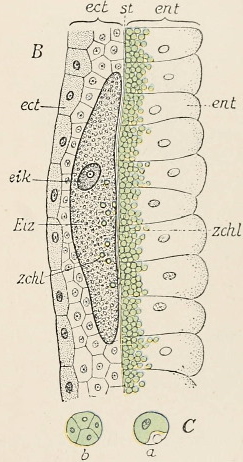
Fig. 35B (repeated). Hydra viridis,
the Green Freshwater Polyp.
Section through the body-wall,
somewhere in the direction of ov
in Fig. 35 A. Eiz, the ovum lying in
the ectoderm (ect), and including
zoochlorellæ (schl) which have immigrated
from the endoderm (ent)
through the supporting lamella
(st). After Hamann.
Let us now ascend to the lowest of
the Metazoa, for instance, the freshwater
polyp, Hydra (Fig. 35 A), and we find a
high degree of regenerative capacity in
the restricted sense, for, in addition to the
power of producing germ-cells, that is, cells which, when two combine
in amphimixis, give rise again to a new animal, almost any part of
the polyp can regrow a whole animal. Not only has Hydra been cut
in from two to twenty different pieces, but it has even been chopped
up into innumerable fragments, and yet each of these, under favourable
circumstances, was able to grow again into a complete animal.
Nevertheless, we are not justified in concluding that every cell
possesses the power of reproducing the whole. If, with the help of
a bristle, we turn one of these polyps outside in like the finger
of a glove, and then prevent it turning right again by sticking the
bristle transversely through it, it does not live, but soon dies,
obviously because the cells of the two layers of the body, ectoderm
and endoderm, cannot mutually replace each other, and cannot
mutually produce each other. The inner layer, now turned outwards,
cannot resist the influence of the water, and the outer layer, now
turned inwards, cannot effect digestion; in short, one cannot be transformed
into the other, and we must therefore conclude that both are
specialized, that they no longer contain the complete germ-plasm, but
only the specific determinants of ectoderm and endoderm respectively.
The animal's high regenerative capacity must therefore depend
on the fact that certain cells of the ectoderm are equipped with the
complete determinant-complex of the ectoderm, in the form of an
inactive accessory idioplasm, which is excited to regenerative activity
by the stimulus of wounding, and that, in the same way, the cells of
the endoderm are equipped with the whole determinant-complex of
the endoderm. It need not be decided whether all or only many
of the cells, perhaps the younger ones, are thus adapted for regeneration;
in any case a great many of them must be distributed throughout
the whole body, with perhaps the exception of the tentacles,
which are by themselves unable to reproduce the whole animal.
When the animal is mutilated, the cells of both layers, equipped with
their respective determinant-aggregates, co-operate in reproducing the
whole from a part.
It is true that even with these assumptions we only reach the
threshold of a real explanation. For, given that all the determinants
of the species must be present in a fragment, we are not in a position
to show how these set about reconstructing the animal in its integrity,
and the most that we can say is, that it must depend on the specific
kind of stimulus to which each of the cells is exposed through its
direct and more remote environment, which determinants are to be
first liberated, and therefore which parts are to be reconstructed.
That there are at work regulative forces, such as we were already
compelled to assume in regard to the division and regeneration of
unicellular organisms, as to the nature of which we cannot yet make
any definite statement, but which we may call 'polarities,' or, as
I prefer to say, 'affinities,' is shown by countless experiments which
have been made, particularly with the freshwater polyp. Thus Rand
cut off the anterior end of the polyp with its circle of tentacles, and
the excised disk of living substance lengthened in a transverse
direction, so that half the tentacles came to lie to the right, the other
half to the left, while the body developed between these two groups,
so that they became further and further separated from each other,
till finally the original transverse axis of the animal became the
longitudinal axis. One group of tentacles survived and surrounded
the new mouth, while the other at the opposite aboral pole, the new
foot, died off. This total change of structure in the polyp, as to the
arrangement of its main parts, points to unknown forces, which
cannot depend on the determinants as such, but on the vital
characters of the living parts, and on the interactions of these with
one another.
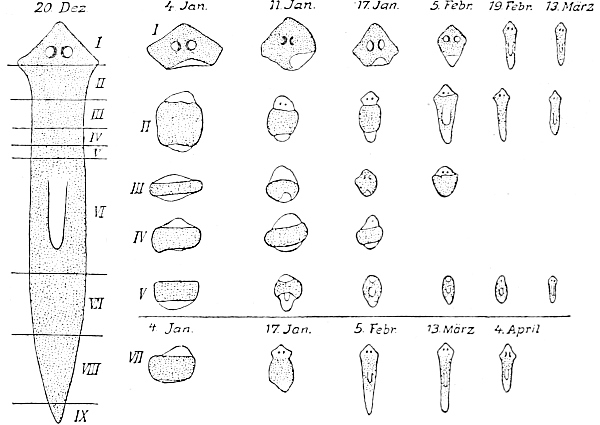
Fig. 96. A Planarian cut transversely into nine pieces. The regeneration
of seven of these into entire animals is shown. After Morgan.
The same holds true of all the lower Metazoa that have highly
developed regenerative capacity, not only of polyps, but of worms
such as the Planarians. Through the experiments of Loeb, Morgan,
Voigt, Bickford, and others, we know that these animals respond to
almost every mutilation by complete reconstruction, that they may, for
instance, as is indicated in Fig. 96, be cut transversely into nine or ten
pieces with the result that each of these pieces grows again to a whole
animal, unless external influences are unfavourable and prevent it.
Something similar happens if the head be cut off a Tubularia-polyp,
it forms a new head with proboscis and tentacles. It does so,
at least, if the stalk of the polyp be left in the normal position; but
if it be stuck into the sand in the reverse position a head arises at
the end which is uppermost, where the roots arose previously, and the
previous head-end now sends out roots. By suspending a beheaded
stalk horizontally in the water a head can be caused to develop at
each end of the stalk, so that we must assume that every part of the
polyp is, under some circumstances, capable of developing a head, and
that it must be 'circumstances'—in this case gravity, contact with
earth or with water, and the mutual influence of the parts of the
animal upon each other—which decide what is to be produced.
Loeb, who was the first to observe this form of regeneration, called it
heteromorphosis, to express the fact that particular parts of the
animal might be produced at quite different places from those
originally intended for them.
It would certainly be erroneous to range these cases of heteromorphosis
against the determinant theory, but they certainly do not
afford any special evidence of its validity as an interpretation, for all
that we can say here again is that all, or at least many, cells of the
animal must contain the full determinant-complex of the ectoderm,
and others those of the endoderm, and that particular groups of
determinants become active when they are affected by certain external
or internal liberating stimuli. In regard to such animals the theory
is hardly more convincing than the rival theory, that the faculty of
regeneration is a general property of living substance, which does not
attain to equally full expression everywhere, because it is met by ever-increasing
difficulties involved in the increasing complexity of structure.
The validity of the theory only begins to be seen when we
deal with cases where it is demonstrable that every part cannot bring
forth every other, where the power of regeneration is limited, and
occurs only in definite parts in a definite degree, and can only start
from particular parts. Here the assumption of a general and primary
regenerative capacity fails. Any one who insists, as O. Hertwig does,
that the idioplasm in all cells of the body is the same, can always
plead that, in the cases in which regeneration does not occur, the
fault lies, not in the regenerative capacity, but in the absence of the
adequate liberating stimuli, and at first sight it does seem as if this
position were unassailable. We shall find, however, that there are
facts which make Hertwig's interpretation quite untenable.
My own view is that the regenerative capacity is not something
primary, but rather an adaptation to the organism's susceptibility
to injury, that is, a power which occurs in organisms in varying
degrees, proportionate to the degree and frequency of their liability
to injury. Regeneration prevents the injured animal from perishing,
or from living on in a mutilated state, and in this lies an advantage
for the maintenance of the species, which is the greater the more
frequently injuries occur in the species, and the more they menace
its life directly or indirectly. A certain degree of regenerative
capacity is thus indispensable to all multicellular animals, even to
the highest among them. We ourselves, for instance, could not
escape the numerous dangers of infection by bacilli and other micro-organisms
if our protective outer skin did not possess the faculty
of regeneration, at least so far that it can close up a wound and
fill up with cicatrice-tissue a place where a piece of skin has been
excised. Obviously, then, the mechanism which evokes regeneration
must have been preserved in some degree and in some parts at every
stage of the phyletic development, and must have been strengthened
or weakened according to the needs of the relevant organism, being
concentrated in certain parts which were much exposed to injury
and withdrawn from other rarely threatened parts. Thus the great
diversity which we can now observe in the strength and localization
of the regenerative capacity has been brought about. But all this
can only be regarded as adaptation.
I should like to submit a few examples to show that the
regenerative capacity is by no means uniformly distributed, and
that, as far as we can see, it is greater or less in correspondence
with the needs of the animal, both in regard to the whole and to
particular parts.
It must first be pointed out that those lower Metazoa, like the
Hydroid polyps in particular, which are endowed with such a high
and general power of regeneration, do actually require this for
their safety; they are not only soft, easily injured and torn, but
they are most severely decimated by many enemies. In the beginning
of May I found on the walls of the harbour at Marseilles whole
forests of polyp-stocks of the genera Campanularia, Gonothyræa, and
Obelia, all large and splendidly developed, with thousands of individual
polyps and medusoids, but in a very short time the great
majority of the polyps were eaten up by little spectre-shrimps
(Caprellids) and other crustaceans, worms, and numerous other
enemies, and towards the end of May it was no longer possible to
find a fine well-grown colony. It must therefore be of decisive
importance for these species if the stems and branches, which are
spared because protected by horny tubes, possess the faculty of
transforming their simple soft parts into polyp-heads, or of giving
off buds which become polyps, or even of growing a new stock from
the twigs which have been half-eaten and bitten loose from the
stock and have fallen to the ground. If, finally, a torn-off polyp-stalk
(of Tubularia) falls to the ground with the wrong side up, the end
which is now the lower will send out roots, and the end now uppermost
will give off a new head. This also appears to us adaptive, and
does not surprise us, since we have been long accustomed to recognize
that what is adapted to an end will realize this if it be possible at all.
Think again of the innumerable adaptations in colour and form which
we discussed in the earlier lectures. I hope later to be able to show
in more detail how it comes to pass that necessity gives rise to
adaptation. In regard to the case of the polyps, we can understand
that, as far as a high degree of regeneration and budding was possible
in these animals at all, it could not but be developed. Regeneration
and budding complete each other in this case, for the former brings
about in the individual 'person' what the latter does in the colony,
namely, a Restitutio in integrum. It is readily intelligible that the
former was not difficult to establish where the latter—the capacity
of budding—was already in existence.
It seems at first sight very striking that the higher plants, which
all depend upon budding, and which form plant-colonies (corms)
in the same sense as the polyps form animal-colonies, only possess
the faculty of true regeneration in a very low degree, although they
are extremely liable to injury.
We see from this that the two capacities are not co-extensive,
that germ-plasm may be contained in numerous cells of the body
in a latent state, and yet that regeneration of each and every detailed
defect may not be possible. This is the case in the higher plants
in regard to most of their parts. A leaf in which a hole has been
cut does not close the hole with new cell-material; a fern frond from
which some of the pinnules have been cut off does not grow new ones,
but remains mutilated. Even leaves which, if laid on damp earth,
readily give off buds which grow to new plants, as the Begonias do,
do not replace a piece cut out of the leaf; they are not at all adapted
to regeneration.
From the standpoint of utility this is readily intelligible. It
was, so to speak, not worth Nature's while to make such adaptations
in the case of leaves or blossoms, partly because these are very
transient structures, and partly because they are rapidly and easily
replaceable by the development of others of the same kind. Moreover,
the leaf in which we have cut a hole continues to function,
but the polyp whose mouth and tentacles we have cut off could no
longer take nourishment unless it were adapted for regeneration.
But that this adaptation could have been made in the case of plants
is proved by the root-tips which are formed anew when they are
injured, and the closing of wounds on the stem by a 'callus.'
I shall return to plants when we are dealing with the mechanism
of regeneration, but I must now direct more attention to animals,
inquiring further into the question as to whether the faculty of
regeneration is correlated with the degree of liability to injury to
which the animal is exposed, and with the biological importance
of the injured part, for this must be the case if regeneration be
really regulated by adaptation.
Hardly any other vertebrate has attained such celebrity on
account of its high regenerative capacity as the water-newt, species
of the genus Triton. It can regrow not only its tail, but the legs
and their parts if they are cut off. Spallanzani saw the legs grow six
times, after he had cut them off six times. In the blind newt (Proteus)
of the Krainer caves, a near relative of the common newt, the leg
regenerated only after a year and a half, although the animal stands
on a lower stage of organization than the newt, and thus should
rather replace lost parts more easily. But Proteus lives sheltered
from danger in dark, still caves, while Triton is exposed to numerous
enemies which bite off pieces from its tail or legs; and the legs are
its chief means of locomotion, without which it would have difficulty
in procuring food. It is different with the elongated eel-like newt
of the marshes of South Carolina, Siren lacertina. This animal
moves by wriggling its very muscular trunk, after the manner of
an eel, and in consequence of the disuse of its hind legs it has almost
completely lost them. Even the fore-legs have become small and
weak, and possess only two toes, and these do not regrow if they are
bitten off, or only do so very slowly.
Earthworms are exposed to much persecution; not only birds,
such as blackbirds and some woodpeckers, but, above all, the moles
prey upon them, and Dahl has shown that moles often lay up stores
of worms in winter which they have half crippled by a bite, while
even Réaumur knew that moles frequently only half devoured earthworms.
It was thus an obvious advantage to earthworms that a part
of the animal should be able to regrow a whole, and accordingly we
find a fairly well-developed regenerative capacity among them. But
it varies greatly in the different species, and it would be interesting
if we knew the conditions of life well enough to be able to decide
whether the faculty of regeneration rises and falls in proportion
to the dangers to which the species is exposed. Unfortunately we
are far from this as yet; we only know that, in the common
earthworms of the genera Lumbricus and Allolobophora, the faculty
of regeneration is still very limited, for at most two worms, and
sometimes only one, can develop from an animal cut into two
pieces. Cutting into a greater number of pieces does not yield
a larger number of worms, but usually only one, and often none
at all.
This corresponds to the behaviour of their enemies, which may
often bite off a piece or tear it away when the worm attempts to
escape, but never cut it up into pieces. The regenerative capacity
is more highly developed in the genus Allurus, more highly still
in the worms of the genus Criodrilus which lives in the mud at
the bottom of lakes, and most highly of all in the genus Lumbriculus
which lives at the bottom of small ponds. Long ago Bonnet cut up
a specimen of Lumbriculus into twenty-six pieces, of about two
millimetres in length, and he observed most of these grow to complete
worms again. His experiments have often been repeated in recent
times, and have been extended and made more precise in many ways.
Von Bülow was able to get whole animals from pieces consisting of
from four to five somatic segments, and with eight or nine segments
he almost invariably succeeded. A Lumbriculus which he had cut
into fourteen pieces, one of which only measured 3.5 mm. in length,
gave rise to thirteen complete worms with head and tail; only one
piece perished.
These worms have little enemies with sharp jaws which may
gnaw at them behind or before but cannot swallow them whole.
Lyonet, famous for his analytic dissection of the wood-caterpillar
(Cossus ligniperda), observed when he was feeding the larvæ of
dragon-flies with these Lumbriculid worms that 'the anterior end
of some whose posterior end had been gnawed away by the larvæ
continued to live on the ground.' We can thus understand why
a high power of regeneration is of use to these worms, and at the
same time why it is advantageous to them to contract so that
they break in pieces on very slight irritation, but to this we shall
refer again.
The very diverse potency of the faculty of regeneration in
animals belonging to the same small group, and nearly, if not quite,
at the same level of organization, seems to show clearly that we
have here to do with adaptation to different conditions of life,
although we cannot demonstrate this in detail. It would certainly
be erroneous to regard the conditions of life as uniform, since the
worms in question not only live in different places—in the earth,
in mud, or in water—and are thus exposed to different enemies, and
since they may also be quite different in regard to size and speed,
in means of defence, and possibly also of defiance, as is indeed in some
measure demonstrable.
We meet with the same thing in a group of still smaller worms,
Rösel's 'water-snakelets,' species of the genus Nais. These, too,
behave in a variety of ways in the matter of regeneration, for
while many species, such as Nais proboscidea and Nais serpentina
will, if cut into two or three pieces, become two or three worms
respectively, Bonnet expressly mentions an unnamed species of Nais
which does not bear cutting up at all, and even dies if its head
be cut off.
Thus neither the degree of organization nor the relationship
alone determines the strength of the regenerative capacity. And
as nearly related species may behave quite differently in this respect,
so also do the different parts of one and the same animal; and here,
too, the strength of the capacity seems to depend on the more frequent
or rarer injury of the relevant part and on its importance in the
maintenance of life. Let us take a few examples.
Parts which, in the natural life of the animal, are never injured,
show in many cases no power of regeneration. This is so in regard
to the internal parts of the newt, whose regenerative capacity is
otherwise so high. I cut half or nearly the whole of a lung away
from newts anæsthetized with ether; the wound closed, but no
renewal of the organ took place. The same thing happened when
a piece of the spermatic duct or of the oviduct was cut away. It
is true that the kidney enlarges in higher animals when a piece has
been cut out, by the proliferation of the remaining tissues, but that is
a mere physiological substitution, evoked by the increased functional
stimulus, due to the accumulation in the blood of the constituents
of the urine. Such substitution depends on the growth of parts
already existing, and it occurs in man when one kidney is removed,
for the other, as is well known, may then grow to double its normal
size. This is mere hypertrophy of the part that is left, it is not
regeneration in the morphological sense, and it is not comparable
to the re-formation of a cut-off leg in the salamander, or of a head in
the worm, where the growth is not a mere increase of the remaining
stump, but a new formation. It would be regeneration if a new
kidney developed from the remnants of the kidney-tissue, or, in
the liver, if new lobes grew in place of those which were cut off.
But neither of these things happens, and, as far as I am aware,
nothing of the kind has ever been observed, nothing more than
new formation of liver-cells through increase of existing ones; that,
however, is not regeneration in the morphological sense.
I have referred to the slight power of regeneration possessed by
the blind Proteus in regard to its legs or tail, and I connected this
with the absence of enemies in its thinly peopled cave-habitat. But
the same animal can regenerate its gills when these are bitten
off, and this is probably associated with the habit that Proteus
has, in common with other newts with external gills, of nibbling
at its neighbour's gills. Thus, the power of regenerating the
gills was retained even when the animals migrated to the quiet
caves of Krain, and were thus secured from the attacks of other
enemies.
In lizards, a leg which has been cut off does not grow again, but
an amputated tail does, and this has quite a definite biological reason,
since the active little animal will seldom be caught by the foot by
any pursuer, but may easily be caught by the tail, which is far
behind. Thus the tail is adapted not only for regeneration, but
also for 'autotomy' that is, for breaking off easily when it is caught
hold of.
We have already seen that some segmented worms have a very
high regenerative capacity; yet every part cannot produce every
other, and while, in Lumbriculus, any piece of from five to nine
segments is able to grow a new head or tail, neither ten nor twenty
nor all the segments together, if they are halved longitudinally, can
reproduce the other half, and the cause of this inability does not lie in
the fact that the animal is thereby hindered from taking food, for even
the transversely cut pieces do not feed until they have grown a new
head and tail. The reason must lie in the fact that the primary constituents
for this kind of regeneration are wanting, and they are so
because a longitudinal splitting of this cylindrical and relatively thin
animal never occurs under natural conditions, and thus could not be
provided against by Nature[1].
[1] Morgan maintains that this statement is incorrect, and that Lumbriculus is
capable of lateral regeneration. But if we look into the matter more closely we find
that all he says is, that small gaps made by cutting a piece out of one side are filled
up again, while the cut pieces perish. If the whole animal be halved, according to
Morgan, both halves die, or if a 'very long piece' be cut out of one side, not only this
piece dies, but also 'the remaining piece.' There is thus, as I have said, an essential
difference between the regenerative capacity of Lumbriculus and that of Planaria.
That regeneration of this kind could have been arranged for if it
had been useful we learn from the Planarians among the flat worms,
in which every piece cut out of the body, large or very small, from the
middle, from the left side, or from the right side of the animal, grows
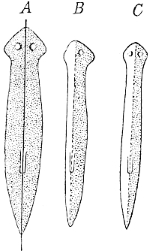
into a complete Planarian. The animal can be halved longitudinally, as
in Fig. 97, and each half will grow to a whole. This again is quite
intelligible from the biological point of view, for these flat, soft,
and easily torn animals are exposed to all sorts of injuries, and are,
in point of fact, frequently mutilated by enemies which are unable to
swallow them whole. Von Graaf not infrequently found examples of
marine Planarians (Macrostomum) which lacked 'a part of the
posterior end or the whole tail region as far as the food-canal,' and of
species of Monotus he found 'very often' in May specimens with the
posterior end split or broken off. Probably the persecutors of these
flat-worms are some species of Crustacean, but, at any rate, so much
is proved, that the Planarians have abundant opportunities of making
use of their faculty of regeneration, and that the species gains an
advantage from it in respect to its preservation.
Fig. 97.A, a Planarian,
which has been divided into
two by a longitudinal cut.
Each half can grow into
an entire animal. B, the
left half at the beginning
of the regenerative process. C, the same completed. After
Morgan.
In contrast to this, worms which live within other animals,
and are thus secure from mutilation, such as
the familiar round-worms (Nematoda), have
no power of regeneration at all, and do not
survive either longitudinal or transverse
division.
Until recently birds were regarded as
possessing a very low degree of regenerative
capacity, and, as a matter of fact, they cannot
replace a leg or a wing wholly or in part;
but, what is otherwise unheard of among
higher vertebrates, they can renew the whole
anterior portion of the skeleton of the face,
the bill, and can indeed almost reconstruct
it with new bones and horny parts. Von
Kennel communicated a case of this kind in
regard to a stork, and for a long time this
remained an isolated case, but a few years
ago Bordage showed that, in the cocks which
are used in the Island of Bourbon for the
favourite sport of cock-fighting, the bill is
regularly renewed when it has been broken
off or shattered. Quite recently Barfurth gave an account of a case
of complete renewal of a broken bill in a parrot. Yet it should
not astonish us that the bill in birds has such a high regenerative
power, for of all parts in a bird it is the one that is most readily
injured; with it the bird defends itself against its enemies and its
rivals, masters its prey, and tears it to pieces, pecks holes in trees
(woodpecker), or climbs (parrot), or digs and burrows in the ground,
or builds its nest, and so on. That the faculty of regeneration
could be developed to so high a degree in relation to this
particular part of the body, while the rest of the very important
but rarely injured parts do not possess it at all, again points to
the conclusion that the faculty of regeneration has an adaptive
character.
It does not affect matters to discover cases in which we cannot
recognize this relation between the regenerative capacity of a part
and its importance or its liability to injury. Such instances do not
lessen the convincingness of the positive cases, since we do not know
the exact conditions which may lead to the increase of regenerative
capacity in a part, and, above all, since we do not know the rate at
which such an increase may take place. If adaptation in general
depends upon processes of selection, these processes must also be able
to give rise to an increase in the power of regeneration. On the
other hand, it by no means follows that the disappearance of a faculty
of regeneration which was once present in a part, but which has
become superfluous in the course of time, must take place immediately
through natural selection. For it is the very essence of natural
selection that it only furthers what is useful, and only removes what
is injurious; over what is indifferent it has no power at all. Thus it
follows that the faculty of regeneration, when it has once been present
in a part, cannot be set aside by natural selection (personal selection),
for it is in no way injurious to its possessor. If it gradually decreases
and becomes extinct notwithstanding this, when it is of no further
use, as seems to be to some extent the case in regard to the legs and
tail of the blind Proteus, that must depend on other processes,
on those which generally bring about the gradual disappearance
of disused parts or capacities. We shall attempt to probe to the
roots of these processes later on; for the present let it suffice us to
know that, according to our experience, they go on with exceeding
slowness, and that it has taken whole geological periods to eliminate
the legs of the snake-ancestors so completely as has been done from
the structure of most of our modern snakes, while the Proteus which
migrated into the caves of Krain as far back as the Cretaceous period
is indeed blind, but still retains its eyes under the skin, though in
a degenerate condition.
Since the degeneration of disused parts and capacities goes on so
slowly it need not surprise us that we meet many parts which still
possess regenerative capacity, although they are protected from injury.
Thus Morgan found that, in the hermit-crab, the limbs which are
protected within the mollusc shell were quite as ready to regrow as
those which are actually used for walking, and thus are exposed to
possibility of attack, but this proves nothing against the conclusion
we drew from the facts cited above, according to which the faculty
of regeneration comes under the law of adaptation. For the
disappearance of this faculty must take place very much more slowly
than its growth. For instance, the development of the tail-fin of the
whale has long been an accomplished fact, while the hind-legs of this
colossal mammal, which were rendered useless by the development of
the tail-fin, still lie concealed in a rudimentary state within the
muscles of the trunk. Yet these limbs must have lost their significance
for the animal exactly at the time that the tail-fin became more
powerful. Thus the retrogression must have taken place more slowly
than the progressive transformation.
It is clear, then, that the faculty of regeneration is not a primary
character of living beings occurring uniformly in all species of
equally high organization and in all parts of an animal in the same
degree; it is a power which occurs in animals of equal complexity in
as varying degrees as in their parts, and which is manifestly
regulated by adaptation. Between parts with the faculty of regeneration
and parts without it there must be an essential difference;
there must be present in the former something that is wanting in the
latter, and, according to our theory, this is the equipment with
regeneration-determinants, that is, with the determinants of the parts
which are to be reconstructed.
If this be really so it should be capable of proof, at least in so
far that we should be able to establish that the power of completing
or re-forming a damaged or lost part is a limited one, localized in
certain parts and cell-layers. This can be actually proved, as may be
seen from numerous cases in which the faculty of regeneration is
associated with autotomy, that is, with the power of breaking off
or dropping off a part of the body. Even in worms we find this
power, as we mentioned before in speaking of the high regenerative
capacity of Lumbriculus. This worm reproduces in summer by what
is called 'schizogony,' that is, by breaking into two, three, or more
pieces, and it does not seem to require a very strong stimulus, such as
pressure of the end of the worm by the jaws of an insect larva, to
start this rupture; it often follows from quite insignificant friction
on the ground. Certainly the power of regeneration is so great in this
animal that it is out of the question to talk of localizing the primary
constituents of regeneration; almost every broken surface is capable
of regeneration.
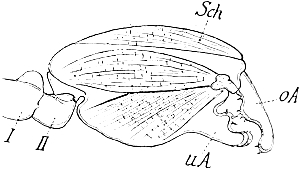
But this localization is well illustrated in Insects and Crustaceans,
which possess the power of self-amputation in their appendages,
especially in their legs. As far back as 1826 MacCullock observed
this remarkable power in crabs, and described the mechanism on
which it depends. When the leg is irritated, for instance when it is
pinched at the tip and held fast, it breaks off at a particular place.
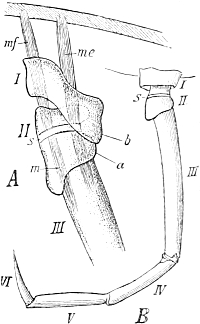
This line of breakage lies in the middle of the short second joint
(Fig. 98, A and B, s), just between the insertions of the muscles
(me, mf, m) which extend from this line towards the extremity of
the limb and in the opposite direction towards the body-wall.
Between these muscle-attachments the external skeleton is thin and
brittle, and forms a suture, s, which
breaks through when the animal contracts
the muscles of the leg convulsively,
and thus presses the lower protuberance
(a) against a projection (b) of the first
upper joint. Crabs require to make
a very considerable muscular exertion
before they can throw off the limb, and
therefore they can only do it when they
are in full vigour.
Fig. 98. The leg of a Crab,
adapted for self-mutilation or autotomy. A, the first three joints
of the limb, I, II, III. s, the
suture, that is, a thin area on
the second joint which is predisposed
to breakage. mf, flexor
muscle, me, extensor muscle, both
inserted at the suture. B, the
entire leg with its six joints and
with the suture (s). Slightly enlarged.
After MacCullock.
We have here a quite definite
structural adaptation of the parts to
a danger which often recurs—that of
falling entirely into the power of an
enemy which has seized the leg. By
a sudden violent throwing-off of the
leg the crab escapes from this danger.
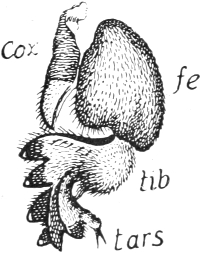
Quite similar adaptations are found
among certain insects, such as the
walking-stick insects or Phasmids, in
which the mechanism is much the same,
and lies at an almost exactly corresponding
place, namely, at the line
where the second and third joints of
the leg, the 'trochanter' and the 'femur'
meet. In this case the advantage of the arrangement is not merely
that the animals are thus enabled to escape from enemies; it is
useful in another connexion, for a knowledge of which we have to
thank Bordage. This naturalist observed that the Phasmids not
infrequently perished at one of their numerous moultings, by remaining
partially fixed in the discarded husk. Of 100 Phasmids nine
died in this way, twenty-two got free with the loss of one or more
legs, and only sixty-nine survived the moult without any loss
at all.
That the moulting or ecdysis of insects is often hazardous may
be observed in our own country, and it is familiar to every one who
has reared caterpillars. These, too, often fail to get clear of their
'cast' cuticle, and they perish unless artificial aid is given to them. I
have never observed any autotomy in them, but in the Phasmids
it seems to be a much-used 'device' and is therefore of great importance
in the persistence of the species.
Limbs which are thus thrown off by autotomy regenerate again
from the place at which they broke off, that is from the 'suture.' It
had been noticed even by the earlier observers (e.g. Goodsir) that there
was a jelly-like mass of cells within the joint, and that the development
of the new limb started from this. It might be supposed that
the regeneration-primordium is present in the rest of the leg also, but
that is not the case, for the animal responds to the tearing off of one
joint or of a smaller number than to the suture, not by regenerating
the torn part directly, but by amputating the whole of the leg up to
the suture, and then from this the regeneration of the whole leg takes
place. In the Phasmids the case is similar, but with the difference
that regeneration is possible from three places, from the tarsal joints,
from the lower third of the tibia, and finally, from the suture between
the femur and the trochanter. There is thus a regeneration-primordium
(Anlage) at the beginning of the tarsal joints, another in the
tibia, and a third in the 'suture' and the first must be equipped,
as we should express it, with the determinants of the five tarsal joints,
the second with those for the lower end of the tibia as well, and the
third with all the determinants of the whole leg, from the 'suture'
downwards.
In any case, regeneration is here associated with definite localized
pieces of tissue, and is not a general character of all the cells of the
leg, and, as it obviously runs parallel at the same time with another
adaptation—that of autotomy—there can be no doubt that it too is
dominated by the principle of selection, and that it can not only be
increased, but that it can be concentrated at particular places and
removed from others. But this is only possible if it be bound up with
material particles which may be present in or absent from a tissue,
and which are therefore a supplement to the ordinary essential
constituents of the living cells, although they do not themselves
belong to the essential organization.
I might cite many more examples of localization of regenerative
capacity, but will confine myself to one other, which seems to me
particularly instructive, because it was first interpreted as an indication
of the existence of an adaptive principle in the organism,
a principle which always creates what is useful. I refer to the
regeneration of the lens in the newt's larva.
G. Wolff, an obstinate opponent of the theory of selection,
attempted to solve the same problem as I had before me in my
experiments on the regeneration of the internal organs of newts, that
is, he tried to answer the question whether organs which are never
exposed to injury or to complete removal in the conditions of natural
life, and which could not therefore have been influenced in this
direction by the processes of selection, are nevertheless capable of
regeneration. He extirpated the lens from the eye of Triton larvæ,
and saw that in a short time it was formed anew, and from this he
concluded that there was here 'a new adaptiveness appearing for the
first time,' and that therefore adaptive forces must be dominant within
the organism. The current theory of the 'mechanical' origin of
vital adjustments seemed to some to be shaken by this, and the
proclamation of the old 'vital force' seemed imminent. And in
truth, if the body were really able to replace, after artificial injury,
parts which are never liable to injury in natural conditions, and to
do so in a most beautiful and appropriate manner, then there would
be nothing for it but at least to regard the faculty of regeneration as
a primary power of living creatures, and to think of the organism as
like a crystal, which invariably completes itself if it be damaged
in any part. But we have to ask whether this is really the case.
What makes the regeneration of the lens seem particularly surprising
is the fact that in the fully formed animal it must arise in
a manner different from that in which it develops in the embryo, that
is, it must be formed from different cell-material. In the embryo it
arises by the proliferation and invagination of the epidermic layer of
cells to meet the so-called 'primary' optic vesicle growing out from
the brain—a mode of development which cannot of course be repeated
under the altered conditions in the fully developed animal. The
reconstruction of the organ must therefore take place in a different
way, and if the organism were really able, the very first time the lens
was removed, to react in a manner so perfectly adapted to the end,
and so to inspire certain cells, which had till then had a different
function, that they could put together a lens of flawless beauty and
transparency, we should have reason to suspect that nearly all our
previous conceptions were erroneous, and to fall back upon a belief in
a spiritus rector in the organism.
But the excision of the lens in these experiments was not by any
means an unprecedented occurrence! It is true enough that newts in
their pools are not liable to an operation for cataract, but it does not
follow that the lens is never liable to injury, and could not therefore
be adapted for regeneration. It can be bitten out along with the rest of
the eye by water-beetles or other enemies, and as far back as the time
of Bonnet and Blumenbach (1781) it was known that the eye of the
newt would renew itself if it were cut out, given that a small portion
of the bulb was left. But if this were removed the possibility of
regeneration was at an end. Thus, before the first artificial excision
of the lens, a regeneration-mechanism must have existed, by means of
which the eye with its lens was reconstructed, and this depends on
the characters of the cells of the eye itself—it is localized in the eye,
and without the presence of a piece of eye-tissue no regeneration can
take place. Is it then so especially remarkable that the lens should
be renewed when it is artificially removed without the rest of the
eye? The mechanism for its renewal is there, and is roused to
activity whether the lens alone or other parts of the eye also be
removed. We do not need, therefore, to assume the existence of
a purposeful or adaptive force; it is more to the point to inquire
where the regeneration-mechanism which suggests this inference is to
be found.
A definite answer to this is given in a detailed experimental
work recently published by Fischel. It corroborates what Wolff had
already found, that the substance of the new lens develops from
cells which cover the posterior surface of the iris, that is, from cells of
the retinal layer of the eye. First, the margin of the pupil begins to
react to the stimulus of the injury (extraction of the lens); its cells
enlarge, become clear, while previously they were filled with dark
pigment, and finally they proliferate. They thus form a cell-vesicle
similar to the ectoderm-vesicle from which the lens arises in the
embryo, and into this the already mentioned retina-cells from the
posterior wall of the iris grow, elongate, and arrange themselves to
form the so-called 'lens-fibres,' on whose form, arrangement, and
transparency the function of the lens depends. This is marvellous
enough, but not more marvellous than that a whole foot should grow
on the cut stump of a newt's leg, or that a whole eye should arise
from a residual fragment. Here, again, we do not know the processes
which cause the arrangement of the cells and their often manifold
locally-conditioned differentiations, in short, we do not know the
essential nature of regeneration. But, in the meantime, we can
endeavour to find out which cell-groups regeneration is bound up with
in particular cases, so as to know where the vital particles, the 'determinants,'
which condition regeneration, are placed by nature.
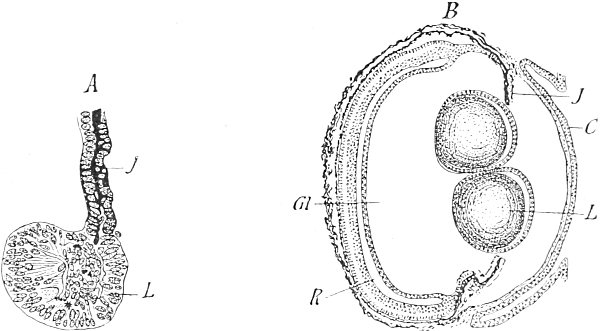
Fig. 99. Regeneration of the lens in the Newt's eye. A, section through
the iris (J); from its margin and posterior (retinal) surface the primordium
of a new lens (L) has developed after the artificial removal of the old one.
B, section through the eye after duplicated regeneration of the lens (L) from
two areas of the iris. Gl, vitreous humour. J, iris. C, cornea. R, retina.
After Fischel.
In this case there can be no doubt on that point: they are the
cells on the posterior wall and the margin of the iris. And it is
certainly not the absence of the lens which gives rise to its renewal,
as would necessarily be the case if it were due to the dominance of an
adaptive force. If the lens, instead of being excised, be simply
pressed back into the vitreous humour occupying the cavity of the
eye, a new lens is developed all the same from the irritated margin of
the pupil. And if by chance this margin has been irritated in two
places while extraction of the lens was being performed, then two
small lenses will develop (Fig. 99, B). Indeed, several may begin to
develop at the posterior wall of the iris, although they do not attain
to full development; mechanical irritation of any part of this cell-layer
is responded to by the formation of lenses. This surely disposes
of the 'mystical nimbus' which would dazzle us with a new force of
life, always creating what is appropriate. We have before us an
adaptation to the liability of newts' eyes to injury, which, like all
adaptations, is only relatively perfect, since under the usual conditions
of eye injury it gives rise to a usable lens, but under unusual conditions
to unsuitable structures. It is exactly the same as in the case of
animal instincts, which are all 'calculated' for the ordinary conditions
of life, but, under unusual conditions, may operate in a manner quite
unsuited to the necessary end. The ant-lion has the instinct to
bore backwards into the sand, and he makes the same backward-pressing
movements when placed on a glass plate into which he cannot
force the tip of the abdomen. The same is true of the mole-cricket,
which makes its usual digging movements with the forelegs even on
a plate of glass. The wall-bee roofs over her cell when she has laid
an egg in it, but she does so even if the egg be taken out beforehand,
or if a hole be made in the bottom of the cell, so that the honey which
is to serve the larva for food when it emerges from the egg runs
out (Fabre). Her instinct is calculated for filling the cell once with
honey, and once laying an egg in it, because such disturbances as we
may cause artificially do not occur or occur very rarely in natural
conditions. There are countless facts of this kind, for every instinct
and every adaptation can, in certain circumstances, go astray and
become inappropriate. This should be considered by those who still
persist in opposing the theory of selection, for herein lies one of the
most convincing proofs of its correctness. Adaptations can only arise
in reference to the majority of occurrences, and variations which are
only useful in an individual case must, according to the principle,
disappear again. Adaptation always means the establishment of what
is appropriate in an average number of cases.
Therefore the inappropriate reaction of the margin of the iris to
an artificial double stimulus affords additional reason for regarding
regeneration as an adaptive phenomenon. If it were the outcome of
an adaptive force it could never be inappropriate; and if it were the
operation of a general and primary power of the organism it would be
exhibited by the nearly-related frog as well as by the newt. But, in
the frog, extraction of the lens gives rise only to a sac-like proliferation
of the cells of the iris margin, which form no transparent lens,
but an opaque cluster of cells, which destroys vision altogether. It
appears, therefore, that the frog no longer requires the power its
ancestors possessed of regenerating a lost lens.
LECTURE XXI
REGENERATION (continued)
Phyletic origin of the regenerative capacity—The liberating stimuli of regeneration—Production
of extra heads and tails in Planarians (Voigt)—Regeneration in the
Starfish—Atavistic regeneration in Insects and Crustaceans—Progressive regeneration—Regeneration
has its roots in the differentiation of organisms—The nuclear substance
of unicellular organisms is the first organ for regeneration—The ultimate roots of
regeneration.
In the previous lecture we have considered many different forms
of regeneration, and have recognized them as adaptive phenomena;
we have now to inquire how such regeneration-adaptations have
arisen, and this is a very difficult question even in general, while in
particular cases it is often quite unanswerable at present. In regard
to the case last discussed, the regeneration of the lens in the eye of
Triton, our hypotheses would require to reach back to the time of the
primitive vertebrates with an unpaired eye, for the lens of the paired
vertebrate eye, from Mammals down to the lowest Fishes, does not
arise in embryonic development from the retinal cells, but always
from the corneal epithelium, as the elaborate researches of Rabl have
recently shown. It is true that the unpaired parietal eye of some
reptiles forms its lens from the cells of the retinal layer, but it would
be difficult to demonstrate the possibility of a genetic connexion
between it and paired eyes, and in the meantime we must refrain
from elaborating a hypothesis as to the origin of the marvellous
faculty the retinal cells possess of transforming themselves into
lens-fibres.
But it is easier to form some sort of picture of the origin and
adaptation of the faculty of regeneration in general.
We saw that the power of regenerating a part can be localized,
and that it does not belong to all the cells of the body, but only to
some of them, and we have to ask how and by what steps it has been
imparted to these. The faculty depends on the possession of a
regeneration-primordium (Anlage), and this again, in our mode of
expression, consists of a definite complex of determinants, and as
determinants are the products of an evolution, and thus are vital
units which have arisen historically, they can nowhere suddenly
originate anew in a species, but must be derived directly or indirectly
from the sole basis which, in each species, forms the starting-point of
the individual—that is to say, in the Metazoa, from the germ-plasm
of the ovum. From it the determinant-complex of every regeneration-rudiment
mast in the ultimate instance be derived.
We may think of the matter thus: all the determinants of the
germ-plasm vary, grow slowly or quickly, and in certain circumstances
may be doubled. In this way there arise what we may
call 'supernumerary' determinants, which are not required in the
primary building up of the body from the ovum, and which may
remain in an inactive state in the nuclei of certain cells, ready to
become active under certain circumstances and to produce anew the
part which they control. Such regeneration-idioplasm will at first
come to lie in the younger cells of the determinate organ, but it is
conceivable that under the influence of selection it may be gradually
shifted to other cells of a later developmental origin, or, conversely,
to others in a less external position, so that, for instance, the regeneration-rudiment
for the finger of a newt may be contained not merely
in the cells of the hand, but in those of the fore-arm or even of the
upper arm.
But all such segregation of determinant-groups cannot have taken
place, as we might perhaps be inclined to think, at the periphery in
the organ itself during its development; it must take place in the
germ-plasm of the ovum, for otherwise it could not be transmissible,
and could not be directed and modified by the processes of selection,
as is actually the case, as I shall show in more detail later on.
I have already pointed out the importance of the rôle played
by liberating stimuli in regeneration, and not only of extra-organismal
stimuli, such as gravity, but above all of intra-organismal stimuli
that is, the influences exerted in a mysterious manner by other parts
of the animal on the parts which are in process of regeneration. It is
a great merit of the modern tendency in evolution theory that it has
demonstrated the importance of such internal influences. Although
we are still far from being able to define the manner in which these
influences operate, we may say so much, that it depends essentially
on the nature and extent of the loss which parts are reproduced by
the regenerating cells, and, also, on the position and direction of the
injured surface from which the regeneration starts. The influences,
still quite beyond our comprehension, which are exerted on the
regenerating part by the uninjured parts constitute the liberating
stimuli, which evoke the activity of one or other of the determinants
contained in the regeneration-idioplasm.
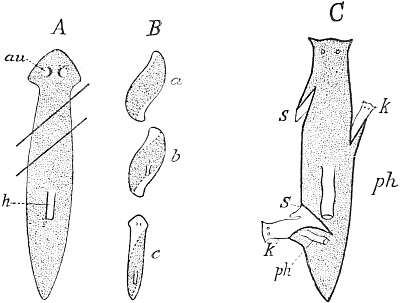
Fig. 100. Regeneration of Planarians. A, an animal divided into three
parts by two oblique cuts. B, the fragments(a, b, c) in process of regeneration.
C, an animal with various oblique incisions in the margin of the body, which
have induced the new formation of heads (k), of tails (s), and pharynx (ph).
A and B after Morgan; C after Walter Voigt.
Walter Voigt has shown, by a series of most interesting experiments,
that it is possible not only to cause the development of a new
head in Planarians by cutting them, in which case a tail may grow
from the anterior portion and a head from the posterior portion, but
it is also possible in an intact animal, that is, one with both head and
tail, to cause the production of a second head, or a second tail, or both
at once, at any part of the body margin at will, according to the
direction of the cut. If the margin of the body be cut obliquely
forwards (Fig. 100, A) a supernumerary tail arises (C, s), if it be cut
obliquely backwards a supernumerary head arises (C, k), and in this
way several heads and several tails may be produced in the same
animal. It is obvious, then, that the interaction, in the first place, of
the cells of the cut surface, but probably also of the deeper-lying cells,
decides which determinants are to come into action, those of the head
or those of the tail, but both must be present at every part of the cut.
How far below the cut surface the cells take part in this determination
we cannot make out, but that it cannot be due to the
co-operation of all parts is clear in this case at least, since the animal
still possesses its original head and tail. The extra heads and tails
thus produced prove, at any rate, that there can be no question here
of the expression of an adaptive principle, a spiritus rector, or a vital
force, which always creates what is good, but that it is rather a
purely mechanical process, which takes its course quite independently
of what is useful or disadvantageous, and that it must take this course
according to the given regeneration-mechanism and the stimulus
supplied in the special case. It cannot be supposed that these
supernumerary heads and tails are purposeful, but who would expect
an adaptive reaction from the animal in a case like this, since cuts of
the kind which we make artificially, and must keep open artificially
if the deformities are to develop, hardly occur in nature, and, if they
did occur, would very quickly close up again? Adaptations can only
develop in response to conditions which occur and recur in a majority
of cases, and when they have a useful, that is, species-preserving
result. The adaptiveness of the organism is blind, it does not see the
individual case, it only takes into account the cases in the mass, and
acts as it must after the mechanism has once been evolved. The case
is the same as that of 'aberrant' or mistaken instincts, whose origin
by means of selection is the more clearly proved, since we must
recognize such an instinct as a pure mechanism and not as the
outcome of purposeful forces.
In the regeneration of Planarians we must think of the regeneration-idioplasm
as containing the full complex of the collective
determinants of the three germinal layers, and possibly we must
add to this cells with the complete germ-plasm for giving rise to
the reproductive cells. But when the amputated tail of the newt
is regenerated, or its leg, or the arm of a starfish, or the bill of a bird,
we have no ground for assuming that the cells, from which regeneration
starts, contain the whole germ-plasm, since the determinants of
the replaceable parts suffice to explain the facts. We must even
dispute the possibility of the presence of the whole germ-plasm in
this case, because the faculty of regeneration of the relevant cells is
really no longer a general one, but is limited to the reproduction of
a particular part. This is seen in the fact that, in the starfish, whose
high regenerative capacity is well known, the central disk of the body
may indeed give rise to new arms[2]; but an excised arm, to which no
part of the disk adheres, is in most starfishes unable to give rise to
the body. Thus the arm does not contain in its cells the determinants
of the disk, but the latter contains those of the arm. We are not
surprised that the amputated tail of the salamander does not reproduce
the whole animal, but this can only be because the impelling forces
to the regeneration of the whole animal are wanting, that is, that
the cut surface only contains the determinants of the tail and not the
complete germ-plasm. It might be objected here that the tail-piece
is too small to give rise to the whole body, but in Planaria it is
only very diminutive heads and tails which grow from the artificial
incisions, and the same is true of starfishes when only a single arm
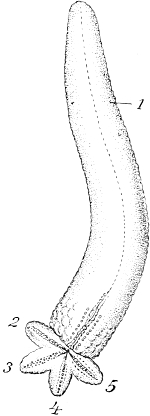
and a small piece of the disk have been left. Notwithstanding the
small amount of living substance at their
disposal, and although they are at first unable
to take nourishment, they send out
very small new arms (Fig. 101), close up the
wounded surface, and, after reconstruction
of the mouth and stomach, begin to feed
anew. The new arms may then grow to the
normal size.
[2] I see now that there are contradictory statements in regard to this case.
Possibly these depend on the different behaviour of different species, and this on the
varying frequency of mutilation. Starfishes which live on the shore between the
rocks, for instance on the movable stones of a breakwater, are very frequently
mutilated; in some places it is rare to find a specimen without traces of former
wounds. H. D. King counted among 1,914 specimens of Asterias vulgaris 206 in the act
of regenerating a part, that is, 10.76 per cent. In the case of the starfishes from deep
water this cause of injury does not of course exist.
Fig. 101. A starfish arm,
growing four new arms;
the so-called 'comet-form.'
After Haeckel.
We must therefore assume that, in many
cases, the regeneration-primordium consists of
cells which only contain a definite complex
of determinants in the form of latent regeneration-idioplasm,
as, for instance, certain cells of
the tail of Triton contain the determinants
of the tail, certain cells of its leg the determinants
of the leg, and so on. In many
cases we can speak even more precisely, and
determine from which cells the nerve-centres,
from which the muscles, and from which the
missing section of the food-canal will be
formed, as was recently shown by Franz von
Wagner in regard to the worm Lumbriculus,
whose regenerative capacity is so extraordinarily
high. We must then attribute to each of
the relevant cells an equipment of regeneration-idioplasm,
which includes only the relevant complex of determinants.
I need not here go further into detail, but I should still like to
show that, in reality, as I assumed in regard to the regenerative
capacity of a part, the root of the regeneration-idioplasm lies in the
germ-plasm, that it is present there as an independent determinant-group,
and, like every other bodily rudiment (Anlage), must be
handed on from generation to generation. This assumption is
necessary, as has been already indicated, on the ground that the
faculty of regeneration is hereditary, and hereditarily variable, on
the same ground, therefore, as that on which the whole determinant
theory is based. The regeneration-determinants must be contained
as such in the germ-plasm, otherwise a twofold phyletic development
could not have occurred, as it actually has, in many parts. The tail
of the lizard is adapted for autotomy; it breaks off when it is held
by the tip, and this depends on a special adaptation of the vertebræ,
which are very brittle in a definite plane from the seventh onwards.
This is thus a very effective adaptation to persecution by enemies.
The tail which has been seized remains with the pursuer, but the
lizard itself escapes, and the tail grows again. But this regeneration
does not take place in the same way as in the embryo; no new
vertebræ are formed, but only a 'cartilaginous-tube,' a new structure,
a substitute for the vertebral column; the spinal cord with its nerves
is not regenerated either, and the arrangement of the scales is
somewhat different.
This last point, in particular, indicates that the determinants of
the regeneration-rudiment may pursue an independent phylogenetic
path of their own, for this scale arrangement of the regenerated tail
is an atavistic one, that is, it corresponds to a more primitive mode of
scale arrangement in these Saurians. We know quite a number of
cases similar to this. It not infrequently happens that cut-off parts
regenerate, but that they do so not in the modern form, but in one
that is in all probability phyletically older. Thus the legs of
various Orthoptera, as of the cockroaches and grasshoppers, regenerate
readily, but with a tarsus composed of four joints instead of five[3],
and the long-fingered claws of a shrimp (Atyoida potimirim) is
replaced by the older short-fingered type of claw, while in the
Axolotl an atavistic five-fingered hand grows instead of the amputated
four-fingered one.
[3] New investigations, specially directed to this point, by R. Godelmann, have
shown that 'in the great majority of cases' the regenerated legs of a Phasmid
(Bacillus rossii) exhibit a four-jointed tarsus; but the regeneration of five joints also
occurs, though only after autotomy, and only in seven out of fifty cases (Archiv für
Entwicklungsmechanik, Bd. xii, Heft 2, July 1901). The regeneration-rudiment in this
species seems to be in process of advancing slowly to the five-jointed type.
This last case shows that it is not merely a lesser power of
growth that accounts for the difference between the regenerated part
and the original, for here more is regenerated than was previously
present. There remains nothing for it but the assumption that the
regeneration-determinants have remained at a lower phyletic level,
while the determinants which direct embryogenesis have varied,
and either developed further or retrogressed. It is easy to understand
that the regeneration-rudiment must vary phyletically much
more slowly than the parts which evolved in the ordinary way
and much more slowly than the determinants of these parts, for
natural selection means a selection of the fittest, and the speed with
which the establishment of a variation is attained depends, ceteris
paribus, on the number of individuals that are exposed to selection
with respect to the varying part. If in a species of a million
living at the same time nine-tenths perish by accident, there will
remain only 100,000 from which to select the 1,000 which we will
assume constitute the normal number of the species. The more of
these 100,000 which possess the useful variation the higher will be
the percentage of the normally surviving 1,000 possessing it, and
the more rapidly will the useful variation increase. But when it
is a question of the variation of the regeneration-primordium, the
selection will take place not among all the 100,000 individuals which
chance has spared, but only among those of them which have lost
a limb by accident, and thus are in a position to regenerate it more
or less completely. If we assume that this takes place in 10 per cent.
of cases, then selection for the improvement of the regeneration-apparatus
will only take place among 1,000 individuals, and thus the
process of modification of the regeneration-primordium must go on
very much more slowly than that of the limb itself.
I do not see how the opponents of the germ-plasm theory can
explain these facts at all, for the appeal to external influences is
here entirely futile, and that to internal liberating stimuli does not
suffice, since these must be different after a part has been cut off from
what they were when the limb developed normally, and also different
from those which prevailed at the normal origin of the limb in
ancestral forms. The four-jointed tarsus of the ancestors of our
cockroaches did not arise as a result of amputation. We cannot
therefore avoid referring the processes of regeneration to particular
'regeneration-determinants,' which are contained in the germ-plasm
and are handed on in ontogeny with the other determinants from
cell-division to cell-division, till ultimately they reach the cells which
are to respond, or may have to respond, to the stimulus of injury by
some expression of their regenerative capacity. As these determinants,
as has been shown, can often only be very slightly subject
to the influence of selection processes, they will, in many respects, lag
behind in the phyletic development, and will tend to belong to an
ancestral type of the relevant part. They will often remain for a long
time at this ancestral level, and they will always adapt themselves to
new requirements more slowly than the parts which arise in the
normal way, and the determinants representing these in the germ.
But the regeneration-determinants are variable, and, indeed, are so
hereditarily, and independently of the structure of the normal parts.
They thus follow their own path of phyletic development, and this
one fact is enough to secure a preference for the germ-plasm theory
above others that have hitherto been suggested. None of these has
even attempted an explanation of this fact; the tendency has rather
been to call it in question. This, however, can be done at most only
in regard to the explanation of the regenerations as atavistic, certainly
not in regard to the progressive variations of the regenerated
part, such as have been established by Leydig and Fraisse in regard
to the lizard's tail. It may be doubted whether the most primitive
insects had only four tarsal joints, but there is no disputing the
kainogenetic deviation of the lizard's-tail.
I have interpreted the regenerative capacity as secondary and
acquired, not as a primary power of all living substance, and I should
like to substantiate this in another way.
Let us go back to the simplest organism conceivable, which must
have represented the beginning of life on our earth, and we see that
this need not have possessed any special power of regeneration,
because, for an organism without differentiation of parts, growth is
equivalent to regeneration. But growth is the direct outcome of one
of the primary characters of the living substance, the capacity of
assimilation. This cannot be an adaptive phenomenon, nor can it
have arisen through selection, because selection presupposes reproduction,
and reproduction is only a periodic form of growth; but
growth follows directly from assimilation. The fundamental characters
of the living substance, above all the dissimilation and assimilation
which condition metabolism, must have been in existence from the
first when living substance arose, and must depend on its unique
chemico-physical composition. But the faculty of regeneration could
only be acquired when organisms became qualitatively differentiated,
so that each part was no longer like every other part or like the
whole. As soon as this stage was reached the faculty of regeneration
would necessarily be developed, if further multiplication was to take
place. For when each fragment could no longer become a whole by
simply growing, some arrangement had to be made by which each
fragment should receive, in the form of primary constituents, what it
lacked to make up the whole. We do not know the first beginning
of this adaptation, but, in its further development, it appears in the
form of 'nuclear substance,' enclosed in the nucleus of the cell, and,
as is well known, it is now to be found in all unicellular organisms.
That the nucleus there precedes regeneration in the sense that without
a piece of it the cell-soma is not able to complete itself alone, we have
already seen, and the explanation of this fact has always seemed to
me to be that invisibly minute vital units relating to the regeneration
of the injured part leave the nucleus and evoke the development of
the missing parts by laws and forces still unknown to us. Loeb has
recently claimed that the nucleus is the cell's organ of oxidation; but
if that be true it would still not exclude the possibility that the
nucleus is also and primarily a storehouse of the material bearers of
the primary constituents of a species. It must be regarded as such
when we call to mind the phenomena of amphimixis in its twofold
aspects as conjugation and as fertilization, and its obvious outcome
among higher organisms where it implies the mingling of the
parental qualities.
Thus the 'nuclear substance' of unicellular organisms is for us
the first demonstrable organ of regeneration, and first of all for
normal regeneration, which takes place at every reproduction, for
instance, of an Infusorian. For we have already seen that, in the
transverse division of a trumpet animalcule (Stentor), the anterior
part must develop the posterior half anew, while the posterior half
must develop the much more complex anterior half, with mouth
region and spiral bands of cilia. But as soon as the arrangement for
normal reproduction was elaborated, as soon as the nucleus was
present, as a depôt of 'primary constituents,' this implied the possibility
of regeneration in exceptional cases, that is, after injury.
The mechanism was already there, and it came into operation as soon
as a part of the animal was missing.
It is in the first nucleus, therefore, that we have to look for the
source of all regenerative capacity, both in unicellular and multicellular
organisms. But with the origin of the latter a limitation
took place, either quite at the beginning or a little later, for each
nucleus of the cell-colony no longer contained the whole complex of
'primary constituents' or determinants of the species, but, in many
cases, only the reproductive cell possessed them. As soon as this began
to develop into a whole by cell-division the determinant-complex was
segregated. Thus the first cell-colonies with two kinds of cells arose,
as we have seen in the case of Volvox—the reproductive cells with
a complete equipment for regeneration in their nucleus, and the
somatic cells with a limited equipment for regeneration in their
nuclei. The somatic cell could no longer give rise anew to the whole
organism, but could only reproduce itself or its like.
But as many of the lower Metazoa and Metaphyta possess the
power of budding, that is, are able not only to produce a new individual
from definite cells—the reproductive cells—with or without
sexual differentiation, but from other cell-groups also, these must
contain the whole complex of determinants appertaining to the
reconstruction of the organism, and we have to ask how this is
reconcilable with the differentiation of a multicellular organism,
whose different kinds of cells depend, according to our interpretation,
on the fact that they are controlled by different determinants.
Obviously, there is only one way out of this difficulty, and it
is the one we have already indicated, that although the diffuse
regenerative capacity which we have just alluded to occurs in species
which exhibit gemmation, this does not exclude the control of a cell
by a specific determinant; other determinants may be contained in
the cell, in a state, however, in which they do not affect it, that is,
in an inactive or latent state.
Thus we arrive in this way also at our earlier assumption that
an inactive accessory-idioplasm is given to all, or at least to many
cell-generations. Only among plants must this necessarily be complete
germ-plasm, and among the lower plant-forms, as in Caulerpa among
the Algæ, in Marchantia among Liverworts, it must be assumed to
be present in nearly all the cells, according to the experiments
in regeneration made by Reinke and Vöchting. But in multicellular
animals which develop from two different germinal layers equipped
with a different complex of determinants budding arises from a
combination of at least two different kinds of cells, and we must
only ascribe to each of these its own peculiar determinant-complex
as regeneration-idioplasm. Higher plants show us that well-marked
power of budding is not necessarily associated with a high regenerative
capacity, the histologically specialized cells among them will contain
no inactive germ-plasm, because they do not need it. But in animals
the power of budding is probably always combined with high regenerative
capacity, as is shown by the Polyps and Medusoids above
all, and in a different way by the Ctenophores, which exhibit no
budding and at the same time a very slight regenerative capacity,
although they possess an organization scarcely higher than that of
the Hydromedusæ. In the Ctenophores each of the first segmentation-cells,
when artificially separated, yields only a half-embryo, and we
may conclude from this that it contains no complete germ-plasm in an
inactive state, or at least very little, and certainly not a sufficient
quantity to make it readily regenerative.
Undoubtedly, however, the regenerative capacity occurs apart
from the capacity for budding, yet this in no way contradicts the
theory. As we have seen, a high regenerative capacity is to be
found among many animals which occur only as 'persons' and not
as colonies or stocks, but only in those which are readily liable to
injury, and only in the manner conditioned by their injury. In the
higher Metazoa the regenerative power becomes more and more limited,
and in the Mammals it sinks to a mere closing up of wounds.
If we take a survey of the assumptions we have been compelled
to make from the standpoint of the theory to explain the development
of germ-cells, budding, and regeneration, it would seem as if it
were contradictory to assume that, on the one hand, complete germ-plasm
should be given to certain cell-series as inactive accessory idioplasm,
and, on the other, that very numerous cells, at least in the lower
Metazoa, should have received the idioplasm of budding, and still more
numerous cells that of regeneration. But it is obvious that among the
lower Metazoa the idioplasm of budding and the idioplasm of regeneration
are equivalent; the same idioplasm, which, when liberated by
stimuli unknown to us, co-operates from two or three germinal layers
in the formation of a bud, effects, in response to the known stimulus of
injury, the regeneration of the mutilated part. But germ-cells can never
arise in the Metazoa from the partial budding-idioplasm or regeneration-idioplasm,
because this is not complete germ-plasm, and because it can
only give rise to budding or regeneration through the co-operation of
two or more kinds of cells, while germ-cells always originate from one
cell and never arise from the fusion of cells. Germ-cells can thus only
arise from the cells of the germ-track, and in no other way, no matter
whether the germ-track lie in the ectoderm, as in the Hydromedusæ, or
in the endoderm, as in true jellyfishes (Acalephæ) and the Ctenophores,
or in the mesoderm, as in many higher groups of animals. It is only
apparently that these cells belong to one particular layer, for in reality
they are unique in kind, and they are simply assisted in their development
by one or other cell-layer, from which they not infrequently
emancipate themselves, as happens so notably in the Hydromedusæ.
As we have already said, it is only among plants that we must
think of budding as arising from cells which contain complete germ-plasm,
for here there are no 'germinal layers' corresponding to those
of animal development, and the cells of 'the growing point' must be
equipped with the complete germ-plasm. The plant, like the Hydroid
stock and the Siphonophore colony, is saved from death, in spite of the
frequent loss of its members, mainly by the fact that it is capable of
producing, at almost any part above the ground, buds which develop
into new shoots, with leaves and the like. This makes a power of
regeneration on the part of the individual leaves and flower-parts
superfluous, but at the same time it implies that an enormous number
of cells must be distributed over the whole surface of the plant,
each of which can in certain circumstances become the starting-point of
a bud. That is to say, each must contain, in a latent state, the complete
germ-plasm which is necessary for the production of an entire plant.
We must therefore assume that, in the higher colony-forming
plants, germ-plasm is contained in a great many cells, perhaps
in all which are not histologically differentiated, and sometimes
even in those which are so, as, for instance, in the leaves of Begonias.
I suppose, therefore, that in the higher plants the process
of development implies a segregation of the determinant-complexes of
the germ-plasm, but that this takes place at a late stage, and that
in a much higher degree than among animals the individual or the
'person' carries with it germ-plasm in a latent state. To this must
be attributed the fact that the plant is not only able to make good its
losses in twigs and branches by sending out new shoots, but that
cuttings, that is, detached shoots, are also able to take root, and in
general to give rise to what is necessary to complete themselves
according to the position of the part in question. In the ontogeny
of animals, too, we must assume that it requires a liberating stimulus
to rouse the determinants to activity, that this stimulus is to be
sought for in the influence exercised by the constitution of the cell
on the idioplasm contained within it, and that this constitution in
its turn is subject to influences from external conditions, including
the cell-soma itself. We may therefore suppose that, among plants also,
the germ-plasm latent in numerous cells only becomes active in whole or
in part according to the influences exerted on it by the state of the cell
at the moment; but this varies with external circumstances, according
to whether the cell is exposed to light or lies under ground, according
as it is influenced by gravity, by moisture, chemical stimuli, and so on.
It might be objected to this that it would be simpler not to
assume a segregation of the germ-plasm into determinant-complexes
at all in order to explain the process of development, but rather to
credit each cell with a complete equipment of germ-plasm from the
beginning to the end of the ontogeny, and to attribute the differences
in the cells, which condition the structure of the plant and its
differentiation, solely to the different influences, external and internal,
to which the cell is exposed, and which rouse some determinants to
activity at one part and others at another. Perhaps the botanists
would be more readily reconciled to this idea, but it seems to me that
there are two points which tell against the possibility of its being
correct. In the first place, it is far from being established that every
cell in the higher plants is capable of giving rise, under favourable
conditions, to a whole new plant; every tree and every higher plant
has a multitude of cells in its leaves, its flowers, and so on, which
cannot do this, which are in fact differentiated in one particular
direction, that is, they contain only one kind of determinants, like the
histologically differentiated cells of the tissues of the human body.
Secondly, there are other organisms besides plants, and a theory of
development cannot be based on the phenomena to be observed
among plants alone, any more than a theory of heredity can. There
are obvious differences in the processes of life among plants as
contrasted with those among animals, but it is improbable that
there is any thoroughly fundamental difference. It is, however,
indubitable that the cells forming the tissues of higher animals, the
nerve, muscle, and glandular cells, are really differentiated in one
direction, and are quite incapable, under any circumstances whatever,
of growing into an entire organism, and even from this alone we might
conclude that they contain only one primordium or determinant. Are
we then to assume that the vascular cells, epidermis-cells, wood-cells,
and so on, of the higher plants, which are also differentiated in one
direction, do nevertheless contain the complete germ-plasm? I do not
see any ground for such an assumption.
To conclude what can be said on the subject of regeneration we
must return to the question of an ultimate explanation of this marvellous
phenomenon. I have declined to attempt any explanation at all,
because I do not consider it possible to give a sufficient one as yet,
but I should like at least to give an indication as to the direction
in which we must look for it.
We assumed that there is a regeneration-idioplasm, and therefore
that there are 'primary constituents' at certain positions in the
body, but how does it happen that these are able to build up the lost
parts in the proper situation and detail? A theoretical formula
might well be thought out, according to which the determinants of
successive parts would become active successively, and would thus
liberate one another in an appropriate order of sequence, but there
would not be much gained by this, especially as what we already
know in regard to the regrowth of the legs and toes in Triton does
not harmonize with such an assumption. It appears to me more
important—though even here we must still be very vague as to details—to
recognize that, in all vital units, there are forces at work
which we do not yet know clearly, which bind the parts of each unit
to one another in a particular order and relation. We were obliged
to assume such forces even in regard to the lowest units, the biophors,
since otherwise they could not be capable of multiplication by
division, on which all organic growth depends, unless we are to
assume, as Nägeli did, a continual generatio æquivoca of the specific
kinds of biophors (his 'micellæ'). But we shall see later, when we
come to speak of spontaneous generation, that we cannot acquiesce
in such an assumption. If, then, we cannot conceive of a power
of division arising from within and depending solely on growth
by means of assimilation, without such attractive and repellent
forces or 'vital affinities' the internal parts would necessarily fall
into disorder at every division. It seems to me therefore that such
'affinities' must be operative at all stages in the life of the vital
units, not only in biophors, but also in the cell, and in the 'person'
as well as in determinant and id. It is true that 'persons' no longer
generally possess the power of multiplying by division, but in plants
and lower animals many do possess it; and the power of giving rise
anew to certain parts is obviously a part of that power of doubling
the whole by division. The ultimate roots of regeneration, then,
must lie in these 'affinities' between the parts, which preside over
their arrangement and are able to maintain it and to give rise to it
anew. In this respect the organism appears to us like a crystal
whose broken points always complete themselves again from the
mother-lye after the same system of crystallization, obviously in
this case too as a result of certain internal directive forces, polarities,
which here again we are unable precisely to define. But the difference
between the organism and the crystal does not—as people have
been hitherto inclined to believe—lie only in the fact that the crystal
requires the mother-lye to complete itself, while the vital unit itself
procures the material for its further growth; it lies also in the fact
that such regeneration is not possible in every organism and at every
place, but that special 'primary constituents' are necessary, without
which the relevant part cannot arise. The indispensableness of these
primary constituents, the determinants, seems to me to depend on the
fact that the new structure cannot be built up simply by procuring
organic material, but that specially hewn stones, different in every case,
are necessary, which can only be supplied in virtue of an historical
transmission, or, to abandon the metaphor, because the vital units
of which the organ is to be reconstructed possess a specific character
and have a long history behind them; thus they can only arise from
such vital units as have been handed on through generations, that
is, from the determinants. But these primary constituents are given
to the different forms of life in very varying degrees and in very
unequal distribution, and as far as we can see according to their
suitability to an end.
LECTURE XXII
SHARE OF THE PARENTS IN THE BUILDING UP
OF THE OFFSPRING
The ids are 'ancestral plasms'—The reducing division brings about a diversity of
germ-plasm in the germ-cells—Bolles Lee's 'Neotaxis' even in the primordial germ-cells—Häcker's
observations on the persistent distinctness of the maternal and paternal
chromosomes—Identical twins—The individuality is determined at fertilization—Unequal
share of the ids in the determination of the offspring—Preponderance of
one parent in the composition of the offspring—Certain ids of the ancestors remain
unchanged in the germ-plasm of the descendants—Struggle of the Biophors—Alternation
of the hereditary sequences in the parts of the child—Reversion—Datura-hybrids—Zebra-striping
in the horse—Three-toed horses—New experiments in hybridization
among plants by Correns and De Vries—Xenia.
As far as the phenomena of regeneration and budding are concerned,
we have not been able to do much more than bring them
under a formula, which harmonizes with the germ-plasm theory.
But the case is different with the actual phenomena of inheritance
in the restricted sense, for instance, with regard to the transmission
of individual peculiarities from parent to child. Here the theory
really increases our insight and lets us penetrate deeper into the
causes of the phenomena; it is here no longer a mere 'portmanteau-theory.'
We are well aware, especially from observation on ourselves, that
is, on Man, that the children of a pair often resemble one another
but are never alike, and that one child frequently resembles one
parent, another the other, while a third may exhibit a mingling
of both parents. How does this come about? Since the germinal
substance of both parents is derived from that of the ovum, from
which they themselves have arisen—and must therefore be the
same in all the germ-cells to which they give rise—new determinants
cannot be added, and old ones cannot be dropped out, and variation
of the determinants, the possibility of which is granted, would still
not directly bring about the familiar mingling of resemblances to
the two parents, but would at most give rise to something new and
strange.
Here the theory helps to elucidate matters. We found ourselves
obliged to assume that the germ-plasm is composed of ids, that is,
of equivalent portions of germ-plasm, each of which contains all
the kinds of determinants appertaining to the building up of
an individual, but each of these kinds in a particular individual
form. I have already called these ids 'ancestral plasms,' and
the term is appropriate, in so far that in every fertilization an
equal number of ids from the father and from the mother are
united in the ovum, so that the child is built up of the ids of his
two nearest 'ancestors.' But as the ids of the parents are derived
from those of the grandparents, and these again from those of the
great-grandparents, the ids are in truth the idioplasm of the
ancestors.
The expression, however, has been very frequently misunderstood,
as if it were intended to mean that the ids retained unchanged
for all time the character of their respective ancestors, and I have
even been credited with supposing that our own ids still consist
of the determinant-complexes of our fish-like or even Amœba-like
ancestors. But in reality no id exactly or completely corresponds
to the type, that is, to the whole being of any one of the ancestors
in whose germ-plasm it was formerly contained, for each of the
ancestors had many ids in his germ-plasm, and his entire constitution
was not determined by any one of these alone, but by the co-operation
of them all. The individual arising from a germ-cell must necessarily
be the result of all the ids which make up his germ-plasm, but
undoubtedly the share taken by some of them may be much stronger
than that taken by others. It is also clear that, if we leave out
of account any possible variation on the part of the ids, each of them
belongs, not to one ancestor only, but to a whole series of ancestors,
and must have taken part in their development, so that it is not
the idioplasm of any particular ancestor, but only ancestral plasm
in the general sense. In this sense we may quite well retain the
designation, 'ancestral plasm,' for the id.
Thus, according to our view, the germ-plasm consists of ids,
each of which contains all the determinants of the whole ontogeny,
but usually in individually different quality.
Returning for a moment to the processes by which the reduction
of the chromosomes, that is, of the nuclear rods of germ-plasm in
the ovum and sperm-cell is brought about, we recall the fact that
this happens at the last two divisions of the germ-cell, the so-called
'maturing divisions.' In these the nuclear substance, as we have
seen, is divided between the two daughter-nuclei in a manner quite
different from the usual one, for a longitudinal splitting of the rods,
bands, or spheres in the equatorial plane of the nucleus does not
take place, but half the number of rods move into the right and
half into the left daughter-nucleus without previous division, so
that in each daughter-nucleus the number of rods is reduced to
half (Fig. 76).
Fig. 76. Diagram of the maturation divisions of the ovum. A, primitive
germ-cell. B, mother-egg-cell, which has grown and has doubled the number
of its chromosomes. C, first maturation division. D, immediately thereafter;
Rk 1, the first directive cell or polar body. E, the second maturation spindle
has been formed; the first polar body has divided into two (2 and 3); the
four chromosomes remaining in the ovum lie in the second directive spindle.
F, immediately after the second maturation division; 1, the mature ovum;
2, 3, and 4, the three polar cells, each of these four cells containing two
chromosomes.
Although the distribution of the rods in this manner takes
place twice in succession, the normal number is not, as we have
already seen, reduced to a quarter, because, long before the occurrence
of the first maturing division, a duplication of the rods by means
of longitudinal division had taken place, and thus the first division
differs from an ordinary division in that the splitting of the rods
does not take place during the process of dividing but long beforehand.
Only the second maturing division differs from all other
nuclear divisions known to us, since it is not associated with any
splitting of the rods at all, but conveys half of the existing rods
into each daughter-nucleus. It is the time reducing division, through
which the number of the rods is reduced to one half[4].
[4] Recent investigations have shown that the reduction of the chromosomes does
not always take place exactly in accordance with the scheme here indicated, but that
it differs from it in many cases. But as investigations on this point are as yet by no
means complete, I need not go into the question further; the ultimate result is the
same in any case.
This numerical reduction must, however, have other consequences;
it must make the germ-cells of the same individual qualitatively
unlike, that is, in relation to their value in inheritance. Let us assume
only four chromosomes of the rod-form ('idants') as the nuclear
elements of a species, two of which, A and B, come from the mother, and
other two, C and D, from the father, the last maturing division
may, as far as we can see, result either in removing the combination
A and B from C and D, or A and C from B and D, or A and D from B and
C; there is thus a possibility of one of six different combinations of rods
in any one germ-cell. What is the same thing, six different kinds of
germ-cells differing in their hereditary primary constituents may be
developed in the same individual. As this new combination, or, as we
may call it, neotaxis of the germ-plasm elements, takes place in female
as well as in male individuals, there is a possibility that, in fertilization,
6 × 6 = 36 individuals with different primary constituents may
arise from the germ-cells of the same two parents. Of course the
number of possible combinations increases very considerably in proportion
to the normal number of rods, for with eight of these it comes
up to 70, and with sixteen to 12,870; the number of individuals differing
in their inherited primary constituents would thus be enormous, for
each of the 70 or of the 12,870 different hereditary minglings of the
ovum could combine in amphimixis with 70 or 12,870 different
sperm-cells, so that 70 × 70 and 12,870 × 12,870 offspring individually
different in their primary constituents might arise from the same two
parents. In Man there are said to be sixteen nuclear rods; so that in
his case the last-mentioned number of parental hereditary minglings
might occur. This may seem a disproportionately high number as
compared with the small number of children of a human pair, but we
must not judge from the case of Man alone, and in plants and animals,
which we have already discussed, the number of descendants is very
much larger, and is often enormous. We saw what significance this
apparent extravagance on the part of nature has, for without it adaptation
to changed conditions of life would not be possible, since, if only
so many were born as could attain to reproduction, no selection of the
fittest could take place. The same would be the case if all the young
of a species were alike, and even if all the descendants of a single pair
were alike, effective selection would be excluded, since only as many
individualities could be selected as there were pairs of parents. It is
easy to understand that selection works more effectively the larger
the number of descendants of a species and the more they differ from
each other. The chance that the best possible combination of characters
will occur is thereby increased.
Although we cannot calculate how many individuals of different
combinations of characters natural selection requires to work upon in
order to direct the evolution of the species[5], we can understand that
only as large a choice as possible can secure that the best possible
adaptations of all parts and organs are brought about and maintained.
Precisely in the fact that in every generation such an
enormous superfluity of individuals is produced lies the possibility
of such intensive processes of selection as must continually take place,
if the adaptation of all parts is to be explained. For if among the
thousands of descendants of a fertile species each hundred were alike
among themselves, these hundreds would have, as far as natural
selection was concerned, only the value of a single variant. But such
an all-round adaptation as actually exists in the structure of species
requires as many variants as possible; it requires that each individual
should be a peculiar complex of hereditary characters; that is, that
all the fertilized germ-cells of a pair should possess an individually
well-marked character.
[5] For this reason I have left the number of id-combinations given above unaltered,
though, according to the most recent researches into the processes of maturation, they
are probably too high, since every conceivable combination does not actually
occur. We are here concerned less with the exact number than with the
principle.
The justification of this postulate becomes all the clearer if we
take into consideration the male germ-cells as well as the female.
Let us think of the enormous number of sperm-cells which are
produced by many animals, and indeed by the highest of them—an
almost incalculably large number which certainly goes far beyond
millions. Let us assume that in Man there may be 12,870 million
spermatozoa, then, with sixteen ids, and with an equally frequent
occurrence of all possible combinations of germ-plasm—there would
be 12,870—there would be a million of each type containing
identical germ-plasm. The danger that several ova would be
fertilized by identical sperm-cells would be by no means small.
It cannot, therefore, surprise us that other means have been
employed by Nature to secure re-groupings of the ids. The simplest
means would be, if before each division of the primitive germ-cells
the nuclear rods were to divide, and if the split halves were
irregularly intermingled, then at the formation of the next nuclear
spindle an entirely new arrangement of the halves would result. But
in animals, at least, this is certainly not the case; the processes of
reduction are restricted to the maturing divisions.
Years ago Ischikawa observed that, in the conjugation of
Noctiluca, the nuclei of the two animals become closely apposed, but
that they do not fuse, although they behave like a single nucleus in
the division which follows. In this case paternal and maternal
nuclear substance remain separate (Fig. 83, vol. i. p. 317). The
same phenomenon has since been repeatedly observed in many-celled
animals, first by Häcker, then by Rückert in the Copepods, and afterwards
by Conklin in the eggs of a Gastropod (Crepidula). But all
these observations referred only to the earlier stages of ovum-segmentation
up to twenty-nine cells, and it could not be affirmed that the
distinctiveness of the paternal and maternal chromosomes lasted till
farther on into the ontogeny. Professor Häcker now informs me,
however, that he has been able to trace this separateness in
a Copepod (Canthocamptus) not only from the beginning of segmentation
on to the primitive genital cell, but also through the
divisions of this up to the mother-egg-cell[6]. Thus we may now
assume that the paternal and maternal hereditary bodies remain
distinct, not only for a time, but throughout the whole development,
a fact which confirms our assumption of the independence of the
nuclear rods, notwithstanding their apparent breaking-up in the
nuclear reticulum of the 'resting' nucleus. This new knowledge
throws fresh light in another direction; it proves to us that the
remarkable and complicated processes which go on in the nucleus
during the maturing divisions have really the significance which I
long ago ascribed to them[7], that of effecting the maximum diversity
of intermingling of the paternal and maternal hereditary elements.
For Häcker has shown that during the second maturation-division
the paternal and maternal chromosomes are no longer united each in a
special group, but occur scattered about in the nucleus, and subsequently
come together again to form two differently combined groups.
[6] Since this was written Häcker has published his results. See Anatom. Anzeiger xv
(1902), p. 440.
If this were not so, if the maternal and paternal chromosomes
remained separate, then the reducing division would cause only one of
these groups to reach each of the germ-cells, and thus each mature
ovum or sperm-cell would contain either only paternal or only
maternal hereditary bodies. But this would make a reversion to
more than three generations back impossible, and as such reversions
undoubtedly occur, we must conclude that manifold new combinations
of the paternal and maternal chromosomes take place. This obviously
happens during the maturation-divisions, at least in the Metazoa.
The more numerous the rods or the free individual ids in
a species are, the more numerous are the possible combinations.
Whether all the mathematically possible combinations actually occur
is a different question, which I should not like to answer in the
affirmative just yet; but in any case the actual number of combinations
in a species with many nuclear elements will be greater than
in one with few, and in this respect those species in which the ids
occur as independent granules will have an advantage over those in
which they are combined into rods or bands (idants). These latter,
however, afford us a better possibility of deducing the new combinations
of the ids, although the idants themselves are not outwardly
distinguishable from each other.
I must refrain from going into these highly interesting processes
in more detail just now. So much is certain, that Nature makes use
of various means to bring about the re-combination, and at the same
time the reduction of the ids during the two 'reducing divisions.'
This is proved by the fact recently established by Montgomery, that
in many animal groups reduction results from the first maturing
division. Whether it operates at this stage with rings, bands, double
rods, X-shaped structures, groups of four (tetrads), and so on, all this
serves the same end, the more or less thoroughgoing re-arrangement of
the hereditary vital units. I am convinced that new investigations
into these processes, if they were undertaken from this point of view,
would lead to very important results[8]. It would be important to find
out how great the variations are which thus arise, for it is very
probable that they differ in degree in the different animal-groups.
Even the combination of the ids into rods (idants) indicates that some
species may be more conservative than others in maintaining their
id-combinations, and that there will be among them a greater tenacity
in the hereditary combinations of characters (i.e. of the 'type' of the
parents). If we should succeed in penetrating more deeply into
these processes we should probably also understand why in certain
human families the hereditary characters are transmitted more purely
and more tenaciously than those of other families with which they
have mingled, and so on. It may well be that the persistence of
character is due to the fact that ids which have once combined into
rods hold firmly together, for it seems to me in no way impossible
that individual differences should occur even in these most delicate
processes.
[8] Since this was written for the first edition observations of this process have been
considerably increased, and discussions as to the exact interpretation of these are in
full tide; we are surrounded by a wealth of new observations, facts, and explanations,
without having attained to a consistent and unified theory. Several naturalists, such
as Boveri, Häcker, Wilson, and others, have attempted interpretations, but these are
in many points contradictory to one another. It is therefore impossible to enter into
the question in detail here; further light from new observations must be awaited. So
much we may say, however, that it is not chance alone which presides over the
re-arrangement of the chromosomes during the reducing divisions; affinities play a part
also; there are stronger or weaker attractions between the chromosomes, which aid in
determining their relative position to one another.
But let us leave these more intimate questions out of account
altogether, and turn our attention to the more obvious and less delicate
phenomena, and we find that the re-arrangement of ids (Neotaxis)
which we have just discussed affords a simple explanation of the
generally observed phenomenon of the differences between individuals!
Each individual is different from every other, not in the case of Man
alone, but in all species in which we can judge of differences, and this
is true not only of descendants of different parents, but even of those
of the same parents.
Of course the differences between two brothers or two sisters do
not depend entirely on the hereditary basis, but in part also on external
conditions which have affected them from embryonic development
onwards. Let us suppose that of two brothers who have sprung from
identical germ-cells one becomes a sailor, the other a tailor; it would
not surprise us to find them very different in their fiftieth year, one
weather-beaten and tanned, the other pale; one muscular, straight,
and vigorous, the other weakly and of bent carriage. The same
primary constituents develop differently according to the conditions
to which they are exposed. But the two brothers will still
resemble each other in the features of the face, colour of hair, form
of eyes, stature and proportion of limbs, perhaps even in a birthmark,
more than any other human beings of their own or any other
family, and this resemblance will depend upon the identity of the
hereditary primary constituents, on the similar id-combination of the
germ-plasm.
Man himself affords a particularly good example in favour of this
interpretation in the case of so-called 'identical twins.' It is well
known that there are two kinds of twins, those that are not strikingly
alike, and often very different, and those that are alike to the extent
of being mistakable for one another. Among the latter the resemblance
may go so far that the parents find it necessary to mark the
children by some outward sign, so that they may not be continually
confused. We have now every reason to believe that twins of the
former kind are derived from two different ova, and that those of the
latter kind arise from a single ovum, which, after fertilization, has
divided into two ova. This not infrequently occurs in fishes and
other animals, and we can bring it about artificially in a number
of species by experimentally separating the two first blastomeres.
We have here, then, a case of absolute identity of the germ-plasm
in two individuals, for the id-combination of the two ova derived
from the same process of fertilization must be exactly the same.
That in such a case, notwithstanding the inevitable differences of
external influences to which the twins are exposed from intra-uterine
life onwards, such a high degree of resemblance should arise is a fact
of great theoretical importance. From the basis of the germ-plasm
theory we can very well understand it, for, according to the theory,
only precisely similar combinations of ids can give rise to identical
individuals.
But we learn more than this from the occurrence of identical twins.
They prove above all that the whole future individual is determined at
fertilization, or, to express it theoretically, that the id-composition of
the germ-plasm is decisive for the whole ontogeny. It might have
been supposed that the combination of ids could change again during
development, and that a greater multiplication of some than of others
might take place at certain stages of development, or through certain
chance external influences. It might have been thought that there was
a struggle among the ids in the sense that some of them were suppressed
and set aside. All such suppositions break down in face of
the fact of identical twins, which teaches us that identical germ-plasm
evokes an ontogeny which runs its course as regularly as two chronometers,
which are constructed and regulated alike.
But when I say that a struggle of the ids, in the sense of a material
setting aside of some of them, cannot take place, I by no means intend
to maintain that the influence which each individual id exerts on the
course of development may not be disproportionate to that exerted
by others, and, under some circumstances, very disproportionate
indeed. I must refrain from entering into this subject in detail
now, but I should like to give at least an indication of what I
mean.
If the germ-plasm consists of ids, these ids collectively must
determine the structure, the whole individuality—let us say,
briefly, the 'type' of the offspring; it is the resultant of all the
different impelling forces which are contained in the different ids.
If these were all equally strong, and all operating in the same
direction, they would necessarily all have the same share in the
resultant of development, the 'type' of the child. But this is not the
case.
Numerous experiments on the hybridization of two species of
plant have taught us that the descendants of such hybridization
usually maintain a medium between the ancestral species; but it is
not always the case, for in many hybrids the character of one
species, whether paternal or maternal, preponderates in the young
plant.
We recognize the same thing still more clearly in Man, whose
children by no means always maintain a medium between the
characters of the two parents, but frequently resemble one—the
father or the mother—much more strongly than the other.
How can this fact be theoretically explained? Must we ascribe
to the ids of the father or of the mother a greater determining
power? Without excluding such an assumption as on a priori
grounds inadmissible, I am inclined to believe that we do not
require it to explain this phenomenon. For, if we take our stand
simply on the fact of the preponderance of one parent, it follows
directly from this that not all the ids control the type of the
child, let the cause of the non-co-operation of some of them be what
it may. But if in this case only a portion of the ids contained in
the germ-plasm controls the type, this combination of ids suffices
to make the child resemble one parent, the father, for instance,
and consequently half the number of ids is sufficient in some circumstances
to determine the child—taking for granted that the
one-sidedness of the inheritance is complete, which never actually
happens. But the half number of ids can only suffice if it includes
the same combinations of ids which have determined the type in
the case of the father; as soon as one or more ids of this particular
combination are replaced by others the paternal germ-plasm
alone is not enough to call forth complete resemblance in the child.
But, at the reduction, a change of arrangement of ids takes place,
and a new combination arises, and thus each germ-cell receives its
particular group of ids. It may thus happen that, in one particular
sperm-cell, exactly the same group of ids is contained as that which
determined the type of the father, and that the same is true of a particular
egg-cell in regard to the type of the mother. Let us now
assume that a sperm-cell and an egg-cell meet, which contain both
those groups of ids which had determined the type of the father and
of the mother; if the determining power of the maternal and paternal
ids were equal a child would result which would maintain the medium
between father and mother.
As is well known this does happen not infrequently, although
it is difficult or impossible to demonstrate it precisely. In plant-hybrids
proof is easier, and it has been established that by far the
greater number of hybrids maintain a medium between the characters
of the two ancestral species. This proves that our assumption of
equal strength of the ids of both species must be correct in general,
for we know definitely in this case, as I shall show later, that the
paternal and the maternal ids are equivalent as regards the characters
of the species. This is the case, for instance, with the hybrids between
the two species of tobacco-plant, Nicotiana rustica and N. paniculata,
which were reared by Kölreuter as far back as the eighteenth century,
and which then, as now, maintained a fairly exact medium between
the two ancestral species, and did so in all the individuals. Both
species thus strive to stamp their own character on the young plant,
and in both the hereditary power is equally great; in both it is
contained in the same number of ids, that is, in the half, for both
kinds of sex-cell have undergone reducing division. We have here,
then, strict proof that the half number of ids suffices to reproduce
in the offspring the type of the species, or, more generally, of the
parents.
If we apply these results to the inheritance of individual
differences in Man, we may say, that those germ-cells, to which at
the reducing division the same combination of ids has been handed
on as that which already determined the type of the parent, will
endeavour to impress this image again on the child. If a female
cell of this kind combine with a male which likewise contains the
facies-combination of the parent, in this case the father, the same
thing will happen which we described in the case of the plant-hybrids,
that is, a medium form between the type of the two parents will arise.
Not infrequently, however, there is a marked preponderance of
the one parent in the type of the child, and we have to inquire
whether the theory gives us any help with regard to such a case.
One might be inclined to assume a difference in the determining
power of the paternal and maternal ids, but if we cannot show to
what extent and for what reason this power may be different such
an assumption remains rather an evasion than an explanation.
Moreover, it would not always apply to the conditions in Man, for
if, for instance, the ids of a particular mother were in general stronger
than those of the father, all the children of the pair in question
would necessarily take after the mother; but it happens not infrequently
that one child resembles the father preponderantly, and
another the mother. Moreover, the ids pass continually from the
male to the female individual, and conversely, by virtue of the
continuity of the germ-plasm, so that the idea that sex can have
anything to do with the relative strength of the ids is altogether
erroneous.
But, as I have already said, unilateral inheritance occurs even
in the mingling of species-characters, and most clearly in the case
of plant-hybrids. Thus, for instance, hybrids between the two species
of pink, Dianthus barbatus and Dianthus deltoides, resemble the
latter species much more closely than the former, and the hybrid
between the two species of foxglove which are wild in Germany,
Digitalis purpurea and Digitalis lutea, is much more like the latter
than like the former.
It might be reasonably asked whether, in these crossings, the
normal number of ids in one species is not greater than in the other.
We know that, among animals at least, differences in the normal
number of chromosomes occur even in very nearly related species.
It is not impossible that this, in many cases, is really the cause of
the diversity of transmitting power in different species. Nevertheless,
we cannot rest satisfied with this, for, in the first place,
this cause could not apply to the apparent unilateral inheritance
from one parent in Man, since the normal number of ids, as far
as we know, is strictly maintained in the same species, and second,
this would not explain certain phenomena of inheritance in plant-hybrids.
It happens not only frequently, but usually, that the different parts
of the hybrid take after one or other parent in different degree, and
this is the case also with children. In the hybrid between the two
species of tobacco-plant, Nicotiana rustica and N. paniculata, which
I have already given as an example of a medium form between
the two parents, such diversities occur regularly in all the hybrid
individuals. Thus the corolla-tube of the hybrid is nearer N. paniculata
in regard to its length, but nearer N. rustica in regard to its
breadth. Many hybrids suggest one parent-form in the leaves,
the other in the blossoms. In the same way in the child the form
of eye may be that of the father, the colour of the iris that of
the mother, the nose maternal, the mouth paternal—in short, the
preponderance in heredity swings hither and thither from part to
part, from organ to organ, from character to character, and this
is even the rule though the oscillations may not always be apparent
and are often invisible.
If we think of the proposition we arrived at earlier, and which
was proved chiefly by the case of identical twins, that the facies
or 'type' of the descendant is determined at fertilization, we may
be inclined to regard such an oscillation of the hereditary tendencies
as almost impossible, for it means that, with the given mingling of
parental germ-plasms, the potency of inheritance from the two parents
in every part of the offspring is determined once for all in advance.
But the case of identical twins corroborates these oscillations, for
in them, too, the father predominates in one part, the mother in
another, and it proves, at the same time, that these oscillations
do not depend on any chances whatever in development, but that
they are exactly predetermined in the mingling of the hereditary
substances in the germ-plasm of the fertilized ovum, and are strictly
adhered to throughout development.
This fact can only be explained thus: the primary constituents
of the different parts and characters of the body are contained in
the parental germ-plasm in varying degrees of hereditary or transmissive
strength, and this can be understood very well from our
point of view without putting anything new into the 'portmanteau'
of our theory (Delage).
But I must digress a little in order to make this plain.
When, in speaking of plant-hybrids, I said that the collective
ids of the germ-plasm of a species must be equivalent in regard
to the characters of the species, I did not speak quite precisely;
in the majority of ids, in many cases in an overwhelming majority,
this must be the case, but not actually in all, at least not on the
assumption we make that the transformation of species is accomplished
under the control of natural selection.
Let us recall what we have already established in regard to the
evolutionary power of natural selection, namely, that the changes
which it controls can never transcend the range of their utility,
and it will be clear to us that, of the many ids which make up the
germ-plasm of the species, only so many will be modified as are
necessary to evoke the character which has varied. Just as the
protective resemblance of an insect to a leaf may be raised to a very
high pitch, but can never become perfect, because an imperfect
resemblance is already sufficient to deceive the persecutor, and the
selective process comes to a standstill because individuals which
possessed a still greater resemblance to a leaf would be no better
protected from destruction than the others, so in the modification
of a species the whole of the ids need not at once be modified, if
a majority is sufficient to stamp the great majority of individuals
with the desired variation. But it may happen that, at the reduction
of ids during the development of the germ-cells, an id-combination
with wholly or almost wholly unchanged ids may come together in
one germ-cell, and if another sperm-cell of this kind meets with an
egg-cell similarly constituted, an individual of the old species must
arise. But this must—on our assumption—be at a disadvantage as
compared with the transformed individuals in the struggle for existence,
and will perish in it, and therefore the number of unmodified
ids in the germ-plasm of the species will gradually diminish. It is
obvious, however, that this will take place very slowly, as we may
conclude from the phenomena of reversion, of which I shall have to
speak later on.
But what is true of the ids is true also of their constituent parts,
the determinants, and that—if I mistake not—is fundamental in the
interpretation of the alternation of hereditary succession in the parts
of the child.
According to our theory, the ids do not collectively exert
a controlling influence on the cells, not even on the germ-cells, whose
histological differentiation into spermatic or egg-cells can only depend
on control through specific sex-cell determinants. It is the different
determinants of the ids that control; transformations of the species
will, it is true, depend on transformations of the ids, but this need
not necessarily consist in a variation of all the determinants of the
id. If, for instance, two species of butterfly, Lycæna agestis in
Germany and Lycæna artaxerxes in Scotland, only differ from each
other in that the black spot in the middle of the wing in L. agestis
is milk-white in L. artaxerxes, no other determinants in the id of the
germ-plasm can be different except those which control this particular
spot. In a majority of the ids in L. artaxerxes the determinants of
this spot must have been modified, let us say, to the production of
'milk-white.' This majority will increase very slowly if the white
colour has no pronounced advantage for the persistence of the
species, but it will increase gradually, as we have already seen, though
extremely slowly, through the elimination of those individuals whose
germ-plasm at the reducing division has chanced to receive a majority
of ids with the old, unmodified determinants, and which have therefore
reverted to the ancestral form. This will happen whenever the
new character has any use, however small, in maintaining the species.
But in most modifications of species quite a number of parts and
characters have undergone variation either simultaneously or in rapid
succession; in many cases nearly all the details of structure, and
therefore almost all the determinants of the germ-plasm, must have
varied. We must not, however, assume that all the equivalent
determinants, for instance, all the determinants K in all the ids,
have varied[9], and above all we must not take for granted that
the determinants of different characters or parts of the body, for
instance, the determinants L, M, or N, must all undergo variation
in an equal number of ids. It will depend on two factors whether
a new character is implicit, in the form of varied determinants, in
a small or in a very large majority of ids: first, on the relative age
of the character, and, secondly, on its value in relation to the
persistence of the species. The more important a character is for
the species the more frequently is it decisive for the life or death
of the individual, and the more sharply will individuals not possessing
it be eliminated, and the more rapidly, therefore, will those whose
germ-plasm still contains a majority of the unvaried determinants
of this character tend to disappear. In this way these determinants
will tend to sink down from generation to generation to an ever
smaller minority in the germ-plasm of those that survive.
[9] By equivalent or homologous determinants I mean the determinants of different
ids which determine similar parts, e.g. the scales of that wing-spot in Lycæna agestis
which is alluded to above, and to which we must refer again in more detail.
Thus in the ids of any species which has been in some way
transformed—and that is as much as to say, in every species—the
equivalent or homologous determinants are modified in a very varied
percentage. A very modern and at the same time not very important
character K´ will only be contained in a small majority of ids, while
in the remainder the original homologous ancestral determinant K
is contained; an older but not very much more important character
M´ must have its determinants in a larger majority in the ids, while
a character V´ of decisive importance for the preservation of the
species, if it has been in existence long enough, must be represented
in almost all the ids, so that the homologous unvaried determinants
of the ancestral species V can only have persisted in an id here
and there.
If this argument be correct, many phenomena of inheritance
become intelligible, especially the variability in the expression of
the inheritance in the parts of the offspring, which is more or less
rigidly predetermined at fertilization. For the germ-plasm thus
contains in advance every kind of determinant in diverse nuances,
and in definite numerical proportions. In a plant N´, for instance,
Ba´ may be the determinant of the modern leaf-form, and may
occur in twenty-two out of twenty-four ids of the germ-plasm,
while the two remaining ids still contain unmodified the old leaf-form
determinants Ba, which the ancestral form N possessed. But
the flower of N´ may be of still more recent origin, and contain the
modern flower determinants Bl´ only in sixteen out of twenty-four
ids, while in the other eight the old flower-determinant Bl of the
ancestral form has persisted. Let us now suppose that another
nearly related species P´ has, conversely, a recently changed leaf-form
but a very ancient form of flower, so that the former is
represented only in sixteen ids by the determinants of the leaf ba´
and the latter in twenty-two ids by the flower-determinants bl´:
it is obvious that when the two species are crossed, notwithstanding
the equal number of ids in the germ-plasm, the leaves of the hybrid
will resemble more closely those of the ancestral form N, and the
flowers those of the form P; it is even conceivable that in such
a case the numerically preponderating leaf-determinants N, and
the equally preponderating flower-determinants of P may form
a close phalanx, so to speak, against the much less numerous
homologous determinants of the other species, and that against
this power working in a definite direction the others can make no
headway and are simply condemned to inaction.
How we may or can picture this as occurring is a question
which of course admits only of being answered very hypothetically,
and it leads us, moreover, into the region of the fundamental phenomena
of life, with the interpretation of which we are not here
concerned. For the present we have assumed that life is a chemico-physical
phenomenon, and we have postponed the deeper explanation
of it to the remote future, that we may confine ourselves in the
meantime to the solution of the problem of inheritance on the basis
of the forces resident in the vital elements. But we may, nevertheless,
make the supposition that a kind of struggle between the different
kinds of biophors may take place within the cell, if the homologous
determinants of all the ids for the control of the cell have entered
into it.
In many cases this struggle will be decided by the numerical
preponderance of one kind of determinant over the other, but it is
certainly conceivable that dynamic differences may also have something
to do with it.
Let us, however, abstain from trying to penetrate further into
the obscurity of these processes, and let us content ourselves with
establishing that the preponderance of one parent in some or many
parts of the child may be almost if not quite complete, and that this
compels us to assume that the hereditary substance of the other
parent is in such cases rendered inoperative—for we know it is
present—since the ids of both parents all go through the whole
ontogeny, and are contained in every somatic cell.
Upon this struggle between homologous determinants depends
the possibility of the entire suppression or inhibition of the influence
of one parent, the whole diversity in the mingling of paternal and
maternal character in the body of the offspring. It is in this
that we must seek the explanation of the fact that not only whole
bodily parts of the child, such as arms, legs, the nature of the skin,
the form of the skull, may take after sometimes the father, sometimes
the mother wholly or predominantly, but that the small separate subdivisions
of a complex organ may sometimes turn out more maternal,
sometimes more paternal. Thus intelligence from the mother and
will from the father, musical talent from the father and a talent
for drawing from the mother, may be inherited by the same child.
I do not doubt that genius depends in great part on a happy
combination of such mental endowments of the ancestors in one
child. Of course something more is necessary, namely, the strengthening
of certain of these hereditary endowments, but of this we shall
speak later.
It is, however, not only the immediate ancestors, that is to
say, the parents, that have to be taken account of in this mingling
of hereditary contributions, but also those more remote. Not a few
characters in the child do not occur in either parent, but were present
in the grandparents, and their reappearance is called 'atavism' or
'reversion.' Let us consider this phenomenon in more detail, and
try to find out whether and how far it can be interpreted by
means of our theory.
The simplest and clearest cases are again found among plant-hybrids.
It may happen, for instance, that a hybrid between two
species, when dusted with its own pollen, gives rise to descendants,
some of which resemble only one of the ancestral forms: thus we
have reversion to one of the grandparents. The explanation of this
lies in the different modes in which the reducing divisions are
effected; if they take place in such a manner that all the paternal
ids of the hybrid are separated from the maternal ids, then the
result is germ-cells which are like those of the grandparents, that
is, those of the parent species, and these, if they happen to combine
in amphimixis, must give rise to a pure seedling of one or other
of the two ancestral species. This case occurs less rarely than was
formerly supposed, and than it could do if absolutely free combination
of the idants took place at reduction. If combination were quite
unrestricted, all other possible combinations would be likely to occur
as frequently as these. But recent experiments have shown that,
in many plant-hybrids, the germ-cells of the hybrids which are
fertilized by their own pollen are either purely paternal or purely
maternal. There cannot, therefore, be free combination of the
idants at the reducing divisions; the idants of the two parent-forms
separate from one another and do not combine. It is doubtful,
however, whether the same thing occurs within a race, for instance,
in the case of reproduction within a human race.
In Man reversion to a grandparent occurs not infrequently, and
we may explain it thus: the id-group which controlled the type of
the grandfather was also contained in the germ-cell which gave rise
to the existence of the father, but it did not dominate the type in
that case because a more powerful id-group was opposed to it in
the germ-cell of the grandmother. When, later on, at the reducing
divisions of the germ-cells of the father, this id-group again arrived
in the sperm-cells of the father, it would predominately control
the type of the child, that is, of the third generation, provided
that the egg-cell with which it combined contained a weaker
id-group.
In the case of ordinary plant-hybrids what are designated reversions
can only be called so in a wide sense, for the ancestral characters
are contained visibly in the parent, although mingled with those of
the other parent. In human families, however, there are undoubted
cases in which one or more characters of the grandparent reappear
in the child which were not in any visible way expressed in the
parent, and must therefore have been contained in the parent's
germ-plasm in a latent state. And there are both in animals and
plants reversions to ancestors lying much further back, to characters
and groups of characters which have not been visible for many
generations, and the occurrence of these can only be explained on
the assumption that certain groups of ancestral determinants have
been carried on in the germ-plasm in too small a number to be able
to give rise ordinarily to the relevant character. Such isolated
determinants may, however, in certain circumstances be strengthened
by the amphimixis of two germ-cells both containing small groups
of them, and thus augmented they may gain a controlling influence.
In this case the chances of the reducing divisions have a part to
play, since they bring together the old unvaried ancestral determinants
which, as we have seen, may persist in the germ-plasm of any species
through a long series of generations. This would, of course, only
suffice to bring about a reversion if the determinants of the ancestral
species were still contained in the germ-plasm in comparative abundance.
If this is no longer the case, something more is necessary, and
that is the relative weakness of the more modern determinants.
If two white-flowered species of thorn-apple, Datura ferox and
Datura lævis, be crossed, there arises a hybrid with bluish violet
flowers and brown stalks instead of green. This was interpreted
by Darwin as a reversion to violet-flowering ancestral species on
both sides, for there are even now a great number of species of
Datura with violet flowers and brown stalks. When the two
white forms are crossed the reversion takes place every time, not
merely in some cases, and we may conclude from this that in both
these species there is still such a strong admixture of the same
unvaried ancestral ids that they always excel the ids of the two
modern species crossed, in strength though certainly not in number.
And this superiority must again depend on the fact that similar
determinants of the same part are cumulative in their effect, while
dissimilars are not.
For this reason reversions to remote ancestors occur readily when
species and breeds are crossed, while they are rare in the normal inbreeding
of a species. The reversions of the breeds of pigeon to their
wild ancestral form, the slaty-blue rock-pigeon, never result, as
Darwin showed, and as we have already noticed, from pure breeding of
one race, but only when two or more breeds are repeatedly crossed
with one another. Even then it occurs by no means always, but only
now and again. The germ-plasm of the breeds must therefore still
contain ids of the rock-pigeon, but in a small number, varying from
individual to individual. If by fortunate reducing divisions and the
meeting together of a sperm-cell rich in ancestral ids with a similarly
endowed egg-cell the number of ancestral ids be raised to such a point
that it exceeds the number of modern-breed ids contained in each one
of the conjugating germ-cells, the ancestral ids control the development
and reversion occurs, for the ancestral ids together have a cumulative
effect while the ids of the two parent breeds are different and
therefore, as far as they are so, cannot be co-operative in their
influence. But it must be understood that they need not be different
as far as all their determinants are concerned, but usually only as
regards some groups, and thus it happens that reversion does not
occur in regard to all, but only in regard to particular characters—thus
in the Datura hybrids, chiefly in regard to the colour of the
flowers and the stem, and in the hybrids between different breeds
of pigeon mainly in regard to the colour and marking of the
plumage.
The reversions of the horse and ass to striped ancestors, which
Darwin has made famous, go much further back into the ancestral
history of the species, for while we know the ancestral form of the
domestic pigeon in the still living rock-dove (Columba livia), the
ancestral form common to the horse and the ass is extinct, and we
can only suppose that it was striped like a zebra, because such striping
occasionally occurs in pure horses and pure asses, at least in their
youth, although now only on the legs, and because this striping is
often more marked in the hybrid between the horse and the ass, the
mule. In Italy, where one sees hundreds of mules, the striping is not
exactly frequent, but it may occur in about two per cent., while in
America it is said to be much more frequent. The germ-plasm of the
horse and the ass must therefore contain, in varying numbers, ids
whose skin-colour determinants represent in part still unmodified
ancestral characters. When two germ-cells chance to meet in fertilization,
both of which have received, through a favourable reducing
division, a relatively large number of such ids, a relative majority of
these in the fertilized ovum is opposed to the dissimilar and therefore
mutually neutralizing homologous determinants of horse and ass, and
reversion to the ancestral form occurs.
These cases of reversion are enough to show us that the old
unmodified ancestral determinants may persist in the germ-plasm
through long series of generations. But an even deeper glimpse into
the dim ancient history of our modern species of horses is afforded by
the occurrence of three-toed horses, references to a small number of
which the palæontologist Marsh was able to discover in literature,
and one of which he was able to observe in life. Julius Caesar
possessed a horse whose three-toed feet represented a reversion to the
horses of Tertiary times, Mesohippus, Miohippus, and Protohippus or
Hipparion; for all these genera possessed, in addition to the strong
middle toe, two weaker and shorter lateral toes.
In the germ-plasm of our modern horses there must still persist
in certain ids the determinants of the ancestral foot, which, after a long
succession of favourable reducing divisions combined with favourable
chances of fertilization, may come to be in a majority, and may thus
be able to induce a reappearance of a character which has long been
hidden under the surface of the present-day type of the species.
I do not propose to enter further on the discussion of the
phenomena of inheritance. A more detailed investigation of the
phenomena of reversion is to be found in 'The Germ-plasm' published
ten years ago; and the discussion could not be resumed here without
a critical consideration of a relatively large series of newly acquired
facts not always harmonizing, and, as yet, not even fully available.
The year 1900 has given us the investigations of three botanists,
De Vries, Correns, and Tschermak, who have sought by experiments
in hybridization between different sorts of peas, beans, maize, and
other plants, to throw light on the phenomena of inheritance, and
thus on the actual processes which occur in the germ-plasm at the
reducing division. This led to the discovery that similar experiments
had been published as far back as 1866 by the Abbot of Brünn,
Gregor Mendel, and that these had been formulated as a law which is
now called Mendel's law. Correns showed, however, that this law,
though correct in certain cases, did not by any means hold good in all,
and we must thus postpone the working of this new material into
our theory until a very much wider basis of facts has been supplied
by the botanists. There is less to be hoped for from the zoologists in
regard to this problem owing to the almost insuperable difficulties in
the way of a long series of experiments in hybridization in animals.
I myself have repeatedly attempted experiments in this direction, and
have always had to abandon them, either because the crossing
succeeded too rarely, or because the hybrids did not reproduce among
themselves, or did so defectively, or because the distinguishing
characters of the crossed breeds proved insufficiently tenacious or
diagnostic. But it would be a fine task for zoological gardens to
undertake such experiments from the point of view of the germ-plasm
theory, and their success would afford material for the criticism of
the theory, the more valuable because it is apparent from the experiments
on plants that the processes of heredity are manifold, and are
far from being uniform in different domains[10].
[10] Castle and Allen have recently published the results of experiments in crossing
white mice with grey, and these confirm Mendel's Law.
I have assumed for my theory that the reducing division took
place according to the laws of chance, and that thus every combination of
ids occurred with equal frequency. This assumption seems to be confirmed,
by the experiments of the botanists I have mentioned, only in
so far that in the crossing of hybrids with one another every combination
of distinctive characters occurred with equal frequency.
But, on the other hand, the splitting of the germ-plasm at the reducing
division seems, as I said before, in many cases to take place in
such a way that the id-groups of the two parents are discretely
separated from one another; this was so in the stocks, peas, beans,
and other hybrids. But even if this were always the case in these,
we could hardly infer that it must be the same everywhere; we
should rather expect that the relationship of the two parents and
their ids would bring into play the finer attractions and repulsions
between the ids of the germ-plasm, and would thus determine their
arrangement and grouping. Further investigations may clear up this
point; in the meantime we can only say that already—even among
hybrids—many deviations from Mendel's Law have been established,
for instance, by Bateson and Saunders (1902).
Before I conclude this lecture I should like to refer briefly to
a phenomenon which Darwin was acquainted with and sought to
explain through his theory of Pangenesis, but which at a later date
was regarded as not sufficiently authenticated to justify any attempt
at a theoretical explanation, since it seemed to contradict all our
conceptions of hereditary substance and its operations. I refer to
the phenomenon to which the botanists have given the pretty name
of Xenia (guest-gifts), and which consists in the fact that in crosses
of two different plants the characters of the male may appear not
only in the young plant but even in the seed, so that a transference
of paternal characters seems to take place from the pollen-tube to
the mother, to the 'tissue of the maternal ovary.' In heads of yellow-grained
maize (Zea) it is said that, after dusting with pollen from
a blue-seeded variety, blue seeds appear among the yellow, and
similar observations on other cultivated plants have been on record
for more than half a century. Thus dusting the stigma of green
varieties of grape with the pollen of a dark blue kind is said
frequently to give rise to dark blue fruits.
Darwin accepted these observations as correct, and endeavoured
to explain them as due to a migration of his 'gemmules' from the
fertilized ovum into the surrounding tissue of the mother-plant.
His explanation was not correct, we can say with confidence now,
but he was right so far, for the phenomena of Xenia do occur; they
are not illusory as most modern botanists seem inclined to believe.
I myself was at first inclined to wait for further facts in proof that
the phenomena of Xenia really occurred before attempting to bring
them into harmony with my theory, and this will not be found fault
with when it is remembered that these cases of Xenia seem to stand
in direct contradiction to the fundamental postulates of the germ-plasm
theory. For this depends essentially on a definite stable
structure of the germ-substance, which lies within the nucleus in
the form of chromosomes, and which cannot pass from one cell to
another in any other way than by cell-division and division of the
nucleus; how then could it pass from the fertilized ovum to the cells
of the endosperm which do not derive their origin from it at all,
but from other cells of the embryo-sac? In point of fact some
of my opponents have cited Xenia as an actual refutation of my
theory.
Fig. 82. Fertilization in the Lily (Lilium martagon), after Guignard. A, the
embryo-sac before fertilization; sy, synergidæ; eiz, ovum; op and up, upper and
lower 'polar nuclei'; ap, antipodal cells. B, the upper part of the embryo-sac,
into which the pollen-tube (pschl) has penetrated with the male sex-nucleus
(♂k) and its centrosphere; below that is the ovum-nucleus (♀k) with its (also
doubled) centrosphere (csph). C, remains of the pollen-tube (pschl); the two
sex-nuclei are closely apposed. Highly magnified.
That cases of Xenia really do occur is now established by the
comprehensive and at the same time exceedingly careful experiments
recently made by C. Correns with Zea Mais; it is only necessary to
look through the beautiful figures with which his work is adorned
to be convinced that heads of maize whose blossoms have been dusted
with the pollen of a different kind produce more or less numerous seeds
of the paternal kind, usually mingled with those of the maternal.
Thus heads of the variety Zea alba resulting from fertilization with
Z. cyanea exhibited a majority of white grains, but among them
a smaller number of blue; and the converse experiment, of dusting
Z. cyanea with the pollen of Z. alba, yielded heads in which a minority
of white grains appears among a majority of blue. But it is always
only the nutritive layer surrounding the embryo—the endosperm—which
exhibits the character of the paternal species, and even the capsule
surrounding the seed shows nothing of it, but is purely maternal.
Thus the heads of different species with pale-yellow capsule, when
dusted with the pollen of Z. rubra, never have red seeds like those of
Z. rubra, but always seeds with a pale-yellow skin, while, in the converse
experiment, dusting of the red-skinned species Z. rubra with
pollen from Z. vulgata, all the seeds are red, like those of the maternal
species, and the influence of the paternal species only shows when the
strong red skin has been removed, so that the intense yellow colour
of the endosperm, which in the pure maternal species is white, is
exposed to view. Thus the mysterious influence of the pollen never
goes beyond the endosperm, and the riddle of this influence is solved
in the most unexpected manner, indeed was solved even before Correns
had securely established the genuine occurrence of Xenia. The explanation
is due to recent disclosures in regard to the processes of
fertilization in flowering plants.
It had long been known that the pollen-tube contains not merely
one generative nucleus but two, which arise from one by division.
But what had till recently remained unknown was that not only one
of these penetrated into the embryo-sac to enter into amphimixis with
the egg-cell, but that the other also makes its way in, and there fuses
with the two nuclei which had long been designated the upper and
lower polar-nuclei (Fig. 82, op. cit.). Nawaschin and Guignard
demonstrated that these two nuclei fuse with the second male nucleus;
thus two acts of fertilization are accomplished in the embryo-sac, and
one of these gives rise to the embryo, while the second becomes
nothing less than the endosperm, the nutritive layer which surrounds
the embryo, whose origin from the polar nuclei had been previously
recognized.
Thus the riddle of Xenia is essentially solved. We understand
how paternal primary constituents may find their way into the
endosperm, and indeed must do so regularly; we understand also
how the paternal influence never goes beyond the endosperm. The
riddle is thus not only solved, but at the same time the view which
assumes a fixed germ-plasm, and believes it to lie in the nuclear
substance of the germ-cells, receives further confirmation, if it
should need any, for if facts which are apparently contradictory to
a theory can be naturally brought into harmony with it, this affords
a stronger argument for the correctness of the theory than the power
of explaining the facts which were used in building it up.
There is much more to be said in regard to Xenia, and I am
sure that much that is of interest will be brought to light by deeper
investigation; theoretical difficulties will still have to be overcome,
and I have already pointed out one of these in my 'Germ-plasm,' but
I must here rest satisfied with what has been already said.
We have now passed in review and attempted to fit into the
theory a sufficiently large number of the phenomena of heredity for
the purpose of these lectures. Although, as is natural, much of this
must remain hypothetical, we may accept the following series of
propositions as well founded: there is a hereditary substance, the
germ-plasm; it is contained in very minimal quantity in the germ-cells,
and there in the chromosomes of the nucleus; it consists of
primary constituents or determinants, which in their diverse arrangement
beside or upon one another form an extremely complex structure,
the id. Ids and determinants are living vital unities. Each nucleus
contains several, often many, ids, and the number of ids varies with
the species and is constant for each. The ids of the germ-plasm of
each species have had a historical development, and are derived from
the germ-plasm of the preceding lineage of species; therefore ids
can never arise anew but only through multiplication of already
existing ids.
And now, equipped with this knowledge, let us return to the
point from which we started, and inquire whether the Lamarckian
principle of evolution, the inheritance of functional modifications,
must be accepted or rejected.
LECTURE XXIII
EXAMINATION OF THE HYPOTHESIS OF THE
TRANSMISSIBILITY OF FUNCTIONAL MODIFICATIONS
Darwin's Pangenesis—Alleged proofs of functional inheritance—Mutilations not
transmissible—Brown-Séquard's experiments on Epilepsy in guinea-pigs—Confusion of
infection of the germ with inheritance, Pebrine, Syphilis, and Alcoholism—Does the
interpretation of the facts require the assumption of the transmission of functional
modifications?—Origin of instincts—The untaught pointer—Vom Rath's and Morgan's
views—Attachment of the dog to his master—Fearlessness of sea-birds and seals on
lonely islands—Flies and butterflies—Instincts exercised only once in the course of
a lifetime.
As I have already said in an earlier lecture, Darwin adhered to
Lamarck's assumption of the transmission of functional adaptations,
and perhaps the easiest way to make clear the theoretical difficulties
which stand in the way of such an assumption is to show how
Darwin sought to present this principle as theoretically conceivable
and possible.
Darwin was the first to think out a theory of heredity which
was worthy of the name of theory, for it was not merely an idea
hastily suggested, but an attempt, though only in outline, at elaborating
a definite hypothesis. His theory of 'Pangenesis' assumes that cells
give rise to special gemmules which are infinitesimally minute, and
of which each cell brings forth countless hosts in the course of its
existence. Each of these gemmules can give rise to a cell similar
to the one in which it was itself produced, but it cannot do this at
all times, but only under definite circumstances, namely, when it
reaches 'those cells which precede in order of development' those
that it has to give rise to. Darwin calls this the 'elective affinity'
of each gemmule for this particular kind of cell. Thus, from the
beginning of development there arises in every cell a host of gemmules,
each of which virtually represents a specific cell. These gemmules,
however, do not remain where they originated, but migrate from
their place of origin into the blood-stream, and are carried by it
in myriads to all parts of the body. Thus they reach also the ovaries
and testes and the germ-cells lying within these, penetrate into them,
and there accumulate, so that the germ-cells, in the course of life,
come to contain gemmules from all the kinds of cells which have
appeared in the organism, and, at the same time, all the variations
which any part may have undergone, whether due to external or
internal influences, or through use and disuse.
In this manner Darwin sought to attribute to the germ-cells
the power of giving rise, in the course of their development, to the
same variations as the individual had acquired during its lifetime
in consequence of external conditions or functional influences.
I abstain from analysing the assumptions here made; their
improbability and their contradictions to established facts are so great
that it is not necessary to emphasize them; the theory shows plainly
that it is necessary to have recourse to very improbable assumptions,
if an attempt is to be made to find a theoretical basis for the transmission
of acquired (somatogenic) characters. Even when Darwin
formulated his theory of Pangenesis his assumptions were hardly
reconcileable with what was known of cell-multiplication; now they
are above all irreconcileable with the fact that the germ-substance
never arises anew, but is always derived from the preceding generation—that
is, with the continuity of the germ-plasm.
If we were now to try to think out a theoretical justification we
should require to assume that the conditions of all the parts of the
body at every moment, or at least at every period of life, were
reflected in the corresponding primary constituents of the germ-plasm
and thus in the germ-cells. But, as these primary constituents
are quite different from the parts themselves, they would require to
vary in quite a different way from that in which the finished parts
had varied; which is very like supposing that an English telegram
to China is there received in the Chinese language.
In spite of this almost insuperable theoretical obstacle, various
authors have worked out the idea that the nervous system, which
connects all parts of the body with the brain and thus also with each
other, communicates these conditions to the reproductive organs, and
that thus variations may arise in the germ-cells corresponding to
those which have taken place in remote parts of the body.
Even supposing it were proved that every germ-cell in ovary
or testis was associated with a nerve-fibre, what could be transmitted
to it by the nerves, except a stronger or weaker nerve-current?
There is no such thing as qualitative differences in the current; how
then could the primary constituents of the germ be influenced by
the nerve-current, either individually or in groups, in harmony with
the organs and parts of the body corresponding to them, much less
be caused to vary in a similar manner? Or are we to imagine that
a particular nerve-path leads to every one of the countless primary
constituents? Or does it make matters more intelligible if we assume
that the germ-plasm is without primary constituents, and suppose
that, after each functional variation of a part, telegraphic notice
is sent to the germ-plasm by way of the brain as to how it has to
alter its 'physico-chemical constitution,' so that the descendants may
receive some benefit from the acquired improvement?
I am not of the number of those who believe that we already
know all, or at least nearly all, that is essential, but am rather
convinced that whole regions of phenomena are still sealed to us,
and I consider it probable that the nervous system in particular is
not yet exhaustively known to us, either in regard to its functioning
or in regard to its finest structural architecture, although I gratefully
recognize the advances in this domain that the last decades have
brought about. In any case, such assumptions as I have just
indicated, or similar ones, seem to me quite too improbable to furnish
any foothold for progress. Yet we must always remain conscious
that we cannot decide as to the possibility or impossibility of any
biological process whatever from a purely theoretical standpoint,
because we can only guess at, not discern, the fundamental nature
of biological processes. At the close of this lecture I shall return
to the question of the theoretical conceivability of an inheritance of
functional adaptations; but first of all we must consider the facts
and be guided by them alone. If they prove, or even make it seem
probable, that such inheritance exists, then it must be possible, and
our task is no longer to deny it, but to find out how it can come about.
Let us therefore investigate the question whether an inheritance
of acquired characters, that is, in the first place, of functional adaptations,
is demonstrable from experience. We shall speak later on of the
effect of climatic and similar influences in causing variation; the case
in regard to them is quite different, because they undoubtedly affect
not only the parts of the body but the germ-cells as well.
When we inquire into the facts which have been brought forward
by the modern adherents of the Lamarckian principle as proofs of
the inheritance of acquired characters in this restricted sense, we
shall find that none of them can withstand criticism.
First, there are the numerous reputed cases of the inheritance
of mutilations and losses of whole parts of the body.
It is not without interest to note here how opinion in regard
to this point has altered in the course of the debate.
At the beginning of the discussion they were all brought forward
as evidence of undoubted value for the Lamarckian principle.
At the Naturalists' Congress in Wiesbaden in 1887, kittens with
only stumps of tails were exhibited, and they were said to have
inherited this peculiarity from their mother, whose tail, it was
asserted, had been accidentally amputated. The newspapers reported
that the case excited great interest, and biologists of the standing
of Rudolf Virchow declared it to be noteworthy, and regarded it
as a proof, if all the details of it were correct. From many sides
similar cases were brought forward, intended to prove that the
amputation of the tail in cats and dogs could give rise to hereditary
degeneration of this part; even students' fencing-scars were said
to have been occasionally transmitted to their sons (happily not to
the daughters); a mutilated or torn ear-lobe in the mother was said
to have given rise to deformity of the ear in a son; an injury to
a father's eye was said to have caused complete degeneration of the
eyes in his children; and deformity of a father's thumb, due to frostbite,
was said to have produced misshapen thumbs in the children
and grandchildren. A multitude of cases of this kind are to be found
in the older textbooks of physiology by Burdach, and above all by
Blumenbach, and the majority have no more than an anecdotal value,
for they are not only related without any adequate guarantee, but
even without the details indispensable to criticism.
As far back as the eighteenth century the great philosopher
Kant, and in our own day the anatomist Wilhelm His, gave their
verdict decidedly against such allegations, and absolutely denied any
inheritance of mutilations; and now, after a decade or more of lively
debate over the pros and cons, combined with detailed anatomical
investigations, careful testing of individual cases, and experiment,
we are in a position to give a decided negative and say there is no
inheritance of mutilations.
Let me briefly explain how this result has been reached.
In the first place, the assertion that congenital stump-tails in dogs
and cats depended on inherited mutilation proved to be unfounded.
In none of the cases of stump-tails brought forward could it even
be proved that the tail of the relevant parent had been torn or cut
off, much less that the occurrence, in parents or grandparents, of short
tails from internal causes was excluded. At the same time anatomical
investigation of such stump-tails as occur in cats in the Isle of Man,
and in many Japanese cats, and are frequently found in the most
diverse breeds of dogs, showed that these had, in their structure,
nothing in common with the remains of a tail that had been cut off,
but were spontaneous degenerations of the whole tail, and are thus
deformed tails, not shortened ones (Bonnet).
Experiments on mice also showed that the cutting off of the
tail, even when performed on both parents, does not bring about
the slightest diminution in the length of tail in the descendants.
I have myself instituted experiments of this kind, and carried them
out through twenty-two successive generations, without any positive
result. Corroborative results of these experiments on mice have been
communicated by Ritzema Bos and, independently, by Rosenthal,
and a corresponding series of experiments on rats, which these two
investigators carried out, yielded the same negative results.
When we remember that all the cases which have been brought
forward in support of an inheritance of mutilations refer to a single
injury to one parent, while, in the experiments, the same mutilation
was inflicted on both parents through numerous generations, we must
regard these experiments as a proof that all earlier statements were
based either on a fallacy or on fortuitous coincidence. This conclusion
is confirmed by all that we know otherwise of the effects of
oft-repeated mutilations, as for instance the well-known mutilations
and distortions which many peoples have practised for long, sometimes
inconceivably long, ages on their children, especially circumcision, the
breaking of the incisors, the boring of holes in lip, ear, or nose, and
so forth. No child of any of these races has ever been brought
into the world with one of these marks: they have to be re-impressed
on every generation.
The experience of breeders agrees with this, and they therefore,
as Wilckens remarks, have long regarded the non-inheritance of
mutilations as an established fact. Thus there are breeds of sheep in
which, for purely practical reasons, the tails have been curtailed quite
regularly for about a century (Kühn); but no sheep with a stump-tail
has ever been born in this breed. This is all the more important
because there are other breeds of sheep (fat-rumped sheep) in which
the lack of the tail is a breed character; it is thus not the case that
there is anything in the intrinsic nature of the tail of the sheep to
prevent it becoming rudimentary. The artificially rounded ear of
fox-terriers, too, though cut for generations, never occurs hereditarily.
Mr. Postans of Eastbourne informs me that the cocks which are to be
used for cock-fighting are docked of their combs and wattles beforehand,
and that this had been done for at least a century, but that no
fighting cock without comb and wattles has been reared. In the
same way various breeds of dog, such as the spaniels, have had their
tails cut to half their length regularly and in both sexes for more
than a century, yet in this case there is no hereditary diminution of
the length of tail. Deformed stump-tails do indeed occur in most
breeds of dog, but, as I said before, their anatomical character is quite
different from that of artificially shortened tails, moreover they may
occur in breeds whose tails have not suffered from the fashion of
docking, as, for instance, in the Dachshund.
We may therefore affirm that an inheritance of artificially produced
defects and mutilations is quite unproved, and in no way bears
out the supposed inheritance of functional changes.
This is now admitted by the great majority of the adherents of
the Lamarckian principle, and we may now regard this kind of 'proof'
as disposed of.
In addition to the above, various sets of facts have been brought
forward as proofs, and in particular the much discussed experiments
of Brown-Séquard on guinea-pigs, from which it was inferred that
epilepsy artificially induced could be transmitted. But these experiments
do not really prove anything in regard to the question at issue,
because epileptic-like convulsions may have very various causes, and
these are, for the most part, quite unknown. Since artificial epilepsy can
be induced in guinea-pigs by the most diverse injuries to the central
or peripheral parts of the nervous system, this of itself points to the
fact that it is not a question of the mere lesion of anatomical structure,
I mean, of the breaking of the continuity of a definite part, and of
its transmission. The result would, in any case, differ according
to whether certain centres of the brain, or half the spinal cord, or
the main nerve-trunks were cut through. There must, therefore, be
something more needed to produce the appearance of epilepsy—some
morbid process which may arise at different parts of the nervous
system, and be continued from them to the brain-centres. This is
corroborated by the fact that it takes at least fourteen days, and
often from six to eight weeks, for epilepsy to develop after the
operation, and that in many cases it does not develop at all. I have
made the suggestion that, during or after the operation, some kind of
pathogenic micro-organism might easily reach the wounded parts,
and there excite inflammation, which may extend centripetally to the
brain. Similar processes have been observed in connexion with lymph-vessels,
and why should they not occur in connexion with nerves?
It has been objected to this that the guinea-pig's epilepsy may be
produced by blows on the skull, and also by a destructive compression
of the nervus ischiadicus through the skin, and that in both cases the
epilepsy may reappear in the following generation; and this, it is supposed,
shows that the intrusion of microbes is excluded. If this were so
beyond a doubt, and if we could exclude the possibility that there
were previously various microbes within the body, which could only
penetrate into the nervous substance after the cutting or destruction
of the neurilemma, nothing would be gained that would in any way
support the Lamarckian principle. One could only say: Certain
injuries to the nervous system give rise secondarily in guinea-pigs
to morbid phenomena like epilepsy, and all sorts of functional disturbances
of the nervous system often appear in the next generation,
including in rare cases even the phenomena of epileptic convulsions.
That this is a case of the transmission of an acquired anatomical
modification brought about by the injury is not only unproved, but
is decidedly negatived, for the injuries themselves are never transmitted.
Thus what is transmitted must be quite different from what
was acquired, for no one has ever detected in the offspring the lesion of
the nerve-trunk which was cut through in the parent, or any other
result except the disease to which the original injury gives rise.
Moreover, the inheritance of these morbid phenomena has been again
brought into dispute quite recently owing to the investigations of such
experts in nervous diseases as Sommer and Binswanger, and the correctness
of Brown-Séquard's results, which have dragged through the
literature of the subject for so long, has been emphatically denied[11].
[11] See H. E. Ziegler's report in Zool. Centralblatt, 1900, Nos. 12 and 13.
Clearly formulated problems, like that of the inheritance of
acquired characters, should not be confused by bringing into them
phenomena whose causes are quite unknown. What do we know of
the real causes of those central brain-irritations which give rise to the
phenomena of epilepsy? It is certain enough that there are diseases
which are acquired and are yet 'inherited,' but that has nothing to
do with the Lamarckian principle, because it is a question of infection
of the germ, not of a definite variation in the constitution of the
germ. We know this with certainty in regard to the so-called
Pebrine, the silkworm disease which wrought such devastation in
its time; the germs of the pebrine organism have been demonstrated
in the egg of the silk-moth; they multiply, not at once but later, in the
young caterpillar, and it is the half-grown caterpillar, or even the
moth, that succumbs to the disease.
Whether in this case also the disease germs are transmitted
through the male sex-cells is not proved, as far as I am aware, but
that this can happen is shown by the transmission of syphilis from
father to child. That in this case, also, the exciting cause of the
disease is a micro-organism cannot be doubted, although it has not yet
been proved. Thus even the minute spermatozoon of Man can contain
microbes, and transmit them to the germ of a new individual.
This discussion of scientific questions ought not to be brought
down to the level of a play upon words, by bringing forward cases
like the above as evidence for the inheritance of 'acquired characters,'
as was done, for instance, by M. Nussbaum, who cited as a proof of
this the migration of the alga-cells which live in the endoderm of the
green freshwater Hydra into the ovum, which is originally colourless,
and originates in the ectoderm of the animal (Fig. 35B, p. 169, vol. i).
It seems to me better to make a precise distinction between the transmission
of extraneous micro-organisms through the germ-cells and the
handing on of the germ-plasm with the characters inherent in its
structure. Only the latter is inheritance in the strict scientific sense,
the former is infection of the germ.
Still less than the cases of inherited traumatic epilepsy can the
morbid constitution of the children of drunkards be regarded as a
proof of the inheritance of somatogenic characters, though this has
often been maintained. I will not lay any stress on the fact that the
allegation itself is, according to the most competent observers, such as
Dr. Thomas Morton[12], far from being established. But even if it
were quite certain that the numerous diseases of the nervous system,
amounting sometimes to mania, which are frequently observed in the
children of drunkards, were really caused by the drinking of the
parents, it ought not to be overlooked that we have here to do not
with the hereditary transmission of somatic variations, but of variations
directly induced in the germ-plasm of the reproductive cells, for
these are exposed to the influence of the alcohol circulating in the
blood, just as any other part of the body is. That by this means
variations in the germ-plasm can be brought about, and that these
may lead to morbid conditions in the children cannot be denied, and
ought not on a priori grounds to be called in question. For we are
acquainted with many other influences—climatic, for instance—which
directly affect and cause variation in the germ-plasm. Whether
this is so in the case of drunkenness, and in what manner it comes
about, whether through direct action of the alcohol, or through
infection of the germ with some microbe, we must leave to the
future to decide; the whole question is out of place here; it can in no
way help us to clear up the problem with which we are now occupied.
[12] Morton, 'The Problem of Heredity in Reference to Inebriety,' Proceed. Soc. for
the Study of Inebriety, No. 42, Nov. 1894.
But even if there were not a trace of proof of the transmissibility
of functional modifications, that alone would not justify us in concluding
that the transmission is impossible, for many things may
happen that we are not in a position to prove at present. If it could
be shown that there was a whole group of phenomena that could not
be explained in any other way than on the hypothesis of such
inheritance, then we should be obliged to assume that it really
occurred, although it was not demonstrable, and, indeed, not even
theoretically conceivable. This is the standpoint of the adherents of
the Lamarckian principle at present.
They say there are a great number of transformations which are
simply and easily explained, if we regard them as the effects of
inherited use or disuse, but which admit only of a strained explanation,
and sometimes of none at all, on the basis of natural selection, and
these are not a few isolated cases, but whole categories of them.
I will submit a few of these, and show at the same time why I
cannot regard them as convincing, even if it be the case that we are
not at present in a position to explain them without the aid of the
Lamarckian principle. But let me hasten to add that it is my belief
that we can do this, although certainly not without first giving
a somewhat extended application to the principle of selection.
It has often been maintained that the existence of animal
instincts is in itself enough to prove that the Lamarckian principle
is operative. In one of the earlier lectures I showed that at least the
greater number of instincts must have originated in purely reflex
actions, and therefore, like these actions themselves, can only be
explained through natural selection. A reflex action, such as coughing,
sneezing, shutting of the eyelids, and so on, differs from an
instinctive action in the lesser complexity and shorter duration of the
series of movements liberated by a sense-impression, and also in that
it does not require to enter into consciousness at all; but no very precise
boundary can be drawn between the two, and, in any case, both
depend, as we have already seen, on a quite analogous anatomical
basis. It is only a difference in degree whether, at the sight of
a rapidly approaching object, the muscles of the eyelids contract, and
by shutting the lids, protect the eye, or whether the fly, which we
intend to seize with our hand, is impelled by the sight of the rapidly
approaching shadow of the hand to fly quickly up. The action of the
fly may be regarded as reflex, or equally well as instinctive. But
there is also only a difference in degree, not in kind, between this
simple action and the complex and protracted behaviour of a mason-bee,
the sight of whose colony impels her to fly out and fetch clay, with
it gradually to build a neat cell, to fill this with honey, to lay an egg
in it, and finally to furnish the cell with a roof of clay. Since all reflex
mechanisms, and all the natural instincts of animals, contribute to the
maintenance of the species, and are therefore useful, their origins
must be referable to natural selection, and we have only to ask
whether they must be referred to it always, and to it alone.
It cannot be doubted that, in Man, and in the higher animals
voluntary actions which are often repeated gradually acquire the
character of instinctive actions. The individual movements pertaining
to the particular action are no longer each guided by the will, but
a single exercise of will is enough to liberate the whole complex
action, such as writing, speaking, walking, or the playing of a whole
piece of music; frequently the will-impulse may be absent altogether,
and the action be set going simply by an adequate external stimulus,
as in the case of sleep-walking, which is observed in fatigued children
and soldiers, and in somnambulists. The external stimulus is transmitted
to the proper group of muscles as unfailingly as in the case
of true instincts, and this happens not only in regard to actions which,
like walking, are essential to the life of the species, but also in regard
to those which have arisen from chance habits or exercises. Often
a short practice is sufficient to make an action in this sense instinctive,
and the complexity of the instinct-mechanism gained by such practice
is often astounding. Under some circumstances a person may play
a piece on the piano from the score, and yet be thinking intently
of other things, and be quite unconscious of what is played. In
the same way it may happen that a person dominated by violent
emotion, when trying to free himself from it by reading, may read
a whole page, line by line, without understanding in the least what
has been read. In the last case it is not directly demonstrable that
the reader has made all the complex delicate eye-movements which
would be liberated by the sight of the words, but in the case of
playing, the listeners can perceive that the piece is correctly played,
and thus that the stimulus exercised by each note on the retina
of the eye is translated into the complex muscular movement of
arm and finger, corresponding both to the pitch and the duration
of the note, and to the simultaneousness of several notes.
In all these cases it is probably not always quite new paths
which are established in the brain, but use is made of particular
tracks in the innumerable nerve-paths already existing in the nerve-cells
(neurons) which are 'more thoroughly trodden' by practice,
so that the distribution of the nerve-current takes place more easily
along them than along others[13]. This much-used metaphor does
not indicate the actual structural changes which have taken place,
but it serves at least to indicate that we have to do with material
changes in the ultimate living elements of the nerve-substance (nerve-biophors)
whether these changes be in position or in quality. Now,
if such brain-structures and mechanisms acquired through exercise
in the individual life could be transmitted, new instincts would
certainly arise in this way, and many naturalists hold this view still.
[13] This, however, is by no means intended to cast doubt on the possibility that quite
new paths may arise during the individual life, as is made probable by the recent
investigations of Apáthy, Bethe, and others.
If the inheritance of acquired characters had already been proved
in other ways, we could not refuse to admit that it might play a part
in the higher animals in the modification and new formation of
instincts. We should then have to admit that habits can be
inherited, and that instincts actually are or may be, as they have
often been said to be, inherited habits. But to make the converse
conclusion, and to infer from the result of the brain-exercise in
the individual life and its similarity to inborn instincts that the
latter also depend on inherited exercise, and that there must therefore
be inheritance of acquired characters, is hardly admissible.
It might be all very well if there were no other explanation!
But as instincts depend on material brain-mechanisms which are
variable, like every other part of the body, and as, furthermore,
they are essential to the existence of the species, and, down to the
minutest detail, are adapted to the circumstances of life, there is
no obstacle in the way of referring their origin and transformation
to processes of selection.
It has been asserted that the results of training, for instance
in dogs, can be inherited, since the untaught young pointer points
at the game, and the young sheep-dog runs round and barks at
the flock of sheep without biting them. It is, however, often forgotten
that, not only have these breeds arisen under the influence
of artificial selection by Man, but that they are even now strictly
selected. My colleague and friend, Dr. Otto vom Rath, who unhappily
died all too soon for Science, and who was not only a capable investigator,
but an experienced sportsman, told me that huntsmen distinguish
very carefully between the better and the inferior young in a litter,
and that by no means every whelp of a pair of pointers can be used
for hunting game-birds. Lloyd Morgan points out the same thing,
and he is undoubtedly a competent judge in the domain of instinct;
he confirms the statement that the pointer 'often points at the
quarry, it may be a lark's nest, without instruction,' but he says
at the same time, that the power is inborn in very varying degrees,
and that, in his opinion, selection undoubtedly plays a part.
It must not, therefore, be believed that the habit of the pointer
depends on training; it is only strengthened in each individual by
training, but it depends on an innate predisposition to creep up to
the game, and is thus a form of the hunting instinct. Man has taken
advantage of this, and has increased it, but has certainly not ingrafted
it into the breed by whipping. And something similar will be found
to be true in all cases of so-called inheritance of the effects of training.
It must not be forgotten what astounding results can be achieved
in the individual by training. The elephant is the best example of
this, for it only exceptionally breeds in captivity, and all the thousands
of 'domesticated' elephants in India are tamed wild elephants. Yet
they are as gentle and docile as the horse, which has been domesticated
for thousands of years; they perform all kinds of tasks with the
greatest patience and carefulness, in many cases without being
under constant superintendence. They are indeed animals of great
intelligence; they understand what is required of them, and they
accommodate themselves readily to new conditions of life.
The attachment of the dog to its master and to Man generally
has often been cited as a proof of the origin of a new instinct by
the inheritance of acquired habitude; but the dog is a sociable animal
even in a wild state, and by living in co-operative association with
Man it has transferred its sociable affections to him. We find exactly
the same thing in the elephant which has been caught wild and
tamed. It is particularly emphasized by those who have accompanied
animal transports in Africa that the young elephants are wild and
malicious towards the blacks who teased and maltreated them, but
complaisant and harmless towards the whites who treated them
kindly. The attachment of elephants to their keepers and to
every one who shows them kindness is familiar enough; it does not
depend on a newly acquired impulse, but on the sociable impulse
inherent in the species, which, in the wild state, causes them to live
in fairly large companies, and on their inoffensive, timid, and, we
may almost say, affectionate disposition.
Of course it is easy enough to give an imaginative theoretical
interpretation of the origin of a new instinct from a newly acquired
habit. We have often heard that sailors have found the birds in
distant uninhabited islands quite free from fear; they let themselves
be struck down with cudgels without attempting to escape.
The extermination of the Dodo three centuries ago is a well-known
example of this. Chun, in his magnificent work on the
German Deep Sea Expedition of 1898, has recently communicated
numerous interesting examples of the indifference of birds towards
Man when they have not learned what his presence means: thus
the sea-birds of Kerguelen, penguins, cormorants, gulls, 'kelp-pigeons'
(Chionis), and others, behaved towards Man very much like
the tame geese of our poultry yards. Even enormous mammals
like the 'sea-elephant,' a seal with a proboscis-like prolongation of
the nose, neither attempted to escape nor showed any hostility to
man, but quietly let itself be caught. Similar tales were told by
Steller in 1799, after he had been obliged to pass a winter with
his sailors on an island in the Behring Straits. The numerous
gigantic sea-cows (Rhytina stelleri) which lived there were so confiding
that they allowed the boat to come quite up to them, and
the sailors were able to kill many of them from time to time,
using their flesh for food. But towards the end of the winter
the animals began to be shy, and, in the following winter, when
other sailors to the polar regions endeavoured to hunt them too, it
was very difficult to secure them; they had recognized man as an
enemy, and fled from him when they saw him from afar. Thus
the same individuals which had earlier carelessly allowed man to
come up to them now avoided him as an enemy. This was not
instinct, it was a behaviour controlled by the will and founded on
experience. But it would soon become 'instinctive' if the meeting
with the enemy were often repeated, just like the winding-up of
a watch, which is often done at a wrong time, for instance, on
changing clothes during the day, and thus without reflection. It
is quite easy to conceive that if the material brain-adaptation which
causes flight without reflection at the sight of man were transmissible,
the flight-instinct might become a congenital instinct in the species
in question. But this assumption is unfounded; for, as is shown
by the case of the sea-cow, we do not require it where the animal
is of sufficient intelligence to perform by its own discernment the
action necessary to its existence. The action may thus become
'instinctive' through exercise and imitation in the individual life,
without however attaining to transmissibility.
But in many cases this is not enough, namely, in all cases in
which the degree of intelligence is not sufficiently high, or where
the flight movement must follow so rapidly that it would be too
late if it had to be regulated by the will, as, for instance, the shutting
of the lids when the eye is threatened, or the flight of the fly or the
butterfly when an enemy approaches. Both fly and butterfly would
be lost in every case if they had voluntarily to set the flight-movement
going after they became conscious of danger. If they had
first of all to find out from whom danger threatened no individual
would escape an early death, and the species would die out. But
they possess an instinct which impels them to fly up with lightning
speed, and in an opposite direction, whenever they have a visual
perception of the rapid approach of any object of whatever nature.
For this reason they are difficult to catch. I once watched the
play of a cat, ordinarily very clever at catching, as she attempted
to seize a peacock-butterfly (Vanessa Io), which settled several
times on the ground in front of her. Quietly and slowly she crept
within springing distance, but even during the spring the butterfly
flew up just before her nose and escaped every time, and the cat gave
it up after three attempts.
In this case the beginning of the action cannot lie in a voluntary
action, for the insect cannot know what it means to be caught and
killed, and the same is true of innumerable still lower animal forms,
the hermit-crabs and the Serpulids, which withdraw with lightning
speed into their houses, and so forth. It seems to me important
theoretically, that the same action can be liberated at one time
by the will, at another by the inborn instinct-mechanism. In both
cases quite similar association-changes in the nerve-centres must
lie at the root of the animal's action, but in the first case these
are developed only in the course of the individual life by exercise,
while in the second they are inborn. In the former, they are confined
to the individual, and must be acquired in each generation by imitation
of older individuals (tradition) and by inference from experience,
in the latter they are inherited as a stable character of the species.
It has been maintained by many that the origin of instincts
through processes of selection is not conceivable, because it is
improbable that the appropriate variations in the nervous system,
which are necessary for the selective establishment of the relevant
brain-mechanism, should occur fortuitously. But this is an objection
directed against the principle of selection itself, and one which points,
I think, to an incompleteness in it, as it was understood by Darwin
and Wallace. The same objection can be made to every adaptation
of an organ through natural selection; it is always doubtful whether
the useful variations will present themselves, as long as they are due
solely to chance, as the discoverers of the selective principle assumed.
We shall attempt later to fill up this gap in the theory, but, in the
meantime, I should like to point out that the process of selection
offers the only possible explanation of the origin of instincts, since
their origin through modifications of voluntary actions into instinctive
actions, with subsequent transmission of the instinct-mechanism
due to exercise in the individual life, has been shown to be untenable.
If any one is still unconvinced of this, I can only refer to the
cases we have already discussed of instincts which are only exercised
once in a lifetime, since, in these, the only factor that can transform
a voluntary action into an instinctive one is absent, namely, the
frequent repetition of the action. In this case, if any explanation
is to be attempted at all, it can only be through natural selection,
and as we have assumed once for all that our world does admit of
explanation, we may say, these instincts have arisen through natural
selection.
Even though it may be difficult to think out in detail the process
of the gradual origin of such an instinctive activity, exercised once
in a lifetime, such as that, for instance, which impels the caterpillar
to spin its intricate cocoon, which it makes only once, without ever
having seen one, and thus without being able to imitate the actions
which produce it, we must not push aside the only conceivable
solution of the problem on that account, for then we should have to
renounce all hope of a scientific interpretation of the phenomenon.
We may ask, however, whether there is not something lacking in our
present conception of natural selection, and how it comes about that
useful variations always crop up and are able to increase.
But if we must explain, through natural selection, such complex
series of actions as are necessary to the making of the cocoon of the
silkworm or of the Saturnia moth (Saturnia carpini), what reason
have we for not referring other instincts also to selection, even if
they be repeated several times, or often, in the course of a lifetime?
It is illogical to drag in any other factor, if this one, which has been
proved to operate, is sufficient for an explanation.
Thus, as far as instincts are concerned, there is no necessity
to make the assumption of an inheritance of functional changes,
any more than there is in regard to any purely morphological
modifications. As the instincts only exercised once show us that
even very complicated impulses may arise without any inheritance
of habit, that is, without inheritance of functional modification, so
there are among purely morphological characters not a few which,
though effective, are purely passive, which are of use to the organism
only through their existence, and not through any real activity, so
that they cannot be referred to exercise, and therefore cannot be due
to the transmission of the results of exercise. And, if this be the
case, then transformations of the most diverse parts may take place
without the inheritance of acquired characters, that is, of functional
modifications, and there is no reason for dragging in an unproved
mode of inheritance to explain a process which can quite well be
explained without it. For if any part whatever can be transformed
solely through natural selection, why, since there is general variability
of all parts, should this be confined to the passive organs alone, when
the active ones are equally variable, and equally important in the
struggle for existence?
There are, indeed, many of these passive parts among animals;
I need only recall the coloration of animals, the whole set of skeletal
parts, so diversely formed, of the Arthropods, the legs, wings, antennæ,
spines, hairs, claws, and so on, none of which can be changed by the
inherited results of exercise, because they are no longer capable of
modification by exercise; they are ready before they are used; they
come into use only after they have been hardened by exposure to the
air, and are no longer plastic; they are at most capable of being used
up or mutilated. Finally, even so convinced an advocate of the
Lamarckian principle as Herbert Spencer has stated that among
plants the great majority of characters and distinctive features
cannot be explained by it, but only through the principle of selection;
all the diverse protective arrangements of individual parts,
like thorns, bristles, hairs, the felt-hairs of certain leaves, the
shells of nuts, the fat and oil in seeds, the varied arrangements for
the dispersal of seeds, and so on, all operate by their presence
alone, not through any real activity which causes them to vary,
and the results of which might be transmitted. An acacia covered
all over with thorns seldom requires to use its weapons even once,
and if a hungry ruminant does prick itself on the thorns it is
only a few of these which are thus 'exercised,' the rest remain
untouched.
But since all these parts have originated notwithstanding their
passivity, there must be a principle which evokes them in relation
to the necessities of the conditions of life, and this can only be
natural selection, that is, the self-regulation of variations in reference
to utility. And if there is this principle, we require no other to
explain what is already explained.
I can quite well understand, however, that many naturalists,
and especially palæontologists, find it difficult to accept this conclusion.
If we think only of those parts that actively function, and
thus change by reason of their function, being strengthened by use
and weakened and diminished in size by disuse, and if, further, we
follow these parts through the history of whole geological epochs,
we may certainly get the impression that the exercise of the parts
has directly caused their phyletic evolution. The direction prescribed
by utility in the course of the individual life and in the phylogeny
is the same, and the intra-selection, that is, the selection of tissues
within the individual animal, leads towards the same improvements
as the selection of 'persons.' Thus it appears as if the phyletic
variations followed those of the individual life, while in reality
the reverse is true; the changes arising from variations in the
germ are primary, and they determine the course of phylogenesis,
while the tissue-selection in the individual life only elaborates and
improves, according to the demands made upon it, the material
afforded by the primordial equipment of the germ.
The American palæontologist, Osborn, cites the case of the
horse's feet as an example in support of his view that modification
brought about by use in the individual life must be transmitted
in order that the phyletic transformations may be brought about,
but this example is perhaps the best that could be chosen to prove
the contrary. He supposes that, in every young horse, the means
of locomotion are improved at every step, so to speak, through the
contact with the ground, and I am quite willing to admit that
this is so. But that only proves that, even now, an elaboration
and improvement of the equipment which the germ affords is
indispensable, as it has been at all times and in all animals, and
thus that, notwithstanding the enormous number of generations
which our modern horse has behind it, the functional acquirements
of the individual have not yet been impressed upon the germ. Why
not? Because the horse becomes perfect without this, and there
was no reason why personal selection should perfect the primary
constituents of the germ still further, since the finishing touch
of perfection through use is readily afforded by the conditions of
each individual life.
Moreover, when Osborn, Cope, and other palæontologists emphasize
that, in phyletic evolutionary series, definite paths of evolutionary
change are adhered to, and are not deviated from either to right
or to left, they are undoubtedly right, but the conclusion which
they draw is not justifiable, whether they assume with Nägeli that
there is a power of development, a principle of perfecting, or whether,
as Osborn does, they assume the transmission of the modifications
brought about through use in the individual life. There remains
a third possibility, that the quiet and constant evolution in a definite
direction is guided by selection, and as, in passively useful parts, that
principle alone is admissible, I see no justification for assuming it
to be inoperative in regard to those which are actively functional.
All these variations which have led up, for instance, to the modern
form of the horse's foot are useful; if they were not, they could
not have been produced either by use or by disuse in the individual
life.
At the same time, here again, we are justified in inquiring
whether the assumption of 'chance' germinal variations, which we
have hitherto made with Darwin and Wallace, affords a sufficient
basis for selection. Osborn says very neatly in this connexion, 'We
see with Weismann and Galton the element of chance; but the dice
appear to be loaded, and in the long run turn "sixes" up. Here arises
the question: What loads the dice?'
Until recently we might have answered, 'external conditions';
it is they that load the dice one-sidedly, and condition that the same
straight path of phylogenesis is adhered to, and exactly the same
direction of variations is preferred and maintained. It has to be
asked, however, whether this answer, which is certainly not absolutely
incorrect, is sufficient by itself, whether the dice are not falsified and
one-sidedly loaded in another sense, so that they always throw a
preponderating number of the useful variations. We shall attempt
very soon to solve this problem, but in the meantime I must refer
to another argument in favour of assuming the Lamarckian principle,
perhaps the most important and it may be thought the most difficult
of all to refute, the so-called co-adaptation of the parts of an organism,
that is, the fitting together of many individual organs for a common
purposeful functioning.
LECTURE XXIV
OBJECTIONS TO THE THESIS THAT FUNCTIONAL
MODIFICATIONS ARE NOT TRANSMITTED
Giant stag as an example of co-adaptation or 'harmonious adaptation'—This occurs
even in passively functioning parts—Skeleton of Arthropods—Stridulating organ of
ants and crickets—Limbs of the mole-cricket—Wing-venation—Colorations which
form mimetic pictures—Harmonious adaptations in worker-bees and ants—Degeneration
of their wings and ovaries—The quality of food acts as a liberating stimulus—Vom
Rath's case of drones fed with royal food—Transition-forms between females and
workers—Wasmann's explanation of these—The Amazon ants—Two kinds of workers—Appendix:
Zehnder on the case of ants—On the skeleton of Arthropods—Hering's
interpretation of Ehrlich's Ricin experiments—Hering's position in regard to the
transmission of functional modifications.
It was Herbert Spencer, the English philosopher, who first
brought the argument of co-adaptation into the field against my
view of the non-inheritance of functionally acquired modifications.
He pointed out that many, if not, indeed, most modifications of bodily
parts, to be effective, implied further changes, often very numerous, in
other parts, and these latter must therefore have changed simultaneously
with the part which was being changed under the control of natural
selection; this, however, is only conceivable as due to an inheritance
of the changes caused by use, since a simultaneous alteration of so many
parts through natural selection would be impossible. If, for instance,
the antlers of our modern stag were to grow to the size of those of the
Giant Stag of the Irish peat-bogs, which measured over ten feet across
from tip to tip, this would mean—as has already been shown—a
simultaneous thickening of the skull, and to bear the heavy burden,
a strengthening of the ligamentum nuchæ, of the muscles of the neck and
back, of the bones of the legs and their muscles, and, finally, of all the
nerves supplying the muscles; and how could all this happen simultaneously
with, and in exact proportion to the growth of the antlers,
if it depended—as natural selection assumes—on chance variations of
all these parts? What if the appropriately favourable variation in
one of these organs did not occur? A harmonious variation of all
the parts—bones, muscles, nerves, ligaments—which unite in a common
activity, is an inadmissible assumption, because, in many cases,
such co-operating groups of organs have in the course of evolution
developed in opposite directions. In the giraffe, for instance, the
fore-legs are longer than the hind-legs, which is the reverse of what
obtains in the majority of ruminants; in the kangaroo the hind-legs,
on the contrary, have developed to a disproportionate size, while the
fore-legs have degenerated into relatively small grasping arms.
Co-operating parts, like the fore and hind limbs, may thus follow
opposite paths of evolution; their variations need not always be
directed to the same end.
The difficulty presented by these so-called co-adaptations or harmonious
correlations cannot be denied, and we must also admit that,
if the results of exercise were inherited, the explanation of the phenomenon
would, in many cases—but not, indeed, in all—be easy,
because the adaptation of the secondarily varying parts in each
individual life would correspond exactly to the altered function of
the part, and would be transmitted to the descendants, and in them
would again be subject to such a degree of variation, according to the
principle of histonal selection, as might be conditioned by the further
progress of the primary variation. The simplicity of the explanation
is striking, if only it were at the same time correct! But there are
whole series of facts, or rather of groups of facts, which prove that
the causes of co-adaptation do not lie in the inheritance of functional
modifications, and this must be recognized, even though we may not
yet be in a position to state the causes of co-adaptation, and to say
whether natural selection suffices to explain it or not.
I must first point out that co-adaptations occur not only in
actively, but also in passively functioning parts. Very numerous
instructive examples are to be found among the Arthropods,
whose whole skeleton belongs to this category. It has been
objected that this is not wholly passive, but that, like the bones of
vertebrates, it is stimulated by the contraction of the muscles and
incited to functional reaction, and that it thickens at places where
strong muscles are inserted, and becomes or remains thin where it is
not exposed to any strain from the muscles. But this is not the case,
for the chitinous skeleton can only offer resistance to the muscular
contractions when it is no longer soft, as it is immediately after it is
secreted. As soon as it has become hard, it can no longer be altered,
and can at most be worn away externally by long use. The proof
of this lies in the necessity for moulting, which is indispensable
to all Arthropods as long as they continue to grow, but does not
occur later. Every one who has followed the growth of an insect or
a crustacean knows well that the moultings or ecdyses are often
accompanied by great changes, and hardly ever occur without some
slight changes in the form of the body, especially of the limbs, with
their teeth, bristles, spines, and so on. These new or transformed
parts are formed before the throwing-off of the old chitinous shell,
and under its protection, and they are brought about by an elaboration
or transformation of the living soft matrix of the skeleton, the hypodermis,
which consists of cells, and is the true skin. They must thus
have arisen in the ancestors of our modern Arthropods in the same
way, that is, not by a gradual modification during use, but by a slight
sudden transformation before use. The steps in the transformation
may have been very small, a bristle may have become a little longer
in the second stage of life than it was in the first, or instead of five
bristles a particular spot may bear six in the second or third stage of
life; but the variations in the phyletic development must always be
caused by germ-variations which effect from within the variation in
the relevant stage of development. But the part which has varied
can only function after it has become firm and immodifiable.
If these circumstances be kept clearly in mind, they furnish
a quite overwhelming mass of proof against the views of the
Lamarckians.
Furthermore, it is not even true that the thickest parts of the
external skeleton are those at which the muscles are inserted. The
wing-covers of beetles offer the best proof to the contrary, for there
are no muscles at all in them, yet they are, in many species, the
hardest and thickest part of the whole chitinous coat of mail. The
reason is not far to seek; they protect the wings and the soft
skin of the back, which lies concealed beneath them, and the muscles
are inserted in this!—a relation which can be explained only by
its suitability to the end, and not as due to any direct effect.
When we remember the origin—which we have just described—of
the external skeleton from the soft layer of cells underneath it, the
thickness of the chitinous skeleton, which is very different at different
places in the same animal, but always adapted to its end, furnishes
a case of co-adaptation in parts which have a purely passive function.
The thickened part cannot be due to the insertion of a muscle, but it is
always there in advance, from internal causes, so that the muscle finds
sufficient resistance. Close to it there may lie, perhaps, the edge of
a segment, and at this spot the chitinous skeleton becomes almost
suddenly thinned to a joint membrane capable of being bent or folded,
not because there was no pull from the muscles at this spot, but in
order that the two segments may be connected movably. Thus,
nowhere in the whole body of the Arthropod can the adaptation of the
skeleton, in regard to thickness and power of resistance, be regulated
by function itself, but only by processes of selection which imparted to
each spot the thickness it required, in order to be effective in its
function, whether that be offering resistance to the strain of the
muscles, or giving suppleness to a joint, or affording the necessary
hardness for biting the prey, or for boring into wood or earth, or
merely for protecting the animal from external injuries.
Fig. 91 (repeated). Hind-leg of a
Grasshopper (Stenobothrus protorma), after
Graber. fe, femur. ti, tibia. ta, tarsal
joints. schr, the stridulating ridge.
There are, however, many individual functions of the Arthropods
the exercise of which depends on the simultaneous change of several
skeletal parts; as, for instance, many of the 'singing' or vocal
apparatuses in insects. In quite recent times such vocal organs have
been discovered in ants, in which they consist of a small striated
region on the surface of the third abdominal segment, and a sharp
ridge on the segment in front; the
latter is rubbed against the former
by the movements of the two segments.
Quite a similar 'stridulating
organ' has long been known in
the bee-ant (Mutilla), and the
whistling sound produced by it is
easily heard by our ears; moreover
August Forel has heard it in the large
wood-ant (Camponotus ligniperdus),
and has described it as an 'alarm-signal,'
which the animals give each
other on the approach of danger—an
observation which has recently
been confirmed by Wasmann and
extended by Robert Wroughton in
regard to Indian ants. All these
arrangements for producing sound depend always on two organs, of
which one resembles the bow, the other the strings of a violin; the
one is of no value without the other, and they must therefore have
developed simultaneously, yet they cannot have arisen through
use, and the inheritance of the results of use, because they are both
dead chitinous parts, which are never strengthened by rubbing against
each other with the movements of the abdomen, but are rather worn
away.
The same is true of the chirping organs of grasshoppers,
beetles, and crickets; in all cases they consist of two different parts,
which together produce a sound, and which therefore must have
arisen simultaneously, and the origin of which cannot be referred to
the inheritance of the results of exercise, but rather to selection. It
is thus possible that co-adaptation of at least two parts may take
place even when the hypothetical Lamarckian principle is altogether
excluded.
When I say that we have here a case of two parts adapted to
each other, that is, strictly speaking, understating the case, for, in
the crickets and locusts, for instance, there is a whole series of peg-like
chitinous papillæ (Fig. 86), the so-called 'bridge,' each of which
must have arisen by itself through variation of the corresponding spot
of skin. At least I can see no ground
for the assumption that the chitinous
surfaces on which the 'bridge' is now
placed would necessarily, from internal
reasons, have varied precisely in
the line of the bridge as it has done.
Fig. 102. Brush and comb on the
leg of a Bee (Nomada). tib, end of
the tibia. t1, first tarsal joint with the
brush and its comb (tak). Between
these and the tibial spine (tisp) with
its lappet (L) the cross-section of an
antenna (At) is indicated. Drawn from
a preparation by Dr. Petrunkewitsch.
Instructive examples of the co-adaptation
of several parts to a
common action in organs which are
not subject to the Lamarckian principle
are afforded by the diverse
arrangements for cleaning the antennæ
the bearers of the smelling-organ
which are so important to the
life of insects (Fig. 102). Here even
the adaptation of an indented area
on the tibia of the anterior leg to
the cylindrical form of the antenna
which passes through it, is sometimes
so striking (Fig. 102, tak) that it
might be thought that it must have
arisen through a gradual wearing
out; yet this is impossible, since we
have to do with hard dead chitinous
surfaces, and moreover not with a
solid mass, like a hone, which is worn
down by the knife, but with a hollow, thin-walled tube. In ants, bees,
and ichneumon-flies this minute, semi-circular indentation contains
small, pointed, triangular saw-teeth, closely set like those of a comb (tak),
and the apparatus is made usable by the fact that a firm spine (tisp), fused
to the end of the tibia, overhangs the notch and presses the antenna
towards it. In many species this spine is double, or it is furnished
with a thin comb or lappet (Fig. 102, L), or with rows of teeth, or
with short bristles; in short, it may be equipped in the most different
ways. Not infrequently, as in wasps of the genera Sphex, Scolia,
Ammophila, the spine itself is also bent in a semicircle on the surface
directed towards the notch, and this may be effected in very different
ways, either by a bending of the whole thickness of the spine, or by
the presence of a comb which is concave on its inner surface. I
should never come to an end if I were to enumerate all the remarkable
details which may be found in the two main parts of this apparatus, and
which show very clearly how essential a co-operation of the two is in
fulfilling the function of cleaning the antennæ. This fitting together
of the two main parts cannot have been brought about in accordance
with the Lamarckian principle; the adaptation must therefore have
come about in some other way.
The same thing is shown by the legs and other appendages of
insects and crustaceans,
which are adapted for
the most diverse functions,
and the individual
sections of which must
be correlated if the function
is to be possible.
Let us consider only
the claw structures in
crustaceans and scorpions.
Here, too, it
seems as if the outgrowth
of the last joint
of the leg, which functions
as the arm of the
claw, must have arisen
as a direct effect of use, through the pressure of an object held
fast by the last joint, the movable half of the claw. Frequently,
moreover, tooth-like protuberances occur on the fixed blade of the
claw (Fig. 103). But how could these have arisen as a direct effect
of pressure, since they are always preformed during the soft state of
the appendage before use, and are only made use of after it is fully
hardened. The soft crustaceans, the so-called 'butter-crabs' which
have just cast their shells, creep carefully away and avoid using their
limbs until they have become hard again. Here, too, we have the
co-adaptation of two parts which vary independently, and which cannot
be affected by the Lamarckian principle.
Fig. 103. Claw (Sch) on the leg of a 'Beach-fly,' an
Amphipod Crustacean (Orchestia). I, II, the two first
joints. uA, the lower blade of the claw, a non-mobile
prolongation of the penultimate joint. oA, the upper
blade of the claw, the movable last joint; the tubercles
and indentations of the two blades fit one another. After
F. Müller.
But the appendages furnish more complex examples of mutual
adaptation. Thus the individual sections of the anterior leg of the
mole-cricket (Gryllotalpa) have varied greatly, yet quite differently,
and the whole together forms a most effective digging-tool. With
it the animal digs out the earth before it to right and to left, and to
do this it makes with both legs simultaneous outward movements,
which are otherwise quite unusual among insects, and does so with
such strength that Rösel von Rosenhof saw two bodies each weighing
three pounds pushed away in this manner. In this case four chief
parts of the leg (Fig. 104), the coxa (cox), the femur (fe), the tibia (tib),
and the tarsi (tars) are so adapted to each other in form, joints, thickness
of skeleton, and size, that they cannot have varied otherwise than in
relation to each other, but each piece has done so in an individual
manner. Most remarkable of all is the short
broad tibia, equipped with four large, hard teeth,
which has to perform the digging in the ground
after the manner of a spade, while the disproportionately
thin and weak tarsal joints, the last
of which bears two perfectly straight spines
instead of claws, are directed upwards, and do
not touch the ground, being no longer used for
walking. Rösel supposed, probably correctly,
that they are used for cleaning the spade when
it becomes clogged up with earth, since the
animal cannot clean it with its mouth. These
quite unusually formed parts of the limb cannot
have become what they are as the direct results
of use, because, for one thing, it would have been
not their broad surfaces, but their narrow edges,
which would most easily cut through the earth,
that would have been directed outwards. The
peculiar curving, first concave, then convex, of
the outer surface of the digging foot is exactly what is best adapted
for cutting into the earth and for the pushing aside which follows,
but it is not what it would have become if the chitin-wall had yielded
to the pressure of the earth and adapted itself to it. But, as we are
again dealing with the chitinous skeleton, there can be no question of
the direct effect of use, and, it seems to me, it must be admitted that
here we have a case of co-adaptation of at least seven different parts,
which have varied independently of each other, without any
assistance from the Lamarckian principle.
Fig. 104. Digging leg
of the Mole-cricket
(Gryllotalpa). cox, coxa
attaching the limb to
the thorax. fe, the short
broad femur. tib, the
tibia forming a broad
spade with six large
sharp teeth. tars, the
tarsal joints, which are
turned upwards and
cannot be used in locomotion.
After Rösel.
But much more complicated cases than this might be cited, if
we were in a position to estimate exactly the functional value of the
individual parts of the wing-venation in the different insects, for
it is well known that this venation serves the systematist as a basis
for the definition of genera, especially in Lepidoptera and Hymenoptera.
That is to say, it varies from genus to genus in a characteristic
manner, obviously corresponding to the differences in the wing-form,
and in the flight itself. But, unfortunately, we are still far from
being able to make more than quite general hypotheses as to the
meaning of the lengthening and strengthening, or conversely, the
degeneration or elimination, of this or that vein. From extreme cases,
however, as for instance the rich venation in good fliers with large
wings, and the scanty venation in poor fliers with small wings, we
learn at least so much, that the degree and even the manner of
venation bears a definite relation to the function of the wing, and
this we might have assumed. But these wing-veins, in as far as
they serve as a support for the weak wing-membrane, are purely
chitinous structures, skeletal parts which are not even renewed
from time to time like the skeletal parts of the leg and many
other parts of the insect. As they are laid down at first in the
pupa as soft strings of cells, so they remain, and they only begin
to be used when they are completely hardened. They can therefore
never have been caused to vary through use in the course of the
phyletic development of species and genera, and the Lamarckian
principle can have no part in their transformations. But if they
follow the most subtle changes, which we cannot precisely demonstrate,
of the whole wing-surface and in the mode of flight, as a man
is followed by his shadow, there must be some other principle which
adapts the organ to its function, and which is able continually to
adapt the large number of individual wing-veins in the manner
most advantageous for the general function. Here, therefore, we
have a state of matters exactly corresponding to that obtaining in
the transformation of actively functioning parts which form a system
with common co-operative action, as, for instance, in the case we first
discussed, that of the stag's antlers.
Other even more complicated examples of harmonious adaptation
of passively functioning parts are afforded by the markings of animals,
such as those of the butterfly's wing. The colours have only a passive
rôle, whether they be due to pigments alone, or to structure, or to
both combined. When the coloration of a surface undergoes adaptive
variation, this cannot be due to any action of the colour, but must
depend on adaptation through selection. Yet it is well known that
there are many butterfly-wings whose surfaces exhibit different
colours and different shades of colour on their different parts, and
that in such a way that together they form a picture, that of a leaf,
a piece of bark, a stone overgrown with lichen, an eye, and so on.
In such a case the individual colour-spots stand in a particular,
indirect relation to each other; although they are independent of
each other in their variation, they are not indifferent and due to
chance, for together they produce a common picture; this is harmonious
adaptation of many parts, where the Lamarckian principle
is absolutely excluded.
It may, perhaps, be objected that this mimetic picture does not
arise all at once, but very slowly in the course of long series of
generations, and, indeed, of species. This must of course be so;
the simple beginnings are complicated and perfected through the
course of long ages. This is implied in the principle of selection
as we understand it. But does any one suppose that the gigantic
antlers of the giant-stag were developed in a few generations? In
this case, too, must not numerous races have succeeded each other
before the primitive antlers attained this enormous size? If this
must be assumed there was abundance of time for the adaptation,
through germinal variations, of the secondarily varying parts, the
muscles, tendons, nerves, and bones, for all these parts function
actively, and can without difficulty meet, in the individual life, the
increased claims made upon them by a slight increase in the size
of the antlers. For the certain and indubitable consequence of
exercise, of increased use, is the strengthening of the functioning
parts.
Thus the appropriate germinal variation of the secondarily
varying parts may be delayed for a little without the individual
being any the less effective, or being obliged to succumb in the
struggle for existence. I do not, however, assert for a moment
that the whole explanation of the phenomena of co-adaptation is
included in this; on the contrary, I hope soon to be able to show
that we may in such cases assume a preponderance of variational
tendencies in a favourable direction, and that there is thus an
indirect connexion between the utility of a variation and its actual
occurrence. In the first place, however, I must refer to the other
group of facts which I have indicated, which show, likewise, that
the simultaneous co-adaptation of different parts may arise in
certain circumstances, although the Lamarckian principle be excluded.
These are the facts presented to us by the sterile forms of those
insects, which, like bees, termites, and ants, live together in large
societies.
Ants and bees are of special interest to us in this connexion,
because they have long been carefully watched by a number of
distinguished naturalists, and most of their vital functions have
been precisely studied. Ever since the days of 'Old Peter Huber' in
Geneva there have again and again been excellent observers who
have devoted almost the whole of their life-work and talents to the
more complete study of these wonderful animals. These insects are
of interest to us here, because, in the course of the social life, a type
of individual has arisen which diverges in structure in many parts
of the body from both the male and the female, although it is sterile
and does not reproduce, or does so in so few instances that the fact
is of no moment in considering the origin of the present bodily
structure. As is well known, these neuters, or better, workers,
are, among ants and bees, females which differ from the true females
not only in their smaller size and their infertility, but in many other
points as well. Among ants, for instance, they are absolutely wingless,
and at the same time they have a much smaller and differently
formed thorax and a larger head. But the most striking point is
the difference in their instincts, for while the females, concerned only
with reproduction, pair and lay eggs, it is the workers who feed
and clean the helpless emerging larvæ, and put them in places of
safety, who carry the pupæ into the warm sunshine, and afterwards
back again to the sheltered nest, who make this nest itself, and keep
it in order, after having collected or prepared the material for it;
it is they alone who defend the colony against the attacks of enemies,
who undertake predatory expeditions, attacking the nests of other
ants, and engaging in obstinate combats with them.
How can all these peculiarities have arisen, since the workers
do not reproduce, or do so only exceptionally, and, in any case, are
incapable of pairing, and therefore—among bees at least—only produce
male offspring? Obviously it cannot have been through the
transmission of the effects of use and disuse, since they leave no
offspring to which anything could be transmitted.
Herbert Spencer has attempted to maintain the position that
the characters of the workers of to-day already existed in the pre-social
state, that is, before the ants began to form colonies, and that,
therefore, they have not been newly evolved but only preserved.
But, even if this be conceded in regard to the care of the brood
and the building instinct, so much remains that could not have
existed at that stage, that the problem of the origin of these new
characters remains unsolved. The wings, for instance, among ants,
can only have been lost when females appeared which did not reproduce,
for the pairing of ants is associated with a nuptial flight high
in the air. The wings are not merely absent in the workers, they
do not even develop in the pupæ; they are, as Dewitz showed,
present even now in the larva in the form of imaginal disks, but
from the pupa-stage onwards they degenerate, and the segments
of the thorax to which they are attached likewise appear small and
modified. A variation of the germ-plasm must therefore have taken
place, and to this is due the fact that the wing-primordia no longer
develop, and that the thorax has a different development from what
it had at the time when the animals were still fertile.
It has indeed been said that there is no need for assuming
a variation of the germ-plasm, since the degeneration of the wing
might be produced by inferior nourishment. This opinion is based
on the fact that, among bees, the workers do actually arise from
female larvæ which have received a meagre diet poor in nitrogenous
elements, while the same female larvæ supplied with an abundant
diet rich in nitrogen develop into queens.
But even though we may assume that there is a similar difference
in the mode of feeding among most ants, because the workers are
considerably smaller than the fertile females, it would be quite
erroneous to conclude that the difference between the two types
rests solely on the effect of differences in diet. The elimination
of an individual organ has never yet been determined by bad and
scanty nourishment; it is the whole animal with all its parts that
degenerates and becomes small and weakly. Often as caterpillars
of different species have been placed on starvation diet, whether
for experimental purposes or to procure very small butterflies, it
has never yet happened that a single organ, such as antenna, leg,
or wing, has thereby been eliminated or caused to degenerate. I have
myself instituted many such experiments with the maggots of the
blue-bottle fly, by supplying them from their earliest youth with just
as little food as possible without actually starving them to death, yet
never have these larvæ given rise to flies in which the wings were
absent or rudimentary.
Nor did these starved flies ever exhibit degenerate ovaries;
they were always completely developed and equipped with the
full number of ovarian-tubes. It was to decide this particular point
that these experiments were instituted, for my opponents maintained
that degeneration of the ovaries was a direct result of inferior
nourishment. But that is not the case. Special investigations in
regard to ants, undertaken at my request by Miss Elizabeth Bickford,
showed that the anatomical results reached by earlier investigators,
like Adlerz and Lespès, in regard to the degeneration of the ovaries
in workers, were absolutely correct, and that the 'degeneration'
consists not merely in the fact that the ovarian-tubes and ovum-primordia
remain small, but also in a diminution of the number
of ovarian-tubes (Fig. 105); the workers have always fewer ovarian-tubes
than the females of the same species, and—what is of especial
importance—the reduction in the number of ovarian-tubes has been
effected to a different extent in different species of ants. In the red
wood-ant (Formica rufa) the workers still possess from twelve to
sixteen ovarian-tubes; in the meadow-ant (Formica pratensis) only
eight, six, or four; in Lasius fuliginosus there are usually only
two (one on either side); and in the little turf-ant (Tetramorium
cæspitum) there are none
at all. We have here, therefore,
a phylogenetic process
of degeneration, which has
reached different degrees
in the different species, and
has only been completed
in one (Tetramorium). The
case stands as I previously
stated it: 'The elimination
of a typical organ is not
an ontogenetic process, but
a phylogenetic one,' it depends
not upon 'the mere
influences of nutrition
which affect the development
of the individual, but
always on variations in the
germ-plasm, which, to all
appearance, can only come about in the course of a long series of
generations'[14].
[14]Aeussere Einflüsse als Entwickelungsreize, Jena, 1894.
Fig. 105. Ovary of a fertile Queen-Ant and
ovaries of a Worker. Od, oviduct. A, one ovary
of Myrmica lævinodis with many ovarian-tubes,
in each of which there is an almost ripe egg
(Ei) and a younger egg (Ei´). B, the ovaries of a
Worker of Lasius fuliginosus; each ovary has only
one ovarian-tube, and no ripening egg-cells. After
Elizabeth Bickford.
Against this proposition an observation by O. vom Rath has
been cited. According to it, three drone larvæ which had been
accidentally fed by the workers with royal food exhibited striking
retrogressive peculiarities in their sexual organs. The testes contained
only immature sperms (just before emergence from the pupa), and
the copulatory organ was entirely wanting. That a certain degree
of fatty degeneration of the testes should be caused by the 'unusual
fattening' is not surprising, but it seems to me very questionable
whether the absence of the copulatory organ can be referred to
the abnormal diet; it ought to be definitely decided, by the investigation
of numerous cases, whether some abnormal peculiarity in the
constitution of the germ-plasm in these eggs was not the true cause.
Hitherto, unfortunately, I have not been able to procure the fresh
material necessary to decide this point[15]. From all this it must be
evident that we are not justified in regarding either the absence
of wings or the degeneration of the ovaries as a direct result of
the inferior nourishment supplied to the workers in the larval state:
but should any one still have doubt on this point I may mention that,
among our indigenous ants, there are two species in which the workers
are just as large as the fertile females, and that in tropical America
a species (Myrmecocystus megalocola) occurs in which the workers
are larger than the true females; this must mean that they have
received more food than the females, though perhaps not the same
mixture of food.
[15] Since completing my manuscript I note that the point was settled three years
ago, when Koshewnikow had the opportunity of investigating drone-pupæ which were
abnormally reared in royal cells, and therefore fed with royal food. He found their
sexual organs perfectly normal, and agrees with me that the abnormalities in Vom Rath's
case must have been due to some other cause. (See the report by Von Adelung on the
Russian paper in Zool. Centralblatt, Sept. 10, 1901.)
From all the facts we have discussed we can confidently conclude
that the differences in structure, which distinguish the workers from
the true females, do not depend upon the influence, in the individual
lifetime, of a poorer diet, but upon variation in the primary constituents
of the germ; we must conceive of the germ-plasm of ants
as containing, in addition to male and female ids, special ids of
workers, in which the determinants of wing and ovary are degenerate
in some degree, while the determinants of other parts, such as the
brain, are more highly developed. The manner of feeding, however,
and perhaps the mingling with the food of a special secretion of the
salivary glands, acts as a stimulus which determines whether one
kind of id or another is to be liberated, that is, to become active and
to enter on the path of development.
A proof of this view is to be found, it seems to me, in the
existence of transition forms between workers and true females,
which was first brought to general knowledge by Forel. Perhaps
it would be better to call these 'mongrel forms' for their various
parts do not maintain a medium between the two types, but many
parts follow the type of the worker, and others that of the true
female. Thus Forel twice found a nest of the red wood-ant which
contained a large number of these mixed forms, all of which possessed
the small head and large curved thorax of the queen, but otherwise
resembled the workers in size and appearance, and also in the
degeneration of the ovaries. Many of them were very small, only
5 mm. in length, and had probably received very little food, and,
according to the theory of direct influence, these should have been
pure workers. That they possessed the head and thorax of a queen
is a proof that the characters of both forms of individual were
present in the germ-plasm as primary constituents, or indeed entire
ids. In normal circumstances only one kind of these ids would have
become active, either the worker-id or the queen-id, but in abnormal
circumstances they might both be liberated to activity simultaneously,
and then they would stamp one part of the body with the character of
a queen, another with that of a worker. Forel observed one of these
nests in two successive years, and both times found the mixed forms
in large numbers[16]. In the second year he found a great number
of newly-emerged individuals of this type. I have already inferred
from this observation that the mixed forms were probably in both
years the offspring of the same mother, and this may well have been
the case. My further conclusion, that the mixed forms must be due
to some abnormality in the constitution of the germ-plasm of the
maternal eggs, no longer appears to me so convincing as it did
formerly, because, in the interval, we have learnt, through that
indefatigable investigator of ants, Pater Wasmann, that there is
another possible explanation of these mixed forms; it, too, is based
upon a hypothesis, but it is so interesting that I must briefly outline
it to you.
[16] There are different kinds of 'mixed forms' among ants, which may owe their
origin to a variety of conditions, as Forel, Wasmann, and Emery have shown in
detail.
Like Forel and myself, Pater Wasmann had supposed that the
reason of this kind of mixed form (the so-called pseudogynous worker)
lay in an abnormality of the constitution of the germ-plasm, but he now
regards it as the result of a change in the mode of rearing instituted by
the workers with respect to the constitutionally female or queen larvæ,
because there was a scarcity of workers. The hypothesis sounds very
daring, but it is well founded, at least in so far that there really is
a reason why a scarcity of females must occur at certain times in
some colonies of ants, and this might certainly determine the workers
in charge of the larvæ to feed females with worker food, so as to rear
them to render the necessary assistance.
This reason lies in the occasional presence of a parasitic beetle,
Lomechusa strumosa, whose larvæ, curiously enough, are cared for and
fed by the ants as though they were their own, and in return they
eat up the larvæ of the ants, often destroying them in large numbers.
Wasmann informs us that the parasitic larvæ grow up just at the
time at which the ants are rearing their workers, and it is these,
therefore, which fall victims to the Lomechusa-larvæ, and the result
is that a scarcity of young workers must soon make itself felt. The
workers seek to make this good by rearing as workers all the larvæ
previously destined for queens. But this only succeeds partially,
because the development towards true females has already begun;
thus mixed forms arise.
This explanation would be rather in the air if we did not
know that, among bees, such changes in the manner of rearing are by
no means uncommon. Indeed they occur regularly when the queen
of a hive perishes and no more 'female' eggs are in store; young
worker larvæ are then fed with royal food, and these develop into
queens. There can thus be no doubt that these insects have it in
their power to liberate to activity either the female ids or the worker
ids by a specific mode of feeding, and there is nothing contrary to
reason in admitting the possibility of an alternation of this influence in
the course of development, for something analogous occurs in regard
to secondary sexual characters, as, for instance, the appearance of
male decorative colours in ducks that have become sterile.
But this change in the mode of rearing bee-larvæ gives rise to
pure queens and not to mixed forms, and we must therefore regard it
as undecided whether Wasmann's explanation is correct in this case,
and whether an abnormality in the constitution of the germ-plasm
may not be the true cause of this or other kinds of mixed forms
among ants. In any case the 'Lomechusa hypothesis' rests upon the
assumption of different kinds of ids in the germ-plasm, as Pater
Wasmann expressly states, and the differences between the worker and
queen-ants have their cause in this, and not directly in the kind of
larval food.
If there were not different ids corresponding to the different
kinds of individuals in the germ-plasm a kind of polymorphism
might indeed have arisen in the colony through differences in
nutrition, but it could not have been of the kind we now see—that
is, a sharply defined differentiation of persons, in adaptation to their
different functions. This presupposes elements in the germ which
can vary slowly and consistently in a definite direction without
causing any change in the rest of the germ.
This state of affairs gives to the phyletic evolution of the workers
a great theoretical significance, for it proves that positive as well as
negative variations of the most diverse parts of the body, that simultaneous
and correlative variations of many parts, can take place in the
course of the phylogeny, without the co-operation of the Lamarckian
factor. I have not hitherto laid any special emphasis upon the degree
of differences occurring between workers and queens; but I must
now add that this may far exceed the degree that we are familiar
with in our common indigenous ants, both in regard to instinct and
to bodily form. Even in the red Amazon ant of Western Switzerland,
Polyergus rufescens, we find quite a new instinct[17], that of carrying off
the pupæ of other species of ants, not to devour, but to introduce them
to their own nest and thus secure 'slaves.' For these workers of
a strange species, which emerge in a strange nest, naturally regard the
place of their birth as their home, and do there what instinct
impels them, and what they would have done in the nest of their
parents: they feed the larvæ, fetch food, collect building material,
and so on. The domestic activity of the workers of the master-species
thus becomes superfluous, and they have ceased to exercise it,
and have now entirely lost the power of caring for their brood, searching
for food, and keeping up the nest. They have even forgotten how
to take food themselves, because they are always fed by the 'slaves.'
Forel informs us—and I have myself repeated the experiment—that
Polyergus workers, which are shut up with a drop of honey on the
floor of their prison, will leave it, their favourite food, untouched,
and finally starve, unless one of their 'slaves' be shut up with them.
As soon as this happens, and the slave perceives the honey, it partakes
of it, and then the 'mistress' comes and strokes the 'slave' with her
antennæ to signify her desires, whereupon the 'slave' proceeds to feed
her from its own crop.
[17] 'New' in this sense, that the instinct is not exhibited by most worker-ants, that
it did not occur in the primaeval ancestors of modern ants. It is, however, exhibited
by a number of modern forms, and even by some German species.
But while the Polyergus workers have forgotten their domestic
habits, and have even ceased to be able to recognize their food,
remarkable changes have taken place in their jaws; these have lost
the blunt teeth on the inner margin, which, in other species, serve for
masticating the food, for seizing building material, and for other
domestic occupations, and have become sharp weapons, bent in the
form of a sabre, very well suited for piercing the head of an enemy,
but also well adapted for carrying off the pupæ, because they can
seize them without doing them any injury.
No one will doubt that the predatory expeditions of the Amazon
ants, and the slave-making habit, can only have developed after the
habit of living in large companies had long existed, and this case
proves that variations of instinct, as well as of bodily structure, can
take place even after the workers have long been sterile. The case is the
more instructive that it seems as if it were due to the transmission of
a newly acquired and inherited habit of life, while in point of fact
these Amazon-workers can transmit nothing, because they bear no
offspring. But if old instincts can be lost, and new ones acquired,
when all possibility of inheritance is excluded, we see that Nature
has no need of the Lamarckian factor of modification for her
transformations and new adaptations.
If we wish to understand clearly that, in these changes, we have
to do not merely with the alteration of a single part, but of many
parts which all work together, we have only to think of the still more
striking physical modifications which have taken place in many
tropical ants, and which have led to a dimorphism of the workers.
In many species, certainly, the only difference is in size, so that one
can distinguish between large workers and small, and the former are
sometimes five times as big as the latter. But even in the South
European Pheidole megalocephala, which is abundant in Italy, the
larger workers are also different in structure from the smaller, for
they have an enormous head with powerful jaws. They are usually
known as 'soldiers,' and are entrusted with the defence of the colony.
Emery directly observed in regard to Colobopsis truncata, an ant
which lives in the trunks of trees, that the soldiers, with their
enormous heads, occupied all the entrances to the nest, ready to seize
any intruder with their powerful jaws. In the Sauba ant (Œcodoma
cephalotes) Bates described three different types of worker, differing in
size, and although he was not able to determine with certainty what the
particular function of each was, there can be no doubt that they have
special offices, and that the differences in their structure are adaptations
to the differences in their functions. The same is true of the
Indian ant, Pheidologeton diversus, depicted in Fig. 106, whose three
forms of workers I owe to the kindness of Professor August Forel.
If the increase in the size of the head and jaws must bring with
it an increase in the thickness of the skeleton of these parts, as well as
a strengthening of the musculature of the head, it follows that the
strain on the body must be greater, just as in the case of the increase in
the weight of the stag's antlers, so that the skeleton of the thorax must
likewise have become thicker and heavier, the muscles and nerves
of the legs stronger, the articulations of the joints capable of greater
resistance; in short, a whole series of variations of other parts must
have taken place simultaneously, if the primary variation was to be
of use, and not to lead to the destruction of its possessor. Here again
we have a proof that the co-adaptation of many parts can take place
without any intervention of the Lamarckian principle, and that there
must be some other factor which brings this about.
Fig. 106. Three workers of the same species of Indian Ant (Pheidologeton
diversus), drawn from specimens supplied by Prof. August Forel. A, the largest,
B, the intermediate, C, the smallest form.
Where, then, shall we look for this other factor, if not in the
processes of selection, in the selecting of the most suitable variations
among all those which occur? We are confronted with the alternative
of either working out a sufficient explanation with this factor, or of
giving up the attempt at explanation altogether. Yet the application
of the principle of selection in relation to the neuters of colony-forming
insects is by no means simple, for, as the workers are
sterile, a modification of them through processes of breeding cannot
begin directly with themselves. The workers which exhibit the most
suitable variations cannot be selected for breeding, but only their
parents, the sexual animals, and these according to whether they
produce better workers or worse. This is how Darwin looked at the
matter, and his view receives support from one peculiarity in the
composition of these animal colonies, whose significance becomes
apparent in relation to this problem. It has long been known that
in a bee-hive there are from 10,000 to 20,000 workers, but only one
true female, the so-called queen, and the meaning of this remarkable
arrangement probably is, that the adaptation of the workers through
natural selection becomes much more easily possible, since the whole
number are the children of a single pair. It is not the individual
workers, but the whole colony, that is, the whole progeny of the
queen, which is selected, according to the greater or less degree of
effectiveness displayed by the workers. Strictly speaking, it is the
single queen that is selected in relation to her power of producing
superior or inferior workers. A colony whose queen was unsatisfactory
in this respect could not hold its own in the struggle for existence,
and only the best colonies and the best hives would survive, that is,
through their descendants. If the hive contained a hundred queens
instead of a single queen the process of selection would be much
more complex and less clear, and it is even quite conceivable that the
production of specially modified workers, adapted to their functions,
or of two or three different kinds of workers, would not have been
possible at all. For it would not have helped much if one out of
a hundred females had produced workers of better structure; only
a majority of such females could give the colony any advantage as
compared with other colonies.
It has not been definitely established whether, among ants, a
single female is in all cases the founder of the whole colony, but it is
certain that there are only a few females. In the tropical Termites
we know that the ovaries of the female attain to such a colossal size
that one female must certainly suffice for the necessities of the largest
colonies. Grassi has shown, indeed, that, as far as the South European
Termites are concerned, not only are there several females present, but
that even the workers frequently reproduce; but the Termites in general
are inhabitants of warm countries, and the few European species
probably hardly represent the original composition of these animal
colonies. But of the tropical species, which have as yet not been
sufficiently studied, we know at least the extraordinary dimensions
of the body, and the corresponding fertility of the queens, and
we conclude from this that only a few can be present in each
termitary[18].
[18] Ingwe Sjostedt has recently established in Africa that it is usually a single queen
and a single king that found a termitary (Schwed. Akad. Abh. Bd. 34, 1902).
Now that we have discussed all these facts it will not be out of
place to summarize the results, in as far as they have any relation to
the acceptance or rejection of the theory of the inheritance of acquired
characters.
No direct proof of such transmission could be found; on the
contrary, it has been shown that all that has hitherto been advanced
as such will not stand the test of close examination; an inheritance
of wounds and mutilations does not exist, the transmission of traumatically
induced epilepsy is not only doubtful as regards its causes, but
cannot even be considered as the transmission of a particular morphological
lesion.
We may regard as indirect proofs such facts as can only be
explained on the assumption of this mode of inheritance, and in this
connexion our opponents have cited especially the correspondence
between modifications acquired through use in the individual lifetime,
and worked out through histonal selection, with the phyletic
transformations of the same parts. But it has been shown that
a number of parts which do not function actively at all, but only
passively, and thus cannot be caused to change through use, like the
hard skeletal parts of the Arthropods, vary phyletically in the same
certain and direct course as those which function actively, so that we
have every ground for assuming that there are other factors operating
in the transformation of the active as well as of the passive parts.
Finally, we discussed the last and strongest argument which has been
put forward in favour of the Lamarckian principle, that of co-adaptation,
that is, the simultaneous adaptation of many parts
co-operating in a common action, and we were able to controvert this
altogether by showing that exactly similar phenomena of co-adaptation
occur in systems of passively functioning parts, and further, that
they occur also among the workers of ants and bees, that is, in
animals which do not reproduce, and which, therefore, cannot transmit
the acquired results of exercise during their life.
We therefore reject—and are compelled to reject—the Lamarckian
principle, not only on the ground that it cannot be proved correct, but
also because the phenomena, to explain which it is used, occur also
under circumstances which absolutely exclude any possibility of the
co-operation of this principle.
Supplementary note on the Transmissibility of Acquired
Functional Modifications.
I cannot conclude this section without some reference to the
utterances of some naturalists who have quite recently attempted to
represent the inheritance of functional modifications as a conceivable
and even a necessary assumption.
I may name first Ludwig Zehnder, a physicist who has wandered
into the domain of biology. In regard to the very facts which I have
adduced as evidence against the existence of such inheritance, he has
endeavoured to show how we might conceive of them as having by
this very means arisen[19].
[19] Zehnder, Die Entstehung des Lebens, Freiburg-i.-Br., 1899.
He deals with the case of ants, that is to say, with the differentiation
of the sterile workers into several castes, in the following
interesting manner.
The task of the workers is to procure all the food necessary for
all the individuals of the colony in quantity and quality corresponding
to the demand; failing this the whole colony would perish. Now the
different persons of the colony need different food, according to their
constitution and their functions. Soldiers, for instance, are more
powerful than ordinary workers, since they are adapted for fighting,
and they therefore require a different kind of food from the
weaker workers who are adapted only for other duties. Since the
soldiers have evolved from the latter by selection, what we may, for
the sake of brevity, call the soldier-food in the common stores of the
ants would be drawn upon more lavishly than before, and would
therefore disappear more quickly, and, whenever this occurred, those
workers which had already brought in this kind of food would be
impelled to bring more and more to satisfy the demand for it. But in
order to do this they would require to exert themselves more, and would
therefore require a larger quantity of food—not of course soldier-food,
but the particular kind which their particular qualities demanded.
Probably this second importation of food was undertaken by a second
kind of worker, for, according to Zehnder, each worker does not carry
all the kinds of food; they are divided into legions, each of which has
its particular task of food-collecting to fulfil.
In the end the storehouse of the ant-colony must contain
a provision in which the different kinds of food are in exact proportion
to the necessities of the different kinds of persons in the colony. It
must alter in its composition again as soon as, in the course of time,
one or other kind of person acquires new characters, for these presuppose
a new kind of diet.
But how are these acquired characters to be transmitted since
neither soldiers nor workers reproduce? Zehnder answers this by
pointing out that the sexual animals eat all the kinds of nourishment
which are accumulated in the stores, that is to say, all the different
kinds of food exactly in the proportion in which they have been
imported—the proportion in which the different kinds of persons are
represented in the colony. Thus the kinds of nourishment which
caused the appearance of the newly acquired characters in the non-sexual
animals also reached the sexual animals and their sex-cells,
and there gave rise to substances which evoke the relevant qualities
in their descendants, for instance, in the soldiers, or in the still more
modified workers, and so on; and thus we have an 'inheritance of
acquired characters.'
This is certainly ingeniously and cleverly thought out, and it reads
even better and more smoothly in the original than in my brief
summary, but it will hardly be regarded as a refutation of my
position; the hypotheses are all too daring for that. We have no
knowledge that particular modifications in form can be produced and
conditioned by particular kinds of food, and, indeed, the contrary has
been proved, namely, that the two or three different castes of polymorphic
species have precisely similar diet. I need only recall the
six forms of female in Papilio merope, of which at least three have
been obtained from the same set of eggs, and by feeding with the
same plant.
It is true that there are ants which lay in stores of nourishment,
but these consist, for the most part, of one kind of seeds, or of honey,
not of different substances, and we have no knowledge that the
different persons use different food, or even that there is any diversity
in the mode of feeding the helpless larvæ. The feeding in some
species takes place from mouth to mouth, and therefore cannot be
precisely investigated, and we can only suppose from analogy with
bees that the larvæ of the males and females frequently receive not
only more abundant, but qualitatively different food. They are fed
from the crop unless the food consists of the pith of a tree in which
the larvæ are imbedded, as Dahl informs us is the case with some
tropical ants of the Bismarck Archipelago.
But even if we assume that the soldiers take different food from
the ordinary workers, and different again from that of the sexual
animals, is it by virtue of the quality of their food that they have
become what they are? Have our breeds of pigeons or hens been
produced by different diet, or do we know anything in the whole
range of animal life of such a parallelism between food and bodily
structure as Zehnder here assumes? And if, in reality, let us say, the
breeds of pigeon had arisen through specific dieting, and we were to
feed one pair with the specific food-stuffs of three different breeds,
would the descendants of this pair exhibit the form of these three
breeds? Or would they exhibit them in precisely the proportion in
which the food-stuffs had been mixed? It seems to me that Zehnder's
assumptions diverge so far from what we are accustomed to regard
as solid ground in biology that they hardly require consideration, and
yet he not only uses them for the explanation of the case of the ants,
but bases upon them the whole of his theory of the inheritance of
acquired characters.
He considers that the results of use (that is, increased function)
are generally transmitted, because the increase in the organ which is
functioning more strongly changes the composition of the blood, by
withdrawing from it in a greater degree the specific substances which
the organ in question—a muscle, for instance—requires for its activity.
All parts of the animal are thereby affected and modified, but especially
those smallest vital units or 'fistellæ' (corresponding to biophors) which
preside over digestion, and of which there are several sorts. Among
them those work most arduously which have to produce the specific
substances which serve for the nutrition of the muscles with increased
function, because these are needed in larger quantities. This kind of
digestive 'fistella' therefore multiplies, while other kinds, whose
products are not required and therefore not used up, cease to be so
active, diminish in number, and in course of time disappear. In this
way the composition of the blood is altered, and with it to a greater
or less degree all the characters of the whole organism. Of course
the reproductive cells are also under the influence of this change in
the composition of the blood, because the different nutritive substances
are accumulated within them in an altered proportion corresponding to
the changed composition of the blood, the nutritive substances for the
muscles with increased function being contained in it in a larger
quantity, and thus the greater development of the muscle will repeat
itself in the progeny, that is to say, the acquired character is transmitted.
It is obvious that this is precisely the same line of argument as
that used in reference to the origin of the worker and soldier ants.
The different kinds of 'digestive fistellæ' correspond to the different
food-carrying workers, and the blood to the assumed storehouse from
which soldiers and workers select the food suitable for their respective
needs, while the sex-cells in the one case, the sexual animals in the
other, partake of all kinds exactly in the proportion in which they are
stored, and thus the organ which functions most vigorously must be
stronger in the offspring.
How the minute quantity of nutritive material contained in the
ovum, still less in the sperm, is to effect the strengthening of the particular
muscles in the descendants is not stated; moreover, such minimal
quantities of food must soon be exhausted, and cannot possibly
increase. It would seem as if the muscles could not even begin by
being stronger, much less that they should remain so, if they were not
exercised equally vigorously by the descendants. If the specific
nutritive stuffs were 'fistellæ,' that is to say, were living units capable
of multiplication, one could understand it. But there can, of course,
be no possibility of a production of living units through digestion;
that can only give rise to digested substances. Or if the alteration in the
composition of the blood produced in the determinant system of the
germ-plasm just those variations requisite to bring about a strengthening
of the muscular system, it would remain to be shown how this
could happen, for the gist of the problem lies in this. For muscles
do not lie in the germ-plasm as miniature models of the subsequent
muscular system, and even if they did, would not all the muscles, and
not merely those which were no longer exercised, decrease hereditarily
when a particular group, like the muscles of the ear in man,
degenerates? Zehnder replies to this with the hypothesis that the
muscles are not all chemically alike, but that each possesses a
particular chemical formula, though they may all be very similar, and
that, therefore, the nutritive materials required by each must be
slightly different. In that case there would require to be, in the ovum
and sperm of man, in order that functional modifications might be
transmitted, as many special nutritive substances as there are muscles,
and, in addition to these, innumerable hosts of other kinds of specific
nutritive substances for all the other parts of the body, since all of
them can be strengthened by exercise and weakened by disuse. And
even if we suppose that all these millions of specific nutritive substances
are accommodated within the germ-cells, as Zehnder's theory
requires, they could not perform what Zehnder ascribes to them, for,
as we have already said, they cannot multiply in the manner of living
units, and so control the growing organism. The different specific
nutritive materials contained in the blood are just as powerless to
perform the task ascribed to them by Zehnder as the specific kinds of
food in the hypothetical storehouse of the ants are to give rise to the
different persons of the ant-colony.
Zehnder also attempts to overthrow the arguments against the
Lamarckian principle which I based on the skeleton of Arthropods.
It does not seem to him probable that the chitinous coat of mail
can be an absolutely dead structure, and he supposes that very delicate
nerve-fibrils penetrate into all its most minute parts, and so are
stimulated by 'every pressure and every strain' exerted on the
chitinous skeleton. They 'work' when they are stimulated, and in
doing so they use up 'their specific food-stuffs.' At places which are
frequently stimulated the corresponding nerves develop more than
elsewhere. The necessary specific food-stuffs for these particular
nerves therefore increase proportionately within the body, and
also in the reproductive cells. Accordingly, in the germ-cells there
is an increase of the aforesaid nervous substances, which in the
offspring become associated with the relevant part of the chitinous
covering, and induce in development the secretion of chitin at this
part. At this particular spot, then, the chitin will be specially
thick.
This clearly implies that each particular part of the skin has its
specific nutritive substances, necessitated by the nerves which traverse
it! Thus there must be as many nerve-nutritive substances as there
are skin-nerves, specific chemical combinations for every part of the
body which is capable of heritable variation. This is so extraordinarily
improbable that I need say nothing more about it. If
the Lamarckian principle requires this kind of hypothesis to bolster
it up, it is undoubtedly doomed.
If we disregard altogether the positive aspect of Zehnder's
hypothesis, and assume that the skin-nerves are really stimulated
through the chitin by every strain and pressure to which a spot
of skin is exposed, and that they cause a correspondingly greater
secretion of chitin, which would then, according to the Lamarckian
principle, be hereditary, does this harmonize with what actually
occurs in the development of the skeleton as we know it in the
case of Insects and Crustaceans? Not at all! Can we suppose that
the carapace of a crab or the enormously hard wing-covers of a water-beetle
are exposed to a continual pounding and pressing and pushing?
Exactly the contrary is the case. Every assailant takes care not to
grasp the animal where it is so well protected, and seeks out the
most vulnerable parts for its attacks. It may be answered that,
while this is certainly the case now, the animals were badly protected
when the ancestral forms were evolving. But that they could not
have become hard by dint of being frequently bitten or otherwise
wounded should be obvious from the fact that the whole of the
wing-covers and the whole of the carapace is uniformly covered
with thick chitin, while each wound would only stimulate particular
spots; and we should also have to admit that, since these parts of
the skin which are now so well protected are no longer seized and
stimulated, they would long ago have become thin again, according
to the principle of the degeneration of parts no longer used, or, in
this case, no longer stimulated. But there is no need for wasting
time over such quibbles, since there is a fact which absolutely contradicts
Zehnder's hypothesis. I mean the degeneration of the chitinous
skeleton in those Crustaceans and Insects which protect the abdomen
within a shelter like the hermit-crabs, the caddis-flies (Phryganidæ),
(Fig. 107) and the sack-carrying caterpillars of the Psychidæ among
Lepidoptera. The hermit-crabs, as is well known, squeeze their
abdomen into a usually spirally-coiled Gasteropod shell, and they
always choose houses which are wide enough to conceal the whole
body up to the hard claws when necessity arises. In this case there
is surely a continual pressure on the abdomen, which, being soft,
must be squeezed very tightly every time the animal retreats into
its shell. One of my opponents has described the disappearance of
the tough integumentary skeleton from the abdomen of these animals
as an inherited result of this pressure, and another regards it as the
inherited result of the degeneration of the muscles in this part of
the body. But, according to Zehnder, this continuous pressure, and
the frequent rubbing up and down of the abdomen on the inner
surface of the Gasteropod's shell, would undoubtedly have a stimulating
effect on the skin-nerves, and would therefore bring about
a thickening of the chitinous cuticle. In regard to the larval
Phryganidæ and Psychidæ, the case would be the same, though
perhaps hardly to the same degree, for while these larvæ make
their own houses, and will therefore at least make them big enough
to begin with, the pressure and friction must increase with the
growth of the animal.
Fig. 107. Larva of a Caddis-fly, after Rösel. A, removed from its case,
showing the hooks (h) which attach it thereto, and the whitish abdomen,
covered only by a thin cuticle. B, the same larva, moving about with its case.
If the regulation of the strength of the integumentary skeleton
be referred to selection, we see at once why carapace and wing-covers
should be of equal thickness throughout their whole extent, and why
they do not disappear, although they do not function actively, and
are less stimulated than any other parts of the skeleton; and we
also understand why the abdomen of hermit-crabs and of larval
Phryganidæ and Psychidæ has become soft, whether it be exposed
to pressure or friction in a greater or a less degree. It no longer
requires to be hard, because it is protected by the house, and in
the case of the Pagurids it must not be hard because it could not
then be readily squeezed into the hard-walled and narrow recesses
of the Gasteropod shell; in this case there has therefore been positive
selection. I have not yet referred to the fact that the chitinous
covering is certainly not living, though it is not exactly dead; it
is a secretion of the epidermic cells, not a tissue, and we cannot
suppose that there are any nerve-endings in it. It is almost superfluous
to say that the fact that the skin is cast is in itself enough to
make such an assumption untenable, for the whole of the assumed
delicate nervous network would be shed at every moult and torn
away from the nerves which lead to it. As far as my knowledge
goes, nothing of this kind occurs anywhere in the whole range of
the animal kingdom.
Even if we assume, for the benefit of Zehnder's hypothesis, that
although there are no nerves in the chitin itself yet irritations
affecting the chitinous coat may be transmitted through it to the
delicate nerve-endings lying beneath it, this should take place in
a greater degree at the thin places of the skeleton than at the thick
parts! But this interpretation is again fallacious, for we see that
the tactile organs of Arthropods always break through the chitinous
cuticle and protrude beyond it in the form of setæ.
Of the many other opponents of my views in regard to the
transmissibility of acquired functional modifications, I need only
deal in detail with Oscar Hertwig.
He seeks for direct proofs of an inheritance of acquired characters,
and believes that he has found these in the hereditary transmission
of acquired immunity from certain diseases. He reminds us of
Ehrlich's well-known experiments on mice with ricin and abrin.
Even small doses of these two poisons kill mice, but they are
tolerated in very minute doses, and if their administration be continued
for some time in such minute doses, the animals gradually
acquire a high degree of insensitiveness to these poisons; they
become immune to ricin and abrin.
This immunity is transmitted from mother to young, but it only
lasts for a short time, about six to eight weeks after birth. Yet
this is regarded by Hertwig as an illustration of the transmission
of an acquired character, as an acquired modification of the cells
of the body, for he explains the immunity on the assumption that
all the cells of the body undergo a particular variation due to the
influence of the poison, and are thus, to a certain extent, modified
in their nature, and that the ovum also undergoes this variation
and transmits it to the young animal. The immunization might
certainly come under the category of functional modifications, and
it might be thought that we have here a case of transmission of such
an acquired character.
Against this, however, we have to put the fact that the acquired
immunity is not transmitted from the father to the descendants.
Hertwig attempts to explain this by saying that the short duration
of the experiments has only allowed the poison to affect the cell-substance
(cytoplasm) and not the nucleus, that is, the hereditary
substance of the sperm-cells, an assumption which has little probability
considering the intimate nutritive relations between the cell-nucleus
and the cytoplasm. I should be rather inclined to conclude
from the difference in the transmitting power of the sperm and of
the ovum, that this 'inheritance of immunity' does not depend, as
Hertwig supposes, on a modification of the cells to 'ricin immunity,'
but, as Ehrlich and the bacteriologists believe, on the production of
so-called 'anti-toxins,' and that these anti-toxins are handed on to
the embryo not by the ovum itself, but by the interchange of blood
between mother and offspring which lasts throughout the whole
embryonic period. It is then self-evident why no transmission of
immunity through the father occurs.
But it would lead me too far were I to attempt to refute all
the attempts that have been made to interpret individual cases as
due to the inheritance of acquired characters. I should, however,
like to say something as to the theoretical possibility of such an
assumption.
When we try to conceive how experiences and their consequences
can be entailed, how new acquirements of the 'personal part can have
representative effects on the germinal part,' we find ourselves confronted
with almost, if not entirely, insuperable difficulties. How
could it happen that the constant exercise of memory throughout
a lifetime, as, for instance, in the case of an actor, could influence
the germ-cells in such a way that in the offspring the same brain-cells
which preside over memory will likewise be more highly
developed—that is, capable of greater functional activity? We know
what Zehnder's answer to such a question would be; he would make
the blood the intermediary between the brain-cells and the germ-cells,
but we have seen that specific food-stuffs for each specific cell-group
cannot be assumed, and that, even if they could, they would not
meet the necessities of the case. Yet every one who does not regard
the germ-plasm as composed of determinants is constrained to make
some such assumption. But if we take our stand upon the theory
of determinants, it would be necessary to a transmission of acquired
strength of memory that the states of these brain-cells should be
communicated by the telegraphic path of the nerve-cells to the
germ-cells, and should there modify only the determinants of the
brain-cells, and should do so in such a way that, in the subsequent
development of an embryo from the germ-cell, the corresponding
brain-cells should turn out to be capable of increased functional
activity. But as the determinants are not miniature brain-cells, but
only groups of biophors of unknown constitution, and are assuredly
different from those cells; as they are not 'seed-grains' of the brain-cells,
but only living germ-units which, in co-operation with the rest
exercise a decisive influence on the memory-cells of the brain, I can only
compare the assumption of the transmission of the results of memory-exercise
to the telegraphing of a poem, which is handed in in German,
but at the place of arrival appears on the paper translated into
Chinese.
Nevertheless, as I have said before, I do not disagree with those
who say, with Oscar Hertwig, that the impossibility of forming
a conception of the physiological nexus involved in the assumed
transmission does not ipso facto constrain us to conclude that the
transmission does not occur. I cannot, however, agree with Hertwig
that the case is exactly the same as in the 'converse process,' that is,
'in the development of the given invisible primary constituents in
the inheritance of the cell into the visible characters of the personal
part.' Certainly no one can state with any definiteness how the germ
goes to work, so that from it there arises an eye or a brain with its
millionfold intricacies of nerve-paths, but although the process cannot
be understood in detail, it can in principle, and this is just what
is impossible in regard to the communication of functional modifications
to the germ. Moreover, in addition to this, there is the very
important difference that, in the one case, we know with certainty
that the process actually takes place, although we cannot understand
its mechanical sequence in detail, while in the other we cannot even
prove that the supposed process is a real one at all. From the
fact that we are unable to form clear conceptions of a hypothetical
process, we are not justified, it seems to me, in assuming it to be real,
even though we are aware of many other processes in nature which
we are unable to understand.
Nor does Hertwig take up this position, for he is at pains to
show the mechanical possibility of the process of inheritance which
he assumes, and he bases this upon the suggestions made by Hering
in his famous work Ueber das Gedächtniss als eine allgemeine
Function der organisirten Materie [On memory as a general
function of organized matter], 1870. As this essay probably contains
the best that can be said in favour of a transmission of functional
modifications, and as it also includes some indisputable truths, we may
consider it in some detail.
Hering is undoubtedly right in regarding 'the phenomena of
consciousness as functions of the material changes of organic substance,
and conversely.' That is, he believes that every sensation,
every perception, every act of will arises from material changes in
the relevant nerve-substances. But we know that 'whole groups
of impressions, which our brain has received through the sense-organs,
are stored up in it, as if resting, and below the margin of
consciousness, to be reproduced when occasion arises, in correct order
of space and time, and with such vividness, that we may be deceived
into regarding as a present reality what has long ceased to be present.'
There must therefore remain in the nerve-substance a 'material
impact,' a modification of the molecular or atomic structure, which
enables it 'to ring out to-day the note that it gave forth yesterday
if only it be rightly struck.'
Hering attributes a similar power of memory and reproduction
to the germ-substance; he believes that he is justified in making
the assumption that acquired characters can be inherited, although
he admits that it 'appears to him puzzling in the highest degree'
how characters which developed in the most diverse organs of the
mother-being can exert any influence on the germ. That he may
be able to assume this he points to the interconnexion of all organs
by means of the nervous system; it is this that makes it possible
that 'the fate of one reverberates in the other, and that, when
excitement takes place at any point, some echo of it, however dull,
penetrates to the remotest parts.' To the delicate-winged communication
by means of the nervous system, which unites all parts
among themselves, must be added the general communication by
means of the circulation of the fluids of the body. According to
Hering's view, the germ experiences, in some degree, in itself all that
befalls the rest of the organs and parts of the organism, and these
experiences stamp themselves more or less upon its substance, just as
sense-impressions or perceptions stamp themselves upon the nerve-substance
of the brain, and these experiences are reproduced during
the development of the germ, just as the brain brings memory-pictures
back to consciousness. He says, 'If something in the mother-organism
has so changed its nature, through long habit or exercise repeated
a thousand times, that the germ-cell resting in it is also penetrated
by it in however weakened a fashion, when the latter begins a new
existence, expands, and increases to a new being whose individual
parts are still itself and flesh of its flesh, it reproduces what it
experienced as part of a great whole. This is just as wonderful as
when an old man suddenly remembers his earliest childhood, but it
is not more wonderful than this.'
But I think it is more wonderful. There exist demonstrably in
the brain thousands upon thousands of nerve-elements, whose activity
is a definite and limited one, because each particular visual impression,
for instance, only excites to activity certain definite nerve-elements,
and can leave memory-pictures in these alone. According to my conception
of it, the germ-plasm is quite as complex in its composition,
and does not consist of homogeneous elements, but of innumerable
different kinds, which are not related to the parts of the complete
organism indiscriminately, but only to particular parts. But is it
allowable to assume that there are invisible nerve-connexions,
not only to every germ-cell, but also within the germ-plasm, to
every determinant, like the nerve-paths which lead from the eye
to the nerve-cells in the optic-area of the brain? For if it
were otherwise, how could we conceive of the modification of an
organ—as, for instance, the ear-muscles in Man—communicating
itself to the precise determinants of these muscles in the germ-plasm?
I have often been met with the reproach that my conception
of the composition of the germ-plasm is much too complex—but the
complexity of Hering's suggestion seems to me to go a long way
beyond mine.
Hering's ideas, which are not only ingenious but very stimulating,
might be accepted as the first indication of an understanding
of the assumed inheritance of functional modifications, if it could be
proved that such inheritance is a fact; but, as we have seen, that is
not the case. The assumption might be permitted, perhaps, if it
could be shown that certain groups of phenomena left no other possibility
of explanation open except this assumption, but that also, as far
as I can see, is not the case. Of course, others hold a different opinion,
but chiefly because they have rejected without much reflection the
sole explanation which presents itself for numerous phenomena—I
mean the processes which we are about to study under the name of
'germinal selection.' But, in any case, Hering's ideas seem to me very
valuable, because they make it apparent that, however much we know
of the organism, we only know it in a general way, and that numberless
delicate processes go on in it which leave no trace for our microscope,
and that we can only recognize the final results of numerous invisible
and often, in their subtlety, also unimaginable factors. This ought to
be taken to heart, especially by all those who speak of simplicity in
reference to the germ-plasm. So much at least is certain: If there
were any inheritance of functional modifications, we should have
another proof that the germ-plasm is composed of determinants, for
without them there could be no possibility that the 'experiences' of
an individual organ would be transmitted to the germ in the way that
the Lamarckian principle implies. Something, and that something
material, must be modified in the germ-plasm if the vigorous use of
a group of muscles, or of a gland, or of a nerve-cell, is to be communicated
to the germ, and not to the whole germ-plasm, but only
to so much of it as is necessary to cause variation in the corresponding
group of cells in the child. It may perhaps be said that this still
does not necessitate the assumption of special determinants for these
cell-groups, and that one might, with Herbert Spencer, conceive of the
germ-plasm as consisting of homogeneous units which vary in the
development in accordance with the diverse regularly alternating
influences to which it is exposed from step to step, and that, therefore,
in each of these units of very complex structure only a single molecule,
or perhaps only a single atom, would need to vary in order that, in
the course of development, the resulting cell-group should appear in
the rudiment in somewhat altered strength.
But I do not believe that a chemical molecule, still less an atom,
is sufficient for this, for reasons which I have already stated—yet we
need not go into this now, but rather deduce the consequences of this
admission. It follows that the 'unit' is made up of numerous 'molecules'
or 'atoms,' of which each, by dint of changes it has undergone,
causes particular parts of the body to vary in a definite manner;
in other words, we have here again a theory of determinants, only
they are on a much smaller scale, since each invisible little vital
particle or 'unit' contains all the determinants within itself, while in
my theory it is only the id, that is, the visible chromosome, which
includes the determinant complex. Such a theory would be far from
a simplification of mine, it would rather complicate it enormously,
and that without anything being gained. At most it would be made
more evident how inconceivably complex the nerve-paths must be
which lead from the part that has been modified by exercise to the
germ-plasm, and must also lead to all the innumerable 'molecules or
atoms' of the individual 'units.' But even on my theory of the composition
of the ids as aggregates of living determinants, such nervous
transmission of qualities would be a monstrosity which no one would
accept, and I think on this account that my argument as to the
impossibility of conceiving of the transmission of the modifications of
the personal part to the germinal part retains its force, notwithstanding
Hering's interesting analogy.
If the transmission of functional modifications were an indisputable
fact, I repeat, we should have to give in, and then we might regard
the 'memory of organized material' as affording a hint of the possibility
of the unimaginable process. But as long as the occurrence of
this transmission cannot be proved either directly or indirectly, such
a vague possibility of explanation need not induce us to assume
an unproved process.
LECTURE XXV
GERMINAL SELECTION
On what does disappearance after disuse depend, if not on the Lamarckian principle?—Panmixia—Romanes—Fluctuations
in the determinant-system of the germ-plasm
due to unequal nutrition—Persistence of germinal variations in a definite direction—The
disappearance of non-functioning parts—Preponderance of minus germinal variations—Law
of the retrogression of useless parts—Variation in an upward direction—Artificial
selection—Influence of the multiplicity of ids and of sexual reproduction—Personal
selection depends on the removal of certain id-variants—Range of influence
of germinal selection—Self-regulation of the germ-plasm, which is striving towards
stability—Ascending variation-tendencies may persist to excess—Origin of secondary
sexual characters—Significance of purely morphological characters—The markings of
butterflies.
Now that we have recognized that the assumption of a transmission
of functional modifications is not justifiable, let us discuss
some of the many phenomena to explain which many people believe
the Lamarckian principle to be indispensable, and let us inquire
whether we are in a position to give any other explanation of these.
How has it come about that the effects of use and disuse appear to be
inherited? Can we find a sufficient explanation in the principle of
selection, and in the natural selection of Darwin and Wallace?
The answer to these two questions will be most quickly found
if we begin by seeking for an explanation of the disappearance of
a part when it ceases to be exercised.
That this cannot lie in the Lamarckian principle we have already
learnt from the fact that passively functioning parts, such as
superfluous wing-veins, also disappear, and that the loss of the wings
and degeneration of the ovaries has taken place in worker ants, which
can transmit nothing because they do not reproduce.
We might be inclined to regard this gradual disappearance and
ultimate elimination of a disused organ as a direct gain, on the
ground that the economy of material and space thus effected may be
of decided advantage to the individual animal and thereby also for the
maintenance of the species, and that those animals would have an
advantage in the struggle for existence in which the superfluous
organ was reduced to the smallest expression. But that would be
far from supplying us with a sufficient explanation of the phenomenon;
the individual variations in the size of an organ which is in
process of degenerating are, even in extreme cases, far too slight to
have any selection-value, and I cannot call to mind a single case in
which the contrary could be assumed with any degree of probability.
What advantage can a newt or a crustacean living in darkness derive
from the fact that its eye is smaller and more degenerate by one
degree of variation than those of its co-partners in the struggle for
existence? Or, to use Herbert Spencer's striking illustration, how
could the balance between life and death, in the case of a colossus like
the Greenland whale, be turned one way or another by the difference
of a few inches in the length of the hind-leg, as compared with his
fellows, in whom the reduction of the hind-limb may not have gone
quite so far? Such a slight economy of material is as nothing
compared with the thousands of hundredweights the animal weighs.
As long as the limbs protrude beyond the surface of the trunk they
may prove an obstacle to rapid swimming, although that could hardly
make much difference, but as soon as the phyletic evolution had proceeded
so far that they were reduced to the extent of sinking beneath
the surface, they would no longer be a hindrance in swimming, and
their further reduction to their modern state of great degeneration
and absolute concealment within the flesh of the animal cannot be
referred even to negative selection.
Years ago I endeavoured to explain the degeneration of disused
parts in terms of a process which I called Panmixia. Natural selection
not only effects adaptations, it also maintains the organ at the pitch
of perfection it has reached by a continual elimination of those
individuals in which the organ in question is less perfect. The longer
this conservative process of selection continues, the greater must be
the constancy of the organ produced by it, and deviations from the
perfect organ will be of less and less frequent occurrence as time
goes on.
Now if this conservative action of natural selection secures the
maintenance of the parts and organs of a species at their maximum
of perfection, it follows that these will fall below this maximum as
soon as the selection ceases to operate. And it does cease as soon as an
organ ceases to be of use to its species, like the eye to the species of
crustacean which descends into the dark depths of our lakes, or to the
abyssal zones of the ocean, or into a subterranean cave-system. In
this case all selection of individuals ceases as far as the eye is
concerned; it has no importance in deciding survival in the struggle
for existence, because no individual is at a disadvantage through its
inferior eyes, for instance, by being in any way hindered in procuring
its food. Those with inferior organs of vision will, ceteris paribus,
produce as good offspring as those with better eyes, and the consequence
of this must be that there will be a general deterioration of
eyes, because the bad ones can be transmitted as well as the good,
and thus the selection of good eyes is made impossible.
The mixture thus arising may be compared to a fine wine to
which a litre of vinegar has been added; the whole cask is ruined
because the vinegar mingles with every drop of the wine. As
deviations from the normal are always occurring in every part of
every species, and among them some that lessen the value of the
organ, rarely perhaps at first, but after a time in every generation,
a sinking of the organ from the highest point of possible perfection
becomes inevitable as soon as the organ becomes superfluous. The
functional uselessness of the organ must go on increasing the longer
it is disused, as will readily be admitted if it be remembered that
only the most perfect adaptation of all the separate parts of an organ
can maintain its functional capacity, that all the parts of an organ
are subject to variation, and that every deviation from the optimum
implies a further deterioration of the whole. An eye, for instance,
can no longer vary in the direction of 'better' if it has already
reached the highest possible point of perfection; every further
variation must deteriorate it.
Romanes gave expression to this idea, that the cessation of
natural selection alone must cause the degeneration of a part, a decade
before I did, but neither he nor the scientific world of his time
attached great importance to it, and it was forgotten again. This
was intelligible enough, for, at that time, the validity of the
Lamarckian principle had not been called in question, and therefore the
need for some other principle to explain the disappearance of disused
parts had not begun to be felt.
I found myself in quite a different position. As my doubts
regarding the Lamarckian principle grew greater and greater, I was
obliged to seek for some other factor in modification, which should be
sufficient to effect the degeneration of a disused part, and for a time
I thought I had found this in panmixia, that is, in the mingling of
all together, well and less well equipped alike. This factor does
certainly operate, but the more I thought over it the clearer it
became to me that there must be some other factor at work as well,
for while panmixia might explain the deterioration of an organ, it
could not explain its decrease in size, its gradual wearing away, and
ultimate total disappearance. Yet this is the path followed, slowly
indeed, but quite surely, by all organs which have become useless.
If panmixia alone guided the deterioration of the organ, and it was
thus only chance variations which were inherited through panmixia
and gradually diffused over the whole species, how could it come
about that all the variations were in the direction of smaller size?
Yet this is obviously the case. Why should no variations in the
direction of larger size occur? And if this were so, why should
a useless organ not be maintained at its original size, if it be admitted
that an increase in size would be prevented by natural selection?
But this never occurs, and diminution in size is so absolutely the
rule that the idea of a 'vestigial or rudimentary' organ suggests
a 'small organ' almost more than an 'imperfect' one.
There must then be something else at work which causes the
minus-variations in a disused organ to preponderate persistently and
permanently over the plus-variations, and this something can lie
nowhere else than where the roots of all hereditary variations are to
be found—in the germ-plasm. This train of thought leads us to the
discovery of a process which we must call selection between the
elements of the germ-plasm, or, as I have named it shortly, Germinal
Selection.
If the substance of the germ-plasm is—as we assumed—composed
of heterogeneous living particles, which have dissimilar rôles in the
building up of the organism, there must of necessity be among them
a definite labile state of equilibrium, which cannot be disturbed
without modifying in some way the structure of the organism itself
which arises from the germ-plasm. But if our further view be
correct, that these individual and different living units of the germ-plasm
are 'determinants,' that is, are the primary constituents of
particular parts of the organism, in the sense that these parts could
not arise if their determinants were absent from the germ-plasm, and
that they would be different if the determinants were differently
composed, we can draw far-reaching deductions.
It is true that we cannot learn anything directly in regard to
the intimate structure of the germ-plasm, and even in regard to the
vital processes going on within it we can only guess a very little,
but so much we may say—that its living parts are nourished, and
that they multiply. But it follows from this that nourishment in
a dissolved state must penetrate between its vital particles, and that
whether the determinants grow, and at what rate they do so, depends
mainly on the amount of nourishment which reaches them. As long
as the germ-cells multiply by division the determinants have no other
function but to grow; a part of their substance undergoes oxidation
and thereby yields the supply of energy necessary to assimilation,
that is, to the formation of new living substance.
If each kind of determinant always secured the same quantity
of nourishment, all would grow in the same degree, that is, in exact
proportion to their power of assimilation. But we know that in
less minute conditions which we can observe more directly, there
is nowhere absolute equality, that all vital processes are subject to
fluctuations; any little obstacles in the current of the nutritive fluid,
or in its composition, may cause poorer nutrition of one part, better
of another. We may therefore assume that there are similar
irregularities and differences in the minute and unobservable
conditions of the germ-plasm likewise, and the result must be
a slight shifting of the position of equilibrium as regards size and
strength in the determinant system; for the less well-nourished
determinants will grow more slowly, will fail to attain to the size and
strength of their neighbours, and will multiply more slowly.
But the vigour of growth does not depend only on the influence
of nourishment; one cell grows quickly, another slowly in the same
nutritive fluid; it depends in great part on the cell's power of
assimilation. In the same way the assimilating power of the
determinants and their affinity for nourishment will vary with
their constitution, and a weaker determinant will remain smaller
than a stronger one, even when the stream of nourishment is the
same.
It seems to me that it is upon the unequal nutrition of the
determinants conditioned by the chances of the food-supply that
individual hereditary variability ultimately depends. If, for instance,
the determinant A receives poorer nourishment at a particular time
than the determinant B, it will grow more slowly, remain weaker, and
then, when the germ-cells develop into an animal, the part to which
it gives rise will be weaker than it usually is in other individuals.
These primary inequalities in the equipment of the determinants
which are caused by a passing inequality in the food-stream are,
of course, so slight that we are unable to observe their consequences.
They must persist for a considerable time before they become
observable, but they may persist for a long time, and their effect
must then mount up, because every diminution in the strength of
the determinant also signifies a lessened power of assimilation, and
growth becomes slower for the twofold reason that passive and
active nutrition decrease at the same time. In the less minute
conditions observable in the histological elements of the body we
know that function strengthens the organ, and that disuse weakens
it, and we are justified in applying this proposition also to these
more intimate conditions and minuter vital units. Thus, in the
course of the multiplication of the germ-cells, the less vigorously
working determinant, A, will gradually, but very slowly, become
weaker, that is, of diminished power of assimilation, presupposing
of course that the intra-germinal food-stream does not become
stronger again at the same place—a possibility to which I shall
subsequently refer. But while one determinant may be slowly
becoming weaker, its neighbour, on the other hand, may be varying
on an ascending scale, just because the former is, on account of its
diminished power of assimilation, no longer able to exhaust
completely the food-stream which flows to it.
The determinants are thus in constant motion, here ascending,
there descending, and it is in these fluctuations of the equilibrium
of the determinant-system that I see the roots of all hereditary variation,
while in the fact that the variation-directions of particular
determinants must continue the same without limit as long as they
meet with no obstacle lies the possibility of the adaptation of the
organism to changing conditions, the increase and transformation
of one part, the degeneration and disappearance of another, in short,
the processes of natural selection. The reason why such variation
movements must continue until they meet some resistance is that
every chance upward or downward movement—due, that is, to mere
passive fluctuation in the food-supply, at the same time strengthens
or weakens the determinant, and makes it either more or less capable
of attracting nourishment to itself; in the former case an increasingly
strong stream of food will be directed towards it, in the latter more
and more of the available food-supply will be withdrawn from it
by its neighbour-determinants on all sides; in the former the
determinant will go on increasing in strength as long as it can go
on attracting more nourishment, in the latter it will continue to
become weaker until it disappears altogether. To the ascending
progression, as is evident, there are limits set, not only by the
amount of food which can circulate through the whole id, but also
by the neighbour determinants, which will sooner or later resist
the withdrawal of nourishment from them; but for the descending
progression there are no limits except total disappearance, and this
is actually reached in all cases in which the determinants are related
to a part which has become useless. But both these movements,
the upward and the downward alike, are quite independent of natural
selection, i.e. of personal selection; they are processes of a unique kind
which run their course purely in accordance with intra-germinal laws.
Whether a determinant 'ascends' or 'descends' depends solely upon
the play of forces within the germ-plasm, not upon whether the
direction of the variation in question is useful or prejudicial, or
on whether the organ in question, the determinate, is of value or
otherwise. In this fact lies the great importance of this play of
forces within the germ-plasm, that it gives rise to variations quite
independently of the relations of the organism to the external world.
In many cases, of course, personal selection intervenes, but even then
it cannot directly effect the rising or falling of the individual
determinants—these are processes quite outside of its influence—but
it can, by eliminating the bearers of unfavourably varying
determinants, set a limit to further advance in such directions.
This we shall consider in more detail later on. Personal selection
operates by removing unfavourably varying individuals from the
genealogical tree of the species, but at the same time the determinants
which are varying unfavourably are also removed, and their variation
is thus put a stop to for all time.
I have called these processes which are ceaselessly going on
within the germ-plasm, Germinal Selection, because they are
analogous to those processes of selection which we already know
in connexion with the larger vital units, cells, cell-groups and
persons. If the germ-plasm be a system of determinants, then
the same laws of struggle for existence in regard to food and
multiplication must hold sway among its parts which hold sway
between all systems of vital units—among the biophors which form
the protoplasm of the cell-body, among the cells of a tissue, among
the tissues of an organ, among the organs themselves, as well as
among the individuals of a species and between species which compete
with one another.
If this be the case, we have here ready to hand the explanation of
every heritable variation of a part, ascending and descending alike.
Let us consider for a little the latter category—that is, the disappearance
of functionless or useless organs. It is clear that, from the
moment in the life of a species that an organ, N, becomes useless,
natural selection withdraws her hand from it; individuals with better
or worse organs N are now equally capable of life and struggle, the
state of panmixia is entered upon, and the organ N of necessity falls
somewhat below its previously attained degree of perfection.
That this must be so will be admitted when it is remembered that
each organ of a species is only maintained at its highest level because
personal selection keeps ceaseless watch over it, and sets aside all the
less favourable variations by eliminating the individuals which
exhibit them. But this is no longer the case with a useless organ.
When a weaker variant of a disused organ arises through the intra-germinal
fluctuations of nutrition, this is transmitted to the
descendants just as well as the normally developed organ, and in
the course of generations will be inherited by a greater and greater
number of individuals, and must ultimately be inherited by all in
some degree or other. The objection has been urged from many
sides that variations upwards would be quite as likely to arise as
those downwards, but this is an error. Even if, at the beginning,
the minus-variations were rarer than the plus-variations, in the
course of generations the minus ones would preponderate because
ascending variations of disused organs are not indifferent for the
organism but injurious to it. Perhaps an increase in the size of the
organ itself would do no harm, but in that of its determinant
it certainly would, because an ascending determinant requires more
nourishment than previously, and withdraws it from its surroundings,
and thus from the determinants in its immediate neighbourhood;
but these are those of functioning and indispensable parts. Individuals
in whose germ-plasm the determinants of disused organs ascend, and
thereby depress the determinants of organs which are still active,
are subject to personal selection, and are eliminated. There thus
remain only those with descending determinants; in other words,
the chance of variants in the direction of weakness in useless determinants
far outweighs that of variants in the direction of increased
strength; the latter will soon cease to occur at all, for as soon
as a determinant has fallen a little below its normal level, it finds
itself upon an inclined plane, along which it glides very slowly
but steadily downwards. This might be disputed if it could be
maintained that, at every stage of the descent, a change of direction was
possible. But this probably takes place rarely and only in the case
of individual ids, and will therefore not be permanent because
in general the stronger neighbour determinants will possess themselves
of the superfluous nourishment, and a lasting ascent will thus
be impossible to the weakened determinant. This is precisely what
I have called Germinal Selection. The determinant whose assimilating
power is weakened by ever so little is continually being robbed
by its neighbours of a part of the nourishment which flows towards
it, and must consequently become further weakened. As no more
help will be given to it by natural selection, since the organ is no
longer of any value to the species, the better among the weakened
determinants of N are never selected out, and they must gradually give
way in the struggle with the neighbouring determinants which are
necessary to the species, becoming gradually weaker and ultimately
disappearing.
This process can, of course, no more be proved mathematically
than any other biological processes. No one who is unwilling to
accept germinal selection can be compelled to do so, as he might be to
accept the Pythagorean propositions. It is not built up from beneath
upon axioms, but is an attempt at an explanation of a fact established
by observation—the disappearance of disused parts. But when once
the inheritance of functional modifications has been demonstrated
to be a fallacy, and when it has been shown that, even with the
assumption of such inheritance, the disappearance of parts which are
only passively useful, and of any parts whatever in sterile animal forms,
remains unexplained, he who rejects germinal selection must renounce
all attempt at explanation. It is the same as in the case of personal
selection. No one can demonstrate mathematically that any variation
possesses selection value, but whoever rejects personal selection gives
up hope of explaining adaptations, for these cannot be referred to
purely internal forces of development.
The total disappearance of a part which has become useless takes
place with exceeding slowness; the whales, which have existed as such
since the beginning of the tertiary period, have even now not
completely lost their hind-limbs, but carry them about with them
as rudiments in the muscular mass of the trunk, and the birds, which
are even older, still show in their embryonic primordia the five fingers
of their reptilian forefathers, although even their bird-ancestors of the
Jurassic period, if we may argue from Archæopteryx, had only three
fingers like our modern birds. A long series of similar examples
might be given, and modern embryology in particular has contributed
much that, like this example of birds' fingers, points to a certain
orderliness in the disappearance of the individual parts of an organ
which has become superfluous. Parts which, in the complete animal,
have disappeared without leaving a trace, appear again in each
embryonic primordium, and disappear in the course of the ontogeny.
Speaking metaphorically, we might express this on the basis of the
determinant theory, by saying that the determinants, as they become
weaker, can only control an increasingly short period of the whole
ontogeny of the organ, so that ultimately nothing more than
its first beginning comes into existence. But this is only a
metaphor; we cannot tell what really happens as long as we are
ignorant of the physiological rôle of the determinants, and even of
the laws governing the degeneration of a useless organ. In respect
of the latter, much might still be achieved if comparative anatomy
and embryology were studied with this definite end in view, and
perhaps we should even be able to draw more definite conclusions
in regard to the composition and activity of the determinants in
the germ.
In the meantime we must be content with the knowledge that,
on the determinant hypothesis, the disappearance of organs which have
become useless may be regarded as a process of intra-selection going
on between the 'primary constituents' (Anlagen) of the germ, and
depending on the same principle of the 'struggle of parts' which
William Roux introduced into science with such brilliant results.
If a struggle for food and space actually takes place, then every
passive weakening must lead to a permanent condition of weakness
and a lasting and irretrievable diminution in the size and strength
of the primary constituent concerned, unless personal selection
intervenes, and choosing out the strongest among these weakened
primary constituents, raises them again to their former level. But
this never happens when the organ has become useless.
This explains why not only parts with active function, like limbs,
muscles, tendons, nerves, and glands, disappear when they cease to
function, but also passive parts like the colouring of the external
surfaces of animals, the lifeless skeletal parts of Arthropods and the
exact adaptation of their thickness to the dwindling function, the
disappearance of superfluous wing-veins, and of the hard chitinous
covering of the abdomen when it is concealed in a protecting house,
as in the case of hermit-crabs, Phryganidæ, and Psychidæ. Here too
we find a sufficient explanation of the fact that parts which have
become functionless, such as the wings of ants, can disappear even in
the case of sterile workers.
The principle of germinal selection, however, can only be understood
in its full significance if we take the positive aspect also into
consideration. We had reached the conclusion that because of the
fluctuations of the food-supply one set of the homologous determinants
represented in the various ids may vary in a minus direction, and
another set in a plus direction, and that this direction will be adhered
to as long as no intra-germinal obstacles come in the way. As long
as this does not happen the determinant concerned will pursue the
path of variation it has once struck out, and indeed the tendency
will be strengthened, because every passive variation, upwards or
downwards, results in a strengthening or weakening of the determinant's
power of assimilation.
Let us take a case of positive variation of the determinants of an
organ N, which would be more useful to the species if it were more
highly developed than it had previously been. The variation in an
upward direction is at first purely passive, having arisen from
fluctuations in the food-supply, but it soon becomes active, since
the determinants that have become stronger will have a stronger
affinity for food and will attract more and more of the available
supply. The increased food-stream is thus maintained, and its gradual
result is such a strengthening of the determinants in the course
of generations of germ-cells, that the parts controlled by these
determinants—the determinates—must enter on a path of plus-variations.
If to this there be added personal selection, either natural
or artificial, any fluctuations of this primary constituent towards the
minus side will be effectually prevented, the direction of variation
will remain positive, and the continued intervention of personal selection
may raise its development to its possible maximum, that is, so far
that further development in the same direction would not make
for greater fitness, and personal selection must call a halt. This will
always happen as soon as further increase of the organ would be
prejudicial to the living power of the whole, and when the harmony
of the bodily parts would thereby be permanently disturbed.
That variation in an upward direction really can persist for
a long time is shown by artificial selection as practised by Man in
regard to his domesticated animals and cultivated plants. At first
general variability, or at least variability in many directions, sets in
as a result of the greatly altered conditions of life; the ordinary
fluctuations of the determinants are intensified by the greater fluctuations
in the nutritive stream, and it becomes possible for Man
consciously or unconsciously to select for breeding whatever he
prefers among the chance variations that arise in individual parts
or in whole complexes of parts, and he may thus give rise to
a long-continued, often apparently unlimited, augmentation of variations
in the same direction, although he cannot exercise any direct
influence upon the germ-plasm or its determinants. When a determinant
has assumed a certain variation-direction it will follow it
up of itself, and selection can do nothing more than secure it a free
course by setting aside variations in other directions by means of
the elimination of those that exhibit them.
That artificial selection can cause the increase of a part has long
been established, but in what way this is possible, and how it can
be theoretically explained has hitherto been very obscure, for even
if we take the favourable case that both parents possess the desired
variation, it cannot be supposed that the characters of the parents are,
so to speak, added together in the child; all we can say is that
the probability that the children will also exhibit the character in
question—for instance, a long or crooked nose—becomes greater.
Certainly an increase of the character may result if in both parents
the determinants K are present in excess as compared with the heterodynamous
determinants K´ and K´´, for in that case there is an
increased probability that, through reducing divisions and amphimixis,
there will again be a preponderance of the determinants K composing
the germ-plasm of the child, and further, that these determinants K
will dominate strongly as compared with the few K´'s. It may thus
happen that the long nose of the two parents will give rise to a still
longer nose in the child, or that parents of considerable bodily size
may have still bigger children, but such increase would be confined to
one generation, and would not lead to a permanent increase of the
character; permanent increase cannot depend merely on the number
of the determinants K and on their supremacy over their converse,
the determinants K´; it must also depend on their own variation,
and this again can depend only on germinal selection and not upon
personal selection, although the former can be materially assisted by
the latter.
That inheritance from both parents is only a secondary consideration
in regard to the increase of a part by artificial selection
is made evident by the fact that many secondary sexual characters
have been modified, although the breeder selected only in regard to
one parent. Nevertheless in this very domain the greatest results
have been achieved; witness the Japanese breed of cocks with tail-feathers
six feet long. This astonishing result has been reached by
the strictest selection of the cocks in which the feathers were a little
longer than those of other cocks, and the increase in the length of
feathers depended—according to our theory—simply on the fact that,
by the selection of the determinants which were already varying in
the direction of increased length, this process of increase was guarded
from interruption by chance unfavourable conditions of nutrition.
The continuance of variation in the upward direction in which it had
already started is not effected directly by personal selection, but is so
indirectly, for without this constant fresh intervention of selection
the increase would be apt to come to a standstill, or the variation
might even take a contrary direction. There are two other factors
operative to which we have not yet given sufficient attention. They
are, the multiplicity of the ids in every germ-plasm, and sexual reproduction.
If—as we must assume—each germ-plasm is made up of several
or many ids, there must be several or many determinants of each part
of the organism, for each id contains potentially the whole organism,
though with some individuality of expression. The child is thus not
determined by the determinants of a single id, but by those of many
ids, and the variations of any part of the body do not depend on the
variations of a single determinant X, but on the co-operation of all
the determinants X which are contained in the collective ids of the
relevant germ-plasm. Thus it is only when a majority of the
determinants have varied upwards or downwards that they dominate
collectively the development of the part X´ and cause it to be larger
or smaller.
We have assumed passive fluctuations in nutrition to be the first
cause in individual variation, and it is obvious that the action of this
first cause of dissimilarity must be greatly restricted by the multiplicity
of the ids and the corresponding homologous determinants.
For although passive fluctuations in nutrition should occur continually
in the case of all determinants, this would not imply that they
would follow the same direction in all the determinants X of all
ids, for some determinants X might vary upwards, and others
downwards, and these might counteract each other in ontogeny; so
that in many cases the fluctuations of the individual determinants
will not be felt in their products at all. But since there are—as we
shall see later—only two directions of variation, upwards and
downwards, plus and minus, it must also sometimes happen that
a majority take one direction, and this affords the basis on which
germinal selection can build further, and on which it is materially
supported by reducing division and the subsequent amphimixis.
For reducing division removes half of the ids and thus of
the determinants from the mature germ-cell, and according as chance
leaves together or separates a majority of X-determinants varying
in the same direction, this particular germ-cell will contain the
primary constituents of a plus- or of a minus-variation of X, and it
is possible that the presence of a majority or a minority may be
entirely due to the reduction. The germ-plasm of the parent may
contain, for instance, the determinant X in its twenty ids 12 times
in minus-variation form, 8 times in plus-variation form; and the
reducing division, according to our view, may separate these into two
groups of which one contains eight plus- and two minus-variations,
the other ten minus-variations, or the one six plus- and four minus-variations,
the other two plus- and eight minus-variations, and so on.
Now every germ-cell which contains a majority of plus- or minus-variations—and
this must be the case with most of them—may unite,
if it attains to amphimixis, with a germ-cell which also contains
a majority of plus or minus X-determinants, and if similar majorities
let us say plus—meet together, the plus-variation of X must be all the
more sharply emphasized in the child.
Thus, although the individual determinants X may not be incited
to further variation by their co-operation with others varying in the
same direction, the collective effect of the plus-determinants will be
greater, and adherence to the same direction of variation in the
following generation will be assured, for if in the germ-plasm of the
parent there be, for instance, sixteen out of twenty determinants
possessing the plus-variation, a minus-majority can no longer result
from reducing division.
It is upon this that the operation of natural selection, that is,
personal selection, must depend—that the germ-plasms in which the
favourable variation-direction is in the majority are selected for
breeding, for it is this and nothing else that natural selection does
when it selects the individuals which possess the preferred variations.
The ascending process is thus considerably advanced, because the
opposing determinants are more and more eliminated from the germ-plasm,
till the preferred variations of X are left, and among these, as
ascent in the direction begun continues, the opposing variations are
again set aside by germinal selection, and so on. Reducing divisions
and amphimixis are thus powerful factors in furthering the transformations
of the forms of life, although they are not the ultimate
causes of these.
Now that we have made ourselves familiar with the idea of
germinal selection we shall attempt to gain clearness as to what it can
do, and how far the sphere of its influence extends, and, in particular,
whether it can effect lasting transformations of species without the
co-operation of personal selection, and what kind of variations we may
ascribe to it alone.
First, I must return for a moment to the question we have
already briefly discussed—whether the variation of a determinant
upwards or downwards must so continue without limit. We might
be inclined to think that the great constancy which many species
exhibit was a plain contradiction of this, for if every minute variation
of a determinant necessarily persisted without limit in the same
direction, we should expect to find all the parts of the organism in
a state of continual unrest, some varying upwards, some downwards,
always ready to break the type of the species. Must there not be
some internal self-regulation of the germ-plasm which makes it
impossible that every variation which crops up can persist unlimitedly?
Must there not be some kind of automatic control on the part
of the germ-plasm, which is always striving to re-establish the state
of equilibrium that has once been attained by the determinant system
whenever it is disturbed?
It is difficult to give any confident answer to this question. We
cannot reach clearness on this point through our present knowledge of
the germ-plasm, because we possess no insight into its structure; we
can only draw conclusions as to the processes in the germ-plasm from
the observed phenomena of variation and inheritance. But two facts
stand in direct antithesis to one another, first, the high power of
adaptation possessed by all species, and the undoubted occurrence of
unrestricted persistence in a given direction of variation, as seen in
artificial selection, and in the disappearance of parts which have
ceased to function; and, secondly, the great constancy of old-established
species which do indeed always exhibit a certain degree of
individual variability, but without showing marked deviations as
a frequent occurrence or in all possible directions, as they certainly
would if every determinant favoured by a chance increase in the
nutritive stream necessarily and irresistibly went on varying further
in the same direction. Or can the constancy of such species be maintained
solely by means of personal selection, which is continually
setting aside all the determinants which rise above the selection-value
by eliminating their possessors? I was for long satisfied that this
was the true solution of the difficulty, and even now I do not doubt
that personal selection does, in point of fact, maintain the constancy of
the species at a certain level, but I do not believe that this is sufficient,
but rather that it is necessary to recognize an equalizing influence
due to germinal selection, and to attribute to this a share in maintaining
the constancy of a species which has long been well adapted.
I am led to this assumption chiefly by the phenomena of variation in
Man, for we find in him a thousand kinds of minute hereditary
individual variations, of which not one is likely to attain to selection
value. Of course the constant recurrence of reducing divisions
prevents any particular id which contains a varying determinant from
being inherited through many generations; for so many ids are being
continually removed from the genealogical tree by the constant
rejection of the half of all ids of every germ-plasm, that only a small
part of the ancestral id remains in the grandchild, great-grandchild,
and so on. Certainly some of the ids of the ancestors compose the
germ-plasm of the descendants, and if all the determinants of one
of these ids had begun to vary persistently upwards or downwards in an
ancestor, then all the determinants of the relative id in the descendants
would possess the variation in an intensified degree; and however
slowly the variation advanced it would attain selection-value in some
one or other of the descendants, and would thus break the previously
stable type of the most perfectly adapted species. The descendant in
question would then succumb in the struggle for existence. But as
the number of the determinants in the germ-plasm is probably much
greater than that of the descendants of one generation, every descendant
would in the course of time deviate unfavourably in some one character
from the type of the species, and then either all the descendants would be
eliminated or the type would become unstable. But neither of these
things happens, and there are undoubtedly species which remain
constant for long periods of time, therefore the assumption must be
false and every variation of a determinant does not of necessity
go on in the same direction without limit.
I therefore suppose that although slight variations are ceaselessly
taking place upwards or downwards in all determinants, even in
constant species, the majority of these turn again in the other direction
before they have attained to any important degree of increase, at
least in the germ-plasm of all species which have had a definitely
established equilibrium for thousands of generations. In such a germ-plasm,
or to speak more precisely, in the id of such a germ-plasm,
marked fluctuations in the nutritive stream will not be likely to
occur as long as the external conditions are unchanged, but slight
fluctuations, which will not be wanting even here, may often alternate
and turn in an opposite direction, and thus the upward movement of
a determinant may be transformed into a downward one. Every
determinant is surrounded by several others, and we can imagine that
the regular nutritive stream which we have assumed may be partially
dammed up by a slight enlargement of the determinant, and that this
will drive the surplus back again. But however we may picture
these conditions, which are for all time outside of the sphere of observation,
the assumption of a self-regulation of the germ-plasm, up to
a certain degree, cannot be regarded as inconceivable or unphysiological.
But there are limits to this self-regulation; as soon as the
increase or decrease of a determinant attains a certain degree, as soon
as it has got beyond the first slight deviation, it overcomes all
obstacles, and goes on increasing in the direction in which it has
started. This must happen even in the case of old and constant
species, and frequently enough to admit of an apparent capacity for
adaptation in all directions. Every part of a species can vary beyond
the usual individual fluctuations, and as this is possible only by means
of intra-germinal processes, we must assume that even in the case of
germ-plasms which have long remained in a state of stable equilibrium
there may occasionally be marked fluctuations in the nutritive
stream, and thus more than usually pronounced variations of the determinants
affected by it will occur. These yield the material for new
adaptations if they are in the direction of fitness, or they are eliminated
either by the chances of reducing division or by personal selection if
new adaptations are not required.
The old-established hereditary equilibrium of the germ-plasm
must be most easily disturbed when the species is in some way
brought into new conditions of existence, as, for instance, when plants
or animals are domesticated, and when in consequence, as we have
already assumed, the nutritive currents within the id gradually alter,
quantitatively and qualitatively; and on this account alone certain
kinds of determinants are favoured, while others are at a disadvantage.
In this way there arises the intensified general variability of domesticated
animals and cultivated plants which has been known since the
time of Darwin. Something analogous to this must occur in natural
conditions, though more slowly, when a species is subjected to a
change of climatic conditions, but we shall discuss this later on in
more detail.
We have thus arrived at the idea that the slight variations of the
determinants may be counteracted whether they be directed upwards
or downwards, and that in the case of so-called constant species
they do frequently equalize themselves; but that more marked
variations, produced by more pronounced nutritive fluctuations, may
in a sense go on without limit, and then can only be restricted
and controlled by personal selection, that is, by the removal of the
ids concerned from the genealogical lineage of the species.
In one direction variation can be proved to go on without limit,
and that is downwards, as is proved by the fact of the disappearance
of disused organs, for here we have a variation-direction, which
has been followed to its utmost limit, and which is completely independent
of personal selection; it proceeds quite uninterfered with by
personal selection, and is left entirely to itself. It is a significant fact
that the disappearance of the individual parts of a larger organ, according
to all the data that are as yet available, proceeds at a very
unequal rate, so that it evidently depends to a great extent on chance
whether a disused part begins to degenerate sooner or later. Thus in
one of the Crustaceans living in the darkness of the caves of North
America the optic lobes and optic nerves have disappeared, while the
retina of the eye, the lens, and the pigment have been retained, and
in others the reverse has taken place, and the nerve-centres have persisted
while the parts of the eye have been lost (Packard). Variations
of the relevant determinants towards the minus direction may thus
occur, sometimes sooner, sometimes later; but when once they have
started they proceed irresistibly, though with exceeding slowness.
But variation in an upward direction also, when it has once been
set a-going, may in many cases go on unchecked until limits are set to
it by personal selection, when the excess of the organ would disturb
the harmony of the parts, or in any other way lessen the individual's
chances of survival in the struggle for existence. This is proved
especially by the phenomena of artificial selection, for almost all the
parts of fowls and pigeons have been caused to vary to excess by
breeding, and must thus have been, so to speak, capable of unlimited
increase; and yet, as we have seen, personal selection cannot directly
cause progress in any direction of variation; it can only secure a free
course by excluding from breeding the bearers of variations with an
opposite tendency. The beards of hens, the tail-feathers of the long-tailed
domestic cocks, the long and short, straight and curved bills of
pigeons, the enormously long ruffled feathers of the Jacobin, the multiplication
of the tail-feathers in the fan-tail, and innumerable other
breed-characters of these playthings of the breeder, prove that when
variation-tendencies of any part are once present, that is, when
they have arisen through germinal selection, they apparently go on
unchecked until their further development would permanently and
irretrievably destroy the harmony of the parts. As soon as this is
threatened the breed loses its power of survival, and Darwin in his
time cited the case of many extremely short-billed breeds of pigeon,
which require the aid of the breeder before they can emerge from the
hard-shelled egg, because their short and soft bills no longer allow
them to break their way out. Here the correlation between the
hardness of the egg-shell and that of the pigeon's bill has been
disturbed, and the breed can now only be kept in existence by
artificial aid.
There must be a possibility of something similar occurring in
natural conditions, and when it does the species concerned must die
out. But in the majority of cases the self-regulation which is afforded
by personal selection will be enough to force back an organ which is
in the act of increasing out of due proportion to within its proper
limits. The bearers of such excessively increased determinants
succumb in the struggle for existence, and the determinants are
thus removed from the genealogical lineage of the species.
Having now established the fact that determinants can continue
their direction of variation without limit because of internal, that is
intra-germinal, reasons, we have come nearer an understanding of
many secondary sexual characters, whose resemblance to the excessive
developments artificially produced in our domestic poultry is so very
striking. Here, too, we shall have to regard germinal selection as the
root of the variations of plumage and other distinguishing characters,
which have evolved by intra-germinal augmentation into the magnificently
coloured crests, tufts, and collars, into the long or graduated,
multiplied or erectile tail-feathers of the birds of Paradise, pheasants,
and humming-birds. The conception of sexual selection formulated
by Darwin will be so far modified, that we are no longer
compelled to regard every minute step in this cumulative process as
due to the selection of the males by the females. A preference of the
finest males may still take place, and is probably general, since only
thus could the distinguishing male characters become common property,
that is, be transmitted to all or the majority of the ids
of the germ-plasm, but the increase of the individual determinants
which are in the act of varying goes on in each individual id, quite
independently of this personal selection.
As it is not a single id with its determinant a in ascending variation
that controls the organ A, but as it always requires a majority of
the ids a, this must be secured here by personal selection just as it is
in ordinary natural selection. If the handsomest males are the successful
competitors, then a majority of the transformed ids a´ will
be transmitted to a number of their descendants, and the oftener this
happens the larger will the majority be, and the less becomes the
danger that it will be dispersed again by reducing division and amphimixis.
Personal selection is thus in no way rendered superfluous by
germinal selection, only it does not produce the augmentation of the
distinguishing characters, but is chiefly instrumental in fixing them in
the germ-plasm; it collects, so to speak, only the favourably varying
ids, and, where complex variations depending on the proper variation
of many ids are concerned, it combines these. How very great the
influence of personal selection may be in this case of secondary sexual
characters we see clearly from the soberly coloured mates of the
brilliant males, for here natural selection has been operative in
conserving the coloration inherited from remote ancestry.
But if the question be asked, how the first majority of determinants
varying in the same direction is brought about, there are two
possibilities: first, by chance, and secondly, by influences which cause
particular determinants of all the ids to vary in almost exactly the
same manner. We shall find illustrations of the latter among climatic
varieties; but the cases of the first kind are the more important, for they
form the foundation and the starting-point for processes of selection
of a higher order, for personal selection. It might seem perplexing
that processes of such importance should depend ultimately upon
chance; but when we remember that there are only two directions of
variation, namely a plus direction or a minus direction, we recognize
that the chance of a majority in one direction or another is much
greater than that of absolute equilibrium between the two, and there
is therefore a very strong probability that in many individuals of the
species either the upward or the downward movement of a determinant
A will preponderate.
Now as such variation movements, when they are of a certain
strength, increase automatically, we can easily see that they must
gradually attain to a level at which they acquire selection value, and
how then, by personal selection, the ids with favourably varying
determinants may be collected together.
Of course it is not possible to state positively the time at which
in individual cases a variation acquires a biological significance, that
is, selection value. We can only say in a general way that, as soon as it
attains this, personal selection either in a positive or a negative sense
must intervene; an injurious variation tends to the elimination of its
possessor, a useful one increases the probability of its survival.
There must, however, be for every variation a stage of development
in which it has as yet no decisive biological importance, and this
stage need not by any means be so insignificant that we cannot see it,
or can hardly do so: in other words, there are characters which have
arisen through germinal selection, which are of purely 'morphological
importance.'
It has often been disputed whether there can be any such thing
as 'purely morphological characters,' which are indifferent as far as
the existence of the species is concerned. This question used to be an
important one, because the sphere of operation, and therefore the
importance of the Darwin-Wallace selection—personal selection—depends
on the answer, since this mode of selection only begins when
a character has some biological importance. But as soon as we take
germinal selection into consideration the question loses its importance,
because we now know that every variation is indifferent to begin with,
but every one can, under favourable circumstances, be increased to such
a pitch that it attains biological importance, and that personal selection
then takes over the task of carrying it on, either in a positive or
a negative sense. We may therefore leave this disputed point alone
just now, for while germinal selection seems still far from being
generally recognized, we have to remember that we are not at all in
a position to judge with any certainty as to the biological value
of a character. What labour and painstaking investigation it has
cost to give a verdict as to this even in a few instances! Innumerable
characters appear indifferent, and are nevertheless adaptations. Darwin
in his day pointed out the need for caution in this matter, referring to
the case of animal coloration as an example; very little attention had
been directed to it for a long time because it had been believed to be
without significance. And how many diverse kinds of characters
among animals and plants, which had likewise been regarded as
'purely morphological,' have on more careful investigation shown
themselves of very great biological importance. I need only refer to
the shape, position, hair-arrangement, colour, and lustre of flowers,
and their relation to cross-fertilization by means of insects, or to the
thickness and shape of the leaves of tropical trees with their coating
of wax and their gutter-like outlets for carrying off the tropical rain
which falls in terrible downpour (Haberlandt, Schimper), or to the
limp, perpendicular drooping of the tufts of the young and tender
leaves of the same trees, which also secures protection from being
battered and torn by the rain.
Fig. 107, C. Leptocephalus stage of an American Eel, with seven pigment
spots, of which three are on the left (l) and four on the right (r) side. After
Eigenmann.
There are even characters the biological use of which is unknown
to us, but in regard to which we can affirm that they have a use.
Thus Eigenmann described the larva of an American eel, which differs
from other so-called 'Leptocephali' in that a row of seven black spots
runs along its side. Apparently all these lie upon the side turned towards
us, but in reality they are distributed on both sides, three lying on the
left and four on the right, and so arranged that they look like a single
row of spots at regular intervals, for the flat little fish is absolutely
transparent. The habits of this larva are not yet known, but we may
conclude that this appearance of a simple row of spots must have some
value for the animal, for such a significant asymmetry could not have
arisen for purely internal reasons (Fig. 107, C). It is possible that the
fish is thus made to resemble parts of some marine alga, and that it is
thereby protected from many enemies; that there is not a complete
row upon each side may depend upon the fact that the two rows
would be visible at the same time, and that they would blur each
other in the eyes of the swimming enemy, and so destroy the
resemblance of the picture to its unknown model.
But it cannot be denied that there are characters which have
no special biological significance. There are doubtless many such
characters, which stand beyond the threshold of good or bad, and
which are therefore not affected by personal selection; it is difficult
and often impossible to point these out with certainty. The shape of
the human nose and of the human ear, the colour of the hair and of
the iris, may be such indifferent characters whose peculiarities are to
be referred solely to germinal selection. On the other hand, I would
not venture to assert that the gay colouring and the complex markings
on the wings of our modern Lepidoptera are always and in all cases
unimportant, even when we cannot interpret their details either as
protective, or as a sign of nauseousness, or as mimetic. The usually
very exact similarity of the colour pattern in the individuals of each
species seems to point to the intervention of personal selection in some
form or other, for in what other way could such a large majority of
variations in the same direction have developed in the germ-plasm
as this constancy of the character indicates.
We know, of course, that the colours of butterflies and moths can
be caused to vary through external and especially climatic influences,
but this would only account for simple modifications of colour, and not
for the origin of the complex colour patterns that actually occur. I
therefore believe with Darwin that sexual selection has had much to
do with this by giving a slight preference to the variations produced
by spontaneous germinal selection, and thus preventing the majority
of varied ids once acquired from being scattered again, but always
collecting more of them, and so securing free play for the increase
of the new character through intra-germinal processes. In this
way have arisen not only the brilliance of our Lycænidæ and of
the large Morphidæ of South America, but also many of the coloured
spots, streaks, bands, eyes, and other components which have gradually
in the course of time evolved into the complex colour pattern of many
of our modern butterflies. I should like to remind any one who doubts
this of a fact which corroborates the view that personal selection has
co-operated in the production of these colours—I refer to the inconspicuous
colouring of the females of many of these brilliant males—while
in contradistinction to these cases there are other species in
which both sexes are alike brilliant, so that it is impossible that mere
spontaneous germinal selection can have determined that the females,
because of their femaleness, should vary in a different manner from
the males.
But while I believe that sexual selection in particular has had
much to do with producing the colours of Lepidoptera, the basis of
all these colour variations must still be looked for in germinal
selection, and we shall see later on how it is possible to think of
the diversified and often relatively abrupt transformations of marking
as the resultant of the co-operation of climatic influences with germinal
selection.
Of course there must also be unimportant changes in butterfly-markings
which depend solely on the internal play of forces in the
determinant system, and to this must be referred the markings of
many of the 'variable' species whose variations are mere fluctuations
in the details of marking, which have therefore caused much trouble
to the systematists. Truly unimportant variations will rarely or
never combine into a 'constant' form, and the fact that there
are species which are 'variable' in such a high degree is enough
to make us refer their variations to their lack of importance, for
if they possessed any biological value the less valuable among them
would gradually be removed by selection. Perhaps the variable
species of certain moths like Arctia caja, and especially Arctia
plantaginis, the little 'bear' of the Alps and Apennines, must
be reckoned among these. But from the fact that there are such
fluctuations in the markings of Lepidoptera, it seems to me that
we must conclude that species which show a high degree of constancy
in their markings have been influenced by selection, or
by climatic influences which turned the play of forces within the
determinant system in the same direction in all individuals. All
these considerations and conclusions are quite sound and serviceable
theoretically, but they are difficult to apply to individual cases, and
where this is attempted it must be with the greatest caution, and,
if possible, on a basis of investigations specially undertaken for the
purpose; for how should we know whether a species which to-day
is highly variable may not a geological epoch later become a very
constant one? We must in any case assume that marked fluctuations
of characters are associated with many transformations.
LECTURE XXVI
GERMINAL SELECTION (continued)
Germinal selection, spontaneous and induced—Climatic forms of Polyommatus phlæas—Deformities—Excessive
augmentation of variations—Can it lead to the elimination
of a species?—Saltatory variations, copper-beech, weeping trees—Origin of sexual
distinguishing characters—Formation of breeds among domesticated animals—Degenerate
jaws—Human teeth—Short-sightedness—Milk-glands—Small hands and
feet—Ascending variation—Talents, intellect—Combination of mental endowments—The
ultimate roots of heritable variation—There are only plus- and minus-variations—Relations
of the determinants to their determinates—The play of forces in the
determinant system of the id—Germinal selection inhibited by personal selection—Objection
on the score of the minuteness of the substance of the germ-plasm.
Hitherto we have derived the variations of the determinants
of the germ-plasm, upon which we based the process of germinal
selection, from chance local fluctuations in nutrition, such as must
occur in an individual id, independently of the nutrition of the other
ids of the same germ-plasm. But there are doubtless also influences
which set up similar nutritive changes in all ids, and by which,
therefore, all homologous determinants, in as far as they are sensitive
to the nutritive change in question, are affected in the same manner.
To this category belong changes in the external conditions of life,
and particularly climatic changes. It is, then, germinal selection
alone which brings about the presence of a majority of ids with
determinants varying in the same direction, and personal selection
has no part in the transformation of the species. Many years ago
I instituted experiments with a small butterfly, Pararga egeria,
and these showed that a heightened temperature so influenced the
pupæ of this form that the butterflies emerged with a different
and deeper yellow ground-colour, similar to that of the long-known
southern variety Meione. More thoroughly decisive, however, were
the experiments on Polyommatus phlæas, the small 'fire-butterfly,'
which were carried on in the eighties by Merrifield in England and
by myself almost at the same time. I shall discuss these later in
more detail, and will only say here that this butterfly, whose range
extends from Lapland to Sicily, occurs in two forms, the southern
distinguished by a 'dusting' of deep black from the northern, in
which the wing-surfaces are of a pure red-gold. The experiments
showed that the southern form can be artificially produced by
warmth, and the interpretation must be that the direct influence
of higher temperature affects the quality of the nutritive fluids in
the germ-plasm, and thereby at the same time the determinants of
one or more kinds of wing-scales are caused to vary in all the ids
in the same direction, in such a fashion that they give rise to
black scales instead of the former red-gold ones. It is thus certain
that there are external influences which cause particular determinants
to vary in a particular manner. I call this form of germinal variation
'induced' germinal selection, and contrast it with 'spontaneous'
selection, which is caused, not by extra-germinal influences, but by
the chances of the intra-germinal nutritive conditions, and which
will, therefore, not readily occur at the same time in all the ids of
a germ-plasm, and so will not give rise to variation of the same
kind in the homologous determinants of all the ids.
The two processes must also be distinguished from each other
in their relation to personal selection, for induced germinal selection
will go on increasing until the maximum of variation corresponding
to the nature of the external influences and of the determinants
concerned is reached. Since all the ids are equally affected and
caused to vary in the same way, personal selection has nothing to
take hold of, and the variation might go on intensifying even if it
should become biologically prejudicial. But it is quite otherwise
with spontaneous germinal selection, which has its roots not in all,
but only in a majority of the ids. Here the variation may go on
increasing by germinal selection alone, but only until it acquires
a positive or negative biological value, that is, until it becomes
advantageous or prejudicial to the life of the individual; then
personal selection intervenes and decides whether it is to go on
increasing or not. Spontaneous germinal selection can therefore
only lead to the general variation of a whole species when it is
supplemented by some external factor such as, especially, the utility
of the variation.
This does not imply, however, that indifferent variations of large
amount could not arise through spontaneous germinal selection, but
they would remain confined to a small number of individuals, and
would sooner or later disappear again. The congenital deformities
of Man may in part fall under this category. If, for instance,
certain determinants are, by reason of specially favourable local
nutritive conditions, maintained for a long time in progressive variation,
they will become so strong that the part which they determine
will turn out excessive, perhaps double. Hereditary polydactylism
in Man may perhaps be explained on this principle, and I had already
referred it to the more rapid growth and duplication of certain
determinants of the germ even before formulating the idea of
germinal selection. In this I was at one with the pathologist
Ernst Ziegler, who had designated polydactylism as a germ-variation,
and in contrast to others had not interpreted it in an atavistic
sense, as a reversion to unknown six-fingered ancestors. All excessive
or defective hereditary malformations may be referred to germinal
selection alone, that is, to the long-continued progressive or
regressive variation of particular determinant-groups in a majority
of ids.
The fact that, as far as our experience goes, superfluous fingers
are never inherited for more than five generations may be simply
explained, for there has been no reason for the intervention of
personal selection, either in the negative sense, for the six-fingered
state does not threaten life, nor in the positive, since it is not of
advantage. The deformity depends on spontaneous germinal variation,
which must have taken place in a majority of ids or it would
not have become manifest. But such a majority of 'polydactylous'
ids is liable to become scattered again in every new descendant,
and to be reduced again into a minority which can no longer make
itself felt by the chances of reducing division and the admixture
of normal ids in amphimixis. A polydactylous race of men could
only arise through the assistance of personal selection; in that case
there would doubtless be just as much chance of success in breeding
a six-fingered race as there was in breeding the crooked-legged
Ancon sheep from a single ram which was malformed in this
manner. Without a gradual setting aside of the germs with normal
ids, that is, without personal selection, such spontaneous deformities,
and indeed all spontaneous variations, must fail of attaining to
permanent mastery.
This must frequently be the case in free nature also, but we
shall have to investigate later on, in the section devoted to the
formation of species, whether external circumstances (inbreeding)
may not also occur which make it possible for spontaneous variations
to become constant breed-characters, even although they remain
neither good nor bad, and are thus not subject to the action of
personal selection.
In general, however, amphigony with its reduction of the ids
and its constant mingling of strange ids will form the corrective
to the deviations which may arise through the processes of selection
within the id, and which lead to excessive or superfluous development
of certain structures, to a complete disturbance of the harmony of
the parts, and ultimately to the elimination of the species.
It must be admitted, however, that Emery was probably right
when he directed attention to the possibility of a 'conflict between
germinal and personal selection.' It is quite conceivable that in
cases of useful variations, that is, of adaptations, the processes of
selection within the germ-plasm may lead to excessive developments,
which personal selection cannot control, because, on account of their
earlier usefulness, they have in the course of a series of generations
and species become fixed not only in a majority of ids, but in almost
all the ids of the collective germ-plasm of the species. In this case
a reversal must be difficult and slow, for the gathering together of
ids with relatively weaker determinants can only take place slowly,
and it is questionable whether the species would survive long enough
for the slow process to take effect. But, apart from the question
of time, such a reduction of an excessive development would sometimes
be quite impossible, for the simple reason that there is nothing
for personal selection to take hold of.
Döderlein has pointed out that many characters go on increasing
through whole series of extinct species, and ultimately grow to such
excess that they bring about the destruction of the species, as, for
instance, the antlers of the giant stag or the sabre-like teeth of
certain carnivores in the diluvial period. I shall have to discuss this
in more detail in speaking of the extinction of species; it is enough
to say here that such long-continued augmentations in the same
direction can never be referred solely to germinal selection, since it is
hardly conceivable that a species—much less a whole series of species—should
arise with injurious characters; they would have become
extinct while they were still in process of arising. Although we see
that the Irish stag, with his enormous antlers over ten feet across from
tip to tip, was heavily burdened, we are hardly justified in concluding
that the size and weight of the burden on his head tended to his
destruction from the first—for in that case the species would never
have developed at all—but it may well be that at some time or other
the life-conditions of the species altered in such a manner that the
heavy antlers became fatal to it. In this case the variation-direction
which had gained the mastery in all ids could no longer be sufficiently
held in check by personal selection, because the variations in the
contrary direction would be much too slight to attain to selective
value. Sudden, or at least rapidly occurring changes in the conditions
of life, such as the appearance of a powerful enemy, exclude all chance
of adaptation by the slow operation of personal selection.
If we look into the matter more carefully, we see that it is not
strictly true to say that germinal selection alone brings about the
extinction of a species by cumulative augmentation of structures which
are already excessive; it is the incapacity of personal selection to keep
pace with the more rapid changes in the conditions of life and to
reduce excessive developments to any considerable extent in a short
time. This would always be possible in a long time, for the determinants
of the excessive organ E can never be equally strong in all
the ids; they always fluctuate about a mean, however high this
mean may be. Here again it must still be possible that reducing-divisions
and amphimixis may lead to the formation of majorities
of ids with weaker E-determinants, and if sufficient time be allowed,
artificial selection could, by consistently selecting the individuals
with, let us say, weaker antlers, give rise to a descending variation-movement.
There are no variation-movements which cannot be
checked; every direction can be reversed, but time and something
to take hold of must be granted. That was wanting in the case
of the giant stag, for it would not have been saved even if its antlers
had at once become a couple of feet shorter, and germinal selection
can hardly make so much difference as that.
Analogous to hereditary deformities, and of special interest in
connexion with the processes within the germ-plasm, are 'sports'
variations of considerable magnitude which suddenly appear without
our being able to see any definite external reason for them. I have
already discussed these in detail in my Germ-plasm, and have shown
how simply these apparently capricious phenomena of heredity can
be understood in principle from the standpoint of the germ-plasm
theory.
The chances of the transmission of the saltatory variation will
be greater or less according to whether the variation of the relevant
determinants involves a bare majority of ids or a large majority, for
the more ids that have varied, the greater is the probability that the
majority will be maintained throughout the course of ensuing reducing
divisions and amphimixis, that is, that the seeds of the plant will
reproduce the variation, and will not revert to the ancestral form.
Although one of the most satisfactory results of the id-theory lies
precisely in the interpretation of these conditions, I do not wish
to enter into the matter here, but will refer to the details in my
Germ-plasm, published in 1894, which I consider valid still. At
that time I had not formulated the idea of germinal selection, but
the explanation of the occurrence of such sport-variations which
I gave was based upon the assumption of nutritive fluctuations in the
germ-plasm, which gave rise to variations in certain determinants.
There was still lacking the recognition that the direction of variation
once taken must be adhered to until resistance was met with, and
that the determinants stand in nutritive correlation with one another,
so that changes in one determinant must re-act upon the neighbouring
ones, as I shall explain more fully afterwards. I also showed from
definite cases that such sports, though they are sudden—'saltatory'—in
their mode of occurrence, are long being prepared for by intimate
processes in the germ-plasm. This 'invisible prelude' of variation
depends on germinal selection. When a wild plant is sown in garden-ground
it does not require to vary at once; several, even many,
generations may succeed each other which show no sports; suddenly,
however, sports appear, at first singly, then, perhaps, in considerable
numbers. It is not, however, by any means always the case that
considerable numbers occur, for some varieties of our garden flowers
have arisen only once, and then have been propagated by seed; and
such saltatory sports in plants which are raised from seed are usually
constant in their seed, and if they are fertilized with their own pollen
they breed true—a proof that the same variations must have taken
place in the relevant determinants in a large majority of ids.
In animals, it would appear, such saltatory variations occur
much more rarely than in plants; the case examined in detail by
Darwin of the 'black-shouldered peacock' which suddenly appeared
in a poultry-yard is an example of this kind. Much more numerous,
however, are the instances among plants, and especially among plants
which are under cultivation. This indicates that we have here to do
with the effect of external conditions, of nutritive influences which
cause the slow variation of certain determinants, sometimes abetting
and sometimes checking. As soon as a majority of ids varied in this
way comes to lie in a seed, a sport springs up suddenly and apparently
discontinuously—a plant with differently coloured or shaped petals
or leaves, with double flowers, with degenerate stamens, or with some
other distinguishing mark, and these new characters persist if the
variety is propagated without inter-crossing.
But it happens sometimes, though more rarely, that not the whole
plant but individual shoots may exhibit the variation. To this class
belong the 'bud-variations' of our forest trees, the copper-beeches,
copper-oaks, and copper-hazels, the various fasciated varieties of
oak, beech, maple, and birch, and the 'weeping trees'; also the
numerous varieties of potato, plantain, and sugar-cane. It seems that
only a few of these breed true when reproduced from seed, or in other
words, they usually exhibit reversions to the ancestral form: on the
other hand, in the weeping oak for instance, nearly all the seedlings
exhibit the character of the new variety, though 'in varying degrees.'
The records as to the transmissibility of bud-variations through seed
are probably not all to be relied upon, and new investigations are
much to be desired, but the fact that in many cases they may be
propagated not only by means of layers and cuttings but by seed
also, is most important in our present discussion, for it proves that
here too the varied determinants must be contained in a majority of
ids. As it is only a single shoot that exhibits the saltatory variation,
only the germ-plasm which was contained in the cells of this one
shoot can have varied, and it must have done so in so many ids that
the variation prevailed and found expression. But that, in this case
also, the variation does not appear in all, but only in a small majority
of ids, is proved by the frequent reversion of bud-varieties to the
ancestral form. I have already reported a case of this kind shown
to me by Professor Strasburger in the Botanic Gardens in Bonn,
where a hornbeam with deeply indented 'oak-leaves' had one branch
which bore quite normal hornbeam leaves. In my own garden there
is an oak shrub of the 'fern-leaved' variety, whose branches bear
some leaves of the ordinary form; variegated maples with almost
white leaves often exhibit in individual branches a reversion to the
fresh green leaves of the ancestral form. We see from this that what
is so energetically disputed by many must in reality occur—namely,
differential or non-equivalent nuclear division—for otherwise it would
be unintelligible how the ids of the new variety, if they once attain
a majority in the tree, could give place in an individual branch to
a majority of the ancestral ids. Only differential nuclear division,
in the manner of a reducing division, can be the cause of this. Of
course this implies only a dissimilar or differential distribution of the
ids between the two daughter-nuclei, not a splitting up of the individual
ids into non-equivalents.
That in free Nature bud-variations left to themselves can ever
become permanent varieties is probably an unlikely assumption,
because of the inconstancy of their seeds which only breed true in
rare cases; nor is it likely that such variations as the copper-beech,
the weeping ash, and so on could hold their own in the struggle for
existence with the older species; but there is certainly nothing
to prevent our assuming that, in certain circumstances, saltatory
variations, when they have a germinal origin, may become persistent
varieties and may even lead to a splitting of the species. This may
happen, for instance, when the variations remain outside the limits
of good and bad, and thus are neither of advantage to the existence
of the species nor a drawback thereto. In the next chapter we shall
discuss the influence of isolation upon the formation of species, and
it will be seen that in certain conditions even indifferent variations
may be preserved, and that saltatory variations, as for instance in the
evolution of species of land-snails or butterflies, may have materially
contributed to bring this about.
I should like to emphasize still more the part played by saltatory
variations arising from germinal selection in the origin of secondary
sexual characters. As soon as personal selection, whether sexual
or ordinary, prefers as useful in any sense a saltatory variation, it is
not only preserved and becomes a character of a variety, but it may
increase, and we have to ask whether such sudden variations are
frequently of a useful kind, especially when not individual characters
alone, but whole combinations of them are implicated. If we may
judge from the sports of the flowers and the leaves of plants, transformations
useful to the species as a whole rarely occur suddenly, that
is, they occur only in a few out of very numerous sports; they are
much more frequently indifferent, although quite visible and often
conspicuous variations.
For this reason I am disposed to attribute to saltatory variations
a considerable share in the production of distinctive sexual characters.
From saltatory variations in flowers, fruits, and leaves we know that
these may be conspicuous enough even on their first appearance, and
so we are justified in finding in such variations the first beginnings
of many of the decorative distinguishing characters which occur in the
males of so many animals, especially butterflies and birds. As soon
as it is admitted that variations of considerable amount, which have
been slowly prepared in the germ-plasm by means of germinal selection,
can suddenly attain to expression, one of the objections against
sexual selection is disposed of, for conspicuous variations are necessary
for the operation of this kind of selection, since the changes in question
must attract the attention of the females if they are to be preferred.
Without such preference, even though it be not quite strict and consistent,
a long-continued augmentation of the decorative characters
is inconceivable.
But as intra-germinal disturbances of the position of equilibrium
in the determinant system is at the root of the saltatory variations of
our cultivated plants, it must also have played a large share in the
evolution of breeds among our domesticated animals, which is therefore
by no means wholly due to artificial selection operating upon the
variation of individual characters. In all breeds in the formation of
which the production of more than a single definite character was
concerned, as, for instance, in the broad-nosed breeds of dog—bull-dog
and pug-dog—we may refer the peculiar variation of many parts to
disturbances of the equilibrium of the determinant system, which
bring to light, not suddenly as in the case of saltatory variations, but
gradually and increasingly, the curious complex of characters.
Darwin referred such transformations of the whole animal facies,
where a single varying character is deliberately selected, to correlation,
and by this he understood the mutual influence of the parts of
an animal upon one another. Such correlation certainly exists, as we
have already seen in discussing histonal selection, but here we have
rather to do with the correlation of the parts of the germ-plasm, with
the effects of germinal selection, which, affected by the artificial
selection of particular characters, gradually brings about a more
marked disturbance in the whole determinant system.
In the evolution of our breeds of domesticated animals, germinal
selection in the negative sense must also have played a part—I mean
through the weakening and degeneration of individual determinants.
Only in this way, it seems to me, can we explain the tameness of our
domestic animals, dogs, cats, horses, &c., in which all the instincts
of wildness, fleeing from Man, the inclination to bite, and to attack,
have at least partly disappeared. It is, of course, very difficult to
estimate how much of this is to be ascribed to acquired habitude
during the individual lifetime. The case of the elephant might be
cited in evidence of tameness which arises in the individual lifetime,
for all tame elephants are caught wild, but it seems that captured
young beasts of prey, such as the fox, wolf, and wild cat, not to speak
of lions and tigers, never attain to the degree of tameness exhibited
by many of our domesticated dogs and cats. The very considerable
differences in the degree of tameness of dogs and cats go to show that
the case is one of instincts varying in different degree.
If this be so, then the instinct of wildness, if I may express
myself so for the sake of brevity, has degenerated in consequence of
its superfluity, and through the process of germinal selection, which
allowed the determinants of the brain-parts concerned to set out on
a path of downward variation upon which they met with no
resistance on the part of personal selection.
Herbert Spencer adduced against my position the case of the
reduction in the size of the jaws in many breeds of dog, especially in
pugs and other lap-dogs, which he regarded as evidence of the
inheritance of acquired characters. But this and analogous cases of
the degeneration of an organ during a long period in which the
animal had been withdrawn from the conditions of natural life is
intelligible enough on the assumption of persistent germinal selection
aided by panmixia. The jaws and teeth in these spoilt pets no longer
require to be maintained at the level of strength and sharpness
essential to their ancestors which depended on these characters, and
so they fell below it, became smaller and weaker, but could not
disappear altogether, for the process of degeneration was brought, or
is being brought, to a standstill by the intervention of personal
selection.
Even the lower jaw in Man is declared by many authors to be
degenerate. Collins found that the lower jaw of the modern Englishman
was one-ninth smaller than that of the ancient Briton, and one-half
smaller than that of the Australians; Flower showed that we are a
microdont race like the Egyptians, while the Chinese, Indians, Malays,
and Negroes are mesodont, and the Andamanese, Melanese, Australians,
and Tasmanians are macrodont. This does not of itself imply that
we exhibit a degeneration of dentition, though this conclusion is
hinted at by other facts, such as the variability of the wisdom-teeth.
It need not surprise us, indeed, that a retrogressive variation tendency
should have started in this case, for, with higher culture and more
refined methods of eating, the claims which personal selection was
obliged to make on the dentition have been greatly diminished, and
germinal selection would thus intervene.
Every one knows how the quality of human teeth has deteriorated
with culture, and this not in the higher classes only, but even
among the peasantry, as Ammon has observed. The time is past
when raw flesh was a dainty, and when bad teeth meant poor
nutrition, if not actual starvation. Even nowadays famine plays a
terrible and periodically recurrent rôle as an eliminator among some
negroid races.
Many other organs in man have been reduced from their former
pitch of perfection through culture, and some of them are still in
process of dwindling. When I formulated the idea of panmixia and
applied it to explain cases which had previously been referred to the
inheritance of the results of disuse, I regarded the short-sightedness of
civilized Man from this point of view. My opinion aroused lively
opposition at the time, especially on the part of oculists, who very
emphatically referred the phenomenon to the inheritance of acquired
shortsight, and indeed regarded it as a proof of the transmission
of functional modifications.
But, apart from the fact that the assumption of this mode of
inheritance must now be regarded not only as unproved, but as
contradicted by reliable data, panmixia, in conjunction with the
ceaseless fluctuations within the germ-plasm—germinal selection—affords
a better explanation than the other theory was ever in
a position to offer. At that time I pointed out that the survival of
the individual among civilized races had not for a very long time
depended on the perfection of his eyesight, as it does for instance in
the case of a hunting or warlike Indian, or of a beast of prey, or of
a herbivore persecuted by the beast of prey. And this is by no means
due solely to the invention of spectacles, but in a much greater degree
to the fact that every man no longer has to do everything, so that
numerous possibilities of gaining a livelihood remain open to the less
sharp-sighted; that is, the division of labour in human society has
made the survival of the short-sighted quite feasible. As soon as this
division of labour reached such a degree that the founding of a family
offered no greater difficulty to the short-sighted individual than to
one with normal sight, short-sightedness could no longer be eliminated;
and partly because of the mingling with normal sight, but partly
also because of the never-failing minus-fluctuations of the germ-plasm
determinants concerned, a variation in a downward direction was
bound to set in, and will continue until a limit is set to it by personal
selection. Meantime, we are obviously still in the midst of the process
of eye-deterioration; and the resistance to it is somewhat inhibited
in its operation, because although individuals with extremely bad
sight are for the most part hindered from gaining an independent
livelihood and having a family, this is certainly, thanks to our
mistaken humanity, not always the case. There are even instances of
marriage between two blind persons!
As yet, however, the deterioration of eyes has not advanced very
far; not nearly all families are affected by it, and even in Germany,
the land of the 'longest school form' and of the greatest number of
spectacle-wearers, short-sight is still usually acquired by individuals,
although there must frequently be a more or less marked predisposition
to it. It is a common objection to this view that in England,
France, and Italy the percentage of short-sighted individuals is much
lower, and, in point of fact, one sees far fewer people wearing
spectacles in those countries. This, however, does not prove that
a similar deterioration of eyes has not begun there also, for how could
the small inherited beginnings be detected if they were not accentuated
by the spoiling of the eyesight in the lifetime of the individual by
much reading of bad print, and by writing with bent head, as is
still too often the case in many German schools.
That our interpretation, through panmixia on a basis of
germinal selection, is the correct one, we infer also from the fact that
short-sightedness has been proved to be a frequent character even
among our domesticated animals, such as the dog and the horse.
These animals receive protection and maintenance from Man, and
their survival and reproduction no longer depend on the acuteness of
their sight, and thus the eye has fallen from its original perfection,
just as in Man, although in this case reading and writing play no part.
A whole series of similar slight deteriorations of individual
organs and systems of organs might be enumerated, all of which have
appeared in consequence of long and intensive culture in Man. All
these must depend upon germinal selection, on a gradually progressive
weakening of the determinant-groups concerned, under the
conditions of panmixia, that is, in the absence of positive selection.
To these must be added the deterioration of the mammary-glands
and breasts, and the inability to suckle the offspring which results
chiefly from this. Here we have a variational tendency which could
not appear in a people at a lower stage of culture, and it has not
become general in the lower classes of society among ourselves.
The muscular weakness of the higher classes is another case in
point, and all gymnastics and sports will be of no avail as long as a
relative weakness of the muscles is not a hindrance to gaining a livelihood,
and having a family. Even universal conscription will do
nothing to check this falling off of the bodily strength. Certainly
military service strengthens thousands, and hundreds of thousands of
individuals, but it does not prevent the weaklings from multiplying,
and thus reproducing the race-deterioration. But it would indeed be
well if only those who had gone through a term of military service
were allowed to beget children.
It is only among the peasantry, inasmuch as they really work
and do not merely look on as proprietors of the ground, that such
a deterioration of the general muscular strength could not become the
permanent variational tendency of the determinants concerned, because
among genuine peasants bodily strength is a condition of having and
supporting a family—at least on an average.
The diminution in the firmness and thickness of the bones in the
higher classes, and many another mark of civilization, must be looked
at from the point of view of panmixia and germinal selection;
perhaps also the smaller hands and feet which frequently occur along
with a more graceful general build in the higher ranks of European
peoples. It would certainly not be surprising if in families which
usually intermarry, and which in no way depend for their material
subsistence on the possession of large and powerful hands and feet or
bones generally, a downward variation of the relevant germ-determinants
should have developed, but this could never overstep
a certain limit, because it would then be prejudicial even in civilized
life. That we must be very careful not to regard large hands and
feet as the direct result of hard physical toil was brought home to me
by an observation of Strasburger's. He was particularly struck by the
fact that the peasants of the high Tatra (Carpathians) were distinguished
by the smallness of their hands and feet.
But while civilization has excited numerous downward variations
in the germ, it has, on the other hand, been the cause of numerous
hereditary improvements—variations in an upward direction. This
opens up new ground, for hitherto we have been confronted with the
alternative of either accepting the inheritance of acquired characters,
and on this basis referring the talents and mental endowments of
civilized Man to exercise continued throughout many generations, or of
admitting an increase of mental powers only in as far as they possess
'selection value,' that is, as they may be decisive in the struggle for
existence. To these mental qualities belong cleverness and ingenuity
in all directions, courage, endurance, power of combination, inventive
power, with its roots in imagination and fertility of ideas, as well as
desire for achievement, and industry. Throughout the long history of
human civilization these mental qualities must have increased through
the struggle for existence, but how have the specific talents such as
those exhibited in music, painting, and mathematics come into
existence? And how have the moral virtues of civilized Man been
evolved, and particularly unselfishness? For it can hardly be
maintained of any of these endowments that they possess selection-value
for the individual.
It is not my intention to discuss these questions in detail; they
are too many-sided and of too much importance to be treated of
merely in passing; moreover, I gave expression years ago to my
views on this subject by dealing with one example—the musical
sense in Man. I do not believe that the musical sense had its
beginnings in Man, or that it has materially increased since the days
of primitive Man, but in conjunction with the higher psychical life
of civilized peoples its expressions and applications have risen to
a higher level. It is, so to speak, an instrument which has been
transmitted to us from our animal ancestors, and on which we have
learnt to play better the more our mind has developed; it is an
unintended 'accessory effect' of the extremely fine and highly
developed organs of hearing with their nerve-centres which our
animal ancestors acquired in the struggle for existence, and which
played a much more important rôle in the preservation of life in
their case than it does in ours. The musical sense may be compared
to the hand, which was developed even among the apes, but which
civilized Man in modern times no longer uses merely to perform its
original function, grasping, but also for many other purposes, such as
writing and playing the piano. And just as the hand did not
originate through the necessities of the piano, neither did the
extremely delicate sense of hearing of the higher animals develop
for the sake of music, but rather that they might recognize their
enemies, friends, and prey, in darkness and mist, in the forest, on
the heath, and at great distances.
The case is probably the same with the rest of the special
psychical endowments or talents. I do not of course maintain that
they, like the musical sense, did not at some time play a rôle in the
struggle for existence and survival, and therefore could not increase,
but the increase was certainly not continuous, but much
interrupted, so that it would extend only to small groups of
descendants, and therefore could only contribute very slowly to the
elevation of the psychic capacities of a whole people. But in certain
individuals and families such augmentations would certainly take place
through germinal selection, and it seems to me probable that these
would never be wholly lost again, even if they appeared to be so,
but would be handed on, in id-minorities, through the chain of
generations, and would slightly raise the average of the talent in
question, and might even, under favourable circumstances, combine
in the development of a genius. We know how strongly hereditary
such specific talents are; let us suppose that the determinants of, say,
the musical sense have, by the intra-germinal chances of nutrition,
been started on a path of ascending variation; they will continue
in this path until a halt is called from some quarter or other. This
can only happen if, in the reducing division, or in amphimixis, the
highly developed musical determinants are wholly or partly eliminated,
or are reduced to a minority. As long as this does not happen
the ascending variation will go on, and then we may have the birth
of a Mozart or of a Beethoven. Personal selection will not interfere
either in a positive or a negative sense, since high development of the
musical sense has no effect either in advancing or retarding the
struggle for existence; the increase will therefore go on until the
large majority of highly developed musical determinants, which we
must assume in the case of a musical genius, is reduced, or even
transformed into a minority, through unfavourable reducing divisions
of the germ-cells, and by association with the germ-cells of less
musical mates.
The fact that highly developed specific talents have never been
known to be inherited through more than seven generations is quite
in keeping with this view. But even this persistence has been
observed only in the case of musical talent, and the long continuance
of the inherited talent may well be due, as Francis Galton suggests in
his famous statistical investigations into the phenomena of inheritance,
to the fact that musical men do not readily choose wives who are
absolutely lacking in this talent. It would be easy to rear an
exceedingly highly gifted musical group of families within the
German nation, if we could secure that only the highly-gifted musically
should unite in marriage—that is, if personal selection could play its
part. In another more general domain of mental endowment a case
of this kind has been recorded, for Galton tells us of three highly
gifted English families which intermarried for ten generations, and
in that time scarcely produced a descendant who did not deserve
to be called a distinguished man in some direction or other.
Of course, such continued persistence, through a long series of
generations, of a high general mental level is more possible than the
transmission and increase of a specific talent, for in the former case
it is a question of a mixture of different high mental endowments,
of which not all need be developed in every individual, and yet the
individual need not fall to mediocrity if he possesses a combination
of other qualities. But in musical talent, on the other hand, the
falling from the height once attained takes place as soon as this one
character is no longer represented in a sufficiently strong majority
of determinants. Of course it would be a mistake to believe that
the talent of a Sebastian Bach or a Beethoven depended solely on the
highly developed musical sense; in them, as in all great artists, many
highly developed mental qualities must have combined with the
musical sense; a simpleton could never have written the Mass in
B minor or the Passion of St. Matthew even if he had possessed the
musical genius of Sebastian Bach. In this fact lies a further reason
why genius is seldom found at the same pitch in two successive
generations; the combination of mental characters always varies
from father to son, and slight displacements may give rise to very
great differences in relation to the manifestations of the specific
talent. Under certain circumstances, the weak development of
a single trait of character, as, for instance, power of action, or the
excessive development of another, such as indecision or desultoriness,
may so nullify the existing favourable combinations of mental
characters, such as, let us say, musical sense, inventive talent, depth
of feeling, &c., that they bear no fruit worth mentioning. And since
as we have already seen, the different mental qualities of the parents
are to a certain extent separately transmitted, that is, since they may
appear in the children in the most diverse combinations, we should
rather be surprised that pronounced talent in a specific direction can
persist in a family for two and a half centuries than that it should
do so very rarely. For reducing division is always combining the
existing mental qualities anew, and amphimixis is adding fresh ones
to them.
Thus germinal selection, that is, the free, spontaneous, but
definitely directed variation of individual groups of determinants, is
at the root of those striking individual peculiarities which we call
specific talents; but it can attain to the highest level only rarely and
in isolated cases, because these talents are not favoured by personal
selection, and therefore the excessively highly developed determinants
upon which they depend may be dispersed in the course of generations;
they may sink to smaller majorities, or even to minorities, in
which case they will no longer manifest themselves in visible mental
qualities.
We deduced the process of germinal selection on the basis of the
assumption that the nutrition of all the parts and particles of the
body, therefore also of the determinants and biophors of the germ-plasm,
is subject to fluctuations. We regarded the resulting variations
of these last and smallest units of the germ-plasm as the ultimate
source of all hereditary variation, and therefore the basis of all the
transformations which the organic world has undergone in the course
of ages and is undergoing still.
We have still to inquire whether we can give any more precise
account of the nature of these units of the germ-plasm. If I mistake
not, we may say at least so much, that all variations are, in ultimate
instance, quantitative, and that they depend on the increase or
decrease of the vital particles, or their constituents, the molecules.
For this reason I have hitherto always spoken of only two directions
of variation—a plus or a minus direction from the average.
What appears to us a qualitative variation is, in reality, nothing
more than a greater or a less, a different mingling of the constituents
which make up a higher unit, an unequal increase or decrease of
these constituents, the lower units. We speak of the simple growth
of a cell when its mass increases without any alteration in its
composition, that is, when the proportion of the component parts and
chemical combinations remains unchanged; but the cell changes its
constitution when this proportion is disturbed, when, for instance,
the red pigment-granules which were formerly present but scarcely
visible increase so that the cell looks red. If there had previously
been no red granules present, they might have arisen through the
breaking up of certain other particles—of protoplasm, for instance, in
the course of metabolism, so that, among other substances, red
granules of uric acid or some other red stuff were produced. In
this case also the qualitative change would depend on an increase
or decrease of certain simpler molecules and atoms constituting the
protoplasm-molecule. Thus, in ultimate instance, all variations depend
upon quantitative changes of the constituents of which the varying
part is composed.
It might be objected to this argument that chemistry has made
us acquainted with isomeric combinations whose qualitative differences
do not depend upon a different number of the molecules composing
them, but upon their different arrangement; it might be supposed
that something similar would occur also in morphological relations.
And, in point of fact, this seems to be the case. We may, for instance,
imagine one hundred hairs as being at one time equally distributed
on the back of a beetle, and at another standing close together and
forming a kind of brush, but although this brush would be a new
character of the beetle, yet its development would depend upon
quantitative differences, namely, on the fact that the same skin-area,
which in the first case bore perhaps only one hair, had in the second
case a hundred. The quantity of hair cells has notably increased
upon this small area. In the same way the characteristic striping of
the zebra depends not on a qualitative change in the skin as a whole,
but upon an increased deposit of black pigment in particular cells of
the skin, therefore on a quantitative change. In relation to the
whole animal it is a qualitative variation, as contrasted, for instance,
with the horse, but in respect of the constituent parts which give
rise to the qualitative variation it is purely quantitative. The
character of the whole edifice is changed when the proportion of
the stones of which it consists are altered.
Thus the determinants of the germ may not only become larger
or smaller as a whole, but some kinds of the biophors of which they
are made up may increase more than others, under definite altered
conditions, and in that case the determinants themselves will vary
qualitatively, so that, from the changing numerical proportions of
the different kinds of biophors, a variation of the characters of the
determinants can arise, and consequently also qualitative variations
of the organs controlled by the determinants—the determinates.
But, since nothing living can be thought of as invariable, the biophors
themselves may, on account of nutritive fluctuations, grow unequally,
and thereby vary in their qualities. To follow this out in greater
detail and attempt to guess at the play of forces within the minutest
life-complexes would at present only be giving the rein to imagination,
but in principle no objection can be made to the assumption that
every element of life down to the very lowest and smallest can, by
reason of inequalities in its nutrition, be not only started on an
ascending or descending movement of uniform growth, but can also
be caused to vary qualitatively, that is, in its characters, because its
component parts change their proportions.
Of course we know nothing definite or precise with regard to the
units of the germ-plasm, and we cannot tell what is necessary in order
that a determinant shall determine a part of the developing body
in this way or in that; thus we have no definite idea of the relations
subsisting between the variations of the determinants and those of
their determinates, but we know at least so much, that hereditary
variation of a part is only possible when a corresponding particle
in the germ-plasm varies; and we may at least assume that these
correspond to each other so far, that a greater development of the
one implies a greater development of the other, and that a reversal
of these relations is impossible. If the determinant X disappears
from the germ-plasm the determinate X´ disappears from the soma.
It is therefore justifiable to infer from the degree of development
of an organ the strength of its determinant, and to assume that plus- and
minus-variations in both are correspondingly large.
But in addition to the fluctuations in the equilibrium of the
germ-plasm which lie at the root of all hereditary variation, we have
to take into account something which we have already touched upon
briefly—the correlation of the determinants, the influencing of one
determinant by those round about it. I have spoken for the sake
of brevity of 'the determinant' of a part, although all the large and
more important parts must certainly be thought of as represented
by several or many, if not, indeed, by whole groups of determinants.
Although it is quite out of our power to follow the complex processes
of the mutual influences of the determinants upon each other, we can
say this at least, that these influences must exist, and we have here
a faint indication of what must occur in the case of spontaneous
variations within the germ-plasm. We must, in the first place, think
of the individual determinants as arranged in groups, so that, for
instance, the determinants of the right and left half of the body lie
together, and therefore are frequently affected together by influences
which cause variation, so that both vary in the same direction at
the same time. In point of fact, analogous deformities, such as
polydactylism of both right and left hands, and even of hands and
feet at once, do actually occur. That the right and left hands, the fore- and
hind-limbs, are represented in the germ by particular determinants,
may be inferred from their frequently different phyletic
evolution into different forms of hand and foot, e.g. into flipper and
rudimentary hind-leg in the whale, as well as from the cases of
particulate inheritance, which are rare, but which undoubtedly do
occur, such as when, in Man, there is a maternal blue eye on one side
of the head and a paternal brown eye on the other. But almost more
striking than the differences between these homologous or homotypic
parts are their points of resemblance, and these may probably be in part
referred to their disposition side by side and common history in the
germ-substance, although a far larger proportion of them are probably
due to their adaptation to similar functions, and are therefore to
be regarded as a phenomenon of convergence within the same
organism.
We have already seen that the first increase in the growth of
one determinant means a withdrawal of nourishment, however slight,
from its neighbours; this can, of course, be equalized again if the
claims on the common nutritive stream from another quarter are
at the same time diminished; but it is possible that the claims from
another quarter may also be increased, and the withdrawal will then
be more marked, and the determinants being thus injured from two
directions at once will sink downwards with greater rapidity. But
it is also conceivable that the majority of determinants of a part may
vary upwards, and, by their combined increased power of assimilation,
direct towards themselves such a greatly increased stream of nourishment
that the whole organ—for instance, a particular feather in a bird—varies
in an upward direction, and becomes larger and larger, as we
see in the case of many decorative feathers; or that certain determinants
vary only as far as some of their biophors are concerned,
and similarly for their determinates, as when a group of scales on
a butterfly's wing that had previously been black turn out a brilliant
blue. It can probably also happen that such variations within the
determinants are transmitted to neighbouring determinants because
the nutritive conditions which caused the first to vary have extended
to those about them. The increase of brightly coloured spots in birds
and butterflies gives us ground for concluding that there are processes
of this kind within the germ-plasm.
I will refrain from following this idea into greater detail, and
translating the observable relations and variations of the fully-formed
parts of the body into the language of the germ-plasm; but so much
may be taken as certain, that multitudinous inter-relations and
influences exist between the elements of the germ-plasm, and that
one variation brings another in its train, so that—usually at a very
slow rate, that is, in the course of generations and of species-forming,
definite variations occur from purely intra-germinal reasons—variations
which as far as they remain outside the limits of good or bad
may of themselves change the character of a species, but which when
they are seized upon by personal selection may, by sifting and combination
of the ids, be led on to still higher development.
If we consider further that the variation of a part must depend
not only on the quality of the external stimulus but also upon the
constitution, the reacting power of the part, we shall understand that
similar nutritive variations may cause two different determinants
to vary in different ways, and when we reflect that every nutritive
change must extend from the point from which it started with
diminishing strength in a particular direction, we have a further
factor in the variation of determinants and one which influences even
similar determinants differently.
Finally, if we remember that determinants of different constitution
will also extract different ingredients from the nutritive stream
and thus set up in it different kinds of chemical change, thus causing
an altered supply of nutritive substances to flow to the neighbour
determinants, we get some insight into a very complex and delicate
but perfectly definite set of processes, into a mechanism which we can
certainly only guess at, but whose results lie plainly before us in the
spontaneous variations of the organism. We understand in principle
the possibility of saltatory variation, as a more or less widespread,
more or less marked disturbance of the species-type in this or that
group of characters, and we may acknowledge that those 'kaleidoscopic
variations' which Eimer supposed to be the sole basis of the transformation
of species, and which have been brought to the foreground
again quite recently by De Vries[20], are probably factors in transmutation
operative within a limited sphere.
But we must think of all these struggles and mutual influencings
as taking place on the smallest possible scale, so that it is only by long
summation that they can produce any visible effect, and we must never
forget the essential significance of the plurality of ids, for these
'spontaneous' variations may take place in a different and quite
independent manner in each individual id. If this were not so no
intervention of personal selection would be possible, natural selection
would not exist, and the adaptation of the organism from the single
cell up to the whole would remain wholly unexplained. The whole
crop of spontaneous germ-variations, whenever it ceases to be
'indifferent,' and becomes either 'good' or 'bad,' comes under the
shears of personal selection and under its almost sovereign sway.
On the other hand, the sudden first appearance of a saltatory
variation takes place quite independently of personal selection,
depending on similar variations in a number of ids, which remain
latent until they have by the process of reducing division which
precedes amphimixis, chanced to attain a majority. In sudden bud-variations
we may perhaps suppose that reducing division occurring
in some still unverified abnormal manner is the reason why the
germinal variation suddenly makes itself visible—a supposition previously
suggested as the explanation of the reversion of these sports.
The rarity of bud-variation is thus explained, while the greater
frequency of saltatory variations in plants propagated by seed may
be accounted for by the regular occurrence of reducing division
in sexual reproduction. But that the same or similar variations
may occur in several, it may be in many, ids at the same time must
depend upon similar general influences which affect the plant as
a whole, as happens through cultivation, manuring, and so on. I shall
return to this when discussing the influence of the environment.
In some quarters this whole conception of germinal selection has
been characterized as the merest figment of imagination, condemned
on this ground alone, that it is based on the differences in nutrition
between such extremely minute quantities of substance as the
chromosomes of nuclear substance within the germ-cell. The quantity
of substance is certainly minute, but it needs nutriment none the
less, and can we believe that the stream of nourishment for all
the invisibly minute vital elements is exactly alike? It may be
admitted that the nourishment outside the ids is usually abundant,
although undoubtedly fluctuations occur in it also, but it certainly
does not follow from this that every vital unit within the id is
similarly disposed in relation to the nutritive supply, or has food
in equal quantities at its command, or even that each has as much
as it can ever need. To make an assertion like this seems to me
much the same as if an inhabitant of the moon, looking at this earth
through an excellent telescope and clearly descrying the city of
Berlin with its thronging crowds and its railways bringing in the
necessaries of life from every side, should conclude from this abundant
provision that the greatest superfluity prevailed within the town,
and that every one of its inhabitants had as much to live upon
as he could possibly require.
We certainly ought not to conclude from the fact that we
cannot see into the structure and requirements and methods of
nutrition of a very minute mass of substance that its nutrition
cannot be unequal, and that it cannot, by its inequalities, give rise
to very material differences, especially when we are dealing with
a substance to which we must attribute an extraordinarily complex
organization built up of enormous numbers of extremely minute
particles. That this complexity is undeniable is now admitted by
many who formerly thought it possible to believe in the simple
structure of the germ-substance. How complex not only the germ-substance
but every cell of a higher organism is in its structure,
and how far below the limits of visibility its differentiations and
arrangements reach, is pressed upon our attention by the most recent
histological researches, such as those we owe to Heidenhain, Boveri,
and many others. The whole scientific world was amazed when
it came to know the mysterious nuclear spindle in the seventies,
and since then this has been quite thrown into the shade by the
discovery of the centrosphere, the centrosome, and more recently
even the centriole, and now we believe that these marvellous centres
of force may, or must, possess their own dividing apparatus! In
the face of discoveries like these no one is likely to be able to persist
in recognizing as existing only what is disclosed or even hinted at by
the most powerful lenses; no one can any longer doubt that far below
the limit of visibility organization is still at the basis of life, and that
it is dominated by orderly forces. To me, at least, it seems more
cogent to argue from the phenomena of heredity and variation to
an enormous mass of minute vital units crowded together in the
narrow space of the id, than to argue from the calculated size of
atoms and molecules to the number which we are justified in assuming
to be present in an id. In my book on the germ-plasm I made
a calculation of this kind, and I arrived at figures which seemed
rather too small for the requirements of the germ-plasm theory.
This has been regarded as a proof that I disregard the facts for
the sake of my theory, but it should rather be asked whether the
size of the atoms and molecules is a fact, and not rather the very
questionable result of an uncertain method of calculation. Undoubtedly
modern chemistry has established the relative weight-proportions
of the atoms and molecules with admirable precision,
but it can make only very uncertain statements in regard to the
absolute size of the ultimate particles. It is therefore admissible
to assume that these have a still greater degree of minuteness when
the facts in another domain of science require this.
We must assume determinants, and consequently the germ-plasm
must have room for these; the variations of species can only be
explained through variations of the germ-plasm, for these alone give
rise to hereditary variation. It is upon this foundation that my
germinal selection is built up; whether I have in the main reached
the truth the future will show: but that I have not exhausted this
new domain, but only opened it up, I am very well aware.
LECTURE XXVII
THE BIOGENETIC LAW
Fritz Müller's ideas—Development of the Crustaceans—Of the Daphnidæ—Of
Sacculina—Of parasitic Copepods—Larvæ of the higher Crustaceans—Change of
phyletic stages in Ontogeny—Haeckel's Fundamental Biogenetic Law—Palingenesis and
Cœnogenesis—Variation of phyletic forms by interpolation in a lengthened Ontogeny—Justification
of deductions from Ontogeny to Phylogeny—Würtemberger's series
of Ammonites—Phylogeny of the markings in the caterpillars of the Sphingidæ—Condensation
of Phylogeny in Ontogeny—Example from the Crustaceans—Disappearance
of useless parts—The variation of homologous parts, according to Emery—Germ-plasmic
correlations—Harmony with the theory of determinants—Multiplication of the
determinants in the course of the phylogeny.
What I propose to discuss in this lecture should have been
considered at an earlier stage, if we had pledged ourselves to adhere
strictly to the historical sequence of scientific discovery, for the
phenomena which we are about to deal with attained recognition
shortly after the revival of the evolution idea, and indeed they
formed the first important discovery which was made on the basis
of the Darwinian Doctrine of Descent. I have introduced them at
this stage because they have to do with phenomena of inheritance
and modifications of these, the understanding of which—in as far
as we can as yet speak of understanding at all—is only possible
on the basis of a theory of inheritance. Therefore, in order to
examine these phenomena and their causes, it was necessary first
to submit a theory of heredity, as I have done in the germ-plasm
theory. We have to treat of the connexion between the development
of many-celled individuals and the evolution of the species, between
germinal history and racial history, or, as we say with Haeckel,
between ontogeny and phylogeny.
Long before Darwin's day individual naturalists had observed
that certain stages in the development of the higher vertebrates, such
as birds and mammals, showed a likeness to fishes, and they had spoken
of a fish-like stage of the bird-embryo. The 'Natural Philosophers'
of the beginning of the nineteenth century, Oken, Treviranus, Meckel,
and others, had, on the basis of the transmutation theory of the time,
gone much further, and had professed to recognize in the embryonic
history of Man, for example, a repetition of the different animal
stages, from polyp and worm up to insect and mollusc. But von Baer
afterwards showed that such resemblances are never between different
types, but only between representatives of the same general type,
e.g. that of Vertebrata; and Johannes Müller maintained, from the
standpoint of the old Creation theory, that an 'expression of the most
general and simple plan of the Vertebrates' recurred in the development
of higher Vertebrates, giving as an instance that, at a certain
stage of embryogenesis, even in Man, gill-arches were laid down and
were subsequently absorbed. But why this 'plan' should have been
carried out where it was afterwards to be departed from remained
quite unintelligible.
An answer to this question only became possible with the revival
of the Theory of Descent, and the first to throw light in this direction
was Fritz Müller, who, in his work Für Darwin, published in 1864,
interpreted the developmental history of the individual, 'the ontogeny,'
as a shortened and simplified repetition, a recapitulation, so to speak,
of the racial history of the species, the 'phylogeny.' But at the same
time he recognized quite clearly—what indeed was plain to all eyes—that
the 'racial history' cannot be simply read out of the 'germinal
history,' but that the phylogeny is often 'blurred,' on the one hand
by the fusing and shortening of its stages, since development is
always 'striking out' a more direct course from the egg to the perfect
animal, while, on the other hand, it is frequently 'falsified' by the
struggle for existence which the free-living larvæ have to maintain.
For the establishment of these views Fritz Müller relied chiefly
upon larvæ, and in particular upon those of Crustaceans, and the
facts, which were in part new and in part interpreted in a new
manner, were so striking that it was impossible to deny their
importance. In particular, he drew attention to the fact that in
several of the lower orders of Crustaceans the most diverse species
have a similar form when they leave the egg, all of them being small,
unsegmented larvæ, with a frontal eye and a helmet-like upper lip,
and with three pairs of appendages, the two posterior pairs being two-branched
swimming-legs beset with bristles. In the size and form
of the body, and especially of the chitinous carapace, these larvæ
differ in the various systematic groups; thus, for instance, the larvæ
of the Copepods are simply oval, while those of the Cirrhipedes are
produced anteriorly into two horn-like processes, and so on, but in
essentials they are all alike, and for a long time these larval forms
had been distinguished by the special name of 'Nauplius' (Fig. 109).
The development of the perfect animal begins with the longitudinal
growth of the Nauplius; the posterior end lengthens and
becomes segmented, between the anterior portion and the tail more
segments are interpolated, and on these new pairs of limbs may grow.
The number of these segments and limbs varies according to the group
to which the animal belongs. Thus the body of the perfect animal in
the little Cyprids always consists of eight segments, seven of which
bear a pair of limbs apiece; in the Branchiopods, on the other hand, the
number of segments varies from twenty to sixty, with ten to over
forty pairs of legs; in the Daphnids or water-fleas there are about ten
segments, with seven to ten pairs of limbs, and in the Copepods about
seventeen segments with eleven pairs of limbs. The difference
between the orders depends not only upon the differences in the
number of segments and limbs, but quite as much upon the form and
development of the segments, and above all of the limbs, and in this
connexion it is worthy of note that the additional limbs which grow
out usually appear at first as biramose swimming-legs, and are
subsequently modified in form. Thus the pairs of jaws, three in
number, which appear in the Copepods are developed from such
swimming-legs, and so also is the second pair of antennæ in the
Copepods and the jaws of the Branchiopods, Cirrhipedes, &c.
Fig. 108. Nauplius larva of one of the lower Crustaceans. After Fritz
Müller. Au, the frontal eye; I, first pair of limbs, corresponding to the future
antennæ; II and III, two biramose swimming appendages.
If then we have before us in the 'germinal history' (ontogeny)
a fairly precise repetition of the 'racial history' (phylogeny), we may
deduce from this that the primitive forms of the Crustacean race
were animals which consisted of few segments, and that from these,
in the course of the earth's history, the very diverse modern groups
of Crustaceans have arisen, by the addition of new segments, and the
adaptation of the limbs upon them, which were at first biramose
swimming-legs, to different kinds of functions, one becoming an
antenna, another a jaw or a swimming-arm, a third, fourth, fifth, and
so on, a jumping-leg, a copulatory organ, an egg-bearer, a gill-bearer,
or a tail-fin.
Fig. 109. Metamorphosis of one of the higher Crustacea, a Shrimp
(Peneus potimirim), after Fritz Müller. A, the nauplius larva with the three
pairs of appendages: I, the antennæ; II and III, the biramose swimming-feet.
Au, the single eye. B, first Zoæa stage, with six pairs of appendages
(I-VI). Skn, area where new segments are being formed.
That the development has in general followed those lines is made
clear chiefly by the fact that the members of all these different orders
of Crustaceans still arise from nauplius larvæ, even in those cases in
which the perfect animal possesses a structure differing widely from
the usual Crustacean form. All Crustaceans arise from the nauplius
form, even those of the higher orders, though they may not arise from
a nauplius larva. But this very circumstance, that in most of the
higher and many of the lower Crustaceans, the young animal, when
it emerges from the egg, already possesses more numerous segments
and limbs than a nauplius larva, again points to the connexion
between phylogeny and ontogeny, for in these cases the nauplius
stage is gone through within the ovum. The whole difference between
this and the forms we considered first lies in the fact that, in the
latter, the development is greatly shortened, condensed, as we might
say, so that the nauplius stage forms a part of the embryonic development,
and that new segments and limbs develop in the embryo
nauplius within the egg, so that
the young animal leaves the egg
in a more advanced state, nearer
to that of the perfect animal, to
which it can, therefore, attain in
a shorter time.
Fig. 109.C, second Zoæa stage. The
thorax is now divided into cephalothorax
(Cph) and abdomen (Abd); seven pairs of
appendages are developed, and five more
(VIII-XII) are beginning to appear. Au,
paired eyes.
We should expect that this
shortening of the larval period
would be associated with a prolongation
of embryogenesis, especially
in those Crustaceans
which possess a large number of
segments and limbs, that is—in
the higher forms—and in the
main this is the case. But there
are exceptions in two directions;
in the first place there are some,
even among the lower Crustaceans,
which leave the egg not
as a nauplius but in the perfect
form of the adult, and secondly,
there are, among the higher
Crustaceans, certain species which
emerge from the egg not in the
more mature form but still in the
primitive nauplius form. Fritz
Müller was the first to furnish
an example of this last case, a
Brazilian shrimp, Peneus potimirim.
Like the lowest
Copepods or Branchiopods, this
species, which belongs to the
highest order of Crustaceans,
goes through the whole long
development, from the nauplius
through a series of higher larval
forms up to the perfect animal,
and all outside of the egg, as
an independent free-swimming larva (Fig. 109, A-E). This is in sharp
contrast to its near relative, the freshwater crayfish, which goes
through this whole development within the egg, and emerges
perfectly formed.
We see from this example that it is not some inward necessity
which thus, in the higher and more complicated organism, contracts
the ontogeny into the embryonic state, but that this depends upon
external adaptive factors. Here again we have adaptation, mainly to
the conditions of larval life. The elimination of the larvæ by enemies,
for instance, will, other things being equal, be so much the more
incisive the longer the larval development is protracted, but in that
case the general ratio of elimination of the species, and the degree of
fertility the species must possess in order to hold its own in the
struggle for existence, will also play a part in determining the mode
of development. For the higher the ratio of elimination the more
eggs the female must produce, and the more eggs that have to be
produced the smaller will be the quantity of nutritive material for the
building up of the young embryo which each egg can be furnished
with. I know of no records in regard to the eggs of that Brazilian
shrimp in which embryonic development ends with the nauplius
stage, but we shall certainly not be wrong in predicting that the eggs
in this case will be very small and very numerous, in contrast to
those of the freshwater crayfish, which are large and, as compared
with others known to us, not very numerous.
It is a point of undeniable theoretical significance which the life-histories
of these Crustaceans disclose, that embryogenesis is not condensed
according to hidden internal laws when the structure increases
in complexity, but that the condensation of the ontogenetic stages
depends upon adaptation, and may be quite different in nearly related
species. It shows us anew that all biological occurrences are dominated
by the process of selection.
Fig. 109.D, Mysis-stage. Thirteen pairs of appendages are now formed:
I and II, antennæ; III, mandibles; IV and V, maxillæ; VI-XIII, swimming
appendages with one branch or with two. Abd, abdomen. Sfl, tail-fin.
E, the fully-formed Shrimp, with thirteen pairs of appendages on the
cephalothorax (Cph); I and II, the two pairs of antennæ; then follow the
maxillæ and maxillipedes (III-VIII), the last of which is visible in the figure,
and the five pairs of walking-legs (IX-XIII) of which the third bears a long
chela. On the abdomen there are now six pairs of appendages (XIV-XIX).
I have already mentioned that exceptions to the usual mode of
development occur even among the lower Crustaceans, and I was
thinking at the time of the Daphnids, which leave the egg as fully
formed little animals, already equipped with all their segments and
limbs. The nauplius stage is passed through in the egg, and it is
an interesting indication that the ancestors of the modern species
were in the way of moulting, that this embryo nauplius moults within
the egg by forming a fine cuticle which is shed after a time.
If it be asked why there should be direct development in the case of
these small and not very complex water-fleas, while related species,
the Branchiopods, which are much richer in segments and in limbs,
should emerge from the egg in the form of a nauplius, and then pass
through a longer larval period, we may answer that the reason
probably lies in the fact that, in the former case, very few eggs are
produced, sometimes only one, often two, seldom more than a dozen,
that these eggs can thus be relatively well equipped with yolk,
and that the formation of the little body which bears only from
seven to nine pairs of limbs can be easily completed within this egg.
Other things being equal, the direct development would always be an
advantage, because reproduction can begin sooner in the young generation
and the number of individuals will thus increase more rapidly.
And this is of particular importance in the case of the water-fleas.
But if it be asked, further, why so few eggs are produced in this
case, and whether these animals have no enemies, we must answer that,
on the contrary, they are preyed upon and eaten in thousands by
fishes and other freshwater animals, but that the drawback of the scanty
production of eggs is counteracted on the one hand by their habit of
reproducing parthenogenetically for the greater part of the year, and
on the other hand by their habit of concealing the eggs in a special
brood-chamber. This is the case not only in the summer eggs, to
which nourishment is conveyed in the brood-chamber
from the blood of the mother (Fig.
70), but also in the winter or 'lasting' eggs,
which receive within the chamber a protecting
covering (the shell or ephippium).
Fig. 70 (repeated). Daphnella. A, summer ovum, with
an oil-globule (Oe). B, winter
ovum.
In almost all the Daphnids the winter egg
develops into a perfect animal just like that
to which the summer egg gives rise, although
it no longer receives any nourishment after it
passes into the brood-chamber. But it receives
a larger supply of yolk on this account, so
that the nutritive provision within the egg is sufficient to develop the
perfect animal. There is only one exception to this, and it is of special
theoretical interest, because it shows more plainly than any other
fact that the greater or less degree of condensation in the ontogeny
depends upon the combined effect of the external conditions of life.
The largest of the Daphnidæ, Leptodora hyalina, a beautifully
transparent inhabitant of our lakes, which measures about a centimetre
in length (Fig. 110), also emerges from the summer egg as a perfect
animal, but from the winter egg, which floats freely in the water and
has only a small provision of yolk, it emerges as a nauplius, which
then undergoes larval metamorphosis before it becomes a perfect
animal (Fig. 111).
Fig. 110. The largest of the Daphnids (Leptodora hyalina), with summer
ova (Ei) beneath the shell (Sch). I-IX, the appendages. II, the oars (second
antennæ) which always remain biramose in Daphnids. sb, setæ. ov, ovaries.
Schl, œsophagus. Ma, stomach. a, anus. H, heart. Au, eye. nG, natural size.
Fritz Müller concluded from the repetition of the nauplius form
in all orders of Crustaceans that the primitive form of the Crustacean
must have been a nauplius, and that from it all the modern Crustaceans
must have evolved phyletically by the addition of segments varying in
number and differentiation. Now, however, it is doubted whether
there ever were nauplioid types capable of reproduction. But even if
the nauplii only represent what have been the larval forms from very
early times, they are equally important in illustrating the relations
between ontogeny and phylogeny; they at any rate represent the
primitive pre-cambrian larval form from which all modern Crustaceans
are derived. This is borne out not only by the facts to which we have
already referred, but also by those Crustacean-groups which have
diverged far from the usual Crustacean habit and type.
Fig. 111. Nauplius larva from the
winter egg of Leptodora hyalina; after
Sars.
Thus the sessile Cirrhipedes, with their mollusc-like shells, their
soft, unsegmented bodies, degenerate
heads, and their twelve vibratile food-wafting
limbs, emerge from the egg as
nauplius larvæ. But the remarkable
parasites on the shore-crabs and the
hermit-crab deviate much further from
the type of the rest of the Crustaceans,
for they hang like a sac or formless
sausage-like soft mass to the abdomen
of their host, growing into it by
fine, pale, root-like threads, through
which they suck up the blood of their hosts (Fig. 112, C. Sacc.). They
possess neither head, nor thorax, nor abdomen, not even an indication
of segmentation, no limbs of any kind, neither antennæ, nor mouth
parts, nor swimming-legs. Nevertheless they are Crustaceans; indeed,
we can say with certainty that they belong to the order of Cirrhipedes,
for they leave the egg in the form of a nauplius larva (A),
with 'horns' on their carapace which no other forms except themselves
and the Cirrhipedes possess. That they are of the same stock
as these is also proved by their further development, for the nauplius
grows first, just as in the case of the Cirrhipedes proper, into a 'Cypris-like
larva' (B), so called because it bears a certain resemblance to the
Ostracods of the genus Cypris, and only from this point do their paths
of development diverge. The Cypris-like larva of the true Cirrhipedes
settles down somewhere, attached by its antennæ; it grows, and its
body becomes that of the perfect Cirrhipede; but the Cypris-like
larva of the Sacculinæ bores its way into the inside of a crab or
hermit-crab, at the same time losing its limbs, segmentation, and its
chitinous covering; and within the body of its host it is transformed
into the sac-like organism we have already described. After a time it
emerges again on the surface, and remains attached to the abdomen of
its host (Fig. 112, C. Sacc.), drawing its nourishment from the blood
which it sucks up by means of its numerous delicate roots (W, W).
Fig. 112. Development of the parasitic Crustacean Sacculina carcini, after
Delage. A, Nauplius stage. Au, eye. I, II, III, the three pairs of appendages.
B, Cypris-stage. VI-XI, the swimming appendages. C, mature animal (Sacc),
attached to its host, the shore-crab (Carcinus mænus), with a feltwork of fine
root-processes enveloping the crab's viscera. s, stalk. Sacc, body of the
parasite. oe, aperture of the brood-cavity. Abd, abdomen of the crab with
the anus (a).
From all this we may conclude that certain Cirrhipedes in times
long past adopted a parasitic habit in the Cypris-larva stage, and that
they gradually underwent adaptations to this mode of life, and that
these went further and further, until the animal was transformed
into the singular creature which we now see in the sexually mature
form.
The same is the case with the numerous fish-parasites of the
order Copepoda. They all leave the egg as nauplius larvæ, however
greatly they may be modified later on by adaptation to a parasitic
habit, and in them we can still observe, in the fully developed
animals, a whole series of grades of transformation. Thus many
genera, like Ergasilus, are distinguished from the free-swimming
Copepods only by the modification of their jaws into piercing and
sucking organs, and of a single pair of antennæ into hooks, by means
of which they attach themselves to the fish on which they feed. In
other genera the degeneration and modification go further; the
antennæ, the eye, and the appendages degenerate more or less, and
very remarkable attaching organs are sometimes developed, in the
form of hooks or of knobbed pincers, or of actual suckers. In several
types the degeneration and modification go so far that the segmentation
of the body disappears, and the animal looks more like an
intestinal worm than like a Crustacean (Lernæocera and others). In
all these forms adapted to a parasitic mode of life it is always only
the mature animal which has been transformed in this manner, for
previously it has gone through a series of stages which are quite
similar to those of the free-swimming Copepods, beginning with the
nauplius, and ending with the so-called Cyclops stage, that is, a larval
form which possesses antennæ, eyes, and swimming-legs similar to our
freshwater Copepods of the genus Cyclops.
Here again we see in the ontogeny the repetition of a series of
phyletic stages before the mature form is assumed. Why these
stages should have persisted it is easy enough to understand, for how
could an animal which emerged from the egg as a worm-shaped
Lernæocera find a fresh fish which would serve it as host? Yet these
parasites could not possibly go on preying upon the same fish generation
after generation. To secure the existence of the species it was
therefore indispensable that the faculty of swimming should be
retained at least in the young stages; in other words, that the free-swimming
ancestral stages should be preserved in the ontogeny. In
all these cases it is therefore beyond doubt that the germinal history
recapitulates a series of stages comparable to those of the racial
history, although not quite unchanged but adapted to the modern
conditions of life, for instance in having shorter antennæ, smaller
eyes, and with four instead of the usual five swimming-legs. The
search for a host does not seem to last long, for fishes are usually
found in large numbers together, and thus the young parasitic
Crustacean does not require to make a long journey before it finds
a refuge.
It is noteworthy that the males of parasitic Crustaceans are not
only much smaller than the females (Fig. 113), but that they are also
much less modified, and resemble the ancestral free-swimming
Copepods to a much greater degree. They usually possess small but
well-developed swimming-legs, and by means of these they seek out
the female, dying after fertilization is accomplished. They are thus
not sessile parasites at all, and have therefore to go through the
stages of the free-swimming Copepods much more completely than
the females, whose task is to accumulate within themselves from the
blood of the fish as much material as possible for the forming of the
eggs, and to produce the largest possible number of these. These
therefore greatly surpass the free-swimming Copepods in fertility, as
is evidenced by the enormous egg-sacs they bear at the posterior end
of the body (Fig. 113, ei).
Even among the higher Crustaceans, the so-called Malacostraca,
the germinal history not infrequently exhibits more or less of the
racial history in distinct recapitulation.
Fig. 113. The two
sexes of the parasitic
Crustacean Chondracanthus
gibbosus, enlarged
about six times; after
Claus. The main figure
is that of the female,
whose body bears quaint
blunt processes. At its
genital aperture (♂) a
dwarf male is situated. F and F´, the two pairs
of appendages. ei, the
long egg-sacs, portions
of which have been cut
off in the figure.
It is true however, as we have already shown, that there are only
a few of the higher Crustaceans which emerge
from the egg in the form of a nauplius; in
most of them this stage has been shunted backwards
in the ontogeny, and most of the crabs
and hermit-crabs leave the egg in a higher larval
form, that of the so-called Zoæa (Fig. 114). This
term is applied to a larva which already exhibits
two main divisions of the body, a head and
thorax portion (cephalothorax, Cph) and an
abdomen (abd). The cephalothorax is frequently
equipped with remarkable long spines (st), and
it always bears from five to eight pairs of limbs,
anteriorly the antennæ (I and II), then the
mandibles (III), further back swimming-legs (IV,
V), and behind these can be recognized the
primordia of the other legs (VI-XIII), which
will grow freely out later on. Large facetted
and stalked eyes (Au) are borne on the head.
This Zoæa form is not now found as a mature
Crustacean form, so we cannot maintain with
any confidence that it lived as a mature animal
at an earlier period of the earth's history, but
a second still more complex larval form of the
higher Crustaceans is preserved for us in a group
of marine Crustaceans, the Schizopods. These
are Crustaceans which, though small, approach
in external appearance our freshwater crayfish,
only they have, instead of the ten walking-legs,
biramose swimming-legs, by means of which they move freely in the
water. The number of these branched legs is even greater than ten,
there are sixteen of them (Fig. 109D, p. 164, VI-XIII). In the
aquaria of the Zoological Station at Naples one may often see these
dainty little creatures swimming about in large companies. Here
they are of interest to us chiefly because their structure occurs
in the ontogeny of the highest Crustaceans, the Decapods; that is,
the phyletic stage represented by the Schizopods appears as an
ontogenetic stage, just before the final metamorphosis of the larva
to the perfect animal. This is the case in most of the marine
Decapods, in those forms which do not go through the whole course
of their development within the egg, but emerge as Zoæa larvæ,
or even, as in Peneus potimirim, as nauplii. In the last-named
species (Fig. 109) the ontogeny contains at least three stages which
must have lived, perhaps not as mature forms, but as primitive larval
forms, for unthinkable ages—the stage of the nauplus (Fig. 109A),
that of the Zoæa (Fig. 109B and C), and that of the Schizopod
(Fig. 109, D); from this last the fully
developed Decapod Crustacean arises
(Fig. 109, E).
We are, therefore, justified in
saying that here the racial evolution
is recapitulated in the individual development,
although condensed and
shortened in proportion as more numerous
stages of the phyletic development
are gone through within the egg, for
there the different stages can succeed
each other more rapidly and directly
than in a metamorphosis of the free-swimming
larvæ, since these must
procure their own material for their
further growth and their metamorphosis,
while the yolk of the egg
supplies a store of material which is
sufficient for the production of a whole
series of successive stages.
Fig. 114. Zoæa-larva of a Crab,
after R. Hertwig. I-V, the already
functional anterior appendages—antennæ,
mandibles, and swimming-legs. VI-XIII, rudiments of the
posterior appendages of the cephalothorax
(Cph). Abd, the abdomen. st, spine of the carapace. Au, eye. H, heart.
For this reason it inevitably resulted that the sharply defined
characters of the phyletic stages were more and more lost as
soon as they were transferred from larval stages to stages in
embryogenesis. For, in the first place, these sharply defined characters,
such as the spines of the Zoæa larva, or the swimming bristles of
the 'oars,' or the shape of thorax or abdomen characteristic of certain
species, are adapted to a free life, and would be valueless in an
embryonic stage; and secondly, in the transference of the free larval
stages to embryonic development the greatest possible condensation
and abbreviation of the stages must have been striven for, which
could only come about by a continual mutual adaptation of the
embryonic parts to one another, involving the suppression of everything
superfluous. Otherwise the transference of the free stages to
the embryogenesis would have brought no advantage, but rather
a most prejudicial protracting of the development.
We must not, therefore, expect to find the stages of the
phylogeny occurring unaltered in every ontogeny in the way we have
found the nauplius, Zoæa, or Mysis stages in the larval development of
the Decapods. I have noticed already that in the water-fleas
(Daphnidæ) and other Crustaceans without metamorphosis the
nauplius stage is still passed through, but within the egg, and as an
embryonic stage, and this is quite true, but nevertheless it would
hardly do to liberate a nauplius like this from its shell and place it in
the water, for the influence of the water upon the delicate embryonic
cells of its body would soon cause it to swell, and would destroy
it utterly. And, even apart from this, it has no hard and resistant
chitinous covering, no fully-developed appendages, but only the
stump-like blunt beginnings of these without swimming-bristles and
without muscles capable of function, so that it could not even move.
Nevertheless it is a nauplius with all its typical distinctive characters,
only it is not a perfect nauplius capable of life, but rather a 'schema'
of one, which must be retained in the embryogenesis that it may give
rise to the later stages.
Shall we therefore say that the statement that phylogeny
repeats itself in ontogeny is false, that the nauplius stage within the
embryo is not a true nauplius at all? That would be pushing precision
beyond reasonable limits, and would obscure our insight into
the causal connexion between phylogeny and ontogeny, which, as we
have seen, undoubtedly exists.
A few years after the appearance of Fritz Müller's work Für
Darwin, Haeckel elaborated Müller's idea, and applied it in a much
more comprehensive manner. He formulated it under the name of
'the fundamental biogenetic law,' and then he used this 'law' to
deduce from the ontogeny of animals, and more particularly of Man,
the paths of evolution along which our modern species have passed in
the course of the earth's history. In doing so the greatest caution
was necessary, since ontogeny is not an actual unaltered recapitulation
of the phylogeny, but an 'abridged' and in most cases—in my own
belief, in all cases—a greatly modified recapitulation. Therefore we
cannot simply accept each ontogenetic stage as an ancestral stage, but
must take into consideration all the facts supplied to us by other
departments of biological inquiry which afford help in the decision of
such questions, especially those brought to light by comparative
morphology and by the whole range of comparative embryology.
Haeckel was quite well aware of this difficulty, and repeatedly
emphasized it by laying stress on the fact that a 'blurring' of the
phyletic stages of development had arisen through the abridgement of
the phylogeny in the ontogeny, and a 'falsification' of it through the
secondary adaptation of individual ontogenetic stages to new conditions
of life. He therefore distinguished between 'Palingenesis,'
that is, simple though abridged repetition of the ancestral history, and
'Cœnogenesis,' that is, modification of the racial history by later
adaptation of a few or many stages to new conditions of life. As an
example of cœnogenetic modification, I may cite the pupæ of butterflies.
Since these can neither feed nor move from one spot, they can
at no time have been mature forms, and cannot, therefore, represent
independent ancestors of our modern Lepidoptera; they have
originated through the constantly increasing difference between the
structure of the caterpillar and that of the moth or butterfly.
Originally, that is, among the oldest flying insects, the mature animal
could be gradually prepared within the larva as it grew, so that finally
nothing was necessary but a single moult to set free the wings,
which had in the meantime been growing underneath the skin, and to
allow the perfect insect to emerge, complete in all its parts. This is
the case even now with the grasshoppers and crickets. In these
forms the larval mode of life differs very little, if at all, from that of
the perfect insect, and the main difference between the two is the
absence of wings in the larva. But when the perfect insect adapted
itself to conditions of life quite different from the larval conditions, as
was the case with the nectar-sucking bees and butterflies adapted
entirely for flight, while the larvæ were still adapted exclusively to an
abundant diet of leaves and other parts of plants, and to a very
inactive life upon plants, the two stages of development ultimately
diverged so widely in structure that the transition from one to the
other could no longer be made at a single moulting, and a period of
rest had to be interpolated, in order that the transformation of the
body could take place. In this way arose the stage of the resting and
fasting pupa, a 'cœnogenetic' modification of the last larval stage,
not a recapitulation of an ancestral form, but a stage which has
been interpolated, or better, has 'interpolated itself' into the ontogeny
on account of the widely different adaptations of the early and the
final stages.
This is a perfectly clear idea, and Haeckel's distinction between
palingenesis and cœnogenesis is undoubtedly justified.
But it is quite a different matter to be able to decide whether
a particular stage or organ has arisen palingenetically or cœnogenetically
with the same certainty as in the case of the insect-pupa, or
even with any degree of probability, and we must admit that in very
many cases, perhaps even in most cases, it is impossible. This is so
chiefly because pure palingenesis is hardly likely to occur now; the
ancestral stages were bound to be modified in any case if they were to
be compressed into the ever-shortening ontogeny of later descendants,
and particularly so if they were to be shunted back into embryogenesis.
In the latter case they would not only be materially
shortened, and, as I have already shown, modified by the mutual
adaptations of the different developing parts, but time-displacements
of embryonic parts and organs would be necessary, as has been very
clearly proved by the excellent recent investigations, which we owe in
particular to Oppel, Mehnert, and Keibel. A shunting forward or
backward of the individual organs takes place—conditioned apparently
by the decreasing or increasing importance of the organ in the
finished state; for in the course of the phylogeny everything may vary,
and not only may a new, somewhat modified, and often more complex
stage be added on at the end of the ontogeny, but each one of the
preceding stages may vary independently, whenever this is required
by a change in its relations to the other stages or organs. Adaptation
is effected at every stage and for every part by the process of selection,
for all parts of the same rank are ceaselessly struggling with one
another, from the lowest vital units, the biophors, up to the highest,
the persons. If we reflect that, in the course of the phylogeny of
every series of species, a number of organs always become superfluous
and begin to disappear in consequence, we can understand what great
changes must take place gradually as such a series of phyletic stages
is compressed into the ontogeny, for all organs which are no longer
used are gradually shifted further and further back in the ontogeny
till ultimately they disappear from it altogether. But, while the
primary constituents of these 'vestiges' play their part in ontogeny
for a shorter and shorter time, new acquisitions are being more and
more highly developed, and thus, in the course of the phylogeny,
numerous time-displacements of the parts and organs in ontogeny
must result, so that ultimately it is impossible to compare a particular
stage in the embryogenesis of a species with a particular ancestral
form. Only the stages of individual organs can be thus compared
and parallelized.
But we must not on that account 'empty out the child with the
bath,' and conclude that there is no such thing as a 'biogenetic law'
or recapitulation of the phylogeny in the ontogeny. Not only is there
such a recapitulation, but—as F. Müller and Haeckel have already
said—ontogeny is nothing but a recapitulation of the phylogeny,
only with innumerable subtractions and interpolations, additions and
displacements of the organ-stages both in time and place. It would
be a great mistake to conclude from the fact of these manifold
alterations that the whole proposition of the recapitulation of the
phylogeny in the ontogeny is erroneous, or at least valueless. If its
only use were to enable us to read the racial history of a species out
of its germinal history, it is intelligible enough that we might be led
to give it up in despair, but I think that the main thing is to get
some insight into the history of the ontogeny, and there can be no
doubt that this can have been built up on no other foundation than
upon the racial history. What is new could only have arisen from
what was already in existence, and everything in ontogeny, not only
the palingenetic stages which still represent in some measure the
facies of fully-formed ancestral stages, but also the cœnogenetic
stages, like the pupa-stage we have already discussed, have arisen
historically, nothing de novo, but all in connexion with what was
already present. But what was first present was in all cases the
stages of the ancestral forms.
It is undoubtedly of the greatest value to be able to penetrate
more and more deeply into embryonic development, and to discover
more precisely the changes that have taken place throughout its
course in the originally existing material of ancestral forms. But
it must not be forgotten that, all transformations notwithstanding,
so much of the racial history is still very plainly indicated in the
germinal history, that this must always remain for us a most important
source from which to draw conclusions in regard to the phyletic
development of any animal group. I admit that these conclusions
have sometimes been drawn with too great confidence, but even if we
cannot regard as well founded Haeckel's view that in the ontogeny
of Man there are fourteen different ancestral stages recognizable,
a protist stage, a gastræa stage, a prochordate, an acranial, a cyclostome,
a fish-stage, and so on, we must recognize that the unicellular
stage of ontogeny, with which even now the development of every
human being begins, undoubtedly repeats the facies of an ancestor,
although greatly altered; for we must be descended from unicellular
organisms. The essential part of this ancestral stage is thus preserved
in the ontogeny, and only what is special and in some measure
due to chance, that is, to adaptation to special conditions of existence,
has been modified.
It has been supposed that the proposition that phylogeny is
recapitulated in the ontogeny is disproved, because the ontogenetic
stage must always contain within it the primordia of the later stages
which have been added since the corresponding phylogenetic stage.
It is certain that the egg-cell or the sperm-cell of Man contains,
though in a form not recognizable by us, all the determinants of the
perfect human body, but this neither affects its nature as a cell nor its
particular form as ovum or spermatozoon. It is essentials that are
important in this comparison, not accessories. Neither can I agree
with Hensen's argument when he says that the 'recapitulation-idea'
is erroneous, because the actual course of ontogeny is the 'best and
only possible one,' which, apart from previous history altogether,
must of necessity be followed. Certainly the actual course is the
best, and under the given circumstances the only possible one, but
that does not exclude recapitulation, on the contrary it implies it, for
ontogeny could at no time have arisen from a tabula rasa, but only
from what was historically existent.
I do not propose to examine each of Haeckel's ancestral stages
in Man's pedigree, or to estimate the degree of probability with which
they may be deduced from the ontogeny; but that Man's ancestry
does, in a general way, include such a series of phyletic stages may
be admitted, even if we grant that many of these stages are now
no longer represented in the ontogeny as stages of the developing organism
as a whole, but only by stages of individual organs or group of
organs. Thus it may be disputed whether there is still a fish-stage in
human development, but it cannot be disputed that the rudiments of
'gill-arches' and 'gill-clefts,' which are peculiar to one stage of
human ontogeny, give us every ground for concluding that we
possessed fish-like ancestors.
As we now know that the history of a given mode of embryogenesis
has involved numerous time-displacements of the organ-rudiments,
we must attach all the more weight to the developmental
history of the individual parts and characters, in which the phylogeny
can often be read more clearly than in the stages of the organism
as a whole, and we can probably find out important laws in this way.
As far back as 1873 Würtemberger investigated the fossil
ammonites with special reference to this point. He was concerned
even more at that time with finding proofs of the theory of descent
in general, and this was the first case in which any one succeeded
in demonstrating phyletic transformation-series of species, deposited
one above the other in a corresponding series of geological strata,
and connected by transition forms lying between these. In studying
this interesting material, of which many examples were at his disposal,
Würtemberger proved that the variations which had taken place
in the spirally coiled shell in the course of ages appeared first on the
last whorl, and then subsequently extended to the one before this,
and thence to the still younger whorls of the shell. Meanwhile the
last whorl not infrequently exhibited another new character. Thus,
for instance, protuberances on the shell were shifted in the course
of the phylogeny from the last convolution to the second last, and
later to the third last, and so on, while at the same time the last
convolution showed the protuberance changed into spines. In other
words, the new phyletic acquirements first appeared in the mature
animal (in the last-formed whorl or chamber of the shell), but were
subsequently shifted back in the ontogeny to younger stages in
proportion as new transformations of the mature animal appeared.
Thus there was, so to speak, a retraction of the phyletic acquisitions
of the mature animal deeper and deeper into the germinal history
of the species.
About the same time—in the seventies—I obtained similar
results from living species when I was attempting to work out the
ontogeny of the markings on the external skin of the caterpillars
of certain butterflies, and I should like to submit a short account
of these.
In one of the early lectures we discussed the protective and
defensive colours of caterpillars in general, and those of caterpillars
of the Sphingidæ in particular. I showed that those naked caterpillars
which live on plants among the grass, or on the grass itself,
are often not only green, like fresh grass-stalks, or yellowish-grey,
like dry ones, but all the larger forms also exhibit light, usually
white, longitudinal lines, which, by mimicking the sharp light reflections
on the grass-stems, heighten the protective resemblance.
We also spoke of the light transverse stripes, often marked with
pink or lilac-blue, of many of the large green caterpillars which live
on trees and bushes, and whose likeness to the leaves is heightened
by this imitation of the lateral veining of a leaf; and finally we
mentioned the warning coloration indicative of unpleasant or nauseous
taste, among which must be classed not only vivid contrasts of colour,
but also specially conspicuous elements of colour such as light ring-spots
upon a dark ground. These different colour schemes which
protect the caterpillars from their enemies are usually only to be
found in the adolescent caterpillar, not in the very small one which
has just emerged from the egg, and the development of the markings
in the individual life clearly shows that the phylogeny of the markings
is more or less obviously contained in the ontogeny.
There are three different schemes of marking which occur in the
caterpillars of hawk-moths or Sphingidæ—longitudinal striping,
obliquely transverse striping, and spots. Longitudinal striping pure
and unmixed is now found only in a few species, for instance
in the caterpillar of the Macroglossa stellatarum (Fig. 115), in
which a white longitudinal line, beginning at the tip of the tail,
runs up each side of the body to the head as a 'sub-dorsal stripe'
(sbd). These, with other two similar stripes, effectively secure
the fairly large caterpillar
from discovery when it is
among grass and herbs.
Fig. 115. Caterpillar of the Humming bird
Hawk-moth, Macroglossa stellatarum. sbd, the sub-dorsal
line.
Transverse striping occurs
as the sole mode of marking
in species which live on bushes
and trees whose leaves have
strong lateral veins, such as
willows, poplars, oaks, privet, syringa, and so on, and these markings
associated with the leaf-green of their colouring protect them most
effectively from discovery.
The third scheme of marking, namely by spots, occurs in various
forms in species of the genera Deilephila and Chærocampa, and it
varies in its biological significance; in many species the spots serve
as a warning colour, by making the caterpillar conspicuous and easily
seen from a distance (Deilephila galii, Fig. 117); in others they
imitate the eyes of a larger animal, and have a 'terrifying' effect,
as we have already said (Fig. 4); in still other and rarer cases they
heighten the resemblance
of the caterpillar to its
food-plant by mimicking
parts of it, as, for instance,
the red berries of the
buckthorn (Deilephila
hippophaës, Fig. 8, r).
Fig. 3 (repeated). Full-grown caterpillar of the
Eyed Hawk-moth, Smerinthus ocellatus. sb, the sub-dorsal
stripe.
Thus all three modes
of marking possess a biological value, and protect the soft and
easily wounded animal in some way, and, in the case of at least
two of them, it is clear that they must have arisen at the very
end of the caterpillar's development, since they can only be effective
as the animal is approaching full size, and would be valueless
in the very young caterpillar. The transverse striping only makes
the caterpillar like a leaf when the stripes bear about the same
relation to each other as those on the leaf, and eye-spots can only
scare away lizards and birds when they are of a certain size. Only
longitudinal striping is effective as a protection in the case of young
caterpillars, supposing, that is, that they live in or on the grass (Fig. 116).
Fig. 4 (repeated). Full-grown caterpillar of the Elephant Hawk-moth,
Chærocampa elpenor, in its 'terrifying attitude.'
Fig. 8 (repeated). Caterpillars of the Buckthorn Hawk-moth, Deilephila
hippophaës. A, Stage III. B, Stage V. r, annular spots.
Let us consider the ontogeny of these different forms of markings,
beginning with the eye-spots. It appears that these develop from
a sub-dorsal stripe, which appears in the young caterpillar in the
second stage of its life, and from it, in the course of the further
development, two pairs of large eye-spots are formed. Even in the
young caterpillar, scarcely one centimetre in length (Fig. 116), it can
be observed that the fine, white sub-dorsal line takes a slight curve
upwards on the fourth and fifth segments (C), and on the lower edge
of these curves a black line is laid down (D). This is then continued
to the upper side (E), and encloses the piece of the sub-dorsal stripe
(F and G), and thus there arises a white-centred, black-framed spot
which only requires to grow and to differentiate a blackish shadow-centre,
the pupil (G), to give the impression of a large eye. This
occurs as the caterpillar goes on growing, and after the fourth moult
or ecdysis the eyes have already some effect, as the animal is six centimetres
in length, but they become even more perfect in the fifth and
last stage. During this development of the eye-spot the sub-dorsal
stripe disappears completely from the greater part of the caterpillar,
persisting only on the first three segments (Fig. 116, B-F).
Fig. 116. Development of the eye-spots in the caterpillar of the Elephant
Hawk-moth (Chærocampa elpenor). A, Stage I, still without marking, simply
green. B, Stage II, with sub-dorsal stripe (sbd). C, sub-dorsal line somewhat
later, with the first hint of the eye-spot (Au) on segments 4 and 5. D, eye-spots
in Stage III of the caterpillar, somewhat further developed than in E,
the third stage. F, Stage IV. G, the anterior eye-spot at the same stage.
When we consider that this stripe in the little caterpillar
a centimetre long, which lives on the large leaves of the vine, or on
the obliquely ribbed willow-herb (Epilobium hirsutum), is quite
without protective value, its occurrence at that stage can only be
regarded as a phyletic reminiscence due to the fact that the ancestors
of these species of Chærocampa possessed longitudinal stripes in
the adult state, probably because at that time they lived on plants
among the grass, and that, later, when the species changed their
habitat to plants with broad leaves which had arisen in the meantime,
eye-spots were developed in addition to the green or brown protective
colouring which they retained. Thus the modern development of
these spots mirrors their phyletic evolution very faithfully; on the
two segments there were formed, from pieces of the sub-dorsal line,
first white spots ringed round with black, then unmistakeable eyes
with pupils (C, D, G). This transformation can only have begun in
the fairly well-grown caterpillar, because it was only of any use to it;
but later on it was shunted further back in the ontogeny, from the
sixth and fifth to the fourth and third caterpillar stage, not in its
complete development, but in more and more incipient form; and
nowadays the first traces of eyes, as we have already seen, are visible
in the course of the second stage. The marking of the more remote
ancestors, the longitudinal striping, is now lost in proportion as the
eye-spots develop, perhaps because the former would take away from
the full effect of the latter. The longitudinal stripes are still quite
plainly visible on the first three segments, but these segments are
drawn in and are scarcely noticeable when the caterpillar assumes
a defiant attitude (Fig. 4).
In the case of marking with ring-spots, which is found especially
in species of the genus Deilephila, the ontogeny discloses that it has
developed phyletically from the sub-dorsal stripe; in the young stage
of this caterpillar also, the
sole marking is longitudinal
striping; in Deilephila zygophylli,
from the steppes of
Southern Russia, this persists
apparently through all the
stages, but in the others it
disappears almost completely
in the later stages, but only
on the segments on which the
spot-marking has developed
from it. This happens in a
manner similar to that in which
the eye-spot in Chærocampa
arises, a piece of the white sub-dorsal stripe is enclosed above and below
by a semicircle of black, and later these semicircles unite, and cut
off the portion of the sub-dorsal line, and form a black spot with a
light centre within which a red spot frequently appears (Fig. 117, A).
Fig. 117. Caterpillar of the Bed-straw Hawk-moth
(Deilephila galii). A, Stage IV, sub-dorsal
stripe still distinct, the annular spots are still
incompletely enclosed in it. B, fully-formed
caterpillar without trace of a sub-dorsal stripe,
but with ten annular spots.
In most species these ring-spots occur on many segments (10-12)
(Fig. 117, B), and in cases where they are of importance in making
the caterpillar conspicuous and easily seen they sometimes form
a double row. But we know one species, Deilephila hippophaës, in
which only a single ring-spot exists, and it is a large brick-red spot
on the second last segment, mimicking the red berry of the buckthorn
(Fig. 8, A and B, r). But individuals also occur in which there are,
on the five or six segments in front, smaller ring-spots which become
less distinct the further forward they are, and in most caterpillars it
is possible, on careful examination, to recognize little red dots on the
faded sub-dorsal stripes of these segments (Fig. 8, B). We might be
disposed to think, on this account, that the ancestors of D. hippophaës
bore rings on all the segments, and that these had gradually become
vestigial on the majority of them, because they had lost their earlier
biological importance, and now, by adaptation to the buckthorn, could
only be of use on the second last. But when we take the ontogeny
also into account we find in the young caterpillar only a simple
sub-dorsal line, upon which, in the third stage, the red spot of the
tail-horn segment appears (Fig. 8, A).
No spots ever occur on the other segments at this stage; they
only appear in the last stage, but as they may be entirely wanting,
they must have arisen as the result of internal laws of correlation,
that is, they must be recapitulations of the hindmost spots which
arose in the phylogeny through natural selection. We may conclude
this, at least, if we believe in the truth of the fundamental proposition
of the biogenetic law, and admit that there is in the ontogeny some
more or less distinct recapitulation of the phylogeny.
Fig. 118. Two stages in the life-history of the Spurge Hawk-moth (Deilephila
euphorbiæ). A, first stage, the caterpillar dark blackish-green, without
marking. B, second stage, the row of spots is distinctly connected by a light
streak, the vestige of the sub-dorsal stripe.
This proposition may be recognized as true in the case of Deilephila
also, if we compare the different species with one another as regards
their ontogeny. We find here too that not only the sub-dorsal, that
is, the phyletically oldest marking of the Sphingid caterpillars, occurs
everywhere in the young stages, but also that it is being shunted
back to younger and younger stages, in proportion to the degree of
the development of the spot-marking reached in the full-grown
caterpillar. Thus, for instance, in the caterpillar of Deilephila
euphorbiæ the highest form of spot-marking is reached, and in this
species the sub-dorsal line is no longer the sole marking element at
any stage. Leaving out of the question the absolutely unmarked
little caterpillar which emerges from the egg (Fig. 118, A), there
appears at once in the second stage a series of ring-spots connected
by a fine white sub-dorsal line (Fig. 118, B). In the following
stage, the third, this sub-dorsal line disappears without leaving
a trace, and there remains only the spot-marking, which is subsequently
duplicated.
Let us compare with this the ontogeny of the bed-straw hawk-moth,
Deilephila galii (Fig. 117). The full-grown caterpillar possesses
only a single row of ring-spots (B), and accordingly the young
stages of the caterpillar up to the fourth show a distinct sub-dorsal
line (A), although spots are seen upon it. A still earlier
phyletic stage of development is illustrated by Deilephila livornica,
in which the ring-spots are all connected by the sub-dorsal line.
It can thus hardly be doubted that the biogenetic law is guiding
us aright when we conclude from a comparison of the ontogeny of
the different species of Deilephila, that the oldest ancestors of the
genus possessed only the longitudinal stripes, and that from these
small pieces were cut off as ring-spots, and that these were gradually
perfected and ultimately duplicated, while at the same time the
original marking, the longitudinal stripe, was shunted back further
and further in the young stages, until it finally disappeared
altogether.
Let us now refer for a moment to the third form of marking
in the caterpillars of the Sphingidæ—transverse striping. This has
not arisen out of the sub-dorsal line, but quite independently and at
a later date. This is proved with great certainty by the ontogeny
of species of the genus Smerinthus. The full-grown, and usually also
the young caterpillars, of these species have quite regularly the seven
broad oblique stripes which run in the direction of the tail-horn
at equal intervals on the lateral surfaces of the body (Fig. 3).
They are absent only from the three anterior segments, and upon
these a part of the older marking, the sub-dorsal stripe, has persisted.
But we find this fully developed in the youngest stages of other
species. In Smerinthus populi, the little caterpillar, which has no
markings at all when it leaves the egg, very soon shows the white
sub-dorsal line, and simultaneously with it the seven transverse
stripes, which cut obliquely through it; in the older caterpillars the
sub-dorsal then disappears (Fig. 119).
When I was investigating these matters at the beginning of the
seventies I did not succeed in procuring eggs of the species of the
genus Sphinx, which likewise almost all exhibit the oblique striping
in their full-grown stages. But from what I knew of the ontogeny
of Smerinthus species I was able to predict that, among the young
stages of Sphinx, there must be some with sub-dorsal lines. This
was confirmed later, for Poulton found in Sphinx convolvuli that
in the first stage there are no oblique stripes, but only the sub-dorsal
stripe, while in Sphinx ligustri both kinds of marking were present
at the same time.
Fig. 119. Caterpillar of Smerinthus populi, the Poplar Hawk-moth, at the
end of the first stage, showing both the complete sub-dorsal stripe and the
oblique stripes.
From all these facts, which I have summarized as briefly as
possible, we see that the older phyletic characters are gradually
crowded by the newer into ever-younger stages in the ontogeny, until
ultimately they disappear altogether. We have now to ask to what
this phenomenon is due; is it a simple crowding out of the old and less
advantageous by the new and better characters as a result of natural
selection, or is there some other factor at work? It is clear in regard
to these forms of marking that they can have been developed at first
only in the almost full-grown larva by natural selection, because they
are of use only there, and that, at the same time, the old marking
must have been set aside through the influence of the same factor, in
as far as it prejudiced the effect of the new adaptation. This seems
to be indicated by the persistence of the sub-dorsal line on those
segments which are drawn in when Chærocampa assumes a terrifying
attitude, or which do not bear oblique stripes in the leaf-like caterpillars,
e.g. the three anterior segments in the species of Sphinx and
Smerinthus. When newly acquired schemes of marking like the eye-spots
of Chærocampa are transmitted from the last stage to the stage
before, this can be explained by following the same train of thought,
for the caterpillar is already of sufficient size to be able to inspire
terror with its eyes; but in still younger stages the spots would
not be likely to have that effect, and yet they occur in quite small
animals (20 mm.). More obvious still is the uselessness of the oblique
striping in the young stages of the Sphinx and Smerinthus caterpillars,
for in the earliest stages of life the caterpillars are much too
small to look like a leaf, and the oblique stripes stand much closer
together than the lateral ribs of any leaf. Moreover, the little green
caterpillars require no further protection when they sit on the under
side of a leaf; they might then very easily be mistaken in toto for
a leaf-rib. Thus it is certainly not natural selection which effects the
shunting back of the new characters. Nor can this be caused by the
fact that the new character can only be developed gradually and
in several stages, for the oblique striping at any rate arises in the
ontogeny all at once. There must therefore be some mechanical
factor in development to which is due the fact that characters
acquired in the later stages are gradually transferred to the younger
stages. But this shifting backwards can be checked by the agency
of natural selection as soon as it becomes disadvantageous for the
stage concerned.
It is in this way that I explain the fact that the majority of the
caterpillars of the Sphingidæ are absolutely without markings when
they emerge from the egg. Thus, for instance, the caterpillars of Chærocampa
(Fig. 116, A), of Macroglossa (Fig. 115), and of Deilephila (Fig.
118, A), as well as those of the Smerinthus species, are at first without
stripe or mark of any kind; they are of a pale green colour, almost
transparent, and very difficult to recognize when they sit upon a leaf.
How very greatly the different stages can be independently adapted
to the different conditions of their life, when that is necessary for
the preservation of the species, is shown in the most striking manner
by many species. Thus the little green caterpillar of Aglia tau,
when it leaves the egg, bears five remarkable reddish rod-like thorns,
which in form and colour resemble the bud-scales of the young
beech-buds among which they live, and which disappear later on;
the full-grown caterpillar shows nothing of these, but is leaf-green,
marked with oblique stripes. Even if the use of these reddish
thorns be other than I have indicated, we have in any case to deal
with a special adaptation of one, and that the first caterpillar-stage,
and what can happen at this stage is possible also at every other.
Nor is it only animals which undergo metamorphosis that can exhibit
independent phyletic variation at every stage, but those also with
direct development, and indeed, in the case of these, we may assume
adaptation of this kind at almost every stage in the history of the
organs, as we have already seen, because the great abridgement of the
phylogeny into the ontogeny necessitates a very precise mutual
adaptation of the organ-rudiments and of the diverse rates of
development.
We have thus been led by the facts discussed—and numerous
others from other groups in the animal kingdom might be ranked
along with them—to two main propositions, which express the relation
of phylogeny to ontogeny. The first and fundamental proposition
is the one already formulated. The ontogeny arises from
the phylogeny by a condensation of its stages, which may be varied,
shortened, thrown out, or compressed by the interpolation of new
stages. The second proposition refers to individual parts, and may
run as follows: As each stage can undergo new adaptations by itself,
so can every part, every organ; such new adaptations very often
show a tendency to be transferred to the immediately antecedent
stage in ontogeny.
It is not my intention to formulate the laws of ontogeny just
now, otherwise many others might be added to these, such as that of
the regular transference of characters acquired at one end of a segmented
animal to the other segments: I must confine myself here
to bringing the two main propositions into harmony with the principles
of our theory of heredity.
How phylogeny is condensed in ontogeny can be understood
readily enough in a general way, although we cannot profess to have
any insight into the detailed processes. The continuity of the germ-plasm
brings about inheritance, in that it is continually handing
over to the germ-plasm of the next generation the determinant-complex
of the preceding one. Every new adaptation at any stage
whatever depends on the variation of particular determinants within
the germ-plasm, and this in its turn depends on germinal selection,
that is, on the struggle of the different determinant-variants among
themselves, and on the variation in a definite direction which arises
from this, as we have already shown. A new kind of determinant
can never arise of itself, but always only from already existing
determinants, and through variation of these. But as spontaneous
variation never causes all the homologous determinants of a germ-plasm
to vary in quite the same way, but only a majority of them,
there always remains a minority of the old determinants, which may,
under certain circumstances, predominate again, as is proved by the
aberrations in Vanessa species due to cold, and by many other kinds
of reversion.
But it is not this variation which leads to the prolongation of
ontogeny, and the repetition of the phyletic stages within it. In
this case it is rather that a new character takes the place of an old
one, not that it is added to it. A black spot may arise instead of
a red one, but not first a black spot and then a red one. Of course
we still know far too little in regard to the intimate succession of
events in the stages of ontogeny to be able to say definitely that, in
such apparently simple transformations, the older stage does not, in
every ontogeny, precede the more recent one as a preparation for it,
though it may be only for a brief and transient period.
It is certain, however, that variations such as the addition of
a new stage in ontogeny are undergone, and that this implies the
occurrence of something really quite new. Therefore such a new
stage can arise only from the germ-plasm, by the duplication, and in
part variation, of the determinants of the preceding stage. If, for
instance, the body of a Crustacean be lengthened by a segment, this
must be due to a process of this kind, and in such a case it is
intelligible enough that the new segment can be formed in the
ontogeny only after the development of the older preceding one, for
its determinants come from that, and are from the beginning so
arranged that they are only liberated to activity by the formation
of the preceding segment.
Now, if in the course of the phylogeny numerous new segments
were added to the body of the Crustacean, the ontogeny would be
materially prolonged, and condensation would become necessary in
the interests of species-preservation. To bring this condensation
about, whole series of segments which were added successively in the
phylogeny succeeded each other with gradually increasing rapidity
in the ontogeny, until finally they appeared simultaneously: the
determinants of the segments n, n + 1, n + 2, ... n + x varied in regard
to their liberating stimuli, and were roused to activity no longer
successively, but simultaneously, in the cell complexes controlled by
them. We have thus recapitulation, but with abridgement and compression,
of the phyletic stages in the ontogeny. Thus in the nauplius
of Leptodora we see the rudiments of five of the pairs of legs of the
subsequent thorax (Fig. 111, IV-VIII), and in the Zoæa larva the
rudiments of six thoracic legs may be seen behind the already
developed swimming-leg (Fig. 114, VI-XIII).
But in the course of the phylogeny a segment may also become
superfluous, and we know that it then degenerates and is ultimately
eliminated altogether. Thus in a parasitic Isopod, which lives
within other Crustaceans, a segment of the thorax is wanting in the
relatively well-developed larva, and in the Caprellidæ among the
Amphipod Crustaceans the whole abdomen of from six to seven segments
has degenerated to a narrow, rudimentary structure. In such
cases the gradual degeneration of the relative determinants has preceded
step for step the degeneration of the part itself, and when this
is complete the ontogeny shows nothing of what was previously
present, and so we may speak of a 'falsification' of the phylogeny.
But that the complete disappearance of the determinants only comes
about with extreme slowness, so that whole geological periods are
sometimes not enough for its accomplishment, we have already learnt
from our study of rudimentary organs, instances of which can be
demonstrated in every higher animal, bearing witness to the
presence of the relevant organs or structures in the ancestors of
the species.
We can infer with certainty, from the observational data at
our disposal, that the disappearance of useless parts is regulated
by definite laws; but it is too soon to attempt to formulate these
laws, or even to trace them back to their mechanical causes. As we
have already said, a much more comprehensive collection of facts, and
above all one which has been made on a definite plan, is a necessary
preliminary condition to this. But so much at least we may gather
from the facts before us, that the degeneration of an organ begins at
the final stage, and is transferred gradually backwards into the
embryogenesis. Thus the two fingers of birds which have disappeared
since Cretaceous times are still indicated in every bird-embryo,
though they subsequently degenerate. In various mammals 'pre-lacteal
tooth-germs' have been demonstrated in the jaws of embryos,
which show us that not only did ancestors exist whose dentition was
the modern 'milk-teeth,' but that still more remote ancestors possessed
another set of teeth, which was crowded out by the 'milk-teeth';
thus the teeth of the ancestors of the modern right whale (Balæna
mysticetus) are only represented in the embryo of to-day in the form
of dental pits. And, as we saw already, the Os centrale so characteristic
of the wrist of lower vertebrates only appears in Man at a very
early embryonic stage, and disappears again as such in the further
course of the embryogenesis.
We may perhaps give a preliminary statement of this law as
follows: It is impossible that any part or organ should be removed
suddenly from the ontogeny without bringing the whole into disorder,
and the least serious disturbance of the course of development will
undoubtedly be caused if the final stage of the part in question
become rudimentary first. Only after this has happened, and the
neighbouring parts have adapted themselves to the disappearance,
can this extend to the stages immediately preceding it, so that these
too degenerate, and allow the surrounding parts to adapt themselves.
The further back into the ontogeny the disappearance extends the
greater will be the number of other structures affected in some way
or other by the degeneration, and these must not all be brought
suddenly into new conditions, else the whole course of development
would suffer. Thus at first only those determinants may disappear—and
can disappear according to the laws of germinal selection—which
control the final form of the useless organ, then those just preceding
them, which controlled, let us say, its size, and thus more and more of
the previously active determinants disappear, and hand in hand with
this disappearance there is variation of all the parts correlated with
the dwindling condition of the organ, so that their own development
and that of the animal as a whole suffers no injury. If it were
otherwise, if when a part became useless its collective determinants
were all to disappear at the same time, the whole ontogeny would
totter, in fact it would be much as if a man who wished to remove
the breadth of a window from a house standing on pillars were to
begin by taking away the foundation pillar.
It is, of course, to be understood that these processes go on so
exceedingly slowly that personal selection takes a share in them, at
least at the beginning. Later on, the further degeneration of a useless
organ or rudiment has no effect on the individual's power of life, and
therefore depends solely upon the struggle of the parts within the
germ-plasm (germinal selection).
If we could see the determinants, and recognize directly their
arrangement in the germ-plasm and their importance in ontogeny, we
should doubtless understand many of the phenomena of ontogeny and
their relation to phylogeny which must otherwise remain a riddle, or
demand accessory hypotheses for their interpretation. Several years
ago Emery rightly pointed out that the phenomena of the variation
of homologous parts might be inferred by reasoning from the germ-plasm
theory. If one hand has six fingers instead of five, it not
infrequently happens that the other also exhibits a superfluity of
fingers, and sometimes the foot does so too. The phyletic modification
of the limbs in the Ungulates has taken place with striking uniformity
in the fore and hind extremities; no animal has ever been one-hoofed
in front and two-hoofed behind. Although I might suggest that this
primarily depends on adaptation to different conditions of the ground,
and that the Artiodactyls were evolved in relation to the soft marshy
soil of the forest, and the Perissodactyls for the steppes, it cannot be
denied that germinal conditions may have co-operated in bringing
about this uniformity of the direction of variation, especially as the
whole structure of the fore- and hind-limbs exhibits such marked
similarity. Emery is inclined to refer this to 'germ-plasmic correlations,'
and we have assumed from the very first that the different
determinants and groups of determinants do indeed stand in definite
and close relations to one another. But it seems to me premature to
say anything more precise and definite than that in the meantime.
I should like, however, to say that determinants or groups of determinants
which had in old ancestral germ-plasms to give rise to a series
of quite similar structures by multiplication during the ontogeny, and
therefore only needed to be present singly in the germ-plasm, would,
in later descendants, have to shift their multiplication back into
the germ-plasm itself, if necessity required that the homologous parts
which they controlled should become different from each other. Then
the previously single group of determinants in the germ-plasm would
have to become multiple. But as new determinants can only arise from
those which already exist, these new ones must have had their place
beside the old, and would therefore probably be exposed to any intra-germinal
causes of variation in common with them—that is to say,
they will tend to vary even later in a similar manner. For instance,
we might think of the segments of primitive Annelids, which in form
and contents are for the most part alike, as arising from one germ-rudiment,
from which, when, in the higher Annelids, the various
regions of the body had to take a different form, several primary constituents
of the germ-plasm separated themselves off; and in a similar
way the much higher and more complex differentiation of the somatic
segments in the Crustaceans must have been brought about. Thus
we understand how the determinant groups of the germ-plasm
multiplied according to the need for increasing differentiation, but
remained in intimate relation, which exposed them in some measure
to a common fate, that is, to common modifying influences, and in
many cases determined them to similar variation.
But we cannot see directly into the germ-plasm, and are therefore
thrown back on the inductions we can make from the facts
presented to us by the phenomena of visible living organisms. As
yet the material for such inductions is scanty, because it has been
got together haphazard, and not collected on a definite plan. I
therefore refrain for the present from attempting any further elaboration
of my germ-plasm theory. It is only when an abundance of
observation material, collected according to a definite plan, lies at our
disposal that anything more in regard to the intimate structure of
the germ-plasm, or the mutual influences and relations of its determinants
and its modification in the course of phylogeny can be
deduced with any certainty. Meanwhile, we must content ourselves
with having, through the hypothesis of determinants, made intelligible
at least the one fundamental fact, how it is possible that in the course
of the phylogeny single parts and single stages can be thrown out or
interpolated, or even only caused to vary, without giving rise to
variation in all the rest of the parts and stages of the animal.
A theory of epigenesis cannot do this, for, if no representative
particles were contained in the germ-plasm, then every variation of
it would affect the whole course of development and every part of the
organism, and variations of individual parts arising from the germ
would be impossible.
LECTURE XXVIII
THE GENERAL SIGNIFICANCE OF AMPHIMIXIS
Twofold import of amphimixis—It conditions the continual changing of individuality—Analogy
from game of cards—The germ-plasm is at once variable and
persistent—The two roots of individual variation: germinal selection and new
combinations of the ids—'Harmonious' adaptation conditions amphimixis—Difference
between adaptation and mere variation—Is a 'direct' use of amphimixis to be insisted
upon?—Ceaseless intervention of personal selection in the lineage of the germ-plasm—Far-reaching
effects of personal selection—Fixing of the arrangements for amphimixis
in the course of generations of species—Increase of the constancy of a character with its
duration—Characters in the same species variable in different degrees—The upper and
under surfaces of Kallima—Wild plants brought under cultivation do not at first vary—Amphimixis
very ancient, therefore very firmly established—Does amphimixis bring
about equalization (Hatschek, Haycraft, Quetelet)?—Galton's frequency curves—Ammon's
free scope for variations—De Vries' asymetrical curves of frequency.
We have already made ourselves familiar with the process which
in unicellular organisms is called conjugation and in multicellular
organisms fertilization, and we have seen that its most obvious
significance lay in the fact that through it the germ-plasms of two
individuals are united. Since, according to our view, this germ-plasm
or idioplasm is the bearer of the hereditary tendencies of the
organism concerned, the mingling or amphimixis of two germ-plasms
brings together the hereditary tendencies of two individuals, and the
organism whose development is derived from this mingled germ-plasm
must therefore exhibit traits of both parents, and must to
a certain extent be made up of the traits of both. This is one result
attained by amphimixis.
But we went further than this, and saw that there is a second
result implied in amphimixis, namely, that the individual character
of the germ-plasm is being continually altered by new combinations
of the ids contained in it. We inferred from what I believe to be the
demonstrated hypothesis that the germ-plasm is composed of ids, that
its reduction to half the original mass must mean a reduction of the
ids to half the number, and as the ids contain primary constituents
which are individually different, this must effect a new arrangement,
a new mingling of these individual peculiarities. The reduction of the
germ-plasm to half, that is, the diminution of the number of its ids
to half, is a phenomenon generally associated with amphimixis, and
has been established in the case of all animals which have hitherto
been investigated, and of all the most carefully studied plants, and
finally, it has been shown to be very probable in unicellular organisms,
for the processes of conjugation in Infusorians and many other
Protozoa include phenomena very similar to those of reducing division
in the higher animals. The prediction made on theoretical grounds
has here been verified by observation, and it is obvious that the
assumption of ids, that is, of units in the germ-plasm which are handed
on from one generation to the succeeding one, involves a reduction
of their number in each amphimixis. Without this the number of ids
would be doubled at each amphimixis, and would therefore gradually
amount to something enormous. We see therefore why this normally
recurrent reduction of ids before each amphimixis was established
in the course of evolution, and we see that it inevitably involves that
a new combination of ids should be associated with each amphimixis.
If nothing persists unless it be purposeful, that is, necessary, what
is the meaning of the fact that arrangements for amphimixis occur
over almost the whole known domain of life, from the very simple
organisms up to the highest, in unicellular and multicellular organisms,
in plants and animals alike? Why is it that this arrangement has
been departed from only in a few small groups of forms, while it occurs
everywhere else, in almost every generation, so indissolubly associated
with reproduction that it has even been regarded—with a lack
of clearness—as itself a form of reproduction, and is even now
generally called 'sexual reproduction'? And why is it that in many
organisms, especially lowly ones, it is not associated with every
reproduction, though it recurs at regular or irregular intervals?
Such a universal arrangement must undoubtedly be of fundamental
importance, and we have to ask wherein this importance lies. That
is the problem to the solution of which we must now apply
ourselves.
So much we may say at once: The significance of amphimixis
cannot be that of making multiplication possible, for multiplication
may be effected without amphimixis in the most diverse ways—by
division of the organism into two or more, by budding, and even
by the production of unicellular germs. Even though these last are
usually in various ways so organized that they must undergo amphimixis
before they can develop into new organisms, yet there are
numerous germ-cells which are not subject to this condition (e.g.
spores), and there are—as we have seen—many germ-cells, adapted
for amphimixis, which always, or in certain generations, or even
only occasionally, emancipate themselves from this condition under
certain external influences: I refer to egg-cells which develop
parthenogenetically.
If amphimixis is not a universal preliminary condition of reproduction,
wherein lies the necessity for its general occurrence among
living organisms?
We have already learned that there are two results produced
without exception by amphimixis; one of these is the antecedent
reduction of the original number of ids by one half, and the consequent
new combination of ids which results from this; the other
is the union of two such halved germ-plasms from two different
individuals. The first we may, with Hartog, compare to the removal
of half of a pack of cards previously mixed, the second to the combination
of two such halves from different packs. The first process
brings nothing new into the complex of primary constituents, but
rather removes a part—larger or smaller—of its characters: not
necessarily exactly half of these, since each individual kind of id may
be represented by doubles or multiples. But the reduction simplifies
the composition of the germ-plasm, and might by itself, through the
struggle of the ids in ontogeny, lead to a resultant different from
the parent, that is, to a new individuality. Through the second
process, however, new individual traits are of necessity added, and
make the resultants still more markedly diverse, that is, if the ids
of both parents attain to expression in the struggle of ontogeny, and
this, as we have already seen, is usually the case, though not always
and certainly not always in all parts. Thus amphimixis, together
with the preparatory reduction of the ids, secures the constant
recurrence of individual peculiarities through the ceaseless new
combinations of individual characters already existing in the
species.
When sixteen years ago I first inquired into the actual and
ultimate significance of sexual reproduction, I thought I had found
it in this ceaseless production of new individualities. This seemed
to me a sufficient reason for the introduction of amphimixis into
nature, since the difference between individuals is the basis of the
process of selection, and thus the basis of all the transformations
of organisms, which we may refer to natural or sexual selection.
Now these differences of selection-value are—as I believed then, and
do still—not only by far the most frequent organic changes, but also
the most important, since they not only initiate, but control new lines
of evolution. Therefore I still regard amphimixis as the means
by which a continual new combination of variations is effected
a process without which the evolution of this world of organisms
so endlessly diverse in form and so inconceivably complex, could
not have taken place.
But I do not regard this amphimixis as the real root of variation
itself, for that must depend not on a mere exchange of ids, but
rather upon a variation of the ids. The ids of a worm of the primitive
world could not without variation now make up the germ-plasm
of an elephant, even if it be true that mammals are descended from
worms. The ids must have been meanwhile transformed times without
number by the modification, degeneration, and new formation of determinants.
Amphimixis, that is, the union of two germ-plasms, does not
of itself cause variation of the determinants, it only arranges the
ids (the ancestral plasms) in ever-new combinations. If the origin
of variation were limited to that alone, a transmutation of species
and genera would only be possible on a very limited scale; there could
at most be a narrow circle of variations, just as in the example
already given of the packs of cards; even if the taking away and
mixing up of the halves were repeated a thousand times, a definite
though undoubtedly large number of card-combinations would in the
long run recur again and again. But the case is different with the germ-plasm
and amphimixis, where there is an infinitely more varied series
of results, because the individual cards—the ids—are variable, even
between one time of sifting and shuffling and another, and therefore
infinitely productive of variety in the course of numerous repetitions
of the shuffling.
I have been frequently and persistently credited with maintaining
that the germ-plasm is invariable—a misunderstanding of my
position, due perhaps to a somewhat too brief and terse statement
which I made at an earlier period (1886). I had described the germ-plasm
as 'a substance of great power of persistence,' and as varying
with difficulty and slowly, basing this statement upon the age-long
persistence of many species in which the specific constitution
of the germ-plasm must have remained unchanged. The idea of
'germinal selection,' of a ceaseless struggle between the 'primary
constituents' of the germ, and of the resulting continual slight and
invisible rising and falling of individual characters, had not yet
dawned upon me, nor had I at that time formulated the conception
of 'determinants.' I was even doubtful at that time whether development,
heredity, and variation were not interpretable on the assumption
of an undifferentiated substance without primary constituents. But
at no time was I unaware that the whole phyletic evolution of the
organic world is only conceivable on the assumption of continual
variation of the germ-plasm, that it actually depends upon this, even
if these variations come about with exceeding slowness, and are thus
in a certain sense 'difficult.'
Now that I understand these processes more clearly, my opinion
is that the roots of all heritable variation lie in the germ-plasm, and
furthermore, that the determinants are continually oscillating hither
and thither in response to very minute nutritive changes, and are
readily compelled to variation in a definite direction, which may
ultimately lead to considerable variations in the structure of the
species, if they are favoured by personal selection, or at least if they
are not suppressed by it as prejudicial. But selection is continually
keeping watch over both kinds of variation, and if the conditions
of life do not further the variation or do not even allow it to persist,
selection eliminates everything that lessens the purity of the specific
type, everything that transgresses the limits of utility, or that might
endanger the existence of the species. Thus we understand how the
germ-plasm may be variable, and yet at the same time remain
unvaried for thousands of years, how it is ready and able to furnish
any variation that is possible in a species if that is required by
external circumstances, and yet is able to preserve the characters
of the species in almost absolute constancy through whole geological
ages; in short, how it can be at once readily variable and yet slow
to vary.
The importance which amphimixis thus has in connexion with the
adaptation of organisms lies, if I mistake not, in the necessity for
co-adaptation, that is, in the fact that in almost all adaptations it is
not merely a question of the variation of a single determinant, but of
the correlated variations of many—often very numerous—determinants,
of 'harmonious adaptation,' as we have already said. Many-sided
adaptation of this kind seems to me impossible without a continually
recurrent sifting and recombining of the germ-plasms, and this can
only be effected by amphimixis.
It may be objected that, apart from amphimixis, variation can
be brought about in many parts of an organism, as in purely asexual
reproduction. A plant, for instance, may vary when it is transferred
to a strange soil or climate; and even in that case the variations
seem to be harmonious, at least the harmony of the parts is so far
maintained that the plant continues to flourish, at any rate under
cultivation. A plant species may be incited by abundant nourishment
to gigantic growth, and caused to vary in many of its parts, and
the abundant food may even directly affect the germ-plasm so that
all or some of these variations may become hereditary; and yet this
is far from being a case of adaptation, it is merely a case of
simultaneous variations, and it is questionable whether they
will make the continued existence of the plant under the
new conditions possible or not. It might easily happen, for instance,
that the plant, though it became larger and bore more
abundant blossoms, would be sterile, and therefore unfitted for
continued existence in a natural state. Variations are not necessarily
adaptations; the latter can never come about solely through direct
influence upon the germ-plasm. What direct influence upon the
germ-plasm could, for instance, make the hind-legs of a mammal
long and strong and the fore-legs short and weak? Obviously
neither an increase nor decrease in the food-supply, nor a higher or
lower temperature—in short, no direct influence, because all these
affect the germ-plasm as a whole, and therefore cannot possibly
influence two homologous groups of determinants in opposite
directions.
This, it seems to me, is only possible when amphimixis brings
about in one individual a favourable coincidence of the chance
germinal variations of the determinants of the fore- and hind-limbs;
and just as it is with the two variations in this simple hypothetical
case, so it will be in the actual processes of adaptation where there are
involved numerous—we know not how numerous—variations essential
to a 'harmonious adaptation.'
It need not be objected that the very number of variations
necessary to a 'harmonious adaptation' makes its occurrence impracticable;
for it is the complete harmony of the parts that makes
the adaptation, and without this the individual was only imperfectly
adapted, and therefore incapable of survival. It is certainly not
mathematically demonstrable that this is the case, but as the whole
process of transformation which makes an old adaptation into a new
one begins with minimal fluctuations of the determinants, which
must first be brought by germinal selection to the level of selection-value,
and must then be subject to personal selection, so the whole process
goes on so gradually and by such small steps that the harmony of the
parts is maintained by functional adaptation during the individual
life in a great number of individuals. But these are just the
individuals which survive in the struggle for existence, and at the
same time possess at every stage of the process the best combination
of favourably varying determinants. As these favourable
variations are, in consequence of germinal selection, not mere isolated
variations of fluctuating importance, but variations in a definite
direction, the whole process of variation must persist in every single
part in the direction imposed upon it by personal selection. But
since at every reducing division the ids of the germ-cells are brought
down to half their number, a possibility is offered for gradually
removing the unfavourable ids from the germ-plasm of the species,
since the descendants resulting from the most unfavourable id-combinations
always perish, and so from generation to generation the germ-plasm
gets rid of its unfavourably varying ids, and the most propitious
combinations afforded by amphimixis are preserved, till ultimately
there remain only those combinations which are varying appropriately,
or at least only those in which the appropriately varying determinants
are in the majority, and so have controlling influence.
Logically this deduction is undoubtedly indisputable, from the
standpoint of the germ-plasm theory; but whether it may be regarded
as a sufficient reason for the introduction of amphimixis, and for
its extremely tenacious persistence throughout the course of the
long and intricate phylogeny, cannot be maintained without special
investigation.
Against my position the objection has often been urged that an
arrangement cannot arise or be maintained through natural selection
unless it is of direct use to the individual in which it occurs. Sexual
reproduction cannot therefore have been established simply because
it advances, or even because it makes possible the adaptations of
species, for these adaptations only came about occasionally, perhaps
once in a thousand generations or even less frequently; thus the
intervening generations could derive no advantage of any kind from
the arrangement in question, and therefore, according to the law of
the degeneration of unused characters, it must have long since been lost.
I mentioned this objection before, but was obliged to postpone
a detailed consideration of it until we had discussed germinal
selection.
We admit, of course, that characters are only preserved intact
as long as they are of advantage sufficient to turn the scale in favour
of their possessors, and that they begin to fall from their height of
perfection when that is no longer the case; we admit also that new
adaptations are not continually necessary, but are so only at intervals
of long series of generations, and yet the objection cited seems to me
baseless.
Leaving out of account, for the moment, the first introduction of
amphimixis, let us deal with it as an existing occurrence, for the
tenacious persistence of which we wish to find reasons.
Is it really the case that amphimixis is only of importance in
connexion with the new adaptation of a species, and that it has nothing
to do with the persistence of the species in the state of adaptation
already attained? According to the conception of the processes
within the germ-plasm which we have already stated, it is impossible
that this should be the case, for continual slight fluctuations are
occurring in the determinants in consequence of the fluctuations of
the nutritive stream, and these slight variations, plus or minus, do
not in many cases equalize one another or counteract one another
by turning again in a contrary direction; they go on increasing in
the direction in which they have begun. It is only when personal
selection opposes them that they come to a standstill, and this can
only happen when they attain to selection-value, that is to say, when
they reach a level at which they become disadvantageous in the
struggle of persons. But as germinal variations of this kind are
continually occurring, personal selection must keep continual watch
over them, and eradicate them as soon as they have attained selection-value.
Therefore, when a species is most perfectly adapted to its
conditions, it would of necessity begin to degenerate if personal
selection were not continually guarding it, and setting aside everything
that is in excess or deficient as soon as it begins to be
prejudicial. But the adaptation of a species does not depend upon
one character persisting at its normal level, but on the persistence of
very many, and many of these vary simultaneously upwards or
downwards, and reach the limit of selection-value at one time or
another. If there were no amphimixis, then either all individuals
with any excessive variant would be at once eliminated, or the species
would go on deteriorating until this excessive variant was so
numerously and strongly represented in all its individuals that it
would perish through degeneration. But even in the first of these
cases the species would drift towards the fate of extinction, because
excessive variations do occur even in every asexual generation, and
would appear in an increasingly large number of determinants if
there were no possibility of rejecting them and eliminating them
from the lineage of the species.
This is made possible through the periodic intervention of
amphimixis; it is actually effected thereby; and in this way alone
the species is kept at its high-water mark of adaptation. It is not
necessary to assume that every single determinant which is varying
in an unfavourable direction is at once eliminated as soon as it
becomes prejudicial, that is, reaches negative selection-value, or—to
make use of an expression introduced by Ammon—as soon as it
oversteps the boundaries of the 'playground of variations,' the limits
within which variations are neither favourable nor unfavourable. But
in the course of generations they are unfailingly eliminated, especially
when a large number of unfavourably varying determinants are
coincident in the germ-plasm. Then the individuals which arise
from a germ-plasm thus composed must perish in the struggle for
existence, and thus the id-combinations with excessive determinants
are eliminated from the germinal constitution of the species. As
this is repeated as often as excesses of the ids occur, the species
is kept pure.
It might be objected that, through such a continual weeding-out
of rebellious determinants, the germ-plasm would become so
constant in its constitution that it would ultimately be secure from
all such aberrations of it on the part of its determinants, and therefore
would in time become quite incapable of diverging from its proper
path at all, and would thus no longer require this continual correction
through amphimixis.
I do not wish to contradict this conclusion; indeed, I believe
that the constitution of the species becomes more and more constant
in the way I have indicated, and that an ever more perfect and stable
equilibrium of the whole determinant system is thus brought about.
It follows that in the course of generations the diverse determinants
of the germ-plasm will vary within a progressively shortened radius,
and will thus more and more rarely overstep the limits of the
'variation-playground'—and yet I still believe that this justifiable
conclusion tells in favour of my interpretation of the utility of the
persistence of amphigony once introduced.
Let it be remarked, in the first place, that it is by no means
essential to the preservation of a useful institution that it should
practically justify its utility in every generation. Although, for
instance, the warm winter coat of a species of mammal may be
necessary to its survival, it does not disappear at once when a winter
happens to occur which is so warm that even individuals with poor
pellage can survive. Indeed, several such mild winters might occur
in succession, in which there was no weeding-out of the individuals
with poor fur, and yet the thickness of the winter fur of the species
would not become less fixed, just because this character no longer
varies perceptibly in an old-established species which has long been
perfectly adapted, and it could only be brought into a state of marked
fluctuation very slowly through direct influence on the germ-plasm,
or through panmixia. But exactly the same thing is true in regard
to the determinants of the reproductive cells, in respect of their
adaptation to amphimixis, only very much more emphatically.
Before going further, I should like to show that the conclusion
we have just deduced from the theory, namely, that the equilibrium
of the determinant system of a species increases in stability with the
duration of its persistence, holds good not only for the whole system,
but for its individual parts, that is, for the individual characters and
adaptations. Experience teaches that characters are the more exactly
and constantly transmitted the older they are; generic characters are
more constant than species-characters, order-characters more persistent
than family-characters—this is implied even in their name. But
we are able to show even in relation to the characters of a species
that those which have been fixed for a long time are most precisely
and purely transmitted; that is, that their determinants are least
inclined to overstep the limits of the 'variation-playground' either
in an upward or downward direction.
Two groups of facts prove this: first the observed fact that the
very different degree of variability which the different species exhibit
is by no means common to all the characters of the species in the
same measure; for individual characters may be variable or constant
in very different degrees.
Many years ago[21] I drew attention to the fact that the different
stages in the life-history of insects, especially of Lepidoptera, might
be variable in quite different degrees. Thus, for instance, the caterpillar
might be very variable, and yet the butterfly which arises from
it might be extremely constant. I concluded from this—what
probably no one now will dispute—that the various stages may vary
phyletically independently of one another, that, for instance, the
caterpillar may adapt itself to a new manner of life, a new food-plant,
a new means of defence, while the butterfly, unaffected by this, goes
on quietly as it was before. Every new adaptation necessarily
implies variability, and so the stage which is in process of transformation
must have its period of variability, which gradually returns
again to greater constancy, and this the more completely the longer
the series of generations through which the weeding out of the less
well-adapted has endured.
But it is not only the individual stages of development that may
be unequally variable; the same is true of the characters of a species
which occur simultaneously. The most striking example of this
known to me is the leaf-butterfly, which I have already mentioned
many times in the course of these lectures—the Indian Kallima
paralecta. In this species the brown and red upper surface is almost
alike in colour and marking in all individuals, but the under surface,
the colour and marking of which is so deceptively mimetic of a leaf,
is variable to such a degree that it is difficult, among a large number
of specimens, to find even a few which are as like one another as are
the members of species in which the under side is constant. It need
not be urged that this is due to the complexity of the marking on
the under side. In many of our indigenous butterflies the under side
is just as complex in coloration and marking, and nevertheless it
is very constant, being almost identical in all individuals, as for
instance in Vanessa cardui. In Kallima the great variability of
the under surface certainly depends not merely on the fact that
the mimetic character has been only recently acquired (phyletically
speaking), but chiefly on the fact that the dead leaves to which they
approximate are themselves very diverse in appearance, for many
are dry, others moist and covered with mould, and that the adaptations
have therefore gone in different directions, and as yet, at least, have
neither combined to form a single constant type, nor diverged to form
two or three distinct types. The various 'leaf-pictures' seem equally
effective in concealing the insects from their enemies, and thus there
is still a continual crossing and mingling of the different essays at
leaf-picturing.
A second group of facts, which indicates that old-established
characters have less tendency to overstep the limits of the neutral
'variation-playground,' is to be found in the experience of breeders,
and especially that of gardeners who have brought wild plants under
cultivation in order to procure varieties.
It has been proved that the wild plants often exhibit no hereditary
variations for a long series of generations, notwithstanding the greatly
altered conditions of life, but that then a moment comes in which
isolated variations crop up, which may then be intensified by the
manipulations of the breeder to form sport-species with large
conspicuously coloured flowers, or with some other distinctive
character. Darwin called this a shattering of the constitution of
the plant; but the stable and slowly varying 'constitution' simply
means that in old-established and well-adapted species the determinants
possess only a very restricted 'variation-playground,' and
because of their firmly based harmonious correlation are not easily
and never very quickly induced to overstep its limits in any marked
degree.
Let us now apply all this to the institution of amphimixis and
amphigony, and it is immediately obvious that these determinants
of the germ-plasm which control the characters relating to sexual
reproduction must be more stable and less variable than all others
which a species possesses, for they are infinitely older. They are
older than all species-characters, older than the characters of the
genus, of the family, of the class, and indeed of the whole series
or phylum to which a higher animal, a vertebrate, for instance,
belongs. We cannot wonder, therefore, that amphigony has persisted
through hundreds and thousands of generations, even if it had not
been reinforced in the germ-plasm during this period by selection.
We should rather wonder that an institution so primaeval, and so
firmly engrained in the germ-plasm, can ever be departed from, even
when its abandonment is to the advantage of the species, as has
happened in parthenogenesis.
I have entered upon this long discussion because I believe that
we require to appreciate this power of persistence on the part of the
sexual determinants before we can explain the general occurrence of
amphigony. The occurrence of pure parthenogenesis, unaccompanied
by any degeneration of the species, can hardly be understood except
on the assumption that the constancy of the species, when it has once
been attained, may be preserved without the continual intervention of
amphimixis. How long it can be preserved is another question, which
it is difficult or impossible to answer, since species exhibiting pure
parthenogenesis are rare, and since we cannot tell with certainty how
long it is since amphimixis ceased to occur in them. Generally
speaking, the answer in regard to the few species which have to be
taken into account in this connexion would be 'not long,' but whether
this 'not long' signifies hundreds of generations or thousands of
generations we must leave undecided. So much only we can say, that
in all species of animals in which the male sex has quite died out or
has dwindled to a minimal remnant, there are as yet no traces of
degeneration to be found, and that even organs which have fallen into
disuse and become functionless because amphigony has disappeared,
are nevertheless in several cases retained in perfect completeness. I
shall return to this subject later on, but in the meantime I wish
to work out our conception of the actual efficacy of amphigony or
ordinary sexual reproduction, and thereby increase our understanding
of its significance and power of persistence.
We have seen that amphigony not only renders possible the novel
'harmonious adaptations' which are continually required, but that it
also leads, by a continual crossing of individuals, simultaneously with
the elimination of the less fit, to a gradually increasing constancy of
the species. This has been regarded by some writers as its sole effect;
thus recently by Hatschek, whose view has already been refuted.
Haycraft also finds the significance of amphigony simply in the
equalizing or neutralizing of individual differences which it effects.
Quetelet and Galton have attempted to show that intercrossing leads
to a mean which then remains constant. Haycraft supposes that
a species can only remain constant if its individuals are being continually
intercrossed, and that otherwise they would diverge and take
different forms, because the 'protoplasm' has within itself the tendency
to continual variation. The transformation of species is effected by
means of this variation tendency, and the persistency and constancy
of species which are already adapted to the conditions of their life
are secured by the constant intercrossing of the individuals, and the
consequent neutralization of individual peculiarities.
Although the cases already mentioned in which great constancy
of species is associated with purely parthenogenetic reproduction do not
tell in favour of the accuracy of the view just stated, yet the fundamental
idea, that amphigony is an essential factor in the maintenance
and even in the evolution of species, is undoubtedly sound.
We should certainly find neither genera nor species in Nature if
amphigony did not exist; but we cannot simply suppose that
amphigony and variation are, so to speak, antipodal forces, the
former of which secures the constancy of the species, the latter its
transformation. In my opinion, at all events, there is no such thing
as a 'tendency' of the protoplasm to vary, although there is a constant
fluctuation of the characters—dependent on the imperfect equality of
the external influences, especially of nutrition. This certainly results,
as far as it takes place within the germ-plasm, in a continual upward
and downward variation of the hereditary tendencies, and it would
lead to increasing dissimilarity of the individuals were it not that
amphigony is continually equalizing the differences by a constantly
repeated mingling of individuals. Quetelet and Galton have shown
that the tendency of this mingling is towards the establishment of
a mean; the characters of Man, such as bodily size, fluctuate about
a mean, which at the same time shows the maximum of frequency;
and the frequency curve of the various bodily sizes assumes a perfectly
symmetrical form, so that the average size is the most frequent, and
deviations from it upwards or downwards occur more rarely in proportion
to the amount of deviation, the largest and the smallest sizes
occurring least frequently.
Thus an equalizing of variations by means of amphimixis really
exists, and the question we have to ask is, How does it come about?
The case is assuredly not the same as that in which equal quantities
of red and white wine are mixed to make a so-called 'Schiller.' This
is proved even by the fact that the mixture may turn out quite
different even when the wines—the two parents—are alike: for the
children of a pair are often dissimilar. And while the 'Schiller'
cannot be separated again into red wine and white, this happens often
in sexual reproduction, and sometimes to such an extent that the
grandchild exactly resembles one or other of the grand-parents, as is
most clearly proved in the case of plant-hybrids.
There is thus a deep-seated difference, depending on the fact
that what is mingled in amphigony is not simple but composite, not
a simple uniform developmental tendency associated with a simple
and definite substance, but a combination of several or many
developmental tendencies, associated with several equivalent but different
material units. These units are the ids or ancestral plasms, and
we have seen how they are not only halved by reducing division,
but are also arranged in new combinations in amphimixis.
These ids differ very little within the same germ-plasm; in species
which have long been established the majority probably only differ
in correspondence to the individual differences of the fully-formed
organisms, but they are only absolutely alike in the case of two ids
which have been formed by the division of a mother-id. Let us disregard
this for the moment, and assume that all the ids of a germ-plasm
are different: the germ-plasm of a father, A, will be composed of ids
A 1-100, that of the mother, B, of the ids B 1-100. But in each
mature germ-cell of these two parents only fifty ids are contained,
and if we assume that the mingling of the ids is controlled solely by
chance, then in the various germ-cells A × B the most diverse combinations
of ids may be contained; for instance, A 1, 3, 5, 7, 9, 11,
...to 99, or A 1-10 and 20-30, and 40-50, and so on, and similarly
in the germ-cells B. If all germ-cells produced by A and by B
attained to development, or even if all the ova succeeded, the thousand
or hundred thousand children of this pair would necessarily exhibit
every possible mingling of their characters, and each in the same
number according to the rules of probability calculations. But it is well
known that this does not happen; of the thousands of human ova, for
instance, which come to maturity in the course of the life of a female
individual more than ten rarely develop, and more than thirty never,
and these are determined solely by chance and quite independently of
the mixture of ids which they contain. It is thus purely a matter of
chance which of the complexes of primary constituents contained in
the germ-plasm of an individual are transmitted to descendants, and
it is also purely a matter of chance which combination of ids comes
to be developed. Therefore we may say that no regular neutralizing
of contrasts, either in the primary constituents of the parents or as
regards the differences in their characters, can occur. In one case there is
a blended inheritance; in another the child takes after the father or
after the mother; in a third, and this probably occurs most frequently,
the child resembles the father in some characters and the mother in
others.
But how then does Galton's curve of frequency of variations
come about? Why does the mean of any character occur by far the
most frequently, and why does the frequency of a variation diminish
regularly in proportion to its approximation to either extreme?
To this it is answered: Because the process of mingling through
amphigony goes on through numerous generations, and thus an
elimination of chance, and the establishment of an average, must
be brought about.
But this does not quite suffice to explain matters, for experience
shows that asymmetrical frequency-curves of variations also occur,
even in species with sexual reproduction. As De Vries has recently
shown, there are also 'half-Galton curves,' that is, curves which suddenly
break off at their highest point. We must conclude from this
that the frequency of the different variations depends not only on their
degree, but also on the greater or less facility with which they
arise from the constitution of the species.
This consideration can be readily elucidated with the help of
Ammon's exposition, and especially of his graphic representation of the
'playground of variations.' If we think of the indifferent variations
occurring in any character of a species as arranged in a series ascending
from the smallest to the largest, this line may be regarded as the
abscissal-axis, and from it ordinates may be drawn which express the
frequency of the variation in question by the differences in their
length. If the tips of these ordinates be united, we have the curve
of frequency (Fig. 120, A), which according to Galton ought to be
symmetrical, and in most cases really is so. Ammon calls the space
between the smallest and the largest variations the 'variation-playground,'
that is, the playground within which all variations are equally
advantageous to the species. This is not co-extensive with the variation-area,
for there may be more marked deviations below the beginning
or above the upper end of the variation-playground, but these, being
disadvantageous, fall under the shears of personal selection. The
variation-playground may also be called the area of indulgence of
variation, because the variations falling within it are spared from the
eliminating activity of selection, or the variation-area of survivors,
because on an average only those survive whose variations do not
overstep the limits of this area.
Fig. 120.A, symmetrical, and B, asymmetrical curve of frequency; after
Ammon. U, minimal, O, maximal limit of individual variation. U-O, the
'variation-playground.' M, the mean of variation. H, the greatest frequency
or mode of variation.
This implies that variations below U (the lower limit of the
area of exemption) and above O (the upper limit) can occur, but do
not survive and leave descendants, and we can therefore easily
understand why characters, of which different degrees arise with
equal ease from the constitution of the species, must gradually
develop a symmetrical curve of frequency because of the constant
crossing. Obviously those individuals which stand just upon the
borders of admissible variation will, other conditions being equal,
leave behind them fewer descendants than those which approximate
to the middle of the area of exemption; for as the characters concerned
can vary in the offspring in both directions, there will always
be at the lower end some of the descendants of a pair which will fall
below the limits of exemption, and at the upper end some which will
rise above it. This will happen even when pairing takes place
between parents at the middle or at the other end of the abscissa,
for there are always cases of the preponderance of one parent in
heredity. A higher percentage of the descendants of individuals
on the borderline will therefore be eliminated, and their frequency
must therefore be less. Even if at the beginning of the series of
observations a condition obtained in which all the ordinates
of the area of exemption were equally high, those nearest the
boundaries would of necessity very soon become lower, and this in
proportion to their distance from the boundary, and the frequency-curve,
which at first would be a straight line (according to our
assumption, which of course does not tally with natural conditions),
would become a symmetrical curve, highest in the middle and falling
equally at either side.
Ammon has worked out the hypotheses on which the curve of
frequency would become asymmetrical. Firstly, when the fertility
is greater towards the upper or lower limit of the area of exemption;
secondly, when germinal selection forces the variation in a particular
direction, upwards or downwards; and thirdly, 'when natural selection
intervenes diversely at the upper or lower limit.' Of these three
possibilities the first two must be acknowledged as quite probable,
but the third, it seems to me, could only cause a temporary asymmetry
of the curve, lasting, that is, only until a state of equilibrium
has again been reached; but that may in certain conditions take
a long time.
Asymmetrical curves of frequency (Fig. 120, B) therefore arise,
for instance, when the intra-germinal conditions (the 'constitution
of the species') more easily and therefore more frequently produce
extreme variations. In this case the area of exemption can only
extend on one side, and must remain in this state. In Caltha palustris,
the marsh marigold, we may find, according to De Vries, among
a hundred flowers, those with five, six, seven, and eight petals, in
the following proportions:—
Petals
5
6
7
8
Number of flowers
72
21
6
1
and thus there is an asymmetrical curve of frequency. But if we
take the whole area of variation as the area of exemption, that is,
if we assume that it is indifferent for the species whether the flowers
have five, six, seven, or eight petals, the preponderance of the five-petalled
flowers may have its reason in the fact that it is much easier
for five than six or more petals to be produced because of the internal
structure of the whole plant.
In this case the maximum of frequency lies at the lower limit
of variation, but it may also lie at the upper. Thus, according to
De Vries, the blossoms of Weigelia vary, in regard to the number of
their petal-tips, in the following manner. Six-tipped corollas were not
found, and among 1,145 flowers there were the following proportions:—
Tips of the corolla
3
4
5
Number of flowers
61
196
888
It is thus clear that amphimixis is an essential factor in the
fixing of forms, but that it certainly does not of itself determine these,
and that it is not always the average of the variations that is the
most frequent, but that the form of the curve of frequency is
determined by other factors also, namely, by germinal and personal
selection and by the directive control which these exert on variations.
The equalizing effect of amphigony may perhaps be expressed
thus: In the case of every new adaptation there is at first a large
area of variation, but this gradually decreases owing to a continual
restriction on the part of natural selection, until ultimately—when
the highest degree of constancy of the character or species has been
attained—it only extends very little beyond the 'adaptation-playground'
or the 'area of exemption.'
One of the effects of amphimixis is thus to bring about an
increasing restriction of the area of variation, or, as we usually say,
a constancy of the facies of a given form, a condensation into
a species. How far this result is necessary or useful, and therefore
how far it may be regarded as accounting for the persistence of
amphimixis, we shall discuss in the chapter on the formation of
species. My own view is that even the fact that new adaptations
are rendered possible through amphimixis and amphigony, the
mode of reproduction associated with it, affords in itself a sufficient
reason why amphimixis should have been retained when once it
had been introduced.
LECTURE XXIX
THE GENERAL SIGNIFICANCE OF AMPHIMIXIS (continued)
Association of amphimixis with reproduction—Origin of amphimixis—Its lowest
forms—Amphimixis in Coccidia—Chromosomes in unicellular organisms—Coccidium
proprium—'Amœba-nests' as a preliminary stage to amphimixis—Plastogamy of the
Myxomycetes—Result: a strengthening of the power of adaptation—Strengthening of
the power of assimilation—Use of complete amphimixis—Proof of its constant efficacy
to be found in the rudimentary organs of Man—Allogamy—Means taken to prevent the
mingling of nearly related forms—Amphimixis is not a 'formative' stimulus—Attraction
of the germ-cells—Effects of inbreeding compared with those of parthenogenesis—Nathusius's
case of injurious inbreeding—Hindrances to fertilization in the crossing of
species—Probable reason for the injurious effect of inbreeding.
We have endeavoured to understand why amphimixis should
have been established among the processes of life, and we have now
to turn to the question when and how, that is, in what form, it was
first introduced. But first I should like to refer for a little to the
association of amphimixis with reproduction, which we find in all
multicellular organisms, and among the higher types so unexceptionally
that, until not very long ago, amphimixis and reproduction
were looked on as one and the same thing, and all multiplication was
believed to be associated with 'fertilization.' We have seen that this
is not the case, that on the other hand the two processes are quite
distinct, and may be called contrasts rather than equivalents, for
reproduction always means an increase in the number of individuals,
while amphimixis implies—originally at least—their diminution by
a half.
Accordingly we found that, in unicellular organisms, amphimixis
is not associated with reproduction, but interpolated between the
divisions, and not even in such a manner that amphimixis precedes
every multiplication by division, but so that the conjugation of two
animals occurs only from time to time, after numerous divisions,
sometimes hundreds, have occurred. It is obvious that this must
be so, since, if amphimixis occurred regularly between every two
divisions, no increase in the number of individuals would be brought
about, at least if the fusion of the two conjugating individuals were
complete.
Why, then, is there such an intimate, and in the case of the
higher types, such an indissoluble, association between reproduction
and amphimixis that 'fertilization' appears to be a sine qua non of
reproduction, and not very long ago seemed to us to be the 'quickening
of the ovum,' the 'burning spark' which causes the powder-barrel
to explode?
The reason of this is not difficult to discover; it lies in the
structure of multicellular animals, and in their differentiation according
to the principle of division of labour, for since only particular
cells are capable of reproduction, that is, of giving rise to the whole,
it is in these necessarily that the process of amphimixis has to occur
if its significance lies in its effects on the succeeding generations. It
is true that in the lowest multicellular organisms, such as the species
of Volvox, there are, in addition to the sex-cells, other reproductive
cells quite similar to the ova, whose development into a new colony
takes place without amphimixis, but the higher we ascend in the
animal and plant series the rarer are these 'asexual' germ-cells or
'spores,' and in the highest animal types they are entirely absent and
reproduction occurs only by means of the 'sex-cells.'
I am inclined to look for the cause of this striking phenomenon
mainly in the fact that, if amphimixis had to be retained, this was
effected with increasingly great difficulty the more highly and complexly
differentiated the organisms became, and that more complicated
adaptations were therefore necessary in order that the union of the
two germ-cells might be rendered possible at all. There is first of
all the separation into two kinds of sex-cells, whose far-reaching
differentiations and precise adaptations to the most minute conditions
we have already discussed; then follow the innumerable adaptations
to bring about the meeting of the sex-cells, the arrangements for
copulation, and, finally, the instincts which draw the two sexes
together, the means of attraction which are employed, whether
decorative colours or attractive shapes, stimulating odours or musical
notes, in short, all the diverse and intricate arrangements, which seem
to be more subtly elaborated the higher the organism stands upon
the ladder of life. When we call to mind that sexual differentiations
finally go so far that they dominate the whole organism, alike in its
external appearance and in its internal nature, its feelings, inclinations,
instincts, its will and ability, as well as its structure down to the
finest nerve-elements, we can understand that a mode of reproduction
which demands such a composite disposition of details, involving
a moulding of the whole organism, so to speak, from birth till death,
must of necessity remain the only one, and that there was no room
for the persistence of any essentially different mode of reproduction
with quite different adaptations. Or, to speak metaphorically, the
power of adaptation which is innate in the organism so exhausted
itself in the establishment of this marvellous amphimixis adjustment
that the possibility of any other was totally excluded.
It is true that it is only among the Vertebrates that we find
'the reproductive apparatus' so highly developed, but even among
Molluscs and Arthropods 'sexual' reproduction, that is, reproduction
associated with amphimixis, is the prevailing mode. In these, indeed,
parthenogenesis does occasionally occur, that is to say, sexually
differentiated female germ-cells are, by means of some slight variations
in the maturation of the egg, rendered capable of developing
without previous amphimixis, but this happens only in quite special
cases as an adaptation to quite special circumstances, and can only be
regarded as a temporary cessation of the association between reproduction
and amphimixis. In some cases it is a moiety of the ova
adapted for amphimixis which develop parthenogenetically, as it
is the same sexually differentiated animals, true females, which
produce both sorts, and this is often true to some extent when the
differentiation in the direction of parthenogenesis has advanced
further, and the ova have been separated into those requiring fertilization
and those which are parthenogenetic (e.g. the winter and
the summer eggs of the Daphnidæ). Parthenogenesis is not asexual
but unisexual reproduction, a mode of multiplication which shows
us that even in highly differentiated animals the apparently indissoluble
association between reproduction and amphimixis can be
dissolved if circumstances require it.
But if amphimixis had to be retained in the higher animal forms—and
we have seen reasons why this must be—it could only be
effected by means of unicellular germs, for amphimixis is in essence
a fusion of nuclei, and this is the reason why 'vegetative' reproduction,
so-called, becomes less and less prominent in animals at least,
and above the level of the Arthropods disappears almost entirely.
Let us now return to the question we asked at the beginning—When
and in what form was amphimixis first introduced into the
world of organisms? The best way to answer this is by observation.
We must turn to the lowest forms which now exhibit it, and
see whether it occurs in them in a simpler form, so that we may draw
conclusions as to its origin and its primitive significance, for it would
be possible, a priori, that this was something different from what
it is now in the relatively higher organisms, and that a change
of function has gradually come about.
Assuredly the whole intricate complex of adaptations which
is now exhibited on the conjugation of the two sex-cells in animals
and plants, the differentiation of two kinds of 'sexually' antagonistic
cells, with all their special adaptations, the reduction of the chromosomes,
the institution of the karyo-kinetic apparatus, together with the
centrospheres and so on, cannot possibly have arisen all at once by
fortuitous variation, but can only have arisen gradually, step by step,
and as the result of 'innumerable external and internal influences.'
But why should not these arrangements, nowadays so complex, have
had a simple beginning? Why might not this beginning have been
the simple union of the protoplasmic bodies of two non-nucleated
Monera; followed, after the origin of nuclear substances, by the union
of these, and, finally, after the differentiation of a nucleus with
a definite number of chromosomes, with a dividing apparatus, with
a membrane, and so on, by complete amphimixis as we now know it?
And how many transition stages may not be added to fill up the
gaps between these three main stages?
But how much we can actually prove in regard to these conceivable
preliminary stages of amphimixis is another matter. If we
take a survey of the observations that have been made up till now,
we are confronted at first by the undoubtedly striking fact that very
little is known about it as yet, for in fact the whole process is gone
through even in quite lowly forms of life in a manner very similar to
that in the higher forms. Amphimixis has been shown to be widespread
even among unicellular organisms, yet not in an essentially
simpler mode than among multicellulars. We have seen that even in
ciliated Infusorians reducing division obtains, and that of the four
nuclei which arise from twofold division of the original nucleus
three break up again, and only the fourth, by a further division,
separates into a male and a female pronucleus, 'which then complete
the amphimixis with the corresponding pro-nuclei of another
animal' (compare Fig. 85, 4-7, vol. i. p. 321). This, and the existence
of a dividing apparatus and of chromosomes, make the process appear
very little less complicated than the fertilization of higher animals.
The case is similar even in much lower unicellular organisms, such as
Noctiluca (Fig. 83, vol. i. p. 317). In this form and in Rhizopods it is
true that reducing divisions have not yet been made out, but their
occurrence in the lower Algæ (Basidiobolus), and above all in those
simple unicellular organisms which give rise to malaria, and their
allies, which live as 'Coccidia' in the blood-cells and intestinal cells
of animals, leads us to expect that they may prove to be of general
occurrence among unicellulars.
In the Coccidia, which are extremely simple unicellular organisms,
equipped, however, with a nucleus, the adaptations relating to amphimixis
are more extensive and more complex than in the Rhizopods.
For while in the latter the two conjugating cells are absolutely alike
in external appearance, in the former the male cell is distinct from
the female, and indeed the differences are as marked as those that
usually occur in multicellular animals.
Fig. 121. Life-cycle of Coccidium lithobii, a cell-parasite of the centipede
Lithobius; after Schaudinn. 1, a 'sporozoite'; 2, the same penetrating into an
intestinal epithelial cell; 3, the same growing into a 'schizont' capable of
division; 4, the same dividing, and 5, breaking up into numerous pieces which
separate from the 'residual body' in the centre, and either, as in 1, migrate
into epithelial cells and repeat the history, or pass on to the phase of sexual
reproduction. In the latter case, after eliminating a portion of the nucleus
(reduction) in 6 and 6 a, they form the 'macrogamete' (the ovum); or within
the mother-cell they produce microgametes (or sperm-cells), 7 and 7 a. The
penetration of a sperm-cell into an egg-cell (amphimixis) is shown in 8, the
fertilized egg-cell (9) becomes the so-called oocyst or permanent spore, from
which by repeated division (10 and 11), new sporozoites, as in 1, arise, and
begin the cycle afresh.
We owe our present knowledge of these processes especially to
Schuberg, Schaudinn, and Siedlecki, and, because of their theoretical
importance, I should like to summarize the essential points.
One of these Coccidia lives in the intestinal cells of a small
centipede, Lithobius; in Fig. 121 the parasite is shown as a so-called
'Sporozoite,' that is, as a minute sickle-shaped cell, which at first
moves freely about the intestine of the host (1), but then soon
penetrates into an epithelial cell (2). There it grows to a spherical
shape (3), and then, after having devoured the cell, it gives rise, by
a peculiar process of division (Schizogony), to a number of very
minute nucleated pieces, again sickle-shaped, the Schizonts, each
of which bores its way into an epithelial cell as in 2, and follows
the same path of development, so that a large number of cells in the
intestine of the same host are attacked in this manner. But there
is still another mode of reproduction, with which amphimixis is
associated, which leads directly to the formation of 'lasting' germs
which are enclosed in a capsule or cyst, reach the exterior with the
excrement of the host, and thus spread the infection to other centipedes.
The Schizonts which take this course develop into so-called macro-gametes
and microgametes, the former being the female, the latter the
male germ-cells. Then follows the penetration of a male gamete,
actively motile because of its two flagella, into the female gamete (8).
Amphimixis is accomplished, and the product of the fusion of the
two sex-cells (9) surrounds itself with a thinner cyst, within which it
multiplies by twofold division into four cells (10). These are the
'lasting' spores, which may dry up within the voided excrement
of the centipede (11), and if they be eaten by another animal of the
species, they infect it, for the sporozoites which have been formed by
the previous divisions creep out, and in form 1 begin the life-history
anew.
We have thus an alternation of four generations which are all
unicellular, and of which one series (1-5) shows multiplication by
fission, while the other (6-11) includes, besides multiplication by
fission and as a condition of this, the process of amphimixis. Amphimixis
must occur in order that the formation of 'lasting' spores and
new sporozoites may result. We have thus a regular alternation of
'asexual' and 'sexual' reproduction, and the latter shows great
resemblance to that of multicellular organisms. The macrogamete
corresponds to the ovum, the microgametes to the spermatozoa, and
they resemble these also in their greater numbers and in their
structure.
But the resemblance goes even further. The ovum is much larger
than the sperm-cell, and undergoes a kind of reduction of its nuclear
substance; shortly before fertilization the ovum-nucleus ('the
germinal vesicle') comes to the surface—just as in the case of animal
ova—bursts, and extrudes a part of its substance in the form of
a sphere (Fig. 121, 6 and 7). A reduction of the nuclear substance in
the male cell has not been demonstrated in all cases, but in one of the
Lithobius-Coccidia, Adelea ovata, the relatively large microgamete
(the sperm-cell, Fig. 122, Mi) places itself close to one pole of the
female macrogamete (the egg-cell) and then divides twice in succession,
so that four small cells arise (Fig. 122, A-C); of these only one
penetrates into the egg-cell (D, ♂K) and unites with it, the other three
come to nought (D, Mi). What a surprising resemblance this bears
to the twofold division of the mother sperm-cell in multicellular
animals, through which the number of chromosomes is reduced to
half! In the conjugation itself the thread-like chromosomes of the
female nucleus are plainly recognizable, while those of the male
remain coiled up (Fig. 122, D).
That the nuclear substance can be separated into chromosomes
(ids) even in lowly unicellular organisms was probably first demonstrated
by R. Hertwig for Actinosphærium, a Heliozoon or freshwater
sun-animalcule, then by Lauterborn in regard to Diatoms, by Blochmann
for an indigenous Rhizopod, Euglypha, and by Ishikawa for
the marine Noctiluca. Fresh cases have been added in the last
decade, so that we can now say that a considerable number of unicellulars,
from the ciliated Infusorians and lower Algæ down to the
Coccidia and Diatoms, exhibit a germ-plasm composed of ids. These
structures behave in the same way as those in higher organisms, and
Berger was able to demonstrate, in 1900, in the case of a Radiolarian,
their multiplication by spontaneous splitting.
Fig. 122. Conjugation of a Coccidium (Adelea ovata), after Schaudinn and
Siedlecki. A, the microgamete (sperm-cell) (Mi) has become closely apposed
to the macrogamete (Ma). B, the reduction division of the nucleus of the
macrogamete has been effected; Rk, directive corpuscles. In the microgamete
the first division of the nucleus has begun. C, four nuclei in the microgamete,
of which three come to nought. D, the fourth microgamete-nucleus (♂K) has
become apposed to the nucleus of the ovum, in which distinct chromosomes
are seen.
From our point of view all this cannot surprise us, since all
these organisms, though only single cells, possess great complexity of
structure; we need only call to mind the extremely fine differentiation
of structure in numerous ciliated Infusorians, such as Stentor, which
has already been mentioned, or the bell-animalcule (Vorticella) with
its long and peculiarly ciliated gullet, its retractile ciliated disk, its
muscular or myophane layer, its spirally retractile stalk with the
ribbon-like, rapidly acting muscular axis; or the regular geometrically
constructed flinty skeleton of the Radiolarians, with their radially
disposed sword-like or rod-like needles and their complex interlacing
lattice-work shells. In the latter case the complexity of the living
substance becomes visible only through its product, the shell, for the
protoplasm itself does not show any visible intricacy, and the same is
true of the Coccidium whose life-history we have just been tracing,
for in each of its stages it seems to be of very simple organization,
though the succession of numerous different forms shows that its
germ-substance must be composed of numerous determinants.
We cannot doubt, however, that, in all unicellular organisms,
the protoplasm can be hardly less complicated as regards its minute
invisible structure, since otherwise it would be impossible that the
delicate vital processes which we observe in them should run their
course. In this I agree, at least in principle, with the beautiful
picture drawn by Ludwig Zehnder in his recent book[22] already
mentioned, though he reached it in quite a different way, namely, by
a purely synthetic method. He made the daring attempt to build up
the organic world from below, starting from atoms and molecules,
and ascending from these to the lowest vital units, our biophors,
to which he attributes a tubular shape and therefore calls fistellæ.
He imagines the cell to be made up of a large number, perhaps millions,
of different kinds of fistellæ, of which one presides over the power of
turgidity, another over endosmosis, a third over contraction, a fourth
over the conduction of stimuli, &c., so that there results a high degree
of cellular complexity, a composition out of numerous kinds of
biophors arranged on a definite architectural plan. All this corresponds
perfectly with the views I have so long championed, and
which alone make the existence of a nucleus intelligible, if it is composed—as
I assume—essentially of an accumulation of determinants,
that is, of hereditary substances. And that such a high degree of
complexity of structure is not a mere fanciful picture we see
occasionally even in the case of unicellular organisms. Thus, for
instance, in Coccidium proprium, parasitic in the newt (Triton), the
macrogamete or egg-cell (Fig. 123, Ma) before fertilization by the
sperm-cell or microgamete (Fig. 123, Mi) surrounds itself with a capsule,
at one pole of which a minute opening, the micropyle, remains
for the entrance of the male cell. This proves, it seems to me, that
this particular spot of the capsule is hereditarily determined, just as
much and just as definitely as the ray of the flint-skeleton of a Radiolarian.
But if any spot of the capsule can vary by itself alone, may
not numerous other points in the animal also be hereditarily determinable?
With such complexity of the invisible structure it would
not greatly surprise us if we should find amphimixis occurring in all
unicellular organisms, and in many of them at a high level of elaboration.
These apparently lowly and simple organisms are obviously very
far from being the lowliest and simplest, as we shall discover later
in a different connexion. But that amphimixis is found as a periodically
recurring process even among these, must depend upon the
fact that here too the preservation of the best-adapted structure, as
well as adaptability to new conditions, requires that the best variants
of many different parts of the cell should be brought together, and
since the hereditary substance lies in the ids of the nucleus, the union
of the ids of two unicellulars will make harmonious and many-sided
adaptation materially easier. It will thus give an advantage in the
struggle for existence, and we may therefore expect to find that the
nuclear substance in all unicellular organism is made up of ids.
[22] Zehnder, Die Entstehung des Lebens, Freiburg-i.-Br., 1899.
Fig. 123. Conjugation of Coccidium proprium, a cellular parasite of the
newt (Triton), after Siedlecki. A, a microgamete (Mi) in the act of penetrating
the shell of a macrogamete (Ma) through the micropyle. B, the male and
the female nuclear constituents are uniting (♂ chr and ♀ chr).
The observations hitherto made do not, however, appear to bear
this out, for in the lower Flagellata and Algæ the nuclear substance
does indeed consist of chromatin, but—as far as it can be made
out—of a compact unarranged mass of it. But even though deeper
investigations should succeed in demonstrating chromosomes in many
of these, the nucleus must have arisen at some time, and we must
assume that it did so through a more intimate union of previously
loose aggregates of determinants, which were gradually arranged
and bound together by the combining forces (affinities) we have
assumed to obtain among them, thus giving rise to the first chromosomes
or ids which were complete in themselves. Then came the multiplication
of these ids by the process of division, and only then was the
state arrived at from which amphimixis, as we now know it, could
have arisen, namely, the existence of a considerable number of identical
ids, half of which could be exchanged for the identical ids of another
individual in conjugation.
But as to our question, In what organisms did amphimixis first
arise, and how? there seems, from what we have already learned
with regard to the Coccidia, little prospect of our being able to give a
definite answer, for if amphimixis occurs even in these lowly organisms,
and occurs, too, in the same manner as in the higher unicellular
organisms, and not very much more simply than among the highest
multicellular organisms, we may conclude that the preliminary stages
will now be very difficult or impossible to detect, either because they
are extinct, or because they occur only in ultra-microscopic organisms.
Nevertheless there do appear to be preliminary stages, and they
are exactly those which we should have assumed if we had been
obliged to construct them theoretically.
The first phenomenon of this kind is the mere juxtaposition of
two or more unicellular organisms, without the occurrence of fusion.
This was probably first observed by Gruber in Amœbæ, and it was
theoretically interpreted at a later date by Rhumbler. As many as fifty
Amœbæ gather together to form a 'nest,' and remain closely apposed
to each other for a fortnight. Although no fusion took place, and there
were no visible results of this juxtaposition, it may be concluded that
the animals had some sort of attractive effect upon each other, and it
may be supposed that some sort of advantage must have been
associated with this state of quiet, close apposition against one another.
Cytotropism, the mutual attraction of similar cells, which Wilhelm
Roux first observed in the segmentation-cells of the frog's egg, seems
to occur also in unicellular organisms, and this may help us to understand
how a fusion of cell-bodies may have come about.
Fusion of this kind was demonstrated in the Myxomycetes
almost forty years ago by De Bary, and it has been observed more
recently in various unicellular organisms, especially in Rhizopods and
in Heliozoa. These last often place themselves close together in pairs,
threes, or even more at a time, and then the delicate cell-bodies
coalesce, though no fusion of the nuclei takes place. With Hartog,
we call this process 'Plastogamy,' but we cannot agree with that
observer when he regards the importance of the process as consisting
in the fact that the nuclei thus come into contact with fresh
cell-substance, after having been surrounded for a very long time
with the same cytoplasm. If this were the import of amphimixis,
then an exchange of nuclei would take place, and this we find nowhere
even among the lowest forms of life, for everywhere there is a union
of the nuclear substance of two individuals. But this is by the way!
Further cases of plastogamy have been observed in many of the limy-shelled
Rhizopods. A union of this kind does not usually lead to any
visible consequences, but in some Foraminifera a group of young
animals is developed within the cell-bodies by the division of the
nuclei and the cell-body; thus multiplication follows the fusion just
as in perfect amphimixis, and we may therefore assume that there
is a causal connexion between the two. In the slime-fungi, too,
the union of several amœba-like cells into a multi-nucleated plasmodium
is followed later by the development of numerous encapsuled
spores, but only after the plasmodium, which to begin with is microscopically
small, has grown to a macroscopically visible, reticulated
mass (Æthalium) sometimes a foot in extent. In this case the fungus,
creeping slowly over its foundation of decaying substance, takes up
nourishment from it, and it is not possible to tell whether the union
of the amœbæ yields any further advantage than that of facilitating
the spreading over large uneven surfaces, and through this, later,
the development of large fruit-bodies. But in the case of the Foraminifera
the plastogamy has obviously another effect, unknown and
mysterious, which as yet no one has ever been able to define precisely.
Words like 'stimulus to growth,' 'stimulating of the metabolism,' and
even 'rejuvenation,' give no insight into what happens, but that
something happens, that through the fusion of two or more unicellulars
a stimulus is exerted, which reveals itself later in increased
rapidity of growth, we may, and indeed must assume, because this
process has become a permanent arrangement in so many unicellular
organisms. Only what is useful survives, and the uniting individuals
must derive some advantage from the process of fusion, and it remains
to be seen whether we can find out with any clearness what this
advantage may be.
Till within a few decades ago it was believed that in this process
one individual devoured the other, but this can now no longer be maintained.
If any one still seriously considers this possible, Schaudinn's
observations would convince him of his error, for in Trichosphærium,
a marine, many-nucleated Rhizopod, he observed, on the one hand,
the union of two or more animals, i. e. plastogamy, and on the other
hand, the swallowing and digesting of a smaller member of the species
by a larger one—two processes which are absolutely different, for in
the first case the cell-bodies of the two animals remain intact, while
an animal that is eaten becomes surrounded by a food-vacuole, and is
dissolved and digested within it. In the former case the vital units
(biophors) of each animal obviously remain intact and capable of
function; in the second, those of the over-mastered animal are at
once dissolved and chemically broken up; as biophors, therefore,
they cease to exist. Whether one or the other process takes place may
perhaps depend on whether the two animals differ greatly in size, so
that the smaller can be quite surrounded by the larger.
In a former lecture I have emphatically expressed my dissent from
the view which interprets amphimixis as a process of rejuvenation,
meaning thereby a necessary renewal of life, and I need not go into
this again in detail: for that the metabolism can continue through
uncounted generations without being artificially stimulated—that is,
in any other way than by nutrition—is proved by all those lowly
organisms which exhibit neither plastogamy nor complete amphimixis,
and also by the occurrence of purely parthenogenetic reproduction,
&c. In what, then, can the advantage lie which the conjugating
unicellular organisms derive from conjugation? Obviously not in that
they impart to each other what each already possessed, but only in the
communication of something special and individual, something that
was peculiar to each, and becomes common to both.
Haberlandt believed that the development of auxo-spores in
Diatoms pointed towards the processes which form the deepest roots
of amphimixis. As is well known, the hard and unyielding flinty
shell of these lowly Algæ involves a diminution of the organism
at every division, so that the Diatoms become smaller and smaller
as they go on multiplying, and if that went on without limit they
would come rapidly to extinction. But a corrective is supplied in the
periodical occurrence of conjugation of two organisms which have
already materially diminished in size, and this is followed by the
growth of the two fused individuals to the original normal size of
the species.
It is, of course, obvious that in this case the union of two
organisms which have become too small may be of advantage
in bringing them back to the requisite normal size; but this is an
isolated special case, which certainly does not justify our regarding
conjugation as a means whereby diminished bodily size may be brought
back to its normal proportions. By far the greater number of unicellular
organisms are not permanently diminished in size by division,
and even in the Diatoms the mass of the two fused individuals does
not amount to the normal size of the species, so that even in this
case there must be growth subsequent to the conjugation before the
normal is re-attained. It may be doubted, therefore, whether the
increase in mass is, even in the case cited, the essential event in
conjugation, and whether there are not other effects which we cannot
clearly recognize. Here, too, there must be differences between the
two conjugating individuals, as we have just seen, for if they only
communicated something similar to each other, the result would be an
increase only in their mass, not in their qualities.
Although we cannot demonstrate differences of this kind in the
case of the lowly organisms with which we are now dealing, we may
assume their existence from analogy with the higher organisms.
We know, especially through G. Jäger, that in Man every individual
has a specific exhalation, his particular odour, and that in the secretions
of his glands there are incalculably minute differences in chemical
composition, which justify the conclusion that the living substance
of the secreting cells themselves exhibits such differences, and that
all the various kinds of cells in an individual are not absolutely
identical with the corresponding cells of another individual, but that
they are distinguished from them by minute yet constant chemical
differences. The assumption that differences of this kind exist even
in unicellulars, and in all lowly organisms generally, is not a merely
fanciful one, but has much probability.
How far the combination of these individual differences of
chemical, and at the same time vital, organization is able to quicken,
to strengthen the metabolism, to bring about 'physiological regeneration,'
or whatever we may choose to call it, we do not yet understand.
It has been said that in plastogamy an exchange of 'substances' takes
place; that each gives to the other the substances which it possesses
and the other lacks, and that this causes an increase of vital energy.
But it is unlikely that we have here to do merely with chemical
substances, although these, of course, as the material basis of all vital
processes, are indispensable; it seems to me more probable that the
vital units (biophors) themselves in their specific individuality must
play the chief part. But even this is saying very little, for we have
not yet reached an understanding of these processes, and if we were
not forced by the fact of plastogamy to the conclusion that this union
must have some use, no one would have been likely to postulate
it as useful, still less as necessary. It has, of course, been frequently
suggested that multiplication by fission, if long-continued, results
in 'exhaustion,' and that this is corrected by amphimixis, but who
can tell why this 'exhaustion' might not be remedied, and even more
effectually remedied, by a fresh supply of fuel, that is, of food? One
might have thought that the vital processes would be thus more
readily recuperated than by the co-operative combination of two
already 'exhausted' cells. Two exhausted horses may perhaps be able
to pull the load that one of them was no longer equal to, but in the
case we are considering it is the combined burdens of two units that
have to be borne, although each was no longer equal to its own share!
That is more than we can understand.
Zehnder has recently defined the effect of amphimixis as
a 'strengthening of the power of adaptation,' and he infers that the
'digestive fistellæ' (Biophors) of two individuals, which have somewhat
different powers of digestion, are, when they combine, able
to assimilate more kinds of food than either was able to assimilate
by itself. But I confess that I do not see how an advantage for the
whole would be gained through this alone, since half of the digestive
biophors would have to work for the nutrition of the mass of the
individual A, the other half of the differently constituted biophors
for that of the individual B, and the nutritive capacity would thus
remain exactly what it was before conjugation. Nevertheless I believe
that Zehnder was right in his supposition that conjugation is concerned
with strengthening the power of adaptation, and I have long
maintained and defended this interpretation with regard to true
amphimixis in nucleated organisms. In these cases it is quite obvious
that the communication of fresh ids to the germ-plasm implies an
augmentation of the variational tendencies, and thus an increase
of the power of adaptation. Under certain circumstances this may
be of direct advantage to the individual which results from the
amphimixis, but in most cases the advantage will be only an indirect
one, which may not necessarily be apparent in the lifetime of this
one individual, but may become so only in the course of generations
and with the aid of selection. For amphimixis must bring together
favourable as well as unfavourable variations, and the advantage
it has for the species lies simply in the fact that the latter are weeded
out in the struggle for existence, and that by repetition of the process
the unfavourable variational tendencies are gradually eliminated more
and more completely from the germ-plasm of the species.
But this cannot have been the efficient cause in the introduction
of amphimixis into the series of vital phenomena; the reason for this
must be found in some direct advantage, such as that it improved and
increased the assimilating power, the growth, and the multiplication
of the particular individual, so that it gained an advantage over
individuals which had not entered into conjugation. This advantage
must exist, at least in the lower forms of conjugation, in pure plastogamy,
i. e. in the mere coalescence of the protoplasmic bodies. But,
as it seems to me, we have not yet clearly recognized what the
advantage precisely is; we do not yet see how such a mingling
or combination of two plasms should every time be of advantage
for the combined conjugate. If we assume with Zehnder that two
kinds of 'nutritive' biophors are brought together which differ slightly
from each other in digestive capacity, three cases may occur. Either
the food a, adequate for the animal A, is just as abundant as the
food b, suitable for the animal B, and then half the conjugated animal
will be nourished by means of the biophors a, the other half by means
of the biophors b, and the state of matters is the same as it was
before conjugation; or the food b is more abundant than the food a,
or conversely, and then the biophors b will have to take the larger
share in the nourishment of the conjugate A + B, and they will
therefore multiply more rapidly and the biophors a will decrease
relatively in number. Nutrition and growth will then go on more
slowly for a time, but will soon attain to their former intensity. The
combined individual A + B has then certainly gained an advantage
over the isolated animal A, and the living substance of A which,
if left to itself would probably have perished, can continue to live
in combination with B. But in that case it is not obvious where
the advantage in the union can lie, as far as B is concerned. An
advantage to B only results if there be a combination not of one kind
of biophor only, but of several or many kinds of biophors. If for
instance A, whose digestive biophors were weak, brought with it into
the partnership 'secretory' or nervous biophors stronger than those of
B, then there would be an advantage for both in the combination,
and it is thus that, in the meantime, I interpret the direct benefit
which results from pure plastogamy. This benefit must be the more
important and far-reaching the longer multiplication by fission continues
without the occurrence of conjugation.
We thus reach what is perhaps a not wholly unsatisfactory conception
of amphimixis, in so far at least that we do not require
to assume that there has been a fundamental change in its significance
between its expression in the lowest organisms and in the higher and
even highest forms. Everywhere it is the same advantage: an increase
in the power of adaptation; but it sometimes finds expression directly
in the product of conjugation, sometimes only indirectly, sooner or
later, among the descendants of the product.
How far below the Myxomycetes pure plastogamy reaches we do
not know; whether it also occurs among non-nucleated organisms
(Haeckel's Monera) we cannot tell from experience, since these
assumed organisms have not yet been observed with certainty.
Perhaps they all lie below the limits of visibility, and then we could
never do more than suppose that plastogamic processes occur among
them. Logically and purely theoretically we may suppose that amphimixis
occurred first between the plasmic bodies of non-nucleated
Monera, then between the cell-bodies of true cells, and finally between
the nuclei of cells.
Let us hold fast to what we have found to be probable, namely,
that the fusion of individually different simple organisms must or may
bring about a direct advantage—a stimulation of the metabolism, and
at the same time an improvement of the constitution in different
directions, and let us go on to the consideration of cell-fusion combined
with nuclear fusion, or complete amphimixis. In this something
is added which we can recognize as an important advantage, namely,
the combination of two hereditary substances, and thus the union
of two variation-complexes which, according to our view, is necessary
if transformation of species is to take place. In mere plastogamy
such a union of two hereditary masses could only take place in Monera,
not in nucleated organisms. If then there are really unicellular
organisms which exhibit plastogamy without karyogamy (certain
Foraminifera), we have a further proof that these processes of plasmic
fusion imply direct advantage, which is distinct from the indirect
advantage lying in the mingling of two different hereditary contributions,
since in these cases of plastogamy there is no demonstrable
mingling of hereditary bodies, no karyogamy.
But as soon as karyogamy or nuclear fusion was associated with
mere plastogamy, complete amphimixis could never be lost again,
because it alone made it possible that there should be harmonious
transformation and adaptation in organisms which were becoming
ever more complex; the primary effect of the mingling would be more
and more transcended, since, without amphimixis, transmutation with
harmonious adaptation in all directions would be less and less possible
as organisms became more complex in structure. I have already
referred to the manifold details in the structure and development
of the lowest organisms which make this conclusion appear luminous
to us, but we can also infer the necessity for an unceasingly active
selection, from a quite different set of facts, namely, from what we
know of rudimentary organs in Man.
We may regard Mankind as a species which has its local races
and sub-races, but which is fixed in its essential characters, and only
fluctuates hither and thither in individual variation in each sub-race,
just like any other modern mammal, such as the marmot or the hare.
Nevertheless we know that Man, as regards certain fairly numerous
parts, is continually and persistently varying in a definite direction.
Wiedersheim, in his book On the Structure of Man[23], enumerates a long
series of parts and organs of the human body, which are in process
of gradual degeneration, and of which it may be predicted that they
will disappear from the human structure since they have lost functional
significance. Among these dwindling structures are the two last ribs,
the eleventh and twelfth, while the thirteenth has already disappeared,
and only occurs exceptionally as a small vestige in the adult human
being of to-day. The series includes also the seventh cervical rib,
the os centrale of the wrist, the wisdom teeth, and the vermiform
appendix of the intestine. The last is much larger in many mammals,
and represents an important part of the digestive apparatus, but
in Man it has dwindled to an unimportant appendage, which is
a source of danger when foreign bodies (cherry stones and such like)
lodge in it and set up inflammation. The variations in its length
warrant us in concluding that it is still in process of degeneration;
its average length is about 8½ cm., but it varies from 2 cm. to 23 cm.
in length, and in about 25 per cent. of cases a partial or entire closing
up of its opening into the intestine may be observed.
[23]Ueber den Bau des Menschen, 2nd ed., Freiburg-i.-Br., 1893. Trans. London, 1896.
Wiedersheim enumerates nearly a hundred parts thus in process
of degeneration: this means that nearly a hundred structures in Man
are at the present time in process of variation, and this could not be
so unless amphimixis were continually mingling the hereditary contributions
anew from generation to generation, so that the minus-variations
of the parts in question, starting from the germ-plasm in
which they arose at one time as chance variations, and confirmed in
their direction by means of germinal selection, are gradually being
transmitted to all the germ-plasms of the species. We thus see that
even in a period of species-life, which we may fairly call a period of
constancy, variations of a phyletic kind are continually in process,
which could not become general without the co-operation of amphimixis.
Now, we have already seen that personal selection plays no part,
or, at least, no important part in such degenerations, because the
variations which are here concerned do not usually attain to selection
value, but it is just such variations proceeding with infinite slowness
that occur in functionally important organs likewise, and in the progressive
advance of which personal selection and mutual adaptation
probably play a part, so that in this way we can understand why the
preservation of amphigony by natural selection must be effected. It
is impossible—for obvious reasons—to name particular instances with
certainty, as we can do in the case of the rudimentary organs, but
even on general considerations we might expect that among the
incipient variations of the determinants of the germ-plasm there
would be some which were in an ascending direction, and that among
these there would be some which, advanced by germinal selection,
would go on ascending until they attained selection value. Wiedersheim
reckons, for instance, the gradually increasing differentiation of
the cortical zone of the human brain among the parts which are still
in process of ascending variation, and he is probably right in
doing so.
But if variations, so slow as to be unnoticeable, are still of
abundant occurrence in Man, we have no reason to doubt that similar
processes are going on in other animals; among the higher Vertebrates
at least there is hardly a species which does not exhibit regressive
variations even now, and in many cases progressive variations also
are occurring, although we cannot give definite proofs of this.
The appearance of fixity which most species have is, therefore,
illusory; in reality they exhibit a slow flux, gradually setting aside
the superfluities they received from their ancestors, perfecting
the important parts to more precise adaptation and greater
functional capacity, and at the same time endeavouring to maintain
all the parts in constant harmony. We can understand that as long
as this process of gradual perfecting goes on, amphimixis will not
readily be given up. Those that retain it must always, in the long
run, have the preference. Moreover, as we have seen, it cannot be
given up, when it has existed through æons, because of the power of
persistence which the germ-plasm has gradually acquired in the
course of such a long hereditary succession. It could only be given
up if an advantage decisive as to survival were associated with its
abandonment, such as can be actually recognized in most cases of
parthenogenesis, among animals at least.
In my opinion this indirect effect of amphimixis, that is, the
increasing of the possibilities of adaptation by new combinations of
individual variational tendencies, is the main one, while the direct
nutritive effect of the two germ-cells upon one another is quite
subsidiary. In this opinion I find myself in opposition to the views
of many if not most naturalists, who assume that amphimixis has
a direct, sometimes, indeed, only a direct effect, and believe that they
can prove it by facts.
In support of this position it has been pointed out that allogamy,
that is, the mingling of individuals of different ancestry, occurs
even among lowly unicellulars, and then higher up among most
organisms; but the question has not been asked whether this mutual
attraction of the unlike really expresses a primary characteristic of
organisms, and may not possibly be a secondary acquisition adapted
to ensure the occurrence of amphimixis. If we examine the facts we
find that even in the lowly Algæ, such as Pandorina and Ulothrix,
only the migratory cells or swarm-spores of different cell-colonies
conjugate with one another, but not those of the same lineage, and
this phenomenon may be observed in many unicellular plants and
animals. We are justified in concluding from this that a fairly large
degree of difference between the conjugating gametes secures the best
results, whether this result is to be looked for in a 'rejuvenation' or in an
increased adaptive capacity; but it is erroneous to regard the stronger
attraction between individuals of different descent as a direct outcome
of this. To me, at least, it seems to be an adaptive arrangement.
The whole of the long and complex phylogenetic history of the sex-cells,
the gametes, shows clearly that we have here to deal with
a succession of adaptations, and that the degree of attraction which
obtains between gametes has gradually been increased and specialized
in the course of the phylogeny. I need only briefly recall what we
have discussed in a former lecture, that at first the copulating cells
were exactly alike in appearance and size, that then one kind of cell
became rather larger than the other, and that only gametes which were
thus different in size were mutually attractive—the micro-gametes and
the macro-gametes, or male and female germ-cells; we have seen that
these differences between the two became more and more accentuated,
that the female cell continued to grow larger than the male, and to
accumulate more and more nutritive material for the building up of
the young organism which arises from its union with the male cell,
and that the male cells became smaller, but more numerous, as was
essential if their chances of finding the often remote female cell were
not to disappear altogether. And besides, there are all the innumerable
adaptations of the egg-cell to the countless special circumstances
which obtain in the different groups, and the innumerable varieties
in the form of the sperm-cell, with all its delicate and complicated
adaptations to the special conditions under which the egg-cell can be
reached and fertilized in this or that group of organisms. Of a truth,
he is past helping who does not regard with wonder and admiration
the adaptations which have been worked out in this connexion
in the course of evolution! But if all these details are adaptations,
so is the beginning of the whole process of differentiation; allogamy,
the attraction of conjugating cells of different lineage, is not a primary
outcome of individual diversity; gametes of different descent did not
strongly attract each other of themselves, but they were equipped
with a strong power of mutual attraction, because the union of very
different individualities was the more advantageous.
This is an important distinction, for the adaptation to allogamy is
widely distributed, and its latest manifestations have frequently been
misunderstood in the same way as its beginnings. The widespread
occurrence of allogamy has been interpreted as evidence in favour of
the rejuvenation theory, and the endeavour on Nature's part to secure
the union of the unlike has been associated with the hypothetical
'rejuvenating' power of amphimixis, and regarded as a direct and
inevitable outcome of this. That this view is erroneous we shall see
even more clearly from what follows.
As among unicellular Algæ it is frequently only gametes of
different lineage which conjugate, so among animals and plants there
are numerous cases in which the union of nearly related gametes is
more or less strictly excluded, both by the prevention of self-fertilization
(autogamy) in hermaphrodites, or by the prevention of inbreeding,
that is, the continued pairing of near relatives. Now all the
preventive measures which effect this are of a secondary nature; they
are adaptations which result from the advantage involved in the
mingling of unrelated germ-plasms, even though it sometimes seems
as if they were an outcome of the primary nature of the
germ-cells.
The primary result of the mutual chemical influence of the two
germ-cells upon one another is—apart from the impulse to development
which the centrosphere of the sperm-cell supplies—as far as
I see, only the more favourable or the more unfavourable mingling of
the biophor- or determinant-variants, and the resulting increase or
decrease in adaptive capacity, which leads to the better thriving of
the offspring, or conversely to its degeneration. Everything else is
secondary and depends upon adaptation, effected in very diverse ways,
to secure the most favourable mingling of the germ-plasms for the
particular species concerned. Undoubtedly the parental ids united
through amphimixis have an effect upon each other, since throughout
the building up of the organism of the child the homologous determinants
struggle with one another for food, but they do not affect
each other in the way that many prominent physiological and medical
writers suppose, namely, that the union of the parental germ-plasms
sets up a 'formative stimulus' which 'advances' or even 'greatly
advances' the process of development in the egg.
Parthenogenetic development goes on just as rapidly, sometimes
even more rapidly than that of the fertilized ova of the same species!
How can the supposed 'formative stimulus' be so entirely dispensed
with in this case?
Of course I am well aware that the two kinds of germ-cells
have a strong attraction for each other, and that the protoplasm
of the ovum actually exhibits tremulous movement when the
spermatozoon penetrates through the micropyle. I myself observed
this in the case of the lamprey (Petromyzon) when Calberla instituted
his investigations on the fertilization of that animal, but has
that anything to do with a formative stimulus? Is it anything
more than the result of the chemotactic stimulus exerted by the
substance of the ovum upon that of the spermatozoon and conversely?
And have we any ground for seeing anything more in this than an
adaptation of the sex-cells to the necessity of mutually finding each
other out and thereafter combining? Two quite different things are
often confused with one another in this connexion: the mutual
attraction of the two kinds of sex-cells which tends to secure their
union, and the results of this union. A more exact distinction
is necessary between the effects and the advantages which allogamy
brings in its train and the means by which it is secured in the
different species.
If amphimixis really set up a 'formative' stimulus, and if the
amount of this was regulated by the differences between the two
parental germ-plasms, then parthenogenesis, which implies the entire
absence of the mingling of two parental cells, would necessarily be even
less advantageous than amphimixis between near relatives; but this
is not the case. Continued inbreeding leads in many cases to the
degeneration of the descendants, and particularly to lessened fertility
and even to complete sterility. Thus in my prolonged breeding
experiments with white mice, which were later carried on by G. von
Guaita, strict inbreeding, effected throughout twenty-nine generations,
resulted in a gradually diminishing fertility, and similar observations
have been made by Ritzema Bos and others. But why does not the
same thing happen in pure parthenogenesis? My experiments in
breeding parthenogenetic Ostracods (Cypris reptans) shows that these
crustaceans, in the course of the eighty generations which I have
observed till now[24], have lost nothing of their prolific fertility and
vital power; and the same is true in free nature of the rose-gall wasp
(Rhodites rosæ), which enjoys the greatest fertility notwithstanding
its purely parthenogenetic reproduction, the females not infrequently
laying a hundred eggs in a single bud. How does it happen that
'the mutual influence of two different hereditary substances which
so powerfully promotes individual development' can be here altogether
dispensed with? Only because it does not really exist, except in the
imagination of my opponents, still influenced by the old dynamic
theory of fertilization.
[24] The cultures were begun in 1884 and are still continued (March 6, 1902), still
multiplying as abundantly as at the outset. I reckon that there are on an average five
generations in a year, which means about eighty generations in sixteen years.
But it may be asked, whence come the injurious results of
inbreeding, if not from the union of two nearly related germ-plasms?
They certainly do arise from that cause, but it is not through
a 'formative stimulus,' too slight in this case, exercising a direct
formative chemical effect upon the two hereditary substances, but
through the indirect influences exerted by these too similar hereditary
contributions during the development of the new individual. Lest
it be imagined that I am tilting against windmills, I will refer to one
of the numerous examples of the evil effects of inbreeding which
have been submitted to me as specially corroborative of the conception
of amphimixis as a 'formative stimulus' whose strength depends upon
the difference between the germ-substances. The renowned breeder,
Nathusius, allowed the progeny of a sow of the large Yorkshire breed,
imported from England when with young, to reproduce by inbreeding
for three generations. The result was unfavourable, for the young
were weakly in constitution and were not prolific. One of the last
female animals, for instance, when paired with its own uncle—known
to be fertile with sows of a different breed—produced a
litter of six, and a second litter of five weakly piglings. But when
Nathusius paired the same sow with a boar of a small black breed,
which boar had begotten seven to nine young when paired with sows
of his own breed, the sow of the large Yorkshire breed produced in the
first litter twenty-one and in the second eighteen piglings.
How could this really remarkable difference in the fertility of the
sow in question be the result of a formative stimulus, exercised by the
sperm-cells of the unrelated boar upon the ova of the female animal?
If the progeny of the sow had been more fertile than herself, then
we should have been at least logically justified in concluding that
this was the case, but it is not intelligible that the egg-cells of this
mother sow should be increased twice or three times because they
were fertilized by a new kind of sperm as they glided from the ovary.
The number of ova which are liberated from the ovary depends in the
first instance upon the number of mature ova contained in it; and
unless we are to make the highly improbable assumption that the
crossing with the strange boar had as an immediate result the
maturing of a large number of ova, we must look elsewhere than
in the ovary of the animal for the cause of this sudden fertility,
possibly in chance circumstances which we are unaware of and which
make the ovary occasionally more productive, possibly however in the
fact that inbreeding may have brought about various slight structural
variations in the animal, and among these some which made the
fertilization of the abundantly produced ova by the sperm of the
related boar less easy, and caused it to fail more frequently. As will
be readily understood, I cannot say anything definite on this point,
but we know that very slight variations in the sperm-cell or the ovum
may make fertilization difficult, or may even prevent it. I need only
remind you of the interesting experiments in hybridization which
Pflüger and Born made with Batrachians nearly thirty years ago,
which showed that in two nearly related species of frog the ova of the
species A were frequently fertilized by the sperms of the species B,
but not conversely, the ova of the species B by the sperms of A. This
is the case, for instance, with the green edible frog (Rana esculenta),
and the brown grass-frog (Rana fusca), and the reason of this dissimilarity
in the effectiveness of the sperm lies simply in 'rough
mechanical conditions,' in the width of the micropyle of the ovum,
and the thickness of the head of the spermatozoon. If each species
possesses a micropyle which is exactly wide enough to admit of the
passage of the spermatozoon of its own species, another species will
only be able to fertilize these eggs if the head of its spermatozoon
be not larger than that of the first species. Thus, as experiment
has proved, the spermatozoa of Rana fusca fertilize the ova of almost
all other related species, for they have the thinnest head and it is at
the same time very pointed. In this case, therefore, it depends upon
the microscopic structure of the ovum whether fertilization can take
place or not, and we can imagine that similar or perhaps other
minute variations had taken place in the ova in the case of Nathusius's
sow, and that these made it difficult for the sperms of boars of
the same family to effect fertilization. These variations may have
arisen as a result of the continued inbreeding, because the same ids
were constantly being brought together in the fertilized ova, and
thus any unfavourable directions of variations which existed were
strengthened.
It seems to me that in this way alone can the injurious effect
of inbreeding be made intelligible. From both parents identical ids
meet in the fertilized ovum, in greater numbers the longer inbreeding
continues, for at the maturation of every germ-cell the number
of different ids is diminished by a few, and their number must therefore
gradually decrease, and it is conceivable that ultimately it may
sink to one kind of id, that is, that the germ-plasm may then consist
entirely of identical ids. If chance variations of certain determinants
in unfavourable directions occur in some of the ids composing the
germ-plasm, these are brought together in the offspring from both
the maternal and the paternal side, and will occur in an increasing
number of ids the longer the inbreeding has gone on, that is, the
smaller the number of different ids has become. The unfavourable
variation-tendency is therefore persisted in, and its influence upon
the development of a new descendant will be the greater the larger
the number of identical ids with these unfavourable variations. It is
obvious that the crossing of an animal, which is thus, so to speak,
degenerating slightly, with a member of an unrelated family must
immediately have a good effect upon the descendants, for in this
way quite different ids with other variations of their determinants
are introduced into the inbred germ-plasm which had become too
monotonous.
From this theoretical interpretation of the injurious consequences
of inbreeding we may at once infer that not every inbreeding
necessarily implies degeneration, for the occurrence of unfavourable
variational tendencies in the germ-plasm is presupposed as the
starting-point of degeneration, and if these do not exist there can be
no degeneration. This harmonizes with the fact that the evil effects
of inbreeding are observed to vary greatly in amount, and may not
occur at all. But they are greatest in breeds artificially selected
by man, which have long been under unnatural, directly influential
conditions, and are also removed from the purifying influence of
natural selection. In such cases, therefore, there is every probability
that diverse unfavourable variational tendencies in the determinants
will occur.
But how are we to understand the fact that pure parthenogenesis
may last through innumerable generations, and yet no degeneration
sets in? I believe very simply. In this case too, the same ids which
were peculiar to the mother of the race are contained in the descendants,
but they do not diminish in number, for in pure and normal
parthenogenesis, such as that of Cypris reptans, the second maturation-division
of the ovum does not take place, and this is precisely the
nuclear division which effects reduction. In addition, the introduction
of identical ids, which must take place in the case of inbreeding
at every amphimixis, does not occur, and, what is certainly of great
importance, all these cases are old species, living under natural
conditions—the same conditions under which they lived as amphigonous
species, and not newly formed breeds under artificial
conditions, as has probably always been the case in the experiments
in inbreeding.
It is true that even in old species, living in a state of nature,
unfavourable variations may arise in the germ-plasm, and may go on
increasing during purely parthenogenetic multiplication, for the ids
with unfavourably varying determinants will no longer be set aside
by means of reducing division. But those individuals in which the
unfavourable variational tendency increases until it has attained
selection-value will be subject to selection and will be gradually
eliminated; indeed, the weeding out of the inferior individuals will
be more drastic here than where amphigony obtains, because in this
case all the offspring of one mother are nearly alike, so that the whole
progeny is exterminated if the mother varies unfavourably.
On the other hand, a transformation in a favourable direction,
an adaptation to new conditions of life, as far at least as that implies
the simultaneous variation and harmonious co-adaptation of many
parts, cannot, as far as I can see, be effected in the course of purely
parthenogenetic reproduction, nor can a degeneration of complicated
parts which have become superfluous. For both these changes, in my
opinion, require that the ids of the germ-plasm should be frequently
mingled afresh, since apart from this there cannot be a harmonious
readjustment of complicated structures, nor can a uniform degeneration
affecting all parts set in. As an example of this last case
we may take that organ which became functionless in the purely
parthenogenetic species of Ostracods when amphigonous reproduction
was given up—the sperm-pocket or receptaculum of the female.
All these species still possess an unaltered receptaculum seminis,
a large pear-shaped bladder with a long, narrow, spirally coiled
entrance-duct, very well adapted for allowing the enormous spermatozoa
of the males to make their way in singly, and to arrange themselves
within the receptacle side by side in the most beautiful order, like
a long ribbon, and finally to migrate out again singly to fertilize the
liberated ova. In Cypris reptans and several other species, however,
no males have been found in any of the places which have been
carefully searched, and the receptaculum of the female is always
found to be empty. Nevertheless it shows no hint of degeneration.
It is possible enough that, as in Apus cancriformis, which is of similar
habit, the males have become extinct in most colonies of these species,
but that nevertheless they do occur here and there from time to time
in the area inhabited by the species, and if this should prove to be
the case, it would confirm the conclusion, which is very probable
on other grounds, that the pure parthenogenesis of these species
has not existed in most of their habitats for a long time, speaking
phylogenetically. For this reason we must not over-estimate the
significance of the complete persistence of the receptaculum even with
exclusively parthenogenetic reproduction. It proves, however, that
degeneration of a superfluous organ does not necessarily set in even
after hundreds of generations, and in this fact there is certainly
a corroboration of the view that it is 'chance' germinal variations
which give the impulse to degeneration. These first induce a downgrade
variation through germinal selection, and this, if it concerns
an organ of no importance to the survival of the species, is not
hindered in its progress by personal selection. Whether degeneration of
the receptaculum would have occurred in these parthenogenetic species
if they had retained even a periodic sexual reproduction, as is actually
the case in the generations of the alternately parthenogenetic and
sexually reproducing Aphides, we cannot decide, since we know
nothing in either case as to the length of time that parthenogenesis
has prevailed among them, nor have we any method of computing the
number of generations that must elapse before a superfluous organ
begins to vacillate. We only know that the parthenogenetic generations
of Aphides no longer possess a receptaculum, while other forms
with alternating bi-sexual and parthenogenetic modes of reproduction,
which are in this respect possibly more modern, e. g. some of the gall-wasps,
possess one similar to that of the Ostracods.
Fig. 79 (repeated). The two maturation divisions of the 'drone eggs'
(unfertilized eggs) of the bee, after Petrunkewitsch. Rsp 1, the first directive
spindle. K 1 and K 2, the two daughter-nuclei of the same. Rsp 2, the second
directive spindle. K 3 and K 4, the two daughter-nuclei. In the next stage
K 2 and K 3 unite to form the primitive sex-nucleus. Highly magnified.
I must refer to one other case of parthenogenesis, since it has
been hitherto regarded as a formidable puzzle for the germ-plasm
theory, and has only recently found its solution, I mean the facultative
parthenogenesis of the queen-bee. As the 'male' eggs of the bee
remain unfertilized, and yet undergo two reducing divisions, which
must diminish the number of ids in the ovum-nucleus by a half,
the number of ids in the germ-plasm of the bee must be steadily
decreasing, and this state of things has therefore been regarded by
some English biologists as convincing evidence of the untenability
of the conception of ids and of the whole germ-plasm theory.
Apparently, indeed, it is contradictory to the theory, and we must
inquire whether the contradiction is merely an apparent one, disappearing
when the facts are more precisely known. It was
mainly on this ground that I instituted the researches carried out
by Dr. Petrunkewitsch, the results of which I have already in part
communicated in a former lecture. These results confirmed the
previous conclusions that the 'male' eggs of the queen-bee remain
unfertilized, that two reducing divisions occur, and that in consequence
the ovum-nucleus only contains half the normal number of chromosomes.
That these increase again by division to the normal number
does not save the theory, for only identical ids can arise in this way,
while the significance of the multiplicity of the ids lies mainly in
their difference. The halving of the number of ids in each 'male'
ovum would necessarily lead, if not to a permanent diminution in
the number of ids, at least to a monotony of the germ-plasm, since
the number of different ids would be steadily decreasing and the
number of identical ids as steadily increasing. This too would be
a contradiction of the theory. But Dr. Petrunkewitsch's investigations
have shown that, of the four nuclei which are formed by the
two reducing divisions, the two middle ones (Fig. 79, K 2 and K 3)
recombine with one another, and fuse into a single nucleus, and that
from this copulation-nucleus in the course of development the primitive
germ-cells of the embryo arise. Now all the ids which were originally
present in the nucleus of the immature ovum may be reunited in
this 'polar copulation-nucleus' if the two nuclei K 2 and K 3 turned
towards each other in Fig. 79 contain different ids. That this is
the case cannot of course be seen from the ids themselves, but it
seems to me extremely probable, since it is dissimilar poles of the
two nuclear spindles which here unite, namely, the lower pole
(daughter-nucleus) of the upper spindle and the upper pole of the
lower spindle. In the first directive or polar spindle there lay
thirty-two chromosomes, which had increased by duplication from
sixteen, and of these sixteen passed over into the first polar nucleus,
while sixteen formed the basis of the second directive spindle. These
two sets of sixteen chromosomes must have been quite similar, since
the two sets arose by division of the sixteen mother-chromosomes.
Let us call the chromosomes a, b, c, d-q, then similar sets of chromosomes
must have been contained in the two nuclear spindle figures
depicted in Fig. 79 at the beginning of the division, and eight of these
went to each daughter-nucleus. Now, if a-k migrated to the upper
pole of the spindle and l-q to the lower pole, then the union of K 2
with K 3 would bring together again all the ids that had before been
present. In consideration of this I predicted to Dr. Petrunkewitsch
that this copulation-product might be the basis of the formation
of the germ-cells in the drone-bee, and his painstaking and difficult
researches have confirmed this prediction, strange though it may
seem, that the male germ-cells have a different origin from the
female germ-cells. But this discovery gives a strong support to the
germ-plasm theory. It may, of course, be objected that the assumed
regular distribution of the ids in the two daughter-nuclei cannot
be proved, but we know already that this dividing apparatus does
very exact work, and we are at liberty to assume it in an even higher
degree. Moreover, what other interpretation of the unexpected
development of the germ-cells discovered by Petrunkewitsch could
be given if this had to be rejected? A clearer proof of the individual
differences of ids and of their essential importance could not
be desired, than lies in the fact that in the 'male' eggs of the queen-bee
a different and novel mode of germ-cell formation is instituted,
after half the ids have been irrecoverably withdrawn from the
ovum-nucleus. We see from this that for individual development
a duplication of individual ids may suffice, but that for the further
development of the species a retention of the diversity of the ids
is important.
LECTURE XXX
INBREEDING, PARTHENOGENESIS, ASEXUAL REPRODUCTION,
AND THEIR CONSEQUENCES
The separation of the sexes exists even among the Protozoa—Conditions determining
the occurrence of Hermaphroditism—Tape-worms, Cirrhipeds—Primordial males—Advantages
of parthenogenesis—Alternation with bi-sexual generations—In Gall-wasps—In
Aphides—Cross-fertilization secured in plants—Self-fertilization is avoided
whenever possible—The mechanism of fertilization and the mingling of germ-plasms
must be clearly distinguished from one another—Cases of persistent self-fertilization—The
effects of inbreeding compared with those of parthenogenesis—The effect of purely
asexual reproduction—In sea-wracks—In lichens and fungi—In cultivated plants—Degeneration
of the sex-organs—Summary.
We have seen that continued inbreeding must make the germ-plasm
monotonous, and therefore unplastic as regards the requirements
of adaptation. Accordingly, we found that the gametes of many
unicellulars are so constituted that they only possess a power of
attraction for gametes of a different lineage, not for those of their
own stock. Among multicellular organisms the most intense mode
of inbreeding is to be found in the uninterrupted self-fertilization of
hermaphrodites: in such cases the monotony of the germ-plasm
must reach extreme expression more readily than in the case of
ordinary inbreeding. We can thus understand why, in the scale
of organisms, there is such an early occurrence of gonochorism, the
separation of the species into male and female individuals. Even
among unicellular plants or Protophytes this occurs occasionally, as
it does in the Vorticellids among Infusorians.
In the Metazoa and Metaphyta the separation of the sexes finds
emphatic expression; it is absent from no important group, and
in many, such as, for instance, among the Vertebrates, it has become
the absolutely normal condition, with hardly any exception. But
in many divisions of the animal and plant kingdoms hermaphroditism
also plays an important part, as, for instance, in terrestrial snails and
in flowering plants.
Obviously the sexual adaptations of a species are definitely
related to the conditions of its life, and, though Nature's endeavour
to prevent inbreeding and to secure cross-fertilization is evidenced
by the occurrence of separate sexes in such a multitude of forms
yet in many cases gonochorism has been relinquished, and always
where this was necessitated by the conditions of life to which the
group concerned was subject. In such a case inbreeding is regulated
as far as possible, for instance, by an arrangement which ensures
that individuals shall be crossed at least from time to time. But
cases of exclusive and constant self-fertilization do also seem to
occur, and even these may be brought into harmony with our
conception, according to which cross-fertilization is an advantage,
but only an advantage which must be weighed against others, and
which may eventually be given up in favour of greater advantages.
This occurrence of persistent autogamy can no more be reconciled
with the rejuvenation theory than can continuous parthenogenesis,
because, according to this theory, the mingling of different individuals
is a sine qua non, for the continued life of the species.
It is impossible for me here to discuss in detail all the deviations
from pure gonochorism or bi-sexuality which occur in nature, but
I must at least attempt to take a general survey, and to arrange
the chief phenomena of these various modes of 'sexual reproduction'
in an orderly scheme. I must take a survey of both plants and
animals, but I shall give the precedence to animals, as being to me
more familiar ground.
Where do we find, in the animal kingdom, that Nature has
departed from gonochorism, from the separation of the sexes, and
for what reasons was this departure necessary? And further, what
means does Nature take to compensate for this renunciation of the
simplest method of securing the continual cross-fertilization of
individuals?
Let us glance over the animal kingdom with special reference
to these questions: we find that hermaphroditism prevails chiefly
among species which at maturity have lost their power of free
locomotion, and have become sedentary, such as oysters, barnacles
among Crustaceans, the Bryozoa, and the sea-squirts (Ascidians)
which are fixed to the rocks at the bottom of the sea. For forms
such as these it must often have been advantageous that each
individual could function both as male and as female, especially
when it was capable of self-fertilization, since individuals which
settled down singly, or in very small numbers together, would not
be lost as regards the persistence of the species. The continuance
of the species is thus better secured than it would be by separation
of the sexes, because in the latter case it might frequently have
happened that the animals which had settled beside each other by
chance were of the same sex, and would therefore remain unfertile.
But many of these species do not fertilize themselves, but fertilize
each other mutually; and this, too, carries a great advantage with
it, because in sedentary animals the sperms will fertilize twice as
many individuals, if each contains eggs, than if half were exclusively
male. It is thus to some extent an economy of sperms, but at the
same time also of ova, which is effected by hermaphroditism: the
result is that these valuable products are wasted as little as possible.
On this account we find that not only sedentary, but also sluggish,
slow-moving animals are equipped with male and female organs of
reproduction, as, for instance, all our terrestrial snails. They fertilize
each other mutually: when two meet it is always as males and
females, and notwithstanding the sluggishness of movement, it
is not likely to happen that a snail does not attain to reproduction
because it has not found a mate. The same is true of the earthworms,
which are likewise not adapted for making long journeys
in search of the opposite sex; they, and the leeches also, function
as male and female simultaneously, while their nearest relatives,
the marine Chætopods, are of separate sexes, which may be associated
with their much greater power of free movement in the water.
In these cases self-fertilization is often absolutely excluded; it
may be physically impossible, and hermaphroditism therefore secures
cross-fertilization in such cases just as effectively as if the sexes were
separate. Similarly, in many hermaphrodite flowers, as we have
already seen, the pollen is so constituted and so placed within the
flower that it cannot of itself make its way to the stigma. In oysters,
for instance, the young animal is male, and liberates into the water
an enormous quantity of minute spermatozoa, and therewith fertilizes
the older individuals, functioning only as females, which have grown
upon the same bank. At a later stage of its development the oyster
which was male becomes female, and produces only ova. This state
of affairs, of which I shall shortly mention another case, has been
called temporary hermaphroditism. In this case not only is self-fertilization
excluded, but close inbreeding also, since it is always
a young generation functioning simultaneously as males that mingles
with an older generation which has become female.
It is quite otherwise with parasites which live singly within
the body of a host: for these it was indispensably necessary that
they should not only produce both kinds of germ-cells, but that they
should unite the two kinds in fertilization, and they therefore possess
the power of self-fertilization. Thus, in the urinary bladder of the
frog, there occurs a flat-worm (Polystomum integerrimum) which
possesses special organs for pairing with another individual, but
which is also capable of self-fertilization when, as frequently occurs,
it has no companion in its place of abode. But this self-fertilization
is always liable to be interrupted by cross-fertilization, for not infrequently
there are two, three, or even four such parasites within
the bladder of a single frog.
In the tape-worms, too, cross-fertilization is not excluded, for
there are often two or more of these animals together in the intestine
of a host at the same time. But even where there is only one, self-fertilization
on the part of the joints, that is, the sexual individuals,
is prevented, and by the same device, metaphorically speaking, as in
the case of the oyster, for in each joint the male elements mature
first and the female elements afterwards. In certain parasitic Isopods
of the genus Anilocra and related forms close inbreeding is
prevented in the same way—by a difference in the period at which
the two sets of gonads in the hermaphrodite individual become
mature (dichogamy).
This is secured in a different way in Crustaceans which have
grown to maturity in a sedentary state, like the Cirrhipeds. These
animals, known as 'acorn-shells' and 'barnacles,' are sedentary,
sometimes on rocks and stones, sometimes on a movable object, the
keel of a ship, floating pieces of wood, cork, or cane, or sometimes
attached to turtles or whales, and although they generally occur
in great numbers together, they are probably only able to fertilize
each other occasionally, and are therefore essentially dependent upon
self-fertilization. But Charles Darwin discovered long ago that
many of them, notwithstanding their hermaphroditism, have males
which are small, dwarf-like, and very mobile organisms, destined
only for a very brief life. These seemed quite superfluous in
association with hermaphrodite animals, and they have therefore
long been regarded as vestigial males, as the last remnant, so to
speak, of a past stage of the modern Cirrhipeds, in which the sexes
were separate. It is obvious, however, that we must now attribute
to them a deeper significance, for these so-called 'primordial males,'
although extremely transitory creatures without mouth or intestine,
represent a means of securing the cross-fertilization of the species.
What importance nature attaches to their preservation is shown
especially by the parasitic Cirrhipeds which have been so carefully
studied by Fritz Müller and Yves Delage—those sac-like Rhizocephalidæ
or root-crustaceans which are altogether disfigured by
parasitism. The fully developed animals are hermaphrodite and live
partly in, partly upon crabs and hermit-crabs (Fig. 112, C, Sacc).
These hermaphrodites indeed fertilize themselves, but in their youth
they are of distinct sexes, and the females are so constituted that
they lay eggs for the first time just when the males of the current
year are appearing. Thus the first batch of eggs liberated by the
females are fertilized by the minute free-swimming 'primordial
males,' but after that the females themselves develop testes, and then
fertilize themselves; the males die very soon after copulation, and only
appear the following year in a new generation. They are therefore
far from being mere historic reminiscences, vestiges of the early history
of the modern species, for they are the instruments of a regular
cross-fertilization of the species, and therefore of a constant mingling
of new ids in the germ-plasm. This is not the place to discuss the
marvellous life-history of these parasites in detail; I can only say
that when we inquire into the whole story, and appreciate the
difficulties associated with the persistence of these 'primordial males,'
we can no longer doubt that crossing is an indispensable feature of
amphimixis—a feature which must at least occasionally occur if
amphimixis is to retain its significance. This is shown, it seems to
me, especially by these numerous instances of what we may call
compulsory retention of ephemeral males in hermaphrodite, self-fertilizing
animals; it follows also from the theory, for with continued
self-fertilization all the ids in the germ-plasm of an individual would
tend to become identical, and the mingling of two germ-plasms which
contained identical ids would, at least according to the germ-plasm
theory, have no meaning at all.
Fig. 112 (repeated). Development of the parasitic Crustacean Sacculina
carcini, after Delage. A, Nauplius stage. Au, eye. I, II, III, the three pairs
of appendages. B, Cypris stage. VI-XI, the swimming appendages. C, mature
animal (Sacc), attached to its host, the shore-crab (Carcinus mænas), with a
feltwork of fine root-processes enveloping the crab's viscera. S, stalk. Sacc, body
of the parasite. oe, aperture of the brood-cavity. Abd, abdomen of the crab
with the anus (a).
Thus we see that in the animal kingdom hermaphroditism is
always associated with cross-fertilization in some way or other, even
though the latter may occur rarely, being usually periodically
interpolated, and thus bringing new ids into the germ-plasm which is
rapidly becoming monotonous or uniform. Adaptations quite analogous
to these are found in relation to parthenogenesis, and it will repay us
to give a brief summary of these.
Parthenogenesis effects a very considerable increase in the
fertility of a species, and in this increase the reason for its introduction
among natural phenomena obviously lies. By the occurrence of
parthenogenesis, the number of ova produced by a particular colony
of animals may be doubled, because each individual is a female, and as
the multiplication increases in geometrical ratio a few parthenogenetic
generations result in a number of descendants enormously in excess of
those produced by bi-sexual reproduction. We can therefore understand
why parthenogenesis should obtain among animals whose
conditions of life are favourable only for a short time, and are then
uncertain and dangerous for a long period. This is the case with the
water-fleas, the Daphnids (see Figs. 57 and 58), whose habitats—pools,
ponds, and marshes—often dry up altogether in summer, or
freeze in winter, so that it becomes almost if not quite impossible for
the colonies to go on living, and the preservation of the species can
only be secured by the production of hard-shelled 'lasting' eggs,
which sink to the bottom, dry up in the mud, or become frozen, or at
least remain latent in a sort of slumber. As soon as the favourable
conditions reappear, young animals which emerge from the eggs
are all females and reproduce parthenogenetically, so that after a few
days there is a numerous progeny swimming freely about, which in
their turn are all females, and reproduce after the same manner. In
many Daphnids this goes on for a series of generations, and there
thus arises an enormous number of animals, which may fill a marsh
so densely that, by drawing a fine net a few times through the water,
one can draw out a veritable animal soup. In our ponds and lakes
these little Crustaceans form the fundamental food of numerous fishes.
But notwithstanding the enormous havoc wrought among them by
enemies, large numbers remain at the end of a favourable season, and
these produce the lasting eggs, after fertilization. For shortly before
the end of the season males appear among the progeny of the
hitherto purely parthenogenetic females. Although each female will
only produce a few of these 'lasting' eggs, which require fertilization
and are richly supplied with yolk, the whole number in each colony
is a very large one, because the number of individuals is very large;
and it must be so, since the eggs, though secure against cold and
desiccation, are very imperfectly protected against the numerous
enemies which may do them injury.
Of course the number of individuals which form a colony may
vary greatly in the different species, and the same is true of the
number of parthenogenetic generations which precede the bi-sexual
generation. I have already shown in detail that this depends
precisely on the average duration of the favourable conditions, so that,
for instance, a species which lives in large lake-basins will produce
many purely parthenogenetic generations before the bi-sexual one,
which only appears towards autumn, while species which live in
quickly-drying pools have only a few parthenogenetic generations,
and the true puddle-dwellers give rise to males and sexual females
along with the parthenogenetic females as early as the second
generation.
We thus find in the Daphnids an alternation, regulated and made
normal by natural selection, of purely parthenogenetic with bi-sexual
generations, and the result is that the uniformity of the germ-plasm,
which is the necessary consequence of pure parthenogenesis, is interrupted
after a longer or shorter series of generations by the occurrence
of amphimixis. That the number of parthenogenetic generations may
be so varied, though with a definite norm for each species, indicates
again that amphimixis is not an absolute condition of the maintenance
of life, not an indispensable rejuvenation, designed to counteract
the exhaustion of vital force—whether this be meant in a transcendental
sense or otherwise—but that it is an important advantage
calculated to keep the species at its highest level, and that its influence
appears whether it occurs in the species regularly, or frequently, or
only rarely.
This kind of alternation of generations, that is, the alternation
between unisexual (female) and bi-sexual generations, has been called
heterogony. In the Daphnids, certainly, a difference in form between
the parthenogenetic and the bi-sexual generation does not exist, for
the same females which produce eggs requiring fertilization can also
produce parthenogenetic ova, although these are very different from
each other, as we have already seen. The difference between generations,
therefore, does not lie in their structure, but in their tendency
to parthenogenetic or to amphigonous reproduction, and in the absence
or presence of male individuals. There are, however, other cases of
alternation of generations in which the different generations diverge
from each other in structure. One of the most remarkable of these is
that of the gall-wasps (Cynipidæ). In many of these little Hymenoptera,
which form galls on leaves, blossoms, buds, and roots, especially
of the oak, two generations occur annually, one in summer, the other
in early spring, or even in the middle of winter. The latter consists
of females only and reproduces parthenogenetically. We can readily
understand this from the point of view of adaptation to particular
conditions, since the young wasps which emerge from their galls in
winter, or in the middle of a raw spring, are exposed to many
dangers and are terribly decimated before they can succeed in laying
their eggs in the proper place on the plant. Moreover, much precious
time would be lost by the mutual search of the sexes for each other,—a
search which would often be entirely without result. Thus the
wingless female of Biorhiza renum (Fig. 124, A), which is not unlike
a plump ant, attempts, without taking food, and often interrupted
by a spell of cold or a snowstorm, to reach a neighbouring oak-shrub,
creeps up on it, and lays its eggs in the heart of a winter bud, whose
hard protecting scales it laboriously perforates by means of its short,
thick, sharp ovipositor.
Fig. 124. Alternation of generations in a Gall-wasp. A, winter generation
(Biorhiza renum). B and C, summer generations (Trigonaspis crustalis).
B, male. C, female. After Adler.
After it has succeeded in sinking its ovipositor into the heart of
the bud, it goes on working for hours, piercing the delicate tissue
with a multitude of fine canals, one close beside the other, and then
deposits an egg in each of these. The whole detailed piece of work
requires, according to Adler, uninterrupted active exertion for about
three days, even though in the end only two buds may be filled with
eggs. If at every egg-laying the arrival of a male had to be waited
for, an even larger number of females would fall victims to the unfavourable
weather and other dangers, while at the same time the
number of emerging females could be only half as large as it is.
It is obvious that in this case parthenogenesis is of very great
advantage.
In summer the climatic conditions are incomparably more
favourable for the gall-wasps, and accordingly we find that the
summer generation is bi-sexual, but, strangely enough, is so different
from the winter generation that the relationship of the two forms
was for a long time overlooked. The antennæ, the legs, and particularly
the ovipositor, the whole shape of the animal, its size, the length
of the abdomen, the structure of the thorax, and many other points
are so different that as long as the structural features afforded the
only criterion of relationship, the systematists quite naturally placed
the winter and summer forms in different genera. It was only when
Dr. H. Adler succeeded in breeding the one form from the other that
people were convinced that such marked
differences in structure could be found
within the same life-cycle.
Fig. 125. The two kinds of
Galls formed by the species. A,
the many-chambered galls produced
by the parthenogenetic
winter form, Biorhiza renum. B,
those produced on oak-leaves by Trigonaspis crustalis, the bi-sexual
form. After Adler.
But we see here quite clearly why the
two generations had to become so different;
simply because the winter generation had
to adapt itself to different conditions from
the summer generation, above all as to
the laying of its eggs within the tissues
of a plant of a different constitution. In
our example, the winter form Biorhiza
renum pierces the terminal buds of the
oak, and lays in each of them a large
number of eggs, sometimes as many as
300, so that a very large gall is formed,
in which a great many larvæ can find
food, and grow on to the pupa-stage.
From this spongy gall, something like
an inverted onion in shape, and about
the size of a walnut (Fig. 125, A), there
emerge in July the slender, delicately formed male and female
gall-wasps which were long known as Trigonaspis crustalis. Both
males and females are winged, and fly rapidly about in the air
(Fig. 124, B and C). The sexes pair, and the females lay their eggs
in the cell-layers on the under side of an oak-leaf, on which arise
small, wart-like, kidney-shaped galls (Fig. 125, B) which fall to the
ground in autumn, and from which there emerge, in the middle of
winter, the plump, wingless females, to which, as we have already seen,
the name Biorhiza renum was given.
One generation, therefore, lays its eggs in the parenchyma of
tender leaves, and has only to pierce through a thin layer of plant-tissue,
while the other must penetrate deep down into the hard winter
bud, to be able to deposit its eggs in the proper place, and we therefore
find that in the two kinds of female the ovipositor differs in
length, thickness, and general structure, and so also does the whole
complex apparatus by which the ovipositor is moved. But these
differences are associated with the form of the abdomen, in which the
ovipositor lies, and with the strength and shape of the legs, which
must be shorter and stronger when the boring has to be performed
through a hard plant-tissue or to a considerable depth. We can
readily understand how numerous must be the secondary variations
which a transformation of
the ovipositor brings in its
train when we compare the
ovipositor apparatus in the
two generations of one of
these species (Fig. 126).
Fig. 126. Ovipositor and ovum of the two
generations of the same species of Gall-wasp. A, those of the winter form, Neuroterus læviusculus. B, those of the summer-form, Spathegaster albipes. st, ovipositor. ei, ovum. Similarly magnified.
After Adler.
Figure 126 shows the
ovipositor of another gall-wasp,
of which the winter
form, Neuroterus læviusculus,
also perforates the hard
winter buds of the oak, while
the summer form, Spathegaster
albipes, lays its eggs in the
tender young leaves of the
same tree. The ovipositor of
the former is thin and long,
that of the latter short and
strong (Fig. 126, A and B),
and corresponding also to
the depth at which the egg
must be sunk, or, so to speak,
sown in the tissue of the plant, the egg of the summer generation
differs from that of the winter generation by having a much
shorter stalk (Fig. 126, ei). These little wasps thus afford a beautiful
example of the way in which even marked changes in the conditions
of life of a generation may be associated with transformations
in bodily structure, and we understand how it was possible that
by means of processes of selection the generations which alternate
periodically in the year should come to diverge very considerably
in structure. The example may also serve to illustrate how diverse
are the harmonious co-adaptations which such transformations require,
and how necessary, therefore, the continual re-combination of the
ids of the germ-plasm by means of amphimixis must be. We
understand why bi-sexual reproduction was only abandoned in
one generation, and that the one in which parthenogenesis was of
considerable advantage. But such transformations must have come
about with extreme slowness, since they were the result of climatic
changes which only come about very gradually. We thus come
again to the same conclusion to which we were led by our study
of vestigial organs in Man, that numerous species which appear
to be at a standstill are continually working towards their own
improvement. But for this amphimixis is essential; consequently
the descendants which have arisen through amphimixis, and whose
ancestors have arisen in the same way, have an advantage over those
of parthenogenetic origin. On the whole, at least, this must be so;
in special cases it may be otherwise, namely, when the advantage
offered by parthenogenesis in respect to the maintenance of the
species preponderates over the advantage which amphimixis implies
as regards possibilities of transformation.
As far as we have seen from the case of the gall-wasps, the
absence of amphimixis in every second generation implies no disadvantage
in regard to the capability for transformation which the
species exhibits. As to whether any disadvantage would ensue if the
number of parthenogenetic generations in the life-cycle were greater
we can only guess, since no case is known which enables us to decide
this point, pro or con, with any certainty. The heterogony of the
plant-lice, the Aphides, and their relatives might be cited as against
the probability, for in this case a long series of parthenogenetic
generations often alternates with a single bi-sexual one, but the
difference in structure is not so great in this case, although it does
exist, and moreover we can quite well assume that the adaptation to
parthenogenesis was effected at the beginning of heterogony, when it
still consisted of a cycle of only two generations, and that further
virgin generations were interpolated subsequently.
This assumption is supported by the fact that in some species of
our indigenous Ostracods, in Cypris vidua and Candona candens, in
contrast to the Daphnids, several bi-sexual generations alternate with
one parthenogenetic generation. But in this case again there is no
difference whatever in the structure of the two generations, the
parthenogenetic generation being distinguished from the bi-sexual
generation simply by the absence of males.
The alternation of generations in the plant-lice is particularly
instructive, because it emphatically indicates how much Nature is
concerned with the retention of amphimixis, and how little mere
multiplication has to do with this. This is especially striking in the
case of the bark-lice; for instance, in their notorious representative, the
vine-pest, Phylloxera vastatrix.
Fig. 127. Life-cycle of the Vine-pest (Phylloxera vastatrix), after Leuckart
and Nitsche, and Ritter and Rübsamen. A, the fertilized ovum. B, the
resulting apterous and parthenogenetic Phylloxera. C, its eggs, from which, as
the uppermost arrow indicates, there may arise similar apterous, parthenogenetic
forms, or, as the horizontal arrow indicates, winged forms (D), which
produce 'female' and 'male' ova (E1 and E2); from these the sexual generation
arises, the female (F1) and the male (F2); the former lays the fertilized
ovum (A).
As in all plant-lice, the advantage for the sake of which sexual
reproduction was given up depends upon the fact that a practically
unlimited food supply is at the disposal of these parasites of the vine,
which can be made full use of during the proper season, and which,
since every animal is female and produces eggs, results in an
enormous increase in the number of individuals, and thus secures
the continuance of the species. These insects emerge in spring from
small fertilized eggs, which have lain dormant throughout the winter
(Fig. 127, A), and they develop rapidly into wingless females (B),
which, sucking the juice of the vine, multiply by producing large
numbers of little white eggs (C). These develop without fertilization
into similar wingless females. Several generations of females succeed
each other, but then, usually from August onwards, differently formed
winged females (D) make their appearance, and these, flying from
plant to plant, effect the distribution of the species. But these, too,
lay parthenogenetic eggs (E1 and E2), and from these there emerge,
late in autumn, the members of the single bi-sexual generation,
males and females (F1 and F2), both very minute and wingless,
without a piercing proboscis, and thus incapable of taking food.
These pair, and the female lays a single egg (A) under the bark of the
vine, from which the leaves are now falling; this egg survives the
winter, and from it in the following April or May there emerges once
more a parthenogenetic female.
It could hardly be more plainly shown than it is by this case
that the importance of amphimixis is something quite apart from
reproduction and multiplication, for here the number of individuals is
not only not increased by amphimixis, but is materially diminished,
being indeed lessened by a half. By the retention of amphimixis,
the species gains in this case no advantage except the mingling of two
germ-plasms.
Something similar occurs in plants which exhibit alternation of
generations, for instance the ferns, in which the sexual generation, the
so-called prothallium or prothallus, contributes nothing to the multiplication
of the plant, since only a single egg-cell is developed; and the
same is true of the mosses. In both cases multiplication depends
solely on the asexual generation, which, as the so-called 'moss-fruit' or
'fern-plant proper,' produces an enormous number of spores, in addition
to multiplying by runners.
To sum up: we have seen that self-fertilization does occur in
hermaphrodite animals, where otherwise the species would be in
danger of extinction, but this is never the sole and exclusive mode of
fertilization[25], for hermaphrodite species have always the possibility
of securing inter-crossing of individuals, and that in various ways,
whether by the intervention of 'primordial males' or by an occasional
or a periodic alternation of self-fertilization and mutual fertilization.
Pure parthenogenesis enduring through innumerable generations does
appear to occur, but in most cases unisexual generations alternate with
bi-sexual, so that a stereotyping of the germ-plasm with complete
uniformity of ids is obviated.
[25] As to the cases Maupas has brought into notice, of permanent and apparently
exclusive self-fertilization in Rhabditidæ (round worms), it seems fair to say that they
have not been as yet sufficiently investigated to admit of a secure appreciation of their
value in their theoretical bearings. Cf. Arch. Zool. Exper., 3rd ser., vol. viii, 1900.
We must now briefly consider the higher plants with reference to
the maintenance of diversity in the germ-plasm through crossing.
We saw in an earlier lecture that most flowers are hermaphrodite,
but that they do not fertilize themselves, and are adapted for crossing,
since the pollen of one flower is carried by insects to the pistil of
another, which cannot be reached by its own pollen, either because it
ripens too early or too late, or because the stigma, notwithstanding
its proximity, is so placed as to be out of reach of the pollen from
the adjacent stamens. I showed, following the fundamental investigations
of Sprengel, Charles Darwin, Hermann Müller, and other
successors of Darwin, that the flowers may in a sense be regarded
as the resultants of the insect-visits, since all their accessory
adaptations—large coloured petals, fragrance, nectar, and even little
minutiæ of colour and markings (honey-guides)—as well as their
detailed shape, as seen in 'landing stages,' corolla tubes, and so on, are
only intelligible when we refer their existence to natural selection.
We assume that each of these adaptations secured some advantage
for the species concerned, and that therefore their first beginnings as
slight germinal varieties were accepted, and were brought gradually
to their full expression by the united operation of germinal and
personal selection. This at least is how we should express ourselves
now that we have become acquainted with the factor of germinal
selection. The advantage secured by every such improvement in
a flower's means of attracting insects is obvious, as soon as it is
established that cross-fertilization is more advantageous for the species
than self-fertilization.
We have discussed this already; we saw that experiments instituted
by Darwin proved that seedlings which had arisen through
cross-fertilization were superior to those arising through self-fertilization,
and that in many cases the mother-plant itself produced fewer
seeds when self-fertilized than when cross-fertilized. This discovery
afforded an explanation of the cross-fertilization of flowers by
insects which Sprengel had previously observed. We understand how
the flowers must have become so adapted through processes of selection
that they were unable to fertilize themselves, but attracted insects,
and, so to speak, compelled these to dust them with pollen from
another plant of the same species. We also understand how self-fertilization
remained possible for many flowers in the event of cross-fertilization
through insects not being effected, since after a certain
period of waiting, a curvature of the stamens or the pistil may take
place and lead to the stigma being dusted with the pollen of the same
flower. Obviously the development of fewer seeds is preferable to
complete sterility. It is a well-known fact that peculiar inconspicuous
and closed flowers, designed solely for self-fertilization, may occur
along with the open flowers, as in the case of the so-called cleistogamous
flowers of the violet (Viola) and the little dead-nettle (Lamium
amplexicaule), and the phyletic origin of these becomes intelligible
as soon as it is established that cross-fertilization is more advantageous
than self-fertilization.
Now, however, it seems as if the fundamental proposition of this
theory of flowers will have to be rejected. Not only do the cleistogamous
flowers just mentioned exhibit a great fertility, not at all less
than that of the open flowers of the same species which are adapted
for cross-fertilization, but there is a small number of plants which
produce seeds by self-fertilization alone. Thus in Myrmecodia cross-fertilization
is absolutely prevented by the fact that the flowers never
open, and according to Charles Darwin Ophrys apifera also reproduces
by self-fertilization alone, and is nevertheless a thoroughly
vigorous plant. There are several other cases of this sort, and particularly
among the orchids, though the whole of the structure of
their flowers is specially adapted for pollination by insects. Many
of them are only rarely visited by insects, some not at all, we know
not why, but it is readily intelligible that in such cases they should
have adapted themselves to self-fertilization wherever that was possible.
For this no great variation was necessary; it was enough that
the pollinia, which formerly only became detached from their attachment
at a touch or a push from an insect, should free themselves
spontaneously. And this, according to Darwin, is what happens, for
instance, in Ophrys scolopax, which at Cannes is frequently self-fertilizing.
For the development of seed, however, it is not enough
that the pollen should reach the stigma; the pollen-grain has to send
out its tube and penetrate into the ovary, and in many orchids this
does not happen; they are infertile with their own pollen. Various
other plants are also non-fertile with their own pollen, for instance the
common corydalis, Corydalis cava, or the meadow cuckoo-flower,
Cardamine pratensis (Hildebrand).
How are we to reconcile these apparently absolutely contradictory
facts? On the one hand, the innumerable devices for securing
crossing lead us to conclude that it is necessary, or at least advantageous,
and on the other we find a small number of plants which
reproduce continually by self-fertilization and yet remain strong and
vigorous. And again there are many plants which yield seed when
fertilized with their own pollen, and others which remain absolutely
sterile in the same circumstances, yielding no seed or very little, and
there is indeed one on which its own pollen has the effect of a poison,
for if it reaches the stigma the flower dies. If there is anything
injurious in self-fertilization (Darwin), we can understand that it will
be avoided, but how can it be continued so long in many cases, and
even become in others the exclusive method of fertilization without
visible evil results?
It seems to me that in these facts, established by observation, the
results of two quite different processes have been confused, and that
we can only gain clearness by studying them apart from one another;
I mean the processes involved in the mechanism of fertilization and
those involved in the mingling of the germ-plasms.
In many cases self-fertilization is said to yield less seed and
weaker seedlings. Let us for the present take this statement as the
basis of our consideration; it does not seem to me conceivable, though
here I am not in agreement with views that have been expressed
by others, that both effects should depend upon the same causes, for
the smaller number of seeds cannot possibly depend upon the mingling
of the two parental germ-plasms, and thus not upon the process
of amphimixis itself, since the effect of the mingling does not
make itself felt until the organism of the offspring is being built up.
Of course the plant seed is the embryo of the young plant, but it will
hardly be thought probable that its development could be absolutely
prevented by the too close relationship of the two germ-cells, and thus
the number of the developing seeds cannot depend on the quality
of the ids co-operating in the segmentation-nucleus, but presumably
on the number of ova awaiting fertilization in the ovary, which are
reached by a pollen-tube and then by a paternal sex-nucleus. This
again will depend upon the impelling and attracting forces of the
pollen-grain on the one hand, and of the stigma and 'embryo-sac'
of the flower on the other. In other words, the fertility of a flower
with its own pollen will depend upon whether the two products of the
flower are adapted for mutual co-operation, and in what degree they are
so. We are here dealing not with the primary reactions of the germ-plasms,
which are as they are and cannot be varied, but with secondary
relations, which may be thus or thus—in short, with adaptations.
By what adaptations the pollen of a flower can be made ineffective
for that flower is a question which we must leave the botanists to
answer; in any case it must have been possible, and we see clearly
that it depends upon adaptation when we consider the numerous
stages which occur—from the rare case of the actually poisonous
influence of self-pollination already noticed, to complete sterility,
and from lessened fertility to greater or even perfect fertility. It is
possible that chemical products, secretions of the stigma or the pollen-grain,
or the so-called synergid-cells, have to do with this, or that the
size and therewith the penetrating power of the pollen-cell in self-fertilization
stand in inverse ratio to the length of the pistil, as has
been proved in regard to heterostylism by Strasburger; but in any
case it was possible for Nature, by means of slight variations in the
characters of the male and female parts of the flower, to diminish the
certainty of the meeting of the two germ-cells, even to the total exclusion
of the possibility of any union of these.
If, then, self-fertilization had to be guarded against or at least
rendered difficult because its consequences were injurious, all variations
pointing in the direction of safeguarding would necessarily be preserved
and increased. In many cases variations in the structure
of the flower were sufficient; but when, as in Corydalis cava, the pollen
could not readily be prevented from falling upon the stigma, the
pollen might be made sterile as far as its own flower was concerned
by a process of selection, in which on an average those plants would
remain successful which produced the largest number of cross-fertilized
seeds, and in this case those which did so were those whose pollen
reacted most feebly to the stimulus of their own stigma.
Fig. 128. Heterostylism (Primula sinensis), after Noll. Two heterostylic
flowers from different plants. L, the long-styled form. K, the short-styled
form. G, style. S, anthers. P, p, pollen-grains. N, n, stigmatic papillæ of
the long-styled and short-styled forms respectively. P, p, N, n, magnified
110 times.
That self-sterility in all these different degrees is not a primary
character of the species, but an adaptation to the advantages of cross-fertilization,
is apparent—if indeed it seems doubtful to any one—especially
from cases of heterostylism. I refer to the dimorphism
and trimorphism which Darwin discovered in many flowers, and
which shows itself in the fact that flowers otherwise almost exactly
alike, as, for instance, primroses, may exhibit a long style in some
individuals, and in others a short one (Fig. 128). At the same
time, there is a difference in the position of the stamens, which are
placed higher up in flowers with short styles, and much lower down
in those with long styles. Experiments have proved that the dusting of
the stigma has the best results if pollen from the short-styled reaches
the stigma of the long-styled form, or if pollen from the long-styled
form reaches the stigma of the short-styled. Thus we have again
to deal with an arrangement for crossing, an adaptation to the
advantages of cross-fertilization, and we can in this case see the reason
why the pollen has a different effect upon the two stigmas; the pollen-grains
of the flowers with short style are larger than those of the
flowers with long style, and as the length of the pollen-tube that can
be sent out must depend upon the mass of protoplasm within the
pollen-grain, it follows that the smaller pollen-grains will send out too
short a tube to reach through the long style to the embryo-sac. In
addition to this there is a difference in the papillæ of the stigmas, and
it is possible that these may form an obstacle to the penetrating of
pollen from a similar type. The process of selection which gives rise
to such arrangements as we find in Primulas may easily be imagined,
as soon as we are able to assume that cross-fertilization is more
advantageous than self-fertilization as regards progeny, that is, as
regards the continuance of the species.
We have already seen that uninterrupted self-fertilization is
unknown among animals, but that it is not even very rare among
plants, and this emphatically corroborates our previous conclusion,
that the reason for which amphimixis was introduced as a normal
event in nature is not to be sought for in the necessity for a renewing
of life, or 'rejuvenation.' It cannot be a necessity, but only an
advantage, which can in certain circumstances be dispensed with.
Although it is obvious enough that continued inbreeding in its
most extreme form, self-fertilization, does not imply an absolute
abandonment of amphimixis, the adherents of the rejuvenescence
theory have regarded the unfavourable consequences of pure inbreeding
as a confirmation of their assumption, according to which amphimixis
is indispensable to the continuance of the life of the species,
and it is therefore an important fact, if it can be proved, that continued
self-fertilization can occur persistently, among plants at least,
and yet not cause any injurious results to the species.
But how can this fact be understood from our point of view?
How does it happen that crossing is striven after in so many different
ways and yet so often given up again, and continued self-fertilization
resorted to?
To this it may be answered, in the first place, that it is not, as
far as we can see, for internal reasons that persistent self-fertilization
becomes the rule; there is no peculiar condition of the germ-plasm
which makes it disadvantageous or superfluous that the diversity
of the id-combinations should be maintained; self-fertilization is due
to external influences which bring it about that the plant has only
the alternative of producing no seeds at all or of producing them
by self-fertilization. In this connexion Darwin's experiments with
orchids are particularly noteworthy.
In this very diversified order of plants there are numerous species
whose flowers are infertile with their own pollen, although it does
not reach the stigma in natural conditions, and therefore there was
no necessity—as far as we can see—for guarding against self-fertilization
by 'self-sterility.' These flowers are thus doubly adapted, so to
speak, for crossing by means of insects. But as regards many of
these, as well as many other modern orchids, insect-visits are very
rare, and in some cases do not occur at all, and therefore these species
cannot produce seed or can do so only exceptionally.
This is true of most of the Epidendra of South America, and
of Coryanthus triloba of New Zealand, two hundred blossoms of which
only yielded five seed-capsules, and also of our Ophrys muscifera and
O. aranifera, the latter of which yielded only a single seed-capsule
from 3,000 flowers gathered in Liguria. We might expect that the
species in question must have become very rare, but this is not always
the case, since each of these capsules contains an enormous number
of seeds, sometimes many thousands. As soon as the visits of insects
cease altogether, the species must die out in the particular locality
concerned, unless it can revert to self-pollination and self-fertility.
There is a whole series of species in which the stigma of the flower
is sensitive to its own pollen, and in many of these an adaptation
to self-fertilization has actually been effected, for the pollinia detach
themselves from their anthers at maturity and fall upon the stigma.
I have already mentioned Ophrys apifera, which, according to Charles
Darwin, is no longer visited by insects, although its flowers still possess
the structure required for insect-fertilization. This species has saved
itself from extinction by the normal occurrence of self-fertilization.
This seems to me noteworthy in two respects. In the first place,
it shows that pure self-fertilization need not necessarily result in
a weakening of the species, and secondly, it affords a clear instance
of a species being transformed in one minute character only, all the
other characters remaining unaltered. In this case it was only the
pollinia that required to vary a little in their mode of attachment and
maturation, in order to effect the transformation of the flower for
self-fertilization, and in point of fact that is all that has varied. The
case is not relevant to our investigation at this moment, but cases
of the kind can so rarely be clearly demonstrated that I cannot lose
the opportunity of calling attention to it. The germ-plasm of this
Ophrys must have varied at an earlier stage, for otherwise the detachment
of the pollinia would not have become normal and hereditary,
but it can only have varied to the extent that the structure of this
one small part of the flower was affected by the variation; something
must have varied in the germ-plasm that had no influence upon the
other parts of the flower, that is, solely the determinants of the pollinia.
Let us return after this digression to our previous train of
thought; we have to inquire how we can interpret the fact of continued
self-fertilization without any visible injurious results to the
species. If cross-fertilization be a material advantage as regards the
continuance of the species, how can it be transformed into its opposite
without evil effects? And there are no visible evil effects in Ophrys
apifera. It is indeed not so abundant as Ophrys muscifera, or other
allied species, but it certainly does not follow from that that it is on
the way to extinction; certainly no decrease either of vigour of growth
or of fertility can be observed.
If we inquire from the standpoint of our theory, how the composition
of the germ-plasm must have altered through continual
inbreeding, we have already found the answer—that through the
reduction of the number of ids at the maturation of every germ-cell
the diversity of the germ-plasm would gradually be lessened, that the
number of different ids would thereby be lessened possibly even to the
identity of the whole of the ids.
The consequences of such extreme uniformity of the germ-plasm
would not, according to our theory, necessarily be that the species
would be incapable of continued existence, but it would be that the
species would become incapable of adaptations in many directions.
Adaptations in one direction, such, for instance, as the variation in the
mode of attachment and detachment of the pollinia of an Orchid,
would still be possible. Thus a species which has long been perfectly
adapted will be able to make the transition to inbreeding without
injury to its chances of continued existence, if it be compelled by
circumstances to do so. Species, on the other hand, which are still
undergoing considerable transformations in many directions must be
exposed by these to the danger of degeneration, just as happens in
the artificial experiments with domesticated animals, whose secret
weaknesses are greatly exaggerated by inbreeding.
We might be inclined to regard the effects of inbreeding as
similar to those of parthenogenesis; they are certainly analogous, for
both modes of reproduction must lead to a certain degree of uniformity
in the germ-plasm. But there seems to me to be a difference and
one which is not without importance.
In parthenogenesis no amphimixis occurs, but neither does any
reduction of the number of the ids to one-half; all the ids present at
the beginning of parthenogenesis are retained; they are only no
longer mingled with strange ids. In inbreeding both amphimixis
and reduction take place, but the former soon ceases to convey any
really strange ids to the germ-plasm, but only the same as those
which it already contains, so that a rapidly increasing monotony
of the germ-plasm must result. To this must be added the possibility
that among the few ids which now—many times repeated—form the
germ-plasm, some must occur which exhibit unfavourable variational
tendencies in one or many determinants, and then the same thing
will occur which usually occurs in experimental inbreeding of
domesticated animals, namely, degeneration of the progeny. In
parthenogenesis the case is otherwise; unfavourable variational
tendencies, as soon as they attain selection-value, are, so to speak,
eliminated root and branch, because the individuals which exhibit
them, and their whole lineage, are exterminated, without their having
any effect upon the other collateral lines of descent. A purely
parthenogenetic species will, therefore, not degenerate as long as
individuals of normal constitution are present, for these reproduce
with perfect purity. But if in later generations unfavourable
variational tendencies crop up in the germ-plasm through germinal
selection, the process of personal selection will be reinforced on these
or on their descendants, and it is conceivable, and even probable, that
in perfectly adapted species parthenogenesis may last for a very long
time without doing any injury to the constitution of the species.
The same is true of purely asexual reproduction, to the
investigation of which we shall now turn.
Let us leave out of account the simplest animals (Monera) without
amphimixis, which we have already discussed. In simple animals
reproduction by budding or by fission is frequent, or it occurs in
alternation with sexual reproduction; in higher animals, Arthropods,
Mollusca, and Vertebrates, asexual reproduction is wholly absent.
In plants it plays an enormously greater part, and what is called
'vegetative reproduction,' which is purely asexual without any
amphimixis, is to be found in all groups of plants, especially in the
form of budding and spore-formation, besides which there is multiplication
by runners, rhizomes, tubers, bulbs, and bulbils. In most
cases there is, in addition to the purely asexual reproduction, so-called
sexual reproduction associated with amphimixis, and often the sexual
and asexual generations alternate with each other, so that 'alternation
of generations' occurs, as is common in lower animals, especially
polyps, medusæ, and worms.
But it sometimes happens among plants that the sexual reproduction
is absent, and that a species reproduces by the asexual mode
only, and this is the case which we must now consider more closely.
Let us first of all seek to gain clearness as to the composition of
the germ-plasm in the case of purely asexual multiplication, and
what conclusions may be drawn from this, and then let us compare
these with the known observational data, and it will be apparent that in
individuals which have arisen by budding the complete germ-plasm
of the species must be contained; the number of ids will not only
remain the same in the bud as it was in the mother plant, but the
number of different ids will not be diminished. The case is analogous
to that of pure parthenogenesis, in which the absence of the second
maturation-division of the ovum allows the germ-plasm to retain
the full complement of ids. Charles Darwin held that purely asexual
multiplication was 'closely analogous to long-continued self-fertilization,'
yet, as we have seen, according to our theory there must be a not
inconsiderable difference between the two processes, depending on the
fact that in exclusive self-fertilization the number of different ids is
continually decreasing, while in purely asexual reproduction the
germ-plasm loses nothing of the diversity of its ids. If, therefore, the
germ-plasm in purely asexual reproduction no longer receives fresh
ids through amphimixis, it at least loses none of those it formerly
possessed. Although we cannot consider it adapted for entering upon
new adaptations in many directions, yet we may expect that the
species will continue to reproduce unchanged for longer than in the
case of exclusive self-fertilization, the more so since all unfavourable
variational tendencies which crop up are eliminated as soon as they
attain to selection-value, and, as in the case of parthenogenesis, they
are eliminated without being mingled with other lines of descent.
Let us take, for instance, the purely asexual reproduction which
obtains in Algæ of the genus Laminaria, in regard to which it is
stated that it multiplies only through asexual swarm-spores. There
are quite a number of species of this large tangle, and if it should be
established that in all these the spore-cells really do not conjugate,
then the case would prove that the species of a genus can maintain
a well-defined existence for a long time after amphimixis has been
given up. But this would not be a proof of the possibility of species-formation,
for that the ancestral forms of the Laminarians must have
possessed amphigony may be assumed, since their nearest relatives
exhibit it still. It cannot be proved, but there seems nothing against
the assumption that these tangles have existed for a long time under
uniform conditions, and have become adapted to these with a high
degree of constancy.
The conditions are similar in the marine Algæ of the genus
Caulerpa, the nearest relatives of which reproduce sexually, though
they themselves, as far as is known, reproduce only by spores.
In the Lichens, which represent, as we have already seen, a life-partnership
between Fungi and Algæ, amphimixis appears not to
occur at all; the unicellular Alga reproduces by cell-division, the
Fungus by producing a great number of swarm-spores, which do not
conjugate with one another. As far as the Alga is concerned we
might perhaps suppose that the simplicity of its structure makes
it possible for it to dispense with a constant recombination of its
few characters to bring about the most favourable composition in
its idioplasm; in support of this we may note that even the life-long
combination with the Fungus has caused no visible variation in the
Alga, as we must conclude from the fact that these Algæ can also live
independently, and that the same species of Alga may combine with
several different Fungi to form different species of lichen, just as
the same Fungus may also form part of several species of lichen.
We might also imagine that we have here no more than a direct
influence of the Alga and Fungus upon one another, and that there
is no adaptation to the new conditions of life at all, yet that can
hardly be seriously maintained in regard to species which live under
such definite and diverse conditions. It now seems to be established—contrary
to the older statements—that the lichen-fungus only
reproduces asexually, and in face of this it seems to me that nothing
remains except to make the assumption that lichens formerly
possessed sexual reproduction, but that they have lost it, though
whether all have done so is, perhaps, not yet quite certain.
The same assumption must be made in regard to the Basidiomycetes
among the Fungi, and for most of the Ascomycetes, for
in these groups of Fungi sexual reproduction has only been demonstrated
'with certainty in a few genera.' That in these cases also
there has been a degeneration of amphigony, until it has completely
disappeared, seems probable from the two other groups of Fungi, the
Zygomycetes and Oomycetes, since in these 'a reduction of sexuality
amounting in some cases to complete disappearance' can be demonstrated
even in existing forms. But whether it may be assumed that
the Fungi which are now asexual are no longer capable of new
adaptations, and whether their parasitic habit may be regarded
as making up in some way for the lack of the remingling of the
germ-plasm, as the botanist Möbius supposes, I am not able to decide.
It is obvious that data in regard to amphimixis among the Fungi are
still incomplete, and recent investigations lead us to suspect that
sexual mingling may not be absent, but only disguised. Dangeard,
Harold Wager, and others have observed that a fusion of nuclei
precedes the formation of spores, and this may be regarded as
amphimixis, although the conjugating nuclei belong to cells of the
same plant and sometimes even to the same cell. But although we
are here dealing with a set of facts which cannot yet be satisfactorily
formulated in terms of our theory, it is nevertheless not contradictory
to it that amphimixis should be wholly absent in the higher Fungi.
But the fact would be contradictory to the unadulterated rejuvenescence-theory,
for if amphimixis were really a condition of the
continuance of life, no species—as we have already said—could
continue to exist without it for countless generations.
Fig. 38 (repeated). A fragment of a Lichen (Ephebe kerneri), magnified 450
times. a, the green alga-cells. P, the fungoid filaments. After Kerner.
The same argument holds true for the higher plants, which have
become purely asexual under the influence of cultivation. I refer to
many of the well-marked varieties of our cultivated plants which
multiply exclusively, or almost exclusively, by means of tubers and
slips, as is the case with the potato, the manioc, the sugar-cane, the
arrowroot-plant (Maranta arundinacea), and others. All these facts
can easily be reconciled with our interpretation of the meaning of
amphimixis, although the attempt to range them as evidence against
our theory has more than once been made. We have thus arrived at
the conclusion that while many-sided adaptations, that is, variations
which transform the plant in accordance with the indirect influences
of new conditions of life, cannot be brought about without a persistent
mingling of germ-plasms, simple modifications may readily appear
although amphimixis is altogether absent. If a wild plant be
permanently transferred to a well-manured culture-bed, it is probable
that certain changes will occur in it, either gradually or at once.
But these are not adaptations; they are, so to speak, direct reactions
of the organism which do not even require selection to make them
increase, but depend upon the influencing of certain determinants
of the germ-plasm, and which, like all germinal variations, will follow
their course steadily until a halt is called either by germinal or by
personal selection. When a given plant is exposed to these new and
artificial conditions, the changes in question make their appearance
sooner or later, and follow their course, and go on increasing as long
as that is compatible with the harmony of the structure and functioning
of the plant, this depending, as in all individual development,
on the struggle between the parts, that is to say, on histonal
selection. Only in this respect is the utility or injuriousness of
the change of importance, for personal selection, the struggle between
individuals, does not affect plants which are under cultivation.
That such modifications may increase and may persist through
many generations, even with asexual multiplication, depends upon the
fact that the budding cells contain germ-plasm, as well as the germ-cells,
and if particular determinants of the germ-plasm in general are
caused to vary by these new influences, the variation may be transmitted
from bud to bud, from shoot to shoot, and so go on increasing
as long as the new conditions persist, as well as in amphigonic (bisexual)
reproduction, where they are transmitted from germ-cell to
germ-cell. It is not inconceivable that an individual adaptation, that
is to say a useful adjustment, might be effected in the course of asexual
reproduction, although it is improbable that direct influences would
give rise to just those changes which would be useful under the new
conditions. But there are a number of cases which have been interpreted
in this way. In several of the cultivated plants named, the
reproductive organs have themselves degenerated, either only the
male, or only the female, or both at the same time; and some observers,
accepting the hypothesis of an inheritance of functional modifications,
have regarded this as the direct result of disuse during the long period
of asexual reproduction.
Leaving out of account this erroneous presupposition, we may ask
how asexual reproduction, such as that of the potato by tubers instead
of by seed, which has gone on exclusively for several centuries, could
exercise any influence upon the flowers and seed-forming of this
species? In point of fact it has exercised none in most potatoes, for
the flowers and seeds are just as fertile now as they were when the
potato was first discovered.
Whether the pollen of a flower is utilized in one or other of its
thousands of pollen-grains by reaching the stigma of another plant of
the same species, or whether all the pollen-grains are uselessly scattered
abroad, cannot possibly affect the flower so as to cause degeneration;
the theory of disuse cannot be applied in this case. What is true of
the potato holds good also of the manioc (Manihot utilissima), but,
on the other hand, many of the best varieties of common fruits—pears,
figs, grapes, pine-apples, and bananas—are seedless. In Maranta
arundinacea 'the whole wonderful structure of the flower has persisted,
but the pollen-grains, that is the germ-cells, are wanting.'
Whether this implies a permanent degeneration of the sexual organs,
that is to say, one that is embodied in the primary constituents of the
species, or whether it is only the result of over-abundant nourishment,
or of other causes in the circumstances affecting the particular plant,
can only be decided by experiment. Probably both occur. The
common ivy, for instance, does not now blossom in the northern parts
of Sweden and Russia, but it does so still in the southern provinces.
If plants were brought to us from the most northerly zone of distribution,
they would in all probability flower and bear fruit with us, and
in that case the absence of bloom in these plants must have been
a direct effect of the cold climate. But it is quite conceivable that
cultivated plants have in many cases become hereditarily infertile,
when they are constantly propagated only by means of buds, layering,
and so on, not however because of any direct effect of this mode of
propagation, but through chance germinal variations. For in regard
to many of them man has lost all interest in the flowers and fruit,
as, for instance, in the case of the potato; in other cases he is even
interested in procuring seedless fruits.
In the first case he will quite readily make use of plants with
imperfect flowers for propagating, if they are otherwise fit and exhibit
what he wants in other respects; in the second case, he will give
a preference to individuals with seedless fruits, and thus increase and
strengthen the tendency to degeneration of the seeds in the race
concerned.
All these cases are quite in harmony with our conception of
amphimixis, which, now that we have investigated the facts throughout
the animate kingdom, we may sum up in the following propositions.
In the whole organic world, from unicellular organisms up to the
highest plants and animals, amphimixis now means an augmentation
of the organism's power of adaptation to the conditions of its life,
since it is only through amphimixis that simultaneous harmonious
adaptation of many parts becomes possible. It effects this by the
mingling and constant recombination of the germ-plasm ids of different
individuals, and thus gives the selection-processes the chance of favouring
advantageous variational tendencies and eliminating those which
are unfavourable, as well as of collecting and combining all the variations
which are necessary for the further evolution of the species.
This indirect influence of amphimixis on the capacity of organisms
for surviving and being transformed is the fundamental reason for its
general introduction and for its persistence through the whole known
realm of organisms from unicellulars upwards.
The reason for its first introduction among the lower forms of life
must have been a direct effect which had a favourable influence on the
metabolism, and this is so far coincident with the subsequent import
of amphimixis, inasmuch as it may be regarded not only as a heightening
of the power of adaptation, but as an immediate and direct
increase and extension of the power of assimilation. In any case,
amphimixis is not necessary to the actual preservation of life itself,
but it does bring about a wealth and diversity of organic architecture
which without it would have been unattainable.
If amphimixis has been abandoned in the course of phylogeny
by isolated groups of organisms, this has happened because other
advantages accrued to them in consequence, which gave them greater
security in the struggle for existence; but it must be admitted that
they thereby lost their perfect power of adaptation, and that they
have thus bartered their future for the temporary securing of their
existence.
In addition to this variational influence, amphimixis has also
played a part in the evolution of sharply defined organic types, especially
of specific types; but of this we shall have more to say later on.
LECTURE XXXI
THE INFLUENCES OF ENVIRONMENT
Different modes and grades of selection—Changes due to the influences of environment—Superfluity
and lack of food—The horses and cattle of the Falkland Islands—Angora
animals—Protection against cold in Arctic and marine mammals—Plant-galls—Nägeli's
Hieracium experiments—Experiments with Polyommatus phlæas—Artificially
produced Vanessa-aberrations—Vöchting's experiments on the influence of light in the
production of flower-forms—Heliotropism and other tropisms—Primary and secondary
reactions of organisms—Herbst's 'lithium larvæ'—Schmankewitsch's experiments
with Artemia—Poulton's caterpillars with facultative colour adaptation—Colour-change
in fishes, chamæleon, &c.—Actual scope of those influences which directly produce
organic changes.
Through a long series of lectures we have devoted our attention to
those phenomena which bear some relation to the processes of selection;
we have attempted to gain clearness in regard to the modes and stages
of these, and we reached the result that all variations which have
taken place in organisms since the first appearance of living matter
are directed by processes of selection, that is, their direction and
duration are determined by these processes, although they may have
their roots in external influences. But it is not to be supposed that
this guidance is due solely to that one kind of selection which, with
Darwin and Wallace, we designate 'natural selection'; on the contrary,
we must regard this as only one of the different modes of the processes
of selection, necessarily occurring between all living units which are
equivalent to one another, and which, therefore, must maintain a continual
struggle with one another for space and food. If the expression
'natural selection' were not already so firmly fixed in its meaning,
I should propose that it should be employed in the most general sense
for all the processes of selection collectively, but we must keep to its
original meaning and use it only for personal selection.
We have seen that processes of selection take place even between
the elements of the germ-plasm in all organisms which possess a germ-plasm
as distinguished from the mass of the body, and that through
these processes there arise those hereditary individual variations
which, under some circumstances, form the basis of transformations
in the species.
Obviously this may come about in a twofold manner: firstly,
a variation movement originating in the germ-plasm may go on
increasing till it attains to selection-value, and then 'personal selection'
steps in, and seeks to make it the common property of the
species. But it is obviously also conceivable that variational tendencies
arising in the germ-plasm may never attain to selection-value
at all, and then in most cases they will only continue to exist through
a longer or shorter series of generations as individual distinguishing
characters, without being transmitted to a larger number of individuals
or becoming a constant character of the species. Their persistence
will depend essentially on the chance of mingling with other individuals,
and on the halving of the germ-plasm which precedes sexual
reproduction. Sooner or later these individual peculiarities disappear
again, as may often be observed in the case of abnormalities or morbid
tendencies in man, in as far as these do not weaken vitality. In the
latter case they attain selection-value, though only negatively.
But even quite indifferent germinal variations, which neither raise
nor lower the individual's power of survival, may, under some circumstances,
increase and lead to permanent variations of all the individuals
of a species, and this happens when they are conditioned by external
influences which affect all the individuals of a species, or of the particular
colony concerned, and it is this kind of organismal change which
we shall now study for a little in detail.
The ordinary never-ceasing, always active germinal selection
depends, we must assume, upon intra-germinal fluctuations of nutrition,
or inequalities in the nutritive stream which circulates within
the germ-plasm. The variations which it produces may, therefore, be
different in each individual, since these fluctuations are a matter of
chance and may affect the determinants A in one individual and the
determinants B, C, or X in another, or alternating groups of these.
Or it may be that the homologous determinants A may vary in a plus
direction in one individual, and in a minus direction in another, while
in a third they may remain unchanged, and although the same direction
of variation of a determinant N may occur in many individuals, it will
certainly not do so in all, and still less will it occur in all along with
the same combination of fluctuations in the rest of the determinants.
It is only if this occurs that the variation can become a specific
character.
We might expect on a priori grounds that not only the chance
fluctuations of nutrition within the germ-plasm would cause its elements
to vary in this or that direction, but that there would also be influences
of a more general kind, especially those of nutrition and climate, which
would in the first place affect the body as a whole, but with it also the
germ-plasm, and which would therefore bring about variations, either
in all or only in certain determinants. In this case all the individuals
would vary in the same way, because all would be similarly affected
by the same causes of change.
This is actually the case; it is indubitable that external influences,
such as those emanating from the environment or media in which
species live, are able to cause direct variation of the germ-plasm,
that is, permanent, because hereditary variations. We have already
referred to this process and called it 'induced germinal selection.'
That such influences of environment may bring about changes
in individual organisms is obvious enough; that, for instance, good
nutrition makes the body strong and vigorous, that too abundant
food makes it fat and causes degeneration, that insufficient food lessens
its stamina and vigour, are well-known facts. We have to inquire,
on the one hand, to what extent such influences are able to cause
changes in the individual body in the course of a lifetime, and, on
the other hand, more particularly, how far such changes or modifications
of the soma can call forth corresponding variations in the
determinant system of the germ-cells, and whether and under what
circumstances they may be transmitted; for where this is not the
case there can be no permanent hereditary variation of the whole
species, and the variation will only persist as long as the conditions
which gave rise to it endure, and will disappear again with these.
The influence of nutrition as a cause of variation has often been
over-estimated. The old statement which has gone the round of the
textbooks since the time of John Hunter, that the stomach of
carnivores may be transformed by vegetable diet into a herbivore
stomach, is absolutely unproved. Brandes at least, who not only
subjected all the statements in the literature on this point to a critical
investigation, but also instituted experiments of his own, regards the
statement as altogether unfounded. All the 'cases' cited, in which
the stomach of a gull or of an owl fed on grain became transformed
into an organ with stronger muscles and covered with horny plates,
depend, according to Brandes, upon inexact observation. There can
therefore be no question of any inheritance of this fictitious stomach-transformation,
and the idea that such a fundamental histological
adaptation as the alleged transformation of the stomach of the grain-eating
bird should arise as a direct effect of the food is wholly without
foundation.
But it is quite otherwise with purely quantitative differences in
nutrition. That meagre diet influences individuals unfavourably is
indubitable, and we are certainly justified in considering whether
this may not have an effect on the germ-cells, and one which will
correspond to the changes induced on the body, so that if the poor
nutrition should last through many generations an hereditary degeneration
of the species would occur, which would not at once
disappear though the animals were transferred to more favourable
conditions.
We certainly know nothing of how far the minuteness of the
determinants of the germ-plasm, the whole quantity of the germ-plasm,
or the reduced size of the germ-cell, may bear an internal
relation to the smallness of the animal which develops therefrom,
but it surely cannot be regarded as absurd to suppose that there is
some such relation. There are no experiments known to me which
prove that meagre diet brings about a progressive decrease in the
size of the body. Carl von Voit has observed that dogs of the same
litter grew to very different sizes of body according as they received
abundant or scanty food, but it would be difficult to make animals
small through scantiness of food and at the same time to keep them
capable of reproduction, and thus proofs of the inheritance of the
dwarfing are lacking. Moreover, the experiments which Nature
herself has made are never quite convincing, because we never can
definitely exclude the indirect effect of altered circumstances. The
case of the feral horses of the Falkland Islands, so often cited since
the time of Darwin, which have become small 'through the damp
climate and scanty food,' seems to me, of all known cases of the kind, the
one we should most readily attribute to the direct effect of continued
scanty diet; but even here we cannot altogether exclude the possibility
of the co-operation of adaptations of some kind to the very peculiar
conditions of life in these islands, as far as the feral horses are
concerned. I have not been able to find any record of more modern
exact investigations either regarding these feral horses, or in regard
to the others which are reared in the Falklands under conditions of
domestication. Darwin himself, however, in the Journal of his famous
voyage tells us much that is interesting in regard to the mammals of
the Falkland Islands. Cattle and horses were brought there in
1764 by the French, and have increased greatly in numbers since
that time; they roam about wild in large herds, and the cattle are
strikingly large and strong, while the horses both wild and tame are
rather small, and have lost so much of their original strength that
they cannot be used for catching wild cattle with the lasso, and
horses have to be imported from La Plata for this purpose. From
this contrast between the horses and the cattle we may at least
conclude that it cannot be 'scanty food' alone which causes the
horses to become smaller, but that the climatic conditions as a whole
are concerned in the matter. Whether the total amount of variation
which has taken place in the horses which have lived wild there
for a hundred years would take place in the course of a single life, or
whether it is a cumulative phenomenon, has still to be decided.
Similar statements, for the most part still more uncertain, are made
in regard to changes in the hair of goats, sheep, cattle, cats, and sheep-dogs,
which are referred to climatic influence. The raw climate of
many highlands, like Tibet and Angora, is said to have directly
produced the long and fine-haired breeds. But there is a lack of
proof that adaptation or artificial selection did not also play a part,
and the fact that similar long-haired breeds have arisen among
rabbits and guinea-pigs in quite different places and under quite
different climatic conditions, but under the directing care of man,
speaks in favour of our supposition. But, on the other hand, it does
not seem impossible that the climate may have a variational influence
upon certain determinants of the germ-plasm, for we have already
seen that the influence of cultivation may incite plants and animals
to hereditary variations, and that slowly increasing disturbances
in the equilibrium of the determinant system may thereby be produced,
which may suddenly find marked expression as 'mutations.'
But there is little probability that adaptations, that is, transformations
corresponding to the altered climate, can arise in this way. The
thick fur of the Arctic mammals is assuredly not a direct effect of
the cold, although it has developed in all Arctic animals, not only
in the modern polar bears, foxes, and hares of the polar regions, but
also in the shaggy-haired mammoth of diluvial Siberia, whose tropical
relatives of to-day, the elephants, have an almost naked skin.
Another interesting case, recently brought to light, shows that
a group of animals which, in correspondence with their otherwise
exclusively tropical distribution, have only a moderately developed
coat of hair, may, on migrating to a cold country, grow as good a fur
as the members of other families. I refer to one of the higher apes,
Rhinopithecus roxellanæ, which live in companies in the forest on
the high mountains of Tibet, notwithstanding that the snow lies
there for six months[26].
[26] See Milne-Edwards, Recherches pour servir à l'histoire nat. d. mammifères, Paris,
1868-74.
But we should assuredly make a mistake if we were to regard
the thick fur of these apes as a direct reaction of the organism to
the cold. We see at once that this cannot be the case if we compare
them with marine mammals, which differ just as much from one
another in this respect and yet are exposed to the same low temperature.
The whale and the dolphin are quite naked, absolutely hairless,
but the seals possess a thick hairy coat. This striking difference is
obviously connected with the mode of life; the whales remain always
in the water, the seals leave it often and therefore require the hairy
coat, especially in colder climates, since otherwise they would be too
rapidly cooled by the evaporation of the water from their bodies. For
the whales, on the other hand, even a very thick hairy coat would not
have sufficed as a protection against cold, since water is a much
better conductor of heat than air, and so it was necessary for them
to become enveloped with the well-known thick layer of blubber,
a deposit of fat lying under the skin, and this—after it was
once developed—made the hairy coat superfluous, so that it disappeared.
The seals certainly also possess a layer of fat under the
skin, but it is only in the largest of them that it affords sufficient
protection against the cooling effect of evaporation when they go
upon land or on the ice, and it is therefore only in these larger ones
that the hairy coat has markedly degenerated, as, for instance, in the
walrus and the sea-lion; in all the smaller seals, in which the mass
of the body is much less, the hairy coat is necessarily very thick
and protected from soaking by being very oily, because the layer of
fat under the skin would not be sufficient to prevent excessive
cooling when on land. But the thick coat of hair is no more produced
by the cold than is the layer of fat. As Kükenthal has shown, all
these characters are adaptations, and may depend here as elsewhere
upon natural selection and upon the 'fluctuating' variations of the
germ-plasm upon which that process is based. They are directed
by personal selection because there is the need for them, and they are
produced and augmented by germinal selection.
In all these cases the direct effect of external influences has
nothing to do with the matter, but in other cases that alone brings
about the whole change, which is then limited to the individual and
does not affect the species as a whole at all.
Plant-galls afford striking illustration of the extraordinary changes
that may be brought about in an organism or in its parts by external
influence in the course of the individual life. All possibility of
adaptation on the part of the plant is excluded in this case. The gall
can only depend upon the direct influence of a stimulus, which is
exercised by the young animal, the larva, upon the cells which surround
it; and yet these cells vary to a considerable extent, become filled
with starch or form a woody layer, secrete special substances, such as
tannic acid, in large quantities, or develop hairs, moss-like growths,
pigments, and so on, which do not otherwise occur in that particular
part of the plant. Since Adler and Beyerinck have proved that it is not
a poison conveyed by the mother animal into the leaf or bud when
laying the eggs, which gives rise to the gall-formation, the matter has
become rather clearer. We can now understand that different stimuli
in succession affect the cells which enclose the larva, and that the
ordered succession of these and the exactly graded stimulation incite
the cells to activity in various ways, whether to mere growth and
multiplication in a given direction, or to the secretion of tannic acid,
or to the formation of wood, or to the deposition of reserve material,
and so on. Even the feeble movements of the young larva may
form a stimulus that increases with its growth; then the movements
made by the larva in feeding, and not least the different
secretions emanating from the salivary glands of the animal, which
must contain some substances capable of acting as stimuli and probably
changing in character as time goes on. All these factors must act as
specific stimuli to the plant-cells, influencing and modifying their
processes of growth and metabolism in one direction or another. In
principle at least, if not in detail, we understand the possibility that
through the ordered succession and exact balancing of these different
cell-stimuli the really marvellous structure of the gall may be brought
about as the product of the direct influence, exercised only once,
of the gall-insect upon the plant's parts. But the animal's power of
exercising such a succession of finely graded stimuli upon the plant
must be referred to long-continued processes of selection, and the
structure of the gall, which is adapted to its purpose down to
the minutest details, can thus be understood. The assumption of
substances which can act even in minute quantities as specific cell-stimuli,
which we require to make in this attempt to explain galls,
is no longer without corroboration since we find analogies in the
Iodothyrin of Baumann, the specific secretions of the thymus and the
supra-renal bodies in the higher animals, not to speak of the 'anti-toxins'
of the pathogenic bacteria, which are only known by their
effects.
The case of plant-galls is thus of great theoretical interest
because we can exclude all preparation of the plant-cells for the
stimuli exercised by the animal, since the gall is quite useless for
the plant, though many have endeavoured to discover some utility.
We have therefore here a clear case of modification due to the effect,
exercised once only, of external influences, an adaptation of the
animal to the mode of reaction of particular plant-tissues.
It might be supposed that if any inheritance of somatogenic
modifications, any transmission of the acquirements of the personal
part to the germinal part, were possible at all, it would occur in this
case, for many species of gall-insects attack plants, particularly oaks,
in great numbers every year. It has actually been maintained
that galls may arise spontaneously, that is without the presence
of a gall-insect. But no proof of this has ever been found, and the
fact that no one has paid any attention to the assertion probably
implies an unconscious condemnation of the hypothesis of the transmissibility
of acquired characters.
It has been proved by Nägeli's often discussed experiments on
hawkweeds (Hieracium) that much less specialized external influences
can give rise to changes which are not hereditary. The Alpine
species of hawkweed varied considerably in their whole habit in the
rich soil of the Botanic Gardens at Munich, but their descendants,
when transferred to a poor flinty soil, returned to the habit of the
Alpine species. The changes which occurred in garden soil were
therefore somatic and, as I have called them, 'transient,' and they
did not depend upon variations of the germ-plasm. It may be
objected in regard to these experiments that they were not continued
long enough to prove that hereditary variations would not also have
cropped up in consequence of the altered conditions. But in any
case they prove that marked changes in the whole body of the plant
may occur without any obvious variation of the germ-plasm. This
does not mean, however, that the possibility of variations of the germ-plasm
through such direct external influences is disputed. We must
assume the occurrence of these on a priori grounds, if we refer—as
we have done—individual hereditary variation to fluctuations in the
nutrition of the individual determinants of the germ-plasm. It is
probable that many general nutritive variations or climatic factors
affect the germ-plasm as well as the soma, and it is by no means
inconceivable that it is not all, but only certain definite determinants
that are caused to vary.
A proof of this may be found in the results of experiments made
upon the little red-gold fire-butterfly (Polyommatus phlæas), to which
I have briefly referred in a former lecture. This little diurnal
butterfly of the family Lycænidæ has a wide distribution and occurs
in two climatic varieties. In the far north and also in the whole
of Germany the upper surface is red-gold with a narrow black outer
margin, but in the south of Europe the red-gold has been almost
crowded out by the black. I reared caterpillars in Germany from
eggs of P. phlæas found at Naples and exposed them directly after
they had entered on the pupa-stage to a relatively low temperature
(10° C.). Butterflies emerged which were not quite so black as those
of Naples, but considerably darker than the German form. Conversely,
German pupæ were exposed to greater warmth (38° C.), and
these gave rise to butterflies which were rather less fiery gold and
considerably blacker than the ordinary German form. If I had to
repeat these experiments I should use a much lower temperature
in the case of the cold experiments, because we now know from the
experiments of Standfuss, E. Fischer, and Bachmetjeff, that most
of the pupæ of diurnal butterflies can stand a temperature below
zero for a considerable time; probably the results would be even more
marked then.
But even from the results of my former experiments we are
justified in concluding that the blackening of the upper surface
of the wing is really the direct result of the increased temperature
during pupahood, and that the pure red-gold results from the
lowered temperature. Similar experiments made by Merrifield with
English Phlæas pupæ agree exactly with mine. But we may conclude
further from these experiments that both warmth and cold
only give rise to slight variations in the individual pupæ, and that
the pure red-gold of the northern form and the black of the southern
are the result of a long process of inheritance and accumulation,
in which the germ-plasm has been caused to vary in as far as the
relevant determinants are concerned, so that these yield the respective
northern and southern forms even in less extreme temperatures.
As it is to be assumed that these determinants are present not
only in the primordium of the wing in the pupa, but also in the
germ-cells, both must be affected by the varying temperature, and,
in accordance with the continuity of the germ-plasm, each variation
of these determinants, however slight, would be continued in the
next generation. It is thus intelligible that somatic variations like
the blackening of the wings through warmth appear to be directly
inherited and accumulate in the course of generations; in reality, however,
it is not the somatic change itself which is transmitted, but
the corresponding variation evoked by the same external influence
in the relevant determinants of the germ-plasm within the germ-cells,
in other words, in the determinants of the following generation.
This interpretation of these experiments, which I offered some
years ago, has been confirmed in several ways in regard to various
other diurnal Lepidoptera. By employing a temperature as low
as 8° C. in the case of fresh pupæ of various species of Vanessa
Standfuss and Merrifield, and especially E. Fischer, succeeded in
getting great deviations in the marking and colour of the full-grown
insects,—so-called aberrations, such as had previously been found only
very rarely and singly under natural conditions. The deviations
from the normal must undoubtedly be ascribed to the effect of cold, but
it does not follow that they are new forms which have suddenly sprung
into existence, as many have assumed without further experiment.
Dixey, on the other hand, has attempted to establish, by a comparison
of the different species of Vanessa, the phyletic development of their
markings, and has found that these aberrations due to cold are more
or less complete reversions to earlier phyletic stages. As regards the
common small painted lady (Vanessa cardui), the small tortoise-shell
butterfly (Vanessa urticæ), the 'Admiral' (Vanessa atalanta), the
peacock (Vanessa io), and the large tortoise-shell (Vanessa
polychioros), I can agree with this interpretation, and I do so the
more readily because some years ago I suggested that the alternation
of differently coloured generations of seasonally dimorphic Lepidoptera
might be considered as a reversion. But this by no means
excludes the possibility that other than atavistic aberrations may
be produced by cold or heat. There is nothing against this theoretically.
Yet we must not, without due consideration, compare these
abruptly occurring variations to the sport-varieties of plants which
we have already discussed; there is an important difference between
the two sets of cases. In the Lepidoptera a single interference,
lasting only for a short time, modifies the wing-marking, but in the
plant varieties the visible appearance of the variation is preceded
by a long period of preparatory change within the germ-plasm.
This period required for the external influences to take effect was
already recognized by Darwin, and it has recently been named by
De Vries the 'premutation period.'
We may explain these remarkable aberrations theoretically in
the following way: The determinants of the wing-scales in the wing-primordium
of the young pupa are influenced by the cold in different
ways, some kinds of determinants being strengthened by it, others
markedly weakened, even crippled so to speak, and in this way one
colour-area spreads itself out more than is normal on the surface
of the wing, and another less, while a third is suppressed altogether.
That this disturbance of the equilibrium between the determinants
leads usually to the development of a phyletically older marking
pattern leads us to the conclusion that in the germ-plasm of the
modern species of Vanessa a certain number of determinants of
the ancestors must be contained in addition to the modern ones.
We might even inquire whether these were not better able to endure
cold than their modern descendants, since their original possessors,
the old species of the Ice age, were accustomed to greater cold, but
this idea is contradicted by the experiments of E. Fischer, which go
to show that the same aberrations are evoked by abnormally high
temperature. That the old ancestral determinants are present in
different numbers in the germ-plasm of the modern species, I am
inclined to infer from the fact that among a large number of
experiments made by me in the course of several years the aberrations
have always occurred in very different numbers in the different
broods, although the greatest care was taken to have the conditions
as nearly alike as possible; absolutely alike, of course, they never
can be.
But it would lead me too far if I were to enter on a detailed
discussion of these cases, which have not yet been fully worked up;
only one thing more need be mentioned, that is, that the aberrations
induced by cold are to a certain extent transmissible. Standfuss
first succeeded in making some aberrant specimens of Vanessa urticæ
reproduce, and from their eggs he procured butterflies which showed
a much slighter deviation from the normal, which however was still
so decided that it could not be regarded as due to chance. I myself
succeeded in doing the same, but the deviation in this case was
much slighter. But that these observed cases are rightly referred
to the cold to which their parents had been subjected is proved by
other observations recently published by E. Fischer. These refer
to one of the Bombycidæ (Arctia caja), which flies by day, and accordingly
has a gay and very definite marking and coloration. A large
number of pupæ were exposed to cold at 8° C., and some of these
resulted in striking and very dark aberrant forms (Fig. 129, A).
A pair of these yielded fertilized eggs; in the progeny, which were
reared at a normal temperature, there were among the much more
numerous normal forms a few (17) which exhibited the aberration
of the parents, though to a considerably less degree (Fig. 129, B).
This shows that the cold had affected not only the wing-primordia
of the parental pupæ, but the germ-plasm as well, and at the same
time that this latter variation was less marked than that of the
determinants of the wing-rudiments. This gives rise to an appearance
of the transmission of acquired characters.
In the case of many of these cold-aberrations in Lepidoptera the
cold gives rise to variations, but does so not by creating anything
new, but by giving the predominance to primary constituents which
have long been present, but are usually suppressed, and so it is also
among the plants. I have in mind, for instance, the interesting
experiments of Vöchting on the influence of light in the production
of flowers in phanerogams. These showed that the common balsam
(Impatiens noli me tangere) produces its familiar open flowers in
a strong light, but in weak light only bears small, closed, so-called
'cleistogamous' flowers. But it would be utterly erroneous to suppose
that the strong or weak light is the real cause, the causa materialis,
of these two forms of flowers: the degree of illumination is merely the
stimulus which provokes one or other of the primary constituents
to development, both kinds being present in the constitution of the
plant. As has long been known, the balsam normally possesses two
kinds of flowers, and the slumbering primary constituents of these
are so arranged that the open flowers develop where there is a prospect
of insect visits and cross-fertilization, that is, in sunny weather or
in a strong light, while closed and inconspicuous flowers adapted for
self-fertilization develop in weak light, that is, in shady places and
in concealed parts of the plant, where insect visits are not to be
expected.
Fig. 129.A, an aberration of Arctia caja, produced by low temperature.
B, the most divergent member of its progeny. After E. Fischer.
Among plants we find thousands of instances of such reactions
of the organism to external stimulus—reactions which are not of
a primary nature, that is, are not the inevitable consequences of the
plant's constitution, but which depend upon adaptations of the special
constitution of a species or group of species to the specific conditions
of its life. To this category belong all the phenomena of heliotropism,
geotropism, and chemotropism, which have been discovered by the
numerous and excellent observations of the plant physiologists. That
all these are adaptations and secondary reactions to stimuli is proved
by the fact that the same stimuli affect the homologous parts of
different species in very different, and often in opposite ways. For
instance, while the green shoots of most plants turn towards the light,
being positively heliotropic, the climbing shoots of the ivy and the
gourd are negatively heliotropic, which is an adaptation to climbing.
In this case the reason of the difference in the mode of reaction must
lie in the difference of constitution of the cellular substance of the
shoot, and since this may differentiate so very diversely in its relation
to light, the power of reaction which plant substance in general has
to light must not be regarded as a primary character, like the specific
gravity of a metal or the chemical affinities of oxygen and hydrogen,
but as adaptations of the living and varying substance to the special
conditions of life. And the origin of these adaptations must depend
upon processes of selection, and on these alone. This is just the
difference between living and non-living matter,—that the former
is variable to a high degree, the latter is not; it is the fundamental
difference upon which the whole possibility of the origin of an animate
world depends.
Among animals also we must distinguish between the direct
effects of external influence to which the organism is not already
adapted, and those reactions which imply a previously established
adjustment to the stimulus. That is, we must distinguish between
primary and secondary reactions.
For instance, Herbst made artificial sea-water in which the
sodium was partially replaced by lithium, and the eggs of sea-urchins
developed in this artificial sea-water into very divergent larvæ of
peculiar structure. We have here a primary reaction of the organism
to changed conditions of life—not an adaptation, not a prepared
reaction. Accordingly these 'lithium larvæ' eventually perished.
The increasing blackness of Polyommatus phlæas, which we have
already discussed, must also be regarded as a primary reaction, but
not so the variations—often misinterpreted—of those species of
Artemia which live in the brine-pools of the Crimea, in regard
to which Schmankewitsch showed that, when the amount of salt
in the water is diminished, they undergo certain changes which bring
them nearer to the fresh-water form Branchipus, while when the salt
is increased in amount they vary in the contrary direction. Probably
these are adaptations to the periodically changing salinity of their
habitat.
There can be no doubt of this in the case of the caterpillars
of different families, in regard to which Poulton showed that in their
early youth they possess the power of adapting themselves exactly
to the colour of their chance surroundings. It is obvious that the
protection which the caterpillar would gain from being coloured
approximately like its surroundings would be insufficient, for instance
because the surroundings may be very diverse, since the species lives
upon different, variously coloured plants and plant-parts. Thus a
facultative adaptation arose. Selection gave rise to an extraordinarily
specialized susceptibility on the part of the different cell elements
of the skin to differences of light, and the result of this is that the
skin of the caterpillar invariably takes on the colouring which is
reflected upon it in the first few days of its life from the plants and
plant-parts by which it is surrounded. Thus the caterpillars of one
of the Geometridæ, Amphidasis betularia, take on the colours of the
twig between and upon which they sit, and they can be made black,
brown, white, or light green quite independently of their food, according
to the colour of the twigs (or paper) among which they are reared.
Colour-change in fishes, Amphibians, Reptiles, and Cephalopods,
depends upon much more complex adaptations. In their case a reflex-mechanism
is present which conducts the light-stimulus affecting
the eye to the brain, and there excites certain nerves of the skin;
these in their turn cause the movable cells of the skin which
condition the colouring to change and rearrange themselves in
the manner necessary to bring about the harmonization of colour.
On this depends the colour-change of the famous chamæleon, and also
the scarcely less striking case of the tree-frog, which is light green
when it sits on trees, but dark brown when it is kept in the dark.
All these are secondary reactions of the organism in which the
external stimulus is, so to speak, made use of to liberate adaptive
variations, either permanently or transitorily. In the caterpillars
colour-changes are permanent, that is, it is only the young caterpillar
which takes on the colour of its surroundings; later it does not change,
even when it is exposed to different light, or intentionally placed upon
a food-plant of a different colour. In fishes, frogs, and cuttlefishes,
on the contrary, the reaction of the colour-cells to light only lasts
a little longer than the light-stimulus, and it changes with it. The
purposiveness of this difference of reaction is obvious.
We cannot say to what degree the direct influence of external
conditions is effectively operative on the germ-plasm, or how far, by
persistently repeated slight changes, the determinants and the parts
of the body determined by them may be made to vary in the course
of generations; that is to say, how large a part this direct influence
of climate and food may play in the transmutation of species. We
can give no answer from experience, because there is an entire lack
of perfectly satisfactory and clear experiments; we only know in
a few cases how great the variations are which can be brought about
in the body during the individual life by means of any of these
factors. In most cases it is uncertain whether actually hereditary
effects play any part, that is, whether the germ-plasm itself is affected.
But if we wish to be theoretically clear as to how far direct climatic
effects may go, we may say this, that they may operate as long as they
cause no disturbance in the life of the species concerned, for at the
moment that such a direct effect begins to be prejudicial to the species
personal selection will step in, and, by preferring the individuals which
react least strongly to the climatic stimulus, will inhibit the variation.
If in any case this should be physically impossible, the species would
die out in the climate in question. That a species of plant or animal
has climatic limits indicates that individuals which go beyond these
are exposed to influences which make life impossible and which natural
selection is unable to neutralize. We are here brought face to face
with one of the limits to the scope of natural selection. There is no
doubt that the influences of the environment must always have
a powerful effect upon the soma of the individual, but we have seen,
in the case of Alpine plants and of galls, how very far this effect may
go without leaving any trace in the germ-plasm.
LECTURE XXXII
INFLUENCE OF ISOLATION ON THE FORMATION
OF SPECIES
Introduction—Isolated regions are rich in endemic species—Is isolation a condition
in the origin of species?—Moriz Wagner, Romanes—'Amiktic' local forms, the
butterflies of Sardinia, of the Alps, and of the Arctic zone—Periods of constancy and
periods of variation in species—Amixia furthered by germinal selection—The thrushes
of the Galapagos Islands—The intervention of sexual selection—Humming-birds—Central
American thrushes—Weaver-birds of South Africa—Papilionidæ of the Malay
Archipelago—Natural selection and isolation—Snails of the Sandwich Islands—Influences
of variational periods—Comparison with the edible snail and with the snail
fauna of Ireland and England—Changed conditions do not always give rise to variation—Summary.
In an earlier lecture I endeavoured to show, by means of Darwinian
arguments and examples, how important for every species, in
relation to its transmutation, is the companionship of the other
species which live with it in the same area. We saw that the
'conditions of life' operated as a determining factor in the composition
of an animal and plant association quite as momentously as
any climatic conditions whatsoever, and, indeed, Darwin rated the
influences of vital association even more highly, and attributed to
them an even greater power of evoking adaptation than he granted
to the physical conditions of life.
We are, therefore, prepared to recognize that even the transference
of a species to a different fauna or flora may cause it to vary,
and this occurs when the species gradually extends the area of its
distribution, so that it penetrates into regions which contain a
materially different association of forms of life. But these migrations
are not necessarily only gradual, that is, due to the slow
extension of the original area of distribution in the course of generations
as the species increases in numbers; they may also occur suddenly,
when isolated individuals or small companies of a species
transcend in some unusual manner the natural boundaries of the old area,
and reach some distant new region in which they are able to thrive.
Species-colonies of this kind may be due to the agency of
man, who has spread many of his domesticated animals and plants
widely over the earth, but who has also intentionally or unintentionally
forced many wild animals and plants from their original
area to distant parts of the earth, as, for instance, when the English
humble-bees were imported into New Zealand with a view to
securing the fertilization of the clover; but such colonies also
occur in thousands of cases independently of man's agency, and
the means by which they are brought about are very diverse. Little
singing-birds are sometimes driven astray by storms, and carried far
away across the sea, to find, if fortune favours them, a new home
on some remote oceanic island; fresh-water snails, which have just
emerged from the egg, creep on to the broad, webbed feet or among
the plumage of a wild duck or some other migratory bird, and are
carried by it far over land and sea, and finally deposited in a distant
marsh or lake. This must happen not infrequently, as is evidenced by
the wide distribution of our Central European fresh-water snails
towards the north and south. But terrestrial snails can also, though
more rarely, be borne in passive migration far beyond limits which
are apparently impassable, as is evidenced by the presence of land-snails
on remote oceanic islands.
The Sandwich Islands are more than 4,000 kilometres from the
continent of America; they originated as volcanoes in the midst of
the Pacific Ocean; and yet they possess a rich fauna of terrestrial
snails, the beginnings of which can only have reached them by the
chance importation of individual snails carried by strayed land-birds.
Charles Darwin was the first who attempted to investigate the
problem of the colonization of oceanic islands by animal inhabitants,
and the chapter in The Origin of Species which deals with the
geographical distribution of animals and plants still forms the basis
of all the investigations directed towards this point. We learn from
these that many land-animals, of which one would not expect it on
a priori grounds, may be carried away by chance over the ocean,
either, as in the case of butterflies and other flying insects, and of
birds and bats, by being driven out of their course by the wind, or by
being concealed—either as eggs or as fully-formed animals—in the
clefts of driftwood, where they can resist for a considerable time the
usually destructive influence of salt water. Thus eggs of some of the
lowest Crustacea (Daphnidæ), which are contained in large numbers in
the mud of fresh water, may be transported with some of the mud on
the feet of birds, and this may happen also to encysted infusorians and
other unicellulars, and to the much more highly organized Rotifers as
well. In all these cases, and in many others, it may happen occasionally
that single individuals, or a few at a time, may be carried far afield,
and may reach regions from which their fellows of the same species
are entirely excluded. If they thrive there they may establish
colonies which will gradually spread all over the isolated area as far
as it affords favourable conditions of life.
But oceanic islands are not the only cases of isolated regions;
mountains and mountain-ranges which rise in the midst of a plain
also form isolation-areas for mountain-dwelling plants or animals
which have not much power of migrating. In the same way marine
animals may be completely isolated from each other by land-barriers,
as the inhabitants of the Red Sea, for instance, are from those of the
Mediterranean, as has been clearly expounded by Darwin. The
idea of an isolated region is always a relative one, and the region
which seems absolutely insular for a terrestrial snail is not so at all
for a strong-flying sea-bird. There is no such thing as absolute
isolation of any existing colony, for otherwise the colony could never
have reached the region; but the degree of isolation may be absolute
as far as the time of our observation is concerned, if the transportation
of the species concerned occurs so rarely that we cannot
observe it in centuries, or perhaps in thousands of years, or if the
extension of its range could only take place through climatic or
geological changes, such as a subsidence of land-barriers between
previously separated portions of the sea, or, in the case of land
animals such as snails, the elevation of the sea-floor and the filling
up of arms of the sea which had separated two land-areas. But
even the transportation of a species by the accidental means already
indicated will occur so rarely, if the isolated insular region is very
distant, that the isolation of a colony by such a chance may be
regarded as almost absolute as far as the members of the same species
in the original habitat are concerned.
If we examine one of these insular regions with reference to the
animal inhabitants which live upon it in isolation, we are confronted
with the surprising fact that it harbours numerous so-called endemic
species, that is to say, species which occur nowhere else upon the
earth, and that these species are the more numerous the further
the island is removed from the nearest area of related species. It
looks at first sight quite as if isolation alone were a direct cause of
the transformation of species.
The facts which seem to point in this direction are so numerous
that I can only select a few of them. The Sandwich Islands, to which
we have already referred, possess eighteen endemic land-birds, and no
fewer than 400 endemic terrestrial snails, all belonging to the family
group of Achatinellinæ, which occurs there alone.
The Galapagos Islands lie 1,000 kilometres distant from the coast
of South America, and they too harbour twenty-one endemic species of
land-birds, among them a duck, a buzzard, and about a dozen different
but nearly related mocking-birds, each of which is found in only one
or two of the fifteen islands. The group of islands also possesses
peculiar reptiles, and they take their name from the gigantic land-tortoises,
sometimes 400 kilogrammes in weight, which in Tertiary
times inhabited also the continent of South America, but are now
found in the Galapagos Islands only. The islands also possess
endemic lizards of the genus Tropidurus, and although the lizards
can no more have been transported across the ocean than the tortoises,
but corroborate the conclusion drawn from geological data, that the
islands were still connected with the mainland in Tertiary times,
the occurrence of a particular species of Tropidurus upon almost
every one of the fifteen islands testifies anew to the mysterious
influence of isolation, for most of these islands are quite isolated
regions for the different species of lizard, even more than for the
mocking-birds, which have also split up into a series of species.
We are thus led to the hypothesis, which was first introduced
into the Evolution Theory by Darwin, that the prevention of constant
crossing of an isolated colony with the others of the same species
from the original habitat favours the origin of new endemic species,
and his conclusion is confirmed when we learn that islands like the
Galapagos group possess twenty-one endemic land-birds, but only two
endemic sea-birds out of eleven, for the latter traverse great stretches
of sea, and crossings with others of the same species on the neighbouring
continental coasts will often take place. The Bermuda Islands
also afford a proof that the development of endemic species is
prevented by regular crossing with other members of the species
from the original habitat, for although they are 1,200 kilometres
distant from the continent of North America—that is, further than the
Galapagos Islands from South America—they possess no endemic
species of bird, and we may undoubtedly associate this with the fact
that the migratory birds from the continent visit the Bermudas every
year.
Madeira also confirms our conclusion, for only one of the
ninety-nine species of bird occurring there can be regarded as endemic,
and it has often been observed that birds from the neighbouring
African mainland (only 240 kilometres distant) are driven across
to Madeira. Terrestrial snails, on the other hand, will seldom be
carried to Madeira by birds, and accordingly we find there an
extraordinary number of endemic terrestrial snails, namely, 109 species.
Although these and similar facts indicate strongly that isolation
favours the evolution of new species, it would be erroneous to imagine
that every isolation of a species-colony conditions its transmutation
to a new species, or, as has been maintained, first by Moritz Wagner,
and later by Gulick and by Dixon, that isolation is a necessary preliminary
to the variation of species—that not selection but isolation
alone renders the transmutation of a species possible, and thus admits
of its segregation into several different groups of forms. Romanes
went so far as to regard the natural selection of Darwin and Wallace
as a sub-species of isolation, and isolation in its diverse forms he
regarded as the sole factor in the formation of species. He assumed
that it was only by the segregation of individuals which did not
vary that the constant reversion to the ancestral species could
be prevented, and he regarded the process of selection as essentially
resulting in the 'isolation' of the fittest through the elimination
of the less-fit. The idea is correct in so far, that selection undoubtedly
aids the favourable variation to conquest over the old forms, precisely
because the latter, being less favourably placed in the struggle for
existence, are gradually more completely overcome and weeded out,
so that a constant mingling of the new forms with the old is prevented,
just as it is by isolation of locality. Obviously the new and fitter
forms could not become dominant, could not even become permanent,
if they were always being mingled again with the old. But whether
it serves any useful purpose to bring this under the category of
'isolation,' and to say that mingling with the ancestral form during
transmutation is prevented by natural selection, in that favourably
varying individuals are isolated by their superiority from the inferior
ones, that is, the non-varying individuals which are doomed to
elimination, is somewhat doubtful. For my part, I should prefer
to retain the original meaning of the word, and to call 'isolation' the
separation of a species-colony by spatial barriers.
Whether this factor by itself prevents the mingling with the
ancestral form as effectually as selection does, and whether isolation
alone and by itself can lead to the evolution of new forms, or perhaps
must lead to them, must now be investigated.
I look at this question from exactly the same point of view as
I did nearly thirty years ago, when in a short paper[27] I endeavoured
to show that, under favourable circumstances, an individual variation
of a species may become the origin of a local variety if it finds itself
in an isolated region. Suppose an island had no diurnal butterflies,
until one day a fertilized female of a species from the continent was
driven thither, found suitable conditions of life, laid its eggs, and
became the founder of a colony; the prevention of constant crossing
between this colony and the ancestral continental species would not in
itself be any reason why the colony should develop into a variety. But
suppose that the foundress of the colony diverged in some unimportant
detail of colouring, such as may at any time arise through germinal
selection, from the ancestral species; then this variation would be
transmitted to a portion of her progeny, and there would thus be
a possibility that a variety should establish itself upon the island
which would be the mean of the characters of the surviving progeny.
The greater the divergence was in the first progeny of the mother-colonist,
and the stronger this variational tendency was, the greater
also would be the chance that it would be transmitted further
and become a characteristic aberration from the marking of the
original species. I then designated this effect of isolation as due to
amixia, that is, to the mere prevention of crossing with the members
of the same species in the original habitat.
[27]Ueber den Einfluss der Isolirung auf die Artbildung, Leipzig, 1872.
We have examples of this from the Mediterranean islands,
Sardinia and Corsica, which possess in common nine endemic varieties
of butterflies, most of which diverge from the species of the continent
in a quite inconsiderable degree, though quite definitely and constantly.
Thus there flies in these islands a variety (Vanessa ichnusa) of our
common little Vanessa urticæ in which the two black spots on the
anterior wing exhibited by the original species are wanting. The
large tortoise-shell (Vanessa polychloros) also occurs there, but it
has not varied and still exhibits the black spots. Our little indigenous
butterfly (Pararga megæra), which is abundant on warm, stony
slopes, quarries, and roads, flies about in Sardinia, but as a variety
(tigelius), which is distinguished from the original species by the
absence of a black curved line on the posterior wings.
That of two nearly related and similarly marked species, like the
large and small tortoise-shell, one should remain unvaried, while the
other has become a variety, shows us that amixia alone does not necessarily
lead to the evolution of varieties in every case. It might of
course be objected that one species may have migrated to the islands
at a much earlier period than the other, and that it might be a direct
effect of the climate which found expression in this way. But we
have other similar cases in which one of two species has varied in an
isolated region, while the other has not, and in regard to which we
can prove definitely that both were isolated at the same time.
An instance of this kind is to be found in Arctic and Alpine
Lepidoptera, which inhabited the plains of Europe during the Glacial
period, and subsequently, when the climate became milder again,
migrated some to the north into countries within the Arctic zone, and
some to the south to the Alps to escape in their heights from the increasing
warmth. There are many diurnal Lepidoptera which now belong
to both regions, and of these some have remained exactly alike, so that
the Arctic form cannot be distinguished from the Alpine form; others
show slight differences, so that we can distinguish an Arctic and
an Alpine variety. To the former category belong, for instance,
Lycæna donzelii and Lycæna pheretes, Argynnis pales, Erebia manto,
and others; to the second category belong, for instance, Lycæna
orbitulus, Prun., Lycæna optilete, Argynnis thore, and some species
of the genus Erebia.
This cannot be an instance of the direct effect of general climatic
influences, for in that case all the nearly related species of a genus
would have varied or not varied; nor have we to do with adaptations, for
the differences in marking are seen on the upper surfaces of the wing,
which do not exhibit protective colouring, at least in these Lepidoptera.
It can only have been the prevention of crossing that has fixed the
existing variational tendencies in the isolated colonies—variations
which would have been swamped and obliterated if there had been
constant crossing with all the rest of the members of the species.
But there is another factor to be considered. Those Alpine
Lepidoptera, for instance, which have not remained exactly the same
in the far north, have formed local varieties in the rest of the area of
their distribution also, while species which have remained quite alike
in isolated regions, such as the Alps and the north, exhibit no aberrations
in other isolated regions, such as the Pyrenees, in Labrador, or
in the Altai. Thus one species must have had a tendency in the
Glacial period to form local varieties, and the other had not; and
I have already attempted to explain this on the hypothesis that the
former at the time of their migration and segregation into different
colonies were at a period of dominant variability, the latter at a
period of relatively great constancy. Leaving aside the question of
the causes of this phenomenon, we may take it as certain that there
are very variable and very constant species, and it is obvious that
colonies which are founded by a very variable species can hardly ever
remain exactly identical with the ancestral species; and that several
of them will turn out differently, even granting that the conditions of
life be exactly the same, for no colony will contain all the variants of
the species in the same proportion, but at most only a few of them,
and the result of mingling these must ultimately result in the development
of a somewhat different constant form in each colonial area.
If we were to try to imitate this 'amixia' artificially we should
only require to take at random from the streets of a large town
a number of pregnant bitches, and place each of them upon an island
not previously inhabited by dogs, and then a different breed of dog
would arise upon each of these islands, even if the conditions of life
were exactly similar. But if, instead of these variable bitches, the
females of a Russian wolf were placed on the islands, the developing
wolf-colonies would differ as little from the ancestral species as the
various Russian wolves do from one another—similar climate and
similar conditions of life being presupposed.
There is thus an evolution of varieties due to amixia alone, and
we shall not depreciate the significance of this if we consider that
individual variations are the outcome of the fluctuations in the equilibrium
of the determinant system of the germ-plasm, to which it is
always more or less subject, and that variations of the germ-plasm,
whether towards plus or minus, bear within themselves the tendency
to go on increasing in the direction in which they have begun, and to
become definite variational tendencies. In isolated regions such variational
tendencies must continue undisturbed for a long period, because
they run less risk of being suppressed by mingling with markedly
divergent germ-plasms.
The probability that variational tendencies set up in some ids of
the germ-plasm by germinal selection will persist and increase is
obviously greater the more the germ-plasms combining in amphimixis
resemble each other. For instance, let us call the varying determinants
Dv, and assume as a favourable case that these are represented
in three-fourths of all the ids in the fertilized eggs of a butterfly-female
which has been driven astray on to an island, that is, that they
are present in twelve out of sixteen ids; then of 100 offspring of the
first generation it is possible that seventy-five or more will contain
the determinants Dv, some of them in a smaller number of ids, some
in a great number than the mother, according as the reducing division
has turned out. If the pairing of the second generation be favourable—and
this again is purely a matter of chance—a third generation
must arise which would contain the variants Dv throughout, and thus
the fixation of this particular variation on this particular island would
be begun. In other words, the possibility would arise, that, if individuals
with a majority of Dv ids predominated, they would gradually
come to be the only ones, since by continual crossing with the minority
which possessed only the determinants D, they would mingle the
varied ids with those of the descendants of these last, till ultimately
germ-plasm with only the old ids would no longer occur.
In following out this process it is not necessary to assume that
the first immigrant possessed the variation visibly; if determinants
varying in a particular direction occurred in the majority of its ids,
these would, as a consequence of persistent germinal selection, go on
varying gradually until the externally visible variation appeared.
This would not have appeared at all if the animal concerned had
remained in the original habitat of its species, for there it would
have been surrounded by normal germ-plasms, and its direct
descendants, even if they had been as favourably situated for the
origin of variations as we have assumed, would not have reproduced
only among themselves, and therefore even in the next generation the
number of Dv ids would have diminished.
Obviously it is to a certain extent a matter of chance whether in
the isolated descendants the variation or the normal form remains the
victor, for it depends on the number of Dv ids originally present in
the fertilized eggs, then on the chances of reducing divisions, and
finally on the chance which brings together for pairing individuals in
which the similarly varied ids preponderate. The probability of the
conquest of the variation will depend in the main on the strength of
the majority of the varied ids in the fertilized eggs of the parents;
if this be an overwhelming majority, then the chances of favourable
reducing divisions and pairings will also be great. The origin of
a pure amixia variety will thus depend upon the fact that the same
variational tendency Dv was present in a large number of the ids of
the ancestral germ-plasm. We need not wonder therefore that of the
numerous diurnal butterflies of Corsica and Sardinia only eight have
developed into endemic, probably 'amiktic,' varieties.
But since we know that so many species in oceanic islands and
other isolated regions are endemic or autochthonous, i.e. of local origin,
there must obviously be some other factor in their evolution in
addition to the mere prevention of crossing with unvaried individuals
of the same species. The variational tendencies which have arisen in
the germ-plasm through germinal selection may—as we have already
seen—gain the ascendancy in various ways; first, by being favoured by
the climatic influences, then by being taken under the protection of personal
selection, whether in the form of natural or of sexual selection.
As the inhabitants of insular areas are not infrequently subject
to special climatic conditions, we may assume at the outset that many
of the 'endemic' species are climatic varieties, but in many cases this
explanation is insufficient. For instance, special local forms of mocking-bird
live on several of the Galapagos Islands, but this cannot
depend upon differences of climate, for the islands are only a few
kilometres apart, and resemble one another as regards the conditions
of life which they present. But as the differences between these local
forms show themselves especially in the male sex, as colour variations
of certain parts of the plumage, we must take account of
sexual selection, which, though with its basis in germinal selection,
has in many islands followed a path of its own. Sexual selection
operates especially in the case of sporadically occurring characters
which are in any way conspicuous. But it is just such variations as
these that are called into existence by germinal selection, whenever
it is allowed to continue its course undisturbed through a long series
of generations. Characters of this kind, such, for instance, as feathers
of abnormal structure or colour in a bird, or new colour spots in
a butterfly, make their appearance when a group of determinants has
been able to go on varying in the same direction for a long time unimpeded,
that is, without being eliminated as injurious by natural
selection or obliterated by crossing. This is very likely to happen in
the case of an isolated area, and as soon as the conspicuous character
thus brought about makes its appearance, sexual selection takes control
of it, and ensures that all the individuals, that is, all the germ-plasms
which possess it, have the preference in reproduction.
I believe, therefore, that a large number of the endemic species of
birds and butterflies in isolated regions result from amixia based upon
germinal selection, whose results have been emphasized by sexual
selection. Experience corroborates this, as far as I can see, for many
of the endemic species of birds in the Galapagos and other islands
differ from one another solely or mainly in their colouring, and in
many it is especially the males which differ greatly.
As to the humming-birds we may say, without going into details
regarding their sexual characters and their distribution, that the
many endemic species which inhabit the Alpine regions of isolated
South American volcanic mountains differ from one another chiefly in
the males and in the secondary sexual characters of these. The
family of humming-birds is characteristically Neotropical, that is, it
has its centre in the Tropics of the New World, and by far the greater
number of humming-bird species—there are about a hundred and fifty—occur
there only, while a few occur as migrants north of the Tropical
zone, and visit the United States as far north as Washington and
New York. We know that many of the most beautiful species have
quite a small area of distribution, that many are restricted to a single
volcanic mountain, living in the forests which clothe its sides. These
species are isolated there, for they do not migrate; apparently they
cannot endure the climate of the plains, but remain always in their
mountain forests. Without doubt they originated there, chiefly, I am
inclined to think, through the variation of the males due to sexual
selection. Any one who has seen Gould's magnificent collection of
humming-birds in the British Museum in London knows what
a surprising diversity of red, green, and blue metallic brilliance these
birds display, what contrasts are to be found in the diverse colour-schemes,
and what differences they exhibit in the length and form of
the feathers of the head, of the neck, of the breast, and especially of
the tail. There are wedge-shaped, evenly truncate, and deeply forked
tails, some with single long, barbless feathers, and so on. All these
characters are confined to the males, and are at most only hinted at
in the female; in no species does the female even remotely approach
the male in brilliance or decorativeness of plumage.
I do not believe that so many species with very divergent plumage in
the males could have developed if they had all lived together on a large
connected area. But here, distributed over a large number of isolated
mountain forests, the decorative colouring or the distinctive shape which
chances to arise through germinal selection on any of these terrestrial
islands can go on increasing, undisturbed by crossing with individuals
of the ancestral species, and furthered, moreover, by sexual selection.
In this way, if I mistake not, numerous new species have arisen
as a result of isolation, and it is quite intelligible that several new
species may have arisen from one and the same ancestral species, as
we may see from the nearly related yet constantly different species
of mocking-bird on the different islands of the Galapagos group.
A number of similar examples might be given from among
birds. Thus Dixon calls attention to the species of the thrush genus
Catharus, twelve of which live in the mountain forests of Mexico
and of South America as far as Bolivia, all differing only slightly from
one another and all locally separated. They came from the plains,
migrated to the highlands, were isolated there, and then no longer
varied together all in the same direction, but each isolated group
evolved in a different direction according to the occurrence of chance
germinal variations: one developed a chestnut-brown head, another
a slate-grey mantle, a third a brown-red mantle, and so on. From
what we have already seen in regard to the importance of sexual
selection in evolving the plumage of birds, it is probable that this
factor has been operative in this case also.
Another example is afforded by the weaver-birds (Ploceus) of
South Africa, those ingenious singing-birds resembling blackbirds
in size and form, whose pouch-shaped nests, hanging freely from
a branch, usually over the water, and with their little openings on
the under side, are excellently protected from almost every form
of persecution. These birds have in South Africa split up into twenty
or more species, but the areas of each are not sharply isolated, and
the division into species cannot, therefore, be due to isolation. But
it is not difficult to guess upon what it depends, when we know that
the males alone are of a beautiful yellow and black colour, while the
females are of a greenish protective colouring all over.
Thus, in my opinion, sexual selection plays a part more or less
important in the origin of the numerous endemic species of diurnal
Lepidoptera which are characteristic especially of the islands of the
Malay Archipelago, and which make the Lepidopteran fauna there
so rich in individuality. A large number, indeed the majority of
the types of Papilionidæ, have a peculiar species, a local form, on
most of the larger islands, which is sharply and definitely distinguished
from those of the other islands, usually in both sexes, but most
markedly in the much more brilliantly coloured males.
Thus each of these types forms a group of species, each of which
is restricted to a particular locality, and has usually originated where
we now find it, although of course the diffusion of one of these
large strong-flying insects from one island to the other is in no way
excluded. As an example we may take the Priamus group, the
blackish yellow Helena group, the blue Ulyssus group, and the predominantly
green Peranthus group.
If we inquire into the causes of this divergence of forms and
their condensation into numerous species, we shall find that their
roots lie in this case, as in that of all transformations, in germinal
selection and the variational tendencies resulting therefrom, but we
must regard their fixation us the result of isolation, which prevented
the variational tendencies which happened to develop on any one
island from being neutralized and swamped by mingling with the
variations of other islands. But that sexual selection took control
of these striking colour-variations and increased them still further
is obvious from the rarely absent dimorphism of the sexes. Even
if the females do not consciously select mates from among the males,
they will more readily accept as a mate the one among several suitors
which excites them most strongly. And that will be the one which
exhibits the most brilliant colours or exhales the most agreeable
perfume, for we know from their behaviour in regard to flowers how
sensitive butterflies are to both these influences.
Although isolation has an important rôle in the formation of all
these species, it seems to me an exaggeration to maintain, as many
naturalists do, that the splitting up of a species is impossible without
isolation. Certainly the splitting up of species is, in numerous cases,
facilitated by isolation, and indeed could only have been brought
about in its present precision by that means, but it is underestimating
the power of natural selection not to credit it with being able to adapt
a species on one and the same area to different conditions of life,
and we shall return to this point later on in a different connexion.
But in the meantime it must suffice to point out that the polymorphism
of the social insects affords a proof that a species may
break up into several forms in the same area through the operation
of natural selection alone.
I am therefore of opinion, with Darwin and Wallace, that
adaptation to new conditions of life has, along with isolation, had
a material share in the evolution of the large number of endemic
species of snail on the oceanic islands. This brings us to the co-operation
of natural selection and isolation. If, thousands of years
ago, by one of the rarest chances, an Achatina-like snail was carried
by birds to the Sandwich Islands, it would spread slowly, at first
unvaried, from the spot where it arrived over the whole of the
snailless island. But during this process of diffusion it would frequently
come in contact with conditions of life which would not
prevent it from penetrating further, but to which it was imperfectly
adapted, and in such places a process of transformation would begin,
which would consist in the fostering of favourably varying individuals,
and which would run its course quietly by means of personal
selection, based upon the never-ceasing germinal selection, and
unhindered by any occasional intrusion of still unvaried members
of the species from the original settlement on the island. But these
new conditions were not merely different from those of the ancestral
country; the island region itself presented very diverse conditions,
to which the snail immigrant had to adapt itself in the course of
time, as far as its constitution allowed. Terrestrial snails are almost
all limited to quite definite localities with quite definite combinations
of conditions; none of our indigenous species occurs everywhere,
but one species frequents the woods, another the fields; one lives on
the mountains, another in the valleys; one on gneiss soil, another
on limy soil, a third on rich humus, a fourth on poor river-sand;
one in clefts and hollows among damp moss, and another
in hot, dry banks of loess, and so on. Although we cannot see in
the least from the structure of the animal why this or that spot
should be the only suitable one for this or that species, we may say
with certainty that each species remains permanently in a particular
place because its body is most exactly adapted to the conditions
of life there, and therefore it remains victorious in the competition
with other species in that particular spot.
In this way the immigrants to the Sandwich Islands must have
adapted themselves in the course of time to their increasingly
specialized habitats, and in doing so have divided up into increasingly
numerous forms, varieties, and species, and indeed into several genera.
But this alone is not sufficient to explain the facts. According
to Gulick's valuable researches there live on one little island of the
Sandwich group no fewer than 200 species of Achatinellidæ, with
600-700 varieties! This remarkable splitting up of an immigrant
species is regarded by him as a result of the isolation of each
individual species and variety, and I do not doubt that this is correct
as far as a portion of these forms is concerned, and that isolation
plays a certain part in regard to them all. Gulick, who lived a long
time upon the island, attempts to prove that the habitats of all
these nearly related varieties and species are really isolated as far
as terrestrial snails are concerned; that intermingling of the snails
of one valley with those of a neighbouring one is excluded, and that
the varieties of the species diverge more markedly from one another
in proportion as their habitats are distant. On the other hand,
species of different genera of Achatinellidæ often live together on
the same area; but they do not intermingle.
Although Gulick's statements are worthy of all confidence, and
though his conclusions have great value as contributions to the
theory of evolution, I do not think that he has exhausted the problem
of the causes of this remarkable wealth of forms among the terrestrial
snails of oceanic islands. It is not that I doubt the relative and
temporary isolation of the snail-colonies at numerous localities in
the island of Oahu. But why have we not the same phenomenon
in Germany, in England or Ireland? Gulick anticipates this objection
by pointing out the peculiar habits of the Oahu snails. Many of
the species there are purely arboreal animals, living upon trees and
never leaving them, even during the breeding season, or in order
to deposit eggs, for they bring forth their young alive. Active
migration from forest to forest seems excluded by the fact that on
the crests of the mountains there is a less dense forest of different
kinds of trees, and dry sunny air, which could not be endured by
the species of Achatinella and Bulimella, which love the moist shades
of the tropical forests. Active migration over the open grass-land
at the mouths of the valleys is also excluded.
It must be admitted that the isolation of these forest snails
in their valleys is for the time being very complete, and that intermingling
of two colonies which live in neighbouring valleys does
not occur by active migration, within the span of one or several
human generations. It will also be admitted that our terrestrial
snails in Central Europe are much less isolated in their different
areas, that, for instance, they could get from one side of a mountain
to the other by active migration; but we must nevertheless repeat the
question: how does it happen that in Oahu every forest, every mountain-crest,
and so on, has its own variety or species, while our snails are
distributed over wide stretches of country, frequently without even
developing sharply defined local varieties? The large vineyard or
edible snail (Helix pomatia) occurs from England to Turkey, that
is, over a distance of about 3,000 kilometres, and within this region
it is found in many places which might quite as well be considered
isolated as adjacent forest valleys in Oahu. It occurs also on the
islands of the Channel and of the Irish Sea, and lives there without
intermingling with the members of the species on the mainland.
But even on the Continent itself it would be possible to name
hundreds of places in which they are just as well protected from
intermingling with those of other areas as they are in Oahu. There
too the snails must somehow have reached their present habitat
some time or other, perhaps rather in an indirect way, by means
of other animals; but this is true also of the snails of a continent,
as we shall show more precisely later on. In the meantime let us
assume that this is so, and that the vineyard snail (Helix pomatia), or
some other widely distributed snail, is relatively isolated. Why then
have not hundreds of well-marked varieties evolved—a special one for
each of the isolated areas?
Obviously there must have been something in operation in the
Sandwich Islands which is absent from the continental habitats of
Helix pomatia, for this species shows fluctuations only in size, but is
otherwise the same everywhere, and the few local varieties of it which
occur are unimportant. I am inclined to believe that this 'something'
depends on two factors, and especially on the fact that the
immigrant snail enters upon a period of variability. This will be
brought about in the first place by the fact that the climate and other
changes in the conditions of life will call forth a gradually cumulative
disturbance in the equilibrium of the determinant system, and thus
a variability in various directions and in various combinations of
characters. To this must be added the operation of natural selection,
which attempts to adapt the immigrant to many new spheres of life,
and thus increases in diverse ways the variational tendencies afforded
by germinal selection. These two co-operating factors bring the
species into a state of flux or lability, just as a species becomes
more variable under domestication, likewise as a direct effect of
change of food and other conditions, such as the consciously or
unconsciously exercised processes of selection. It follows from this that,
in the gradual diffusion of snails all over the island, similar localities
would almost never be colonized by exactly similar immigrants, but
by individuals containing a different combination of the existing
variations, so that in the course of time different constant forms would
be evolved through amixia in relatively isolated localities.
But everything would be different in the diffusion of a new
species of snail in a region which was already fully or at least
abundantly occupied by snail-species. Let us leave out of account
altogether the first factor in variation, the changed climate, and we
see that a species in such circumstances would have no cause for
variation, because it would find no area unoccupied outside of the
sphere to which it was best adapted; it would therefore not be
impelled to adapt itself to any other, and in most cases could not do
so, because in each it would have to compete with another species
superior to it because already adapted.
The case would be the same if an island were suddenly peopled
with the whole snail-fauna of a neighbouring continent, with which
a land connexion had arisen. If the island had previously been free
from snails, all the species of the mainland would be able to exist
there in so far as they were able to find suitable conditions of life,
but each species would speedily take complete possession of the area
peculiarly suited to it, so that none of their fellow migrants would
be impelled, or would even find it possible, to adapt themselves to
new conditions and thus to become variable and split up into varieties.
If Ireland were at present free from snails, and if a land connexion
between it and England came about, then the snail-fauna of England
would probably migrate quite unvaried to Ireland, and in point of
fact the snail-fauna of the two islands, which were formerly connected,
is almost the same. For the same reason the fauna of
England, as far as terrestrial snails are concerned, is almost the same
as that of Germany.
On the other hand, it may be almost regarded as a law that an
individual migrant to virgin territory must become variable. This
could not be better illustrated than by the geographical distribution
of terrestrial snails, which emphasizes the fact that a striking wealth
of endemic species is to be found on all oceanic islands. Moreover, the
fact that the number of these endemic species is greater in proportion
to the distance of the island from the continent, indicates that the
variability sets in more intensively and lasts longer in proportion to
the small number of species which become immigrants in the island,
and in proportion to the number of unoccupied areas which are open
to the descendants of the immigrant species. This is undoubtedly the
reason why the Sandwich Islands do not possess a single species which
occurs elsewhere, and the segregation of the unknown ancestral form
into many species and several (four) sub-genera is also to be interpreted
in the same way. There was probably in this case only one
immigrant species, which found a free field, and adapted itself in its
descendants to all the conditions of snail-life which obtained there,
and in doing so split up into numerous and somewhat markedly
divergent forms. But the number of different forms is much greater
than the number of distinctive habitats, as Gulick indicates and substantiates
in detail, for similar areas, if they are relatively isolated from
one another, are inhabited not by the same forms, but by different
though nearly related varieties, and this depends on the fact that from
the species which was in process of varying a different combination of
variations would be sent out at different periods, and the temporary
isolation would result in the evolution of special local varieties.
But I do not believe that this would continue for all time. I
rather think that these—let us say—representative varieties would
diminish in numbers in the course of a long period. For the isolation
of single valley-slopes or of particular woods is not permanent, individuals
are liable to be carried from one to another in the course of
centuries as they were at the beginning of the colonization of the
isolated woods; forests are cleared or displaced by geological changes,
connexions are formed between places, which were formerly separated,
and in the course of another geological period the number of representative
varieties, and probably even of species, will have diminished
considerably,—the former will have been fused together, the latter
in part eliminated. Even now Gulick speaks regretfully of the
decimation of rare local forms by their chief enemies, the mice.
But even if the number of endemic forms in insular regions
diminishes from the time when they were first fully taken possession
of, it nevertheless remains a very high one, for even now Madeira
possesses 104 endemic terrestrial snails, the Philippines have more
than the whole of India, and the Antilles as many as the whole
American continent.
Many naturalists believe that each isolated variety must diverge
further and further from its nearest relatives as time goes on.
Although I entirely admit that this is possible, for I have
endeavoured to show that variational tendencies which have once
arisen in the germ-plasm go on in the same direction until they are
brought to a full stop in some way or other, yet I cannot admit that
this must always be so. The species which has been carried to
a strange area need not always contain particular variational tendencies
in its germ-plasm, and need not in every case be impelled to
such variations by the influence of new conditions. We know species
which have made their way into new regions, and, without varying at
all, have held their own with, or even proved superior to, the species
which were already settled there. Many cases of this kind are
known, both among plants and animals; these have been brought
by man, intentionally or by chance, from one continent to another,
and have established themselves and spread over the new area. I
need only recall the evening primrose (Œnothera biennis[28]), whose
fatherland is Virginia, but whose beautiful big yellow blossoms now
display themselves beside nearly every river in Germany, having
migrated stream-upwards along the gravelly soil; or the troublesome
weed (Erigeron canadense), which is now scarcely less common in our
gardens than in those of Canada; or the sparrow (Passer domesticus),
which was introduced into the United States to destroy the caterpillars,
but which preferred instead to plunder the rich stores of corn,
and in consequence of these favourable conditions increased to such
an extent that it has now become a veritable pest, all imaginable
means for its extirpation having been tried—as yet, however, with no
great results.
[28] This was written before the appearance of the researches which De Vries has
made on the variations of Œnothera in Europe. Thus the illustration may not be quite
apposite, for it seems to remain undetermined whether the 'mutations' which occur
in Holland do not also occasionally appear in America. See end of lecture xxxiii.
In all these cases the migration is certainly of recent date, and
it is quite possible that, when a longer time has elapsed, some
variations will take place in the new home, but in any case these
instances prove that an immigrant species can spread over its new
area without immediately varying.
Similarly, it must be admitted that species which have belonged
to two continents ever since Tertiary times need not have diverged
since that time, and we know, for instance, thirty-two species of
nocturnal Lepidoptera which are common to North America and to
Europe and yet exhibit no differences, while twenty-seven other
nocturnal Lepidoptera are, according to Grote, represented in America
by 'vicarious' species, that is, by species which have varied slightly
in one or other of the two areas, perhaps in both.
To sum up: we must undoubtedly admit that isolation has
a considerable influence in the evolution of species, though only in
association with selection in its various grades and modes, especially
germinal selection, natural selection, and sexual selection. We can
say generally that each grade and mode of selection will more readily
lead to the transformation if it be combined with isolation. Thus
germinal selection may call forth slight divergences in colour and
marking, which will be permanent if the individuals concerned are in
an isolated region. In isolation these variations will increase undisturbed,
and in some circumstances will be intensified by sexual
selection, so that the male sex will vary alone in the first place,
though the female may follow, so that ultimately the whole species
will be transformed. Finally, the most marked effect of isolation is
seen when individual members of a species are transferred to virgin
territory which offers unoccupied areas, suitable not to one particular
species alone, but to many nearly related species, so that the immigrant
colony can adapt itself to all the different possibilities of life,
and develop into a whole circle of species. But we saw that such an
aftergrowth of new forms, whether varieties, species, or even genera,
may far exceed the number of different kinds of localities, if there be
relative isolation between the different groups of immigrants within
the insular region, as happens in the case of slow-moving animals like
the terrestrial snails, or of small singing-birds, to which each island of
a little archipelago is a relatively isolated region (Galapagos).
We may thus fully recognize the importance of local isolation
without regarding the absence of crossing with the members of the
species in the original habitat as the sole cause of species-formation,
without setting 'isolation' in the place of the processes of selection.
These last, taken in the wide sense, always remain the indispensable
basis of all transformations, but they certainly do not operate
only in the form of personal selection, but, wherever indifferent
characters are concerned, in that of germinal selection. Here, too, we
see the possibility of reconciliation with those naturalists who regard
transformations as primarily dependent upon internal forces of
development. The fact is that all variations depend upon internal
causes, and their course must be guided by forces which work in an
orderly way. But the actual co-operation of all these forces and
variations is not predetermined, but depends to a certain extent upon
chance, for of the possible modes of evolution the one which gains the
upper hand in the play of forces at the moment is alone followed, the
better are everywhere preferred, from the most minute vital units of
the germ-plasm, up to the struggle between individuals and between
species.
LECTURE XXXIII
ORIGIN OF THE SPECIFIC TYPE
Transition species of Celebes snails, according to Sarasin—Possible variations in
the shell due to nutrition—Natural selection plays a part—Germinal selection—Temporary
transitions between species—The fresh-water snails of Steinheim—How do
sharply-defined species arise?—Nägeli's Developmental Force—The species a complex
of adaptations—Adaptive differences between species—Adaptive nature of specific
characters—The case of Cetaceans—Of birds—Additional note: the observations and
theories of De Vries.
Our study of the influence which geographical isolation may
have in transforming old and giving rise to new forms of life has
led us naturally to a much more important problem, that of the
origin of species as more or less sharply defined groups of forms,
and I wish to make the transition to this problem by discussing
another case of species-splitting effected in association with, or, as
is usually said, through isolation. The naturalists Paul and Fritz
Sarasin, well known through their excellent studies on many components
of the tropical fauna, have published in their latest work
interesting discoveries in regard to the terrestrial snails of Celebes.
These observations show that on this island a great transformation
of snails has taken place, even since the later Tertiary period. A large
number of new species of snail have arisen on this island since that
time, and this, as the authors show to be probable, in association with
the receding of the sea, that is, with the elevation of the island further
out of the water, and thus with the increase of its surface. The
modern terrestrial snails show chains of forms connected in many
ways so that a series of species is connected by transition forms, and
therefore does not really consist of separate species at all, although
the extremes would seem to be separate species if they were
studied by themselves without taking the transition forms into
account. The state of things is exactly as if a Tertiary snail had
spread from any small area over the whole island, and had been
transformed slowly and in a definite direction in accordance with its
distance from its starting-point. It is thus that we must interpret
this discovery; we have here, beside each other in space, and indeed
often disposed along geographical lines, the individual stages of a
phyletic process of transformation, which has reached different levels
at different places. One of the longest of these chains of forms is
that of Nanina cincta, which runs across the island from east to
west, and, beginning with the smallest and most delicate forms, ascends
through many intermediate stages to the giant form N. limbifera.
Such chains of forms have been previously recognized; thus Kobelt
described one in the case of the Sicilian land-snails of the genus
Iberus, and other cases are recorded in literature, but in all instances
they refer to areas which must be regarded as isolated for the snails,
and which have been colonized from a single starting-point.
We have now to inquire whether and how we can explain the
origin of these chains of forms. The cousins Sarasin tell us how
they at first attempted to refer the differences between the individual
links of such a chain to the diverse influence of the external conditions
of life, but in vain; neither the height above sea-level nor
the character of the soil was sufficient, and natural selection was
no more so; 'for why should a high Obba-form twisted like a beehive
be either better or worse equipped for the struggle for existence
than a smaller and flatter one?' It is true that we do not
understand why, but this does not seem to me any reason to doubt
that natural selection should be regarded as one of the causes of
the divergence of these species, for we could not answer the same
question in regard to any of the other structural differences between
two species of snail, for the simple reason that we have far too little
knowledge of the biological value of the parts of a snail. Or could
any one tell of what use it would be to a snail-species to have
the horns slightly longer, the foot somewhat narrower, the radula
beset with rather larger or more numerous teeth? We might indeed
imagine many ways in which it might be of advantage, but we are
not in a position to say definitely why, for instance, longer horns
should be better for one species than for another, and yet we do
not believe that the structure of snails is less well adapted to the
life of each species than that of any other animals. The snail's
structure is certainly built up of hundreds and thousands of adaptations,
like that of every other animal species, but while in many
others we can, at least in part, recognize the adaptations as such,
we cannot do so at all in regard to the snail. Simroth has pointed
out that the spiral asymmetrical shell bears a relation to the one-sided
opening of the genital organs, but that only states the general
reason for the coiling of the shell. In studying the differences in the
shell one is apt to think of its external appearance alone, of the protection
which it affords to the soft internal organs of the easily
wounded animal; perhaps also of the distribution of weight, which
must be different in a high tower-like structure and a low flat spiral;
possibly, too, of the varied obstacles and resistance the snail has to
encounter in creeping into clefts and holes, or among a tangle of
plants, according to the form of its shell; but is it not also conceivable
that the form of the shell has been determined by its contents? As
Rudolph Leuckart taught, the snail may be regarded as composed
of two parts, one of which is formed by the head and foot, the other
by the so-called 'visceral sac': the former may be called the animal
half, because it chiefly contains the dominant organs—the nerve-centres,
almost the whole mass of muscle, and the sense-organs;
the latter the vegetative half, since it contains the main mass of the
nutritive and reproductive systems—the stomach and intestine, the
large liver, the heart, the kidneys, the reproductive organs, and so on.
The vegetative half of the animal is always concealed within the
shell; would not therefore any great variation in the size of liver,
stomach, intestine, and so on, bring with it a variation in the size
and form of the shell, as well as in the expansion or contraction
of its coils? And might not such variations become necessary
because of some change in the food-supply? It is only a supposition,
but it seems to me very probable that becoming accustomed to a new
diet, less easily broken up and dissolved and of diminished nutritive
value, would cause modification not only of the radula and jaw-plate,
but also of the stomach and the liver, the intestine and the kidneys,
whose activity is closely associated. The stomach must become more
voluminous, the liver which yields the digestive fluid must become
more massive, and so forth. I will not follow this hypothetical
example further, for I merely wished to recall the fact that the snail
shell, to the form of which no biological significance can be commonly
attributed, is actually a sort of external cast of the visceral sac, and
consequently dependent on the variations to which that is liable in
accordance with the conditions of its life. To give precise proofs
for such processes is certainly not yet possible, for we do not even
know with certainty what the diet of the various species of snail
is, much less the difference between the modes of nutrition in two
varieties, or the nutritive value of the materials used, or the
changes in secretion, absorption, assimilation, and excretion which
must be brought about by these differences. But we can at least
see that variations in nutrition must be enough in themselves to
give rise to new adaptations in the size, constitution, and mutual
adaptation of the internal vegetative organs, and we cannot overlook
the possibility that the form and size of the vegetative half, and
therefore the form and size of its secretion, the shell, may also be
caused to vary[29]. The fact that we cannot recognize, for instance,
the beehive shape of an Obba as an adaptation, is thus no proof
that it is not one. But let us assume for the moment that it is not,
and that it cannot be referred to natural selection any more than the
other variations in the Celebes chain of forms, and we may further
admit that they cannot be referred to sexual selection, still less to
some 'inherent principle of perfecting,' not only because there is
no question of perfecting in the matter, but because such a mystical
principle is outside of the scope of natural history and its principles
of interpretation.
[29] That this suggestion was not unjustified is evident from a recent contribution
by Simroth ('Ueber die Raublungenschnecken,' Naturwissenschaftliche Wochenschrift,
December 8 and 15, 1901). In this paper the author, who is an expert as regards
the biology of Gastropods, shows that a change of diet may evoke many kinds of
changes in the structure of the food-canal, which may indirectly compel changes in
the shell. Thus in a small indigenous snail, Daudebardia, the pharynx has grown so
enormously in thickness and length in adaptation to the predatory mode of life, that
the head and the anterior part of the body can no longer be retracted within the
shelter of the shell. For this reason, and also because of the snail's habit of following
earthworms into their burrows, the shell has been shunted far back and obliquely
downwards. It has at the same time markedly changed in its shape, as may still be
verified by comparing the form of the shell in the young stages with that of the adult.
But that transformations in a definite direction can and must
arise from fresh disturbances in the equilibrium of the determinant
system, that is from germinal selection, we have already shown.
Even if the changes of form with which we are here dealing
had really no biological importance, they might quite well have been
brought about by germinal selection, and only one thing remains
obscure, that is, why the different stages on the path of distribution
of a species are at a different level of evolution and not all at the
same level. Why have not all been transformed? Why have some
colonies remained near the ancestral form, while others have varied
only a little, and others again a great deal? This cannot be
explained by any assumption of an internal power of development,
and the explanation can only be found in germinal selection associated
with isolation, since the internal processes in the germ-plasm can
quite well run a different course in different colonies. Nevertheless
I am inclined to infer from these differences in the individual
colonies of these chains of forms, that natural selection in the
accepted sense has also played a part in the evolution of these
snail varieties.
Such series of forms are especially interesting, because they
show us the process of species-formation in its different stages
beside each other in space, and thus simultaneously. They represent,
so to speak, a horizontal branch of the genealogical tree of the species,
as the Sarasins well express it, that is, a series of species arising from
each other, which do not break off, but are all capable of life at the
same time, and so exist simultaneously on different areas; they are
species adapted to different localities, not to different times. The
same is true of the snails of other isolated regions, except that the
chains of forms are usually not simple, but split up into several
chains of forms arising from one ancestral form, and under certain
circumstances each of these may break up into two or more diverging
series. The great number of related species in Madeira, or in the
Sandwich Islands, compels us to this assumption, although the branching
of the genealogical trees can no longer be demonstrated with
certainty.
This splitting up of forms into several series on a varied insular
region shows us once more that it is germinal selection alone which
forms the basis of all transformations, and that there is not, as earlier
naturalists, especially the botanists Nägeli and Askenasy, maintained,
any peculiar impelling Force of Development innate in organisms.
If there were such a force, a species would be obliged to go on continuously
in the same direction, exactly like the Sarasins' chains of forms,
but no breaking of the species into one or many forms could occur.
But this breaking up into series is easy to understand when we take
germinal selection into consideration, for the germ-plasm contains
many ids and determinants, and each of these can enter upon new
variations, so that one colony can vary in this direction, another in
that, and a great diversity of forms living in isolation must, or at
least may be the result, as we see in the case of the Sandwich Islands.
Let us delay a moment over the Sarasins' case of the Celebes
snails. We are dealing here with series of forms in regard to which
the ordinary conception of species fails us, for they contain varieties
whose extremes are as far apart as distinct species usually are, which
are not, however, distinct, since they are connected with one another
by one and often by several transition forms. Thus we can only
break them up into two or more 'species' by an arbitrary division
at one place or other. The phenomenon itself is not new to us; we
have seen that even Lamarck and Treviranus made use of similar
series of forms, connected by transition stages, in their attack upon
the old theory of creation, and sought to prove by means of these
that the idea of species is an artificial one, read into nature by man,
and not innate in nature, and that the forms of life were only
apparently fixed and sharply defined, being in reality in process of
slow transformation. Such beautiful and convincing examples as we
now possess were not available at that time, but it might even then be
said that it was the easier to make a new species the fewer examples
one had to deal with, and the more difficult the more numerous these
became, because with the number of individuals, especially if they
come from a wide area, the number and diversity of the divergences
increases also, so that in many cases, as in that of the Celebes snails,
it becomes impossible to draw a line between the different species.
There are, however, many animal and plant forms which do not
show such marked divergences, but rather exhibit a great harmony
of individuals even in detail, and the conception of species is more
readily applied to these. It would certainly be foolish to give it up,
since we should then lose all possibility of arriving at any sort of
orientation among the enormous wealth of forms in nature. But at
the same time we must not forget that these 'typical' species only
appear so to our short-sighted vision—short-sighted as far as time is
concerned—and that they are connected from long-past times with
'species' which lived at an earlier date, by just such transition stages
as connect the Celebes species of to-day, which are all living at the
same time. The world of life on the earth only presents at any given
time a 'cross-section of its genealogical tree,' and according as its
branches grow out vertically or horizontally we receive an impression
of typical, sharply defined species or of circles or chains of forms.
In the first case the evolution of new species was associated with the
dying out of the horizontal branches, and the end-twigs of the branch
stand beside each other now apparently isolated and sharply defined;
in the other case only a portion of the ancestral species has been
transmuted, and the other part continues to live alongside of the
species derived from it, and perhaps repeats the process of giving
off a varied race of descendants.
The last thirty years have yielded much palæontological evidence
of the successive stages of species-transformation. In quietly deposited
horizontal strata of the earth's crust, lying one above another,
the whole phyletic history of a group of snail-species has repeatedly
been found in historic order, the oldest in the deepest layer, the
youngest in the uppermost, and the numerous and often very divergent
'species' of a particular deposit are connected by transition forms
in the intermediate strata. From the point of view of time, therefore,
these are not 'typical' species, but circles of forms in a state of
variability.
The most beautiful of such cases are the Planorbis species from
the small lacustrine deposits of Steinheim in Swabia, the Paludina
strata of Slavonia, and various groups of Ammonites.
These cases have been described and discussed so often that
I need only refer to their most essential features.
The Planorbis strata of Steinheim were first investigated, from
the point of view of the theory of descent, by Hilgendorf (1866). He
described nineteen different varieties, which, as they are all connected
in chronological succession with each other, he grouped together
under the name of Planorbis multiformis. These little freshwater
snails are found in millions in the strata of the former lake-basin of
Steinheim, and they are arranged in so orderly and regular a manner
that two observers, working independently and at different times,
succeeded in building up the genealogical tree in almost the same
way. According to Alpheus Hyatt, the later investigator, all the
forms are derived from one ancestral form, Planorbis lævis, from
which four different series have descended, one of them splitting up
again into three subordinate series.
All the individual members of these series are connected by
intermediate forms in such a manner that a long period of constancy
of forms seems to be succeeded by a shorter period of transformation,
from which again a relatively constant form arises.
We see, therefore, that the idea of species is fully justified in
a certain sense; we find indeed at certain times a breaking up of
the fixed specific type, the species becomes variable, but soon the
medley of forms clears up again and a new constant form arises—a
new species, which remains the same for a long series of generations,
until ultimately it too begins to waver, and is transformed once
more. But if we were to place side by side the cross-sections of this
genealogical tree at different levels, we should only see several well-defined
species between which no intermediate forms could be recognized;
these would only be found in the intermediate strata.
The problem we have now to discuss is, how it comes about
that relatively sharply defined species exist which are connected with
ancestral forms further back, but which form among themselves an
exclusive, more or less homogeneous, host of individuals. How does
it happen that we everywhere find a specific type, and not an endless
number of individual forms connected with one another in all directions?
This would require no further explanation if a phyletic evolutionary
force impelled the forms of life to vary in a definite manner,
and thus to become transmuted into new forms in the course of
generations. In that case the whole genealogical tree of the organisms
on the earth must have been potentially contained in the lowest
moneron, so that, given time and the most indispensable general
conditions of existence, the living world just as we know it must have
resulted. Nägeli was the first to express this view, and he followed
it out consistently, not even hesitating to deny the existence of all
processes of selection, and to represent the whole of evolution as
a process conditioned by this phyletic force, which would have given
rise to the world of organisms which has actually arisen, even if the
conditions of life at the different periods of the earth's history had
been other than they were. I have always combated this idea, without
however overlooking that it is based upon facts which—at that
time at any rate—gave it a certain justification. We cannot pass
it by without giving some other interpretation of the facts. Following
Nägeli, the botanist Askenasy championed this view of 'variation
in a different direction,' which gives rise to new forms; and in more
recent times Romanes, Henslow, and Eimer expressed similar views,
and—although they did not actually dispute the existence of processes
of selection—they attributed a much less important rôle to
them, and referred the phyletic genealogical tree of organisms in the
main to other and internal causes.
Like Nägeli himself, his followers have laid stress upon the
fact that natural selection cannot be the cause of the evolution and
succession of particular species, because the differences which separate
species from species are not of an adaptive nature, and therefore
cannot depend upon selection; but if the step from one species to the
next succeeding one does not depend upon adaptation, then the
greater steps to genera, families, and orders cannot be referred to it
either, since these can only be thought of as depending upon a long-continued
splitting up of species. Genera, families, and all higher
groups must be recognized as conventional categories, not as real
divisions existing in nature itself. Even Treviranus and Lamarck
maintained that the differences between genera depended just as
much upon our estimate, our intellectual convenience, as do the
differences between species. All forms were originally connected,
though they may not be so now, and if the species are really not
distinguished by adaptive characters, then neither are any other
grades of our classificatory system, neither order nor classes, since
they all depend originally on the transmutation of species. It was
therefore quite consistent of Nägeli to seek the mainspring of organic
evolution, not in adaptation, but in an unknown evolutionary force. Thus
he refused to recognize adaptation as a consequence of selection, but regarded
it, as Lamarck had done, as the direct effect of external conditions,
and as an entirely subordinate factor in the transmutation of forms.
Nägeli and his modern successors conceive of phyletic evolution
as depending upon definitely directed variation, resulting from internal
causes and occurring at definite times, which of necessity causes
the existing form to be transformed into a new one. To them the
species appears, so to speak, as a vital crystallization, or to use Herbert
Spencer's phraseology, as an equilibrium of living matter, which
becomes displaced from time to time, and passes over into a new state
of equilibrium, being transmuted into a new species, something like
the pictures in a kaleidoscope. The species is thus something conditioned
from within, which must be as it is and could not be
otherwise, just like a crystal which crystallizes in one particular
system and not in another; it must be just thus or it could not be
at all. From the point of view of this theory it would be easy to
understand that the thousands or millions of individuals composing
a species all agree in essentials—that a specific type exists.
But this conception can hardly be entirely correct, although
there is some truth at its foundation, namely, that germinal variations
which arise independently are the basal roots of all transmutation.
But the species is not simply the result of these internal processes, it
is not even mainly so; it is not the result of an internal, definitely
directed developmental force, even if we attempt to think out such
a force in a purely scientific or mechanical, instead of a mystical,
sense. It seems clear to me that the species is not a life-crystal in the
sense that it must, like a rock-crystal, take form in a particular way
and in no other for purely internal reasons and by virtue of its
physical constitution; the species is essentially a complex of adaptations,
of modern adaptations which have been recently acquired,
and of inherited adaptations handed down from long ago—a complex
which might quite well have been other than it is, and indeed must
have been different if it had originated under the influence of other
conditions of life.
But of course species are not exclusively complicated systems
of adaptations, for they are at the same time 'variation-complexes,'
the individual components of which are not all adaptive, since they
do not all reach the limits of the useful or the injurious. All transformations
arise from a basis of spontaneous chance variations, just
as all forest plants grow from the soil of the forest, but do not all
grow into trees, the adaptive forms which determine the essential
character of the forest; for many species remain small and low, like
the mosses, grasses, and herbs; and these too have a share, though
a subordinate one, in determining the character of the forest, which
depends definitely, though only partially, on the loftier growths.
According to my view all adaptation depends on an alteration in
the equilibrium of the determinant system, such as must arise from intra-germinal
or even general fluctuations in the nutritive supply, affecting
larger or smaller groups of determinants and causing variation in them
to a greater or less degree. And these variations may be in a quite definite
direction, persisted in for internal reasons, as we have already seen
in the section dealing with germinal selection. These variations are the
building-stones out of which, under the guidance of personal selection,
a new specific type, that is, a new complex of adaptations, can be
established. In this type many indifferent characters are involved,
which are just as constant characters of the species as the adaptations.
The opponents of the selection theory have often urged against
it this constancy of indifferent characters, but as soon as we cease
to restrict the principle of selection to 'persons,' and extend it also
to the lower categories of vital units, the occurrence of indifferent
characters is easily understood. To illustrate characters of this kind,
Henslow has recently called attention to the species of gentian, whose
flowers have a corona split into five tips in some species and into six
or seven in others, and we cannot possibly ascribe any biological
significance to these specific characters. It is quite possible that they
possess none; but did not even Darwin express his belief that many
peculiarities of form 'are to be attributed to the laws of growth, and
to the mutual influence of parts,' forces which he rightly refrained
from including under 'natural selection' in his sense of the word, but
which we now regard as an expression of intra-selection or of histonal
selection? It is this, in our opinion, which brings about the co-adaptation
of the parts to form a harmonious whole, which admits of the
primary adaptations to the conditions of life being followed or accompanied
by correlative secondary variations, and which plays an
important part in directing the course of every individual development,
and is therefore uninterruptedly active within the organism.
We cannot analyse the factors precisely enough to be able to demonstrate
in an individual case why the corona should be divided into
four in one species of gentian and into five in another, but we can
understand in principle that all adaptations of a species which are not
primary are determined by the compelling influence of intra-selection.
And we need not now rest content even with that, for we know that
this intra-selection—as we have already seen—is active within the
germ-plasm, and it is only a logical consequence of the principle of
germinal selection to suppose that variations of definite determinants
due to personal selection may in the germ-plasm itself give rise to
correlative variations in determinants next to them or related to
them in any way, and that these may possess the same stability as
the primary variation. This seems to me a sufficient reason why
biologically unimportant characters may become constant characters
of the species. Correlation is not effected only in the perfect
organism; it exists at every period of its life, from the germ till
death, and what it brings about is quite as inevitable as what is
evoked through adaptation by means of personal selection.
We can thus also understand that indifferent characters may
be contained not only in individual ids of the germ-plasm, but also
coincidentally in a great majority of them, as soon as we think of them
as dependent upon the characters established through personal selection,
for these must be contained in a majority of the ids.
But there is still another reason why indifferent characters should
become stable, and that is the effect of general variational influences
on all the individuals of a species, as, for instance, in many climatic
varieties, and probably also in many cultivated varieties.
But even when we have fully recognized that, from the arcana of
the germ-plasm, new minimal variations are continually cropping up,
which are biologically indifferent, and nevertheless become variational
tendencies, and may increase even to the extent of causing visible
differences, and that therefore varieties of snails or of butterflies, or
of any animal or plant whatever, may originate through germinal
selection alone, it cannot for a moment be supposed that the transmutation
of species depends upon this process exclusively or even
preponderantly. This was Nägeli's mistake, and that of his followers
as well, that he ascribed to his 'principle of perfecting' the essential
rôle in directing the whole movement of evolution, while the general
structure of all species shows us that they are, so to speak, built up of
adaptations. But adaptations could not be—or could only be fortuitously
and exceptionally—the direct result of an internal power of
development, since the very essence of adaptational changes is that they
are variations which bring the organism into harmony with the
conditions of its life. We are therefore forced either to underestimate
greatly the part played by adaptation in every organism—and that is
what Nägeli did—or to leave the standpoint of natural science
altogether, and assume a transcendental force which varied and
adapted the species of organisms pari passu with the changes in the
conditions of life during the geological evolution of our earth. This
would be a sort of pre-established harmony, through which the two
clocks of evolution—that of the earth and that of organisms—kept
exact time, although they had quite different and independent works!
But that the determining significance of adaptations in organic
forms is underestimated even now is evidenced by the continually
repeated statement that species differ, not in their adaptive characters,
but in purely morphological characters, whereas it is obvious that
we are far from being able to estimate the functions of a part
with sufficient precision to be able to say definitely whether the
differences between two nearly allied species are or are not adaptations
to different conditions. The same is true with regard to the
other side of the problem—the conditions of life. These are often
to all appearances identical in two allied species, but even where
they are visibly different it is often difficult to assert that the
differences between the two species can be interpreted with certainty
as adaptations to the specific conditions of life. At an
earlier stage we discussed the protective coloration of butterflies, and
we saw that the forest butterflies of the Tropics frequently mimicked
a dry leaf on their under surfaces. In the various regions of the
extensive forest districts of the Orinoco and the Amazon in South
America there are fifty species of the genus Anæa alone, and in the
resting pose all these bear a most deceptive resemblance to a leaf, yet
each of them differs from the rest in the mingling of its colours, its
brilliance, and usually in markings when these are present. If we
wished to be able to decide whether these specific differences were of
an adaptive nature or not, we should first of all require to know in
what kind of forest two neighbouring species lived, and in what
places, among what sort of leaves, they were in the habit of settling.
Even then we should at best only know whether the species A was
better protected, as far as our own eyes were concerned, among the
leaves of the forest A´ than the species B, and conversely; but we
could not tell whether they required this protection, or whether the
species A, if transferred to the forest B´, would be more frequently
discovered and destroyed by its enemies than in its own forest-home,
and that alone could prove the difference to be biologically important,
that is, to have selection-value. The difficulty, indeed the impossibility,
of arriving at such decisions can perhaps be better illustrated by
an example from our indigenous fauna. No one doubts that the upper
surface of the anterior wing in the so-called banner-moth (Catocala)
possesses a very effective protective colouring; by day the moths rest
with wings spread out flat upon tree trunks, wooden fences, walls, &c.,
and they are so excellently suited to their environment that they are
usually overlooked both by man and animals. But each of the twelve
German species of Catocala has a special protective colouring; in Catocala
fraxini it is a light grey, in Catocala nupta, a dark ash-grey, in
Catocala elocata rather a yellowish-brown grey, in Catocala sponsa an
olive brown, in Catocala promissa a mingling of whitish-grey and olive
brown, and so on. All these colourings are protective; but could any
even of our most experienced and sharp-sighted entomologists prove
that each of these different shades of colour depends upon adaptation
to the usual resting-place of the particular species to which it belongs?
And yet it is on a priori grounds highly probable that this is the
case. But even this would by no means dispose of the whole problem,
for each of these protective colour schemes is composed of several,
often many, tints; it must be so if they are to fulfil their end at all,
for a uniformly coloured wing would contrast with the bark of every
tree and with every wooden fence. The wing-surface must therefore
bear on a lighter background a number of lines and streaks varying
from brown to black, and usually running zigzag across the wing;
beside these are spots of lighter colour, which complete the deceptive
picture. This 'marking' of the wing is similar in all twelve species,
and yet in each it is different in detail. It is constant in each, and
thus is a specific character. But who would venture to undertake the
task of proving that each of these streaks, spots, zigzag lines, &c., is
or is not adaptive—that the details are necessary adaptations to the
resting-place which had become habitual to the species, or, on the
other hand, simply expressions of the variational tendencies of the
elements of marking, depending upon germinal selection? This would
be an impossible task, and yet we are here dealing with a character
which, as a whole, is undoubtedly adaptive; in many of the differences
between other species even that is not certain.
It seems to me, therefore, hardly reasonable to talk of the 'insufficiency
of natural selection' because we are not able to demonstrate
that the minutiæ of specific characters are adaptational results.
Personal selection intervenes whenever the variations produced by
germinal selection attain to selection-value; and whether we can
determine the exact point at which this takes place in individual
cases is, as I have said before, theoretically quite indifferent.
Moreover, there are cases in which we can prove that specific
differences are of an adaptive nature. When, of two nearly related
species of frog, the spermatozoon of one possesses a thick head and that
of the other a thin head, and when at the same time the micropyle
through which alone the spermatozoon can make its way into the
ovum is wide in the first species and narrow in the second, we have
before us a specific character which is obviously adaptive.
In order to gain clearness as to the significance of natural
selection in the restricted sense, that is of personal selection, it seems
to me much more important to study the different groups of animals
and plants with special reference to what they undoubtedly exhibit
in the way of adaptation. For that reason I discussed different
groups of adaptations in detail in some of the preceding lectures,
although, or rather because, they all teach us that every part of every
species, whether animal or plant, even every secretion, and indeed
every habit, every inherited instinct, is subject to adaptation to the
conditions of life. It seems difficult to refuse to admit that this is the
natural impression which this study conveys, and it is strengthened
as our knowledge increases; that every essential part of a species is
not merely regulated by natural selection, but is originally produced
by it, if not in the species under consideration at the time, then in
some ancestral species; and, further, that every part can adjust itself
in a high degree to the need for adaptation. It was not without
a purpose that I discussed the phenomenon of mimicry so fully, for it,
above all others, teaches us how great a power of adaptation the
organism possesses, and what insignificant and small parts may be
transformed, in a remarkable degree, in accordance with some actual
need. We saw that a butterfly might assume a colouring which
diverged entirely from that of its nearest relatives, but which caused
it to resemble an immune species of a different family, and thereby
protected it more effectively from persecution. Such a case can no
more be due to a dominating phyletic force than to a chance and
sudden displacement of the state of equilibrium of the determinant
system; it can depend only on natural selection, that is, on a sifting
out of the diverse variations offered by germinal selection, and the
unhampered expression and augmentation of those favoured.
But it is not only these minute variations, insignificant in relation to
the whole structure of the animal, which can be determined by natural
selection. The same applies to the phyletic evolution as a whole; even
that is not directed by the assumed internal principle of development.
Adaptations, from their very nature, can only depend upon
selection, and not upon an internal principle of evolution, since that
could take no account whatever of external circumstances, but would
cause variations in the organism altogether independently of these.
Thus, in considering the origin of any of the larger groups of animals,
we may exclude a phyletic power as the guide of its evolution as soon
as we can prove that all its essential structural relations, as far as
they diverge from those of nearly related groups, are adaptations.
We may not be able to do this for nearly all of the animal groups,
and it will hardly be possible in regard to a single group of plants,
because our insight into the biological significance of characters, which
means more than the functional significance of the individual parts,
and their correlation as parts of a whole, is seldom sufficiently
intimate or thorough. But among animals we can do this in regard
to some groups; one of these is the order of whales or Cetaceans.
Fig. 130. Skeleton of a Greenland
Whale with the contour of the body. Ok, upper jaw. Uk, lower jaw. Sch,
shoulder-blade. OA, upper arm. UA, bones of fore-arm. H, hand. Br, vestige of the pelvis. Fr, vestige
of the femur. Tr, vestige of the lower
part of the leg. After Claus.
Cetaceans, as is well known, belong to the Mammalia, that is to
say, to a class whose structure was built for life on the land. The
ancestors of Cetaceans were similar
to the other mammals, and possessed
a coat of hair and four legs, and a
body the mass of which was so distributed
that it could be borne by
those four legs. But all the modern
Cetaceans live in the sea, and they
have therefore entirely changed their
bodily form; they have become spindle-shaped
like fishes, well adapted for
cleaving the water, but incapable of
moving upon land. At the same time,
their hind-legs have completely disappeared,
and can now be demonstrated
only as rudiments within the mass of
muscle (Fig. 130, Br, Tr, Fr), while
the fore-legs have been transformed
into flippers, in which, however, the
whole inherited, but greatly shortened,
skeleton of the mammalian arm is
concealed (OA, UA, H). The skin has
lost its covering of hair so completely
that in some cases no traces of it are
demonstrable except in the embryo.
All these changes are adaptations to an
aquatic life, and could not have been
produced independently of the influence
of external conditions. But
there is much more than this. A
thick layer of blubber under the
skin gives this warm-blooded animal
an effective protection against being
cooled down by the surrounding water,
and at the same time gives it the
appropriate specific gravity for life in
the sea; an enormous tail-fin similar
to that of fishes, but placed horizontally,
forms the chief organ of
locomotion, and for this reason the
hind-legs became superfluous and degenerated.
Similarly, the muscles of
the ear have also disappeared, for the hearing organ of this aquatic type
is no longer suited for receiving the sound-waves through an air-containing
trumpet, but receives them by a shorter route from the
surrounding water, directly through the bones of the skull. Remarkable
changes in the respiratory and circulatory organs make prolonged
submersion possible, and the displacement of the external nares from
the snout to the forehead enables the animal to draw breath when it
comes up from the depths to a frequently stormy surface. It would
take a long time to enumerate all that can be recognized as adaptive
in these remarkable aquatic mammals to a life in what to their
ancestors would have been a strange and hostile element. Let us
study particularly the case of the whalebone whales, for instance the
Greenland whale, and we are at once struck by the enormous size of
the head, which makes up about a third of the whole body (Fig. 130).
Can this, which has such an important effect in determining the
whole type of animal, be an outcome of some internal power of
development? By no means! It is rather an adaptation to the
mode of nutrition peculiar to this swimming mammal, for it does not,
like dolphins and toothed whales, feed on large fishes and Cephalopods,
but on minute delicate molluscs—Pteropods and pelagic Gastropods,
on Salpæ, and the like, which often cover the surface of the
Arctic Ocean in endless shoals, sometimes extending for many miles.
To enable the whale to sustain life on such minute morsels it was
necessary that it should be able to swallow enormous quantities;
teeth were therefore useless, and they have become rudimentary,
and can only be demonstrated in the embryo as rudiments (dental
germs) in the jaw; but in place of these there hang from the roof
of the mouth-cavity great plates of 'whalebone,' a quite peculiar
product of the mucous membrane of the mouth, the ends of which are
frayed into fibres, and form a sieve-net for catching the little animals
which are engulfed with the sea-water. The mouth-cavity itself has
become enormous, so that great quantities of water at a time can be
strained through the net of whalebone-plates.
When I mention that peculiar changes have occurred also in the
internal organs, that the lungs have elongated longitudinally and thus
enable the animal more readily to lie in the water in a horizontal
position, that peculiar arrangements exist within the nostrils and the
larynx which enable the animal to breathe and swallow simultaneously,
and that the diaphragm lies almost horizontally because of the length
of the lung, I think I have said enough to indicate that not only does
almost everything about the whale diverge from the usual mammalian
type, but that all these deviations are adaptations to an aquatic life. If
everything that is characteristic, that is, typical either of the order or
of the family to which animals belong, depends upon adaptation, what
room is left for the activity of an internal power of evolution? How
much is left of the whale when the adaptations are subtracted?
Nothing more than the general scheme of a mammal; but this was
implicit in their ancestors before the whales originated at all. But
if what makes whales what they are, that is, the whole 'scheme' of
a whale, has originated through adaptation, then the hypothetical
evolutionary power—wherever its seat may be—has had no share
in the origin of this group of animals.
I said all this more than ten years ago, but the idea of an
internal directive evolutionary force is firmly rooted in many minds,
and new modifications of the idea are always cropping up, and of
these the most dangerous seem to me to be those which are not clear
in themselves, but suppose that the use of a shibboleth like 'organic
growth' means anything. That organic growth is at the base of the
phyletic evolution of organisms may be maintained from any scientific
standpoint whatsoever, from ours as well as from Nägeli's, for no one
is so extreme and one-sided as to regard the process of evolution as
due solely to internal or solely to external factors. The process may
thus always be compared to the growth of a plant, which likewise
depends on both internal and external influences. But that is saying
very little; we have still to show how much and how little is effected
by these internal and external factors, what their nature precisely
is, and what relation they bear to one another. There is thus a great
difference between believing, with Nägeli, that 'the animal and plant
kingdoms must have become very much what they actually are, even
had there been on the earth no adaptation to new conditions and no
competition in the struggle for existence,' and sharply emphasizing,
in accordance with the facts just discussed, that, in any case, a whole
order of mammals—the Cetaceans—could never have arisen at all if
there had been no adaptation.
The same thing could be proved in regard to the class of Birds, for
in them too we are able to recognize so many adaptive features, that
we may say everything about them that makes them birds depends
upon adaptation to aerial life, from the articulations of the backbone
to the structure of the skull and the existence of a bill; from the
transformation of the fore-limbs into wings, and of the hind-limbs to
very original organs of locomotion on land or swimming organs in
water, to the structure of the bones, the position, size, and number
of the internal organs, down even to the microscopic structure of
numerous tissues and parts. What could be more characteristic of
a class of animals than feathers are of birds? They alone are
enough to distinguish the class from all other living classes; an
animal with feathers can now be nothing but a bird, and yet the
feather is a skin-structure which has arisen through adaptation,
a reptilian scale which has been so transformed that an organ
of flight could develop from its anterior extremity. We find it thus
even in the two impressions of the primitive bird Archcæopteryx,
which have been preserved for us in the Solenhofen slate since the
Jurassic period in the history of the earth. And into what detail
does adaptation go in the case of the feathers! Is not the whole
structure, with its quill, shaft, and vane, precisely adapted to its
function, although that is purely passive? What I have just said
of the whole class of Birds holds true for this individual structure,
the feather; everything about it is adaptation, and indeed illustrates
adaptation in two directions, for in the first place the feathers, by
spreading a broad, light, and yet resistant surface with which to beat
the air, act as organs of flight, while they are also the most effective
warmth-retaining covering conceivable. In both these directions
their achievements border on the marvellous. I need only recall the
most recent discovery in this domain, the proof recently given by the
Viennese physiologist, Sigmund Exner, that the feathers become
positively electric in their superficial layer, and negatively electric
in their deeper layer, whenever they rub against one another and
strike the air. But they are rubbed whenever the bird flies or moves,
and the consequence of the contrast in the electric charging of the
two layers is that the covering feathers are closely apposed over the
down-feathers, while, on the other hand, the similar charging of the
down-feathers makes them mutually repel each other, with the result
that a layer of air is retained between them, and thus there is
between the skin and the covering feathers a loose thicket of feathers
uniformly penetrated by air—the most effective warmth-preserver
imaginable. The electric characters of the feathers—and the same is
true of the hairs of animals—are thus not indifferent characters, but
with an appreciable biological importance, and the same is true of the
almost microscopical series of little hooklets which attach the barbs
of the covering feathers to one another, and thus form a relatively
firm but exceedingly light wing-surface which offers a strong resistance
to the air. But as we must regard these hooklets as adaptations,
so must we also regard the electrical characters of the feathers, and
we must think of them as having arisen through natural selection, as
Exner himself has insisted.
If we are able to recognize all the more prominent features
of the organization in Cetaceans and Birds as due to adaptation, we
must conclude that, in the rest of the great groups of the animal
kingdom, the main and essential parts of the structure are adaptations
to the conditions of life, even although the relations between external
circumstances and internal organization are not so readily recognizable.
For if there were an internal evolutionary force at all, we should
be able to recognize its operation in the origin of the races of Cetaceans
and Birds; but if there be no such power, then even in cases
where the conditions of life are not so conspicuously divergent as in
Cetaceans and Birds, we must refer the typical structure of the group
to adaptation. Thus everything about organisms depends upon
adaptation, not only the main features of the organization, but the
little details in as far as they possess selection-value; it is only what
lies below this level that is determined by internal factors alone,
by germinal selection; but this is not an imperative force in the
sense in which the term is used by Nägeli and his successors, for it is
capable of being guided; it does not necessarily lead to an invariable
and predetermined goal, but it can be directed according to circumstances
into many different paths. But it is precisely this that
constitutes the main problem of the evolution theory—how development
due to internal causes can, at the same time, bring about
adaptation to external circumstances.
This lecture had been transcribed so far, and was ready for the
press, when I received the first volume of a new work by De Vries,
in which that distinguished botanist develops new views in regard to
the transformation of species, based upon numerous experiments,
carried on for many years on the variation of plants. As not only
his views, but the interesting facts he sets forth, seem to contradict
the conclusions as to the transmutation of organisms which I have
been endeavouring to establish, I cannot refrain from saying something
on the subject.
De Vries does not believe that the transformation of species can
depend on the cumulative summation of minute 'individual' variations;
he distinguishes between 'variations' and 'mutations,' and
attributes only to the latter the power of changing the character
of a species. He regards the former as mere fluctuating deviations
which may be increased by artificial selection, and may even, with
difficulty, if carefully and purely bred for a long period, be made
use of to give character to a new breed, but which play no part at all
in the natural course of phylogeny. As regards phylogeny, he maintains
that only 'mutations' have any influence, that is, the larger
or smaller saltatory variations which crop up suddenly and which
have from the very first a tendency to be purely transmitted, that
is, to breed true.
The facts upon which these views are mainly based are observations
on and breeding experiments with a species of evening primrose
(Œnothera) which was found in quantities on a fallow potato-field at
Hilversum in Holland. It had been cultivated previously in a neighbouring
garden, and had sown itself thence in the field. The numerous
specimens of this Œnothera lamarckiana growing there were in a
state of marked 'fluctuating' variability, but in addition there grew
among them two strongly divergent forms which must have arisen
from the others, and which led De Vries to bring the parent stock
under cultivation, in the hope that it would yield new forms, in the
Botanical Gardens at Amsterdam. This hope was fulfilled; in the
second cultivated generation there were, among the 15,000 plants, ten
which represented two divergent forms, and in the succeeding generations
these forms were repeated several times and in many cases, and
five other new forms cropped up, most of them in several specimens
and in different generations of the original stock. All these new
forms, which De Vries calls 'elementary species,' breed true, that is to
say, when they are fertilized with their own pollen they yield seed
which gives rise to the same 'elementary species.' The differences
between the new forms are usually manifold, and of the same kind as
those between the 'elementary' species of the wild Linnæan species.
But, according to De Vries, what we have been accustomed since the
time of Linné to call a 'species' is a collective category, whose
components are these 'elementary' species which De Vries has
observed in his experiments with Œnothera. In other species, such
as Viola tricolor and Draba verna, true-breeding varieties have long
been known to botanists, and these have been studied carefully and
tested experimentally, especially by A. Jordan, and more recently by
De Bary.
All 'species,' according to the Linnæan conception, consist, De
Vries maintains, of a larger or smaller number (in Draba there are
two hundred) of these 'elementary' species, and these arise, as is
proved by the case of Œnothera, by saltatory or discontinuous 'variations'
which occur periodically and suddenly break up a species into
many new species, because the variations of the germ-plasm, which
are for a time merely latent, suddenly find expression in the descendants
of one individual or another. According to this view, species
must be the outcome of purely internal causes of development, which
reveal themselves as 'mutations,' that is as saltatory variations, which
are stable and transmissible from the very first, and among which the
struggle for existence decides which shall survive and which shall be
eliminated. For the mutations themselves occur in no particular
direction; they are sometimes advantageous, sometimes indifferent,
sometimes even injurious (for instance, when one sex is left out), and
so it is always only a fraction of the mutations, often only a few,
which prove themselves capable of permanent existence. Thus
'species do not arise through the struggle for existence, but they
are eliminated by it' (p. 150); natural selection does nothing more
than weed out what is unfit for existence, it does not exercise any
selective, in the sense of directive, influence on the survivors. A difference
in the nature of variations was previously maintained by
the American palæontologist Scott, though for different reasons and
also with a different meaning. He believed that variations in
a definite direction were necessary to explain the direct course of
development which many animal groups, such as the horses and the
ruminants, have actually followed, and which he thought could not be
ascribed to cumulative adaptation to the conditions of life. The
'mutations' of De Vries are not distinguished from the 'fluctuating'
variations by following a definite direction, but in that they are
strictly heritable, that they 'breed true.' It is true that 'fluctuating'
individual differences are also transmissible, and can be increased by
artificial selection, but they lack one thing that would make them
component parts of a natural species, namely, constancy; they do
not breed true, and are therefore never independent of selection, but
require to be continually selected out afresh in order that they may
be kept pure. They form 'breeds,' not species, and if left to themselves
they soon revert to the characters of the parent species, as is
well known of the numerous 'ennobled races' among our cereals.
De Vries therefore denies absolutely that a new species could be
developed by natural selection from 'fluctuating' variations, and not
alone because there is no constancy of character, but also because the
capacity of the character for being increased is very limited. Usually
nothing more can be achieved than doubling of the original character,
and then progress becomes more difficult and finally ceases altogether.
These are incisive conclusions, based upon an imposing array of
weighty facts. I readily admit that I have rarely read a scientific
book with as much interest as De Vries's Mutationstheorie. Nevertheless
I believe that one might be carried away too far by De Vries,
for he obviously overestimates the value of his facts, interesting and
important as these undoubtedly are, and under the influence of what
is new he overlooks what lies before him—the other aspect of the
transmutation of species, to which the attention of most observers
since Darwin and Wallace has been almost exclusively devoted—I
mean the origin of adaptations. Not that he does not mention these,
he assumes in regard to his mutations 'a selection working in a constant
direction,' and seeks to interpret them in terms of it, but as the
mutations occur from purely internal reasons—I mean without any
connexion with the necessity for a new adaptation—and occur only in
a small percentage of individuals, and in no definite direction, they
cannot possibly suffice to explain adaptation, which seems to dominate
the whole organic world. But this is precisely the point at which
many botanists cease to understand the zoologists, because among
plants there are fewer adaptations than among animals; or, in any
case, adaptations in plants are not so readily demonstrated as among
animals, which not infrequently seem to us to be entirely built up
of adaptations.
In this book, and in this chapter itself, I have discussed adaptations
and their origin so much already that I need only refer to these
pages for convincing evidence that we cannot think of them as being
brought about by the accumulation and augmentation of individually
occurring saltatory 'mutations.' Not even if we assume that the
leaps of mutation can be increased in the course of generations; in
short, even if we say that mutations are all those variations which
breed true and lead to the development of species, while variations
are those which do not. This would only be playing with words, so
let us say that the fluctuating variations are really different in their
nature, that is, in their causes, from mutations. De Vries lays great
stress on the fact that these two kinds of variations must be sharply
distinguished from one another, and this may have been useful or
necessary for the first investigation of the facts before him, for we
must first analyse and then recombine, but that variations and
mutations are in reality different in nature can assuredly not be
assumed, since innumerable adaptations can only have arisen through
the augmentation of individual variations. These must therefore be
able to become 'pure breeding,' even although they may not have
done so in the cases of artificial selection which have hitherto been
observed. How is it possible that chance mutations, in no particular
direction, occurring only rarely and in a small percentage of individuals,
can explain the origin of the leaf-marking of a Kallima or
an Anæa—the shifting of the original wing-nervures to form leaf-veins,
and the exact correlation of these veins across the surfaces of
both pairs of wings? And even if we were to admit that a mutation
might have occurred which caused the veins of the anterior and
posterior wings to meet exactly by chance, that would still not be
a leaf-adaptation, for there would still be wanting the instinct which
compels the butterfly, when it settles down, to hold the wings in such
a position that the two pictures on the anterior and posterior wings
fit into each other. Correlated mutations of the nervous system
suited to this end are required, but that is too much to attribute to
happy chance! The same holds true in regard to the whole leaf-picture
on the two wings, for it could not possibly have arisen as a whole
by a sudden mutation. The whole litany of objections which have
been urged throughout several decades against the Darwin-Wallace
theory of natural selection, which were based on the improbability
that chance variations not in a definite direction should yield suitable
material for the necessary adaptations, may be urged much more
strongly against mutations, which make their appearance in much
smaller numbers and with less diversity.
But it is—as we have already seen—in regard to the necessity
which exists almost everywhere for the co-adaptation of numerous
variations of the most different parts, that the 'mutation theory' breaks
down utterly. The kaleidoscopic picture, the mutation, is implicit
from the first, and must be accepted or rejected just as it is in the
struggle for existence; but harmonious adaptation requires a gradual,
simultaneous, or successive purposive variation of all the parts concerned,
and this can be secured only through the fluctuating variations
which are always occurring, and are increased by germinal selection
and guided by personal selection.
Many naturalists, and especially many botanists, regard adaptation
as something secondary, something given to species by the way,
to improve the conditions of their existence, but not affecting their
nature—comparable perhaps to the clothing worn by man to protect
himself from cold; but that is hardly the real state of the matter.
The deep-sea expedition conducted by Chun in 1898 and 1899
made many interesting discoveries in regard to animals living in the
depths of the ocean, all of which exhibit peculiar adaptations to
the special conditions of their life, and especially to the darkness of
the great depths. One of the most striking of these discoveries was
that of the luminous organs which are found not in all but in a great
many animals living on the bottom of the abyssal area, and also among
the animals occurring at various levels above the floor of the abyss.
These are sometimes glands which secrete a luminous substance, but
sometimes complex organs, 'lanterns' which are controlled by the will of
the animal, and suddenly evolve a beam of light and project it in
a particular direction, like an electric searchlight. These organs have
a most complex structure, composed of nerves and lenses, which focus
the light, and on the whole are not unlike eyes. That this sort of
structure should have arisen all at once through a 'mutation' is inconceivable;
it can have originated only from simple beginnings by
a gradual increase of its structure along with continual strict selection
among the variations which cropped up. They all depend upon complicated
'harmonious' adaptation, and cannot possibly have been
derived from mutations, that is, from ready-made structural 'constellations,'
unless we are to call in the aid of the miraculous. But
lanterns of this kind are found in many different kinds of animals—in
Schizopod Crustaceans, in shrimps, in fishes of different genera and
families. Many fishes have long rows of luminous organs on the sides
and on the belly, and these probably serve to light up the sea-floor
and facilitate the finding of food; in others the luminous organs are
placed upon the snout just above the wide voracious mouth, and in
that position they have undoubtedly the significance attributed to
them by Chun, namely, that they attract small animals, just as the
electric lamps allure all sorts of nocturnal animals, and especially
insects, in large numbers to their destruction. But not fishes only,
but molluscs, e.g. the Cephalopods of the great depths, have developed
luminous organs, and one species of Cephalopod has about twenty
large luminous organs, like gleaming jewels, ultramarine, ruby-red,
sky-blue and silvery, while in another the whole surface of the belly
is dotted over with little pearl-like luminous organs. Even if we
cannot be quite clear as to the special use of these lanterns of deep-sea
animals, there can be no doubt that they are adaptations to the darkness
of the great depths, and when we find the same adaptations (in
a physiological sense) in many animals belonging to the most diverse
groups, there is no possibility of referring them to sudden mutations
which have arisen all at once in these groups with no relation to
utility, and yet have not occurred in any animals living in the
light. Only 'variations' progressing and combining in the direction of
utility can give us the key to an explanation of the origin of such
structures.
The same is true of the eyes of deep-sea animals. It was believed
at one time that all the inhabitants of dark regions had lost their eyes.
This is the case with many cave animals and the inhabitants of the
lightless depths of our lakes, but in the abyssal zone of the sea it is
only some fishes and Crustaceans whose eyes have degenerated to the
vanishing point. Moreover, the disappearance apparently occurs in
species which are restricted to the ocean-floor in their search for food,
which therefore can make more use of their tactile organs than of
their eyes, for while the ocean-floor undoubtedly contains over wide
areas an abundance of food for these mud-eaters, it is only partly
illuminated, that is, only in places where there are luminous animals
such as polyp-colonies, &c. The fact that so many of the animals
of the great depths are luminous obviously conditions, not that most
of the immigrants into the abyssal zone should lose their eyes as
useless, but that they should adapt them to the light which is very
weak in comparison with that of the superficial layers. The eyes of
deep-sea fishes, for instance, are either enormously large, and therefore
suited for perceiving the faint light of the depths, or they have varied
in another and very characteristic manner: they have become
elongated into a cylinder, which projects far beyond the level of the
head. It looks almost as if the animals were looking through an
opera-glass, and Chun has called these eyes 'telescope-eyes.' A. Brauer
has recently shown what far-reaching variations of the original eye
of fishes were necessary in order to transform it into an organ for
seeing in the dark. These variations, however, have occurred in the
eyes of the most diverse animals in the deep sea, and not only do
different families of deep-sea fishes possess 'telescope-eyes,' but Crustaceans
and Cephalopods as well. Even our owls possess quite a
similar structure, although it does not project beyond the head in the
same way. Here again we have to deal with the phenomenon which
Oscar Schmidt in his time called convergence, that is, corresponding
adaptations to similar conditions in animal forms not genealogically
connected with one another. These telescope-eyes are not all descended
from one species which chanced in one of the 'mutation-periods' suddenly
to produce this combination of harmonious adaptations, but
they have risen independently through variation progressing step by
step in the direction of the required end, that is to say, through
natural selection based upon germinal selection. Only thus can their
origin be understood.
But what is time of eyes adapted to darkness is true in some
measure of all eyes, for the eyes of animals are not mere decorative
points which might be present or absent; they cannot have arisen
in any animal whatever through sudden mutation—they have been
laboriously acquired with difficulty, by the slow increase of gradually
perfecting adaptations; they are parts which bear the most precise
internal correlation with the whole organization of the animal, and
which can only cease to exist when they become superfluous. Thus
the origin of eyes seems to me only conceivable on the basis of
germinal selection controlled towards what is purposeful by natural
selection, that is to say, on a basis of fluctuating variation, and not
through chance.
This is the case with all adaptations. Just as the eyes of animals
are adaptations which utilize the light-waves in the interest of the
organism and its survival, the same is true of all the sense-organs,
tactile organs, smelling and tracking organs, organs of hearing, and
so on. The animal cannot do without these; first the lower sense-organs
arose and then the higher; the increasingly high organization
of the animal conditioned this, and a multicellular animal without
sensory structures is inconceivable. The same may be said of the
nervous system as a whole, whose function it is to translate into action
the stimuli received through the sense-organs, whether directly or by
means of intervening nerve-cells, which form central organs of ever-increasing
complexity of composition. As telescope-eyes have evolved
in some groups of deep-sea animals, independently of one another,
and certainly not through the fortuitous occurrence of a mutation,
but under the compulsion of necessity in competition, so all the organs
we have just named, the whole nervous system with all its sense-organs,
must have arisen through the same factors of evolution in
numerous independent genealogical lines. And it must not be
supposed that this is all; what is true of the sense-organs—that they
are necessities—is undoubtedly true also of all parts and organs of
the animal body, both as a whole and in every detail. It cannot be
demonstrated in all cases, but it is nevertheless certain that this
applies also to all the organs of movement, digestion, and reproduction,
to all animal groups and also to the differences between them, even
although these may not always be obvious adaptations to the conditions
of life. What part is left for mutation to play if almost
everything is an adaptation? Possibly the specific differences; and
these in point of fact cannot in many cases be interpreted with
certainty as adaptations, though this can hardly be taken as a proof
that they are not. Possibly also the geometrical skeletons of many
unicellulars, in which again we cannot recognize any definite relation
to the mode of life. It is easy enough to conceive of the wondrously
regular and often very complex siliceous skeleton of the Radiolarians
or Diatoms as due to saltatory mutations, and 'leaps' of considerable
magnitude must certainly have been necessary to produce some of the
manifold transformations here as everywhere else. But whether
these are or are not without importance for the life of the organisms,
we are in the meantime quite unable to decide. Here too it is well to be
cautious in concluding that these organic 'crystallizations' are without
importance, and therefore to infer that they have arisen suddenly
from purely internal causes. One of the experts on Diatoms, F. Schütt,
has shown us that differences in length in the skeletal process of
the Peridineæ have a definite relation to their power of floating in
the sea-water, that the long skeletal arms or horns which these
microscopic vegetable organisms extend
into the surrounding water form a
float-apparatus, for their friction against
the particles of the water prevents
sinking and enables them to float for
a considerable time at approximately
the same level. These skeletal forms
are thus adaptations, and Chun has
recently been able to corroborate the
conclusion that this adaptation is exactly
regulated, for the length of these horns
varies with the specific gravity of the
different ocean-currents, species with
'monstrously long' horns occurring, for
instance, in the Gulf of Guinea, which
is distinguished by its low salinity
and high temperature (Fig. 131, A),
while in the equatorial currents with
higher salinity and cooler water, and
thus a higher specific gravity, there is
a predominance of species of Peridineæ
with 'very short' processes and relatively
undeveloped float-apparatus (Fig. 131,
B). It could be seen clearly in the
course of the voyage that the long-armed
Peridineæ became more abundant
as the ship passed from the North
Equatorial current into the Gulf of
Guinea, and that by and by they held
the field altogether, but later, when the
'Valdivia' entered into the South Equatorial
current, they disappeared 'all at
once.' Thus in this case, in which the
veil over the relations between form
and function in unicellular organisms
has been lifted a little, we recognize
that the smallest parts of the cell-body
obey the laws of adaptation, and consistent thinking must lead us
to the conviction that even in the most lowly organisms the whole
structure in all its essential features depends upon adaptation.
Fig. 131. Peridineæ: species of Ceratium. A, from the Gulf of
Guinea. B, from the South Equatorial
currents. After Chun.
If the horns of the Peridineæ grow to twelve times the usual
length in adaptation to life in sea-water with a salinity increased to
the extent of .002 per cent., then undoubtedly not only the protoplasmic
particles of the body which form the horns, but all the rest
as well, may be capable of adaptation; and if the Peridinium protoplasm
has this power of adapting itself to the external conditions,
then the capacity for adaptation must be a general character of
all unicellular organisms, or rather of all living substance. As will
be seen later on, we shall be brought to the same conclusion by
different lines of evidence. But a recognition of this must greatly
restrict the sphere of operation which we can attribute to saltatory
mutations in the sense in which the term is used by De Vries, for
adaptations from their very nature cannot arise suddenly, but must
originate gradually and step by step, from 'variations' which combine
with one another in a definite direction under the influence
of the indirect, that is, selective influence of the conditions.
According to the theory of De Vries it seems as if 'variations,'
augmented by selection, could never become constant, and that even
the degree to which they can be augmented is very limited. As far
as this last point is concerned, De Vries seems to me to overlook the
fact that every increase in a character must have limits set by the
harmony of the parts, which cannot be exceeded unless other parts
are being varied at the same time. Artificial selection, in fact,
in many cases reaches a limit which it cannot pass, because it has
no control over the unknown other parts which ought to be varied,
in order that the character desired may be increased still further.
Natural selection would in many cases be able to accomplish this,
provided that the variation is useful. But of what use is it to the
beetroot when its sugar-content is doubled, or to the Anderbeck
oats to be highly prized by man? And yet many individual
characters have been very considerably increased in domesticated
animals by selection: of these we need only call to mind the Japanese
cock with tail-feathers twelve feet long.
But undoubtedly these artificial variations do not usually 'breed
true' in the sense that De Vries's mutations of Œnothera lamarckiana
did, that is to say, they only transmit their characters in purity with
the continual co-operation of artificial selection. This at least appears
to be the case, according to De Vries, in the ennobled cereal races,
which, if cultivated in quantities, rapidly degenerate. In many
animal breeds, however, this is not the case to the same degree; many,
indeed the majority, of the most distinct races of pigeon breed true,
and only degenerate when they are crossed with others.
De Vries regards it as a mistake to believe that artificial selection,
persevered in for a long time, will succeed in producing a breed which
will—as he expresses it—be independent of further selection and will
maintain itself in purity. Experience cannot decide this, as we have
not command over the unlimited time necessary for selection, but
theoretically it is quite intelligible that a variation which had arisen
through selection would be more apt to breed true the longer selection
was practised, and there is nothing to prevent it becoming ultimately
quite as constant as a natural species. For, at the beginning of
breeding, we must assume that the variation is contained in only
a small number of ids; as the number of generations mounts up, more
and more numerous ids with this variation will go to make up the
germ-plasm, and the more the breed-ids preponderate the less likelihood
will there be that a reversion to the parent-form will be brought
about by the chances of reducing-division and amphimixis. That
most if not all breeds of pigeon still contain ids of the ancestral form
in the germ-plasm, although probably only a small number of them,
we see from the occasional reversion to the rock-dove which occurs
when species are repeatedly crossed, but that ancestral ids may also
be contained in the germ-plasm of long-established natural species is
shown by the occurrence of zebra-striping in horse-hybrids. We can
understand why these ancestral ids should not have been removed
long ago from the germ-plasm by natural selection, since they are not
injurious and may remain, so to speak, undetected. It is only when
they have an injurious effect by endangering the purity of the
new species-type that they can and must be eliminated by natural
selection, and this does not cease to operate, as the human breeder does,
but continues without pause or break.
I therefore regard it as a mistake on the part of De Vries to
exclude fluctuating variation from a share in the transformation of
organisms. Indeed, I believe that it plays the largest part, because
adaptations cannot arise from mutations, or can only do so exceptionally,
and because whole families, orders, and even classes are
based on adaptations, especially as regards their chief characters.
I need only recall the various families of parasitic Crustaceans, the
Cetaceans, the birds, and the bats. None of these groups can have
arisen through saltatory, perhaps even retrogressive, 'mutation': they
can only have arisen through variation in a definite direction, which
we can think of only as due to the selection of the fluctuations of the
determinants of the germ-plasm which are continually presenting
themselves.
The difference between 'fluctuating' variability and 'mutation'
seems to me to lie in this: that the former has always its basis only
in a small majority of the ids of the germ-plasm, while the mutation
must be present in most of the ids if it is to be stably transmitted
from the very first. How that comes about we cannot tell, but we
may suppose that similar influences causing variation within the
germ-plasm may bring about variation of many ids in the same
direction. I need only recall what I have already said as to the
origin of saltatory variations, such as the copper-beech and similar
cases. The experiments made by De Vries seem to me to give
a weighty support to my interpretation of these phenomena. De
Vries himself distinguishes a 'pre-mutation period,' just as I have
assumed that the variations which spring suddenly into expression have
been in course of preparation within the germ-plasm by means of
germinal selection for a long time beforehand. At first perhaps only
in a few ids, but afterwards in many, a new state of equilibrium of
the determinant-system would be established, which would remain
invisible until the chance of reducing division and amphimixis gave
predominance to a decided majority of the 'mutation-ids.' In the
experiments made by De Vries the same seven new 'species' were
produced repeatedly and independently of one another in different
generations of Œnothera lamarckiana, and we thus see that the same
constellations (states of equilibrium) had developed in many specimens
of the parent plant, and that it depended on the proportion in which
the ids containing these were represented in the seed whether one or
another of the new 'species' was produced.
My interpretation, according to which a larger or smaller number
of ids were the bearers of the new forms, receives further support
from the experiments, for the new species did not always breed true.
Thus De Vries found one species, Œnothera scintillans, which only
yielded 35-40 per cent. of heirs, or in another group about 70 per
cent.; the other descendants belonged to the forms lamarckiana or
oblonga, but the number of pure heirs could be increased by
selection!
I cannot devote sufficient space to go fully into these very
interesting experiments; but one point must still be referred to:
the parent form, Œnothera lamarckiana, was very variable from the
beginning, that is, it exhibited a high degree of fluctuating variability.
This tells in favour, on the one hand, of a deep-rooted connexion
between 'variation' and 'mutation,' and, on the other hand, it
indicates that saltatory variation may be excited by transference to
changed conditions of life—as Darwin in his day supposed, and as
I have endeavoured to show in the foregoing discussion. De Vries
assumes mutation-periods, I believe rightly; but they are not periods
prescribed, so to speak, from within, as those who believe in a
'phyletic force' must suppose; they are caused by the influences of the
environment which affect the nutritive stream within the germ-plasm,
and which, increasing latently, bring about in part mere variability,
in part mutations, just as I have indicated in the section on Isolation
(vol. ii. p. 280), and indeed, in one of my earliest contributions to the
theory of descent[30]. In that essay I suggested the conclusion that
periods of constancy alternate with periods of variability, basing my
opinion on general considerations, and on Hilgendorf's study of the
Steinheim snail-shells. According to De Vries's Œnothera experiments
we may assume that periods of increased variability may lead to the
marked variations sometimes affecting several characters simultaneously,
and occurring in many ids, which have hitherto been called
'saltatory' variations, and which we should perhaps do well to call
in future, with De Vries, mutations.
[30]Ueber den Einfluss der Isolirung auf die Artbildung, Leipzig, 1872, p. 51.
We cannot yet determine how far the influence of such mutations
reaches. I think it is plain that De Vries himself overestimated it,
but how many of the species-types which we find to-day depend upon
mere mutation can only be decided with any certainty after further
investigations. For the present it is well to be clear as to the validity
of the general conclusion, that all 'complex,' and especially all
'harmonious,' adaptation, must depend, not upon 'mutation,' but
only upon 'variation' guided by selection. As species are essentially
complexes of adaptation, originating from a basis of previous complexes
of adaptation, there remains, as far as I can see, only the small field of
indifferent characters to be determined by mutations, unless indeed
we are to include under the term 'mutation' all variations which gain
stability, but this would be merely a play upon words. In my opinion
there is no definable boundary line between variation and mutation,
and the difference between these two phenomena depends solely on the
number—larger or smaller—of ids which have varied in the same
direction.
LECTURE XXXIV
ORIGIN OF THE SPECIFIC TYPE (continued)
Illustration of phyletic evolution by an analogy—Reconciliation of Nägeli and
Darwin—Unity of the specific type furthered by climatic variation—By natural
selection: illustration from aquatic animals—Direct path of evolution—Natural selection
works in association with amphigony—Influence of isolation in defining the
specific type—Duration of the periods of constancy—The Siberian pine-jays—Species
are, so to speak, 'variable crystals'—Gradual increase of constancy and decrease of
reversions—Physiological segregation of species through mutual sterility—Romanes's
physiological selection—Breeds of domestic animals mutually fertile, presumably
therefore 'amiktic' species also—Mutual fertility in plant species—Mutual sterility
certainly not a condition of the splitting up of species—Splitting up of species without
amphigony—Lichens—Splitting up of species apart from isolation and mutual sterility,
Lepus variabilis.
Our train of thought in the last lecture brought us back again
to the so-called 'indifferent' characters, whose occurrence is so often
used as evidence against natural selection, as a proof that evolution
is guided essentially by internal forces alone. But this objection was
based on a fallacy, for the fact that the first small variations are due
to internal processes in the germ-plasm does not imply that the whole
further course of evolution is determined by these alone, any more
than the fact that a sleigh requires a push to start it on its descent
down an inclined plane would imply that its rapid descent is due only
to the force of the push, and not at the same time to the attraction
of gravity. But the analogy is not quite sound, for the processes
within the germ-plasm which condition and direct variation do not
merely give them the first shove off; they are associated with every
onward step in the evolutionary path of the species, they impel it
further and further, and without these continual impulses the progressive
movement would cease altogether. We have seen that, for
internal reasons, germinal selection continues to impel the varying
determinants further along the path on which they have started, and
thus gives them cumulative strength, and that it is in this way that
adaptations to the conditions of life are brought about. The evolution
of the character of a species may thus be compared to the course of
a sleigh upon a level snow-surface which it could traverse in any
direction, but it is moved only by the impulses received through
germinal selection. The conditions of life to which the varying parts
have to adapt themselves may be thought of as the distant goal,
and the processes in the germ-plasm which give rise to variation in
a definite direction may be compared to numerous human beings
scattered irregularly over the surface of the snow. If the sleigh
receives from one of these a push which chances to be in the direction
of the goal, it rushes on towards this and ultimately reaches it if the
person pushing continues to push in the same direction. So far, then,
it seems as if the transformation of the part concerned depended upon
germinal selection alone, but we must not forget that the germ-plasm
does not contain only one determinant for every part of the body, but
as many determinants as there are ids. We must therefore increase
the number of our sleighs, and now it is obvious that the pushers of
the sleighs, that is, germinal selection, may push one sleigh on toward
the goal, but others in the opposite or in any other direction. If we
assume that all the sleighs which have taken a wrong direction must
reach dangerous ground, and ultimately plunge into an abyss, but
that from a neighbouring point sleighs were being dispatched to
replace all that came to grief, that these in their turn might attempt
to reach the goal, it would ultimately come about that the requisite
number of sleighs would arrive at the goal—that is to say, that the
new adaptation would be attained.
The abysses represent the elimination of the less favourable
variational tendencies, and the constant replacing of sleighs represents
the intermingling of fresh ids through amphimixis. If all the sleighs
run in the wrong direction they all come to grief, that is, the individual
concerned is eliminated with all the ids of its germ-plasm—it disappears
altogether from the ranks of the species. But if only
a portion of them run in the right direction, care is taken that in
following generations, that is, in the continuation of the sleigh-race,
this portion combines with those of another group which are also
running in the right direction—that is, with the half number of ids
from another germ-plasm in amphimixis.
It is not possible to follow the analogy further, but perhaps it
may serve to illustrate how germinal selection may be the only
impelling force in the organisms, and yet only a small part of its
results are determined by itself, and by far the larger part by external
conditions. We understand how a variation in a definite direction
can exist, and yet it is not that which creates species, genera, orders,
and classes; it is the selection and combination of the variational
tendencies by the conditions of life, which occurs at every step. There
was no variational tendency leading from terrestrial mammals to
Cetaceans, but there was a variational tendency moving the nostrils
upwards towards the forehead, the hind-limbs towards diminution,
the lungs towards lengthening, the tail towards broadening out. But
each of these variational tendencies was always only one of several
possibilities, and that the particular path which led towards the
'goal' was followed was due to the fact that the others plunged into
the abyss to which the wrong paths led, that is to say, they were
weeded out by selection. Thus germinal selection offers a possibility
of reconciliation between Nägeli's and Darwin's interpretations, which
seem so directly contradictory; for the former referred everything
to the hypothesis of an internal evolutionary force, the latter rejected
this, and regarded natural selection as the main, if not the exclusive
factor in evolution. The internal struggles for food, which we have
assumed as occurring in the germ-plasm, represent an internal force,
though not in the sense of Nägeli, who thought of determining
influence operative from first to last, but still an impelling force,
which determines the direction of variation for the individual determinants,
and must therefore do the same for the whole evolution
up to a certain point; for it is only the possible variations of the
determinants in a germ-plasm which can be chosen, selected, combined,
and increased by natural selection, and every germ-plasm cannot give
rise to all sorts of variations; the determinants contained in it condition
what is possible and what is not, and this is an important
limitation to the efficacy of natural selection, and to a certain extent
also implies a guiding and determining power on the part of the
internal mainspring, to wit, germinal selection.
The essential difference between Darwin's view of the transformation
of forms and my own lies in the fact that Darwin conceived
of natural selection as working only with variations which are not
only due to chance themselves, but the intensification of which also
depends in its turn solely upon natural selection, while, according
to my view, natural selection works with variational tendencies which
become intensified through internal causes, and are simply accumulated
by natural selection in an ever-growing majority of ids in a germ-plasm
through the selection of individuals.
This affects our view of the establishment of a specific type
in so far that my intra-germinal variational tendencies are not
necessarily, and not always due to chance, though they are so in most
cases. If certain determinants are impelled to vary in a particular
direction through climatic or any other influences, as we have seen
to be the case, for instance, with the climatic varieties of many
Lepidoptera, then the corresponding determinants in all the individuals
must vary in the same direction, and thus all the individuals of the
species which are subject to the same influence must undergo the
same variation. Transformations of this kind have exactly the
appearance of resulting from 'an internal evolutionary force,' such as
Nägeli assumed, and the unity of the specific type will not be disturbed
by them.
Nor will this occur, as far as I can see, if the transformation
of a species depends solely upon new adaptations and their internal
consequences, for if a particular organism has to adapt itself to special
new conditions, it will usually be able to do so only in one way, and
thus natural selection will always allow the same suitable variational
tendencies to survive and reproduce, so that the unity of the specific
type will not be permanently disturbed in this way either. The more
advantageous the new conditions of life prove, and the more diverse
the ways in which they can be utilized, the more rapidly will the
species first adapted to them multiply, and the more will their
descendants be impelled to adapt themselves specially to the different
possibilities of utilizing the new situation, and thus, from a parent
species adapted in general to the new conditions, there arise forms
adapted to its more detailed possibilities. I must refer again to the
previous instance of the Cetaceans which originated from vegetarian
littoral, or fluviatile mammals, and have evolved since the Triassic
period into a very considerable number of species-groups. All are
alike in their general adaptation, and these adaptations to the conditions
of life of aquatic animals—the fish-like form, the flippers, the
peculiarities of the respiratory organs and the organs of hearing—when
once acquired would not and could not be lost again; but each
of the modern groups of whales has its particular sphere of life,
which it effectively exploits by means of subordinate adaptations.
Thus there are the dolphins with their bill-like jaws and the two
rows of conical teeth, their active temperament, rapid movements, and
diet of fish; and the whalebone whales with their enormous gape,
the sieve-apparatus of whalebone-plates, and a diet of small molluscs
and the like. But each of these groups has split up into species, and
if we again regard the principle of adaptation as determining and
directing evolution, we are no nearer being able to prove the assumption
in regard to individual cases, for we know too little about the
conditions of life to be able to demonstrate that the peculiarities
of structure are actually adaptations to these. Theoretically, however,
it is quite easy to suppose that adaptation to a particular sphere of life
was the guiding factor in their evolution, and if this be so—as we have
already proved that it is in regard to the two chief groups and the
whole class—then the harmony of the structure must be due solely
to the continued selection of the fittest. We require no further principle
of explanation for the establishment of a specific type.
This 'type' is thus not reached by any indefinite varying of
the parent form in all directions, but in general it is reached by the
most direct and shortest way. The parent form must indeed have
become to some extent fluctuating, since not only the variational
tendencies 'aiming at the goal,' but others as well, must have emerged
in the germ-plasm; but gradually these others would occur less and less
frequently, being always weeded out afresh by selection, until the
great majority of the individuals would follow the same path of
evolution, under the guidance of germinal selection, which continues
to work in the direction that has once been taken. After a short
period of variation, which need not, of course, involve the whole
organism, but may refer only to certain parts of it, a steady direct progress
in the direction of the 'goal,' that is, of perfect adaptation, will set
in, as we have seen in the case of the Planorbis snails of Steinheim.
We must not forget, however, that natural selection works
essentially upon a basis of sexual reproduction, which with its reduction
of the ids and its continually repeated mingling of germ-plasms,
combines the existing variational tendencies, and thus diffuses them
more and more uniformly among the individuals of a whole area
of occupation. Sexual reproduction, continual intermingling of the
individuals selected for breeding, is thus a very effective and important,
if not an indispensable, factor in the evolution of the specific type.
But it is not only in the case of species transformations due
to new adaptations that sexual mingling operates; it does so also
in the case of variations due to purely intra-germinal causes. We
have already seen in discussing Isolation that isolated colonies may
come to have a peculiar character somewhat different from that of the
parent form, because they were dominated by some germinal variational
tendency which occurred only rarely in the home of the parent form,
and therefore never found expression there. On the isolated area
this would indeed be mingled with the rest of the existing germinal
variational tendencies, but the result of this mingling would be
different, and the further development of the tendency in question
would probably not be suppressed.
We need not wonder, therefore, that specific types occur in such
varying degrees of definiteness. If a species is distributed over
a wide connected territory, sporadically, not uniformly, it will depend
partly upon the mutual degree of isolation of the sporadic areas
whether the individual colonies will exhibit the same specific type
or will diverge from one another. If the animal in question is a slow-moving
one like a snail, the intermingling from neighbouring sporadic
colonies will be much slower than in the case of a resident bird such
as a woodpecker. Many interesting results would undoubtedly be
gained if the numerous careful investigations into the geographical
distributions of species and their local races were studied with
special reference to this point, and much light would undoubtedly
be thrown upon the evolution of the specific type. But it would
be absolutely necessary to study carefully all the biological relations
of the animals concerned, to trace back the history of the species
as far as possible, and to decide the period of immigration, the mode
and direction of distribution, and so on.
Nothing shows more plainly the enormous duration of the period
of constancy in species than the wide distribution of the same specific
type on scattered areas or even over different areas absolutely isolated
from one another. If, as we saw, the same diurnal butterflies live
in the Alps and the far North, they must have remained unvaried
since the Glacial period, for it was the close of that period that brought
them to their present habitats, and while other diurnal butterflies
now living on the Alps differ from their relatives in the Arctic zone
(Lapland, Siberia, and Labrador) in some unimportant spot or line,
and must therefore have diverged from one another in the course
of the long period since the Glacial epoch, they have done so only
to a minimal degree, and in characters which possibly depend solely
upon germinal selection and can hardly be regarded as adaptations.
I should like, however, to cite one of the few cases known to me
in which a slight deviation from the specific type undoubtedly
depending upon adaptation has occurred on an isolated region. The
nut-jay (Caryocatactes nucifraga) lives not only upon our Alps and in
the Black Forest, but also in the forests of Siberia, and the birds
there differ from those with us in small peculiarities of the bill, which
is longer and thinner in them, shorter and more powerful in ours.
Ornithologists associate this difference with the fact that in this
country the birds feed chiefly on hard hazel nuts, which they break
open with their bill, and on acorns, beechmast, and, in the Alps, on
cembra-cones, while in Siberia, where there are no hazel nuts,
they feed chiefly upon the seeds of the Siberian cedar, which are
concealed deep down in the cones. Thus we find that in Siberia
the bill is slender, and that the upper jaw protrudes awl-like
beyond the lower, for about 2.5 mm., and probably serves chiefly
to pick out the cedar nuts from behind the cone-scales. In the
Alps the birds (var. pachyrhynchus) break up the whole cone of
the cembra-pine with their thick, hard bill, and in the Upper
Engadine, where the nut-jay is abundant, I have often seen the
ground underneath the cembra-pines covered with the débris of
its meal. In addition to these differences between the two races,
the Alpine form is stronger in build, the Siberian form is daintier;
in the former the white terminal band on the tail is narrow (about
18 mm.), in the Siberian form it is broader (about 27 mm.).
Such cases of variation of individual parts in different areas
seem to me very important theoretically, because they furnish us
with an answer to the view which represents the species as a 'life-crystal,'
which must be as it is or not at all, and which therefore
cannot vary as regards its individual parts. The case of the nut-jay
has the further interest that it is one of the few in which we find
the new adaptation of a single character without variation of most
of the other characters.
It is only in an essentially different sense that we can compare
the species, like any other vital unit, to a crystal, in so far as its
parts are harmoniously related one to another, or, as I expressed
myself years ago, are in a state of equilibrium, which must be
brought about by means of intra-selection. This analogy, however,
only applies to the actual adjustment of the parts to a whole, and
not to their casual adjustment. Species are variable crystals; the
constancy of a species in all its parts must be regarded as something
quite relative, which may vary at any time, and which is sure to
vary at some time in the course of a long period. But the longer
the adaptation of a species to new conditions persists the more
constant, ceteris paribus, and the more slowly variable will it become,
and this for two reasons: first, because the determinants which are
varying in a suitable direction are being more and more strictly
selected, more and more precisely adapted, and are thus becoming
more like each other; and secondly, because, according to our theory,
the homologous determinants of all the ids do not vary in the
required direction, and a portion of the unvaried ancestral ids is
always carried on through the course of the phylogeny, and only
gradually set aside by the chances of reducing division. But the
more completely these unvaried ids are eliminated from the germ-plasm
the less likely will they be to find expression in reversions
or in impurities of the new specific characters. I may recall the
reversions of the various breeds of pigeons to the rock-dove, those
of the white species of Datura to the blue form, and the Hipparion-like
three-toed horse of Julius Cæsar, and so on. The unvaried
ancestral ids, which in these cases find only quite exceptional
expression, will make the new 'specific character' fluctuating, as
long as they are contained in the germ-plasm in considerable numbers,
but they must become more and more infrequent in the germ-plasm
as successive generations are passed through the sieve of natural
selection, and the oftener these germ-plasms, to which the chances
of reducing division and amphimixis have assigned a majority of
the old determinants, are expelled from the ranks of the species
by personal selection. The oftener this has occurred in a species
the less frequently will it recur, and the more constant, ceteris paribus,
will the 'type' of the species become.
If we add to this idea the fact that adaptations take place very
slowly, and that every variation of the germ-plasm in an appropriate
direction has time to spread over countless hosts of individuals, we
gain some idea of the way in which new adaptations gradually bring
about the evolution of a more and more sharply-defined specific type.
So far, however, we have only explained the morphological
aspect of the problem of the nature of species, but there is also
a physiological side, and for a long time this played an important
part in the definition of the conception of species. Until the time
of Darwin it was regarded as certain that species do not intermingle
in the natural state, and that, though they could be crossed in rare
cases, the progeny would be infertile.
Although we now know that these statements are only relatively
correct, and that in particular there are many higher plants which
yield perfectly fertile hybrids, it is nevertheless a striking phenomenon
that among the higher animals, mammals, and birds the old law
holds good, and hybrids between two species are very rarely fertile.
The two products of crossing between the horse and the ass, the mule
and the hinny, are never fertile inter se, and very rarely with a member
of the parent stock.
We have to ask, therefore, what is the reason of this mutual
sterility of species; whether it is a necessary outcome of the morphological
differences between the species, or only a chance accessory
phenomenon, or perhaps an absolutely necessary preliminary condition
to the establishment of species.
The last was the view held by Romanes. He believed that
a species could only divide into two when it was separated into
isolated groups either geographically or physiologically, that is, when
sexual segregation in some form is established within the species,
so that all the individuals can no longer pair with one another, but
groups arise which are mutually sterile. It is only subsequently, he
maintained, that these groups come to differ from one another in
structure. To this hypothetical process he gave the name of 'physiological
selection.' This view depends—it seems to me—upon an
underestimate of the power of natural selection. Romanes believed
that when a species began to split up, even the adaptive variations
would always disappear again because of the continual crossing,
and that only geographical isolation or sexual alienation, that is,
physiological selection, would be able to prevent this. But even
the fact that there are dimorphic and polymorphic species proves
sufficiently that adaptation to two or even several sets of conditions
can go on on the same area. In many ants we find many kinds
of individuals—the two sexual forms, the workers, and the soldiers,
and these last are undoubtedly distinguished by adaptive characters
which must be referred to selection. The same is true of the
caterpillars, whose coloration is adapted to their surroundings
in two different ways. If the individuals of one and the same
species can be broken up into two or more different forms and
combinations of adaptations, while they are mingling uninterruptedly
with one another, natural selection must undoubtedly be able,
notwithstanding the continual intermingling of divergent types, to
discriminate between them and to separate them sharply from one
another. Assuredly then a species can not only exhibit uniform
variation on a single area, but may also split up into two without
the aid of physiological selection. Theoretically it is indisputable
that of two varieties which are both equally well suited to the
struggle for existence, a mixed form arising through crossing may
not be able to survive. Let us recall, for instance, the caterpillars,
of which some individuals are green and some brown, and let us
assume that the brown colour is as effective a protection as the
green, then the two forms would occur with equal frequency; but
though a mixed hybrid form which was adapted neither to the green
leaves nor to the brown might occasionally crop up, it would always
be eliminated. It would occur because the butterflies themselves are
alike, whether they owe their origin to green caterpillars or to brown,
and thus at first, at least, all sexual combinations would be equally
probable.
I do not believe therefore in a 'physiological selection,' in
Romanes's sense, as an indispensable preliminary condition to the
splitting of species, but it is a different question whether the mutual
sterility so frequently observable between species has not conversely
been produced by natural selection in order to facilitate the separation
of incipient species. For there can be no doubt that the process of
separating two new forms, or even of separating one new form from
an old one, would be rendered materially easier if sexual antipathy or
diminished fertility of the crossings could be established simultaneously
with the other variations. This would be useful, since pure and
well-defined variations would be better adapted to their life-conditions
than hybrids, and would become increasingly so in the course of
generations. But as soon as it is useful it must actually come about,
if that is possible at all. It may be, however, as we have said before,
that the two divergent forms depend merely upon quantitative
variations of the already existing characters; sexual attraction,
whether it depends upon very delicate chemical substances, or on
odours, or on mutual complementary tensions unknown to us, will
always fluctuate upwards and downwards, and plus or minus determinants,
which lie at the root of these unknown characters in
the germ-plasm, must continually present themselves and form the
starting-point for selection-processes of a germinal and personal
kind, which may bring about sexual antipathy and mutual sterility
between the varieties. I therefore consider Romanes's idea correct
in so far that separation between species is in many cases accompanied
by increasing sexual antipathy and mutual sterility. While Romanes
supposed that 'natural selection could in no case have been the
cause' of the sterility, I believe, on the contrary, that it could only
have been produced by natural selection; it arises simply, as all
adaptations do, through personal selection on a basis of germinal
selection, and it is not a preliminary condition of the separation
of species, but an adaptation for the purpose of making as pure
and clean a separation as possible. It is obviously an advantage
for both the divergent tendencies of variation that they should
intermingle as little as possible. This is corroborated by the fact
that by no means all the marked divergences of species are accompanied
by sexual alienation, and that the mutual sterility so frequently
seen is not an inevitable accompaniment of differences in the rest
of the organism.
That this is not the case is very clearly proved by our domesticated
animals. The differences in structure between the various breeds
of pigeon and poultry are very great, and breeds of dog also diverge
from one another very markedly, especially in shape and size of
body. Yet all these are fertile with one another, and they yield
fertile offspring. But they are products of artificial selection by
man, and he has no interest in making them mutually sterile, so
that they have not been selected with a view to sexual alienation,
but in reference to the other characters. The segregation of animal
species into several sub-species on the same area is probably usually
accompanied by sexual antipathy, since in this case it would be
useful although not indispensable. But the matter is different in the
case of the transformation of a colony upon a geographically isolated
region. 'Amiktic' forms, such as Vanessa ichnusa of Corsica,
are hardly likely to be sexually alienated from the parent form;
we have here to do only with the preponderance of a fortuitous
and biologically valueless variation and its consequent elevation to
the rank of a variety. The new form was not an adaptation, but
only a variation, and as it was of no use, it was not in a position
to incite any process of selection favouring its advancement.
But even adaptive transformations on isolated regions from
which the parent species is excluded are not likely to develop
rapidly any sexual antipathy as regards the parent stock, and
I should not be surprised if experiments showed that there is perfect
mutual fertility between, for instance, many of the species of
Achatinella on the Sandwich Islands or of Nanina on Celebes, or
between the species of thrushes on the different islands of the
Galapagos Archipelago, or between these and the ancestral species
on the adjacent continent, if that species is still in existence. For
there was no reason why sexual antipathy to the parent form
should have developed in any of these adaptation forms which
have arisen in isolation, and therefore it has probably not been
evolved.
That our view of the mutual sterility between species, as an
adaptation to the utility of precise species-limitation, is the correct
one is evidenced not only by our domesticated races, but even more
clearly by plants, in regard to which it is particularly plain that the
sexual relations between two species are adaptational. We have
already seen in what a striking way the sensitiveness of the stigma
of a flower is regulated in reference to pollen from the same plant,
that some species are not fertilizable by their own pollen at all, that
others yield very little seed when self-fertilization is effected, and
that others again are quite fertile—as much so as with the pollen
of another plant of the same species. We regarded these gradations
of sexual sensitiveness as adaptations to the perfectly or only
moderately well-assured visits of insects, or to their entire absence.
I wish to cite these cases as well as the heterostylism of some flowers
as evidence in support of the conception of the mutual sterility of
species which I have just outlined. But this only in passing. The
point to which I chiefly wish to direct attention is the mutual
fertility of many plant-species. In lower as well as in higher plants
fertile hybrids occur not infrequently under natural conditions, and
cultivated hybrids, such as the new Medicago media, a form made by
mingling two species of clover, may go on reproducing with its own
kind for a considerable time. A number of Phanerogams yield fertile
hybrids, and in Orchids even species of different genera have been
crossed and have yielded offspring which was in some cases successfully
crossed with a third genus.
If these facts prove anything it is that the factors which
determine the mutual sterility of species are quite distinct from
their morphological differences, in other words, from the diagnostic
characters of the specific type. For a long time the verdict on this
matter was too entirely based on observations made on animals, among
which mutual sterility arises relatively easily, even where it was
not intended (sit venia verbo!). Even the pairing, but still more the
period of maturity, the relations of maturity in ovum and sperm, and
even the most minute details in the structure of the sperm-cell, the
egg-shell, envelope, &c., have to be taken into account, and these may
bring about mutual or, as Born has shown, one-sided sterility. We
know, through the researches of Strasburger, that a great many
Phanerogams, when pollinated artificially from widely separated
species of different genera and families, will at least allow the pollen-tube
to penetrate down to the ovule, and that in many cases
amphimixis actually results. It follows that we must not lay too
great stress upon the mutual sterility which occurs almost without
exception among the higher animals, but must turn to the plants with
greater confidence.
Among plants there is very widely distributed mutual fertility
between species. I doubt, however, whether the observations on this
point are sufficient to warrant any certain conclusion in regard to the
importance of the phenomena in the formation of species. At least it
is not easy to see why the mutual sterility of many species of plants
should not have been necessary or useful in separating species, and
why it was not therefore evolved. We may point to the fact that
animals can move from place to place as the chief reason, and this
factor does undoubtedly play a part, but the widespread crossing
of plants by insects makes up to some extent, as far as sexual
intermingling is concerned, for their inability to move from place to
place. I do not know whether the species of orchid which are fertile
with one another belong to different countries, so that we may
assume that they originated in isolation, or whether fertile orchids
from the same area are fertilized by different insects and are thus
sexually isolated. This and many other things must be taken into
consideration. Probably these relations have not yet been adequately
investigated; probably what is known by some experts has not yet
been made available to all. Future investigations and studies must
throw more light upon the problem.
In any case, however, we can see from the frequency of mutual
fertility among plants that mutual sterility is not a conditio sine qua
non of the splitting up of species, and we must beware of laying too
great stress upon it even among animals. Germinal selection is
a process which not only forms the basis of all personal selection, but
which is also able to give rise of itself, without the usual aid of sexual
intermingling, to a new specific type. And we cannot with any
confidence dispute that, even without amphigony, a certain degree of
personal selection may not ensue solely on the basis of the favourable
variational departures originating in the germ-plasm. It would be
premature to express any definite views on this point as yet, but the
diverse cases of purely asexual or parthenogenetic reproduction
in groups of plants rich in species make this hypothesis seem
probable.
The most remarkable example of this is probably to be found in
the Lichens, the symbiotic nature of which we have already discussed,
in which—now at least—neither the Fungus nor the Alga associated
with it is known to exhibit sexual reproduction. If this is really
the case, then the existence of numerous and well-marked species
of lichens leads us to the hypothesis just expressed, and we must
suppose that the unity of the specific type is attained in this case
solely by a continual sifting of the useful from the useless variations
of the determinants, and through purely germinal intensification of
the surviving variational tendencies.
Of course it is possible that the mutual adaptation of the Algæ
and Fungi in the evolution of species of Lichens took place very long
ago, at a time when sexual reproduction still existed, at least in one
of the associated organisms, the Fungus. The Ascomycetes, to which
most of the Lichens belong, do not at present usually exhibit the
process of amphimixis, as I have already noted; but it may perhaps
be still possible to decide whether they must have exhibited it, or at
least could have exhibited it at an earlier stage in their evolution.
As the group of Thallophytes is a very ancient one, it is not inconceivable
that the modern species of Lichens have existed for a long
time, and that they had their origin in the remote past with the
assistance of amphimixis.
Nor need it be objected to this supposition that it has been found
possible to make new Lichens by bringing together Fungi and Algæ
which had not previously been associated with one another; for in
the first place both were already adapted to partnership with other
species, and, moreover, so far no one has succeeded in rearing these
artificial lichens for any length of time, still less in seeing them
evolve into specific forms persistent in natural conditions.
But if this supposition should prove to be not only improbable,
but actually erroneous, then the existence of Lichens would afford
a clear proof that the 'type' of the species does not depend essentially
upon the constant intermingling of individuals, but upon a process
which we may best designate uniformity of adaptation. We have
simply to suppose that under similar external influences similar
variational tendencies were started by germinal selection in all the
individuals of the two parent species of a lichen, and set a-going
by germinal selection, just as a warmer climate gives rise to a black
variety in the butterfly Polyommatus phlæas, because similar determinants
of the germ-plasm of all the individuals were impelled to
vary in the same manner and direction. This would then give rise
to quite definite variations, and since only the suitable variational
tendencies could survive, primitive though never complicated adaptations
would arise. But we cannot assume that the lichens are not
adapted to the conditions of their life as well as all other organisms.
We cannot judge how far even their shape is to be regarded as an
adaptation, whether the formation of encrusting growths, of tree-like
forms, of cup or bush-lichens, may not be regarded as adaptations
towards a full utilization of the conditions of their life—but even
if this is not the case, the formation of soredia remains an undoubted
adaptation to the symbiosis of those lichens which exhibit them.
The soredia cannot depend upon the direct effect of the conditions
of life, for they are reproductive bodies which did not exist before
the existence of the lichen, and only originated to facilitate their
distribution.
Thus there is still a great deal that is doubtful in our theories as
to the transformations of organisms, and much remains still to be
done. But even though we may doubt whether adaptations could
come about in multicellular organisms without amphigony, we may
be quite certain of the converse, that is, that the specific type can
be changed in every individual feature by natural selection on
the basis of amphigony, even as regards invisible features which only
express themselves in altered periods of growth. Even when there
is no isolation whatever and no mutual sterility, and when a mobile
species is uniformly distributed over a large area, a splitting up into
races in regard to one particular character may occur, simply through
adaptation to the spatially different climatic conditions of the area
inhabited.
Early in these lectures we discussed the twofold protective value
of the coloration of the 'variable hare' (Lepus variabilis), which
is distributed over the Arctic zone of the Old and New World, and
also occurs in the higher regions of the Alps. Wherever there is
a sharp contrast between winter and summer the variable hare
exhibits the same specific type, being brown in summer and white in
winter, but in regard to this very character of colour-change it forms
races to some extent, for it is white for a longer or shorter time according
to the length of the winter—in Greenland for the whole twelve
months of the year, in Northern Norway only for eight or nine
months, in the Alps for six or seven months, but in the south of
Sweden and in Ireland not at all. There it remains brown in winter
like our common hare (Lepus timidus). This is not a question of the
direct effect of cold; if it were the species would become white in
Southern Sweden also, for there is no lack of severe cold there, but
the ground is not so uninterruptedly covered with snow, and so the
white colour of the hare would be as often, probably oftener, a danger
than a safeguard, and the more primitive double coloration has
therefore been done away with by natural selection. The change
of colour is thus hereditarily fixed, as is proved by the fact that
the Alpine hare, if caught and kept in the valleys below, puts on
a white dress at the usual time, which the common hare never does.
As in Southern Sweden the winter coloration has been wholly
eliminated, so, conversely, from there to the Arctic zone the summer
colouring has been more and more crowded out, and in the Farthest
North it has totally disappeared from the characters of the species.
We thus see that wherever the species lives the double colouring is regulated,
as regards the duration of the winter coat, in exact harmony with
the external conditions. There is a pure white, a pure brown, and
a colour-changing race, and the latter is subdivided into two—one
wearing the winter dress for six, the other for eight months.
Probably these could be still further subdivided, if the different
regions of the Scandinavian Peninsula were investigated individually
from south to north. That the duration of the winter dress has its
roots in the germ-plasm, and does not depend solely on the earlier or
later period at which the cold sets in, is made clear by the two
extreme forms, the white and the brown Lepus variabilis, as well as
by the behaviour of captive animals. The familiar case of Ross's
lemming, which remained brown in the warm cabin, and then
suddenly became white when it was exposed to the cold of winter,
only shows that the cold acts as a liberating stimulus. The preparatory
changes in the pellage are already present, and the stimulus
of cold brings them rapidly to a climax. Here, therefore, the necessary
variations of the relevant germinal parts must have continually
presented themselves for selection, which is intelligible enough, since
it is merely a question of plus- or minus-variations. The fact that the
six-months' dress can be transformed into an eight-months' dress
must have its cause in some minute biological units of the germ-plasm;
the determinants of the fur must be able to vary in such a way
that a longer or shorter duration of the winter's coat is the result.
The possibility of the whole variation depends upon the continual
fluctuations of all determinants, now towards plus, now towards
minus, and the necessity and inevitableness of each adaptation to the
duration of the winter lies in the unceasing personal selection—the
inexorable preferring of the better adapted.
LECTURE XXXV
THE ORIGIN AND THE EXTINCTION OF SPECIES
Adaptation does not depend upon chance—The case of eyes—Of leaf-mimicry—All
persistent change depends ultimately on selection—Mutual sterility without great
significance—Relative isolation (Lepus variabilis)—Influence of hybridization—Decadence
of species—Differences in the duration of decadence—Natural death of individuals—Extinction
due to excessive variability (Emery)?—Machairodus as interpreted by
Brandes—Lower types more capable of adaptation than higher—Flightless birds—Disturbance
of insular fauna and flora by cultivation—The big game of Central Europe.
In the polar hare we have a case in which the adaptations to the
life conditions both of time and space are recognizable as the effect
of definite causes, and thus as a necessity; but the same must be true
everywhere even in regard to the most complex adaptations which
seem to depend entirely upon chance; everywhere adaptation results
of necessity—if it is possible at all with the given organization of the
species—as certainly as the adaptation dress of the hare depends
on the length of the winter, and in point of fact not less certainly
than the blue colour of starch on the addition of iodine. The most
delicate adaptations of the vertebrate eye to the task set for it by
life in various groups have been gradually brought about as the
necessary results of definite causes, just in the same way as the
complex protective markings and colouring on the wing of the
Kallima and other leaf-mimicking butterflies.
That adaptations can be regarded as mechanically necessitated
is due to the fact that in every process of adaptation the same
direction of variation on the part of the determinants concerned is
guaranteed, since personal selection eliminates those which vary in
a wrong direction, so that only those varying in a suitable direction
survive, and they then continue to vary in the same direction. But
the greatest difference between our conception of natural selection
and that of Darwin lies in this: that Darwin regarded its intervention
as dependent upon chance, while we consider it as necessary and
conditioned by the upward and downward intra-germinal fluctuation
of the determinants. Appropriate variational tendencies not only
may present themselves, they must do so, if the germ-plasm contains
determinants at all by whose fluctuations in a plus or minus direction
the appropriate variation is attainable.
That a horse should grow wings is beyond the limits of the
possibilities of equine variation—there are no determinants which
could present variations directed towards this goal; but that any
multicellular animal which lives in the light should develop eyes lies
within the variational possibilities of its ectoderm determinants, and
in point of fact almost all such animals do possess eyes, and eyes, too,
whose functional capacity may be increased in any direction, and
which are adaptable and modifiable in any manner in accordance with
the requirements of the case. As soon as the determinants of the
most primitive eye came into existence, they formed the fundamental
material by whose plus- or minus-variations all the marvellous eye
structures might be brought about, which we find in the different
groups of the Metazoa, from a mere spot sensitive to light to a
shadowy perception of a moving body, and from that again to the
distinct recognition of a clear image, which we are aware of in our
own eyes. And what wonderful special adaptations of the eye to
near and to distant vision, to vision in the dusk and at night, or in
the great ocean-depths, to recognition of mere movement or the
focussing of a clear image, have been interpolated in the course of
this evolution!
All such adaptations are possible, because they can proceed
from variations of determinants which are in existence; and in the
same way it is possible, at every stage of the evolution of organisms,
for eyes to degenerate again, whether they have been high up or low
down in the scale of gradations of this perhaps the most delicate
of all our sense-organs. As soon as a species migrated permanently
from the light into perfect darkness its eyes began to degenerate.
We know blind flat worms, blind water-fleas and Isopods, also blind
insects and higher Crustaceans, and even blind fishes and amphibians,
the eyes of which are now to be found at very different levels of
degeneration, as Eigenmann has recently shown in regard to several
species of cave-dwelling salamanders of the State of Ohio. In all
these cases it is only necessary for the determinants of the eye to
continue to vary in the minus direction, and the disappearance of the
eye must be gradually brought about.
We must picture upward development in quite a similar way.
The forest butterflies of the Tropics could not possibly all have their
under surfaces coloured like a leaf if the protective pattern depended
solely upon the chance of a useful variation presenting itself. It
always presented itself through the fluctuations of the determinants,
and thus the appropriate colourings were not merely able to develop,
but of necessity did so in gradually increasing perfection. If chance
played any part in the matter, it would be quite unintelligible why
the protective colouring should occur only where it acts as a
protection, and why, for instance, it should not appear sometimes
upon the upper surface of the butterfly wing, or upon the posterior
wings which are covered when the butterfly is at rest. We have
already studied in detail the precision with which the coloration is
localized on minute points and corners of the wing: this can only
be understood if natural selection works with the certainty of
a perfect mechanism. Chance only comes into the matter in so far
as it depends upon chance whether the relevant determinants in
one id or another are to vary in the direction of plus or minus; but as
the germ-plasm contains many ids, and chance may decide it differently
in each of these, the presence of a majority of determinants varying
in a desirable direction does not depend upon chance, for if they are
not contained in one individual they are in another. It is only
necessary that they should be present in some, and that these should
be selected for reproduction.
We must therefore regard natural selection, that is to say,
personal selection, as a mechanical process of development, which
begins with the same certainty and works 'in a straight line' towards
its 'goal,' just as any principle of development might be supposed to
do. Fundamentally it is after all a purely internal force which gives
rise to evolution, the power of the most minute vital units to vary
under changing influences, and it is only the guidance of evolution
along particular paths that is essentially left to personal selection,
which brings together what is useful and thus determines the
direction of further evolution. If we bear in mind that even the
minutest variations of the biophors and determinants express nothing
more or less than reactions to changed external conditions in the
direction of adaptation, and that the same is true of each of the
higher categories of vital units, whether they be called cell, tissue,
organ, person, or corm, we see that the whole evolution of the forms of
life upon the earth depends upon adaptations following each other in
unbroken succession, and fitting into each other in the most complex
way. The whole evolution is made possible by the power of variation
of the living units of every grade, and called forth and directed
by the ceaseless changes of the external influences. I said years ago
that everything in organic evolution depended upon selection, for every
lasting change in a vital unit means adaptation to changed external
influences, and implies a preference in favour of the parts of the
unit concerned, which are thereby more fitly disposed.
In this sense we can also say that the species is a complex of
adaptations, for we have seen that it depends upon the co-operation
of different grades of selective processes, that in many cases it is
produced solely by germinal selection, but that in very many more
personal selection plays the chief part, whether in bringing about
sexual adaptations, or adaptations to the conditions of existence.
When we have thus recognized that the origin of a variation in
a definite direction results as inevitably when it is called forth by the
indirect influence of conditions, that is, through the need for a new
adaptation, as when it is induced in the germ-plasm by direct causes such
as those of climate, we shall not be disposed to estimate very highly the
part played by mutual sterility in the origin of species. We shall
rather be inclined to assign it a rôle at a later stage, after the
separation of the forms has taken place, and this view is supported by
the fact of the mutual sterility of most nearly related species, and by
the theoretical consideration that the frequency of hybrids, even if
these are always eliminated in the struggle for existence, must signify
a loss for both the parent species. But no certain conclusion can be
based upon either of these arguments—not upon the theoretical one,
because here again we are unable to estimate the extent of this loss;
and not upon the argument from fact, because the results of experiments
in crossing animals have generally been overestimated, since
we are apt to regard the most nearly related animals that are at our
disposal as being very closely related. Thus, for instance, horse and
ass, horse and zebra are undoubtedly rightly included within the
same genus, but the fact that there are several species of zebra in
Africa gives us an idea of the number of transition stages that may
have existed between the horse and the zebra. Entomologists have
sometimes reared hybrids between the most nearly related indigenous
species of hawk-moth of the genus Smerinthus—hybrids of Smerinthus
ocellata, the eyed hawk-moth, and Smerinthus populi, the poplar
hawk-moth. I have myself made many experiments of this kind, and
have often succeeded in getting the two species to pair and even to
deposit eggs, but I have never seen a caterpillar emerge from them.
The hybrids do occur, however, and they have been repeatedly
obtained by Standfuss. In external appearance they are intermediate
between the parent forms, but with marked divergences, thus, for
instance, the beautiful blue eye on the posterior wing of S. ocellata
(Fig. 5, vol. i. p. 69) may have almost disappeared or be only indicated.
They are sterile. But we know three species of Smerinthus in North
America, which are all much nearer to S. ocellata than S. populi is,
for they all possess the eye-spot referred to, although it is less well
developed. The proof that the most nearly related species do not
yield fertile descendants should be sought for by crossing Smerinthus
ocellata with one of these American species if it is to have any
decisive value.
Experiments of the same kind have been made by Standfuss with
different species of indigenous Saturnia, and these have shown not
only that crossing is possible, but that the hybrids are fertile in their
turn. These results are to be valued the more highly because it is
well known that Lepidoptera, and even the usually prolific silk-moths,
do not readily reproduce in captivity, even within the same species.
We have in Saturnia pyri, spini, and carpini three well-marked
distinct species with no intermediate forms in nature, and with quite
different colouring in the caterpillars. That these should have been
successfully combined in a triple hybrid proves at least that sexual
alienation cannot have advanced far in this case.
We must beware, however, of attributing too much to the constant
mutual crossing which occurs in a species living on a connected
area and of regarding its influence as irresistible. Undoubtedly it
must go far towards securing the uniformity of individuals, but not
only is it unable to achieve this, but it cannot successfully resist the
stronger influences making for variation which may be exerted upon
a part of the area of the species. We have already seen that it is
quite erroneous to suppose that every new adaptation must be lost
sight of again because of the continual crossing with other members
of the species upon the same area. Other things being equal, this
depends entirely upon the importance of the adaptation in question.
Just as climatic influences may be so strong that they entirely overcome
the influence of crossing, and give rise to a local race notwithstanding
imperfect geographical isolation, so the same may happen
in the case of adaptations. It is quite conceivable that the polar
hare of Scandinavia may have evolved a whole series of races, each of
which is adapted to the duration of the snow in its geographical
range, although a crossing of these quick-footed animals must frequently
occur in the course of time, even as regards forms from widely
separated areas, and although the whole region is inhabited without
a break by the species, so that a 'mingling' of the hares of all regions
from south to north, and conversely, may take place, and indeed must
be continually taking place, though of course very slowly.
It is precisely this extreme slowness with which the intermingling
of racial characters take place that seems to me essential
for the production of local or, as in this case, regional races. It is not
difficult to calculate the rate of 'blood-distribution' if we assume that
the conditions for a rapid dissemination are as favourable as possible.
Let us assume that it takes place along a certain line—in this case
from south to north—and that the numerical strength of the species
remains constant, each pair of hares yielding a pair of surviving
offspring, which will attain to reproduction. Let us suppose that one
of these hares moves his home northwards to the extent of his range,
that is, as far as a hare is accustomed to range from his head
quarters, and that he pairs with one of the descendants on the next
stretch.
Let us further suppose that this stretch is ten kilometres in
extent, and that the change of quarters take place once in each
year, then the blood of a South Scandinavian hare would have
extended ten kilometres further north in ten years, and in a
hundred years 100 kilometres; it would not, however, be quite
pure, but mixed and thinned by crossing with a hundred mates
of different individual bloods, that is, thinned to the extent of
2 to the 100th power, that is, to less than a millionth part. Thus
even with these much too favourable assumptions the influence of
a region of hares 100 kilometres distant would be actually nil upon the
inhabitants of a region which was in process of new adaptation. That
the assumptions are too favourable is quite obvious, since every
surviving hare would not be likely to move his home, and probably
the majority would remain in the old quarters and find mates there.
The blood-mingling would therefore take place much more rarely,
perhaps only once in ten years, and the wandering descendants of the
second generation might move southward, and so neutralize the previous
blood-mingling, and so on. But let us keep to our favourable
assumptions, and attempt to determine how strong the assimilating
influence of the blood-mingling from south to north would be upon
a point A. The blood of the nearest stretch diluted to a half would
affect the inhabitants of A once in each year; the second stretch would
only contribute blood of ¼ strength, the third of 1/8, the fourth of 1/16,
and the blood of the tenth would be diluted to 1/1024. A region B,
extending over twenty such stretches, or 200 kilometres, would thus
shelter within it a hare population of which the centre would only
be influenced from the periphery in vanishing proportions. If the
winter were of equal length over the whole area of B, all the inhabitants
would be tending to vary the period for which the winter dress
was worn in correspondence with the length of the winter, and the
centre of the region would be the less impeded in this process because
the more peripheral areas would also be approximating to the same
adaptation. But since even the admixture of 1/32 of strange blood
could have no hindering influence upon a variation, there would
remain a region of 2 × 5 = 10 stretches upon which the influence of the
non-varying regions would be without effect. There would therefore
arise a new race in relation to the duration of the winter dress, and
this would not cease abruptly, but would gradually pass over into the
neighbouring regions, which however would be pure at their centre,
just as is probably the case in reality, if we regard B as any point in
the line of distribution from south to north.
The harmony of the individuals within a species will therefore
depend in part upon the mingling of hereditary primary constituents
associated with reproduction, but in greater part upon adaptation to
the same conditions; it is a similarity of adaptation, and the strongest
influence which sexual reproduction exerts lies not in the mingling
of these hereditary constituents alone, but above all in the reduction
in the germ-plasm of the two parental hereditary contributions—a
reduction which results from and through the sexual intermingling.
It is only this that prevents these primary constituents from varying
at too unequal a rate in the transformations of species, and causes
them ultimately to resemble each other closely again.
But while mutual sterility is not an absolutely necessary condition
in the separation of species, it would be going too far in the
opposite direction to regard mutual fertility as something general,
or to attribute to it a rôle in the origination of new species.
Certain botanists, like Kerner von Marilaun, regard the mingling
of species as a means of forming new species with better adaptations;
they suppose that fertile hybrids may, in certain circumstances, crowd
out the parent species, and themselves become new species. It will be
admitted that such cases do occur, that, for instance, in the north of
Europe the hybrid between the large and the small water-lily,
Nuphar luteum and Nuphar pumilum, to which the name Nuphar
intermedium has been given, has driven both the parent species from
the field, because its seeds mature earlier, and it is therefore better
adapted to the short vegetative period of the north, but nevertheless
we must maintain that the evolution of species on the whole does not
take place through hybridization. Such cases are probably nothing
more than rare exceptions. This is corroborated by the entire insignificance
of hybridization in animals, among which species appear in
the same way as they do in plants, and where the mingling of two
species occurs only sporadically and in a few species, never to any
very great extent.
If species are complexes of adaptations, based in each case on
the given physical constitution of the parent species, then we can
readily understand the fact that they are in our experience not fixed
or eternal, but that they change in the course of the earth's history.
The numerous fossil remains in the various strata of the earth's crust
prove that this is true in a high degree, that in almost every one of
the more important geological strata new species occur, and that not
only species and genera, but families, orders, indeed whole classes of
animals, which lived at one time, have now completely disappeared
from the face of the earth. We can understand this phenomenon
when we reflect that the conditions of life have also been slowly
changing through the course of the earth's history, so that the
old species had only the alternative of dying out, or of becoming
transformed into new species.
But simple as this conclusion is, it can hardly be deduced with
certainty from the occurrence and succession of the fossil species
alone. For instance, we should strive in vain to recognize the cause
which led one of those regularly arranged snail-species of the
Steinheim lake basin to become transformed into one or two new
species at a particular time, or to find the cause which moved those
curious tripartite Crustaceans of primitive times, the Trilobites, which
peopled the Silurian seas with such a wealth of forms, to become
suddenly scarce towards the end of the Silurian period, and to disappear
altogether in the succeeding period, the Devonian. The
famous geologist Neumayr sought to refer this striking phenomenon
to the fact that just at that time the Cephalopods, 'the most formidable
and savage marauders among the invertebrate marine fauna,'
gained the ascendancy, and it is quite possible that he was right
in his surmise, but who is to prove it? Can we decide even in the
case of animals now living whether the losses inflicted on a much
persecuted species by an abundant and greedy persecutor exceed the
numbers of progeny, and are therefore driving the species gradually
towards extermination? Probable as such a supposition appears, it
cannot be accepted as proven.
Since in many cases of the extinction of great animal-groups we
cannot even prove that there was a simultaneous ascendancy of powerful
enemies, other factors must be discovered to which the apparently
sudden disappearance may be attributed. Many naturalists have
tried to guess at internal reasons for extinction, and have adopted the
theory—associated with the tendency to assume mystical principles of
evolution—that species in dying out are obeying an internal necessity,
as if their birth and death were predestined, as it is in the case of
multicellular individuals, as if there were a physiological death of the
species as there is of the multicellular individual.
Neumayr showed, however, that the facts of palæontology afford
no support for this view. I need not repeat his arguments, but will
simply refer to his clear and concise exposition of the problem. It is
obvious that our theory of the extinction of species as due to external
causes cannot be rejected on the ground that our knowledge of the
struggle that species had to maintain for their existence in past times
is even mere imperfect than our knowledge of the struggle nowadays,
and that we are frequently unable to judge of it at all. But the facts
of geology are of value in another, quite different way. They reveal
such an extraordinary dissimilarity in the duration of species, and
also of the great groups of organisms, that the dissimilarity of itself
is sufficient to prevent our regarding the extinction of species as
regulated by internal causes. Certain genera of Echinoderms, such
as starfish (Astropecten), lived in the Silurian times, and they are
represented nowadays in our seas by a number of species: and in the
same way the Cephalopod genus Nautilus has maintained itself
among the living all through the enormous period from the Silurian
sea to our own day. Formerly the Nautilids formed a predatory
horde that peopled the seas, and, as we have seen, we may perhaps
attribute to their dominance the disappearance of an order of
Crustaceans, the Trilobites, which were equally abundant at that
period. Now only a single species of nautilus (Nautilus pompilius)
lives on the coral reefs of the southern seas. Similarly, the genus
Lingula of the nearly extinct class of Brachiopods, somewhat mussel-like
sessile marine animals, has been preserved from the grey dawn
of primitive times, with its records in the oldest deposits, and is
represented in the living world of to-day by the so-called 'barnacle-goose'
mussel, Lingula anatina.
On the other hand, we know of numerous species which lasted
for quite a short time, such as, for instance, the individual members
of the series of Steinheim Planorbis species, or of the Slavonic
Paludina species. Not infrequently, too, genera make their appearance
and disappear again within the period of one and the same
geological stratum.
These facts not only tell against an unknown vitalistic principle
of evolution, but in general against the idea of the determination
of the great paths of evolution by purely internal causes. If there
were a principle of evolution the dissimilarity in the duration of life
could not be so excessive; if there were a 'senile stage' of species
and a natural death of species comparable to the natural death of
individuals, it would not have been possible for most of the Nautilidæ
to have been restricted to the Silurian epoch, and yet for one species
to have continued to live till now; and if there were a 'tendency'
of species to vary persistently onwards, and to 'become further and
further removed from the primitive type,' as has been maintained,
then such ancient and primitive Cephalopod forms like the Nautilus-species
could not have persisted until now, but must long ago have
Wen transmuted into higher forms. The converse, however, is conceivable
enough, namely, that the great mass of the species of a group
such as the Nautilidæ were crowded out by superior rivals in the
struggle for existence, but that certain species were able to survive
on specially protected or otherwise favoured areas. We have a fine
example of this in the few still living species of the otherwise
extinct class of Ganoid fishes. During the Primary and Secondary
epochs these Ganoids peopled all the seas, but at the boundary
between the Cretaceous and the Tertiary period they retrograded
considerably, simultaneously with the great development of bony
fishes or Teleosteans, and now they are only represented by a dozen
species distributed over the earth, and most of these are purely river
forms, while the others at least ascend the rivers during the spawning
season to secure the safety of their progeny. For the rivers are
sheltered areas as compared with the seas, and large fishes like the
Ganoids will be able there to hold their own in the struggle better
than they could in the incomparably more abundantly peopled sea.
Thus I can only regard it as playing with ideas to speak of birth,
blossoming, standstill, decay, and death of species in any other than
a figurative sense. Undoubtedly the life of the species may be
compared with that of the individual, and if the comparison be used
only to make clear the difference between the causes of the two kinds
of phenomena, there can be no objection to it, only we must beware
of thinking we have explained anything we do not know by comparing
it with something else that is also unknown.
We have already shown that the natural death of multicellular
organisms is a phenomenon which first made its appearance with the
separation of the organism into somatic or body cells and reproductive
or germ cells, and that death is not an inevitable Nemesis of every life,
for unicellular organisms do not necessarily die, though they may
be killed by violence. These unicellular organisms have thus no
natural death, and we have to explain its occurrence among multicellular
organisms as an adaptation to the cellular differentiation,
which makes the unlimited continuance of the life of the whole
organism unnecessary and purposeless, and even prejudicial to the
continuance of the species. For the species it is enough if the germ-cells
alone retain the potential immortality of the unicellulars, while,
on the other hand, the high differentiation of the somatic cells necessarily
involves that they should wear themselves away in the
performance of their functions, and so become subject to death, or at
least that they should undergo such changes that they are no longer
capable of functioning properly, so that thus the organism as a whole
loses the power of life.
There can be no doubt whatever that death is virtually implied
in the very constitution of a multicellular organism, and is thus,
so to speak, a foreseen occurrence, the inevitable end of a development
which begins with the egg-cell and reaches its highest point with the
liberation of the germ-cells, that is, with reproduction, and then
enters on a longer or shorter period of decadence, leading to the
natural death of the individual.
It is only by straining the analogy that this course of development
can be compared with the origin and transformation or extinction
of species. Not even the entirely external analogy of the
blossoming from a small beginning and the subsequent decay is
always correct; for in the fresh-water snails of Steinheim, at any rate,
almost the whole of the members of the species underwent a
transformation at a particular time, and became a new species,
which was after a long time retransformed without any appreciable
decrease in the number of individuals being observable. To speak
of a 'senile stage' of the species, of a stiffening of its form, of an
incapacity for further transformation, is to indulge in a play of fancy
quite inadmissible in the domain of natural science.
It is admitted, however, that there is a correct idea at the base
of all this, for many species have not passed over into new forms, but
have simply died out because they were unable to adapt themselves
to changed conditions. This did not happen because they had
become incapable of variation, but because they could not produce
variations of sufficient magnitude, or variations of the kind required
to enable the species to remain an active competitor in the struggle
for existence.
It obviously depends upon the coincidence of manifold circumstances,
whether an adaptation can be successfully effected or not.
Above all, it must be able to keep pace with the changes in the
conditions of life, for if these advance at a more rapid rate the
organisms will succumb in the midst of the attempt at adaptation.
It is probably in this way that the striking disappearance of the
Trilobites is to be explained, as Neumayr has pointed out, for the
Nautilidæ, a new group of enemies, multiplied so quickly at their
expense that they had not time to evolve any effective means of
protection. It cannot be maintained for a moment that every species
is able to protect itself against extermination by any other; the
increased fertility, the increased rapidity of locomotion, the increased
intelligence and similar qualities, may all be insufficient, and then
extinction follows; not, however, because the species has become
'senile,' but because the variations possible to its organization do not
suffice to maintain it in the struggle.
In discussing germinal selection I mentioned the view expressed
by Emery, that excessive variation in the same direction from intra-germinal
causes has not rarely been the cause of the extinction of
species. I also mentioned the very similar view of Döderlein, who
could not refer at that time to germinal selection, but assumed internal
compelling forces, which pressed a variation irresistibly forward in
the direction in which it had started, even beyond the bounds of what
is useful for the desired end, and which might thus bring about the
extinction of the species. I cannot entirely agree with these views, as
I have already indicated, because I do not believe that the impulse
to variation can ever become irresistible and uncontrollable. If it
could, then we should not see, as we do, innumerable cases in which
the augmentation or diminution of a part has gone on precisely to the
point at which it ceases to be purposeful. Even the degeneration of
organs only proceeds as far as is necessary to accomplish a particular
end, as we see plainly from the parasitic Crustaceans of different
orders. In many of these parasitic forms the swimming legs degenerate,
but in the female only, because these attach themselves by
suckers or in some other manner to their host, so that they cannot
let go again. But the males need their swimming legs to seek out the
females. The females too require them in their youth, in order to seek
out the fish from which they are to obtain their food-supply, and thus
the degeneration of the swimming legs has come to a full stop exactly
at the point where they cease to be of use; they develop in early
youth and degenerate later, when the animal becomes sessile. In
accordance with the law of biogenesis we may say that while the
degeneration is complete in the final stages of ontogeny, its retrogression
was not continued back to the germ, but only to the young
stages. From this it follows that the progress of a variation may
at any time have a goal fixed for it, and we have seen that this
is possible by means of personal selection, which accumulates the
never-failing fluctuations of the variation in the direction of plus
or of minus. In the individual id a determinant X may perhaps
decrease and possibly also increase without limit, although we
have no certain knowledge in regard to the latter point, but as
this determinant is contained in all the ids, there are always plus
and minus fluctuations by means of which personal selection can
operate.
But of course it requires a certain amount of time for this, and
in the fact that this time is often not available lies, I think, the
reason why excessive differentiations have often led to the extinction
of a species, not because the increase of the excessive organ must
go on irresistibly, but because changes in the conditions have made
the exuberant organ inappropriate, and it could not degenerate quickly
enough to save the species from extinction.
Brandes has recently given a beautiful illustration of this by
associating the existence of the remarkable sabre-toothed tigers
(Machairodus) with enormously long canine teeth, which lived in the
Diluvial period in South America, with the gigantic Armadillos which
lived there at the same time, whose bony armature two yards in
height now excites our admiration. He rightly points out that the
dentition of Machairodus neogæus is by no means a typically perfect
dentition for a beast of prey, like that of the Indian tiger or the lion;
as far as incisors and molars are concerned it was much less effective
than that of these predatory animals, and the great length of the
dagger-like flattened canines, which protruded far beyond the mouth,
entirely prevented the bringing together of the teeth of the upper and
lower jaw after the fashion of a pair of pincers. He rightly infers
from this that this dentition was adapted to a specialized mode of
nutrition, and he regards the great mailed Armadillos, such as the
three-yards-long heavy Glyptodont of the Pampas, as the victims into
which they were wont to thrust their sabre-teeth in the region of the
unprotected neck, and thus to master the almost invulnerable creature,
which was invincible as far as all other predatory animals were concerned.
Thus the remarkable dentition is explained on the one hand,
and on the other the amazing extent and hardness of the victim's
coat of mail. Thus, too, we can understand why there should have
been at that time a whole series of cat-like animals with sabre-like
teeth, in which the length and sharpness of the teeth increased with
the bodily size, for these predatory animals corresponded to a whole
series of Armadillos, whose size was increasing, as was also the strength
of their armour.
Of course this interpretation is hypothetical, but it contains
much internal probability, so that it may be taken as a good illustration
of the reciprocal increase of adaptations between two animal
groups. We understand now why, on the one hand, this colossal
tortoise-like armour should have developed in a mammal, and, on the
other hand, why these enormously long sabre-teeth should have been
evolved; we also understand—and this is the point with which we
are here chiefly concerned—why these two 'excessive' developments
should ultimately lead to the destruction of their possessors. For
a long period the Armadillos were able to save themselves from extermination
by increasing their bodily size and the strength of their
armour, and they thus saved themselves from persecution on the part
of beasts of prey with smaller and weaker teeth. But the predatory
animals followed suit and lengthened their teeth and increased their
bodily size, until ultimately even the strongest armour of the victim
afforded no efficient protection, and the mighty Glyptodonts were by
degrees utterly exterminated. But then the death-knell of the
Machairodus had also sounded, for he was so exactly adapted to this
one kind of diet that he could no longer overpower other victims and
feed on their flesh; the sabre-teeth prevented him from tearing his
prey like other predatory animals, he could probably only suck them.
Even if this is a supposititious case, it serves to show that it was
not an internal principle of variation that caused the teeth of these
carnivores and the armour of their victims to increase so unlimitedly;
it was the necessity of adaptation. They did not perish because
armour and teeth increased so excessively, but because neither of
these adaptations could be neutralized all at once, and small variations
were of no use to them in their final struggle for survival.
In a certain sense we may say that simpler, more lowly organisms
are more capable of adaptation than those which are highly differentiated
and adapted to specialized conditions in all parts of their
bodies, since from the former much that is new may arise in the
course of time, while very little and nothing very novel can spring
from the latter. From the simplest Protozoan the whole world of
unicellular organisms could arise, and also the much more diverse
Metazoa; from the lower marine worms there could arise not only
many kinds of higher marine worms—the segmented worms or
Annelids—but also quite new groups of animals, the Arthropods and
the Vertebrates. It is hardly likely that a new class of animals
will evolve from our modern birds, because these are already so
perfectly adapted to their aerial life that they could hardly adapt
themselves to life on land or in the water sufficiently well to be able
to hold their own in regard to all the possibilities of life with the rest
of the dwellers on land or in water. We do indeed know of birds
which have returned entirely to a purely terrestrial life—the ostriches,
for instance—and of others which have adapted themselves to
a purely aquatic life, such as the penguins, but these are small
groups of species, and are hardly likely to increase. On the contrary,
we can prove that many have already succumbed in the struggle
with man, and we anticipate the extermination of others. But the
reason why they are so readily exterminated obviously lies in the fact
that they have surrendered the advantage given to them by their bird-nature,
by adapting themselves to terrestrial life, and that they are
not able to regain it, at least not in the short time that is at their
disposal if they are to be saved from extermination. The best
example of this is the Dodo (Didus ineptus). This remarkable-looking
bird, of about the size of a swan, lived in flocks upon the island of
Mauritius until about the end of the seventeenth century. It had
small wings with short quills which were useless for flight. As it
could neither escape by flight nor through the water, and could only
move clumsily and awkwardly upon land with its short legs and
heavy body, it was hopelessly doomed as soon as a stronger enemy
made his appearance. It fell a victim to the sailors who first landed
on the island and clubbed it with sticks in huge numbers. Until that
event it was without doubt excellently adapted to life on that fertile
island, for on a volcanic island in the middle of the ocean there were
no large enemies, and it was therefore not dependent on the power of
flight for safety, and could pick up abundant food from the ground.
But when man suddenly appeared on the scene and began to persecute
it, it was not the 'senile rigidity' of its organization that
prevented it from making use of its wings again; it was the slowness
of variation and consequently of selection, which is common to all
species, which impelled it to extinction. The same fate will probably
overtake the Kiwi of New Zealand (Apteryx australis) in the near
future, for though it has so far escaped the arrows of the aborigines,
it is not likely in its wingless condition to be able to hold out long
against European guns, unless close times and preserved forests are
instituted for it, as they have been for our chamois.
Even sadder from the biologist's point of view than such extermination
of individual species through the vandalism and greed of our
own race is the disturbance of whole societies of animals and plants
by man that is going on or has been accomplished on most of the
oceanic islands, and we must briefly notice these cases while we are dealing
with the decadence of species. I refer to the crowding out of the
usually endemic animal and plant population on such islands through
cultivation. The first step in this work of 'cultivation' is always the
cutting down of the forests which for thousands of years have clothed
these islands as with a mantle of green, have regulated their rainfall,
secured their fertility, and allowed a medley of indigenous animals,
usually peculiar to the spot, to arise. We have already spoken of
St. Helena. The original and remarkable fauna and flora of this
island had for the most part disappeared 200 years ago, through the
cutting down of trees in the forests, and these were later wholly
destroyed by the introduction of goats, which devoured all the young
trees as they grew. But with the forests most of the indigenous
insects and birds were doomed to destruction, so that now there is
not an indigenous bird or butterfly to be found there; only a few
terrestrial snails and beetles of the original fauna still survive.
But it is not only on islands that a large number of species have
been decimated or entirely exterminated by deforestation, by the
introduction of plants cultivated by man and of the 'weeds'
associated with these, and by the importation of domesticated animals.
In Central Europe not only have all the larger beasts of prey, like
the bear, the lynx, and the wolf, almost completely disappeared, but
the reindeer, the bison, the wild ox (Aurochs), and the elk have been
exterminated as wild animals, and in North America the buffalo will
soon only exist in preserved herds, if that is not already the case. Here,
of course, the direct interference of the all-too-powerful enemy, man,
has played the largest part in causing the disappearance of the species
referred to, but the process may give us an idea of the way in which a
superior animal enemy may be able gradually to exterminate a weaker
species where there is no attainable or even conceivable variation
which might preserve them from such a fate. Several of the mammals
which I have mentioned are not yet entirely exterminated; even the
Aurochs perhaps still exists in the pure white herds preserved in
some British parks; but there are more instances than that of the
Dodo of the utter extermination of a species through human agency
within historic times. It may be doubtful whether the sea-otter
(Enhydris marina) has not been already quite exterminated because
of its precious fur, but it is quite certain that the huge sea-cow
(Rhytina stelleri), which lived in large numbers in the Behring Straits
at the end of the eighteenth and the beginning of the nineteenth
centuries, was completely exterminated by sailors within a few
decades.
We may therefore gain from what is going on before our eyes,
so to speak, some sort of idea of the way in which the extermination
of species may go on even independently of man at the present time,
and how it must have gone on also in past ages of the earth's history.
Migrations of species have taken place ceaselessly, although very
slowly, for every species is endeavouring slowly to extend its range
and to take possession of new territories, and thus the fauna and
flora of any region must have changed in the course of time, new
species must have settled in it from time to time, and the conditions
of life must have changed, and in many cases this must have led
to the extermination of species, in the same way, though not so
quickly, as human interference now brings about their doom.
This is true for plants as for animals. A good example, not
indeed of complete extermination, but of very considerable diminution
in the numbers of individuals of a plant-species by the advent of
a species of mammal, is communicated to us by Chun in regard
to Kerguelen Land. A flowering plant, the Kerguelen cabbage
(Pringlea antiscorbutica), has been greatly reduced in numbers since
the thoughtless introduction of rabbits to this uninhabited island
(1874). While, in 1840, Captain Ross used this plant in great
quantities as a preventative against scurvy in his crew, and even
carried away stores to last for months, the Valdivia Expedition in
1898 found rabbits in abundance, but the Kerguelen cabbage had
been entirely exterminated at every spot accessible to these prolific
and voracious rodents. It was only found growing upon perpendicular
cliffs or upon the islands lying out in the fiords.
An avoidance of the threatened destruction of a species by
its adaptation to the new circumstances can only be possible when the
changes occur very slowly, and will therefore be more likely to
be achieved in the case of physical changes in the conditions of
life, such as climatic changes, a change in the mutual relations of land
and sea, and so on. But it appears that even climatic changes do not
evoke any variation and new adaptation as long as the species can
avoid the changes by migrating. The often quoted case of Alpine
and Arctic plants proves this at any rate, that those species which
inhabited the plateaus and highlands of Europe did not all vary
to suit the change when a warmer climate prevailed, but that in
part at least they followed the climate to which they were already
adapted, that is, that they migrated towards the north on the one
hand and higher up the Alps on the other. It cannot be denied
that many of the insects and plants did adapt themselves at that time
to the warmer climate, and became the modern species which now
inhabit the plains, for many related species occur on the Alps and in
the plains, but apparently many others simply made their escape from
a climate which no longer suited their requirements. Thus, as far
as I am aware, there is no species of Primula in South or Central
Germany which could be derived from the beautiful red Primula
farinosa of the Alps, but this species occurs also upon the old
glacier-soil at the northern base of the Alps, and in similar soil
again in the north of Germany and on the meadows of Holstein.
Similar examples might be cited in regard to the Alpine-Arctic
butterflies.
It is intelligible enough that we are still very far from being able
to give a precise account of the main changes in the plant and animal
world during the history of the earth in regard to the special causes
which have produced them. Possibly the future will throw more
light upon this subject by extending our knowledge of the fossil
remains of all countries. But so much at least we can say at present,
that there is no reason to refer the dying out of the earlier forms
to anything else than the changes in the conditions of life, the
struggle for existence, and the limitation of the power of transformation
and adaptation due to the organization which the species has already
attained; there is no trace of any such thing as a phyletic principle
of life in the vitalistic sense, as far as the decadence of species is
concerned.
LECTURE XXXVI
SPONTANEOUS GENERATION AND EVOLUTION:
CONCLUSION
Spontaneous generation—Experimental tests impossible—Only the lowest and
smallest forms of life can be referred to spontaneous generation—Chemical postulates
for spontaneous generation—Empedocles modernized—The locality of spontaneous
generation—Progress of organization—Direct and indirect influences causing variation—The
various modes of selection—Everything depends upon selection—Sinking from
heights of organization already attained—Paths of evolution—The forces effecting it—Plasticity
of living matter—Predetermination of the animate world—Many-sided
adaptation of each group—Aquatic mammals and insects, parasites—Nägeli's variation
in a definite direction—Analogy of the traveller—Genealogical trees—The diversity of
forms of life is unlimited—The origin of the purposeful apart from purposive forces
working towards an end—The limits of knowledge—Limitation of the human intelligence
by selection—Human genius—Conclusion.
We have now reached the end of our studies, and they have
given us satisfaction, at least in so far that they have brought us
certainty in regard to the chief and fundamental question which can
be asked in reference to the origin of the modern animate world
of organisms. There remains no doubt in our minds that the theory
of descent is justified; we know, just as surely as that the earth goes
round the sun, that the living world upon our earth was not created
all at once and in the state in which we know it, but that it has
gradually evolved through what, to our human estimate, seem enormously
long periods of time. This conclusion is now firmly established
and will never again become doubtful. The assumption, too,
that the more lowly organisms formed the beginnings of life, and
that an ascent has taken place from the lowest to the higher and
highest, has become to our minds a probability verging upon certainty.
But there remains one point which we have not yet touched upon—the
problem of the origin of these first organisms.
There are only two possibilities: either that they have been borne
to our earth from outside, from somewhere else in the universe, or that
they have originated upon our earth itself through what is called
'spontaneous generation'—generatio spontanea.
The idea that very lowly living organisms might have been
concealed within the clefts and crevices of meteorites, and might thus
have fallen upon our earth and so have formed the first germs of life,
was first formulated by that chemical genius, Justus Liebig. It seems
certain that the state of glowing heat in which meteorites are, when
they come into our atmosphere, only affects the outer crust of these
cosmic fragments, and that living germs, which might be concealed in
the depths of their crevices and fissures, might therefore remain alive,
but nevertheless it is undoubtedly impossible that any germ should
reach us alive in this way, because it could neither endure the
excessive cold nor the absolute desiccation to which it would be
exposed in cosmic space, which contains absolutely no water. This
could not be endured even for a few days, much less for immeasurable
periods of time.
But we have to take account, too, of an entirely general reason,
which lies in the fact that all life is transient, that it can be
annihilated, and is not merely mortal! Everything that is distinctively
organic may be destroyed to the extent of becoming
inorganic. Not only may the phenomena of life disappear, and the
living body as such cease to be, but the organic compounds which
form the physical basis of all life are ceaselessly breaking up, and
they fall back by stages to the level of the inorganic. It seems to me
that we must necessarily conclude from this that the basis of Liebig's
idea was incorrect, that is, the assumption that 'organic substances
are everlasting and have existed from the first just in the same way
as inorganic substances.' This is obviously not the case, for a thing
that has an end cannot be everlasting; it must have had a beginning
too, and consequently organic combinations are not everlasting, but
are transitory; they come and go, they arise wherever the conditions
suitable for them occur, and they break up into simpler combinations
when these conditions cease to be present. It is only the elements
which are eternal, not their combinations, for these are subject to
more or less rapid continual change, whether they have arisen outside
of organisms or within them.
It seems to me that these considerations destroy the foundations
of the hypothesis of the cosmic origin of life on our earth; in any
case they leave the hypothesis without great significance; for if we
could even admit the possibility of a transference of living organisms
from space, the question would only be pushed a little further back
by the assumption, and not solved, for the organisms thus brought in
must have had their origin on some other planet, since they are, ex
hypothesi, not everlasting.
Thus we are directed to our earth itself as the place of the origin
of the tellurian world of life, and I see no possibility of avoiding
the assumption of spontaneous generation. It is for me a logical
necessity.
Even about the middle of the nineteenth century there was acute
discussion in regard to the occurrence of spontaneous generation. In
the French Academy especially Pouchet brought forward arguments
in favour of it, and Pasteur against it. Pouchet observed that living
organisms made their appearance in infusions of hay and other
vegetable material in which any possible living germs had presumably
been destroyed by prolonged boiling. Living organisms, Algæ, and
Infusorians appeared, notwithstanding the fact that the glass bottles
in which they were kept were hermetically sealed. But Pasteur
showed that the air contains numerous living germs of lowly
organisms in its so-called motes, and that, if these were first removed,
Pouchet's infusion would not exhibit any signs of life. He caused
the air, which was continually passed through the tubes, to stream
first along the heated barrel of a gun, and so destroyed these germs,
and no organisms were obtained in the infusions. He showed that
the air is teeming with germs by an experiment with boiled infusions
which were allowed to lie undisturbed for a considerable time in
bottles with open necks, one on the roof of the Institute at Paris, the
other on the top of the Puy de Dôme in Auvergne, which was at that
time still the highest mountain in France. In the Parisian experiment,
organisms appeared in the bottles in a very few days, while in those
exposed to the pure air at the mountain-top none were seen, even
after months had elapsed.
Strangely enough, these and similar experiments were at the time
regarded as conclusive proof against the existence of spontaneous
generation, though it is obvious enough that the first living being on
this earth cannot have sprung from hay, or from any other organic substance,
since that would presuppose what we are attempting to explain.
After the fiery earth had so far cooled that its outermost layer had
hardened to a firm crust, and after water had condensed to a liquid
form, there could at first only have been inorganic substances in
existence. In order to prove spontaneous generation, therefore, it
would be necessary to try to find out from what mingling of inorganic
combinations organisms could arise; to prove that spontaneous
generation could never have been possible is out of the question.
It would be impossible to prove by experiment that spontaneous
generation could never have taken place; because each negative experiment
would only prove that life does not arise under the conditions
of the experiment. But this by no means excludes the possibility that
it might arise under other conditions.
Up till now all attempts to discover these conditions have been
futile, and I do not believe that they will ever be successful, not
because the conditions must be so peculiar in nature that we cannot
reproduce them, but above all, because we should not be able to
perceive the results of a successful experiment. I shall be able to
prove this convincingly without difficulty.
If we ask ourselves the question how the living beings which
might have arisen through spontaneous generation must be constituted,
and on the other hand, in regard to what kinds of living forms
we can maintain with certainty that they could not have arisen thus,
it is obvious that we must place on the latter list all organisms which
presuppose the existence of others, from which they have been
derived. But to this category belong all the organisms which possess
a germ-plasm, an idioplasm that we conceive of as composed of primary
constituents (Anlagen) which have gradually been evolved and
accumulated through a long series of ancestors. Thus not only all
multicellular animals and plants which reproduce by means of germ-cells,
buds, and so forth, but also all unicellular organisms, must be
placed in this class. For these last—as we have seen—possess in
their nucleus a substance made up of primary constituents, without
which the mutilated body is unable to make good its loss, in short, an
idioplasm. That this plays the same rôle in unicellular as in multicellular
organisms we can infer with the greatest certainty from the
process of amphimixis, which runs its course in an analogous way in
both cases.
Thus, even though we did not know what Ehrenberg demonstrated
in the third decade of last century, that Infusorians in an
encapsuled state can be blown about everywhere, and can even be
carried across the ocean in the dust of the trade-winds, to re-awaken
to life wherever they fall into fresh water, we should still not have
remained at the standpoint of Leuwenhoek, who regarded Infusorians
as having arisen through spontaneous generation. They cannot arise
in this way, nor can they have done so at any time, because they
contain a substance made up of primary constituents, which can only
be of historic origin, and cannot therefore have arisen suddenly after
the manner of a chemical combination.
The same is true of all the unicellular organisms, even of those
which are much more simple in structure than the Infusorians, whose
differentiation into cortical and medullary substances, oral and anal
openings, complex arrangements of cilia and much else, betokens
a high degree of differentiation in the cell. But even the Amœba is
only apparently simple, for otherwise it could not send out processes
and retract them again, creep in a particular direction, encyst itself,
and so on, for all this presupposes a differentiation of its particles in
different directions, and a definite arrangement of them; and there is
in addition the marvellous dividing-apparatus of the nucleus which
is not wanting even in the Amœba. All this again points to
a historic evolution, a gradual acquiring and an orderly arrangement
of differentiations, and such an organism cannot have arisen suddenly
like a crystal or a chemical combination.
Thus we are driven back to the lowest known organisms, and
the question now before us is whether these smallest living organisms,
which are only visible under the highest powers of the microscope,
may be referred to spontaneous generation. But here too the answer
is, No; for although there is no nucleus to be found, and no substance
which we can affirm with any certainty to be composed of primary
constituents or idioplasm, we do find distinct traces of a previous
history, and not the absolutely simple structure of homogeneous living
particles, unarranged in any orderly way, which is all that could be
derived from spontaneous generation. It has been shown quite
recently that the typhus bacillus possesses an extremely delicate
much-branched tuft of flagella, which gives it a tremulous motion,
and in the cholera bacillus cortical and medullary substances can be
distinguished. Thus even here there is differentiation according to
the principle of division of labour, and how numerous must be
the minute vital particles of which a substance consists when it can
form such fine threads as the flagella just mentioned! Nägeli, who
elaborated an analogous train of thought in regard to spontaneous
generation, calculated the number of these smallest vital particles (his
'micellæ') which must be contained in a 'moneron' of 0.6 mm.
diameter, if we take its dry substance at 10 per cent., and he arrived
at the amazing figure of 100 billions of vital particles. Even if
we suppose the diameter of such an organism to be 0.0006 mm., it
would still be composed, according to this calculation, of a million
of these vital particles.
We have reached, in the course of these lectures, the conviction
that minute living units form the basis of all organisms, namely,
our 'life-bearers' or 'biophors.' These must be present in countless
multitudes, and in a great number of varieties in the different forms
of life, but all agree in this, that they are simple, that is, they are not
composed in their turn of living particles, but only of molecules,
whose chemical constitution, combination, and arrangement are such
as to give rise to the phenomena of life. But they may vary, and
on this power depends the possibility of their differentiation, which
has taken place in more and more diverse ways in the course of
phylogeny. They, too, arise in the existing organism, like all vital
units, only by multiplication of the biophors already present, but they
do not necessarily presuppose a historic origin; it is conceivable of
them, at least as far as their first and simplest forms are concerned,
that they may have arisen some time or other through spontaneous
generation. In regard to them alone is the possibility of origin
through purely chemico-physical causes, without the co-operation of
life already existing, admissible. It is only in regard to them that
spontaneous generation is not inconceivable.
We must, therefore, assume that, at some time or other in the
history of the earth, the conditions necessary to the development of
these invisible little living particles must have existed, and that the
whole subsequent development of the organic world must have depended
upon an aggregation of these biophors into larger complexes,
and upon their differentiation within these complexes.
We shall never be able, then, directly to observe spontaneous
generation, for the simple reason that the smallest and lowest living
particles which could arise through it, the Biophoridæ, are so extremely
far below the limits of visibility, that there is no hope of our
ever being able to perceive them, even if we should succeed in
producing them by spontaneous generation.
I do not propose to discuss the chemical problem raised by the
possible occurrence of spontaneous generation. We have already
seen that dead protoplasm, in addition to water, salts, phosphorus,
sulphur, and some other elements, chiefly and invariably contains
albumen; an albuminoid substance must, therefore, have arisen from
inorganic combinations. No one will maintain that this is impossible,
for we continually see albuminoid substances produced in plants from
inorganic substances, compounds of carbon and nitrogen; but under
what conditions this would be possible in free nature, that is, outside
of organisms, cannot as yet be determined. Possibly we may some
time succeed in procuring albumen from inorganic substances in the
laboratory, and if that happens the theory of spontaneous generation
will rest upon a firmer basis, but it will not have been experimentally
proved even then. For while dead albumen is certainly nearly allied
to living matter, it is precisely life that it lacks, and as yet we
do not know what kinds of chemical difference prevail between the
dead proteid and the living; indeed we must honestly confess that it
is a mere assumption when we take for granted that there are only
chemico-physical differences between the two. It cannot be proved,
in the meantime, that there is not another unknown power in the
living protoplasm, a 'vitalistic principle,' a 'life-force,' on the activity
of which these specific phenomena of life, and particularly the continually
repeated alternation of disruption and reconstruction of the
living substance, dissimilation and assimilation, growth and multiplication,
depend. It is just as difficult to prove the converse, that it
is impossible that chemico-physical forces alone should have called
forth life in a chemical substance of very special composition.
Although no one has ever succeeded, in spite of many attempts, in
thinking out a combination of chemical substances which—as this
wonderful living substance does—on the one hand undergoes combustion
with oxygen and, on the other hand, renews itself again with
'nutritive' material, yet we cannot infer from this the impossibility
of a purely chemico-physical basis of life, but must rather hold fast
to it until it is shown that it is not sufficient to explain the facts,
thus following the fundamental rule that natural science must not
assume unknown forces until the known ones are proved insufficient.
If we were to do otherwise we should have to renounce all hope of
ever penetrating deeper into the phenomena. And we have no need
to do this, for in a general way we can quite well believe that an
organic substance of exactly proportioned composition exists, in which
the fundamental phenomena of all life—combustion with simultaneous
renewal—must take place under certain conditions by virtue of its
composition.
How, and under what external conditions, such a substance
first arose upon the earth, from and of what materials it was formed,
cannot be answered with any certainty in the meantime. Who knows
whether the fantastic ideas of Empedocles in an altered form would
not be justified here? I mean that, at the time of the first origin of
life, the conditions necessary for many kinds of complex chemical
combinations may have been present simultaneously on the earth,
and that, out of a manifold variety of such substances, only those
survived which possessed that marvellous composition which conditioned
their continual combustion, but also their ceaseless reconstruction
by multiplication. According to Empedocles, there arose
from chaos only parts of animals—heads without bodies, arms without
trunks, eyes without faces, and so on—and these whirled about in wild
confusion and flew together as chance directed them. But those
only survived which had united rightly with others so as to form
a whole, capable of life. Translated into the language of our time,
that would mean what I have just said—that, of a large number
of organic combinations which arose, only a few, perhaps one, would
possess the marvellously adjusted composition which resulted in life,
and with it self-maintenance and multiplication; and that would be
the first instance of selection!
But let us leave these imaginings, and wait to see whether the
chemists will not possibly be able to furnish us with a starting-point
for a more concrete picture of the first origin of life. In the meantime,
we must confess that we find ourselves confronted with deep darkness.
The question as to the 'Where' of spontaneous generation must
also be left without any definite answer. Some have supposed that
life began in the depths of the sea, others on the shore, and others in
the air. But who is to divine this, when we cannot even name
theoretically the conditions and the materials out of which albuminoid-like
substances might be built up in the laboratory? Nägeli's
hypothesis still seems to me to have the greatest probability.
According to his theory, the first living particles originated not in
a free mass of water, but in the reticulated superficial layer of a fine
porous substance (clay or sand), where the molecular forces of solid,
fluid, and gaseous bodies were able to co-operate.
Only so much is certain, that wherever life may first have
arisen upon this earth, it can have done so only in the form of the
very simple and very minute vital units, which even now we only
infer to be parts of the living body, but which must first have arisen
as independent organisms, the 'Biophoridæ.' As these, according to
our theory, possessed the character of life, they must have possessed
above all the capacity of assimilating in the sense in which the
plants assimilate, that is, of renewing their bodily substance continually
from inorganic substances, of growing, and of reproducing.
They need not on that account have possessed the chemical constitution
of chlorophyll, although the capacity of assimilation in green
plants depends upon this substance, for we know colourless fungi,
which, notwithstanding the absence of chlorophyll, are able to build
up the substance of their body from compounds of carbon and nitrogen.
The first advance to a higher stage of life must have been brought
about by multiplication, since accumulations of Biophoridæ, unintegrated
but connected masses, would be formed.
In this way the threshold of microscopical visibility would
gradually be reached and crossed, but—to argue from the modern
Baccilli—long before that time a differentiation of the biophors on
the principle of division of labour would have taken place within
a colony of Biophoridæ. This first step towards higher organization
must probably have taken enormous periods of time, for before any
differentiation could occur and bring any advantage the unintegrated
aggregates of Biophors must first have become orderly, and have
formed themselves into a stable association with definite form and
definite structure, somewhat analogous to the spherical cell-colonies
of Magosphæra or Pandorina. Only then was the further step made
of a differentiation of the individual biophors forming the colony, and
this is comparable to the species of Volvox among the lower Algæ.
The gradual ascent of these colonies of biophors must, then, be
referred to the principles to which we attribute the ascent of the
higher forms of life to ever-higher and ever-new differentiations;
the principles of division of labour and selection.
These differentiated colonies of biophors have brought us nearer
to the lowest known organisms, among which there are some whose
existence we can only infer from their pathological effects, since
we have not been able to make them visible. The bacillus of measles
has never yet been seen, but we cannot doubt its existence, and
we must assume that there are bacilli of such exceeding smallness
that we shall never be able to see them, even with the most improved
methods of staining and the strongest lenses.
These non-nucleated Monera lead on to the stage of nucleus-formation,
and this at once implies the cell. As, on our view, the
nucleus is primarily a storehouse of 'primary constituents' (Anlagen),
its origin must have begun at the moment at which the differentiation
of the cell-body reached such a degree of differentiation of its parts
that a mechanical division into two halves was no longer possible,
and that the two products of division, if they were each to develop
to a new and intact whole, required a reserve of primordia (Anlagen)
to give rise to the missing parts. As this higher differentiation
would bring about a superiority over the lower forms of life, in that
they would make possible the utilization of new conditions of life,
but on the other hand could only survive if the differentiation of
a reserve of primary constituents, that is, a nucleus, were introduced
at the same time, the development of the nucleus can be ranged under
the principle of utility to which we traced back the evolution of
all higher and more differentiated forms of life. But it would
scarcely be profitable to try to follow out in detail the first steps
in the progress of organization under the control of selective processes,
since we know far too little about the life of the simplest organisms
to be able to judge how far their differentiations are of use in improving
their capacity for life.
That would be a bold undertaking even in regard to unicellular
organisms, and it is only in the case of multicellular organisms that
we can speak with greater certainty and really recognize the changing
of the external conditions, in the most general and comprehensive
sense, as the fundamental cause of the lasting variations of organic
forms. We can here distinguish with certainty between the direct
and the indirect effect of external influences, and we see how these
sources of variation interact upon each other. The lowest and deepest
root of variation is without doubt the direct effect of changed conditions.
Without this the indirect effect would have had no lever with
which to work, for the primitive beginnings of variation would
be absent, and an accumulation of these through personal selection
could not take place. It is a primitive character of living substance
to be variable, that is, to be able to respond to some extent to changed
external conditions, and to vary in accordance with them, or—as we
might also say—to be able to exist in many very similar but not
identical combinations of substances, and we must imagine that even
the first biophors which arose through spontaneous generation were
different according to the conditions under which, and the substances
from which, they originated. And from each of these slightly different
beginnings there must, in the course of multiplication by fission, have
been produced a whole genealogical tree of divergent variations of
the primitive Biophoridæ, since it is inconceivable that all the
descendants would remain constantly under the same conditions of
life under which they originated. For every persistent change in
the conditions of existence, and especially of nutrition, must have
involved a variation in the constitution of the organism, whose vital
processes, and especially the repair of its body, depended on these
conditions.
But the external influences to which the descendants of a
particular form of life were subject never remained permanently
the same. Not only did the surface of the earth and its climatic
conditions change in the course of time with the cooling of the earth,
but mountains arose and were levelled again, old land-surfaces sank
out of sight or emerged again, and so on; all that, of course, played
its part in the transformation of the forms of life, but did so to any
considerable extent only at a later stage, when there were already
highly differentiated organisms. These unknown primitive beginnings
of life must have been forced to diverge into different variations
through the different conditions of the same place in which they
lived.
Let us think of the simplest microscopic Monera on the mud of
the sea-coast, equipped with the faculty of plant-like assimilation,
and we shall see that their unlimited multiplication would cause
differences in nutrition, for those lying uppermost would be in
a stronger light than those below, and would, therefore, be better
nourished, and, consequently, would transmit the variations thus
induced to their progeny which arose by fission. Thus it is conceivable
that even the more or less favourable position as regards light would
bring about the origin of two different races from the same parent
form, and as it is conceivable in the case of light, so is it also in
regard to all the influences which cause variation in the organism.
We have already seen that variations in the lowest (non-nucleated)
forms of life caused by the direct influence of the vital processes may
be directly transmitted to the descendants, but that in all those whose
bodies have already differentiated into a germ- or idioplasmic-substance,
in contrast to a somatic substance in the more restricted sense,
this hereditary transmission is only possible in the case of the
variations of the germ-plasm, and hereditary variations of the species
can only arise by the circuitous route of influencing the germ-plasm.
The body (soma) can be caused to change by external influences,
by the use or disuse of an organ, but variations of this kind are not
transmitted; they do not become a lasting possession of the species,
but cease with the individual; they are transient changes.
Thus it was only through those external influences—including
those from the soma of the organism itself—which affected the germ-substance,
either as a whole or in certain of its primary constituents,
that hereditarily transmissible variations of the organism arose, and
we have already discussed in detail how particular variational
tendencies may arise through the struggle of the parts within the
germ-plasm, which may give an advantage to certain groups of
primary constituents. And these tendencies are of themselves
sufficient to cause the specific type to vary further and further in
given directions.
Nevertheless, the infinite diversity of the forms of life could
never have been brought about in this way alone, if there had not
been another—the indirect—effect of the changeful external influences.
This is due to the fact that the variations of direct origin sooner
or later obtain an influence in determining the viability of their
possessors, either increasing or diminishing it. It is this, in association
with the unlimited multiplication of individuals, which gives a basis
to the principle of transformation, which it is the immortal merit
of Charles Darwin and Alfred Russel Wallace to have introduced
into science: the principle of selection. We have seen that this
principle may have a much more comprehensive meaning than was
attributed to it by either of these two naturalists; that there is
not merely a struggle between individuals which brings about their
adaptation to their environment, by preserving those which vary in
the most favourable way and rejecting those which vary unfavourably,
but that there is an analogous struggle between the parts of these
individuals, which, as Wilhelm Roux showed, effects the adaptation
of the parts to their functions, and that this struggle must be assumed
to occur even between the determinants and biophors of the germ-plasm.
There is thus a germinal selection, a competition between the
smaller and larger particles of the germ-plasm for space and food,
and that it is through this struggle that there arise those definitely
and purposefully directed variations of the individual, which are
transmissible because they have their seat in the immortal germ-plasm,
and without which an adaptation of individuals in the sense
and to the extent in which we actually observe it would be altogether
inconceivable. I have endeavoured to show that the whole evolution
of the living world is guided essentially by processes of selection,
in as far as adaptations of the parts to one another, and of the whole
to the conditions of life, cannot be conceived of as possible except
through these, and that all fluctuations of the organism, from the
very lowest up to the highest, are forced into particular paths by this
principle, by 'the survival of the fittest.' This ends the whole
dispute as to whether there are indifferent 'characters' which have
no influence on the existence of the species, for even the characters
most indifferent for the 'person' would not exist unless the
germinal constituents (determinants) which condition them had
been victorious in the struggle for existence over others of their
kind, and even the 'indifferent' characters, which depend solely upon
climatic or other external influences, owe their existence to processes
of germinal selection, for those elements of the determinants concerned
were victorious which throve best under such influences. But should
variations thus produced by external influence increase so far that
they become prejudicial to the survival of their bearers, then they
are either set aside by personal selection or, if that be no longer
possible, they lead to the extinction of the species. Thus the multitude
of small individual variations, which probably occur in every species,
but which strike us most in Man—the differences in the development
of mouth, nose, and eyes, in the hair, in the colour of skin, &c.,
as far as they are without significance in the struggle for existence—depend
upon processes of germinal selection, which permitted the
greater development of one group of determinants, or of one kind
of biophor in one case, of another in another. The proportionate
strength of the elements of the germ-plasm is not readily lost at
once, but is handed on to successive generations, and thus even these
'indifferent' characters are transmitted.
It is obvious that, if the principle of selection operates in nature
at all, it must do so wherever living units struggle together for the
same requirements of life, for space and food, and these units need
not be persons, but may represent every category of vital units, from
the smallest invisible units up to the largest. For in all these cases
the conditions of the selection-process are given: individual variability,
nutrition, and multiplication, transmission of the advantage attained,
and, on the other hand, limitation of the conditions of existence—especially
food and space. The resulting struggle for existence must,
in every category of vital units, be most acute between the individual
members of each category, as Darwin emphasized in the case of
species from the very first, and persistent variations of a species of
living units can only be brought about by this kind of struggle.
Strictly speaking, therefore, we should distinguish as many kinds of
selection-processes as there are categories of living units, and these
could not be sharply separated from one another, apart from the fact
that we have to infer many of them, and cannot recognize their
gradations. Here, as everywhere else, we must break up the
continuity of nature into artificial groups, and it seems best to
assume and distinguish between four main grades of selective
processes corresponding to the most outstanding and significant
categories of vital units, namely: Germinal, Histonal, Personal, and
Cormal Selection.
Histonal Selection includes all the processes of selection which
take place between the elements of the body (soma), as distinguished
from the germ-plasm, of the Metazoa and Metaphyta, not only between
the 'tissues' in the stricter sense, but also between the parts of the
tissues, that is, the lower vital units of which they are composed,
and which Wilhelm Roux, when he published his Kampf der Teile
('Struggle of the Parts'), called 'molecules.' It occurs between all the
parts of the tissues down to the lowest vital units, the biophors.
We must also reckon under histonal selection the processes of selection
which take place between the elements of the simplest organisms,
and through which these have gradually attained to greater
complexity of structure and increased functional capacity. As long
as no special hereditary substance had been differentiated, variations
which arose in the simplest organisms through selection-processes of
this kind were necessarily transmitted to the descendants, but after
this differentiation had taken place this could no longer occur—'acquired'
modifications of the soma were no longer transmitted, and
the importance of histonal selection was limited to the individual.
But this form of selection must be of the greatest importance in
regard to the adaptations of the parts which develop from the ovum,
especially during the course of development, and it is also indispensable
all through life in maintaining the equilibrium of the
parts, and their adaptation to the varying degree of function
required from them (use and disuse). But its influence does not
reach directly beyond the life of the individual, since it can only
give rise to 'transient' modifications, that is, to changes which cease
with the individual life.
In contrast to this is Germinal Selection, which depends upon the
struggle of the parts of the germ-plasm, and thus only occurs in
organisms with differentiation of somatoplasm and germ-plasm,
especially in all Metazoa and Metaphyta—forming in these
the basis of all hereditary variations. But not every individual
variation to which germinal selection gives rise persists and spreads
gradually over the whole species, for, apart from the cases we have
already mentioned, in which indifferent variations favoured by external
circumstances gain the victory, this happens only if the variations
in question are of use to their bearer, the individual. Any variation
whatever may arise in a particular individual purely through
germinal selection, but it is only the higher form of selection—Personal
Selection—that decides whether the variation is to persist
and to spread to many descendants so that it ultimately becomes
the common property of the species. Germinal and personal selection
are thus continually interacting, so that germinal selection continually
presents hereditary variations, and personal selection rejects those
that are detrimental and accepts those that are useful. I will not
repeat any exposition of the marvellous way in which personal
selection reacts upon germinal selection, and prevents it from
continuing to offer unfavourable variations, and compels it to give
rise to what is favourable in ever-increasing potency. Although it
apparently selects only the best-adapted persons for breeding, it
really selects the favourable id-combinations of the germ-plasm, that
is, those which contain the greatest number of favourably varying
determinants. We saw that this depends upon the multiplicity of
ids in the germ-plasm, since every primary constituent of the body
is represented in the germ-plasm, not once only, but many times,
and it is always half of the homologous determinants contained in
the germ-plasm of an individual which reach each of its germ-cells,
always, moreover, in a different combination. Thus, with the
rejection of an individual by personal selection, a particular combination
of ids, a particular kind of germ-plasm is in reality removed, and thus
prevented from having any further influence upon the evolution of
the species. By this means germinal selection itself is ultimately
influenced, because only those ids remain unrejected in the germ-plasm
whose determinants are varying in directions useful to the species.
Thus there comes about what until recently was believed to be
impossible: the conditions of life give rise to useful directions of
variation, not directly, certainly, but indirectly.
We may distinguish as a fourth grade of selection Cormal
Selection, that is, the process of selection which effects the adaptation
of animal and plant stocks or corms, and which depends on the
struggle of the colonies among themselves. This differs from personal
selection only in that it decides, not the fitness of the individual
person, but that of the stock as a whole. It is a matter of
indifference whether the stocks concerned are stocks in the actual
material sense, or only in the metaphorical sense of sharing the
common life of a large family separated by division of labour. In
both cases, in the polyp-stock as well as in the termite or ant-colony,
the collective germ-plasm, with all its different personal forms, is what
is rejected or accepted. The distinction between this cormal selection
and personal selection is, therefore, no very deep one, because here
too it is in the long run the two sexual animals which are selected,
not indeed only in reference to their visible features, but also in
reference to their invisible characters, those, namely, which determine
in their germ-plasm the constitution of their neuter progeny
or, in the case of polyps, their asexually reproducing descendants.
We venture to maintain that everything in the world of
organisms that has permanence and significance depends upon
adaptation, and has arisen through a sifting of the variations which
presented themselves, that is, through selection. Everything is
adaptation, from the smallest and simplest up to the largest and
most complex, for if it were not it could not endure, but would
perish. The principle which Empedocles announced, in his own
peculiar and fantastic way, is the dominating one, and I must insist
upon what has so often been objected to as an exaggeration—that
everything depends upon adaptation and is governed by processes of
selection. From the first beginnings of life, up to its highest point,
only what is purposeful has arisen, because the living units at every
grade are continually being sifted according to their utility, and the
ceaseless struggle for existence is continually producing and favouring
the fittest. Upon this depends not only the infinite diversity of the
forms of life, but also, and chiefly, the closely associated progress of
organization.
It cannot be proved in regard to each individual case, but it can
be shown in the main that attaining a higher stage in organization
also implies a predominance in the struggle for existence, because it
opens up new possibilities of life, adaptations to situations not
previously utilizable, sources of food, or places of refuge. Thus
a number of the lower vertebrates ascended from the water to the
land, and adapted themselves to life on dry land or in the air,
first as clumsily moving salamanders, but later as actively leaping
frogs; thus, too, other descendants of the fishes gained a sufficient
carrying power of limbs to raise the lightened body from the ground,
and so attained to the rapid walk of the lizards, the lightning-like
leaps of the arboreal agamas, the brief swooping of the flying-dragons,
and ultimately the continuous flight which we find in the flying
Saurians and the primitive birds of the Jurassic period, and in the
birds and bats of our own day.
It is obvious that each of these groups, as it originated, conquered
a new domain of life, and in many cases this was such a vast one,
and contained so many special possibilities, that numerous subordinate
adaptations took place, and the group broke up into many species
and genera, even into families and orders. All this did not come
about because of some definitely directed principle of evolution of
a mysterious nature, which impelled them to vary in this direction
and in no other, but solely through the rivalry of all the forms of
life and living units, with their enormous and ceaseless multiplication,
in the struggle for existence. They were, and they are still, forced
to adapt themselves to every new possibility of life attainable to
them; they are able to do this because of the power of the lowest
vital units of the germ to develop numerous variations; and they are
obliged to do it because, of the endless number of descendants from
every grade of vital unit, it is only the fittest which survive.
Thus higher types branched off from the lower from time to
time, although the parent type did not necessarily disappear; indeed
it could not have disappeared as long as the conditions of its life
endured; it was only the superfluous members of the parent form
that adapted themselves to new conditions, and as, in many cases,
these required a higher organization, there arose a semblance of
general upward development which simulated a principle of evolution
always upwards. But we know that, at many points on this long
road, there were stations where individual groups stopped short and
dropped back again to lower stages of organization. This kind
of retreat was almost invariably caused by a parasitic habit of life,
and in many cases this degeneration has gone so far that it is difficult
to recognize the relationship of the parasite to the free-living ancestors
and nearest relatives. Many parasitic Crustaceans, such as the
Rhizocephalids, lack almost all the typical characteristics of the
crustacean body, and dispense not only with segmentation, with
head and limbs, but also with stomach and intestine. As we have
seen, they feed like the lower fungi, by sucking up the juices of
their hosts, by means of root-like outgrowths from the place where
the mouth used to be. Nevertheless, their relationship to the Cirrhipedes
can be proved from their larval stages. There are, however,
parasites in the kidneys of cuttlefish—the Dicyemidæ—in regard to
which naturalists are even now undecided whether they ought to
form a lowly class by themselves between unicellular animals and
Metazoa, or whether they have degenerated, by reason of their
parasitism, from the flat worms to a simplicity of structure elsewhere
unknown. They consist only of a few external cells, which enclose
a single large internal cell, possess no organs of any kind, neither
mouth nor intestine, neither nervous system nor special reproductive
organs. But although degeneration cannot be proved in this case,
it can be in hundreds of other cases with absolute certainty, as,
for instance, in the Crustacea belonging to the order of Copepods,
which are parasitic upon fishes, in which we find all possible stages
of degeneration, according to the degree of parasitism, that is, to
the greater or less degree of dependence upon the host; for organs
degenerate and disappear in exact proportion to the need for them,
and they thus show us that degeneration also is under the domination
of adaptation.
Thus retrogressive evolution also is based upon the power of the
living units to respond to changing influences by variation, and upon
the survival of the fittest.
The roots of all the transformations of organisms, then, lie in
changes of external conditions. Let us suppose for a moment that
these might have remained absolutely alike from the epoch of
spontaneous generation onwards, then no variation of any kind and
no evolution would have taken place. But as this is inconceivable,
since even the mere growth of the first living substance must have
exposed the different kinds of biophors composing it to different
influences, variation was inevitable, and so also was its result—the
evolution of an animate world of organisms.
External influences had a twofold effect at every stage upon
every grade of vital unit, namely, that of directly causing variation
and that of selecting or eliminating. Not only the biophors, but
every stage of their combinations, the histological elements, chlorophyll
bodies, muscle-disks, cells, organs, individuals, and colonies, can
not only be caused to vary by the external influences to which they
are subjected, but can be guided by these along particular paths of
variation, so that among the variations which crop up some are
better adapted to the conditions than others, and these thrive better,
and thus alone form the basis of further evolution. In this way
definite tendencies of evolution are produced, which do not move
blindly and rigidly onwards like a locomotive which is bound once
for all to the railroad, but rather in exact response to the external
conditions, like an untrammelled pedestrian who makes his way, over
hill and dale, wherever it suits him best.
The ultimate forces operative in bringing about this many-sided
evolution are the known—and although we do not recognize it as yet,
perhaps the unknown—chemico-physical forces which certainly work
only according to laws; and that they are able to accomplish such
marvellous results is due to the fact that they are associated in
peculiar and often very complex different kinds of combinations,
and thus conform to the same sort of regulated arrangements as
those which condition the operations of any machine made by man.
All complex effects depend upon a co-operation of forces. This is
seen, to begin with, in the chemical combinations whose characters
depend entirely upon the number and arrangement of the elementary
substances of which they consist; the atoms of carbon, hydrogen, and
oxygen, which compose sugar, can also combine to form carbonic acid
gas and water, or alcohol and carbonic acid gas; and the same thing
is true if we ascend from the most complex but still inanimate organic
molecules to those chemical combinations which, in a still higher
form, condition the phenomena of life, to the lowest living units,
the biophors. Not only do these last differ in having life, but
they themselves may appear in numerous combinations, and can
combine among themselves to form higher units, whose characters
and effectiveness will depend upon these combinations. Just as
man may adjust various metallic structures, such as wheels, plates,
cylinders, and mainsprings in the combination which we call a watch,
and which measures time for us, so the biophors of different kinds
in the living body may form combinations of a second, third, &c.,
degree, which perform the different functions essential to life, and
by virtue of their specific, definite combination of elementary forces.
But if it be asked, what replaces human intelligence in these
purposeful combinations of primary forces, we can only answer
that there is here a self-regulation depending upon the characters
of the primary vital parts, and this means that these last are caused
to vary by external influences and are selected by external influences,
that is, are chosen for survival or excluded from it. Thus combinations
of living units must always result which are appropriate to
the situation at the moment, for no others can survive, although,
as we have seen, they must arise. This is our view of the causes
of the evolution of the world of organisms; the living substance
may be compared to a plastic mass which is poured out over a wide
plain, and in its ceaseless flowing adapts itself to every unevenness,
flows into every hole, covers every stone or post, leaving an exact
model of it, and all this simply by virtue of its constitution, which
is at first fluid and then becomes solid, and of the form of the surface
over which it flows.
But it is not merely the surface in our analogy which determines
the form of the organic world; we must take account not only of the
external conditions of existence, but also of the constitution of the flowing
mass, the living substance itself, at every stage of its evolution.
The combination of living units which forms the organism is different
at each stage, and it is upon this that its further evolution depends;
this difference determines what its further evolution may be, but
the conditions of life determine what it must be in a particular case.
Thus, in a certain sense, it was with the first biophors, originating
through spontaneous generation, that the whole of the organic world
was determined, for their origin involved not only the physical constitution
by which the variations of the organism were limited, but also
the external conditions, with their changes up till now, to which
organisms had to adapt themselves. There can be no doubt that
on another planet with other conditions of life other organisms would
have arisen, and would have succeeded each other in diverse series.
On the planet Mars, for instance, with its entirely different conditions as
regards the proportions in weight and volume of the chemical elements
and their combinations, living substance, if it could arise at all, would
occur in a different chemical composition, and thus be equipped with
different characters, and without doubt also with quite different
possibilities of further development and transformation. The highly
evolved world of organisms which we may suppose to exist upon Mars,
chiefly on the ground of the presence of the remarkable straight
canals discovered by Schiaparelli, must therefore be thought of as
very different from the terrestrial living world.
But upon the earth things could not have been very different
from what they actually are, even if we allow a good deal to chance
and assume that the form of seas and continents might have been
quite different, the folding of the surface into mountains and valleys,
and the formation of rents and fissures, with the volcanoes that burst
from them, need not have turned out exactly as it has done. In that
case many species would never have arisen, but others would have
taken their place; on the whole, the same types of species-groups
would have succeeded each other in the history of the earth. Let
us suppose that the Sandwich Islands, like many other submarine
volcanoes, had never risen above the surface of the sea, then the
endemic species of snails, birds, and plants which now live there
could not have arisen, and if the volcanic group of the Galapagos
Islands had arisen from the sea not in their actual situation, but
forty degrees further south or north, or 1,000 kilometres further
west, then it would have received other colonists, and probably fewer
of them, and a different company of endemic species would be found
there now. But there would be terrestrial snails and land-birds none
the less, and on the whole we may say that both the extinct and the
living groups of organisms would have arisen even with different
formations of land and sea, of heights and depths, of climatic changes,
of elevations and depressions of the earth's crust, at least in so far
as they are adaptations to the more general conditions of life and not
to specialized ones. The great adaptation to swimming in the sea,
for instance, must have taken place in any case; swimming worms,
swimming polyps (Medusæ), swimming vertebrates, would have arisen;
terrestrial animals would have evolved also, on the one hand from
an ancestry of worms in the form of jointed animals and land or
freshwater worms, and again from an ancestry of fishes. Aerial
animals would also undoubtedly have evolved even if the lands
had been quite differently formed and bounded, and I know of no
reason why the adaptation to flight should not have been attempted
in as many different ways as it has actually been by so many different
groups—the insects, the reptiles (the flying Saurians of the Jurassic
period), the extinct Archæopteryx, the birds, and the bats among
mammals.
We can trace plainly in every group the attempt not only to
spread itself out as far as possible over as much of the surface of
the earth as is accessible to it, but also to adapt itself to all possible
conditions of life, as far as the capacity for adaptation suffices. This
is very obvious from the fact that such varied groups have striven
to rise from life on the earth to life in the air, and have succeeded
more or less perfectly, and we can see the same thing in all manner
of groups. Almost everywhere we find species and groups of species
which emancipate themselves from the general conditions of life
in their class, and adapt themselves to very different conditions, to
which the structure of the class as a whole does not seem in the least
suited. Thus the mammals are lung-breathers, and their extremities
are obviously adapted for locomotion on the solid earth, yet several
groups have returned to aquatic life, as, for instance, the family of
otters and the orders of seals and whales. Thus among insects which
are adapted for direct air-breathing, certain families and stages of
development have returned to aquatic life, and have developed
breathing-tubes by means of which they can suck in air from the
surface of the water into their tracheal system, or so-called tracheal
gills, into which the air from the water diffuses. But the most convincing
proof of the organism's power of adaptation is to be found
in the fact that the possibility of living parasitically within other
animals is taken advantage of in the fullest manner, and by the
most diverse groups, and that their bodies exhibit the most marvellous
and far-reaching adaptations to the special conditions prevailing
within the bodies of other animals. We have already referred to
the high degree reached by these adaptive changes, how the parasite
may depart entirely from the type of its family or order, so that
its relationship is difficult to recognize. Not only have numerous
species of flat worms and round worms done this, but we find
numerous parasites among the great class of Crustaceans; there
are some among spiders, insects, medusoids, and snails, and there
are even isolated cases among fishes.
If we consider the number of obstacles that have to be overcome
in existence within other animals, and how difficult and how much
a matter of chance it must be even to reach to such a place as, for
instance, the intestine, the liver, the lungs, or even the brain or the
blood of another animal, and when, on the other hand, we know how
exactly things are now regulated for every parasitic species so that
its existence is secured notwithstanding its dependence upon chance,
we must undoubtedly form a high estimate of the plasticity of the
forms of life and their adaptability. And this impression will only
be strengthened when we remember that the majority of internal
parasites do not pass directly from one host to another, but do so only
through their descendants, and that these descendants, too, must
undergo the most far-reaching and often unexpected adaptations in
relation to their distribution, their penetration into a new host, and
their migrations and change of form within it, if the existence of the
species is to be secured.
We are tempted to study these relations more closely; but it is
now time to sum up, and we must no longer lose ourselves in wealth
of detail. Moreover, the life-history of many parasites, and of the
tape-worm in particular, is widely known, and any one can easily fill
up the story, of which we have given a mere outline. I simply wish to
point out that in parasitic animals there is a vast range of forms of life
in which the most precise adaptation to the conditions occurs in almost
every organ, and certainly at every stage of life, in the most conspicuous
and distinct manner. In the earlier part of these lectures we
gained from the study of the diverse protective means by which plants
and animals secure their existence the impression that whatever is
suited to its end (Das Zweckmässige) does not depend upon chance for
its origin, but that every adaptation which lies at all within the
possibilities of a species will arise if there is any occasion for it.
This impression is notably strengthened when we think of the life-history
of parasites, and we shall find that our view of adaptations as
arising, not through the selection of indefinite variations, but through
that of variations in a definite direction, will be confirmed. Adaptations
so diverse, and succeeding one another in such an unfailing order as
those in the life-history of a tape-worm, a liver-fluke, or a Sacculina,
cannot possibly depend upon pure chance.
Nevertheless, chance does play a part in adaptations and species-transformations,
and that not only in relation to the fundamental
processes within the germ-plasm, but also in connexion with the higher
stages of the processes of selection, as I have already briefly indicated.
After the publication of my hypothesis of germinal selection it was
triumphantly pointed out that I had at last been obliged to admit
a phyletic evolutionary force, the 'definitely directed' variation of
Nägeli and Askenazy. This reproach—if to allow oneself to be convinced
be a reproach—is based upon a serious misunderstanding.
My 'variation in a definite direction' does not refer to the evolution
of the organic world as a whole. I do not suppose, as Nägeli did,
that this would have turned out essentially as it has actually done,
even although the conditions of life or their succession upon the earth
had been totally different; I believe that the organic world, its classes
and orders, its families and species, would have differed from those
that have actually existed, both in succession and appearance, in proportion
as the conditions of life were different. My 'variation in
a definite direction' is not predetermined from the beginning, is not,
so to speak, exclusive, but is many-sided; each determinant of a
germ-plasm may vary in a plus or minus direction, and may continue
under certain circumstances in the direction once begun, but its components,
the different biophors, may do the same, and so likewise may
the groups, larger and smaller, of biophors which form the primordia
(Anlagen) of the organs within the germ-plasm. Thus an enormously
large number of variational tendencies is available for every part of
the complete organism, and as soon as a variation would be of
advantage it arises—given that it is within the possibilities of the
physical constitution of the species. It occurs because its potentialities
are already present, but it persists and follows a definite course
because this is the one that is favoured. In other words, it is
primarily fixed by germinal selection alone, but is then preferred by
personal selection above the variants running parallel with it. In my
opinion the definite direction of the chance germinal variations is
determined only by the advantage which it affords to the species with
regard to its capacity for existence. But according to Nägeli the
direction of a variation is quite independent of its utility, which may
or may not exist. From Nägeli's point of view we could never understand
the all-prevailing adaptation, but if the utility of a variant is
itself sufficient to raise it to the level of a persistent variational
tendency, then we understand it.
Years ago (1883) I compared the species to a wanderer who has
before him a vast immeasurable land, through which he is at liberty
to choose whatever path he prefers, and in which he may sojourn
wherever and for as long as he pleases. But although he may go or
stay entirely of his own free will, yet at all times his going or staying
will be determined—it must be so and cannot be otherwise—by
two factors: first, by the paths available at each place—the variations
which crop up—and secondly, by the prospects each of these available
paths open up to him. He is striving after a restful place of
abode which shall afford him comfortable subsistence, his former
home having been spoilt for him by increasing expensiveness or too
great competition. Even the direction of his first journey will not
depend upon chance, since of the many paths available he will, and
must, choose that which leads to a habitable and not too crowded
spot. If this has been reached—that is to say, if the species has
adapted itself to the new conditions—the colonist sets up his abode
there, and remains as long as a comfortable existence and a competence
are secure; but if these fail him, if grain becomes scarce, or
if prices rise, or if a dangerous epidemic breaks out, then he makes
up his mind to wander anew, and once more he will choose, among
the many available paths, that which offers him the prospect of the
speediest and most certain exit from the threatened region, and leads
him to another where he may live without risk. There, too, he will
remain as long as he is comfortable and not exposed to want or
danger, for the species as a whole only becomes transformed when it
must. And so it will go on ad infinitum; the traveller will, when he is
scared away from one dwelling-place, be able to continue his journey in
many directions, but he will always select the one path which offers
him the best prospects of a comfortable settlement, and will follow it
only to the nearest suitable place of abode, and never further. The
transformation of a species only goes on until it has again completely
adapted itself. In this way he will in the course of years have
traversed a large number of different places which, taken together,
may lie in a strange and unintelligible course, but this course has
nevertheless not arisen through a mere whim, but through the twofold
necessity of starting from a given spot—that in which he had
previously lived—the constitution of the species, and secondly of
choosing the most promising among the many available paths.
But chance does play a part in determining the route of the
traveller, for on it depends the nature of the conditions in the
surroundings of his previous dwelling-place, when he is forced to
make another move; for these conditions change, colonies are extended
or depopulated, a town previously cheap becomes dear,
competition increases or decreases, disease breaks out or disappears;
in short, the chances of a pleasureable sojourn in a particular place
may alter and determine the wanderer who is on the point of leaving
his place of abode to take a different direction from that which he
would probably have chosen, say, ten years earlier.
The analogy might be carried further, as, for instance, to illustrate
the possibility of a splitting up of the species; we may suppose
that instead of one wanderer there is a pair, who found a family
at their first halting-place. Children and grandchildren grow up in
numbers and food becomes scarce. One part of the descendants still
finds enough to live upon, but the rest set out to look for a new
habitation. In this case, too, many paths, sidewards or backwards,
stand open to the wanderers, but only those paths will be actually
and successfully followed by any company of them which will lead to
a habitable place where settlement is possible. If some of the descendants
follow paths with no such prospect they will soon turn back
or will succumb to the perils of the journey.
It seems to me that the contrast between this and Nägeli's view
of the transmutation of species is obvious enough. According to him
the wanderer is not free to choose his path, but goes on and on along
a definite railway-line that only diverges here and there, and it
cannot be foreseen whether the track leads to paradisaic dwellings or
to barren wastes—the travellers must just make the best of what
they find. They carry a marvellous travelling outfit with them—a
sort of Tischlein, deck' dich—the Lamarckian principle, but the
magic power of this is very doubtful, and it will hardly suffice to
guard them against the heat of the deserts, the frost of the Arctic
regions, or the malaria of the marshes into which their locomotive
blindly carries them.
According to my view, the traveler—that is, the species—has
always a large choice of paths, and is able, even while he is on the
way, to discern whether he has chosen a right or a wrong one; moreover,
in most cases, one or, it may be, a number of the paths lead to
the desired dwelling-place. But it also undoubtedly happens that,
after long wandering and when many regions have been traversed,
a company may finally arrive at a place which is quite habitable and
inviting at first sight, but which is surrounded on several sides by the
sea or by a rushing stream. As long as the soil remains fertile and
the climate healthy all goes well, but when matters change in this
respect, and perhaps the only way back lies through marshes and
desert land and is therefore impassable, then the colony will gradually
die out—that is the death of the species.
But let us now leave our parable and inquire what paths the
organic world has actually taken in its transformations, in what
succession the individual forms of life have evolved from one another;
in short, how the actual genealogical tree of this earth's animate
population is really constructed in detail. To this I can only reply
that we have many well-grounded suppositions, but only real certainty
in regard to isolated cases. Thus the genealogical tree of the horse
has been traced far back, and a great deal is known of the phylogeny
of several Gastropods and Cephalopods, but in regard to the genealogical
tree of organisms as a whole we can only make guesses, many
of which are probable, but are never quite certain. The palæontological
records which the earth's crust has preserved for us for all the
ages are much too incomplete to admit of any certainty. Many
naturalists, notably Ernst Haeckel, have done good service in this
direction, for from what we know of palæontology, embryology, and
morphology, they have constructed genealogical trees of the different
groups of organisms, which are intended to show us the actual succession
of animal and plant forms. But, interesting as these attempts
are, they cannot for the most part be anything more than guesswork,
and I need not, therefore, state or discuss them here in any
detail, since they can afford us no aid in regard to the problem of the
origin of species with which these lectures are concerned. In regard
to the animal world at least—and the case of plants is probably very
similar—the record of fossil forms fails us at an early stage. Thus
the oldest and deepest strata in which fossils can be demonstrated,
the Cambrian formation, already contains Crustaceans, animals at
a relatively high stage of organization, which must have been preceded
by a very long series of ancestors of which no trace has been
preserved. The whole basal portion of the animal genealogical tree,
from the lowest forms of life at least up to these primitive Crustaceans,
the Trilobites, lies buried in the deepest sedimentary rocks
raised from the sea-floor, the crystalline schists, in which it is
unrecognizable. Enormous pressure and, probably also, high temperature
have destroyed the solid parts as far as there were any, and
the soft parts have only left an occasional impression even in the
higher strata.
Thus enormous periods of time must have elapsed from the
beginning of life to the laying down of that deepest 'Palæozoic'
formation, the Cambrian, for not only does the whole chain which
leads from the Biophoridæ to the origin of the first unicellulars fall
within this period, as well as the evolution of these unicellulars themselves
into their different classes, and their integration into the first
multicellulars, but also the evolution of these last into all the main
branches of the animal kingdom as it is now, into Sponges, Starfishes,
and their allies, Molluscs, Brachiopods, and Crustaceans, for all these
branches appear even in the Cambrian formation, and we may
conclude that the worms also, most of which are soft and not likely to
be preserved, were abundantly present at that time, since jointed
animals like the Crustaceans can only have arisen from worms.
Moreover, we have every reason for the assumption that Cœlenterates
also, that is to say polyps and medusoids, lived in the Cambrian seas,
because their near relatives with a solid skeleton, the corals, are
represented in the formation next above, the Silurian. The same
is true of the fishes, of which the first undoubtedly recognizable
remains, the spines of sharks, have been found in the Silurian.
These two presuppose a long preparatory history, and thus we come
to the conclusion already stated, that all the branches of the animal
kingdom were already in existence when the earth's crust shut up
within itself the first records available for us of the ancestors of our
modern world of organisms.
Of course at that time the higher branches had only been
represented by their lower classes, and this is true especially of
vertebrates, so that, from the laying down of the Cambrian strata
to the modern world of organisms, a very considerable increase of
complexity in structure and an infinite diversifying of new groups
must have taken place. Amphibians do not appear to have been
present in Cambrian times; reptiles are represented in the Carboniferous
strata, but only appear in abundance in Secondary times;
birds appear first in the Jurassic, but in a very different guise
(Archæopteryx) from the modern forms, covered indeed with feathers,
but still possessing a reptilian tail; later they occur as toothed birds
in the Cretaceous, and in Tertiary times they have their present form.
The development of mammals must have run almost parallel with
that of birds, that is, from the beginning of Secondary times onwards,
and their highest and last member appears, as far as is known to
research, only in post-Glacial times, in the Diluvial deposits.
To the types which have arisen since the Cambrian period
belongs the class of Insects with its twelve orders and its enormous
wealth of known species, now reckoned at 200,000. They are
demonstrable first in the Devonian, and then in the Carboniferous
period, in forms, just as our theory requires, with biting mouth-organs;
it is not until the Cretaceous strata that insects with purely
suctorial mouth-organs—bees and butterflies—occur, as it was also at
that time that the flowers, which have evolved in mutual adaptation
with insects, first appeared.
The number of fossil species hitherto described is reckoned at
about 80,000—certainly only a mere fragment of the wealth of forms
of life which have arisen on our earth throughout this long period,
and which must have passed away again; for very few species outlive
a geological epoch, and even genera appear only for a longer or
shorter time, and then disappear for ever. But even of many of the
older classes, such, for instance, as the Cystoids among the Echinoderms
of the Silurian seas, no living representative remains; and in
the same way, the Ichthyosaurs or fish-lizards of the Secondary times
have completely disappeared from our modern fauna, and many other
animal types, like the class of Brachiopods and the hard-scaled Ganoid
fishes, have almost died out and are represented only by a few
species in specially sheltered places, such as the great depths of the
sea, or in rivers.
Thus an incredible wealth of animal and plant species was
potentially contained in these simplest and lowest 'Biophorids' which
lay far below the limits of microscopic visibility—an indefinitely
greater wealth than has actually arisen, for that is only a small part
of what was possible, and of what would have arisen had the changes
of life-conditions and life-possibilities followed a different course.
The greater the complexity of the structure of an organism is, the
more numerous are the parts of it which are capable of variation,
and the different directions in which it can adapt itself to new conditions;
and it will hardly be disputed that potentially the first
Biophorids contained an absolutely inexhaustible wealth of forms
of life, and not merely those which have actually been evolved. If
this were not so, Man could not still call forth new animal and plant
forms, as he is continually doing among our domesticated animals and
cultivated plants, just as the chemist is continually 'creating' new
combinations in the laboratory which have probably never yet
occurred or been formed on the earth. But just as the chemist does
not really 'create' these combinations, but only brings the necessary
elements and their forces together in such a combination that they
must unite to form the desired new body, so the breeder only guides
the variational tendencies contained in the germ-plasm, and consciously
combines them to procure a new race. And what the breeder
does within the narrow limits of human power is being accomplished
in free nature, through the conditions which allow only what is fit
to survive and reproduce, and thus bring about the wonderful result—as
though it were guided by a superior intelligence—the adaptation
of species to their environment.
Thus in our time the great riddle has been solved—the riddle
of the origin of what is suited to its purpose, without the co-operation
of purposive forces. Although we cannot demonstrate and follow out
the particular processes of transformation and adaptation in all their
phases with mathematical certainty, we can understand the principle,
and we see the factors through the co-operation of which the result
must be brought about. It has lately become the fashion, at least
among the younger school of biologists, to attach small value to natural
selection, if not, indeed, to regard it as a superseded formula;
mathematical proofs are demanded or, at any rate, desired. I do not
believe that we shall ever arrive at giving such proofs, but we shall
undoubtedly succeed in clearing up much that now remains obscure,
and in essentially modifying and correcting many of the theories
we have formed in regard to this question. But what has been
already gained must certainly be regarded as an enormous advance
on the knowledge of fifty years ago. We now know that the modern
world of organisms has been evolved, and we can form an idea, though
still only an imperfect one, how and through the co-operation of what
factors it could and must have evolved.
When I say must, this refers only to the course of evolution from
a given beginning; but as to this beginning itself, the spontaneous
generation of the lowest Biophorids from inorganic material, we are far
from having understood it as a necessary outcome of its causes. And
if we have assumed it as a reasonable postulate, we by no means seek
to conceal that this assumption is far from implying an understanding
of what the process of biogenesis was. I do not merely mean that
we do not know under what external conditions the origin of living
matter, even in the smallest quantity, can take place; I mean,
especially, that we do not understand how this one substance
should suddenly reveal qualities which have never been detected
in any other chemical combination whatever—the circulation of
matter, metabolism, growth, sensation, will, and movement. But
we may confidently say that we shall never be able fully to understand
these specific phenomena of life, as indeed how should we,
since nothing analogous to them is known to us, and since understanding
always presupposes a comparison with something known.
Even although we assume that we might succeed in understanding
the mere chemistry of life, as is not inconceivable, I mean the perpetuum
mobile of dissimilation and assimilation, the so-called 'animal' functions
of the living substance would remain uncomprehended: Sensation, Will,
Thought. We understand in some measure how the kidneys secrete
urine, or the liver bile; we can also—given the sensitiveness to stimulus
of the living substance—understand how a sense-impression may be
conveyed by the nerves to the brain, carried along certain reflex
paths to motor nerves and give rise to movement of the muscles, but
how the activity of certain brain-elements can give rise to a thought
which cannot be compared with anything material, which is nevertheless
able to react upon the material parts of our body, and, as
Will, to give rise to movement—that we attempt in vain to understand.
Of course the dependence of thinking and willing upon a material
substratum is clear enough, and it can be demonstrated with certainty
in many directions, and thus materialism is so far justified in drawing
parallels between the brain and thought on the one hand, and the
kidneys and urine on the other, but this is by no means to say that
we have understood how Thought and Will have come to be. In
recent times it has often been pointed out that the physical functions
of the body increase very gradually with the successive stages of the
organization, and from the lowest beginnings ascend slowly to the
intelligence of Man, in exact correspondence with the height of
organization that has been reached by the species; that they begin
so imperceptibly among the lower animal forms that we cannot
tell exactly where the beginning is; and it has been rightly concluded
from this that the elements of the Psyche do not originate in the
histological parts of the nervous system, but are peculiar to all living
matter, and it has further been inferred that even inorganic material
may contain them, although in an unrecognizable expression, and that
their emergence in living matter is, so to speak, only a phenomenon
of summation. If we are right in our assumption of a spontaneous
generation it can hardly be otherwise, but saying this does not mean
that we have understood Spirit, but at most secures us the advantage
and the right of looking at this world, as far as we know it, as a unity.
This is the standpoint of Monism.
The psychical phenomena, which we know from ourselves, and
can assume among animals with greater certainty the nearer they
stand to us, occupy a domain by themselves, and such a vast and
complex one that there can be no question of bringing it within the
scope of our present studies, and the same is true of the phyletic
development of Man. But we must at least take up a position in
regard to these problems, and there can be no question that Man
has evolved from animal ancestors, whose nearest relatives were the
Anthropoid Apes. Not many years ago bony remains of a human
skeleton, or at least of some form very near to modern Man, were
found in the Diluvial deposits of Java, and this has been designated
Pithecanthropus erectus, and perhaps rightly regarded as a transition
form between Apes and Man. It is possible that more may yet be
discovered; but even if that is not so, the conclusion that Man had
his origin from animal forefathers must be regarded as inevitable
and fully established. We do not draw conclusions with our eyes,
but with our reasoning powers, and if the whole of the rest of living
nature proclaims with one accord from all sides the evolution of the
world of organisms, we cannot assume that the process stopped short
of Man. But it follows also that the factors which brought about
the development of Man from his Simian ancestry must be the same
as those which have brought about the whole of evolution: change
of external influences in its direct and indirect effects, and, besides this,
germinal variational tendencies and their selection. And in this connexion
I should like to draw attention to a point which has, perhaps,
as yet received too little attention.
Selection only gives rise to what is suited to its end; beyond that
it can call forth nothing, as we have already emphasized on several
occasions. I need only recall the protective leaf-marking of butterflies,
which is never a botanically exact copy of a leaf, with all its lateral
veins, but is comparable rather to an impressionist painting, in which
it is not the reproduction of every detail that is of importance, but
the total impression which it makes at a certain distance. If we
apply this to the organs and capacities of Man, we shall only expect
to find these developed as far as their development is of value for the
preservation of his existence and no further. But this may perhaps
seem a contradiction of what observation teaches us, that, for instance,
our eyes can see to the infinite distance of the fixed stars, although
this can be of no importance in relation to the struggle for existence.
But this intensity of the power of vision has obviously not been
acquired for the investigation of the starry heavens, but was of
the greatest value in securing the existence of many of our animal
ancestors, and was not less important for our own. In the same
way our finely evolved musical ear might be regarded as a perfecting
of the hearing apparatus far beyond the degree necessary to existence,
but this is not really the case: our musical ear, too, has been inherited
from our animal ancestors, and to them, as to primitive Man, it
was a necessity of existence. It was quite necessary for the animals
to distinguish the higher and lower notes of a long scale, sharply
and certainly, in order to be able to evade an approaching enemy,
or to recognize prey from afar. That we are able to make music
is, so to speak, only an unintentional accessory power of the hearing
organs, which were originally developed only for the preservation
of existence, just as the human hand did not become what it is
in order to play the piano, but to touch and seize, to make tools,
and so on.
Must this, then, be true also of the human mind? Can it, too,
only be developed as far as its development is of advantage to Man's
power of survival? I believe that this is certainly the case in
a general way; the intellectual powers which are the common
property of the human race will never rise beyond these limits,
but this is not to say that certain individuals may not be more
highly endowed. The possibility of a higher development of certain
mental powers or of their combinations—whether it be intelligence, will,
feeling, inventive power, or a talent for mathematics, music or painting—may
be inferred with certainty from our own principles; for not
only may the variational tendencies of individual groups of determinants
in the germ-plasm be continued for a series of generations
without becoming injurious, that is to say, without being put a stop
to by personal selection, but sexual intermingling always opens up the
possibility that some predominantly developed intellectual tendencies
(Anlagen) may combine in one way or another, and so give rise to
individuals of great mental superiority, in whatever direction. In
this way, it seems to me, the geniuses of humanity have arisen—a
Plato, a Shakespeare, a Goethe, a Beethoven. But they do not last;
they do not transmit their greatness; if they leave descendants at all,
these never inherit the whole greatness of their father, and we can
easily understand this, since the greatness does not depend upon
a single character, but upon a particular combination of many high
mental qualities (Anlagen). Geniuses, therefore, probably never raise
the average of the race through their descendants; they raise the
intellectual average only through their own performances, by increasing
the knowledge and power handed on by tradition from generation
to generation. But the raising of the average of mental capacity,
which has undoubtedly taken place to a considerable degree from the
Australasian aborigines to the civilized peoples of antiquity and
of our own day, can only depend on the struggle for existence
between individuals and races.
But if the human mind has been raised to its present level
through the same slow process of selection by means of which all
evolution has been directed and raised to the height necessary
for the 'desired end,' we must see in this a definite indication that
even the greatest mind among us can never see beyond the conditions
which limit our capacity for existence, and that now and for all time
we cannot hope to understand what is supernatural. We can recognize
the stars in the heavens, it is true, and after thousands of years
of work we have succeeded in determining their distance, their size,
and gravity, as well as their movements and the materials of which
they are composed, but we have been able to do all this with
a thinking power created for the conditions of human existence upon
the earth, that is to say, developed by them, just as we do not only
grasp with our hands, but may also play the piano with them.
But all that involves a higher thinking power that would enable
us to recognize the pseudo-ideas of everlastingness and infinity, the
limits of causality, in short, all that we do not know but regard
as at best a riddle, will always remain sealed to us, because our
intelligence did not, and does not, require this power to maintain
our capacity for existence.
I say this in particular to those who imagine they have summed
up the whole situation when they admit that much is still lacking
to complete knowledge, say, to a true understanding of the powers
of Nature or of the Psyche, but who do not feel that in spite of
all our very considerably increased knowledge we stand before the
world as a whole as before a great riddle. But I say it also to those
who fear that the doctrine of evolution will be the overthrow of their
faith. Let them not forget that truth can only be harmful, and may
even be destructive, when we have only half grasped it, or when
we try to evade it. If we follow it unafraid, we shall come now
and in the future to the conclusion that a limit is set to our knowledge
by our own minds, and that beyond this limit begins the region
of faith, and this each must fashion for himself as suits his nature.
In regard to ultimate things Goethe has given us the true formula,
when the 'Nature-spirit' calls to Faust, 'Du gleichst dem Geist, den
Du begreifst, nicht mir!' For all time Man must repeat this to
himself, but the need for an ethical view of the world, a religion,
will remain, though even this must change in its expression according
to the advance of our knowledge of the world.
But we must not conclude these lectures in a spirit of mere
resignation. Although we must content ourselves without being able
to penetrate the arcana of this wonderful world, we must remain
conscious, at the same time, that these unfathomable depths exist,
and that we may 'still verehren was unerforschlich ist' (Goethe). But
the other half of the world, I mean the part which is accessible
to us, discloses to us such an inexhaustible wealth of phenomena,
and such a deep and unfailing enjoyment in its beauty and the
harmonious interaction of the innumerable wheels of its marvellous
mechanism, that the investigation of it is quite worthy to fill our
lives. And we need have no fear that there will ever be any lack
of new questions and new problems to solve. Even if Mankind
could continue for centuries quietly working on in the manifold and
restless manner that has, for the first time in the history of human
thought, characterized the century just gone, each new solution would
raise new questions above and below, in the immeasurable space
of the firmament, as in the world of microscopical or ultramicroscopical
minuteness, new insight would be gained, new satisfaction won,
and our enthusiasm over the marvel of this world-mechanism, so
extraordinarily complex yet so beautifully simple in its operation,
will never be extinguished, but will always flame up anew to warm
and illumine our lives.
By Professor C. LLOYD MORGAN, LL.D., F.R.S., Principal of University College, Bristol.
Demy 8vo. With Photogravure Frontispiece. 16s.
ANIMAL BEHAVIOUR.
By Professor C. LLOYD MORGAN, LL.D., F.R.S.,
Large Crown 8vo. With numerous Illustrations. 10s. 6d.
THE CHANCES OF DEATH,
AND OTHER STUDIES IN EVOLUTION.
By KARL PEARSON, F.R.S., Professor of Applied Mathematics in University College, London, and formerly Fellow of King's College,
Cambridge.
Two volumes, Demy 8vo. With Illustrations. 25s. net.
CONTENTS.
The Chances of Death.
The Scientific Aspect of Monte Carlo Roulette.
Reproductive Selection.
Socialism and Natural Selection.
Politics and Science.
Reaction! A Criticism of Mr. Balfour's attack on Rationalism.
Woman and Labour.
Variation in Man and Woman.
Woman as Witch—Evidences of Mother-Right in the Customs of Medieval Witchcraft.
Ashiepattle; or, Hans seeks his Luck.
Kindred Group-Marriage.
The German Passion-Play: A Study in the Evolution of Western Christianity.
Appendices.
Index.
STUDIES IN EVOLUTION.
By CHARLES EMERSON BEECHER, Ph.D., Professor of Historical Theology at Yale University.
Demy 8vo. With Illustrations. 21s. net.
A TEXTBOOK OF ZOOLOGY.
By G. P. MUDGE, A.R.C.Sc. Lond., F.Z.S., Lecturer on Biology at the London School of Medicine for Women, and on Zoology and Botany at the
Polytechnic Institute, Regent Street; and Demonstrator on Biology at the
London Hospital Medical College.
With Two Coloured Plates and about 200 Original Illustrations.
Crown 8vo. 7s. 6d.
LONDON: EDWARD ARNOLD, 41 & 43 MADDOX ST., W.
Standard Scientific Works.
THE CHEMICAL SYNTHESIS
OF VITAL PRODUCTS
AND THE INTER-RELATIONS BETWEEN ORGANIC COMPOUNDS.
By RAPHAEL MELDOLA, F.R.S., Professor of Chemistry in the City and Guilds of London Technical College, Finsbury.
Vol. I. Super royal 8vo. 21s. net.
THE ELECTRIC FURNACE.
By HENRI MOISSAN, Membre de l'Institut; Professor of Chemistry at the Sorbonne.
AUTHORIZED ENGLISH EDITION.
Translated by A. T. de MOUILPIED, B.Sc., M.Sc., Ph.D., Assistant Lecturer in Chemistry in the Liverpool University.
Demy 8vo. With Illustrations. 10s. 6d. net.
AN INTRODUCTION TO THE
THEORY OF OPTICS.
By ARTHUR SCHUSTER, Ph.D. (Heid.), Sc.D. (Cantab.), F.R.S., Professor of Physics at the University of Manchester.
Demy 8vo. 15s. net.
THE BECQUEREL RAYS AND THE PROPERTIES OF RADIUM.
By the Hon. R. J. STRUTT, Fellow of Trinity College, Cambridge.
Demy 8vo. 8s. 6d. net.
FOOD AND THE PRINCIPLES OF DIETETICS.
By ROBERT HUTCHISON, M.D. Edin., F.R.C.P., Assistant Physician to the London Hospital and to the Hospital for Sick Children, Great Ormond Street,
London.
Demy 8vo. With three Plates in Colour and thirty-four Illustrations
in the Text. 16s. net.
LONDON: EDWARD ARNOLD, 41 & 43 MADDOX ST., W.
Transcriber's Notes:
Figures repeated from Volume I have been included in the Table of Illustrations.
On page 246 (Fig. 125, B and C) has been corrected to Fig. 124, B and C).
On page 216 Fig. 118, D, has been corrected to Fig. 122,D.
In the index, Reproductive cells, development of, in Diptera, has been corrected from 471 to 411.
In the index, Spontaneous generation, ii. has been corrected to Spontaneous generation, and thus refers to volume I.
Illustrations have been moved out of mid-paragraph.
Variations in spelling and hyphenation are retained.