BEYOND Mars lies the domain of the asteroids, a
domain vast in extent, that, untenanted by any large planet, stretches
out to Jupiter. Occupied solely by a host of little bodies agreeing
only in lack of size, even this space seems too small to contain them,
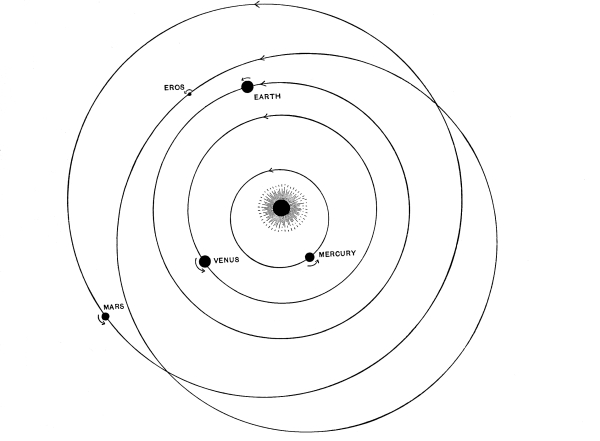
for recent research has shown some transgressing its bounds. One, Eros,
discovered by De Witt, more than trenches on Mars’ territory, having
an orbit smaller than that of the god of war, and may be considered
perhaps the forerunner of more yet to be found between Mars and the
Earth. On the other side, three recently detected by Max Wolf at
Heidelberg have periods equal to that of Jupiter, and in their motions
appear to exemplify an interesting case of celestial mechanics pointed
out theoretically by Lagrange long before its corroboration in fact was
so much as dreamt. Achilles, Patroclus, and Hector, as the triad are
called, so move as always to keep their angular distance from Jupiter
unaltered in their similar circuits of the Sun.
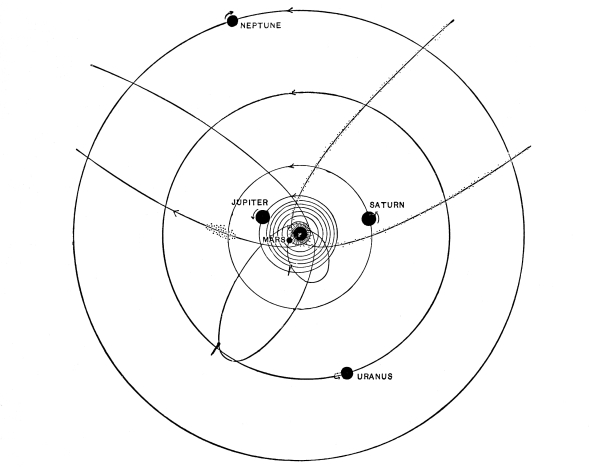
Orbits of the Outer Planets.
Before considering these bodies individually, we may well look upon
them en bloc, inasmuch as one attribute of the asteroids concerns
them generically rather than specifically, and is of great interest
both from a mechanical and an historical point of view. For, in fact,
it is what led to their discovery. Titius of Wittenburg, about the
middle of the eighteenth century, noticed a curious relation between
the distances from the Sun of the then known planets. It consisted in a
sort of regular progression, but with one significant gap. Bode was so
struck by the gap that he peopled it with a supposed planet, and so
brought the relation into general regard in 1772. In consequence, it
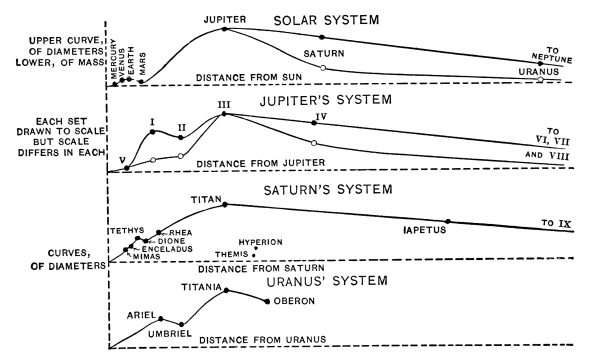
usually bears his name. It is this: if we take the geometrical series,
3, 6, 12, 24, 48, 96 and add 4 to each term, we shall represent to
a fair degree of precision the distances of the several planets,
beginning with Mercury at 4 and ending with Saturn at 100, which was
the outermost planet then known. All the terms were represented except
24 + 4, or 28—a gap lying between Mars and Jupiter. When Uranus
was discovered by Sir William Herschel in 1781 and was found to be
travelling at what corresponded to the next outer term 192 + 4, or
196, the opinion became quite general that the series represented a real law
and that 28 must be occupied by a planet. Von Zach actually calculated
what he called its analogical elements, and finally got up in 1800 a
company to look for it which he jocularly described as his celestial
police. Considering that Bode’s law is not a law at all, but a curious
coincidence, as Gauss early showed in its lack of precision and in its
failure to mark the place of Mercury with any approach to accuracy, and
as the discovery of Neptune amply bore out, it was perhaps just in fate
that the honor of filling the gap did not fall to any of the “celestial
police,” but to an Italian astronomer, Piazzi, at the time engaged on
a new star chart. An illness of Piazzi caused it to be lost almost as
soon as found. In this plight an appeal was made to the remarkable
Gauss, just starting on his career. Gauss undertook the problem and
devised formulæ by which its place was predicted and the planet itself
recovered. It proved to fit admirably the gap. But it had hardly
been recovered before another planet turned up equally filling the
conditions. Ceres, the first, lay at 26.67 astronomical units from the
Sun; Pallas, the second, at 27.72. Two claimants were one too many. But
the inventive genius of Olbers came to the rescue. By a bold hypothesis
he suggested that since two had appeared where only one was wanted,
both must originally have formed parts of a single exploded planet. He
predicted that others would be detected by watching the place where the
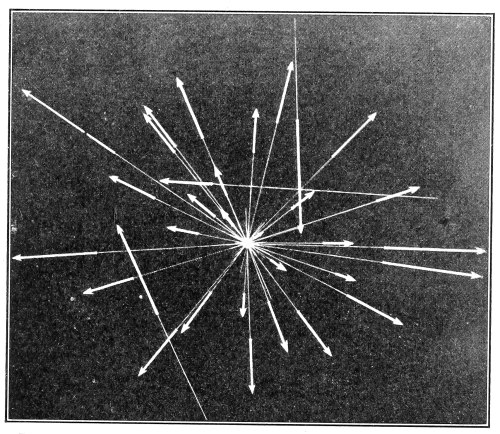
explosion had occurred, to wit: where the orbits of Ceres and Pallas
nearly intersected in the signs of the Virgin and the Whale.
For in the case of an explosion the various parts, unless perturbed,
must all return in time to the scene of the catastrophe. By following
his precept, two more were in fact detected in the next two years, Juno
and Vesta. His hypothesis seemed to be confirmed. No new planets were
discovered, and the old fulfilled fairly what was required of them.
Lagrange on calculation gave it his mathematical assent.
Nevertheless, it was incorrect, as events eventually showed, though for
forty years it slept in peace, no new asteroids being found. We now
know that this was because the rest were all much smaller, and for such
nobody looked. It was not till 1845 that Hencke, an ex-postmaster of
Driessen in Prussia, after fifteen years of search detected another,
Astræa, of the 11th magnitude. After this discoveries of them came on
apace, until now more than six hundred are known, and their real number
seems to be legion. But those discovered are smaller each year on the
average, showing that the larger have already been found. Their orbits
are such that they cannot possibly ever have all formed part of a
pristine whole. The idea, not the body, was exploded. For they are now
recognized as having always been much as they are to-day.
ASTEROIDS.
MAJOR AXES OF ORBITS.
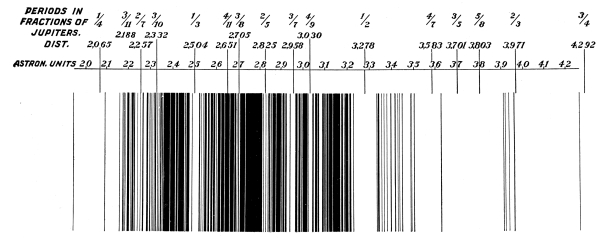
They prove to be thickest at nearly the point where Bode’s law
required, the spot where Ceres and Pallas were found. The mean of
their distances is less, being 2.65 instead of 2.8 astronomical units,
probably simply because the nearer ones are easier discovered. The
fact that they are clustered most thickly just inside 2.8 astronomical
units implies that there of all points within the space between Mars
and Jupiter a planet would have formed if it could. A definite reason
exists for its failure to do so—Jupiter’s disturbing presence.
Throughout this whole region Jupiter’s influence is great; so great
that his scattering effect upon the particles exceeds their own
tendency to come together. We see this in the arrangement of the
orbits. If we plot the orbits of the asteroids, we shall be struck by
the emergence of certain blanks in the ribbon representing sections
of their path. It is the woof of a plaid of Jupiter’s weaving. The
gaps are where asteroids revolving about the Sun would have periods
commensurate with his, ²/₅, ¹/₂, ³/₅, ⁴/₇, and the like. Such bodies
would return after a few revolutions, five of theirs, for instance,
to Jupiter’s two, into the same configurations with him at the
same points of their orbits. Thus the same perturbation would be
repeated over and over again until the asteroid’s path was so changed
that commensurability ceased to exist. And it would be long before
perturbation brought it back again. Thus the orbits are constantly
swinging out and in, all of them within certain limits, but those
are most disturbed which synchronize with his. In this manner he has
fashioned their arrangement and even prevented any large planet from
forming in the gap.
Such restrictive action is not only at work to-day in the distribution
of the asteroids and in the partitions of Saturn’s ring, but it must
have operated still more in the past while the system was forming. To
Professor Milham of Williamstown is due the brilliant suggestion that
this was the force that fashioned the planetary orbits. For a planet
once given off from a central mass would exercise a prohibitive action
upon any planet trying to form within. In certain places it would not
allow it to collect at all. The evolution of the solar family would
resemble that of some human ones in which each child brings up the next
in turn. So that the planetary system made itself, as regards position,
a steadily accumulative set of prohibitions combining to leave only
certain places tenantable.
In this manner we may perhaps be brought back to Bode’s law as
representing within a certain degree of approximation a true mechanical
result, although no such exact relation as the law demands exists.
That a relation seemingly close to it is necessitated by the several
successive inhibitions of each planet upon the next to form, is quite
possible.
One other general trait about their orbits is worth animadversion. In
spite of being eccentric and inclined, they are all traversed in the
same sense. Every one of the asteroids travels direct like the larger
planets. In this they differ from cometary paths, which are as often
retrograde as direct. Thus in more ways than one they hold a mid-course
in regularity between the steady, even character of the planets proper
and what was for long deemed the erratic behavior of the cometary class
of cosmic bodies. Very telling this fact will be found with regard to
the genesis of the solar family, as we shall see later.
With regard now to their more individual characteristics, the asteroids
may be said to agree in one point—their diversity, not only to all
the larger members of the solar family, but to one another. For they
travel in orbits ranging in ellipticity all the way from such as nearly
approach circles to ellipses of cometary eccentricity. They voyage,
too, without regard to the dynamical plane of the system, or, what is
close to it, the ecliptic; departing from the general level often 30°
and, in one instance, that of the little planet dubbed W. D., by as
much as 48°. This eccentricity and inclination put them in a class by
themselves. It is associated and unquestionably connected mechanically
with another trait which likewise distinguishes them from the planets
more particularly called—their diminutive size. Only four—Vesta,
Ceres, Pallas, and Juno—out of the six hundred odd now known exceed
a hundred miles in diameter, and the greater number are hardly over
ten or twenty miles across. Very tiny worlds indeed they would seem,
could we get near enough to them to discern their forms and features.
Curiously enough, reasoning on certain light changes they exhibit has
enabled us to divine something of their shapes, and even character.
Thus it was soon perceived that Eros fluctuated in the light he sent
us, being at times much brighter than at others. In February and March,
1901, the changes were such that their maximum exceeded three times
their minimum two hours and a half later. Then in May the variation
vanished. More than one explanation has been put forward, but the best
so far, because the most simple, is that the body is not a sphere but
a jagged mass, a mountain alone in space, and that as it turns upon
its axis first one corner and then another is presented to our view or
throws a shade upon its neighbor. When the pole directly faces us, no
great change occurs, especially if it also nearly faces the Sun. Yet
even this fails to explain all its vagaries.
Eros is not alone in thus exhibiting variation. Sirona, Hertha, and
Tercidina have also shown periodic variability, and it is suspected in
others. Indeed, it would be surprising did they not show change. For
they are too small to have drawn their contents into symmetry, and so
remain as they were when launched in space. Mammoth meteorites they
undoubtedly are.
With the asteroids we leave the inner half of the Sun’s retinue and
pass to the outer. Indeed, the asteroids not only mark in place the
transition bound between the two, but stamp it such mechanically. In
their own persons they witness that no large body was here allowed to
form. The culmination of coalition was reached in Jupiter, and that
very acme of accretion prevented through a long distance any other.
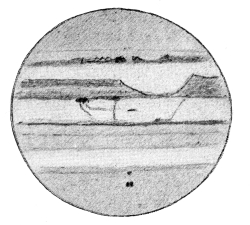
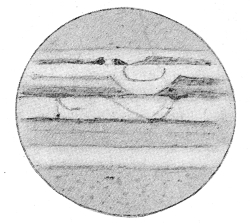
Drawing of Jupiter by
Dr. Lowell. April 12, 1907.
In bulk, the major planets compared with the inner or terrestrial ones
form a class apart; and among the major Jupiter is by all odds first.
His mass is 318 times the Earth’s and his volume nearly 1400 times
hers. From this it appears that his density is very much less. Indeed,
his substance is only fractionally denser than water. This and its
tremendous spin, carrying a point at its equator two hundred and eighty
thousand miles round in less than ten hours, flatten it to a very
marked oval with an ellipticity of 1/15.5. Not the least beautiful of
the revelations of astronomy are the geometrical shapes of the heavenly
bodies, proceeding from nearly perfect spheres like the Sun or Moon to
marked spheroids like Jupiter or Saturn. So enormous are the masses and
the forces concerned that the forms assumed under them are mechanically
regular. They are the visible expression of gravitation, and so delight
the brain while they satisfy the eye.
It is to appreciation of the detail visible on Jupiter’s disk that
modern advance in the study of the planet is indebted. Examination has
shown its features to be of great interest. To Mr. Stanley Williams of
Brighton, England, much of our knowledge is due, and Mr. Scriven Bolton
has also made some interesting contributions. The big print of the
subject, read long ago, is that the planet’s disk is noticeably banded
by dark belts. Two characteristics of these belts are important. One
is that they exhibit a regular secular progression with the lapse of
years, the south tropical belt being broader and more salient for many
years in succession, and then gradually fading out while the northern
one increases in prominence. It has been suspected that the rhythm of
their change is connected with that of sun spots. The second is that
the belts do not preserve in their several features the same relation
in longitude toward one another. They all rotate, but at different
speeds. There could be no better proof that Jupiter is no solid, but
a seething mass of heavy vapors boiling like a caldron. Tempered by
distance we can form but a faint idea of the turmoil there going
on. Further indication of it is furnished by its glow. For all the
dark belts are a beautiful cherry red, a tint extending even to the
darkish hoods over the planet’s caps. This hue comes out well in good
seeing, and best, as with all planetary markings, in twilight, not at
night, because the excessive brightness of the disk is then taken off,
preventing the colors from being swamped.
This brings us to the planet’s albedo, which Müller at Potsdam
has found to be 75 per cent. Now the interest attaching to this
determination is twofold, that it bespeaks cloud and that it seems to
imply something else. The albedo of cloud is 72 per cent of absolute
whiteness. What looks like cloud, then, is such, on that distant disk.
But Jupiter surpasses cloud in lustre, since his albedo exceeds 72
per cent. Yet a large part of his surface is strikingly darker than
that. The inference from this is that he shines by intrinsic light, in
part at least. The fact may not be stated dogmatically, as there is
no astronomic determination so uncertain as this one of determining
albedoes, and therefore Herr Müller’s results must be accepted with
every reserve, but they suggest that Jupiter is still a semi-sun, to be
recognized as such by light as well as heat, though his self-luminosity,
if it exist at all, can hardly exceed a dull red glow.
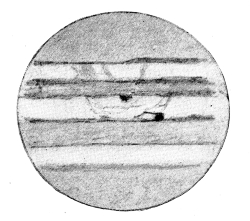
I.
Jupiter and its wisps.— A drawing
by Dr. Lowell, April 11, 1907.
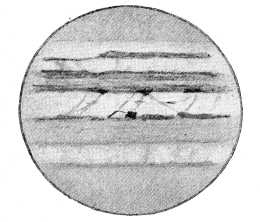
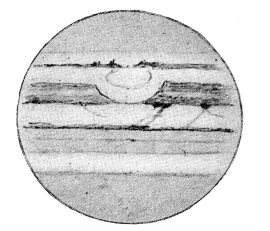
II.
Jupiter and its wisps.—A drawing
by Dr. Lowell, April 11, 1907.
S.
N.
Photograph
of Jupiter,
1909.
P. L.
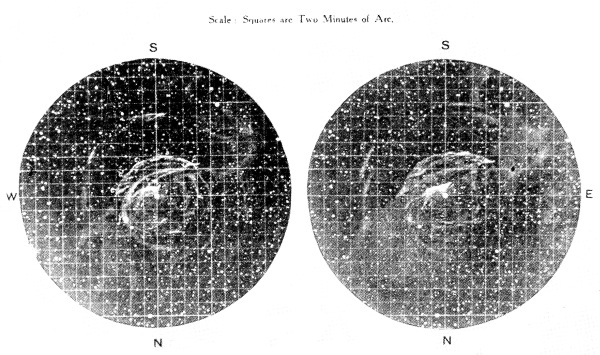
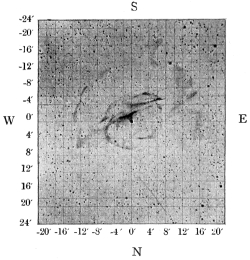
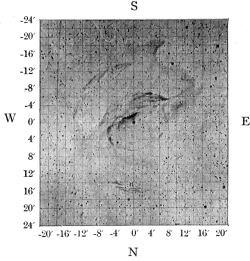
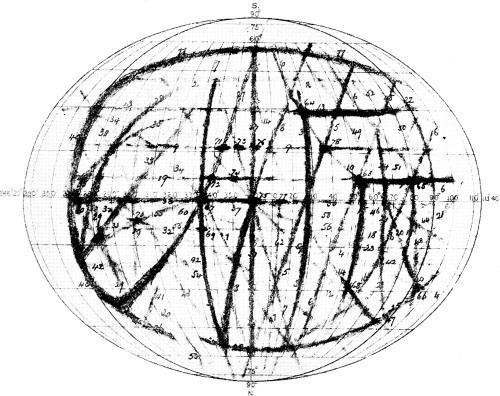
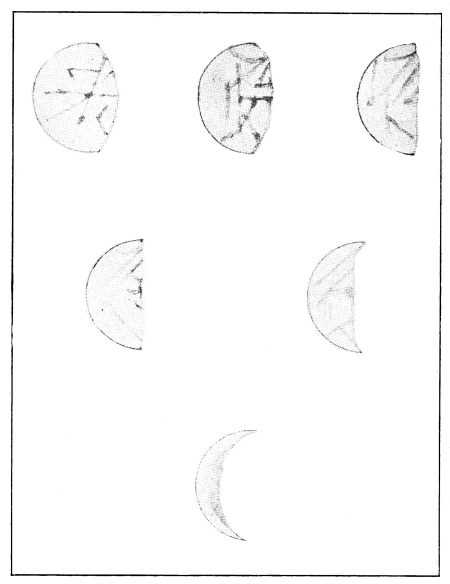
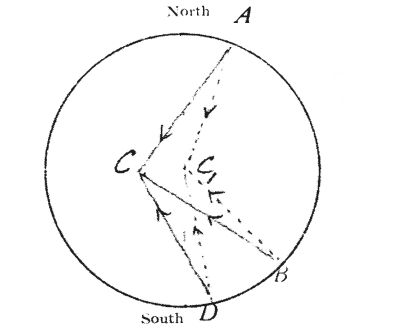
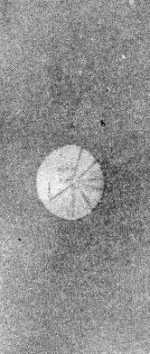
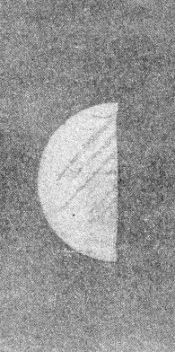
A modern detection on Jupiter’s disk has been that of wisps or
lacings across the bright equatorial belt, a detail of importance due to
Mr. Scriven Bolton. Requested to look for them, the observatory at
Flagstaff was not long in corroborating this interesting phenomenon.
The peculiarity about them pointed out by Mr. Bolton is that they
traverse the belt at an angle of about 45° to the vertical, proceeding
from caret-shaped dark spots projecting into the bright belt from the
dark ones on either side. They exist all round the equator and are
found indifferently dextrous or sinister—sometimes vertical. For there
are others that go straight across. Nor are they confined to the bright
equatorial belt, but are to be seen traversing all of the bright belts
both north or south up to the polar hoods. From its sombreness it seems
that we are here regarding a phenomenon in the negative; remarking it
by what it has left behind, not by what it has accomplished. For the
wisps are not wisps of cloud, since they are dark, not light, but gaps
strung out in the clouds themselves.
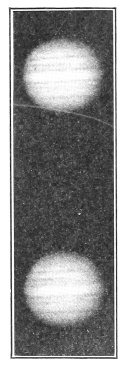
Recently photographs of Jupiter have been secured at Flagstaff, by the
new methods there of planetary photography, showing a surprising amount
of detail. The wisps come out with certainty, and the white spots,
which are such a curious feature of the disk, have also left their
impress on the plate. Not the least of the services thus rendered by
the camera is the accurate positioning of the belts made possible by
it. Micrometric measures are all very well when nothing better is
attainable, but any one who has made such upon a planet’s disk
swinging like a lantern in the field of view under a variety of causes
instrumental and optical, knows how encumbered they inevitably are
with error. To have the disk caught and fixed on a plate where it
may be measured at leisure and as often as one likes, is a distinct
advance toward fundamental accuracy. Measures thus effected upon the
Jupiter images of 1909 proved the bright equatorial belt to lie exactly
upon the planet’s equator when allowance was made for the tilt of the
planet’s axis toward the Earth. This showed that the aspect of the
planet toward the Sun had no effect upon the position of the belt.
Jupiter’s cloud formation, therefore, is not dependent, as all ours
are, upon the solar heat.
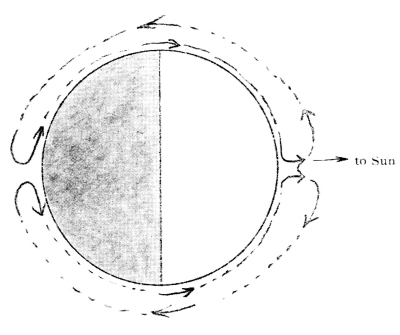
A like indifference to solar action is exhibited in the utter
obliviousness of the belts to day or night. To them darkness and light
are nugatory alike. They reappear round the sunrise edge of the disk
just as they left it when they sank from sight round the sunset one,
and they march across its sunlit face without so much as a flicker on
their features.
Yet this seeming immobility from moment to moment takes place in what
is really a seething furnace, the fiery glow of which we catch below
the vast ebullition of cloud in the cherry hue of its darker portions.
Distance has merged the turmoil into the semblance of quiescence and
left only its larger secular changes to show. Even so the Colorado
River from the brink of the Grand Cañon is seen apparently at rest, the
billows of its rapids so stereotyped to stability one takes the rippled
sand bank for the river and the billows of the river for the ripple
marks of its banks.
At twice the distance of Jupiter we cross the orbit of Saturn. Here the
ringed planet, with an annual sweep of twenty-nine and a half of our
years, pursues his majestic circuit of the Sun. Diademed with three or
more circlets of light and diamonded by ten satellites, he rivals in
his cortège that of his own lord. In some ways his surpasses the Sun’s.
For certainly his retinue is the more spectacular of the two; the more
so that it is much of it fairly comprised within a single glance. Very
impressive Saturn is as, attended thus, he sails into the field of view.
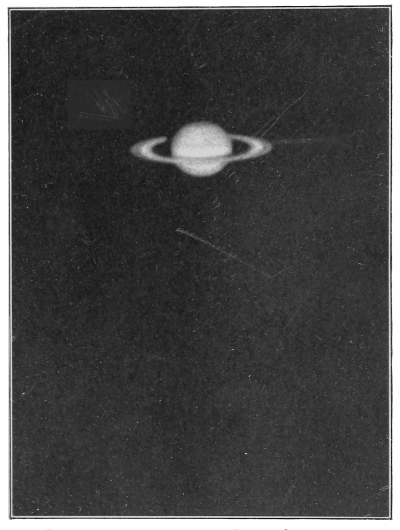
Saturn—A drawing by Dr. Lowell,
showing agglomerations.
In our survey we may best begin with his globe. If Jupiter’s
compression is striking, Saturn’s is positively startling when well
displayed. This happens but at rare intervals. As the plane of his
equator is almost exactly that of the rings, the flattening is
conspicuous only on those occasions when the rings disappear because
their plane passes through the line of sight. Seen at such times the
effect of the discrowned orb is so strange as to suggest delusion.
This occurred two years ago in 1907, and when the planet was picked up
by its position and entered the field unheralded by its distinctive
appendage, it was almost impossible to believe there had not been
some mistake and a caricatured Jupiter had taken its place. For the
flattening outdoes that of Jupiter as 3 to 2, being ⅒ of the equatorial
diameter. Such a bulging almost suggests disruption and is due to
the extreme lightness of the planet’s substance, which is actually
only 0.72 of that of water. Like Jupiter, the disk exhibits belts,
though very much fainter, and, like his, these are of a cherry red. As
the planet’s albedo is even greater, 0.78 of absolute whiteness, as
deduced from H. Struve’s measures of the diameter, the same suspicion
of shining, at least in part, from inherent light, applies equally
to him. But it is practically certain that in neither case does this
light equal that of the planet’s clouds, or add anything to them. Both
planets are red-hot, not white-hot. The determination of the albedo
depends upon that of the diameter, and an increase in the latter would
lower the albedo to that of cloud.
His most unique possession are his rings. Broad, yet tenuous, they
weigh next to nothing, being, as Struve has dubbed them, “Immaterial
light.” Nevertheless, it is not their lightness but their make-up that
prevents from lying uneasy the head that wears this crown.
The mechanical marvel was not appreciated by early astronomers, who
took it for granted that they were what they seemed, solid, flat rings,
all of a piece. Even Laplace considered it sufficient to divide them up
concentrically to insure stability. To Edouard Roche of Montpellier,
as retiringly modest as he was penetratingly profound, is due the
mathematical detection that to subsist they must be composed of
discrete particles,—brickbats, Clerk Maxwell called them, when, later,
unaware of Roche’s work, he proved independently the same thing in his
essay on Saturn’s rings. Peirce, too, in ignorance of Roche, had half
taken the same step a little before, showing that they must at least
be fluid. Then in 1895 Keeler ingeniously photographed the spectrum of
both ball and rings to the revealing of velocities in the line of sight
of the different portions of the spectrum exactly agreeing with the
values mechanics demanded.
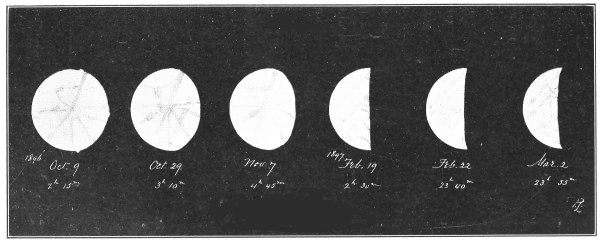
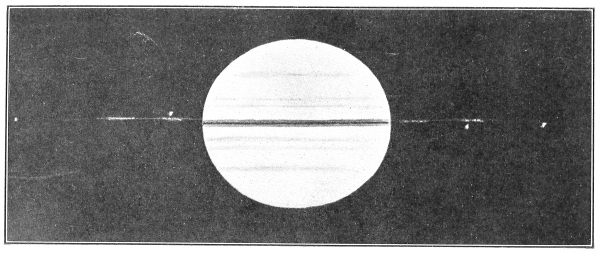
The rings have usually been considered to be flat. At the time of
their disappearance, however, knots have been seen upon them. It is
as if their filament had suddenly been strung with beads. At the last
occurrence of the sort in 1907, these beads were particularly well seen
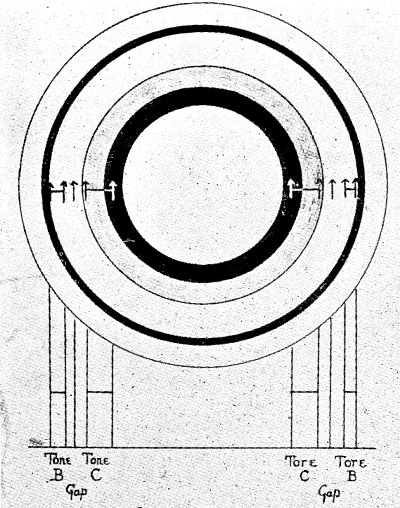
at several observatories, and were critically studied at Flagstaff. In
connection with a new phenomenon detected there, that of a dark core
in the shadow the rings threw across the planet’s face, an explanation
suggested itself to account for both them and it: to wit, that the
rings were not really flat, but tores; rings, that is, like an anchor
ring, any cross-section of which would be of the nature of an oval
flattened on its inner side. The cogency of the explanation consisted
in its solution not only of the appearances but of the cause competent
to bring those appearances about.
For measurement showed that the knots were permanent in position,
which, since the ring revolved, indicated that they extended all round
it in spite of their not seeming to do so, and that their distances
from Saturn were just what this cause should produce.
The action observed was a corollary from the important principle
of commensurability of orbital period. As we saw in the case of
the asteroids, if two bodies be travelling round a third and their
respective periods of revolution be commensurate, they will constantly
meet one another in such a manner that great perturbation will ensue
and the bodies be thrown out of commensurability of period.
What has happened to the asteroids has likewise occurred in Saturn’s
rings. The disturber in this case has been, not Jupiter, as with them,
but one or other of Saturn’s own satellites. For when we calculate
the problem, we find that Mimas, Enceladus, and Tethys have periods
exactly commensurate with the divisions of the rings; in other words,
these three inner satellites, whose action because of proximity is the
greatest, have fashioned the rings into the three parts we know, called
A, the outermost; B, the middle one; and C, the crêpe ring, nearest to
the body of the planet. Mimas has been the chief actor, though helped
by the two others, while Enceladus has further subdivided ring A by
what is known as Encke’s division.
Such has been the chief action of the satellites on the rings: it
has made them into the system we see. But if we consider the matter,
we shall realize that a secondary result must have ensued—when we
remember that the particles composing the rings must be very crowded
for the rings to show as bright as they do, and also that, though
relatively thin, the rings are nevertheless some eighty miles through.
Now it is evident that any disturbance in so closely packed a system
of small bodies as that constituting Saturn’s rings must result in
collisions between the bodies concerned. Particles pulled out or in
must come in contact with others pursuing their own paths, and as at
each collision some energy is lost by the blow, a general falling in
toward the planet results. At the same time, as the blow will not
usually be exactly in the plane in which either particle was previously
moving, both will be thrown more or less out of the general plane of
their fellows, and the ring at that point, even if originally flat,
will not remain so. For the ring, though very narrow relatively, has a
real thickness, quite sufficient for slantwise collision, if the bodies
impinge.
Saturn’s Rings.
November 1907.
Now the knots or beads on the rings appeared exactly inside the points
where the satellites’ disturbing action is greatest, or, in other
words, in precisely their theoretic place. We can hardly doubt that
such, then, was their origin.[9]
The result must be gradually to force the particles as a rule nearer
the planet, until they fall upon its surface, while a few are forced
out to where they may coalesce into a satellite,—a result foreseen
long ago by Maxwell. It is this process which in the knots we are
actually witnessing take place, and which, like the corona about the
eclipsed Sun, only comes out to view when the obliterating brightness
of the main body of the rings is withdrawn by their edgewise
presentation.
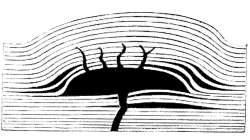
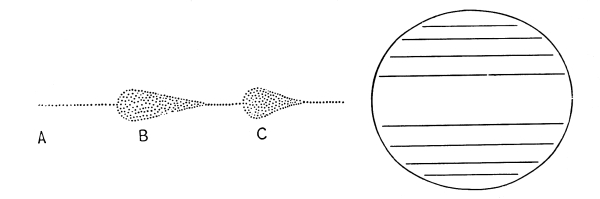
The reason the out-of-plane particles are most numerous just inside the
point of disturbance is not only that there the action throwing them
out is most violent, but that all the time a levelling action quite
apart from disturbance is all the time tending to reduce them again to
one plane, as we shall see further on when we come to the mechanical
forces at work. Thus the tore is most pronounced on its outer edge, and
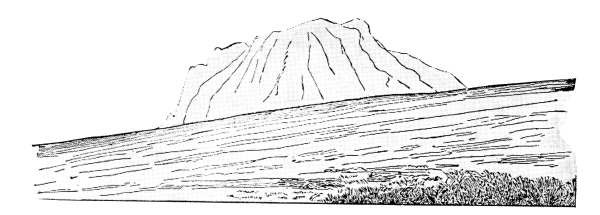
falls to a uniform level at its inner boundary. The effect is somewhat
as represented in the adjoining cut, in which the vertical scale is
greatly magnified:—
The Tores of Saturn. Not
drawn to scale.
With Saturn ended the bounds of the solar system as known to the
civilized world until 1781. On March 13 of that year Sir William
Herschel in one of his telescopic voyages through space came upon a
strange object which he at once saw was not a star, because of its very
perceptible round disk, and which he therefore took for a peculiar kind
of comet. Nearly a year rolled by before Lexell showed by calculation
of its motion that it was no comet, but undoubtedly a new planet beyond
Saturn travelling at almost twice that body’s mean distance from the Sun.
By reckoning backward, it was found to have been seen and mapped
several times as a star,—no less than twelve times by Lemonnier
alone,—and yet its planetary character had slipped through his
fingers. It can even be seen with the naked eye as a star of the 6th
magnitude, and its course is said to have been watched by savage tribes
in Polynesia long before Sir William Herschel discovered it.
Its greenish blue disk indicates that it is about thirty-two thousand
miles in diameter, and its mass that its density is about 0.22 of
the Earth’s or, like Jupiter’s, somewhat greater than water. Of its
surface we probably see nothing. Indeed, it is very doubtful if it
have any surface properly so called, being but a ball of vapors. Its
flattening, ¹/₁₁ according to Schiaparelli, which is probably the best
determination, agrees with the density given above, indicating its
substance to be very light. Belts have faintly been descried traversing
its disk after the analogy of Jupiter and Saturn. These would be much
better known than they are but for the great tilt of the planet’s axis
to the ecliptic, so that during a part of its immense annual sweep its
poles are pointed nearly at the Earth, and its tropical features, the
places where the belts lie, are wholly hidden or greatly foreshortened
from our point of view. As the planet’s year is eighty-four of our
years long, it is only at intervals of forty odd years that the disk is
well enough displayed to bring the belts into observable position.
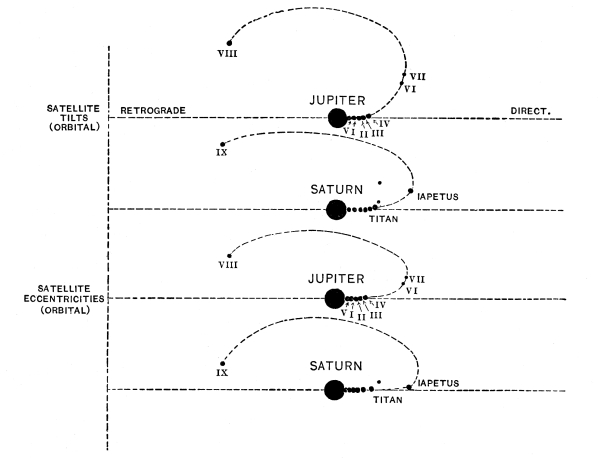
The planet is attended by four satellites,—Ariel, Umbriel, Titania,
and Oberon,—a midsummer night’s dream to a watcher of the skies. They
travel in a plane inclined 98° to the ecliptic, so that their motion is
nearly up and down to that plane and even a little backward. Whether
their plane is also the equatorial plane of the planet, we do not know
for certain. The observations as yet are not conclusive one way or the
other. If the two planes should turn out not to coincide, it will open
up some new fields in celestial mechanics. The belts have been thought
to indicate divergence, but the most recent observations by Perrotin on
them minimize this. They suggest, too, a rotation period of about ten
hours, which is what we should expect.
Its albedo, or intrinsic brightness, is, according to Müller, 0.73,
or almost exactly that of cloud. This tallies with the lack of
pronouncement of the belts and is another argument against the reality
of the recent diametral measurements, as all Müller’s values are got by
dividing the amount of light received by the amount of surface sending
it. If the diameter were much less than thirty-two thousand miles, the
resulting albedo would become impossibly high.
If we know but little about the actual surface of Uranus, we know now a
good deal about its atmosphere. And this partly because atmosphere is
almost all that it is. The satellites are the only solid thing in the
system. If we needed a telltale that the solar system had evolved, the
gaseous constitution of its primaries and the condensed state of their
attendants would sufficiently inform us. Probably all the major planets
are nothing but gas. It has been debated whether Jupiter be almost all
vapor with a solid kernel beneath, or vapor entirely. That he grows
denser toward the core is doubtless the case, but that he is anywhere
other than a gaseous fluid is very unlikely. For if he had really
begun to condense, he must have contracted to far within his present
dimensions. The same is true of Uranus.
The surprising thing about Uranus is the enormous extent of his
atmosphere. The earliest spectroscopists perceived this, but the more
spectroscopy advances, the greater and more interesting it proves to
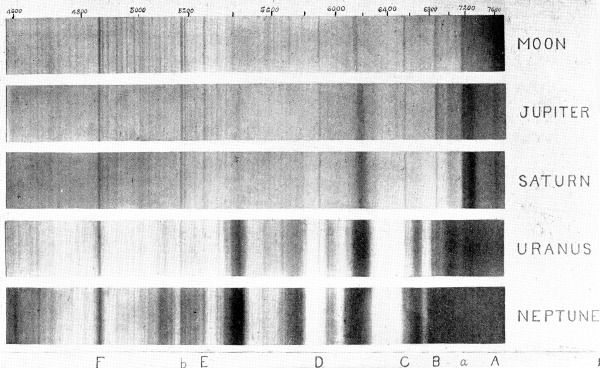
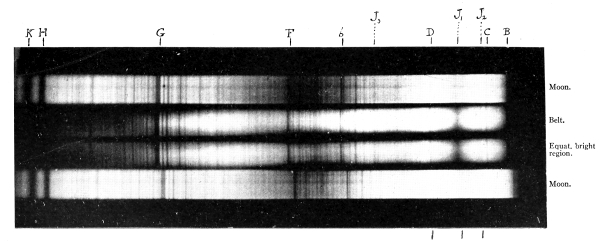
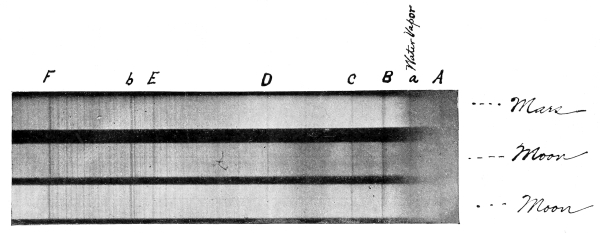
be. By pushing inquiry into the red end of the spectrum, hitherto a
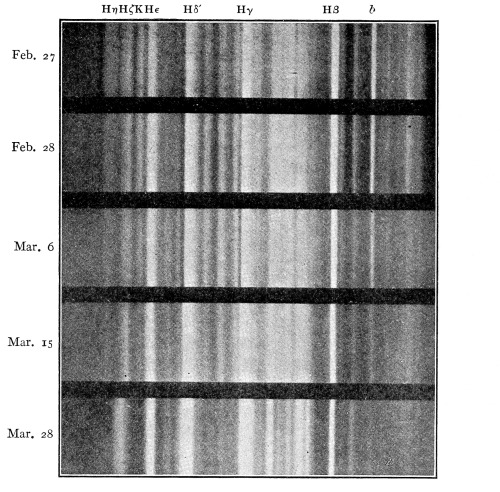
terra incognita, Dr. Slipher has uncovered a mass of as yet unexplained
revelation. Of these remarkable spectrograms we shall speak later. Here
it is sufficient to say that so great is the absorption in the red that
only the blue and green in anything like their entirety get through;
which accounts for the well-known sea-green look of the planet.
Furthermore, the spectroscope shows that this atmosphere, or the great
bulk of it, must lie above what we see as the contour of the disk.
For the spectroscope is as incapable of seeing through opacity as the
eye, though it distances the eye in seeing the invisible. It is not
what is condensed into cloud, but what is not, of which it reveals the
presence. We are thus made aware of a great shell of air enveloping the
planet.
In Uranus, then, we see a body in an early amorphous state, before the
solid, the liquid, and the gaseous conditions of matter have become
differentiate and settled each into distinctive place. Without even an
embryo core its substance passes from viscosity to cloud.
Neptune has proved a planet of surprises. Though its orbital revolution
is performed direct, its rotation apparently takes place backward, in a
plane tilted about 35° to its orbital course. Its satellite certainly
travels in this retrograde manner. Then its appearance is unexpectedly
bright, while its spectrum shows bands which as yet, for the most part,
defy explanation, though they state positively the vast amount of its
atmosphere and its very peculiar constitution. But first and not least
of its surprises was its discovery,—a set of surprises, in fact. For
after owing recognition to one of the most brilliant mathematical
triumphs, it turned out not to be the planet expected.
“Neptune is much nearer the Sun than it ought to be,” is the
authoritative way in which a popular historian puts the intruding
planet in its place. For the planet failed to justify theory by not
fulfilling Bode’s law, which Leverrier and Adams, in pointing out the
disturber of Uranus, assumed “as they could do no otherwise.” Though
not strictly correct, as not only did both geometers do otherwise, but
neither did otherwise enough, the quotation may serve to bring Bode’s
law into court, as it was at the bottom of one of the strangest and
most generally misunderstood chapters in celestial mechanics.
Very soon after Uranus was recognized as a planet, approximate
ephemerides of its motion resulted in showing that it had several times
previously been recorded as a fixed star. Bode himself discovered the
first of these records, one by Mayer in 1756, and Bode and others
found another made by Flamstead in 1690. These observations enabled an
elliptic orbit to be calculated which satisfied them all. Subsequently
others were detected. Lemonnier discovered that he had himself not
discovered it several times, cataloguing it as a fixed star. Flamstead
was spared a like mortification by being dead. For both these observers
had recorded it two or more nights running, from which it would seem
almost incredible not to have suspected its character from its change
of place.
Sixteen of these pre-discovery observations were found (there are now
nineteen known), which with those made upon it since gave a series
running back a hundred and thirty years, when Alexis Bouvard prepared
his tables of the planet, the best up to that time, published in 1821.
In doing so, however, he stated that he had been unable to find any
orbit which would satisfy both the new and the old observations. He
therefore rejected the old as untrustworthy, forgetting that they had
been satisfied thirty years before, and based his tables solely on
the new, leaving it to posterity, he said, to decide whether the old
observations were faulty or whether some unknown influence had acted
on the planet. He had hardly made this invidious distinction against
the accuracy of the ancient observers when his own tables began to be
out and grew seriously more so, so that within eleven years they quite
failed to represent the planet.
The discrepancies between theory and observation attracted the
attention of the astronomic world, and the idea of another planet
began to be in the air. The great Bessel was the first to state
definitely his conviction in a popular lecture at Königsberg in 1840,
and thereupon encouraged his talented assistant Flemming to begin
reductions looking to its locating. Unfortunately, in the midst of his
labors Flemming died, and shortly after Bessel himself, who had taken
up the matter after Flemming’s death.
Somewhat later Arago, then head of the Paris observatory, who had also
been impressed with the existence of such a planet, requested one of
his assistants, a remarkable young mathematician named Leverrier, to
undertake its investigation. Leverrier, who had already evidenced
his marked ability in celestial mechanics, proceeded to grapple with
the problem in the most thorough manner. He began by looking into
the perturbations of Uranus by Jupiter and Saturn. He started with
Bouvard’s work, with the result of finding it very much the reverse
of good. The farther he went, the more errors he found, until he was
obliged to cast it aside entirely and recompute these perturbations
himself. The catalogue of Bouvard’s errors he gave must have been an
eye-opener generally, and it speaks for the ability and precision
with which Leverrier conducted his investigation that neither Airy,
Bessel, nor Adams had detected these errors, with the exception of
one term noticed by Bessel and subsequently by Adams.[10]
The result of this recalculation of his was to show the more clearly that
the irregularities in the motion of Uranus could not be explained except by
the existence of another planet exterior to him. He next set himself to
locate this body. Influenced by Bode’s law, he began by assuming it
to lie at twice Uranus’ distance from the Sun, and, expressing the
observed discrepancies in longitude in equations, comprising the
perturbations and possible errors in the elements of Uranus, proceeded
to solve them. He could get no rational solution. He then gave the
distance and the extreme observations a certain elasticity, and by this
means was able to find a position for the disturber which sufficiently
satisfied the conditions of the problem. Leverrier’s first memoir
on the subject was presented to the French Academy on November 10,
1845, that giving the place of the disturbing planet on June 1, 1846.
There is no evidence that the slightest search in consequence was
made by anybody, with the possible exception of the Naval Observatory
at Washington. On August 31 he presented his third paper, giving an
orbit, mass, and more precise place for the unknown. Still no search
followed. Taking advantage of the acknowledging of a memoir, Leverrier,
in September, wrote to Dr. Galle in Berlin asking him to look for
the planet. The letter reached Galle on the 23d, and that very night
he found a planet showing a disk just as Leverrier had foretold, and
within 55′ of its predicted place.
The planet had scarcely been found when, on October 1, a letter from
Sir John Herschel appeared in the London Athenæum announcing that a
young Cambridge graduate, Mr. J. C. Adams, had been engaged on the
same investigation as Leverrier, and with similar results. This was
the first public announcement of Mr. Adams’ labors. It then appeared
that he had started as early as 1843, and had communicated his
results to Airy in October, 1845, a year before. Into the sad set of
circumstances which prevented the brilliant young mathematician from
reaping the fruit of what might have been his discovery, we need not
go. It reflected no credit on any one concerned except Adams, who
throughout his life maintained a dignified silence. Suffice it to say
that Adams had found a place for the unknown within a few degrees of
Leverrier’s; that he had communicated these results to Airy; that Airy
had not considered them significant until Leverrier had published an
almost identical place; that then Challis, the head of the Cambridge
Observatory, had set to work to search for the planet but so routinely
that he had actually mapped it several times without finding that he
had done so, when word arrived of its discovery by Galle.
But now came an even more interesting chapter in this whole
strange story. Mr. Walker at Washington and Dr. Petersen of Altona
independently came to the conclusion from a provisional circular orbit
for the newcomer that Lalande had catalogued in the vicinity of its
path. They therefore set to work to find out if any Lalande stars were
missing. Dr. Petersen compared a chart directly with the heavens to
the finding a star absent, which his calculations showed was about
where Neptune should have been at the time. Walker found that Lalande
could only have swept in the neighborhood of Neptune on the 8th and
10th of May, 1795. By assuming different eccentricities for Neptune’s
orbit under two hypotheses for the place of its perihelion, he found
a star catalogued on the latter date which sufficiently satisfied his
computations. He predicted that on searching the sky this star would be
found missing. On the next fine evening Professor Hubbard looked for
it, and the star was gone. It had been Neptune.[11]
This discovery enabled elliptic elements to be computed for it, when
the surprising fact appeared that it was not moving in anything
approaching the orbit either Leverrier or Adams had assigned. Instead
of a mean distance of 36 astronomical units or more, the stranger was
only at 30. The result so disconcerted Leverrier that he declared that
“the small eccentricity which appeared to result from Mr. Walker’s
computations would be incompatible with the nature of the perturbations
of the planet Herschel,” as he called Uranus. In other words, he
expressly denied that Neptune was his planet. For the newcomer
proceeded to follow the path Walker had computed. This was strikingly
confirmed by Mauvais’ discovering that Lalande had observed the star on
the 8th of May as well as on the 10th, but because the two places did
not agree, he had rejected the first observation, and marked the second
as doubtful, thus carefully avoiding a discovery that actually knocked
at his door.
Meanwhile Peirce had made a remarkable contribution to the whole
subject. In a series of profound papers presented to the American
Academy, he went into the matter more generally than either of the
discoverers, to the startling conclusion “that the planet Neptune
is not the planet to which geometrical analysis had directed the
telescope, and that its discovery by Galle must be regarded as a happy
accident.”[12] He proved this first by showing that Leverrier’s two
fundamental propositions,—
1. That the disturber’s mean distance must be between 35 and 37.9
astronomical units;
2. That its mean longitude for January 1, 1800, must have been
between 243° and 252°,—
were incompatible with Neptune. Either alone might be reconciled with
the observations, but not both.
In justification of his assertion that the discovery was a happy
accident, he showed that three solutions of the problem Leverrier had
set himself were possible, all equally complete and decidedly different
from each other, the positions of the supposed planet being 120° apart.
Had Leverrier and Adams fallen upon either of the other two, Neptune
would not have been discovered.[13]
He next showed that at 35.3 astronomical units, an important change
takes place in the character of the perturbations because of the
commensurability of period of a planet revolving there with that of
Uranus. In consequence of which, a planet inside of this limit might
equally account for the observed perturbations with the one outside
of it supposed by Leverrier. This Neptune actually did. From not
considering wide enough limits, Leverrier had found one solution,
Neptune fulfilled the other.[14]
And Bode’s law was responsible for this. Had Bode’s law not been taken
originally as basis for the disturber’s distance, those two great
geometers, Leverrier and Adams, might have looked inside.
This more general solution, as Peirce was careful to state, does not
detract from the honor due either to Leverrier or to Adams. Their
masterly calculations, the difficulty of which no one who has not
had some experience of the subject can appreciate, remain as an
imperishable monument to both, as does also Peirce’s to him.