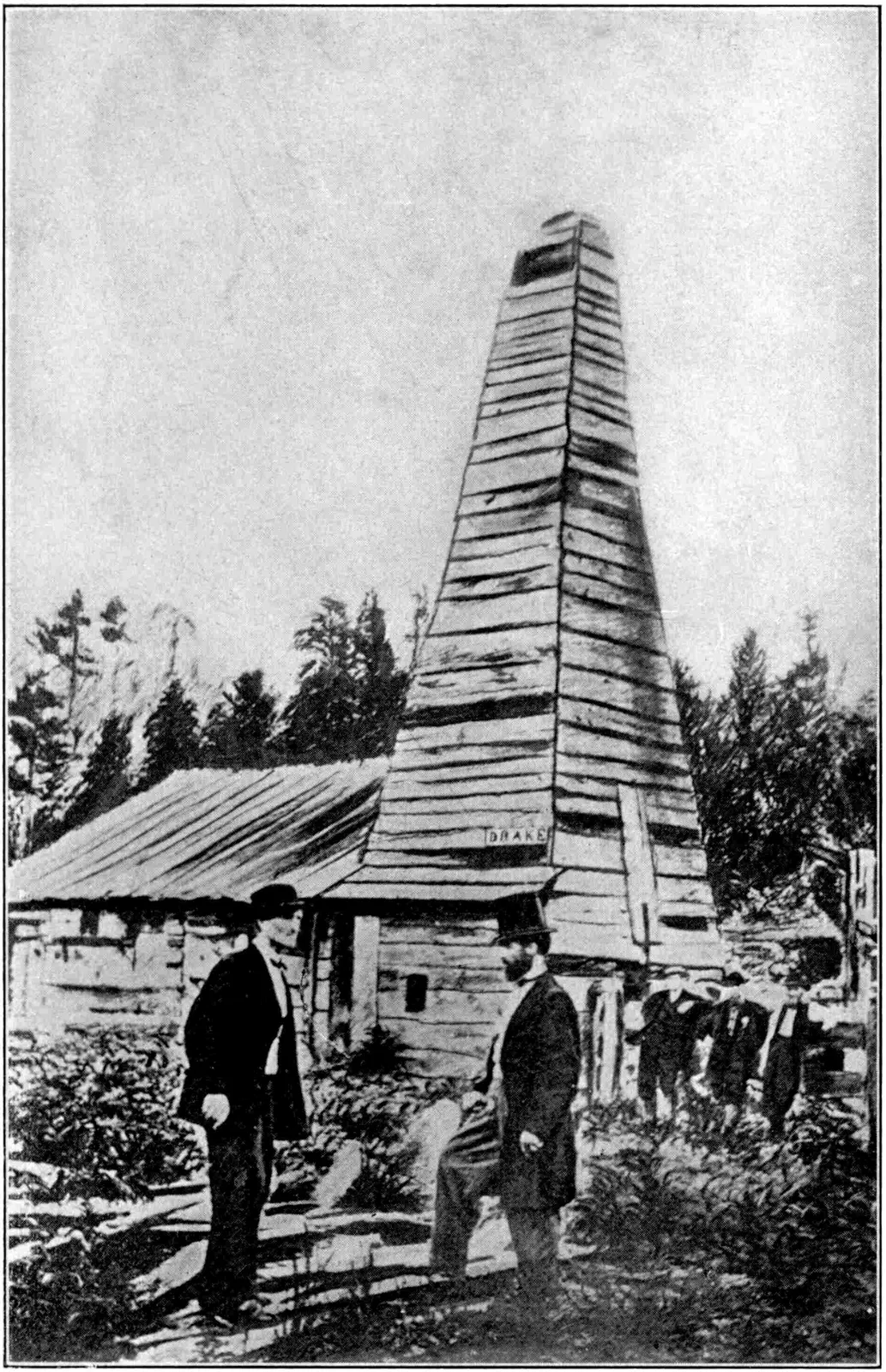
The first oil well drilled near Titusville, Pa., on August 27,
1859, by Col. Edwin L. Drake, the pioneer man of the world
THE EVOLUTION of the
OIL INDUSTRY
BY VICTOR ROSS
ILLUSTRATED
FROM
PHOTOGRAPHS
GARDEN CITYNEW YORK DOUBLEDAY, PAGE & COMPANY
1920
COPYRIGHT, 1920, BY
DOUBLEDAY, PAGE & COMPANY
ALL RIGHTS RESERVED, INCLUDING THAT OF TRANSLATION
INTO FOREIGN LANGUAGES, INCLUDING THE SCANDINAVIAN
PREFACE By Dr. Van H. Manning
Director of the Division of Technical Research of the
American Petroleum Institute. Formerly Director of
the Bureau of Mines of the Department of the Interior
A glance at the chapter headings in this little
book shows that it is an endeavour to present in succinct
form a survey of a great and ever-expanding
economic revolution—the interpenetration by petroleum
of all industries, whether of the factory or the
field, land or sea, war or peace. This phenomenon
has been almost exclusively a development of the
past six decades, and the United States of America
have been the predominant factor in the innumerable
changes wrought thereby. The narrative confines
itself rigidly to historic records and material
facts, undeniably romantic in themselves. But as
the epic unfolds itself, it assumes a super-phase, the
import of which cannot be measured by mere figures—a
super-phase with invaluable applications to the
problems of humanity in an industrial age.
Petroleum, it becomes clear, was the first natural
product to which the abstract theory of order, as
understood by modern social philosophers, was applied
in a large and general sense. It must be accounted
good fortune not only for America but for
the world at large, that this movement, though
gradual at the outset, commenced almost within a
decade of the birth of the modern petroleum industry
at Titusville, Pa., in 1859. The outcome has
tended to influence economic thought the world over,
especially since war on an unprecedented scale put all
established systems, traditions, and institutions to
the acid test.
Foreign observers and critics, friendly or unfriendly,
admit that in one matter American foresight
and enterprise have taught the older nations
valuable lessons—and that is in respect of standardized
production—or to put it in another way,
organized industry. America’s achievements in this
domain during the past half century have represented
incalculable and beneficial advancement beyond
the industrial conditions of all past centuries.
With this record of progress, the growth and expansion
of the petroleum industry have been inseparably
associated. The famous pioneers in organizing
the production, refining and distribution of
petroleum have also been pioneers in the application
of the principle of order to industry; which, in
essence, means the elimination of waste and misdirected
energy from human effort.
Organized industry means something entirely different
from a system aiming at quick and enormous
profits. It is based on a definite theory of scientific
effort, whereby all the possibilities of a given resource
are developed to their fullest degree, so that
waste ceases, the value of the worker’s labour is increased
with benefits to himself, and the consumer
receives the blessings of nature’s dower at the lowest
reasonable cost. As the ensuing chapters show, the
accomplishment of these objects in the case of petroleum
has involved much more than the application
of the physical sciences to manufacturing
processes. It has meant the development of systematized
methods in discovery and location, transportation
and distribution, so that from the moment
oil is “struck,” in say a barren patch of prairie,
until any one of the many products of crude petroleum
is placed in the hands of the consumer—here,
or in some distant isle of the sea—there shall be no
waste and no injustice, and that all the hands through
which it passes shall reap a just benefit.
The far-sighted Americans of the transition period
in this country’s history, who created the modern
petroleum industry, and built up the machinery for
its continuous expansion, began with the definite aim
of involving order from chaos. They were from the
outset reformers of business methods and enemies
of waste. The latter had become colossal during the
unsettled years that were marked by the duration
and aftermath of civil war. The work of these business
pioneers was gradual, but it developed an ever-increasing
impetus; and as the years went on the
ethical import of their mission became more and
more apparent. It would be wide of the facts to say
that the element of gain played no part in these
developments. Little indeed would be accomplished
in the way of progress were the incentive of personal
gain in some form or other removed. On this point
the Scottish economist, Adam Smith, spoke pertinently
one hundred and fifty years or more ago:
“By pursuing his own interest a man frequently promotes
that of society more effectually than when he
really intends to promote it.” Nevertheless it is
clear that in the case of some of the leaders most
closely identified with the organization of the
petroleum industry, personal motive and energy were
supplemented by a sincere desire to promote the
prosperity and welfare of the American people as a
whole.
Coming to the larger question of what the principle
of order means to humanity in the abstract, it
must be noted that all modern thinkers whether
they be supporters of capitalism—the system on
which all past industrial and national progress has
been based—or intellectual socialists pin their faith
to that principle as the sole means whereby mankind
can be raised to a higher level. Moderate socialists
are especially emphatic on this point and it is the
key-note of their writings. They attribute the great
mass of poverty and suffering which still exists in this
world to lack of order—to the failure of mankind,
in the individual and in the aggregate, adequately to
realize its importance. The goal which all enlightened
men, of whatever school of thought, desire
to see attained, is the abolition of poverty; not the
imaginary poverty of the man who chafes because
he cannot have everything he desires; but the actual,
galling poverty that is born of the worker’s inability
to produce sufficient to earn rewards that will enable
him to live according to decent standards. It
is to the eternal credit of the leaders of the petroleum
industry in America that they have set a beacon of
order and efficiency which lights the road by which
that great end—the abolition of poverty—may be
reached. It is a principle that runs like a golden
thread through the vast and complex system that
has grown up around petroleum.
The ensuing chapters show how much it has
meant in prosperity and progress to the world at
large to have a great natural resource like petroleum
developed to the fullest degree of its potentialities,
so that all who come in contact with it participate
in some measure in the benefits. These considerations
are obviously of greater importance than some
others which have been impressed on the public
mind in exaggerated terms. The fact that a few
men of organizing genius may have reaped fortunes
in consummating the aim of bringing order out of
chaos and turning waste to profit is of slight significance
in comparison with the certainty that millions
of people have been benefited by their operations.
It is one of the rooted axioms born of human experience
that genius of whatever order, so long as it
assists civilization, is entitled to exceptional rewards.
Particularly is it true of that rare order of
genius which lies back of directing minds. Without
their leadership the efforts of humanity to advance
itself would be in vain. What the extraordinarily
efficient organization of the petroleum industry has
meant in wealth to such leaders is in the aggregate
but a drop in the bucket in comparison with the
benefits conferred on the people as a whole—increasing
rewards for the producer in every stage of its
development, lowered costs for the consumer, and
stimulus to countless forms of industrial activity.
Thus it can be truthfully maintained that the
spirit of coöperation, honest endeavour and hatred
of waste and slovenly methods by which the present
condition of that industry has been achieved offers
a valuable and well recognized message from America
to the world at large, and suggests a solution for
many of the ills that beset civilization to-day.
While the petroleum industry is in the fullest
sense modern, it has been known to, and
casually utilized by mankind for centuries.
It is named in the earliest annals of the race; and
allusions to it are abundant in the literature of the
East, from which much of our Western literature
had its inspiration. It was applied to the service
of religion, and was a subject of superstition in
times which are enshrouded in legend. In the
authorized Bible and in the Apocrypha there are
more than two hundred allusions to it. The legend
of Noah speaks of his having used pitch to tighten
the seams of his ark, which certainly indicates a
familiarity with the uses of fluid bitumen available
in the East. In Deuteronomy there is mention of
“oil out of the flinty rock;” and Biblical students
could cite countless other instances where the
meaning clearly indicates a common use of the surface
deposits of Western Asia.
It is believed to have been a strong factor in trade
between Ancient Judea and Persia, which latter
country has again in the twentieth century become a
factor in oil production. It played its part in the
worship not only of the Hebrews but of other Eastern
nations, and to the primitive minds of those peoples
assumed miraculous characteristics. The burning
wells of Baku were the objective of religious pilgrimages
among the prehistoric peoples; and despite
the colossal waste of past ages these wells still flow
and are a factor in commerce. The Zoroastrians,
or Fire Worshippers, a sect of Persian origin, which
gained many adherents in ancient India also, regarded
these wells as the manifestations of a great
imprisoned spirit, who was supposed to breathe inflammable
vapour from his nostrils. Zoroaster has a
temple at Baku, and students of folk-lore hold that
these burning wells helped to confirm the belief in
a literal Hell of fire, common to races of Semitic
origin. The Macedonian conqueror of Asia, Alexander
the Great, witnessed the burning lake of
Ectabana in his march to the east, centuries before
the Christian era. Marco Polo, the Italian explorer
of the middle ages, among many fables, revealed
to Europe the truth about the oil resources in
Baku, and had sufficient of the instincts of a trader
to discern their commercial value. Well-founded
belief in the medicinal properties of petroleum, common
to all countries where it is found, was also prevalent
among the ancient peoples.
The reference to its use in the construction of
Noah’s ark shows that the utility of pitch, as a
binding material in building operations, was recognized.
It is clearly this material that is meant by the
“slime” which is stated to have been used as mortar
for the erection of the Tower of Babel; and it is
supposed to have played its part in more definitely
authenticated structures like the palaces of Babylon
and Nineveh, and the Temple of King Solomon.
Less familiar are the Greek legends relative to
petroleum. Plutarch, in his life of Alexander the
Great, after recording some experiments of the
Macedonian conqueror with petroleum, in the
course of which he nearly burned a favorite slave to
death, suggests that it was the fluid signified in one
of the legends of Medea. The story ran that Medea,
wishing to destroy a successful rival in love, the
daughter of King Creon, gave her a wreath and crown
anointed with some inflammable liquid. As her
victim approached the altar flame during a religious
festival, the wreath and veil became ignited and the
unfortunate princess was burned to ashes.
The ancient Egyptians undoubtedly used petroleum
for embalming and medicinal purposes, and
filled the cavities of dead bodies with asphaltum, so
that nomadic Arabs in later times have been known
to use mummies stolen from Egyptian tombs for fuel.
Petroleum in its more fluid form is also supposed to
have been used to preserve the ancient papyrus
against the boring of insects and the rust and rot of
time. To this extent at least historians and archæologists
are indebted to this gift to man.
Rome, in her gradual conquest of the Western
world, made all known oil supplies her own. Consequently
allusions which obviously refer to petroleum
are frequent to the Roman historians; and
here once more it was applied to the use of religion.
The early records of Russia, the Scythian nation
of ancient history, are obscure, but it is quite clear
that the properties of petroleum were known to them
for ages. When Igor descended on Greece, his vessels
were destroyed by a fire that burned on water;
which has led some modern historians to believe that
petroleum entered into the composition of “Greek
Fire,” the secret of which is lost.
The Greeks, indeed, are said to have made ingenious
use of petroleum at all times. Those who
have read in Gustav Flaubert’s “Salammbo” the
story of the rising of the mercenary troops of Carthage
after the first Punic war will recall the tactics
of one of the Greek captains who turned back the
Carthaginian elephant corps, by sending among them
swine smeared with petroleum and ignited.
In later days the greatest of Russian Emperors,
Peter the Great, showed himself alive to the commercial
value of the Baku wells. When in 1723 he
obtained from Persia control of the Baku Khanate,
he ordered the seizure of as much white petroleum
as possible, and directed that a refining master be
sent there. “This,” remarks a historian of petroleum,
“is the first record of a vacancy for a manager
of an oil refinery.”
As we go farther east history becomes less exact
and legend more quaint. In Burma the story of a
sweet-smelling deposit of petroleum is the subject
of a tale more than a thousand years old. It is
related that King Alsungsithu was making progress
through his realms with his seven wives and on his
magic raft. At one point the ladies went ashore and
finding sweet-smelling earth, anointed themselves
and delayed so long that they forgot the hour appointed
for their return. The angered king issued
the decree “let the queens who love scented earth
more than me, their Lord, be put to death.” The
doomed ladies replied “From too much love of this
fragrant earth we must now die. Let it lose its
fragrance and become an overflowing stream of
foul-smelling oil, and let those who collect it pay
us honour as their protecting deities.” They were
executed and became Nats or guardian spirits and
belief in them is still preserved among workers in the
Burmese oil fields. But if the legend could be accepted
as true the slain women assuredly took a sad
vengeance, for the only offense that can be charged
against so beneficent an agent as crude petroleum
is its odour, which assuredly belies its virtues.
There are the remains of very ancient oil workings
in Burma, Japan and China. Indeed, China, a
pioneer in many arts, was undoubtedly one in oil
production. Boring in the modern sense was unknown
to most of the ancient peoples but it was
practised in China centuries ago, a fact which will
come under consideration when we take up the
mechanical phases of oil production. They had
some deep wells at a time when other nations were
merely utilizing surface accumulations, and eruptions.
A natural substance which has played so considerable
a part in the literature and legend of Europeans
and Asiatics did not fail to appear in the beliefs and
practices of the aborigines of this country. From
time unknown the red man has gathered and made
medicinal use of the surface petroleum of the Oil
Creek region of Pennsylvania; and its utility in more
than one respect was known to the Indians of
California and Mexico. The Senecas imparted to the
French Jesuit missionaries—who in the seventeenth
century, explored not only Eastern Canada but the
Northern States and the Mississippi Valley—the
curative virtues of oil; and two hundred years later
it was known to the settlers of Northern New York
State, Pennsylvania and Ohio as “Seneca Oil.”
The early Spanish missionaries to Mexico and California
found the natives selling in their market
places petroleum gathered from the surface of the
water along the seashore, chiefly for burning purposes.
Father Acosta, one of the early missionaries
to Peru, noted petroleum floating in the water off
Cape Blanco and, as early as 1692, the Spanish
Government granted concessions for the collection
of Peruvian oil.
In the years immediately prior to our war of
Independence, allusions to the petroleum resources
of what are now the United States became frequent;
and the commercial value of the product was known
to General Washington himself. Washington, who
was a great believer in the future of the country,
which was in his day called “the West,” acquired
three large tracts of land on the Ohio River bottoms.
One of these was at Point Pleasant, the birthplace of
General Grant; a second at Round Bottom, later the
site of the City of Cincinnati; and a third at the
mouth of the Kanawha River, rich in coal and oil.
The father of his country had a singular prescience
with regard to the element which was to play so
great a part in modern American industry; for in his
will, speaking of this third tract, he says: “This
tract was taken up by General Lewis and myself on
account of the bituminous spring which it contains,
of so inflammable a nature as to burn freely as spirits
and is nearly as difficult to extinguish.” Certain of
its immense future value, he requested his heirs not
to dispose of this particular tract.
CHAPTER II WHAT IS PETROLEUM?
Petroleum, or to use its comprehensive
colloquial synonym, “oil,” has come to play
such a widespread part in every-day life
that most people, the younger generation especially,
take its existence for granted without further
enquiry. Few pause to reflect that this basic essential
of modern commerce is a comparatively new
agent for the service of mankind. Its applications
are so manifold that it is now recognized as indispensable;
whereas in a period so recent as that of the
advent of Lincoln in American history it was almost
negligible as a contributor to the nation’s wealth
and productive power. The development of petroleum
ranks third among the three great discoveries
in the realm of applied science which have revolutionized
industry in the past hundred years—the
other elements being electricity and steam. In company
with electricity, it has effected changes in methods
of manufacture, and added to the comforts of
civilization in ways that it would take volumes to
relate. It has been a factor in revolutionizing warfare—as
the recent great conflict proved—and it is
essential to the arts of peace.
Like electricity, with which its development as a
servant of man has been coincident, its utility consists
in the fact that it is a source of light, heat and
energy. But unlike electricity it is a passive as well
as an active agent. For illustration, the same motor
car which is propelled by one product of crude petroleum
is also lubricated and enabled to travel
by means of another product of the same commodity.
Petroleum is the latest of the earth’s riches
which man has learned to adapt to his needs. The
use of iron, for instance, goes back to prehistoric
times, and the same is true of nearly all metals,
precious and otherwise, of salt and many other of our
mineral products which the chemistry of creation
has provided in the crust of this terrestrial sphere.
But for countless centuries man went his way knowing
of the existence of petroleum, yet utilizing it only
in a sporadic and casual manner, until American
ingenuity and adaptability—working in coöperation
with scientists of other lands—made it the marvelous
agent that it is to-day. And all this has happened
since the grandfathers of most of the younger
generation of the twentieth century were born.
The word petroleum comes from two Latin terms
signifying “rock” and “oil”. “Rock-oil,” which
was an early name given it on this continent, is accounted
for by the fact that certain shales and coals
possess oil as part of their constituents. It is one
of the family of bitumens, which even in their natural
state assume many forms. In its commercial
sense the word “petroleum” is a generic term covering
the whole group of hydro-carbons—the refined
or manufactured products as well as the crude oil.
But as yet scientists are divided in opinion as to its
origin and the extent of the world’s supply. All we
know is that it is diffused over almost every section
of the earth, and that new deposits—on the scientific
development of which geologists are constantly at
work—are ever being discovered.
One school of scientists holds that it is of inorganic
origin, derived from metallic carbides lying
below the porous strata which serve as Nature’s
reservoirs for the crude product that is “mined”
by the modern oil producer. But the more widely
accepted view is that crude petroleum is of organic
origin, born of either animal or vegetable matter
embedded in the earth’s surface, which in the process
of decay or transmutation has taken this form.
Travellers state that in the neighbourhood of the
Caspian Sea the conversion of such organic matter
into petroleum is visibly in operation to-day. The
British scientist, Sir Boverton Redwood, in explaining
the natural process by which petroleum came into
existence, has pointed out that in the comparatively
deep and quiescent water along the margin of the
land in past there would be abundant opportunity
for the accumulation of deposits of the remains
of marine animals and plants, as well as of
vegetable matter from the land, borne down to the
coast by water courses. The changes which the
world has undergone would result in the burial of
these accumulations under sedimentary strata, during
the process of creating land where once was
water.
During geological ages different parts of the
earth’s surface have alternately been raised and
submerged. When above sea level they have been
at times subjected to disintegration and removed
by such agencies as water, wind, and glaciers, and
when submerged the same localities have received
deposits, as we now see being made under the ocean
and at the mouths of rivers. As all the geological
formations which are stratified have been deposited
in their respective localities while that part of the
earth’s surface was under water, and as oil is,
almost without exception, found in these formations,
we are able to account for the fact that
petroleum is frequently discovered in localities
which are now at a great distance from the sea.
It would also explain why oil is frequently found in
association with salt—a circumstance which had
its accidental bearing on the earlier development of
the petroleum industry in the United States. Many
other arguments have been adduced supporting a
belief in the vegetable origin of petroleum that would
be worth discussing at length, were this a scientific
treatise. Much controversy still prevails. The holders
of the inorganic theory who assume that petroleum
could be formed by chemical reactions from minerals
are for the most part chemists who base their conclusions
on laboratory experiments; whereas the
scientists who hold by the organic theory are geologists,
who base their contentions on actual investigations
of the earth’s crust and the records of its
changes as written in the rocks.
The assumption is that the organic matter, after
being imprisoned in the sedimentary rock by the
processes indicated, under the influence of heat and
pressure in some cases assumed the form of coal;
in other instances succumbed to decay; while in
other cases it formed crude petroleum and gas. It is
assumed that a mere fraction of the organic matter
which was gradually imprisoned in the formation of
sedimentary rock would have been sufficient to
create incalculable stores of oil and gas. The mode
of decomposition by which these elements were
generated is one of Nature’s secrets; and the
stage in the history of oil-bearing rock in which the
necessary chemical transformation took place is
equally a matter of conjecture. As has been said,
the presence of salt is a prevalent phenomenon in
connection with oil deposits the world over. Not
only is a strongly saline water commonly present in
the vicinity of petroliferous rock, but in a number of
fields oil is closely connected with large masses of
rock-salt, gypsum and dolomite.
An important fact which makes definite conclusions
difficult is that in its world-wide distribution
petroleum is to be found in almost the whole range
of strata which forms the earth’s crust; from the
earliest or Laurentian rocks to the most recent formations
of what is known in geology as the Quarternary
period.
It is, however, evident that oil has often moved
from the formations in which it was made to other
formations, generally loose or porous, which have
served as natural reservoirs for storing the oil in the
earth. It is probable that in most instances the
migration took place by filtration or flowing through
fissures or openings from one formation to another,
while in some cases it is evident that a distillation
took place and the migration probably was made in
the form of vapor, which was ultimately condensed
in a cooler formation and there stored.
Generally speaking, however, it reveals itself in commercial
quantities chiefly in the Devonian and carboniferous
formations which are comparatively old;
or in the Tertiary rocks, aeons younger in geological
evolution. The geographical distribution is as diverse
as the geological; the deposits in many
instances occur along well-defined lines and in association
with mountain ranges, though this condition
is by no means axiomatic. It is assumed that in the
elevatory processes which obviously occurred while
the earth’s crust was attaining its present characteristics,
certain folds were formed which arrested and
collected the oil in productive belts.
Early misapprehensions with regard to the origin
of petroleum are indicated by the familiar word
“coal-oil,” now used to signify one of the most
popular products of crude petroleum; but originally
derived from the fact that what we now know as
kerosene or lamp oil was produced from the distillation
of coal before petroleum became an important
source from which the lamp oil was obtained. Over
a century ago miners in Shropshire, England, observed
oil trickling from fissures in coal veins and
assumed that coal was the source of the liquid. This
belief was intensified by the fact that the earliest
discoveries in Pennsylvania, which resulted in the
creation of the great modern petroleum industry of
the United States, were in the vicinity of vast deposits
of bituminous coal. Shortly afterward this
belief was disproven by the discovery of valuable oil
fields in the western part of the province of Ontario,
Canada, where no coal exists; and other discoveries
on this continent and elsewhere have furnished abundant
proof that oil may exist in large volumes
independently of coal.
In considering the two primary theories as to the
origin of petroleum, whether inorganic—that is
from chemical action on rocks forming part of the
earth’s crust, or whether organic, from the decay of
vegetable and animal matter—there are many
strong arguments for both theories and it is quite
reasonable to believe that both may be correct.
There are localities where petroleum exists in formations
showing little evidence of animal or vegetable
remains and little possibility of having reached these
formations by migration. As a rule, the production
in such formations is small, rarely in commercial
quantities, and it is probably derived from inorganic
sources. This possibility is further demonstrated
by laboratory experiments.
On the other hand, it is probable that the greatest
sources of petroleum are due to organic origin, more
particularly in the carboniferous or the tertiary formations,
where coal, cannel-coal, lignite, and other
similar products are most frequently found. Hydro-carbons
identical with most of the products of the
distillation of petroleum, are so commonly obtained
from the distillation of coal, lignite, and even bituminous
shale and peat that in most cases the organic
theory of the source of petroleum appears to be the
correct one.
Natural gas usually exists in association with oil
deposits and in a great measure has the same properties,
its existence as a gas or a liquid being dependent
on the temperature and pressure under which it
is held. In recent years, before it is sold for consumption
as natural gas, it has become the general
practice of oil producers to compress and chill
the gas to obtain a considerable yield of gasoline
which exists in the natural gas as a vapor. Another
process for extracting this gasoline is by absorption,
that is, passing the gas under a comparatively low
pressure through a heavy oil, which takes out a part
of the gasoline from the gas. In both processes,
but especially in the high compression system, there
is a considerable percentage of very volatile gasoline
obtained, which is highly explosive and difficult to
retain as a liquid. Varying in different localities
and under different conditions, natural gas yields
commercially from one-half gallon to five gallons of
gasoline per thousand cubic feet, although extreme
cases show much wider range.
Natural gas, in conjunction with hydraulic pressure,
is the cause of what is known to oil operators
as a “gusher” or flowing well. It is the compression
and volatility of the gas imprisoned for ages in the
rock that sends the oil spouting into the air and has
been known to create a flow of 170,000 barrels in a
single day. As a general practice, and probably due
to the weight of overlying strata, the pressure of gas
encountered in drilling into oil formations is proportional
to the depth. This pressure is generally known
as rock pressure and the flow of the wells is in part
due to it. A principal factor in the production of oil
or gas is the nature of the formations from which the
production is derived—their thickness and porosity.
In some cases, notably in Mexico, the flow seems
to be caused by the action of water. Here the formations
are very porous, opposing little obstacle
to the flow of the oil and gas through the formation.
The production from the wells under these
conditions is very great and, unlike most wells, a
gradual decline in the yield is unusual, there being
little sign of exhaustion until the moment when the
well begins producing salt water in increasing proportions.
After the appearance of the salt water the
production of oil diminishes rapidly and for practical
purposes soon ceases, due to the small production
of oil and the fact that it comes out as an emulsion
with the water, which is very difficult to utilize.
A characteristic of the Mexican wells is that the
oil, and finally the salt water which follows it, are
generally produced at a high temperature—from
115 to 145 degrees. Such gushers originally produced
another fallacious belief that oil exists in subterranean
pools or reservoirs; but investigation has
shown that oil has been preserved in the rocks in a
way somewhat similar to that in which water is retained
in a sponge. A typical piece of oil rock examined
under the microscope reveals millions of tiny
interstices between different grains of sand. Porous,
oil-bearing sandstone may contain one-tenth or one-eighth
of its bulk in petroleum. The term “oil sands”
is common in the oil industry and refers to the type of
coarse grained porous rock which forms the best
reservoir for petroleum; but limestone and some of
the rocks described by geologists as conglomerates
sometimes serve the same purpose. In every instance
the oil-bearing stratum has been covered by a
layer of non-porous rock, whose impervious qualities
keep the oil and gas imprisoned until penetrated by
the drill. Surface deposits are also a well-known
phenomenon; and were the only type of deposits
known to the world until modern times. About them
has grown up much interesting history and legend
which will be dealt with in a subsequent chapter.
The geographical distribution of petroleum is, as
has been said, world-wide, and the oil prospector,
followed by the capitalist, who make these
discoveries available to the world, are constantly
opening up new fields. Oil discoveries necessarily
mean great commercial expansion for the localities
in which they occur; and no small part of the enormous
wealth of the United States has resulted
both from the abundance of our deposits of crude,
and from the manifold uses to which they have been
applied in the improvement and standardization of
manufacture. Though the United States is the
greatest oil producing country in the world, production
on modern commercial and scientific lines first
began across the seas, in the little Kingdom of Roumania.
There the industry in a modern sense had
its birth in 1857. The United States entered the
field by virtue of the Pennsylvania discoveries in
1859, and the original industry has attained enormous
proportions through later discoveries in such
scattered portions of our country as California,
Oklahoma, Wyoming and Texas. Italy was the
third entrant in the field of organized production in
1860, but her industry has never assumed large proportions.
Other countries became producers in the
following order: Canada, Russia, Galicia (then
Austrian, now Polish), Japan, Germany, India
(Burma), Dutch East Indies, Peru and Mexico.
The Mexican industry dates back only to 1907 and
that country is now recognized as one of the world’s
greatest fields.
In the United States when we speak of benzine,
gasoline and naphtha we allude to the more volatile
distillates of petroleum. Lamp oil, as it is called in
England, and kerosene or coal oil, as it is known in
America, constitutes another product. While petroleum
refining is conducted primarily for the production
of motor fuel, illuminating oil, lubricants, wax,
gas oil, and fuel oil, of various grades, there are a
host of specialty products obtained from petroleum
which go into use in almost every phase of human
activity. These include pharmaceutical preparations
for internal and external use, in the form of
medicinal oils, ointments, salves, and soaps; cements,
including binders for briquetted fuels, water-proofing
and saturating agents; special solvents, used to some
extent in all chemical laboratories; and an imposing
list of rare chemicals, such as higher alcohols of the
nature of fusel-oil, and a large variety of organic
sulphur compounds.
The word “naphtha” comes from Russia, where
it is applied to all crude petroleum, and was supposedly
derived from the Persian, nafata, to exude.
Early Roman writers like Strabo and Pliny, who
were acquainted with the burning and lighting
properties of the surface oil deposits known to the
ancients, spoke of it as bitumen and liquidum candidum.
And other terms in Roman and Greek
literature obviously signify the same substance.
There are also a large number of names for such
petroleum products as paraffine, or mineral wax, of
which the Spanish brea is an example; and for asphalt,
which is really petroleum in a dense form.
Surface indications of petroleum and natural gas
are frequent and diversified. The most common
is in the nature of seepages, which are generally
found in what are geologically highly disturbed
areas, underlain with petroleum deposits. These
seepages most frequently occur where the oil-containing
formations have been folded and exposed
on the surface, either when the folding took place or
subsequently through the cutting of water courses.
From these formations the oil seeps out and is shown
as a coating on the streams or, in case the quantity
is great or the oil very heavy, it is shown as asphalt
deposits, of which there are many in Mexico, and of
which the best known are the pitch lakes in Trinidad
and Venezuela.
It is a common occurrence in oil fields, more particularly
those in the younger geological formations,
to find mud volcanoes, probably caused by the escape
of gas, bringing with it some water, which
reaches the surface as mud. These mud volcanoes
vary from a foot or two to several hundred feet in
height in different localities and frequently cover
an area of several acres.
Another evidence of petroleum is found in Galicia
in the form of ozocerite, which is in many ways
similar to paraffin, but has some distinctive characteristics.
This ozocerite is found on the surface or
in mines. It exists in nature frequently in the form
of lumps of several pounds of weight and more
commonly impregnating the shale from which it is
removed by boiling and removed as a scum on the
boiling water.
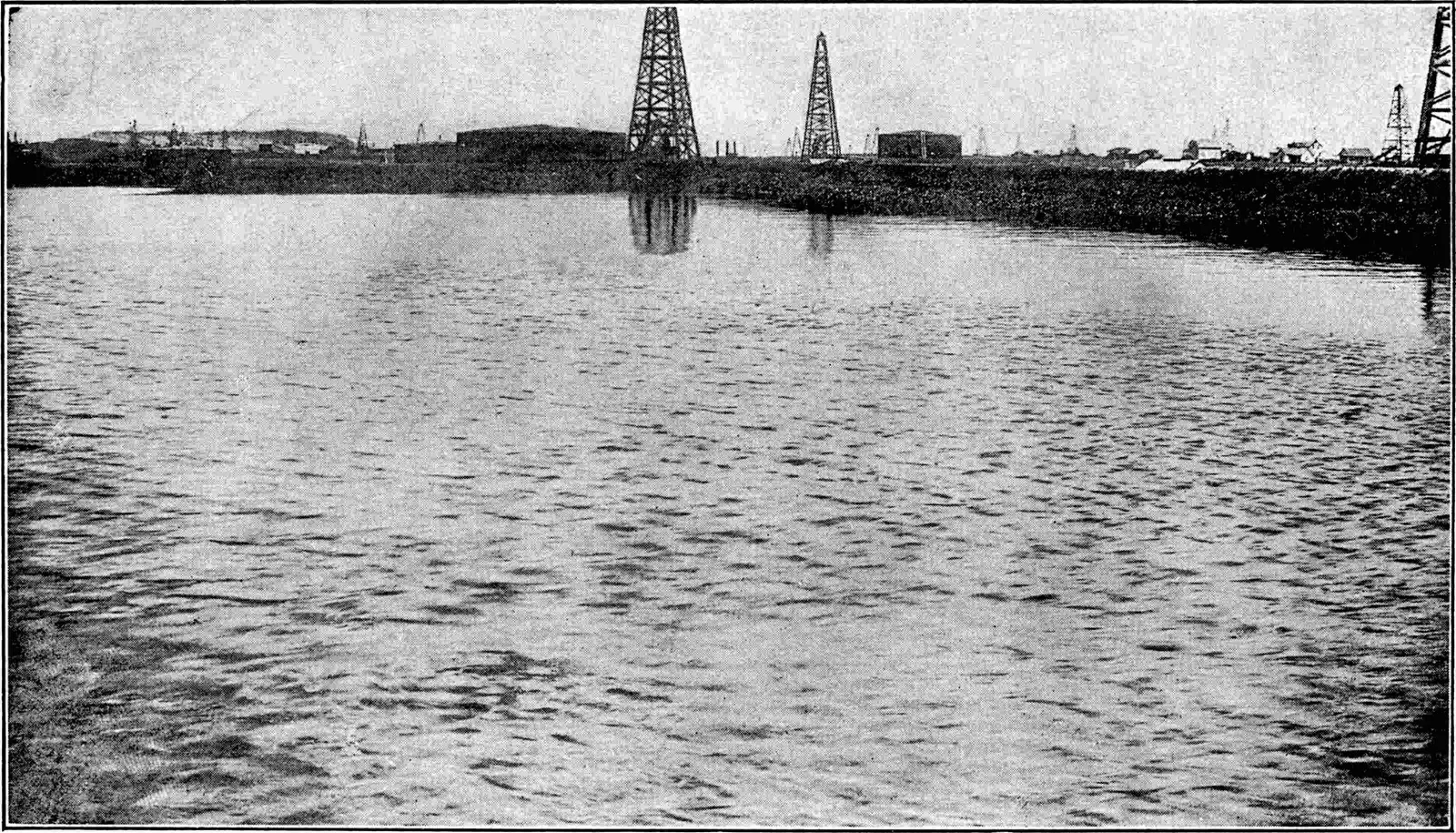
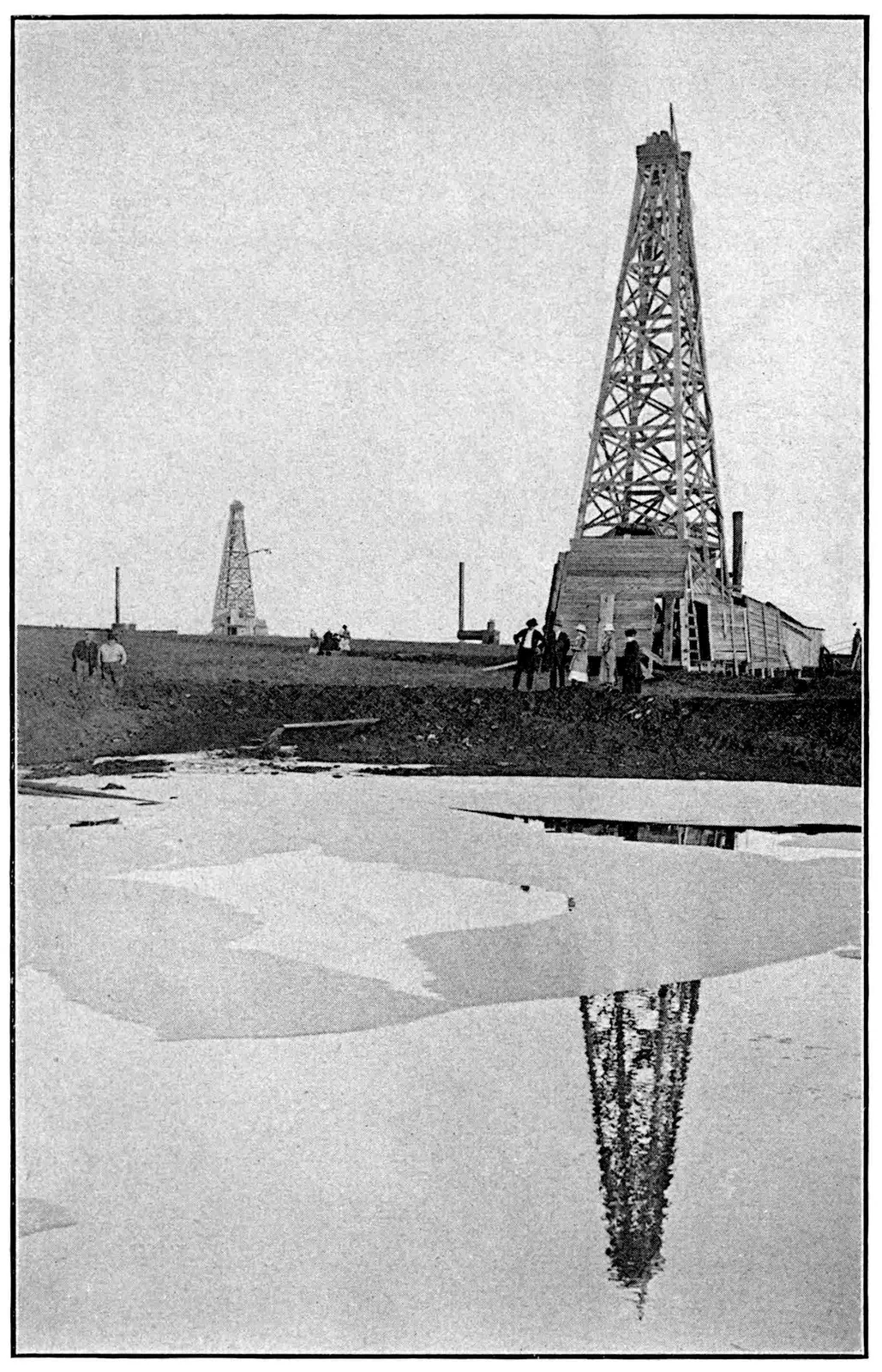
A temporary oil reservoir in Oklahoma. When petroleum is produced in advance of the erection of tanks
it is held by earthen dams
Petroleum is found in different parts of the world
and even in different formations in the same locality
with widely different properties and composition.
In some cases the oil is found almost white and varies
through all the shades of amber and brown to black.
It is found as highly liquid as gasoline and with a
viscosity such that it will hardly run away from the
hole—almost as viscous as the asphalt used for pavements.
It is also interesting to note that the crude oil
from different localities, and even from different
formations in the same locality, not only varies
greatly in its own properties, but the manufactured
products derived from different grades have very
different properties as well. From some crude
oils special lubricating oils can be made which cannot
be manufactured from other oils. The same is
true of the paraffins derived from different oils,
some, for example, being especially desirable for
one purpose while paraffin derived from another
crude is more suitable for another purpose, due to its
different properties and action under treatment.
Thus, the refined oils from different crudes show a
great variety, some lamp oils possessing much
greater illuminating power than that derived from
other crudes and this not due to the method of manufacture
but to the actual difference in the properties
of the refined oil derived from the different crudes.
In Roumania and Russia the wells produce enormous
quantities of sand with the oil, particularly
when they first start flowing. The Roumanian
wells frequently start flowing sand as fine as flour
and more like the dust of a country road. This sand
may hardly smell of oil at first and at this stage it covers
the ground like a volcanic ash, sometimes breaking
in the roofs of neighbouring houses.
In the course of a few days the sand begins to
show more oil but piles up around the mouth of the
well, giving it the appearance of a small volcano.
As the quantity of oil increases it reaches a stage
where the oil and sand will flow away from the well
together and the oil is settled out in dams before
being pumped to the tanks. Later, the percentage
of sand becomes less until it is almost negligible.
The action of the sharp sand is similar to that of a
sand blast, necessitating much ingenuity in changing
the pipes and valves for handling the well while it is
flowing.
The diversity that is characteristic of petroleum
in its geological and geographical distribution, and
in its adaptability to the needs of humanity, is also
to be found in the nature of the crude oil deposits.
It differs in colour, density and other qualities in almost
every field. In America, with which this book
chiefly deals, three distinct basic types are recognized;
the mixed base (paraffine and asphalt in
combination) found in Ohio, Oklahoma and other
States; the paraffine base, which is characteristic of
the paler crudes of Pennsylvania and West Virginia;
and the asphalt base common to the fields of California
and Texas. The special qualities of the crude
fix in a large measure, the character of the products
each yields when subjected to refining and manufacturing
processes.
CHAPTER III DAWN OF AMERICA’S PETROLEUM INDUSTRY
The words of Washington show that long
before the actual birth of the petroleum
industry in the United States, discerning
minds were at work on the best means of turning
the bituminous or petrolific deposits of this continent
to practical commercial uses. In passing it
may be said of Washington that he was the father
of his country in a wider sense than that of having
been the victorious general who made the Republic
possible, and its first executive head. He was its
earliest influential prophet of the power that was to
be born of the unlimited natural resources of what
was then the “hinterland” of the original commonwealth.
During the first five decades of the nineteenth
century there were a considerable number of
Americans, less eminent than he—explorers, scientists
and business men of imagination who looked to
petroleum as a potential resource of national wealth.
And speculations of this kind were not confined to the
United States. In Great Britain and other countries
processes were patented for the refining of
mineral oils. The main purpose in view was the
development of a substitute for sperm oils in anticipation
of the decline of the whaling industry, which
had become the main source of illuminants and
lubricants. In America, also, petroleum had its
recognized medicinal uses, the traditions of which
had been acquired from the Indians. Thus, in the
thirties, “Seneca Oil” produced at Lake Seneca,
New York; and “American Medicinal Oil,” a
Kentucky preparation, were familiar household remedies,
especially as embrocations for burns, sores and
rheumatic affections.
The casual use of petroleum as a basis for proprietary
medicines had, as will be seen, an interesting
bearing on the future development of the industry;
but the great factor which led to the production and
utilization of petroleum on a large scale was a natural
phenomenon already alluded to—its alliance
with salt or brine deposits. Had not the growing
American population been compelled to secure adequate
quantities of salt by boring and establishing
brine wells, it is possible that the Pennsylvania oil discoveries,
with which the real history of the modern
petroleum industry begins, might have been indefinitely
delayed. During the first half of the nineteenth
century five different states had salt industries
based on the boring process—Pennsylvania,
Ohio, West Virginia, Kentucky and Tennessee.
In connection with most of these wells petroleum
occasionally appeared, usually to the annoyance
and embarrassment of the operators. In the light
of future events it is interesting to note that sometimes
the presence of the dark and evil-smelling
liquid led to the abandonment and condemnation of
a salt property. Nevertheless, it was the machinery
devised for the purpose of boring for brine that enabled
men like Drake and other petroleum pioneers
to achieve their revolutionary discoveries.
The first American salt well of which there is any
official record was begun in 1806 and completed in
January, 1808, on the Great Kanawha River in what
is now West Virginia. Charlestown, Va., was then
the nearest town, and in the vicinity of this brine well
the first burning gas spring had been discovered in
1773. At Tarentum, on the Allegheny River,
Pennsylvania, salt wells were started in 1810 which
also yielded petroleum in considerable quantities,
and such pioneers as Col. Ferris and Samuel M. Kier
endeavoured later to turn this by-product to commercial
account. The first flowing oil well was
drilled unintentionally in 1818 at the mouth of
Troublesome Creek, on the Big South Fork of the
Cumberland River, twenty-eight miles south-east of
Monticello, Va., by one Martin Beatty, who was
seeking brine. “The Devil’s Tar” as he called it,
was allowed to flow into the Cumberland River and
covered its surface for a distance of thirty-five
miles. The oil became ignited and an enormous
conflagration ensued, which destroyed trees along
the banks of the river, and also the salt works.
What would to-day be regarded as a piece of stupendous
good fortune was then accounted a disaster;
though this particular well later supplied the chief
ingredient for “American Medical Oil” a remunerative
compound bottled at Burkeville, Kentucky.
The most enterprising man in utilizing this unwelcome
by-product of his salt wells was Samuel M.
Kier. Originally a chemist and druggist, he resolved
in the later forties to ascertain its uses both as a
medicine and as an illuminant. Experiments at
distillation to secure a burning fluid for lighting
purposes were a success, and his product attained
some vogue in rivalry to a kerosene which was being
extracted from oil shales in the province of New
Brunswick, Canada. But Mr. Kier’s chief business
was that of the sale of petroleum for medicinal purposes—a
compound he named “Kier’s Rock Oil.”
He advertised it by imitations of an American
greenback, which bore a vignette showing the plant
at Tarentum with the derricks used in boring and
pumping the brine wells—for it must be remembered
that Kier was primarily a salt merchant who treated
petroleum as a side-issue.
This imitation greenback was destined to influence
the course of history. A prominent New
Haven business man of the day was Mr. George
H. Bissell, who had become interested in the possibilities
of petroleum through his acquaintanceship
with Prof. Crosby of Dartmouth College. The
latter had received from a physician at Titusville,
Pa., a historical city in connection with the coming
industry, a bottle of petroleum, sent as a curiosity.
Bissell was so interested that he, in company with
friends, purchased for $5,000 a tract of one hundred
acres at Titusville, with an oil spring on it. A company
was founded, known as the Pennsylvania Rock
Oil Company, with a nominal capital of $500,000
and a tentative start made at collecting the surface
oil by digging and trenching. Prof. B. Silliman, of
New Haven, made a favourable report on the fluid
as an illuminant but the cost of production rendered
the project commercially impracticable. Mr. Bissell
was, therefore, left with the Titusville property on
his hands. The story runs that one day in the
summer of 1857 while in New York he saw in the
window of a Broadway drug store one of Kier’s
imitation greenbacks, showing the picture of the
derricks at Tarentum, Pa. The idea suddenly came
to him of developing the Titusville property just as
salt properties were developed by boring and pumping.
Though short of capital, he set about obtaining
backing for the attempt, and the final outcome
was that a small syndicate was formed in New Haven,
Conn., to work the Titusville oil lands. This
syndicate engaged Edwin Laurencine Drake, the
most historic figure in connection with the beginning
of the American industry, to carry out the work.
How he set about his task, and how he succeeded will
be the subject of a subsequent chapter.
It is necessary to point out that unless the foundations
had already been laid for refining and marketing
the crude petroleum, Drake’s discovery would
have been almost as valueless as that in 1818, which
resulted in the conflagration on the Cumberland
River. Science, however, had been grappling with
the problem of extracting from the crude a safe
burning oil and eliminating the offensive odour.
This latter was a very important consideration, and
for years after petroleum began to assume the proportions
of a large industry it encountered prejudice
on this account. By the later ’fifties so much progress
had been made that the possibilities had been
created not merely for a large domestic trade in oil,
but also for the development of an export market.
Drake’s discoveries at Titusville in August, 1859,
may, therefore, be said to have come at the psychological
moment.
CHAPTER IV FOUNDER OF THE PETROLEUM INDUSTRY
On October 4, 1901, a magnificent monument
was unveiled at Woodlawn Cemetery,
Titusville, Pa., to the memory of
Edwin Laurencine Drake at the expense of the late
Henry H. Rogers, of the Standard Oil Company,
himself a pioneer of the Pennsylvania oil fields in the
boom days of the sixties. The inscription on the
monument not only describes Drake as the “Founder
of the Petroleum Industry” but gives an explicit
review of what his services meant, not only to the
people of the United States but to mankind at large.
It runs as follows:-
Col. E. L. Drake, born at Greenville, N. Y., March
29, 1819; died at Bethlehem, Pennsylvania, November
8, 1884, Founder of the Petroleum Industry, The friend
of man.
Called by circumstances to the solution of a great mining
problem, he triumphantly vindicated American skill and
near this spot laid the foundation of an industry that has
enriched the State, benefited mankind, stimulated mechanic
arts, enlarged the pharmacopoeia, and has attained
world wide proportions. He sought for himself not
wealth nor social distinction. Content to let others
follow where he had led, at the threshold of his fame he
retired to end his days in quieter pursuits.
His highest ambition the successful accomplishment of
his task, his noble victory the conquest of the rock,
bequeathing to posterity the fruits of his labour and his
industry. His last days oppressed by ills—To want, no
stranger—He died in obscurity.
This monument is erected by Henry Huttleson Rogers,
in grateful recognition and remembrance.
Drake was in his fortieth year when, through friends
in New Haven, he was appointed director and
superintendent of the Titusville properties of the
Pennsylvania Rock Oil Company and the Seneca
Oil Company. As a youth he had led a wandering
life and his education was such as he could pick up at
odd moments. He had worked as a commercial
traveller and hotel clerk, and was a railroad conductor
at the time he took service with the Bissell
syndicate, which had decided to experiment in drilling
for oil. He himself was so thorough a believer
in the project that he put all his small savings into it.
The salary at which he was engaged was a thousand
dollars a year, which signified considerably more in
the later fifties than it does to-day. On reaching
Titusville early in 1859 he soon realized that he was
handicapped by lack of practical knowledge of
drilling processes, and therefore sent for one William
Smith, a man of long experience as a driller of brine
wells, who came with his two sons to assist in the
work. The method adopted was that of forcing
cast iron pipe through the soil at a spot near the
“old oil spring,”—well known to the farmers of the
locality.
Operations were started in February and after
many tedious delays rock was struck at a depth of
thirty-six feet. If they were to go farther steam
power was necessary, and by August 1st, this had
been secured. In the meantime the drilling operations
had been the joke of the countryside, but
Drake literally could not afford to fail. With steam
power it was found possible to drill through the
rock at the rate of about three feet a day until
toward the end of the month oil was struck at a
depth of sixty-nine and a half feet. No record was
kept of the exact date, though the New York Tribune
a few weeks later fixed it at August 23rd. The
well was not a free flowing one, but yielded to the
pumping process.
The discovery, momentous as it was, did not
create much excitement except in the immediate
locality. John Brown’s raid, at Harper’s Ferry,
and the possibility of the Civil War, which was to
ensue within less than two years, were the chief
topics in the public mind of America. Shortly after
the discovery a fire wiped out the existing plant
but kindly neighbours, now satisfied that the experiment
was no failure, assisted Drake, and when the
well was again set in working order its flow was more
promising than ever. In the view of experts, Drake’s
achievement as a pioneer may be regarded as limited
to one great feat, the drilling with steam power of the
first cased oil well. He ceased to be an active factor
in the development of the newborn industry with the
drilling of this first well. Following his inspiration,
others organized it and in the course of a few years a
great army of industrial workers, merchants, financiers
and distributors of all classes became associated
with petroleum and placed it in a foremost
position among the world’s industries. Drake himself
finally left the oil regions in 1863 with about
$15,000 savings, which he soon lost in other forms of
speculation. In the stupendous events of the national
conflict he was almost forgotten. In 1869, ten
years after his discovery, the older oil men who had
known him learned that he was sick and penniless,
with a wife and family at the point of starvation.
They raised among themselves a purse of $5,000
and later the State Legislature was prevailed upon
to grant him an annual pension of $1,500, which
maintained him in comparative comfort at his home
in Bethlehem, Pennsylvania, until his death in 1884.
The scale on which petroleum production increased
during the period immediately following
Drake’s discovery is indicated by the fact that
though the total American production in 1859 was
2000 barrels, in 1869 it had risen to 4,215,000 barrels.
It must be remembered that those who
started the oil industry in the United States were in
almost every instance poor men who attained wealth
with its development. As the news of the new
industry and its possibilities spread, more and more
wells were sunk along Oil Creek and the Allegheny
River; farm lands containing oil prospects began to
command enormous sums, methods of extracting the
crude petroleum from the depths of the earth improved
and gradually American inventive genius
began to be applied to the industry with enormously
fruitful results. The Civil War undoubtedly interrupted
development at the outset, and the new oil
fields gave many a brave soldier to the Northern
cause.
The really sensational developments in connection
with the oil fields began as the Civil War was
drawing to a close. Then they commenced to assume
the romantic and fevered aspect of California
in the days of the early gold rush a decade or more
previous. Unfortunately, the oil fields possessed no
Bret Harte, as did California, to write the epic of
good-fortune and ill-fortune. The story of the City
of Pithole, not far from Titusville, is, however, as
romantic as anything in the annals of gold discovery.
It sprang to full life in 1865, a mushroom city with
all the vices and excitements of frontier life. Fabulous
tales have been told of its population, which
probably never exceeded 20,000 but 20,000 men and
women all excited by the fever of speculation and
money-getting gave life in Pithole a gusto not equalled
at that time on any other part of the continent.
Gamblers and adventurers flocked there in company
with many legitimate oil men. In the speculation
that ensued fortunes were made and lost daily.
Then, after a year or two, the wells which had shown
such riches began to decline and Pithole was quickly
deserted. A few years later a visitor found only
two inhabited houses in a city that had for a time
been the home of thousands of restless mortals.
Later still some of the abandoned wells were made
productive by new processes, but the glory of the
mushroom city had vanished forever. In other parts
of this continent there have been oil crazes, but nothing
approaching the story of Pithole. And it is
famous for another reason; it was the scene of the
establishment of one of the earliest pipe-lines, a
system which has been an invaluable auxiliary to the
growth of the American industry.
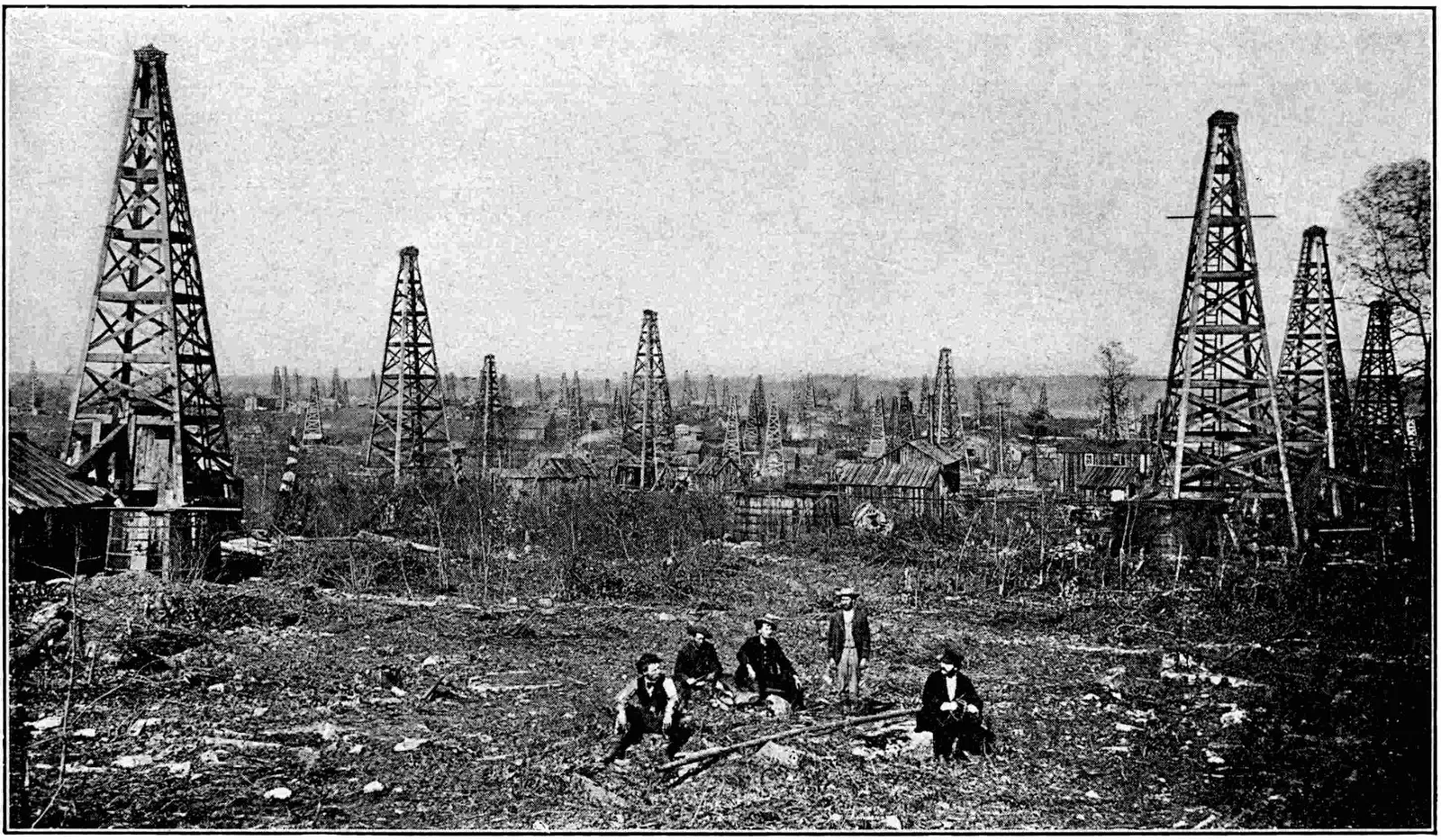
Early activity; the famous Red Hot Oil Field near Shamburg, Pa., in 1870
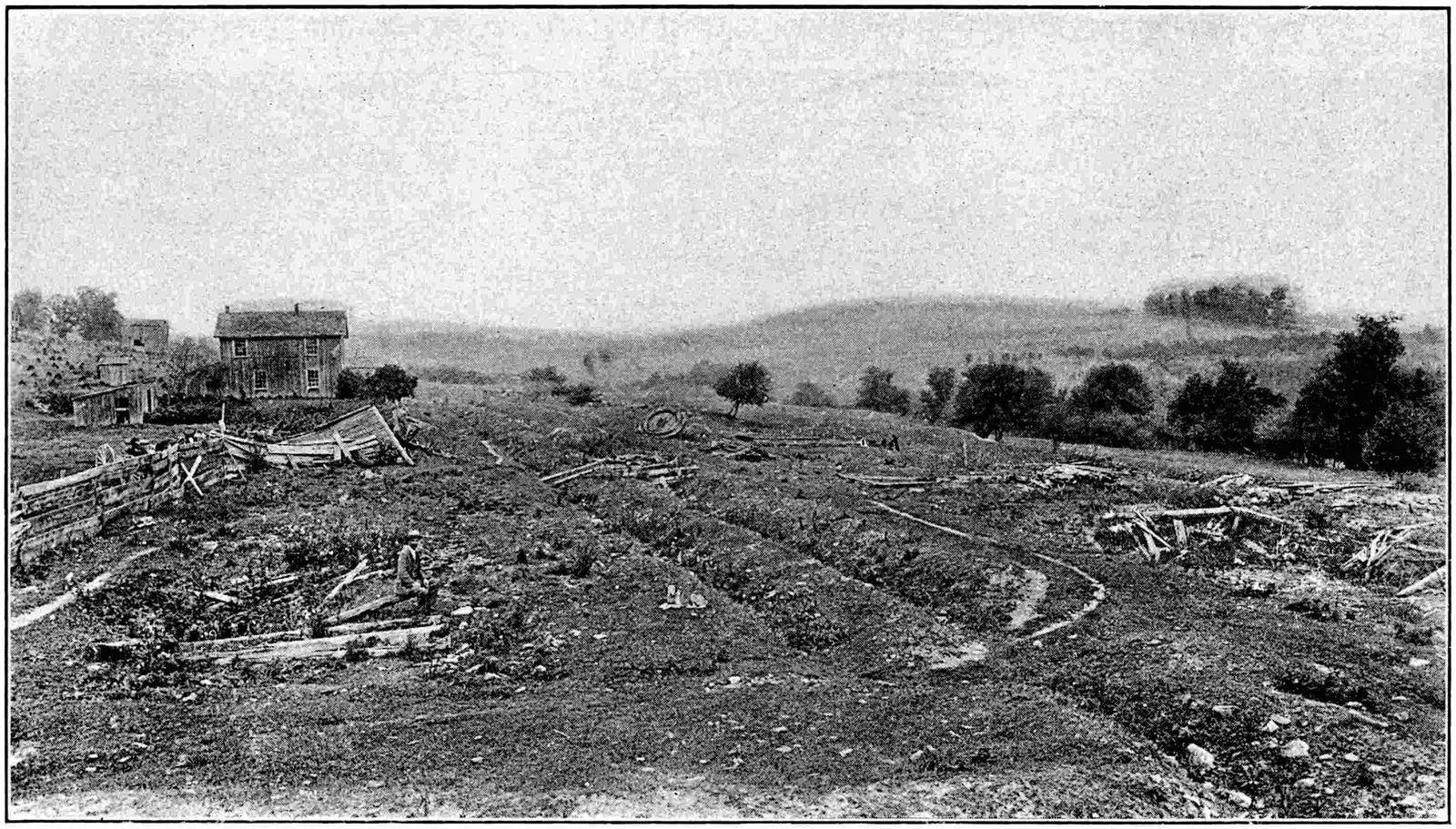
Where Pithole stood—the main street of a Pennsylvania oil town, which had a population of 20,000 in
1870, as it looks to-day
The success of the early oil men of the United
States not only in grappling with the problem of
crude production, but with those of conservation,
transportation, refining and the development of new
uses for the various elements of the treated crude,
set an example to all the world.
From 1870 onward, though Pennsylvania continued
to lead, American methods were copied in
many other countries. The foundations of the
trade which have made petroleum the most international
of all commercial undertakings were at
that time laid; and this brings us to a survey of the
industry as a world interest.
CHAPTER V PETROLEUM AS A WORLD INDUSTRY
The standardization of the petroleum industry
which began in America during the
later sixties naturally excited emulation.
Just previous to the Pennsylvania discoveries of
1859 something like a systematic industry had been
established in connection with the Roumanian deposits,
sixty years later destined to be a military
objective of vital importance in the World War. But
the actual sinking of oil wells by the boring process
was a later development in Europe. As was
natural, the first foreign country to profit by Drake’s
example was our neighbour Canada, which has long
been an oil producing country, and to a still greater
extent, thanks to friendly American initiative, an
oil-refining country. Before speaking of the extent
of the American branch of the industry in the twentieth
century it is worth while briefly to scan the oil
fields of other lands.
The most important are those of Russia, particularly
the deposits of Baku, which, as has been
related, figured in ancient history and legend. The
unsettled condition of Russia renders an exact statement
of the condition of its oil industry impossible
at the present time, but prior to the war the Russian
oil-fields had an output of approximately
72,000,000 barrels annually, or 15 per cent. of the then
world’s production. During the past fifty years the
Russian fields have produced at least 1,650,000,000
barrels; but, though this aggregate seems large
it represents less than half of the petroleum
production of the United States during the same
period. It is believed, however, that Russia possesses
great wealth in undeveloped oil fields, particularly
in the south-western Caucasus. As yet the
main part of the production of this vast country has
come from an area of about 4,000 acres in the Baku
region, near the Caspian Sea. Prior to 1870 Russia’s
output of petroleum came from surface pits, dug
by hand, rarely more than 50 feet deep. Boring by
steam power after the American method was first systematically
introduced by Robert Nobel, the famous
scientist and expert in explosives, who went to
Baku in 1873. Even in 1893 the number of bored
wells in Russia was less than 500, but at the last
census in 1911 wells of this type had increased to
over 3,000. The Nobel brothers also assisted Russian
oil production by introducing improved methods of
transporting the crude oil, based on American experience,
as well as improving refining processes
through their own ingenuity. Many other companies
operating in Russia prior to the Bolshevist régime
have showed some disposition to follow their example,
but the progressive spirit that has actuated the oil
pioneers of North America has been lacking. One
great obstacle to development which existed long before
the Russian revolution of 1917 was the intractable
character of the Russian workmen, encouraged, it
must be admitted, by the reactionary spirit of the
Russian capitalist. In contests between capital
and labour much loss was sustained through incendiarism,
and there are recorded instances where in a
single night dozens of productive oil-wells, which had
taken years to “bring in,” owing to the special
geological difficulties of the Russian fields, were destroyed.
Such catastrophes of course represent economic
loss to the whole people; and Americans have
good reason to congratulate themselves that in the
oil fields of the United States labour conditions have
been such that conflicts have been almost unknown.
Roumania, geographically adjacent to Russia,
was prior to its participation in the great war,
producing about 11,000,000 barrels, or approximately
1,600,000 tons, of crude petroleum annually.
The beginnings of her industry, already alluded to,
were based on hand dug wells, three feet square and
walled with horizontal oak planks, into which workmen
would descend and bring up the oil in wooden
buckets or bags of leather. Here, too, the oil area
is comparatively small, and it was not until twenty
years ago that mechanical equipment designed on
the American model was introduced by foreign capitalists.
Men trained in the oil-fields of this continent
found employment there, although, when at
the end of 1916 the exigencies of war compelled the
Allies to adopt the policy of destroying the Roumanian
wells, in order that the Central Empires
should not obtain much needed supplies of oil, it was
by English instructions and officers that the melancholy
task was accomplished. Roumania has a
great petroleum storage port at Constanza, fed by a
trunk pipe-line of American model connecting it with
the oil-fields.
Galicia or Austrian Poland, as it was once called, lies
in the same geographical zone as Roumania, and possesses
an oil area 200 miles in length and varying from
40 to 60 miles in width, although 90% of its production
comes from the Boryslaw field. This field,
which was the chief source of supply for the Central
Empires during the war, necessarily suffered much
in the conflict but ten years ago was producing about
1,900,000 tons of crude annually. It is now on the
way to restoration. The development of the Galician
industry on a large scale was directly due to the
introduction of modern drilling methods in 1882.
The petroleum wealth of that country lies very deep
and wells of a depth of 4,000 feet are common.
Though the chief customer of the Galician fields
for a considerable period, Germany also made efforts
at developing a petroleum industry of her own,
but, as in the case of Italy, her oil-fields, though not
entirely negligible, do not bulk large in the statistics.
It is clear that Europe not only owes much to
American ideas for her native developments but is
also dependent on other continents and to sea-borne
cargoes of oil for supplies adequate to her needs.
This is particularly true of Great Britain and France,
whose statesmen have emphatically expressed their
gratitude for the indispensable aid in the prosecution
of the war provided by the leaders of the
American oil industry, who organized a steady supply
on an enormous scale.
The early efforts of British scientists to develop
home supplies of oil from shales and other forms of
oil bearing rock were productive of benefits through
improved methods of refining, rather than by the
development of a really important home industry.
Thus the United States and all oil-producing countries
owe a debt of gratitude to Dr. James Young of
Renfrewshire, Scotland, whose improvements in the
processes of manufacturing paraffine from shale oil,
during the early part of the nineteenth century, were
of infinite value in developing the uses of petroleum
after its presence in large quantities was proven by
the pioneers of Pennsylvania. Great Britain, realizing
her own need, also helped the world’s oil industry
when she built the first oil-tank steamers on the
River Tyne.
Though Great Britain, with the exception of a small
well recently drilled, has no deposits of crude so far
as known, she is at the present time experimenting
with processes to distil petroleum from oil shales,
coal, cannel coals, ironstones, lignite and peat; but
more important still, she is encouraging the oil industry
in various parts of her great Empire. Under
the British flag, either as autonomous parts of that
Empire or as countries which she holds a mandate
to govern, are the important oil-fields in Burma,
Persia, Egypt, Trinidad and Assam.
The Burma fields have of late years been developed
in accordance with modern practice, and the
producing area, long a subject of quaint legend, much
extended, so that according to recent estimates the
annual crude production from this source is upwards
of one million tons. The Persian oil fields
will be a factor to be reckoned with in future, and
an oil port fed by a pipe line on the American model
already exists at Abadan on the Persian Gulf. Egypt
has also a future as a petroleum producing country,
for within the past ten years not only “gushers”
but wells which give evidence of steady flowing
qualities have been discovered, and plans for development
are already well advanced.
Crossing to this hemisphere the name of the British
colony Trinidad at once suggests itself. Its
famous lake of pitch has long been a source of supply
for that dense form of petroleum which is known as
asphalt; while other deposits of crude yield surprising
percentages of more volatile products like motor
spirit.
And while on the subject of petroleum under the
British flag, reference may be made to Canada, although
the industry there is very closely allied with
that of the United States. In Eastern Canada, oil
has long been produced in limited quantities, but
within recent years the prospects of great new oil
areas in the foothills of the Rocky mountains and
extending almost as far north as the Arctic circle
have led to glowing hopes that may or may not be
realized.
A more distant foreign field, which is gaining importance
in the eyes of the world, is that of the Dutch
Indies in the Far East. There has been considerable
oil production in Borneo, Java, and Sumatra,
in the development of which the services of American
experts have been enlisted and indeed it may be said
that the petroleum industry has done a great deal
to make world-citizens or cosmopolites of many good
Americans.
Japan’s connection with oil is ancient and it has
its own industry at Echigo; but like China, which also
worked deposits of oil in prehistoric days, it is a large
importer of American petroleum products, especially
illuminating oils. The American travelling in remote
parts of Asia is often reminded of home on
seeing the tin containers that have crossed the
Pacific from this country.
Returning to this continent we find that the
Mexican oil fields have come into prominence more
rapidly than those in any other land, for there the
industry has existed only since 1907. The Mexican
pools now rank after the United States as the
second largest producing area in the world.
Most of the latter-day sensations in the matter of
petroleum have been provided by Mexico, where both
American and British capitalists have acquired large
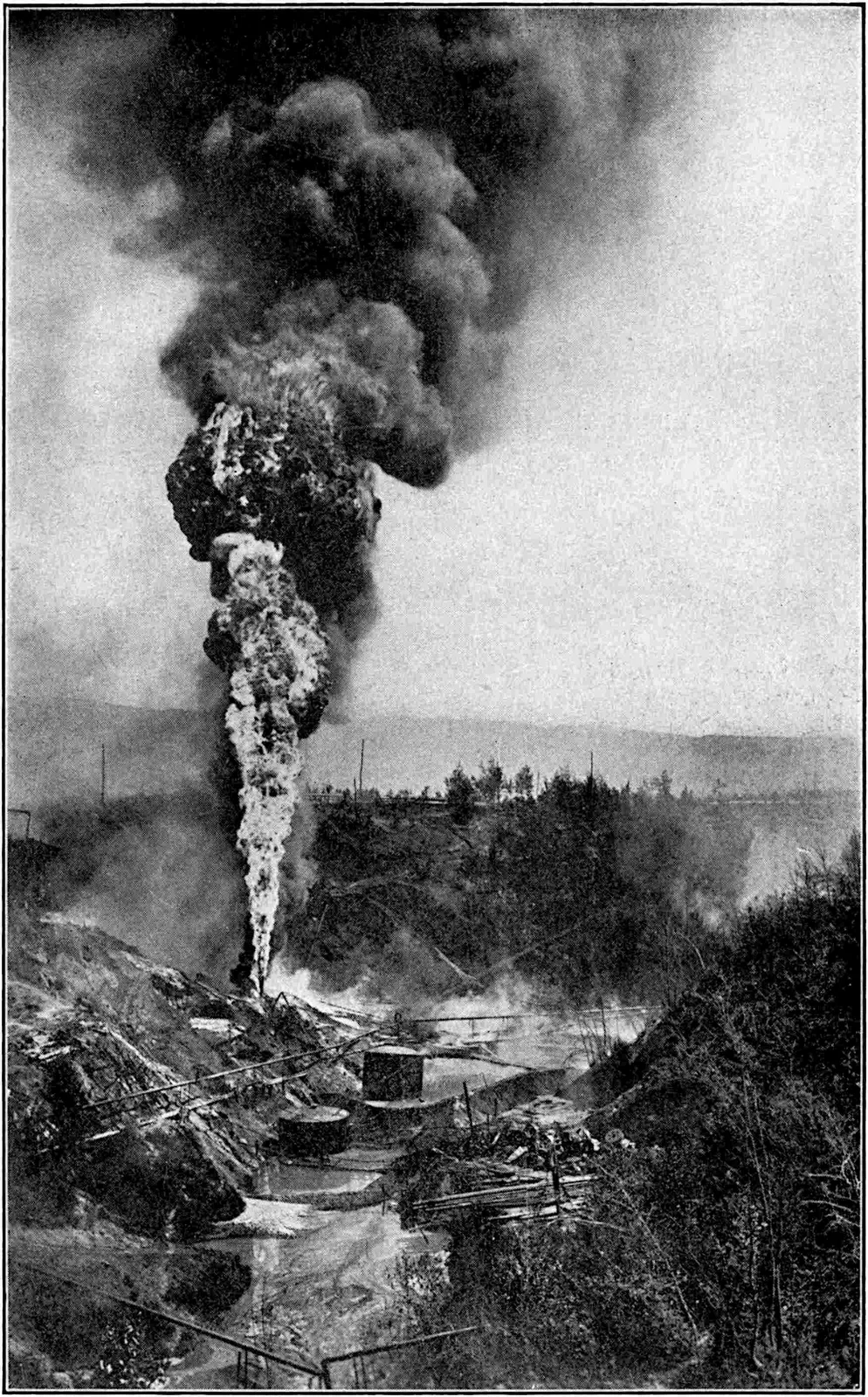
interests. In 1908 the “Dos Bocas” gusher in
Northern Vera Cruz was drilled. At a depth of
1,800 feet gas was encountered which blew out the
drilling apparatus and presently, through a fissure
which developed under the boiler room of the drilling
plant, an eight-inch column of oil was spouting hundreds
of feet into the air. Becoming ignited it burned
for fifty-eight days, producing a column of flame a
thousand feet in height and fifty feet in diameter.
The well then began to produce hot salt water and
is still producing probably a million barrels of salt
water per day. In 1910 another great gusher, the
“Potrero del Llano” was struck but fire was fortunately
averted, and the daily flow was estimated at
125,000 barrels. Production on so magnificent a
scale has never been known in any other part of
the world. Before this well went to salt water, in
1919, it had produced more than 100,000,000 barrels
of oil.
Another Latin American republic which has
developed a very important oil industry in recent
years is Peru, and it is supposed that other parts of
South America will yield their riches in the future.
Despite the petroleum wealth of other lands, however,
the United States far outdistances them, not
only in the output of crude petroleum but in the
manifold products extracted from it. The magnitude
of the American industry may be gleaned from
the fact that in the past year (1919) United States
wells produced about 377,000,000 barrels, or over
65 per cent. of the world’s supply. The lead of
Pennsylvania as the chief oil-producing state and
the pivotal point of the world’s supply continued for
many years, but has long since been superseded.
For a number of years this state provided 98 per
cent. of the oil production of this country. In
1891 the total production of Pennsylvania oil was
35,839,777 barrels, and in 1897 35,165,990 barrels,
so that the maximum was reached in 1891. The
greatest daily average production was during the
month of November, 1891, when it reached 135,676
barrels. This pioneer territory suffered a gradual
decline, and at the present time it is estimated
that Pennsylvania produces about five per cent.
of the American supply. Nevertheless, the output
is considerably greater than in the boom
days of the sixties when the phrase “Struck Ile”
became an accepted synonym for the sudden acquirement
of riches. As the importance of the industry
grew, oil prospectors busied themselves in every
part of the republic in probing for this source of
wealth, and are still indefatigable after sixty years.
What is known as the Mid-Continent fields, which
includes such States as Kansas, Oklahoma and Wyoming,
have developed enormous potentialities,
while on the other side of the Rockies and the Sierras
the California fields some years ago became one of
the great sources of the world’s supply. The California
development is an example of the rapidity with
which an oil field can become productive on an
enormous scale under modern methods. The records
of achievement there show that it is possible,
with the modern system of rotary drilling, to get
down nearly 4,000 feet below the surface within the
period of a month, depending on the nature of
the formations, and the experience in that state
demonstrated a finer quality of crude at such depths
than could be produced from deposits nearer to the
surface. California too furnishes at certain points an
illustration of the mechanical ingenuity of the modern
oil worker; for there are to be seen oil wells sunk
in the sea at a considerable distance from the shore,
the encroachment of sea-water being overcome by
carrying the casing above high-water mark.
Until a comparatively recent period the California
fields held the record for production, but in 1918
the young State of Oklahoma forged to the front,
with a production of more than 100,000,000 barrels
in one year, and a large undeveloped territory which
there is every reason to believe will prove rich in
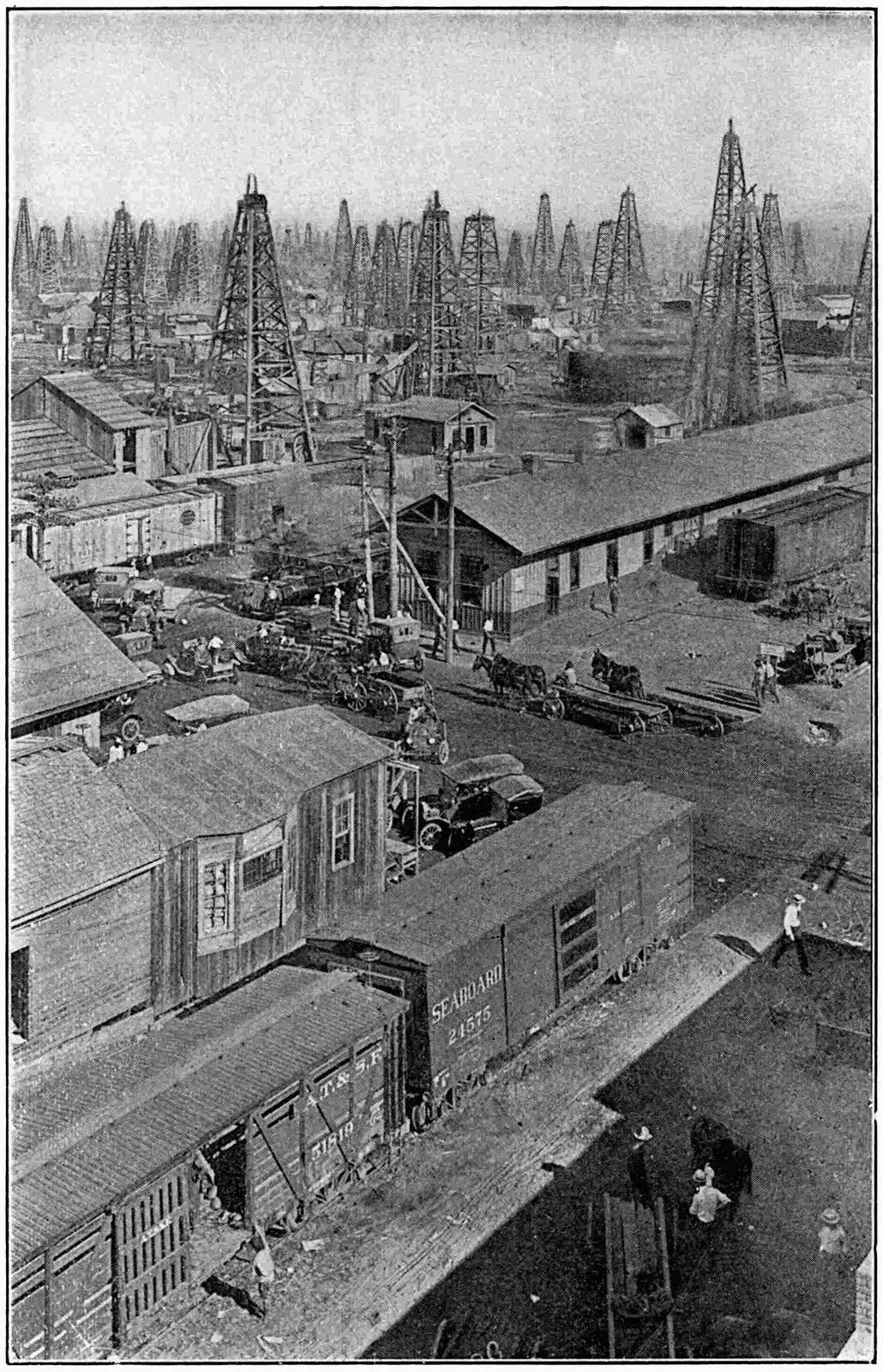
petroleum. Tulsa is the centre of the Oklahoma
industry and is an example of a town which has
grown suddenly from a small agricultural settlement
to a thriving centre of metropolitan aspect as a
result of the oil industry.
There are those who believe that Texas will very
shortly attain eminence equal to that of both California
and Oklahoma as a petroleum region. The
gulf fields came into prominence about the dawn of
the present century, and have perhaps witnessed
more booms than other sections of this continent.
Speculative eras in new fields which have been
brought in by “wildcat” drilling, which term should
not be confused with wildcat mining speculation, are
however regarded by sane and conservative oil men
as harmful rather than helpful to the petroleum
industry. They invariably produce false inflation
and subsequent depression; and involve in reproach
one of the greatest economic blessings bestowed
upon humanity.
Thus far we have surveyed petroleum in its many
general aspects and the remainder of this treatise
will be devoted to a description of its production,
subsequent treatment and manifold application to
the needs of present day commerce and civilization.
CHAPTER VI LOCATING THE OIL WELL
When Edwin Laurencine Drake went to
Titusville, in 1859 the first question he
asked of the natives was the location of
“the oil spring” known to the Indians and the farmers
who succeeded them. The modern oil seeker
no longer concerns himself with surface indications.
In truth there is little or nothing in the contour of
the latter-day oil-fields to suggest oil to the eyes of the
uninitiated. But geologists first located probable
oil bearing formations and have made calculations
of the formations two or three thousand feet below
and the drilling sites are located in accordance with
them. Roughly, the theory upon which such operations
are based is that the sub-surface rocks undulate,
and that the presence of oil is most assured at
the highest points of the undulations. By measuring
dips at given points they calculate the distance
in a certain direction to what they deem the most
favourable site and surveyors proceed to fix and
designate it. In cases, not infrequent when the
lease which conveys the right of drilling is limited in
area, it is the business of the surveyor to see that
the site chosen is well within the boundaries of the
plot acquired for drilling purposes.
On the subject of present-day methods of location
a recent contributor to “The Lamp,” an American
oil journal, provides much interesting data. Oil
geology, he points out, is not an exact science but it
enables one to focus exact information upon the
creation of a theory regarding the probable structure
of an untested area. In Oklahoma, for instance,
geological investigations made within the
past five years resulted in the discovery of many
of the new pools. All drilling is in some sense
speculative, or to use the oil man’s phrase, a “wild
cat,” at the outset; but in Oklahoma it was found
that the proportion of dry holes on territory recommended
by the geologists was less than one-third of
the failures that resulted before that science was invoked.
The speculative nature of the oil business in
its initial stages is indicated by the fact that less than
one per cent. of the area of the oil region of Pennsylvania
is producing territory, although it has probably
been more thoroughly drilled than any field in
the world. The limited extent of even the permanently
productive fields is one of the phenomena
of petroleum. More than one-half of the production
of the State of Wyoming is found within an
area of not more than six square miles. The famous
Tepetate-Casiano pool of Mexico, which produced
more than seventy-five million barrels of oil
from 1910 to 1918, is about one-half mile wide and
three miles long. When we compare the acreage of
oil areas with that of the continent, the analogy of
the needle in the haystack at once suggests itself.
The geologist draws the certain deduction that oil
migrates through some porous formation from its
original source and concentrates itself in detached
“pools” of comparatively small dimensions. It is
the oil pioneer’s business to find these pools. Again,
there may be several successive deposits of what are
known as “oil sands,” separated from each other by
hundreds of feet of barren formation. The depth
of a well in itself means nothing. The operator
must know in what strata he expects to find the oil.
If these beds prove dry, then he abandons the test,
regardless of whether the drilling has reached 1,000
or 4,000 feet.
Past experience has taught the geologist that oil-bearing
formations manifest themselves by certain
surface indications, such as gas springs, and surface
seepages of oil or asphalt. In an untested field the
expert studies the character of the successive formations
along such outcroppings. In any mountainous
region earthcrust upheavals during past ages
have exposed a series of formations, similar to those
which lie deep below the surface of the plains. Thus
it is possible to predict with a fair degree of accuracy
just what the formations will be for a considerable
depth from geological indications. Geologists have
also learned to recognize certain types of structures
favourable to the accumulation of oil pools, known
as anticlines, synclines, salt domes, monoclines and
so forth. Thus it is sometimes possible to make in
advance of drilling a surprisingly accurate forecast
of what these operations will reveal.
Because for the most part oil fields exist in rather
sparsely populated districts, remote from centres of
commercial and industrial activity, the general
reader has probably very little knowledge of the
unceasing efforts that are being made in many parts
of this country to maintain the supply of crude oil
at an adequate level through new discoveries. The
spirit of enterprise and initiative is even more alive
to-day than it was in the time of Drake and the
pioneers who followed him in the Pennsylvania field.
The hopeful speculative spirit is as ever necessary;
the capital fulfils an ever-growing function in this
source of prosperity and employment for the community
at large.
In the oil industry any well drilled outside the
narrow limits of a producing “pool” is regarded as a
“wild cat” test. The element of a gamble is inevitably
present, but has been materially reduced by
science. An old established company in an important
field is constantly adding to its land holdings in
advance of the trend of development, and out of the
profits from its developed productions sets aside a
certain amount to expend for speculative ventures,
to protect its investment in pipe lines, refineries, etc.
The company also continues to drill in the vicinity
of a producing pool until it is entirely surrounded
by dry holes, and its limits demonstrated. Consequently,
in an established oil field development work
and prospecting are one and the same thing.
The matter of opening up new fields in regions
where there have been no previous wells to serve as
a guide presents a very different phase of speculative
enterprise. The pioneer producer must make a very
substantial financial investment for roads and equipment.
He must have the courage and grit to continue
his efforts, even though he at the outset obtains
negative and unsatisfactory results; sometimes
for a period of years. Nor do his troubles end when
he has made an important discovery, for then land
hitherto almost valueless becomes much sought
after by competitors, and legal complications involving
titles and taxes are not slow to develop.
If he has been fortunate enough to open up a real oil-field
his exploration work must be of sufficiently
broad scope to determine the location of the principal
belt of favourable territory, the approximate
depth and character of the oil bearing formations,
and the possibilities of permanence in the wells
themselves. The quality of the crude petroleum
“mined” may be less important than the quantity.
Though it is obvious that the obstacles that confront
the pioneer operator are not insurmountable,
the conditions described show why the history of oil
discovery is bestrewn with failures. This has been
particularly true of the Latin American fields of
Venezuela, Colombia, Argentina and Costa Rica,
and of many Asiatic attempts. Even in the great
gusher field of Mexico the first tests were drilled in
1869, yet it was not until 1902 that any important
production indicative of the great future of that
region resulted. More than 50 wells drilled in a
space of 33 years were failures.
It is, therefore, apparent that detailed, scientific
information on which to proceed is almost as
important in the initial steps as strong financial
backing, and efficient organization. The methods
used in the early days of the Appalachian fields of
Pennsylvania depended absolutely on “fool’s luck”
and steadfast optimism. As this field extended
down into West Virginia and Kentucky, and over
into Ohio, the ever-increasing number of failures
caused the operators to cast about for some sort
of a working formula in choosing locations. From
the crude efforts of these early investigators the
fundamentals of modern oil-geology were developed.
The old-fashioned operators’ creed contained this
axiom: “If you wild-cat enough in an oil field,
you will make money in the long run.” But this no
longer is a safe working motto. The steadily increased
cost of drilling has made it of paramount
importance to make careful selection beforehand.
The modern oil operator realizes that Mother Earth
provides many clues and hints which he cannot afford
to disregard. The oil geologist interprets the surface
indications and such other information relating
to a given area as is available; and is ever on guard
against the over-optimism of the promoter.
CHAPTER VII DRILLING THE OIL WELL
Methods of well drilling differ in various
regions in accordance with the special
problems to be encountered and perhaps
no other industry furnishes more examples of mechanical
ingenuity in the solution of physical difficulties.
Drake went about the business of drilling the first
well by using the traditional methods of boring for
salt. Improvement was inevitable, however, and
the Canadian wells of Western Ontario, which came
into existence almost contemporaneously with those
of Pennsylvania, were fruitful of inventions which
have influenced drilling practices in many parts of
the world. If we go back to the origins of oil and
salt drilling mechanisms we find ourselves in China
centuries before the Christian era. The Chinese
used an auger attached to a pole that was held in a
vertical position from a cross pole supported on a
post. The end of the cross pole was fastened to a
lever while a driller guided the cable to which an
auger or boring tool was attached. Several coolies
jumped from a platform on to the reverse side of the
board, so that the tool would be jerked up and would
plunge down and thus deepen the hole with each
stroke. The deeper the hole became, the more
coolies required for the task of “kicking down.”
Jumpers were not a part of the staff of an oil-drilling
organization in America in the early days but foot
power was sometimes employed for the same purpose
of driving the drilling tools into the ground.
To-day labour-saving machinery plays as great a
part in well drilling as in other branches of industry.
Let us suppose then that an oil company, or an
individual with the requisite capital at his back, has
advanced through the preliminaries which must precede
drilling operations; the geologists have made a
favourable declaration as to the prospective site;
the leases and royalties have been arranged and the
title is secure. When it is decided to start drilling,
roads are built, water lines laid, and the lumber,
casing machinery and other equipment are hauled
to the location (often under very primitive and difficult
conditions). The apparatus most commonly
installed under these circumstances is the Pennsylvania
cable system, which consists of a standard
derrick or rig, built of wood or steel, about eighty
feet in height, having a twenty-foot base and a four-foot
top. The strength of the derrick is conditioned
entirely by the size and depth of the well the operator
wishes to drill, for nowadays nothing is left to
chance. The size of the hole necessary in starting a
well depends upon the physical formation. If it is
soft, it is necessary to start with a hole of large
diameter, to overcome the disabilities produced by
caving. It sometimes happens that soft formations
cave so much that it is necessary to insert several
columns of casing before the required depth is
reached. A hole with a large diameter is also used
in deep drilling.
The Drader Well in the Moreni field, Roumania. This well
was producing 20,000 barrels daily when it caught fire
Burkburnett in northern Texas, showing development
since August, 1918
The drilling equipment is called by the oil workers
a “string of tools.” It consists of a rope socket, a
stem or sinker about thirty feet long and five inches
or more in diameter, depending on the size of the
hole to be drilled, with a bit at the bottom. Attached
to a string of tools is a set of what are
known as “jars,” which take their name from their
function of enabling the driller to jar the sinker
loose. Manila or wire cable is wound upon a large reel
known as the “bull wheel” which is placed in the base
of the derrick and a section of this cable passes over
a crown pulley at the top of the derrick and is fastened
to the rope socket and “string of tools.” The
drilling movement is created by a power-driven walking
beam which is a heavy timber working on an
axis. This walking beam rocks up and down, with
a stroke of three or four feet; thus the tools are
raised and dropped at regular intervals, their great
weight giving them a stroke equal in force to a steam
hammer. The power used is ordinarily steam and
the cable is connected with the walking beam by a
temper screw, which enables the driller to lower the
tools and handle them with ease and accuracy.
Another method of growing importance is the
rotary system, perfected within the present century
in the Gulf Coast field of Texas and Louisiana and
which in many sections is coming into common use.
Its special advantage is speed in soft or caving formations.
It consists of a perforated fish-tail bit
screwed to a string of drill pipe, which projects up
through the derrick platform and is rotated at the
rate of about two hundred revolutions per minute by a
turn-table. The top or “grip” joint of the pipe is
usually made square, or hexagonal, to supply a good
bearing surface for the turn-table. The tools are
suspended by means of a swivel at the top of the grip
joint. This swivel also has a hose connection
through which thin mud is pumped down to the
bottom of the hole. The circulation of this mud
carries out the cuttings made by the fish-tail bit, and
also serves to plaster up the side of the hole and
thus prevent caving. The column of mud in the
hole exerts a hydrostatic pressure which absolutely
prevents quicksand from running in and causing
the hole to collapse. A rotary appliance has been
known to drill two hundred feet or more in twelve
hours, but usually so high a rate of speed is impossible,
since the pipe stem has to be pulled out at
frequent intervals and the bit replaced. The fact
that the delicate fish-tail bit grows smaller with
wear creates this necessity.
Another periodical process that must be carried
on in the intervals of drilling is that of lining the
hole with casing, in order that water and caving
strata may be cased off before the oil sands are
reached. After a well is operating, the lower part
of the casing may rust through, causing leakage.
To meet this difficulty an inner casing is put in place
with a casing shoe, on the outside of which is lead
or other soft material which expands under pressure
from above to make a snug fit. Not infrequently,
it is necessary to decrease the size of the hole with
packers in this way four or five times, though it is
kept as large as is practicable all the way down.
When oil is struck it is sometimes suddenly driven
to the surface by imprisoned gas, and another gusher,
a comparatively common phenomenon in Mexico, is
recorded. But if this condition does not arise, tubing
and pump are inserted and the oil is drawn to the surface.
Not infrequently, however, the oil sands at the
outset do not yield an adequate flow and in a great
number of cases what is known as “shooting” with
nitro-glycerine, an interesting and once dangerous
process, is resorted to. In the early days before oil
production had been reduced to scientific formulas
the obtaining of crude was often attended with
serious hazards to life. Ignorance of the properties
of petroleum also created imaginary dangers for the
pioneers. In 1860 the people of Western Pennsylvania
were thrown into a panic by the proposal of a
stranger, claiming to be a European scientist, to
shoot a white-hot bolt into the bowels of the earth
through an iron pipe driven to a great depth for the
purpose. By the ignition of inflammable gases
thought to exist in the great cavities beneath the
earth’s crust the promoter expected to produce a
sufficient explosion to lay bare the subterranean
reservoirs of oil. The Pennsylvania populace, instead
of viewing this proposal with the apathy usually
accorded to the first essays of inventive minds, possessed
sufficient imagination to picture the possible
results, and were so convinced that the alleged
scientist minimized the possibilities of his project
that they selected a small but determined committee
to lynch him. Because he threatened to undermine
not merely the foundations of society but the ground
on which society subsisted, he was taken into custody
by the authorities and solemnly warned to desist.
Less than a year afterward nitro-glycerine was
being exploded in large quantities down deep in the
earth to shatter the oil-bearing rock and make wells
flow, without noticeable public or physical disturbance.
Any one who has watched farmers blow up
tree stumps with dynamite may imagine what effect
eighty quarts of nitro-glycerine would produce at
the bottom of a deep eight-inch well. The “oil-shooters”
are necessarily men of steady nerve and
extreme caution. A shot will vary from ten quarts
to as much as three hundred quarts, as the well
to be treated may seem to require. For this purpose
the nitro-glycerine is contained in tin tubes
or shells five feet long and two inches or more
in diameter, pointed at the lower end and having
bail handles at the top. From five to fifteen shells,
as the case may be, are lowered into the hole with
extreme delicacy, and then the “go-devil”—a five-pound
pointed shell—is released point downward.
Nowadays, it is customary to use a nitro-glycerine
squib wound with a long fuse more often than a
“go-devil,” since the lowering of the cans of explosives
may loosen earth which forms a cushion above
the shells. An example of the presence of mind of
a well shooter was provided a few years ago.
Just after the first shell had been lowered, the rope
suddenly slackened. This could only mean that
the well had unexpectedly begun to flow and that in
the space of a few seconds the shell containing six
quarts of deadly explosive would be hurled from the
well mouth. There was no time to run and the only
thing that could be done this “well shooter” did.
Bracing himself directly over the well he grasped
the shell as it came to the surface, and although the
impetus with which it had ascended threw him
across the derrick and dislocated his shoulder, he
held it free from contact and saved the lives of the
entire crew.
Under the careful arrangements now made, a well
is controlled with no more loss of oil than the driller
thinks necessary to flush out the dirt and debris
caused by the explosion.
The early or flush production of a well is usually
of considerably greater volume than its normal or
settled flow after it has been in operation for a few
weeks. This decline in production is often as much
as 50% in the first 30 days. Where wells do not flow
naturally, various devices can be used to stimulate
the output. Gas pressure has much to do with the
problem. As a general rule the well of low gas
pressure must be pumped from the beginning. The
“gusher” which is the result of high gas pressure
usually recedes rapidly in the matter of flow and
becomes what is known as a “pumper,” the name
given to wells when pumping is resorted to.
The minimum of flow at which a well ceases to be
profitable varies according to location, and is fixed
by many conditions of which transportation and
quality are the most important. Thus, in Mexico,
a well yielding only fifty or one hundred barrels
per day is usually abandoned as uncommercial,
whereas in Pennsylvania and West Virginia, where
the facilities for handling are better, there are thousands
of old “pumpers” in operation producing a
superior grade of oil, many of which supply only
one-fourth of a barrel per day.
The production of the first well drilled on a
new location fixes the policy to be pursued with
regard to the rest of the acreage under lease. After
it has been tested and proven to be satisfactory the
remainder of the property is drilled as quickly as
possible. If the field is shallow and the wells are all
“pumpers,” a central power station operated by gas
or gasoline is sometimes installed which may provide
the energy for pumping as many as a dozen wells.
The shackle-rods spread out over the field like a
spider’s web, and the rhythmical “chug-chug” is
music to the ears of the oil man and also to the
farmer who has leased the oil rights to him—for the
song of the pumping plant symbolizes fat royalties.
It will be clear to the reader that even in the initial
process the production of crude petroleum under
modern standardized processes which eliminate, so
far as possible, waste of labour or of product, involves
a considerable capital expenditure. The cost
of a well in a new district, where the depth is likely
to be in the neighbourhood of three thousand feet,
may amount to considerably more than $50,000 and
a year may pass in the process of drilling. In the case
of deep wells a permanent derrick is built, but in earlier
days, for shallower holes a portable drilling machine
was used, and with good fortune oil was often
reached within a short time and the cost kept well
within a margin of $5,000. It will be remembered
that in the original Drake well at Titusville, oil was
struck at sixty nine and a half feet and that it took
seven months to drill the well; a concrete illustration
of the improvement in methods which has transpired
in sixty years. But the days of cheap drilling
have passed into the limbo of half-forgotten things
and there is practically no oil production at the
present time which does not represent a very considerable
initial outlay.
CHAPTER VIII COLLECTING AND TRANSPORTING CRUDE: THE PIPE LINE
When a new lease or area proves itself to be
commercially productive, marketing the
product becomes the next consideration.
In the earliest stages of recovery and storage of petroleum
there were great losses through lack of facilities,
but modern mechanical science has largely eliminated
the appalling waste of early days.
The crude is pumped into small flow tanks, and from
there run either to a pipe line station or to a “tank
farm.” The problem of saving the flow of gushing
wells at one time presented serious difficulties; and
one of the most valuable of the early inventions
was the clay underground tank. The petroleum
is directed into a sump-hole lined (wherever possible)
with clay, which, because of its close texture, makes
an absolutely leakage proof reservoir. From the
sump-hole it is pumped to the tanks, but this is
usually but a temporary shift. When the gushing
process ceases, pumps are installed and direct pipe
connection with the storage tanks is established.
The modern pump which lifts the oil from the oil-bearing
strata to the surface is a very powerful mechanism.
One of these will handle a column of oil
as high as four thousand feet, and deliver it into
pipes. As has been mentioned in alluding to the
California seacoast fields, the intervening ocean itself
constitutes no obstacle to operations. Not infrequently
the walking beam, used in the drilling, is
brought into commission for pumping purposes.
It is rather a cumbersome system but has this advantage,
that it enables the operator to begin
production immediately and realize cash for his
output.
In what is known as the field tank, situated adjacent
to the derricks and pumps, the oil operator
deposits his daily production, which is later pumped
to the “tank farm” for shipment. The capacity of
a tank is known to a gallon. So many inches or
feet of petroleum in a tank represent so many
barrels. The gauger drops a steel tape into the
oil until it touches bottom, and the location of the
oil showing on this steel is the measure of the contents.
Then the valves are opened and a portion
of the contents flows away to the pump station
or “tank farm.” A second measurement is taken,
and the difference between the first and second
measurement reveals the quantity of oil drawn off.
The gauger then issues to the producer a credit
certificate or “run ticket” representing the quantity
of the crude received at that particular time.
There are other complications, however, before
the oil reaches the market. If the wells are gaseous
in any considerable degree, the oil must pass
through a gas separator before it enters the tanks.
The gauger must measure and draw off any water
present, which, owing to the proverbial incompatability
of oil and water, is not difficult, and in calculating
the amount of the credit slip he sees to it that
no water is inadvertently paid for.
Gas itself is not infrequently an important by-product
of an oil lease. Almost invariably gas is
associated with oil, although oil is not always found
where gas is available. From many wells immense
quantities of gas escape while drilling is in progress,
and may occasionally wreck the machinery. Drillers
have become expert in handling these difficulties
and in casing off the gas and corking it up for future
use. In many of the oil districts of the South and
Middle West, natural gas from the producing areas
has become the fuel of countless people who will
never return to the use of coal, so long as this cheap
and cleanly source of heat and light is available.
Some wells yield as much as 25,000,000 feet of gas
per day.
With gas and water eliminated, the crude oil is
pumped from the “field tank” to the “tank farm,”
a collection of great containers built near the oil
fields to take care of the output of wells which produce
oil faster than the pipe lines carry it to the
refineries. These containers are built of sheet
steel and have a standard capacity of about 55,000
barrels in most cases, although some are constructed
to contain 80,000 barrels. They are riveted and
must be absolutely proof against leakage. Incidentally,
it may be mentioned that one of the difficulties
which human ingenuity cannot combat is
the tendency of lightning to become attracted by
these steel constructions on the open prairies. Great
havoc and waste sometimes result. Another convulsion
of nature also dreaded by the oil man of the
Middle West is the cyclone, which at times is especially
disastrous to derricks and pumping plants.
There is but one more stage through which the
crude petroleum passes on its way to the refinery,
but this stage is so important and has been such a
vital factor in the organization of the American oil
industry, as well as in those of other countries which
have emulated the system, that it demands extended
reference. It is the pipe-line system which has done
more to make the products of petroleum available to
all at reasonable prices than any other innovation in
connection with the industry. It is in reality like
the waterworks system which reaches under the
streets of modern towns and cities, but extending
beneath the surface of millions of square miles of
territory.
When, as a result of the Pennsylvania discoveries,
petroleum became a commercial commodity, and
opened up sources of untold wealth to the people
of this continent, little thought was at first given to
the transportation problem. The earlier wells on
Oil Creek were situated so close to the navigable
water that barrels of oil could without difficulty
be loaded upon barges or smaller craft and floated
down the river. In periods of drought when the
water was too low to float such craft, oil boats
would be assembled on a mill pond near the wells
and the water dammed back while the loading was
in progress. Then the gates would be opened, and
the fleet, carried on the flood and guided by pilots,
would be rushed down Oil Creek to the Allegheny
River.
As production increased, and new districts without
convenient water transportation were successfully
drilled, it was necessary to devise new methods.
The production of some wells, inaccessible by water,
became a drug on the market and in 1862 crude oil
prices at such wells fell as low as 10 cents a barrel.
To meet the difficulty, a system of teaming was
adopted and great caravans of the oil wagons became
a familiar sight in inland oil regions. Such a
caravan in the days before the pipe-lines would
sometimes consist of no less than 6,000 wagons
drawn by two horses each, and carrying from five to
seven barrels of oil. Travellers of the early sixties
encountering this spectacle were amazed at the endless
stream of vehicles. Work was thus provided for
a large number of men, who, with a team, could
earn from $10 to $25 per day conveying petroleum
from the wells to the nearest point of shipment.
Roads were in many cases so bad that they tore
down fences and made new thoroughfares to suit
their convenience and they were a lawless set, as
later events proved.
The inspiration of constructing a pipe-line which
would obviate teaming, and by which oil could be
made to flow direct to the shipping point or the refinery,
is credited to a Jerseyman named Hutchings,
who laid a short pipe line from some wells in which
he was interested. The first test of conveying
crude oil in pipes was through a two-inch iron pipe
in process of being laid February 19, 1863 from the
Tarr Farm to the Humboldt Refinery at Plumer,
Pa., about six miles northeast of Oil City, Pa.
The distance was two and a half miles. The
teamsters, forseeing that their earnings would be diminished
and perhaps disappear, if the system were
generally adopted, destroyed the line and warned
other producers against similar attempts. Hutchings
was obstinate and built a second line. Again
the teamsters completely destroyed his work. Undaunted,
he tried again, with no better luck, and in
the end died a broken and penniless man. But his
idea did not die with him. In 1865 one Henry
Harley commenced to lay a pipe line to the terminus
of the Oil Creek railroad but the teamsters
not only cut his pipes but burned his collection tanks.
The State authorities, however, gave him armed
protection and his line was completed. It was of
two-inch diameter, with a rated daily capacity of
800 barrels.
A big yield well in Mexico flowing into a temporary storage pond
Laying a pipe line through a Louisiana forest
J. D. Henry, one of the most eminent historians
of petroleum, asserts that the first commercially
successful pipe line was constructed in the summer
of 1865 by Samuel Van Syckel of Titusville, from the
mushroom city of Pithole, Pa., to the nearest railway
station, Miller Farm, a distance of four miles.
Van Syckel had the backing of New York capital,
and the basis of his success, after similar projects
had been abandoned as visionary, was due to better
mechanical arrangements. Van Syckel’s line does
not appear to have suffered from the lawlessness of
teamsters. On the completion of Harley’s second
line in the same neighbourhood, both proved so
commercially successful that capitalists bought and
amalgamated the two. Teamsters continued to
give trouble and effect damage but protective measures
were successful in securing the performance of
the enterprise.
From that time onward the mileage of pipe-lines
has steadily multiplied, and by means of them the
crude petroleum collected at a “tank farm” on the
prairies is conveyed to refineries many hundreds of
miles away. The first pipe-line of considerable
length was laid in 1880 from Butler County, Penn.
to Cleveland, Ohio, a distance of over 100 miles.
Almost immediately after trunk lines from Bradford,
Pa. to the Atlantic seaboard were commenced.
By 1893 there were 3,000 miles of pipe lines in the
Eastern states with storage facilities for 35,000,000
barrels of oil.
British and French historians of petroleum, viewing
the development of the industry from the standpoint
of impartial observers, regard the year 1883
as an epochal one in its history, because it marked
the initiation of a comprehensive policy with regard
to pipe-lines, under the inspiration of John D. Rockefeller.
Mr. Rockefeller, originally a produce merchant,
became interested in the oil business as early
as 1862 by the purchase of an interest in a small refinery
at Cleveland, and by 1865, had become so
convinced of the possibilities of the petroleum industry
that he devoted himself exclusively to the
refining and shipping business. In 1870 this business
became incorporated as the Standard Oil
Company.
Of the events of 1883 Alfred Lidgett, a noted British
oil expert and editor of the Petroleum Times
(London, England), says in his book “Petroleum,”
published in 1919: “Then a few master minds
came to the front, and loyally supported by John D.
Rockefeller, they undertook the herculean task of
practically girdling the United States with a system
of oil pipe-lines that has no parallel anywhere.
They eliminated the jaded horses, oil boats, wooden
tankage and slow freights, tedious methods, and
questionable practice of handling petroleum, and
substituted therefor the steam pump, the iron conduit,
the steel tank storage, and systematic and
business-like methods which soon commanded the
confidence and respect of all oil-producers. They
extended their pipe-lines to almost every producing
well and established a transportation system which
serves the industry to-day as no other on earth is
served. The advantages of the modern pipe-line to
the oil-producer are obvious.”
The pipe-line connection to the producer’s well
and tanks ensures prompt clearance of the crude
and a steady cash market for his output, under the
system defined in the last chapter. The elimination
of waste and the reduction of cost in connection
with transportation, of course, resulted in great
material benefits to the consumer of petroleum products.
It is indeed quite clear that without this
Napoleonic organization of the pipe-line service the
boon of petroleum could not have been adequately
utilized by humanity at large.
In conveying oil through the pipe lines both
gravity and pumping are used. The pumping
station at the “tank farm” forces the crude into
pipes through which it commences its long journey
to the refinery. This pumping equipment is in
itself a wonderful mechanism and drives the oil
over heights where gravity cannot assist. The pipe
at the field lines where the journey starts varies in
diameter from 2 to 8 inches and the joints are screw
threaded. The main trunk lines are from 6 to 12
inches in diameter and pumping stations to continue
the driving process are located at necessary
intervals along the route. In some fields the oil is
heavier than in others and then the stations have to
be located nearer to each other, while in the case of
certain very heavy crudes, heat is applied to promote
the flow before it enters the pipe-line.
By this system the amount of oil that flows under
the soil of the United States to distant points exceeds
half a million barrels daily. Concealed and
unobtrusive, these lines do their work so well that
millions of people whom they serve are unaware of
their existence. Everyone knows of the freight
train that links up the small town factory with the
central distributing point, and of the grain car which
carries the farmer’s wheat to the seaboard; but little
attention is paid to this great but inconspicuous
transportation adjunct of American industry, the
petroleum pipe-line.
As the system has grown, handling in tank cars
of anything but refined product has become more
and more nearly obsolete, for economic reasons.
Once installed, the pipe-line system is cheap and
easily maintained. It would, indeed, be quite impossible
to conduct the American oil industry of to-day
by the use of railroads, even though they were
greatly multiplied. The crude oil which flows daily,
east of the Rocky Mountains, through pipe-lines
would fill over 2,500 tank cars. Since, on the average,
a barrel of crude travels 1,000 miles before it
reaches its destination, it would require approximately
75,000 tank cars to do the daily work of transportation
effected by the pipe-lines, not to mention
approximately 900 engines which it is estimated
would be required to move them. Leaving out all
the possibilities of congestion in stormy weather, it
will be seen that such a task is one that railroads
could not hope to carry out. In its present dimensions
the oil industry, therefore, owes as much to the
pipe-line as to the actual existence of oil deposits
themselves. The work they perform is infinitely
more even and uninterrupted than that of any system
of railroad or water transportation. The pipe-lines
run to full capacity, winter and summer, day
and night, the year round, making possible the existence
of great central refining plants where the
crude can be treated in bulk at the lowest possible
cost, and where distribution can be effected at the
lightest impost on the ultimate consumer.
CHAPTER IX REFINING AND MANUFACTURING PETROLEUM PRODUCTS
As has already been intimated, the Pennsylvania
oil discoveries of fifty years ago would
have been relatively valueless if methods
of refining had not advanced sufficiently to develop
the marketable possibilities. If the reader has followed
this narrative he will not have failed to note
that it was the optimism of experimental chemists,
who discerned in petroleum the possibilities of an
illuminant which would take the place of whale oil
and other fats, which first suggested to pioneer
investors like Bissell the idea of developing America’s
oil fields by the boring system. Certain crude
traditional methods of refining petroleum had prevailed
for centuries in the East, but they had not
produced an illuminant that would be acceptable
to our civilization.
The advancement of science, which gradually enabled
the early American refiners to produce a
comparatively odourless, safe, and free-burning oil
from the crude, gave the necessary stimulus to the
new industry. The American refining system has
since become one of the greatest examples of standardized
industry, fascinating in its minutiae, and
amazing in the efficiency and economy of its organization.
The pipe-line system has promoted the establishment
of great central refineries whither the crude
travels distances of anywhere from five hundred to
fifteen hundred miles, and which, by treating it in
vast quantities, are enabled to provide the world with
the products of petroleum at the lowest possible cost.
It is the purpose of the refining process to produce
from the crude petroleum marketable products and
this involves two stages. First: The separation
of the crude petroleum into its constituent parts,
corresponding in general to gasoline, kerosene,
lubricating oil, etc., and, subsequently, the purification
of each of these roughly separated products
to bring them into marketable condition.
The process might be best understood by likening
the crude petroleum to gravel scooped from out of the
hillside. Such gravel would consist of a mixture of
sand, fine gravel, coarse gravel, rocks and boulders.
In this condition it would be unmarketable, except
perhaps to fill up marshy land. By analogy the
crude petroleum consists of a mixture of many different
compounds and the mixture itself is unmarketable
and of no value except as a fuel, at once troublesome
and dangerous.
To prepare the freshly mined or “crude” gravel
for the market it would be sifted through a series
of screens which would separate it into its component
sizes. As a result of the sifting operation there
would be produced builders’ sand suitable for use
in mortar, fine and coarse gravel desirable for concrete,
rough rock for road foundations, and boulders
for masonry structures.
The crude petroleum oil is a liquid and cannot be
sifted on screens as is the crude gravel, but nature
has given it properties in consequence of which it may
be separated into its constituents almost as easily as is
the gravel. These properties are the different boiling
points of the several constituents. Thus, when water
or any other single liquid is heated it continues to increase
in temperature until boiling begins, after
which its temperature remains the same, no matter
how rapidly the heat is applied, until all of the liquid
has been boiled away. When petroleum is heated,
however, it begins to boil at a very low temperature,
a temperature hardly hot enough to injure the skin,
in some cases. It is not the whole of the petroleum
which is boiling, however, but only the very lightest
part of it, that is, the gasoline or naphtha. If the
temperature were to be held constant for a short
length of time all of the gasoline would have been
boiled off, and although the liquid would be just as
hot as it was before, the boiling would cease entirely.
If the heating is now continued, however, and the
temperature of the oil raised to some higher figure,
it again begins to boil and now it is the kerosene
constituent of the crude petroleum which is being
converted into vapour and driven out of the liquid.
After a time all of this kerosene will be gone, and as
before, the liquid, although still at the same temperature
at which it has just previously been actively
boiling, remains quiescent. In this fashion the
various constituents of the crude petroleum may be
separated from one another by a “sifting” operation
somewhat similar to that used to separate sand from
gravel and gravel from rock, except that instead of
employing screens to effect the separation there is
employed an apparatus in which the heat of the oil
can be gradually increased and the products, which
are successively driven off in this fashion, separated
from one another.
The apparatus commonly employed for this purpose
is called a “still” and consists merely of a steel
receptacle, usually in the form of a horizontal cylinder,
much like a simple steam boiler. These stills
have been developed to large capacity, some of them
holding upwards of 50,000 wine gallons of oil at one
time. The still is mounted over a furnace which is
usually heated by coal just as an ordinary steam
boiler. In this still the temperature of the crude
petroleum is gradually raised and with each elevation
in temperature a different product is boiled or
driven off the mass of liquid until finally nothing
remains in the still except a small quantity of black
residue which is known as petroleum coke.
It remains, therefore, to cool and condense these
vapours. This is accomplished by an apparatus
called a “condenser” which is connected to each
still. An elementary condenser consists merely of a
coil of pipe submerged in a tank of cold water.
The vapour leaving the still passes through the submerged
coils in which the vapour by cooling is
caused to return to a liquid condition. Into one
end of the condenser coil, therefore, the vapour from
the still enters and from the other end there flows
the condensed liquid.
The first and most important step in the process
of refining all crude petroleum is conducted in the
fashion above described. A refinery of large size
will have perhaps 100 of those crude stills which
are generally arranged in groups or batteries, each
battery containing a dozen or more stills. From
each still the condenser pipes are led to a “receiving
house” which is located in some central position.
In this manner it becomes possible for a single
responsible supervisor to observe and control the
operation of a large number of stills. The supervisor
is called the “stillsman” and upon him rests
the responsibility for directing the initial process of
separation or sifting by which the crude petroleum
received at the refinery is roughly separated into
different “fractions” or parts, each of which by
further refining becomes a marketable petroleum
product. As generally conducted, this first distillation
process separates the crude petroleum oil
into four major fractions.
The fraction which has the lowest boiling point
and is therefore the first to be driven off from the
crude petroleum in the still as the latter is heated,
is the naphtha or gasoline fraction. When all the
naphtha or gasoline from any particular still has
been driven off, the stillsman, stationed in the receiving
house and able to observe constantly the character
of the condensed liquid, which is delivered by
the pipe from the condenser coil to the house, will
change the connections in the receiving house so
that the next “distillate” to be received will flow to
a separate tank. This second distillate which comes
into the receiving house and is thus diverted to a
separate tank will be the illuminating oil distillate
or, in refinery parlance, the “refined oil distillate.”
It is interesting to note that “refined oil” to a petroleum
refiner still means kerosene illuminating
oil, since in the original petroleum industry this
illuminating product was the only fraction of the
crude oil which was highly purified or refined. The
entire remainder of the crude petroleum, including
gasoline and the lubricating oils and other products
heavier than kerosene, were either discarded
wholly or else sold for whatever they would bring
in an unrefined or very poorly refined condition.
The next product which is driven off from the
crude oil after all of the kerosene has been removed
is a somewhat heavy and discoloured, but free
flowing oil, known as “gas oil.” Gas oil is seldom
sold at retail and the general public has very little
knowledge of it. Its main use is for the manufacture
of city gas, auxiliary to coal, the products of
which form the base of city gas.
The next product after the gas oil and the last
important product of crude petroleum is the lubricating
oil distillate, which is known as “paraffine
distillate” for the reason that it contains the paraffine
wax.
With the exception of the gas oil, which by reason
of the uses to which it is put does not usually require
any further treatment, the products thus
roughly separated from the crude petroleum each
need not only further separation, but actual chemical
purification to prepare them for the market.
Considering these products in the order in which
they are derived from the crude petroleum, the
gasoline or naphtha fraction is often subjected to a
second distillation by which it is further “sifted”
into light, intermediate and heavy naphthas. It
is customary to conduct this second distillation
process by steam heat instead of by fire, since the
gasoline or naphtha fraction boils at such a low
temperature that it is unnecessary to resort to a
furnace and furthermore, the quality of the product
is thought to be better if the second distillation is
conducted with steam. Following this second distillation
the naphtha or gasoline is subjected to
chemical purification which involves treatment
with sulphuric acid, with sodium hydrate, sodium
plumate and filtration through Fuller’s Earth—a
species of clay which has been found to have not
only a mechanical but probably also a chemical
purifying and decolourizing action. There is a
considerable variation in the purification or refining
method employed by the different refiners, but the
foregoing treatments are the principal ones now
in vogue. The marketable products produced from
the crude gasoline or naphtha distillate by this
re-distillation and purification process are principally
as stated—light naphthas, intermediate naphthas
and heavy naphthas. The light naphthas range
from petroleum ether, an exceedingly sweet-smelling
and volatile liquid to aviation gasoline, especially
suitable for use in aeroplane motors under extreme
conditions of temperature and power development.
The intermediate naphtha is the ordinary gasoline
of commerce, principally used as fuel for automobile
engines. The heavy naphtha is that often sold under
the name of benzine, cleaners’ naphtha, solvent
naphtha or varnish makers’ and painters’ naphtha.
As these names indicate, the heavy naphtha is principally
used in the manufacture of paints and varnishes,
for dry-cleaning and as a solvent in the
chemical industries.
The second fraction of the crude petroleum, the
kerosene, illuminating oil, or “refined oil,” is likewise
ordinarily subjected to a second distilling
operation, the main purpose of which is to separate
it from any traces of gasoline which would tend to
make it highly explosive and dangerous when used
in lamps. This re-distillation is followed by a
chemical purification, producing the kerosene of
commerce, which is not only so safe that it may be
heated to a temperature well above 100° F. without
danger of giving off any explosive vapour, but is
also water-white in colour, crystal clear, and of such
purity that it may be burned in a lamp in a closed
room without producing offensive odours or smoke.
The third major fraction of the crude petroleum
is the gas oil which has previously been referred to.
In general this product may be marketed without
further treatment.
Lines for loading oil on vessels anchored from one to two miles
off shore. This is a regular practice in Mexico where a deep
harbour is not available
Battery of crude stills at the Bayway Refinery, Linden, N. J.
The next and last major fraction is perhaps the
most interesting of all. It is from this fraction that
the host of lubricating products are obtained and
also the paraffine wax which has almost entirely
superseded animal and vegetable waxes, not only
for candles, but for laundry use, for producing
water-proof paper, for sealing preserve jars and for
a multitude of minor uses. The first step in the
treatment of this “paraffine distillate” or lubricating
oil distillate fraction of the crude petroleum is
to separate from it the paraffine wax which it carries
in solution. This is accomplished by chilling
the oil to a very low temperature through the use of
refrigerating apparatus. When the oil is thus
chilled the dissolved wax therein crystalizes so that
the mixture resembles nothing more than slush or
mush ice. Having caused the dissolved paraffine to
freeze and come out in the form of slush in this
fashion, it remains to separate it from the oil. This
is accomplished by filtering the mush, still held at
its low temperature, through canvas cloths. The
oily part of the mush passes freely through the
cloth while the solidified particles of wax remain on
the face of the fabric. The first two products
separated by the chilling and filtering processes are
therefore a wax-free oil and an impure paraffine
wax.
The impure paraffine wax is known as “slack wax”
and is melted and poured in a liquid condition into
shallow pans, where upon cooling, it solidifies. The
pans are then slowly and cautiously heated, and as
the temperature of the wax rises, the small quantity
of oil which it still carries sweats out of the wax,
just as though the wax were actually perspiring.
As a result of this sweating operation there is
produced “crude scale wax,” the ordinary wax of
commerce. It is yellow to ivory in colour, contains
only a small proportion of oil and is almost
odourless and tasteless. The crude scale wax is
very commonly further refined by the general
methods used throughout the oil industry, i.e. by
treatment with acid and alkali, and by filtration,
to produce refined paraffine wax of pure white colour,
free from oil, and without odour or taste. It is
this refined grade of wax which is commonly met
with in the retail market.
Returning to the wax-free oil which passes through
the canvas filters, leaving behind the impure wax,
we find that this is the product from which lubricating
oils are obtained. It is an oil of dark
brown or amber colour, considerably heavier than
kerosene and has a very greasy feeling which
is indicative of its value for lubricating purposes.
Elaborate methods have been devised for accurately
determining and gauging this greasiness or
viscosity, which is the property of the oil upon which
its lubricating value is most dependent. In general,
this oil is in part re-distilled, that is, it is
charged into a still and subjected to a temperature
which is sufficient to drive off, in the form of vapour,
some portion, though not all of the oil under treatment.
This process, accurately described as “reducing”
the oil, serves to concentrate in the residue
remaining in the still, the heavier or more greasy or
viscous constituents, the grade or viscosity of the
lubricating oil depending on the extent to which
this reduction is carried. As in the case of the
other petroleum products, it is customary to carry
out a chemical purification process and to filter the
oil subsequent to the re-distillation. As a result of
such further chemical purification and filtration, the
colour of the oil is improved, any suspended solids
or dirt which it may contain are removed, and any
chemical constituents which it may contain and
which may be detrimental to its use, are destroyed.
The refining process above described is that which
is most largely employed in this country, being a
typical process for obtaining gasoline, kerosene,
gas oil, lubricating oils and paraffine wax from the
grade of crude petroleum produced from the central
and central western states of the United States.
The process is considerably varied, however, in
dealing with crude petroleum of different characteristics.
For example—there is produced in Mexico
and imported into this country for refining in the
plants located on the Atlantic Coast a very large
amount of petroleum oil which is little more than
thin asphalt. Oil of this character is not generally
used for the production of lubricating oils or wax, but
is instead merely refined for the production of gasoline,
kerosene, and fuel oil, or for gasoline and fuel
oil only. It will be understood that the term “fuel
oil” merely indicates any heavy petroleum oil free
from dirt and water, and fluid enough to be readily
pumped through a pipe, and containing no constituents
which would make it apt to give explosive
mixtures with air. Fuel oil of this description is
largely replacing coal as a fuel for steamships.
The State of California produces a considerable
quantity of this “asphalt base” crude petroleum,
which, like the crude petroleum from Mexico, is
subjected to refining processes very much simpler
and yielding mainly gasoline, kerosene and fuel oil.
It is usually also from crude petroleum of this
character that the artificial asphalts which supplement
the supply of natural asphalt for paving material
are produced. These artificial asphalts in
general represent the heavier constituents of crude
petroleums, such as those of Mexico and California.
The term artificial asphalt is perhaps a misnomer,
for, although the properties of the asphalt are somewhat
modified by the refining operation, the asphalt
exists as such in the crude petroleum oil and the
main purpose of the refining operation is merely
to separate it from the fluid constituents of the oil
in which it is dissolved.
There is also a large amount of oil produced in the
United States, mainly in Pennsylvania, which is of
a character especially suited to the production of
high grade lubricants by a simple refining method.
With oil of this character the lubricating constituents
do not require distillation to separate them from
impurities. The crude petroleum may be directly
reduced by distillation, taking off the three
major fractions, that is, gasoline, kerosene and
gas oil, and leaving behind in the still a very good
grade of lubricating oil which, however, contains
paraffine wax. To separate this wax from the lubricating
oil, in which it is dissolved, an ingenious
process called cold settling is resorted to. According
to this process, the mixture of lubricating oil and
wax is diluted with gasoline, enough gasoline being
employed to make a very thin liquid, and the mixture
is then chilled to a low temperature. From the chilled
mixture the paraffine separates out in the form of
a thick grease which settles to the bottom of the
chilling tank. This grease is subsequently refined
to produce the various grades of petroleum jelly.
The lubricating oil diluted with naphtha and separated
from the paraffine or grease as described is
subjected to re-distillation for the separation of the
naphtha and forms a base for the production of a
wide variety of high grade lubricants.
Returning to the analogy by which we compared
crude petroleum oil to crude gravel mined from the
hillsides, it will be noted as in the case of the gravel,
the various crude petroleums differ in character
considerably, according to their origin, and that the
refining process must be modified to suit the character
of the oil.
The analogy may be pursued one step further to
explain one of the most interesting developments
of the modern petroleum industry, i. e., the manufacture
of gasoline not naturally contained in crude
petroleum. This process of manufacturing gasoline
is called “cracking.”
Let us assume that we desire to obtain from
crude gravel, mined from the ground, a maximum
amount of fine gravel. We would first use all
of the fine gravel which was naturally contained
in the crude gravel and then we might pass the remainder
of the gravel, which is too large for our use,
through crushing rollers which would crush or crack
it, thus producing an additional quantity of fine
gravel. An analogous process has now been successfully
developed for the treatment of petroleum oils.
According to this process, a heavier constituent of
the crude petroleum oil, for example, kerosene or
gas oil, may be subjected to distillation at high temperatures,
and under high pressure in special stills
designed for this process, thus securing increased
quantities of gasoline. In this operation a certain
proportion of the heavier oil treated is caused to
break down into gasoline. The U. S. Bureau of
Mines estimates that in 1919 some 15% of the
country’s total gasoline production was obtained
by this process.
CHAPTER X PETROLEUM AND OTHER INDUSTRIES
Petroleum products not only enter as an
essential into great industries; but their manufacture
and distribution have given birth to
many allied industries directly connected with the
oil business. The plant of a modern refinery, for
instance, by no means begins and ends with equipment
for the distillation and treatment of oil. We
have seen that the petroleum industry has given
birth to an underground transportation system entirely
unique, which accomplishes something impossible
to railroads, under any conceivable organization.
The architectural breadth and completeness
of detail which characterize the petroleum industry
as now organized, also extend to many mechanical
trades. The modern refinery is a self-contained institution.
It goes outside its own organization for
little. Besides its still hands and other types of oil
workers it has its corps of carpenters, pattern makers,
machinists, acetylene welders, boilermakers, sheet
iron workers, riveters, blacksmiths and the like. A
modern refinery of the large type is a complex industrial
unit, astonishing in its diversity of duties and
pursuits. Among them this army of workers construct
almost everything that is necessary to carry
out the work of storage and distribution. Steel,
delivered from the rolling mills in immense plates,
emerges in the form of tank wagons, stills, condensers,
tanks and all the varied equipment of the
refining industry. Highly technical and intricate
mechanical operations are carried out in connection
with the manufacture of these accessories. The
lay visitor to such an institution will find himself
amazed by the sight of roller shears that cut out half
an inch of iron neatly and easily. Punching a four
inch washer out of solid half-inch steel is a relatively
light operation with the power available. By means
of the multiple punch a row of holes is cut in a sheet
of steel within fewer seconds than it would have
taken the village blacksmith of the olden time hours
to execute. The hydraulic press pats the steel
plates into the required shape with a stroke of several
tons. Cutting steel with an acetylene flame is a
familiar sight, and the man who operates this torch
could cut a hole in the side of a battleship in short
order. Electric cranes toss beams weighing twenty
tons or more about as though they were jack-straws.
By such processes a tank capable of holding 55,000
barrels of oil comes into being with astonishing expedition.
The production of the barrels, boxes and
innumerable subsidiary requirements of a great
manufacturing industry are all a part of the plant’s
activities. Refineries also provide a considerable
portion of their own fuel. The gas produced in the
refining process is collected to run gas engines which
provide power for various mechanical operations.
Although the refinery is self contained, the various
branches of oil production, transportation and treatment
have been a stimulus to many industries. Invention
has been applied to the construction of improved
oil drilling and pumping machinery; the pump
lines themselves are prefaced by mechanical production
of the requisite piping. Of the petroleum
industry was born the tank steamer and the tank car.
Though the crude reaches the refinery largely by
means of its own transportation system, its various
transformations leave by other routes. Most of the
gasoline and other products that are consumed on this
continent find their way from the refinery to the distributing
stations in tank cars, which have become an
institution on American railways. Solid trains of
them leave the great refineries every day; without
them it would be impossible to deliver the various
petroleum products, indispensable to industry, to
consumers so expeditiously as now.
Petroleum’s faculty, as a standardized industry, of
attracting to itself subsidiary trades is, however, but a
negligible consideration in comparison with its relation
to industry and commerce in the larger sense
of these terms. The noted English publicist, Sydney
Brooks, has drawn a pen picture of the marvellous
interpenetration of the world’s industrial fabric
which has taken place within the past fifty years.
“To-day” says Brooks, “petroleum enters into
our daily life under the guise of at least 250 different
and marketable commodities. It lights our lamps
and stoves; it cleans our clothes; it prepares our
varnishes; it acts as a substitute for turpentine in the
printing, dyeing and painting industries; it invades
our tables in the form of artificial butter, confectionery
and a number of other edibles; it supplies us with
our wax, our candles, our chewing gum, and a vast
array of ointments, salves and drugs; it furnishes the
dressing table with perfumes and the smoking room
with matches; it imparts the final lustre to our collars
and shirts; and the textile trades use enormous
quantities of it for finishing soft goods; it medicates
our bodies and gives to preserved fruits their peculiarly
toothsome appearance; it blends with animal
and vegetable oils in a range of combinations almost
infinite; its residue can be burned as coke, or used in
the manufacture of electric arc-lights, or employed in
road making as a rival to asphalt; it lubricates our
machinery and drives our motor cars, our ships, our
aeroplanes, our locomotives, our ploughs and tractors.
By means of it every form of transportation
on land, in the air, on the seas and below the sea, has
been immeasurably extended and in many instances
revolutionized. There must be at least a hundred
trades that now use oil for heat and power purposes
where ten or fifteen years ago they used nothing but
coal. The demands for it are indeed illimitable.”
Mr. Brooks is speaking exclusively of the part that
petroleum plays in the industrial and social life of
Great Britain. In the United States its applications
are wider still. Were it necessary, it would be
possible to dilate on the relation of petroleum to
agriculture in this country, where the farmer who
operates a large acreage in the middle west or in
Texas and California, by means of tractors finds
petroleum an indispensable ally. In this sense
petroleum has helped enormously to increase the
food supplies of the world and the national wealth
of the United States.
One of the greatest, if not the greatest of modern
industries on this continent—the manufacture of
motor cars—would to all intents and purposes be
non-existent were it not for one offspring of petroleum
(once regarded as almost the least valuable
product of the refinery) gasoline. Invention has
reacted radically on the oil industry, from decade to
decade, and especially on its refining phase. Until
the advent of what is known as the “internal combustion”
engine, for instance, the demand for gasoline
was so limited that when produced, as was inevitable
in the distillation of many types of crude,
it represented but a fraction of its present value.
To-day this engine, which lives and functions by
gasoline, has created an ever-increasing demand
for that fluid which taxes the energy of all refineries
to meet.
The internal combustion engine with the assistance
of petroleum has indeed exercised such a powerful
influence in changing the face of civilization as to
demand fuller reference. It not only made the automobile
practicable, but the aeroplane, the dirigible
air-ship, the submarine and a host of other craft
possible. When, during the autumn of 1919, the
entire railroad system of Great Britain was paralyzed
by a general strike, and the people of its great and
overcrowded cities were face to face with starvation,
it was admittedly the internal combustion engine,
operated by gasoline (commonly known overseas as
motor spirit or petrol)—that saved the situation.
To understand its appellation the reader should note
the fact that the older forms of engines were operated
by steam generated in boilers, heated by external
combustion—a process familiar to everyone. The
internal combustion engine, on the contrary, runs
by fuel (usually gasoline) which is introduced directly
into the contrivance itself. There it is vaporized
and mixed with air so as to become an explosive
substance with great powers of propulsion. It is not
difficult to grasp the immense saving of weight and
space which is involved by the elimination of the
boiler from the mechanism of an engine. During
the war especially, the minds of all mechanical
experts were applied to improvements that would
result in an engine being made lighter and lighter
with each new model, while at the same time meeting
enormous power demands. Without such space-saving
contrivances the flying machine would never
have reached its modern development, and the motor
car would not have come into general use. The
revolution effected by automatic traction alone, with
the co-operation of petroleum, would have seemed
incredible a generation ago. The pioneer users of
motor cars bought their gasoline at drug stores.
To-day the “gas” stations in every country village
and in connection with every large garage and auto-livery
give testimony to the part a single product
of petroleum plays in the social and commercial life
of the American people. The automobile industry,
which could hardly have been born without petroleum
as an auxiliary, now represents an enormous
investment in this and other countries giving employment
to innumerable workmen of all classes.
Oil as a source of power is to all intents and purposes
an outgrowth of the twentieth century. Its
function as a source of light and heat is historical.
Lighting by means of oil lamps has in itself undergone
great improvements since the early days and
the use of oil as a fuel in a manner distinct from its
application to automobiles, aeroplanes and other inventions
operated by gasoline engines, is steadily
increasing. It is taking its place as a substitute for
coal, not only in the United States but to a marked
extent in other countries. For some of them it may
be said to have proved a solution for railroad problems
that were at one time almost insuperable.
Russia, for instance, for the last thirty years, and
up to the time when internal conditions disrupted her
industrial organization, utilized her own petroleum
for fuel. The railroads of Mexico, Argentina, Brazil
and other Latin American countries as well as in
Roumania are now served by oil burning locomotives
where a decade or so ago coal or wood was employed.
In this country the Southern Pacific Railroad
and other well known transportation corporations
have demonstrated that the locomotive run by liquid
fuel is an economic success; in 1919 the amount of
fuel oil used for this purpose in the United States
was approximately 50,000,000 barrels. Railroad experts
have discovered that the steaming capacity of
a locomotive running on fuel oil is so materially
increased that it is possible to haul with it a greater
tonnage at a much increased speed than would be
possible with a coal fired engine.
“Look boxes” in the “Still House,” where the grades of oil are separated according to gravity, the process
being known as the separation of “cuts”
A modern tanker carrying 4,000,000 gallons of oil
Oil as a domestic fuel is gradually making its way
because of the advantages it gives in the matter of
cleanliness. Even the time-honoured oil stove has
been subjected to such improvements as to be a
vastly more acceptable inmate of the home than it
was in days gone by. The use of petroleum as a fuel
for stationary engines in manufacturing plants
has also kept pace with its employment in other directions
and here again its superior heating power, the
elimination of dust and the saving of labour involved
are economic factors of first importance.
The invention of new devices for the utilization of
oil have necessarily proven a stimulus to manufacture.
Indeed, it would be impossible to trace the
myriad paths by which petroleum enters into the
public and domestic economy of the civilized world.
So far we have left untouched one of its most pregnant
applications; its relation to sea power and to
maritime commerce, which is so wide and important
as to justify a separate chapter.
CHAPTER XI PETROLEUM ON THE SEVEN SEAS
The intimate connection between petroleum
and maritime commerce became assured from
the day it was recognized that the United
States had resources destined to make her the chief
reservoir of the world’s supply. An interesting discourse
could be written on the manner in which the
people of many nations have for centuries depended
on ships and seamen for light. The function of the
old whaling ships in the world’s economy is now performed
by the modern oil-tankers—although carrying
the means of light to other lands is but a minor
part of the service of these latter day vessels. The
relation of petroleum to the sea may be approached
from several angles. The necessity of conveying
vast quantities of oil across the oceans of the world
has, for instance, produced a form of maritime architecture
almost as unique in its kind as is the pipe-line
in land transportation. Then again, oil has within
recent years tended to revolutionize the fuelling of
both the merchant marine and the war fleets of this
and other countries. Petroleum’s relation to naval
activity in time of war is so important that it will be
dealt with in a separate chapter. As a stimulus to
international relations it has played a stupendous
part in the evolution of the United States from a
great but isolated nation into a world power.
One of the most important factors in the early
development of the petroleum industry in America
was the realization that there existed an almost limitless
market overseas awaiting this new product.
American petroleum met an ever-growing need.
Owing to the decline in the annual catch of whales
the world was being searched for substitutes for
whale oil and in the matter of lubricants for machinery
there was something like famine. Within two
or three years after the sinking of Drake’s well,
Europe was eagerly seeking to purchase not only the
crude but the refined products, and the demand has
grown apace ever since, despite the development of
oil fields in other parts of the world. In the annals of
the oil industry the name of Dr. A. F. Crawford, who
in 1861 was U. S. Consul at Antwerp, holds an
honourable place. In that year he arranged that a
shipment of forty barrels of refined oil should be sent
to the industrial country of Belgium and thus export
to the continent of Europe was begun. Great
Britain, which had been trying to develop Scottish
shale oil production, was also quick to avail herself
of the American discoveries. From the outset the
problem of how to carry large quantities of petroleum
products without waste, danger or injury to
other cargoes, occupied the minds of shipping men.
The earlier shipments were in the nature of samples
despatched in ordinary cargo vessels, usually from the
port of Philadelphia.
In November of 1861 Messrs. Peter Wright and
Sons, a well known shipping firm of that city, chartered
a small sailing vessel, the Elizabeth Watts, to
carry oil exclusively and to deliver her cargo in
London. So great was the apprehension among
sailors of the dangers of sailing on an oil-ship that to
get a crew the old-fashioned plan of kidnapping seamen
under the influence of drink was resorted to;
and the crew reached London without other disaster
than the injury to their sensibilities involved. The
success of this voyage prompted other shipowners
to embark in the business, so that by 1864 shipments
of oil from various Atlantic ports had grown to a very
respectable total. Casks or barrels were used for
transport, entailing a very great waste of oil, time and
labour. The casks themselves called for a large
initial outlay and leakages were a source of loss,
damage and possible danger. In 1863 the thought of
carrying oil in bulk in vessels, specially designed for
that purpose, appears to have occurred almost
simultaneously to importers in different parts of
England. Henry Duncan of Bromley, Kent, is
generally admitted to have been the father of the
idea. He chartered a schooner at Chicago, fitted her
to carry oil in bulk and in her hold and loaded her at
Sarnia, Canada, then as now, an oil shipping point
of inland America. The experiment was ill-fated,
for the schooner was lost in the Gulf of St. Lawrence
before entering on the high seas. But the scheme of
carrying oil in the holds of wooden ships in bulk was
later successfully adopted by other shipowners and
continued in practice until 1878.
The genesis of the modern tanker dates from the
launching of the Atlantic at St. Peter’s on the Tyne,
Yorkshire, in August 1863. In the record of this
launching it was set forth that the vessel was specifically
designed to carry petroleum in bulk “without
the aid of casks” but there is no evidence that she
was ever put into commission. The real beginning
seems to have been made with the Belgian ship, the
Charles, which is believed to have been the first
ocean going ship to be fitted with iron tanks for the
transport of petroleum and to be equipped with
pumps for unloading the cargo. She was a sailing
vessel and her capacity has been estimated as high as
7000 barrels in bulk. Between 1869 and 1872 she
plied between New York and European ports. By
1878 the business of carrying oil in iron ships specially
built for that purpose, or in converted vessels like the
Charles had become definitely established and barrel-carrying
ships had practically disappeared from
American harbours. At first oil was carried only on
sailing vessels, owing to the supposed danger of fire;
but gradually adjustments were made which rendered
it feasible to propel oil ships by steam.
The growth of the petroleum industry in the
’eighties made it clear that the converted oil ship
was uneconomical and somewhat dangerous. Leakages
in such vessels produced gases that sometimes
caused explosions; and one curious fact was demonstrated,
namely, that there was greater menace in an
empty oil ship than in a full one, for the reason that
the exposed surface from which explosive gases might
emanate was infinitely greater. When an oil ship
of scientific model was filled to capacity the only
danger points were the hatches through which it had
been filled; whereas when empty, especially if there
had been carelessness in unloading, the explosive
area and the possible formation of gas-producing
deposits was greatly increased. With the converted
ships the chances of leakage were necessarily
many, owing to numerous and inaccessible waste
spaces outside the tanks. This led shippers to
insist on improved tankers built in such a way
that absolute control could be exercised over every
drop of oil on board the vessel, and over every emanation
of gas given off by that oil. Much ingenuity was
displayed by ship-builders in meeting this requirement
and the modern tanker has the two great merits
of being absolutely free from the risks of waste and
danger.
For a good many years past the construction of oil
tankers has been one of the important branches of
industry in the leading shipbuilding countries; and
they carry not only the predominating American
product, but that of all the scattered oil fields of the
world. They bring crude to our seaboard refineries,
but they carry little crude away; their business is
that of conveying the finished oils to other lands.
The shipment of the crude product of American wells
overseas has long since ceased as a result of the
stupendous development of our refining industry,
but Mexico has lately come into prominence as an
exporter of crude. In comparison with the earlier
oil ships the modern tanker shows the same ratio of
growth which characterizes all phases of petroleum
development. The place of the tiny craft of the
’sixties and ’seventies has been taken to-day by the
tanker which runs to dimensions of more than 500
feet in length and correspondingly wide beam.
Whereas the little Belgian ship, the Charles, fifty
years ago carried a maximum of 295,000 gallons, one
of the larger types of modern oil tankers will carry
more than 4,500,000 gallons.
The greater petroleum organizations do not depend
on private shipping firms to carry their products, but
build their own vessels. The great American tankers
of to-day are equipped with ample deck space so that
the officers and sailors have more freedom of movement
than do many city-dwellers in their own home.
The impulse that the petroleum industry has given
to the American merchant marine as a whole is
developing a seafaring spirit among American youths
that was non-existent a generation ago. Many of
the American tankers are among the largest that fly
the Stars and Stripes. Such giant vessels coming
up the fairway of a foreign port constitute a graphic
advertisement for the United States, and serve as
the symbol of an industrial nation standing at the
head of the world’s commerce. It is fitting that the
American flag should have been carried to every port
of the seven seas in connection with petroleum, the
American product which has revolutionized the
world’s industry. These great vessels carry the
source of light, heat and industrial energy to peoples
of every language and every colour. Great progress
has been made in economizing time and labour in
connection with cargoes. Where but a few years
ago it required days to load or unload a ten-thousand
ton ship, the task is now performed in a few hours.
The oil is handled by the use of powerful pumps or by
gravity, when possible. Owing to the speed with
which oil cargoes are handled no other ships on the
ocean do so much sailing, or spend so little time in
port as the oil tanker.
So far in this chapter we have dealt solely with the
development of the sea-transportation of oil itself;
but even larger vistas are opened when we come to its
growing relation to all forms of maritime commerce
and naval activity. This arises from the rapidly increasing
use of oil as a marine fuel. In that respect
it holds very high potentialities for America’s seaborne
trade. The oil tankers we have been describing
are oil burning, and the same system is being
applied to many other types of vessels which constitute
the arteries of the world’s trade. Until
quite recently the supremacy of Great Britain in
maritime commerce was in a considerable measure
due to her plentiful supplies of bunker coal obtainable
at low cost in ports like Swansea, Wales. But
the definite advantages of oil as a fuel for the navigation
of steamships are changing the whole maritime
equilibrium. As an English writer has said, the
position that oil has captured for itself in this respect
has been fairly won on its merits. Oil fuel has one
and a half times the heating power of steam coal,
so that weight for weight carried, the radius of action
is extended fifty per cent. A vessel equipped with a
modern internal combustion engine consuming fuel
oil may make a voyage of fifty-seven days without replenishment,
whereas the same vessel operated by
the old type of coal-fuelled steam engine would be
obliged to re-fill its bunkers at the end of fifteen days.
In 1912 an Oil Congress was held in London,
England, when statistics were presented containing
a comparison between coal and fuel oil on the great
Cunard Liner the Mauretania. It was shown that
for the round trip from Liverpool to New York and
back there would be a saving of at least 5000 tons of
fuel and that the force of stokers required could be
reduced from 300 to 30 men working under much less
difficult conditions. The resultant increase in available
space for cargo and passengers is of enormous
importance to ship-owners. The relative values of
oil and coal for marine use are not limited to the
superiority of oil engines over the old-fashioned steam
engines. The caloric or steam-raising power of oil
is so much greater than that of coal as to produce a
fifty per cent. superiority. Another factor is that of
cleanliness. Coal is not merely bulky and prolific of
many inconveniences in the confined space of a ship,
but it is unquestionably dirty, as every harbour
bears ample testimony. Oil is clean, smokeless and
leaves no ashes and clinkers. It can be pumped
on board from a tender while both ships are making
considerable speed. The late war furnished innumerable
demonstrations of the superiority of oil as
a source of motive power at sea, which will be presently
dealt with; as an aid to peaceful commerce its
influence during the next few years is certain to be
revolutionary and incalculable in its benefits.
The future of the oil-burning ship depends directly
upon the supply of fuel, a question that at the moment
is giving both the oil men and the steamship
operators a good deal of concern. In recent months,
owing principally to the changes effected by the
intrusion of salt water in the Mexican fields, it has
been a difficult matter for vessels not protected by
contracts to obtain fuel oil. The advantages of this
method of raising steam are so considerable that it
will prove a great economic loss if, through failing
supplies, it becomes necessary for oil-burning ships
to revert to coal.
It would be a mistake to think that other great
commercial powers are not alive to the possibilities
of oil on the seven seas, but Americans may take
pride in the fact that their own business men are
playing a foremost part in the sea-chapters of the
wonderful epic of the petroleum industry. Through
their foresight and enterprise the oil bunkering station
is being established at home and abroad to perform
the same function that coaling stations have
performed for the world’s maritime commerce in the
past. Although displacement of coal by oil in any
wide measure is perhaps the most recent development
in the story of petroleum; and the construction of oil-burning
in place of coal-burning ships is the latest
phase of maritime architecture, American oil producers
have already anticipated the change in events
by establishing oil-bunkering stations in various
parts of the world. Here again American enterprise
has shown itself alive to the needs of international
trade by providing supply depots at ports where
American oil-bunkering ships are likely to call.
It is highly important that vessels under the Stars
and Stripes should not be wholly dependent upon
foreign agencies for filling their tanks. The United
States Shipping Board has shown much interest in the
development of an organized plan whereby bunkering
facilities shall exist to render American ships independent
of the vexatious restrictions sometimes imposed
by governments in other parts of the world.
A glance at the list of such stations as it stood at
the end of the year 1919 shows how much petroleum
has done to extend the influence of the United States
of America on the sea. Exclusive of the domestic
establishments on the Atlantic seaboard and in the
Gulf of Mexico, bunkering stations have been established
by American initiative at all the chief ports
of Canada, whether on the Atlantic or on the Pacific
Coast, the Great Lakes, or the Gulf of St. Lawrence,
in South America, at Rio de Janeiro, Brazil; Montevideo,
Uruguay; Campana and Buenos Aires,
Argentina; at Valparaiso and five other ports on the
long coast line of Chile; and at three ports in Peru.
Bunkering facilities have also been established at
both approaches to the Panama Canal and at many
points in the West Indies, including Bermuda. There
are nine such stations in Great Britain; three in Norway;
two in Sweden and three in Denmark, covering
effectively the North Sea and the Baltic. Those
on the Mediterranean include five in Italy; one in
Tunis (Bizerta) and one in Egypt (Port Said).
These stations are designed to promote those
peaceful and happy relations which should follow
on the development of international trade, and to
assure facilities for America’s expanding seaborne
commerce.
CHAPTER XII PETROLEUM IN THE GREAT WAR
No survey of the place that petroleum holds
in the social and industrial organization of
the world would be complete without some
reference of the role it played in the late war. It was
inevitable that in a crisis where all the scientific,
mechanical and organizing genius of the leading nations
was concentrated on instrumentalities to
strengthen themselves and weaken or destroy the foe,
a product of so many applications should prove a
tremendous factor. It would be indeed possible to
write a lengthy volume on the influence of petroleum
on history, based on actual deductions drawn from
the incidents of that greatest of conflicts. It was an
indispensable factor in the new methods of warfare
that were developed; it influenced the military and
diplomatic strategy of all belligerents; it was a stupendous
contributor to the victory of the Allied and
Associated powers. Earl Curzon of Kedleston, a
member of the British War Cabinet, stated the fact
tersely when he said, shortly after the signing of the
armistice—“The Allies floated to victory on a sea of
oil.”
This was intended as a direct commentary on the
assistance rendered by the United States to that
cause and was a just acknowledgment of one phase
of this country’s contribution.
In the preceding chapter the growing maritime
importance of petroleum has been shown, and it was
therefore inevitable that in a conflict in which sea
power was so decisive an influence that it should
have been closely related to naval effort. Even
if the uses of petroleum had been confined to one instrument
of warfare merely—the submarine—it
would have influenced the course of history and the
fate of nations. Without petroleum the submarine
as an effective agent in war could not have come into
existence, and the whole story of the conflict from
the winter of 1915 onward would have been different.
Again, without petroleum no air-craft could have
left terra firma, and military tactics based on the
powers of observation provided by these “eyes of the
army” would not have come into existence. It must
also be admitted that the toll of destruction both on
land and sea would not have been so great. It would
not have been possible for any country to embark
on a diabolical policy of destroying unarmed ships
and unfortified cities, and wreaking vengeance
on helpless non-combatants. But these crimes
cannot be charged against petroleum itself, but
rather against the ingenuity of men bent on destruction.
These were but two instances of the part petroleum
played in the war. It is no exaggeration to say that
there was no phase of belligerent activity in which
it was not an active agent. From the very outset of
hostilities in August, 1914, discerning men in Allied
countries foresaw that victory must rest with the side
which commanded the greater reserves of petroleum.
Thus from the beginning America, as the chief source
of the world’s supply, was recognized as a factor of
inestimable importance in the ultimate decision.
Germany was as fully alive to this circumstance as
her enemies. The high commands of the warring
nations, from the very outset, took into consideration
the desirability of securing possession of the oil
fields in other lands. It was one of the aims of the
British navy in driving German ships from the seas
to prevent oil reaching the Central Empires from the
Western Hemisphere. Later, when the blockade of
Germany was definitely established and pressure
was brought to bear against countries suspected of
enabling Germany to obtain various classes of supplies
by indirect purchase, petroleum products were
regarded as the most important items in the extended
list of contraband of war.
On land, oil constantly influenced the thoughts of
generals. The great and lengthy Russian offensive
against Lemberg in Galicia aimed at cutting off
Germany and Austria from recourse to the oil fields
of that region. The long drawn out diplomatic
embroglio with regard to Roumania all centred
around the oil fields of that country. Germany
was determined that Roumania should be forced into
the war, either as an ally or an enemy; for in either
case it would give her a pretext to seize the oil fields.
In the end a British military mission destroyed
the wells to prevent their utilization by the German
invaders. In the operations of Turkey against
Russia the oil wells of Baku were the objective. The
early British operations in Mesopotamia were
chiefly intended as a precautionary measure for the
protection of oil fields of which the Persian Gulf is
the outlet. Citations such as these from the history
of the war on all fronts could be multiplied to show
how closely the petroleum question was interlocked
with belligerent action.
It is admitted by candid historians that at the
outset of the war the British Government did not
appear sufficiently to appreciate the grave importance
of petroleum products in the prosecution of
war. The conflict had not been in progress for
more than a few months, however, when the disruption
of the European fields and the obstacles to
obtaining regular supplies from the far East caused
grave alarm both in London and Paris. It was
then that the friendship of the American people
for the Allied cause made itself felt in practical form.
Had American oil interests then proved hostile
or indifferent; had the Government of this country
yielded to Germanic pressure and placed an embargo
on oil shipments, the cause of the Allies would have
been doomed. In 1917 it was admitted in the
British House of Commons that adequate supplies
of petroleum products were quite as essential as men
and munitions. This was almost an understatement,
because without the aid of petroleum the
necessary maximum of effort in other respects would
have been impossible.
Apart from naval and aerial needs, a reminiscent
picture of the Western Front during the three or
four years of trench warfare reveals the predominant
importance of petroleum. It proved a decisive
factor as early as the Battle of the Marne. It will
be recalled that one of the greatest factors in Marshal
Joffre’s victory was the feat of General Gallieni in
transporting a fresh army from the Paris area to the
front by commandeering nearly every motor car
and taxicab in Paris. Thus, petrol transport hastily
improvised saved Paris and turned the scale of the
1914 campaign against the Germans. It will be
recalled that the conflict then settled down to a
prolonged era of trench warfare. The Allies commenced
the construction of strategic railways to
support the armies of the line, but between the railheads
and the actual battlefront in the long stretch
from the North Sea to the borders of Switzerland,
transport was almost wholly dependent on motor
spirit or gasoline. Innumerable heavy motor lorries
carried food, guns and ammunition to the fighting
forces. But the function of petroleum products on
land did not end in its association with commissariat
and supply. It was an aggressive instrument. The
greatest new factor in land fighting that the war
developed was the “tank”—a land battle cruiser,
first introduced by the British at the Battle of the
Somme in July, 1916, and afterwards adopted by all
armies. This great instrument of war was wholly
dependent on petroleum products for its power of
movement. Without the internal combustion engine
operated by gasoline it would have been an immobile
toy. Again, when liquid fire came into use petroleum
was the basis; and in another great destructive
agent—the explosive, known as T. N. T.—toluol,
which is found in some of the heavier grades of petroleum,
was a basic constituent.
Though petroleum in the hands of inventors became
an agent of terrible destruction, it had its
beneficent uses in battle as well as in periods of tranquility.
Armies organized on so vast a scale could
not have been fed without it. When the battle
raged the Red Cross vehicles which performed the
work of transporting the wounded to the dressing
stations and field hospitals were propelled by gasoline.
And when darkness had fallen on the fray the
oil lamp and the paraffine candle were lighted to cheer
the tired soldiers. An English writer who visited
the front in 1917 wrote of the all-pervading uses of
petroleum: “It was to be found wherever there was
a vestige of life in those zones of battle; the soldiers
in their, at times, lonely dug-outs, used oil for cooking
as well as light, and all traffic was guided from disaster
along the roads by the use of oil, which also
offered the only source of artificial light in the Red
Cross vehicles. What an immense organization
it was which depended for its ceaseless activities
upon the products of petroleum.”
The British established a petroleum depot at
Calais of an immensity previously unprecedented,
where all products required for the organization of
transport were stored; and it must be noted that
lubricants of all kinds were as essential as gasoline
itself, to keep moving the wheels of the innumerable
motors that were employed by the various arms of
the service.
If petroleum was the life blood of activity in the
battle areas, it was not less so of the munition factories
where the means of offense were fabricated.
Had a real petroleum famine arisen during the days
when factories in Britain and France were straining
every effort to keep their armies supplied with the
means of combat it would have been an incalculable
catastrophe. Though the Allies, once they
really awakened to the dangers of the situation, had
pursued the policy of piling up reserves of petroleum
products there were times when the failure of a
single tanker to arrive on schedule time from this
side of the Atlantic caused grave apprehension;
and when in April, 1917, the United States entered
the war, reserve supplies had fallen dangerously
low.
If only because it placed the entire oil resources of
America at the disposal of the Allies, the entry of the
United States into the conflict proved the salvation
of their cause; and the story of what the oil interests
of this country did to strengthen the hands of the
fighting men is one of the brightest chapters in the
history of the war. After the armistice, Marshal
Foch summarized that achievement in these words:
“No military operation of the Allies on sea, on land,
under sea or in the air was ever interrupted by the
lack of petroleum supplies.”
Unquestionably one of the motives which actuated
Germany when, in February 1917, she decreed unrestricted
submarine warfare and ordered the Stars
and Stripes off the seas, was the hope of cutting off the
petroleum supplies of her foes. Even before President
Wilson declared war, several American tankers
had been sunk by German U-boats. The German
Government fully understood that a cessation of oil
shipments from American ports would mean an almost
immediate paralysis of belligerent effectiveness
in her foes and the “German Peace,” for which they
had long been manoeuvring, would have been accomplished.
When activity was keenest on the
Western front eighty per cent. of the oil and oil fuel
used by the Allies came from the United States.
After the war was over it was revealed that forty-eight
per cent. of the fighting force of the British
navy was dependent on oil for fuel and any delay
in the supply would have brought the Allies down
with a crash.
It is now admitted that in the Spring of 1917 the
Allies were closer to disaster than was known to any,
save a few men at the head of affairs. It was
a turning point in the world’s history. Next to
man-power and munitions the resources needed
above all others were petroleum and its products.
The French coal fields had been lost. There was a
labour shortage in Great Britain; Russian, Roumanian
and Galician sources of supply were now definitely
in the hands of the enemy. The Mediterranean
Sea, through which the Far Eastern supplies
must come, was a hot-bed of submarines; and indeed
losses of oil steamers in all dangerous waters were so
great as to show that they had been named as special
targets by the German high command.
An exchange of confidence between the Allies and
the United States naturally followed the decision of
this country to defend the freedom of the seas. Immediately
after President Wilson’s declaration of war,
urgent despatches from Great Britain warned our
government that reserve supplies of petroleum in
Europe were so low that unless immediate assistance
were rendered, a partial demobilization of the British
fleet must ensue. “We must have oil” said Marshal
Foch, whose prescience had not yet been rewarded by
elevation to the Supreme Command, “or we shall
lose the war.” Italy was in no better position, fuel
oil, aviation naphtha, gasoline and lubricants had
been so seriously depleted.
When the secret of the situation was confidentially
communicated to the leaders of the American oil
industry, there was an instant response. The
National Petroleum War Service Committee was
formed, with Mr. A. C. Bedford, Chairman of the
Board of the Standard Oil Company, (N. J.) as its
presiding officer. The organization embraced all the
oil companies of the United States. Those who had
been life-long keen business rivals joined hands to
keep the great war machine in Europe in action.
Profits became a minor consideration. Agreements
to stabilize prices and curb speculation were formulated
and observed. Production on a scale previously
unprecedented in this land of enormous oil
production was organized. Soon it was recognized
that the work of the National Petroleum War Service
Committee, though unostentatiously performed, was
the most efficient and the most fruitful in results for
the cause of democracy of any industrial institution
in the war. It achieved the remarkable feat of
meeting every war demand for petroleum products
of all kinds, of conveying these products across the
Atlantic, despite the submarine scourge. When the
war came to an end there were larger stocks on hand
in Great Britain and European countries for the
use of the armies and navies of America and her
allies than at any previous time in history. These
results were achieved by the voluntary efforts of
thousands of men serving in every phase of the
oil industry, crude production, refining and transportation.
After the armistice the Government of
France, in recognition of what had been accomplished,
conferred on Mr. Bedford the Cross of the
Legion of Honour.
Co-ordination having been arranged, the problems
to be dealt with came under two heads, (1) Increased
production; (2) Sea-transport. The first constitutes
a record of highly organized endeavour never surpassed
in the history of industry; the second one of
actual heroism.
Plans for increased production were well under way
by the summer of 1917 and it must be remembered
that the entrance of the United States into the war
and our resolve to create an immense and fully
equipped army greatly increased domestic necessities
in addition to the obligation to keep our allies in
Europe supplied. The thoughts of all were fixed
on the great blows which were to end the war in 1918.
When the winter of 1917–8 arrived it seemed as
though the elements were fighting on the side of the
Hohenzollerns. The extraordinary severity of that
winter, complicated by a coal shortage, all but
paralyzed railroad traffic. Thus, deliveries of the
finished products necessary to war industry and
belligerent activity were embarrassed in a degree that
caused the greatest anxiety to the National Petroleum
Committee. Yet somehow or other it performed
its task and the refineries trebled their pre-war
output, expanding their capacities like an accordion.
In addition to the vast quantities consumed
at home, shipments abroad arose to stupendous
figures. In the year 1918, 2,628,961 tons of fuel oil
alone were shipped from the Eastern seaboard for
the use of allied navies; and in the same year more
than one million tons of high distillates and other
petroleum products also crossed the Atlantic, entailing
more than 500 tank steamer loadings.
This was accomplished in the face of a shipping
shortage that appalled those in the secret of its extent
and in the face of the submarine activity virulently
directed against oil cargoes. It was in this
matter that the sailors of the American merchant
marine showed a heroism not excelled by soldiers in
the field or the seamen of any nation. The great
value to civilization of the fleet of tank steamers built
up by American oil exporters was also demonstrated.
When President Wilson declared war one great
company had already lost three big vessels through
submarine attack, and during the war these losses
were augmented by seven more, representing a loss of
more than 75,000 deadweight tons and a toll of many
lives. To meet its losses this particular company
undertook to build a new ship for each sunk, and so
efficiently was this policy carried out that its fleet,
which had totalled 445,975 tons at the commencement
of unrestricted submarine warfare in February,
1917, had grown to 492,080 tons under the American
flag when the armistice was signed in November,
1918. Nor was the problem of shipping limited to
that of carrying petroleum across the Atlantic.
Much was required for coastwise trade in North
and South America.
The resourcefulness of the oil men of America was
not confined to mastering the seemingly insuperable
problems of increased production and transport.
A minor contribution to the efficient prosecution of
the war was the construction of a pipe line across
Scotland to supply the British and American navies
in the North Sea and avoid sending tank steamers
through the dangerous sea routes leading to the naval
bases on that body of water. This work was carried
out by Mr. Forrest M. Towl, President of the Southern
and other pipe line companies, and was in full
operation shortly before the armistice was signed.
In this work both the American navy and the British
Admiralty coöperated.
Even apart from its wonderful assistance to belligerent
action on land, it is clear that petroleum
played a vital part in winning the war at sea. The
following succinct statement of what it accomplished
was given by a well-known oil man conversant
with all phases of the subject, shortly after the
armistice.
“Oil and internal combustion engine made possible
the submarine, enabling Germany to stave off defeat
as long as she did, but oil burned under boilers gave
us the increased efficiency of the destroyer, which
conquered the submarine. It was the ability of the
Allies to obtain a constant, ample supply of oil and
the superiority of oil over coal as fuel for naval
operations that finally turned the tide of battle
and proved a decisive factor in the war.
“The destroyers that broke down the morale of
Germany’s undersea crews were oil burners of such
remarkable flexibility and speed as to bring about a
sharp change in naval practice. It took some time
to bring the number of destroyers up to the work
laid out for them by Germany’s early advantage, but
the fate of the undersea boat was sealed with the
arrival of the first oil-fired destroyer in the waters
where the submarine preyed. The original fleet of
war vessels which the United States despatched to
convey merchant vessels and hunt U-boats were
all 16,250 horse power, which at top speed could
show 32 to 35 knots an hour. Later on we had
destroyers developing 27,000 horse power but the
small boats had already proved the case for oil fuel
in war.
“One of the reasons for the success of the destroyer
in keeping the lanes of travel reasonably free from
the undersea menace was the ability of the oil-fired
warships to take on fuel in the open sea. The American
flotilla had a tank supply vessel stationed at
longitude 36 degrees West, from which oil was taken
on by the destroyers at the rate of 40,000 gallons an
hour, without interruption even in the roughest
weather. Indeed, there were times when bunkering
was done with both vessels travelling at six knots an
hour. Similarly oil gave the larger warships increased
speed and independence in the matter of fuel
stations.
“The British battle cruisers with which Admiral
Sturdee destroyed the German fleet at the Falkland
Islands were oil burners. To-day, modern war
vessels are using liquid fuel almost exclusively, the
United States having definitely abandoned coal-fired
boilers in its construction plans some time
ago.”
In addition to other advantages it carried, the
use of oil fuel in the War was of great practical
value, for the following principal reasons:
A lesser tonnage of oil replaced the amount of
coal required for the same steaming radius, or an
equal tonnage of oil gave the men-of-war a greatly
increased steaming radius.
Boilers fired by oil have a much greater steaming
capacity than with coal, so that the actual speed
of a ship converted to use oil fuel is materially increased
without any change in boilers or engines.
In war operations the oil burners can lay down a
heavy smoke screen at will by turning more oil into
the burners than can be consumed with the air supply
admitted. This results in a heavy bank of smoke
which destroyers throw out to hide the larger ships
from the enemy, or which merchant ships produce to
conceal their whereabouts from submarines.
Petroleum thus proved an indispensable factor
in saving the world from autocratic domination, just
as during the previous half century it had become an
incalculable influence in the arts of civilization, and
had effected a beneficent revolution not only in the
industrial but the social life of countless communities.
By American methods of business organization it
has been made to yield its highest potentialities for
the good of humanity, both in peace and war. If
this little book brings to any reader a fuller knowledge
of the romance and all-penetrating importance of
this great birth-right of the American people it will
have served its purpose.
A tanker being loaded with gasoline and oil at a refinery dock
at Port Arthur, Texas, one of the large Gulf oil ports
Kansas wells flowing oil into a temporary sump, or
earthen reservoir
CHAPTER XIII AMERICA’S INVESTMENT IN PETROLEUM
A perusal of the foregoing chapters should
correct any vague impression in the mind of
the reader that the oil business is a lucky
adventurer’s game like placer-mining, where a man
may find a pocket of nuggets, wash them in his pan,
and thus become possessed of sudden wealth. This
used to be the popular impression in the days when
the phrase “Struck Ile” was synonymous with a
sudden stroke of luck. Undoubtedly the man who
chances to own lands on which oil in paying quantities
is discovered is blessed with good fortune,
especially under modern conditions whereby fair
and generous treatment is assured to him. But he
contributes nothing to the expensive processes by
which the precious liquid is extracted from mother
earth, and risks no capital in the experiment.
Perhaps more prevalent and fraught with infinitely
greater possibilities in loss and disappointment
is the delusion that oil is a speculator’s game;
that the very words “oil” or “petroleum” in a
promoter’s advertisement are a guarantee of large dividends
and soaring values. This delusion has no doubt
been nourished by the fact that some large private
fortunes in the United States have been accumulated
almost entirely in the oil business. Countless people
of a speculative tendency have loosely associated oil
with great riches, and cherished the theory that whoever
became associated with the production or refining
of petroleum was necessarily, as if by magic,
assured of large and easily acquired profits. The oil
fortunes loom large in the public mind because they
have been concentrated in comparatively few hands;
and the fact is overlooked that these fortunes have
been based not merely on the raw product, but on
progressive methods of distribution and the elimination
of waste. It is obvious that when the vast scope
of the industry is considered and the fortunes arising
from it are set off against the volume of sales, the
financial returns are not spectacular. For every man
who has made a fortune in oil, there are dozens who
have earned but a bare subsistence from it, and
others who have failed even in that, for they have
sacrificed all in efforts to locate new wells.
In previous chapters the arduous and costly
labours which precede the process of distribution
that begins with the conveyance of oil into the pipe-lines
have been described. It should be borne in
mind that more often than not these labours are unproductive.
Oil does not bubble forth from springs;
it conceals itself in the bowels of the earth and it is
rarely that it even betrays its presence unmistakably
by surface indications. When the subsequent outlay
in handling the product of even a gusher is considered,
the vast capital outlay involved can be
visualized. The investment required by initial
measures for locating and producing crude petroleum
is so great that competent authorities can name more
than one locality in which the money put into leases,
construction, drilling and plant exceeds the gross
value of the oil that has been obtained or can ever be
forthcoming from these fields.
Many millions of dollars during recent months
have been poured into oil company flotations that in
all likelihood will never yield any return whatever.
Even well-organized companies, directed by men of
experience, seldom prove bonanzas in a day when
leases command very high prices; the exception
arising where the company happens to be the first
comer in the field that later develops important production.
The oil business partakes of the nature of
most other industries; it yields profits when fortunately
located and economically operated. But
there is no certainty that even the company which
possesses leases in established fields will prove profitable.
Under the circumstances it is ridiculous to
assume that mushroom promotions, by men with no
actual experience in the oil business, and whose talents
lie rather in the direction of writing advertisements,
can yield profits to those foolish enough to
invest in them.
The experience of one of the large producing companies,
operating in the best fields of this country,
financed exclusively by oil men and directed by some
of the ablest men in the business, may be cited as an
instance of the uncertainty of profits. This company
produced about five million barrels of crude oil in
1919 and sold at the relatively high prices then being
obtained. Nevertheless, the company’s profit and
loss statement for the year showed a net loss of
approximately $1,000,000. This does not mean, of
course, that this company is a liability to its owners.
It may have expended in work that could not properly
be capitalized, large sums of money that will
eventually be repaid out of production. It is easily
conceivable that without any material increase in its
investment its yield of oil might be so augmented by
1921 as to make its business show a very handsome
profit. What this case does prove is that something
more than good leases, experienced men and ample
capital is needed to insure large returns from money
put into oil promotions.
People who clamour against the prices exacted by
producers of crude oil overlook the fact that wells
have an unfailing habit of playing out. This means
that a producing company must never cease drilling
and exploring. To do so would mean an early decline
in its production and eventual failure even of
its best wells. The monetary return from a big
producer must not only offset the cost of that well
but repay the owner the cost of drilling a large number
of dry holes, abandoned after large expenditures.
Production in the United States is only kept up
by the work of the “wild-catter” in locating new
pools and by more intensive drilling of the old fields.
Both involve heavy costs. There were drilled in this
country last year no fewer than twenty-nine thousand
new wells, but the net increase in production
over 1918 was but twenty-two million barrels of
crude. The declining yield of wells necessitates
amortization to cover the cost of new wells to take
their place.
Figures purporting to show the aggregate by which
the investors of the United States have enabled this
country to become the dominant factor in world
production must be considered in light of the fact
that such totals are in a large measure merely estimates.
It is not possible to obtain detailed statistics
covering the cost of drilling that has gone for naught;
but an approximately accurate estimate can be
reached by striking an average based on the experience
of leading companies.
It is fair to estimate production at $1,000 per
barrel of daily yield, multiplied by the current price
for that grade of crude. On this basis Oklahoma
leads all other fields with production valued at
$958,517,000. The fields in north and central Texas
are worth on this basis $617,690,000 while California
is third with a total of $456,443,000. On the basis
of the country’s production in February, 1920,
California produced almost exactly the amount of
crude derived from Oklahoma, 274,966 barrels per
day, in the one case, as against 273,862 in the other,
but the posted price of Oklahoma crude was $3.50
per barrel as compared with $1.66 for the lower grade
California product. The daily average production in
February, taking the country as a whole, was
1,130,759 barrels, and the value of that oil at the
current price was $3,541,511. This would give an
approximate valuation of the country’s production,
on the basis assumed, of $3,541,511,000.
Discovery of a new pool means a race to lay pipe-lines
in the field to relieve the temporary storage
tanks which are generally of limited capacity. Oftentimes,
a considerable investment made in anticipation
of large production is rendered almost valueless
by the early exhaustion of new wells or by their
failure to maintain anything like their flush production.
These lines in the different fields are known
as gathering pipe-lines. They are connected with
main trunk pipe-lines running to the various refining
centres. According to the Bureau of Mines, there
are at this time approximately thirty-two thousand
miles of trunk pipe-lines and eleven thousand five
hundred miles of gathering lines. At the present
day replacement cost, this mileage is worth, respectively,
$360,000,000 and $40,000,000, a total of
$400,000,000. The money actually invested for the
existing pipe-lines is probably considerably less than
this sum by reason of the fact that a great deal of
mileage was built prior to the present era of high
costs, but it is a safe assumption that the pipe line
system represents an actual investment of not less
than $300,000,000.
The United States is over-equipped with refineries,
measured by their ability to obtain the
necessary crude oil to operate them to capacity, but
it is not over-supplied from the standpoint of the
potential demand for refined products. On the
first of January, 1920 there were three hundred and
seventy-three refineries, with a daily capacity of
1,530,565 barrels. Since that date there have been
completed ninety-nine more refineries, adding
263,500 barrels to the daily capacity. Even before
the completion of these new refineries, it was estimated
in the report made by the United States Geological
Survey that the country had a surplus refining
capacity of 177,000 barrels per day over the
production and importation of crude oil. Since
that time the surplus capacity has been increased to
about 500,000 barrels daily. Averaging the cost of
the complete refineries with those of the much less
costly skimming plants, the refineries of the United
States represent a total investment of about
$1,795,000,000. This total includes real estate
and much equipment not ordinarily associated in the
public’s mind with the business of refining. There
is, for instance, at several of the larger refineries
valuable wharf and railroad terminal property, extensive
manufacturing plants for the production of
tin containers, factories for the manufacturing of
steel and wooden barrels, foundries, machine shops,
pattern shops, etc.
As a reserve between the current daily production
and the refineries’ consumption there is always
above ground a stock of crude petroleum awaiting
its turn to pass through the pipe lines, this stock
varying greatly according to the demands of the
refineries and the rate of production in the fields.
In April, 1920, the crude stocks on hand totalled
124,873,000 barrels, which was worth at the prices
quoted in the different fields at that time,
$393,724,580. In addition, there were large quantities
of refined stocks in the course of treatment at
the plants. The gasoline alone reported on hand
March 31st was valued at more than $125,000,000,
while the kerosene on hand as of the same date was
worth approximately $35,000,000. Lubricating oils,
fuel and gas oil, wax, coke, asphalt, crude oil awaiting
distillation and miscellaneous products on hand
brought the total value of the refinery stocks up to
$370,000,000.
There is, of course, a very large investment in the
fleets required both for bringing crude oil to the
refineries in this country and for carrying finished
products to the markets of the world. On January
1, 1920, there were six hundred and seventy-eight
tankers engaged either in the oil business or as supply
ships for the navies of the world, and of these,
three hundred and ninety-four, with a deadweight
tonnage of approximately 1,500,000, were under the
American flag. This fleet represents an investment
of $250,000,000.
The minor phases of oil marketing are represented
by the multitude of stations, warehouses, bulk
barges, tugs, motor trucks and tank wagons, tank
cars, private railroad sidings, storage tanks, etc. in
all parts of the United States. It is customary to
allow an investment of $4.00 per barrel for the real
estate and equipment needed to do a retail marketing
business, and $1.00 per barrel for the tanks and
docks required in the fuel oil department. On this
basis the domestic marketing equipment for the
country represents a total investment of approximately
$660,000,000.
No attempt has been made here to bring in the investment
by American oil companies in other lands.
The principal item under this head is, of course, the
huge sums that have been expended in drilling and the
acquisition of producing properties, leases for development
and for surveys, etc., in Canada, Mexico,
South America, Roumania, and other countries.
The value of the tankers used for foreign service has
been estimated but no allowance is included for
stations and other equipment to handle petroleum
products abroad.
We have here an aggregate investment in the production,
transportation, refining, and distribution of
petroleum and its products of $7,310,000,000. With
this equipment, the United States last year produced
377,000,000 barrels of crude oil from within its
borders and imported 55,000,000 barrels more,
chiefly from Mexico. We exported 366,000,000
gallons of gasoline, 965,000,000 gallons of kerosene,
1,175,000,000 gallons of gas and fuel oil and
276,000,000 gallons of lubricating oil. Against that
may be set our domestic consumption, showing that
while we produced in this country more than two-thirds
of all of the world’s petroleum, we consume
in almost the same ratio. There was marketed
in the United States last year 3,426,000,000 gallons
of gasoline, 1,397,000,000 gallons of kerosene,
6,290,000,000 gallons of gas and fuel oil, and
568,000,000 gallons of lubricating oil.
These figures show not only the immensity of the
oil industry but also make clear the vast extent and
variety of the auxiliary investment it calls for.
Clearly it is no speculator’s game, but one in which
the most expert knowledge and economic discretion
are entailed if it is to yield profits at all.
CHAPTER XIV PETROLEUM IN THE FUTURE — Transcriber’s Note
In these chapters an effort has been made to
place before the reader the story of the development
of petroleum from a negligible and unappreciated
product to its present basic and essential
position in the world’s industrial and economic
structure. Having attempted to portray the part
it plays in the arts of war and peace, and its intimate
relation to civilization as now organized, it is fitting
that something should be said as to the future of
petroleum.
To those who have read the preceding chapters—particularly
those relating to shipping and all other
classes of transportation—it will be clear that this
constitutes an international as well as a national
problem. The course of events in connection with
the world industry may even be said to have a
paradoxical aspect. American petroleum became an
international institution when, shortly after the
Pennsylvania discoveries, the eagerness of other
nations to secure it was evinced. The increase of
production was so rapid that for years the supply
far exceeded the domestic demand, and made the
creation of foreign markets necessary to the American
oil interests. These foreign markets have contributed
materially to American national wealth and
are now an important factor in the country’s favourable
trade balance; exports of petroleum products
from the United States for the year 1919 representing
a value of $343,776,385, and ranking fourth in
order of importance of the country’s exports.
Our oil companies have been international traders
for several decades, but their operations have been
entirely based on private initiative and have rarely
benefitted by official coöperation. The phenomenal
growth of inventions and manufactures pivoting
on the products of petroleum, which has transpired
during the twentieth century, has, however, entirely
reversed the situation that existed in the year
1900. Though the United States provides almost
seventy per cent. of the world’s production from wells
on her own soil, she is to-day actually an importer of
crude oil to meet the needs of the domestic market,
combined with those of the foreign market for the
manufactured products of petroleum, which yield
vast revenues to American wage-earners engaged in
their creation.
To the American people, who use six times as much
petroleum per capita as the citizens of any other
country, and who own ninety per cent. of the motor
vehicles in operation in the world to-day, the question
of future supplies is vital. In the face of an
ever-increasing demand for petroleum and its products—through
the many channels that have been
described in this book—the ratio of production to
consumption has become so altered that it is apparent
that the United States must in a steadily
expanding degree look to other lands for its future
requirements. Statisticians and scientists differ as
to how long the stores of petroleum still lying untapped
in our own soil may last, but are agreed
that at the present rate of consumption the American
fields will have been practically exhausted
before the dawn of another century and that adequate
foreign reserves to supplement them must be
made available by American enterprise. Petroleum
is therefore a problem about which the man on the
street and not merely the oil merchant must perforce
think internationally. The people of other
countries are to-day wide awake to the necessity
of securing petroleum reserves for themselves in
regions of potential oil-bearing character; and in
some instances they have shown themselves very
active.
Steam stills at a modern refinery
Storage tank at Cushing, Oklahoma, struck by lightning—not
an infrequent occurrence. 55,000 barrels of crude oil being
consumed
In an exceedingly able paper presented by Mr.
David White, Chief of the United States Geological
Survey, to the Society of Automotive Engineers in
February, 1919, that authority drew attention to
“the widening angle between the flattening curve of
production and the rising curve of consumption,” and
announced that after a most exhaustive survey of
American oil potentialities, in which many experts
coöperated, the conclusions had been reached that
the available oil in the ground at the end of 1918
approximated 6,740,000,000 barrels. The total production
of crude from the United States wells from
1858 to the end of 1918 was approximately
4,598,000,000 barrels, more than two-thirds as much
as the total remaining in the ground according to the
estimates of the Mineral Resources Division of the
Geological Survey. To understand fully the significance
of these figures it must be realized that the
rate of production has enormously increased during
the past decade. Mr. White’s figures placed the oil
produced from United States wells in 1918 at
345,500,000 barrels. Production, if continued on
like scale annually, would exhaust the estimated
supply in America in less than twenty years. Moreover,
despite its vast extent, the curve of actual
production in that year fell so far short of the requirements
of domestic consumption that the amount
of oil in storage was reduced to the extent of
27,000,000 barrels, and it was necessary to supplement
the home supply with a net importation of
31,000,000 barrels, chiefly from Mexico. The year
1918 was a war year but in 1919, despite peace,
production in the United States rose to 377,000,000
barrels. Thus an ever-increasing demand—especially
for gasoline—is producing a pressure on crude supplies
greater than in war time.
It does not follow that all the estimated available
crude reserves in American territory can be reached
in even the near future. American oil wells will
undoubtedly be producing at least seventy-five
years hence, for the very good reason that all the
hidden pools cannot be discovered forthwith or
immediately made productive, even when located.
But the condition the American nation must face in
connection with its own wells is the probability of a
gradual decline after the peak of production has been
reached, an event that may transpire this year or
next, or may be delayed for a decade.
Mr. White’s paper, which had the effect of enlightening
many as to the changing phases of the oil
industry, also emphasized the possibilities of the
development of shale oil, a potential resource which
might prove a suitable substitute. But since this
product is still in the experimental stage, and since
it has never been claimed for it that it could develop
the manifold richness and varied utility of crude
petroleum, it is not necessary to discuss its possibilities
in a book devoted to the latter product. Whatever
the future of shale oil, it cannot alter the plain
circumstance that if it is to be maintained at its
present level for any extended period, the American
oil industry must look for reserves abroad.
A glance at the world’s production for the year
1917 proves that the United States has more at stake
in this matter than all the other nations combined.
The production was distributed as follows:
United States
66.2
per cent.
Russia
13.6
” ”
Mexico
10.9
” ”
Dutch East Indies
2.6
” ”
Other countries
6.7
” ”
Since then the proportion has been altered, Russia
dropping to third place and Mexico rising to second,
the relation of the United States to total production
remaining probably unchanged.
The predominating importance of the petroleum
industry to the American people was indicated in a
speech delivered by Sir Auckland Geddes, British
Ambassador to the United States, at New York in
May of the present year (1920) when he said that this
country controlled 82 per cent of the present visible
world supply.
This estimate of course embraces not only domestic
fields but foreign fields developed by American private
enterprise. It demonstrated completely the
claim of the United States to leadership in dealing
with so vital an international question as the world’s
petroleum supply—not only as the chief consumers
but to all intents and purposes, the founders of the
industry.
As has been set forth elsewhere in this book, the
importance of petroleum to countries of maritime
aspirations, either naval or commercial, is inestimable,
and it is on that phase of the question that the
minds of British statesmen have, within the past
five years, become concentrated. So far as Great
Britain is concerned, this is a new development, born
of the great war. Sir John Cowans, G. C. B.,
Quartermaster General of the British Army throughout
the decisive period of the conflict, has said
“Great Britain was, when the war broke out, between
twenty and thirty years behind the American and
Dutch nations in its knowledge of oil.” He and
other eminent Englishmen have emphasized the
difficulty of making up that leeway, one obstacle
being that at least eight or ten years was required
for the education of an oil expert. In seeking a
trained personnel to handle the problem, Great
Britain, like most other countries, must for the time
being at any rate look to the United States. But
though the awakening of the British to the importance
of petroleum was belated, it is real. Not only
their Admiralty, but their Army authorities are insisting
on the importance of adequate reserves.
Controlling as they do the destinies of a vast maritime
Empire, the growing dominance of oil-burning ships,
and the necessity of providing for their fuelling, has
become an ever-present thought in the minds of
British public men at a time when the American
Government, relying perhaps on a factitious belief in
the inexhaustibility of our native oil resources, remained
indifferent. There is no reason to doubt
that the aim of Great Britain is her own national and
Imperial security, rather than aggression. The
British Ambassador, in the address referred to, gave
the most absolute assurance on that point, but the
fact is patent that, through governmental coöperation,
British oil men have secured distinctive advantages
in foreign fields, advantages which, with
similar coöperation, might have been available to
American oil interests—whose leaders may be accepted
as equal to foreign business men in foresight,
courage and enterprise.
The relation of the foreign petroleum situation to
the re-born American ambition to possess a merchant
marine that shall carry American wares in
American ships must be clear to every reader. Just
as Great Britain owes her far-famed sea power to her
policy of maintaining coaling stations at the best
available locations on the seven seas, she now aims to
preserve that prestige by oil bunkering stations advantageously
placed. The situation might conceivably
arise whereby (despite our vast home production),
the American merchant marine when at sea
would find itself dependent on the bunkering stations
of foreign powers. No one will question the right of
Great Britain to protect and maintain her trade
routes by reserves of the new maritime fuel, and her
Government deserves praise rather than censure for
backing British enterprise in measures directed to
that end. The point to be borne in mind is that
American oil men, the real creators of the industry,
have accomplished what they have in the foreign
field virtually without governmental support or co-operation.
It is hardly overstating the facts to add
that they have been harassed and interfered with
in their efforts to maintain the future security of their
industry and of their nation in this matter of petroleum
reserves. Thus, there has lately arisen a demand
for constructive legislation which will permit
governmental coöperation and diplomatic action
that will place American oil interests on something
like an equal footing with those of Britain and other
countries in securing a necessary augmentation of
the home supply. Disinterested public men who
have made a study of the problem are of the opinion
that in the national interest, and entirely without
reference to the advantages that might or might
not accrue to this or that individual, American
petroleum companies should be encouraged by all
the power and influence their Government can
exert to acquire foreign sources of supply wherever
available.
A glimpse at the facts with regard to the oil
bunkering situation shows how closely petroleum and
national aspiration are allied. The estimated requirements
for the U. S. Navy for the fiscal year of
1919–20 were about six million barrels. In the undesired
event of war this estimate would be vastly
increased. With regard to the American merchant
marine, it is worth noting that about one half of the
vessels constructed in 1919, representing approximately
three million deadweight tons, were of oil-burning
design. On the Pacific Ocean, where satisfactory
grades of steam coal are not so generally
available as on the Atlantic, oil has come into general
use as fuel. American companies furnish most of the
fuel oil which is supplied at ports outside the United
States and the United Kingdom, the total number of
such foreign bunker installations, owned by American
companies, being 88 in a total of 114. But the
possession of such foreign facilities for American
shipping will prove of little value unless Americans
have sufficient oil, from either home or foreign fields,
to furnish adequate supplies at competitive prices.
With an increasing shortage of oil for domestic consumption,
bunker fuel oil supplies can only be maintained
through the control of production in advantageously
located foreign fields.
Among the rivals to American enterprise which
have arisen, the most important is the Royal Dutch
Shell combination, which, though of Holland registration,
has been a partner with the British Government
in petroleum enterprises, and is to-day the
leading factor in the Far East and in Australia in this
vital matter of bunker supply. It is acquiring
potential petroleum fields in Mexico, South America
and the United States itself. The British Ambassador’s
statements tend to allay fears that there
is any deliberate attempt to discriminate against the
United States in any part of the world; yet it is a
fact that this country is likely to be seriously handicapped
in its efforts to obtain its share of the
world’s carrying trade if its ships abroad are eventually
compelled to rely on foreign companies for
fuel.
In order that the reader may clearly visualize the
situation with regard to the prospects of augmenting
home supplies, it is necessary to speak once more of
certain foreign fields mentioned in the geographical
survey that constituted an earlier chapter. The
nearest field and the one to which Americans must
naturally look, because for an indefinite period it will
continue to produce oil far in excess of the needs of its
own people, is Mexico. Unbacked by governmental
coöperation in any form, American private enterprise
has done much in an endeavour to develop
permanent supplies in that country, and has paid its
way generously. Fortunately, the internecine warfare
which has paralyzed the maintenance of law and
order in many parts of that country has been less
serious in the oil regions than in some other provinces,
but precious lives have been lost, and considerable
property destroyed without redress. Still
more serious is the fact that in the face of the activities
of foreign powers anxious to secure American
holdings of great potential value the American Government
has been inert in a field where, for geographical
reasons alone, it has a claim to first
consideration. The patriotism of an American
citizen, Mr. E. L. Doheny, controlling owner of the
Mexican Petroleum Company, has been more potent
than that of the public authorities in safeguarding
the future of our interests in that country. Mr.
Doheny received a handsome offer from the Royal
Dutch Shell Company for his interests; but he
refused it on the ground that for the future welfare
of the United States, his properties should remain
under an American control. Undeniably the lot
of the American capitalist in the Mexican oil fields
has been rendered so difficult that any man might be
tempted to sell to the first bidder. While a recent
Mexican administration proposed to “nationalize”
petroleum there have been many attacks in other
forms upon the rights of American oil companies,
but so far these companies have escaped absolute
confiscation of their properties. Here is obviously
a field in which American interests must have the
same sort of diplomatic assistance which Great
Britain extends to its nationals if the future is to
be secure.
The next closest field to which Americans must
naturally look is the Caribbean Region—the Central
American and West Indian Republics, Colombia and
Venezuela. Their importance lies almost wholly
in their future possibilities, but they undoubtedly
have oil potentialities of considerable value. Therefore,
the control of concessions is of very grave
importance in view of the need for acquiring extra
territorial oil reserves. Fortunately, Americans are
here first in the field, though enterprise has not gone
very far beyond the securing of concessions. Such
privileges obtained in Colombia, Panama, Nicaragua,
Honduras, and Costa Rica are held by various American
syndicates. A Venezuelan concession originally
American-owned is at this writing in British hands,
and British capital is also interested in Honduras
oil development. It is obvious that the sympathetic
coöperation of the authorities at Washington, is
necessary in the Caribbean area if the United States
is to render secure an ascendancy there.
In South America the rivals of the United States
interests are also active but have not outstripped
them, and with a progressive policy on the part
of their government Americans may hopefully look
for reserve supplies from that vast continent,
though their development, owing to the mechanical
and speculative conditions of modern oil production,
cannot be rapid. Argentina, which already has two
producing fields, operates them as state enterprises
and has as yet granted no foreign concessions. Peru
is already a large producer of crude petroleum and
has opened her gates to American oil interests, but
here, as elsewhere, the need of diplomatic backing is
present. Generally speaking, though the real potentialities
of South America are unknown, it is a
territory in which the United States, if it is to safeguard
its future interests, cannot afford to remain
indifferent.
The world-wide British Empire includes many
countries containing oil potentialities, though the
total production is inconsiderable in comparison
with that of a single American state like California
or Texas. According to the statistics put forth by
Sir Auckland Geddes, production under the British
flag in 1919 represented but five per cent. of the
world’s petroleum output. But there is no certainty
as to what the future may bring forth and the
general policy in all parts of the Empire seems to be
to keep oil development in the hands of British
nationals and to restrict operations by foreign capital.
In the important oil territory at Burma these
restrictions are absolute; though in self-governing
Dominions, like Canada, they do not obtain. In all
Crown colonies the British Government retains the
right of pre-emption at need. Quite as severe are
the laws covering oil deposits or potential oil deposits
in French colonial possessions. The Dutch
East Indies, a comparatively promising field, are
closed to all but subjects of Holland, or to companies
which have a majority of Dutch subjects on their
directorate; under the latter provision British capital
dominates the oil production of Borneo.
Outside the Western hemisphere the only fields
where the United States may look for reserves,
(which, as has been explained, are of especial importance
in connection with bunkering stations,) lie in
what are respectively known as the Near East and
the Far East. China has undoubtedly oil potentialities,
though data on the subject is vague, and it is
presumed that the Chinese government, which holds
a monopoly of them, will one day admit foreigners
into partnership in the working of them under some
sort of special contract. Japan already has a somewhat
similar arrangement. In demonstrated possibilities
the Near East is of much more promise. The
importance of the Roumanian field has been spoken
of elsewhere and prior to the war American interests
were established there. Later in its reconstruction
policies Roumania is contemplating changes in its
petroleum program not formulated at this writing.
It is reported that French and British interests,
supported by their respective governments, are
making every effort to secure important holdings
in the Galician oil fields, formerly situated in
Austria, but now coming within the boundaries of the
new Republic of Poland. The future administration
of the Russian fields is still problematical.
At the moment they are occupied by the Bolsheviki.
The Persian field, by an arrangement dating back
to 1901, is operated by British interests. The
potential fields of Mesopotamia and Palestine are
under control of Britain by mandate of the League
of Nations; but that country expressly disclaims
any special authority to exclude other nations from
participation in petroleum development in these territories.
It must be plain to the most inexperienced
reader that in the case of Asiatic and East-European
fields, however, American oil interests are powerless
to achieve influence and obtain due recognition without
the diplomatic assistance and coöperation of their
home government. It is necessary, if they are to
secure equal rights under international law that will
serve not merely as a check upon any possible unfair
discrimination, but enable them to secure workable
international arrangements. These should redound
to the interest of all countries for the United States is
the motherland of the science of oil production. The
prestige of this country is such that in many cases a
mere diplomatic protest would be sufficient to rectify
many disabilities under which the American oil
company seeking foreign reserves at present labours,
without creating serious disputes or international
entanglements. In the words of Thomas A. O’Donnell,
President of the American Petroleum Institute,
with which most of the leading petroleum producing
and manufacturing companies of the country are
associated:
The American oil industry asks only the support of the
nation in giving it an equal status, putting it upon an
equal footing with the nationals of other countries in the
development of the world’s petroleum resources—and it
asks this in the interest of the nation.
With the Government at their back to secure for
them fair play, American oil interests could face the
future with confidence, if not with certainty; lacking
such coöperation, the future is fraught with hazard
to an industry that stands as a monument to American
organizing genius.
THE END
THE COUNTRY LIFE PRESS, GARDEN CITY, NEW YORK
Some inconsistencies in spelling, hyphenation, and punctuation have been
retained.
p. xv: changed “Rumania” to “Roumania” (Moreni Field, Roumania)
p. 50: changed “Egpyt” to “Egypt” (Egypt has also a future)
p. 69: changed “fish-tale” to “fish-tail” (the delicate fish-tail bit)
p. 74: changed “rythmical” to “rhythmical” (the rhythmical “chug-chug”)
p. 83: changed “Samual” to “Samuel” (Samuel Van Syckel of Titusville)
On pp. 35, 37, and 57 appears “Edwin Laurencine Drake.” Modern sources
differ in spelling (Laurentine). This name was left as originally printed.