It may seem ungallant to discuss the birth of Aphrodite as part of the
story of the evolution of the dragon. But the other chapters of this
book, in which frequent references have been made to the early history
of the Great Mother, have revealed how vital a part she played in the
development of the dragon. The earliest real dragon was Tiamat, one of
the forms assumed by the Great Mother; and an even earlier prototype was
the lioness (Sekhet) manifestation of Hathor.
Thus it becomes necessary to enquire more fully (than has been done in
the other chapters) into the circumstances of the Great Mother's birth
and development, and to investigate certain aspects of her ontogeny to
which only scant attention has been paid in the preceding pages.
Several reasons have led me to select Aphrodite from the vast legion of
Great Mothers for special consideration. In spite of her high
specialization in certain directions the Greek goddess of love retains
in greater measure than any of her sisters some of the most primitive
associations of her original parent. Like vestigial structures in
biology, these traits afford invaluable evidence, not only of
Aphrodite's own ancestry and early history, but also of that of the
whole family of goddesses of which she is only a specialized type. For
Aphrodite's connexion with shells is a survival of the circumstances
which called into existence the first Great Mother and made her not only
the Creator of mankind and the universe, but also the parent of all
deities, as she was historically the first to be created by human
inventiveness. In this lecture I propose to deal with the more general
aspects of the evolution of all these daughters of the Great Mother:
but I have used Aphrodite's name in the title because her
shell-associations can be demonstrated more clearly and definitely than
those of any of her sisters.
In the past a vast array of learning has been brought to bear upon the
problems of Aphrodite's origin; but this effort has, for the most part,
been characterized by a narrowness of vision and a lack of adequate
appreciation of the more vital factors in her embryological history. In
the search for the deep human motives that found specific expression in
the great goddess of love, too little attention has been paid to
primitive man's psychology, and his persistent striving for an elixir of
life to avert the risk of death, to renew youth and secure a continuance
of existence after death. On the other hand, the possibility of
obtaining any real explanation has been dashed aside by most scholars,
who have been content simply to juggle with certain stereotyped
catchphrases and baseless assumptions, simply because the traditions of
classical scholarship have made these devices the pawns in a rather
aimless game.
It is unnecessary to cite specific illustrations in support of this
statement. Reference to any of the standard works on classical
archæology, such as Roscher's "Lexikon," will testify to the truth of my
accusation. In her "Prolegomena to the Study of Greek Religion" Miss
Jane Harrison devotes a chapter (VI) to "The Making of a Goddess," and
discusses "The Birth of Aphrodite". But she strictly observes the
traditions of the classical method; and assumes that the meaning of the
myth of Aphrodite's birth from the sea—the germs of which are at least
fifty centuries old—can be decided by the omission of any
representation of the sea in the decoration of a pot made in the fifth
century b.c.!
But apart from this general criticism, the lack of resourcefulness and
open mindedness, certain more specific factors have deflected classical
scholars from the true path. In the search for the ancestry of
Aphrodite, they have concentrated their attention too exclusively upon
the Mediterranean area and Western Asia, and so ignored the most ancient
of the historic Great Mothers, the African Hathor, with whom (as Sir
Arthur Evans[236] clearly demonstrated more than fifteen years ago) the
Cypriote goddess has much closer affinities than with any of her
Asiatic sisters. Yet no scholar, either on the Greek or Egyptian side,
has seriously attempted to follow up this clue and really investigate
the nature of the connexions between Aphrodite and Hathor, and the
history of the development of their respective specializations of
functions.[237]
But some explanation must be given for my temerity in venturing to
invade the intensively cultivated domains of Aphrodite "with a mind
undebauched by classical learning". I have already explained how the
study of Libations and Dragons brought me face to face with the problems
of the Great Mother's attributes. At that stage of the enquiry two
circumstances directed my attention specifically to Aphrodite. Mr.
Wilfrid Jackson was collecting the data relating to the cultural uses of
shells, which he has since incorporated in a book.[238] As the results
of his search accumulated, the fact soon emerged that the original
Great Mother was nothing more than a cowry-shell used as a life-giving
amulet; and that Aphrodite's shell-associations were a survival of the
earliest phase in the Great Mother's history. At this psychological
moment Dr. Rendel Harris[239] claimed that Aphrodite was a
personification of the mandrake. But the magical attributes of the
mandrake, which he claimed to have been responsible for converting the
amulet into a goddess, were identical with those which Jackson's
investigations had previously led me to regard as the reasons for
deriving Aphrodite from the cowry. The mandrake was clearly a surrogate
of the shell or vice versa.[240] The problem to be solved was to decide
which amulet was responsible for suggesting the process of life-giving.
The goddess Aphrodite was closely related to Cyprus; the mandrake was a
magical plant there; and the cowry is so intimately associated with the
island as to be called Cypræa. So far as is known, however, the
shell-amulet is vastly more ancient than the magical reputation of the
plant. Moreover, we know why the cowry was regarded as feminine and
accredited with life-giving attributes. There are no such reasons for
assigning life-giving powers or the female sex to the mandrake. The
claim that its magical properties are due to the fancied resemblance of
its root to a human being is wholly untenable.[241] The roots of many
plants are at least as manlike; and, even if this character was the
exclusive property of the mandrake, how does it help to explain the
remarkable repetory of quite arbitrary and fantastic properties and the
female sex assigned to the plant? Sir James Frazer's claim[242] that
"such beliefs and practices illustrate the primitive tendency to
personify nature" is a gratuitous and quite irrelevant assumption, which
offers no explanation whatsoever of the specific and arbitrary nature of
the form assumed by the personification. But when we investigate the
historical development of the peculiar attributes of the cowry-shell,
and appreciate why and how they were acquired, any doubt as to the
source from which the mandrake obtained its "magic" is removed; and with
it the fallacy of Sir James Frazer's wholly unwarranted claims is also
exposed.
If we ignore Sir James Frazer's naïve speculations we can make use of
the compilations of evidence which he makes with such remarkable
assiduity. But it is more profitable to turn to the study of the
remarkable lectures which Dr. Rendel Harris has been delivering in this
room[243] during the last few years. Our genial friend has been
cultivating his garden on the slopes of Olympus,[244] and has been
plucking the rich fruits of his ripe scholarship and nimble wit. At the
same time, with rougher implements and cruder methods, I have been
burrowing in the depths of the earth, trying to recover information
concerning the habits and thoughts of mankind many centuries before
Dionysus and Apollo, and Artemis and Aphrodite, were dreamt of.
In the course of these subterranean gropings no one was more surprised
than I was to discover that I was getting entangled in the roots of the
same plants whose golden fruit Dr. Rendel Harris was gathering from his
Olympian heights. But the contrast in our respective points of view was
perhaps responsible for the different appearance the growths assumed.
To drop the metaphor, while he was searching for the origins of the
deities a few centuries before the Christian era began, I was finding
their more or less larval forms flourishing more than twenty centuries
before the commencement of his story. For the gods and goddesses of his
narrative were only the thinly disguised representatives of much more
ancient deities decked out in the sumptuous habiliments of Greek
culture.
In his lecture on Aphrodite, Dr. Rendel Harris claimed that the goddess
was a personification of the mandrake; and I think he made out a good
prima facie case in support of his thesis. But other scholars have set
forth equally valid reasons for associating Aphrodite with the argonaut,
the octopus, the purpura, and a variety of other shells, both univalves
and bivalves.[245]
The goddess has also been regarded as a personification of water, the
ocean, or its foam.[246] Then again she is closely linked with pigs,
cows, lions, deer, goats, rams, dolphins, and a host of other creatures,
not forgetting the dove, the swallow, the partridge, the sparling, the
goose, and the swan.[247]
The mandrake theory does not explain, or give adequate recognition to,
any of these facts. Nor does Dr. Rendel Harris suggest why it is so
dangerous an operation to dig up the mandrake which he identifies with
the goddess, or why it is essential to secure the assistance of a
dog[248] in the process. The explanation of this fantastic fable gives
an important clue to Aphrodite's antecedents.
In delving into the remotely distant history of our species we cannot
fail to be impressed with the persistence with which, throughout the
whole of his career, man (of the species sapiens) has been
seeking[249] for an elixir of life, to give added "vitality" to the dead
(whose existence was not consciously regarded as ended), to prolong the
days of active life to the living, to restore youth, and to protect his
own life from all assaults, not merely of time, but also of
circumstance. In other words, the elixir he sought was something that
would bring "good luck" in all the events of his life and its
continuation. Most of the amulets, even of modern times, the lucky
trinkets, the averters of the "Evil Eye," the practices and devices for
securing good luck in love and sport, in curing bodily ills or mental
distress, in attaining material prosperity, or a continuation of
existence after death, are survivals of this ancient and persistent
striving after those objects which our earliest forefathers called
collectively the "givers of life".
From statements in the earliest literature[250] that has come down to us
from antiquity, no less than from the views that still prevail among
the relatively more primitive peoples of the present day, it is clear
that originally man did not consciously formulate a belief in
immortality.
It was rather the result of a defect of thinking, or as the modern
psychologist would express it, an instinctive repression of the
unpleasant idea that death would come to him personally, that primitive
man refused to contemplate or to entertain the possibility of life
coming to an end. So intense was his instinctive love of life and dread
of such physical damage as would destroy his body that man unconsciously
avoided thinking of the chance of his own death: hence his belief in the
continuance of life cannot be regarded as the outcome of an active
process of constructive thought.
This may seem altogether paradoxical and incredible.
How, it may be asked, can man be said to repress the idea of death, if
he instinctively refused to admit its possibility? How did he escape the
inevitable process of applying to himself the analogy he might have been
supposed to make from other men's experience and recognize that he must
die?
Man appreciated the fact that he could kill an animal or another man by
inflicting certain physical injuries on him. But at first he seems to
have believed that if he could avoid such direct assaults upon himself,
his life would flow on unchecked. When death does occur and the
onlookers recognize the reality, it is still the practice among certain
relatively primitive people to search for the man who has inflicted
death on his fellow.
It would, of course, be absurd to pretend that any people could fail to
recognize the reality of death in the great majority of cases. The mere
fact of burial is an indication of this. But the point of difference
between the views of these early men and ourselves, was the tacit
assumption on the part of the former, that in spite of the obvious
changes in his body (which made inhumation or some other procedure
necessary) the deceased was still continuing an existence not unlike
that which he enjoyed previously, only somewhat duller, less eventful
and more precarious. He still needed food and drink, as he did before,
and all the paraphernalia of his mortal life, but he was dependent upon
his relatives for the maintenance of his existence.
Such views were difficult of acceptance by a thoughtful people, once
they appreciated the fact of the disintegration of the corpse in the
grave; and in course of time it was regarded as essential for continued
existence that the body should be preserved. The idea developed, that so
long as the body of the deceased was preserved and there were restored
to it all the elements of vitality which it had lost at death, the
continuance of existence was theoretically possible and worthy of
acceptance as an article of faith.
Let us consider for a moment what were considered to be elements of
vitality by the earliest members of our species.[251]
From the remotest times man seems to have been aware of the fact that he
could kill animals or his fellow men by means of certain physical
injuries. He associated these results with the effusion of blood. The
loss of blood could cause unconsciousness and death. Blood, therefore,
must be the vehicle of consciousness and life, the material whose escape
from the body could bring life to an end.[252]
The first pictures painted by man, with which we are at present
acquainted, are found upon the walls and roofs of certain caves in
Southern France and Spain. They were the work of the earliest known
representatives of our own species, Homo sapiens, in the phase of
culture now distinguished by the name "Aurignacian".
The animals man was in the habit of hunting for food are depicted.[253]
In some of them arrows are shown implanted in the animal's flank near
the region of the heart; and in others the heart itself is represented.
This implies that at this distant time in the history of our species, it
was already realized how vital a spot in the animal's anatomy the heart
was. But even long before man began to speculate about the functions of
the heart, he must have learned to associate the loss of blood on the
part of man or animals with death, and to regard the pouring out of
blood as the escape of its vitality. Many factors must have contributed
to the new advance in physiology which made the heart the centre or the
chief habitation of vitality, volition, feeling, and knowledge.
Not merely the empirical fact, acquired by experience in hunting, of the
peculiarly vulnerable nature of the heart, but perhaps also the
knowledge that the heart contained life-giving blood, helped in
developing the ideas about its functions as the bestower of life and
consciousness.
The palpitation of the heart after severe exertion or under the
influence of intense emotion would impress the early physiologist with
the relationship of the heart to the feelings, and afford confirmation
of his earlier ideas of its functions.
But whatever the explanation, it is known from the folk-lore of even the
most unsophisticated peoples that the heart was originally regarded as
the seat of life, feeling, volition, and knowledge, and that the blood
was the life-stream. The Aurignacian pictures in the caves of Western
Europe suggest that these beliefs were extremely ancient.
The evidence at our disposal seems to indicate that not only were such
ideas of physiology current in Aurignacian times, but also certain
cultural applications of them had been inaugurated even then. The
remarkable method of blood-letting by chopping off part of a finger
seems to have been practised even in Aurignacian times.[254]
If it is legitimate to attempt to guess at the meaning these early
people attached to so singular a procedure, we may be guided by the
ideas associated with this act in outlying corners of the world at the
present time. On these grounds we may surmise that the motive underlying
this, and other later methods of blood-letting, such as circumcision,
piercing the ears, lips, and tongue, gashing the limbs and body, et
cetera, was the offering of the life-giving fluid.
Once it was recognized that the state of unconsciousness or death was
due to the loss of blood it was a not illogical or irrational procedure
to imagine that offerings of blood might restore consciousness and life
to the dead.[255] If the blood was seriously believed to be the vehicle
of feeling and knowledge, the exchange of blood or the offering of blood
to the community was a reasonable method for initiating anyone into the
wider knowledge of and sympathy with his fellow-men.
Blood-letting, therefore, played a part in a great variety of
ceremonies, of burial and of initiation, and also those of a
therapeutic[256] and, later, of a religious significance.
But from Aurignacian times onwards, it seems to have been admitted that
substitutes for blood might be endowed with a similar potency.
The extensive use of red ochre or other red materials for packing around
the bodies of the dead was presumably inspired by the idea that
materials simulating blood-stained earth, were endowed with the same
life-giving properties as actual blood poured out upon the ground in
similar vitalizing ceremonies.
As the shedding of blood produced unconsciousness, the offering of blood
or red ochre was, therefore, a logical and practical means of restoring
consciousness and reinforcing the element of vitality which was
diminished or lost in the corpse.
The common statement that primitive man was a fantastically irrational
child is based upon a fallacy. He was probably as well endowed mentally
as his modern successors; and was as logical and rational as they are;
but many of his premises were wrong, and he hadn't the necessary body of
accumulated wisdom to help him to correct his false assumptions.
If primitive man regarded the dead as still existing, but with a reduced
vitality, it was a not irrational procedure on the part of the people of
the Reindeer Epoch in Europe to pack the dead in red ochre (which they
regarded as a surrogate of the life-giving fluid) to make good the lack
of vitality in the corpse.
If blood was the vehicle of consciousness and knowledge, the exchange of
blood was clearly a logical procedure for establishing communion of
thought and feeling and so enabling an initiate to assimilate the
traditions of his people.
If red carnelian was a surrogate of blood the wearing of bracelets or
necklaces of this life-giving material was a proper means of warding off
danger to life and of securing good luck.
If red paint or the colour red brought these magical results, it was
clearly justifiable to resort to its use.
All these procedures are logical. It is only the premises that were
erroneous.
The persistence of such customs in Ancient Egypt makes it possible for
us to obtain literary evidence to support the inferences drawn from
archæological data of a more remote age. For instance, the red jasper
amulet sometimes called the "girdle-tie of Isis," was supposed to
represent the blood of the goddess and was applied to the mummy "to
stimulate the functions of his blood";[257] or perhaps it would be more
accurate to say that it was intended to add to the vital substance which
was so obviously lacking in the corpse.
Blood and its substitutes, however, were not the only materials that had
acquired a reputation for vitalizing qualities in the Reindeer Epoch.
For there is a good deal of evidence to suggest that shells also were
regarded, even in that remote time, as life-giving amulets.
If the loss of blood was at first the only recognized cause of death,
the act of birth was clearly the only process of life-giving. The portal
by which a child entered the world was regarded, therefore, not only as
the channel of birth, but also as the actual giver of life.[258] The
large Red Sea cowry-shell, which closely simulates this "giver of life,"
then came to be endowed by popular imagination with the same powers.
Hence the shell was used in the same way as red ochre or carnelian: it
was placed in the grave to confer vitality on the dead, and worn on
bracelets and necklaces to secure good luck by using the "giver of life"
to avert the risk of danger to life. Thus the general life-giving
properties of blood, blood substitutes, and shells, came to be
assimilated the one with the other.[259]
At first it was probably its more general power of averting death or
giving vitality to the dead that played the more obtrusive part in the
magical use of the shell. But the circumstances which led to the
development of the shell's symbolism naturally and inevitably conferred
upon the cowry special power over women. It was the surrogate of the
life-giving organ. It became an amulet to increase the fertility of
women and to help them in childbirth. It was, therefore, worn by girls
suspended from a girdle, so as to be as near as possible to the organ it
was supposed to simulate and whose potency it was believed to be able to
reinforce and intensify. Just as bracelets and necklaces of carnelian
were used to confer on either sex the vitalizing virtues of blood, which
it was supposed to simulate, so also cowries, or imitations of them made
of metal or stone, were worn as bracelets, necklaces, or hair-ornaments,
to confer health and good luck in both sexes. But these ideas received a
much further extension.
As the giver of life, the cowry came to have attributed to it by some
people definite powers of creation. It was not merely an amulet to
increase fertility: it was itself the actual parent of mankind, the
creator of all living things; and the next step was to give these
maternal functions material expression, and personify the cowry as an
actual woman in the form of a statuette with the distinctly feminine
characters grossly exaggerated;[260] and in the domain of belief to
create the image of a Great Mother, who was the parent of the universe.
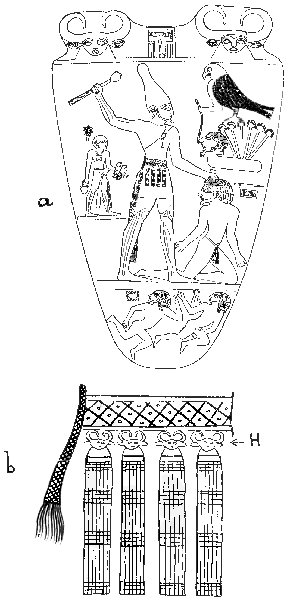
Fig. 18 (a) The Archaic Egyptian slate
palette of Narmer showing, perhaps, the earliest design of Hathor (at
the upper corners of the palette) as a woman with cow's horns and ears
(compare Flinders Petrie, "The Royal Tombs of the First Dynasty," Part
I, 1900, Plate XXVII, Fig. 71). The pharaoh is wearing a belt from which
are suspended four cow-headed Hathor figures in place of the
cowry-amulets of more primitive peoples. This affords corroboration of
the view that Hathor assumed the functions originally attributed to the
cowry-shell.
(b) The king's sporran, where Hathor-heads (h) take the place
of the cowries of the primitive girdle.
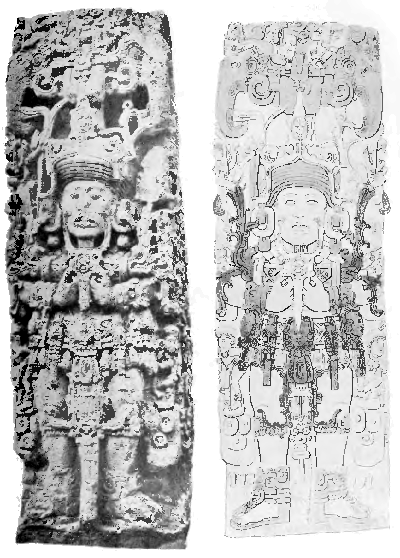
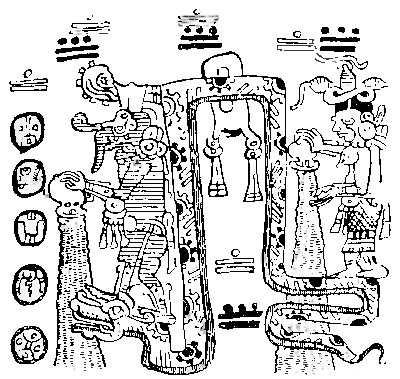
Fig. 19.—The front of Stela B (famous for the
realistic representations of the Indian elephant at its upper corners),
one of the ancient Maya monuments at Copan, Central America (after
Maudslay's photograph and diagram).
The girdle of the chief figure is decorated both with shells (Oliva or
Conus) and amulets representing human faces corresponding to the
Hathor-heads on the Narmer palette (Fig. 18).
Thus gradually there developed out of the cowry-amulet the conception of
a creator, the giver of life, health, and good luck. This Great Mother,
at first with only vaguely defined traits, was probably the first deity
that the wit of man devised to console him with her watchful care over
his welfare in this life and to give him assurance as to his fate in the
future.
At this stage I should like to emphasize the fact that these beliefs had
taken shape long before any definite ideas had been formulated as to the
physiology of animal reproduction and before agriculture was practised.
Man had not yet come to appreciate the importance of vegetable
fertility, nor had he yet begun to frame theories of the fertilizing
powers of water, or give specific expression to them by creating the god
Osiris in his own image.
Nor had he begun to take anything more than the most casual interest in
the sun, the moon, and the stars. He had not yet devised a sky-world nor
created a heaven. When, for reasons that I have already discussed,[261]
the theory of the fertilizing and the animating power of water was
formulated, the beliefs concerning this element were assimilated with
those which many ages previously had grown up in explanation of the
potency of blood and shells. In addition to fertilizing the earth, water
could also animate the dead. The rivers and the seas were in fact a vast
reservoir of this animating substance. The powers of the cowry, as a
product of the sea, were rationalized into an expression of the great
creative force of the water.
A bowl of water became the symbol of the fruitfulness of woman. Such
symbolism implied that woman, or her uterus, was a receptacle into which
the seminal fluid was poured and from which a new being emerged in a
flood of amniotic fluid.
The burial of shells with the dead is an extremely ancient practice, for
cowries have been found upon human skeletons of the so-called "Upper
Palæolithic Age" of Southern Europe.
At Laugerie-Basse (Dordogne) Mediterranean cowries were found arranged
in pairs upon the body; two pairs on the forehead, one near each arm,
four in the region of the thighs and knees, and two upon each foot.
Others were found in the Mentone caves, and are peculiarly important,
because, upon the same stratum as the skeleton with which they were
associated, was found part of a Cassis rufa, a shell whose habitat
does not extend any nearer than the Indian Ocean.[262]
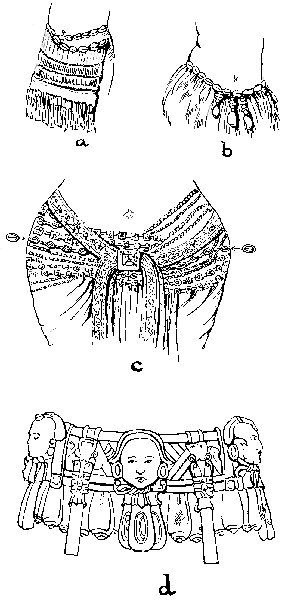
Fig. 20.—Diagrams illustrating the form of
cowry-belts worn in (a) East Africa and (b)
Oceania respectively.
(c) Ancient Indian girdle (from the figure of Sirima Devata on the
Bharat Tope), consisting of strings of pearls and precious stones, and
what seem to be (fourth row from the top) models of cowries.
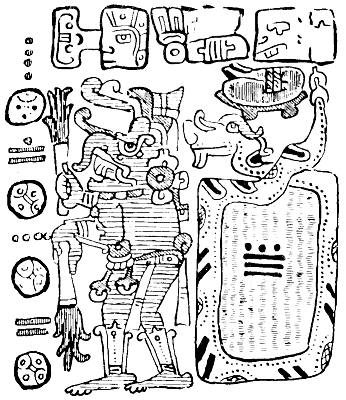
(d) The Copan girdle (from Fig. 19) in which both shells and heads
of deities are represented. The two objects suspended from the belt
between the heads recall Hathor's sistra.
These facts are very important. In the first place they reveal the great
antiquity of the practice of burying shells with the dead, presumably
for the purpose of "life-giving". Secondly, they suggest the possibility
that their magical value as givers of life may be more ancient than
their specific use as intensifiers of the fertility of women. Thirdly,
the association of these practices with the use of the shell Cassis
rufa indicates a very early cultural contact between the people living
upon the North-Western shores of the Mediterranean in the Reindeer Age
and the dwellers on the coasts of the Indian Ocean; and the
probability that these special uses of shells by the former were
inspired by the latter.
This hint assumes a special significance when we first get a clear view
of the more fully-developed shell-cults of the Eastern Mediterranean
many centuries later.[263] For then we find definite indications that
the cultural uses of shells were obviously borrowed from the Erythræan
area.
Long before the shell-amulet became personified as a woman the
Mediterranean people had definitely adopted the belief in the cowry's
ability to give life and birth.
The cowry and its surrogates were supposed to be potent to confer
fertility on maidens; and it became the practice for growing girls to
wear a girdle on which to suspend the shells as near as possible to the
organ their magic was supposed to stimulate. Among many peoples[264]
this girdle was discarded as soon as the girls reached maturity.
This practice probably represents the beginning of the history of
clothing; but it had other far-reaching effects in the domain of belief.
It has often been claimed that the feeling of modesty was not the reason
for the invention of clothing, but that the clothes begat modesty.[265]
This doctrine contains a certain element of truth, but is by no means
the whole explanation. For true modesty is displayed by people who have
never worn clothes.
Before mankind could appreciate the psychological fact that the wearing
of clothing might add to an individual's allurement and enhance her
sexual attractiveness, some other circumstances must have been
responsible for suggesting the experiments out of which this empirical
knowledge emerged. The use of a girdle (a) as a protection against
danger to life, and (b) as a means of conferring fecundity on
girls[266] provided the circumstances which enabled men to discover that
the sexual attractiveness of maidens, which in a state of nature was
originally associated with modesty and coyness, was profoundly
intensified by the artifices of clothing and adornment.
Among people (such as those of East Africa and Southern Arabia) in which
it was customary for unmarried girls to adorn themselves with a girdle,
it is easy to understand how the meaning of the practice underwent a
change, and developed into a device for enhancing their charms and
stimulating the imaginations of their suitors.
Out of such experience developed the idea of the magical girdle as an
allurement and a love-provoking charm or philtre. Thus Aphrodite's
girdle acquired the reputation of being able to compel love. When
Ishtar removed her girdle in the under-world reproduction ceased in the
world. The Teutonic Brunhild's great strength lay in her girdle. In fact
magic virtues were conferred upon most goddesses in every part of the
world by means of a cestus of some sort.[267] But the outstanding
feature of Aphrodite's character as a goddess of love is intimately
bound up with these conceptions which developed from the wearing of a
girdle of cowries.
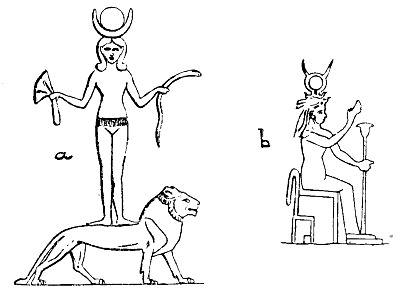
Fig. 4.—Two representations of Astarte
(Qetesh).
(a) The mother-goddess standing upon a lioness (which is her Sekhet
form): she is wearing her girdle, and upon her head is the moon and the
cow's horns, conventionalized so as to simulate the crescent moon. Her
hair is represented in the conventional form which is sometimes used as
Hathor's symbol. In her hands are the serpent and the lotus, which again
are merely forms of the goddess herself.
(b) Another picture of Astarte (from Roscher's "Lexikon") holding the
papyrus sceptre which at times is regarded as an animate form of the
mother-goddess herself and as such a thunder weapon.
In the Biblical narrative, after Adam and Eve had eaten the forbidden
fruit, "the eyes of them both were opened, and they knew that they were
naked; and they sewed fig leaves together and made themselves aprons,"
or, as the Revised Version expresses it, "girdles". The girdle of
fig-leaves, however, was originally a surrogate of the girdle of
cowries: it was an amulet to give fertility. The consciousness of
nakedness was part of the knowledge acquired as the result of the
wearing of such girdles (and the clothing into which they developed),
and was not originally the motive that impelled our remote ancestors to
clothe themselves.
The use of fig-leaves for the girdle in Palestine is an interesting
connecting link between the employment of the cowry and the mandrake for
similar purposes in the neighbourhood of the Red Sea and in Cyprus and
Syria respectively (vide infra).
In Greece and Italy, the sweet basil has a reputation for magical
properties analogous to those of the cowry. Maidens collect the plant
and wear bunches of it upon their body or upon their girdles; while
married women fix basil upon their heads.[268] It is believed that the
odour of the plant will attract admirers: hence in Italy it is called
Bacia-nicola. "Kiss me, Nicholas".[269]
In Crete it is a sign of mourning presumably because its life-prolonging
attributes, as a means of conferring continued existence to the dead,
have been so rationalized in explanation of its use at funerals.
On New Year's day in Athens boys carry a boat and people remark, "St.
Basil is come from Cæsarea".
During the chequered history of the Great Mother the attributes of the
original shell-amulet from which the goddess was sprung were also
changing and being elaborated to fit into a more complex scheme. The
magical properties of the cowry came to be acquired by other Red Sea
shells, such as Pterocera, the pearl oyster, conch shells, and others.
Each of these became intimately associated with the moon.[270] The
pearls found in the oysters were supposed to be little moons, drops of
the moon-substance (or dew) which fell from the sky into the gaping
oyster. Hence pearls acquired the reputation of "shining by night," like
the moon from which they were believed to have come: and every surrogate
of the Great Mother, whether plant, animal, mineral or mythical
instrument, came to be endowed with the power of "shining by night". But
pearls were also regarded as the quintessence of the shell's life-giving
properties, which were considered to be all the more potent because they
were sky-given emanations of the moon-goddess herself. Hence pearls
acquired the reputation of being the "givers of life" par excellence,
an idea which found literal expression in the ancient Persian word
margan (from mar, "giver" and gan, "life"). This word has been
borrowed in all the Turanian languages (ranging from Hungary to
Kamskatckha), but also in the non-Turanian speech of Western Asia,
thence through Greek and Latin (margarita) to European languages.[271]
The same life-giving attributes were also acquired by the other
pearl-bearing shells; and at some subsequent period, when it was
discovered that some of these shells could be used as trumpets, the
sound produced was also believed to be life-giving or the voice of the
great Giver of Life. The blast of the trumpet was also supposed to be
able to animate the deity and restore his consciousness, so that he
could attend to the appeals of supplicants. In other words the noise
woke up the god from his sleep. Hence the shell-trumpet attained an
important significance in early religious ceremonials for the ritual
purpose of summoning the deity, especially in Crete and India, and
ultimately in widely distant parts of the world.[272] Long before these
shells are known to have been used as trumpets, they were employed like
the other Red Sea shells as "givers of life" to the dead in Egypt. Their
use as trumpets was secondary.
And when it was discovered that purple dye could be obtained from
certain of the trumpet-shells, the colouring-matter acquired the same
life-giving powers as had already been conferred upon the trumpet and
the pearls: thus it became regarded as a divine substance and as the
exclusive property of gods and kings.
Long before, the colour red had acquired magic potency as a surrogate of
life-giving blood; and this colour-symbolism undoubtedly helped in the
development of the similar beliefs concerning purple.
When the life-giving attributes of water were confused with the same
properties with which shells had independently been credited long
before, the shell's reputation was rationalized as an expression of the
vital powers of the ocean in which the mollusc was born. But the same
explanation was also extended to include fishes, and other denizens of
the water, as manifestations of similar divine powers. In the lecture on
"Dragons and Rain Gods" I referred to the identification of Ea, the
Babylonian Osiris, with a fish (p. 105). When the value of the pearl as
the giver of life impelled men to incur any risks to obtain so precious
an amulet, the chief dangers that threatened pearl-fishers were due to
sharks. These came to be regarded as demons guarding the treasure-houses
at the bottom of the sea. Out of these crude materials the imaginations
of the early pearl-fishers created the picture of wonderful submarine
palaces of Nâga kings in which vast wealth, not merely of pearls, but
also of gold, precious stones, and beautiful maidens (all of them
"givers of life," vide infra, p. 224), were placed under the
protection of shark-dragons.[273] The conception of the pearl (which is
a surrogate of the life-giving Great Mother) guarded by dragons is
linked by many bonds of affinity with early Erythræan and Mediterranean
beliefs. The more usual form of the story, both in Southern Arabian
legend and in Minoan and Mycenæan art, represents the Mother Goddess
incarnate in a sacred tree or pillar with its protecting dragons in the
form of serpents or lions, or a variety of dragon-surrogates, either
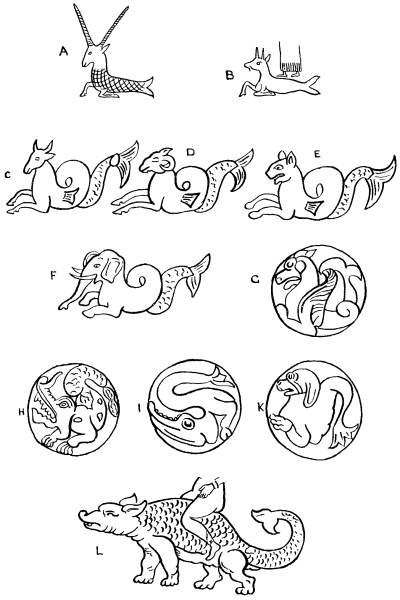
real animals, such as deer or cattle, or composite monsters (Fig.
26).[274]
There are reasons for believing that these stories were first invented
somewhere on the shores of the Erythræan Sea, probably in Southern
Arabia. The animation of the incense-tree by the Great Mother, for the
reasons which I have already expounded,[275] formed the link of her
identification with the pearl, which probably acquired its magical
reputation in the same region.
"In the Persian myth, the white Haoma is a divine tree, growing in the
lake Vourukasha: the fish Khar-mâhi circles protectingly around it and
defends it against the toad Ahriman. It gives eternal life, children to
women, husbands to girls, and horses to men. In the Minôkhired the tree
is called 'the preparer of the corpse'" (Spiegel, "Eran. Altertumskunde,"
II, 115—quoted by Jung, "Psychology of the Unconscious," p. 532). The
idea of guarding the divine tree[276] by dragons was probably the result
of the transference to that particular surrogate of the Great Mother of
the shark-stories which originated from the experiences of the seekers
after pearls, her other representatives.
There are many other bits of corroborative evidence to suggest that
these shell-cults and the legends derived from them were actually
transmitted from the Red Sea to the Eastern Mediterranean. Nor is it
surprising that this should have happened, when it is recalled that
Egyptian sailors were trafficking in both seas long before the Pyramid
Age, and no doubt carried the beliefs and the legends of one region to
the other. I have already referred to the adoption in the Mediterranean
area of the idea of the dragon-protectors of the tree- and pillar-forms
of the Great Mother, and suggested that this was merely a garbled
version of the pearl-fisher's experience of the dangers of attacks by
sharks. But the same legends also reached the Levant in a less modified
form, and then underwent another kind of transformation (and confusion
with the tree-version) in Cyprus or Syria.
As the shark would be a not wholly appropriate actor in the
Mediterranean, its rôle is taken by its smaller Selachian relative, the
dog-fish. In the notes on Pliny's Natural History, Dr. Bostock and Mr.
H. T. Riley[277] refer to the habits of dog-fishes ("Canes marini"), and
quote from Procopius ("De Bell. Pers." B. I, c. 4) the following
"wonderful story in relation to this subject": "Sea-dogs are wonderful
admirers of the pearl-fish, and follow them out to sea.... A certain
fisherman, having watched for the moment when the shell-fish was
deprived of the attention of its attendant sea-dog, ... seized the
shell-fish and made for the shore. The sea-dog, however, was soon aware
of the theft, and making straight for the fisherman, seized him. Finding
himself thus caught, he made a last effort, and threw the pearl-fish on
shore, immediately on which he was torn to pieces by its
protector."[278]
Though the written record of this story is relatively modern the
incident thus described probably goes back to much more ancient times.
It is only a very slightly modified version of an ancient narrative of a
shark's attack upon a pearl-diver.
For reasons which I shall discuss in the following pages, the rôle of
the cowry and pearl as representatives of the Great Mother was in the
Levant assumed by the mandrake, just as we have already seen the
Southern Arabian conception of her as a tree adopted in Mycenæan lands.
Having replaced the sea-shell by a land plant it became necessary, in
adapting the legend, to substitute for the "sea-dog" some land animal.
Not unnaturally it became a dog. Thus the story of the dangers incurred
in the process of digging up a mandrake assumed the well-known
form.[279] The attempt to dig up the mandrake was said to be fraught
with great danger. The traditional means of circumventing these risks
has been described by many writers, ancient and modern, and preserved in
the folk-lore of most European and western Asiatic countries. The story
as told by Josephus is as follows: "They dig a trench round it till the
hidden part of the root is very small, then they tie a dog to it, and
when the dog tries hard to follow him that tied him, this root is easily
plucked up, but the dog dies immediately, as it were, instead of the man
that would take the plant away."[280] Thus the dog takes the place of
the dog-fish when the mandrake becomes the pearl's surrogate. The only
discrepancy between the two stories is the point to which Josephus calls
specific attention. For instead of the dog killing the thief, as the
shark (dog-fish) kills the stealer of pearls, the dog becomes the victim
as a substitute for the man. As Josephus remarks, "the dog dies
immediately, as it were, instead of the man that would take the plant
away". This distortion of the story is true to the traditions of
legend-making. The dog-incident is so twisted as to be transformed into
a device for plucking the dangerous plant without risk.
It is quite possible that earlier associations of the dog with the Great
Mother may have played some part in this transference of meaning, if
only by creating confusion which made such rationalization necessary. I
refer to the part played by Anubis in helping Isis to collect the
fragments of Osiris; and the rôle played by Anubis, and his Greek
avatar Cerberus, in the world of the dead. Whether the association of
the dog-star Sirius with Hathor had anything to do with the confusion is
uncertain.[281]
There was an intimate association of the dog with the goddess of the
under-world (Hecate) and the ritual of rebirth of the dead.[282] Perhaps
the development of the story of the underworld-goddess Aphrodite's dog
and the mandrake may have been helped by this survival of the
association of Isis with Anubis, even if there is not a more definite
causal relationship between the dog-incidents in the various legends.
The divine dog Anubis is frequently represented in connexion with the
ritual of rebirth,[283] where it is shown upon a standard in association
with the placenta. The hieroglyphic sign for the Egyptian word mes,
"to give birth," consists of the skins of three dogs (or jackals, or
foxes). The three-headed dog Cerberus that guarded the portal of Hades
may possibly be a distorted survival of this ancient symbolism of the
three-fold dog-skin as the graphic sign for the act of emergence from
the portal of birth. Elsewhere (p. 223) in this lecture I have referred
to Charon's obolus as a surrogate of the life-giving pearl or cowry
placed in the mouth of the dead to provide "vital substance". Rohde[284]
regards Charon as the second Cerberus, corresponding to the Egyptian
dog-faced god Anubis: just as Charon received his obolus, so in Attic
custom the dead were provided with μελιτοῦτια the object of
which is usually said to be to pacify the dog of hell.
What seems to link all these fantastic beliefs and customs with the
story of the dog and the mandrake is the fact that they are closely
bound up with the conception of the dog as the guardian of hidden
treasure.
The mandrake story may have arisen out of a mingling of these two
streams of legend—the shark (dog-fish) protecting the treasures at the
bottom of the sea, and the ancient Egyptian beliefs concerning the
dog-headed god who presides at the embalmer's operations and
superintends the process of rebirth.
The dog of the story is a representative of the dragon guarding the
goddess in the form of the mandrake, just as the lions over the gate at
Mycenæ heraldically support her pillar-form, or the serpents in Southern
Arabia protect her as an incense tree. Dog, Lion, and Serpent in these
legends are all representatives of the goddess herself, i.e. merely her
own avatars (Fig. 26).
At one time I imagined that the rôle of Anubis as a god of embalming and
the restorer of the dead was merely an ingenuous device on the part of
the early Egyptians to console themselves for the depredations of
jackals in their cemeteries. For if the jackal were converted into a
life-giving god it would be a comforting thought to believe that the
dead man, even though devoured, was "in the bosom of his god" and
thereby had attained a rebirth in the hereafter. In ancient Persia
corpses were thrown out for the dogs to devour. There was also the
custom of leading a dog to the bed of a dying man who presented him with
food, just as Cerberus was given honey-cakes by Hercules in his journey
to hell. But I have not been able to obtain any corroboration of this
supposition. It is a remarkable coincidence that the Great Mother has
been identified with the necrophilic vulture as Mut; and it has been
claimed by some writers[285] that, just as the jackal was regarded as a
symbol of rebirth in Egypt and the dead were exposed for dogs to devour
in Persia, so the vulture's corpse-devouring habits may have been
primarily responsible for suggesting its identification with the Great
Mother and for the motive behind the Indian practice of leaving the
corpses of the dead for the vultures to dispose of.[286] It is not
uncommon to find, even in English cathedrals, recumbent statues of
bishops with dogs as footstools. Petronius ("Sat.," c. 71) makes the
following statement: "valde te rogo, ut secundum pedes statuae meae
catellam pingas—ut mihi contingat tuo beneficio post mortem
vivere".[287] The belief in the dog's service as a guide to the dead
ranges from Western Europe to Peru.
To return to the story of the dog and the mandrake: no doubt the demand
will be made for further evidence that the mandrake actually assumed the
rôle of the pearl in these stories. If the remarkable repertory of
magical properties assigned to the mandrake[288] be compared with those
which developed in connexion with the cowry and the pearl,[289] it will
be found that the two series are identical. The mandrake also is the
giver of life, of fertility to women, of safety in childbirth; and like
the cowry and the pearl it exerts these magical influences only if it be
worn in contact with the wearer's skin.[290] But the most definite
indication of the mandrake's homology with the pearl is provided by the
legend that "it shines by night". Some scholars,[291] both ancient and
modern, have attempted to rationalize this tradition by interpreting it
as a reference to the glow-worms that settle on the plant! But it is
only one of many attributes borrowed by the mandrake from the pearl,
which was credited with this remarkable reputation only when early
scientists conceived the hypothesis that the gem was a bit of moon
substance.
As the memory of the real history of these beliefs grew dim, confusion
was rapidly introduced into the stories. I have already explained how
the diving for pearls started the story of the great palace of treasures
under the waters which was guarded by dragons. As the pearl had the
reputation of shining by night, it is not surprising that it or some of
its surrogates should in course of time come to be credited with the
power of "revealing hidden treasures," the treasures which in the
original story were the pearls themselves. Thus the magic fern-seed and
other treasure-disclosing vegetables[292] are surrogates of the
mandrake, and like it derive their magical properties directly or
indirectly from the pearl.
The fantastic story of the dog and the mandrake provides the most
definite evidence of the derivation of the mandrake-beliefs from the
shell-cults of the Erythræan Sea. There are many other scraps of
evidence to corroborate this. I shall refer here only to one of these.
"The discovery of the art of purple-dyeing has been attributed to the
Tyrian tutelary deity Melkart, who is identified with Baal by many
writers. According to Julius Pollux ('Onomasticon,' I, iv.) and Nonnus
('Dionys.,' XL, 306) Hercules (Melkart) was walking on the seashore
accompanied by his dog and a Tyrian nymph, of whom he was enamoured. The
dog having found a Murex with its head protruding from its shell,
devoured it, and thus its mouth became stained with purple. The nymph,
on seeing the beautiful colour, bargained with Hercules to provide her
with a robe of like splendour."[293] This seems to be another variant of
the same story.
Aphrodite was associated not only with the cowry, the pearl, and the
mandrake, but also with the octopus, the argonaut, and other
cephalopods. Tümpel seems to imagine that the identification of the
goddess with the argonaut and the octopus necessarily excludes her
association with molluscs; and Dr. Rendel Harris attributes an equally
exclusive importance to the mandrake. But in such methods of argument
due recognition is not given to the outstanding fact in the history of
primitive beliefs. The early philosophers built up their great
generalizations in the same way as their modern successors. They were
searching for some explanation of, or a working hypothesis to include,
most diverse natural phenomena within a concise scheme. The very essence
of such attempts was the institution of a series of homologies and
fancied analogies between dissimilar objects. Aphrodite was at one and
the same time the personification of the cowry, the conch shell, the
purple shell, the pearl, the lotus, and the lily, the mandrake and the
bryony, the incense tree and the cedar, the octopus and the argonaut,
the pig, and the cow.
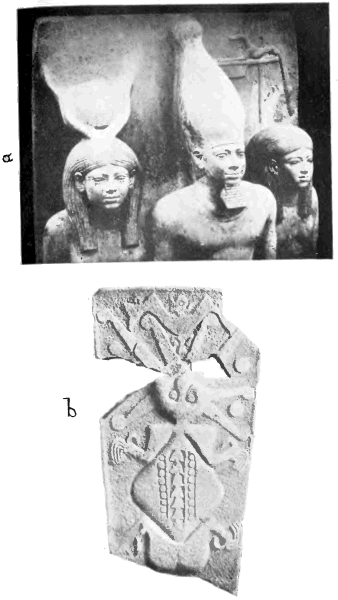
Fig. 21.
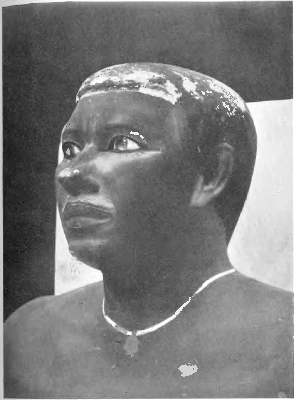
(a) A slate triad found by
Professor G. A. Reisner in the temple of the Third Pyramid at Giza. It
shows the Pharaoh Mycerinus supported on his right side by the goddess
Hathor, represented as a woman with the moon and the cow's horns upon
her head, and on the left side by a nome goddess, bearing upon her head
the jackal-symbol of her nome.
(b) The Ecuador Aphrodite. Bas-relief from Cerro Jaboncillo (after
Saville, "Antiquities of Manabi, Ecuador," Preliminary Report, 1907,
Plate XXXVIII).
A grotesque composite monster intended to represent a woman (compare
Saville's Plates XXXV, XXXVI, and XXXIX), whose head is a
conventionalized Octopus, whose body is a Loligo, and whose limbs are
human.
Every one of these identifications is the result of a long and chequered
history, in which fancied resemblances and confusion of meaning play a
very large part. But I cannot too strongly repudiate the claim made by
Sir James Frazer that such events are merely so many evidences of the
innate human tendency to personify nature. The history of the arbitrary
circumstances that were responsible for the development of each one of
these homologies is entirely fatal to this wholly unwarranted
speculation.[294] Tümpel claims[295] the Aphrodite was associated more
especially with "a species of Sepia". He refers to the attempts to
associate the goddess of love with amulets of univalvular shells "in
virtue of a certain peculiar and obscene symbolism".[296] Naturalists,
however, designate with the term Venus Cytherea certain gaping bivalve
molluscs.
But, according to Tümpel (p. 386), neither univalvular nor bivalve
shells can be regarded as a real part of the goddess's cultural
equipment. There is no representation of Aphrodite coming in a shell
from across the sea.[297] The truly sacred Aphrodite-shell was entirely
different, so Tümpel believes: it was obviously difficult to preserve,
but for that reason more worthy of notice, for the small χοίριναι
(pectines), virginalia marina (Apuleius de mag. 34, 35, and
in reference thereto, Isidor. origg. 9, 5, 24) or spuria (σπόρια)
were only the commoner and more readily obtained surrogates:
the univalvular shells. (μονόθυρα of Aristotle), such as those just mentioned, and the
other ὄστρεα of Aphrodite, the Nerites (periwinkles, etc.), the
purple shell and the Echineïs were also real Veneriae conchae. Among the
Nerites Aelian enumerates (N.A. 14, 28): Ἀφροδίτην δὲ συνδιαιτωμένην έν τῂ θάλαττη ἡσθὴναι τε τῷ Νηρίτη τῷδε καὶ ἔχειν ἀυτον φίλον.
On account of their supposed medicinal value in cases of
abortion and especially as a prophylactic for pregnant women the Ἐχενηΐς
(pure Latin re[mi]mora) was called ὠδινολύτη[298]
(Pliny, 32, 1, 5: pisciculus!). According to Mutianus (Pliny, 9, 25
(41), 79 f.), it was a species of purple shell, but larger than the true
Murex purpura. From this the sanctity of the Echineïs to the Cnidian
Aphrodite is demonstrated: "quibus (conchis) inhaerentibus plenam ventis
stetisse navem portantem Periandro, ut castrarentur nobilis pueros,
conchasque, quae id praestiterint, apud Cnidiorum Venerem coli" (Pliny).
Tümpel then (p. 387) accuses Stephani of being mistaken in his
interpretation of Martial's Cytheriacae (Epign. II, 47, 1 = purple
shells) as the amulets of Aphrodite, and claims that Jahn has given the
correct solution of the following passages from Pliny (N.H., 9, 33 [52],
103, compare 32, 11 [53]): "navigant ex his (conchis) veneriae,
praebentesque concavam sui partem et aurae opponentes per summa aequorum
velificant"; and further (9, 30[49], 94): "in Propontide concham esse
acatii modo carinatam inflexa puppe, prora rostrata, in hac condi
nauplium animal saepiae simile ludendi societate sola, duobus hoc fieri
generibus: tranquillum enim vectorem demissis palmulis ferire ut remis;
si vero flatus invitet, easdem in usu gubernaculi porrigi pandique
buccarum sinus aurae".
Tümpel claims (pp. 387 and 388) that this quotation settles the
question. Aphrodite's "shell," according to him, is the Nauplius
(depicted as a shell-fish, with its sail-like palmulæ spread out to the
wind, but with the same sails flattened into plate-like arms for
steering), clearly "a species of Sepia," wholly like Aphrodite
herself, a ship-like shell-fish sailing over the surface of the water,
the concha veneria. [The analogy to a ship bearing the Great Mother is
extremely ancient and originally referred to the crescent moon carrying
the moon-goddess across the heavenly ocean.]
Elsewhere (p. 399) he discusses the reasons for the connexion of
Aphrodite with the "nautilus," by which is meant the argonaut of
zoologists.
But if Jahn and Tümpel have thus clearly established the proof of the
intimate association of Aphrodite with certain cephalopods, they are
wholly unjustified in the assumption that their quotations from
relatively modern authors disprove the reality of the equally close
(though more ancient) relationship of the goddess to the cowry, the
pearl-shell, the trumpet-shell, and the purple-shell.
It must not be forgotten that, as we have already seen, the primitive
shell-cults of the Erythræan Sea had been diffused throughout the
Mediterranean area long before Aphrodite was born upon the shores of the
Levant, and possibly before Hathor came into existence in the south. The
use of the cowry and gold models of the cowry goes back to an early time
in Ægean history.[299] And the influence of Aphrodite's early
associations had become blurred and confused by the development of new
links with other shells and their surrogates.
But the connexion of Aphrodite with the octopus and its kindred played a
very obtrusive part in Minoan and Mycenæan art; and its influence was
spread abroad as far as Western Europe[300] and towards the East as far
as America. In many ways it was a factor in the development of such
artistic designs as the spiral and the volute, and not improbably also
of the swastika.
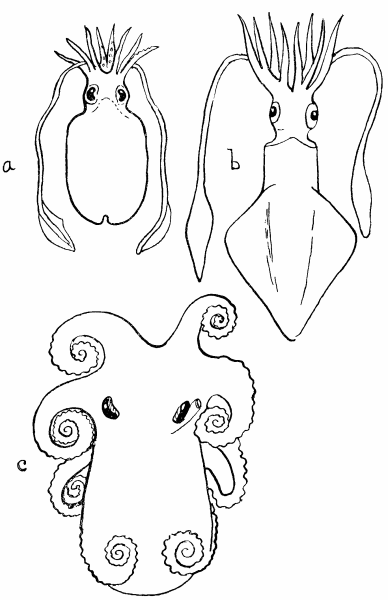
Fig. 22.
(a) Sepia officinalis, after
Tryon, "Cephalopoda".
(b) Loligo vulgaris, after Tryon.
(c) The position usually adopted by the resting Octopus, after
Tryon.
Starting from the researches of Tümpel, a distinguished French
zoologist, Dr. Frédéric Houssay,[301] sought to demonstrate that the
cult of Aphrodite was "based upon a pre-existing zoological philosophy".
The argument in support of his claim that Aphrodite was a
personification of the octopus must be sharply differentiated into two
parts: first, the reality of the association of the octopus with the
goddess, of which there can be no doubt; and secondly, his explanation
of it, which (however popular it may be with classical writers and
modern scholars)[302] is not only a gratuitous assumption, but also,
even if it were based upon more valid evidence than the speculations
of such recent writers as Pliny, would not really carry the explanation
very far.
I refer to his claim that "les premiers conquérants de la mer furent
induits en vénération du poulpe nageur (octopus) parce qu'ils crurent
que quelque-uns de ces céphalopodes, les poulpes sacrés (argonauta)
avaient, comme eux et avant eux, inventé la navigation" (op. cit., p.
15). Idle fancies of this sort do not help us to understand the
arbitrary beliefs concerning the magical powers of the octopus.
The real problem we have to solve is to discover why, among all the
multitude of bizarre creatures to be found in the Mediterranean Sea, the
octopus and its allies should thus have been singled out for distinctive
appreciation, and also acquired the same remarkable attributes as the
cowry.
I believe that the Red Sea "Spider shell," Pterocera,[303] was the
link between the cowry and the octopus. This shell was used, like the
cowry, for funerary purposes in Egypt and as a trumpet in India.[304]
But it was also depicted upon a series of remarkable primitive statues
of the god Min, which were found at Coptos during the winter 1893-4 by
Professor Flinders Petrie.[305] Some of these objects are now in the
Cairo Museum and the others in the Ashmolean Museum in Oxford. They are
supposed to be late predynastic representations of the god Min. If this
supposition is correct they are the earliest idols (apart from mere
amulets) that have been preserved from antiquity.
Upon these statues, representations of the Red Sea shell Pterocera
bryonia are sculptured in low relief. Mr. F. Ll. Griffith is
disinclined to accept my suggestion that the object of these pictures of
the shell was to animate the statues. But whether this was their purpose
or not, it is probably not without some significance that these
life-giving shells were associated with so obtrusively phallic a deity
as Min. In any case they afford concrete evidence of cultural contact
between Coptos and the Red Sea, and indicate that these particular
shells were chosen as symbols of that sea or its coast.
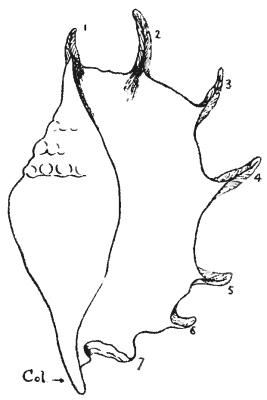
Fig. 5—Pterocera Bryonia. the Red Sea
Spider-shell. Col.—the columella 1-7—the "claws".
The distinctive feature of the Pterocera is that the mantle in the
adult expands into a series of long finger-like processes each of which
secretes a calcareous process or "claw". There are seven[306] of these
claws as well as the long columella (Fig. 5). Hence, when the
shell-cults were diffused from the Red Sea to the Mediterranean (where
the Pterocera is not found), it is quite likely that the people of the
Levant may have confused with the octopus some sailor's account of the
eight-rayed shell (or perhaps representations of it on some amulet or
statue). Whether this is the explanation of the confusion or not, it is
certain that the beliefs associated with the cowry and the octopus in
the Ægean area are identical with those linked up with the cowry and the
Pterocera in the Red Sea.
I have already mentioned that the mandrake is believed to possess the
same magical powers. Sir James Frazer has called attention to the fact
that in Armenia the bryony (Bryonia alba) is a surrogate of the
mandrake and is credited with the same attributes.[307] Lovell Reeve
("Conchologia Iconica," VI, 1851) refers to the Red Sea Pterocera as
the "Wild Vine Root" species, previously known as Strombus radix
bryoniae; and Chemnitz ("Conch. Cab.," 1788, Vol. X, p. 227) says the
French call it "Racine de brione femelle imparfaite," and refer to it as
"the maiden". Here then is further evidence that this shell (a) was
associated in some way with a surrogate of the mandrake (Aphrodite), and
(b) was regarded as a maiden. Thus clearly it has a place in the
chequered history of Aphrodite. I have suggested the possibility of its
confusion with the octopus, which may have led to the inclusion of the
latter within the scope of the marine creatures in Aphrodite's cultural
equipment. According to Matthioli (Lib. 2, p. 135), another of
Aphrodite's creatures, the purple shell-fish, was also known as "the
maiden". By Pliny it is called Pelogia, in Greek πορφύρα; and
πορφυρώματα was the term applied to the flesh of swine that
had been sacrificed to Ceres and Proserpine (Hesych.). In fact, the
purple-shell was "the maiden" and also "the sow": in other words it was
Aphrodite. The use of the term "maiden" for the Pterocera suggests a
similar identification. To complete this web of proof it may be noted
that an old writer has called the mandrake the plant of Circe, the
sorceress who turned men into swine by a magic draught.[308] Thus we
have a series of shells, plants, and marine creatures accredited with
identical magical properties, and each of them known in popular
tradition as "the maiden". They are all culturally associated with
Aphrodite.
I shall have occasion (infra, p. 177) to refer to M. Siret's account
of the discovery of the Ægean octopus-motif upon Æneolithic objects in
Spain, and of the widespread use in Western Europe of certain
conventional designs derived from the octopus. M. Siret also (see the
table, Fig. 6, on p. 34 of his book) makes the remarkable claim that the
conventional form of the Egyptian Bes, which, according to Quibell,[309]
is the god whose function it is to preside over sexual intercourse in
its purely physical aspect, is derived from the octopus. If this is
true—and I am bound to admit that it is far from being proved—it
suggests that the Red Sea littoral may have been the place of origin of
the cultural use of the octopus and an association with Hathor, for Bes
and Hathor are said to have been introduced into Egypt from there.[310]
That the octopus was actually identified with the Great Mother and also
with the dragon is revealed by the fact of the latter assuming an
octopus-form in Eastern Asia and Oceania, and by the occurrence of
octopus-motifs in the representation of the goddess in America. One of
the most remarkable series of pictures depicting the Great Mother is
found sculptured in low relief upon a number of stone slabs from Manabi
in Central America,[311] one of which I reproduce here (Fig. 21b).
The head of the goddess is a conventionalized octopus; to that was added
a body consisting of a Loligo; and, to give greater definiteness to
this remarkable process of building up the form of the goddess,
conventional representations of her arms and legs (and in some of the
sculptures also the pudendum muliebre) were added. Thus there can be
no doubt of the identification of this American Aphrodite and the
octopus.
In the Polynesian Rata-myth there is a very instructive series of
manifestations of the dragon.[312] The first form assumed by the monster
in this story was a gaping shell-fish of enormous size; then it appeared
as a mighty octopus; and lastly, as a whale, into whose jaws the hero
Nganaoa sprang, as his representatives are said to have done elsewhere
throughout the world (Frobenius, op. cit., pp. 59-219).
Houssay (op. cit. infra) calls attention to the fact that at times
Astarte was shown carrying an octopus as her emblem,[313] and has
suggested that it was mistaken for a hand, just as in America the
thunderbolt of Chac was given a hand-like form in the Dresden Codex
(vide supra. Fig. 13), and elsewhere (e.g. Fig. 12).
If this suggestion should prove to be well founded it would provide a
more convincing explanation of the girdle of hands worn by the Indian
goddess Kali[314] than that usually given. If the "hands" really
represent surrogates of the cowry, the wearing of such a girdle brings
the Indian goddess into line, not only with Astarte and Aphrodite, but
also with the East African maidens who still wear the girdle of cowries.
Kali's exploits were in many respects identical with those of the
bloodthirsty Sekhet-manifestation of the Egyptian goddess Hathor. Just
as Sekhet had to be restrained by Re for her excess of zeal in murdering
his foes, so Siva had to intervene with Kali upon the battlefield
flooded with gore (as also in the Egyptian story) to spare the remnant
of his enemies.[315]
Houssay (op. cit. supra) has made the interesting suggestion that the
swastika may have been derived from such conventionalized
representations of the octopus as are shown in Fig. 23. This series of
sketches is taken from Tümpel's memoir, which provided the foundation
for Houssay's hypothesis.
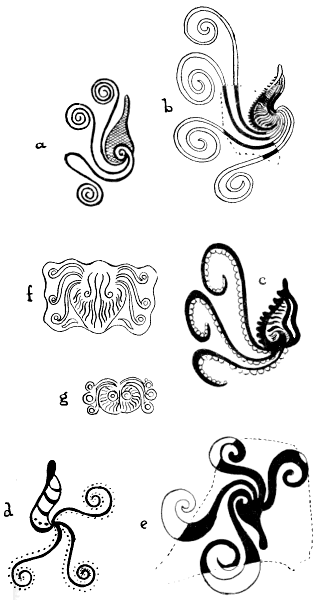
Fig. 23.—A series of Mycenæan conventionalizations
of the Argonaut and the Octopus (after Tümpel), which provided the basis
for Houssay's theory of the origin of the triskele (a, c,
and d) and swastika (b and e), and
Siret's theory to explain the design of Bes's face (f
and g)
A vast amount of attention has been devoted to this lucky symbol,[316]
which still enjoys a widespread vogue at the present day, after a
history of several thousand years. Although so much has been written in
attempted explanation of the swastika since Houssay made his suggestion,
so far as I am aware no one has paid the slightest attention to his
hypothesis or made even a passing reference to his memoir.[317]
Fantastic and far-fetched though it may seem at first sight (though
surely not more so than the strictly orthodox solar theory advocated by
Mr. Cook or Mrs. Nuttall's astral speculations) Houssay's suggestion
offers an explanation of some of the salient attributes of the swastika
on which the alternative hypotheses shed little or no light.
Among the earliest known examples of the symbol are those engraved upon
the so-called "owl-shaped" (but, as Houssay has conclusively
demonstrated, really octopus-shaped) vases and a metal figurine found by
Schliemann in his excavations of the hill at Hissarlik.[318] The
swastika is represented upon the mons Veneris of these figures, which
represent the Great Mother in her form as a woman or as a pot, which is
an anthropomorphized octopus, one of the avatars of the Great Mother.
The symbol seems to have been intended as a fertility amulet like the
cowry, either suspended from a girdle or depicted upon a pubic shield or
conventionalized fig-leaf.
Wherever it is found the swastika is supposed to be an amulet to confer
"good luck" and long life. Both this reputation and the association with
the female organs of reproduction link up the symbol with the cowry, the
Pterocera, and the octopus. It is clear then that the swastika has the
same reputation for magic and the same attributes and associations as
the octopus; and it may be a conventionalized representation of it, as
Houssay has suggested.
It must not be assumed that the identification of the swastika with the
Great Mother and her powers of giving life and resurrection
necessarily invalidates the solar and astral theories recently
championed by Mr. Cook and Mrs. Nuttall respectively. I have already
called attention to the fact that the Sun-god derived his existence and
all his attributes from his mother. The whole symbolism of the Winged
Disk and the Wheel of the Sun and their reputation for life-giving and
destruction were adopted from the Great Mother. These well-established
facts should prepare us to recognize that the admission of the truth of
Houssay's suggestion would not necessarily invalidate the more widely
accepted solar significance of the swastika.
Tümpel called attention to the fact that, when they set about
conventionalizing the octopus, the Mycenæan artists often resorted to
the practice of representing pairs of "arms" as units and so making
four-limbed and three-limbed forms (Fig. 23), which Houssay regards as
the prototypes of the swastika and the triskele respectively. That such
a process may have played a part in the development of the symbol is
further suggested by the form of a Transcaucasian swastika found by
Rössler,[319] who assigns it to the Late Bronze or Early Iron Age. Each
of the four limbs is bifurcated at its extremity. Moreover they exhibit
the series of spots, so often found upon or alongside the limbs of the
symbol, which suggest the conventional way of representing the suckers
of the octopus in the Mycenæan designs (Fig. 23).
Another remarkable picture of a swastika-like emblem has been found in
America.[320] The elephant-headed god sits in the centre and four pairs
of arms radiate from him, each of them equipped with definite suckers.
Another possible way in which the design of a four-limbed swastika may
have been derived from an octopus is suggested by the gypsum weight
found in 1901 by Sir Arthur Evans[321] in the West Magazine of the
palace at Knossos (circa 1500 b.c.). Upon the surface of this
weight the form of an octopus has been depicted, four of the arms of
which stand out in much stronger relief than the others.
The number four has a peculiar mystical significance (vide infra, p.
206) and is especially associated with the Sun-god Horus. This fact may
have played some part in the process of reduction of the number of limbs
of the octopus to four; or alternatively it may have helped to emphasize
the solar associations of the symbol, which other considerations were
responsible for suggesting. The designs upon the pots from Hissarlik
show that at a relatively early epoch the swastika was confused with the
sun's disc represented as a wheel with four spokes.[322] But the solar
attributes of the swastika are secondary to those of life-giving and
luck-bringing, with which it was originally endowed as a form of the
Great Mother.
The only serious fact which arouses some doubt as to the validity of
Houssay's theory is the discovery of an early painted vase at Susa
decorated with an unmistakable swastika. Edmond Pottier, who has
described the ceramic ware from Susa,[323] regards this pot as
Proto-Elamite of the earliest period. If Pottier's claim is justified we
have in this isolated specimen from Susa the earliest example of the
swastika. Moreover, it comes from a region in which the symbol was
supposed to be wholly absent.
This raises a difficult problem for solution. Is the Proto-Elamite
swastika the prototype of the symbol whose world-wide migrations have
been studied by Wilson (op. cit. supra)? Or is it an instance of
independent evolution? If it falls within the first category and is
really the parent of the early Anatolian swastikas, how is it to be
explained? Was the conventionalization of the octopus design much more
ancient than the earliest Trojan examples of the symbol? Or was the
Susian design adopted in the West and given a symbolic meaning which it
did not have before then?
These are questions which we are unable to answer at present because the
necessary information is lacking. I have enumerated them merely to
suggest that any hasty inferences regarding the bearing of the Susian
design upon the general problem are apt to be misleading. Vincent[324]
claims that the fact of the swastika having been in use by ceramic
artists in Crete and Susiana many centuries before the appearance of
Mycenæan art is fatal to Houssay's hypothesis. But I think it is too
soon to make such an assumption. The swastika was already a rigidly
conventionalized symbol when we first know it both in the Mediterranean
and in Susiana. It may therefore have a long history behind it. The
octopus may possibly have begun to play a part in the development of
this symbolism before the Egyptian Bes (vide supra, p. 171) was
evolved, perhaps even before the time of the Coptos statues of Min
(supra, p. 169), or in the early days of Sumerian history when the
conventional form of the water-pot was being determined (infra, p.
179). These are mere conjectures, which I mention merely for the purpose
of suggesting that the time is not yet ripe for using such arguments as
Vincent's finally to dispose of Houssay's octopus-theory.
There can be no doubt that the symbolism of the Mycenæan spiral and the
volute is closely related to the octopus. In fact, the evidence provided
by Minoan paintings and Mycenæan decorative art demonstrates that the
spiral as a symbol of life-giving was definitely derived from the
octopus. The use of the volute on Egyptian scarabs[325] and also in the
decoration of an early Thracian statuette of a nude goddess[326]
indicate that it was employed like the spiral and octopus as a
life-symbol.
In Spanish graves of the Early and Middle Neolithic types M. Siret found
cowry-shells in association with a series of flint implements, crude
idols, and pottery almost precisely reproducing the forms of similar
objects found with cowries and pecten shells at Hissarlik.[327] But when
the Æneolithic phase of culture dawned in Spain, and the Ægean
octopus-motif made its appearance there, the culture as a whole reveals
unmistakable evidence of a predominantly Egyptian inspiration.
M. Siret claims, however, that, even in the Neolithic phase in Spain,
the crude idols represent forms derived from the octopus in the Eastern
Mediterranean (p. 59 et seq.). He regards the octopus as "a
conventional symbol of the ocean, or, more precisely, of the fertilizing
watery principle" (p. 19). He elucidates a very interesting feature of
the Æneolithic representation of the octopus in Spain. The spiral-motif
of the Ægean gives place to an angular design, which he claims to be due
to the influence of the conventional Egyptian way of representing water
(p. 40). If this interpretation is correct—and, in spite of the
slenderness of the evidence, I am inclined to accept it—it affords a
remarkable illustration of the effects of culture-contact in the
conventionalization of designs, to which Dr. Rivers has called
attention.[328] Whatever explanation may be provided of this method of
representing the arms of the octopus with its angularly bent
extremities, it seems to have an important bearing on Houssay's
hypothesis of the swastika's origin. For it would reveal the means by
which the spiral or volute shape of the limbs of the swastika became
transformed into the angular form, which is so characteristic of the
conventional symbol.[329]
The significance of the spiral as a form of the Great Mother inevitably
led to its identification with the thunder weapon, like all her other
surrogates. I have already referred (Chapter II, p. 98) to the
association of the spiral with thunder and lightning in Eastern Asia.
But other factors played a significant part in determining this
specialization. In Egypt the god Amen was identified with the ram; and
this creature's spirally curved horn became the symbol of the
thunder-god throughout the Mediterranean area,[330] and then further
afield in Europe, Africa, and Asia, where, for instance, we see Agni's
ram with the characteristic horn. This blending of the influence of the
octopus- and the ram's-horn-motifs made the spiral a conventional
representation of thunder. This is displayed in its most definite form
in China, Japan, Indonesia, and America, where we find the separate
spiral used as a thunder-symbol, and the spiral appendage on the side of
the head as a token of the god of thunder.[331]
In the lecture on "Incense and Libations" (Chapter I) I referred to the
enrichment of the conception of water's life-giving properties which the
inclusion of the idea of human fertilization by water involved. When
this event happened a new view developed in explanation of the part
played by woman in reproduction. She was no longer regarded as the real
parent of mankind, but as the matrix in which the seed was planted and
nurtured during the course of its growth and development. Hence in the
earliest Egyptian hieroglyphic writing the picture of a pot of water was
taken as the symbol of womanhood, the "vessel" which received the seed.
A globular water-pot, the common phonetic value of which is Nw or
Nu, was the symbol of the cosmic waters, the god Nw (Nu), whose
female counterpart was the goddess Nut.
In his report, "A Collection of Hieroglyphs,"[332] Mr. F.L Ll.Griffith
discusses the bowl of water (a) and says that it stands for the female
principle in the words for vulva and woman. When it is recalled that
the cowry (and other shells) had the same double significance, the
possibility suggests itself whether at times confusion may not have
arisen between the not very dissimilar hieroglyphic signs for "a shell"
(h) and "the bowl of water" (woman) (f).[333]
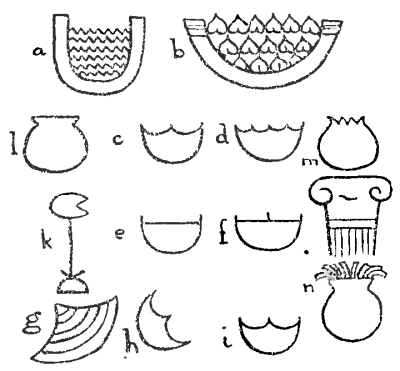
Fig. 6.
(a) Picture of a bowl of water—the hieroglyphic sign equivalent to
hm (the word hmt means "woman")—Griffith, "Beni Hasan," Part III,
Plate VI, Fig. 88 and p. 29.
(b) "A basket of sycamore figs"—Wilkinson's "Ancient Egyptians," Vol.
I, p. 323.
(c) and (d) are said by Wilkinson to be hieroglyphic signs meaning
"wife" and are apparently taken from (b). But (c) is identical with
(i), which, according to Griffith (p. 14), represents a bivalve shell
(g, from Plate III, Fig. 3), more usually placed obliquely (h). The
varying conventionalizations of (a) or (b) are shown in (d),
(e), and (f) (Griffith, "Hieroglyphics," p. 34).
(k) The sign for a lotus leaf, which is a phonetic equivalent of the
sign (h), and, according to Griffith ("Hieroglyphics," p. 26), "is
probably derived from the same root, on account of its shell-like
outline".
(l) The hieroglyphic sign for a pot of water in such words as Nu and
Nut.
(m) A "pomegranate" (replacing a bust of Tanit) upon a sacred column
at Carthage (Arthur J. Evans, "Mycenæan Tree and Pillar Cult," p. 46).
(n) The form of the body of an octopus as conventionalized on the
coins of Central Greece (compare Fig. 24 (d)). Its similarity to the
Egyptian pot-sign (l) (which also has the significance of
mother-goddess) is worthy of note.
Referring to the sign (g and h) for "a shell," Mr. Griffith says (p.
25): "It is regularly found at all periods in the word
ḫaw·t=altar,[334] and perhaps only in this word: but it is a
peculiarity of the Pyramid Texts that the sign shown in the text-figures
c, h, and i is in them used very commonly, not as a word-sign, but
also as a phonetic equivalent to the sign labelled k (in the
text-figure) for ḫ' (kha), or apparently for ḫ alone in many
words.
"The name of the lotus leaf is probably derived from the same root, on
account of its shell-like outline or vice versa."
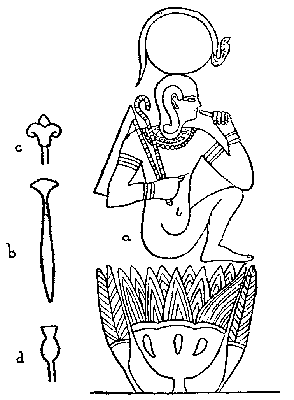
Fig. 7.
(a) An Egyptian design representing the sun-god Horus emerging from a
lotus, representing his mother Hathor (Isis).
(b) Papyrus sceptre often carried by goddesses and animistically
identified with them either as an instrument of life-giving or
destruction.
(c) Conventionalized lily—the prototype of the trident and the
thunder-weapon.
(d) A water-plant associated with the Nile-gods.
The familiar representation of Horus (and his homologues in India and
elsewhere) being born from the lotus suggests that the flower represents
his mother Hathor. But as the argument in these pages has led us towards
the inference that the original form of Hathor was a shell-amulet,[335]
it seems not unlikely that her identification with the lotus may have
arisen from the confusion between the latter and the cowry, which no
doubt was also in part due to the belief that both the shell and the
plant were expressions of the vital powers of the water in which they
developed.
The identification of the Great Mother with a pot was one of the factors
that played a part in the assimilation of her attributes with those of
the Water God, who in early Sumerian pictures was usually represented
pouring the life-giving waters from his pot (Fig. 24, h and l).
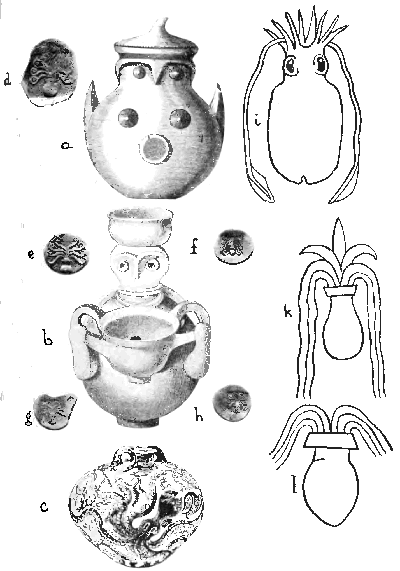
Fig. 24.
(a) and (b) Two Mycenæan pots (after Schliemann).
(a) The so-called "owl-shaped" vase is really a representation of the
Mother-Pot in the form of a conventionalized Octopus (Houssay).
(b) The other vase represents the Octopus Mother-Pot, with a jar upon
her head and another in her hands—a three-fold representation of the
Great Mother as a pot.
(c) A Cretan vase from Gournia in which the Octopus-motive is
represented as a decoration upon the pot instead of in its form.
(d), (e), (f), (g), and (h) A series of coins from Central
Greece (after Head) showing a series of conventionalizations of the
Octopus, with its pot-like body and palm-tree-like arms (f).
(i) Sepia officinalis (after Tryon).
(k) and (l) The so-called "spouting vases" in the hands of the
Babylonian god Ea, from a cylinder seal of the time of Gudea, Patesi of
Tello, after Ward ("Seal Cylinders, etc.," p. 215).
The "spouting vases" have been placed in conjunction with the Sepia to
suggest the possibility of confusion with a conventionalized drawing of
the latter in the blending of the symbolism of the water-jar and
cephalopods in Western Asia and the Mediterranean.
This idea of the Mother Pot is found not only in Babylonia, Egypt,
India,[336] and the Eastern Mediterranean, but wherever the influence of
these ancient civilizations made itself felt. It is widespread among the
Celtic-speaking peoples. In Wales the pot's life-giving powers are
enhanced by making its rim of pearls. But as the idea spread, its
meaning also became extended. At first it was merely a jug of water or a
basket of figs, but elsewhere it became also a witch's cauldron, the
magic cup, the Holy Grail, the font in which a child is reborn into the
faith, the vessel of water here being interpreted in the earliest sense
as the uterus or the organ of birth. The Celtic pot, so Mr. Donald
Mackenzie tells me, is closely associated with cows, serpents, frogs,
dragons, birds, pearls, and "nine maidens that blow the fire under the
cauldron"; and, if the nature of these relationships be examined, each
of them will be found to be a link between the pot and the Great Mother.
The witch's cauldron and the maidens who assist in the preparation of
the witch's medicine seem to be the descendants respectively of Hathor's
pots (in the story of the Destruction of Mankind) and the Sekti who
churn up the didi and the barley with which to make the elixir of
immortality and the sedative draught for the destructive goddess
herself.
Mr. Donald Mackenzie has given me a number of additional references from
Celtic and Indian literature in corroboration of these widespread
associations of the pot with the Great Mother; and he reminds me that in
Oceania the coco-nut has the same reputation as the pot in the Indian
Mahābhārata. It is the source of food and anything else that is
wanted, and its supply can never be exhausted. [On some future occasion
I hope to make use of the wonderful legends of the pot's life-giving
powers, to which Mr. Mackenzie has directed my attention. At present,
however, I must content myself with the statement that the pot's
identity with the Great Mother is deeply rooted in ancient belief
throughout the greater part of the world.[337]]
The diverse conceptions of the Great Mother as a pot and as an octopus
seem to have been blended in Mycenæan lands, where the so-called
"owl-shaped" pots were clearly intended to represent the goddess in both
these aspects united in one symbol. When the diffusion of these ideas
into more remote parts of the world took place syntheses with other
motives produced a great variety of most complex forms. In Honduras
pottery vessels have been found[338] which give tangible expression to
the blending of the ideas of the Mother Pot, the crocodile-like
Makara, star-spangled like Hathor's cow, Aphrodite's pig, and Soma's
deer, and provided with the deer's antlers of the Eastern Asiatic dragon
(see Chapter II, p. 103).
The New Testament sets forth the ancient conception of birth and
rebirth. When Nicodemus asks: "How can a man be born again when he is
old? Can he enter a second time into his mother's womb, and be born?" he
is told: "Except a man be born of water and of the spirit, he cannot
enter into the kingdom of God. That which is born of the flesh is flesh:
and that which is born of the spirit is spirit" (John iii. 4, 5, and 6).
The phrase "born of water" refers to the birth "of the flesh"; and the
mother's womb is the vessel containing "the water" from which the new
life emerges. Plutarch states, with reference to the birth of Isis:
"τετάρτη δε την Ἴσιν ἐν πανυγροις γενέσθαι". The great waters
which produced all living things, the Egyptian god Nun and the goddess
Nut, were expressed in hieroglyphic as pots of water. The goddess was
identified with Hathor's celestial star-spangled cow, the original
mother of the sun-god; and the word "Nun" was a symbol of all that was
new, young, and fresh, and the fertilizing and life-giving waters of the
annual inundation of the Nile. Hathor was the daughter of these waters,
as Aphrodite was sprung from the sea-foam.
Sir Gardner Wilkinson states (see text-figure, p. 179, b) that "a
basket of sycamore figs" was originally the hieroglyphic sign for a
woman, a goddess, or a mother. Later on (p. 199) I shall refer to the
possible bearing of this Egyptian idea upon the origin of the Hebrew
word for mandrakes and the allusion to "a basket of figs" in the Book of
Jeremiah.
The life-giving powers attributed to "love-apples" and the association
of these ideas with the fig-tree may have facilitated the transference
of these attributes of "apples" to those actually growing upon a tree.
We know that Aphrodite was intimately associated, not only with
"love-apples," but also with real apples. The sun-god Apollo's connexion
with the apple-tree, which Dr. Rendel Harris, with great daring, wants
to convert into an identity of name, was probably only one of the
results of that long series of confusions between the Great Mother
(Hathor) and the Sun-god (Horus), to which I have referred in my
discussion of the dragon-story.
But when Apollo's form emerges more clearly he is associated not with
Aphrodite but with Artemis, whom Dr. Rendel Harris has shown to be
identified with the mugwort, Artemisia. The association of the goddess
with this plant is probably related to the identification of Sekhet with
the marsh-plants of the Egyptian Delta and of Hathor and Isis with the
lotus and other water plants. Any doubt as to the reality of these
associations and Egyptian connexions is banished by the evidence of
Artemis's male counterpart Apollo Hyakinthos and his relations to the
sacred lily and other water plants.[339] Artemis was a gynæcological
specialist: for she assisted women not only in childbirth and the
expulsion of the placenta, but also in cases of amenorrhœa and
affections of the uterus. She was regarded as the goddess of the portal,
not merely of birth,[340] but also of gold and treasure, of which she
possessed the key, and of the year (January).
This brings us back to the guardianship of gold and treasures which
plays so vital a part in the evolution of the Mediterranean goddesses.
For, like the story of the dog and the mandrake, it emphasizes the
conchological ancestry of these deities and their connexion with the
guardians of the subterranean palaces where pearls are found. But
Artemis was not only the opener of the treasure-houses, but she also
possessed the secret of the philosopher's stone: she could transmute
base substances into gold,[341] for was she not the offspring of the
Golden Hathor? To open the portal either of birth or wealth she used her
magic wand or key. As Nūb, the lady of gold, the Great Mother could
not only change other substances into gold, but she was also the
guardian of the treasure house of gold, pearls, and precious stones.
Hence she could grant riches. Elsewhere in this chapter (p. 221) I shall
explain how the goddess came to be identified with gold.
Just as Hathor, the Eye of Re, descended to provide the elixir of youth
for the king who was the sun-god, so Artemis is described as
travelling through the air in a car drawn by two serpents[342] seeking
the most pious of kings in order that she might establish her cult with
him and bless him with renewed youth.[343]
Artemis was a moon-goddess closely related to Britomartis and Diktynna,
the Cretan prototype of Aphrodite. These goddesses afforded help to
women in childbirth and were regarded as guardians of the portal. The
goddess of streams and marshes was identified with the mugwort
(Artemisia), which was hung above the door in the place occupied at
other times by the winged disk, the thunder-stone, or a crocodile
(dragon). As the guardian of portals Artemis's magic plant could open
locks and doors. As the giver of life she could also withhold the vital
essence and so cause disease or death; but she possessed the means of
curing the ills she inflicted. Artemis, in fact, like all the other
goddesses, was a witch.
In former lectures[344] I have often discussed the remarkable feature of
Egyptian architecture, which is displayed in the tendency to exaggerate
the door-posts and lintels, until in the New Empire the great temples
become transformed into little more than monstrously overgrown doorways
or pylons. I need not emphasize again the profound influence exerted by
this line of development upon the Dravidian temples of India and the
symbolic gateways of China and Japan.
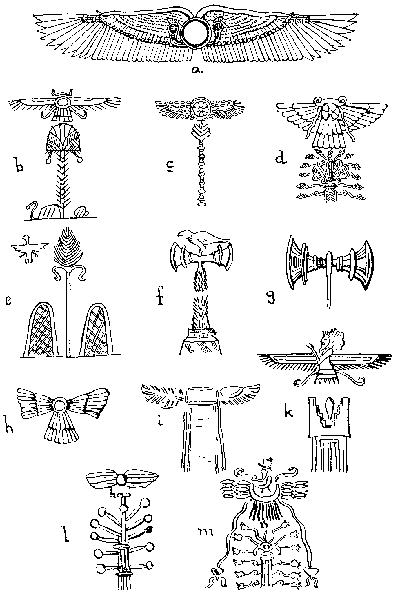
Fig. 25.
(a) Winged Disk from the Temple of Thothmes I.
(b) Persian design of Winged Disk above the Tree of Life (Ward, "Seal
Cylinders of Western Asia," Fig. 1109).
(c) Assyrian or Syro-Hittite design of the Winged Disk and Tree of
Life in an extremely conventionalized form (Ward, Fig. 1310).
(d) Assyrian conventionalized Winged Disk and Tree of Life, from the
design upon the dress of Assurnazipal (Ward, Fig. 670).
(e) Part of the design from a tablet of the time of Dungi (Ward, Fig.
663). The Tree of Life (or the Great Mother) between the two mountains:
alongside the tree is the heraldic eagle.
(f) Design on a Cretan sarcophagus from Hagia Triada (Blinkenberg,
Fig. 9). The Tree of Life has now become the handle of the Double Axe,
into which the Winged Disk has been transformed. But the bird which was
the prototype of the Winged Disk has been added.
(g) Double axe from a gold signet from Acropolis Treasure, Mycenæ
(after Sir Arthur Evans, "Mycenæan Tree and Pillar Cult," p. 10).
(h) Assyrian Winged Disk (Ward, Fig. 608) showing reduplication of the
wing-pattern, possibly suggesting the doubling of each axe-blade in g.
(i) "Primitive Chaldean Winged Gate" (Ward, Fig. 349). The Gate as the
Goddess of the Portal.
(k) Persian Winged Disk (Ward, Fig. 1144) above a fire-altar in the
form suggestive of the mountains of dawn (compare Fig. 26, c).
(l) An Assyrian Tree of Life and Winged Disk crudely conventionalized
(Ward, Fig. 695).
(m) Assyrian Tree of Life and "Winged Disk" in which the god is riding
in a crescent replacing the Disk (Ward, Fig. 695).
This significance of gates was no doubt suggested by the idea that they
represented the means of communication between the living and the dead,
and, symbolically, the portal by which the dead acquired a rebirth into
a new form of existence. It was presumably for this reason that the
winged disk as a symbol of life-giving, was placed above the lintels of
these doors, not merely in Egypt, Phœnicia, the Mediterranean Area,
and Western Asia, but also in America,[345] and in modified forms in
India, Indonesia, Melanesia, Cambodia, China, and Japan.
The discussion (Chapter II) of the means by which the winged disk came
to acquire the power of life-giving, "the healing in its wings," will
have made it clear that the sun became accredited with these virtues
only when it assumed the place of the other "Eye of Re," the Great
Mother. In fact, it was a not uncommon practice in Egypt to represent
the eyes of Re or of Horus himself in place of the more usual winged
disk. In the Ægean area the original practice of representing the Great
Mother was retained long after it was superseded in Egypt by the use of
the winged disk (the sun-god).
Over the lintel of the famous "Lion Gate" at Mycenæ, instead of the
winged disk, we find a vertical pillar to represent the Mother Goddess,
flanked by two lions which are nothing more than other representatives
of herself (Fig. 26).
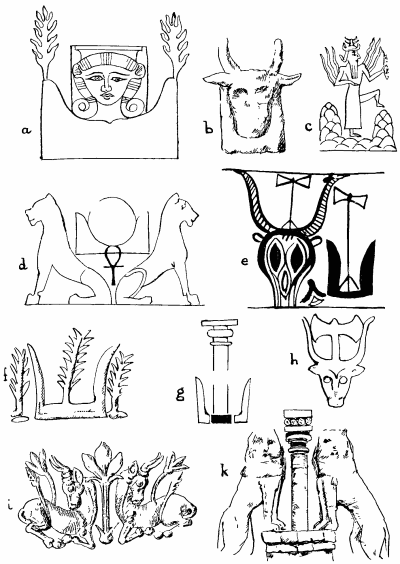
Fig. 26.
(a) An Egyptian picture of Hathor between the mountains of the horizon
(on which trees are growing) (after Budge, "Gods of the Egyptians," Vol.
II, p. 101). [This is a part only of a scene in which the goddess Nut is
giving birth to the sun, whose rays illuminate Hathor on the horizon, as
Sothis, the "Opener of the Way" for the sun.
(b) The mountains of the horizon supporting a cow's head as a
surrogate of Hathor, from a stele found at Teima in Northern Arabia, now
in the Louvre (after Sir Arthur Evans, op. cit., p. 39). This
indicates the identity of what Evans calls "the horns of consecration"
and the "mountains of the horizon," and also suggests how confusion may
have arisen between the mountains and the cow's horns.
(c) The Mesopotamian sun-god Shamash rising between the Eastern
Mountains, the Gates of Dawn (Ward, op. cit., p. 373).
(d) The familiar Egyptian representation of the sun rising between the
Eastern Mountains (the splitting of the mountain giving birth to "the
ridiculous mouse"—Smintheus). The ankh (life-sign) below the sun is
the determinative of the act of giving birth or life. The design is
heraldically supported by the Great Mother's lionesses.
(e) Part of the design from a Mycenæan vase from Old Salamis (after
Evans, p. 9). The cow's head and the Eastern Mountains are shown
alongside one another, each of them supporting the Double Axe
representing the god.
(f) Part of the design from a lentoid gem from the Idæan Cave, now in
the Candia Museum (after Evans, Fig. 25). If this design be compared
with the Egyptian picture (a), it will be seen that Hathor's place is
taken by the tree-form of the Great Mother, and the trees which in the
former (a) are growing upon the Eastern Mountains are now placed
alongside the "horns". In the complete design (vide Evans, op. cit.,
p. 44) a votary is represented blowing a conch-shell trumpet to animate
the deity in the sacred tree.
(g) The Eastern Mountains supporting the pillar-form of the goddess
(after Evans, Fig. 66).
(h) Another Mycenæan design comparable with (e).
(i) Design from a signet-ring from Mycenæ (after Evans, Fig. 34). If
this be compared with the Egyptian picture (a) it will be noted that
the Great Mother is now replaced by a tree: the Eastern Mountains by
bulls, from whose backs the trees of the Eastern Mountains are
sprouting. This design affords interesting corroboration of the
suggestion that the Eastern Mountains may be confused with the cow's
head (see b and c) or with the cow itself. Newberry (Annals of
Archæology and Anthropology, Liverpool, Vol. I, p. 28) has called
attention to the intimate association (in Protodynastic Egypt) of the
Eastern Mountains, the Bull and the Double Axe—a certain token of
cultural contact with Crete.
(k) The famous sculpture above the Lion Gate at Mycenæ. The pillar
form of the Great Mother heraldically supported by her lioness-avatars,
which correspond to the cattle of the design (i) and the Eastern
Mountains of (a). The use of this design above the lintel of the gate
brings it into homology with the Winged Disk. The Pillar represents the
Goddess, as the Disk represents her Egyptian locum tenens, Horus; her
destructive representatives (the lionesses) correspond to the two uræi
of the Winged Disk design.
In his "Mycenæan Tree and Pillar Cult," Sir Arthur Evans has shown that
all possible transitional forms can be found (in Crete and the Ægean
area) between the representation of the actual goddess and her pillar-
and tree-manifestations, until the stage is reached where the sun itself
appears above the pillar between the lions.[346] In the large series of
seals from Mesopotamia and Western Asia which have been described in Mr.
William Hayes Ward's monograph,[347] we find manifold links between both
the Egyptian and the Minoan cults.
The tree-form of the Great Mother there becomes transformed into the
"tree of life" and the winged disk is perched upon its summit. Thus we
have a duplication of the life-giving deities. The "tree of life" of the
Great Mother surmounted by the winged disk which is really her surrogate
or that of the sun-god, who took over from her the power of life-giving
(Figs. 25 and 26).
In an interesting Cretan sarcophagus from Hagia Triada[348] the
life-giving power is tripled. There is not only the tree representing
the Great Mother herself; but also the double axe (the winged-disk
homologue of the sun-god); and the more direct representation of him as
a bird perched upon the axe (Fig. 25, f).
The identification of the Great Mother with the tree or pillar seems
also to have led to her confusion with the pestle with which the
materials for her draught of immortality was pounded. She was also the
bowl or mortar in which the pestle worked.[349]
As the Great Mother became confused with the pestle, so, "the
Soma-plant, whose stalks are crushed by the priests to make the
Soma-libation, becomes in the Vedas itself the Crusher or Smiter, by a
very characteristic and frequent Oriental conceit in accordance with
which the agent and the person or thing acted on are identified".[350]
"The pressing-stones by means of which Soma is crushed typify
thunderbolts." "In the Rig-Veda, we read of him [Soma] as
jyotihrathah, i.e. 'mounted on a car of light' (IX, 5, 86, verse
43); or again: 'Like a hero he holds weapons in his hand ... mounted on
a chariot' (IX, 4, 76, verse 2)"—(p. 171).
"Soma was the giver of power, of riches and treasures, flocks and herds,
but above all, the giver of immortality" (p. 140).
Sir Arthur Evans is of opinion "that in the case of the Cypriote
cylinders the attendant monsters and, to a certain extent, the symbolic
column itself, are taken from an Egyptian solar cycle, and the inference
has been drawn that the aniconic pillars among the Mycenæans of Cyprus
were identified with divinities having some points in common with the
sun-gods Ra, or Horus, and Hathor, the Great Mother" (op. cit., pp. 63
and 64).
In attempting to find some explanation of how the tree or pillar of the
goddess came to be replaced in the Indian legend by Mount Meru, the
possibility suggests itself whether the aniconic form of the Great
Mother placed between two relatively diminutive hills may not have
helped, by confusion, to convert the cone itself into a yet bigger hill,
which was identified with Mount Meru, the summit of which in other
legends produced the amrita of the gods, either in the form of the
soma plant that grew upon its heights, or the rain clouds which
collected there. But, as the subsequent argument will make clear, the
real reason for the identification of the Great Mother with a mountain
was the belief that the sun was born from the splitting of the eastern
mountain, which thus assumed the function of the sun-god's mother.
Possibly the association of the tops of mountains with cloud- and
rain-phenomena and the gods that controlled them played some part in
the development of the symbolism of mountains. [When I referred (in
Chapter II, p. 98) to the fact that what Sir Arthur Evans calls "the
horns of consecration" was primarily the split mountain of the dawn, I
was not aware that Professor Newberry ("Two Cults of the Old Kingdom,"
Annals of Archæology and Anthropology, Liverpool, Vol. I, 1908, p. 28)
had already suggested this identification.]
In the Egyptian story the god Re instructed the Sekti of Heliopolis to
pound the materials for the food of immortality. In the Indian version,
the gods, aware of their mortality, desired to discover some elixir
which would make them immortal. To this end, Mount Meru [the Great
Mother] was cast into the sea [of milk]. Vishnu, in his second avatar as
a tortoise[351] supported the mountain on his back; and the Nâga serpent
Vasuki was then twisted around the mountain, the gods seizing its head
and the demons his tail twirled the mountain until they had churned the
amrita or water of life. Wilfrid Jackson has called attention to the
fact that this scene has been depicted, not only in India and Japan, but
also in the Precolumbian Codex Cortes drawn by some Maya artist in
Central America.[352]
The horizon is the birthplace of the gods; and the birth of the deity is
depicted with literal crudity as an emergence from the portal between
its two mountains. The mountain splits to give birth to the sun-god,
just as in the later fable the parturient mountain produced the
"ridiculous mouse" (Apollo Smintheus). The Great Mother is described as
giving birth—"the gates of the firmament are undone for Teti himself at
break of day" [that is when the sun-god is born on the horizon]. "He
comes forth from the Field of Earu" (Egyptian Pyramid Texts—Breasted's
translation).
In the domain of Olympian obstetrics the analogy between birth and the
emergence from the door of a house or the gateway of a temple is a
common theme of veiled reference. Artemis, for instance, is a goddess of
the portal, and is not only a helper in childbirth, but also grows in
her garden a magical herb which is capable of opening locks. This
reputation, however, was acquired not merely by reason of her skill in
midwifery, but also as an outcome of the legend[353] of the
treasure-house of pearls which was under the guardianship of the great
"giver of life" and of which she kept the magic key. She was in fact
the feminine form of Janus, the doorkeeper who presided over all
beginnings, whether of birth, or of any kind of enterprise or new
venture, or the commencement of the year (like Hathor). Janus was the
guardian of the door of Olympus itself, the gate of rebirth into the
immortality of the gods.
The ideas underlying these conceptions found expression in an endless
variety of forms, material, intellectual, and moral, wherever the
influence of civilization made itself felt. I shall refer only to one
group of these expressions that is directly relevant to the
subject-matter of this book. I mean the custom of suspending or
representing the life-giving symbol above the portal of temples and
houses. Thus the plant peculiar to Artemis herself, the mugwort or
Artemisia, was hung above the door,[354] just as the winged disk was
sculptured upon the lintel, or the thunder-stone was placed above the
door of the cowhouse[355] to afford the protection of the Great Mother's
powers of life-giving to her own cattle.
In the Pyramid Texts the rebirth of a dead pharaoh is described with
vivid realism and directness. "The waters of life which are in the sky
come. The waters of life which are in the earth come. The sky burns for
thee, the earth trembles for thee, before the birth of the god. The two
hills are divided, the god comes into being, the god takes possession of
his body. The two hills are divided, this Neferkere comes into being,
this Neferkere takes possession of his body. Behold this Neferkere—his
feet are kissed by the pure waters which are from Atum, which the
phallus of Shu made, which the vulva of Tefnut brought into being. They
have come, they have brought for thee the pure waters from their
father."[356]
The Egyptians entertained the belief[357] that the sun-god was born of
the celestial cow Mehetwēret, a name which means "Great Flood," and
is the equivalent of the primeval ocean Nun. In other words the
celestial cow Hathor, the embodiment of the life-giving waters of heaven
and earth, is the mother of Horus. So also Aphrodite was born of the
"Great Flood" which is the ocean.
In his report upon the hieroglyphs of Beni Hasan,[358] Mr. Griffith
refers to the picture of "a woman of the marshes," which is read
sekht, and is "used to denote the goddess Sekhet, the goddess of the
marshes, who presided over the occupations of the dwellers there. Chief
among these occupations must have been the capture of fish and fowl and
the culture and gathering of water-plants, especially the papyrus and
the lotus". Sekhet was in fact a rude prototype of Artemis in the
character depicted by Dr. Rendel Harris.[359]
It is perhaps not without significance that the root of a marsh plant,
the Iris pseudacorus[360] is regarded in Germany as a luck-bringer
which can take the place of the mandrake.[361]
The Great Mother wields a magic wand which the ancient Egyptian scribes
called the "Great Magician". It was endowed with the two-fold powers of
life-giving and opening, which from the beginning were intimately
associated the one with the other from the analogy of the act of birth,
which was both an opening and a giving of life. Hence the "magic wand"
was a key or "opener of the ways," wherewith, at the ceremonies of
resurrection, the mouth was opened for speech and the taking of food, as
well as for the passage of the breath of life, the eyes were opened for
sight, and the ears for hearing. Both the physical act of opening (the
"key" aspect) as well as the vital aspect of life-giving (which we may
call the "uterine" aspect) were implied in this symbolism. Mr. Griffith
suggests that the form of the magic wand may have been derived from that
of a conventionalized picture of the uterus,[362] in its aspect as a
giver of life. But it is possible also that its other significance as an
"opener of the ways" may have helped in the confusion of the
hieroglyphic uterus-symbol with the key-symbol, and possibly also with
double-axe symbol which the vaguely defined early Cretan Mother-Goddess
wielded. For, as we have already seen (supra, p. 122), the axe also
was a life-giving divinity and a magic wand (Fig. 8).
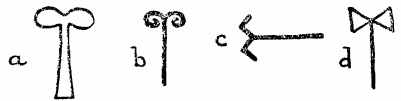
Fig. 8.
(a) "Ceremonial forked object," or "magic wand," used in the ceremony
of "opening the mouth," possibly connected with (b) (a bicornuate
uterus), according to Griffith ("Hieroglyphics," p. 60).
(c) The Egyptian sign for a key.
(d) The double axe of Crete and Egypt.
In his chapter on "the Origin of the Cult of Artemis," Dr. Rendel Harris
refers to the reputation of Artemis as the patron of travellers, and to
Parkinson's statement: "It is said of Pliny that if a traveller binde
some of the hearbe [Artemisia] with him, he shall feele no weariness at
all in his journey" (p. 72). Hence the high Dutch name Beifuss is
applied to it.
The left foot of the dead was called "the staff of Hathor" by the
Egyptians; and the goddess was said "to make the deceased's legs to
walk".[363]
It was a common practice to tie flowers to a mummy's feet, as I
discovered in unwrapping the royal mummies. According to Moret (op.
cit.) the flowers of Upper and Lower Egypt were tied under the king's
feet at the celebration of the Sed festival.
Mr. Battiscombe Gunn (quoted by Dr. Alan Gardiner) states that the
familiar symbol of life known as the ankh represents the string of a
sandal.[364]
It seems to be worth considering whether the symbolism of the
sandal-string may not have been derived from the life-girdle, which in
ancient Indian medical treatises was linked in name with the female
organs of reproduction and the pubic bones. According to Moret (op.
cit., p. 91) a girdle furnished with a tail was used as a sign of
consecration or attainment of the divine life after death. Jung (op.
cit., p. 270), who, however, tries to find a phallic meaning in all
symbolism, claims that reference to the foot has such a significance.
We have now given reasons for believing that the personification of the
mandrake was in some way brought about by the transference to the plant
of the magical virtues that originally belonged to the cowry shell.
The problem that still awaits solution is the nature of the process by
which the transference was effected.
When I began this investigation the story of the Destruction of Mankind
(see Chapter II) seemed to offer an explanation of the confusion.
Brugsch, Naville, Maspero, Erman, and in fact most Egyptologists, seemed
to be agreed that the magical substance from which the Egyptian elixir
of life was made was the mandrake. As there was no hint[365] in the
Egyptian story of the derivation of its reputation from the fancied
likeness to the human form, its identification with Hathor seemed to be
merely another instance of those confusions with which the pathway of
mythology is so thickly strewn. In other words, the plant seemed to have
been used merely to soothe the excited goddess: then the other
properties of "the food of the gods," of which it was an ingredient,
became transferred to the mandrake, so that it acquired the reputation
of being a "giver of life" as well as a sedative. If this had been true
it would have been a simple process to identify this "giver of life"
with the goddess herself in her rôle as the "giver of life," and her
cowry-ancestor which was credited with the same reputation.
But this hypothesis is no longer tenable, because the word d'd'
(variously transliterated doudou or didi), which Brugsch[366] and
his followers interpreted as "mandragora," is now believed to have
another meaning.
In a closely reasoned memoir, Henri Gauthier[367] has completely
demolished Brugsch's interpretation of this word. He says there are
numerous instances of the use of d'd' (which he transliterates
doudouiou) in the medical papyri. In the Ebers papyrus "doudou
d'Eléphantine broyé" is prescribed as a remedy for external application
in diseases of the heart, and as an astringent and emollient dressing
for ulcers. He says the substance was brought to Elephantine from the
interior of Africa and the coasts of Arabia.
Mr. F. Ll. Griffith informs me that Gauthier's criticism of the
translation "mandrakes" is undoubtedly just: but that the substance
referred to was most probably "red ochre" or "hæmatite".[368]
The relevant passage in the Story of the Destruction of Mankind (in Seti
I's tomb) will then read as follows: "When they had brought the red
ochre, the Sekti of Heliopolis pounded it, and the priestesses mixed the
pulverized substance with the beer, so that the mixture resembled human
blood".
I would call special attention to Gauthier's comment that the
blood-coloured beer "had some magical and marvellous property which is
unknown to us".[369]
In his dictionary Brugsch considered the determinative  to
refer to the fruits of a tree which he called "apple tree," on the
supposed analogy with the Coptic ϫιϫι, fructus autumnalis,
pomus, the Greek ὀπώρα; and he proposed to identify the
supposed fruit, then transliterated doudou, with the Hebrew doudaïm,
and translate it poma amatoria, mandragora, or in German, Alraune.
This interpretation was adopted by most scholars until Gauthier raised
objections to it.
to
refer to the fruits of a tree which he called "apple tree," on the
supposed analogy with the Coptic ϫιϫι, fructus autumnalis,
pomus, the Greek ὀπώρα; and he proposed to identify the
supposed fruit, then transliterated doudou, with the Hebrew doudaïm,
and translate it poma amatoria, mandragora, or in German, Alraune.
This interpretation was adopted by most scholars until Gauthier raised
objections to it.
As Loret and Schweinfurth have pointed out, the mandrake is not found in
Egypt, nor in fact in any part of the Nile Valley.[370]
But what is more significant, the Greeks translated the Hebrew
dūdā'im by μανδράγορας and the Copts did not use the
word ϫιϫι in their translations, but either the Greek word or a
term referring to its sedative and soporific properties. Steindorff has
shown (Zeitsch. f. Ægypt. Sprache, Bd. XXVII, 1890, p. 60) that the
word in dispute would be more correctly transliterated "didi" instead
of "doudou".
Finally, in a letter Mr. Griffith tells me the identification of didi
with the Coptic ϫιϫι, "apple (?)" is philologically impossible.
Although this red colouring matter is thus definitely proved not to be
the fruit of a plant, there are reasons to suggest that when the story
of the Destruction of Mankind spread abroad—and the whole argument of
this book establishes the fact that it did spread abroad—the substance
didi was actually confused in the Levant with the mandrake. We have
already seen that in the Delta a prototype of Artemis was already
identified with certain plants.
In all probability didi was originally brought into the Egyptian
legend merely as a surrogate of the life-blood, and the mixture of which
it was an ingredient was simply a restorer of youth to the king. But the
determinative (in the tomb of Seti I)—a little yellow disc with a red
border, which misled Naville into believing the substance to be yellow
berries—may also have created confusion in the minds of ancient
Levantine visitors to Egypt, and led them to believe that reference was
being made to their own yellow-berried drug, the mandrake. Such an
incident might have had a two-fold effect. It would explain the
introduction into the Egyptian story of the sedative effects of didi,
which would easily be rationalized as a means of soothing the maniacal
goddess; and in the Levant it would have added to the real properties of
mandrake[371] the magical virtues which originally belonged to didi
(and blood, the cowry, and water).
In my lecture on "Dragons and Rain Gods" (Chapter II) I explained that
the Egyptian story of the Destruction of Mankind is merely one version
of a saga of almost world-wide currency. In many of the non-Egyptian
versions[372] the rôle of didi in the Egyptian story is taken by some
vegetable product of a red colour; and many of these versions reveal
a definite confusion between the red fruit and the red clay, thus
proving that the confusion of didi with the mandrake is no mere
hypothetical device to evade a difficulty on my part, but did actually
occur.
In the course of the development of the Egyptian story the red clay from
Elephantine became the colouring matter of the Nile flood, and this in
turn was rationalized as the blood or red clay into which the bodies of
the slaughtered enemies of Re were transformed,[373] and the material
out of which the new race of mankind was created.[374] In other words,
the new race was formed of didi. There is a widespread legend that the
mandrake also is formed from the substance of dead bodies[375] often
represented as innocent or chaste men wrongly killed, just as the red
clay was the substance of mankind killed to appease Re's wrath, "the
blood of the slaughtered saints".[376]
But the original belief is found in a more definite form in the ancient
story that "the mandrake was fashioned out of the same earth whereof God
formed Adam".[377] In other words the mandrake was part of the same
substance as the earth didi.[378]
Further corroboration of this confusion is afforded by a story from
Little Russia, quoted by de Gubernatis.[379] If bryony (a widely
recognized surrogate of mandrake) be suspended from the girdle all the
dead Cossacks (who, like the enemies of Re in the Egyptian story, had
been killed and broken to pieces in the earth) will come to life again.
Thus we have positive evidence of the homology of the mandrake with red
clay or hæmatite.
The transference to the mandrake of the properties of the cowry (and the
goddesses who were personifications of the shell) and blood (and its
surrogates) was facilitated by the manifold homologies of the Great
Mother with plants. We have already seen that the goddess was identified
with: (a) incense-trees and other trees, such as the sycamore, which
played some definite part in the burial ceremonies, either by providing
the divine incense, the materials for preserving the body, or for making
coffins to ensure the protection of the dead, and so make it possible
for them to continue their existence; and (b) the lotus, the lily,
the iris, and other marsh plants,[380] for reasons that I have already
mentioned (p. 184).
The Babylonian poem of Gilgamesh represents one of the innumerable
versions of the great theme which has engaged the attention of writers
in every age and country attempting to express the deepest longings of
the human spirit. It is the search for the elixir of life. The object of
Gilgamesh's search is a magic plant to prolong life and restore youth.
The hero of the story went on a voyage by water in order to obtain what
appears to have been a marsh plant called dittu.[381] The question
naturally arises whether this Babylonian story and the name of the plant
played any part in Palestine in blending the Egyptian and Babylonian
stories and confusing the Egyptian elixir of life, the red earth didi,
with the Babylonian elixir, the plant dittu?
In the Babylonian story a serpent-demon steals the magic plant, just as
in India soma, the food of immortality, is stolen. In Egypt Isis
steals Re's name,[382] and in Babylonia the Zu bird steals the tablets
of destiny, the logos. In Greek legend apples are stolen from the
garden of Hesperides. Apples are surrogates of the mandrake and didi.
We have now seen that the mandrake is definitely a surrogate (a) of
the cowry and a series of its shell-homologues, and (b) of the red
substance in the Story of the Destruction of Mankind.
There still remain to be determined (i) the means by which the mandrake
became identified with the goddess, (ii) the significance of the Hebrew
word dūdā-īm, and (iii) the origin of the Greek word
mandragora.
The answer to the first of these three queries should now be obvious
enough. As the result of the confusion of the life-giving magical
substance didi with the sedative drug, mandrake, the latter acquired
the reputation of being a "giver of life" and became identified with
the "giver of life," the Great Mother, the story of whose exploits was
responsible for the confusion.
The erroneous identification of didi with the mandrake was originally
suggested by Brugsch from the likeness of the word (then transliterated
doudou) with the Hebrew word dūdā-īm in Genesis, usually
translated "mandrakes". I have already quoted the opinion of Gauthier
and Griffith as to the error of such identification. But the evidence
now at our disposal seems to me to leave no doubt as to the reality of
the confusion of the Egyptian red substance with the mandrake. This
naturally suggests the possibility that the similarity of the sounds of
the words may have played some part in creating the confusion: but it
is impossible to admit this as a factor in the development of the story,
because the Hebrew word probably arose out of the identification of the
mandrake with the Great Mother and not by any confusion of names. In
other words the similarity of the names of these homologous substances
is a mere coincidence.
Dr. Rendel Harris claims (and Sir James Frazer seems to approve of the
suggestion) that the Hebrew word dūdā-īm was derived from
dōdīm, "love"; and, on the strength of this derivation, he soars
into a lofty flight of philological conjecture to transmute
dōdīm, into Aphrodite, "love" into the "goddess of love". It
would be an impertinence on my part to attempt to follow these
excursions into unknown heights of cloudland.
But my colleagues Professor Canney and Principal Bennett tell me that
the derivation of dūdā-īm from dōdīm is improbable;
and the former authority suggests that dūdā-īm may be merely
the plural of dūd, a "pot".[383] Now I have already explained how a
pot came to symbolize a woman or a goddess, not merely in Egypt, but
also in Southern India, and in Mycenæan Greece, and, in fact, the
Mediterranean generally.[384] Hence the use of the term dūd for the
mandrake implies either (a) an identification of the plant with the
goddess who is the giver of life, or (b) an analogy between the form
of the mandrake-fruit and a pot, which in turn led to it being called a
pot, and from that being identified with the goddess.[385]
I should explain that when Professor Canney gave me this statement he
was not aware of the fact that I had already arrived at the conclusion
that the Great Mother was identified with a pot and also with the
mandrake; but in ignorance of the meaning of the Hebrew words I had
hesitated to equate the pot with the mandrake. As soon as I received his
note, and especially when I read his reference to the second meaning,
"basket of figs," in Jeremiah, I recalled Mr. Griffith's discussion of
the Egyptian hieroglyphic ("a pot of water") for woman, wife, or
goddess, and the claim made by Sir Gardner Wilkinson that this manner of
representing the word for "wife" was apparently taken from a
conventionalized picture of "a basket of sycamore figs".[386] The
interpretation has now clearly emerged that the mandrake was called
dūdā'īm by the Hebrews because it was identified with the
Mother Pot. The symbolism involved in the use of the Hebrew word also
suggests that the inspiration may have come from Egypt, where a woman
was called "a pot of water" or "a basket of figs".
When the mandrake acquired the definite significance as a symbol of the
Great Mother and the power of life-giving, its fruit, "the love apple,"
became the quintessence of vitality and fertility. The apple and the
pomegranate became surrogates of the "love apple," and were graphically
represented in forms hardly distinguishable from pots, occupying places
which mark them out clearly as homologues of the Great Mother
herself.[387]
But once the mandrake was identified with the Great Mother in the Levant
the attributes of the plant were naturally acquired from her local
reputation there. This explains the pre-eminently conchological aspect
of the magical properties of the mandrake and the bryony.
I shall not attempt to refer in detail to the innumerable stories of red
and brown apples, of rowan berries, and a variety of other red fruits
that play a part in the folk-lore of so many peoples, such as didi
played in the Egyptian myth. These fruits can be either elixirs of life
and food of the gods, or weapons for overcoming the dragon as Hathor
(Sekhet) was conquered by her sedative draught.[388]
In his account of the peony, Pliny ("Nat. Hist.," Book XXVIII, Chap. LX)
says it has "a stem two cubits in length, accompanied by two or three
others, and of a reddish colour, with a bark like that of the laurel ...
the seed is enclosed in capsules, some being red and some black ... it
has an astringent taste. The leaves of the female plant smell like
myrrh". Bostock and Riley, from whose translation I have made this
quotation, add that in reality the plant is destitute of smell. In the
Ebers papyrus didi was mixed with incense in one of the
prescriptions;[389] and in the Berlin medical papyrus it was one of the
ingredients of a fumigation used for treating heart disease. If my
contention is justified, it may provide the explanation of how the
confusion arose by which the peony came to have attributed to it a
"smell like myrrh".
Pliny proceeds: "Both plants [i.e. male and female] grow in the woods,
and they should always be taken up at night, it is said; as it would be
dangerous to do so in the day-time, the woodpecker of Mars being sure to
attack the person so engaged.[390] It is stated also that the person,
while taking up the root, runs great risk of being attacked with
[prolapsus ani].... Both plants are used[391] for various purposes: the
red seed, taken in red wine, about fifteen in number, arrest
menstruation; while the black seed, taken in the same proportion, in
either raisin or other wine, are curative of diseases of the uterus." I
refer to these red-coloured beverages and their therapeutic use in
women's complaints to suggest the analogy with that other red drink
administered to the Great Mother, Hathor.
In his essay, "Jacob and the Mandrakes,"[392] Sir James Frazer has
called attention to the homologies between the attributes of the peony
and the mandrake and to the reasons for regarding the former as Aelian's
aglaophotis.
Pliny states ("Nat. Hist.," Book XXIV, Chap. CII) that the
aglaophotis "is found growing among the marble quarries of Arabia, on
the side of Persia," just as the Egyptian didi was obtained near the
granite quarries at Aswan. "By means of this plant [aglaophotis],
according to Democritus, the Magi can summon the deities into their
presence when they please, "just as the users of the conch-shell trumpet
believed they could do with this instrument. I have already (p. 196)
emphasized the fact that all of these plants, mandrake, bryony, peony,
and the rest, were really surrogates of the cowry, the pearl, and the
conch-shell. The first is the ultimate source of their influence on
womankind, the second the origin of their attribute of aglaophotis,
and the third of their supposed power of summoning the deity. The
attributes of some of the plants which Pliny discusses along with the
peony are suggestive. Pieces of the root of the achaemenis (? perhaps
Euphorbia antiquorum or else a night-shade) taken in wine, torment the
guilty to such an extent in their dreams as to extort from them a
confession of their crimes. He gives it the name also of "hippophobas,"
it being an especial object of terror to mares. The complementary story
is told of the mandrake in mediæval Europe. The decomposing tissues of
the body of an innocent victim on the gallows when they fall upon the
earth can become reincarnated in a mandrake—the main de gloire of old
French writers.
Then there is the plant adamantis, grown in Armenia and Cappadocia,
which when presented to a lion makes the beast fall upon its back, and
drop its jaws. Is this a distorted reminiscence of the
lion-manifestation of Hathor who was calmed by the substance didi? A
more direct link with the story of the destruction of mankind is
suggested by the account of the ophiusa, "which is found in
Elephantine, an island of Ethiopia". This plant is of a livid colour,
and hideous to the sight. Taken by a person in drink, it inspires such a
horror of serpents, which his imagination continually represents as
menacing him that he commits suicide at last: hence it is that persons
guilty of sacrilege are compelled to drink an infusion of it (Pliny,
"Nat. Hist.," XXIV, 102). I am inclined to regard this as a variant of
the myth of the Destruction of Mankind in which the "snake-plant" from
Elephantine takes the place of the uræi of the Winged Disk Saga, and
punishes the act of sacrilege by driving the delinquent into a state of
delirium tremens.
The next problem to be considered is the derivation of the word
mandragora. Dr. Mingana tells me it is a great puzzle to discover any
adequate meaning. The attempt to explain it through the Sanskrit mand,
"joy," "intoxication," or mantasana, "sleep," "life," or mandra,
"pleasure," or mantara, "paradise tree," and agru, "unmarried,
violently passionate," is hazardous and possibly far-fetched.
The Persian is mardumgiah, "man-like plant".
The Syro-Arabic word for it is Yabrouh, Aramaic Yahb-kouh, "giver of
life". This is possibly the source of the Chinese Yah-puh-lu (Syriac
ya-bru-ha) and Yah-puh-lu-Yak. The termination Yak is merely the
Turanian termination meaning "diminutive".
The interest of the Levantine terms for the mandrake lies in the fact
that they have the same significance as the word for pearl, i.e.
"giver of life". This adds another argument (to those which I have
already given) for regarding the mandrake as a surrogate of the pearl.
But they also reveal the essential fact that led to the identification
of the plant with the Mother-Goddess, which I have already discussed.
In Arabic the mandrake is called abou ruhr, "father of life," i.e.
"giver of life".[393]
In Arabic margan means "coral" as well as "pearl". In the
Mediterranean area coral is explained as a new and marvellous plant
sprung from the petrified blood-stained branches on which Perseus hung
the bleeding head of Medusa. Eustathius ("Comment. ad Dionys. Perieget."
1097) derives κοράλιον from κόρη, personifying the
monstrous virgin: but Chæroboscos claims that it comes from κόρη
and ἄλιον, because it is a maritime product used to make
ornaments for maidens. In any case coral is a "giver of life" and as
such identified with a maiden,[394] as the most potential embodiment of
life-giving force. But this specific application of the word for "giver
of life" was due to the fact that in all the Semitic languages, as well
as in literary references in the Egyptian Pyramid Texts, this phrase was
understood as a reference to the female organs of reproduction. The
same double entendre is implied in the use of the Greek word for "pig"
and "cowry," these two surrogates of the Great Mother, each of which can
be taken to mean the "giver of life" or the "pudendum muliebre".
Perhaps the most plausible suggestion that has been made as to the
derivation of the word "mandragora" is Delâtre's claim[395] that it is
compounded of the words mandros, "sleep," and agora, "object or
substance," and that mandragora means "the sleep-producing substance".
This derivation is in harmony with my suggestion as to the means by
which the plant acquired its magical properties. The sedative substance
that, in the Egyptian hieroglyphs (of the Story of the Destruction of
Mankind), was represented by yellow spheres with a red covering was
confused in Western Asia with the yellow-berried plant which was known
to have sedative properties. Hence the plant was confused with the
mineral and so acquired all the magical properties of the Great Mother's
elixir. But the Indian name is descriptive of the actual properties of
the plant and is possibly the origin of the Greek word.
Another suggestion that has been made deserves some notice. It has been
claimed that the first syllable of the name is derived from the Sanskrit
mandara, one of the trees in the Indian paradise, and the instrument
with which the churning of the ocean was accomplished.[396] The mandrake
has been claimed to be the tree of the Hebrew paradise; and a connexion
has thus been instituted between it and the mandara. This hypothesis,
however, does not offer any explanation of how either the mandrake or
the mandara acquired its magical attributes. The Indian tree of life
was supposed to "sweat" amrita just as the incense trees of Arabia
produce the divine life-giving incense.
But there are reasons[397] for the belief that the Indian story of the
churning of the sea of milk is a much modified version of the old
Egyptian story of the pounding of the materials for the elixir of life.
The mandara churn-stick, which is often supposed to represent the
phallus,[398] was originally the tree of life, the tree or pillar which
was animated by the Great Mother herself.[399] So that the mandara is
homologous with the mandragora. But so far as I am aware, there is no
adequate reason for deriving the latter word from the former.
The derivation from the Sanskrit words mandros and agora seems to
fit naturally into the scheme of explanation which I have been
formulating.
In the Egyptian story the Sekti of Heliopolis pounded the didi in a
mortar to make "the giver of life," which by a simple confusion might be
identified with the goddess herself in her capacity as "the giver of
life". This seems to have occurred in the Indian legend. Lakshmi, or
Sri, was born at the churning of the ocean. Like Aphrodite, who was born
from the sea-foam churned from the ocean, Lakshmi was the goddess of
beauty, love, and prosperity.
Before leaving the problems of mandrake and the homologous plants and
substances, it is important that I should emphasize the rôle of blood
and blood-substitutes, red-stained beer, red wine, red earth, and red
berries in the various legends. These life-giving and death-dealing
substances were all associated with the colour red, and the destructive
demons Sekhet and Set were given red forms, which in turn were
transmitted to the dragon, and to that specialized form of the dragon
which has become the conventional way of representing Satan.
[The whole of the mandrake legend spread to China and became attached to
the plants ginseng and shang-luh—see de Groot, Vol. II, p. 316 et
seq.; also Kumagusu Minakata, Nature, Vol. LI, April 25, 1895, p.
608, and Vol. LIV, Aug. 13, 1896, p. 343. The fact that the Chinese
make use of the Syriac word yabruha (vide supra) suggests the source
of these Chinese legends.]
It was the similarity of the periodic phases of the moon and of
womankind that originally suggested the identification of the Great
Mother with the moon, and originated the belief that the moon was the
regulator of human beings.[400] This was the starting-point of the
system of astrology and the belief in Fates. The goddess of birth and
death controlled and measured the lives of mankind.
But incidentally the moon determined the earliest subdivision of time
into months; and the moon-goddess lent the sanctity of her divine
attributes to the number twenty-eight.
The sun was obviously the determiner of day and night, and its rising
and setting directed men's attention to the east and the west as
cardinal points intimately associated with the daily birth and death of
the sun. We have no certain clue as to the factors which first brought
the north and the south into prominence. But it seems probable that the
direction of the river Nile,[401] which was the guide to the orientation
of the corpse in its grave, may have been responsible for giving special
sanctity to these other cardinal points. The association of the
direction of the deceased's head with the position of the original
homeland and the eventual home of the dead would have made the south a
"divine" region in Predynastic times. For similar reasons the north may
have acquired special significance in the Early Dynastic period.[402]
When the north and the south were added to the other two cardinal points
the intimate association of the east and the west with the measurement
of time would be extended to include all the four cardinal points.[403]
Four became a sacred number associated with time-measurement, and
especially with the sun.[404]
Many other factors played a part in the establishment of the sanctity
of the number four. Professor Lethaby has suggested[405] that the
four-sided building was determined by certain practical factors, such as
the desirability of fashioning a room to accommodate a woven mat, which
was necessarily of a square or oblong form. But the study of the
evolution of the early Egyptian grave and tomb-superstructures suggests
that the early use of slabs of stone, wooden boards, and mud-bricks
helped in the process of determining the four-sided form of house and
room.
When, out of these rude beginnings, the vast four-sided pyramid was
developed, the direction of its sides was brought into relationship with
the four cardinal points; and there was a corresponding development and
enrichment of the symbolism of the number four. The form of the divine
house of the dead king, who was the god, was thus assimilated to the
form of the universe, which was conceived as an oblong area at the four
corners of which pillars supported the sky, as the four legs supported
the Celestial Cow.
Having invested the numbers four and twenty-eight with special sanctity
and brought them into association with the measurement of time, it was a
not unnatural proceeding to subdivide the month into four parts and so
bring the number seven into the sacred scheme. Once this was done the
moon's phases were used to justify and rationalize this procedure, and
the length of the week was incidentally brought into association with
the moon-goddess, who had seven avatars, perhaps originally one for
each day of the week. At a later period the number seven was arbitrarily
brought into relationship with the Pleiades.
The seven Hathors were not only mothers but fates also. Aphrodite was
chief of the fates.
The number seven is associated with the pots used by Hathor's
priestesses at the celebration inaugurating the new year; and it plays a
prominent part in the Story of the Flood. In Babylonia the sanctity of
the number received special recognition. When the goddess became the
destroyer of mankind, the device seems to have been adopted of
intensifying her powers of destruction by representing her at times as
seven demons.[406]
But the Great Mother was associated not only with the week and month but
also with the year. The evidence at our disposal seems to suggest that
the earliest year-count was determined by the annual inundation of the
river. The annual recurrence of the alternation of winter and summer
would naturally suggest in a vague way such a subdivision of time as the
year; but the exact measurement of that period and the fixing of an
arbitrary commencement, a New Year's day, were due to other reasons. In
the Story of the Destruction of Mankind it is recorded that the incident
of the soothing of Hathor by means of the blood-coloured beer (which, as
I have explained elsewhere,[407] is a reference to the annual Nile
flood) was celebrated annually on New Year's day.
Hathor was regarded in tradition as the cause of the inundation. She
slaughtered mankind and so caused the original "flood": in the next
phase she was associated with the 7000 jars of red beer; and in the
ultimate version with the red-coloured river flood, which in another
story was reputed to be "the tears of Isis".
Hathor's day was in fact the date of the commencement of the inundation
and of the year; and the former event marked the beginning of the year
and enabled men for the first time to measure its duration. Thus
Hathor[408] was the measurer of the year, the month, and the week; while
her son Horus (Chronus) was the day-measurer.
In Tylor's "Early History of Mankind" (pp. 352 et seq.) there is a
concise summary of some of the widespread stories of the Fountain of
Youth which restores youthfulness to the aged who drank of it or bathed
in it. He cites instances from India, Ethiopia, Europe, Indonesia,
Polynesia, and America. "The Moslem geographer, Ibn-el-Wardi, places the
Fountain of Life in the dark south-western regions of the earth" (p.
353).
The star Sothis rose heliacally on the first day of the Egyptian New
Year.[409] Hence it became "the second sun in heaven," and was
identified with the goddess of the New Year's Day. The identification of
Hathor with this "second sun"[410] may explain why the goddess is said
to have entered Re's boat. She took her place as a crown upon his
forehead, which afterwards was assumed by her surrogate, the
fire-spitting uræus-serpent. When Horus took his mother's place in the
myth, he also entered the sun-god's boat, and became the prototype of
Noah seeking refuge from the Flood in the ship the Almighty instructed
him to make.
In memory of the beer-drinking episode in the Destruction of Mankind,
New Year's Day was celebrated by Hathor's priestesses in wild orgies of
beer drinking.
This event was necessarily the earliest celebration of an anniversary,
and the prototype of all the incidents associated with some special day
in the year which have been so many milestones in the historical
progress of civilization.
The first measurement of the year also naturally forms the
starting-point in the framing of a calendar.
Similar celebrations took place to inaugurate the commencement of the
year in all countries which came, either directly or indirectly, under
Egyptian influence.
The month Ἀφροδίσια (so-called from the festival of the
goddess) began the calendar of Bithynia, Cyprus, and Iasos, just as
Hathor's feast was a New Year's celebration in Egypt.
In the celebration of these anniversaries the priestesses of Aphrodite
worked themselves up in a wild state of frenzy; and the term ὑστήρια[411]
became identified with the state of emotional derangement
associated with such orgies. The common belief that the term "hysteria"
is derived directly from the Greek word for uterus is certainly
erroneous. The word ὑστήρια was used in the same sense as
Ἀφροδίσια, that is as a synonym for the festivals of the
goddess. The "hysteria" was the name for the orgy in celebration of the
goddess on New Year's day: then it was applied to the condition produced
by these excesses; and ultimately it was adopted in medicine to apply to
similar emotional disturbances. Thus both the terms "hysteria" and
"lunacy"[412] are intimately associated with the earliest phases in the
moon-goddess's history; and their survival in modern medicine is a
striking tribute to the strong hold of effete superstition in this
branch of the diagnosis and treatment of disease.[413]
I have already referred to the association of Artemis with the portal of
birth and rebirth. As the guardian of the door her Roman representative
Diana and her masculine avatar Dianus or Janus gave the name to the
commencement of the year. The Great Mother not only initiated the
measurement of the year, but she (or her representative) lent her name
to the opening of the year in various countries.
But the story of the Destruction of Mankind has preserved the record not
only of the circumstances which were responsible for originating the
measurement of the year and the making of a calendar, but also of the
materials out of which were formed the mythical epochs preserved in the
legends of Greece and India and many other countries further removed
from the original centre of civilization. When the elaboration of the
early story involved the destruction of mankind, it became necessary to
provide some explanation of the continued existence of man upon the
earth. This difficulty was got rid of by creating a new race of men from
the fragments of the old or from the clay into which they had been
transformed (supra, p. 196). In course of time this secondary
creation became the basis of the familiar story of the original
creation of mankind. But the story also became transformed in other
ways. Different versions of the process of destruction were blended into
one narrative, and made into a series of catastrophes and a succession
of acts of creation. I shall quote (from Mr. T. A. Joyce's "Mexican
Archæology," p. 50) one example of these series of mythical epochs or
world ages to illustrate the method of synthesis:—
When all was dark Tezcatlipoca transformed himself into the sun to give
light to men.
1. This sun terminated in the destruction of mankind, including a race
of giants, by jaguars.
2. The second sun was Quetzalcoatl, and his age terminated in a terrible
hurricane, during which mankind was transformed into monkeys.
3. The third sun was Tlaloc, and the destruction came by a rain of
fire.
4. The fourth was Chalchintlicue, and mankind was finally destroyed by a
deluge, during which they became fishes.
The first episode is clearly based upon the story of the lioness-form of
Hathor destroying mankind: the second is the Babylonian story of Tiamat,
modified by such Indian influences as are revealed in the Ramayana:
the third is inspired by the Saga of the Winged Disk; and the fourth by
the story of the Deluge.
Similar stories of world ages have been preserved in the mythologies of
Eastern Asia, India, Western Asia, and Greece, and no doubt were derived
from the same original source.
I have already referred to the magical significance attached to the
number seven and the widespread references to the seven Hathors, the
seven winds to destroy Tiamat, the seven demons, and the seven fates.
In the story of the Flood there is a similar insistence on the
seven-fold nature of many incidents of good and ill meaning in the
narrative. But the dragon with this seven-fold power of wreaking
vengeance came to be symbolized by a creature with seven heads.
A Japanese story told in Henderson's notes to Campbell's "Celtic Dragon
Myth"[414] will serve as an introduction to the seven-headed monster:—
"A man came to a house where all were weeping, and learned that the last
daughter of the house was to be given to a dragon with seven or
eight[415] heads who came to the sea-shore yearly to claim a victim. He
went with her, enticed the dragon to drink sake from pots set out on
the shore, and then he slew the monster. From the end of his tail he
took out a sword, which is supposed to be the Mikado's state sword. He
married the maiden, and with her got a jewel or talisman which is
preserved with the regalia. A third thing of price so preserved is a
mirror."
The seven-headed dragon is found also in the Scottish dragon-myth, and
the legends of Cambodia, India, Persia, Western Asia, East Africa, and
the Mediterranean area.
The seven-headed dragon probably originated from the seven Hathors. In
Southern India the Dravidian people seem to have borrowed the Egyptian
idea of the seven Hathors. "There are seven Mari deities, all sisters,
who are worshipped in Mysore. All the seven sisters are regarded vaguely
as wives or sisters of Siva."[416] At one village in the Trichinopoly
district Bishop Whitehead found that the goddess Kālīamma was
represented by seven brass pots, and adds: "It is possible that the
seven brass pots represent seven sisters or the seven virgins sometimes
found in Tamil shrines" (p. 36). But the goddess who animates seven
pots, who is also the seven Hathors, is probably well on the way to
becoming a dragon with seven heads.
There is a close analogy between the Swahili and the Gaelic stories that
reveals their ultimate derivation from Babylonia. In the Scottish story
the seven-headed dragon comes in a storm of wind and spray. The East
African serpent comes in a storm of wind and dust.[417] In the
Babylonian story seven winds destroy Tiamat.
"The famous legend of the seven devils current in antiquity was of
Babylonian origin, and belief in these evil spirits, who fought against
the gods for the possession of the souls and bodies of men, was
widespread throughout the lands of the Mediterranean basin. Here is one
of the descriptions of the seven demons:—
"Of the seven the first is the south wind....
"The second is a dragon whose open mouth....
"The third is a panther whose mouth spares not.
"The fourth is a frightful python....
"The fifth is a wrathful ... who knows no turning back.
"The sixth is an on-rushing ... who against god and king [attacks].
"The seventh is a hurricane, an evil wind which [has no mercy].
"The Babylonians were inconsistent in their description of the seven
devils, describing them in various passages in different ways. In fact
they actually conceived of a very large number of these demons, and
their visions of the other evil spirits are innumerable. According to
the incantation of Shamash-shum-ukin fifteen evil spirits had come into
his body and
"'My God who walks at my side they drove away.'
"The king calls himself 'the son of his God'. We have here the most
fundamental doctrines of Babylonian theology, borrowed originally from
the religious beliefs of the Sumerians. For them man in his natural
condition, at peace with the gods and in a state of atonement, is
protected by a divine spirit whom they conceived of as dwelling in their
bodies along with their souls or 'the breath of life'. In many ways the
Egyptians held the same doctrine, in their belief concerning the
ka[418] or the soul's double. According to the beliefs of the
Sumerians and Babylonians these devils, evil spirits, and all evil
powers stand for ever waiting to attach (sic) (? attack) the divine
genius with each man. By means of insinuating snares they entrap mankind
in the meshes of their magic. They secure possession of his soul and
body by leading him into sin, or bringing him into contact with tabooed
things, or by overcoming his divine protector with sympathetic
magic.... These adversaries of humanity thus expel a man's god, or
genius, or occupy his body. These rituals of atonement have as their
primary object the ejection of the demons and the restoration of the
divine protector. Many of the prayers end with the petition, 'Into the
kind hands of his god and goddess restore him'.
"Representations of the seven devils are somewhat rare.... The Brit.
Mus. figurine represents the demon of the winds with body of a dog,
scorpion tail, bird legs and feet" (S. Langdon, "A Ritual of Atonement
for a Babylonian King," The Museum Journal [University of
Pennsylvania], Vol. VIII, No. 1, March, 1917, pp. 39-44).
But the Babylonians not only adopted the Egyptian conception of the
power of evil as being seven demons, but they also seem to have fused
these seven into one, or rather given the real dragon seven-fold
attributes.[419]
In "The Cuneiform Inscriptions of Western Asia"[420] (British Museum),
Marduk's weapon is compared to "the fish with seven wings".
The god himself is represented as addressing it in these words: "The
tempest of battle, my weapon of fifty heads, which like the great
serpent of seven heads is yoked with seven heads, which like the strong
serpent of the sea (sweeps away) the foe".
In the Japanese story which I have quoted, the number of the dragon's
heads is given as seven or eight; and de Visser is at a loss to know
why "the number eight should be stereotyped in these stories of
[Japanese] dragons".[421]
I have already emphasized the world-wide association of the
seven-headed dragon with storms. The Argonaut (usually called
"Nautilus" by classical scholars) was the prophet of ill-luck and the
storm-bringer: but, true to the paradox that runs through the whole
tissue of mythology, this form of the Great Mother is also a benevolent
warner against storms. This seems to be another link between the
seven-headed dragon and these cephalopoda.
I would suggest, merely as a tentative working hypothesis, that the
process of blending the seven avatars of the dragon into a
seven-headed dragon may have been facilitated by its identification with
the Pterocera and the octopus. We know that the octopus and the
shell-fish were forms assumed by the dragon (see p. 172): the confusion
between the numbers seven and eight is such as might have been created
during the transference of the Pterocera's attributes to the octopus
(vide supra, p. 170); and the Babylonian reference to "the fish with
seven wings," which was afterwards rationalized into "a great serpent
with seven heads," seems to provide the clue which explains the origin
of the seven-headed dragon. If Hathor was a seven-fold goddess and at
the same time was identified with the seven-spiked spider-shell
(Pterocera), the process of converting the shell-fish's seven "wings"
into seven heads would be a very simple one for an ancient story-teller.
If this hypothesis has any basis in fact, the circumstance that the
beliefs concerning the Pterocera must (from the habitat of the
shell-fish) have come into existence upon the shores of Southern Arabia
would explain the appearance of the derived myth of the seven-headed
dragon in Babylonia.
My attention was first called to the possibility of the octopus being
the parent of the seven-headed dragon, and one of the forms assumed by
the thunderbolt, by the design upon a krater from Apulia.[422] The
weapon seemed to be a conventionalization of the octopus. Though further
research has led me to distrust this interpretation, it has convinced me
of the intimate association of the octopus and the derived spiral
ornament with thunder and the dragon, and has suggested that the process
of blending the seven demons into a seven-headed demon has been assisted
by the symbolism of the octopus and the Pterocera.
I have already referred to the circumstances that were responsible for
the identification of the cow with the Great Mother, the sky, and the
moon. Once this had happened, the process seems to have been extended to
include other animals which were used as food, such as the sheep, goat,
pig, and antelope (or gazelle and deer). In Egypt the cow continued to
occupy the pre-eminent place as a divine animal; and the cow-cult
extended from the Mediterreanean to equatorial Africa, to Western
Europe, and as far East as India. But in the Mediterranean area the pig
played a more prominent part than it did in Egypt.[423] In the latter
country Osiris, Isis, and especially Set, were identified with the pig;
and in Syria the place of Set as the enemy of Osiris (Adonis) was taken
by an actual pig. But throughout the Eastern Mediterranean the pig was
also identified with the Great Mother and associated with lunar and sky
phenomena. In fact at Troy the pig was represented[424] with the
star-shaped decorations with which Hathor's divine cow (in her rôle as a
sky-goddess) was embellished in Egypt. To complete the identification
with the cow-mother Cretan fable represents a sow suckling the infant
Minos or the youthful Zeus-Dionysus as his Egyptian prototype was
suckled by the divine cow.
Now the cowry-shell was called χοῖρος by the Greeks. The pig,
in fact, was identified both with the Great Mother and the shell; and it
is clear from what has been said already in these pages that the reason
for this strange homology was the fact that originally the Great Mother
was nothing more than the cowry-shell.
But it was not only with the shell itself that the pig was identified
but also with what the shell symbolized. Thus the term χοῖρος
had an obscene significance in addition to its usual meaning "pig" and
its acquired meaning "cowry". This fact seems to have played some part
in fixing upon the pig the notoriety of being "an unclean animal".[425]
But it was mainly for other reasons of a very different kind that the
eating of swine-flesh was forbidden. The tabu seems to have arisen
originally because the pig was a sacred animal identified with the Great
Mother and the Water God, and especially associated with both these
deities in their lunar aspects.
According to a Cretan legend the youthful god Zeus-Dionysus was suckled
by a sow. For this reason "the Cretans consider this animal sacred, and
will not taste of its flesh; and the men of Præsos perform sacred rites
with the sow, making her the first offering at the sacrifice".[426]
But when the pig also assumed the rôle of Set, as the enemy of Osiris,
and became the prototype of the devil, an active aversion took the place
of the sacred tabu, and inspired the belief in the unwholesomeness of
pig flesh. To this was added the unpleasant reputation as a dirty animal
which the pig itself acquired, for the reasons which I have already
stated.
I have already referred to the irrelevance of Miss Jane Harrison's
denial of the birth of Aphrodite from the sea (p. 141). Miss Harrison
does not seem to have realized that in her book[427] she has collected
evidence which is much more relevant to the point at issue. For, in the
interesting account of the Eleusinian Mysteries (pp. 150 et seq.), she
has called attention to the important rite upon the day "called in
popular parlance 'ἄλαδε μύσται,' 'to the sea ye mystics'" (p.
152), which, I think, has a direct bearing upon the myth of Aphrodite's
birth from the sea.
The Mysteries were celebrated at full moon; and each of the candidates
for admission "took with him his own pharmakos,[428] a young pig".
"Arrived at the sea, each man bathed with his pig" (p. 152). On one
occasion, so it is said, "when a mystic was bathing his pig, a
sea-monster ate off the lower part of his body" (p. 153). So important
was the pig in this ritual "that when Eleusis was permitted
(b.c. 350-327) to issue her autonomous coinage it is the pig
she chooses as the sign and symbol of her mysteries" (p. 153).
"On the final day of the Mysteries, according to Athenæus, two vessels
called plemochoæ are emptied, one towards the East and the other
towards the West, and at the moment of outpouring a mystic formulary
was pronounced.... What the mystic formulary was we cannot certainly
say, but it is tempting to connect the libation of the plemochoæ with
a formulary recorded by Proclos. He says 'In the Eleusinian mysteries,
looking up to the sky they cried aloud "Rain," and looking down to earth
they cried "Be fruitful"'" (p. 161).
In these latter incidents we see, perhaps, a distant echo of Hathor's
pots of blood-coloured beer that were poured out upon the soil, which in
a later version of the story became the symbol of the inundation of the
river and the token of the earth's fruitfulness. The personification in
the Great Mother of these life-giving powers of the river occurred at
about the same time; and this was rationalized by the myth that she was
born of the sea. She was also identified with the moon and a sow. Hence
these Mysteries were celebrated, both in Egypt and in the Mediterranean,
at full moon, and the pig played a prominent part in them. The
candidates washed the sacrificial pig in the sea, not primarily as a
rite of purification,[429] as is commonly claimed, but because the
sacrificial animal was merely a surrogate of the cowry, which lived in
the sea, and of the Great Mother,[430] who was sprung from the cowry and
hence born of the sea. In the story of the man carrying the pig being
attacked by a sea-monster, perhaps we have an incident of that
widespread story of the shark guarding the pearls. We have already seen
how it was distorted into the fantastic legend of the dog's rôle in the
digging up of mandrakes. In the version we are now considering the
pearl's place is taken by the pig, both of them surrogates of the cowry.
The object of the ceremony of carrying the pig into the sea was not the
cleansing of "the unclean animal," nor was it primarily a rite of
purification in any sense of the term: it was simply a ritual procedure
for identifying the sacrifice with the goddess by putting it in her own
medium, and so transforming the surrogate of the sea-shell, the
prototype of the sea-born goddess, into the actual Great Mother.
The question naturally arises: what was the real purpose of the
sacrifice of the pig?
In the story of the Destruction of Mankind we have seen that originally
a human victim was slain for the purpose of obtaining the life-giving
human blood to rejuvenate the ageing king. Two circumstances were
responsible for the modification of this procedure. In the first place,
there was the abandonment of human sacrifice and the substitution of
either beer coloured red with ochre to resemble blood (or in other cases
red wine) or the actual blood of an animal sacrifice in place of the
human blood. Secondly, the blood of the Great Mother herself
(personified in the special avatar that was recognized in a particular
locality, the cow in one place, the pig in another, and so on) was
regarded as more potent as a life-giving force than that of a mere
mortal human being. It is possible, perhaps even probable, that this was
the real reason for the abandoning of human sacrifice and the
substitution of an animal for a human being. For it is unlikely that, in
the rude state of society which had become familiarized with and
brutalized by the practice of these bloody rites of homicide, ethical
motives alone would have prompted the abolition of the custom of human
sacrifice, to which such deep significance was attached. The
substitution of the animal was prompted rather by the idea of obtaining
a more potent elixir from the life-blood of the Great Mother herself in
her cow- or sow-forms.
In the transitional stage of the process of substitution of an animal
for a human being some confusion seems to have arisen as to the ritual
meaning of the new procedure. If Moret's account of the Egyptian
Mysteries[431] is correct—and without a knowledge of Egyptian philology
I am not competent to express an opinion upon this matter—the attempt
was made to identify the animal victim of sacrifice with the human being
whose place it had taken. In the procession a human being wore the skin
of an animal; and, according to Moret, there was a ceremony of passing a
human being through the skin as a ritual procedure for transforming the
mock victim into the animal which was to be sacrificed in his place. If
there is any truth in this interpretation, such a ceremony must have
been prompted by a misunderstanding of the meaning of the sacrifice,
unless the identification of the sacrificial animal with the goddess was
merely a secondary rationalization of the substitution which had been
made for ethical or some other reasons.
We know that the dead were often buried in the skins of sacrificial
animals, and so identified with the life-giving deities and given
rebirth. We know also that in certain ceremonies the appropriate skins
were worn by those who were impersonating particular gods or goddesses.
The wearing of these skins of divine animals seems to have been prompted
not so much by the idea of a reincarnation in animal form as by the
desire for identification and communion with the particular deity which
the animal represented. The whole question, however, is one of great
complexity, which can only be settled by a critical study of the texts
by some scholar who keeps clearly before his mind the real issues, and
refuses to take refuge in the stereotyped evasions of conventional
methods of interpretation.
The sacrifice of the sow to Demeter is merely a late variant of Hathor's
sacrifice of a human being to rejuvenate the king Re. How the real
meaning of the story became distorted I have already explained in
Chapter II ("Dragons and Rain Gods"). The killing of the sow to obtain a
good harvest is homologous with the sacrifice of a maiden to obtain a
good inundation of the river. The sow is the surrogate of the beautiful
princess of the fairy tale. Instead of the maiden being slain, in one
case, as Andromeda, she is rescued by the hero, in the other her place
is taken by a sow. These late rationalizations are merely glosses of the
deep motives which more than fifty centuries ago seem to have prompted
early pharmacologists to obtain a more potent elixir than human blood by
stealing from the heights of Olympus the divine blood of the life-giving
deities themselves.
The pig was identified not only with the Great Mother, but with Osiris
and Set also. With the pig's lunar and astral associations I do not
propose to deal in these pages, as the astronomical aspects of the
problems are so vast as to need much more space than the limits imposed
in this statement. But it is important to note that the identification
of Set with a pig was perhaps the main factor in riveting upon this
creature the fetters of a reputation for evil. The evil dragon was the
representative of both Set and the Great Mother (Sekhet or Tiamat); and
both of them were identified with the pig. Just as Set killed Osiris, so
the pig gave Adonis his mortal injury.[432] When these earthly incidents
were embellished with a celestial significance, the conflict of Horus
with Set was interpreted as the struggle between the forces of light and
order and the powers of darkness and chaos. When worshipped as a
tempest-god the Mesopotamian Rimmon was known as "the pig"[433] and, as
"the wild boar of the desert," was a form of Set.
I have discussed the pig at this length because the use of the words
χοῖρος by the Greeks, and porcus and porculus by the
Romans, reveals the fact that the terms had the double significance of
"pig" and "cowry-shell". As it is manifestly impossible to derive the
word "cowry" from the Greek word for "pig," the only explanation that
will stand examination is that the two meanings must have been acquired
from the identification of both the cowry and the pig with the Great
Mother and the female reproductive organs. In other words, the
pig-associations of Aphrodite afford clear evidence that the goddess was
originally a personification of the cowry.[434]
The fundamental nature of the identification of the cowry, the pig, and
the Great Mother, the one with the other, is revealed not merely in the
archæology of the Ægean, but also in the modern customs and ancient
pictures of the most distant peoples. For example, in New Guinea the
place of the sacrificial pig may be taken by the cowry-shell;[435] and
upon the chief façade of the east wing of the ancient American monument,
known as the Casa de las Monjas at Chichen Itza, the hieroglyph of the
planet Venus is placed in conjunction with a picture of a wild pig.[436]
The evidence which has been collected by Mr. Wilfrid Jackson seems to
suggest that the shell-cults originated in the neighbourhood of the Red
Sea.
With the introduction of the practice of wearing shells on girdles and
necklaces and as hair ornaments the time arrived when people living some
distance from the sea experienced difficulty in obtaining these amulets
in quantities sufficient to meet their demands. Hence they resorted to
the manufacture of imitations of these shells in clay and stone. But at
an early period in their history the inhabitants of the deserts between
the Nile and the Red Sea (Hathor's special province) discovered that
they could make more durable and attractive models of cowries and other
shells by using the plastic yellow metal which was lying about in these
deserts unused and unappreciated. This practice first gave to the metal
gold an arbitrary value which it did not possess before. For the
peculiar life-giving attributes of the shells modelled in the yellow
metal came to be transferred to the gold itself. No doubt the lightness
and especially the beauty of such gold models appealed to the early
Egyptians, and were in large measure responsible for the hold gold
acquired over mankind. But this was an outcome of the empirical
knowledge gained from a practice that originally was inspired purely by
cultural and not æsthetic motives. The earliest Egyptian hieroglyphic
sign for gold was a picture of a necklace of such amulets; and this
emblem became the determinative of the Great Mother Hathor, not only
because she was originally the personification of the life-giving
shells, but also because she was the guardian deity both of the Eastern
wadys where the gold was found and of the Red Sea coasts where the
cowries were obtained. Hence she became the "Golden Hathor," the
prototype of the "Golden Aphrodite".
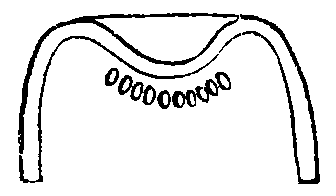
Fig. 9.—The Egyptian emblem for gold, the sign
nub. It represents a collar from which golden amulets, probably
representing cowries, are suspended.
It is a significant token of the influence of these Egyptian incidents
upon the history of the Ægean that among the earliest gold ornaments
found by Schliemann at Troy were a series of crude representations of
cowries worn as pendants to a hair ornament.[437]
It is hardly necessary to insist upon the vast influence upon the
history of civilization which this arbitrary value of gold has been
responsible for exerting. For more than fifty centuries men have been
searching for the precious metal, and have been spreading abroad
throughout the world the elements of our civilization. It has been not
only the chief factor in bringing about the contact of peoples[438] and
incidentally in building up our culture, but it has been the cause,
directly or indirectly, of most of the warfare which has afflicted
mankind. Yet these mighty forces were let loose upon the world as the
result of the circumstance that early searchers for an elixir of life
used the valueless metal to make imitations of their shell amulets!
The identification of gold with cowries may not have been the primary
reason for the invention of gold currency. In fact, Professor Ridgeway
has called attention to certain historical events which in his opinion
forced men to convert their jewellery into coinage. But the fact that
cowries were the earliest form of currency may have prepared the way for
the recognition of the use of gold for a similar purpose. Moreover, we
know that long before a real gold currency came into being rings of gold
were in Egypt a form of tribute and a sign of wealth. Cowries acquired
their significance as currency as the result of incidents in some
respects analogous to those which impelled the early Egyptians to make
gold models of the shells. In places in Africa far removed from the sea
where the practice has grown up of offering vast numbers of cowries to
brides on the occasion of their marriage (as fertility amulets) or of
putting the shells in the grave (to secure for the dead fresh vital
energy), the people offered their most treasured possessions, such as
their cattle, in exchange for the amulets which were believed to confer
such priceless social and religious boons. Cattle were therefore given
in exchange for cowries, or the shells were used for the purchase of
wives. When the new significance as currency developed a remarkable
confusion occurred. In many places cowries were placed in the mouth of
the dead to confer the breath of life: but when the cowries acquired the
new meaning as currency, the people who had lost all knowledge of the
original significance of this practice explained the cowries as money
with which to pay Charon's fare to the other world. Then, in many
places, the cowry was replaced by an actual metallic coin. Most scholars
fall into the same error as these ancient rationalists, and accept
their explanation of the obolus as though it were the real meaning of
the act.
Another result of the use of gold models of shells as life-giving
amulets was that the metal also acquired the reputation of being a giver
of life,[439] which originally belonged merely to the shell or the
imitation of its form, whatever the substance used for making the model.
Thus gold came to share the same magical reputation as the cowry and the
pearl. It was also put to the same use: it was buried with the dead to
confer a continuation of existence.
Not only was Hathor called Nūb, i.e. "gold" or the golden Hathor:
but the place where the funerary statue was made ("born") in Egypt was
called the "House of Gold" and personified as a goddess who gave rebirth
to the dead (Alan Gardiner, "The Tomb of Amenemhēt," p. 95; and A. M.
Blackman, Journal of Egyptian Archæology, Vol. IV, p. 127).
When ancient prospectors from the South exploited the rivers of
Turkestan for alluvial gold and fresh water pearls, incidentally they
also collected pebbles of jade for the purpose of making seals. The
local inhabitants confused the properties of the stone with the magical
reputation of the gold and the pearls. One outcome of this jade-fishing
in Turkestan was the transference of the credit of life-giving to jade.
Prospectors searching for these precious materials gradually made their
way east past Lob Nor, and eventually discovered the deposits of gold
and jade in the Shensi province. Thus jade became the nucleus around
which the distinctive civilization of China became crystallized. It
played an obtrusive part not only in attracting men from the West and in
determining the locality where the germs of Western civilization were
planted in China, but also in giving Chinese culture its distinctive
shape.
"The ancient Chinese, wishing to facilitate the resurrection of the
dead, surrounded them with jade, gold, pearls, timber, and other things
imbued with influences emitted from the heavens, or, in other words,
with such objects as are pervaded with vital energy derived from the
Yang matter of which the heavens are the principal depository." (De
Groot, op. cit., p. 316).
By a similar process diamonds acquired the same reputation in India when
searchers after gold discovered the precious metal in Hyderabad, and
the diamonds of Golconda came to be accredited with life-giving
powers.[440]
According to the beliefs of the Indians "the Nâga owns riches, the water
of life, and a jewel that restores the dead to life".
Thus gold, pearls, jade, and diamonds in course of time acquired the
reputation of elixirs of life, but the hold they established upon
mankind was due to the fact (a) that the amulets made of these
materials made a strong appeal to the æsthetic sense, and (b) the
arbitrary value assigned to them made them desirable objects to search
for.
In his "Mycenæan Tree and Pillar Cult" (1901) Sir Arthur Evans gives
cogent reasons for the view that at the time when Mycenæan influence was
powerful in Cyprus "the 'golden Aphroditê' of the Egyptians seems to
play a much more important part than any form of Astarte or Mylitta" (p.
52). "The Cypriote parallels will be found to have a fundamental
importance as demonstrating in detail that these ['a simple form of the
palmette pillar, approaching a fleur-de-lys in outline,' in association
with its guardian monsters] are in fact taken over from the cult of
Mentu-Ra, the Warrior Sun-god of Egypt, of Hathor, and of Horus" (p.
52).
As a surrogate of the Great Mother, the Eye of Re, the thunder-weapon
was also identified with any of her varied manifestations.
The thunderbolt is one of the manifestations of the life-giving and
death-dealing Divine Cow, and therefore is able specially to protect
mundane cows.[441]
There are numerous hints in the ancient literature of other countries in
confirmation of the association of the Great Mother with "falling
stars". "In a fragment of Sanchoniathon, Astarte, travelling about the
habitable world, is said to have found a star falling through the air,
which she took up and consecrated."[442]
Aphrodite also was looked upon as a meteoric stone that fell from the
moon. In the "Iliad," Zeus is said to have sent Athena as a meteorite
from heaven to earth.[443]
The association of Aphrodite with meteoric stones and the ancient belief
that they fell from the moon serve to confirm the identification of
these life-giving and death-dealing objects with the pearl and the
thunderbolt. In Southern India the goddesses may be represented either
by small stones or by pots of water, usually seven in number. During the
ceremony around the stone-form of the goddess the kappukaran runs
thrice around the stone, as the mandrake-digger does around the plant.
The pujari who represents the goddess is painted like a leopard
(Hathor's lioness) and kills the sacrificial sheep. The goddess (like
Hathor) is supposed to drink the blood of the sacrificial victims
(Whitehead, op. cit., pp. 164-8).
Many factors played a part in the development of the beliefs about the
origin of mankind from stones, with which the identification of the
thunderbolt with the winged disk plays a part.
The idea that the cowry was the giver of life and the parent of men was
also transferred to crude stone imitations of the shell. Perhaps the
belief in such stones as creators of human beings may have been
reinforced by finding actual fossilized shells within pebbles.[444]
A further corroboration of this theory was provided when the pearl came
to be regarded as the quintessence of the life-giving substance of
shells and as a little particle of moon-substance which fell as a drop
of dew into the gaping oyster. Perry (op. cit., p. 78) refers to an
Indonesian belief among the Tsalisen that their ancestors came out of
the moon; and the chief of this people has a spherical stone which is
said to represent the moon.
This association of the moon with round stones may be connected with the
identification of the sun (as the winged disk) with a stone axe, when
they came to be regarded as alternative weapons for the destruction or
the creation of men. Perry records a story of a rock being lowered down
from the sun, from which it was born, and out of a cleft in it man and
woman emerged, as they were believed to have been born from the cleft in
the cowry.
Then there are the Egyptian beliefs concerning stone statues, obelisks,
or even unshaped blocks of stone which could be animated by human beings
or gods.[445]
The cycle of these stories was completed when the "Eye of Re"
slaughtered the enemies of the god and they became identified with the
followers of Set, "creatures of stone". Thus the evil eye petrified
rebellious men: and so was launched upon its course the peculiar group
of legends which in time encircled the world.
It is particularly significant that in Indonesia, in association with
these ideas about stone-origins and petrifaction, Perry (p. 133) found
also the clear-cut belief that the thunder-weapon was a stone, or the
tooth of a cloud-dragon in the sky.
In Indonesia also petrifaction, thunder-stones, rain, floods, lightning,
and an arrow shot to the accompaniment of thunder and lightning were the
punishments traditionally assigned for certain offences, such as incest
and laughing at animals.
The same people who introduced into the Malay Archipelago these
characteristic fragments of the dragon-myth also believed that certain
animals were impersonations of their gods: they also brought stories of
incestuous unions on the part of their deities and rulers. To laugh at
their sacred animals, or to imitate privileged customs permitted to
their deities, but not to ordinary mortals, merited the same sort of
punishments as were meted out to those other rebels against the ruling
class and the gods in the home of these beliefs.[446]
To laugh at the divine animals, or to commit incest, which was a divine
prerogative, was analogous to "the blasphemy against the Holy Ghost,"
which in the New Testament is proclaimed an unpardonable offence, and in
pagan legend was punished by the divine wrath, thunder, lightning, rain,
floods, or petrifaction being the avenging instruments. Œdipus put
out his own eyes to forestall the traditional wrath of the gods.
When the development of the story of the Destruction of Mankind
necessitated the finding of a human sacrifice and drove the Great Mother
to homicide, this side of her character was symbolized by identifying
her with a man-slaying lion and the venomous uræus-serpent.
She had previously been represented by such beneficent food-providing
and life-sustaining creatures as the cow, the sow, and the gazelle
(antelope or deer): but when she developed into a malevolent creature
and became the destroyer of mankind it was appropriate that she should
assume the form of such man-destroyers as the lion and the cobra.
Once the reason for such identifications grew dim, the uræus-form of the
Great Mother became her symbol in either of her aspects, good or bad,
although the legend of her poison-spitting, man-destroying powers
persisted.[447] The identification of the destroying-goddess with the
moon, "the Eye of the Sun-god," prepared the way for the rationalization
of her character as a uræus-serpent spitting venom and the sun's Eye
spitting fire at the Sun-god's enemies. Such was the goddess of Buto in
Lower Egypt, whose uræus-symbol was worn on the king's forehead, and was
misinterpreted by the Greeks as not merely a symbolic "eye," but an
actual median eye upon the king's or the god's forehead.
It is not without special significance that in the ancient legend (see
Sethe, op. cit.) the lioness-goddess Tefnut was reputed to have come
from Elephantine (or at any rate the region of Sehêl and Biga, which has
the same significance), which serves to demonstrate her connexion with
the story of the Destruction of Mankind and to corroborate the inference
as to its remote antiquity. She was identified with Hathor, Sekhet,
Bast, and other goddesses.
But the uræus was not merely the goddess who destroyed the king's
enemies and the emblem of his kingship: in course of time the cobra
became identified with the ruler himself and the dead king, who was the
god Osiris. When this happened the snake acquired the god's reputation
of being the controller of water.
The fashionable speculation of modern scholars that the movements of the
snake naturally suggest rippling water[448] and provide "the obvious
reason" which led many people quite independently the one of the other
to associate the snake with water, is thus shown to have no foundation
in fact.
One would have imagined that, if any natural association between snakes
and water was the reason for this association, a water-snake would have
been chosen to express the symbolism; or, if it was the mere rippling
motion of the reptile, that all snakes or any snake would have been
drawn into the analogy. But primarily only one kind of snake, a cobra,
was selected[449]; and it is not a water snake, and cannot live in or
under water. It was selected because it was venomous and the
appropriate symbol of man-slaying.
The circumstances which led to the identification of this particular
serpent with water were the result of a process of legend-making of so
arbitrary and eccentric a nature as to make it impossible seriously to
pretend that so tortuous a ratiocination should have been exactly
followed to the same unexpected destination also in Crete and Western
Europe, in Babylonia and India, in Eastern Asia, and in America, without
prompting the one of the other. No serious investigator who is capable
of estimating the value of evidence can honestly deny that the belief in
the serpent's control over water was diffused abroad from one centre
where a concatenation of peculiar circumstances and beliefs led to the
identification of the ruler with the cobra and the control of water.
We are surely on safe ground in assuming the improbability of such a
wholly fortuitous set of events happening a second time and producing
the same result elsewhere. Thus when we find in India the Nâga rajas
identified with the cobra, and credited with the ability to control the
waters, we can confidently assume that in some way the influence of
these early Egyptian events made itself felt in India. As we compare the
details of the Nâga worship in India[450] with early Egyptian beliefs,
all doubt as to their common origin disappears.
The Nâga rulers were closely associated with springs, streams, and
lakes. "To this day the rulers of the Hindu Kush states, Hunza and
Nagar, though now Mohammedans, are believed, by their subjects, to be
able to command the elements."
Oldham adds: "This power is still ascribed to the serpent-gods of the
sun-worshipping countries of China, Manchuria, and Korea, and was so,
until the introduction of Christianity, in Mexico and Peru". This is put
forward in support of his argument that the Nâga kings' "supposed
ability to control the elements, and especially the waters," arose "from
their connexion with the sun". But this is not so.[451] The belief in
the Egyptian king's power over water was certainly older than
sun-worship, which did not begin until Osirian beliefs and the
personification of the moon as the Great Mother brought the sky-deities
and the control of water into correlation the one with the other. The
association of the sun and the serpent in the royal insignia was a later
development.
The early Egyptian goddess was identified with the uræus-serpent in that
vitally important nodal point of primitive civilization, Buto, in Lower
Egypt. The earliest deity in Crete and the Eastern Mediterranean seems
to have been a goddess who was also closely associated with the serpent.
According to Langdon "the ophidian nature of the earliest Sumerian
mother-goddess Innini is unmistakable.... She carries the caduceus in
her hand, two serpents twining about a staff."[452]
The earliest Indian deities also were goddesses, and the first rulers of
whom any record has been preserved were regarded as divine cobras, to
whom was attributed the power of controlling water. These Nâgas, whether
kings or queens, gods or goddesses, were the prototypes of the Eastern
Asiatic dragon, whose origin is discussed in Chapter II.
In Japan the earliest sun-deity was a goddess who was identified with a
snake. Elsewhere in this volume (Chapter II) I have referred to the
completeness of the transference to America of these Old World ideas of
the serpent. Right on the route taken by the main stream of cultural
diffusion across the Pacific we still find in their fully-developed form
the old beliefs concerning the good Mother Serpent of the ancient
civilizations (C. E. Fox and F. H. Drew, op. cit. supra, p. 139). She
could be re-incarnated as a coconut: she controlled crops; she was
associated with the coming of death into the world, with the
introduction of agriculture and the discovery of fire. Like her
predecessors in the West she was also a Mother Pot or Basket that never
emptied.
All the hiona or figona (i.e. spirits) of San Cristoval have a
serpent incarnation from Agunua the creator, worshipped by every one, to
Oharimae and others, only known to particular persons. Other spirits,
called ataro, might be incarnate in almost any animal. Agunua, who
took the form of a serpent, was good, not evil (p. 134). Very many
pools, rocks, water-falls, or large trees were thought to be the abode
of figona. These serpent spirits could take the form of a stone, or
retire within a stone, and sacred stones seem to be connected with
figona rather than with ataro (p. 135). Almost all the local
figona are represented as female snakes, but Agunua is a male snake
(p. 137).
As the real significance of the snake's symbolism originated from its
identification with the Great Mother in her destructive aspect, it is
not surprising that the snake is the most primitive form of the evil
dragon. The Babylonian Tiamat was originally represented as a huge
serpent,[453] and throughout the world the serpent is pre-eminently a
symbol of the evil dragon and the powers of evil.
The serpent that tempted Eve was the homologue both of the mother of
mankind herself and also of the tree of paradise. It was the
representative of the dragon-protector of pearls and of other kinds of
treasure: it was also the goddess who animated the sacred tree as well
as the protector who attacked all who approached it. It was the evil
dragon that tempted Eve to eat of the forbidden fruit which brought her
mortality.
The identification of the Great Mother with the lioness (and the
secondary association of her husband and son with the lion) was
responsible for a widespread relationship of these creatures with the
gods and goddesses in Egypt and the Mediterranean, in Western Asia, in
Babylonia and India, in Eastern Asia [tiger] and America [ocelot, and
forms borrowed from the conventionalized lions and tigers of the Old
World].
The account of the Great Mother's attributes and associations throws
into clear relief certain aspects of the evolution of the dragon which
were left in a somewhat nebulous state in Chapter II. The earliest form
assumed by the power of evil was the serpent or the lion, because these
death-dealing creatures were adopted as symbols of the Great Mother in
her rôle as the Destroyer of Mankind. When Horus was differentiated from
the Great Mother and became her locum tenens, his falcon (or eagle)
was blended with Hathor's lioness to make the composite monster which is
represented on Elamite and Babylonian monuments (see p. 79). But when
the rôle of water as the instrument of destruction became prominent,
Ea's antelope and fish were blended to make a monster, usually known as
the "goat-fish," which in India and elsewhere assumed a great variety of
forms. Some of the varieties of makara were sufficiently like a
crocodile to be confused or identified with this representative of the
followers of Set.
The real dragon was created when all three larval types—serpent,
eagle-lion, and antelope-fish—were blended to form a monster with
bird's feet and wings, a lion's forelimbs and head, the fish's scales,
the antelope's horns, and a more or less serpentine form of trunk and
tail, and sometimes also of head. Repeated substitution of parts of
other animals, such as the spiral horn of Amen's ram, a deer's antlers,
and the elephant's head, led to endless variation in the dragon's
traits.
The essential unity of the motives and incidents of the myths of all
peoples and of every age is a token, not of independent origin or the
result of "the similarity of the working of the human mind," but of
their derivation from the same ultimate source.
The question naturally arises: what is a myth? The dragon-myth of the
West is the religion of China. The literature of every religion is
saturated with the influence of the myth. In what respect does religion
differ from myth? In Chapter I, I attempted to explain how originally
science and religion were not differentiated. Both were the outcome of
man's attempt to peer into the meaning of natural phenomena, and to
extract from such knowledge practical measures for circumventing fate.
His ever-insistent aim was to combat danger to life.
Religion was differentiated from science when the measures for
controlling fate became invested with the assurance of supernatural
help, for which the growth of a knowledge of natural phenomena made it
impossible for the mere scientist to be the sponsor. It became a
question of faith rather than knowledge; and man's instinctive struggle
against the risk of extinction impelled him to cling to this larger hope
of salvation, and to embellish it with an ethical and moral significance
which at first was lacking in the eternal search for the elixir of life.
If religion can be regarded as archaic science enriched with the belief
in supernatural control, the myth can be regarded as effete religion
which has been superseded by the growth of a loftier ethical purpose.
The myth is to religion what alchemy is to chemistry or astrology is to
astronomy. Like these sciences, religion retains much of the material of
the cruder phase of thought that is displayed in myth, alchemy, and
astrology, but it has been refined and elaborated. The dross has been to
a large extent eliminated, and the pure metal has been moulded into a
more beautiful and attractive form. In searching for the elixir of life,
the makers of religion have discovered the philosopher's stone, and with
its aid have transmuted the base materials of myth into the gold of
religion.
If we seek for the deep motives which have prompted men in all ages so
persistently to search for the elixir of life, for some means of
averting the dangers to which their existence is exposed, it will be
found in the instinct of self-preservation, which is the fundamental
factor in the behaviour of all living beings, the means of preservation
of the life which is their distinctive attribute and the very essence of
their being.
The dragon was originally a concrete expression of the divine powers of
life-giving; but with the development of a higher conception of
religious ideals it became relegated to a baser rôle, and eventually
became the symbol of the powers of evil.
Transcriber's Note: Numerous obvious printing errors have been corrected.
However, inconsistent hyphenation in the original has been retained.