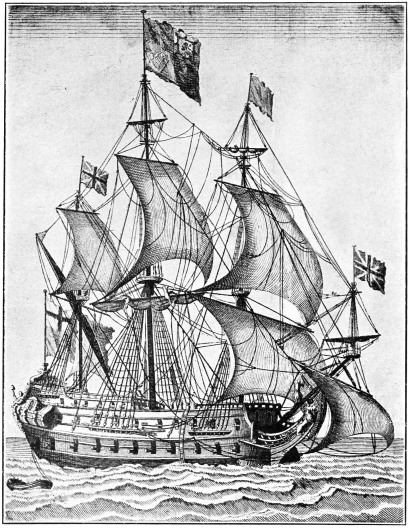
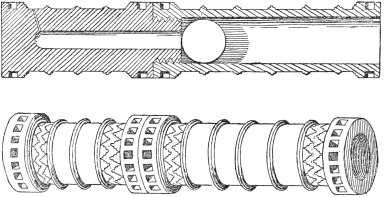
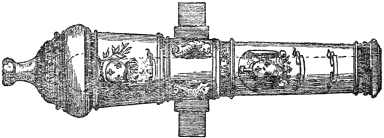
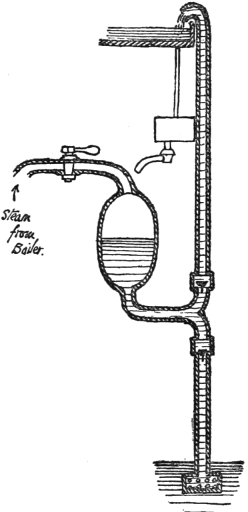
To attempt to trace in any detail the evolution of
the sailing warship is a task, it must be at once
admitted, far beyond the scope and intention of the
present essay.
The history of naval architecture is, of course, a vast and
many-sided subject. Few are the writers who have dealt with
it, and, for reasons which will appear, few of those have written
in the English language. Such books as treat of it are too
cumbrous and technical for easy reading; they are not written
in the modern style; by the frequent digressions of their
authors on matters of general history, high politics, battles,
economics, commerce, and even sport, they bear witness to the
difficulties of the task and the complexity of the subject. The
history of naval architecture still remains to be written. In the
meantime the student will find the monumental Marine
Architecture, of Charnock, and the smaller Naval Architecture,
of Fincham, invaluable fields of inquiry; among the historians
the works of Nicolas, Laughton, Corbett and Oppenheim, will
furnish him with the materials for the complete story of the
evolution up to the end of the eighteenth century.
The following pages give a sketch, drawn chiefly from these
authors, of the progress of the timber-built sailing ship and of
the principal influences which guided the evolution. Lessons
may still be drawn from this history, it is suggested, which
even in the altered circumstances of to-day may be of value in
some other application. One lesson, long unlearnt, the great
blunder of two centuries, lies clearly on the surface. The
evidence will show how, by our long neglect of the science of
naval architecture, the British navy fought frequently at an
unnecessary disadvantage; but it will also show how, masters
of the art of shipbuilding, we gave our fleets such a superiority
in strength and seaworthiness as almost to neutralize the
defects inherent in their general design.
§
Before the fourteenth century the sailing ship, i.e. the ship in
which sails were used as the chief motive power, could not
compete in battle on equal terms with the oar-driven vessel;
both in the Mediterranean and in Northern waters the oar-driven
galley possessed advantages of speed and handiness
which relegated the heavy, high-built and capacious sailing
ship to the position of a mere transport or victualler. The
fighting ships were the galleys: long speedy vessels with fine
lines and low freeboard, propelled by rowers and fought by
soldiers clad in mail and armed with swords and lances. Sails
were carried, but only as secondary power, for use when the
galleys ran before the wind.
Sea tactics consisted in ramming and boarding; the vessels
were designed accordingly. The royal galleys of King Henry
III, which formed the fighting fleet of Hubert de Burgh, are
described as having each two tiers of oars, with platforms
along each side over the heads of the rowers, on which the
soldiers stood. Hung on the bulwarks in front of them were
their shields. From the gaudily painted mast pennons and
banners floated on the wind; a large square cotton sail,
embroidered with the royal arms, was triced to the yard. The
masthead was crowned with a circular “top,” a repository
for bricks and iron bars wherewith to bilge an enemy vessel.
At both ends of the galley were raised platforms or “castles”
filled with picked soldiery, who during the approach to action
would pour brass-winged arrows into the enemy and who,
when the enemy had been grappled, leaped aboard. From
mechanical engines low down in the waist large stones would
be projected, and, if on the windy side, quicklime would be
thrown, and other “instruments of annoyance.” The galleys
were lightly built, and carried no pumps. It was no uncommon
sight, we are told, to see half the knights baling, while the
others fought hand-to-hand with the enemy.
By the year 1300 the size and utility of ships had made considerable
advance. Two masts were given them, each supported
by a few shrouds and carrying a single large square sail;
neither masts nor sails were yet subdivided, but the sails could
be enlarged by having one or more “bonnets” laced to their
lower part. Of the two masts the taller, the foremast, raked
considerably over the bows, and both were surmounted by
tops, with flagstaff and streamers. A central rudder appeared
in this century, in place of the paddle fixed to the quarter, and
a rudimentary bowsprit. The largest cogs, as they were now
called, were of 250 tons burthen. When hired of merchants
for war service, they were converted by the addition of fore-, aft-, and
top-castles, built high so as to overtop, if possible, the
enemy. The war vessels were at this time lavishly decorated;
the sails were silk, dyed red or embroidered with armorial
designs, the tops and stages were aflame with banners and
pennons, the masts and yards were gilt. Large sums of money
were spent by the knights in beautifying their ships.
But in this century two great inventions brought to a close an
epoch in warship construction. Gunpowder and the mariner’s
compass were discovered. Cannon were adapted to ships in
place of the mechanical engines which had formerly been
carried, and by aid of the compass, housed in its wood-pegged
bittacle in the steerage, vessels began to venture out of touch
with land and sail with a new security the uncharted ocean.
The effect of each of these two discoveries was the same: a
growth in the size, strength, and capacity of ships, a decline in
the use of oars and a greater reliance on sails. High sides were
required against the waves, stouter timbers to support the
weight of ordnance, more capacious holds for the stowage of the
ballast, food, and cordage which would be needed for a long sea
voyage. The galley, with its low flush deck and outward-sloping
sides was ill adapted for the new conditions; a new
construction was seen to be needed. Two new types were
evolved, one in the Mediterranean and one, more gradually, in
Atlantic waters.
Even before the Christian era there had been a distinct
differentiation between the ships of the Mediterranean and
those of the Atlantic seaboard. The latter, as shown by
Nicolas’ quotation from Cæsar, were more strongly built than
the Roman galleys, with flatter bottoms, to “adapt them to the
shallows and to sustain without danger the ebbing of the tide,”
and with prows and sterns “very high and erect, to bear the
hugeness of the waves”: properties which, even before the
advent of fire artillery, conferred on them important advantages.1
Nevertheless, complete differentiation did not obtain
until after the discovery of gunpowder and the mariner’s
needle. Before that time the vessels used by the Northern
nations in war were of the galley type, built by themselves or,
after the Crusades had revealed the superiority of the Mediterranean
powers in warship design, hired not infrequently
from Venetians or from Genoese. The Genoese were the chief
naval mercenaries of Europe at this age: “Genoese were
vice-admirals to the English king, and Genoese galleys fought
for the French at Sluys.”
The new type evolved in the Mediterranean was the galleasse.
For centuries, as we have seen, large sailing ships had been
used for commerce, both in the Atlantic and in the Mediterranean.
With the inevitable increase in size brought about by
the adoption of cannon, and by the desire for greater sea-keeping
qualities, resort was now had by the Genoese and
Venetians to sails in war vessels as a means of propulsion of
equal importance with oars. Thus an uncomfortable compromise
was effected between oars and sails; both were
provided. The galleasse was originally a large decked galley,
with three pole masts for its lateen sails, and with cannon
spaced at intervals along its sides above the rowers. In form
it differed little from the galley, but in the disposition of its
armament it was entirely different; it represented the first
stage in the evolution of the broadside fighting ship.
But the galleasse, though it might meet the requirements of
Mediterranean warfare, was almost as unsuited as the galley
to Atlantic conditions. Accordingly the warship underwent a
separate and independent development at the hands of the
Atlantic nations. Forsaking the galley, they took the lofty,
strong and capacious sailing merchant ship as the basis of a
new type, and from the lumbering carrack and caravel and
dromon they evolved the vessel which eventually became
known as the galleon. A distinctive naval architecture, Gothic
rather than Byzantine in character, was thus founded on the
Atlantic seaboard. The oar was entirely superseded by the
sail. The ships were high, and their sides, instead of falling out
like those of galleys, were curved inwards so as to “tumble
home” above the water-line: an arrangement which protected
the ordnance, added to the strength of the vessels, and tended
to render them steadier gun-platforms. The top-castles were
retained on the masts, but the end-castles disappeared, or
rather, were incorporated into the structure of the lofty bow
and stern, to provide accommodation for officers, and cover for
the crew. The voile latine gave way to the voile quarrée. In
place of the large lateen sails carried by galley and galleasse,
were smaller sails and courses, square, more easily manipulated
and allowing of greater variation in disposition and effective
area, to suit the conditions of weather and the trim of the ship.
Throughout the fifteenth century the sailing ship developed.
“While in the first quarter,” writes Mr. Oppenheim of English
shipping, “we find that men-of-war possess, at the most, two
masts and two sails, carry three or four guns, and one or two
rudimentary bowsprits, at the close of the same century they
are three- or four-masters, with topmasts and topsails, bowsprit
and spritsail, and conforming to the characteristics of
the type which remained generally constant for more than two
centuries.” The English mariner had by this time acquired
his honourable reputation. In merchant ships he carried
Bordeaux wine, the casks of which became the unit for measurement
of their tunnage; even in winter months, we are told,
he braved the Bay with pilgrims on tour to the shrine of
St. James of Compostella. Large royal ships of over 1000
tons burthen were built, in the early part of the century, in
English yards. As builders the Normans seem at this time
to have excelled.2 But the most wonderful development of
the science of seamanship in all its branches took place in the
Peninsula. Largely through the inspiration of one man the
greatest efforts of Spain and Portugal were directed to the
cult of navigation and geography, the improvement of shipbuilding,
and the discovery of new and distant lands and
oceans. A brilliant impetus was given to the study of ship
construction by the voyages of Columbus, the Cabots, Vasco
di Gama, and other intrepid spirits who, by aid of the compass,
braved the moral and physical terrors of far-distant voyages—“fighting
immensity with a needle.”
§
With the development of artillery the value of the sailing
ship for sea warfare came gradually to view. Naval tactics
suffered a complete change.
Until the early days of the sixteenth century sea-fights had
been land-fights in character; ships came as quickly as
possible to close quarters, grappled or charged one another,
cut rigging, and essayed to board. The sailor was subservient
to the soldier. The gun, represented in the main by serpentines,
periers, murderers, and other quick-firing pieces, was
primarily a defensive armament, for the defence, firstly, of
the entire ship, or, in the event of the waist being captured,
of the fortified end citadels or castles. “These castles, which
in vessels especially constructed for war came to take the form
of a forecastle and a half-deck, were made musket-proof; and
being closed athwartship with similarly protected bulkheads,
known as ‘cubbridge-heads,’ were impenetrable to boarders;
while at the same time, by means of loopholes and quick-firing
pieces in-board, they could enfilade the waist with musketry
and murdering shot. Thus a ship of the English pattern, at
any rate, could rarely be held even if boarders entered, until
her ‘cage works’ or protected castles were destroyed by gunfire.”3
The ship itself, being deep-waisted and built with an
exaggerated sheer upwards toward bow and stem, had no
continuous deck: the decks were laid on various levels, rising
from the waist by steps to the two citadels, an arrangement
which did not contribute, as a flush-deck would have done,
to the longitudinal strength of the vessel, and which was found
inconvenient for the working and transport of ordnance of the
heavier sort.
King Henry VIII, in his efforts to possess fighting ships
superior to those of Spain, France and Scotland, raised not
only artillery but ships themselves to a different rôle. As
he personally urged the manufacture of ordnance in this
country by the subsidizing of foreign talent, so he sought to
improve the design of his ships by inviting Italian shipwrights
to come to England and apply their knowledge to the royal
vessels. Dockyards were founded at Woolwich, Deptford, and
Portsmouth. Large ships were laid down, several were rebuilt,
with many improvements embodied in them: chief of these
being a new artillery armament. The king had seized the
advantages of the sailing ship with broadside fire. “The
development of broadside fire,” says Sir Julian Corbett, “was
a question of gunnery, of naval architecture, and of seamanship.
With Henry’s introduction of heavy guns on board his
larger vessels, however, the true note had been struck, and by
the end of his reign the first two arts had made great strides.
Guns of all patterns and sizes were being cast in England, both
in bronze and iron, which were little inferior to those Nelson
fought with.” The result of the king’s efforts was seen in the
ships laid down in the last years of his reign. The frontispiece
of Mr. Oppenheim’s History of the Administration of the Royal
Navy is a picture of one of these, the Tiger, a four-masted
flush-decked vessel, with no sheer, little top hamper, a long
tier of ordnance on the gun deck, and with a beak-head ending
in a spur: one of a class “which shows a very great advance
on anything before afloat and indicates a steady progression
towards the modern type.”
In short, a reversion to a smaller and seaworthier type took
place. The large, unstable and unwieldy “great ship,” such
as the Henry Grace á Dieu, built on the Spanish model, with
lofty ends overweighted with small ordnance, was not effective.
A new invention, attributed to Descharges of Brest in 1501,
viz. the adaptation of portholes to ordnance along the sides
of a ship, perhaps suggested a better form. As the century
advanced, as new and far-distant countries appeared on the
map, the arts of seamanship and gunnery continuously improved;
naval architecture made a corresponding progress.
For sea fighting the high-charged and imposing “great ship”
gave place to a more perfected type—the galleon. “It was
the development of the galleon,” insists the historian, “which
changed the naval art from its medieval to its modern state.”
The galley, eminently suited to the Mediterranean, where
winds were light and slave labour abundant, was found to be
increasingly unsuitable for Atlantic warfare; the galley was
in danger of being rammed, in any wind, by a strong, quick-turning
sailing ship, and suffered from having nearly all its
artillery in the bows; moreover, “the galley service was
always repugnant to our national temperament.” The
galleasse, the hybrid between the oar-driven galley and the
sailing ship, suffered from all the disadvantages of the compromise.
The great ship had now proved to be cumbrous
and expensive, crank and unseaworthy, leewardly and unmanageable
in even a moderate breeze.
The galleon therefore became the type favoured by the
English navy. Whereas the merchant ship was short in proportion
to its beam, the galleon was built long, with a length
equal to three times its breadth. It had also a long flat floor
like a galley, and was of lower freeboard than a round-ship.
“It was also like a galley flush-decked, and would seem
always to have had the half-deck carried across the waist so
as to make one flush-deck with the old forecastle. In the
larger types the quarter-deck was also carried flush from
stem to stem, so that latterly at any rate a true galleon had
at least two decks and sometimes three. On the upper deck
in the earlier types were erected both fore and aft high-castles
as in a galleasse, but usually on curved lines, which gave the hull
of the old-fashioned galleons the appearance of a half moon.”4
The depth of hold at the waist was only about two-fifths
the beam. Its artillery was light but effective, being composed
of light muzzle loaders, a mean between the man-killers and
the heavy bombards of an earlier day. Its masts and spars
were made heavy and large sail area was given it, for speed
and quick manœuvring were the essential qualities which it
was hoped to oppose to the lumbering, high-charged ships of
Spain. Victory was to be sought by a skilful combination of
seamanship and gunnery, rapid fire being poured into an
enemy at a convenient range and bearing. “Plenty of room
and a stand-off fight” sufficiently defines the sea tactics of the
new era.
Throughout the reign of Elizabeth the galleon still remained
the favourite type, though opinion differed, and continued to
differ through the two following centuries, as to the degree to
which it was desirable to “build lofty.” The Hawkins family
of Plymouth shipowners carried a great influence in the
councils of the navy. Sir John Hawkins, whose experience
of shipbuilding and seamanship rendered him a man of importance,
was the author of improvements in this respect, as
in so many others; “the first Elizabethan men-of-war, the
fastest sailers and best sea-boats then afloat, were built to his
plans; and from the time of his appointment as Treasurer of
the Navy dates the change to the relatively low and long type
that made the English ships so much more handy than their
Spanish antagonists.”5 His kinsman, Sir Richard, on the
other hand, preferred large and high-charged ships, “not only
for their moral effect on the enemy, but for their superiority
in boarding and the heavier ordnance and larger crews
they would carry. Two decks and a half he considers to be
the least a great ship should have, and was of opinion that the
fashion for galleasse-built ships—or, as he calls them, ‘race’
ships—in preference to those ‘lofty-built’ had been pushed
too far.”6 Ships with large cage-works had an advantage,
he maintained, in affording cover for the crew and positions
for quick-firing batteries; his opponents argued that the
weight of top-hamper saved by their abolition could be put
with better advantage into a heavy artillery.
The advocates of the fast, low-lying ships carried the day.
War came with Spain, and there was soon work to show what
the English ships could do. The Armada Papers7 light up
for us, by the fitful glare of the cressets of Hawkins and Co.,
the preparation of the fleet at Plymouth, and show us what
state of efficiency the royal ships were in. “The Hope and
Nonpariel are both graved, tallowed, and this tide into the
road again,” writes William Hawkins to his brother. “We
trim one side of every ship by night and the other side by
day, so that we end the three great-ships in three days this
spring. The ships sit aground so strongly, and are so staunch
as if they were made of a whole tree. The doing of it is very
chargeable, for that it is done by torchlight and cressets, and
in an extreme gale of wind, which consumes pitch, tallow, and
firs abundantly.” Not only the few royal ships, but the whole
of the force which lies in the Sound is tuned for the fight.
“For Mr. Hawkins’ bargain,” writes the Commander-in-Chief
to Lord Burghley, “this much I will say: I have been aboard
of every ship that goeth out with me, and in every place where
any may creep, and there is never a one of them that knows
what a leak means. I do thank God that they be in the estate
they be in.” The Spanish ships prove to be in a very different
condition. High-charged and leewardly, poorly rigged and
lightly gunned, they are so hammered and raked by Lord
Howard’s well-found fleet that, when bad weather ultimately
comes, they are in no condition to combat the elements.
With masts and rigging shattered, water-casks smashed, no
anchors; short-handed and leaking like sieves, they are
hounded northwards to a disaster unparalleled in naval history.
And now, before tracing its evolution through the seventeenth
and eighteenth centuries, let us glance at the warship
as it existed at the end of the Elizabethan era, and note its
chief constructive features.
§
Athwart a keel of large squared timbers, scarphed together
and forming with a massive inner keelson the principal member
or backbone, were laid the curved frames or ribs which, bolted
to each other and to the keel with iron bolts washered and
clinched, gave to the hull its transverse strength and form.
These frames were held together, as they curved upward from
the ground or floor level, by thick longitudinal wales, worked
externally along the frames at convenient heights, and curved
so as to suit the degree of sheer desired.
At the fore end the wales and frames converged to the
centre-line and the keel was prolonged upward to meet
them in a curve or compassing timber, forming the bow or
stem: to the beauty and shapeliness of which, with its projecting
beak-head, the builder devoted much of his attention
and skill. At the other end the frames and wales converged
to a square and lofty stern. The stern post was a massive
timber fastened to the keel and sloping somewhat aft from the
vertical, and from it rose two fashion-pieces “like a pair of
great horns,” which formed, with the horizontal arch and
transom timbers, the framework of the stern. When the
frames had been built up to the requisite height the upper
ends of each opposite pair were joined across by horizontal
beams, which were secured to them by means of brackets or
knees; such beams were worked at the level of the main and
other decks, and served to support them when laid. Joined
by its beams, each pair of frames thus formed a closed structure:
a combination of members which was to resist crushing
and deformation, the blows of the sea, the stresses of gunfire,
the forces due to the weight of the guns and the vessel itself,
and especially the forces thrown on it when the vessel was
aground or on a careen. The rigidity of this combination was
enhanced by the fitting of pillars which were placed vertically
over the keelson to support each beam at its middle. And
sometimes the lower pillars were supplemented by sloping
struts, worked from the curve of the frames up to the middle
of each beam above.
The skeleton of a ship thus formed, built with well-seasoned
timber, was left standing on the stocks “in frame” for a considerable
period, sometimes for years, exposed to the open
weather. On it eventually a skin of planks was fastened,
secured by wood trenails split and expanded by soft-wood
wedges, both internally and externally; and inside the ship,
to reinforce the frames and in line with them, timbers known
as “riders” were worked. On the beams the decks were
laid: the orlop below the water-line level, and above it, at
a height suitable for the ordnance, the main or gun deck;
above that the upper deck, on the ends of which were reared
the poop (sometimes a half-deck, extending from the stern to
the mainmast, sometimes on that a quarter-deck, over the
steerage) and the forecastle.
Such, very briefly, was the mode of ship construction. The
resulting structure, when caulked and swelled by sea-water,
presented a water-tight and serviceable vessel. Timber provided,
for ships up to a certain size, a suitable material. It
afforded strength and buoyancy, and elasticity sufficient to
obviate local strains and to spread the stresses due to lading,
grounding, careening, or the actions of the wind and sea. The
different parts of the ship’s frame gave mutual support, and
the pressure of the fluid on the exterior of the hull tended, by
constraining the component parts, to preserve the vessel.8
But the timber-built ship possessed an inherent weakness.
Metal plates or girders can be bolted or riveted together so
efficiently as to leave the joints between them almost as strong
as the sections of the plates or girders themselves. Not so wood
beams. However skilfully they might be joined, their joints
were necessarily weaker than all other sections: “it was then,
and still is, impracticable to develop the full strength in end
connections between wooden members.”9 The softness of
the wood was an additional source of weakness. Two beams
fastened together by iron bolts might form initially a close
and rigid joint; but if, under the action of alternating or
racking stresses, they became loosened even in a minute
degree, the tendency to become still looser increased: the
wood gradually yielded under the bolt washers, the bolts no
longer held rigidly, “the very fact that wood and iron were
dissimilar materials tended to hasten the disintegration of
the structure.” With planking a similar effect obtained.
Trenails, expanded by wedges and planed off flush with the
planks which they held together, had only shearing strength;
if once they were loosened they had little power to prevent
the planks from opening further. These weaknesses were
recognised. To minimize their effects the butts of frames,
decks, and side planking, were arranged so that no two neighbouring
butts lay in the same line. But in spite of the most
painstaking craftsmanship, the size of the wooden ship was
limited by its inability to withstand a high degree of stress.
As sizes increased extraordinary endeavours were made to
meet the hogging and sagging strains, to prevent cambering
of the hull, and to stiffen it longitudinally and circumferentially.
Enormous masses of timber were worked into the
internal structure in the form of riders, pillars, standards, and
shores, “the whole of which had an appearance of great
strength, but which in fact, from its weight and injudicious
combinations, was useless, if not injurious.”10 Which did, in
fact, clog the ship and usurp the space required for stowage.
As for the masts, experience fixed their number, size and
position. In the earlier ships, as we have seen, four and sometimes
five masts were fitted, after the Mediterranean style.
But later this number was reduced to three. Of these the
foremast was the most important, and it was stepped directly
over the fore-foot of the vessel, the main and mizzen being
pitched to suit. Their height varied with the service and type
of ship. Taunt masts, like those carried by the Flemish ships,
were best for sailing on a wind, for with them narrow sails
could be used which could be set at a sharp angle with the
keel; but short masts and broad yards were favoured by
English mariners, as bringing less strain on a vessel’s sides
and rigging and as being less likely to produce a state of
dangerous instability. The masts were short, very thick, and
heavily shrouded; the standing rigging was led to channels
and deadeyes on the outside of the bulwarks. The bowsprits
were large and “steved” upward at a large angle with the
horizontal; spritsails and spritsail topsails were set on them,
of use mainly when sailing before a wind, yet retaining their
place in our navy till, half-way through the eighteenth century,
the introduction of the fore-and-aft jib brought about an
improvement and in so doing affected the whole disposition
of mastage.
One feature of the masting of the old ships is notable: the
manner in which the various masts were raked. In the Sea-Man’s
Dictionary11 the trim of a ship was defined as, “the
condition, as to draught, staying of masts, slackness of shrouds,
etc., in which a ship goes best.” For a given set of conditions
there was a certain rake of masts, a certain position of the
centre of wind-pressure against the sails, which, when discovered,
gave to the vessel its finest sailing qualities. The
knowledge of this adjustment constituted no small part of the
great art of seamanship. In the king’s ships a high proficiency
was attained in it; merchantmen sailed under more diverse
conditions and showed, it appears, a lower level of scientific
inquiry. “Next to men of war (whose daily practice it is)
the Scotch men are the best in the world to find out the trym
of a ship, for they will never be quiet, but try her all ways, and
if there be any goodness in her, they can make her go.” Generally,
the effect of raking the masts aft was to make the vessel
fly up into the wind, and vice versa; in ships with high-built
sterns, especially, it was necessary to have the head-sails set
well forward, to keep them out of the wind. To allow the
masts to be raked as desired their heels were pared away, and
wedges of suitable thickness were driven between them and
the “partners.”
Many other factors contributed to affect, in a manner always
subtle and frequently inexplicable, the sailing qualities of a
ship. The form of the body, the position of masts and the
setting up of the rigging, the disposition of weights, the angle
of the yards, the conditions of stability, all had their effect on
the vessel’s motion, and therefore on her speed through the
water. Free water in a ship’s bilge, for example, had an effect
on her degree of stiffness, and from this cause her speed was
not easily predictable. Charnock relates how, in the colonial
wars of the late eighteenth century, an American vessel, the
Hancock, was captured after an unprecedented chase, solely
because her commander, injudiciously supposing that by
lightening his ship he would enhance her swiftness, pumped
water out of her. It was noticed, again, that in certain circumstances
the speed of a ship increased when the crew
turned into their hammocks.
The lines of the ship were drawn without reference to any
science of naval architecture, and merely by instinct and the
accumulated experience of the builder; the laws of stability
and of fluid resistance were at this time unknown. Experience
indicated the desirability of a short keel, to make the ship
turn quickly; of an ample rake forward from keel to beak-head—“more
than a third the length of the keel, commonly,”
says Sir Henry Manwayring, for, “a great rake forward gives
a ship good way and makes her keep a good wind, but if she
have not a full bow it will make her pitch mightily into a
head sea.... The longer a ship’s rake is, the fuller must be
the bow”; of a fine run aft, so as to let the water flow strongly
and swiftly to the rudder and make the ship steer and sail
well; of a narrow rudder, so as not to hold much dead water
when the helm was over,—yet, “if a ship have a fat quarter,
she will require a broad rudder.” The correct formation of
the bow was recognised as of the greatest importance, and
the most difficult compromise in the design of a ship. A bow
too bluff offered much resistance to motion through the
water; on the other hand, too sharp a bow lacked buoyancy,
and, from the great weight of mastage, headsails, anchors, etc.,
which it had to support, caused a vessel to pitch badly in a
head sea. “If the bow be too broad,” wrote Captain John
Smith, in his Sea Man’s Grammar, “she will seldom carry a
bone in her mouth, or cut a feather, that is, to make a foam
before her: where a well-bowed ship so swiftly presseth the
water as that it foameth, and in the dark night sparkleth like
fire.”
Generally, a vessel built with fine lines lacked end support,
and tended to become arched or camber-keeled, while its
stowage capacity was inconveniently small. The ship’s sides
were made with a considerable degree of tumble-home above
the water-line; though this, again, was a point of compromise
and much argument. For while a reduced breadth of deck
tended to give the hull more girder strength and to diminish
the racking effect on it of heavy ordnance, yet this feature at
the same time, by reducing the angle at which the shrouds
could be set, augmented the stresses which were thrown on
shrouds and bulwarks.
§
With the seventeenth century a new age of scientific speculation
opened, and, under the personal encouragement of the
Stuart kings, the art and mystery of shipbuilding received an
illumination which was of great value to the royal armaments.
The early interest of James I in his navy is signalized by his
grant of a charter to the corporation of shipwrights: a corporation
whose short-lived story is told by the editor of The Autobiography
of Phineas Pett, recently published.12 Before the
sixteenth century, he tells us, no special trade was recognized
for the building of warships, as distinct from traders. But in
the early Tudor days, when, owing to the introduction of the
new artillery the war vessel began to diverge in general design
from the merchant ship, certain master shipwrights had been
subsidized by the king for the building and repair of the royal
vessels. The position of these officials was one of importance,
their duties and privileges were extensive. The office was often
hereditary. Thus, the royal patent granted to one James
Baker in 1538 descended, with the accumulated lore and
secrets of his profession, to his son Mathew Baker in 1572. And
that granted to Peter Pett in 1558 descended to Joseph Pett
in 1590. But as shipping grew and shipbuilding became more
complex and widely distributed, the need for some central
authority, which could regulate practice and standardize procedure,
became increasingly felt. Accordingly a petition was
presented. In 1605 the king granted a charter incorporating
the master shipwrights of England as one body corporate and
politic, for the good regulation of shipbuilding of all descriptions.
In 1612 another charter was sealed, giving increased
power to the confraternity: with instruction that it was to
examine each new ship to see that it was properly built,
“with two orlops at convenient distances, strong to carry
ordnance aloft and alow, with her forecastle and half-deck
close for fight.” Shipwrights’ Hall, as the corporation was
called, surveyed and reported on tonnage and workmanship,
and gave advice, when sought, to the lord high admiral. In
the course of time its prestige declined. With the Commonwealth
it grew into disuse, and by 1690 it was altogether
extinct. For nearly a century the guild had struggled in vain
to fulfil the intentions of its founders.
The most distinguished of the master shipwrights of this
period was Phineas Pett, sometime master of arts at Emmanuel
College, Cambridge, who in 1612 succeeded old Mathew Baker
as Master of the guild. Pett, who to a practical knowledge of
design and construction added considerable sea experience,
rose far above his contemporaries, most of whom were little
more than mere carpenters, ignorant of many of the principles
which are now accepted as governing ship design, and themselves
governed almost entirely by tradition and blind precedent.
Science was still in its veriest infancy. The progress
of ship design was still by the tentative and costly method of
full-scale experience; not till the beginning of the nineteenth
century, when new forces and materials had been discovered
which in the end spelt the decline and supersession of the
sailing ship, did science sufficiently direct the lines on which
large sailing ships should be built.
By his bold deviation from established usage, says Fincham,
Mr. Pett established his fame and advanced the interest and
power of the British navy. Before reviewing his handiwork,
however, it will be convenient to note the main directions in
which improvement was at this period sought.
Sir Henry Manwayring, an acquaintance for whom Pett
designed and built a pinnace in the year 1616, wrote at this
time The Sea-Man’s Dictionary. In the early years of the
century were also written two treatises which, though not
printed till a later date, had great effect in creating an interest
in naval matters: Sir Walter Raleigh’s Observations on the
Navy and Invention of Shipping. In the former paper Sir
Walter laid down the six requisites of a good ship: viz. that
she should be strongly built, swift, stout-sided, carry out her
guns in all weathers, lie-to in a gale easily, and stay well. For
the attainment of these qualities he specified certain structural
features: a long run forward, to make her sail well; a long
bearing floor and a “tumble home” above water from the
lower edge of the ports, for stoutness and for stiffness sufficient
to enable her to carry her lower ordnance (which must lie
four feet clear above water) in all weathers. “It is a special
observation,” he wrote, “that all ships sharp before, that
want a long floor, will fall roughly into the sea and take in
water over head and ears. So will all narrow quartered ships
sink after the tail. The high charging of ships it is that brings
them all ill qualities.” In the latter paper he recapitulated
the various improvements in material of which he had himself
been witness; from which for its interest we quote the following
extract. “The striking of the topmast (a wonderful great
ease to great ships both at sea and in harbour) hath been
devised, together with the chain pump ... the bonnet and
the drabler. We have fallen into consideration of the length
of cables, and by it we resist the malice of the greatest winds
that can blow, witness our small Milbrook men of Cornwall,
that ride it out at anchor, half seas over between England and
Ireland, all the winter quarter.... For true it is, that the
length of the cable is the life of the ship in all extremities.
We carry our ordnance better than we were wont, because
our nether overloops are raised commonly from the water, to
wit, between the lower part of the port and the sea. We have
also raised our second decks and given more vent thereby to
our ordnance, tying on our nether overloop. We have added
cross pillars in our royal ships to strengthen them, which be
fastened from the kelson to the beams of the second deck. We
have given longer floors to our ships than in elder times, and
better bearing under water, whereby they never fall into the
sea after the head and shake the whole body, nor sink stern,
nor stoop upon a wind, by which the breaking loose of our
ordnance or the not use of them, with many other discommodities
are avoided.... And to say the truth a miserable
shame and dishonour it were for our shipwrights, if they did
not exceed all other in the setting up of our royal ships, the
errors of other nations being far more excusable than ours.”
Sir Walter was inaccurate in attributing all the improvements
enumerated to his own generation; bonnets, for instance, were
in use long before his day. Nevertheless his paper constitutes
one of the most important contributions to the history of naval
architecture in this country.
In the early years of the century, too, evidence as to the
shortcomings of contemporary naval construction was
furnished by a fierce critic, Captain Waymouth. He proclaimed
that English shipwrights built only by uncertain
traditional precepts and observations; that none of them
could build two ships alike or predict with accuracy their
draught of water; that all their ships were crank, leewardly—“a
great disadvantage in a fight”—difficult to steer and sail,
too deep in the water, of less capacity than the Hollanders, and
so badly built and designed as frequently to require “furring,”
or reinforcing by extra planking. He advocated building ships
longer, broader, with longer floors so as to reduce their draught,
and snugger in respect of upper works. And though he failed
on trial to translate his ideas into successful performance, his
criticisms are accepted by historians as being probably well-founded.
The opinions expressed by the above writers13 indicate for us
in general terms the chief particulars in which the ships of this
period fell short of naval requirements. They were designed
without knowledge of the laws governing the strength of
materials, stability, and the motion of bodies through water;
they were built without adequate supervision, frequently of
green timber badly scarphed or cut across the grain, and were
overburdened with ordnance. Their holds were cumbered with
large quantities of shingle ballast which tended to clog the
limber-holes of the bilge and rot the frames and floor timbers;
while the stowage space amidships was further usurped by the
cook-rooms, which were placed on the shingle, and which, by
the heat radiated from their brick sides, did damage to the
timbers and seams in their vicinity. Vessels were rarely
sheathed. Though John Hawkins had devised a system of
sheathing by a veneer of planking nailed over a layer of hair
and tar, it was only to ships going on special service in seas
where the worm was active that sheathing was applied.
Sheathing possessed, then, some significance. In 1620, for
instance, the Venetian ambassador reported to his government
the discovery that some of our ships were being sheathed,
and from this fact deduced an impending expedition to the
Mediterranean.
With the navy in the depths of neglect and with shipbuilding
in the state described, Phineas Pett began to impose his
permanent mark on design and construction. The mechanism
by which he secured his results, the calculations and methods
and rules used by him, were veiled in profound secrecy, in
accordance with the traditions of his profession. He began by
new-building old ships of the Elizabethan time, giving them
an improved form so far as practicable. His friend and patron
was the young Prince Henry, for whom in 1607 he made a
model which the king greatly admired. And shortly after this,
in the face of much jealousy on the part of his rivals, he laid down
by command a new great ship—the Prince Royal, of 1187 tons,
with a breadth of 43 feet and a keel length of 115 feet, double-built
and sumptuously adorned, in all respects the finest ship
that had ever been built in England. She carried no less than
fifty-five guns, her general proportions were of a unity, and
her strength was of a superiority, far in advance of current
practice. In strength especially she marked an advance which
yielded benefit later, in the wars with Holland. She was double
planked, “a charge which was not formerly thought upon, and
all the butt-heads were double-bolted with iron bolts.”
But how difficult a matter it was for a builder to depart from
tradition, is shown from Pett’s account of the inquisition to
which he was subjected in connection with the building of this
famous ship. His rivals took advantage of the “Commission
of Enquiry into the abuses of the navy,” of 1608, to indict
him for bad design, bad building, and peculation. So much
hard swearing took place on both sides that at last King James
himself decided to act as judge, and at Woolwich, with the
wretched Phineas on his knees before him, opened his court of
inquiry. “Much time,” says the diarist, “was spent in
dispute of proportions, comparing my present frame with
former precedents and dimensions of the best ships, for length,
breadth, depth, floor, and other circumstances. One point of
proportion was mainly insisted upon and with much violence
and eagerness urged on both sides, which was the square of the
ship’s flat in the midships, they affirming constantly upon their
oath it was full thirteen feet, we as constantly insisting that it
was but eleven foot eight inches.” In the end the king called
in a mathematician and had the controversy settled by actual
measurement. None of the charges brought against him being
sustained, Phineas was acquitted and restored once more to
royal favour, to his own delight and to that of his youthful
patron, Prince Henry.
The Prince Royal marks a new epoch in ship design. She
was such a departure from all previous forms that she made the
fame of Phineas Pett secure. She became, indeed, the parent
or type of all future warships down to the beginning of the
nineteenth century; for (says Charnock), were the profuse
ornaments removed, her contour, or general appearance, would
not so materially differ from that of the modern vessel of the
same size as to render her an uncommon sight, or a ship in
which mariners would hesitate to take the sea. In her a final
departure was made from the archaic form imposed on fighting
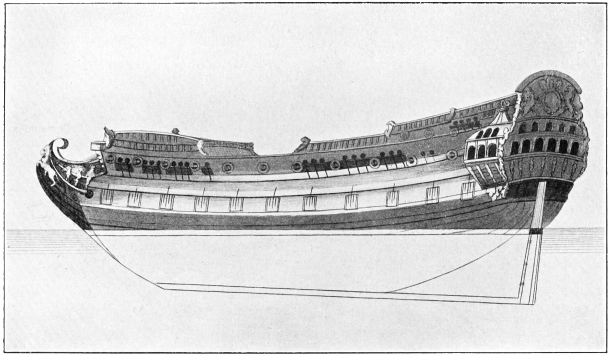
ships by tradition. The picture Charnock gives of her is of a
highly ornamented but low and flush-decked vessel armed to
the ends with two tiers of heavy guns. The projecting beak-head,
a relic from the galley days which had been so prominent
a feature of Tudor construction, has almost disappeared: the
bow curves gracefully upward to a lion close under the bowsprit.
The wales have little sheer; the stern is compact and
well supported, with beautiful lines. The quarter galleries are
long, and are incorporated in the structure in a curious manner:
in the form of indented, tower-like projections, with ornamented
interspaces. The whole picture gives evidence of stout
scantlings and invaluable solidity. Although in many respects
the Prince Royal was a masterpiece she was primitive in the
variety of her armament. On the lower deck she carried two
cannon-petro, six demi-cannon, twelve culverins; on her upper
deck eighteen demi-culverins; and on quarter-deck and poop
a number of sakers and port-pieces. Also, unfortunately, she
was built of green timber, so her life was short.
In building a ship of unprecedented burthen Pett had the
support of a large public opinion. The advantages attaching
to large size were by this time generally appreciated: in the
case of fighting ships, in respect of strength, artillery force, and
sea endurance, in the case of merchant ships, in respect of
carrying capacity and economy of crew. The growth in the
size of merchant shipping during the reign was indeed remarkable.
Trade followed the flag, and the Jacobean merchant
made haste to profit by the conquests of the Elizabethan
adventurer. For a short while after the war with Spain our
mercantile marine was stagnant; at the accession of James I
only small vessels of less than a hundred tons were being built,
and English merchants were having strange recourse to the
hiring of foreigners. But this state of things did not last for
long. The story of the success of the Earl of Cumberland and
his 800-ton Scourge of Malice, and the sight of the great Portuguese
carrack captured in 1592, are said to have stimulated the
merchants of London to possess themselves of vessels fit for the
Eastern trade. It is said, again, that the appearance of two
large Dutch ships in the Thames supplied the sudden impulse
to build big. Be that as it may, “the idea spread like wild-fire.”
Larger ships were laid down, and by the end of the
reign the country possessed a considerable fleet of ships of
500 tons and above. In one instance, at least, the pendulum
swung too far, and experience soon exposed the disadvantages
of excessive dimensions: the reduction in strength, the
unhandiness in shallow waters, the almost impossibility of
graving and breaming, the risking in a single bottom of too
great a venture. The Trades Increase, built for the new East
India Company in 1605 by William Burrell and launched by
the king at Deptford, was of no less than 1,100 tons burthen.
On her first voyage to Java she was lost by fire, and no more
ships of her size were ordered by the Company.
With the expansion of merchant shipping and with the
recognition of artillery as the main instrument of naval warfare
fighting ships made a corresponding advance in size. The
Commission of Reform of 1618, on whose report the subsequent
reorganization of the Navy was based, held that the primacy
of the big gun had at last been established. “Experience
teacheth,” the Commissioners recorded, “how sea-fights in
these days come seldom to boarding, or to great execution of
bows, arrows, small shot and the sword, but are chiefly performed
by the great artillery breaking down masts, yards,
tearing, raking, and bilging the ships, wherein the great
advantage of His Majesty’s navy must carefully be maintained
by appointing such a proportion of ordnance to each ship as
the vessel will bear.” They recognized the extravagance of
small ships, and advised that in future the royal navy should
consist of a nucleus of about thirty large ships, which with the
merchant fleet should form one complete service; royal ships
of over 800 tons; great ships of over 600 tons; middling ships
of about 450 tons. They also formulated the chief requirements
of naval construction in considerable detail. This pontifical
pronouncement on ship dimensions was doubtless of value in
connection with the contemporary project to which their work
had reference; nevertheless it formed a dangerous precedent
for future administrations. It shackled the genius of the shipbuilder.
It degraded design. The ship, especially the timber-built
sailing warship, was essentially a compromise between a
number of conflicting elements. To obtain full value from his
skill the designer required as free as possible a choice of means
to his end; and any over-drawing of the specification, or
surplusage of data beyond the barest requirements, tended to
tie his hands and render impossible a satisfactory design. It
was this over-specifying of dimensions in the interests of
standardization which, as we shall presently see, stultified
shipbuilding in England not only in the seventeenth but
throughout the whole of the eighteenth century.
But the report of 1618 was doubtless of great value as a
guidance for the building of the new Stuart navy. “The
manner of building, which in ships of war is of greatest importance,
because therein consists both their sailing and force. The
ships that can sail best can take or leave (as they say), and use
all advantages the winds and seas afford; and their mould, in
the judgment of men of best skill, both dead and alive, should
have the length treble the breadth, and the breadth in like
proportion to the depth, but not to draw above 16 foot of
water because deeper ships are seldom good sailers.... They
must be somewhat snug built, without double galleries and too
lofty upper works, which overcharge many ships and make
them loom fair, but not work well at sea.” As for the
strengthening of the royal ships the Commissioners subscribed
to the manner of building approved by “our late worthy
prince”: “first, in making three orlops, whereof the lowest
being two feet under water, both strengtheneth the ship, and
though her sides be shot through, keepeth it from bilging by
shot and giveth easier means to find and stop the leaks.
Second, in carrying their orlops whole floored throughout from
end to end. Third, in laying the second orlop at such convenient
height that the ports may bear out the whole fire of
ordnance in all seas and weathers. Fourth, in placing the cook-rooms
in the forecastle, as other ships of war do, because being
in the midships, and in the hold, the smoke and heat so search
every corner and seam, that they make the oakum spew out,
and the ships leaky, and some decay; besides, the best room
for stowage of victualling is thereby so taken up, that transporters
must be hired for every voyage of any time; and,
which is worst, when all the weight must be cast before and
abaft, and the ships are left empty and light in the midst, it
makes them apt to sway in the back, as the Guardland and
divers others have done.”
The ships built under the regulations of the Commissioners
were certainly an improvement on earlier ships in many
respects, but in one element of power they proved to be
deficient, namely, in speed. The stoutly built, full-bodied,
lumbering English two-deckers were out-sailed and out-manœuvred,
it was noticed, by the relatively light and fine-lined
Hollanders. Moreover our smaller ships were known to
be no match in speed for the Dunkirk privateers which at this
time infested the seas. A new type was seen to be necessary.
The existing differentiation of warships into rates or classes
was insufficient. For the line of battle there must be ships in
which force of artillery was the predominant quality; but for
other duties there must also be ships in which speed, and not
force, was the distinguishing note. From this necessity was
evolved the frigate.
Soon after the accession of Charles I an attempt was made to
establish the new type by building small vessels on the model of
the largest, miniatures which it was hoped would prove good
sailors and capable, although square-sailed, of sailing near a
wind. The Ten Whelps were laid down: flush-decked three-masted
vessels of 200 tons, 62 feet long on the keel and 25
feet in breadth. They were not a success. It was left for
Dunkirk, “the smartest dockyard in Europe,” to found the
new model. In imitation of a captured Dunkirk privateer our
first frigate was built in 1646 by Peter, son of Phineas Pett,
and her success was such that he had the achievement recorded
on his tomb. The Constant Warwick was 85 feet in keel-length,
26 feet 5 inches in breadth, of 315 tons burden and 32 guns.
She was “an incomparable sailer.” Before the first Dutch war
was over she had taken as much money from privateers as
would have completely laden her.
It seems probable that the prestige of his name was sufficient
to give Peter Pett a freedom from interference in his design
which was not accorded less distinguished shipbuilders. In
’45 Andrews Burrell, in a remonstance addressed to Parliament,
protested, “For the love of heaven let not the shipwrights
that are to build them [three frigates for special service] be
misled by those that would, but cannot, direct them, which
error hath been very hurtful to the navy heretofore.” By the
interference of Sir John Pennington, he asserted, the builders
of the Ten Whelps were so misled that they proved sluggish and
unserviceable. “Let no rules be given the shipwrights more
than their tonnage, with the number and weight of their
ordnance, and that the number and weight of their ordnance
may be suitable to the burden of each frigate.”
King Charles, whose personal interest in the royal navy
equalled that of his father, favoured the tendency to enlarge
the tonnage and the individual power of his fighting ships.
The Prince Royal displayed the advantages of size. The
Dutch people, jealous of the interference with their eastern
trade, were known to be building large ships. Across the
channel an ambitious and all-powerful minister was envisaging
the possession of a navy in which an inferiority in numbers
might be neutralized by the superiority of the unit. In France
a vessel of 1400 tons had been laid down. Charles determined
to take up the challenge, obtaining the money by hook or by
crook wherewith to build a greater. In the year 1634 the
decision was made. A model of a great three-decker mounting
a hundred and four guns was presented to him by Phineas
Pett, and shortly afterwards the master of the shipwrights
received the royal command to build a ship, and to proceed in
person to the forests of Durham to select the thickstuff, knee
timber, and planking requisite for the task.
Opposition to the building of such a prodigious vessel
appeared from different quarters. Great ships, in the opinion
of Sir Walter Raleigh, were “of marvellous charge and fearful
cumber.” The cost of so large a ship must needs be great, for
not only the whole cost, but the cost per ton, increased with
the size of the vessel; so wasteful a process was the building of
a great ship, indeed, that it was not unusual to build a small
ship simultaneously, out of the timber discarded: a practice
known as “building a small ship out of a great one’s chips.”
Ships of the greatest size, again, were “of little service, less
nimble, less mainable, and very seldom employed.” Nor was
it believed that so large a vessel as that projected could be
built. Trinity House, when they heard of the design, uttered
a formal protest. Such a ship, they argued, would be too big
for service, and unsafe from her enormous size. To carry such
a number of pieces she must be a three-decker, and to build a
serviceable three-decker was beyond the art or wit of man; if
the lower tier were too low they would be useless in a sea, if at
5 or 5½ feet above the water-line then the third tier would be
so high as to endanger the ship. In spite of this protest the
new ship was laid down, and nearly two years later, in the
autumn of ’37, she was launched at Woolwich, “the pride and
glory of the Caroline navy.”
The Sovereign of the Seas, the Sovereign, or the Royal
Sovereign, as she was called by successive governments, was
another great advance in size and solidity on all preceding
construction, and was the masterpiece of Phineas Pett. Her
length by the keel was 128 feet, her main breadth 48 feet, her
overall length 232 feet. She had three flush decks and a forecastle,
a half-deck, a quarter-deck, and a roundhouse. Her
armament showed an approach to symmetry; the lower tier
consisted of cannon and demi-cannon, the middle tier of
culverins and demi-culverins. In one respect she was less
advanced than Pett’s earlier effort, the Prince Royal, in that
she had an old-fashioned beakhead, low hawses and a low and
exposed forecastle. In general form she was extolled by all, and
bore witness to the genius of her designer. No better form,
said a later critic and constructor14 after making an analysis
of her lines—no better form could have been devised for a ship
built (according to the prevailing customs of the times) so high
out of water and so overloaded with ornaments. The king
took a personal pride in her, and during her construction visited
Woolwich and “seriously perused all the ship within board.”
For him an elaborate description was written which, quoted at
length by various writers, serves to show the extent to which
mere decoration contributed to the cost of a royal ship. Two
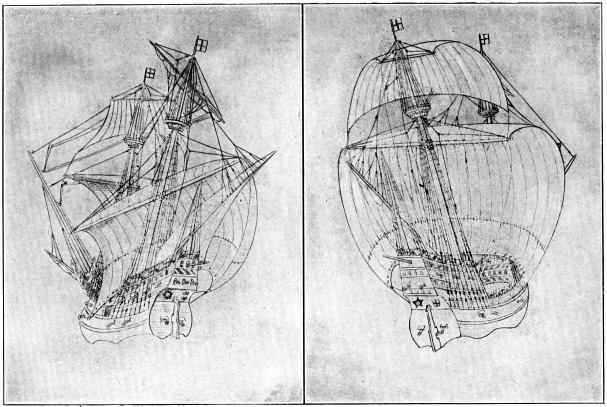
pictures of the vessel are reproduced by Charnock, of such
obvious disparity that they serve to show (as the author
observes) to what a degree artists may differ in the presentment
of the same vessel. They confirm, besides, the profuseness
of the ornamentation which was massed on her—the trophies,
angels, emblems, mouldings—which made her the occasion of
loud complaints against ship-money, and “a miracle of black
and gold.”
The Sovereign of the Seas had a distinguished career. When
cut down a deck she proved to be an exceptionally serviceable
unit, taking part in all the great actions of the Dutch wars and
crowning her work at La Hogue, where she engaged, crippled,
and forced to fly for shallow water the great Soleil Royal, 104,
the French flagship. At length, when laid up at Chatham in
1696 in order to be rebuilt, she was set on fire by negligence and
destroyed.
§
By the outbreak of the first Dutch war the modern ideas
introduced by Phineas Pett had received a general embodiment
in the navy. Blake found to his hand ships well suited
to the intended warfare, nor was he much concerned to add
either to their number or their magnitude. Only in one feature
did the new vessels built show any difference from older construction:
their depth in hold was reduced, probably to render
them more suitable for work among the shallow waters of the
coast of Holland.15 In other important respects improvement
had preceded the opening of hostilities.
The lofty stern with which it had been the custom to endow
the sailing ship was a feature which had survived from ancient
times. In the galley, whose armament was concentrated in the
bows, the after part was not devoted to military fittings, but
was appropriated chiefly to the accommodation of the officers.
So it was in the galleon or sailing ship. With the desire and
need for increased accommodation the extra space was obtained
by prolonging aft the broad horizontal lines of the vessel and
terminating them in a square frame. To give more space,
quarter galleries were then added, outside the vessel. Then
extra tiers of cabins were added, also with quarter galleries,
each storey, as in the case of domestic architecture, projecting
over that beneath it, and the whole forming, with its surmounting
taffrails, lanterns and ornaments, an excessively
weighty and top-heavy structure. Similarly, at the fore end
of the ship there remained the survival of the ancient forecastle.
With the acceptance of artillery as the medium for battle,
with the decay of boarding tactics and the decline in value of
small man-killing firearms, close-fights and end-castles, the
lofty forecastles and sterns ceased to possess much of their
special value. The arguments of Sir Richard Hawkins’ day in
favour of large cage-works no longer held; nor could the
preference of some shipbuilders for high sterns, as allowing a
quick sheer and thereby contributing to the girder strength of
the hull, be considered sufficient to justify their retention. The
stern galleries held a great deal of wind and tended to rot the
decks in their vicinity; their weight put a strain upon the
supporting keel; but, chiefly, the danger of their taking fire in
action induced the authorities to cut them down. For similar
reasons the forecastles were attacked. But there was strong
opposition to their elimination, because of the cover which they
afforded in a fight. In 1652 the Phœnix, one of the finest
frigates in the service, was taken by a Dutch ship, “having no
forecastle for her men to retire to.” In the second Dutch war
experience confirmed their usefulness. “All the world,” wrote
Mr. Secretary Pepys in his diary for the 4th July, 1666, “now
sees the use of forecastles for the shelter of men.”
No general increase in the size of our ships took place till
toward the end of the third Dutch war. Until that time the
navy of France was a negligible quantity; in 1664, it is said,
the only war-vessel at Brest was one old fireship. The Dutch,
our only strong opponents, fought in ships not unlike our own,
stout, buoyant vessels mounting from 24 to 60 guns, and of
from 300 to 1200 tons burden. Geography had a curious
influence on their construction. Owing to the shallowness of
their coasts the Hollanders built their ships with less draught
and flatter floors than those of other countries; from which
policy they derived advantages of a greater carrying capacity
and, in pursuit, an ability to retreat among the shallows; but
on account of which they suffered a serious handicap in the
hour of action, when, faced by English ships built of superior
material and with finer bottoms which enabled them to hold a
better wind, they were weathered and out-fought.16
There was no apparent advantage, therefore, in augmenting
the size of our ships. Improvement was sought, rather, from a
further unification of the calibres of the guns, and from an
increase in the number carried. Their characteristics of shortness
and large bore were such as to make them well-suited to
the form of battle now favoured by English leaders—the close-quarter
action.
In solidity of construction the English ships compared
favourably with those of the Dutch. The thick scantlings
introduced by Phineas Pett now proved of great value; the
wood itself, tough English oak, was unequalled by any other
timber. English oak was the best, as Fuller noted. Even the
Dutch had built some of their ships of it; while other countries
frequently built of inferior fir, the splinters of which killed more
than were hit by hostile cannon balls. To what was the
superiority of the English timber due? To the soil and climate
of this favoured country. Under the influence of successions of
warmth and cold, of rain and sunshine, frost and wind, all in a
degree most favourable for alternate growth and consolidation,
the English oak attained an unrivalled strength and durability.
Trees planted in forests, where mutual protection was afforded
from wind and cold, grew rapidly, but were inferior in quality
to trees planted in small parcels or along the hedgerows; these
latter, slow-growing and tough, felled “at the wane of the
moon and in the deep of winter,” supplied the thickstuff, knees,
and planking for generations of our royal ships. Their endurance
was frequently remarkable. The bottom timbers would
last for fifty or sixty years, but the upper works, which were
subject to alternations of heat and cold, dryness and moisture,
decayed in a much shorter space of time. The Royal William
is quoted by Charnock as a case in point. This first rate ship
was launched in the year 1719, and never received any material
repair until 1757. A few years later she was cut down to a
third rate of 80 guns. Participating in all the sea wars of the
time, she was surveyed in 1785 and converted into a guardship,
which post she filled till early in the nineteenth century.17
Much attention, as we have noted, was given in this scientifically
minded Stuart age to the form of body best suited to
motion through water, but the efforts to improve design were
largely misdirected. Many of our ships were unsatisfactory,
not only from their slowness but because they were crank or
tender-sided, and unable to bear out their lower guns or even
to carry a stout sail. They were so clogged with timbers
internally that they could not carry the victuals and stores
necessary for long voyages; and vessels built by contract were
often found to be carelessly put together, of green, unseasoned,
and unsuitable timber.
After the Restoration the mantle of the Petts descended on a
master shipwright of Portsmouth, who became an authoritative
exponent of ship design, and to whose ability several improvements
were due. “Another great step and improvement to our
navy,” recorded Mr. Pepys in 1665, “put in practice by Sir
Anthony Deane, was effected in the Warspight and Defiance,
which were to carry six months’ provisions, and their guns four
and a half feet from the water.” In the same diary for 19th
May of the following year occurs the following characteristic
note: “Mr. Deane did discourse about his ship the Rupert,
which succeeds so well, as he has got great honour by it; and
I some, by recommending him. The king, duke, and every
body, say it is the best ship that was ever built. And then he
fell to explain to me the manner of casting the draught of
water which a ship will draw, beforehand, which is a secret the
king and all admire in him; and he is the first that hath come
to any certainty beforehand of foretelling the draught of water
of a ship, before she is launched.” The calculations used by
Sir Anthony Deane to forecast the draught of a projected ship
might win him applause among the philosophers; but the
scoffer at theory was able to point to considerable achievements
wrought by men who made no pretence of any knowledge of
science. In 1668 the Royal Charles, 110, was launched at
Deptford. “She was built,” wrote Evelyn, “by old Shish, a
plain, honest carpenter, master builder of this dock, but one
who can give little account of his art by discourse, and is hardly
capable of reading.”
The interest of Charles II in naval architecture may be
gathered from a letter written by him in 1673: “I am very
glad that the Charles does so well; a girdling this winter, when
she comes in, will make her the best ship in England: the next
summer, if you try the two sloops that were built at Woolwich
that have my invention in them, they will outsail any of the
French sloops. Sir Samuel Morland has now another fancy
about weighing anchors; and the resident of Venice has made
a model also to the same purpose.”
To girdle a ship, was to fasten planks along her sides some
two or three strakes above and below the water-line; this had
the effect of adding to her beam and thereby rendering her
stiffer under sail. Incessant girdling seems to have been necessary
at this period, to counter the defective conditions in which
English ships were designed, built, and sent to sea. Ships were
consistently restricted in beam, in compliance with the faulty
“establishments,” and under a mistaken notion that narrowness,
in itself, directly contributed to speed. “Length,” says
Charnock, “was the only dimension regarded as indispensably
necessary, by the ancients for their galleys and by the moderns
for galleons. Breadth was not considered, or if considered was
accepted as a necessary evil.” Pepys remarked, “that the
builders of England, before 1673, had not well considered that
breadth only will make a stiff ship.” It was an inquiry ordered
by Sir Richard Haddock in 1684 which brought to light the
fulness of the fallacy; ships were subsequently made broader,
and experience showed that a good breadth was beneficial, not
only for stability but for speed and sea-keeping qualities.
But even if a ship were built initially broad enough, the
continual addition of armament and top-hamper to which she
was often subjected had the effect eventually of impairing her
stability. In such a case there were two remedies: to ballast
or to girdle. The former expedient was objectionable, as it
involved an increase both of displacement and of draught.
Girdling was therefore generally practised. By this means
the vessel was made stiffer, her buoyancy was improved, and
her sides were also rendered less penetrable between wind and
water. Even if, when thus girdled, she proved to be less stiff
than the enemy this was not altogether a disadvantage: she
formed a steadier gun-platform, her sides were less strained by
the sea and, because her rolling was less violent, her topmasts
were less liable to be sprung. But sufficient stiffness was
necessary to allow of her lowest and heaviest tier of guns being
fought in moderate weather; and for this reason alone, girdling
was preferable to ballasting, in that the former tended to keep
the guns high out of water while the latter brought them nearer
the water-line.
Although rigidly restricted in dimensions, ships put to sea in
these days under such varying conditions that it was difficult
indeed to foretell whether a vessel were seaworthy or not.
A commissioner of James the Second’s reign complained bitterly
of the injudicious management whereby “many a fast sailing
ship have come to lose that property, by being over-masted,
over-rigged, over-gunned (as the Constant Warwick, from
26 guns and an incomparable sailer, to 46 guns and a slug),
over-manned (vide all the old ships built in the parliament time
now left), over-built (vide the Ruby and Assurance), and having
great taffrails and galleries, etc., to the making many formerly a
stiff, now a tender-sided ship, bringing thereby their head and
tuck to lie too low in the water.”
In spite of these strictures it must be remembered that our
ships had qualities which, brought into action by brave crews
and resolute leaders, served the nation well in the day of battle.
In no naval war, perhaps, did superiority of material exert
such a consistent and preponderating effect as in the seventeenth
century wars between this country and Holland.
The tactics of the English leaders involved close-quarter
fighting. The material, both guns and ships, certainly favoured
these tactics; though to what extent tactics dictated the form
of the material, or material reacted on tactics, it may be
difficult to decide. In one respect tactics undoubtedly directed
the evolution of the material: while the Dutch employed a
“gregarious system” of mutual support of their vessels by
others of various force, fighting in groups and throwing in fireships
as opportunity offered, the English always sought to
match individual ships.18 Forming in line ahead—a formation,
said to have been first used by Tromp, which enabled our
vessels to avoid the fireships—they came to close quarters in a
series of duels in which the strength and prowess of each
individual ship was its only means of victory. The success of
this plan caused the Dutch to imitate it. The size of their ships
rapidly grew; their weakest units were discarded. Three-deckers
were laid down, at first carrying only 76 guns, but later,
after the peace of 1674, as large as the British first rates. But
by that time the critical battles had been lost and won. And
the success of the British is ascribed, in Derrick’s memoirs,
chiefly to the superior size of our ships, “an advantage which
all the skill of the Dutch could not compensate.”
With the institution of the line of battle a need arose for a
symmetry between ships which had never before existed. From
this arose, not only that more complete differentiation of
force19 which lasted through the following century, but a still
more stringent ruling of dimensions according to “establishments,”
which ruling, injudiciously applied, was henceforth to
exercise so harmful an effect on English naval construction.
After the peace of 1674 the navy sank into inefficiency. The
French navy, on the other hand, ascended in power with an
extraordinary rapidity. By 1681 it had expanded so much
under the fostering care of M. Colbert that it comprised no
fewer than one hundred and fifteen ships of the line. In design,
as apart from construction, French ships were superior to ours.
In size especially they had an advantage, being universally
larger than British ships of the same artillery force: an
advantage based on the law, known to our own shipbuilders
but never applied, that the greater the dimensions of a ship,
relatively to the weight she has to carry, the better she will sail. So
superior were some French ships which visited Spithead seen
to be, that in imitation of them Sir Anthony Deane was ordered
to design and build the Harwich; and from the plans of this
ship nine others were ordered by parliament, the class constituting
the greatest advance in naval architecture of that
time. But this departure from precedent had little effect. In
dimensions as compared with tonnage we continued parsimonious.
In the face of French experience we cramped our
ships to the requirements of the faulty “establishments”; and
until the end of the century no increase in size took place
except in the case of some ships laid down in the year 1682,
when the threat of a war with Louis XIV not improbably
caused them to be constructed on a more extensive scale than
had ever before been in practice.
In another respect our ships were inferior in design to those
of our chief rivals: in the extreme degree of “tumble home”
given to their sides. Adhering to ancient practice in this particular,
in order to obtain advantages which have already
been mentioned, we suffered increasingly serious disadvantages.
The sides of our ships were so convex that, when sailing
on a wind, every wave was guided upward to the upper deck,
thereby keeping the crew continually wet. The deck space
required for the efficient working of the sails was contracted.
Moreover, ships having this high degree of convexity were
more easily overset than were wall-sided ships. This exaggerated
convexity had a striking effect on one feature of
our construction, viz. the manner in which we affixed the
chain-plates, to which the shrouds were secured, in a low
position on the curve of the hull; while Holland and France
raised them to a more convenient height—over the upper tier
of guns, in their two-decked ships.
On the other hand the horizontal lines of our ships were (in
the absence of science) cleverly moulded. The after lines in
particular were well suited for supporting the stern and at the
same time allowing a free run of water to the rudder; other
nations, overlooking the importance of this part of the vessel,
adhered to the old-fashioned square tuck and stern which was
a chief but unappreciated factor of the resistance to the passage
of the vessel through water.
When war actually broke out in 1689 the balance of material
between English and French was much the same in character
as it had been between English and Dutch. Our fleet was once
more in a seaworthy and efficient condition. Our guns were
generally shorter and of larger bore than those of the French;
our ships were narrower and less able to bear out their ordnance,
but their sides were thicker, and better able to withstand the
racket of gun fire. Once more, at La Hogue, the British
squadrons showed that they possessed the offensive and
defensive qualities which favoured victory in close-quarter
fighting; and the end of the century found the prestige of the
navy at a level as high as that to which Cromwell and Blake
had brought it.
In the decade which ended in 1689 the navy had passed, on
its administrative side, “from the lowest state of impotence
to the most advanced step towards a lasting and solid prosperity.”
In Pepys’ rare little Memoirs the story of this
dramatic change is told. We read how, after five years’
governance by the commission charged by the king with the
whole office of the Lord High Admiral, the navy found itself
rotten to the core; how in ’85 the king resolved to take up
its management again, helped by his royal brother; how he
sent for Mr. Pepys; how at his instigation new, honest, and
energetic Commissioners were appointed, including among
them the reluctant Sir Anthony Deane; how Mr. Pepys
himself strove to reorganize, how new regulations were introduced,
sea stores established, finances checked, malpractices
exposed, the navy restored both in spirit and material.
Mr. Pepys claimed to prove that integrity and general knowledge
were insufficient, if unaccompanied by vigour, assiduity,
affection, strictness of discipline and method, for the successful
conduct of a navy; and that by the strenuous conjunction
of zeal, honesty, good husbandry and method, and not least
by the employment of technical knowledge, the Royal Navy
had been rendered efficient once again.
The following extract from an Essay on the Navy, printed
in 1702, is here quoted for its general significance:
“The cannon (nearly 10,000 brass and iron) are for nature
and make according to the former disposition and manner of
our mariners’ fighting (whose custom was to fight board and
board, yard-arm and yard-arm, through and through, as they
termed it, and not at a distance in the line, and a like, which
practice till of late our seniors say they were strangers to), they
are therefore much shorter and of larger bore than the French,
with whom to fight at a distance is very disadvantageous, as
has been observed in several fights of late, their balls or bullets
flying over our ships before ours could reach them by a
mile....” etc., etc.
§
In Laputa, early in the eighteenth century, the people were
so engrossed in the mathematics that the constant study of
abstruse problems had a strange and distorting effect on
the whole life of the island. Their houses were built according
to such refined instructions as caused their workmen to
make perpetual mistakes; their clothes were cut (and often
incorrectly) by mathematical calculation; the very viands on
their tables were carved into rhomboids, cycloids, cones,
parallelograms, and other mathematical figures!
To most Englishmen of that time any attempt to apply
science to shipbuilding must have appeared as far-fetched and
grotesque as these practices of the Laputans. Ship design
was still an art, veiled in mystery, its votaries guided only by
blind lore and groping along an increasingly difficult path by
processes of trial and error. The methods of applied science
were as yet unknown. The builder was often a mere carpenter,
ignorant of mathematics and even of the use of simple plans;
the savant in his quiet study and the seaman on the perilous
seas lived in worlds apart from each other and from him, and
could not collaborate. Such speculative principles as the shipbuilder
possessed were almost wholly erroneous; no single
curve or dimension of a ship, it is said, was founded on a
rational principle. Everything was by tradition or authority.
Knowledge had not yet coalesced in books. Men kept such
secrets as they had in manuscript, and their want of knowledge
was covered by silence and mystery. Preposterous theories
were maintained by the most able men and facts were denied
or perverted so as to square with them. “Forgetful of the
road pointed out by Lord Bacon, who opposed a legitimate
induction from well-established facts to hypothesis founded on
specious conjectures, and too hastily giving up as hopeless
the attainment of a theory combining experiment with established
scientific principles, they have contented themselves
with ingeniously inventing mechanical methods of forming the
designs of ships’ bodies of arcs of circles, others of ellipses,
parabolas, catenaries—which they thought to possess some
peculiar virtue and which they investigated with the minutest
mathematical accuracy. So they became possessed of a
System. And, armed with this, they despised all rivals without
one; and, trusting to it, rejected all the benefits of experiment
and of sea experience.”20
The intervention of the philosophers had not had any
appreciable effect. Sir William Petty had indeed projected a
great work on the theory of shipbuilding; he had carried out
model experiments in tanks, and had invented a double-keeled
vessel which, by its performances on passage between Holyhead
and Dublin, had drawn public attention to his theories.21
In his discourse before the Royal Society on Duplicate Proportions,
he had opened out new and complex considerations for
the shipbuilder; inviting him to forsake his golden rule, or
Rule of Three, and apply the law x varies as y² to numerous
problems in connection with his craft. But it could soon be
shown, by a reference to current practice, that this new law
could not be rigidly applied. And the shipbuilder, realizing
his own limitations and jealous of sharing his professional
mysteries with mathematicians and philosophers, was willing
to laugh the new theories out of court.
Again, of what practical use had been the discovery of the
“solid of least resistance” or of that “cono-cuneus” which
Dr. Wallis had investigated with a view to its application to
the bows of a ship? A final blow to the scientists was given
when the Royal Katherine, a three-decker of 80 guns, designed
by the council of the Royal Society, was found so deficient in
stability that it was deemed necessary to girdle her. Old
Shish had beaten Sir Isaac Newton and all the professors! The
impossibility of applying abstract scientific principles to so
complex a machine as a sailing ship, moving in elements so
variable as air and water, was patent to everyone. The
attitude of the professional may be judged from the resigned
language of William Sutherland, a shipwright of Portsmouth
and Deptford Yards, who in 1711 published his Ship-builder’s
Assistant:
“Though some of our preceding Master Builders have proposed
length as expedient to increase motion, yet it has seldom
answered; much extra timber is required to make them
equally strong. Besides, if the solid of least resistance be a
blunt-headed solid, extreme length will be useless to make
cutting bodies.”
Again, in connection with the dimensions of masts:
“Though several writers say, that the velocities are the
square roots of the power that drives or draws the body;
from which it should be a quadruple sail to cause double
swiftness. Hence, unless the fashion is adapted to the magnitude
of the ship, all our Art can only be allowed notional, and
the safest way of building and equipping will be to go to
precedent, if there be any to be found. But this is a superfluous
caution, since ’tis very customary, that let a ship be
fitted never so well by one hand, it will not suit the temper of
another. Besides, the proper business of a shipwright is
counted an very vulgar imploy, and which a man of very indifferent
qualifications may be master of.”
Science was, in short, discredited. The corporation of shipwrights
had disappeared, not long surviving the fall of the
house of Stuart. No master-builder had succeeded the Petts
and the Deanes having sufficient influence and erudition to
expose the faulty system under which warships were now
built, English shipbuilding had once more become a craft
governed entirely by precedent and the regulations. The
professor was routed, and the practical man said in his heart,
There is no knowing what salt water likes.
Yet the science of naval architecture was at the dawn. Not
in this country, but in France, in the early part of the eighteenth
century, research and inquiry received such encouragement
from the State that it conferred on their fleets a superiority
of design which they retained for long: a superiority which
enabled them, in the guerre de course which was developed after
La Hogue under the intrepid leadership of men like Jean Bart,
Forbin, and Duguay-Trouin, to strike us some shrewd blows.
We propose to summarize as briefly as possible the principal
events which mark the evolution of the scientific side of naval
architecture.
A mere enumeration of the names and works of the men
who chiefly contributed to the discovery of the true natural
principles underlying the performance of sailing ships would
suffice to show the debt owed by the world to French effort,
and the tardiness with which this country faced the intellectual
problems involved. In the year 1681 a series of conferences
was held at Paris on the question of placing the operations of
naval architecture on a stable scientific basis; but before that
date, in 1673, Father Pardies, a Jesuit, had published the
results of his attempts to calculate the resistance of bodies
moving in fluids with varying velocities. In ’93 the Chevalier
Renaud and Christian Huyghens were engaged in public controversy
on the merits and deficiencies of Pardies’ laws. In
’96 James Bernouilli entered the lists on Huyghen’s side, and
in the following year a remarkable work appeared from the
pen of another Jesuit, Paul Hoste, professor of mathematics
at Toulon. Father Hoste, having noticed the frequency with
which vessels of that time required girdling, had put the
question, why they should not be built initially with the form
which they had when ultimately girdled. The replies given
him being unsatisfactory, the professor investigated a whole
series of problems: the relation between speed and resistance,
the effect of form on resistance, stability, stowage, the properties
affecting pitching, and the best form of bow. Though
incorrect in much of his theory, he had admittedly a great
influence on later research. He was followed, in 1714, by John
Bernouilli, professor at Basle, whose investigations were purely
theoretical. And then, a few years later, M. Bouguer made
his great discovery of the metacentre, that all-important point in
space whose position in a ship, relatively to its centre of gravity,
marks with precision the nature of the vessel’s stability.
A treatise by Euler, entitled Scientia Navalis, was published in
1749, and a little later, stimulated by prizes offered by the
Société Royale des Sciences, Don G. Juan in Spain, Euler in
Russia, and Daniel Bernouilli in Germany, all published the
results of their investigations into the forces acting on a rolling
ship. Euler’s contribution was especially valuable. Treating
the ship as a pendulum he laid down two definite rules for the
guidance of shipbuilders, (1), not to remove the parts of a ship
too far from the longitudinal axis, (2), to make the most distant
parts as light as possible.
Up to this time the discoveries of the mathematicians had
had little practical effect on shipping. The abstruse form in
which new truths were published, and the lack of education
of the shipbuilders, prevented that mutual collaboration
which was necessary if the art of shipbuilding was to benefit
by the advances of science. Soon after 1750, however, a
succession of able men, possessed of imagination and initiative,
led inquiry into practical channels, and by actual trial
proved, incidentally, that much of the accepted theory was
faulty. The Chevalier de Borda, a naval captain and a member
of the Academy of Sciences, investigated with models the
resistance of fluids to motion through them, and enunciated
laws which shook confidence in current beliefs. The result was
a commission from the government to three eminent men,
M. D’Alembert, the Marquis Condorcet and the Abbé Bossut,
to report on and continue de Borda’s investigations. The
report, read by the Abbé before the Academy in 1776, confirmed
generally de Borda’s theories, and revealed new
problems—in particular, the alteration in shape of the free
water surface and the effect of wave resistance, the latter of
which was ultimately to be solved in this country by Mr. W.
Froude—that required investigation. The circumstances of
this commission illustrate the enlightened interest of the State
in the advancement of knowledge, significant testimony to
which was paid by Abbé Bossut. “M. Turgot,” he said of
the Comptroller-General of Finances, who took responsibility
for it, “who is not only an admirer of the sciences, but has
pursued the study of them himself amidst his numerous
important official functions, approved of our intentions, and
granted every requisite for prosecuting them.”
In the same year curious and important discoveries were
made by M. Romme, professor of navigation at La Rochelle.
In an endeavour to find the form of ship body which would
give good stability in conjunction with small resistance, he
ascertained the importance of the “run” or after part.
Hitherto the form of bow had absorbed attention to the almost
entire exclusion of the form of run, except in so far as it had
been shaped to allow water to flow freely to the rudder. M.
Romme called in aid methods which are now approved as
scientific, but which were then conspicuously novel: he
experimented by comparative trials between models in which
all variable features except one had been carefully eliminated.
He was rewarded by some new discoveries. By fixing the
length and successively varying the curvature of different parts
of his models he laid bare an important paradox. While at
low speeds the resistance was least when a sharp end was in
front and a blunt end in rear, at higher speeds the opposite
obtained. This accounted for a great deal of the contradictions
of previous investigators. M. Romme went further:
the curves by which the bow of a ship was connected with her
middle body, hitherto looked on as all-important, were shown
to be relatively immaterial. He astonished the world of
science by proving that, given certain conditions, the resistance
upon an arc of a curve is the same as that upon the chord of
this arc. His deductions were proved by commissions to be
well founded. Experience confirmed that the form of the bow
curve did not much influence the resistance experienced in
passing through water; on the other hand the form of the
run was shown to have a far greater effect than had hitherto
been suspected.
In the year before M. Romme published the results of his
experiments a treatise appeared, full of empirical rules and
shrewd reasoning, by one of the greatest naval architects,
Henry de Chapman, chief constructor of the Swedish navy, an
Anglo-Swede who came of an old shipbuilding family of Deptford.
Chapman was a most gifted shipbuilder. Though his
formulæ were empirical, they were founded on careful observation
and induction, and his name ranks with those of Phineas
Pett and Anthony Deane in the history of naval architecture.
Nothing, so far, had come from English writers. “The only
English treatise on shipbuilding that can lay any claim to a
scientific character was published by Mungo Murray in 1754;
and he, though his conduct was irreproachable, lived and died
a working shipwright in Deptford dockyard.”22 But indifference
was at last giving place to interest. Inspired by the formation
of the Society of Arts in 1753 (which Society was itself inspired
by the recognition, on the part of the founder, of the value of
prizes and rewards in improving our breed of racehorses) a
London bookseller named Sewell succeeded in 1791 in forming
a Society for the Improvement of Naval Architecture.
“Impressed with the many grave complaints which reached
him as to the inferiority of our warships as compared with
those of France and Spain,” he gained the interest of Lord
Barham and other influential men. A meeting was held at
which it was decided, as something of a novelty, that the
theory and art of shipbuilding were subjects of national importance;
that a radical deficiency in knowledge of the same
existed; and that the most effective remedy was a focussing
of the wisdom of the country on this matter by the institution
of the above Society.23
For a time the society flourished. A learned paper by
Atwood before the Royal Society, on the stability of a rolling
ship, proved that this country was not wholly destitute of
mathematical talent. An interesting series of experiments was
carried out for it by Colonel Beaufoy, a devoted student who
had made his first experiments on water resistance before he
was fifteen years old. It appears that his attention was first
drawn to the subject by hearing an eminent mathematician
state one evening that a cone drawn through water base foremost
experienced less resistance than with its apex foremost;
and it was said that sailors always took a mast in tow by the
heel. The paradox excited young Beaufoy’s curiosity. Before
bedtime, with the assistance of a neighbouring turner, he was
making experiments in one of the coolers in his father’s brew-house,
a large bunch of counting-house keys being put into
requisition as a motive power. Though the society was
dissolved in 1799 Beaufoy continued to pursue this subject
with unabated zeal until his death. In one direction, especially,
he did good work. Attracted by the frequency with which
North Sea fishing vessels, fitted with wells for carrying the fish,
foundered at sea, he showed experimentally the loss of stability
involved in carrying open tanks of water. He also demonstrated
to English builders by means of models that Bouguer’s
diagram of metacentric stability was of great practical value,
even for large angles of heel. “His experiments,” says Mr.
Johns, “should take an important place in the history of
stability of ships.”
§
We now revert to the beginning of the eighteenth century.
In the desultory warfare which was carried on during the
reign of Queen Anne events occurred to demonstrate the
superiority in design of the French warship over its English
opponent of the same nominal force. One in particular, an
expedition under Count Forbin which was intended to cover a
descent on the Scotch coast in favour of the Pretender,
“showed, even in failure, that in material France held a lead
on us.” Chased back to its ports from the latitude of Edinburgh
by larger English forces, Forbin’s squadron proved a
superiority over all our ships, both in speed and seaworthiness.
In weather which disabled many of our vessels the French
squadron arrived home with the loss of only three—and these
all English built.
At about the same time the capture by us of a 60-gun ship,
the Maure, of extraordinarily large dimensions for her rate,
showed the direction in which French design differed from our
own. The recapture, not long afterwards, of the Pembroke,
which was now found to carry only fifty, instead of her original
number of sixty-four guns, corroborated (says Charnock) the
direction in which improvement was sought and found.
But for some time the lesson remained unlearnt. For a
number of years the inferiority of our design was an accepted
fact; “every action won by British valour was a stigma to
British science.” Throughout the whole of this century we set
no value on scientific principles as applied to naval architecture,
and were content to remain copyists. Although before the
advent of the Napoleonic wars we had thus endeavoured to
reduce their balance of advantage, yet even so the French still
maintained an absolute superiority in design. In the first half
of the century this superiority was especially conspicuous; and,
in conjunction with an inferiority of seamanship and workmanship
which in the end more than neutralized all its advantages,
it was the cause of the disreputable incongruities which Charnock
has depicted in his well-known epigram: Very few ships
captured by the enemy from the British have ever continued long
the property of their possessors. If it has so happened, that one of
them, being in company with others of French construction, has
ever fallen in with any English squadron, that ship, almost without
exception, has been among those captured, and most frequently
the first which has fallen. On the other hand, the recapture of any
ship from the British, which was originally French, is a circumstance
extremely uncommon. Captured French ships were sought
for as the best commands, which not infrequently were the means of
recapturing captured English vessels.
Very seldom was our failure to overhaul the speedy Frenchman
attributed to inferiority of design; nearly always to the
fortuitous circumstance that we were foul-bottomed and the
enemy clean; which may have been sometimes true, but
which was evidently a partial and inaccurate explanation.
We have already made mention of the periodic “establishments”
of dimensions to which ships built for the royal navy
were made to conform. The first of these, after the rules laid
down by the commissioners of James I, was decreed in 1655,
when Blake was organizing a new standard navy. In 1677
dimensions were established for ships of 100, 90, and 70 guns,
but were exceeded in the case of those ships which were
actually built; and in ’91 a revised establishment for all
classes, very similar to those which previously governed
practice, appeared. In 1706 a new establishment was decreed,
a compromise between the ideas of the Surveyor and the
master shipwrights, in which the dimensions of each class were
slightly increased. The dimensions still remained small compared
with those of all foreign ships, however, and still “all
superior faculties of sailing were attributed to the mere length
of the vessel itself, without any but trivial regard to shape or
form of bottom.” Assuming that the ships built under this
establishment derived some slight advantage over earlier
construction on account of their augmented tonnage, yet this
was nullified when, in 1716, the force of their armament was
raised. As the work of a committee presided over by Admiral
Byng, a new establishment of guns was ordered, a change being
made in calibres but not in numbers:—
First and second rates, instead of carrying 32-pounders on
the lower, 18-pounders on the main, and 9-pounders on the
upper deck, were ordered to carry, 42-pounders (or 32-pounders)
on the lower, 24-pounders on the main, and 12-pounders on the
upper deck. Eighty-gun ships, instead of carrying 24-pounders
on the lower, 12-pounders on the main, and 6-pounders on the
upper deck, were ordered to carry 32-pounders on the lower,
12-pounders on the main, and 6-pounders on the upper deck.
Seventy-gun ships, which in the previous century had carried
18-pounders on their main, and 9-pounders on their upper
deck, and which during the reign of Queen Anne had carried
24-pounders and 9-pounders, were now ordered to carry
24-pounders and 12-pounders. And so on with the smaller
rates.
In 1719 a new establishment for ships was decreed, the
dimensions slightly exceeding those of 1706, but being totally
insufficient for satisfactory construction. In ’32 and ’41
attempts were made to formulate new rules; but the master
shipwrights seem to have been loth to accept the lesson which
the French enemy was teaching them, and hesitated to recommend
any radical departure from traditional practice.
At length, in 1745, general complaint of the inferiority of
our ships in size and scantlings forced improvement on the
authorities. Spain, who had joined France in war against us,
possessed ships which exceeded in size even French ships of the
same rate. The capture in 1740 of a Spanish 70-gun ship, the
Princessa, by three of our ships, nominally of equal force with
herself but of far inferior dimensions and scantlings, is said to
have been the chief cause of the new reform. Their lordships
of the Admiralty, surveying naval construction in this country,
noted that our royal ships were weak and crank, while those of
other nations went upright. There was no uniform standard of
size, ships of the same class were of different dimensions, the
existing establishment was not adhered to. They therefore
decided on a new establishment, based on the latest armament
of guns; which should result in ships which would carry
their lower tier six feet above the water, and four months’
provisions.
The new standard was of little avail, for the same error made
some thirty years previously was now repeated: with the
augmentation of the ship dimensions the armament was also
raised in calibre. The first rates were ordered to carry the
42-pounder (which had before been optional) on their lower
deck; the 90-gun ships, 12-pounders on their upper decks;
the eighties, 18-pounders and 9-pounders instead of 12’s and
6’s; the seventies, which were only two hundred tons in excess
of the former establishment, 32-pounders and 18-pounders,
instead of 24’s and 12’s. “The ships, therefore, built by this
establishment proved, in general, very crank and bad sea-boats.”24
This establishment was, in point of fact, little adhered to.
The war with France during the years 1744–8 repeatedly
revealed the defective nature of our ship design. Experience
pointed to the necessity either of reduced gun-weights or of
larger ships. Able administrators were now willing, under the
inspiration of such names as Hawke and Anson, to initiate
improvements. Our naval architecture at last took benefit,
though still by slow and cautious degrees, from foreign experience.
Some time was necessary for results to show themselves;
not only were new decisions slowly formed, but the rate of
building was deliberately slow. The Royal George, for instance,
described as “the first attempt towards emancipation from
the former servitude,” was ten years building. But, when war
broke out again in 1756, the improvements already embodied
in the newest construction proved of considerable benefit. The
establishment of ’45 was given the credit. “The ships built
by the establishment of 1745,” says Derrick in his Memoirs,
“were found to carry their guns well, and were stiff ships, but
they were formed too full in their after part; and in the war
which took place in 1756, or a little before, some further
improvements in the draughts were therefore adopted, and the
dimensions of the ships were also further increased.”
To meet the advances in French construction a new classification
of rates took place, with French captured ships as models.
The capture of the Foudroyant, for instance, in 1758, provided
us with the form and dimensions of a splendid two-decked
84-gun ship. Our 80-gun three-deckers were thereupon
abolished, and no three-decker was thenceforth built with
fewer than 90 guns. The capture of the Invincible, in 1757,
gave us a valuable model for a 74-gun ship, a rate highly
esteemed, which bore the brunt of most of this century’s
warfare.25 From her was copied the Triumph, and other
experimental 74’s, with dimensions varying from those of the
Invincible, were at this time laid down. All 50-gun ships had
already dropped out of the line of battle; they were now
followed by the 60’s. No more 60 or 70-gun ships were built;
their places were taken by 64’s and 74’s respectively, of
relatively large size and displacement.
Nor was improvement confined to form and dimensions.
Attention was now paid to material. New rules were made for
the cutting and seasoning of timber, and for its economical use.
Sheathing was tried; in 1761 the frigate Alarm was sheathed
in copper for service in the West Indies, where the worm was
active. The copper was found to keep clean the hull, but at
the expense of the iron fastenings; so when, in ’83, copper
sheathing became general, an order was issued for all new
royal ships to be copper fastened up to the water-line: an
order beneficial on another count, since even without the
presence of copper sheathing, iron bolts had always been liable
to corrosion from the acids contained in the oak timbers.
Ventilation was also studied, more for its effects on the hull
timbers than on the health of the crews. The scantlings of all
ships were strengthened. Taffrails and quarter-pieces were
reduced in size, and the weight thus saved was devoted to
strengthening the sterns and reinforcing the deck supports;
additional knees and fastenings were provided throughout the
structure. Moreover, towards the middle of the century the
formation of the sails was gradually altered, first in the smaller
rates and afterwards in the larger ships. The old-fashioned
spritsail, which had been of greatest effect when going free, but
which had also been used with the wind abeam by the awkward
expedient of topping up its yard, gave place in our navy to the
fore and aft jib, which could be used with the wind before the
beam. Later the lateen sail on the mizzen gave place to a
spanker hung from a gaff or half-yard. These alterations had
a general effect on the size and position of masts and sails.
The order of 1745 was virtually the last of those rule-of-thumb
establishments which had imposed rigorous maximum
limits of length, beam and draught in conjunction with an
equally rigorous minimum of armament weight, and which had
been a glaring example of the evil effects of standardization
when unscientifically and unsuitably applied. The East India
service, the contract-built ships of which were designed by architects
untrammelled by the rules which cramped and distorted
the official architecture, provided the clearest proof that the
King’s ships were, as a whole, of poor design. Naval opinion
confirmed it.26
For further evidence that it was the system and not the men
at fault, we may note Charnock’s statement that, given a free
hand, Englishmen proved themselves better shipbuilders than
foreigners. “It stamps no inconsiderable degree of splendour
on the opinion which even the arrogance of Spain felt itself
compelled to hold in regard to the superior practical knowledge
possessed by the British shipwrights in the construction
and art of putting a vessel together, when brought in comparison
with that of their own people. The builders in all the
royal dockyards and arsenals, the Havanna excepted, were
Britons.”
How many, we may wonder, of the ships shattered by Lord
Nelson at Trafalgar were constructed by our countrymen?
The Victory, which was to bear his flag, was laid down (we may
note in passing) in the year 1759: she was 186 feet in length on
the gun-deck, 52 feet broad, and of 2,162 tons burthen.
In 1774 the American war broke out. The colonists, who
possessed a small but efficient frigate navy, were joined soon
afterwards by France, and then by Spain, and Holland. Lord
Rodney acknowledged the superiority of the French in speed,
who, though his ships were equally clean with theirs, yet had
the power daily to bring on an action. The war proved a rough
test for our honest but unscientific construction. “In 1778,
assailed by numerous enemies, England put forth all her naval
strength. Powerful fleets had to be found simultaneously for
the Channel, the North Sea, the East Indies, America, and the
West Indies. Five years of such warfare proved exhausting,
the ships on paying off in 1783 were in a terrible state of decay.
Several foundered returning home, owing to their ill-construction
and rickety condition; their iron bolts broke with the
working, and the ships were mere bundles of boards. All this
was owing to want of a better system of building, such as has
since been brought to such perfection by Sir R. Seppings.”27
After the peace the size of the French ships continued to
increase, and every effort was made to improve their design;
but they were weak both in construction and material. Large
three-deckers were once more built; the Commerce de Marseille,
120, was of such extraordinary dimensions that English critics
thought that “size had now reached its ultimatum.” In 1786
the French abolished the use of shingle as ballast; it created a
damp vapour between decks and gave a high centre of gravity.
Iron ballast had been tried in the frigate Iphigène with great
success. “She was very easy in a sea when under her courses;
her extremities were not overloaded with cannon; she mounted
only 13 guns a side, whereas she had room for 15. She was the
best sea boat, and fastest sailing ship, perhaps, ever built. Her
length was more than four times her breadth.”28
In England, as witnessed by the formation of the Society for
the Improvement of Naval Architecture, feeling was widespread
at this time that something was lacking in our methods of ship
construction. The navy was in process of reorganization by a
great administrator. In 1784 Sir Charles Middleton created
an establishment of naval stores. He took under consideration
shortly afterwards the growing scarcity of timber and its more
economical use. And in the course of his inquiry views were
expressed on naval shipbuilding which had an influence on
subsequent practice.
The conditions under which ships were built for the East
India Company were far more scientific than those obtaining
in the royal dockyards. The timber was more carefully picked,
and better seasoned. The hulls were laid up under cover and
well aired; they stood in frame for six months, and then,
when the planks had been tacked on, they stood again, and no
tree-nails were driven till all moisture had been dried out of the
timber. In design they were in many ways superior; in fact,
they were reputed the best and safest vessels in Europe.
Mr. Gabriel Snodgrass, the Company’s surveyor, under
whose supervision, it was claimed, 989 ships had been built
and repaired between the years 1757 and 1794, only one of
which had been lost at sea, gave illuminating evidence. “I am
of opinion,” he said, “that all the ships of the navy are too
short, from ten to thirty feet according to their rates, And
if ships in future were to be built so much larger as to admit
of an additional timber between every port, and also if the
foremost and aftermost gun-ports were placed a greater distance
from the extremities, they would be stronger and safer,
have more room for fighting their guns, and, I am persuaded,
would be found to answer every other purpose much better
than the present ships. The foremasts of all ships are placed
too far forward; the ships are too lofty abaft, and too low
in midships; they would be much better and safer, if their
forecastles and quarter-decks were joined together; for if they
carry two, three, or four tiers of guns, forward and abaft, they
certainly ought to carry the same in midships, as it is an
absurdity to load the extremities with more weight of metal
than the midships. No ships, however small, that have forecastles
and quarter-decks, should go to sea with deep waists:
they certainly ought to have flush upper decks.”
Ships of the navy, he considered, were too weak; they had
plenty of timber, but were deficient in iron fastenings, brackets,
and standards. Knees should be of iron, which was lighter,
cheaper, and stronger than wood. The bottoms of all navy
ships were too thin; the wales and inside stuff too thick. He
particularly recommended diagonal braces from keelson to
gun-deck clamps: six or eight pairs of these, secured with iron
knees or straps, should prevent ships from straining as they
did. He would reduce the tumble-home given to the topsides,
and thus add to the strength both of hulls and masts; he
would abolish quarter-galleries and give less rake to the sterns.
Finally, he would design ships so as to require a minimum of
compass timber; make no use of oak where he could substitute
fir or elm with propriety; and have all timbers cut as nearly
to the square as possible, to conserve strength.
His evidence, ending in a recommendation to the government
to improve the status of the naval shipwrights, has been
handed down as a remarkable exposition of sound knowledge
and good sense. The proposals were beneficial, so far as they
went, but they did not go far enough: the whole system on
which the hull timbers were disposed was wrong. The continuous
increase in the size of ships was gradually exposing
their weakness. And though in the next century a more
scientific disposition was to be adopted, for some years yet
construction continued on the ancient lines.29
The great wars with France, which broke out in the year
1792, found us adding both to the length and to the scantlings
of our new ships. Three years before, the Admiralty had
ordered two 110-gun ships to be built, of 2332 tons burthen.
One of them, the Hibernia, not finished till the year 1805, was
made more than eleven feet longer than originally intended.
Both of these ships were established with 32-pounder guns for
their main deck.30 The unwieldy 42-pounder, used on the
lower decks of first and second-rate ships, was now displaced,
in most ships, by the more rapidly worked 32-pounder. Lord
Keppel had tried, also, to substitute 32-pounders for 24-pounders
on the main deck of the Victory and other ships in
commission, so as to establish them generally; but they were
found too heavy on trial. He replaced 6-pounders by 12-pounders,
however, on the quarter-decks and forecastles.
Carronades were now making their appearance. In excellence
of material and honesty of workmanship our fleets were pre-eminent.
The value of large dimensions was by this time discerned;
where possible extra length was given to ships building and
those under repair. Size still increased. The great Commerce
de Marseille, brought home a prize by Lord Hood in ’94, was
forthwith matched by the Caledonia, which, ordered in this
year but not completed until 1810, was the greatest ship
which had ever been built in this country. Still, side by side
with news of world-shaking victories, came evidence of our
ships’ inferiority in design. Not only the French, but the
Spanish dockyards, produced vessels which could often
outsail ours. Four large prizes taken at the battle off Cape
St. Vincent surprised their new owners: “under their jury-masts,
and poorly manned as they necessarily were, they beat
all the English ships working into the Tagus.”31
As the great wars went on, Britain deployed a constantly
increasing naval force. Prizes went to swell the number of
ships put in commission. “Mr. Pitt was foremost in getting
every possible ship to sea; and under this pressure rotten old
ships were doubled and cross-braced and otherwise strengthened
and rendered fully adequate to temporary service. Trafalgar
followed, and the efforts of the civil departments were rewarded.”32
We have made little mention, in the foregoing pages, of the
actual tonnage or dimensions of ships, for the reason that the
figures would be for the most part unreliable or misleading
in import. The basis on which tonnage was measured was
constantly changing. It was difficult to obtain accurate
measurements of the principal dimensions; length, especially,
was an indeterminate dimension, and, in the days when a
large fore and aft rake was given, the length of keel gave no
indication of the over-all length. Even if the over-all dimensions
could be accurately measured, they gave small information
as to the form of the hull: the fullness or fineness of the
lines, the form of the bow-curves and tuck, the position of the
section of maximum breadth, both longitudinally and relatively
to the water-line—proportions on which the sailing
qualities of a ship largely depended. In the seventeenth
century the tonnage figures were generally untrustworthy;
the Sovereign was quoted by three different authorities as
being of 1141, 1637, and 1556 tons burthen. In the eighteenth
century tonnage and dimensions possessed greater comparative
value. We confine ourselves to quoting the following table of
typical dimensions, taken from Charnock, showing the gradual
expansion which took place in the hundred years which have
just been reviewed.
| Establishment | Length
(gun-deck) | Keel | Breadth | Depth | Tonnage |
|---|
| 1706 } |
171′ 9″ |
139′ 7″ |
49′ 3″ |
19′ 6″ |
1809 |
| 1719 } 100-gun ships |
175′ 0″ |
140′ 7″ |
50′ 3″ |
20′ 1″ |
1883 |
| 1745 } |
178′ 0″ |
145′ 2″ |
52′ 0″ |
21′ 6″ |
2091 |
| Commerce de Marseille (120) |
208′ 4″ |
172′ 0″ |
54′ 9″ |
25′ ½″ |
2747 |
| Caledonia (120) |
205′ 0″ |
170′ 9″ |
53′ 8″ |
23′ 2″ |
2616 |
§
The slow progress of naval architecture up to the end of
the eighteenth century, an advance the rate of which may be
gauged from the fact that, except for sheathing and pumps,
no important improvement was patented between the years
1618 and 1800, has been characterized as consisting mainly of
approximations to the successive forms and arrangements of
Italian, Portuguese, Spanish, and French ships, all of which
had been in their turn superior to ours. Until the end of the
eighteenth century the “bigotry of old practice” had effectually
opposed any radical improvement, even though such
improvement had been operating for years in foreign navies
and were brought continually before the eyes of our professionals,
embodied in captured prizes. In his Naval Development
of the Century Sir Nathaniel Barnaby has drawn attention
to the remarkable similarity which existed between the
Caledonia of the early nineteenth, and the old Sovereign of
the seventeenth century: “Almost the only things of note
were the reduction in height above water, forward and aft,
and a slight increase in dimensions. The proportion between
length and breadth had undergone but little change. There
was almost the same arrangement of decks and ports; the
same thin boarding in front of the forecastle; the same mode
of framing the stern, the same disposition of the outside
planking in lines crossing the sheer of the ports; nearly the
same rig; the same external rudder-head, with a hole in the
stern to admit the tiller; and probably the same mode of
framing the hull. For the ships of 1810 had no diagonal
framing of wood or iron, but the old massive vertical riders;
no shelf or waterway to connect the beams with the sides;
no fillings above the floor-head; and no dowels in the frames.
Ships were still moored by hempen cables, and still carried
immense stores of water in wooden casks.”
To Sir Robert Seppings was due the series of innovations
in constructional method which placed shipbuilding on a
relatively scientific basis and thereby rendered it capable of
meeting the increasing demands involved in the growing size
and force of warships. His scheme, some elements of which
had already been tested in H.M. ships, was described in a paper
read before the Royal Society in 1814. In the briefest language
we will attempt to explain it.
In the theory of structures, a jointed figure formed of four
straight sides is known as a deficient frame, since it has
not a sufficient number of members to keep it in stable equilibrium
under any system of loading. A triangle, on the other
hand, is a perfect frame, since it has enough, and not more
than enough, members to keep it in equilibrium however it
may be loaded.
The hull of a timber-built ship consisted of a number of
rigidly jointed frames or cells, some lying in horizontal, some
in vertical, and some in intermediate planes: the unit cell
being a quadrilateral, whose sides were formed by the frames
and vertical riders and by the planks, wales, and horizontal
riders. Practically all the materials composing the fabric of a
ship were disposed either in planes parallel to the plane of
the keel or in planes at right angles to it. And up to the end
of the Napoleonic wars our ships, without appreciable exception,
were built on this primitive quadrilateral system. The
system was essentially weak. All warships showed a tendency
to arch or hog—to become convex upwards, in the direction
of their length—owing to the fact that the support which they
derived from the water was relatively greater amidships than
in the neighbourhood of their extremities. In the old days
when ships were short in length this tendency was small, or,
if appreciable, a remedy was found in working into the structures
additional longitudinal and transverse riders, until the
holds were not infrequently clogged with timber. But as
ships increased in length, the forces tending to “break the
sheer” of a ship and arch its keel increased in greater ratio
than the ship’s power of resistance to the distortion; and by
the end of the eighteenth century, in spite of the aid of iron
knees, stronger fastenings, and improved material generally,
the essential weakness of our mode of construction had been
gradually exposed. The Victory herself suffered from arching.
The extremities of a 74-gun ship dropped six inches, sometimes,
when she entered the water from the stocks. A similar
tendency to hog took place also across the breadth of a ship,
occasioned by the dead weight of her guns. When rolling in
heavy weather the momentum of her top weights caused large
racking stresses to be thrown on the joints between the frames
and the deck-beams. The biographer of Admiral Symonds
quotes Captain Brenton as follows: “I remember very well,
when I was a midshipman in a 64-gun ship coming home from
India, cracking nuts by the working of the ship. We put
them in under the knees, as she rolled one way, and snatched
them out as she rolled back again.”
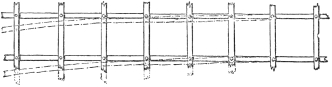
DIAGRAM ILLUSTRATING DISTORTION OF FRAMES UNDER LOAD
From these remarks it will be clear that a new method of
construction which, by substituting the triangle for the rectangle,
prevented the distortion of a ship’s hull under the
stresses of hogging and sagging, would constitute an important
innovation: even more important if, in addition, the new
method resulted in a large economy of material. Such a
system Sir Robert Seppings introduced. Treating the hull as
a girder liable to bend, he disposed the timbers to the best
advantage to resist deformation. The rectangular system,
wherein frames and riders formed rectangular cells with no
other power of resisting distortion into rhomboids than that
derived from the rigidity of the joints, had been proved inefficient;
just as a common field gate would be inefficient, and
would easily distort, if built up solely of vertical and horizontal
timbers without any diagonal brace to make it a rigid figure.
He solved the problem with the triangle. By bracing each
quadrilateral cell with a diagonal timber he thereby divided
it into two rigid and immovable triangles, and thus made the
whole ship rigid. The quadrilateral, when braced, was known
as a trussed frame. All the chief frames in the ships he trussed;
and since all bending took place from the centre of the ship
downwards to its ends, he made the trussed frames symmetrical
about the centre: the diagonals sloped forward in
the after body, and aft in the fore body, so as to resist the
arching by extension. The truss frame was embodied, not only
in the lower part of the vessel (where its effect in resisting
longitudinal bending was comparatively small), but in the more
nearly vertical planes, and even in the topsides between the
gun-ports (where it was most effective). Its use was estimated
to result in the saving of nearly two hundred oak trees in the
building of a 74-gun ship.

DIAGRAM REPRESENTING A SHIP WITH TRUSSED FRAMES
This was one element of Seppings’ system. The others were:
the filling in of the spaces between the ground frames of the
ship, so as to oppose with a continuous mass of timber the
tendency of the lower parts to compress longitudinally, and to
form a thick and solid bottom; the omission of the interior
planking below the orlop clamps; the connection of the beams
with the frames by means of shelf-pieces, waterways, and side
binding-strakes to the deck; and the laying of the decks
diagonally.
In two other important respects Seppings improved on
previous construction.
At Trafalgar the Victory, during her end-on approach to the
enemy line, was raked, and her old-fashioned forecastle, with
its thin flat-fronted bulkhead rising above the low head, was
riddled and splintered. This and similar experiences led to the
introduction by the Surveyor of an improved bow, formed by
prolonging the topsides to meet in a high curved stem, which
not only deflected raking shot, but also consolidated the bow
into a strong wedge-shaped structure supporting a lofty bowsprit,
and capable of being armed to give ahead fire from a
number of guns.
Similarly the weakness of ships’ sterns was remedied. The
broad flat overhanging stern which had been given to our ships
throughout the eighteenth century was not only structurally,
but defensively weak. In many actions, but notably in Admiral
Cornwallis’ fighting retreat from the French in 1795, the
weakness of our stern fire had been severely felt; and,
especially in view of the possible adaptation of steam to ship
propulsion, at this time foreshadowed, the desirability of an
improvement was evident. Seppings abolished the flat stern
in all new two- and three-deckers, substituting sterns circular
(as seen from above), more compactly embodied, and having
ports and embrasures in them for guns capable of fire along
divergent radii. The circular stern gave place, after a few
years, to an elliptical stern, which presented a more graceful
appearance and afforded increased protection to the
rudder-head. “The principal curves visible in it,” it
was said, “harmonize so well with the sheer lines of the
ship, that she appears to float lightly and easily upon the
water.”
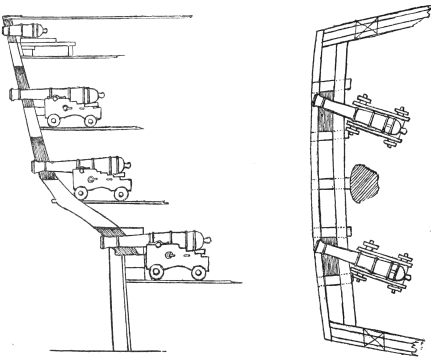
In the opening years of the new century important advances
were made, too, in the organization of the royal dockyards.
The interests of naval architecture were served notably by Sir
Samuel Bentham, brother of the famous jurist and an ex-shipwright,
who acquired honours in Russia and returned to
England to be Civil Architect and Engineer to the navy.
Bentham became a courageous Commissioner, and did much to
stamp out abuses and to encourage efficiency; he was instrumental
in checking the sale of stores, in abolishing “chips,” in
introducing steam pumps, block machinery, and dry dock
caissons, in improving the methods of building ships and of
mounting carronades.
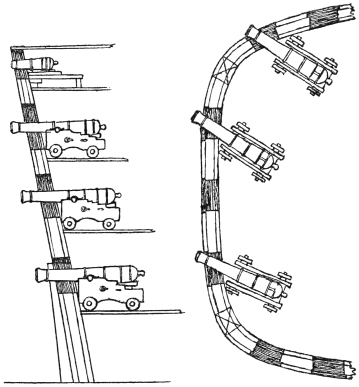
But still naval architecture, considered either as an art or as
a science, was stagnant. As a class the Surveyors were men of
very restricted education—“there is scarcely a name on the
list of any eminence as a designer or a writer.” Those who
ordered ships at the Board were “busy politicians, or amateurs
without a knowledge of science, or sailors too impatient of
innovation to regard improvements.” In no other profession,
perhaps, were theory and practice so out of sympathy with
each other. The native art of the builder was numbed and
shackled, by the restrictions imposed upon him as to tonnage
and dimensions; the study of ship form, with a view to
analysing the forces under which sailing ships moved by wind
through water and to discovering the laws which those forces
obeyed, was still mainly an academic pastime of the Society for
Improving Naval Architecture, and outside the province of the
naval authorities. Our ships were still formed on no rational
principle. Captured French ships served as models to be
copied. Often our builders would make fanciful variations
from the originals—a little more sheer, a little more beam, etc.
etc.—and as often they spoiled their copies. Whenever they
followed closely the forms and features of the originals they
succeeded in producing vessels which were pronounced to be
among the best ships in the navy.
With this state of affairs, it is no matter for surprise that
much of the new construction of the period was of small value.
“Sir Joseph Yorke produced a set of corvettes, longer and
narrower than brigs, none of which answered; and they were
sold out of the service. Then came the ‘Forty Thieves,’ a
small class of 74’s; but in justice to the designer, Sir H. Peake
(who copied them from a French ship), it must be added that
his lines were altered by the Navy Board, and the vessels were
contract-built. Lord Melville built half a dozen ‘fir frigates,’
which neither sailed nor stood under canvas. The 22-gun and
28-gun donkey frigates ‘could neither fight nor run away’;
it was dangerous to be on board them; and the bad sailing of
such vessels was the chief cause of our ill success in the
American War. The old 10-gun brigs, or ‘floating coffins,’ as
they were significantly styled, were equally dangerous and
unsightly. They had no room to fight their guns; no air
between decks, which were only five feet high; extra provisions
and stores were piled above hatches; and the fastest of them
sailed no more than eight or nine knots.”33
The merchant service was in even worse plight. The tonnage
rules had had a deplorable effect upon merchant shipping. The
ancient method of assessing a ship’s burthen was by measuring
the product of its length and breadth and depth, and dividing
this by a constant number, which varied, at different periods,
from 100 to 94. Early in the eighteenth century, however, a
simplification was innocently made: the depth of the average
ship being half the beam, a new formula was approved—length
multiplied by half the square of the beam, divided by 94.34
The result might have been anticipated. Dues being paid
only on the length and breadth, vessels were given great depth
of hold, full lines, and narrow beam. Absolved by the convoy
system from trusting to their own speed for self-protection,
English merchantmen became slugs: flat-bottomed, wall-sided
boxes, monstrosities of marine architecture of which it was said
that they were ‘built by the mile and served out by the yard.’
To raise the skill and status of our builders, the Committee
of Naval Revision of 1806 presided over by Lord Barham
advised the establishment of an official school, in which the
more highly gifted apprentices might study the science involved
in naval architecture. In 1811 the school was opened at Portsmouth,
with Dr. Inman, a senior wrangler, as president. Ships
were designed by Dr. Inman and his pupils excellent in many
respects, and generally on an equality with those of the
Surveyor and the master shipwrights. Yet still they were very
imperfect. The official designs were hampered, not only by the
hereditary prejudices and dogmas and by the cautious timidity
of the builders themselves, but by the restrictions still imposed
by the Navy Board, who insisted on a certain specified armament
in combination with a totally inadequate specified
tonnage: who laid down incompatible conditions, in short,
under which genius itself must fail of producing a satisfactory
result.
The chains were broken in 1832.
In that year, when the whole administration of the navy was
in process of reorganization, the office of Surveyor was offered
to and accepted by a naval officer, Captain W. Symonds, R.N.:
accepted by him on the condition that he should be given a free
hand in design and allowed to decide himself of what tonnage
and dimensions every ship should be. Sir Robert Seppings was
superannuated. The school of naval architecture was abolished.
The sensation produced was powerful. “Except on matters of
religion,” said Sir James Graham, when the appointment was
being debated in the House of Commons some years afterwards,
“I do not know any difference of opinion which has been
attended with so much bitterness—so much anger—so much
resentment, as the merits of Sir W. Symonds and the virtues
of his ships.”
These violent differences and resentments have long since
been composed, and Sir William Symonds has been accorded
the position due to him in the history of naval architecture.
His opponents, those who had resented his appointment as
against the best interests of the service, rejoiced that he had
freed ship design from the traditional restrictions under which it
had stagnated; his chief admirers were led in the course of
time to agree in the desirability of having as Surveyor a man
thoroughly grounded in the scientific principles underlying the
motion of bodies through water, their stability in water, and all
the forces acting on a ship at sea.
In the year 1821 Lieutenant Symonds, while holding an
appointment at Malta, had designed and built for himself a
yacht which he called Nancy Dawson. Yachting had at this
date become a national sport, and the interest of influential
patrons in sailing matches was already acting as a stimulus to
the study of ship form. The chief cause of the beneficial
reaction from the indifference of former generations, says his
biographer, was the establishment of the Yacht Club, after the
peace of 1815, and the interest which men of rank and fortune
henceforth took in shipbuilding, and in procuring the best
native models.35 So great was the success of the Nancy
Dawson, that (in his own words) he was led to believe that he
had hit upon a secret in naval architecture; while experiments
on other sailing boats seemed to confirm him in his principles.
Great breadth of beam and extraordinary sharpness—in fact,
what was described as “a peg-top section”—were the
characteristic features of his system, with a careful attention to
stowage, the stand of the masts, and the cut and setting of
the sails.
“Upon this most slender basis was the whole fabric of Sir
William’s subsequent career built. The yacht gained him the
notice of noblemen and others, then followed a pamphlet on
naval architecture (in which the defects of existing ships were
pointed out, and great breadth of beam and rise of floor
advocated); then came a promise from the First Lord of the
Admiralty, Lord Melville, that he should build a sloop of war
on his plans, which he did, the vessel being called the Columbine
(promotion intervening); then further patronage from the
Duke of Portland and the Duke of Clarence, the latter of whom,
when he became Lord High Admiral, ordered him to lay down
a 40-gun frigate (promotion again intervening); then the
building of the Pantaloon, 10-gun brig, for the Duke of Portland,
from whom the Admiralty purchased her; then the patronage
of that most mischievous civilian First Lord, Sir J. Graham;
then the order for the Vernon, 50-gun frigate; and then, in
’32, the Surveyorship of the Navy.”36
To Sir Edward Reed and other shipbuilding officers the
appointment of this brilliant amateur to the supreme control
of the department seemed an act of war, not only on professional
architects, but upon naval architecture itself.
They admitted the success of the Symondite ships in speed and
certain sailing qualities, but denied the correctness of his
principles and strenuously resisted his innovations. A great
breadth of beam was particularly objectionable to the scientific
builder; not only did it imply a large resistance to the passage
of the ship through water, but it contributed to an excess in
metacentric height, abnormal stiffness, and an uneasy motion.
“For a time his opinions triumphed; but after a while the
principles expounded by his subordinates (Creuze, Chatfield,
and Read) were accepted as correct, while not a single feature
of Sir William’s system of construction is retained, except
certain practical improvements which he introduced.”37
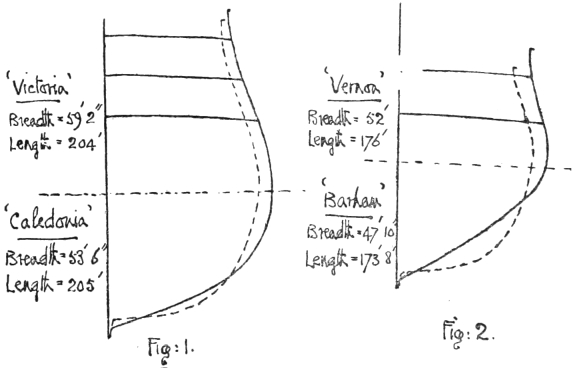
‘Victoria’
Breadth = 59′ 2″
Length = 204′
‘Caledonia’
Breadth = 53′ 6″
Length = 205′
Fig: 1.
‘Vernon’
Breadth = 52′
Length = 176′
‘Barham’
Breadth = 47′ 10″
Length = 173′ 8″
Fig: 2.
TYPICAL SECTIONS OF “SYMONDITE” AND CONTEMPORARY SHIPS
Nevertheless his opponents, as before remarked, freely
acknowledged the value of his services to the country, especially
in breaking down the restrictions which had hitherto been
imposed on constructors in respect of dimensions. His
biographer pays tribute to the intuitive genius which enabled
him to tell at a glance the trim required for a sailing ship, and
to sketch out, as a brilliant impromptu, the best form of hull.
But were these efforts entirely spontaneous? Were they not
the reward of hidden and persistent work, observation, and
calculation, carried out for years by the young officer who never
let a sailing ship come near him without contriving to board her
and ascertain her principal properties and dimensions? Here,
surely, is the undramatic but praiseworthy method by which
he attained success: a method, essentially scientific, which
enabled its user, even without knowledge of other important
principles governing ship design, to perform a national service
in revolutionizing our methods of naval architecture.
Under the control of Sir William Symonds the improvement
in the form and qualities of our ships, begun under the surveyorship
of Sir Robert Seppings, continued to progress. Ship
dimensions increased, and now bore a more correct relation to
the dead-weight of armament, stores, and crew, which they had
to carry. All classes from cutters to first-rates carried a more
generous beam, and gained by the novel feature. Sounder
rules were devised, partly as the result of a succession of sailing
trials, for the pitching of masts and the methods of stowing. In
short, naval architecture entered upon a new and promising era.
Foreign observers recorded the progress made. Instead of
being servile imitations of the products of French and Spanish
models the vessels which flew the English flag became objects
of admiration to all the world.
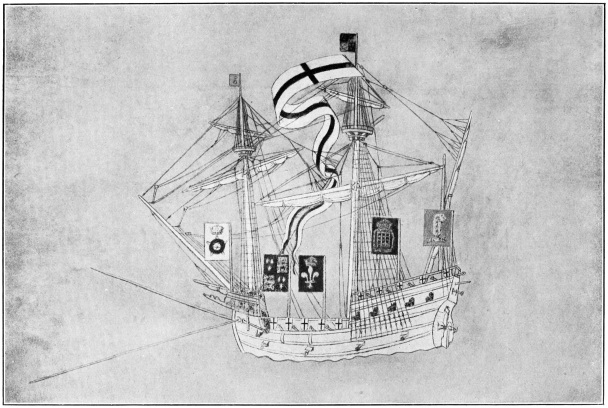
A TUDOR SHIP OF PERIOD 1540–50
From a Cottonian MS. in the British Museum