In June, 1867, I had the honour of reading a paper at this
Institution, which has since been published in the Journal, the
object of which was to point out the resemblance which exists
between the weapons of savages and early races and the weapons
with which nature has furnished animals for their defence.
In continuation of the same subject, my present communication
will relate to the resemblance to each other of the weapons
of races sometimes widely separated, and of which the connexion,
if it ever existed, has long since been consigned to obscurity.
I shall endeavour to show, how in these several localities, which
are so remote from one another, the progress of form has been
developed upon a similar plan, and, though to all appearance
independently, yet that under like conditions like results have been
produced; and that the weapons and implements of these races will
sometimes be found to bear so close a resemblance to each other,
as often to suggest a community of origin, where no such common
origin can have existed, unless at the very remotest period.
We shall thus be brought to the consideration of the great
problem of our day, viz. the origin of mankind, or rather the
origin of the human arts; for the question of man’s origin,
whether he was himself created or developed from some prior
form, whether since the period of his first appearance he has by
variation separated into distinct races, or whether the several
races of mankind were separately created, are questions which,
however closely allied, do not of necessity form part of our
present subject. It has to deal solely with the origin of the
arts, and more particularly with the art of war, which in the
infancy of society belonged to a condition of life so constant and
universal as to embrace within its sphere all other arts, or at least
to be so intimately connected with them as to require the same
treatment; the tool and the weapon being, as I shall presently
show, often identical in the hands of the primaeval savage.
These prefatory remarks are necessary because it will be seen
that the general observations I am about to offer on the subject
are fully as applicable to the whole range of the industrial arts
of mankind as to the art of war. My illustrations, however, will
be taken exclusively from weapons of war.
Is not the world at the present time, and has it not always
been, the scene of a continuous progress? Have not the arts
grown up from an obscure origin, and is not this growth continuing
to the present day?
This is the question which lies at the very threshold of our subject,
and we must endeavour to treat it by the light of evidence alone,
apart from all considerations of a traditional or poetic character.
I do not propose here to enter into a disquisition upon the
functions of the human mind. But it must I think be admitted,
that if man possessed from the first the same nature that belongs
to him at the present time, he must at the commencement of his
career in this world have been destitute of all creative power.
The mind has never been endowed with any creative faculty.
The only powers we possess are those of digesting, adapting,
and applying, by the intellectual faculties, the experience acquired
through the medium of the senses. We come into the world
helpless and speechless, possessing only in common with the
brutes such instincts as are necessary for the bare sustenance of
life under the most facile conditions; all that follows afterwards
is dependent purely on experience.
Whether we afterwards become barbarous or civilized, whether
we follow a hunting, nomadic, or agricultural life, whether we
embrace this religion or that, or attain proficiency in any of the
arts, all this is dependent purely on the accident of our birth,
which places us in a position to build upon the experience of our
ancestors, adding to it the experience acquired by ourselves. For
although it is doubtless true that the breeds of mankind, like the
breeds of our domestic animals, by continual cultivation during
many generations, have improved, and that by this means races
have been produced capable of being educated to a higher degree
than those which have remained uncivilized, this does not alter
the fact that it is by experience alone, conscious or unconscious,
self-imposed or compulsory, and by a process of slow and laborious
induction, that we arrive at the degree of perfection to which,
according to our opportunities and our relative endowments, we
ultimately attain.
The amount, therefore, which any one individual or any one
generation is capable of adding to the civilization of their age
must be immeasurably small, in comparison with what they
derive from it.
I could not perhaps appeal to an audience more capable of
appreciating the truth of these remarks than to the members of
an Institution, the object of which is to examine into the improvements
and so-called inventions which are from time to time
effected in the machinery and implements of war.
How often does any proposal or improvement come before
this Institution which after investigating its antecedents is found
to possess originality of design? Is it not a fact that even the
most ingenious and successful inventions turn out on inquiry to
be mere adaptations of contrivances already existing, or that they
are produced by applying to one branch of industry the principles
or the contrivances which have been evolved in another. I think
that no one can have constantly attended the lectures of this or
any similar Institution, without becoming impressed, above all
things, with the want of originality observable amongst men,
and with the great calls which, even in this age of cultivated
intellects and abundant materials to work upon, all inventors are
obliged to make upon those who have preceded them.
Since, then, we ourselves are so entirely creatures of education,
and derive so little from our own unaided resources, it follows
that the first created man, if similarly constituted, having no
antecedents from which to derive instruction, could not, without
external aid, have made any material or rapid advance towards
the initiation of the arts.
So fully has the truth of this been recognized by those who
are not themselves advocates for the theory of development, that
in order to account for the very first stages of human progress
they have found it necessary to assume the hypothesis of supernatural
agency: such we know was the belief of the classical
pagan nations, who attributed the origin of many of the arts to
their gods; such we know to be the tradition of many savage
and semi-civilized nations of modern times that have attained to
the first stages of culture. But we have already disposed of this
hypothesis at the commencement of these remarks, by deciding
that our arguments should be based solely upon evidence. We
are, therefore, under the necessity of assuming, in the absence of
any evidence to the contrary, that none but the agencies which
help us now were at the disposal of our first ancestors, and the
alternative to which we must have recourse is that of supposing
that the progress of those days was immeasurably slower than it
is at present, and that vast ages must have elapsed after the first
appearance of man before he began to show even the first indications
of a settled advance.
Yet the complex civilization of our own time has been built on
the foundations that were laid by these aborigines of our species,
while the brute creation may be said to have produced little more
than was necessary to their own wants or those of their immediate
offspring. Man has been the agent employed in a work of
continuous progression. Generation has succeeded generation,
and race has succeeded race, each contributing its quota to the
fabrication of the edifice, and then giving place to other workmen.
But the progress of the edifice itself has never ceased; it
has gone on, I maintain (contrary to the opinion of some writers
of our day), always in fulfilment of one vast design. It is a work
of all time.
To study it comprehensively, we must devote ourselves to the
contemplation of the edifice itself, and set aside the study of
mankind for separate treatment, for it is evident that man
has been fashioned, not as the designer, but simply as the
unconscious instrument of its erection. Each individual has
been impelled by what—viewed in this light—may be regarded
as instincts sufficient to stimulate him to labour, but falling
immeasurably short of a comprehensive knowledge of the
great scheme, towards which he is an unconscious contributor.
Of this he knows no more than the earthworm knows it to
be its function to cover the crust of the earth with mould, or
the small coral polypus knows that it is engaged in the erection
of a barrier reef. No comprehensive scheme of progress need
be searched for in the pigmy intellect of man, and if we are
ever destined to acquire any knowledge of the laws which
influence the growth of civilization, we must look for them
in an investigation of the phenomenon itself, by studying its
phases and the sequence of its mutations. In short we must
apply to the whole range of human culture, to the arts, whether
of peace or war, the same method which has already been
applied with some success to the history of language.
It has been shown that the speech of our own day has been
the work of many generations and of innumerable distinct races;
its roots are traceable in the utterances of the untutored savage.
No nation ever consciously invented a grammar, and yet language
has been shown to be capable of being treated as a science
of natural growth, having its laws of mutation and development,
never dreamt of by any of the many myriads of individuals
that have unconsciously contributed to the formation of it.
May not all the products of human intellects in the aggregate
be made amenable to the same treatment, and, like language, be
found to be influenced by laws of evolution and progress?
That these remarks are not merely speculative, that the
progress of civilization has been continuous and connected, while
the races which have been engaged in the formation of it, like
individuals, have had their periods of birth, maturity, and decay,
is sufficiently proved by history.
In Egypt and in Assyria, we see the remains of ancient and
formerly populous cities, where now the nomadic Arab pitches
his tent or wanders with his flocks, thus showing that relapses
of civilization must have occurred in those particular localities
where such phenomena are observed. But we know also from
history that the civilization which once flourished in those
countries did not expire there, but was transferred thence to
other places; that the culture of Assyria and of Egypt passed
into Greece and developed there; that from Greece it extended
to Rome, and in the hands of a new people passed through fresh
phases; that after the destruction of the Roman Empire it lay
dormant for many ages, only to rise again on its original basis,
extended and fertilized by the introduction of fresh blood; that
we ourselves are the inheritors of the same arts, customs, and
institutions, modified and improved; and finally, that civilization,
expanding in all directions, as it continues to move westward, is
now in process of being received back by those ancient countries
in which it originated, in a condition far more varied and
diversified than it could ever have become, had it been confined
to a single people or country.
Passing now from the known to the unknown, we come to the
study of prehistoric times, prepared to find that every fresh
discovery helps us to trace backwards the arts of mankind in
unbroken continuity towards their source.
Commencing with the Saxon and the Celt, and passing from
these to the lake dwellers, and on to the inhabitants of caves,
races whose successive periods of existence are determined chiefly
by the animals with which their remains are associated, we find
that, according to their antiquity, they appear to have lived in
a lower and lower condition of culture, until in the drift period,
coeval with the extinct mammoth and the woolly haired rhinoceros,
we find the earliest traces of man, scanty and unsatisfactory
though they be, yet sufficient to show that he must have existed
in a state so rude, as to have devised no better implements than
flints pointed at one end, and held in the hand.
These successive prehistoric stages of civilization have been
divided into the stone, the bronze, and the iron ages of mankind.
The evidence upon which this classification is based, has been
so ably set forth in the works of Sir John Lubbock and others,
that I need not refer to it further than to state that, in my
treatment of the origin and development of the weapons of war,
I shall in a great measure follow the same arrangement.
But I shall endeavour to trace the development of form
rather than the material of weapons, and to show by examples
taken from various distinct periods, and especially by illustrations
taken from existing savages, the various agencies
which appear to have operated in causing progression during
the earliest ages of mankind.
Of these, the first to be considered is undoubtedly the
utilization and imitation of natural forms. Nature was the only
instructor of primaeval man.
In my previous paper, I discussed this subject at some
length, giving many examples in which the weapons of animals
have been employed by man. But besides these weapons derived
from animals, primaeval man must no doubt at first have
employed the natural forms of wood and bone, and of stones
either fractured by the frost, or rolled into convenient forms
upon the seashore.
This principle of the utilization and imitation of natural forms
appears to bear precisely the same relationship to the development
of the arts, that, in the science of language, onomatopoeia
has been shown to bear to the growth and development of
articulate speech. In the attempt to trace language to its
origin, onomatopoeia, or the imitation of the sounds of animals
and of nature, appears not only to have been the chief agent in
initiating the growth of language, but it has also served to enrich
it from time to time, so that even to this day, poetry and
eloquence in a great measure depend on the employment of it.
But apart from this, language has had an independent and
systematic growth of its own.
So, in like manner, men not only drew upon nature for their
ideas in the infancy of the arts, but we continue to copy the
forms and contrivances of nature with advantage to this day.
But apart from this, we must look for an independent origin
and growth, in which form succeeded form in regular continuity.
Many a lesson has still to be learnt from the book of nature,
the pages of which are sealed to us until, by the natural growth
of knowledge, we acquire the power of reading and applying
them. Imitation therefore, though an important element in the
initiation of the arts, would not alone be sufficient to account for
the phenomenon of progress.
The next principle which we shall have to consider, is that of
variation. Amongst all the products of the most primitive races
of man, we find endless variations in the forms of their implements,
all of the most trivial character. A Sheffield manufacturer
informed me, that he had lately received a wooden
model of a dagger-blade from Mogadore, made by an Arab,
who desired to have one of steel made exactly like it. Accordingly
my informant, thinking that he had found a convenient
market for the sale of such weapons, constructed some hundreds
of blades of exactly the same pattern. On arriving at
their destination, however, they were found to be unsaleable.
Although precisely of the type in general use about Mogadore, all
of which to the European eye would be considered alike, their
uniformity rendered them unsuited to the requirements of the
inhabitants, each of whom piqued himself upon possessing his
own particular pattern, the peculiarity of which consisted in
having some almost imperceptible difference in the curve or
breadth of the blade.
In the earliest stages of art, men would of necessity be led to
the adoption of such varieties by the constantly differing forms
of the materials in which they worked. The uncertain fractures
of flint, the various curves of the trees out of which they constructed
their clubs, and the different forms of bones, would lead
them imperceptibly towards the adoption of fresh tools. Occasionally
some form would be hit upon, which in the hands of its
employer would be found more convenient for use, and which, by
giving the possessor of it some advantage over his neighbours,
would commend itself to general adoption. Thus by a process,
resembling what Mr. Darwin, in his late work, has termed
‘unconscious selection’, rather than by premeditation or design,
men would be led on to improvement. By degrees some forms
would be found best adapted to one pursuit, and some to another;
one would be used for grubbing up roots, another for breaking
shells, another for breaking heads; modes of procedure, accidentally
hit upon in one class of occupation, would suggest
improvements in another, and thus analogy, coming to the aid of
accidental variation, would give an impulse to progress. Thus
would commence that ramification of the arts, occupations, and
sciences which, developing simultaneously and assisting each
other, has borne fruit in the civilization of our own times.
I am aware that it will be found extremely difficult to realize
a condition of human existence so low as that which I am
supposing, and that many persons will deny the possibility of
mankind having ever existed in a condition so helpless as to
have been incapable of designing the simple weapons which we
find in the hands of savages at the present day. It is as difficult
to place one’s self in the position of a being infinitely one’s
inferior, as of a being greatly one’s superior in intellect. ‘Few
persons,’ says Professor Max Müller, ‘understand children, still
fewer antiquity.’ Our own experience cannot save us in estimating
the powers of either, for, long before the period of which
we have the earliest recollection, we had ourselves undergone
a course of unconscious education in the arts of a civilized
community; our very first utterances were in a language which
was in itself the complex growth of ages, and the improvement
of our natural faculties, resulting from the continued cultivation
of our race, enhances the difficulty we find in appreciating the
condition of our first parents.
Another fertile source of variation arises from errors in successive
copies. At a time when men had no measures or other
appliances to assist them in copying correctly, and were guided
only by the eye, an implement would soon be made to assume
a very different appearance. Mr. Evans has shown in his work
on the ‘Coins of the Ancient Britons’ (p. 167) how the head of
Medusa, copied originally from a Greek coin, was made to pass
through a series of apparently meaningless hieroglyphics, in which
the original head was quite lost, and was ultimately converted into
a chariot and four. We must not, however, attribute all variation
to this cause, for I quite agree with a remark made by Mr. Rawlinson
in his ‘Five Great Monarchies’, that such varieties are more
frequently noticed in cases where the contrivance is of home
growth, than in those which are derived from strangers.
The third point which we shall have to consider in relation to
continuity, is the retarding element. Under this head, incapacity
must at all times, and especially in the infancy of society, have
played the chief part. But as civilization progressed, other
agencies would come in to influence the same result; prejudice,
force of habit, principles of conservatism in which we have been
told by Mr. Mill that all the dull intellects of the world
habitually ensconce themselves, a thousand interests of a retarding
tendency, rise up at the same time as those having a progressive
influence, and prevent our advancing by other than
well-measured paces.
The resultant of these contending forces is continuity. If we
could but put together the missing links; if we could revive
contrivances that have died at their birth, and expose piracies;
if we could penetrate the haze that is so often thrown over
continuity by great names, absorbing to themselves the credit of
contrivances that belong to others, and thereby causing it to
appear that progress has advanced with great strides, where
creeping was in reality the order of the day; we should find
that there is not a single work of man’s hand which has not its
history of slow and continuous development, capable of being
traced back, like branches of a tree, to its junction with others,
and so on until the roots of all are found to lie in the simplest
contrivances of primaeval man.
But we must not expect that we shall be able, in the existing
state of knowledge, to trace this continuity from first to last, for
the links that are lost far exceed in number those which remain.
The task may be compared to that of putting together the fragments
of a tree that has been cut up for firewood, and of which
the greater part has been burnt. It is only here and there, after
diligent search, that we may expect to find a few pieces fitting
in such a manner as to prove that they belonged to the same
branch. We do not, on that account, abandon our conviction
that the tree once grew, that every large branch was once a small
twig, and that every limb developed by a natural process into the
form in which we find it. The difficulty we have to contend
with is precisely that which the geologist experiences in tracing
his palaeontological sequence. But it is far greater, for natural
history has been long studied, and the materials upon which
Mr. Darwin founds his celebrated hypothesis have been in
process of collection for many generations. But continuity,
in relation to the arts, can scarcely yet be said to be established
as a science. The materials for the science have not yet been
even classified, and classification is a process which must always
precede continuity in the study of nature. Classification defines
the margin of our ignorance; continuity results from the extension
of knowledge, by bridging over the distinction of classes.
Travellers, for the most part, have been in the habit of bringing
home, as curiosities, the most remarkable specimens of weapons
and implements, without much regard to their history or the
evidence they convey; and their descriptions of them, as a general
rule, have been extremely meagre. Until quite recently, the
curators of our ethnographical museums have aimed more at
the collection of unique specimens, serving to exhibit well-marked
differences of form, than such as by their resemblance
enable us to trace out community of origin. The arrangement
of them has been almost universally bad, and has been calculated
rather to display the several articles to advantage, on the principle
of shop windows, than to facilitate the deductions of science.
The antiquities of savage races, moreover, have as yet been almost
wholly unstudied.
Notwithstanding these difficulties, we are able to catch
glimpses of evidence, here and there, which, when put together
systematically, and when the vestiges of antiquity are illustrated
by the implements of existing savages, will, I trust, be found
sufficient to warrant the principles for which I contend.
In the earliest ages of mankind, when all men were warriors,
and before the division of labour, consequent on civilization, had
separated the arts of peace and war into distinct professions, we
must expect to find the same implement frequently employed in
the capacity of both tool and weapon. Even long after the very
earliest ages of which we have any historical or archaeological
record, we often find a combination of tool and weapon in the
same forms, especially amongst those semi-civilized and savage
races of our own times, whom we regard as the representatives of
antiquity. The battles of liberty, from the age of the Jews and
Philistines down to the time of the last Hungarian revolution,
have always been fought by the subject people with weapons
made out of the implements of husbandry. We read in the first
of Samuel, chapter xiii, ‘Now there was no smith found in all
the land of Israel: for the Philistines said, Lest the Hebrews
make them swords or spears: but all the Israelites went down
to the Philistines, to sharpen every man his share’ (the blade of
the ploughshare), ‘and his coulter’ (a kind of knife), ‘and his
ax, and his mattock’ (a kind of pickaxe).... ‘So it came
to pass, in the day of battle, that there was neither sword nor
spear found in the hand of any of the people that were with
Saul and Jonathan.’ In the revolts of the German peasantry,
in the fifteenth and sixteenth centuries, the bands of insurgents
armed themselves with threshing flails and scythe blades. In
1794 and 1831, the Polish peasantry were similarly armed[127];
and it was from such implements of husbandry that weapons
like the military flail, the bill, and the yataghan, derived their
origin. In the recent outbreak in Jamaica (which, had it not
been ably and powerfully put down, would have led to the
destruction of the whole white population) the negroes armed
themselves with weapons of husbandry. In the proclamation of
Paul Bogle, he says: ‘Every one of you must leave your house,
take your guns; who don’t have guns, take cutlasses.’ The
cutlasses here referred to were the implements used for cutting
the sugar-cane, sharp on the concave edge, and are the same
which, having been used as weapons by the negroes in their
own country, have continued to be employed by them ever since.
In like manner, we learn from Symes’s ‘Embassy to Ava in
1795’,[128] that the Burmese use the sabre both for warlike purposes,
as well as for cutting bamboos, felling timber, &c.; it is the
constant companion of the inhabitants for all purposes, and they
never travel without it. In Borneo, the peculiar sword-like
weapon, called the ‘parangilang’, is used both as a weapon, and
also for felling trees, and the axe of this country is constructed
so that, by turning it on the helve, it can be used either as
a weapon or as a carpenter’s axe. In like manner, the Kaffir
axe-blade, by simply altering its position in the handle, is used
either as a weapon, or for tilling the ground. The North
American Indian tomahawk, like the Kaffir axe, is used for
many different purposes; the spear-head of the Kaffir assegai
is the knife that is used for all purposes of manufacture, and
Captain Grant says that the Watusi of East Central Africa
make all their baskets with their spear-heads.[129] The weapons
edged with sharks’ teeth, to which I referred in my former
paper, are used in the Marquesas and other of the South Sea
Islands, as much for cutting up fish and carcasses as for warlike
purposes.[130] Dr. Klemm, in his valuable work on savage and
early weapons, describes the wooden pick used by the inhabitants
of New Caledonia both as a weapon, and also for tilling the
ground,[131] and he gives reasons for supposing[132] that in Egypt and
many other parts of the world, the form of the plough was
originally derived from that of the hatchet or hoe, used for
tilling purposes. The hoe used in East Central Africa, which
also, like the Kaffir axe, serves as a medium of exchange in lieu
of money, evidently derived its form from that of a spear or
arrow head. The spade, formerly used in this country, and
represented in old pictures, which is still used as a shovel in
Ireland, is a pointed spear-like instrument, and the ‘loy’ or
spade still used in all parts of Ireland is hafted exactly in the
same manner as the bronze celt of prehistoric times. Dr. Klemm
(l. c., p. 119) gives an illustration of an axe used by the Norwegian
peasants both as a tool and weapon. Speke describes the Usoga
tribe[133] as being armed with huge short-handed spears, adapted
rather for digging than for war; and Barth describes the Bornouese
troops in Central Africa digging holes with their spears, and
employing them in searching for water.[134] The Australian ‘dowak’,
a kind of club with a flint attached, combines the purposes of
a tool and weapon. We know from the short sticks upon which
the small arrow-heads of quartz found in the Peruvian tombs are
mounted, that they must have been used as knives as well as for
missile purposes. Professor Nilsson says that flint-barbed arrow-heads,
of precisely the same form, are used by the inhabitants of
Tierra del Fuego as knives,[135] and Mr. Stephens, in his travels in
Central America, shows reason for supposing that the large stone
idols in Copan were carved with similar arrow-points,[136] no other
instrument capable of being used for such a purpose having been
found in the neighbourhood.
Examples of this class of evidence might be multiplied ad
infinitum; but enough has already been said to afford good
grounds for believing that many of the implements of stone
and bronze which are found in the soil, may have been used
for a great variety of purposes, and that, especially in the
earliest stages of culture, we must be careful how we attribute
especial purposes to tools and weapons because they appear to
differ from each other slightly in form. This is more especially
so when, as is almost invariably the case, the several distinct
types are found—when a sufficient number of them are collected
and arranged—to pass almost imperceptibly into each other by
connecting links; showing that the differences observable between
any two implements of the same class, when brought together
and contrasted, are rather due to the operation of a law of
variation and development in the fabrication of the tool itself,
than to an intention on the part of the constructor to adapt it to
particular purposes, and that its application to such especial
purposes must have followed, rather than itself have influenced,
the development of the tool.
My first illustration must of necessity be taken from the flint
implements of the drift, the earliest records of human workmanship
that the researches of science have as yet revealed to us.
These, to use the words of Sir Charles Lyell, ‘were probably
used as weapons both of war and the chase, to grub roots, cut
down trees, or scoop out canoes.’[137]
I will not attempt during the brief time allotted to me on the
present occasion, any detailed account of the evidence of the antiquity
of these weapons, assuming that the works of Sir Charles
Lyell, and Sir John Lubbock, will have rendered this subject more
or less familiar to most persons at the present day, but I will
confine myself to pointing out the indications of variation and
of improvement observable in the implements themselves.
I have arranged upon diagram No. 1 (Plate XII) a series of
specimens of the same type from nearly every part of the globe.
All the figures given in these diagrams are traced from the
implements themselves, and reduced by photography; they may
therefore be regarded as facsimiles, a point of great importance
when our subject has to deal with the minute gradations of
difference observable between them. Figures 1 to 11 are of the
drift type. Casts of the originals of some of them, and specimens of
the implements themselves, are also upon the table for comparison.
I may here acknowledge the great obligation I am under to
Mr. Franks for the facilities he has afforded me in drawing
many of these specimens in the Christy Collection; to Dr. Watson
for a similar permission in regard to the valuable collection of
arms in the India Museum; and also to Dr. Birch of the
British Museum. A large proportion of my illustrations are
taken from the excellent Museum of this Institution, and
others are from my own collection.
Of the drift specimens which I have selected to illustrate the
diagrams, five are from the gravel beds of St. Acheul, in order
that we might have an opportunity of observing the variation
in implements derived from the same locality, and probably
belonging to the same or nearly the same period—chips in fact
from the same workshop.
It has been usual to classify these drift implements in two
divisions; the spear-head form, and the oval form. Of the first
or spear-head form, figures 2 to 4 are typical examples; of the
oval form, figure 8 is the best illustration. I venture, however,
to think that a distinction more clearly embodying a principle
of progress may be made by dividing them differently, and by
placing in the first class those which are either left rough or
rounded at one end and pointed at the other, of which figures
1 to 7 are examples; and in the second class, such as are chipped
to an edge all round, of which figures 8 to 11 are types. My
reason for preferring this classification to one dependent on
outline is this. The first class having the natural outside
coating of the flint or a roughly rounded surface on one side,
appears to be in every way adapted to be held in the hand;
whereas the second class, of which a beautiful specimen in the
Christy Collection from St. Acheul is represented in a front and
side view in figure 10, could not conveniently be used in the hand
as a tool or weapon, without injury to the hand from the sharp
edge with which its periphery is surrounded on all sides. If, therefore,
we see reason for supposing that one class of implements was
employed in handles, whilst the other may have been used in the
hand, I think this constitutes a more important distinction, and
one more obviously implying progress, than a classification which
merely involves a modification of outline, which may have resulted
from no more significant cause than a difference in the form of
the flint nodule out of which the implement was made.[138]
Another important distinction between these drift implements
as thus arranged, arises from the different purposes to which they
may have been put by the fabricators. The first class, figures 1
to 7—it will be seen by the side view of them—could have been
used only as spears, picks, or daggers, the pointed or small end
being employed for that purpose, whereas the latter class, figures
8 to 11, are equally available for use as axes with the sharp and
broad end. It is quite possible therefore, that we may see here,
in these vestiges of the first tools of mankind (specimens of all
varieties of which are found in the same beds at St. Acheul), the
point of divergence between the two distinct classes, which must
certainly be regarded as the two most constant and universal
weapons of mankind in all ages and countries of the world, viz.
the spear and the axe; the small end developed into the spear and
into all that class of tools for which a point is required; and from
the broad end we obtained the axe and all those tools which
either as chisels, choppers, gouges, or battle-axes, have continued
in use with an endless continuity of development and modification,
and a world-wide history up to the present time. I am aware
that in the St. Acheul implements, as well as in those of similar
form from the laterite beds of Madras, we find occasionally specimens
in which the small end is made broader, as if indicating the
gradual development of an edge on that side, but upon the whole
I think the balance of evidence is in favour of the broad end
having originated the axe form.
Nothing, it will be seen, can be more primitive than these
tools, or more gradual than their development. They are perfectly
consistent with the idea that the fabricators of them were
in a condition closely verging upon that of the brutes. Apes are
known to use stones in cracking the shells of nuts. The advantage
to be derived from a pointed form, when it accidentally fell
into the hand, would suggest itself almost instinctively to any
being capable of profiting by experience and retaining it in the
memory. Accidental fractures, producing a sharp edge, would
lead to fractures of design, and thus we may easily suppose that
such implements as are represented in the first few figures of our
diagram must necessarily have resulted from the very earliest
constructive efforts of primaeval man.
From the very first, a peculiar mode of fabrication appears to
have been adopted, which consisted of chipping off flakes from
alternate sides of the flint, and the facets thus left upon the flint
produce the wavelike edge which you will see in the side views of
all the implements here represented. This method continued to
be employed throughout the entire stone age, in all parts of the
universe, and is characteristic not merely of the drift, but of the
cave, pfahlbauten, and surface periods.
The numerous intermediate gradations of form, whether
between the oval and the spear-head form, or between the
thick and the sharpened form, have been noticed by Sir Charles
Lyell (l. c., p. 164). By selecting specimens, and arranging them
in order from left to right, I have endeavoured to trace the transition
from the drift type to the almond-shaped celt type, which
latter is common to the stone age of mankind, whether ancient
or modern, in all parts of the world.
Had the discovery of drift implements been confined to one
locality or to one district, it is probable it would have attracted
but little notice. As early as the first year of the present century
the attention of the Society of Antiquaries had been drawn by
Mr. Frere to the existence of these implements, in conjunction
with the remains of the elephant and other extinct animals at
Hoxne in Suffolk. An illustration of the specimens from this
locality is given in figure 4. Mr. Frere described them as
‘evidently weapons of war, fabricated and used by a people who
had not the use of metals’. But little or no attention was paid
to the subject until the discovery by M. Boucher de Perthes of
precisely similar implements associated with the same class of
remains, in the drift gravel of St. Acheul, near Amiens, in
1858.[139] Since then many other discoveries have been made, and
still continue to be made, by Mr. Prestwich, Mr. Evans,
Mr. Flower, Mr. Bruce Foote, and others, not only in this
country but also in Asia and Africa, showing, in so far as the discoveries
have hitherto gone, that this drift type, like the almond
celt type, is common to the earliest ages in all parts of the
world, and that everywhere the drift type preceded the almond-shaped
celt type, and is found in beds of earlier formation.
Figure 5 is a drift-shaped implement from the laterite beds of
Madras, of exactly the same form as those found in England.
Figure 6 is an implement of the same class from the Cape of
Good Hope, found fourteen feet from the surface. In America,
implements of the drift type have not yet been discovered, but
stone spear-heads have been found in Missouri in connexion with
the elephant and other extinct animals. Figure 11 is from
a mound of sun-dried bricks at Abou Sharein, in Southern Babylonia,
obtained by Mr. J. E. Taylor, British Consul at Basrah;
it is a chipped flint; in form it is of the drift type, and its outline
is precisely that of some of the Carib celts found in the West
India Islands; it also closely resembles in form others from the
Pacific[140]; its edge was evidently at the broad end. Another of the
same type was found at Mugeyer in Babylonia, and a third closely
resembling the two former was found in a cave in Bethlehem.
The celt type has not as yet been found in the French caves
of the reindeer period, but it is common in the ‘pile dwellings’ of
the Swiss lakes. Some of the French cave specimens, however,
closely approach the drift form, and in place of the celt, we have
a peculiar kind of tool trimmed to a cutting edge on one side
and having the other round for holding in the hand. As,
however, these do not fall into the direct line of development,
but may be regarded as a branch variety, I have not figured
them in my diagram, but pass at once, though almost imperceptibly
as regards form, from the drift to the surface type.
Figure 12 formed part of a large find of flint implements,
discovered by myself in the ancient British camp of Cissbury,
near Worthing—an account of this discovery was communicated
by me to the Society of Antiquaries at the commencement of
the present year.[141] The period of these Cissbury implements
must be fixed at a very much more modern date than those of
the drift, with which they are associated in my diagram, having
been found in conjunction with the earliest traces of domestic
animals, such as the Bos longifrons, Capra hircus, and Sus;
they may, however, be classed with the stone age, no trace
of metal having been discovered with them, although from 500
to 600 flint implements were found in the camp. The peculiarity
of the Cissbury find, however, consists in the discovery (in the
same pits in which celts of the type represented in figure 12
were found) of a few flints closely approaching the drift type,
being thick at the broad end, and also of a large number
resembling those found in the French caves, trimmed to an edge
on one side, and adapted to be held in the hand. So that the
Cissbury find, although belonging to what is usually called the
surface period, contains specimens affording every link of
connexion between the drift and the almond-shaped celt type.
This discovery must, I think, be regarded as a step in knowledge
of prehistoric antiquity, and a decided accession to the science
of continuity, for Sir John Lubbock has told us in his preface
to the work of Professor Nilsson, lately published[142], that the
Palaeolithic, i. e. the drift types, ‘have never yet been met
with in association with the characteristics of a later epoch.’
I shall therefore be interested to know whether, after an
examination of the Cissbury specimens, which I have presented
to the Christy Collection, Sir John Lubbock may be induced to
alter his opinion on that point; for I think it is entirely consistent
with all that is known of early races of mankind, that early
types should be retained in use long after the introduction of
others that have been developed from them. However this may
be, I think that in casting the eye from left to right along the
upper row of diagram No. 1 (Plate XII), it will puzzle the acutest
observer to determine where the drift type ends, and that of the
celt begins. If it is contended, as I am aware it will be
contended by some, that the typical characteristic of the celt
consists in its being sharp at the broad end, while those of the
drift are blunt at the broad end, I reply that many of the drift
specimens are also sharpened at the broad end, more especially
those represented in figures 9 and 10 from the drift of St. Acheul.
Many specimens from Thetford which I have seen, as, for
example, Fig. 17 b, from a cast in the collection of the Society
of Antiquaries, presented by Mr. Flower, approach equally
closely to the celt type, as do some of those from the laterite
beds of Madras, and though they are of rare occurrence in all
these localities, and are certainly a variation from the normal
type of drift implements, still they are found in sufficient
numbers to serve as links in connecting the forms of the earliest,
with those of the later period.
I have dealt somewhat at length upon this part of my subject,
owing to the circumstance of its presenting some features of
novelty in the study of flint implements, and being therefore
open to criticism on the part of those who are more favourable
to the principles of classification than of continuity, with all
the important concomitants, of division versus unity, which
those principles involve.
I may now pass briefly over the remaining figures in the
diagram. Figure 13 is a specimen found by Mr. Evans at
Spienne, near Mons; its very close resemblance to figure 12
from Cissbury will be noticed; in fact the whole of the Spienne
specimens resemble very closely those discovered in Cissbury,
except that the Spienne implements of this class are associated
with others of polished flint, which gives them a more advanced
character than those derived from Cissbury, in which place only
one fragment of a polished implement was discovered, and that
in a part of the intrenchment which renders it very doubtful
whether it ought to be associated with the Cissbury find.
Figures 15, 16, and 17 are from Denmark, Ireland, and Yorkshire;—this
type, however, is rare in Denmark, most of the
flint implements from that country being of a more advanced
character, and having usually a rectangular cross-section.
The lower row of the diagram consists of specimens derived,
either from what has been termed the neolithic or polished stone age
of Europe, or from savages who are still in a corresponding stage of
progression in various parts of the world at the present time.
To the former or neolithic stone age of Europe belong
figure 21 from France, figure 25 from the bed of the Clyde
in Scotland, figure 27 from the Swiss lake-dwellings,
figure 29 from the caves in Gibraltar, figure 30 from Sweden,
figure 36 from Portugal, figure 37 from the bed of the
Thames, figure 38 from Ireland, figure 39 from Jelabonga,
in Russia. Precisely identical forms are also found in Germany,
Italy, and the Channel Isles. Amongst the specimens derived
from the ancient stone age of other parts of the world, and
belonging to an age of civilization that is now extinct, may be
enumerated figure 22 from Peru, figure 40 from Mexico,
figure 24 from Central India, figure 41 from Japan, figure 42
from Mugeyer, in Babylonia. Nearly similar ones, but flattened
at the side, like those common in Denmark, have been obtained
from China and Pegu. Figure 43 is from Algeria, from the
collection of Mr. Flower.
The following are examples of the same class of implements,
used by savages of our own, or of comparatively modern times:—Figures
18 and 19 from Australia; these are generally used
in a handle, formed by a withe twisted round them in the
manner still used by blacksmiths in this country. Sometimes,
however, I am informed by an eye-witness, the Australians use
these celts in the hand without any handle at all. Although
polished on the surface, these Australian celts have been
compared by Sir Charles Lyell (l. c., p. 79) to the oval forms of
the drift represented in figure 7. The art of polishing appears to
have preceded the development of form in this country. Figure
20, from New Zealand, is a specimen in Mr. Evans’s collection,
of which he has been so kind as to allow me to take an outline;
this form, however, is extremely rare in New Zealand, the usual
shape of the stone celts from that country being flat-sided, like
the specimens from Denmark, already noticed. Figure 23 is
from the Pacific; figure 26, from Pennsylvania; these were used
by the American Indians, previously, and for some time after the
immigration of Europeans. Figures 31 and 32 are Carib celts from
my collection, beautifully polished. Figure 33, from St. Domingo,
is in the Cork Museum. Figure 34, from the Antilles, is in the
Christy Collection; both of these have a human face engraved
upon them. Figure 35 is of jade, from New Caledonia, in my
own collection.
The method of hafting these implements, employed by savages,
shows that they were used for a variety of purposes; in some,
the edge is fastened at right angles to the handle, to be used as
an adze, whilst in others the same tool is fastened with the blade
in a line with the handle, to be used as a chopper or battle-axe.
In some it is fastened with a withe, passed round the stone, as in
the specimen from Australia (fig. 44, from this Institution) and
some parts of North America; figure 45 is a stone axe from the
Ojibbeway Indians, from my collection. At other times it is inserted
in the side of a stick or club. A specimen in my collection
from Ireland (fig. 46), one of the few that have ever been
found with handles, shows that this was the method employed in
that country.[143] Others are inserted in the end of a bent stick
(fig. 47), a mode of hafting common in the Polynesian Islands,
in Africa, Ancient Egypt, Mexico, North America, and New
Caledonia; it is employed by the Kalmucks and others, and was
used during the bronze age. Some of the Australian axes were
fastened to their handles by a peculiar preparation of gum manufactured
for that purpose.
Dr. Klemm, in his ‘Werkzeuge und Waffen’, supposes the
first lessons in hafting to have been derived from nature, by
observing the manner in which stones are often firmly grasped
by the roots of trees growing round them, and he gives several
woodcuts of specimens of Nature’s hafting, which he has collected
from various sources; one of these, extracted from his work (l. c.,
p. 14), is represented in figure 48. I have placed upon the table,
in illustration of this idea, an iron mediaeval axe-head (fig. 49),
which has furnished itself with a handle in this manner, whilst
buried beneath the surface; it is said to have been found in
Glemham Park, Suffolk, eleven feet from the surface. Even to
this day, when a peasant in Brittany discovers one of these stone
celts upon the ground, he is in the habit of splitting the branch
of a young tree and inserting the celt into the cleft; in the
course of a year or two it becomes firmly fixed, and he then cuts
off the branch, and uses the implement thus hafted by nature as
a hammer for driving nails. In the ‘Antiquités Celtiques et
Antédiluviennes,’ vol. i (Paris, 1847), p. 327, M. Boucher de
Perthes mentions the discovery of two ancient stone hammer-heads,
which appeared to have been furnished with handles by passing the
hole over the bough of a tree and allowing it to fill up the aperture
by its natural growth, until it became fixed as a handle.[144]
It might be interesting, if space permitted, to follow up the
development of the stone axe-head through its various phases
until, in the latest stages, when bronze had already come into
general use for weapons, we find it furnished with a hole through
the middle for the insertion of the handle. It may, I think, be
safely said that—although nature furnishes numerous examples, in
many classes of rocks, and especially in flints, of stones perforated
with holes, and although they appear to have attracted the notice
of the aborigines of many countries by the peculiar superstitious
reverence which is often found to be attached to such stones when
found in the soil—this mode of fastening stone implements in
their handles did not come into use until late in the stone age,
and that even in the bronze age it was but little employed.
Whether the stone celts having a square or rectangular section
(such as are found principally in Denmark, New Zealand,
Mexico, and Pegu), were coeval, or of subsequent development, to
those of the almond-shape type, may be a matter for conjecture;
the small flint hatchets found in the Kitchenmiddens of Denmark
appear to approach closely to the rectangular type. It is certain,
that in the Swiss Lakes both forms are found fully developed,
and it may be mentioned, as an instance of the constant tendency
to variation that is everywhere observable in the weapons of the
early races of mankind, that of the whole of the celts found at
Nussdorf, in the Lake of Constance, though all might be traced
to the same normal type as regards their general outline, no two
were alike; and Dr. Keller gives sections, showing every conceivable
gradation from the square and rectangular to the oval
and circular section[145]. It may, however, be affirmed, that convex
forms, as a general rule, preceded those having a rectangular or
concave surface; it is so in the forms of nature; the habitations
of animals are almost invariably convex. Dr. Livingstone mentions[146]
that he found it impossible even to teach the natives of
South Africa to build a square hut; when left to themselves for
a few minutes, they invariably reverted to the circle. All the
earliest habitations of prehistoric times are found to be circular
or oval; even the sophisticated infant of modern civilization,
when he plays with his bricks, will invariably build them in a
circular form, until otherwise instructed.
We must now turn to the development of the second great
class of weapons—the spear and arrow. These may be classed
together, the arrow being merely the diminutive of the spear;
and it may be taken as a general rule, applicable to all the
arts of prehistoric times, that when a given form has once
been introduced, it will speedily be repeated in every possible
size that can be applied to any of the various purposes for which
such a form is capable of being used. Size, in the arts of the
earliest ages, is no indication of progress. In the same way
it may be said of the development of the animal or vegetable
kingdom, size is no indication of improved organism.
In the same beds in which the drift-type implements are
found, flakes, either struck off in the formation of such tools,
or especially flaked off from a core in a particular manner,
indicating that they were themselves intended for use as tools,
are found in considerable numbers. No more useful tool could
have been used during the stone age than the plain, untouched
flint flake, which, from the sharpness of the edge, is capable
of being used for a variety of purposes. Those, for example,
formed of obsidian are so sharp that it is recorded, by the
Spanish historians, that the Mexicans were in the habit of
shaving themselves with such flakes. As my present subject
has to deal exclusively with war weapons, I will not enter into a
detailed description of these flakes, further than to observe that
they are found, together with the cores from which they were
struck off, in every quarter of the globe in which flint, obsidian,
or any other suitable material has been found, and that everywhere
the process of flaking appears to have been the same.
Now, the fracture of flint is very uncertain; by constant
habit, the ancient flint-workers appear to have been able to
command the fracture of the flint in a manner that cannot be
imitated, even by the most skilful forgers of those implements in
modern times; but, notwithstanding this, the varieties of the forms
of the flakes thus struck off must have been very considerable, and
these varieties must, from the very first, have suggested some of
the different forms of tools that were made out of them.
I cannot, perhaps, explain this point better than by exhibiting
a number of flakes, found by myself in the bed of the Bann at
Toom, in Ireland, at the spot where that river flows out of
Lough Neagh. This was a place originally discovered by
Mr. Evans, where probably, in a habitation built upon the
river, they formerly manufactured flint implements; and the
bed of the river for the space of a hundred yards or more is
covered with the flakes. It will be seen on examining these
flakes, that some of them came off in a broad leaf-shaped form,
and these, with a very little additional chipping, have been
formed into spear-heads. Others longer and thicker have been
chipped into something like picks, and others thinner and
narrower than the two former, have been used probably as
knives; others for scraping skins. We see from this that
certain forms would naturally suggest themselves through the
natural fracture of the flint, and this may to a certain extent
account, though it does not, I think, entirely account, for the
remarkable resemblance of form and unity of development
observable in the spear and arrow heads, derived from localities
so remote from each other as almost to preclude the possibility
of their having ever been derived from a common source.
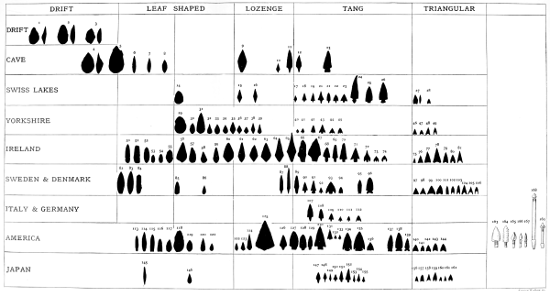
Plate XIII.
Diagram 2.
DEVELOPMENT OF SPEAR & ARROW-HEAD FORMS.
I have arranged in tabular form, on diagram No. 2 (= Plate XIII),
representations of spear and arrow heads from all the different
localities from which I have been able to obtain them in sufficient
number to show fairly the numerous varieties which each
country produces. On the top of the diagram, from left to
right, the several forms are arranged in the order that appears
most truly to indicate progression; but it must not be supposed
that this arrangement is absolutely correct, for the several forms,
such for example as the tang and the triangular form, were most
probably derived from a common centre. The specimens from
each locality ought therefore, in order to display their progression
properly, to be arranged in the form of a tree, branching from
a common stem. On the left of the diagram are written the
different periods and localities, from which the specimens are
derived. Commencing with the drift—the oldest of which we
have any knowledge—which is coeval with the elephant and
rhinoceros in Europe, we have the peculiar thick form already
described. The examples of the drift period here shown, from
their small size, must evidently have been used with a shaft,
as they are scarcely large enough to have served as hand tools.
None of the lozenge, tang, or triangular forms, have ever been
found in the drift.
The next line represents specimens from the French caves
of the reindeer period, which are taken from the Reliquiae
Aquitanicae, chiefly from Dordogne.[147] It will be seen that in
these caves the first rude indications of the lozenge and tang
form are represented, but no perfect specimens of either class.
No example of the triangular form has been discovered. The
leaf-shape form, however, is well represented.
In the ancient habitations of the Swiss Lakes, which belong
to a later period, all varieties, except those of the drift type, are
represented, but none of them in their most fully developed
form; the tangs, it will be seen, are long, and the barbs comparatively
short; the triangular form, which I consider to be
the latest in the order of development, is mentioned by
Dr. Keller, from whose work these specimens are taken, as
being extremely rare. The comparative rarity of flint implements
in the Lakes may, however, in some measure be accounted
for, by the absence of flint in the district, necessitating the
importation of this material from a distance.
The specimens from Yorkshire, Ireland, Sweden, Denmark,
Italy, and Germany, may be considered to carry the development
of these forms up to the latest period, viz. the late stone,
and early bronze age; for there can be no doubt from the
number of arrow-heads found in these countries, in connexion
with implements of bronze, that they were used for missile purposes
long after the armes blanches had been constructed of metal.
In all these localities it will be seen that the various gradations
of form are identical; but as I have been able to collect
a much larger number of arrow-heads from Ireland than elsewhere,
the development of form is more apparent in the specimens
selected from that country.
From the leaf-shape, it will be observed, there is every link of
transition into the perfect lozenge type, and the latter is as a
general rule, both in Ireland and in Yorkshire, much rarer, and
more carefully constructed, than the leaf-shaped type, showing
that there is every probability of the lozenge having been an
improved form.
The tang form is represented, at first, by a few rude chips on
each side of the base of the original flake, narrowing that part in
such a manner as to admit of its being inserted, into a handle or
shaft, and bound round with a sinew. This is superseded by the
gradual formation of barbs on each side, and these barbs are
lengthened by degrees, until they reach to the line of the base of
the tang; the tang subsequently shortens, leaving the barbs with
a semicircular aperture between them, and thus approaching some
of the forms represented in the triangular column. These latter
barbed specimens are usually more finished, and chipped with
greater care than the long-tanged ones, which are rougher, more
time-worn, and probably of earlier date.
The triangular form is seen at first, with a straight base;
gradually a semicircular aperture appears, and this deepens by
degrees until, in some of the more carefully formed specimens, it
approaches the form of a Norman arch. This last variety is
especially well represented in Denmark.
Sir William Wilde’s arrangement, in his Catalogue of the Royal
Irish Academy,[148] differs in some respects from this; he considers
the triangular an early form, and he assigns the final perfection
of the art of fabricating flint spear-heads, to the large lozenge-shape
form; grounding his opinion on the circumstance of many
of this form, of the larger size, having been found polished,
whilst those of the leaf, triangular, and tang shape are not
usually carried further than the preliminary process of chipping.
But it is evident that these larger forms may have been used for
spears, the lozenge shape being especially adapted for this purpose,
as enabling the owner of it to withdraw it from the wound,
after slaying his adversary; while those of the barbed and
triangular form being lighter, and calculated to stick in the
wound, would be better adapted for arrow-heads: and it is unlikely
that the same amount of labour would be expended on
a weapon intended to be cast from a bow, as upon one designed
to be held in the hand. I consider the polishing of these particular
weapons therefore to be no criterion of age, but merely to
indicate that they were used as armes d’hast, and not as missiles.
It appears highly probable, however, that all the several
varieties, if not developed simultaneously, were used at the same
time; for we find amongst the Persians, the Esquimaux, and
many other nations, that a great variety of arrow-heads are
carried in the same quiver, and are used either indiscriminately
or for different purposes[149].
In the eighth row from the top, I have arranged a series of
similar forms from America, obtained chiefly from Pennsylvania,
but they are also found in other parts of the continent, and
some few of the illustrations here given (Plate XIII, figs. 131,
132, and 133) are from Tierra del Fuego. Their forms enable
them to be arranged under precisely the same divisions as those
from the continent of Europe, and in each division the same
development is observable. The tang or barbed form, however,
differs sufficiently from the European forms of the same class to
show that they arose independently, and were not derived from
a common source. The tang of the American arrow-heads, it
will be seen, is broader, at least in the later forms, and it appears
to have originated in a notch on the sides of the blade, intended
to hold the sinew with which it is attached to the shaft or handle.
This notch appears to have been constructed lower and lower on
the sides of the blade, until at last it comes down quite into the
base of the flint, and it then closely resembles the European in
form; compare, for example, figures 94 and 136; except that the
tang is broader, and has a lateral projection on each side, so as to
render it firmer in the shaft when bound by the sinew.
Notches at the side of the blade are extremely rare in Ireland,
but from Sweden Professor Nilsson gives a drawing of an arrow-head,
which I have copied into my diagram (figure 96). It
is precisely identical, in its peculiar form, to one here figured
from America (figure 139), and they both have a concave
base, in addition to the side notch; thus apparently representing
a transition form between the tang and the triangular, which I
have never noticed, except in the two specimens here referred to,
and which must be regarded in Europe as extremely rare.
To illustrate the mode of fixing these instruments in their shafts,
I have here figured several examples from my collection; two of
these (figures 163 and 164) were derived from the Esquimaux,
between Icy Cape and Point Barrow, the person from whom I
purchased them having brought them himself from that locality.
Figures 165, 166, and 167, are from California.
Burton says that the Indians between the Mississippi and the
Pacific use the barbed form only for war[150]; and Schoolcraft, in the
Archives of the Aborigines of America,[151] gives illustrations of two
methods of fastening, one for war and the other for the chase,
the former being loosely tied on, so as to come off when inserted
in the wound.
But, in addition to their use as arrow-points, we have reason
to suppose that they were used also as knives. I have represented
in the diagram (figures 168 and 169) two short-handled
instruments from Peru, which are now in the British
Museum, into which similar arrow-points are inserted. These,
from the shortness and peculiar shape of their shafts, could
hardly have been used as darts. The only weapon peculiar to
those regions from which such an instrument could have been
projected, is the blow-pipe, and they are entirely different from
the darts used with the blow-pipe either in South America, the
Malay Peninsula, or Ceylon, in which countries the blow-pipe is
used. There is reason to believe, from the manner in which they
are placed in the graves, unaccompanied by any bow or other
weapon from which they could have been projected[152], that they
were employed as knives, and this is confirmed by the fact, already
mentioned, of the inhabitants of Tierra del Fuego using their
arrow-points for knives. The great numbers in which they are
found in Ireland, in Yorkshire, and other localities appertaining
to the late stone age, in which places they form the greater part
of the relics collected, and are always the most highly finished
implements discovered—the other stone implements associated
with them being either celts, flint-discs, picks, or rough or
partially worked flakes, that are capable of being wrought into
arrows—the fact that the peculiar modification of form observable
at the base of these implements appears to have been designed
rather to facilitate the attachment of them to their wooden shafts
or handles, than for the special purposes of war; and the frequent
marks of use, as if by rubbing, that are found on the
points of many of them, especially in the specimens from Ireland;
all these circumstances favour the supposition that in Europe, as
well as in America, these arrow-head forms were used for many
other purposes besides war and the chase; and that, like the
assegai of the Kaffir, and the many other examples of tool-weapons
already enumerated, we may regard them as having
served to our primaeval ancestors the general purposes of a small
tool available for carving, cutting, and for all those works for
which a fine edge and point was required. On the other hand the
celt undoubtedly provided them with a large tool capable of being
applied to all the rougher purposes, whether peaceful or warlike, for
which it was adapted in the simple arts of an uncivilized people.
In the ninth row I have arranged, under their respective
classes, the whole of the specimens of flint arrow-heads that
are given in Siebold’s atlas of Japanese weapons.[153] It will be
seen that they present the same variety of form as those already
described. A similar collection of flint arrow-heads has lately
been added to the British Museum by Mr. Franks, and described
by him. They formed part of a Japanese collection of curiosities,
and are labelled in the Japanese character, showing that this
remote country not only passed through the same stone period
as ourselves, but that, as their culture improved and expanded,
they, like ourselves, have at last begun to make collections of
objects to illustrate the arts of remote antiquity.
It is now time that I should say a few words respecting
weapons constructed of more perishable materials; for it is not
to be assumed that, because we find nothing in the drift-gravels
but weapons of flint and stone, the aborigines of that age did
not also employ wood and other materials capable of being more
easily worked. If man was at that time, as he is now, a beast
of prey, he must also have become familiar, in the very first
stages of his existence, with the uses of bone as a material for
fabricating into weapons. In the French caves, a large number
of bone implements have been found, and their resemblance,
amounting almost to identity, with those found in Sweden,
amongst the Esquimaux, and the inhabitants of Tierra del
Fuego, has been noticed by Sir John Lubbock, Professor
Nilsson, and others.
But, in dealing with the subject of continuity and development,
it is necessary to confine our remarks to those countries
from which we have had an opportunity of collecting large
varieties of the same class of implement; we must therefore
have recourse to the Australian, the New Zealander, and those
nations with which we are more frequently brought in contact.
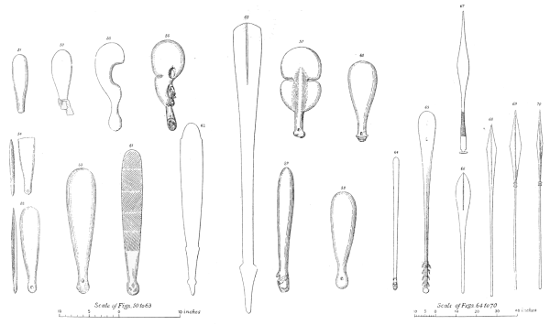
Plate XIV.
Diagram 3.
TRANSITION FROM CELT TO PADDLE SPEAR & SWORD FORMS.
The almond-shape celt form, as I have already demonstrated,
is one so universally distributed and of such very early origin,
that we may naturally expect to find many of the more
complicated forms of savage implements derived from it. [See
diagram No. 3, reproduced in Plate XIV.] In a paper in the
Ulster Journal of Archaeology (Belfast, 1857, vol. v, pp. 125-27)
a writer draws attention to the occurrence in the bed of the
Bann, and elsewhere in the north of Ireland, of stone clubs,
formed much upon the general outline of the celt, but narrowed
at the small end, so as to facilitate their being held in the hand
like a bludgeon. Fig. 50 is copied from the illustration given
in the paper referred to, and fig. 51 is another in my collection,
also from Ireland, of precisely the same form; the original is
upon the table, and it will be seen that it is simply a celt cut
at the small end, so as to adapt it to being held in the hand.
Fig. 52 is an implement in common use among the New
Zealanders, called the ‘pattoo-pattoo’, of precisely the same
shape; it is of jade, and its form, as may be seen by the thin
sharp edge at the top, is evidently derived from that of the stone
celt. Fig. 53 is a remarkably fine specimen, from the Museum
of this Institution; the handle part in this specimen is more
elaborately finished. These weapons are used as clubs to break
heads, and also as missiles, and the fact of their having been
derived from the celt is shown by the manner in which they
are used by the New Zealanders. I am informed by Mr. Dilke,
who derived his information from the natives whilst travelling
in New Zealand, that the manner of striking with these weapons
is not usually with the side, but with the sharp end of the
pattoo-pattoo, precisely in the same manner that a celt would
be used if held in the hand. The spot selected for the blow is
usually above the ear, where the skull is weakest. If any
further evidence were wanting to prove the derivation of this
weapon from the stone celt, it is afforded by fig. 54, which is a
jade implement lately added to the British Museum from the
Woodhouse Collection. It was, for some time, believed to have
been found in a Greek tomb, but this is now believed by
Mr. Franks to be a mistake; it is, without doubt, a New
Zealand instrument. The straight edge shows unmistakably
that the end was the part employed in using it, while the
rounded small end, with a hole at the extremity, shows that,
like the pattoo-pattoo, it was held in the hand. It is, in fact,
precisely identical with the hand celts from Ireland, above
described, and forms a valuable connecting link between the
celt and pattoo-pattoo form. Now it may be regarded as a law
of development, applicable alike to all implements of savage and
early races, that when any form has been produced symmetrically,
like this pattoo-pattoo, the same form will be found either
curved to one side, or divided in half; the variation, no doubt,
depending on the purposes for which it is used. The pattoo-pattoo,
having been used at first, like its prototype the celt,
for striking with the end, would naturally come to be employed
for striking upon the side edge.[154] The other side would therefore
be liable to variation, according to the fancy of the workman.
Figs. 55, 56, and 57, are examples of these implements, in which
the edge is retained only on one side and at the end, the other
side being variously cut and ornamented. This weapon extended
to the west coast of America, and there, as in New Zealand,
they are found both of the symmetrical and of the one-sided form.
Fig. 58 is one believed to be from Nootka Sound, in my
collection. Fig. 59 is also from Nootka, in the Museum of this
Institution. Fig. 60 is an outline of one from Peru, which is
figured in Dr. Klemm’s work (l. c., fig. 46, p. 26), and I am informed
that a nearly similar club has been derived from Brazil.
The same form as the pattoo-pattoo, in Australia, has been
developed in wood. Fig. 61 is from Nicol Bay, North-West
Australia, and is in the Christy Collection described as a sword.
Fig. 62 is of the same form, also of wood, but of cognate form,
from New Guinea. In fig. 63, which is also from New Guinea,
we see the same form developed into a paddle. In the larger
implements of this class we see the same form, modified in such
a manner as to diminish the weight; thus, the convex sides
become either straight or concave. I have arranged upon the
walls a variety of clubs and paddles, from the Polynesian Islands,
figs. 64 to 67, all of which must have been derived from
a common source. The New Zealand steering-paddle, fig. 64,
it will be seen, is simply an elongated celt form. Those from
the Marquesas (fig. 65), Society Isles, Fiji, and Solomon Isles, &c.,
are all allied. In the infancy of the art of navigation, we may
suppose that the implements of war, when constructed of wood,
may have frequently been used as paddles, or those employed for
paddles have been used in the fight, and this may perhaps
account for the circumstance that, throughout these regions, the
club, sword, and paddle pass into each other by imperceptible
gradations. In the Friendly Isles we may notice a still further
development of this form into the long wooden spear, specimens
of which, from this Institution, are exhibited (figs. 68, 69, and 70).
We must not expect to find all the connecting links in one
country or island. We know that the same race has at different
times spread over a very wide area; that the Polynesians,
New Zealanders, and Malays are all of the same stock, speaking
the same or cognate languages. The same race spread to the
shores of America on the one side, and to Madagascar on the
other, carrying with them their arts and implements, and we
may, therefore, naturally expect that the links which are missing
in one locality may be supplied in another.
We now turn to the Australians, a race which, being in the
lowest stage of cultivation of any with whom we are acquainted,
must be regarded as the best representatives of aboriginal
man.
I have transferred the Australian sword, Plate XIV (diagram 3),
fig. 61, to Plate XV (diagram 4), fig. 72, in order that from it we
may be able to trace the development of a weapon supposed by some
to be peculiar to this country, but one which in reality has had
a very wide range in the earliest stages of culture; I allude to
the boomerang.[155]
The Australians, in the manufacture of all their weapons,
follow the natural grain of the wood, and this leads them into
the adoption of every conceivable curve. The straight sword
would by this means at once assume the form of the boomerang,
which, it will be seen by the diagram, is constructed of every
shade of curve from the straight line to the right angle, the
curve invariably following the natural grain of the wood, that is
to say, the bend of the piece of a stem or branch out of which
the implement was fabricated.
All savage nations are in the habit of throwing their weapons
at the enemy. The desire to strike an enemy at a distance,
without exposing one’s self within the range of his weapons, is
one deeply seated in human nature, and requires neither
explanation nor comment. Even apes, as I have already noticed,
are in the habit of throwing stones. The North American
Indian throws his tomahawk; the Indians of the Grand Chako,
in South America, throw the ‘macana’, a kind of club. We
learn from the travels of Mr. Blount,[156] in the Levant in 1634,
that at that time the Turks used the mace to throw, as well as
for striking. The Kaffirs throw the knob-kerry, as did also the
Fidasians of Western Africa.[157] The Fiji Islanders are in the
habit of throwing a precisely similar club. The Franks are
supposed to have thrown the ‘francisca’.[158] The New Zealander
throws his ‘pattoo-pattoo’, and the Australian throws the ‘dowak’
and the waddy, as well as his boomerang. All these weapons
spin of their own accord when thrown from the hand. In
practising with the boomerang, it will be found that it does
not require that any special movement of rotation should be
imparted to it, but if thrown with the point first it must
inevitably rotate in its flight. The effect of this rotation, it will
hardly be necessary to remind those acquainted with the laws of
projectiles, is to preserve the axis and plane of rotation parallel
to itself, upon the principle of the gyroscope. By this means
the thin edge of the weapon would be constantly opposed to the
atmosphere in front, whilst the flat sides, if thrown horizontally,
would meet the air opposed to it by the action of gravitation;
the effect, of course, would be to increase the range of the
projectile, by facilitating its forward movement, and impeding
its fall to the earth. This much, all curved weapons of the
boomerang form possess as a common property.
If any large collection of boomerangs from Australia be
examined, it will be seen that they vary not only in their curvature,
but also in their section; some are much thicker than others,
some are of the same breadth throughout, whilst others bulge in
the centre; some are heavier than others, some have an additional
curve so as to approach the form of an S, some have a slight
twist laterally, some have an equal section on both sides, while
others are nearly flat on one side and convex on the other.
As all these varieties continued to be employed, it would soon
be perceived that peculiar advantages were derived from the use
of the flatter class of weapon, especially such as are flat on the
under side, for by throwing these in such a manner as to catch
the air on the flat side, instead of falling to the ground they
would rise in the air, precisely in the same manner that a kite,
(fig. 71), when the boy runs forward with the string, rises and continues
to rise as long as it is kept up by the action of the air
beneath. In like manner the boomerang, as long as the forward
movement imparted to it by the thrower continues, will continue
to rise, and the plane of rotation, instead of continuing perfectly
parallel to its original position, will be slightly raised by the
action of the atmosphere on the forward side. When the movement
of transition ceases, the boomerang will begin to fall, and
its course in falling will be by the line of least resistance, which
is in the direction of the edge that lies obliquely towards the
thrower; it will therefore fall back in the same manner that
a kite, when the string is suddenly broken, is seen to fall back
for a short distance; but as the kite has received no movement of
rotation to cause it to continue in the same plane of descent, it
soon loses its parallelism, and falls in a series of fantastic curves
towards the ground. The boomerang will do the same thing if it
loses its movement of rotation; but as long as this continues,
which it usually does after the forward movement has ceased, it
continues to fall back upon the same inclined plane by which it
ascended, and finally reaches the ground at the feet of the thrower.
There are various ways of throwing the boomerang, but the
principles here enunciated will explain the course of its flight in
whatever manner it may be thrown.
Now it is evident that this peculiar mode of flight would be of
great advantage to the savage, for as we learn from a paper in
Trans. Ethnological Society (N.S. iii. pp. 264-5), by Mr. Oldfield, who
speaks from experience, the natives usually employ this weapon
against large flocks of ducks or wild-fowl in rivers or marshes;
the weapon after striking or missing the prey would return to
the thrower, instead of being lost in the morass; its use, therefore,
would give to the individual or tribe possessing it a great
advantage over their neighbours in the struggle for life.
But it is evident that the principles of the flight of the boomerang,
such as I have described it, according to the recognized
law of projectiles, must have been entirely unknown to the
savage; he can no more be said to have invented the boomerang
than he can be said to have invented the art of sustaining life by
nourishment. Instinct prompts him to eat; little better than
instinct would enable him to select from amongst his weapons
such as are found most suitable for obtaining food; and we have
already seen how he may have been led to the adoption of such
an instrument as the boomerang, purely through the laws of
accidental variation, guided by the natural grain of the material
in which he worked.
The boomerang, though used chiefly for game, is used also as
a weapon, and Mr. Oldfield says that it is capable of inflicting
a wound several inches in depth.
A further movement is effected in the flight of the boomerang
by giving the arms a slight lateral twist, by means of which it
is caused to rise by virtue of its rotation, screwing itself up in
the air precisely in the same manner that a boy’s flying top rises
to the ceiling. By means of this addition, the weapon is sometimes
made to strike an object in its fall to the ground, behind
the thrower, but the twist is not by any means invariable, as any
one may see by examining a collection of these weapons. Nor is it
essential to ensure a return fall, which I have frequently ascertained
by practising with a boomerang that was perfectly flat.
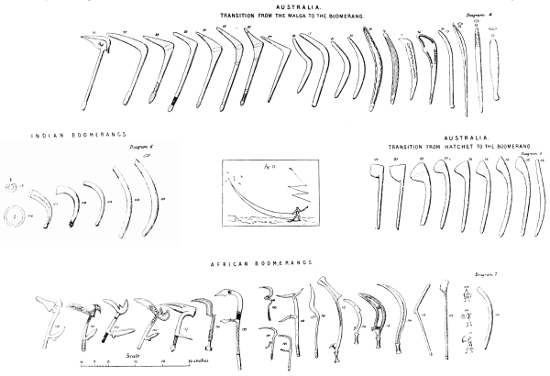
Plate XV.
Diagram 4
AUSTRALIA.
TRANSITION FROM THE MALGA TO THE BOOMERANG.
Diagram 6
INDIAN BOOMERANGS
Diagram 5
AUSTRALIA.
TRANSITION FROM HATCHET TO THE BOOMERANG
Diagram 7
AFRICAN BOOMERANGS.
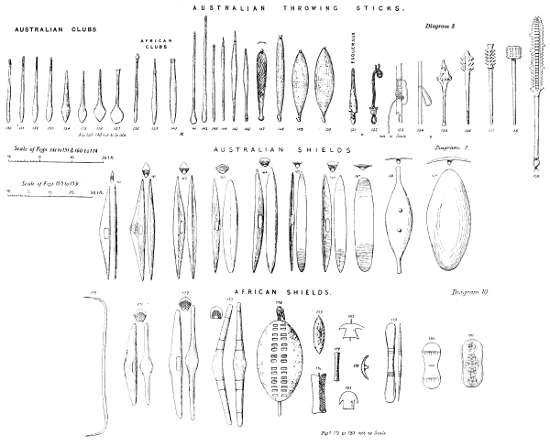
Plate XVI.
Diagram 8
AUSTRALIAN THROWING STICKS.
AUSTRALIAN CLUBS
AFRICAN CLUBS
Diagram 9
AUSTRALIAN SHIELDS.
Diagram 10
AFRICAN SHIELDS.
In examining Plate XV (diagram 4), it will be seen that the
boomerang passes by imperceptible gradations from the straight
sword, fig. 72, on the one hand, into the ‘malga’, a kind of pick,
fig. 89, used for war purposes, on the other[159], and this Australian
malga closely resembles a weapon of the same kind from New
Caledonia, figs. 90 and 91, which, as already mentioned, is used
both as a weapon and for tilling the ground. In Plate XV
(diagram 5), figs. 92 to 100, I have also arranged the links of connexion
between the boomerang and a kind of hatchet or chopper
called the waddy. A slight swell or projection is seen to grow
out of one end of the concave side of the boomerang, and this
develops into the form of a chopper. In those specimens of this
class in which the projection is only slightly developed, as in
figs. 94 and 95, the sides of the implement are flat, and the
weapon is obviously designed for throwing, but in some of those
in which the projection is more fully developed, as in fig. 96, the
shaft is quite round, and the head becomes thick and heavy, so
as to render it totally unsuited to the purposes of a missile. We
see, therefore, in this diagram, the transition, by minute gradations,
from a missile to a hand weapon, or vice versa. The
boomerang, the sword, the malga, and the waddy, are thus seen
to be allied in such a manner as to make it difficult to determine
which of the four was the original weapon, and, if properly
arranged to display their development, they should be distributed
in branch lines, starting from a common centre, exactly in the
same manner that I have suggested the various forms of spear
and arrow-heads ought to be arranged in the natural order of
progression. [See, for example, Plate III, and pp. 37-8, above.]
In Plate XV (diagram 6), figs. 101-5, I have arranged a series
of boomerangs from India. Figures 101 and 102 are specimens
of the ‘katureea’ or boomerang of Goojerat, from the Indian
Museum; they are used by the coolies, according to the ticket
in the Museum, ‘for whirling at hares, boars, and other wild
animals, and disabling them’. It is of ‘raen’ wood, thicker and
heavier than the Australian specimens, and therefore not
adapted to rise in the air and return. The section is equal
on both sides, but in other respects it is precisely identical
with the Australian weapon, and appears to have been roughly
chipped into form. Figures 103 and 104 are of an improved
form, from Madras, called the ‘collery’, also of wood, but having
a knob at the handle end; they are from the Museum of this
Institution. Figure 105 is precisely the same form in steel,
from the India Museum. It is probable that this weapon led
to the use of the steel ‘chakra’ or war quoit (fig. 106) of
which I have given an illustration from the Museum of this
Institution. The principle of its flight is precisely that of the
boomerang, in so far as regards the increase of range and
velocity produced by the rotation preserving the thin edge in
the line of its forward motion. The earliest mention of this
instrument is in the description of the Malabar Coast, by
Magellan, about 1512, translated by Mr. Stanley, for the
Hakluyt Society. The author describes amongst the arms used
in the kingdom of Dely, certain wheels called chacarani, ‘two
fingers broad, sharp outside like knives, and without edge
inside, and the surface of these is of the size of a small plate,
and they carry seven or eight of these each, put on the left
arm, and they take one and put it on the finger of the right
hand, and make it spin round many times, so that they hurl it
at their enemies, and if they hit any one on the arm or neck, it
cuts through all, and with these they carry on much fighting,
and are very dexterous.’[160] These weapons are usually worn on
the head, but the circumstance here mentioned of their being
worn on the arm, reminds us very much of the peculiar weapon
worn by the Djibba negroes of Central Africa as a bracelet;
this is represented in figure 107; it is of iron, sharp on the
outside and blunt on the inside, which touches the arm; the
edge is usually covered with a strip of hide to prevent injury
to the person. I am not aware that this weapon of the negroes
is ever used as a missile, but the occurrence of two such singular
weapons, similarly carried, is worthy of notice, more particularly
as we have clear evidence of a connexion between the metal-workers
of the whole continent of Africa and the hill tribes
of Central India.
It is possible that many links of connexion may be supplied
when the subject of continuity comes to be more carefully
studied in these countries. It would appear extremely probable
that the small Koorkeree and Goorkah knife, though now used
only for hand fight, may have had their origin in these missile
weapons, which they resemble in form, especially the large
Goorkah knife. It would be interesting to know if they are ever
thrown. I have heard stories of this having been the case, but no
authentic account of such a practice. The Spaniards throw their
long clasp-knives with effect for a considerable distance.
Turning to Africa (Plate XV, diagram 7), we find the
boomerang well represented in many parts of that continent.
Figure 108 is an ancient Egyptian boomerang of wood, in the
British Museum. It was obtained from the collection of James
Burton, Jr., Esq., which was formed by him in Egypt, and is
described as ‘an instrument for fowling, for throwing at, or
knocking down birds, as is continually represented on the walls
of the tombs’. It is of hard but light wood, the section is
symmetrical on both sides, and not flat on one side, like some of
the Australian boomerangs; it is somewhat broader at the ends
than in the middle of the blade. Figures 100, 110, and 111,
are taken from Rosellini’s Egyptian Monuments,[161] and show how
this instrument was used by the ancient Egyptians. Sir Samuel
Baker has described the weapon called the ‘trombash’, used in
those parts of Abyssinia which he traversed.[162] It is of hard
wood, resembling the Australian boomerang, about two feet in
length, and the end turns sharply at an angle of 30°; they
throw this with great dexterity, and inflict severe wounds with
the hard and sharp edge, but, unlike the boomerang, it does not
return to the thrower. Figure 113 is a wooden instrument, in
the Christy Collection, said to be used by the Djibba negroes
for throwing at birds. Figure 114 is the Nubian sword, which
in form exactly resembles the boomerang. They have a great
variety of curves, some of them, especially those of the same
form used in Abyssinia, bending nearly in a right angle. I am
not aware that this instrument is ever thrown by the Nubians;
they, however, are in the habit of throwing their curved clubs
with great dexterity. Figure 115 is an iron implement of native
workmanship, used as a missile by the inhabitants of Central
Africa; it was brought from that region by Consul Petherick,
at whose sale I purchased it. Like the majority of the
succeeding figures represented in this diagram, it resembles
the Australian boomerang, in being flat on the under side,
that is to say, upon the side which would be undermost, if
thrown from the right hand with the point first; the weight,
however, would prevent such a weapon from rising in the air,
or returning to the thrower. Figure 116 is used by the Mundo
tribe of Africa; like the last, it is flat on the under side; in
form it resembles the falchion, represented in the Egyptian
sculptures as being held in the hand by Rameses and other
figures, when slaying their enemies. The small knob on one
side of the blade is used to attach it to the person in carrying
it. Figure 117, from Central Africa, is clearly a development
of the preceding figure. Figure 118 is a weapon of the same
class, from Kordofan, obtained near the cataracts of Assouan,
Upper Nile, and now in the Museum of this Institution;
though of the same character as the other missiles, its section
is equal on both sides, and therefore it is not calculated to range
far in its flight. Figure 119 is also from the Museum of this
Institution; it is flat on the under side. Figures 120 and 121 are
from illustrations in Denham and Clapperton’s Travels in Northern
and Central Africa (Pl. xli. 3, 4), of the missile instruments, called
‘hunga-mungas’, used by the negro tribes, south of Lake Tchad.
One of these is of very peculiar form; in the course of the
innumerable variations which this weapon appears to have
undergone, the constructor appears to have hit upon the idea
of representing the head and neck of a stork. Figure 122 is
from a sketch, in Barth’s Travels, of one of these weapons,
belonging to the Marghi, a negro tribe in the same region; it
is called ‘danisco’, and he says that the specimen here represented
is of particularly regular shape, thereby inferring that
numerous varieties of form are in use among these people. In
another place, he describes the ‘goliyo’ of the Musgu and the
‘njiga’ of the Bagirmi, as weapons of the same class, the name
of the latter differing from the word for spear only in a single
letter; he says this weapon is common to all the pagan, i.e.
negro tribes, that he came across.[163] Figure 123 is from East
Central Africa, presented to the Christy Collection by the
Viceroy of Egypt; it is described as a cutting instrument, from
the country of the Dinkas and Shillooks, capable of being
thrown to a great distance. Mr. Petherick met with these
tribes in his travels on the White Nile.[164] Figure 124, from my
collection, is described as a battle-axe of the Dor tribe, between
the equator and the 6th or 7th degree of north latitude. It
was brought to England by Mr. Petherick, who obtained it in
his travels in 1858; it is used also for throwing. Figure 125
is from an illustration in Du Chaillu’s work,[165] of the missile
tomahawk, used by the Fans in the Gaboon, in West Central
Africa; he says that the thrower aims at the head, and, after
killing his victim, uses the round edge of the axe to cut off the
head. We see from this, that notwithstanding the innumerable
and apparently meaningless variations which this weapon has
undergone, the different parts of it are sometimes applied to
especial uses. Figure 126 is another missile, used by the Neam-Nam
tribes, East Central Africa. Mr. Petherick says, that the
Baer tribe carry a different kind of iron missile from the Neam-Nams.
Figures 126 to 129 are different varieties of Neam-Nam
weapons, in which, as they are all derived from the same
people, the gradual transition of form is more perceptible than
in those isolated specimens derived from different tribes. If,
however, we had specimens of all the varieties used by each tribe,
we should without doubt be able to trace the progression of the
whole of them from a common form. As it is, the connexion
is sufficiently obvious when the details are examined, throughout
the whole region in which they are found, extending from
Egypt and the Nile in the East, to the Gaboon on the West
Coast. In all, the principle of construction is the same, the
divergent lateral blades serving the purpose of wings, like the
arms of the Australian boomerang, to sustain the weapon in the
air when spun horizontally. The variations are such as might
have resulted from successive copies, little or no improvement
being perceivable in the principle of construction throughout
this region, notwithstanding the innumerable forms through
which it must have passed during its transmission from its
original source; the locality of which we shall probably be
unable to determine, until the antiquities of the country have
been more carefully described and studied. As, however, it is
everywhere found in the hands of the negro aborigines of the
country, it must probably have had the same origin as the art
of smelting and fabricating iron, which is everywhere identical
throughout this region, and is, without doubt, of the remotest
antiquity, dating long prior to any historical record of the
continent of Africa.
The possible employment of the boomerang in Europe has
been made the subject of occasional speculation amongst antiquarian
writers. Having been used in Egypt, and perhaps in
Assyria, there is no good reason for doubting that it may have
spread from thence to the north-west. In a learned paper on
the subject in the Transactions of the Royal Irish Academy, vol. xix
(1843), § ‘Literature,’ p. 22, Pl. i, ii, Mr. Samuel Ferguson
endeavours to prove that the ‘cateia’ mentioned by classical authors
was the boomerang. He quotes several passages, and amongst
them one from Virgil (Aeneid vii. 741), in which mention is
made of a people accustomed to whirl the ‘cateia’ after the
Teutonic manner. In the Punica of Silius (iii. 327), one of the
Libyan tribes which accompanied Hannibal to Italy is described
as being armed with a bent or crooked ‘cateia’. Isidore, Bishop
of Seville, a writer of the end of the sixth and beginning of the
seventh century, described the ‘cateia’ as ‘a species of bat, which,
when thrown, flies not far, by reason of its weight, but where it
strikes, it breaks through with extreme impetus, and if it be
thrown with a skilful hand, it returns back again to him who
dismissed it’ (Origines, xviii. 7. 7).
Strabo also (pp. 196-7) describes the Belgae of his time, as
using ‘a wooden weapon of the shape of a grosphus, which they
throw out of hand ... which flies farther than an arrow, and is
chiefly used in the pursuit of game’.
Those who desire further information relative to its supposed
use in Europe, cannot do better than refer to the paper from
which I have quoted. Meanwhile, enough has been said to
show:—(1) that the boomerang was used in many different
countries at a very early period, and in a very primitive condition
of culture, and that it was everywhere employed chiefly in the
pursuit of game; (2) that it was everywhere constructed of
wood, before it was copied in metal; (3) that in Australia it
originated as a variety of the almond- or leaf-shaped sword,
and was suggested by the natural curvature of the material out
of which it was formed; (4) that the subsequent improvements
by which its return flight was ensured, arose from a practical
selection of suitable varieties, and was not the result of design,
and (5) that the form of the boomerang passes by minute gradations
into at least three other classes of weapons in common use
by the same people, and may therefore be regarded as a branch
variety of an original normal type of implement, used by the
most primitive races as a general tool or weapon.
Amongst other implements used for war, the form of which
appears to be derived from the same common source as those
already described, may be included the Australian club, and the
wamera or throwing stick. I have arranged in Plate XVI, diagram
8, figs. 130 to 137, a series of Australian clubs, showing a
transition from the plain stick, of equal size throughout, to one
having a nearly round knob at one end. Nearly similar forms
to some of these, from Africa, figs. 138 to 140, are also represented
on the same diagram.
Amongst the Australian ‘wameras’, there are so many varieties,
that it is next to impossible to speculate upon the priority of
any particular form, unless the plain stick, with a projecting
peg at one end, may be regarded as certainly the simplest, and
therefore the earlier form. The ‘wamera’ is held in the right
hand, and the projecting peg at the end is fitted into a cavity at
the end of the spear, which latter is held in the left hand, in the
required direction, until just before the moment of throwing.
The spear is then impelled to its destination by the wamera,
which gives great additional impetus to the arm. Fig. 147 is a
wamera from Nicol Bay, of exactly the same general outline as
the sword already figured from that locality, figs. 61 and 62,
except that one of the faces at the end of which the peg is
fastened, is concave, and the other convex; this specimen is in
the Christy Collection. The wamera assumes a great variety of
forms; some, as for example fig. 142, resemble on a small scale
the New Zealand paddle, the broad end being held in the hand,
and the peg inserted in the small end; others, broad and flat,
figs. 148 to 150, bulge out in the middle by successive gradations,
until they approach the form of a shield. No reasonable
cause that I am aware of, can be assigned for these different
forms; beyond caprice, and the action of the law of incessant
variation, which is constant in its operation amongst all the
works of the aborigines.
The wamera is found on the north-west[166] and south-west[167]
coasts of Australia, and Major Mitchell describes it in
the east and central parts of the continent.[168]
That the wamera preceded the bow, appears probable from the
fact that no bow is ever used in Australia, unless occasionally
upon the north coast, where it is derived from the Papuans. The
bow is not indigenous in New Zealand, or in any of those islands
of the Pacific which are peopled by the Polynesian race; it
belongs truly to the Papuans, and where it is used elsewhere in
the Pacific Islands as a toy, it may very probably have been
derived from their Papuan neighbours. The throwing stick is
used in New Zealand, in which country Mr. Darwin describes
the practice with them. ‘A cap,’ he says, ‘being fixed at
30 yards distance, they transfixed it with the spear delivered by
the throwing stick, with the rapidity of an arrow from the bow of
a practised archer.’[169] In New Guinea, Captain Cook saw the lance
thrown 60 yards, as he believed, by the throwing stick.[170] I saw
the Australians, now exhibiting on Kennington Common (1868),
throw their spears with the wamera nearly 100 yards extreme
range, but as they practised only for range, I had no opportunity
of observing the accuracy of flight. Mr. Oldfield says that
their practice has been much exaggerated by the European
settlers, in order to justify acts on their part, which would otherwise
appear cowardly. He says, that a melon having been put
up at a distance of 30 yards, many natives practised at it for an
hour without hitting it, after which an European, who had
accustomed himself to the use of this weapon, struck it five
times out of six with his spear. Klemm, on the other hand, has
collected several accounts of their dexterity in the use of it; he
says, that the range is 90 yards, and mentions that Captain Phillip
received a wound several inches deep at 30 paces. At 40 paces,
he says, the aborigines are always safe of their mark (l. c., p. 32). A
sharp flint is usually fixed with gum into the handle of the wamera,
which they use for sharpening the points of their spears.
The throwing stick (fig. 151) is used by the Esquimaux
throughout the regions they inhabit. Frobisher[171] mentions it
on the east, Captain Beechey on the north-west, and Cranz
describes its use in Greenland.[172] Klemm says (l. c., p. 39), that the
throwing stick used in the Aleutian Isles, differs from that of the
Greenlander in having a cavity, to receive the end of the spear,
instead of a projecting tang. The Esquimaux stick generally
differs from the Australian in form, and has usually holes cut to
receive the fingers, which by this means secure a firm grasp of
the instrument. The custom of forming holes or depressions in
an implement to receive the fingers was very widely spread
in prehistoric times. I have specimens of stones so indented,
used probably as hammers, from Ireland, Yorkshire, Denmark,
and Central India. In the Christy Collection there is one precisely
similar from the Andaman Isles.
The only other race that is known to make use of the throwing
stick is the Purus-Purus Indians of South America, inhabiting
a tributary of the Amazon. These people have no bow, and in
many other respects resemble the Australians in their habits.
Their throwing stick is called ‘palheta’; it has a projection
at the end, to fit into the end of the spear, and is handled exactly
in the same manner as the Australian ‘wamera’.[173]
Another kind of spear-thrower, consisting of a loop for the
finger and a thong by which it is fastened to the spear, is used
in New Caledonia, and Tanna, New Hebrides (fig. 152). On
ordinary occasions this is carried by being suspended to an armlet
on the left arm, but, when preparing for war, they fasten it on
to the middle of their spears. I exhibit here, fig. 153, a precisely
similar contrivance from Central Africa, from my collection.
Judging by the spiral ferrule, at the end of the lance to which
it is attached, it appears to be derived from Central or East
Central Africa. This mode of increasing the range of the
dart or javelin was well known to the ancients, and was called
by the Greeks ἀγκύλη, and by the Romans ‘amentum’; it is
represented on the Etruscan vases, and is figured in Smith’s
Dictionary of Greek and Roman Antiquities, from which the
drawing given in fig. 154 is taken.[174] One of the effects produced
by this contrivance was, doubtless, to give the weapon a rotary
motion, and thereby to increase the accuracy of its flight, upon
the same principle as the rifling of a bullet; but the range and
velocity were also increased, by enabling the thrower, the tip of
whose forefinger was passed through the loop of the ‘amentum’,
to press longer upon the spear, and thus impart a greater velocity
to it, in the same manner that the effect of the Australian
wamera may be said to increase the length of the thrower’s arm.
The Emperor Napoleon, who, as we all know, has paid great
attention to these weapons of the ancients, caused experiments to
be conducted, under his own personal supervision, at Saint Germain,
the result of which showed that the range of a spear was
increased from 20 to 80 meters by the use of this accessory.[175]
My next example of variation of form is taken from the
Australian ‘heileman’, or shield. It may, on the first cursory
consideration of the subject, appear fanciful to suppose that
so simple a contrivance as the shield could require to have
a history, or that the plain round target, for example, so common
amongst many savage nations, could be the result of a long
course of development. Surely, it may be said, the shells of
tortoises or the thick hides of beasts would, from the first, have
supplied so simple a contrivance. But the researches in palaeoethnology
teach us that such was not the case; man came into
the world naked and defenceless, and it was long before he
acquired the art of defending himself in this manner. His first
weapon, as I have already said, was a stone or a stick, and it is
from one or other of these, that we must trace all subsequent
improvements. The stick became a club, and it is to this alone
that many of the earliest races trust for the defence of their
persons. The Dinkas of East Central Africa have no shields,
using the club, and a stick, hooked at both ends (Pl. XVI, fig. 170),
to ward off lances.[176] The Shoua and the Bagirmi of Central
Africa rarely carry shields, and they use a foreign name for it.[177]
The Khonds, hill tribes of Central India, have never adopted the
shield.[178] The inhabitants of Tahiti use no shield.[179] The Sandwich
Islanders use no shield or weapon of defence, employing the
javelin to ward off lances: like the Australians, and, like the
Bushmen, they are very expert in dodging the weapons of their
enemies. In Samoa the club is used for warding off lances, and
the warriors frequently exercise themselves in this practice. The
‘kerri’ sticks of the Hottentots are used for warding off stones
and assegais.[180]
The club head formed by the divergent roots of a tree (Pl. XVI,
fig. 155), offers great advantages in enabling the warrior to catch the
arrows in their flight, and this led to the use of the jagged mace-head
form of club, which is here represented from many different
localities. Fig. 155 is from Fiji, fig. 157 from Central Africa,
fig. 156 from Australia, fig. 158 from New Guinea, and fig. 159
from the Friendly Isles. The curved clubs, of which a great
variety are found in the hands of savages in every part of the
world, are exceedingly well adapted to catch and throw off the
enemy’s arrow. The Australian ‘malga’, or ‘leowel’, as it is
called by the Australians now in this country, and already
described (pp. 125-6), is used in this manner.
By degrees, instead of using the club as a general weapon,
offensive and defensive, especial forms would be used for defence,
whilst others would be retained for offensive purposes; but the
shield for some time would continue to be used merely as
a parrying instrument. Such it is in Australia. In its most
primitive form, it is merely a kind of stick with an aperture cut
through it in the centre for the hand. The fore part varies with
the shape of the stem out of which it was made; in some it
is round, in others flat. This form appears to have branched off
into two varieties; one developed laterally, and at last assumed the
form of a pointed oval, as represented in Plate XVI, figs. 165 to
169; these are frequently scored on the front with grooves to catch
the lance points. The other variety appears to have assumed
a pointed form in front, so as to make the spear glance off to
one side, as represented in figs. 160 to 164. The Australians are
exceedingly skilful in parrying with these shields. One of the
feats of the Australians now in this country, consists in parrying
cricket balls thrown with full force by three persons at the
same time. The ‘heileman’ is cut out of the solid tree and, like all
their other weapons, invariably follows the grain of the wood.
In 1861, Mr. Oldfield, when engaged in collecting specimens
of timber for the International Exhibition, came upon one of
these shields, nearly finished, and abandoned, but only requiring
a few strokes to detach it from the growing tree; and he noticed
the immense time and labour it must have cost the native to
construct it, not less than 30 cubic feet of wood having been
removed in digging it out of the tree with no better tool than
a flint fixed to the end of a stick. Trees of sufficient size for
these shields are not found in all parts of Australia, and in those
places where they are wanting, the natives only obtain them by
traffic with other tribes. The same cause may also account, in
some measure, for the varieties of their form, yet, notwithstanding
these numerous varieties, they never leave the normal type
throughout the continent, and you might as well expect to see
the Australian using a firelock of native manufacture, as to
find in his hands the circular flat shield which is common in
Africa, America, and ancient Europe.
In Africa, the development of the shield appears to have followed
precisely the same course, commencing with the plain stick or
club, Pl. XVI, fig. 170, and passing through the varieties represented
in figs. 171, 172, and 173, which are scarcely distinguishable
from the Australian ‘heileman’, to the oval shield of the
Kaffirs, fig. 174, and of the Upper Nile, figs. 175 and 176, which
are of ox hide, but show their origin by a stick passing down
the centre and grasped in the hand; with this stick they parry
and turn off the lances of the assailant precisely in the same
manner that the Australian employs the projecting point at the
end of his oval shield. Judging by the side views represented
in the Egyptian and Assyrian sculptures, similar shields were
used by the ancients, and we may especially notice the Assyrian
shield, of small dimensions, fig. 178, mentioned by Mr. Rawlinson
as being represented in the Assyrian sculptures, and having projecting
spikes on the fore part, to catch and throw off the
enemy’s weapons (Five Great Monarchies (1864), vol. ii. p. 51).
All these antique shields have one other feature in common
with the shields of existing aborigines, viz. that they are held
by a handle in the centre. It was only in a more advanced age,
when armies began to fall into serried ranks, that the broad
shield was introduced and held upon the left arm, a mode of
carrying it ill adapted to the requirements of the light-armed
combatants. Besides the oval, the shield took other forms, but
appears always to have been narrow in its earliest developments:
fig. 176 from the Upper Nile closely resembles in outline fig. 177
from the New Hebrides. Livy describes the shields of the Gauls
in the attack of Mount Olympus, B.C. 189, as being too narrow
to defend them against the missiles of the Romans, and he also
describes them as brandishing their shields in a peculiar manner
practised in their original country.[181] This must without doubt
have been connected with the operation of parrying. Sir Walter
Scott describes the Scotch parrying with their shields. Shields
in the form of a figure 8 are met with in various countries;
Captain Grant describes the Unyamwezi as carrying a shield
of this form.[182] Fig. 179 from this Institution is from Central
Africa, of a very primitive form. Fig. 180 is of the same shape
from New Guinea, and the beautiful bronze shield, fig. 181[183], of
the late Celtic period, in the British Museum, found in the
Thames, appears to be of an allied form. Fig. 182 is an ox-hide
shield of the Basutos; it is allied to that of the Kaffirs, Fig. 174,
by having a stick at the back, and the peculiar wings with which
it is furnished connect it with that of the Fans of the Gaboon, on
the West Coast, fig. 183, which latter is of elephant hide and has
no stick at the back. No connexion that I am aware of is known
to have existed between these remote tribes, which are of totally
different races, but the forms of their shields here represented
must, I think, have been derived from a common source.
It would be quite impossible within the space of a single
lecture to produce more than a very small portion indeed of the
evidence which is available in support of my arguments. If
the principles which I have enunciated are sound, they must be
applicable to the whole of the arts of mankind and to all time.
If it can be proved that a single art, contrivance, custom, or
institution, sprang into existence in violation of the law of
continuity, and was not the offspring of some prior growth,
it will disprove my theory. If in the whole face of nature there
is undoubted evidence of any especial fiat of creation having
operated capriciously, or in any other manner than by gradual
evolution and development, my principles are false.
It would be a violation of the law of continuity, for example,
if the principles which I am now advocating, in common with
many others at the present time, opposed as they are to many
preconceived notions, were suddenly to receive a general and
widespread acceptance. This also, like other offsprings of the
human mind, must be a work of development, and it will require
time and the labours of many individuals to establish it as the
truth, if truth it be.
Meanwhile it may be well that I should briefly sum up
the several points which I have endeavoured to prove on the
present occasion.
I have endeavoured to prove in the first place, though I must
here repeat that I have produced only a very small portion of
the evidence on the subject, that all the implements of the stone
age are traceable by variation to a common form, and that form
the earliest; that their improvement spread over a period so long
as to witness the extinction of many wild breeds of animals;
that it was so gradual as to require no effort of genius or of
invention; and that it was identical in all parts of the world.
I have shown in the second place, that all the weapons of the
Australians which I have described, are traceable by variation to
the same common form, or to forms equally as primitive as those
of the stone age of Europe; that it is perfectly consistent with
the phenomena observed, that these variations may have resulted,
or at least may have in a great measure been promoted by
accidental causes, such as the grain of the wood influencing the
shape of the weapon; that they were not invented or designed
for especial purposes, but that their application to such purposes
may have resulted from a selection of the implements already in
hand; and that by this process, the natives of Australia, during
countless ages, may have crept on, almost unconsciously, from
the condition of brutes, to the condition of incipient culture in
which they are now found.
I have compared these weapons of the Australians with others
of the same form in various parts of the world, showing grounds
for believing that whenever we shall be able to collect a sufficient
variety of specimens to represent the continuous progression of
each locality, the modus operandi will be found to have been
everywhere the same.
Lastly, I have alluded cursorily to the analogy which exists
between the development of the arts and the development of
species. It may be better to postpone any comprehensive generalization
on this subject until a much larger mass of evidence has
been collected and arranged. Sir Charles Lyell has devoted
a chapter in his work on the Antiquity of Man to a comparison
of the development of languages and the development of species.
‘We may compare,’ he says, 'the persistency of languages, or the
tendency of each generation to adopt without change the vocabulary
of its predecessor, to the force of inheritance in the organic
world, which causes the offspring to resemble its parents. The
inventive power which coins new words or modifies old ones, and
adapts them to new wants and conditions as often as they arise,
answers to the variety-making power in the animal creation.’
He also compares the selection of words and their incorporation into
the language of a people, with the selection of species, resulting in
both cases in the survival of the fittest (4th ed., 1873, p. 503).
Whilst, however, we dwell upon the analogy which exists
between the phenomena of the organic world and the phenomena
of human culture, we must not omit to notice the points of
difference. The force of inheritance may resemble in its effects
the principle of conservatism in the arts and culture of mankind,
but they are totally dissimilar causes.
The variety-making power may resemble the inventive power
of man; nothing, however, can be more dissimilar, except as
regards results.
When, therefore, we find that like results are produced through
the instrumentality of totally dissimilar causes, we must attribute
the analogy to some prior and more potent cause, influencing the
whole alike.
It might be premature to speculate upon the course of reasoning
which this class of study is likely to introduce; this much,
however, we may, I think, safely predict as the result of our
investigation, that we shall meet with no encouragement to deify
secondary causes.
Another subject to which we must necessarily be led by these
investigations, although, as I before said, it does not fall actually
within the scope of my paper, is the question of the unity or
plurality of the human race.
The ethnologist and the anthropologist who has not studied
the prehistoric archaeology of his own country compares the
present condition of savages with that of the Europeans with
whom they are brought in contact. He notices the vast disparity
of intellect between them. He finds the savage incapable of
education and of civilization, and evidently destined to fall away
before the white man whenever the races meet, and he jumps at
the conclusion that races so different in mental and physical
characteristics, must have had a distinct origin, and be the
offspring of separate creations. But the archaeologist traces
back the arts and institutions of his own people and country
until he finds that they once existed in a condition as low or
lower than that of existing savages, having the same arts, and
using precisely the same implements and weapons; and he
arrives at the conclusion that the difference observable between
existing races is one of divergence, and not of origin; that
owing to causes worthy of being carefully studied and investigated,
one race has improved, while another has progressed slowly
or remained stationary.
In this conclusion he is borne out by all analogy of nature, in
which he finds frequent evidences of difference produced by
variation, but no one solitary example of independent creation.
Are not all the branches of a young tree parts of the same
organism; and yet one will be seen to throw up its shoots with
a vigorous and rapid growth, whilst another turns towards the
ground and ultimately decays? Not to mention the variations
produced by the breeding of animals, with which we are all
more or less familiar, we see under our own eyes families of
men diverging in this manner. One branch, owing to causes
familiar to us in everyday life, will become highly cultivated,
whilst another continues to live on in a low condition of life, so
that in the course of a few years the disparity, mental and
physical, between these two branches, bearing the same name,
will be greater, in proportion to the time of separation, than that
which, in the course of countless ages, has separated the black
from the white man.
At the present time there is a tendency to rectify these inequalities,
whether in regard to our own or to other races, and
there can be little doubt that in the course of time, all that
remains of the various races of mankind will be brought under
the influence of one civilization. But as this progressive movement
is often led by men who have not made the races of
mankind their study, they are perpetually falling into the error
of supposing, that the work of countless ages of divergence, is to
be put to rights by Act of Parliament, and by suddenly applying
to the inferior races of mankind laws and institutions for which
they are about as much fitted as the animals in the Zoological
Gardens.
In conclusion, I have only a few words to say upon the defects
of our ethnographical collections generally. It will be seen that
in order to exhibit the continuity and progression of form, I have
been obliged to collect and put together examples from many
different museums; and, as it is, it will have been noticed that
many links of connexion are evidently wanting. This is owing,
in a great measure, to the very short period during which the
arts and customs of primaeval races have been made the subject of
scientific investigation; but it also arises from the absence of
system on the part of travellers and collectors, who in former
times appear to have had but little knowledge of the evidence
which these specimens of the industry of the aborigines are
destined to convey, and who have, therefore, neglected to bring
home from the various regions they visited all the varieties of the
several classes of implements which each country is capable of
affording, thinking that one good example of a tool or weapon
might be taken as a sample of all the rest.
I am not so presumptuous as to suppose that the particular
arrangement, which I have adopted, may not require frequent
modification as our evidence accumulates; but I trust that I shall
at least have made it apparent to those who have followed the
course of my argument, that without the connecting links which
unite one form with another, an ethnographical collection can be
regarded in no other light than a mere toy-shop of curiosities,
and is totally unworthy of science.
Owing to the wide distribution of our Army and Navy, the
members of which professions are dispersed over every quarter of
the globe and have ample leisure for the pursuit of these
interesting studies, this Institution possesses facilities for forming
a really systematic collection of savage weapons, not perhaps
within the power of any other Institution in the world. The
time is fast approaching when this class of prehistoric evidence
will no longer be forthcoming. The collection is already what,
for this country, must be regarded as a good one, and if I may
venture to hope that the remarks I have now the honour of
making will be of service in collecting the materials for the
improvement of it, I trust it may be thought that my labours
and your patience will not have been thrown away.


 in the map), a people characterized by yellow hair and fair
complexions, with blue eyes, who form a strong element in the
composition of the population of this country and a great part of
Europe, extending from thence through Scandinavia and Central
Europe eastward into Northern India. Next to these he classes
the great Mongoloid race (marked by various shades of
in the map), a people characterized by yellow hair and fair
complexions, with blue eyes, who form a strong element in the
composition of the population of this country and a great part of
Europe, extending from thence through Scandinavia and Central
Europe eastward into Northern India. Next to these he classes
the great Mongoloid race (marked by various shades of  on the map), with yellow-brown complexions and black hair and
eyes, of which the Kalmucs and Tartars represent the purest
types, occupying the whole of Northern Europe and Asia, from
Lapland to Behring Strait, and down to the southernmost parts
of China; including also the Esquimaux, the Polynesians, and
the whole of the inhabitants of the two continents of America.
Thirdly, the Negro race (marked
on the map), with yellow-brown complexions and black hair and
eyes, of which the Kalmucs and Tartars represent the purest
types, occupying the whole of Northern Europe and Asia, from
Lapland to Behring Strait, and down to the southernmost parts
of China; including also the Esquimaux, the Polynesians, and
the whole of the inhabitants of the two continents of America.
Thirdly, the Negro race (marked  and
and  in the map),
long headed, with woolly hair, which has its head quarters in all
that part of Africa south of the Sahara, but has outlying branches
widely detached, and occupying a broken line of islands extending
in a belt, from the Andaman Isles in the Bay of Bengal, to the
peninsula of Malacca, New Guinea, New Caledonia, and the
adjoining isles, and having its southmost limits in the distant
island of Tasmania. Lastly, we come to the Australioid race
(marked
in the map),
long headed, with woolly hair, which has its head quarters in all
that part of Africa south of the Sahara, but has outlying branches
widely detached, and occupying a broken line of islands extending
in a belt, from the Andaman Isles in the Bay of Bengal, to the
peninsula of Malacca, New Guinea, New Caledonia, and the
adjoining isles, and having its southmost limits in the distant
island of Tasmania. Lastly, we come to the Australioid race
(marked  ), distinguished by dark chocolate complexions
and black eyes, with long heads and soft wavy hair; these the
Professor, upon physiological grounds, and after intimate acquaintance
with these people in the distant regions in which they
are found, traces in three distinct portions of the globe, viz.
Australia, the Deccan of India, and Egypt; the three identical
countries, it will be observed, in which, unconscious of Professor
Huxley’s distribution of races, I had traced the occurrence of the
boomerang. I think, therefore, it is not an unreasonable conjecture,
assuming the correctness of Professor Huxley’s premises,
that this peculiar weapon may be a relic of the original Australioid
stock, which having been originally an effective weapon for
all purposes amongst the aborigines of this race, and continuing
still to be used as such in Australia, survived in India and in
ancient Egypt merely as an implement for the chase and for
amusement, much in the same way that, in Europe, bows and
arrows have survived amongst children to the present day.
), distinguished by dark chocolate complexions
and black eyes, with long heads and soft wavy hair; these the
Professor, upon physiological grounds, and after intimate acquaintance
with these people in the distant regions in which they
are found, traces in three distinct portions of the globe, viz.
Australia, the Deccan of India, and Egypt; the three identical
countries, it will be observed, in which, unconscious of Professor
Huxley’s distribution of races, I had traced the occurrence of the
boomerang. I think, therefore, it is not an unreasonable conjecture,
assuming the correctness of Professor Huxley’s premises,
that this peculiar weapon may be a relic of the original Australioid
stock, which having been originally an effective weapon for
all purposes amongst the aborigines of this race, and continuing
still to be used as such in Australia, survived in India and in
ancient Egypt merely as an implement for the chase and for
amusement, much in the same way that, in Europe, bows and
arrows have survived amongst children to the present day.

