THE EVERY-DAY BOOK, AND TABLE BOOK; OR, EVERLASTING CALENDAR OF POPULAR AMUSEMENTS, SPORTS, PASTIMES, CEREMONIES, MANNERS, CUSTOMS, AND EVENTS, INCIDENT TO Each of the Three Hundred and Sixty-five Days, IN PAST AND PRESENT TIMES; FORMING A COMPLETE HISTORY OF THE YEAR, MONTHS, AND SEASONS, AND A PERPETUAL KEY TO THE ALMANAC; INCLUDING ACCOUNTS OF THE WEATHER, RULES FOR HEALTH AND CONDUCT, REMARKABLE AND IMPORTANT ANECDOTES, FACTS, AND NOTICES, IN CHRONOLOGY, ANTIQUITIES, TOPO- GRAPHY, BIOGRAPHY, NATURAL HISTORY, ART, SCIENCE, AND GENERAL LITERATURE, DERIVED FROM THE MOST AUTHENTIC SOURCES, AND VALUABLE ORIGINAL COMMUNI- CATIONS, WITH POETICAL ELUCIDATIONS, FOR DAILY USE AND DIVERSION.
I tell of festivals, and fairs, and plays, Of merriment, and mirth, and bonfire blaze; I tell of Christmas-mummings, new year’s day, Of twelfth-night king and queen, and children’s play; I tell of valentines, and true-love’s-knots, Of omens, cunning men, and drawing lots:
I tell of brooks, of blossoms, birds, and bowers, Of April, May, of June, and July flowers. I tell of May-poles, hock-carts, wassails, wakes, Of bridegrooms, brides, and of their bridal cakes; I tell of groves, of twilights, and I sing The court of Mab, and of the fairy king.
Herrick.
WITH FOUR HUNDRED AND THIRTY-SIX ENGRAVINGS.
IN THREE VOLUMES.
VOL. I.
LONDON:
PRINTED FOR WILLIAM TEGG AND Co., 73, CHEAPSIDE;
R. GRIFFIN AND CO., GLASGOW; CUMMING AND FERGUSON, DUBLIN.
J. HADDON, PRINTER, CASTLE STREET, FINSBURY.
[v]
TO
CHARLES LAMB, ESQ.
Dear L——,
Your letter to me, within the first two months from the
commencement of the present work, approving my notice of
St. Chad’s Well, and your afterwards daring to publish me your
“friend,” with your “proper name” annexed, I shall never forget.
Nor can I forget your and Miss Lamb’s sympathy and kindness
when glooms outmastered me; and that your pen spontaneously
sparkled in the book, when my mind was in clouds and darkness.
These “trifles,” as each of you would call them, are benefits scored
upon my heart; and
I DEDICATE THIS VOLUME, TO YOU AND MISS LAMB, WITH AFFECTIONATE RESPECT,
W. HONE
May 5, 1826.
[vi, vii]
PREFACE.
This volume is a specimen of a work undertaken for the purpose of forming
a collection of the manners and customs of ancient and modern times,
with descriptive accounts of the several seasons of popular pastime.
Each of the three hundred and sixty-five days in the year is distinguished
by occurrences or other particulars relating to the day, and by the methods
of celebrating every holyday; the work is therefore what its title purports,
The Every-Day Book.
It is an Everlasting Calendar—because its collection of facts concerning
the origin and usages of every remarkable day, including movable
feasts and fasts, constitute a calendar for every year.
It is a History of the Year—because it traces the commencement and
progress of the year from the first day to the last.
It is a History of the Months—because it describes the appearances
that distinguish each month from the other months.
It is a History of the Seasons—because it describes the influences and
character of the four quarters into which the year is divided, and the most
remarkable objects in natural history peculiar to each season.
It is a Perpetual Key to the Almanack—because it explains the signification
of every name and term in the almanack.
Its antiquarian and historical notices are calculated to engage the attention
of almost every class of readers, and to gratify several who would scarcely
expect such particulars in such a miscellany. The perplexities attending the
discovery of certain facts, and the labour of reducing all into order, will be
appreciated by the few who have engaged in similar pursuits. Some curious
matters are now, for the first time, submitted to the public; and others are
so rare as to seem altogether new.
As regards the engravings, to such as are from old masters, notices of their
prints are always annexed. The designs for the allegorical and other illustrations,
have originated with myself; and the drawings been accommodated,
and the engravings executed, according to my own sense of subject and style.
In numerous instances they have been as satisfactory to me as to my readers;
many of whom, however, are less difficult to please than I am, and have favourably
received some things which I have been obliged to tolerate, because the
exigency of publication left me no time to supply their place. I know what
art can accomplish, and am therefore dissatisfied when artists fail to
accomplish.
[viii]
I may now avow that I have other aims than I deemed it expedient to
mention in the prospectus:—to communicate in an agreeable manner, the
greatest possible variety of important and diverting facts, without a single
sentence to excite an uneasy sensation, or an embarrassing inquiry; and, by
not seeming to teach, to cultivate a high moral feeling, and the best affections
of the heart:—to open a storehouse, from whence manhood may derive daily
instruction and amusement, and youth and innocence be informed, and retain
their innocency.
To these intentions I have accommodated my materials under such
difficulties as I hope may never be experienced by any one engaged in
such a labour. To what extent less embarrassed and more enlarged faculties
could have better executed the task I cannot determine; but I have
always kept my main object in view, the promotion of social and benevolent
feelings, and I am persuaded this prevailing disposition is obvious throughout.
The poetical illustrations, whether “solemn thinkings,” or light dispersions,
are particularly directed to that end.
I may now be permitted to refer to the copious indexes for the multifarious
contents of the volume, and to urge the friends to the undertaking for assistance
towards its completion. There is scarcely any one who has not said—“Ah!
this is something that will do for the Every-Day Book:” I crave to be
favoured with that “something.” Others have observed—“I expected something
about so and so in the Every-Day Book.” It is not possible, however,
that I should know every thing; but if each will communicate “something,”
the work will gratify every one, and my own most sanguine wishes.
And here I beg leave to offer my respectful thanks to several correspondents
who have already furnished me with accounts of customs, &c. which appear
under different signatures. Were I permitted to disclose their real names, it
would be seen that several of these communications are from distinguished
characters. As a precaution against imposition, articles of that nature have
not been, nor can they be, inserted, without the name and address of the
writer being confided to myself. Accounts, so subscribed, will be printed
with any initials or mark, the writers may please to suggest.
From the publication of the present volume, a correct judgment may be
formed of the nature and tendency of the work, which incidentally embraces
almost every topic of inquiry or remark connected with the ancient and present
state of manners and literature. Scarcely an individual is without a
scrap-book, or a portfolio, or a collection of some sort; and whatever a kind-hearted
reader may deem curious or interesting, and can conveniently spare,
I earnestly hope and solicit to be favoured with, addressed to me at Messrs.
Hunt and Clarke’s, Tavistock-street, who receive communications for the
work, and publish it in weekly sheets, and monthly parts, as usual.
W. HONE.
May, 1826.
THE EVERY-DAY BOOK
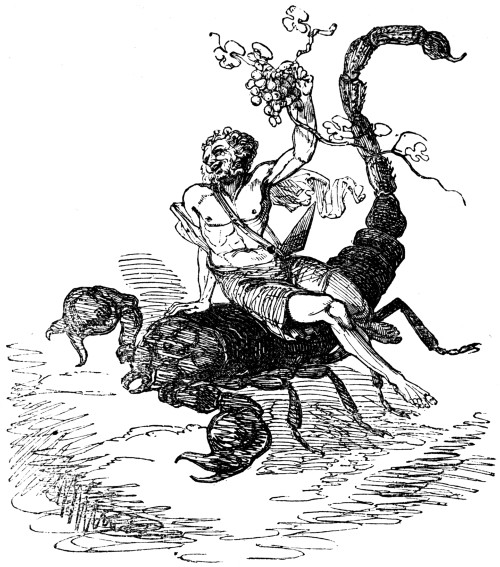
JANUARY. — January 1. — Chronology. — January 2. — Chronology. — January 3. — St. Genevieve, Patroness of Paris. — Chronology. — January 4. — St. Rumon. — Chronology. — January 5. — St. Simeon Stylites. — LONGEVITY. — January 6. — EPIPHANY. — TWELFTH-DAY. — THE SEASON. — January 7. — St. Lucian. — ST. DISTAFF’S DAY, OR ROCK-DAY. — Chronology. — THE SEASON. — Plough Monday — January 8. — St. Lucian. — St. Gudula — Chronology. — January 9. — Chronology. — January 10. — St. William. — January 11. — St. Theodosius — FISH IN WINTER — ST. BRIDE’S CHURCH. — Card-playing. — January 12. — St. Benedict Biscop, or Bennet. — Chronology — January 13. — St. Hilary. — St. Veronica. — St. Kentigern. — THE LAW TERMS. — January 14. — Chronology. — January 15. — FLOWERS. — January 16. — St. Marcellus , Pope. — WINTER RAINBOW in Ireland . — A SEASONABLE DIVERSION. — January 17. — St. Anthony, Patriarch of Monks. — BLESSING OF BEASTS. — ST. ANTHONY’S FIRE. — ST. ANTHONY’S PIG. — January 18. — St. Prisca. — POWERFUL OPTICAL ILLUSION. — A SPECTRE. — ANOTHER SPECTRE. — January 19. — Sts. Martha, Maris, &c. — DEDICATION OF FLOWERS. — THE GARDEN. — January 20. — St. Fabian. — St. Sebastian’s Day — ST. AGNES’ EVE — FLORAL DIRECTORY. — Aquarius, OR, THE WATER BEARER. — January 21. — St. Agnes. — Blessing of Sheep. — FLORAL DIRECTORY. — Chronology. — THE SEASON. — January 22. — Chronology. — FLORAL DIRECTORY. — January 23. — Westminster Hall, with its Shops. — MY FIRST BRIEF — LEGAL GLEE. — FLORAL DIRECTORY. — January 24. — Chronology. — SOUTH SEA BUBBLE. — OTHER BUBBLES. — Joint Stock Companies of 1825. — FLORAL DIRECTORY. — January 25. — The Conversion of St. Paul. — St. Paul’s Day. — Apostle-Spoons. — FLORAL DIRECTORY. — January 26. — THE SEASON. — BEARS AND BEES. — FLORAL DIRECTORY. — January 27. — THE SEASON — FLORAL DIRECTORY. — January 28. — St. Thyrsus. — Chronology. — FLORAL DIRECTORY. — January 29. — FLORAL DIRECTORY. — January 30. — St. Martina. — Chronology. — MOVEABLE FEASTS. — FLORAL DIRECTORY. — January 31. — St. Peter Nolasco. — FLORAL DIRECTORY.
This is the first and the coldest month
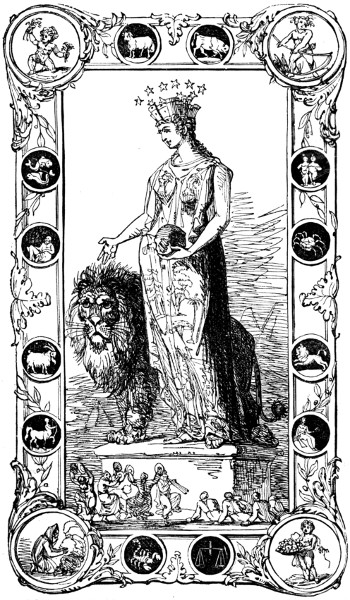
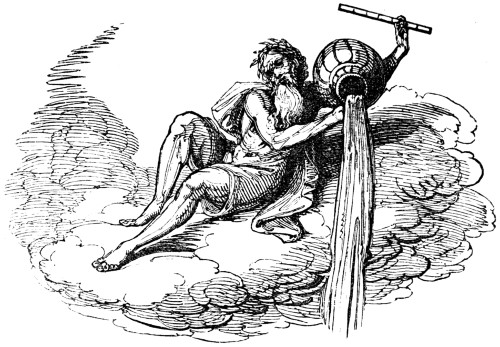
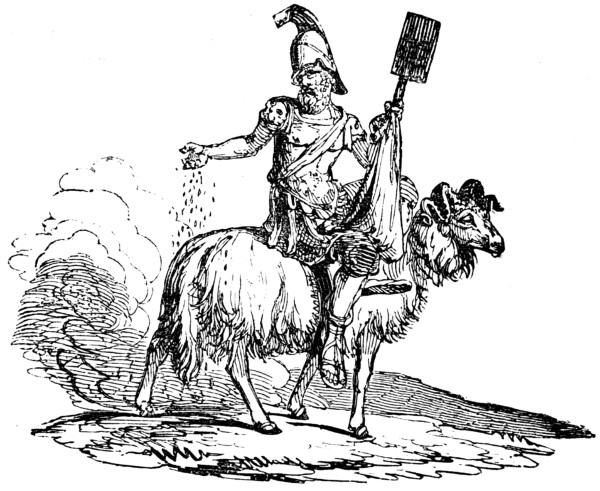
of the year. Its zodiacal sign is Aquarius
or the Waterbearer. It derives its name
from Janus, a deity represented by the
Romans with two faces, because he was
acquainted with past and future events.
Cotton introduces him into a poem on the
new year—
Hark, the cock crows, and yon bright star Tells us, the day himself’s not far; And see where, breaking from the night, He gilds the western hills with light. With him old Janus doth appear, Peeping into the future year, With such a look as seems to say, The prospect is not good that way. Thus do we rise ill sights to see, And ’gainst ourselves to prophesy; When the prophetic fear of things A more tormenting mischief brings, More full of soul-tormenting gall Than direst mischiefs can befall. But stay! but stay! Methinks my sight, Better inform’d by clearer light, Discerns sereneness in that brow, That all contracted seem’d but now. His revers’d face may show distaste, And frown upon the ills are past; But that which this way looks is clear, And smiles upon the new-born year.
According to the ancient mythology,
Janus was the god of gates and avenues,
and in that character held a key in his
right hand, and a rod in his left, to symbolize
his opening and ruling the year:
sometimes he bore the number 300 in one
hand, and 65 in the other, the number of
its days. At other times he was represented
with four heads, and placed in a
temple of four equal sides, with a door
and three windows in each side, as emblems
of the four seasons and the twelve
months over which he presided.
According to Verstegan (Restitution of
Decayed Intelligence, 4to. 1628, p. 59)
the Saxons called this month “Wolf-monat,”
or Wolf-month, because the
wolves of our ancient forests, impelled by
hunger at this season, were wont to prowl
and attack man himself; the inferior animals,
on whom they usually preyed, having
retired or perished from the inclemency of
the weather. The Saxons also called this
month “Aefter-yula,” or After Christmas.
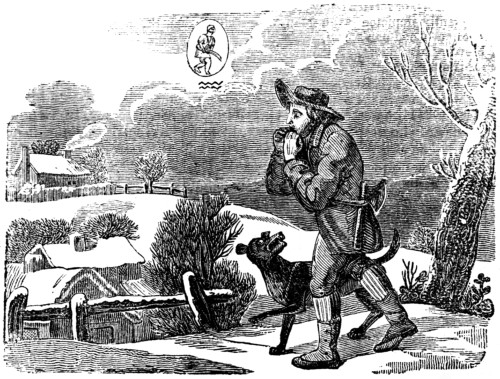
In illuminated calendars prefixed to
catholic missals, or service books, January
was frequently depicted as a man with
fagots or a woodman’s axe, shivering
and blowing his fingers. Spenser introduces
this month in his Faerie Queene:
Then came old January, wrapped well In many weeds to keep the cold away; Yet did he quake and quiver like to quell; And blow his nayles to warme them if he may; For they were numb’d with holding all the day An hatchet keene, with which he felled wood, And from the trees did lop the needlesse spray.
Circumcision.{
A close holiday at all public
offices except the Excise, Customs,
and Stamps.
This festival stands in the calendar of
the church of England, as well as in that
of the Roman catholic church. It is
said to have been instituted about 487;
it first appeared in the reformed English
liturgy in 1550.
Without noticing every saint to whom each
day is dedicated in the Roman catholic calendars,
the names of saints will be given day by
day, as they stand under each day in the last
edition of their “Lives,” by the Rev. Alban
Butler, in 12 vols. 8vo. On the authority of that
work the periods will be mentioned when the
saints most noted for their miracles flourished,
and some of those miracles be stated. Other
miracles will be given: First, from “The Golden
Legend,” a black letter folio volume, printed by
W. de Worde.—Secondly, from “The Church
History of Britain,” by the Benedictine father,
S. Cressy, dedicated by him to the queen consort
of Charles II., a folio, printed in 1668.—Thirdly,
from the catholic translation of the
“Lives of the Saints,” by the Rev. Father
Peter Ribadeneira, priest of the society of
Jesus, second edition, London, 1730, 2 vols. folio;
and Fourthly, from other sources which will be
named. By this means the reader will be acquainted
with legends that rendered the saints
and the celebration of their festivals popular.
For example, the saints in Butler’s Lives on this
day occur in the following order:
St. Fulgentius; St. Odilo, or Olou;
St. Almachus, or Telemachus; St. Eugendus,
or Oyend; St. Fanchea, or Faine;
St. Mochua, or Moncain, alias Claunus;
St. Mochua, alias Cronan, of Balla.
Sts. Mochua. According to Butler, these
were Irish saints. One founded the monastery,
now the town of Balla, in Connaught.
The other is said to have founded
120 cells, and thirty churches, in one of
which he passed thirty years, and died
about the sixth century. Bishop Patrick,
in his “Reflexions upon the Devotions of
the Roman Church,” 1674, 8vo. cites of
St. Mochua, that while walking and praying,
and seeing a company of lambs running
hastily to suck their mothers, he drew
a line upon the ground which none of the
hungry lambs durst pass. Patrick again
cites, that St. Mochua having been visited
by St. Kyenanus and fifteen of his
clergy, they came to an impetuous and
impassable river on their return, and
wanted a boat; whereupon St. Mochua
spread his mantle on the water, and Kyenanus
with his fifteen priests were carried
safely over upon the mantle, which floated
back again to St. Mochua without wrinkle
or wetting.
St. Fanchea, or Faine, is said by Butler
to have been an Irish saint of the sixth
century. Patrick quotes that St. Endeus
desiring to become a monk, his companions
approached to dissuade him; but,
upon the prayers of St. Faine, and her
making the sign of the cross, their feet
stuck to the earth like immovable stones,
until by repentance they were loosed and
went their way.
St. Fulgentius, according to Butler, died
on the 1st of January, 533, sometimes went
barefoot, never undressed to take rest, nor
ate flesh meat, but chiefly lived on pulse
and herbs, though when old he admitted
the use of a little oil. He preached, explained
mysteries, controverted with heretics,
and built monasteries. Butler concludes
by relating, that after his death, a
bishop named Pontian was assured in a
vision of Fulgentius’s immortality; that
his relics were translated to Bourges, where
they are venerated; and that the saint’s
head is in the church of the archbishop’s
seminary.
NEW YEAR’S DAY.
The King of Light, father of aged Time, Hath brought about that day, which is the prime To the slow gliding months, when every eye Wears symptoms of a sober jollity; And every hand is ready to present Some service in a real compliment. Whilst some in golden letters write their love, Some speak affection by a ring or glove, Or pins and points (for ev’n the peasant may After his ruder fashion, be as gay As the brisk courtly sir,) and thinks that he Cannot, without a gross absurdity, Be this day frugal, and not spare his friend Some gift, to show his love finds not an end With the deceased year.
Pooles’s Eng. Parnassus.
In the volume of “Elia,” an excellent
paper begins with “Every man hath two
birthdays: two days, at least, in every
year, which set him upon revolving the
lapse of time, as it affects his mortal duration.
The one is that which in an especial
manner he termeth his. In the gradual
desuetude of old observances, this custom
of solemnizing our proper birthday hath
nearly passed away, or is left to children,
who reflect nothing at all about the matter,
nor understand any thing beyond the
cake and orange. But the birth of a
new year is of an interest too wide to be
pretermitted by king or cobbler. No one
ever regarded the First of January with
indifference. It is that from which all
date their time, and count upon what is
left. It is the nativity of our common
Adam.
“Of all sound of all bells—(bells, the
music nighest bordering upon heaven)—most
solemn and touching is the peal
which rings out the old year. I never
hear it without a gathering-up of my
mind to a concentration of all the images
that have been diffused over the past
twelvemonth; all I have done or suffered,
performed, or neglected—in that regretted
time. I begin to know its worth as when
a person dies. It takes a personal colour;
nor was it a poetical flight in a contemporary,
when he exclaimed,
‘I saw the skirts of the departing year.’
“The elders with whom I was brought
up, were of a character not likely to let
slip the sacred observance of any old institution;
and the ringing out of the old
year was kept by them with circumstances
of peculiar ceremony. In those days
the sound of those midnight chimes,
though it seemed to raise hilarity in all
around me, never failed to bring a train
of pensive imagery into my fancy. Yet I
then scarce conceived what it meant, or
thought of it as a reckoning that concerned
me. Not childhood alone, but the
young man till thirty, never feels practically
that he is mortal.”
Ringing out the old and ringing in the
new year, with “a merry new year! a
happy new year to you!” on new year’s
day, were greetings that moved sceptred
pride, and humble labour, to smiles and
kind feelings in former times; and why
should they be unfashionable in our own?
Dr. Drake observes, in “Shakspeare and
his Times,” that the ushering in of the new
year, or new year’s tide, with rejoicings,
presents, and good wishes, was a custom
observed, during the 16th century, with
great regularity and parade, and was as
cordially celebrated in the court of the
prince as in the cottage of the peasant.
The Rev. T. D. Fosbroke, in his valuable
“Encyclopedia of Antiquities,” adduces
various authorities to show that congratulations,
presents, and visits were made by
the Romans on this day. The origin, he
says, is ascribed to Romulus and Tatius,
and that the usual presents were figs and
dates, covered with leaf-gold, and sent by
clients to patrons, accompanied with a
piece of money, which was expended to
purchase the statues of deities. He mentions
an amphora (a jar) which still exists,
with an inscription denoting that it was a
new year’s present from the potters to
their patroness. He also instances from
Count Caylus a piece of Roman pottery,
with an inscription wishing “a happy
new year to you;” another, where a person
wishes it to himself and his son; and three
medallions, with the laurel leaf, fig, and
date; one, of Commodus; another, of
Victory; and a third, Janus, standing in a
temple, with an inscription, wishing a happy
new year to the emperor. New year’s gifts
were continued under the Roman emperors
until they were prohibited by Claudius.
Yet in the early ages of the church the
Christian emperors received them; nor did
they wholly cease, although condemned
by ecclesiastical councils on account of the
pagan ceremonies at their presentation.
The Druids were accustomed on certain
days to cut the sacred misletoe with a
golden knife, in a forest dedicated to the
gods, and to distribute its branches with
much ceremony as new year’s gifts among
the people.
The late Rev. John Brand, in his
“Popular Antiquities” edited by Mr. Ellis
observes from Bishop Stillingfleet, that
among the Saxons of the North, the festival
of the new year was observed with
more than ordinary jollity and feasting,
and by sending new year’s gifts to one
another. Mr. Fosbroke notices the continuation
of the Roman practice during
the middle ages; and that our kings, and
the nobility especially, interchanged presents.
Mr. Ellis quotes Matthew Paris,
who appears to show that Henry III extorted
new year’s gifts; and he cites from
a MS. of the public revenue, anno 5,
Edward VI. an entry of “rewards given
on new year’s day to the king’s officers
and servants in ordinary 155l. 5s., and
to their servants that present the king’s
majestie with new year’s gifts.” An
orange stuck with cloves seems, by reference
to Mr. Fosbroke and our early authors,
to have been a popular new year’s
gift. Mr. Ellis suggests, that the use of
this present may be ascertained from a
remark by old Lupton, that the flavour of
wine is improved, and the wine itself preserved
from mouldiness, by an orange or
lemon stuck with cloves being hung within
the vessel so as not to touch the liquor.
Thomas Naogeorgus, in “The Popish
Kingdome,” a Latin poem written in 1553,
and Englished by Barnabe Googe, after
remarking on days of the old year, urges
this recollection:
The next to this is Newe yeares day whereon to every frende, They costly presents in do bring, and Newe yeares giftes do sende, These giftes the husband gives his wife, and father eke the childe, And maister on his men bestowes the like, with favour milde.
Honest old Latimer, instead of presenting
Henry VIII. with a purse of gold, as
was customary, for a new year’s gift, put
into the king’s hand a New Testament,
with a leaf conspicuously doubled down
at Hebrews xiii. 4, which, on reference,
will be found to have been worthy of all
acceptation, though not perhaps well accepted.
Dr. Drake is of opinion that the
wardrobe and jewellery of queen Elizabeth
were principally supported by these annual
contributions on new year’s day. He
cites lists of the new year’s gifts presented
to her, from the original rolls published in
her Progresses by Mr. Nichols; and from
these it appears that the greatest part, if
not all the peers and peeresses of the
realm, all the bishops, the chief officers of
state, and several of the queen’s household
servants, even down to her apothecaries,
master cook, serjeant of the pastry,
&c. gave new year’s gifts to her majesty;
consisting, in general, either of a sum of
money, or jewels, trinkets, wearing apparel,
&c. The largest sum given by any
of the temporal lords was 20l.; but the
archbishop of Canterbury gave 40l., the
archbishop of York 30l., and the other
spiritual lords 20l. and 10l.; many of
the temporal lords and great officers, and
most of the peeresses, gave rich gowns,
petticoats, shifts, silk stockings, garters,
sweet-bags, doublets, mantles embroidered
with precious stones, looking-glasses, fans,
bracelets, caskets studded with jewels,
and other costly trinkets. Sir Gilbert
Dethick, garter king at arms, gave a book
of the States in William the Conqueror’s
time; Absolon, the master of the Savoy,
gave a Bible covered with cloth of gold,
garnished with silver gilt, and plates of
the royal arms; the queen’s physician
presented her with a box of foreign
sweetmeats; another physician presented
a pot of green ginger, and a pot of orange
flowers; her apothecaries gave her a box of
lozenges, a box of ginger candy, a box of
green ginger, and pots of other conserves.
Mrs. Blanch a Parry gave her majesty a
little gold comfit-box and spoon; Mrs.
Morgan gave a box of cherries, and one
of apricots. The queen’s master cook
and her serjeant of the pastry, presented
her with various confectionary and preserves.
Putrino, an Italian, gave her two
pictures; Ambrose Lupo gave her a box of
lute strings, and a glass of sweet water,
each of three other Italians presented her
with a pair of sweet gloves; a cutler
gave her a meat knife having a fan haft
of bone, with a conceit in it; Jeromy
Bassano gave two drinking glasses; and
Smyth, the dustman, presented her majesty
with two bolts of cambrick. Some of
these gifts to Elizabeth call to recollection
the tempting articles which Autolycus, in
the “Winter’s Tale,” invites the country
girls to buy: he enters singing,
Lawn, as white as driven snow; Cypress, black as e’er was crow; Gloves, as sweet as damask roses Masks for faces, and for noses; Bugle bracelet, necklace-amber, Perfume for a lady’s chamber; Golden quoifs, and stomachers, For my lads to give their dears; Pins, and poking-sticks of steel, What maids lack from head to heel: Come, buy of me, come: come buy, come buy; Buy, lads, or else your lasses cry, Come, buy, &c.
Dr. Drake says, that though Elizabeth
made returns to the new year’s gifts, in
plate and other articles, yet she took sufficient
care that the balance should be in
her own favour.
No. 4982, in the Catalogue for 1824, of
Mr. Rodd, of Great Newport-street, is a
roll of vellum, ten feet long, containing the
new year’s gifts from king James I. to the
persons whose names are therein mentioned
on the 1st of January 1605, with the
new year’s gifts that his majesty received
the same day; the roll is signed by James
himself and certain officers of his household.
In a “Banquet of Jests, 1634,” 12mo.
there is a pleasant story of Archee, the
king’s jester, who, having fooled many,
was fooled himself. Coming to a nobleman,
upon new year’s day, to bid him
good-morrow, Archee received twenty
pieces of gold; but, covetously desiring
more, he shook them in his hand, and said
they were too light. The donor answered:
“I prithee, Archee, let me see them again,
for there is one amongst them I would be
loth to part with:” Archee, expecting the
sum to be increased, returned the pieces
to his lordship; who put them in his
pocket with this remark, “I once gave
money into a fool’s hand, who had not the
wit to keep it.”
Pins were acceptable new year’s gifts
to the ladies, instead of the wooden skewers
which they used till the end of the
fifteenth century. Sometimes they received
a composition in money: and hence
allowances for their separate use is still
denominated “pin-money.”
Gloves were customary new year’s
gifts. They were more expensive than
in our times, and occasionally a money
present was tendered instead: this was
called “glove-money.” Sir Thomas More,
as lord chancellor, decreed in favour of
a Mrs. Croaker against the lord Arundel.
On the following new year’s day, in
token of her gratitude, she presented sir
Thomas with a pair of gloves, containing
forty angels. “It would be against good
manners,” said the chancellor, “to forsake
a gentlewoman’s new year’s gift, and I
accept the gloves; their lining you will
be pleased otherwise to bestow.”
Mr. Brand relates from a curious MS.
in the British Museum, of the date of
1560, that the boys of Eton school used
on this day to play for little new year’s
gifts before and after supper; and also
to make verses, which they presented to
the provost and masters, and to each other:
new year’s gifts of verses, however, were
not peculiar to schoolboys. A poet, the
beauties of whose poetry are justly remarked
to be “of a kind which time has
a tendency rather to hallow than to injure,”
Robert Herrick, presents us, in his
Hesperides, with “a New Year’s Gift
sent to Sir Simon Steward.” He commences
it merrily, and goes on to call it
————————————— a jolly Verse, crown’d with ivy and with holly; That tells of winter’s tales and mirth, That milk-maids make about the hearth; Of Christmas’ sports, the wassail bowl, That tost-up after fox-i’ th’ hole; Of blind-man-buff, and of the care That young men have to shoe the mare; Of twelfth-tide cakes, of pease and beans, Wherewith ye make those merry scenes: Of crackling laurel, which fore-sounds A plenteous harvest to your grounds Of those, and such like things, for shift, We send, instead of New Year’s Gift. Read then, and when your faces shine With buxom meat and cap’ring wine Remember us in cups full crown’d And let our city-health go round. Then, as ye sit about your embers, Call not to mind the fled Decembers But think on these, that are t’appear As daughters to the instant year; And to the bagpipes all address Till sleep take place of weariness. And thus throughout, with Christmas plays, Frolick the full twelve holidays.
Mr. Ellis, in a note on Brand, introduces
a poetical new year’s gift in Latin,
from the stern Buchanan to the unhappy
Mary of Scotland.
“New year’s gifts,” says Dr. Drake,
“were given and received, with the mutual
expression of good wishes, and particularly
that of a happy new year. The compliment
was sometimes paid at each other’s
doors in the form of a song; but more generally,
especially in the north of England
and in Scotland, the house was entered
very early in the morning, by some
young men and maidens selected for the
purpose, who presented the spiced bowl,
and hailed you with the gratulations of
the season.” To this may be added, that
it was formerly the custom in Scotland to
send new year’s gifts on new year’s
eve; and on new year’s day to wish
each other a happy new year, and ask for
a new year’s gift. There is a citation in
Brand, from the “Statistical Account of
Scotland,” concerning new year’s gifts to
servant maids by their masters; and it
mentions that “there is a large stone,
about nine or ten feet high, and four
broad, placed upright in a plain, in the
(Orkney) isle of North Ronaldshay; but
no tradition is preserved concerning it,
whether erected in memory of any signal
event, or for the purpose of administering
justice, or for religious worship. The
writer of this (the parish priest) has seen
fifty of the inhabitants assembled there,
on the first day of the year, dancing by
moonlight, with no other music than
their own singing.”
In Mr. Stewart’s “Popular Superstitions
of the Highlands,” there is some account
of the Candlemas bull, on new year’s
eve, as introductory to the new year.
The term Candlemas, applied to this season,
is supposed to have originated in
some old religious ceremonies performed
by candlelight. The Bull is a passing
cloud, which Highland imagination perverts
into the form of that animal; as it
rises or falls or takes peculiar directions,
of great significancy to the seers, so does
it prognosticate good or bad weather. The
more northern nations anciently assigned
portentous qualities to the winds of new
year’s eve. One of their old legends in
Brand may be thus versified—the last line
eking out the verse:
If New Year’s eve night-wind blow south, It betokeneth warmth and growth; If west, much milk, and fish in the sea; If north, much cold, and storms there will be; If east, the trees will bear much fruit If north-east, flee it man and brute.
Mr. Stewart says, that as soon as night
sets in it is the signal with the Strathdown
highlander for the suspension of his
usual employment, and he directs his attention
to more agreeable callings. The
men form into bands with tethers and
axes, and, shaping their course to the
juniper bushes, they return home laden
with mighty loads, which are arranged
round the fire to-day till morning. A certain
discreet person is despatched to the
dead and living ford to draw a pitcher of
water in profound silence, without the
vessel touching the ground, lest its virtue
should be destroyed, and on his return all
retire to rest. Early on new year’s morning
the Usque-Cashrichd, or water from
the dead and living ford, is drank, as a
potent charm, until next new year’s day,
against the spells of witchcraft, the malignity
of evil eyes, and the activity of all
infernal agency. The qualified highlander
then takes a large brush, with which he
profusely asperses the occupants of all
beds; from whom it is not unusual for
him to receive ungrateful remonstrances
against ablution. This ended, and the
doors and windows being thoroughly
closed, and all crevices stopped, he kindles
piles of the collected juniper, in the different
apartments, till the vapour from the
burning branches condenses into opaque
clouds, and coughing, sneezing, wheezing,
gasping, and other demonstrations of suffocation
ensue. The operator, aware that
the more intense the “smuchdan,” the
more propitious the solemnity, disregards
these indications, and continues, with
streaming eyes and averted head, to increase
the fumigation, until in his own
defence he admits the air to recover the
exhausted household and himself. He
then treats the horses, cattle, and other
bestial stock in the town with the same
smothering, to keep them from harm
throughout the year. When the gude-wife
gets up, and having ceased from
coughing, has gained sufficient strength
to reach the bottle dhu, she administers
its comfort to the relief of the sufferers:
laughter takes place of complaint, all the
family get up, wash their faces, and receive
the visits of their neighbours, who
arrive full of gratulations peculiar to the
day. Mu nase choil orst, “My Candlemas
bond upon you” is the customary
salutation, and means, in plain words,
“You owe me a new year’s gift.” A
point of great emulation is, who shall
salute the other first; because the one
who does so is entitled to a gift from the
person saluted. Breakfast, consisting of
all procurable luxuries, is then served, the
neighbours not engaged are invited to
partake, and the day ends in festivity.
Riding stang, a custom that will be
observed on hereafter, prevails in some
parts of England on new year’s day to
the present hour. The “stang” is a
cowl-staff; the cowl is a water-vessel,
borne by two persons on the cowl-staff,
which is a stout pole whereon the vessel
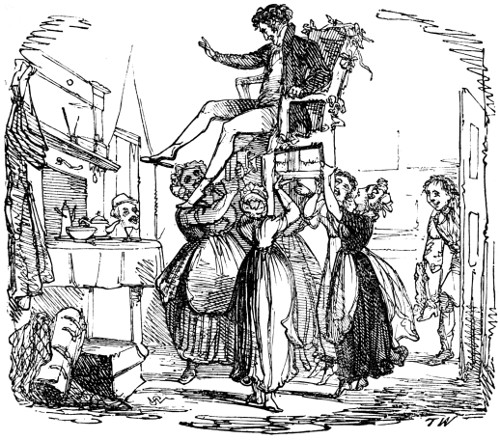
hangs. “Where’s the cowl-staff?” cries
Ford’s wife, when she purposes to get
Falstaff into a large buck-basket, with two
handles; the cowl-staff, or “stang,” is
produced, and, being passed through the
handles, the fat knight is borne off by two of
Ford’s men. A writer in the Gentleman’s
Magazine, 1791, says, that in Westmoreland
and Cumberland, on the 1st of January,
multitudes assemble early in the
morning with baskets and “stangs,” and
whoever does not join them, whether
inhabitant or stranger, is immediately
mounted across the “stang,” and carried,
shoulder height, to the next public-house,
where sixpence liberates the prisoner.
Women are seized in this way, and carried
in baskets—the sex being privileged
from riding “stang,” in compliment, perhaps,
to the use of side-saddles. In the
same part of the country, no one is allowed
to work on new year’s day, however
industrious. Mr. Ellis shows that it
was a new year’s day custom in ancient
Rome for tradesmen to work a little only,
for luck’s sake, that they might have constant
business all the year after.
A communication in an English journal
of January 1824 relates, that in Paris on
new year’s day, which is called le jour
d’étrennes, parents bestow portions on
their children, brothers on their sisters,
and husbands make presents to their wives.
Carriages may be seen rolling through the
streets with cargoes of bon-bons, souvenirs,
and the variety of et cæteras with which
little children and grown-up children are
bribed into good humour; and here and
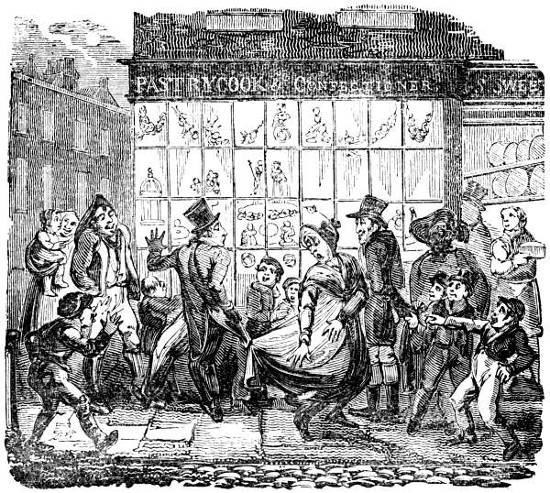
there pastrycooks are to be met with, carrying
upon boards enormous temples, pagodas,
churches, and playhouses, made of
fine flour and sugar, and the embellishments
which render French pastry so inviting.
But there is one street in Paris
to which a new year’s day is a whole
year’s fortune—this is the Rue des Lombards,
where the wholesale confectioners
reside; for in Paris every trade and profession
has its peculiar quarter. For several
days preceding the 1st of January,
this street is completely blocked up by
carts and waggons laden with cases of
sweetmeats for the provinces. These are of
every form and description which the most
singular fancy could imagine; bunches of
carrots, green peas, boots and shoes, lobsters
and crabs, hats, books, musical instruments,
gridirons, frying-pans, and
saucepans; all made of sugar, and coloured
to imitate reality, and all made
with a hollow within to hold the bon-bons.
The most prevailing device is what is
called a cornet, that is, a little cone ornamented
in different ways with a bag to
draw over the large end, and close it up.
In these things, the prices of which vary
from one franc (tenpence) to fifty, the
bon-bons are presented by those who
choose to be at the expense of them, and by
those who do not, they are only wrapped
in a piece of paper; but bon-bons in some
way or other must be presented. It would
not, perhaps, be an exaggeration to state
that the amount expended for presents on
new year’s day in Paris, for sweetmeats
alone, exceeds 500,000 francs, or 20,000l.
sterling. Jewellery is also sold to a very
large amount, and the fancy articles exported
in the first week in the year to
England and other countries, is computed
at one-fourth of the sale during the twelve
months. In Paris it is by no means uncommon
for a man of 8,000 or 10,000
francs a year to make presents on new
year’s day which cost him a fifteenth part
of his income. No person able to give
must on this day pay a visit empty-handed.
Every body accepts, and every man gives
according to the means which he possesses.
Females alone are excepted from the charge
of giving. A pretty woman, respectably
connected, may reckon her new year’s presents
at something considerable. Gowns,
jewellery, gloves, stockings, and artificial
flowers, fill her drawing-room; for in Paris
it is a custom to display all the gifts, in
order to excite emulation, and to obtain
as much as possible. At the palace the
new year’s day is a complete jour de
fête. Every branch of the royal family is
then expected to make handsome presents
to the king. For the six months preceding
January 1824, the female branches were
busily occupied in preparing presents of
their own manufacture, which would fill
at least two common-sized waggons. The
duchess de Berri painted an entire room
of japanned pannels, to be set up in the
palace; and the duchess of Orleans prepared
an elegant screen. An English
gentleman who was admitted suddenly
into the presence of the duchess de Berri
two months before, found her, and three
of her maids of honour, lying on the carpet,
painting the legs of a set of chairs,
which were intended for the king. The
day commences with the Parisians, at an
early hour, by the interchange of their
visits and bon-bons. The nearest relations
are visited first, until the furthest in blood
have had their calls; then friends and acquaintances.
The conflict to anticipate
each other’s calls, occasions the most agreeable
and whimsical scenes among these
proficients in polite attentions. In these
visits, and in gossiping at the confectioners’
shops, which are the great lounge
for the occasion, the morning of new
year’s day is passed; a dinner is given
by some member of the family to all the
rest, and the evening concludes, like
Christmas day, with cards, dancing, or
any other amusement that may be preferred.
One of the chief attractions to a
foreigner in Paris is the exhibition, which
opens there on new year’s day, of the
finest specimens of the Sevres china manufactured
at the royal establishment in the
neighbourhood of Versailles during the
preceding year.
Undoubtedly, new year’s gifts originated
in heathen observances, and were
grossly abused in after ages; yet latterly
they became a rational and pleasant mode
of conveying our gentle dispositions towards
those we esteem. Mr. Audley, in
his compendious and useful “Companion
to the Almanack,” says, with truth, that
they are innocent, if not praiseworthy;
and he quotes this amiable sentiment from
Bourne: “If I send a new year’s gift
to my friend, it shall be a token of my
friendship; if to my benefactor, a token
of my gratitude; if to the poor, which at
this season must never be forgot, it shall
be to make their hearts sing for joy, and
give praise and adoration to the Giver of
all good gifts.” The Jews on the first day
of their new year give sumptuous entertainments,
and joyfully wish each other
“a happy new year.” This salutation
is not yet obsolete even with us; but the
new year’s gift seldom arrives, except to
honest rustics from their equals; it is
scarcely remembered with a view to its
use but by young persons, who, “unvexed
with all the cares of gain,” have read or
heard tell of such things, and who, with
innocent hearts, feeling the kindness of
the sentiment, keep up the good old custom
among one another, till mixture with
the world, and “long experience, makes
them sage,” and sordid.
New year’s day in London is not observed
by any public festivity; but little
social dining parties are frequently formed
amongst friends; and convivial persons
may be found at taverns, and in publicans’
parlours, regaling on the occasion. Dr
Forster relates, in his “Perennial Calendar,”
that many people make a point to
wear some new clothes on this day, and
esteem the omission as unlucky: the
practice, however, from such motives,
must obviously be confined to the uninformed.
The only open demonstration
of joy in the metropolis, is the ringing of
merry peals from the belfries of the numerous
steeples, late on the eve of the
new year, and until after the chimes of
the clock have sounded its last hour.
On new year’s day the man of business
opens new account-books. “A good beginning
makes a good ending.” Let every
man open an account to himself; and
to begin the new year that he may expect
to say at its termination—it has been a
good year. In the hilarity of the season
let him not forget that to the needy it is
a season of discomfort.
There is a satisfaction In doing a good action:
and he who devises liberal things will
find his liberality return to him in a full
tide of happiness. An economist can
afford to be generous. “Give me neither
poverty nor riches,” prayed the wise man.
To him who is neither encumbered by
wealth, nor dispirited by indigence, the
stores of enjoyment are unlocked.
He who holds fast the Golden Mean, And lives contentedly between The little and the great, Feels not the wants that pinch the poor, Nor plagues that haunt the rich man’s door, Embitt’ring all his state.
The tallest pines feel most the pow’r Of wintry blasts; the loftiest tow’r Comes heaviest to the ground; The bolts that spare the mountain’s side His cloud-capt eminence divide, And spread the ruin round.
The well-inform’d philosopher Rejoices with a wholesome fear, And hopes, in spite of pain; If Winter bellow from the North, Soon the sweet Spring comes dancing And Nature laughs again.
If hindrances obstruct thy way, Thy magnanimity display, And let thy strength be seen; But oh! if fortune fill thy sail With more than a propitious gale, Take half thy canvass in.
Cowper.
1308. On the 1st of January in this
year, William Tell, the Swiss patriot, associated
himself on this day with a band
of his countrymen, against the tyranny of
their oppressors. For upwards of three
centuries the opposition was carried on,
and terminated by the treaty of Westphalia
in 1648, declaring the independence
of Switzerland.
1651. On the 1st of January Charles II.
was crowned at Scone king of the Scots.
Charles, when a child, was weak in the
legs, and ordered to wear steel-boots.
Their weight so annoyed him that he
pined till recreation became labour. An
old rocker took off the steel-boots, and
concealed them; promising the countess
of Dorset, who was Charles’s governess,
that she would take any blame for the act
on herself. Soon afterwards the king,
Charles I., coming into the nursery, and
seeing his boy’s legs without the boots,
angrily demanded who had done it? “It
was I, sir,” said the rocker, “who had
the honour, some thirty years since, to attend
on your highness, in your infancy,
when you had the same infirmity wherewith
now the prince, your very own son
is troubled; and then the lady Cary,
(afterwards countess of Monmouth) commanded
your steel-boots to be taken off,
who, blessed be God, since have gathered
strength, and arrived at a good stature.”
Clare, chaplain to Charles II., at the time
the affair happened, related this anecdote
to old Fuller, who in 1660, contemplating
“the restoration,” tells the story, and
quaintly exclaims, “the nation is too
noble, when his majesty shall return from
foreign parts, to impose any other steel-boots
upon him, than the observing the
laws of the land, which are his own stockings,
that so with joy and comfort he may
enter on what was his own inheritance.”
The nation forgot the “steel-boots,” and
Charles forgot the “stockings.”
1801. January 1. The Union of Great
Britain with Ireland commenced according
to act of parliament, and the event
was solemnized by the hoisting of a
new royal flag on the Tower of London,
accompanied by the firing of guns there
and in St. James’s Park. On the 3d the
king received the great seal of Great
Britain from the lord chancellor, and
causing it to be defaced, presented to him
a new great seal for the United Kingdom.
On the same day, January 1st, 1801,
Piazzi, the astronomer at Palermo, discovered
a new primary planet, making an
eleventh of that order: he called it Ceres,
from the goddess of that name, who was
highly esteemed by the ancients of Sicily.
Usually at this period the rigour of cold
is severely felt. The indisposition of lie-a-beds
to face its severity is pleasantly pictured
by Mr. Leigh Hunt, in a paper in the
Indicator. He imagines one of those
persons to express himself in these terms:
“On opening my eyes, the first thing
that meets them is my own breath rolling
forth, as if in the open air, like smoke out
of a cottage-chimney. Think of this
symptom. Then I turn my eyes sideways
and see the window all frozen over.
Think of that. Then the servant comes
in. ‘It is very cold this morning, is it
not?’—‘Very cold, sir.’—‘Very cold
indeed, isn’t it?’—‘Very cold indeed,
sir.’—‘More than usually so, isn’t it,
even for this weather?’ (Here the servant’s
wit and good nature are put to a
considerable test, and the inquirer lies on
thorns for the answer.) ‘Why, Sir.....
I think it is.’ (Good creature! There
is not a better, or more truth-telling servant
going.) ‘I must rise, however—Get
me some warm water.’—Here comes
a fine interval between the departure of
the servant and the arrival of the hot
water; during which, of course, it is of
‘no use’ to get up. The hot water
comes. ‘Is it quite hot?’—‘Yes, sir.’—‘Perhaps
too hot for shaving: I must
wait a little?’—‘No, sir; it will just do,’
(There is an over-nice propriety sometimes,
an officious zeal of virtue, a little
troublesome.) ‘Oh—the shirt—you
must air my clean shirt:—linen gets very
damp this weather.’—‘Yes, sir.’ Here
another delicious five minutes. A knock
at the door. ‘Oh, the shirt—very well.
My stockings—I think the stockings had
better be aired too.’—‘Very well, sir.’—Here
another interval. At length every
thing is ready, except myself. I now
cannot help thinking a good deal—who
can?—upon the unnecessary and villainous
custom of shaving; it is a thing so
unmanly (here I nestle closer)—so effeminate,
(here I recoil from an unlucky step
into the colder part of the bed.)—No wonder,
that the queen of France took part
with the rebels against that degenerate
king, her husband, who first affronted her
smooth visage with a face like her own.
The emperor Julian never showed the
luxuriancy of his genius to better advantage
than in reviving the flowing beard.
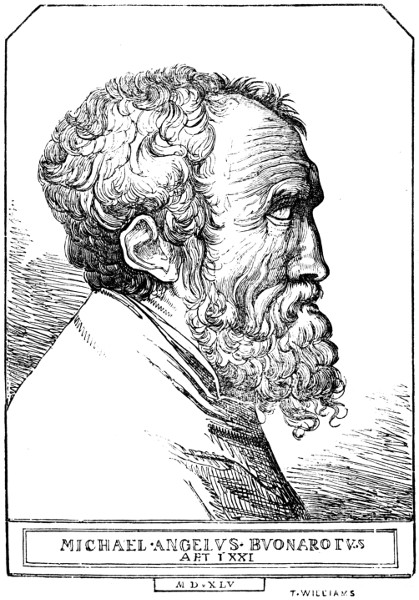
Look at cardinal Bembo’s picture—at
Michael Angelo’s—at Titian’s—at Shakspeare’s—at
Fletcher’s—at Spenser’s—at
Chaucer’s—at Alfred’s—at Plato’s. I
could name a great man for every tick of
my watch. Look at the Turks, a grave
and otiose people—Think of Haroun Al
Raschid and Bed-ridden Hassan—Think
of Wortley Montague, the worthy son of
his mother, a man above the prejudice of
his time—Look at the Persian gentlemen,
whom one is ashamed of meeting about
the suburbs, their dress and appearance
are so much finer than our own—Lastly,
think of the razor itself—how totally opposed
to every sensation of bed—how
cold, how edgy, how hard! how utterly
different from any thing like the warm
and circling amplitude, which
Sweetly recommends itself Unto our gentle senses.
Add to this, benumbed fingers, which
may help you to cut yourself, a quivering
body, a frozen towel, and an ewer full of
ice; and he that says there is nothing to
oppose in all this, only shows, at any rate
that he has no merit in opposing it.”
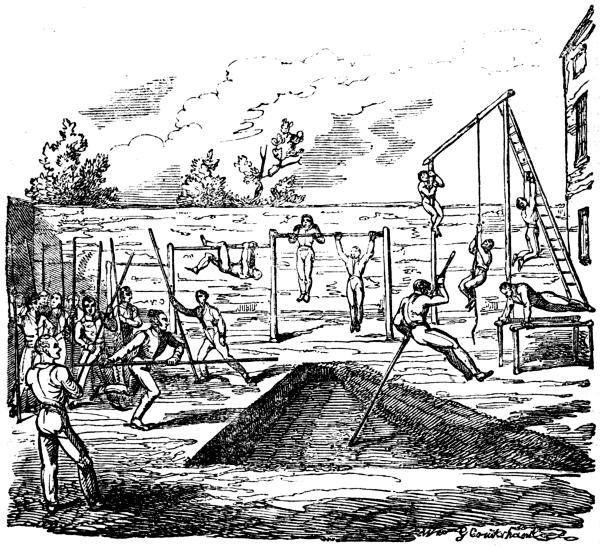
Gymnastics for Youth.
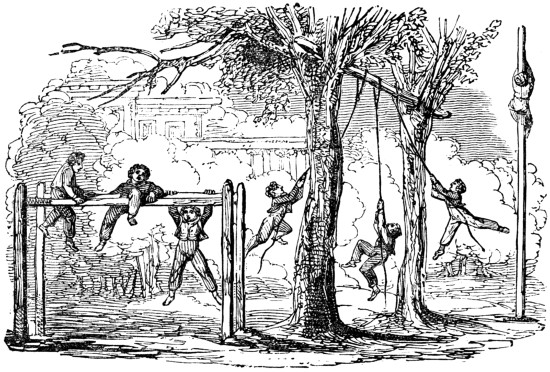
This engraving represents simple methods
by which, at this season especially,
the health of young persons may be
maintained, and the constitution invigorated.
Two round parallel bars at two
feet distance from each other, on round
standards three or four feet high, firmly
fixed in the ground, will afford boys the
means of actively exerting their limbs and
muscles: and if the ends of a pole be let
into opposite walls or fastened to trees,
the boys may be taught to climb single
ropes, and hold on while swinging by
them. The engraving is placed before
the eyes of parents and teachers with the
hope of directing their attention to gymnastic
exercises, as diversions for youth,
and they are referred to a practical treatise
on the subject by Mr. Clias, that may
be safely used. His judicious reasoning
must convince every reader of their importance
to the rising generation, and
that it is within the means of all classes
of persons to let boys acquire a knowledge
of the feats represented in the
plates to his work, for teaching which
his explanations are numerous and clear.
An unseasonable occurrence in the
cellar of the late sir Joseph Banks may be
acceptable in the mention, and excite
particular sympathy in persons who recreate
with the juice of the vine: as a fact,
it may tend to elucidate the origin and
nature of vegetable fungi, particularly of
that species termed mushroom. The
worthy baronet had a cask of wine rather
too sweet for immediate use; he therefore
directed that it should be placed in a cellar,
in order that the saccharine matter it
contained might be more perfectly decomposed
by age. At the end of three years, he
directed his butler to ascertain the state of
the wine, when, on attempting to open the
cellar door, he could not effect it, in consequence
of some powerful obstacle. The
door was cut down, and the cellar found
to be completely filled with a firm fungous
vegetable production—so firm that it was
necessary to use the axe for its removal.
This appeared to have grown from, or
have been nourished by, the decomposed
particles of the wine: the cask was empty,
and carried up to the ceiling, where it
was supported by the surface of the
fungus.
At the close of this day he who can
reflect with satisfaction on the past, may
anticipate with calm delight the entrance
of the new year, and lift his eyes to the
living lustres of the firmament with grateful
feelings. They shine out their prismatic
colours through the cold thin air, keeping
watch while man slumbers, or cheering
him, who contemplates their fires, to purposes
of virtue. In this season
—————— The night comes calmly forth, Bringing sweet rest upon the wings of even: The golden wain rolls round the silent north, And earth is slumbering ’neath the smiles of heaven.
Bowring.
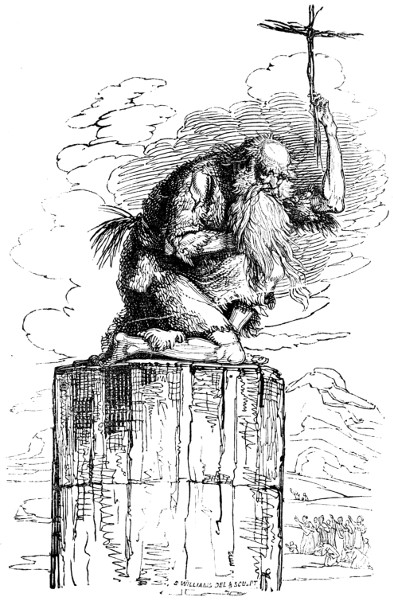
St. Macarius; St. Concordius; St.
Adalard or Alard.
St. Macarius.A. D. 394. Alban Butler
says he was a confectioner of Alexandria,
who, in the flower of his age, spent
upwards of sixty years in the deserts in
labour, penance, and contemplation. “Our
saint,” says Butler, “happened one day
inadvertently to kill a gnat, that was biting
him in his cell; reflecting that he had lost
the opportunity of suffering that mortification,
he hastened from his cell for the
marshes of Scetè, which abound with
great flies, whose stings pierce even wild
boars. There he continued six months,
exposed to those ravaging insects; and to
such a degree was his whole body disfigured
by them, with sores and swellings,
that when he returned he was only to be
known by his voice.” The Golden Legend
relates of him, that he took a dead pagan
out of his sepulchre, and put him under
his head for a pillow; whereupon certain
devils came to affright the saint, and called
the dead pagan to go with them; but the
body under the saint said he could not,
because a pilgrim lay upon him, so that
he could not move; then Macarius, nothing
afraid, beat the body with his fist, and
told him to go if he would, which caused
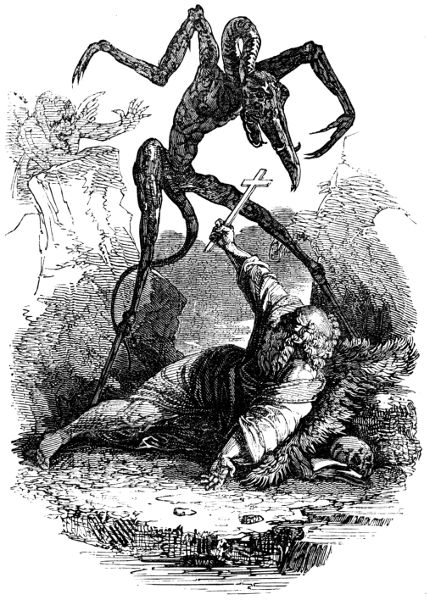
the devils to declare that Macarius had
vanquished them. Another time the
devil came with a great scythe on his
shoulder, to smite the saint, but he could
not prevail against him, on account of his
virtues. Macarius, at another time, being
tempted, filled a sack with stones, and
bore it many journies through the desert.
Seeing a devil before him in the shape of
a man, dressed like “a herawde,” with
his clothing full of holes, and in every hole
a phial, he demanded of this devil whither
he went; and why he had so many phials?
the devil answered, to give drink to the
hermits; and that the phials contained a
variety of liquors, that they might have
a choice, and so fall into temptation. On
the devil’s return, the saint inquired how
he had sped; and the devil answered very
evil, for they were so holy that only one
Theodistus would drink: on this information
Macarius found Theodistus under
the influences of the phial, and recovered
him. Macarius found the head of a pagan,
and asked where the soul of its body
was: in hell, said the head: he asked the
head if hell was deep;—the head said
deeper than from heaven to earth: he demanded
again, if there were any there
lower than his own soul—the head said
the Jews were lower than he was: the
saint inquired if there were any lower
than the Jews—the head answered, the
false Christian-men were lower than the
Jews, and more tormented: there the
dialogue between the saint and the head
appears to have ended. Macarius seems,
by the Golden Legend, to have been much
annoyed by the devil. In a nine days’
journey through a desert, at the end of
every mile he set up a reed in the earth,
to mark his track against he returned;
but the devil pulled them all up, made a
bundle of them, and placed them at Macarius’s
head, while he lay asleep, so that
the saint with great difficulty found his
way home again.
St. Adalard, according to Butler, was
grandson of Charles Martel, brother to
king Pepin, and cousin-german to Charlemagne,
who created him a count: he left
his court in 773, became a monk at Corbie
in Picardy, died in 827, aged seventy-three,
and wrought miracles, which procured
his body to be enshrined with great
pomp in 1010, a history of which solemnity
is written by St. Gerard, who composed
an office in St. Adalard’s honour, because
through his intercession he had
been cured of a violent head-ache.—The
same St. Gerard relates seven other
miracles by St. Adalard of the same nature.
Butler says, his relics are still at Corbie,
in a rich shrine, and two smaller cases,
except a small portion given to the abbey
of Chelles.
The first Monday after new year’s day
is called Handsel Monday in some parts
of Scotland, and is observed by merry-making.
In sir J. Sinclair’s “Statistical
Account,” it is related of one William
Hunter, a collier, that he was cured in
the year 1758 of an inveterate rheumatism
or gout, by drinking freely of new
ale, full of barm or yeast. “The poor
man had been confined to his bed for a
year and a half, having almost entirely
lost the use of his limbs. On the evening
of Handsel Monday, as it is called, some
of his neighbours came to make merry
with him. Though he could not rise, yet
he always took his share of the ale, as it
passed round the company; and, in the
end, became much intoxicated. The consequence
was, that he had the use of his
limbs the next morning, and was able to
walk about. He lived more than twenty
years after this, and never had the smallest
return of his old complaint.” This is a
fact worth remembering, as connected
with chronical complaints.
On the 2d of January, A. D. 17, Ovid
the celebrated Roman poet died; he was
born at Sulmo on the 20th of March,
forty-three years before the Christian era.
His father designed him for the bar, and
he became eminently eloquent, but every
thing he wrote was expressed in poetical
numbers; and though reminded by his
father, that even Homer lived and died
in poverty, he preferred the pleasures of
imagination to forensic disputation. He
gained great admiration from the learned.
Virgil, Horace, Tibullus, and Propertius,
were his friends, and Augustus became
his liberal patron, till he banished him for
some unknown cause. In his exile he
was cowardly, and prostituted his pen to
flatter baseness; and though he desired
the death of the emperor, he fawned upon
him in his writings to meanness. He died
at Tomos on the Euxine sea, the place of
his banishment, under the reign of Tiberius,
who had succeeded Augustus, and
was deaf to the poet’s entreaties for permission
to return to Rome. Whatever
subject Ovid wrote on, he exhausted; he
painted nature with a masterly hand, and
his genius imparted elegance to vulgarity;
but he defiled the sweetness of his numbers
by impurity, and though he ranks
among the splendid ornaments of ancient
literature, he sullied his fame by the
grossest immorality in some of his finest
productions.
Livy, the Roman historian, died at Padua
on the same day and in the same year with
Ovid. His history of the Roman Empire
was in one hundred and forty books, of
which only thirty-five are extant. Five of
these were discovered at Worms in 1431,
and some fragments are said to have been
lately discovered at Herculanæum. Few
particulars of his life are known, but his
fame was great even while he lived, and
his history has rendered him immortal.
He wrote some philosophical treatises
and dialogues, with a letter to his son on
the merit of authors, which Dr. Lempriere
says, ought to be read by young
men.
In the Literary Pocket Book there are
some seasonable facts which may be
transplanted with advantage to the reader,
and, it is hoped, without disadvantage to
the writer of the articles. He says that
a man is infinitely mistaken, who thinks
there is nothing worth seeing in winter-time
out of doors, because the sun is not
warm, and the streets are muddy. “Let
him get, by dint of good exercise, out of
the streets, and he shall find enough. In
the warm neighbourhood of towns he may
still watch the field-fares, thrushes, and
blackbirds; the titmouse seeking its food
through the straw-thatch; the red-wings,
field-fares, sky-larks, and tit-larks, upon
the same errand, over wet meadows; the
sparrows and yellow-hammers, and chaffinches,
still beautiful though mute, gleaning
from the straw and chaff in farmyards;
and the ring-dove, always poetical,
coming for her meal to the ivy-berries.
About rapid streams he may see the various
habits and movements of herons,
wood-cocks, wild-ducks, and other water-fowl,
who are obliged to quit the frozen
marshes to seek their food there. The
red-breast comes to the windows, and
often into the house itself, to be rewarded
for its song, and for its far-famed ‘painful’
obsequies to the Children in the
Wood.”
St. Genevieve.St. Anterus, Pope.St.
Gordius.St. Peter Balsam.
Alban Butler affirms that she was
born in 422, at Nanterre, four miles from
Paris, near the present Calvary there,
and that she died a virgin on this day
in 512, and was buried in 545, near the
steps of the high altar in a magnificent
church, dedicated to St. Peter and St.
Paul, began by Clovis, where he also was
interred. Her relics were afterwards
taken up and put into a costly shrine
about 630. Of course they worked miracles.
Her shrine of gold and silver,
covered with precious stones, the presents
of kings and queens, and with a cluster
of diamonds on the top, presented by the
intriguing Mary de Medicis, is, on calamitous
occasions, carried about Paris in
procession, accompanied by shrines
equally miraculous, and by the canons
of St. Genevieve walking bare-foot.
The miracles of St. Genevieve, as related
in the Golden Legend, were equally
numerous and equally credible. It relates
that when she was a child, St. Germaine
said to her mother, “Know ye for certain
that on the day of Genevieve’s nativity
the angels sung with joy and gladness,”
and looking on the ground he saw a
penny signed with the cross, which came
there by the will of God; he took it up,
and gave it to Genevieve, requiring her
to bear in mind that she was the spouse
of Christ. She promised him accordingly,
and often went to the minster, that she
might be worthy of her espousals. “Then,”
says the Legend, “the mother was angry,
and smote her on the cheek—God avenged
the child, so that the mother became blind,”
and so remained for one and twenty months,
when Genevieve fetched her some holy
water, signed her with the sign of the
cross, washed her eyes, and she recovered
her sight. It further relates, that by the
Holy Ghost she showed many people their
secret thoughts, and that from fifteen
years to fifty she fasted every day except
Sunday and Thursday, when she ate
beans, and barley-bread of three weeks
old. Desiring to build a church, and
dedicate it to St. Denis and other martyrs,
she required materials of the priests for
that purpose. “Dame,” answered the
priests, “we would; but we can get no
chalk nor lime.” She desired them to go
to the bridge of Paris and bring what
they found there. They did so till two
swineherds came by, one of whom said
to the other, “I went yesterday after one
of my sows and found a bed of lime;”
the other replied that he had also found
one under the root of a tree that the
wind had blown down. St. Genevieve’s
priests of course inquired where these
discoveries were made, and bearing the
tidings to Genevieve the church of St.
Denis was began. During its progress
the workmen wanted drink, whereupon
Genevieve called for a vessel, prayed over
it, signed it with the cross, and the
vessel was immediately filled; “so,” says
the Legend, “the workmen drank their
belly full,” and the vessel continued to
be supplied in the same way with “drink”
for the workmen till the church was
finished. At another time a woman stole
St. Genevieve’s shoes, but as soon as she
got home lost her sight for the theft, and
remained blind, till, having restored the
shoes, St. Genevieve restored the woman’s
sight. Desiring the liberation of certain
prisoners condemned to death at Paris,
she went thither and found the city gates
were shut against her, but they opened
without any other key than her own presence.
She prayed over twelve men in
that city possessed with devils, till the
men were suspended in the air, and the
devils were expelled. A child of four
years old fell in a pit and was killed.
St. Genevieve only covered her with
her mantle and prayed over her, and the
child came to life and was baptized at
Easter. On a voyage to Spain she arrived
at a port “where, as of custom, ships
were wont to perish.” Her own vessel
was likely to strike on a tree in the water,
which seems to have caused the wrecks;
she commanded the tree to be cut down,
and began to pray; when lo, just as the
tree began to fall, “two wild heads,
grey and horrible, issued thereout, which
stank so sore, that the people that were
there were envenomed by the space of
two hours, and never after perished ship
there; thanks be to God and this holy
saint.”
At Meaux, a master not forgiving his
servant his faults though St. Genevieve
prayed him, she prayed against him. He
was immediately seized with a hot ague;
“on the morrow he came to the holy
virgin, running with open mouth like a
German bear, his tongue hanging out
like a boar, and requiring pardon.” She
then blessed him, the fever left him, and
the servant was pardoned. A girl going
by with a bottle, St. Genevieve called to
her, and asked what she carried, she
answered oil, which she had bought;
but St. Genevieve seeing the devil sitting
on the bottle, blew upon it, and the
bottle broke, but the saint blessed the
oil, and caused her to bear it home safely
notwithstanding. The Golden Legend
says, that the people who saw this, marvelled
that the saint could see the devil,
and were greatly edified.
It was to be expected that a saint of
such miraculous powers in her lifetime
should possess them after her death, and
accordingly the reputation of her relics
is very high.
Several stories of St. Genevieve’s miraculous
faculties, represent them as very
convenient in vexatious cases of ordinary
occurrence; one of these will serve as a
specimen. On a dark wet night she
was going to church with her maidens,
with a candle borne before her, which
the wind and rain put out; the saint
merely called for the candle, and as soon
as she took it in her hand it was lighted
again, “without any fire of this world.”
Other stories of her lighting candles
in this way, call to mind a candle, greatly
venerated by E. Worsley in a “Discourse
of Miracles wrought in the Roman Catholic
Church, or, a full Refutation of Dr.
Stillingfleet’s unjust Exceptions against
Miracles,” octavo, 1676. At p. 64, he
says, “that the miraculous wax candle,
yet seen at Arras, the chief city of Artois,
may give the reader entertainment, being
most certain, and never doubted of by
any. In 1105, that is, much above 569
years ago, (of so great antiquity the candle
is,) a merciless plague reigned in
Arras. The whole city, ever devout to
the Mother of God, experienced her, in
this their necessity, to be a true mother
of mercy: the manner was thus. The
Virgin Mary appeared to two men, and
enjoined them to tell the bishop of Arras,
that on the next Saturday towards morning
she would appear in the great church,
and put into his hands a wax candle
burning; from whence drops of wax
should fall into a vessel of water prepared
by the bishop. She said, moreover,
that all the diseased that drank of
this water, should forthwith be cured.
This truly promised, truly happened. Our
blessed Lady appeared all beautiful, having
in her hands a wax candle burning,
which diffused light over the whole church;
this she presented to the bishop; he,
blessing it with the sign of the cross, set
it in the urn of water; when drops of
wax plentifully fell down into the vessel.
The diseased drank of it, all were cured,
the contagion ceased, and the candle to
this day preserved with great veneration,
spends itself, yet loses nothing; and
therefore remains still of the same length
and greatness it did 500 years ago. A
vast quantity of wax, made up of the
many drops which fall into the water
upon those festival days, when the candle
burns, may be justly called a standing,
indeficient miracle.”
This candle story, though gravely related
by a catholic writer, as “not doubted of
by any,” and as therefore not to be
doubted, miraculously failed in convincing
the protestant Stillingfleet, that
“miracles wrought in the Roman catholic
church,” ought to be believed.
1639. A manuscript entitled “Commentaries
of the Civil Wars, from 1638
to 1648,” written by Sir Henry Slingsby,
bart., a royalist, intimates the struggle,
then approaching, between Charles I.
and the nation. He says, “The 3d of
January, 1639, I went to Bramham-house,
out of curiosity, to see the training of the
light-horse, for which service I had sent
two horses, by commandment of the lieutenant
and sir Joseph Ashley, who is lately
come down, with special commission
from the king to train and exercise
them. These are strange spectacles to
this nation in this age, that has lived
thus long peaceably, without noise of
drum or of shot, and after we have stood
neuter, and in peace, when all the world
besides hath been in arms.” The “training”
was preparatory to the war with
the Scots, the resistance of the commons
in parliament, and its levies of troops
to oppose the royal will.
“The armourers ———— With busy hammers closing rivets up Gave dreadful note of preparation.”
The conflict ended in the death of Charles
on the scaffold, the interregnum, the
restoration, and the final expulsion of
the Stuart race.
St. Titus, disciple of St. Paul. St. Gregory,
bishop of Langres. St. Rigobert
or Robert. St. Rumon.
Alban Butler informs us, from William
of Malmsbury, that he was a bishop,
though of what nation or see is unknown,
and that his name is in the English
martyrology. Cressy says, that his body
was buried at Tavistock, where, about
960, Ordgar, count of Devonshire, father
to Elfrida, the second wife of king
Edgar, built a monastery “very agreeable
and pleasant, by reason of the great
variety of woods, pastures, and rivers
abounding with fish.” St. Rumon consecrated
the church. About thirty years
afterwards, the monastery was destroyed
and burnt by the Danes. It is memorable,
that Edulf, a son of Ordgar, buried
in that monastery, was a man of gigantic
stature, and of such wonderful strength,
that going to Exeter, and finding the
gates shut and barred, he broke the
outer iron bars with his hands, burst
open the gates with his foot, tore the
locks and bolts asunder, and broke down
part of the wall.
1568. On the 4th of January Roger
Ascham died, and was buried at St.
Sepulchre’s church, London. He was
born in Yorkshire about 1515, and is
celebrated for his learning, for having
been tutor and Latin secretary to queen
Elizabeth, and for having written “the
Scholemaster.” This work originated
from mention having been made at dinner
that some Eton scholars “had run
away from school for fear of beating.”
Ascham expressed his opinion that
“young children were sooner allured by
love, than driven by beating, to attain
good learning.” He then retired up
stairs “to read with the queen’s majesty:
we read then together that noble oration
of Demosthenes against Æschines, for his
false dealing in his embassy to king
Philip of Macedon; sir Richard Sackville
came up soon after.” Sackville
took Ascham aside, “A fond (silly) schoolmaster,”
said sir Richard, “before I was
fully fourteen years old, drove me so,
with fear of beating, from all love of
learning, as now, when I know what difference
it is to have learning, and to have
little, or none at all, I feel it my greatest
grief, and find it my greatest hurt, that
ever came to me, that it was so my ill
chance, to light upon so lewd (ignorant)
a schoolmaster.” The whole conversation
was very interesting, and so impressed
Ascham with its importance,
that he says, he “thought to prepare
some little treatise for a new-year’s gift
that Christmas,” but it grew beneath
his hands and became his “Scholemaster,
showing a plain and perfect way
of teaching the learned languages.”
The best edition of this work, which
Ascham did not live to publish, is that
edited by the Rev. James Upton, 1743,
octavo. The book was first printed by
Ascham’s widow, whom with her children
he left in distress. It was eminently
serviceable to the advancement of
teachers and pupils, at a period when it
was the fashion to flog. Its most remarkable
feature is the frowning down of this
brutal practice, which, to the disgrace of
our own times, is still heard of in certain
seminaries, both public and private. The
good old man says, “Beat a child if he
dance not well, and cherish him though
he learn not well, ye shall have him unwilling
to go to dance, and glad to go to
his book: knock him always when he
draweth his shaft ill, and favour him
again though he fault at his book, ye
shall have him very loth to be in the
field, and very willing to go to school.”
He observes, “If ever the nature of man
be given at any time, more than another,
to receive goodness, it is in innocency of
young years before that experience of
evil have taken root in him. For the
pure, clean wit of a sweet young babe,
is like the newest wax, most able to receive
the best and fairest printing; and
like a new bright silver dish never occupied,
to receive and keep clean any good
thing that is put into it. Therefore, to
love or to hate, to like or contemn, to
ply this way or that way, to good or to
bad, ye shall have as ye use a child in
his youth.” He exemplifies this by a
delightful anecdote of the young, beautiful,
and accomplished lady Jane Grey,
who shortly afterwards perished by the
axe of the executioner. Ascham, before
he went into Germany, visited Broadgate
in Leicestershire, to take leave of
her. “Her parents, the duke and
duchess, with all the household, gentlemen
and gentlewomen, were hunting in
the park. I found her,” says Ascham,
“in her chamber, reading Phædo Platonis
in Greek, and that with as much delight,
as some gentlemen would read a merry
tale in Boccace. After salutation, and
duty done, with some other talk, I asked
her, why she would lose such pastime
in the park? Smiling, she answered
me:
“‘I wist, all their sport in the park is
but a shadow to that pleasure that I find
in Plato. Alas! good-folk, they never
felt what true pleasure meant.’
“‘And how came you, madam,’ quoth
I, ‘to this deep knowledge of pleasure?
And what did chiefly allure you unto it,
seeing not many women, but very few
men, have attained thereunto?’
“‘I will tell you,’ quoth she, ‘and tell
you a truth, which perchance you will
marvel at. One of the greatest benefits
that ever God gave me, is, that he sent me
so sharp and severe parents, and so gentle
a schoolmaster. For when I am in presence
either of father or mother, whether
I speak, keep silence, sit, stand, or go,
eat, drink, be merry, or sad, be sewing,
playing, dancing, or doing any thing else,
I must do it, as it were, in such weight,
measure, and number, even so perfectly,
as God made the world; or else I am so
sharply taunted, so cruelly threatened,
yea presently sometimes with pinches,
nips, and bobs, and other ways (which I
will not name for the honour I bear them)
so without measure misordered, that I
think myself in hell, till time come that
I must go to Mr. Elmer; who teacheth
me so gently, so pleasantly, with such
fair allurements to learning, that I think
all the time nothing, while I am with him:
and when I am called from him, I fall on
weeping, because whatsoever I do else,
but learning, is full of grief, trouble, fear,
and whole misliking unto me: and thus
my book hath been so much my pleasure
and bringeth daily to me more pleasure
and more, that in respect of it, all other
pleasures in very deed, be but trifles and
troubles unto me.’”
Surely this innocent creature’s confession,
that she was won to the love of
learning and her teacher by his gentleness,
and the disclosure of her affliction
under the severe discipline of her parents,
are positive testimony to the fact, that
our children are to be governed and
taught by the law of kindness: nor let
it detract from the force of the remark,
that in connection with her artless feelings
and blameless deportment, if her
hard fate call forth a versified effusion.
INSCRIBED BENEATH A PORTRAIT OF LADY JANE GREY. Original.
Young, beautiful, and learned Jane, intent On knowledge, found it peace; her vast acquirement Of goodness was her fall; she was content With dulcet pleasures, such as calm retirement
Yields to the wise alone;—her only vice Was virtue: in obedience to her sire And lord she died, with them, a sacrifice To their ambition: her own mild desire
Was rather to be happy than be great; For though at their request she claimed the crown, That they, through her, might rise to rule the state, Yet, the bright diadem, and gorgeous throne,
She view’d as cares, dimming the dignity Of her unsullied mind, and pure benignity.
*
1815. On the 4th of January, died
Alexander Macdonald, Esq., who is no
other way remarkable, than for a chivalrous
devotion to the family of Stuart. He
raised a monument in the vale of Glenfinnyn,
at the head of Lochshiel, in the
county of Inverness, with a Latin, Gaelic,
and English inscription, to commemorate
the last open efforts of that family,
for the recovery of a crown they had
forfeited by innumerable breaches of the
laws, and whose aggressions on life and
property being suffered, till
“Non-resistance could no further go,”
they were excluded from the throne of the
people, by the aristocracy and commonalty
of England in parliament assembled.
As evidence of the spirit that dictated
such a memorial, and of the proper feeling
which permits that spirit to be expressed,
in spite of its hostility to the
principles that deposited and continued
the diadem of the commonwealth in the
custody of the house of Hanover, the inscription
on the monument is placed in
the next column. It stands in English in
these words:
On the spot where
PRINCE CHARLES EDWARD
First raised his Standard,
On the 19th day of August, MDCCXLV,
When he made the daring and romantic attempt
To recover a Throne lost by the imprudence of his
Ancestors,
This Column was erected by
ALEXANDER MACDONALD, Esq., of
Glenaladale,
To commemorate the generous zeal,
Undaunted bravery, and the inviolable fidelity,
Of his forefathers, and the rest of those
Who fought and bled in that
Arduous and unfortunate enterprise.
This Pillar is now,
Alas!
Also become the Monument
Of its amiable and accomplished Founder,
Who,
Before it was finished,
Died in Edinburgh on the 4th day of January,
MDCCCXV.
The “right line” of the Stuart race terminated
in the late cardinal York. He
was the second son of “the Pretender,” and
was born at Rome on the 26th of March
1725; where he was baptized by the name
of Henry Benedict Maria Clemens: he
died there in 1807, in the 83d year of his
age. In 1745 he went to France to head
an army of fifteen thousand men, assembled
at Dunkirk for the invasion of
England. The battle of Culloden settled
“the arduous and unfortunate enterprise,”
which the “amiable and accomplished
founder” of the monument commemorates,
and not a single transport left
Dunkirk roads. As soon as Henry Benedict
heard of the affair at Culloden, he
returned to Rome, entered into priest’s
orders, and in 1747 was made a cardinal
by pope Benedict XIV. It was taunted
by a former pope upon James II. that he
“lost his kingdom for a mass;” and it is
certain that Henry Benedict was better
qualified to take a red-hat and pull on
and off red stockings, than to attempt
the conquest of a free protestant nation.
After the expulsion of pope Pius
VI. from “the chair of St. Peter,” by
the French, he fled from his splendid
residences at Rome and Frascati to Venice,
infirm in health, distressed in circumstances,
and at the age of seventy-five.
He subsisted for awhile on the
produce of some silver plate, which he
had saved from the ruin of his property.
By the friendly interference of sir John
Cox Hippisley, the cardinal’s situation
was made known to his late majesty, and
lord Minto had orders to remit him a
present of 2000l., which he received in
February 1800, with an intimation that
he might draw for the same amount in
the July following; and sir J. C. Hippisley
communicated to him, that an annuity
of 4000l. would be at his service, so long
as his circumstances might require it.
This liberality was received and acknowledged
by the cardinal in terms of gratitude,
and made a considerable impression
on the reigning pope and his court.
These facts are extracted from the Gentleman’s
Magazine, (vols. 74 and 77,)
which also observes, that “from the time
he devoted himself to ecclesiastical functions
he seemed to have laid aside all
worldly views, till his father’s death in
1788, when he had medals struck, bearing
on their face his head, with ‘Henricus
nonus Angliæ Rex;’ on the reverse, a
city, with ‘Gratia Dei, sed non Voluntate
Hominum:’ if we are not
misinformed, our sovereign has one of
these medals.” From one in the possession
of the compiler of this work, he is
enabled to present an engraving of it
to his readers.
HENRY IX. KING OF ENGLAND.
ST. SIMEON STYLITES, HERMIT OF THE PILLAR
St. Simeon Stylites.St. Telesphorus.St. Syncletia.
Alban Butler declares, that St. Simeon
astonished the whole Roman empire by
his mortifications. In the monastery of
Heliodorus, a man sixty-five years of age,
who had spent sixty-two years so abstracted
from the world, that he was
ignorant of the most obvious things in it;
the monks ate but once a day: Simeon
joined the community, and ate but once a
week. Heliodorus required Simeon to
be more private in his mortifications;
“with this view,” says Butler, “judging
the rough rope of the well, made of
twisted palm-tree leaves, a proper instrument
of penance, Simeon tied it close
about his naked body, where it remained
unknown both to the community and his
superior, till such time as it having ate
into his flesh, what he had privately done
was discovered by the effluvia proceeding
from the wound.” Butler says, that it
took three days to disengage the saint’s
clothes, and that “the incisions of the
physician, to cut the cord out of his body,
were attended with such anguish and
pain, that he lay for some time as dead.”
After this he determined to pass the whole
forty days of Lent in total abstinence,
and retired to a hermitage for that purpose.
Bassus, an abbot, left with him
ten loaves and water, and coming to visit
him at the end of the forty days, found
both loaves and water untouched, and the
saint stretched on the ground without
signs of life. Bassus dipped a sponge in
water, moistened his lips, gave him the
eucharist, and Simeon by degrees swallowed
a few lettuce leaves and other herbs.
He passed twenty-six Lents in the same
manner. In the first part of a Lent he
prayed standing; growing weaker he
prayed sitting; and towards the end, being
almost exhausted, he prayed lying on the
ground. At the end of three years he
left his hermitage for the top of a mountain,
made an enclosure of loose stones,
without a roof, and having resolved to
live exposed to the inclemencies of the
weather, he fixed his resolution by fastening
his right leg to a rock with a great
iron chain. Multitudes thronged to the
mountain to receive his benediction, and
many of the sick recovered their health;
but as some were not satisfied unless they
touched him in his enclosure, and Simeon
desired retirement from the daily concourse,
he projected a new and unprecedented
manner of life. He erected a
pillar six cubits high, (each cubit being
eighteen inches,) and dwelt on it four
years; on a second of twelve cubits high
he lived three years; on a third of twenty-two
cubits high ten years; and on a
fourth of forty cubits, or sixty feet high,
which the people built for him, he spent
the last twenty years of his life. This
occasioned him to be called stylites, from
the Greek word stylos, a pillar. This
pillar did not exceed three feet in diameter
at the top, so that he could not lie extended
on it: he had no seat with him;
he only stooped or leaned to take a little
rest, and bowed his body in prayer so
often, that a certain person who counted
these positions, found that he made one
thousand two hundred and forty-four
reverences in one day, which if he began
at four o’clock in the morning and finished
at eight o’clock at night, gives a bow to
every three-quarters of a minute; besides
which he exhorted the people twice
a day. His garments were the skins of
beasts, he wore an iron collar round his
neck, and had a horrible ulcer in his
foot. During his forty days’ abstinence
throughout Lent, he tied himself to a pole.
He treated himself as the outcast of the
world and the worst of sinners, worked
miracles, delivered prophecies, had the
sacrament delivered to him on the pillar,
and died bowing upon it, in the sixty-ninth
of his age, after having lived upon pillars
for six and thirty years. His corpse was
carried to Antioch attended by the bishops
and the whole country, and worked miracles
on its way. So far this account
is from Alban Butler.
Without mentioning circumstances and
miracles in the Golden Legend, which
are too numerous, and some not fit to be
related, it may be observed that it is there
affirmed of him, that after his residence
on the pillars, one of his thighs rotted a
whole year, during which time he stood
on one leg only. Near Simeon’s pillar
was the dwelling of a dragon, so very venomous,
that nothing grew near his cave.
This dragon met with an accident; he
had a stake in his eye, and coming all
blind to the saint’s pillar, and placing his
eye upon it for three days without doing
harm to any one, Simeon ordered earth
and water to be placed on the dragon’s
eye, which being done, out came the
stake, a cubit in length; when the people
saw this miracle, they glorified God, and
ran away for fear of the dragon, who
arose and adored for two hours, and returned
to his cave. A woman swallowed
a little serpent, which tormented her for
many years, till she came to Simeon, who
causing earth and water to be laid on her
mouth, the little serpent came out four
feet and a half long. It is affirmed by the
Golden Legend, that when Simeon died,
Anthony smelt a precious odour proceeding
from his body; that the birds cried so
much, that both men and beasts cried;
that an angel came down in a cloud that
the patriarch of Antioch taking Simeon’s
beard to put among his relics, his hand
withered, and remained so till multitudes
of prayers were said for him, and
it was healed: and that more miracles
were worked at and after Simeon’s sepulture,
than he had wrought all his life.
1724. Jan. 5. An extraordinary instance
of longevity is contained in a letter dated
the 29th of January, 1724, from M. Hamelbranix,
the Dutch envoy at Vienna, to
their high mightinesses the states general,
and published in a Dutch dictionary,
“Het Algemeen historisch, geographisch
en genealogisch Woordenboek,” by Luiscius.
It relates to an individual who had
attained the extraordinary age of one
hundred and eighty-five years.
“Czartan Petrarch, by religion a Greek,
was born in the year 1539, and died on
the 5th of January, 1724, at Kofrosch, a
village four miles from Temeswar, on the
road leading to Karansebes. He had
lived, therefore, a hundred and eighty-five
years. At the time when the Turks
took Temeswar from the Christians, he
was employed in keeping his father’s cattle.
A few days before his death he had
walked, with the help of a stick, to the
post-house at Kofrosch, to ask charity
from the travellers. His eyes were much
inflamed, but he still enjoyed a little sight.
His hair and beard were of a greenish,
white colour, like mouldy bread; and he
had a few of his teeth remaining. His
son, who was ninety-seven years of age,
declared his father had once been the
head taller; that at a great age he married
for the third time; and that he was born
in this last marriage. He was accustomed,
agreeably to the rules of his religion,
to observe fast days with great
strictness, and never to use any other food
than milk, and certain cakes, called by the
Hungarians kollatschen, together with a
good glass of brandy, such as is made in
the country. He had descendants in the
fifth generation, with whom he sometimes
sported, carrying them in his arms. His
son, though ninety-seven, was still fresh
and vigorous. When field marshal count
Wallis, the commandant of Temeswar,
heard that this old man was taken sick, he
caused a portrait of him to be painted,
and when it was almost finished he expired.”
1808. Early in January, this year, the
shaft of death supplied another case of
longevity. At the advanced age of 110
years, died Dennis Hampson, the blind
bard of Maggiligan, of whom an interesting
account has been given by lady
Morgan, in “The Wild Irish Girl.” The
“Athenæum,” from whence this notice is
extracted, relates, that only a few hours
before his decease he tuned his harp, that
he might have it in readiness to entertain
sir H. Bruce’s family, who were expected
to pass that way in a few days, and who
were in the habit of stopping to hear his
music; suddenly, however, he felt the approach
of death, and calling his family
around him resigned his breath without a
struggle, and in perfect possession of his
faculties to the last moment. A kindred
spirit produced the following tribute to the
memory of this “aged son of song.” He
was the oldest of the Irish bards.
The fame of the brave shall no longer be sounded, The last of our bards now sleeps cold in his grave; Maggiligan rocks, where his lays have resounded, Frown dark at the ocean, and spurn at the wave.
For, Hampson, no more shall thy soul-touching finger Steal sweet o’er the strings, and wild melody pour; No more near thy hut shall the villagers linger, While strains from thy harp warble soft round the shore.
No more thy harp swells with enraptured emotion, Thy wild gleams of fancy for ever are fled, No longer thy minstrelsy charms this rude ocean, That rolls near the green turf that pillows thy head.
Yet vigour and youth with bright visions had fired thee, And rose-buds of health have blown deep on thy cheek; The songs of the sweet bards of Erin inspired thee, And urged thee to wander like laurels to seek.
Yes, oft hast thou sung of our kings crown’d with glory, Or, sighing, repeated the lover’s fond lay; And oft hast thou sung of the bards famed in story, Whose wild notes of rapture have long past away.
Thy grave shall be screen’d from the blast and the billow, Around it a fence shall posterity raise; Erin’s children shall wet with their tears thy cold pillow, Her youths shall lament thee, and carol thy praise.
This is the eve of the Epiphany, or
Twelfth-night eve, and is a night of preparation
in some parts of England for the
merriments which, to the present hour,
distinguish Twelfth-day. Dr. Drake
mentions that it was a practice formerly
for itinerant minstrels to bear a bowl
of spiced-wine to the houses of the gentry
and others, from whom they expected a
hospitable reception, and, calling their
bowl a wassail-bowl, to drink wassail to
their entertainers. These merry sounds
of mirth and music are not extinct. There
are still places wherein the wandering
blower of a clarionet, and the poor scraper
of as poor a fiddle, will this evening strain
their instruments, to charm forth the
rustic from his dwelling, and drink to him
from a jug of warm ale, spiced with a
race of ginger, in the hope of a pittance
for their melody, and their wish of wassail.
Of the wassail-bowl, much will appear
before the reader in the after pages
of this work.
In certain parts of Devonshire, the
farmer, attended by his workmen, with a
large pitcher of cider, goes to the orchard
this evening; and there, encircling one of
the best bearing trees, they drink the following
toast three times:
“Here’s to thee, old apple-tree, hence thou mayst bud, and whence thou mayst blow! And whence thou mayst bear apples enow! Hats full! caps full! Bushel—bushel—sacks full, And my pockets full too! Huzza!”
This done, they return to the house, the
doors of which they are sure to find
bolted by the females, who, be the weather
what it may, are inexorable to all entreaties
to open them till some one has
guessed at what is on the spit, which is
generally some nice little thing, difficult
to be hit on, and is the reward of him who
first names it. The doors are then thrown
open, and the lucky clodpole receives the
tit-bit as his recompense. Some are so
superstitious as to believe, that if they
neglect this custom, the trees will bear no
apples that year. To the preceding particulars,
which are related in the Gentleman’s
Magazine for 1791, may be added
that Brand, on the authority of a Cornishman,
relates it as a custom with the
Devonshire people to go after supper into
the orchard, with a large milk-pan full of
cider, having roasted apples pressed into
it. “Out of this each person in company
takes, what is called a clayen cup, that is
an earthenware cup full of liquor, and
standing under each of the more fruitful
apple-trees, passing by those that are not
good bearers, he addresses it in the following
words:
‘Health to thee, good apple-tree, Well to bear, pocket-fulls, hat-fulls, Peck-fulls, bushel-bag-fulls!’
And then drinking up part of the contents,
he throws the rest, with the fragments of
the roasted apples, at the tree. At each
cup the company set up a shout.”
Pennant, in his tour in Scotland, says
respecting this custom, that after they
have drank a cheerful glass to their master’s
health, with success to the future
harvests, and expressed their good wishes
in the same way, they feast off cakes made
of caraways and other seeds soaked in
cider, which they claim as a reward for
their past labours in sowing the grain.
“This,” says Pennant, “seems to resemble
a custom of the ancient Danes, who,
in their addresses to their rural deities
emptied, on every invocation, a cup in
honour of them.”
So also Brand tells us that, in Herefordshire,
“at the approach of evening
on the vigil of the twelfth day, the farmers,
with their friends and servants, meet
together, and about six o’clock walk out to
a field where wheat is growing. In the
highest part of the ground, twelve small
fires and one large one are lighted up. The
attendants, headed by the master of the family,
pledge the company in old cider, which
circulates freely on these occasions. A
circle is formed round the large fire, when
a general shout and hallooing takes place,
which you hear answered from all the adjacent
villages and fields. Sometimes
fifty or sixty of these fires may be all seen
at once. This being finished, the company
return home, where the good housewife
and her maids are preparing a good
supper. A large cake is always provided,
with a hole in the middle. After supper,
the company all attend the bailiff (or
head of the oxen) to the wain-house,
where the following particulars are observed.
The master, at the head of his
friends, fills the cup, (generally of strong
ale,) and stands opposite the first or finest
of the oxen. He then pledges him in a
curious toast: the company follow his example
with all the other oxen, addressing
each by his name. This being finished,
the large cake is produced, and, with much
ceremony, put on the horn of the first ox,
through the hole above-mentioned. The
ox is then tickled, to make him toss his
head: if he throw the cake behind, then
it is the mistress’s perquisite; if before,
(in what is termed the boosy,) the bailiff
himself claims the prize. The company
then return to the house, the doors of
which they find locked, nor will they be
opened till some joyous songs are sung.
On their gaining admittance, a scene of
mirth and jollity ensues, and which lasts
the greatest part of the night.”
Mr. Beckwith relates in the Gentleman’s
Magazine, 1784, that “near Leeds,
in Yorkshire, when he was a boy, it was
customary for many families, on the
twelfth eve of Christmas, to invite their
relations, friends, and neighbours, to their
houses, to play at cards, and to partake
of a supper, of which minced pies were
an indispensable ingredient; and after
supper was brought in, the wassail cup or
wassail bowl, of which every one partook,
by taking with a spoon, out of the ale, a
roasted apple, and eating it, and then
drinking the healths of the company out
of the bowl, wishing them a merry Christmas
and a happy new year. (The festival
of Christmas used in this part of the
country to hold for twenty days, and some
persons extended it to Candlemas.) The
ingredients put into the bowl, viz. ale,
sugar, nutmeg, and roasted apples, were
usually called lambs’-wool, and the night
on which it is used to be drunk (generally
on the twelfth eve) was commonly called
Wassil eve.” The glossary to the Exmore
dialect has “Watsail—a drinking
song on twelfth-day eve, throwing toast
to the apple-trees, in order to have a
fruitful year, which seems to be a relic of
the heathen sacrifice to Pomona.”
Brand found it observed in the ancient
calendar of the Romish church, that on
the fifth day of January, the eve or vigil
of the Epiphany, there were “kings
created or elected by beans;” that the
sixth of the month is called “The Festival
of Kings;” and “that this ceremony
of electing kings was continued with
feasting for many days.”
Twelfth-night eve or the vigil of the
Epiphany is no way observed in London.
There Twelfth-day itself comes with little
of the pleasure that it offered to our forefathers.
Such observances have rapidly
disappeared, and the few that remain are
still more rapidly declining. To those who
are unacquainted with their origin they
afford no associations to connect the present
with former ages; and without such
feelings, the few occasions which enable
us to show a hospitable disposition, or
from whence we can obtain unconstrained
cheerfulness, will pass away, and be remembered
only as having been.
Epiphany.{
Close holiday at all Public offices
except Stamp, Customs, and Excise.
St. Melanius.St. Peter.St. Nilammon.
St. Peter was a disciple of Gregory
the Great, the first abbot of St. Augustine’s
monastery at Canterbury, and
drowned in 608 while proceeding on a
voyage to France. According to Cressy,
the inhabitants buried his body without
knowing any thing about him, till “a
heavenly light appeared every night over
his sepulture,” when they held an inquest,
and a count Fumert buried him in the
church of Boulogne. From a quotation
in Patrick, it appears that a weasel who
gnawed his robe was found dead upon it
for his sauciness.
The Rev Thomas Dudley Fosbroke,
M. A. F. A. S., &c. whose “Encyclopædia
of Antiquities” has been already cited
from, is the author of “British Monachism,
or, Manners and Customs of the
Monks and Nuns of England,” 4to. 1817;
a most erudite work, wherein he gives an
account, from Du Cange, of the Feast of
the Star, or Office of the Three Kings,
a catholic service performed on this day.
“Three priests, clothed as kings, with
their servants carrying offerings, met from
different directions of the church before
the altar. The middle one, who came
from the east, pointed with his staff to a
star: a dialogue then ensued; and after
kissing each other, they began to sing,
‘Let us go and inquire;’ after which the
precentor began a responsory, ‘Let the
Magi come.’ A procession then commenced,
and as soon as it began to enter
the nave, a crown like a star, hanging before
the cross, was lighted up, and pointed
out to the Magi, with ‘Behold the
star in the east.’ This being concluded,
two priests, standing at each side of the
altar, answered, meekly, ‘We are those
whom you seek,’ and drawing a curtain
showed them a child, whom, falling down,
they worshipped. Then the servants
made the offerings of gold, frankincense,
and myrrh, which were divided among
the priests. The Magi in the mean while
continued praying till they dropped
asleep; when a boy clothed in an alb,
like an angel, addressed them with, ‘All
things which the prophets said are fulfilled.’
The festival concluded with
chanting services, &c.”
Mr. Fosbroke adds, that at Soissons a
rope was let down from the roof of the
church, to which was annexed an iron
circle, having seven tapers, intended to
represent Lucifer, or the morning star.
The three persons honoured by this
service, and called kings, were the three
wise men who, in catholic works, are
usually denominated the Three Kings of
Cologne. Cressy tells us, that the empress
Helena, who died about the year
328, brought their bodies from the east to
Constantinople; from whence they were
transferred to Milan, and afterwards, in
1164, on Milan being taken by the emperor
Frederick, presented by him to the
archbishop of Cologne, who put them in
the principal church of that city, “in
which place,” says Cressy, “they are to
this day celebrated with great veneration.”
Patrick quotes a prayer to them from the
Romish service, beginning “O, king Jaspar,
king Melchior, king Balthasar;” and
he says that the Salisbury Missal states
their offerings to have been disposed of
in this way:—“Joseph kept of the gold
as much as him needed, to pay his tribute
to the emperor, and also to keep our
lady with while she lay in childbed, and
the rest he gave to the poor. The incense
he burnt to take off the stench of the stable
there as she lay in; and with the
myrrh, our lady anointed her child, to
keep him from worms and disease.”
Patrick makes several observations on the
service to these three kings of Cologne,
and as to the credibility of their story; and
he inquires what good this prayer will do
to Jaspar, Melchior, and Balthasar, when
another tradition says their names were
Apellius, Amerus, and Damascus; a
third, that they were Magalath, Galgalath,
and Sarasin; and a fourth, Ator,
Sator, and Peratoras; which last, Patrick
says, he should choose in this uncertainty
to call them by, as having the more kingly
sound, if it had not been that Casaubon
represents these three, “together with
Misael, Achael, Cyriacus, and Stephanus,
(the names of the four shepherds that
came to visit our Lord in Bethlehem,) had
been used (and he tells how) for a charm
to cure the biting of serpents and other
venomous beasts.” Patrick gives other
prayers to these three kings, one of them
from the “Hours of the Virgin,” and also
quotes this miraculous anecdote; that
one John Aprilius, when he was hanged,
implored the patronage of the three kings
of Cologne; the consequence of which
seems to have been, that after he had been
hung three days and was cut down, he
was found alive; whereupon he came to
Cologne half naked, with his halter about
his neck, and returned thanks to his
deliverers.
TWELFTH-DAY.
Such are the scenes, that, at the front and side Of the Twelfth-cake-shops, scatter wild dismay; As up the slipp’ry curb, or pavement wide, We seek the pastrycooks, to keep Twelfth-day; While ladies stand aghast, in speechless trance, Look round—dare not go back—and yet dare not advance.
In London, with every pastrycook in
the city, and at the west end of the
town, it is “high change” on Twelfth-day.
From the taking down of the shutters in
the morning, he, and his men, with additional
assistants, male and female, are
fully occupied by attending to the dressing
out of the window, executing orders
of the day before, receiving fresh ones, or
supplying the wants of chance customers.
Before dusk the important arrangement
of the window is completed. Then the
gas is turned on, with supernumerary
argand-lamps and manifold wax-lights, to
illuminate countless cakes of all prices and
dimensions, that stand in rows and piles
on the counters and sideboards, and in
the windows. The richest in flavour and
heaviest in weight and price are placed
on large and massy salvers; one, enormously
superior to the rest in size, is the
chief object of curiosity; and all are decorated
with all imaginable images of
things animate and inanimate. Stars, castles,
kings, cottages, dragons, trees, fish,
palaces, cats, dogs, churches, lions, milkmaids,
knights, serpents, and innumerable
other forms in snow-white confectionary,
painted with variegated colours, glitter
by “excess of light” from mirrors
against the walls festooned with artificial
“wonders of Flora.” This “paradise of
dainty devices,” is crowded by successive
and successful desirers of the seasonable
delicacies, while alternate tapping of hammers
and peals of laughter, from the
throng surrounding the house, excite
smiles from the inmates.
The cause of these sounds may be inferred
from something like this passing
outside.
Constable. Make way, make way!
Clear the way! You boys stand aside!
Countryman. What is all this; Is any
body ill in the shop?
1st Boy. Nobody, sir; it’s only Twelfth
day!
2d Boy. This is a pastrycook’s,
sir; look at the window! There they
stand! What cakes!
3d Boy. What pretty ones these are!
4th Boy. Only see that!
5th Boy. Why it’s as large as the hind-wheel
of a coach, and how thick!
6th Boy. Ah! it’s too big to come out
at the door, unless they roll it out.
7th Boy. What elegant figures, and
what lots of sweetmeats!
8th Boy. See the flowers; they look
almost like real ones.
Countryman. What a crowd inside!
9th Boy. How the people of the house
are packing up all the good things!
Countryman. What a beautiful lady
that is behind the counter!
10th Boy. Which?
Countryman. Why the young one!
10th Boy. What her? oh, she’s the
pastrycook’s daughter, and the other’s
her mother.
Countryman. No, no; not her; I
mean her, there.
10th Boy. Oh, her; she’s the shopwoman;
all the pastrycooks always try
to get handsome ladies to serve in the
shop!
11th Boy. I say, I say! halloo! here’s
a piece of work! Look at this gentleman—next
to me—his coat-tail’s nailed to the
window! Look, look!
Countryman. Aye, what?
All the boys. Ah! ah! ah! Huzza.
Countryman. Who nailed my coat-tail?
Constable!
12th Boy. That’s the boy that’s got
the hammer!
2d Boy. What, me? why that’s the
boy—there; and there’s another boy hammering!
and there’s a man with a hammer!
1st Boy. Who pinned that woman to
the gentleman? Why there’s a dozen
pinned together.
Countryman. Constable! constable!
2nd Boy. Here comes the constable.
Hark at him!
Const. Clear away from the doors! Let
the customers go in! Make way! Let
the cakes come out! Go back, boy!
13th Boy. If you please, Mr. Constable,
I’m going to buy a cake!
Const. Go forward, then!
Man with cakes. By your leave! by
your leave.
Const. Clear the way!
All the Boys. Huzza! huzza! More
people pinned—and plenty nailed
up!——
To explain, to those who may be ignorant
of the practice. On Twelfth-night
in London, boys assemble round the
inviting shops of the pastrycooks, and
dexterously nail the coat-tails of spectators,
who venture near enough, to the
bottoms of the window frames; or pin
them together strongly by their clothes.
Sometimes eight or ten persons find themselves
thus connected. The dexterity and
force of the nail driving is so quick and
sure, that a single blow seldom fails of
doing the business effectually. Withdrawal
of the nail without a proper instrument
is out of the question; and, consequently,
the person nailed must either
leave part of his coat, as a cognizance of
his attachment, or quit the spot with a
hole in it. At every nailing and pinning
shouts of laughter arise from the perpetrators
and the spectators. Yet it often
happens to one who turns and smiles
at the duress of another, that he also finds
himself nailed. Efforts at extrication increase
mirth, nor is the presence of a constable,
who is usually employed to attend
and preserve free “ingress, egress, and
regress,” sufficiently awful to deter the
offenders.
Scarcely a shop in London that offers a
halfpenny plain bun to the purchase of a
hungry boy, is without Twelfth-cakes and
finery in the windows on Twelfth-day,
The gingerbread-bakers—there are not
many, compared with their number when
the writer was a consumer of their manufactured
goods,—even the reduced gingerbread-bakers
periwig a few plum-buns
with sugar-frost to-day, and coaxingly interpolate
them among their new made
sixes, bath-cakes, parliament, and ladies’
fingers. Their staple-ware has leaves of
untarnished dutch-gilt stuck on; their upright
cylinder-shaped show-glasses, containing
peppermint-drops, elecampane,
sugar-sticks, hard-bake, brandy-balls, and
bulls’-eyes, are carefully polished; their
lolly-pops are fresh encased, and look
as white as the stems of tobacco-pipes;
and their candlesticks are ornamented
with fillets and bosses of writing paper;
or, if the candles rise from the bottom of
inverted glass cones, they shine more
sparkling for the thorough cleaning of
their receivers in the morning.
How to eat Twelfth-cake requires no
recipe; but how to provide it, and draw
the characters, on the authority of Rachel
Revel’s “Winter Evening Pastimes,”
may be acceptable. First, buy your cake.
Then, before your visitors arrive, buy
your characters, each of which should
have a pleasant verse beneath. Next look
at your invitation list, and count the number
of ladies you expect; and afterwards
the number of gentlemen. Then, take as
many female characters as you have invited
ladies; fold them up, exactly of the
same size, and number each on the back;
taking care to make the king No. 1, and
the queen No. 2. Then prepare and
number the gentlemen’s characters. Cause
tea and coffee to be handed to your visitors
as they drop in. When all are assembled
and tea over, put as many ladies’
characters in a reticule as there are ladies
present; next put the gentlemen’s characters
in a hat. Then call on a gentleman
to carry the reticule to the ladies as
they sit, from which each lady is to draw
one ticket, and to preserve it unopened.
Select a lady to bear the hat to the gentlemen
for the same purpose. There will
be one ticket left in the reticule, and another
in the hat, which the lady and gentleman
who carried each is to interchange,
as having fallen to each. Next, arrange
your visitors according to their numbers;
the king No. 1, the queen No. 2, and so
on. The king is then to recite the verse
on his ticket; then the queen the verse on
hers; and so the characters are to proceed
in numerical order. This done, let the
cake and refreshments go round, and hey!
for merriment!
They come! they come! each blue-eyed sport, The Twelfth-night king and all his court— ’Tis Mirth fresh crown’d with mistletoe! Music with her merry fiddles, Joy “on light fantastic toe,” Wit with all his jests and riddles, Singing and dancing as they go. And Love, young Love, among the rest, A welcome—nor unbidden guest.
Twelfth-day is now only commemorated
by the custom of choosing king and queen.
“I went,” says a correspondent in the
Universal Magazine for 1774, “to a friend’s
house in the country to partake of some
of those innocent pleasures that constitute
a merry Christmas. I did not return till
I had been present at drawing king and
queen, and eaten a slice of the Twelfth-cake,
made by the fair hands of my good
friend’s consort. After tea yesterday, a
noble cake was produced, and two bowls,
containing the fortunate chances for the
different sexes. Our host filled up the
tickets; the whole company, except the
king and queen, were to be ministers of
state, maids of honour, or ladies of the
bed-chamber. Our kind host and hostess,
whether by design or accident, became
king and queen. According to Twelfth-day
law, each party is to support their
character till midnight.” The maintenance
of character is essential to the
drawing. Within the personal observation
of the writer of these sheets, character
has never been preserved. It must be
admitted, however, that the Twelfth-night
characters sold by the pastrycooks, are
either commonplace or gross—when genteel
they are inane; when humorous,
they are vulgar.
Young folks anticipate Twelfth-night
as a full source of innocent glee to their
light little hearts. Where, and what is
he who would negative hopes of happiness
for a few short hours in the day-spring
of life? A gentle spirit in the
London Magazine beautifully sketches a
scene of juvenile enjoyment this evening:
“I love to see an acre of cake spread out—the
sweet frost covering the rich earth
below—studded all over with glittering
flowers, like ice-plants, and red and green
knots of sweetmeat, and hollow yellow
crusted crowns, and kings and queens,
and their paraphernalia. I delight to see
a score of happy children sitting huddled
all round the dainty fare, eyeing the cake
and each other, with faces sunny enough
to thaw the white snow. I like to see
the gazing silence which is kept so religiously
while the large knife goes its
round, and the glistening eyes which
feed beforehand on the huge slices, dark
with citron and plums, and heavy as
gold. And then, when the “Characters”
are drawn, is it nothing to watch the
peeping delight which escapes from their
little eyes? One is proud, as king; another
stately, as queen; then there are two
whispering grotesque secrets which they
cannot contain (those are sir Gregory
Goose and sir Tunbelly Clumsy.) The
boys laugh out at their own misfortunes;
but the little girls (almost ashamed of
their prizes) sit blushing and silent. It
is not until the lady of the house goes
round, that some of the more extravagant
fictions are revealed. And then, what a
roar of mirth! Ha, ha! The ceiling
shakes, and the air is torn. They bound
from their seats like kids, and insist on
seeing Miss Thompson’s card. Ah! what
merry spite is proclaimed—what ostentatious
pity! The little girl is almost in
tears; but the large lump of allotted cake
is placed seasonably in her hands, and
the glass of sweet wine ‘all round’
drowns the shrill urchin laughter, and a
gentler delight prevails.” Does not this
make a charming picture?
There is some difficulty in collecting
accounts of the manner wherein Twelfth-night
is celebrated in the country. In
“Time’s Telescope,” an useful and entertaining
annual volume, there is a short
reference to the usage in Cumberland, and
other northern parts of England. It seems
that on Twelfth-night, which finishes their
Christmas holidays, the rustics meet in a
large room. They begin dancing at seven
o’clock, and finish at twelve, when they
sit down to lobscouse, and ponsondie;
the former is made of beef, potatoes, and
onions fried together; and in ponsondie
we recognise the wassail or waes-hael of
ale, boiled with sugar and nutmeg, into
which are put roasted apples,—the anciently
admired lambs’-wool. The feast
is paid for by subscription: two women
are chosen, who with two wooden bowls
placed one within the other, so as to
leave an opening and a space between
them, go round to the female part of the
society in succession, and what one puts
into the uppermost bowl the attendant
collectress slips into the bowl beneath it.
All are expected to contribute something,
but not more than a shilling, and they
are best esteemed who give most. The
men choose two from themselves, and
follow the same custom, except that as
the gentlemen are not supposed to be
altogether so fair in their dealings as the
ladies, one of the collectors is furnished
with pen, ink, and paper, to set down
the subscriptions as soon as received.
If a satirical prophecy in “Vox Graculi,”
4to. 1623, may be relied on as
authority, it bears testimony to the popularity
of Twelfth-night at that period. On
the 6th of January the author declares,
that “this day, about the houres of 5, 6,
7, 8, 9, and 10, yea, in some places till
midnight well nigh, will be such a massacre
of spice-bread, that, ere the next day
at noon, a two-penny browne loafe will
set twenty poore folkes teeth on edge.
Which hungry humour will hold so violent,
that a number of good fellowes will
not refuse to give a statute-marchant of
all the lands and goods they enjoy, for
half-a-crown’s worth of two-penny pasties.”
He further affirms, that there will
be “on this night much masking in the
Strand, Cheapside, Holbourne, or Fleet-street.”
“The twelve days of Christmas,” as the
extent of its holidays, were proverbial;
but among labourers, in some parts, the
Christmas festivities did not end till Candlemas.
Old Tusser, in his “Five Hundred
Points of good Husbandry,” would
have the merriments end in six days; he
begins January with this advice to the
countryman:
When Christmas is ended, bid feasting adue, Goe play the good husband, thy stock to renue: Be mindful of rearing, in hope of a gaine, Dame Profit shall give thee reward for thy paine.
This was the recommendation of prudence
tempered by kindness; a desire for diligence
in the husbandman, with an allowance
of reasonable pastime to sweeten
his labour.
From Naogeorgus, in “The Popish
Kingdome,” a poem before quoted, and
which will be frequently referred to for
its lore regarding our ancient customs, it
is to be gathered, that the king of Twelfth-night,
after the manner of royalty, appointed
his officers. He himself attained
his dignity thus:
Then also every householder, to his abilitie, Doth make a mightie cake, that may suffice his companie: Herein a pennie doth he put, before it come to fire, This he divides according as his householde doth require, And every peece distributeth, as round about they stand, Which in their names unto the poore is given out of hand. But who so chaunceth on the peece wherein the money lies, Is counted king amongst them all, and is with showtes and cries Exalted to the heavens up.
Mr. Fosbroke notices, that “the cake
was full of plums, with a bean in it for
the king, and a pea for the queen, so as
to determine them by the slices. Sometimes
a penny was put in the cake, and
the person who obtained it, becoming
king, crossed all the beams and rafters
of the house against devils. A chafing-dish
with burning frankincense was also
lit, and the odour snuffed up by the whole
family, to keep off disease for the year.
After this, the master and mistress went
round the house with the pan, a taper,
and a loaf, against witchcraft.”
So far Mr. Fosbroke abridges Naogeorgus’s
account, which goes on to say, that
— in these dayes beside, They judge what weather all the yeare shall happen and betide: Ascribing to each day a month, and at this present time, The youth in every place doe flocke, and all apparel’d fine, With pypars through the streetes they runne, and singe at every dore.
*****
There cities are, where boyes and gyrles, together still do runne, About the streete with like, as soone as night beginnes to come, And bring abrode their wassel bowles, who well rewarded bee, With cakes and cheese, and great good cheare, and money plenteouslee.
Queen Elizabeth’s Progresses by Mr.
Nichols, contain an entertainment to her
at Sudley, wherein were Melibæus, the
King of the Bean, and Nisa, the queen of
the Pea.
“Mel. Cut the cake: who hath the beane,
shall be King; and where the peaze is,
she shall be Queene.
“Nis. I have the peaze, and must be
Queene.
“Mel. I have the beane, and King; I
must commande.”
Pinkerton’s “Ancient Scotish Poems,”
contain a letter from sir Thomas Randolph,
queen Elizabeth’s chamberlain of
the Exchequer, to Dudley lord Leicester,
dated from Edinburgh on the 15th January,
1563, wherein he mentions, that Lady
Flemyng was “Queen of the Beene” on
Twelfth-day in that year: and in Ben Jonson’s
Masque of Christmas, Baby-cake,
one of the characters, is attended by “an
Usher, bearing a great cake with a bean,
and a pease.” Herrick, the poet of our
festivals, has several allusions to the celebration
of this day by our ancestors: the
poem here subjoined, recognises its customs
with strict adherence to truth, and in
pleasant strains of joyousness.
Twelfe-night, or King and Queene.
Now, now the mirth comes With the cake full of plums, Where beane’s the king of the sport here, Beside, we must know, The pea also Must revell, as queene in the court here.
Begin then to chuse, This night as ye use, Who shall for the present delight here, Be a king by the lot, And who shall not Be Twelfe-day queene for the night here.
Which knowne, let us make Joy-sops with the cake; And let not a man then be seen here, Who unurg’d will not drinke, To the base from the brink, A health to the king and the queene here.
Next crowne the bowle ful. With gentle lambs-wooll; Adde sugar, nutmeg, and ginger, With store of ale, too; And thus ye must doe To make the wassaile a swinger.
Give them to the king And queene wassailing; And though with ale ye be whet here; Yet part ye from hence, As free from offence, As when ye innocent met here.
A citation by Brand represents the ancient
Twelfth-night-cake to have been composed
of flour, honey, ginger, and pepper.
The maker thrust in, at random, a small
coin as she was kneading it. When baked,
it was divided into as many parts as there
were persons in the family, and each had
his share. Portions of it were also assigned
to Christ, the Virgin, and the
three Magi, and were given in alms.
On Twelfth-day the people of Germany
and the students of its academies
chose a king with great ceremony and
sumptuous feastings.
In France, the Twelfth-cake is plain,
with a bean; the drawer of the slice containing
the bean is king or queen. All
drink to her or his majesty, who reigns,
and receives homage from all, during
the evening. There is no other drawing,
and consequently the sovereign is the
only distinguished character. In Normandy
they place a child under the
table, which is so covered with a cloth
that he cannot see; and when the cake
is divided, one of the company taking up
the first piece, cries out, “Fabe Domini
pour qui?” The child answers, “Pour
le bon Dieu:” and in this manner the
pieces are allotted to the company. If
the bean be found in the piece for the
“bon Dieu,” the king is chosen by drawing
long or short straws. Whoever gets
the bean chooses the king or queen,
according as it happens to be a man or
woman. According to Brand, under the
old order of things, the Epiphany was
kept at the French court by one of the
courtiers being chosen king, and the
other nobles attended an entertainment
on the occasion; but, in 1792, during the
revolution, La Fête de Rois was abolished;
Twelfth-day was ordered to be
called La Fête de Sans-Culottes; the old
feast was declared anti-civic; and any
priest keeping it was deemed a royalist.
The Literary Pocket Book affirms, that at
La Fête de Rois the French monarch
and his nobles waited on the Twelfth-night
king, and that the custom was not
revived on the return of the Bourbons,
but that instead of it the royal family
washed the feet of some people and gave
them alms.
There is a difference of opinion as to
the origin of Twelfth-day. Brand says,
“that though its customs vary in different
countries, yet they concur in the same
end, that is, to do honour to the Eastern
Magi.” He afterwards observes, “that
the practice of choosing ‘king,’ on
Twelfth-day, is similar to a custom that
existed among the ancient Greeks and
Romans, who, on the festival days of
Saturn, about this season of the year,
drew lots for kingdoms and like kings
exercised their temporary authority.” Indeed,
it appears, that the question is
almost at rest. Mr. Fosbroke affirms that
“the king of Saturnalia was elected by
beans, and that from thence came our
king and queen on this day.” The coincidence
of the election by beans having
been common to both customs, leaves
scarcely the possibility of doubt that
ours is a continuation of the heathen
practice under another name. Yet “some
of the observances on this day are the
remains of Druidical, and other superstitious
ceremonies.” On these points, if
Mr. Fosbroke’s Dictionary of Antiquities
be consulted by the curious inquirer, he
will there find the authorities, and be in
other respects gratified.
The Epiphany is called Twelfth-day,
because it falls on the twelfth day after
Christmas-day. Epiphany signifies manifestation,
and is applied to this day
because it is the day whereon Christ was
manifested to the Gentiles. Bourne in
his Vulgar Antiquities, which is the substructure
of Brand’s Popular Antiquities,
remarks that this is the greatest of the
twelve holidays, and is therefore more
jovially observed, by the visiting of friends
and Christmas gambols, than any other.
Finally, on observances of this festival
not connected with the Twelfth-night
king and queen. It is a custom in
many parishes in Gloucestershire on this
day to light up twelve small fires and
one large one; this is mentioned by
Brand: and Mr. Fosbroke relates, that in
some countries twelve fires of straw are
made in the fields “to burn the old
witch,” and that the people sing, drink,
and dance around it, and practise other
ceremonies in continuance. He takes
“the old witch” to be the Druidical God
of Death. It is stated by sir Henry Piers,
in genl. Vallancey’s “Collectanea,” that,
at Westmeath, “on Twelve-eve in Christmas,
they used to set up as high as they
can a sieve of oats, and in it a dozen of
candles set round, and in the centre one
larger, all lighted; this in memory of our
saviour and his apostles, lights of the
world.” Sir Henry’s inference may reasonably
be doubted; the custom is probably
of higher antiquity than he seems to have
suspected.
A very singular merriment in the Isle
of Man is mentioned by Waldron, in his
history of that place. He says, that
“during the whole twelve days of Christmas,
there is not a barn unoccupied, and
that every parish hires fiddlers at the
public charge. On Twelfth-day, the
fiddler lays his head in some one of the
girls’ laps, and a third person asks, who
such a maid, or such a maid shall marry,
naming the girls then present one after
another; to which he answers according
to his own whim, or agreeable to the
intimacies he has taken notice of during
this time of merriment. But whatever
he says is as absolutely depended on as
an oracle; and if he happens to couple
two people who have an aversion to each
other, tears and vexation succeed the
mirth. This they call cutting off the
fiddler’s head; for, after this, he is dead
for the whole year.”
It appears from the Gentleman’s Magazine,
that on Twelfth-day 1731, the
king and the prince at the chapel royal,
St. James’s, made their offerings at the
altar, of gold, frankincense, and myrrh,
according to custom, and that at night
their majesties, &c. played at hazard for
the benefit of the groom-porter. These
offerings which clearly originate from
the Roman church, and are not analogous
to any ceremony of the church of England,
continue to be annually made; with
this difference, however, that the king is
represented by proxy in the person of
some distinguished officer of the household.
In other respects the proceedings
are conducted with the usual state.
Midwinter is over. According to astronomical
reckoning, we have just passed
that point in the earth’s orbit, where the
north pole is turned most from the sun.
This position is represented in the diagram
above, by the direction of the
terminator, or boundary line of light and
darkness, which is seen to divide the
globe into two equal parts; the north
pole, which is the upper pole in the
figure, and all parts within 321⁄2 degrees,
being enveloped in constant darkness.
We now trace the sun among the stars
of the constellation Capricorn or sea-goat,
and it is winter in the whole northern
hemisphere. At the beginning of January
the earth is at its least distance from
the sun, which is proved by measuring
the apparent magnitude of that luminary
by means of an instrument called a
micrometer, his disc being now about
32 minutes of a degree; whereas
at the opposite season, or at the beginning
of July, near our Midsummer, his
apparent diameter is only about 31
minutes. The coldness of winter therefore
does not depend on the distance
of the earth from the sun, but on the
very oblique or slanting direction of his
rays; less heat falling on any given part
of the earth, than when the rays fall more
direct. From the slanting direction of
his rays they pass through a more dense
region of the atmosphere, and are somewhat
intercepted; while another cause
of the cold is the shortness of our days
and the length of our nights; the sun
continuing only about seven hours and a
half above the horizon, while he is absent
for about sixteen hours and a half.
This position of the earth relatively to
the sun is exemplified in the Popular
Lectures on Astronomy, now delivering
at the Assembly-room, Paul’s Head,
Cateaton-street, by Mr. John Wallis, on
Tuesday and Thursday evenings. His
explanations of this noble science are
familiarly and beautifully illustrated, by
an original and splendid apparatus devised
and constructed by his own hands.
It consists of extensive mechanism and
numerous brilliant transparencies. Mr.
Wallis’s lectures on Tuesday and Thursday
next, the 18th and 20th of January,
1825, are under the patronage of the
Lord Mayor. Here is a sure mode of
acquiring astronomical knowledge, accompanied
by the delightful gratification
of witnessing a display of the heavens
more bewitching than the mind can conceive.
Ladies, and young persons especially,
have a delightful opportunity of
being agreeably entertained by the novelty
and beauty of the exhibition and the
eloquent descriptions of the enlightened
lecturer.
The holly with its red berries, and
the “fond ivy,” still stick about our
houses to maintain the recollection of the
seasonable festivities. Let us hope that we
may congratulate each other on having,
while we kept them, kept ourselves within
compass. Merriment without discretion
is an abuse for which nature is sure to
punish us. She may suffer our violence
for a while in silence; but she is certain to
resume her rights at the expense of our
health, and put us to heavy charges to
maintain existence.
St. Lucian.St. Cedd.St. Kentigerna.St. Aldric.St. Thillo.St. Canut.
This saint is in the calendar of the
church of England on the following day,
8th of January. He was a learned
Syrian. According to Butler, he corrected
the Hebrew version of the Scriptures
for the inhabitants of Palestine,
during some years was separated from
the Romish church, afterwards conformed
to it, and died after nine years
imprisonment, either by famine or the
sword, on this day, in the year 312. It
further appears from Butler, that the
Arians affirmed of St. Lucian, that to him
Arius was indebted for his distinguishing
doctrine, which Butler however
denies.
The day after Twelfth-day was so
called because it was celebrated in honour
of the rock, which is a distaff held
in the hand, from whence wool is spun
by twirling a ball below. It seems that
the burning of the flax and tow belonging
to the women, was the men’s diversion in
the evening of the first day of labour
after the twelve days of Christmas, and
that the women repaid the interruption to
their industry by sluicing the mischief-makers.
Herrick tells us of the custom
in his Hesperides:—
St. Distaff’s day, or the morrow after
Twelfth-day.
Partly work, and partly play, Ye must on S. Distaff’s day: From the plough soone free your teame, Then come home and fother them. If the maides a spinning goe, Burne the flax, and fire the tow;
***
Bring in pailes of water then, Let the maides bewash the men: Give S. Distaffe all the right, Then bid Christmas sport good-night. And next morrow, every one To his owne vocation.
In elder times, when boisterous diversions
were better suited to the simplicity
of rustic life than to the comparative
refinement of our own, this contest between
fire and water must have afforded
great amusement.
1772. “An authentic, candid, and circumstancial
narrative of the astonishing
transactions at Stockwell, in the county
of Surry, on Monday and Tuesday,
the 6th and 7th days of January, 1772,
containing a series of the most surprising
and unaccountable events that
ever happened; which continued from
first to last upwards of twenty hours,
and at different places. Published with
the consent and approbation of the
family, and other parties concerned, to
authenticate which, the original Copy
is signed by them.”
This is the title of an octavo tract published
in “London, printed for J. Marks,
bookseller, in St. Martin’s-lane, 1772.”
It describes Mrs. Golding, an elderly
lady, at Stockwell, in whose house the
transactions happened, as a woman of
unblemished honour and character; her
niece, Mrs. Pain, as the wife of a farmer
at Brixton-causeway, the mother of several
children, and well known and respected
in the parish; Mary Martin
as an elderly woman, servant to Mr.
and Mrs. Pain, with whom she had lived
two years, having previously lived four
years with Mrs. Golding, from whom
she went into Mrs. Pain’s service; and
Richard Fowler and Sarah, his wife, as an
honest, industrious, and sober couple, who
lived about opposite to Mr. Pain, at the
Brick-pound. These were the subscribing
witnesses to many of the surprising
transactions, which were likewise witnessed
by some others. Another person
who bore a principal part in these scenes
was Ann Robinson, aged about twenty
years, who had lived servant with Mrs.
Golding but one week and three days.
The “astonishing transactions” in Mrs.
Golding’s house were these:
On Twelfth-day 1772, about ten o’clock
in the forenoon, as Mrs. Golding was in
her parlour, she heard the china and
glasses in the back kitchen tumble down
and break; her maid came to her and
told her the stone plates were falling
from the shelf; Mrs. Golding went into
the kitchen and saw them broke. Presently
after, a row of plates from the
next shelf fell down likewise, while she
was there, and nobody near them; this
astonished her much, and while she was
thinking about it, other things in different
places began to tumble about, some of
them breaking, attended with violent
noises all over the house; a clock tumbled
down and the case broke; a lantern
that hung on the staircase was
thrown down and the glass broke to
pieces; an earthen pan of salted beef
broke to pieces and the beef fell about;
all this increased her surprise, and
brought several persons about her, among
whom was Mr. Rowlidge, a carpenter,
who gave it as his opinion that the
foundation was giving way and that the
house was tumbling down, occasioned by
the too great weight of an additional
room erected above: “so ready,” says
the narrative, “are we to discover natural
causes for every thing!”
Mrs. Golding ran into Mr. Gresham’s
house, next door to her, where she fainted,
and in the interim, Mr. Rowlidge, and
other persons, were removing Mrs. Golding’s
effects from her house, for fear of
the consequences prognosticated. At
this time all was quiet; Mrs. Golding’s
maid remaining in her house, was gone
up stairs, and when called upon several
times to come down, for fear of the dangerous
situation she was thought to be
in, she answered very coolly, and after
some time came down deliberately,
without any seeming fearful apprehensions.
Mrs. Pain was sent for from Brixton-causeway,
and desired to come directly,
as her aunt was supposed to be dead;—this
was the message to her. When Mrs.
Pain came, Mrs. Golding was come to
herself, but very faint from terror.
Among the persons who were present,
was Mr. Gardner, a surgeon, of Clapham,
whom Mrs. Pain desired to bleed her
aunt, which he did; Mrs. Pain asked
him if the blood should be thrown away;
he desired it might not, as he would
examine it when cold. These minute
particulars would not be taken notice of,
but as a chain to what follows. For the
next circumstance is of a more astonishing
nature than any thing that had
preceded it; the blood that was just
congealed, sprung out of the basin upon
the floor, and presently after the basin
broke to pieces; this china basin was
the only thing broke belonging to Mr.
Gresham; a bottle of rum that stood by
it broke at the same time.
Among the things that were removed
to Mr. Gresham’s was a tray full of
china, &c., a japan bread-basket, some
mahogany waiters, with some bottles of
liquors, jars of pickles, &c. and a pier
glass, which was taken down by Mr.
Saville, (a neighbour of Mrs. Golding’s;)
he gave it to one Robert Hames, who
laid it on the grass-plat at Mr. Gresham’s;
but before he could put it out of his
hands, some parts of the frame on each
side flew off; it raining at that time, Mrs.
Golding desired it might be brought
into the parlour, where it was put under
a side-board, and a dressing-glass along
with it; it had not been there long before
the glasses and china which stood on the
side-board, began to tumble about and
fall down, and broke both the glasses to
pieces. Mr. Saville and others being
asked to drink a glass of wine or rum,
both the bottles broke in pieces before
they were uncorked.
Mrs. Golding’s surprise and fear increasing,
she did not know what to do
or where to go; wherever she and her
maid were, these strange, destructive circumstances
followed her, and how to
help or free herself from them, was not
in her power or any other person’s present:
her mind was one confused chaos,
lost to herself and every thing about her,
drove from her own home, and afraid
there would be none other to receive her,
she at last left Mr. Gresham’s, and went
to Mr. Mayling’s, a gentleman at the
next door, here she staid about three
quarters of an hour, during which time
nothing happened. Her maid staid at
Mr. Gresham’s, to help put up what few
things remained unbroken of her mistress’s,
in a back apartment, when a jar of
pickles that stood upon a table, turned
upside down, then a jar of raspberry jam
broke to pieces.
Mrs. Pain, not choosing her aunt should
stay too long at Mr. Mayling’s, for fear
of being troublesome, persuaded her to
go to her house at Rush Common, near
Brixton-causeway, where she would endeavour
to make her as happy as she
could, hoping by this time all was over,
as nothing had happened at that gentleman’s
house while she was there. This
was about two o’clock in the afternoon.
Mr. and Miss Gresham were at Mr.
Pain’s house, when Mrs. Pain, Mrs.
Golding, and her maid went there. It
being about dinner time they all dined
together; in the interim Mrs. Golding’s
servant was sent to her house to see how
things remained. When she returned,
she told them nothing had happened since
they left it. Sometime after Mr. and Miss
Gresham went home, every thing remaining
quiet at Mr. Pain’s: but about eight
o’clock in the evening a fresh scene
began; the first thing that happened
was, a whole row of pewter dishes,
except one, fell from off a shelf to the
middle of the floor, rolled about a little
while, then settled, and as soon as they
were quiet, turned upside down; they
were then put on the dresser, and went
through the same a second time: next fell
a whole row of pewter plates from off
the second shelf over the dresser to
the ground, and being taken up and put
on the dresser one in another, they were
thrown down again. Two eggs were
upon one of the pewter shelves, one
of them flew off, crossed the kitchen,
struck a cat on the head, and then broke
to pieces.
Next Mary Martin, Mrs. Pain’s servant,
went to stir the kitchen fire, she got
to the right hand side of it, being a large
chimney as is usual in farm houses, a pestle
and mortar that stood nearer the left hand
end of the chimney shelf, jumped about
six feet on the floor. Then went candlesticks
and other brasses: scarce any thing
remaining in its place. After this the
glasses and china were put down on the
floor for fear of undergoing the same fate.
A glass tumbler that was put on the
floor jumped about two feet and then
broke. Another that stood by it jumped
about at the same time, but did not break
till some hours after, when it jumped again
and then broke. A china bowl that stood
in the parlour jumped from the floor, to
behind a table that stood there. This
was most astonishing, as the distance from
where it stood was between seven and
eight feet, but was not broke. It was
put back by Richard Fowler, to its place,
where it remained some time, and then
flew to pieces.
The next thing that followed was a mustard-pot,
that jumped out of a closet
and was broke. A single cup that stood
upon the table (almost the only thing remaining)
jumped up, flew across the
kitchen, ringing like a bell, and then was
dashed to pieces against the dresser. A
tumbler with rum and water in it, that
stood upon a waiter upon a table in the
parlour, jumped about ten feet and was
broke. The table then fell down, and
along with it a silver tankard belonging to
Mrs. Golding, the waiter in which had
stood the tumbler, and a candlestick. A
case bottle then flew to pieces.
The next circumstance was, a ham, that
hung on one side of the kitchen chimney,
raised itself from the hook and fell down
to the ground. Some time after, another
ham, that hung on the other side of the
chimney, likewise underwent the same
fate. Then a flitch of bacon, which hung
up in the same chimney, fell down.
All the family were eye-witnesses to
these circumstances as well as other persons,
some of whom were so alarmed and
shocked, that they could not bear to stay.
At all the times of action, Mrs. Golding’s
servant was walking backwards and forwards,
either in the kitchen or parlour, or
wherever some of the family happened to
be. Nor could they get her to sit down
five minutes together, except at one time
for about half an hour towards the morning,
when the family were at prayers in the
parlour; then all was quiet; but, in the
midst of the greatest confusion, she was
as much composed as at any other time,
and with uncommon coolness of temper
advised her mistress not to be alarmed or
uneasy, as she said these things could not
be helped.
“This advice,” it is observed in the narrative,
surprised and startled her mistress,
almost as much as the circumstances that
occasioned it. “For how can we suppose,”
says the narrator, “that a girl of about
twenty years old, (an age when female timidity
is too often assisted by superstition,)
could remain in the midst of such calamitous
circumstances, (except they proceeded
from causes best known to herself,)
and not be struck with the same terror as
every other person was who was present.
These reflections led Mr. Pain, and at the
end of the transactions, likewise Mrs.
Golding, to think that she was not altogether
so unconcerned as she appeared to be.”
About ten o’clock at night, they sent
over the way to Richard Fowler, to desire
he would come and stay with them. He
came and continued till one in the morning,
when he was so terrified, that he
could remain no longer.
As Mrs. Golding could not be persuaded
to go to bed, Mrs. Pain, at one o’clock,
made an excuse to go up stairs to her
youngest child, under pretence of getting
it to sleep; but she really acknowledged it
was through fear, as she declared she
could not sit up to see such strange things
going on, as every thing one after another
was broken, till there was not above two or
three cups and saucers remaining out of a
considerable quantity of china, &c., which
was destroyed to the amount of some
pounds.
About five o’clock on Tuesday morning,
the 7th, Mrs. Golding went up to her
niece, and desired her to get up, as the
noises and destruction were so great she
could continue in the house no longer.
Mrs. Golding and her maid went over the
way to Richard Fowler’s: when Mrs.
Golding’s maid had seen her safe to
Richard Fowler’s, she came back to Mrs.
Pain, to help her to dress the children in
the barn, where she had carried them for
fear of the house falling. At this time
all was quiet: they then went to Fowler’s,
and then began the same scene as had
happened at the other places. All was
quiet here as well as elsewhere, till the
maid returned.
When they got to Mr. Fowler’s, he began
to light a fire in his back room.
When done, he put the candle and candlestick
upon a table in the fore room. This
apartment Mrs. Golding and her maid
had passed through. Another candlestick
with a tin lamp in it that stood by
it, were both dashed together, and fell to
the ground. At last the basket of coals
tumbled over, and the coals rolling about
the room, the maid desired Richard
Fowler not to let her mistress remain
there, as she said, wherever she was, the
same things would follow. In consequence
of this advice, and fearing greater
losses to himself, he desired Mrs. Golding
would quit his house; but first begged
her to consider within herself, for her
own and the public sake, whether or not
she had not been guilty of some atrocious
crime, for which Providence was determined
to pursue her on this side the
grave. Mrs. Golding told him she would
not stay in his house, or any other person’s,
as her conscience was quite clear, and she
could as well wait the will of Providence
in her own house as in any other place
whatever; upon which she and her maid
went home, and Mrs. Pain went with them.
After they had got to Mrs. Golding’s, a
pail of water, that stood on the floor, boiled
like a pot; a box of candles fell from
a shelf in the kitchen to the floor, and they
rolled out, but none were broken, and the
table in the parlour fell over.
Mr. Pain then desired Mrs. Golding to
send her maid for his wife to come to
them, and when she was gone all was
quiet; upon her return she was immediately
discharged, and no disturbances
happened afterwards; this was between
six and seven o’clock on Tuesday morning.
At Mrs. Golding’s were broken the
quantity of three pails full of glass,
china, &c. Mrs. Pain’s filled two pails.
The accounts here related are in the
words of the “narrative,” which bears the
attestation of the witnesses before mentioned.
The affair is still remembered by
many persons: it is usually denominated
the “Stockwell Ghost,” and deemed
inexplicable. It must be recollected,
however, that the mysterious movements
were never made but when Ann
Robinson, Mrs. Golding’s maid-servant,
was present, and that they wholly
ceased when she was dismissed. Though
these two circumstances tend to prove that
this girl was the cause of the disturbances,
scarcely any one who lived at that time
listened patiently to the presumption, or
without attributing the whole to witchcraft.
One lady, whom the editor of the Every-Day
Book conversed with several times on
the subject, firmly believed in the witchcraft,
because she had been eye-witness
to the animation of the inanimate crockery
and furniture, which she said could
not have been effected by human means—it
was impossible. He derived, however,
a solution of these “impossibilities” from
the late Mr. J. B———, at his residence
in Southampton-street, Camberwell, towards
the close of the year 1817. Mr.
B——— said, all London was in an uproar
about the “Stockwell Ghost” for a
long time, and it would have made more
noise than the “Cock-lane Ghost,” if it
had lasted longer; but attention to it gradually
died away, and most people believed
it was supernatural. Mr. B———,
in continuation, observed, that some years
after it happened, he became acquainted
with this very Ann Robinson, without
knowing for a long time that she had been
the servant-maid to Mrs. Golding. He
learned it by accident, and told her what
he had heard. She admitted it was true,
and in due season, he says, he got all the
story out. She had fixed long horse hairs
to some of the crockery, and put wires
under others; on pulling these, the “movables”
of course fell. Mrs. Golding was
terribly frightened, and so were all who
saw any thing tumble. Ann Robinson
herself, dexterously threw many of
the things down, which the persons present,
when they turned round and saw
them in motion or broken, attributed to
unseen agency. These spectators were
all too much alarmed by their own dread
of infernal power to examine any thing.
They kept at an awful distance, and sometimes
would not look at the utensils, lest
they might face fresh horrors; of these
tempting opportunities she availed herself.
She put the eggs in motion, and
after one only fell down, threw the other
at the cat. Their terrors at the time, and
their subsequent conversations magnified
many of the circumstances beyond the
facts. She took advantage of absences
to loosen the hams and bacon, and attach
them by the skins; in short, she effected
all the mischief. She caused the
water in the pail to appear as if it boiled,
by slipping in a paper of chemical powders
as she passed, and afterwards it bubbled.
“Indeed,” said Mr. B———,
“there was a love story connected with
the case, and when I have time, I will
write out the whole, as I got it by degrees
from the woman herself. When she saw
the effect of her first feats, she was tempted
to exercise the dexterity beyond her
original purpose for mere amusement.
She was astonished at the astonishment
she caused, and so went on from one
thing to another; and being quick in her
motions and shrewd, she puzzled all the
simple old people, and nearly frightened
them to death.” Mr. B——— chuckled
mightily over his recollections; he was
fond of a practical joke, and enjoyed the
tricks of Ann Robinson with all his heart.
By his acuteness, curiosity, and love of
drollery, he drew from her the entire confession;
and “as the matter was all over
years ago, and no more harm could be
done,” said Mr. B., “I never talked about
it much, for her sake; but of this I can
assure you, that the only magic in the
thing was, her dexterity and the people’s
simplicity.” Mr. B. promised to put
down the whole on paper; but he was
ailing and infirm, and accident prevented
the writer from caring much for a “full,
true, and particular account,” which he
could have had at any time, till Mr. Brayfield’s
death rendered it unattainable.
Mr. Arthur Aikin, in his “Calendar of
Nature,” presents us with a variety of acceptable
information concerning the operations
of nature throughout the year. “The
plants at this season,” he says, “are provided
by nature with a sort of winter-quarters,
which secure them from the effects
of cold. Those called herbaceous,
which die down to the root every autumn,
are now safely concealed under-ground,
preparing their new shoots to burst forth
when the earth is softened in spring.
Shrubs and trees, which are exposed to
the open air, have all their soft and tender
parts closely wrapt up in buds, which by
their firmness resist all the power of frost;
the larger kinds of buds, and those which
are almost ready to expand, are further
guarded by a covering of resin or gum,
such as the horse-chestnut, the sycamore,
and the lime. Their external covering,
however, and the closeness of their internal
texture, are of themselves by no means
adequate to resist the intense cold of a
winter’s night: a bud detached from its
stem, enclosed in glass, and thus protected
from all access of external air, if suspended
from a tree during a sharp frost,
will be entirely penetrated, and its parts
deranged by the cold, while the buds on
the same tree will not have sustained the
slightest injury; we must therefore attribute
to the living principle in vegetables,
as well as animals, the power of resisting
cold to a very considerable degree: in
animals, we know, this power is generated
from the decomposition of air by means
of the lungs, and disengagement of heat;
how vegetables acquire this property remains
for future observations to discover.
If one of these buds be carefully opened,
it is found to consist of young leaves rolled
together, within which are even all the
blossoms in miniature that are afterwards
to adorn the spring.”
During the mild weather of winter,
slugs are in constant motion preying on
plants and green wheat. Their covering
of slime prevent the escape of animal
heat, and hence they are enabled to ravage
when their brethren of the shell, who are
more sensible of cold, lie dormant. Earthworms
likewise appear about this time;
but let the man of nice order, with a little
garden, discriminate between the destroyer,
and the innocent and useful inhabitant.
One summer evening, the worms
from beneath a small grass plat, lay half
out of their holes, or were dragging
“their slow length” upon the surface.
They were all carefully taken up, and preserved
as a breakfast for the ducks. In the
following year, the grass-plat, which had
flourished annually with its worms, vegetated
unwillingly. They were the under-gardeners
that loosened the sub-soil,
and let the warm air through their entrances
to nourish the roots of the herbage.
“Their calm desires that asked but little room,”
were unheeded, and their usefulness was
unknown, until their absence was felt.
Plough Monday
The first Monday after Twelfth-day is
called Plough Monday, and appears to
have received that name because it was
the first day after Christmas that husbandmen
resumed the plough. In some
parts of the country, and especially in the
north, they draw the plough in procession
to the doors of the villagers and townspeople.
Long ropes are attached to it, and
thirty or forty men, stripped to their clean
white shirts, but protected from the weather
by waistcoats beneath, drag it along.
Their arms and shoulders are decorated
with gay-coloured ribbons, tied in large
knots and bows, and their hats are smartened
in the same way. They are usually
accompanied by an old woman, or a boy
dressed up to represent one; she is gaily bedizened,
and called the Bessy. Sometimes
the sport is assisted by a humorous countryman
to represent a fool. He is covered
with ribbons, and attired in skins, with a
depending tail, and carries a box to collect
money from the spectators. They are
attended by music, and Morris-dancers
when they can be got; but there is always
a sportive dance with a few lasses in all
their finery, and a superabundance of ribbons.
When this merriment is well managed,
it is very pleasing. The money
collected is spent at night in conviviality.
It must not be supposed, however, that
in these times, the twelve days of Christmas
are devoted to pastime, although the
custom remains. Formerly, indeed, little
was done in the field at this season, and
according to “Tusser Redivivus,” during
the Christmas holidays, gentlemen feasted
the farmers, and every farmer feasted his
servants and taskmen. Then Plough
Monday reminded them of their business,
and on the morning of that day, the men
and maids strove who should show their
readiness to commence the labours of the
year, by rising the earliest. If the ploughman
could get his whip, his plough-staff,
hatchet, or any field implement, by the
fireside, before the maid could get her
kettle on, she lost her Shrove-tide cock to
the men. Thus did our forefathers strive
to allure youth to their duty, and provided
them innocent mirth as well as labour.
On Plough Monday night the farmer gave
them a good supper and strong ale. In
some places, where the ploughman went
to work on Plough Monday, if, on his
return at night, he came with his whip to
the kitchen-hatch, and cried “Cock in
pot,” before the maid could cry “Cock
on the dunghill,” he gained a cock for
Shrove Tuesday.
Blomefield’s History of Norfolk tends
to clear the origin of the annual processions
on Plough Monday. Anciently, a
light called the Plough-light, was maintained
by old and young persons who
were husbandmen, before images in some
churches, and on Plough Monday they
had a feast, and went about with a plough
and dancers to get money to support the
Plough-light. The Reformation put out
these lights; but the practice of going
about with the plough begging for money
remains, and the “money for light” increases
the income of the village alehouse.
Let the sons of toil make glad their hearts
with “Barley-wine;” let them also remember
to “be merry and wise.” Their
old acquaintance, “Sir John Barleycorn,”
has had heavy complaints against him.
There is “The Arraigning and Indicting
ofSir John Barleycorn, knt. printed
for Timothy Tosspot.” This whimsical
little tract describes him as of “noble
blood, well beloved in England, a great
support to the crown, and a maintainer
of both rich and poor.” It formally places
him upon his trial, at the sign of the
Three Loggerheads, before “Oliver and
Old Nick his holy father,” as judges. The
witnesses for the prosecution were cited
under the hands and seals of the said
judges, sitting “at the sign of the Three
merry Companions in Bedlam; that is to
say, Poor Robin, Merry Tom, and Jack
Lackwit.” At the trial, the prisoner, sir
John Barleycorn, pleaded not guilty.
Lawyer Noisy.—May it please your
lordship, and gentlemen of the jury, I am
counsel for the king against the prisoner
at the bar, who stands indicted of many
heinous and wicked crimes, in that the
said prisoner, with malice propense and
several wicked ways, has conspired and
brought about the death of several of his
majesty’s loving subjects, to the great loss
of several poor families, who by this
means have been brought to ruin and
beggary, which, before the wicked designs
and contrivances of the prisoner, lived
in a flourishing and reputable way, but
now are reduced to low circumstances
and great misery, to the great loss of their
own families and the nation in general.
We shall call our evidence; and if we
make the facts appear, I do not doubt but
you will find him guilty, and your lordships
will award such punishment as the
nature of his crimes deserve.
Vulcan, the Blacksmith.—My lords,
sir John has been a great enemy to me,
and many of my friends. Many a time,
when I have been busy at my work, not
thinking any harm to any man, having
a fire-spark in my throat, I, going over to
the sign of the Cup and Can for one
pennyworth of ale, there I found sir John,
and thinking no hurt to any man, civilly
sat me down to spend my twopence;
but in the end, sir John began to pick a
quarrel with me. Then I started up,
thinking to go away; but sir John had
got me by the top of the head, that I had
no power to help myself, and so by his
strength and power he threw me down,
broke my head, my face, and almost all
my bones, that I was not able to work for
three days; nay, more than this, he picked
my purse, and left me never a penny, so
that I had not wherewithal to support my
family, and my head ached to such a degree,
that I was not able to work for three
or four days; and this set my wife a
scolding, so that I not only lost the
good opinion my neighbours had of me,
but likewise raised such a storm in my
family, that I was forced to call in the
parson of the parish to quiet the raging
of my wife’s temper.
Will, the Weaver.—I am but a poor
man, and have a wife and a charge of
children: yet this knowing sir John
will never let me alone; he is always enticing
me from my work, and will not be
quiet till he hath got me to the alehouse;
and then he quarrels with me, and abuses
me most basely; and sometimes he binds
me hand and foot, and throws me in the
ditch, and there stays with me all night,
and next morning leaves me but one penny
in my pocket. About a week ago, we had
not been together above an hour, before
he began to give me cross words: at our
first meeting, he seemed to have a pleasant
countenance, and often smiled in my face,
and would make me sing a merry catch
or two; but in a little time, he grew very
churlish, and kicked up my heels, set my
head where my heels should be, and put
my shoulder out, so that I have not been
able to use my shuttle ever since, which
has been a great detriment to my family,
and great misery to myself.
Stitch, the Tailor, deposed to the same
effect.
Mr. Wheatly.—The inconveniencies I
have received from the prisoner are without
number, and the trouble he occasions
in the neighbourhood is not to be expressed.
I am sure I have been oftentimes
very highly esteemed both with
lords, knights, and squires, and none
could please them so well as James
Wheatly, the baker; but now the case is
altered; sir John Barleycorn is the man
that is highly esteemed in every place.
I am now but poor James Wheatly, and
he is sir John Barleycorn at every word;
and that word hath undone many an honest
man in England; for I can prove it
to be true, that he has caused many an
honest man to waste and consume all that
he hath.
The prisoner, sir John Barleycorn,
being called on for his defence, urged,
that to his accusers he was a friend, until
they abused him; and said, if any one is
to be blamed, it is my brother Malt. My
brother is now in court, and if your lordships
please, may be examined to all
those facts which are now laid to my
charge.
Court.—Call Mr. Malt.
Malt appears.
Court.—Mr. Malt, you have (as you
have been in court) heard the indictment
that is laid against your brother, sir John
Barleycorn, who says, if any one ought
to be accused, it should be you; but as
sir John and you are so nearly related
to each other, and have lived so long together,
the court is of opinion he cannot
be acquitted, unless you can likewise
prove yourself innocent of the crimes
which are laid to his charge.
Malt.—My lords, I thank you for the
liberty you now indulge me with, and
think it a great happiness, since I am so
strongly accused, that I have such learned
judges to determine these complaints. As
for my part, I will put the matter to the
bench. First, I pray you consider with
yourselves, all tradesmen would live; and
although Master Malt does make sometimes
a cup of good liquor, and many
men come to taste it, yet the fault is neither
in me nor my brother John, but in
such as those who make this complaint
against us, as I shall make it appear to
you all.
In the first place, which of you all can
say but Master Malt can make a cup of
good liquor, with the help of a good
brewer; and when it is made, it will be
sold. I pray which of you all can live
without it? But when such as these, who
complain of us, find it to be good, then
they have such a greedy mind, that they
think they never have enough, and this
overcharge brings on the inconveniences
complained of, makes them quarrelsome
with one another, and abusive to their
very friends, so that we are forced to lay
them down to sleep. From hence it appears
it is from their own greedy desires
all these troubles arise, and not from
wicked designs of our own.
Court.—Truly, we cannot see that you
are in the fault. Sir John Barleycorn, we
will show you so much favour, that if you
can bring any person of reputation to
speak to your character, the court is disposed
to acquit you. Bring in your evidence,
and let us hear what they can say
in your behalf.
Thomas, the Ploughman.—May I be
allowed to speak my thoughts freely, since
I shall offer nothing but the truth.
Court.—Yes, thou mayest be bold to
speak the truth, and no more, for that is
the cause we sit here for; therefore speak
boldly, that we may understand thee.
Ploughman.—Gentlemen, sir John is
of an ancient house, and is come of a
noble race; there is neither lord, knight,
nor squire, but they love his company, and
he theirs; as long as they don’t abuse
him, he will abuse no man, but doth a
great deal of good. In the first place,
few ploughmen can live without him; for
if it were not for him, we should not pay
our landlords their rent; and then what
would such men as you do for money and
clothes? Nay, your gay ladies would care
but little for you, if you had not your
rents coming in to maintain them; and
we could never pay, but that sir John
Barleycorn feeds us with money; and yet
would you seek to take away his life!
For shame, let your malice cease, and
pardon his life, or else we are all undone.
Bunch, the Brewer.—Gentlemen, I beseech
you, hear me. My name is Bunch, a
brewer; and I believe few of you can live
without a cup of good liquor, no more than
I can without the help of sir John Barleycorn.
As for my own part, I maintain a
great charge, and keep a great many men
at work; I pay taxes forty pounds a year
to his majesty, God bless him, and all this
is maintained by the help of sir John;
then how can any man for shame seek to
take away his life.
Mistress Hostess.—To give evidence
in behalf of sir John Barleycorn, gives
me pleasure, since I have an opportunity
of doing justice to so honourable a
person. Through him the administration
receives large supplies; he likewise greatly
supports the labourer, and enlivens the
conversation. What pleasure could there
be at a sheep-clipping without his company,
or what joy at a feast without his
assistance? I know him to be an honest
man, and he never abused any man, if they
abused not him. If you put him to death,
all England is undone, for there is not
another in the land can do as he can do,
and hath done; for he can make a cripple
go, the coward fight, and a soldier neither
feel hunger nor cold. I beseech you, gentlemen,
let him live, or else we are all undone;
the nation likewise will be distressed,
the labourer impoverished, and the
husbandman ruined.
Court.—Gentlemen of the jury, you
have now heard what has been offered
against sir John Barleycorn, and the evidence
that has been produced in his defence.
If you are of opinion he is guilty
of those wicked crimes laid to his charge,
and has with malice propense conspired
and brought about the death of several of
his majesty’s loving subjects, you are then
to find him guilty; but if, on the contrary,
you are of opinion that he had no real
intention of wickedness, and was not the
immediate, but only the accidental, cause
of these evils laid to his charge, then, according
to the statute law of this kingdom,
you ought to acquit him.
Verdict, Not Guilty.
From this facetious little narrative may
be learned the folly of excess, and the injustice
of charging a cheering beverage,
with the evil consequences of a man taking
a cup more of it than will do him
good.
St. Lucian—Holiday at the Exchequer.
St. Appollinaris.St. Severinus.St.
Pega.St. Vulsin.St. Gudula.St. Nathalan.
The St. Lucian of the Romish church
on this day was from Rome, and preached
in Gaul, where he suffered death about
290, according to Butler, who affirms that
he is the St. Lucian in the English Protestant
calendar. There is reason to
suppose, however, that the St. Lucian of
the church of England was the saint of
that name mentioned yesterday.
Is the patroness of Brussels, and is said
to have died about 712. She suffered the
misfortune of having her candle blown
out, and possessed the miraculous power
of praying it a-light again, at least, so
says Butler; “whence,” he affirms, “she
is usually represented in pictures with a
lantern.” He particularizes no other miracle
she performed. Surius however relates,
that as she was praying in a church
without shoes, the priest compassionately
put his gloves under her feet; but she
threw them away, and they miraculously
hung in the air for the space of an hour—whether
in compliment to the saint or the
priest does not appear.
1821. A newspaper of January 8, mentions
an extraordinary feat by Mr. Huddy,
the postmaster of Lismore, in the 97th
year of his age. He travelled, for a wager,
from that town to Fermoy in a Dungarvon
oyster-tub, drawn by a pig, a badger, two
cats, a goose, and a hedgehog; with a
large red nightcap on his head, a pig-driver’s
whip in one hand, and in the other
a common cow’s-horn, which he blew to
encourage his team, and give notice of
this new mode of posting.
Let us turn away for a moment from
the credulity and eccentricity of man’s
feebleness and folly, to the contemplation
of “the firstling of the year” from the
bosom of our common mother. The
Snow-drop is described in the “Flora
Domestica” as “the earliest flower of all
our wild flowers, and will even show her
head above the snow, as if to prove her
rivalry in whiteness;” as if
—Flora’s breath, by some transforming power, Had chang’d an icicle into a flower.
Mrs. Barbauld.
One of its greatest charms is its “coming
in a wintry season, when few others visit
us: we look upon it as a friend in adversity;
sure to come when most needed.”
Like pendent flakes of vegetating snow, The early herald of the infant year, Ere yet the adventurous crocus dares to blow, Beneath the orchard-boughs, thy buds appear.
While still the cold north-east ungenial lowers, And scarce the hazel in the leafless copse, Or sallows, show their downy powder’d flowers, The grass is spangled with thy silver drops.
Charlotte Smith.
St. Peter of Sebaste.St. Julian and
Basilissa.St. Marciana.St. Brithwald.St. Felan.St. Adrian.St. Vaneng.
Of the seven Romish saints of this day
scarcely an anecdote is worth mentioning.
1766. On the 9th of January died Dr.
Thomas Birch, a valuable contributor to
history and biography. He was born on the
23d of November, 1705, of Quaker parents.
His father was a coffee-mill maker, and
designed Thomas for the same trade; but
the son “took to reading,” and being put
to school, obtained successive usherships;
removing each time into a better school,
that he might improve his studies; and
stealing hours from sleep to increase his
knowledge. He succeeded in qualifying
himself for the church of England, without
going to the university; obtained orders
from bishop Hoadley in 1731, and
several preferments from the lord chancellor
Hardwicke and earl Hardwicke;
became a member of the Royal Society
before he was thirty years of age, and of
the Antiquarian Society about the same
time; was created a doctor of divinity,
and made a trustee of the British Museum;
and at his death, left his books and
MSS. to the national library there. Enumeration
of his many useful labours would
occupy several of these pages. His industry
was amazing. His correspondence
was extensive; his communications to
the Royal Society were various and
numerous, and his personal application
may be inferred from there being among
his MSS. no less than twenty-four quarto
volumes of Anthony Bacon’s papers transcribed
by his own hand. He edited Thurloes’
State Papers in 7 vols. folio; wrote
the Lives of Illustrious Persons of Great
Britain, and a History of the Royal Society;
published miscellaneous pieces of
Lord Bacon, before unprinted, and produced
a large number of other works.
The first undertaking wherein he engaged,
with other learned men, was the
“General Dictionary, Historical and Critical,”—a
most useful labour, containing
the whole of Bayle’s Dictionary newly
translated, and several thousand additional
lives. He was enabled to complete his
great undertakings by being a very early
riser, and by usually executing the business
of the morning before most persons
had commenced it.
WINTER. From “Poetic Vigils,” byBernard Barton
The flowret’s bloom is faded, Its glossy leaf grown sere; The landscape round is shaded By Winter’s frown austere.
The dew, once sparkling lightly On grass of freshest green, In heavier drops unsightly On matted weeds is seen.
No songs of joy, to gladden, From leafy woods emerge; But winds, in tones that sadden, Breathe Nature’s mournful dirge.
All sights and sounds appealing, Through merely outward sense, To joyful thought and feeling, Seem now departed hence.
But not with such is banished The bliss that life can lend; Nor with such things hath vanished Its truest, noblest end.
The toys that charm, and leave us, Are fancy’s fleeting elves; All that should glad, or grieve us, Exists within ourselves.
Enjoyment’s gentle essence Is virtue’s godlike dower; Its most triumphant presence Illumes the darkest hour.
St. William.St. Agatho, Pope.St.
Martian.
This saint, who died in 1207, was
archbishop of Bourges, always wore a
hair shirt, never ate flesh meat, when he
found himself dying caused his body to
be laid on ashes in his hair shirt, worked
miracles after his death, and had his relics
venerated till 1562, when the Hugonots
burnt them without their manifesting miracles
at that important crisis. A bone
of his arm is still at Chaalis, and one
of his ribs at Paris; so says Butler,
who does not state that either of these
remains worked miracles since the French
revolution.
1820. The journals of January relate
some particulars of a gentleman remarkable
for the cultivation of an useful quality
to an extraordinary extent. He drew from
actual memory, in twenty-two hours, at two
sittings, in the presence of two well-known
gentlemen, a correct plan of the parish
of St. James, Westminster, with parts of the
parishes of St. Mary-le-bone, St. Ann, and
St. Martin; which plan contained every
square, street, lane, court, alley, market,
church, chapel, and all public buildings,
with all stable and other yards, also
every public-house in the parish, and the
corners of all streets, with every minutiæ,
as pumps, posts, trees, houses that project
and inject, bow-windows, Carlton-house,
St. James’s palace, and the interior
of the markets, without scale or reference
to any plan, book, or paper whatever.
He did the same with respect to the parish
of St. Andrew, Holborn, in the presence of
four gentlemen, from eight to twelve, one
evening at a tavern; and he also undertook
to draw the plan of St. Giles-in-the-fields,
St. Paul’s, Covent-garden, St.
Mary-le-strand, St. Clement’s, and three-fourths
of Mary-le-bone, or St. George’s.
The plans before alluded to were drawn in
the presence of John Willock, Esq. Golden-square;
Mr. Robinson, of Surrey-road;
William Montague, Esq. of Guildhall;
Mr. Allen, vestry clerk of St. Ann’s;
John Dawson, Esq. of Burlington-street;
N. Walker, Holborn; and two other gentlemen.
He can tell the corner of any
great and leading thoroughfare-street
from Hyde Park-corner, or Oxford-street,
to St. Paul’s; or from the New-road to
Westminster abbey; and the trade or
profession carried on at such corner house.
He can tell every public shop of business
in Piccadilly, which consists of two hundred
and forty-one houses, allowing him
only twenty-four mistakes; he accomplished
this in the presence of four gentlemen,
after five o’clock, and proved it before
seven in the same evening. A house
being named in any public street, he will
name the trade of the shop, either on the
right or left hand of the same, and whether
the door of such house so named is
in the centre, or on the right or left. He
can take an inventory, from memory only,
of a gentleman’s house, from the attic to
the groundfloor, and afterwards write it
out. He did this at lord Nelson’s, at
Merton, and likewise at the duke of
Kent’s, in the presence of two noblemen.
He is known by the appellation of “Memory-corner
Thompson.” The plan of
his house, called Priory Frognall, Hampstead,
he designed, and built it externally
and internally, without any working-drawing,
but carried it up by the eye
only. Yet, though his memory is so accurate
in the retention of objects submitted
to the eye, he has little power of
recollecting what he hears. The dialogue
of a comedy heard once, or even twice,
would, after an interval of a few days, be
entirely new to him.
St. Theodosius.St. Hyginus.St.
Egwin.St. Salvius.
This saint visited St. Simeon Stylites
on his pillar and had his fortune told.
He ate coarse pulse and wild herbs, never
tasted bread for thirty years, founded a
monastery for an unlimited number of
monks, dug one grave large enough to
hold the whole community, when he
received strangers, and had not food
enough, he prayed for its miraculous increase
and had it multiplied accordingly,
prophesied while he was dying, died in
529, and had his hair shirt begged by a
count, who won a victory with it. He
was buried according to Butler, who
relates these particulars, in the cave
wherein the three kings of Cologne were
said to have lodged on their way to
Bethlehem.
In hard frosts holes must be broken in
the ice that forms upon fish ponds, or the
fish will die. It is pleasing to watch the
finny tenants rising half torpid beneath a
new-formed hole for the benefit of the
air. Ice holes should be kept open
during the frost: one hole to a pond is
sufficient.
At Logan or Port Nessock in Wigtownshire,
North Britain, a large saltwater
pond was formed for Cod in 1800.
It is a basin of 30 feet in depth, and
160 feet in circumference, hewn out
from the solid rock, and communicating
with the sea by one of those fissures
which are common to bold and precipitous
coasts. Attached to it is a neat
Gothic cottage for the accommodation of
the fisherman, and the rock is surmounted
all round by a substantial stone wall at
least 300 feet in circumference. In
every state of the wind or tide, winter
and summer, when not a single boat
dare venture to sea, Colonel M‘Dowal
can command a supply of the finest fish,
and study at his leisure the instincts and
habits of the “finny nations,” with at
least all the accuracy of those sage naturalists,
who rarely travel farther than
Exeter ’Change. From the inner or back
door of the lodge, a winding stair-way
conducts to the usual halting place—a
large flat stone projecting into the water,
and commanding a view of every part of
the aquatic prison. When the tide is
out, this stone is left completely dry, and
here a stranger perceives with surprise, a
hundred mouths simultaneously opened
to greet his arrival.
The moment the fisherman crosses
his threshold, the pond is agitated
by the action of some hundred fins,
and otherwise thrown into a state of
anarchy and confusion. Darting from
this, that, and the other corner, the whole
population move as it were to a common
centre, elevate their snouts, lash their
tails, and jostle one another with such
violence, that on a first view they actually
seem to be menacing an attack on the
poor fisherman, in place of the creel full
of limpets he carries. Many of the fish are
so tame, that they will feed greedily from
the hand, and bite your fingers into the
bargain, if you are foolish enough to
allow them; while others again are so
shy, that the fisherman discourses of their
different tempers, as a thing quite as
palpable as the gills they breathe, or the
fins they move by. One gigantic cod,
which seems to answer to the name of
“Tom,” and may well be described as the
patriarch of the pond, forcibly arrests
attention. This unfortunate, who passed
his youth in the open sea, was taken
prisoner at the age of five, and has since
sojourned at Port Nessock, for the long
period of twelve years, during all which
time he has gradually increased in bulk
and weight. He is now wholly blind
from age or disease, and he has no
chance whatever in the general scramble.
The fisherman, however, is very kind to
him, and it is affecting as well as curious,
to see the huge animal raise himself in
the water; and then resting his head on
the flat stone, allow it to be gently patted
or stroked, gaping all the while to implore
that food which he has no other means of
obtaining. In this pond, cod appears to
be the prevailing species; there are
also blochin or glassin, haddocks, flounders,
and various other kinds. Salmon,
which at spawning time visit the highest
rivers, could not of course obey their
instincts here, and accordingly there is
only one specimen of this favourite
fish in the pond at present. As the
fisherman remarked, “he is far soupler
than any o’ the rest,” and by virtue of
this one quality, chases, bites, and otherwise
annoys a whole battalion of
gigantic cod, that have only, one would
think, to open their mouths and swallow
him. To supply them with food is an
important part of the fisherman’s duty;
and with this view, he must ply the
net, and heave the line, during two or
three days of every week. He has also
to renew the stock, when the pond
appears to be getting thin, from the contributions
levied on it by the cook.
A letter from Cairo, in a journal of
January 1824, contains a whimsical exemplification
of Turkish manners in the provinces,
and the absurdity of attempting
to honour distant authorities, by the distinctions
of civil society. A diploma of
honorary member of the Society of Frankfort
was presented to the Pacha, at the
divan (or council.) The Pacha, who can
neither read nor write, thought it was a firman
(despatch) from the Porte. He was
much surprised and alarmed; but the
interpreter explained to him that it was
written in the Nemptchee (German) language,
contained the thanks of the ulemas
(scholars) of a German city named
Frankfort, for his kindness to two Nemptchee
travelling in Egypt.
But the most difficult part was yet to
come; it was to explain to him that he
had been appointed a member of their
society; and the Turkish language having
no word for this purely European idea,
the interpreter, after many hesitations and
circumlocutions, at last succeeded in explaining,
“that as a mark of respect
and gratitude, the society had made him
one of their partners.” At these words
the eyes of the Pacha flashed with anger,
and with a voice of thunder he roared
that he would never again be the partner
of any firm; that his partnership with
Messrs. Briggs and Co. in the Indian
trade, cost him nearly 500,000 hard piasters;
that the association for the manufactory
of sugar and rum paid him nothing
at all; and, in short, that he was completely
tired of his connections with Frank
merchants, who were indebted to him
23,000,000 of piasters, which he considered
as completely lost. In his rage, he
even threatened to have the interpreter
drowned in the Nile, for having presumed
to make offer of a mercantile connection,
against his positive orders.
The poor interpreter was confounded,
and unable to utter a word in his defence.
At this critical moment, however, Messrs.
Fernandez, Pambonc, and others who
have access to the Pacha, interposed; and
it was some time before they could reduce
his Highness to reason; his passion had
thrown him into an hysterical hiccup.
When his Highness was a little recovered,
Mr. Fernandez endeavoured to explain to
him that there was no question about business:
that the ulemas of Frankfort were
possessed of no stock but books, and had
no capital. “So much the worse,” replied
the Pacha; “then they are sahhaftehi,
(booksellers,) who carry on their business
without money, like the Franks at Cairo
and Alexandria.” “Oh, no, they are no
sahhaftehi, but ulemas, kiatibs, (authors,)
physicians, philoussoufs, &c., who are
only engaged in science.” “Well,” said
he, “and what am I then to do in their
society; I, a Pacha of three horse tails?”
“Nothing at all, your Highness, like perhaps
most of the members of their society,
but by receiving you into their society,
these gentlemen intended to show you
their respect and gratitude.” “That is a
strange custom, indeed,” cried the Pacha,
“to show respect to a person by telling
or writing to him in funny letters—you
are worthy of being one of us.” “But
this is the custom,” added Divan Effendi
(his Secretary.) “Your Happiness knows
that the friends (Franks) have many customs
different from ours, and often such as
are very ridiculous. For instance, if they
wish to salute a person, they bare their
heads, and scrape with their right foot
backwards; instead of sitting down comfortably
on a sofa to rest themselves, they
sit on little wooden chairs, as if they were
about to be shaved: they eat the pillao
with spoons, and the meat with pincers;
but what seems most laughable is, that
they humbly kiss the hands of their women,
who, instead of the yashmak, (veil,)
carry straw baskets on their heads; and that
they mix sugar and milk with their coffee.”
This last sally set the whole assembly (his
Highness excepted) in a roar of laughter.
Among those who stood near the fountain
in the middle of the hall, several exclaimed
with respect to the coffee with sugar
and milk, Kiafirler! (Ah, ye infidels!)
In the end the Pacha was pacified, and
“All’s well that ends well;” but it had
been better, it seems, if, according to the
customs of the east, the society of Frankfort
had sent the Pacha the unquestionable
civility of a present, that he could have
applied to some use.
On the 11th of January, 1825, a sketch
of this church was taken from a second-floor
window in the house No. 115, Fleet-street,
which stands on the opposite
side of the way to that whereon the
opening was made by the late fire; and
the subjoined engraving from the sketch
is designed to perpetuate the appearance
through that opening. Till then, it had
been concealed from the view of passengers
through Fleet-street by the houses
destroyed, and the conflagration has been
rightly deemed a favourable opportunity
for endeavouring to secure a space of
sufficient extent to render the church a
public ornament to the city. To at least
one person, professionally unskilled, the
spire of St. Bride’s appears more chaste and
effective than the spire of Bow. In 1805,
it was 234 feet high, which is thirty-two
feet higher than the Monument, but
having been struck by lightning in that
year, it was lowered to its present
standard.
St. Bride’s Church,
London, as it appeared Jan. 11, 1825. From the opening in Fleet-street made by the Fire of Sunday, November 14, 1824.
St. Bride’s church was built by sir
Christopher Wren, and completed in
1680. It has been repeatedly beautified:
its last internal decorations were effected
in 1824. In it are interred Thomas
Flatman the poet, Samuel Richardson the
novelist, and William Bingley, a bookseller,
remarkable for his determined
and successful resistance to interrogatories
by the court of King’s Bench—a
practice which that resistance abated
for ever: his latter years were employed,
or rather were supported, by the
kindness of the venerable and venerated
John Nichols, Esq. F. S. A. whose family
tablet of brass is also in this church. As
an ecclesiastical edifice, St. Bride’s is
confessedly one of the most elegant in
the metropolis: an unobstructed view of
it is indispensable therefore to the national
character. Appeals which will
enable the committee to purchase the
interests of individuals on the requisite
site are now in progress, and can scarcely
be unheeded by those whom wealth, taste,
and liberality dispose to assist in works of
public improvement. The engraved sketch
does not claim to be more than such a
representation as may give a distant
reader some grounds for determining
whether a vigorous effort to save a building
of that appearance from enclosure
a second time ought not now to be made.
The proceedings for that purpose are in
this month, and are entitled to a place in
this sheet.
Card-playing.
This diversion, resorted to at visitings
during the twelve days of Christmas, as
of ancient custom, continues without
abatement during the prolongation of
friendly meetings at this season. Persons
who are opposed to this recreation from
religious scruples, do not seem to distinguish
between its use and its abuse. Mr.
Archdeacon Butler refers to the “harmless
mirth and innocent amusements of
society,” in his sermon on “Christian Liberty,”
before the duke of Gloucester, and
the university of Cambridge, on his royal
highness’s installation as chancellor, June
30, 1811. The archdeacon quotes, as a
note on that point in his sermon, a remarkable
passage from Jeremy Taylor,
who says, “that cards, &c. are of themselves
lawful, I do not know any reason
to doubt. He can never be suspected, in
any criminal sense, to tempt the Divine
Providence, who by contingent things recreates
his labour. As for the evil appendages,
they are all separable from
these games, and they may be separated
by these advices, &c.” On the citation,
which is here abridged, the archdeacon
remarks, “Such are the sentiments of one
of the most truly pious and most profoundly
learned prelates that ever adorned
any age or country; nor do I think that
the most rigid of our disciplinarians can
produce the authority of a wiser or a
better man than bishop Jeremy Taylor.”
Certainly not; and therefore an objector
to this pastime will do well to read the
reasoning of the whole passage as it stands
at the end of the archdeacon’s printed
sermon: if he desire further, let him peruse
Jeremy Taylor’s “advices.”
Cards are not here introduced with a
view of seducing parents to rear their
sons as gamblers and blacklegs, or their
daughters to
“a life of scandal, an old age of cards;”
but to impress upon them the importance
of “not morosely refusing to participate
in” what the archdeacon refers to, as of
the “harmless mirth and innocent amusements
of society.” Persons who are
wholly debarred from such amusements
in their infancy, frequently abuse a pleasure
they have been wholly restrained
from, by excessive indulgence in it on the
first opportunity. This is human nature:
let the string be suddenly withdrawn
from the overstrained bow, and the relaxation
of the bow is violent.
Look at a juvenile card-party—not at
that which the reader sees represented in
the engraving, which is somewhat varied
from a design by Stella, who grouped
boys almost as finely as Fiamingo modelled
their forms—but imagine a juvenile
party closely seated round a large table,
with a Pope Joan board in the middle;
each well supplied with mother-o’-pearl
fish and counters, in little Chinese ornamented
red and gold trays; their faces and
the candles lighting up the room; their
bright eyes sparkling after the cards,
watching the turn-up, or peeping into the
pool to see how rich it is; their growing
anxiety to the rounds, till the lucky card
decides the richest stake; then the shout
out of “Rose has got it!” “It’s Rose’s!”
“Here, Rose, here they are—take ’em all;
here’s a lot!” Emma, and John, and Alfred,
and William’s hands thrust forth to
help her to the prize; Sarah and Fanny,
the elders of the party, laughing at their
eagerness; the more sage Matilda checking
it, and counting how many fish Rose
has won; Rose, amazed at her sudden
wealth, talks the least; little Samuel, who
is too young to play, but has been allowed
a place, with some of the “pretty fish” before
him, claps his hands and halloos, and
throws his playthings to increase Rose’s
treasure; and baby Ellen sits in “mother’s”
lap, mute from surprise at the “uproar
wild,” till a loud crow, and the quick
motion of her legs, proclaim her delight at
the general joy, which she suddenly suspends
in astonishment at the many fingers
pointed towards her, with “Look at baby!
look at baby!” and gets smothered with
kisses, from which “mother” vainly endeavours
to protect her. And so they go
on, till called by Matilda to a new game,
and “mother” bids them to “go and sit
down, and be good children, and not
make so much noise:” whereupon they
disperse to their chairs; two or three of
the least help up Samuel, who is least of
all, and “mother” desires them to “take
care, and mind he does not fall.” Matilda
then gives him his pretty fish “to keep
him quiet;” begins to dress the board for
a new game; and once more they are
“as merry as grigs.”
In contrast to the jocund pleasure of
children at a round game, take the picture
of “old Sarah Battle,” the whist-player.
“A clear fire, a clean hearth,
and the rigour of the game,” was her celebrated
wish. “She was none of your
lukewarm gamesters, your half-and-half
players, who have no objection to take a
hand, if you want one to make up a rubber;
who affirm that they have no pleasure
in winning; that they like to win
one game, and lose another; that they
can wile away an hour very agreeably at
a card-table, but are indifferent whether
they play or no; and will desire an adversary,
who has slipt a wrong card, to
take it up and play another. Of such it
may be said that they do not play at
cards, but only play at playing at them.
Sarah Battle was none of that breed; she
detested them from her heart and soul;
and would not, save upon a striking
emergency, willingly seat herself at the
same table with them. She loved a thorough-paced
partner, a determined enemy.
She took and gave no concessions; she
hated favours; she never made a revoke,
nor ever passed it over in her adversary,
without exacting the utmost forfeiture.
She sat bolt upright, and neither showed
you her cards, nor desired to see yours.
All people have their blind side—their
superstitions; and I have heard her declare,
under the rose, that Hearts was her
favourite suit. I never in my life (and I
knew Sarah Battle many of the best years
of it) saw her take out her snuffbox when
it was her turn to play, or snuff a candle
in the middle of a game, or ring for a servant
till it was fairly over. She never
introduced, or connived at, miscellaneous
conversation during its process: as, she
emphatically observed, cards were cards.
A grave simplicity was what she chiefly
admired in her favourite game. There
was nothing silly in it, like the nob in
cribbage—nothing superfluous. To confess
a truth, she was never greatly taken
with cribbage. It was an essentially
vulgar game, I have heard her say,—disputing
with her uncle, who was very partial
to it. She could never heartily bring
her mouth to pronounce ‘go,’ or ‘that’s
a go.’ She called it an ungrammatical
game. The pegging teased her. I once
knew her to forfeit a rubber, because she
would not take advantage of the turn-up
knave, which would have given it her,
but which she must have claimed by the
disgraceful tenure of declaring ‘two for
his heels.’ Sarah Battle was a gentlewoman
born.” These, omitting a few
delicate touches, are her features by the
hand of Elia. “No inducement,” he says,
“could ever prevail upon her to play at
her favourite game for nothing.” And
then he adds, “With great deference to
the old lady’s judgment on these matters,
I think I have experienced some moments
in my life when playing at cards for
nothing has even been agreeable. When
I am in sickness, or not in the best spirits,
I sometimes call for the cards, and play
a game at piquet for love with my cousin
Bridget—Bridget Elia.” Cousin Bridget
and the gentle Elia seem beings of that age
wherein lived Pamela, whom, with “old
Sarah Battle,” we may imagine entering
their room, and sitting down with them to
a square game. Yet Bridget and Elia live
in our own times: she, full of kindness to
all, and of soothings to Elia especially;—he,
no less kind and consoling to Bridget, in
all simplicity holding converse with the
world, and, ever and anon, giving us scenes
that Metzu and De Foe would admire,
and portraits that Denner and Hogarth
would rise from their graves to paint.
St. Arcadius.St. Benedict Biscop, or
Bennet.St. Ælred, Tygrius.
Butler says he was in the service of Oswi,
king of the Northumbrians; that at twenty-five
years old he made a pilgrimage to
Rome, returned and carried Alcfrid, the
son of Oswi, back to the shrines of the
apostles there, became a monk, received
the abbacy of Sts. Peter and Paul, Canterbury,
resigned it, pilgrimaged again to
Rome, brought home books, relics, and
religious pictures, founded the monastery
of Weremouth, went to France for
masons to build a church to it, obtained
glaziers from thence to glaze it, pilgrimaged
to Rome for more books,
relics, and pictures, built another monastery
at Jarrow on the Tine, adorned
his churches with pictures, instructed
his monks in the Gregorian chant and
Roman ceremonies, and died on this
day in 690. He appears to have had a
love for literature and the arts, and, with
a knowledge superior to the general
attainment of the religious in that early
age, to have rendered his knowledge subservient
to the Romish church.
1807. The 12th of January in that
year is rendered remarkable by a fatal
accident at Leyden, in Holland. A
vessel loaded with gunpowder entered
one of the largest canals in the Rapenburg,
a street inhabited chiefly by the
most respectable families, and moored to
a tree in front of the house of professor
Rau, of the university. In Holland,
almost every street has a canal in the
middle, faced with a brick wall up to the
level of the street, and with lime trees
planted on both sides, which produce a
beautiful effect, and form a delightful
shade in hot weather. Vessels of all
kinds are frequently moored to these
trees, but Leyden being an inland town,
the greater part of those which happened
to be in the Rapenburg were country
vessels. Several yachts, belonging to
parties of pleasure from the Hague and
other places, were lying close to the
newly arrived vessel, and no person was
aware of the destructive cargo it contained.
A student of the university, who, at
about a quarter past four o’clock in the
afternoon, was passing through a street
from which there was a view of the Rapenburg,
with the canal and vessels,
related the following particulars to the
editor of the Monthly Magazine:—
“At that moment, when every thing
was perfectly tranquil, and most of the
respectable families were sitting down
to dinner in perfect security, at that
instant, I saw the vessel torn from its
moorings: a stream of fire burst from
it in all directions, a thick, black cloud
enveloped all the surrounding parts and
darkened the heavens, whilst a burst,
louder and more dreadful than the
loudest thunder, instantly followed, and
vibrated through the air to a great distance,
burying houses and churches in
one common ruin. For some moments
horror and consternation deprived every
one of his recollection, but an universal
exclamation followed, of “O God,
what is it?” Hundreds of people might
be seen rushing out of their falling
houses, and running along the streets,
not knowing what direction to take;
many falling down on their knees in
the streets, persuaded that the last day
was come; others supposed they had
been struck by lightning, and but few
seemed to conjecture the real cause.
In the midst of this awful uncertainty,
the cry of “O God, what is it?” again
sounded mournfully through the air, but
it seemed as if none could answer the
dreadful question. One conjecture followed
another, but at last, when the
black thick cloud which had enveloped
the whole city had cleared away a little,
the awful truth was revealed, and soon
all the inhabitants of the city were seen
rushing to the ruins to assist the sufferers.
There were five large schools on the
Rapenburg, and all at the time full of
children. The horror of the parents and
relations of these youthful victims is not
to be described or even imagined; and
though many of them were saved almost
miraculously, yet no one dared to hope
to see his child drawn alive from under
a heap of smoking ruins.
“Flames soon broke out from four
different parts of the ruins, and threatened
destruction to the remaining part
of Leyden. The multitude seemed as
it were animated with one common soul
in extricating the sufferers, and stopping
the progress of the flames. None withdrew
from the awful task, and the multitude
increased every moment by people
coming from the surrounding country, the
explosion having been heard at the distance
of fifty miles. Night set in, the
darkness of which, added to the horrors
of falling houses, the smothered smoke,
the raging of the flames, and the roaring
of the winds on a tempestuous winter
night, produced a scene neither to be
described nor imagined; while the heart-rending
cries of the sufferers, or the
lamentations of those whose friends or
children were under the ruins, broke
upon the ear at intervals. Many were
so entirely overcome with fear and
astonishment, that they stared about
them without taking notice of any thing,
while others seemed full of activity, but
incapable of directing their efforts to any
particular object.”
In the middle of the night, Louis
Bonaparte, then king of Holland, arrived
from the palace of Loo, having set out as
soon as the express reached him with the
dreadful tidings. Louis was much beloved
by his subjects, and his name is
still mentioned by them with great
respect. On this occasion his presence
was very useful. He encouraged the
active and comforted the sufferers, and
did not leave the place till he had established
good order, and promised every
assistance in restoring both public and private
losses. He immediately gave a large
sum of money to the city, and granted it
many valuable privileges, besides exemption
from imposts and taxes for a
number of years.
Some degree of order having been
restored, the inhabitants were divided
into classes, not according to their rank,
but the way in which they were employed
about the ruins. These classes
were distinguished by bands of different
colours tied round their arms. The
widely extended ruins now assumed the
appearance of hills and valleys, covered
with multitudes of workmen, producing
to the eye an ever-varying scene of different
occupations. The keel of the
vessel in which the catastrophe commenced,
was found buried deep in the
earth at a considerable distance, together
with the remains of a yacht from the
Hague with a party of pleasure, which
lay close to it. The anchor of the powder
vessel was found in a field without the
city, and a very heavy piece of lead at
the foot of the mast was thrown into a
street at a great distance.
One of the most affecting incidents
was the fate of the pupils of the different
schools on the Rapenburg. At the
destructive moment, the wife of the
principal of the largest of them was
standing at the door with her child in
her arms; she was instantly covered with
the falling beams and bricks, the child
was blown to atoms, and she was thrown
under a tree at some distance. Part of
the floor of the school-room sunk into the
cellar, and twelve children were killed
instantly; the rest, miserably wounded,
shrieked for help, and one was heard to
call, “Help me, help me, I will give my
watch to my deliverer.” Fathers and
mothers rushed from all parts of the city
to seek their children, but after digging
five hours they found their labour fruitless;
and some were even obliged to
leave the spot in dreadful suspense, to
attend to other near relations dug out in
other quarters. They at last succeeded,
by incredible efforts, in bringing up
some of the children, but in such a state
that many of their parents could not
recognise them, and not a few were
committed to the grave without its being
known who they were. Many of these
children, both among the dead and those
who recovered, bled profusely, while no
wound could be discovered in any part
of their bodies. Others were preserved
in a wonderful manner, and without the
least hurt. Forty children were killed.
In some houses large companies were
assembled, and in one, a newly married
couple, from a distance, had met a
numerous party of their friends. One
person who was writing in a small room,
was driven through a window above the
door, into the staircase, and fell to
the bottom without receiving much hurt.
Many were preserved by the falling of
the beams or rafters in a particular
direction, which protected them, and
they remained for many hours, some for
a whole day and night. A remarkable
fact of this kind happened, when the
city of Delft was destroyed by an explosion
of gunpowder in 1654; a child, a
year old, was found two days afterwards
sucking an apple, and sitting under a
beam, with just space left for its body.
Two others at a little distance were in
their cradles quite safe. At that time
almost the whole of Delft was destroyed.
Leyden is as large a city, but not so
populous, as Rotterdam, the second city
in Holland. Upwards of two hundred
houses were overthrown on this occasion,
besides churches and public buildings;
the Stadt, or town-house, was among the
latter.
One hundred and fifty-one dead bodies
were taken from the ruins, besides many
that died after. Upwards of two thousand
were wounded more or less dangerously.
It is remarkable that none of the
students of the university were either
killed or wounded, though they all lodge
in different parts of the city, or wherever
they please. Contributions were immediately
began, and large sums raised.
The king of Holland gave 30,000 gilders,
and the queen 10,000; a very large sum
was collected in London.
Leyden suffered dreadfully by siege in
1573, and by the plague in 1624 and
1635, in which year 15,000 of the inhabitants
were carried off within six months.
In 1415 a convent was burnt, and most of
the nuns perished in the flames. An explosion
of gunpowder, in 1481, destroyed
the council-chamber when full of people,
and killed most of the magistrates.
The misfortunes of this city have become
proverbial, and its very name has
given rise to a pun. “Leyden” is “Lijden;”
Leyden, the name of the city, and
Lijden, (to suffer,) have the same pronunciation
in the Dutch language.
The chirp of the crickets from the kitchen
chimney breaks the silence of still
evenings in the winter. They come from
the crevices, when the house is quiet, to
the warm hearth, and utter their shrill
monotonous notes, to the discomfiture of
the nervous, and the pleasure of those
who have sound minds in sound bodies.
This insect and the grasshopper are agreeably
coupled in a pleasing sonnet. The
“summoning brass” it speaks of, our
country readers well know, as an allusion
to the sounds usually produced from some
kitchen utensil of metal to assist in swarming
the bees:—
To the Grasshopper and the Cricket.
Green little vaulter in the sunny grass, Catching your heart up at the feel of June, Sole voice that’s heard amidst the lazy noon, When ev’n the bees lag at the summoning brass; And you, warm little housekeeper, who class With those who think the candles come too soon, Loving the fire, and with your tricksome tune Nick the glad silent moments as they pass; Oh, sweet and tiny cousins, that belong, One to the fields, the other to the hearth, Both have your sunshine; both, though small, are strong At your clear hearts; and both were sent on earth To sing in thoughtful ears this natural song,— In doors and out, summer and winter, Mirth.
L. Hunt.
Cambridge Lent Termbegins.
St. Veronica of Milan.St. Kentigern.
The festival of St. Hilary is not, at
this time, observed by the Romish church
until to-morrow, but it stands in old calendars,
and in Randle Holmes’s Heraldry,
on this day, whereon it is also placed
in the English calendar. Butler says, he
was born at Poictiers, became bishop of
that city, was a commentator on Scripture,
an orator, a poet, wrote against the
Arians, was banished for his orthodoxy,
but returned to his see, worked miracles,
and died on the 13th of January, 368.
Ribadeneira says, that in a certain island,
uninhabitable by reason of venemous
serpents, they fled from his holiness; that
he put up a stake as a boundary, commanding
them not to pass it, and they
obeyed; that he raised a dead child to
life, prayed his daughter to death, and
did other astonishing things; especially
after his decease, when two merchants,
at their own cost and by way of venture,
offered an image at his shrine, but as one
begrudged the cost of his share, St.
Hilary caused the image to divide from
top to bottom, while being offered, keeping
the one half, and rejecting the niggard’s
moiety. The Golden Legend says,
that St. Hilary also obtained his wife’s
death by his prayers; and that pope Leo,
who was an Arian, said to him, “Thou
art Hilary the cock, and not the son of a
hen;” whereat Hilary said, “I am no
cock, but a bishop in France;” then said
the pope, “Thou art Hilary Gallus (signifying
a cock) and I am Leo, judge of
the papal see;” whereupon Hilary replied,
“If thou be Leo, thou art not (a
lion) of the tribe of Juda.” After this
railing the pope died, and Hilary was
comforted.
She was a nun, with a desire to live
always on bread and water, died in 1497,
and was canonized, after her claim to
sanctity was established to the satisfaction
of his holiness pope Leo X.
He was bishop of Glasgow, with jurisdiction
in Wales, and, according to Butler,
“favoured with a wonderful gift of
miracles.” Bishop Patrick, in his “Devotions
of the Romish Church,” says,
“St. Kentigern had a singular way of
kindling fire, which I could never have
hit upon.” Being in haste to light candles
for vigils, and some, who bore a
spite to him, having put out all the fire
in the monastery, he snatched the green
bough of an hazel, blessed it, blew upon
it, the bough produced a great flame, and
he lighted his candles: “whence we
may conjecture,” says Patrick, “that
tinder-boxes are of a later invention than
St. Kentigern’s days.”
Term is derived from Terminus, the
heathen god of boundaries, landmarks,
and limits of time. In the early ages of
Christianity the whole year was one continued
term for hearing and deciding
causes; but after the establishment of
the Romish church, the daily dispensation
of justice was prohibited by canonical
authority, that the festivals might be
kept holy.
Advent and Christmas occasioned the
winter vacation; Lent and Easter the
spring; Pentecost the third; and hay-time
and harvest, the long vacation between
Midsummer and Michaelmas.
Each term is denominated from the
festival day immediately preceding its
commencement; hence we have the terms
of St. Hilary, Easter, the Holy Trinity,
and St. Michael.
There are in each term stated days
called dies in banco, (days in bank,) that
is, days of appearance in the court of
common bench. They are usually about
a week from each other, and have reference
to some Romish festival. All original
writs are returnable on these days,
and they are therefore called the return
days.
The first return in every term is, properly
speaking, the first day of the
term. For instance, the octave of St.
Hilary, or the eighth day, inclusive, after
the saint’s feast, falls on the 20th of January,
because his feast is on the 13th of
January. On the 20th, then, the court sits
to take essoigns, or excuses for non-appearance
to the writ; “but,” says Blackstone,
“as our ancestors held it beneath
the condition of a freeman to appear or
to do any thing at the precise time appointed,”
the person summoned has three
days of grace beyond the day named in
the writ, and if he appear on the fourth
day inclusive it is sufficient. Therefore
at the beginning of each term the court
does not sit for despatch of business till
the fourth, or the appearance day, which
is in Hilary term, for instance, on the
23d of January. In Trinity term it does
not sit till the fifth day; because the
fourth falls on the great Roman catholic
festival of Corpus Christi. The first appearance
day therefore in each term is
called the first day of the term; and the
court sits till the quarto die post, or appearance
day of the last return, or end of
the term.
In each term there is one day whereon
the courts do not transact business;
namely, on Candlemas day, in Hilary
term; on Ascension day, in Easter term;
on Midsummer day, in Trinity term;
and on All Saints’ day, in Michaelmas
term. These are termed Grand days in
the inns of court; and Gaudy days at
the two universities; they are observed
as Collar days at the king’s court of St.
James’s, for on these days, knights wear
the collars of their respective orders.
An old January journal contains a remarkable
anecdote relative to the decease
of a M. Foscue, one of the farmers-general
of the province of Languedoc. He
had amassed considerable wealth by
means which rendered him an object of
universal detestation. One day he was
ordered by the government to raise a
considerable sum: as an excuse for not
complying with the demand, he pleaded
extreme poverty; and resolved on hiding
his treasure in such a manner as to escape
detection. He dug a kind of a cave in
his wine-cellar, which he made so large
and deep, that he used to go down to it
with a ladder; at the entrance of it was
a door with a spring lock on it, which
on shutting would fasten of itself. He
was suddenly missed, and diligent search
made after him; ponds were drawn, and
every suggestion adopted that could reasonably
lead to his discovery, dead or
alive. In a short time after, his house
was sold; and the purchaser beginning to
make some alterations, the workmen discovered
a door in the wine-cellar with a
key in the lock. On going down they
found Foscue lying dead on the ground,
with a candlestick near him, but no candle
in it. On searching farther, they
found the vast wealth that he had amassed.
It is supposed, that, when he had
entered his cave, the door had by some
accident shut after him; and thus being
out of the call of any person, he perished
for want of food, in the midst of his
treasure.
SIGNS OF FOUL WEATHER.
The hollow winds begin to blow; The clouds look black, the glass is low; The soot falls down, the spaniels sleep; And spiders from their cobwebs peep. Last night the sun went pale to bed; The moon in halos hid her head. The boding shepherd heaves a sigh, For, see, a rainbow spans the sky. The walls are damp, the ditches smell, Clos’d is the pink-ey’d pimpernel. Hark! how the chairs and tables crack, Old Betty’s joints are on the rack: Her corns with shooting pains torment her, And to her bed untimely send her. Loud quack the ducks, the sea fowl cry, The distant hills are looking nigh. How restless are the snorting swine! The busy flies disturb the kine. Low o’er the grass the swallow wings The cricket too, how sharp he sings! Puss on the hearth, with velvet paws, Sits wiping o’er her whisker’d jaws. The smoke from chimneys right ascends Then spreading, back to earth it bends. The wind unsteady veers around, Or settling in the South is found. Through the clear stream the fishes rise, And nimbly catch the incautious flies. The glow-worms num’rous, clear and bright, Illum’d the dewy hill last night. At dusk the squalid toad was seen, Like quadruped, stalk o’er the green. The whirling wind the dust obeys, And in the rapid eddy plays. The frog has chang’d his yellow vest, And in a russet coat is drest. The sky is green, the air is still. The mellow blackbird’s voice is shrill. The dog, so alter’d is his taste, Quits mutton-bones, on grass to feast. Behold the rooks, how odd their flight They imitate the gliding kite, And seem precipitate to fall, As if they felt the piercing ball. The tender colts on back do lie, Nor heed the traveller passing by. In fiery red the sun doth rise, Then wades through clouds to mount the skies. ’Twill surely rain, we see’t with sorrow, No working in the fields to-morrow.
Darwin.
Oxford Lent Termbegins.
St. Hilary.St. Felix.Sts. Isaias and
Sabbas.St. Barbasceminus, &c.
St. Felix of Nola, an exorcist, and afterwards
a priest, was, according to
Butler and Ribadeneira, a great miraculist.
He lived under Decius, in 250;
being fettered and dungeoned in a cell,
covered with potsherds and broken glass,
a resplendent angel, seen by the saint
alone, because to him only was he sent,
freed him of his chains and guided him
to a mountain, where bishop Maximus,
aged and frozen, lay for dead, whom
Felix recovered by praying; for, straightway,
he saw a bramble bear a bunch of
grapes, with the juice whereof he recovered
the bishop, and taking him on his
back carried him home to his diocese.
Being pursued by pagans, he fled to
some ruins and crept through a hole in
the wall, which spiders closed with their
webs before the pagans got up to it, and
there lay for six months miraculously
supported. According to the Legend, his
body, for ages after his death, distilled a
liquor that cured diseases.
In January, 1784, died suddenly in
Macclesfield-street, Soho, aged 79, Sam.
Crisp, esq., a relation of the celebrated
sir Nicholas Crisp. There was a remarkable
singularity in the character of this
gentleman. He was a bachelor, had
been formerly a broker in ’Change-alley,
and many years since had retired from
business, with an easy competency. His
daily amusement, for fourteen years before,
was going from London to Greenwich,
and immediately returning from thence,
in the stage; for which he paid regularly
£27 a year. He was a good-humoured,
obliging, and facetious companion, always
paying a particular attention, and
a profusion of compliments, to the ladies,
especially to those who were agreeable.
He was perpetually projecting
some little schemes for the benefit of the
public, or, to use his own favourite
maxim, pro bono publico; he was the institutor
of the Lactarium in St. George’s
Fields, and selected the Latin mottoes for
the facetious Mrs. Henniver, who got a
little fortune there. He projected the
mile and half stones round London; and
teased the printers of newspapers into
the plan of letter-boxes. He was remarkably
humane and benevolent, and,
without the least ostentation, performed
many generous and charitable actions,
which would have dignified a more ample
fortune.
THE WINTER ROBIN.
A suppliant to your window comes, Who trusts your faith, and fears no guile: He claims admittance for your crumbs, And reads his passport in your smile.
For cold and cheerless is the day, And he has sought the hedges round; No berry hangs upon the spray, Nor worm, nor ant-egg, can be found.
Secure his suit will be preferred, No fears his slender feet deter; For sacred is the household bird That wears the scarlet stomacher.
Charlotte Smith.
St. Paul, the first Hermit. St. Maurus.St. Main.St. John, Calybite. St. Isidore.St. Bonitus.St. Ita, or Mida.St. Paul, A. D. 342.
The life of St. Paul, the first hermit, is
said, by Butler, to have been written by
St. Jerome in 365, who received an account
of it from St. Anthony and others.
According to him, when twenty-two years
old, St. Paul fled from the persecution of
Decius to a cavern, near which grew a
palm-tree, that supplied him with leaves
for clothing, and fruit for food, till he was
forty-three years of age; after which he was
daily fed by a raven till he was ninety,
and then died. St. Anthony, in his old
age, being tempted by vanity, imagined
himself the first hermit, till the contrary
was revealed to him in a dream, wherefore,
the next morning, he set out in search
of St. Paul. “St. Jerome relates from
his authors,” says Butler, “that he met a
centaur, or creature, not with the nature
and properties, but with something of the
mixt shape of man and horse; and that
this monster, or phantom of the devil,
(St. Jerome pretends not to determine
which it was,) upon his making the sign of
the cross, fled away, after pointing out
the way to the saint. Our author (St.
Jerome) adds, that St. Anthony soon after
met a satyr, who gave him to understand
that he was an inhabitant of those deserts,
and one of the sort whom the deluded
gentiles adored for gods.” Ribadeneira
describes this satyr as with writhed
nostrils, two little horns on his forehead,
and the feet of a goat. After two days’
search, St. Anthony found St. Paul, and a
raven brought a loaf, whereupon they
took their corporal refection. The next
morning, St. Paul told him he was going
to die, and bid him fetch a cloak given to
St. Anthony by St. Athanasius, and wrap
his body in it. St. Anthony then knew,
that St. Paul must have been informed of
the cloak by revelation, and went forth
from the desert to fetch it; but before his
return, St. Paul had died, and St. Anthony
found two lions digging his grave with
their claws, wherein he buried St. Paul,
first wrapping him in St. Athanasius’s
cloak, and preserving, as a great treasure,
St. Paul’s garment, made of palm-tree
leaves, stitched together. How St. Jerome,
in his conclusion of St. Paul’s life, praises
this garment, may be seen in Ribadeneira.
A writer, who signs himself “Crito” in
the “Truth Teller,” No. 15, introduces us
to an honest enthusiast, discoursing to his
hearers on the snow-drop of the season,
and other offerings from Flora, to the rolling
year. “Picture to your imagination, a
poor, ‘dirty’ mendicant, of the order of St.
Francis, who had long prayed and fasted
in his sanctuary, and long laboured in his
garden, issuing out on the morning of his
first pilgrimage, without money and without
provisions, clad in his mantle and
hood, ‘like a sad votarist in palmer’s
weeds;’ and thus, and in these words,
taking leave of the poor flock who lived
round his gothic habitation.—‘Fellow-men,
I owe you nothing, and I give you
all; you neither paid me tithe nor rent,
yet I have bestowed on you food and
clothing in poverty, medicine in sickness,
and spiritual counsel in adversity. That
I might do all these things, I have devoted
my life in the seclusion of those
venerable walls. There I have consulted
the sacred books of our church for your
spiritual instruction and the good of your
souls; to clothe you, I have sold the embroidered
garment, and have put on the
habit of mendicity. In the intercalary
moments of my canonical hours of prayer,
I have collected together the treasures of
Flora, and gathered from her plants the
useful arts of physic, by which you have
been benefited. Ever mindful of the useful
object of the labour to which I had
condemned myself, I have brought together
into the garden of this priory, the
lily of the valley and the gentian of
the mountain, the nymphæa of the lake,
and the cliver of the arid bank; in
short, I have collected the pilewort, the
throatwort, the liverwort, and every other
vegetable specific which the kind hand of
nature has spread over the globe, and
which I have designated by their qualities,
and have converted to your use and benefit.
Mindful also of the pious festivals
which our church prescribes, I have
sought to make these charming objects of
floral nature, the timepieces of my
religious calendar, and the mementos of
the hastening period of my mortality.
Thus I can light the taper to our Virgin
Mother on the blowing of the white snowdrop,
which opens its floweret at the time
of Candlemas; the lady’s smock and the
daffodil remind me of the Annunciation;
the blue harebell, of the festival of St.
George; the ranunculus, of the Invention
of the Cross; the scarlet lychnis, of St.
John the Baptist’s day; the white lily,
of the Visitation of our Lady; and the
virgin’s bower, of her Assumption; and
Michaelmas, Martinmas, Holy Rood, and
Christmas, have all their appropriate monitors.
I learn the time of day from the
shutting of the blossoms of the star of
Jerusalem and the dandelion, and the
hour of the night by the stars.”’
From kind feelings to the benevolence
of the Franciscan mendicant’s address,
which we may suppose ourselves to have
just heard, we illustrate something of his
purpose, by annexing the rose, the tulip,
and the passion-flower, after an engraving
by a catholic artist, who has impressed
them with devotional monograms, and
symbols of his faith.
RURAL MUSINGS.
Margaret.—What sports do you use in the forest?—
Simon.—Not many; some few, as thus:— To see the sun to bed, and to arise, Like some hot amourist with glowing eyes, Bursting the lazy bands of sleep that bound him, With all his fires and travelling glories round him. Sometimes the moon on soft night clouds to rest, Like beauty nestling in a young man’s breast, And all the winking stars, her handmaids, keep Admiring silence, while those lovers sleep, Sometimes outstretcht, in very idleness, Naught doing, saying little, thinking less, To view the leaves thin dancers upon air, Go in eddy ground; and small birds, how they fare, When mother Autumn fills their beaks with corn, Filch’d from the careless Amalthea’s horn; And how the woods berries and worms provide Without their pains, when earth has naught beside To answer their small wants.
C. Lamb.
St Marcellus, Pope. St. Macarius the
elder, of Egypt. St. Honoratus.St.
Fursey.St. Henry, Hermit, &c.
According to Butler, he was so strict
in penance, that the Christians disliked
him; he was banished by Maxentius, “for
his severity against a certain apostate;”
and died pope in 310.
In the first of the “Letters from the
Irish Islands,” in 1823, the writer addresses
to his friend, a description of the rainbow
on the hills at this season of the year.
He says, “I could wish (provided I could
ensure you one fine day in the course of
the week) that you were here, to enjoy, in
rapid succession, and, with all its wild
magnificence, the whirlwind, the tempest,
the ocean’s swell, and, as Burns beautifully
expresses it,
Some gleams of sunshine, ’mid renewing storms.
To-day there have been fine bright intervals,
and, while returning from a hasty
ride, I have been greatly delighted with
the appearance of a rainbow, gradually
advancing before the lowering clouds,
sweeping with majestic stride across the
troubled ocean, then, as it gained the
beach, and seemed almost within my
grasp, vanishing amid the storm, of which
it had been the lovely, but treacherous,
forerunner. It is, I suppose, a consequence
of our situation, and the close
connection between sea and mountain, that
the rainbows here are so frequent, and so
peculiarly beautiful. Of an amazing
breadth, and with colours vivid beyond
description, I know not whether most to
admire this aerial phenomenon, when,
suspended in the western sky, one end of
the bow sinks behind the island of Boffin,
while, at the distance of several leagues,
the other rests upon the misty hills of
Ennis Turc; or when, at a later hour of the
day, it has appeared stretched across the
ample sides of Mülbrea, penetrating far
into the deep blue waters that flow at
its base. With feelings of grateful recollection
too, we may hail the repeated visits
of this heavenly messenger, occasionally,
as often as five or six times in the course
of the same day, in a country exposed to
such astonishing, and, at times, almost incessant
floods of rain.”
Behold yon bright, ethereal bow, With evanescent beauties glow; The spacious arch streams through the sky, Deck’d with each tint of nature’s dye, Refracted sunbeams, through the shower, A humid radiance from it pour; Whilst colour into colour fades, With blended lights and softening shades.
Athenæum
“It is a happy effect of extreme mildness
and moisture of climate, that most of
our hills (in Ireland) are covered with
grass to a considerable height, and afford
good pasturage both in summer and winter.
The grasses most abundant are the
dogstail, (cynosurus cristatus,) several
species of the meadow grass, (poa,) the
fescue, (festuca duriuscula and pratensis,)
and particularly the sweet-scented vernal
grass, (anthoxanthum odoratum,) which
abounds in the dry pastures, and mountain
sides; where its withered blossoms,
which it is remarkable that the cattle do
not eat, give a yellowish brown tint to the
whole pasture. Our bog lands are overrun
with the couch, or fiorin grass, (agrostis
stolonifera,) several other species of
the agrostis, and the aira. This is, indeed,
the country for a botanist; and one
so indefatigable as yourself, would not
hesitate to venture with us across the rushy
bog, where you would be so well rewarded
for the labour of springing from one knot
of rushes to another, by meeting with
the fringed blossoms of the bog-bean,
(menyanthes trifoliata,) the yellow asphodel,
(narthecium ossifragum,) the pale bog
violet, (viola palustris,) both species of the
pinguicula, and of the beautiful drosera,
the English fly-trap, spreading its dewy
leaves glistening in the sun. I could also
point out to you, almost hid in the moist
recesses of some dripping rock, the pretty
miniature fern, (trichomanes Tunbridgensis,)
which you may remember showing me
for the first time at Tunbridge Wells: the
osmunda lunaria and regalis are also to be
found, with other ferns, mosses, and lichens,
which it is far beyond my botanical
skill to distinguish.—The man of science,
to whatever branch of natural history his
attention is directed, will indeed find
never-failing sources of gratification, in
exploring paths, hitherto almost untrodden,
in our wild country. Scarcely a
county in England is without its peculiar
Flora, almost every hill and every valley
have been subject to repeated, scientific
examination; while the productions of
nature, so bountifully accorded to poor
Ireland, are either unknown or disregarded.”
From the many games of forfeits that
are played in parlours during in-door
weather, one is presented to the perusal
of youthful readers from “Winter Evening
Pastimes.”
Aunty’s Garden.
“The company being all seated in a
circle, the person who is to conduct the
game proposes to the party to repeat, in
turns, the speech he is about to make;
and it is agreed that those who commit
any mistake, or substitute one word for
another, shall pay a forfeit. The player
then commences by saying, distinctly,
‘I am just come from my aunt Deborah’s
garden. Bless me! what a fine
garden is my aunt’s garden! In my
aunt’s garden there are four corners.’
The one seated to the player’s right is to
repeat this, word for word: if his memory
fails he pays a forfeit, and gives up his
turn to his next right-hand neighbour, not
being permitted to correct his mistake.
When this has gone all round, the conductor
repeats the first speech, and adds
the following:
‘In the first corner stands a superb alaternus, Whose shade, in the dog-days, won’t let the sun burn us.’
“This couplet having been sent round
as before, he then adds the following:
‘In the second corner grows A bush which bears a yellow rose: Would I might my love disclose!’
“This passes round in like manner:
‘In the third corner Jane show’d me much London pride; Let your mouth to your next neighbour’s ear be applied, And quick to his keeping a secret confide.’
“At this period of the game every one
must tell his right-hand neighbour some
secret.
“In the fourth round, after repeating the
whole of the former, he concludes thus:
‘In the fourth corner doth appear Of amaranths a crowd; Each secret whisper’d in the ear Must now be told aloud.’
“Those who are unacquainted with this
game occasionally feel not a little embarrassed
at this conclusion, as the secrets
revealed by their neighbour may be such
as they would not like to be published to
the whole party. Those who are aware
of this finesse take care to make their
secrets witty, comic, or complimentary.”
WINTER.
This is the eldest of the seasons: he Moves not like Spring with gradual step, nor grows From bud to beauty, but with all his snows Comes down at once in hoar antiquity. No rains nor loud proclaiming tempests flee Before him, nor unto his time belong The suns of summer, nor the charms of song, That with May’s gentle smiles so well agree. But he, made perfect in his birthday cloud, Starts into sudden life with scarce a sound, And with a tender footstep prints the ground, As tho’ to cheat man’s ear; yet while he stays He seems as ’twere to prompt our merriest lays, And bid the dance and joke be long and loud.
Literary Pocket Book, 1820.
St. Anthony, Patriarch of Monks. Sts.
Speusippus, Eleusippus, and Meleusippus.
Sts. Sulpicius I. and II., Abps.
of Bourges. St. Milgithe.St. Nennius,
or Nennidhius.
The memoirs of St. Anthony make a
distinguished figure in the lives of the
saints by Alban Butler, who states the
particulars to have been extracted from
“The Life of St. Anthony,” compiled by
the great St. Athanasius; “a work,” says
Butler, “much commended by St. Gregory
Nazianzen, St. Jerom, St. Austin,”
&c. This statement by Butler, whose
biographical labours are estimated by catholics
as of the highest order, and the extraordinary
temptations which render the
life of St. Anthony eminently remarkable,
require at least so much notice of him, as
may enable the general reader to determine
upon the qualities attributed to him,
and the reputation his name has attained
in consequence.
According to Butler, St. Anthony was
born in 251, at Coma near Heraclea in
Egypt, and in that neighbourhood commenced
the life of a hermit: he was continually
assailed by the devil. His only
food was bread with a little salt, he drank
nothing but water, never ate before sunset,
sometimes only once in two or four
days, and lay on a rush mat or on the
bare floor. For further solitude he left
Coma, and hid himself in an old sepulchre,
till, in 285, he withdrew into the deserts
of the mountains, from whence, in
305, he descended and founded his first
monastery. His under garment was sackcloth,
with a white sheepskin coat and
girdle. Butler says that he “was taught
to apply himself to manual labour by an
angel, who appeared, platting mats of palm-tree
leaves, then rising to pray, and after
some time sitting down again to work;
and who at length said to him, ‘Do this,
and thou shalt be saved.’ The life, attributed
by Butler to St. Athanasius, informs
us that our saint continued in some
degree to pray whilst he was at work;
that he detested the Arians; that he would
not speak to a heretic unless to exhort him
to the true faith; and that he drove all
such from his mountain, calling them venomous
serpents. He was very anxious
that after his decease he should not be
embalmed, and being one hundred and
five years old, died in 356, having bequeathed
one of his sheepskins, with the
coat in which he lay, to St. Athanasius.”
So far Butler.
St. Athanasius, or rather the life of St.
Anthony before alluded to, which, notwithstanding
Butler’s authorities, may be
doubted as the product of Athanasius;
but, however that may be, that memoir of
St. Anthony is very particular in its account
of St. Anthony’s warfare with the
infernal powers. It says that hostilities
commenced when the saint first determined
on hermitizing; “in short, the devil
raised a great deal of dust in his
thoughts, that by bemudding and disordering
his intellects he might make
St. Anthony let go his design.” In his
first conflict with the devil he was victorious,
although satan appeared to him
in an alluring shape. Next he came in
the form of a black boy, and was again
defeated. After that Anthony got into a
tomb and shut down the top, but the devil
found him out, and, with a great company
of other devils, so beat and bruised him,
that in the morning he was discovered by
the person who brought his bread, lying
like a dead man on the ground; whereupon
he took him up and carried him to
the town church, where many of his
friends sat by him until midnight. Anthony
then coming to himself and seeing
all asleep, caused the person who brought
him thither to carry him back privately,
and again got into the tomb, shutting
down the tomb-top as before. Upon this,
the devils being very much exasperated,
one night, made a noise so dreadful,
that the walls shook. “They transformed
themselves into the shapes of
all sorts of beasts, lions, bears, leopards,
bulls, serpents, asps, scorpions and wolves;
every one of which moved and acted
agreeably to the creatures which they represented;
the lion roaring and seeming
to make towards him, the bull to butt, the
serpent to creep, and the wolf to run at
him, and so in short all the rest; so that
Anthony was tortured and mangled by
them so grievously that his bodily pain
was greater than before.” But, as it were
laughingly, he taunted them, and the devils
gnashed their teeth. This continued
till the roof of his cell opened, a beam of
light shot down, the devils became speechless,
Anthony’s pain ceased, and the roof
closed again. At one time the devil laid
the semblance of a large piece of plate in
his way, but Anthony, perceiving the devil
in the dish, chid it, and the plate disappeared.
At another time he saw a quantity
of real gold on the ground, and to
show the devil “that he did not value
money, he leaped over it as a man in a
fright over a fire.” Having secluded himself
in an empty castle, some of his acquaintance
came often to see him, but in
vain; he would not let them enter, and
they remained whole days and nights
listening to a tumultuous rout of devils
bawling and wailing within. He lived in
that state for twenty years, never seeing or
being seen by any one, till his friends
broke open the door, and “the spectators
were in amazement to see his body
that had been so belaboured by devils,
in the same shape in which it was before
his retirement.” By way of a caution to
others he related the practices of the devils,
and how they appeared. He said
that, “to scare us, they will represent
themselves so tall as to touch the ceiling,
and proportionably broad; they often pretend
to sing psalms and cite the scriptures,
and sometimes while we are reading
they echo what we read; sometimes
they stamp, sometimes they laugh, and
sometimes they hiss: but when one regards
them not, then they weep and lament,
as vanquished. Once, when they
came threatening and surrounding me
like soldiers, accoutred and horsed, and
again when they filled the place with
wild beasts and creeping things, I sung
Psalm xix. 8., and they were presently
routed. Another time, when they appeared
with a light in the dark, and said,
‘We are come, Anthony, to lend thee our
light,’ I prayed, shutting my eyes, because
I disdained to behold their light, and
presently their light was put out. After
this they came and hissed and danced,
but as I prayed, and lay along singing,
they presently began to wail and weep as
though they were spent. Once there
came a devil very tall in appearance, that
dared to say, ‘What wouldst thou have
me bestow upon thee?’ but I spat upon
him and endeavoured to beat him, and,
great as he was, he disappeared with the
rest of the devils. Once one of them
knocked at the door of my cell, and when
I opened it I saw a tall figure; and when
I asked him, ‘Who art thou?’ he answered,
‘I am satan; Why do the monks blame
and curse me? I have no longer a place
or a city, and now the desert is filled with
monks; let them not curse one to no
purpose.’ I said to him, ‘Thou art a liar,’
&c. and he disappeared.” A deal more
than this he is related to have said by his
biographer, who affirms that Anthony,
“having been prevailed upon to go into
a vessel and pray with the monks, he, and
he only, perceived a wretched and terrible
stink; the company said there was
some salt fish in the vessel, but he perceived
another kind of scent, and while
he was speaking, a young man that had
a devil, and who had entered before them
and hid himself, cried out, and the devil
was rebuked by St Anthony and came
out of him, and then they all knew that
it was the devil that stunk.”—“Wonderful
as these things are, there are stranger
things yet; for once, as he was going to
pray, he was in a rapture, and (which is a
paradox) as soon as he stood up, he saw
himself without himself, as it were in the
air, and some bitter and terrible beings
standing by him in the air too, but the
angels, his guardians, withstood them,”—“He
had also another particular favour,
for as he was sitting on the mount in a
praying posture, and perhaps gravelled
with some doubt relating to himself, in
the night-time, one called to him, and
said, ‘Anthony, arise, go forth and look;’
so he went out and saw a certain terrible,
deformed personage standing, and reaching
to the clouds, and winged creatures,
and him stretching out his hands; and
some of them he saw were stopped by
him, and others were flying beyond him;
whereupon the tall one gnashed his teeth,
and Anthony perceived that it was the
enemy of souls, who seizes on those who
are accountable to him, but cannot reach
those who are not persuadable by him.”
His biographer declares that the devils
fled at his word, as fast as from a whip.
It appears from lady Morgan, that at
the confectioners’ in Rome, on twelfth-day,
“saints melt in the mouth, and
the temptations of St. Anthony are easily
digested.”
Alban Butler says that there is an extant
sermon of St. Anthony’s wherein he
extols the efficacy of the sign of the cross
for chasing the devil, and lays down rules
for the discernment of spirits. There is
reason to believe that he could not read;
St. Austin thinks that he did not know
the alphabet. He wore his habit to his
dying day, neither washing the dirt off
his body, nor so much as his feet, unless
they were wet by chance when he waded
through water on a journey. The jesuit
Ribadeneira affirms, that “all the world
relented and bemoaned his death for
afterwards there fell no rain from heaven
for three years.”
The Engraving ofSt. Anthonyconflicting
with theDevil, in the present
sheet, is after Salvator Rosa.
Saints’ bodies appear, from the Romish
writers, to have waited undecomposed in
their graves till their odour of sanctity
rendered it necessary that their remains
should be sought out; and their bodies
were sure to be found, after a few centuries
of burial, as fresh as if they had been
interred a few weeks. Hence it is, that
though two centuries elapsed before Anthony’s
was looked for, yet his grave was
not only discovered, but his body was
in the customary preservation. It was
brought to Europe through a miracle.
One Joceline, who had neglected a pilgrimage
to Jerusalem, was, therefore,
sorely wounded in battle, and carried for
dead into a chapel dedicated to St. Anthony.
When he began to revive, a multitude
of devils appeared to drag him to
hell and one devil cast a halter about his
neck to strangle him, wherefore St. Anthony
appeared; the devils flew from him
of course, and he commanded Joceline to
perform his pilgrimage, and to convey his
body from the east; whereupon Joceline
obeyed, and carried it to France. When
Patrick wrote, the saint’s beard was shown
at Cologne, with a part of his hand, and
another piece of him was shown at Tournay;
two of his relics were at Antwerp;
a church dedicated to him at Rome was
famous for his sackcloth, and part of his
palm coat; the other part of it was exhibited
at Vienna, and the rest of his body
was so multiplied about, that there were
limb-bones enough for the remains of half a
dozen uncanonized persons. The Romish
church has not made saints of late years.
On St. Anthony’s day, the beasts at
Rome are blessed, and sprinkled with
holy water. Dr. Forster, in his “Perennial
Calendar,” remarks, that “the early
Catholics regarded no beasts, birds, or fish,
as hateful.” He says, that “St. Anthony
was particularly solicitous about animals,
to which a whimsical picture by Salvator
Rosa represents him as preaching;” and
he suggests, that “from his practices,
perhaps, arose the custom of blessings
passed on animals still practised at Rome;
he regarded all God’s creatures as worthy
of protection”—except heretics, the doctor
might have added; unless, indeed, which
seems to have been the case, Anthony regarded
them as “creatures” of the devil,
between whom, and this saint, we have
seen that the Rev. Alban Butler takes
especial care we should not be ignorant
of the miraculous conflicts just related.
Lady Morgan says, that the annual benediction
of the beasts at Rome, in a
church there dedicated to St. Anthony,
lasts for some days: “for not only every
Roman from the pope to the peasant, who
has a horse, a mule, or an ass, sends his
cattle to be blessed at St. Anthony’s shrine,
but all the English go with their job horses
and favourite dogs; and for the small
offering of a couple of paoli, get them
sprinkled, sanctified, and placed under
the protection of this saint. Coach after
coach draws up, strings of mules mix with
carts and barouches, horses kick, mules
are restive, and dogs snarl, while the officiating
priest comes forward from his
little chapel, dips a brush into a vase of
holy water, sprinkles and prays over the
beasts, pockets the fee, and retires.”
Dr. Conyers Middleton says, that when
he was at Rome, he had his own horses
blest for eighteen-pence, as well to satisfy
his curiosity, as to humour his coachman,
who was persuaded that some mischance
would befall them in the year, if they had
not the benefit of the benediction.
Lady Morgan describes a picture in
the Borghese palace at Rome, representing
St. Anthony preaching to the fishes:
“The salmon look at the preacher with
an edified face, and a cod, with his upturned
eyes, seems anxiously seeking for
the new light. The saint’s sermon is to
be had in many of the shops at Rome.
St. Anthony addresses the fish, ‘Dearly
beloved fish;’ and the legend adds, that
at the conclusion of the discourse, ‘the
fish bowed to him with profound humility,
and a grave and religious countenance.’
The saint then gave the fish his blessing,
who scudded away to make new conversions,—the
missionaries of the main.
“The church of St. Anthony at Rome is
painted in curious old frescos, with the
temptations of the saint. In one picture
he is drawn blessing the devil, disguised
in a cowl; probably at that time
‘When the devil was sick, and the devil a monk would be;’
“the next picture shows, that
‘When the devil was well, the devil a monk was he;’
“for St. Anthony, having laid down in his
coffin to meditate the more securely, a
parcel of malicious little imps are peeping,
with all sorts of whimsical and terrific
faces, over its edges, and parodying Hogarth’s
enraged musician. One abominable
wretch blows a post-horn close to
the saint’s ear, and seems as much delighted
with his own music as a boy with
a Jew’s-harp, or a solo-player with his
first ad libitum.”
St. Anthony’s sermon to the fish is
given in some of our angling books. If
this saint was not the preacher to the fish,
but St. Anthony of Padua, the latter has
lost the credit of his miraculous exhortation,
from the stupendous reputation of
his namesake and predecessor. Not to
risk the displeasure of him of Padua, by
the possibility of mistake, without an attempt
to propitiate him if it be a mistake,
let it be recorded here, that St. Anthony
of Padua’s protection of a Portuguese
regiment, which enlisted him into its ranks
seven hundred years after his death, procured
him the honour of being promoted
to the rank of captain, by the king of
Portugal, as will appear by reference to
his military certificate set forth at large
in “Ancient Mysteries described.”
St. Anthony’s fire is an inflammatory
disease which, in the eleventh century,
raged violently in various parts. According
to the legend, the intercession of St.
Anthony was prayed for, when it miraculously
ceased; and therefore, from that
time, the complaint has been called St.
Anthony’s fire.
Bishop Patrick, from the Salisbury
missal and other Romish service-books,
cites the supplications to St. Anthony for
relief from this disease. Catholic writers
affirm it to have been cured by the saint’s
relics dipped in wine, which proved a
present remedy. “Neither,” says Patrick,
who quotes the Romish writers,
“did this benefit by the intercession of
St. Anthony accrue only to men, but to
cattle also; and from hence we are told
the custom arose of picturing this saint
with a hog at his feet, because, the same
author (Aymerus) says, on this animal
God wrought miracles by his servant.”
Patrick goes on to say, that in honour of
St. Anthony’s power of curing pigs, “they
used in several places to tie a bell about
the neck of a pig, and maintain it at the
common charge of the parish,” from
whence came our English proverb of
“Tantony pig,” or t’Antony, an abridgement
of the Anthony pig.
“I remember,” says Stow, “that the
officers charged with the oversight of the
markets in this city did divers times take
from the market people, pigs starved, or
otherwise unwholesome for man’s sustenance;
these they did slit in the ear.
One of the proctors for St. Anthony’s
(Hospital) tied a bell about the neck, (of
one of them,) and let it feed on the dunghills:
no man would hurt or take it
up; but if any gave to them bread, or
other feeding, such they (the pigs) would
know, watch for, and daily follow, whining
till they had somewhat given them: whereupon
was raised a proverb, ‘Such an one
will follow such an one, and whine as it
were (like) an Anthony pig.’” If such a
pig grew to be fat, and came to good
liking, (as oftentimes they did,) then the
proctor would take him up to the use of
the hospital.
St. Anthony’s school in London, now
gone to decay, was anciently celebrated
for the proficiency of its pupils. Stow
relates, that, in his youth, he annually saw,
on the eve of St. Bartholomew, the scholars
of the different grammar-schools assembled
in the churchyard of St. Bartholomew,
Smithfield, and then St. Anthony’s
scholars commonly were the best, and carried
the prizes; and that when the boys of
St. Paul’s school met with those of St.
Anthony’s, “they would call them St.
Anthony’s pigs, and they again would
call the others pigeons of Paul’s; because
many pigeons were bred in Paul’s church,
and St. Anthony was always figured with
a pig following him.”
The seal of St. Anthony’s Hospital in
London was about the size of a half-crown;
it represented the saint preaching
to a numerous congregation, with his pig
beneath him. The Rev. Mr. Orton, rector
of Raseby in Leicestershire, was supposed
to have been its possessor by the late Mr. S.
Ayscough, who adds (in the Gent. Mag.)
that the hospital of St. Anthony had a grant
of all the stray pigs which were not
owned. He presumes that, from thence,
originated the emblem of the saint’s pig.
In this he seems to have been mistaken;
it clearly did not originate in England.
Patrick’s solution of it is more probable,
and very likely to be correct.
St. Anthony is always represented by
the old painters with a pig by his side.
He is so accompanied in the wood-cut
to his life in the Golden Legend. There
are many prints of him, by early masters,
in this way. Rubens painted a fine picture
of the Death of St. Anthony, with
his pig, or rather a large bacon hog, lying
under the saint’s bed: there is a good
engraving from this picture by Clouwet.
In the British Museum there is a MS.
with a remarkable anecdote that would
form an appendix to St. Anthony’s day.
The names of the parties are forgotten;
but the particulars, recollected from accidental
perusal, are these:
A tailor was met out of doors by a person
who requested to be measured for a
suit of clothes, to be ready on that spot
by that day week; and the stranger gave
him a piece of cloth to make them with.
From certain circumstances, the tailor
suspected his new customer to be the
devil, and communicated his conjectures
to a clergyman, who advised him to execute
the order, but carefully to save every
piece, even the minutest shred he cut
from the cloth, and put the whole into a
wrapper with the clothes; he further
promised the tailor to go with him on the
appointed day to the place where they
were delivered. When all was ready and
the day arrived, they both went thither,
and the person waiting justified the tailor’s
suspicions; for he abused the tailor
because he brought a divine, and immediately
vanished in their presence, leaving
the clothes and pieces of cloth in the
possession of the tailor, who could not
sell the devil’s cloth to pay himself for the
making, for fear of the consequences:
And here ends the history Of this wonderful mystery;
from which may be drawn, by way of moral,
that a tailor ought not to take an order
from a stranger without a reference.
St. Peter’s Chair at Rome.St. Paul and
Thirty-six Companions in Egypt.St.
Prisca.St. Deicolus.St. Ulfrid.
The Feast of St. Peter’s chair is kept
by the Romish church on this day. Lady
Morgan says that it is one of the very few
functions as they are called (funzioni) celebrated
in the cathedral of St. Peter, at
Rome. She briefly describes this celebration,
and says something respecting
St. Peter’s chair. “The splendidly dressed
troops that line the nave of the cathedral,
the variety and richness of vestments
which clothe the various church and lay
dignitaries, abbots, priests, canons, prelates,
cardinals, doctors, dragoons, senators,
and grenadiers, which march in procession,
complete, as they proceed up the
vast space of this wondrous temple, a
spectacle nowhere to be equalled within
the pale of European civilisation. In the
midst of swords and crosiers, of halberds
and crucifixes, surrounded by banners,
and bending under the glittering tiara of
threefold power, appears the aged, feeble,
and worn-out pope, borne aloft on men’s
shoulders, in a chair of crimson and gold,
and environed by slaves, (for such they
look,) who waft, from plumes of ostrich
feathers mounted on ivory wands, a cooling
gale, to refresh his exhausted frame,
too frail for the weight of such honours.
All fall prostrate, as he passes up the
church to a small choir and throne, temporarily
erected beneath the chair of St.
Peter. A solemn service is then performed,
hosannas arise, and royal votarists
and diplomatic devotees parade the
church, with guards of honour and running
footmen, while English gentlemen
and ladies mob and scramble, and crowd
and bribe, and fight their way to the best
place they can obtain.
“At the extremity of the great nave
behind the altar, and mounted upon a
tribune designed or ornamented by Michael
Angelo, stands a sort of throne,
composed of precious materials, and supported
by four gigantic figures. A glory
of seraphim, with groups of angels, sheds
a brilliant light upon its splendours. This
throne enshrines the real, plain, worm-eaten,
wooden chair, on which St. Peter,
the prince of the apostles, is said to have
pontificated; more precious than all the
bronze, gold, and gems, with which it is
hidden, not only from impious, but from
holy eyes, and which once only, in the
flight of ages, was profaned by mortal inspection.
“The sacrilegious curiosity of the
French broke through all obstacles to
their seeing the chair of St. Peter. They
actually removed its superb casket, and
discovered the relic. Upon its mouldering
and dusty surface were traced carvings,
which bore the appearance of
letters. The chair was quickly brought
into a better light, the dust and cobwebs
removed, and the inscription (for an inscription
it was) faithfully copied. The
writing is in Arabic characters, and is
the well-known confession of Mahometan
faith,—‘There is but oneGod, andMahometis his prophet!’ It is supposed
that this chair had been, among the spoils
of the crusaders, offered to the church
at a time when a taste for antiquarian
lore, and the deciphering of inscriptions,
were not yet in fashion. This story has
been since hushed up, the chair replaced,
and none but the unhallowed remember
the fact, and none but the audacious repeat
it. Yet such there are, even at
Rome!”
This saint’s festival stands in the calendar
of the church of England this day, as
well as in that of the Romish church.
Nothing is certainly known of her except
that she was a Roman, and martyred
about 275.
In the London journals of January,
1824, the following anecdote from a Carlow
paper bears the above title:—“A
young lady, who died in this town, had
been some time previous to her death
attended by a gentleman of the medical
profession. On the evening of her decease,
as this gentleman was sitting in
company with a friend of his, and in the
act of taking a glass of punch, he imagined
he saw the lady walking into the
room where himself and his friend were
sitting, and, having but a few hours before
visited her, and found her in a dying
state, the shock that his nerves experienced
was so great, that the glass which
held the punch fell from his hands, and
he himself dropped on the floor in a fainting
fit. After he had perfectly recovered
himself, and made inquiry about the lady,
it was ascertained that a few minutes before
the time the medical gentleman imagined
he had seen her in his friend’s
apartment, she had departed this life.”
Perhaps this vision may be illustrated by
others.
The Editor of the Every-Day Book now
relates an appearance to himself.
One winter evening, in 1821, he was
writing in a back room on an upper floor
of the house No. 45, Ludgate-hill, wherein
he now resides. He had been so closely
engaged in that way and in reading during
several preceding days, that he had
taken every meal alone, and in that room,
nor did he usually go to bed until two or
three o’clock in the morning. In the
early part of the particular evening alluded
to, his attention had become wearied.
After a doze he found himself refreshed,
and was writing when the chimes
of St. Paul’s clock sounded a quarter to
two: long before that dead hour all the
family had retired to rest, and the house
was silent. A few minutes afterwards
he moved round his chair towards the
fire-place, and opposite to a large pane of
glass which let the light from the room
into a closet otherwise dark, the door of
which opened upon the landing-place. His
eye turning upon the glass pane, he was
amazed by the face of a man anxiously
watching him from the closet, with knit
inquiring brows. The features were prominent
and haggard, and, though the look
was somewhat ferocious, it indicated intense
curiosity towards the motions of the
writer, rather than any purpose of immediate
mischief to him. The face seemed
somewhat to recede with a quick motion
when he first saw it, but gazing on it with
great earnestness it appeared closer to the
glass, looking at him for a moment, and
then with more eager anxiety bending its
eyes on the writing-table, as though it
chiefly desired to be acquainted with the
books and papers that lay upon it. The
writer shut and rubbed his eyes, and
again the eyes of the face were intently
upon him; watching it, he grasped the
candlestick, strode hastily towards the
room door, which is about two feet from
the pane, observed the face as hastily
draw back, unlatched the closet door on
the landing, was in an instant within the
closet, and there to his astonishment found
nothing. It was impossible that the person
could have escaped from the closet
before his own foot was at its door, yet he
examined nearly every room in the house,
until reflecting that it was folly to seek
for what, he was convinced, had no bodily
existence, he returned up stairs and went
to bed, pondering on the recollection of
the spectre.
To the preceding narrative the Editor
adds an account of a subsequent apparition,
which he saw, and for greater ease
he writes it in the first person, as follows:
In January, 1824, one, whose relationship
commanded my affection, was about
to leave England with his family for a
distant part of the world. The day or
two preceding his departure I passed
with him and his wife and children. Our
separation was especially painful; my
mind was distressed, and I got little sleep.
He had sailed from Gravesend about three
days, and a letter that he had promised
to write from the Downs had not arrived.
On the evening of the 29th I retired late,
and being quite wearied slept till an unusually
late hour the next morning, without
a consciousness of having dreamed, or
being, as I found myself, alone. With
my head on the pillow I opened my eyes
to an extraordinary appearance. Against
the wall on the opposite side of the room,
and level with my sight, the person, respecting
whom I had been so anxious, lay
a corpse, extended at full length, as if resting
on a table. A greyish cloth covered
the entire body except the face; the eyes
were closed, the countenance was cadaverous,
the mouth elongated from the
falling of the jaws, and the lips were
purpled. I shut my eyes, rubbed them
and gently raising my head continued to
gaze on the body, till from weariness of
the attitude and exhausted spirits, I
dropped on the pillow, and insensibly
sunk to sleep, for perhaps a quarter of an
hour. On again awaking, the spectre was
not there. I then arose, and having mentioned
the circumstance to some of my
family, caused a memorandum to be made
of what I had seen. In the course of the
forenoon a person arrived who had gone
round with the vessel to the Downs, from
whence he had been put ashore the morning
before, and saw the ship in full sail.
He was the bearer of the letter I had expected
from the individual aboard, whose
appearance I had witnessed only a few
hours previous to its being put into my
hands; it of course relieved no apprehension
that might have been excited by the
recent spectre.
“That the dead are seen no more,”
said Imlac, “I will not undertake to
maintain against the concurrent and unvaried
testimony of all ages and of all nations.
There is no people, rude or learned,
among whom apparitions of the dead
are not related and believed. This opinion,
which, perhaps, prevails as far as
human nature is diffused, could become
universal only by its truth; those, that
never heard of one another, would never
have agreed in a tale which nothing but
experience can make credible. That
it is doubted by single cavillers can
very little weaken the general evidence,
and some who deny it with their tongues
confess it by their fears.”
No man is privileged to impugn the
knowledge of existences which others
have derived from their experience; but
he who sees, without assenting to realities,
audaciously rejects positive proof to
himself, where presumptive testimony
would be satisfactory to most: he daringly
falsifies what he knows to be indubitably
true, and secret convictions belie the
shameless hardihood of pretended incredulity.
These, it is presumed, would be
the sentiments of the great author of
Rasselas, upon the expression of disbelief
in him who had witnessed spectral
appearances; and yet the writer of these
pages, with a personal knowledge upon
the subject, declines to admit that knowledge
as good evidence. He would say
untruly were he to affirm, that when he
saw the corpse-like form, and for some
time afterwards, he had no misgivings as
to the safety of his friend. It was not
until a lapse of six months that the
vessel was reported to have touched at a
certain port in good condition, and this
was followed by a letter from the individual
himself, wherein he affirmed his
good health; he subsequently wrote, that
he and his family were at the place of
their destination. This spectral appearance
therefore at Ludgate-hill, between
eight and nine o’clock of the morning on
the 30th of January, was no indication of
his death, nor would it have been had he
died about that time, although the coincidence
of the apparition and his decease
would have been remarkable. The
case at Carlow only differs from the case
at Ludgate-hill by the decease of the
lady having been coeval with her spectral
appearance to the gentleman who was
depressed by her illness. The face which
the writer saw looking at him from a
closet in the dead of night was no likeness
of any one he knew, and he saw
each spectre when his faculties had been
forced beyond their healthful bearing.
Under these circumstances, his eyesight
was not to be trusted, and he refuses to
admit it, although the spectres were so
extraordinary, and appeared under such
circumstances that probably they will
never be forgotten.
Coupled with the incidents just related,
the death of the king of Naples in January
1825, which was first announced
in the “News” Sunday paper on the 16th
of the month, recalls the recollection of
a singular circumstance in the bay of
Naples. The fact and the facts preceding
it are related by Dr. Southey in his “Life
of Nelson.” Having spoken of Nelson’s
attachment to lady Hamilton, and his
weariness of the world, Dr. Southey proceeds
thus:—
“Well had it been for Nelson if he
had made no other sacrifices to this unhappy
attachment than his peace of
mind; but it led to the only blot upon
his public character. While he sailed
from Palermo, with the intention of collecting
his whole force, and keeping off
Maretimo, either to receive reinforcements
there, if the French were bound
upwards, or to hasten to Minorca, if that
should be their destination, capt. Foote,
in the Seahorse, with the Neapolitan
frigates and some small vessels under his
command, was left to act with a land
force consisting of a few regular troops,
of four different nations, and with the
armed rabble which cardinal Ruffo called
the Christian army. His directions were
to cooperate to the utmost of his power
with royalists, at whose head Ruffo had
been placed, and he had no other instructions
whatever. Ruffo advancing without
any plan, but relying upon the enemy’s
want of numbers, which prevented
them from attempting to act upon the
offensive, and ready to take advantage of
any accident which might occur, approached
Naples. Fort St. Elmo, which
commands the town, was wholly garrisoned
by the French troops; the castles of
Uovo and Nuovo, which commanded the
anchorage, were chiefly defended by Neapolitan
revolutionists, the powerful men
among them having taken shelter there.
If these castles were taken, the reduction
of Fort St. Elmo would be greatly expedited.
They were strong places, and
there was reason to apprehend that the
French fleet might arrive to relieve them.
Ruffo proposed to the garrison to capitulate,
on condition that their persons and
property should be guaranteed, and that
they should, at their own option, either be
sent to Toulon, or remain at Naples,
without being molested either in their
persons or families. This capitulation
was accepted: it was signed by the cardinal,
and the Russian and Turkish commanders;
and, lastly, by capt. Foote, as
commander of the British force. About
six and thirty hours afterwards Nelson
arrived in the bay, with a force which had
joined him during his cruise, consisting
of seventeen sail of the line, with 1700
troops on board, and the prince royal of
Naples in the admiral’s ship. A flag of
truce was flying on the castles, and on
board the Seahorse. Nelson made a signal
to annul the treaty; declaring that he
would grant rebels no other terms than
those of unconditional submission. The
cardinal objected to this: nor could all
the arguments of Nelson, sir W. Hamilton,
and lady Hamilton, who took an
active part in the conference, convince
him that a treaty of such a nature, solemnly
concluded, could honourably be
set aside. He retired at last, silenced by
Nelson’s authority, but not convinced.
Capt. Foote was sent out of the bay; and
the garrisons taken out of the castles,
under pretence of carrying the treaty into
effect, were delivered over as rebels to
the vengeance of the Sicilian court.—A
deplorable transaction! a stain upon the
memory of Nelson, and the honour of
England! To palliate it would be in
vain; to justify it would be wicked:
there is no alternative, for one who will
not make himself a participator in guilt,
but to record the disgraceful story with
sorrow and with shame.
“Prince Francesco Caraccioli, a younger
branch of one of the noblest Neapolitan
families, escaped from one of these
castles before it capitulated. He was at
the head of the marine, and was nearly
seventy years of age, bearing a high
character both for professional and personal
merit. He had accompanied the
court to Sicily; but when the revolutionary
government, or Parthenopæan republic,
as it was called, issued an edict,
ordering all absent Neapolitans to return,
on pain of confiscation of their property,
he solicited and obtained permission of
the king to return, his estates being very
great. It is said that the king, when he
granted him this permission, warned him
not to take any part in politics; expressing,
at the same time, his own persuasion
that he should recover his kingdom. But
neither the king, nor he himself, ought
to have imagined that, in such times, a
man of such reputation would be permitted
to remain inactive; and it soon
appeared that Caraccioli was again in
command of the navy, and serving under
the republic against his late sovereign.
The sailors reported that he was forced
to act thus: and this was believed, till it
was seen that he directed ably the offensive
operations of the revolutionists, and
did not avail himself of opportunities
for escaping when they offered. When
the recovery of Naples was evidently
near, he applied to cardinal Ruffo, and
to the duke of Calvirrano, for protection;
expressing his hope, that the few days
during which he had been forced to obey
the French, would not outweigh forty
years of faithful services:—but, perhaps,
not receiving such assurances as he wished,
and knowing too well the temper of
the Sicilian court, he endeavoured to
secrete himself, and a price was set upon
his head. More unfortunately for others
than for himself, he was brought in alive,
having been discovered in the disguise of
a peasant, and carried one morning on
board lord Nelson’s ship, with his hands
tied behind him.
“Caraccioli was well known to the
British officers, and had been ever highly
esteemed by all who knew him. Capt.
Hardy ordered him immediately to be
unbound, and to be treated with all those
attentions which he felt due to a man
who, when last on board the Foudroyant,
had been received as an admiral and a
prince. Sir William and lady Hamilton
were in the ship; but Nelson, it is affirmed,
saw no one, except his own officers,
during the tragedy which ensued. His
own determination was made; and he
issued an order to the Neapolitan commodore,
count Thurn, to assemble a
court-martial of Neapolitan officers, on
board the British flag-ship, proceed immediately
to try the prisoner, and report
to him, if the charges were proved, what
punishment he ought to suffer. These
proceedings were as rapid as possible;
Caraccioli was brought on board at nine
in the forenoon, and the trial began at
ten. It lasted two hours; he averred, in
his defence, that he acted under compulsion,
having been compelled to serve as a
common soldier, till he consented to take
command of the fleet. This, the apologists
of lord Nelson say, he failed in
proving. They forget that the possibility
of proving it was not allowed him; for
he was brought to trial within an hour
after he was legally in arrest; and how,
in that time, was he to collect his witnesses?
He was found guilty, and sentenced
to death; and Nelson gave orders
that the sentence should be carried into
effect that evening, at five o’clock, on
board the Sicilian frigate La Minerva, by
hanging him at the fore-yard-arm till
sunset; when the body was to be cut
down, and thrown into the sea. Caraccioli
requested lieutenant Parkinson, under
whose custody he was placed, to
intercede with lord Nelson for a second
trial,—for this, among other reasons, that
count Thurn, who presided at the court-martial,
was notoriously his personal enemy.
Nelson made answer, that the prisoner
had been fairly tried by the officers
of his own country, and he could not
interfere: forgetting that, if he felt himself
justified in ordering the trial and the
execution, no human being could ever
have questioned the propriety of his interfering
on the side of mercy. Caraccioli
then entreated that he might be shot.—‘I
am an old man, sir,’ said he: ‘I
leave no family to lament me, and therefore
cannot be supposed to be very anxious
about prolonging my life; but the
disgrace of being hanged is dreadful to
me.’ When this was repeated to Nelson,
he only told the lieutenant, with
much agitation, to go and attend his duty.
As a last hope, Caraccioli asked the lieutenant,
if he thought, an application to
lady Hamilton would be beneficial?
Parkinson went to seek her. She was
not to be seen on this occasion,—but she
was present at the execution. She had
the most devoted attachment to the Neapolitan
court; and the hatred which she
felt against those whom she regarded as
its enemies, made her, at this time, forget
what was due to the character of her sex,
as well as of her country. Here, also, a
faithful historian is called upon to pronounce
a severe and unqualified condemnation
of Nelson’s conduct. Had he the
authority of his Sicilian majesty for proceeding
as he did? If so, why was not
that authority produced? If not, why
were the proceedings hurried on without
it? Why was the trial precipitated, so
that it was impossible for the prisoner, if
he had been innocent, to provide the witnesses
who might have proved him so?
Why was a second trial refused, when
the known animosity of the president of
the court against the prisoner was considered?
Why was the execution hastened,
so as to preclude any appeal for
mercy, and render the prerogative of
mercy useless?—Doubtless, the British
admiral seemed to himself to be acting
under a rigid sense of justice; but, to all
other persons, it was obvious, that he was
influenced by an infatuated attachment—a
baneful passion, which destroyed his
domestic happiness, and now, in a second
instance, stained ineffaceably his public
character.
“The body was carried out to a considerable
distance, and sunk in the bay,
with three double-headed shot, weighing
250 pounds, tied to its legs. Between
two and three weeks afterward, when the
king was on board the Foudroyant, a
Neapolitan fisherman came to the ship,
and solemnly declared, that Caraccioli
had risen from the bottom of the sea, and
was coming, as fast as he could, to Naples,
swimming half out of the water.
Such an account was listened to like a
tale of idle credulity. The day being
fair, Nelson, to please the king, stood out
to sea; but the ship had not proceeded
far before a body was distinctly seen, upright
in the water, and approaching them.
It was soon recognised to be, indeed, the
corpse of Caraccioli, which had risen,
and floated, while the great weights attached
to the legs kept the body in a position
like that of a living man. A fact
so extraordinary astonished the king, and
perhaps excited some feeling of superstitious
fear, akin to regret. He gave permission
for the body to be taken on shore,
and receive christian burial.”
The late Dr. Clarke mentions in his
“Travels,” that as he was “one day leaning
out of the cabin window, by the side
of an officer who was employed in fishing,
the corpse of a man, newly sewed in a
hammock, started half out of the water,
and continued its course, with the current,
towards the shore. Nothing could be
more horrible: its head and shoulders
were visible, turning first to one side,
then to the other, with a solemn and awful
movement, as if impressed with some
dreadful secret of the deep, which, from
its watery grave, it came upwards to reveal.”
Dr. Ferriar observes, that “in
a certain stage of putrefaction, the bodies
of persons which have been immersed in
water, rise to the surface, and in deep
water are supported in an erect posture,
to the terror of uninstructed spectators.
Menacing looks and gestures, and even
words, are supplied by the affrighted
imagination, with infinite facility, and referred
to the horrible apparition.” This
is perfectly natural; and it is easy to
imagine the excessive terror of extreme
ignorance at such appearances.
St. Martha was married to St. Maris,
and with their sons, Sts. Audifax and
Abachum, were put to death under Aurelian
(A. D. 270.) Butler says, that their
relics were found at Rome, in 1590, one
thousand three hundred and twenty years
afterwards.
The monks, or the observers of monkish
rules, have compiled a Catalogue of Flowers
for each day in the year, and dedicated
each flower to a particular saint, on
account of its flowering about the time of
the saint’s festival. Such appropriations
are a Floral Directory throughout the
year, and will be inserted under the succeeding
days. Those which belong to
this and the eighteen preceding days in
January are in the following list:—
JANUARY.
1st. St. Faine.New Year’s Day.
Laurustine. Viburnum Tinus.
2d. St. Macarius.
Groundsel. Senecio vulgaris.
3d. St. Genevieve.
Persian Fleur-de-lis. Iris Persica.
4th. St. Titus.
Hazel. Corylus avellana.
5th. St. Simeon Stylites.
Bearsfoot. Helleborus fœtidus.
6th. St. Nilammon.
Screw Moss. Tortula rigida.
7th. St. Kentigern.
Portugal Laurel. Prunus Lusitanica.
8th. St. Gudula.
Yellow Tremella. Tremella deliquescens.
9th. St. Marciana.
Common Laurel. Prunus Laurocerasus.
10th. St. William.
Gorse. Ulex Europæas.
11th. St. Theodosius.
Early Moss. Bryum horæum.
12th. St. Arcadius.
Hygrometic Moss. Funaria hygrometica.
13th. St. Veronica.
Yew Tree. Taxus baccata.
14th. St. Hilary.
Barren Strawberry. Fragaria sterilis.
15th. St. Paul the Hermit.
Ivy. Hedera helix.
16th. St. Marcellus.
Common Dead Nettle. Larnium purpureum.
17th. St. Anthony.
Garden Anemone. Anemone hortensis.
18th. St. Prisca.
Four-toothed Moss. Bryum pellucidum.
19th. St. Martha.
White Dead Nettle. Larnium album.
In the “Flora Domestica” there is a
beautiful quotation from Cowley, in proof
that the emperor Dioclesian preferred his
garden to a throne:
Methinks I see great Dioclesian walk In the Salonian garden’s noble shade, Which by his own imperial hands was made I see him smile, methinks, as he does talk With the ambassadors, who come in vain T’entice him to a throne again. “If I, my friends,” said he, “should to you show All the delights which in these gardens grow, ’Tis likelier far that you with me should stay, Than ’tis that you should carry me away; And trust me not, my friends, if, every day, I walk not here with more delight, Than ever, after the most happy fight, In triumph to the capitol I rode, To thank the gods, and to be thought myself almost a god.”
To the author of the “Flora Domestica,”
and to the reader who may not have
seen a volume so acceptable to the cultivator
of flowers, it would be injustice to
extract from its pages without remarking
its usefulness, and elegance of composition.
Lamenting that “plants often meet
with an untimely death from the ignorance
of their nurses,” the amiable
author “resolved to obtain and to communicate
such information as should be
requisite for the rearing and preserving a
portable garden in pots;—and henceforward
the death of any plant, owing to the
carelessness or ignorance of its nurse,
shall be brought in at the best as plant-slaughter.”
The cultivation of plants commences
with our infancy. If estranged from it
by the pursuits of active life, yet, during
a few years’ retirement from the “great
hum” of a noisy world, we naturally
recur to a garden as to an old and cheerful
friend whom we had forgotten or
neglected, and verify the saying, “once
a man, and twice a child.” There is not
“one of woman born” without a sense of
pleasure when she sees buds bursting into
leaf; earth yielding green shoots from
germs in its warm bosom; white fruit-blossoms,
tinted with rose-blushes, standing
out in clumps from slender branches;
flowers courting the look by their varied
loveliness, and the smell by their delicacy;
large juicy apples bowing down the almost
tendril-shoots wherefrom they miraculously
spring; plants of giant growth with multiform
shrubs beyond, and holly-hocks
towering like painted pinnacles from hidden
shrines:
————— Can imagination boast, ’Mid all its gay creation, charms like these?
Dr. Forster, the scientific author of a
treatise on “Atmospheric Phenomena,”
and other valuable works, has included
numerous useful observations on the weather
in his recently published “Perennial
Calendar,” a volume replete with instruction
and entertainment. He observes,
in the latter work, that after certain atmospheric
appearances on this day in the
year 1809, “a hard and freezing shower
of hail and sleet came with considerable
violence from the east, and glazed every
thing on which it fell with ice; it incrusted
the walls, encased the trees and
the garments of people, and even the
plumage of birds, so that many rooks
and other fowls were found lying on the
ground, stiff with an encasement of ice.
Such weather,” Dr. Forster observes,
“has been aptly described by Philips as
occurring oftentimes during a northern
winter:—
Ere yet the clouds let fall the treasured snow, Or winds begun through hazy skies to blow, At evening a keen eastern breeze arose, And the descending rain unsullied froze. Soon as the silent shades of night withdrew, The ruddy morn disclosed at once to view The face of Nature in a rich disguise, And brightened every object to my eyes; For every shrub, and every blade of grass, And every pointed thorn, seemed wrought in glass, In pearls and rubies rich the hawthorns show, While through the ice the crimson berries glow, The thick-sprung reeds the watery marshes yield Seem polished lances in a hostile field. The stag in limpid currents, with surprise, Sees crystal branches on his forehead rise. The spreading oak, the beech, and tow’ring pine, Glaz’d over, in the freezing ether shine. The frighted birds the rattling branches shun, That wave and glitter in the distant sun. When, if a sudden gust of wind arise, The brittle forest into atoms flies; The cracking wood beneath the tempest bends, And in a spangled shower the prospect ends.
Philips, Lett. from Copenhagen.
“It may be observed, that in both the
above descriptions of similar phenomena,
the east wind is recorded as bringing up
the storm. There is something very remarkably
unwholesome in east winds
and a change to that quarter often disturbs
the nervous system and digestive
organs of many persons, causing head-aches,
fevers, and other disorders. Moreover,
a good astronomical observation
cannot be made when the wind is east:
the star seems to oscillate or dance about
in the field of the telescope.”
In the truth of these observations as
regards health, he who writes this is unhappily
qualified to concur from experience;
and were it in his power, would
ever shun the north-east as his most
fearful enemy.
Sir, the north-east, more fierce than Russian cold, Pierces the very marrow in the bones, Presses upon the brain an arid weight, And superflows life’s current with a force That checks the heart, and soul, and mind, and strength, In all their purposes.—— Up with the double window-sashes—quick! Close every crevice from the withering blast, And stop the keyhole tight—the wind-fiend comes!
*
St. Fabian, Pope. St. Sebastian.St.
Enthymius.St. Fechin.
This saint is in the church of England
calendar; he was bishop of Rome, A. D.
250: the Romish calendar calls him pope.
Is noted in Doblada’s Letters from Spain,
as within the period that ushers in the carnival
with rompings in the streets, and
vulgar mirth.
“The custom alluded to by Horace of
sticking a tail, is still practised by the
boys in the streets, to the great annoyance
of old ladies, who are generally the objects
of this sport. One of the ragged
striplings that wander in crowds about
Seville, having tagged a piece of paper
with a hooked pin, and stolen unperceived
behind some slow-paced female, as
wrapt up in her veil, she tells the beads
she carries in her left hand, fastens the
paper-tail on the back of the black or
walking petticoat called Saya. The whole
gang of ragamuffins, who, at a convenient
distance, have watched the dexterity of
their companion, set up a loud cry of
‘Làrgalo, làrgalo’—‘Drop it, drop it’—this
makes every female in the street look
to the rear, which, they well know, is the
fixed point of attack with the merry light-troops.
The alarm continues till some
friendly hand relieves the victim of sport,
who, spinning and nodding like a spent
top, tries in vain to catch a glance at the
fast-pinned paper, unmindful of the physical
law which forbids her head revolving
faster than the great orbit on which the
ominous comet flies.”
Formerly this was a night of great import
to maidens who desired to know who
they should marry. Of such it was required,
that they should not eat on this
day, and those who conformed to the
rule, called it fasting St. Agnes’ fast.
And on sweet St. Agnes’ night Please you with the promis’d sight, Some of husbands, some of lovers, Which an empty dream discovers.
Ben Jonson.
Old Aubrey has a recipe, whereby a
lad or lass was to attain a sight of the
fortunate lover. “Upon St. Agnes’ night
you take a row of pins, and pull out every
one, one after another, saying a Pater
Noster, sticking a pin in your sleeve, and
you will dream of him or her you shall
marry.”
Little is remembered of these homely
methods for knowing “all about sweethearts,”
and the custom would scarcely
have reached the greater number of readers,
if one of the sweetest of our modern
poets had not preserved its recollection in
a delightful poem. Some stanzas are
culled from it, with the hope that they
may be read by a few to whom the poetry
of Keats is unknown, and awaken a desire
for further acquaintance with his
beauties:—
The Eve of St. Agnes.
St. Agnes’ Eve? Ah, bitter chill it was! The owl, for all his feathers, was a-cold; The hare limp’d trembling through the frozen grass, And silent was the flock in woolly fold.
******
They told her how, upon St. Agnes’ Eve, Young virgins might have visions of delight, And soft adorings from their loves receive Upon the honey’d middle of the night, If ceremonies due they did aright; As, supperless to bed they must retire, And couch supine their beauties, lily white; Nor look behind, nor sideways, but require Of Heaven with upward eyes for all that they desire.
*******
Full of this whim was thoughtful Madeline
*******
Out went the taper as she hurried in; Its little smoke, in pallid moonshine, died: She clos’d the door, she panted, all akin To spirits of the air, and visions wide No uttered syllable, or, woe betide! But to her heart, her heart was voluble, Paining with eloquence her balmy side; As though a tongueless nightingale should swell Her throat in vain, and die, heart-stifled, in her dell.
A casement high and triple arch’d there was, All garlanded with carven imag’ries Of fruits, and flowers, and bunches of knot grass, And diamonded with panes of quaint device Innumerable of stains and splendid dyes, As are the tiger-moth’s deep damask’d wings; And in the midst, ’mong thousand heraldries, And twilight saints, with dim emblazonings, A shielded ’scutcheon blush’d with blood of queens and kings,
Full on this casement shone the wintry moon, And threw warm gules on Madeline’s fair breast, As down she knelt for Heaven’s grace and boon; Rose-bloom fell on her hands, together prest, And on her silver cross soft amethyst, And on her hair a glory, like a saint: She seem’d a splendid angel, newly drest, Save wings, for Heaven:—
******
——————————— Her vespers done Of all its wreathed pearls her hair she frees; Unclasps her warmed jewels one by one; Loosens her fragrant boddice; by degrees Her rich attire creeps rustling to her knees Half-hidden, like a mermaid in sea-weed, Pensive awhile she dreams awake, and sees, In fancy, fair St. Agnes in her bed, But dares not look behind, or all the charm is fled.
Soon, trembling in her soft and chilly nest, In sort of wakeful swoon, perplex’d she lay, Until the poppied warmth of sleep oppress’d Her soothed limbs, and soul fatigued away; Flown, like a thought, until the morrow day; Blissfully haven’d both from joy and pain; Clasp’d like a missal where swart Paynims pray; Blinded alike from sunshine and from rain, As though a rose should shut, and be a bud again.
Stol’n to this paradise, and so extranced, Porphyro gazed upon her empty dress, And listened to her breathing.———— ———————— Shaded was her dream By the dusk curtains:—’twas a midnight charm Impossible to melt as iced stream:—
*******
He took her hollow lute,— Tumultuous,—and, in chords that tenderest be, He play’d an ancient ditty, long since mute, In Provence call’d, “La belle dame sans mercy:” Close to her ear touching the melody;— Wherewith disturb’d, she utter’d a soft moan: He ceas’d—she panted quick—and suddenly Her blue affrayed eyes wide open shone: Upon his knees he sank, pale as smooth-sculptured stone.
Her eyes were open, but she still beheld, Now wide awake, the vision of her sleep: There was a painful change, that nigh expell’d The blisses of her dream so pure and deep, At which fair Madeline began to weep, And moan forth witless words with many a sigh, While still her gaze on Porphyro would keep; Who knelt, with joined hands and piteous eye, Fearing to move or speak, she look’d so dreamingly.
“Ah, Porphyro!” said she, “but even now “Thy voice was at sweet tremble in mine ear, “Made tuneable with every sweetest vow; “And those sad eyes were spiritual and clear: “How chang’d thou art! how pallid, chill, and drear “Give me that voice again, my Porphyro, “Those looks immortal, those complainings dear? “Oh, leave me not in this eternal woe, “For if thou diest, my love, I know not where to go.”
Beyond a mortal man impassion’d far At these voluptuous accents, he arose, Ethereal, flush’d, and like a throbbing star, Seen ’mid the sapphire heaven’s deep repose, Into her dream he melted, as the rose Blendeth its odour with the violet,— Solution sweet: meantime the frost-wind blows Like Love’s alarum pattering the sharp sleet Against the window-panes.
*******
“Hark! ’tis an elfin-storm from faery land, “Of haggard seeming, but a boon indeed: “Arise—arise! the morning is at hand;— “Let us away, my love, with happy speed.—”
*******
And they are gone: ay, ages long ago These lovers fled away into the storm.
St. Fabian
Large Dead Nettle. Larnium garganicum.
Aquarius, OR, THE WATER BEARER.
The sun enters Aquarius on this day,
though he does not enter it in the visible
zodiac until the 18th of February.
Ganymede, who succeeded Hebe as
cup-bearer to Jove, is fabled to have been
changed into Aquarius. Canobus of the
Egyptian zodiac, who was the Neptune
of the Egyptians, with a water-vase and
measure, evidently prefigured this constellation.
They worshipped him as the
God of many breasts, from whence he replenished
the Nile with fertilizing streams.
Aquarius contains one hundred and eight
stars, the two chief of which are about
fifteen degrees in height:
His head, his shoulders, and his lucid breast, Glisten with stars; and when his urn inclines, Rivers of light brighten the watery track.
Eudosia.
St. Agnes.St Fructuosus, &c.St.
Vimin, or Vivian.St. Publius.St.
Epiphanius.
“She has always been looked upon,”
says Butler, “as a special patroness of
purity, with the immaculate mother
of God.” According to him, she suffered
martyrdom, about 304, and performed
wonderful miracles before her death, which
was by beheading, when she was thirteen
years old; whereupon he enjoins females
to a single life, as better than a married
one, and says, that her anniversary “was
formerly a holiday for the women in
England.” Ribadeneira relates, that she
was to have been burned, and was put into
the fire for that purpose, but the flames,
refusing to touch her, divided on each
side, burnt some of the bystanders, and
then quenched, as if there had been
none made: a compassionate quality in
fire, of which iron was not sensible, for
her head was cut off at a single blow.
Her legend further relates, that eight days
after her death she came to her parents
arrayed in white, attended by virgins with
garlands of pearls, and a lamb whiter
than snow; she is therefore usually represented
by artists with a lamb by her side;
though not, as Mr. Brand incautiously
says, “in every graphic representation.”
It is further related, that a priest who officiated
in a church dedicated to St. Agnes,
was very desirous of being married. He
prayed the pope’s license, who gave it
him, together with an emerald ring, and
commanded him to pay his addresses to
the image of St. Agnes in his own church.
Then the priest did so, and the image put
forth her finger, and he put the ring thereon;
whereupon the image drew her finger
again, and kept the ring fast, and
the priest was contented to remain a bachelor;
“and yet, as it is sayd, the rynge
is on the fynger of the ymage.”
In a Romish Missal printed at Paris, in
1520, there is a prayer to St. Agnes, remarkably
presumptive of her powers; it
is thus englished by Bp. Patrick:
Agnes, who art the Lamb’s chaste spouse, Enlighten thou our minds within; Not only lop the spreading boughs. But root out of us every sin.
O, Lady, singularly great, After this state, with grief opprest Translate us to that quiet seat Above, to triumph with the blest.
From Naogeorgus, we gather that in St.
Agnes’ church at Rome, it was customary
on St. Agnes’ Day to bring two
snow-white lambs to the altar, upon which
they were laid while the Agnus was
singing by way of offering. These consecrated
animals were afterwards shorn,
and palls made from their fleeces; for each
of which, it is said, the pope exacted of
the bishops from eight to ten, or thirty
thousand crowns, and that the custom
originated with Limes, who succeeded the
apostle Peter: whereupon Naogeorgus
inquires,
But where was Agnes at that time? who offred up, and how, The two white lambes? where then was Masse, as it is used now? Yea, where was then the Popish state, and dreadfull monarchee? Sure in Saint Austen’s time, there were no palles at Rome to see, &c.
In Jephson’s “Manners, &c. of France
and Italy,” there is one dated from Rome,
February, 14, 1793. That this ceremony
was then in use, is evident from the following
lines:—
St. Agnes’ Shrine.
Where each pretty Ba-lamb most gaily appears, With ribands stuck round on its tail and its ears; On gold fringed cushions they’re stretch’d out to eat, And piously ba, and to church-musick bleat; Yet to me they seem’d crying, alack, and alas! What’s all this white damask to daisies and grass? Then they’re brought to the Pope, and with transport they’re kiss’d, And receive consecration from Sanctity’s fist.
Stopford, in “Pagano-Papismus,” recites
this ceremony of the Romish church.
The sheep were brought into the church,
and the priest, having blessed some salt
and water, read in one corner this gospel,
“To us a child is born,” &c. with the
whole office, a farthing being laid upon
the book, and taken up again; in the
second corner he read this gospel, “Ye
men of Galilee,” &c. with the whole
office, a farthing being laid upon the
book, and taken up again; in the third
corner he read this gospel, “I am
the good shepherd,” &c. with the whole
office, a farthing being laid upon the
book, and taken up again; and in the
fourth corner he read this gospel, “In
these days,” &c. with the whole office,
a farthing being laid upon the book, and
taken up again. After that, he sprinkled
all the sheep with holy water, saying,
“Let the blessing of God, the Father
Almighty, descend and remain upon you;
in the name of the Father, and of the Son,
and of the Holy Ghost. Amen.” Then he
signed all the sheep with the sign of the
cross, repeated thrice some Latin verses,
with the Paternoster and Ave-Marias,
sung the mass of the Holy Ghost, and at
the conclusion, an offering of fourpence
was for himself, and another of threepence
was for the poor. This ceremony
was adopted by the Romish church from
certain customs of the ancient Romans,
in their worship of Pales, the goddess of
sheepfolds and pastures. They prayed
her to bless the sheep, and sprinkled them
with water. The chief difference between
the forms seems to have consisted in this,
that the ancient Romans let the sheep
remain in their folds, while the moderns
drove them into the church.
St. Agnes.
Christmas Rose. Helleborus niger flore albo.
THE CROCUS.
Dainty young thing Of life!—Thou vent’rous flower, Who growest through the hard, cold bower Of wintry Spring:—
Thou various-hued, Soft, voiceless bell, whose spire Rocks in the grassy leaves like wire In solitude:—
Like Patience, thou Art quiet in thy earth. Instructing Hope that Virtue’s birth Is Feeling’s vow.
Thy fancied bride! The delicate Snowdrop, keeps Her home with thee; she wakes and sleeps Near thy true side.
Will Man but hear! A simple flower can tell What beauties in his mind, should dwell Through Passion’s sphere.
J. R. Prior.
1793. On the 21st of January, Louis
XVI. was beheaded at Paris, in the thirty-ninth
year of his age, and nineteenth of
his reign, under circumstances which
are in the recollection of many, and
known to most persons. A similar instrument
to the guillotine, the machine
by which Louis XVI. was put to death,
was formerly used in England. It was
first introduced into France, during the
revolution, by Dr. Guillotine, a physician,
and hence its name.
THE HALIFAX GIBBET AND GIBBET-LAW.
The History of Halifax in Yorkshire,
12mo. 1712, sets forth “a true account
of their ancient, odd, customary gibbet-law;
and their particular form of trying
and executing of criminals, the like not
us’d in any other place in Great Britain.”
The Halifax gibbet was in the form of the
guillotine, and its gibbet-law quite as remarkable.
The work referred to, which is
more curious than rare, painfully endeavours
to prove this law wise and salutary.
It prevailed only within the forest of
Hardwick, which was subject to the lord
of the manor of Wakefield, a part of the
duchy of Lancaster. If a felon were
taken within the liberty of the forest with
cloth, or other commodity, of the value of
thirteen-pence halfpenny, he was, after
three market-days from his apprehension
and condemnation, to be carried to the
gibbet, and there have his head cut off
from his body. When first taken, he was
brought to the lord’s bailiff in Halifax,
who kept the town, had also the keeping
of the axe, and was the executioner at the
gibbet. This officer summoned a jury of
frith-burghers to try him on the evidence
of witnesses not upon oath: if acquitted,
he was set at liberty, upon payment
of his fees; if convicted, he was set
in the stocks on each of the three subsequent
market-days in Halifax, with the
stolen goods on his back, if they were
portable; if not, they were placed before
his face. This was for a terror to others,
and to engage any who had aught against
him, to bring accusations, although after
the three market-days he was sure to be
executed for the offence already proved
upon him. But the convict had the satisfaction
of knowing, that after he was
put to death, it was the duty of the coroner
to summon a jury, “and sometimes
the same jury that condemned him,” to
inquire into the cause of his death, and
that a return thereof would be made into
the Crown-office; “which gracious and
sage proceedings of the coroner in that
matter ought, one would think, to abate,
in all considering minds, that edge of acrimony
which hath provoked malicious and
prejudiced persons to debase this laudable
and necessary custom.” So says the book.
In April, 1650, Abraham Wilkinson
and Anthony Mitchell were found guilty
of stealing nine yards of cloth and two
colts, and on the 30th of the month received
sentence, “to suffer death, by
having their heads severed and cut off
from their bodies at Halifax gibbet,” and
they suffered accordingly. These were
the last persons executed under Halifax
gibbet-law.
The execution was in this manner:—The
prisoner being brought to the scaffold
by the bailiff, the axe was drawn up by a
pulley, and fastened with a pin to the
side of the scaffold. “The bailiff, the
jurors, and the minister chosen by the
prisoner, being always upon the scaffold
with the prisoner, in most solemn manner,
after the minister had finished his ministerial
office and christian duty, if it was
a horse, an ox, or cow, &c. that was taken
with the prisoner, it was thither brought
along with him to the place of execution,
and fastened by a cord to the pin that
stay’d the block, so that when the time
of the execution came, (which was known
by the jurors holding up one of their
hands,) the bailiff, or his servant, whipping
the beast, the pin was pluck’d out,
and execution done; but if there were no
beast in the case, then the bailiff, or his
servant, cut the rope.”
The Halifax Gibbet.
But if the felon, after his apprehension,
or in his going to execution, happened to
make his escape out of the forest of Hardwick,
which liberty, on the east end of
the town, doth not extend above the
breadth of a small river; on the north
about six hundred paces; on the south
about a mile; but on the west about ten
miles;—if such an escape were made,
then the bailiff of Halifax had no power
to apprehend him out of his liberty; but
if ever the felon came again into the
liberty of Hardwick, and were taken, he
was certainly executed. One Lacy, who
made his escape, and lived seven years
out of the liberty, after that time coming
boldly within the liberty of Hardwick,
was retaken, and executed upon his former
verdict of condemnation.
The records of executions by the Halifax
gibbet, before the time of Elizabeth,
are lost; but during her reign twenty-five
persons suffered under it, and from
1623 to 1650 there were twelve executions.
The machine is destroyed. The
engraving placed above, represents the
instrument, from a figure of it in an old
map of Yorkshire, which is altogether
better than the print of it in the work
before cited.
The worthy author of the Halifax
gibbet-book seems by his title to be well
assured, that the machine was limited to,
and to the sole use and behoof of, his
district; but in this, as in some other
particulars, he is mistaken.
A small print by Aldegraver, one of
the little German masters, in 1553, now
lying before the writer, represents the
execution of Manlius, the Roman, by the
same instrument; and he has a similar
print by Pens, an early engraver of that
school. There are engravings of it in
books printed so early as 1510. In
Hollinshed’s Chronicle there is a cut of
a man who had attempted the life of
Henry III. suffering by this instrument.
In Fox’s “Acts and Monuments,” there
is another execution in the same manner.
The “maiden” by which James, earl
of Morton, the regent of Scotland, was
put to death for high treason in 1581,
was of this form, and is said to have been
constructed by his order from a model of
one that he had seen in England: he was
the first and last person who suffered by
it in Scotland; and it still exists in the
parliament-house at Edinburgh. In “The
Cloud of Witnesses; or the last Speeches
of Scottish Martyrs since 1680,” there is
a print of an execution in Scotland by a
similar instrument. The construction of
such a machine was in contemplation for
the beheading of lord Lovat in 1747: he
approved the notion—“My neck is very
short,” he said, “and the executioner
will be puzzled to find it out with
his axe: if they make the machine, I
suppose they will call it lord Lovat’s
maiden.”
Randle Holme in his “Armory” describes
an heraldic quartering thus:—“He
beareth gules, a heading-block
fixed between two supporters, with an
axe placed therein; on the sinister side a
maule, all proper.” This agreeable bearing
he figures as the reader sees it.
Holme observes, that “this was the
Jews’ and Romans’ way of beheading offenders,
as some write, though others say
they used to cut off the heads of such,
with a sharp, two-handed sword: however,
this way of decollation was by laying
the neck of the malefactor on the
block, and then setting the axe upon it,
which lay in a rigget in the two side-posts
or supporters; the executioner with
the violence of a blow on the head of the
axe, with his heavy maul, forced it through
the man’s neck into the block. I have
seen the draught of the like heading-instrument,
where the weighty axe (made
heavy for that purpose) was raised up
and fell down in such a riggetted frame,
which being suddenly let to fall, the
weight of it was sufficient to cut off a
man’s head at one blow.”
Remarkable instances of the mildness
of January, 1825, are recorded in the
provincial and London journals. In the
first week a man planting a hedge near
Mansfield, in Yorkshire, found a blackbird’s
nest with four young ones in it.
The Westmoreland Gazette states, that on
the 13th a fine ripe strawberry was gathered
in the garden of Mr. W. Whitehead,
Storth End, near End-Moor, and
about the same time a present of the
same fruit was made by Thomas Wilson,
Esq. Thorns, Underbarrow, to Mr. Alderman
Smith Wilson, some of them larger
in bulk than the common hazel-nut. Indeed
the forwardness of the season in the
north appears wonderful. It is stated in
the Glasgow Chronicle of the 11th, that on
the 7th, bees were flying about in the garden
of Rose-mount; on the 9th, the sky was
without a cloud; there was scarcely a
breath of wind, the blackbirds were singing
as if welcoming the spring; pastures
wore a fine, fresh, and healthy appearance;
the wheat-braird was strong, thick
in the ground, and nearly covering the
soil; vegetation going on in the gardens;
the usual spring flowers making their appearance;
the Christmas rose, the snowdrop,
the polyanthea, the single or border
anemone, the hepatica in its varieties, and
the mazerion were in full bloom; the
Narcissus making its appearance, and the
crocusses showing colour. On the 11th,
at six o’clock, the thermometer in Nelson-street,
Glasgow, indicated 44 degrees;
on the 9th, the barometer gained the extraordinary
height of 31·01; on the 11th, it
was at 30·8. The Sheffield Mercury represents,
that within six or seven weeks
preceding the middle of the month, the
barometer had been lower and higher than
had been remarked by any living individual
in that town. On the 23d of November
it was so low as 27·5; and on
the 9th of January at 11 P. M. it stood at
30·65. In the same place the following
meteorological observations were made:
January, 1825.
THERMOMETER.
TEN O’CLOCK A. M.
DO. P. M.
11th
42
38
12th
43
37
13th
44
40
14th
44
43
BAROMETER.
TEN O’CLOCK A. M.
DO. P. M.
11th
30
·4
30
·3
12th
30
·3
30
·2
13th
30
·5
29
·9
14th
29
·5
29
·7
At Paris, in the latter end of 1824, the
barometer was exceedingly high, considering
the bad weather that had prevailed,
and the moisture of the atmosphere.
There had been almost constant and incessant
rain. The few intervals of fair
weather, were when the wind got round a
few points to the west, or the northward
of west: but invariably, a few hours
after, the wind again got to the southwest,
and the rain commenced falling. It
appeared as if a revolution had taken
place in the laws of the barometer. The
barometer in London was at 30·48 in
May, 1824, and never rose higher during
the whole year.
St. Vincent.St. Anastasius.
St. Vincent was a Spanish martyr, said
to have been tormented by fire, so that he
died in 304. His name is in the church
of England calendar. Butler affirms that
his body was “thrown in a marshy field
among rushes, but a crow defended it
from wild beasts and birds of prey.” The
Golden Legend says that angels had
the guardianship of the body, that the
crow attended to drive away birds and
fowls greater than himself, and that after
he had chased a wolf with his bill and
beak, he then turned his head towards
the body, as if he marvelled at the keeping
of it by the angels. His relics necessarily
worked miracles wherever they
were kept. For their collection, separation,
and how they travelled from place to
place, see Butler.
Brand, from a MS. note by Mr. Douce,
referring to Scot’s “Discoverie of Witchcraft,”
cites an old injunction to observe
whether the sun shines on St. Vincent’s-day:
“Vincenti festo si Sol radiet memor este.”
It is thus done into English by Abraham
Fleming:
Remember on St. Vincent’s day If that the sun his beams display
Dr. Forster, in the “Perennial Calendar,”
is at a loss for the origin of the command,
but he thinks it may have been
derived from a notion that the sun would
not shine unominously on the day whereon
the saint was burnt.
1800.—On the 22d of January, in this
year, died George Steevens, Esq. F. R. S.
F. A. S. He was born at Stepney, in
1751 or 1752, and is best known as the
editor of Shakspeare, though to the versatility
and richness of his talents there are
numerous testimonials. He maintained
the greatest perseverance in every thing
he undertook. He never relaxed, but
sometimes broke off favourite habits of
long indulgence suddenly. In this way
he discontinued his daily visits to two
booksellers. This, says his biographer in
the Gentleman’s Magazine, he did “after
many years’ regular attendance, for no
real cause.” It is submitted, however,
that the cause, though unknown to others
may have been every way sufficing and
praiseworthy. He who has commenced a
practice that has grown into a destroyer
of his time and desires to end it, must
snap it in an instant. If he strive to abate
it by degrees, he will find himself relaxing
by degrees.
“Delusions strong as hell will bind
him fast,” unless he achieve, not the determination
to destroy, but the act of destruction.
The will and the power are
two. Steevens knew this, and though he
had taken snuff all his life, he never took
one pinch after he lost his box in St.
Paul’s church-yard. Had he taken one
he might have taken one more, and then
only another, and afterwards only a little
bit in a paper, and then, he would have
died as he lived—a snuff-taker. No;
Steevens appears to have discovered the
grand secret, that a man’s self is the
great enemy of himself, and hence his intolerance
of self-indulgence even in
degree.
His literary collections were remarkably
curious, and as regards the days that
are gone, of great value.
St. Vincent.
Early Witlow grass. Draba verna.
HILARY TERMbegins.
St. Raymund of Pennafort, A. D. 1275.
St. John the Almoner, A. D. 619. St.
Emerentia, A. D. 304. St. Clement of
Ancyra. St. Agathangelus.St. Ildefonsus,
A. D. 667. St. Eusebius,
Abbot.
This being the first day of term, the
judges of the different courts at Westminster,
take their seats in Westminster-hall
to commence business.
The engraving represents the interior
of the hall at the time when the
print from whence it is taken was engraved
by C. Mosley. The drawing was by
Gravelot, who died in 1773.
Westminster Hall, with its Shops.
The shops within the hall are remarkably
curious from their situation, and indeed
the courts themselves are no less
worthy of observation. It will be recollected
that the court of Chancery and the
court of King’s Bench, at the upper end
were, until the coronation, enclosed from
sight and hearing; in the print they are
open. This is the print alluded to in the
volume on “Ancient Mysteries,” p. 266,
wherein is cited Ned Ward’s remarks respecting
the sempstresses, by whom some
of these shops were occupied.
It is of ancient custom on the first day
of term for the judges to breakfast with
the lord chancellor in Lincoln’s-inn-hall,
and proceed with him in their respective
carriages to Westminster-hall. Being arrived
at the hall door in Palace-yard, and
having alighted with their officers and
train bearers, they formed a procession
along the hall until they came opposite to
the court of Common Pleas, before which
stood the serjeants at law, who had previously
arranged themselves in their full
dress wigs and gowns, and awaited the
coming of the judges, who were also in
their full dress. Then the serjeants all
bowed, and their obeisance being acknowledged
by the judges in like manner, the
lord chancellor, being first, approached
the first serjeant in the rank, and shook
hands with him, saying, “How d’ye do,
brother? I wish you a good term;” whereupon
the serjeant bowed and thanked his
lordship, and the chancellor bowing to
him, the serjeant again bowed; and the
chancellor saluted and shook hands with
the next serjeant in like manner, and so
he did with each serjeant present, and
then proceeded with his officers to his
court. The lord chief justice of England
and each of the puisne judges of the court
of King’s Bench, saluting and shaking
hands with each serjeant in the same manner,
followed the chancellor and went into
their court. In the same manner also did the
chief justice and puisne judges of the
court of Common Pleas, and entered their
court at the back of the serjeants. Lastly,
the lord chief baron and the puisne barons
of the Exchequer, having also so saluted
the serjeants, returned back and entered the
court of Exchequer, which is at the right
hand immediately on entering the hall;
the entrance to the court of Common
Pleas being about midway on the same
side of the hall, whither, on the barons
having retired, the serjeants withdrew to
commence business before the judges.
The site of the court of Chancery is on
the same side up the steps at the end of the
hall, and that of the court of King’s Bench
level with it on the left-hand side. It
is to be noted, that one judge does not
salute the serjeants before the rest of the
judges begin to salute them, but each follows
the other. Thus whilst the chancellor
is saluting the second serjeant the lord
chief justice salutes the first, and he salutes
the second while the chancellor salutes
the third, the next judge of the King’s
Bench court saluting the first serjeant;
and so the judges proceed successively,
and close to each other, till all the serjeants
have been saluted. It is further
observable, that more extended greetings
sometimes pass between the judges and
serjeants who are intimate.
In 1825, the 23d of January, whereon
Hilary term commences, happening on
a Sunday, which is a dies non, or no day
in law, the courts were opened on the
24th, when the judges refreshed themselves
in Lincoln’s-inn-hall with the lord
chancellor, as usual, and departed at
half-past twelve o’clock. On retiring,
sir Charles Abbot, as lord chief justice,
took precedence of lord Gifford, the
master of the rolls, though he ranks as a
baron of the realm, and is deputy speaker
of the house of lords. The court of
Chancery in Westminster-hall being under
reparation, the chancellor remained in
Lincoln’s-inn to keep his term there.
For the same reason, the serjeants did
not range themselves in the hall at Westminster,
but awaited the arrival of the
judges of the Common Pleas in their own
court; the carriages of the judges of the
King’s Bench turned to the right at the
top of Parliament-street, and proceeded
to the new Sessions’ house, where the
judges sit until the new court of King’s
Bench in Westminster-hall shall be prepared.
It is further to be remarked, that the
Side Bar in Westminster-hall stood, till
very lately, within a short space of the
wall, and at a few feet on the Palace-yard
side of the court of Common Pleas’ steps.
Formerly, attorneys stood within this bar
every morning during term, and moved
the judges for the common rules, called
side-bar rules, as they passed to their
courts, and by whom they were granted
them as of course. These motions have
been long discontinued; the rules are
applied for and obtained at the rule-office
as rules of course; but each rule still expresses
that it has been granted upon a
“side-bar” motion.
To recur to the engraving, which exhibits
Westminster-hall at no distant period,
in a state very dissimilar to its more late
appearance. The original print by Mosley
bears the following versified inscription:
When fools fall out, for ev’ry flaw, They run horn mad to go to law, A hedge awry, a wrong plac’d gate, Will serve to spend a whole estate, Your case the lawyer says is good, And justice cannot be withstood; By tedious process from above From office they to office move; Thro’ pleas, demurrers, the dev’l and all, At length they bring it to the hall; The dreadful hall by Rufus rais’d, For lofty Gothick arches prais’d. The First of Term, the fatal day, Doth various images convey; First from the courts with clam’rous bawl The criers their attorneys call; One of the gown, discreet and wise, By proper means his witness tries; From Wreathock’s gang—not right or laws H’assures his trembling client’s cause; This gnaws his handkerchief, whilst that Gives the kind ogling nymph his hat; Here one in love with choiristers Minds singing more than law affairs. A serjeant limping on behind Shews justice lame, as well as blind. To gain new clients some dispute, Others protract an ancient suit, Jargon and noise alone prevail, While sense and reason’s sure to fail; At Babel thus law terms began, And now at Westm——er go on.
The advocate, whose subornation of
perjury is hinted at, is in the foremost
group; he is offering money to one of
“Wreathock’s gang.” This Wreathock
was a villainous attorney, who received
sentence of death for his criminal
practices, and was ordered to be transported
for life in 1736. It is a notorious
fact, that many years ago wretches sold
themselves to give any evidence, upon
oath, that might be required; and some
of these openly walked Westminster-hall
with a straw in the shoe to signify that
they wanted employment as witnesses;
such was one of the customs of the “good
old times,” which some of us regret we
were not born in. The “choirister” in
a surplice, bearing a torch, was probably
one of the choir belonging to Westminster-abbey.
To his right hand is the “limping
serjeant” with a stick; his serjeantship
being denoted by the coif, or cap, he
wears; the coif is now diminished into a
small circular piece of black silk at the
top of the wig, instead of the cap represented
in the engraving. The first shop,
on the left, is occupied by a bookseller;
the next by a mathematical instrument
maker; then there is another bookseller;
beyond him a dealer in articles of female
consumption; beyond her a bookseller
again; and, last on that side, a second
female shopkeeper. Opposite to her,
on the right of the hall, stands a
clock, with the hands signifying it to be
about one in the afternoon; the first shop,
next from the clock, is a bookseller’s;
then comes a female, who is a map and
printseller; and, lastly, the girl who receives
the barrister’s hat into her care,
and whose line appears to sustain the
“turnovers” worn by the beaus of those
days with “ruffles,” which, according to
Ned Ward, the sempstresses of Westminster-hall
nicely “pleated,” to the satisfaction
of the “young students” learned
in the law.
Enough has, probably, been said of the
engraving, to obtain regard to it as an
object worth notice.
The first day of term is occupied, in
the common law courts, by the examination
of bail for persons who have been
arrested, and whose opponents will not
consent to the bail justifying before a
judge at his chambers. A versified exemplification
of this proceeding in the
court of King’s Bench, was written when
lord Mansfield was chief, and Mr. Willes
a justice of the court; a person named
Hewitt was then cryer, Mr. Mingay, a
celebrated counsel, still remembered, is
represented as opposing the bail proposed
by Mr. Baldwin, another counsel:
KING’S-BENCH PRACTICE. CHAP. 10.
OF JUSTIFYING BAIL.
Baldwin. Hewitt, call Taylor’s bail,—for I Shall now proceed to justify. Hewitt. Where’s Taylor’s bail? 1st Bail.————————— I can’t get in. Hewitt. Make way. Lord Mansfield.—— For heaven’s sake begin. Hewitt. But where’s the other? 2d Bail.————————— Here I stand. Mingay. I must except to both.—Command Silence,—and if your lordship crave it, Austen shall read our affidavit. Austen.Will.Priddle, late of Fleet-street, gent. Makes oath and saith, that late he went To Duke’s-place, as he was directed By notice, and he there expected To find both bail—but none could tell Where the first bail lived— Mingay.———————Very well. Austen. And this deponent further says, That, asking who the second was, He found he’d bankrupt been, and yet Had ne’er obtained certificate. When to his house deponent went, He full four stories high was sent, And found a lodging almost bare; No furniture, but half a chair, A table, bedstead, broken fiddle And a bureau. (Signed) William Priddle. Sworn at my chambers. Francis Buller. Mingay. No affidavit can be fuller. Well, friend, you’ve heard this affidavit, What do you say? 2d Bail.———Sir, by your leave, it Is all a lie. Mingay. Sir, have a care, What is your trade? 2d Bail.———— A scavenger. Mingay. And, pray, sir, were you never found Bankrupt? 2d Bail. I’m worth a thousand pound. Mingay. A thousand pound, friend, boldly said— In what consisting? 2d Bail.————Stock in trade. Mingay. And, pray, friend, tell me,—do you know What sum you’re bail for? 2d Bail.—————— Truly no. Mingay. My lords, you hear,—no oaths have check’d him: I hope your lordships will— Willes.———————— Reject him. Mingay. Well, friend, now tell me where you dwell. 1st Bail. Sir, I have liv’d in Clerkenwell These ten years. Mingay.—— Half-a-guinea dead. (Aside.) My lords, if you’ve the notice read, It says Duke’s-place. So I desire A little further time t’ inquire. Baldwin. Why, Mr. Mingay, all this vapour? Willes. Take till to morrow. Lord Mansfield.———— Call the paper.
The preceding pleasantry came from
the pen of the late John Baynes, Esq. a
Yorkshire gentleman, who was born in
April, 1758, educated for the law at
Trinity college, Cambridge, obtained
prizes for proficiency in philosophy and
classical attainments, was admitted of
Gray’s-inn, practised in his profession,
and would probably have risen to its
first honours. Mr. Nichols says “his
learning was extensive; his abilities great;
his application unwearied; his integrity
unimpeached. In religious principles he
was an Unitarian Christian and Protestant;
in political principles the friend of the
civil liberties of mankind, and the genuine
constitution of his country. He died
August 4, 1787, and was buried on the
9th in Bunhill-fields’ burying-ground, near
to the grave of Dr. Jebb,” his tutor at
college: “the classical hand of Dr. Parr”
commemorated him by an epitaph.
One of the best papers in Mr. Knight’s
late “Quarterly Magazine,” of good articles,
is so suitable to this day, legally
considered, that any one sufficiently interested
to sympathize with “the cares
and the fears” of a young lawyer, or,
indeed, any one who dares to admit that
a lawyer may have bowels, as well as an
appetite, will suffer the Confessions of a
Barrister to be recorded here.
“A lawyer,” says an old comedy
which I once read at the British Museum,
“is an odd sort of fruit—first rotten—then
green—and then ripe.” There is
too much of truth in the homely figure.
The first years of a young barrister are
spent, or rather worn out, in anxious
leisure. His talents rust, his temper is
injured, his little patrimony wastes away,
and not an attorney shows a sign of remorse.
He endures term after term, and
circuit after circuit, that greatest of all
evils—a rank above his means of supporting
it. He drives round the country in
a post-chaise, and marvels what Johnson
found so exhilarating in its motion—that
is, if he paid for it himself. He eats
venison, and drinks claret; but he loses
the flavour of both when he reflects that
his wife (for the fool is married, and
married for love too!) has perhaps just
dined for the third time on a cold neck
of mutton, and has not tasted wine since
their last party—an occurrence beyond
even legal memory. He leaves the festive
board early, and takes a solitary
walk—returns to his lodgings in the twilight,
and sees on his table a large white
rectangular body, which for a moment he
supposes may be a brief—alas! it is only
a napkin. He is vexed, and rings to
have it removed, when up comes his
clerk, who is drunk and insolent: he is
about to kick him down stairs, but stays
his foot on recollecting the arrears of the
fellow’s wages; and contents himself with
wondering where the fellow finds the
means of such extravagance.—Then in
court many are the vexations of the briefless.—The
attorney is a cruel person to
them—as cruel as a rich coxcomb in a
ball-room, who delights in exciting hopes
only to disappoint them. Indeed I have
often thought the communications between
the solicitors and the bar have no
slight resemblance to the flirtation between
the sexes. Barristers, like ladies,
must wait to be chosen. The slightest
overture would be equally fatal to one
gown as the other. The gentlemen of
the bar sit round the table in dignified
composure, thinking just as little of briefs
as a young lady of marriage. An attorney
enters—not an eye moves; but
somehow or other, the fact is known to
all. Calmly he draws from his pocket a
brief: practice enables us to see at a
glance that the tormentor has left a blank
for the name of his counsel. He looks
around the circle as if to choose his man;
you cannot doubt but his eye rests on
you; he writes a name, but you are too
far off to read it, though you know every
name on your circuit upside down. Now
he counts out the fee, and wraps it up
with slow and provoking formality. At
length all being prepared, he looks towards
you to catch (as you suppose) your
eye. You nod, and the brief comes flying;
you pick it up, and find on it the
name of a man three years your junior,
who is sitting next you: you curse the
attorney’s impudence, and ask yourself
if he meant to insult you.—“Perhaps
not,” you say, “for the dog squints.”—I
received my maiden brief in London.
How well do I recollect the minutest
circumstances connected with that case!
The rap at the door! I am a connoisseur
in raps—there is not a dun in London
who could deceive me: I know their
tricks but too well; they have no medium
between the rap servile, and the rap impudent.
This was a cheerful touch; you
felt that the operator knew he should meet
with a face of welcome. My clerk, who
is not much under the influence of sweet
sounds, seemed absolutely inspired, and answered
the knock with astonishing velocity.
I could hear from my inner room the
murmur of inquiry and answer; and
though I could not distinguish a word,—the
tones confirmed my hopes;—I was
not long suffered to doubt—my client entered,
and the roll of pure white paper
tied round with the brilliant red tape,
met my eye. He inquired respectfully,
and with an appearance of anxiety, which
marked him to my mind for a perfect
Chesterfield, if I was already retained in
—— v. ——? The rogue knew well enough
that I had never had a retainer in my life.
I took a moment to consider; after making
him repeat the name of his case, I gravely
assured him I was at perfect liberty to
receive his brief. He then laid the papers
and my fee upon the table; asked me if
the time appointed for a consultation
with the two gentlemen who were “with
me” would be convenient; and finding
that the state of my engagements would
allow me to attend, made his bow and
departed. That fee was sacred, and I
put it to no vulgar use. Many years have
now elapsed since that case was disposed
of, and yet how fresh does it live in my
memory! how perfectly do I recollect
every authority to which he referred! how
I read and re-read the leading cases that
bore upon the question to be argued! One
case I so bethumbed that the volume has
opened at it ever since, as inevitably as
the prayer-book of a lady’s maid proffers
the service of matrimony. My brief related
to an argument before the judges of
the King’s Bench, and the place of consultation
was Ayles’s coffee-house, adjoining
Westminster-hall. There was I before
the clock had finished striking the
hour; my brief I knew by heart. I had
raised an army of objections to the points
for which we were to contend, and had
logically slain every one of them. I went
prepared to discuss the question thoroughly;
and I generously determined to give
my leaders the benefit of my cogitations—though
not without a slight struggle at
the thought of how much reputation I
should lose by my magnanimity. I had
plenty of time to think of these things, for
my leaders were engaged in court, and
the attorney and I had the room to ourselves.
After we had been waiting about
an hour, the door flew open, and in strode
one of my leaders, the second in command,
less in haste (as it appeared to me)
to meet his appointment, than to escape
from the atmosphere of clients in which
he had been just enveloped, during his
passage from the court.—Having shaken
off his tormentors, Mr. —— walked up to
the fire—said it was cold—nodded kindly
to me—and had just asked what had been
the last night’s division in the house—when
the powdered head of an usher was
protruded through the half open door to
announce that “Jones and Williams was
called on.” Down went the poker, and
away flew —— with streaming robes,
leaving me to meditate on the loss which
the case would sustain for want of his
assistance at the expected discussion.
Having waited some further space, I
heard a rustling of silks, and the great ——, our
commander in chief, sailed into
the room. As he did not run foul of me, I
think it possible I may not have been
invisible to him; but he furnished me
with no other evidence of the fact. He
simply directed the attorney to provide certain
additional affidavits, tacked about and
sailed away. And thus ended the first
consultation. I consoled myself with the
thought that I had all my materials for
myself, and that from having had so much
more time for considering the subject than
the others, I must infallibly make the best
speech of the three. At length the fatal
day came. I never shall forget the thrill
with which I heard —— open the case,
and felt how soon it would be my turn to
speak. O, how I did pray for a long
speech! I lost all feeling of rivalry; and
would gladly have given him every thing
that I intended to use myself, only to
defer the dreaded moment for one half-hour.
His speech was frightfully short,
yet, short as it was, it made sad havoc
with my stock of matter. The next
speaker’s was even more concise, and yet
my little stock suffered again severely.
I then found how experience will stand
in the place of study. These men could
not, from the multiplicity of their engagements,
have spent a tithe of the time upon
the case which I had done: and yet they
had seen much which had escaped my
research. At length my turn came. I
was sitting among the back rows in the
old court of King’s Bench. It was on the
first day of Michaelmas term, and late in
the evening. A sort of “darkness visible”
had been produced by the aid of a few
candles dispersed here and there. I arose,
but I was not perceived by the judges,
who had turned together to consult, supposing
the argument finished. B—— was
the first to see me, and I received from
him a nod of kindness and encouragement
which I hope I shall never forget.
The court was crowded, for it was a
question of some interest; it was a
dreadful moment—the ushers stilled the
audience into awful silence. I began,
and at the sound of an unknown voice,
every wig of the white inclined plane, at
the upper end of which I was standing,
turned round; and in an instant I had
the eyes of seventy “learned friends”
looking me full in the face! It is hardly
to be conceived by those who have not
gone through the ordeal, how terrific is
this mute attention to the object of it.
How grateful should I have been for any
thing which would have relieved me from
its oppressive weight—a buzz, a scraping
of the shoes, or a fit of coughing, would
have put me under infinite obligations to
the kind disturber. What I said I know
not; I knew not then; it is the only
part of the transaction of which I am
ignorant; it was “a phantasma, or
hideous dream.” They told me, however,
to my great surprise, that I spoke in a
loud voice; used violent gesture, and as
I went along seemed to shake off my trepidation.
Whether I made a long speech or
a short one I cannot tell; for I had no
power of measuring time. All I know
is, that I should have made a much longer
one, had I not felt my ideas, like Bob
Acre’s courage, oozing out of my fingers’
ends. The court decided against us,
erroneously as I of course thought, for
the young advocate is always on the right
side. The next morning I got up early
to look at the newspapers, which I expected
to see full of our case. In an
obscure corner, and in a small type, I found
a few words given as the speeches of my
leaders: and I also read that “Mr. —— followed
on the same side.”
It is affirmed of sir William Blackstone,
that so often as he sat down to the
composition of his Commentaries on the
Laws of England, he always ordered a
bottle of wine wherewith to moisten the
dryness of his studies; and in proof that
other professional men sometimes solace
their cares by otherwise disporting themselves,
there is a kind of catch, the words
of which, having reference to their art or
mystery, do so marvellously inspire them,
that they chant it with more glee than
gravity, to a right merry tune:—
A woman having settlement, Married a man with none; The question was, he being dead If that she had was gone?
Quoth sir John Pratt, her settlement Suspended did remain, Living the husband—but, him dead, It doth revive again.
CHORUS OF PUISNE JUDGES. Living the husband—but, him dead, It doth revive again.
Peziza. Peziza acetabulum.
St. Timothy, disciple of St. Paul. St.
Babylas, A. D. 250. St. Suranus, 7th century.
St. Macedonius.St. Cadoc, of
Wales.
1721. On the 24th of January in this
year, the two houses of parliament ordered
several of the directors of the South
Sea company into the custody of the
usher of the black rod and serjeant at
arms: this was in consequence of a parliamentary
inquiry into the company’s
affairs, which had been so managed as
to involve persons of all ranks throughout
the kingdom in a scene of distress
unparalleled by any similar circumstance
in English annals.
In 1711, the ninth year of queen Anne’s
reign, a charter of incorporation was
granted to a company trading to the
South Seas; and the South Sea company’s
affairs appeared so prosperous,
that, in 1718, king George I. being chosen
governor, and a bill enabling him to accept
the office having passed both houses,
on the 3d of February, his majesty in
person attended the house of lords, and
gave the royal assent to the act. A brief
history of the company’s subsequent progress
is interesting at any time, and more
especially at a period when excess of speculation
may endanger private happiness,
and disturb the public welfare.
On the 27th of January, 1719, the
South Sea company proposed a scheme
to parliament for paying off the national
debt, by taking into its funds all the debt
which the nation had incurred before the
year 1716, whether redeemable or irredeemable,
amounting in the whole to the
sum of 31,664,551l. 1s. 11⁄4d. For this
the company undertook to pay to the use
of the public the sum of 4,156,306l.; besides
four years and a half’s purchase for
all the annuities that should be subscribed
into its fund, and which, if all subscribed,
would have amounted to the sum of
3,567,503l.; amounting, with the above-mentioned
sum, to 7,723,809l.: in case
all the annuities were not subscribed, the
company agreed to pay one per cent, for
such unsubscribed annuities.
To this arrangement parliament acceded,
and an act was passed to ratify
this contract, and containing full powers to
the company accordingly. In March following
South Sea stock rose from 130 to
300, gradually advanced to 400, declined
to 330, and on the 7th of April was at
340. This so encouraged the directors,
that on the 12th they opened books at the
South Sea house for taking in a subscription
for a portion of their stock to the
amount of 2,250,000l. every 100l. of
which they offered at 300l.: it was immediately
subscribed for at that price, to
be paid for by nine instalments within
twelve months. On the 21st, a general
court of the company resolved, that the
Midsummer dividend should be 10 per
cent., and that the aforesaid subscription,
and all other additions to their capital
before that time, should be entitled to the
said dividend. This gave so favourable
a view to the speculation, that on the
28th the directors opened a second subscription
for another million of stock,
which was presently taken at 400l. for
every 100l., and the subscribers had three
years allowed them for payment. On
the 20th of May, South Sea stock rose to
550. So amazing a price created a general
infatuation. Even the more prudent,
who had laughed at the folly and
madness of others, were seized with the
mania; they borrowed, mortgaged, and
sold, to raise all the money they could, in
order to hold the favourite stock; while
a few quietly sold out and enriched themselves.
Prodigious numbers of people
resorted daily from all parts of the kingdom
to ’Change-alley, where the assembled
speculators, by their excessive noise
and hurry, seemed like so many madmen
just escaped from cells and chains. All
thoughts of commerce were laid aside for
the buying and selling of estates, and
traffic in South Sea stock. Some, who
had effected sales at high premiums, were
willing to pay out the money on real property,
which consequently advanced beyond
its actual value: cautious landowners
justly concluded that this was the
time to get money without risk, and therefore
sold their property; shortly afterwards
they had an opportunity of purchasing
more, at less than half the price
they had obtained for their own.
On the 2d of June, South Sea stock
rose to 890. On the 15th, many persons
who accompanied the king on his foreign
journey, sold their stock, which suddenly
fell; but the directors promising larger
dividends, it got up higher than ever. On
the 18th they opened books for a third
subscription of four millions more stock,
at 1000l. for each 100l., and before the
end of the month it had advanced to
1100l., between which and 1000l. it fluctuated
throughout the month of July. On
the 3d of August they proposed to receive
subscriptions for all the unsubscribed annuities,
and opened books for the purpose
during the ensuing week, upon terms
which greatly dissatisfied the annuitants,
who, confiding in the honour of the directors,
had left their orders at the South
Sea House, without any previous contract,
not doubting but they should be
allowed the same terms with the first
subscribers. Finding, to their great surprise
and disappointment, that, by the
directors’ arrangements, they were only
to have about half what they expected,
many repaired to the South Sea House to
get their orders returned; but these being
withheld, their incessant applications and
reflections greatly affected the stock, insomuch
that, on the 22d of the month, at
the opening of the books, it fell to 820.
The directors then came to the desperate
resolution of ordering the books to be
shut; and on the 24th they caused others
to be opened for a fourth money subscription
for another million of their
stock, at 1000l. for each 100l., payable by
five instalments within two years: this
million was subscribed in less than three
hours, and bore a premium the same
afternoon of 40 per cent. On the 26th
the stock, instead of advancing, fell below
830. The directors then thought fit to
lend their proprietors 4,000l. upon every
1000l. stock, for six months, at 4 per
cent.; but the annuitants becoming very
clamorous and uneasy, the directors resolved
that 30 per cent. in money should
be the half-year’s dividend due at the
next Christmas, and that from thence, for
twelve years, not less than 50 per cent. in
money should be the yearly dividend on
their stock. Though this resolution raised
the stock to about 800 for the opening of
the books, it soon sunk again.
On the 8th of September, the stock fell to
640, on the 9th to 550, and by the 19th
it came to 400. On the 23d the Bank of
England agreed with the South Sea company
to circulate their bonds, &c. and to
take their stock at 400 per cent., in lieu of
3,775,000l., which the company was to
pay them. When the books were opened
at the Bank for taking in a subscription
for supporting the public credit, the concourse
was at first so great, that it was
judged the whole subscription, which was
intended for 3,000,000l., would have been
filled that day. But the fall of South Sea
stock, and the discredit of the company’s
bonds, occasioned a run upon the most
eminent goldsmiths and bankers, some of
whom, having lent great sums upon the
stock and other public securities, were
obliged to shut up their shops. The
Sword-blade company also, who had
been hitherto the chief cash-keepers of the
South Sea company, being almost drawn
of their ready money, were forced to stop
payment. All this occasioned a great run
upon the Bank. On the 30th South Sea
stock fell to 150, and then to 86.
“It is very surprising,” says Maitland,
“that this wicked scheme, of French extraction,
should have met with encouragement
here, seeing that the Mississippi
scheme had just before nearly ruined that
nation. It is still more surprising, that
the people of divers other countries, notwithstanding
the direful effects of this
destructive scheme before their eyes, yet,
as it were, tainted with our frenzy, began
to court their destruction, by setting on
foot the like projects: which gives room
to suspect,” says Maitland, “that those
destructive and fatal transactions were
rather the result of an epidemical distemper,
than that of choice; seeing that the
wisest and best of men were the greatest
sufferers; many of the nobility, and persons
of the greatest distinction, were undone,
and obliged to walk on foot; while
others, who the year before could hardly
purchase a dinner, were exalted in their
coaches and fine equipages, and possessed
of enormous estates. Such a scene of
misery appeared among traders, that it
was almost unfashionable not to be a
bankrupt: and the dire catastrophe was
attended with such a number of self-murders,
as no age can parallel.”
Hooke, the historian of Rome, was a
severe sufferer by the South Sea bubble.
He thus addresses lord Oxford, in a letter
dated the 17th of October 1722: “I cannot
be said at present to be in any form
of life, but rather to live extempore. The
late epidemical (South Sea) distemper
seized me: I endeavoured to be rich,
imagined for a while that I was, and am
in some measure happy to find myself at
this instant but just worth nothing. If
your lordship, or any of your numerous
friends, have need of a servant, with the
bare qualifications of being able to read
and write, and to be honest, I shall gladly
undertake any employments your lordship
shall not think me unworthy of.”
In 1720, soon after the bursting of the
South Sea bubble, a gentleman called late
in the evening at the banking-house of
Messrs. Hankey and Co. He was in a
coach, but refused to get out, and desired
that one of the partners of the house would
come to him. Having ascertained that it
was really one of the principals, and not
a clerk, who appeared, he put into his
hands a parcel, very carefully sealed up,
and desired that it might be laid on one
side till he should call again, which would
be in the course of a few days. A few
days passed away—a few weeks, a few
months, but the stranger never returned.
At the end of the second or third year, the
partners agreed to open this mysterious
parcel, in the presence of each other. They
found it to contain 30,000l., with a letter,
stating that it was obtained by the South
Sea speculation, and directing that it
should be vested in the hands of three
trustees, whose names were mentioned,
and the interest appropriated to the relief
of the poor, which was accordingly done.
It has been calculated, that the rise on the
original South-sea stock of ten millions, and
the subsequent advance of the company’s
four subscriptions, inflated their capital
to nearly three hundred millions. This
unnatural procedure raised bank stock
from 100l. to 260l. India, from 100l. to
405l. African, from 100l. to 200l. York-buildings’
shares, from 10l. to 305l. Lustring,
from 5l. 2s. 6d. to 105l. English
copper, from 5l. to 105l. Welch copper,
from 4l. 2s. 6d. to 95l. The Royal Exchange
Assurance, from 5l. 5s. to 250l.
The London Assurance, from 5l. to 175l.,
to the great injury of the various purchasers
at such prices.
The South Sea scheme terminated in
the sudden downfall of the directors,
whose estates were confiscated by parliament,
and the proceeds applied to the relief
of many thousands of families, who
had been wholly ruined by the speculation.
These dupes of overweening folly
and misplaced confidence, were further
benefited by a remission in their favour
of the national claims on certain of the
South Sea company’s real assets. The extent
of these donations to the sufferers
amounted to 40l. per cent. upon the stock
standing in their names.
One consequence of the prosperous appearance
that the South Sea scheme bore,
till within a short period before its failure,
was a variety of equally promising and
delusive projects. These were denominated
bubbles. Alarmed at the destructive
issue of the master-bubble, government
issued the following manifesto: “The
lords justices in council, taking into consideration
the many inconveniences arising
to the public, from several projects set on
foot for raising of joint-stocks for various
purposes; and that a great many of his
majesty’s subjects have been drawn in to
part with their money, on pretence of
assurances that their petitions, for patents
and charters to enable them to carry on
the same, would be granted: to prevent
such impositions, their excellencies ordered
the said several petitions, together
with such reports from the Board of
Trade, and from his majesty’s attorney
and solicitor general, as had been obtained
thereon, to be laid before them; and,
after mature consideration thereof, were
pleased, by advice of his majesty’s privy-council,
to order that the said petitions be
dismissed.” The applications thus rejected
prayed patents for various fisheries,
for building ships to let or freight, for
raising hemp, flax, and madder, for making
of sail-cloth, for fire-assurances, for
salt-works, for the making of snuff in
Virginia, &c.
In defiance of this salutary order, the
herd of projectors, with an audacity that
passed on the credulous for well-grounded
confidence, continued their nefarious
traffic. Proclamations from the king,
and even acts of parliament, were utterly
disregarded; and companies which had
been established by charter increased the
evil, by imitating the South Sea company’s
fatal management, and taking in subscriptions.
This occasioned the lords justices
to issue another order, wherein they declared
that, having been attended by Mr.
attorney-general, they gave him express
orders to bring writs of scire facias against
the charters or patents of the York-building’s
company, Lustring company, English
copper, Welsh copper, and lead, and
also against other charters or patents
which had been, or should be made use of,
or acted under, contrary to the intent or
meaning of an act passed the last session
of parliament, &c.
They likewise instructed the attorney-general
to prosecute, with the utmost
severity, all persons opening books for
public subscriptions; or receiving money
upon such subscriptions; or making or
accepting transfers of, or shares upon,
such subscriptions; of which they gave
public notice in the Gazette, as “a farther
caution to prevent the drawing of unwary
persons, for the future, into practices contrary
to law.” This effectually frustrated
the plans of plunder, exercised or contemplated
at that period. How necessary
so vigorous a resistance was must be obvious
from this fact, that innumerable
bubbles perished in embryo; besides an incredible
number which could be named
that were actually set in motion, and to
support which the sums intended to be
raised amounted to about 300,000,000l.
The lowest advance of the shares in any of
these speculations was above cent. per
cent., most of them above 400l. per cent.;
and some were raised to twenty times the
price of the subscription. Taking these
circumstances into account, the scandalous
projects would have required seven
hundred millions sterling, if such a sum
could have been realized in the shape of
capital. To such a height of madness
had the public mind been excited, that
even shares were eagerly coveted, and
bargained for, in shameless schemes which
were not worth the paper whereon their
proposals were printed, at treble the price
they nominally bore. From a list of only
a part of those that the air of ’Change-alley
teemed with, the names of a few are
here set forth:
Projects
For supplying London with cattle.
For supplying London with hay.
For breeding and feeding cattle.
For making pasteboards.
For improving the paper manufacture.
For dealing in lace, hollands, &c.
For a grand dispensary.
For a royal fishery.
For a fish pool.
For making glass-bottles.
For encouraging the breed of horses.
For discovering gold mines.
For an assurance against thieves.
For trading in hair.
For loan offices.
For dealing in hops.
For making of china ware.
For furnishing funerals.
For a coral fishery.
For a flying machine.
For insuring of horses.
For making of looking-glasses.
For feeding of hogs.
For buying and selling estates.
For purchasing and letting lands.
For supplying London with provisions.
For curing the gout and stone.
For making oil of poppies.
For bleaching coarse sugar.
For making of stockings.
For an air-pump for the brain.
For insurance against divorces.
For making butter from beech-trees.
For paving London streets.
For extracting silver from lead.
For making of radish oil.
For a perpetual motion.
For japanning of shoes.
For making deal boards of sawdust.
For a scheme to teach the casting of nativities.
The large quantity of surplus capital
and consequent low rate of interest
during the last, and in the present, year,
induce its possessors to embark their
money in schemes for promoting general
utility. One of the advantages resulting
from a state of peace is the influx of
wealth that pours forth upon the country
for its improvement. Yet it behoves the
prudent, and those of small means, to be
circumspect in their outlays; to see with
their own eyes, and not through the medium
of others. The premiums that
shares in projects may bear in the market,
are not even a shadow of criterion
whereon to found a judgment for investment.
This is well known to every discreet
man who has an odd hundred to put out;
and he who cannot rely on his own discrimination
for a right selection from among
the various schemes that are proffered to
his choice, will do well to act as if none
of them existed, and place his cash where
the principal will at least be safe, and the
interest, though small, be certain. This
month presents schemes for
Twenty Rail Road Companies,
Twenty-two Banking, Loan, Investment, and Assurance Companies,
Eleven Gas Companies,
Eight British and Irish Mine Companies,
Seventeen Foreign Mine Companies,
Nine Shipping and Dock Companies,
and
Twenty-seven Miscellaneous Companies,
Including
A London Brick Company,
A Patent Brick Company,
A London Marine Bath Company,
A Royal National Bath Company,
A Great Westminster Milk Company,
and
A Metropolitan Water Company.
An Alderney Dairy Company,
A Metropolitan Alderney Dairy Company,
A South London Milk Company,
An East London Milk Company,
A Metropolitan Milk Company.
A correspondent in the “London Magazine”
declares, that “if we named the several
divisions of the year after the French
revolutionary fashion, by the phenomena
observable in them, we should, from our
experience of January, 1825, call it
Bubblose—it has been a month of most
flagitious and flourishing knavery.” He
pleasantly assumes that Mr. Jeremiah
Hop-the-twig, attorney at law, benevolently
conceives the idea of directing
“surplus capital” to the formation of “a
joint stock company for the outfit of
air-balloons, the purchase of herds of
swine, and the other requisites for a flourishing
lunar commerce; Capital One
Million, divided into 10,000 shares of
100l. each.” The method is then related
of opening an account with a respectable
banking-house, obtaining respectable directors,
appointing his son-in-law the respectable
secretary, the son of a respected
director the respectable standing counsel,
and the self-nomination of the respectable
Mr. Jeremiah H. and Co. as the respectable
solicitors. Afterwards come the
means of raising the bubble, to the admiration
of proper persons who pay a deposit
of 5l. per share; who, when the
shares “look down,” try to sell, but there
are “no buyers,” the “quotations are
nominal;” a second instalment called
for, the holders hesitate; “their shares
are forfeited;” the speculation is consequently
declared frustrated; and there
being only £10,000 in the bankers’ hands
to pay “Mr. Hop-the-twig’s bill of
10,073l. 13s. 4d. that respectable solicitor
is defrauded of the sum of 73l. 13s. 4d.
This is the rise and fall of a respectable
bubble.”
Undoubtedly, among these various
schemes afloat, some will be productive
of great benefit to the country; but it is
seriously to be considered whether the
estimation of some of them in a money
view be not too high, and forced to an
undue price by the arts of jobbing:
Haste instantly and buy, cries one Real Del Monte shares, for none Will hold a richer profit; Another cries—No mining plan Like ours—the Anglo-Mexican As for Del Monte, scoff it.
This grasps my button, and declares There’s nothing like Columbian shares, The capital a million;— That, cries La Plata’s sure to pay; Or bids me buy without delay Hibernian or Brazilian.
’Scaped from the torments of the mine Rivals in Gas, an endless line, Arrest me as I travel; Each sure my suffrage to receive, If I will only give him leave, His project to unravel.
By Fire and Life insurers next I’m intercepted, pester’d, vex’d, Almost beyond endurance; And though the schemes appear unsound, Their advocates are seldom found Deficient in assurance.
Last I am worried, shares to buy In the Canadian company, The Milk Association, The Laundry-men who wash by steam, Rail-ways, Pearl-fishing, or the scheme, For Inland Navigation.
New Monthly Mag.
Stalkless moss. Phascum muticum.
Holiday at the Public Office; except the Excise,
Stamps, and Customs.
Conversion of St. Paul.Sts. Juventinus
and Maximinus, A. D. 363. St.
Projectus, A. D. 674. St. Poppo, A. D.
1048. St. Apollo, A. D. 393. St.
Publius, A. D. 369.
This is a festival in the calendar of the
church of England, as well as in that of
the Romish church.
On this day prognostications of the
months were drawn for the whole year.
If fair and clear, there was to be plenty;
if cloudy or misty, much cattle would die;
if rain or snow fell then it presaged a
dearth; and if windy, there would be
wars:
If Saint Paul’s Day be fair and clear. It does betide a happy year; But if it chance to snow or rain, Then will be dear all kinds of grain; If clouds or mists do dark the skie, Great store of birds and beasts shall die; And if the winds do fly aloft, Then wars shall vex the kingdome oft.
Willsford’s Nature’s Secrets.
These prognostications are Englished
from an ancient calendar: they have
likewise been translated by Gay, who
enjoins,
Let no such vulgar tales debase thy mind, Nor Paul nor Swithin rule the clouds and wind.
The latter lines are allusive to the
popular superstitions, regarding these
days, which were before remarked by
bishop Hall, who observes of a person
under such influences, that “St. Paule’s
day, and St. Swithine’s, with the twelve,
are his oracles, which he dares believe
against the almanacke.” It will be recollected
that “the twelve” are twelve
days of Christmastide, mentioned on a
preceding day as believed by the ignorant
to denote the weather throughout the
year.
Concerning this day, Bourne says. “How
it came to have this particular knack of
foretelling the good or ill fortune of the
following year is no easy matter to find
out. The monks, who were undoubtedly
the first who made this wonderful observation,
have taken care it should be handed
down to posterity; but why, or for
what reason, they have taken care to conceal.
St. Paul did indeed labour more
abundantly than all the apostles; but
never that I heard in the science of astrology:
and why this day should therefore
be a standing almanac to the world,
rather than the day of any other saint,
will be pretty hard to find out.” In an
ancient Romish calendar, much used by
Brand, the vigil of St. Paul is called
“Dies Ægyptiacus;” and he confesses
his ignorance of any reason for calling it
“an Egyptian-day.” Mr. Fosbroke explains,
from a passage in Ducange, that
it was so called because there were two
unlucky days in every month, and St.
Paul’s vigil was one of the two in
January.
Dr. Forster notes, that the festival of
the conversion of St. Paul has always
been reckoned ominous of the future weather
of the year, in various countries remote
from each other.
According to Schenkius, cited by Brand,
it was a custom in many parts of Germany,
to drag the images of St. Paul and
St. Urban to the river, if there was foul
weather on their festival.
St. Paul’s day being the first festival of
an apostle in the year, it is an opportunity
for alluding to the old, ancient, English
custom, with sponsors, or visitors at
christenings, of presenting spoons, called
apostle-spoons, because the figures of
the twelve apostles were chased, or carved
on the tops of the handles. Brand cites
several authors to testify of the practice.
Persons who could afford it gave the set
of twelve; others a smaller number, and
a poor person offered the gift of one, with
the figure of the saint after whom the
child was named, or to whom the child
was dedicated, or who was the patron
saint of the good-natured donor.
Ben Jonson, in his Bartholomew Fair,
has a character, saying, “And all this for
the hope of a couple of apostle-spoons,
and a cup to eat caudle in.” In the
Chaste Maid of Cheapside, by Middleton,
“Gossip” inquires, “What has he given
her? What is it, Gossip?” Whereto the
answer of another “Gossip” is, “A faire
high-standing cup, and two great ’postle-spoons—one
of them gilt,” Beaumont
and Fletcher, likewise, in the Noble
Gentleman, say:
“I’ll be a Gossip. Bewford, I have an odd apostle-spoon.”
A Set of Apostle-Spoons.
The rarity and antiquity of apostle-spoons
render them of considerable value
as curiosities. A complete set of twelve
is represented in the sketch on the
opposite page, from a set of the
spoons themselves on the writer’s table.
The apostles on this set of spoons are
somewhat worn, and the stems and
bowls have been altered by the silversmith
in conformity with the prevailing
fashion of the present day; to the eye of
the antiquary, therefore, they are not so
interesting as they were before they underwent
this partial modernization: yet
in this state they are objects of regard.
Their size in the print is exactly that of
the spoons themselves, except that the
stems are necessarily fore-shortened in
the engraving to get them within the
page. The stem of each spoon measures
exactly three inches and a half in length
from the foot of the apostle to the commencement
of the bowl; the length of
each bowl is two inches and nine-sixteenths
of an inch; and the height of
each apostle is one inch and one-sixteenth:
the entire length of each spoon is
seven inches and one-eighth of an inch.
They are of silver; the lightest, which is
St. Peter, weighs 1 oz. 5 dwts. 9 gr.; the
heaviest is St. Bartholomew, and weighs
1 oz. 9 dwts. 4 gr.; their collective weight
is 16 oz. 14 dwts. 16 gr. The hat, or flat
covering, on the head of each figure, is
usual to apostles-spoons, and was probably
affixed to save the features from
effacement. In a really fine state they
are very rare.
It seems from “the Gossips,” a poem
by Shipman, in 1666, that the usage of
giving apostle-spoons at christenings,
was at that time on the decline:
“Formerly, when they us’d to troul, Gilt bowls of sack, they gave the bowl; Two spoons at least; an use ill kept; ’Tis well if now our own be left.”
An anecdote is related of Shakspeare
and Ben Jonson, which bears upon the
usage: Shakspeare was godfather to one
of Jonson’s children, and, after the christening,
being in deep study, Jonson cheeringly
asked him, why he was so melancholy?
“Ben,” said he, “I have been
considering a great while what should be
the fittest gift for me to bestow upon my
godchild, and I have resolved it at last.”
“I prithee, what?” said Ben, “I’ faith,
Ben,” answered Shakspeare, “I’ll give
him a dozen good latten spoons, and thou
shalt translate them.” The word latten,
intended as a play upon latin, is the name
for thin iron tinned, of which spoons, and
similar small articles of household use, are
sometimes made. Without being aware
of the origin, it is still a custom with
many persons, to present spoons at christenings,
or on visiting the “lady in the
straw;” though they are not now adorned
with imagery.
Winter hellebore. Helleborus hyemalis.
St. Polycarp.St. Paula.St. Conan.
On winter comes—the cruel north Pours his furious whirlwind forth Before him—and we breathe the breath Of famish’d bears, that howl to death: Onward he comes from rocks that blanch O’er solid streams that never flow, His tears all ice, his locks all snow, Just crept from some huge avalanche.
Incog.
M. M. M. a traveller in Russia, communicates,
through the Gentleman’s Magazine
of 1785, a remarkable method of
cultivating bees, and preserving them from
their housebreakers, the bears. The Russians
of Borodskoe, on the banks of the
river Ufa, deposit the hives within excavations
that they form in the hardest,
strongest, and loftiest trees of the forest,
at about five-and-twenty or thirty feet
high from the ground, and even higher, if
the height of the trunk allows it. They
hollow out the holes lengthways, with
small narrow hatchets, and with chisels
and gouges complete their work. The
longitudinal aperture of the hive is stopped
by a cover of two or more pieces exactly
fitted to it, and pierced with small holes,
to give ingress and egress to the bees.
No means can be devised more ingenious
or more convenient for climbing the highest
and the smoothest trees than those
practised by this people, for the construction
and visitation of these hives. For
this purpose they use nothing but a very
sharp axe, a leathern strap, or a common
rope. The man places himself against
the trunk of the tree, and passes the cord
round his body and round the tree, just
leaving it sufficient play for casting it
higher and higher, by jerks, towards the
elevation he desires to attain, and there to
place his body, bent as in a swing, his
feet resting against the tree, and preserving
the free use of his hands. This done,
he takes his axe, and at about the height
of his body makes the first notch or step
in the tree; then he takes his rope, the
two ends whereof he takes care to have
tied very fast, and throws it towards the
top of the trunk. Placed thus in his rope
by the middle of his body, and resting
his feet against the tree, he ascends by
two steps, and easily enables himself to
put one of his feet in the notch. He now
makes a new step, and continues to mount
in this manner till he has reached the
intended height. He performs all this
with incredible speed and agility. Being
mounted to the place where he is to make
the hive, he cuts more convenient steps,
and, by the help of the rope, which his
body keeps in distension, he performs his
necessary work with the above-mentioned
tools, which are stuck in his girdle. He
also carefully cuts away all boughs and
protuberances beneath the hive, to render
access as difficult as possible to the bears,
which abound in vast numbers throughout
the forests, and in spite of all imaginable
precautions, do considerable damage
to the hives. On this account the
natives put in practice every kind of
means, not only for defending themselves
from these voracious animals, but for their
destruction. The method most in use
consists in sticking into the trunk of
the tree old blades of knives, standing upwards,
scythes, and pieces of pointed iron,
disposed circularly round it, when the
tree is straight, or at the place of bending,
when the trunk is crooked. The bear has
commonly dexterity enough to avoid
these points in climbing up the tree; but
when he descends, as he always does,
backwards, he gets on these sharp hooks,
and receives such deep wounds, that he
usually dies. Old bears frequently take
the precaution to bend down these blades
with their fore-paws as they mount, and
thereby render all this offensive armour
useless.
Russian Tree-Climbing and Bear Trap.
Another destructive apparatus has some
similitude to the catapulta of the ancients.
It is fixed in such a manner that, at the
instant the bear prepares to climb the
tree, he pulls a string that lets go the machine,
whose elasticity strikes a dart into
the animal’s breast. A further mode is
to suspend a platform by long ropes to
the farthest extremity of a branch of the
tree. The platform is disposed horizontally
before the hive, and there tied fast
to the trunk of the tree with a cord made
of bark. The bear, who finds the seat
very convenient for proceeding to the
opening of the hive, begins by tearing
the cord of bark which holds the platform
to the trunk, and hinders him from
executing his purpose. Upon this the
platform immediately quits the tree, and
swings in the air with the animal seated
upon it. If, on the first shock, the bear
is not tumbled out, he must either take a
very dangerous leap, or remain patiently
in his suspended seat. If he take the
leap, either involuntarily, or by his own
good will, he falls on sharp points, placed
all about the bottom of the tree; if he resolve
to remain where he is, he is shot
by arrows or musket balls.
White butterbur. Tressilago alba.
St. John Chrysostom.St. Julian of
Mans.St. Marius.
It is observed in Dr. Forster’s “Perennial
Calendar,” that “Buds and embryo
blossoms in their silky, downy coats,
often finely varnished to protect them from
the wet and cold, are the principal botanical
subjects for observation in January,
and their structure is particularly
worthy of notice; to the practical gardener
an attention to their appearance is
indispensable, as by them alone can he
prune with safety. Buds are always
formed in the spring preceding that in
which they open, and are of two kinds,
leaf buds and flower buds, distinguished
by a difference of shape and figure, easily
discernible by the observing eye; the
fruit buds being thicker, rounder, and
shorter, than the others—hence the gardener
can judge of the probable quantity
of blossom that will appear:”—
Lines on Buds, by Cowper.
When all this uniform uncoloured scene Shall be dismantled of its fleecy load, And flush into variety again. From dearth to plenty, and from death to life, Is Nature’s progress, when she lectures man In heavenly truth; evincing, as she makes The grand transition, that there lives and works A soul in all things, and that soul is God. He sets the bright procession on its way, And marshals all the order of the year; He marks the bounds which winter may not pass, And blunts his pointed fury; in its case, Russet and rude, folds up the tender germ, Uninjured, with inimitable art; And ere one flowery season fades and dies, Designs the blooming wonders of the next.
“Buds possess a power analogous to
that of seeds, and have been called the
viviparous offspring of vegetables, inasmuch
as they admit of a removal from
their original connection, and, its action
being suspended for an indefinite time,
can be renewed at pleasure.”
On Icicles, by Cowper.
The mill-dam dashes on the restless wheel, And wantons in the pebbly gulf below No frost can bind it there; its utmost force Can but arrest the light and smoky mist, That in its fall the liquid sheet throws wide. And see where it has hung th’ embroidered banks With forms so various, that no powers of art, The pencil, or the pen, may trace the scene! Here glittering turrets rise, upbearing high (Fantastic misarrangement!) on the roof Large growth of what may seem the sparkling trees And shrubs of fairy land. The crystal drops That trickle down the branches, fast congealed, Shoot into pillars of pellucid length, And prop the pile they but adorned before.
Earth Moss. Phascum cuspidatum.
Dedicated to St. Chrysostom.
St. Agnes.—Second Commemoration.
St. Cyril, A. D. 444. Sts. Thyrsus, Leucius,
and Callinicus.St. John of
Reomay, A. D. 540. Blessed Margaret,
Princess of Hungary, A. D. 1271.
St. Paulinus, A. D. 804. Blessed
Charlemagne, Emperor, A. D. 814.
St. Glastian, of Fife, A. D. 830.
Several churches in Spain are dedicated
to him. In 777, the queen of Oviedo and
Asturia presented one of them with a
silver chalice and paten, a wash-hand
basin and a pipe, which, according to
Butler, is “a silver pipe, or quill to suck
up the blood of Christ at the communion,
such as the pope sometimes uses—it sucks
up as a nose draws up air.”
John Gottlob Immanuel Breitkopf, a
celebrated printer, letter-founder, and
bookseller of Leipsic, died on this day, in
the year 1794: he was born there November
23, 1719. After the perusal of a
work by Albert Durer, in which the shape
of the letters is deduced from mathematical
principles, he endeavoured to fashion
them according to the most beautiful
models in matrices cut for the purpose.
His printing-office and letter-foundery
acquired very high reputation.
It contained punches and matrices for
400 alphabets, and he employed the types
of Baskerville and Didot. Finding that
engraving on wood had given birth to
printing, and that the latter had contributed
to the improvement of engraving,
he transferred some particulars, in the
province of the engraver, to that of the
printer; and represented, by typography,
all the marks and lines which occur in
the modern music, with all the accuracy
of engraving, and even printed maps and
mathematical figures with movable types;
though the latter he considered as a matter
of mere curiosity: such was also another
attempt, that of copying portraits by
movable types. He likewise printed,
with movable types, the Chinese characters,
which are, in general, cut in pieces
of wood, so that a whole house is often
necessary to contain the blocks employed
for a single book. He improved type-metal,
by giving it that degree of hardness,
which has been a desideratum in
founderies of this kind; and discovered a
new method of facilitating the process of
melting and casting. From his foundery
he sent types to Russia, Sweden, Poland,
and even America. He also improved
the printing-press.
Besides this, his inquiries into the origin
and progress of the art of printing, furnished
the materials of a history, which
he left behind in manuscript. He published
in 1784, the first part of “An Attempt
to illustrate the origin of playing-cards,
the introduction of paper made
from linen, and the invention of engraving
on wood in Europe;” the latter part was
finished, but not published, before his
death. His last publication was a small
“Treatise on Bibliography,” &c. published
in 1793, with his reasons for retaining
the present German characters.
With the interruption of only five or six
hours in the twenty-four, which he allowed
for sleep, his whole life was devoted to
study and useful employment.
Double Daisy. Bellis perennis plenus.
Dedicated to St. Margaret of Hungary.
St. Francis of Sales, A. D. 1622. St.
Sulpicius Severus, A. D. 420. St. Gildas
the Abbot, A. D. 570. St. Gildas, the
Scot, A. D. 512.
This being the anniversary of the king’s
accession to the throne, in 1820, is a
Holiday at all the public offices, except the
Excise, Stamps, and Customs.
Flowering Fern. Osmunda regalis.
Dedicated to St. Francis of Sales.
KING CHARLES’S MARTYRDOM.
Holiday at the Public Offices; except the
Stamps, Customs, and Excise.
St. Bathildes, Queen of Navarre, A. D. 680.
St. Martina.St. Aldegondes, A. D. 660.
St. Barsimæus, A. D. 114.
The Jesuit Ribadeneira relates that the
emperor Alexander IV., having decreed
that all christians should sacrifice to the
Roman gods, or die, insinuated to St.
Martina, that if she would conform to the
edict, he would make her his empress
but on her being taken to the temple, “by
a sudden earthquake the blockish idol of
Apollo was broken in pieces, a fourth part
of his temple thrown down, and, with his
ruins, were crushed to death; his priests
and many others, and the emperor himself,
began to fly.” Whereupon St.
Martina taunted the emperor; and the
devil, in the idol, rolling himself in the
dust, made a speech to her, and another
to the emperor, and “fled through the
air in a dark cloud; but the emperor
would not understand it.” Then the
emperor commanded her to be tortured.
The jesuit’s stories of these operations and
her escapes, are wonderfully particular.
According to him, hooks and stakes did
her no mischief; she had a faculty of
shining, which the pouring of hot lard
upon her would not quench; when in
gaol, men in dazzling white surrounded
her; she could not feel a hundred and
eighteen wounds; a fierce lion, who had
fasted three days, would not eat her, and
fire would not burn her; but a sword cut
her head off in 228, and at the end of
two days two eagles were found watching
her body. “That which above all confirmeth
the truth of this relation,” says
Ribadeneira, “is, that there is nothing
herein related but what is in brief in the
lessons of the Roman Breviary, commanded
by public authority to be read
on her feast by the whole church.”
On this day, in the year 1649, king
Charles I. was beheaded. In the Common
Prayer Book of the Church of England,
it is called “The Day of the Martyrdom
of the Blessed King Charles I.;”
and there is “A Form of Prayer, with
Fasting, to be used yearly” upon its recurrence.
The sheet, which received the head of
Charles I. after its decapitation, is carefully
preserved along with the communion
plate in the church of Ashburnham, in
this county; the blood, with which it has
been almost entirely covered, now appears
nearly black. The watch of the unfortunate
monarch is also deposited with the
linen, the movements of which are still
perfect. These relics came into the possession
of lord Ashburnham immediately
after the death of the king.—Brighton
Herald.
Lord Orford says, “one can scarce
conceive a greater absurdity than retaining
the three holidays dedicated to the
house of Stuart. Was the preservation of
James I. a greater blessing to England
than the destruction of the Spanish armada,
for which no festival is established?
Are we more or less free for the execution
of king Charles? Are we at this day
still guilty of his blood? When is the
stain to be washed out? What sense is
there in thanking heaven for the restoration
of a family, which it so soon became
necessary to expel again?”
According to the “Life of William
Lilly, written by himself,” Charles I.
caused the old astrologer to be consulted
for his judgment. This is Lilly’s account:
“His majesty, Charles I., having intrusted
the Scots with his person, was,
for money, delivered into the hands of
the English parliament, and, by several
removals, was had to Hampton-court,
about July or August, 1647; for he was
there, and at that time when my house
was visited with the plague. He was
desirous to escape from the soldiery, and
to obscure himself for some time near
London, the citizens whereof began now
to be unruly, and alienated in affection
from the parliament, inclining wholly
to his majesty, and very averse to the
army. His majesty was well informed
of all this, and thought to make good
use hereof: besides, the army and parliament
were at some odds, who should
be masters. Upon the king’s intention
to escape, and with his consent, madam
Whorewood (whom you knew very well,
worthy esquire) came to receive my
judgment, viz. In what quarter of this
nation he might be most safe, and not
to be discovered until himself pleased.
When she came to my door, I told
her I would not let her come into my
house, for I buried a maid-servant of the
plague very lately: however, up we
went. After erection of my figure, I
told her about twenty miles (or thereabouts)
from London, and in Essex, I
was certain he might continue undiscovered.
She liked my judgment very
well; and, being herself of a sharp judgment,
remembered a place in Essex about
that distance, where was an excellent
house, and all conveniences for his reception.
Away she went, early next
morning, unto Hampton-court, to acquaint
his majesty; but see the misfortune:
he, either guided by his own
approaching hard fate, or misguided by
Ashburnham, went away in the night-time
westward, and surrendered himself
to Hammond, in the Isle of Wight.
Whilst his majesty was at Hampton-court,
alderman Adams sent his majesty
one thousand pounds in gold, five hundred
whereof he gave to madam Whorewood.
I believe I had twenty pieces of
that very gold for my share.” Lilly proceeds
thus: “His majesty being in
Carisbrook-castle, in the Isle of Wight,
the Kentish men, in great numbers, rose
in arms, and joined with the lord Goring;
a considerable number of the best
ships revolted from the parliament; the
citizens of London were forward to rise
against the parliament; his majesty laid
his design to escape out of prison, by
sawing the iron bars of his chamber window;
a small ship was provided, and
anchored not far from the castle to bring
him into Sussex; horses were provided
ready to carry him through Sussex into
Kent, that so he might be at the head of
the army in Kent, and from thence to
march immediately to London, where
thousands then would have armed for
him. The lady Whorewood came to me,
acquaints me herewith. I got G. Farmer
(who was a most ingenious locksmith,
and dwelt in Bow-lane) to make a saw
to cut the iron bars in sunder, I mean to
saw them, and aqua fortis besides. His
majesty in a small time did his work;
the bars gave liberty for him to go out;
he was out with his body till he came to
his breast; but then his heart failing, he
proceeded no farther: when this was
discovered, as soon after it was, he was
narrowly looked after, and no opportunity
after that could be devised to enlarge
him.”
Lilly goes on to say, “He was beheaded
January 30, 1649. After the
execution, his body was carried to Windsor,
and buried with Henry VIIIth,
in the same vault where his body was
lodged. Some, who saw him embowelled,
affirm, had he not come unto this untimely
end, he might have lived, according unto
nature, even unto the height of old age.
Many have curiously inquired who it was
that cut off his head: I have no permission
to speak of such things; only thus
much I say, he that did it is as valiant
and resolute a man as lives, and one of a
competent fortune. For my part, I do
believe he was not the worst, but the
most unfortunate of kings.”
Lilly elsewhere relates, “that the next
Sunday but one after Charles I. was
beheaded, Robert Spavin, secretary unto
lieutenant-general Cromwell at that time,
invited himself to dine with me, and
brought Anthony Pierson, and several
others, along with him to dinner. Their
principal discourse all dinner-time was,
who it was beheaded the king: one said
it was the common hangman; another,
Hugh Peters; others also were nominated,
but none concluded. Robert Spavin,
so soon as dinner was done, took me
by the hand, and carried me to the south
window; saith he, ‘These are all mistaken,
they have not named the man that did
the fact; it was lieutenant-colonel Joice:
I was in the room when he fitted himself
for the work, stood behind him when he
did it; when done, went in again with
him. There is no man knows this but my
master, viz. Cromwell, commissary Ireton,
and myself.’—‘Doth not Mr. Rushworth
know it?’ said I. ‘No, he doth
not know it,’ saith Spavin. The same
thing Spavin since hath often related
unto me when we were alone.”
Shrove Tuesday regulates most of the
moveable feasts. Shrove Tuesday itself
is the next after the first new moon in the
month of February. If such new moon
should happen on a Tuesday, the next
Tuesday following is Shrove Tuesday. A
recently published volume furnishes a
list, the introduction of which on the next
page puts the reader in possession of serviceable
knowledge on this point, and
affords an opportunity for affirming,
that Mr. Nicolas’s book contains a variety
of correct and valuable information
not elsewhere in a collected form:—
MOVEABLE FEASTS
FROM
“Tables, Calendars, &c. for the use of Historians,
Antiquaries, and the Legal Profession,
by N. H. Nicolas, Esq.”
Advent Sunday, is the nearest Sunday to
the feast of St. Andrew, November
30th, whether before or after.
Ascension Day, or Holy Thursday, is the
Thursday in Rogation week, i. e. the
week following Rogation Sunday.
Ash Wednesday, or the first day in lent,
is the day after Shrove Tuesday.
Carle, or Care Sunday, or the fifth Sunday
in lent, is the fifth Sunday after
Shrove Tuesday.
Corpus Christi, or Body of Christ, is a
festival kept on the Thursday after
Trinity Sunday; and was instituted in
the year 1264.
Easter Day.The Paschal Sabbath.The
Eucharist, or Lord’s Supper, is the
seventh Sunday after Shrove Tuesday,
and is always the first Sunday after
the first full moon, which happens on
or next after the 21st of March.
Easter Monday Easter Tuesday
{ are the Monday and
Tuesday following
Easter day.
Ember Days, are the Wednesdays, Fridays,
and Saturdays, after the first Sunday
in lent; after the Feast of Pentecost;
after Holy-rood Day, or the Feast
of the Exaltation of the Holy Cross,
viz. 14th September; and after St.
Lucia’s day, viz. 15th December.
Ember Weeks, are those weeks in which
the Ember days fall.
{ are the Monday and Tuesday
following Whit Sunday.
Whitsuntide, is the three days above-mentioned.
The Vigil or Eve of a feast, is the day
before it occurs. Thus the Vigil of the
feast of St. John the Baptist is the 23d
of June. If the feast-day falls upon a
Monday, then the Vigil or the Eve is
kept upon the Saturday preceding.
The Morrow of a feast, is the day following:
thus the feast of All Souls, is November
2d, and the Morrow of All
Souls is consequently the 3d of November.
The Octave or Utas of each feast, is always
the eighth day after it occurs;
for example, the feast of St. Hillary, is
the 13th of February, hence the Octave
of St. Hillary, is the 20th of that
month.
In the Octaves, means within the eight
days following any particular feast.
Septuagesima
Is the ninth Sunday before Easter Sunday.
Sexagesima
Is the eighth Sunday before Easter.
Quinquagesima
Is the seventh Sunday before Easter.
Quadragesima
Is the sixth Sunday before Easter, and
the first Sunday in Lent, which commences
on Ash Wednesday.
“The earliest term of Septuagesima
Sunday is the 18th of January, when
Easter day falls on the 22d of March;
the latest is the 22d of February, when
Easter happens on the 25th of April.”
Butler.
Shepherd in his “Elucidation of the
Book of Common Prayer” satisfactorily
explains the origin of these days:
“When the words Septuagesima, Sexagesima,
and Quinquagesima were first
applied to denote these three Sundays,
the season of Lent had generally been
extended to a fast of six weeks, that is,
thirty-six days, not reckoning the Sundays,
which were always celebrated as
festivals. At this time, likewise, the Sunday
which we call the first Sunday in
Lent, was styled simply Quadragesima,
or the fortieth, meaning the fortieth day
before Easter. Quadragesima was also
the name given to Lent, and denoted the
Quadragesimal, or forty days’ fast. When
the three weeks before Quadragesima
ceased to be considered as weeks after
the Epiphany, and were appointed to be
observed as a time of preparation for
Lent, it was perfectly conformable to the
ordinary mode of computation to reckon
backwards, and for the sake of even and
round numbers to count by decades.
The authors of this novel institution, and
the compilers of the new proper offices,
would naturally call the first Sunday before
Quadragesima, Quinquagesima; the
second, Sexagesima; and the third, Septuagesima.
This reason corresponds
with the account that seems to be at present
most generally adopted.”
There is much difference of opinion as
to whether the fast of Lent lasted anciently
during forty days or forty hours.
Common Maidenhair. Asplenium trichomanes.
Dedicated to St. Martina.
King George IV. proclaimed. Holiday at the Exchequer.
St. Peter Nolasco, A. D. 1258. St. Serapion,
A. D. 1240. St. Cyrus and
John.St. Marcella, A. D. 410. St.
Maidoc, or Maodhog, alias Aidar,
otherwise Mogue, Bishop of Ferns,
A. D. 1632.
Ribadeneira relates, that on the 1st of
August 1216, the virgin Mary with a
beautiful train of holy virgins appeared
to this saint at midnight, and signified
it was the divine pleasure that a new
order should be instituted under the
title of Our Blessed Lady of Mercy, for
the redemption of captives, and that
king James of Aragon had the same
vision at the same time, and “this order,
therefore, by divine revelation, was
founded upon the 10th, or as others say,
upon the 23d of August.” Then St.
Peter Nolasco begged for its support,
and thereby rendered himself offensive
to the devil. For once taking up his
lodging in private, some of the neighbours
told him, that the master of the
house, a man of evil report, had lately
died, and the place had ever since been
inhabited by “night spirits,” wherein
he commended himself to the virgin and
other saints, and “instantly his admonitors
vanished away like smoke, leaving
an intolerable scent behind them.” These
of course were devils in disguise. Then
he passed the sea in his cloak, angels
sung before him in the habit of his order,
and the virgin visited his monastery.
One night he went into the church and
found the angels singing the service
instead of the monks; and at another
time seven stars fell from heaven, and on
digging the ground “there, they found a
most devout image of our lady under a
great bell,”—and so forth.
Hartstongue. Asplenium Scolopendium.
Dedicated to St. Marcella.
FEBRUARY. — THE SEASON. — February 1. — St. Bridget. — BURIAL OF ALLELUIA. — FLORAL DIRECTORY. — February 2. — CANDLEMAS DAY. — FLORAL DIRECTORY. — February 3. — St. Blase. — FLORAL DIRECTORY. — February 4. — FLORAL DIRECTORY. — February 5. — St. Agatha. — FLORAL DIRECTORY. — February 6. — FLORAL DIRECTORY. — February 7. — FLORAL DIRECTORY. — February 8. — FLORAL DIRECTORY. — February 9. — FLORAL DIRECTORY. — February 10. — FLORAL DIRECTORY. — February 11. — FLORAL DIRECTORY. — February 12. — FLORAL DIRECTORY. — February 13. — FLORAL DIRECTORY. — February 14. — St. Valentine. — Wit at a pinch . — Chronology. — A SUIT AT LAW. — Item in a Bill of Costs — Legal Recreations. — Collop Monday. — FLORAL DIRECTORY. — February 15. — SHROVE TUESDAY. — Football at Kingston. — Pancakes and Confession. — Threshing the Hen. — THROWING AT COCKS. — Shying at Leaden Cocks. — Cock-fighting. — Old Shrove-tide Revels. — APPRENTICES’ HOLIDAY. — PANCAKES. — FOOT-BALL. — FLORAL DIRECTORY. — February 16. — Ash Wednesday. — FLORAL DIRECTORY. — February 17. — FLORAL DIRECTORY. — Chronology. — Pisces. — February 18. — Chronology. — FLORAL DIRECTORY. — February 19. — THE SEASON. — FLORAL DIRECTORY. — February 20. — St. Mildred. — St. Ulrick. — FLORAL DIRECTORY. — Chronology. — February 21. — BREAKFAST IN COLD WEATHER. — THE SEASON. — FLORAL DIRECTORY. — February 22. — St. Margaret. — Sts. Thalasius and Limneus . — St. Baradat. — FLORAL DIRECTORY. — SPORTING CALENDAR. — February 23. — St. Milburge , 7th Cent. — FLORAL DIRECTORY. — THE SEASON. — Stoning Jews in Lent.—A Custom. — February 24. — St. Ethelbert. — Chronology. — FLORAL DIRECTORY. — February 25. — St. Walburg. — THE SEASON. — FLOWERS — Floral Directory. — February 26. — St. Alexander. — FOGS. — FLORAL DIRECTORY. — February 27. — St. Thalilæus. — St. Galmier. — St. Alnoth. — TIME. — FLORAL DIRECTORY. — February 28. — Sts. Romanus and Lupicinus . — FLORAL DIRECTORY. — Five Sundays in February. — FOR THE MEMORY
——— Then came cold February, sitting In an old waggon, for he could not ride, Drawne of two fishes, for the season fitting, Which through the flood before did softly slyde And swim away; yet had he by his side His plough and harnesse fit to till the ground, And tooles to prune the trees before the pride Of hasting prime did make them burgeon round.
Spenser.
This month has Pisces or the fishes for
its zodiacal sign. Numa, who was chosen
by the Roman people to succeed Romulus
as their king, and became their
legislator, placed it the second in the
year, as it remains with us, and dedicated
it to Neptune, the lord of waters.
Its name is from the Februa, or Feralia,
sacrifices offered to the manes of the
gods at this season. Ovid in his Fasti
attests the derivation:
In ancient times, purgations had the name Of Februa, various customs prove the same; The pontiffs from the rex and flamen crave A lock of wool; in former days they gave To wool the name of Februa. A pliant branch cut from a lofty pine, Which round the temples of the priests they twine, Is Februa called; which if the priest demand, A branch of pine is put into his hand; In short, with whatsoe’er our hearts we hold Are purified, was Februa termed of old; Lustrations are from hence, from hence the name Of this our month of February came; In which the priests of Pan processions made; In which the tombs were also purified Of such as had no dirges when they died; For our religious fathers did maintain Purgations expiated every stain Of guilt and sin; from Greece the custom came, But here adopted by another name; The Grecians held that pure lustrations could Efface an impious deed, or guilt of blood Weak men; to think that water can make clean A bloody crime, or any sinful stain.
Massey’s Ovid.
Our Saxon ancestors, according to Verstegan,
“called February Sprout-kele, by
kele meaning the kele-wurt, which we
now call the colewurt, the greatest pot-wurt
in time long past that our ancestors
used, and the broth made therewith was
thereof also called kele; for before we
borrowed from the French the name of
potage, and the name of herbe, the one
in our owne language was called kele, and
the other wurt; and as this kele-wurt,
or potage-hearbe, was the chiefe winter-wurt
for the sustenance of the husbandman,
so was it the first hearbe that in
this moneth began to yeeld out wholesome
yong sprouts, and consequently
gave thereunto the name of Sprout-kele.”
The “kele” here mentioned, is the well-known
kale of the cabbage tribe. But
the Saxons likewise called this month
“Solmonath,” which Dr. Frank Sayers in
his “Disquisitions” says, is explained
by Bede “mensis placentarum,” and
rendered by Spelman in an unedited
manuscript “pan-cake month,” because
in the course of it, cakes were offered by
the pagan Saxons to the sun; and “Sol,”
or “soul,” signified “food,” or “cakes.”
In “The Months,” by Mr. Leigh Hunt,
he remarks that “if February were not
the precursor of spring, it would be the
least pleasant season of the year, November
not excepted. The thaws now take
place; and a clammy mixture of moisture
and cold succeeds, which is the most
disagreeable of wintry sensations.” Yet
so variable is our climate, that the February
of 1825 broke in upon the inhabitants
of the metropolis with a day or two of
piercing cold, and realized a delightful
description of January sparkled from the
same pen. “What can be more delicately
beautiful than the spectacle which sometimes
salutes the eye at the breakfast-room
window, occasioned by the hoar-frost
dew? If a jeweller had come to
dress every plant over night, to surprise
an Eastern sultan, he could not produce
any thing like the ‘pearly drops,’ or the
‘silvery plumage.’ An ordinary bed of
greens, to those who are not at the
mercy of their own vulgar associations,
will sometimes look crisp and corrugated
emerald, powdered with diamonds.”
Sunk in the vale, whose concave depth receives The waters draining from these shelvy banks When the shower beats, yon pool with pallid gleam Betrays its icy covering. From the glade Issuing in pensive file, and moving slow, The cattle, all unwitting of the change, To quench their customary thirst advance. With wondering stare and fruitless search they trace The solid margin: now bend low the head In act to drink; now with fastidious nose Snuffing the marble floor, and breathing loud, From the cold touch withdraw. Awhile they stand In disappointment mute; with ponderous feet Then bruise the surface: to each stroke the woods Reply; forth gushes the imprisoned wave.
St. Ignatius.St. Pionius, A. D. 250. St.
Bridget.St. Kinnia.St. Sigebert II.King.
St. Bride, otherwise St. Bridget, confers
her name upon the parish of St.
Bride’s, for to her its church in Fleet-street
is dedicated. Butler says she was
born in Ulster, built herself a cell
under a large oak, thence called Kill-dara,
or cell of the oak, was joined by others of
her own sex, formed several nunneries,
and became patroness of Ireland. “But,”
says Butler, “a full account of her virtues
has not been transmitted down to us,
together with the veneration of her name;”
yet he declares that “her five modern
lives mention little else but wonderful
miracles.” According to the same author,
she flourished in the beginning of the
sixth century, her body was found in the
twelfth century, and her head “is now
kept in the church of the Jesuits at Lisbon.”
This writer does not favour us
with any of her miracles, but bishop Patrick
mentions, that wild ducks swimming
in the water, or flying in the air,
obeyed her call, came to her hand, let
her embrace them, and then she let them
fly away again. He also found in the
breviary of Sarum, that when she was sent
a-milking by her mother to make butter,
she gave away all the milk to the poor;
that when the rest of the maids brought
in their milk she prayed, and the butter
multiplied; that the butter she gave away
she divided into twelve parts, “as if it
were for the twelve apostles; and one
part she made bigger than any of the
rest, which stood for Christ’s portion;
though it is strange,” says Patrick, “that
she forget to make another inequality by
ordering one portion more of the butter
to be made bigger than the remaining
ones in honour of St. Peter, the prince of
the apostles.”
In Mr. Fosbroke’s “British Monarchism,”
the observation of this catholic ceremony
is noticed as being mentioned in
“Ernulphus’s Annals of Rochester Cathedral,”
and by Selden. From thence it appears
to have taken place just before the
octaves of Easter. Austin says, “that it
used to be sung in all churches from
Easter to Pentecost, but Damasus ordered
it to be performed at certain times,
whence it was chanted on Sundays from
the octaves of Epiphany to Septuagesima,
and on the Sundays from the octaves of
Pentecost and Advent. One mode of
burying the Alleluia was this: in the
sabbath of the Septuagesima at Nones,
the choristers assembled in the great vestiary,
and there arranged the ceremony.
Having finished the last ‘Benedicamus,’
they advanced with crosses, torches, holy
waters, and incense, carrying a turf (Glebam)
in the manner of a coffin, passed
through the choir and went howling to
the cloister, as far as the place of interment;
and then having sprinkled the water,
and censed the place, returned by the
same road. According to a story (whether
true or false) in one of the churches
of Paris, a choir boy used to whip a top,
marked with Alleluia, written in golden
letters, from one end of the choir to the
other. In other places Alleluia was buried
by a serious service on Septuagesima
Sunday.”
Lesser Water Moss. Fontinalis minor.
Dedicated to St. Ignatius.
Bay. Laurus nobilis.
Dedicated to St. Bridget.
Holiday at the Public Offices, except Excise, Stamps,
and Customs.
The Purification.St. Laurence, Archbishop
of Canterbury, A. D. 619.
This being the festival which catholics
call the Purification of the virgin, they
observe it with great pomp. It stands as
a holiday in the calendar of the church
of England. Naogeorgus thus introduces
the day; or rather Barnaby Googe, in
his translation of that author’s, “Popish
Kingdom:”
“Then comes the Day wherein the Virgin offred Christ unto The Father chiefe, as Moyses law commaunded hir to do. Then numbers great of Tapers large, both men and women beare To Church, being halowed there with pomp, and dreadful words to heare. This done, eche man his Candell lightes where chiefest seemeth hee, Whose Taper greatest may be seene and fortunate to bee; Whose Candell burneth cleare and bright, a wondrous force and might Doth in these Candels lie, which if at any time they light, They sure beleve that neyther storme or tempest dare abide, Nor thunder in the skies be heard, nor any Devil’s spide, Nor fearefull sprites that walke by night, nor hurts of frost or haile.”—
According to “The Posey of Prayers, or
the Key of Heaven,” it is called Candlemas,
because before mass is said this day,
the church blesses her candles for the
whole year, and makes a procession with
hallowed or blessed candles in the hands
of the faithful.
From catholic service-books, quoted
in “Pagano Papismus,” some particulars
are collected concerning the blessing
of the candles. Being at the altar,
the priest says over them several prayers;
one of which commences thus: “O Lord
Jesu Christ, who enlightenest every one
that cometh into the world, pour out thy
benediction upon these Candles, and
sanctifie them with the light of thy
grace,” &c. Another begins: “Holy
Lord, Father Almighty, Everlasting God,
who hast created all things of nothing,
and by the labour of bees caused this
liquor to come to the perfection of a wax
candle; we humbly beseech thee, that by
the invocation of thy most holy name,
and by the intercession of the blessed
virgin, ever a virgin, whose festivals are
this day devoutly celebrated, and by the
prayers of all thy saints, thou wouldst
vouchsafe to bless and sanctifie these candles,”
&c. Then the priest sprinkles the
candles thrice with holy water, saying
“Sprinkle me with,” &c. and perfumes
them thrice with incense. One of the
consecratory prayers begins: “O Lord
Jesu Christ, bless this creature of wax to
us thy suppliants; and infuse into it, by
the virtue of the holy cross, thy heavenly
benediction; that in whatsoever places it
shall be lighted, or put, the devil may
depart, and tremble, and fly away, with
all his ministers, from those habitations,
and not presume any more to disturb
them,” &c. There is likewise this benediction:
“I bless thee, O wax, in the
name of the holy trinity, that thou may’st
be in every place the ejection of Satan,
and subversion of all his companions,”
&c. During the saying of these prayers,
various bowings and crossings are interjected;
and when the ceremonies of consecration
are over, the chiefest priest
goes to the altar, and he that officiates
receives a candle from him; afterwards,
that priest, standing before the altar towards
the people, distributes the candles,
first to the priest from whom he received
a candle, then to others in order, all kneeling
(except bishops) and kissing the candle,
and also kissing the hand of the
priest who delivers it. When he begins
to distribute the candles, they sing, “A
light to lighten the gentiles, and the
glory of thy people Israel.” After the
candles are distributed, a solemn procession
is made; in which one carries a
censer, another a crucifix, and the rest
burning candles in their hands.
The practice is treated of by Butler in
his notice of the festival under this
head, “On blessing of Candles and the
Procession.” It is to be gathered from
him that “St. Bernard says the procession
was first made by St. Joseph, Simeon, and
Anne, as an example to be followed by
all the earth, walking two and two, holding
in their hands candles, lighted from
fire, first blessed by the priests, and singing.”
The candle-bearing has reference to
Simeon’s declaration in the temple when he
took Jesus in his arms, and affirmed that
he was a light to lighten the gentiles, and
the glory of Israel. This was deemed
sufficient ground by the Romish church,
whereon to adopt the torch-bearing of
the pagans in honour of their own deities,
as a ceremony in honour of the presentation
of Jesus in the temple. The pagans
used lights in their worship, and Constantine,
and other emperors, endowed churches
with land and various possessions, for the
maintenance of lights in catholic churches,
and frequently presented the ecclesiastics
with coffers full of candles and tapers.
Mr. Fosbroke shows, from catholic authorities,
that light-bearing on Candlemas
day is an old Pagan ceremony; and
from Du Cange, that it was substituted
by pope Gelasius for the candles, which
in February the Roman people used to
carry in the Lupercalia.
Pope Innocent, in a sermon on this festival,
quoted in “Pagano Papismus,” inquires,
“Why do we (the catholics) in
this feast carry candles?” and then he explains
the matter by way of answer.
“Because,” says he, “the gentiles dedicated
the month of February to the infernal
gods, and as, at the beginning of it, Pluto
stole Proserpine, and her mother, Ceres,
sought her in the night with lighted candles,
so they, at the beginning of this
month, walked about the city with lighted
candles; because the holy fathers could
not utterly extirpate this custom, they ordained
that Christians should carry about
candles in honour of the blessed virgin
Mary: and thus,” says the pope, “what
was done before to the honour of Ceres
is now done to the honour of the
Virgin.”
Polydore Vergil, observing on the pagan
processions and the custom of publicly
carrying about images of the gods
with relics, says, “Our priests do the
same thing. We observe all these ceremonies,
but I know not whether the custom
is as good as it is showy; I fear, I
fear, I say, that in these things, we rather
please the gods of the heathen than Jesus
Christ, for they were desirous that their
worshippers should be magnificent in their
processions, as Sallust says; but Christ
hates nothing more than this, telling us,
When thou prayest, enter into thy closet,
and when thou hast shut thy door pray to
thy Father. What will then become of
us, if we act contrary to his commandment?
Surely, whatever may become of
us, we do act contrary to it.”
Brand shows, from “Dunstan’s Concord
of Monastic Rules,” that the monks went in
surplices to the church for candles, which
were to be consecrated, sprinkled with
holy water, and censed by the abbot.
Every monk took a candle from the sacrist,
and lighted it. A procession was
made, thirds and mass were celebrated,
and the candles, after the offering, were
offered to the priest. The monks’ candles
signified the use of those in the parable
of the wise virgins.
In catholic countries the people joined
the priests in their public processions to
the churches, every individual bearing a
burning candle, and the churches themselves
blazed with supernumerary illuminations
at mid-day.
It is to be noted, that from Candlemas
the use of tapers at vespers and litanies,
which prevailed throughout the winter,
ceased until the ensuing All Hallow
Mass; and hence the origin of an old
English proverb in Ray’s Collection—
“On Candlemas-day Throw candle and candlestick away.”
Candlemas candle-carrying remained
in England till its abolition by an order
in council, in the second year of king
Edward VI.
The “Golden Legend” relates, that a
lady who had given her mantle to a poor
man for the love of our lady, would not go
to church on Candlemas-day, but went into
her own private chapel, and kneeling before
the altar, fell asleep, and had a miraculous
vision, wherein she saw herself at
church. Into this visionary church she
imagined that a troop of virgins came,
with a noble virgin at their head, “crowned
ryght precyously,” and seated themselves
in order; then a troop of young
men, who seated themselves in like order;
then one, with a proper number of candles,
gave to each a candle, and to the
lady herself he gave a candle of wax;
then came St. Laurence as a deacon, and
St. Vincent as a sub-deacon, and Jesus
Christ as the priest, and two angels bearing
candles; then the two angels began
the Introit of the mass, and the virgins
sung the mass; then the virgins went
and each offered the candle to the priest,
and the priest waited for the lady to offer
her candle; then “the glorious quene of
virgyns” sent to her to say that she was
not courteous to make the priest tarry so
long for her, and the lady answered that
the priest might go on with the mass, for
she should keep her candle herself, and
not offer it; and the virgin sent a second
time, and the lady said she would not
offer the candle; then “the quene of virgyns”
said to the messenger, “Pray her to
offer the candle, and if she will not, take
it from her by force;” still she would not
offer the candle, and therefore the messenger
seized it; but the lady held so
fast and long, and the messenger drew
and pulled so hard, that the candle broke,
and the lady kept half. Then the lady
awoke, and found the piece of candle in
her hand; whereat she marvelled, and
returned thanks to the glorious virgin,
who had not suffered her to be without a
mass on Candlemas-day, and all her life
kept the piece of candle for a relic; and
all they that were touched therewith were
healed of their maladies and sicknesses.
Poetry is the history of ancient times.
We know little of the times sung by Homer
but from his verses. To Herrick
we must confess our obligation for acquaintance
with some of the manners
pertaining to this “great day in the
calendar.” Perhaps, had he not written,
we should be ignorant that our forefathers
fared more daintily during the Christmas
holidays than at other seasons; be unaware
of the rule for setting out the due
quantum of time, and orderly succession,
to Christmas ever-greens; and live, as
most of us have lived, but ought not to
live longer, without being informed, that
the Christmas-log may be burnt until this
day, and must be quenched this night
till Christmas comes again.
Candlemas Eve.
End now the white-loafe and the pye, And let all sports with Christmas dye.
***
Kindle the Christmas Brand, and then Till sunne-set let it burne, Which quencht, then lay it up agen, Till Christmas next returne.
Part must be kept wherewith to teend The Christmas Log next yeare, And where ’tis safely kept, the fiend Can do no mischiefe there.
Herrick.
How severely he enjoins the removal
of the last greens of the old year, and yet
how essential is his reason for their displacement:
Candlemas Eve.
Down with the Rosemary, and so Down with the Baies and Misletoe; Down with the Holly, Ivie, all Wherewith ye drest the Christmas Hall; That so the superstitious find No one least Branch there left behind: For look, how many leaves there be Neglected there, maids, trust to me, So many goblins you shall see.
Herrick.
Hearken to the gay old man again, and
participate in his joyous anticipations of
pleasure from the natural products of the
new year. His next little poem is a collyrium
for the mind’s eye:
Ceremonies for Candlemasse Eve.
Down with the Rosemary and Bayes, Down with the Misleto; Instead of Holly, now up-raise The greener Box (for show.)
The Holly hitherto did sway; Let Box now domineere, Untill the dancing Easter-day, On Easter’s Eve appeare.
Then youthful Box, which now hath grace, Your houses to renew, Grown old, surrender must his place Unto the crisped Yew.
When Yew is out, then Birch comes in, And many Flowers beside, Both of a fresh and fragrant kinne, To honour Whitsuntide.
Green Bushes then, and sweetest Bents, With cooler Oken boughs, Come in for comely ornaments To re-adorn the house.
Thus times do shift; each thing his turne do’s hold; New things succeed, as former things grow old.
Herrick.
Brand cites a curious anecdote concerning
John Cosin, bishop of Durham,
on this day, from a rare tract, entitled
“The Vanitie and Downefall of superstitious
Popish Ceremonies, preached in the
Cathedral Church of Durham, by one
Peter Smart, a prebend there, July 27,
1628,” Edinborough, 4to. 1628. The
story is, that “on Candlemass-day last
past, Mr. Cozens, in renuing that popish
ceremonie of burning Candles to the honour
of our lady, busied himself from
two of the clocke in the afternoon till foure,
in climbing long ladders to stick up wax
candles in the said Cathedral Church: the
number of all the Candles burnt that
evening was two hundred and twenty,
besides sixteen torches; sixty of those
burning tapers and torches standing upon,
and near, the high Altar, (as he calls it,)
where no man came nigh.”
A contributor to the Gentleman’s Magazine
informs Mr. Urban, in 1790, that
having visited Harrowgate for his health
a few years before, he resided for some
time at that pleasant market-town Rippon,
where, on the Sunday before Candlemas-day,
he observed that the collegiate
church, a fine ancient building, was
one continued blaze of light all the afternoon
from an immense number of candles.
Brand observes, that in the north of
England this day is called the “Wives’
Feast Day;” and he quotes a singular
old custom from Martin’s book on the
Western Islands, to this effect:—“The
mistress and servants of each family dress
a sheaf of oats in women’s apparel, put
it in a large basket, and lay a wooden
club by it, and this they call Brüd’s Bed;
and the mistress and servants cry three
times, ‘Brüd is come, Brüd is welcome!’
This they do just before going to bed.
In the morning they look among the
ashes, and if they see the impression of
Brüd’s club there, they reckon it a presage
of a good crop, and prosperous year;
if not, they take it as an ill omen.”
A Dorsetshire gentleman communicates
a custom which he witnessed at
Lyme Regis in his juvenile days; to
what extent it prevailed he is unable to
say, his knowledge being limited to the
domestic circle wherein he was included.
The wood-ashes of the family being sold
throughout the year as they were made,
the person who purchased them annually
sent a present on Candlemas-day of a
large candle. When night came, this
candle was lighted, and, assisted by its
illumination, the inmates regaled themselves
with cheering draughts of ale, and
sippings of punch, or some other animating
beverage, until the candle had
burnt out. The coming of the Candlemas
candle was looked forward to by the
young ones as an event of some consequence;
for, of usage, they had a sort of
right to sit up that night, and partake of
the refreshment, till all retired to rest,
the signal for which was the self-extinction
of the Candlemas candle.
Bishop Hall, in a Sermon on Candlemas-day,
remarks, that “it hath been an
old (I say not how true) note, that hath
been wont to be set on this day, that if
it be clear and sun-shiny, it portends a
hard weather to come; if cloudy and
louring, a mild and gentle season ensuing.”
This agrees with one of Ray’s
proverbs:
“The hind had as lief see his wife on the bier, As that Candlemas-day should be pleasant and clear.”
So also Browne, in his “Vulgar Errors,”
affirms, that “there is a general
tradition in most parts of Europe, that
inferreth the coldness of succeeding winter
from the shining of the sun on Candlemas-day,
according to the proverbial
distich:
‘Si Sol splendescat Mariâ purificante, Major erit glacies post festum quam fuit ante.’”
The “Country Almanac” for 1676, in the
month of February, versifies to the same
effect:
“Foul weather is no news; hail, rain, and snow, Are now expected, and esteem’d no woe; Nay, ’tis an omen bad, The yeomen say, If Phœbus shows his face the second day.”
Country Almanac, (Feb.) 1676.
Other almanacs prophesy to the like purport:
“If Candlemas-day be fair and bright, Winter will have another flight; But if Candlemas-day be clouds and rain, Winter is gone, and will not come again.”
The next old saw is nearer the truth than
either of the preceding:
“When Candlemas-day is come and gone, The snow lies on a hot stone.”
Snowdrop. Galanthus Nivalis
Dedicated to the Purification of the Virgin Mary.
Holiday at the Exchequer.
St. Blase.St. Anscharius, A. D. 865.
St. Wereburge, Patroness of Chester.
St. Margaret, of England.
This saint has the honour of a place in
the church of England calendar, on what
account it is difficult to say. All the
facts that Butler has collected of him is,
that he was bishop of Sebaste in Armenia,
receiver of the relics of St. Eustratius,
and executor of his last will; that he is
venerated for the cure of sore throats;
principal patron of Ragusa, titular patron
of the wool-combers; and that he was
tormented with iron combs, and martyred
under Licinius, in 316.
Ribadeneira is more diffuse. He relates,
that St. Blase lived in a cave, whither
wild beasts came daily to visit him,
and be cured by him; “and if it happened
that they came while he was at
prayer, they did not interrupt him, but
waited till he had ended, and never departed
without his benediction. He was
discovered in his retirement, imprisoned,
and cured a youth who had a fish-bone
stuck in his throat by praying.” Ribadeneira
further says that Ætius, an ancient
Greek physician, gave the following
Receipt for a stoppage in the throat:
“Hold the diseased party by the
throat, and pronounce these words:—Blase,
the martyr and servant of Jesus
Christ, commands thee to pass up or
down!”
The same Jesuit relates, that St. Blase
was scourged, and seven holy women
anointed themselves with his blood;
whereupon their flesh was combed
with iron combs, their wounds ran nothing
but milk, their flesh was whiter
than snow, angels came visibly and healed
their wounds as fast as they were made;
and they were put into the fire, which
would not consume them; wherefore
they were ordered to be beheaded, and
beheaded accordingly. Then St. Blase
was ordered to be drowned in the lake;
but he walked on the water, sat down on
it in the middle, and invited the infidels
to a sitting; whereupon threescore and
eight, who tried the experiment, were
drowned, and St. Blase walked back to be
beheaded.
The “Golden Legend” says, that a
wolf having run away with a woman’s
swine, she prayed St. Blase that she
might have her swine again, and St.
Blase promised her, with a smile, she
should, and the wolf brought the swine
back; then she slew it, and offered the
head and the feet, with some bread and
a candle, to St. Blase. “And he thanked
God, and ete thereof; and he sayd to
her, that every yere she sholde offre in
his chirche a candell. And she dyd all
her lyf, and she had moche grete prosperyte.
And knowe thou that to thee,
and to all them that so shal do, shal
well happen to them.”
It is observed in a note on Brand, that
the candles offered to St. Blase were said
to be good for the tooth-ache, and for
diseased cattle.
“Then followeth good sir Blase, who doth a waxen Candell give, And holy water to his men, whereby they safely live
I divers Barrels oft have seene, drawne out of water cleare, Through one small blessed bone of this same holy Martyr heare: And caryed thence to other townes and cities farre away, Ech superstition doth require such earnest kinde of play.”
The origin of St. Blase’s fame has baffled
the inquiry of antiquaries; it seems
to have rolled off with the darkness of
former ages, never to be known again.
To the wool-combers this saint is indebted
for the maintenance of his reputation in
England, for no other trade or persons
have any interest in remembering his
existence; and this popularity with a
body of so much consequence may possibly
have been the reason, and the only
reason, for the retention of his name in
the church calendar at the Reformation.
That it is not in the wane with them, is
clear from a report in the Leeds Mercury,
of the 5th of February, 1825. The article
furnishes the very interesting particulars
in the subjoined account:—
Celebration of Bishop Blase’s Festival, AT BRADFORD, 3d FEBRUARY, 1825.
The septennial festival, held in honour
of bishop Blase, and of the invention of
wool-combing attributed to that personage,
was on this day celebrated at Bradford
with great gaiety and rejoicing.
There is no place in the kingdom where
the bishop is so splendidly commemorated
as at Bradford. In 1811, 1818,
and at previous septennial periods, the
occasion was celebrated with great pomp
and festivity, each celebration surpassing
the preceding ones in numbers and brilliance.
The celebration of 1825 eclipsed
all hitherto seen, and it is most gratifying
to know, that this is owing to the high
prosperity of the worsted and woollen
manufactures, which are constantly adding
fresh streets and suburban villages to
the town.
The different trades began to assemble
at eight o’clock in the morning, but it was
near ten o’clock before they all were arranged
in marching order in Westgate.
The arrangements were actively superintended
by Matthew Thompson, Esq.
The morning was brilliantly beautiful.
As early as seven o’clock, strangers poured
into Bradford from the surrounding
towns and villages, in such numbers as
to line the roads in every direction; and
almost all the vehicles within twenty
miles were in requisition. Bradford was
never before known to be so crowded
with strangers. Many thousands of individuals
must have come to witness the
scene. About ten o’clock the procession
was drawn up in the following order:—
Herald bearing a flag. Woolstaplers on horseback, each horse caparisoned with a fleece. Worsted Spinners and Manufacturers on horseback, in white stuff waistcoats, with each a sliver over the shoulder, and a white
stuff sash; the horses’ necks covered with nets made of thick yarn. Merchants on horseback, with coloured sashes.
Three Guards. Masters’ Colours. Three Guards. Apprentices and Masters’ Sons, on horseback, with ornamented caps, scarlet stuff
coats, white stuff waistcoats, and blue pantaloons. Bradford and Keighley Bands. Mace-bearer, on foot.
Six Guards. King.Queen. Six Guards.
Guards. Jason.Princess Medea. Guards.
Bishop’s Chaplain.
BISHOP BLASE. Shepherd and Shepherdess. Shepherd Swains. Woolsorters, on horseback, with ornamented caps, and various coloured slivers. Comb Makers. Charcoal Burners. Combers’ Colours.
Band. Woolcombers, with wool wigs, &c.
Band. Dyers, with red cockades, blue aprons, and crossed slivers of red and blue.
The following were the numbers of the
different bodies, as nearly as could be
estimated:—24 woolstaplers, 38 spinners
and manufacturers, 6 merchants, 56 apprentices
and masters’ sons, 160 wool-sorters,
30 combmakers, 470 wool-combers,
and 40 dyers. The King, on this occasion,
was an old man, named Wm. Clough,
of Darlington, who had filled the regal
station at four previous celebrations.
Jason (the celebrated legend of the
Golden Fleece of Colchis, is interwoven
with the commemoration of the bishop,)
was personated by John Smith; and the
fair Medea, to whom he was indebted
for his spoils, rode by his side.—BISHOP
BLASE was a personage of very becoming
gravity, also named John Smith;
and he had enjoyed his pontificate several
previous commemorations; his chaplain
was James Beethom. The ornaments of
the spinners and manufacturers had a
neat and even elegant appearance, from
the delicate and glossy whiteness of the
finely combed wool which they wore.
The apprentices and masters’ sons, however,
formed the most showy part of the
procession, their caps being richly adorned
with ostrich feathers, flowers, and knots
of various coloured yarn, and their stuff
garments being of the gayest colours;
some of these dresses, we understand,
were very costly, from the profusion of
their decorations. The shepherd, shepherdess,
and swains, were attired in light
green. The wool-sorters, from their number
and the height of their plumes of
feathers, which were, for the most part, of
different colours, and formed in the shape
of fleur-de-lis, had a dashing appearance.
The combmakers carried before them the
instruments here so much celebrated,
raised on standards, together with golden
fleeces, rams’ heads with gilded horns,
and other emblems. The combers looked
both neat and comfortable in their flowing
wigs of well-combed wool; and the
garb of the dyers was quite professional.
Several well-painted flags were displayed,
one of which represented on one side the
venerable Bishopin full robes, and on
the other a shepherd and shepherdess
under a tree. Another had a painting of
Medeagiving up the golden fleece toJason: a third had a portrait of the King:
and a fourth appeared to belong to some
association in the trade. The whole procession
was from half a mile to a mile in
length.
When the procession was ready to
move, Richard Fawcett, Esq. who was on
horseback at the head of the spinners,
pronounced, uncovered, and with great
animation, the following lines, which it
had long been customary to repeat on
these occasions, and which, if they have
not much poetical elegance, have the
merit of expressing true sentiments in
simple language:—
Hail to the day, whose kind auspicious rays Deign’d first to smile on famous bishop Blase! To the great author of our combing trade, This day’s devoted, and due honour’s paid; To him whose fame thro’ Britain’s isle resounds, To him whose goodness to the poor abounds; Long shall his name in British annals shine, And grateful ages offer at his shrine! By this our trade are thousands daily fed, By it supplied with means to earn their bread. In various forms our trade its work imparts, In different methods, and by different arts, Preserves from starving, indigents distress’d As combers, spinners, weavers, and the rest. We boast no gems, or costly garments vain, Borrow’d from India, or the coast of Spain; Our native soil with wool our trade supplies, While foreign countries envy us the prize. No foreign broil our common good annoys, Our country’s product all our art employs; Our fleecy flocks abound in every vale, Our bleating lambs proclaim the joyful tale. So let not Spain with us attempt to vie, Nor India’s wealth pretend to soar so high; Nor Jason pride him in his Colchian spoil, By hardships gain’d, and enterprising toil, Since Britons all with ease attain the prize, And every hill resounds with golden cries. To celebrate our founder’s great renown Our shepherd and our shepherdess we crown; For England’s commerce, and for George’s sway, Each loyal subject give a loud HUZZA. HUZZA!
These lines were afterwards several
times repeated, in the principal streets
and roads through which the cavalcade
passed. About five o’clock they dispersed.
Great water moss. Fontinalis Antepyretica.
Dedicated to St. Blase.
St. Andrew Corsini, A. D. 1373. St.
Phileas.St. Gilbert.St. Jane, or
Joan, Queen, A. D. 1505. St. Isidore,
of Pelusium, A. D. 449. St. Rembert,
Archbishop of Bremen, A. D. 888.
St. Modan, of Scotland. St. Joseph,
of Leonissa, A. D. 1612.
Goe plow in the stubble, for now is the season For sowing of fitches, of beanes, and of peason. Sow runciuals timely, and all that be gray, But sow not the white, till St Gregorie’s day.
Tusser
Goldilocks. Polytricum Commune.
Dedicated to St. Jane.
Indian Bay. Laurus Indica.
Dedicated to St. Margaret of England.
Holiday at the Exchequer.
St. Agatha.The Martyrs of Japan.The
Martyrs of China.St. Avitus, Archbishop,
A. D. 525. St. Alice, or
Adelaide, A. D. 1015. St. Abraamius,
Bishop of Arbela.
This saint, who is in the calendar of
the church of England, was a Sicilian martyr
about the year 251. Butler relates,
that before her death she was tortured,
and being refused physicians, St. Peter
himself came from heaven, healed her
wounds, and filled her prison with light.
He also as gravely states, that several
times when Catana was in danger from
the eruptions of mount Ætna, her veil
carried in procession averted the volcanic
matter from the city.
Common Primrose. Primula vulgaris.
Dedicated to St. Agatha.
Red Primrose. Primula aculis.
Dedicated to St. Adelaide.
Sexagesima Sunday.
St. Dorothy, A. D. 308. St. Vedast,
Bishop, A. D. 539. St. Amandus, A. D.
675. St. Barsanuphius.
Blue Jacinth. Hyacinthus Orientalis cœruleus.
Dedicated to St. Dorothy.
St. Romuald, A. D. 1027. St. Richard,
King of the West Saxons, A. D. 722.
St. Theodorus of Heraclea, A. D. 319.
St. Tresain, 6th Cent. St. Augulus,
Bishop.
Roundleaved Cyclamen. Cyclamen Coum.
Dedicated to St. Romuald.
St. John of Matha, A. D. 1213. St. Stephen
of Grandmont, A. D. 1124. St.
Paul, Bishop of Verdun, A. D. 631.
St. Cuthman.
Narrow Spring Moss. Mnium Androgynum.
Dedicated to St. John of Matha.
St. Apollonia, A. D. 249. St. Nicephorus,
A. D. 260. St. Theliau, Bishop,
A. D. 580. St. Ansbert, Abp. of Rouen,
A. D. 695. St. Attracta or Tarahata of
Ireland. St. Herard or Eberhard.
Roman Narcissus. Narcissus Romanus.
Dedicated to St. Apollonia.
St. Scholastica, A. D. 543. St. Coteris,
4th Cent. St. William of Maleval, A. D.
1157. St. Erlulph, Scotch Bishop.
Mezereon. Daphne Mezereon.
Dedicated to St. Scholastica.
Silky Fork Moss. Mnium heteomallum.
Dedicated to St. Coteris.
St. Saturninus Dativus, &c. of Africa,
A. D. 304. St. Severinus, A. D. 507,
The Empress Theodora, A. D. 867.
Red Primrose. Primula Verna rubra.
Dedicated to St. Theodora.
St. Benedict of Anian, A. D. 821. St.
Meletius of Antioch. A. D. 381. St.
Eulalia of Barcelona. St. Anthony
Cauleas, A. D. 896.
HILARY TERM ends.
Noble Liverwort. Anemone hepatica.
Dedicated to St. Eulalia.
St. Catherine de Ricci.A. D. 1589. St. Licinius,
Bishop, A. D. 618. St. Polyeuctus,
A. D. 257. St. Gregory II. Pope. St.
Martinianus.St. Modomnoc or Dominick
of Ossory, 6th Cent. St. Stephen,
Abbot, 6th Cent. Roger, Abbot, A. D.
1175.
Polyanthus. Primula polyantha.
Dedicated to St. Catherine de Ricci.
VALENTINE’S DAY.
St. Valentine.St. Maro, A. D. 433.
St. Abraames, A. D. 422. St. Augentius,
5th Cent. St. Conran, Bishop
of Orkney.
Of this saint, so celebrated among
young persons, little is known, except
that he was a priest of Rome, and martyred
there about 270.
It was a custom with the ancient Roman
youth to draw the names of girls in
honour of their goddess Februata-Juno
on the 15th of February, in exchange for
which certain Roman catholic pastors
substituted the names of saints in billets
given the day before, namely, on the 14th
of February.
Where can the postman be, I say? He ought to fly—on such a day! Of all days in the year, you know, It’s monstrous rude to be so slow: The fellow’s so exceeding stupid— Hark!—there he is!—oh! the dearCupid!
Two hundred thousand letters beyond
the usual daily average, annually pass
through the twopenny post-office in London
on St. Valentine’s Day. “Two
hundred thousand twopences,” said an
old gentleman as he read this in a March
newspaper, “are four hundred thousand
pence,”—and he was going to cast up the
amount—“Why, papa,” said his daughter,
“that’s just the number of young folks
there must be in love with each other—that’s
the way to reckon.” “Ah, my
child, that’s not the way to reckon; you
have taken something into the account that
has no business there: all Valentine-writers
are not in love, nor are all lovers
Valentine-writers; and remember, my
dear girl, that as smiles on the face sometimes
conceal cruel dispositions, so there
are some who write Valentines, and trifle
with hearts for the mere pleasure of inflicting
pain.” “I will show you what I
mean,” said the old gentleman, and taking
a paper from a drawer, he held up
this exemplification:
Just then an unmarried gentleman,
“of a certain age,” entered the room.
On becoming acquainted with the topic,
he drew from his pocket a small packet,
and said, with a merry smile, “Here was
my Valentine.” It contained a rib of
some small animal completely enveloped
with white satin ribbon, ornamented by
a true lover’s knot at each end, and another
in the middle. Father and daughter
both had a laugh at the “old bachelor,”
and he, laughing with them, put into the
young lady’s hand the poetical address
that accompanied his rib:
Go contemplate this lovely sign! Haste thee away to reason’s shrine, And listen to her voice; No more illusive shades pursue, To happiness this gives the clue, Make but a prudent choice.
’Till Adam had a partner given, Much as fair Eden bloom’d like heaven, His bliss was incomplete; No social friend those joys to share, Gave the gay scene a vacant air! She came—’twas all replete.
And could not genuine Paradise, The most extensive wish suffice, Its guiltless lord possest? No—not without a kindred mate; How then in this degen’rate state, Can man, alone be blest?
But now the Muse withdraws her aid; Enough, thy folly to upbraid; Enough to make thee wise: No more of pensive hours complain, No more, that all life’s joys are vain, If thou this hint despise.
Feb. 13, 182—.
A Friend.
“Well now, this is capital!” exclaimed
the laughing lass. “After such a Valentine,
you must take the hint, my dear sir,
it’s really a shame that so good-natured a
man should remain a bachelor. I recollect,
that when I could only just run about,
you used to be so kind to me; besides,
how you dandled and played with me!
and since then, how you have read to me
and instructed me till I grew up! Such a
man is the very man to be married: you
are every way domestic, and it’s settled;
you must get married.”—“Well, then, will
you have me?” he inquired, with a cheerful
laugh. “I have you? No! Why, you
are too old; but not too old to find a
wife: there are many ladies whom we
know, of your age, wholly disengaged;
but you don’t pay them any particular
attention.” Her father interposed; and
the gentleman she addressed playfully
said, “It is a little hard, indeed, that I
should have these fine compliments and
severe reproaches at the same time: however,”
taking her by the hand, “you will
understand, that it is possible I may have
paid particular attention to a lady at an
age when the affections are warmer; I
did; and I reconciled myself to rejection
by courting my books and the pleasures
of solitude—
Hast thou been ever waking From slumbers soft and light, And heard sweet music breaking The stillness of the night;
When all thy soul was blending With that delightful strain, And night her silence lending To rivet fancy’s chain;
Then on a sudden pausing, Those strains have ceas’d to play A painful absence causing Of bliss that died away!
So from my soul has vanish’d The dream of youthful days; So Hope and Love are banish’d, And Truth her pow’r displays.”
The origin of so pleasant a day, the
first pleasant day in the year, whether its
season be regarded, or the mode of its
celebration, requires some little investigation;
nor must some of its past and
present usages be unrecorded here.
St. Valentine’s Morning.
Hark! through the sacred silence of the night Loud chanticleer doth sound his clarion shrill, Hailing with song the first pale gleam of light Which floats the dark brow of yon eastern hill.
Bright star of morn, oh! leave not yet the wave To deck the dewy frontlet of the day; Nor thou, Aurora, quit Tithonus’ cave, Nor drive retiring darkness yet away.
Ere these my rustic hands a garland twine, Ere yet my tongue endite a single song, For her I mean to hail my Valentine, Sweet maiden, fairest of the virgin throng.
Dodsley’s Miscell.
Attend we upon Elia. Hark, how
triumphantly that noble herald of the
college of kindness proclaims the day!
“Hail to thy returning festival, old
Bishop Valentine! Great is thy name in
the rubric, thou venerable arch-flamen of
Hymen! Immortal Go-between! who and
what manner of person art thou? Art
thou but a name, typifying the restless
principle which impels poor humans to
seek perfection in union? or wert thou
indeed a mortal prelate, with thy tippet
and thy rochet, thy apron on, and decent
lawn sleeves? Mysterious personage! like
unto thee, assuredly, there is no other
mitred father in the calendar.—Thou
comest attended with thousands and ten
thousands of little Loves, and the air is
Brush’d with the hiss of rustling wings;
singing Cupids are thy choristers, and thy
precentors; and instead of the crosier,
the mystical arrow is borne before thee.
“In other words, this is the day on
which those charming little missives,
ycleped Valentines, cross and intercross
each other at every street and turning.
The weary and all for-spent twopenny
postman sinks beneath a load of delicate
embarrassments, not his own. It is
scarcely credible to what an extent this
ephemeral courtship is carried on in this
loving town, to the great enrichment of
porters, and detriment of knockers and
bell-wires. In these little visual interpretations,
no emblem is so common as
the heart,—that little three-cornered exponent
of all our hopes and fears,—the
bestuck and bleeding heart; it is twisted
and tortured into more allegories and
affectations than an opera-hat. What
authority we have in history or mythology
for placing the head-quarters and metropolis
of god Cupid in this anatomical seat
rather than in any other, is not very clear;
but we have got it, and it will serve as
well as any other thing. Else we might
easily imagine, upon some other system
which might have prevailed for any thing
which our pathology knows to the contrary,
a lover addressing his mistress, in
perfect simplicity of feeling, ‘Madam,
my liver and fortune are entirely at your
disposal;’ or putting a delicate question,
‘Amanda, have you a midriff to bestow?’
But custom has settled these things, and
awarded the seat of sentiment to the
aforesaid triangle, while its less fortunate
neighbours wait at animal and anatomical
distance.
“Not many sounds in life, and I include
all urban and all rural sounds, exceed
in interest a knock at the door. It
‘gives a very echo to the throne where
Hope is seated.’ But its issues seldom
answer to this oracle within. It is so
seldom that just the person we want to
see comes. But of all the clamorous
visitations, the welcomest in expectation
is the sound that ushers in, or seems to
usher in, a Valentine. As the raven himself
was hoarse that announced the fatal
entrance of Duncan, so the knock of the
postman on this day is light, airy, confident,
and befitting one that ‘bringeth
good tidings.’ It is less mechanical than
on other days; you will say, ‘That is not
the post, I am sure.’ Visions of Love, of
Cupids, of Hymens, and all those delightful,
eternal common-places, which
‘having been, will always be;’ which no
schoolboy nor schoolman can write away;
having their irreversible throne in the
fancy and affections; what are your transports,
when the happy maiden, opening
with careful finger, careful not to break
the emblematic seal, bursts upon the sight
of some well-designed allegory, some
type, some youthful fancy, not without
verses—
Lovers all, A madrigal,
or some such device, not over abundant
in sense—young Love disclaims it,—and
not quite silly—something between wind
and water, a chorus where the sheep
might almost join the shepherd, as they
did, or as I apprehend they did, in Arcadia.
“All Valentines are not foolish, and I
shall not easily forget thine, my kind
friend (if I may have leave to call you
so) E. B.—E. B. lived opposite a young
maiden, whom he had often seen, unseen,
from his parlour window in C——e-street.
She was all joyousness and innocence,
and just of an age to enjoy receiving a
Valentine, and just of a temper to bear
the disappointment of missing one with
good humour. E. B. is an artist of no
common powers; in the fancy parts of
designing, perhaps inferior to none; his
name is known at the bottom of many a
well-executed vignette in the way of his
profession, but no further; for E. B. is
modest, and the world meets nobody
half-way. E. B. meditated how he could
repay this young maiden for many a favour
which she had done him unknown;
for, when a kindly face greets us, though
but passing by, and never knows us
again, nor we it, we should feel it as an
obligation; and E. B. did. This good
artist set himself at work to please the
damsel. It was just before Valentine’s
day three years since. He wrought unseen,
and unsuspected, a wondrous work.
We need not say it was on the finest gilt
paper with borders—full, not of common
hearts and heartless allegory, but all the
prettiest stories of love from Ovid, and
older poets than Ovid (for E. B. is a
scholar.) There was Pyramus and Thisbe,
and be sure Dido was not forgot, nor
Hero and Leander, and swans more than
sang in Cayster, with mottoes and fanciful
devices, such as beseemed,—a work
in short of magic. Iris dipt the woof.
This on Valentine’s eve he commended
to the all-swallowing indiscriminate orifice—(O,
ignoble trust!)—of the common
post; but the humble medium did its
duty, and from his watchful stand, the
next morning, he saw the cheerful messenger
knock, and by and by the precious
charge delivered. He saw, unseen, the
happy girl unfold the Valentine, dance
about, clap her hands, as one after one
the pretty emblems unfolded themselves.
She danced about, not with light love, or
foolish expectations, for she had no lover;
or, if she had, none she knew that could
have created those bright images which
delighted her. It was more like some
fairy present; a God-send, as our familiarly
pious ancestors termed a benefit
received, where the benefactor was unknown.
It would do her no harm. It
would do her good for ever after. It is
good to love the unknown. I only give
this as a specimen of E. B., and his modest
way of doing a concealed kindness.
“Good morrow to my Valentine, sings
poor Ophelia; and no better wish, but
with better auspices, we wish to all faithful
lovers, who are not too wise to despise
old legends, but are content to rank
themselves humble diocesans with old
Bishop Valentine, and his true church.”
Mr. Douce, whose attainments include
more erudition concerning the origin and
progress of English customs than any
other antiquarian possesses, must be referred
to upon this occasion. He observes,
in his “Illustrations of Shakspeare,”
concerning St. Valentine’s day,
that “it was the practice in ancient
Rome, during a great part of the month
of February, to celebrate the Lupercalia,
which were feasts in honour of Pan and
Juno, whence the latter deity was named
Februata, Februalis, and Februlla. On
this occasion, amidst a variety of ceremonies,
the names of young women were
put into a box, from which they were
drawn by the men as chance directed.
The pastors of the early christian church,
who by every possible means endeavoured
to eradicate the vestiges of pagan superstitions,
and chiefly by some commutations
of their forms, substituted, in the
present instance, the names of particular
saints instead of those of the women,
and as the festival of the Lupercalia had
commenced about the middle of February,
they appear to have chosen St. Valentine’s
day for celebrating the new feast, because
it occurred nearly at the same time. This
is, in part, the opinion of a learned and
rational compiler of the ‘Lives of the
Saints,’ the Rev. Alban Butler. It should
seem, however, that it was utterly impossible
to extirpate altogether any ceremony
to which the common people had been
much accustomed: a fact which it were
easy to prove in tracing the origin of
various other popular superstitions. And
accordingly the outline of the ancient
ceremonies was preserved, but modified
by some adaptation to the christian system.
It is reasonable to suppose that
the above practice of choosing mates
would gradually become reciprocal in the
sexes; and that all persons so chosen
would be called Valentines, from the day
on which the ceremony took place.”
Leaving intermediary facts to the curious
inquirer, we come immediately to
a few circumstances and sayings from
grave authors and gay poets respecting
this festival, as it is observed in our own
country. It is recorded as a rural tradition,
that on St. Valentine’s day each bird
of the air chooses its mate; and hence it
is presumed, that our homely ancestors,
in their lusty youth, adopted a practice
which we still find peculiar to a season
when nature bursts its imprisonments for
the coming pleasures of the cheerful
spring. Lydgate, the monk of Bury,
who died in 1440, and is described by
Warton to have been “not only the poet
of his monastery, but of the world in
general,” has a poem in praise of queene
Catherine, consort to Henry V., wherein
he says:
Seynte Valentine. Of custome yeere by yeere Men have an usaunce, in this regioun, To loke and serche Cupides kalendere, And chose theyr choyse, by grete affeccioun; Such as ben move with Cupides mocioun, Takyng theyre choyse as theyr sort doth falle: But I love oon whiche excellith alle.
Chaucer imagines “Nature the vicare
of the Almightie Lord,” to address the
happiest of living things at this season,
the birds, thus:
Foules, take hede of my sentence I pray, And for your own ease in fordring of your need, As fast as I may speak I will me speed: Ye know well, how on St. Valentine’s day By my statute and through my governaunce, Ye doe chese your Makes, and after flie away With hem as I move you with pleasaunce.
*****
Saint Valentine, thou art full high on loft, Which drivest away the long nightès black, Thus singen smallè foules for thy sake, Will have they causè for to gladden oft, Since each of them recovered hath his Make: Full blissful may they sing, when they awake.
Our young readers are informed, that
the word “make” in Chaucer, now obsolete,
signified mate.
Jago, a poet, who, if he has not soared
to greatness, has at least attained to the
easy versification of agreeable, and sometimes
higher feelings, has left us a few
stanzas, which harmonize with the suppositions
of Chaucer:
St. Valentine’s Day.
The tuneful choir in amorous strains Accost their feathered loves; While each fond mate, with equal pains, The tender suit approves.
With cheerful hop from spray to spray They sport along the meads; In social bliss together stray, Where love or fancy leads.
Through Spring’s gay scenes each happy pair Their fluttering joys pursue; Its various charms and produce share, For ever kind and true.
Their sprightly notes from every shade Their mutual loves proclaim; Till Winter’s chilling blasts invade, And damp th’ enlivening flame.
Then all the jocund scene declines, Nor woods nor meads delight; The drooping tribe in secret pines, And mourns th’ unwelcome sight.
Go, blissful warblers! timely wise, Th’ instructive moral tell; Nor thou their meaning lays despise, My charming Annabelle!
Old John Dunton’s “British Apollo”
sings a question and answer:
Why, Valentine’s a day to choose A mistress, and our freedom lose? May I my reason interpose, The question with an answer close? To imitate we have a mind, And couple like the winged kind.
Further on, in the same miscellany, is
another question and answer:
“Question. In chusing valentines (according
to custom) is not the party chusing
(be it man or woman) to make a
present to the party chosen?
“Answer. We think it more proper to
say, drawing of valentines, since the
most customary way is for each to take
his or her lot. And chance cannot be
termed choice. According to this method,
the obligations are equal, and therefore
it was formerly the custom mutually
to present, but now it is customary only
for the gentlemen.”
This drawing of valentines is remarked
in Poor Robin’s Almanac for 1676,
under St. Valentine’s day:
“Now Andrew, Antho- ny, and William, For Valentines draw Prue, Kate, Jilian.”
Misson, a learned traveller, who died
in England about 1721, describes the
amusing practices of his time:—“On
the eve of the 14th of February, St.
Valentine’s day, the young folks in England
and Scotland, by a very ancient
custom, celebrate a little festival. An
equal number of maids and bachelors
get together, each writes their true or
some feigned name upon separate billets,
which they roll up, and draw by way of
lots, the maids taking the men’s billets,
and the men the maids’; so that each of
the young men lights upon a girl that he
calls his valentine, and each of the girls
upon a young man which she calls hers.
By this means each has two valentines:
but the man sticks faster to the valentine
that is fallen to him, than to the valentine
to whom he is fallen. Fortune having
thus divided the company into so
many couples, the valentines give balls
and treats to their mistresses, wear their
billets several days upon their bosoms or
sleeves, and this little sport often ends in
love. This ceremony is practised differently
in different counties, and according
to the freedom or severity of madam
Valentine. There is another kind of
valentine, which is the first young man
or woman that chance throws in your
way in the street, or elsewhere, on that
day.”
In some places, at this time, and more
particularly in London, the lad’s valentine
is the first lass he sees in the morning,
who is not an inmate of the house;
the lass’s valentine is the first youth she
sees. Gay mentions this usage on St.
Valentine’s day: he makes a rustic
housewife remind her good man,—
I early rose just at the break of day, Before the sun had chas’d the stars away; A field I went, amid the morning dew To milk my kine, (for so should house-wives do,) Thee first I spied, and the first swain we see In spite of Fortune shall our true-love be.
So also in the “Connoisseur” there is
mention of the same usage preceded by
certain mysterious ceremonies the night
before; one of these being almost certain
to ensure an indigestion is therefore likely
to occasion a dream favourable to the
dreamer’s waking wishes.—“Last Friday
was Valentine’s day, and, the night before, I
got five bay-leaves, and pinned four of them
to the four corners of my pillow, and the
fifth to the middle; and then, if I dreamt
of my sweetheart, Betty said we should
be married before the year was out. But
to make it more sure, I boiled an egg
hard, and took out the yolk, and filled it
with salt; and when I went to bed, ate
it, shell and all, without speaking or
drinking after it. We also wrote our
lovers’ names upon bits of paper, and
rolled them up in clay, and put them
into water: and the first that rose up was
to be our valentine. Would you think
it, Mr. Blossom was my man. I lay
a-bed and shut my eyes all the morning,
till he came to our house; for I would
not have seen another man before him
for all the world.”
Shakspeare bears witness to the custom
of looking for your valentine, or desiring
to be one, through poor Ophelia’s
singing
Good morrow! ’tis St. Valentine’s day All in the morning betime, And I a maid at your window, To be your valentine!
Sylvanus Urban, in 1779, was informed
by Kitty Curious, that on St. Valentine’s
day in that year, at a little obscure village
in Kent, she found an odd kind of
sport. The girls from five or six to
eighteen years old were assembled in a
crowd, burning an uncouth effigy which
they called a “holly boy,” and which
they had stolen from the boys; while in
another part of the village the boys
were burning what they called an “ivy
girl,” which they had stolen from the
girls. The ceremony of each burning
was accompanied by acclamations, huzzas,
and other noise. Kitty inquired the
meaning of this from the oldest people
in the place, but she could learn no more
than that it had always been a sport at
that season.
A correspondent communicates to the
Every-Day Book a singular custom, which
prevailed many years since in the west of
England. Three single young men went
out together before daylight on St. Valentine’s
day, with a clapnet to catch an old
owl and two sparrows in a neighbouring
barn. If they were successful, and could
bring the birds to the inn without injury
before the females of the house had risen,
they were rewarded by the hostess with
three pots of purl in honour of St. Valentine,
and enjoyed the privilege of demanding
at any other house in the neighbourhood
a similar boon. This was done,
says our correspondent, as an emblem
that the owl being the bird of wisdom,
could influence the feathered race to enter
the net of love as mates on that day,
whereon both single lads and maidens
should be reminded that happiness could
alone be secured by an early union.
On this ancient festival, it was formerly
the custom for men to make presents to
the women. In Scotland these valentine
gifts were reciprocal, as indeed they are
still in some parts.
Hurdis calls this
The day Saint Valentine, When maids are brisk, and at the break of day Start up and turn their pillows, curious all To know what happy swain the fates provide A mate for life. Then follows thick discharge Of true-love knots and sonnets nicely penned.
St. Valentine is the lover’s saint. Not
that lovers have more superstition than
other people, but their imaginings are
more. As it is fabled that Orpheus
“played so well, he moved old Nick;” so
it is true that Love, “cruel tyrant,” moves
the veriest brute. Its influence renders
the coarsest nature somewhat interesting.
A being of this kind, so possessed, is almost
as agreeable as a parish cage with
an owl inside; you hear its melancholy
tee-whit tee-who, and wonder how it
got there. Its place of settlement becomes
a place of sentiment; nobody can
liberate the starveling, and it will stay
there. Its mural notes seem so many
calls for pity, which are much abated on the
recollection, that there are openings enough
for its escape. The “tender passion” in
the two mile an hour Jehu of an eight-horse
waggon, puzzles him mightily. He
“sighs and drives, sighs and drives, and
drives and sighs again,” till the approach
of this festival enables him to buy “a valentine,”
with a “halter” and a “couple
o’ hearts” transfixed by an arrow in the
form of a weathercock, inscribed
“I’ll be yours, if you’ll be mine, I am your pleasing Valentine.”
This he gets his name written under by
the shopkeeper, and will be quite sure that
it is his name, before he walks after his
waggon, which he has left to go on, because
neither that nor his passion can brook
delay. After he is out of the town, he
looks behind him, lest anybody should see,
and for a mile or two on the road, ponders
on the “two hearts made one,” as a most
singular device, and with admired devotion.
He then puts it in the trusty pocket
under his frock, which holds the waggon
bill, and flogs his horses to quicken their
pace towards the inn, where “she,” who is
“his heart’s delight,” has been lately promoted
to the rank of under kitchen-maid,
vice her who resigned, on being called
“to the happy estate of matrimony” by
a neighbouring carter. He gives her the
mysterious paper in the yard, she receives
it with a “what be this?” and with a
smack on the lips, and a smack from the
whip on the gown. The gods have made
him poetical, and, from his recollection of
a play he saw at the statute-fair, he tells
her that “love, like a worm in the mud,
has played upon his Lammas cheek” ever
since last Lammas-tide, and she knows
it has, and that she’s his valentine. With
such persons and with nature, this is the
season of breaking the ice.
St. Valentine, be it repeated, is the
saint of all true lovers of every degree,
and hence the letters missive to the fair,
from wooers on his festival, bear his name.
Brand thinks “one of the most elegant
jeu-d’esprits on this occasion,” is one
wherein an admirer reminds his mistress
of the choice attributed by the legend
to the choristers of the air on this day,
and inquires of her—
Shall only you and I forbear To meet and make a happy pair? Shall we alone delay to live? This day an age of bliss may give.
But, ah! when I the proffer make, Still coyly you refuse to take; My heart I dedicate in vain, The too mean present you disdain.
Yet since the solemn time allows To choose the object of our vows; Boldly I dare profess my flame, Proud to be yours by any name.
A better might have been selected from
the “Magazine of Magazines,” the
“Gentleman’s,” wherein Mr. Urban has
sometimes introduced the admirers of ladies
to the admirers of antiquities—under
which class ladies never come. Thence,
ever and anon, as from some high barbican
or watchtower old, “songs of loves
and maids forsaken,” have aroused the
contemplation from “facts, fancies, and
recollections” regarding other times, to
lovers “sighing like furnace” in our own.
Through Sylvanus, nearly a century ago,
there was poured this
Invocation of St. Valentine.
Haste, friendly Saint! to my relief, My heart is stol’n, help! stop the thief! My rifled breast I search’d with care, And found Eliza lurking there.
Away she started from my view, Yet may be caught, if thou pursue; Nor need I to describe her strive— The fairest, dearest maid alive!
Seize her—yet treat the nymph divine With gentle usage, Valentine! Then, tell her, she, for what was done, Must bring my heart, and give her own.
So pleasant, so descriptive an illustration
of the present custom, requires a
companion equally amiable:
MY VALENTINE.
Mark’d you her eye’s resistless glance, That does the enraptur’d soul entrance? Mark’d you that dark blue orb unfold Volumes of bliss as yet untold? And felt you not, as I now feel, Delight no tongue could e’er reveal?
Mark’d you her cheek that blooms and glows A living emblem of the rose? Mark’d you her vernal lip that breathes The balmy fragrance of its leaves? And felt you not, as I now feel, Delight no tongue can e’er reveal?
Mark’d you her artless smiles that speak The language written on her cheek, Where, bright as morn, and pure as dew, The bosom’s thoughts arise to view? And felt you not, as I now feel, Delight no tongue could e’er reveal?
Mark’d you her face, and did not there, Sense, softness, sweetness, all appear? Mark’d you her form, and saw not you A heart and mind as lovely too? And felt you not, as I now feel, Delight no tongue could e’er reveal?
Mark’d you all this, and you have known The treasured raptures that I own; Mark’d you all this, and you like me, Have wandered oft her shade to see, For you have felt, as I now feel, Delight no tongue could e’er reveal?
High Wycombe.
Every lady will bear witness that the
roll of valentine poesy is interminable;
and it being presumed that few would
object to a peep in the editor’s budget, he
offers a little piece, written, at the desire
of a lady, under an engraving, which represented
a girl fastening a letter to the
neck of a pigeon:—
THE COURIER DOVE.
“Va, porter cet écrit à l’objet de mon cœur!”
Outstrip the winds my courier dove! On pinions fleet and free, And bear this letter to my love Who’s far away from me.
It bids him mark thy plume whereon The changing colours range; But warns him that my peace is gone If he should also change.
It tells him thou return’st again To her who sets thee free; And O! it asks the truant, when He’ll thus resemble thee!
Lastly, from “Sixty-five Poems and
Sonnets,” &c. recently published, he ventures
to extract one not less deserving the
honour of perusal, than either that he has
presented:—
A VALENTINE.
No tales of love to you I send, No hidden flame discover, I glory in the name of friend, Disclaiming that of lover. And now, while each fond sighing youth Repeats his vows of love and truth, Attend to this advice of mine— With caution choose a Valentine.
Heed not the fop, who loves himself, Nor let the rake your love obtain; Choose not the miser for his pelf, The drunkard heed with cold disdain; The profligate with caution shun, His race of ruin soon is run: To none of these your heart incline, Nor choose from them a Valentine.
But should some generous youth appear, Whose honest mind is void of art, Who shall his Maker’s laws revere, And serve him with a willing heart; Who owns fair Virtue for his guide, Nor from her precepts turns aside; To him at once your heart resign, And bless your faithful Valentine.
Though in this wilderness below You still imperfect bliss shall find, Yet such a friend will share each woe, And bid you be to Heaven resign’d: While Faith unfolds the radiant prize, And Hope still points beyond the skies, At life’s dark storms you’ll not repine, But bless the day of Valentine.
A gentleman who left his snuffbox at
a friend’s on St. Valentine’s Eve, 1825,
received it soon after his return home in
an envelope, sealed, and superscribed—
To J——E——, Esq.
Dear Sir,
I’ve just found proof enough, You are not worth a pinch of snuff; Receive the proof, seal’d up with care, And extract from it, that you are.
Valentine, 1825
*
Sir William Blackstone died on the
14th of February, 1780. He was born at
the house of his father, a silkman, in
Cheapside, London, on the 10th of July,
1723; sent to the Charter-house in 1730;
entered Pembroke-college, Cambridge,
in 1738; of the Middle Temple, 1741;
called to the bar in 1746; elected recorder
of Wallingford in 1749; made
doctor of civil law in 1750; elected
Vinerian professor of common law in
1758; returned a representative to Parliament
in 1761; married in 1761; became
a justice of the court of Common
Pleas in 1770. In the course of his life
he filled other offices. He was just and
benevolent in all his relations, and, on
the judicial seat, able and impartial. In
English literature and jurisprudence he
holds a distinguished rank for his “Commentaries
on the Laws of England.”
This work originated in the legal lectures
he commenced in 1753: the first volume
was published in 1759, and the remaining
three in the four succeeding years.
Through these his name is popular, and
so will remain while law exists. The
work is not for the lawyer alone, it is for
every body. It is not so praiseworthy to
be learned, as it is disgraceful to be ignorant
of the laws which regulate liberty
and property. The absence of all information
in some men when serving upon
juries and coroners’ inquests, or as constables,
and in parochial offices, is scandalous
to themselves and injurious to
their fellow men. The “Commentaries” of
Blackstone require only common capacity
to understand. Wynne’s “Eunomus”
is an excellent introduction to Blackstone,
if any be wanting. With these two
works no man can be ignorant of his
rights or obligations; and, indeed, the
“Commentaries” are so essential, that
he who has not read them has no claim
to be considered qualified for the exercise
of his public duties as an Englishman.
He is at liberty, it is true, for the law
leaves him at liberty, to assume the character
he may be called on to bear in
common with his fellow-citizens; but,
with this liberty, he is only more or less
than a savage, as he is more than a savage
by his birth in a civilized country, and
less than a savage in the animal instinct,
which teaches that self-preservation is the
first law of nature; and still further is he
less, because, beside the safety of others,
it may fall to him, in this state of ignorance,
to watch and ward the safety of the
commonwealth itself.
Blackstone, on making choice of his
profession, wrote an elegant little poem,
entitled “The Lawyer’s Farewell to his
Nurse.” It is not more to be admired
for ease and grace, than for the strong
feeling it evinces in relinquishing the
pleasures of poesy and art, and parting
for ever from scenes wherein he had happily
spent his youthful days. Its conclusion
describes his anticipations—
Lost to the field and torn from you— Farewell! a long—a last adieu! Me wrangling courts and stubborn law To smoke and crowds, and cities draw; There selfish faction rules the day, And pride and av’rice throng the way; Diseases taint the murky air, And midnight conflagrations glare: Loose revelry and riot bold In frighted streets their orgies hold; Or when in silence all is drowned, Fell murder walks her lonely round No room for peace—no room for you Adieu, celestial nymph, adieu!
Its origin and progress may be traced
in the Tree engraved on the opposite
page.
1. The root of the engraved Tree exhibits
a diversity of suits and actions for
the remedy of different wrongs.
2. The trunk shows the growth of a suit,
stage by stage, until its conclusion.
3. The branches from each stage show
the proceedings of the plaintiff on
one side, and the proceedings of the
defendant on the other.
4. The leaves of each branch show certain
collateral proceedings whereby the
suit is either advanced or suspended.
5. Supposing the form of action suitable
to the case, and no stay of proceedings,
the suit grows, on the “sure
and firm set earth” of the law, into a
“goodly tree,” and, attaining to
execution against either the plaintiff
or the defendant, terminates in consuming
fire.
A few whimsical miscellanies are subjoined,
not derogatory from the importance
or necessity of legislation, but
amusingly illustrative of legal practice in
the sinuosities it has acquired during successive
stages of desuetude and change.
Those only who know the law are acquainted
with the modes by which numerous
deformities in its application have
originated, or the means by which they
may be remedied; while all who experience
that application are astonished at
its expensiveness, and complain of it with
reason.
A legal practitioner is said to have delivered
a bill containing several charges
of unmerciful appearance, to a client, who
was a tailor; and the tailor, who had
made a suit of clothes for his professional
adviser, is said to have sent him the following
bill by way of set-off.
George Grip, Esq.
Dr. toSamuel Smart.
£.
s.
d.
Attending you, in conference, concerning your proposed Suit, conferring thereon when you could not
finally determine
0
6
8
Attending you again thereon, when found you prepared, and taking measures accordingly
0
6
8
Entering
0
3
4
Instructions and warrant to woollen-draper
0
5
0
Copy thereof to keep
0
2
0
Instructions to foreman
0
6
8
Difficulty arising as to proceedings, attending him in consultation
0
6
8
Paid fees to woollen-draper
4
18
6
Attending him thereon
0
6
8
Perusing his receipt
0
3
4
Attending to file same
0
3
4
Filing
0
1
0
Attending button-maker, instructing him
0
6
8
Paid his charges
2
19
0
Having received summons to proceed, perusing and considering same
0
6
8
Drawing consent, and copy to keep
0
4
4
Postage
0
1
6
Copy order thereon and entering
0
3
0
Appointing consultation as to further proceedings, and attending same
0
13
4
Foreman having filed a demurrer, preparing argument against same
0
6
8
Attending long argument on demurrer, when same overruled
0
10
0
Perusing foreman’s plea
0
6
8
Excepting to same
0
6
8
Entering exceptions
0
3
4
Perusing notice of motion to remove suit, and preparing valid objections to lay before you
0
10
0
Same being overruled, consent thereto, on an undertaking
0
6
8
Expenses on removal of suit—paid by you at the time
0
0
0
Writing you my extreme dissatisfaction on finding the suit removed into the King’s Bench,
and that I should move the court, when you promised to obtain a Rule as soon as term commenced, and attend me thereon
0
10
0
Conferring with you, in presence of your attendant, at my house, on the first day of term, when
you succeeded in satisfying me that you were a Gent. one, &c. and an honourable man, and expressed great dissatisfaction
at the proceedings had with the suit while out of my hands; receiving your instructions to demand of your Uncle that same
should return to me, on my paying him a lien he claimed thereon, and received from you his debenture for that purpose
0
13
4
Perusing same, and attending him in St. George’s-fields therewith and thereon
0
10
0
Paid him, principal and interest
2
10
4
In consideration of circumstances, no charge for receiving suit
back[237, 238]
0
0
0
Perusing letter unexpectedly received from you, dated from your own house, respecting short
notice of trial
0
6
8
Attending you thereon
0
6
8
Attending at Westminster several mornings to try the suit, when at last got same on
2
2
0
Paid fees
0
12
0
Fee to porter
0
5
0
It being determined that the suit should be put into a special case, drawing special instructions to
Boxmaker for same
0
13
4
Attending him therewith and thereon
0
6
8
Paid him his fee for special case
2
2
0
Paid his clerk’s fee
0
2
6
Considering case, as settled
0
6
8
Attending foreman for his consent to same, when he promised to determine shortly
0
6
8
Attending him again thereon to obviate his objections, and obtained his consent with difficulty
0
6
8
Drawing bill of costs
0
15
0
Fair copy for Mr. —— to peruse and settle
0
7
6
Attending him therewith
0
6
8
Fee to him settling
0
5
0
Attending him for same
0
6
8
Perusing and considering same, as settled
0
6
8
Attending Mr. —— again suggesting amendments
0
6
8
Fee to him on amending
0
5
0
Perusing same as amended
0
6
8
Fair copy, with amendments, to keep
0
7
6
Entering
0
5
0
Fair copy for service
0
7
6
Thirty-eight various attendances to serve same
6
6
8
Service thereof
0
6
8
Drawing memorandum of service
0
5
0
Attending to enter same
0
3
4
Entering same
0
2
6
Attending you concerning same
0
6
8
Accepted service of order to attend at the theatre, and gave consent
0
6
8
Retaining fee at box-office
0
1
0
Service of order on box-keeper
0
6
8
Self and wife, with six children, two of her cousins, her brother, and his son, two of my brothers,
my sister-in-law, three nephews, four nieces, each attending for four hours and a half to see the Road to Ruin, and the
Beggars’ Opera, eighty-five hours and a half, at 3s. 4d. per hour—very moderate
17
0
10
Coach hire there and back
0
18
0
Attending you to acquaint you with particulars in general, and concerning settlement particularly
0
6
8
Instructions for receipt
0
3
4
Drawing receipt
0
5
0
Vacation fee
1
1
0
Refreshing fee
0
13
4
Perusing receipt, and amending same
0
6
8
Fair copy to keep
0
2
6
Engrossing on stamp
0
2
6
Paid duty and paper
0
3
1
Fee on ending
2
2
0
Letters and messengers
0
10
0
£63
0
9
To numerous, various, and a great variety of divers, and very many letters, messages, and
attendances to, from, on, and upon, you and your agents and others, pending a negotiation for settlement, far too numerous
to be mentioned; and an infinite deal of trouble, too troublesome to trouble you with, or to be expressed; without more and
further trouble, but which you must, or can, or shall, or may know, or be informed of—what you please
£
Attending A in conference concerning
the best mode to indemnify B against C’s
demand for damages, in consequence of
his driving D’s cart against E’s house,
and thereby breaking the window of a
room occupied by F’s family, and cutting
the head of G, one of his children, which
H, the surgeon, had pronounced dangerous,
and advising on the steps necessary
for such indemnity. Attending
I accordingly thereon, who said he could
do nothing without the concurrence of his
brother J, who was on a visit to his
friend K, but who afterwards consented
thereto, upon having a counter-indemnity
from L. Taking instructions for, and
writing the letter accordingly, but he
refused to accede thereto, in consequence
of misconduct in some of the parties
towards his distant relation M, because
he had arrested N, who being in custody
of O, the officer, at P’s house, was unable
to prevail upon Q and R to become bail.
Attending in consequence upon S, the
sheriff, when he said, if he received an
undertaking to give a bail-bond at the
return of the writ, the defendant should
be discharged. Attending T for undertaking
accordingly, conferring thereon;
but he declined interfering without the
concurrence of V, to whom he was largely
indebted, in whose hands he had lodged
several title-deeds as a collateral security,
and who, it appeared, had sent the deeds
to his attorney U, for the purpose of preparing
a mortgage to W, in trust, for securing
his demand, and also of a debt due
to X. Attending afterwards on A’s
clerk Y, communicating the result of our
numerous applications, and conferring
with him thereon, when he at length informed
me that Z had settled the business.
“To him that goes to law, nine things
are requisite: 1. A good deal of money—2.
A good deal of patience—3. A good
cause—4. A good attorney—5. Good
counsel—6. Good evidence—7. A good
jury—8. A good judge—and lastly, good
luck.”
“Reason is the life of the law, nay,
the common law itself is nothing else but
reason.”
If a man says of a counsellor of law,
Thou art a daffa-down-dilly, an action
lies. So adjudged in Scaccario, and
agreed per totam curiam.—1 Vin. Abb.
445.
He hath no more law than Mr. C.’s bull.
These words being spoken of an attorney,
the court inclined that they were actionable,
and that the plaintiff should have
judgment, though it was objected that the
plaintiff had not declared that C. had
a bull.—Siderfin, 327, pl. 8. Pasch.
19 Car. II. Baker v. Morfue. The chief
justice was of opinion, that if C. had no
bull, the scandal was the greater. And
it was pronounced per curiam in the same
case, that to say of a lawyer, that he has
no more law than a goose, has been adjudged
actionable.—Sid. 127, pl. 8.—There
is quære added as to the saying,
He hath no more law than the man in the
moon (Ib. 2 Kib. 209); the law, doubtless,
contemplating the possibility of there
being a man in the moon, and of his
being a good lawyer.
My lord chief baron cannot hear of
one ear, adjudged actionable, there being
a colloquium of his administration of justice.
But not so if there had been no
discourse of his justice.—1 Vin. Ab. 446.
Adjudged, that the death of a parson
is a non-residency, within 13 Eliz. c. 20,
so as to avoid his leases. Mott v. Hales,
Crok. Eliz. 123
Eden and Whalley’s case:—“One
Eden confessed himself guilty of multiplication,
and that he had practised the
making of quintessence, and the philosopher’s
stone, by which all metals might
be turned into gold and silver; and also
accused Whalley, now a prisoner in the
Tower, of urging and procuring him to
practise this art; and that Whalley had
laid out money in red wine and other
things necessary for the said art. And,
because this offence is only felony, Eden,
the principal, was pardoned by the general
pardon; but Whalley, who was
but accessary in this case, was excepted
as one of those who were in the
Tower. The question was moved, whether
Whalley should be discharged;—Quære,
the statute of 5 Hen. IV. 4,
which enacts, ‘that none should use to
multiply gold or silver, nor use the craft
of multiplication; and if any the same
do, that he incur the pain of felony in
this case.’—Quære—Whether there can
be any accessary in this new felony?—1
Dyer, 87, 6, Easter Term, 7 Ed. VI.
This statute was repealed by the stat. of
1 Will. & Mary.”
In the case of monopolized cards, there
was cited a commission in the time of
Henry V. directed to three friars and two
aldermen of London, to inquire whether
the philosopher’s stone was feasible, who
returned it was, and upon this a patent
was made out for them to make it—Moore,
675; Dancey’s case.
According to the Asiatic Researches, a
very curious mode of trying the title of
land is practised in Hindostan:—Two
holes are dug in the disputed spot, in
each of which the plaintiff and defendant’s
lawyers put one of their legs, and remain
there until one of them is tired, or complains
of being stung by the insects, in
which case his client is defeated. In this
country it is the client, and not the lawyer,
who puts his foot into it.
Professional practice is frequently the
subject of theatrical exhibition. “Giovanni
in London” has a scene before going to
trial, with the following
Trio.
First Lawyer, Second Lawyer, Giovanni. Air—“Soldier, gave me one Pound.”
First Lawyer.
Giovanni, give me one pound.
Second Lawyer.
Giovanni, give me two.
First Lawyer.
Trial it comes on to-day;
Second Lawyer.
And nothing we can do.
First Lawyer.
You must give a fee, Both to me—
Second Lawyer.
And me.
Both Lawyers.
For, oh! the law’s a mill
that without grist will never go.
Giovanni.
Lawyer, there is one pound;
(to second Lawyer)
Lawyer, there are two;
(to first Lawyer)
And now I am without a pound, Thanks to the law and you. For, oh! I feel the law Has clapp’d on me its paw; And, oh! the law’s a mill that without grist will never go.
The Monday before Shrove Tuesday
is so called because it was the last day of
flesh-eating before Lent, and our ancestors
cut their fresh meat into collops, or steaks,
for salting or hanging up till Lent was
over; and hence, in many places, it is
still a custom to have eggs and collops,
or slices of bacon, at dinner on this day.
The Rev. Mr. Bowles communicates to
his friend Mr. Brand, that the boys in the
neighbourhood of Salisbury go about before
Shrove-tide singing these lines:
Shrove-tide is nigh at hand, And I am come a shroving; Pray, dame, something, An apple or a dumpling, Or a piece of Truckle cheese Of your own making, Or a piece of pancake.
Polydore Virgil affirms of this season
and its delicacies, that it sprung from the
feasts of Bacchus, which were celebrated
in Rome with rejoicings and festivity at
the same period. This, therefore, is another
adoption of the Romish church from
the heathens; and it is observed by
Brand, that on Shrove Monday it was a
custom with the boys at Eton to write
verses concerning Bacchus, in all kinds
of metre, which were affixed to the college
doors, and that Bacchus’ verses
“are still written and put up on this day.”
The Eton practice is doubtless a remnant
of the catholic custom.
Yellow Crocus. Crocus Mæsiacus.
Dedicated to St. Valentine.
Sts. Faustinus and Jovita, A. D. 121.
St. Sigefride, or Sigfrid, of Sweden, Bp.
A. D. 1002.
It is communicated to the Every-Day
Book by a correspondent, Mr. R. N. B——,
that at Hoddesdon in Hertfordshire, the
old curfew-bell, which was anciently
rung in that town for the extinction and
relighting of “all fire and candle light”
still exists, and has from time immemorial
been regularly rang on the morning of
Shrove Tuesday at four o’clock, after
which hour the inhabitants are at liberty
to make and eat pancakes, until the bell
rings again at eight o’clock at night. He
says, that this custom is observed so
closely, that after that hour not a pancake
remains in the town.
The Curfew.
I hear the far-off curfew sound, Over some wide-water’d shore, Swinging slow with sullen roar.
Milton.
That the curfew-bell came in with William
the Conqueror is a common, but
erroneous, supposition. It is true, that
by one of his laws he ordered the people
to put out their fires and lights, and go to
bed, at the eight-o’clock curfew-bell; but
Henry says, in his “History of Great Britain,”
that there is sufficient evidence of
the curfew having prevailed in different
parts of Europe at that period, as a precaution
against fires, which were frequent
and fatal, when so many houses were
built of wood. It is related too, in
Peshall’s “History of Oxford,” that Alfred
the Great ordered the inhabitants of that
city to cover their fires on the ringing of
the bell at Carfax every night at eight
o’clock; “which custom is observed to
this day, and the bell as constantly rings
at eight as Great Tom tolls at nine.”
Wherever the curfew is now rung in
England, it is usually at four in the
morning, and eight in the evening, as at
Hoddesdon on Shrove Tuesday.
Concerning the curfew, or the instrument
used to cover the fire, there is
a communication from the late Mr.
Francis Grose, the well remembered antiquary,
in the “Antiquarian Repertory”
(vol. i.) published by Mr. Ed. Jeffery. Mr.
Grose enclosed a letter from the Rev. F.
Gostling, author of the “Walk through
Canterbury,” with a drawing of the utensil,
from which an engraving is made in
that work, and which is given here on
account of its singularity. No other representation
of the curfew exists.
“This utensil,” says the Antiquarian
Repertory, “is called a curfew, or couvre-feu,
from its use, which is that of suddenly
putting out a fire: the method of
applying it was thus;—the wood and
embers were raked as close as possible to
the back of the hearth, and then the curfew
was put over them, the open part
placed close to the back of the chimney;
by this contrivance, the air being almost
totally excluded, the fire was of course
extinguished. This curfew is of copper,
rivetted together, as solder would have
been liable to melt with the heat. It is
10 inches high, 16 inches wide, and 9
inches deep. The Rev. Mr. Gostling, to
whom it belongs, says it has been in his
family for time immemorial, and was always
called the curfew. Some others of
this kind are still remaining in Kent and
Sussex.” It is proper to add to this account,
that T. Row, in the “Gentleman’s Magazine,”
because no mention is made “of any
particular implement for extinguishing
the fire in any writer,” is inclined to
think “there never was any such.” Mr.
Fosbroke in the “Encyclopædia of Antiquities”
says, “an instrument of copper
presumed to have been made for covering
the ashes, but of uncertain use, is engraved.”
It is in one of Mr. F.’s plates.
On T. Row’s remark, who is also facetious
on the subject, it may be observed,
that his inclination to think there never
was any such implement, is so far from
being warrantable, if the fact be even correct,
that it has not been mentioned by
any ancient writer, that the fair inference
is the converse of T. Row’s inclination.
Had he consulted “Johnson’s Dictionary,”
he would have found the curfew itself
explained as “a cover for a fire; a fire-plate.—Bacon.”
So that if Johnson is
credible, and his citation of authorities is
unquestionable, Bacon, no very modern
writer, is authority for the fact that there
was such an implement as the curfew.
Mr. P., an obliging contributor, furnishes
the Every-Day Book with a letter
from a Friend, descriptive of a custom on
this day in the vicinity of London.
Respected Friend,
Having some business which called me
to Kingston-upon-Thames on the day
called Shrove Tuesday, I got upon the
Hampton-court coach to go there. We
had not gone above four miles, when the
coachman exclaimed to one of the passengers,
“It’s Foot-ball day;” not understanding
the term, I questioned him what
he meant by it; his answer was, that I
would see what he meant where I was
going.—Upon entering Teddington, I
was not a little amused to see all the inhabitants
securing the glass of all their
front windows from the ground to the
roof, some by placing hurdles before them,
and some by nailing laths across the
frames. At Twickenham, Bushy, and
Hampton-wick, they were all engaged in
the same way: having to stop a few hours
at Hampton-wick and Kingston, I had
an opportunity of seeing the whole of the
custom, which is, to carry a foot-ball from
door to door and beg money:—at about
12 o’clock the ball is turned loose, and
those who can, kick it. In the town of
Kingston, all the shops are purposely kept
shut upon that day; there were several
balls in the town, and of course several
parties. I observed some persons of respectability
following the ball: the game
lasts about four hours, when the parties
retire to the public-houses, and spend the
money they before collected in refreshments.
I understand the corporation of Kingston
attempted to put a stop to this practice,
but the judges confirmed the right of
the game, and it now legally continues, to
the no small annoyance of some of the
inhabitants, besides the expense and
trouble they are put to in securing all
their windows.
I was rather surprised that such a custom
should have existed so near London,
without my ever before knowing of it.
From thy respected Friend,
N——S——
Third Month, 1815.
J.—— B.——
As fit—as a pancake for Shrove Tuesday.
Shakspeare.
Pancake Day is another name for
Shrove Tuesday, from the custom of eating
pancakes on this day, still generally observed.
A writer in the “Gentleman’s Magazine,
1790,” says, that “Shrive is an old
Saxon word, of which shrove is a corruption,
and signifies confession. Hence
Shrove Tuesday means Confession Tuesday,
on which day all the people in every
parish throughout the kingdom, during
the Romish times, were obliged to confess
their sins, one by one, to their own
parish priests, in their own parish
churches; and that this might be done
the more regularly, the great bell in every
parish was rung at ten o’clock, or perhaps
sooner, that it might be heard by all.
And as the Romish religion has given
way to a much better, I mean the protestant
religion, yet the custom of ringing
the great bell in our ancient parish
churches, at least in some of them, still remains,
and obtains in and about London
the name of Pancake-bell: the usage of
dining on pancakes or fritters, and such
like provision, still continues.” In “Pasquil’s
Palinodia, 1634,” 4to. it is merrily
observed that on this day every stomach
till it can hold no more, Is fritter-filled, as well as heart can wish; And every man and maide doe take their turne, And tosse their pancakes up for feare they burne; And all the kitchen doth with laughter sound, To see the pancakes fall upon the ground.
This singular custom is almost obsolete,
yet it certainly is practised, even
now, in at least one obscure part of the
kingdom. A reasonable conjecture concerning
its origin is, that the fowl was a
delicacy to the labourer, and therefore
given to him on this festive day, for sport
and food.
At Shrovetide to shroving, go thresh the fat hen, If blindfold can kill her, then give it thy men. Maids, fritters and pancakes inough see you make, Let slut have one pancake, for company sake.
So directs Tusser in his “Five Hundred
Points of Good Husbandry, 1620,” 4to.
On this his annotator, “Tusser Redivivus,
1710,” (8vo. June, p. 15,) annexes an
account of the custom. “The hen is
hung at a fellow’s back, who has also
some horse bells about him, the rest of
the fellows are blinded, and have boughs
in their hands, with which they chase
this fellow and his hen about some large
court or small enclosure. The fellow
with his hen and bells shifting as well as
he can, they follow the sound, and sometimes
hit him and his hen, other times, if
he can get behind one of them, they
thresh one another well favour’dly; but
the jest is, the maids are to blind the fellows,
which they do with their aprons,
and the cunning baggages will endear
their sweethearts with a peeping-hole,
whilst the others look out as sharp to
hinder it. After this the hen is boil’d
with bacon, and store of pancakes and
fritters are made.”
Threshing the Fat Hen at Shrovetide.
Tusser’s annotator, “Redivivus,” adds,
after the hen-threshing. “She that is noted
for lying a-bed long, or any other miscarriage,
hath the first pancake presented
to her, which most commonly falls to the
dog’s share at last, for no one will own it
their due. Thus were youth encourag’d,
sham’d, and feasted with very little cost,
and always their feasts were accompanied
with exercise. The loss of which laudable
custom, is one of the benefits we have
got by smoking tobacco.” Old Tusser
himself, by a reference, denotes that this
was a sport in Essex and Suffolk. Mr.
Brand was informed by a Mr. Jones that,
when he was a boy in Wales, the hen
that did not lay eggs before Shrove Tuesday
was considered useless, and to be on
that day threshed by a man with a flail;
if he killed her he got her for his pains.
A Hen that spoke on Shrove Tuesday.
On Shrove Tuesday, at a certain ancient
borough in Staffordshire, a hen was
set up by its owner to be thrown at by
himself and his companions, according to
the usual custom on that day. This poor
hen, after many a severe bang, and many
a broken bone, weltering in mire and
blood, recovered spirits a little, and to
the unspeakable surprise and astonishment
of all the company, just as her late
master was handling his oaken cudgel to
fling at her again, opened her mouth and
said—“Hold thy hand a moment, hard-hearted
wretch! if it be but out of
curiosity, to hear one of my feathered
species utter articulate sounds.—What
art thou, or any of thy comrades, better
than I, though bigger and stronger, and
at liberty, while I am tied by the leg?
What art thou, I say, that I may not
presume to reason with thee, though thou
never reasonest with thyself? What
have I done to deserve the treatment I
have suffered this day, from thee and thy
barbarous companions? Whom have I
ever injured? Did I ever profane the
name of my creator, or give one moment’s
disquiet to any creature under heaven?
or lie, or deceive, or slander, or rob my
fellow-creatures? Did I ever guzzle
down what should have been for the support
and comfort (in effect the blood) of a
wife and innocent children, as thou dost
every week of thy life? A little of thy
superfluous grain, or the sweeping of thy
cupboard, and the parings of thy cheese,
moistened with the dew of heaven, was
all I had, or desired for my support;
while, in return, I furnished thy table
with dainties. The tender brood, which
I hatched with assiduity, and all the
anxiety and solicitude of a humane
mother, fell a sacrifice to thy gluttony.
My new laid eggs enriched thy pancakes,
puddings, and custards; and all thy most
delicious fare. And I was ready myself
at any time, to lay down my life to support
thine, but the third part of a day.
Had I been a man, and a hangman, and
been commanded by authority to take
away thy life for a crime that deserved
death, I would have performed my office
with reluctance, and with the shortest,
and the least pain or insult, to thee possible.
How much more if a wise providence
had so ordered it, that thou hadst
been my proper and delicious food, as I
am thine? I speak not this to move thy
compassion, who hast none for thy own
offspring, or for the wife of thy bosom,
nor to prolong my own life, which through
thy most brutal usage of me, is past
recovery, and a burden to me; nor yet to
teach thee humanity for the future. I
know thee to have neither a head, a
heart, nor a hand to show mercy; neither
brains, nor bowels, nor grace, to hearken
to reason, or to restrain thee from any
folly. I appeal from thy cruel and relentless
heart to a future judgment; certainly
there will be one sometime, when
the meanest creature of God shall have
justice done it, even against proud and
savage man, its lord; and surely our cause
will then be heard, since, at present, we
have none to judge betwixt us. O, that
some good Christian would cause this my
first, and last speech to be printed, and
published through the nation. Perhaps
the legislature may not think it beneath
them to take our sad case into consideration.
Who can tell but some faint remains
of common sense among the vulgar
themselves, may be excited by a suffering
dying fellow-creature’s last words, to find
out a more good-natured exercise for
their youth, than this which hardens their
hearts, and taints their morals? But I
find myself spent with speaking. And
now villain, take good aim, let fly thy
truncheon, and despatch at one manly
stroke, the remaining life of a miserable
mortal, who is utterly unable to resist, or
fly from thee.” Alas! he heeded not.
She sunk down, and died immediately,
without another blow. Reader, farewell!
but learn compassion towards an innocent
creature, that has, at least, as quick
a sense of pain as thyself.
This article is extracted from the
“Gentleman’s Magazine,” for the year
1749. It appeals to the feelings and the
judgment, and is therefore inserted here,
lest one reader should need a dissuasive
against the cruelty of torturing a poor
animal on Shrove Tuesday.
Hens were formerly thrown at, as cocks
are still, in some places.
This brutal practice on Shrove Tuesday
is still conspicuous in several parts of the
kingdom. Brand affirms that it was retained
in many schools in Scotland
within the last century, and he conjectures
“perhaps it is still in use:” a little
inquiry on his part would have discovered
it in English schools. He proceeds to
observe, that the Scotch schoolmasters
“were said to have presided at the
battle, and claimed the run-away cocks,
called fugees, as their perquisites.” To
show the ancient legitimacy of the usage,
he instances a petition in 1355, from the
scholars of the school of Ramera to their
schoolmaster, for a cock he owed them
upon Shrove Tuesday, to throw sticks at,
according to the usual custom for their
sport and entertainment. No decently
circumstanced person however rugged
his disposition, from neglect in his childhood,
will in our times permit one of his
sons to take part in the sport. This is a natural
consequence of the influence which
persons in the higher ranks of life can
beneficially exercise. Country gentlemen
threw at the poor cock formerly:
there is not a country gentleman now
who would not discourage the shocking
usage.
Strutt says that in some places, it was
a common practice to put a cock into an
earthen vessel made for the purpose, and
to place him in such a position that his
head and tail might be exposed to view;
the vessel, with the bird in it, was then
suspended across the street, about 12 or
14 feet from the ground, to be thrown at
by such as chose to make trial of their
skill; twopence was paid for four throws,
and he who broke the pot, and delivered
the cock from his confinement, had him
for a reward. At North Walsham, in
Norfolk, about 60 years ago, some wags
put an owl into one of these vessels; and
having procured the head and tail of a
dead cock, they placed them in the same
position as if they had appertained to a
living one; the deception was successful;
and at last, a labouring man belonging
to the town, after several fruitless attempts,
broke the pot, but missed his
prize; for the owl being set at liberty,
instantly flew away, to his great astonishment,
and left him nothing more than
the head and tail of the dead bird, with
the potsherds, for his money and his
trouble; this ridiculous adventure exposed
him to the continual laughter of
the town’s people, and obliged him to
quit the place.
A correspondent, S. W., says, “It
strikes me that the game of pitching at
capons, practised by boys when I was
young, took its rise from this sport, (the
throwing at cocks,) indulged in by the
matured barbarians. The capons were
leaden representations of cocks and hens
pitched at by leaden dumps.”
Another correspondent, whose MS.
collections are opened to the Every-Day
Book, has a similar remark in one of his
common-place books, on the sports of
boys. He says, “Shying at Cocks.—Probably
in imitation of the barbarous
custom of ‘shying’ or throwing at the
living animal. The ‘cock’ was a representation
of a bird or a beast, a man, a
horse, or some device, with a stand projecting
on all sides, but principally behind
the figure. These were made of
lead cast in moulds. They were shyed at
with dumps from a small distance agreed
upon by the parties, generally regulated
by the size or weight of the dump, and
the value of the cock. If the thrower
overset or knocked down the cock, he
won it; if he failed, he lost his dump.
“Shy for shy.—This was played at by
two boys, each having a cock placed at
a certain distance, generally about four
or five feet asunder, the players standing
behind their cocks, and throwing alternately;
a bit of stone or wood was generally
used to throw with: the cock was
won by him who knocked it down.
Cocks and dumps were exposed for sale
on the butchers’ shambles on a small
board, and were the perquisite of the
apprentices, who made them; and many
a pewter plate, and many an ale-house
pot, were melted at this season for shying
at cocks, which was as soon as fires were
lighted in the autumn. These games,
and all others among the boys of London,
had their particular times or seasons;
and when any game was out, as it was
termed, it was lawful to steal the thing
played with; this was called smugging
and it was expressed by the boys in a doggrel:
viz.
“Tops are in. Spin ’em agin. Tops are out. Smuggin about.
or
Tops are in. Spin ’em agin. Dumps are out, &c.
“The fair cock was not allowed to have
his stand extended behind, more than his
height and half as much more, nor much
thicker than himself, and he was not to
extend in width more than his height,
nor to project over the stand; but fraudulent
cocks were made extending laterally
over the side, so as to prevent his
lying down sideways, and with a long
stand behind; the body of the cock was
made thinner, and the stand thicker, by
which means the cock bent upon being
struck, and it was impossible to knock
him over.” This information may seem
trifling to some, but it will interest many.
We all look back with complacency on
the amusements of our childhood; and
“some future Strutt,” a century or two
hence, may find this page, and glean from
it the important difference between the
sports of boys now, and those of our
grandchildren’s great grandchildren.
The cruelty of cock-fighting was a chief
ingredient of the pleasure which intoxicated
the people on Shrove Tuesday.
Cock-fighting was practised by the
Greeks. Themistocles, when leading his
troops against the Persians, saw two
cocks fighting, and roused the courage of
his soldiers by pointing out the obstinacy
with which these animals contended,
though they neither fought for their country,
their families, nor their liberty. The
Persians were defeated; and the Athenians,
as a memorial of the victory, and of the
incident, ordered annual cock-fighting in
the presence of the whole people. Beckmann
thinks it existed even earlier.
Pliny says cock-fighting was an annual
exhibition at Pergamus. Plato laments
that not only boys, but men, bred fighting
birds, and employed their whole time in
similar idle amusements. Beckmann mentions
an ancient gem in sir William Hamilton’s
collection, whereon two cocks
are fighting, while a mouse carries away
the ear of corn for which they contest:
“a happy emblem,” says Beckmann, “of
our law-suits, in which the greater part
of the property in dispute falls to the
lawyers.” The Greeks obtained their
fighting cocks from foreign countries; according
to Beckmann, the English import
the strongest and best of theirs from
abroad, especially from Germany.
Cæsar mentions the English cocks in
his “Commentaries;” but the earliest
notice of cock-fighting in England is by
Fitz-Stephens, who died in 1191. He
mentions this as one of the amusements
of the Londoners, together with the game
of foot-ball. The whole passage is worth
transcribing. “Yearly at Shrove-tide,
the boys of every school bring fighting-cocks
to their masters, and all the forenoon
is spent at school, to see these cocks
fight together. After dinner, all the youth
of the city goeth to play at the ball in the
fields; the scholars of every study have
their balls; the practisers also of all the
trades have every one their ball in their
hands. The ancienter sort, the fathers,
and the wealthy citizens, come on horseback,
to see these youngsters contending
at their sport, with whom, in a manner,
they participate by motion; stirring their
own natural heat in the view of the active
youth, with whose mirth and liberty they
seem to communicate.”
Cock-fighting was prohibited in England
under Edward III. and Henry VIII.,
and even later: yet Henry himself indulged
his cruel nature by instituting
cock-fights, and even James I. took great
delight in them; and within our own
time, games have been fought, and attendance
solicited by public advertisement,
at the Royal Cock-pit, Whitehall,
which Henry VIII. built.
Beckmann says, that as the cock roused
Peter, so it was held an ecclesiastical duty
“to call the people to repentance, or at
least to church;” and therefore, “in the
ages of ignorance, the clergy frequently
called themselves the cocks of the Almighty.”
On Shrove Tuesday, according to an
old author, “men ate and drank, and
abandoned themselves to every kind of
sportive foolery, as if resolved to have
their fill of pleasure before they were to
die.”
The preparing of bacon, meat, and the
making of savoury black-puddings, for
good cheer after the coming Lent, preceded
the day itself, whereon, besides
domestic feasting and revelry, with dice
and card-playing, there was immensity of
mumming. The records of Norwich testify,
that in 1440, one John Gladman,
who is there called “a man who was ever
trewe and feythfull to God and to the
kyng” and constantly disportive, made
a public disport with his neighbours,
crowned as king of christmas, on horseback,
having his horse bedizened with
tinsel and flauntery, and preceded by the
twelve months of the year, each month
habited as the season required; after
him came Lent, clothed in white and herring-skins,
on a horse with trappings of
oyster-shells, “in token that sadnesse
shulde folowe, and an holy tyme;” and
in this sort they rode through the city,
accompanied by others in whimsical
dresses, “makyng myrth, disportes, and
playes.” Among much curious observation
on these Shrove-tide mummings, in
the “Popish Kingdome” it is affirmed,
that of all merry-makers,
The chiefest man is he, and one that most deserveth prayse Among the rest, that can finde out the fondest kinde of playes. On him they look, and gaze upon, and laugh with lustie cheere, Whom boys do follow, crying foole, and such like other geare. He in the mean time thinkes himselfe a wondrous worthie man, &c.
It is further related, that some of the
rout carried staves, or fought in armour;
others, disguised as devils, chased all the
people they came up with, and frightened
the boys: men wore women’s clothes,
and women, dressed as men, entered their
neighbours’ or friends’ houses; some were
apparelled as monks, others arrayed
themselves as kings, attended by their
guards and royal accompaniments; some
disguised as old fools, pretended to sit on
nests and hatch young fools; others wearing
skins and dresses, became counterfeit
bears and wolves, roaring lions, and
raging bulls, or walked on high stilts, with
wings at their backs, as cranes:
Some like filthy forme of apes, and some like fools are drest, Which best beseeme those papistes all, that thus keep Bacchus’ feast.
Others are represented as bearers of an
unsavoury morsel—
—————————— that on a cushion soft they lay, And one there is that, with a flap doth keepe the flies away
Some stuffed a doublet and hose with
rags or straw—
Whom as a man that lately dyed of honest life and fame, In blanket did they beare about, and streightways with the same They hurl him up into the ayre, not suff’ring him to
fall, And this they doe at divers tymes, the citie over all.
The Kentish “holly boy,” and “ivy girl”
are erroneously supposed (at p. 226,) to
have been carried about on St. Valentine’s
day. On turning to Brand, who also
cites the circumstance, it appears they
were carried the Tuesday before Shrove
Tuesday, and most probably were the unrecognised
remains of the drest mawkin
of the “Popish Kingdome,” carried
about with various devices to represent
the “death of good living,” and which
our catholic neighbours continue. The
Morning Chronicle of March the 10th,
1791, represents the peasantry of France
carrying it at that time into the villages,
collecting money for the “funeral,” and,
“after sundry absurd mummeries,” committing
the body to the earth.
Naogeorgus records, that if the snow
lay on the ground this day, snow-ball
combats were exhibited with great vigour,
till one party got the victory, and the other
ran away: the confusion whereof troubled
him sorely, on account of its disturbance
to the “matrone olde,” and “sober
man,” who desired to pass without a cold
salutation from the “wanton fellowes.”
The “rabble-rout,” however, in these
processions and mockeries, had the honour
of respectable spectators, who seem
to have been somewhat affected by the
popular epidemic. The same author says
that,
——————— the noble men, the rich and men of hie degree, Least they with common people should not seeme so mad to bee,
came abroad in “wagons finely framed
before” drawn by “a lustie horse and
swift of pace,” having trappings on him
from head to foot, about whose neck,
—————— and every place before, A hundred gingling belles do hang, to make his courage more,
and their wives and children being seated
in these “wagons,” they
——————behinde themselves do stande Well armde with whips, and holding faste the bridle in their hande.
Thus laden and equipped
With all their force throughout the streetes and market place they ron, As if some whirlwinde mad, or tempest great from skies should come
and thus furiously they drove without
stopping for people to get out of their
way:
Yea, sometimes legges or arms they breake, and horse and cart and all They overthrow, with such a force, they in their course do fall!
The genteel “wagon”-drivers ceased not
with the cessation of the vulgar sports on
foot,
But even till midnight holde they on, their pastimes for to make, Whereby they hinder men of sleepe, and cause their heades to ake But all this same they care not for, nor do esteeme a heare, So they may have their pleasure, &c.
Shrove Tuesday was until late years
the great holiday of the apprentices; why
it should have been so is easy to imagine,
on recollecting the sports that boys were
allowed on that day at school. The indulgencies
of the ancient city ’prentices
were great, and their licentious disturbances
stand recorded in the annals of
many a fray. Mixing in every neighbouring
brawl to bring it if possible to
open riot, they at length assumed to determine
on public affairs, and went in
bodies with their petitions and remonstrances
to the bar of the house of commons,
with as much importance as their
masters of the corporation. A satire of
1675 says,
They’r mounted high, contemn the humble play Of trap or foot-ball on a holiday In Finesbury-fieldes. No, ’tis their brave intent, Wisely t’ advise the king and parliament.
But this is not the place to notice their
manners further. The successors to their
name are of another generation, they have
been better educated, live in better times,
and having better masters, will make better
men. The apprentices whose situation
is to be viewed with anxiety, are the out-door
apprentices of poor persons, who
can scarcely find homes, or who being orphans,
leave the factories or work-rooms
of their masters, at night, to go where
they can, and do what they please, without
paternal care, or being the creatures
of any one’s solicitude, and are yet expected
to be, or become good members of
society.
A MS. in the British Museum quoted
by Brand states, that in 1560, it was a
custom at Eton school on Shrove Tuesday
for the cook to fasten a pancake to a
crow upon the school door; and as crows
usually hatch at this season, the cawing
of the young ones for their parent,
heightened this heartless sport. From a
question by Antiquarius, in the “Gentleman’s
Magazine,” 1790, it appears that it
is a custom on Shrove Tuesday at Westminster
school for the under clerk of the
college, preceded by the beadle and the
other officers, to throw a large pancake
over the bar which divides the upper
from the lower school. Brand mentions
a similar custom at Eton school. Mr.
Fosbroke is decisive in the opinion that
pancakes on Shrove Tuesday were taken
from the heathen Fornacalia, celebrated
on the 18th of February, in memory of
making bread, before ovens were invented,
by the goddess Fornax.
This was, and remains, a game on
Shrove Tuesday, in various parts of England.
Sir Frederick Morton Eden in the
“Statistical account of Scotland,” says that
at the parish of Scone, county of Perth,
every year on Shrove Tuesday the bachelors
and married men drew themselves up
at the cross of Scone, on opposite sides; a
ball was then thrown up, and they played
from two o’clock till sun-set. The game
was this: he who at any time got the ball
into his hands, run with it till overtaken
by one of the opposite party; and then, if
he could shake himself loose from those on
the opposite side who seized him, he run on;
if not, he threw the ball from him, unless
it was wrested from him by the other
party, but no person was allowed to kick
it. The object of the married men was to
hang it, that is, to put it three times into
a small hole in the moor, which was the
dool or limit on the one hand: that of
the bachelors was to drown it, or dip it
three times in a deep place in the river,
the limit on the other: the party who
could effect either of these objects won
the game; if neither won, the ball was
cut into equal parts at sun-set. In the
course of the play there was usually some
violence between the parties; but it is
a proverb in this part of the country that
“All is fair at the ball of Scone.” Sir
Frederick goes on to say, that this custom
is supposed to have had its origin in the
days of chivalry; when an Italian is
reported to have come into this part of
the country challenging all the parishes,
under a certain penalty in case of declining
his challenge. All the parishes declined
this challenge except Scone, which
beat the foreigner, and in commemoration
of this gallant action the game was instituted.
Whilst the custom continued,
every man in the parish, the gentry not
excepted, was obliged to turn out and
support the side to which he belonged,
and the person who neglected to do his
part on that occasion was fined; but the
custom being attended with certain inconveniences,
was abolished a few years before
Sir Frederick wrote. He further
mentions that on Shrove Tuesday there is
a standing match at foot-ball in the parish
of Inverness, county of Mid Lothian, between
the married and unmarried women,
and he states as a remarkable fact that the
married women are always successful.
Crowdie is mentioned by sir F. M.
Eden, (“State of the Poor,”) as a never
failing dinner on Shrove Tuesday, with all
ranks of people in Scotland, as pancakes
are in England; and that a ring is put into
the basin or porringer of the unmarried
folks, to the finder of which, by fair means,
it was an omen of marriage before the rest
of the eaters. This practice on Fasten’s
Eve, is described in Mr. Stewart’s “Popular
Superstitions of the Highlands,”
with little difference; only that the ring
instead of being in “crowdie” is in
“brose,” made of the “bree of a good fat
jigget of beef or mutton.” This with
plenty of other good cheer being despatched,
the Bannich Junit, or “sauty
bannocks” are brought out. They are
made of eggs and meal mixed with salt
to make them “sauty,” and being baked
or toasted on the gridiron, “are regarded by
old and young as a most delicious treat.”
They have a “charm” in them which enables
the highlander to “spell” out his
future wife: this consists of some article
being intermixed in the meal-dough, and
he to whom falls the “sauty bannock”
which contains it, is sure—if not already
married—to be married before the next
anniversary. Then the Bannich Brauder,
or “dreaming bannocks” find a place.
They contain “a little of that substance
which chimney-sweeps call soot.” In
baking them “the baker must be as mute
as a stone—one word would destroy the
whole concern.” Each person has one,
slips off quietly to bed, lays his head on
his bannock, and expects to see his sweetheart
in his sleep.
Shakspeare in King Henry IV. says,
Be merry, be merry,———— ’Tis merry in hall, when beards wag all And welcome merry Shrovetide. Be merry, be merry, &c.
It is mentioned in the “Shepherd’s Almanack”
of 1676, that “some say, thunder
on Shrove Tuesday foretelleth wind, store
of fruit, and plenty. Others affirm that
so much as the sun shineth on that day,
the like will shine every day in Lent.”
Cloth of Gold. Crocus sulphureus.
Dedicated to St. Sigifride.
St. Onesimus.Sts. Elias, Jeremy, Isaias,
Samuel, and Daniel, A. D. 309. St. Juliana.St. Gregory X. Pope, A. D. 1276.
St. Tanco, or Tatta, of Scotland, A. D.
815.
Holiday at the Public Offices; except the Stamps,
Customs, and Excise.
This is the first day of Lent. It is
called Ash Wednesday, because in the Roman
catholic church the priest blesses
ashes on this day, and puts them on the
heads of the people. These ashes are
made of the branches of brushwood or
palms, consecrated the year before. The
ashes are cleaned, and dried, and sifted,
fit for the purpose. After the priest
has given absolution to the people, he
prays “Vouchsafe + to bless and sanctify
+ these ashes—that whosoever shall
sprinkle these ashes upon them for the
redemption of their sins, they may obtain
health of body and protection of soul,”
&c. Prayers ended, the priest sprinkles
the ashes with holy water, and perfumes
them thrice with incense, and the people
coming to him and kneeling, he puts ashes
on their heads in the form of a cross with
other ceremonies.
Platina, a priest, and librarian to the
Vatican, who wrote the lives of the popes
relates that Prochetus, archbishop of Geneva,
being at Rome on Ash Wednesday,
he fell at the feet of pope Boniface VIII.,
who blessed and gave out the ashes on
that day, in order to be signed with the
blessed ashes as others had been. Thinking
him to be his enemy, instead of uttering
the usual form, “Remember, O man,
because thou art dust, thou shalt return to
dust,” &c., the pope parodied the form
and said “Remember thou art a Gibelline,
and with the Gibellines thou shalt return
to ashes,” and then his holiness threw the
ashes in the archbishop’s eyes.
It is observed by Mr. Fosbroke that
ladies wore friars’ girdles in Lent. This
gentleman quotes, from “Camden’s Remains,”
that sir Thomas More, finding his
lady scolding her servants during Lent,
endeavoured to restrain her. “Tush,
tush, my lord,” said she, “look, here is
one step to heavenward,” showing him
a friar’s girdle. “I fear me,” said he,
“that one step, will not bring you up one
step higher.” There are various instances
of belief in the virtues of garments that
had been worn by monks and friars;
some of them almost surpassing belief.
Ash Wednesday is observed in the
church of England by reading publicly
the curses denounced against impenitent
sinners; to each malediction the people
being directed to utter, amen. Many
who consider this as cursing their neighbours,
keep away from church on the occasion;
which absence from these motives
Mr. Brand regards as “a folly and superstition
worthy of the after-midnight, the
spirit-walking time of popery.” On this
eloquent remark, and Mr. Brand is seldom
warmed to eloquence, it may be observed,
that persons far removed from
superstition and who have never approached
“the valley of the shadow of popery,”
deem the commination of the “Common
Prayer Book,” a departure from the
christian dispensation, and its injunctions
of brotherly kindness.
Lilac Primrose. Primula acaulis plena.
Dedicated to St. Juliana.
St. Flavian, Archbishop of Constantinople,
A. D. 449. Sts. Theodulus and
Julian.St. Silvin of Auchy, A. D.
718. St. Loman, or Luman, Bishop.
St. Fintan, Abbot.
Scotch Crocus. Crocus Susianus.
Dedicated to St. Flavian.
On the 17th of February, 1563, died
Michael Angelo Buonarroti, as an artist
and a man one of the most eminent
ornaments of the times wherein he lived.
A bare record of his decease is not sufficient.
Thousands of readers have heard
his name; some know his works; few
know his character.
Michael Angelo was born in Tuscany,
on the 6th of March, 1474. Fascinated
by art at an early age, he executed a
facsimile of a picture in his thirteenth
year, which he presented to the owner
instead of the original, who did not discover
the deception till a confidant of
Michael’s began to laugh. He afterwards
studied under Ghirlandaïo, and at fifteen
drew an outline round a drawing by his
master which showed its defects and his
own superiority. Studying in a garden
supplied by the celebrated Lorenzo de
Medici with antique statues and other
forms, he saw a student modelling figures
in clay, and emulous of excelling in the
same branch, begged a piece of marble,
and the use of implements, from one of
the workmen employed in making ornaments
for Lorenzo’s library. With these
he imitated an old head, or mask, of a
laughing faun, supplying the deficiencies
effected by time, by his own invention,
and making other additions. Lorenzo
saw it, and good humouredly remarked,
“You have restored to the old faun all
his teeth, but don’t you know that a man
of such an age has generally lost some?”
As soon as Lorenzo departed, Michael
broke a tooth from the upper jaw, and
drilled a hole in the gum to denote that
it had decayed. Lorenzo at his next
visit was delighted by this docility, and
to encourage Michael assigned him an
apartment in his palace for a workroom,
seated him at his table, and introduced
him to the men of rank and talent who
daily resorted to Lorenzo, as the munificent
patron of learning and the arts. He
justified this distinction by labouring
with intense ardour. At seventeen years
of age he sculptured in brass the battle
of Hercules with the Centaurs; a work
of which he said at seventy, “When I see
it now, I repent that I did not entirely
devote myself to sculpture.” His reputation
increased with his application, for
application brought him nearer to excellence.
By the merit of a sleeping cupid
from his chisel, which was stained and
buried by a dealer to be dug up as an
antique, and purchased by cardinal
Giorgio under the persuasion that it was
one, he was invited to Rome.
On the elevation of Julius II. to the
pontificate he desired a mausoleum for
his remains, and commissioned Michael
Angelo to execute it. The design was
magnificent and gratified Julius. He
inquired the cost of completing it, “A
hundred thousand crowns,” answered
Michael; the pope replied, “It may be
twice that sum,” and gave orders accordingly.
The pontiff further determined on
rebuilding the cathedral of St. Peter on a
plan of corresponding grandeur wherein
the mausoleum should be erected. It
was for the prosecution of this vast structure
for Romish worship, that Leo X. sold
the indulgencies against which Luther
inveighed, and by establishing the right
of private judgment shook the papacy to
its foundations. While Michael was engaged
on the mausoleum, Julius caused a
covered bridge to be erected by which he
might pass from the Vatican to Michael’s
study unobserved. Envy was excited in
the papal dependents by this distinction,
and insinuated so much to Michael’s disadvantage
that his unrestrained visits to the
Vatican were suddenly interrupted. “I
have an order not to let you enter,” said
the groom of the chamber: a prelate
inquired if he knew to whom he spoke;
“Well enough,” answered the officer,
“and it is my duty to obey my orders.”
“Tell the pope,” said Michael indignantly,
“if he wants me, he shall have to seek
me in another place.” He returned home,
ordered his servants to sell his furniture
immediately, and follow him to Florence,
and the same evening left Rome.
The pope sent couriers to force his
return, but before he was overtaken he
had reached a territory wherein the papal
mandate was without authority. “Immediately
return to Rome on pain of our
disgrace,” was the pope’s letter. Michael’s
answer was, that having been expelled
his holiness’s antichamber without having
merited disgrace, he had left Rome to
preserve his character, and that he would
not return; for if he had been deemed
worthless one day, he could be little
valued the next, unless by a caprice that
would neither be creditable to the pope
nor to himself. Having despatched the
pope’s couriers with this letter, he proceeded
to Florence. To the government
of this city Julius wrote: “We know
the humour of men of his stamp; if he
will return, we promise he shall be neither
meddled with nor offended, and he
shall be reinstated in the apostolic grace.”
Michael was unmoved. A second and a
third arrived, each more impressive, and
Michael remained unchanged; but the
Gonfaloniere of Florence, to whom these
epistles were addressed, became alarmed
and expostulated: “You have done by
the pope what the king of France would
not have presumed to do; he must
be no longer trifled with; we cannot
make war against his holiness to risk the
safety of the state; and therefore you
must obey his will.” Thus remonstrated
with, Michael entertained a proposal for
entering into the service of the sultan
Bajazet II., and building a bridge from
Constantinople to Pera. The sultan had
even sent him letters of credit on Florence
and all the cities on his way; and
appointed escorts of Janizaries to await
his arrival on the Turkish frontiers, and
conduct him, by whatever road he pleased,
to the Mahometan capital. To divert
Michael Angelo from this course, the
Gonfaloniere urged that it was better to
die under the pope’s displeasure than to
live in the Turkish service; and that if he
were apprehensive for his security at Rome,
the government of Florence would send
him thither as its ambassador, in which
character his person would be inviolable.
Michael, urged by these and other reasons,
relented, and met the pope at Bologna, a
city which had been betrayed to the papal
arms, and taken possession of by Julius in
great pomp just before Michael’s arrival.
The cardinal Soderini, brother to the
Gonfaloniere, was to have introduced
Michael to the pope, but indisposition
constrained him to depute that office to
a prelate of his household. The pope
askanced his eye at Michael with displeasure,
and after a short pause saluted
him, “Instead of your coming to us, you
seem to have expected that we should
attend upon you.” Michael answered,
that his error proceeded from too hastily
feeling a disgrace he was unconscious of
having merited, and hoped his holiness
would pardon what had passed. The officious
prelate who had introduced him, not
thinking this apology sufficient, observed
to the pope, that great allowance was to
to be made for such men, who were ignorant
of every thing but their art. “Thou,”
answered the pontiff, “hast vilified him;
I have not: thou art no man of genius but
an ignorant fellow; get out of my sight.”
The prelate was pushed from the room.
The pope gave Michael his benediction,
restored him to full favour, and desired him
not to quit Bologna till he had given him
a commission for some work. In a few
days, Michael received an order from
Julius for a colossal statue of himself
in bronze. While it was modelling, the
pope’s visits to Michael were as frequent
as formerly. This statue was grand, austere,
and majestic: the pope familiarly
asked if the extended arm was bestowing
a blessing or a curse upon the people.
Michael answered that the action only
implied hostility to disobedience, and inquired
whether he would not have a book
put into the other hand. “No,” said the
pope, “a sword would be more adapted
to my character, I am no book-man.”
Julius quitted Bologna, and left Michael
Angelo there to complete the statue; he
effected it in sixteen months, and having
placed it in the façade of the church of St.
Petronio, returned to Rome. This product
of Michael’s genius was of short existence.
The prosperity of Venice under united
councils, and a prudent administration of
its affairs, excited the hatred of the European
powers. An infamous league was
entered into at Cambray for the ruin of
the Venetian government, and the partition
of its territory; Julius became
a party to this alliance, with the hope of
adding Romagna to the dominions of the
church, and retaining possession of Bologna.
Effecting his object, he withdrew
from the league; and by a change of
policy, and a miscalculation of his strength,
quarrelled with Louis XII. who had assisted
him in subjecting Bologna. That
monarch retook the city, restored the
Bentivoglio family, which had been displaced
by the papal arms, and the populace
throwing down Michael’s statue of the
pope, dragged it through the streets, and
broke it to pieces. With the mutilated
fragments the duke of Ferrara cast a
cannon, which he named Julio, but preserved
the head entire, as an invaluable
specimen of art, although it bore the
countenance of his implacable enemy.
Michael Angelo resumed Julius’s mausoleum,
but the pontiff had changed his
mind, and sorely against Michael’s inclination,
engaged him to decorate the ceilings
and walls of the Sixtine chapel, with
paintings in fresco, to the memory of Sixtus
VI., the pope’s uncle. For the purpose of
commencing these paintings, ropes were
let through the ceiling to suspend the scaffolding.
Michael asked Bramante the
architect, who had arranged this machinery,
how the ceiling was to be completed
if the ropes were suffered to remain? The
answer did not obviate the objection.
Michael represented to the pope that the
defect would have been avoided if Bramante
had better understood the application
of mechanical principles, and obtained
the pope’s permission to take down the
inefficient contrivance and erect another.
This he effected; and his machinery was
so ample and complete, that Bramante
himself adopted it in the building of St.
Peter’s. Michael gave this invention to
the poor man who was his carpenter in
constructing it, and who realized a fortune
from the commissions he received for
others on the same plan. To indulge his
curiosity, and watch the progress of the
work, the pope ascended the ladder to the
top of Michael’s platform almost daily.
He was of an impetuous temper, and impatient
to see the general effect from below
before the ceiling was half completed:
Michael, yielding to his impatience,
struck the scaffold; and so eager were
men of taste to obtain a view, that before
the dust from displacing the machinery
had settled, they rushed into the chapel to
gratify their curiosity. Julius was satisfied:
but Michael’s rivals, and Bramante
among the rest, secretly solicited the pope
to intrust the completion of the cartoons
to Raphael. Michael had intimation
of these wiles, and in the presence
of Bramante himself, claimed and obtained
of the pope the entire execution of
his own designs. He persevered with incessant
assiduity. In twenty months
from the commencement of “this stupendous
monument of human genius” it was
completed, and on All Saints’ day, 1512,
the pontiff himself opened the chapel in
person with a splendid high mass, to
crowds of devotees and artists. Whatever
Julius conceived he hastened with the
ardour of youth; he was old, and knowing
that he had no time to spare, he had so
harassed the progress of these cartoons by
his eagerness, that the scaffolding was
struck before they were thoroughly completed;
yet, as there was not any thing of
importance to be added, Michael determined
not to undergo the labour of reerecting
the machinery. The pope loved
splendour, and wished them ornamented
with gold. Michael answered, “In those
days gold was not worn, and the characters
I have painted were neither rich, nor
desirous of riches; they were holy men
with whom gold was an object of contempt.”
Julius soon afterwards died; and the
execution of his mausoleum was frustrated
by Leo X., to whose patronage Michael
was little indebted. He finished his celebrated
cartoon of the Last Judgment, for
the east end of the Sistine chapel, in 1541.
On Christmas-day in that year the chapel
was opened, and residents in the most
distant parts of Italy thronged to see it.
In the following year, he painted the
Conversion of St. Paul, and the Crucifixion
of St. Peter, on the walls of the chapel
Paolina. In 1546, when he was 72 years
old, the reigning pope nominated him
architect of St. Peter’s. Michael would
only accept the appointment on the condition
that he received no salary; that he
should have uncontrolled power over the
subordinate officers; and be allowed to
alter the original design conformably to
his own judgment. It was necessary
to adapt and contract that design to the
impoverished state of the papal exchequer.
Though numerous impediments were purposely
opposed to his progress with this
splendid edifice, he advanced it rapidly;
and before he was 74, he had completed
the Farnese palace, built a palace on the
hill of the Capitol for the senator of
Rome, erected two galleries for sculpture
and painting on the same site, and threw
up a flight of steps to the church of the
convent of Araceli—an edifice remarkable
for its occupying the highest part of
the hill whereon the temple of Jupiter
Capitolinus formerly stood, and, more
especially, for Gibbon having mused there,
while listening to the vespers of the bare-footed
friars, and conceived the first
thought of writing his “History of the
Decline and Fall of the Roman Empire.”
In 1550, Julius III. succeeded to the
pontificate, and Michael to new vexations.
His rivals endeavoured to displace him
for unfitness in the conduct of St. Peter’s.
A committee of architects was
appointed to investigate the charge, in the
presence of the pope. The committee
alleged that the church wanted light; and
they furnished the cardinals Salviati and
Marcello Cervino with plans, to show
that Michael had walled up a recess
for three chapels, and made only three
insufficient windows. “Over those windows
are to be placed three others,” answered
Michael. “You never said that before,”
answered one of the cardinals. To
this Michael indignantly replied, “I am
not, neither will I ever be, obliged to tell
your eminence, or any one else, what I
ought or am disposed to do; it is your
office to see that money be provided, to
keep off the thieves, and to leave the
building of St. Peter’s to me.” The pope
decided in Michael’s favour. From that
time Julius prosecuted no work in painting
or sculpture without Michael’s advice;
and his estimation of him was so
high, that he told him at a public audience,
that if he died before himself, he
should be embalmed, and kept in his own
palace, that his body might be as permanent
as his works. Soon after the death
of Julius III. in 1555, Paul IV., the new
pontiff, expressed his displeasure of the
academical figures in the Last Judgment,
and intimated an intention to “reform”
the picture. Michael sent this message
to him: “What the pope wishes, is very
little, and may be easily effected; for if
his holiness will only ‘reform’ the opinions
of mankind, the picture will be
reformed of itself.” This holy father
plunged Italy in blood by his vindictive
passions; and while war ravaged its
plains, Michael, at the age of 82, retreated
for a while to a monastery. On coming
from his seclusion, he wrote to Vasari,
“I have had a great deal of pleasure in
visiting the monks in the mountains of
Spoleto: indeed, though I am now returned
to Rome, I have left the better half of
myself with them; for in these troublesome
times, to say the truth, there is no
happiness but in such retirement.” The
death of this pope filled Rome with
“tumultuous joy,” and the papal chair
was ascended by Pius IV., in whose pontificate,
wearied and reduced by the incessant
attacks and artifices of his enemies,
Michael, at the age of 87, resigned
his office of architect to St. Peter’s; but
the pope, informed of the frauds which
had occasioned it, reinstated him, and
to induce him to retain the appointment,
ensured strict adherence to his designs
until the building should be completed.
At the age of eighty-nine a slow fever
indicated Michael Angelo’s approaching
decease. His nephew, Leonardo Buonarrotti,
was sent for; but not arriving,
and the fever increasing, he ordered the
persons who were in the house into his
chamber, and in the presence of them and
his physicians uttered this verbal will:—“My
soul I resign to God, my body to
the earth, and my worldly possessions to
my nearest of kin:” then admonishing
his attendants, he said, “In your passage
through this life, remember the sufferings
of Jesus Christ.”
Thus died one of the greatest artists,
and one of the noblest men of modern
times. The ceremony of his funeral was
conducted at Rome with great pomp, but
his remains were removed within a month
to Florence, and finally deposited in the
church of Santa Croce at Florence. In
1720, the vault was opened; the body
retained its original form, habited in the
costume of the ancient citizens of Florence,
in a gown of green velvet, and
slippers of the same.
According to his English biographer,
Mr. Duppa, Michael Angelo was of the
middle stature, bony in make, rather
spare, and broad shouldered; his complexion
good, his forehead square and
“somewhat” projecting; his eyes hazel
and rather small; his brows with little
hair; his nose flat from a blow given him
in his youth by Torrigiano; his lips thin;
his cranium large in proportion to his
face. Within these pages a detail of his
works will not be sought. The few particulars
mentioned are from Mr. Duppa’s
quarto life, where many of them are enumerated,
and outline sketches of some of
them are engraved.
The portrait of Michael Angelo selected
by Mr. Duppa, to precede his life, is
engraved by Bartolozzi, from a profile in
Gori’s edition of “Condivi’s Memoir.” He
says its original was a drawing supposed
to have been made by Julio Bonasoni,
from which Mr. Duppa presumes that artist
to have etched a print bearing his name,
and dated in the year 1546. There is an
engraved portrait dated 1545, without
any artist’s name attached. Mr. Duppa
says, “of these two prints Bonasoni’s is
much the best; and although the second
has a prior date, it appears to have been
engraved from the same original.” That
“original,” whatever it was, is no longer
in existence. Certainly Bonasoni’s print
is better as a print, for it has the grace of
that master’s point, yet as a likeness the
print of 1545 seems to the editor of the
Every-day Book to have a stronger claim
to regard; not because it is of prior date,
but because it has more decisive marks
of character. He conjectures, that the
anonymous print of 1545 may have been
executed from a bust or statue of Michael.
There is a laboured precision in
the contour, and a close mannered marking
of the features, that denote the “original”
to have been marble. The conjecture
is strengthened by the fact, that the
eye in the anonymous print is without
an iris; a deficiency which exists in no
engraved portraits unless they are executed
from a marble “original.” While
correctness seems to have been the aim of
the engraver in this anonymous print,
elegance appears to have been the object
of the painter Bonasoni in his etching. Bonasoni’s
portrait is comparatively common;
the anonymous one is rare; a copy of it
from the print in the editor’s possession,
is executed on wood, by Mr. T. Williams,
and placed under the reader’s eye.
Michael Angelo was remarkable for
nothing but his genius. He slept little,
and was abstemious; he was accustomed
to say, “However rich I may have been,
I have always lived as a poor man.” He
obtained the reputation of being proud
and odd; for he found little pleasure in
the society of men from whom he could
not learn, or whom he could not teach.
He was pleased by originality of character
in whatever rank he met with it; and
cultivated in mature life the society of
persons respected for their talents and
learning. When young he endeavoured
to acquaint himself with every branch of
knowledge that could contribute to his
improvement. In common with all who
have obtained a deserved eminence, he was
never satisfied with his performances; if
he perceived an imperfection that might
have been avoided, he either threw aside
the work in disgust, or commenced it
anew.
He continued to study to the end of
his life. In his old age the cardinal
Farnese found him walking in solitude
amidst the ruins of the Coliseum and expressed
his surprise. Michael answered,
“I go yet to school that I may continue
to learn.” He lived much alone. His
great excess seems to have been indulgence
in reflection, and the labours of his
profession. The power of generalizing
facts, and realizing what he conceived, he
drew from this habit: without it some
men have become popular for a time, but
no man ever became great.
Grandeur was Michael Angelo’s prevailing
sentiment. In his architecture of
St. Peter’s, he seems to have been limited
by the impossibility of arriving to excellence
without adopting the ancient styles,
and the necessity of attempting something
great without them; and to speak with
the severity of uncompromising truth he
failed. Of what else he did in that
science, and he did much, for which he
obtained deserved renown, there is neither
room nor occasion to speak. In
painting and sculpture, if he did not
always succeed in embodying his feelings,
yet he succeeded more frequently
than any other artist since the revival of
arts; and, as his power was greater
than theirs, so he accomplished greater
works. His aim was elevated as that of
the giants who warred against the fabled
gods; in one respect he was unlike them—he
conquered. Majestic and wild as nature
in her undescribable sublimity, he
achieved with corresponding greatness
and beauty. His forms and their intellectual
expression are of the highest order.
He never did any thing little. All was in
harmony with a mind which he created
of himself by adding fact to fact, by severe
reading, by close observation, by
study, by seclusion. He was the quarrier,
and architect, and builder-up of his
own greatness.
Sir Joshua Reynolds speaks with becoming
deference of Michael Angelo’s
powers.—“It will not be thought presumptuous
in me to appear in the train, I cannot
say of his imitators, but of his admirers.
I have taken another course, one
more suited to my abilities, and to the
taste of the times in which I live. Yet
however unequal I feel myself to that attempt,
were I now to begin the world
again, I would tread in the steps of that
great master: to kiss the hem of his garment,
to catch the slightest of his perfections,
would be glory and distinction
enough for an ambitious man. He was
the bright luminary from whom painting
has borrowed a new lustre, under whose
hands it assumed a new appearance, and
became another and superior art, and
from whom all his contemporaries and
successors have derived whatever they
have possessed of the dignified and
majestic.”
There are excellent casts from three of
Michael Angelo’s statues exhibited by
Mr. West at Mr. Bullock’s museum, in
Piccadilly; they are, Christ, from the
church of Sta. Maria at Florence, Lorenzo
de Medici from his monument, and the
celebrated Moses, from the church of St.
Pietro, in Vincoli, at Rome. The editor
of the Every-day Book has conversed with
persons who think themselves pupils and
students in sculpture and painting without
having seen these!
Michael Angelo had studied anatomy
profoundly. Condivi, who was his pupil
and one of his biographers, says that his
knowledge of human anatomy and of
other animals was so correct, that those
who had studied it as a profession all
their lives, scarcely understood it so well.
When he began to dissect he conceived
disgust from the offensiveness of the
operation and desisted; but reflecting that
it was disgraceful to abandon what others
could achieve, he resumed and pursued
it to the fullest extent. Perceiving the
utility of Albert Durer’s “Treatise on the
Proportions of the Human Body,” he deemed
it capable of improvement. Its rules
were in his opinion insufficient and too
mechanical, and he contemplated a treatise
to exhibit the muscles in their various
action. A friend, whom he consulted on
the subject, sent him the body of a fine
young Moor, which he dissected and
made remarks on, but they were never
published. The result of his anatomical
knowledge may be seen in the powerful
muscular developement of his figures: he
left no part undefined.
Several remarks occur in the course of
Michael Angelo’s letters concerning his
art. Speaking of the rivalry between
sculpture and painting, he says, “The
sculptor arrives at his end by taking
away what is superfluous; the painter
produces his, by adding the materials
which embody the representation to the
mind: however, after all, they are both
produced by the same intelligence, and
the superiority is not worth disputing
about, since more time may be lost in the
discussion, than would produce the works
themselves.” At one time, however,
Michael Angelo regarded painting with
less favour than he expresses in this
letter. It is addressed to Varchi, who
wrote a dissertation on the subject, and
sent it to him with an inquiry, which had
divided the amateurs of Florence, as to
whether painting or sculpture required
the most talent. Varchi’s treatise has
the merit of having convinced Michael
Angelo that he was in error, and with
the truth and candour inseparable from
such a character he confessed his mistake.
“Of the relative importance of painting
and sculpture,” says Michael Angelo, “I
think painting excellent in proportion as
it approaches relievo, and relievo bad in
proportion as it partakes of the character
of a picture, and therefore I was used to
be of opinion, that painting might be
considered as borrowing light from sculpture,
and the difference between them as
the sun and moon. Now, however, since
I have read your dissertation, which treats
the subject philosophically, and shows,
that those things which have the same
end, are one, and the same, I have
changed my opinion, and say, that, if
greater judgment, labour, difficulty, and
impediment, confer no dignity on the
work on which it is bestowed, painting
and sculpture may be considered without
giving the preeminence to either: and
since it has been so considered, no painter
ought to undervalue sculpture, and in
like manner, no sculptor ought to make
light of painting.”
Great as Michael Angelo was in art,
his intellectual character was greater.
“No one,” says Mr. Duppa, “ever felt
the dignity of human nature with its
noblest attributes more forcibly than
Michael Angelo, and his disgust at any
violation of principle was acute in proportion
to his sensibility and love of
truth.” He despised and shrunk from
the shadow of a meanness: hating the
heartlessness of unmeaning profession,
he regarded the dazzling simulation
which constitutes the polish of society as
a soul-cloud. With these commanding
views of self dignity he poured out his
feelings to his friend Luigi del Ricco, in
A MADRIGAL.
Translated by Robert Southey Esq.
(From Mr. Duppa’s Life of Michael Angelo.)
Ill hath he chosen his part who seeks to please The worthless world,—ill hath he chosen his part, For often must he wear the look of ease When grief is at his heart; And often in his hours of happier feeling With sorrow must his countenance be hung, And ever his own better thoughts concealing Must in stupid grandeur’s praise be loud, And to the errors of the ignorant crowd Assent with lying tongue. Thus much would I conceal—that none should know What secret cause I have for silent woe; And taught by many a melancholy proof That those whom fortune favours it pollutes I from the blind and faithless world aloof, Nor fear its envy nor desire its praise, But choose my path through solitary ways.
It was one of Michael Angelo’s high
qualities to bear about him an atmosphere
which the parasite dared not approach:
no heart-eater could live in it.
He justly estimated whatever was influential
in society; and hence though he
seemed to look down upon rank as an
accident of life, he was not regardless of
its use. To those whom distinctions had
raised, he paid the deference accorded to
their dignities. Yet towards him who
touched his integrity, he bore a lofty carriage,
and when he condescended to resent
the attack, hurled an impetuous defiance
that kindled as it flew, and consumed the
insulting defamer, though he were ensconced
behind countless quarterings, or ermined
and enthroned. To the constant
calumny of jealous rivalry, and the daily
lie of envy and enmity, he was utterly
indifferent. When asked why he did not
resent the aspersions incessantly poured
upon him by one of his assailants, he answered—“He
who contends with the
worthless can gain nothing worth possessing.”
Michael Angelo’s temper was “sudden
and quick;” but his nature was kind and
benevolent. Inferior artists frequently experienced
his friendly disposition. He
sometimes made drawings and modelled
for them. To Minigella, a very indifferent
hand, he gave the model of a crucifix
beautifully executed, from which the poor
fellow formed a mould and made casts
of papier mache to sell to the country
people. Friendship and esteem for particular
individuals oftener induced him to
undertake works than proffers of large
sums. Yet he was not indifferent or insensible
to a just estimation of his talents
when they were undervalued. For Angelo
Doni, a Florentine of taste, he painted a
holy family, and sent it home with a note
requiring seventy ducats for it. Doni
told the messenger he thought forty were
enough; Michael replied by demanding
the picture or a hundred; Doni said he
was willing to pay the seventy; Michael
demanded a hundred and forty, and Doni
paid the sum.
He honoured worthy men in every station.
His purse was open to their necessities;
he condoled with them in their
afflictions, and lightened their oppressions
by his sympathies and influence. To
artists and men of talent his liberality
was munificent. He neither loved money
nor accumulated it. His gifts were the
free-will offerings of his heart, and hence
its dispensations were unaccompanied by a
notoriety which sullies the purity of primary
obligation, by exposing the nakedness
of its object.
Conversing one day with his old and
faithful servant, he said, “What will become
of you, Urbine, if I should die?” “I
must then seek another master” was the
reply. “Poor fellow,” said Michael,
“thou shalt not need another master,” and
he gave him two thousand crowns. This
was a large sum in those days: Vasari
says such a donation would only have
been expected from popes and great emperors.
Michael afterwards procured him
an appointment in the Vatican to take care
of the pictures, with a monthly salary of
six ducats; and preserving his regard for
the old man, Michael, though at that time
eighty-two years of age, sat up with
him by night in his last illness. “His
death has been a heavy loss to me,” he
wrote to Vasari, “and the cause of excessive
grief, but it has also been a most impressive
lesson of the grace of God: for
it has shown me, that he, who in his lifetime
comforted me in the enjoyment of life,
dying has taught me how to die; not with
reluctance, but even with a desire of death.
He lived with me twenty-six years, grew
rich in my service, and I found him a
most rare and faithful servant; and now
that I calculated upon his being the staff
and repose of my old age he is taken away,
and has left me only the hope of seeing
him again in paradise.”
Michael Angelo was never married.
To one who lamented that he had no children
to inherit his property, Michael answered,
“My works must supply their
place; and if they are good for any thing
they will live hereafter. It would have been
unfortunate for Lorenzo Ghiberti, had he
not left the doors of S. Giovanni, for his
sons and his nephews have long since
sold and dissipated his accumulated
wealth; but his sculpture remains, and
will continue to record his name to future
ages.” These “doors” were of bronze.
When Michael was asked his opinion of
them, he said they were fit to be the doors
of paradise.
Throughout the poetry of Michael Angelo,
of which there is much in existence,
love is a pervading sentiment, though,
without reference to any particular object.
Condivi had often heard him discourse
upon it as a passion platonically;
and Mr. Duppa gives the following sonnet,
translated from the Italian of Michael
Angelo by Mr. Wordsworth, as exemplifying
Michael’s turn of thought:
SONNET, By Michael Angelo.
Yes! hope may with my strong desire keep pace, And I be undeluded, unbetray’d; For, if of our affections none find grace In sight of Heaven, then wherefore hath God made The world which we inhabit? Better plea Love cannot have, than that in loving thee, Glory to that eternal Peace is paid, Who such divinity to thee imparts As hallows and makes pure all gentle hearts. His hope is treacherous only, whose love dies With beauty, which is varying every hour; But in chaste hearts, uninfluenced by the power Of outward change, there blooms a deathless flower That breathes on earth the air of Paradise.
The personal beauty and intellectual
endowments of Vittoria Colonna, marchioness
of Pescara, impressed Michael Angelo
with sentiments of affectionate esteem.
She admired his genius, and frequently
left her residence at Viterbo for the sole
purpose of enjoying his society at Rome.
He addressed three sonnets and a madrigal
to her. In her last moments he
paid her a visit, and told Condivi he
grieved he had not kissed her cheek, as
he had her hand, for there was little hope
of his ever seeing her again. He penned
an epitaph on her decease: the recollection
of her death constantly dejected him.
To the purity of his thoughts, there is
a high testimony by Condivi. “In a long
intimacy, I have never heard from his
mouth a single word that was not perfectly
decorous, and had not for its object to
extinguish in youth every improper and
lawless desire: his nature is a stranger
to depravity.” He was religious, not by
the show, but from feeling and conviction
As an instance, a short poetical supplication,
translated by Mr. Duppa into
prose, is remarkable for its self-knowledge
and simplicity; it is here subjoined:—
“To the Supreme Being.
“My prayers will be sweet if thou
lendest me virtue to make them worthy
to be heard; my unfruitful soil cannot
produce virtue of itself. Thou knowest
the seed, and how to sow it, that it may
spring up in the mind to produce just and
pious works: if thou showest not the
hallowed path, no one by his own knowledge
can follow thee. Pour thou into my
mind the thoughts that may conduct me
in thy holy steps; and endue me with a
fervent tongue, that I may alway praise,
exalt, and sing thy glory.”
Finally, it may be added, that in an
age of splendid vice, Michael Angelo was
an illustrious example of virtue.
To Michael Angelo—Immortal
Michael! to what thou wert, if I could raise An aspiration, or a holy light, Within one reader, I’d essay to praise Thy virtue; and would supplicate the muse For flowers to deck thy greatness: so I might But urge one youthful artist on to choose A life like thine, I would attempt the hill Where well inspiring floods, and thence would drink Till—as the Pythoness of old, the will No longer then controll’d by sense—I’d think Alone of good and thee, and with loud cries, Break the dead slumber of undeeming man, Refresh him with a gush of truth, surprise Him with thy deeds, and show him thine was Wisdom’s plan.
Pisces.
This zodiacal sign is said to symbolize
the fishery of the Nile, which usually
commenced at this season of the year.
According to an ancient fable, it represents
Venus and Cupid, who, to avoid
Typhon, a dreadful giant with a hundred
heads, transformed themselves into fish.
This fabulous monster, it seems, threw the
whole host of heathen deities into confusion.
His story shortly is, that as soon
as he was born, he began to avenge the
death of his brethren, the giants who had
warred against Olympus, by resuming the
conflict alone. Flames of fire darted
from his eyes and mouths; he uttered
horrid yells, and so frightened the pagan
celestials, that Jupiter himself became a
ram, Juno a cow, Mercury an ibis, Apollo a
crow, Bacchus a goat, Diana a cat, Venus
a fish, &c. till Jupiter hurled a rock and
buried him under Ætna. The idol Dagon,
with a human head and arms, and
a fish’s tail, is affirmed to be the symbol
of the sun in Pisces, and to allegorize
that the earth teems with corn and fruits.
The sun generally enters Pisces about
the period of February; for instance, in
1824 on the 16th, in 1825 on the 18th of
the month. The Romans imagined that
the entrance of the sun into Pisces was
attended by bad weather, and gales of
uncertainty to the mariner.[1] Thomson
sings, that in this month—
Muttering, the winds at eve, with blunted point, Blow hollow-blustering from the south. Subdued, The frost resolves into a trickling thaw, Spotted, the mountains shine; loose sleet descends, And floods the country round. The rivers swell, Of bonds impatient. Sudden from the hills, O’er rocks and woods, in broad, brown cataracts, A thousand snow-fed torrents shoot at once; And where they rush, the wide resounding plain Is left one slimy waste.
St. Simeon, Bp. of Jerusalem, A. D. 116.
Sts. Leo and Paregorius, 3d Cent.
On the 18th of February 1734, the
house of commons received a petition
from Mr. Samuel Buckley, a learned
printer; setting forth that he had, at his
sole expense, by several years’ labour, and
with the assistance of some learned persons
abroad and at home, made collections
of original papers and letters relating
to “Thuanus’s History,” written
in Latin, in order to a new and accurate
edition, in 7 vols. folio, which was finished;
that the act of the 8th of Q. Anne,
for the encouragement of learning, extended
only to the authors, purchasers, or
proprietors of the copy-right of any book
in English, published after the 10th of
April, 1710, and allowed the importation or
vending of any books in foreign language
printed beyond the seas; so that any books,
first compiled and printed in this kingdom
in any of those languages, might be reprinted
abroad and sold in this kingdom,
to the great damage of the first printer or
proprietor: he therefore prayed, that he
might be allowed the same benefit in his
copy of the “History of Thuanus,” in
Latin, for fourteen years. Leave was
given to bring in the bill, and it afterwards
passed into an act.
The protection of this excellent work
was a justice due to the spirit and liberality
of Mr. Buckley. He had been
originally a bookseller. John Dunton
says of him, “He is an excellent linguist,
understands the Latin, French, Dutch,
and Italian languages, and is master of a
great deal of wit: he prints the ‘Daily
Courant,’ and ‘Monthly Register,’ which, I
hear, he translates out of the foreign papers
himself:”—a great merit, it should
seem, in the eyes of old Dunton.
Mr. Buckley was a really learned
printer. The collections for his edition
of Thuanus were made by Carte, who
had fled to France from an accusation of
high treason, during the rebellion of 1715
and while in that country possessed himself
of so many materials for the purpose,
that he consulted Dr. Mead, the celebrated
physician, and patron of literary
men, concerning the undertaking. By
the doctor’s recommendation, it was intrusted
to Mr. Buckley, who imported
the paper for it, which, with the materials,
cost him 2,350l. He edited the
work with fidelity, and executed it with
elegance.
Mr. Buckley was the publisher of the
“Spectator,” which appeared in folio
from his shop at the Dolphin in Little
Britain, a place then filled with booksellers.
At the close of the seventh volume
this popular work was suspended,
but resumed by Buckley in Amen-corner.
He attained to opulence and respectability,
was in the commission of the
peace for Middlesex, and died, greatly
esteemed, on the 8th of September, 1741,
in the sixty-eighth year of his age.[2]
It is related of the great lord chancellor
Hardwicke, that he so highly regarded
“Thuanus’s History,” as to have resigned
the seals for the express purpose of being
enabled to read it in the original language.[3]
It has been computed that a
person who gave his attention to this
work for four hours every day, would not
finish the perusal in twelve months. It
comprehends the events of sixty-four
years, during the times wherein Thuanus
lived and flourished as an eminent French
author and statesman. His English
biographer quotes, as a character of his
writings, that, “in a word, they are calculated
to render those who attend to
them better and wiser men.”[4]
Wall Speedwell. Veronica vivensis.
Dedicated to St. Simeon of Jerusalem.
This saint is patron of Benevento, of
which city he was bishop. Butler relates
no miracle of him, nor does it appear from
him that any other name in the calendar
of the Romish church is affixed to this
day.
A pretty trifle from the Greek is descriptive
of appearances about this period:—
To a Lady on her Birthday
See amidst the winter’s cold, Tender infant of the spring; See the rose her bud unfold, Every sweet is on the wing.
Hark! the purple flow’ret cries, ’Tis for thee we haste away, ’Tis for thee we brave the skies, Smiling on thy natal day, Soon shalt thou the pleasure prove, Which awaits on virtuous love.
Place us ’midst thy flowing hair, Where each lovely grace prevails, Happier we to deck the fair, Than to wait the vernal gales.
Field Speedwell. Veronica agrestis.
Dedicated to St. Barbatus.
St. Tyrannio, Bp. &c. A. D. 310. Sts.
Sadoth, Bp. &c. A. D. 342. St. Eleutherius,
Bp. A. D. 532. St. Mildred, Abbess.
St. Eucherius, Bp. A. D. 743.
St. Ulrick.
This saint was the first abbess of Minster,
in the isle of Thanet, founded by
king Egbert about 670, in satisfaction for
having murdered his two nephews, Etheldred
and Ethelbright; to which satisfaction
he was “miraculously terrified, by
seeing a ray of bright light dart from the
heavens upon their grave.” In 1033, her
remains were removed to St. Augustine’s
monastery at Canterbury, and venerated
above all the relics there, and worked
miracles, as all saints’ relics did in those
favoured times. The churches of St. Mildred,
Bread-street, and St. Mildred in the
Poultry, London, are dedicated to her.[5]
In St. Mildred’s church in the Poultry,
Thomas Tusser, whose “Five Hundred
Points of Good Husbandrie” have been
cited in former pages of this work, was
buried, and on his tomb this
EPITAPH.
Here Thomas Tusser, clad in earth, doth lie, That sometime made the pointes of Husbandrie: By him then learne thou maist: here learne we must, When all is done, we sleepe, and turne to dust: And yet, through Christ, to Heaven we hope to goe; Who reades his bookes, shall find his faith was so.[6]
Of this saint, who died the 28th of
February, 1154, Butler says little.
“The Flowers of the Lives of the
most renowned Saincts of the three
kingdoms, England, Scotland, and Ireland,
written and collected out of the best
authours and manuscripts of our nation,
and distributed according to their feasts
in the calendar, By the R. Father,
Hierome Porter, Priest and Monke of
the holy order of Sainct Benedict, of the
Congregation of England, Printed at
Doway with licence, and approbation of
the Ordinary, M.dc.xxxii,” relates of this
saint, that he was born in a village called
Lenton, or Litton, near Bristol, with many
marvels concerning him, and among them
this:—He became a priest, but kept
hawks and dogs for sport, till he met a
beggar who asked alms. Ulrick said, he did
not know whether he had aught to bestow:
“Look in thy purse,” quoth the beggar,
“and there thou shalt find twopence
halfpenny.” Ulrick finding as he was told,
received thanks, and a prophecy that he
should become a saint, whereupon he
starved and hermitized at Hessleborough,
in Dorsetshire, about thirty miles from
Exeter. “The skin only sticking to his
bones,” his daintiest food was oaten-bread
and water-gruel. He passed many nights
without sleep, never slept but when he
could not keep awake, and never went to
bed, “but, leaning his head to a wall, he
tooke a short allowance;” and when he
awoke, “he would much blame and chastise
his body, as yielding vnto ouermuch
nicenesse.” His pillow was ropes of hay,
his clothing poor, and lined next the skin
with a rough shirt of hair-cloth, till his
flesh having overcome its uneasiness, he
wore next his skin an iron coat of mail.
In the sharpest cold of winter, having
first put off his iron shirt, he was wont to
get into a vessel of cold water and recite
psalms. His coat of mail hanging below
his knees, he went to the knight who gave
it to him, to take counsel therein. His
military adviser persuaded him to send it
to London to be cut; but he gave the knight
“a payre of sheares.” The knight hesitated,
the other entreated. “The one falls to
his prayers, the other endeavours with
iron and steale to cut iron and steale,
when both their labours tooke prosperous
effect; for the knight, in his cutting worke,
seemed rather to divide a piece of cloath
than a peece of iron.” Then the saint,
“without any sheeres, pulled asunder
the little rings of that part of his coate
cutt off, and distributed them charitably
to all that desired, by virtue whereof
manie diseases were cured.” Envying
such rare goodness, an infernal spirit, in
most horrible shape, dragged him into
the church, and ran him round the pavement,
till the apparition of a virgin stopped
this rude behaviour; however, the infernal
took advantage of the saint when he was
sick, and with a staff he had in his hand
gave him three knocks on the head, and
departed. The devil tormented him other
ways; he cast him into an intolerable
heat, then he gave him an intolerable cold,
and then he made him dream a dream,
whereby the saint shamed the devil by
openly confessing it at church on Easter-day
before all the people. At length,
after other wonders, “the joints of his
iron coate miraculously dissolved, and it
fell down to his knees.” Upon this, he
foretold his death on the next Saturday,
and thereon he died. Such, and much
more is put forth concerning St. Ulrick,
by the aforesaid “Flowers of the Saincts,”
which contains a prayer to be used preparatory
to the perusal, with these words,
“that this holy reading of their lives may
soe inflame our hearts, that we may follow
and imitate the traces of their glorious
example, that, after this mortall life, we
may be made worthie to enjoy their most
desired companie.”
Navelwort. Cynoglossum omphalodes.
Dedicated to St. Mildred.
On the 20th of February 1749, Usher
Gahagan, by birth a gentleman, and by
education a scholar, perished at Tyburn.
His attainments were elegant and superior;
he was the editor of Brindley’s
beautiful edition of the classics, and
translated Pope’s “Essay on Criticism”
into Latin verse. Better grounded in
learning than in principle, he concentrated
liberal talents to the degrading
selfishness of robbing the community of
its coin by clipping. During his confinement,
and hoping for pardon, he translated
Pope’s “Temple of Fame,” and his “Messiah,”
into the same language, with a dedication
to the duke of Newcastle. To
the same end, he addressed prince George
and the recorder in poetic numbers.
These efforts were of no avail. Two of
his miserable confederates in crime were
his companions in death. He suffered
with a deeper guilt, because he had a
higher knowledge than ignorant and unthinking
criminals, to whom the polity of
society, in its grounds and reasons, is unknown.
Accomplishments upon vice are as
beautiful colours on a venomous reptile.
Learning is a vain show, and knowledge
mischievous, without the love of goodness,
or the fear of evil. Children have
fallen from careless parents into the hands
of the executioner, in whom the means
of distinguishing between right and wrong
might have become a stock for knowledge
to ripen on, and learning have preserved
the fruits to posterity. Let not him despair
who desires to know, or has power
to teach—
There is in every human heart, Some not completely barren part, Where seeds of truth and love might grow And flowers of generous virtue blow: To plant, to watch, to water there, This be our duty, be our care.
St. Severianus, Bp. A. D. 452. Sts.
German, Abbot, and Randaut, or Randoald,
A. D. 666. Sts. Daniel and Verda,
A. D. 344. B. Pepin, of Landen, A. D. 640.
“Here it is,” says the “Indicator,”
“ready laid. Imprimis, tea and coffee;
secondly, dry toast; thirdly, butter;
fourthly, eggs; fifthly, ham; sixthly,
something potted; seventhly, bread, salt,
mustard, knives and forks, &c. One of
the first things that belong to a breakfast
is a good fire. There is a delightful mixture
of the lively and the snug in coming
down into one’s breakfast-room of a cold
morning, and seeing every thing prepared
for us; a blazing grate, a clean table-cloth
and tea-things, the newly-washed faces
and combed heads of a set of good-humoured
urchins, and the sole empty chair
at its accustomed corner, ready for occupation.
When we lived alone, we could
not help reading at meals: and it is certainly
a delicious thing to resume an entertaining
book at a particularly interesting
passage, with a hot cup of tea at one’s
elbow, and a piece of buttered toast in
one’s hand. The first look at the page,
accompanied by a coexistent bite of the
toast, comes under the head of intensities.”
The weather is now cold and mild
alternately. In our variable climate we
one day experience the severity of winter,
and a genial warmth prevails the next;
and, indeed, such changes are not unfrequently
felt in the same day. Winter,
however, at this time breaks apace, and
we have presages of the genial season.
Oxen, o’er the furrow’d soil, Urging firm their annual toil; Trim cottages that here and there, Speckling the social tilth, appear: And spires, that as from groves they rise, Tell where the lurking hamlet lies: Hills white with many a bleating throng, And lakes, whose willowy banks along, Herds or ruminate, or lave, Immersing in the silent wave. The sombre wood—the cheerful plain, Green with the hope of future grain: A tender blade, ere Autumn smile Benignant on the farmer’s toil, Gild the ripe fields with mellowing hand, And scatter plenty through the land.
Baron Smith.
White crocus. Crocus versicolor.
Dedicated to St. Servianus.
The Chair of St. Peter at Antioch. St.
Margaret, of Cortona, A. D. 1297. Sts.
Thalasius and Limneus. St. Baradat.
She was a penitent, asked public pardon
for her sins with a rope about her neck,
punished her flesh, and worked miracles
accordingly.[7]
St. Thalasius dwelt in a cavern, “and
was endowed with extraordinary gifts of
the Holy Ghost; but was a treasure unknown
to the world.” St. Limneus was
his disciple, and “famous for miraculous
cures of the sick,” while his master “bore
patiently the sharpest cholics, and other
distempers, without any human succour.”[8]
This saint lived in a trellis-hut, exposed
to the severities of the weather, and
clothed in the skins of beasts.[9]
Herb Margaret. Bellis perennis.
Dedicated to St. Margaret, of Cortona.
A valued correspondent obliges the
Every-Day Book with an original sketch,
hasty and spirited as its hero, when the
sports of the field allured him from the
pursuits of literature at college, and the
domestic comforts of wife and home.
To the Editor.
To disemburthen oneself of ennui, and
to find rational amusement for every season
of the year, is a grand desideratum in
life. Luckily I have hit on’t, and beg
leave, as being the properest place, to
give my recipe in the Everlasting Calendar
you are compiling. I contrive then
to give myself employment for every time
of year. Neither lively Spring, glowing
Summer, sober Autumn, nor dreary Winter,
come amiss to me; for I have contrived
to make myself an Universal
Sportsman, and am become so devoted a
page of Diana, that I am dangling at her
heels all the year round without being
tired of it. In bleak and frozen January,
besides sliding, skating in figures, and
making men of snow to frighten children
with, by means of a lantern placed in a
skull at the top of them, I now and then
get a day’s cock shooting when the frost
breaks, or kill a few small birds in the
snow. In lack of other game, a neighbour’s
duck, or goose, or a chicken, shot
and pocketed as I sally out to the club
dinner, are killed more easily than my
dairymaid does it, poor things!
In February, the weather being rainy
or mild, renders it worth my while to send
my stud into Leicestershire for hunting
again; and so my white horse Skyscraper,
my old everlasting chestnut Silvertail,
the only good black in the hunt Sultan,
and the brown mare Rosinante, together
with Alfana the king of the Cocktails,
a hack or two, and a poney for errands,
are “pyked off” pack and baggage
for Melton; and then from the first
purple dawn of daylight, when I set off to
cover, to the termination of the day with
cards, I have plenty of rational amusement.
Next month, forbearing March
hares, I shoot a few snipes before they
are all gone, and at night prepare my
fishing tackle for April, when the verdant
meadows again draw me to the riverside
to angle.
My wife has now rational employment
for the rest of the Summer in catching
and impaling the various flies of the season
against my trout mania comes, which
is usual early in May, when all her maids
assist in this flyfowling sport. I have
generally been successful in sport, but I
shall never forget my disappointment
when on throwing in a flyline which was
not baited by myself, I found that Sally,
mistaking her new employment, had baited
my hook with an earwig. In June I
neglected my Grass for the same sport,
and often let it stand till the Hay is
spoiled by Swithin, who wipes his watery
eyes with what ought to be my Winter’s
fodder. This gives me rational,
though troublesome, employment in buying
Hay or passing off the old at market.
July, however, affords plenty of bobfishing,
as I call it, for roach, dace, perch,
and bleak. I also gudgeon some of my
neighbours, and cast a line of an evening
into their carp and tench ponds. I have
not, thank my stars, either stupidity or
patience enough for barbel. But in
August, that is before the 12th, I get my
trolling tackle in order, and am reminded
of my old vermin college days, when
shutting my room door, as if I was
“sported in” and cramming Euclid, I
used to creep down to the banks of the
Cam, and clapping my hands on my old
rod, with his long line to him, exclaimed,
in true Horatian measure, the only Latin
line I ever cited in my life,
Progenie longa gaudes captare Johannes.
But, oh! the 12th day of August, that
mountain holiday, ushered in by the ringing
of the sheep bell—’tis then that,
jacketed in fustian, with a gun on my
shoulder, and a powder horn belted to my
side, I ramble the rough highland hills in
quest of blackcocks and red game, get
now and then a chance shot at a ptarmagan,
and once winged a Capercaille on a
pine tree at Invercauld. In hurrying
home for the First of September, I usually
pass through the fens of Lincolnshire, and
there generally kill a wild duck or two.
You must know I have, besides my pointers,
setters, and spaniels, water dogs of
every sort. Indeed my dog establishment
would astonish Acteon. There are
my harriers, Rockwood, Ringwood,
Lasher, Jowler, Rallywood, and twenty
more; my pointers, Ponto and Carlo;
my spaniels, Dash and Old Grizzle;
Hedgehog and Pompey, my water dogs.
No one, I bet a crown, has better greyhounds
than Fly and Dart are, nor a
surer lurcher than Groveller. I say nothing
of those inferior “Lares,” my terriers—ratcatching
Busy, Snap, and Nimbletoes,
with whom, in the absense of
other game, I go sometimes for a frolic
to a farmhouse, disguised as a ratcatcher,
and take a shilling for ferret work.
But now I come to thy shrine, O lovely
Septembria, thou fairest nymyh in Diana’s
train, with rolling blue eyes as sharp
and as true as those of a signal lieutenant;
I come to court thee again, and may
thy path be even paved with the skulls of
partridges. Again I come to dine with
thee on the leveret’s back or pheasant’s
wings. We’ve wildboars’ bladders for
wine bottles, ramshorns for corkscrews,
bugles for funnels, gunpowder for snuff,
smoke for tobacco, woodcock’s bills for
toothpicks, and shot for sugar plums! I
dare not proceed to tell you now many
brace of birds Ponto and I bag the first
day of shooting, as the long bow, instead
of the fowling piece, might be called my
weapon. But enough rodomontading.
I now come to October. Pheasants
by all that’s volatile! And then, after
them, I go to my tailor and order two
suits—scarlet for master Reynard, and a
bottlegreen jacket for the harriers, top-boots,
white corderoy inexpressibles, and
a velvet cap. Then when the covers ring
again with the hallowed music of harriers,
I begin skylarking the gates and setting
into wind to follow the foxhounds in
November. When
The dusky night rides down the sky, And ushers in the morn, The Hounds all make a jovial cry, And the Huntsman winds his horn.
With three days in the week chace, and
pretty little interludes of hunting with
beagles, or of snipe shooting, I manage
to get through December to the year’s
end. My snug Winter evenings are
spent in getting ready my guns, smacking
new hunting whips, or trying on new
boots, while my old hall furnishes ample
store of trophies, stags’ horns hunted by
my great grandfather, cross bows, guns,
brushes won on rivals of Pegasus, and all
sorts of odd oldfashioned whips, horns, and
accoutrements, hanging up all round,
which remind me of those days of yore
when I remember the old squire and his
sporting chaplain casting home on spent
horses all bespattered from the chase, before
I had ridden any thing but my rocking
horse. There then have I rational
amusement all the year round. And
much and sincerely do I praise thee, O
Diana! greatest Diana of the Ephesians!
at thy feet will I repose my old and weatherbeaten
carcass at last and invoke thy
tutelary protection for my old age, thou
who art Hunting, Shooting, and Fishing
personified, the true Diva Triformis of
Antiquity.
Imminens Villæ tua Pinus esto, Quam per exactos ego lætus annos, Verris obliquum meditantis ictum, Sanguine donem.
I have the honour to remain, Yours ever, Jack Larking.
AN ADDRESS TO THE MOON, To a “proper new” tune.
ORIGINAL.
No!—I have nothing new to say, Why must ye wait to hear my story? Go, get thee on thy trackless way, There’s many a weary mile before ye— Get thee to bed, lest some poor poet, Enraptur’d with thy phiz, should dip A pen in ink to let thee know it, And (mindful not to let thee slip His fingers) bid thy moonship stay And list, what he might have to say.
Yet I do love thee!—and if aught The muse can serve thee, will petition Her grace t’ attend thine airy court, And play the part of first musician— But “ode,” and “lines,” “address,” and “sonnet,” “To Luna dedicate,” are now So plentiful, that (fie upon it!) She’ll add no glory to thy brow, But tell thee, in such strains as follow, That thy mild sheen beats Phosphor hollow!
That thou art “fairest of the fair,” Tho’ Phœbus more that’s grand possesses, That tree and tower reflect thy glare, And the glad stream thy ray confesses, That, when thy silvery beams illumine The landscape, nature seems bedight With loveliness so rare, that few men Have e’er been blessed with such a sight! And all such moonshine:—but enough Of this tame “milk and water” stuff.
St. Serenus, A. D. 307. St. Milburge.
B. Dositheus. St. Peter Damian, Card.
Bp. A. D. 1072. St. Boisil, Prior of
Melross.
She was sister to St. Mildred, wore a
hair cloth, and built the monastery of
Wenlock, in Shropshire. One day being
at Stokes, a neighbouring village, brother
Hierome Porter says, that “a young
gallant, sonne to a prince of that countrey,
was soe taken with her beautie, that
he had a vehement desire to carrie her
away by force and marrie her.” St. Milburge
fled from him and his companions
till she had passed a little brook, called
Corfe, which then suddenly swelled up
and threatened her pursuers with destruction,
wherefore they desisted. She
ordered the wild geese who ate the corn
of her monastic fields to be gone elsewhere,
and they obeyed her as the waters
did. After her death, her remains were
discovered, in 1100, by two children
sinking up to their knees in her grave,
the dust whereof cured leprosies, restored
the sight, and spoiled medical practice.
A diseased woman at Patton, drinking of
the water wherein St. Milburge’s bones
were washed, there came from her stomach
“a filthie worme, ugly and horrible
to behold, having six feete, two hornes
on his head, and two on his tayle.”
Brother Porter tells this, and that the
“worme was shutt up in a hollow piece
of wood, and reserved afterwards in the
monasterie, as a trophie, and monument
of S. Milburg, untill by the lascivious
furie of him that destroyed all goodnes
in England, that, with other religious
houses, and monasteries, went to ruine.”[10]
Hence the “filthie worme” was lost, and
we have nothing instead but the Reformation.
Apricot. Prunus Armeniaca.
Dedicated to St. Milburge.
If ice still remain let those who tempt
it beware:—
The frost-bound rivers bear the weight Of many a vent’rous elf; Let each who crowds to see them skate Be careful for himself:
For, like the world, deceitful ice Who trusts it makes them rue: ’Tis slippery as the paths of vice, And quite as faithless too.
Stoning Jews in Lent.—A Custom.
From the sabbath before Palm-Sunday,
to the last hour of the Tuesday after
Easter, “the Christians were accustomed
to stone and beat the Jews,”[11] and all
Jews who desired to exempt themselves
from the infliction of this cruelty, commuted
for a payment in money. It was
likewise ordained in one of the Catholic
services, during Lent, that all orders of
men should be prayed for except the
Jews.[12] These usages were instituted
and justified by a dreadful perversion of
scripture, when rite and ceremony triumphed
over truth and mercy. Humanity
was dead, for superstition Molochized
the heart.
From the dispersion of the Jews they
have lived peaceably in all nations towards
all, and in all nations been persecuted,
imprisoned, tortured, and put to
death, or massacred by mobs. In England,
kings conspired with their subjects to
oppress them. To say nothing of the
well-known persecutions they endured
under king John, the walls of London
were repaired with the stones of their
dwellings, which his barons had pillaged
and destroyed. Until the reign of Henry
II., a spot of ground near Red-cross-street,
in London, was the only place in all
England wherein they were allowed to
bury their dead.
In 1262, after the citizens of London
broke into their houses, plundered their
property, and murdered seven hundred
of them in cold blood, King Henry III.
gave their ruined synagogue in Lothbury
to the friars called the fathers of the
sackcloth. The church of St. Olave in
the Old Jewry was another of their synagogues
till they were dispossessed of it:
were the sufferings they endured to be
recounted we should shudder. Our old
English ancestors would have laughed
any one to derision who urged in a Jew’s
behalf, that he had “eyes,” or “hands,”
“organs, dimensions, senses, affections,
passions;” or that he was “fed with the
same food, hurt with the same weapons,
subject to the same diseases, healed by
the same means, warmed and cooled by
the same winter and summer as a Christian
is.” They would have deemed a man
mad had one been found with a desire
to prove that
———— the poor Jew, In corporal sufferance feels a pang as great As when a Christian dies.
To say nothing of their more obvious sufferings
for many centuries, the tide of
public opinion raged against the Jews
vehemently and incessantly. They were
addressed with sneers and contumely;
the finger of vulgar scorn was pointed at
them; they were hunted through the
streets in open day, and when protected
from the extremity of violence, it was
with tones and looks denoting that only
a little lower hate sanctuaried their persons.
In conversation and in books they
were a by-word, and a jest.
A work printed in 1628, for popular
entertainment, entitled “A Miscellany of
Seriousness with Merriment, consisting of
Witty Questions, Riddles, Jests,” &c. tells
this story as a good joke. A sea captain
on a voyage, with thirty passengers, being
overtaken by a violent tempest, found it
necessary to throw half of them overboard,
in order to lighten the vessel. Fifteen
of the passengers were Christians, and
the other fifteen were Jews, but in this
exigency they unanimously agreed in the
captain’s opinion, and that he should
place the whole thirty in a circle, and
throw every ninth man over till only
fifteen were left. To save the Christians,
the captain placed his thirty passengers
in this order, viz.: four Christians, five
Jews; two Christians, one Jew; three
Christians, one Jew; one Christian, two
Jews; two Christians, three Jews; one
Christian, two Jews; two Christians, one
Jew. He began to number from the first
of the four Christians thus:
CCCC. JJJJJ. CC. J. CCC. J. C. JJ.
CC. JJJ. C. JJ. CC. J.
By this device, the captain preserved all
the Christians, and deeped all the Jews.
Selden says, “Talk what you will of the
Jews, that they are cursed, they thrive
wherever they come: they are able to
oblige the prince of their country by
lending him money; none of them beg;
they keep together; and for their being
hated, my life for yours, Christians hate
one another as much.” This was true,
but it is also true that three quarters of a
century have not elapsed since hatred to
the Jews was a national feeling. In 1753,
a bill was brought into the House of
Lords for naturalizing the Jews, and
relieving them from persecuting disabilities.
It passed there on the ground
that it would operate to the public
advantage, by encouraging wealthy persons
professing the Jewish religion to remove
hither from foreign parts to the
increase of the capital, commerce, and
credit of the kingdom. The corporation
of London in common council assembled,
petitioned against it on the ground that
it would dishonour the christian religion,
endanger the constitution, and prejudice
the interest and trade of the kingdom in
general, and London in particular. A
body of London merchants and traders
also petitioned against it. Certain popular
orators predicted that if the bill passed,
the Jews would multiply so fast, become
so rich, and get so much power,
that their persons would be revered, their
customs be imitated, and Judaism become
the fashionable religion; they further
alleged that the bill flew in the face of
prophecy, which declared that the Jews
should be scattered without a country or
fixed habitation till their conversion, and
that in short it was the duty of Christians
to be unchristian. But the bill passed
the commons after violent debates, and
received the royal sanction. The nation
was instantly in a ferment of horror and
execration; and on the first day of the
next session of parliament, ministers were
constrained to bring in a bill to repeal
the act of naturalization, and to the foul
dishonour of the people of England at
that period, the bill was repealed. From
that hour to the present, the Jews have
been subjected to their old pains, penalties,
disqualifications, and privations. The
enlightenment of this age has dispelled
much of the darkness of the last. Yet
the errors of public opinion then respecting
the Jews, remain to be rectified now
by the solemn expression of a better
public opinion. Formerly, if one of the
“ancient people” had said in the imploring
language of the slave, “Am I not a
man, and a brother?” he might have been
answered, “No, you are not a man, but
a Jew.” It is not the business of the
Jews to petition for justice, but it is the
duty of Christians to be just.
In the “General Evening Post” of
June 21, 1777, a paragraph states, that
“the following circumstance is not more
ridiculous than true;” and it proceeds to
relate, that some years before, at Stamford,
in the province of Connecticut,
America, it was determined to build a
church; but “though the church was
much wanted, as many people in that
neighbourhood were at a loss for a place of
public worship, yet the work stood still a
considerable time for want of nails (for it
was a wooden building;) at last, a Jew
merchant made them a present of a cask,
amounting to four hundred weight, and
thus enabled the church to proceed.”
Such an act might make some Christians
exclaim, “Almost thou persuadest me to
be a Jew rather than remain a Jew-oppressor
under the name of a Christian.”
It is not, however, on private, but on open
grounds and high principle, that justice
should spontaneously be rendered to the
Jews. The Jew and the Christian, the
Catholic and the Protestant, the Episcopalian
and the Dissenter, the Calvinist
and the Arminian, the Baptist and the
Unitarian, all persons, of all denominations,
are willed and empowered by their
common document to acts of justice and
mercy, and they now meet as brethren in
social life to perform them; but the unsued
claim of their elder brother, the Jew,
is acknowledged no where, save in the
conscience of every “just man made perfect.”
To extend the benefits of Education to
the children of the humbler classes of
Jews, is one of the first objects with their
opulent and enlightened brethren. The
“Examiner” Sunday newspaper of the 4th
of February, 1825, cooperates in their
benevolent views by an article of information
particularly interesting:—
“On Friday last, the Jews held their
anniversary, at the London Tavern,
Bishopsgate-street, to celebrate their plan
for the education of 600 boys and 300
girls, instituted April 20, 1818, in Bell-lane,
Spitalfields. It was gratifying to
contrast the consideration in which the
Jews are now held in this country with
their illiberal and cruel treatment in
former times; and it was no less gratifying
to observe, that the Jews themselves
are becoming partakers of the spirit of
the present times, by providing for the
education of the poor, which, till within
a very few years past, had been too much
neglected; another pleasing feature in the
meeting was, that it was not an assemblage
of Jews only, but attended by people
of other denominations, both as visitors
and subscribers. Samuel Joseph, Esq.,
the president, was in the chair. Some
loyal and patriotic toasts were given, appropriate
addresses were delivered by
different gentlemen, and the more serious
business, of receiving and announcing new
subscriptions, was much enlivened by a
good band of vocal and instrumental
music. Among the subscriptions referred
to, one was of a peculiarly generous nature.
An unknown hand had forwarded
to the treasurer on the two last meetings
a sum of 200l. This year he received instructions
to clothe all the children at the
expense of the same generous donor. The
procession of the children round the hall,
was an agreeable scene at this important
meeting. A poetical address in the Hebrew
language was delivered by one of
the boys, and an English translation of it
by one of the girls, each with propriety
of accent, and much feeling.”
A record testifying the liberal disposition
and humane attention of the Jews to
the welfare of their offspring, is not out
of place in a work which notices the progress
of manners; and it is especially
grateful to him who places it on this page,
that he has an opportunity of evincing his
respect for generous and noble virtues, in
a people whose residence in all parts of
the world has advantaged every state, and
to whose enterprise and wealth, as merchants
and bankers, every government in
Europe has been indebted. Their sacred
writings and their literature have been
adopted by all civilized communities,
while they themselves have been fugitives
every where, without security any where.
They are
———————a people scatter’d wide indeed, Yet from the mingling world distinctly kept: Ages ago, the Roman standard stood Upon their ruins, yet have ages swept O’er Rome herself, like an o’erwhelming flood, Since down Jerus’lem’s streets she pour’d her children’s blood, And still the nation lives!
St. Matthias, the Apostle. Sts. Montanus,
Lucius, Flavian, Julian, Victoricus,
Primolus, Rhenus, and Donation,
A. D. 259. St. Lethard, or Luidhard,
Bp. A. D. 566. B. Robert of Arbrissel,
A. D. 1116. St. Pretextatus, or Prix,
Abp. A. D. 549. St. Ethelbert, King.
He was king of Kent, and, according
to Butler, the first christian king. It
was under him that St. Augustine found
favour when he landed in England with
his monks, and is said to have introduced
Christianity to the English people; an
assertion wholly unfounded, inasmuch as
it had been diffused hither centuries before.
Augustine established nothing but
monasteries and monkery, and papal
domination.
Bertha, the queen of Ethelbert, was a
convert, and her spiritual director officiated,
before Augustine’s arrival, in the
little church of St. Martin, situated just
without Canterbury on the road to Margate;
the present edifice is venerable for
its site and its rude simplicity.
Ethelbert’s power is said to have extended
to the Humber, and hence he is
often styled king of the English. He
was subdued to the views of the papacy
by Augustine. Ethelbert founded Canterbury
cathedral, and built without the
walls of the city, the abbey and church of
St. Peter and St. Paul, the ruins of
which are denominated at this day St.
Augustine’s monastery and Ethelbert’s
tower. The foundation of the cathedral
of Rochester, St. Paul’s at London, and
other ecclesiastical structures, is ascribed
to him. He died in 616. Sometimes he
is called St. Albert, and churches are
dedicated to him under that name.
On the 24th of February, 1809, died
Mr. Jennings of Galley-lane, near Barnet,
Herts. A few days previous to his decease
he called on Mr. Wm. Salmon,
his carpenter, at Shenley-hill, to go with
him and fix upon a spot for his vault.
On the Sunday before his death he went
on horseback to Shenley-hill, and stopped
at the White Horse to have a glass of
warm wine, with the same intention of
going to Ridge; and afterwards, seeing
the rev. Mr. Jefferson, endeavoured to
buy the ground, but differed with him
for two guineas. On the Monday, he
applied to Mr. Mars, of Barnet, for a
vault there, but Mr. Jefferson sending
him a note acceding to his terms, he
opened it before Mr. Salmon and Dr.
Booth, and after he had read it, showed
it them, with this exclamation—“There,
see what these fellows will do!” The
day before he died he played at whist
with Dr. Rumball, Dr. Booth, and his
son, in bed: in the course of the evening
he said, “The game is almost up.” He
afterwards informed his son, he had lent
a person some money that morning, and
desired him to see it repaid. To some
friends he observed, that he should not
be long with them, and desiring them to
leave the room he called back his son,
for the purpose of saying to him, “I
gave William money for coals this morning;
deducting the turnpike, mind he
gives you eleven and eightpence in
change when he comes home. Your
mother always dines at three o’clock, get
your dinner with her, I shall be gone
before that time—and don’t make any
stir about me.” He died at half-past
two. This account is from the manuscript
papers of the late Mr. John Almon,
in possession of the editor.
Regarding the season, there is an old
proverb worthy noticing:
February fill dike, be it black or be it white: But if it be white, it’s the better to like.
Old Proverb.
Great Fern. Osmunda regalis.
Dedicated to St. Ethelbert.
St. Tarasius, A. D. 806. St. Victorinus,
A. D. 284. St. Walburg, Abbess. St.
Cæsarius, A. D. 369.
This saint, daughter of Richard, king
of the West Saxons, also a saint, became
a nun at Winburn in Dorsetshire, from
whence, twenty-seven years after she
had taken the veil, she went to Germany,
and became abbess of a nunnery at
Heidenheim in Suabia, where her brother
governed an abbey of monks, which at
his death, in 760, she also governed, and
died in 779. His relics were distributed
in the principal cities of the Low
Countries, and the cathedral of Canterbury.
The catalogue of relics in the
electoral palace of Hanover, published
there in 1713, mentions some of them
there in a rich shrine. Butler calls them
“rich particles.” Part of her jawbone,
at Antwerp, was visited and kissed by
the archduke Albert and Isabella in 1615.
An oily liquor flowed from her tomb,
and was a sovereign remedy, till the
chemists and apothecaries somehow or
other got their simples and substances
into superior reputation. Strange to say,
these victors over relics have never been
canonized, yet their names would not
sound badly in the calendar: for instance,
St. William Allen, of Plough-court; St.
Anderson, of Fleet-street; St. Cribb, of
High Holborn; St. Hardy, of Walworth;
St. Fidler, of Peckham; St. Perfect, of
Hammersmith; &c.
It is observed by Dr. Forster in the
“Perennial Calendar,” that about this
season the purple spring crocus, crocus
vernus, now blows, and is the latest of our
crocuses. “It continues through March
like the rest of the genus, and it varies
with purple, with whitish, and with light
blue flowers. The flowers appear before
the leaves are grown to their full length.
The vernal and autumnal crocus have
such an affinity, that the best botanists
only make them varieties of the same
genus. Yet the vernal crocus expands
its flowers by the beginning of March at
farthest, often in very rigorous weather,
and cannot be retarded but by some violence
offered; while the autumnal crocus,
or saffron, alike defies the influence of
the spring and summer, and will not
blow till most plants begin to fade and
run to seed.
On the Seasons of Flowering, by White.
Say, what impels, amid surrounding snow, Congealed, the Crocus’ flamy bud to glow? Say, what retards, amid the Summer’s blaze, The autumnal bulb, till pale, declining days? The God of Seasons, whose pervading power Controls the sun, or sheds the fleecy shower: He bids each flower his quickening word obey; Or to each lingering bloom enjoins delay.
We may now begin to expect a succession
of spring flowers; something new
will be opening every day through the
rest of the season.”
A writer under the signature Crito in
the “Truth Teller” dilates most pleasantly
in his fourth letter concerning
flowers and their names. He says “the
pilgrimages and the travelling of the
mendicant friars, which began to be common
towards the close of the twelfth century,
spread this knowledge of plants and
of medical nostrums far and wide.
Though many of these vegetable specifics
have been of late years erased from our
Pharmacopœias, yet their utility has been
asserted by some very able writers on
physic, and the author of these observations
has himself often witnessed their
efficacy in cases where regular practice
had been unavailing. Mr. Abernethy
has alluded to the surprising efficacy of
these popular vegetable diet drinks, in
his book on the ‘Digestic Organs.’ And
it is a fact, curiously corroborating their
utility, that similar medicines are used by
the North American Indians, whose sagacity
has found out, and known from time
immemorial, the use of such various herbs
as medicines, which the kind, hospitable
woods provide; and by means of which
Mr. Whitlaw is now making many excellent
cures of diseases.” He then proceeds
to mention certain plants noted by
the monks, as flowering about the time of
certain religious festivals: “The SNOWDROP,
Galanthus nivalis, whose pure white
and pendant flowers are the first harbingers
of spring, is noted down in some
calendars as being an emblem of the
purification of the spotless virgin, as it
blows about Candlemas, and was not
known by the name of snowdrop till
lately, being formerly called FAIR MAID
OF FEBRUARY, in honour of our lady.
Sir James Edward Smith, and other
modern botanists, make this plant a
native of England, but I can trace most
of the wild specimens to some neighbouring
garden, or old dilapidated monastery;
and I am persuaded it was introduced
into England by the monks subsequent
to the conquest, and probably since the
time of Chaucer, who does not notice it,
though he mentions the daisy, and various
less striking flowers. The LADYSMOCK,
Cardamine pratensis, is a word corrupted
of ‘our lady’s smock,’ a name by which
this plant (as well as that of Chemise de
nôtre Dame) is still known in parts of
Europe: it first flowers about Lady Tide,
or the festival of the Annunciation, and
hence its name. Cross Flower, Polygala
Vulgaris, which begins to flower
about the Invention of the Cross, May 3,
was also called Rogation flower, and
was carried by maidens in the processions
in Rogation week, in early times. The
monks discovered its quality of producing
milk in nursing women, and hence it was
called milkwort. Indeed so extensive
was the knowledge of botany, and of the
medical power of herbs among the monks
of old, that a few examples only can be
adduced in a general essay, and indeed it
appears that many rare species of exotics
were known by them, and were inhabitants
of their monastery gardens, which
Beckmann in his ‘Geschichte der Erfindungen,’
and Dryander in the ‘Hortus
Kewensis,’ have ascribed to more modern
introducers. What is very remarkable is,
that above three hundred species of medical
plants were known to the monks and
friars, and used by the religious orders
in general for medicines, which are now
to be found in some of our numerous
books of pharmacy and medical botany,
by new and less appropriate names; just
as if the Protestants of subsequent times
had changed the old names with a view
to obliterate any traces of catholic science.
Linnæus, however, occasionally restored
the ancient names. The following are
some familiar examples which occur to
me, of all medicinal plants, whose names
have been changed in later times. The
virgin’s bower, of the monastic physicians,
was changed into flammula Jovis,
by the new pharmaciens; the hedge
hyssop, into gratiola; the St. John’s wort
(so called from blowing about St. John
the Baptist’s day) was changed into
hypericum; fleur de St. Louis, into iris;
palma Christi, into ricinus; our master
wort, into imperatoria; sweet bay, into
laurus; our lady’s smock, into cardamine;
Solomon’s seal, into convallaria; our
lady’s hair, into trichomanes; balm, into
melissa; marjorum, into origanum; crowfoot,
into ranunculus; herb Trinity, into
viola tricolor; avens into caryophyllata;
coltsfoot, into tussilago; knee holy, into
rascus; wormwood, into absinthium;
rosemary, into rosmarinus; marygold,
into calendula, and so on. Thus the ancient
names were not only changed, but
in this change all the references to religious
subjects, which would have led people
to a knowledge of their culture among
the monastic orders, were carefully left
out. The THORN APPLE, datura stramonium,
is not a native of England; it was
introduced by the friars in early times of
pilgrimage; and hence we see it on old
waste lands near abbeys, and on dunghills,
&c. Modern botanists, however,
have ascribed its introduction to gipsies,
although it has never been seen among
that wandering people, nor used by them
as a drug. I could adduce many other
instances of the same sort. But vain
indeed would be the endeavour to overshadow
the fame of the religious orders
in medical botany and the knowledge of
plants; go into any garden and the common
name of marygold, our lady’s seal,
our lady’s bedstraw, holy oak, (corrupted
into holyhock,) the virgin’s thistle, St.
Barnaby’s thistle, herb Trinity, herb St.
Christopher, herb St. Robert, herb St.
Timothy, Jacob’s ladder, star of Bethlehem,
now called ornithogalum; star of
Jerusalem, now made goatsbeard; passion
flower, now passiflora; Lent lilly, now
daffodil; Canterbury bells, (so called in
honour of St. Augustine,) is now made
into Campanula; cursed thistle, now
carduus; besides archangel, apple of Jerusalem,
St. Paul’s betony, Basil, St.
Berbe, herb St. Barbara, bishopsweed,
herba Christi, herba Benedict, herb St.
Margaret, (erroneously converted into
la belle Marguerite,) god’s flower, flos
Jovis, Job’s tears, our lady’s laces, our
lady’s mantle, our lady’s slipper, monk’s
hood, friar’s cowl, St. Peter’s herb, and
a hundred more such.—Go into any garden,
I say, and these names will remind
every one at once of the knowledge of
plants possessed by the monks. Most of
them have been named after the festivals
and saints’ days on which their natural
time of blowing happened to occur; and
others were so called, from the tendency
of the minds of the religious orders of
those days to convert every thing into a
memento of sacred history, and the holy
religion which they embraced.”
It will be perceived that Crito is a
Catholic. His floral enumeration is
amusing and instructive; and as his bias
is natural, so it ought to be inoffensive.
Liberality makes a large allowance for
educational feelings and habitual mistake;
but deceptive views, false reasonings,
and perverted facts, cannot be used,
by either Protestant or Catholic, with
impunity to himself, or avail to the cause
he espouses.
Leo the XII., the present pope, on the
24th of May, 1824, put forth a bull from
St. Peter’s at Rome. “We have resolved,”
he says, “by virtue of the authority given
to us by heaven fully to unlock the sacred
treasure composed of the merits, sufferings,
and virtues of Christ our Lord, and
of his Virgin Mother, and of all the saints,
which the author of human salvation has
intrusted to our dispensation. Let the
earth therefore hear the words of his
mouth. We proclaim that the year of
Atonement and Pardon, of Redemption
and Grace, of Remission and Indulgence
is arrived. We ordain and publish the most
solemn Jubilee, to commence in this holy
city from the first vespers of the nativity
of our most holy saviour, Jesus Christ,
next ensuing, and to continue during the
whole year 1825, during which time we
mercifully give and grant in the Lord a
Plenary Indulgence, Remission, and Pardon
of all their Sins to all the Faithful of
Christ of both sexes, truly penitent and
confessing their sins, and receiving the
holy communion, who shall devoutly visit
the churches of blessed Peter and Paul,
as also of St. John Lateran and St. Mary
Major of this city for thirty successive
days, provided they be Romans or inhabitants
of this city; but, if pilgrims or
strangers, if they shall do the same for
fifteen days, and shall pour forth their
pious prayers to God for the exaltation
of the holy church, the extirpation of
heresies, concord of catholic princes, and
the safety and tranquillity of christian
people.” The pope requires “all the earth”
to “therefore ascend, with loins girt up,
to holy Jerusalem, this priestly and
royal city.”—He requires the clergy to
explain “the power of Indulgences, what
is their efficacy, not only in the remission
of the canonical penance, but also of the
temporal punishment,” and to point out
the succour afforded to those “now purifying
in the fire of Purgatory.” However,
in February, 1825, one of the public
journals contains an extract from the
French Journal des Debats, which states
that there was “a great falling off in the
devotion of saints and pilgrims,” and it
proves this by an article from Rome,
dated January 25, 1825, of which the
following is a copy:
“The number of pilgrims drawn to
Jerusalem (Rome) by the Jubilee is remarkably
small, compared with former
Jubilees. Without adverting to those of
1300 and 1350, when they had at least a
million of pilgrims; in 1750, they had
1,300 pilgrims presented on the 24th of
December, at the opening of the holy
gate. That number was increased to
8,400 before the ensuing New Year’s day.
This time (Christmas, 1824) they had no
more than thirty-six pilgrims at the opening
of the holy gate, and in the course of
Christmas week, that number increased
only to 440. This is explained by the
strict measures adopted in the Italian
states with respect to the passports of pilgrims.
The police have taken into their
heads, that a vast number of individuals
from all parts of Europe wish to bring
about some revolutionary plot. They believe
that the Carbonari, or some other
Italian patriots, assemble here in crowds
to accomplish a dangerous object. The
passports of simple labourers, and other
inferior classes, are rejected at Milan, and
the surrounding cities of Austrian Italy,
when they have not a number of signatures,
which these poor men consider
quite unnecessary. They cannot enter the
Sardinian states without great difficulty.
These circumstances are deplorable in the
eyes of religious men. We are all grieved
at this place.”
On this, the Journal des Debats remarks,
“Notwithstanding the excuse for
so great a reduction of late years in the
number of these devotees, it has evidently
been produced by the diffusion of knowledge.
Men, in 1825, are not so simple
as to suppose they cannot be saved, without
a long and painful journey to Jerusalem
(Rome.)”
Peach. Amygdalus Persica.
Dedicated to St. Walburg.
St. Alexander.St. Porphyrius, Bishop
of Gaza, A. D. 420. St. Victor, or Vittre,
7th Cent.
This is the patriarch of Alexandria so
famous in ecclesiastical history for his
opposition to Arius whom, with St.
Athanasius and Marcellus of Ancyra, as
his especial colleagues, he resisted at the
council of Nice, till Arius was banished,
his books ordered to be burnt, and an
edict issued denouncing death to any who
secreted them. On the death of St. Alexander
in 420, St. Athanasius succeeded
to his patriarchal chair.
The fogs of England have been at all
times the complaint of foreigners. Gondomar,
the Spanish ambassador, when
some one who was going to Spain waited
on him to ask whether he had any commands,
replied, “Only my compliments
to the sun, whom I have not seen since
I came to England.”—Carraccioli, the
Neapolitan minister here, a man of a good
deal of conversation and wit, used to say,
that the only ripe fruit he had seen in
England were roasted apples! and in a
conversation with George II. he took the
liberty of preferring the moon of Naples
to the sun of England.
On seeing aLadywalking in theSnow.
I saw fair Julia walk alone, When feather’d rain came softly down, ’Twas Jove descending from his tower, To court her in a silver shower, A wanton flake flew on her breast, As happy dove into its nest, But rivall’d by the whiteness there, For grief dissolv’d into a tear, And falling to her garment’s hem, To deck her waist, froze to a gem.
Lesser Periwinkle. Vinca minor.
Dedicated to St. Victor.
St. Leander, Bishop, A. D. 596. St. Julian,
Chronion, and Besas. St. Thalilæus.St. Galmier, or Baldomerus,
A. D. 650. St. Nestor, A. D. 250. St.
Alnoth.
This saint was a weeper in Syria. He
hermitized on a mountain during sixty
years, wept almost without intermission
for his sins, and lived for ten years in a
wooden cage.
Was a locksmith at Lyons, and lived in
great poverty, for he bestowed all he got
on the poor, and sometimes his tools. An
abbot gave him a cell to live in, he died
a subdeacon about 650, and his relics
worked miracles to his fame, till the Hugonots
destroyed them in the sixteenth
century.
Was bailiff to St. Wereburge, became
an anchoret, was killed by robbers, and
had his relics kept at Stow, near Wedon,
in Northamptonshire.
‘Time is the stuff that life is made of,’
says Young.
“Begoneabout your business,” says the
dial in the Temple: a good admonition to
a loiterer on the pavement below.
The great French chancellor, d’Aguesseau,
employed all his time. Observing that
madame d’Aguesseau always delayed ten
or twelve minutes before she came down
to dinner, he composed a work entirely in
this time, in order not to lose an instant;
the result was, at the end of fifteen years,
a book in three large volumes quarto,
which went through several editions.
Lungwort. Pulmonaria Officinalis.
Dedicated to Leander.
Martyrs to the Pestilence in Alexandria,
261, &c. St. Proterius, Patriarch of Alexandria,
557. Sts. Romanus and Lupicinus.
These saints were brothers, who founded
the monastery of Condate with a nunnery,
in the forest of Jura. St. Lupicinus prescribed
a hard regimen. He lived himself
on bread moistened with cold water, used
a chair or a hard board for a bed, wore no
stockings in his monastery, walked in
wooden shoes, and died about 480.
Purple Crocus. Crocus vernus.
Dedicated to St. Proterius.
The February of 1824, being leap-year,
consisted of twenty-nine days; it contained
five Sundays, a circumstance which
cannot again occur till another leap-year,
wherein the first of February shall fall on
Sunday.
Old Memorandum of the Months.
Thirty days hath September, April, June, and November, All the rest have thirty and one, Except February, which hath twenty-eight alone.
MARCH. — March 1. — ST. DAVID. Patron of Wales. — St. David’s Day. Wearing the Leek. — FLORAL DIRECTORY. — March 2. — St. Chad , A. D. 673. — St. Chad’s Well — Holy Wells. — FLORAL DIRECTORY. — March 3. — Sts. Emeterius and Chelidonius . — Chronology. — FLORAL DIRECTORY. — March 4. — St. Casimir , — Chronology. — FLORAL DIRECTORY. — March 5. — St. Piran. — FLORAL DIRECTORY. — March 6. — St. Baldrede , — Spring. — Chronology. — A SPRING FESTIVAL. — FLORAL DIRECTORY. — March 7. — St. Perpetua. — St. Paul the Anchoret. — FLORAL DIRECTORY. — March 8. — An Earthquake in London. — FLORAL DIRECTORY. — March 9. — MISTS AND FALLS. — FLORAL DIRECTORY. — March 10. — The first View of the New River—from London. — GLOVE OF DEFIANCE In the Church. — THE SEASON. — Chronology. — FLORAL DIRECTORY. — March 11. — Chronology. — FLORAL DIRECTORY. — March 12. — St. Gregory the Great. — DOMESTIC MEDICINE. — Chronology. — SOCIETY FOR THE ENCOURAGEMENT OF LITERATURE. — FLORAL DIRECTORY. — March 13. — Mid-Lent Sunday. — FLORAL DIRECTORY. — March 14. — Chronology. — FLORAL DIRECTORY. — March 15. — Chronology. — FLORAL DIRECTORY. — March 16. — St. Finian. — Chronology. — FLORAL DIRECTORY. — March 17. — St. Patrick , Apostle of Ireland . — St. Patrick’s Day. — Order of St. Patrick. — The Shamrock. — St. Patrick. — A London Bull. — FLORAL DIRECTORY. — March 18. — St. Edward. — Chronology. — FLORAL DIRECTORY. — March 19. — St. Joseph. — Chronology. — FLORAL DIRECTORY. — March 20. — St. Cuthbert. — Chronology. — VERNAL EQUINOX. — Care Sunday. — FLORAL DIRECTORY. — March 21. — St. Benedict , or Bennet , Founder of the order of St. Benedict . — Chronology. — FLORAL DIRECTORY. — March 22. — Chronology. — The Plague in London. — THE SEASON. — FLORAL DIRECTORY. — March 23. — St. Edelwald. — Chronology. — FLORAL DIRECTORY. — March 24. — St. Simon , an Infant. — St. William of Norwich, A. D. 1137, — Chronology. — FLORAL DIRECTORY. — March 25. — Lady Day. — Chronology. — FLORAL DIRECTORY. — March 26. — THE CUCKOO. — FLORAL DIRECTORY. — March 27. — St. John of Egypt — Chronology. — Palm Sunday. — FLORAL DIRECTORY. — March 28. — Chronology. — FLORAL DIRECTORY. — March 29. — Chronology. — FLORAL DIRECTORY. — March 30. — St. John Climacus , A. D. 605, — FLORAL DIRECTORY. — March 31. — Chronology. — Maundy Thursday, OR SHERE THURSDAY. — Good Friday.
—Sturdy March with brows full sternly bent And armed strongly, rode upon a ram, The same which over Hellespontus swam; Yet in his hand a spade he also hent, And in a bag all sorts of weeds ysame, Which on the earth he strewed as he went, And fill’d her womb with fruitfull hope of nourishment.
Spenser.
March is the third month of the year;
with the ancients it was the first: according
to Mr. Leigh Hunt, from Ovid,
the Romans named it from Mars, the god
of war, because he was the father of their
first prince. “As to the deity’s nature,
March has certainly nothing in common
with it; for though it affects to be very
rough, it is one of the best natured months
in the year, drying up the superabundant
moisture of winter with its fierce winds,
and thus restoring us our paths through
the fields, and piping before the flowers
like a bacchanal. He sometimes, it must
be confessed, as if in a fit of the spleen,
hinders the buds which he has dried from
blowing; and it is allowable in the less
robust part of his friends out of doors, to
object to the fancy he has for coming in
such a cutting manner from the east. But
it may be truly said, that the oftener you
meet him firmly, the less he will shake
you; and the more smiles you will have
from the fair months that follow him.”
Perhaps the ascription of this month to
Mars, by the Romans, was a compliment
to themselves; they were the sons of
War, and might naturally deduce their
origin from the belligerent deity. Minerva
was also patroness of March.
Verstegan says of our Saxon ancestors,
that “the moneth of March they called
Lenct-monat, that is, according to our new
orthography, Length-moneth, because the
dayes did then first begin in length to
exceed the nights. And this moneth
being by our ancestors so called when
they received Christianity, and consequently
therewith the ancient christian
custome of fasting, they called this chiefe
season of fasting the fast of Lenct, because
of the Lenct-monat, whereon the most
part of the time of this fasting alwayes
fell; and hereof it cometh that we now
cal it Lent, it being rather the fast of
Lent, thogh the former name of Lenct-monat
be long since lost, and the name of
March borrowed in stead thereof.” Lenct,
or Lent, however, means Spring; hence
March was the Spring-month. Dr. Sayer
says the Saxons likewise called it Rhed-monath,
a word derived by some from one of
their deities, named Rheda, to whom sacrifices
were offered in March; others derive
it from ræd, the Saxon word for council,
March being the month wherein wars or
expeditions were usually undertaken by
the Gothic tribes. The Saxons also called
it Hlyd-monath, from hlyd, which means
stormy, and in this sense March was the
Stormy month.
No living writer discourses so agreeably
on the “Months” as Mr. Leigh Hunt
in his little volume bearing that title. He
says of March, that—“The animal creation
now exhibit unequivocal signs of activity.
The farmer extends the exercise of his
plough; and, if fair weather continues,
begins sowing barley and oats. Bats and
reptiles break up their winter sleep: the
little smelts or sparlings run up the softened
rivers to spawn: the field-fare and
woodcock return to their northern quarters;
the rooks are all in motion with
building and repairing their nests; hens
sit; geese and ducks lay; pheasants crow;
the ring-dove coos; young lambs come
tottering forth in mild weather; the
throstle warbles on the top of some naked
tree, as if he triumphed over the last lingering
of barrenness; and, lastly, forth issues
the bee with his vernal trumpet, to
tell us that there is news of sunshine and
the flowers.—In addition to the last
month’s flowers, we now have the crown-imperial,
the dog’s-tooth violet, fritillaries,
the hyacinth, narcissus, (bending its face
like its namesake,) pilewort, scarlet ranunculus,
great snow-drop, tulips, (which
turned even the Dutch to enthusiasts,) and
violets, proverbial for their odour, which
were perhaps the favourite flowers of
Shakspeare. The passage at the beginning
of ‘Twelfth Night,’ in which he compares
their scent with the passing sweetness
of music is well-known, and probably
suggested the beautiful one in lord
‘Bacon’s Essays,’ about the superiority of
flowers in the open air, ‘where the scent
comes and goes like the warbling of
music.’”
Now, Winter, dispossessed of storms,
and weak from boisterous rage,
———— Ling’ring on the verge of Spring, Retires reluctant, and from time to time Looks back, while at his keen and chilling breath Fair Flora sickens.
St. David, Archbishop, A. D. 544. St.
Swidbert, or Swibert, A. D. 713. St.
Albinus, Bishop, A. D. 549. St. Monan,
A. D. 874.
St. David, or, in Welch, Dewid, was
son of Xantus, prince of Cardiganshire,
brought up a priest, became an ascetic in
the Isle of Wight, afterwards preached to
the Britons, founded twelve monasteries,
ate only bread and vegetables, and drank
milk and water. A synod being called
at Brevy, in Cardiganshire, A. D. 519, in
order to suppress the heresy of Pelagius,
“St. David confuted and silenced the
infernal monster by his learning, eloquence,
and miracles.” After the synod,
St. Dubritius, archbishop of Caerleon, resigned
his see to St. David, which see is
now called St. David’s. He died in 544.
St. Kentigern saw his soul borne by angels
to heaven; his body was in the church of
St. Andrew. In 962, his relics were
translated to Glastonbury.[13]
Butler conceals that St. David’s mother
was not married to his father, but Cressy
tells the story out, and that his birth was
prophecied of thirty years before it happened.
One of the miracles alleged of St. David
is, that at the anti-Pelagian synod he restored
a child to life, ordered it to spread a
napkin under his feet, and made an oration;
that a snow white dove descended from
heaven and sat on his shoulders; and that
the ground whereon he stood rose under
him till it became a hill, “on the top of
which hill a church was afterwards built,
which remains to this day.” He assembled
a provincial synod to confirm the decrees
of Brevy; and wrote the proceedings
of both synods for preservation in his
own church, and to be sent to the other
churches of the province; but they were
lost by age, negligence, and the incursions
of pirates, who almost every summer came
in long boats from the Orkneys, and wasted
the coasts of Cambria. He invited St.
Kined to this synod, who answered that
he had grown crooked, distorted, and too
weak for the journey; whereupon ensued
“a double miracle,” for “St. Kined having
been restored to health and straightness
by the prayers of St. David, by his
own prayers he was reduced again to his
former infirmity and crookedness.” After
this synod he journeyed to the monastery
of Glastonbury, which he had built there
and consecrated, with intent to repair it,
and consecrate it again; whereupon “our
Lord appearing to him in his sleep,
and forbidding him to profane the
sacred ceremony before performed, he, in
testimony, with his finger pierced a hole
in the bishop’s hand, which remained open
to the view of all men till the end of the
next day’s mass.” Before his death “the
angel of the lord appeared to him, and
said to him, Prepare thyself.” Again:
“When the hour of his departure was
come, our Lord Jesus Christ vouchsafed
his presence, to the infinite consolation of
our holy father, who at the sight of him
exulted.” More to the same purpose is
alleged by the catholic writers respecting
him. Such as, that at his death “being
associated to a troop of angels, he with
them mounted up to heaven,” and that
the event was known “by an angel divulging
it.” This is Cressy’s account.
According to another biographer of St.
David, he was uncle to the famous prince
Arthur, or, strictly speaking, half uncle, if
St. David’s illegitimacy be authentic. The
same author relates of him, that on his
way from building the church of Glastonbury
he went to Bath, cured an infection
of the waters, and by his prayers and benediction
gave them the perpetual heat
they still retain. On the same authority,
St. David’s posthumous virtue, in the reign
of king Stephen, occasioned the brook
above the church-yard of St. David’s
church to run wine, by miracle: the well
near it, called Pisteldewy or the conduit
of David, sent forth milk instead of
water. Also a boy, that endeavoured to
take pigeons from a nest in St. David’s
church at Lhannons, had his fingers miraculously
fastened to the stone, till by his
friends’ watching, fasting, and praying
before the altar three days and nights, the
stone fell from his hand. “Manie thousands
of other miracles have been wrought
by the meritts of this holy man, which for
brevities sake we omitt. I only desire all
true hearted Welchmen allwaies to honour
this their great patrone and protector,
and supplicate the divine goodnes to
reduce his sometimes beloved countrey out
of the blindnes of Protestancie, groveling
in which it languisheth. Not only in
Wales, but all England over is most famous
in memorie of St. David. But in
these our unhappie daies the greatest part
of his solemnitie consisteth in wearing of
a greene leeke, and it is a sufficient theme
for a zealous Welchman to ground a quarrell
against him, that doeth not honour
his capp with the like ornament that
day.” So saith Porter.
This legend has been the theme of successive
writers, with more or less of variation,
and much of addition.
Inscription for a monument in the Vale of Ewias.
Here was it, stranger, that the Patron Saint Of Cambria past his age of penitence, A solitary man; and here he made His hermitage, the roots his food, his drink Of Hodney’s mountain stream. Perchance thy youth Has read, with eager wonder, how the knight Of Wales, in Ormandine’s enchanted bower Slept the long sleep: and if that in thy veins Flow the pure blood of Britain, sure that blood Hath flowed with quicker impulse at the tale Of David’s deeds, when thro’ the press of war His gallant comrades followed his green crest To conquest. Stranger! Hatterill’s mountain heights And this fair vale of Ewias, and the stream Of Hodney, to thine after-thoughts will rise More grateful, thus associate with the name Of David, and the deeds of other days.
Mr. Southey.
Mr. Brady, in the “Clavis Calendaria,”
affirms that the custom of wearing the
leek on St. David’s day is derived from
St. David; who, according to him, caused
the Britons under king Cadwallader to
distinguish themselves from their enemies
during a great battle, wherein they conquered
the Saxons by virtue of his prayers
and that regulation. Unfortunately he
lays no ground for this positive statement,
and the same misfortune attends almost
every representation in his book, which
would really be useful if he had pointed
to his sources of information. A work
professing to state facts without referring
to authorities has no claim to confidence,
whoever may be its author.
For any thing in the shape of ancient
and authentic statement to the contrary,
the institution of wearing the leek on St.
David’s day by the saint himself, may
rest on a Jeffrey of Monmouth authority,
or on legends of no higher estimation
with the historian, than “The famous
History of the Seven Champions of Christendom,”
by Richard Johnson.
Shakspeare, whose genius appropriated
every thing that his extraordinary faculty
of observation marked for its own, introduces
this custom of the Welch wearing
leeks upon St. David’s day into his play
of King Henry V.
Enter Pistol to King Henry.
Pistol.Qui va là?
K. Henry. A friend.
P. What’s thy name?
K. H. Harry le Roy.
P. Le Roy! a Cornish name: art thou of Cornish crew?
K. H. No, I am a Welchman.
P. Knowest thou Fluellen?
K. H. Yes.
P. Tell him, I’ll knock his leek about his pate
Upon St. David’s day.
K. H. Do not you wear your dagger in
your cap that day, lest he knock that about
yours.
It is again referred to in a dialogue between
Henry V. and Fluellen.
Fluellen. Your grandfather of famous
memory, an’t please your majesty, and your
great-uncle, Edward, the black prince, as
I have read in the chronicles, fought a
most prave pattle here in France.
K. Henry. They did, Fluellen.
F. Your majesty says very true: if your
majesties is remembered of it, the Welchmen
did goot service in a garden where
leeks did grow, wearing leeks in their Monmouth
caps; which, your majesty knows,
is an honourable padge of the service:
and, I do believe, your majesty takes no
scorn to wear the leek upon Saint Tavy’s day.
K. H.I wear it for a memorable
honour: for I am a Welch, you know, good
countryman.
This allusion by Fluellen to the Welch
having worn the leek in a battle under the
black prince, is not, perhaps, as some
writers suppose, wholly decisive of its
having originated in the fields of Cressy or
Poictiers; but it shows that when Shakspeare
wrote, Welchmen wore leeks. In
the same play, the well-remembered
Fluellen’s enforcement of Pistol to eat
the leek he had ridiculed, further establishes
the wearing it as a usage. Fluellen wears
his leek in the battle of Agincourt, which
it will be recollected takes place in this
play, and is there mentioned, as well as
in the chronicles, to have been “fought
on the day of Crispin Crispianus,” in the
month of October. The scene between
Fluellen and Pistol takes place the day
after this battle.
Enter Fluellen and Gower.
Gower. Why wear you your leek to-day?
St. David’s day is past.
Fluellen. There is occasions and causes
why and wherefore in all things.—The
rascally, scald, peggarly, pragging knave,
Pistol, a fellow look you now of no merits,
he is come to me with pread and salt yesterday,
look you, and pid me eat my leek,
it was in a place where I could not preed
no contentions with him, but I will be so
pold as to wear it in my cap till I see him
once again, and then—(Enter Pistol)—Got
pless you, ancient Pistol! you scurvy
knave, Got pless you!
P. Hence! I am qualmish at the smell
of leek.
G. I peseech you heartily scurvy knave,
at my desires, and my requests, and my
petitions, to eat, look you, this leek.
P. Not for Cadwallader, and all his
goats.
F. There is one goat for you. (strikes
him.) Will you be so goot, scald knave, as
eat it?
P. Base Trojan, thou shalt die.
F. I desire you to live in the mean
time, and eat your victuals; come there is
sauce for it.—(strikes him.) If you can
mock a leek, you can eat a leek.
By beating and taunt, Fluellen forces
Pistol to eat the leek, and on its being
wholly swallowed, Fluellen exhorts him
“when you take occasions to see leeks
hereafter, I pray you, mock at them, that
is all!” Having thus accomplished his
purpose, Fluellen leaves Pistol to digestion,
and the consolation of Gower, who calls
him “counterfeit cowardly knave: will
you mock at an ancient tradition, begun
upon an honourable aspect, and worn as a
memorable trophy of predeceased valour,
and dare not avouch in your deeds any of
your words?”
Here we have Gower speaking of the
custom of the Welch wearing leeks as “an
ancient tradition,” and as “a memorable
trophy of predeceased valour.” Thoroughly
versed in the history of the few reigns preceding
the period wherein he lived, it is
not likely that Shakspeare would make a
character in the time of Henry V. refer to
an occurrence under the black prince,
little more than half a century before the
battle of Agincourt, as an affair of “ancient
tradition.” Its origin may be fairly
referred to a very early period.
A contributor to a periodical work[14]
rejects the notion, that wearing leeks on St.
David’s day originated at the battle between
the Welch and the Saxons in the
sixth century; and thinks it more probable
that leeks were a druidic symbol employed
in honour of the British Ceudven
or Ceres. In which hypothesis, he thinks,
there is nothing strained or far-fetched,
presuming that the Druids were a branch
of the Phœnician priesthood. Both were
addicted to oak worship; and during the
funereal rites of Adonis at Byblos, leeks
and onions were exhibited in “pots with
other vegetables, and called the gardens
of that deity.” The leek was worshipped
at Ascalon, (whence the modern term of
Scallions,) as it was in Egypt. Leeks and
onions were also deposited in the sacred
chests of the mysteries both of Isis and
Ceres, the Ceudven of the Druids; leeks
are among the Egyptian hieroglyphics;
sometimes a leek is on the head of Osiris;
and at other times grasped in an extended
hand; and thence, perhaps, the Italian
proverb, “Porro che nasce nella mano,”
a leek that grows in the hand, for a virtue.
Porrus, a leek, is derived by Bryant from
the Egyptian god Pi-orus, who is the
same as the Beal Peor of the Phœnicians,
and the Bel or Bellinis of the Druids.
These accordances are worth an ancient
Briton’s consideration.
Ridicule of national peculiarities was
formerly a pleasantry that the English
freely indulged in. They seemed to think
that different soil was good ground
for a laugh at a person, and that it
justified coarse and insolent remarks. In
an old satirical tract there is the following
sneer at the Welch:
“A WELCHMAN, Is the Oyster that
the Pearl is in, for a man may be pickt
out of him. He hath the abilities of the
mind in potentiâ, and actu nothing but
boldnesse. His Clothes are in fashion
before his Bodie; and he accounts boldnesse
the chiefest vertue. Above all men
he loves a Herrald, and speakes pedigrees
naturally. He accompts none well
descended that call him not Cosen, and
prefers Owen Glendower before any of
the nine worthies. The first note of his
familiaritie is the confession of his valour;
and so he prevents quarrels. Hee
voucheth Welch a pure, an unconquered
language; and courts Ladies with the
storie of their Chronicle. To conclude,
he is pretious in his own conceit, and
upon St. David’s day without comparison.”[15]
Not quite so flouting is a poetical satire
called,
The Welchman’s Song in praise of Wales.
I’s come not here to tauke of Prut, From whence the Welse dos take hur root; Nor tell long pedegree of Prince Camber, Whose linage would fill full a chamber; Nor sing the deeds of ould Saint Davie, The Ursip of which would fill a navie, But hark you me now, for a liddell tales Sall make a great deal to the creddit of Wales, For hur will tudge your
eares, With the praise of hur thirteen seers; And make you as glad and merry, As fourteen pot of perry.
There are four other stanzas; one of
them mentions the leek:
But all this while was never think A word in praise of our Welse drink: Yet for aull that is a cup of bragat Aull England seer may cast his cap at. And what you say to ale of Webley, Toudge him as well, you’ll praise him trebly As well as metheglin, or syder, or meath, Sall sake it your dagger quite out o’ the seath. And oat cake of Guarthenion, With a goodly leek or onion, To give as sweet a rellis As e’er did Harper Ellis.[16]
In “Time’s Telescope,” an annual volume
already mentioned for its pleasant
varieties and agreeable information, there
is a citation of flouting lines from “Poor
Robin’s Almanac,” of 1757, under the
month of March:
The first of this month some do keep, For honest Taff to wear his leek; Who patron was, they say, of Wales, And since that time, cuts-plutter-a nails, Along the street this day doth strut With hur green leek stuck in hur hat, And if hur meet a shentleman Salutes in Welch; and if hur can Discourse in Welch, then hur shall be Amongst the green-horned Taffy’s free.
The lines that immediately succeed the
above, and follow below, are a versified
record of public violence to the Welch
character, which Englishmen in this day
will read with surprise:
But it would make a stranger laugh To see th’ English hang poor Taff; A pair of breeches and a coat, Hat, shoes and stockings, and what not; All stuffed with hay to represent The Cambrian hero thereby meant; With sword sometimes three inches broad, And other armour made of wood, They drag hur to some publick tree, And hang hur up in effigy.
These barbarous practices of more
barbarous times have disappeared as
knowledge has advanced.
St. David’s day in London is the Anniversary
of “the most Honourable and
Loyal Society of Ancient Britons,” established
in 1714; they celebrate it with
festivity in behalf of the Welch charity-school
in Grays-inn-road, which was
instituted in 1718 for boarding, clothing,
and educating 80 boys and 25
girls, born of Welch parents, in or within
ten miles of the metropolis, and not
having a parochial settlement within
those limits. This institution has the
king for patron as prince of Wales, and
is supported by voluntary contributions.
The “Ancient Britons,” according to
annual custom, go in procession to the
royal residence on St. David’s day, and
receive the royal bounty. The society
are in carriages, and each wears an
artificial representation of the leek in his
hat, composed of ribbands and silver foil.
They have been sometimes accompanied
by horsemen decorated in the same way,
and are usually preceded by marshals,
also on horseback, wearing leeks of larger
dimension in their hats, and ornamented
with silk scarfs. In this state they proceed
from the school-house to some adjacent
church, and hear a discourse delivered
on the occasion, by a prelate or other
dignified clergyman. The day is concluded
by an elegant dinner under the
regulation of stewards, when a collection
is made for the institution, and a handsome
sum is generally contributed.
[15] “A wife, now the
widdow of sir Thomas Overburye,
being a most exquisite and singular poem of the
choice of a wife, whereunto are added many witty
characters,” &c. London, printed for Lawrence
Lisle, 4to. 1614.
St. Ceada, or Chad. Martyrs under the
Lombards, 6th Cent. St. Simplicius, Pope
A. D. 483. St. Marnan, A. D. 620. St.
Charles the Good, Earl of Flanders, A. D.
1124. St. Joavan, or Joevin.
His name is in the calendar of the
church of England. He was founder of
the see, and bishop of Lichfield. According
to Bede, joyful melody as of persons
sweetly singing descended from
heaven into his oratory for half an hour,
and then mounted again to heaven. This
was to presage his death, and accordingly
he died, attended by his brother’s
soul and musical angels.
Is near Battle-bridge. The miraculous
water is aperient, and was some years ago
quaffed by the bilious and other invalids,
who flocked thither in crowds, to drink at
the cost of sixpence, what people of these
latter days by “the ingenious chemists’
art,” can make as effectual as St. Chad’s
virtues “at the small price of one halfpenny.”
If any one desire to visit this spot of
ancient renown, let him descend from
Holborn-bars to the very bottom of Grays-inn-lane.
On the left-hand side formerly
stood a considerable hill, whereon
were wont to climb and browze certain
mountain goats of the metropolis, in common
language called swine; the hill was
the largest heap of cinder-dust in the
neighbourhood of London. It was formed
by the annual accumulation of some
thousands of cart loads, since exported to
Russia for making bricks to rebuild Moscow,
after the conflagration of that capital
on the entrance of Napoleon. Opposite
to this unsightly site, and on the right-hand
side of the road is an angle-wise
faded inscription:
It stands, or rather dejects, over an
elderly pair of wooden gates, one whereof
opens on a scene which the unaccustomed
eye may take for the pleasure-ground
of Giant Despair. Trees stand as
if made not to vegetate, clipped hedges
seem willing to decline, and nameless
weeds straggle weakly upon unlimited
borders. If you look upwards you perceive
painted on an octagon board
“Health Restored and Preserved.” Further
on towards the left, stands a low,
old-fashioned, comfortable-looking, large
windowed dwelling; and ten to one,
but there also stands, at the open door,
an ancient ailing female, in a black
bonnet, a clean coloured cotton gown, and
a check apron; her silver hair only
in part tucked beneath the narrow border
of a frilled cap, with a sedate and patient,
yet, somewhat inquiring look. This is “the
Lady of the Well.” She gratuitously
informs you, that “the gardens” of
“St. Chad’s well” are “for circulation”
by paying for the water, of which you
may drink as much, or as little, or nothing,
as you please, at one guinea per year,
9s. 6d. quarterly, 4s. 6d. monthly, or
1s. 6d. weekly. You qualify for a single
visit by paying sixpence, and a large
glass tumbler full of warm water is handed
to you. As a stranger, you are told, that
“St. Chad’s well was famous at one time.”
Should you be inquisitive, the dame will
instruct you, with an earnest eye, that
“people are not what they were,” “things
are not as they used to be,” and she
“can’t tell what’ll happen next.” Oracles
have not ceased. While drinking St.
Chad’s water you observe an immense
copper into which it is poured, wherein
it is heated to due efficacy, and from
whence it is drawn by a cock, into the
glasses. You also remark, hanging on
the wall, a “tribute of gratitude” versified,
and inscribed on vellum, beneath a
pane of glass stained by the hand of time
and let into a black frame: this is an
effusion for value received from St. Chad’s
invaluable water. But, above all, there
is a full-sized portrait in oil, of a stout,
comely personage, with a ruddy countenance,
in a coat or cloak, supposed scarlet,
a laced cravat falling down the breast,
and a small red night cap carelessly
placed on the head, conveying the idea
that it was painted for the likeness of
some opulent butcher who flourished in
the reign of queen Anne. Ask the dame
about it, and she refers you to “Rhone.”
This is a tall old man, who would be
taller if he were not bent by years. “I
am ninety-four,” he will tell you, “this
present year of our Lord, one thousand
eight hundred and twenty-five.” All that
he has to communicate concerning the
portrait is, “I have heard say it is the
portrait of St. Chad.” Should you venture
to differ, he adds, “this is the opinion
of most people who come here.” You
may gather that it is his own undoubted
belief. On pacing the garden alleys,
and peeping at the places of retirement,
you imagine the whole may have been
improved and beautified for the last time
by some countryman of William III.,
who came over and died in the same
year with that king, and whose works
here, in wood and box, have been following
him piecemeal ever since.
St. Chad’s well is scarcely known in
the neighbourhood, save by its sign-board
of invitation and forbidding externals.
An old American loyalist, who has lived
in Pentonville ever since “the rebellion”
forced him to the mother country, enters
to “totter not unseen” between the
stunted hedgerows; it was the first “place
of pleasure” he came to after his arrival,
and he goes no where besides,—“every
thing else is so altered.” For the same
reason, a tall, spare, thin-faced man, with
dull grey eyes and underhung chin, from
the neighbourhood of Bethnal-green,
walks hither for his “Sunday morning’s
exercise,” to untruss a theological point
with a law clerk, who also attends the
place because his father, “when he was
’prentice to Mr. —— the great law stationer
in Chancery-lane in 1776, and
sat writing for sixteen hours a day, received
great benefit from the waters,
which he came to drink fasting, once a
week.” Such persons from local attachment,
and a few male and female atrabilarians,
who without a powerful motive
would never breathe the pure morning
air, resort to this spot for their health.
St. Chad’s well is haunted, not frequented.
A few years and it will be with its water
as with the water of St. Pancras’ well,
which is enclosed in the garden of a
private house, near old St. Pancras’ churchyard.
The holy wells of London have all declined
in reputation, even to St. Bride’s
well, whose fame gave the name of Bridewell
to an adjoining hospital and prison,
and at last, attached the name to every
house of correction throughout the kingdom.
The last public use of the water
of St. Bride’s well drained it so much,
that the inhabitants of St. Bride’s parish
could not get their usual supply. This
exhaustion was effected by a sudden demand.
Several men were engaged in
filling thousands of bottles, a day or two
before the 19th of July 1821, on which
day his majesty, king George IV. was
crowned at Westminster; and Mr. Walker
of the hotel, No. 10, Bridge-street, Blackfriars,
purveyor of water to the coronation,
obtained it, by the only means through
which the sainted fluid is now attainable,
from the cast-iron pump over St. Bride’s
well, in Bride-lane.
Dwarf Cerastium. Cerastium pumilum.
Dedicated to St. Chad.
St. Cunegundes, Empress, A. D. 1040.
Sts. Marinus and Asterius, or Astyrius.
St. Emeterius, or Madir, and St. Chelidonius.
St. Winwaloe, Abbot, A. D.
529. St. Lamalisse, 7th Cent.
Two Spanish saints, famous against
hailstorms. When hailstorms come on,
the clergy proceed thus:
1. They make a procession to the church.
2. They put lighted candles on the altar.
3. They sing a hymn to these saints.
4. They chaunt the antiphona.
5. They sing the praises of these saints.
By the time this chain is linked, the
storm finishes.
On the 3d of March, 1792, died Robert
Adam, Esq. He was born at Kirkaldy,
in Fifeshire, in 1728, educated at the university
of Edinburgh, devoted himself to
architecture, went to Italy to study its
ancient remains, became proficient in his
profession, and rose to its highest honours:
he was appointed architect to
their majesties, and chosen fellow of the
Royal and Antiquarian Societies of London
and Edinburgh. In conjunction with
his brother, Mr. James Adam, who died
20th November 1794, he built some of the
finest of our modern mansions. His genius
and acquirements adorned London with
several structures, eminently superior in
beauty to those which arose around
him under the direction of other hands;
but the work for which the Adams are
chiefly celebrated, is the elegant range of
buildings called the Adelphi. This Greek
word, denoting the relationship of brothers,
was conferred in compliment to the
brothers, by whose intellect and science,
in opposition to long vitiated taste, and
difficulties deemed impracticable, these
edifices were elevated. It is related that
soon after their completion, a classically
educated gentleman being present at a
public dinner, and intending to toast the
Messrs. Adams, who were also present,
begged to give “the Adelphi;” and that this
occasioned a worthy citizen to exclaim,
“Bless me! it’s a very odd toast; what
drink the health of a parcel of houses!
However, oh, oh! ah, ah! I see! yes, yes!
oh, the witty rogue! What, the street’s in
a healthy spot? so it is; very healthy!
Come I’ll drink its health with all my
heart!—Here’s the Adelphi Terrace! I’ll
stand up to it, (rising) and I hope it will
never go down!”
Garrick resided in one of the houses of
the Adelphi until his death, and was a
friend of the Adams, who indeed were
intimate with most of the eminent men
in art and literature. Before the Adelphi
was finished, the late Mr. Thomas Becket,
the bookseller, desired the corner house
of Adam-street, then building as a spacious
avenue by the Adams to their terrace
and the adjacent thoroughfares. Garrick
anxious to secure the commanding corner
for his friend Becket, wrote a warm-hearted
letter in his behalf to Messrs.
Adam. The letter has never been published,
and being in the possession of the
editor of the Every-Day Book, he inserts
a copy of it, with a correct fac-simile of
the commencement and conclusion. This
hasty unstudied note, warm from the
feelings, is testimony of Garrick’s zeal
for a friend’s success, and of his qualifications
as a solicitor to promote it: there
is in it
—— a grace beyond the reach of art.
I forgot to speak to you last Saturday about our friend Becket.—We shall all break
our hearts if he is not bookseller to ye Adelphi,
& has not ye corner house that is to
be built.—Pray, my dear & very good friends, think a little of this matter, & if you
can make us happy, by suiting all our conveniences—we shall make his shop, as old
Jacob Tonson’s was formerly, ye rendevouz for
ye first people in England.—I have a
little selfishness in this request—I never go to coffee-houses, seldom to taverns, &
should constantly (if this scheme takes place) be at Becket’s at one at noon, & 6 at
night; as ye monkey us’d to be punctual in Piccadilly.
When you left me on Saturday, whether I had exerted my spirits too much, or gave
too great a loose to my love of drinking with those I like, I know not; but I was
attack’d terribly with a fit of ye stone, & had it all yesterday morning, till I was
relieved from torture, to ye great joy of my wife &
family.—I was 4 hours upon ye
rack, & now as free from pain as ever I was. I am weak wh my disorder; but I could
eat turtle, & laugh with you again to day, as if nothing had ail’d me—’tis a curs’d
disorder, & that you may never have that curse make yr
peace wth heav’n by an act
of righteousness, & bestow that corner blessing (I have mention’d) upon Becket &
his family—this is ye pray’r & petition
Mr. Becket had the “corner blessing”
conferred upon him.—He removed into
the house from another part of the Strand,
and remained tenant to the “Adelphi,”
until he retired into Pall Mall.
Golden Fig Marygold. Mesembrianthemum aureum.
Dedicated to St. Cunegundes.
St. Casimir.St. Lucius, Pope, A. D. 253.
St. Adrian, Bishop, A. D. 874.
Was born a prince on the 5th of October,
1458, and died 4th March, 1482. He
was second son of Casimir III. king of
Poland; and, according to Ribadeneira, he
wore under his princely attire a prickly
hair shirt, fasted rigorously, prayed at night
till he fell weary and exhausted on the
bare floor; often in the most sharp and bitter
weather went barefoot to church at midnight,
and lay on his face before the door;
studied to advance the catholic religion,
and to extinguish or drive heresy out of Poland;
persuaded his father to enact a law
that no new church should be built for
heretics, nor any old ones repaired; in a
particular virtue “surpassed the angels;”
committed suicide; resigned his soul amidst
choirs of priests; had it carried to heaven
surrounded with a clear bright light by
angels; and thirty-six years after his death
he appeared in glittering armour and gallantly
mounted; led the Polish army
through an impassable river, and conquered
the Muscovites; and the next year
marched before his beloved Poles in the
air against the enemy, and as “he beat
them before, so he beat them again.”
On the 4th of March, 1583, died Bernard
Gilpin. He was born at Kentmire,
in Westmoreland, 1517, sent to Queen’s college,
Oxford, in 1553, read the writings of
Erasmus, excelled in logic and philosophy,
and studied Greek and Hebrew; being a
Catholic he held a public disputation against
John Hooper, the Protestant, who was
martyred at the stake under Henry VIII.
Appointed to hold a disputation against
Peter Martyr, another eminent reformer,
who read the divinity lecture in Oxford,
he diligently studied the scriptures and the
writings of the early fathers, and “was not
sorry to be overcome by the truth.” Cuthbert
Tunstall, bishop of Durham, gave him
a living, which he shortly afterwards resigned,
because he desired to travel, and
could not hold it while absent with peace
of conscience. “But,” saith the bishop,
“thou mayst hold it with a dispensation,
and thou shalt be dispensed withal.” To
this Gilpin answered, that when he should
be called on for an account of his stewardship,
he feared it would not serve his turn
to answer, that he had been “dispensed
withal.” Whereupon the bishop admired,
and “Father’s soul!” said he, “Gilpin will
die a beggar.” He afterwards went to
Lovaine and Paris, from whence he returned
to England in the days of queen
Mary; and bishop Tunstall gave him
the rectory of Essingdon, by which he became
archdeacon of Durham, and preached
on scriptural authority against the vices in
the church. Those who hated his integrity
and feared his talents, sought his blood by
insnaring controversy. He avoided vain
jangling, and beat his adversaries in solid
argument. At one of these disputations,
carried on in an undertone with bishop
Tunstall’s chaplains, and close behind the
bishop, who was sitting before the fire, the
bishop, leaning his chair somewhat backwards,
hearkened to what was said; and
when they had done, turning to his
chaplains, “Father’s soul!” said the
bishop, “let him alone, for he hath more
learning than you all.” He was twice accused
of heresy to Tunstall, who abhorred
to shed blood; but information being given
against him to Bonner, bishop of London,
an order was issued for his apprehension.
Gilpin had intelligence of the danger, yet
he only provided against it by ordering
William Airy, his house steward, to provide
a long garment, that he might go the
more comely to the stake. The sudden
death of Mary cleared off the impending
storm. Not long afterwards, bishop Tunstall
presented Gilpin to the rectory of Houghton,
a large parish with fourteen villages,
which he laboriously served. He built
a grammar school, from whence he sent
students almost daily to the university,
and maintained them there at his own
cost. Honoured by the wise, and respected
by the noble, the earl of Bedford
solicited from queen Elizabeth the vacant
bishopric of Carlisle for Gilpin. A congé
d’élire was accordingly issued, but Gilpin
resisted the dignity against all entreaties.
“If I had been chosen to a bishopric
elsewhere,” he said, “I would not have
refused it; but in Carlisle I have many
friends and kindred, at whom I must connive
in many things, not without hurt to
myself, or else deny them many things,
not without hurt to them, which difficulties
I have avoided by the refusal of that
bishopric.” He was chosen provost of his
own (Queen’s) college in Oxford, but this
advancement he also declined. Yet he
did the office and work of a bishop, by
preaching, taking care of the poor, providing
for the necessities of other churches,
erecting schools, encouraging learned men,
and keeping open house to all that
needed. Cecil, lord Burleigh, the queen’s
secretary, having visited Gilpin at Houghton,
on his return towards Durham, when
he came to Rainton-hill, reflected his eye
upon the open country he had passed, and
looking earnestly upon Gilpin’s house,
said, “I do not blame this man for refusing
a bishopric. What doth he want that a
bishopric could more enrich him withal?
besides that he is free from the great
weight of cares.” Gilpin annually visited
the people of Ridsdale and Tindale, and
was “little else than adored by that half
barbarous and rustic people.” When at
Rothbury, in these parts, “there was a
pestilent faction among some of them
who were wont to resort to the church;
the men being bloodily minded, practised
a bloody manner of revenge, termed by
them a deadly feud:” if one faction came
to the church the other kept away, inasmuch
as they could not meet without
bloodshed. It so happened that when
Gilpin was in the pulpit both parties came
to the church; one party stood in the chancel,
the other in the body of the church.
Each body was armed with swords and
javelins, and their weapons making a clashing
sound, Gilpin, unaccustomed to such
a spectacle, was somewhat moved, yet he
proceeded with his sermon. A second
time the weapons clashed; the one side
drew near to the other; and they were
about to commence battle in the church.
Gilpin descended, stepped to the leaders
on each side, appeased the tumult, and
laboured to establish peace between them;
but he could only obtain from these rude
borderers, that they would not break the
peace while Mr. Gilpin remained. On
this he once more ascended the pulpit,
and spent the allotted time in inveighing
against this unchristian and savage custom,
and exhorting them to forego it for
ever. Another incident, further illustrating
the manners of the people, will be
mentioned below; it may be added here,
however, that afterwards, when he revisited
these parts, any one who dreaded a
deadly foe, found himself safer in Gilpin’s
presence than with armed guards. In his
younger years, while on a ride to Oxford,
Gilpin overtook a youth who was one
while walking, and at another time running.
He found that the lad came from
Wales, knew Latin, had a smattering of
Greek, and was bound for Oxford, with
intent to be a scholar. “Wilt thou,” said
Gilpin, “be contented to go with me? I
will provide for thee.” The youth assented,
Gilpin took him first to Oxford,
afterwards to Houghton, where he improved
him exceedingly in Greek and
Hebrew, and sent him at last to Oxford.
This youth was the learned Hugh Broughton;
he is said to have requited this protection
and care by something worse than
inconstancy. Gilpin’s nature was kind
and charitable, he visited sick chambers
and prisons, and dispensed large bounties.
He was firm in rectitude; and hence,
on one occasion, when bishop Tunstall
had inclined to his enemies, and insisted
on Gilpin’s preaching, sorely against the
good man’s petitions to be excused, and
repeated refusals, he at length mounted
the pulpit, and concluded his discourse by
denouncing the enormities in the bishop’s
diocese; looking at Tunstall, he said
“Lest your lordship should make answer,
that you had no notice of these things
given you, behold, I bring them to your
knowledge. Let not your lordship say
these crimes have been committed by the
faults of others, without your knowledge;
for whatsoever either yourself shall do in
person, or suffer through your connivance
to be done by others, is wholly your own.
Therefore,” thundered forth the faithful
preacher, “in presence of God, his angels
and man, I pronounce your fatherhood to
be the author of all these evils; yea, and,
in that strict day of the general account, I
shall be a witness to testify against you,
that all these things have come to your
knowledge by my means: and all these
men shall bear witness thereof, who
have heard me speaking unto you this
day.” Gilpin’s adherents, terrified at this
unexpected and bold address, apprehended
the worst consequences from the
bishop’s power. “You have,” said they,
“put a sword into his hand to slay you.
If heretofore he hath been offended with
you without a cause, what may you now
expect from him who, being provoked,
shall make use of his own power to injure
you by right or wrong.” Gilpin answered,
“Be not afraid; the Lord God
over-ruleth us all; so that the truth may
be propagated, and God glorified, God’s
will be done concerning me.” After dinner,
Gilpin waited on the bishop to take
leave of him, and return home. “It
shall not be so,” said the bishop, “for I
will bring you to your house.” When they
arrived at Mr. Gilpin’s house, and had entered
the parlour, the bishop on a sudden
caught Mr. Gilpin by the hand, and addressed
him in these words:—“Father
Gilpin, I acknowledge you are fitter to be
bishop of Durham, than myself to be parson
of this church of yours; I ask forgiveness
for errors past; forgive me, father. I
know you have hatched up some chickens
that now seek to pick out your eyes; but
so long as I shall live bishop of Durham,
be secure: no man shall injure you.”
Thus the fearless integrity of Gilpin, by
which it was conceived he had jeopardized
his life, saved him from his enemies
and advanced him beyond the reach of
their further hate.
After a life excellent for kindness, charity,
and faithful dealing towards the people
intrusted to his care, he died at the
age of sixty-six worn out by labour in
well doing.
Chickweed. Alsine media.
Dedicated to St. Casimir.
Sts. Adrian and Eubulus, A. D. 309.
St. Kiaran, or Kenerin. St. Roger, A. D.
1236.
This saint, anciently of good repute in
Cornwall, is not mentioned by Butler.
According to Porter he was born in Ireland,
and became a hermit there. He
afterwards came to England, and settling
at Cornwall, had a grave made for him,
entered into it, and dying on the 6th of
March, “in the glorie of a great light and
splendour that appeared at the same
instant,” was buried at Padstow. “He
is reported,” says Porter, “to have
wrought manie wonderfull miracles in his
lifetime, which bicause they tend rather
to breed an incredulous amazement in the
readers, then move to anie workes of vertues
or pietie, we have willingly omitted.”
We have had a specimen of such miracles
as father Porter deemed worthy of belief;
those of St. Piran which would have caused
“incredulous amazement” in Porter’s readers
must have been “passing wonderfull.”
St. Piran’s day is said to be a favourite
with the tinners; having a tradition that
some secrets regarding the manufacture
of tin was communicated to their
ancestors by that saint, they leave the manufacture
to shift for itself for that day
and keep it as a holiday.
Green Hellebore. Helleborus viridis.
Dedicated to St. Adrian.
St. Chrodegang, Bishop, A. D. 766. B.
Colette.St. Fridolin, A. D. 538. St.
Baldrede.Sts. Kyneburge, Kyneswid,
and Tibba. St. Cadroe, A. D. 975.
Bishop of Glasgow, died in London
A. D. 608, and his relics were famous in
many churches in Scotland. Bollandus
says, “he was wonderfully buried in three
places; seeing that three towns Aldham,
Tinningham, and Preston, contended for
his body.” In those days when there
were no parish registers, these miraculous
powers of self-multiplication after
death, must have been sadly perplexing to
topographers and antiquaries.
Spring.
The “New-come” of the year is born to-day, With a strong lusty laugh, and joyous shout, Uprising, with its mother, it, in play, Throws flowers on her; pulls hard buds about, To open them for blossom; and its voice, Peeling o’er dells, plains, uplands, and high groves, Startles all living things, till they rejoice In re-creation of themselves; each loves, And blesses each; and man’s intelligence, In musings grateful, thanks All Wise Beneficence.
Spring commences on the 6th of
March, and lasts ninety-three days.
According to Mr. Howard, whose practical
information concerning the seasons
is highly valuable, the medium temperature
during spring is elevated, in round
numbers, from 40 to 58 degrees. “The
mean of the season is 48.94°—the sun
effecting by his approach an advance of
11.18° upon the mean temperature of the
winter. This increase is retarded in the
forepart of the spring by the winds from
north to east, then prevalent; and which
form two-thirds of the complement of the
season; but proportionately accelerated
afterwards by the southerly winds, with
which it terminates. A strong evaporation,
in the first instance followed by
showers, often with thunder and hail in
the latter, characterises this period. The
temperature commonly rises, not by a
steady increase from day to day, but by
sudden starts, from the breaking in of sunshine
upon previous cold, cloudy weather.
At such times, the vapour appears to be
now and then thrown up, in too great
plenty, into the cold region above; where
being suddenly decomposed, the temperature
falls back for awhile, amidst wind,
showers, and hail, attended, in some instances,
with frost at night.”
Our ancestors varied their clothing according
to the season. Strutt has given
the spring dress of a man in the fourteenth
century, from an illumination in a
manuscript of that age: this is a copy
of it.
In “Sylvan Sketches,” a new and
charming volume by the lady who wrote
the “Flora Domestica,” it is delightfully
observed, that, “the young and
joyous spirit of spring sheds its sweet
influence upon every thing: the streams
sparkle and ripple in the noon-day sun,
and the birds carol tipseyly their merriest
ditties. It is surely the loveliest season
of the year.” One of our living minstrels
sings of a spring day, that it
Looks beautiful, as when an infant wakes From its soft slumbers;
and the same bard poetically reminds us
with more than poetical truth, that at this
season, when we
See life and bliss around us flowing, Wherever space or being is, The cup of joy is full and flowing.
Bowring.
Another, whose numbers are choralled
by worshipping crowds, observes with
equal truth, and under the influence of
high feelings, for seasonable abundance,
that
To enjoy is to obey.
Watts.
Grateful and salutary spring the plants Which crown our numerous gardens, and Invite to health and temperance, in the simple meal, Unpoisoned with rich sauces, to provoke Th’ unwilling appetite to gluttony. For this, the bulbous esculents their roots With sweetness fill; for this, with cooling juice The green herb spreads its leaves; and opening buds, And flowers and seeds, with various flavours.
Dodsley.
Sweet is thy coming, Spring!—and as I pass Thy hedge-rows, where from the half-naked spray Peeps the sweet bud, and ’midst the dewy grass The tufted primrose opens to the day: My spirits light and pure confess thy pow’r Of balmiest influence: there is not a tree That whispers to the warm noon-breeze; nor flow’r Whose bell the dew-drop holds, but yields to me Predestinings of joy: O, heavenly sweet Illusion!—that the sadly pensive breast Can for a moment from itself retreat To outward pleasantness, and be at rest: While sun, and fields, and air, the sense have wrought Of pleasure and content, in spite of thought!
Athenæum.
In spring the ancient Romans celebrated
the Ludi Florales. These were
annual games in honour to Flora, accompanied
by supplications for beneficent
influences on the grass, trees, flowers, and
other products of the earth, during the
year. The Greeks likewise invoked
fertility on the coming of spring with
many ceremonies. The remains of the
Roman festivals, in countries which the
Roman arms subdued, have been frequently
noticed already; and it is not purposed
to advert to them further, than by observing
that there is considerable difficulty in
so apportioning every usage in a modern
ceremony, as to assign each to its proper
origin. Some may have been common to
a people before they were conquered;
others may have been the growth of later
times. Spring, as the commencement of
the natural year, must have been hailed
by all nations with satisfaction; and was,
undoubtedly, commemorated, in most, by
public rejoicing and popular sports.
Dr. Samuel Parr died on the 6th of
March, 1825.
The Germans retain many of the annual
customs peculiar to themselves before
the Roman conquest. Whether a ceremony
described in the “Athenæum,” as
having been observed in Germany of late
years, is derived from the victors, or from
the ancient nations, is not worth discussing.
The approach of spring was there commemorated
with an abundance of display,
its allegorical character was its most
remarkable feature. It was called Der
Sommers-gewinn, the acquisition of
summer; and about thirty years ago was
celebrated at the beginning of spring by
the inhabitants of Eisenach, in Saxony,
who, for that purpose, divided themselves
into two parties. One party carried
winter under the shape of a man covered
with straw, out of the town, and then, as
it were, sent him into public exile; whilst
the other party, at a distance from the
town, decked spring, or, as it was vulgarly
called, summer, in the form of youth, with
boughs of cypress and May, and marched
in solemn array to meet their comrades,
the jocund executioners of winter. In
the meanwhile national ballads, celebrating
the delights of spring and summer,
filled the skies; processions paraded the
meadows and fields, loudly imploring the
blessings of a prolific summer; and the
jovial merry-makers then brought the
victor-god home in triumph. In the
course of time, however, this ceremonial
underwent various alterations. The parts,
before personified, were now performed
by real dramatis personæ; one arrayed
as spring, and another as winter, entertained
the spectators with a combat,
wherein winter was ultimately vanquished
and stripped of his emblematical
attire; spring, on the contrary, being
hailed as victor, was led in triumph,
amidst the loud acclamations of the multitude,
into the town. From this festival
originated a popular ballad, composed of
stanzas each of which conclude thus:
Heigho! heigho! heigho! Summer is at hand! Winter has lost the game, Summer maintain’d its fame; Heigho! heigho! heigho! Summer is at hand!
The day whereon the jubilee takes
place is denominated der Todten sonntag,
the dead Sunday. The reason may be
traced perhaps to the analogy which winter
bears to the sleep of death, when the
vital powers of nature are suspended.
The conjecture is strengthened by this
distich in the ballad before quoted:
Now we’ve vanquish’d Death, And Summer’s return ensured: Were Death still unsubdued, How much had we endured!
But of late years the spirit of this festival
has disappeared. Lately, winter was uncouthly
shaped of wood, and being covered
with straw, was nailed against a large
wheel, and the straw being set on fire, the
apparatus was rolled down a steep hill!
Agreeably to the intention of its inventors,
the blazing wheel was by degrees
knocked to pieces, against the precipices
below, and then—winter’s effigy, to the
admiration of the multitude, split into a
thousand fiery fragments. This custom
too, merely from the danger attending it,
quickly fell into disuse; but still a shadow
of the original festivity, which it was
meant to commemorate, is preserved
amongst the people of Eisenach. “Although”
says the writer of these particulars,
“we find winter no longer sent into
banishment, as in former times, yet an
attempt is made to represent and conciliate
spring by offerings of nosegays and
sprays of evergreen, adorned with birds
or eggs, emblematical of the season.”
Probably the latter usages may not
have been consequent upon the decline
of the former, but were coeval in their
origin, and are the only remains of ancient
customs peculiar to the season.
Lent Lily. Narcissus Pseudonarcissus multiplex.
Dedicated to St. Colette.
St. Thomas Aquinas, A. D. 1274. Sts.
Perpetua and Felicitas, A. D. 203. St.
Paul, Anchoret.
This saint is in the church of England
calendar. She was martyred under the
emperor Severus in 205.
This saint was “a man of profound
ignorance.” Butler says he was named
“the simple.” He journeyed eight days
into the desert on a visit, and to become a
disciple of St. Antony, who told him he
was too old, and bade him return home,
mind his business, and say his prayers;
he shut the door upon him. Paul fasted
and prayed before the door till Antony
opened it, and out of compassion made
a monk of him. One day after he had
diligently worked at making mats and
hurdles, and prayed without intermission,
St. Antony bid him undo his work and
do it all over again, which he did, without
asking for a morsel of bread though he
had been seven days without eating;
this was to try Paul’s obedience. Another
day when some monks came to
Antony for advice, he bid Paul spill a
vessel of honey and gather it up without
any dust: this was another trial of his
obedience. At other times he ordered
him to draw water a whole day and pour
it out again; to make baskets and pull
them to pieces; to sew and unsew garments
and the like: these were other
trials of his obedience. When Antony
had thus exercised him he placed him in
a cell three miles from his own, proposed
him as a model of obedience to his disciples,
sent sick persons to him, and others
possessed with the devil, whom he could
not cure himself, and “under Paul,” Butler
says, “they never failed of a cure.” He
died about 330.
Early Daffodil. Narcissus Pseudonarcissus simplex.
Dedicated to St. Perpetua.
St. John of God, A. D. 1550. St. Felix,
A. D. 646. Sts. Apollonius, Philemon,
&c. A. D. 311. St. Julian, Abp. of
Toledo, A. D. 690. St. Duthak, Bp. of
Ross, A. D. 1253. St. Rosa, of Viterbo,
A. D. 1261. St. Senan, 5th Cent. St.
Psalmod, or Saumay, about 589.
Romish saints are like earthquakes,
wherein shocks crowd so fast they cannot
be noted.
On the 8th of March, 1750, an earthquake
shook all London. The shock was
at half past five in the morning. It
awoke people from their sleep and
frightened them out of their houses.
A servant maid in Charterhouse-square,
was thrown from her bed, and had her
arm broken; bells in several steeples
were struck by the chime hammers; great
stones were thrown from the new spire of
Westminster Abbey; dogs howled in uncommon
tones; and fish jumped half
a yard above the water.
London had experienced a shock only
a month before, namely, on the 8th
of February 1750, between 12 and 1
o’clock in the day. At Westminster, the
barristers were so alarmed that they
imagined the hall was falling.
Everblowing Rose. Rosa Semperflorens.
Dedicated to St. Rosa of Viterbo.
Great Jonquil. Narcissus lætus.
Dedicated to St. Felix.
St. Frances, Widow, A. D. 1440. St. Gregory,
of Nyssa, Bp. 4th Cent. St.
Pacian, Bp. A. D. 373. St. Catherine, of
Bologna, A. D. 1463.
Scots’ mists, like Scots’ men, are proverbial
for their penetration; Plymouth
showers for their persevering frequency.
The father of Mr. Haydon, the artist,
relates that in the latter portion
of 1807, and the first three or four
months of 1808, there had been more
than 160 successive days in which rain,
in more or less quantities, had fallen
in that neighbourhood. He adds, indeed,
by way of consolation, that in
winter it only rained there, while it
snowed elsewhere. It has been remarked
that in this opinion he might be correct;
at least if he compared the climate of
Plymouth with that of the western highlands.
A party of English tourists are
said to have stopped for several days at
an uncomfortable inn, near Inverary, by
the unremitting rains that fall in that
country about Lammas, when one of
them pettishly asked the waiter, “Does
it rain here ALWAYS?” “Na! na!” replied
Donald, “it snaws whiles,” i. e.
sometimes.
Petticoat Daffodil. Narcissus Bulbocodium.
Dedicated to St. Catherine.
Forty Martyrs of St. Sebasti, A. D. 320.
St. Droctovæus, Abbot, A. D. 580. St.
Mackessoge.
The 10th of March, 1702, is erroneously
said to have been the day whereon died
sir Hugh Myddleton; a man renowned in
English annals for having abundantly
supplied London with water, by conducting
the New River from Ware, in Hertfordshire,
to the Clerkenwell suburb of
the metropolis.
The first View of the New River—from London.
This is seen immediately on coming
within view of Sadler’s Wells, a place of
dramatic entertainment. After manifold
windings and tunnellings from its source,
the New River passes beneath the arch in
the engraving, and forms a basin within
a large walled enclosure, from whence
diverging main pipes convey the water to
all parts of London. At the back of the
boy angling on the wall, is a public-house
with tea-gardens and a skittle-ground,
“commonly called, or known by the name
or sign of, the sir Hugh Myddleton, or of
the sir Hugh Myddleton’s head,” a portrait
of sir Hugh hangs in front of the
house. To this stream, as the water
nearest London favourable to sport, anglers
of inferior note repair:—
Here “gentle anglers,” and their rods withal, Essaying, do the finny tribe inthrall. Here boys their penny lines and bloodworms throw, And scare, and catch, the “silly fish” below: Backstickles bite, and biting, up they come, And now a minnow, now a miller’s thumb. Here too, experienced youths of better taste And higher aim resort, who bait with paste, Or push beneath a gentle’s shining skin The barbed hook, and bury it within; The more he writhes the better, if he die Not one will touch him of the finny fry; If in strong agony the sufferer live, Then doth the “gentle angler” joy receive, Down bobs the float, the angler wins the prize, And now the gentle, now the gudgeon dies.
Concerning Sir Hugh Myddleton there
will be occasion to speak again.
In the notice of Bernard Gilpin, March
4, (p. 332,) it is said, “another incident
further illustrating the manners of the
Northern Borderers will be mentioned
below.” The observation refers to a singular
challenge, which the arrangements
of that day could not include, and is now
inserted.
On a certain Sunday Mr. Gilpin going
to preach in those parts wherein deadly
feuds prevailed, observed a glove hanging
up on high in the church. He demanded
of the sexton what it meant, and why it
hung there. The sexton answered, that it
was a glove which one of the parish hung
up there as a challenge to his enemy, signifying
thereby, that he was ready to enter
combat hand to hand, with him or any one
else who should dare to take the glove
down. Mr. Gilpin requested the sexton to
take it down. “Not I, sir,” replied the
sexton, “I dare do no such thing.” Then
Mr. Gilpin, calling for a long staff, took
down the glove himself, and put it in his
bosom. By and by, when the people
came to church, and Mr. Gilpin in due
time went up into the pulpit, he in his
sermon reproved the barbarous custom
of challenges, and especially the custom
which they had, of making challenges by
the hanging up of a glove. “I hear,”
said he, “that there is one amongst you,
who, even in this sacred place, hath hanged
up a glove to this purpose, and threateneth
to enter into combat with whosoever shall
take it down. Behold, I have taken it
down myself.” Then plucking out the
glove, he showed it openly, and inveighing
against such practices in any man that
professed himself a Christian, endeavoured
to persuade them to the practice of mutual
love and charity.
The memory of man supplies no recollection
of so wet a season as from September
1824 to March 1825; it produced
the rot in sheep to an alarming extent.
In consequence of the animals being
killed in this disease, the mutton is unwholesome
for human food, and produces
mortality even in dogs. The newspapers
relate that such mutton given to a
kennel of dogs rendered them fat, till on a
sudden their good looks declined, they
became lean, and gradually died, without
any other cause being assignable for the
mortality, than the impure flesh of the
sheep. In such a season, therefore, families
should shrink from the use of mutton
as from a pestilence. There is no security,
but in entire abstinence. Almost
every hare shot during the same period
had a tainted liver. Under such circumstances
lamb should be sparingly used,
and, if possible, refrained from altogether,
in order to secure mutton at a reasonable
price hereafter.
1792. John, earl of Bute, died. He
was prime minister soon after the accession
of George III.; and of all who guided
the helm of state, the most unpopular.
On the 10th of March, 1820, died
Benjamin West, esq., president of the
Royal Academy, in the eighty-second year
of his age. It was his delight to gently
lead genius in a young artist; and Mr.
William Behnes, the sculptor, was
honoured by the venerable president with
the means of transmitting his parting
looks to an admiring world, upon whom
he was soon to look no more. Mr. West’s
sittings to Mr. Behnes were about two
months before his death. Expressing
himself to his young friend in terms of
high satisfaction at the model, he encouraged
him to persevere in that
branch of art which Mr. Behnes has since
distinguished, by admirable power of design
and use of the chisel. To speak of
Mr. Behnes’s model as a mere likeness, is
meagre praise of an effort which clearly
marks observation, and comprehension, of
Mr. West’s great mental powers. The
bust, as it stands in marble, in sir John
Leicester’s gallery, is a perfect resemblance
of Mr. West’s features, and an eloquent
memorial of his vigorous and unimpaired
intellect in the last days of earthly existence.
If ever the noblest traits of humanity
were depicted by the hand of art, they
are on this bust. Superiority of mind is
so decidedly marked, and blended, with
primitive simplicity, and a beaming look
of humanity and benevolence, that it
seems the head of an apostle.
Mr. West was an American; he was
born at Springfield, in Pennsylvania,
on the 10th of October, 1738; his
ancestors and parents were “Friends:”
the family had emigrated from England
with the illustrious founder and legislator
of Pennsylvania, William Penn: of
whose treaty with the Indians for a tract
of their territory, it is observed, that it
was the only christian contract unsanctioned
by an oath, and the only one never
violated.[17] The first of the family who
embraced Quaker principles was colonel
James West, the friend and companion in
arms of the great John Hampden.
Mr. West’s genius developed itself very
early. When a child he saw an infant
smile in its sleep, and forcibly struck with
its beauty, seized pens, ink, and paper,
which happened to lie by him, and endeavoured
to delineate a portrait; at this
period he had never seen an engraving or
a picture. He was afterwards sent to
school in the neighbourhood, and during
hours of leisure was permitted to draw
with a pen and ink. It did not occur to
any of the family to provide him with better
materials, till a party of Indians being
amused with little Benjamin’s sketches of
birds and flowers, taught him to prepare the
red and yellow colours with which they
painted their ornaments, and his mother
adding blue, by giving him a piece of
indigo, he became possessed of the three
primary colours. As he could not procure
camels’ hair pencils, and did not even
know of their existence, he supplied the
deficiency by cutting fur from the end of
the cat’s tail. From the frequent necessity
for repeating this depredation, his father
observed the altered appearance of his
favourite, and lamented it as the effect of
disease; the young artist, with due contrition,
informed his father of the true
cause, and the old gentleman was highly
pleased by his son’s ingenuousness. Mr.
Pennington, a merchant of Philadelphia,
struck with the genius of the child, sent
him a box of paints and pencils, with
some canvass, and six engravings by
Grevling. Little West rose with the
dawn of the next day, carried the box
into the garret, prepared a pallet, began
to imitate the figures in the engravings,
omitted to go to school, and joined the
family at dinner, without mentioning how
he had been occupied. In the afternoon
he again retired to his garret; and for
several successive days thus devoted himself
to painting. The schoolmaster, however,
sent to know the reason of his absence.
Mrs. West recollecting that she
had seen Benjamin going up stairs every
morning, and suspecting that it was the
box which occasioned this neglect of the
school, affected not to notice the message,
but went immediately to the garret, and
found him employed on the picture. If
she had anger, it was changed to a different
feeling by the sight of his performance;
she kissed him with transports of affection,
and assured him that she would intercede
to prevent his being punished. It seemed
ever the highest pleasure of Mr. West
emphatically to declare, that it was this
kiss that made him a painter.
After numerous indications of uncontrollable
passion for his favourite and
only pursuit, a consultation of “Friends”
was held, on the propriety of allowing
young West to indulge a taste, which the
strict discipline of the society inhibits:—
Genius has such resistless power That e’en the Quaker, stern and plain, Felt for the blooming painter boy.
The destiny he desired was fixed. In
1760 he left Philadelphia for Rome, pursued
his studies in the capital of art,
visited the galleries and collections of
Italy with an ardour that impaired his
health, came through France to London,
and was about to return to America, when
sir Joshua Reynolds, and Wilson, the
landscape painter, used their utmost persuasions
to detain him in this country.
There was only one obstacle; he had
formed an attachment on his native soil:
Wheree’er he turn’d, whatever realms to see, His heart, untravell’d, fondly turn’d
to her whom he loved. This difficulty
was overcome, for the lady, Miss Shewell,
came over; they were married in London,
in 1764. Thus “settled,” in the following
year Mr. West was chosen a member and
one of the directors of the Society of
Artists, afterwards incorporated with the
Royal Academy, which he assisted in
forming, and over which he afterwards
presided till his death.
As an artist his works in the various
collections and edifices throughout England
exhibit his talents, but above all
“West’s Gallery,” now open in Newman-street
for public inspection, is an
assemblage of testimonials to the justice
of his fame among his adopted countrymen.
His talent germinated on the
shores of the Atlantic, but with us it
flourished. America at that period was
not sufficiently advanced to cultivate his
genius: now that she has risen in commerce
and the arts, and taken her stand
among the nations, she will retain her
future Wests to adorn her greatness. May
the people of England and America contend
with each other no more but in works
of peace and good will; and may the interchange
of talented individuals from
each, contribute to the prosperity and
moral grandeur of both countries!
As a man, Mr. West’s characteristics
were kindness and warmth of heart.
From accordant feelings, he painted with
delight and energy some of the most
affecting incidents in the New Testament
history. His “Christ healing the sick”
will be remembered by all who saw it,
with reverend solemnity. In his “Christ
Rejected,” the various bad passions in the
malignant spectators and abettors of the
outrage; the patient suffering of the great
and all-enduring character; the sympathizing
feelings of his adherents; and the
general accessories, are great lineaments of
the designer’s power. His “Death on the
Pale Horse,” and more especially the
sketch for that painting, express masterly
thought and conception. These are Mr.
West’s “large” pictures. Some of his
smaller ones and his sketches, the beholder
studies and lingers over till his limbs and
body tire; and he leaves the large assemblage
of paintings in “West’s Gallery”
with a conviction, that no artist has yet
fully occupied his place. Perhaps there
is only one who would have designed the
“Death on the Pale Horse” more effectively,
and he would have had no compeer—Mr.
Fuseli; whose compositions are of
a higher order than those of any other in
this country, and will be duly estimated
when the price set upon his works cannot
be useful to their author. No one is
valued till he is dead; after the last sigh
has sobbed from the body, comes the time
for some to suspect that they had inflicted
pangs upon its infirmity when living, and
a desire to know more of a man, the
rufflings of whose dying pillow the breath
of their friendship might have smoothed,
and whom, to the extent of their comprehension
they might have known, if their
little feelings, in a state too easy, had not
excluded him from their society.
Upright Chickweed. Veronica triphyllos.
Dedicated to St. Droctavæus.
[17]
Voltaire’s Philosophical Dictionary, London
edit. vol. v. p. 367.
St. Eulogius of Cordova, A. D. 859. St.
Sophronius, Patriarch of Jerusalem,
A. D. 640. St. Ængus, Bishop, A. D.
824. St. Constantine, 6th Cent.
1752. Papers were affixed in the
avenues to both houses of parliament,
giving notice that the farmers and their
servants intended to destroy the pheasant
and partridge eggs, and leverets, if the
country gentlemen, who had entered into
an association for the preservation of
game, did not desist. There were sad
hearts at this time between the owners and
occupiers of land, from the obnoxiousness
of the game laws, and the severity of their
execution.
Cornish Heath. Erica vaguus.
Dedicated to St. Eulogius.
St. Gregory the Great.St. Maximilian,
A. D. 296. St. Paul, Bishop of Leon,
about 573.
He was prætor of Rome in 574, under
the emperor Justin; next year he became a
monk, and by fasting and study so weakened
his stomach, that he swooned if he
did not frequently eat. “What gave him the
greatest affliction,” says Butler, “was, his
not being able to fast on an Easter-eve; a
day on which, says St. John the deacon,
‘every one, not even excepting little children
are used to fast;’ whereupon, by praying
that he might be enabled to fast, he
not only fasted, but quite forgot his illness.”
He determined to come to Britain
to propagate the faith; but the whole city
rose in an uproar to prevent his departure,
and the pope constrained him to remain.
Pope Pelagius II. sent him as
nuncio to Constantinople, where Eutychius
fell into an error, importing that after the
resurrection glorified bodies would not be
palpable, but of a more subtile texture than
air. Whereupon, says Butler, St. Gregory
was alarmed, and clearly demonstrated
that their bodies would be the
same which they had on earth, and Eutychius
retracted his error: on his return to
Rome he took with him an arm of St.
Andrew, and the head of St. Luke. Pelagius
made him his secretary, and after his
death was elected pope himself. To
escape from the danger of this elevation,
he got himself carried out of Rome in a
wicker basket, and lay concealed in woods
and caverns for three days. He was
afterwards consecrated with great pomp,
and on that occasion sent a synodal epistle
to the other patriarchs, wherein he declared
that “he received the four councils
as the four gospels.” Butler says, he extended
his charity to the heretics, and
“to the very Jews,” yet he afterwards adds,
that in Africa “he extirpated the Donatists.”
He subscribed himself in his letters,
“Servant of the Servants of God.”
He sent to the empress Constantina a
veil which had touched the relics of the
apostles, and assured her that miracles
had been wrought by such relics, and
promised her some dust-filings of the
chains of St. Paul. He sent St. Austin
and other monks to convert the English.
(See February 24, St. Ethelbert.) He
died on the 25th of January, 604.[18] His
devotion to the church was constant; he
was learned, enterprising, sincere, and
credulous, and, for the times wherein he
lived, charitable, and merciful. It should
be observed, that he was the author of
the church-singing called the Gregorian
chaunt.
Many miracles are related of St. Gregory,
as that going to bless a church
in honour of St. Agnes, which had
been used by the Arians, he caused the
relics to be placed on the altar, whereon
a hog went grunting out of the church with
a fearful noise; whence it was averred
that the devil, who had been served in
it by the heretic Arians, was driven out
by the relics. Sometimes the lamps were
miraculously lighted. One day a bright
cloud descended on the altar, with a
heavenly odour, so that from reverence
no one dared to enter the church. At
another time, when Gregory was transubstantiating
the wafers a woman laughed;
he asked her why she laughed? to which
at length she answered, “because you
call the bread which I made with my own
hands the body of our Lord;” whereupon
he prayed, and the consecrated bread
appeared flesh to every one present; and
the woman was converted, and the rest
were confirmed. At another time, some
ambassadors coming to Rome for relics,
Gregory took a linen cloth which had
been applied to the body of a saint, and
enclosing it in a box gave it to them.
While on their journey home they were
curious to see the contents of the box:
and finding nothing within it but the
cloth, returned to St. Gregory complaining
that he had deceived them. On this
he took the cloth, laid it on the altar,
prayed, pricked it with a knife, the cloth
shed blood, and the astonished ambassadors
reverently took back the box. Another
time one who had been excommunicated
by St. Gregory for having put away his
lawful wife, bargained with certain sorcerers
and witches for revenge; who, when
the holy pope rode through the city, sent
the devil into his horse, and made him
caper, so that he could not be held; then
with the sign of the cross the pope cast
out the devil, and the witches by miracle
becoming blind were converted, and St.
Gregory baptized them; yet he would not
restore their sight, lest they should read
their magical books again, but maintained
them out of the church rents.
After his death there was a famine in
Rome, and the people being falsely persuaded
that St. Gregory had wasted the
church property, gathered his writings
to burn them; wherefore Peter, the deacon,
who had been intimate with Gregory,
affirmed, that “he had often seen
the Holy Ghost, in form of a dove upon
St. Gregory’s head whilst he was writing,
and that it would be an insufferable
affront to burn those books, which had
been written by his inspiration;” and to
assure them of this he offered to confirm
it by oath, but stipulated that if he died
immediately after he had taken the oath,
they should believe that he had told
them the truth: this being assented to, he
took the oath, and thereupon died, and
the people believed; and “hence the
painters came to represent St. Gregory,
with a dove at his ear, to signify that the
Holy Ghost inspired and dictated what
he writ.”[19]
It is also a legend concerning St. Gregory,
that when he fled from Rome to
avoid the dignity of popedom and lay hid,
a bright pillar of fire descending from heaven,
glittered above his head, and angels
appeared descending and ascending by
the same fiery pillar upon him, wherefore
he was “miraculously betrayed.”[20]
After St. Gregory’s death there was a
hermit, who had left all his goods, and
left the world, and kept nothing but his
cat, and this cat he used to play with,
and hold in his lap tenderly: one day he
prayed that it might be revealed to him,
to the joy of what saint he should hereafter
come; then St. Gregory was revealed
to him, and that he should come to his
joy; wherefore the hermit sighed, and disliked
his poverty, because St. Gregory had
possessed so much earthly riches: and in
revelation it was commanded him to be
quiet, because he had more pleasure in
stroking and playing with his cat, than
St. Gregory had in all his riches. Then
the hermit prayed that he might have
the like merit and reward with St. Gregory;
and in this story, lieth great moral.
Although this is not a family receipt-book,
yet a prescription is extracted from
the “Yea and Nay Almanack for 1678,”
because the remedy has been tried and
approved.
For the Eyes.
In the morning as soon as you rise,
instead of fasting spittle, or a cat’s tail,
rub your eyes with a hundred broad
pieces of your own gold; and I tell thee
friend, it will not only do thy eyes good,
but thy purse also.
1689. King James II. landed at
Kinsale in Ireland, with an army he
brought from France, to assist in the
recovery of the throne he had abdicated.
He afterwards made a public entry into
Dublin, and besieged Londonderry, which
vigorously defended itself under the rev.
George Walker, and suffered dreadful
privations till it was relieved, and the
siege abandoned. He then held a parliament
in Dublin, coined base money, and
committed various outrages, till William
III. signally defeated him at the battle of
the Boyne, and compelled him to fly to
France.
Among the proposals in 1825, a year
prolific of projects, there is one for a
Joint Stock Company or Society for the
Encouragement of Literature; the capital
to be £100,000. in shares of £25. to be
increased, if advisable; shareholders to
be allowed to subscribe at par; each
shareholder to be entitled to a copy of
every work published by the society, at
two-thirds of the publication price; interest
5 per cent., to be paid half yearly on
the instalments subscribed; a deposit of
£1. per share to be paid on subscribing,
the remainder by instalments as the
extension of the society’s concerns may
demand; of the profits one-fourth to
form a fund for the benefit of authors, at
the discretion of the society; two-fourths
to be divided among the proprietors annually;
the remaining one-fourth to
accumulate into a perpetual triennial
fund, to meet unforeseen expenditure, the
possibility of loss, &c. &c. &c. There is
not one word about the Encouragement
of Literature beyond the title. This absence
is the most intelligible part of the
proposals.
There was a Society for the Encouragement
of Learning, established in
May, 1736. The duke of Richmond
was president, sir Hugh Smithson, (afterwards
duke of Northumberland,) and sir
Thomas Robinson, bart., were vice-presidents.
The trustees were the earl of
Hertford, earl of Abercorn, Harley, earl
of Oxford, earl Stanhope, lord Percival,
Dr. Mead, Dr. Birch, Paul Whitehead,
Ward, the professor at Gresham college,
Sale, the translator of the Koran, and
other really eminent men; Alexander
Gordon, the author of “Iter Septentrionale,”
a “History of Amphitheatres,” and
other learned and antiquarian works, was
their secretary. In the December of the
same year Gordon wrote a letter to Dr.
Richardson, master of Emanuel college
Cambridge, soliciting his interference
with Dr. Conyers Middleton, to obtain
for the society the publication of the life
of Cicero. “They have already entirely
paved the way for the reception of authors,”
says Gordon; “appointed booksellers
for their service; settled the regulations
concerning printers, and the printing
part;” and, “in fine nothing is wanting
but to set out with some author of genius
and note.” Dr. Middleton chose to
publish his life of Cicero with a bookseller,
notwithstanding an army of really
great names had made all those arrangements,
and courted him to their encouragement.
In the outset of this society
Mr. Clarke in a letter to Mr. Bowyer
expressed his conviction, that “it must
be at last a downright trading society,”
and said “I hope you will take care to be
one of their printers, for there will certainly
be a society for encouraging printing.”
Mr. Bowyer took the hint, and printed for
them. The security was good, because
each member of such a society is
answerable individually for its debts.
At the end of three years “Dr. Birch, as
treasurer to the society, handed over to
Mr. Stephen le Bas, his successor in
office, the astonishing balance of 59l.
3s. 91⁄2d. During that period the society
had printed only four books; and then,
deeming the assistance of booksellers necessary,
they entered into a contract for
three years with A. Millar, J. Gray, and
J. Nourse; afterwards they contracted
with six other booksellers, whose profits
they retrenched: then they became their
own booksellers; then they once more had
recourse to three other booksellers; and
finally, finding their finances almost exhausted,
they laid before the public a
memorial of the Present State of Affairs
of the Society, April 17, 1748,” whereby
it appeared that they had incurred so
considerable a debt they could proceed
no further.[21]
Less than fifty years ago another
society existed, under the very title of
the Joint Stock Society proposed in 1825.
Mr. Tyson, in a letter of June 21, 1779,
to his friend Mr. Gough, the antiquary,
mentions that a bequest of £5. was “left
at the disposal of the Society for the Encouragement
of Literature.”[22] If the
literature of the present day owes its
existence to that society, its offspring is
most ungrateful; the foster-parent is not
even remembered, nor is the time of its
birth or death recorded in any public
register. That it survived the bequest
alluded to, only a very short period, appears
certain; for in the very next year,
1780, Dr. Lettsom issued “Hints for establishing
a Society for promoting useful
Literature.” The doctor, a most benevolent
man, and a good physician, dispensed
much charity in private as well as
in public, and patronized almost every
humane institution for the relief and cure
of human infirmity; and hence his eye
was as microscopic in discernment, as his
hand was experimental in the healing of
griefs. Literature seems to have been to
him as a gentle river that he rilled into,
and which he thought could be diverted,
or regulated by new channels and sluices;
he appeared not to know, that it is an
ocean of mighty waters, with countless
currents and varying tides. He proposed
largesses to indigent writers, and their
widows and orphans, and “honorary rewards”
to successful ones. Robertson,
Bryant, Melmoth, Johnson, Gibbon, and
many other “useful and accomplished
writers,” were to have had the “honorary
rewards” of the encouraging society.
Such honours, such a society was to
have forced on such men! The doctor’s
“hints” were not adopted, except that
to relieve the casualties of minor literary
men, and their dependents, there now
exists the Literary Fund.
In the records of former days there is
mention of a project for extracting, bottling,
and preserving sunbeams from cucumbers,
for use at that season when sunbeams
are rare, and cucumbers not at all.
The projector seems to have inferred, that
as cucumbers derived their virtue from
sunbeams, it would be virtuous in cucumbers
to return the deposit. Whatever
virtue cucumbers had, it would not be
forced. Experiment, doubtless, disappointed
hope; the promising project absorbed
the capital advanced, as completely
as the cholicky vegetables tenaciously
retained the solar rays; and the deposit
never found its way to the shareholders.
Any Society for the Encouragement of
Literature, save one, is a fallacy—that one
is society itself. All interposition in its
behalf is feeble and doting interference.
A public Joint Stock Company can neither
create literary talent, nor by divided
efforts obtain so much; nor with capital,
however great, reward it so well, as the
undivided interest, industry, and unshared
purse of the private publisher.
If a Society for the Encouragement of
Literature be instituted, when more institution
is threatened, and less institution
is necessary, than at any former
period, such society will be a hot-bed
for the cultivation of little more than
hopeful weeds. A few literary shoots
may be set in warm borders, and drawn
up under frames, to look handsome,
but they will not bear transplanting to
open ground. Their produce will be premature,
of inferior quality, and not repay
the trouble and expense of rearing. If
left unsheltered, the first chill will kill
them. Weak suckers, however well favoured,
will never come to trees.
The monarch of the forest, in natural
solitude, drinking sunshine and dews, uninterrupted
and untainted by human encroachments,
and striking deep root beneath
virgin earth, attains, in fulness of
time, to majestic growth. In like manner
the silent spirit of man, seeking peace in
solitary imaginings, penetrating below the
foundations of human knowledge, and
generalizing and embodying the objects of
sight and feeling, arrives to a grandeur
astonishing to men’s eyes, because not
the work of men’s hands. This self-created
power, is denominated Genius.
In an incipient state it evaporates beneath
the meddling touch, and at maturity soars
above its reach. Talent is ungovernable.
It directs itself, appoints its own trustees
for uses, and draws drafts upon the public
which are honoured at sight. The demand
for talent is greater than the supply.
What is to be done?—nothing. What
can be done?—nothing. Literature must
be let alone. Under bounties and drawbacks,
it becomes tortuous and illicit.
Channelled Ixia. Ixia Bulbocodium.
Dedicated to St. Gregory.
St. Nicephorus, Patriarch of Constantinople,
A. D. 828. St. Euphrasia, A. D.
410. St. Theophanes, Abbot, A. D. 818.
St. Kennocha, A. D. 1007. St. Gerald,
Bishop, A. D. 732. St. Mochoemoc, in
Latin, Pulcherius, Abbot, A. D. 655.
This is the fourth Sunday in Lent, and
noted as a holiday in the church of England
calendar.
On this day boys went about, in ancient
times, into the villages with a figure of
death made of straw; from whence they
were generally driven by the country
people; who disliked it as an ominous
appearance, while some gave them money
to get the mawkin carried off. Its precise
meaning under that form is doubtful,
though it seems likely to have purported
the death of Winter, and to have been only
a part of another ceremony conducted by
a larger body of boys, from whom the
death-carriers were a detachment, and
who consisted of a large assemblage carrying
two figures to represent Spring and
Winter, whereof one was called “Sommer
tout”—
Apparelde all in greene, and drest in youthful fine arraye; The other Winter, cladde in mosse, with heare all hoare and
graye.[23]
These two figures they bore about, and
fought; in the fight Summer, or Spring, got
the victory over Winter, and thus was
allegorized the departure or burial of the
death of the year, and its commencement
or revival as Spring. The custom described
on March the 6th, (p. 339,) was only a
variation of the present, wherein also the
boys carried about cracknels or cakes:—
Thus children also beare, with speares, their cracknelles round
about.[24]
It is still a custom on Mid-Lent Sunday
in many parts of England, for servants and
apprentices to carry cakes or some nice
eatables or trinkets, as presents to their
parents; and in other parts, to visit their
mother for a meal of furmity, or to receive
cakes from her with her blessing. This is
called going a mothering.[25] Herrick mentions
this custom in Gloucestershire:
I’le to thee a simnell bring ’Gainst thou go’st a mothering, So that when she blesseth thee Half that blessing thoul’t give me.
Going a mothering is from the Roman
catholic custom of going to the mother-church
on Mid-Lent Sunday, to make offerings
at the high altar; and that custom
of the Romish Church is derived from the
Hilaria, a heathen festival celebrated by
the ancient Romans, in honour of the
Mother of the Gods on the ides of March.[26]
The offerings at the altars were in their
origin voluntary, and became church property.
At length the parish priests compounded
with the church at a certain
sum, and these voluntary donations of the
people have become the dues known by
the name of Easter Offerings.
Mid-Lent, or Mothering Sunday is
likewise called Refreshment Sunday, “the
reason of which,” says Wheatly, (on
the Common Prayer) “I suppose is the
Gospel for that day, which treats of our
Saviour’s miraculously feeding five thousand;
or else, perhaps, from the first
lesson in the morning, which gives us the
story of Joseph entertaining his brethren.”
It is also denominated Rose Sunday, from
the pope on this day carrying a golden
rose in his hand, which he exhibits on his
way to and from mass.[27]
On this day at Seville there is an usage
evidently the remains of an old custom.
Children of all ranks, poor and gentle,
appear in the streets fantastically dressed,
somewhat like English chimney-sweepers
on May-day, with caps of gilt
and coloured paper, and coats made of the
crusade bulls of the preceding year.
During the whole day they make an incessant
din with drums and rattles, and
cry “Saw down the old woman.” At
midnight, parties of the commonalty parade
the streets, knock at every door, repeat
the same cries, and conclude by sawing in
two the figure of an old woman representing
Lent. This division is emblematical
of Mid-Lent.[28]
Heartsease. Viola Tricolor.
Dedicated to St. Euphrasia.
St. Maud, or Mathildis, Queen, A. D. 968.
Sts. Acepsimas, Bishop, Joseph, and
Aithilahas, A. D. 380. St. Boniface,
Bishop of Ross, about 630.
1733. The Excise scheme was first
moved in the House of Commons, by
resolutions, which were powerfully resisted,
but on the 16th finally carried, and
the Excise bill brought in. On the 4th of
April the bill was read a first time, and
carried by a majority of 36; the majority
being 230, the minority 200. There were
petitions against it from every trading
town of the kingdom, and great tumults
in London; the obnoxious members were
attacked on their way to parliament.
The measure was so unpopular that it was
for that time dropped, whereon public
feeling was manifested by general illuminations,
and other rejoicings.
1757. Admiral John Byng, second
son of lord viscount Torrington, was shot
at Portsmouth, under the sentence of a
court martial, for not having done his
duty in an action between the British and
French fleets on the 20th of May preceding.
After he had made his defence,
and conducted himself throughout the
trial with coolness and courage, he was so
sure of acquittal, that he ordered his
coach to be in waiting to convey him to
London. He suffered on board the
Monarque with undaunted firmness, walking
out of the cabin with unchanged
countenance to the quarter-deck, where the
marines were stationed to execute the
sentence. He desired to die with his eyes
uncovered; but on its being represented
that his intrepid looks might intimidate
the soldiers, and frustrate their aim, he
tied a handkerchief over his eyes, and
then dropping another, five musket balls
passed through his body, and he fell dead
instantly. An historian of the day says
of him, that “Whatever his errors and indiscretions
might have been, he seemed to
have been rashly condemned, meanly given
up, and cruelly sacrificed to vile considerations.”
It is believed that popular
fury had been excited against him by
various arts, and especially by the suppression
of important passages in his
official despatches. He delivered a paper
to the marshal of the admiralty on the
morning of his death, wherein he expressed
his conviction, that he should
hereafter be regarded as a victim to divert
the indignation and resentment of an injured
and deluded people from the proper
objects, and that his very enemies believed
him innocent.
1797. Courtney Melmoth died at
Bath, aged 89 years; he translated part of
“Cicero’s Works,” and “Pliny’s Epistles,”
and wrote “Fitzosborne’s Letters,” and the
“Memoirs of a late eminent Advocate;”
his father was the author of “The great
Importance of a Religious Life.”
1803. Frederick Klopstock, a German
writer, author of the “Messiah” and other
works, chiefly poetical, died at Hamburgh,
aged 80. His funeral was a public one,
and conducted with a marked solemnity,
denoting affectionate respect for his talents
and character.
Mountain Soldanel. Soldanella Alpina.
Dedicated to St. Maud.
St. Abraham, Hermit, and his niece, St.
Mary, 4th Cent. St. Zachary, Pope,
A. D. 752.
Forty-four years before Christ, Julius
Cæsar was assassinated by Brutus and his
associates in the senate-house of Rome, in
the 56th year of his age. He is said to have
conquered three hundred nations, taken
eight hundred cities, defeated three hundred
millions of men, and slain one hundred
millions on the field of battle. He
was learned himself, and an encourager of
learning and the arts. He wrote the “Commentaries
on the wars of Gaul,” a book
which bears his name, and which would
have been lost in the bay of Alexandria,
if he had not swam from his ship with his
book in one hand, and his arms in the
other. His ruling passion was ambition,
yet he was a slave to sensuality; with
talents that might have made him the
protector of Roman liberty he destroyed it.
1784. Dr. Thomas Franklin, translator
of Sophocles, Phalaris, and Lucian,
died. He was born about 1720, and
wrote two tragedies, the “Earl of Warwick”
and “Matilda.”
Coltsfoot. Tussilago Farfala.
Dedicated to St. Zachery.
Lasting Mercury. Mercurialis perennis.
Dedicated to St. Abraham.
St. Julian, of Cilicia. St. Finian, surnamed
Lobhar, or the Leper.
He was descended from Alild, king of
Munster, built the abbey of Innis-Fallen
in an island on the lake of Loughlane,
county of Kerry; another at Ardfinnan,
in Tipperary; and a third at Cluin-more
Madoc, in Leinster, where he was buried.[29]
It is related of St. Finian, that he
visited St. Ruadanus, who had a miraculous
tree in his cell, dropping a liquor so
peculiar, into a vessel from nine o’clock to
sun-set, that it sufficed to dine him and
all his brotherhood every day. St.
Finian’s visit was to persuade St. Ruadanus
to live like other people; therefore,
when St. Finian came to the tree, he
signed it with the sign of the cross, by virtue
of which the liquor ceased to flow
after nine o’clock. This was in the absence
of Ruadanus, who being informed on his
return, that St. Finian and others had
come to see him, he ordered his servant
to prepare the miraculous water dinner as
usual; the servant surprised to find the
vessel empty, told his master, who bade
him to fill it with common water from a
fountain, which he had no sooner done,
than the water was changed into the
liquor that flowed from the tree. St.
Ruadanus ordered the man to carry it to
St. Finian, who making a cross over the
liquor, changed it back to water, and said
why is this liquor of a false name given to
me? St. Finian’s companions urged him
to go and cross the fountain as he had
crossed the tree; but Finian answered, it
would only grieve Ruadanus, who would
go to the next bog, and change the water
there into the same liquor. In the end, St.
Finian and his companions persuaded St.
Ruadanus not to work any more miracles,
but to live as others did, whereunto he
yielded. Thus St. Finian having out-miracled
the miracle of St. Ruadanus, and
stopped him from working the same
miracle again, departed with his companions.[30]
1723. March 16, a royal proclamation
was issued for a thanksgiving for our preservation
from the plague.
[It has been lately proved that the
plague is not contagious. Dr. Maclean
is understood to have established the fact
to the satisfaction of government, and it
is in contemplation to repeal the present
laws of quarantine.]
Nodding Daffodil. Narcissus nutans.
Dedicated to St. Julian.
St. Patrick.St. Joseph, of Arimathea.
St. Gertrude, Abbess, A. D. 626.
St. Patrick was born towards the end
of the fourth century, in Killpatrick, between
Dunbriton and Glasgow. At sixteen
he was carried off with many of his
father’s vassals into slavery, and compelled
for six months to keep cattle on the
mountains in Ireland, from whence he
escaped through the humanity of some
sailors. He travelled into Gaul and
Italy, and received his apostolical mission
to convert the Irish, from pope Celestine,
who died in 432. Determined on attempting
the conversion of the people, he
penetrated to the remotest corners of Ireland,
baptized multitudes, ordained clergy
to preside over them, instituted monks,
gave alms to the poor of the provinces,
made presents to the kings, educated
children to serve at the altar, held councils,
founded monasteries, restored health
to the sick, sight to the blind, raised dead
persons to life, continued his missions
during forty years, and died at Down in
Ulster, where he was buried. Such, in
brief, is Alban Butler’s account, who assigns
the year 464, for a period wherein
he lived.
Ribadeneira affirms it, as a most famous
miracle, and well known to the whole
world, that St. Patrick did so free Ireland
of all venomous beasts, that none could
ever since breed or live there, and that
even the very wood has a virtue against
poison, “so that it is reported of king’s
college, Cambridge, that being built of
Irish wood, no spider doth ever come near
it.”
Jocelin, a Cistercian monk of Furnes in
the twelfth century, wrote “The Life and
Acts of St. Patrick,” wherein he relates
many extraordinary particulars, of which
the few that follow are specimens: St.
Patrick when a child in winter time
brought home some pieces of ice, his
nurse told him he had better have brought
home wood, whereupon he heaped together
the ice, and prayed, and the ice
immediately became a bonfire. After this
his foster-father died, and to relieve his
nurse’s distress, St. Patrick prayed, signed
him with the sign of the cross, and so
restored him to life. Then by the same
sign he freed a cow from an evil spirit;
recovered five cows she had wounded;
and, by the same means, when his nurse
was ill and longed for honey, he “immediately
changed water into the best
honey.” At another time, when she was
commanded to clean out some filthy
stables, St. Patrick prayed, and they were
cleaned without hands. Then St. Patrick
himself was carried into slavery, and sold
for a kettle; but the kettle being placed on
the fire, the hotter the fire burned, the
colder became the kettle; whereupon the
seller of St. Patrick returned the kettle,
took St. Patrick back, and the vessel was
restored to its wonted power of boiling.
St. Patrick desiring to eat meat, obtained
some pork, and having concealed it
for a convenient season, presently
he saw a man with eyes before and
eyes behind, and asked him why he was
so formed; the seer answered, “I am the
servant of God; with the eyes in my
forehead I see things open to view, with
my eyes behind I see a monk hiding flesh
meat in a vessel to satisfy his appetite privately.”
Then the seer vanished. St.
Patrick repented, prayed for pardon,
besought for a sign that he had it, was
told by an angel to put the pork into water,
did as the angel bid him, and the pork
“immediately became fishes.” Having
journeyed into Britain, he saw a leper
whom mariners would not carry in their
ship, whereon St. Patrick took a stone
altar consecrated by the pope, cast it into
the sea, caused the leper to sit on it, and
the leper immediately set sail on the stone,
kept company with the ship all the voyage,
and got into port with her at the same
time. St. Patrick, returning to Ireland,
on approaching the shore, saw a multitude
of devils in the form of a globe surrounding
the whole island, when he “raised his sacred
right hand, made the sign of the
cross, and, unhurt and unterrified, passed
he over.” Some fishermen in the county
of Leinster, drawing their nets from a
river loaded with fish, St. Patrick asked
them for some; they refused him; he
cursed them, and the river; and from
that day the river never produced fish.
Once when the chief king of Ireland ordered
his subjects to prevent St. Patrick
from landing, they set a fierce dog at him,
whereupon the dog stiffened like a stone;
then a gigantic man brandished his sword
at the saint, the man stiffened likewise,
but repented, and St. Patrick unstiffened
him, and baptized him. An old man,
would not believe St. Patrick’s preaching.
St. Patrick asked him whether he would
be persuaded by a miracle; the old man
said he would, then St. Patrick prayed, laid
his hand on him, “and immediately the old
man became beautiful and young, and
flourished again, as in his early youth,”
and was so made to believe. Having converted
Mochna, a virtuous swineherd,
while they were conversing together, a
staff from heaven fell between them, which
St. Patrick gave to Mochna for a pastoral
staff, consecrated him bishop of Edrum,
“and the staff is in that church still preserved,
and called the flying staff.”
St. Patrick’s nephew, St. Lumanus, being
desirous of taking a journey by sea when
wind and tide were against him, he
hoisted the sails, trusted in the merits of
St. Patrick, and, “O, miracle till then
unheard and unknown! the ship, without
any pilot, sailed against wind and stream,”
and he made a prosperous voyage. At
another time, St. Patrick seeing a hundred
men unable to stir a large stone, he, alone,
raised it up, and placed it where it was
wanted. He was accustomed to stop and
erect a cross at the head-stone of every
christian who was buried outside of a
burial-place; one day, coming to the
graves of two men newly buried, and
observing that one of the graves only
had a cross over it, he stopped his chariot,
and speaking to the dead man below,
asked him what religion he had been, the
dead man answered a pagan, St. Patrick
inquired why then a cross was put over
him, the dead pagan replied, he who is
buried near me was a christian, and one
of your faith coming hither placed the
cross at my head; the saint stepped out
of his chariot, rectified the mistake, and
went his way. One Foylge, an idolator,
strangled the driver of St. Patrick’s chariot,
in his seat, wherefore the saint cast
his “holy curse” at Foylge, who pierced
thereby, fell dead into hell; but the devil
entering the dead body, walked about in
it, and seemed as if he were Foylge himself,
till one day St. Patrick called at the
dead man’s house, and asking the family
where Foylge was, they answered he was
at home, when the saint told them of
Foylge’s death, and that Satan “had
entered into his corpse and occupied it
as his own proper vessel,” then St. Patrick
gave notice to the devil to leave his
lodging in Foylge’s body, which he did immediately,
and Foylge was buried. Preaching
on a journey to 14,000 men, “he first
fed them all with spiritual food,” then
commanding a cow to be killed, with two
stags, and a couple of boars, the people
ate abundantly, the remnants were
gathered up; and “thus with the flesh of
five animals, did St. Patrick plenteously
feed 14,000 men.” Once when he was
preaching, by way of a strong argument,
he raised to life nineteen dead men, one
of whom had been buried for ten years.
After that, St. Patrick passing over a river
one of his teeth dropped into the water,
and his disciples could not find it till
night, when the tooth in the river shone
as a radiant star, and being so discovered
was brought to St. Patrick, who on that
spot built a church, and deposited his
tooth beneath the altar. Desiring to pass
an impassable river, and no boat being
at hand, St. Patrick prayed, and dividing
the river, made himself and followers a
free passage, then “he blessed the river,
and being so blessed, it abounded in
fishes above all others.” St. Mel being
denounced unjustly to St. Patrick, and
preferring to prove his innocence by a
miracle rather than by an oath, he
ploughed up the earth on a certain hill,
and took by the ploughshare many and
large fishes out of the dry land; thereupon
St. Patrick absolved him, but lest
St. Mel should continue to work miracles
presumptuously, “he bade him that he
should thenceforth plough on the land,
and fish in the water.” St. Patrick had
a goat, a thief stole it, and ate it, and
when accused, denied it; but the goat
bleating in the stomach of the thief, proclaimed
the merit of St. Patrick; and, to
increase the miracle, by the sentence of
the saint, all the posterity of the man
were marked with the beard of a goat.
St. Patrick having labored to convert a
tyrant, who laughed him to scorn, he immediately
converted the tyrant, against his
will, into a fox; which fox went off with a
hard run, and could never be found.
Another time being benighted in the
open air, violent rain fell around St.
Patrick and his companions, but did not
wet them a drop. On the same night,
the driver of his chariot could not for the
darkness find the horses to re-yoke them,
on which St. Patrick, drawing his right
hand from his sleeve, and lifting up his
fingers, they “shone even as sun-beams,
and wonderfully illumining the whole
country, turned darkness into light, and
night into day—then by the aid of the
radiant miracle, the chariot-driver found
his steed.” After the death of St. Patrick,
there was no night for twelve days.
These are some of the miracles attributed
to St. Patrick by Jocelin, whose life
of him published in “Dublin, Printed for
the Hibernia Press Company, By James
Blyth,” is sold in London by Messrs.
Keating and Brown, Catholic Printers
and Publishers, No. 38, Duke-street,
Grosvenor-square, in one volume 12mo.
containing 264 pages, price 2s. 6d. in
boards.
To what extent Catholics believe such
miracles, as have been just related is
unknown to a Protestant; but the publication
of Jocelin’s works by catholic
booksellers in a cheap form, seems to signify
that it it held in repute by Catholics
in a humble rank of life. To what extent
the catholic clergy have instructed this
class of their flocks, or rather to what extent
they design to instruct them, is also
unknown to a Protestant; but should the
higher classes of catholics enjoy the civil
rights, which the most wise and enlightened
of their Protestant fellow-subjects
deplore they do not possess, and most
anxiously desire they should possess, it is
not too much to hope that it will become
the anxious wish, as it is the positive duty
of the catholic clergy to inform the ignorant
of their community. An union between
the church of England, or any
other protestant church, and the church
of Rome, never can take place; but protestant
churchmen, and Protestants of all
denominations, can and will unite with
Catholics, if Catholics can and will unite
with them, to enlighten the Egyptian
darkness, which ensures the mind worse
than Egyptian bondage. The education
of helpless infancy, and the fixation of
just principles in youth, form the best security
against criminal manhood. In this,
surely, both Protestants and Catholics will
concur, and their earnest cooperation to
obtain this security will be a firm pledge
that each desires the welfare of each. The
marked separation of churches and doctrines
cannot much longer separate man
from man. In the bigotted and selfish
interests that dam the social affections,
there are incurable and daily widening
breaches: the issues alternate and vary,
but the first high tide of mutual kindness
will burst the restrictions, and sweep them
away for ever.
This being the anniversary of the day
whereon St. Patrick died, it is commemorated
as a high festival in the catholic
church; and it is celebrated to his honour
in that country, with every demonstration of
affection for his memory as the apostle
and patron saint of Ireland, that a warm-hearted,
enthusiastic, joyous people, can
possibly express. An eye-witness represents
to the editor of the Every-Day Book
that St. Patrick’s day in Dublin is a scene
of festivity and mirth unequalled by any
thing observable in this country. From
the highest to the lowest, all hearts seem
inspired by the saint’s beneficence. At
day-break flags fly on the steeples, and
the bells ring out incessant peals till midnight.
The rich bestow their benevolence
on the poor, and the poor bestow their
blessings on the rich, and on each other,
and on the blessed St. Patrick. The “green
immortal” shamrock is in every hat. Sports
of manly exercise exhibit the capabilities
of the celebrated “shillelah,” and before
night many a head gives token of the
application of its wonderful powers, by a
muscular hand. Priestly care soothes
querulousness; laughter drowns casualty;
innumerable bright-eyed, rosy-cheeked,
jaunty lasses dance with their
mirth-loving lads; old women run about
with children in the hoods of their cloaks,
to publicly share care-drowning cups of
sweet consolation with each other; and by
the voice of wit, humour, and frolic, this
miraculous day is prolonged till after the
morning dawn.
A popular song on this festal occasion
contains these verses:
Saint Patrick’s, the holy and tutelar man; His beard down his bosom like Aaron’s ran: Some from Scotland, from Wales, will declare that he came, But I care not from whence now he’s risen to fame:— The pride of the world and his enemies scorning, I will drink to St. Patrick, to-day, in the morning!
He’s a desperate big, little Erin go brah; He will pardon our follies and promise us joy. By the mass, by the Pope, by St. Patrick, so long As I live, I will give him a beautiful song! No saint is so good, Ireland’s country adorning; Then hail to St. Patrick, to-day, in the morning!
In London St. Patrick’s day is observed
at court as a high festival, and the nobility
crowd to pay their compliments in honour
of Ireland’s tutelar saint. For many
years it has been selected as an occasion
for soliciting and obtaining aid to a great
national object—the promotion of education.
It is the anniversary of the “Benevolent
Society of St. Patrick,” for clothing
and educating children of Irish parents
who need the assistance, by voluntary
contribution. The festival is attended by
Irishmen of different political parties and
religious persuasions, and many of the
highest rank. On this anniversary, in
1825, the marquess of Londonderry was
in the chair, with the duke of Leinster on
his right, and the marquess of Lansdown
at his left hand: several of the king’s
ministers and nobility were present. The
report stated, that 400 children were
educated in the school, the funds admitted
of only 240 being clothed, the rest were
supplied with shirts, shoes, and stockings;
and the committee earnestly invited inspection
of the schools from nine till two
every day, except on the sabbath and Monday.
A donation to the charity, from his
majesty of 100 guineas, was followed by
others, and by hopes that absent Irishmen
and Englishmen who could, would
cheerfully contribute towards an institution
which on its merits required general support.
Speeches from the chairman and
noble guests, the chancellor of the exchequer,
Mr. O’Connell, Mr. Huskisson,
and other distinguished characters,
breathed sentiments of universal good
will, and must have inspired every individual
to kindness, and desire of extending,
and cementing, the conciliation so
happily commenced between the people
of both countries.
It is related that during the dinner, the
party at the head table were much amused
by a bottle of genuine (illegal) poteen, neat
as imported from the emerald isle, being
handed to the chancellor of the exchequer,
who, forgetting the good of the revenue in
the memory of St. Patrick, put a portion of
the naughty liqueur in his glass, and drank
it with becoming devotion.
In the forenoon of the same day, the
festival was celebrated at the Roman
catholic chapel in Sutton-street, Soho,
with an unusual degree of splendour. The
archbishop of Armagh in his mitre and
pontifical robes, officiated as high-priest,
assisted by the two English catholic
bishops, Poynter and Bramston, and one
of the Irish bishops, and several of the
minor clergy. A selection of music,
chiefly from Haydn’s masses, was powerfully
performed by a very numerous choir,
accompanied by a full band; and after a
sermon by Dr. Poynter, a collection was
made, to the amount of £65., to assist the
chapel and the schools attached to it.
In February, 1783, letters patent created
a brotherhood denominated “Knights of
the illustrious order of St. Patrick,” to consist
of the sovereign for the time being, as
sovereign of the order; and fifteen knights
companions, the “lieutenant-general and
general governor of Ireland, or the lord
deputy or deputies, or lord’s justices, or
other chief governor or governors” for the
time being, officiating as deputy grand masters.
The statutes of the order of St. Patrick
direct the badge to be of gold, surmounted
with a wreath of shamrock or trefoil, surrounding
a circle of gold, bearing the
motto of the order in gold letters, Quis
separabit? with the date MDCCLXXXIII,
wherein the order was founded, and encircling
the cross of St. Patrick gules,
surmounted with a trefoil vert, each leaf
charged with an imperial crown or, upon
a field argent; the badge, encircled with
rays in form of a star of silver of eight
points, four greater and four lesser, worn
on the left side of the outer garment.
The shamrock is the trefoil. The
Druids used it to cure diseases. The
Irish use it as a national cognizance. It is
said that when St. Patrick landed near
Wicklow to convert the Irish in 433, the
pagan inhabitants were ready to stone
him; he requested to be heard, and endeavoured
to explain God to them as the
Trinity in Unity, but they could not
understand him, till plucking a trefoil
from the ground, he said, “Is it not as
possible for the Father, Son, and Holy
Ghost, as for these leaves, to grow upon
a single stalk,” then the Irish were immediately
convinced.[31]
The Welch claim St. Patrick. Mr.
Owen in his “Cambrian Biography”
affirms, he was born at Aberllychwr in
Pembrokeshire, South Wales, where there
is a church dedicated to him. They call
him Padrig, the son of Mawrn or Maenwyn,
of the laird of Gwyr. Mr. Owen
cites from the genealogy of the British
saints, that, “It was the glory of the emperor
Theodosius, in conjunction with
Cystonnin Llydaw, surnamed the blessed,
to have first founded the college of Illtyd,
which was regulated by Balerus, a man
from Rome; and Padrig, son of Mawrn,
was the principal of it, before he was carried
away a captive by the Irishman.”
In corroboration, Mr. Owen says, it is
recorded in the history of Wales, “that
the Irish were enabled to settle themselves
along nearly the whole extent of
its coast, in the beginning of the fifth
century, and continued there until nearly
the middle of the same era; when they
were expelled from the north by the
natives, assisted by the sons of Cunedda,
and from the south with the aid of
Urien.” Thus Wales contends for the
honour of the birth-place of Patrick with
Scotland, while Ireland has the honour of
the saint himself.
The “Athenæum” affirms the following
to be a literal transcript of a letter sent to
a gentleman, who had recommended a
patient to that excellent institution called
the London Electrical Dispensary:—
“To Mr. G——
“No. 5081.
“Sir,
“Having by your recommendation
been received a patient at the London
Electrical Dispensary, and being discharged
this day dead, I beg leave to return
my humble and hearty thanks for the
same.
“March 7, 1810.”
Except the No., date, and the word
dead, which are written, all the rest of the
letter is printed.
Sweet Violet. Viola odorata.
Dedicated to St. Gertrude.
Shamrock. Trifolium repens.
Dedicated to St. Patrick.
St. Alexander, Bp. of Jerusalem, A. D.
251. St. Cyril, Abp. of Jerusalem,
A. D. 386. St. Edward, King, A. D.
979. St. Anselm, Bp. of Lucca, A. D.
1086. St. Fridian, Erigdian, or Frigdian,
Bp. of Lucca, A. D. 578.
This is the English king who was
stabbed in the back with a dagger, by order
of his stepmother, Elfrida, while
drinking on horseback at the gate of
Corfe castle, in the isle of Purbeck. He
spurred his horse, which plunged him
into a deep marsh, and there he died of
his wounds, in 979. Butler says his
body was discovered by a pillar of light,
and buried in Wareham church, and
worked miracles. His name is in the
church of England calendar.
It is an historical fact, that the wretched
contriver of king Edward’s murder
passed the remainder of her days in dismal
horror; and her nights brought no repose
from the afflictions of her conscience.
She obtained a kind of armour formed of
crucifixes, wherein she encased herself,
performed penances, built monasteries,
and died universally execrated by the indignant
people. The treachery of the
crime occasioned a general distrust, no
one would drink without security from
him, who sat beside him, that he was safe
while the bowl was at his lips; and hence
is said to have originated the customary
expression at table of “I pledge you,”
when one person invites another to drink
first.
1745. Sir Robert Walpole, earl of
Orford, died, aged 71.
Great Leopard Bane. Doronicum Pardalionetes.
Dedicated to St. Cyril.
St. Joseph.St. Alemund, 819.
The church of Rome has canonized Joseph
the spouse of the Virgin Mary, and
honours him with offices and worship of
various forms.
720, B. C. the first eclipse of the moon
on record happened on this day.
1355. Pressing for seamen to man the
navy commenced.
1668. Sir John Denham, poet, died in
London; he was born in Dublin, 1615.
1719. A surprising meteor was seen
about eight o’clock in the evening, from
all parts of England, Scotland, and Ireland.
To an observer in St. Paul’s churchyard,
it appeared a ball of fire as large as
the moon, of a pale bluish light, and with
little motion, till in a moment it assumed
the shape of a common meteor with a
stream of light, double the diameter of its
first appearance, emitting a splendour by
which the smallest print might have been
read. Its duration was not above half a
minute, and its greatest light about the
tenth part of a minute. At Exeter its
light exceeded that of the sun at noonday,
and there it seemed to break like a
skyrocket, into sparks of red fire, which
reflected that colour on the houses, and
shortly after a report, loud as cannon,
shook the windows, succeeded at the interval
of a minute by about thirty others;
“they sounded just as the tower guns did
in Mincing-lane, but shook the houses
and windows much more.” Mr. Whiston
calculated the greatest height of this extraordinary
meteor to have been forty-three
or fifty-one statute miles: it gradually
descended lower till it came to Devonshire,
where it was about thirty-nine
miles high, and broke over the sea, near
the coast of Brittany; its altitude then
being about thirty miles.[32]
Yellow Star of Bethlehem. Ormithogalum luteum.
Dedicated to St. Joseph.
St. Cuthbert, Bp. of Lindisfarne, A. D.
687. St. Wulfran, Abp. of Sens, A. D.
720.
Of this saint there will be mention
hereafter.
1727. Sir Isaac Newton died; he was
born December 25th, 1642.
1751. Frederick, prince of Wales, father
of king George III. died aged 44.
1793. Died William Murray, earl of
Mansfield. He was born on the 2d of
March, 1705, and during thirty years, and
until his death, presided as lord chief
justice of the court of King’s Bench. He
was eminent as a lawyer, and dignified as
a judge. It is said that he altered the
common law of England, by ingrafting
upon it the civil law in his decisions. As
an elegant scholar, of highly cultivated and
vigorous intellect, he shone in the constellation
of great men, which arose in the
reign of queen Anne. In eloquence and
beauty of diction, he outrivalled his
predecessors, and has not been excelled
by any successor in the high office he
filled.
1811. Napoleon, son of the late emperor
of France, by the empress Maria
Louisa, was born, and received the title of
king of Rome.
On the 20th of March, the sun enters
the constellation ♈ Aries, or the Ram,
which is the first zodiacal sign; and this
day is the first day of Spring.
By an accident, the remarks relating toSpringwere inserted underMarch 6,
instead of this day: and as the error is
thus particularly noticed, in order as far
as possible to rectify it, the reader will
please to consider all that has been said
on the sixth of March as applicable to the
twentieth alone. The editor, while acknowledging,
and craving pardon for a
vexatious and unpurposed misrepresentation,
will endeavour to set a watch upon
himself in future, to guard against a similar
accident.
Aries, or the ram, as a zodiacal sign,
is said to have been derived by the
Greeks from the golden fleece brought
from Colchis by Jason, about 1263 years
before Christ; but as it is a hieroglyphic
on Egyptian monuments, it is of higher
antiquity, and symbolizes that season
when sheep yean their lambs. The people
of Thebes slew a ram in honour of
Jupiter Ammon, who personifies the sun
in Aries, and is represented by ancient
sculpture and coins with the horns of a
ram on his head. The Hebrews at this
season sacrifice a lamb, to commemorate
their deliverance from Egypt. Aries, or
the ram, was the ensign of Gad, one of
their leaders.
Aries.
The remarks on the Vernal Equinox, immediately
following, are communicated by
a respected scientific friend to the editor.
This is a day of great consequence in
the year, and one that must excite many
associations in the mind of the astronomer,
and of every one who entertains a
due reverence for our sacred records. The
sun on this day passes the imaginary line
in the heavens, called the equator, or equinoctial;
it being the middle circle equally
distant in every part from the north or
the south poles. The line is passed to an
observer on Greenwich hill, at ten minutes
past nine in the morning; and, consequently,
when it is on the meridian, or
its highest point at noon, it will appear
to every observer in the united kingdom
at some distance from the equator. It is
commonly said, that at this time the day
is equal to the night all the world over;
but this is a vulgar error. The day is not
equal to the night in this country; that is,
the sun appears for more than twelve hours
above the horizon, and, consequently, a
less time than twelve hours elapses before
it shines again to us in the morning.
Besides, the fallacy of this common saying
is perceived at once by any one who considers,
that the inhabitant of the north
pole, if there is any inhabitant there, has
already seen for some days the sun above
his horizon, and it will not set to him for
above six months. The day then is not
equal to the night, either in the united
kingdom, or at the north pole. We will
leave to the astronomer to determine at
what part of the earth this circumstance
really takes place; in the investigation
of the problem he may encounter
some difficulties, of which at present he
is probably not aware. The sun crosses
the equinoctial line at ten minutes past
nine; it was therefore at its rising south
of that line, and at its setting it will be
north of that line. The line it marks out
in the heavens is an arc of a spiral; but
had it risen and set in the equinoctial
line, the arc would have been circular.
To leave, however, the circumstances
peculiarly relative to astronomy, let us
consider this day in another point of
view. The sun and the moon are the
regulators of days, and months, and years,
and times, and seasons. Every nation in
the world pays some regard to their motions;
and in this country they are the
subjects of legislative enactments—enactments
which have been laughed at by our
makers of almanacs; disregarded by the
church, though sanctioned in its rubrics;
and set at naught by courts of justice,
whose openings at certain periods depend
on prescribed appearances in the heavens.
Of this, hereafter, sufficient proof will be
given; and, in thus noticing the errors
of past times, there is a chance, that a
statute of importance, certainly, as it has
been thought worthy of legislation, should
not be hereafter violated without the interposition
of the legislature.
Our ancestors began their year about
this time, and not without reason; for
they had for it the sanction of a divine
command. To the Israelites it was commanded,
that this should be the beginning
of their sacred year, on which the great
festivals prescribed by their law should
depend. Their civil year begins in September,
and they continue to observe the
command, having an almanac founded on
the complicated motions of the sun and
moon, whose calculations are of a very
subtle nature, and whose accuracy far
exceeds that of the polished nations of
Europe. That the year should begin
either at the vernal or the spring equinox,
or at the autumnal equinox, good reasons
may be given; but for our taking the first
of January for the commencement of the
year, nothing more can be said, than the
old theme,
Sic volo, sic jubeo, stet pro ratione voluntas.
—Such is my will, the sun and moon may
move as they please.
Except for the refraction of the atmosphere,
the inhabitants of the equator would
have at all times twelve hours’ day and
twelve hours’ night; the sun being north
or south of this circle not causing any
difference, for the equator and ecliptic
being both great circles of the sphere, the
two points of intersection must be in the
same diameter.
By the almanac it will be found, that
there are nearly eight days more in the
interval between the vernal and the
autumnal equinox, than between the latter
and the return of the vernal equinox.
As, therefore, from the vernal to the
autumnal equinox, the sun is on the
northern side of the equator, our summer
occurring during this period, gives us an
advantage of nearly eight days, in this
respect, over the southern hemisphere.
This difference arises from the oval or elliptical
form of the earth’s orbit. The earth,
therefore, being at different distances from
the sun during the year, it is found to
move with different velocities; moving
slowest when furthest from the sun, and
quickest when nearest to that luminary.
It happens to be at its greatest distance
just after our Midsummer, and moving
consequently slower during our spring
and summer months; our summer is
about eight days longer than that of the
southern hemisphere, our winter eight
days shorter than theirs.
The annexed diagram will exhibit the
equinoctial condition of the earth; the
sun’s rays at their noon falling vertically
to the inhabitants of the equator.
Care Sunday; care away, Palm Sunday, and Easter day.
Care Sunday is the fifth Sunday from
Shrove Tuesday, consequently it is the
next Sunday before Palm Sunday, and
the second Sunday before Easter. Why
it is denominated Care Sunday is very
uncertain. It is also called Carle Sunday,
and in some parts Carling Sunday.
A native of Newcastle-upon-Tyne[33] observes,
that in that town, and many other
places in the north of England, peas after
having been steeped a night in water, are
fried with batter, given away, eaten at a
kind of entertainment on Carle Sunday,
and are called Carlings, “probably as we
call the presents at fairs, fairings.” To
this he attaches a query, whether Carlen
may not be formed from the old plural
termination in en, as hosen, &c. The
only attempt at a derivation of the word
Care, is, that “the Friday on which
Christ was crucified, is called in German
both Gute Freytag and Carr Freytag;”
and that the word karr signified a satisfaction
for a fine, or penalty.[34] The inference
is corroborated, by the church of
Rome anciently using rites on this day
peculiar to Good Friday, whence it was
also called Passion Sunday. It is noted
in an old calendar, that on this day “a
dole is made of soft beans,” which was
also “a rite in the funeral ceremonies of
heathen Rome.” This “dole” of soft
beans on Care Sunday, accounts for the
present custom of eating fried peas on
the same day. No doubt the beans were
a very seasonable alms to help out the
poor man’s lent stock of provision. “In
Northumberland the day is called Carling
Sunday. The yeomanry in general steep
peas, and afterwards parch them, and eat
them on the afternoon of that day, calling
them carlings. This is said by an old
author, to have taken its rise from the
disciples plucking the ears of corn, and
rubbing them in their hands.”[35] Hence
it is clear, that the custom of eating peas
or beans upon this day, is only a continuation
of the unrecollected “dole” of the
Romish church. It is possible, however,
that there may have been no connection
between the heathen funeral rite of giving
beans, and the church donation, if the latter
was given in mere charity; for there
was little else to bestow at such a time of
the year, when dried pulse, variously
cooked, must have been almost the only
winter meal with the labourer, and a
frequent one with his employer.
The couplet at the head of this article
Mr. Nichols says he heard in Nottinghamshire.
There is another,
Tid, Mid, Misera, Carling, Palm, Paste Egg day.
The first line is supposed to have been
formed from the beginning of Psalms, &c.
viz. Te deum—Mi deus—Miserere mei.[36]
But how is it that Care Sunday is
also called Carl Sunday and Carling Sunday;
and that the peas, or beans, of the
day are called carlings? Carle, which
now means a churl, or rude boorish fellow,
was anciently the term for a working
countryman or labourer; and it is only
altered in the spelling, without the slightest
deviation in sense, from the old Saxon
word ceorl, the name for a husbandman.
The older denomination of the day, then,
may not have been Care but Carl Sunday,
from the benefactions to the carles or
carlen. These are still the northern
names for the day; and the dialect in
that part of the kingdom is nearer to
Saxon etymology. But whether the day
were called Carle or Care Sunday it is
now little known, and little more can be
said about it, without the reader feeling
inclined to say or sing,
“Begone dull Care.”
Dog’s Violet. Viola Canina.
Dedicated to St. Wulfran.
St. Benedict, or Bennet, Abbot, A. D.
543. St. Serapion, called the Sindonite,
A. D. 388. St. Serapion, Abbot.
St. Serapion, Bishop, 4th Age. St.
Enna, or Endeus, Abbot, 6th Cent.
The accounts of distinguished persons
of the Romish church written by its
ecclesiastics are exceedingly curious.
The rev. Alban Butler states of St. Benedict,
that he was born in Umbria about
480, sent to school at Rome, and afterwards
being determined to leave the
world, “therefore left the city privately,
and made the best of his way to the deserts.”
Here he remained secreted at a
place called Sublacum, till a “certain
pious priest,” whilst preparing a dinner
on Easter-day, heard a voice say to him,
“you are preparing for yourself a banquet
whilst my servant Benedict at Sublacum
is distressed with hunger.” Then
the priest found out Benedict, and invited
him to eat, “saying it was Easter-day, on
which it was not reasonable to fast.”
Bennet answered, he did not know it; and
Alban Butler says, “nor is it to be wondered
at that he should not understand the
Lunar cycle, which at that time was
known by very few.” Soon after, some
shepherds found him near his cave, and
“took him for a wild beast; for he was
clad with the skins of beasts, and they
imagined no human creature could live
among those rocks.” From that time he
began to be known and visited, and the
devil came to him “in the shape of a little
blackbird.” After this, Benedict rolled
himself in briars and nettles, till he was
covered with blood; and his fame spreading
still more abroad, several forsook the
world to live with him; and he became
an abbot, and built twelve monasteries.
In one of these, a monk becoming slothful,
St. Benedict said, “I will go and
correct him myself;” and Butler, says,
“such indeed was the danger and enormity
of this fault, as to require the most
speedy and effectual remedy;” wherefore
St. Benedict coming to the lazy monk “at
the end of the divine office, saw a little black
boy leading him by the sleeve out of the
church,” and applied the “speedy and effectual
remedy” to the monk’s shoulders, in the
shape of a cudgel; and so “the sinner was
freed from the temptation” of the little
black boy, who was the devil. Then by
Benedict’s prayers a fountain sprung up;
and a monk cleaving wood with a hedging
bill, and the iron falling into the
water, by holding the wooden handle in
the water, the iron miraculously swam up
to it of its own accord. Such growing
fame brought to Benedict “many who
came clad in purple with gold and precious
stones.” “He seemed,” says Alban
Butler, “indued with an extraordinary
power, commanding all nature, and foreseeing
future events; he baffled the various
artifices of the devil, with the sign of the
cross; rendered the heaviest stone light;
by a short prayer raised to life a novice
who had been crushed by the fall of a
wall;” and after other wonders died, about
the year 543, aged 63.[37]
Pope St. Gregory, of whom some
account is given on his festival, (see
March 12,) wrote the life and miracles
of St. Benedict.[38] This work of many
chapters relates how Benedict dispossessed
a certain clerk of the devil; how he
miraculously discovered the hiding of a
flagon of wine; how in a scarcity two
hundred bushels of meal were miraculously
brought to his monastery; how a
boy marvellously cast out of his grave,
was miraculously kept in it by St. Benedict
putting the host on his body; how a
glass bottle cast down on the stones was
not broken; how an empty tun was filled
with oil by his prayers; how he gave
another monk a slap in the face and drove
the devil out of him; how he saw the soul
of his sister in form of a dove; how he
foretold his own death; how he performed
miracles too many to be here related;
all which, however, may be seen
in the said life of St. Benedict, by the
said pope St. Gregory, who it will be
remembered is called by way of distinction
St. Gregory the Great.
St. Benedict founded the order of monks
under his name. A reader who desires
to be acquainted with its rules may consult
Mr. Fosbroke’s “British Monachism,”
who remarks, that monkery is an institution
founded upon the first principles of
religious virtue, wrongly understood and
wrongly directed. He then proceeds to
remark, that, “If man be endowed with
various qualities, in order to be severely
punished for using them, God is made
the tempter of vice, and his works foolish.
If voluntary confinement, vegetable eating,
perpetual praying, wearing coarse
clothing, and mere automatical action
through respiration, be the standard of
excellence, then the best man is only a
barrel organ set to psalm-tunes.”
1556. Thomas Cranmer, archbishop
of Canterbury, was burnt for heresy at
Oxford, between Baliol college and St.
Mary’s church.
A correspondent, Lector, communicates
that there is against the south wall of
Camberwell church, an inscription commemorative
of “Bartholomew Scott, esq.
justice of peace in the county of
Surrey,” in which he is said to have married
“Margaret, the widow of the right
reverend prelate and martyr, Thomas
Cranmer, archbishop of Canterburie.”
Strype, (Life, p. 418. b. iii. ch. xxviii.)
says, that the name of Cranmer’s last
wife was Ann; and that she survived
him, was living towards the latter end of
archbishop Parker’s time, and “for her
subsistence enjoyed an abbey in Nottinghamshire.”
He does not seem very sanguine
on this head, but gives the passage
on authority of “a very angry book,
writ against the execution of justice in
England by cardinall Allen.” Fox, in his
“Actes and Monumentes,” says, that
Cranmer’s wife was “a Dutchewoman,
kynne to the wyfe of Osiander;” and that
Cranmer having “sold hys plate, and
payed all his debts, so that no man could
ask him a grote,” left his wife and children
unprovided. The marriage of “Bartholomew
Scott, esq.” with Cranmer’s widow,
was certainly an act of noble disinterestedness.
He is celebrated for his never-dying
virtues, and described as a “valiant,
wise, and religious gentleman,” of “right
worshipful and ancient familie.”
Bulbous Fumitory. Fumaria bulbosa.
Dedicated to St. Bennet.
[37] Alban Butler, the English biographer of St.
Benedict, and the rest of the saints, died in May,
1773, aged 63.
[38] Pope
St. Gregory’s labour is translated under the
title of “The Life and Miracles of our Holie Father
St. Benedict—Permissu Superiorum. Printed an.
1628.” 18mo.
St. Basil of Ancyra, A. D. 362. St.
Paul, Bp. St. Lea, A. D. 384. St.
Deogratias, Bp. of Carthage, A. D. 457.
St. Catharine of Sweden, Abbess, A. D.
1381.
1687. John Baptist Lulli, the celebrated
musician, died, aged 54. He was
born at Florence, in 1634, and from being
page to madame Montpensier, niece to
Louis XIV. became superintendent of
music to that monarch.
In March, 1665, London abounded in
wealth and grandeur, in comparison with
its state in former ages. Goldsmiths’ shops
shone with plate all along the south-side
of the street called Cheapside, then named
Goldsmiths’-row. The Strand then united
London and Westminster by a range of
palaces, inhabited by the nobility, with
gardens in the rear reaching to the
Thames, from whence through water-gates
they descended by stairs to take
water. Each of these mansions was
named after its owner or occupier; as
Essex, Arundel, Norfolk, Salisbury, Worcester,
Exeter, Hungerford, Howard, York,
and Northumberland. They were built
at equal distances from each other, in the
grandest style of antique architecture.
Such was London in March 1665, when
it was visited by the plague, which raged
with such unabating fatality, that three,
four, and five thousand of the inhabitants
died weekly. Deaths increased so fast
that the usual mode of interment could
no longer be observed; large pits were
dug at Hollywell-mount, and in other
suburbs of the city, to which the dead
were carried in carts, collected by the ring
of a bell, and the doleful cry of “Bring
out your dead.” The bodies were brought
out of the houses, and placed in the carts
with no other covering than rugs or sheets
tied round them, and were thrown into the
pits in promiscuous heaps. Trade was at a
stand, the shops were shut up, every day
had the appearance of a sabbath; grass
grew on the Royal Exchange, and most
of the public streets; and Whitechapel
might be mistaken for green fields.
Dr. Forster observes, in his “Perennial
Calendar,” that about this time spiders
begin to appear in the gardens, for
in winter, they are only seen in houses;
and that the species which inhabits our
dwellings, is quite distinct from the garden
spider. These are a very interesting
tribe of insects, in spite of their ugly appearance,
and the general dislike which
most persons, especially females, attach to
them, in common with earwigs and other
unsightly insects. Naturalists have found
out this curious propensity in spiders,
that they seem remarkably fond of music,
and have been known to descend from
the ceiling during concerts, and to retire
when the strain was finished; of which
the following old verses, from the “Anthologia
Borealis et Australis,” remind
us:—
To a Spider which inhabited a Cell.
In this wild, groping, dark, and drearie cove, Of wife, of children, and of health bereft, I hailed thee, friendly spider, who hadst wove Thy mazy net on yonder mouldering raft: Would that the cleanlie housemaid’s foot had left Thee tarrying here, nor took thy life away; For thou, from out this seare old ceiling’s cleft, Came down each morn to hede my plaintive lay; Joying like me to heare sweete musick play, Wherewith I’d fein beguile the dull dark lingering day.
Pilewort. Ficaria verna.
Dedicated to St. Catharine of Sweden.
St. Alphonsus Turibius, Abp. of Lima,
A. D. 1606. Sts. Victorian, &c. A. D.
484. St. Edelwald, A. D. 699.
This was an English benedictine
monk of Rippon, who became a hermit,
and was buried by St. Cuthbert in St.
Peter’s church, at Lindisfarne.
1801. Paul, emperor of Russia, was
strangled at St. Petersburg.
Peerless Daffodil. Narcissus incomparabilis.
Dedicated to St. Alphonsus.
Cambridge Term ends.
St. Irenæus, Bp. of Sirmium, A. D. 304.
St. Simon, an Infant Martyr. St.
William of Norwich.
The Jews are said to have murdered
this infant in 1472. After having deliberated
at their synagogue in the holy week,
on the preparations for their passover,
they came to the resolution of crucifying
a child on Good Friday, and having
stolen Simon, they made him the victim,
and sung around his body while elevated.
Whenever an act of cruelty was to be
perpetrated on the Jews, fables like these
were forged, and the brutal passions of
the mob let loose upon the life and wealth
of fugitive Israelites.
Was another of these pretended martyrs
to Jewish hatred. Weever states,
that “the Jews in the principal cities of
the kingdom, did use sometimes to steal
away, and crucify some neighbour’s male
child,” as if it were a common practice.
Since protestantism, no such barbarities
have been imputed to the Jews.
1580. The first bombs were thrown
upon the town of Wachtendonck in Guelderland.
The invention is commonly attributed
to Galen, bishop of Munster.
1726. Daniel Whitby, the learned
commentator on the New Testament, died.
He was born at Rushden, Northamptonshire,
in 1638, and was eminent for ability
and honesty throughout his life.
Golden Saxifrage. Chrysosplenum oppositifolium.
Dedicated to St. Irenæus.
Lady Day. Holiday at the Public Offices, except
the Excise, Stamp, and Custom.
The Annunciation of the Blessed Virgin
Mary.St. Cammin, Abbot, A. D. 653.
The Roman Catholic festival of the
Annunciation is commonly called in
England LADY DAY, an abridgement of
the old term Our Lady’s Day, or the Day
of our blessed Lady.
This is a “gaudy day” in the Romish
church. Deeming the mother of Christ
an intercessor and mediatrix, it offers
innumerable honours and devotions to
her. Hail Mary! resounds in the masses
to her praise; and the worshippers of her
shrines and resemblances, are excited to a
fervour of devotion which would astonish,
if it were not known that sculpture,
painting, poetry, vocal and instrumental
music, have been added to revive the
recollection of monkish fables, and early
impressions in her behalf.
In the Golden Legend, a book formerly
read instead of the New Testament,
but now, in degree, supplanted by Butler’s
more voluminous and almost equally
miraculous “Lives of the Saints,” there
is a story in honour of the virgin, concerning
a noble and ignorant knight,
who, to amend his life, entered an abbey,
but was so incapable of learning, that he
could say nothing but Ave Maria, which
words he continually repeated wherever
he was. When this knight died he was
buried in the church-yard of the abbey,
and there afterwards grew out of his
grave a fair fleur de lis, and in every
flower grew, in letters of gold, the words
Ave Maria; and at the miracle, the
brethren marvelled, and opened the
sepulchre, and found the root of the fleur
de lis came out of the mouth of the said
knight; and then they understood that
he was to be honoured for his great devotion
to the virgin, by using the words Ave
Maria.
There is another story in the “Golden
Legend” of “another knyght.” “He had
a fayre place bisyde the hye waye
where moche people passed, whome he
robbed,” and so he did all his life; yet
he had “a good custom” of saluting the
virgin every day, by saying Ave Maria,
and so he went on committing highway
robberies, and saluting the virgin day by
day, till his people having put “a holy
man” in bodily fear and robbed him,
the said “holy man” desired to be
brought before their master, the knight, and
seeing him, required him to summon all
his attendants, which the knight did;
but the “holy man” objected that one
of them was not present. Then the knight
perceived that his chamberlain was not
there, and called for him; and when the
holy man saw the chamberlain, he conjured
him to declare who he was, and the
chamberlain being so enforced answered,
“I am no man, but am a devil in the form
of a man;” and he acknowledged that he
had abided with the knight fourteen years,
and watched him night and day, hoping
the knight might leave off saying the
salutation Ave Maria, that so he might
strangle him, “and brynge him to hell,”
because of his evil life; but, because there
passed no day without the knight saying
Ave Maria, the devil could not have him
for all his long waiting. Then the
knight fell down at the feet of the holy
man, and demanded pardon of his sins,
and the “holy man” commanded the
devil to depart; wherefore says the
“Golden Legend,” “let us pray to the
gloryous virgyn Mary, that she kepe us
from the devyll.”
The festival of the annunciation is kept
at Rome by sumptuous shows. The author
of “Rome in the nineteenth Century” relates
the pope’s proceedings on the occasion:
“We drove through streets lined
with expecting crowds, and windows
hung with crimson and yellow silk draperies,
and occupied by females in their
most gorgeous attire, till we made a stop
near the church before which the pope’s
horse-guards, in their splendid full-dress
uniforms, were stationed to keep the
ground; all of whom, both officers and
men, wore in their caps a sprig of myrtle,
as a sign of rejoicing. After waiting a
short time, the procession appeared,
headed by another detachment of the
guards, mounted on prancing black
chargers, who rode forward to clear the
way, accompanied by such a flourish of
trumpets and kettle-drums, that it looked
at first like any thing but a peaceable or
religious proceeding. This martial array
was followed by a bareheaded priest, on
a white mule, bearing the host in a gold
cup, at the sight of which every body fell
upon their knees. The pope used formerly
to ride upon the white mule himself,
and all the cardinals used to follow
him in their magnificent robes of state,
mounted either on mules or horses; and
as the Eminentissimi are, for the most
part, not very eminent horsemen, they
were generally fastened on, lest they
should tumble off. This cavalcade must
have been a very entertaining sight.
Pius VI., who was a very handsome
man, kept up this custom, but the (then)
present pope (Pius VII.) is far too infirm
for such an enterprise; so he followed the
man on the white mule, in a state coach;
at the very sight of which, we seemed to
have made a jump back of two hundred
years at least. It was a huge machine,
composed almost entirely of plate-glass,
fixed in a ponderous carved and gilt
frame, through which was distinctly visible
the person of the venerable old pope,
dressed in robes of white and silver, and
incessantly giving his benediction to the
people, by a twirl of three fingers; which
are typical of the Father, the Son, and
the Holy Ghost; the last being represented
by the little finger. On the gilded back
of this vehicle, the only part that was not
made of glass, was a picture of the pope
in his chair of state, and the virgin Mary
at his feet. This extraordinary machine
was drawn by six black horses, with
superb harness of crimson velvet and
gold; the coachmen, or rather postillions,
were dressed in coats of silver stuff, with
crimson velvet breeches, and full bottomed
wigs well powdered, without hats.
Three coaches, scarcely less antiquely
superb, followed with the assistant cardinals,
and the rest of the train. In the
inside of the church, the usual tiresome
ceremonies went on that take place when
the pope is present. He is seated on a
throne, or chair of state; the cardinals,
in succession, approach and kiss his hand,
retire one step, and make three bows or
nods, one to him in front, and one on the
right hand, and another on the left;
which are intended for him (as the personification
of the Father,) and for the
Son, and for the Holy Ghost, on either
side of him; and all the cardinals having
gone through these motions, and the
inferior priests having kissed his toe—that
is, the cross, embroidered on his
shoe—high mass begins. The pope
kneels during the elevation of the host,
prays in silence before the high altar,
gets up and sits down, reads something
out of a great book which they bring to
him, with a lighted taper held beside it;
and, having gone through many more
such ceremonies, finally ends as he began,
with giving his benediction with three
fingers, all the way he goes out. During
all the time of this high mass, the pope’s
military band, stationed on the platform
in front of the church, played so many
clamorous martial airs, that it effectually
put to flight any ideas of religious solemnity.”
In England, Lady Day is only remembered
as the first quarter-day in the year,
and is therefore only kept by tenants who
truly pay rent to their landlords. A few
years ago a country gentleman wrote a
letter to a lady of rank in town, and sent
it through the general post with the following
address:
“To “The 25th of March, “Foley-place, London.”
The postman duly delivered the letter at
the house of Lady Day for whom it was
intended.
1688. Parochial charity schools, for
the education of the children of poor persons,
were instituted in London and its
vicinity.
1748. A fire broke out at one o’clock
in the morning in ’Change-alley, Cornhill,
London, which raged for ten hours,
consuming all the buildings in ’Change-alley
and Birchin-lane; and in Cornhill,
from ’Change-alley to St. Michael’s-alley,
including several celebrated taverns and
coffee-houses, and many valuable shops,
including five booksellers. There were
eighty houses destroyed by this conflagration.
1809. Anna Seward, the friend of Dr.
Darwin, and recollected for her life of
him, and for her poetry and correspondence,
died in the bishop’s palace at
Lichfield, aged 66. She was born at
Eyan, in Derbyshire. Her poetry is easy,
rather than vigorous.
Marigold. Calendula Officinalis.
Annunciation of V. Mary.
Oxford Term ends.
St. Ludger, Bp. of Munster, A. D. 809.
St. Braulio, Bp. of Saragossa, A. D.
646.
Now in many situations may be heard
the cuckoo. Its distant note intimating
dislike to human approach, comes upon
the ear as a soft welcome from a shy
stranger:—
Hail, beauteous stranger of the grove, Thou messenger of spring! How heaven repairs thy rural seat, And woods thy welcome sing.
What time the daisy decks the green Thy certain voice we hear; Hast thou a star to guide thy path, Or mark the rolling year?
Delightful visitant! with thee I hail the time of flowers, And hear the sounds of music sweet From birds among the bowers.
The school-boy wandering thro’ the wood To pull the primrose gay, Starts—the new voice of spring to hear And imitates thy lay.
Soon as the pea puts on its bloom, Thou fliest thy vocal vale, An annual guest in other lands, Another spring to hail.
Sweet bird, thy bower is ever green, Thy sky is ever clear; Thou hast no sorrow in thy song, No winter in thy year!
O! could I fly, I’d fly with thee; We’d make with social wing Our annual visit o’er the globe, Companions of the spring.
Logan.
Lurid Henbane. Hyoscyamus Scopolia.
Dedicated to St. Braulio.
St. John of Egypt, Hermit, A. D. 394.
St. Rupert, or Robert, Bp. of Saltzbourg.
Was a hermit, inured to obedience by
an ancient holy anchoret, “who made
him water a dry stick for a whole year, as
if it were a live plant.” He walled himself
up at the top of a rock, “from the fortieth
or forty-second to the ninetieth
year of his age,” and “drew the admiration
of the whole world on him,” says
Butler, by “the lustre of his miracles,”
and the “fame of his predictions.”
1801. The peace of Amiens between
France and England was signed in
France.
Palm Sunday.
This is the first Sunday before Easter,
and is sometimes called Passion Sunday.
It is denominated Palm Sunday, because
on this day the Roman catholic church
ordains boughs or branches of palm trees
to be carried in procession, in imitation
of those strewed before Christ when he
rode into Jerusalem. In this monkish
procession the host was carried upon an
ass, branches and flowers were strewed
on the road, the richest cloths were laid
down, and others were hung up. The
palms were consecrated by the priest,
and after they were used they were preserved
to be burned for holy ashes, to lay
on the heads of the people on Ash Wednesday
in the following year, as before-mentioned
(see p. 261,) on that day.
On Palm Sunday, the palm flowers and
leaves to be consecrated by the officiating
prelate or priest were laid upon the high
altar, and those for the poor laity being
placed upon the south step of the altar
the priest arrayed in a red cope proceeded
to consecrate them by a prayer,
commencing “I conjure thee, thou creature
of flowers and branches, in the name
of God the Father,” &c. This was to
displace the devil or his influences, if he
or they lurked or were hidden in or about
the “creature of flowers and branches.”
Then followed a prayer wherein he said,
with crosses, “We humbly beseech thee
that thy truth may + sanctify this creature
of flowers and branches, and slips
of palms, or boughs of trees, which we offer,”
&c. Then the “creature of flowers and
branches” was fumed with smoke of
frankincense from the censers, and there
were other prayers with crossings, and
they were sprinkled with holy water with
this supplication: “Bless + and sanctify
+ these branches of palms, and other
trees and flowers,” &c. Then the sacrists
distributed the palms to the abbots, priors,
and nobler persons, and the flowers and
leaves to the others. When this was
done the procession moved, and afterwards
made a stand while two priests
brought a Pascal in which the crucifix
was laid; afterwards the banner and
cross-bearers filed off to the right and to
the left, and the boys and monks of the
convent arranged themselves, and, after
a short service, the priests with the tomb,
headed by the banner and cross, passed
between the monks, who knelt as they
passed. When they came to the city-gates
they divided again on two sides,
and the shrine being put on a table, was
covered with cloth. Above the entrance
of the gates, in a place handsomely prepared
with hangings, were boys with
other singers whom the chanter had appointed,
and these sang, “Gloria, Laus,”
“Glory, praise,” &c. After having made
a procession through the city, they returned
to the convent-gate, where the
shrine was laid on the table and covered
with cloth, and a religious service was
performed. The monks then returned to
the church, and stood before the crucifix
uncovered, while mass was performed;
and after they had communicated, the
deacon first and the rest afterwards, they
offered their palms and flowers, at the
altar.[39]
It was also an old Roman catholic custom
on Palm Sunday, to draw about the
town a wooden ass with a figure on it,
representing Christ riding into Jerusalem,
and the people strewing palms before it.
Googe’s Naogeorgus says:—
A woodden Asse they have, and Image great that on him rides, But underneath the Asse’s feete a table broad there slides, Being borne on wheeles, which ready drest, and al things meete therfore, The Asse is brought abroad and set before the churche’s doore: The people all do come, and bowes of trees and Palmes they bere, Which things against the tempest great the Parson conjures there, And straytwayes downe before the Asse, upon his face he lies, Whome there an other Priest doth strike with rodde of largest sise: He rising up, two lubbours great upon their faces fall, In straunge attire, and lothsomely, with filthie tune, they ball: Who, when againe they risen are, with stretching out their hande, They poynt unto the wooden knight, and, singing as they stande, Declare that that is he that came into the worlde to save, And to redeeme such as in him their hope assured have: And even the same that long agone, while in the streate he roade, The people mette, and Olive-bowes so thicke before him stroade. This being soung, the people cast the braunches as they passe, Some part upon the Image, and some part upon the Asse: Before whose feete a wondrous heape of bowes and braunches ly: This done, into the Church he strayght is drawne full solemly: The shaven Priestes before them marche, the people follow fast, Still striving who shall gather first the bowes that downe are cast: For falsely they beleeve that these have force and vertue great, Against the rage of winter stormes and thunders flashing heate. In some place wealthie citizens, and men of sober chere, For no small summe doe hire this Asse with them about to bere, And manerly they use the same, not suffering any by To touch this Asse, nor to presume unto his presence ny. For they suppose that in this thing, they Christ do lightly serve, And well of him accepted are, and great rewardes deserve.
When the wooden ass had performed
in the church procession, the boys hired
him:
The Sexten pleasde with price, and looking well no harme be done: They take the Asse, and through the streets and crooked lanes they rone, Whereas they common verses sing, according to the guise, The people giving money, breade, and egges of largest sise. Of this their gaines they are compelde the maister halfe to give, Least he alone without his portion of the Asse should live.
On the Romish processioning on Palm
Sunday, it is observed by an old writer
that, “Among x thousand, scarce one
knew what this meant. They have their
laudable dumme ceremonies, with Lentin
crosse and Uptide crosse, and these two
must justle til lent break his necke. Then
cakes must be caste out of the steple, that
al the boyes in the parish must lie scambling
together by the eares, tyl al the
parish falleth a laughyng. But, lorde,
what asses-play made they of it in great
cathedral churches and abbies. One
comes forth in his albe and his long stole
(for so they call their girde that they put
about theyr neckes,) thys must be leashe
wise, as hunters weares their hornes.—This
solempne Syre played Christe’s part,
a God’s name. Then another companye
of singers, chyldren and al, song, in prick-song,
the Jewe’s part—and the Deacon
read the middel text. The Prest at the
Alter al this while, because it was tediouse
to be unoccupyed, made Crosses of Palme
to set upon your doors, and to beare in
your purses, to chace away the Divel.”[40]
Dr. Fulke, opposing the Catholics, observes
on their carrying of the host on
Palm Sunday,—“It is pretty sport, that
you make the priests carry this idol to
supply the room of the ass on which Christ
did ride. Thus you turn the holy mystery
of Christ’s riding to Jerusalem to a
May-game and pagent-play.” In the
accounts of St. Andrew Hubbard’s parish,
there are Palm Sunday charges for the
following items: In 1520, eightpence for
the hire of an angel. In 1535-7, another
eightpence for a priest and a child
that played as a messenger: in that year
the angel was hired for fourpence. By
the churchwardens of St. Mary-at-hill, in
1451, fourpence was paid to one Loreman
for playing the prophet on Palm
Sunday. Though Roman catholic ceremonies
were generally disused under Henry
VIII., yet he declared that the bearing of
palms on Palm Sunday was to be continued
and not cast away; and it appears,
that they were borne in England until
the second year of Edward VI. In
“Stowe’s Chronicle,” by Howes, the practice
is said to have been discontinued in
1548.[41]
It was likewise a Roman catholic custom
to resort to “our lady of Nantswell,”
at Little Conan, in Cornwall, with
a cross of palm; and the people, after
making the priest a present, were allowed
to throw the cross into the well; if it
swam, the thrower was to outlive the
year; if it sunk, he was not.[42]
Recently, it is related, that on the Saturday
before Palm Sunday, the boys of
the grammar-school at Lanark, according
to ancient usage, parade the streets with
a palm, or, its substitute, a large tree of
the willow kind, salix cafrea, in blossom,
ornamented with daffodils, mezereon, and
box-tree. This day there is called Palm
Saturday, and the custom is supposed to
be “a popish relic of very ancient standing.”[43]
Mr. Douce, in a manuscript note,
cited by Mr. Ellis, says “I have somewhere
met with a proverbial saying, that he
that hath not a palm in his hand on Palm
Sunday, must have his hand cut off.”
According to Stowe, in the week before
Easter, there were great shows in London
for going to the woods, and fetching into
the king’s house a twisted tree, or withe;
and the like into the house of every man
of note or consequence.
Palm Sunday remains in the English
calendars. It is still customary with
men and boys to go a palming in London
early on Palm Sunday morning; that
is, by gathering branches of the willow or
sallow with their grey shining velvet-looking
buds, from those trees in the vicinity
of the metropolis: they come home
with slips in their hats, and sticking in the
breast button holes of their coats, and a
sprig in the mouth, bearing the “palm”
branches in their hands. This usage
remains among the ignorant from poor
neighbourhoods, but there is still to be
found a basket woman or two at Covent-garden,
and in the chief markets with
this “palm,” as they call it, on the Saturday
before Palm Sunday, which they sell
to those who are willing to buy; but the
demand of late years has been very little,
and hence the quantity on sale is very
small. Nine out of ten among the purchasers
buy it in imitation of others, they
care not why; and such purchasers, being
Londoners, do not even know the
tree which produces it, but imagine it to
be a “real” palm tree, and “wonder” they
never saw any “palm” trees, and where
they grow.
Sweet scented Jonquil. Narcissus Odorus.
Dedicated to St. John of Egypt.
[39] Fosbroke’s British Monach. Brand’s Pop.
Antiq. &c.
[40] From a “Dialogue, concerning the chyefest
ceremonyes by the Impes of Anti-Christ, 1554,”
12mo. Quoted by Brand.
Priscus, Malchus, and Alexander, Martyrs,
A. D. 260. St. Sixtus III. Pope,
A. D. 440. St. Gontran, King and Confessor,
A. D. 593.
On this day in 1380, gunpowder was
first used in Europe by the Venetians
against the Genoese. Its power is said
by the Germans to have been discovered
accidentally by Berthold Schwartz; but our
Roger Bacon who died in 1278, certainly
was acquainted with it. Gunpowder was
known in India very early, and from thence
the knowledge of it was obtained by the
Arabians, who employed it in a battle
near Mecca so long ago as the year 690.
1677. Wenceslaus Hollar, the engraver,
died at Westminster. His view of London
in Howell’s “Londinopolis,” and the
numerous plates he executed for Dugdale’s
“Monasticon,” “Warwickshire,”
“St. Paul’s,” “Origines Juridiciales,”
and other works have made him well
known to the topographer and portrait
collector; but his “muffs” and “insects”
are particularly beautiful. His style almost
peculiar to himself, is known at a glance by
the experienced eye; Gaywood, in portraits,
and King, in views, were inferior
artists of the same school. Merian, in
some insects, rivals him formidably. Hollar’s
labour was immense as may be seen
from Vertue’s catalogue of his prints; yet
he often worked at fourpence an hour, and
perished in poverty.
1801. Sir Ralph Abercrombie died in
Egypt. He received his death-wound on
the 21st., during his memorable victory
over the French at Alexandria.
1802. Pallas, a new planet, was discovered
by Dr. Olbers, of Bremen in
Germany.
Lesser Leopardsbane. Doronicum Plantagineum.
Dedicated to St. Priscus.
Sts. Jonas, Barachisius, &c. A. D. 327.
Sts. Armogastes, Archinimus, and Saturus,
A. D. 457. St. Eustasius, or
Eustachius, Abbot, A. D. 625. St.
Gundleus, a Welsh King, 5th Cent.
St. Mark, Bishop, 4th Cent.
1315. Raymond Lulle, the most celebrated
chemist and alchymist of his time,
was stoned to death by the natives of
Mauritania, whither he had gone on a
religious mission, at the age of eighty.
His attention was directed to chemistry
by the power of love. A lady, very
handsome, with whom he was passionately
enamoured, refused to marry him.
One day, when he renewed his solicitation,
she showed her bosom inflamed
by a cancer. Young Lulle instantly took
leave, with the resolution to cure, and if
possible, conquer the heart of his mistress.
He searched with all the ardour, which
affection and compassion could inspire,
into the secrets of medicine and chemistry,
and had the good fortune to cure, and to
marry her. After her death he attached
himself to the church. The inhabitants
of the island of Majorca, where he was
born, in 1236, revere him as a martyr.
1461. The battle which decided the
claims of the houses of York and Lancaster
was fought between Towton and Saxton,
two villages near York. It commenced
in a snow storm at day break,
was contested with fearful obstinacy till
three in the afternoon, and terminated in
a deluge of blood. Eight and thirty
thousand human beings were left dead
on the field; of whom the heralds appointed
to number the slain, returned
that twenty-eight thousand were Lancastrians.
Edward, duke of York, who won
the day, rode from the scene of carnage
to York, where he ordered the death of
several prisoners; while Henry VI. of
Lancaster, who lost the crown, escaped
with great difficulty to the borders.
Oxelip. Primula elatior.
Dedicated to St. Eustasius.
Fumitory. Fumaria officinalis.
Dedicated to St. Jonas.
St. John Climacus.St. Zozimus, Bishop
of Syracuse, A. D. 660. St. Regulus,
or Rieul, Bishop of Senlis.
Was caverned as a hermit in a rock
near Mount Sinai, in Syria, and became
at seventy-five, abbot and superior-general
of all the monks and hermits of the
country. He admired one of the principal
citizens of Alexandria in Egypt, who,
petitioning to become a monk, was ordered
to remain without the gate, and
manifested his obedience by staying there
for seven years, and begging prayers for
his leprous soul of every passenger. St.
John also admired a monkish cook,
because he generally cried while he
cooked, and assigned as a reason, that
“the fire he always had before his eyes,
reminded him of that fire which will burn
souls for all eternity.”[44] It is related that
a woman who had committed so enormous
a sin that she dare not confess it, came to
St. John, who bade her write it, and seal
it, and give it to him, and he would pray
for her; this she did, and shortly after
St. John died. The woman sorely afraid
that her written secret would be read,
wept and prayed at St. John’s tomb, and
begged he would appear and tell her
what he had done with the paper; on a
sudden, St. John came forth habited like a
bishop, with a bishop on each side of
him, and he said to the woman, “Why
troublest thou me so much, and these
saints with me? thou sufferest us to have
no rest: look here, our clothes are all
wet with thy tears.” Then he delivered to
her the paper, sealed as she had given it
to him, and said, “See here, look at the
seal, open the writing, and read it.” So
she did; and she found all her sin “defaced
clean out;” and instead thereof was
written, “All thy sins are forgiven, and
put away by the prayer of St. John, my
servant.” Then she returned thanks, and
St. John and his two bishops returned to
their sepulchres.
Rough Carameni. Cardemeni hirsuta.
Dedicated to St. John of Climacus.
Lesser Daffodil. Narcissus minor.
Dedicated to St. Zozimus.
St. Benjamin, Deacon, Martyr, A. D. 424.
St. Acacius, or Achates, Bishop of
Antioch, A. D. 250, or 251. St. Guy,
A. D. 1046.
1814. On this day the sovereigns who
have since formed the holy alliance, entered
Paris at the head of the Russian
troops. The capitulation of this capital
was succeeded by the return of the Bourbons
to France.
Maundy Thursday is always the
Thursday before Easter; its name has
occasioned some trouble to antiquaries.
One writer conceives maundy to be corrupted
from the mandate of Christ to his
disciples to break bread in remembrance
of him: or from his other mandate, after
he had washed their feet, to love one
another.[45] With better reason it is conceived
to be derived from the Saxon word
mand, which afterwards became maund,
a name for a basket, and subsequently for
any gift or offering contained in the
basket. Thus Shakspeare says, “a thousand
favours from her maund she drew:”
and Hall in his satires, speaks of “a
maund charged with household merchandize:”
so also Drayton tells of “a little
maund being made of osiers small;” and
Herrick says,
“Behold, for us, the naked graces stay With maunds of roses, for to strew the way.”
The same poet speaks of maundie at
alms:
“All’s gone, and death hath taken Away from us Our maundie, thus The widdowes stand forsaken.”
Thus then, “Maundy Thursday, the day
preceding Good Friday, on which the
king distributes alms to a certain number
of poor persons at Whitehall, is so named
from the maunds in which the gifts were
contained.”[46]
According to annual custom, on Maundy
Thursday, 1814, the royal donations
were distributed at the Chapel Royal,
Whitehall. In the morning, Dr. Carey,
the sub-almoner, and Mr. Hanby, the
secretary to the lord high almoner, Mr.
Nost, and others belonging to the lord
chamberlain’s office, attended by a party
of the yeomen of the guard, distributed
to seventy-five poor women, and seventy-five
poor men, being as many as the king
was years old, a quantity of salt fish, consisting
of salmon, cod, and herrings,
pieces of very fine beef, five loaves of
bread, and some ale to drink the king’s
health. Mr. Hanby gave notice that in
future their cases must be certified by the
minister of the parish, by order of the
lord almoner. At three o’clock they
assembled again, the men on one side the
chapel, and the women on the other. A
procession entered, of those engaged in
the ceremony, consisting of a party of
yeoman of the guard, one of them carrying
a large gold dish on his head, containing
150 bags, with seventy-five silver
pennies in each, for the poor people,
which was placed in the royal closet.
They were followed by the sub-almoner in
his robes, with a sash of fine linen over
his shoulder and crossing his waist. He
was followed by two boys, two girls, the
secretary, and another gentleman, with
similar sashes, &c. &c., all carrying large
nosegays. The church evening service
was then performed, at the conclusion of
which the silver pennies were distributed,
and woollen cloth, linen, shoes and stockings,
to the men and women, and a cup
of wine to drink the king’s health.
Anciently, on Maundy Thursday, the
kings and queens of England washed and
kissed the feet of as many poor men and
women as they were years old, besides
bestowing their maundy on each. This
was in imitation of Christ washing his disciples’
feet. Queen Elizabeth performed
this at Greenwich, when she was thirty-nine
years old, on which occasion the feet
of the same number of poor persons were
first washed by the yeomen of the laundry
with warm water and sweet herbs,
afterwards by the sub-almoner, and lastly,
by the queen herself; the person who
washed, making each time a cross on the
pauper’s foot above the toes, and kissing
it. This ceremony was performed by the
queen, kneeling, being attended by thirty-nine
ladies and gentlewomen. Clothes,
victuals, and money were then distributed
among the poor.[47] James II. is said to
have been the last of our monarchs who
performed this ceremony in person. It
was afterwards performed by the almoner.
On the 5th of April, 1731, it being
Maundy Thursday, the king being then
in his forty-eighth year, there was distributed
at the Banquetting-house, Whitehall,
to forty-eight poor men and forty-eight
poor women, boiled beef and shoulders
of mutton, and small bowls of ale,
which is called dinner; after that, large
wooden platters of fish and loaves, viz.
undressed, one large old ling, and one
large dried cod; twelve red herrings, and
twelve white herrings, and four half quartern
loaves. Each person had one platter
of this provision; after which was distributed
to them shoes, stockings, linen and
woollen cloth, and leathern bags, with
one-penny, two-penny, three-penny, and
four-penny pieces of silver, and shillings;
to each about four pounds in value. His
grace, the lord archbishop of York, lord
high almoner, performed the annual ceremony
of washing the feet of the poor in
the Royal Chapel, Whitehall, as was formerly
done by the kings themselves.[48]
This day was also called Shere Thursday,
and by corruption Chare Thursday.
Shere Thursday signified that it was the
day whereon the clergy were wont to
shere or shear their heads, or get them
shorn or shaven, and to clip their beards
against Easter-day.[49] In the miraculous
legend of St. Brandon it is related that
he sailed with his monks to the island of
sheep, “and on sherethursdaye, after souper,
he wesshe theyr feet and kyssed them
lyke as our lorde dyd to his dyscyples.”[50]
Maundy Thursday is nowhere observed
in London except, as before stated, at the
Chapel Royal.
This and Christmas-day are the only two
close holidays now observed throughout
London, by the general shutting up of
shops, and the opening of all the churches.
The dawn is awakened by a cry in the
streets of “Hot-cross-buns; one-a-penny
buns, two-a-penny buns; one-a-penny,
two-a-penny, hot-cross-buns!” This proceeds
from some little “peep-o’-day boy,”
willing to take the “top of the morning”
before the rest of his compeers. He
carries his covered buns in a basket
hanging on one arm, while his other hand
is straightened like an open door, at the
side of his mouth, to let forth his childish
voice, and he “pipes and trebles out the
sound” to the extremity of his lungs.
Scarcely has he departed before others
come; “another and another still succeeds,”
and at last the whole street is in
one “common cry of buns.” Old men
and young men, young women and old
women, big children and little children,
are engaged in this occupation, and
“some cry now who never cried before.”
The bun-venders who eclipse the rest in
voice and activity, are young women who
drive fruit-barrows—barrows, by the bye,
are no more, but of them by and bye. A
couple of these ex-barrow-women trip
along, carrying a wicker clothes-basket
between them, in which the “hot-cross-buns”
are covered, first by a clean flannel
or green baize, and outwardly by a clean
white cloth, which coverings are slowly
and partially removed, for fear of letting
the buns cool, when a customer stops to
buy, or calls them to the door. They
continue their lengthened cry, with a
volume of concerted sound, unequalled by
other rivals in the ephemeral Good Friday
trade. These scenes and sounds continue
till church-time, and resume in the afternoon.
It partially commences on the
evening before Good Friday, but with
little success.
Some thirty or forty years ago pastrycooks
and bakers vied with each other
for excellence in making hot-cross-buns;
the demand has decreased, and so has the
quality of the buns. But the great place
of attraction for bun-eaters at that time
was Chelsea; for there were the two
“royal bun-houses.” Before and along
the whole length of the long front of each,
stood a flat-roofed, neat, wooden portico or
piazza of the width of the foot-path, beneath
which shelter “from summer’s
heat and winter’s cold,” crowds of persons
assembled to scramble for a chance
of purchasing “royal hot cross Chelsea
buns,” within a reasonable time; and
several hundreds of square black tins,
with dozens of hot buns on each tin, were
disposed of in every hour from a little
after six in the morning, till after the
same period in the evening of Good
Friday. Those who knew what was
good, better than new comers, gave the
preference to the “old original royal
bun-house,” which had been a bun-house
“ever since it was a house,” and at which
“the king himself once stopped,” and
who could say as much for the other?
This was the conclusive tale at the door,
and from within the doors, of the “old
original bun-house.” Alas! and alack!
there is that house now; and there is the
house that was opened as its rival; but
where are ye who contributed to their
renown and custom, among the apprentices
and journeymen, and the little comfortable
tradesmen of the metropolis, and
their wives and children—where are ye?
With ye hath the fame of “Chelsea buns”
departed, and the “royal bun-houses”
are little more distinguished than the
humble graves wherein ye rest.
Formerly “hot-cross-buns” were commonly
eaten in London by families at
breakfast, and some families still retain
the usage. They are of the usual form
of buns; though they are distinguished
from them inwardly by a sweeter taste,
and the flavour of all-spice, and outwardly
by the mark or sign of the cross. The
“hot-cross-bun” is the most popular
symbol of the Roman catholic religion in
England that the reformation has left. Of
the use of the cross, as a mark or sign in
papal worship and devotion, most readers
are aware; for it has been insisted on by
Roman catholic writers from the days of
Constantine to Alban Butler himself, who
giving example of its great virtue on
Good Friday, says, “to add one more instance,
out of many, St. Teresa assures
us, in her own life, that one day the
devil, by a phantom, appeared to sit on
the letters of her book, to disturb her at
her devotions; but she drove him away
thrice by the sign of the cross, and at
last sprinkled the book with holy water;
after which he returned no more.”[51] In
the houses of some ignorant people, a
Good Friday bun is still kept “for luck,”
and sometimes there hangs from the
ceiling a hard biscuit-like cake of open
cross-work, baked on a Good Friday, to
remain there till displaced on the next
Good Friday by one of similar make; and
of this the editor of the Every-Day Book
has heard affirmed, that “it preserves the
house from fire;” “no fire ever happened
in a house that had one.” This undoubtedly
is a relic of the old superstition;
as is also a vulgar notion in the
west of England, that the straight stripe
down the shoulders of the ass, intersected
by the long one from the neck to
the tail, is a cross of honour conferred
upon him by Christ, and that before Christ
rode upon the ass, that animal was not so
distinguished.
Hot-cross-buns are the ecclesiastical
Eulogiæ, or consecrated loaves, bestowed
in the church as alms, and to those who
from any impediment could not receive
the host. They are made from the dough
from whence the host itself is taken, and
are given by the priest to the people after
mass, just before the congregation is
dismissed, and are kissed before they are
eaten. They are marked with the cross
as our Good Friday buns are. Winckelman
relates this remarkable fact, that at
Herculaneum were found two entire
loaves of the same size, a palm and a
half, or five inches in diameter. They
were marked by a cross, within which
were four other lines; and so the bread
of the Greeks was marked from the earliest
periods. Sometimes it had only four
lines, and then it was called quadra. This
bread had rarely any other mark than a
cross, which was on purpose to divide
and break it more easily.[52]
The Tenebræ, a Roman catholic service
signifying darkness, is performed on
and before Good Friday, to denote the
circumstances and darkness at the crucifixion.
This is partly symbolized by a
triangular candlestick with fourteen yellow
wax candles and one white one,
seven of these yellow candles being on
one side, the seven other yellow ones on
the other side, and the white wax candle
being at the top. The fourteen yellow
candles represent the eleven apostles, the
virgin Mary, and the women that were
with her at the crucifixion; the white
candle at the top is to represent Christ.
Fourteen psalms are sung, and at the end
of each psalm one of the yellow candles is
put out till the whole fourteen are extinguished,
and the white candle alone left
alight. After this and the extinction of
the light on the altar, “the white candle
is taken down from the top of the triangular
candlestick, and hid under the
altar.” The putting out of the fourteen
candles is to denote the flight or mourning
of the apostles and the women; and
the hiding of the white candle denotes that
Christ is in the sepulchre; then a noise
is made by beating the desks or books,
and by beating the floor with the hands
and feet, and this noise is to represent
the earthquake and the splitting of the
rocks at the crucifixion.[53]
In the church of St. Peter’s at Rome
on Good Friday, the hundred burning
lamps on the tomb of St. Peter are extinguished,
and a stupendous illuminated
cross depends from the immense dome
of the cathedral, as if it hung self-supported.
But to relate the papal ceremonies
pertaining to the fast of lent, and
its ensuing festival, would fill volumes of
this size, and we hasten from the devices
of men to contemplate works which all
his art is incompetent to rival.
Nature! to me, thou art more beautiful In thy most simple forms, than all that man Hath made, with all his genius, and his power Of combination: for he cannot raise One structure, pinnacled, or domed, or gemm’d, By architectural rule, or cunning hand, Like to the smallest plant, or flower, or leaf, Which living hath a tongue, that doth discourse Most eloquent of Him, the great Creator Of all living things. Man’s makings fail To tell of aught but this, that he, the framer Sought also to create, and fail’d, because No life can he impart, or breath infuse, To give inertness being.
APRIL. — April 1.—All Fools’ Day. — FLORAL DIRECTORY. — April 2. — St. Francis of Paula — Chronology. — FLORAL DIRECTORY. — Moveable feasts. — Octave or Utas of a Feast. — Easter. — April 3. — St. Richard de Wiche — FLORAL DIRECTORY. — April 4. — Chronology. — FLORAL DIRECTORY. — April 5. — Chronology. — FLORAL DIRECTORY. — Easter Customs. — EASTER IN LONDON. — An Easter Tale. — Silenus. — April 6. — Chronology. — FLORAL DIRECTORY. — April 7. — Chronology. — FLORAL DIRECTORY. — April 8. — Chronology. — FLORAL DIRECTORY. — April 9. — Chronology. — FLORAL DIRECTORY. — April 10. — FLORAL DIRECTORY. — April 11. — Chronology. — FLORAL DIRECTORY. — April 12. — Chronology. — Nero. — FLORAL DIRECTORY. — April 13. — Chronology. — CAMBRIDGE EXAMINATION. — FLORAL DIRECTORY. — April 14. — Chronology. — FLORAL DIRECTORY. — THE SEASON. — April 15. — NATURAL HISTORY. — FLORAL DIRECTORY. — April 16. — “ The Venerable Benedict Joseph Labre , Who died in the odour of sanctity , On the 16th of April, 1783.” — Miracle at Somers Town. — THE KALEIDOSCOPE. — FLORAL DIRECTORY. — April 17. — Hock, OR HOKE DAY OR TIDE. — FLORAL DIRECTORY. — April 18. — Chronology. — THE MAID SERVANT. — FLORAL DIRECTORY. — April 19. — St. Elphege. — Chronology. — FLORAL DIRECTORY. — April 20. — SEASONABLE DESIRES. — FLORAL DIRECTORY. — April 21. — St. Anselm. — Chronology. — FLORAL DIRECTORY. — April 22. — ROOKS. — An Anecdote. — SPARROWS. — FLORAL DIRECTORY. — April 23. — St. George the Martyr, Patron of England . — Chronology. — Shakspeare’s Jest Book. — Of the woman that followed her fourth husband’s bier and wept. — WIND. — RAIN. — The Swallow. — FLORAL DIRECTORY. — April 24. — St. Fidelis. — FLORAL DIRECTORY. — April 25. — St. Mark. — St. Anianus , A. D. 86. — SHOES AND SANDALS. — EASTER. — Chronology. — St. Mark’s Day, or Eve. — FLORAL DIRECTORY. — April 26. — Chronology. — The Country. — FLORAL DIRECTORY. — April 27. — Chronology. — FLORAL DIRECTORY. — April 28. — Chronology. — FLORAL DIRECTORY. — April 29. — Chronology. — FLORAL DIRECTORY. — April 30. — St. Catharine of Sienna. — THE SEASON. — THE WEATHER. — SPRING. — FLORAL DIRECTORY.
Next came fresh April, full of lustyhed, And wanton as a kid whose horne new buds; Upon a bull he rode, the same which led Europa floting through th’ Argolick fluds: His horns were gilden all with golden studs, And garnished with garlands goodly dight Of all the fairest flowers and freshest buds Which th’ earth brings forth; and wet he seem’d in sight With waves, through which he waded for his love’s delight.
Spenser.
This is the fourth month of the year.
Its Latin name is Aprilis, from aperio, to
open or set forth. The Saxons called it,
Oster or Eastermonath, in which month,
the feast of the Saxon goddess, Eastre,
Easter, or Eoster is said to have been
celebrated.[54] April, with us, is sometimes
represented as a girl clothed in
green, with a garland of myrtle and hawthorn
buds; holding in one hand primroses
and violets, and in the other the
zodiacal sign, Taurus, or the bull, into
which constellation the sun enters during
this month. The Romans consecrated
the first of April to Venus, the goddess of
beauty, the mother of love, the queen of
laughter, the mistress of the graces; and
the Roman widows and virgins assembled
in the temple of Virile Fortune, and disclosing
their personal deformities, prayed
the goddess to conceal them from their
husbands.[55]
In this month the business of creation
seems resumed. The vital spark rekindles
in dormant existences; and all things
“live, and move, and have their being.”
The earth puts on her livery to await the
call of her lord; the air breathes gently
on his cheek, and conducts to his ear the
warblings of the birds, and the odours of
new-born herbs and flowers; the great
eye of the world “sees and shines” with
bright and gladdening glances; the waters
teem with life, man himself feels the
revivifying and all-pervading influence;
and his
—— spirit holds communion sweet With the brighter spirits of the sky.
St. Hugh, Bp. A. D. 1132. St. Melito,
Bp. A. D. 175. St. Gilbert, Bp. of
Cathness, A. D. 1240.
On the first of April, 1712, Lord Bolingbroke
stated, that in the wars, called
the “glorious wars of queen Anne,” the
duke of Marlborough had not lost a single
battle—and yet, that the French had carried
their point, the succession to the
Spanish monarchy, the pretended cause
of these wars. Dean Swift called this
statement “a due donation for ‘All
Fools’ Day!’”
On the first of April, 1810, Napoleon
married Maria Louisa, archduchess of
Austria, on which occasion some of the
waggish Parisians called him “un poisson
d’Avril,” a term which answers to our
April fool. On the occasion of his nuptials,
Napoleon struck a medal, with Love
bearing a thunderbolt for its device.
It is customary on this day for boys to
practise jocular deceptions. When they
succeed, they laugh at the person whom
they think they have rendered ridiculous,
and exclaim, “Ah! you April fool!”
AH! YOU APRIL FOOL!
Thirty years ago, when buckles were
worn in shoes, a boy would meet a person
in the street with—“Sir, if you please,
your shoe’s unbuckled,” and the moment
the accosted individual looked towards
his feet, the informant would cry—“Ah!
you April fool!” Twenty years ago,
when buckles were wholly disused, the
urchin-cry was—“Sir, your shoe’s untied;”
and if the shoe-wearer lowered his
eyes, he was hailed, as his buckled predecessor
had been, with the said—“Ah!
you April fool!” Now, when neither
buckles nor strings are worn, because in
the year 1825 no decent man “has a shoe
to his foot,” the waggery of the day is—“Sir,
there’s something out of your pocket.”
“Where?” “There!” “What?”
“Your hand, sir—Ah! you April fool!”
Or else some lady is humbly bowed to,
and gravely addressed with “Ma’am, I
beg your pardon, but you’ve something
on your face!” “Indeed, my man!
what is it?” “Your nose, ma’am—Ah!
you April fool!”
The tricks that youngsters play off on
the first of April are various as their
fancies. One, who has yet to know the
humours of the day, they send to a cobbler’s
for a pennyworth of the best “stirrup
oil;” the cobbler receives the money,
and the novice receives a hearty cut or
two from the cobbler’s strap: if he does
not, at the same time, obtain the information
that he is “an April fool,” he is sure
to be acquainted with it on returning to
his companions. The like knowledge is
also gained by an errand to some shop
for half a pint of “pigeon’s milk,” or an
inquiry at a bookseller’s for the “Life
and Adventures of Eve’s Mother.”
Then, in-door young ones club their wicked wits, And almost frighten servants into fits— “Oh, John! James! John!—oh, quick! oh! Molly, oh Oh, the trap-door! oh, Molly! down below!” “What, what’s the matter!” scream, with wild surprise John, James, and Molly, while the young ones’ cries Redouble till they come; then all the boys Shout “Ah! you April fools!” with clamorous noise; And little girls enticed down stairs to see, Stand peeping, clap their hands, and cry “te-hee!” Each gibing boy escapes a different way, And meet again some trick, “as good as that,” to play.
*
Much is written concerning the custom
of fool-making on the first of April, but
with this result only, that it is very ancient
and very general.[56] As a better
opportunity will occur hereafter, nothing
will be said here respecting “fools” by
profession.
The practice of making fools on this
day in North Britain, is usually exercised
by sending a person from place to place
by means of a letter, in which is written
“On the first day of April Hunt the gowk another mile.”
This is called “hunting the gowk;”
and the bearer of the “fools’ errand”
is called an “April gowk.” Brand
says, that gowk is properly a cuckoo, and
is used here metaphorically for a fool;
this appears correct; for from the Saxon
“geac, a cuckoo,” is derived geck,[57] which
means “one easily imposed on.” Malvolio,
who had been “made a fool” by a
letter, purporting to have been written by
Olivia, inquires of her
“Why have you suffered me to be— —Made the most notorious geck and gull That e’er invention play’d on?”
Olivia affirms, that the letter was not
written by her, and exclaims to Malvolio
“Alas, poor fool! how have they baffled thee!”
Geck is likewise derivable “from the
Teutonic geck, jocus.”[58]
The “April fool” is among the Swedes.
Toreen, one of their travellers, says,
“We set sail on the first of April, and the
wind made April fools of us, for we
were forced to return before Shagen.”
On the Sunday and Monday preceding
Lent, people are privileged at Lisbon to
play the fool: it is thought very jocose
to pour water on any person who passes,
or throw powder in his face; but to do
both is the perfection of wit.[59] The
Hindoos also at their Huli festival keep
a general holiday on the 31st of March,
and one subject of diversion is to send
people on errands and expeditions that
are to end in disappointment, and raise a
laugh at the expense of the persons sent.
Colonel Pearce says, that “high and low
join in it; and,” he adds, “the late Suraja
Doulah, I am told, was very fond of
making Huli fools, though he was a mussulman
of the highest rank. They carry
the joke here (in India) so far, as to send
letters making appointments, in the name
of persons, who, it is known, must be
absent from their house at the time fixed
upon; and the laugh is always in proportion
to the trouble given.”[60]
The April fool among the French is
called “un poisson d’Avril.” Their transformation
of the term is not well accounted
for, but their customs on the day are
similar to ours. In one instance a “joke”
was carried too far. At Paris, on the
1st of April, 1817, a young lady pocketed
a watch in the house of a friend. She
was arrested the same day, and taken
before the correctional police, when
being charged with the fact, she said it
was an April trick (un poisson d’Avril.)
She was asked whether the watch was in
her custody? She denied it; but a messenger
was sent to her apartment, and it
was found on the chimney-place. Upon
which the young lady said, she had
made the messenger un poisson d’Avril,
“an April fool.” The pleasantry, however,
did not end so happily, for the
young lady was jocularly recommended
to remain in the house of correction till
the 1st of April, 1818, and then to be discharged
as un poisson d’Avril.[61]
It must not be forgotten, that the
practice of “making April fool” in England,
is often indulged by persons of
maturer years, and in a more agreeable
way. There are some verses that pleasantly
exemplify this:[62]
To aLady, who threatened to make theAuthoranApril Fool.
Why strive, dear girl, to make a fool Of one not wise before, Yet, having ’scaped from folly’s school, Would fain go there no more?
Ah! if I must to school again, Wilt thou my teacher be? I’m sure no lesson will be vain Which thou canst give to me.
One of thy kind and gentle looks, Thy smiles devoid of art, Avail, beyond all crabbed books, To regulate my heart.
Thou need’st not call some fairy elf, On any April-day, To make thy bard forget himself, Or wander from his way.
One thing he never can forget, Whatever change may be, The sacred hour when first he met And fondly gazed on thee.
A seed then fell into his breast; Thy spirit placed it there: Need I, my Julia, tell the rest? Thou seest the blossoms here.
Annual Mercury. Mercurialis annua.
Dedicated to St. Hugh.
[62] Cited by Brand from Julia, or Last Follies,
1798, 4to.
St. Francis of Paula. St. Apian, A. D.
306. St. Theodosia, A. D. 308. St.
Nicetius, Abp. of Lyons, A. D. 577.
St. Ebba, Abbess, and her companions,
A. D. 870, or 874. B. Constantine
II. king of Scotland, A. D. 874. St.
Bronacha, or Bronanna, Abbess.
Was a Calabrian, and at fifteen years
old shut himself up in a cave, in a rock
on the coast. Before twenty he was
joined by two others, and the people
built them three cells; the number increased,
and so arose the order of friar
Minims, which means the least of the
friars. Constant abstinence from flesh,
and all food made of milk or eggs, was one
of their rules. In 1479, being invited to
Sicily, “he was received there as an
angel from heaven, wrought miracles,
and built several monasteries.” He prophesied,
held burning coals in his hand
without being burnt, restored his nephew
to life, cured people of the plague, received
the host with a cord about his neck on
Maundy Thursday, died on the 2d of
April, 1508, aged ninety-one, and was
buried till 1562 when the hugonots burnt
his bones with the wood of a crucifix.[63]
Besides this, it is related, that the elements
lost their force against him; that
he walked upon fire; entered into a
burning oven without harm; and made a
sea voyage on his own cloak instead of a
ship, and had a companion on board with
him.[64]
According to another account he was
much worried by the devil. Once while
he was at prayers the devil called him
three times by his own name. Another
time he was so possessed by the fiend, that
he had no other way to get rid of him,
than by stripping and beating himself
with a hard cord, crying while he did it,
“thus brother ass thou must be beaten;”
after which he ran into the snow and
made seven snowballs, intending to
swallow them if the devil had not taken
his leave. Then a whole parcel of devils
came one night, and gave him a grievous
beating; this was because he lodged in a
cardinal’s palace, and it occasioned him
to shift his lodging. Afterwards, when at
prayers, he saw upon the roof of the house
whole companies of these infernals. He
was a bird-fancier. A bird sat singing on a
fig-tree by the side of his cell, he called
it to him; the bird came upon his hand,
and he said to it—“Sing, my sister, and
praise the Lord,” and the bird sat singing
till he gave it liberty to go away. Going
to Venice with his companions, and hearing
birds singing in a wood, he proposed
to sing the canonical hours, but the
monks could not hear themselves for the
chanters of the grove, wherefore, he
entreated the feathered choir to be silent,
and they remained so till he gave them
liberty to proceed. At another place
when he was preaching, he could not be
heard for the swallows, which were making
their nests; he said to them—“Sister
swallows, it is time for me to speak; as
you’ve said enough, be quiet,” and so
they were. It was customary with
him when one of his friars had committed
a fault to take off the friar’s hood, and
throw it into the fire, from whence after
staying there a proper time, he commanded
it to be restored to the friar, and
the hood was then taken out of the fire
without having sustained injury. More to
the like effect, and of equal credibility, is
related of this saint in the Golden Legend.
1801. Lord Nelson’s victory at Copenhagen,
when eighteen sail of the line
were either captured or destroyed.
White Violet. Viola alba.
Dedicated to St. Francis of Paula.
***An errorunder the above title having
crept into the Every-Day Book, at p. 190,
and also extended to thelistof “Moveable
feasts,” the reader will please to correct
that list, &c. by the following statement.
Shrove Sunday is the Sunday next
before Shrove Tuesday. It is also called
Quinquagesima Sunday.
Shrove Tuesday is always the seventh
Tuesday before Easter-day.
Care, or Carle Sunday is the fifth Sunday
in Lent, and the second Sunday before
Easter-day.
Maundy Thursday, also called Chare
or Shere Thursday, is the day before
Good Friday.
Good Friday is the Friday in Passion-week,
and consequently the Friday next
before Easter-day.
Easter-day is always the first Sunday
after the first full moon, which happens
on or next after the 21st of March;
but if the full moon happens upon a Sunday,
Easter-day is the Sunday following.
The Octave or Utas of each feast is always
the eighth day after it occurs; for example,
the feast of St. Hillary is the 13th
of January, hence the octave of St. Hillary
is the 22d of January.
†⸸†These Correctionswould have been
made in the sheet itself, but a great number
of copies having been printed, before the
error was discovered, it became necessary
to postpone the rectification. See Note
below.[65]
[65]
Mr. Nicolas obligingly informs me, that
since his “Notitia Historica” was printed, he
has ascertained that the rule laid down for
Shrove Tuesday, in that work, was not correct,
and that having made some alterations in the
event of a second edition being demanded, and
finding I had cited the part containing the
error, he thought it right to send me a copy of
his corrections, from whence the preceding list
is formed. There can scarcely be a doubt that a
second edition of Mr. Nicolas’s “Notitia Historica”
will be required speedily, because the
series of Tables, Calendars, and miscellaneous
information which it contains must be eminently
useful, not only to the legal profession, antiquaries,
and every historical and topographical
inquirer, but to general readers, many of
whom daily suffer inconvenience without such
a source of reference. W. H.
Easter-day is distinguished by its
peculiar name, through our Saxon ancestors,
who at this season of the year held
a great festival, in honour of the goddess
Eastor, probably the Astarte of the eastern
nations. The French call this festival
Paques, derived from the Greek pascha,
which is also derived from the Hebrew
pesech, meaning passover; and whence
we have the English word paschal, applied
to the lamb, which formed part of the
evening meal, the last of which our saviour
partook, before his death, with his
twelve missionaries. In Cambridgeshire
the word pasch is still in use, and applied
to a flower which appears at this time on
the Gogmagog hills and its environs. The
day is of importance in a civil, as well as
in a religious, light; for on this day depend
the openings of our courts of law,
which take place after it, and the festivals
of the church are arranged in conformity
to it. By the act of parliament on this
subject, and the rule given in conformity
to it in the “Common Prayer-Book,”
which of course every body has an opportunity
of seeing, “Easter-dayis always
the first Sunday after the Full Moon,
which happens upon, or next after, the
twenty-first day of March; and if the
Full Moon happen upon a Sunday, Easter-day
is the Sunday after.”
One would think, that when such precise
directions had been given, and the
state of the moon on any day is so clearly
and easily ascertained, that there would
be no difficulty in following them; but
experience has proved that contrary deviations
from the act of parliament
have been numerous. These have been
pointed out at various times, but without
any effect on the public. In the year
1735, Henry Wilson, of Tower-hill, styling
himself mathematician, denounced the
errors on this subject in a very ingenious
work, entitled “The regulation of Easter,
or the cause of the errours and differences
contracted in the calculation of it, discovered
and duly considered, showing—The
frequency and consequence of that
errour, with the cause from whence it
proceeds, and a method proposed for
rectifying it, and reconciling the differences
about it, and for restoring the time of
celebrating that great solemnity in its
primitive certainty and exactness, and
that without the difficulty and confusion
which some have objected would attend
such a regulation.” 8vo.
Within these few years an error in the
observance of Easter took place, and
on all the almanacs fixing an improper
day for its observance, a memorial was
presented to the lords in council and to
the prince regent, humbly soliciting their
interference on this subject. It was
noticed also by Mr. Frend, in his “Evening
Amusements;” and a clergyman of
Oxford published a pamphlet on the occasion.
There was also, we believe, one
clergyman, who, disregarding the almanac,
obeyed the rubric, and read the
services for Easter-day, and the Sundays
depending on it, on very different days
from those adopted in other churches.
It was remarkable also, that in that very
year, judge Garrow arrived at Gloucester
a short time after twelve o’clock at
night, of the day on which the assizes were
to commence, and the high-sheriff very
properly representing his scruples, on the
legality of then commencing the assizes,
they were delayed till the opinion of the
judges could be taken, and the consequence
was, the issuing of a new writ.
Thus the difference of a few minutes was
considered fatal to the opening of a
country court, though the courts of law
at Westminster had been opened a few
months before, when a much greater
error had taken place with respect to
Easter-day, on which, as before observed,
the opening of those courts depends.
To understand this subject we must
refer back to the origin of this festival,
instituted in honour of the resurrection of
our saviour, which took place on the
third day after his execution as a malefactor.
Friday had been fixed upon as
the day of commemorating his death, and
as that took place on the day of full
moon, the first full moon after the twenty-first
of March was fixed upon as the regulator
of the festival. The great point
had in view was to prevent the festival of
Easter-day from being observed on the
day of a full moon, but as near to it as
circumstances would admit, and in consequence
there is a great difference in the
times of observing this festival; it being
specially provided, however, that it
should happen after a full moon. The
Jews observe their passover by juster
rules; the day for the celebration of it
taking place on different days of the
week: but the Christians having fixed on
Friday for the celebration of the fast on
the death of our saviour, the Easter-day,
on the following Sunday, was accommodated
to it, and both were so fixed, that
there could not be a full moon on the
Easter-day, nor for some weeks after it.
In this year, 1825, the full moon
occurs at twenty-three minutes past six
in the morning of the third of April;
consequently, according to the act of parliament,
and the rubric of the church,
Easter-day ought to be celebrated on the
tenth, and the courts of law ought to
open, or Easter term begin, on the twenty-seventh;
but our almanac-makers
thought good to fix Easter-day on the
third, and consequently Easter term is
placed by them on the twentieth, on
which day it is presumed that judicial
proceedings will commence.
Easter-day is observed all over Christendom
with peculiar rites. In the
catholic church high mass is celebrated,
the host is adored with the greatest reverence,
and both Catholics and Protestants
might be led from it, to a more particular
attention to the circumstances attending
its form and substance. The host, derived
from the Latin word hostia, meaning
a victim, is a consecrated wafer, of a
circular form, composed of flour and
water. Both substance and form are regulated
by custom of very ancient date.
On the night before his execution, our
saviour took bread, and blessing it, divided
it among his missionaries; but the
bread he took was not ordinary bread,
but unleavened bread, such as is used by
the Jews during the passover week in
the present days. This bread is composed
of merely flour and water, no
leaven during the festival of their passover
being permitted to enter the house of a
Jew. It is a kind of biscuit of a circular
form, and the host thus, by its form and
substance, brings us back to the recollection
of the Catholics, and the rite celebrated
by our saviour. It is the representation
of the Jewish cake, or unleavened
bread, which is to this day eaten by that
nation during the passover week.
The Protestants have deviated from this
custom, and in their churches use leavened
bread, without any regard to form,
and they cut it with a knife into small
pieces, forgetting that our saviour broke
the bread; but some use leavened bread,
and, as they cannot break it, they attempt
to imitate our saviour’s action by
tearing it in pieces.
For those who wish to have a more
comprehensive view of this subject, the
following works are recommended: Cardinal
Bona on the mass; Dean Comber
on the liturgy; and above all, the Hebrew
ritual, which is translated into English,
and to which both Catholics and Protestants
are indebted for greater part of
their services.[66]
[66] This
article on “Easter” is communicated by
the gentleman who favoured the editor with the
account of the “Vernal Equinox,” at p. 375.
1825. Easter Sunday.The Resurrection.
Sts. Agape, Chionia, and Irene, Sisters,
and their Companions, A. D. 304; St.
Richard. St. Ulpian.St. Nicetas,
Abbot, A. D. 824.
Was born at Wiche, near Worcester;
studied at Oxford, Paris, and Bologna;
became chancellor to the diocese of Canterbury;
and was consecrated bishop of
Chichester in 1245, against the desire of
Henry III who seized his temporalities.
These he regained by replevin, and pleading
his cause against the king’s deputies
before Innocent IV at Rome, a papal
decree confirmed his election. Among
his clergy he was a strict disciplinarian,
and a friend and comforter to the poor.
Preaching a crusade, according to the
fashion of those times, against the Saracens,
he fell sick, and died in the hospital
at Dover, called God’s-house, in 1253, in
the fifty-sixth year of his age, and in the
ninth of his episcopal functions. This is
a brief character of an exemplary prelate,
but the credulous Butler chooses to affirm,
that three dead persons were restored to
life, and other miraculous cures were
worked at his tomb. Father Porter gossips
a story of a miraculous flow of unction
at his consecration; of a dead-born child
having been brought to life by his dead
merits; and of the touch of his old
clothes having cured the diseased, with
other performances, “which moved pope
Boniface IV. to enrol him into the number
of the canonized saincts.” Such wonders
have never been performed in our
days, and hence late popes have not been
able to make saints. If bibles could be
suppressed, and the printing-press destroyed,
miracles and canonizations would
“come in” again.
For particulars respecting Easter-day
and Easter Monday, see Easter Tuesday,
5th of April.
Evergreen Alkanet. Anchusa sempervirus.
Dedicated to St. Agape.
St. Isidore, Bishop of Seville, A. D. 636
St. Plato, Abbot, A. D. 813.
Easter Monday
Holiday at the Public Offices; except Excise,
Custom, and Stamp.
1774. Oliver Goldsmith died: he was
born in Ireland, November 29th, 1728.
1802. Lloyd, lord Kenyon, lord chief-justice
of England, died, aged 69.
Red Crown Imperial. Fritillaria Imperialis.
Dedicated to St Isidore.
St. Vincent Ferrer, A. D. 1419. St. Gerald,
Abbot, A. D. 1095. St. Tigernach,
Bishop in Ireland, A. D. 550. St. Becan,
Abbot.
Easter Tuesday.
Holidays at the Public Offices; except Excise,
Stamp, and Custom.
1605. John Stow, the antiquary, died,
aged 80. He was a tailor.
1800. The rev. William Mason died.
He was born at Hull, in Yorkshire, in 1725.
1804. The rev. William Gilpin, author
of “Picturesque Tours,” “Remarks on
Forest Scenery,” an “Essay on Prints,”
&c. died aged 80.
1811. Robert Raikes, of Gloucester,
died, aged 76. He was the originator of
sunday-schools, and spent his life in acts
of kindness and compassion; promoting
education as a source of happiness to his
fellow beings, and bestowing his exertions
and bounty to benefit the helpless.
Yellow Crown Imperial. Fritillaria Imperialis Lutea.
Dedicated to St. Vincent Ferrer.
Dancing of the Sun.
The day before Easter-day is in some
parts called “Holy Saturday.” On the
evening of this day, in the middle districts
of Ireland, great preparations are
made for the finishing of Lent. Many
a fat hen and dainty piece of bacon is put
in the pot by the cotter’s wife about eight
or nine o’clock, and woe be to the person
who should taste it before the cock
crows. At twelve is heard the clapping
of hands, and the joyous laugh, mixed
with “Shidth or mogh or corries,” i. e.
out with the Lent: all is merriment for
a few hours, when they retire, and rise
about four o’clock to see the sun dance in
honour of the resurrection. This ignorant
custom is not confined to the humble
labourer and his family, but is scrupulously
observed by many highly respectable
and wealthy families, different members
of whom I have heard assert positively
that they had seen the sun dance
on Easter morning.[67]
It is inquired in Dunton’s “Athenian
Oracle,” “Why does the sun at his rising
play more on Easter-day than Whit-Sunday?”
The question is answered
thus:—“The matter of fact is an old,
weak, superstitious error, and the sun
neither plays nor works on Easter-day
more than any other. It is true, it may
sometimes happen to shine brighter that
morning than any other; but, if it does, it is
purely accidental. In some parts of England
they call it the lamb-playing, which
they look for, as soon as the sun rises, in
some clear or spring water, and is nothing
but the pretty reflection it makes from
the water, which they may find at any
time, if the sun rises clear, and they
themselves early, and unprejudiced with
fancy.” The folly is kept up by the fact,
that no one can view the sun steadily at
any hour, and those who choose to look
at it, or at its reflection in water, see it
apparently move, as they would on any
other day. Brand points out an allusion
to this vulgar notion in an old ballad:—
But, Dick, she dances such away! No sun upon an Easter day Is half so fine a sight.
Again, from the “British Apollo,” a
presumed question to the sun himself
upon the subject, elicits a suitable answer:
Q. Old wives, Phœbus, say That on Easter-day To the music o’ th’ spheres you do caper; If the fact, sir, be true, Pray let’s the cause know, When you have any room in your paper.
A. The old wives get merry With spic’d ale or sherry, On Easter, which makes them romance; And whilst in a rout Their brains whirl about, They fancy we caper and dance.
A bit of smoked glass, such as boys
use to view an eclipse with, would put
this matter steady to every eye but that
of wilful self-deception, which, after all,
superstition always chooses to see through.
Lifting.
Mr. Ellis inserts, in his edition of Mr.
Brand’s “Popular Antiquities,” a letter
from Mr. Thomas Loggan of Basinghall-street,
from whence the following extract
is made: Mr. Loggan says, “I was sitting
alone last Easter Tuesday, at breakfast,
at the Talbot in Shrewsbury, when I was
surprised by the entrance of all the female
servants of the house handing in an arm-chair,
lined with white, and decorated
with ribbons and favours of different
colours. I asked them what they wanted,
their answer was, they came to heave me;
it was the custom of the place on that
morning, and they hoped I would take a
seat in their chair. It was impossible
not to comply with a request very modestly
made, and to a set of nymphs in
their best apparel, and several of them
under twenty. I wished to see all the
ceremony, and seated myself accordingly.
The group then lifted me from the
ground, turned the chair about, and I had
the felicity of a salute from each. I told
them, I supposed there was a fee due
upon the occasion, and was answered in
the affirmative; and, having satisfied the
damsels in this respect, they withdrew to
heave others. At this time I had never
heard of such a custom; but, on inquiry,
I found that on Easter Monday, between
nine and twelve, the men heave the women
in the same manner as on the Tuesday,
between the same hours, the women
heave the men.”
Lifting—an Easter Custom.
In Lancashire, Staffordshire, Warwickshire,
and some other parts of England there
prevails this custom of heaving or lifting
at Easter-tide. This is performed mostly
in the open street, though sometimes it is
insisted on and submitted to within
the house. People form into parties
of eight or a dozen or even more for the
purpose, and from every one lifted or
heaved they extort a contribution. The
late Mr. Lysons read to the Society of
Antiquaries an extract from a roll in
his custody, as keeper of the records in
the tower of London, which contains a
payment to certain ladies and maids of
honour for taking king Edward I. in his
bed at Easter; from whence it has been
presumed that he was lifted on the
authority of that custom, which is said to
have prevailed among all ranks throughout
the kingdom. The usage is a vulgar
commemoration of the resurrection which
the festival of Easter celebrates.
Lifting or heaving differs a little in different
places. In some parts the person
is laid horizontally, in others placed in a
sitting position on the bearers’ hands.
Usually, when the lifting or heaving is
within doors, a chair is produced, but in
all cases the ceremony is incomplete without
three distinct elevations.
A Warwickshire correspondent, L. S.,
says, Easter Monday and Easter Tuesday
were known by the name of heaving-day,
because on the former day it was customary
for the men to heave and kiss the
women, and on the latter for the women
to retaliate upon the men. The women’s
heaving-day was the most amusing.
Many a time have I passed along the
streets inhabited by the lower orders of
people, and seen parties of jolly matrons
assembled round tables on which stood a
foaming tankard of ale. There they sat
in all the pride of absolute sovereignty,
and woe to the luckless man that dared
to invade their prerogatives!—as sure as
he was seen he was pursued—as sure as
he was pursued he was taken—and as
sure as he was taken he was heaved and
kissed, and compelled to pay sixpence
for “leave and license” to depart.
Conducted as lifting appears to have
been by the blooming lasses of Shrewsbury,
and acquitted as all who are actors
in the usage any where must be, of even
the slightest knowledge that this practice
is an absurd performance of the resurrection,
still it must strike the reflective
mind as at least an absurd custom, “more
honored i’ the breach than the observance.”
It has been handed down to us from the
bewildering ceremonies of the Romish
church, and may easily be discountenanced
into disuse by opportune and
mild persuasion. If the children of ignorant
persons be properly taught, they
will perceive in adult years the gross
follies of their parentage, and so instruct
their own offspring, that not a hand or
voice shall be lifted or heard from the
sons of labour, in support of a superstition
that darkened and dismayed man, until
the printing-press and the reformation
ensured his final enlightenment and emancipation.
Easter Eggs.
Another relic of the ancient times, are
the eggs which pass about at Easter week
under the name of pask, paste, or pace
eggs. A communication introduces the
subject at once.
To the Editor of the Every-Day Book.
Sir,
19th March, 1825.
A perusal of the Every-Day Book induces
me to communicate the particulars
of a custom still prevalent in some parts
of Cumberland, although not as generally
attended to as it was twenty or thirty
years ago. I allude to the practice of
sending reciprocal presents of eggs, at
Easter, to the children of families respectively,
betwixt whom any intimacy
subsists. For some weeks preceding
Good Friday the price of eggs advances
considerably, from the great demand
occasioned by the custom referred to.
The modes adopted to prepare the eggs
for presentation are the following: there
may be others which have escaped my recollection.
The eggs being immersed in hot water
for a few moments, the end of a common
tallow-candle is made use of to inscribe
the names of individuals, dates of particular
events, &c. The warmth of the
egg renders this a very easy process.
Thus inscribed, the egg is placed in a
pan of hot water, saturated with cochineal,
or other dye-woods; the part over
which the tallow has been passed is impervious
to the operation of the dye;
and consequently when the egg is removed
from the pan, there appears no
discolouration of the egg where the
inscription has been traced, but the egg
presents a white inscription on a coloured
ground. The colour of course depends
upon the taste of the person who prepared
the egg; but usually much variety of
colour is made use of.
Another method of ornamenting “pace
eggs” is, however, much neater, although
more laborious, than that with the tallow-candle.
The egg being dyed, it may be
decorated in a very pretty manner, by
means of a penknife, with which the dye
may be scraped off, leaving the design
white, on a coloured ground. An egg is
frequently divided into compartments,
which are filled up according to the taste
and skill of the designer. Generally
one compartment contains the name and
(being young and unsophisticated) also
the age of the party for whom the egg is
intended. In another is, perhaps, a landscape;
and sometimes a cupid is found
lurking in a third: so that these “pace
eggs” become very useful auxiliaries to
the missives of St. Valentine. Nothing
was more common in the childhood of
the writer, than to see a number of these
eggs preserved very carefully in the
corner-cupboard; each egg being the occupant
of a deep, long-stemmed ale-glass,
through which the inscription could be
read without removing it. Probably
many of these eggs now remain in Cumberland,
which would afford as good
evidence of dates in a court of justice,
as a tombstone or a family-bible.
It will be readily supposed that the
majority of pace eggs are simply dyed;
or dotted with tallow to present a piebald
or bird’s-eye appearance. These
are designed for the junior boys who
have not begun to participate in the pleasures
of “a bended bow and quiver full
of arrows;”—a flaming torch, or a heart
and a true-lover’s knot. These plainer
specimens are seldom promoted to the
dignity of the ale-glass or the corner-cupboard.
Instead of being handed
down to posterity they are hurled to
swift destruction. In the process of
dying they are boiled pretty hard—so as
to prevent inconvenience if crushed in
the hand or the pocket. But the strength
of the shell constitutes the chief glory of
a pace egg, whose owner aspires only to
the conquest of a rival youth. Holding
his egg in his hand he challenges a companion
to give blow for blow. One of
the eggs is sure to be broken, and its
shattered remains are the spoil of the
conqueror: who is instantly invested with
the title of “a cock of one, two, three,”
&c. in proportion as it may have fractured
his antagonist’s eggs in the conflict.
A successful egg, in a contest with one
which had previously gained honours,
adds to its number the reckoning of its
vanquished foe. An egg which is a
“cock” of ten or a dozen, is frequently
challenged. A modern pugilist would
call this a set-to for the championship.
Such on the borders of the Solway Frith
were the youthful amusements of Easter
Monday.
Your very proper precaution, which
requires the names of correspondents who
transmit notices of local customs, is complied
with by the addition of my name
and address below. In publication I
prefer to appear only as your constant
reader.
J. B.
A notice below, the editor hopes will
be read and taken by the reader, for
whose advantage it is introduced, in good
part.[68]
Pasch eggs are to be found at Easter
in different parts of the kingdom. A
Liverpool gentleman informs the editor,
that in that town and neighbourhood they
are still common, and called paste eggs.
One of his children brought to him a
paste egg at Easter, 1824, beautifully
mottled with brown. It had been
purposely prepared for the child by the
servant, by being boiled hard within the
coat of an onion, which imparted to the
shell the admired colour. Hard boiling
is a chief requisite in preparing the pasch
egg. In some parts they are variously
coloured with the juices of different herbs,
and played with by boys, who roll them
on the grass, or toss them up for balls.
Their more elegant preparation is already
described by our obliging correspondent,
J. B.
The terms pace, paste, or pasch, are
derived from paschal, which is a name
given to Easter from its being the paschal
season. Four hundred eggs were bought
for eighteen-pence in the time of Edward
I., as appears by a royal roll in the
tower; from whence it also appears they
were purchased for the purpose of being
boiled and stained, or covered with leaf
gold, and afterwards distributed to the
royal household at Easter. They were
formerly consecrated, and the ritual of
pope Paul V. for the use of England,
Scotland, and Ireland, contains the form
of consecration.[69] On Easter eve and
Easter day, the heads of families sent to
the church large chargers, filled with the
hard boiled eggs, and there the “creature
of eggs” became sacred by virtue of holy
water, crossing, and so on.
Ball. Bacon. Tansy Puddings.
Eating of tansy pudding is another custom
at Easter derived from the Romish
church. Tansy symbolized the bitter herbs
used by the Jews at their paschal; but
that the people might show a proper abhorrence
of Jews, they ate from a gammon
of bacon at Easter, as many still do in
several country places, at this season,
without knowing from whence this practice
is derived. Then we have Easter
ball-play, another ecclesiastical device, the
meaning of which cannot be quite so
clearly traced; but it is certain that the
Romish clergy abroad played at ball in
the church, as part of the service; and we
find an archbishop joining in the sport.
“A ball, not of size to be grasped by one
hand only, being given out at Easter, the
dean and his representatives began an
antiphone, suited to Easter-day; then
taking the ball in his left hand, he commenced
a dance to the tune of the antiphone,
the others dancing round hand in
hand. At intervals, the ball was bandied
or passed to each of the choristers.
The organ played according to the dance
and sport. The dancing and antiphone
being concluded, the choir went to take
refreshment. It was the privilege of the
lord, or his locum tenens, to throw the
ball; even the archbishop did it.”[70]
Whether the dignified clergy had this
amusement in the English churches is
not authenticated; but it seems that
“boys used to claim hard eggs, or small
money, at Easter, in exchange for the
ball-play before mentioned.”[71] Brand
cites the mention of a lay amusement at
this season, wherein both tansy and ball-play
is referred to.
Stool-ball.
At stool-ball, Lucia, let us play, For sugar, cakes, or wine. Or for a tansy let us pay, The loss be thine or mine. If thou, my dear, a winner be At trundling of the ball, The wager thou shall have, and me And my misfortunes all.
1679.
Also, from “Poor Robin’s Almanack” for
1677, this Easter verse, denoting the
sport at that season:
Young men and maids, Now very brisk, At barley-break and Stool-ball frisk.
A ball custom now prevails annually at
Bury St. Edmund’s, Suffolk. On Shrove
Tuesday, Easter Monday, and the Whitsuntide
festivals, twelve old women side
off for a game at trap-and-ball, which is
kept up with the greatest spirit and vigour
until sunset. One old lady, named Gill,
upwards of sixty years of age, has been
celebrated as the “mistress of the sport”
for a number of years past; and it affords
much of the good old humour to flow
round, whilst the merry combatants dexterously
hurl the giddy ball to and fro.
Afterwards they retire to their homes,
where
“Voice, fiddle, or flute, No longer is mute,”
and close the day with apportioned mirth
and merriment.[72]
Corporations formerly went forth to
play at ball at Easter. Both then and
at Whitsuntide, the mayor, aldermen,
and sheriff of Newcastle-upon-Tyne, with
a great number of the burgesses, went
yearly to the Forth, or little mall of the
town, with the mace, sword, and cap of
maintenance, carried before them, and
patronised the playing at hand-ball,
dancing, and other amusements, and
sometimes joined in the ball-play, and at
others joined hands with the ladies.
There is a Cheshire proverb, “When
the daughter is stolen, shut the Pepper-gate.”
This is founded on the fact that the
mayor of Chester had his daughter stolen
as she was playing at ball with other
maidens in Pepper-street; the young man
who carried her off, came through the
Pepper-gate, and the mayor wisely ordered
the gate to be shut up:[73] agreeable
to the old saying, and present custom
agreeable thereto, “When the steed’s
stolen, shut the stable-door.” Hereafter
it will be seen that persons quite as dignified
and magisterial as mayors and
aldermen, could compass a holiday’s sport
and a merry-go-round, as well as their
more humble fellow subjects.
Clipping the Church at Easter.
L. S., a Warwickshire correspondent,
communicates this Easter custom to the
Every-Day Book:
“When I was a child, as sure as Easter
Monday came, I was taken ‘to see the
children clip the churches.’ This ceremony
was performed, amid crowds of people
and shouts of joy, by the children of the
different charity-schools, who at a certain
hour flocked together for the purpose.
The first comers placed themselves hand
in hand with their backs against the
church, and were joined by their companions,
who gradually increased in number,
till at last the chain was of sufficient
length completely to surround the sacred
edifice. As soon as the hand of the last
of the train had grasped that of the first,
the party broke up, and walked in procession
to the other church, (for in those
days Birmingham boasted but of two,)
where the ceremony was repeated.”
Old Easter Customs in Church.
In the celebration of this festival, the
Romish church amused our forefathers by
theatrical representations, and extraordinary
dramatic worship, with appropriate
scenery, machinery, dresses, and decorations.
The exhibitions at Durham appear
to have been conducted with great effect.
In that cathedral, over our lady of Bolton’s
altar, there was a marvellous, lively, and
beautiful image of the picture of our lady,
called the lady of Bolton, which picture
was made to open with gimmes, (or linked
fastenings,) from the breast downward;
and within the said image was wrought
and pictured the image of our saviour
marvellously finely gilt, holding up his
hands, and betwixt his hands was a large
fair crucifix of Christ, all of gold; the
which crucifix was ordained to be taken
forth every Good Friday, and every man
did creep unto it that was in the church
at that time; and afterwards it was hung
up again within the said image. Every
principal day the said image of our lady
of Bolton, was opened, that every man
might see pictured within her, the Father,
the Son, and the Holy Ghost, most curiously
and finely gilt; and both the sides
within her were very finely varnished with
green varnish, and flowers of gold, which
was a goodly sight for all the beholders
thereof. On Good Friday, there was
marvellous solemn service, in which service
time, after the Passion was sung, two
of the ancient monks took a goodly large
crucifix, all of gold, of the picture
of our saviour Christ nailed upon the
cross, laying it upon a velvet cushion,
having St. Cuthbert’s arms upon it, all
embroidered with gold, bringing it betwixt
them upon the cushion to the lowest
steps in the choir, and there betwixt them
did hold the said picture of our saviour,
sitting on either side of it. And then
one of the said monks did rise, and went
a pretty space from it, and setting himself
upon his knees with his shoes put off,
very reverently he crept upon his knees
unto the said cross, and most reverently
did kiss it; and after him the other monk
did so likewise; and then they sate down
on either side of the said cross, holding
it betwixt them. Afterward, the prior
came forth of his stall, and did sit him
down upon his knees with his shoes off
in like sort, and did creep also unto the
said cross, and all the monks after him
did creep one after another in the same
manner and order; in the mean time, the
whole choir singing a hymn. The service
being ended, the said two monks carried
the cross to the sepulchre with great reverence.[74]
The sepulchre was erected in the
church near the altar, to represent the
tomb wherein the body of Christ was
laid for burial. At this tomb there
was a grand performance on Easter-day.
In some churches it was ordained, that
Mary Magdalen, Mary of Bethany, and
Mary of Naim, should be represented by
three deacons clothed in dalmaticks and
amesses, with their heads in the manner
of women, and holding a vase in their
hands. These performers came through
the middle of the choir, and hastening
towards the sepulchre, with downcast
looks, said together this verse, “Who
will remove the stone for us?” Upon
this a boy, clothed like an angel, in albs,
and holding a wheat ear in his hand, before
the sepulchre, said, “Whom do you
seek in the sepulchre?” The Maries answered,
“Jesus of Nazareth who was
crucified.” The boy-angel answered,
“He is not here, but is risen;” and
pointed to the place with his finger. The
boy-angel departed very quickly, and two
priests in tunics, sitting without the
sepulchre, said, “Woman, whom do ye
mourn for? Whom do ye seek?” The
middle one of the women said, “Sir, if
you have taken him away, say so.” The
priest, showing the cross, said, “They
have taken away the Lord.” The two
sitting priests said, “Whom do ye seek,
women?” The Maries, kissing the place,
afterwards went from the sepulchre. In
the mean time a priest, in the character
of Christ, in an alb, with a stole, holding
a cross, met them on the left horn of the
altar, and said, “Mary!” Upon hearing
this, the mock Mary threw herself at his
feet, and, with a loud voice, cried Cabboin.
The priest representing Christ replied,
nodding, “Noli me tangere,” touch me
not. This being finished, he again appeared
at the right horn of the altar, and
said to them as they passed before the
altar, “Hail! do not fear.” This being
finished, he concealed himself; and the
women-priests, as though joyful at hearing
this, bowed to the altar, and turning
to the choir, sung “Alleluia, the Lord is
risen.” This was the signal for the bishop
or priest before the altar, with the censer,
to begin and sing aloud, Te Deum.[75]
The making of the sepulchre was a
practice founded upon ancient tradition,
that the second coming of Christ would
be on Easter-eve; and sepulchre-making,
and watching it, remained in England
till the reformation. Its ceremonies varied
in different places. In the abbey
church of Durham it was part of the service
upon Easter-day, betwixt three and
four o’clock in the morning, for two of
the eldest monks of the quire to come to
the sepulchre, set up upon Good Friday
after the Passion, which being covered
with red velvet, and embroidered with
gold, these monks, with a pair of silver
censers, censed the sepulchre on their
knees. Then both rising, went to the
sepulchre, out of which they took a marvellous
beautiful image of the resurrection,
with a cross in the hand of the image
of Christ, in the breast whereof was inclosed,
in bright crystal, the host, so as
to be conspicuous to the beholders. Then,
after the elevation of the said picture, it
was carried by the said two monks, upon
a velvet embroidered cushion, the monks
singing the anthem of Christus resurgens.
They then brought it to the high altar,
setting it on the midst thereof, and the
two monks kneeling before the altar,
censed it all the time that the rest of the
quire were singing the anthem, which
being ended, the two monks took up the
cushion and picture from the altar, supporting
it betwixt them, and proceeded
in procession from the high altar to the
south quire door, where there were four
ancient gentlemen belonging to the quire,
appointed to attend their coming, holding
up a rich canopy of purple velvet, tasselled
round about with red silk and gold
fringe; and then the canopy was borne
by these “ancient gentlemen,” over the
said images with the host carried by the
two monks round about the church, the
whole quire following, with torches and
great store of other lights; all singing,
rejoicing, and praying, till they came to
the high altar again; upon which they
placed the said image, there to remain
till Ascension-day, when another ceremony
was used.
In Brand’s “Antiquities,” and other
works, there are many items of expenses
from the accounts of different church-books
for making the sepulchre for this
Easter ceremony. The old Register Book
of the brethren of the Holy Trinity of St.
Botolph without Aldersgate, now in the
possession of the editor of the Every-Day
Book, contains the following entries concerning
the sepulchre in that church:—“Item,
to the wexchaundeler, for makyng
of the Sepulcre light iii times, and of
other dyvers lights that longyn to the
trynite, in dyvers places in the chirche,
lviis. 10d.” In An. 17 Henry VI. there
is another “Item, for xiii tapers unto the
lyght about the Sepulcre, agenst the
ffeste of Estern, weying lxxviii lb. of the
wich was wasted xxii lb.” &c. In Ann.
21 & 22 K. Henry VI. the fraternity paid
for wax and for lighting of the sepulchre
“both yers, xxs. viiid.” and they gathered
in those years for their sepulchre light,
xlvs. ixd. This gathering was from the
people who were present at the representation;
and when the value of money
at that time is considered, and also that
on the same day every church in London
had a sepulchre, each more or less attractive,
the sum will not be regarded as
despicable.
The only theatres for the people were
churches, and the monks were actors;
accordingly, at Easter, plays were frequently
got up for popular amusement.
Brand cites from the churchwardens’ accounts
of Reading, set forth in Coate’s
history of that town, several items of
different sums paid for nails for the sepulchre;
“for rosyn to the Resurrection
play;” for setting up of poles for the
scaffold whereon the plays were performed;
for making “a Judas;” for the writing
of the plays themselves; and for other
expenses attending the “getting up” of
the representations. Though the subjects
exhibited were connected with the incidents
commemorated by the festival, yet
the most splendid shows must have been
in those churches which performed the
resurrection at the sepulchre with a full
dramatis personæ of monks, in dresses
according to the characters they assumed.
Mr. Fosbroke gives the “properties”
of the sepulchre show belonging to St.
Mary Redcliff’s church at Bristol, from
an original MS. in his possession formerly
belonging to Chatterton, viz. “Memorandum:—That
master Cannings hath
delivered, the 4th day of July, in the year
of our Lord 1470, to master Nicholas
Pelles, vicar of Redclift, Moses Conterin,
Philip Berthelmew, and John Brown,
procurators of Redclift beforesaid, a new
Sepulchre, well guilt with fine gold, and
a civer thereto; an image of God Almighty
rising out of the same Sepulchre,
with all the ordinance that longeth
thereto; that is to say, a lath made of
timber and iron work thereto. Item,
hereto longeth Heven, made of timber
and stained cloths. Item, Hell made of
timber and iron work thereto, with Devils
the number of thirteen. Item, four knights
armed, keeping the Sepulchre, with their
weapons in their hands; that is to say,
two spears, two axes, with two shields.
Item, four pair of Angel’s wings, for four
Angels, made of timber, and well-painted.
Item, the Fadre, the crown and visage,
the ball with a cross upon it, well gilt
with fine gold. Item, the Holy Ghost
coming out of Heven into the Sepulchre.
Item, longeth to the four Angels, four
Perukes.” The lights at the sepulchre
shows, and at Easter, were of themselves
a most attractive part of the Easter spectacle.
The paschal or great Easter taper at
Westminster Abbey was three hundred
pounds’ weight. Sometimes a large wax
light called a serpent was used; its name
was derived from its spiral form, it being
wound round a rod. To light it, fire was
struck from a flint consecrated by the
abbot. The paschal in Durham cathedral
was square wax, and reached to within
a man’s length of the roof, from whence
this waxen enormity was lighted by “a
fine convenience.” From this superior
light all others were taken. Every taper
in the church was purposely extinguished
in order that this might supply a fresh
stock of consecrated light, till at the same
season in the next year a similar parent
torch was prepared.[76]
Easter Monday and Tuesday, and
Greenwich fair, are renowned as “holidays”
throughout most manufactories and
trades conducted in the metropolis. On
Monday, Greenwich fair commences.
The chief attraction to this spot is the
park, wherein stands the Royal Observatory
on a hill, adown which it is the
delight of boys and girls to pull each
other till they are wearied. Frequently
of late this place has been a scene of rude
disorder. But it is still visited by thousands
and tens of thousands from London
and the vicinity; the lowest join in the
hill sports; others regale in the public-houses;
and many are mere spectators,
of what may be called the humours of
the day.
On Easter Monday, at the very dawn
of day, the avenues from all parts towards
Greenwich give sign of the first London
festival in the year. Working men and
their wives; ’prentices and their sweethearts;
blackguards and bullies; make
their way to this fair. Pickpockets and
their female companions go later. The
greater part of the sojourners are on
foot, but the vehicles for conveyance are
innumerable. The regular and irregular
stages are, of course, full inside and outside.
Hackney-coaches are equally well
filled; gigs carry three, not including
the driver; and there are countless private
chaise-carts, public pony-chaises,
and open accommodations. Intermingled
with these, town-carts, usually employed
in carrying goods, are now fitted up, with
boards for seats; hereon are seated men,
women, and children, till the complement
is complete, which is seldom deemed the
case till the horses are overloaded. Now
and then passes, like “some huge admiral,”
a full-sized coal-waggon, laden with
coal-heavers and their wives, and shadowed
by spreading boughs from every
tree that spreads a bough; these solace
themselves with draughts of beer from a
barrel aboard, and derive amusement from
criticising walkers, and passengers in
vehicles passing their own, which is of
unsurpassing size. The six-mile journey
of one of these machines is sometimes
prolonged from “dewy morn” till noon.
It stops to let its occupants see all that is
to be seen on its passage; such as what
are called the “Gooseberry fairs,” by
the wayside, whereat heats are run upon
half-killed horses, or spare and patient
donkeys. Here are the bewitching sounds
to many a boy’s ears of “A halfpenny ride
O!” “A halfpenny ride O!”; upon
that sum “first had and obtained,” the
immediately bestrided urchin has full
right to “work and labour” the bit of life
he bestraddles, for the full space or distance
of fifty yards, there and back; the
returning fifty being done within half
time of the first. Then there is “pricking
in the belt,” an old exposed and still
practised fraud. Besides this, there are
numberless invitations to take “a shy for
a halfpenny,” at a “bacca box, full o’
ha’pence,” standing on a stick stuck upright
in the earth at a reasonable distance
for experienced throwers to hit, and
therefore win, but which is a mine of
wealth to the costermonger proprietor,
from the number of unskilled adventurers.
Greenwich fair, of itself, is nothing; the
congregated throngs are every thing,
and fill every place. The hill of the
Observatory, and two or three other eminences
in the park, are the chief resort of
the less experienced and the vicious. But
these soon tire, and group after group
succeeds till evening. Before then the
more prudent visitors have retired to
some of the numerous houses in the vicinage
of the park, whereon is written,
“Boiling water here,” or “Tea and
Coffee,” and where they take such refreshment
as these places and their own
bundles afford, preparatory to their toil
home after their pleasure.
At nightfall, “Life in London,” as
it is called, is found at Greenwich.
Every room in every public-house is fully
occupied by drinkers, smokers, singers
and dancers, and the “balls” are kept
up during the greater part of the night.
The way to town is now an indescribable
scene. The vehicles congregated
by the visitors to the fair throughout
the day resume their motion, and the
living reflux on the road is dense to
uneasiness. Of all sights the most
miserable is that of the poor broken-down
horse, who having been urged three times
to and from Greenwich with a load thither
of pleasure-seekers at sixpence per
head, is now unable to return, for the
fourth time, with a full load back, though
whipped and lifted, and lifted and whipped,
by a reasoning driver, who declares
“the hoss did it last fair, and why shouldn’t
he do it again.” The open windows of
every house for refreshment on the road,
and clouds of tobacco-smoke therefrom,
declare the full stowage of each apartment,
while jinglings of the bells, and calls
“louder and louder yet,” speak wants
and wishes to waiters, who disobey the
instructions of the constituent bodies that
sent them to the bar. Now from the wayside
booths fly out corks that let forth
“pop” and “ginger-beer,” and little
party-coloured lamps give something
of a joyous air to appearances that fatigue
and disgust. Overwearied children
cry before they have walked to the halfway
house; women with infants in their
arms pull along their tipsey well-beloveds,
others endeavour to wrangle or drag them
out of drinking rooms, and, until long after
midnight, the Greenwich road does not
cease to disgorge incongruities only to be
rivalled by the figures and exhibitions in
Dutch and Flemish prints.
While this turmoil, commonly called
pleasure-taking, is going on, there is
another order of persons to whom Easter
affords real recreation. Not less inclined
to unbend than the frequenters of Greenwich,
they seek and find a mode of
spending the holiday-time more rationally,
more economically, and more advantageously
to themselves and their families.
With their partners and offspring they
ride to some of the many pleasant villages
beyond the suburbs of London, out
of the reach of the harm and strife incident
to mixing with noisy crowds. Here
the contented groups are joined by relations
or friends, who have appointed to
meet them, in the quiet lanes or sunny
fields of these delightful retreats. When
requisite, they recruit from well-stored
junket baskets, carried in turn; and after
calmly passing several hours in walking
and sauntering through the open balmy
air of a spring-day, they sometimes close
it by making a good comfortable tea-party
at a respectable house on their way
to town. Then a cheerful glass is ordered,
each joins in merry conversation, or
some one suspected of a singing face
justifies the suspicion, and “the jocund
song goes round,” till, the fathers being
reminded by the mothers, more than once
possibly, that “it’s getting late,” they rise
refreshed and happy, and go home. Such
an assembly is composed of honest and
industrious individuals, whose feelings
and expressions are somewhat, perhaps,
represented below.
INDEPENDENT MEN A HOLIDAY SONG.
We’re independent men, with wives, and sweethearts, by our side, We’ve hearts at rest, with health we’re bless’d, and, being Easter tide, We make our spring-time holiday, and take a bit of pleasure, And gay as May, drive care away, and give to mirth our leisure.
It’s for our good, that thus, my boys, we pass the hours that stray, We’ll have our frisk, without the risk of squabble or a fray; Let each enjoy his pastime so, that, without fear or sorrow, When all his fun is cut and run, he may enjoy to-morrow.
To-morrow may we happier be for happiness to-day, That child or man, no mortal can, or shall, have it to say, That we have lost both cash and time, and been of sense bereft, For what we’ve spent we don’t relent, we’ve time and money left.
And we will husband both, my boys, and husband too our wives; May sweethearts bold, before they’re old, be happy for their lives; For good girls make good wives, my boys, and good wives make men better, When men are just, and scorning trust, each man is no man’s debtor.
Then at this welcome season, boys, let’s welcome thus each other, Each kind to each, shake hands with each, each be to each a brother; Next Easter holiday may each again see flowers springing, And hear birds sing, and sing himself, while merry bells are ringing.
*
The clear open weather during the
Easter holidays in 1825, drew forth a
greater number of London holiday keepers
than the same season of many preceding
years. They were enabled to indulge
by the full employment in most branches
of trade and manufacture; and if the
period was spent not less merrily, it was
enjoyed more rationally and with less excess
than before was customary. Greenwich,
though crowded, was not so abundant
of boisterous rudeness. “It is almost
the only one of the popular amusements
that remains: Stepney, Hampstead,
Westend, and Peckham fairs have
been crushed by the police, that ‘stern,
rugged nurse’ of national morality; and
although Greenwich fair continues, it is
any thing but what it used to be. Greenwich,
however, will always have a charm:
the fine park remains—trees, glades, turf,
and the view from the observatory, one of
the noblest in the world—before you the
towers of these palaces built for a monarch’s
residence, now ennobled into a
refuge from life’s storms for the gallant
defenders of their country, after their long
and toilsome pilgrimage—then the noble
river; and in the distance, amidst the
din and smoke, appears the ‘mighty
heart’ of this mighty empire; these are
views worth purchasing at the expense of
being obliged to visit Greenwich fair in
this day of its decline. ‘Punch’ and
his ‘better half’ seemed to be the presiding
deities in the fair, so little of merriment
was there to be found. In the
park, however, the scene was different;
it was nearly filled with persons of all
ages: the young came there for amusement,
to see and be seen—the old to pay
their customary annual visit. On the
hills was the usual array of telescopes;
there were also many races, and many
sovereigns in the course of the day changed
hands on the event of them; but one
race in particular deserves remark, not
that there was any thing in the character,
appearance, or speed of the competitors,
to distinguish them from the herd of
others; the circumstances in it that afforded
amusement was the dishonesty of the
stakeholder, who, as the parties had just
reached the goal, scampered off with the
stakes, amidst the shouts of the by-standers,
and the ill-concealed chagrin of the
two gentlemen who had foolishly committed
their money to the hands of a
stranger.”[77]
According to annual custom on Easter
Monday, the minor theatres opened
on that day for the season, and were
thronged, as usual, by spectators of novelties,
which the Amphitheatre, the Surrey
theatre, Sadler’s-wells, and other places
of dramatic entertainment, constantly get
up for the holiday-folks. The scene of
attraction was much extended, by amusements
long before announced at distant
suburbs. At half-past five on Monday
afternoon, Mr. Green accompanied by
one of his brothers, ascended in a balloon
from the Eagle Tavern, the site of the
still remembered “Shepherd and Shepherdess,”
in the City-road. “The atmosphere
being extremely calm, and the sun
shining brightly, the machine, after it had
ascended to a moderate height, seemed to
hang over the city for nearly half an hour,
presenting a beautiful appearance, as its
sides glistened with the beams of that orb,
towards which it appeared to be conveying
two of the inhabitants of a different
planet.” It descended near Ewell in
Surrey. At a distance of ten miles from
this spot, Mr. Graham, another aërial navigator,
let off another balloon from the
Star and Garter Tavern, near Kew-bridge.
“During the preparations, the gardens
began to fill with a motley company of
farmers’ families, and tradesmen from the
neighbourhood, together with a large portion
of city folks, and a small sprinkle of
some young people of a better dressed
order. The fineness of the day gave a
peculiar interest to the scene, which
throughout was of a very lively description.
Parties of ladies, sweeping the
‘green sward,’ their gay dresses, laughing
eyes, and the cloudless sky, made
every thing look gay. Outside, it was
a multitude, as far as the eye could see
on one side. The place had the appearance
of a fair, booths and stalls for refreshments
being spread out, as upon
these recreative occasions. Carts, drays,
coaches, and every thing which could
enable persons the better to overlook the
gardens, were put into eager requisition,
and every foot of resting-room upon
Kew-bridge had found an anxious and
curious occupant. In the mean time,
fresh arrivals were taking place from all
directions, but the clouds of dust which
marked the line of the London-road, in
particular, denoted at once the eagerness
and numbers of the new comers. A
glimpse in that direction showed the pedestrians,
half roasted with the sun, and
half suffocated with the dust, still keeping
on their way towards the favoured spot.
About five o’clock, Mr. Graham having
seated himself in the car of his vehicle,
gave the signal for committing the machine
to its fate. She swung in the wind
for a moment, but suddenly righting, shot
up in a directly perpendicular course,
amidst the stunning shout of the assembled
multitude, Mr. Graham waving the
flags and responding to their cheers.
Nothing could be more beautiful than the
appearance of the balloon at the distance
of about a mile from the earth, for from
reflecting back the rays of the sun, it appeared
a solid body of gold suspended in
the air. It continued in sight nearly an
hour and a half; and the crowd, whose
curiosity had brought them together, had
not entirely dispersed from the gardens
before seven o’clock. On the way home
they were gratified with the sight of Mr.
Green’s balloon, which was seen distinctly
for a considerable time along the
Hammersmith-road. The shadows of
evening were lengthening, and
——— midst falling dew, While glow the Heavens with the last steps of day, Far through their rosy depths it did pursue Its solitary way.”[78]
SPITAL SERMONS.
In London, on Easter Monday and
Tuesday, the Spital Sermons are preached.
“On Easter Monday, the boys of
Christ’s Hospital walk in procession, accompanied
by the masters and steward,
to the Royal Exchange, from whence they
proceed to the Mansion-house, where they
are joined by the lord mayor, the lady
mayoress, the sheriffs, aldermen, recorder,
chamberlain, town clerk, and other
city officers, with their ladies. From
thence the cavalcade proceeds to Christ
church, where the Spital Sermon is
preached, always by one of the bishops,
and an anthem sung by the children. His
lordship afterwards returns to the Mansion-house,
where a grand civic entertainment
is prepared, which is followed by
an elegant ball in the evening.
On Easter Tuesday, the boys again walk
in procession to the Mansion-house, but,
instead of the masters, they are accompanied
by the matron and nurses. On
Monday, they walk in the order of the
schools, each master being at the head of
the school over which he presides; and
the boys in the mathematical school carry
their various instruments. On Tuesday,
they walk in the order of the different
wards, the nurses walking at the head of
the boys under her immediate care. On
their arrival at the Mansion-house, they
have the honour of being presented individually
to the lord mayor, who gives to
each boy a new sixpence, a glass of wine,
and two buns. His lordship afterwards
accompanies them to Christ church,
where the service is the same as on Monday.
The sermon is on Tuesday usually
preached by his lordship’s chaplain.”[79]
The most celebrated Spital Sermon of our
times, was that preached by the late Dr.
Samuel Parr, upon Easter Tuesday, 1800,
against “the eager desire of paradox; the
habit of contemplating a favourite topic in
one distinct and vivid point of view, while
it is disregarded under all others; a fondness
for simplicity on subjects too complicated
in their inward structure on their
external relations, to be reduced to any
single and uniform principle;” and against
certain speculations on “the motives by
which we are impelled to do good to our
fellow creatures, and adjusting the extent
to which we are capable of doing it.” This
sermon induced great controversy, and
much misrepresentation. Few of those
who condemned it, read it; and many justified
their ignorance of what they detracted,
by pretending they could not waste their
time upon a volume of theology. This
excuse was in reference to its having been
printed in quarto, though the sermon itself
consists of only about four and twenty
pages. The notes are illustrations of a
discourse more highly intellectual than
most of those who live have heard or
read.[80]
The Spital Sermon derives its name
from the priory and hospital of “our
blessed Lady, St. Mary Spital,” situated
on the east side of Bishopsgate-street,
with fields in the rear, which now form
the suburb, called Spitalfields. This
hospital, founded in 1197, had a large
churchyard with a pulpit cross, from
whence it was an ancient custom on Easter
Monday, Tuesday, and Wednesday,
for sermons to be preached on the Resurrection
before the lord mayor, aldermen,
sheriffs, and others who sat in a
house of two stories for that purpose;
the bishop of London and other prelates
being above them. In 1594, the pulpit
was taken down and a new one set up,
and a large house for the governors and
children of Christ’s Hospital to sit in.[81]
In April 1559, queen Elizabeth came in
great state from St. Mary Spital, attended
by a thousand men in harness, with shirts
of mail and croslets, and morris pikes,
and ten great pieces carried through London
unto the court, with drums, flutes, and
trumpets sounding, and two morris dancers,
and two white bears in a cart.[82] On
Easter Monday, 1617, king James I.
having gone to Scotland, the archbishop
of Canterbury, the lord keeper Bacon, the
bishop of London, and certain other lords
of the court and privy counsellors attended
the Spital Sermon, with sir John
Lemman, the lord mayor, and aldermen;
and afterwards rode home and dined
with the lord mayor at his house near
Billingsgate.[83] The hospital itself was
dissolved under Henry VIII.; the pulpit
was broken down during the troubles of
Charles I.; and after the restoration, the
sermons denominated Spital Sermons
were preached at St. Bride’s church,
Fleet-street, on the three usual days. A
writer of the last century[84] speaks of “a
room being crammed as full of company,
as St. Bride’s church upon the singing a
Spittle psalm at Easter, or an anthem on
Cicelia’s day,” but within the last thirty
years the Spital Sermons have been removed
to Christ church, Newgate-street,
where they are attended by the lord
mayor, the aldermen, and the governors
of Christ’s, St. Bartholomew’s, St.
Thomas’s, Bridewell, and Bethlem Hospitals;
after the sermon, it is the usage to
read a report of the number of children,
and other persons maintained and relieved
in these establishments. In 1825, the
Spital Sermon on Easter Monday was
preached by the bishop of Gloucester,
and the psalm sung by the children of
Christ’s Hospital was composed by the
rev. Arthur William Trollope, D. D.,
head classical master. It is customary
for the prelate on this occasion, to dine
with the lord mayor, sheriffs, and aldermen
at the Mansion-house. Hereafter
there will be mention of similar invitations
to the dignified clergy, when they
discourse before the civic authorities. In
1766, bishop Warburton having preached
before the corporation, dined with the
lord mayor, and was somewhat facetious:
“Whether,” says Warburton, “I made
them wiser than ordinary at Bow (church,)
I cannot tell. I certainly made them
merrier than ordinary at the Mansion-house;
where we were magnificently treated.
The lord mayor told me—‘The
common council were much obliged to
me, for that this was the first time he ever
heard them prayed for;’ I said, ‘I considered
them as a body who much needed
the prayers of the church.’”[85]
Under this title a provincial paper
gives the following detail:—In Roman
catholic countries it is a very ancient
custom for the preacher to divert his
congregation in due season with what is
termed a Fabula Paschalis, an Easter
Tale, which was becomingly received by
the auditors with peals of Easter laughter.
During Lent the good people had mortified
themselves, and prayed so much,
that at length they began to be rather
discontented and ill-tempered; so that
the clergy deemed it necessary to make
a little fun from the pulpit for them, and
thus give as it were the first impulse
towards the revival of mirth and cheerfulness.
This practice lasted till the 17th
and in many places till the 18th century.
Here follows a specimen of one of these
tales, extracted from a truly curious volume,
the title of which may be thus rendered:—Moral
and Religious Journey to
Bethlem: consisting of various Sermons
for the safe guidance of all strayed, converted,
and misled souls, by the Rev.
FatherAttanasy, of Dilling. “Christ
our Lord was journeying with St. Peter,
and had passed through many countries.
One day he came to a place where there
was no inn, and entered the house of a
blacksmith. This man had a wife, who
paid the utmost respect to strangers,
and treated them with the best that her
house would afford. When they were
about to depart, our Lord and St. Peter
wished her all that was good, and heaven
into the bargain. Said the woman, ‘Ah!
if I do but go to heaven, I care for nothing
else.’—‘Doubt not,’ said St. Peter,
‘for it would be contrary to scripture if
thou shouldest not go to heaven. Let
what will happen, thou must go thither.
Open thy mouth. Did I not say so?
Why, thou canst not be sent to hell,
where there is wailing and gnashing of
teeth, for thou hast not a tooth left in thy
head. Thou art safe enough; be of good
cheer.’ Who was so overjoyed as the
good woman? Without doubt, she took
another cup on the strength of this assurance.
But our Lord was desirous to
testify his thanks to the man also, and
promised to grant him four wishes.
‘Well,’ said the smith, ‘I am heartily
obliged to you, and wish that if any one
climbs up the pear-tree behind my house,
he may not be able to get down again
without my leave.’ This grieved St.
Peter not a little, for he thought that the
smith ought rather to have wished for the
kingdom of heaven; but our Lord, with
his wonted kindness, granted his petition.
The smith’s next wish was, that if any
one sat down upon his anvil, he might
not be able to rise without his permission;
and the third, that if any one crept
into his old flue, he might not have power
to get out without his consent. St. Peter
said, ‘Friend smith, beware what thou
dost. These are all wishes that can bring
thee no advantage; be wise, and let the
remaining one be for everlasting life with
the blessed in heaven.’ The smith was
not to be put out of his way, and thus
proceeded: ‘My fourth wish is, that my
green cap may belong to me for ever
and that whenever I sit down upon it, no
power or force may be able to drive me
away.’ This also received the fiat.
Thereupon our Lord went his way with
Peter, and the smith lived some years
longer with his old woman. At the end
of this time grim death appeared, and
summoned him to the other world.
‘Stop a moment,’ said the smith; ‘let
me just put on a clean shirt, meanwhile
you may pick some of the pears on
yonder tree.’ Death climbed up the tree;
but he could not get down again; he was
forced to submit to the smith’s terms
and promised him a respite of twenty
years before he returned. When the
twenty years were expired, he again appeared,
and commanded him in the name
of the Lord and St. Peter to go along
with him. Said the smith, ‘I know
Peter too. Sit down a little on my anvil,
for thou must be tired; I will just drink
a cup to cheer me, and take leave of my
old woman, and be with thee presently.’
But death could not rise again from his
seat, and was obliged to promise the
smith another delay of twenty years.
When these had elapsed, the devil came,
and would fain have dragged the smith
away by force. ‘Holla, fellow!’ said
the latter; ‘that won’t do. I have other
letters, and whiter than thou, with thy
black carta-bianca. But if thou art such
a conjuror as to imagine that thou hast
any power over me, let us see if thou
canst get into this old rusty flue.’ No
sooner said than the devil slipped into
the flue. The smith and his men put the
flue into the fire, then carried it to the
anvil, and hammered away at the old-one
most unmercifully. He howled, and
begged and prayed; and at last promised
that he would have nothing to do with
the smith to all eternity, if he would but
let him go. At length the smith’s guardian-angel
made his appearance. The
business was now serious. He was
obliged to go; the angel conducted him
to hell. The devil, whom he had so
terribly belaboured, was just then attending
the gate; he looked out at the little
window, but quickly shut it again, and
would have nothing to do with the smith.
The angel then conducted him to the
gate of heaven. St. Peter refused to
admit him. ‘Let me just peep in,’ said
the smith, ‘that I may see how it looks
within there.’ No sooner was the wicket
opened than the smith threw in his cap,
and said, ‘Thou knowest it is my property,
I must go and fetch it.’ Then
slipping past, he clapped himself down
upon it, and said, ‘Now I am sitting on
my own property; I should like to see
who dares drive me away from it.’ So
the smith got into heaven at last.”[86]
Silenus.
There is a remarkable notice by Dr.
E. D. Clarke, the traveller, respecting a
custom in the Greek islands. He says,
“A circumstance occurs annually at
Rhodes which deserves the attention of
the literary traveller: it is the ceremony
of carrying Silenus in procession at Easter.
A troop of boys, crowned with garlands,
draw along, in a car, a fat old man, attended
with great pomp. I unfortunately
missed bearing testimony to this remarkable
example, among many others which
I have witnessed, of the existence of
pagan rites in popular superstitions. I
was informed of the fact by Mr. Spurring,
a naval architect, who resided at Rhodes,
and Mr. Cope, a commissary belonging
to the British army; both of whom had
seen the procession. The same ceremony
also takes place in the island of Scio.”
It is only necessary here to mention the
custom, without adverting to its probable
origin. According to ancient fable,
Silenus was son to Pan, the god of shepherds
and huntsmen; other accounts represent
him as the son of Mercury, and
foster-father of Bacchus. He is usually
described as a tipsey old wine-bibber;
and one story of him is, that having lost
his way in his cups, and being found by
some peasants, they brought him to king
Midas, who restored him “to the jolly
god” Bacchus, and that Bacchus, grateful
for the favour, conferred on Midas
the power of turning whatever he touched
into gold. Others say that Silenus was
a grave philosopher, and Bacchus an enterprising
young hero, a sort of Telemachus,
who took Silenus for his Mentor,
and adopted his wise counsels. The engraving
is after an etching by Worlidge,
from a sardonyx gem in the possession
of the duke of Devonshire.
[67] Communicated to the Every-Day Book by Mr.
T. A——.
[68] Mr. J.
B——, a native of Maryport in
Cumberland, who obligingly communicates
the above information respecting pasch eggs
in that county, has ensured the adoption
of his letter by subscribing his name and
address.
Communications have been received in
great numbers from anonymous correspondents,
but the information many of them contain,
however interesting or true, can never
interest the readers of the Every-Day Book,
for this reason, that information will not
on any account be inserted, which is not
verified by the contributor’s name and residence:
as every contributor may have his
name inserted or not, as he pleases, so no
one can object to satisfy the editor, that the
facts communicated are from responsible
sources. The precaution is necessary; and it
may be proper to add, that all contributions
with quotations from an “old book,” “an
excellent author,” “a work of authority,”
and so forth, are useless, when contributors
forget to mention names and title-pages.
This is the first time that a notice to correspondents
has appeared within the columns
of the Every-Day Book, and it is designed
to be the last. Such intimations cannot be
inserted without injury to the uniform appearance
of the work; but they are printed
on the wrappers of the Monthly Parts.
Communications of local usages or customs,
or other useful and agreeable particulars,
are earnestly and respectfully solicited; and
extracts, or permission to extract, from scarce
works and original manuscripts, will be highly
esteemed. The favours of correspondents
with real names and addresses are obviously
the most valuable, and will receive marked
regard.
[80] Archdeacon Butler had been selected by Dr.
Parr to pronounce the last appointed words over his
remains, and he justified the selection. Dr. Butler’s
sermon at the funeral of Dr. Parr, has the high merit
of presenting a clear outline of this great man’s
character, and from its pages these passages are
culled and thrown together. “His learning was the
most profound, and the most varied and extensive, of
any man of his age. He has left a chasm in the
literature of his country, which none of us shall
ever see filled up. As a classical scholar he was supreme—deeply
versed in history, especially that of
his own country; in metaphysics and moral philosophy
not to be excelled; in theology he had read
more extensively and thought more deeply, than
most of those who claim the highest literary fame
in that department. He was well read in controversy,
though he loved not controversialists; for his benevolent
and tolerating spirit was shocked by any thing
like rancour among men who believe a gospel of
love, and worship a God of love, and yet can let
loose the malignant and vindictive passions, in their
religious disputes, against each other. In politics
his ardent love of freedom, his hatred of oppression,
and his invincible spirit, joined to the most disinterested
and incorruptible integrity, and the most resolute
independence, even in the days of poverty and
privation, made him always a prominent and conspicuous
character. Caution he despised, it was not
a part of his noble and fearless nature. What he
thought greatly, he uttered manfully; and such a
mighty master of language when speaking or
writing on civil and religious liberty, carried away
his hearers with the same resistless torrent of eloquence
by which himself was swept along.” Such
is the testimony to Dr. Parr’s talents, by one “differing
from him on many political points, and on some
theological questions.” More to the same effect might
be adduced on the same competent authority; but, if
the preacher, like him of whom he discoursed, “loved
his friend well, he loved truth better;” and hence Dr.
Butler has honestly and faithfully sketched a few
inconsiderable weaknesses, which, to a correct judgment,
enlarge the nobility, and heighten the splendour
of Dr. Parr’s heart and mind. Undeviating
eulogy is praiseless praise.
St. Sixtus I., Pope, 2d Cent. 120 Persian
Martyrs, A. D. 345. St. Celestine,
Pope, A. D. 432. St. William, Abbot of
Eskille, A. D. 1203. St. Prudentius, Bp.
A. D. 861. St. Celsus, in Irish Ceallach
Abp. A. D. 1129.
1348. Laura de Noves died. She
was born in 1304, and is celebrated for
having been beloved by Petrarch, and for
having returned his passion by indifference.
He fostered his love at Vaucluse,
a romantic spot, wherein he had nothing
to employ him but recollection of her
charms, and imagination of her perfections.
These he immortalized in sonnets
while she lived; Petrarch survived her six
and thirty years.
Francis I., who compared a court
without ladies to a spring without flowers,
caused Laura’s tomb to be opened,
and threw verses upon her remains complimentary
to her beauty, and the fame
she derived from her lover’s praises.
1803. Colonel Montgomery and captain
Macnamara quarrelled and fought a
duel at Primrose-hill, because their dogs
quarrelled and fought in Hyde-park.
Captain Macnamara received colonel
Montgomery’s ball in the hip, and colonel
Montgomery received captain Macnamara’s
ball in the heart. This exchange
of shots being according to the laws of
duelling and projectiles, Colonel Montgomery
died on the spot. Captain Macnamara
was tried at the Old Bailey, and,
as a man of honour, was acquitted by a
jury of men of honour. The laws of
England and the laws of Christianity only
bind honourable men; men of honour
govern each other by the superior power
of sword and pistol. The humble suicide
is buried with ignominy in a cross road,
and a finger-post marks his grave for
public scorn; the proud and daring duellist
reposes in a christian grave beneath
marble, proud and daring as himself.
Starch Hyacinth. Hyacinthus racemosus.
Dedicated to St. Sixtus I.
St. Aphraates, 4th Cent. St. Hegesippus,
A. D. 180. St. Aibert, A. D. 1140.
B. Herman Joseph, A. D. 1226. St.
Finan of Keann-Ethich.
1520. Raphael d’Urbino died on the
anniversary of his birth-day which was in
1483.
1807. Lalande, the astronomer, died
at Paris, aged 70.
Wood Anemony. Anemone Nemorosa.
Dedicated to St. Aphraates.
St. Dionysius, Bp. of Corinth, 2d Cent.
St. Ædesius, A. D. 306. St. Perpetuus,
Bp. A. D. 491. St. Walter, Abbot,
A. D. 1099. B. Albert, Patriarch of
Jerusalem, A. D. 1214.
1341. The expression of Petrarch’s
passion for Laura, gained him such celebrity,
that he had a crown of laurels
placed upon his head, in the metropolis of
the papacy, amidst cries from the Roman
people, “Long live the poet!”
1364. John, king of France, who had
been brought prisoner to England by
Edward, the Black Prince, in his captivity,
died at the Savoy-palace, in the Strand.
Ground Ivy. Glecoma hederacea.
Dedicated to St. Dionysius.
St. Mary of Egypt, A. D. 421. The Massylitan
Martyrs in Africa. St. Eupsychius.The Roman Captives, Martyrs
in Persia, year of Christ 362, of Sapor
53. St. Waltrude, or Vautrude, commonly
called Vaudru, Widow, A. D.
686. St. Gaucher, or Gautier, Abbot,
A. D. 1130. St. Dotto, Abbot.
1483. The great lord Bacon died, aged
66. He fell from distinguished station
to low estate, by having cultivated high
wisdom at the expense of every day wisdom.
“Lord Bacon,” says Rushworth,
“was eminent over all the christian
world for his many excellent writings.
He was no admirer of money, yet he had
the unhappiness to be defiled therewith.
He treasured up nothing for himself, yet
died in debt.” His connivance at the
bribery of his servants made them his
master and wrought his ruin. The gifts
of suitors in the chancery rendered him
suspected, but his decrees were so equitable
that no one was ever reversed for its
injustice.
Let him who lacking wisdom desires
to know, and who willing to be taught
will patiently learn, make himself master
of “Bacon’s Essays.” It is a book more
admired than read, and more read than
understood, because of higher thought
than most readers dare to compass. He
who has achieved the “Essays” has a
master-key to Bacon’s other works, and
consequently every department of English
literature.
1747. Lord Lovat was executed on
Tower-hill, for high treason, at the age of
90. He was a depraved, bad man; and
the coolness with which he wrought his
profligate purposes, throughout an abandoned
life, he carried to the scaffold.
1807. John Opie, the artist, died. He
was born in Cornwall in 1761; self-taught
in his youth he attained to high
rank as an English historical painter, and
at his death was professor of painting at
the Royal Academy.
Red Polyanthus. Primula polyantha rubra.
Dedicated to St. Mary.
St. Bademus, Abbot, A. D. 376. B. Mechtildes,
Virgin and Abbess, after 1300.
Low Sunday.
The Sunday after Easter-day is called
Low Sunday, because it is Easter-day
repeated, with the church-service somewhat
abridged or lowered in the ceremony
from the pomp of the festival the Sunday
before.
Pale Violet. Viola Tonbrigens.
Dedicated to St. Mechtildes.
St. Leo the Great, Pope, A. D. 461. St.
Antipas.St. Guthlake, A. D. 714. St.
Maccai, Abbot. St. Aid of Eacharaidh,
Abbot.
1713. The celebrated peace of Utrecht
was concluded, and with it concluded
the twelve years’ war for the succession
to the throne of Spain.
Dandelion. Taraxacum Dens Leonis.
Dedicated to St. Leo.
St. Sabas, A. D. 372. St. Zeno, Bp. A. D.
380. St. Julius, Pope, A. D. 352. St.
Victor, of Braga.
65. Seneca, the philosopher, a native
of Corduba in Spain, died at Rome, in
the fifty-third year of his age. His moral
writings have secured lasting celebrity to
his name. He was preceptor to Nero,
who, in the wantonness of power when
emperor, sent an order to Seneca to destroy
himself. The philosopher complied
by opening his veins and taking poison.
During these operations he conversed
calmly with his friends, and his blood
flowing languidly he caused himself to be
placed in a hot bath, till Nero’s soldiers
becoming clamorous for quicker extinction
of his life, it was necessary to carry him
into a stove and suffocated him by steam.[87]
A distinguished French writer[88] quotes a
passage from Seneca remarkable for its
christian spirit; but this passage is cited
at greater length by a living English author,[89]
in order to show that Seneca was
acquainted with christian principles, and
in reality a christian.
We may almost be sure that it was
impossible for Paul to have preached “in
his own hired house,” at Rome, without
Seneca having been attracted thither as
an auditor, and entered into personal
communication with the apostle. There
exists a written correspondence said to
have passed between Paul and Seneca,
which, so far as regards Seneca’s epistles,
many learned men have supposed genuine.
While Nero followed Seneca’s advice,
Rome enjoyed tranquillity. This emperor,
who was tyrannical to a proverb,
commenced his reign by acts of clemency,
his sole object seemed to be the good of
his people. When required to sign a
list of malefactors, authorizing their execution,
he exclaimed, “I wish to heaven
I could not write.” He rejected flatterers;
and when the senate commended the
justice of his government, he desired
them to keep their praises till he deserved
them. Such conduct and sentiments
were worthy the pupil of Seneca, and the
Romans imagined their happiness secure.
But Nero’s sensual and tyrannical disposition,
which had been repressed only for
a time, soon broke forth in acts of monstrous
cruelty. He caused his mother
Agrippa to be assassinated, and divorced
his wife Octavia, whom he banished to
Campania. The people, enraged at his
injustice toward the empress, so openly
expressed their indignation that he was
compelled to recall her, and she returned
to the capital amidst shouts of exultation.
The Empress Octavia’s return from Exile.
The popular triumph was of short duration.
Scarcely had Octavia resumed
her rank, when Nero, under colour of a
false and infamous charge, again banished
her. Never exile filled the hearts of the
beholders with more affecting compassion.
The first day of Octavia’s nuptials
was the commencement of her funeral.
She was brought under a sad and dismal
roof, from whence her father and brother
had been carried off by poison. Though
a wife, she was treated as a slave, and
now she suffered the imputation of a
crime more piercing than death itself.
Add to this, she was a tender girl in the
twentieth year of her age, surrounded by
officers and soldiery devoted to her husband’s
will, and whom she viewed as sad
presages of his ferocious purposes. Almost
bereft of life by her fears, and yet
unwilling to surrender herself to the rest
of the grave, she passed the interval of a
few days in unspeakable terror. At
length it was announced to her that she
must die; but while she implored that at
least her life might be spared, and conjured
Nero to remember the relationship
which before marriage they had borne to
each other, by descent from a revered
ancestor, she only exemplified the utter
inefficacy of crouching to a truculent
tyrant. Her appeals were answered by
the seizure of her person, and the binding
of her limbs; her veins were opened, but
her blood, stagnant through fear, issued
slowly, and she was stifled in the steam
of a boiling bath. “For this execution
the senate decreed gifts and oblations to
the temples; a circumstance,” says Tacitus,
“which I insert with design, that
whoever shall, from me or any other
writer, learn the events of those calamitous
times, he may hold it for granted, that as
often as sentences of murder and banishment
were pronounced by the prince, so
often were thanksgivings by the fathers
paid to the deities.” Every decree of the
senate was either a new flight of flattery,
or the dregs of excessive tameness and
servitude.
Nero and the Roman Senate.
From this moment Nero butchered
without distinction all he pleased, upon
any idle pretence, and after an indiscriminate
slaughter of men signal in name
and quality, he became possessed with
a passion to hew down virtue itself. His
crimes would be incredible if they were
not so enormous that it is scarcely possible
imagination could invent atrocities
of so foul a nature. He had attained to
such indulgence in bloodshed, that the
dagger itself was dedicated by him in
the capitol, and inscribed to Jupiter
Vindex, Jove the Avenger. Yet to this
monster one of the consuls elect proposed
that a temple should be raised at the
charge of the state, and consecrated to
the deified Nero as to one who soared
above mortality, and was therefore entitled
to celestial worship. This, though
designed as a compliment to the tyrant,
was construed into an omen of his fate,
“since to princes,” says Tacitus, “divine
honours are never paid till they have
finally forsaken all commerce with men,”
or, in other words, have ceased to be
useful to them. Suetonius relates, that
somebody in conversation saying, “When
I am dead let fire devour the world”—“Nay,”
rejoined Nero, “let it be whilst
I am living;” and then he set Rome
on fire, in so barefaced a manner, that
many of the consular dignitaries detected
the incendiaries with torches and tow in
their own houses, and dared not touch
them because they were officers of Nero’s
bedchamber. The fire, during six days
and seven nights, consumed a prodigious
number of stately buildings, the public
temples, and every thing of antiquity that
was remarkable and worthy of preservation.
The common people were driven
by this conflagration to the tombs and
monuments for shelter; and Nero himself
beheld the flames from a tower on the top
of Mæcenas’s house, and sung a ditty on
the destruction of Troy, in the dress which
he used to perform in on the public stage.
This atrocious want of feeling occasioned
the saying—“Nero fiddled while Rome was
burning.” To divert the hideousness of this
crime from himself, he transferred the guilt
to the Christians. To their death and torture
were added cruel derision and sport; “for,”
says Tacitus, “either they were disguised
in the skins of savage beasts, and exposed
to expire by the teeth of devouring dogs;
or they were hoisted up alive and nailed
to crosses; or wrapt in combustible vestments,
and set up as torches, that when
the day set, they might be kindled to
illuminate the night.” For this tragical
spectacle Nero lent his own gardens, and
exhibited at the same time the public
diversions of the circus, sometimes driving
a chariot in person, and at intervals
standing as a spectator amongst the vulgar
in the habit of a charioteer; and hence
towards the miserable sufferers popular
commiseration arose, as for people who
were doomed to perish to gratify the
bloody spirit of one man. At length,
while plotting new and uncommon barbarities,
an insurrection broke out amongst
the troops, and the senate, who had
truckled to his wishes, and made him a
tyrant by submitting to be slaves, took
heart and issued a decree against him.
He committed suicide, under circumstances
of such mental imbecility, that his
death was as ludicrous as his life was
horrible.
1765. Dr. Edward Young, author of
the “Night Thoughts,” died.
1782. Admiral Rodney defeated the
French fleet under count de Grasse, in
the West Indies.
1814. A general illumination in London,
on three successive nights, for the
termination of the war with France.
Great Saxifrage. Saxifraga crassifolia.
Dedicated to St. Zeno.
An Epitaph. (Written on a chimney-board.)
Here lie entombed
THE ASHES
of a
BRIGHT AND SHINING GENIUS,
who
in his youth it is confessed
discovered some sparks
of a light and volatile nature,
but was in maturity
of a steady and a grateful disposition
and diffusive benevolence.
Though naturally of a warm temper,
and easily stirred up,
yet was he a shining example
of fervent and unreserved benignity.
For though he might have been
the most dangerous and dreadful
of enemies,
yet was he the best and warmest of
friends.
Nor did he ever look cool
even on his worst foes,
though his friends too often,
and shamefully indeed,
turned their backs upon him.
Oh! undeserving and licentious times,
when such illustrious examples
are wantonly made light of!
Such resplendent virtue
basely blown upon!
Though rather a promoter of a cheerful glass
in others,
and somewhat given to smoking,
yet was he himself never seen
in liquor,
which was his utter abhorrence.
Raking,
which ruins most constitutions,
was far from spoiling his,
though it often threw him
into inflammatory disorders.
His days, which were short,
were ended by a gentle decay,
his strength wasted,
and his substance spent.
A temporal period
was put to his finite existence,
which was more immediately effected
by his being seized
with a severe cold,
and no help administered,
in some of the warm days
of the fatal month of
May.
His loss and cheerful influence
are often and feelingly regretted
by his sincere admirers,
who erected this monument
in memory
of his endearing virtue,
till that grateful and appointed day,
when
the dormant powers
of his more illustrious nature
shall be again called forth:
When,
inflamed with ardour,
and with resplendence crowned,
he shall again rise
with
songs of joy and triumph
o’er the grave.
[89] Dr. John Jones, “On the Truth of the Christian
Religion.”
Oxford and Cambridge Terms begin.
St. Hermenegild, Martyr, A. D. 586.
St. Guinoch, about 838. St. Caradoc,
A. D. 1124.
1517. Cairo taken by the sultan Selim,
who thus became sole master of
Egypt.
1748. The rev. Christopher Pitt,
translator of Virgil, died at Blandford in
Dorsetshire, where he was born in 1699.
1814. Charles Burney, Mus.D. F.R.S.
&c. author of the “History of Music,”
and other works, which stamp his literary
ability, and his scientific character as a
musician, died at Chelsea, aged 88.
A good-humoured jeu d’esprit, intended
to produce nothing but corresponding
good humour in the persons whose names
are mentioned, appeared in The Times
on the 25th of January, 1816. This being
the first day of Cambridge Term, the
“freshmen” who have seen recent
imitations may be much amused by
perusal of the original witticism.
Parody of a Cambridge Examination. Utopia University. UNDECEMBER 9657.
1. Give a comparative sketch of the
principal English theatres, with the dates
of their erection, and the names of the
most eminent candle-snuffers at each.
What were the stage-boxes? What were
the offices of prompter—ballet-master—and
scene-shifter? In what part of the
theatre was the one-shilling gallery?
Distinguish accurately between operas
and puppet-shows.
2. Where was Downing-street? Who
was prime-minister when Cribb defeated
Molineux—and where did the battle take
place? Explain the terms milling—fibbing—cross
buttock—neck and crop—bang
up—and—prime.
3. Give the dates of all the parliaments
from their first institution to the
period of the hard frost on the Thames.
In what month of what year was Mr. Abbot
elected Speaker? Why was he called
“the little man in the wig?” When the
Speaker was out of the chair, where was
the mace put?
4. Enumerate the principal houses of
call in and about London, marking those
of the Taylors, Bricklayers, and Shoemakers,
and stating from what Brewery
each house was supplied with Brown
Stout. Who was the tutelary Saint of
the Shoemakers? At what time was his
feast celebrated? Who was Saint Swithin?
Do you remember any remarkable English
proverb respecting him?
5. Give a ground plan of Gilead-house.
Mention the leading topics of
the Guide to Health, with some account
of the Anti-Impetigines—Daffy’s Elixir—Blaine’s
Distemper Powders—Ching’s
Worm Lozenges—and Hooper’s Female
Pills.
6. Give characters of Wat Tyler, Jack
Cade, and sir Francis Burdett. Did the
latter return from the Tower by water or
land? On what occasion did Mr. Lethbridge’s
“hair stand on ind”? Correct
the solecism, and give the reason of your
alteration.
7. Enumerate the roads on which double
toll was taken on the Sundays. Did
this custom extend to Christmas-day and
Good Friday? Who was toll-taker at
Tyburn, when Mrs. Brownrigg was executed?
8. Distinguish accurately between
Sculls and Oars—Boat, and Punt—Jack-ass,
and Donkey—Gauger, Exciseman,
and Supervisor—Pantaloons, Trowsers,
Gaiters, and Over-alls.—At what place of
education were any of these forbidden?
Which? and Why?
9. Express the following words in the
Lancashire, Derbyshire, London, and
Exmoor dialects—Bacon—Poker—You—I—Doctor—and
Turnpike-gate.
10. Mention the principal Coach Inns
in London, with a correct list of the
Coaches which set out from the Bolt-in-Tun.
Where were the chief stands of
Hackney Coaches?—and what was the No.
of that in which the Princess Charlotte
drove to Connaught-house? To what
stand do you suppose this removed after
it set her down?
11. Give a succinct account, with dates,
of the following persons—Belcher—Mr.
Waithman—Major Cartwright—Martin
Van Butchell—and Edmund Henry
Barker.
12. Draw a Map of the Thames with
the surrounding country, marking particularly
Wapping, Blackwall, Richmond,
and the Isle of Dogs. Distinguish between
Newcastle-on-Tyne, and Newcastle-under-Line—Gloucester
and Double
Gloucester—and the two Richmonds.
What celebrated teacher flourished at one
of them?—and who were his most eminent
disciples?
13. What were the various sorts of paper
in use amongst the English? To what
purpose was whited-brown chiefly applied?
What was size? Distinguish between
this and college Sizings, and state
the ordinary expense of papering a room.
14. “For every one knows little Matt’s
an M.P.” Frag. Com. Inc. ap. Morn.
Chron. vol. 59, p. 1624.
What reasons can you assign for the
general knowledge of this fact? Detail
at length, the ceremony of chairing a
Member. What were the Hustings?
Who paid for them? Explain the abbreviations—Matt.
M.P.—Tom—Dick—F.R.S.—L.L.D.—and
A.S.S.
15. What was the distinguishing title
of the Mayors of London? Did any
other city share the honour? Give a list
of the Mayors of London from Sir
Richard Whittington to Sir William Curtis,
with an account of the Cat of the
first, and the Weight of the last. What
is meant by Lord Mayor’s day? Describe
the Apothecaries’ Barge, and give some
account of Marrow-bones and Cleavers.
16. When was Spyring and Marsden’s
Lemon Acid invented? Distinguish between
this and Essential Salt of Lemons.
Enumerate the principal Patentees, especially
those of Liquid Blacking.
17. Scan the following lines—
But for shaving and tooth-drawing, Bleeding, cabbaging and sawing, Dicky Gossip, Dicky Gossip is the man!
What is known of the character and
history of Dicky Gossip?
Green Narcisse. Narcissus Viridiflorus.
Dedicated to St. Hermenigild.
Sts. Tiburtius, Valerian, and Maximus,
A. D. 229. Sts. Carpus, Bishop,
Papylus, and Agathodorus, A. D. 251.
Sts. Antony, John, and Eustachius, A. D.
1342. St. Benezet, or Little Bennet,
A. D. 1184. B. Lidwina, or Lydwid, A. D.
1433.
1471. The battle of Barnet was fought
in the wars between the houses of York
and Lancaster, and the earl of Warwick,
called “the king-maker,” was slain on
the field.
1685. Thomas Otway, the dramatic
poet, died, at a public-house in the Minories,
of want, by swallowing bread too
eagerly which he had received in charity.
1759. George Frederick Handel, the
illustrious musician, died. He was born
at Halle, in Saxony, in 1684.
1793. Tobago, in the West Indies,
taken by the English.
1809. Beilby Porteus, bishop of London,
died at Fulham, aged 78.
Borage. Borago Officinalis.
Dedicated to St. Lidwina.
The Floral appearances of the year are
accurately described by Dr. Forster in
his “Perennial Calendar.” He says,
“In order to ascertain the varieties in
the seasons, as indicated by the flowering
of plants, we ought to become accurately
acquainted with their natural periods,
and the average time of flowering which
belongs to each species. I have of late
made an artificial division of the seasons
of different plants into six distinct periods,
to each of which respectively a
certain number of species belong. Dividing
then the reign of the goddess of
blooms into six principal portions, we
shall begin with the first in the order of
phenomena. The Primaveral Flora may
be said to commence with the first breaking
of the frost before February; it comprehends
the snowdrop, the crocus, the
coltsfoot, all the tribe of daffodils, narcissi,
jonquils, and hyacinths, the primrose,
cyclamen, heartsease, violet, cowslip,
crown imperial, and many others. The
Equinox being also past, and the leaves
beginning to bud forth amidst a display
of blossoms on the trees, another period
may be said to begin, and May ushers in
the Vernal Flora, with tulips, peonies,
ranunculi, monkey poppy, goatsbeards,
and others: at this time, the fields are
bespangled with the golden yellow of the
crowfoot, or blue with the harebells.
The whole bosom of earth seems spread
with a beautiful carpet, to soften the path
of Flora, at this delicious season. By
and bye, towards the middle of June, the
approach of the Solstice is marked by
another set of flowers; and the scarlet
lychnis, the various poppies, the lilies
and roses, may be said to constitute the
Solstitial Flora. As the year declines,
the Aestival Flora, corresponding to the
Vernal, paints the garish eyes of the dog-days
with sunflowers, China asters, tropoeoli,
African marigolds, and other plants
which love heat. The Autumnal Flora,
answering to the Primaveral, then introduces
Michaelmas daisies, starworts, and
other late blowing plants, with their
companions, fungi and mushrooms, till at
length bleak winter shows only a few
hellebores, aconites, and mosses, belonging
to the Hibernal Flora of this dreary
season. Thus, in this our temperate climate,
have we a round of botanical amusements
all the year, and the botanist
can never want for sources of recreation.
How different must be the order of phenomena
about the poles of the earth,
where summer and winter are synonymous
with day and night, of which Kirke
White has given us a very fine description:—
On the North Pole.
Where the North Pole, in moody solitude, Spreads her huge tracts and frozen wastes around, There ice rock piled aloft, in order rude, Form a gigantic hall; where never sound Startled dull Silence’ ear, save when, profound The smoke frost muttered: there drear Cold for aye Thrones him,—and fixed on his primæval mound, Ruin, the giant, sits; while stern Dismay Stalks like some woe-struck man along the desert way.
In that drear spot, grim Desolation’s lair, No sweet remain of life encheers the sight; The dancing heart’s blood in an instant there Would freeze to marble, Mingling day and night, (Sweet interchange which makes our labours light,) Are there unknown; while in the summer skies, The sun rolls ceaseless round his heavenly height, Nor ever sets till from the scene he flies, And leaves the long bleak night of half the year to rise.”
St. Peter Gonzales, or Telm, or Elm,
A. D. 1246. Sts. Basilissa and Anastasia,
1st Cent. St. Paternus, Bishop, or Patier,
Pair, or Foix, 6th Cent. St. Munde,
Abbot, A. D. 962. St. Ruadhan, A. D. 584.
Average day of arrival of Spring Birds
from a Twenty years’ Journal.
April 3. Smallest Willow Wren. Ficaria
pinetorum arrives.
April 10. Common Willow Wren. Ficaria
Salicum arrives.
April 14. Called First Cuckoo Day in
Sussex. The Cuckoo, cuculus canorus,
sometimes heard.
April 15. Called Swallow Day. The
Chimney Swallow, Hirundo rustica, arrives.
April 19. The Sand Swallow. Hirundo
riparia arrives.
April 20. The Martin. Hirundo terbica
sometimes seen.
April 21. The Cuckoo, commonly
heard.
April 30. The Martin, commonly seen.
The other vernal birds arrive between
the 15th and 30th of the month.[90]
Green Stitchwort. Stellaria holostea.
Dedicated to St. Peter Gonzales.
An April Day.
Original.
Dear Emma, on that infant brow, Say, why does disappointment low’r? Ah! what a silly girl art thou, To weep to see a summer show’r!
O, dry that unavailing tear, The promis’d visit you shall pay; The sky will soon again be clear, For ’tis, my love, an April day.
And see, the sun’s returning
light Away the transient clouds hath driv’n, The rainbow’s arch with colours bright Spreads o’er the blue expanse of heav’n;
The storm is hush’d, the winds are still, A balmy fragrance fills the air; Nor sound is heard, save some clear rill Meandering thro’ the vallies fair.
Those vernal show’rs that from on high Descend, make earth more fresh and green; Those clouds that darken all the air Disperse, and leave it more serene
And those soft tears that for awhile Down sorrow’s faded cheek may roll, Shall sparkle thro’ a radiant smile, And speak the sunshine of the soul!
While yet thy mind is young and pure, This sacred truth, this precept learn— That He who bids thee all endure, Bids sorrow fly, and hope return.
His chast’ning hand will never break The heart that trusts in Him alone; He never, never will forsake The meanest suppliant at his throne.
The world, that with unfeeling pride Sees vice to virtue oft preferr’d, From thee, alas! may turn aside— O, shun the fawning, flatt’ring herd!
And while th’ Eternal gives thee health With joy thy daily course to run, Let wretches hoard their useless wealth, And Heav’n’s mysterious will be done.
With fair Religion, woo content, ’Twill bid tempestuous passions cease; And know, my child, the life that’s spent In pray’r and praise, must end in peace.
The dream of Life is quickly past, A little while we linger here; And tho’ the Morn be overcast, The Ev’ning may be bright and clear.
Islington.
D. G.
An Evening in Spring.
Now the noon, Wearied with sultry toil, declines and falls Into the mellow eve:—the west puts on Her gorgeous beauties—palaces and halls And towers, all carved of the unstable cloud Welcome the calmy waning monarch—he Sinks gently ’midst that glorious canopy Down on his couch of rest—even like a proud King of the earth—the ocean.
Bowring.
[90]Communicated by a scientific gentleman, whose
daily observations and researches in Natural History,
stamp value upon his contributions.
Eighteen Martyrs of Saragossa, and
St. Encratis, or Engratia, A. D. 304. St.
Turibius, Bp. 420. St. Fructuosus, Abp.
A. D. 665. St. Druon, or Drugo, A. D.
1186. St. Joachim of Sienna, A. D. 1305.
St. Mans, or Magnus, A. D. 1104.
If such a creature as the venerable B.
J. Labre can be called a man, he was one
of the silliest that ever lived to creep and
whine, and one of the dirtiest that ever
“died in the odour of sanctity;” and
yet, for the edification of the English, his
life is translated from the French “by
the rev. M. James Barnard, ex-president
of the English college at Lisbon and
Vicar General of the London district.”
From this volume it appears that Labre
was born at Boulogne, on the 26th of
March, 1748. When a child he would
not play as other children did, but made
little oratories, and “chastised his body.”
Having thus early put forth “buds of self-denial
and self-contempt,” he was taught
Latin, educated superior to his station,
did penance, made his first general confession,
and found his chief delight at the
feet of altars. At sixteen years old, instead
of eating his food he gave it away
out of the window, read pious books as
he walked, turned the house of his uncle,
a priest, into “a kind of monastery,”
observed religious poverty, monkish silence,
and austere penance, and, by way of
humility, performed abject offices for the
people of the parish, fetched provender
for their animals, took care of their cattle,
and cleaned the stalls. The aversion which
he entertained against the world, induced
him to enter into a convent of Carthusians;
there he discovered that he disliked
profound retirement, and imagined
he should not be able to save his soul
unless he embraced an order more austere.
Upon this he returned home, added extraordinary
mortifications to his fasts and
prayers, instead of sleeping on his bed
lay on the floor, and told his mother he
wished to go and live upon roots as the
anchorets did. All this he might have
done in the Carthusian convent, but his
brain seems to have been a little cracked,
for he resolved to go into another Carthusian
convent, the prior of which would
not admit him till he had studied ‘philosophy’
for a year, and learned the Gregorian
chant. Church music was very
agreeable to him—but it was not so with
regard to logic; “notwithstanding all
his efforts, he was never able to conquer
his repugnance to this branch of study;”
yet he somehow or other scrambled
through an examination; got admitted
into the convent; “thought its rules far
too mild for such a sinner as he looked
upon himself to be;” and after a six
weeks’ trial, left it in search of admission
into the order of La Trappe, as the most
rigid of any that he knew. The Trappists
would not have him; this refusal he
looked upon as a heavenly favour, because
the monastery of Sept-Fonts surpassed
La Trappe in severe austerities
and discipline, and there he became a
“novice” till the life he fancied, did not
agree with him. “Having a long time
before quitted his father’s house he could
not think of returning to it again;” and
at two and twenty years of age he knew
not what to do. His biographer says,
that “little fit for the cloister, and still
less fit for the world, he was destitute of
the means of getting a livelihood; and
being now persuaded of what were the
designs of God concerning him, he resolved
to follow the conduct, the light, and
inspirations of the holy spirit, and to
submit himself to all the sufferings and
afflictions which might await him.” If in
this condition some one had compelled
him to eat a good dinner every day,
made him go to bed at a proper hour and
take proper rest, and then set him on
horseback and trotted him through the
fresh air and sun-shine every forenoon, he
might have been restored; or if his parents,
as in duty they ought, had bound him apprentice
at a proper age to a good trade, he
might have been an useful member of
society. These thoughts, however, never
appear to have entered Labre’s head, and
in the dilemma represented “his love of
humility, poverty, and a penitential life,
presented to his zealous mind the practice
of that kind of piety which he afterwards
put in execution.” His first step to
this was writing a farewell letter to his parents,
on the 31st of August, 1770, “and
from that time they never received any
account of him till after his death.” His
next steps were pilgrimages. First he
went to Loretto “from tender devotion
to the Blessed Virgin, whom he looked on
as his mother;” next to Assissium the birthplace
of St. Francis, where he, “according
to custom, got a small blessed cord
which he constantly wore;” then he went
to Rome where he sojourned for eight or
nine months and wept “in the presence
of the tomb of the holy apostles;” afterwards
“he visited the tomb of St. Romuald
at Fabrieno, where the inhabitants immediately
began to look upon him as a
saint;” from thence he returned to Loretto;
he then journeyed to Naples, and
had the pleasure of seeing the blood of
St. Januarius which would not liquify
when the French entered Naples, till the
French general threatened the priests who
performed the miracle that the city would
suffer, if the saint remained obstinate;
“and in short,” says the rev. Vicar
General of the London district, “there
was hardly any famous place of devotion
in Europe which was not visited by this
servant of God;”—the Vicar General’s
sentence had concluded better with the
words “this slave of superstition.” To
follow Labre’s other goings to and fro
would be tedious, suffice it to say that at
one of his Loretto trips some people
offered him an abode, in order to save
him the trouble of going every night to a
barn at a great distance; but as they had
prepared a room for him with a bed in it
he thought this lodging was too sumptuous;
and he therefore retired into a
hole “cut out of the rock under the
street.” Labre at last favoured the city
of Rome by his fixed residence, and sanctified
the amphitheatre of Flavian by
making his home in a hole of the ancient
ruins.
In this “hole of sufficient depth to hold
and shelter him in a tolerable degree from
the weather,” he deposited himself every
night for several years. He employed
the whole of every day, “sometimes in
one church and sometimes in another,
praying most commonly upon his knees,
and at other times standing, and always
keeping his body as still as if he were a
statue.” Labre’s daily exercise in fasting
and lifelessness reduced him to a helpless
state, that a beggar had compassion
on him, and gave him a recommendation
to an hospital, where “by taking medicines
proper for his disorder, and more
substantial food, he soon grew well;” but
relapsing into his “constant, uniform,
and hidden life,” he became worse. This
opportunity of exhibiting Labre’s virtues
is not neglected by his biographer, who
minutely informs us of several particulars.
1st. He was so careful to observe the law
of silence, that in the course of a whole
month, scarcely any one could hear him
speak so much as a few words. 2dly.
He lived in the midst of Rome, as if he had
lived in the midst of a desert. 3dly.
He led a life of the greatest self-denial,
destitute of every thing, disengaged from
every earthly affection, unnoticed by all
mankind, desiring no other riches than
poverty, no other pleasures than mortification,
no other distinction than that of
being the object of universal contempt.
4thly. He indulged in rigorous poverty,
exposed to the vicissitudes and inclemencies
of the weather, without shelter
against the cold of winter or the heat of
summer, wearing old clothes, or rather
rags, eating very coarse food, and for three
years living in the “hole in the wall.”
5thly. To his privations of all worldly
goods, he joined an almost continual abstinence,
frequent fasts, nightly vigils,
lively and insupportable pains from particular
mortifications, and two painful tumours
which covered both his knees, from
resting the whole weight of his body on
them when he prayed. 6thly. “He looked
upon himself as one of the greatest of
sinners;” and this was the reason why “he
chose to lead a life of reproach and contempt,”
why he herded “among the multitude
of poor beggars,” “why he chose
to cover himself with rags and tatters instead
of garments, why he chose to place
a barrier of disgust between himself and
mankind,” why “he abandoned himself
to the bites of disagreeable insects,” and
why he coveted to be covered with filthy
blotches.
Labre’s biographer, who was also his
confessor, says that his “appearance was
disagreeable and forbidding; his legs were
half naked, his clothes were tied round
the waist with an old cord, his head was
uncombed, he was badly clothed and
wrapped up in an old and ragged coat,
and in his outward appearance he seemed
to be the most miserable beggar that I
had ever seen.” His biographer further
says, “I never heard his confession but in
a confessional, on purpose that there might
be some kind of separation between us.”
The holy father’s lively reason for this precaution,
any history of insects with the
word “pediculus” will describe accurately.
Thus Labre lived and died; and here
it might be supposed would end his memoirs.
But, no. In whatever odour he
lived, as he “died in the odour of sanctity,”
an enthusiasm seized some persons
to touch Labre dead, who, when living,
was touchless. Labre being deceased, was
competent to work miracles; accordingly
he stretched out his left hand, and laid
hold on the board of one of the benches.
On Easter-day being a holiday, he worked
more miracles, and wonders more
wonderful than ever were wondered
in our days, as may be seen at large, in
the aforesaid volume, entitled—“The Life
of the venerable Benedict Joseph Labre,
who died at Rome, in the odour of sanctity.”
The portrait, from which the engraving
on this page is taken, was published
immediately after his death by Mr.
Coghlan, Catholic bookseller, Duke-street,
Grosvenor-square, from a drawing in his
possession.
The authenticity of the following extraordinary
fact can be verified. Mr. H——,
a middle-aged gentleman, long afflicted
by various disorders, and especially by
the gout, had so far recovered from a
severe attack of the latter complaint, that
he was enabled to stand, yet with so little
advantage, that he could not walk more
than fifty yards, and it took him nearly
an hour to perform that distance. While
thus enfeebled by suffering, and safely
creeping in great difficulty, on a sunny
day, along a level footpath by the side
of a field near Somers Town, he was
alarmed by loud cries, intermingled with
the screams of many voices behind him.
From his infirmity, he could only turn
very slowly round, and then, to his astonishment,
he saw, within a yard of his
coat-tail, the horns of a mad bullock;
when, to the equal astonishment of its
pursuers, this unhappy gentleman instantly
leaped the fence, and overcome
by terror, continued to run with amazing
celerity nearly the whole distance of the
field, while the animal kept its own
course along the road. The gentleman,
who had thus miraculously recovered the
use of his legs, retained his power of
speed until he reached his own house,
where he related the miraculous circumstance;
nor did his quickly-restored faculty
of walking abate, until it ceased
with his life several years afterwards.
This “miraculous cure” can be attested
by his surviving relatives.
Somers Town Miracle.
In April, 1818, London was surprised
by the sudden appearance of an optical
instrument for creating and exhibiting
beautiful forms, which derives its name
from καλος beautiful, ειδος a form, and
σκοπεω to see. The novelty was so enchanting,
that opticians could not manufacture
kaleidoscopes fast enough, to meet
the universal desire for seeing the delightful
and ever-varying combinations, presented
by each turn of the magical cylinder.
The kaleidoscope was invented by Dr.
Brewster, to whom, had its exclusive
formation been ensured, it must have produced
a handsome fortune in the course
of a single year. Unhappily, that gentleman
was deprived of his just reward
by fraudful anticipation.[91] He says, “I
thought it advisable to secure the exclusive
property of it by a patent; but in
consequence of one of the patent instruments
having been exhibited to one of
the London opticians, the remarkable
properties of the kaleidoscope became
known before any number of them could
be prepared for sale. The sensation excited
in London by this premature exhibition
of its effects is incapable of description,
and can be conceived only by those
who witnessed it. It may be sufficient
to remark, that, according to the computation
of those who were best able to
form an opinion on the subject, no fewer
than two hundred thousand instruments
have been sold in London and Paris
during three months.”
The Kaleidoscope.
Mystic trifle, whose perfection Lies in multiplied reflection, Let us from thy sparkling store Draw a few reflections more: In thy magic circle rise All things men so dearly prize, Stars, and crowns, and glitt’ring things, Such as grace the courts of kings; Beauteous figures ever twining,— Gems with brilliant lustre shining; Turn the tube;—how quick they pass— Crowns and stars prove broken glass!
Trifle! let us from thy store Draw a few reflections more; Who could from thy outward case Half thy hidden beauties trace? Who from such exterior show Guess the gems within that glow? Emblem of the mind divine Cased within its mortal shrine!
Once again—the miser views Thy sparkling gems—thy golden hues— And, ignorant of thy beauty’s cause, His own conclusions sordid draws; Imagines thee a casket fair Of gorgeous jewels rich and rare;— Impatient his insatiate soul To be the owner of the whole, He breaks thee ope, and views within Some bits of glass—a tube of tin! Such are riches, valued true— Such the illusions men pursue!
W. H. M.
Yellow Tulip. Tulipa Sylvestris.
Dedicated to St. Joachim of Sienna.
St. Anicetus, Pope, 2d. Cent. St.
Stephen, Abbot, A. D. 1134. St. Simeon,
Bishop, and other Martyrs, A. D. 341.
Antiquaries are exceedingly puzzled
respecting the derivation of this annual
festival, which commenced the fifteenth
day after Easter, and was therefore a
movable feast dependent upon Easter.[92]
Though Matthew Paris, who is the oldest
authority for the word Hoke-day, says it
is “quindena paschæ,” yet Mr. Douce
assigns convincing reasons for taking it as
the second Tuesday after Easter. At
Hock-tide, which seems to have included
Monday and Tuesday, collections of Hock-money
were made in various parishes by
the churchwardens, until the Reformation.[93]
Tuesday was the principal day.
Hock Monday was for the men, and
Hock Tuesday for the women. On both
days the men and women alternately, with
great merriment, intercepted the public
roads with ropes, and pulled passengers
to them, from whom they exacted money
to be laid out for pious uses; Monday
probably having been originally kept as
only the vigil or introduction to the festival
of Hock-day. Mr. Brand unaccountably,
because inconsistently with his previous
representations respecting the antiquity
of the custom of heaving at Easter,
derives that custom from the men and
women Hocking each other, and collecting
money at Hock-tide.
It is a tradition that this festival was
instituted to commemorate the massacre
of the Danes in England, under Etheldred,
in the year 1002; a supposition
however wholly unsupportable, because
that event happened on the feast of
St. Brice, in the month of November.
Another and more reasonable opinion
is, that the institution celebrated the
final extinction of the Danish power
by the death of Hardicanute, on the
sixth day before the ides of June, 1042.[94]
Yet, in relation to the former event,
“certain good-hearted men of Coventry”
petitioned, “that they might renew their
old storial show” of the Hock-tide play
before queen Elizabeth, when she was on
a visit to the earl of Leicester, at his
castle of Kenilworth, in July, 1575. According
to “Laneham’s Letter,” this
“storial show” set forth how the Danes
were for quietness borne, and allowed to
remain in peace withal, until on the said
St. Brice’s night they were “all despatched
and the realm rid;” and because the
matter did show “in action and rhymes”
how valiantly our English women, for
love of their country, behaved, the “men
of Coventry” thought it might move some
mirth in her majesty. “The thing,” said
they, “is grounded in story, and for pastime
(was) wont to be played in our city
yearly without ill example of manners,
papistry, or any superstition:” and they
knew no cause why it was then of late
laid down, “unless it was by the zeal of
certain of their preachers; men very commendable
for their behaviour and learning,
and sweet in their sermons, but somewhat
too sour in preaching away their pastime.”
By license, therefore, they got up their
Hock-tide play at Kenilworth, wherein
“capt. Cox,” a person here indescribable
without hindrance to most readers, “came
marching on valiantly before, clean
trussed and garnished above the knee, all
fresh in a velvet cap, flourishing with his
ton-sword, and another fence-master with
him, making room for the rest. Then
proudly came the Danish knights on
horseback, and then the English, each
with their alder-pole martially in their
hand.” The meeting at first waxing warm,
then kindled with courage on both sides
into a hot skirmish, and from that into a
blazing battle with spear and shield; so
that, by outrageous races and fierce encounters,
horse and man sometimes tumbled
to the dust. Then they fell to with
sword and target, and did clang and
bang, till, the fight so ceasing, afterwards
followed the foot of both hosts, one after
the other marching, wheeling, forming in
squadrons, triangles, and circles, and so
winding out again; and then got they so
grisly together, that inflamed on each
side, twice the Danes had the better, but
at the last were quelled, and so being
wholly vanquished, many were led captive
in triumph by our English women.
This matter of good pastime was wrought
under the window of her highness, who
beholding in the chamber delectable
dancing, and therewith great thronging
of the people, saw but little of the Coventry
play; wherefore her majesty commanded
it on the Tuesday following, to
have it full out, and being then accordingly
presented, her highness laughed
right well. Then too, played the “good-hearted
men of Coventry” the merrier,
and so much the more, because her majesty
had given them two bucks, and five
marks in money; and they prayed for
her highness long happily to reign, and
oft to come thither, that oft they might see
her; and rejoicing upon their ample reward,
and triumphing upon their good
acceptance, vaunted their play was never
so dignified, nor ever any players before
so beatified.[95]
Fravi’s Cowl. Arum Arisarum.
Dedicated to St. Stephen of Citeaux.
[95] Concerning the Coventry Hock-tide play, it
is reasonable to expect curious information from
a forthcoming “Dissertation on the Pageants
or Dramatic Mysteries, anciently performed at
Coventry, chiefly with reference to the vehicle,
characters, and dresses of the actors,” by Mr.
Thomas Sharp, of Coventry, who, with access
to the corporation manuscripts, and to other
sources hitherto unexplored, and, above all, with
the requisite knowledge and qualifications, will
probably throw greater light on the obsolete
drama, than has devolved upon it from the labours
of any preceding antiquary.
St. Apollonius, A. D. 186. St. Galdin,
Abp. 1176. St. Laserian, or Molaisre,
Bp. of Leighlin, A. D. 638.
1689. The infamous judge Jefferies
died in the Tower, whither he had been
committed by the lords of the council,
after he had been taken in the disguise of
a common sailor for the purpose of leaving
England. He was born at Acton,
near Wrexham, in Denbighshire, and
being raised to the bench, polluted its
sanctity by perversions of the law. His
habits and language were vulgar and disgusting.
John Evelyn says, “I went
this day to a wedding of one Mrs. Castle,
to whom I had some obligation: and it
was to her fifth husband, a lieutenant-colonel
of the city. She was the daughter
of one Bruton, a broom-man, by his wife,
who sold kitchen-stuff in Kent-street,
whom God so blessed, that the father
became very rich, and was a very honest
man; and this daughter was a jolly,
friendly woman. There were at the wedding
the lord mayor, the sheriff, several
aldermen, and persons of quality; above
all sir George Jefferies, newly made lord
chief justice of England, who, with Mr.
justice Withings, danced with the bride,
and were exceeding merry! These great
men spent the rest of the afternoon, till
eleven at night, in drinking healths,
taking tobacco, and talking much beneath
the gravity of judges that had but a day
or two before condemned Mr. Algernon
Sidney, who was executed the 7th of Dec.
1683, on Tower-hill, on the single witness
of that monster of a man, lord Howard
of Escrick, and some sheets of paper
taken in Mr. Sidney’s study, pretended
to be written by him, but not fully proved.”
James II. found Jefferies a fit instrument
for his arbitrary purposes. After the defeat
of the duke of Monmouth in the west,
he employed the most sanguinary miscreants,
and Jefferies among the rest, to
wreak his vengeance on the deluded
people. Bishop Burnet says, that Jefferies’s
behaviour was brutally disgusting,
beyond any thing that was ever heard of
in a civilized nation; “he was perpetually
either drunk or in a rage, liker a
fury than the zeal of a judge.” He required
the prisoners to plead guilty, on
pretence of showing them favour; but he
afterwards showed them no mercy, hanging
many immediately. He hanged in several
places about six hundred persons. The
king had a daily account of Jefferies’
proceedings, which he took pleasure to
relate in the drawing-room to foreign ministers,
and at his table he called it Jefferies’s
campaign. Upon Jefferies’ return,
he created him a peer of England, by the
title of earl of Flint. During these
“bloody assizes,” the lady Lisle, a noble
woman of exemplary character, whose
husband had been murdered by the Stuart
party, was tried for entertaining two gentlemen
of the duke of Monmouth’s army;
and though the jury twice brought her in
not guilty, Jefferies sent them out again
and again, until, upon his threatening to
attaint them of treason, they pronounced
her guilty. Jefferies, before he tried this
lady, got the king to promise that he
would not pardon her, and the only favour
she obtained was the change of her
sentence from burning to beheading.
Mrs. Gaunt, a widow, near Wapping,
who was a Baptist, and spent her time in
acts of charity, was tried on a charge of
having hid one Burton, who, hearing
that the king had said that he would
sooner pardon rebels than those who harboured
them, accused his benefactress of
having saved his life. She was burned at
the stake. The excellent William Penn,
the Quaker, saw her die, and related the
manner of her death to Burnet. She laid
the straw about her for her burning
speedily, and behaved herself so heroically,
that all melted into tears. Six men
were hanged at Tyburn, on the like
charge, without trial. At length, the
bloody and barbarous executions were
so numerous, that they spread horror
throughout the nation. England was an
acaldema: the country, for sixty miles
together, from Bristol to Exeter, had a
new and terrible sort of sign-posts or
gibbets, bearing the heads and limbs of
its butchered inhabitants. Every soul
was sunk in anguish and terror, sighing
by day and by night for deliverance, but
shut out of all hope, till the arrival of the
prince of Orange, on whom the two
houses of parliament bestowed the crown.
Jefferies had attained under James II. to
the high office of lord chancellor.
1794. Died Charles Pratt, earl Camden,
born in 1713. As chief justice of
the common pleas, he was distinguished
for having discharged the celebrated John
Wilkes from the tower. By that decision,
general warrants were pronounced illegal;
and for so great a service to his country,
lord Camden received the approbation
of his fellow citizens; they conferred on
him the freedom of their cities, and
placed his picture in their corporation-halls.
He was equally distinguished for
opposing the opinion of prerogative lawyers
in matters of libel. At his death he
was lord president of the council. Firm
of purpose, and mild in manners, he was
a wise and amiable man. It is pleasantly
related of him, that while chief justice,
being upon a visit to lord Dacre, at Alveley,
in Essex, he walked out with a gentleman,
a very absent man, to a hill, at no
great distance from the house, upon the
top of which stood the stocks of the village.
The chief justice sat down upon
them; and after a while, having a mind
to know what the punishment was, he
asked his companion to open them and
put him in. This being done, his friend
took a book from his pocket, sauntered
on, and so completely forgot the judge
and his situation, that he returned to lord
Dacre’s. In the mean time, the chief justice
being tired of the stocks, tried in vain
to release himself. Seeing a countryman
pass by, he endeavoured to move him to
let him out, but obtained nothing by his
motion. “No, no, old gentleman,” said
the countryman, “you was not set there
for nothing;” and left him, until he was
released by a servant of the house despatched
in quest of him. Some time
after he presided at a trial in which a
charge was brought against a magistrate
for false imprisonment, and for setting in
the stocks. The counsel for the magistrate,
in his reply, made light of the
whole charge, and more especially setting
in the stocks, which he said every body
knew was no punishment at all. The
chief justice rose, and leaning over the
bench, said, in a half-whisper, “Brother,
have you ever been in the stocks?”
“Really, my lord, never.”—“Then I
have,” said the judge, “and I assure
you, brother, it is no such trifle as you
represent.”
1802. Dr. Erasmus Darwin died. He
was born at Newark in Nottinghamshire,
in 1732, and attained to eminence as a
physician and a botanist. His decease
was sudden. Riding in his carriage, he
found himself mortally seized, pulled the
check-string, and desired his servant to
help him to a cottage by the road-side.
On entering, they found a woman within,
whom the doctor addressed thus, “Did
you ever see a man die?”—“No, sir.”—“Then
now you may.” The terrified
woman ran out at the door, and in a few
minutes Darwin was no more. He strenuously
opposed the use of ardent spirits,
from conviction that they induced dreadful
maladies, especially gout, dropsy, and
insanity; hence his patients were never
freed from his importunities, and the few
who had courage to persevere benefited
by his advice.
Holidays being looked forward to with
unmixed delight by all whose opportunities
of enjoying them are dependent
upon others, a sketch of character at such
a season may amuse those whose inclination
is not sufficiently strong to study
the original, and just enough to feel pleasure
in looking at the picture. The outline
and finishing of that which is here
exhibited prove it the production of a
master hand.
“The maid servant must be considered
as young, or else she has married the
butcher, the butler, or her cousin, or has
otherwise settled into a character distinct
from her original one, so as to become
what is properly called the domestic.
The maid servant, in her apparel, is
either slovenly or fine by turns, and dirty
always; or she is at all times snug and
neat, and dressed according to her station.
In the latter case, her ordinary
dress is black stockings, a stuff gown, a
cap, and neck-handkerchief pinned corner-wise
behind. If you want a pin, she
just feels about her, and has always one
to give you. On Sundays and holidays,
and perhaps of afternoons, she changes
her black stockings for white, puts on a
gown of a better texture and fine pattern,
sets her cap and her curls jauntily, and
lays aside the neck-handkerchief for a
high body, which, by the way, is not half
so pretty. There is something very warm
and latent in the handkerchief,—something
easy, vital, and genial. A woman in
a high-bodied gown, made to fit her like
a case, is by no means more modest, and
is much less tempting. She looks like a
figure at the head of a ship. We could
almost see her chucked out of doors into a
cart with as little remorse as a couple of
sugar-loaves. The tucker is much better,
as well as the handkerchief; and is to the
other, what the young lady is to the servant.
The one always reminds us of the
Sparkler in the ‘Guardian;’ the other of
Fanny in ‘Joseph Andrews.’ But to return:—The
general furniture of her ordinary
room, the kitchen, is not so much
her own as her master’s and mistress’s,
and need not be described; but in a
drawer of the dresser of the table, in
company with a duster and a pair of
snuffers, may be found some of her property,
such as a brass thimble, a pair of
scissars, a thread-case, a piece of wax
candle much wrinkled with the thread,
an odd volume of ‘Pamela,’ and perhaps
a sixpenny play, such as ‘George
Barnwell,’ or Mrs. Behn’s ‘Oroonoko.’
There is a piece of looking-glass also in
the window. The rest of her furniture is
in the garret, where you may find a good
looking-glass on the table; and in the
window a Bible, a comb, and a piece of
soap. Here stands also, under stout lock
and key, the mighty mystery—the box,—containing
among other things her clothes,
two or three song-books, consisting of
nineteen for the penny; sundry tragedies
at a half-penny the sheet: the ‘Whole Nature
of Dreams laid open,’ together with
the ‘Fortune-teller,’ and the ‘Account of
the Ghost of Mrs. Veal;’ ‘the story of the
beautiful Zoa who was cast away on a
desert island, showing how,’ &c.: some
half-crowns in a purse, including pieces
of country money, with the good countess
of Coventry on one of them riding naked
on the horse; a silver penny wrapped
up in cotton by itself; a crooked sixpence,
given her before she came to town,
and the giver of which has either forgotten
her or been forgotten by her, she is not
sure which; two little enamel boxes, with
looking-glass in the lids, one of them a
fairing, the other ‘a trifle from Margate;’
and lastly, various letters, square and
ragged, and directed in all sorts of spelling,
chiefly with little letters for capitals.
One of them, written by a girl who went
to a day school with her, is directed
‘miss.’—In her manners, the maid servant
sometimes imitates her young mistress;
she puts her hair in papers, cultivates
a shape, and occasionally contrives
to be out of spirits. But her own character
and condition overcome all sophistications
of this sort; her shape, fortified
by the mop and scrubbing-brush, will
make its way; and exercise keeps her
healthy and cheerful. From the same
cause her temper is good; though she
gets into little heats when a stranger is
over saucy, or when she is told not to go
so heavily down stairs, or when some
unthinking person goes up her wet stairs
with dirty shoes—or when she is called
away often from dinner; neither does she
much like to be seen scrubbing the street-door-steps
of a morning; and sometimes
she catches herself saying, ‘drat that
butcher,’ but immediately adds, ‘God
forgive me.’ The tradesmen indeed,
with their compliments and arch looks,
seldom give her cause to complain. The
milkman bespeaks her good humour for
the day with—‘Come, pretty maids.’
Then follow the butcher, the baker, the
oilman, &c. all with their several smirks
and little loiterings; and when she goes
to the shops herself, it is for her the
grocer pulls down his string from its
roller with more than ordinary whirl, and
tosses, as it were, his parcel into a tie,—for
her, the cheesemonger weighs his
butter with half a glance, cherishes it
round about with his patties, and dabs
the little piece on it to make up, with a
graceful jerk. Thus pass the mornings
between working, and singing, and giggling,
and grumbling, and being flattered.
If she takes any pleasure unconnected
with her office before the afternoon, it is
when she runs up the area-steps, or to the
door to hear and purchase a new song, or
to see a troop of soldiers go by; or when
she happens to thrust her head out of a
chamber window at the same time with a
servant at the next house, when a dialogue
infallibly ensues, stimulated by the
imaginary obstacles between. If the
maid-servant is wise, the best part of her
work is done by dinner time; and nothing
else is necessary to give perfect zest to
the meal. She tells us what she thinks
of it, when she calls it ‘a bit o’ dinner.’
There is the same sort of eloquence in her
other phrase, ‘a cup o’ tea;’ but the old
ones, and the washerwomen, beat her at
that. After tea in great houses, she goes
with the other servants to hot cockles, or
What-are-my-thoughts like, and tells Mr.
John to ‘have done then;’ or if there is
a ball given that night, they throw open
all the doors, and make use of the music
up stairs to dance by. In smaller houses,
she receives the visit of her aforesaid
cousin; and sits down alone, or with a
fellow maid servant, to work; talks of her
young master, or mistress, Mr. Ivins
(Evans): or else she calls to mind her own
friends in the country, where she thinks
the cows and ‘all that’ beautiful, now
she is away. Meanwhile, if she is lazy,
she snuffs the candle with her scissars;
or if she has eaten more heartily than
usual, she sighs double the usual number
of times, and thinks that tender hearts
were born to be unhappy. Such being
the maid-servant’s life in doors, she
scorns, when abroad, to be any thing but
a creature of sheer enjoyment. The
maid-servant, the sailor, and the school-boy,
are the three beings that enjoy a
holiday beyond all the rest of the world:
and all for the same reason,—because
their inexperience, peculiarity of life, and
habit of being with persons or circumstances
or thoughts above them, give
them all, in their way, a cast of the
romantic. The most active of money-getters
is a vegetable compared with them.
The maid-servant when she first goes to
Vauxhall, thinks she is in heaven. A
theatre is all pleasure to her, whatever is
going forward, whether the play, or the
music, or the waiting which makes others
impatient, or the munching of apples and
gingerbread nuts, which she and her party
commence almost as soon as they have
seated themselves. She prefers tragedy
to comedy, because it is grander, and less
like what she meets with in general; and
because she thinks it more in earnest
also, especially in the love scenes. Her
favourite play is ‘Alexander the Great,
or the Rival Queens,’ Another great
delight is in going a shopping. She
loves to look at the patterns in the window,
and the fine things labelled with
those corpulent numerals of ‘only 7s.’—‘only
6s. 6d.’ She has also, unless born
and bred in London, been to see my lord
mayor, the fine people coming out of
court, and the ‘beasties’ in the tower;
and at all events she has been to Astley’s
and the Circus, from which she comes
away equally smitten with the rider, and
sore with laughing at the clown. But it
is difficult to say what pleasure she enjoys
most. One of the completest of all is the
fair, where she walks through an endless
round of noise, and toys, and gallant apprentices,
and wonders. Here she is
invited in by courteous, well dressed people
as if she were the mistress. Here
also is the conjuror’s booth, where the
operator himself, a most stately and
genteel person all in white, calls her
‘ma’am;’ and says to John by her side, in
spite of his laced hat, ‘Be good enough,
sir, to hand the card to the lady.’ Ah!
may her cousin turn out as true as he
says he is; or may she get home soon
enough, and smiling enough, to be as
happy again next time.”
Musk Narcisse. Narcissus moschatus.
Dedicated to St. Apollonius.
St. Leo IX. Pope, A. D. 1054. St. Elphege,
A. D. 1012. St. Ursmar, Bp.
A. D. 713.
This saint’s name in the church of
England calendar is Alphege. He was
brought up at the monastery of Deerhurst,
in Gloucestershire; afterwards he built
himself a lonely cell in the abbey of Bath,
where he became abbot, and corrected
the “little junketings” and other irregularities
of the monks. St. Dunstan being
warned in a vision, drew him from thence,
and gave him episcopal ordination. In
1006, he became bishop of Winchester,
and was afterwards translated to the see
of Canterbury. On the storming of that
city by the Danes, he endeavoured to
allay their fury, but they burnt his cathedral,
decimated his monks, and carrying
Alphege prisoner to Canterbury, there
slew him on this day in 1012.[96]
It is storied, that when St. Alphege
was imprisoned at Greenwich, the devil
appeared to him in likeness of an angel,
and tempted him to follow him into a
dark valley, over which he wearily walked
through hedges and ditches, till at last
being in a most foul mire the devil vanished,
and a real angel appeared and
told St. Alphege to go back to prison
and be a martyr, which he did. Then
after his death, an old rotten stake was
driven into his body, and those who
drave it said, that if on the morrow the
stake was green and bore leaves they would
believe; whereupon the stake flourished
and the drivers thereof repented as they
said they would, and the body being
buried at St. Paul’s church, in London,
worked miracles.[97]
In commemoration of this saint was
put up in Greenwich church the following
inscription: “This church was erected
and dedicated to the glory of God, and
the memory of Saint Alphege, archbishop
of Canterbury, here slain by the Danes.”
1739. Died, Dr. Nicholas Saunderson,
Lucasian professor of mathematics.
He was born in 1659, at Thurlston, in
Yorkshire, lost his sight from the small
pox when twelve months old, and became
so proficient in the science of certainties,
that his eminence has rarely been equalled.
1775. The American war commenced
at Lexington.
1791. Dr. Richard Price died. He
was born in Glamorganshire in 1732.
Revered for the purity of his private character,
he is celebrated for his religious,
moral, mathematical, and political works
throughout Europe.
1824. Lord Byron died. A letter taken
from a newspaper several years ago,[98] relative
to the residence of this distinguished
character in the island of Mitylene, seems
to have escaped editorial inquiry, and is
therefore subjoined. If authentic, it is,
in some degree, an interesting memorial.
Mr. Editor,
In sailing through the Grecian Archipelago,
on board one of his majesty’s
vessels, in the year 1812, we put into the
harbour of Mitylene, in the island of that
name. The beauty of this place, and the
certain supply of cattle and vegetables
always to be had there, induce many British
vessels to visit it, both men of war
and merchantmen; and though it lies
rather out of the track for ships bound to
Smyrna, its bounties amply repay for the
deviation of a voyage. We landed, as
usual, at the bottom of the bay, and
whilst the men were employed in watering,
and the purser bargaining for cattle
with the natives, the clergyman and myself
took a ramble to a cave, called Homer’s
School, and other places, where we had
been before. On the brow of Mount Ida
(a small monticole so named) we met
with and engaged a young Greek as our
guide, who told us he had come from
Scio with an English lord, who left the
island four days previous to our arrival,
in his felucca. “He engaged me as a
pilot,” said the Greek, “and would have
taken me with him, but I did not choose
to quit Mitylene, where I am likely to get
married. He was an odd, but a very
good man. The cottage over the hill,
facing the river, belongs to him, and he
has left an old man in charge of it; he
gave Dominick, the wine trader, six hundred
zechines for it, (about 250l. English
currency,) and has resided there about fourteen
months, though not constantly; for
he sails in his felucca very often to the
different islands.”
This account excited our curiosity very
much, and we lost no time in hastening
to the house where our countryman had
resided. We were kindly received by an
old man, who conducted us over the mansion.
It consisted of four apartments on
the ground floor: an entrance hall, a
drawing-room, a sitting parlour, and a
bed room, with a spacious closet annexed.
They were all simply decorated: plain
green-stained walls, marble tables on
either side, a large myrtle in the centre,
and a small fountain beneath, which could
be made to play through the branches by
moving a spring fixed in the side of a
small bronze Venus in a leaning posture;
a large couch or sopha completed the
furniture. In the hall stood half a dozen
English cane chairs, and an empty bookcase:
there were no mirrors, nor a single
painting. The bed-chamber had merely
a large mattrass spread on the floor, with
two stuffed cotton quilts and a pillow—the
common bed throughout Greece. In
the sitting room we observed a marble
recess, formerly, the old man told us,
filled with books and papers, which were
then in a large seaman’s chest in the
closet: it was open, but we did not think
ourselves justified in examining the contents.
On the tablet of the recess lay
Voltaire’s, Shakspeare’s, Boileau’s, and
Rousseau’s works, complete; Volney’s
“Ruins of Empires;” Zimmerman, in the
German language; Klopstock’s “Messiah;”
Kotzebue’s novels; Schiller’s play of the
“Robbers;” Milton’s “Paradise Lost,” an
Italian edition, printed at Parma in 1810;
several small pamphlets from the Greek
press at Constantinople, much torn.
Most of these books were filled with
marginal notes, written with a pencil, in
Italian and Latin. The “Messiah” was
literally scribbled all over, and marked
with slips of paper, on which also were
remarks.
The old man said, “the lord had been
reading these books the evening before
he sailed, and forgot to place them with
the others; but,” said he, “there they
must lie until his return; for he is so
particular, that were I to move one thing
without orders, he would frown upon me
for a week together: he is otherwise very
good. I once did him a service, and I
have the produce of this farm for the
trouble of taking care of it, except twenty
zechines, which I pay to an aged Armenian,
who resides in a small cottage in
the wood, and whom the lord brought
here from Adrianople; I don’t know for
what reason.”
The appearance of the house externally
was pleasing. The portico in front was
fifty paces long and fourteen broad, and
the fluted marble pillars with black plinths
and fret-work cornices, (as it is now customary
in Grecian architecture,) were considerably
higher than the roof. The roof, surrounded
by a light stone balustrade, was
covered by a fine Turkey carpet, beneath
an awning of strong coarse linen. Most
of the house-tops are thus furnished, as
upon them the Greeks pass their evenings
in smoking, drinking light wines, such as
“lachryma Christi,” eating fruit, and enjoying
the evening breeze.
On the left hand, as we entered the
house, a small streamlet glided away;
grapes, oranges, and limes were clustering
together on its borders, and under the
shade of two large myrtle bushes, a marble
seat, with an ornamental wooden back,
was placed, on which, we were told, the
lord passed many of his evenings and
nights, till twelve o’clock, reading, writing,
and talking to himself. “I suppose,”
said the old man, “praying; for he was
very devout, and always attended our
church twice a week, besides Sundays.”
The view from this seat was what may
be termed “a bird’s eye view.” A line of rich
vineyards led the eye to Mount Calcla, covered
with olive and myrtle-trees in bloom,
and on the summit of which an ancient
Greek temple appeared in majestic decay.
A small stream issuing from the ruins,
descended in broken cascades, until it
was lost in the woods near the mountain’s
base. The sea, smooth as glass, and an
horizon unshaded by a single cloud, terminates
the view in front; and a little
on the left, through a vista of lofty chesnut
and palm-trees, several small islands
were distinctly observed, studding the
light blue wave with spots of emerald
green. I seldom enjoyed a view more
than I did this; but our inquiries were
fruitless as to the name of the person who
had resided in this romantic solitude;
none knew his name but Dominick, his
banker, who had gone to Candia. “The
Armenian,” said our conductor, “could
tell, but I am sure he will not.”—“And
cannot you tell, old friend?” said I.—“If
I can,” said he, “I dare not.” We
had not time to visit the Armenian, but
on our return to the town we learnt several
particulars of the isolated lord. He
had portioned eight young girls when he
was last upon the island, and even danced
with them at the nuptial feast. He gave
a cow to one man, horses to others, and
cotton and silk to the girls who live by
weaving these articles. He also bought
a new boat for a fisherman who had lost
his own in a gale, and he often gave Greek
Testaments to the poor children. In short,
he appeared to us, from all we collected,
to have been a very eccentric and benevolent
character. One circumstance we
learnt which our old friend at the cottage
thought proper not to disclose. He had
a most beautiful daughter, with whom the
lord was often seen walking on the sea-shore,
and he had bought her a pianoforte,
and taught her himself the use
of it.
Such was the information with which
we departed from the peaceful isle of
Mitylene; our imaginations all on the
rack, guessing who this rambler in Greece
could be. He had money, it was evident:
he had philanthropy of disposition, and
all those eccentricities which mark peculiar
genius. Arrived at Palermo, all our
doubts were dispelled. Falling in with
Mr. Foster, the architect, a pupil of
Wyatt’s, who had been travelling in
Egypt and Greece, “The individual,”
said he, “about whom you are so anxious,
is lord Byron; I met him in my
travels on the island of Tenedos, and I
also visited him at Mitylene.”—We had
never then heard of his lordship’s fame,
as we had been some years from home;
but “Childe Harold” being put into our
hands, we recognised the recluse of
Calcla in every page. Deeply did we
regret not having been more curious in
our researches at the cottage, but we consoled
ourselves with the idea of returning
to Mitylene on some future day; but to
me that day will never return.
* * * *John Mitford.
The names of Byron and Moore are
associated for their attainments; they
were kindred in their friendship. The
last lines, written by lord Byron, on his
native soil, were addressed to Mr. Moore:
My boat is on the shore, And my bark is on the sea; But ere I go, Tom Moore, Here’s a double health to thee.
Here’s a sigh for those I love, And a smile for those I hate, And, whatever sky’s above, Here’s a heart for any fate.
Though the ocean roars around me, It still shall bear me on; Though a desert should surround me It hath springs that may be won.
Were it the last drop in the well, As I gasped on the brink, Ere my fainting spirits fell, ’Tis to thee that I would drink.
In that water, as this wine, The libation I would pour Should be—Peace to thee and thine, And a health to thee, Tom Moore.
Forbearing to estimate him whom the
low and the lofty alike assume to measure,
a passage from his own pen may fitly
conclude this notice:—
Beautiful! How beautiful is all this visible world! How glorious in its action and itself; But we, who name ourselves its sovereigns, we, Half dust, half deity, alike unfit To sink or soar, with our mix’d essence make A conflict of its elements, and breathe The breath of degradation and of pride, Contending with low wants and lofty will Till our mortality predominates, And men are—what they name not to themselves, And trust not to each other.
Byron.
Ursine Garlick. Allium Ursinum.
Dedicated to St. Leo IX., Pope.
St. Agnes, of Monte Pulciano, A. D. 1317.
St. Serf, or Servanus, Bp. 5th Cent.
St. James of Sclavonia, or Illyricum,
A. D. 1485.
Easter Term, 1825, begins.
On this day the sun enters Taurus ♉
or the bull, at 9 h. 50 m. A. M., at which
period black cattle produce their offspring,
and hence probably the sign is represented
by the male animal. The Greeks affirmed
it to be the bull into which Jupiter
metamorphosed himself, when he visited
Europa, but this sign was figured and
worshipped throughout the East as the
god Apis, or a symbol of the sun, before
the Greek zodiac existed.
With the incoming of spring there is an
outgoing from town, or a wish to do so.
We all love what nature proffers to our
enjoyment. Now—the humble tenant of
the lofty attic in the metropolis, cultivates
a few flowers in garden pots, within
the ridge of the parapet that bounds the
eye from all things but sky and clouds;
and when he can, walks with his wife in
search of fields where grass grows and cattle
feed. Now—the better conditioned
take a trip a few miles beyond the suburbs,
and all manifest hopes or wishes for prolonged
enjoyment of the country in the
approaching summer. Now—ready furnished
cottages and lodgings, which have
been “to let” throughout the winter in the
villages near the metropolis, find admirers,
and some of them find occupiers.
Now—the good wife reminds her good
man—“My dear it’s very hard, after so
many years not to be able to afford a little
comfort at last—we can’t, you know,
live in this way for ever. What a charming
day this is. Let us see and get a little
place just a little way from town
against the fine weather comes; the walk
there and back will do you good; it will
do us all good; and the expense won’t be
miss’d in the long run.” Now the thoughtful
and thrifty, and the unthoughtful and
the unthrifty, of certain and uncertain income,
begin to plan or scheme where to
go “after parliament’s up,” or in what
neighbourhood, or on what site, to hire
or build a house suitable to their real or
imaginary wants. Now, in other words,
“all the world” in London is thinking
how or where “to go out of town by and
bye.”
I who a country life admire, And ne’er of rural prospects tire, Salute my friend who loves the town, And hates to see a country clown. Tho’ we almost congenial be, In this howe’er we disagree; You’re fond of bustle, din, and smoke, And things that always me provoke, Whilst I clear rivulets extol, That o’er their pebbly channels roll, Rude mossy rocks that nodding stand; Rich corn that’s waving o’er the land, Thick shady groves where zephyrs play And cool the sultry heat of day; I’m fond of every rustic sport, And hate—detest a venal court. Whene’er I quit the noisy town, And to my rural spot get down, I find myself quite at my ease, And can do whatsoe’er I please; Sometimes I study, sometimes ride, Or stroll along the river’s side, Or saunter through some fertile mead, Where lowing herds in plenty feed; Or rest upon a bank of flowers, And pass, ’midst innocence, my hours.
Spring Snowflake. Leucojum vernum.
Dedicated to St. Agnes of Monte Pulciano.
St. Anselm.St. Anastasius, the Sinaite,
A. D. 678. St. Anastasius I., Patriarch,
A. D. 598. St. Anastasius, the younger,
A. D. 610. St. Beuno, or Beunor, Abbot
of Clynnog, A. D. 616. St. Eingan,
or Eneon, A. D. 590. St. Malrubius,
A. D. 721.
Was born at Aoust in Piedmont, and
was made archbishop of Canterbury, by
William Rufus, in 1093. Butler gives a
circumstantial account of his life and
writings, from whence it appears that
Anselm was a learned and skilful theologian,
and conducted his affairs with great
circumspection and obedience to the
papal see under William I. and II., and
Henry I.; and that he died on the 21st of
April, 1109, aged seventy-six: he says,
“We have authentic accounts of many
admirable miracles wrought by this saint.”
753. B. C. Romulus commenced the
foundations of Rome; on this day his
brother Remus was slain by Romulus or
his workmen, for having ridiculed the
slenderness of the walls. Thus raised in
blood they became the sanctuary of refugees
and criminals, and to increase the
population neighbouring females were
forcibly dragged within its boundaries.
323. B. C. Alexander the Great, son of Philip
of Macedon died. When a boy he tamed
Bucephalus, a horse which none of the
courtiers could manage, and Philip wept
that the kingdom of Macedonia would be
too small for such a son. He was under
Aristotle for five years; after the assassination
of his father, he slew his murderers,
succeeded him in the sovereignty,
conquered Thrace and Illyricum, destroyed
Thebes, became chief commander of
all the forces of Greece, conquered Darius
and all Minor Asia, subdued Egypt, Media,
Syria, and Persia, visited the temple
of Jupiter Ammon, bribed the priests to
salute him as the son of that god, exacted
divine honours from his army, spread
his conquests over India, invaded Scythia,
visited the Indian ocean, and laden
with the spoils of India, returned to Babylon,
where he died of drunkenness, in
the thirty-second year of his age. After
his death, all his family and infant children
were put to death, his generals quarrelled
for the empire, and bloody wars distributed
the prize in shares to the sanguinary
winners.
1142. Peter Abelard, a learned doctor
of the church died, aged sixty-three. He
was the celebrated lover of the no less
celebrated Heloise, the niece of a canon,
who placed her under Abelard to be
taught philosophy, of whom she learned the
art of love; and preferring an infamous
reputation to the bonds of wedlock,
caused her tutor’s ruin.
Cyprus Narcisse. Narcissus Orientalis albus.
Dedicated to St. Anselm.
Sts. Sotor and Caius, Popes, 2d Cent.
St Caius, Pope, A. D. 296. Sts.
Azades, Tharba, &c., Martyrs in Persia,
A. D. 341. Sts. Epipodius and
Alexander, 2d Cent. St. Theodorus,
of Siceon, Bishop, A. D. 613. St.
Opportuna, Abbess, A. D. 770. St.
Leonides, A. D. 202. St. Rufus, or
Rufin, of Glendaloch.
Amongst the deliramenta of the learned,
which have amused mankind, the following
instance merits a conspicuous rank.
Some years ago, there were several large
elm trees in the college garden, behind
the ecclesiastical court, Doctors Commons,
in which a number of rooks had
taken up their abode, forming in appearance
a sort of convocation of aërial ecclesiastics.
A young gentleman, who lodged
in an attic, and was their close neighbour,
frequently entertained himself with
thinning this covey of black game, by
means of a cross-bow. On the opposite
side lived a curious old civilian, who, observing
from his study, that the rooks
often dropt senseless from their perch, or
as it may be said, without using a figure,
hopp’d the twig, making no sign, nor any
sign being made to his vision to account
for the phenomenon, set his wits to work
to consider the cause. It was probably
during a profitless time of peace, and the
doctor having plenty of leisure, weighed
the matter over and over, till he was at
length fully satisfied that he had made a
great ornithological discovery, that its
promulgation would give wings to his
Fame, and that he was fated by means of
these rooks to say,
“Volito vivus per ora virum.”
His goose-quill and foolscap were quickly
in requisition, and he actually wrote a
treatise, stating circumstantially what he
himself had seen, and in conclusion, giving
it as the settled conviction of his
mind, that rooks were subject to
the falling sickness![99]
Country churchwardens and overseers
are encouraged by farmers to offer rewards
for the destruction of these merry
twitterers, under the notion that they are
fell destroyers of their grain. Mr. Bewick
has taken some interest in their behalf,
by stating a plain fact. He says:
“Most of the smaller birds are supported,
especially when young, by a provision
of caterpillars, small worms and
insects; on these they feed, and thus they
contribute to preserve the vegetable world
from destruction. This is contrary to the
commonly received opinion, that birds,
particularly SPARROWS, do much mischief
in destroying the labours of the gardener
and husbandman. It has been observed,
‘that a SINGLE PAIR OF SPARROWS, during
the time they are feeding their young,
will destroy about FOUR THOUSAND CATERPILLARS
WEEKLY!’ They likewise
feed their young with butterflies and
other winged insects, each of which, if
not destroyed in this manner, would be
productive of several hundreds of caterpillars.
Let us not condemn a whole
species of animals, because, in some instances,
we have found them troublesome
or inconvenient. Of this we are sufficiently
sensible; but the uses to which
they are subservient, in the grand economical
distribution of nature, we cannot so
easily ascertain. We have already observed
that, in the destruction of caterpillars,
sparrows are eminently serviceable
to vegetation, and in this respect
alone, there is reason to suppose, sufficiently
re-pay the destruction they make
in the produce of the garden or the field.
The great table of nature is spread alike
to all, and is amply stored with every
thing necessary for the support of the
various families of the earth: it is owing
to the superior intelligence and industry
of man, that he is enabled to appropriate
so large a portion of the best gifts of providence
for his own subsistence and
comfort; let him not then think it waste,
that, in some instances, creatures inferior
to him in rank are permitted to partake
with him, nor let him grudge them their
scanty pittance; but, considering them
only as the tasters of his full meal, let
him endeavour to imitate their cheerfulness,
and lift up his heart in grateful effusions
to Him, ‘who filleth all things
with plenteousness.’”
Wood Crowfoot. Rununculus Auricomus.
Dedicated to St. Rufus.
St. George.St. Adalbert, Bp. A. D.
997. St. Gerard, Bp. A. D. 994. St.
Ibar, or Ivor, Bp. in Ireland, about 500.
Who was St. George? Butler says that
the Greeks long distinguished him by the
title of “The Great Martyr;” that, among
other churches, five or six were formerly
dedicated to him at Constantinople; that
he “seems” to have been the founder of
the church of St. George over “his
tomb” in Palestine; that one of his
churches in Constantinople gave to the
Hellespont the name of “the Arm of St.
George;” that he is honoured as principal
patron of saints by several eastern
nations, particularly “the Georgians;”
that the Byzantine historians relate battles
gained, and miracles won, by his
intercession; that he was celebrated in
France in the sixth century; that his
office is found in the sacramentary of the
(credulous) pope Gregory the Great;
that certain of his (presumed) relics were
placed in a church at Paris, on its consecration
to St. Vincent; that “he is said
to have been a great soldier;” that he
was chosen by our ancestors the tutelar
saint of England, under the first Norman
kings; that the council at Oxford in 1222,
commanded his feast to be kept a holiday
of the lesser rank; that under his name
and ensign our Edward III. instituted
the most noble order of knighthood in
Europe; that this institution was fifty
years before that of St. Michael by Louis
XI. of France, eighty years before the
order of the Golden Fleece by Philip the
Good, duke of Burgundy, one hundred
and ninety years before that of St. Andrew
by James I. of Scotland, and one hundred
and forty years before the order of St.
George by the emperor Frederick IV.;
and that “the extraordinary devotion of
all Christendom to this saint is an authentic
proof how glorious his triumph and
name have always been in the church.”
Still who was St. George?
St. George and the Dragon.
It is related of St. George,[100] that he
arrived at a city of Lybia called Sylene.
Near this city was a stagnant lake or
pond like a sea, wherein dwelt a dragon,
who was so fierce and venomous, that he
terrified and poisoned the whole country.
The people therefore assembled to slay
him; but when they saw him, his appearance
was so horrible, that they fled.
Then the dragon pursued them even to
the city itself, and the inhabitants were
nearly destroyed by his very breath, and
suffered so much, that they were obliged
to give him two sheep every day to keep
him from doing them harm. At length
the number of sheep became so small,
that they could only give him one sheep
every day, and they were obliged to give
him a man instead of the other: at last,
because all the men might not be eaten
up, a law was made that they should
draw lots to give him the youth and infants
of all ranks, and so the dragon was
fed with young gentlefolks and poor people’s
children, till the lot fell upon the
king’s daughter. Then the king was
very sorry, and begged the people to take
his gold and silver instead of his daughter,
which the people would not accept,
because it was according to his own law;
and the king wept very much, and begged
of the people to give the princess eight
days before she should be given to the
dragon to be devoured, and the people
consented. And when the eight days
were gone, the king caused his daughter
to be richly dressed as if she were going
to her bridal, and having kissed her, he
gave her his blessing, and the people led
her to where the dragon was. St. George
had just come; when he saw the princess,
and demanding why she was there, she
answered, “Go your way, fair young
man, that you perish not also.” Then
again St. George demanded the reason
of her being there, and why she wept,
and endeavoured to comfort her; and
when she saw he would not be satisfied,
she told him. Upon this St. George promised
to deliver her; but she could not
believe he had power to do her so great
a service, and therefore again begged him
to go away. And while they were talking
the dragon appeared, and began to
run towards them; but St. George being
on horseback, drew his sword and signed
himself with the cross, and rode violently,
and smiting the dragon with his spear,
wounded him so sorely that he threw him
down. Then St. George called to the
princess, to bind her girdle about the
dragon’s neck, and not to be afraid; and
when she had done so, “the dragon
folowed as it had been a meke beest and
debonayre;” and she led him into the
city, which when the people saw, they
fled for fear to the mountains and vallies,
till, being encouraged by St. George,
they returned, and he promised to slay
the dragon if they would believe and be
baptized. Then the king was baptized,
with upwards of 15,000 men, besides
women and children, and St. George slew
the dragon, and cut off his head; and the
people took four carts and drew the body
with oxen out of the city; and the king
built a church, and dedicated it to our
Lady and St. George—“This blyssyd
& holy martyr saynt George, is patron of
this realme of englond, & the crye of men
of warre. In the worshyp of whom is
founded the noble ordre of the gartre, &
also a noble college in the castel of
wyndsore by kynges of englonde, in
whiche college is the hert of saint George,
which Sygysmond the emperour of almayne[101]
brought, & gave it for a grete
& precyous relyke to kynge Henry the
fyfth; & also the sayd Sygismond was
a broder of the said garter, & also there
is a pece of his heed.”
Butler informs us, that St. George,
was born in Cappadocia; that he went
with his mother into Palestine, of which
country she was a native, where she had
a considerable estate, “which fell to her
son George,” who was a soldier, and
became “a tribune or colonel in the
army,” wherein he was further promoted
by the emperor Dioclesian, to whom he
resigned his commissions and posts when
that emperor waged war against the
christian religion, and who threw him
into prison for remonstrating against
bloody edicts, and caused him to be beheaded.
This is all that Butler relates of
him, and this on the authority of what he
calls “the account given to us by Metaphrastes.”
According also to Butler,
St. George became the patron of the military
because he had been military himself,
and his apparition encouraged “the
christian army in the holy war before the
battle of Antioch,” which proved fortunate
under Godfrey of Bouillon; and also because
his apparition inspirited Richard I.
in his expedition against the Saracens.
“St. George,” says Butler, “is usually
painted on horseback, and tilting at a
dragon under his feet; but this is no
more than an emblematical figure, purporting
that, by his faith and christian
fortitude, he conquered the devil, called
the dragon in the Apocalypse.” This is
very easily said, but not so easily proved,
nor has Butler in any way attempted to
prove it. To this assertion may be opposed
the fact, that St. Michael is also
represented killing a dragon; and the
present writer presumes to think, that
unless there be any valid objection to
mounting an angel on horseback, the
well-known legend of this archangel supplies
the clue to the pictorial representation
of St. George; or, in plain words,
that St. George and the dragon are neither
more nor less than St. Michael contending
with the devil. Concerning this device,
however, more cannot be observed
without excluding curious particulars.
There are many old ballads in honour
of the patron saint of England and his
feat. The ballad of “St. George and
the Dragon,” which is not the oldest,
begins with the first and ends with the
last of the following verses, and places
him above sir Bevis of Hampton, and
other heroes of mighty doings in our old
romances.
Why should we boast of Arthur and his Knights, Knowing how many Men have performed Fights? Or why should we speak of Sir Lancelot de Lake, Of Sir Tristram du Leon, that fought for Ladies Sake? Read in old stories, and there you shall see, How St. George, St. George, he made the Dragon flee.
St. George he was for England, St. Dennis was for France; Sing Honi soit qui mal y pense.
*****
Mark Anthony, I’ll warrant ye, play’d Feats with Ægypt’s Queen; Sir Eglemore, that valiant Knight, the like was never seen; Grim Gorgon’s Might was known in Fight; old Bevis most Men frighted; The Mirmidons and Prester Johns; why were not these Men knighted? Brave Spinola took in Breda, Nassau did it recover; But St. George, St. George, turn’d the Dragon over and over.
St. George he was for England, St. Dennis was for France; Sing, Honi soit qui mal y pense.[102]
This latter verse is a modern interpolation.
Percy gives a purer version of the
old ballad.[103]
In the romance of the “Seven Champions
of Christendom,” St. George’s
performances exceed that of the other
champions; the ballad, bearing the same
title, distinguishes him in like manner,
and it is there sung, that in his fight with
the dragon,
When many hardy Strokes he’d dealt, And could not pierce his Hide, He run his Sword up to the Hilt, In at the Dragon’s Side; By which he did his Life destroy, Which cheer’d the drooping King; This caus’d an universal Joy, Sweet Peals of Bells did ring.[104]
Saint George was the ancient English
war-cry.[105] Shakspeare so uses it in his
“Richard III.;” he makes Richmond
conclude his address to his soldiery, with
Sound, drums and trumpets, bold and cheerfully, God and Saint George, Richmond and victory.
So also Richard, after he receives the
news of Stanley’s defection, exclaims,
Advance our standards, set upon our foes! Our ancient word of courage, fair Saint George, Inspire us with the spleen of fiery dragons! Upon them!
In the 10th year of king Henry VII.
the Irish were prohibited from using
their favourite battle-cry of Aboo, or
Aber. Every native of that country was
enjoined against using that word, or
“other words like or otherwise contrary
to the king’s laws, his crown and dignity
and peace, but to call on St. George, or
the name of his Sovereign Lord, the King
of England, for the time being,” &c.[106]
There is also this injunction to the English
in an old art of war: “Item that all
souldiers entering into battaile, assault,
skirmish, or other faction of armes, shall
have for their common cry and word,
St. George forward, or, Upon them St.
George, whereby the soldier is much comforted,
and the enemie dismaied by calling
to minde the ancient valour of England,
which with that name has so often been
victorious.”[107] So much for the present
concerning St. George.
His majesty, king George IV., who was
born on the 12th of August, changed the
annual celebration of his birth-day, to
St. George’s-day.
The mail-coaches, according to annual
custom on the king’s birth-day, go in procession
from Millbank to Lombard-street.
At about twelve o’clock, the horses belonging
to the different mails, with new
harness, and the postmen and postboys
on horseback, arrayed in their new scarlet
coats and jackets, proceed from Lombard-street
to Millbank, and there dine.
At this place the coaches are fresh painted;
from thence the procession being arranged
begins to move about five o’clock in the
afternoon, headed by the general postmen
on horseback. The mails follow them,
filled with the wives and children, friends
and relations, of the coachmen and
guards; while the postboys sounding
their bugles and cracking their whips,
bring up the rear. From the commencement
of the procession, the bells of the
different churches ring out merrily, and
continue their rejoicing peals till it arrives
at the General Post-office in Lombard-street,
from whence they sparkle abroad
to all parts of the kingdom. Great
crowds assemble to witness the cavalcade
as it passes through the principal streets
of the metropolis, viz. Parliament-street,
the Strand, Fleet-street, Ludgate-hill, St.
Paul’s church-yard, and Cheapside. The
clean and cheerful appearance of the
coachmen and guards, each with a large
bouquet of flowers in his bright scarlet
coat, the beauty of the cattle, and the
general excellence of the equipment, present
a most agreeable spectacle to every
eye and mind, that can be gratified by
seeing and reflecting on the advantages
derived to trade and social intercourse by
this magnificent establishment.
On the same day the Society of Antiquaries,
by their charter of incorporation,
meet at their apartments in Somerset-place,
to elect a president, council, and
other officers for the year ensuing, and
dine together, according to annual custom.
1616. Miguel Cervantes de Saavedra,
the celebrated Spanish author, died. Cervantes
was born in 1549; he is best
known in England by his “Don Quixote,”
which has rendered him popular throughout
Europe.
1616. On the same day with Cervantes
in Spain, Shakspeare died in England.
It was the anniversary of his birth-day,
whereon he had completed the
fifty-second year of his age. Who is qualified
to praise him, whose supereminent
genius all men acknowledge and reverence?
To his greatness he added a
quality it is seldom allied with. “No
man had ever fewer enemies alive or
dead; and this is the more remarkable as
he was himself prone to parody, and must
therefore have mortified many of his contemporaries.”[108]
Goodness and he fill up one monument.
Under this title a book was reprinted in
1815, from one lately discovered bearing
the title of
¶ A. C. Mery Talys.
Referring to the preface of the reprint
for its value in support of the opinion
corroborated by other reprints, that Shakspeare
was destitute of the learning attributed
to him by some writers, an extract
(with the spelling modernized) is
taken from it as a specimen of the wit,
and morals which amused our ancestors.
A woman there was which had four
husbands. It fortuned also that her fourth
husband died and was brought to church
upon the bier, whom this woman followed,
and made great moan, and waxed very
sorry, insomuch that her neighbours
thought she would swoon and die for sorrow;
wherefore one of her gossips came
to her and spake to her in her ear, and
bade her for God’s sake comfort herself
and refrain that lamentation, or else it
would hurt her, and peradventure put her
in jeopardy of her life. To whom this
woman answered and said “I wys good
gossip I have great cause to mourn if ye
knew all, for I have buried three husbands
beside this man, but I was never
in the case that I am now, for there was
not one of them but when that I followed
the corse to church, yet I was sure of
another husband, before the corse came
out of my house; and now I am sure of
no other husband, and therefore ye may
be sure I have great cause to be sad and
heavy.”
By this tale ye may see, that the old
proverb is true, that it is as great a pity
to see a woman weep, as a goose to go
barefoot.
If the moral deduced by the story-teller
from the tale just related is satirical on
the sex, it should be remembered, that he
wrote at a period when jokes were homely,
and less felt than in our refined times.
To talk now of “no joke like a true joke”
is scarcely passable, unless the application
be in itself true, and then it is no
longer a joke.
A resident on the banks of the Thames
at Kingston observes, that when the swan
flies any distance against the wind, however
serene and fine the weather may
appear, a wind, amounting almost to a
hurricane, is always certain to ensue
within twenty-four hours afterwards, and
generally within twelve. If they fly with
the wind, which rarely occurs, it seems to
be merely for their amusement, or for
reaching some certain spot in a quicker
way than floating down the tide, and in
this case no change takes place. The
gale is usually unaccompanied by wet,
though sometimes a heavy shower will be
brought up with it.[109]
According to our old works on husbandry,
we have many prognostics of
rain from the motions of animals. One
of them observes thus: “In a herd of
cows, as they are on their march towards
their pastures in a morning, if the bull
lead the van, and keep back his company
that they go not before him, it is a prognostic
of rainy or tempestuous weather;
but if he be careless and let them go at
random, the contrary. Or if they eat more
than ordinary, or lick their hoofs all
about, rain follows forthwith. If they
run to and fro, flinging and kicking, and
extending their tails, tempests usually
follow.”[110]
The same writer says that, “If the
swallow fly low, and near the waters,
it presageth rain: the coming of the
swallow is a true presage of the spring.”
It has been already remarked, that the
15th of April, from the usual appearance
of this remarkable bird about that time,
is called “swallow-day.”
The Swallow.
The preceding engraving is copied from
one which illustrates a scientific and
agreeable investigation concerning the
harbinger of spring, by Dr. Forster; from
which dissertation the following interesting
particulars are also derived.[111]
The swallow makes its first appearance
in Great Britain, early in spring; remains
with us during summer, and disappears
in autumn. The four species which inhabit
this island, are also found during
summer, in almost every other region in
Europe and Asia, where their manners
and habits are nearly the same as in this
country. In the more southern parts of
the Continent, they appear somewhat
earlier than in England. The distinguishing
marks of the swallow tribe are—a
small bill; a wide mouth; a head rather
large in proportion to the bulk of the
body, and somewhat flattish; a neck
scarcely visible; a short, broad, and cloven
tongue; a tail mostly forked; short legs;
very long wings; a rapid and continued
flight.
The house or Chimney Swallow, hirundo
rustica, (figured above) is the most
common, as well as the best known. Its
length is about six inches, its breadth
from tip to tip of the wings, when extended,
about twelve inches; the upper
parts of its body and wings are black;
the under parts whitish ash-colour; the
head black; the forehead and chin marked
with a red spot; the tail very much
forked. It generally arrives earlier than
the rest of its genus, and mostly before
the middle of April. It builds its nest in
chimnies, at the distance of about a foot
from the top, or under the roofs of barns
and outhouses, has commonly two broods
in the year, and usually disappears in the
latter end of September, or beginning of
October. Like all birds of the swallow
tribe, it is perpetually on the wing, and
lives upon insects, which it catches flying.
It has been calculated from the velocity
of this bird on the wing, and its flight in
the air for fourteen or fifteen hours together,
in search of food, that it flies from
two to three hundred miles in that time.
As previously observed by an early writer,
before rain it may often be seen skimming
round the edge of a lake or river, and not
unfrequently dipping the tips of its wings,
or under part of its body into the water,
as it passes over its surface. Dr. Forster
cites Aratus and Virgil in corroboration,
that ancient authors had observed the
same fact. He describes the Martin, or
Martlett, hirundo urbica, as being rather
less than the swallow, and as easily distinguishable
from it, by the bright white
colour of all the under parts of the body.
This species usually makes its first appearance
early in May, though sometimes
sooner, and leaves us towards the latter end
of October. It builds under the eaves of
houses, in crags of rocks and precipices
near the sea, has oftentimes three broods
in the year, and constructs its curious
nest like that of the swallow, with mud
and straw, lined with feathers on the inside.
He says that the Swift, hirundo
apus, is the largest of the genus, being
seven inches in length, and nearly eighteen
in breadth, when its wings are extended,
and that it is of a sooty black colour,
with a whitish spot on its breast. It
arrives towards the middle of May, and
departs about the middle of August. It
builds in holes of rocks, in ruined towers,
and under the tiling of houses; and has
only one brood in the year. He observes
of the Bank or Sand Martin, hirundo riparia,
that it is the smallest of the genus,
is of a dusky brown colour above, and
whitish beneath; and that it builds its
nest in holes, which it bores in banks of
sand, and is said to have only one brood
in the year.
No subject has more engaged the attention
of naturalists, in all ages, than
the brumal retreat of the swallow; neither
is there any subject on which more
various and contrary opinions have been
entertained. Some have supposed that
they retire at the approach of winter to
the inmost recesses of rocks and mountains,
and that they there remain in a torpid
state until spring. Others have conjectured
that these birds immerse themselves
in the water at the approach of
winter, and that they remain at the bottom
in a state of torpidity, until they are
again called forth by the influence of the
vernal sun. Dr. Forster admits that there
are several instances on record of their
having been found in such situations,
clustered together in great numbers, and
that, on being brought before the fire,
they have revived and flown away. But he
thinks that few of the accounts were well
authenticated; and that the celebrated
John Hunter and Mr. Pearson clearly
prove, from various experiments, that
these birds cannot continue long under
water without being drowned. The
doctor does not deny that swallows have
occasionally been found under water;
but he attributes their having been found
in such situations to mere accident. As
it is well known that, towards the latter
end of autumn, swallows frequently roost
by the sides of lakes and rivers; he therefore
supposes that a number of these
birds had retired to roost on the banks of
some shallow and muddy river at low
tide; that they had been induced by the
cold to creep among the reeds or rushes
which might grow in the shallow parts of
the river, and that while in that situation,
driven into a state of torpidity by the
cold, they had been overwhelmed, and
perhaps washed into the current, by the
coming in of the tide. He alludes to
occasional instances of other birds besides
swallows having been found in a state of
torpor during winter, and imagines that
fishermen had availed themselves of the
coming in of the tide to catch fish, and
that the swallows, before supposed to
have been carried into the current, coming
in contact with their nets, were consequently
drawn out by them, and, not
having been long under water, were not
completely drowned. There are several
circumstances which seem to favour the
opinion, that these birds remain concealed
during winter in this country. Among
others, the most striking is, that swallows,
hirundines rusticae, as well as martins,
hirundines urbicae, have sometimes appeared
very late in autumn, a considerable
time after they were all supposed to
have taken their departure; and that they
have likewise been found concealed in
the crevices of rocks, in holes of old
decayed trees, in old ruined towers, and
under the thatch of houses. Dr. Forster
further presumes, that those birds, which
have been found in a state of torpidity,
had, owing to some accident, been hatched
later in the year than ordinary, and consequently
had not acquired sufficient
strength to undergo the fatigue of a long
journey upon the wing, at the time when
the migration of the rest of their species
took place; and that to shelter themselves
from the inclemency of the weather, they
had sought retreats wherein, from cold
and hunger, they had sunk into a state of
torpidity. “For several years past,” says
Dr. Forster, “I have observed that chimney
swallows have appeared first in cold
weather. I have sometimes seen them
as early as April the 2d, when the mercury
in the thermometer has been below
the freezing point. On the other hand, I
have often taken notice, that during a
continuance of mild weather for the space
of a fortnight, in the month of April, not
so much as one swallow has appeared.”
He remarks, that towards the latter end
of September, swallows, as well as martins,
congregate in great numbers, and
are frequently seen sitting on the tops of
houses, and on rocks near the sea. These
meetings usually continue for several
days, after which they suddenly disappear.
They seldom perch on trees, except
in autumn, shortly previous to their
disappearance, and they then choose
dead trees in preference. They sometimes
sit on trees earlier in summer,
when the weather has been very cold.
Swifts begin to assemble in large
bodies previous to their departure, early
in July: their numbers daily increase,
and they soar higher in the air, with
shriller cries, and fly differently from their
usual mode. Such meetings continue
till towards the middle of August, after
which they are seldom seen. Sand martins
likewise flock together in autumn.
Some years ago they appeared in great
numbers in London and its neighbourhood.
Dr. Forster clearly shows that
swallows are birds of passage, and produces
the accounts of mariners, who had
seen these birds many hundred miles out
at sea, and on whose ships they had
alighted to rest, almost exhausted with
fatigue and hunger. By this means we
may be enabled, in some measure, to
determine to what quarter of the globe
they retire, when they leave Europe in
autumn. Adanson, in his “Voyage to
Senegal,” relates, that on the 6th of October,
being about fifty leagues from the
coast, between the island of Goree and
Senegal, four swallows alighted on the
shrouds of his ship, which he easily
caught, and knew to be European swallows.
He adds, that they never appear
at Senegal, until the winter season, and
that they do not build nests as in Europe,
but roost every night on the sand by the
sea shore. Sir Charles Wager, first lord
of the admiralty, relates, that in one of
his voyages home, as he came into soundings
of our channel, a great flock of swallows
settled on his rigging: every rope
was covered with them: they hung on
one another like a swarm of bees: the
decks and carvings were filled with them:
they seemed spent and famished, and,
to use his own expression, were only
feathers and bones; but, recruited with a
night’s rest, they resumed their flight in
the morning. A similar circumstance
happened to captain Wright, in a voyage
from Philadelphia to London.
There are many anecdotes of sagacity
in these birds. For several years some
swallows had built their mud habitations
in the window frames of a house at Beaumaris,
in Anglesea. These dry, comfortable,
and protected abodes, were envied
by the less favoured sparrows of the same
place, who embraced the opportunity
(while the unsuspected swallows were
skimming o’er the wide bosom of the
main) and confidently took possession,
thinking also to establish an undoubted
settlement by depositing their eggs; the
swallows finding their rightful mansions
engrossed by other tenants, seemed reconciled
to the ejectment; but to the
astonishment of the lady residing in the
house, no sooner had the sparrows hatched
their young, than the swallows gathered
all their forces and plastered up the entrance
of the nest containing the old
sparrow and her brood, where they perished.
In most parts of the country, martins
and swallows are considered sacred birds,
and to kill one is deemed a greater sin
than the killing of other equally harmless
birds. Children of all ages in the counties
of Berks, Buckingham, and Oxford,
repeat the following couplet, which if
not taught, is always sanctioned by their
parents:
The Martin and the Swallow, Are God Almighty’s birds to hollow.
Harebell. Hyacinthus non scriptus.
Dedicated to St. George.
[111] Observations on the Brumal Retreat of the
Swallow,
by Thos. Forster, F. L. S. &c. fifth edit. 1817
8vo.
St. Fidelis.St. Mellitus, Abp. of Canterbury,
A. D. 624. Sts. Bona, or
Beuve, A. D. 673, and Doda, Abbesses.
B. Robert, Abbot, A. D. 1067.
According to Butler this saint was a
missionary among the Calvinists in Switzerland,
was killed by their soldiers in
1622, he and his relics worked three
hundred and five miracles, and he was
canonized in 1729 by pope Benedict
XIII.
Blackthorn. Prunus Spinosa.
Dedicated to St. Fidelis.
St. Mark, Evangelist. St. Macull, or
Macallius, or Maughold, 5th Cent. St.
Anianus.St. Phœbadius, or Fiari,
Bp. A. D. 392. St. Ivia, or Ivo, Bp.
7th Cent. St. Kebius, Bp. 4th Cent.
Mr. Audley says, “It is generally allowed,
that Mark, mentioned i Pet. v. 13.
is the Evangelist, but it has been doubted
whether he be the same as John Mark,
mentioned in the Acts, and in some of
Paul’s epistles. Dr. Lardner thinks there
is but one Mark in the New Testament,
John Mark, the evangelist, and fellow-labourer
of Paul, Barnabas and Peter.
He was the son of Mary, a pious woman
of Jerusalem, at whose house the disciples
used to meet. It is not known at
what period Mark became a follower of
Christ. His gospel was probably written
about the year 63 or 64, and it has been
said, that Mark going into Egypt first
preached the gospel which he had written,
and planted there many churches. He
does appear to have been a martyr; but
died in the eighth year of Nero, and was
buried at Alexandria.” Butler says,
“It is certain that he was appointed by
St. Peter, bishop of Alexandria,” that he
was martyred in the year 68, and that
when he was discovered by his persecutors,
he was “offering to God the prayer
of oblation or the mass.” So that we
are to believe from Butler, that there was
the “mass” in Mark’s time!
Alban Butler gravely quotes the “Acts
of St. Mark” to acquaint us that St.
Anianus, whom he calls the second bishop
of Alexandria, “was a shoemaker of that
city, whose hand being wounded with an
awl, St. Mark healed when he first entered
the city: such was his fervour and progress
in virtue and learning, that St. Mark
constituted him bishop of Alexandria
during his absence; and Anianus governed
that great church four years
with him, and eighteen years and seven
months after his death.” Robinson
lowers the inflation of Butler’s language
by stating that Mark, as he was walking
in Alexandria, “burst the stitching of his
shoe, so that he could not proceed till it
was repaired; the nearest cobler was the
man; he mended the shoe or sandal, or
whatever it was; the man was taught the
gospel by Mark; he taught others; and
this was the first pontiff of Alexandria,
that is, the first regular teacher of a few
poor people at Alexandria, who peradventure
had no other cathedral than a
garret: a teacher of primitive christianity
is not to be confounded with a patriarch
of Alexandria.”[112] This is a very different
picture from that of the “great church”
represented by Butler. In truth, the early
christian pastors were poor and lowly
men, and hence the ideas we affix to the
denominations which they and their
flocks receive from catholic writers should
be derived from plain common-sense
views of their real situations, so far as
they can be ascertained.
Shoes or slippers were worn in the
East, but sandals, which leave the toes
bare, very seldom. The Egyptians made
their shoes of papyrus or palm leaves.
The Greeks and Romans of both sexes
wore rich sandals of gold, silk, or other
precious stuffs; the soles were of cork,
which for that reason was called sandal
wood, and they were, in general, at least
one finger thick; sometimes they sewed
five soles one over another. They were
covered within and without with leather
broader than the cork. Sandals were
among the early, but not the later, Anglo-Saxons.[113]
Curious old Sandal.
The preceding cut is of a “very curious
sandal,” in three different views, from one
made of leather, partly gilt, and variously
coloured. It was formerly in the possession
of Mr. Bailey, leather-stainer, Little
Wild-street, Drury-lane, and afterwards in
that of Mr. Samuel Ireland, of Norfolk-street,
by whose permission, an engraving
on copper was made by Mr. J. T.
Smith, of the British Museum, and from
this the present representation is given.
The age of the sandal is not by the writer
determinable, but as a remarkable relic of
antiquity, its form and make deserve preservation.
It will be observed, that it belonged
to the left foot of the wearer; so
that if other evidence could not be adduced,
this is proof that “rights and lefts”
are only “an old, old, very old” fashion
revived.
The shoes of Bernard, king of Italy,
found in his tomb, were “right and
left:” the soles were of wood, the upper
part red leather, laced with thongs, and
they fitted so closely, that the order of the
toes, terminating in a point at the great
toe, might easily be discovered.[114] Stubbs,
the satirist in Shakspeare’s time, describes
cork shoes or pantofles, (slippers)
as bearing up their wearers two
inches or more from the ground; as of
various colours, and raised, carved, cut,
or stitched; as frequently made of velvet,
embroidered with the precious metals;
and when fastened with strings, covered
with enormous and valuable roses of ribband
curiously ornamented. “It is remarkable
that, as in the present age, both
shoes and slippers were worn shaped
after the right and left foot. Shakespeare
describes his smith as
‘Standing on slippers, which his nimble haste Had falsely thrust upon contrary feet:—’
and Scott, in his ‘Discoverie of Witchcraft,’
observes, that he who receiveth a
mischance ‘will consider, whether he put
not on his shirt wrong side outwards, or
his left shoe on his right foot.’”[115]
Some light may be thrown on the engraving
by an extract from an heraldic
writer: “He beareth or, two sandals sable,
buckles or tyes argent. This was the
ancient way of securing the feet of travellers
from the hardness of the country passage;
and consisted of nothing else but a
sole, (either of leather or wood) to which
was made fast 2 or 3 tyes or latches which
was buckled on the top of the foot; the
better sort adorned these latches with
imbrauthered (embroidered) work, and set
them with stones.” Whence it appears
that the engraving represents such a sandal
“of the better sort.” The same author
mentions three sandals sable, buckled
and adorned or, on a field azure “borne
by Palmer.”[116] Ladies may be amused by
looking at the form, as placed before his
readers, of a shoe which the author just
cited says was “of the gentest (genteelest)
fashion” of his time.
This was the fashion that beautified the
feet of the fair in the reign of king William
and queen Mary. The old “Deputy
for the kings of arms” is minutely diffuse
on the “gentle craft:” he engraves the
form of “a pair of wedges,” which he
says “is to raise up a shooe in the instep
when it is too straight for the top of the
foot;” and thus compassionates ladies’
sufferings.—“Shoomakers love to put
ladies in their stocks; but these wedges,
like merciful justices upon complaint,
soon do ease and deliver them.” If the eye
turns to the cut—to the cut of the sole,
with the “line of beauty” adapted by the
cunning workman’s skill to stilt the female
foot—if the reader behold that association,
let wonder cease, that a venerable
master in coat-armour should bend
his quarterings to the quartering of a
lady’s shoe, and forgetful of heraldic
forms, condescend from his “high estate”
to the use of similitudes.
The difference of opinion respecting
the true time of Easter, in the year 1825,
and the explanation at p. 416 of the error
at p. 190, as to the rule for finding this
feast have occasioned various letters to
the editor, from which he selects three, in
order to further elucidate and close the
subject. The first is a lively introduction.
To the Editor of the Every-Day Book.
Sir,
In your fourteenth number, you accuse
the almanac-makers of having thought
good to fix Easter-day on the 3rd of
April instead of the 10th, on which day,
you say, according to the act of parliament
and the rubric of the church, Easter-day
ought to be celebrated. This statement
is calculated to “unsettle the faith
of thousands in their almanac-maker;”
for, sure enough, the almanac-maker appears
to have made Easter-day fall on the
day of the full moon, instead of the week
after; I therefore fully acquit you of all
intention to mislead your readers, and slander
the almanac-maker; and yet you most
certainly have done both from not sufficiently
taking into your consideration the
omnipotence of parliament, especially in
astronomical matters. You may possibly
recollect, that, even a few years back,
parliament, for the purpose I think of
protecting game from poachers, declared
that night should commence, during the
summer month, before the sun thought
proper to set. Now, in defiance of those
matter-of-fact gentlemen, the almanac-makers,
the act of parliament for the uniformity
of worship, has this year appointed
the paschal full moon for the 2d of
April instead of the 3rd, and thereby converted
the 3rd into Easter Sunday. The
statute of 14 Car. II. says nothing about
Easter Sunday, but it orders the Book of
Common Prayer to be joined and annexed
to the act, so that the rubric has
the force and omnipotence of an act of
parliament to alter the course of the moon,
and to regulate its wane and increase.
The rubric exercises this power, by
compelling you to look out for the full
moon in certain tables of its own concocting,
and does not allow you to consult the
almanac. The paschal full moon must
be ascertained by discovering the golden
number of the year, (for which a rule is
given,) and the day set next that Golden
Number (in the table before-mentioned,)
is, by the omnipotence of parliament, declared
to be the full moon day. The
Golden Number for the present year is
according to the rule 2, and the day fixed
against that number is April 2d, and is
therefore the paschal full moon in spite of
the almanac-makers. The full moon being
fixed thus by government, Easter-day is
ascertained by finding the Sunday letter by
another rule, according to which B is the
Sunday letter for the present year, and the
day of the month affixed to the first B,
after the act of parliament full moon, is
Easter Sunday; unluckily this letter B
has chanced to fall upon the almanac-maker’s
full moon, viz. the 3rd of April,
but surely you are too reasonable a man
to blame them for that: remember, however
loyal they may be, they cannot compel
the sun to set at eight o’clock on the
longest day, nor persuade the moon to attain
her full a moment before it pleases
her variable ladyship.
I am, sir, Your much amused, and constant reader, Causidicus.
The next communication is in further
support of the almanac-maker’s Easter.
To the Editor of the Every-Day Book.
Sir,
It appears the author of the article
“Easter,” in the Every-Day Book, p. 416,
thinks the almanac-makers wrong in
fixing Easter Sunday, for 1825, on the
3rd of April, when the full moon took
place at 6 h. 23 m. in the morning of that
very day. He probably was not aware,
that the astronomical day commences at
12 at noon, and ends the next noon.
The 2d of April (as an astronomical day,)
commenced on the Saturday, and ended
on the Sunday at noon. The festivals
being regulated according to this astronomical
division of time, it follows that the
almanac-makers were correct in considering
the full moon to take place on Saturday,
the 2d of April, and in fixing
Easter Sunday for the 3rd of April. I
trust you will find it worth while to insert
this correction of your statement, from
A CONSTANT READER.
To the latter correspondent’s observations,
this answer has been received from
the gentleman to whom it became the
editor’s duty to transmit it for consideration.
For the Every-Day Book.
The object of those who fixed the day
for the celebration of Easter, was to prevent
the full moon being on the Sunday
on which the offices for the Resurrection
were to be performed, and the custom of
astronomers has nothing to do with the
question. The full moon according to
them might be on the twenty-third hour
of the Saturday, but this would be eleven
o’clock of Saturday, at which time the
Romish and English churches would be
performing the offices of the Resurrection;
this was the point to be avoided, and this
is done by the ecclesiastical canon and
the act of parliament.
THE AUTHOR OF THE ARTICLE ON EASTER.
In this correspondence Easter is disposed
of. The rubric clearly states the rule for
finding the festival, and the last letter
represents the ground whereon it was
deemed expedient that the church should
celebrate it according to that rule.
1595. Torquatus Tasso, the poet, died
at Rome. He was born, in 1544, at Sorrento
in Naples, wrote verses at nine
years of age, became a student at law,
and composed the “Rinaldo” at seventeen.
Although his celebrated epic “Jerusalem
Delivered” is that whereon his
poetical fame is chiefly grounded, yet his
“Aminta,” and other pieces are rich in
fancy and beautiful in style; he was also
excellent in prose. The most remarkable
feature in his character was a hopeless
passion for the princess Eleanora, sister
of the duke of Ferrara, that he conceived
early in life, and nourished till his death.
1800. William Cowper, the poet,
died at Dereham, in Norfolk; he was born
November, 26, 1731, at Berkhamstead, in
Hertfordshire. When a child he was shy
and diffident. “His own forcible expression,”
says Hayley, “represented him
at Westminster-school as not daring to
raise his eye above the shoe-buckle of the
elder boys, who were too apt to tyrannize
over his gentle spirit.” Fear of personal
publicity increased with his years. At
thirty-one it was necessary that he should
appear at the bar of the House of Lords,
to entitle himself to the appointment of
clerk of the journals which had been obtained
for him, he was incapable of the
effort, his terror overwhelmed his reason,
and he was subjected to confinement till
his faculties recovered. Morbid glooms
and horrors of the imagination clouded
his mind throughout life, and he more
than once attempted self-destruction.
When not subjected to these dreadful affections
he was cheerful and amiable.
Innocence of heart and extreme modesty
were the most remarkable features in his
character. His poetry is in the hands of
every body; its popularity is the best
praise of its high merits. He was enabled
by his fortune to indulge his love of retirement,
surrounded by a few friends
whom he ardently loved. He speaks of
himself, in a letter to Mr. Park, so as to
exemplify his usual habits—“From the
age of twenty to thirty-three I was occupied,
or ought to have been, in the
study of the law; from thirty-three to
sixty I have spent my time in the country,
where my reading has been only an apology
for idleness, and where, when I had
not either a magazine or a review, I was
sometimes a carpenter, at others a birdcage
maker, or a gardener, or a drawer of
landscapes. At fifty years of age I commenced
an author:—it is a whim that has
served me longest and best, and will probably
be my last.” A little volume entitled
the “Rural Walks of Cowper,”
illustrates his attachment to the country,
by a series of fifteen views from drawings
made and engraved by Mr. James Storer;
they exemplify scenery in Cowper’s
poems, with descriptive sketches; it is an
agreeable assistant to every one who
desires to know something of the places
wherein the poet delighted to ramble or
meditate. There is a natural desire to
become acquainted with the countenance
of a man whose writings we love or
admire, and the spots that were associated
with his feelings and genius. Who can
read Cowper’s letter to his friend Hill,
descriptive of his summer-house, without
wishing to walk into it? “I write in a
nook that I call my boudoir; it is a summer-house
not bigger than a sedan chair;
the door of it opens into the garden that
is now crowded with pinks, roses, and
honeysuckles, and the window into my
neighbour’s orchard. It formerly served
an apothecary as a smoking-room; at
present, however, it is dedicated to
sublimer uses; here I write all that I
write in summer time, whether to my
friends or to the public. It is secure
from all noise, and a refuge from all intrusion.”
The present engraving of it is
taken by Mr. Storer’s permission from
his design made on the spot.
It was here, perhaps, that Cowper
wrote his poem on a nightingale, that
sung with a thorn in her breast, an affecting
allusion to the state of his own
feelings. There is another of his productions
on the same “sweet bird,” whom
all poets wait on, which is subjoined by
way of conclusion to this brief notice of a
bard honoured for his talents, and revered
for his love of virtue.
TO THE NIGHTINGALE Which the author heard sing on New Year’s
Day, 1792.
Whence is it, that amaz’d I hear From yonder wither’d spray, This foremost morn of all the year, The melody of May.
And why, since thousands would be proud Of such a favour shown, Am I selected from the crowd, To witness it alone!
Sing’st thou, sweet Philomel, to me, For that I also long Have practised in the groves like thee, Though not like thee in song?
Or sing’st thou rather under force Of some divine command, Commission’d to presage a course Of happier days at hand?
Thrice welcome then! for many a long And joyless year have I, As thou to-day, put forth thy song Beneath a wintry sky.
But thee no wintry skies can harm, Who only need’st to sing, To make ev’n January charm, And ev’ry season Spring.
Cowper’s Summer-House at Olney.
This was a great fast-day in England
during the rule of the Romish church.
An old writer says, that in 1589, “I
being as then but a boy, do remember
that an ale wife, making no exception of
dayes, would needs brue upon Saint
Marke’s days; but loe, the marvailous
worke of God? whiles she was thus laboring,
the top of the chimney tooke fire;
and, before it could bee quenched, her
house was quite burnt. Surely,” says
this observer of sainted seasons, “a gentle
warning to them that violate and profane
forbidden daies.”[117] Another writer
observes, that although there was not
anciently any fast-day between Easter
and Whitsunday, yet, besides many days
in the Rogation week, the popes had devised
“a monstrous fast on Saint Marke’s
day.” He says, “all other fastinge daies
are on the holy day Even, only Saint
Marke must have his day fasted.” He
asks why and by what decree of the
church, or by what general council the
fast was ordained? He inquires why one
side of the street in Cheapside being in
the diocese of London fasts on that day,
and why the other side being in the
diocese of Canterbury fasts not?[118]
On St. Mark’s day blessings on the
corn were implored. According to a
manuscript of Mr. Pennant’s, no farmer
in North Wales dare hold his team on
this day, because they there believe one
man’s team that worked upon it was
marked with the loss of an ox. A Yorkshire
clergyman informed Mr. Brand,
that it was customary in that county for
the common people to sit and watch in
the church porch on St. Mark’s Eve,
from eleven o’clock at night till one in
the morning. The third year (for this
must be done thrice,) they are supposed
to see the ghosts of all those who are to
die the next year, pass by into the church.
When any one sickens that is thought to
have been seen in this manner, it is presently
whispered about that he will not
recover, for that such, or such an one,
who has watched St. Mark’s Eve, says so.
This superstition is in such force, that, if
the patients themselves hear of it, they
almost despair of recovery. Many are
said to have actually died by their imaginary
fears on the occasion. The terrors
of the ignorant are high in proportion to
the darkness wherein they grovel.
A correspondent near Peterborough,
who has obliged the editor by transmitting
what he denominates some “miscellaneous
superstitions and shadows of
customs whose origins are worn out,”
includes among them the following interesting
communication respecting St.
Mark’s day usages in Northamptonshire.
For the Every-Day Book.
On St. Mark’s Eve, it is still a custom
about us for young maidens to make the
dumb cake, a mystical ceremony which
has lost its origin, and in some counties
may have ceased altogether. The number
of the party never exceeds three; they
meet in silence to make the cake, and as
soon as the clock strikes twelve, they each
break a portion off to eat, and when
done, they walk up to bed backwards
without speaking a word, for if one speaks
the spell is broken. Those that are to be
married see the likeness of their sweethearts
hurrying after them, as if wishing
to catch them before they get into bed,
but the maids being apprized of this
before hand, (by the cautions of old women
who have tried it,) take care to unpin
their clothes before they start, and
are ready to slip into bed before they are
caught by the pursuing shadow; if
nothing is seen, the desired token may be
a knocking at the doors, or a rustling in
the house, as soon as they have retired.
To be convinced that it comes from
nothing else but the desired cause, they
are always particular in turning out the
cats and dogs before the ceremony begins.
Those that are to die unmarried neither
see nor hear any thing; but they have
terrible dreams, which are sure to be of
new-made graves, winding-sheets, and
church-yards, and of rings that will fit no
finger, or which, if they do, crumble into
dust as soon as put on. There is another
dumb ceremony, of eating the yolk of an
egg in silence, and then filling the shell
with salt, when the sweetheart is sure to
make his visit in some way or other before
morning. On this same night too,
the more stout-hearted watch the church-porch;
they go in the evening and lay in
the church-porch a branch of a tree, or a
flower, large enough to be readily found
in the dark, and then return home to wait
the approach of midnight. They are to
proceed to the porch again before the
clock strikes twelve, and to remain in it
till it has struck; as many as choose accompany
the maid, who took the flower
or branch and is to fetch it again, as far
as the church-gate, and there wait till
their adventuring companion returns,
who, if she is to be married within the
year, is to see a marriage procession pass
by her, with a bride in her own likeness
hanging on the arm of her future husband;
as many bridesmen and maidens
as appear to follow them, so many months
is the maid to wait before her marriage.
If she is to die unmarried, then the expected
procession is to be a funeral, consisting
of a coffin covered with a white
sheet, borne on the shoulders of shadows
that seem without heads. This custom,
with all its contingent “hopes and fears,”
is still practised, though with what success,
I am not able to determine. The imagination
may be wrought to any height in
such matters, and doubtless some persuade
themselves that they see what the
story describes. An odd character at
Helpstone, whose name is Ben Barr, and
whom the villagers call and believe as
“the prophet,” watches the church-porch
every year, and pretends to know the
fate of every one in the villages round,
and who shall be married or die in the
year; but as a few pence, generally purchase
a good omen, he seldom prophesies
the deaths of his believers.
¶. ¶.
This “Ben Barr,” of Helpstone, must
be an useful fellow to timid believers in
such affairs. He seems to have created
for himself a place of trust and profit; if
he is only a wag he may enjoy his emoluments
with his humour, and do no
harm; but should he assume to foretell
mischief to his believers, he is, legally
speaking, a “sturdy rogue.” The seeing
of supernatural sights by a paid proxy is
a novelty in the annals of superstition.
But if Ben Barr is the first, so he is the
last of such seers. He will have no successor
in office, there will be little demand
for such a functionary, the income
will fall off, and no one will undertake to
see “Satan’s invisible world,” and warn
unbelievers in ghosts, for nothing.
Clarimond Tulip. Tulipa præcox.
Dedicated to St. Mark.
[118] The burnynge of Paules Church in 1561. See
Brand.
St. Cletus, Pope and Martyr, A. D. 89. St.
Marcellinus, Pope and Martyr, A. D.
304. St. Richarius, or Riquier, Abbot,
about 645. St. Paschasius Radbert,
Abbot, about 865.
1716. The great lord Somers died.
He was lord chancellor, and at different
periods held other offices of high trust,
which he ennobled by acts of distinguished
virtue and patriotism: he vindicated
public liberty with courage, and maintained
it with success to the end of his
life.
A town life is coveted by the artificial,
and praised to ecstacy by mindless minds.
They who can only derive entertainment
from
Shows and sights, and hateful forms,
and they who are without intellectual resources,
throw themselves into the floods
of the “mighty heart,” in search of refreshing
pleasures. Not so he, who has
tasted the “knowledge of good and evil,”
and from depth of reflection welled up
wisdom: he loves only what is good, and
attaches himself only to what is great in
his species; this is from sympathy, not
contact. Silence and time are not of
man’s make, and hence the wise court
solitude from the wrongs and follies of
surrounding beings, and enjoy a portion
of their existence in contemplating the
pure forms of nature. The perverted
genius which preferred
“The sweet shady side Of a grove in Pall-Mall”
to rural scenery, by a little further perversion,
would have preferred the groves of
Moloch to the plains of Mamre.
If one would live by nature’s laws, Regardless of the world’s applause; And be desirous of a spot Whereon to build a humble cot, What situation can compare With that where purest country air Dispels the vapours and the spleen, And makes one wear a healthful mien?
Than in the country tell me where Men freer are from pining care? Where can they sounder sleep enjoy, Or time more harmlessly employ? Do marble pavements more delight, Than the green turf that cheers the sight? Or does the water of the town, From the New-river head brought down Taste sweeter than the crystal rills, That trickle down the verdant hills?
So much are rustic scenes admir’d, And rural prospects now desir’d, That in the town one often sees The houses shaded by tall trees, Which give them quite a country look, And fill with envy my lord-duke. And if a mansion can command A distant prospect o’er the land Of Hampstead, or the Surrey hills, Its site with admiration fills. Each connoisseur, with wond’ring eyes, Beholds it, and enraptur’d cries, “What charming prospect! air how free “The rus in urbe here we see.” For nature still will have her way, Let men do whatsoe’er they may. And still that pure and genuine taste, In every mind by Heav’n plac’d, Will show itself some how in part, Howe’er corrupted by vile art. Who know not silver from vile dross, Will not sustain a heavier loss Than they who truth and falsehood join, And know not where to strike the line. Whoe’er with success is elated, Will be more wretched when ill-fated; And things which mortals value most Cause greatest pain when they are lost. Let not ambition then destroy Your happiness and heart-felt joy; Contentment more true pleasure brings Than all the wealth and pomp of kings.
Yellow Erysemum. Erysemum Barbarea.
Dedicated to St. Richarius.
St. Anthimus, Bp. and many other Martyrs
at Nicomedia, A. D. 303. St.
Anastasius, Pope, A. D. 401. St. Zita,
A. D. 1272.
1742. Nicholas Amhurst, an English
political, poetical, and miscellaneous
writer, died in poverty and of a broken
heart at Twickenham, at the age of thirty-six.
He was author of “Terræ Filius,”
a severe satire on the university of Oxford,
from whence he had been expelled,
and he edited the once celebrated
“Craftsman,” one of the most popular
journals ever printed, and the most effective
of all the publications against the
Walpole administration. Bolingbroke
and Pulteney with whom he had been
associated in the conduct of this paper,
and whose interests he had promoted by
his wit, learning, and knowledge, deserted
him when they had attained their
purposes by Walpole’s downfall. Mr.
A. Chalmers concludes a memoir of him
by an observation that ought to be rivetted
on the mind of every man who thinks
himself a public character. “The ingratitude
of statesmen to the persons whom
they make use of as the instruments of
their ambition, should furnish an instruction
to men of abilities in future times;
and engage them to build their happiness
on the foundation of their own personal
integrity, discretion, and virtue.” Ralph
the historian, in one of his pamphlets,
says “Poor Amhurst, after having been
the drudge of his party for the best part
of twenty years together, was as much
forgotten in the famous compromise of
1742, as if he had never been born! and
when he died of what is called a broken
heart, which happened a few months
afterwards, became indebted to the charity
of (Richard Francklin) a bookseller
for a grave; not to be traced now, because
then no otherwise to be distinguished,
than by the freshness of the
turf, borrowed from the next common to
cover it.”
There is an order Of mortals on the earth, who do become Old in their youth, and die ere middle age, Without the violence of warlike death; Some perishing of pleasure—some of study— Some worn with toil—some of mere weariness— Some of disease—and some insanity— And some of withered, or of broken hearts; For this last is a malady which slays More than are numbered in the lists of Fate, Taking all shapes, and bearing many names.
Byron
1785. Prince Leopold of Brunswick,
was drowned by the waters of Frankfort
upon the Oder, in endeavouring to succour
the inhabitants of a village which
was overflowed.
1794. Sir William Jones died, aged
forty-eight.
1794. James Bruce, the traveller into
Abyssinia, died by falling down the
stairs of his own house. He was born at
Kinnaird, in Stirlingshire, North Britain,
1730. His veracity, defamed in his lifetime,
has been supported by every subsequent
information concerning the regions
he visited.
Great Daffodil. Narcissus major.
Dedicated to St. Anastasius.
St. Vitalis, Martyr, about 62. Sts. Didymus
and Theodora, A. D. 304. St.
Patricius, Bp. of Prussia, in Bithynia,
Martyr.
1535. Albert Pio, prince of Carpi, was
buried with extraordinary pomp in the
church of the Cordeliers at Paris. He had
been deprived of his principality by the
duke of Ferrara, became an author, and
finally a fanatic. Entering one day into
one of the churches at Madrid, he presented
holy water to a lady who had a
very thin hand ornamented by a most
beautiful and valuable ring. He exclaimed
in a loud voice as she reached the
water, “Madam, I admire the ring more
than the hand.” The lady instantly exclaimed
with reference to the cordon with
which he was decorated, “And for my
part, I admire the halter more than I do
the ass.” He was buried in the habit of
a Cordelier, and Erasmus made a satire
upon the circumstance, entitled the “Seraphic
Interment.”
1772. The counts Struensee, the Danish
prime minister, and Brandt, the favourite
of the king of Denmark, were executed
opposite the eastern gate of Copenhagen.
Their alleged crime was an intrigue with
the queen of Denmark, the princess Carolina
Matilda of England, sister to king
George III., on whose entreaty she was
removed from confinement in the castle
of Cronenburg to Zell in the electorate of
Hanover, where she died about three
years afterwards.
Cuckoo Pink. Arum Maculatum.
Dedicated to Sts. Didymus and Theodora.
St. Peter, Martyr, A. D. 1252. St. Robert,
Abbot of Molesme, A. D. 1110.
St. Hugh, Abbot of Cluni, A. D. 1109.
St. Fiachna, A. D. 630.
1779. Died at Pershore in Worcestershire,
the Rev. John Ash, L.L. D. He
was an eminent minister among the dissenters,
but is better known for his grammar
and other works in philology. His
“Complete English Dictionary,” until
the appearance of Mr. Todd’s octavo edition
of Johnson’s, was the best compendium
of words that could be referred to,
and may still be consulted with advantage
by the student.
1822. Sir Isaac Heard, garter principal
king at arms, died aged ninety-one. He
was a good herald and an amiable man.
A Morning in Spring.
The dawn now breaks, the dews arise, And zephyrs fan the waving hill; The low’ring clouds begin to rise, And chilly vapours blot the skies O’er neighb’ring woods the golden ray Emits the blush of op’ning day: The flocks, that leave the verdant brake, The dew-drops from their fleeces shake: The lawns, with gems besprinkled shine; The spider weaves his silky line; The cowslip, mark’d with spots of gold And daisies, all their hues unfold; The violets, more modest, shade Their odours in the silent glade; The early lark now wings her flight, And gaily soars beyond the sight; The tender linnet, and the thrush, Resound from ev’ry dripping bush, And finches, perch’d on many a spray, With dulcet sounds proclaim the day; The housewife now prepares to bake The kneaded bread, or homely cake; Or sets the milk, or tends the race That haunts her yard, or kitchen grace. When nature clothes the various scene With tufts of flow’rs, and robes of green; When limpid streams their lustres give, And health, and glad contentment live With lovely nymphs and happy swains, In humble cots, or tranquil plains, I bless her bounties, and I raise My artless theme to sounds of praise. While others seek for wealth and pow’r, Let me enjoy the sober hour Which converse, or which books bestow, To soothe the heart, and blunt its woe!
Herb Robert. Geranium Robertianum.
Dedicated to St. Robert.
St. Catharine of Sienna, A. D. 1380. St.
Maximus, A. D. 250. Sts. James, Marian,
&c. Martyrs in Numidia, A. D.
259. St. Erkonwald, B. of London,
7th Cent. St. Ajutre or Adjutor, A. D.
1131.
St. Catharine often saw the devil. According
to Ribadeneira, at six years old
she knew the lives of the holy fathers and
hermits by revelation, practised abstinence,
and shut herself up with other
children in a room, where they whipped
themselves. At seven she offered herself
to the Virgin as a spouse for her son.
When marriageable, she refused the importunity
of her parents to wed, and having
cut off her hair to keep her vow, they
made her a kitchen-maid; but her father,
one day as he was praying in a corner,
seeing the Holy Ghost sitting upon her
head in the shape of a dove, she was released
from drudgery, and was favoured
with a revelation from St. Dominick. She
eat no meat, drank only water, and at
last left off bread, sustaining herself by
herbs alone, and her grace before meals
was, “Let us go take the punishment
due to this miserable sinner.” She so
mastered sleep, that she scarcely took any
rest, and her bed was only boards. She
wore around her body next to the skin a
chain of iron, which sunk into her flesh.
Three times a day, and for an hour and a
half each time, she flogged herself with
another iron chain, till great streams of
blood ran down; and when she took the
black and white habit of the order of St.
Dominick she increased her mortification.
For three years she never spoke, except at
confession; never stirred out of her cell
but to go to the church; and sat up all
night watching—taking rest in the quire
at matins only, and then lying upon the
floor with a piece of wood under her
head for a bolster. She was tempted by
devils in a strange manner described by
Ribadeneira: but to drive them away, she
disciplined her body with the iron chain
so much the more. When the fiend perceived
he could make no impression on
her virginal heart, he changed his battery.
She had undertaken to cure an old
woman who had a cancer in her breast so
loathsome, that no one would go near
her, but by the devil’s instigation, the old
woman gave out that Catharine was not
as good as she should be, and stuck to
her point. Catharine, knowing the devil’s
tricks, would not desist; and, to do
her honour, Christ appeared, and offered to
her the choice of two crowns—one of pure
gold, the other of thorns; she took the
crown of thorns, pressed it so close upon
her head, that it gave her great pain; and
Christ commanded her to continue her
attendance upon the woman, who, in consequence
of a vision, confessed her calumny,
to the great confusion of the devil.
Ribadeneira says that after this, Christ appeared
to her, “opened to her the wound
in his side, and made her drink till she was
so ravished, that her soul was deprived of
its functions.” Her love and affection to
Christ were so intense, that she was almost
always languishing and sick; at last it
took away her life, and she was dead for
four hours, in which time she saw strange
things concerning heaven, hell, and purgatory.
On a certain day he appeared to
her, with his mother and other saints, and
espoused her in a marvellous and singular
manner; visited her almost continually
with the greatest familiarity and affection,
sometimes in their company, though
ordinarily he came alone, and entertained
her by reciting and singing psalms with
her. Once as she was coming home from
church, he appeared to her in the disguise
of a pilgrim, and begged a coat of her;
she returned to the church, and secretly
taking off her petticoat, brought it to him,
not knowing who he was. He asked her
for a shirt; she bade him follow her home,
and she gave him her shift. Not content
with this, he requested more clothes of
her, as well for himself as a companion;
but as she had nothing else left, and was
much afflicted, in the night, he appeared
to her as the pilgrim, and showing her
what she had bestowed upon him in the
garb he had assumed, promised to give
her an invisible garment, which should
keep her from all cold both of body and
soul. One time she prayed to him to take
from her her heart of flesh, and it seemed
to her that he came, and opening her
side, took out her heart, and carried it
away with him. It appeared almost incredible
to her confessor when she told
him she had no heart; “Yet,” says Ribadeneira,
“that which happened afterwards
was a certain argument of the
truth; for, in a few days, Christ appeared
to her in great brightness, holding in
his hand a ruddy heart, most beautiful to
behold, and coming to her, put it into her
left side, and said, ‘My daughter Catharine,
now thou hast my heart instead
of thy own;’ and having said this, he
closed up her side again, in proof
whereof a scar remained in her side,
which she often showed.” By her influence
with heaven, she obtained forgiveness
for numbers that were ready to fall
into hell. Two hardened and impenitent
thieves, being led to execution, and tied
and tortured on a cart, were attended by
a multitude of devils. Catharine begged
the favour of going with them in the cart
to the city gates, and there by her prayers
and intercession, Christ showed himself
to the thieves, all bloody and full of
wounds, invited them to penance, and
promised them pardon if they would repent,
which they accordingly did. Through
her intercession, her mother, who died
without confession, was raised to life
again, and lived till she was fourscore
and nine years old. She had the gift of
prophecy, healed the sick at the last gasp,
cast out devils, and worked miracles.
Once making bread of tainted flour, the
“queen of angels” came to help her to
knead it, and it proved to be most excellent
bread, white and savoury. She drew
also very good wine out of an empty
hogshead. Her numerous victories over
the devil enraged him so much, that he
tormented her till she was nothing but
skin and bones. Sometimes he amused
himself with throwing her into the fire,
and the marks and prints of the wounds
he gave her, appeared all over her body.
“At length,” says Ribadeneira, “when
she was three and thirty years old, she
entered into an agony, fought the devil
valiantly, and triumphed over him at her
death, which happened at Rome on the
29th of April, 1380, her ghost appearing
to Father Raymundus, her confessor, at
Genoa, on the same day, and her body
working so many miracles, that for the
multitude of people resorting thither, it
could not be buried for three days.” All
this may be seen in Ribadeneira’s “Lives
of the Saints,” with more, which, from
regard to the reader’s feelings, is not even
adverted to. It should be added, that
the present particulars are from the
“Miraculous Host,” a pamphlet published
in 1821, in illustration of a story, said to
have been used in converting two ladies
belonging to the family of Mr. Loveday
of Hammersmith.
With the spring comes the lark, and
now she carols her rich melody from the
earliest beam to the meridian of solar
glory. There is no enjoyment more delicious
to the ear of nature, than her aërial
song in this delightful season:—
THE SKY-LARK.
O, earliest singer! O, care-charming bird, Married to Morning by a sweeter hymn Than priest e’er chaunted from his cloister dim At midnight,—or veiled virgin’s holier word At sunrise or the paler evening heard,— To which of all Heaven’s young and lovely Hours, Who wreathe soft light in hyacinthine bowers, Beautiful Spirit, is thy suit preferred? —Unlike the creatures of this low dull earth, Still dost thou woo, although thy suit be won; And thus thy mistress bright is pleased ever. Oh! lose not thou this mark of finer birth— So may’st thou yet live on, from sun to sun, Thy joy uncheck’d, thy sweet song silent never.
Barry Cornwall.
To the indications respecting rain by
the flight of the swallow, mentioned under
April 23, should be added, that when the
swallow is observed to fly high, the
weather will probably be fair. There are
also some other indications in a set of old
rules which may be consulted; viz.
Prognostics of the Weather.
To be able to ascertain the future
changes of the weather, is of infinite use
to the farmer and gardener.
Animals are evidently sooner sensible
of the ensuing change of the atmosphere
than we are, and from their divers appearance,
and apparent sensations, we
may in many instances determine what
changes are likely to take place.
The following maybe set down as general
rules, and upon minute observation
we shall find them correct.
When the raven is observed early in
the morning at a great height in the air,
soaring round and round, and uttering a
hoarse croaking sound, we may be sure
the day will be fine, and may conclude
the weather is about to clear and become
fair.
The loud and clamorous quackling of
ducks, geese, and other water-fowl, is a
sign of rain.
Before rain swine appear very uneasy,
and rub in the dust, as do cocks and
hens.
Before storms kine and also sheep assemble
at one corner of the field, and are
observed to turn all their heads toward
the quarter from whence the wind doth
not blow.
The appearance of sea gulls, petrels, or
other sea fowl in the inlands, indicates
stormy weather.
In fine weather the bat is observed to
continue flying about very late of an
evening.
In autumn before rain some flies bite,
and others become very troublesome, and
gnats are more apt to sting.
When flocks of wild geese are observed
flying in a westward or southern direction
in autumn, it indicates a hard winter.
The floating of gossamer, and its alighting
on the rigging of ships, foretels fine
weather.
The clamorous croaking of frogs indicates
rainy weather.
The appearance of beetles flying about
of an evening in summer, indicates that
the next day will be fair.
Before rain dogs are apt to grow very
sleepy and dull, and to lay all day before
the fire.
Before rain moles throw up the earth
more than usual.
The appearance of rare foreign birds in
this country, such as rollers, hoopoos, &c.
indicates hard weather.
When spiders are seen crawling on the
walls more than usual, rain will probably
ensue.
The much barking of dogs in the
night frequently indicates a change in
the weather.
When the trees and hedges are very
full of berries, it indicates a hard winter.
The abundance of woodseare and
honeydew on herbs indicates fair weather,
as does floating gossamer.
It is said in Wiltshire, that the dunpickles
or moor buzzards alight in great
numbers on the downs before rain.
Before storms the missel thrush is observed
to sing particularly loud, and to
continue so till the commencement of the
rain; from which circumstance it is in
some places called the storm cock.
It is a sign of rain when pigeons return
slowly to the dovehouses.
When bees do not go out as usual, but
keep in or about their hives, rain may be
expected.
Before wind, swine run squeaking
about as though they were mad; which
has given rise to the notion that pigs can
see the wind.
Before rain the pintados called comebacks
squall more than usual; as do
peacocks.
The early appearance of woodcocks,
snipes, swinepipes, fieldfares, &c. are
prognostications of severe winters.
When the dew lies plenteously upon
the grass in the evening, the next day
will probably be fine; when there is little
or no dew, probably wet.
Dr. Forster observes, on the authority
of Virgil, “that the blowing about of
feathers, or any light substances on the
water, is also a sign of rain.”
In the “Indicator” Mr. Leigh Hunt
discourses of this beautiful season with
his usual grace. He says—
“The spring is now complete. The
winds have done their work. The shaken
air, well tempered and equalized, has
subsided; the genial rains, however
thickly they may come, do not saturate
the ground, beyond the power of the sun
to dry it up again. There are clear
crystal mornings; noons of blue sky and
white cloud; nights, in which the growing
moon seems to lie looking at the
stars, like a young shepherdess at her
flock.
“Then the young green. This is the
most apt and perfect mark of the season,—the
true issuing forth of the spring.
The trees and bushes are putting forth
their crisp fans; the lilac is loaded with
bud; the meadows are thick with the
bright young grass, running into sweeps
of white and gold with the daisies and
buttercups. The orchards announce their
riches, in a shower of silver blossoms.
The earth in fertile woods is spread with
yellow and blue carpets of primroses,
violets, and hyacinths, over which the
birch-trees, like stooping nymphs, hang
with their thickening hair. Lilies of the
valley, stocks, columbines, lady-smocks,
and the intensely red piony which seems
to anticipate the full glow of summertime,
all come out to wait upon the
season, like fairies from their subterraneous
palaces.”
Cowslip. Primula Veris.
Dedicated to St. Catharine of Sienna.
MAY. — May 1. — St. Philip and St. James . — FLORAL DIRECTORY. — May-Day. — MAY-DAY AT HITCHIN, IN HERTFORDSHIRE. — MAY-FAIR. — EVIL MAY-DAY. — DRURY-LANE MAY-POLE — Chimney Sweepers on May-Day. — ELIA, AND JEM WHITE’S FEAST TO THE SWEEPS. — MAY-DAY IN IRELAND. — The Legend of O’Donoghue. — MAY-DAY IN ITALY. — REMARKABLE CORRESPONDENT. — May 2. — St. Athanasius. — Chronology. — Richmond. — TULIPS. — FLORAL DIRECTORY. — May 3. — INVENTION OF THE CROSS. — CROSS OF THE SOUTH. — FLORAL DIRECTORY. — May 4. — ST. MONICA, A. D. 387. — Chronology. — BIRDS. — FLORAL DIRECTORY. — May 5. — Chronology. — THE SEASON. — FLORAL DIRECTORY. — May 6. — ST. JOHN PORT LATIN. — Chronology. — SPRING BLIGHT. — FLORAL DIRECTORY. — May 7. — ST. JOHN OF BEVERLEY, A. D. 721, — SEASONABLE STORY. — FLORAL DIRECTORY. — May 8. — ST. MICHAEL, THE ARCHANGEL. — FLORAL DIRECTORY. — Canonbury Tower. — Rogation Sunday. — May 9. — FLORAL DIRECTORY. — May 10. — FLORAL DIRECTORY. — THE DOTTEREL. ( For the Every-Day Book. ) — May 11. — BEES AND BIRDS. — Chronology . — FLORAL DIRECTORY. — May 12. — Holy Thursday, Or Ascension Day . — Rule of Health for May. — MANNERS IN IRELAND. — Francis Grose, Esq. F.S.A. etc. — FLORAL DIRECTORY. — May 13. — FLORAL DIRECTORY. — May 14. — FLORAL DIRECTORY. — May 15. — FLORAL DIRECTORY. — May 16. — A PASTORAL RECESS. — FLORAL DIRECTORY. — May 17. — Chronology. — FLORAL DIRECTORY. — May 18. — Chronology. — MANURES. — Proverbs relating to May. — Proverbs relating to the Weather and Seasons generally. Collected by Dr. Forster. — FLORAL DIRECTORY. — May 19. — St. Dunstan. — Chronology. — FLORAL DIRECTORY. — May 20. — Prognostics of Weather and Horologe of Flora. FOR SPRING AND SUMMER. — FLORAL DIRECTORY. — May 21. — FLORAL DIRECTORY. — May 22. — FLORAL DIRECTORY. — May 23. — Whitsuntide. — Whitsuntide at Greenwich. — NIGHT — The Sluice-house. — Jemmy Gordon. — FLORAL DIRECTORY. — May 24. — FLORAL DIRECTORY. — May 25. — St. Aldhelm. — FLORAL DIRECTORY. — May 26. — St. Philip Neri. — Oratorios. — St. Augustine. — Chronology. — FLORAL DIRECTORY. — May 27. — St. John , Pope. — St. Bede. — THE SEASON. — FLORAL DIRECTORY. — May 28. — Chronology. — FLORAL DIRECTORY. — May 29. — Restoration Day. — Trinity Sunday. — FLORAL DIRECTORY. — May 30. — Trinity Monday. — Chronology. — FLORAL DIRECTORY. — May 31. — St. Petronilla. — FLORAL DIRECTORY.
Then came faire May, the fayrest mayd on ground, Deckt all with dainties of her seasons pryde, And throwing flow’res out of her lap around: Upon two brethren’s shoulders she did ride, The twinnes of Leda; which on either side Supported her, like to their soveraine Queene. Lord! how all creatures laught, when her they spide, And leapt and daunc’t as they had ravisht beene! And Cupid selfe about her fluttred all in greene.
Spenser.
So hath “divinest Spenser” represented
the fifth month of the year, in the grand
pageant which, to all who have seen it, is
still present; for neither the laureate’s
office nor the poet’s art hath devised a
spectacle more gorgeous. Castor and
Pollux, “the twinnes of Leda,” who appeared
to sailors in storms with lambent
fires on their heads, mythologists have
constellated in the firmament, and made
still propitious to the mariner. Maia, the
brightest of the Pleiades, from whom
some say this month derived its name, is
fabled to have been the daughter of Atlas,
the supporter of the world, and Pleione,
a sea-nymph. Others ascribe its name to
its having been dedicated by Romulus to
the Majores, or Roman senators.
Verstegan affirms of the Anglo-Saxons,
that “the pleasant moneth of May they
termed by the name of Trimilki, because
in that moneth they began to milke their
kine three times in the day.”
Scarcely a poet but praises, or describes,
or alludes to the beauties of this month.
Darwin sings it as the offspring of the
solar beams, and invites it to approach
and receive the greetings of the elemental
beings:—
Born in yon blaze of orient sky, Sweet May! thy radiant form unfold; Unclose thy blue voluptuous eye, And wave thy shadowy locks of gold.
For thee the fragrant zephyrs blow, For thee descends the sunny shower; The rills in softer murmurs flow, And brighter blossoms gem the bower.
Light Graces dress’d in flowery wreaths, And tiptoe Joys their hands combine; And Love his sweet contagion breathes, And laughing dances round thy shrine.
Warm with new life, the glittering throng On quivering fin and rustling wing Delighted join their votive songs, And hail thee, goddess of the spring.
One of Milton’s richest fancies is of
this month; he says, that Adam, discoursing
with Eve—
Smil’d with superior love; as Jupiter On Juno smiles, when he impregns the clouds That shed May-flowers.
Throughout the wide range of poetic
excellence, there is no piece of higher
loveliness than his often quoted, yet never
tiring
Song on May Morning.
Now the bright morning star, day’s harbinger, Comes dancing from the east, and leads with her The flowery May, who from her green lap throws The yellow cowslip, and the pale primrose. Hail, bounteous May! that dost inspire Mirth, and youth, and warm desire; Woods and groves are of thy dressing, Hill and dale both boast thy blessing! Thus we salute thee with our early song, And welcome thee, and wish thee long.
With exquisite feeling and exuberant
grace he derives Mirth from—
The frolic wind that breathes the spring Zephyr, with Aurora playing As he met her once a Maying;
and, with beautiful propriety, as regards
the season, he makes the scenery
——beds of violets blue, And fresh blown roses wash’d in dew.
The first of his “sonnets” is to the nightingale
warbling on a “bloomy spray” at
eve, while, as he figures,
“The jolly hours lead on propitious May.”
In “a Conversational Poem written in
April,” by Mr. Coleridge, there is a description
of the nightingale’s song, so
splendid that it may take the place of
extracts from other poets who have celebrated
the charms of the coming month,
wherein this bird’s high melody prevails
with increasing power:—
All is still, A balmy night! and tho’ the stars be dim, Yet let us think upon the vernal showers That gladden the green earth, and we shall find A pleasure in the dimness of the stars. And hark? the nightingale begins its song. He crowds, and hurries, and precipitates With fast thick warble his delicious notes, As he were fearful, that an April night Would be too short for him to utter forth His love-chant, and disburthen his full soul Of all its music! ———I know a grove Of large extent, hard by a castle huge Which the great lord inhabits not: and so This grove is wild with tangling underwood, And the trim walks are broken up, and grass Thin grass and king-cups grow within the
paths. But never elsewhere in one place I knew So many nightingales: and far and near In wood and thicket over the wide grove They answer and provoke each other’s songs— With skirmish and capricious passagings, And murmurs musical and swift jug jug, And one low piping sound more sweet than all— Stirring the air with such a harmony, That should you close your eyes, you might almost Forget it was not day! On moonlight bushes, Whose dewy leafits are but half disclos’d, You may perchance behold them on the twigs, Their bright, bright eyes, their eyes both bright and full Glist’ning, while many a glow-worm in the shade Lights up her love-torch.———— ———Oft, a moment’s space, What time the moon was lost behind a cloud, Hath heard a pause of silence: till the moon Emerging, hath awaken’d earth and sky With one sensation, and those wakeful birds Have all burst forth in choral minstrelsy, As if one quick and sudden gale had swept An hundred airy harps! And I have watch’d Many a nightingale perch’d giddily On blos’my twig, still swinging from the breeze, And to that motion tune his wanton song, Like tipsy Joy that reels with tossing head.
St. Philip, and St. James the less. St.
Asaph, Bp. of Llan-Elway, A. D. 590.
St. Marcon, or Marculfus, A. D. 558. St.
Sigismund, king of Burgundy, 6th Cent.
Philip is supposed to have been the
first of Christ’s apostles, and to have died
at Hierapolis, in Phrygia. James, also
surnamed the Just, whose name is borne
by the epistle in the New Testament, and
who was in great repute among the Jews,
was martyred in a tumult in the temple,
about the year 62.[119] St. Philip and St.
James are in the church of England
Calendar.
Tulip. Tulipa Gesneri.
Dedicated to St. Philip.
Red Campion. Lychnis dioica rubra.
Red Bachelor’s Buttons. Lychnis dioica plena.
Dedicated to St. James.
Hail! sacred thou to sacred joy, To mirth and wine, sweet first of May! To sports, which no grave cares alloy, The sprightly dance, the festive play!
Hail! thou, of ever-circling time That gracest still the ceaseless flow! Bright blossom of the season’s prime, Aye, hastening on to winter’s snow!
When first young Spring his angel face On earth unveiled, and years of gold, Gilt with pure ray man’s guileless race, By law’s stern terrors uncontrolled.
Such was the soft and genial breeze Mild Zephyr breathed on all around, With grateful glee, to airs like these Yielded its wealth th’ unlaboured ground.
So fresh, so fragrant is the gale, Which o’er the islands of the blest Sweeps; where nor aches the limbs assail, Nor age’s peevish pains infest.
Where thy hushed groves, Elysium, sleep, Such winds with whispered murmurs blow So, where dull Lethe’s waters creep, They heave, scarce heave the cypress-bough.
And such, when heaven with penal
flame Shall purge the globe, that golden day Restoring, o’er man’s brightened frame Haply such gale again shall play.
Hail! thou, the fleet year’s pride and prime! Hail! day, which fame shall bid to bloom! Hail! image of primeval time! Hail! sample of a world to come!—
Buchanan, by Langhorne.
In behalf of this ancient festival, a
noble authoress contributes a little “forget
me not:”—
The First of May
Colin met Sylvia on the green, Once on the charming first of May, And shepherds ne’er tell false I ween, Yet ’twas by chance the shepherds say
Colin he bow’d and blush’d, then said, Will you, sweet maid, this first of May Begin the dance by Colin led, To make this quite his holiday?
Sylvia replied, I ne’er from home Yet ventur’d, till this first of May; It is not fit for maids to roam, And make a shepherd’s holiday.
It is most fit, replied the youth, That Sylvia should this first of May By me be taught that love and truth Can make of life a holiday.
Lady Craven.
“We call,” says Mr. Leigh Hunt—“we
call upon the admirers of the good
and beautiful to help us in ‘rescuing
nature from obloquy.’ All you that are
lovers of nature in books,—lovers of
music, painting, and poetry,—lovers of
sweet sounds, and odours, and colours,
and all the eloquent and happy face of
the rural world with its eyes of sunshine,—you,
that are lovers of your species,
of youth, and health, and old age,—of
manly strength in the manly, of nymph-like
graces in the female,—of air, of exercise,
of happy currents in your veins,—of
the light in great Nature’s picture,—of
all the gentle spiriting, the loveliness, the
luxury, that now stands under the smile
of heaven, silent and solitary as your
fellow-creatures have left it,—go forth on
May-day, or on the earliest fine May
morning, if that be not fine, and pluck
your flowers and your green boughs to
adorn your rooms with, and to show that
you do not live in vain. These April
rains (for May has not yet come, according
to the old style, which is the proper
one of our climate), these April rains are
fetching forth the full luxury of the trees
and hedges;—by the next sunshine, all
‘the green weather,’ as a little gladsome
child called it, will have come
again; the hedges will be so many thick
verdant walls, the fields mossy carpets,
the trees clothed to their finger-tips with
foliage, the birds saturating the woods
with song. Come forth, come forth.”[120]
This was the great rural festival of our
forefathers. Their hearts responded merrily
to the cheerfulness of the season. At
the dawn of May morning the lads and
lasses left their towns and villages, and repairing
to the woodlands by sound of
music, they gathered the May, or blossomed
branches of the trees, and bound them
with wreaths of flowers; then returning
to their homes by sunrise, they decorated
the lattices and doors with the sweet-smelling
spoil of their joyous journey, and
spent the remaining hours in sports and
pastimes. Spenser’s “Shepherd’s Calendar”
poetically records these customs in
a beautiful eclogue:—
Youths folke now flocken in every where To gather May-buskets, and smelling breere; And home they hasten, the postes to dight, And all the kirke pillers, ere daylight, With hawthorne buds, and sweet eglantine, And girlonds of roses, and soppes in wine.
*****
Siker this morrow, no longer ago, I saw a shole of shepheards outgo With singing and showting, and jolly cheere; Before them yode a lustie tabrere, That to the meynie a hornepipe plaid, Whereto they dauncen eche one with his maide. To see these folkes make such jovisaunce, Made my hart after the pipe to daunce. Tho’ to the greene-wood they speeden them all, To fetchen home May with their musicall: And home they bringen, in a royall throne, Crowned as king; and his queen attone Was Ladie Flora, on whom did attend A faire flock of faeries, and a fresh bend Of lovely nymphs. O, that I were there To helpen the ladies their May-bush beare.
Forbear censure, gentle readers and
kind hearers, for quotations from poets,
they have made the day especially their
own; they are its annalists. A poet’s invitation
to his mistress to enjoy the festivity,
is historical; if he says to her,
“together let us range,” he tells her for
what; and becomes a grave authority to
the grave antiquary. The sweetest of all
British bards that sing of our customs,
beautifully illustrates the May-day of
England:—
Get up, get up for shame, the blooming morne Upon her wings presents the God unshorne. See how Aurora throwes her faire Fresh-quilted colours through the aire; Get up, sweet slug-a-bed, and see The dew bespangling herbe and tree. Each flower has wept, and bow’d toward the east, Above an houre since, yet you not drest, Nay! not so much as out of bed; When all the birds have matteyns seyd, And sung their thankfull hymnes; ’tis sin, Nay, profanation to keep in, When as a thousand virgins on this day, Spring sooner then the lark, to fetch in May.
Rise, and put on your foliage, and be seene To come forth, like the spring-time, fresh and greene, And sweet as Flora. Take no care For jewels for your gowne or haire; Feare not, the leaves will strew Gemms in abundance upon you; Besides, the childhood of the day has kept, Against you come, some orient pearls unwept. Come, and receive them while the light Hangs on the dew-locks of the night; And Titan on the eastern hill Retires himselfe, or else stands still Till you come forth. Wash, dresse, be brief in praying; Few beads are best, when once we goe a Maying.
Come, my Corinna, come; and, comming, marke How each field turns a street, each street a parke Made green, and trimm’d with trees; see how Devotion gives each house a bough, Or branch; each porch, each doore, ere this, An arke, a tabernacle is, Made up of white-thorn neatly interwove; As if here were those cooler shades of love Can such delights be in the street, And open fields, and we not see’t? Come, we’ll abroad, and let’s obay The proclamation made for May: And sin no more, as we have done, by staying But, my Corinna, come, let’s goe a Maying.
There’s not a budding boy or girle, this day, But is got up, and gone to bring in May. A deale of youth, ere this, is come Back, and with white-thorn laden home. Some have dispatcht their cakes and creame Before that we have left to dreame; And some have wept, and woo’d, and plighted troth, And chose their priest, ere we can cast off sloth: Many a green gown has been given; Many a kisse, both odde and even; Many a glance, too, has been sent From out the eye, love’s firmament; Many a jest told of the keye’s betraying This night, and locks pickt; yet w’are not a Maying.
Come, let us goe, while we are in our prime And take the harmlesse follie of the time. We shall grow old apace and die Before we know our liberty. Our life is short, and our dayes run As fast away as do’s the sunne; And as a vapour, or a drop of raine Once lost, can ne’r be found againe; So when or you or I are made A fable, song, or fleeting shade; All love, all liking, all delight Lies drown’d with us in endless night. Then, while time serves, and we are but decaying, Come, my Corinna, come, let’s goe a Maying.
Herrick.
A gatherer of notices respecting our
pastimes says, “The after-part of May-day
is chiefly spent in dancing round a
tall Poll, which is called a May Poll;
which being placed in a convenient part
of the village, stands there, as it were
consecrated to the Goddess of Flowers,
without the least violation offer’d to it, in
the whole circle of the year.”[121] One who
was an implacable enemy to popular
sports relates the fetching in of “the
May” from the woods. “But,” says he,
“their cheefest jewell they bring from
thence is their Maie poole, whiche they.
bring home with greate veneration, as
thus. They have twentie or fourtie yoke
of oxen, every oxe havyng a sweete nosegaie
of flowers tyed on the tippe of his
hornes, and these oxen drawe home this
Maie poole, which is covered all over
with flowers and hearbes, bounde rounde
aboute with stringes, from the top to the
bottome, and sometyme painted with variable
colours, with twoo or three hundred
men, women, and children followyng
it, with greate devotion. And thus
beyng reared up, with handkerchiefes and
flagges streamyng on the toppe, they
strawe the grounde aboute, binde greene
boughes about it, sett up Sommer haules,
Bowers, and Arbours hard by it. And
then fall they to banquet and feast, to
leape and daunce aboute it, as the Heathen
people did at the dedication of their
Idolles, whereof this is a perfect patterne,
or rather the thyng itself.”[122]
The May-pole is up, Now give me the cup; I’ll drink to the garlands around it; But first unto those Whose hands did compose The glory of flowers that crown’d it.
Herrick.
Another poet, and therefore no opponent
to homely mirth on this festal
day, so describes part of its merriment as
to make a beautiful picture:—
I have seen the Lady of the May Set in an arbour (on a holy-day) Built by the May-pole, where the jocund swaines Dance with the maidens to the bag-pipe’s straines, When envious night commands them to be gone, Call for the merry youngsters one by one, And, for their well performance, soon disposes, To this a garland interwove with roses, To that a carved hooke, or well-wrought scrip; Gracing another with her cherry lip; To one her garter; to another, then, A handkerchiefe, cast o’er and o’er again; And none returneth emptie that hath spent His paines to fill their rural merriment.
Browne’s Pastorals.
A poet, who has not versified, (Mr.
Washington Irving,) says, “I shall never
forget the delight I felt on first seeing a
May-pole. It was on the banks of the
Dee, close by the picturesque old bridge
that stretches across the river from the
quaint little city of Chester. I had
already been carried back into former
days by the antiquities of that venerable
place; the examination of which is equal
to turning over the pages of a black-letter
volume, or gazing on the pictures in
Froissart. The May-pole on the margin
of that poetic stream completed the illusion.
My fancy adorned it with wreaths
of flowers, and peopled the green bank
with all the dancing revelry of May-day.
The mere sight of this May-pole gave a
glow to my feelings, and spread a charm
over the country for the rest of the day;
and as I traversed a part of the fair plains
of Cheshire, and the beautiful borders of
Wales, and looked from among swelling
hills down a long green valley, through
which ‘the Deva wound its wizard
stream,’ my imagination turned all into
a perfect Arcadia.—One can readily imagine
what a gay scene it must have been
in jolly old London, when the doors
were decorated with flowering branches,
when every hat was decked with hawthorn;
and Robin Hood, friar Tuck,
Maid Marian, the morris-dancers, and all
the other fantastic masks and revellers
were performing their antics about the
May-pole in every part of the city. On
this occasion we are told Robin Hood
presided as Lord of the May:—
“With coat of Lincoln green, and mantle too, And horn of ivory mouth, and buckle bright, And arrows winged with peacock-feathers light, And trusty bow well gathered of the yew;
“whilst near him, crowned as Lady of the May, maid Marian,
“With eyes of blue, Shining through dusk hair, like the stars of night, And habited in pretty forest plight— His green-wood beauty sits, young as the dew:
“and there, too, in a subsequent stage of the pageant, were
“The archer-men in green, with belt and bow, Feasting on pheasant, river-fowl, and swan, With Robin at their head, and Marian.
“I value every custom that tends to
infuse poetical feeling into the common
people, and to sweeten and soften the
rudeness of rustic manners, without destroying
their simplicity. Indeed it is to
the decline of this happy simplicity that
the decline of this custom may be traced;
and the rural dance on the green, and the
homely May-day pageant, have gradually
disappeared, in proportion as the peasantry
have become expensive and artificial
in their pleasures, and too knowing
for simple enjoyment. Some attempts,
indeed, have been made of late years, by
men of both taste and learning, to rally
back the popular feeling to these standards
of primitive simplicity; but the time
has gone by, the feeling has become chilled
by habits of gain and traffic; the
country apes the manners and amusements
of the town, and little is heard of
May-day at present, except from the lamentations
of authors, who sigh after it
from among the brick walls of the city.”
There will be opportunity in the course
of this work to dilate somewhat concerning
the May-pole and the characters in
the May-games, and therefore little will
be adduced at present as to the origin of
pastimes, which royalty itself delighted
in, and corporations patronized. For example
of these honours to the festal day,
an honest gatherer of older chronicles
shall relate in his own words, so much as
he acquaints us with:—
“In the moneth of May, namely on
May day in the morning, every man, except
impediment, would walke into the
sweet meddowes and green woods, there
to rejoyce their spirits with the beauty and
savour of sweet flowers, and with the harmonie
of birds, praising God in their
kinde. And for example hereof, Edward
Hall hath noted, that king Henry the
eighth, as in the third of his reigne, and
divers other yeeres, so namely in the
seventh of his reigne, on May day in the
morning, with queene Katharine his wife,
accompanied with many lords and ladies,
rode a Maying from Greenwich to the
high ground of Shooters-hill: where as
they passed by the way, they espyed a
company of tall yeomen, clothed all in
greene, with greene hoods, and with
bowes and arrowes, to the number of
200. One, being their chieftaine, was
called Robin Hood, who required the
king and all his company to stay and see
his men shoot: whereunto the king
granting, Robin Hood whistled, and all
the 200 archers shot off, loosing all at
once; and when he whistled againe, they
likewise shot againe: their arrows whistled
by craft of the head, so that the noise
was strange and loud, which greatly delighted
the king, queene, and their company.
“Moreover, this Robin Hood desired
the king and queene, with their retinue,
to enter the greene wood, where, in arbours
made of boughes, and deckt with
flowers, they were set and served plentifully
with venison and wine, by Robin
Hood and his meyny, to their great contentment,
and had other pageants and
pastimes; as yee may read in my said
author.
“I find also, that in the month of May,
the citizens of London (of all estates)
lightly in every parish, or sometimes two
or three parishes joyning together, had
their severall Mayings, and did fetch in
May-poles, with divers warlike shewes,
with good archers, morice-dancers, and
other devises for pastime all the day long;
and towards the evening, they had stage-plaies,
and bonefires in the streets.
“Of these Mayings, we read in the
reign of Henry the sixth, that the aldermen
and sheriffes of London, being on
May day at the bishop of Londons wood
in the parish of Stebunheath, and having
there a worshipfull dinner for themselves
and other commers, Lydgate the poet,
that was a monk of Bury, sent to them
by a pursivant a joyfull commendation of
that season, containing sixteene staves in
meeter royall, beginning thus:—
“Mighty Flora, goddesse of fresh flowers, which clothed hath the soyle in lusty green, Made buds to spring, with her sweet showers, by influence of the sunne shine, To doe pleasance of intent full cleane, unto the states which now sit here, Hath Ver downe seat her own daughter deare,
“Making the vertue, that dured in the root, Called the vertue, the vertue vegetable, for to transcend, most wholesome and most soote, Into the top, this season so agreeable: the bawmy liquor is so commendable, That it rejoyceth with his fresh moisture, man, beast, and fowle, and every creature,” &c.
Thus far hath our London historian
conceived it good for his fellow citizens to
know.
Of the manner wherein a May game
was anciently set forth, he who above all
writers contemporary with him could best
devise it has “drawn out the platform,”
and exhibited the pageant, as performed
by the household servants and dependants
of a baronial mansion in the
fifteenth century. This is the scene:—“In
the front of the pavilion, a large
square was staked out, and fenced with
ropes, to prevent the crowd from pressing
upon the performers, and interrupting the
diversion; there were also two bars at
the bottom of the inclosure, through
which the actors might pass and repass,
as occasion required.—Six young men
first entered the square, clothed in jerkins
of leather, with axes upon their shoulders
like woodmen, and their heads bound
with large garlands of ivy-leaves, intertwined
with sprigs of hawthorn. Then
followed six young maidens of the village,
dressed in blue kirtles, with garlands of
primroses on their heads, leading a fine
sleek cow decorated with ribbons of various
colours, interspersed with flowers;
and the horns of the animal were tipped
with gold. These were succeeded by
six foresters, equipped in green tunics,
with hoods and hosen of the same colour;
each of them carried a bugle-horn attached
to a baldrick of silk, which he sounded
as he passed the barrier. After them
came Peter Lanaret, the baron’s chief
falconer, who personified Robin Hood,
he was attired in a bright grass-green
tunic, fringed with gold; his hood and
his hosen were parti-coloured, blue and
white; he had a large garland of rosebuds
on his head, a bow bent in his hand,
a sheaf of arrows at his girdle, and a
bugle-horn depending from a baldrick of
light blue tarantine, embroidered with
silver; he had also a sword and a dagger,
the hilts of both being richly embossed
with gold.—Fabian, a page, as Little
John, walked at his right hand; and
Cecil Cellerman the butler, as Will
Stukely, at his left. These, with ten
others of the jolly outlaw’s attendants
who followed, were habited in green garments,
bearing their bows bent in their
hands, and their arrows in their girdles.
Then came two maidens, in orange-coloured
kirtles with white courtpies, strewing
flowers, followed immediately by the
Maid Marian, elegantly habited in a
watchet-coloured tunic reaching to the
ground; over which she wore a white
linen rochet with loose sleeves, fringed
with silver, and very neatly plaited; her
girdle was of silver baudekin, fastened
with a double bow on the left side; her
long flaxen hair was divided into many
ringlets, and flowed upon her shoulders;
the top part of her head was covered
with a net-work cawl of gold, upon which
was placed a garland of silver, ornamented
with blue violets. She was supported
by two bride-maidens, in sky-coloured
rochets girt with crimson girdles, wearing
garlands upon their heads of blue and
white violets. After them came four
other females in green courtpies, and
garlands of violets and cowslips. Then
Sampson the smith, as Friar Tuck, carrying
a huge quarter-staff on his shoulder;
and Morris the mole-taker, who represented
Much the miller’s son, having a
long pole with an inflated bladder attached
to one end. And after them the May-pole,
drawn by eight fine oxen, decorated
with scarfs, ribbons, and flowers of divers
colours; and the tips of their horns were
embellished with gold. The rear was
closed by the hobby-horse and the dragon.—When
the May-pole was drawn
into the square, the foresters sounded
their horns, and the populace expressed
their pleasure by shouting incessantly until
it reached the place assigned for its
elevation:—and during the time the
ground was preparing for its reception,
the barriers of the bottom of the inclosure
were opened for the villagers to approach,
and adorn it with ribbons, garlands, and
flowers, as their inclination prompted
them.—The pole being sufficiently onerated
with finery, the square was cleared
from such as had no part to perform in
the pageant; and then it was elevated
amidst the reiterated acclamations of the
spectators. The woodmen and the milk-maidens
danced around it according to the
rustic fashion; the measure was played
by Peretto Cheveritte, the baron’s chief
minstrel, on the bagpipes, accompanied
with the pipe and tabour, performed by
one of his associates. When the dance
was finished, Gregory the jester, who undertook
to play the hobby-horse, came
forward with his appropriate equipment,
and, frisking up and down the square
without restriction, imitated the galloping,
curvetting, ambling, trotting, and
other paces of a horse, to the infinite satisfaction
of the lower classes of the spectators.
He was followed by Peter Parker,
the baron’s ranger, who personated a
dragon, hissing, yelling, and shaking his
wings with wonderful ingenuity; and to
complete the mirth, Morris, in the character
of Much, having small bells attached
to his knees and elbows, capered here
and there between the two monsters in
the form of a dance; and as often as he
came near to the sides of the inclosure,
he cast slily a handful of meal into the
faces of the gaping rustics, or rapped
them about their heads with the bladder
tied at the end of his pole. In the mean
time, Sampson, representing Friar Tuck,
walked with much gravity around the
square, and occasionally let fall his heavy
staff upon the toes of such of the crowd
as he thought were approaching more
forward than they ought to do; and if the
sufferers cried out from the sense of pain,
he addressed them in a solemn tone of
voice, advising them to count their beads,
say a paternoster or two, and to beware
of purgatory. These vagaries were highly
palatable to the populace, who announced
their delight by repeated plaudits and
loud bursts of laughter; for this reason
they were continued for a considerable
length of time: but Gregory, beginning
at last to faulter in his paces, ordered the
dragon to fall back: the well-nurtured
beast, being out of breath, readily obeyed,
and their two companions followed
their example; which concluded this
part of the pastime.—Then the archers
set up a target at the lower part of the
green, and made trial of their skill in a
regular succession. Robin Hood and
Will Stukely excelled their comrades;
and both of them lodged an arrow in the
centre circle of gold, so near to each
other that the difference could not readily
be decided, which occasioned them to
shoot again; when Robin struck the gold
a second time, and Stukely’s arrow was
affixed upon the edge of it. Robin was
therefore adjudged the conqueror; and
the prize of honour, a garland of laurel
embellished with variegated ribbons, was
put upon his head; and to Stukely was
given a garland of ivy, because he was
the second best performer in that contest.—The
pageant was finished with the
archery; and the procession began to
move away to make room for the villagers,
who afterwards assembled in the
square, and amused themselves by dancing
round the May-pole in promiscuous
companies, according to the antient
custom.”[123] It is scarcely possible to
give a better general idea of the regular
May-game, than as it has been here represented.
Of the English May-pole this may be
observed. An author before cited says, that
“at the north-west corner of Aldgate ward
in Leadenhall-street, standeth the fair and
beautiful parish church of St. Andrew
the apostle, with an addition, to be known
from other churches of that name, of the
knape, or undershaft, and so called St.
Andrew Undershaft, because that of old
time, every year (on May-day in the morning,)
it was used, that a high or long
shaft, or May-pole, was set up there, in
the midst of the street, before the south
door of the said church, which shaft or
pole, when it was set on end, and fixed in
the ground, was higher than the church
steeple. Jeffrey Chaucer, writing of a
vain boaster, hath these words, meaning
of the said shaft:—
“Right well aloft, and high ye bear your head,
*****
As ye would bear the great shaft of Corn-hill.
“This shaft was not raised any time
since evil May-day, (so called of an
insurrection being made by prentices,
and other young persons against aliens,
in the year 1517,) but the said shaft was
laid along over the doors, and under the
pentices of one rowe of houses, and Alley-gate,
called of the shaft, Shaft-alley, (being
of the possessions of Rochester-bridge,) in
the ward of Lime-street.—It was there, I
say, hanged on iron hooks many years,
till the third of king Edward the sixth,
(1552), that one sir Stephen, curate of
St. Katherine Christ’s church, preaching
at Paul’s Cross, said there, that this shaft
was made an idoll, by naming the church
of St. Andrew with the addition of Undershaft;
he perswaded, therefore, that the
names of churches might be altered.—This
sermon at Paul’s Cross took such
effect, that in the afternoon of that present
Sunday, the neighbors and tenants to
the said bridge, over whose doors the
said shaft had lain, after they had dined
(to make themselves strong,) gathered
more help, and, with great labor, raising
the shaft from the hooks, (whereon it had
rested two-and-thirty years,) they sawed
it in pieces, every man taking for his
share so much as had lain over his door
and stall, the length of his house; and
they of the alley, divided amongst them,
so much as had lain over their alley-gate.
Thus was his idoll (as he termed it,)
mangled, and after burned.”[124]
It was a great object with some of the
more rigid among our early reformers,
to suppress amusements, especially May-poles;
and these “idols” of the people
were got down as zeal grew fierce, and
got up as it grew cool, till, after various
ups and downs, the favourites of the populace
were, by the parliament, on the
6th of April, 1644, thus provided against:
“The lords and commons do further
order and ordain, that all and singular
May-poles, that are or shall be erected,
shall be taken down, and removed by
the constables, bossholders, tithing-men,
petty constables, and churchwardens of
the parishes, where the same be, and that
no May-pole be hereafter set up, erected,
or suffered to be set up within
this kingdom of England, or dominion of
Wales; the said officers to be fined five
shillings weekly till the said May-pole be
taken down.”
Accordingly down went all the May-poles
that were left. A famous one in
the Strand, which had ten years before
been sung in lofty metre, appears to have
previously fallen. The poet says,—
Fairly we marched on, till our approach Within the spacious passage of the Strand, Objected to our sight a summer broach, Ycleap’d a May Pole, which in all our land, No city, towne, nor streete, can parralell, Nor can the lofty spire of Clarken-well, Although we have the advantage of a rocke, Pearch up more high his turning weather-cock.
Stay, quoth my Muse, and here behold a signe Of harmelesse mirth and honest neighbourhood, Where all the parish did in one combine To mount the rod of peace, and none withstood: When no capritious constables disturb them, Nor justice of the peace did seek to curb them, Nor peevish puritan, in rayling sort, Nor over-wise church-warden, spoyl’d the sport.
Happy the age, and harmlesse were the dayes, (For then true love and amity was found,) When every village did a May Pole raise, And Whitson-ales and May-games did abound: And all the lusty yonkers, in a rout, With merry lasses daunc’d the rod about, Then Friendship to their banquets bid the guests, And poore men far’d the better for their feasts.
The lords of castles, mannors, townes, and towers, Rejoic’d when they beheld the farmer’s flourish, And would come downe unto the summer-bowers To see the country gallants dance the Morrice.
******
But since the Summer Poleswere overthrown, And all good sports and merriments decay’d, How times and men are chang’d, so well is knowne, It were but labour lost if more were said.
******
But I doe hope once more the day will come, That you shall mount and pearch your cocks as high As ere you did, and that the pipe and drum Shall bid defiance to your enemy; And that all fidlers, which in corners lurke, And have been almost starv’d for want of worke, Shall draw their crowds, and, at your exaltation, Play many a fit of merry recreation.[125]
The restoration of Charles II. was the
signal for the restoration of May-poles.
On the very first May-day afterwards, in
1661, the May-pole in the Strand was
reared with great ceremony and rejoicing,
a curious account of which, from a rare
tract, is at the reader’s service. “Let me
declare to you,” says the triumphant narrator,
“the manner in general of that
stately cedar erected in the strand 134
foot high, commonly called the May-Pole,
upon the cost of the parishioners there
adjacent, and the gracious consent of his
sacred Majesty with the illustrious Prince
The Duke of York. This Tree was a
most choice and remarkable piece; ’twas
made below Bridge, and brought in two
parts up to Scotland Yard near the King’s
Palace, and from thence it was conveyed
April 14th to the Strand to be erected.
It was brought with a streamer flourishing
before it, Drums beating all the way
and other sorts of musick; it was supposed
to be so long, that Landsmen (as
Carpenters) could not possibly raise it;
(Prince James the Duke of York, Lord
High Admiral of England, commanded
twelve seamen off a boord to come and
officiate the business, whereupon they
came and brought their cables, Pullies,
and other tacklins, with six great anchors)
after this was brought three Crowns, bore
by three men bare-headed and a streamer
displaying all the way before them, Drums
beating and other musick playing; numerous
multitudes of people thronging
the streets, with great shouts and acclamations
all day long. The May pole
then being joyned together, and hoopt
about with bands of iron, the crown and
cane with the Kings Arms richly gilded,
was placed on the head of it, a large top
like a Balcony was about the middle of
it. This being done, the trumpets did
sound, and in four hours space it was
advanced upright, after which being
established fast in the ground six drums
did beat, and the trumpets did sound;
again great shouts and acclamations
the people give, that it did ring throughout
all the strand. After that came a
Morice Dance finely deckt, with purple
scarfs, in their half-shirts, with a Tabor
and Pipe, the ancient Musick, and danced
round about the Maypole, and after that
danced the rounds of their liberty. Upon
the top of this famous standard is likewise
set up a royal purple streamer, about the
middle of it is placed four Crowns more,
with the King’s Arms likewise, there is
also a garland set upon it of various
colours of delicate rich favours, under
which is to be placed three great Lanthorns,
to remain for three honours; that
is, one for Prince James Duke of York,
Ld High Admiral of England; the other
for the Vice Admiral; and the third for
the rear Admiral; these are to give light
in dark nights and to continue so as long
as the Pole stands which will be a perpetual
honour for seamen. It is placed as
near hand as they could guess, in the
very same pit where the former stood, but
far more glorious, bigger and higher,
than ever any one that stood before it;
and the seamen themselves do confess
that it could not be built higher nor is
there not such a one in Europe beside,
which highly doth please his Majesty,
and the illustrious Prince Duke of York;
little children did much rejoice, and
antient people did clap their hands, saying,
golden days began to appear. I
question not but ’twill ring like melodious
musick throughout every county in Englend,
when they read this story being
exactly pen’d; let this satisfie for the
glories of London that other loyal subjects
may read what we here do see.”[126]
A processional engraving, by Vertue,
among the prints of the Antiquarian Society,
represents this May-pole, as a door
or two westward beyond
“Where Catharine-street descends into the Strand;”
and as far as recollection of the print
serves, it was erected opposite to the site
of sir Walter Stirling and Co’s. present
banking-house. In a compilation respecting
“London and Middlesex,” it is
stated that this May-pole having decayed,
was obtained of the parish by sir
Isaac Newton, in 1717, and carried
through the city to Wanstead, in Essex;
and by license of sir Richard Child, lord
Castlemain, reared in the park by the
rev. Mr. Pound, rector of that parish,
for the purpose of supporting the largest
telescope at that period in the world,
given by Mons. Hugon, a French member
of the Royal Society, as a present; the
telescope was one hundred and twenty-five
feet long. This May-pole on public
occasions was adorned with streamers,
flags, garlands of flowers and other ornaments.
It was near the May-pole in the Strand
that, in 1677, Mr. Robert Perceval was
found dead with a deep wound under his
left breast, and his sword drawn and
bloody, lying by him. He was nineteen
years of age, had fought as many duels
as he had lived years, and with uncommon
talents was an excessive libertine.
He was second son to the right hon.
sir Robert Perceval, bart. Some singular
particulars are related of him in the
“History of the House of Yvery.” A
stranger’s hat with a bunch of ribbons in
it was lying near his body when it was
discovered, and there exists no doubt of
his having been killed by some person
who, notwithstanding royal proclamations
and great inquiries, was never discovered.
The once celebrated Beau Fielding
was suspected of the crime. He was buried
under the chapel of Lincoln’s-inn.
His elder brother, sir Philip Perceval,
intent on discovering the murderers, violently
attacked a gentleman in Dublin,
whom he declared he had never seen before;
he could only account for his rage
by saying he was possessed with a belief
that he was one of those who had killed
his brother; they were soon parted, and
the gentleman was seen no more.
The last poet who seems to have
mentioned it was Pope; he says of an
assemblage of persons that,—
Amidst the area wide they took their stand, Where the tall May-pole once o’er-look’d the Strand.
A native of Penzance, in Cornwall,
relates to the editor of the Every-Day
Book, that it is an annual custom
there, on May-eve, for a number of young
men and women to assemble at a public-house,
and sit up till the clock strikes
twelve, when they go round the town
with violins, drums, and other instruments,
and by sound of music call upon
others who had previously settled to join
them. As soon as the party is formed,
they proceed to different farmhouses,
within four or five miles of the neighbourhood,
where they are expected as regularly
as May morning comes; and they there
partake of a beverage called junket, made
of raw milk and rennet, or running, as it
is there called, sweetened with sugar, and
a little cream added. After this, they
take tea, and “heavy country cake,” composed
of flour, cream, sugar, and currants;
next, rum and milk, and then a dance.
After thus regaling, they gather the May.
While some are breaking down the
boughs, others sit and make the “May
music.” This is done by cutting a circle
through the bark at a certain distance from
the bottom of the May branches; then, by
gently and regularly tapping the bark all
round, from the cut circle to the end, the
bark becomes loosened, and slips away
whole from the wood; and a hole being
cut in the pipe, it is easily formed to
emit a sound when blown through, and
becomes a whistle. The gathering and
the “May music” being finished, they
then “bring home the May,” by five or
six o’clock in the morning, with the band
playing, and their whistles blowing. After
dancing throughout the town, they go to
their respective employments. Although
May-day should fall on a Sunday, they
observe the same practice in all respects,
with the omission of dancing in the
town.
On the first Sunday after May-day, it is
a custom with families at Penzance to visit
Rose-hill, Poltier, and other adjacent villages,
by way of recreation. These pleasure-parties
usually consist of two or three
families together. They carry flour and
other materials with them to make the
“heavy cake,” just described, at the pleasant
farm-dairies, which are always open for their
reception. Nor do they forget to take tea,
sugar, rum, and other comfortable things
for their refreshment, which, by paying a
trifle for baking, and for the niceties awaiting
their consumption, contents the farmers
for the house-room and pleasure they
afford their welcome visitants. Here the
young ones find delicious “junkets,” with
“sour milk,” or curd cut in diamonds,
which is eaten with sugar and cream.
New made cake, refreshing tea, and exhilarating
punch, satisfy the stomach,
cheer the spirits, and assist the walk home
in the evening. These pleasure-takings
are never made before May-day; but the
first Sunday that succeeds it, and the leisure
of every other afternoon, is open to
the frugal enjoyment; and among neighbourly
families and kind friends, the enjoyment
is frequent.
To the Editor of the Every-Day Book.
Sir,
There still exists among the labouring
classes in Wales the custom of May-dancing,
wherein they exhibit their persons
to the best advantage, and distinguish
their agility before the fair maidens of
their own rank.
About a fortnight previous to the day,
the interesting question among the lads
and lasses is, “Who will turn out to
dance in the summer this year?” From
that time the names of the gay performers
are buzzed in the village, and rumour
“with her hundred tongues” proclaims
them throughout the surrounding neighbourhood.
Nor is it asked with less interest,
“Who will carry the garland?” and
“Who will be the Cadi?” Of the peculiar
offices of these two distinguished personages
you shall hear presently.
About nine days or a week previous to
the festival, a collection is made of the
gayest ribbons that can be procured.
Each lad resorts to his favoured lass, who
gives him the best she possesses, and
uses her utmost interest with her friends
or her mistress to obtain a loan of whatever
may be requisite to supply the deficiency.
Her next care is to decorate a
new white shirt of fine linen. This is
a principal part of her lover’s dress. The
bows and puffs of ribbon are disposed according
to the peculiar taste of each fair
girl who is rendered happy by the pleasing
task; and thus the shirts of the
dancers, from the various fancies of the
adorners, form a diversified and lively
appearance.
During this time the chosen garland-bearer
is also busily employed. Accompanied
by one from among the intended
dancers, who is best known among the
farmers for decency of conduct, and consequent
responsibility, they go from house
to house, throughout their parish, begging
the loan of watches, silver spoons, or
whatever other utensils of this metal are
likely to make a brilliant display; and
those who are satisfied with the parties,
and have a regard for the celebration of
this ancient day, comply with their solicitation.
When May-day morn arrives, the group
of dancers assemble at their rendezvous—the
village tavern. From thence (when
permission can be obtained from the
clergyman of the parish,) the rustic procession
sets forth, accompanied by the
ringing of bells.
The arrangement and march are settled
by the Cadi, who is always the most active
person in the company; and is, by virtue
of his important office, the chief marshal,
orator, buffoon, and money collector. He
is always arrayed in comic attire, generally
in a partial dress of both sexes: a coat
and waistcoat being used for the upper
part of the body, and for the lower
petticoats, somewhat resembling Moll Flagon,
in the “Lord of the Manor.” His
countenance is also particularly distinguished
by a hideous mask, or is blackened
entirely over; and then the lips, cheeks,
and orbits of the eyes are sometimes
painted red. The number of the rest of
the party, including the garland-bearer, is
generally thirteen, and with the exception
of the varied taste in the decoration
of their shirts with ribbons, their costume
is similar. It consists of clothing entirely
new from the hat to the shoes,
which are made neat, and of a light texture,
for dancing. The white decorated
shirts, plaited in the neatest manner, are
worn over the rest of their clothing; the
remainder of the dress is black velveteen
breeches, with knee-ties depending halfway
down to the ancles, in contrast with
yarn hose of a light grey. The ornaments
of the hats are large rosettes of varied
colours, with streamers depending from
them; wreaths of ribbon encircle the
crown, and each of the dancers carries in
his right hand a white pocket handkerchief.
The garland consists of a long staff or
pole, to which is affixed a triangular or
square frame, covered with strong white
linen, on which the silver ornaments are
firmly fixed, and displayed with the most
studious taste. Silver spoons and smaller
forms are placed in the shape of stars,
squares, and circles. Between these are
rows of watches; and at the top of the
frame, opposite the pole in its centre,
their whole collection is crowned with the
largest and most costly of the ornaments:
generally a large silver cup or tankard.
This garland, when completed, on the eve
of May-day, is left for the night at that
farmhouse from whence the dancers have
received the most liberal loan of silver
and plate for its decoration, or with that
farmer who is distinguished in his neighbourhood
as a good master, and liberal to
the poor. Its deposit is a token of respect,
and it is called for early on the following
morning.
The whole party being assembled, they
march in single file, but more generally in
pairs, headed by the Cadi. After him follows
the garland-bearer, and then the
fiddler, while the bells of the village
merrily ring the signal of their departure.
As the procession moves slowly along, the
Cadi varies his station, hovers about his
party, brandishes a ladle, and assails
every passenger with comic eloquence and
ludicrous persecution, for a customary and
expected donation.
When they arrive at a farmhouse, they
take up their ground on the best station
for dancing. The garland-bearer takes
his stand; the violin strikes up an old
national tune uniformly used on that occasion,
and the dancers move forward in a
regular quick-step to the tune, in the order
of procession; and at each turn of the
tune throw up their white handkerchiefs
with a shout, and the whole facing quickly
about, retrace their steps, repeating the
same manœuvre until the tune is once
played. The music and dancing then vary
into a reel, which is succeeded by another
dance, to the old tune of “Cheshire
Round.”
During the whole of this time, the buffoonery
of the Cadi is exhibited without
intermission. He assails the inmates of
the house for money, and when this is
obtained he bows or curtsies his thanks, and
the procession moves off to the next farmhouse.
They do not confine the ramble
of the day to their own parish, but go from
one to another, and to any country town in
the vicinity.
When they return to their resident village
in the evening, the bells ringing
merrily announce their arrival. The
money collected during the day’s excursion
is appropriated to defray whatever
expenses may have been incurred in the
necessary preparations, and the remainder
is spent in jovial festivity.
This ancient custom, like many others
among the ancient Britons, is annually
growing into disuse. The decline of
sports and pastimes is in every age a subject
of regret. For in a civil point of
view, they denote the general prosperity,
natural energy, and happiness of the
people, consistent with morality,—and
combined with that spirit of true religion,
which unlike the howling of the dismal
hyæna or ravening wolf, is as a lamb
sportive and innocent, and as a lion magnanimous
and bold!
I am, Sir, Yours sincerely, H. T. B. April 14, 1825.
For the Every-Day Book.
Extractfrom a letter dated Hitchin,
May 1st, 1823.
On this day a curious custom is observed
here, of which I will give you a
brief account.
Soon after three o’clock in the morning
a large party of the town-people, and
neighbouring labourers, parade the town,
singing the “Mayer’s Song.” They carry
in their hands large branches of May, and
they affix a branch either upon, or at the
side of, the doors of nearly every respectable
house in the town; where there are
knockers, they place these branches within
the handles; that which was put into our
knocker was so large that the servant
could not open the door till the gardener
came and took it out. The larger the
branch is, that is placed at the door, the
more honourable to the house, or rather
to the servants of the house. If, in the
course of the year, a servant has given
offence to any of the Mayers, then, instead
of a branch of May, a branch of elder,
with a bunch of nettles, is affixed to her
door: this is considered a great disgrace,
and the unfortunate subject of it is exposed
to the jeers of her rivals. On May
morning, therefore, the girls look with
some anxiety for their May-branch, and
rise very early to ascertain their good or
ill fortune. The houses are all thus decorated
by four o’clock in the morning.
Throughout the day parties of these Mayers
are seen dancing and frolicking in
various parts of the town. The group
that I saw to-day, which remained in
Bancroft for more than an hour, was composed
as follows. First came two men
with their faces blacked, one of them with
a birch broom in his hand, and a large
artificial hump on his back; the other
dressed as a woman, all in rags and tatters,
with a large straw bonnet on, and carrying
a ladle: these are called “mad Moll and
her husband:” next came two men, one
most fantastically dressed with ribbons,
and a great variety of gaudy coloured
silk handkerchiefs tied round his arms
from the shoulders to the wrists, and
down his thighs and legs to the ancles;
he carried a drawn sword in his hand;
leaning upon his arm was a youth dressed
as a fine lady, in white muslin, and profusely
bedecked from top to toe with gay
ribbons: these, I understood, were called
the “Lord and Lady” of the company;
after these followed six or seven couples
more, attired much in the same style as
the lord and lady, only the men were
without swords. When this group received
a satisfactory contribution at any
house, the music struck up from a violin,
clarionet, and fife, accompanied by the
long drum, and they began the merry
dance, and very well they danced, I assure
you; the men-women looked and
footed it so much like real women, that I
stood in great doubt as to which sex they
belonged to, till Mrs. J.—— assured me
that women were not permitted to mingle
in these sports. While the dancers were
merrily footing it, the principal amusement
to the populace was caused by the
grimaces and clownish tricks of mad Moll
and her husband. When the circle of
spectators became so contracted as to interrupt
the dancers, then mad Moll’s
husband went to work with his broom,
and swept the road-dust, all round the
circle, into the faces of the crowd, and
when any pretended affronts were offered
(and many were offered) to his wife, he
pursued the offenders, broom in hand; if
he could not overtake them, whether they
were males or females, he flung his broom
at them. These flights and pursuits
caused an abundance of merriment.
I saw another company of Mayers in
Sun-street, and, as far as I could judge
from where I stood, it appeared to be of
exactly the same description as that above-mentioned,
but I did not venture very
near them, for I perceived mad Moll’s
husband exercising his broom so briskly
upon the flying crowd, that I kept at a
respectful distance.
May-day at Hitchin, in Hertfordshire.
The “Mayer’s Song” is a composition,
or rather a medley, of great antiquity, and
I was therefore very desirous to procure
a copy of it; in accomplishing this, however,
I experienced more difficulty than I
had anticipated; but at length succeeded
in obtaining it from one of the Mayers.
The following is a literal transcript of it:
The Mayer’s Song.
Remember us poor Mayers all, And thus do we begin To lead our lives in righteousness, Or else we die in sin.
We have been rambling all this night, And almost all this day, And now returned back again We have brought you a branch of May.
A branch of May we have brought you, And at your door it stands, It is but a sprout, But it’s well budded out By the work of our Lord’s hands.
The hedges and trees they are so green As green as any leek, Our heavenly Father He watered them With his heavenly dew so sweet.
The heavenly gates are open wide, Our paths are beaten plain, And if a man be not too far gone, He may return again.
The life of man is but a span, It flourishes like a flower, We are here to-day, and gone to-morrow, And we are dead in an hour.
The moon shines bright, and the stars give a light, A little before it is day, So God bless you all, both great and small, And send you a joyful May.
Milkmaids’ Garland on May-day.
In London, thirty years ago, When pretty milkmaids went about, It was a goodly sight to see Their May-day Pageant all drawn out:—
Themselves in comely colours drest, Their shining garland in the middle, A pipe and tabor on before, Or else the foot-inspiring fiddle.
They stopt at houses, where it was Their custom to cry “milk below!” And, while the music play’d, with smiles Join’d hands, and pointed toe to toe.
Thus they tripp’d on, till—from the door The hop’d-for annual present sent— A signal came, to curtsy low, And at that door cease merriment.
Such scenes, and sounds, once blest my eyes, And charm’d my ears—but all have vanish’d! On May-day, now, no garlands go, For milk-maids, and their dance, are banish’d.
My recollections of these sights “Annihilate both time and space;” I’m boy enough to wish them back, And think their absence—out of place.
May 4, 1825.
From the preceding lines somewhat may
be learned of a lately disused custom in
London. The milkmaids’ garland was a
pyramidical frame, covered with damask,
glittering on each side with polished
silver plate, and adorned with knots of
gay-coloured ribbons, and posies of fresh
flowers, surmounted by a silver urn, or
tankard. The garland being placed on a
wooden horse, was carried by two men,
as represented in the engraving, sometimes
preceded by a pipe and tabor, but
more frequently by a fiddle; the gayest
milkmaids followed the music, others
followed the garland, and they stopped
at their customers’ doors, and danced.
The plate, in some of these garlands, was
very costly. It was usually borrowed of
the pawnbrokers, for the occasion, upon
security. One person in that trade was
particularly resorted to for this accommodation.
He furnished out the entire garland,
and let it at so much per hour, under
bond from responsible housekeepers
for its safe return. In this way one set
of milkmaids would hire the garland from
ten o’clock till one, and another set would
have the garland from one o’clock till
six; and so on, during the first three days
of May.
It was customary with milk-people of
less profitable walks to make a display of
another kind, less gaudy in appearance,
but better bespeaking their occupation,
and more appropriate to the festival.
This was an exhibition of themselves, in
their best apparel, and of the useful animal
which produced the fluid they retailed.
One of these is thus described to
the editor of the Every-Day Book, by an
intelligent eye-witness, and admirer of
the pleasant sight. A beautiful country
girl “drest all in her best,” and more
gaily attired than on any other day, with
floral ornaments in her neat little hat,
and on her bosom, led her cow, by a rope
depending from its horns, garlanded with
flowers and knots of ribbons; the horns,
neck, and head of the cow were decorated
in like manner: a fine net, like those upon
ladies’ palfreys, tastefully stuck with
flowers, covered Bess’s back, and even
her tail was ornamented, with products
of the spring, and silken knots. The
proprietress of the cow, a neat, brisk,
little, matronly body, followed on one
side, in holiday-array, with a sprig in her
country bonnet, a blooming posy in her
handkerchief, and ribbons on her stomacher.
This scene was in Westminster, near
the old abbey. Ah! those were the
days.
The milkmaids’ earlier plate-garland
was a pyramid of piled utensils, carried
on a stout damsel’s head, under which
she danced to the violin.
The great May-fair was formerly held
near Piccadilly. An antiquary, (shudder
not, good reader, at the chilling name—he
was a kind soul,) Mr. Carter, describes
this place in an interesting communication,
dated the 6th of March, 1816, to his
valued friend, the venerable “Sylvanus
Urban.” “Fifty years have passed away
since this place of amusement was at its
height of attraction: the spot where the
fair was held still retains the name of
May-fair, and exists in much the same
state as at the above period: for instance,
Shepherd’s market, and houses surrounding
it on the north and east sides, with White
Horse-street, Shepherd’s-court, Sun-court,
Market-court. Westwards an open space
extending to Tyburn (now Park) lane,
since built upon, in Chapel-street, Shepherd’s-street,
Market-street, Hertford-street,
&c. Southwards, the noted Ducking-pond,
house, and gardens, since built
upon, in a large Riding-school, Carrington-street,
(the noted Kitty Fisher lived in
this street,) &c. The market-house consisted
of two stories; first story, a long
and cross aisle, for butcher’s shops, externally,
other shops connected with culinary
purposes; second story, used as a theatre
at fair-time, for dramatic performances.
My recollection serves to raise before me
the representation of the ‘Revenge,’ in
which the only object left on remembrance
is the ‘black man,’ Zanga. Below, the
butchers gave place to toy-men and gingerbread-bakers.
At present, the upper story
is unfloored, the lower ditto nearly deserted
by the butchers, and their shops occupied
by needy peddling dealers in small
wares; in truth, a most deplorable contrast
to what once was such a point of allurement.
In the areas encompassing the market-building
were booths for jugglers, prize-fighters,
both at cudgels and back-sword,
boxing-matches, and wild beasts. The
sports not under cover were mountebanks,
fire-eaters, ass-racing, sausage-tables,
dice-tables, up-and-downs, merry-go-rounds,
bull-baiting, grinning for a
hat, running for a shift, hasty-pudding
eaters, eel-divers, and an infinite variety
of other similar pastimes. Among the
extraordinary and wonderful delights of
the happy spot, take the following items,
which still hold a place within my mind,
though I cannot affirm they all occurred
at one precise season. The account may
be relied on, as I was born, and passed
my youthful days in the vicinity, in Piccadilly,
(Carter’s Statuary,) two doors from
the south end of White Horse-street,
since rebuilt (occupied at present by
lady Pulteney).—Before a large commodious
house, with a good disposure of
walks, arbours, and alcoves, was an area,
with an extensive bason of water, otherwise
‘Ducking-pond,’ for the recreation
of lovers of that polite and humane sport.
Persons who came with their dogs paid a
trifling fee for admission, and were considered
the chief patrons and supporters
of the pond; others, who visited the place
as mere spectators, paid a double fee. A
duck was put into the pond by the master
of the hunt; the several dogs were
then let loose, to seize the bird. For a long
time they made the attempt in vain; for,
when they came near the devoted victim,
she dived under water, and eluded their
remorseless fangs. Herein consisted the
extreme felicity of the interesting scene.
At length, some dog more expert than
the rest, caught the feathered prize, and
bore it away, amidst the loudest acclamations,
to its most fortunate and envied
master. This diversion was held in such
high repute about the reign of Charles II.,
that he, and many of his prime nobility,
did not disdain to be present, and partake,
with their dogs, of the elegant entertainment.
In Mrs. Behn’s play of ‘Sir Patient
Fancy,’ (written at the above period,)
a sir Credulous Easy talks about a
cobbler, his dog-tutor, and his expectation
of soon becoming ‘the duke of Ducking-pond.’—A
‘Mountebanks’ Stage’
was erected opposite the Three Jolly
Butchers’ public-house, (on the east side
of the market area, now the King’s
Arms.) Here Woodward, the inimitable
comedian and harlequin, made his first
appearance as merry-andrew; from these
humble boards he soon after found his
way to Covent-garden theatre.—Then
there was ‘Beheading of Puppets.’ In a
coal-shed attached to a grocer’s shop,
(then Mr. Frith’s, now Mr. Frampton’s,)
one of these mock executions was exposed
to the attending crowd. A shutter was
fixed horizontally; on the edge of which,
after many previous ceremonies, a puppet
laid its head, and another puppet then
instantly chopped it off with an axe. In
a circular staircase-window, at the north
end of Sun-court, a similar performance
took place by another set of puppets.
The condemned puppet bowed its head
to the cill which, as above, was soon decapitated.
In these representations, the
late punishment of the Scotch chieftain
(lord Lovat) was alluded to, in order to
gratify the feelings of southern loyalty, at
the expense of that farther north.—In a
fore one-pair room, on the west side of
Sun-court, a Frenchman submitted to
the curious the astonishing strength of
the ‘Strong Woman,’ his wife. A
blacksmith’s anvil being procured from
White Horse-street, with three of the
men, they brought it up, and placed it
on the floor. The woman was short, but
most beautifully and delicately formed,
and of a most lovely countenance. She
first let down her hair, (a light auburn,) of
a length descending to her knees, which
she twisted round the projecting part of
the anvil, and then, with seeming ease,
lifted the ponderous weight some inches
from the floor. After this, a bed was laid
in the middle of the room; when, reclining
on her back, and uncovering her
bosom, the husband ordered the smiths
to place thereon the anvil, and forge upon
it a horse-shoe! This they obeyed; by
taking from the fire a red-hot piece of iron,
and with their forging hammers completing
the shoe, with the same might
and indifference as when in the shop at
their constant labour. The prostrate fair
one appeared to endure this with the
utmost composure, talking and singing
during the whole process; then, with an
effort which to the by-standers seemed
like some supernatural trial, cast the
anvil from off her body, jumping up at the
same moment with extreme gaiety, and
without the least discomposure of her
dress or person. That no trick or collusion
could possibly be practised on the
occasion was obvious, from the following
evidence:—The audience stood promiscuously
about the room, among whom
were our family and friends; the smiths
were utter strangers to the Frenchman,
but known to us; therefore the several
efforts of strength must have proceeded
from the natural and surprising power
this foreign dame was possessed of. She
next put her naked feet on a red-hot
salamander, without receiving the least
injury: but this is a feat familiar with us
at this time. Here this kind of gratification
to the senses concluded.—Here, too,
was ‘Tiddy-doll.’
Tiddy Diddy Doll—loll, loll, loll.
This celebrated vender of gingerbread,
from his eccentricity of character, and extensive
dealings in his way, was always
hailed as the king of itinerant tradesmen.[127]
In his person he was tall, well made, and
his features handsome. He affected to
dress like a person of rank; white gold
laced suit of clothes, laced ruffled shirt,
laced hat and feather, white silk stockings,
with the addition of a fine white
apron. Among his harangues to gain
customers, take this as a specimen:—
‘Mary, Mary, where are you now,
Mary? I live, when at home, at the second
house in Little Ball-street, two
steps under ground, with a wiscum, riscum,
and a why-not. Walk in, ladies and
gentlemen; my shop is on the second-floor
backwards, with a brass knocker at
the door. Here is your nice gingerbread,
your spice gingerbread; it will melt in
your mouth like a red-hot brickbat, and
rumble in your inside like Punch and his
wheelbarrow.’ He always finished his
address by singing this fag end of some
popular ballad:—
Hence arose his nickname of ‘Tiddy-doll.’
In Hogarth’s print of the execution of
the ‘Idle ’Prentice,’ at Tyburn, Tiddy-doll
is seen holding up a gingerbread cake
with his left hand, his right being within
his coat, and addressing the mob in his
usual way:—‘Mary, Mary,’ &c. His
costume agrees with the aforesaid description.
For many years, (and perhaps
at present,) allusions were made to his
name, as thus:—‘You are so fine, (to a
person dressed out of character,) you look
like Tiddy-doll. You are as tawdry as
Tiddy-doll. You are quite Tiddy-doll,’
&c.—Soon after the late lord Coventry
occupied the house, corner of Engine-street,
Piccadilly, (built by sir Henry
Hunlocke, Bart., on the site of a large
ancient inn, called the Greyhound;) he
being annoyed with the unceasing uproar,
night and day, during the fair, (the
whole month of May,) procured, I know
not by what means, the entire abolition
of this festival of ‘misrule’ and disorder.”
The engraving here given is from an
old print of Tiddy-doll; it is presumed,
that the readers of the Every-Day Book
will look at it with interest.
In the reign of king Henry VIII., a
great jealousy arose in the citizens of
London towards foreign artificers, who
were then called “strangers.” By the
interference of Dr. Standish, in a Spital
sermon, at Easter, this was fomented
into so great rancour, that it violently
broke forth in the manner hereafter related
by Stow, and occasioned the name
of “Evil May-day” to the first of May,
whereon the tumult happened. It
appears then from him that:—
“The 28th day of April, 1517, divers
yong-men of the citie picked quarels with
certaine strangers, as they passed along
the streets: some they smote and buffetted,
and some they threw in the channell:
for which, the lord maior sent some of
the Englishmen to prison, as Stephen
Studley, Skinner, Stevenson, Bets, and
other.
“Then suddenly rose a secret rumour,
and no man could tell how it began, that
on May-day next following, the citie
would slay all the aliens: insomuch that
divers strangers fled out of the citie.
“This rumour came to the knowledge of
the kings councell: whereupon the lord
cardinall sent for the maior, and other of
the councell of the citie, giving them to
understand what hee had heard.
“The lord maior (as one ignorant of the
matter) told the cardinall, that he doubted
not so to governe the citie, but as peace
should be observed.
“The cardinall willed him so to doe,
and to take good heed, that if any riotous
attempt were intended, he should by good
policy prevent it.
“The maior comming from the cardinals
house, about foure of the clocke in
the afternoone on May eve, sent for his
brethren to the Guild-hall, yet was it almost
seven of the clocke before the assembly
was set. Vpon conference had of the
matter, some thought it necessary, that a
substantial watch should be set of honest
citizens, which might withstand the evill
doers, if they went about any misrule.
Other were of contrary opinion, as rather
thinking it best, that every man should be
commanded to shut in his doores, and to
keepe his servants within. Before 8 of
the clock, master recorder was sent to the
cardinall, with these opinions: who hearing
the same, allowed the latter. And then
the recorder, and sir Thomas More, late
under-sheriffe of London, and now of the
kings councell, came backe againe to the
Guild-hall, halfe an houre before nine of
the clock, and there shewed the pleasure
of the kings councell: whereupon every
alderman sent to his ward, that no man
(after nine of the clocke) should stir out
of his house, but keepe his doores shut,
and his servants within, untill nine of the
clocke in the morning.
“After this commandement was given,
in the evening, as sir Iohn Mundy, alderman,
came from his ward, hee found two
young-men in Cheape, playing at the
bucklers, and a great many of young-men
looking on them, for the command seemed
to bee scarcely published; he commanded
them to leave off; and because
one of them asked him why, hee would
have him sent to the counter. But the
prentices resisted the alderman, taking
the young-man from him, and cryed
prentices, prentices, clubs, clubs; then
out at every doore came clubs and other
weapons, so that the alderman was
forced to flight. Then more people arose
out of every quarter, and forth came
servingmen, watermen, courtiers, and
other, so that by eleven of the clocke,
there were in Cheape, 6 or 7 hundred,
and out of Pauls church-yard came about
300. From all places they gathered together,
and brake up the Counter, took
out the prisoners, which had been committed
thither by the lord maior, for hurting
the strangers: also they went to Newgate,
and tooke out Studley and Bets,
committed thither for the like cause. The
maior and sheriffes were present, and
made proclamation in the kings name,
but nothing was obeyed.
“Being thus gathered into severall heaps,
they ran thorow saint Nicholas shambles,
and at saint Martins gate, there met with
them sir Thomas More, and other, desiring
them to goe to their lodgings.
“As they were thus intreating, and had
almost perswaded the people to depart,
they within saint Martins threw out stones
and bats, so that they hurt divers honest
persons, which were with sir Thomas
More, perswading the rebellious rout to
cease. Insomuch as at length, one Nicholas
Dennis, a serjeant at arms, being
there sore hurt, cryed in a fury, Downe
with them: and then all the unruly persons
ran to the doores and windowes of
the houses within St. Martins, and spoiled
all that they found. After that they
ran into Cornehill, and so on to a house
east of Leadenhal, called the Green-gate,
where dwelt one Mewtas a Piccard or
Frenchman, within whose house dwelled
divers French men, whom they likewise
spoyled: and if they had found Mewtas,
they would have stricken off his head.
“Some ran to Blanchapleton, and there
brake up the strangers houses, and spoiled
them. Thus they continued till 3 a clocke
in the morning, at which time, they began
to withdraw: but by the way they
were taken by the maior and other, and
sent to the Tower, Newgate and Counters,
to the number of 300. The cardinall
was advertised by sir Thomas Parre,
whom in all haste he sent to Richmond,
to informe the king: who immediately
sent to understand the state of the city,
and was truely informed. Sir Roger
Cholmeley Lievtenant of the Tower, during
the time of this business, shot off certaine
peeces of ordnance against the city,
but did no great hurt. About five of the
clock in the morning, the earles of Shrewsbury
and Surrey, Thomas Dockery, lord
prior of saint Iohns, George Nevill, lord
Aburgaveny, and other, came to London
with such powers as they could make, so
did the innes of court; but before they
came, the business was done, as ye have
heard.
“Then were the prisoners examined, and
the sermon of doctor Bell called to remembrance,
and hee sent to the Tower.
A commission of oyer and determiner
was directed to the duke of Norfolke, and
other lords, for punishment of this insurrection.
The second of May, the commissioners,
with the lord maior, aldermen,
and iustices, went to the Guildhall, where
many of the offenders were indicted,
whereupon they were arraigned, and
pleaded not guilty, having day given them
till the 4. of May.
“On which day, the lord maior, the duke
of Norfolke, the earle of Surrey and
other, came to sit in the Guildhall. The
duke of Norfolke entred the city with one
thousand three hundred men, and the
prisoners were brought through the streets
tyed in ropes, some men, some lads but of
thirteen or foureteene yeeres old, to the
number of 278 persons. That day Iohn
Lincolne and divers other were indicted,
and the next day thirteen were adjudged
to be drawne, hanged, and quartered:
for execution whereof, ten payre of gallowes
were set up in divers places of the
city, as at Aldgate, Blanchapleton, Grasse-street,
Leaden-hall, before either of the
counters, at Newgate, saint Martins, at
Aldersgate and Bishopgate. And these
gallowes were set upon wheels, to bee removed
from street to street, and from
doore to doore, whereas the prisoners
were to be executed.
“On the seventh of May, Iohn Lincoln,
one Shirwin, and two brethren, named
Betts, with divers other were adjudged to
dye. They were on the hurdles drawne
to the standard in Cheape, and first was
Lincolne executed: and as the other had
the ropes about their neckes, there came
a commandement from the king, to respit
the execution, and then were the prisoners
sent againe to prison, and the armed men
sent away out of the citie.
“On the thirteenth of May, the king
came to Westminster-hall, and with him
the lord cardinall, the dukes of Norfolke,
and Suffolke, the earles of Shrewsbury,
Essex, Wiltshire, and Surrey, with many
lords and other of the kings councell; the
lord maior of London, aldermen and other
chiefe citizens, were there in their best
liveries, by nine of the clocke in the
morning. Then came in the prisoners,
bound in ropes in a ranke one after another,
in their shirts, and every one had
a halter about his necke, being in number
400 men, and 11 women.
“When they were thus come before the
kings presence, the cardinall laid sore to
the maior and aldermen their negligence,
and to the prisoners he declared how justly
they had deserved to dye. Then all the
prisoners together cryed to the king for
mercy, and there with the lords besought
his grace of pardon: at whose request,
the king pardoned them all. The generall
pardon being pronounced, all the prisoners
shouted at once, and cast their
halters towards the roofe of the hall. The
prisoners being dismissed, the gallowes
were taken downe, and the citizens tooke
more heed to their servants: keeping (for
ever after) as on that night, a strong
watch in Armour, in remembrance of
Evill May-day.
“These great Mayings and Maygames
made by the governours and masters of
this city, with the triumphant setting up
of a great shaft (a principall May-pole in
Cornehill, before the parish of saint Andrew)
therefore called Vndershaft, by
meane of that insurrection of youths,
against aliens on May-day, 1517. the 6.
of Henry the eighth, have not been so
freely used as before.”
There was formerly a May-pole put up
by a “smith” at the north end of little
Drury-lane, to commemorate his daughter’s
good fortune, who being married to
general Monk, while a private gentleman,
became duchess of Albemarle, by
his being raised to the dukedom after the
Restoration. The May-pole is only mentioned
here on account of its origin. It
appears, from a trial at bar on action
of trespass, that the name of this “smith”
was John Clarges, that he was a farrier in
the Savoy, and farrier to colonel Monk,
and that the farrier’s daughter, Anne, was
first married in the church of St. Laurence
Pountney to Thomas Ratford, son of
Thomas Ratford, late a farrier, servant to
prince Charles, and resident in the Mews.
She had a daughter, who was born in
1634, and died in 1638. Her husband
and she “lived at the Three Spanish
Gipsies in the New Exchange, and sold
wash-balls, powder, gloves, and such
things, and she taught girls plain work.
About 1647, she, being a sempstress to
colonel Monk, used to carry him linen.”
In 1648, her father and mother died. In
1649, she and her husband “fell out, and
parted.” But no certificate from any
parish register appears reciting his burial.
In 1652, she was married in the church
of St. George, Southwark, to “general
George Monk;” and, in the following
year, was delivered of a son, Christopher
(afterward the second and last duke of
Albemarle abovementioned), who “was
suckled by Honour Mills, who sold apples,
herbs, oysters,” &c. One of the
plaintiff’s witnesses swore, that “a little
before the sickness, Thomas Ratford demanded
and received of him the sum of
twenty shillings; that his wife saw Ratford
again after the sickness, and a second
time after the duke and duchess of Albemarle
were dead.” A woman swore, that
she saw him on “the day his wife (then
called duchess of Albemarle) was put into
her coffin, which was after the death of
the duke,” her second husband, who died
Jan. 3, 1669-70. And a third witness
swore, that he saw Ratford about July
1660. In opposition to this evidence it
was alleged, that “all along, during the
lives of duke George and duke Christopher,
this matter was never questioned”—that
the latter was universally received
as only son of the former—and that “this
matter had been thrice before tried at the
bar of the King’s Bench, and the defendant
had had three verdicts.” The verdict
on the trial was in favour of sir Walter
Clarges, a grandson of the farrier, who
was knighted when his daughter, from
the selling of wash-balls, became duchess
of Albemarle. This sir Walter Clarges
was created a baronet October 30, 1674,
and was ancestor to the baronets of this
name.[128]
Chimney Sweepers on May-Day.
Here they are! The “sweeps” are
come! Here is the garland and the lord
and lady! Poor fellows! this is their
great festival. Their garland is a large
cone of holly and ivy framed upon hoops,
which gradually diminishes in size to an
apex, whereon is sometimes a floral
crown, knots of ribbons, or bunches of
flowers; its sides are decorated in like
manner; and within it is a man who
walks wholly unseen, and hence the garland
has the semblance of a moving hillock
of evergreens. The chimney-sweepers’
jackets and hats are bedizened with
gilt embossed paper; sometimes they
wear coronals of flowers in their heads;
their black faces and legs are grotesquely
coloured with Dutch-pink; their shovels
are scored with this crimson pigment,
interlaced with white chalk. Their lord
and lady are magnificent indeed; the lord
is always the tallest of the party, and
selected from some other profession to
play this distinguished character: he
wears a huge cocked hat, fringed with
yellow or red feathers, or laced with gold
paper: his coat is between that of the
full court dress, and the laced coat of the
footman of quality; in the breast he carries
an immense bunch of flowers; his
waistcoat is embroidered; his frill is
enormous; his “shorts” are satin, with
paste knee-buckles; his stockings silk
with figured clocks; his shoes are dancing
pumps, with large tawdry buckles;
his hair is powdered, with a bag and rosette;
he carries in his right hand a high
cane with a shining metal knob, and in
his left a handkerchief held by one corner,
and of a colour once white. His
lady is sometimes a strapping girl, though
usually a boy in female attire, indescribably
flaunty and gaudy; her head in full
dress; in her right hand a brass ladle, in
her left a handkerchief like to my lord’s.
When the garland stops, my lord and
lady exhibit their graces in a minuet de
la cour, or some other grave movement;
in a minute or two they quicken into a
dance, which enables my lord to picture
his conceptions of elegance; the curvilinear
elevation of his arm, with his cane
between his finger and thumb, is a courtly
grace, corresponding with the stiff thrown-back
position of his head, and the strait
fall of the handkerchief in the other hand.
My lady answers these inviting positions
by equal dignity; they twirl and whirl in
sight of each other, though on opposite
sides of the dancing garland, to the continued
clatter of the shovel and brush
held by each capering member of the
sooty tribe. The dance concluded, my
lord and my lady interchange a bow and
a curtsy; my lord flings up his cane-arm,
displaces his magnificent hat with
the other hand, and courteously bends,
with imploring looks, to spectators at the
adjacent windows or in the street; the
little sootikins hold up their shovels, my
lady with outstretched arm presents the
bowl of her ladle, and “the smallest donations
are thankfully received” by all
the sable fraternity. This is the chimney-sweepers’
London pageant on May-day
1825; but for the first time, there was
this year added a clown, a-la-Grimaldi,
to one or two of the sweeping processions;
he grimaces with all his might,
walks before Jack-in-the-green on his
hands or his feet, as may be most convenient,
and practises every antic and
trick that his ingenuity can devise, to
promote the interest of his party.
It is understood, however, that the
offerings on the festival are not exclusively
appropriated to the receivers;
masters share a certain portion of their
apprentices’ profits from the holiday;
others take the whole of the first two
days’ receipts, and leave to the worn-out,
helpless objects, by whom they profit all
the year round, no more than the scanty
gleanings of the third day’s performance.
Elia, the noble heart of Elia, responds
to these humble claimants upon humanity;
they cry and have none to help them;
he is happy that a personal misfortune to
himself can make one of them laugh; he
imagines “all the blood of all the Howards”
in another; he conceives no degradation
by supping with them in public
at “Bartlemy Fair.” Kind feelings and
honesty make poets and philosophers.
Listen to what Elia says:—
“I have a kindly yearning toward these
dim specks—poor blots—innocent blacknesses—
“I reverence these young Africans of
our own growth—these almost clergy
imps, who sport their cloth without assumption;
and from their little pulpits
(the tops of chimnies), in the nipping
air of a December morning, preach a
lesson of patience to mankind.
“When a child, what a mysterious
pleasure it was to witness their operation!
to see a chit no bigger than one’s-self
enter, one knew not by what process,
into what seemed the fauces Averni—to
pursue him in imagination, as he went
sounding on through so many dark, stifling
caverns, horrid shades!—to shudder with
the idea that ‘now, surely, he must be
lost for ever’—to revive at hearing his
feeble shout of discovered day-light—and
then (O, fulness of delight) running out
of doors, to come just in time to see the
sable phenomenon emerge in safety, the
brandished weapon of his art victorious
like some flag waved over a conquered
citadel! I seem to remember having
been told, that a bad sweep was once left
in a stack with his brush, to indicate
which way the wind blew. It was an
awful spectacle certainly; not much unlike
the old stage direction in Macbeth,
where the ‘Apparition of a child crowned
with a tree in his hand rises.’
“Reader, if thou meetest one of these
small gentry in thy early rambles, it is
good to give him a penny. It is better
to give him two-pence. If it be starving
weather, and to the proper troubles of
his hard occupation, a pair of kibed heels
(no unusual accompaniment) be superadded,
the demand on thy humanity will
surely rise to a tester.
“I am by nature extremely susceptible
of street affronts; the jeers and taunts of
the populace; the low-bred triumph they
display over the casual trip, or splashed
stocking, of a gentleman. Yet can I endure
the jocularity of a young sweep with
something more than forgiveness.—In
the last winter but one, pacing along
Cheapside with my accustomed precipitation
when I walk westward, a treacherous
slide brought me upon my back in
an instant. I scrambled up with pain
and shame enough—yet outwardly trying
to face it down, as if nothing had happened—when
the roguish grin of one of
these young wits encountered me. There
he stood, pointing me out with his dusky
finger to the mob, and to a poor woman
(I suppose his mother) in particular, till
the tears for the exquisiteness of the fun
(so he thought it) worked themselves out
at the corners of his poor red eyes, red
from many a previous weeping, and soot-inflamed,
yet twinkling through all with
such a joy, snatched out of desolation,
that Hogarth—but Hogarth has got
him already (how could he miss him?) in
the March to Finchley, grinning at the
pie-man—there he stood, as he stands in
the picture, irremovable, as if the jest
was to last for ever—with such a maximum
of glee, and minimum of mischief,
in his mirth—for the grin of a genuine
sweep hath absolutely no malice in it—that
I could have been content, if the
honour of a gentleman might endure it,
to have remained his butt and his mockery
till midnight.
“I am by theory obdurate to the seductiveness
of what are called a fine set
of teeth. Every pair of rosy lips (the
ladies must pardon me) is a casket, presumably
holding such jewels; but, methinks,
they should take leave to ‘air’
them as frugally as possible. The fine
lady, or fine gentleman, who show me
their teeth, show me bones. Yet must I
confess, that from the mouth of a true
sweep a display (even to ostentation) of
those white and shining ossifications,
strikes me as an agreeable anomaly in
manners, and an allowable piece of foppery.
It is, as when
“A sable cloud Turns forth her silver lining on the night.
It is like some remnant of gentry not
quite extinct; a badge of better days; a
hint of nobility:—and, doubtless, under
the obscuring darkness and double night
of their forlorn disguisement, oftentimes
lurketh good blood, and gentle conditions,
derived from lost ancestry, and a
lapsed pedigree. The premature apprenticements
of these tender victims give
but too much encouragement, I fear, to
clandestine, and almost infantile abductions;
the seeds of civility and true
courtesy, so often discernible in these
young grafts (not otherwise to be accounted
for) plainly hint at some forced
adoptions; many noble Rachels mourning
for their children, even in our days,
countenance the fact; the tales of fairy-spiriting
may shadow a lamentable verity,
and the recovery of the young Montague
be but a solitary instance of good fortune,
out of many irreparable and hopeless
defiliations.
“In one of the state-beds at Arundel
Castle, a few years since—under a ducal
canopy—(that seat of the Howards is an
object of curiosity to visitors, chiefly for
its beds, in which the late duke was especially
a connoisseur)—encircled with curtains
of delicatest crimson, with starry
coronets inwoven—folded between a pair
of sheets whiter and softer than the lap
where Venus lulled Ascanius—was discovered
by chance, after all methods of
search had failed, at noon-day, fast asleep,
a lost chimney-sweeper. The little creature,
having somehow confounded his
passage among the intricacies of those
lordly chimnies, by some unknown aperture
had alighted upon this magnificent
chamber; and, tired with his tedious explorations,
was unable to resist the delicious
invitement to repose, which he
there saw exhibited; so, creeping between
the sheets very quietly, laid his black
head upon the pillow, and slept like a
young Howard.
“Such is the account given to the
visitors at the Castle. But I cannot help
seeming to perceive a confirmation of
what I have just hinted at in this story.
A high instinct was at work in the case,
or I am mistaken. Is it probable that a
poor child of that description, with whatever
weariness he might be visited, would
have ventured, under such a penalty as
he would be taught to expect, to uncover
the sheets of a duke’s bed, and deliberately
to lay himself down between them,
when the rug or the carpet presented an
obvious couch, still far above his pretensions—is
this probable, I would ask, if
the great power of nature, which I contend
for, had not been manifested within
him, prompting to the adventure? Doubtless
this young nobleman (for such my
mind misgives me that he must be) was
allured by some memory, not amounting
to full consciousness, of his condition in
infancy, when he was used to be lapt by
his mother, or his nurse, in just such
sheets as he there found, into which he
was now but creeping back as into his
proper incunabula and resting-place. By
no other theory, than by this sentiment
of a pre-existent state (as I may call it),
can I explain a deed so venturous, and,
indeed, upon any other system so indecorous,
in this tender, but unseasonable,
sleeper.
“My pleasant friend Jem White was
so impressed with a belief of metamorphoses
like this frequently taking place,
that in some sort to reverse the wrongs
of fortune in these poor changelings, he
instituted an annual feast of chimney-sweepers,
at which it was his pleasure to
officiate as host and waiter. It was a
solemn supper held in Smithfield, upon
the yearly return of the fair of St. Bartholomew.
Cards were issued a week
before to the master-sweeps in and about
the metropolis, confining the invitation to
their younger fry. Now and then an
elderly stripling would get in among us,
and be good-naturedly winked at; but
our main body were infantry. One unfortunate
wight, indeed, who, relying
upon his dusky suit, had intruded himself
into our party, but by tokens was providentially
discovered in time to be no
chimney-sweeper (all is not soot which
looks so), was quoited out of the presence
with universal indignation, as not having
on the wedding garment; but in general
the greatest harmony prevailed. The
place chosen was a convenient spot
among the pens, at the north side of the
fair, not so far distant as to be impervious
to the agreeable hubbub of that vanity;
but remote enough not to be obvious to
the interruption of every gaping spectator
in it. The guests assembled about seven.
In those little temporary parlours three
tables were spread with napery, not so
fine as substantial, and at every board a
comely hostess presided with her pan of
hissing sausages. The nostrils of the
young rogues dilated at the savour.
James White, as head waiter, had charge
of the first table; and myself, with our
trusty companion Bigod, ordinarily ministered
to the other two. There was
clambering and jostling, you may be
sure, who should get at the first table—for
Rochester in his maddest days could
not have done the humours of the scene
with more spirit than my friend. After
some general expression of thanks for
the honour the company had done him,
his inaugural ceremony was to clasp the
greasy waist of old dame Ursula (the
fattest of the three), that stood frying and
fretting, half-blessing, half-cursing ‘the
gentleman,’ and imprint upon her chaste
lips a tender salute, whereat the universal
host would set up a shout that tore the
concave, while hundreds of grinning teeth
startled the night with their brightness.
O, it was a pleasure to see the sable
younkers lick in the unctuous meat, with
his more unctuous sayings—how he would
fit the tit-bits to the puny mouths, reserving
the lengthier links for the seniors—how
he would intercept a morsel even
in the jaws of some young desperado,
declaring it ‘must to the pan again to
be browned, for it was not fit for a gentleman’s
eating’—how he would recommend
this slice of white bread, or that
piece of kissing-crust, to a tender juvenile,
advising them all to have a care of
cracking their teeth, which were their
best patrimony,—how genteelly he would
deal about the small ale, as if it were
wine, naming the brewer, and protesting,
if it were not good, he should lose their
custom; with a special recommendation
to wipe the lip before drinking. Then
we had our toasts—‘The King,’—the
‘Cloth,’—which, whether they understood
or not, was equally diverting and
flattering;—and for a crowning sentiment,
which never failed, ‘May the
Brush supersede the Laurel.’ All these,
and fifty other fancies, which were rather
felt than comprehended by his guests,
would he utter, standing upon tables, and
prefacing every sentiment with a ‘Gentlemen,
give me leave to propose so and
so,’ which was a prodigious comfort to
those young orphans; every now and
then stuffing into his mouth (for it did
not do to be squeamish on these occasions,)
indiscriminate pieces of those reeking
sausages, which pleased them mightily,
and was the savouriest part, you may
believe, of the entertainment:—
“Golden lads and lasses must, As chimney-sweepers, come to dust—
“James White is extinct, and with
him these suppers have long ceased. He
carried away with him half the fun of
the world when he died—of my world at
least. His old clients look for him among
the pens; and, missing him, reproach the
altered feast of St. Bartholomew, and the
glory of Smithfield departed for ever.”
A philanthropist, who rejoices over
every attempt to cheer helplessness, will
not quarrel with the late annual treat of
“Jem White.” Our kindnesses wear
different fashions, and Elia’s report of the
festival is a feast for a feeling and merry
heart. Mrs. Montague’s entertainment
to the London chimney-sweepers was
held every May-day, at her house, in
Portman-square; she gave them roast-beef
and plumb-pudding, and a shilling
each, and they danced after their dinner.
But Mrs. Montague and Jem White are
dead; and now the poor fellows, though
the legislature has interfered for their
protection, want “a next friend” to cheer
them once a year, and acquaint the sufferers
that they have sympathizers. An
extract from a letter to the editor of the
Every-Day Book, dated April 16, 1825,
from Sheffield, in Yorkshire, is a reproach
to us of the metropolis:—“In the ‘Chimney-sweepers’
Friend, and Climbing-boys’
Album,’ by Mr. James Montgomery,
the poet, and editor of the ‘Sheffield
Iris,’ is a literal representation of an
annual dinner which that gentleman, and
a few of us, give to the lads employed as
climbing-boys in Sheffield. This we have
done for about eighteen years in succession.
From twenty-four to twenty-six
attend; and their appearance, behaviour,
and acquirements, (I may say,) do credit
to their masters. They are a much
better generation to look upon than they
were when we first took them by the
hand. On last Easter Monday, out of
the twenty-four present, there were only
two who did not attend Sunday-schools;
which, in whatever estimation these institutions
may be held, shows that once,
at least, every week, these poor children
looked like other people’s children, and
associated with them; being clean
washed, decently dressed, and employed
in reading, or in learning to read: many
of them could write. Something of
the kind is projected at Leeds. A benevolent
lady, at Derby, has this year
raised friends, and a fund, for an annual
dinner to the climbing-boys there on
Easter Monday.” Mr. Montgomery’s
“Chimney-sweepers’ Friend” is a series
of representations calculated to assist
“the immediate relief of the sufferers,
and the gradual abolition of this home
slave-trade in little children.” His applications
to distinguished characters for
literary contributions to his work were
successful. “May I,” he said, “entreat
your aid to this humble cause? Were
you to see all the climbing-boys in the
kingdom (and climbing-girls, too, for we
have known parents who have employed
their own daughters in this hideous way,)
assembled in one place, you would meet
a spectacle of deformed, degraded, and
depraved humanity, in its very age of
innocence, (pardon the phrase,) which
would so affect your heart that we should
be sure of your hand.” Not one being of
humanity can read the statements in Mr.
Montgomery’s volume with a dry eye—not
one but before he has half perused it
will resolve never to let a climbing-boy
enter his chimney again. Fathers and
mothers of England, read the book! The
“Examiner,” some time ago, related an
anecdote much to the purpose, from a
pamphlet by Mr. J. W. Orderson, late of
Barbadoes; it is a fine specimen of pure
feeling. “About fourteen years ago,”
says Mr. Orderson, “a Mrs. P. arrived
at Bristol, from the West Indies, and
brought with her a female Negro servant,
mother of two or three children left in
that country. A few days after their
arrival, and they had gone into private
lodgings, a sweep-boy was sent for by
the landlady to sweep the kitchen chimney.
This woman being seated in the
kitchen when little Soot entered, was
struck with amazement at the spectacle
he presented; and with great vehemence,
clapping her hands together, exclaimed,
‘Wha dis me see! La, la, dat buckara
piccaninny! So help me, nyung Misse,’
(addressing herself to the housemaid then
present,) ‘sooner dan see one o’mine piccaninnies
tan so, I drown he in de sea.’
The progress of the poor child in sweeping
the chimney closely engrossed her
attention, and when she saw him return
from his sooty incarceration, she addressed
him with a feeling that did honour to her
maternal tenderness, saying, ‘Child!
come yaw, child,’ (and without waiting
any reply, and putting a sixpence into
his hand;) ‘Who you mammy? You hab
daddy, too? Wha dem be, da la you go
no chimney for?’ and moistening her
finger at her lips, began to rub the poor
child’s cheek, to ascertain, what yet appeared
doubtful to her, whether he was
really a buccara, (white.) I saw this
woman some time after in the West
Indies; and it was a congratulation to
her ever after, that her ‘children were not
born to be sweeps.’”
It appears from a volume of “Fairy
Legends and Traditions of the South of
Ireland,”[129] that there are romantic remains
of antiquity connected with the celebration
of May-day in that country of imagination.
“Mummers in Ireland,” says
the author, “are clearly a family of the
same race with those festive bands, termed
Morrice-dancers, in England. They
appear at all seasons in Ireland, but May-day
is their favourite and proper festival.
They consist of a number, varying according
to circumstances, of the girls and
young men of the village or neighbourhood,
usually selected for their good
looks, or their proficiency,—the females
in the dance, the youths in hurling and
other athletic exercises. They march in
procession, two abreast, and in three
divisions; the young men in the van and
the rear, dressed in white or other gay-coloured
jackets or vests, and decorated
with ribbons on their hats and sleeves;
the young women are dressed also in
light-coloured garments, and two of them
bear each a holly bush, in which are hung
several new hurling balls, the May-day
present of the girls to the youths of the
village. The bush is decorated with a
profusion of long ribbons or paper cut in
imitation, which adds greatly to the gay
and joyous, yet strictly rural, appearance
of the whole. The procession is always
preceded by music; sometimes of the
bagpipe, but more commonly of a military
fife, with the addition of a drum or
tamboureen. A clown is, of course, in
attendance: he wears a frightful mask,
and bears a long pole, with shreds of
cloth nailed to the end of it, like a mop,
which ever and anon he dips in a pool of
water, or puddle, and besprinkles such of
the crowd as press upon his companions,
much to the delight of the younger spectators,
who greet his exploits with loud
and repeated shouts and laughter. The
Mummers, during the day, parade the
neighbouring villages, or go from one
gentleman’s seat to another, dancing before
the mansion-house, and receiving
money. The evening, of course, terminates
with drinking. May-eve is considered
a time of peculiar danger. The ‘good
people,’ are supposed then to possess the
power and the inclination to do all sorts
of mischief without the slightest restraint.
The ‘evil eye’ is then also deemed to
have more than its usual vigilance and
malignity; and the nurse who would
walk in the open air with a child in her
arms, would be reprobated as a monster.
Youth and loveliness are thought to be
especially exposed to peril. It is therefore
a natural consequence, that not one
woman in a thousand appears abroad:
but it must not be understood that the
want of beauty affords any protection.
The grizzled locks of age do not always
save the cheek from a blast; neither is
the brawny hand of the roughest ploughman
exempt from a similar visitation.
The blast is a large round tumour, which
is thought to rise suddenly upon the part
affected, from the baneful breath cast on
it by one of the ‘good people’ in a
moment of vindictive or capricious malice.
May-day is called la na Beal tina, and
May-eve neen na Beal tina,—that is, day
and eve of Beal’s fire, from its having
been in heathen times, consecrated to the
god Beal, or Belus; whence also the
month of May is termed in Irish ‘Mi na
Beal-tine.’ The ceremony practised on
May-eve, of making the cows leap over
lighted straw, or faggots, has been generally
traced to the worship of that deity.
It is now vulgarly used in order to save
the milk from being pilfered by ‘the
good people.’—Another custom prevalent
on May-eve is the painful and mischievous
one of stinging with nettles. In the south
of Ireland it is the common practice for
school-boys, on that day, to consider themselves
privileged to run wildly about with
a bunch of nettles, striking at the face
and hands of their companions, or of
such other persons as they think they may
venture to assault with impunity.”
A popular superstition related in the
last quoted work, is, that at early dawn on
May-morning, “the princely O’Donoghue
gallops his white charger over the waters
of Killarney.” The foundation of this is,
In an age so distant that the precise
period is unknown, a chieftain named
O’Donoghue ruled over the country which
surrounds the romantic Lough Lean, now
called the lake of Killarney. Wisdom,
beneficence, and justice distinguished his
reign, and the prosperity and happiness
of his subjects were their natural results.
He is said to have been as renowned for
his warlike exploits as for his pacific virtues;
and as a proof that his domestic
administration was not the less rigorous
because it was mild, a rocky island is
pointed out to strangers, called ‘O’Donoghue’s
Prison’ in which this prince once
confined his own son for some act of
disorder and disobedience.
“His end—for it cannot correctly be
called his death—was singular and mysterious.
At one of those splendid feasts
for which his court was celebrated, surrounded
by the most distinguished of his
subjects, he was engaged in a prophetic
relation of the events which were to happen
in ages yet to come. His auditors
listened, now wrapt in wonder, now fired
with indignation, burning with shame, or
melted into sorrow, as he faithfully detailed
the heroism, the injuries, the crimes,
and the miseries of their descendants. In
the midst of his predictions, he rose slowly
from his seat, advanced with a solemn,
measured, and majestic tread to the shore
of the lake, and walked forward composedly
upon its unyielding surface.
When he had nearly reached the centre,
he paused for a moment, then turning
slowly round, looked towards his friends,
and waving his arms to them with the
cheerful air of one taking a short farewell,
disappeared from their view.
“The memory of the good O’Donoghue
has been cherished by successive generations,
with affectionate reverence; and it
is believed, that at sunrise, on every May-day
morning, the anniversary of his departure,
he revisits his ancient domains:
a favoured few only are, in general, permitted
to see him, and this distinction is
always an omen of good fortune to the
beholders: when it is granted to many,
it is a sure token of an abundant harvest,—a
blessing, the want of which, during
this prince’s reign, was never felt by his
people.
“Some years have elapsed since the last
appearance of O’Donoghue. The April
of that year had been remarkably wild
and stormy; but on May-morning the
fury of the elements had altogether subsided.
The air was hushed and still;
and the sky, which was reflected in the
serene lake, resembled a beautiful but deceitful
countenance, whose smiles, after
the most tempestuous emotions, tempt
the stranger to believe that it belongs to
a soul which no passion has ever ruffled.
“The first beams of the rising sun were
just gilding the lofty summit of Glenaa,
when the waters near the eastern shore of
the lake became suddenly and violently
agitated, though all the rest of its surface
lay smooth and still as a tomb of polished
marble. The next moment a foaming
wave darted forward, and like a proud
high-crested war-horse, exulting in his
strength, rushed across the lake towards
Toomies mountain. Behind this wave
appeared a stately warrior, fully armed,
mounted upon a milk-white steed: his
snowy plume waved gracefully from a
helmet of polished steel, and at his back
fluttered a light-blue scarf. The horse,
apparently exulting in his noble burthen,
sprung after the wave along the water,
which bore him up like firm earth, while
showers of spray, that glittered brightly
in the morning sun were dashed up at
every bound.
“The warrior was O’Donoghue: he was
followed by numberless youths and maidens,
who moved light and unconstrained
over the watery plain, as the moonlight
fairies glide through the fields of air; they
were linked together by garlands of delicious
spring flowers, and they timed their
movements to strains of enchanting melody.
When O’Donoghue had nearly
reached the western side of the lake, he
suddenly turned his steed, and directed
his course along the wood-fringed shore
of Glenaa, preceded by the huge wave
that curled and foamed up as high as the
horse’s neck, whose fiery nostrils snorted
above it. The long train of attendants
followed, with playful deviations, the
track of their leader, and moved on with
unabated fleetness to their celestial music,
till gradually, as they entered the narrow
strait between Glenaa and Dinis, they became
involved in the mists which still
partially floated over the lakes, and faded
from the view of the wondering beholders:
but the sound of their music still fell upon
the ear, and echo catching up the harmonious
strains, fondly repeated and prolonged
them in soft and softer tones, till
the last faint repetition died away, and
the hearers awoke as from a dream of
bliss.”
Such is the story of O’Donoghue, in the
words of the author of “Irish Legends,”
an elegant work of amusing and recondite
lore regarding the land of his fathers.
Misson, who travelled in Italy in the
beginning of the last century, speaks of
May there in these terms. “The present
season of the year inspires all the world
with joy and good humour; and this
month is every where particularly remarkable
for sports and festivals: but I never
saw a more diverting object than troops
of young girls, who regaled us with
dances and songs on all this road; though
perhaps the rarity of the sex might, in
some measure, contribute to heighten the
pleasure we took in seeing these merry
creatures. Five or six of the prettiest and
best attired girls of the village meet together,
and go from house to house singing,
and wishing every where a ‘merry
May.’ All their songs consist of a great
number of wishes, which are commonly
very pleasant; for they wish you may at
once enjoy all the pleasures of youth, and
of the blooming season: that you may be
still possessed with an equal love, morning
and evening: that you may live a
hundred and two years: that every thing
you may eat may be turned to sugar and
oil: that your clothes and lace may never
wear old: that nature may smile eternally,
and that the goodness of its fruits
may surpass the beauty of its flowers, &c.
And then come their spiritual wishes:
that the lady of Loretto may pour down
her favours upon you: that the soul of
St. Anthony of Padua may be your guardian
angel: that St. Katharine of Sienna
may intercede for you. And, for the
burthen of the song, after every stanza,
‘Allegro Magio, Allegro Magio:’ ‘a
merry, merry, merry May.’” To this
picture of gladness might be added scenes
from other countries, which testify the
general rejoicing under the genial influence
of the month.
All gentle hearts confess the quick’ning spring, For May invig’rates every living thing. Hark how the merry minstrels of the grove Devote the day to melody and love; Their little breasts with emulation swell, And sweetly strive in singing to excel. In the thick forests feed the cooing dove; The starling whistles various notes of love; Up spring the airy larks, shrill voic’d and loud, And breathe their matins from a morning cloud, To greet glad nature, and the god of day, And flow’ry Venus, blooming queen of May Thus sing the sweet musicians on the spray: Welcome thou lord of light, and lamp of day; Welcome to tender herbs and myrtle bowers, Welcome to plants and odour-breathing flowers, Welcome to every root upon the plain, Welcome to gardens, and the golden grain: Welcome to birds that build upon the breere, Welcome great lord and ruler of the year: Welcome thou source of universal good, Of buds to boughs, and beauty to the wood: Welcome bright Phœbus, whose prolific power In every meadow spreads out every flower; Where’er thy beams in wild effulgence play, Kind nature smiles and all the world is gay.
Gawin Douglas, by Fawkes.
Although public notice has been given
that anonymous correspondents will only
be answered on the wrappers to the parts
of this work, and that those who attach
their real names will be noticed privately,
yet it is necessary to remark on one who is
without a local habitation, and is out of the
reach of the two-penny and general post.
This is the communication alluded to:—
To the Editor of the Every-Day Book.
Sir,
I am the youngest of Three hundred
and sixty-six brethren—there are no fewer
of us—who have the honour, in the words
of the good old Song, to call the Sun our
Dad. You have done the rest of our family
the favour of bestowing an especial
compliment upon each member of it individually—I
mean, as far as you have
gone; for it will take you some time before
you can make your bow all round—and
I have no reason to think that it is
your intention to neglect any of us but
poor Me. Some you have hung round with
flowers; others you have made fine with
martyrs’ palms and saintly garlands. The
most insignificant of us you have sent
away pleased with some fitting apologue,
or pertinent story. What have I done,
that you dismiss me without mark or attribute?
What though I make my public
appearance seldomer than the rest of
my brethren? I thought that angels’ visits
had been accounted the more precious for
their very rarity. Reserve was always
looked upon as dignified. I am seen but
once, for four times that my brethren obtrude
themselves; making their presence
cheap and contemptible, in comparison
with the state which I keep.
Am I not a Day (when I do come) to
all purposes as much as any of them? Decompose
me, anatomise me; you will
find that I am constituted like the rest.
Divide me into twenty-four, and you
shall find that I cut up into as many
goodly hours (or main limbs) as the rest.
I too have my arteries and pulses, which
are the minutes and the seconds.
It is hard to be dis-familied thus, like
Cinderella in her rags and ashes, while
her sisters flaunted it about in cherry-coloured
ribbons and favors. My brethren
forsooth are to be dubbed; one,
Saint Day; another, Pope Day; a third,
Bishop Day; the least of them is Squire
Day, or Mr. Day, while I am—plain
Day. Our house, Sir, is a very ancient
one, and the least of us is too proud to
put up with an indignity. What though
I am but a younger brother in some
sense—for the youngest of my brethren is
by some thousand years my senior—yet I
bid fair to inherit as long as any of them,
while I have the Calendar to show;
which, you must understand, is our Title
Deeds.
Not content with slurring me over with
a bare and naked acknowledgement of my
occasional visitation in prose, you have
done your best to deprive me of my verse-honours.
In column 310 of your Book, you
quote an antique scroll, leaving out the
last couplet, as if on purpose to affront
me. “Thirty days hath September”—so
you transcribe very faithfully for four
lines, and most invidiously suppress the
exceptive clause:—
Except in Leap Year, that’s the time When February’s days hath twenty and—
I need not set down the rhyme which
should follow; I dare say you know it
very well, though you were pleased to
leave it out. These indignities demand
reparation. While you have time, it will
be well for you to make the amende honorable.
Ransack your stores, learned
Sir, I pray of you, for some attribute,
biographical, anecdotical, or floral, to invest
me with. Did nobody die, or nobody
flourish—was nobody born—upon
any of my periodical visits to this globe?
does the world stand still as often as I
vouchsafe to appear? Am I a blank in
the Almanac? alms for oblivion? If you
do not find a flower at least to grace me
with (a Forget Me Not would cheer me in
my present obscurity), I shall prove the
worst Day to you you ever saw in your
life; and your Work, instead of the Title
it now vaunts, must be content (every
fourth year at least) to go by the lame
appellation of
The Every-Day—but—one—Book. Yours, as you treat me, Twenty Ninth of February.
To this correspondent it may be demurred
and given in proof, that neither in
February, nor at any other time in the
year 1825, had he, or could he, have had
existence; and that whenever he is seen,
he is only an impertinence and an interpolation
upon his betters. To his “floral
Honours” he is welcome; in the year 992,
he slew St. Oswald, archbishop of York
in the midst of his monks, to whom the
greater perriwinkle, Vinca Major, is dedicated.
For this honour our correspondent
should have waited till his turn arrived
for distinction. His ignorant impatience
of notoriety is a mark of weakness,
and indeed it is only in compassion
to his infirmity that he has been condescended
to; his brothers have seen more
of the world, and he should have been
satisfied by having been allowed to be in
their company at stated times, and like
all little ones, he ought to have kept respectful
silence. Besides, he forgets his
origin; he is illegitimate; and as a burthen
to “the family,” and an upstart, it
has been long in contemplation to disown
him, and then what will become of him?
If he has done any good in the world
he may have some claim upon it, but
whenever he appears, he seems to throw
things into confusion. His desire to
alter the title of this work excites a
smile—however, when he calls upon the
editor he shall have justice, and be compelled
to own that it is calumny to call
this the Every-day—but—one—Book.
St. Athanasius, Patriarch of Alexandria,
A. D. 373.
This learned doctor of the church, was
patriarch of Alexandria; he is celebrated
for his opposition to the Arians, and from
his name having been affixed to the creed
which contains his doctrines. He died
in 373. Alban Butler says, the creed
was compiled in Latin in the fifth century.
1519. Leonardo da Vinci, the painter,
died.
Richmond.
In the beginning of May, a steam-boat
for conveying passengers ascends the
Thames in the morning from Queenhithe
to Richmond, and returns the same day;
and so she proceeds to and fro until the
autumn. Before she unmoors she takes
in little more than half her living freight,
the remainder is obtained during the passage.
Her band on deck plays a lively
tune, and “off she goes” towards Blackfriars’-bridge.
From thence, leisurely
walkers, and holiday-wishing people, on
their way to business, look from between
the balustrades on the enviable steamer;
they see her lower her chimney to pass
beneath the arch, and ten to one, if they
cross the road to watch her coming forth
on the other side, they receive a puff
from the re-elevating mast; this fuliginous
rebuke is inspiring.
A Legal Lament.
Ye Richmond Navigators bold all on the liquid plain, When from the bridge we envied you, with pleasure mix’d with pain, Why could you be so cruel as to ridicule our woes, By in our anxious faces turning up your steamer’s nose?
’Twas strange, ’twas passing strange, ’twas pitiful, ’twas wonderous Pitiful, as Shakspeare says, by you then being under us, To be insulted as we were, when you your chimney rose And thought yourselves at liberty to cloud our hopes and clothes.
The same sweet poet says, you know, “each dog will have his
day,” And hence for Richmond we, in turn, may yet get under weigh. So thus we are consoled in mind, and as to being slighted, For that same wrong, we’ll right ourselves, and get you all indicted.
*
The steam-boat is a good half hour in
clearing the port of London, and arriving
at Westminster; this delay in expedition
is occasioned by “laying to” for “put
offs” of single persons and parties, in
Thames wherries. If the day be fine,
the passage is very pleasant. The citizen
sees various places wherein he has enjoyed
himself,—he can point out the
opening to Fountain-court, wherein is
the “coal-hole,” the resort of his brother
“wolves,” a club of modern origin, renowned
for its support of Mr. Kean; on
the left bank, he shows the site of
“Cuper’s-gardens,” to which he was
taken when a boy by his father’s foreman,
and where the halfpenny-hatch
stood; or he has a story to tell of the
“Fox-under-the-hill,” near the Strand,
where Dutch Sam mustered the fighting
Jews, and Perry’s firemen, who nightly
assisted John Kemble’s “What d’ye
want,” during the “O. P. row,” at
Covent-garden theatre. Then he directs
his attention to the Mitre, at Stangate,
kept by “independent Bent,” a house
celebrated for authors who “flourish”
there, for “actors of all work,” and artists
of less prudence than powers. He will
tell you of the capital porter-shops that
were in Palace-yard before the old
coffee-houses were pulled down, and he
directs you to the high chimney of
Hodges’s distillery, in Church-street,
Lambeth. He stands erect, and looks
at Cumberland-gardens as though they
were his freehold—for there has he been
in all his glory; and at the Red-house,
at Battersea, he would absolutely go
ashore, if his wife and daughters had not
gone so far in geography as to know that
Richmond is above Battersea-bridge.
Here he repeats after Mathews, that
Battersea-steeple, being of copper, was
coveted by the emperor of Russia for an
extinguisher; that the horizontal windmill
was a case for it; and that his imperial
majesty intended to take them to
Russia, but left them behind from forgetfulness.
Others see other things. The
grounds from which the walls of Brandenburgh-house
were rased to the foundation,
after the decease of fallen majesty—the
house wherein Sharp, the engraver,
lived after his removal from
Acton, and died—the tomb of Hogarth,
in Chiswick church-yard—“Brentford
town of mud,” so immortalized by one
of our poets, from whence runs Boston-lane,
wherein dwelt the good and amiable
Granger, who biographized every Englishman
of whom there was a portrait—and
numerous spots remarkable for
their connection with some congenial
sentiment or person.
The Aits, or Osier Islands, are picturesque
interspersions on the Thames.
Its banks are studded with neat cottages,
or elegant villas crown the gentle heights;
the lawns come sweeping down like
carpets of green velvet, to the edge of its
soft-flowing waters, and the grace of the
scenery improves till we are borne into
the full bosom of its beauty—the village
of Richmond, or as it was anciently
called, Sheen. On coming within sight
of this, the most delightful scene in our
sea-girt isle, the band on board the
steam-boat plays “the lass of Richmond-hill,”
while the vessel glides on the
translucent water, till she curves to the
bridge-foot, and the passengers disembark.
Ascending the stone stairs to the
street, a short walk through the village
brings us to the top of the far-famed hill,
from whence there is a sudden sight of
one of the loveliest views in the world.
Here, unless an overflowing purse can
command the preference of the “Star and
Garter,” we enter the pleasant and
comfortable “Roebuck” inn, which has
nothing to recommend it but civil treatment
and domestic conveniences. The
westward room on the second floor is
quiet, and one of the pleasantest in the
house. The walls of this peaceful apartment
have no ornament, unless so can be
called a mezzotinto engraving by Watson,
after Reynolds, of Jeffery, lord Amherst,
in armour, with a countenance
remarkably similar to the rev. Rowland
Hill’s in his younger days. The advantage
of this room is the delightful view
from its windows. Hither come ye
whose hearts are saddened, or whose
nerves are shattered by the strife of life,
or the disturbances of the world; inhale
the pure air, and gaze awhile on a
prospect more redolent of beauty than
Claude or Poussin ever painted or saw.
Whatever there be of soothing charm
in scenery, is here exuberant. Description
must not be attempted, for poets
have made it their theme and failed.
To the over-wearied inhabitants of the
metropolis, the trip to Richmond is covetable.
The lively French, the philosophic
German, the elegant Italian, the lofty
Spaniard, and the Cossack of the Don,
pronounce the prospect from the hill the
most enchanting in Europe. There was
no itinerary of Richmond until Dr. John
Evans, during a visit in 1824, hastily
threw some memoranda into a neat little
volume, illustrated by a few etchings,
under the title of “Richmond and
its Vicinity,” which he purposes to improve.
In honour of the female character, and
in illustration of the first of May, should
be added, that upon the coin of Dort, or
Dordrecht, in Holland, is a cow, under
which is sitting a milk-maid. The same
representation is in relievo on the pyramid
of an elegant fountain in that beautiful
town. Its origin is from the following
historical fact:—When the United Provinces
were struggling for their liberty
two beautiful daughters of a rich farmer,
on their way to the town, with milk,
observed, not far from their path, several
Spanish soldiers concealed behind some
hedges. The patriotic maidens pretending
not to have seen any thing, pursued
their journey, and as soon as they arrived
in the city, insisted upon an admission
to the burgo-master, who had not yet left
his bed; they were admitted, and related
what they had discovered. He assembled
the council, measures were immediately
taken, the sluices were opened, and a
number of the enemy lost their lives in
the water. The magistrates in a body
honoured the farmer with a visit, where
they thanked his daughters for the act of
patriotism, which saved the town; they
afterwards indemnified him fully for the
loss he sustained from the inundation;
and the most distinguished young citizens,
vied with each other, who should be
honoured with the hands of those virtuous
milk-maids.
It should also be noticed, in connection
with Mr. Montgomery’s volume in behalf
of the chimney-sweepers, that a Mr. J. C.
Hudson has addressed “A Letter to the
Mistresses of Families, on the Cruelty of
employing Children in the odious, dangerous,
and often fatal Task of sweeping
Chimnies.” To Mr. Hudson’s pamphlet,
which is published at sixpence, there are
two cuts, from designs by Mr. George
Cruikshank.
It is observed by Dr. Forster, in the
“Perennial Calendar,” that “the melody
of birds is perhaps at no time of the year
greater and more constant than it is at
this present period. The nightingale, the
minstrel of the eve; and the lark, the
herald of the morn; together with the
numerous birds whose music fills the
groves all day, contribute, in no small
degree, to the pleasure derived from the
country in this month. Nor is the lowing
of distant cattle in the evening, the hooting
of the owl, and many other rustic sounds,
deficient in power to please by association
of ideas. Shakspeare has a beautiful
comparison of the lark and nightingale in
‘Romeo and Juliet:’—
Scene.Juliet’s Chamber.
Jul. Wilt thou be gone? it is not yet near day: It was the nightingale, and not the lark, That pierced the fearful hollow of thine ear; Nightly she sings on yon Pomegranate tree: Believe me, love, it was the Nightingale.
Rom. It was the lark, the herald of the morn, No nightingale: look, love, what envious streaks Do lace the severing clouds in yonder east: Night’s candles are burnt out, and jocund day Stands tiptoe on the misty mountain tops. I must be gone and live, or stay and die.
Jul. Yon light is not daylight, I know it, I: It is some meteor that the sun exhales, To be to thee this night a torchbearer, And light thee on thy way to Mantua: Therefore stay yet, thou need’st not to be gone.
Rom. Let me be ta’en, let me be put to
death; I am content, so thou wilt have it so. I’ll say, yon grey is not the morning’s eye; ’Tis but the pale reflex of Cynthia’s brow: Nor that is not the lark, whose notes do beat The vaulty heaven so high above our heads. I have more care to stay than will to go.”
Dr. Forster notices, that “beds of
tulips begin now to flower, and about
London, Haerlem, Amsterdam, and other
cities of England and Holland, are seen
in perfection in the gardens of florists,
who have a variety of very whimsical
names for the different varieties. The
early, or Van Thol tulip, is now out of
blow, as is the variety called the Clarimond,
beds of which appear very beautiful
in April. The sort now flowering
is the tulipa Gesneriana, of which the
names Bizarre, Golden Eagle, &c. are only
expressive of varieties. For the amusement
of the reader, we quote from the
‘Tatler’ the following account of an accident
that once befell a gentleman in a
tulip-garden:—‘I chanced to rise very
early one particular morning this summer,
and took a walk into the country, to divert
myself among the fields and meadows,
while the green was new, and the flowers
in their bloom. As at this season of the
year every lane is a beautiful walk, and
every hedge full of nosegays, I lost myself
with a great deal of pleasure among
several thickets and bushes that were
filled with a great variety of birds, and an
agreeable confusion of notes, which formed
the pleasantest scene in the world to one
who had passed a whole winter in noise
and smoke. The freshness of the dews
that lay upon every thing about me, with
the cool breath of the morning, which
inspired the birds with so many delightful
instincts, created in me the same kind of
animal pleasure, and made my heart overflow
with such secret emotions of joy and
satisfaction as are not to be described or
accounted for. On this occasion, I could
not but reflect upon a beautiful simile in
Milton:—
As one who long in populous city pent, Where houses thick and sewers annoy the air, Forth issuing on a summer’s morn, to breathe Among the pleasant villages, and farms Adjoined, from each thing met conceives delight: The smell of grain, or tedded grass, or kine, Or dairy, each rural sight, each rural sound.
“‘Those who are conversant in the
writings of polite authors, receive an additional
entertainment from the country,
as it revives in their memories those
charming descriptions, with which such
authors do frequently abound. I was
thinking of the foregoing beautiful simile
in Milton, and, applying it to myself,
when I observed to the windward of me
a black cloud falling to the earth in long
trails of rain, which made me betake myself
for shelter to a house which I saw at
a little distance from the place where I
was walking. As I sat in the porch, I
heard the voices of two or three persons,
who seemed very earnest in discourse.
My curiosity was raised when I heard the
names of Alexander the Great and Artaxerxes;
and as their talk seemed to
run on ancient heroes, I concluded there
could not be any secret in it; for which
reason I thought I might very fairly listen
to what they said. After several parallels
between great men, which appeared
to me altogether groundless and
chimerical, I was surprised to hear one
say, that he valued the Black Prince more
than the duke of Vendosme. How the
duke of Vendosme should become a rival
of the Black Prince, I could not conceive:
and was more startled when I heard a
second affirm with great vehemence, that
if the emperor of Germany was not going
off, he should like him better than either
of them. He added, that though the season
was so changeable, the duke of Marlborough
was in blooming beauty. I was
wondering to myself from whence they
had received this odd intelligence; especially
when I heard them mention the
names of several other great generals, as
the prince of Hesse, and the king of
Sweden, who, they said, were both running
away. To which they added, what
I entirely agreed with them in, that the
crown of France was very weak, but that
the marshal Villars still kept his colours.
At last one of them told the company, if
they would go along with him he would
show them a Chimney-sweeper and a
Painted Lady in the same bed, which he
was sure would very much please them.
The shower which had driven them as
well as myself into the house, was now
over; and as they were passing by me
into the garden, I asked them to let me
be one of their company. The gentleman
of the house told me, if I delighted in
flowers, it would be worth my while; for
that he believed he could show me such a
bowl of tulips as was not to be matched in
the whole country. I accepted the offer,
and immediately found that they had been
talking in terms of gardening, and that
the kings and generals they had mentioned
were only so many tulips, to which
the gardeners, according to their usual
custom, had given such high titles and
appellations of honour. I was very much
pleased and astonished at the glorious
show of these gay vegetables, that arose
in great profusion on all the banks about
us. Sometimes I considered them with
the eye of an ordinary spectator, as so
many beautiful objects varnished over
with a natural gloss, and stained with
such a variety of colours as are not to be
equalled in any artificial dyes or tinctures.
Sometimes I considered every leaf as an
elaborate piece of tissue, in which the
threads and fibres were woven together
into different configurations, which
gave a different colouring to the light as
it glanced on the several parts of the surface.
Sometimes I considered the whole
bed of tulips, according to the notion of
the greatest mathematician and philosopher
that ever lived, (sir Isaac Newton,)
as a multitude of optic instruments, designed
for the separating light into all
those various colours of which it is composed.
I was awakened out of these my
philosophical speculations, by observing
the company often seemed to laugh at me.
I accidentally praised a tulip as one of
the finest I ever saw, upon which they
told me it was a common Fool’s Coat.
Upon that I praised a second, which it
seems was but another kind of Fool’s
Coat. I had the same fate with two or
three more; for which reason I desired
the owner of the garden to let me know
which were the finest of the flowers, for
that I was so unskilful in the art, that I
thought the most beautiful were the most
valuable, and that those which had the
gayest colours were the most beautiful.
The gentleman smiled at my ignorance:
he seemed a very plain honest man, and
a person of good sense, had not his
head been touched with that distemper
which Hippocrates calls the Τυλιππομανια,
Tulippomania, insomuch, that he would
talk very rationally on any subject in the
world but a tulip. He told me, that he
valued the bed of flowers, which lay before
us, and was not above twenty yards
in length and two in breadth, more than
he would the best hundred acres of land
in England; and added, that it would
have been worth twice the money it is,
if a foolish cookmaid of his had not
almost ruined him the last winter, by mistaking
a handful of tulip roots for a heap
of onions, and by that means, says he,
made me a dish of porridge, that cost me
above a thousand pounds sterling. He
then showed me what he thought the
finest of his tulips, which I found received
all their value from their rarity and
oddness, and put me in mind of your
great fortunes, which are not always the
greatest beauties. I have often looked
upon it as a piece of happiness, that I
have never fallen into any of these fantastical
tastes, nor esteemed any thing
the more for its being uncommon and
hard to be met with. For this reason, I
look upon the whole country in spring
time as a spacious garden, and make as
many visits to a spot of daisies, or a
bank of violets, as a florist does to his
borders or parterres. There is not a bush
in blossom within a mile of me which I
am not acquainted with, nor scarce a
daffodil or cowslip that withers away in
my neighbourhood without my missing
it. I walked home in this temper of
mind through several fields and meadows
with an unspeakable pleasure, not without
reflecting on the bounty of Providence,
which has made the most pleasing
and the most beautiful objects the most
ordinary and most common.’”
Charlock. Rhaphanus Rhafaristrum.
Dedicated to St. Athanasius.
The Invention, or Discovery of the Holy
Cross, A. D. 326. St. Alexander, Pope,
A. D. 119.
This festival of the Romish church is
also in the church of England calendar;
Mr. Audley says, “the word invention
sometimes signifies the finding a thing
that was hidden;” thence the name of
this festival, which celebrates the alleged
finding of the cross of Christ by St.
Helena, who is said to have found three
crosses on Mount Calvary, but the true
one could not be distinguished, till a sick
woman being placed on each, was healed
by one, which was therefore pronounced
the veritable cross. Mr. Audley quotes, that
“the custody of the cross was committed
to the bishop of Jerusalem. Every Easter
Sunday it was exposed to view, and pilgrims
from all countries were indulged
with little pieces of it enchased in gold or
gems. What was most astonishing, the
sacred wood was never lessened, although
it was perpetually diminished, for it
possessed a secret power of vegetation.”
It appears from Ribadeneira, that St.
Paulinus says, “the cross being a piece
of wood without sense or feeling, yet
seemeth to have in it a living and everlasting
virtue; and from that time to this
it permitteth itself to be parted and
divided to comply with innumerable
persons, and yet suffereth no loss or
detriment, but remains as entire as if it
had never been cut, so that it can be
severed, parted, and divided, for those
among whom it is to be distributed, and
still remains whole and entire for all that
come to reverence and adore it.” There
is no other way left to the Romish church
to account for the superabundance of the
wood of the cross.
Robert Parker wrote a remarkably
learned book, in folio, entitled—“A Scholasticall
Discourse against symbolizing
with Antichrist in ceremonies: especially
in the signe of the Crosse, 1607.” This
erudite work subjected Parker to a persecution
under James I., from which he fled
to Doesburg, where he died in 1630.
This constellation is in about 185 degrees
of longitude; its south-polar distance
being only about 39 degrees, it cannot
be seen in the northern parts of
Europe.[130] Humboldt who observed the
cross of the south, thus eloquently describes
it:—“The lower regions of the air
were loaded with vapours for some days.
We saw distinctly, for the first time, the
cross of the south, only in the night of the
4th and 5th of July, in the sixteenth
degree of latitude. It was strongly inclined,
and appeared, from time to time,
between the clouds, the centre of which,
furrowed by uncondensed lightnings, reflected
a silver light. The pleasure felt
on discovering the southern cross was
warmly shared by such of the crew as had
lived in the colonies. In the solitude of
the seas, we hail a star as a friend from
whom we have been long separated.
Among the Portuguese and the Spaniards,
peculiar motives seem to increase this
feeling; a religious sentiment attaches
them to a constellation, the form of which
recalls the sign of the faith planted by their
ancestors in the deserts of the new world.
The two great stars which mark the summit
and the foot of the cross, having
nearly the same right ascension, it follows,
that the constellation is almost vertical
at the moment when it passes the
meridian. This circumstance is known
to every nation that lives beyond the
tropics, or in the southern hemisphere.
It is known at what hour of the night, in
different seasons, the southern cross is
erect, or inclined. It is a timepiece that
advances very regularly nearly four
minutes a day; and no other group of
stars exhibits, to the naked eye, an observation
of time so easily made. How
often have we heard our guides exclaim,
in the savannas of Venezuela, or in the
desert extending from Lima to Truxillo,
‘Midnight is past, the cross begins to
bend!’ How often these words reminded
us of that affecting scene, where Paul and
Virginia, seated near the source of the
river of Lataniers, conversed together for
the last time; and when the old man, at
the sight of the southern cross, warns
them that it is time to separate!”
Poetic Narcissus. Narcissus poeticus. Invention of the Cross.
She was mother of St. Augustine, whom
she sent to study at Carthage, where, in
373, he became a Manichee, and remained
so, to his mother’s affliction,
until 386; she was a woman of piety,
and he revered her memory. Her supposed
remains were translated with the
customary ceremonies of the church of
Rome, but their identity has been
doubted.[131]
1471. Battle of Tewkesbury, Gloucestershire,
gained by Edward IV. over the
Lancasterians.
1677. Dr. Isaac Barrow died, aged 47.
He was an eminent mathematician, a
learned divine, and a high cavalier.
Educated at the Charter-house, he was
disinclined to study; his recreation was
in sports that led to fighting among the
boys, yet he afterwards subdued his inclination
to quarrels, and distinguished
himself as a scholar. He became professor
of mathematics at Cambridge,
master of Trinity-college, served the
office of vice-chancellor, and was buried
in Westminster Abbey. Charles II. used
to say of him, that he exhausted every
subject whereon he treated; yet he did
nothing for him. After the Restoration,
Barrow wrote a Latin distich, thus translated:—
O, how my breast did ever burn, To see my lawful king return! Yet, whilst his happy fate I bless, No one has felt his influence less.
Barrow was a great smoker to help his
thinking. He was a great wit: he met
Rochester at court, who said to him,
“doctor, I am yours to my shoe-tie;”
Barrow bowed obsequiously with, “my
lord, I am yours to the ground;” Rochester
returned this by, “doctor, I am yours
to the centre;” Barrow rejoined, “my
lord, I am yours to the antipodes;” Rochester,
not to be foiled by “a musty old
piece of divinity,” as he was accustomed
to call him, exclaimed, “doctor, I am
yours to the lowest pit of hell;” whereupon
Barrow turned from him with,
“there, my lord, I leave you.”
1736. Eustace Budgell drowned himself,
at the age of 52, from vexation, that
a bequest to him of 2,000l. in the will of
Dr. Tindal, was set aside. He wrote in the
“Spectator,” “Tatler,” and “Guardian;”
was a member of the Irish parliament, and
lost his property in the South-sea bubble.
1758. George Bickham, the eminent
writing-engraver, died, aged 74; and was
buried at St. Luke’s, Old-street.
1795. John James Barthelemy, the
celebrated author of “The Travels of
Anacharsis the younger in Greece,” died,
aged 79. He was a man of deep learning
and simplicity of character; unhappily
he became involved in the troubles
of the French revolution, and endured
great hardships from the turbulence of
men opposed to his views of social happiness.
A distinguished naturalist obligingly
communicates the subjoined table and
prefatory remark.
For the Every-Day Book.
A notion prevails that birds do great
injury in gardens and fields, and hence
rewards are frequently offered to induce
boys and others to kill them in spring.
The notion and the practice are erroneous.
A gentleman of long experience in horticulture,
has ascertained that birds, in
general, do more good by destroying vermin
than they do harm by the little fruit
and grain they consume; an entire district
in Germany was once nearly deprived
of its corn harvest, by an order to kill all
the rooks having been generally obeyed.
SPRING BIRDS.
Table of the average terms of their
arrival, deduced from a Journal of Natural
History, kept during nearly sixty
years.
The Least Willow Wren arrives about
March
31
Stone Curlew
March
27
Chimney Swallow
April
15
Redstart
April
16
Blackcap
April
17
Nightingale
April
14
Martlet
April
20
Sand Martin
April
25
Yellow Willow Wren
April
15
Lesser Reed Sparrow
April
23
Cuckoo
April
21
Great Green Willow Wren
April
21
Grasshopper Lark
April
16
Spotted Flycatcher
April
20
Pied Flycatcher
April
15
Black Martin
May
9
Fern Owl
May
20
Swift
May
14
Stock Gilly Flower. Mathiola incana.
Dedicated to St. Monica.
St. Pius V., Pope, A. D. 1572. St. Hilary,
Abp. of Arles, A. D. 449. St. Angelus,
A. D. 1225. St. Mauront,
Abbot, A. D. 706. St. Avertin, A. D.
1189.
1760. The right honourable Laurence,
earl Ferrers, viscount Tamworth, was
hanged at Tyburn, for the murder of John
Johnson, his steward.
1785. Thomas Davies, died. He is
well recollected from frequent creditable
mention made of him in Boswell’s “Life
of Johnson;” Davies was an actor, afterwards
a bookseller, turned strolling player,
returned to the bookselling business in
Russel-street, Covent-garden, became
bankrupt, was relieved in his misfortunes
by Dr. Johnson, wrote the “Life of Garrick,”
“Dramatic Miscellanies,” and
other pieces; and acquired before his
death the honourable appellation of
“honest Tom Davies.” He was intrusted
by the rev. James Granger with the publication
of his “Biographical History of
England.”
1789. Joseph Baretti, author of the
“Italian Dictionary,” &c. died, aged 73.
1821. Napoleon died at St. Helena, in
the sixth year of his confinement. What
he was all men pretend to know, and
historians will tell.
“Here they are! blowing, growing, all
alive!” This was an old London cry by
little flower gardeners, who brought the
products of their grounds to the metropolis,
and wheeled them through the
streets in a barrow, “blowing, growing,
all alive!” to tempt purchasers in the
humble streets and alleys of working
neighbourhoods. Acts of Parliament
have put down the flower-pots, which
were accustomed to “topple on the
walkers’ heads,” from the windows of
houses, wherein flower-fanciers dwelt.
Flower Garden.
Fairhanded Spring unbosoms every grace, Throws out the snowdrop and the crocus first, The daisy, primrose, violet darkly blue. And polyanthus of unnumbered dyes; The yellow wallflower, stained with iron brown, The lavish stock that scents the garden round. From the soft wing of vernal breezes shed Anemonies, auriculas, enriched With shining meal o’er all their velvet leaves, And full ranunculus of glowing red. Then comes the tulip race, where beauty plays Her idle freaks, from family diffused To family, as flies the father dust, The varied colours run; and while they break On the charmed eye, the exulting florist marks, With secret pride, the wonders of his hand. No gradual bloom is wanting, from the bud, First born of Spring, to Summer’s musky tribes— Nor hyacinths of purest virgin white, Low bent and blushing inwards—nor jonquils Of potent fragrance—nor Narcissus fair, As o’er the fabled mountain hanging still— Nor broad carnations, nor gay spotted pinks, Nor showered from every bush the damask rose.
Thomson.
Apple Tree. Pyrus Malus.
Dedicated to St. Angelus and St. Pius.
St. John before the Latin Gate.St. John
Damascen, A. D. 780. St. Eadbert,
Bp. of Lindisfarne, A. D. 687.
This was St. John the Evangelist,
though his name stands with Ante Port.
Lat. annexed to it in the church of England
calendar. The description is founded
on a Roman Catholic legend that St. John
the Evangelist in his old age was accused
of atheism to Domitian, who sent him
to Rome, and there, before the gate called
Porta Latina, caused him to be put into
a cauldron of boiling oil, from whence he
suffered no pain, and came forth without
harm. This miracle is fabled to have occurred
before the exile of St. John to the
desert isle of Patmos, in the Archipelago,
where he is supposed to have written
the Apocalypse, or book of “Revelations.”
St. John in the Isle of Patmos.
There is no evidence that St. John suffered
martyrdom; on the contrary, he is
said to have returned to Ephesus in the
reign of Nerva, who succeeded Domitian
in the imperial dignity. Painters usually
represent him in Patmos with an eagle by
his side; though, as St. John Port Latin,
there are many engravings of him in the
legendary oil cauldron. Other representations
of him put a chalice in his hand,
with a serpent issuing from it, founded
on another legend, that being constrained
to drink poison, he swallowed it without
sustaining injury.
There is a further legend, that while
St. Edward the Confessor was dedicating
a church to St. John, a pilgrim demanded
alms of him in the saint’s name, whereupon
the king gave him the ring from his
finger. This pilgrim was St. John, who
discovered himself to two English pilgrims
in the Holy Land, bidding them
bear the ring to the king in his name, and
require him to make ready to depart this
world; after this they went to sleep. On
awakening they found themselves among
flocks of sheep and shepherds in a strange
place, which turned out to be Barham
Downs in Kent, wherefore they thanked
God and St. John for their good speed,
and coming to St. Edward on Christmas-day,
delivered to him the ring with the
warning; these the king received in a
suitable manner, “And on the vigyll of
the Epyphanye, next after, he dyed and
departed holyly out of this worlde, and is
buryed in the Abbey of Westmester by
London, where as is yet unto this daye
that same rynge.” Again it is said, that
Isidore affirms of St. John, that he transformed
branches of trees into fine gold,
and sea-gravel into precious stones, with
other like incredibilities.[132]
1677. Samuel Bochart, a learned French
Protestant divine and orientalist, died at
Caen, aged 68 years.
1802. Died at Guernsey, aged 40, of
water in his chest, serjeant Samuel
M‘Donald, of the 93d regiment, commonly
known by the name of Big Sam.
He served during the American war with
his countrymen, the Sutherland Fencibles,
and afterwards as fugelman in the Royals,
till 1791, when he was taken into the
household of his royal highness the prince
of Wales, as lodge-porter at Carlton-house,
and remained in that capacity till
1793; he was then appointed a serjeant
in the late Sutherland Fencibles, and continued
to act in that corps, and the 93d
regiment, formed from it, till his death.—He
was six feet ten inches in height, four
feet round the chest, and well proportioned.
He continued active till his 35th
year, when he began to decline. His
strength was prodigious, but he was never
known to exert it improperly. Several
considerable offers were made to engage
him as a public exhibition, all of which
he refused, and always disliked being
stared at.
The greatest misfortune that the cultivator
of a garden apprehends at
this season, is blight, of which, according
to Dr. Forster, there are three
kinds. “The first occurs in the early
spring, about the time of the blossoming
of the peach, and is nothing more than a
dry frosty wind, usually from the north or
north-east, and principally affects the
blossoms, causing them to fall off prematurely.
The two other kinds of blight
occur in this month, affecting principally
the apple and pear trees, and sometimes
the corn. One of these consists in the
appearance of an immense multitude of
aphides, a kind of small insect of a
brown, or black, or green colour, attacking
the leaves of plants, and entirely
incrusting the young stems. These pests
are always found to make their appearance
after a north-east wind, and it has
been supposed by many that they are
actually conveyed hither by the wind.
Thomson, too, positively ascribes them to
the north wind:—
For oft engendered by the hazy north, Myriads on myriads, insect armies warp Keen in the poisoned breeze; and wasteful eat, Through buds and bark, into the blackened core Their eager way.
“In our opinion, an east wind more
often brings blights. Many circumstances,
indeed, favour the opinion that
blights are animalculæ; as the suddenness
with which they appear, being generally
in the course of a single night,
and those trees that are sheltered from
the wind being uninfected: indeed, it
frequently happens that a single branch
that chances to be screened, will escape
unhurt, while the rest of the tree is quite
covered with these minute destroyers.
A third reason may be derived from the
inactivity of these insects: they generally
remain almost immovable on the branch
or leaf where they are first seen, and are
for the most part, unprovided with wings;
yet the places where they are commonly
found are those parts of a tree which are
farthest from the ground, and the most
exposed to the wind. The last kind of
blight is generally preceded by a south
or south-west wind, unaccompanied by
insects; the effects of which are visible
in the burnt appearance of all leaves and
shoots which are exposed to that
quarter. Oaks and other large trees
suffer from this blight.”[133]
To Blossoms.
Fair pledges of a fruitful tree, Why do ye fall so fast? Your date is not so past, But you may stay yet here awhile To blush and gently smile, And go at last!
What, were ye born to be An hour or half’s delight? And so to bid good night? ’Tis pity Nature brought ye forth Merely to show your worth, And lose you quite!
But your lovely leaves, where we May read how soon things have Their end, though ne’er so brave: And after they have shown their pride, Like you, awhile they glide Into the grave!
Herrick.
Lucken Gowans. Trollius Europæus.
Dedicated to St. John Damascen.
St. Stanislas, Bp. of Cracow, A. D.
1079. St. Benedict II., Pope, A. D.
686. St. John of Beverley.
Was born at Harpham, a village in
the north of England. In the reign of
king Alfred, he was made bishop of Hexham;
he gave venerable Bede the orders
of deacon and priest; and built the
monastery of Beverley, then a forest, now
a market-town, twenty-seven miles from
York, where he died, in 721.[134] Bede
assigns several miracles to him in his
lifetime. William of Malmesbury relates,
that the inhabitants of Beverley acknowledge
the sanctity of their patron, because
the fiercest bulls being dragged
with the strongest ropes, by the lustiest
men, into his church-yard, lose their fury,
become gentle as lambs, and being left
to their freedom, innocently sport themselves,
instead of goring and trampling
with their horns and feet all that come
near them.[135] It is related by another
author that in 1312, on the feast of St.
Bernard, wonderful oil miraculously
issued from his sepulchre, which was a
sovereign remedy against many diseases.
Also, that king Ethelstan laid his knife
on the saint’s altar, in pledge, that if by
his interference he obtained a victory
over the Scots, he would enrich his
church; by the merits of the saint he
conquered, and desiring to have a sign
as a perpetual testimony of prerogative
over the Scots, he struck his sword into a
rock near Dunbar-castle, which for many
ages retained a mark of a yard in length
from the blow, and this was referred to
by king Edward I. before pope Boniface,
in proof of his right over Scotland.
Ethelstan, in consequence of his victory,
granted right of sanctuary to the church
of Beverley, with other privileges.[136]
If the north-east wind blow on this
day, or on any other day in May, or in
any other summer month, the nervous
reader will experience the uneasiness
which is sure to afflict him from that
baleful quarter. The sun may shine,
and the birds may sing, and flowers may
give forth their odours, yet pernicious
influences prevail against the natural
harmony and spirit of the season. To
one, therefore, so afflicted, the story of
Daniel O’Rourke, from the “Fairy Legends,”
may be diverting.
DANIEL O’ROURKE.
People may have heard of the renowned
adventures of Daniel O’Rourke,
but how few are there who know that
the cause of all his perils, above and
below, was neither more nor less than
his having slept under the walls of the
Phooka’s tower. I knew the man well:
he lived at the bottom of Hungry Hill,
just at the right hand side of the road as
you go towards Bantry. An old man
was he at the time that he told me the
story, with gray hair, and a red nose;
and it was on the 25th of June, 1813,
that I heard it from his own lips, as he
sat smoking his pipe under the old poplar
tree, on as fine an evening as ever
shone from the sky. I was going to visit
the caves in Dursey Island, having spent
the morning at Glengariff.
“I am often axed to tell it, sir,” said
he, “so that this is not the first time.
The master’s son, you see, had come from
beyond foreign parts in France and Spain,
as young gentlemen used to go, before
Buonaparte or any such was heard of;
and sure enough there was a dinner given
to all the people on the ground, gentle
and simple, high and low, rich and poor.
The ould gentlemen were the gentlemen,
after all, saving your honour’s presence.
They’d swear at a body a little, to be
sure, and, may be, give one a cut of a
whip now and then, but we were no
losers by it in the end;—and they were
so easy and civil, and kept such rattling
houses, and thousands of welcomes;—and
there was no grinding for rent, and
few agents; and there was hardly a tenant
on the estate that did not taste of his
landlord’s bounty often and often in the
year;—but now it’s another thing: no
matter for that, sir, for I’d better be telling
you my story.
“Well, we had every thing of the best,
and plenty of it; and we ate, and we
drank, and we danced, and the young
master by the same token danced with
Peggy Barry, from the Bohereen—a lovely
young couple they were, though they are
both low enough now. To make a long
story short, I got, as a body may say,
the same thing as tipsy almost, for I
can’t remember ever at all, no ways, how
it was that I left the place: only I did
leave it, that’s certain. Well, I thought,
for all that, in myself. I’d just step to
Molly Cronahan’s, the fairy woman, to
speak a word about the bracket heifer
what was bewitched; and so as I was
crossing the stepping-stones of the ford
of Ballyashenogh, and was looking up at
the stars and blessing myself—for why?
it was Lady-day—I missed my foot, and
souse I fell into the water. ‘Death
alive!’ thought I, ‘I’ll be drowned
now?’ However, I began swimming,
swimming, swimming away for the dear
life, till at last I got ashore, somehow or
other, but never the one of me can tell
how, upon a dissolute island.
“I wandered and wandered about
there, without knowing where I wandered,
until at last I got into a big bog.
The moon was shining as bright as day,
or your fair lady’s eyes, sir, (with your
pardon for mentioning her,) and I looked
east and west, and north and south, and
every way, and nothing did I see but
bog, bog, bog;—I could never find out
how I got into it; and my heart grew
cold with fear, for sure and certain I was
that it would be my berrin place. So I
sat down upon a stone which, as good
luck would have it, was close by me, and
I began to scratch my head, and sing the
Ullagone—when all of a sudden the moon
grew black, and I looked up, and saw
something for all the world as if it was
moving down between me and it, and I
could not tell what it was. Down it
came with a pounce, and looked at me
full in the face; and what was it but an
eagle? as fine a one as ever flew from
the kingdom of Kerry. So he looked
at me in the face, and says he to me,
‘Daniel O’Rourke,’ says he, ‘how do
you do?’ ‘Very well, I thank you, sir,’
says I: ‘I hope you’re well;’ wondering
out of my senses all the time how an
eagle came to speak like a Christian.
‘What brings you here, Dan?’ says he.
‘Nothing at all, sir,’ says I; ‘only I wish
I was safe home again.’ ‘Is it out of
the island you want to go, Dan?’ says he.
‘’Tis, sir,’ says I: so I up and told him
how I had taken a drop too much, and
fell into the water; how I swam to the
island; and how I got into the bog, and
did not know my way out of it. ‘Dan,’
says he, after a minute’s thought, ‘though
it was very improper for you to get drunk
on Lady-day, yet as you are a decent,
sober man, who ’tends mass well, and
never flings stones at me or mine, nor
cries out after us in the fields—my life
for yours,’ says he; ‘so get up on my
back, and grip me well for fear you’d fall
off, and I’ll fly you out of the bog.’ ‘I
am afraid,’ says I, ‘your honour’s making
game of me; for who ever heard of riding
a horseback on an eagle before?’ ‘’Pon
the honour of a gentleman,’ says he, putting
his right foot on his breast, ‘I am
quite in earnest; and so now either take
my offer or starve in the bog—besides, I
see that your weight is sinking the stone.’
“It was true enough as he said, for I
found the stone every minute going from
under me. I had no choice; so thinks I
to myself, faint heart never won fair
lady, and this is fair persuadance:—‘I
thank your honour,’ says I, ‘for the loan
of your civility; and I’ll take your kind
offer.’ I therefore mounted upon the
back of the eagle, and held him tight
enough by the throat, and up he flew in
the air like a lark. Little I knew the
trick he was going to serve me. Up—up—up—God
knows how far up he flew.
‘Why, then,’ said I to him—thinking he
did not know the right road home—very
civilly, because why?—I was in his
power entirely;—‘sir,’ says I, ‘please
your honour’s glory, and with humble
submission to your better judgment, if
you’d fly down a bit, you’re now just
over my cabin, and I could be put down
there, and many thanks to your worship.’
“‘Arrah, Dan,’ said he, ‘do you think
me a fool? Look down in the next field,
and don’t you see two men and a gun?
By my word it would be no joke to be
shot this way, to oblige a drunken blackguard
that I picked up off of a could stone
in a bog.’ ‘Bother you,’ said I to myself,
but I did not speak out, for where
was the use? Well, sir, up he kept, flying,
flying, and I asking him every minute
to fly down, and all to no use. ‘Where
in the world are you going, sir?’ says I
to him. ‘Hold your tongue, Dan,’ says
he: ‘mind your own business, and don’t
be interfering with the business of other
people.’ ‘Faith, this is my business, I
think,’ says I. ‘Be quiet, Dan,’ says he:
so I said no more.
“At last where should we come to,
but to the moon itself. Now you can’t
see it from this, but there is, or there
was in my time a reaping-hook sticking
out of the side of the moon, this way
(drawing the figure on the ground with the
end of his stick.)
“‘Dan,’ said the eagle, ‘I’m tired
with this long fly; I had no notion ’twas
so far.’ ‘And my lord, sir,’ said I, ‘who
in the world axed you to fly so far—was
it I? did not I beg, and pray, and beseech
you to stop half an hour ago?’ ‘There’s
no use talking, Dan,’ said he; ‘I’m tired
bad enough, so you must get off, and sit
down on the moon until I rest myself.’
‘Is it sit down on the moon?’ said I;
‘is it upon that little round thing, then?
why, then, sure I’d fall off in a minute,
and be kilt and spilt, and smashed all to
bits: you are a vile deceiver—so you
are.’ ‘Not at all, Dan,’ said he: ‘you
can catch fast hold of the reaping-hook
that’s sticking out of the side of the moon,
and t’will keep you up.’ ‘I won’t, then,’
said I. ‘May be not,’ said he, quite
quiet. ‘If you don’t, my man, I shall
just give you a shake, and one slap of my
wing, and send you down to the ground,
where every bone in your body will be
smashed as small as a drop of dew on a
cabbage-leaf in the morning.’ ‘Why,
then, I’m in a fine way,’ said I to myself,
‘ever to have come along with the likes
of you;’ and so giving him a hearty curse
in Irish, for fear he’d know what I said,
I got off of his back with a heavy heart,
took a hold of the reaping-hook, and sat
down upon the moon, and a mighty cold
seat it was, I can tell you that.
“When he had me there fairly landed,
he turned about to me, and said, ‘Good
morning to you, Daniel O’Rourke,’ said
he: ‘I think I’ve nicked you fairly now.
You robbed my nest last year,’ (’twas true
enough for him, but how he found it out
is hard to say,) ‘and in return you are
freely welcome to cool your heels dangling
upon the moon like a cockthrow.’
“‘Is that all, and is this the way you
leave me, you brute, you?’ says I. ‘You
ugly unnatural baste, and is this the way
you serve me at last? Bad luck to yourself,
with your hook’d nose, and to all
your breed, you blackguard.’ ’Twas all
to no manner of use: he spread out his
great big wings, burst out a laughing,
and flew away like lightning. I bawled
after him to stop; but I might have called
and bawled for ever, without his minding
me. Away he went, and I never saw
him from that day to this—sorrow fly
away with him! You may be sure I was
in a disconsolate condition, and kept
roaring out for the bare grief, when all at
once a door opened right in the middle
of the moon, creaking on its hinges as if
it had not been opened for a month before.
I suppose they never thought of
greasing ’em, and out there walks—who
do you think but the man in the moon?
I knew him by his bush.
“‘Good morrow to you, Daniel
O’Rourke,’ said he: ‘How do you do?’
‘Very well, thank your honour,’ said I.
‘I hope your honour’s well.’ ‘What
brought you here, Dan?’ said he. So I
told him how I was a little overtaken in
liquor at the master’s, and how I was
cast on a dissolute island, and how I lost
my way in the bog, and how the thief of
an eagle promised to fly me out of it,
and how instead of that he had fled me
up to the moon.
“‘Dan,’ said the man in the moon,
taking a pinch of snuff when I was done,
‘you must not stay here.’ ‘Indeed,
sir,’ says I, ‘’tis much against my will
I’m here at all; but how am I to go
back?’ ‘That’s your business,’ said he,
‘Dan: mine is to tell you that here you
must not stay, so be off in less than no
time.’ ‘I’m doing no harm,’ says I,
‘only holding on hard by the reaping-hook,
lest I fall off.’ ‘That’s what you
must not do, Dan,’ says he. ‘Pray, sir,’
says I, ‘may I ask how many you are in
family, that you would not give a poor
traveller lodging: I’m sure ’tis not so
often you’re troubled with strangers
coming to see you, for ’tis a long way.’
‘I’m by myself, Dan,’ says he; ‘but
you’d better let go the reaping-hook.’
‘Faith, and with your leave,’ says I, ‘I’ll
not let go the grip.’ ‘You had better,
Dan,’ says he again. ‘Why, then, my
little fellow,’ says I, taking the whole
weight of him with my eye from head
to foot, ‘there are two words to that bargain;
and I’ll not budge, but you may if
you like.’ ‘We’ll see how that is to
be,’ says he; and back he went, giving
the door such a great bang after him
(for it was plain he was huffed), that
I thought the moon and all would fall
down with it.
“Well, I was preparing myself to try
strength with him, when back again he
comes, with the kitchen cleaver in his
hand, and without saying a word, he gave
two bangs to the handle of the reaping-hook
that was keeping me up, and whap!
it came in two. ‘Good morning to you,
Dan,’ says the spiteful little old blackguard,
when he saw me cleanly falling
down with a bit of the handle in my
hand; ‘I thank you for your visit, and
fair weather after you, Daniel.’ I had
not time to make any answer to him, for
I was tumbling over and over, and rolling
and rolling at the rate of a fox-hunt.
‘God help me,’ says I, ‘but this is a
pretty pickle for a decent man to be seen
in at this time of night: I am now sold
fairly.’ The word was not out of my
mouth, when whiz! what should fly by
close to my ear but a flock of wild geese;
and the ould gander, who was their general,
turning about his head, cried out to
me, ‘Is that you Dan?’ I was not a bit
daunted now at what he said, for I was
by this time used to all kinds of bedevilment,
and, besides, I knew him of ould.
‘Good morrow, to you,’ says he, ‘Daniel
O’Rourke: how are you in health this
morning?’ ‘Very well, sir,’ says I, ‘I
thank you kindly,’ drawing my breath,
for I was mightily in want of some. ‘I
hope your honour’s the same.’ ‘I think
’tis falling you are, Daniel,’ says he.
‘You may say that, sir,’ says I. ‘And
where are you going all the way so fast?’
said the gander. So I told him how I
had taken the drop, and how I came on
the island, and how I lost my way in the
bog, and how the thief of an eagle flew me
up to the moon, and how the man in the
moon turned me out. ‘Dan,’ said he,
‘I’ll save you: put out your hand and
catch me by the leg, and I’ll fly you
home.’ ‘Sweet is your hand in a pitcher
of honey, my jewel,’ says I, though all
the time I thought in myself that I don’t
much trust you; but there was no help,
so I caught the gander by the leg, and
away I and the other geese flew after him
as fast as hops.
“We flew, and we flew, and we flew,
until we came right over the wide ocean.
I knew it well, for I saw Cape Clear to
my right hand, sticking up out of the
water. ‘Ah! my lord,’ said I to the
goose, for I thought it best to keep a
civil tongue in my head any way, ‘fly to
land if you please.’ ‘It is impossible,
you see, Dan,’ said he, ‘for a while, because
you see we are going to Arabia.’
‘To Arabia,’ said I; ‘that’s surely some
place in foreign parts, far away. Oh!
Mr. Goose: why then, to be sure, I’m a
man to be pitied among you.’ ‘Whist,
whist, you fool,’ said he, ‘hold your
tongue; I tell you Arabia is a very decent
sort of place, as like West Carbery
as one egg is like another, only there is a
little more sand there.’
“Just as we were talking, a ship hove
in sight, scudding so beautiful before the
wind: ‘Ah! then, sir,’ said I, ‘will you
drop me on the ship, if you please?’
‘We are not fair over it,’ said he. ‘We
are,’ said I. ‘We are not,’ said he: ‘If
I dropped you now, you would go
splash into the sea.’ ‘I would not,’ says
I; ‘I know better than that, for it is
just clean under us, so let me drop now at
once.’
“‘If you must, you must,’ said he.
‘There, take your own way;’ and he
opened his claw, and faith he was right—sure
enough I came down plump into
the very bottom of the salt sea! Down
to the very bottom I went, and I gave
myself up then for ever, when a whale
walked up to me, scratching himself after
his night’s sleep, and looked me full in
the face, and never the word did he say,
but lifting up his tail, he splashed me all
over again with the cold salt water, till
there wasn’t a dry stitch upon my whole
carcass; and I heard somebody saying—’twas
a voice I knew, too—‘Get up, you
drunken brute, off of that:’ and with
that I woke up, and there was Judy with
a tub full of water, which she was splashing
me all over;—for, rest her soul!
though she was a good wife, she never
could bear to see me in drink, and had a
bitter hand of her own.
“‘Get up,’ said she again: ‘and of
all places in the parish, would no place
sarve your turn to lie down upon but
under the ould walls of Carrigaphooka?
an uneasy resting I am sure you had of
it.’ And sure enough I had; for I was
fairly bothered out of my senses with
eagles, and men of the moons, and flying
ganders, and whales, driving me through
bogs, and up to the moon, and down to
the bottom of the great ocean. If I was
in drink ten times over, long would it
be before I’d lie down in the same spot
again, I know that.”
Asiatic Globeflower. Trollius Asiaticus.
Dedicated to St. John of Beverley.
The Apparition of St. Michael the Archangel.St. Peter, Abp. of Tarentaise,
or Monstiers, A. D. 1174. St. Victor,
A. D. 303. St. Wiro, Bp. 7th Cent.
St. Odrian, Bp. of Waterford. St.
Gybrian, or Gobrian, 8th Cent.
It is not clear what particular apparition
of St. Michael is celebrated
in the Roman Catholic church on this
day; their books mention several of his
apparitions. They rank him as field-marshal
and commander-in-chief of the
armies of heaven, as prince of the angels
opposed to Lucifer, and, especially, as
principal guardian of human souls against
the infernal powers.[137] In heraldry, as
head of the order of archangels, his
ensign is a banner hanging on a cross,
and he is armed as Victory, with a dart
in one hand, and a cross on his forehead,
or the top of the head; archangels are
distinguished from angels by that sign.
Usually, however, he is painted in coat-armour,
in a glory, with a dart, throwing
Lucifer headlong into a flame of fire
issuing out of a base proper; this is also
termed the battle between Michael and
the devil, with his casting out of heaven
into the lake of fire and brimstone.
“There remained,” says a distinguishing
herald, “still in heaven, after the fall of
Lucifer, the bright star, and his company,
more angels than there ever was, is, and
shall be men born in the earth, which
God ranked into nine orders or chorus,
called the nine quoires of holy angels.”[138]
St. Michael is further represented in
catholic books as engaged with weighing
souls in a pair of scales. A very curious
spiritualizing romance, originally in
French, printed in English by Caxton, in
the reign of Edward V., exemplifies the
office of St. Michael in this capacity; the
work is entitled—“The Pilgremage of the
Sowle.” The author expresses himself
under “the similitude of a dream,” which,
he says, befell him on a St. Laurence’ night
sleeping in his bed. He thought himself
travelling towards the city of Jerusalem,
when death struck his body and soul
asunder; whereupon Satan in a foul and
horrible form came towards the soul,
which being in great terror, its warden,
or guardian angel, desired Satan to flee
away and not meddle with it. Satan
refuses, alleging that God had permitted
that no soul which had done wrong
should, on its passage, escape from being
“snarlyd in his trappe;” and he said, that
the guardian angel well knew that he, the
said guardian, could never withdraw the
soul from evil, or induce it to follow his
good counsel; and that even if he had,
the soul would not have thanked him for
it; Satan, therefore, knew not why the
angel should interfere, and begged he would
let him alone to do with the soul what he
had a right to do, and could not be prevented
from doing. The parley continued,
until they agreed to carry the
soul before Michael, the provost of heaven,
and abide his award on Satan’s claim.
The soul was then lifted between them
both into the transparent air, wherein the
spirits of the newly dead were passing
thickly on every side, to and fro, as motes
flitting in the sun-beam. They tarried
not until they arrived at a marvellous
place of bright fire, shining with a brilliant
light, surrounded by a great multitude of
souls attending there for a like purpose.
The guardian angel entered, leaving Satan
without, and also the soul, who could hear
the voice of his warden speaking in his
behalf, and acquainting Michael that he
had brought from earth a pilgrim, who
was without, and with him Satan his
accuser, abiding judgment.
Then Satan began to cry out and said,
“Of right he is mine, and that I shall
prove; wherefore deliver him to me by
judgment, for I abide naught else.” This
caused proclamation to be made by sound
of trumpet in these words:—“All ye that
are without, awaiting your judgment, present
yourselves before the provost to receive
your doom; but first ye that have
longest waited, and especially those that
have no great matter and are not much
troubled; for the plain and light causes
shall first be determined, and then other
matters that need greater tarrying.”
This proclamation greatly disturbed
the souls without. Satan and his evil
spirits were most especially angry, and
holding a consultation, he spoke as
follows: “It appears we are of little consequence,
and hence our wicked neighbours
do us injustice. These wardens
hinder us from our purposes, and we are
without favour. There is no caitiff pilgrim
but hath had a warden assigned
him from his birth, to attend him and
defend him at all times from our hands,
and especially from the time that he
washed in the ‘salt lye,’ ordained by
grace de Dieu, who hath ever been our
enemy; and then they are taken, as soon
as these wardens come, before the provost,
and have audience at their own pleasure;
while we are kept here without, as mere
ribalds. Let us cry out a rowe [haro],
and out upon them all! they have done
us wrong; and we will speak so loud that
in spite of them they shall hear us.” Then
Satan and his spirits cried out all at once,
“Michael! provost, lieutenant, and commissary
of the high judge! do us right,
without exception or favour of any party.
You know very well that in every upright
court the prosecutor is admitted to make
his accusation and propose his petition;
but you first admit the defendant to make
his excusation. This manner of judging
is suspicious; for were these pilgrims
innocent yet, if reason were to be heard,
and right were to prevail, the accusers
would have the first hearing to say what
they would, and then the defendants after
them, to excuse themselves if they could:
we, then, being the prosecutors, hear us
first, and then the defendants.”
After Satan’s complaint, the soul heard
within the curtain, “a longe parlament;”
and, at the last, there was another proclamation
ordered by sound of trumpet, as
follows:—“All ye that are accustomed
to come to our judgments, to hear and to
see, as assessors, that right be performed,
come forth immediately and take your
seats; ye well knowing your own assigned
places. Ye also that are without, waiting
the sitting of the court, present yourselves
forthwith to the judgment thereof, in
order as ye shall be called; so that no one
hinder another, or interrupt another’s discourse.
Ye pilgrims, approach the entrance
of this curtain, awaiting without;
and your wardens, because they are our
equals, belonging to our company, are to
appear, as of right they ought, within our
presence.”
After this proclamation was observed,
the guardian angel said,—“Provost
Michael! I here present to you this pilgrim,
committed to my care in the world
below: he has kept his faith to the last,
and ought to be received into the heavenly
Jerusalem, whereto his body hath long
been travelling.”—Satan answered—“Michael!
attend to my word and I shall tell
you another tale.” The soul being befriended
throughout by St. Michael, finally
escapes the dreadful doom of eternal punishment.
On St. Michael’s contention with the
devil about the body of Moses, more
may be seen in the volume on “Ancient
Mysteries,” from which the present notice
is extracted, or in “Bishop Marsh’s
translation of Michaeli’s Introduction to
the New Testament.”
The managers of an institution for the
encouragement of British talent, less
versed in biblical criticism than in art,
lately offered a prize to the painter who
should best represent this strange subject.
Lily of the Valley. Convallaria majalis.
Dedicated to St. Selena.
Canonbury Tower.
People methinks are better, but the scenes Wherein my youth delighted are no more. I wander out in search of them, and find A sad deformity in all I see. Strong recollections of my former pleasures, And knowledge that they never can return, Are causes of my sombre mindedness: I pray you then bear with my discontent.
*
A walk out of London is, to me, an
event; I have an every-day desire to bring
it about, but weeks elapse before the time
arrives whereon I can sally forth. In my
boyhood, I had only to obtain parental
permission, and stroll in fields now no
more,—to scenes now deformed, or that I
have been wholly robbed of, by “the
spirit of improvement.” Five and thirty
years have altered every thing—myself
with the rest. I am obliged to “ask
leave to go out,” of time and circumstance;
or to wait till the only enemy I
cannot openly face has ceased from before
me—the north-east wind—or to brave that
foe and get the worst of it. I did so
yesterday. “This is the time,” I said,
to an artist, “when we Londoners begin
to get our walks; we will go to a place or
two that I knew many years ago, and see
how they look now; and first to Canonbury-house.”
Having crossed the back Islington-road,
we found ourselves in the rear of
the Pied Bull. Ah! I know this spot
well: this stagnant pool was a “famous”
carp pond among boys. How dreary the
place seems! the yard and pens were
formerly filled with sheep and cattle for
Smithfield market; graziers and drovers
were busied about them; a high barred
gate was constantly closed; now all is
thrown open and neglected, and not a
living thing to be seen. We went round
to the front, the house was shut up, and
nobody answered to the knocking. It had
been the residence of the gallant sir
Walter Raleigh, who threw down his
court mantle for queen Elizabeth to walk
on, that she might not damp her feet; he,
whose achievements in Virginia secured
immense revenue to his country; whose
individual enterprise in South America
carried terror to the recreant heart of
Spain; who lost years of his life within
the walls of the Tower, where he wrote
the “History of the World,” and better
than all, its inimitable preface; and who
finally lost his life on a scaffold for his
courage and services. By a door in the
rear we got into “the best parlour;” this
was on the ground-floor; it had been
Raleigh’s dining-room. Here the arms
of sir John Miller are painted on glass
in the end window; and we found Mr.
John Cleghorn sketching them. This
gentleman, who lives in the neighbourhood,
and whose talents as a draftsman
and engraver are well known, was
obligingly communicative; and we condoled
on the decaying memorials of past
greatness. On the ceiling of this room
are stuccoed the five senses; Feeling in
an oval centre, and the other four in the
scroll-work around. The chimney-piece
of carved oak, painted white, represents
Charity, supported by Faith on her right,
and Hope on her left. Taking leave of
Mr. Cleghorn, we hastily passed through
the other apartments, and gave a last
farewell look at sir Walter’s house; yet
we bade not adieu to it till my accompanying
friend expressed a wish, that as
sir Walter, according to tradition, had
there smoked the first pipe of tobacco
drawn in Islington, so he might have
been able to smoke the last whiff within
the walls that would in a few weeks be
levelled to the ground.
We got to Canonbury. Geoffrey
Crayon’s “Poor Devil Author” sojourned
here:—
“Chance threw me,” he says, “in the way
of Canonbury Castle. It is an ancient
brick tower, hard by ‘merry Islington;’
the remains of a hunting-seat of queen
Elizabeth, where she took the pleasure of
the country when the neighbourhood was
all woodland. What gave it particular
interest in my eyes was the circumstance
that it had been the residence of a poet.
It was here Goldsmith resided when he
wrote his ‘Deserted Village.’ I was shown
the very apartment. It was a relic of
the original style of the castle, with
pannelled wainscots and Gothic windows.
I was pleased with its air of antiquity,
and with its having been the residence
of poor Goldy. ‘Goldsmith was a pretty
poet,’ said I to myself, ‘a very pretty
poet, though rather of the old school.
He did not think and feel so strongly as
is the fashion now-a-days; but had he lived
in these times of hot hearts and hot heads,
he would no doubt have written quite
differently.’ In a few days I was quietly
established in my new quarters; my books
all arranged; my writing-desk placed by
a window looking out into the fields, and
I felt as snug as Robinson Crusoe when
he had finished his bower. For several
days I enjoyed all the novelty of change
and the charms which grace new lodgings
before one has found out their defects. I
rambled about the fields where I fancied
Goldsmith had rambled. I explored
merry Islington; ate my solitary dinner
at the Black Bull, which, according to
tradition, was a country seat of sir Walter
Raleigh, and would sit and sip my wine,
and muse on old times, in a quaint old
room where many a council had been
held. All this did very well for a few
days; I was stimulated by novelty; inspired
by the associations awakened in
my mind by these curious haunts; and
began to think I felt the spirit of composition
stirring with me. But Sunday
came, and with it the whole city world,
swarming about Canonbury Castle. I
could not open my window but I was
stunned with shouts and noises from the
cricket ground; the late quiet road beneath
my window was alive with the
tread of feet and clack of tongues; and,
to complete my misery, I found that my
quiet retreat was absolutely a ‘show
house,’ the tower and its contents being
shown to strangers at sixpence a head.
There was a perpetual tramping up stairs
of citizens and their families to look about
the country from the top of the tower,
and to take a peep at the city through
the telescope, to try if they could discern
their own chimneys. And then, in the
midst of a vein of thought, or a moment
of inspiration, I was interrupted, and all
my ideas put to flight, by my intolerable
landlady’s tapping at the door, and asking
me if I would ‘just please to let a lady
and gentleman come in, to take a look at
Mr. Goldsmith’s room.’ If you know
any thing what an author’s study is, and
what an author is himself, you must know
that there was no standing this. I put a
positive interdict on my room’s being
exhibited; but then it was shown when
I was absent, and my papers put in confusion;
and on returning home one day
I absolutely found a cursed tradesman and
his daughters gaping over my manuscripts,
and my landlady in a panic at my appearance.
I tried to make out a little longer,
by taking the key in my pocket; but it
would not do. I overheard mine hostess
one day telling some of her customers on
the stairs that the room was occupied by
an author, who was always in a tantrum
if interrupted; and I immediately perceived,
by a slight noise at the door, that
they were peeping at me through the key-hole.
By the head of Apollo, but this was
quite too much! With all my eagerness
for fame, and my ambition of the stare of
the million, I had no idea of being exhibited
by retail, at sixpence a head, and
that through a key-hole. So I bade adieu
to Canonbury Castle, merry Islington, and
the haunts of poor Goldsmith, without
having advanced a single line in my
labours.”
Now for this and some other descriptions,
I have a quarrel with the aforesaid
Geoffrey Crayon, gent. What right has
a transatlantic settler to feelings in England?
He located in America, but it
seems he did not locate his feelings there;
if not, why not? What right has he of
New York to sit “solitary” in Raleigh’s
house at Islington, and “muse” on our
“old times;” himself clearly a pied animal,
mistaking the pied bull for a “black”
bull. There is “black” blood between
us. By what authority has he a claim to
a domicile at Canonbury? Under what
international law laid down by Vattel or
Martens, or other jurist, ancient or
modern, can his pretension to feel and
muse at sir Walter’s or queen Elizabeth’s
tower, be admitted? He comes here and
describes as if he were a real Englishman;
and claims copyright in our courts for his
feelings and descriptions, while he himself
is a copyist; a downwright copyist
of my feelings, who am an Englishman,
and a forestaller of my descriptions—bating
the “black” bull. He has left me
nothing to do.
My friend, the artist, obligingly passed
the door of Canonbury tower to take a
sketch of its north-east side; not that the
tower has not been taken before, but it
has not been given exactly in that position.
We love every look of an old friend, and
this look we get after crossing the bridge
of the New River, coming from the
“Thatched house” to “Canonbury tavern.”
A year or so ago, the short walk from the
lower Islington-road to this bridge was
the prettiest “bit” on the river nearest to
London. Here the curve of the stream
formed the “horse-shoe.” In by-gone days
only three or four hundred, from the back
of Church-street southerly, and from the
back of the upper street westerly, to
Canonbury, were open green pastures
with uninterrupted views easterly, bounded
only by the horizon. Then the gardens
to the houses in Canonbury-place, terminated
by the edge of the river, were
covetable retirements; and ladies, lovely
as the marble bust of Mrs. Thomas Gent,
by Behnes, in the Royal Academy Exhibition,
walked in these gardens, “not
unseen,” yet not obtruded on. Now, how
changed!
My ringing at the tower-gate was
answered by Mr. Symes, who for thirty-nine
years past has been resident in the
mansion, and is bailiff of the manor of
Islington, under lord Northampton. Once
more, to “many a time and oft” aforetime,
I ranged the old rooms, and took perhaps
a last look from its roof. The eye shrunk
from the wide havoc below. Where new
buildings had not covered the sward, it
was embowelling for bricks, and kilns
emitted flickering fire and sulphurous
stench. Surely the dominion of the brick-and-mortar
king will have no end; and
cages for commercial spirits will be instead
of every green herb. In this high
tower some of our literary men frequently
shut themselves up, “far from the busy
haunts of men.” Mr. Symes says that
his mother-in-law, Mrs. Evans, who had
lived there three and thirty years, and was
wife to the former bailiff, often told him
that her aunt, Mrs. Tapps, a seventy years’
inhabitant of the tower, was accustomed
to talk much about Goldsmith and his
apartment. It was the old oak room on
the first floor. Mrs. Tapps affirmed that
he there wrote his “Deserted Village,”
and slept in a large press bedstead, placed
in the eastern corner. From this room two
small ones for sleeping in have since been
separated, by the removal of the pannelled
oak wainscotting from the north-east
wall, and the cutting of two doors through
it, with a partition between them; and
since Goldsmith was here, the window on
the south side has been broken through.
Hither have I come almost every year,
and frequently in many years, and seen
the changing occupancy of these apartments.
Goldsmith’s room I almost suspect
to have been tenanted by Geoffrey
Crayon; about seven years ago I saw
books on one of the tables, with writing
materials, and denotements of more than
a “Poor Devil Author.” This apartment,
and other apartments in the tower,
are often to be let comfortably furnished,
“with other conveniences.” It is worth
while to take a room or two, were it only
to hear Mr. Symes’s pleasant conversation
about residences and residentiaries, manorial
rights and boundaries, and “things as
they used to be” in his father’s time, who
was bailiff before him, and “in Mrs.
Evans’s time,” or “Mrs. Tapps’s time.”
The grand tenantry of the tower has been
in and through him and them during a
hundred and forty-two years.
Canonbury tower is sixty feet high,
and seventy feet square. It is part of an
old mansion which appears to have been
erected, or, if erected before, much altered
about the reign of Elizabeth. The more
ancient edifice was erected by the priors
of the canons of St. Bartholomew, Smithfield,
and hence was called Canonbury,
to whom it appertained until it was surrendered
with the priory to Henry VIII.;
and when the religious houses were dissolved,
Henry gave the manor to Thomas
lord Cromwell; it afterwards passed
through other hands till it was possessed
by sir John Spencer, an alderman and
lord mayor of London, known by the
name of “rich Spencer.” While he
resided at Canonbury, a Dunkirk pirate
came over in a shallop to Barking creek,
and hid himself with some armed men in
Islington fields, near to the path sir John
usually took from his house in Crosby-place
to this mansion, with the hope of
making him prisoner; but as he remained
in town that night, they were glad to
make off, for fear of detection, and returned
to France disappointed of their
prey, and of the large ransom they calculated
on for the release of his person.
His sole daughter and heiress, Elizabeth,
was carried off in a baker’s basket from
Canonbury-house by William, the second
lord Compton, lord president of Wales.
He inherited Canonbury, with the rest
of sir John Spencer’s wealth at his death,
and was afterwards created earl of Northampton;
in this family the manor still
remains. The present earl’s rent-roll will
be enormously increased, by the extinction
of comfort to the inhabitants of Islington
and its vicinity, through the covering up
of the open fields and verdant spots on
his estates.
As a custom it is noticeable, that many
metropolitans visit this antique edifice in
summer, for the sake of the panoramic
view from the roof. To those who inquire
concerning the origin or peculiarities
of its erection or history, Mr. Symes obligingly
tenders the loan of “Nelson’s History
of Islington,” wherein is ample information
on these points. In my visit,
yesterday, I gathered one or two particulars
from this gentleman not befitting me
to conceal, inasmuch as I hold and maintain
that the world would not be the
worse for being acquainted with what
every one knows; and that it is every
one’s duty to contribute as much as he
can to the amusement and instruction of
others. Be it known then, that Mr. Symes
says he possesses the ancient key of the
gate belonging to the prior’s park. “It
formerly hung there,” said he, pointing
with his finger as we stood in the kitchen,
“withinside that clock-case, but by some
accident it has fallen to the bottom, and
I cannot get at it.” The clock-case is let
into the solid wall flush with the surface,
and the door to the weights opening only
a small way down from the dial plate,
they descend full two-thirds the length of
their lines within a “fixed abode.” Adown
this space Mr. Symes has looked, and let
down inches of candle without being able
to see, and raked with long sticks without
being able to feel, the key; and yet
he thinks it there, in spite of the negative
proof, and of a suggestion I uncharitably
urged, that some antiquary, with confused
notions as to the “rights of things,” might
have removed the key from the nail in the
twinkling of Mr. Symes’s eye, and finally
deposited it among his own “collections.”
A very large old arm chair, with handsome
carved claws, and modern verdant
baize on the seat and back, which also
stands in the kitchen, attracted my attention.
“It was here,” said Mr. Symes,
“before Mrs. Tapps’s time; the old tapestry
bottom was quite worn out, and
the tapestry back so ragged, that I cut
them away, and had them replaced as you
see; but I have kept the back, because it
represents Queen Elizabeth hunting in the
woods that were hereabout in her time—I’ll
fetch it.” On my hanging this tapestry
against the clock-case, it was easy to
make out a lady gallantly seated on horseback,
with a sort of turbaned headdress,
and about to throw a spear from her right
hand; a huntsman on foot, with a pole in
one hand, and leading a brace of dogs
with the other, runs at the side of the
horse’s head; and another man on foot,
with a gun on his shoulder, follows the
horse; the costume, however, is not so
early as the time of Elizabeth; certainly
not before the reign of Charles I.
This edifice is well worth seeing, and
Mr. Symes’s plain civility is good entertainment.
Readers have only to ring
at the bell above the brass plate with the
word “Tower” on it, and ask, “Is Mr.
Tower at home?” as I do, and they will
be immediately introduced; at the conclusion
of the visit the tender of sixpence
each, by way of “quit-rent,” will be accepted.
Those who have been before and
not lately, will view “improvement” rapidly
devastating the forms of nature
around this once delightful spot; others
who have not visited it at all may be
amazed at the extensive prospects; and
none who see the “goings on” and “ponder
well,” will be able to foretell whether
Mr. Symes or the tower will enjoy benefit
of survivorship.
To Canonbury Tower.
As some old, stout, and lonely holyhock, Within a desolate neglected garden, Doth long survive beneath the gradual choke Of weeds, that come and work the general spoil; So, Canonbury, thou dost stand awhile: Yet fall at last thou must; for thy rich warden Is fast “improving;” all thy pleasant fields Have fled, and brick-kilns, bricks, and houses rise At his command; the air no longer yields A fragrance—scarcely health; the very skies Grow dim and townlike; a cold, creeping gloom Steals into thee, and saddens every room: And so realities come unto me, Clouding the chambers of my mind, and making me—like thee.
This is the fifth Sunday after Easter.
“Rogation” is supplication, from the
Latin rogare, to beseech.
Rogation Sunday obtained its name
from the succeeding Monday, Tuesday,
and Wednesday, which are called Rogation-days,
and were ordained by Mammertus,
archbishop of Vienne, in Dauphiné;
about the year 469 he caused the
litanies, or supplications, to be said upon
them, for deliverance from earthquakes,
fires, wild beasts, and other public calamities,
which are alleged to have happened
in his city; hence the whole week is
called Rogation-week, to denote the continual
praying.[139]
Shepherd, in his “Elucidation of the
Book of Common Prayer,” mistaking
Vienne for Vienna the capital of Germany,
says: “The example of Mammertus
was followed by many churches in the
West, and the institution of the Rogation-days,
soon passed from the diocese of
Vienna into France, and from France into
England.”
Rogation-week is also called grass-week,
from the appetite being restricted
to salads and greens; cross-week, from
the cross being more than ordinarily used;
procession-week, from the public processions
during the period; and gang-week,
from the ganging, or going about in these
processions.[140]
The rogations and processions, or singing
of litanies along the streets during
this week, were practised in England till
the Reformation. In 1554, the priests of
queen Mary’s chapel made public processions.
“All the three days there went
her chapel about the fields: the first day
to St. Giles’s, and there sung mass: the
next day, being Tuesday, to St. Martin’s in
the Fields; and there a sermon was
preached, and mass sung; and the company
drank there: the third day to Westminster;
where a sermon was made, and
then mass and good cheer made; and
after, about the park, and so to St. James’s
court. The same Rogation-week went
out of the Tower, on procession, priests
and clerks, and the lieutenant with all
his waiters; and the axe of the Tower
borne in procession: the waits attended.
There joined in this procession the inhabitants
of St. Katharine’s, Radcliff, Limehouse,
Poplar, Stratford, Bow, Shoreditch,
and all those that belonged to the
Tower, with their halberts. They went
about the fields of St. Katharine’s, and the
liberties.”[141] On the following Thursday,
“Being Holy Thursday, at the court of
St. James’s, the queen went in procession
within St. James’s, with heralds and serjeants
of arms, and four bishops mitred;
and bishop Bonner, beside his mitre, wore
a pair of slippers of silver and gilt, and
a pair of rich gloves with ouches of silver
upon them, very rich.”[142]
The effect of processions in the
churches, must have been very striking.
A person sometimes inquires the use of
a large portion of unappropriated room
in some of our old ecclesiastical edifices;
he is especially astonished at the enormous
unoccupied space in a cathedral, and
asks, “what is it for?”—the answer is,
at this time, nothing. But if the Stuarts
had succeeded in reestablishing the
catholic religion, then this large and now
wholly useless portion of the structure,
would have been devoted to the old practices.
In that event, we should have had
cross-carrying, canopy-carrying, censing,
chanting, flower-strewing, and all the
other accessories and essentials of the
grand pageantry, which distinguishes
catholic from protestant worship. The
utmost stretch of episcopal ceremonial in
England, can scarcely extend to the use
of an eighth part of any of our old
cathedrals, each of which, in every essential
particular as a building, is papal.
St. Gregory Nazianzen, A. D. 389, or 391.
St. Hermas, 1st Cent. St. Nicholas
Bp. A. D. 1391.
May Morning.
The sun is up, and ’tis a morn of May Round old Ravenna’s clear-shown towers and bay, A morn, the loveliest which the year has seen Last of the spring, yet fresh with all its green; For a warm eve, and gentle rains at night, Have left a sparkling welcome for the light, And there’s a crystal clearness all about; The leaves are sharp, the distant hills look out A balmy briskness comes upon the breeze; The smoke goes dancing from the cottage trees; And when you listen, you may hear a coil Of bubbling springs about the grassy soil; And all the scene, in short—sky, earth, and sea Breathes like a bright-eyed face, that laughs out openly.
Leigh Hunt.
A benevolent lover of nature,[143]—and
who that loves nature is not benevolent—observes,
in a notice of this day, that
“the Swift, which arrives in England
about this time, in the morning and in
the evening comes out in quest of food,
and utters, while rapidly flying, its peculiar
scream, whence it is called Squeaker.
In a warm summer morning these birds
may be seen flying round in small companies,
and all squeaking together: in
the evening they come forth again; but
there are times in the middle of the day
when few or none of these birds are seen.
We have already observed,” continues
Dr. Forster, “that the scenery of a May
morning is particularly beautiful; a serene
sky, a refreshing fragrance arising
from the face of the earth, and the melody
of the birds, all combine to render it inexpressibly
delightful, to exhilarate the
spirits, and call forth a song of grateful
adoration.
How fresh the breeze that wafts the rich perfume, And swells the melody of waking birds! The hum of bees beneath the verdant grove, And woodman’s song, and low of distant herds!
And yet there are some to whom these
scenes give no delight, and who hurry
away from all the varieties of rural beauty,
to lose their hours and divert their
thoughts by a tavern dinner, or the prattle
or the politics of the day. Such was, by
his own confession, Mr. Boswell, the
biographer of Johnson; and, according to
this ‘honest chronicler’s’ report, the doctor
himself was alike insensible to the charms
of nature. “We walked in the evening,”
says Boswell, “in Greenwich-park. Johnson
asked me, I suppose by way of trying
my disposition, ‘Is not this very fine?’
Having no exquisite relish of the beauties
of nature, and being more delighted with
the ‘busy hum of men,’ I answered,
‘Yes, sir; but not equal to Fleet-street.’
Johnson said, ‘You are right, sir.’ I am
aware that many of my readers may censure
my want of taste. Let me, however,
shelter myself under the authority of a
very fashionable baronet in the brilliant
world, who, on his attention being called
to the fragrance of a May evening in the
country, ‘This may be very well; but,
for my part, I prefer the smell of a flambeau
at the playhouse!’”
Green fields, and shady groves, and crystal springs And larks, and nightingales, are odious things. But smoke and dust, and noise and crowds, delight; And to be pressed to death, transports her quite: Where silvery rivulets play through flowery meads, And woodbines give their sweets, and limes their shades Black kennels’ absent odours she regrets, And stops her nose at beds of violets; Nor likes to leave her bed at early dawn, To meet the sun upon the upland lawn.
Solomon’s Seal. Convallaria multiflora.
Dedicated to St. Gregory of Nazianzen.
St. Antoninus, or Little Antony, Abp.
A. D. 1459. Sts. Gordian, A. D. 362,
and Epimachus, A. D. 250. St. Isidore,
Patron of Madrid, A. D. 1170. St. Comgall,
Irish abbot, A. D. 601. St. Cataldus,
Bp. of Tarentum.
Slender-leaved Piony. Pæonia Tenuifolia.
Dedicated to St. Comgall.
In May and June this bird is to be
found on Gogmagog-hills and the moors
adjacent. It is caught with nets, by
people using a whistle made to imitate
its note; the bird is so simple and fond
of imitation, it suffers itself to be approached,
and the net dropped over
it. There is a tradition current here,
that king James I. was very fond of
seeing dotterels taken; and when he came
to Newmarket, used to accompany the
birdcatchers to the Gogmagog-hills and
moors, for that purpose. It is said, a
needy clergyman residing in the parish of
Sawston, who was very expert in dotterel-catching,
attended the king; his majesty
was pleased with his skill, and promised
him a living: the clergyman waited some
years, till, concluding that the king “had
remembered to forget his promise,” he
went to London and appeared at court,
where too he was unnoticed and forgotten;
at length, approaching the king,
and making the same signs as he was wont
to do when catching dotterels with the king
near Cambridge, his majesty exclaimed,
“Why, here is my reverend dotterel-catcher,”
and instantly gave him the long-delayed
living:—
The boggy moor a fruitful field appears, Since the inclosure of those latter years; Though oft a victim to the fowler’s snare, The dotterel keeps her wonted vigils there! Ah! simple bird to imitate false man, Who does by stratagem thy life trepan! So by the world is man oft led astray, Nor strives to shun the siren’s ’witching lay; But knows, alas! like thee, when ’tis too
late, The want of caution, and repents his fate. In sad reality—too often seen, Does folly end in sorrow’s tragic scene.
Cambridge, May 18, 1825.
T. N.
St. Mammertus, Abp. of Vienne, A. D.
477. St. Maieul, or Majolus, Abbot
A. D. 994.
A Warwickshire correspondent says,
that in that county “the first swarm of
bees is simply called a swarm, the second
from the same hive is called a cast, and
the third from the same hive a spindle.
It is a saying in this county, that
“A swarm of bees in May Is worth a load of hay; A swarm of bees in June Is worth a silver spune (spoon;) A swarm of bees in July Is not worth a fly.
“In Warwickshire, also, there is a different
version of verses about the swallow,
&c.
“The robin and the wren Are God Almighty’s cock and hen; The martin and the swallow Are God Almighty’s bow and arrow.”
King James I. and his queen arrived in
Scotland on Old May-day, 1590, it being
then according to the old style the first
day of May, in order to be at the queen’s
coronation. The entry and coronation
were conducted with great ceremony; the
pageant on the latter occasion is an example
of splendid dramatic effect, which
in this country no longer prevails on
such occasions. According to the account
printed at London, in black letter, A. D.
1590, these are the particulars:—
“The King arrived at Lyeth the first
day of May, anno 1590, with the Queene
his wife and his traine in thirteene shippes,
accompanied with Peter Munck, Admirall
of Denmarke, one of the Regentes of the
King, Steven Brave, a Danish Lorde, and
sundry other the Lordes of the same
countrey, where at theyr arrivall they
were welcommed by the Duke of Lenox,
the Earle Bothwell, and sundry other the
Scottish Nobility. At their landing, one
M. James Elpheston, a Senator of the
Colledge of Justice, with a Latine oration
welcommed them into the countrey, which
done, the King went on to the church of
Lyeth, where they had a sermon preached
by Maister Patrick Gallowey, in English,
importing a thanksgiving for their safe
arrivall, and so they departed to their
lodging, where they expected the comming
in of the rest of the nobility, together
with such preparation as was to bee provided
in Edinborough and the Abbey of
the Holy Rood House.
“This performed, and the nobility joyning
to the township of Edinborough, they
receaved the King and Queene from the
town of Lyeth, the King riding before,
and the Queene behind him in her chariot,
with her maides of honor on ech side of
her Majesties one. Her chariot was
drawne with eight horses, capparisoned
in velvet, imbrodred with silver and gold,
very rich, her highnesse maister of her
householde, and other Danish ladies on
the one side, and the Lorde Hamilton on
the other, together with the rest of the
nobility, and after her chariot followed the
Lorde Chancelours wife, the Lady Bothwell,
and other the ladies, with the burgesses
of the towne and others round
about her, as of Edinborough, of Lyeth, of
Fishrow, of Middleborow, of Preston, of
Dalkith, &c. all the inhabitants being in
armour, and giving a volle of shotte to
the King and Queene in their passage,
in joy of their safe arrivall. In this
manner they passed to the Abbey of
Holy Roode House, where they remained
until the seaventeenth of May,
upon which day the Queene was crowned
in the said Abbey Church, after the sermon
was ended by Maister Robert Bruce
and M. David Linsey, with great triumphes.
The coronation ended, she was
conveide to her chamber, being led by
the Lord Chancelour, on the one side and
the Embassador of Englande on the other,
sixe ladies bearing uppe her traine,
having going before her twelve heraultes
in their coates of armes, and sundrye
trumpets still sounding. The Earle of
Angus bare the sworde of honor, the L.
Hamilton the scepter, and the Duke of
Lenox the crowne. Thus was that day
spent in joy and mirth. Uppon Tuesday
the nineteenth of May, her Majesty made
her entry into Edinborough in her chariot,
with the Lordes and Nobility giving their
attendance, among the which ther were
sixe and thirty Danes on horsebacke with
foote clothes, every of them being accompanied
with some Scottish Lorde or
Knight, and all the ladies following the
chariot. At her comming to the South
side of the yardes of the Canogit, along
the parke wall, being in sight of the
Castle, they gave her thence a great volle
of shotte, with their banners and auncientes
displaied upon the walles. Thence shee
came to the West port, under the which
her highnesse staied, and had an oration
to welcome her to the towne, uttered in
Latine by one maister John Russell, who
was thereto appointed by the towneshippe,
whose sonne also being placed
uppon the toppe of the portehead, and
was let downe by a devise made in a
globe, which being come somewhat over
her Majesties heade, opened at the toppe
into foure quarters, where the childe appearing
in the resemblance of an angell
delivered her the keyes of the towne in
silver, which done, the quarters closed,
and the globe was taken uppe agayne, so
as the childe was no more seene there.
Shee had also a canapie of purple velvet,
embrodered with gold, carried over her
by sixe ancient townes-men. There were
also three score young men of the towne
lyke Moores, and clothed in cloth of silver,
with chaines about their neckes, and
bracelets about their armes, set with
diamonds and other precious stones, verie
gorgeous to the eie, who went before the
chariot betwixt the horsemen and it,
everie one with a white staffe in his hande
to keepe off the throng of people, where
also rid the Provost and Baileefes of the
towne with foote clothes to keepe the
people in good order, with most of the
inhabitants in their best araie to doe the
like. In this order her Grace passed on
the Bow street, where was erected a
table, whereupon stood a globe of the
whole worlde, with a boy sitting therby,
who represented the person of a King,
and made her an oration, which done, she
went up the Bowe, wher were cast forth
a number of banketing dishes as they
came by, and comming to the butter trone,
there were placed nine maidens bravely
arraied in cloth of silver and gold, representing
the nine Muses, who sung verie
sweete musicke, where a brave youth
played upon the organs, which accorded
excellentlie with the singing of their
psalmes, whereat her Majestie staied
awhile, and thence passed downe through
the high gate of Edinborough, which
was all decked with tapistry from the top
to the bottom: at her Graces comming
to the Tolboth, there stood on high the
four vertues, as first, Justice with the
ballance in one hand, and the sword of
justice in the other; then Temperance,
having in the one hand a cup of wine,
and in the other hand a cup of water;
Prudence, holding in her hand a serpent
and a dove, declaring that men ought to
bee as wise as the serpent to prevent
mischief, but as simple as a dove eyther
in wrath or malice. The last is Fortitude,
who held a broken piller in her hand, representing
the strength of a kingdome.
“Thus shee passed on to the crosse, uppon
the toppe whereof shee had a psalm
sung in verie good musicke before her
comming to the churche, whiche done,
her Majestie came forth of her chariot,
and was conveied unto S. Giles Church,
where she heard a sermon preached by M.
Robert Bruce. That ended, with praiers
for her highnesse, shee was conveied
againe to her chariot. Against her comming
forth, there stood upon the top of
the crosse a table covered, whereupon
stood cups of gold and silver full of wine,
with the goddess of Corne and Wine
sitting thereat, and the corne on heapes
by her, who in Latine cried that there
should be plentie thereof in her time, and
on the side of the crosse sate the God
Bacchus upon a punchion of wine, drinking
and casting it by cups full upon the
people, besides other of the townsmen
that cast apples and nuts among them,
and the crosse itself ranne claret wine
upon the caulsway for the royaltie of
that daie. Thence her Grace rode downe
the gate to the sault trone, whereupon
sate all the Kings heretofore of Scotland,
one of them lying along at their feete, as
if he had bene sick, whom certain souldiers
seemed to awake at her Majesties
comming; whereupon he arose and made
her an oration in Latine. Which ended,
she passed down to the neather bow,
which was beautified with the marage of
a King and his Queene, with all their
nobilitie about them, among whom at
her highness presence there arose a youth
who applied the same to the marriage of
the King and herselfe, and so blessed that
marriage. Which done, there was let
downe unto her from the top of the porte
in a silke string a box covered with purple
velvet, whereupon was embrodered an A.
for Anna (her Majesties name) set with
diamonds and precious stones, esteemed
at twentie thousand crownes, which the
townshippe gave for a present to her
highness; and then, after singing of some
psalmes with very good musicke, her
Grace departed to the Abbey for that
night.”
1778. William Pitt, the great earl of
Chatham, died in the House of Lords,
aged 70 years.
1782. Richard Wilson, the eminent
English landscape painter, died, neglected,
at the age of 68 years; for in his lifetime
his labours were unappreciated. He was
accustomed to say, that posterity would
do him justice; and now his pictures produce
astonishing sums.
Lancashire Asphodel. Asphodelus Luteus.
Dedicated to St. Mammertus.
Holy Thursday, holiday at the Public Offices, except
Excise, Stamp, and Custom.
Sts. Nereus and Achilleus. St. Flavia
Domitilla.St. Pancras, A. D. 304. St.
Epiphanius, Abp. A. D. 403. St. Germanus,
Patriarch of Constantinople,
A. D. 733. St. Rictrudes, Abbess,
A. D. 688.
The anniversary of Christ’s Ascension
as kept by the Romish church, is set
forth in the “Popish Kingdome,” thus:
Then comes the day when Christ ascended to his father’s seate Which day they also celebrate, with store of drinke and meate, Then every man some birde must eate, I know not to what ende, And after dinner all to church they come, and their attende The blocke that on the aultar still, till then was seene to stande, Is drawne vp hie aboue the roofe, by ropes, and force of hande: The Priestes about it rounde do stand, and chaunt it to the skie, For all these mens religion great, in singing most doth lie. Then out of hande the dreadfull shape of Sathan downe they throw, Oft times, with fire burning bright, and dasht a sunder tho,[144] The boyes with greedie eyes do watch, and on him straight they fall, And beate him sore with rods, and breake him into peeces small. This done, they wafers downe doe cast, and singing Cakes the while, With papers round amongst them put, the children to beguile. With laughter great are all things done: and from the beames they let Great streames of water downe to fall, on whom they meane to wet. And thus this solemne holiday, and hye renowned feast, And all their whole deuotion here, is ended with a ieast.[145]
It is sufficient for the present to observe
of Holy Thursday, that with us on
this day it is a common custom of established
usage, for the minister of each
parish, with the parochial officers and
other inhabitants of the parish, followed
by the boys of the parish school, headed
by their master, to go in procession to
the different parish boundaries; which
boundaries the boys strike with peeled
willow wands that they bear in their
hands, and this is called “beating the
bounds.” More, concerning this and
other practices connected with the day, is
purposely deferred till the subject be properly
set forth hereafter.
The month of May is called a “trying”
month, to persons long ailing with critical
complaints. It is common to say,
“Ah, he’ll never get up May-hill!” or,
“If he can climb over May-hill he’ll do.”
“As a rule of health for May,” says Dr.
Forster, “we may advise early rising in
particular, as being essentially conducive
to that blessing. Every thing now invites
the sluggard to leave his bed and go
abroad. Milton has given such a lively
description of morning scenes as must
rouse every lover of the country from his
couch:—
Lines from l’Allegro
To hear the lark begin his flight, And singing, startle the dull night, From his watch-tower in the skies, Till the dappled dawn doth rise; Then to come, in spite of sorrow, And at my window bid good morrow, Through the sweet-brier, or the vine, Or the twisted eglantine: While the cock, with lively din, Scatters the rear of darkness thin; And to the stack, or the barn-door, Stoutly struts his dames before. Oft listening now the hounds and horn Cheerly rouse the slumbering morn, From the side of some hoar hill, Through the high wood echoing shrill: Some time walking, not unseen, By hedge-row elms, on hillocks green, Right against the eastern gate Where the great sun begins his state, Robed in flames, and amber light, The clouds in thousand liveries dight; While the ploughman, near at hand, Whistles o’er the furrow’d land, And the milkmaid singeth blithe, And the mower whets his sithe, And every shepherd tells his tale Under the hawthorn in the dale. Straight mine eye hath caught new pleasures, Whilst the landscape round it measures; Russet lawns, and fallows gray, Where the nibbling flocks do stray; Mountains, on whose barren breast, The labouring clouds do often rest; Meadows trim with daisies pide, Shallow brooks, and rivers wide: Towers and battlements it sees Bosomed high in tufted trees, Where perhaps some beauty lies, The cynosure of neighbouring eyes.
Not as a picture of general manners,
but as sketches of particular characters
in certain parts of Ireland, the following
anecdotes are extracted from one of the
“Letters from the Irish Highlands,” dated
in May, 1823.
“In the same spirit, the pleasures of
the table are but too often shared by the
gentlemen of the country with those who
are very much their inferiors, both in
birth and fortune. The lowest and most
degrading debauchery must be the natural
consequence, and here I must not forget
an anecdote which will at once illustrate
this, and also make you acquainted with
a childish superstition, with which it is a
frequent practice of all ranks to combat
this pernicious vice, encouraged by their
indolent manner of life, and by the former
facility of procuring smuggled liquors.
A gentleman, whose rental at one time
amounted to 10,000l. per annum, and
who was in the constant habits of intoxication,
took an oath to drink nothing
after the cloth was removed; but, unable
to comply with the spirit, he soon contented
himself with adhering to the letter
of this rash vow, and, keeping the cloth
on table after dinner was over, could
drink all night without fear of infringing
it. He then swore not to drink in his
dining-parlour, but again as easily evaded
his engagement, by adjourning to the
next apartment; in the next apartment,
however, on some fresh qualms of conscience,
the vow was renewed; and so,
in each room successively, until he fairly
swore himself out of the house. He then
took refuge in the summer-house of his
garden, and there used to dine and drink
daily; till, rashly renewing his vow here
also, he was reduced to find a new subterfuge
by taking lodgings in a neighbouring
town.
“This story reminds me of a circumstance
which has taken place within these
few days, and in which the chief actor
was one of the remaining branches of a
numerous family, among the second-rate
gentry, who are here distinguished by the
title of buckeens. Originally supported
in a state of comparative ease and indulgence,
partly by their share in the contraband
trade, partly by their close connection
and alliance with the principal families
in the country, their incomes have
gradually sunk with the change of circumstances,
which has, in a great measure,
dissolved this ancient bond of fellowship,
as well as destroyed their more
illegitimate sources of revenue. Many
of these, without seeking employment for
themselves, or education for their children,
still cling to customs which have
now passed away; and, when reduced
almost to a state of mendicity, continue
their former boast of being ‘gentlemen.’
“A puncheon of spirits lately came
ashore, and fell to the share of the individual
above mentioned. It was too
large to be got in at the door of his
house; he therefore pulled part of the
wall down; still, however, it stuck half
way. His small stock of patience could
last no longer; he tapped the end that
was within, and he and his wife, with
their servant, soon became completely
intoxicated. His neighbours, aware of
this, tapped the cask at the other end,
and the next day, when this worthy personage
would have taken his morning,
he found the cask completely emptied!”
Conduct, or rather misconduct, such as
this, is very natural in a country wherein
social feelings are cultivated; wherein
capital is not employed; and wherein the
knowledge of principles among the influential
classes of the community, is not
sufficiently extended to unite in cooperation
by way of example and instruction.
Industry is essential to happiness, and
the unemployed will be either playful or
vicious. We say of children, “Give
them something to do, or they will be in
mischief;” this is equally true of men.
Francis Grose, Esq. F.S.A. etc.
This gentleman died on the 12th of
May, 1791; he was son of Francis Grose,
esq. jeweller at Richmond, who fitted
up the coronation crown of George II.
He was a captain in the Surrey militia,
an eminent antiquary, and a right worthy
man. His “Antiquities of England and
Wales, Scotland and Ireland,” are more
generally known perhaps than other topographical
works of more profound inquiry.
They were commenced in numbers, and
published by “Master Samuel Hooper,”
so he called his bookseller, to whom he
was a steady and affectionate friend,
though he says, in one of his letters, “he
never did any one thing I desired him.”
His “Classical Dictionary of the Vulgar
Tongue,” Mr. Nichols says, “it would
have been for his credit to have suppressed.”
The truth of this observation is palpable
to every one who is not sophisticated
by the wretchedly mischievous line, that
“Vice, to be hated, needs but to be seen.”
A more mischievous sentiment was
never promulgated. Capt. Grose’s “Olio”
is a pleasant medley of whimsicalities.
He was an excellent companion, a humorist,
and caricaturist; he wrote “Rules
for drawing Caricatures,” and drew and
etched many, wherein he took considerable
liberties with his friends. Yet he
seems to have disliked a personal representation
of himself sleeping in a chair,
which Mr. Nichols pronounces “an excellent”
likeness; a copy of which we
have given in the preceding page. Adjoining
it is another of him, a whole length,
standing, from an engraving by Bartolozzi,
after a drawing by Dance. The sleeping
portrait is attributed to the rev. James
Douglas, one of his brother antiquaries,
who dedicated the print to their “devoted
brethren” of the society. Beneath it were
inscribed the following lines:
“Now Grose, like bright Phœbus, has sunk into rest, Society droops for the loss of his jest; Antiquarian debates, unseason’d with mirth, To Genius and Learning will never give birth. Then wake, Brother Member, our friend from his sleep, Lest Apollo should frown, and Bacchus should weep.”
He was remarkably corpulent, as the
engravings show. In a letter to the rev.
James Granger, he says, “I am, and ever
have been, the idlest fellow living, even
before I had acquired the load of adventitious
matter which at present stuffs my
doublet.” On the margin of this letter
Mr. Granger wrote, “As for the matter
that stuffs your doublet, I hope it is all
good stuff; if you should double it, I shall
call it morbid matter and tremble for you.
But I consider it as the effect of good digestion,
pure blood, and laughing spirits,
coagulated into a wholesome mass by as
much sedentariness (I hate this long
word) as is consistent with the activity
of your disposition.” In truth, Grose
was far from an idle man; he had great
mental activity, and his antiquarian
knowledge and labours were great. He
was fond however of what are termed the
pleasures of the table; and is represented
in a fine mezzotinto, drawn and engraved
by his friend Nathaniel Hone, with Theodosius
Forrest, the barrister, and Hone
himself, dressed in the character of monks,
over a bowl, which Grose is actively preparing
for their carousal. He died of
apoplexy in Mr. Hone’s house in Dublin,
at the age of fifty-two. In reference to
his principal works, the following epitaph,
quoted by Mr. Nichols in his “Anecdotes,”
was proposed for him in the “St. James’s
Chronicle:”—
Here lies Francis Grose. On Thursday, May 12, 1791, Death put an end to His views and prospects.
German Fleur de lis. Iris Germanica.
Dedicated to St. Germanus.
St. John the Silent, Bp. A. D. 558. St.
Peter Regalati, A. D. 1456. St. Servatus,
Bp. of Tongres, A. D. 384.
Common Comfrey. Symphetum officinale.
Dedicated to St. John the Silent.
St. Boniface, A. D. 307. St. Pachomius,
Abbot, A. D. 348. St. Pontius, A. D.
258. St. Carthagh, or Mochudu, Bp. of
Lismore, A. D. 637 or 638.
Common Piony. Pæonia officinalis.
Coralline Piony. Pæonia corallina.
Dedicated to St. Pontius.
St. Peter, Andrew, and Companions,
Martyrs, A. D. 250. St. Dympna, 7th
Cent. St. Genebrard or Genebern.
For the Every-Day Book.
A “SEASONABLE STORY.”
’Tis hard, you’ll tell me, but ’tis true— Thanks to that heathen dog, Mahomet— In Turkey if you want to woo— But, by the bye, you’d best keep from it— The object of your love must hide Her face from every idle gazer— A wholesome check on female pride I think; and what’s your notion, pray sir?
“Where beechen boughs their shade diffuse” ’Twas once my lot to hear a ditty, Fill’d with such stuff as lovers use To melt the maiden heart with pity, Recited by a Turk: ’twas
queer I thought that one like him, who never Had seen his mistress, should appear In “puff” and “eulogy” so clever.
“Two swains were smoking,” tales, you know, Of love begin and end in vapour— “Beside a purling stream, when lo! By came a maiden, slim and taper. Her eyes were like two stars at night”— No matter how I came to know it— The one beholds her with delight. And all at once becomes a poet.
“Why sits thy soul within those eyes?” The other asks, “resume your smoking,” The lover hears him with surprise And answers, “Set aside all joking, The pipe has now no charms for me; My heart is, as a fig, transported To the thick foliage of some tree, And there a bright-eyed bird has caught it.”
Now hear a moral! Love’s a sly And roguish fellow: look about ye Watch all he does with careful eye, Or else ’tis ten to one he’ll flout ye. Give him an inch he’ll take an ell; And, if he once make conquest o’er ye, Then sense, wit, reason, will, farewell!— Thus ends this seasonable story.
Δ
Welsh Poppy. Papaver Cambricum.
Dedicated to St. Dympna.
St. John Nepomucen, A. D. 1383. St.
Simon Stock, A. D. 1265. St. Ubaldus,
A. D. 1160. St. Honoratus, Bp. A. D.
660. St. Abdjesus, or Hebedjesus, Bp.
St. Abdas, Bp. St. Brendan the Elder,
Abbot of Clonfert, A. D. 578.
Last day of Easter Term, 1825; it commenced
20th of April.
From the “Diana” of George of Montemayor,
1598, there is an extract in the
Literary Pocket Book sweetly descriptive
of a placid scene in nature. It begins
with—“When the joyous companie arrived
thus far, they saw how a little
brooke, covered almost all over with
sweet and smelling herbs, ran gently
thorow a greene meadow amongst a ranke
of divers trees that were nourished and
maintained by the cleere water; under
the shadowes of which, as they were now
determined to rest themselves, Syrenus
said, ‘Let us see from whence this little
spring doth issue forth. It may be the
place is more fresh and cool thereabouts:
if not, or if we cannot finde out the fountaine
from whence it flowes, we will return
here.’ It liked his company well,
and so they desired him to lead the way.
Everie place and part of all the brooke
upwards invited them to pleasant rest;
but, when, at length, after much perplexitie,
resulting from the very abundance
and luxurie of their choice, they were
about to lay themselves downe, they sawe
that with greater quantitie of waters and
fresher shades of green trees the brooke
ran up higher, forsaking its right course
towards the left hande, where our companie
discovered a great thicket and spring
of divers trees, in which they saw a very
narrow entrance, and somewhat long,
whose sides were not of walls fabricated
by artificiall hand but made of trees by
nature, the mistresse of all things. For
there were seene the deadly Cypresse, the
triumphant laurell, the hard oke, the low
sallow, the invincible palme, the blacke
and ruggie elme, the olive, the prickie
chestenut, and the high pine-apple, one
amongst another, whose bodies were bound
about with greene ivie and the fruitfull
vine, and beset with sweet jesmines and
many other redolent flowers, that grew
very thicke together in that place. Amongst
the which many little birds (inhabitants
of that wood) went leaping from bough to
bough, making the place more pleasant
with their sweet and silver notes. The
trees were in such order set together that
they denied not the golden sunbeames to
have an entrance, to paint the greene
ground with divers colours (which reverberated
from the flowers) that were never
steadie in one place, by reason that the
moveable leaves did disquiet them. This
narrow way did leade to a little greene,
covered all over with fine grasse, and not
touched with the hungrie mouthes of devouring
flockes. At the side of it was the
fountaine of the brooke, having a care that
the place should not drie up, sending forth
on every side her flowing waters.”
The season is coming on wherein the
heart will court retreat to such a scene of
natural beauty.
Great Star of Bethlehem. Ornithogalum Umbrellatum.
Dedicated to St. John Nepomucen.
St. Paschal Babylon, A. D. 1592. St.
Possidius, Bp. of Calama, in Numidia,
A. D. 430. St. Maden, or Madern. St.
Maw.St. Cathan, 6th or 7th Cent.
St. Silave, or Silan, Bp. A. D. 1100.
1817. Died at Heckington, aged sixty-five,
Mr. Samuel Jessup, an opulent grazier,
of pill-taking memory. He lived in
a very eccentric way, as a bachelor, without
known relatives; and at his decease
possessed of a good fortune, notwithstanding
a most inordinate craving for physic,
by which he was distinguished for the last
thirty years of his life, as appeared on a
trial for the amount of an apothecary’s
bill, at the assizes at Lincoln, a short time
before Mr. Jessup’s death, wherein he was
defendant. The evidence on the trial affords
the following materials for the epitaph
of the deceased, which will not be
transcended by the memorabilia of the life
of any man:—In twenty-one years (from
1791 to 1816) the deceased took 226,934
pills, supplied by a respectable apothecary
at Bottesford; which is at the rate of
10,806 pills a year, or twenty-nine pills
each day; but as the patient began with
a more moderate appetite, and increased
it as he proceeded, in the last five years
preceding 1816, he took the pills at the
rate of seventy-eight a day, and in the
year 1814 he swallowed not less than
51,590. Notwithstanding this, and the
addition of 40,000 bottles of mixture, and
juleps and electuaries, extending altogether
to fifty-five closely written columns of an
apothecary’s bill, the deceased lived to
attain the advanced age of sixty-five years.
Early Red Poppy. Papaver Argemone.
Dedicated to St. Paschal Babylon.
St. Eric, King of Sweden, A. D. 1151.
St. Theodotus, Vintner, and Seven
Virgins, Martyrs, A. D. 303. St. Venantius,
A. D. 250. St. Potamon, Bp. of
Heraclea, in Egypt, A. D. 341.
1808. Sir John Carter, knt. died at
Portsmouth, his native town, aged sixty-seven.
He was an alderman, and nine
times mayor of the borough; and a magistrate
of the county, for which he also
served the office of sheriff in 1784. His
name is here introduced to commemorate
an essential service that he rendered to his
country, by his mild and judicious conduct
during the mutiny at Spithead, in the
spring of 1797. The sailors having lost
three of their body in consequence of the
resistance made to their going on board
the London, then bearing the flag of
admiral Colpoys, wished to bury them in
Kingston churchyard, and to carry them
in procession through the town of Portsmouth.
This request was most positively
refused them by the governor. They then
applied to sir John Carter to grant their
request, who endeavoured to convince the
governor of the propriety and necessity
of complying with it, declaring that he
would be answerable for the peace of the
town, and the orderly conduct of the
sailors. The governor would not be prevailed
on, and prepared for resistance;
and resistance on both sides would most
probably have been resorted to, had not
the calmness, perseverance, and forbearance
of sir John Carter at length compromised
the affair, by obtaining permission
for the sailors to pass through the garrison
of Portsmouth in procession, and the
bodies to be landed at the Common Hard
in Portsea, where the procession was to
join them.
So great was sir John Carter’s influence
over the sailors, that they most scrupulously
adhered to the terms he prescribed
to them in their procession to the grave.
Two of their comrades having become “a
little groggy” after they came on shore,
they were carefully locked up in a room
by themselves, lest they should become
quarrelsome, or be unable to conduct
themselves with propriety. It was a most
interesting spectacle. Sir John accompanied
them himself through the
garrison, to prevent any insult being
offered to them. At the Common Hard
he was joined by Mr. Godwin, the friend
and associate of his youth, and also a
most worthy magistrate of this borough.
They attended the procession till it had
passed the fortifications at Portsea: every
thing was conducted with the greatest
decorum. When the sailors returned,
and were sent off to their respective ships,
two or three of the managing delegates
came to sir John, to inform him that the
men were all gone on board, and to
thank him for his great goodness to them.
Sir John seized the opportunity of inquiring
after their admiral, as these delegates
belonged to the London. “Do you
know him, your honour?” “Yes; I have
a great respect for him, and I hope you
will not do him any harm.” “No, by
G—d, your honour, he shall not be hurt.”
It was at that time imagined admiral
Colpoys would be hung at the yard-arm,
and he had prepared for this event by
arranging his affairs and making his will.
In this will he had left to the widows of
the three men who were so unfortunately
killed an annuity of 20l. each. The next
morning, however, the admiral was privately,
unexpectedly, and safely brought
on shore, though pursued by a boat from
the Mars, as soon as they suspected what
was transacting. The delegates brought
him to sir John Carter, and delivered
him to his care: they then desired to have
a receipt for him, as a proof to their
comrades that they had safely delivered
him into the hands of the civil power;
and this receipt he gave. The admiral
himself, in his first appearance at court
afterwards, acknowledged to the king that
he owed his life to sir John Carter, and
assured his majesty that his principles
were misinterpreted and his conduct misrepresented,
and that he had not a more
faithful and worthy subject in his
dominions. Notwithstanding this, the
duke of Portland, then secretary of state
for the home department, received a very
strong letter against him, which letter his
grace sent to sir John, assuring him at
the same time that the government placed
the utmost confidence in his honour, integrity,
and patriotism, and concluded by
proposing to offer a large reward for the
discovery of the writer: this, with a dignified
consciousness of the purity of his
conduct, sir John declined; though, from
some well-founded conjectures, the discovery
might possibly have been easily
made. This inestimable consciousness
enabled him to meet with the greatest
composure every effort of party rage to
sully his reputation and destroy his influence.
So pure were his principles,
that when in the year 1806 he was offered
a baronetage by Mr. Fox, he declined it
on the ground that he believed the offer
to have been made for his undeviating
attachment to Mr. Fox’s politics; and
that, to accept it, would be a manifest
departure from his principles. In every
public and domestic relationship he was
uniformly mild, impartial, and upright;
nor was he ever deterred by persona,
difficulties or inconveniences from a faithful,
and even minute attendance on his
widely extended duties. The poor in him
ever found a friend, and the unfortunate
a protector. The peace, comfort, and
happiness of others, and not his own
interest, were the unwearied objects of
his pursuit. Never was there a character
in which there was less of self than in his.
Rambling in cultivated spots renders
one almost forgetful of cultivating friends.
On the subject of “manure,” the editor
of the Every-Day Book has no competent
knowledge; he has not settled in his own
mind whether he should decide for “long
straw or short straw,” and as regards himself
would willingly dispose of the important
question by “drawing cuts;” all
he can at present do for his country readers,
is to tell them what lord Bacon affirms;
his lordship says that “muck should be
spread.” This would make a capital text
or vignette for a dissertation; but there is
no space here to dissertate, and if Messrs.
Taylor and Hessey’s London Magazine,
for May, had not suggested the subject,
it would scarcely have occurred.
There the reviewer of “Gaieties and
Gravities” has extracted some points from
that work, which are almost equal to the
quantity of useful information derivable
from more solid books—here they are:—
Gaieties.
“Residing upon the eastern coast, and
farming a considerable extent of country,
I have made repeated and careful experiments
with this manure; and as the
mode of burial in many parts of the
Continent divides the different classes
into appropriated portions of the churchyard,
I have been enabled, by a little
bribery to sextons and charnel-house men,
to obtain specimens of every rank and
character, and to ascertain with precision
their separate qualities and results for the
purposes of the farmer, botanist, or common
nurseryman. These it is my purpose
to communicate to the reader, who
may depend upon the caution with which
the different tests were applied, as well
as upon the fidelity with which they are
reported.
“A few cartloads of citizens’ bones
gave me a luxuriant growth of London
pride, plums, Sibthorpia or base money-wort,
mud-wort, bladder-wort, and mushrooms;
but for laburnum or golden
chain, I was obliged to select a lord
mayor. Hospital bones supplied me with
cyclamen in any quantity, which I intermixed
with a few seeds from the Cyclades
Islands, and the scurvy-grass came up
spontaneously; while manure from different
fields of battle proved extremely
favourable to the hæmanthus or blood-flower,
the trumpet-flower and laurel, as
well as to widow-wail and cypress. A
few sample skulls from the poet’s corner
of a German abbey furnished poet’s
cassia, grass of Parnassus, and bays, in
about equal quantities, with wormwood,
crab, thistle, stinging-nettle, prickly holly,
teasel, and loose-strife. Courtiers and
ministers, when converted into manure,
secured an ample return of jack-in-a-box,
service-apples, climbers, supple-jacks, parasite
plants, and that species of sun-flower
which invariably turns to the rising luminary.
Nabobs form a capital compost
for hepatica, liver-wort, spleen-wort, hips,
and pine; and from those who had three
or four stars at the India-house, I raised
some particularly fine China asters. A
good show of adonis, narcissus, jessamine,
cockscomb, dandelion, money-flower, and
buckthorn, may be obtained from dandies,
although they are apt to encumber
the ground with tickweed; while a good
drilling with dandisettes is essential to
those beds in which you wish to raise
Venus’s looking-glass, Venus’s catchfly,
columbines, and love-apples. A single
dressing of jockies will ensure you a
quick return of horse-mint, veronica or
speedwell, and colt’s-foot; and a very
slight layer of critics suffices for a good
thick spread of scorpion senna, viper’s
bugloss, serpent’s tongue, poison-nut,
nightshade, and hellebore. If you are
fond of raising stocks, manure your bed
with jobbers; wine-merchants form the
most congenial stimulant for sloes, fortune-hunters
for the marygold and goldenrod,
and drunkards for Canary wines,
mad-wort and horehound. Failing in
repeated attempts to raise the chaste tree
from the bones of nuns, which gave me
nothing but liquorice-root, I applied those
of a dairy-maid, and not only succeeded
perfectly in my object, but obtained a
good crop of butter-wort, milk-wort, and
heart’s-ease. I was equally unsuccessful
in raising any sage, honesty, or everlasting
from monks; but they yielded a
plentiful bed of monk’s hood, or jesuit’s
bark, medlars, and cardinal flowers. My
importation of shoemakers was unfortunately
too scanty to try their effect upon
a large scale, but I contrived to procure
from them two or three ladies’ slippers.
As school-boys are raised by birch, it
may be hardly necessary to mention, that
when reduced to manure, they return the
compliment; but it may be useful to
make known as widely as possible, that
dancing-masters supply the best hops
and capers, besides quickening the growth
of the citharexylum or fiddle-wood. For
your mimosas or sensitive plants there is
nothing better than a layer of novel-readers,
and you may use up the first bad
author that you can disinter for all the
poppies you may require. Coffee-house
waiters will keep you supplied in
cummin; chronologists furnish the best
dates, post-office men serve well for
rearing scarlet-runners, poulterers for
hen-bane, tailors for cabbage, and physicians
for truffles, or any thing that requires
to be quickly buried. I could
have raised a few bachelors’ buttons from
the bones of that class; but as nobody
cares a button for bachelors, I did not
think it worth while. As a general remark
it may be noticed, that young people
produce the passion-flower in abundance,
while those of a more advanced
age may be beneficially used for the elder-tree,
the sloe, and snapdragon; and with
respect to different nations, my experiments
are only sufficiently advanced to
enable me to state that Frenchmen are
favourable to garlic, and that Poles are
very good for hops. Of mint I have
never been able to raise much; but as to
thyme, I have so large a supply, as the
reader will easily perceive, that I am
enabled to throw it away; and as he
may not possibly be in a similar predicament,
I shall refer him for the rest of my
experiments to the records of the Horticultural
Society.”
It is noticed by Dr. Forster, that about
this time the purple goatsbeard tragopogon
porrifolius and the yellow goatsbeard
tragopogon pratensis begin to
blow; and that of all the indices in the
HOROLOGIUM FLORÆ the above plants
are the most regular: they open their
flowers at sunrise, and shut them so regularly
at mid-day, that they have been
called by the whimsical name of go to
bed at noon. They are as regular as a
clock, and are mentioned as such in the
following verses:—
RETIRED LEISURE’S DELIGHT.
To sit and smoke between two rows of Limes, Along the wall of some neat old Dutch town, In noontide heat, and hear the jingling chimes From Stadhouse Steeple; then to lay one down Upon a Primrose bank, where Violet flowers Smell sweetly, and the meads in bloomy prime, ’Till Flora’s clock, the Goat’s Beard, mark the hours, And closing says, Arise, ’tis dinner time; Then dine on Pyes and Cauliflower heads, And roam away the afternoon in Tulip Beds.
To give an idea of the general face of
nature at this period, Dr. Forster composed
the subjoined
Catalogue of Plants which compose theVERNAL FLORAin the Garden.
Common PeonyPaeonia officinalis in
full blow.
Slenderleaved PeonyP. tenuifolia
going off.
Crimson PeonyP. peregrina.
Dwarf PeonyP. humilis.
TulipTulipa Gesneriana in infinite
varieties.
Monkey PoppyPapaver Orientale.
Welch PoppyP. Cambricum.
Pale PoppyP. nudicaule.
European GlobeflowerTrollius
Europaeus.
Asiatic GlobeflowerTrollius Asiaticus.
Bachelor’s ButtonsRanunculus aeris
plenus.
Biflowered NarcissusN. biflorus.
Poetic NarcissusN. poeticus.
German Fleur de LisIris Germanica,
two varieties.
Lurid IrisIris lurida.
WallflowerChieranthus cheiri, numerously,
both single and double sorts.
Stock GilliflowerChiranthus fruticulosus
beginning. Of this plant there
are red, white, and purple varieties; also
double Stocks.
Yellow AsphodelAsphodelus luteus.
ColumbineAquilegia vulgaris begins
to flower, and has several varieties in
gardens.
Great Star of BethlehemOrnithogalum
umbellatum.
Peruvian SquillScilla Peruviana.
Yellow AzaleaAzalea Pontica.
Scarlet AzaleaAzalea nudiflora.
Purple GoatsbeardTragopogon porrifolius.
Yellow GoatsbeardTragopogon
pratensis.
MotherwortHesperis matronalis
begins to blow.
Great Leopard’s BaneDoronicum
pardalianches.
Lesser Leopard’s BaneDoronicum
plantagineum.
Ramshorns or Male OrchisO. mascula
still blows.
Female OrchisOrchis morio still
flowers.
In the Fields.
The HarebellScylla nutans makes
the ground blue in some places.
Bulbous CrowfootRanunculus bulbosus.
Creeping CrowfootR. repens now
common.
Upright Meadow CrowfootR. acris
the latest of all.
Rough CrowfootR. hirsutus not so
common as the above. The fields are
quite yellow with the above genus.
Meadow LychnisLychnis Flos Cuculi.
Campion LychnisLychnis dioica
under hedges in our chalky soils.
Germander SpeedwellVeronica
chamaedris on banks, covering them with
its lively blue, comparable only to the
Borage, or the Cynoglossum Omphalodes,
still blowing and luxuriant in gardens.
Mousear Scorpion GrassMyosotus
Scorpioides.
Our Lady’s SmockCardamine pratensis.
Bitter Lady’s SmockCardamine
amara.
Hedge GeraniumGeranium Robertianum;
also several other wild Geraniums.
KidlockSinapis arvensis.
CharlockRaphanus Raphanistrum.
StichwortStellaria Holostea.
Yellow Water LilyNuphar luteum
in ponds and rivers.
White Water LilyNymphea alba in
the same.
We might add numerous others, which
will be found noticed on the days when
they usually first flower. Besides these,
many of the plants of the Primaveral Flora
still remain in blow, as violets, hearteases,
hepaticas, narcissi, some hyacinths, marsh
marigolds, wood anemonies, garden anemonies,
&c. &c. The cuckoo pint, or
lord and lady Arum, is now in prime.
The nations among whom a taste for
flowers was first discovered to prevail in
modern times, were China, Persia, and
Turkey. The vegetable treasures of the
eastern world were assembled at Constantinople,
whence they passed into
Italy, Germany, and Holland, and from
the latter into England; and since botany
has assumed the character of a science,
we have laid the whole world under contribution
for trees, and shrubs, and flowers,
which we have not only made our own,
but generally improved in vigour and
beauty. The passion for flowers preceded
that of ornamental gardening. The Dutch
system of straight walks, enclosed by high
clipped hedges of yew or holly, at length
prevailed; and tulips and hyacinths
bloomed under the sheltered windings of
the “Walls of Troy,” most ingeniously
traced in box and yew. A taste for gardening,
which, however formal, is found
at length to be preferable to the absurd
winding paths, and the close imitation of
wild nature by art, which modern garden-makers
have pretended to of late years.
The learned baron Maseres used to say,
“Such a garden was to be had every
where wild in summer, and in a garden
formality was preferable.”
A cold May and a windy Makes a fat barn and a findy.
A hot May makes a fat churchyard.
Drought never bred dearth in England.
Whoso hath but a mouth, shall ne’er in England suffer drought.
When the sand doth feed the clay, England woe and welladay; But when the clay doth feed the sand, Then it is well with Angle land.
After a famine in the stall, Comes a famine in the hall.
When the cuckoo comes to the bare thorn, Sell your cow, and buy your corn; But when she comes to the full bit, Sell your corn, and buy your sheep.
If the cock moult before the hen, We shall have weather thick and thin; But if the hen moult before the cock, We shall have weather hard as a block.
As the days lengthen, so the cold strengthen.
If there be a rainbow in the eve, it will rain and leave, But if there be a rainbow in the morrow, it will neither lend nor borrow.
A rainbow in the morning Is the shepherd’s warning; But a rainbow at night Is the shepherd’s delight.
No tempest, good July, Lest corn come off blue by.
When the wind’s in the east, It’s neither good for man nor beast. When the wind’s in the south, It’s in the rain’s mouth.
When the wind’s in the south, It blows the bait into the fishes’ mouth.
No weather is ill, If the wind be still.
When the sloe-tree is as white as a sheet, Sow your barley, whether it be dry or wet.
A green winter makes a fat churchyard.
Hail brings frost in the tail.
A snow year, a rich year.
Winter’s thunder’s summer’s wonder.
Mouse Ear. Hieracium Pilosella.
Dedicated to St. Eric.
St. Peter Celestine, Pope, A. D. 1296.
St. Pudentiana.St. Dunstan; Abp. of
Canterbury, A. D. 988.
He was born at Glastonbury, of which
monastery he became abbot, and died
archbishop of Canterbury in 988.[146]
The legend of St. Dunstan relates
many miracles of him, the most popular
of which is to this effect; that St. Dunstan,
as the fact really was, became expert
in goldsmith’s work; it then gives as a
story, that while he was busied in making
a chalice, the devil annoyed him by his
personal appearance, and tempted him;
whereupon St. Dunstan suddenly seized
the fiend by the nose with a pair of iron
tongs, burning hot, and so held him while
he roared and cried till the night was far
spent.
St. Dunstan and the Devil.
There is an engraved portrait of St.
Dunstan thus detaining the devil in bondage,
with these lines, or lines to that
effect beneath; they are quoted from
memory:—
St. Dunstan, as the story goes, Once pull’d the devil by the nose With red-hot tongs, which made him roar, That he was heard three miles or more.
On lord mayor’s day, in 1687, the
pageants of sir John Shorter, knt. as
lord mayor, were very splendid. He was
of the company of goldsmiths, who, at
their own expense, provided one of the
pageants representing this miracle of St.
Dunstan. It must have been of amazing
size, for it was a “Hieroglyphic of the
Company,” consisting of a spacious laboratory
or workhouse, containing several conveniences
and distinct apartments, for the
different operators and artificers, with
forges, anvils, hammers, and all instruments
proper for the mystery of the
goldsmiths. In the middle of the frontispiece,
on a rich golden chair of state,
sat ST. DUNSTAN, the ancient patron
and tutelar guardian of the company. He
was attired, to express his prelatical dignity
and canonization, in a robe of fine
lawn, with a cope over it of shining cloth
of gold reaching to the ground. He
wore a golden mitre beset with precious
stones, and bore in his left hand a golden
crosier, and in his right a pair of goldsmith’s
tongs. Behind him were Orpheus
and Amphion playing on melodious
instruments; standing more forward
were the cham of Tartary, and the
grand sultan, who, being “conquered by
the christian harmony, seemed to sue for
reconcilement.” At the steps of the prelatical
throne were a goldsmith’s forge
and furnace, with fire, crucibles, and
gold, and a workman blowing the bellows.
On each side was a large press
of gold and silver plate. Towards the
front were shops of artificers and jewellers
all at work, with anvils, hammers,
and instruments for enamelling, beating
out gold and silver plate; on a step below
St. Dunstan, sat an assay-master,
with his trial-balance and implements.
There were two apartments for the processes
of disgrossing, flatting, and drawing
gold and silver wire, and the fining,
melting, smelting, refining, and separating
of gold and silver, both by fire and water.
Another apartment contained a forge,
with miners in canvass breeches, red
waistcoats and red caps, bearing spades,
pickaxes, twibbles, and crows for sinking
shafts and making adits. The lord mayor,
having approached and viewed the curiosity
of the pageant, was addressed in
A SPEECH BY ST. DUNSTAN.
Waked with this musick from my silent urn, Your patron DUNSTAN comes t’ attend your turn. Amphion and old Orpheus playing by, To keep our forge in tuneful harmony. These pontifical ornaments I wear, Are types of rule and order all the year. In these white robes none can a fault descry, Since all have liberty as well as I: Nor need you fear the shipwreck of your cause, Your loss of charter or the penal laws, Indulgence granted by your bounteous prince, Makes for that loss too great a recompence. This charm the Lernæan Hydra will reclaim; Your patron shall the tameless rabble tame. Of the proud CHAM I scorn to be afear’d; I’ll take the angry SULTAN by the beard. Nay, should the DEVIL intrude amongst your foes[Enter
Devil
Devil. What then?
St. Dunstan. —————Snap, thus, I have him by the nose!
The most prominent feature in the
devil’s face being held by St. Dunstan’s
tongs, after the prelate had duly spurned
the submission of the cham of Tartary
and the grand sultan, a silversmith with
three other workmen proceeding to the
great anvil, commenced working a plate
of massy metal, singing and keeping time
upon the anvil.[147]
1536. Anne Boleyn, queen of Henry
VIII., fell a victim to his brutal passions
by the hands of the executioner.
1692. The great sea battle off la Hogue.
Monk’s hood. Aconitum Napellus.
Dedicated to St. Dunstan.
St. Bernardin of Sienna, A. D. 1444. St.
Ethelbert, King of the East Angles,
A. D. 793. St. Yvo, Bp. of Chartres,
A. D. 1115.
ON BEING CONFINED TO SCHOOL ONE
PLEASANT MORNING IN SPRING.
The morning sun’s enchanting rays Now call forth every songster’s praise; Now the lark, with upward flight, Gaily ushers in the light; While wildly warbling from each tree, The birds sing songs to Liberty.
But for me no songster sings, For me no joyous lark up-springs; For I, confined in gloomy school, Must own the pedant’s iron rule, And, far from sylvan shades and bowers, In durance vile, must pass the hours; There con the scholiast’s dreary lines, Where no bright ray of genius shines, And close to rugged learning cling, While laughs around the jocund spring.
How gladly would my soul forego All that arithmeticians know, Or stiff grammarians quaintly teach, Or all that industry can reach, To taste each morn of all the joys That with the laughing sun arise; And unconstrain’d to rove along The bushy brakes and glens among; And woo the muse’s gentle power, In unfrequented rural bower! But, ah! such heaven-approaching joys Will never greet my longing eyes; Still will they cheat in vision fine, Yet never but in fancy shine.
Oh, that I were the little wren That shrilly chirps from yonder glen Oh, far away I then would rove, To some secluded bushy grove; There hop and sing with careless glee, Hop and sing at liberty; And till death should stop my lays, Far from men would spend my days.
In the “Perennial Calendar,” Dr.
Forster with great taste introduces a
beautiful series of quotations adapted to
the season from different poets:—
Lucretius on Spring and the Seasons, translated by Good.
Spring comes, and Venus with fell foot advanced; Then light-winged Zephyr, harbinger beloved; Maternal Flora, strewing ere she treads, For every footstep flowers of choicest hue, And the glad æther loading with perfumes Then Heat succeeds, the parched Etesian breeze, And dust-discoloured Ceres; Autumn then Follows, and tipsy Bacchus, arm in arm, And storms and tempests; Eurus roars amain, And the red south brews thunders; till, at length, Cold shuts the scene, and Winter’s train prevails, Snows, hoary Sleet, and Frost, with chattering teeth.
Milton makes the most heavenly clime to consist of an eternal spring:
The birds that quire apply; airs, vernal airs, Breathing the smell of field and grove, attune The trembling leaves, while universal Pan, Knit with the graces, and the hours in dance, Led on the eternal spring.
From Atherstone’s Last Days of Herculaneum.
Soft tints of sweet May morn, when day’s bright god Looks smiling from behind delicious mists; Throwing his slant rays on the glistening grass, Where ’gainst the rich deep green the Cowslip hangs His elegant bells of purest gold:—the pale Sweet perfumed primrose lifts its face to heaven, Like the full, artless gaze of infancy:— The little ray-crowned daisy peeps beneath, When the tall neighbour grass, heavy with dew, Bows down its head beneath the freshening breeze; Where oft in long dark lines the waving trees Throw their soft shadows on the sunny fields; Where, in the music-breathing hedge, the thorn And pearly white May blossom, full of sweets, Hang out the virgin flag of spring, entwined With dripping honey-suckles, whose sweet breath Sinks to the heart—recalling, with a sigh, Dim recollected feelings of the days Of youth and early love.
From Spring, by Kleist
Who thus, O tulip! thy gay-painted breast In all the colours of the sun has drest? Well could I call thee, in thy gaudy pride, The queen of flowers; but blooming by thy side Her thousand leaves that beams of love adorn, Her throne surrounded by protecting thorn, And smell eternal, form a juster claim, Which gives the heaven-born rose the lofty name, Who having slept throughout the wintry storm, Now through the opening buds displays her smiling form. Between the leaves the silver whitethorn shows Its dewy blossoms, pure as mountain snows. Here the blue hyacinth’s nectareous cell To my charmed senses gives its cooling smell. In lowly beds the purple violets bloom, And liberal shower around their rich perfume. See, how the peacock stalks yon beds beside, Where rayed in sparkling dust and velvet pride, Like brilliant stars, arranged in splendid row, The proud auriculas their lustre show: The jealous bird now shows his swelling breast, His many-coloured neck, and lofty crest; Then all at once his dazzling tail displays, On whose broad circle thousand rainbows blaze. The wanton butterflies, with fickle wing, Flutter round every flower that decks the spring Then on their painted pinions eager haste, The luscious cherry’s blood to taste.
From the “Perennial Calendar.”
Chickweed.—When the flower expands
boldly and fully, no rain will happen for
four hours or upwards: if it continues in
that open state, no rain will disturb the
summer’s day: when it half conceals its
miniature flower, the day is generally
showery; but if it entirely shuts up, or
veils the white flower with its green
mantle, let the traveller put on his great
coat, and the ploughman, with his beasts
of drought, expect rest from their labour.
Siberian sowthistle.—If the flowers of
this plant keep open all night, rain will
certainly fall the next day.
Trefoil.—The different species of trefoil
always contract their leaves at the
approach of a storm: hence these plants
have been termed the husbandman’s
barometer.
African marygold.—If this plant opens
not its flowers in the morning about seven
o’clock, you may be sure it will rain that
day, unless it thunders.
The convolvulus also, and the pimpernel
anagalis arvensis, fold up their
leaves on the approach of rain: the last
in particular is termed the poor man’s
weather-glass.
White thorns and dog-rose bushes.—Wet
summers are generally attended
with an uncommon quantity of seed on
these shrubs; whence their unusual fruitfulness
is a sign of a severe winter.
Besides the above, there are several
plants, especially those with compound
yellow flowers, which nod, and during
the whole day turn their flowers towards
the sun: viz. to the east in the morning,
to the south at noon, and to the west
towards evening; this is very observable
in the sowthistle sonchus arvensis: and
it is a well-known fact, that a great part
of the plants in a serene sky expand
their flowers, and as it were with cheerful
looks behold the light of the sun; but
before rain they shut them up, as the
tulip.
The flowers of the alpine whitlow
grass draba alpina, the bastard feverfew
parthenium, and the wintergreen
trientalis, hang down in the night as if
the plants were asleep, lest rain or the
moist air should injure the fertilizing dust.
One species of woodsorrel shuts up or
doubles its leaves before storms and tempests,
but in a serene sky expands or
unfolds them, so that the husbandman
can pretty clearly foretell tempests from
it. It is also well known that the mountain
ebony bauhinia, sensitive plants,
and cassia, observe the same rule.
Besides affording prognostics, many
plants also fold themselves up at particular
hours, with such regularity, as to
have acquired particular names from this
property. The following are among the
more remarkable plants of this description:—
Goatsbeard.—The flowers of both
species of tragopogon open in the morning
at the approach of the sun, and without
regard to the state of the weather
regularly shut about noon. Hence it is
generally known in the country by the
name of go to bed at noon.
The princesses’ leaf, or four o’clock
flower, in the Malay Islands, is an elegant
shrub so called by the natives, because
their ladies are fond of the grateful odour
of its white leaves. It takes its generic
name from its quality of opening its
flowers at four in the evening, and not
closing them in the morning till the same
hour returns, when they again expand
in the evening at the same hour. Many
people transplant them from the woods
into their gardens, and use them as a dial
or a clock, especially in cloudy weather.
The evening primrose is well known
from its remarkable properties of regularly
shutting with a loud popping noise, about
sunset in the evening, and opening at
sunrise in the morning. After six o’clock,
these flowers regularly report the approach
of night.
The tamarind tree parkinsonia, the
nipplewort lapsana communis, the water
lily nymphaea, the marygolds calendulae,
the bastard sensitive plant aeschynomene,
and several others of the
diadelphia class, in serene weather, expand
their leaves in the daytime, and
contract them during the night. According
to some botanists, the tamarind-tree
enfolds within its leaves the flowers or
fruit every night, in order to guard them
from cold or rain.
The flower of the garden lettuce,
which is in a vertical plane, opens at
seven o’clock, and shuts at ten.
A species of serpentine aloe, without
prickles, whose large and beautiful
flowers exhale a strong odour of the
vanilla during the time of its expansion,
which is very short, is cultivated in the
imperial garden at Paris. It does not
blow till towards the month of July, and
about five o’clock in the evening, at
which time it gradually opens its petals,
expands them, droops, and dies. By ten
o’clock the same night, it is totally
withered, to the great astonishment of
the spectators, who flock in crowds to see
it.
The cerea, a native of Jamaica and
Vera Cruz, expands an exquisitely beautiful
coral flower, and emits a highly
fragrant odour, for a few hours in the
night, and then closes to open no more.
The flower is nearly a foot in diameter;
the inside of the calyx, of a splendid yellow;
and the numerous petals are of a
pure white. It begins to open about
seven or eight o’clock in the evening,
and closes before sunrise in the morning.
The flower of the dandelion possesses
very peculiar means of sheltering itself
from the heat of the sun, as it closes entirely
whenever the heat becomes excessive.
It has been observed to open, in
summer, at half an hour after five in the
morning, and to collect its petals towards
the centre about nine o’clock.
Linnæus has enumerated forty-six
flowers, which possess this kind of sensibility:
he divides them into three
classes.—1. Meteoric flowers, which less
accurately observe the hour of folding,
but are expanded sooner or later according
to the cloudiness, moisture, or pressure
of the atmosphere. 2. Tropical
flowers, that open in the morning and
close before evening every day, but the
hour of their expanding becomes earlier
or later as the length of the day increases
or decreases. 3. Equinoctial flowers,
which open at a certain and exact hour
of the day, and for the most part close at
another determinate hour.
On Flora’s Horologe, by Charlotte Smith.
In every copse and sheltered dell, Unveiled to the observant eye, Are faithful monitors, who tell How pass the hours and seasons by.
The green-robed children of the Spring Will mark the periods as they pass, Mingle with leaves Time’s feathered wing, And bind with flowers his silent glass.
Mark where transparent waters glide, Soft flowing o’er their tranquil bed; There, cradled on the dimpling tide, Nymphæa rests her lovely head.
But conscious of the earliest beam, She rises from her humid nest, And sees reflected in the stream The virgin whiteness of her breast.
Till the bright Daystar to the west Declines, in Ocean’s surge to lave: Then, folded in her modest vest, She slumbers on the rocking wave.
See Hieracium’s various tribe, Of plumy seed and radiate flowers, The course of Time their blooms describe, And wake or sleep appointed hours.
Broad o’er its imbricated cup The Goatsbeard spreads its golden rays But shuts its cautious petals up, Retreating from the noontide blaze.
Pale as a pensive cloistered nun, The Bethlem Star her face unveils, When o’er the mountain peers the Sun, But shades it from the vesper gales.
Among the loose and arid sands The humble Arenaria creeps; Slowly the Purple Star expands, But soon within its calyx sleeps.
And those small bells so lightly rayed With young Aurora’s rosy hue, Are to the noontide Sun displayed, But shut their plaits against the dew.
On upland slopes the shepherds mark The hour, when, as the dial true, Cichorium to the towering Lark Lifts her soft eyes serenely blue.
And thou, “Wee crimson tipped flower,” Gatherest thy fringed mantle round Thy bosom, at the closing hour, When nightdrops bathe the turfy ground,
Unlike Silene, who declines The garish noontide’s blazing light; But when the evening crescent shines, Gives all her sweetness to the night.
Thus in each flower and simple bell, That in our path betrodden lie, Are sweet remembrancers who tell How fast their winged moments fly.
Dr. Forster remarks that towards the
close of this month, the cat’s ear hypochœris
radicata is in flower every where;
its first appearance is about the 18th day.
This plant, as well as the rough dandelion,
continues to flower till after Midsummer.
The lilac, the barberry tree, the
maple, and other trees and shrubs, are
also in flower. The meadow grasses are
full grown and flowering. The flowers
of the garden rose, in early and warm
years, begin to open.
On a Young Rosebud in May, from the
German of Goëthe.
A Rose, that bloomed the roadside by, Caught a young vagrant’s wanton eye: The child was gay, the morn was clear, The child would see the rosebud near: She saw the blooming flow’r. My little Rose, my Rosebud dear! My Rose that blooms the roadside near!
The child exclaimed, “My hands shall dare, Thee, Rose, from off thy stem to tear:” The Rose replied, “If I have need, My thorns shall make thy fingers bleed— Thy rash design give o’er.” My little Rose, my Rosebud dear! My Rose that blooms the roadside near!
Regardless of its thorny spray, The child would tear the Rose away; The Rose bewailed with sob and sigh, But all in vain, no help was nigh To quell the urchin’s pow’r. My little Rose, my Rosebud dear! My Rose that bloomed the roadside near!
New Monthly Magazine.
From Dr. Aikin’s “Natural History of
the Year,” the ensuing passages regarding
the season will be found agreeable
and useful.
On hedge-banks the wild germander of
a fine azure blue is conspicuous, and the
whole surface of meadows is often covered
by the yellow crowfoot. These flowers,
also called buttercups, are erroneously
supposed to communicate to the butter
at this season its rich yellow tinge, as
the cows will not touch it on account of
its acrid biting quality; this is strikingly
visible in pastures, where, though all the
grass is cropped to the very roots, the
numerous tufts of this weed spring up,
flower, and shed their seeds in perfect
security, and the most absolute freedom
from molestation by the cattle; they are
indeed cut down and made into hay together
with the rest of the rubbish that
usually occupies a large proportion of
every meadow; and in this state are
eaten by cattle, partly because they are
incapable of separating them, and partly
because, by dying, their acrimony is considerably
subdued; but there can be no
doubt of their place being much better
supplied by any sort of real grass. In
the present age of agricultural improvement
the subject of grass lands among
others has been a good deal attended to,
but much yet remains to be done, and
the tracts of the ingenious Stillingfleet,
and of Mr. Curtis, on this important division
of rural economy, are well deserving
the notice of every liberal farmer.
The excellence of a meadow consists in
its producing as much herbage as possible,
and that this herbage should be
agreeable and nutritious to the animals
which are fed with its crop. Every
plant of crowfoot therefore ought, if practicable,
to be extirpated, for, so far from
being grateful and nourishing to any kind
of cattle, it is notorious, that in its fresh
state nothing will touch it. The same
may be said of the hemlock, kex, and
other umbelliferous plants which are
common in most fields, and which have
entirely overrun others; for these when
fresh are not only noxious to the animals
that are fed upon hay, but from their
rank and straggling manner of growth
occupy a very large proportion of the
ground. Many other plants that are
commonly found in meadows may upon
the same principles be objected to; and
though the present generation of farmers
has done much, yet still more remains
for their successors to perform.
The gardens now yield an agreeable
though immature product in the young
gooseberries and currants, which are
highly acceptable to our tables, now
almost exhausted of their store of preserved
fruits.
Early in the month the latest species
of the summer birds of passage arrive,
generally in the following order: fern-owl
or goat-sucker, fly-catcher, and sedge-bird.
This is also the principal time in which
birds hatch and rear their young. The
assiduity and patience of the female during
the task of sitting are admirable, as
well as the conjugal affection of the male,
who sings to his mate, and often supplies
her place; and nothing can exceed the
parental tenderness of both when the
young are brought to light.
Several species of insects are this
month added to those which have already
been enumerated; the chief of which are
the great white cabbage butterfly, capilio
brassicæ; the may-chaffer, the favourite
food of the fern-owl; the horse-fly, or
forest-fly, so great a plague to horses and
cattle; and several kinds of moths and
butterflies.
Towards the end of May the bee-hives
send forth their earlier swarms. These
colonies consist of the young progeny,
and some old ones, now grown too numerous
to remain in their present habitation,
and sufficiently strong and vigorous
to provide for themselves. One queen
bee is necessary to form each colony,
and wherever she flies they follow. Nature
directs them to march in a body in
quest of a new settlement, which, if left
to their choice, would generally be some
hollow trunk of a tree. But man, who
converts the labours and instincts of so
many animals to his own use, provides
them with a dwelling, and repays himself
with their honey. The early swarms
are generally the most valuable, as they
have time enough to lay in a plentiful
store of honey for their subsistence through
the winter.
About the same time the glow-worm
shines. Of this species of insect the females
are without wings and luminous,
the males are furnished with wings,
but are not luminous; it is probable,
therefore, that this light may serve to
direct the male to the haunts of the female,
as Hero of Sestos is said to have
displayed a torch from the top of a high
tower to guide her venturous lover Leander
in his dangerous passage across
the Hellespont:—
You (i.e. the Sylphs) Warm on her mossy couch the radiant worm, Guard from cold dews her love-illumined form, From leaf to leaf conduct the virgin light, Star of the earth, and diamond of the night.
Darwin.
These little animals are found to extinguish
their lamps between eleven and
twelve at night.
Old May-day is the usual time for
turning out cattle into the pastures,
though frequently then very bare of grass.
The milk soon becomes more copious,
and of finer quality, from the juices of
the young grass; and it is in this month
that the making of cheese is usually begun
in the dairies. Cheshire, Wiltshire,
and the low parts of Gloucestershire, are
the tracts in England most celebrated for
the best cheese.
Many trees and shrubs flower in May,
such as the oak, beech, maple, sycamore,
barberry, laburnum, horse-chestnut, lilac,
mountain ash, and Guelder rose; of the
more humble plants the most remarkable
are the lily of the valley, and woodroof in
woods, the male orchis in meadows, and
the lychnis, or cuckoo flower, on hedge-banks.
This month is not a very busy season
for the farmer. Some sowing remains
to be done in late years; and in forward
ones, the weeds, which spring up abundantly
in fields and gardens, require to be
kept under. The husbandman now looks
forward with anxious hope to the reward
of his industry:—
Be gracious, Heaven! for now laborious man Has done his part. Ye fost’ring breezes, blow! Ye soft’ning dews, ye tender show’rs descend; And temper all, thou world-receiving sun, Into the perfect year!
Thomson.
The Horse-chestnut. Æschylus Hippocastanum.
Dedicated to St. Barnardine of Sienna.
Holiday at the Public Offices.
St. Felix of Cantalicio, A. D. 1587. St.
Godrick, Hermit, A. D. 1170. St.
Hospitius, A. D. 681.
Ragged Robin. Lychnis flos cuculi.
Dedicated to St. Felix.
St. Yvo, A. D. 1303. St. Basiliscus, Bp.
A. D. 312. Sts. Castus and Æmilius,
A. D. 250. St. Bobo, A. D. 985. St.
Conall, Abbot.
When first the soul of Love is sent abroad, Warm through the vital air, and on the heart Harmonious seizes, the gay troops begin, In gallant thought, to plume the painted wing, And try again the long-forgotten strain, At first faint warbled. But no sooner grows The soft infusion prevalent and wide, Than all alive at once their joy o’erflows In music unconfined. Up springs the Lark, Shrill voiced and loud, the messenger of morn; Ere yet the shadows fly, he mounted sings Amid the dawning clouds, and from their haunt Calls up the tuneful nations. Every copse Deep tangled, tree irregular, and bush Bending with dewy moisture o’er the heads Of the coy quoristers that lodge within, Are prodigal of harmony. The Thrush And Woodlark, o’er the kind contending throng Superior heard, run through the sweetest length Of notes, when listening Philomela deigns To let them joy, and purposes, in thought Elate, to make her night excel their day. The Blackbird whistles from the thorny brake, The mellow Bullfinch answers from the grove. Nor are the Linnets, o’er the flowering furze Pour’d out profusely, silent. Joined to these Innumerous songsters, in the freshening shade Of newsprung leaves, their modulations mix, Mellifluous. The Jay, the Rook, the Daw, And each harsh pipe, discordant heard alone, Aid the full concert, while the Stockdove breathes A melancholy murmur through the whole. Around our heads the whitewinged Plover wheels Her sounding flight, and then directly on, In long excursion, skims the level lawns, To tempt him from her nest. The Wild Duck hence: O’er the rough moss and o’er the trackless waste The Heath Hen flutters, pious fraud, to lead The hot pursuing Spaniel far astray!
Thomson.
Yellow Star of Bethlehem. Tragopogon pratensis.
Dedicated to St. Yvo.
St. Julia, 5th Cent. St. Desiderius, Bp.
of Langres, 7th Cent. St. Desiderius,
Bp. of Vienne, A. D. 612.
Mr. Fosbroke remarks that this feast
was celebrated in Spain with representations
of the gift of the Holy Ghost, and of
thunder from engines, which did much
damage. Wafers, or cakes, preceded by
water, oak-leaves, or burning torches,
were thrown down from the church roof;
small birds, with cakes tied to their legs,
and pigeons were let loose; sometimes
there were tame white ones tied with
strings, or one of wood suspended. A long
censer was also swung up and down. In
an old Computus, anno 1509, of St. Patrick’s,
Dublin, we have ivs. viid. paid to
those playing with the great and little
angel and the dragon; iiis. paid for little
cords employed about the Holy Ghost;
ivs. vid. for making the angel (thurificantis)
censing, and iis. iid. for cords of it—all on
the feast of Pentecost. On the day before
Whitsuntide, in some places, men and
boys rolled themselves, after drinking, &c.
in the mud in the streets. The Irish kept
the feast with milk food, as among the
Hebrews; and a breakfast composed of
cake, bread, and a liquor made by hot
water poured on wheaten bran. The
Whitson Ales were derived from the
Agapai, or love-feasts of the early
Christians, and were so denominated
from the churchwardens buying, and laying
in from presents also, a large quantity
of malt, which they brewed into beer,
and sold out in the church or elsewhere.
The profits, as well as those from sundry
games, there being no poor rates, were
given to the poor, for whom this was one
mode of provision, according to the
christian rule that all festivities should
be rendered innocent by alms. Aubrey
thus describes a Whitson Ale. “In every
parish was a church-house, to which belonged
spits, crocks, and other utensils
for dressing provisions. Here the housekeepers
met. The young people were
there too, and had dancing, bowling,
shooting at butts, &c. the ancients sitting
gravely by, and looking on.” It seems
too that a tree was erected by the church
door, where a banner was placed, and
maidens stood gathering contributions.
An arbour, called Robin Hood’s Bower,
was also put up in the church-yard. The
modern Whitson Ale consists of a lord
and lady of the ale, a steward, sword-bearer,
purse-bearer, mace-bearer, train-bearer,
or page, fool, and pipe and tabor
man, with a company of young men and
women, who dance in a barn.
ODE, WRITTEN ON WHIT-MONDAY
Hark! how the merry bells ring jocund round, And now they die upon the veering breeze; Anon they thunder loud Full on the musing ear.
Wafted in varying cadence, by the shore Of the still twinkling river, they bespeak A day of jubilee, An ancient holiday.
And, lo! the rural revels are begun, And gaily echoing to the laughing sky, On the smooth-shaven green Resounds the voice of Mirth—
Alas! regardless of the tongue of Fate, That tells them ’tis but as an hour since they, Who now are in their graves, Kept up the Whitsun dance;
And that another hour, and they must fall Like those who went before, and sleep as still Beneath the silent sod, A cold and cheerless sleep.
Yet why should thoughts like these intrude to scare The vagrant Happiness, when she will deign To smile upon us here, A transient visitor?
Mortals! be gladsome while ye have the power, And laugh and seize the glittering lapse of joy; In time the bell will toll That warns ye to your graves.
I to the woodland solitude will bend My lonesome way—where Mirth’s obstreperous shout Shall not intrude to break The meditative hour;
There will I ponder on the state of man, Joyless and sad of heart, and consecrate This day of jubilee To sad Reflection’s shrine;
And I will cast my fond eye far beyond This world of care, to where the steeple loud Shall rock above the sod, Where I shall sleep in peace.
H. K. White.
I have had another holiday—a Whitsuntide
holiday at Greenwich: it is true
that I did not take a run down the hill,
but I saw many do it who appeared to
me happier and healthier for the exercise,
and the fragrant breezes from the fine
May trees of the park.
I began Whit-Monday by breakfasting
on Blackheath hill. It was my good
fortune to gain a sight of the beautiful
grounds belonging to the noblest mansion
on the heath, the residence of the
princess Sophia of Gloucester. It is
not a “show house,” nor is her royal
highness a woman of show. “She is a
noble lady,” said a worthy inhabitant of
the neighbourhood, “she is always doing
as much good as she can, and more, perhaps,
than she ought; her heart is larger
than her purse.” I found myself in this
retreat I scarcely know how, and imagined
that a place like this might make
good dispositions better, and intelligent
minds wiser. Some of its scenes seemed,
to my imagination, lovely as were the
spots in “the blissful seats of Eden.”
Delightful green swards with majestic
trees lead on to private walks; and gladdening
shrubberies terminate in broad
borders of fine flowers, or in sloping
paths, whereon fairies might dance in
silence by the sleeping moonlight, or to
the chant of nightingales that come
hither, to an amphitheatre of copses surrounding
a “rose mount,” as to their
proper choir, and pour their melody, unheard
by earthly beings,
—————— save by the ear Of her alone who wanders here, or sits Intrelissed and enchanted as the Fair Fabled by him of yore in Comus’ song, Or rather like a saint in a fair shrine Carved by Cellini’s hand.
It may not be good taste, in declaring
the truth, to state “the whole truth,” but
it is a fact, that I descended from the
heights of royalty to “Sot’s hole.” There,
for “corporal refection,” and from desire
to see a place which derives its name
from the great lord Chesterfield, I took
a biscuit and a glass of ginger-beer. His
lordship resided in the mansion I had
just left, and his servants were accustomed
to “use” this alehouse too frequently.
On one occasion he said to his butler,
“Fetch the fellows from that sot’s hole:”
from that time, though the house has
another name and sign, it is better known
by the name or sign of “Sot’s hole.”
Ascending the rise to the nearest park-gate,
I soon got to the observatory in the
park. It was barely noon. The holiday
folks had not yet arrived; the old pensioners,
who ply there to ferry the eye up
and down and across the river with their
telescopes, were ready with their craft.
Yielding to the importunity of one,
to be freed from the invitations of the
rest, I took my stand, and in less than
ten minutes was conveyed to Barking
church, Epping Forest, the men in chains,
the London Docks, St. Paul’s Cathedral,
and Westminster Abbey. From the seat
around the tree I watched the early comers;
as each party arrived the pensioners
hailed them with good success. In every
instance, save one, the sight first demanded
was the “men in chains:” these
are the bodies of pirates, suspended on
gibbets by the river side, to warn sailors
against crimes on the high seas. An able-bodied
sailor, with a new hat on his
Saracen-looking head, carrying a handkerchief
full of apples in his left hand,
with a bottle neck sticking out of the
neck of his jacket for a nosegay, dragged
his female companion up the hill with all
the might of his right arm and shoulder;
and the moment he was at the top, assented
to the proposal of a telescope-keeper for
his “good lady” to have a view of the
“men in chains.” She wanted to “see
something else first.” “Don’t be a fool,”
said Jack, “see them first; it’s the best
sight.” No; not she: all Jack’s arguments
were unavailing. “Well! what
is it you’d like better, you fool you?”
“Why I wants to see our house in the
court, with the flower-pots, and if I don’t
see that, I won’t see nothing—what’s the
men in chains to that? Give us an apple.”
She took one out of the bundle, and beginning
to eat it, gave instructions for the
direction of the instrument towards Limehouse
church, while Jack drew forth the
bottle and refreshed himself. Long she
looked, and squabbled, and almost gave
up the hope of finding “our house;” but
on a sudden she screamed out, “Here
Jack! here it is, pots and all! and there’s
our bed-post; I left the window up o’ purpose
as I might see it!” Jack himself
took an observation. “D’ye see it, Jack?”
“Yes.” “D’ye see the pots?” “Yes.”
“And the bed-post?” “Ay; and here
Sal, here, here’s the cat looking out o’ the
window.” “Come away, let’s look
again;” and then she looked, and squalled
“Lord! what a sweet place it is!” and
then she assented to seeing the “men in
chains,” giving Jack the first look, and
they looked “all down the river,” and
saw “Tom’s ship,” and wished Tom was
with them. The breakings forth of
nature and kind-heartedness, and especially
the love of “home, sweet home,”
in Jack’s “good lady,” drew forth Jack’s
delight, and he kissed her till the apples
rolled out of the bundle, and then he
pulled her down the hill. From the
moment they came up they looked at
nobody, nor saw any thing but themselves,
and what they paid for looking at through
the telescope. They were themselves a
sight: and though the woman was far
from
whatever fair High fancy forms or lavish hearts could wish,
yet she was all that to Jack; and all
that she seemed to love or care for, were
“our house,” and the “flower-pots,” and
the “bed-post,” and “Jack.”
At the entrances in all the streets of
Greenwich, notices from the magistrates
were posted, that they were determined to
put down the fair; and accordingly not a
show was to be seen in the place wherein
the fair had of late been held. Booths
were fitting up for dancing and refreshment
at night, but neither Richardson’s,
nor any other itinerant company of performers,
was there. There were gingerbread
stalls, but no learned pig, no
dwarf, no giant, no fire-eater, no exhibition
of any kind. There was a large
round-about of wooden horses for boys,
and a few swings, none of them half
filled. The landlord of “the Struggler”
could not struggle his stand into notice.
In vain he chalked up “Hagger’s entire,
two-pence a bottle:” this was ginger-beer;
if it was not brisker than the demand
for it, it was made “poor indeed;”
he had little aid, but unsold “Lemmun
aid, one penny a glass.” Yet the public-houses
in Greenwich were filling fast,
and the fiddles squeaked from several
first-floor windows. It was now nearly
two o’clock, and the stage-coaches from
London, thoroughly filled inside and out,
drove rapidly in: these, and the flocking
down of foot passengers, gave sign of
great visitation. One object I cannot
pass by, for it forcibly contrasted in me
mind with the joyous disposition of the
day. It was a poor blackbird in a cage,
from the first-floor window of a house in
Melville-place. The cage was high and
square; its bars were of a dark brown
bamboo; the top and bottom were of the
same dolorous colour; between the bars
were strong iron wires; the bird himself
sat dull and mute; I passed the house
several times; not a single note did he
give forth. A few hours before I had
heard his fellows in the thickets whistling
in full throat; and here was he, in endless
thrall, without a bit of green to cheer
him, or even the decent jailery of a
light wicker cage. I looked at him, and
thought of the Lollards at Lambeth, of
Thomas Delaune in Newgate, of Prynne
in the Gatehouse, and Laud in the Tower:—all
these were offenders; yet wherein
had this poor bird offended that he should
be like them, and be forced to keep
Whitsuntide in prison? I wished him a
holiday, and would have given him one
to the end of his life, had I known how.
After dining and taking tea at the
“Yorkshire Grey,” I returned to the
park, through the Greenwich gate, near
the hospital. The scene here was very
lively. Great numbers were seated on
the grass, some refreshing themselves,
others were lookers at the large company
of walkers. Surrounded by a goodly
number was a man who stood to exhibit
the wonders of a single-folded sheet of
writing paper to the sight of all except
himself; he was blind. By a motion of
his hand he changed it into various forms.
“Here,” said he, “is a garden-chair for
your seat—this is a flight of stairs to
your chamber—here is a flower-stand for
your mantle-piece;” and so he went on;
presenting, in rapid succession, the well-shaped
representation of more than thirty
forms of different utensils or conveniences:
at the conclusion, he was well
rewarded for his ingenuity. Further on
was a larger group; from the centre
whereof came forth sounds unlike those
heard by him who wrote—
“Orpheus play’d so well, he moved old Nick, But thou mov’st nothing but thy fiddlestick.”
This player so “imitated Orpheus,” that
he moved the very bowels, uneasiness
seemed to seize on all who heard his
discords. He was seated on the grass, in
the garb of a sailor. At his right hand
lay a square board, whereon was painted
“a tale of woe,” in letters that disdained
the printer’s art; at the top, a little box,
with a glass cover, discovered that it was
“plus” of what himself was “minus;”
its inscription described its contents—“These
bones was taken out of my leg.”
I could not withstand his claim to support.
He was effecting the destruction
of “Sweet Poll of Plymouth,” for which
I gave him a trifle more than his “fair”
audience usually bestowed, perhaps. He
instantly begged I would name my
“favourite;” I desired to be acquainted
with his; he said he could not “deny
nothing to so noble a benefactor,” and
he immediately began to murder “Black-eyed
Susan.” If the man at the wall of
the Fishmongers’ almshouses were dead,
he would be the worst player in England.
There were several parties playing at
“Kiss in the ring,” an innocent merriment
in the country; here it was certainly
not merriment. On the hill the
runners were abundant, and the far
greater number were, in appearance and
manners, devoid of that vulgarity and
grossness from whence it might be inferred
that the sport was any way improper;
nor did I observe, during a stay of several
hours, the least indication of its being
otherwise than a cheerful amusement.
One of the prettiest sights was a game at
“Thread my needle,” played by about a
dozen lasses, with a grace and glee that
reminded me of Angelica’s nymphs. I
indulged a hope that the hilarity of rural
pastimes might yet be preserved. There
was no drinking in the park. It lost its
visitants fast while the sun was going
down. Many were arrested in their progress
to the gate by the sight of the boys
belonging to the college, who were at
their evening play within their own
grounds, and who, before they retired for
the night, sung “God save the King,”
and “Rule Britannia,” in full chorus, with
fine effect.
The fair, or at least such part of it as
was suffered to be continued, was held
in the open space on the right hand of
the street leading from Greenwich to the
Creek bridge. “The Crown and Anchor”
booth was the great attraction, as indeed
well it might. It was a tent, three hundred
and twenty-three feet long, and
sixty feet wide. Seventy feet of this,
at the entrance, was occupied by seats for
persons who chose to take refreshment,
and by a large space from whence the
viands were delivered. The remaining
two hundred and fifty feet formed
the “Assembly room,” wherein were
boarded floors for four rows of dancers
throughout this extensive length; on each
side were seats and tables. The price of
admission to the assembly was one shilling.
The check ticket was a card,
whereon was printed,
VAUXHALL.
CROWN AND ANCHOR,
WHIT MONDAY.
This room was thoroughly lighted up
by depending branches from the roofs
handsomely formed; and by stars and
festoons, and the letters G. R. and other
devices, bearing illumination lamps. It
was more completely filled with dancers
and spectators, than were convenient to
either. Neither the company nor the
scene can be well described. The orchestra,
elevated across the middle of the
tent, consisting of two harps, three violins,
a bass viol, two clarionets, and a flute,
played airs from “Der Freischütz,” and
other popular tunes. Save the crowd,
there was no confusion; save in the quality
of the dancers and dancing, there was no
observable difference between this and
other large assemblies; except, indeed,
that there was no master of the ceremonies,
nor any difficulty in obtaining or
declining partners. It was neither a
dancing school, nor a school of morals;
but the moralist might draw conclusions
which would here, and at this time, be out
of place. There were at least 2,000 persons
in this booth at one time. In the
fair were about twenty other dancing
booths; yet none of them comparable in
extent to the “Crown and Anchor.” In
one only was a price demanded for admission;
the tickets to the “Albion Assembly”
were sixpence. Most of these
booths had names; for instance, “The
Royal Standard;” “The Lads of the Village,”
“The Black Boy and Cat Tavern,”
“The Moon-rakers,” &c. At eleven
o’clock, stages from Greenwich to London
were in full request. One of them obtained
4s. each for inside, and 2s. 6d. for
outside passengers; the average price was
3s. inside, and 2s. outside; and though
the footpaths were crowded with passengers,
yet all the inns in Greenwich and
on the road were thoroughly filled. Certainly,
the greater part of the visitors were
mere spectators of the scene.
*
The late Henry Kirke White, in a fragment
of a poem on “Time,” beautifully
imagines the slumbers of the sorrowful.
Reader, bear with its melancholy tone.
A summer’s day is not less lovely for a
passing cloud.
Behold the world Rests, and her tired inhabitants have paused From trouble and turmoil. The widow now Has ceased to weep, and her twin-orphans lie Lock’d in each arm, partakers of her rest. The man of sorrow has forgot his woes; The outcast that his head is shelterless, His griefs unshared. The mother tends no more Her daughter’s dying slumbers, but surprised With heaviness, and sunk upon her couch, Dreams of her bridals. Even the hectic lull’d On Death’s lean arm to rest, in visions wrapt, Crowning with Hope’s bland wreath his shuddering nurse, Poor victim! smiles.—Silence and deep repose Reign o’er the nations; and the warning voice Of Nature utters audibly within The general moral;—tells us that repose, Deathlike as this, but of far longer span, Is coming on us—that the weary crowds, Who now enjoy a temporary calm, Shall soon taste lasting quiet, wrapt around With grave-clothes; and their aching restless heads Mouldering in holes and corners unobserved Till the last trump shall break their sullen sleep.
The Sluice-house.
Ye who with rod and line aspire to catch Leviathans that swim within the stream Of this fam’d River, now no longer New, Yet still so call’d, come hither to the Sluice-house. Here, largest gudgeons live, and fattest roach Resort, and even barbel have been found. Here too doth sometimes prey the rav’ning shark Of streams like this, that is to say, a jack. If fortune aid ye, ye perchance shall find Upon an average within one day, At least a fish, or two; if ye do not, This will I promise ye, that ye shall have Most glorious nibbles: come then, haste ye here, And with ye bring large stock of baits and patience.
From Canonbury tower onward by the
New River, is a pleasant summer afternoon’s
walk. Highbury barn, or, as it is now
called, Highbury tavern, is the first place of
note beyond Canonbury. It was anciently
a barn belonging to the ecclesiastics of
Clerkenwell; though it is at present only
known to the inhabitants of that suburb,
by its capacity for filling them with good
things in return for the money they spend
there. The “barn” itself is the assembly-room,
whereon the old roof still remains.
This house has stood in the way of all
passengers to the Sluice-house, and turned
many from their firm-set purpose of fishing
in the waters near it. Every man
who carries a rod and line is not an Isaac
Walton, whom neither blandishment nor
obstacle could swerve from his mighty
end, when he went forth to kill fish.
He was the great progenitor of all That war upon the tenants of the stream, He neither stumbled, stopt, nor had a fall When he essay’d to war on dace, bleak, bream, Stone-loach or pike, or other fish, I deem.
The Sluice-house is a small wooden
building, distant about half a mile beyond
Highbury, just before the river
angles off towards Newington. With
London anglers it has always been a
house of celebrity, because it is the nearest
spot wherein they have hope of tolerable
sport. Within it is now placed a
machine for forcing water into the pipes
that supply the inhabitants of Holloway,
and other parts adjacent. Just beyond is
the Eel-pie house, which many who angle
thereabouts mistake for the Sluice-house.
To instruct the uninformed, and to gratify
the eye of some who remember the spot
they frequented in their youth, the preceding
view, taken in May 1825, has
been engraved. If the artist had been
also a portrait painter, it would have
been well to have secured a sketch of the
present keeper of the Sluice-house; his
manly mien, and mild expressive face,
are worthy of the pencil: if there be truth
in physiognomy, he is an honest, good-hearted
man. His dame, who tenders
Barcelona nuts and oranges at the Sluice-house
door for sale, with fishing-lines
from two-pence to six-pence, and rods at
a penny each, is somewhat stricken in
years, and wholly innocent of the metropolis
and its manners. She seems of the
times—
“When our fathers pluck’d the blackberry And sipp’d the silver tide.”
An etching of the eccentric individual,
from whence the present engraving
is taken, was transmitted by a respectable
“Cantab,” for insertion in the Every-Day
Book, with the few particulars
ensuing:—
James Gordon was once a respectable
solicitor in Cambridge, till “love and
liquor”
“Robb’d him of that which once enriched him, And made him poor indeed!”
He is well known to many resident and
non-resident sons of alma mater, as a
déclamateur, and for ready wit and repartee,
which few can equal. One or
two instances may somewhat depict
Jemmy Gordon.
Gordon meeting a gentleman in the
streets of Cambridge who had recently
received the honour of knighthood, Jemmy
approached him, and looking him full in
the face, exclaimed,
“The king, by merely laying sword on, Could make a knight of Jemmy Gordon.”
At a late assize at Cambridge, a man
named Pilgrim was convicted of horse-stealing,
and sentenced to transportation.
Gordon seeing the prosecutor in the
street, loudly vociferated to him, “You,
sir, have done what the pope of Rome
cannot do; you have put a stop to Pilgrim’s
Progress!”
Gordon was met one day by a person
of rather indifferent character, who pitied
Jemmy’s forlorn condition, (he being
without shoes and stockings,) and said,
“Gordon, if you will call at my house, I
will give you a pair of shoes.” Jemmy,
assuming a contemptuous air, replied,
“No, sir! excuse me, I would not stand
in your shoes for all the world!”
Some months ago, Jemmy had the
misfortune to fall from a hay-loft, wherein
he had retired for the night, and broke
his thigh; since then he has reposed in a
workhouse. No man’s life is more calculated
“To adorn a moral, and to point a tale.”
N.
These brief memoranda suffice to memorialize
a peculiar individual. James
Gordon at one time possessed “fame,
wealth, and honours:” now—his “fame”
is a hapless notoriety; all the “wealth”
that remains to him is a form that might
have been less careworn had he been less
careless; his honour is “air—thin air,”
“his gibes, his jests, his flashes of merriment,
that were wont to set the table in
a roar,” no longer enliven the plenteous
banquet:—
“Deserted in his utmost need By men his former bounty fed,”
the bitter morsel for his life’s support is
parish dole. “The gayest of the gay” is
forgotten in his age—in the darkness of
life; when reflection on what was, cannot
better what is. Brilliant circles of acquaintance
sparkle with frivolity, but
friendship has no place within them.
The prudence of sensuality is selfishness.
The Cambridge communication concerning
James Gordon is accompanied
by an amusing list of names derived from
“men and things.”
Personages and their Callings at Cambridge
in 1825.
A King
is
a brewer
A Bishop
a tailor
A Baron
a horse-dealer
A Knight
a turf-dealer
A Proctor
a tailor
A Marshall
a cheesemonger
An Earl
a laundress
A Butler
a picture-frame maker
A Page
a bookbinder
A Pope
an old woman
An Abbott
a bonnet-maker
A Monk
a waterman
A Nun
a horse-dealer
A Moor
a poulterer
A Savage
a carpenter
A Scott
an Englishman
A Rose
a fishmonger
A Lilly
a brewer
A Crab
a butcher
A Salmon
a linendraper
A Leech
a fruiterer
A Pike
a milkman
A Sole
a shoemaker
A Wood
a grocer
A Field
a confectioner
A Tunnell
a baker
A Marsh
a carrier
A Brook
a turf-dealer
A Greenwood
a baker
A Lee
an innkeeper
A Bush
a carpenter
A Grove
a shoemaker
A Lane
a carpenter
A Green
a builder
A Hill
a butcher
A Haycock
a publican
A Barne
a grocer
A Shed
a butler
A Hutt
a shoeblack
A Hovel
a draper
A Hatt
a bookseller
A Capp
a gardener
A Spencer
a butcher
A Bullock
a baker
A Fox
a brazier
A Lamb
a sadler
A Lion
a grocer
A Mole
a town-crier
A Roe
an engraver
A Buck
a college gyp.
A Hogg
a gentleman
A Bond
a grocer
A Binder
a fruiterer
A Cock
a shoemaker
A Hawk
a paperhanger
A Drake
a dissenting minister
A Swan
a shoemaker
A Bird
an innkeeper
A Peacock
a lawyer
A Rook
a tailor
A Wren
a bricklayer’s labourer
A Falcon
a gentleman
A Crow
a builder
A Pearl
a cook
A Stone
a glazier
A Cross
a boatwright
A Barefoot
an innkeeper
A Leg
a mantua-maker
White
a shoemaker
Green
a carpenter
Brown
a fishmonger
Grey
a painter
Pink
a publican
Tall
a printer
Short
a tailor
Long
a shopkeeper
Christmas[701, 702]
an ironmonger
Summer
a carpenter
Sad
a barber
Grief
a glazier
Peace
a carpenter
Bacon
a tobacconist.
A Hard-man
A Wise-man
A Good-man
A Black-man
A Chap-man
A Free-man
A New-man
A Bow-man
A Spear-man
A Hill-man
A Wood-man
A Pack-man
A Pit-man
A Red-man
A True-man.
Lilac. Syringa vulgaris.
Dedicated to St. Julia.
St. Vincent of Lerins, A. D. 450. Sts.
Donatian and Rogatian, A. D. 287.
St. John de Prado.
Monkey Poppy. Papaver Orientale.
Dedicated to St. Vincent.
St. Mary Magdalen of Pazzi, A. D. 1607.
St. Urban, Pope, A. D. 223. St. Adhelm,
or Aldhelm. St. Gregory VII.,
Pope, A. D. 1085. Sts. Maximus, or
Mauxe, and Venerand, Martyrs in Normandy,
6th Cent. St. Dumhade, Abbot,
A. D. 717.
He founded the abbey of Malmesbury,
and was the first Englishman who cultivated
Latin and English or Saxon poesy.
Among his other mortifications, he was accustomed
to recite the psalter at night,
plunged up to the shoulders in a pond of
water. He was the first bishop of Sherborne,
a see which was afterwards removed
to Salisbury, and died in 709.[148]
He turned a sunbeam into a clothes-peg;
at least, so say his biographers:
this was at Rome. Saying mass there in
the church of St. John de Lateran, he put
off his vestment; the servant neglecting
to take it, he hung it on a sunbeam,
whereon it remained, “to the wonderful
admiration of the beholders.”[149]
Common Avens. Geum Urbanum.
Dedicated to St. Urban.
St. Philip Neri, A. D. 1595. St. Augustine,
Abp. of Canterbury, A. D. 604.
St. Eleutherius, Pope, A. D. 192. St.
Quadratus, Bp. A. D. 125. St. Oduvald,
Abbot, A. D. 698.
He was born at Florence in 1515, became
recluse when a child, dedicated
himself to poverty, and became miraculously
fervent. “The divine love,”
says Alban Butler, “so much dilated
the breast of our saint, that the gristle
which joined the fourth and fifth ribs on
the left side was broken, which accident
allowed the heart and the larger vessels
more play; in which condition he lived
fifty years.” According to the same authority,
his body was sometimes raised
from the ground during his devotions
some yards high. Butler relates the same
of St. Dunstan, St. Edmund, and many
other saints, and says that “Calmet, an
author still living, assures us that he
knows a religious man who, in devout
prayer, is sometimes involuntarily raised
in the air, and remains hanging in it without
any support; also that he is personally
acquainted with a devout nun to
whom the same had often happened.”
Butler thinks it probable that they themselves
would not determine whether
they were raised by angels, or by what
other supernatural operation. He says,
that Neri could detect hidden sins by the
smell of the sinners. He died in 1595:
the body of such a saint of course worked
miracles.
St. Philip Neri founded the congregation
or religious order of the Oratory, in
1551. The rules of this religious order
savour of no small severity. By the
“Institutions of the Oratory,” (printed at
Oxford, 1687, 8vo. pp. 49.) they are required
to mix corporal punishments with
their religious harmony:—“From the first
of November to the feast of the resurrection,
their contemplation of celestial
things shall be heightened by a concert of
music; and it is also enjoined, that at
certain seasons of frequent occurrence,
they all whip themselves in the Oratory.
After half an hour’s mental prayer, the
officers distribute whips made of small
cords full of knots, put forth the children,
if there be any, and carefully shutting the
doors and windows, extinguish the other
lights, except only a small candle so
placed in a dark lanthorn upon the altar,
that the crucifix may appear clear and
visible, but not reflecting any light, thus
making all the room dark: then the priest,
in a loud and doleful voice, pronounceth
the verse Jube Domine benedicere, and
going through an appointed service,
comes Apprehendite disciplinam, &c.; at
which words, taking their whips, they
scourge their naked bodies during the
recital of the 50th Psalm, Miserere, and
the 129th, De profundis, with several
prayers; at the conclusion of which,
upon a sign given, they end their whipping,
and put on their clothes in the dark
and in silence.”
The Oratorio commenced with the
fathers of the Oratory. In order to draw
youth to church, they had hymns, psalms,
and spiritual songs, or cantatas, sung
either in chorus or by a single favourite
voice. These pieces were divided into
two parts, the one performed before the
sermon, and the other after it. Sacred
stories, or events from scripture, written
in verse, and by way of dialogue, were
set to music, and the first part being performed,
the sermon succeeded, which the
people were induced to stay and hear,
that they might be present at the performance
of the second part. The subjects
in early times were the good Samaritan,
the Prodigal Son, Tobit with the
angel, his father, and his wife, and similar
histories, which by the excellence of the
composition, the band of instruments,
and the performance, brought the Oratory
into great repute; hence this species
of musical drama obtained the general
appellation of Oratorio.
This was the monk sent to England by
St. Gregory the Great, to convert the
English; by favour of Ethelbert, he became
archbishop of Canterbury. Christianity,
however, had long preceded Augustine’s
arrival, for the queen of Ethelbert,
previous to his coming, was accustomed
to pay her devotions in the church
of St. Martin just without Canterbury.
This most ancient edifice still exists.
Not noticing more at present concerning
his historical character, it is to be observed
that, according to his biographers,
he worked many miracles, whereof may
be observed this:—
St. Augustine came to a certain town,
inhabited by wicked people, who “refused
hys doctryne and prechyng uterly,
and drof hym out of the towne, castyng
on hym the tayles of thornback, or lyke
fysshes; wherefore he besought Almyghty
God to shewe hys jugement on them;
and God sent to them a shamefull token;
for the chyldren that were born after in
the place, had tayles, as it is sayd, tyll
they had repented them. It is said
comynly that this fyll at Strode in Kente;
but blyssed be Gode, at thys daye is no
such deformyte.”[150] It is said, however,
that they were the natives of a village in
Dorsetshire who were thus tail-pieced.[151]
Another notable miracle is thus related.
When St. Augustine came to Compton, in
Oxfordshire, the curate complained, that
though he had often warned the lord of the
place to pay his tythes, yet they were withheld,
“and therefore I,” said the curate,
“have cursed hym, and I fynde him the
more obstynate.” Then St. Augustine
demanded why he did not pay his tythes
to God and the church; whereto the knight
answered, that as he tilled the ground, he
ought to have the tenth sheaf as well as
the ninth. Augustine, finding that he
could not bend this lord to his purpose,
then departed and went to mass; but before
he began, he charged all those that were
accursed to go out of the church. Then
a dead body arose, and went out of the
church into the churchyard with a white
cloth on his head, and stood there till
mass was done; whereupon St. Augustine
went to him, and demanded what he was;
and the dead body said, “I was formerly
lord of this town, and because I would
not pay my tithes to my curate, he cursed
me, and then I died and went to hell.”
Then Augustine bade the dead lord bring
him to where the curate was buried,
which accordingly he did, and Augustine
commanded the dead curate to arise, who
thereupon accordingly arose and stood
before all the people. Then Augustine
demanded of the dead curate if he knew
the dead lord, who answered, “Would
to God I had never known him, for he
was a withholder of his tythes, and, more
over, an evil-doer.” Then Augustine
delivered to the said curate a rod, and
then the dead lord kneeling, received
penance thereby; which done, Augustine
commanded the dead lord to go again to
his grave, there to abide until the day of
judgment; and forthwith the said lord
entered his grave, and fell to ashes. Then
Augustine asked the curate, how long he
had been dead; and he said, a hundred
and fifty years. And Augustine offered
to pray for him, that he might remain on
earth to confirm men in their belief; but
the curate refused, because he was in the
place of rest. Then said Augustine, “Go
in peace, and pray for me and for holy
church;” and immediately the curate returned
to his grave. At this sight, the
lord who had not paid the curate his
tythes was sore afraid, and came quaking
to St. Augustine, and to his curate, and
prayed forgiveness of his trespass, and
promised ever after to pay his tythes.
On the 26th of May, 1555, was a gay
May-game at St. Martin’s-in-the-fields,
with giants and hobby-horses, drums and
guns, morrice-dances, and other minstrels.[152]
Rhododendron. Rhododendrum Ponticum.
Dedicated to St. Augustine.
Yellow Azalea. Azalea pontica.
Dedicated to St. Philip Neri.
St. John, Pope, A. D. 526. St. Bede, A. D.
735. St. Julius, about A. D. 302.
This pontiff was imprisoned by Theodoric,
king of the Goths, in Italy, and
died in confinement. This sovereign had
previously put to death the philosopher
Boëtius, who, according to Ribadeneira,
after he was beheaded, was scoffingly
asked by one of the executioners, “who
hath put thee to death?” whereupon
Boëtius answered, “wicked men,” and
immediately taking up his head in his
own hands, walked away with it to the
adjoining church.
The life of “Venerable Bede” in
Butler, is one of the best memoirs in his
biography of the saints. He was an
Englishman, in priest’s orders. It is said
of him that he was a prodigy of learning
in an unlearned age; that he surpassed
Gregory the Great in eloquence and
copiousness of style, and that Europe
scarcely produced a greater scholar. He
was a teacher of youth, and, at one time
had six hundred pupils, yet he exercised
his clerical functions with punctuality,
and wrote an incredible number of works
in theology, science, and the polite arts.
It is true he fell into the prevailing credulity
of the early age wherein he
flourished, but he enlightened it by his
erudition, and improved it by his unfeigned
piety and unwearied zeal.
Not to ridicule so great a man, but as
an instance of the desire to attribute
wonderful miracles to distinguished characters,
the following silly anecdote concerning
Bede is extracted from the “Golden
Legend.” He was blind, and desiring to
be led forth to preach, his servant carried
him to a heap of stones, to which, the
good father, believing himself preaching
to a sensible congregation, delivered a
noble discourse, whereunto, when he had
finished his sermon, the stones answered
and said “Amen!”
Methinks that to some vacant hermitage My feet would rather turn—to some dry nook Scooped out of living rock, and near a brook Hurled down a mountain cove from stage to stage, Yet tempering, for my sight, its bustling rage In the soft heaven of a translucent pool; Thence creeping under forest arches cool, Fit haunt of shapes whose glorious equipage Perchance would throng my dreams. A beechen bowl, A Maple dish, my furniture should be; Crisp yellow leaves my bed; the hooting Owl My nightwatch: nor should e’er the crested fowl From thorp or vill his matins sound for me, Tired of the world and all its industry. But what if one, through grove or flowery mead, Indulging thus at will the creeping feet Of a voluptuous indolence, should meet The hovering shade of venerable
Bede, The saint, the scholar, from a circle freed Of toil stupendous, in a hallowed seat Of learning, where he heard the billows beat On a wild coast—rough monitors to feed Perpetual industry—sublime recluse! The recreant soul, that dares to shun the debt Imposed on human kind, must first forget Thy diligence, thy unrelaxing use Of a long life, and, in the hour of death, The last dear service of thy passing breath!
Wordsworth.
Every thing of good or evil, incident
to any period of the year, is to be regarded
seasonable; the present time of the year,
therefore, must not be quarrelled with, if
it be not always agreeable to us. Many
days of this month, in 1825, have been
most oppressive to the spirits, and injurious
to the mental faculties, of persons
who are unhappily susceptible of changes
in the weather, and especially the winds.
These have been borne with some philosophy,
by the individual now holding the
pen; but, alas! the effects are too apparent,
he apprehends, to many who have
read what he has been scarcely able to
throw together. He hopes that these
defaults will be placed to their proper
account, and that cloudless skies and
genial breezes will enable him to do better.
May, 1825.
All hail to thee, hail to thee, god of the morning! How joyous thy steeds from the ocean have sprung! The clouds and the waves smile to see thee returning, And young zephyrs laugh as they gambol along.
No more with the tempest the river is swelling, No angry clouds frown, and no sky darkly lowers; The bee winds his horn, and the gay news is telling, That spring is arrived with her sunshine and flowers.
From her home in the grass see the white primrose peeping, While diamond dew-drops around her are spread, She smiles through her tears, like an infant, whose weeping To laughter is changed when its sorrows are fled.
In the pride of its beauty the young year is shining, And nature with blossoms is wreathing the trees, The white and the green, in rich clusters entwining, Are sprinkling their sweets on the wings of each breeze.
Then hail to thee, hail to thee, god of the morning! Triumphant ride on in thy chariot of light; The earth, with thy bounties her forehead adorning, Comes forth, like a bride, from the chamber of night.
E. C.
Buttercups. Ranunculus acris.
Dedicated to St. John, Pope.
Yellow Bachelor’s Buttons. Ranunculus acris plenus.
Dedicated to St. Bede.
St. Germanus, Bp. of Paris, A. D. 576.
St. Caraunus, also Caranus and Caro,
(in French, Cheron.)
1546. Cardinal Beaton was on this
day assassinated in Scotland. He was
primate of that kingdom, over which he
exercised almost sovereign sway. Just
before his death he got into his power
George Wishart, a gentleman by birth,
who preached against Romish superstitions,
and caused him to be condemned
to the stake for heresy. The cardinal
refused the sacrament to his victim, on
the ground that it was not reasonable to
allow a spiritual benefit to an obstinate
heretic, condemned by the church. Wishart
was tied to a tree in the castle-yard
of St. Andrew’s, with bags of gunpowder
fastened about his body. The cardinal
and prelates were seated on rich cushions
with tapestry hangings before them, from
whence they viewed the execution of
their sentence. The gunpowder having
exploded without ending Wishart’s bodily
sufferings, the inflexible reformer exclaimed
from the fire, “This flame hath
scorched my body, yet hath it not daunted
my spirit: but he who from yonder high
place beholdeth me with such pride, shall
within a few days lie in the same as
ignominiously as now he is seen proudly
to rest himself.” After these words, the
cord that went about his neck was drawn
by one of the executioners to stop his
breath, the fire was increased, his body
was consumed to ashes, and the cardinal
caused proclamation to be made that
none should pray for the heretic under
pain of the heaviest ecclesiastical censures.
If the church, said the priests, had
found such a protector in former times,
she had maintained her authority; but
the cardinal’s cruelty struck the people
with horror, and John Lesly, brother to
the earl of Rothes, with Normand Lesly,
the earl of Rothes’ son, (who was disgusted
on account of some private quarrel,)
and other persons of birth and
quality, openly vowed to avenge Wishart’s
death. Early in the morning they entered
the cardinal’s palace at St. Andrews,
which he had strongly fortified;
though they were not above sixteen persons,
they thrust out a hundred tradesmen
and fifty servants, whom they seized
separately, before any suspicion arose of
their intentions; and having shut the
gates, they proceeded very deliberately to
execute their purpose on the cardinal.
Beaton alarmed with the noise which he
heard in the castle, barricadoed the door
of his chamber: but finding that they had
brought fire in order to force their way,
and having obtained, as is believed, a
promise of life, he opened the door; and
reminding them that he was a priest, he
conjured them to spare him. Two of
them rushed upon him with drawn
swords, but a third, James Melvil,
stopped their career, and bade them reflect
that this work was the work and
judgment of God, and ought to be executed
with becoming deliberation and
gravity. Then turning the point of his
sword towards Beaton, he called to him,
“Repent thee, thou wicked cardinal, of
all thy sins and iniquities, especially of
the murder of Wishart, that instrument of
God for the conversion of these lands: it is
his death which now cries vengeance upon
thee: we are sent by God to inflict the
deserved punishment. For here, before
the Almighty, I protest, that it is neither
hatred of thy person, nor love of thy
riches, nor fear of thy power, which
moves me to seek thy death: but only
because thou hast been, and still remainest,
an obstinate enemy to Christ Jesus,
and his holy gospel.” Having spoken
these words, without giving Beaton time
to finish that repentance to which he exhorted
him, he thrust him through the
body, and the cardinal fell dead at his
feet. Upon a rumour that the castle was
taken, a great tumult arose in the city;
and several partisans of the cardinal
armed themselves with intent to scale the
walls. When they were told of his death,
they desisted, and the people insisting
upon a sight of the cardinal’s body, his
corpse was exposed to their view from the
very same place wherein he sat to behold
the execution of George Wishart.
The sanguinary spirit of these times has
disappeared, and we look upon what remains
to us of the individuals who suffered,
or acted under its influence, as
memorials of such crimes and criminals as
we in a milder age dare not imagine our
country can be again afflicted with. The
sight of cardinal Beaton’s house in the
Cowgate, at Edinburgh, may have induced
useful reflections on past intolerance,
and increased charitable dispositions
in some whose persuasions widely differ.
If this be so, a representation of it in
this sheet may not be less agreeable to the
moralist than to the lover of antiquities.
The drawing from whence the engraving
on the next page is taken, was made on
the spot in 1824.
Lurid Fleur-de-lis. Iris Lurida.
Dedicated to St. Germain.
Cardinal Beaton’s house at Edinburgh.
St. Maximinus, Bp. of Friers, A. D. 349.
St. Cyril.St. Conon and his son, of
Iconia in Asia, about A. D. 275. Sts.
Sisinnius, Martyrius, and Alexander,
A. D. 397.
This day is so called from its being
the anniversary of the day whereon king
Charles II. entered London, in 1660, and
re-established royalty, which had been
suspended from the death of his father.
It is usual with the vulgar people to
wear oak-leaves in their hats on this day,
and dress their horses’ heads with them.
This is in commemoration of the shelter
afforded to Charles by an oak while
making his escape from England, after
his defeat at Worcester, by Cromwell.
The battle was fought on the 3d of September,
1651; Cromwell having utterly
routed his army, Charles left Worcester
at six o’clock in the afternoon, and without
halting, travelled about twenty-six
miles, in company with fifty or sixty of
his friends, from whom he separated,
without communicating his intentions to
any of them, and went to Boscobel, a
lone house in the borders of Staffordshire,
inhabited by one Penderell, a farmer, to
whom he intrusted himself. This man,
assisted by his four brothers, clothed the
king in a garb like their own, led him into
the neighbouring wood, put a bill into his
hand, and pretended to employ themselves
in cutting faggots. Some nights
he lay upon straw in the house, and fed
on such homely fare as it afforded. For
better concealment, he mounted upon an
oak, where he sheltered himself among
the leaves and branches for twenty-four
hours. He saw several soldiers pass by.
All of them were intent in search of the
king; and some expressed, in his hearing,
their earnest wishes of seizing him.
This tree was afterwards denominated
the Royal Oak; and for many years was
regarded by the neighbourhood with
great veneration. Charles could neither
stay, nor stir, without imminent danger.
At length he and lord Wilmot, who
was concealed in the neighbourhood,
put themselves into the hands of colonel
Lane, a zealous royalist, who lived at
Bentley, not many miles distant. The
king’s feet were so hurt by walking in
heavy boots or countrymen’s shoes, which
did not fit him, that he was obliged to
mount on horseback; and he travelled in
this situation to Bentley, attended by the
Penderells. Lane formed a scheme for
his journey to Bristol, where, it was
hoped, he would find a ship, in which he
might transport himself. He had a near
kinswoman, Mrs. Norton, who lived
within three miles of that city, and he
obtained a pass (for, during those times
of confusion, this precaution was requisite)
for his sister Jane Lane and a servant
to travel towards Bristol, under pretence
of visiting and attending her relation.
The king rode before the lady, and
personated the servant. When they arrived
at Norton’s, Mrs. Lane pretended
that she had brought along as her servant
a poor lad, a neighbouring farmer’s son,
who was ill of an ague; and she begged
a private room for him where he might
be quiet. Though Charles kept himself
retired in this chamber, the butler, one
Pope, soon knew him: Charles was
alarmed, but made the butler promise
that he would keep the secret from every
mortal, even from his master; and he
was faithful to his engagement. No ship,
it was found, would, for a month, set sail
from Bristol, either for France or Spain;
and the king was obliged to go to colonel
Windham of Dorsetshire, a partisan of
the royal family. During his journey he
often passed through the hands of catholics;
the Priest’s Hole, as they called it,
the place where they were obliged to conceal
their persecuted priests, was sometimes
employed to shelter him. He continued
several days in Windham’s house;
and all his friends in Britain, and in
every part of Europe, remained in the
most anxious suspense with regard to his
fortunes: no one could conjecture whether
he were dead or alive; and the report of
his death being generally believed, relaxed
the vigilant search of his enemies.
Trials were made to procure a vessel for
his escape; but he still met with disappointments.
Having left Windham’s
house, he was obliged again to return to
it. He passed through many other adventures;
assumed different disguises; in
every step was exposed to imminent
perils; and received daily proofs of uncorrupted
fidelity and attachment. The
sagacity of a smith, who remarked that
his horse’s shoes had been made in the
north, and not in the west, as he pretended,
once detected him; and he narrowly
escaped. At Shoreham, in Sussex, a vessel
was at last found, in which he embarked.
He had been known to so many, that if
he had not set sail in that critical moment
it had been impossible for him to
escape. After one and forty days’ concealment,
he arrived safely at Fescamp in
Normandy. No less than forty men and
women had at different times been privy
to his concealment and escape.[153]
Charles II. himself wrote a narrative of
his remarkable “Escape.” From this it
appears that while journeying with the
Penderells, “he wore a very greasy old
grey steeple-crowned hat, with the brims
turned up, without lining or hatband: a
green cloth coat, threadbare, even to the
threads being worn white, and breeches
of the same, with long knees down to the
garter; with an old leathern doublet,
a pair of white flannel stockings next to
his legs, which the king said were his
boot stockings, their tops being cut
off to prevent their being discovered,
and upon them a pair of old green
yarn stockings, all worn and darned
at the knees, with their feet cut off; his
shoes were old, all slashed for the ease of
his feet, and full of gravel; he had an
old coarse shirt, patched both at the neck
and hands; he had no gloves, but a long
thorn stick, not very strong, but crooked
three or four several ways, in his hand;
his hair cut short up to his ears, and
hands coloured; his majesty refusing to
have any gloves, when father Hodlestone
offered him some, as also to change his
stick.”
Charles’s narrative is very minute in
many particulars; especially as regards
his getting on shipboard, and his passage
across the channel.
“We went,” he says, “towards Shoreham,
four miles off a place called Brightelmstone,
taking the master of the ship
with us, on horseback, behind one of our
company, and came to the vessel’s side,
which was not above sixty tons. But it
being low water, and the vessel lying
dry, I and my lord Wilmot got up with a
ladder into her, and went and lay down
in the little cabin, till the tide came to
fetch us off.
“But I was no sooner got into the
ship, and lain down upon the bed, but
the master came in to me, fell down upon
his knees, and kissed my hand; telling
me, that he knew me very well, and
would venture life, and all that he had
in the world, to set me down safe in
France.
“So, about seven o’clock in the morning,
it being high-water, we went out of
the port; but the master being bound for
Pool, loaden with sea-coal, because he
would not have it seen from Shoreham
that he did not go his intended voyage,
but stood all the day, with a very easy
sail, towards the Isle of Wight (only my
lord Wilmot and myself, of my company,
on board.) And as we were sailing, the
master came to me, and desired me that
I would persuade his men to use their
endeavours with me to get him to set us
on shore in France, the better to cover
him from any suspicion thereof. Upon
which, I went to the men, which were
four and a boy, and told them, truly,
that we were two merchants that had
some misfortunes, and were a little in
debt; that we had some money owing us
at Rouen, in France, and were afraid of
being arrested in England; that if they
would persuade the master (the wind
being very fair) to give us a trip over to
Dieppe, or one of those ports near Rouen,
they would oblige us very much, and
with that I gave them twenty shillings to
drink. Upon which, they undertook to
second me, if I would propose it to the
master. So I went to the master, and
told him our condition, and that if he
would give us a trip over to France, we
would give him some consideration for
it. Upon which he counterfeited difficulties,
saying, that it would hinder his
voyage. But his men, as they had promised
me, joining their persuasions to
ours, and, at last, he yielded to set us
over.
“So, about five o’clock in the afternoon,
as we were in sight of the Isle of
Wight, we stood directly over to the coast
of France, the wind being then full
north; and the next morning, a little
before day, we saw the coast. But the
tide failing us, and the wind coming about
to the south-west, we were forced to
come to an anchor within two miles of
the shore, till the tide of flood was done.
“We found ourselves just before an
harbour in France, called Fescamp; and
just as the tide of ebb was made, espied
a vessel to leeward of us, which, by her
nimble working, I suspected to be an
Ostend privateer. Upon which, I went
to my lord Wilmot, and telling him my
opinion of that ship, proposed to him our
going ashore in the little cock-boat, for
fear they should prove so, as not knowing,
but finding us going into a port of
France, (there being then a war betwixt
France and Spain,) they might plunder
us, and possibly carry us away and set
us ashore in England; the master also
himself had the same opinion of her being
an Ostender, and came to me to tell me
so, which thought I made it my business
to dissuade him from, for fear it
should tempt him to set sail again with
us for the coast of England: yet so sensible
I was of it, that I and my lord
Wilmot went both on shore in the cock-boat;
and going up into the town of Fescamp,
staid there all day to provide
horses for Rouen. But the vessel which
had so affrighted us, proved afterwards
only a French hoy.
“The next day we got to Rouen, to an
inn, one of the best in the town, in the
fish-market, where they made difficulty
to receive us, taking us, by our clothes,
to be some thieves, or persons that had
been doing some very ill thing, until Mr.
Sandburne, a merchant, for whom I sent,
came and answered for us.
“One particular more there is observable
in relation to this our passage into
France; that the vessel that brought us
over had no sooner landed me, and I
given her master a pass, for fear of meeting
with any of our Jersey frigates, but
the wind turned so happily for her, as to
carry her directly for Pool, without its
being known that she had ever been upon
the coast of France.
“We staid at Rouen one day, to provide
ourselves better clothes, and give
notice to the queen, my mother, (who
was then at Paris,) of my being safely
landed. After which, setting out in a
hired coach, I was met by my mother,
with coaches, short of Paris; and by her
conducted thither, where I safely arrived.”
An antiquary, a century ago, mentions
the “Royal Oak” as standing in his time.
“A bow-shoot from Boscobel-house, just
by a horse-track passing through the
wood, stood the royal oak, into which the
king and his companion, colonel Carlos,
climbed by means of the hen-roost ladder,
when they judged it no longer safe
to stay in the house; the family reaching
them victuals with the nut-hook. The
tree is now inclosed in with a brick wall,
the inside whereof is covered with laurel,
of which we may say, as Ovid did of that
before the Augustan palace, ‘mediamque
tubere quercum.’ Close by its side
grows a young thriving plant from one of
its acorns. Over the door of the inclosure,
I took this inscription in marble:—‘Felicissimam
arborem quam in asylum
potentissimi Regis Caroli II. Deus O. M.
per quem reges regnant hic crescere
voluit, tam in perpetuam rei tantæ memoriam,
quam specimen fermæ in reges
fidei, muro cinctam posteris commendant
Basilius et Jana Fitzherbert.
A letter from an obliging correspondent,
whose initials are affixed, claims a
place here, in order to correct a literal
inaccuracy, and for the facts subsequently
mentioned.
To the Editor of the Every-day Book.
Sir,
As the “Royal Oak day” will form
a prominent subject in your interesting
work, I beg to call your attention to the
fact, that colonel William Carlos was the
companion of his majesty, in his concealment
in the tree in Boscobel wood, and
to hope that you will point out the right
mode of spelling his name; Lord Clarendon,
and others who copy from
him, always call him colonel Careless,
which is a vile misnomer. When a man
does an action worthy of record, it is
highly grievous to have his name spelt
wrong:
“Thrice happy he whose name has been well spelt In the despatch. I knew a man whose loss Was printed Grove, altho’ his name was Grose.”
Lord Byron.
A coat of arms and a grant of ballastage
dues were made to the colonel; but
the latter interfering with the rights of
the Trinity-house, was given up. A son
of the colonel is buried at Fulham church.
The book of “Boscobel,” first printed
in 1660, contains accurate particulars of
the event I refer to: this little work you
have no doubt seen. I have seen a print
of W. Pendrill, in an oval, encircled
within the foliage of an oak tree, (as we
may still see king Charles’s head on
some alehouse signs,) with a copy of
verses, in which the name of the colonel
is correctly spelt.
I am, Sir, &c.
April 16, 1825.
E. J. C.
The “Royal Oak” at Boscobel perished
many years ago, but another tree has
been raised in its stead to mark the spot.
Another correspondent, “Amicus,” who
writes to the editor under his real name,
favours the readers of this work with an
account of a usage still preserved, on
“Royal Oak day,” in the west of England.
To the Editor of the Every-day Book.
Sir,
At Tiverton Devon, on the 29th of
May, it is customary for a number of
young men, dressed in the style of the
17th century, and armed with swords,
to parade the streets, and gather contributions
from the inhabitants. At the
head of the procession walks a man
called “Oliver,” dressed in black, with
his face and hands smeared over with
soot and grease, and his body bound by
a strong cord, the end of which is held
by one of the men to prevent his running
too far. After these come another troop,
dressed in the same style, each man
bearing a large branch of oak: four others,
carrying a kind of throne made of oaken
boughs on which a child is seated, bring
up the rear. A great deal of merriment
is excited among the boys, at the pranks
of master “Oliver,” who capers about
in a most ludicrous manner. Some of
them amuse themselves by casting dirt,
whilst others, more mischievously inclined,
throw stones at him; but woe
betide the young urchin who is caught;
his face assumes a most awful appearance
from the soot and grease with which
“Oliver” begrimes it, whilst his companions,
who have been lucky enough
to escape his clutches, testify their
pleasure by loud shouts and acclamations.
In the evening the whole party have a
feast, the expenses of which are defrayed
by the collection made in the morning.
I am, sir, yours, most obediently,
Amicus.
It has been customary on this day to
dress the statue of Charles II. in the
centre of the Royal Exchange with oaken
boughs. As the removal of this statue has
been contemplated, it may interest merchants
and persons connected with the
corporation, to be informed of the means
adopted for placing it there. A correspondent,
H. C. G., has enabled the editor
to do this, by favouring him with the
original precept issued by the court of
aldermen on the occasion.
SMITH, MAYOR.
“Martis Vndecimo Die Novembr’, 1684,
Annoque Regni RegisCaroliSecundi,
Angl’, &c. Tricessimo Sexto.
“Whereas the statue of King Charles
the First (of Blessed Memory) is already
Set up on the Royal Exchange, And the
Company of Grocers have undertaken
to Set up the Statue of His present Majesty,
And the Company of Clothworkers
that of King James, And the Companies
of Mercers and Fishmongers the Statues
of Queen Mary and Queen Elizabeth,
And the Company of Drapers that of
Edward the Sixth, This Court doth
Recommend it to the several Companies
of this City hereafter named, (viz. The
Companies of Goldsmiths, Skinners,
Merchant-Taylors, Haberdashers, Salters,
Ironmongers, Vintners, Dyers, Brewers,
Leathersellers, Pewterers, Barber-Chirurgeons,
Cutlers, Bakers, Waxchandlers,
Tallowchandlers, Armourers, Girdlers,
Butchers, Sadlers,) to raise Money by
Contributions, or otherwise, for Setting
up the Statues of the rest of the Kings
of England (each Company One) beginning
at the Conqueror, as the Same
were There Set up before the Great Fire.
And for the better Order in Their proceeding
herein, the Master and Wardens,
or some Members of the said respective
Companies, are desired within some Convenient
time to Appear before This Court,
and receive the further Directions of
This Court therein.
“And in regard of the Inability of the
Chamber of London to Advance Moneys
for the Carrying on and Finishing
the Conduit, begun to be Set up with
His Majesties Approbation, at the
Upper End of Cheapside, It is earnestly
Recommended from This Court to all
the Rest of the Companies of This City
(other than those before Named) to raise
Moneys likewise by Contributions, or
otherwise, for the Carrying on and
Finishing the said Work, so Necessary
to the Ornament of this City; And to
Pay the Same into the Chamber, to be
Laid out and Imployed for the said
Purpose.
“Wagstaffe.”
It is affirmed of Charles II. that he was
mightily delighted with these beautiful
stanzas,
The glories of our blood and state Are shadows, not substantial things; There is no armour against fate. Death lays his icy hands on kings: Sceptre and crown Must tumble down, And in the dust be equal made With the poor crooked scythe and spade.
Some men with swords may reap the field, And plant fresh laurels where they kill; But their strong nerves at last must yield, They tame but one another still. Early or late, They stoop to fate, And must give up their murmuring breath, When they pale captives creep to Death.
The garlands wither on your brow; Then boast no more your mighty deeds: Upon Death’s purple altar now See where the victor victim bleeds: All heads must come To the cold tomb: Only the actions of the just Smell sweet and blossom in the dust.
If it be really true that this king admired
these sentiments, he is entitled to the
praise of having libelled himself by his
admiration of virtue. Waller in a letter
to St. Evremond, relates a dialogue between
Charles and the earl of Rochester,
which shows the tenour of their manners.
Waller says, “Grammont once told
Rochester that if he could by any means
divest himself of one half of his wit, the
other half would make him the most
agreeable man in the world. This observation
of the Count’s did not strike
me much when I heard it, but I remarked
the propriety of it since. Last
night I supped at lord Rochester’s with
a select party; on such occasions he is
not ambitious of shining; he is rather
pleasant than arch; he is, comparatively,
reserved; but you find something in that
restraint that is more agreeable than the
utmost exertion of talents in others. The
reserve of Rochester gives you the idea
of a copious river that fills its channel,
and seems as if it would easily overflow
its extensive banks, but is unwilling to
spoil the beauty and verdure of the
plains. The most perfect good humour
was supported through the whole evening;
nor was it in the least disturbed
when, unexpectedly, towards the end of
it, the king came in (no unusual thing
with Charles II.) ‘Something has vexed
him,’ said Rochester; ‘he never does
me this honour but when he is in an ill
humour.’ The following dialogue, or
something very like it, then ensued:—
‘The King.—How the devil have I
got here? The knaves have sold every
cloak in the wardrobe.
‘Rochester.—Those knaves are fools.
That is a part of dress, which, for their
own sakes, your majesty ought never to
be without.
‘The King.—Pshaw! I’m vexed!
‘Rochester.—I hate still life—I’m
glad of it. Your majesty is never so
entertaining as when—
‘The King.—Ridiculous! I believe
the English are the most intractable people
upon earth.
‘Rochester.—I must humbly beg your
majesty’s pardon, if I presume in that
respect.
‘The King.—You would find them
so, were you in my place, and obliged to
govern.
‘Rochester.—Were I in your majesty’s
place, I would not govern at all.
‘The King.—How then?
‘Rochester.—I would send for my
good lord Rochester, and command him
to govern.
‘The King.—But the singular modesty
of that nobleman.
‘Rochester.—He would certainly conform
himself to your majesty’s bright
example. How gloriously would the two
grand social virtues flourish under his
auspices!
‘The King.—O, prisca fides! What
can these be?
‘Rochester.—The love of wine and
women!
‘The King.—God bless your majesty!
‘Rochester.—These attachments keep
the world in good humour, and therefore
I say they are social virtues. Let the
bishop of Salisbury deny it if he can.
‘The King.—He died last night.
Have you a mind to succeed him?
‘Rochester.—On condition that I
shall neither be called upon to preach on
the 30th of January nor the 29th of May.
‘The King.—Those conditions are
curious. You object to the first, I suppose,
because it would be a melancholy
subject; but the other—
‘Rochester.—Would be a melancholy
subject too.
‘The King.—That is too much—
‘Rochester.—Nay, I only mean that
the business would be a little too grave
for the day. Nothing but the indulgence
of the two grand social virtues could be
a proper testimony for my joy upon that
occasion.
‘The King.—Thou art the happiest
fellow in my dominions. Let me perish
if I do not envy thee thy impudence!’
“It is in such strain of conversation,
generally, that this prince passes off his
chagrin; and he never suffers his dignity
to stand in the way of his humour.”
This showing is in favour of Charles,
on whose character, as a king of England,
posterity has long since pronounced
judgment. A slave to his passions, and
a pensioner to France, he was unworthy
of the people’s “precious diadem.” He
broke his public faith, and disregarded
his private word. To the vessel of the
state he was a “sunk rock,” whereon
it had nearly foundered.
In the Romish church this was a splendid
festival, with processions and services peculiar
to its celebration; devotions were
daily addressed to every person of the
Trinity: as the other festivals commemorated
the Unity in Trinity, so this
commemorated the Trinity in Unity.[155]
In the Lambeth accounts are church-wardens’
charges for garlands and drink
for the children, for garnishing-ribbons,
and for singing men in the procession on
Trinity-Sunday-even.[156]
It is still a custom of ancient usage for
the judges and great law-officers of the
crown, together with the lord mayor,
aldermen, and common council, to attend
divine service at St. Paul’s cathedral, and
hear a sermon which is always preached
there on Trinity Sunday by the lord
mayor’s chaplain. At the first ensuing
meeting of the common council, it is
usual for that court to pass a vote of
thanks to the chaplain for such sermon,
and order the same to be printed at the
expense of the corporation, unless, as
sometimes has occurred, it contained sentiments
obnoxious to their views.
In Curll’s “Miscellanies, 1714,” 8vo.
is an account of Newnton, in North Wiltshire;
where, to perpetuate the memory
of the donation of a common to that place
by king Athelstan and of a house for
the hayward, i. e. the person who looked
after the beasts that fed upon this common,
the following ceremonies were
appointed: “Upon every Trinity Sunday,
the parishioners being come to the
door of the hayward’s house, the door
was struck thrice, in honour of the Holy
Trinity; they then entered. The bell
was rung; after which, silence being
ordered, they read their prayers aforesaid.
Then was a ghirland of flowers (about
the year 1660, one was killed striving to
take away the ghirland) made upon an
hoop, brought forth by a maid of the
town upon her neck, and a young man
(a bachelor) of another parish, first saluted
her three times, in honour of the
Trinity, in respect of God the Father.
Then she puts the ghirland upon his neck,
and kisses him three times, in honour of
the Trinity, particularly God the Son.
Then he puts the ghirland on her neck
again, and kisses her three times, in respect
of the Holy Trinity, and particularly
the Holy Ghost. Then he takes
the ghirland from her neck, and, by the
custom, must give her a penny at least,
which, as fancy leads, is now exceeded, as
2s. 6d. or &c. The method of giving
this ghirland is from house to house annually,
till it comes round. In the evening
every commoner sends his supper up
to this house, which is called the Ealehouse:
and having before laid in there
equally a stock of malt, which was
brewed in the house, they sup together,
and what was left was given to the poor.”
An old homily for Trinity Sunday declares
that the form of the Trinity was
found in man: that Adam, our forefather
of the earth, was the first person; that
Eve, of Adam, was the second person;
and that of them both was the third person:
further, that at the death of a man
three bells were to be rung as his knell
in worship of the Trinity, and two bells
for a woman, as the second person of the
Trinity.[157]
Blue Bottle. Centauria montana.
Dedicated to St. Cyril.
St. Felix I., Pope, A. D. 274. St. Walstan,
Confessor, A. D. 1016. St. Ferdinand
III., Confessor, King of Castile
and Leon, A. D. 1252. St. Maguil, in
Latin, Madelgisilus, Recluse in Picardy,
about A. D. 685.
Deptford Fair.
Of late years a fair has been held at
Deptford on this day. It originated in
trifling pastimes for persons who assembled
to see the master and brethren of the
Trinity-house, on their annual visit to the
Trinity-house, at Deptford. First there
were jingling matches; then came a booth
or two; afterwards a few shows; and, in
1825, it was a very considerable fair.
There were Richardson’s, and other dramatic
exhibitions; the Crown and Anchor
booth, with a variety of dancing and
drinking booths, as at Greenwich fair this
year, before described, besides shows in
abundance.
Brethren of the Trinity-house.
This maritime corporation, according to
their charter, meet annually on Trinity
Monday, in their hospital for decayed
sea-commanders and their widows at
Deptford, to choose and swear in a
master, wardens, and other officers, for
the year ensuing. The importance of
this institution to the naval interests of
the country, and the active duties required
of its members, are of great magnitude,
and hence the master has usually
been a nobleman of distinguished rank
and statesman-like qualities, and his
associates are always experienced naval
officers: of late years lord Liverpool has
been master. The ceremony in 1825 was
thus conducted. The outer gates of the
hospital were closed against strangers,
and kept by a party of the hospital inhabitants;
no person being allowed entrance
without express permission. By
this means the large and pleasant
court-yard formed by the quadrangle,
afforded ample accommodation to ladies
and other respectable persons. In the
mean time, the hall on the east side was
under preparation within, and the door
strictly guarded by constables stationed
without; an assemblage of well-dressed
females and their friends, agreeably diversified
the lawn. From eleven until
twelve o’clock, parties of two or three
were so fortunate as to find favour in the
eyes of Mr. Snaggs, the gentleman who
conducted the arrangements, and gained
entrance. The hall is a spacious handsome
room, wherein divine service is performed
twice a-week, and public business, as on
this occasion, transacted within a space
somewhat elevated, and railed off by
balustrades. On getting within the
doors, the eye was struck by the unexpected
appearance of the boarded floor;
it was strewed with green rushes, the use
of which by our ancestors, who lived
before floors were in existence, is well
known. The reason for continuing the
practice here, was not so apparent as the
look itself was pleasant, by bringing the
simple manners of other times to recollection.
At about one o’clock, the sound
of music having announced that lord
Liverpool and his associate brethren had
arrived within the outer gate, the hall
doors were thrown open, and the procession
entered. His lordship wore the star
of the garter on a plain blue coat, with
scarlet collar and cuffs, which dress, being
the Windsor uniform, was also worn by
the other gentlemen. They were preceded
by the rev. Dr. Spry, late of Birmingham,
now of Langham church, Portland-place,
in full canonicals. After
taking their seats at the great table within
the balustrades, it was proclaimed, that
this being Trinity Monday, and therefore,
according to the charter, the day for
electing the master, deputy-master, and
elder brethren of the holy and undivided
Trinity, the brethren were required to
proceed to the election. Lord Liverpool,
being thereupon nominated master, was
elected by a show of hands, as were his
coadjutors in like manner. The election
concluded, large silver and silver-gilt
cups, richly embossed and chased, filled
with cool drink, were handed round; and
the doors being thrown open, and the
anxious expectants outside allowed to
enter, the hall was presently filled, and a
merry scene ensued. Large baskets filled
with biscuits were laid on the table before
the brethren; Lord Liverpool then rose,
and throwing a biscuit into the middle of
the hall, his example was followed by the
rest of the brethren. Shouts of laughter
arose, and a general scramble took place.
This scene continued about ten minutes,
successive baskets being brought in and
thrown among the assembly, until such as
chose to join in the scramble were supplied;
the banner-bearers of the Trinity-house,
in their rich scarlet dresses and
badges, who had accompanied the procession
into the hall, increased the merriment
by their superior activity. A procession
was afterwards formed, as before,
to Deptford old church, where divine
service was performed, and Dr. Spry
being appointed to preach before the
brethren, he delivered a sermon from
Psalm cxlv. 9. “The Lord is good to all,
and his tender mercies are over all his
works.” The discourse being ended, the
master and brethren returned in procession
to their state barges, which lay at the
stairs of Messrs. Gordon & Co., anchor-smiths.
They were then rowed back to
the Tower, where they had embarked, in
order to return to the Trinity-house from
whence they had set out. Most of the
vessels in the river hoisted their colours
in honour of the corporation, and salutes
were fired from different parts on shore.
The Trinity-yacht, which lay off St.
George’s, near Deptford, was completely
hung with the colours of all nations, and
presented a beautiful appearance. Indeed
the whole scene was very delightful, and
created high feelings in those who recollected
that to the brethren of the Trinity
are confided some of the highest functions
that are exercised for the protection of
life and property on our coasts and seas.
To the Editor of the Every-Day Book.
Dear Sir,
Though I have not the pleasure of a
personal acquaintance, I know enough to
persuade me that you are no every-day
body. The love of nature seems to form
so prominent a trait in your character,
that I, who am also one of her votaries,
can rest no longer without communicating
with you on the subject. I like, too, the
sober and solitary feeling with which you
ruminate over by-gone pleasures, and
scenes wherein your youth delighted:
for, though I am but young myself, I have
witnessed by far too many changes, and
have had cause to indulge too frequently
in such cogitations.
I am a “Surrey-man,” as the worthy
author of the “Athenæ Oxon.” would
say: and though born with a desire to
ramble, and a mind set on change, I have
never till lately had an opportunity of
strolling so far northward as “ould Iselton,”
or “merry Islington:”—you may
take which reading you please, but I prefer
the first. But from the circumstance
of your “walk out of London” having
been directed that way, and having led
you into so pleasant a mood, I am induced
to look for similar enjoyment in
my rambling excursions through its
“town-like” and dim atmosphere. I
am not ashamed to declare, that my taste
in these matters differs widely from that
of the “great and good” Johnson; who,
though entitled, as a constellation of no
ordinary “brilliance,” to the high sounding
name of “the Great Bear,” (which I
am not the first to appropriate to him,)
seems to have set his whole soul on
“bookes olde,” and “modern authors”
of every other description, while the book
of nature, which was schooling the negro-wanderer
of the desert, proffered nothing
to arrest his attention! Day unto day
was uttering speech, and night unto
night showing knowledge; the sun was
going forth in glory, and the placid moon
“walking in brightness;” and could he
close his ears, and revert his gaze?—“De
gustibus nil disputandum” I cannot say,
for I do most heartily protest against his
taste in such matters.
“The time of the singing of birds is
come,” but, what is the worst of it, all
these “songsters” are not “feathered.”
There is a noted “Dickey” bird, who
took it into his head, so long ago as the
25th of December last, to “sing through
the heavens,”[158]—but I will have nothing
to do with the “Christemasse Caroles”
of modern day. Give me the “musical
pyping” and “pleasaunte songes” of
olden tyme, and I care not whether any
more “ditees” of the kind are concocted
till doomsday.
But I must not leave the singing of
birds where I found it: I love to hear
the nightingales emulating each other,
and forming, by their “sweet jug jug,” a
means of communication from one skirt
of the wood to the other, while every tree
seems joying in the sun’s first rays. There
is such a wildness and variety in the note,
that I could listen to it, unwearied, for
hours. The dew still lies on the ground,
and there is a breezy freshness about us:
as our walk is continued, a “birde of
songe, and mynstrell of the woode,”
holds the tenor of its way across the path:—but
it is no “noiseless tenor.” “Sweet
jug, jug, jug,” says the olde balade:—
“Sweet jug, jug, jug, The nightingale doth sing, From morning until evening, As they are hay-making.”
Was this “songe” put into their throats
“aforen yt this balade ywritten was?”
I doubt it, but in later day Wordsworth
and Conder have made use of it; but they
are both poets of nature, and might have
fancied it in the song itself.
I look to my schoolboy days as the
happiest I ever spent: but I was never
a genius, and laboured under habitual
laziness, and love of ease: “the which,”
as Andrew Borde says, “doth much
comber young persones.” I often rose
for a “lark,” but seldom with it, though
I have more than once “cribbed out”
betimes, and always found enough to
reward me for it. But these days are
gone by, and you will find below all I
have to say of the matter “collected into
English metre:”—
Years of my boyhood! have you passed away? Days of my youth and have you fled for ever? Can I but joy when o’er my fancy stray Scenes of young hope, which time has failed to sever From this fond heart:—for, tho’ all else decay, The memory of those times will perish never.— Time cannot blight it, nor the tooth of care Those wayward dreams of joyousness impair.
Still, with the bright May-dew, the grass is wet; No human step the slumbering earth has prest: Cheering as hope, the sun looks forth; and yet There is a weight of sorrow on my breast: Lite, light, and joy, his smiling beams beget, But yield they aught, to soothe a mind distrest; Can the heart, cross’d with cares, and born to sorrow, From Nature’s smiles one ray of comfort borrow!
But I must sympathize with you in
your reflections, amid those haunts
which are endeared by many a tie, on
the decay wrought by time and events.
An old house is an old friend; a dingy
“tenement” is a poor relation, who has
seen better days; “it looks, as it would
look its last,” on the surrounding innovations,
and wakes feelings in my bosom
which have no vent in words. Its “imbowed
windows,” projecting each story
beyond the other, go to disprove Bacon’s
notion, that “houses are made to live in,
and not to look on:” they give it a brow-beating
air, though its days of “pomp
and circumstance” are gone by, and have
left us cheerlessly to muse and mourn over
its ruins:—
Oh! I can gaze, and think it quite a treat, So they be old, on buildings grim and shabby; I love within the church’s walls to greet Some “olde man” kneeling, bearded like a rabbi, Who never prayed himself, but has a whim That you’ll “orate,” that
is—“praye” for him.
But this has introduced me to another
and an equally pleasing employ; that
of traversing the aisles of our country
churches, and “meditating among the
tombs.” I dare not go farther, for I am
such an enthusiast, that I shall soon
write down your patience.
You expressed a wish for my name
and address, on the cover of your third
part; I enclose them: but I desire to
be known to the public by no other designation
than my old one.
I am, dear sir,
Yours, &c.
Camberwell.
Lector.
1431. Joan of Arc, the maid of Orleans
was burnt. This cruel death was
inflicted on her, in consequence of the
remarkable events hereafter narrated.
Her memory is revered by Frenchmen,
and rendered more popular, through a
poem by Voltaire, eminent for its wit and
licentiousness. One of our own poets,
Dr. Southey, has an epic to her honour.
Fountain Erected in the old Market-place at Rouen,
on the spot whereon Joan of Arc WAS BURNT.
In the petty town of Neufchateau, on
the borders of Lorraine, there lived a
country girl of twenty-seven years of age,
called Joan d’Arc. She was servant in a
small inn, and in that station had been
accustomed to ride the horses of the
guests, without a saddle, to the watering-place,
and to perform other offices, which,
in well-frequented inns, commonly fall to
the share of the men-servants. This girl
was of an irreproachable life, and had not
hitherto been remarked for any singularity.
The peculiar character of Charles,
so strongly inclined to friendship, and the
tender passions, naturally rendered him
the hero of that sex whose generous minds
know no bounds in their affections. The
siege of Orleans, the progress of the English
before that place, the great distress of
the garrison and inhabitants, the importance
of saving this city, and its brave defenders,
had turned thither the public
eye; and Joan, inflamed by the general
sentiment, was seized with a wild desire
of bringing relief to her sovereign in his
present distresses. Her unexperienced
mind, working day and night on this favourite
object, mistook the impulses of
passion for heavenly inspirations; and
she fancied that she saw visions, and
heard voices, exhorting her to reestablish
the throne of France, and to expel the
foreign invaders. An uncommon intrepidity
of temper, made her overlook all
the dangers which might attend her in
such a path; and, thinking herself destined
by heaven to this office, she threw
aside all that bashfulness and timidity so
natural to her sex, her years, and her low
station. She went to Vaucouleurs; procured
admission to Baudricourt, the governor;
informed him of her inspirations
and intentions; and conjured him not to
neglect the voice of God, who spoke
through her, but to second those heavenly
revelations which impelled her to this
glorious enterprise. Baudricourt treated
her, at first, with some neglect; but, on
her frequent returns to him, he gave her
some attendants, who conducted her to
the French court, which at that time resided
at Chinon.
It is pretended, that Joan, immediately
on her admission, knew the king, though
she had never seen his face before, and
though he purposely kept himself in the
crowd of courtiers, and had laid aside
every thing in his dress and apparel which
might distinguish him: that she offered
him, in the name of the supreme Creator,
to raise the siege of Orleans, and conduct
him to Rheims, to be there crowned and
anointed; and, on his expressing doubts
of her mission, revealed to him, before
some sworn confidants, a secret, which
was unknown to all the world beside
himself, and which nothing but a heavenly
inspiration could have discovered to her:
and that she demanded, as the instrument
of her future victories, a particular sword,
which was kept in the church of St. Catherine
of Fierbois, and which, though
she had never seen it, she described by all
its marks, and by the place in which it
had long lain neglected. This is certain,
that all these miraculous stories were
spread abroad, in order to captivate the
vulgar. The more the king and his
ministers were determined to give in to
the illusion, the more scruples they pretended.
An assembly of grave doctors
and theologians cautiously examined
Joan’s mission, and pronounced it undoubted
and supernatural. She was sent
to the parliament, then at Poictiers, who
became convinced of her inspiration. A
ray of hope began to break through that
despair in which the minds of all men
were before enveloped. She was armed
cap-a-pee, mounted on horseback, and
shown in that martial habiliment before
the whole people.
Joan was sent to Blois, where a large convoy
was prepared for the supply of Orleans,
and an army of ten thousand men,
under the command of St. Severe, assembled
to escort it; she ordered all the
soldiers to confess themselves before they
set out on the enterprise; and she displayed
in her hands a consecrated banner, whereon
the Supreme Being was represented,
grasping the globe of earth, and surrounded
with flower-de-luces.
The English affected to speak with derision
of the maid, and of her heavenly
commission; and said, that the French
king was now indeed reduced to a sorry
pass, when he had recourse to such ridiculous
expedients. As the convoy approached
the river, a sally was made by the garrison
on the side of Beausse, to prevent the
English general from sending any detachment
to the other side: the provisions
were peaceably embarked in boats, which
the inhabitants of Orleans had sent to
receive them: the maid covered with her
troops the embarkation: Suffolk did not
venture to attack her; and Joan entered
the city of Orleans arrayed in her military
garb, and displaying her consecrated
standard. She was received as a celestial
deliverer by all the inhabitants, who now
believed themselves invincible under her
influence. Victory followed upon victory,
and the spirit resulting from a long course
of uninterrupted success was on a sudden
transferred from the conquerors to the
conquered. The maid called aloud, that
the garrison should remain no longer on
the defensive. The generals seconded her
ardour: an attack was made on the English
intrenchments, and all were put to
the sword, or taken prisoners. Nothing,
after this success, seemed impossible to
the maid and her enthusiastic votaries;
yet, in one attack, the French were repulsed;
the maid was left almost alone;
she was obliged to retreat; but displaying
her sacred standard, she led them back to
the charge, and overpowered the English
in their intrenchments. In the attack of
another fort, she was wounded in the
neck with an arrow; she retreated a moment
behind the assailants; pulled out
the arrow with her own hands; had the
wound quickly dressed; hastened back to
head the troops; planted her victorious
banner on the ramparts of the enemy;
returned triumphant over the bridge, and
was again received as the guardian angel
of the city. After performing such miracles,
it was in vain even for the English
generals to oppose with their soldiers the
prevailing opinion of supernatural influence:
the utmost they dared to advance
was, that Joan was not an instrument of
God, but only the implement of the devil.
In the end the siege of Orleans was raised,
and the English thought of nothing but
of making their retreat, as soon as possible,
into a place of safety; while the
French esteemed the overtaking them
equivalent to a victory. So much had the
events which passed before this city
altered every thing between the two nations!
The raising of the siege of Orleans
was one part of the maid’s promise to
Charles: the crowning of him at Rheims
was the other: and she now vehemently
insisted that he should forthwith set out
on that enterprise. A few weeks before,
such a proposal would have appeared the
most extravagant in the world. Rheims
lay in a distant quarter of the kingdom;
was then in the hands of a victorious
enemy; the whole road which led to it
was occupied by their garrisons; and no
man could be so sanguine as to imagine
that such an attempt could so soon come
within the bounds of possibility. The
enthusiasm and influence of Joan prevailed
over all obstacles. Charles set out
for Rheims at the head of twelve thousand
men: he passed Troye, which opened its
gates to him: Chalons imitated the example:
Rheims sent him a deputation with
its keys, before his approach to it; and
the ceremony of his coronation was there
performed, with the maid of Orleans by
his side in complete armour, displaying
her sacred banner, which had so often
dissipated and confounded his fiercest
enemies. The people shouted with unfeigned
joy on viewing such a complication
of wonders, and after the completion
of the ceremony, the maid threw herself
at the king’s feet, embraced his knees,
and with a flood of tears, which pleasure
and tenderness extorted from her, she
congratulated him on this singular and
marvellous event.
The duke of Bedford, who was regent
during the minority of Henry VI., endeavoured
to revive the declining state of his
affairs by bringing over the young king of
England, and having him crowned and
anointed at Paris. The maid of Orleans,
after the coronation of Charles, declared to
the count of Dunois, that her wishes were
now fully gratified, and that she had no
farther desire than to return to her former
condition and to the occupation and
course of life which became her sex: but
that nobleman, sensible of the great advantages
which might still be reaped from
her presence in the army, exhorted her to
persevere, till, by the final expulsion of
the English, she had brought all her prophecies
to their full completion. In pursuance
of this advice, she threw herself
into the town of Compiegne, which was
at that time besieged by the duke of Burgundy,
assisted by the earls of Arundel
and Suffolk; and the garrison, on her appearance,
believed themselves thenceforth
invincible. But their joy was of short
duration. The maid, next day after her
arrival (25th of May,) headed a sally upon
the quarters of John of Luxembourg; she
twice drove the enemy from their intrenchments;
finding their numbers to increase
every moment, she ordered a retreat;
when hard pressed by the pursuers, she
turned upon them, and made them again
recoil; but being here deserted by her
friends, and surrounded by the enemy,
she was at last, after exerting the utmost
valour, taken prisoner by the Burgundians.
The common opinion was, that the
French officers, finding the merit of every
victory ascribed to her, had, in envy to
her renown, by which they themselves
were so much eclipsed, willingly exposed
her to this fatal accident.
A complete victory would not have
given more joy to the English and their
partisans. The service of Te Deum,
which has so often been profaned by
princes, was publicly celebrated on this
fortunate event at Paris. The duke of
Bedford fancied, that, by the captivity
of that extraordinary woman, who had
blasted all his successes, he should again
recover his former ascendant over France;
and, to push farther the present advantage,
he purchased the captive from John
of Luxembourg, and formed a prosecution
against her, which, whether it proceeded
from vengeance or policy, was
equally barbarous and dishonourable. It
was contrived, that the bishop of Beauvais,
a man wholly devoted to the English
interest, should present a petition against
Joan, on pretence that she was taken
within the bounds of his diocese; and he
desired to have her tried by an ecclesiastical
court, for sorcery, impiety, idolatry,
and magic. The university of Paris was
so mean as to join in the same request:
several prelates, among whom the cardinal
of Winchester was the only Englishman,
were appointed her judges: they
held their court at Rouen, where the
young king of England then resided: and
the maid, clothed in her former military
apparel, but loaded with irons, was produced
before this tribunal. Surrounded by
inveterate enemies, and brow-beaten and
overawed by men of superior rank, and
men invested with the ensigns of a sacred
character, which she had been accustomed
to revere, felt her spirit at last subdued;
Joan gave way to the terrors of that punishment
to which she was sentenced.
She declared herself willing to recant;
acknowledged the illusion of those revelations
which the church had rejected;
and promised never more to maintain
them. Her sentence was mitigated: she
was condemned to perpetual imprisonment,
and to be fed during life on
bread and water. But the barbarous vengeance
of Joan’s enemies was not satisfied
with this victory. Suspecting that the
female dress, which she had now consented
to wear, was disagreeable to her, they
purposely placed in her apartment a suit
of men’s apparel, and watched for the
effects of that temptation upon her. On
the sight of a dress in which she had acquired
so much renown, and which, she
once believed, she wore by the particular
appointment of heaven, all her former
ideas and passions revived; and she
ventured in her solitude to clothe herself
again in the forbidden garment. Her
insidious enemies caught her in that situation:
her fault was interpreted to be no
less than a relapse into heresy: no recantation
would now suffice, and no pardon
could be granted her. She was condemned
to be burned in the market-place of
Rouen, and the infamous sentence was
accordingly executed. This admirable
heroine, to whom the more generous superstition
of the ancients would have
erected altars, was, on pretence of heresy
and magic, delivered over alive to the
flames, and expiated, by that dreadful
punishment, the signal services which she
had rendered to her native country. To
the eternal infamy of Charles and his
adherents, whom she had served and
saved, they made not a single effort, either
by force or negociation, to save this heroic
girl from the cruel death to which she had
been condemned. Hume says she was
burnt on the 14th of June. According
to Lingard she perished on the 30th of
May.
Lesser Spearwort. Ranunculus flammula.
Dedicated to St. Ferdinand.
[158] Vide a Christmas Carol, by Richard Ryan,
in Time’s Telescope for the present year.
St. Petronilla, 1st Cent. St. Cantius and
Cantianus, brothers, and Cantianilla,
their sister, A. D. 304.
“Her name,” says Butler, “is the feminine,
and diminutive of Peter, and she is
said to have been a daughter of the apostle
St. Peter, which tradition is confirmed by
certain writings, quoted by the Manichees,
in the time of St. Austin, which affirm,
that St. Peter had a daughter whom he
cured of the palsy; but it seems not certain
whether she was more than the spiritual
daughter of that apostle.” Ribadeneira
refers to these Manichæan writings,
by which, according to Butler, the “tradition
is confirmed,” and unluckily for Butler,
he says, that St. Augustine calls these
writings apocryphal. Ribadeneira carefully
adds though, that Augustine “doth
not therefore reprove it as false.” Yet
it is curious to find this jesuit telling of
Augustine, that he teacheth, “that without
prejudice of charity we may chastise
the body of our enemy, the heretic, for
the salvation of his soul.” This saying of
Augustine’s is wholly uncalled for by any
thing that Ribadeneira says regarding Petronilla;
it is a hot puff of a fiery spirit.
Yellow Turkscap Lily. Lilium Pomponicum flavum.
Dedicated to St. Petronilla.
JUNE. — June 1. — St. Nicomede. — Chronology. — FLORAL DIRECTORY. — June 2. — Corpus Christi Day , and the performance of Mysteries. — Origin of Religious Plays. — Cat Worship on Corpus Christi Day. — FLORAL DIRECTORY. — June 3. — Chronology. — Hornsey-wood House. — Lake of Hornsey-wood House. — Chronology. — FLORAL DIRECTORY. — June 4. — Chronology. — FLORAL DIRECTORY. — June 5. — St. Boniface. — Chronology. — FLORAL DIRECTORY. — June 6. — Chronology. — Abduction. — FLORAL DIRECTORY. — June 7. — Chronology. — FLORAL DIRECTORY. — June 8. — Thimble and Pea. — FLORAL DIRECTORY. — Passion Flower — June 9. — Chronology. — FLORAL DIRECTORY. — June 10. — Chronology. — FLORAL DIRECTORY. — June 11. — St. Barnabas the Apostle. — St. Barnabas’ Day. — FLORAL DIRECTORY. — June 12. — Chronology. — FLORAL DIRECTORY. — June 13. — Chronology. — FLORAL DIRECTORY. — June 14. — Chronology. — FLORAL DIRECTORY. — June 15. — St. Vitus. — FLORAL DIRECTORY. — CEREMONY OF LAYING THE First Stone of the New London-bridge, ON WEDNESDAY, THE 15th OF JUNE, 1825. — Mrs. Barbauld. — Summer Evening’s Adventure in Wales. — June 16. — Chronology. — FLORAL DIRECTORY. — CRUELTY TO ANIMALS. — THE SEASON. — June 17. — St. Alban. — FLORAL DIRECTORY. — June 18. — Chronology. — “Buy a Broom?” — FLORAL DIRECTORY. — June 19. — Chronology. — FLORAL DIRECTORY. — June 20. — Translation of Edward. — FLORAL DIRECTORY. — June 21. — FLORAL DIRECTORY. — Summer. — LONGEST DAY. — THE DISCONTENTED PENDULUM. — June 22. — American Newspapers. — FLORAL DIRECTORY. — June 23. — Midsummer—The Bonfire. — Midsummer Eve, in Ireland. — Ancient Custom of SETTING THE WATCH IN LONDON on St. John’s Eve. — The Cresset. — St. John’s Eve Watch at Nottingham. — St. John’s Eve Watch at Chester. — Somersetshire Custom. — FLORAL DIRECTORY. — June 24. — Midsummer-day. — Nativity of St. John the Baptist. — Pulpits. — Quarter-day. — FLORAL DIRECTORY. — June 25. — Chronology. — Franking of Newspapers. — FLORAL DIRECTORY. — June 26. — Chronology. — Copenhagen-house — A word or two on ball-play . — DEATH OF JOHN CAVANAGH. — Cottage formerly in Hagbush-lane. — FLORAL DIRECTORY. — June 27. — THE SEASON. — FLORAL DIRECTORY. — June 28. — Chronology. — FLORAL DIRECTORY. — NOW, A hot day . — June 29. — St. Peter. — Chronology. — FLORAL DIRECTORY. — June 30. — St. Paul. — FLORAL DIRECTORY.
And after her came jolly June, array’d All in green leaves, as he a player were; Yet in his time he wrought as well as play’d, That by his plough-irons mote right well appeare. Upon a crab he rode, that him did bare With crooked crawling steps an uncouth pase, And backward-yode, as bargemen wont to fare Bending their force contrary to their face; Like that ungracious crew which faines demurest grace.
Spenser.
This is the sixth month of the year.
According to an old author “unto June
the Saxons gave the name of Weyd-monat,
because their beasts did then weyd in
the meddowes, that is to say, goe to feed
there, and hereof a medow is also in the
Tutonicke called a weyd, and of weyd we
yet retaine our word wade, which we understand
of going through watrie places,
such as medowes are wont to be.”[159]
Another author likewise says, that “weyd
is probably derived from weyden (German),
to go about as if to pasture;” he
further says, they called it Woedmonath,
and that woed means “weed”; and that
they called it also by the following names:
Medemonath, Midsumormonath, and
Braeckmonath; thought to be so named
from the breaking up of the soil from
bræcan (Saxon), to break: they also
named it Lida erra; the word Lida, or
litha, signifying in Icelandic, “to move,
or pass over,” may imply the sun’s passing
its greatest height, and Lida erra consequently
mean the first month of the sun’s
descent. Lida, it is added, has been
deemed to signify smooth-air.[160]
Mr. Leigh Hunt observes, in his
“Months,” that “the name of June,
and indeed that of May, gave rise to
various etymologies; but the most probable
one derives it from Juno, in honour
of whom a festival was celebrated at the
beginning of the month.” He says, “it
is now complete summer:—
‘Summer is ycomen in, Loud sing cuckoo; Groweth seed, And bloweth mead, And springeth the weed new.’
“Thus sings the oldest English song
extant, in a measure which is its own
music.—The temperature of the air, however,
is still mild, and in our climate
sometimes too chilly; but when the season
is fine, this is, perhaps, the most delightful
month of the year. The hopes of
spring are realized, yet the enjoyment is
but commenced: we have all summer before
us; the cuckoo’s two notes are now
at what may be called their ripest,—deep
and loud; so is the hum of the bee;
little clouds lie in lumps of silver about
the sky, and sometimes fall to complete
the growth of the herbage; yet we may
now lie down on the grass, or the flowering
banks, to read or write; the grasshoppers
click about us in the warming
verdure; and the fields and hedges are in
full blossom with the clover, the still more
exquisite bean, the pea, the blue and yellow
nightshade, the fox-glove, the mallow,
white briony, wild honeysuckle, and the
flower of the hip or wild rose, which
blushes through all the gradations of
delicate red and white. The leaves of
the hip, especially the young ones, are as
beautiful as those of any garden rose.
Towards evening, the bat and the owl
venture forth, flitting through the glimmering
quiet; and at night, the moon
looks silveriest, the sky at once darkest
and clearest; and when the nightingale,
as well as the other birds have done singing,
you may hear the undried brooks of
the spring running and panting through
their leafy channels. ‘It ceased,’ says
the poet, speaking of a sound of heavenly
voices about a ship,—
It ceased; yet still the sails made on A pleasant noise till noon, A noise like of a hidden brook, In the leafy month of June, That to the sleeping woods all night Singeth a quiet tune.
Coleridge.
“There is a greater accession of flowers
in this month than in any other. In addition
to those of the last, the garden
sparkles with marygolds, golden-road,
larkspur, sun-flowers, amarynths, (which
Milton intermingles with sun-beams for
his angel’s hair,) lupins, carnations, Chinese
pinks, holyhocks, ladies’ slipper,
annual stocks, campanulas, or little bells,
martagons, periwinkles, wall-flower, snap-dragon,
orchis, nasturtium, apocynum,
chrysanthemum, cornflower, gladiolus,
and convolvulus. The reader who is
fond of poetry, and of the Greek fables,
and does not happen to be acquainted
with professor Martyn’s notes upon Virgil,
should here be informed, that the
species of red lily, called the martagon
or Turk’s-cap, has been proved by that
writer, at least to our satisfaction, to be
the real ancient hyacinth, into which the
youth of that name was turned by Apollo.
The hyacinth, commonly so called, has
nothing to show for its being the ancient
one, which should be of a blood colour,
and was said to be inscribed with the
Greek exclamation of sorrow AI, AI.
Now, we were struck with the sort of
literal black marks with which the Turk’s-cap
is speckled, and on reading the professor’s
notes, and turning to the flower
again, we could plainly see, that with
some allowance, quite pardonable in a
superstition, the marks might now and
then fall together, so as to indicate those
characters. It is a most beautiful, glowing
flower; and shoots gracefully forth in
a vase or glass from among white lilies,
and the double narcissus:—
Νυν υακινθε,
λαλει τα σα γσαμματα,
και πλεον Αι Αι Λαμβανε σοις
πεταλοισι.
Moschus.
‘Now tell your story, Hyacinth; and show Ai Ai the more amidst your sanguine woe.’
“The rural business of this month is
made up of two employments, as beautiful
to look at as they are useful,—sheep-shearing
and hay-making. Something
like a holiday is still made of the former,
and in the south-west of England, the custom,
we believe, is still kept up, of throwing
flowers into the streams, an evident
relic of paganism; but, altogether, the
holiday is but a gleam of the same merry
period in the cheap and rural time of our
ancestors.”
St Justin, Martyr, A. D. 167. St. Pamphilus,
A. D. 309. St. Caprais, Abbot,
A. D. 430. St. Peter, of Pisa, A. D.
1435. St. Wistan, Prince of Mercia,
A. D. 849.
This saint is in the English almanacs
of this day; for what reason is unknown.
He was an ancient martyr in no way
distinguished from others who perished
during the persecution under Domitian.
1794. Lord Howe’s memorable victory
by sea over the French fleet.
1814. A newspaper of this day notices
that the Tuesday preceding was observed
at Burton, in Dorsetshire, as a great festival,
in consequence of the arrival at
that place of a vat of Hambro’ yarn,
from London, being the first that had
come into the town for many years. The
inhabitants met the waggon, took out the
horse, decorated the vat with ribands,
and various emblems of peace, plenty,
trade and commerce, and drew the same
through the village, preceded by a flag
and band of music, amidst the acclamations
of thousands, many of whom were
regaled with bread, cheese, and strong
beer: one loaf (among others) baked for
the occasion, claimed the admiration of
every one present; its length being six
feet three inches, breadth twenty-one
inches, depth fourteen inches, and its
weight considerably above 100 lbs. To
explain the occasion of this rejoicing, it is
necessary to state that Burton, as a manufacturing
place, had suffered under the
privation which was felt more or less
throughout the British dominions, by
Buonaparte declaring them to be in a
state of blockade. By this decree, from
the continent of Europe being within his
power, he was enabled to injure and derange
the industry and commerce of our
artisans and merchants to an extent that
was not contemplated. They have happily
been liberated by an unlooked-for,
and wonderful, combination of circumstances;
nor so long as good faith and
wise dispositions prevail, can they be
prevented from arriving to a height of
prosperity unparalleled in our annals.
Yellow Rose. Rosa lutea.
Dedicated to St. Justin.
Sts. Pothinus, Bp. Sanctus, Attalus,
Blandina, &c., of Lyons, A. D. 177. Sts.
Marcellinus and Peter, A. D. 304. St.
Erasmus, or Ermo, or Elmo, A. D. 303.
This grand festival of the Romish
church is held on the Thursday next after
Trinity Sunday, in which order it also
stands in the church of England calendar,
and in the English almanacs. It celebrates
the doctrine of transubstantiation. In all
Roman catholic countries it is observed
with music, lights, flowers strewed in the
street, rich tapestries hung upon the walls,
and with other demonstrations of rejoicing:[161]
this is the usage still. Anciently
in this country, as well as abroad,
it was the custom to perform plays on
this day, representing scripture subjects.
From an author before cited, the following
verses relating to these manners are
extracted:—
“Then doth ensue the solemne feast of Corpus Christi Day, Who then can shewe their wicked use, and fond and foolish play? The hallowed bread, with worship great, in silver pix they beare About the church, or in the citie passing here and theare. His armes that beares the same two of the welthiest men do holde, And over him a canopey of silke and cloth of golde. Christe’s passion here derided is, with sundrie maskes and playes, Faire Ursley, with hir maydens all, doth passe amid the wayes: And, valiant George, with speare thou killest the dreadfull dragon here, The Devil’s house is drawne about, wherein there doth appere A wondrous sort of damned sprites, with foule and fearefull looke, Great Christopher doth wade and passe with Christ amid the brooke: Sebastian full of feathred shaftes, the dint of dart doth feele, There walketh Kathren, with hir sworde in hand, and cruel wheele: The Challis and the singing Cake with Barbara is led, And sundrie other pageants playde, in worship of this bred.
*****
******
The common ways with bowes are strawde, and every streete beside, And to the walles and windowes all are boughes and braunches tide. The monkes in every place do roame, the nonnes abrode are sent, The priestes and schoolmen lowd do rore, some use the instrument. The straunger passing through the streete, upon his knees doe fall: And earnestly upon this bread, as on his God, doth call. For why, they counte it for their Lorde, and that he doth not take The form of flesh, but nature now of breade that we do bake. A number great of armed men here all this while do stande, To looke that no disorder be, nor any filching hande: For all the church-goodes out are brought, which certainly would bee A bootie good, if every man might have his libertie.”[162]
The Religious Plays performed on
Corpus Christi Day, in the times of superstition,
were such as were represented
at other periods, though with less ceremony.
From a volume on the subject, by
the editor of the Every-Day-book, he relates
so much as may set forth their origin
and the nature of the performances.
A Jewish play, of which fragments are
still preserved in Greek iambics, is the
first drama known to have been written
on a scripture subject. It is taken from
Exodus: a performer, in the character of
Moses, delivers the prologue in a speech
of sixty lines, and his rod is turned into a
serpent on the stage. The play is supposed
to have been written at the close
of the second century, by one Ezekiel, a
Jew, as a political spectacle to animate
his dispersed brethren with the hopes of a
future deliverance from their captivity.
The emperor Julian made a law that no
Christian should be taught in the heathen
schools, or make use of that learning; but
there were two men living at that time,
who exerted their talents to supply the
deficiency of instruction and entertainment
that the Christians experienced
from Julian’s edict: these were Apollinarius,
bishop of Laodicea, and his father, a
priest of the same city; they were both
scholars, well skilled in oratory and the
rules of composition, and of high literary
renown. Apollinarius, the elder, a profound
philologer, translated the five books
of Moses into heroic verse, and in the
same manner composed the history of the
Israelites to the time of Saul, into a poem
of twenty-four books, in imitation of
Homer. He also wrote religious odes,
and turned particular histories and portions
of the Old and New Testament into
comedies and tragedies, after the manner
of Menander, Euripides, and Pindar.
His son the bishop, an eloquent rhetorician,
and already an antagonist of Julian’s,
anxious that the Christians might
not be ignorant of any species of Greek
composition, formed the writings of the
evangelists, and the works of the apostles,
into dialogues, in the manner of Plato.
About the same time, Gregory Nazianzen,
patriarch and archbishop of Constantinople,
one of the fathers of the
church, and master to the celebrated Jerome,
composed plays from the Old and
New Testament, which he substituted for
the plays of Sophocles and Euripides at
Constantinople, where the old Greek
stage had flourished until that time. The
ancient Greek tragedy was a religious
spectacle; and the sacred dramas of
Gregory Nazianzen were formed on the
same model; he transformed the choruses
into Christian hymns. One only of the archbishop’s
plays is extant: it is a tragedy
called “Christ’s Passion;” the prologue
calls it an imitation of Euripides; the
play is preserved in Gregory Nazianzen’s
works. The remainder of his dramas
have not survived those inimitable compositions
over which they triumphed for a
time.
It is not known whether the religious
dramas of the Apollinarii perished so
early as some of their other writings, that
were ordered to be destroyed for, a crime
common in all ages, heresy; but this is
certain, that the learning they endeavoured
to supply gradually disappeared before
the progress of Constantine’s establishment.
Suddenly acquiring power, and
finally assuming infallibility, observing
pagan feasts as religious festivals, consecrating
heathen rites into christian solemnities,
and transforming the non-observances
of primitive simplicity into precedents
for gorgeous ceremony, the church
blazed with a scorching splendour that
withered up the heart of man. Every
accession to the dominion of its ecclesiastics
over his property and intellect induced
self-relaxation and sloth; to the boldness
that seized a liberal supply for spiritual
support, succeeded the craft that extended
it to a boundless revenue for effeminate
indulgence. The miraculous powers of
the church wonderfully multiplied; but
implicit belief in miracles was equivocal,
unless the act of faith was accompanied
by liberal contributions at the altar. The
purchase of pardons for sin, and the worship
of the relics exhibited in sumptuous
shrines, were effectual ways of warring
with the powers of darkness, and the coffers
overflowed with contributions. These
active hostilities against Satan occasioned
him to ascend upon earth, and, to terrify
the devout, he often appeared to them in
the natural ugliness of his own proper
person. When put to flight, by masses
and holy water, he took lodgings incog.
in the bodies of careless people, nor
would he leave a tenement he occupied,
till he was forcibly turned out of possession
by a priest acquainted with the forms
of ejectment. Dislike to clean linen was
a peculiar mark of piety, and dirty hermits
emitted the odour of sanctity.
Though their holinesses were so violently
hated by the devil, that he took the trouble
to assault and tempt them in the holes
of the earth and trunks of old trees where
they inhabited, yet it was rewarded with
visits to their chosen abodes from all the
orders of heaven; and by long familiarity
with the powers of the other world, these
“tender-nosed saints could detect the
presence of invisible angels.” They who
turn their backs upon the concerns of
life were especial favourites above. A
nun reported that Christ opened her side
with his corporal hands, took out her
heart, and then carefully placing his own
in the chasm, left it there and closed the
wound, at the same time doing her the
honour to wear her shift. Nor did the
faithful, who believed the former relation,
doubt for an instant that the Virgin descended
from heaven to visit the cells of
monasteries, and milk her breasts into
the mouths of monks. Doubts were effectually
removed by burning doubters.
All who were privileged to shave the top
of the head in a circle, as a token of emancipation
from worldly superfluities, were
partners in the profitable trade of granting
licenses for unmolested existence at the
price of unconditional admission. Ecclesiastical
policy accomplished its purpose:
the human mind was in a delirium; the
hierarchy at the summit of its ascendancy.
From the complete establishment of the
church until within a short time before
the reformation, darkness overspread the
world, and the great mass of the clergy
themselves were in a state of deplorable
ignorance. During this period, in order
to wean the people from the ancient spectacles,
particularly the Bacchanalian and
calendary solemnities, religious shows
were instituted partaking of the same
spirit of licentiousness.
To these shows the clergy added the
acting of mysteries, or representing the
miraculous acts of saints circumstances
from apocryphal story, and subjects
from the Old and New Testament.
There are different opinions as to the
religious class by whom they were introduced
into Europe, though it seems
reasonable to suppose that they were
adopted by the Italians in the depth of
the dark ages from the spiritual dramas
of the Apollinarii, father and son, and
Gregory Nazianzen; but, however that
may be, there is no room for surprise that
all writers concur in attributing the performance
of mysteries, or religious plays,
to the clergy of the catholic church.
As mysteries arose with Gregory Nazianzen,
it is not likely that his example
as a father of the church should be lost
sight of as soon as he had succeeded in
destroying the performance of the ancient
Greek plays; yet English writers do not
appear to have traced sacred representations
in a dramatic form until many centuries
after Gregory Nazianzen’s death.
The first dramatic representation in
Italy was a spiritual comedy, performed
at Padua in 1243; and there was a company
instituted at Rome in 1264, whose
chief employment was to represent the
sufferings of Christ in Passion week. The
rev. Mr. Croft, and the hon. Topham
Beauclerc, collected a great number of
these Italian plays or mysteries; and at
the sale of their libraries, Dr. Burney purchased
many of the most ancient, which
he speaks of as being evidently much earlier
than the discovery of printing, from
the gross manner in which the subjects
are treated, the coarseness of the dialogue,
and the ridiculous situation into which
most sacred persons and things are thrown.
In 1313, Philip the Fair gave the most
sumptuous entertainment at Paris ever
remembered in that city. Edward II.
and his queen Isabella, crossed over from
England with a large retinue of nobility,
and partook of the magnificent festivities.
The pomp and profusion of the banquettings,
the variety of the amusements, and
the splendour of the costume were unsurpassed.
On each of the eight days the
princes and nobles changed their dresses
three times; while the people were sometimes
entertained with representations
of the Glory of the blessed, at other
times with the Torments of the damned,
and various other spectacles. In 1402,
by an edict of Charles VI. dated Dec. 4,
the mystery of the conception, passion,
and resurrection of Christ, was performed
at St. Maur, about five miles from Paris.
At the council at Constance, in the year
1417, the English fathers played the mystery
of the massacre of the Holy Innocents.
The mystery of the passion was
performed on the entrance of the kings of
France and England at Paris, on December
1. 1420, in the street Kalende, before
the palace, upon a raised scaffolding of
one hundred paces in length.
In the Royal Library of Paris, No.
4350, is Le Mystere de la passion Jesus
Christ; Paris, printed by Antoine Verard,
1490, folio. This is a fine copy on
vellum with every page richly illuminated,
and containing a MS. note in French,
purporting to be an extract from an old
chronicle, entitled, “Histoire de Metz
veritable,” whence it appears that its performance
was attended by many foreign
lords and ladies whose names are specified,
and that there were lanthorns placed in
the windows during the whole time of the
plays: but the most curious part of the
MS. note is, that, “in the year 1437, on
the 3rd of July was represented the game
or play, de la Passion, N. S. in the plain
of Vexmiel, when the park was arranged
in a very noble manner, for there were
nine ranges of seats in height rising by
degrees; all around and behind were
great and long seats for the lords and
ladies. On the stage was represented the
mouth of hell, it is described as having
been very well done, for that it opened and
shut when the devils required to enter and
come out, and had two large eyes of steel.”
On the 27th of May, 1509, was performed
at Romans, in Dauphiny, before
the Cordelier’s church, the Mystery of the
Three Dons. In this religious play, which
lasted three days, there are emissaries who
undertake very long journeys, and must
come back before the play can be ended.
The scene, besmeared with the blood of
the three martyrs, the Dons, is sometimes
at Rome, sometimes at Vienna, soon after
at Lyons, and at other times in the Alps.
The stage constantly represents hell and
paradise; and Europe, Asia, and Africa,
are cantoned in three towers. Some metaphysical
beings are most curiously personified.
Dame Silence, for instance,
speaks the prologue; Human Succour,
Divine Grace, and Divine Comfort, are the
supporters of the heroes and heroines of
the piece, while hell exhibits monsters and
devils, to frighten the audience. They
are constantly abusing Proserpine, who
is introduced with all the trappings of
Tartarean pomp into this performance,
where there are no less than ninety-two
dramatis personæ, among whom are the
Virgin and God the Father.
The story of Le Mystere du Chevalier
qui donne sa Femme au Diable, played by
ten persons in 1505, is of a dissipated
knight reduced by his profligacy to distress
and wickedness. In his misfortunes
the devil appears, and proposes to make
him richer than ever, if he will assign his
wife, that the devil may have her in seven
years. After some discussion the knight
consents, his promise is written out, and
he signs it with his blood. The seducer
then stipulates that his victim shall deny
his God; the knight stoutly resists for a
time, but in the end the devil gains his
point, and emboldened by success ventures
to propose that the knight shall deny
the Virgin Mary. This, however, being
a still greater sin, he refuses to commit it
with the utmost indignity and vehemence,
and the devil walks off baffled. At the
end of seven years, the promise being
due, the devil presents it to the knight,
who, considering it a debt of honour, prepares
to discharge it immediately. He
orders his wife to follow him to a certain
spot, but on their way she perceives a
church, which after obtaining her husband’s
permission she enters, for the purpose
of offering her devotion; while thus
engaged, the Virgin Mary recollecting the
knight’s unsullied allegiance to her, assumes
the semblance of his wife, and in
that character joins him. The moment
that they both appear before the devil, he
perceives who he has to deal with, and
upbraids the unconscious knight for attempting
to deceive him. The knight
protests his ignorance and astonishment,
which the Virgin corroborates, by telling
the devil that it was her own plan, for the
rescue of two souls from his power, and
she orders him to give up the knight’s
promise. He of course obeys so high an
authority, and runs off in great terror.
The Virgin exhorts the knight to better
conduct in future, restores his wife to him,
and the piece concludes.
In the reign of Francis I., 1541, the
performance of a grand mystery of the
Acts of the Apostles, was proclaimed with
great solemnity, and acted at Paris for
many successive days, before the nobility,
clergy, and a large assemblage in the
Hotel de Flandres. These plays written
in French rhyme, by the brothers Greban,
were printed in 2 vols, folio, black
letter, under letters patent of the king to
William Alabat, a merchant of Bourges.
The dramatis personæ, were a multitude
of celestial, terrestial, and infernal personages,
amounting altogether to four
hundred and eighty-five characters.
Though the scenes of these plays were
chiefly scriptural, yet many were from
apocryphal story, and the whole exhibition
was a strange mixture of sacred and
profane history.
Bayle calls the work entitled the Mystere
des Actes Apostres, “a very rare and
uncommon work.” He obtained the loan
of a copy from sir Hans Sloane in England,
and largely describes the volume.
It is, however, more curious than rare.
From the public instruments prefixed to
the work, and the circumstances related
by Bayle, it is evident that there was
much importance attached to these plays;
but it cannot so well be conceived from
perusing them, as from the remarkable
ceremonial of the public proclamation for
their performance, concerning which he
says nothing, probably from the extreme
rarity of the tract, he had not seen it. It
ordained, that the proclamation of this
play should be made by sound of trumpets,
with the city officers and serjeants
attending, and directed that the performance
should take place “in the hall of
the Passion, the accustomed place for
rehearsals and repetitions of the Mysteries
played in the said city of Paris;
which place, being well hung with rich
tapestry chairs and forms, is for the reception
of all persons of honest and virtuous
report, and of all qualities therein
assisting, as well as a great number of
citizens and merchants, and other persons,
as well as clergy and laity, in the presence
of the commissaries and officers of
justice appointed and deputed to hear the
speeches of each personage; and these
are to make report, according to the
merit of their well doing, as in such case
required, concerning which have a gracious
reception; and from day to day,
every day, so to continue to do, until the
perfection of the said Mystery.” It is not
necessary to trace these plays abroad;
they continue to be represented there to
the present hour. At Berlin, 1804 and 5,
the grand sacred comedy of “David,” in
five acts, with battles and choruses, was
performed by the comedians in the National
Theatre. Throughout March, April,
and May, 1810, the same play was represented
at Vienna; and while the Congress
was held there in 1815, it was again
performed with the utmost possible splendour.
The back of the stage, extending
into the open air, gradually ascended to
a distance sufficient to admit carriages
and horses, and to allow the evolutions
of at least five hundred Austrian soldiers,
infantry and cavalry, who, habited in the
characters of Jews and Philistines, carried
muskets and carbines, defiled and deployed,
charged with the bayonet, let off
their fire-arms, and played artillery, to
represent the battles described in the
Book of Kings. The emperor Alexander
of Russia, the king of Prussia, and other
monarchs, with their ministers, and the
representatives of different courts, at the
Congress, attended these plays, which
were exhibited at the great theatre (An
der Wien) to crowded audiences, at the
usual prices of admission.
The first trace of theatrical representation
in this country is recorded by Matthew
Paris, who wrote about 1240, and relates,
that Geoffrey, a learned Norman, master
of the school of the abbey of Dunstable,
composed the play of St. Catharine, which
was acted by his scholars. Geoffrey’s
performance took place in the year 1110,
and he borrowed copes from the sacrist
of the neighbouring abbey of St. Albans,
to dress his characters. Fitzstephen writing
in 1174, says that, “London, for its
theatrical exhibitions, has religious plays,
either the representations of miracles
wrought by holy confessors, or the sufferings
of martyrs.” Besides those of Coventry,
there are MSS. of the Chester
mysteries, ascribed to Ranulph Higden,
compiler of the Polychronicon, and a
Benedictine monk of that city, where they
were performed at the expense of the incorporated
trades, with a thousand days
of pardon from the pope, and forty days
of pardon from the bishop of Chester
to all who attended the representation,
which is supposed to have been first had
in the year 1328.
It is related in the Museum MS., of
these Chester plays, that the author,
“was thrice at Rome before he could
obtain leave of the pope to have them in
the English tongue.” The subjects of
these plays being “from the Old and
New Testament,” seem to supply the
reasons for the difficulty in obtaining the
pope’s consent. Scripture in English
had been scrupulously withheld from the
people, and the pope probably anticipated,
that if they were made acquainted with a
portion of it, the remainder would be
demanded; while the author of the plays,
better acquainted than the pope with the
more immediate difficulty of altogether
repressing the curiosity that had been
excited towards it, conceived, perhaps,
that the growing desire might be delayed,
by distorted and confusing representations
of certain portions. Perhaps such corruptions
and absurdities, as are in these
plays, seconded by the eloquence of their
author, abated the papal fears concerning
the appearance of these scriptural interludes
in English, and finally obtained the
sanction for their performance.
It may be supposed, that the Chester
plays, written in an early and dark age,
would contain a great mass of apocryphal
interpolation, and that the Coventry
plays, written much later, would contain
less; yet the contrary is the fact. Among
the Chester mysteries, the “Descent into
Hell” is the only one not founded on scripture,
and that even has a colourable authority
by implication; while among the
Coventry mysteries, which were produced
ninety years afterwards, there are, besides
the “Descent,” no less than eight
founded on apocryphal Testament story.
This remarkable difference of feature,
may probably be accounted for. From
the fourth century, when Gregory Nazianzen,
and the Apollonarii, turned portions
of the bible into tragedies and
comedies, the clergy of the continent
must have done much in the same way,
and with much of apocryphal engraftment;
and though “religious plays”
prevailed in England, yet scriptural subjects
were new to the people, and the
Chester mystery-maker of 1328, found
these so numerous, as to render recourse
to the New Testament Apocrypha unnecessary.
But the Coventry mastery-maker
of 1416, was under circumstances
that would suggest powerful motives to
the cunning of a monkish mind for apocryphal
adoption. He was likely to
conceive that a false glare might obscure
the dawnings of the human mind. The
rising day of the Reformation had been
foretold by the appearance of its “morning
star,” in the person of the intrepid
Wycliffe, who exercised the right of private
judgment in England, a century and
a half before Luther taught it as a principle
in Germany. It was a period of
fearful foreboding to the church. In 1404,
Henry IV. held a parliament at Coventry,
which, from its desire to compel the
clergy to contribute largely to the exigencies
of the state, was called the Laymen’s
Parliament. The country was in
imminent danger; an abundant supply of
money was immediately necessary; the
church property and income were enormous;
the parliament knew that this
profusion of ecclesiastical wealth could
only have been acquired from the industry
of the laity; and they represented that the
clergy had been of little service to the
king, while the laity had served in his
wars with their persons, and by contributions
for the same purpose had impoverished
their estates. The archbishop
of Canterbury said, that if the clergy did
not fight in person their tenants fought
for them, that their contributions had
been in proportion to their property, and
that the church had offered prayers and
masses day and night for God’s blessing
on the king and the army. The speaker,
sir John Cheyne, answered, that the prayers
of the church were a very slender
supply. To this the archbishop replied,
that it might easily be seen what would
become of the kingdom when such devout
addresses were so slighted. The persistence
of the archbishop saved the church
at that time from the impending storm;
but the priests saw that their exactions
and their worship were only tolerated.
Wycliffe had then been dead about twenty
years. After a life wonderfully preserved
from the unsparing cruelty of ecclesiastical
power, by the protection of Edward III.,
his memory was affectionately revered,
and, as printing had not been discovered,
his writings were scarce, and earnestly
sought. The good seed of dissent had
germinated, and the appearance of dissenters
at intervals, was a specimen of
the harvest that had not yet come. Nothing
more fearfully alarmed the establishment
than Wycliffe’s translation of the
New Testament into English. All arts
were used to suppress it, and to enliven
the slumbering attachment of the people
to the “good old customs” of the church.
There is abundant evidence of studious
endeavours to both these ends in the Coventry
mysteries. The priests industriously
reported, that Wycliffe’s Testament
was a false one; that he had distorted
the language, and concealed facts.
There was no printing press to multiply
copies of his book; biblical criticism was
scarcely known but by being denounced;
the ecclesiastics anathematized scriptural
inquiry as damnable heresy from their
confessionals and pulpits; and as “the
churches served as theatres for holy
farces,” the Franciscan friars of Coventry,
shortly after the meeting of the Laymen’s
Parliament in that city, craftily engrafting
stories from the pseudo-gospels upon
narratives in the New Testament, composed
and performed the plays called the
Coventry mysteries. These fraudful productions
were calculated to postpone the
period of illumination, and to stigmatize,
by implication, the labours of Wycliffe.
Yet, if the simulation succeeded for a
while with the vulgar, it reinvigorated
the honest and the persevering; and as
the sun breaks forth after a season of cold
and darkness, so truth, finally emerging
from the gulph of the papal hierarchy,
animated the torpid intellect, and cheered
the “long abused sight.”
But to return. In 1538, Ralph Radcliffe,
a scholar and a lover of graceful erudition,
wrote plays in Latin and English, which
were exhibited by his pupils. Among his
comedies, were “Dives and Lazarus,”
the “Delivering of Susannah,” “Job’s sufferings,”
the “Burning of John Huss,”
&c. The scholars of St. Paul’s school
in London, were, till a comparatively late
period, in great celebrity for their theatrical
talent, which it appears was in full
exercise upon the mysteries so early as
the reign of Richard II.; for in that year,
1378, they presented a petition to his
majesty, praying him “to prohibit some
unexpert people from presenting the history
of the Old and New Testament, to
the great prejudice of the said clergy, who
have been at great expense in order to
represent it publicly at Christmas.”
But the more eminent performers of
mysteries in London, were the society of
parish clerks. On the 18th, 19th, and
20th of July, 1390, they played interludes
at the Skinner’s-well, as the usual place
of their performance, before king Richard
II., his queen, and their court; and at the
same place, in 1490, they played the
“Creation of the World,” and subjects of
the like kind, for eight successive days,
to splendid audiences of the nobility and
gentry from all parts of England. The
parish-clerks’ ancient performances are
memorialized in raised letters of iron,
upon a pump on the east side of Rag-street,
now called Ray-street, beyond the
Sessions-house, Clerkenwell.
The pump of the Skinner’s-well is let
into a low dead wall. On its north side
is an earthenware shop; and on the
south a humble tenement occupied by a
bird-seller, whose cages with their chirping
tenants, hang over and around the
inscription. The passing admirer of
linnets and redpoles, now and then stops
awhile to listen to the melody, and refresh
his eye with a few green clover
turfs, that stand on a low table for sale
by the side of the door; while the monument,
denoting the histrionic fame of the
place, and alluding to the miraculous
powers of the water for healing incurable
diseases, which formerly attracted multitudes
to the spot, remains unobserved
beneath its living attractions. The present
simplicity of the scene powerfully
contrasts with the recollection of its former
splendour. The choral chant of the
Benedictine nuns accompanying the peal
of the deep-toned organ through their
cloisters, and the frankincense curling its
perfume from priestly censers at the altar,
are succeeded by the stunning sounds of
numerous quickly-plied hammers, and
the smith’s bellows flashing the fires of
Mr. Bond’s iron-foundry, erected upon
the unrecognised site of the convent.
This religious house stood about half-way
down the declivity of the hill, which
commencing near the church on Clerkenwell-green,
terminates at the river Fleet.
The prospect then, was uninterrupted by
houses, and the people upon the rising
grounds could have had an uninterrupted
view of the performances at the well.
About pistol-shot from thence, on the
N. N. E. part of the hill, there was a Bear
garden; and scarcely so far from the
well, at the bottom of the hill westward,
and a little to the north, in the hollow of
Air-street, lies Hockley-in the-Hole, where
different rude sports, which probably
arose with the discontinuance of the parish
clerks’ acting, were carried on, within
the recollection of persons still living, to
the great annoyance of this suburb.
The religious guild, or fraternity of
Corpus Christi at York, was obliged annually
to perform a Corpus Christi play.
Drake says, that this ceremony must have
been in its time one of the most extraordinary
entertainments the city could exhibit.
It was acted in that city till the
twenty-sixth year of queen Elizabeth,
1584.
Corpus Christi day, at Newcastle-upon-Tyne,
was celebrated with similar exhibitions
by the incorporated trades. The
earliest mention of the performance of
mysteries there, is in the ordinary of the
coopers for 1426. In 1437, the barbers
played the “Baptizing of Christ.” In 1568,
the “Offering of Abraham and Isaac” was
exhibited by the slaters. About 1578,
the Corpus Christi plays were on the decline,
and never acted but by a special
command of the magistrates of Newcastle.
They are spoken of as the general plays
of the town of Newcastle, and when
thought necessary by the mayor to be set
forth and played, the millers were to perform
the “Deliverance of Israel;” the house-carpenters,
the “Burial of Christ;” the masons,
the “Burial of our lady Saint Mary
the Virgin.” Between the first and last
mentioned periods, there are many minutes
in the trades’ books of the acting in
different years.
In the reign of Henry VII., 1487, that
king, in his castle of Winchester, was entertained
on a Sunday, while at dinner,
with the performance of Christ’s “Descent
into Hell,” by the choir boys of Hyde
abbey and St. Swithin’s priory, two large
monasteries there; and in the same reign,
1489, there were shows and ceremonies,
and (religious) plays, exhibited in the
palace at Westminster.
On the feast of St. Margaret, in 1511,
the miracle play of the “Holy Martyr St.
George,” was acted on a stage in an open
field at Bassingborne, in Cambridgeshire,
at which were a minstrel and three waits
hired from Cambridge, with a property-man
and a painter.
It appears from the Earl of Northumberland’s
Household-book, (1512,) that
the children of his chapel performed
mysteries during the twelve days of
Christmas, and at Easter, under the direction
of his master of the revels. Bishop
Percy cites several particulars of the regulated
sums payable to “parsones” and
others for these performances. The exhibiting
scripture dramas on the great festivals
entered into the regular establishment,
and formed part of the domestic
regulations of our ancient nobility; and
what is more remarkable, it was as much
the business of the chaplain in those days
to compose plays for the family, as it is
now for him to make sermons.
At London, in the year 1556, the “Passion
of Christ” was performed at the Grey
Friars, before the lord mayor, the privy-council,
and many great estates of the
realm. In 1577, the same play was performed
at the same place, on the day that
war was proclaimed in London against
France; and in that year, the holiday of
St. Olave, the patron of the church in
Silver-street, dedicated to that saint,
being celebrated with great solemnity, at
eight o’clock at night, a play of the “miraculous
Life of St. Olave,” was performed
for four hours, and concluded with many
religious plays. The acting of religious
plays experienced interruption during the
reign of Elizabeth, and occasionally at
other periods. Malone thinks that the
last mystery represented in England, was
that of “Christ’s Passion,” in the reign of
king James I. Prynne relates that it was
performed at Ely-house, in Holborn,
when Gondomar, the Spanish ambassador,
lay there, on Good Friday, at night, and
that thousands were present.
Concerning the Coventry mysteries,
Dugdale relates, in his “History of Warwickshire,”
published in 1656, that, “Before
the suppression of the monasteries,
this city was very famous for the pageants
that were played therein, upon Corpus
Christi day (one of their ancient faires,)
which occasioning very great confluence
of people thither from far and near, was
of no small benefit thereto: which pageants
being acted with mighty state
and reverence by the Grey Friars, had
theatres for the several scenes, very
large and high, placed upon wheels,
and drawn to all the eminent parts
of the city, for the better advantage
of spectators, and contained the story of
the Old and New Testament, composed in
the Old Englishe rithme, as appeareth by
an ancient MS. (in Bibl. Cotton. Vesp.
D. VIII.) intituled, Ludus Corporis
Christi, or Ludus Coventriæ. ‘I have
been told,’ says Dugdale, ‘by some old
people, who in their younger years were
eye-witnesses of these pageants so acted,
that the yearly confluence of people to
see that shew was extraordinary great,
and yielded no small advantage to this
city.’ The celebrity of the performances
may be inferred from the rank of the
audiences; for, at the festival of Corpus
Christi, in 1483, Richard III. visited Coventry
to see the plays, and at the same
season in 1492, they were attended by
Henry VII. and his queen, by whom they
were highly commended.”
The mysteries were acted at Chester,
by the trading companies of the city.
“Every company had his pagiante, or
parte, which pagiantes were a highe
scafolde with two rowmes, a higher and
a lower upon four wheeles. In the lower
they apparelled themselves, in the higher
rowme they played, being all open on the
tope, that all behoulders might hear and
see them. The places where they played
them was in every streete. They begane
first at the Abay gates, and when the pagiante
was played, it was wheeled to the
High-cross before the mayor, and so to
every streete; and so every streete had a
pagiante playing before them, till all the
pagiantes for the daye appointed were
played, and when one pagiante was neer
ended, worde was broughte from streete to
streete, that soe the mighte come in place
thereof, excedinge orderlye, and all the
streetes had their pagiante afore them, all
at one time, playing together, to se which
playes was great resorte, and also scafoldes,
and stages made in the streetes, in
those places where they determined to
playe their pagiantes.”
In Cornwall they had interludes in the
Cornish language from scripture history.
These were called the Gnary Miracle
plays, and were sometimes performed in
the open fields, at the bottom of earthen
amphitheatres, the people standing around
on the inclined plane, which was usually
forty or fifty feet diameter. Two MSS. in
the Bodleian Library contains the Cornish
plays of the “Deluge,” the “Passion,”
and the “Resurrection.”
According to Strutt, when mysteries
were the only plays, the stage consisted
of three platforms, one above another.
On the uppermost sat God the Father,
surrounded by his angels; on the second,
the glorified saints, and on the last and
lowest, men who had not yet passed from
this life. On one side of the lowest platform
was the resemblance of a dark pitchy
cavern, from whence issued the appearance
of fire and flames; and when it was
necessary, the audience was treated with
hideous yellings and noises in imitation
of the howlings and cries of wretched souls
tormented by relentless demons. From
this yawning cave the devils themselves
constantly ascended to delight, and to instruct
the spectators.[163]
In the middle ages, animals formed as
prominent a part in the worship of the
time as they had done in the old religion
of Egypt. The cat was a very important
personage in religious festivals. At Aix,
in Provence, on the festival of Corpus
Christi, the finest Tom cat of the country,
wrapt in swaddling clothes like a child,
was exhibited in a magnificent shrine to
public admiration. Every knee was
bent, every hand strewed flowers or poured
incense, and Grimalkin was treated in
all respects as the god of the day. But
on the festival of St. John, poor Tom’s
fate was reversed. A number of the
tabby tribe were put into a wicker basket
and thrown alive into the midst of an
immense fire, kindled in the public
square by the bishop and his clergy.
Hymns and anthems were sung, and processions
were made by the priests and
people in honour of the sacrifice.[164]
Pimpernal. Anagallis arvensis.
Dedicated to St. Erasmus.
St. Cecilius, A. D. 211. St. Clotildis, or
Clotilda, Queen of France, A. D. 545.
St. Coemgen, or Keivin, A. D. 618. St.
Lifard, Abbot, about the middle of
the 6th Cent. St. Genesis, in French,
Genes, Bp. about A. D. 662.
1817, June 3, Paris.—Yesterday the
ladies of the market of St. Germain, having
invited the rector of St. Sulpice to
bless their new market-place, that pastor
accompanied by the clergy of the parish,
repaired there at five o’clock, and sung
the hymn, Veni Creator. A procession
took place inside the edifice, and the
market was formally blessed. The whole
concluded with Domine, Salvum fac Regem.
The market was to open the next
morning.—Moniteur.
Hornsey-wood House.
A house of entertainment—in a place So rural, that it almost doth deface The lovely scene: for like a beauty-spot, Upon a charming cheek that needs it not, So Hornsey Tavern seems to me. And yet, Tho’ nature be forgotten, to forget The artificial wants of the forgetters, Is setting up oneself to be their betters. This is unwise; for they are passing wise, Who have no eyes for scenery, and despise Persons like me, who sometimes have sensations Through too much sight, and fall in contemplations, Which, as cold waters cramp and drown a swimmer, Chill and o’erwhelm me. Pleasant is that glimmer, Whereby trees seem but wood:—The men who know No qualities but forms and uses, go Through life for happy people:—they are so.
*
Hornsey-wood house is beyond the
Sluice-house, from whence anglers and
other visitors pass to it through an upland
meadow, along a straight gravel-path,
angle-wise. It is a good, “plain, brown
brick,” respectable, modern, London looking
building. Within the entrance to the
left, is a light and spacious room of ample
accommodation, and of which more care
has been taken, than of its fine leather-folding
screen in ruins—an unseemly sight for
him, who respects old requisites for their
former beauty and convenience. This once
partook of both, but disuse hath abused
and “time hath written strange defeatures”
on its face, which in its early days
was handsome. It still bears some remains
of a spirited painting, spread all
over its leaves, to represent the amusements
and humours of a fair in the low
countries. At the top of a pole, which
may have been the village May-pole, is
a monkey with a cat on his back; then
there is a sturdy bear-ward, in scarlet, with
a wooden leg, exhibiting his bruin; an
old woman telling fortunes to the rustics;
a showman’s drummer on a stage before
a booth, beating up for spectators to the
performance within, which the show-cloth
represents to be a dancer on the tight-rope;
a well set-out stall of toys, with a
woman displaying their attractions; besides
other really interesting “bits” of a
crowded scene, depicted by no mean
hand, especially a group coming from
a church in the distance, apparently a
wedding procession, the females well-looking
and well dressed, bearing ribbons
or scarfs below their waists in festoons.
The destruction of this really interesting
screen by worse than careless keeping, is
to be lamented. This ruin of art is
within a ruin of nature. Hornsey-tavern
and its grounds have displaced a romantic
portion of the wood, the remains of which,
however, skirt a large and pleasant piece
of water, formed at a considerable expense.
Lake of Hornsey-wood House.
To this water, which is well stored
with fish, anglers resort with better prospect
of success than to the New River;
the walk around it, and the prospect, are
very agreeable.
The old Hornsey-wood house well became
its situation; it was embowered,
and seemed a part of the wood. Two
sisters, Mrs. Lloyd and Mrs. Collier, kept
the house; they were ancient women;
large in size, and usually sat before their
door, on a seat fixed between two venerable
oaks, wherein swarms of bees hived
themselves. Here the venerable and
cheerful dames tasted many a refreshing
cup, with their good-natured customers,
and told tales of by-gone days, till, in
very old age, one of them passed to her
grave, and the other followed in a few
months. Each died regretted by the frequenters
of the rural dwelling, which was
soon afterwards pulled down, and the
old oaks felled, to make room for the present
roomy and more fashionable building.
To those who were acquainted with
it in its former rusticity, when it was an
unassuming “calm retreat,” it is indeed
an altered spot. To produce the alteration,
a sum of ten thousand pounds was
expended by the present proprietor, and
Hornsey-wood tavern is now a well-frequented
house. The pleasantness of its
situation is a great attraction in fine weather.
1802. On the 3d of June, madame
Mara, the celebrated singer, took leave
of the English public. The Dictionary
of Musicians, in recording the performance,
observes, that never certainly was
such a transcendent exercise of ability as
a duet composed to display the mutual
accomplishments of madame Mara and
Mrs. Billington, which they sung with
mutual excitement to the highest pitch of
scientific expression.
Madame Mara was born at Cassel, in
Germany, in 1750. Her paternal name
was Schmelling. Her early years were
devoted to the study of the violin, which,
as a child, she played in England, but
quitted that instrument, and became a
singer, by the advice of the English ladies,
who disliked a “female fiddler.”
To this, perhaps, we owe the delight experienced
from the various excellencies of
the most sublime singer the world ever
saw. Her first efforts were in songs of
agility, yet her intonation was fixed by
the incessant practice of plain notes. To
confirm the true foundation of all good
singing, by the purest enunciation, and
the most precise intonation of the scale,
was the study of her life, and the part of
her voicing upon which she most valued
herself. The late Dr. Arnold saw Mara
dance, by way of experiment, and assume
the most violent gesticulations, while
going up and down the scale; yet such
was her power of chest, that the tone was
as undisturbed and free as if she had
stood in the customary quiet position of
the orchestra. The Italians say, that “of
the hundred requisites to make a singer,
he who has a fine voice has ninety-nine.”
Mara had certainly the ninety-nine in
one. Her voice was in compass from
G to E in altissimo, and all its notes
were alike even and strong; but she had
the hundredth also in a supereminent
degree, in the grandest and most sublime
conception. At the early age of twenty-four,
when she was at Berlin, in the immaturity
of her judgment and her voice,
the best critics admitted her to have exceeded
Cuzzoni, Faustina, and indeed all
those who preceded her. Our age has
since seen Billington and Catalani, yet in
majesty and truth of expression (a term
comprehending the most exalted gifts and
requisites of vocal science,) Mara retains
her superiority. From her we deduce all
that has been learned concerning the
great style of singing. The memory of
her performance of Handel’s sublime
work, ‘I know that my Redeemer liveth,’
is immortalized, together with the air
itself. Often as we have since heard it,
we have never witnessed even an approach
to the simple majesty of Mara: it
is to this air alone that she owes her
highest preeminence; and they who, not
having heard her, would picture to themselves
a just portraiture of her performance,
must image a singer who is fully
equal to the truest expression of the inspired
words, and the scarcely less inspired
music of the loftiest of all possible compositions.
She was the child of sensibility:
every thing she did was directed to
the heart; her tone, in itself pure, sweet,
rich, and powerful, took all its various
colourings from the passion of the words;
and she was not less true to nature and
feeling in ‘The Soldier tir’d,’ and in the
more exquisite, ‘Hope told a flattering
tale,’ than in ‘I know that my Redeemer
liveth.’ Her tone, perhaps, was neither
so sweet nor so clear as Billington’s, nor
so rich and powerful as Catalani’s, but it
was the most touching language of the
soul. It was on the mastery of the feelings
of her audience that Mara set her
claims to fame. She left surprise to
others, and was wisely content with an
apparently, but not really humbler, style;
and she thus chose the part of genuine
greatness.” Her elocution must be taken
rather as universal than as national; for
although she passed some time in England
when a child, and retained some
knowledge of the language, her pronunciation
was continually marred by a foreign
accent, and those mutilations of our
words which are inseparable from the
constant use of foreign languages, during
a long residence abroad. Notwithstanding
this drawback, the impression she made,
even upon uneducated persons, always
extremely alive to the ridiculous effects of
mispronunciation, and upon the unskilled
in music, was irresistible. The fire, dignity,
and tenderness of her vocal appeal
could never be misunderstood; it spoke
the language of all nations, for it spoke
to the feelings of the human heart. Mrs.
Billington, with a modesty becoming her
great acquirements, voluntarily declared,
that she considered Mara’s execution to
be superior to her own in genuine effect,
though not in extent, compass, rapidity,
and complication. Mara’s divisions always
seemed to convey a meaning; they
were vocal, not instrumental; they had
light and shade, and variety of tone; they
relaxed from or increased upon the time,
according to the sentiment of which they
always appeared to partake: these attributes
were always remarkable in her
open, true, and liquid shake, which was
certainly full of expression. Neither in
ornaments, learned and graceful as they
were, nor in her cadences, did she ever
lose sight of the appropriate characteristics
of the sense of melody. She was, by
turns, majestic, tender, pathetic, and elegant,
but in the one or the other not a
note was breathed in vain. She justly
held every species of ornamental execution,
to be subordinate to the grand end of
uniting the effects of sound sense, in their
operations upon the feelings of her hearers.
True to this spirit, if any one commended
the agility of a singer, Mara
would ask, “Can she sing six plain
notes?” In majesty and simplicity, in
grace, tenderness, and pathos, in the loftiest
attributes of art, in the elements of
the great style, she far transcended all her
competitors in the list of fame. She gave
to Handel’s compositions their natural
grandeur and effect, which is, in our
minds, the very highest degree of praise
that we can bestow. Handel is heavy, say
the musical fashion-mongers of the day.
Milton would be heavy beyond endurance,
from the mouth of a reader of talents even
above mediocrity. The fact is, that to
wield such arms, demands the strength of
giants. Mara possessed this heaven-gifted
strength. It was in the performance
of Handel that her finer mind fixed
its expression, and called to its aid all
the powers of her voice, and all the acquisitions
of her science. From the time
of her retirement from England, Mara
chiefly resided in Russia; yet as the
conflagration of Moscow destroyed great
part of her property, towards the close of
the year 1819, or the beginning of 1820,
she returned to London, and determined
on presenting herself once more to the
judgment of the English public, who had
reverenced her name so highly and so
long. She, consequently, had a concert
at the Opera-house, but her powers were
so diminished that it proved unsuccessful.
Justice to the channel which supplies
these particulars concerning madame
Mara requires it to be observed, that they
are almost verbatim from a book of
great merit and extensive usefulness,
The Dictionary of Musicians. Its information
obviously results from extensive
research concerning the deceased, and
personal acquaintance with many of the
living individuals whose memoirs it contains.
The work has experienced the
fate of originality and excellence—it has
been pillaged without acknowledgment;
and the discovery of an error or two,
which the pillagers themselves were too
ignorant to detect, have enabled them to
abuse it. Although written by scientific
hands, it is exempt from the meanness of
envy, and honestly renders honour to
whom honour is due. It is a book full
of facts, with interspersions of anecdote
so eloquently related, that it is one of the
pleasantest works a lover of literature can
take up, and is therefore not only a valuable
accession to our biographical collections,
but to our stores of amusement.
Rosa de meaux. Rosa provincialis.
Dedicated to St. Cecilius.
St. Quirinus, Bp. A. D. 304. St. Optatus,
Bp. 4th Cent. St. Walter, Abbot,
13th Cent. St. Petroc, or Perreuse,
Abbot, 6th Cent. St. Breaca, or Breague.
St. Burian.St. Nenooc, or Nennoca,
A. D. 467.
1738. King George III. born: he began
his reign, October 25, 1760, and died,
January 29, 1820.
Indian Pink. Dianthus Chinensis.
Dedicated to St. Quirinus.
St. Boniface, 8th Cent. St. Dorotheus,
of Tyre St. Dorotheus, Abbot, 4th
Cent. St. Illidius, Bp. 4th Cent.
This saint is in the church of England
calendar. His name was Winfred. He
was born at Crediton in Devonshire,
educated in a Benedictine monastery at
Exeter, sent to Friesland as a missionary,
became archbishop of Mentz and primate
of Germany and Belgium, and obtained
the appellation of apostle of the Germans.
His conversions were extensive, but many
of them were effected by pious frauds;
he was murdered in East Friesland by
the peasantry, while holding a confirmation,
in 755.
1814. From a newspaper of June the
5th in that year it appears, that on the
preceding Sunday morning, while the sexton
of All Saints’ church, at Stamford,
was engaged in ringing the bells, two
youths, named King and Richards, through
mere emulation, ascended the steeple by
means of the crotchets, or projecting
stones on the outside of that beautiful
and lofty spire. The projecting stones
on which they stepped in the ascent are
twenty-six in number, three feet asunder,
and the summit of the spire 152 feet from
the ground. In ten or twelve minutes
the feat was performed, and the adventurers
had safely descended; one of them
(Richards) having hung his waistcoat on
the weathercock as a memento.
Three-leaved Rose. Rosa Sinica.
Dedicated to St. Boniface.
St. Norbert, A. D. 1134. St. Philip the
Deacon, A. D. 58. St. Gudwall, Bp.
6th Cent. St. Claude, Abp. A. D. 696
or 703.
1762. George lord Anson, the circumnavigator
of the world, died, at Moor-park,
near Rickmansworth, Herts; he
was born at Shuckborough, in Staffordshire,
in 1700.
This offence was by no means uncommon
in England some years ago. In the
London Chronicle for 1762, there is an
extract from a letter, dated “Sunday,
Highgate, June 6,” from whence it appears,
that on that morning, between
twelve and one, a postchaise, in which
was a lady, was driven through that
place very furiously by two postillions,
and attended by three persons who had
the appearance of gentlemen, from which
she cried out, “Murder! save me! Oh,
save me!” Her voice subsided from weakness
into faint efforts of the same cries of
distress; but as there was at that time no
possibility of relief, they hastily drove
towards Finchley Common. “From another
quarter,” says the London Chronicle,
“we have undoubted intelligence of the
same carriage being seen, and the same
outcries heard, as it passed through Islington,
with the additional circumstance of
the two postillions being in their shirts.
Is this outrage to be suffered in England?”
Common Pink. Dianthus deltoides.
Dedicated to St. Norbert.
St. Paul, Bp. of Constantinople, A. D. 350,
or 351. St. Robert, Abbot, A. D. 1159.
St. Colman, Bp. of Dromore, A. D. 610.
St. Godeschalc, Prince of the Western
Vandals, and his companions. St.
Meriadec, Bp. A. D. 1302.
1779. William Warburton, bishop of
Gloucester, died. He was born at Newark-upon-Trent,
in 1698, followed the
profession of an attorney, relinquished it
for the church, and became an eminently
able and learned prelate. His writings are
distinguished by genius, but deformed by
a haughty and vindictive spirit.
Red Centaury. Chironia centaureum.
Dedicated to St. Paul.
St. Medard, Bp. 6th Cent. St. Gildard,
or Godard, Bp. A. D. 511. St. Maximinus,
1st Cent. St. William, Abp. of
York, A. D. 1154. St. Clou, or Clodulphus,
Bp. A. D. 696. St. Syra, 7th
Cent.
On the 8th of June, 1825, a publican
in the neighbourhood of Whitechapel was
charged at the Public Office, Bow-street,
by Mr. John Francis Panchaud, a foreigner,
with having, in conjunction with
several other persons, defrauded him of a
10l. note, at Ascot Heath race-course, on
the Thursday preceding. The alleged
fraud, or robbery, was effected by means
of an unfair game known among the frequenters
of races and fairs by the name of
“the thimble rig,” of which J. Smith, the
officer, this day gave the following description
to Mr. Minshull, in order that
the worthy magistrate might perfectly
understand the case:—A gang of seven
or eight, or more, set up a table, but they
all appear strangers to each other, and
unconnected with the game, except one
who conducts it, and who appears to be the
sole proprietor. This master of the ceremonies
has three thimbles, and is provided
with a number of peas, or pepper-corns.
He puts one under each thimble, or perhaps
only under one or two, as the case
may be. He then offers a bet as to
which thimble a pepper-corn is or is not
under, and offers at first such a wager as
is eagerly taken by those round the table,
and he loses. He pays the losings freely,
and the other members of this joint-stock
company affect to laugh at him, as what
they call a “good flat.” Having thus
drawn the attention, and probably excited
the cupidity of a stranger, who appears to
have money, they suffer him to win a
stake or two, and get him to increase his
bets. When he seems thoroughly in the
humour, the master of the table lifts a
thimble, under which is a pepper-corn,
and turning his head aside to speak to
some one, he suffers the corn to roll off;
and, seeming to be unconscious of this,
he replaces the thimble, and offers bets
to any amount that there is a corn underneath
that particular thimble. The stranger
having seen the corn roll off “with
his own eyes,” as the phrase is, chuckles
to himself, and eagerly takes the bet; the
thimble is removed, and behold!—there
is a pepper-corn under it still, the fellow
having dexterously slipped another under
it when the first rolled off the table. “So
that the plain fact is, sir,” continued
Smith, “that the stranger, fancying he is
taking in the master of the table, cheerfully
stakes his money with a dead certainty,
as he supposes, of winning, and
he finds that he has been taken in himself.”
Smith said, he had known instances
of gentlemen getting from their
carriages, and in a few moments ridding
themselves of 20l. or 30l., or perhaps
more, and going off wondering at their
folly, and looking uncommon silly.
It appeared that Mr. Panchaud went
up to one of these tables, at which the defendant
and many others were playing,
and after winning two or three times, the
trick above described was commenced.
The conductor of the game offered a bet
of 5l., and Mr. Panchaud having seen
the pepper-corn roll off, took the wager,
and put down a 10l. note. In a moment
after there was a general hustling, the
table was upset, and the whole party
speedily disappeared, together with the
10l. note. When the bet was offered, the
defendant, who stood next to him, jogged
his elbow, and said eagerly, “Bet him,
bet him; you must win, the ball is under
our feet.” Mr. Panchaud had no doubt,
from his whole manner, that the defendant
was concerned with the others in the
trick. The case stood over for further
investigation. It is only mentioned here
for the purpose of showing a species of
slight of hand continued in our own
times to defraud the unwary.
Moneywort. Lysimachia nummularia.
Dedicated to St. Medard.
Passion Flower
This flower, says the elegant author of
the Flora Domestica, derives its name
from an idea, that all the instruments of
Christ’s passion are represented in it.
The above engraving from an ancient
print, shows the curious distortion of the
flower in those parts whereon the imagination
has indulged. The original print bears
an inscription to this effect; that nature
itself grieves at the crucifixion, as is denoted
by the flower representing the five
wounds, and the column or pillar of
scourging, besides the three nails, the
crown of thorns, &c.
Most of the passion-flowers are natives
of the hottest parts of America. The
rose coloured passion-flower is a native of
Virginia, and is the species which was
first known in Europe. It has since been,
in a great measure, superseded by the blue
passion-flower, which is hardy enough to
flower in the open air, and makes an elegant
tapestry for an unsightly wall. The
leaves of this, in the autumn, are of the
most brilliant crimson; and, when the
sun is shining upon them, seem to transport
one to the gardens of Pluto.[165]
Sts. Primus and Felicianus, A. D. 286.
St. Columba, or Columkille, A. D. 597.
St. Pelagia, A. D. 311. St. Vincent,
3d Cent. St. Richard, Bp. of Andria,
5th Cent.
1760. Nicholas Lewes, count Zinzendorf,
a native of Saxony, and founder of
the religious society called Moravians,
died at Chelsea.
Barberry. Barberis vulgaris.
Dedicated to St. Columba.
St. Margaret, Queen of Scotland, A. D.
1093. St. Getulius and companions,
2d Cent. St. Landry, or Landericus,
Bp. A. D. 650. B. Henry of Treviso,
A. D. 1315.
1735. Thomas Hearne, the learned
antiquary, died at Oxford: he was born
at White Waltham, in Berkshire, in 1680.
Yellow Fleur-de-lis. Iris Pseudacorus.
Dedicated to St. Margaret.
St. Barnabas, Apostle, 1st Cent. St.
Tochumra, of Tochumrach in Ireland.
Another St. Tochumra, diocese of Kilmore.
He was of the tribe of Levi, and coadjutor
with the apostle Paul for several
years. Though denominated an apostle,
it seems agreed that he was not entitled
to that character; if he were, his extant
epistle would have equal claim with the
writings of the other apostles to a place
among the books in the New Testament.
He is said to have been martyred, but of
this there is not sufficient evidence.
This was a high festival in England
formerly.
Besides the holy thorn, there grew in
the abbey churchyard of Glastonbury, on
the north side of St. Joseph’s chapel, a
miraculous walnut-tree, which never
budded forth before the feast of St. Barnabas,
viz. the eleventh of June, and on
that very day shot forth leaves, and flourished
like its usual species. This tree is
gone, and in the place thereof stands a
very fine walnut-tree of the common sort.
It is strange to say how much this tree
was sought after by the credulous; and,
though not an uncommon walnut, queen
Anne, king James, and many of the nobility
of the realm, even when the times of
monkish superstition had ceased, gave
large sums of money for small cuttings
from the original.[166]
Midsummer, or nightless days, now
begin and continue until the 2d of July.[167]
There is still this saying among country
people,—
“Barnaby Bright, Barnaby Bright, The longest day and the shortest night.”
Midsummer Daisy. Chrysanthemum Leucanthemum.
Dedicated to St. Barnabas.
St. John, Hermit, A. D. 1479. St. Basilides,
Quirinus, or Cyrinus, Nabor, and
Nazarius. St. Eskill, Bp. St. Onuphrius,
Hermit. St. Ternan, Bp. of
the Picts.
1734. The duke of Berwick, illegitimate
son of James II., by Arabella
Churchill, sister to the great duke of
Marlborough, was killed by a cannon
ball, at the siege of Phillipsburgh, in
Germany, in the 64th year of his age.
He was only excelled in the art of war by
the duke of Marlborough himself.
White Dog Rose. Rosa arvensis.
Dedicated to St. John.
St. Antony of Padua, A. D. 1231. St.
Damhanade.
1625. Henrietta Maria, youngest
daughter to Henry IV. of France, landed
at Dover, and was married to Charles I.,
at Canterbury, on the same day; her
portraits represent her to have been beautiful.
She was certainly a woman of
ability, but faithless to her unfortunate
consort, after whose death on the scaffold
she lived in France, and privately married
her favourite, the lord Jermyn, a
descendant of whom, with that name, is
(in 1825,) a grocer in Chiswell-street,
and a member of the society of friends.
Henrietta Maria, though a Bourbon, was
so little regarded in the court of the
Bourbons, and reduced to so great extremity,
that she was without fuel for her
fire-place during the depth of winter, in
the palace assigned to her by the French
monarch.
Garden Ranunculus. Ranunculus Asiaticus.
Dedicated to St. Antony.
St. Basil, Abp. A. D. 379. Sts. Rufinus
and Valerius, 3d Age. St. Methodius,
Patriarch of Constantinople, A. D. 846.
St. Docmael, 6th Cent. St. Nennus,
or Nehemias, Abbot, A. D. 654. St.
Psalmodius, A. D. 630.
1645. The battle of Naseby, between
the royalists under Charles I., and the
parliament troops under Fairfax, was decided
this day by the entire rout of the
king’s army, and the seizure of all his
artillery and ammunition. Among the
spoil was the king’s cabinet with his
letters, which the parliament afterwards
published. Hume says, “they give an
advantageous idea both of the king’s
genius and morals.” Yet it is a fact,
which every person who reads the correspondence
must inevitably arrive at, that
the king purposed deception, when he
professed good faith, and that, as true
genius never exists with fraud, these letters
do not entitle him to reputation for
common honesty, or real ability.
Sweet Basil. Oscimum Basilicum.
Dedicated to St. Basil.
Sts. Vitus, or Guy, Crescentia, and Modestus,
4th Cent. St. Landelin, Abbot,
A. D. 686. B. Bernard, of Menthon,
A. D. 1008. St. Vauge, Hermit, A. D.
585. B. Gregory Lewis Barbadigo,
Cardinal Bp. A. D. 1697.
This saint was a Sicilian martyr, under
Dioclesian. Why the disease called St.
Vitus’s dance was so denominated, is not
known. Dr. Forster describes it as an
affection of the limbs, resulting from nervous
irritation, closely connected with
a disordered state of the stomach and
bowels, and other organs of the abdomen.
In papal times, fowls were offered on the
festival of this saint, to avert the disease.
It is a vulgar belief, that rain on St.
Vitus’s day, as on St. Swithin’s day, indicates
rain for a certain number of days
following.
It is related, that after St. Vitus and
his companions were martyred, their
heads were enclosed in a church wall,
and forgotten, so that no one knew where
they were, until the church was repaired,
when the heads were found, and the
church bells began to sound of themselves,
which causing inquiry, a writing was
found, authenticating the heads; they
consequently received due honour, and
worked miracles in due form.
Sensitive Plant. Mimosa sensit.
Dedicated to St. Vitus.
New London-bridge.
London, like famous old Briareus, With fifty heads and twice told fifty arms, Laid one strong arm across yon noble flood, For free communication with each shore; Hence, though the thews and sinews sink and shrink, And we so manifold and strong have grown, That a renewal of the limb for purposes Of national and private weal be requisite, It is to be regarded as a friend That oft hath served us in our utmost need, With all its strength. Be ye then merciful, Good citizens, to this our ancient “sib,” Operate on it tenderly, and keep Some fragments of it, as memorials Of its former worth: for our posterity Will to their ancestors do reverence, As we, ourselves, do reverence to ours.—
*
The present engraving is from the design
at the head of the admission tickets,
and is exactly of the same form and
dimensions; the tickets themselves were
large cards of about the size that the present
leaf will present when bound in the
volume, and cut round the edges.
COPY OF THE TICKET.
Admit the Bearer
to witness The Ceremony of laying THE FIRST STONE
of the New London-bridge,
on Wednesday, the 15th day of June, 1825.
(Signed) Heny Woodthorpe, Jun.
Clerk of the Committee.
Seal
of the
City Arms.
N.B. The access is from the present bridge,
and the time of admission will be between
the hours of twelve and two.
No 281.
It has been truly observed of the design
for the new bridge, that it is striking for
its contrast with the present gothic edifice,
whose place it is so soon to supply.
It consists but of five elliptical arches,
which embrace the whole span of the
river, with the exception of a double pier
on either side, and between each arch a
single pier of corresponding design: the
whole is more remarkable for its simplicity
than its magnificence; so much, indeed,
does the former quality appear to
have been consulted, that it has not a
single balustrade from beginning to end.
New London-bridge is the symbol of an
honourable British merchant: it unites
plainness with strength and capacity, and
will be found to be more expansive and
ornamental, the more its uses and purposes
are considered.
The following are to be the dimensions
of the new bridge:—
Centre arch—span, 150 feet; rise, 32
feet; piers, 24 feet.
Arches next the centre arch—span, 140
feet; rise, 30 feet; piers 22 feet.
Total width, from water-side to water-side,
690 feet.
Length of the bridge, including the
abutments, 950 feet; without the abutments,
782 feet.
Width of the bridge, from outside to
outside of the parapets, 55 feet; carriage-way,
33 feet 4 inches.
“Go and set London-bridge on fire,”
said Jack Cade, at least so Shakspeare
makes him say, to “the rest” of the insurgents,
who, in the reign of Henry VI.,
came out of Kent, took the city itself, and
there raised a standard of revolt against
the royal authority. “Sooner said than
done, master Cade,” may have been the
answer; and now, when we are about to
erect a new one, let us “remember the
bridge that has carried safe over.”
Though its feet were manifold as a centipede’s,
and though, in gliding between
its legs, as it
“doth bestride the Thames,”
some have, ever and anon, passed to
the bottom, and craft of men, and craft
with goods, so perished, yet the health
and wealth of ourselves, and those from
whom we sprung, have been increased by
safe and uninterrupted intercourse above.
By admission to the entire ceremony
of laying the first stone of the new London-bridge,
the editor of the Every-Day
Book is enabled to give an authentic account
of the proceedings from his own
close observation; and therefore, collating
the narratives in every public journal
of the following day, by his own notes,
he relates the ceremonial he witnessed,
from a chosen situation within the coffer-dam.
At an early hour of the morning the
vicinity of the new and old bridges presented
an appearance of activity, bustle,
and preparation; and every spot that
could command even a bird’s-eye view of
the scene, was eagerly and early occupied
by persons desirous of becoming spectators
of the intended spectacle, which, it
was confidently expected, would be extremely
magnificent and striking; these
anticipations were in no way disappointed.
So early as twelve o’clock, the avenues
leading to the old bridge were filled with
individuals, anxious to behold the approaching
ceremony, and shortly afterwards
the various houses, which form the
streets through which the procession was
to pass, had their windows graced with
numerous parties of well-dressed people.
St. Magnus’ on the bridge, St. Saviour’s
church in the Borough, Fishmongers’-hall,
and the different warehouses in the vicinity,
had their roofs covered with spectators;
platforms were erected in every
nook from whence a sight could be obtained,
and several individuals took their
seats on the Monument, to catch a bird’s-eye
view of the whole proceedings. The
buildings, public or private, that at all
overlooked the scene, were literally roofed
and walled with human figures, clinging
to them in all sorts of possible and improbable
attitudes. Happy were they
who could purchase seats, at from half a
crown to fifteen shillings each, for so the
charge varied, according to the degree of
accommodation afforded. As the day advanced,
the multitude increased in the
street; the windows of the shops were
closed, or otherwise secured, and those of
the upper floors became occupied with
such of the youth and beauty of the city
as has not already repaired to the river:
and delightfully occupied they were: and
were the sun down, as it was not, it had
scarcely been missed—for there—
“From every casement came the light, Of women’s eyes, so soft and bright, Peeping between the trelliced bars, A nearer, dearer heaven of stars!”
The wharfs on the banks of the river,
between London-bridge and Southwark-bridge,
were occupied by an immense
multitude. Southwark-bridge itself was
clustered over like a bee-hive; and the
river from thence to London-bridge presented
the appearance of an immense
dock covered with vessels of various descriptions;
or, perhaps, it more closely
resembled a vast country fair, so completely
was the water concealed by multitudes
of boats and barges, and the latter
again hidden by thousands of spectators,
and canvass awnings, which, with the gay
holiday company within, made them not
unlike booths and tents, and contributed
to strengthen the fanciful similitude. The
tops of the houses had many of them also
their flags and awnings; and, from the appearance
of them and the river, one might
almost suppose the dry and level ground
altogether deserted, for this aquatic fete,
worthy of Venice at her best of times.
All the vessels in the pool hoisted their
flags top-mast-high, in honour of the occasion,
and many of them sent out their
boats manned, to increase the bustle and
interest of the scene.
At eleven o’clock London-bridge was
wholly closed, and at the same hour
Southwark-bridge was thrown open, free
of toll. At each end of London-bridge
barriers were formed, and no persons
were allowed to pass, unless provided
with tickets, and these only were used
for the purpose of arriving at the coffer-dam.
There was a feeling of awful solemnity
at the appearance of this, the
greatest thoroughfare of the metropolis,
now completely vacated of all its foot-passengers
and noisy vehicles.
At one o’clock the lord mayor and
sheriffs arrived at Guildhall, the persons
engaged in the procession having met at
a much earlier hour.
The lady mayoress and a select party
went to the coffer-dam in the lord
mayor’s private state carriage, and arrived
at the bridge about half-past two
o’clock.
The Royal Artillery Company arrived
in the court-yard of the Guildhall at two
o’clock.
The carriages of the members of parliament
and other gentlemen, forming
part of the procession, mustered in Queen-street
and the Old Jewry.
At twelve o’clock, the barrier at the
foot of the bridge on the city side of the
river was thrown open, and the company,
who were provided with tickets for the
coffer-dam, were admitted within it, and
kept arriving till two o’clock in quick succession.
At that time the barriers were
again closed, and no person was admitted
till the arrival of the chief procession. By
one o’clock, however, most of the seats
within the coffer-dam were occupied, with
the exception of those reserved for the
persons connected with the procession.
The tickets of admission issued by the
committee, consisting of members of the
court of common council, were in great
request. By their number being judiciously
limited, and by other arrangements,
there was ample accommodation for all
the company. At the bottom of each
ticket, there was a notice to signify that
the hours of admission were between
twelve and two, and not a few of the fortunate
holders were extremely punctual
in attending at the first mentioned hour,
for the purpose of securing the best places.
They were admitted at either end of the
bridge, and passed on till they came to
an opening that had been made in the
balustrade, leading to the platform that
surrounded the area of the proposed ceremony.
This was the coffer-dam formed
in the bed of the river, for the building of
the first pier, at the Southwark side. The
greatest care had been taken to render
the dam water-tight, and during the whole
of the day, from twelve till six, it was
scarcely found necessary to work the
steam-engine a single stroke. On passing
the aperture in the balustrade, already
mentioned, the company immediately arrived
on a most extensive platform, from
which two staircases divided—the one
for the pink tickets, which introduced the
possessor to the lowest stage of the works,
and the other for the white ones, of less
privilege, and which were therefore more
numerous. The interior of the works was
highly creditable to the committee. Not
only were the timbers, whether horizontal
or upright, of immense thickness, but
they were so securely and judiciously
bolted and pinned together, that the
liability of any danger or accident was entirely
done away with. The very awning
which covered the whole coffer-dam, to
ensure protection from the sun or rain,
had there been any, was raised on a little
forest of scaffolding poles, which, any
where but by the side of the huge blocks
of timber introduced immediately beneath,
would have appeared of an unusual stability.
In fact, the whole was arranged
as securely and as comfortably as though
it had been intended to serve the time of
all the lord mayors for the next century
to come, while on the outside, in the
river, every necessary precaution was
taken to keep off boats, by stationing officers
there for that purpose. With the
exception of the lower floor, which, as already
mentioned, was only attainable by
the possession of pink tickets, and a small
portion of the floor next above it, the
whole was thrown open without reservation,
and the visitors took possession of
the unoccupied places they liked best.
The entire coffer-dam was ornamented
with as much taste and beauty as the
purposes for which it was intended would
possibly admit. The entrance to the platform
from the bridge, was fitted up with
crimson drapery, tastefully festooned.
The coffer-dam itself was divided into
four tiers of galleries, along which several
rows of benches, covered with scarlet cloth,
were arranged for the benefit of the spectators.
It was covered with canvass to
keep out the rays of the sun, and from
the transverse beams erected to support
it, which were decked with rosettes of
different colours, were suspended flags
and ensigns of various descriptions
brought from Woolwich yard; which by
the constant motion in which they were
kept, created a current of air, which was
very refreshing. The floor of the dam,
which is 45 feet below the high water
mark, was covered, like the galleries, with
scarlet cloth, except in that part of it
where the first stone was to be laid. The
floor is 95 feet in length, and 36 in
breadth; is formed of beech planks, four
inches in thickness, and rests upon a mass
of piles, which are shod at the top with
iron, and are crossed by immense beams
of solid timber. By two o’clock all the
galleries were completely filled with well-dressed
company, and an eager impatience
for the arrival of the procession
was visible in every countenance. The
bands of the Horse Guards, red and blue,
and also that of the Artillery Company,
played different tunes, to render the interval
of expectation as little tedious as
possible; but, in spite of all their endeavours,
a feeling of listlessness appeared
to pervade the spectators.—In the mean
time the arrangements at Guildhall being
completed, the procession moved from the
court-yard, in the following order:—
A body of the Artillery Company.
Band of Music.
Marshalmen.
Mr. Cope, the City Marshal, mounted, and in the full uniform of his Office.
The private carriage of — Saunders, Esq., the Water Bailiff, containing the Water-Bailiff, and
Nelson, his Assistant.
Carriage containing the Barge-masters.
City Watermen bearing Colours.
A party of City Watermen without Colours.
Carriage containing Messrs. Lewis and Gillman, the Bridge-masters, and the Clerk of the Bridge-house Estate.
Another party of the City Watermen.
Carriage containing Messrs. Jolliffe and Sir E. Banks, the Contractors for the Building of the New Bridge.
Model of the New Bridge.
Carriages containing Members of the Royal Society.
Carriage containing John Holmes, Esq., the Bailiff of Southwark.
Carriage containing the Under-Sheriffs.
Carriages containing Thomas Shelton, Esq., Clerk of the Peace for the City of London; W. L. Newman, Esq.,
the City Solicitor; Timothy Tyrrell, Esq., the Remembrancer; Samuel Collingridge, Esq., and P. W. Crowther, Esq., the
Secondaries; J. Boudon, Esq., Clerk of the Chamber; W. Bolland, Esq., and George Bernard, Esq., the Common Pleaders; Henry
Woodthorpe, Esq., the Town Clerk; Thomas Denman, Esq., the Common Sergeant; R. Clarke, Esq., the Chamberlain.
These Carriages were followed by those of several Members of Parliament.
Carriages of Members of the Privy Council.
Band of Music and Colours, supported by City Watermen.
Members of the Goldsmiths’ (the Lord Mayor’s) Company.[783, 784]
Marshalmen.
Lord Mayor’s Servants in their State Liveries.
Mr. Brown, the City Marshal, mounted on horseback, and in the full uniform of his Office.
The Lord Mayor’s State Carriage, drawn by six bay horses, beautifully caparisoned, in which were his
Lordship and the Duke of York.
The Sheriffs, in their State Carriages.
Carriages of several Aldermen who have passed the Chair.
Another body of the Royal Artillery Company.
The procession moved up Cornhill and
down Gracechurch-street, to London-bridge.
While awaiting the arrival of
the procession, wishes were wafted from
many a fair lip, that the lord of the day,
as well as of the city, would make his appearance.
Small-talk had been exhausted,
and the merits of each particular timber
canvassed for the hundredth time, when,
at about a quarter to three, the lady
mayoress made her appearance, and renovated
the hopes of the company. They
argued that his lordship as a family man,
would not be long absent from his lady.
The clock tolled three, and no lord mayor
had made his appearance. At this critical
juncture a small gun made its report;
but, except the noise and smoke, it
produced nothing. More than an hour
elapsed before the eventful moment arrived;
a flourish of trumpets in the distance
gave hope to many hearts, and
finally two six-pounders of the Artillery
Company, discharged from the wharf at
Old Swan Stairs, at about a quarter-past
four o’clock, announced the arrival of the
cavalcade. Every one stood up, and in a
very few minutes the city watermen,
bearing their colours flying, made their
appearance at the head of the coffer-dam,
and would, if they could, have done the
same thing at the bottom of it; but owing
to the unaccommodating narrowness of
the staircase, they found it inconvenient
to convey their flags by the same route
that they intended to convey themselves.
Necessity, however, has long been celebrated
as the mother of invention, and a plan
was hit upon to wind the flags over this
timber and under that, till after a very serpentine
proceeding, they arrived in safety
at the bottom. After this had been accomplished,
there was a sort of pause, and
every body seemed to be thinking of
what would come next, when some one in
authority hinted, that as the descent of
the flags had been performed so dexterously,
or for some other reason that did
not express itself, they might as easily be
conveyed back, so that the company,
whose patience, by the bye, was exemplary,
were gratified by the ceremony of
those poles returning, till the arrival of
the expected personages, satisfied every
desire. A sweeping train of aldermen
were seen winding in their scarlet robes
through the mazes of the pink-ticketted
staircase, and in a very few minutes
a great portion of these dignified elders
of the city made their appearance on the
floor below, the band above having previously
struck up the “Hunter’s Chorus”
from Der Freischütz. Next in order entered
a strong body of the common-councilmen,
who had gone to meet the procession
on its arrival at the barriers. Independently
of those that made their appearance
on the lower platform, glimpses
of their purple robes with fur-trimmings,
were to be caught on every stage of the
scaffolding, where many of them had been
stationed throughout the day. After these
entered the recorder, the common sergeant,
the city solicitor, the city clerk, the
city chamberlain, and a thousand other
city officers, “all gracious in the city’s
eyes.” These were followed by the duke
of York and the lord mayor, advancing
together, the duke being on his lordship’s
right hand. His royal highness was
dressed in a plain blue coat with star,
and wore at his knee the garter. They
were received with great cheering, and
proceeded immediately up the floor of the
platform, till they arrived opposite the
place where the first stone was suspended
by a tackle, ready to be swung into the
place that it is destined to occupy for
centuries. Opposite the stone, an elbowed
seat had been introduced into the line of
bench, so as to afford a marked place for
the chief magistrate, without breaking in
upon the direct course of the seats. His
lordship, who was in his full robes, offered
the chair to his royal highness, which was
positively declined on his part. The lord
mayor therefore seated himself, and was
supported on the right by his royal highness,
and on the left by Mr. Alderman
Wood. The lady mayoress, with her
daughters in elegant dresses, sat near his
lordship, accompanied by two fine-looking
intelligent boys, her sons; near them were
the two lovely daughters of lord Suffolk,
and many other fashionable and elegantly
dressed ladies. In the train which arrived
with the lord mayor and his royal highness
were the earl of Darnley, lord J. Stewart,
the right hon. C. W. Wynn, M. P., sir G.
Warrender, M. P., sir I. Coffin, M. P., sir
G. Cockburn, M.P., sir R. Wilson, M.P.,
Mr. T. Wilson, M.P., Mr. W. Williams,
M.P., Mr. Davies Gilbert, M.P., Mr. W.
Smith, M.P., Mr. Holme Sumner, M.P.,
with several other persons of distinction,
and the common sergeant, the city pleaders,
and other city officers.
The lord mayor took his station by the
side of the stone, attended by four gentlemen
of the committee, bearing, one, the
glasscut bottle to contain the coins of the
present reign, another, an English inscription
incrusted in glass, another, the mallet,
and another, the level.
The sub-chairman of the committee,
bearing the golden trowel, took his station
on the side of the stone opposite the lord
mayor.
The engineer, John Rennie, esq., took
his place on another side of the stone,
and exhibited to the lord mayor the plans
and drawings of the bridge.
The members of the committee of
management, presented to the lord mayor
the cut glass bottle which was intended
to contain the several coins.
The ceremony commenced by the children
belonging to the wards’ schools, Candlewick,
Bridge, and Dowgate, singing
“God save the King.” They were stationed
in the highest eastern gallery for
that purpose; the effect produced by their
voices, stealing through the windings
caused by the intervening timbers to the
depth below, was very striking and peculiar.
The chamberlain delivered to his lordship
the several pieces of coin: his lordship
put them into the bottle, and deposited
the bottle in the place whereon
the foundation stone was to be laid.
The members of the committee, bearing
the English inscription incrusted on
glasses, presented it to the lord mayor.
His lordship deposited it in the subjacent
stone.
Mr. Jones, sub-chairman of the Bridge
Committee, who attended in purple
gowns and with staves, presented the
lord mayor, on behalf of the committee,
with an elegant silver-gilt trowel, embossed
with the combined arms of the
“Bridge House Estate and the City of
London,” and bearing on the reverse an
inscription of the date, and design of its
presentation to the right hon. the lord
mayor, who was born in the ward, and is
a member of the guild wherein the new
bridge is situated. This trowel was designed
by Mr. John Green, of Ludgate-hill,
and executed by Messrs. Green,
Ward, and Green, in which firm he is
partner. Mr. Jones, on presenting it to the
lord mayor, thus addressed his lordship:
“My lord, I have the honour to inform
you, that the committee of management
has appointed your lordship, in your character
of lord mayor of London, to lay the
first stone of the new London-bridge, and
that they have directed me to present to
your lordship this trowel as a means of
assistance to your lordship in accomplishing
that object.”
The lord mayor having signified his
consent to perform the ceremony, Henry
Woodthorpe, esq., the town clerk, who
has lately obtained the degree of L. L. D.,
held the copper plate about to be placed
beneath the stone with the following inscription
upon it, composed by Dr. Coplestone,
master of Oriel-college, Oxford:—
Pontis vetvsti
qvvm propter crebras nimis interiectas moles
impedito cvrsv flvminis
navicvlae et rates
non levi saepe iactvra et vitae pericvlo
per angvstas favces
praecipiti aqvarvm impetv ferri solerent
Civitas Londinensis
his incommodis remidivm adhibere volens
et celeberrimi simvl in terris emporii
vtilitatibvs consvlens
regni insvper senatvs avctoritate
ac mvnificentia adivta
pontem
sitv prorsvs novo
amplioribvs spatiis constrvendvm decrev
ea scilicet forma ac magnitvdine
qvae regiae vrbis maiestati
tandem responderet.
Neqve alio magis tempore
tantum opvs inchoandvm dvxit
qvam cvm pacato ferme toto terrarvm orbe
Imperivm Britannicvm
fama opibus mvltitvdine civivm et concordia pollens
principe
item gavderet
artivm favtore ac patrono
cvivs svb avspiciis
novva indies aedificiorvm splendor vrbi accederet.
Primum operis lapidem
posvit
Ioannes Garratt armiger
praetor
xv. die Ivnii
anno regis Georgii Quarti sexto
a. s. m.d.ccc.xxv.
Ioanne Rennie F. R. S. architecto.
Translation.
The free course of the river
being obstructed by the numerous piers
of the ancient bridge,
and the passage of boats and vessels
through its narrow channels
being often attended with danger and loss of life
by reason of the force and rapidity of the current,
the City of London,
desirous of providing a remedy for this evil,
and at the same time consulting
the convenience of commerce
in this vast emporium of all nations,
under the sanction and with the liberal aid of
parliament,
resolved to erect a bridge[787, 788]
upon a foundation altogether new,
with arches of wider span,
and of a character corresponding
to the dignity and importance
of this royal city:
nor does any other time seem to be more suitable
for such an undertaking
than when in a period of universal peace
the British empire,
flourishing in glory, wealth, population, and
domestic union,
is governed by a prince,
the patron and encourager of the arts,
under whose auspices
the metropolis has been daily advancing in
elegance and splendour.
The first stone of this work
was laid
by John Garratt, esquire,
lord mayor,
on the 15th day of June,
in the sixth year of king George the Fourth,
and in the year of our Lord
m.d.ccc.xxv.
John Rennie, F. R. S. architect.
Dr. Woodthorpe read the Latin inscription
aloud, and the lord mayor, turning
to the duke of York, addressed his
royal highness and the rest of the company.
Lord Mayor’s Speech.
“It is unnecessary for me to say much
upon the purpose for which we are assembled
this day, for its importance to this
great commercial city must be evident;
but I cannot refrain from offering a few
observations, feeling as I do more than
ordinary interest in the accomplishment
of the undertaking, of which this day’s
ceremony is the primary step. I should
not consider the present a favourable
moment to enter into the chronology or
detailed history of the present venerable
structure, which is now, from the increased
commerce of the country, and the rapid
strides made by the sciences in this kingdom,
found inadequate to its purposes,
but would rather advert to the great advantages
which will necessarily result
from the execution of this national work.
Whether there be taken into consideration,
the rapid and consequently dangerous
currents arising from the obstructions occasioned
by the defects of this ancient
edifice, which have proved destructive to
human life and to property, or its difficult
and incommodious approaches and acclivity,
it must be a matter of sincere congratulation
that we are living in times
when the resources of this highly favoured
country are competent to a work of such
great public utility. If ever there was a
period more suitable than another for embarking
in national improvements, it must
be the present, governed as we are by a
sovereign, patron of the arts, under whose
mild and paternal sway (by the blessing
of divine providence) we now enjoy profound
peace; living under a government
by whose enlightened and liberal policy
our trade and manufactures are in a flourishing
state; represented by a parliament
whose acts of munificence shed a lustre
upon their proceedings: thus happily
situated, it is impossible not to hail such
advantages with other feelings than those
of gratitude and delight. I cannot conclude
these remarks without acknowledging
how highly complimentary I feel it to
the honourable office I now fill, to view
such an auditory as surrounds me, among
whom are his majesty’s ministers, several
distinguished nobles of the land, the magistrates
and commonalty of this ancient
and loyal city, and above all, (that which
must ever enlighten and give splendour
to any scene,) a brilliant assembly of the
other sex, all of whom, I feel assured,
will concur with me in expressing an
earnest wish that the new London-bridge,
when completed, may reflect credit upon
the architects, prove an ornament to the
metropolis, and redound to the honour of
its corporation. I offer up a sincere and
fervent prayer, that in executing this great
work, there may occur no calamity; that
in performing that which is most particularly
intended as a prevention of future
danger, no mischief may occur with the
general admiration of the undertaking.”
The lord mayor’s address was received
with cheers. His lordship then spread
the mortar, and the stone was gradually
lowered by two men at a windlass. When
finally adjusted, the lord mayor struck it
on the surface several times with a long-handled
mallet, and proceeded to ascertain
the accuracy of its position, by
placing a level on the top of the east end,
and then to the north, west, and south;
his lordship passing to each side of the
stone for that purpose, and in that order.
The city sword and mace were then placed
on it crossways; the foundation of the
new London-bridge was declared to be
laid; the music struck up “God save the
King;” and three times three excessive
cheers, broke forth from the company;
the guns of the honourable Artillery Company,
on the Old Swan Wharf, fired a
salute by signal, and every face wore
smiles of gratulation. Three cheers were
afterwards given for the duke of York;
three for Old England; and three for the
architect, Mr. Rennie.
It was observed in the coffer-dam,
as a remarkable circumstance, that
as the day advanced, a splendid sunbeam,
which had penetrated through an
accidental space in the awning above,
gradually approached towards the stone
as the hour for laying it advanced, and
during the ceremony, shone upon it with
dazzling lustre.
At the conclusion of the proceedings,
the lord mayor, with the duke of York,
and the other visitors admitted to the
floor of the coffer-dam, retired; after
which, many of the company in the galleries
came down to view the stone, and
several of the younger ones were allowed
to ascend and walk over it. Some ladies
were handed up, and all who were so indulged,
departed with the satisfaction of
being enabled to relate an achievement
honourable to their feelings.
Among the candidates for a place upon
the stone, was a gentleman who had witnessed
the scene with great interest, and
seemed to wait with considerable anxiety
for an opportunity of joining in the pleasure
of its transient occupants. This gentleman
was P. T. W., by which initials he
is known to the readers of the Morning
Herald, and other journals. The lightness
and agility of his person, favoured
the enthusiasm of his purpose; he leapt
on the stone, and there
———toeing it and heeling it, With ball-room grace, and merry face, Kept livelily quadrilling it,
till three cheers from the spectators announced
their participation in his merriment;
he then tripped off with a graceful
bow, amidst the clapping of hands and
other testimonials of satisfaction at a performance
wholly singular, because unprecedented,
unimitated, and inimitable.
The lord mayor gave a grand dinner
in the Egyptian-hall, at the Mansion-house,
to 376 guests; the duke of York,
being engaged to dine with the king,
could not attend. The present lord mayor
has won his way to the hearts of good
livers, by his entertainments, and the
court of common council commenced
its proceedings on the following day by
honourable mention of him for this entertainment
especially, and complacently received
a notice to do him further honour
for the general festivity of his mayoralty.
His lordship’s name is Garratt; he is a
tea-dealer. Stow mentions that one of
similar name, and a grocer, was commemorated
by an epitaph in our lady’s
chapel, in the church of St. Saviour’s,
Southwark; which church the first pier
of the proposed bridge adjoins. He says,
Upon a faire stone under the Grocers’
arms, is this inscription:—
Garret some cal’d him, but that was too hye, His name is Garrard, who now here doth lye; Weepe not for him since he is gone before To heaven, where Grocers there are many more.[168]
It is supposed that the first bridge of
London was built between the years 993
and 1016; it was of wood. There is a
vulgar tradition, that the foundation of
the old stone bridge was laid upon wool-packs:
this report is imagined to have
arisen from a tax laid upon wool towards
its construction. The first stone-bridge
began in 1176, and finished in 1209,
was much injured by a fire in the
Borough, in 1212, and three thousand
people perished. On St. George’s day,
1395, there was a great justing upon it,
between David, earl of Crawford, of Scotland,
and lord Wells of England. It had
a drawbridge for the passage of ships with
provisions to Queenhithe, with houses upon
it, mostly tenanted by pin and needle-makers:
there was a chapel on the bridge,
and a tower, whereon the heads of unfortunate
partisans were placed: an old
map of the city, in 1597, represents a terrible
cluster; in 1598, Hentzner the German
traveller, counted above thirty poles
with heads. Upon this bridge was placed
the head of the great chancellor, sir
Thomas More, which was blown off the
pole into the Thames and found by a waterman,
who gave it to his daughter; she
kept it during life as a relic, and directed
at her death it should be placed in her
arms and buried with her.
Howel, the author of “Londinopolis,”
in a paraphrase of some lines by Sannazarius,
has this—
Encomium on London-bridge.
When Neptune from his billows London spy’d, Brought proudly thither by a high spring-tide, As thro’ a floating wood he steer’d along. And dancing castles cluster’d in a throng; When he beheld a mighty bridge give law Unto his surges, and their fury awe; When such a shelf of cataracts did roar, As if the Thames with Nile had chang’d her shore; When he such massy walls, such towers did eye, Such posts, such irons, upon his back to lye; When such vast arches he observ’d, that might Nineteen Rialtos make for depth and height; When the Cerulean god these things survey’d, He shook his trident, and, astonish’d, said, “Let the whole earth now all the wonders count, This bridge of wonders is the paramount.”
Thus has commenced, under the most
favourable auspices, a structure which is
calculated to secure from danger the domestic
commerce of the port of London.
That such a work has not long since been
executed, is attributable more to the
financial difficulties under which the corporation
of London has been labouring
for the last quarter of a century,
than to any doubts of its being either
expedient or necessary. A similar design
to that which is now in course of
execution, was in contemplation more
than thirty years ago; and we believe
that many of the first architects of the day
sent in plans for the removal of the old
bridge, and the construction of a new
bridge in its place. A want of funds to
complete such an undertaking compelled
the projectors of it, to abandon it for a
time; but the improved condition of the
finances of the corporation, the increasing
commerce of the city of London with the
internal parts of the country, the growing
prosperity of the nation at large, and we
may also add, a more general conviction
derived from longer experience, that the
present bridge was a nuisance which deserved
to be abated, induced them to resume
it, and to resume it with a zeal proportionate
to the magnitude of the object
which they had in view. Application
was made to parliament for the grant of
a sum of money to a purpose which, when
considered with regard either to local or
to national interests, was of great importance.
That application was met with a
spirit of liberality which conferred as
much honour upon the party who received,
as upon the party who gave, the
bounty. The first results of it were beheld
in the operations of to-day; the further
results are in the bosom of time; but
from the spirit with which the work has
been commenced, we have no doubt but
they will tend no less to the benefit, than
the glory, of the citizens of London.[169]
There is something peculiarly imposing
and impressive in ceremonies of this
description, as they are usually conducted,
and we certainly do not recollect any previous
spectacle of a similar nature, which
can be said to have surpassed in general
interest, grandeur of purpose, or splendid
effect, than that just recorded.
It is at all times agreeable to a philosophical
mind, and an understanding
which busies itself, not only with the surface
and present state of things, but also
with their substance and remote tendencies,
to contemplate the exercise of human
power, and the triumphs of human
ingenuity, whether developed in physical
or mental efforts, in the pursuit of objects
which comprehend a mixture of
both. And perhaps, it is in a good degree
attributable to this secret impulse of
our nature, which operates in some degree
upon all, however silent and imperceptible
in its operation, that the mass of
mankind are accustomed to take such an
eager interest in ceremonials like the present.
It is true, that show, and preparation,
and bustle, and the excitement consequent
upon these, are the immediate
and apparent motives; but it does not
therefore follow that the other reasons
are inefficient, or that because they are
less prominent and apparent, they are
therefore inoperative. The erection of a
bridge, without reference to the immediate
object or the extent of its design, is per
se a triumph of art over nature—a conquering
of one of these obstacles, which
the latter, even in her most bountiful and
propitious designs, delights to present to
man, as if for the purpose of calling his
powers into exercise, and affording him
the quantity of excitement necessary to
the happiness of a sentient being. But
if we do not entertain these sentiments,
and give them utterance in so many words,
we nevertheless feel and act upon them.
We delight to attend spectacles like the
present, where the first germ of a stupendous
work is to be prepared. We
look round on the complicated apparatus,
and the seemingly discordant and unorganized
beams and blocks of wood and
granite, and then we think of the simple
structure, the harmonious and complete
whole to which these confused elements
will give birth. Such a structure is pregnant
with a multitude of almost indefinable
thoughts and anticipations. We bethink
ourselves of the stream of human
life, which, some five years hence, will
flow over the new London-bridge as
thickly, and almost with as little cessation,
as the waters of the Thames below:
and then we reflect upon the tide of hopes
and fears which that human stream will
carry in its bosom! One of our first reflections
will necessarily be of its adaptation
to trade and commerce, of which it
will then constitute a new and immense
conduit. Trade, and science, and learning,
and war, (Providence long avert it!)
will at various periods pass across it.
Next we consider what will be the immediate
and individual destiny of the structure:—is
it to moulder away after the
lapse of many ages, under the slow but
effectual influence of time, or to suffer
dilapidation suddenly from the operation
of some natural convulsion? Will it fall
before the wrath or wilfulness of man, or is
it to be displaced by new improvements
and discoveries, in like manner as its old
and many-arched neighbour makes way
for it—and as that once superseded its
narrower and shop-covered predecessor?
These are questions which the imaginative
man may ask himself; but who is
to answer? However, even the man of
business may be well excused in indulging
some speculations such as these, upon
the occasion of the erection of a structure,
which is to constitute a new artery to and
fro in the mighty heart of London—a
fresh vein through which that commerce,
which is the life-blood of our national
prosperity and greatness will have to
flow.[170]
This is one of those public occurrences
which may be considered as an event in a
man’s life, and an epoch in the city’s history—a
sort of station in one’s worldly
journey, from which we measure our distances
and dates. To witness the manner
and the moment, in which is laid
the first single resting stone of a grand
national structure—the very origin of the
existence of a massive and magnificent
pile, which will require years to complete,
and ages to destroy, has an elevating and
sublime effect on the mind.
Great public works are the truest signs
of a nation’s prosperity and power; originally
its grandest ornaments, and ultimately
the strongest proofs of its existence.
Its religion, language, arts, sciences,
government, and history, may be
swept into nothingness; but yet its national
buildings will remain entire through
the lapse of successive ages—after their
very founders are forgotten—after their
local history has become a mere matter
of conjecture. The columns of Palmyra
stand over the ashes of their framers, in a
desert as well of history as of sand. The
palaces of imperial Rome are still existing,
though her religion, her very language, is
dead; and the history of the man-wrought
miracles of Egypt, had been looked at
but as the very dreamings of philosophy
long before Napoleon said to his Egyptian
army—“From the summits of these
pyramids, forty centuries are looking
down upon you.”
Of all public edifices, a bridge is the
most necessary, the most generally and
frequently useful—open at all hours and
to all persons. It was probably the very
first public building. Some conjecture,
that the first hint of it was taken from an
uprooted tree lying across a narrow current.
What a difference between that
first natural bridge, and the perfection of
pontifical architecture—the vast, solid,
and splendid Waterloo—the monumentum
si quæras of John Rennie. We feel pleasure
in learning, that the new London-bridge
has been designed by the same
distinguished architect. It falls to the
lot of the son to consummate the plans of
the father—we hope with equal success,
and with similar benefits, as well to the
conductor as to the public.
Old London-bridge, for which the new
one is intended as a more commodious
substitute, was the first that connected
the Surrey and Middlesex banks. It was
built originally of wood, about 800 years
ago, and rebuilt of stone in the reign of
king John, 1209, just two years after the
chief civic officer assumed the name of
mayor. Until the middle of the last century,
it was crowded with houses, which
made it very inconvenient to the passengers.
The narrowness and inequality of
its arches, have caused it to be compared
to “a thick wall, pierced with small uneven
holes, through which the water, dammed
up by this clumsy fabric, rushes, or rather
leaps, with a velocity extremely dangerous
to boats and barges.” Of its nineteen
arches, none except the centre, which
was formed by throwing two into one, is
more than twenty feet wide. This is but
the width of each of the piers of Waterloo-bridge.
It is the most crowded
thoroughfare in London, and, in this point,
exceeds Charing-cross, which, according
to Dr. Johnson, was overflowed by the
full tide of human existence. It has
been calculated, that there daily pass over
London-bridge 90,000 foot passengers;
800 waggons; 300 carts and drays; 1,300
coaches; 500 gigs and tax carts; and 800
saddle horses. The importance of this
great point of communication, and the
necessity of rendering it adequate to the
purposes of its construction, are proved,
by the numbers to whom it affords a daily
passage at present, and, still more, by the
probable increase of the numbers hereafter.
The present bridge having been
for some years considered destitute of the
proper facilities of transition for passengers
as well as for vessels, an Act of Parliament,
passed in 1823, for building a
new one, on a scale and plan equal to
the other modern improvements of the
metropolis. The first pile of the works
was driven on the west side of the present
bridge, in March, 1824, and the first
coffer-dam having been lately finished,
the ceremony of laying the first stone of
the new bridge, has been happily and
auspiciously completed.[171]
The decease of this literary and excellent
lady in the spring of 1825, occasioned
a friend to the Every-Day Book to transmit
the following fugitive poem for insertion.
It is not collected in any of the
works published by Mrs. Barbauld during
her lifetime; this, and the rectitude of
spirit in the production itself, may justify
its being recorded within these pages.
To her honoured Friends
of the families of Martineau and Taylor These lines are inscribed
By their affectionate A. L. Barbauld On the Death OF
MRS. MARTINEAU.
Ye who around this venerated bier In pious anguish pour the tender tear, Mourn not!—Tis Virtue’s triumph, Nature’s doom, When honoured Age, slow bending to the tomb, Earth’s vain enjoyments past, her transient woes, Tastes the long sabbath of well-earned repose. No blossom here, in vernal beauty shed, No lover lies, warm from the nuptial bed; Here rests the full of days,—each task fulfilled, Each wish accomplished, and each passion stilled. You raised her languid head, caught her last breath, And cheered with looks of love the couch of death.
Yet mourn!—for sweet the filial sorrows flow, When fond affection prompts the gush of woe; No bitter drop, ’midst Nature’s kind relief, Sheds gall into the fountain of your grief; No tears you shed for patient love abused, And counsel scorned, and kind restraints refused. Not yours the pang the conscious bosom wrings, When late remorse inflicts her fruitless stings. Living you honoured her, you mourn for, dead; Her God you worship, and her path you tread.
Your sighs shall aid reflection’s serious
hour, And cherished virtues bless the kindly shower: On the loved theme your lips unblamed shall dwell; Your lives, more eloquent, her worth shall tell. —Long may that worth, fair Virtue’s heritage, From race to race descend, from age to age! Still purer with transmitted lustre shine The treasured birthright of the spreading line!
For me, as o’er the frequent grave I bend, And pensive down the vale of years descend; Companions, Parents, Kindred called to mourn, Dropt from my side, or from my bosom torn; A boding voice, methinks, in Fancy’s ear Speaks from the tomb, and cries “Thy friends are here!”
Mr. Proger of Werndee, riding in the
evening from Monmouth, with a friend
who was on a visit to him, heavy rain
came on, and they turned their horses a
little out of the road towards Perthyer.
“My cousin Powell,” said Mr. Proger,
“will, I am sure, be ready to give us a
night’s lodging.” At Perthyer all was
still; the family were abed. Mr. Proger
shouted aloud under his cousin Powell’s
chamber-window. Mr. Powell soon heard
him; and putting his head out, inquired,
“In the name of wonder what means all
this noise? Who is there?” “It is only
your cousin Proger of Werndee, who is
come to your hospitable door for shelter
from the inclemency of the weather; and
hopes you will be so kind as to give him,
and a friend of his, a night’s lodging.”
“What is it you, cousin Proger? You,
and your friend shall be instantly admitted;
but upon one condition, namely,
that you will admit now, and never hereafter
dispute, that I am the head of your
family.” “What was that you said?” replied
Mr. Proger. “Why, I say, that
if you expect to pass the night in my
house, you must admit that I am the head
of your family.” “No, sir, I never will
admit that—were it to rain swords and
daggers, I would ride through them this
night to Werndee, sooner than let down
the consequence of my family by submitting
to such an ignominious condition.
Come up, Bald! come up!” “Stop a
moment, cousin Proger; have you not
often admitted, that the first earl of Pembroke
(of the name of Herbert) was a
younger son of Perthyer; and will you
set yourself up above the earls of Pembroke?”
“True it is I must give place
to the earl of Pembroke, because he is a
peer of the realm; but still, though a
peer, he is of the youngest branch of my
family, being descended from the fourth
son of Werndee, who was your ancestor,
and settled at Perthyer, whereas I am
descended from the eldest son. Indeed,
my cousin Jones of Lanarth is of a branch
of the family elder than you are; and yet
he never disputes my being the head of
the family.” “Well, cousin Proger, I
have nothing more to say: good night to
you.”—“Stop a moment, Mr. Powell,”
cried the stranger, “you see how it
pours; do let me in at least; I will not
dispute with you about our families.”
“Pray, sir, what is your name, and
where do you come from?” “My name
is so and so; and I come from such a
county.” “A Saxon of course; it would
indeed be very curious, sir, were I to dispute
with a Saxon about family. No,
sir, you must suffer for the obstinacy of
your friend, so good night to you both.”[172]
Sts. Quirius, or Cyr and Julitta, Martyrs,
A. D. 304. St. John Francis Regis,
A. D. 1640. Sts. Ferreolus, or Fargeau,
and Ferrutius, A. D. 211 or 212.
St. Aurelian, Abp. A. D. 552.
1722. John Churchill, the great duke
of Marlborough, died at Windsor-lodge,
in a state of idiocy. He was son of sir
Winston Churchill, an English historian,
and born at Ashe, in Devonshire, 1650.
At twelve years of age he became page
to the duke of York, afterwards James II.;
at sixteen he entered the guards, and
distinguished himself under Turenne. He
was called the handsome Englishman,
married Miss Jennings, (the celebrated
duchess of Marlborough,) obtained distinguished
rank and offices, suppressed
the duke of Monmouth’s rebellion, and
served king James with apparent fidelity
in the wane of his fortune, while he faithlessly
made court to the prince of
Orange. His great military achievements,
under king William and queen
Anne, were rewarded by munificent public
grants, and a public funeral in Westminster-abbey.
Moss Privince Rose. Rosa muscosa.
Dedicated to St. Julitta.
To the Editor of the Every-Day Book.
Dear Sir,
A great deal has been lately attempted,
by men of feeling minds, to prevent
wanton cruelty towards animals; which
(unhappily even in this enlightened age,)
is but too prevalent.
The lower class of persons, to whom the
care of the horse is intrusted, frequently
possess less sense than those noble animals,
which groan under their tyranny;
we constantly find ignorant farriers, who
think that a cure can only be effected, by
most violent and painful remedies. It is
to these brutal men, that the lameness of
so many horses may be attributed; for,
not understanding the beautiful and singular
construction of the interior of a
horse’s foot, by cutting away the hoof
they contract the foot, and gradually prevent
the elasticity so necessary: thus by
repeated shoeing, the foot is cramped, as
much so, as a man’s who would attempt
to walk in a shoe considerably too tight
for him. Lameness ensues, and these
farriers pronounce the seat of lameness
any where but where it actually exists;
then comes firing and blistering, and
every possible torture, and the poor animal
lamed for life, long before his time,
is consigned to the lowest drudgery, and
subsequently to the dogs.
The inhuman rate at which horses are
driven in stage coaches, conduces greatly
to mortality; this consumption of animal
life is, in some instances, one in three
annually.
Soame Jenyns, whose works are well
known, and who was himself a man of the
finest feelings, in a paper On Cruelty to
Animals, adverts to the disciples of Pythagoras,
who held that the souls of men,
and all other animals, existed in a state
of perpetual transmigration, and that
when by death they were dislodged from
one corporeal habitation, they were immediately
reinstated in another, happier
or more miserable, according to their behaviour
in the former. Soame Jenyns
favours this doctrine of transmigration,
“first, from its justice; secondly, from its
utility; and lastly, from the difficulty we
lie under to account for the sufferings of
many innocent creatures without it.” He
says, “If we look around us, we cannot
but observe a great and wretched variety
of this kind; numberless animals subjected
by their own natures to many miseries,
and by our cruelties to many more, incapable
of crimes, and consequently incapable
of deserving them, called into being,
as far as we can discover, only to be miserable
for the service or diversion of
others less meritorious than themselves,
without any possibility of preventing, deserving,
or receiving recompense for their
unhappy lot, if their whole existence is
comprehended in the narrow and wretched
circle of their present life.” He then
proceeds to observe, that “the theory
here inculcated, removes all these difficulties,
and reconciles all these seemingly
unjust dispensations, with the strictest
justice. It informs us, that their sufferings
may by no means be understood, but
as the just punishments of their former
behaviour, in a state, where by means of
their vices, they may have escaped them.
It teaches us, that the pursued and persecuted
fox, was once probably some
crafty and rapacious minister, who had
purchased by his ill acquired wealth, that
safety, which he cannot now procure by
his flight; that the bull, baited with all
the cruelties that human ingenuity, or
human malevolence can invent, was once
some relentless tyrant, who had inflicted
all the tortures which he endures; that
the poor bird, blinded, imprisoned, and
at last starved to death in a cage, may
have been some unforgiving creditor; and
the widowed turtle, pining away life for
the loss of her mate, some fashionable
wife, rejoicing at the death of her husband,
which her own ill-usage had occasioned.
Never can the delicious repast
of roasted lobsters excite my appetite,
whilst the ideas of the tortures in which
those innocent creatures have expired
present themselves to my imagination.
But when I consider that they must have
once probably been Spaniards at Mexico,
or Dutchmen at Amboyna, I fall to,
with a good stomach and a good conscience.
Never can I repose myself with
satisfaction in a post chaise, whilst I look
upon the starved, foundered, accelerated,
and excoriated animals which draw it, as
mere horses, condemned to such unmerited
torments for my convenience, but I
reflect, they must have undoubtedly existed
in the fathers of the holy inquisition.
I very well know that these sentiments
will be treated as ludicrous by
many of my readers, but they are in themselves
just and serious, and carry with
them the strongest probability of their
truth. So strong is it, that I cannot but
hope it will have some good effect on the
conduct of those polite people, who are
too sagacious, learned, and courageous to
be kept in awe by the threats of hell and
damnation; and I exhort every fine lady
to consider, how wretched will be her
condition, if after twenty or thirty years
spent at cards, in elegant rooms, kept
warm by good fires and soft carpets, she
should at last be obliged to change places
with one of her coach horses; and every
fine gentleman to reflect, how much more
wretched would be his, if after wasting
his estate, his health, and his life in extravagance,
indolence, and luxury, he
should again revive in the situation of
one of his creditors.”
Besides Jenyns’s suppositions, allow me
to notice the crimping of fish, the skinning
of eels alive, the whipping of pigs to death,
to make them tender, the boiling of live
crabs, having first put them in cold water
to make them lively; together with the
preference given to hunted hares, on account
of their delicacy of muscles, softened
by worry and exertion. These are but
too common instances of a barbarous
taste.
At this season of enjoyment and leisure,
when we derive pleasure from contemplating
the beautiful forms and appearances
of nature, and are grateful for annual
abundance, let us reflect on the criminal
heedlessness wherewith we allow
our appetites and pleasures to be indulged,
by needless sufferings in the animals
we subdue to our wants and whims.
While we endeavour to inculcate kindness
in our children towards one another,
let us teach them kindness to the meanest
of created beings. I know that the
Every-Day Book widely circulates in families;
the humane sentiments that pervade
it, must therefore have considerable influence,
and for this reason I select it as
a channel for conveying a humane suggestion.
I am, dear Sir, Yours sincerely, J. B.
To the Editor of the Every-Day Book.
Sir,
The perusal of your remarks on the season
and the winds, in the Every-Day
Book, page 707, reminded me of some
lines I wrote at Ramsgate. If you know
Wellington-crescent, where they were
composed, you know a very pretty place,
for either summer or winter residence.
I am, Sir, &c.
June 6, 1825.
J. S.
THE EAST WIND.
A summer sun in brightness glows, But, ah! the blighting east wind blows, And weighs the spirit down! All smiling is th’ enlivening ray, That tips with silvery tinge the spray, O’er ocean’s bosom thrown!
Yet, all inviting though it seems, And tempts one forth to court its beams I tremblingly retire: For I am one who hate and dread That eastern blast, and oft have fled Its pestilences dire!
But the young shoots that round me rise And make me old,—(though still unwise) Feel no such fear as I Brimful of joy they venture forth Wind blowing west, south, east, or north, If cloudless be the sky!
They tripping lightly o’er the path, To them yet free from grief or scath, Press on—and onward still, With brow unwrinkled yet by care, With spirit buoyant as the air— They breathe at freedom’s will.
Where shipwreck’d seamen oft deplore The loss of all their scanty store, They rove at ebb of tide In quest of shells, or various weed, That, from the bed of ocean freed, Their anxious search abide.
Proud and elated with their prize, (All eagerness with sparkling eyes,) The treasures home are brought To me, who plunged in gloom the while. At home have watch’d the sea bird’s guile:— Or, in a sea of thought,
Have sent my spirit forth to find Fit food for an immortal mind, Else of itself the prey! And in th’ abstraction of that mood. Full oft I’ve realized the good, We boast not every day.
Sometimes tho’, with a courage
bold, As ever faced the arctic’s cold, I pace the Colonnade;[173] And then am soon compelled to beat, And seek a cowardly retreat, Within the parlour’s shade!
Sometimes the place,[174] warm shelter’d close, Where Sharwood’s decorated house, From roof to step all flowers, Shines forth as Flora’s temple, where Dominion falls to sea and air;— Napoleonic powers!
There, snugly shelter’d from the blast, My eyes right pensively I cast Where famed sir Williams’s bark Lies moor’d, awaiting the time when That Noah of citizens again Shall venture on such ark!
But, ah! still round the corner creeps, That treach’rous wind! and still it sweeps Too clean the path I tread: Arm’d as with numerous needle points, Its painful searchings pierce my joints, And then capsize my head!
So home again full trot I speed, As, after wound, the warrior’s steed; And sit me down, and sigh O’er the hard-hearted fate of those Who feel like me these east-wind woes That brain and marrow try!
Again upon the sea I look, Of nature that exhaustless book With endless wonder fraught:— How oft upon that sea I’ve gazed, Whose world of waters has amazed Man—social or untaught.
And, spite of all that some may say, It is the place from day to day, Whereon the soul can dwell! My soul enkindles at the sight Of such accumulated might; And loves such grandeur well!
Sts. Nicandeo and Marcian, about A. D.
303. St. Botulph, Abbot, A. D. 655.
St. Avitus, or Avy, A. D. 530. St. Molingus,
or Dairchilla, Bp. A. D. 697.
St. Prior, Hermit, 4th Cent.
This saint, the proto-martyr of Britain,
is in the church of England calendar and
almanacs on this day, but he stands in
the Romish calendar, on the 22d of the
month.
St. Alban was born at Verulam, in
Hertfordshire, in the third century, and
went to Rome, where he served seven
years as a soldier under Dioclesian. He
afterwards returned to England, became
a Christian, and suffered martyrdom in
303, during the dreadful persecution
raised by Dioclesian. Several miracles
are said by Bede to have been wrought at
his martyrdom.[175]
The fame of Alban, recorded as it was
by Bede, made a deep impression on the
minds of the superstitious. “The Ecclesiastical
History” of that author, was published
in 731; and in the year 795, Offa,
king of the Mercians, built a monastery
to the honour of Alban, on the place
where he had suffered, then called by the
Anglo-Saxons, Holmhurst, but since, in
honour of the martyr, named St. Alban’s.
The town built near the abbey still retains
the latter appellation; and the abbey-church
is even yet in existence, having, at
the suppression of the monasteries by
Henry the Eighth, been purchased by a rich
clothier of the name of Stump, for 400l.,
and converted by him into a parochial
church, for the use of the inhabitants. In the
year 1257, some workmen repairing this
ancient church, found the remains of some
sheets of lead, containing relics, with a
thick plate of lead over them, upon which
was cut the following inscription:—
“In hoc Mausoleo inventum est Venerabile corpus Sancti Albani, Proto Martyris Anglorum.”[176]
Monkey Flower. Mimulus luteus.
Dedicated to St. Nicandeo.
Sts. Marcus and Marcellianus, A. D. 286.
St. Marina, 8th. Cent. St. Elizabeth
of Sconage, Abbess, A. D. 1165. St.
Amand, Bp. of Bourdeaux.
1815. The battle of Waterloo, which
terminated the personal power of Napoleon,
was fought on this day.
BATTLE OF WATERLOO
There was a sound of revelry by night, And Belgium’s capital had gathered then Her beauty and her chivalry, and bright The lamps shone o’er fair women and brave men. A thousand hearts beat happily; and when Music arose with its voluptuous swell, Soft eyes looked love to eyes which spake again, And all went merry as a marriage-bell; But hush! hark! a deep sound strikes like a rising knell!
Did ye not hear it?—No; ’twas but the wind, Or the car rattling o’er the stony street; On with the dance! let joy be unconfined; No sleep till morn, when youth and pleasure meet To chase the glowing hours with flying fleet— But, hark!—that heavy sound breaks in once more, As if the clouds its echo would repeat; And nearer, nearer, deadlier than before. Arm! arm! it is!—it is—the cannon’s opening roar!
Ah! then and there was hurrying to and fro, And gathering tears, and tremblings of distress, And cheeks all pale, which but an hour ago Blushed at the praise of their own loveliness; And there were sudden partings, such as press The life from out young hearts, and choking sighs Which ne’er might be repeated: who could guess If ever more should meet those mutual eyes, Since upon nights so sweet such awful morn could rise?
And there was mounting in hot haste: the steed, The mustering squadron, and the clattering car, Went pouring forward with impetuous speed, And swiftly forming in the ranks of war; And the deep thunder peal on peal afar; And near, the beat of the alarming drum Roused by the soldier ere the morning star; While thronged the citizens with terror dumb, Or whispering, with white lips—“The foe! they come! they come!”
And wild, and high, the “Cameron’s gathering rose!” The war-note of Lochiel, which Albyn’s hills Have heard, and heard, too, have her Saxon foes: How in the noon of night that pibroch thrills, Savage and shrill! but with the breath which fills Their mountain-pipe, so fill the mountaineers With the fierce native daring which instils The stirring memory of a thousand years, And Evan’s, Donald’s fame rings in each clansman’s ears.
And Ardennes waves above them her green leaves, Dewy with Nature’s tear-drops, as they pass, Grieving, if aught inanimate e’er grieves, Over the unreturning brave,—alas! Ere evening to be trodden like the grass Which now beneath them, but above shall grow In its next verdure, when this fiery mass Of living valour, rolling on the foe And burning with high hope, shall moulder cold and low.
Last noon beheld them full of lusty life, Last eve in Beauty’s circle proudly gay; The midnight brought the signal sound of strife, The morn the marshalling in arms,—the day Battle’s magnificently-stern array! The thunder-clouds close o’er it, which when rent The earth is covered thick with other clay, Which her own clay shall cover, heaped and pent, Rider and horse,—friend,—foe,—in one red burial blent!
Byron.
On the 18th of June, 1817, the Strand-bridge,
a noble structure, erected at the
expense of private individuals, was opened
for the public accommodation, under the
denomination of Waterloo-bridge, with
military and other ceremonies.
“Buy a Broom?”
These poor “Buy-a-Broom” girls exactly dress now, As Hollar etch’d such girls two cent’ries ago; All formal and stiff, with legs, only, at ease— Yet, pray, judge for yourself; and don’t, if you please, Like Matthews’s “Chyle,” in his Monolo-Play, Cry “The Ev’ry-Day Book is quite right, I dare say;” But ask for the print, at old print shops, (they’ll show it,) And look at it, “with your own eyes,” and you’ll “know it.”
*
These girls are Flemings. They come to
England from the Netherlands in the
spring, and take their departure with the
summer. They have only one low, shrill,
twittering note, “Buy a broom?” sometimes
varying into the singular plural,
“Buy a brooms?” It is a domestic cry; two
or three go together, and utter it in company
with each other; not in concert, nor
to a neighbourhood, and scarcely louder
than will attract the notice of an inmate
seen at a parlour window, or an open
street-door, or a lady or two passing in
the street. Their hair is tightened up in
front, and at the sides, and behind, and
the ends brought together, and so secured,
or skewered, at the top of the head,
as if it were constricted by a tourniquet:
the little close cap, not larger than an infant’s,
seems to be put on and tied
down by strings fastened beneath the
chin, merely as a concealment of the machinery.
Without a single inflexion of
the body, and for any thing that appears
to the contrary, it may be incased in tin.
From the waist, the form abruptly and
boldly bows out like a large beehive, or
an arch of carpentry, built downward from
above the hips, for the purpose of opening
and distending the enormous petticoat
into numerous plaits and folds, and thereby
allowing the legs to walk without incumbrance.
Their figures are exactly miniatured
in an unpainted penny doll of
turnery ware, made all round, before and
behind, and sold in the toyshops for the
amusement of infancy.
These Flemish girls are of low stature,
with features as formal and old
fashioned as their dress. Their gait
and manner answer to both. They
carry their brooms, not under the left
arm, but upon it, as they would children,
upright between the arm and the side,
with the heads in front of the shoulder.
One, and one only, of the brooms is invariably
held in the right hand, and this
is elevated with the sharp cry “Buy a
broom?” or “Buy a brooms?” to any one
likely to become a purchaser, till it is
either bought or wholly declined. The
sale of their brooms is the sole purpose
for which they cross the seas to us; and
they suffer nothing to divert them from
their avocation. A broom girl’s countenance,
so wearisomely indicates unwearied
attention to the “main chance,” and
is so inflexibly solemn, that you doubt
whether she ever did or can smile; yet
when she does, you are astonished that
she does not always: her face does not
relax by degrees, but breaks suddenly
into an arch laugh. This appearance
may be extorted by a joke, while driving
a bargain, but not afterwards: she assumes
it, perhaps, as a sort of “turn” to
hasten the “business transaction;” for
when that is concluded, the intercourse
ends immediately. Neither lingering nor
loitering, they keep constantly walking
on, and looking out for customers. They
seldom speak to each other; nor when
their brooms are disposed of, do they stop
and rejoice upon it as an end to their labours;
but go homewards reflectively,
with the hand every now and then dipping
into the pocket of the huge petticoat,
and remaining there for a while, as
if counting the receipts of the day while
they walk, and reckoning what the
before accumulated riches will total to,
with the new addition. They seem influenced
by this admonition, “get all you
can, and keep all you get.”
Rather late in an autumn afternoon, in
Battersea-fields, I saw one of these girls
by herself; she was seated, with her
brooms on her lap, in a bit of scenery,
which, from Weirotter’s etchings and other
prints, I have always fancied resembled a
view in the Low Countries: it is an old
windmill, near the “Red-house,” with
some low buildings among willows, on
the bank of the Thames, thrown up to
keep the river from overflowing a marshy
flat. To my imagination, she was fixed
to that spot in a reverie on her “vader-land.[177]”
She gazed on the strait line of
stunted trees, as if it were the line of
beauty; and from the motion of her lips,
and the enthusiasm of her look, I deemed
she was reciting a passage from a poet of
her native country. Elevation of feeling,
in one of these poor girls, was hardly to
be looked for; and yet I know not why I
should have excluded it, as not appertaining
to their character, except from
their seeming intentness on thrift alone.
They are cleanly, frugal, and no wasters
of time; and that they are capable of sentiment,
I state on the authority of my
imagining concerning this poor girl;
whereon, too, I pledge myself not to have
been mistaken, for the language of the
heart is universal—and hers discoursed to
mine; though from the situation wherein
I stood, she saw me not. I was not, nor
could I be, in love with her—I was in
love with human nature.
The “brooms” are one entire piece of
wood; the sweeping part being slivered
from the handle, and the shavings neatly
turned over and bound round into the
form of a besom. They are bought to
dust curtains and hangings with; but
good housewives have another use for
them; one of them dipt in fair water,
sprinkles the dried clothes in the laundry,
for the process of ironing, infinitely better
than the hand; it distributes the water
more equally and more quickly.
“Buy a Broom?!!”
There is a print with this inscription.
It is a caricature representation of Mr.
Brougham, with his barrister’s wig, in the
dress of a broom girl, and for its likeness
of that gentleman, and the play on his
name, it is amazingly popular; especially
since he contended for a man’s right to
his own personal appearance, in the case
of Abernethy v. The Lancet, before
the chancellor. Mr. Brougham’s good-humoured
allusion to his own countenance,
was taken by the auditors in
court, to relate particularly to his
portrait in this print, called “Buy a
Broom?” It is certainly as good as
“The Great Bell of Lincoln’s-inn,”
and two or three other prints of
gentlemen eminent at the chancery-bar,
sketched and etched, apparently, by the
same happy hand at a thorough likeness.
Horned Poppy. Chelidonium glaucum.
Dedicated to St. Marina.
[177]Vader-land,
a word signifying country, but infinitely
more expressive; it was first adopted by
Lord Byron into our language; he englishes it “Fatherland.”
Sts. Gervasius and Protasius. St. Boniface,
Abp., Apostle of Russia, A. D.
1009. St. Juliana Falconieri, A. D.
1340. St. Die, or Deodatus, Bp. A. D.
679 or 680.
1215. Magna Charta was signed, on
compulsion, by king John, at Runnymead,
near Windsor.
1820. Sir Joseph Banks, president of
the royal society, died, aged 77.
The Summer Midnight.
The breeze of night has sunk to rest, Upon the river’s tranquil breast, And every bird has sought her nest, Where silent is her minstrelsy; The queen of heaven is sailing high, A pale bark on the azure sky, Where not a breath is heard to sigh— So deep the soft tranquillity.
Forgotten now the heat of day That on the burning waters lay, The noon of night her mantle gray, Spreads, from the sun’s high blazonry; But glittering in that gentle night There gleams a line of silvery light, As tremulous on the shores of white It hovers sweet and playfully.
At peace the distant shallop rides; Not as when dashing o’er her sides The roaring bay’s unruly tides Were beating round her gloriously; But every sail is furl’d and still, Silent the seaman’s whistle shrill, While dreamy slumbers seem to thrill With parted hours of ecstacy.
Stars of the many spangled heaven! Faintly this night your beams are given, Tho’ proudly where your hosts are driven Ye rear your dazzling galaxy; Since far and wide a softer hue Is spread across the plains of blue, Where in bright chorus ever true For ever swells your harmony.
O! for some sadly dying note Upon this silent hour to float, Where from the bustling world remote, The lyre might wake its melody; One feeble strain is all can swell From mine almost deserted shell, In mournful accents yet to tell That slumbers not its minstrelsy.
There is an hour of deep repose That yet upon my heart shall close, When all that nature dreads and knows Shall burst upon me wond’rously; O may, I then awake for ever My harp to rapture’s high endeavour, And as from earth’s vain scene I sever, Be lost in Immortality!
La Julienne de Nuit. Hesperis tristis.
Dedicated to St. Juliana.
St. Silverius, Pope, A. D. 538. St. Gobian,
Priest and Martyr, about 656. St. Idaburga,
or Edburge. St. Bain, Bp. of
Terouanne (now St. Omer,) and Abbot,
about A. D. 711.
This day is so distinguished in the
church of England calendar. Edward
was the king of the West Saxons, murdered
by order of Elfrida. He had not
only an anniversary on the 18th of March,
in commemoration of his sufferings, or
rather of the silly and absurd miracles
alleged to have been wrought at his tomb;
but he was even honoured by our weak
forefathers with another festival on the
20th of June, in each year, in remembrance
of the removal, or translation, as it is
termed, of his relics at Wareham, where
they were inhumed, to the minster at
Salisbury, three years after his decease.
It is observed by Mr. Brady, on the
translation of St. Edward, as follows:—
“At the period this solemn act of absurd
pomp took place, all Europe was
plunged in a state of profound ignorance
and mental darkness; no marvel, therefore,
that great importance should have
been attached to such superstitious usage;
but for what reason our reformers chose
to keep up a recollection of that folly,
cannot readily be ascertained.
“Of the origin of translations of this
kind, much has been written; and if we
are to credit the assertions of those
monkish writers, whose works are yet
found in catholic countries, though they
have themselves long passed to the silent
tomb, we must believe not only that they
had their source from a principle of devotion,
but that peculiar advantages accrued
to those who encouraged their increase.
In the year 359, the emperor
Constantius, out of a presumed and, perhaps,
not inconsistent respect, caused the
remains of St. Andrew and St. Luke to
be removed from their ancient place of
interment to the temple of the twelve
apostles, at Constantinople; and from
that example, the practice of searching
for the bodies of saints and martyrs increased
so rapidly, that in the year 386,
we find almost the whole of the devotees
engaged in that pursuit. Relics, of
course, speedily became of considerable
value; and as they were all alleged to
possess peculiar virtues, no expense or
labour were spared to provide such treasures
for every public religious foundation.
Hence translations innumerable took
place of the decayed members of persons
reputed saints; and where the entire
bodies could not be collected, the pious
contented themselves with possessing
such parts alone as ‘Providence chose to
bless them with.’ Without these sacred
relics, no establishments could expect to
thrive; and so provident had the persons
been who laboured in their collection,
that not a single religious house but could
produce one or more of those invaluable
remains; though, unless we are to believe
that most relics, like the holy cross itself,
possessed the power of self-augmentation,
we must either admit, that some of our
circumspect forefathers were imposed
upon, or that St. John the Baptist had
more heads than that of which he was so
cruelly deprived, as well as several of their
favourite saints having each kindly afforded
them two or three skeletons of their
precious bodies; circumstances that frequently
occurred, ‘because,’ says Father
John Ferand, of Anecy, ‘God was
pleased so to multiply and re-produce
them, for the devotion of the faithful!’
“Of the number of these relics that
have been preserved, it is useless to
attempt a description, nor, indeed, could
they be detailed in many volumes; yet
it may gratify curiosity to afford some
brief account of such as, in addition to
the heads of St. John the Baptist, were
held in the greatest repute, were it for no
other reason than to show how the ignorance
and credulity of the commonalty
have, in former ages, been imposed upon,
viz.:—
“A finger of St. Andrew;
“A finger of St. John the Baptist;
“The thumb of St. Thomas;
“A tooth of our Lord;
“A rib of our Lord, or, as it is profanely
styled, of the Verbum caro factum, the
word made flesh;
“The hem of our Lord’s garment, which
cured the diseased woman;
“The seamless coat of our Lord;
“A tear which our Lord shed over Lazarus;
it was preserved by an angel,
who gave it in a phial to Mary Magdalene;
“Two handkerchiefs, on which are impressions
of our Saviour’s face; the one
sent by our Lord himself as a present to
Agbarus, prince of Edessa; the other
given at the time of his crucifixion to a
holy woman, named Veronica;
“The rod of Moses, with which he performed
his miracles;
“A lock of hair of Mary Magdalene’s;
“A hem of Joseph’s garment;
“A feather of the Holy Ghost;
“A finger of the Holy Ghost;
“A feather of the angel Gabriel;
“A finger of a cherubim;
“The water-pots used at the marriage
in Galilee;
“The slippers of the antediluvian
Enoch;
“The face of a seraphim, with only part
of the nose;
“The ‘snout’ of a seraphim, thought to
have belonged to the preceding;
“The coal that broiled St. Lawrence;
“The square buckler, lined with ‘red
velvet,’ and the short sword of St.
Michael;
“A phial of the ‘sweat of St. Michael,’
when he contended with Satan;
“Some of the rays of the star that appeared
to the Magi; with innumerable
others, not quite consistent with decency
to be here described.
“The miracles wrought by these and
other such precious remains, have been
enlarged upon by writers, whose testimony,
aided by the protecting care of the
inquisition, no one durst openly dispute
who was not of the ‘holy brotherhood;’
although it would appear, by the confessions
of some of those respectable persons,
that ‘instances have occurred of their
failure,’ but that they always ‘recovered
their virtue, when,’ as Galbert, a monk
of Marchiennes, informs us, ‘they were
flogged with rods, &c.!’”[178]
Doubtful Poppy. Papaver dubium.
Dedicated to St. Silverius.
St. Aloysius, or Lewis Gonzaga, A. D.
1591. St. Ralph, Abp. of Bourges,
A. D. 866. St. Meen, in Latin, Mevennus,
also Melanus, Abbot in Britanny,
about A. D. 617. St. Aaron, Abbot in
Britanny, 6th Cent. St. Eusebius,
Bp. of Samosata, A. D. 379 or 380. St.
Leufredus, in French, Leufroi, Abbot,
A. D. 738.
Summer Morning and Evening.
The glowing morning, crown’d with youthful roses, Bursts on the world in virgin sweetness smiling, And as she treads, the waking flowers expand, Shaking their dewy tresses. Nature’s choir Of untaught minstrels blend their various powers In one grand anthem, emulous to salute Th’ approaching king of day, and vernal Hope Jocund trips forth to meet the healthful breeze, To mark th’ expanding bud, the kindling sky, And join the general pæan. While, like a matron, who has long since done With the gay scenes of life, whose children all Have sunk before her on the lap of earth— Upon whose mild expressive face the sun Has left a smile that tells of former joys— Grey Eve glides on in pensive silence musing. As the mind triumphs o’er the sinking frame, So as her form decays, her starry beams Shed brightening lustre, till on night’s still bosom Serene she sinks, and breathes her peaceful last, While on the rising breeze sad melodies, Sweet as the notes that soothe the dying pillow, When angel-music calls the saint to heaven, Come gently floating: ’tis the requiem Chaunted by Philomel for day departed.
Ado.
Viper’s Buglos. Echium vulgare.
Dedicated to St. Aloysius.
Summer.
Now cometh welcome Summer with great strength, Joyously smiling in high lustihood, Conferring on us days of longest length, For rest or labour, in town, field, or wood; Offering, to our gathering, richest stores Of varied herbage, corn, cool fruits, and flowers, As forth they rise from Nature’s open pores, To fill our homesteads, and to deck our bowers; Inviting us to renovate our health By recreation; or, by ready hand, And calculating thought, t’ improve our wealth: And so, invigorating all the land, And all the tenantry of earth or flood, Cometh the plenteous Summer—full of good.
*
“How beautiful is summer,” says the
elegant author of Sylvan Sketches, a
volume that may be regarded as a
sequel to the Flora Domestica, from
the hand of the same lady.—“How beautiful
is summer! the trees are heavy with
fruit and foliage; the sun is bright and
cheering in the morning; the shade of
broad and leafy boughs is refreshing at
noon; and the calm breezes of the evening
whisper gently through the leaves,
which reflect the liquid light of the moon
when she is seen—
———— “lifting her silver rim Above a cloud, and with a gradual swim Coming into the blue with all her light.”
On page 337 of the present work, there
is the spring dress of our ancestors in the
fourteenth century, from an illumination
in a manuscript copied by Strutt. From
the same illumination, their summer dress
in that age is here represented.
No day is disadvantageous to an agreeable
thought or two upon “Time;” and the
present, being the longest day, is selected
for submitting to perusal a very pleasant
little apologue from a miscellany addressed
to the young. The object of the
writer was evidently to do good, and it
is hoped that its insertion here, in furtherance
of the purpose, may not be less
pleasing to the editor who first introduced
it to the public eye, than it will be found
by the readers of the Every-Day Book.
This is the tale.
An old clock, that had stood for fifty
years in a farmer’s kitchen, without giving
its owner any cause of complaint, early
one summer’s morning, before the family
was stirring, suddenly stopped.
Upon this, the dial-plate (if we may
credit the fable,) changed countenance with
alarm; the hands made a vain effort to
continue their course; the wheels remained
motionless with surprise; the weights
hung speechless; each member felt disposed
to lay the blame on the others. At
length the dial instituted a formal inquiry
as to the cause of the stagnation, when
hands, wheels, weights, with one voice
protested their innocence. But now a
faint tick was heard below from the pendulum,
who thus spoke:—
“I confess myself to be the sole cause
of the present stoppage; and I am willing,
for the general satisfaction, to assign my
reasons. The truth is, that I am tired of
ticking.” Upon hearing this, the old
clock became so enraged, that it was on
the very point of striking.
“Lazy wire!” exclaimed the dial-plate,
holding up its hands.—“Very good,”
replied the pendulum: “it is vastly easy
for you, Mistress Dial, who have always,
as every body knows, set yourself up
above me,—it is vastly easy for you, I
say, to accuse other people of laziness!
You, who have had nothing to do all the
days of your life but to stare people in the
face, and to amuse yourself with watching
all that goes on in the kitchen! Think,
I beseech you, how you would like to be
shut up for life in this dark closet, and to
wag backwards and forwards, year after
year, and do.”—“As to that,” said the
dial, “Is there not a window in your
house, on purpose for you to look
through?”
“For all that,” resumed the pendulum,
“it is very dark here: and, although there
is a window, I dare not stop, even for an
instant, to look out at it. Besides, I am
really tired of my way of life; and, if you
wish, I’ll tell you how I took this disgust
at my employment. I happened this
morning to be calculating how many
times I should have to tick in the course
only of the next twenty-four hours: perhaps
some of you above there can give me the
exact sum.”
The minute hand, being quick at figures,
presently replied, “Eighty-six thousand
four hundred times.”
“Exactly so,” replied the pendulum;
“well, I appeal to you all, if the very
thought of this was not enough to fatigue
one; and when I began to multiply the
strokes of one day by those of months and
years, really it is no wonder if I felt discouraged
at the prospect; so, after a great
deal of reasoning and hesitation, thinks I
to myself, I’ll stop.”
The dial could scarcely keep its countenance
during this harangue; but, resuming
its gravity, thus replied:—
“Dear Mr. Pendulum, I am really
astonished that such a useful, industrious
person as yourself should have been overcome
by this sudden notion. It is true
you have done a great deal of work in
your time; so have we all, and are likely
to do; which, although it may fatigue us
to think of, the question is, whether it will
fatigue us to do. Would you now do me
the favour to give about half a dozen
strokes, to illustrate my argument?”
The pendulum complied, and ticked
six times at its usual pace.—“Now,” resumed
the dial, “may I be allowed to
inquire, if that exertion was at all fatiguing
or disagreeable to you?”
“Not in the least,” replied the pendulum;
“it is not of six strokes that I complain,
nor of sixty, but of millions.”
“Very good,” replied the dial; “but
recollect, that though you may think of a
million strokes in an instant, you are required
to execute but one; and that,
however often you may hereafter have to
swing, a moment will always be given
you to swing in.”
“That consideration staggers me, I
confess,” said the pendulum. “Then I
hope,” resumed the dial-plate, “we shall
all immediately return to our duty; for
the maids will lie in bed till noon, if we
stand idling thus.”
Upon this the weights, who had never
been accused of light conduct, used all
their influence in urging him to proceed;
when, as with one consent, the wheels
began to turn, the hand began to move,
the pendulum began to swing, and, to its
credit, ticked as loud as ever; while a
red beam of the rising sun, that streamed
through a hole in the kitchen shutter, shining
full upon the dial-plate, it brightened
up as if nothing had been the matter.
When the farmer came down to breakfast
that morning, upon looking at the
clock, he declared that his watch had
gained half-an-hour in the night.
A celebrated modern writer says, “take
care of the minutes, and the hours will
take care of themselves.” This is an admirable
remark, and might be very seasonably
recollected when we begin to be
“weary in well-doing,” from the thought
of having much to do. The present moment
is all we have to do with in any
sense; the past is irrecoverable; the future
is uncertain; nor is it fair to burthen
one moment with the weight of the next.
Sufficient unto the moment is the trouble
thereof. If we had to walk a hundred
miles, we should still have to set but one
step at a time, and this process continued
would infallibly bring us to our journey’s
end. Fatigue generally begins, and is
always increased, by calculating in a
minute the exertion of hours.
Thus, in looking forward to future life,
let us recollect that we have not to sustain
all its toil, to endure all its sufferings,
or encounter all its crosses at once. One
moment comes laden with its own little
burthens, then flies, and is succeeded by
another no heavier than the last; if one
could be borne, so can another, and another.
Even in looking forward to a single
day, the spirit may sometimes faint from
an anticipation of the duties, the labours,
the trials to temper and patience that may
be expected. Now, this is unjustly laying
the burthen of many thousand moments
upon one. Let any one resolve
always to do right now, leaving then to
do as it can; and if he were to live to the
age of Methusalem, he would never do
wrong. But the common error is to resolve
to act right after breakfast, or after
dinner, or to-morrow morning, or next
time; but now, just now, this once, we
must go on the same as ever.
It is easy, for instance, for the most
ill-tempered person to resolve, that the
next time he is provoked he will not let
his temper overcome him; but the victory
would be to subdue temper on the present
provocation. If, without taking up the
burthen of the future, we would always
make the single effort at the present
moment, while there would, at any time,
be very little to do, yet, by this simple
process continued, every thing would at
last be done.
It seems easier to do right to-morrow
than to-day, merely because we forget,
that when to-morrow comes, then will be
now. Thus life passes with many, in resolutions
for the future, which the present
never fulfils.
It is not thus with those, who, “by patient
continuance in well-doing, seek for
glory, honour, and immortality:” day by
day, minute by minute, they execute the
appointed task to which the requisite measure
of time and strength is proportioned:
and thus, having worked while it was
called day, they at length rest from their
labours, and their “works follow them.”
Let us then, “whatever our hands find
to do, do it with all our might, recollecting
that now is the proper and accepted
time.”[179]
[179] From the Youth’s Magazine,
for November, 1819.
St. Paulinus, Bp. of Nola, A. D. 431. St.
Alban, Proto-Martyr of Britain, A. D.
303.
The following singular advertisement,
appeared in the “Connecticut Courant,”
of June 2, 1784.
Take Notice, Debtors For Newspapers to the Subscriber.
This is the last time of asking in this
way; all those who settle their accounts
by the 18th of June, instant, will have
the thanks of their humble servant; and
those that neglect, will find their accounts
in the hands of some person, who will
collect them in a more fashionable way,
but more expensive.
James Johnson.
Canterbury Bells. Campanula Medium.
Dedicated to St. Paulinus.
St. Etheldreda, or Audry, A. D. 679. St.
Mary of Oignies, A. D. 1213.
Midsummer—The Bonfire.
This engraving represents a rejoicing
formerly common to this season; it is
from a French print, inscribed “Le Feu
de St. Jean Mariette ex.”
The summer solstice has been celebrated
throughout all ages by the lighting up
of fires, and hence on “St. John’s eve,” or
the vigil of the festival of St. John the
Baptist, there have been popular ceremonials
of this kind from the earliest
times of the Romish church to the present.
Before, however, particularizing any of
these celebrations, it may be worth while
to notice the following practice, which is
still maintained.
At Stoole, near Downpatrick, in the
north of Ireland, there is a ceremony
commencing at twelve o’clock at night on
every Midsummer-eve.—Its sacred mount
is consecrated to St. Patrick: the plain
contains three wells, to which the most
extraordinary virtues are attributed. Here
and there are heaps of stones, around some
of which appear great numbers of people
running with as much speed as possible;
around others, crowds of worshippers kneel
with bare legs and feet as an indispensable
part of the penance. The men, without
coats, with handkerchiefs on their heads
instead of hats, having gone seven times
round each heap, kiss the ground, cross
themselves, and proceed to the hill; here
they ascend on their bare knees, by a path
so steep and rugged that it would be difficult
to walk up: many hold their hands
clasped at the back of their necks, and several
carry large stones on their heads.
Having repeated this ceremony seven
times, they go to what is called St.
Patrick’s chair, which are two great flat
stones fixed upright in the hill; here they
cross and bless themselves as they step in
between these stones, and while repeating
prayers, an old man, seated for the purpose,
turns them round on their feet three
times, for which he is paid; the devotee
then goes to conclude his penance at a
pile of stones named the altar. While
this busy scene of superstition is continued
by the multitude, the wells, and streams
issuing from them, are thronged by crowds
of halt, maimed, and blind, pressing to
wash away their infirmities with water
consecrated by their patron saint; and so
powerful is the impression of its efficacy
on their minds, that many of those who go
to be healed, and who are not totally
blind, or altogether crippled, really believe
for a time that they are by means of its
miraculous virtues perfectly restored.
These effects of a heated imagination are
received as unquestionable miracles, and
are propagated with abundant exaggeration.[180]
The annual resort of the ignorant portion
of our Roman Catholic countrymen,
was never so numerously attended as it
has been during the late anniversary of
this festival, in 1825. The extent of the
number of strangers from very remote
parts of the country was unprecedented.
The usual ablutions, penances, and miraculous
results, were performed, and
attested by the devotees, who experienced
some disappointment in not having the
accustomed arch-officiater to consummate
the observances by thrice revolving the
votary in the chair of St. Patrick. This
deprivation, it is said, marks the sense of
a dignitary of the church respecting this
annual ceremony.[181]
The curfew-bell, commanded by William
Conquerour to be nightly rung at
eight of the clock, as a warning, or command,
that all people should then put out
their fires and lights, was continued
throughout the realm till the time of
Henry the First, when Stow says, that
it followed, “by reason of warres within
the realme, that many men gave themselves
to robbery and murders in the
night.” Stow then recites from an ancient
chronicler, Roger Hoveden, that in the
yeare 1175, during the time of a council
held at Nottingham, a brother of the earle
Ferrers, was “in the night privily slaine
at London, and thrown out of his inne
into the durty street; when the king understood
thereof he sware that he would
be revenged on the citizens. It was then
a common practice in this city, that a
hundred or more in a company, young
and old, would make nightly invasions
upon houses of the wealthy, to the intent
to rob them; and if they found any man
stirring in the city within the night, that
were not of their crue, they would presently
murder him: insomuch, that when
night was come, no man durst adventure
to walk in the streets. When this had
continued long, it fortuned, that a crue
of young and wealthy citizens assembling
together in the night, assaulted a stone
house of a certaine rich man, and breaking
through the wall, the good man of
that house having prepared himself with
other in a corner, when hee perceived one
of the theeves, named Andrew Bucquint,
to lead the way, with a burning brand in
the one hand, and a pot of coles in the
other, which hee assaied to kindle with
the brand, he flew upon him, and smote
off his right hand, and then with a loud
voyce cryed ‘theeves.’ At the hearing
whereof, the theeves took their flight, all
saving he that had lost his hand, whom
the good man (in the next morning)
delivered to Richard de Lucie, the king’s
justice. This theefe, upon warrant of his
life, appeached his confederates, of whom
many were taken, and many were fled.
Among the rest that were apprehended, a
certaine citizen of great countenance,
credit, and wealth, named John Senex,
who for as much he could not acquit
himselfe by the water-doome (as that law
was then tearmed) hee offered to the king
five hundred pounds of silver for his life.
But forasmuch as he was condemned by
judgement of the water, the king would
not take the offer, but commanded him to
be hanged on the gallowes, which was
done, and then the city became more
quiet for a long time after.”
It appears that the city of London was
subject to these disorders till 1253, when
Henry III. commanded watches to be
kept in the cities, and borough towns,
for the preservation of the peace; and
this king further ordained “that if any
man chanced to be robbed, or by any
means damnified, by any theefe or robber,
he to whom the charge of keeping that
county, city, or borough, chiefly appertained,
where the robbery was done,
should competently restore the losse.”
This origin of the present nightly watch
in London was preceded by other popular
customs, or they rather, it may be said,
assisted in its formation. “In the months
of June and July, on the vigils of festivall
dayes, and on the same festivall dayes in
the evenings, after the sun-setting, there
were usually made bone-fires in the
streets, every man bestowing wood or
labour towards them. The wealthier sort
also before their doores, neere to the said
bone-fires, would set out tables on the
vigils, furnished with sweete bread, and
good drinke, and on the festivall dayes
with meats and drinkes plentifully,
whereunto they would invite their neighbours
and passengers also to sit, and be
merry with them in great familiarity,
praysing God for his benefits bestowed on
them. These were called bone-fires, as
well of amity amongst neighbours, that
being before at controversie, were there by
the labour of others reconciled, and made
of bitter enemies, loving friends; as also
for the vertue that a great fire hath, to
purge the infection of the ayre.
“On the vigil of St. John Baptist,
and on Sts. Peter and Paul the apostles,
every man’s doore being shaddowed with
greene birch, long fennel, St. John’s
wort, orpin, white lilies, and such like,
garnished upon with garlands of beautifull
flowers, had also lamps of glasse, with
oyle burning in them all the night; some
hung out branches of iron curiously
wrought, containing hundreds of lamps
lighted at once, which made a goodly
shew, namely in new Fish-street, Thames-street,
&c.
“Then had ye, besides the standing
watches, all in bright harnesse, in every
ward and street of this city and suburbs, a
marching watch, that passed through the
principall streets thereof, to wit, from the
little conduit by Paul’s gate, through
West Cheape, by the Stocks, through
Cornehill, by Leadenhall to Aldgate, then
backe down Fen-church-street, by Grasse-church,
about Grasse-church conduit, and
up Grasse-church-street into Cornhill, and
through it into West Cheape again, and
so broke up.
“The whole way ordered for this marching
watch, extended to three thousand
two hundred taylors’ yards of assize; for
the furniture whereof with lights, there
were appointed seven hundred cressets,
five hundred of them being found by the
companies, the other two hundred by the
chamber of London. Besides the which
lights, every constable in London, in
number more than two hundred and forty,
had his cresset: the charge of every
cresset was in light two shillings foure
pence, and every cresset had two men,
one to beare or hold it, another to beare a
bag with light, and to serve it: so that the
poore men pertaining to the cressets,
taking wages, (besides that every one had
a strawen hat, with a badge painted, and
his breakfast in the morning,) amounted
in number to almost two thousand.
“The marching watch contained in
number two thousand men, part of them
being old souldiers, of skill to bee captaines,
lieutenants, serjeants, corporals, &c.
wifflers, drummers, and fifes, standard
and ensigne-bearers, sword-players, trumpeters
on horsebacke, demilaunces on
great horses, gunners with hand-guns, or
halfe hakes, archers in cotes of white fustian,
signed on the breste and backe with
the armes of the city, their bowes bent in
their hands, with sheafes of arrowes by
their sides, pike-men in bright corslets,
burganets, &c., holbards, the like billmen
in almaine rivets, and aperns of
mayle in great number.
“There were also divers pageants, and
morris dancers attendant on the setting of
this marching watch. The constables,
were divided into two parties; one halfe
consisting of one hundred and twenty,
were appointed on St. John’s eve, the
other halfe on St. Peter’s eve.” They
were “in bright harnesse, some over-gilt,
and every one a jornet of scarlet thereupon
and a chaine of gold, his hench-man
following him, his minstrels before him,
and his cresset light passing by him.” In
the procession were “the waytes of the
city, the maiors officers, for his guard
before him, all in a livery of wosted, or
say jackets, party coloured; the maior
himselfe well mounted on horseback, the
sword-bearer before him in faire armour,
well mounted also, the maiors foot-men,
and the like torch-bearers about him;
hench-men twaine, upon great stirring
horses following him. The sheriffes
watches came one after the other in like
order, but not so large in number as the
maiors: for whereas the maior had,
besides his giant, three pageants, each of
the sheriffes had, besides their giants, but
two pageants; each their morris-dance,
and one hench-man, their officers in
jackets of wosted, or say, party-coloured,
differing from the maiors, and each from
other, but having harnessed men a great
many, &c. This Midsummer watch was
thus accustomed yeerely, time out of
minde, untill the yeere 1539, the thirty-first
of Henry the Eighth, in which yeere,
on the eighth of May, a great muster was
made by the citizens at the Miles end, all
in bright harnesse, with coats of white
silke or cloth, and chaines of gold, in
three great battels, to the number of
fifteen thousand, which passed thorow
London to Westminster, and so through
the sanctuary, and round about the parke
of St. James, and returned home thorow
Oldborne.”
In that year, 1539, king Henry VIII.
forbid this muster of armed men, and
prohibited the marching watch altogether,
and it was disused “til the yeere 1548.”
When sir John Gresham, then lord
mayor, revived the marching watch, both
on the eve of St. John the baptist, and of
St. Peter the apostle, and set it forth, in
order as before had been accustomed;
“which watch was also beautified by
the number of more than three hundred
demilances and light-horsemen, prepared
by the citizens to be sent into Scotland,
for the rescue of the town of Haddington.”
After that time the marching watch
again fell into disuse; yet, in the year
1585, “a booke was drawne by a grave
citizen, (John Mountgomery,) and by
him dedicated to sir Tho. Pullison, then
l. maior, and his brethren the aldermen,
containing the manner and order of a
marching watch in the citie, upon the
evens accustomed; in commendation
whereof, namely, in times of peace to be
used, he hath words to this effect: ‘The
artificers of sundry sorts were thereby
well set aworke, none but rich men
charged, poor men helped, old souldiers,
trumpeters, drummers, fifes, and engine-bearers,
with such like men meet for the
prince’s service, kept in use, wherein the
safety and defence of every common-weale
consisteth. Armour and weapons being
yeerely occupied in this wise, the citizens
had of their owne readily prepared for
any neede, whereas, by intermission
hereof, armorers are out of worke, souldiers
out of use, weapons overgrowne
with foulnesse, few or none good being
provided,’” &c. Notwithstanding these
plausible grounds, the practice was discontinued.
There can be little doubt that so great
an array of armed citizens, was not only
viewed with distrust by the government,
but had become of so great charge to the
corporation, that it was found mutually
convenient to substitute a less expensive
and less warlike body to watch and ward
the city’s safety. The splendour wherein
it was annually set forth was, however, a
goodly sight, and attracted the curiosity
of royalty itself, for we find that on St.
John’s eve, in 1510, king Henry VIII.
came to the King’s-head, in Cheap, in
the livery of a yeoman of the guard, with
a halbert on his shoulder, and there, in
that disguise, beheld the watch till it had
passed, and was so gratified with the
show, that “on St. Peter’s night next
following, he and the queen came royally
riding to the sayd place, and there, with
their nobles, beheld the watch of the city,
and returned in the morning.”[182] In 1519,
Christern, king of Denmark, and his
queen, being then in England, were conducted
to the King’s-head, in Cheap,
there to see the watch.
On taking leave of the old London
watch, on St. John’s eve, a remark or
two may be made respecting their lights.
Concerning the cressets or lights of the
watch, this may be observed by way of
explanation.
The cresset light was formed of a
wreathed rope smeared with pitch, and
placed in a cage of iron, like a trivet
suspended on pivots, in a kind of fork;
or it was a light from combustibles, in a
hollow pan. It was rendered portable by
being placed on a pole, and so carried
from place to place. Mr. Douce, in his
“Illustrations of Shakspeare,” gives the
following four representations from old
prints and drawings of
CRESSETS.
Lamps in the Old Streets, AND ALSO CARRIED BY THE Marching Watch of London.
Mr. Douce imagines the word cresset
to have been derived from the French
word croiset, a cruet or earthen pot.
When the cresset light was stationary
it served as a beacon, or answered the
purpose of a fixed lamp, and in this way
our ancestors illuminated or lighted up
their streets. There is a volume of sermons,
by Samuel Ward, printed 1617-24,
with a wood-cut frontispiece, representing
two of these fixed cressets or street-lamps,
with verses between them, in relation to
his name and character, as a faithful
watchman. In the first lines old Ward
is addressed thus:—
“WatchWard, and keepe thy Garments tight, For I come thiefe-like at Midnight.”
Whereto Ward answers the injunction, to
watch, in the lines following:—
“All-seeing, never-slumbering Lord; Be thou my Watch, Ile be thy Ward.”
Ward’s “lamp, or beacon,” is transferred
from his frontispiece to the next
column, in order to show wherein our
ancient standing lamps differed from the
present.
An Old Beacon, OR Standing Lamp.
It will be seen from this engraving
that the person, whose business it was to
“watch” and trim the lamp, did not
ascend for that purpose by a ladder, as
the gas-lighters do our gas-lamps, or as
the lamp-lighter did the oil-lamps which
they superseded, but by climbing the
pole, hand and foot, by means of the
projections on each side.
The practice of setting the watch, at
Nottingham, on St. John’s eve, was maintained
until the reign of Charles I.,
the manner whereof is thus described:—
“In Nottingham, by an ancient custom,
they keep yearly a general watch every
Midsummer eve at night, to which every
inhabitant of any ability sets forth a man,
as well voluntaries as those who are
charged with arms, with such munition
as they have; some pikes, some muskets,
calivers, or other guns, some partisans,
holberts, and such as have armour send
their servants in their armour. The
number of these are yearly almost two
hundred, who, at sun-setting, meet on
the Row, the most open part of the town,
where the mayor’s serjeant at mace gives
them an oath, the tenor whereof followeth,
in these words: “They shall well and
truly keep this town till to-morrow at
the sun-rising; you shall come into no
house without license, or cause reasonable.
Of all manner of casualties, of fire, of
crying of children, you shall due warning
make to the parties, as the case shall
require you. You shall due search make
of all manner of affrays, bloud-sheds,
outcrys, and of all other things that be
suspected,” &c. Which done, they all
march in orderly array through the principal
parts of the town, and then they
are sorted into several companies, and
designed to several parts of the town,
where they are to keep the watch until the
sun dismiss them in the morning. In
this business the fashion is for every
watchman to wear a garland, made in the
fashion of a crown imperial, bedeck’d
with flowers of various kinds, some
natural, some artificial, bought and kept
for that purpose; as also ribbans, jewels,
and, for the better garnishing whereof,
the townsmen use the day before to ransack
the gardens of all the gentlemen
within six or seven miles about Nottingham,
besides what the town itself affords
them, their greatest ambition being to
outdo one another in the bravery of their
garlands.”[183] So pleasant a sight must
have been reluctantly parted with; and
accordingly in another place we find that
this Midsummer show was held at a much
later period than at Nottingham, and
with more pageantry in the procession.
The annual setting of the watch on St.
John’s eve, in the city of Chester, was an
affair of great moment. By an ordinance
of the mayor, aldermen, and common
councilmen of that corporation, dated in
the year 1564, and preserved among the
Harleian MSS. in the British Museum, a
pageant which is expressly said to be
“according to ancient custom,” is ordained
to consist of four giants, one unicorn,
one dromedary, one camel, one
luce, one dragon, and six hobby-horses
with other figures. By another MS. in
the same library it is said, that Henry
Hardware, Esq., the mayor, in 1599,
caused the giants in the Midsummer show
to be broken, “and not to goe the devil
in his feathers;” and it appears that he
caused a man in complete armour to go
in their stead: but in the year 1601, John
Ratclyffe, beer-brewer, being mayor, set
out the giants and Midsummer show as of
old it was wont to be kept. In the time
of the commonwealth the show was discontinued,
and the giants with the beasts
were destroyed.
At the restoration of Charles II., the
citizens of Chester replaced their pageant,
and caused all things to be made new,
because the old models were broken.
According to the computation, the four
great giants were to cost five pounds
a-piece, at the least, and the four men to
carry them were to have two shillings and
six-pence each; the materials for constructing
them were to be hoops of various
sizes, deal boards, nails, pasteboard,
scaleboard, paper of various sorts, buckram,
size-cloth, and old sheets for their
body-sleeves and shirts, which were to
be coloured; also tinsel, tinfoil, gold and
silver leaf, and colours of various kinds,
with glue and paste in abundance. The
provision of a pair of old sheets to cover
the “father and mother giants,” and three
yards of buckram for the mother’s and
daughter’s hoods, seems to prove that
three of these monstrous pasteboard
figures represented females. A desire to
preserve them may be inferred from an
entry in the bill of charges:—“For arsnick
to put into the paste, to save the
giants from being eaten by the rats, one
shilling and four-pence.” There was an
item in the estimate—“For the new making
the city mount, called the maior’s
mount, as auntiently it was, and for hireing
of bays for the same, and a man to
carry it, three pounds six shillings and
eight-pence.” Twenty-pence was paid to
a joiner for cutting pasteboard into several
images for the “merchant’s mount,”
which being made, “as it aunciently was
with a ship to turn round,” cost four
pounds, including the hiring of the
“bays,” and five men to carry it. The
charge for the ship, and new dressing it,
was five shillings. Strutt, who sets forth
these particulars, conjectures, that the
ship was probably made with pasteboard,
that material seeming, to him, to have
been a principle article in the manufacturing
of both these movable mountains.
The ship was turned, he says, by means
of a swivel, attached to an iron handle
underneath the frame; the “bays” was
to hang round the bottom of the frames
to the ground, and so conceal the bearers.
Then there was a new “elephant and
castell, and a cupid,” with his bows and
arrows, “suitable to it;” the castle was
covered with tin foil, and the cupid with
skins, so as to appear to be naked, and
the charge for these, with two men to
carry them, was one pound sixteen shillings
and eight-pence. The “four beastes
called the unicorne, the antelop, the
flower-de-luce (?) and the camell,” cost one
pound sixteen shillings and four-pence
each, and eight men were paid sixteen
shillings to carry them. Four boys for
carrying the four hobby-horses, had four
shillings, and the hobby-horses cost six
shillings and eight-pence each. The charge
for the new dragon, with six naked boys
to beat at it, was one pound sixteen shillings.
Six morris-dancers, with a pipe
and tabret, had twenty shillings; and
“hance-staves, garlands, and balls, for
the attendants upon the mayor and sheriffs
cost one pound nineteen shillings.”[184]
These preparations it will be remembered
were for the setting forth of the Midsummer-watch
at Chester, so late as the
reign of Charles II. After relating these
particulars, Mr. Strutt aptly observes,
that exhibitions of this kind for the diversions
of the populace, are well described
in a few lines from a dramatic
piece, entitled “A pleasant and stately
Morall of the Three Lordes of London:”—
—— “Let nothing that’s magnifical, Or that may tend to London’s graceful state, Be unperformed, as showes and solemne feastes, Watches in armour, triumphes, cresset lights, Bonefires, belles, and peales of ordinaunce And pleasure. See that plaies be published, Mai-games and maskes, with mirthe and minstrelsie, Pageants and school-feastes, beares and puppet-plaies.”
In the parishes of Congresbury and
Puxton, are two large pieces of common
land, called East and West Dolemoors,
(from the Saxon dal, which signifies a
share or portion,) which are divided into
single acres, each bearing a peculiar and
different mark cut in the turf; such as a
horn, four oxen and a mare, two oxen and a
mare, a pole-axe, cross, dung-fork, oven,
duck’s-nest, hand-reel, and hare’s-tail.
On the Saturday before Old-Midsummer,
several proprietors of estates in the
parishes of Congresbury, Puxton, and
Week St. Lawrence, or their tenants,
assemble on the commons. A number
of apples are previously prepared, marked
in the same manner with the before-mentioned
acres, which are distributed by a
young lad to each of the commoners from
a bag or hat. At the close of the distribution
each person repairs to his allotment,
as his apple directs him, and takes
possession for the ensuing year. An
adjournment then takes place to the
house of the overseer of Dolemoors, (an
officer annually elected from the tenants,)
where four acres, reserved for the purpose
of paying expenses, are let by inch of
candle, and the remainder of the day is
spent in that sociability and hearty mirth
so congenial to the soul of a Somersetshire
yeoman.[185]
Our Lady’s Slipper. Cypripedium Calceolus.
Dedicated to St. Etheldreda.
Nativity of St. John the Baptist.The
Martyrs of Rome under Nero, A. D.
64. St. Bartholomew.
At Oxford on this day there was lately
a remarkable custom, mentioned by the
Rev. W. Jones of Nayland, in his “Life of
Bishop Horne,” affixed to the bishop’s
works. He says, “a letter of July the
25th, 1755, informed me that Mr. Horne
according to an established custom at
Magdalen-college in Oxford, had begun
to preach before the university on the
day of St. John the baptist. For the
preaching of this annual sermon, a permanent
pulpit of stone is inserted into a
corner of the first quadrangle; and, so
long as the stone pulpit was in use,
(of which I have been a witness,) the
quadrangle was furnished round the sides
with a large fence of green boughs, that
the preaching might more nearly resemble
that of John the baptist in the wilderness;
and a pleasant sight it was: but
for many years the custom has been discontinued,
and the assembly have thought
it safer to take shelter under the roof of
the chapel.”
Without descanting at this time on the
manifold construction of the pulpit, it
may be allowable, perhaps, to observe,
that the ambo, or first pulpit, was an
elevation consisting of two flights of
stairs; on the higher was read the gospel,
on the lower the epistle. The
pulpit of the present day is that fixture in
the church, or place of worship, occupied
by the minister while he delivers his
sermon. Thus much is observed for the
present, in consequence of the mention of
the Oxford pulpit; and for the purpose of
introducing the representation of a remarkably
beautiful structure of this kind,
from a fine engraving by Fessard in
1710.
This pulpit is larger than the pulpit of
the church of England, and the other
Protestant pulpits in our own country. It
is a pulpit of the Romish church with a
bishop preaching to a congregation of
high rank. It is customary for a Roman
Catholic prelate to have the ensigns of his
prelacy displayed in the pulpit, and hence
they are so exhibited in Fessard’s print.
This, however, is by no means so large as
other pulpits in Romish churches, which
are of increased magnitude for the purpose
of congregating the clergy, when
their occupations at the altar have ceased,
before the eye of the congregation; and
hence it is common for many of them to
sit robed, by the side of the preacher,
during the sermon.
French Pulpit FROM A FINE ENGRAVING.
An English lady visiting France, who
had been mightily impressed by the rites
of the Roman Catholic religion, revived
there since the restoration of the Bourbons,
was induced to attend the Protestant
worship, at the chapel of the
British ambassador. She says “the
splendour of the Romish service, the
superb dresses, the chanting, accompanied
by beautiful music, the lights, and the
other ceremonies, completely overpowered
my mind; at last on the Sunday before
I left Paris I went to our ambassador’s
chapel, just to say that I had been. There
was none of the pomp I had been so
lately delighted with; the prevailing character
of the worship was simplicity; the
minister who delivered the sermon was
only sufficiently elevated to be seen by
the auditors; he preached to a silent
and attentive congregation, whose senses
had not been previously affected; his discourse
was earnest, persuasive, and convincing.
I began to perceive the difference
between appeals to the feelings and
to the understanding, and I came home a
better Protestant and I hope a better
Christian than when I left England.”
For the Every-Day Book.
This is quarter-day!—what a variety
of thought and feeling it calls up
in the minds of thousands in this great
metropolis. How many changes of abode,
voluntary and involuntary, for the better
and for the worse, are now destined
to take place! There is the charm of
novelty at least; and when the mind is
disposed to be pleased, as it is when the
will leads, it inclines to extract gratification
from the anticipation of advantages,
rather than to be disturbed by any latent
doubts which time may or may not realize.
Perhaps the removal is to a house of
decidedly superior class to the present;
and if this step is the consequence of
augmented resources, it is the first indication
to the world of the happy circumstance.
Here, then, is an additional
ground of pleasure, not very heroic indeed,
but perfectly natural. Experience may
have shown us that mere progression in
life is not always connected with progression
in happiness; and therefore,
though we may smile at the simplicity
which connects them in idea, yet our
recollection of times past, when we ourselves
indulged the delusion, precludes us
from expressing feelings that we have
acquired by experience. The pleasure, if
from a shallow source, is at least a present
benefit, and a sort of counterpoise to vexations
from imaginary causes. It does not
seem agreeable to contemplate retrogression;
to behold a family descending from their
wonted sphere, and becoming the inmates
of a humbler dwelling; yet, they who have
had the resolution, I may almost say the
magnanimity, voluntarily to descend, may
reasonably be expected again to rise.
They have given proof of the possession
of one quality indispensable in such an
attempt—that mental decision, by
which they have achieved a task, difficult,
painful, and to many, impracticable.
They have shown, too, their ability to form
a correct estimate of the value of the
world’s opinion, so far as it is influenced
by external appearances, and boldly disregarding
its terrors, have wisely resolved
to let go that which could not be much
longer held. By this determination, besides
rescuing themselves from a variety
of perpetually recurring embarrassments
and annoyances, they have suppressed half
the sneers which the malicious had in
store for them, had their decline reached
its expected crisis, while they have secured
the approbation and kind wishes of all
the good and considerate. The consciousness
of this consoles them for what is past,
contents them with the present, and animates
their hopes for the future.
Now, let us shift the scene a little, and
look at quarter-day under another aspect.
On this day some may quit, some may remain;
all must pay—that can! Alas,
that there should be some unable! I pass
over the rich, whether landlord or tenant;
the effects of quarter-day to them are
sufficiently obvious: they feel little or no
sensation on its approach or arrival, and
when it is over, they feel no alteration in
their accustomed necessaries and luxuries.
Not so with the poor man; I mean the
man who, in whatever station, feels his
growing inability to meet the demands
periodically and continually making on
him. What a day quarter-day is to him!
He sees its approach from a distance, tries
to be prepared, counts his expected means
of being so, finds them short of even his not
very sanguine expectations, counts again,
but can make no more of them; and
while day after day elapses, sees his little
stock diminishing. What shall he do?
He perhaps knows his landlord to be inexorable;
how then shall he satisfy him?
Shall he borrow? Alas, of whom?
Where dwell the practicers of this precept—“From
him that would borrow of thee
turn thou not away?” Most of the professors
of the religion which enjoins this
precept, construe it differently. What
shall he do? something must be soon decided
on. He sits down to consider. He
looks about his neatly-furnished house or
apartments, to see what out of his humble
possessions, he can convert into money.
The faithful wife of his bosom becomes of
his council. There is nothing they have,
which they did not purchase for some
particular, and as they then thought, necessary
purpose; how, then, can they
spare any thing? they ruminate; they repeat
the names of the various articles,
they fix on nothing—there is nothing they
can part with. They are about so to decide;
but their recollection that external
resources are now all dried up, obliges
them to resume their task, and resolutely
determine to do without something, however
painful may be the sacrifice. Could
we hear the reasons which persons thus
situated assign, why this or that article
should by no means be parted with, we
should be enabled, in some degree, to appreciate
their conflicts, and the heart-aches
which precede and accompany them. In
such inventories much jewellery, diamond
rings, or valuable trinkets, are not to be
expected. The few that there may be,
are probably tokens of affection, either
from some deceased relative or dear
friend; or not less likely from the husband
to the wife, given at their union—“when
life and hope were new”—when
their minds were so full of felicity, that no
room was left for doubts as to its permanence;
when every future scene appeared
to their glowing imaginations dressed in
beauty; when every scheme projected,
appeared already crowned with success;
when the possibility of contingencies frustrating
judicious endeavours, either did not
present itself to the mind, or presenting
itself, was dismissed as an unwelcome
guest, “not having on the wedding garment.”
At such a time were those tokens
presented, and they are now produced.
They serve to recall moments of bliss unalloyed
by cares, since become familiar.
They were once valued as pledges of affection,
and now, when that affection endures
in full force and tenderness, they
wish that those pledges had no other
value than affection confers on them, that
so there might be no temptation to sacrifice
them to a cruel necessity. Let us,
however, suppose some of them selected
for disposal, and the money raised to meet
the portentous day. Our troubled fellow-creatures
breathe again, all dread is for
the present banished; joy, temporary,
but oh! how sweet after such bitterness, is
diffused through their hearts, and gratitude
to Providence for tranquillity, even
by such means restored, is a pervading
feeling. It is, perhaps, prudent at this
juncture to leave them, rather than follow
on to the end of the next quarter. It may
be that, by superior prudence or some unexpected
supply, a repetition of the same
evil, or the occurrence of a greater is
avoided; yet, we all know that evils of
the kind in question, are too frequently
followed by worse. If a family, owing to
the operation of some common cause, such
as a rise in the price of provisions, or a
partial diminution of income from the
depression of business, become embarrassed
and with difficulty enabled to
pay their rent; the addition of a fit of
sickness, the unexpected failure of a
debtor, or any other contingency of the
sort, (assistance from without not being
afforded,) prevents them altogether. The
case is then desperate. The power which
the law thus permits a landlord to exercise,
is one of fearful magnitude, and is
certainly admirably calculated to discover
the stuff he is made of. Yet, strange as it
seems, this power is often enforced in all
its rigour, and the merciless enforcers lose
not, apparently, a jot of reputation, nor
forfeit the esteem of their intimates: so
much does familiarity with an oppressive
action deaden the perception of its real
nature, and so apt are we to forget that
owing to the imperfection of human institutions,
an action may be legal and
cruel at the same time! The common
phrase, “So and so have had their goods
seized for rent,” often uttered with indifference
and heard without emotion, is a
phrase pregnant with meaning of the
direst import. It means that they—wife,
children, and all—who last night sat in a
decent room, surrounded by their own
furniture, have now not a chair of their own
to sit on; that they, who last night could
retire to a comfortable bed, after the fatigues
and anxieties of the day, have tonight
not a bed to lie on—or none but
what the doubtful ability or humanity of
strangers or relations may supply: it
means that sighs and tears are produced,
where once smiles and tranquillity
existed; or, perhaps, that long cherished
hopes of surmounting difficulties,
have by one blow been utterly destroyed,—that
the stock of expedients
long becoming threadbare, is at last
quite worn out, and all past efforts rendered
of no avail, though some for a time
seemed likely to be available. It means
that the hollowness of professed friends
has been made manifest; that the busy
tongue of detraction has found employment;
that malice is rejoicing; envy is
at a feast; and that the viands are the
afflictions of the desolate. Landlord!
ponder on these consequences ere you
distrain for rent, and let your heart, rather
than the law, be the guide of your conduct.
The additional money you may
receive by distraining may, indeed, add
something to the luxuries of your table,
but it can hardly fail to diminish your
relish. You may, perhaps, by adopting
the harsh proceeding, add down to your
pillow, but trust not that your sleep will
be tranquil or your dreams pleasant.
Above all remember the benediction—“Blessed
are the merciful, for they shall
obtain mercy;” and inspired with the
sentiment, and reflecting on the fluctuations
which are every day occurring, the
poor and humble raised, and the wealthy
and apparently secure brought down, you
will need no other incitement to fulfil the
golden rule of your religion—“Do unto
others as ye would they should do unto
you.”
Sigma.
Concerning the Feast of St. John the
Baptist, an author, to whom we are obliged
for recollections of preceding customs,
gives us information that should be
carefully perused in the old versified
version:—
Then doth the joyfull feast of John the Baptist take his turne, When bonfiers great, with loftie flame, in every towne doe burne; And yong men round about with maides, doe daunce in every streete, With garlands wrought of Motherwort, or else with Vervain sweete, And many other flowres faire, with Violets in their handes, Whereas they all do fondly thinke, that whosoever standes, And thorow the flowres beholds the flame, his eyes shall feel no paine. When thus till night they daunced have, they through the fire amaine, With striving mindes doe runne, and all their hearbes they cast therein, And then with wordes devout and prayers they solemnely begin, Desiring God that all their ills may there consumed bee; Whereby they thinke through all that yeare from agues to be free. Some others get a rotten Wheele, all worne and cast aside, Which covered round about with strawe and tow, they closely hide: And caryed to some mountaines top, being all with fire light, They hurle it downe with violence, when darke appears the night: Resembling much the sunne, that from the Heavens down should fal, A strange and monstrous sight it seemes, and fearefull to them all: But they suppose their mischiefes all are likewise throwne to hell, And that from harmes and daungers now, in safetie here they dwell.[186]
A very ancient “Homily” relates other
particulars and superstitions relating to
the bonfires on this day:—
“In worshyp of Saint Johan the people
waked at home, and made three
maner of fyres: one was clene bones,
and noo woode, and that is called a bone
fyre; another is clene woode, and no
bones, and that is called a wood fyre, for
people to sit and wake thereby; the thirde
is made of wode and bones, and it
is callyd Saynt Johannys fyre. The
first fyre, as a great clerke, Johan Belleth,
telleth, he was in a certayne countrey, so
in the countrey there was so soo greate
hete, the which causid that dragons to go
togyther in tokenynge, that Johan dyed
in brennynge love and charyte to God
and man, and they that dye in charyte
shall have part of all good prayers, and
they that do not, shall never be saved.
Then as these dragons flewe in th’ ayre
they shed down to that water froth of ther
kynde, and so envenymed the waters, and
caused moche people for to take theyr
deth thereby, and many dyverse sykenesse.
Wyse clerkes knoweth well that dragons
hate nothyng more than the stenche of
brennynge bones, and therefore they gaderyd
as many as they mighte fynde, and
brent them; and so with the stenche
thereof they drove away the dragons, and
so they were brought out of greete dysease.
The seconde fyre was made of woode, for
that wyll brenne lyght, and wyll be seen
farre. For it is the chefe of fyre to be
seen farre, and betokennynge that Saynt
Johan was a lanterne of lyght to the people.
Also the people made blases of fyre
for that they shulde be seene farre, and
specyally in the nyght, in token of St.
Johan’s having been seen from far in the
spirit by Jeremiah. The third fyre of bones
betokenneth Johan’s martyrdome, for hys
bones were brente.”—Brand calls this
“a pleasant absurdity;” the justice of the
denomination can hardly be disputed.
Gebelin observes of these fires, that
“they were kindled about midnight on
the very moment of the summer solstice,
by the greatest part as well of the ancient
as of modern nations; and that this fire-lighting
was a religious ceremony of the
most remote antiquity, which was observed
for the prosperity of states and
people, and to dispel every kind of evil.”
He then proceeds to remark, that “the
origin of this fire, which is still retained
by so many nations, though enveloped in
the mist of antiquity, is very simple: it
was a feu de joie, kindled the very moment
the year began; for the first of all
years, and the most ancient that we know
of, began at this month of June. Thence
the very name of this month, junior, the
youngest, which is renewed; while that
of the preceding one is May, major, the
ancient. Thus the one was the month of
young people, while the other belonged
to old men. These feux de joie were
accompanied at the same time with vows
and sacrifices for the prosperity of the
people and the fruits of the earth. They
danced also round this fire; for what
feast is there without a dance? and the
most active leaped over it. Each on departing
took away a fire-brand, great or
small, and the remains were scattered to
the wind, which, at the same time that it
dispersed the ashes, was thought to expel
every evil. When, after a long train of
years, the year ceased to commence at
this solstice, still the custom of making
these fires at this time was continued by
force of habit, and of those superstitious
ideas that are annexed to it.” So far remarks
Gebelin concerning the universality
of the practice.
Bourne, a chronicler of old customs,
says, “that men and women were accustomed
to gather together in the evening
by the sea side, or in some certain
houses, and there adorn a girl, who was
her parent’s first begotten child, after the
manner of a bride. Then they feasted,
and leaped after the manner of bacchanals,
and danced and shouted as they
were wont to do on their holidays; after
this they poured into a narrow-necked
vessel some of the sea water, and put also
into it certain things belonging to each of
them; then, as if the devil gifted the girl
with the faculty of telling future things,
they would inquire with a loud voice
about the good or evil fortune that should
attend them: upon this the girl would
take out of the vessel the first thing that
came to hand, and show it, and give it to
the owner, who, upon receiving it, was
so foolish as to imagine himself wiser as
to the good or evil fortune that should
attend him.” “In Cornwall, particularly,”
says Borlase, “the people went
with lighted torches, tarred and pitched
at the end, and made their perambulations
round their fires.” They went “from
village to village, carrying their torches
before them, and this is certainly the remains
of the Druid superstition.”
And so in Ireland, according to sir
Henry Piers, in Vallancey, “on the eves
of St. John the baptist and St. Peter, they
always have in every town a bonfire late
in the evenings, and carry about bundles
of reeds fast tied and fired; these being
dry, will last long, and flame better than
a torch, and be a pleasing divertive prospect
to the distant beholder; a stranger
would go near to imagine the whole
country was on fire.” Brand cites further,
from “The Survey of the South of
Ireland,” that—“It is not strange that
many Druid remains should still exist;
but it is a little extraordinary that some
of their customs should still be practised.
They annually renew the sacrifices that
used to be offered to Apollo, without
knowing it. On Midsummer’s eve, every
eminence, near which is a habitation,
blazes with bonfires; and round these
they carry numerous torches, shouting
and dancing, which affords a beautiful
sight. Though historians had not given
us the mythology of the pagan Irish, and
though they had not told us expressly
that they worshipped Beal, or Bealin, and
that this Beal was the sun, and their chief
god, it might, nevertheless, be investigated
from this custom, which the lapse
of so many centuries has not been able to
wear away.” Brand goes on to quote
from the “Gentleman’s Magazine,” for
February 1795, “The Irish have ever
been worshippers of fire and of Baal, and
are so to this day. This is owing to the
Roman Catholics, who have artfully yielded
to the superstitions of the natives, in
order to gain and keep up an establishment,
grafting christianity upon pagan
rites. The chief festival in honour of the
sun and fire is upon the 21st of June,
when the sun arrives at the summer solstice,
or rather begins its retrograde motion.
I was so fortunate in the summer
of 1782, as to have my curiosity gratified
by a sight of this ceremony to a very great
extent of country. At the house where I
was entertained, it was told me that we
should see at midnight the most singular
sight in Ireland, which was the lighting of
fires in honour of the sun. Accordingly,
exactly at midnight, the fires began to
appear: and taking the advantage of
going up to the leads of the house, which
had a widely extended view, I saw on a
radius of thirty miles, all around, the
fires burning on every eminence which
the country afforded. I had a farther
satisfaction in learning, from undoubted
authority, that the people danced round
the fires, and at the close went through
these fires, and made their sons and
daughters, together with their cattle, pass
the fire; and the whole was conducted
with religious solemnity.”
Mr. Brand notices, that Mr. Douce has
a curious French print, entitled “L’este
le Feu de la St. Jean;” Mariette ex. In
the centre is the fire made of wood piled
up very regularly, and having a tree
stuck in the midst of it. Young men
and women are represented dancing round
it hand in hand. Herbs are stuck in
their hats and caps, and garlands of the
same surround their waists, or are slung
across their shoulders. A boy is represented
carrying a large bough of a tree.
Several spectators are looking on. The
following lines are at the bottom:—
“Que de Feux brulans dans les airs! Qu’ils font une douce harmonie! Redoublons cette mélodie Par nos dances, par nos concerts!”
This “curious French print,” furnished
the engraving at page 823, or to speak
more correctly, it was executed from one
in the possession of the editor of the
Every-Day Book.
To enliven the subject a little, we may
recur to recent or existing usages at this
period of the year. It may be stated then
on the authority of Mr. Brand’s collections,
that the Eton scholars formerly had
bonfires on St. John’s day; that bonfires
are still made on Midsummer eve in
several villages of Gloucester, and also
in the northern parts of England and in
Wales; to which Mr. Brand adds, that
there was one formerly at Whiteborough,
a tumulus on St. Stephen’s down near
Launceston, in Cornwall. A large summer
pole was fixed in the centre, round which
the fuel was heaped up. It had a large
bush on the top of it. Round this were
parties of wrestlers contending for small
prizes. An honest countryman, who had
often been present at these merriments,
informed Mr. Brand, that at one of them
an evil spirit had appeared in the shape
of a black dog, since which none could
wrestle, even in jest, without receiving
hurt: in consequence of which the wrestling
was, in a great measure, laid aside.
The rustics there believe that giants are
buried in these tumuli, and nothing would
tempt them to be so sacrilegious as to
disturb their bones.
In Northumberland, it is customary on
this day to dress out stools with a cushion
of flowers. A layer of clay is placed on
the stool, and therein is stuck, with great
regularity, an arrangement of all kinds of
flowers, so close as to form a beautiful
cushion. These are exhibited at the doors
of houses in the villages, and at the ends
of streets and cross-lanes of larger towns,
where the attendants beg money from
passengers, to enable them to have an
evening feast and dancing.[187]
One of the “Cheap Repository Tracts,”
entitled, “Tawney Rachel, or the Fortune-Teller,”
said to have been written
by Miss Hannah More, relates, among
other superstitious practices of Sally
Evans, that “she would never go to bed
on Midsummer eve, without sticking up
in her room the well-known plant called
Midsummer Men, as the bending of the
leaves to the right, or to the left, would
never fail to tell her whether her lover
was true or false.” The Midsummer Men
were the orpyne plants, which Mr. Brand
says is thus elegantly alluded to in the
“Cottage Girl,” a poem “written on
Midsummer eve, 1786:”—
“The rustic maid invokes her swain; And hails, to pensive damsels dear, This eve, though direst of the year.
*****
“Oft on the shrub she casts her eye, That spoke her true-love’s secret sigh; Or else, alas! too plainly told Her true-love’s faithless heart was cold.”
In the “Connoisseur,” there is mention
of divinations on Midsummer eve.
“I and my two sisters tried the dumb-cake
together: you must know, two must
make it, two bake it, two break it, and
the third put it under each of their pillows,
(but you must not speak a word all
the time), and then you will dream of the
man you are to have. This we did: and
to be sure I did nothing all night but
dream of Mr. Blossom. The same night,
exactly at twelve o’clock, I sowed hemp-seed
in our back-yard, and said to myself,—‘Hemp-seed
I sow, hemp-seed I
hoe, and he that is my true-love come
after me and mow.’ Will you believe
me? I looked back, and saw him behind
me, as plain as eyes could see him. After
that, I took a clean shift and wetted it,
and turned it wrong-side out, and hung
it to the fire upon the back of a chair;
and very likely my sweetheart would have
come and turned it right again, (for I
heard his step) but I was frightened,
and could not help speaking, which broke
the charm. I likewise stuck up two
Midsummer Men, one for myself and
one for him. Now if his had died
away, we should never have come together,
but I assure you his blowed and
turned to mine. Our maid Betty tells
me, that if I go backwards, without speaking
a word, into the garden upon Midsummer
eve, and gather a rose, and
keep it in a clean sheet of paper, without
looking at it till Christmas-day, it will
be as fresh as in June; and if I then stick
it in my bosom, he that is to be my husband
will come and take it out. My own
sister Hetty, who died just before Christmas,
stood in the church porch last Midsummer
eve, to see all that were to die
that year in our parish; and she saw her
own apparition.”
Gay, in one of his pastorals, says—
At eve last Midsummer no sleep I sought, But to the field a bag of hemp-seed brought: I scattered round the seed on every side, And three times, in a trembling accent cried:— “This hemp-seed with my virgin hand I sow, Who shall my true love be, the crop shall mow.” I straight looked back, and, if my eyes speak truth, With his keen scythe behind me came the youth.
It is also a popular superstition that
any unmarried woman fasting on Midsummer
eve, and at midnight laying a
clean cloth, with bread, cheese, and ale,
and sitting down as if going to eat, the
street-door being left open, the person
whom she is afterwards to marry will
come into the room and drink to her by
bowing; and after filling the glass will
leave it on the table, and, making another
bow, retire.[188]
So also the ignorant believe that any
person fasting on Midsummer eve, and
sitting in the church porch, will, at midnight,
see the spirits of the persons of that
parish who will die that year, come and
knock at the church door, in the order
and succession in which they will die.
In the “Cottage Girl,” before referred
to, the gathering the rose on Midsummer
eve and wearing it, is noticed as one of
the modes by which a lass seeks to divine
the sincerity of her suitor’s vows:—
The moss-rose that, at fall of dew, (Ere Eve its duskier curtain drew,) Was freshly gather’d from its stem, She values as the ruby gem; And, guarded from the piercing air, With all an anxious lover’s care, She bids it, for her shepherd’s sake, Await the new-year’s frolic wake— When, faded, in its alter’d hue She reads—the rustic is untrue! But, if it leaves the crimson paint, Her sick’ning hopes no longer faint. The rose upon her bosom worn, She meets him at the peep of morn; And lo! her lips with kisses prest, He plucks it from her panting breast.
In “Time’s Telescope,” there is cited
the following literal version of a beautiful
ballad which has been sung for many
centuries by the maidens, on the banks of
the Guadalquivir in Spain, when they go
forth to gather flowers on the morning of
the festival of St John the baptist:—
Spanish Ballad.
Come forth, come forth, my maidens, ’tis the day of good St. John, It is the Baptist’s morning that breaks the hills upon; And let us all go forth together, while the blessed day is new, To dress with flowers the snow-white wether, ere the sun has dried the dew. Come forth, come forth, &c.
Come forth, come forth, my maidens, the hedgerows all are green, And the little birds are singing the opening leaves between; And let us all go forth together, to gather trefoil by the stream, Ere the face of Guadalquivir glows beneath the strengthening beam. Come, forth, come forth, &c.
Come forth, come forth, my maidens, and slumber not away The blessed, blessed morning of John the Baptist’s day; There’s trefoil on the meadow, and lilies on the lee, And hawthorn blossoms on the bush, which you must pluck with me. Come forth, come forth, &c.
Come forth, come forth, my maidens, the air is calm and cool, And the violet blue far down ye’ll view, reflected in the pool; The violets and the roses, and the jasmines all together, We’ll bind in garlands on the brow of the strong and lovely wether. Come forth, come forth, &c.
Come forth, come forth, my maidens, we’ll gather myrtle boughs, And we all shall learn, from the dews of the fern, if our lads will keep their vows If the wether be still, as we dance on the hill, and the dew hangs sweet on the flowers, Then we’ll kiss off the dew, for our lovers are true, and the Baptist’s blessing is ours. Come forth, come forth, &c.
Come forth, come forth, my maidens, ’tis the day of good St. John, It is the Baptist’s morning that breaks the hills upon; And let us all go forth together, while the blessed day is new, To dress with flowers the snow-white wether, ere the sun has dried the dew. Come forth, come forth, &c.
There are too many obvious traces of
the fact to doubt its truth, that the making
of bonfires, and the leaping through
them, are vestiges of the ancient worship
of the heathen god Bal; and therefore,
it is, with propriety, that the editor of
“Times’s Telescope,” adduces a recent
occurrence from Hitchin’s “History of
Cornwall,” as a probable remnant of pagan
superstition in that county. He presumes
that the vulgar notion which gave rise
to it, was derived from the druidical
sacrifices of beasts. “An ignorant old
farmer in Cornwall, having met with
some severe losses in his cattle, about the
year 1800, was much afflicted with his
misfortunes. To stop the growing evil,
he applied to the farriers in his neighbourhood,
but unfortunately he applied
in vain. The malady still continuing,
and all remedies failing, he thought it
necessary to have recourse to some extraordinary
measure. Accordingly, on consulting
with some of his neighbours,
equally ignorant with himself, and evidently
not less barbarous, they recalled
to their recollections a tale, which tradition
had handed down from remote antiquity,
that the calamity would not cease
until he had actually burned alive the
finest calf which he had upon his farm;
but that, when this sacrifice was made,
the murrain would afflict his cattle no
more. The old farmer, influenced by this
counsel, resolved immediately on reducing
it to practice; that, by making the
detestable experiment, he might secure
an advantage, which the whisperers of
tradition, and the advice of his neighbours,
had conspired to assure him would
follow. He accordingly called several of
his friends together, on an appointed day,
and having lighted a large fire, brought
forth his best calf; and, without ceremony
or remorse, pushed it into the flames.
The innocent victim, on feeling the intolerable
heat, endeavoured to escape;
but this was in vain. The barbarians
that surrounded the fire were armed with
pitchforks, or pikes, as in Cornwall they
are generally called; and, as the burning
victim endeavoured to escape from death,
with these instruments of cruelty the
wretches pushed back the tortured animal
into the flames. In this state, amidst the
wounds of pitchforks, the shouts of unfeeling
ignorance and cruelty, and the
corrosion of flames, the dying victim
poured out its expiring groan, and was
consumed to ashes. It is scarcely possible
to reflect on this instance of superstitious
barbarity, without tracing a kind
of resemblance between it, and the ancient
sacrifices of the Druids. This calf
was sacrificed to fortune, or good luck,
to avert impending calamity, and to ensure
future prosperity, and was selected
by the farmer as the finest among his
herd.” Every intelligent native of Cornwall
will perceive, that this extract from
the history of his county, is here made for
the purpose of shaming the brutally ignorant,
if it be possible, into humanity.
To conclude the present notices rather
pleasantly, a little poem is subjoined,
which shows that the superstition respecting
the St. John’s wort is not confined to
England; it is a version of some lines
transcribed from a German almanac:—
The St. John’s Wort.
The young maid stole through the cottage door, And blushed as she sought the plant of pow’r;— “Thou silver glow-worm, O lend me thy light, I must gather the mystic St. John’s-wort to-night. The wonderful herb, whose leaf will decide If the coming year shall make me a bride.” And the glow-worm came With its silvery flame, And sparkled and shone Thro’ the night of St. John, And soon has the young maid her love-knot tied.
With noiseless tread To her chamber she sped, Where the spectral moon her white beams shed:— “Bloom here—bloom here, thou plant of pow’r, To deck the young bride in her bridal hour!” But it drooped its head that plant of power, And died the mute death of the voiceless flower And a withered wreath on the ground it lay, More meet for a burial than bridal day.
And when a year was past away, All pale on her bier the young maid lay And the glow-worm came With its silvery flame, And sparkled and shone Thro’ the night of St. John, And they closed the cold grave o’er the maid’s cold clay.
It would be easy, and perhaps more
agreeable to the editor than to his readers,
to accumulate many other notices concerning
the usages on this day; let it suffice,
however, that we know enough to be
assured, that knowledge is engendering
good sense, and that the superstitions of
our ancestors will in no long time have
passed away for ever. Be it the business
of their posterity to hasten their decay.
St. John’s Wort. Hypericum Pulchrum. Nativity of St. John.
St. Prosper, A. D. 463. St. Maximus,
Bp. A. D. 465. St. William of Monte-Vergine,
A. D. 1142. St. Adelbert,
A. D. 740. St. Moloc, Bp. 7th Cent.
Sts. Agoard and Aglibert, A. D. 400.
1314. The battle of Bannockburn
which secured the independence of
Scotland, and fixed Robert Bruce on the
throne of that kingdom, was fought on
this day between the Scots under that
chieftain, and the English under Edward
II.
By a recent regulation it is not necessary
to put the name of a member of
either house of parliament on the cover;
the address of the party to whom it is
sent, with the ends of the paper left open
as usual, will be sufficient to ensure its
delivery. This is a praiseworthy accommodation
to common sense. The old
fiction was almost universally known to
be one, and yet it is only a few years
ago, that a member of parliament received
a humble letter of apology, coupled
with a request from one of his constituents,
that he might be allowed to use
the name of his representative in directing
a newspaper. To the ingenuous,
pretences seem realities.
Sweet Williams. Dianthus barbatus.
Dedicated to St. William.
St. John and Paul, Martyrs about A. D.
362. St. Maxentius, Abbot, A. D. 515.
St. Vigilius, Bp. A. D. 400, or 405.
St. Babolen.St. Anthelm, Bp. of
Bellay, A. D. 1178. Raingarda, Widow,
A. D. 1135.
On the 26th of June, 1541, Francis
Pizarro, the conqueror of Peru, was assassinated.
He was born at Truxillo, in Spain;
his birth was illegitimate, and in his
youth he was a keeper of hogs. Becoming
a soldier, he went to America, and
settled at Punama, where he projected
the prosecution of discoveries to the
eastward of that settlement. By means
of an expedition, which he solicited, and
was intrusted to command from the court
of Spain, he entered Peru when the empire
was divided by a civil war between
Huascar the legitimate monarch, and
Atahualpa his half brother. Pretending
succour to Atahualpa, he was permitted
to penetrate twelve days’ journey into
the country, and received as an ally by
Atahualpa, whose confidence he rewarded
by suddenly attacking him, and making
him prisoner. The exaction of an immense
ransom for this king’s release; the
shameful breach of faith, by which he was
held in captivity after his ransom was
paid; his brutal murder under the infamous
mockery of a trial; the horrible
frauds by which he was inveigled to die
in the profession of the christian faith,
without being able to comprehend its
tenets; and the superaddition of other
acts of perfidy and cruelty, will render
the name of Pizarro infamous so long as
it exists.
His assassination was effected by the
friends of Almagro, his original associate,
with whom he had quarelled, and whom
he caused to be executed when he got
him into his power.
Copenhagen-house
In olden times, so high a rise Was, perhaps, a Tor or beacon ground And lit, or ’larm’d, the country round, For pleasure, or against surprise
There is a cobler’s stall in London that
I go out of my way to look at whenever
I pass its vicinity, because it was the seat of
an honest old man who patched my shoes
and my mind, when I was a boy. I involuntarily
reverence the spot; and if I find
myself in Red Lion-square, I, with a like
affection, look between the iron railings
of its enclosure, because, at the same age,
from my mother’s window, I watched the
taking down of the obelisk, stone by
stone, that stood in the centre, and impatiently
awaited the discovery of the body
of Oliver Cromwell, which, according to
local legend, was certainly buried there
in secrecy by night. It is true that Oliver’s
bones were not found; but then
“every body” believed that “the workmen
did not dig deep enough.” Among
these believers was my friend, the cobbler,
who, though no metaphysician, was given
to ruminate on “causation.” He imputed
the nonpersistence of the diggers to “private
reasons of state,” which his awfully
mysterious look imported he had fathomed,
but dared not reveal. From ignorance
of wisdom, I venerated the wisdom of
ignorance; and though I now know better,
I respect the old man’s memory. He
allowed me, though a child, to sit on the
frame of his little pushed-back window;
and I obtained so much of his good-will
and confidence, that he lent me a folio
of fragments from Caxton’s “Polychronicon,”
and Pynson’s “Shepherd’s Kalendar,”
which he kept in the drawer of his
seat, with “St. Hugh’s bones,” the instruments
of his “gentle craft.” This
black-letter lore, with its wood-cuts, created
in me a desire to be acquainted with
our old authors, and a love for engravings,
which I have indulged without satiety.
It is impossible that I should be without
fond recollections of the spots wherein I
received these early impressions.
From still earlier impressions, I have
like recollection of the meadows on the
Highgate side of Copenhagen-house. I
often rambled in them in summer-time,
when I was a boy, to frolic in the new-mown
hay, or explore the wonders of the
hedges, and listen to the songs of the
birds. Certain indistinct apprehensions
of danger arose in me from the rude
noises of the visitors at Copenhagen-house
itself, and I scarcely ventured near
enough to observe more than that it had
drinking-benches outside, and boisterous
company within. I first entered the
place in the present month of June, 1825,
and the few particulars I could collect
concerning it, as an old place of public
entertainment, may be acceptable to many
who recollect its former notoriety. Speculators
are building up to it, and if they
continue with their present speed, it will
in a few years be hidden by their operations.
Copenhagen-house stands alone in the
fields north of the metropolis, between
Maiden-lane, the old road to Highgate
on the west, and the very ancient north
road, or bridle-way, called Hagbush-lane,
on the east; on this latter side it is
nearly in a line with Cornwall-place,
Holloway. Its name is said to have been
derived from a Danish prince, or a Danish
ambassador, having resided in it during
a great plague in London; another representation
is, that in the beginning of the
seventeenth century, it was opened under
its present name by a Dane, as a place of
resort for his countrymen. “Coopen-Hagen”
is the name given to it in the
map in Camden’s “Britannia,” published
in 1695.[189] It is situated in the parish of
Islington, in the manor of St. John of
Jerusalem, in the rental of which manor,
dated the 25th of February, 1624, its name
does not occur;[190] it is therefore probable
from thence, and from the appearance of
the oldest part of the present edifice, that
it was not then built.
It is certain that Copenhagen-house has
been licensed for the sale of beer, and
wine, and spirits, upwards of a century;
and for such refreshments, and as a tea-house,
with a garden and grounds for
skittles and Dutch pins, it has been
greatly resorted to by Londoners. No
house of the kind commands so extensive
and uninterrupted a view of the metropolis
and the immense western suburb,
with the heights of Hampstead and Highgate,
and the rich intervening meadows.
Those nearest to London are now rapidly
destroying for their brick-earth, and being
covered with houses; though from Copenhagen-street,
which is built on the green
lane from White Conduit-house, there is
a way to the footpath leading to Copenhagen-house,
from the row of handsome
cottages called Barnesbury-park.
The latter buildings are in the manor
of Berners, or Bernersbury, otherwise
Barnesbury; the name being derived
from the Berners’ family,[191] of whom the
most distinguished individual was John
Bourchier, the last lord Berners, and “the
fifth writer in order of time among the
nobility.” He was author of “a comedy
usually acted in the great church of Calais
after vespers,” of which town he held
the command by appointment of king
Henry VIII.;[192] he also translated several
works, and particularly “Froissart’s Cronycles,
oute of Frenche into our maternale
Englysshe tongue.”
West of Barnesbury-park, and close to
the footpath from thence to Copenhagen-house,
are the supposed remains of a
Roman encampment. It is a square of
about one hundred and twenty feet, surrounded
by a ditch, with a high embankment
or breast work to the west. This is
presumed to have been a position occupied
by Suetonius, the Roman general,
when he destroyed eighty thousand of the
Britons under Boadicea, in a memorable
engagement presumed to have been fought
from this place in the fields of Pentonville,
and terminating in the plain at Battle-bridge,
from whence that place is said to
have been so named.
From Battle-bridge up Maiden-lane,
and from Barnesbury-park, there are still
footways to Copenhagen-house, which, from
standing alone on an eminence, is visible
from every open spot for many miles
round. To the original edifice is attached
a building at the west end, with a large
parlour below for drinking and smoking,
and beyond it is a billiard-room; above
is a large tea-room. The engraving represents
its present appearance, from a drawing
made for that purpose.
About the year 1770, this house was
kept by a person named Harrington; at
his decease the business was continued
by his widow, wherein she was assisted
for several years by a young woman who
came from Shropshire. This female assistant
afterwards married a person named
Tomes, and kept the Adam and Eve at
Islington; she is now a widow; and
from her information the editor of the
Every-Day Book gathers, that at the time
of the London riots in the year 1780,
a body of the rioters passed Copenhagen-house
on their way to attack the seat of
lord Mansfield, at Caen-wood: happily,
they did not sack Copenhagen; but Mrs.
Harrington and her maid were so alarmed,
that they despatched a man to justice
Hyde, who sent a party of soldiers to
garrison this important place, where they
remained till the riots were quelled.
From this spot the view of the nightly
conflagrations in the metropolis must
have been terrific. Mrs. Tomes says, she
saw nine large fires at one time. On
new-year’s day previous to this, the house
was broken into after the family had retired
to rest. The burglars forced the
kitchen window, and mistaking the salt-box
in the chimney corner for a man’s
head, fired a ball through it. They then
ran up stairs with a dark-lantern, tied
the man and the woman servant, burst the
lower pannel of Mrs. Harrington’s room-door,
while she secreted fifty pounds between
her bed and the mattress, and
three of them rushed to her bedside,
armed with a cutlass, crowbar, and pistol,
while a fourth remained on the watch
outside. They demanded her money;
and as she denied that she had any, they
wrenched her drawers open with the crowbar,
refusing to use the keys she offered
to them. In these they found about ten
pounds belonging to her daughter, a little
child, whom they threatened to murder
unless she ceased crying, while they packed
up all the plate, linen, and clothes,
which they carried off. They then went
to the cellar, set all the ale-barrels running,
broke the necks off the wine-bottles,
spilt the other liquors, and slashed a round
of beef with their cutlasses. From this
wanton spoil they reserved sufficient to
carouse with in the kitchen, where they
ate, drank, and sung, till they resolved to
“pinch the old woman, and make her
find more money.” On this, they all ran
up stairs again, where she still lay in bed,
and by their threats and violence soon
obtained from her a disclosure of the
hidden fifty pounds. This rather appeared
to enrage than pacify them, and they
seriously proposed cutting her throat for
the deception; but that crime was not perpetrated,
and they departed with their plunder.
Rewards were offered, by government
and the parish of Islington, for the
apprehension of the felons: in May following,
one of them, named Clarkson, was
discovered, and hopes of mercy tendered
to him if he would discover his accomplices.
This man was a watch-maker in
Clerkenwell, the other three were tradesmen;
his information led to their discovery;
they were tried and executed,
and Clarkson was pardoned; though,
some time afterwards, he, also, suffered
death, for obtaining a box of plate from
the White-horse, in Fetter-lane, upon
pretence that it had been sent thither by
mistake.
The robbery at Copenhagen-house,
was so far fortunate to Mrs. Harrington,
that she obtained a subscription considerably
more in amount than the value of
the money and property she had lost.
Mr. Leader, the coachmaker, in Long-acre,
who was her landlord, remitted to
her a year’s rent of the premises, which
at that time was 30l. The notoriety of
the robbery increased the visitors to the
house, and Mr. Leader built the additional
rooms to the old house, instead of
a wooden room, to accommodate the new
influx of custom; and soon afterwards
the house was celebrated for fives-playing.
This last addition was almost accidental.
“I made the first fives-ball,” says Mrs.
Tomes, “that was ever thrown up against
Copenhagen-house. One Hickman, a
butcher at Highgate, a countryman of
mine, ‘used’ the house, and seeing me
‘country,’ we talked about our country
sports, and amongst the rest fives; I told
him we’d have a game some day: I laid
down the stone in the ground myself, and,
against he came again, made a ball. I
struck the ball the first blow and he gave
it the second, and so we played; and as
there was company they liked the sport,
and it got talked of. This was the beginning
of the fives-play, which has since
become so famous at Copenhagen-house.”
Fives was our old hand-tennis, and is a
very ancient game.
In the fourteenth century there was a
game at ball, where a line, called the
cord, was traced upon the wall, below
which the stroke was faulty. Some of
the players were on foot; others had the
two hands tied together, or played in a
hollow cask.[193]
Hand-ball was before the days of
Homer. He introduces the princess
Corcyra, daughter of Alcinous, king of
Phœacia, amusing herself, with her
maidens, at hand-ball:—
“O’er the green mead the sporting virgins play; Their shining veils unbound, along the skies, Tost and re-tost, the ball incessant flies.”[194]
It is related of St. Cuthbert, who lived
in the seventh century, that “whan he
was viii yere old, as he played at the ball
with other chyldren, sodeynly there stode
amonge them a fayre yonge chylde,” who
admonished Cuthbert against “vayne
playes,” and seeing Cuthbert take no
heed, he fell down, wept sore and wrung
his hands; “and than Cuthbert and the
other chyldren lefte their playe and comforted
hym; and than sodeynly he vanyshed
away; and than he knewe veryly
that it was an angel; and, fro than forth on,
he lefte all such vayne playes, and never
used them more.”[195]
Ball-play was formerly played at Easter
in churches, and statutes passed to regulate
the size of the ball. The ceremony
was as follows: the ball being received,
the dean, or his representative, began an
antiphone, or chant, suited to Easter-day;
then taking the ball in his left hand,
he commenced a dance to the tune, others
of the clergy dancing round, hand in
hand. At intervals the ball was handed
or tossed by the dean to each of the choristers,
the organ playing according to the
dance and sport: at the conclusion of the
anthem and dance, they went and took
refreshment. It was the privilege of the
lord, or his locum tenens, to throw the
ball, and even the archbishop did it.[196]
The French palm-play consisted in receiving
the ball and driving it back again
with the palm of the hand. Anciently
they played with the naked hand, then
with a glove, which, in some instances,
was lined; afterwards they bound cords
and tendons round their hands, to make
the ball rebound more forcibly; and
hence, says St. Foix, the racket derived
its origin.
In the reign of Charles V., palm-play,
which, Strutt says, may properly enough
be denominated hand-tennis, or fives, was
exceedingly fashionable in France, being
played by the nobility for large sums of
money; and when they had lost all that
they had about them, they would sometimes
pledge a part of their wearing apparel
rather than give up the game. The
duke of Bourbon having lost sixty francs
at palm-play with M. William de Lyon,
and M. Guy de la Trimouille, and not
having money enough to pay them, gave
his girdle as a pledge for the remainder.
A damsel, named Margot, who resided
at Paris in 1424, played at hand-tennis
with the palm, and also with the back of
her hand, better than any man; and
what is most surprising, says St. Foix, at
that time the game was played with the
naked hand, or at least with a double
glove.
Hand-tennis still continues to be played,
though under a different name, and probably
a different modification of the
game: it is now called fives, which denomination,
perhaps, it might receive from
having five competitors in it, as the succeeding
passage shews: When queen
Elizabeth was entertained at Elvetham,
in Hampshire, by the earl of Hertford,
“after dinner about three o’clock, ten of
his lordship’s servants, all Somersetshire
men, in a square greene court before her
majesties windowe, did hang up lines,
squaring out the forme of a tennis court,
and making a cross line in the middle;
in this square they, being stripped out of
their dublets, played five to five with
hand-ball at bord and cord as they tearme
it, to the great liking of her highness.”[197]
Fives-playing at Copenhagen-house, is
recorded in a memoir of Cavanagh, the
famous fives-player, by Mr. Hazlitt. It
first appeared in the Examiner of February
17, 1819, and is subjoined, with
the omission of a passage or two, not essentially
connected with the subject.
——“And is old Double dead? See, see, he
drew a good bow; and dead! he shot a fine
shoot. John of Gaunt loved him well, and
betted much money on his head. Dead! he
would have clapt in the clout at twelve score,
and carried you a forehand shaft a fourteen
and fourteen and a half, that it would have
done a man’s heart good to see.”
Died at his house in Burbage-street,
St. Giles’s, John Cavanagh, the famous
hand fives-player. When a person dies,
who does any one thing better than any
one else in the world, which so many
others are trying to do well, it leaves a
gap in society. It is not likely that any
one will now see the game of fives played
in its perfection for many years to come—for
Cavanagh is dead, and has not left his
peer behind him.
It may be said that there are things
of more importance than striking a ball
against a wall—there are things indeed
that make more noise and do as little
good, such as making war and peace,
making speeches and answering them,
making verses and blotting them, making
money and throwing it away. But the
game of fives is what no one despises who
has ever played at it. It is the finest
exercise for the body, and the best relaxation
for the mind.
The Roman poet said that “Care
mounted behind the horseman, and stuck
to his skirts.” But this remark would
not have applied to the fives-player. He
who takes to playing at fives is twice
young. He feels neither the past nor future
“in the instant.” Debts, taxes,
“domestic treason, foreign levy, nothing
can touch him further.” He has no other
wish, no other thought, from the moment
the game begins, but that of striking the
ball, of placing it, of making it! This Cavanagh
was sure to do. Whenever he
touched the ball, there was an end of the
chase. His eye was certain, his hand
fatal, his presence of mind complete. He
could do what he pleased, and he always
knew exactly what to do. He saw the
whole game, and played it; took instant
advantage of his adversary’s weakness,
and recovered balls, as if by a miracle
and from sudden thought, that every
one gave for lost. He had equal
power and skill, quickness and judgment.
He could either outwit his antagonist
by finesse, or beat him by main
strength. Sometimes, when he seemed
preparing to send the ball with the full
swing of his arm, he would, by a slight
turn of his wrist, drop it within an inch
of the line. In general, the ball came
from his hand, as if from a racket, in a
strait horizontal line; so that it was in
vain to attempt to overtake or stop it.
As it was said of a great orator, that he
never was at a loss for a word, and for the
properest word, so Cavanagh always
could tell the degree of force necessary to
be given to a ball, and the precise direction
in which it should be sent. He did
his work with the greatest ease; never
took more pains than was necessary, and
while others were fagging themselves to
death, was as cool and collected as if he
had just entered the court.
His style of play was as remarkable as
his power of execution. He had no
affectation, no trifling. He did not throw
away the game to show off an attitude,
or try an experiment. He was a fine,
sensible, manly player, who did what he
could, but that was more than any one
else could even affect to do. He was the
best up-hill player in the world; even
when his adversary was fourteen, he
would play on the same or better, and
as he never flung away the game through
carelessness and conceit, he never gave
it up through laziness or want of
heart. The only peculiarity of his play
was that he never volleyed, but let the
balls hop; but if they rose an inch from
the ground, he never missed having them.
There was not only no body equal, but
nobody second to him. It is supposed
that he could give any other player
half the game, or beat them with his
left hand. His service was tremendous.
He once played Woodward and Meredith
together (two of the best players in
England) in the Fives-court, St. Martin’s-street,
and made seven and twenty aces
following by services alone—a thing unheard
of. He another time played Peru,
who was considered a first-rate fives-player,
a match of the best out of five
games, and in the three first games,
which of course decided the match, Peru
got only one ace.
Cavanagh was an Irishman by birth,
and a house-painter by profession. He
had once laid aside his working-dress,
and walked up, in his smartest clothes,
to the Rosemary Branch to have an afternoon’s
pleasure. A person accosted him,
and asked him if he would have a game.
So they agreed to play for half-a-crown a
game, and a bottle of cider. The first
game began—it was seven, eight, ten,
thirteen, fourteen, all. Cavanagh won it.
The next was the same. They played on and
each game was hardly contested. “There,”
said the unconscious fives-player, “there
was a stroke that Cavanagh could not
take: I never played better in my life, and
yet I can’t win a game. I don’t know
how it is.” However, they played on, Cavanagh
winning every game, and the bye-standers
drinking the cider and laughing
all the time. In the twelfth game, when
Cavanagh was only four, and the stranger
thirteen, a person came in, and said,
“What are you here, Cavanagh!” The
words were no sooner pronounced than
the astonished player let the ball drop
from his hand, and saying, “What! have
I been breaking my heart all this time to
beat Cavanagh?” refused to make another
effort. “And yet, I give you my
word,” said Cavanagh, telling the story
with some triumph, “I played all the
while with my clenched fist.”
He used frequently to play matches at
Copenhagen-house for wagers and dinners.
The wall against which they play is the
same that supports the kitchen-chimney,
and when the wall resounded louder than
usual, the cooks exclaimed, “Those are
the Irishman’s balls,” and the joints trembled
on the spit!
Goldsmith consoled himself that there
were places where he too was admired:
and Cavanagh was the admiration of all
the fives-courts where he ever played.
Mr. Powell, when he played matches in
the court in St. Martin’s-street, used to
fill his gallery at half-a-crown a head,
with amateurs and admirers of talent in
whatever department it is shown. He
could not have shown himself in any
ground in England, but he would have
been immediately surrounded with inquisitive
gazers, trying to find out in what
part of his frame his unrivalled skill lay.
He was a young fellow of sense, humour,
and courage. He once had a quarrel
with a waterman at Hungerford-stairs, and
they say, “served him out” in great style.
In a word, there are hundreds at this day,
who cannot mention his name without
admiration, as the best fives-player that
perhaps ever lived (the greatest excellence
of which they have any notion)—and
the noisy shout of the ring happily stood
him instead of the unheard voice of posterity.
The only person who seems to have
excelled as much in another way as Cavanagh
did in his, was the late John
Davies, the racket-player. It was remarked
of him that he did not seem to
follow the ball, but the ball seemed to
follow him. Give him a foot of wall, and
he was sure to make the ball. The four
best racket-players of that day were Jack
Spines, Jem Harding, Armitage, and
Church. Davies could give any one of
these two hands a time, that is, half the
game, and each of these at their best,
could give the best player now in London
the same odds. Such are the gradations
in all exertions of human skill and art.
He once played four capital players together,
and beat them. He was also a
first-rate tennis-player, and an excellent
fives-player. In the Fleet or King’s Bench,
he would have stood against Powell, who
was reckoned the best open-ground player
of his time. This last-mentioned player
is at present the keeper of the Fives-court,
and we might recommend to him for a
motto over his door,—“Who enters here,
forgets himself, his country, and his
friends.” And the best of it is, that by
the calculation of the odds, none of the
three are worth remembering!
Cavanagh died from the bursting of a
blood-vessel, which prevented him from
playing for the last two or three years.
This, he was often heard to say, he
thought hard upon him. He was fast
recovering, however, when he was suddenly
carried off to the regret of all who
knew him.
Jack Cavanagh was a zealous Catholic,
and could not be persuaded to eat meat
on a Friday, the day on which he died.
We have paid this willing tribute to his
memory.
“Let no rude hand deface it, And his forlorn ‘Hic Jacet.’”
Fives-play from the year 1780 was a
chief diversion at Copenhagen-house, particularly
while Mrs. Harrington remained
the landlady. She was careless of all
customers, except they came in shoals to
drink tea in the gardens and long room
up stairs, or to play at fives, skittles, and
Dutch pins, and swill and smoke. The
house was afterwards kept by a person
named Orchard, during whose time the
London Corresponding Society, in 1795,
held meetings in the adjacent fields.[198] In
1812, it was proposed by a company of
projectors to bring sea-water through iron
pipes “from the coast of Essex to Copenhagen
fields,” and construct baths, which,
according to the proposals, would yield
twelve and a half per cent. on a capital
of 200,000l.; but the subscription was
not filled up, though the names of several
eminent physicians sanctioned the undertaking,
and the project failed.[199]
After Orchard’s tenancy, Copenhagen-house
was kept by one Tooth, who encouraged
brutal sports for the sake of the
liquors he sold. On a Sunday morning
the fives-ground was filled by bull-dogs
and ruffians, who lounged and drank to
intoxication; so many as fifty or sixty
bull-dogs have been seen tied up to the
benches at once, while their masters boozed
and made match after match, and went
out and fought their dogs before the house,
amid the uproar of idlers attracted to the
“bad eminence” by its infamy. This
scene lasted throughout every Sunday
forenoon, and then the mob dispersed,
and the vicinity was annoyed by the yells
of the dogs and their drunken masters on
their return home. There was also a
common field, east of the house, wherein
bulls were baited; this was called the
bull-field. These excesses, although committed
at a distance from other habitations,
occasioned so much disturbance,
that the magistrates, after repeated warnings
to Tooth, refused him a license in
1816, and granted it to Mr. Bath, the
present landlord, who abated the nuisance
by refusing to draw beer or afford refreshment
to any one who had a bull-dog at
his heels. The bull-field has since been
possessed and occupied by a great cow-keeping
landlord in the neighbourhood,
though by what title he holds it is not
known, certainly not by admission to it
as waste of the manor. This field is
close to the mud cottage hereafter mentioned
in Hagbush-lane, an ancient way
to Highgate-hill.
Near the spot at which Hagbush-lane
comes out into the Holloway-road to
Highgate, the great lord Bacon met with
the cause of his death, in a way not
generally known. He was taking an airing
in his coach, on a winter-day, with
Dr. Witherborne, a Scotchman, physician
to James I., and the snow laying on
the ground. It occurred to lord Bacon
that flesh might be preserved in snow as
well as in salt; resolving to try the experiment,
they alighted from the carriage,
and going into a poor woman’s cottage at
the foot of Highgate-hill, they bought a
hen; his lordship helped to stuff the body
with snow, which so chilled him that he
fell ill, and could not return to his lodgings;
he therefore went to the earl of
Arundel’s house at Highgate, where a bed
was warmed for him with a pan of coals;
but the bed not having been lain in for
about a year before was damp, and so
increased his disorder that in two or
three days he died.
It is not to defame so great a man, the
greatest of modern times, but merely to
illustrate his well-known attachment to
particular favourites, that a paper is here
for the first time printed. It is a bill of
fees to counsel, upon an order made in
the court of chancery by lord Bacon, as
keeper of the great seal, during the first
year he held it. From this it appears
that counsel had been retained to argue
a demurrer, on the first day of Michaelmas
term, 1617; and that the hearing
stood over till the following Tuesday,
before which day “one of my lord-keeper’s
favourites” was retained as other
counsel, and, “being one of my lord-keeper’s
favourites,” had a double fee for
his services. The mention of so extraordinary
a fact in a common bill of
costs may perhaps justify its rather out-of-the-way
introduction in this place.
The paper from whence it is here printed,
the editor of the Every-Day Book has
selected from among other old unpublished
manuscripts in his possession, connected
with the affairs of sir Philip Hoby, who
was ambassador to the emperor of Germany
from Henry VIII., and held other
offices during that reign.
(COPY.)
Termino Micalis, 1617.
To Mr. Bagger of the Iner-Temple,
Councellor, the firste day of the
Tearme, for attending at the
Chancery barr, to mayntain or.
demurrer against Sr. Tho. Hoby,
by my Lo: Keeper’s order, that
daye to attend the Corte, wch.
herd noe motions that daye, but
deferd it of until Tusday following
xxii. s.
Uppon Tusdaye following wee had
yonge Mr. Tho: Finch, and Mr.
Bagger, of our Councell, to attend
there to mayntaine the same
demurrer, and the cause be cancelled;
Upon (which) my Lo:
Keeper ordered, that he refferred
the cause to be heard before Sr.
Charles Cesér King, one of the
docters of the Chancery, to make
a reporte unto his Lo: of the
Cause, that his Lo: might better
consider, whether the demurrer
should stand good, or noe:—Mr.
Tho: Finch his fee, being one of
my Lo: favourites, had
44s.
Mr. Bager his Fee
22s.
At Copenhagen-house, the eye and the
stomach may be satisfied together. A
walk to it through the fresh air creates an
appetite, and the sight must be allowed
some time to take in the surrounding
prospect. A seat for an hour or two at
the upstairs tea-room windows on a fine
day is a luxury. As the clouds intercept
the sun’s rays, and as the winds disperse
or congregate the London atmosphere,
the appearance of the objects it
hovers over continually varies. Masses
of building in that direction daily stretch
out further and further across the fields,
so that the metropolis may be imagined
a moving billow coming up the heights
to drown the country. Behind the house
the
“Hedge-row elms, o’er hillocks green,”
is exquisitely beautiful, and the fine amphitheatre
of wood, from Primrose-hill to
Highgate-archway and Hornsey, seems
built up to meet the skies. A stroll towards
either of these places from Copenhagen-house,
is pleasant beyond imagination.
Many residents in London to whom
walking would be eminently serviceable,
cannot “take a walk” without a motive;
to such is recommended the “delightful
task” of endeavouring to trace Hagbush-lane.
Crossing the meadow west of Copenhagen-house,
to the north-east corner,
there is a mud built cottage in the widest
part of Hagbush-lane, as it runs due
north from the angle formed by its eastern
direction. It stands on the site of one
still more rude, at which until destroyed,
labouring men and humble wayfarers,
attracted by the sequestered and rural
beauties of the lane, stopped to recreate.
It was just such a scene as Morland
would have coveted to sketch, and therefore
Mr. Fussell with “an eye for the
picturesque,” and with a taste akin to
Morland’s, made a drawing of it while
it was standing, and placed it on the
wood whereon it is engraven, to adorn
the next page.
Cottage formerly in Hagbush-lane.
“Why this cottage, sir, not three miles from London, is as secluded as if it were in the
weald of Kent.”
This cottage stands no longer: its history
is in the “simple annals of the
poor.” About seven years ago, an aged
and almost decayed labouring man, a
native of Cheshunt, in Hertfordshire, with
his wife and child, lay out every night
upon the road side of Hagbush-lane, under
what of bough and branch they could creep
for shelter, till “winter’s cold” came on,
and then he erected this “mud edifice.”
He had worked for some great land-holders
and owners in Islington, and still
jobbed about. Like them, he was, to this
extent of building, a speculator; and to
eke out his insufficient means, he profited,
in his humble abode, by the sale of
small beer to stragglers and rustic wayfarers.
His cottage stood between the
lands of two rich men; not upon the land
of either, but partly on the disused road,
and partly on the waste of the manor.
Deeming him by no means a respectable
neighbour for their cattle, they “warned
him off;” he, not choosing to be houseless,
nor conceiving that their domains
could be injured by his little enclosure
between the banks of the road, refused to
accept this notice, and he remained. For
this offence, one of them caused his labourers
to level the miserable dwelling to
the earth, and the “houseless child of
want,” was compelled by this wanton act
to apply for his family and himself to be
taken into the workhouse. His application
was refused, but he received advice
to build again, with information that
his disturber was not justified in disturbing
him. In vain he pleaded incompetent
power to resist; the workhouse was
shut against him, and he began to build
another hut. He had proceeded so far
as to keep off the weather in one direction,
when wealth again made war upon
poverty, and while away from his wife
and child, his scarcely half raised hut was
pulled down during a heavy rain, and his
wife and child left in the lane shelterless.
A second application for a home in the
workhouse was rejected, with still stronger
assurances that he had been illegally
disturbed, and with renewed advice to
build again. The old man has built for
the third time; and on the site of the
cottage represented in the engraving,
erected another, wherein he dwells, and
sells his small beer to people who choose
to sit and drink it on the turf seat against
the wall of his cottage; it is chiefly in
request, however, among the brickmakers
in the neighbourhood, and the labourers
on the new road, cutting across Hagbush-lane
from Holloway to the Kentish-town
road, which will ultimately connect the
Regent’s-park and the western suburb,
with the eastern extremity of this immensely
growing metropolis. Though immediately
contiguous to Mr. Bath, the landlord
of “Copenhagen-house,” he has no
way assisted in obstructing this poor creature’s
endeavour to get a morsel of bread.
For the present he remains unmolested in
his almost sequestered nook, and the
place and himself are worth seeing, for
they are perhaps the nearest specimens
to London, of the old country labourer
and his dwelling.
From the many intelligent persons a
stroller may meet among the thirty thousand
inhabitants of Islington, on his way
along Hagbush-lane, he will perhaps
not find one to answer a question
that will occur to him during his walk.
“Why is this place called Hagbush-lane?”
Before giving satisfaction here to
the inquirer, he is informed that, if a
Londoner, Hagbush-lane is, or ought to
be, to him, the most interesting way that
he can find to walk in; and presuming
him to be influenced by the feelings and
motives that actuate his fellow-citizens to
the improvement and adornment of their
city, by the making of a new north road,
he is informed that Hagbush-lane, though
now wholly disused, and in many parts
destroyed, was the old, or rather the oldest
north road, or ancient bridle-way to
and from London, and the northern parts
of the kingdom.
Now for its name—Hagbush-lane. Hag
is the old Saxon word hæg, which became
corrupted into hawgh, and afterwards
into haw, and is the name for the berry
of the hawthorn; also the Saxon word
haga signified a hedge or any enclosure.
Hag afterwards signified a bramble, and
hence, for instance, the blackberry-bush,
or any other bramble, would be properly
denominated a hag. Hagbush-lane, therefore,
may be taken to signify either Hawthornbush-lane,
Bramble-lane, or Hedgebush-lane;
more probably the latter.
Within recent recollection, Whitcomb-street,
near Charing-cross, was called
Hedge-lane.
Supposing the reader to proceed from
the old man’s mud-cottage in a northerly
direction, he will find that the widest
part of Hagbush-lane reaches, from that
spot, to the road now cutting from Holloway.
Crossing immediately over the
road, he comes again into the lane, which
he will there find so narrow as only to
admit convenient passage to a man on
horseback. This was the general width
of the road throughout, and the usual
width of all the English roads made in
ancient times. They did not travel in
carriages, or carry their goods in carts, as
we do, but rode on horseback, and conveyed
their wares or merchandise in pack-saddles
or packages on horses’ backs.
They likewise conveyed their money in
the same way. In an objection raised in
the reign of Elizabeth to a clause in the
Hue and Cry bill, then passing through
parliament, it was urged, regarding some
travellers who had been robbed in open
day within the hundred of Beyntesh, in
the county of Berks, that “they were
clothiers, and yet travailed not withe the
great trope of clothiers; they also carried
their money openlye in wallets upon their
saddles.”[200] The customary width of their
roads was either four feet or eight feet.
Some parts of Hagbush-lane are much
lower than the meadows on each side;
and this defect is common to parts of every
ancient way, as might be exemplified,
were it necessary, with reasons founded
on their ignorance of every essential connected
with the formation, and perhaps
the use, of a road.
It is not intended to point out the tortuous
directions of Hagbush-lane; for the
chief object of this notice is to excite the
reader to one of the pleasantest walks he
can imagine, and to tax his ingenuity to
the discovery of the route the road takes.
This, the ancient north road, comes into
the present north road, in Upper Holloway,
at the foot of Highgate-hill, and
went in that direction to Hornsey. From
the mud-cottage towards London, it proceeded
between Paradise-house, the residence
of Mr. Greig, the engraver, and the
Adam and Eve public-house, in the Holloway
back-road, and by circuitous windings
approached London, at the distance
of a few feet on the eastern side of the
City Arms public-house, in the City-road,
and continued towards Old-street, St.
Luke’s. It no where communicated with
the back-road, leading from Battle-bridge
to the top of Highgate-hill, called Maiden-lane.
Hagbush-lane is well known to every
botanizing perambulator on the west side
of London. The wild onion, clowns-wound-wort,
wake-robin, and abundance
of other simples, lovely in their form, and
of high medicinal repute in our old herbals
and receipt-books, take root, and seed
and flower here in great variety. How
long beneath the tall elms and pollard oaks,
and the luxuriant beauties on the banks,
the infirm may be suffered to seek health,
and the healthy to recreate, who shall say?
Spoilers are abroad.
Through Hagbush-lane every man has
a right to ride and walk; in Hagbush-lane
no one man has even a shadow
of right to an inch as private property.
It is a public road, and public
property. The trees, as well as the road,
are public property; and the very form
of the road is public property. Yet bargains
and sales have been made, and are
said to be now making, under which the
trees are cut down and sold, and the
public road thrown, bit by bit, into private
fields as pasture. Under no conveyance
or admission to land by any
proprietor, whether freeholder or lord of
a manor, can any person legally dispossess
the public of a single foot of Hagbush-lane,
or obstruct the passage of any individual
through it. All the people of
London, and indeed all the people of
England, have a right in this road as a
common highway. Hitherto, among the
inhabitants of Islington, many of whom
are opulent, and all of whom are the
local guardians of the public rights in
this road, not one has been found with
sufficient public virtue, or rather with
enough of common manly spirit, to compel
the restoration of public plunder, and
in his own defence, and on the behalf of
the public, arrest the highway robber.
Building, or what may more properly
be termed the tumbling up of tumbledown
houses, to the north of London, is
so rapidly increasing, that in a year or
two there will scarcely be a green spot
for the resort of the inhabitants. Against
covering of private ground in this way,
there is no resistance; but against its evil
consequences to health, some remedy
should be provided by the setting apart
of open spaces for the exercise of walking
in the fresh air. The preservation of
Hagbush-lane therefore is, in this point
of view, an object of public importance.
Where it has not been thrown into private
fields, from whence, however, it is
recoverable, it is one of the loveliest of
our green lanes; and though persons from
the country smile at Londoners when
they talk of being “rural” at the distance
of a few miles from town, a countryman
would find it difficult to name any lane
in his own county, more sequestered or of
greater beauty.
LINES
WRITTEN IN HAGBUSH-LANE.
A scene like this, Would woo the care-worn wise To moralize, And courting lovers court to tell their bliss.
Had I a cottage here I’d be content; for where I have my books I have old friends, Whose cheering looks Make me amends.
For coldnesses in men: and so, With them departed long ago, And with wild-flowers and trees And with the living breeze, And with the “still small voice” Within, I would rejoice, And converse hold, while breath Held me, and then—come Death!
*
Blue Sowthistle. Sonchus Cœruleus.
Dedicated to B. Raingarda.
St. Ladislas I., king of Hungary, A. D.
1095. St. John, of Moutier, 6th
Cent.
Mr. Howard, in his work on the weather,
is of opinion, that farmers and
others, who are particularly interested in
being acquainted with the variations in
the weather, derive considerable aid from
the use of the barometer. He says, “in
fact, much less of valuable fodder is
spoiled by wet now than in the days of
our forefathers. But there is yet room
for improvement in the knowledge of our
farmers on the subject of the atmosphere.
It must be a subject of great satisfaction
and confidence to the husbandman, to
know, at the beginning of a summer, by
the certain evidence of meteorological results
on record, that the season, in the
ordinary course of things, may be expected
to be a dry and warm one; or to
find, in a certain period of it, that the
average quantity of rain to be expected
for the month has already fallen. On the
other hand, when there is reason, from
the same source of information, to expect
much rain, the man who has courage to
begin his operations under an unfavourable
sky, but with good ground to conclude,
from the state of his instruments
and his collateral knowledge, that a fair
interval is approaching, may often be
profiting by his observations; while his
cautious neighbour, who waited for the
weather to ‘settle,’ may find that he has
let the opportunity go by. This superiority,
however, is attainable by a very
moderate share of application to the subject;
and by the keeping of a plain diary
of the barometer and raingauge with the
hygrometer and the vane under his daily
notice.”
Perforated St. John’s Wort. Hypericum perforatum.
Dedicated to St. John.
St. Irenæus, Bp. of Lyons, A. D. 202. St.
Leo II., Pope A. D. 683. Sts. Plutarch
and others, Martyrs, about A. D. 202.
Sts. Potamiana and Basilides, Martyrs.
1797. George Keate, F.R.S., died, aged
sixty-seven. He was born at Trowbridge in
Wilts, educated at Kingston school, called
to the bar, abandoned the profession of the
law, amused himself with his pen, and
wrote several works. His chief production
is the account of “Capt. Wilson’s
Voyage to the Pelew Islands;” his
“Sketches from Nature,” written in the
manner of Sterne, are pleasing and popular.
Blue Cornflower. Centaurea Cyanus.
Dedicated to St. Irenæus.
Now the rosy- (and lazy-) fingered
Aurora, issuing from her saffron house,
calls up the moist vapours to surround
her, and goes veiled with them as long as
she can; till Phœbus, coming forth in his
power, looks every thing out of the sky,
and holds sharp uninterrupted empire
from his throne of beams. Now the
mower begins to make his sweeping cuts
more slowly, and resorts oftener to the
beer. Now the carter sleeps a-top of his
load of hay, or plods with double slouch
of shoulder, looking out with eyes winking
under his shading hat, and with a
hitch upward of one side of his mouth.
Now the little girl at her grandmother’s
cottage-door watches the coaches that go
by, with her hand held up over her sunny
forehead. Now labourers look well, resting
in their white shirts at the doors of
rural alehouses. Now an elm is fine
there, with a seat under it; and horses
drink out of the trough, stretching their
yearning necks with loosened collars;
and the traveller calls for his glass of ale,
having been without one for more than
ten minutes; and his horse stands wincing
at the flies, giving sharp shivers of his
skin, and moving to and fro his ineffectual
docked tail; and now Miss Betty
Wilson, the host’s daughter, comes streaming
forth in a flowered gown and earrings,
carrying with four of her beautiful
fingers the foaming glass, for which, after
the traveller has drank it, she receives
with an indifferent eye, looking another
way, the lawful two-pence: that is to say,
unless the traveller, nodding his ruddy
face, pays some gallant compliment to
her before he drinks, such as “I’d rather
kiss you, my dear, than the tumbler,”—or
“I’ll wait for you, my love, if you’ll
marry me;” upon which, if the man is
good-looking and the lady in good-humour,
she smiles and bites her lips, and
says “Ah—men can talk fast enough;”
upon which the old stage-coachman, who
is buckling something near her, before he
sets off, says in a hoarse voice, “So can
women too for that matter,” and John
Boots grins through his ragged red locks,
and doats on the repartee all the day after.
Now grasshoppers “fry,” as Dryden says.
Now cattle stand in water, and ducks are
envied. Now boots and shoes, and trees
by the road side, are thick with dust;
and dogs rolling in it, after issuing out of
the water, into which they have been
thrown to fetch sticks, come scattering
horror among the legs of the spectators.
Now a fellow who finds he has three
miles further to go in a pair of tight shoes,
is in a pretty situation. Now rooms with
the sun upon them become intolerable;
and the apothecary’s apprentice, with a
bitterness beyond aloes, thinks of the
pond he used to bathe in at school. Now
men with powdered heads (especially if
thick) envy those that are unpowdered,
and stop to wipe them up hill, with
countenances that seem to expostulate
with destiny. Now boys assemble round
the village pump with a ladle to it, and
delight to make a forbidden splash and
get wet through the shoes. Now also
they make suckers of leather, and bathe
all day long in rivers and ponds, and
follow the fish into their cool corners, and
say millions of “my eyes!” at “tittlebats.”
Now the bee, as he hums along,
seems to be talking heavily of the heat.
Now doors and brick-walls are burning
to the hand; and a walled lane, with
dust and broken bottles in it, near a
brick-field, is a thing not to be thought
of. Now a green lane, on the contrary,
thick-set with hedge-row elms, and having
the noise of a brook “rumbling in
pebble-stone,” is one of the pleasantest
things in the world. Now youths and
damsels walk through hay-fields by chance;
and the latter say, “ha’ done then, William;”
and the overseer in the next field
calls out to “let thic thear hay thear
bide;” and the girls persist, merely to
plague “such a frumpish old fellow.”
Now, in town, gossips talk more than
ever to one another, in rooms, in doorways,
and out of windows, always beginning
the conversation with saying that the
heat is overpowering. Now blinds are
let down, and doors thrown open, and
flannel waistcoats left off, and cold meat
preferred to hot, and wonder expressed
why tea continues so refreshing, and people
delight to sliver lettuces into bowls,
and apprentices water doorways with tin-canisters
that lay several atoms of dust.
Now the water-cart, jumbling along the
middle of the streets, and jolting the
showers out of its box of water, really
does something. Now boys delight to
have a waterpipe let out, and set it bubbling
away in a tall and frothy volume.
Now fruiterers’ shops and dairies look
pleasant, and ices are the only things to
those who can get them. Now ladies
loiter in baths; and people make presents
of flowers; and wine is put into ice; and
the after-dinner lounger recreates his head
with applications of perfumed water out
of long-necked bottles. Now the lounger,
who cannot resist riding his new horse,
feels his boots burn him. Now buckskins
are not the lawn of Cos. Now
jockies, walking in great coats to lose
flesh, curse inwardly. Now five fat people
in a stage coach, hate the sixth fat
one who is coming in, and think he has
no right to be so large. Now clerks in
offices do nothing, but drink soda-water
and spruce-beer, and read the newspaper.
Now the old clothes-man drops
his solitary cry more deeply into the areas
on the hot and forsaken side of the street;
and bakers look vicious; and cooks
are aggravated: and the steam of a tavern
kitchen catches hold of one like the
breath of Tartarus. Now delicate skins
are beset with gnats; and boys make
their sleeping companion start up, with
playing a burning-glass on his hand; and
blacksmiths are super-carbonated; and
coblers in their stalls almost feel a wish
to be transplanted; and butter is too easy
to spread; and the dragoons wonder whether
the Romans liked their helmets; and
old ladies, with their lappets unpinned,
walk along in a state of dilapidation; and
the servant-maids are afraid they look
vulgarly hot; and the author, who has
a plate of strawberries brought him, finds
that he has come to the end of his writing.—Indicator.
In the “Miscellanies,” published by
the Spalding Society of Antiquaries there
is a poem of high feeling and strong
expression against “man’s cruelty to
man:”—
Why should mans high aspiring mind Burn in him, with so proud a breath; When all his haughty views can find In this world, yields to death; The fair, the brave, the vain, the wise, The rich, the poor, and great, and small, Are each, but worms anatomys, To strew, his quiet hall.
Power, may make many earthly gods, Where gold, and bribery’s guilt, prevails; But death’s, unwelcome honest odds, Kicks oer, the unequal scales. The flatter’d great, may clamours raise Of Power,—and, their own weakness hide, But death, shall find unlooked for ways To end the Farce of pride.—
An arrow, hurtel’d ere so high From e’en a giant’s sinewy strength, In time’s untraced eternity, Goes, but a pigmy length— Nay, whirring from the tortured string, With all its pomp, of hurried flight, Tis, by the Skylarks little wing, Outmeasured, in its height.
Just so, mans boasted strength, and power, Shall fade, before deaths lightest stroke; Laid lower, than the meanest flower— Whose pride, oertopt the oak. And he, who like a blighting blast, Dispeopled worlds, with wars alarms, Shall be himself destroyed at last, By poor, despised worms.
Tyrants in vain, their powers secure. And awe slaves’ murmurs, with a frown; But unawed death, at last is sure, To sap the Babels down— A stone thrown upward, to the skye, Will quickly meet, the ground agen: So men-gods, of earths vanity, Shall drop at last, to men;
And power, and pomp, their all resign Blood purchased Thrones, and banquet Halls. Fate, waits to sack ambitions shrine As bare, as prison walls, Where, the poor suffering wretch bows down, To laws, a lawless power hath past;— And pride, and power, and King, and Clown, Shall be death’s slaves at last.
Time, the prime minister of death, There’s nought, can bribe his honest will He, stops the richest Tyrants breath, And lays, his mischief still: Each wicked scheme for power, all stops, With grandeurs false, and mock display, As Eve’s shades, from high mountain tops. Fade with the rest, away.
Death levels all things, in his march, Nought, can resist his mighty strength; The Pallace proud,—triumphal arch, Shall mete, their shadows length: The rich, the poor, one common bed, Shall find, in the unhonoured grave, Where weeds shall crown alike, the head, Of Tyrant, and of Slave.
Marvel.
Holiday at the Public Offices, except Excise,
Stamp, and Custom.
St. Peter, the Apostle. St. Hemma, A. D.
1045.
From this apostle the Romish church
assumes to derive her authority, and appoints
this his anniversary, which she
splendidly celebrates. The illuminations
at Rome on this day would astonish the
apostle were he alive. From the account
of a recent traveller, they appear to be
more brilliant than an Englishman can
well imagine; he witnessed them, and
describes them in these words:—
“At Ave Maria we drove to the piazza
of St. Peter’s. The lighting of the lanternoni,
or large paper lanterns, each of
which looks like a globe of ethereal fire,
had been going on for an hour, and, by
the time we arrived there, was nearly
completed. As we passed the Ponte San
Angelo, the appearance of this magnificent
church, glowing in its own brightness—the
millions of lights reflected in the
calm waters of the Tiber, and mingling
with the last golden glow of evening, so
as to make the whole building seem
covered with burnished gold, had a most
striking and magical effect.
“Our progress was slow, being much
impeded by the long line of carriages
before us; but at length we arrived at the
piazza of St. Peter’s, and took our station
on the right of its farther extremity, so
as to lose the deformity of the dark, dingy
Vatican palace. The gathering shades of
night rendered the illumination every moment
more brilliant. The whole of this
immense church—its columns, capitals,
cornices, and pediments—the beautiful
swell of the lofty dome, towering into
heaven, the ribs converging into one point
at top, surmounted by the lantern of the
church, and crowned by the cross,—all were
designed in lines of fire; and the vast sweep
of the circling colonnades, in every rib,
line, mould, cornice, and column, were
resplendent in the same beautiful light.
“While we were gazing upon it, suddenly
a bell chimed. On the cross of
fire at the top waved a brilliant light, as
if wielded by some celestial hand, and
instantly ten thousand globes and stars of
vivid fire seemed to roll spontaneously
along the building, as if by magic; and
self-kindled, it blazed in a moment into
one dazzling flood of glory. Fancy herself,
in her most sportive mood, could
scarcely have conceived so wonderful a
spectacle as the instantaneous illumination
of this magnificent fabric: the
agents by whom it was effected were unseen,
and it seemed the work of enchantment.
In the first instance, the illuminations
had appeared to be complete, and
one could not dream that thousands and
tens of thousands of lamps were still to
be illumined. Their vivid blaze harmonized
beautifully with the softer, milder
light of the lanternoni; while the brilliant
glow of the whole illumination shed a
rosy light upon the fountains, whose silver
fall, and ever-playing showers, accorded
well with the magic of the scene.
“Viewed from the Trinità de’ Monti,
its effect was unspeakably beautiful: it
seemed to be an enchanted palace hung
in air, and called up by the wand of some
invisible spirit. We did not, however,
drive to the Trinità de’ Monti till after
the exhibition of the girandola, or great
fire-works from the castle of St. Angelo,
which commenced by a tremendous explosion
that represented the raging eruption
of a volcano. Red sheets of fire
seemed to blaze upwards into the glowing
heavens, and then to pour down their
liquid streams upon the earth. This was
followed by an incessant and complicated
display of every varied device that imagination
could figure—one changing into
another, and the beauty of the first effaced
by that of the last. Hundreds of
immense wheels turned round with a velocity
that almost seemed as if demons
were whirling them, letting fall thousands
of hissing dragons, and scorpions,
and fiery snakes, whose long convolutions,
darting forward as far as the eye
could reach in every direction, at length
vanished into air. Fountains and jets
of fire threw up their blazing cascades
into the skies. The whole vault of heaven
shone with the vivid fires, and seemed to
receive into itself innumerable stars and
suns, which, shooting up into it in brightness
almost insufferable, vanished, like
earth-born hopes. The reflection in the
depth of the calm clear waters of the
Tiber, was scarcely less beautiful than the
spectacle itself; and the whole ended in
a tremendous burst of fire, that, while it
lasted, almost seemed to threaten conflagration
to the world.
“The expense of the illumination of
St. Peter’s, and of the girandola, when
repeated two successive evenings, as they
invariably are at the festival of St. Peter,
is one thousand crowns; when only exhibited
one night they cost seven hundred.
Eighty men were employed in the
instantaneous illuminations of the lamps,
which to us seemed the work of enchantment:
they were so posted as to be unseen.”[201]
Dr. Forster, in certain remarks on the
excitement of the imagination, cites some
“Verses by a modern poet, on an appearance
beheld in the clouds,” which may
aptly come after the glowing description
of the illumination of St. Peter’s:—
The appearance, instantaneously disclosed, Was of a mighty city—boldly say A wilderness of building, sinking far And self-withdrawn into a wondrous depth Far sinking into splendour, without end! Fabric it seemed of diamond and of gold, With alabaster domes and silver spires, And blazing terrace upon terrace, high Uplifted; here, serene pavilions bright In avenues disposed; there, towers begirt With battlements, that on their restless fronts Bore stars—illumination of all gems! By earthly nature had the effect been wrought Upon the dark materials of the storm Now pacified; on them, and on the coves, And mountain steeps and summits, whereunto The vapours had receded—taking there Their station under a cerulean sky.
363. The emperor Julian died, aged thirty-two.
He was denominated the apostate,
from having professed Christianity before
he ascended the throne, and afterwards
relapsing to Paganism. He received his
death wound in a battle with the Persians.
Dr. Watkins in his “Biographical
Dictionary” says, that he was virtuous and
modest in his manners, and liberal in his
disposition, an enemy to luxury, and
averse to public amusements.
Yellow Rattle. Rhinanthus Galli.
Dedicated to St. Peter.
St. Paul, the Apostle. St. Martial, Bp. of
Limoges, 3d Cent.
Paul, the apostle, was martyred, according
to some accounts, on the 29th of
June, in the year, 65; according to others
in the month of May, 66.[202] A Romish
writer fables that, before he was beheaded,
he “loked vp into heuen, markynge his
foreheed and his breste with the sygne of
the crosse,” although that sign was an
after invention; and that, “as soone as the
heed was from the body,” it said “Jesus
Christus fyfty tymes.”[203] Another pretends
from St. Chrysostom, that “from the head
of St. Paul when it was cut off there came
not one drop of blood, but there ran fountains
of milk;” and that “we have by
tradition, that the blessed head gave three
leaps, and at each of them there sprung
up a fountain where the head fell: which
fountains remain to this day, and are reverenced
with singular devotion by all Christian
Catholics.”[204] The fictions of the Romish
church, and its devotions to devices,
are innumerable.
Yellow Cistus. Cistus Helianthemum.
Dedicated to St. Paul.
JULY. — July 1. — Chronology. — FLORAL DIRECTORY. — July 2. — FLORAL DIRECTORY. — July 3. — The Bleeding Image. — The Dog-days. — Mad Dogs. — FLORAL DIRECTORY. — July 4. — St. Ulric. — FLORAL DIRECTORY. — The London Barrow-woman — Fruit Stalls. — “ Women’s Blacks. ” — July 5. — FLORAL DIRECTORY. — July 6. — FLORAL DIRECTORY. — July 7. — Chronology. — FLORAL DIRECTORY. — July 8. — New Churches. — FLORAL DIRECTORY. — July 9. — Health. — FLORAL DIRECTORY. — Captain Starkey. — QUATRAINS TO THE EDITOR OF THE EVERY-DAY BOOK. [ From the London Magazine. ] — QUATORZAINS TO THE AUTHOR OF “QUATRAINS.” — July 10. — Spider Barometers. — FLORAL DIRECTORY. — July 11. — FLORAL DIRECTORY. — July 12. — FLORAL DIRECTORY. — July 13. — FLORAL DIRECTORY. — July 14. — WARMTH. — The Cross Bill. ( Loxia curvi rostra. ) — FLORAL DIRECTORY. — Destruction of the Bastile. — Witchcraft. — Dog Days. “Now Sirius rages.” — ARCHITECTURE OF THE NEW CHURCHES. — A HOT LETTER — Weather. — Dunstable Larks. — July 15. — St. Swithin. — St. Swithin’s Day. — FLORAL DIRECTORY. — July 16. — French Hoaxing. — FLORAL DIRECTORY. — July 17. — Mackerel. — FLORAL DIRECTORY. — July 18. — FLORAL DIRECTORY. — July 19. — FLORAL DIRECTORY. — July 20. — FLORAL DIRECTORY. — July 21. — CAPTAIN STARKEY. — Peerless Pool. — The old Fish-pond at Peerless Pool. — FLORAL DIRECTORY. — July 22. — FLORAL DIRECTORY. — July 23. — FLORAL DIRECTORY. — July 24. — FLORAL DIRECTORY. — July 25. — St. James’s Day. — FLORAL DIRECTORY. — July 26. — FLORAL DIRECTORY. — LION FIGHT. — WOMBWELL’S SECOND LION BAIT. — Lion Fights in England. — Lion Fight at Vienna. — Another Lion Fight at Vienna. — A Man killed by a Lion. — A Woman killed by a Lion. — The Lions in the Tower. — THE LION’S HEAD. — St. Anne. — SUMMER HOLIDAYS. — WEATHER. — The Editor’s Visits to Claude Ambroise Seurat, EXHIBITED IN PALL MALL UNDER THE APPELLATION OF THE ANATOMIE VIVANTE; or, LIVING SKELETON! — July 27. — THE SEVEN SLEEPERS. — FLORAL DIRECTORY. — July 28. — Musical Prodigies. — FLORAL DIRECTORY. — July 29. — WATER IN WARM WEATHER. Fountains and Pumps. — FLORAL DIRECTORY. — July 30. — Witchcraft. — FLORAL DIRECTORY. — July 31. — St. Ignatius Loyola—Founder of the Jesuits. — FLORAL DIRECTORY.
Then came hot July, boiling like to fire, That all his garments he had cast away. Upon a lyon raging yet with ire He boldly rode, and made him to obey: (It was the beast that whilom did forray The Nemæan forest, till the Amphitrionide Him slew, and with his hide did him array:) Behind his backe a sithe, and by his side Under his belt he bore a sickle circling wide.
July is the seventh month of the year.
According to ancient reckoning it was the
fifth, and called Quintilis, until Mark
Antony denominated it July, in compliment
to Caius Cæsar, the Roman dictator,
whose surname was Julius, who improved
the calendar, and was born in this month.
July was called by the Saxons hen-monath,
which probably expressed the
meaning of the German word hain, signifying
wood or trees; and hence hen-monath
might mean foliage month. They
likewise called it heymonath, or haymonth;
“because,” says Verstegan,
“therein they usually mowed and made
their hay harvest;” and they also denominated
it Lida-aftera, meaning the second
“Lida,” or second month after the sun’s
descent.[205]
The beautiful representation preceding
Spenser’s personification of July, on the
preceding page, was designed and engraved
by Mr. Samuel Williams, of whom it should
in justice be said, that his talents have
enriched the Every-Day Book with most
of its best illustrations.
Now comes July, and with his fervid noon Unsinews labour. The swinkt mower sleeps; The weary maid rakes feebly; the warm swain Pitches his load reluctant; the faint steer, Lashing his sides, draws sulkily along The slow encumbered wain in midday heat.
Mr. Leigh Hunt in his Months, after
remarking that “July is so called after
Julius Cæsar, who contrived to divide his
names between months and dynasties,
and among his better deeds of ambition
reformed the calendar,” proceeds to notice,
that—“The heat is greatest in this month
on account of its previous duration. The
reason why it is less so in August is, that
the days are then much shorter, and the
influence of the sun has been gradually
diminishing. The farmer is still occupied
in getting the productions of the earth
into his garners; but those who can avoid
labour enjoy as much rest and shade as
possible. There is a sense of heat and
quiet all over nature. The birds are
silent. The little brooks are dried up.
The earth is chapped with parching. The
shadows of the trees are particularly
grateful, heavy, and still. The oaks,
which are freshest because latest in leaf,
form noble clumpy canopies, looking, as
you lie under them, of a strong and emulous
green against the blue sky. The
traveller delights to cut across the country
through the fields and the leafy lanes,
where nevertheless the flints sparkle with
heat. The cattle get into the shade, or
stand in the water. The active and air-cutting
swallows, now beginning to assemble
for migration, seek their prey
about the shady places, where the insects,
though of differently compounded natures,
‘fleshless and bloodless,’ seem to get for
coolness, as they do at other times for
warmth. The sound of insects is also
the only audible thing now, increasing
rather than lessening the sense of quiet
by its gentle contrast. The bee now and
then sweeps across the ear with his
gravest tone. The gnats
Their murmuring small trumpets sounden wide;
Spenser.
and here and there the little musician of
the grass touches forth his tricksy note.
The poetry of earth is never dead; When all the birds are faint with the hot sun, And hide in cooling trees, a voice will run From hedge to hedge about the new-mown mead: That is the grasshopper’s.
Keats.
“Besides some of the flowers of last
month, there are now candy-tufts, catchfly,
columbines, egg-plant, French marygolds,
lavateras, London-pride, marvel of
Peru, veronicas, tuberoses, which seem
born of the white rose and lily; and scarlet-beans,
which though we are apt to
think little of them because they furnish
us with a good vegetable, are quick and
beautiful growers, and in a few weeks
will hang a walk or trellis with an exuberant
tapestry of scarlet and green.
“The additional trees and shrubs in
flower are bramble, button-wood, iteas,
cistuses, climbers, and broom. Pimpernel,
cockle, and fumitory, are now to be
found in corn-fields, the blue-bell in
wastes or by the road-sides; and the
luxuriant hop is flowering.
“The fruits begin to abound and are
more noticed, in proportion to the necessity
for them occasioned by the summer
heat. The strawberries are in their
greatest quantity and perfection; and
currants, gooseberries, and raspberries,
have a world of juice for us, prepared, as
it were, in so many crowds of little bottles,
in which the sunshine has turned the dews
of April into wine. The strawberry lurks
about under a beautiful leaf. Currants
are also extremely beautiful. A handsome
bunch looks like pearls or rubies,
and an imitation of it would make a most
graceful ear-ring. We have seen it, when
held lightly by fair fingers, present as
lovely a drop, and piece of contrast, as
any holding hand in a picture of Titian.
“Bulbous rooted flowers, that have
almost done with their leaves, should now
be taken up, and deposited in shallow
wooden boxes. Mignionette should be
transplanted into small pots, carnations
be well attended to and supported, and
auriculas kept clean from dead leaves and
weeds, and in dry weather frequently
watered.
“It is now the weather for bathing, a
refreshment too little taken in this country,
either in summer or winter. We say
in winter, because with very little care in
placing it near a cistern, and having a
leathern pipe for it, a bath may be easily
filled once or twice a week with warm
water; and it is a vulgar error that the
warm bath relaxes. An excess, either
warm or cold, will relax; and so will any
other excess: but the sole effect of the
warm bath moderately taken is, that it
throws off the bad humours of the body
by opening and clearing the pores. As
to summer bathing, a father may soon
teach his children to swim, and thus perhaps
might be the means of saving their
lives some day or other, as well as health.
Ladies also, though they cannot bathe in
the open air as they do in some of the
West Indian islands and other countries,
by means of natural basins among the
rocks, might oftener make a substitute for
it at home in tepid baths. The most
beautiful aspects under which Venus has
been painted or sculptured, have been
connected with bathing: and indeed
there is perhaps no one thing that so
equally contributes to the three graces of
health, beauty, and good temper;—to
health, in putting the body into its best
state; to beauty, in clearing and tinting
the skin; and to good temper, in rescuing
the spirits from the irritability occasioned
by those formidable personages ‘the
nerves,’ which nothing else allays in so
quick and entire a manner. See a lovely
passage on the subject of bathing in sir
Philip Sydney’s ‘Arcadia,’ where ‘Philoclea,
blushing, and withall smiling, making
shamefastnesse pleasant, and pleasure
shamefast, tenderly moved her feet, unwonted
to feel the naked ground, until
the touch of the cold water made a pretty
kind of shrugging come over her body,
like the twinkling of the fairest among
the fixed stars.’”
St. Rumbold, Bp. A. D. 775. Sts. Julius
and Aaron. St. Theobald, or Thibault,
11th Cent. St. Gal I. Bp. 5th
Cent. St. Calais, or Carilephus, A. D.
542. St. Leonorus, or Lunaire, Bp.
St. Simeon Salus, 6th Cent. St. Thieri,
A. D. 533. St. Cybar, A. D. 581.
1690. The battle of the Boyne, fought
on this day, decided the fate of James II.
and the Stuart tyranny, and established
William III. on the throne of the people.
Agrimony. Agrimonia Eupatoria.
Dedicated to St. Aaron.
Visitation of the B. Virgin.Sts. Processus
and Martinian, 1st Cent. St. Otho,
Bp. 12th Cent. St. Monegoude, A. D.
570. St. Oudoceus, Bp. of Landaff,
6th Cent.
White Lily. Lilium candidum.
Dedicated to the Virgin Mary.
A Morning’s Walk in July.
But when mild morn, in saffron stole, First issues from her eastern goal, Let not my due feet fail to climb Some breezy summit’s brow sublime, Whence Nature’s universal face Illumined smiles with newborn grace, The misty streams that wind below With silver sparkling lustre glow, The groves and castled cliffs appear Invested all in radiance clear; O! every village charm beneath. The smoke that mounts in azure wreath O beauteous rural interchange! The simple spire and elmy grange; Content, indulging blissful hours, Whistles o’er the fragrant flowers: And cattle rous’d to pasture new, Shake jocund from their sides the dew.[206]
St. Phocas, a Gardener, A. D. 303. St.
Guthagon.St. Gunthiern, a Welsh
Prince, 6th Cent. St. Bertram, 6th
Cent.
On the 3d of July is annually celebrated,
in Paris, in the church of St. Leu
and St. Giles, a solemn office, in commemoration
of a miracle wrought by the
blessed virgin, in la Rue aux Ours, or
the street for the bears; the history of
which is as follows:—In the year 1518, a
soldier coming out of a tavern in this
Bear-street, where he had been gambling,
and losing his money and clothes, was
blaspheming the name of God; and as he
passed by the image of the holy virgin,
standing very quietly and inoffensively at
the corner of the street, he struck it, or
her, furiously with a knife he had in his
hand; on which God permitted, as the
modern and modest tellers of this tale
say, the image to bleed abundantly. The
ministers of justice were informed, and
the wretch was seized, conducted to the
spot where he had committed the sacrilege,
tied to a post, and scourged, from
six o’clock in the morning till night, till
his eyes dropped out; his tongue was
bored with a hot iron, and his body was
cast into the fire. The blessed image was
transported to Rome. This was the
origin of a ceremony still remembered,
and which once was very curious. The
zeal of the inhabitants of Bear-street was
conspicuous, and their devotion to the
blessed virgin not less so. At first they
only made the figure of the soldier, as
we in England do of Guy Faux, and
threw it into the fire; by degrees the feast
became more solemn, and the soldier,
who had been rudely fashioned out of
faggots, was at last a composition of fireworks,
which, after being carried in procession
through the streets of Paris, took
a flight into the air, to the great joy and
edification of the Parisians, particularly
of Bear-street. At last, however, the
magistrates wisely recollected that the
streets being narrow, and the buildings
numerous in that part of the city, a fire
might happen, and it would then be still
more miraculous if the holy image should
travel from Rome to Paris to extinguish
the flames: not to mention that the holy
image might not at that precise moment
be so plentifully supplied as on a similar
occasion our friend Gulliver was. In
1744, therefore, they forbad any future
fire-work soldiers, and the poor distressed
inhabitants of Bear-street, were once more
reduced to their man of wood, whom they
continue to burn with great affection every
3d of July, after having walked him
about Paris three days. This figure is
now made of osier, clothed, and armed
with a knife, and of so horrid an appearance,
it would undoubtedly frighten women
and children who did not know the
story of the sacrilegious soldier; as it is,
they believe they see him breathe blasphemy.
Messieurs, the associated gentlemen
of Bear-street, give the money
formerly spent in fireworks, to make a
procession to the proxy of the blessed
image which now stands where the bleeding
one did, and to say a solemn mass to
the blessed virgin, for the souls of the
defunct gentlemen, associates of Bear-street.
The mummery existed under Napoleon,
as appears by the preceding particulars,
dated Paris, July 12, 1807, and
may be seen in the Sunday Advertiser, of
the 19th of that month.
On the 3d of July, 1810, a small loaf
fastened by a string, was suspended from
the equestrian statue at Charing-cross, to
which was attached a placard, stating
that it was purchased from a baker, and
was extremely deficient in weight, and
was one of a numerous batch. The
notice concluded by simply observing,
“Does this not deserve the aid of parliament?”
This exhibition attracted a
great crowd of people, until the whole of
the loaf was nearly washed away by subsequent
heavy rain.
“The Dog-star rages.”
Sirius, or the Dog-star, is represented
as in the above engraving, on a garnet
gem, in lord Besborough’s collection,
etched by Worlidge. The late Mr. William
Butler, in his Chronological Exercises,
says, that on this day “commence,
according to the almanacs, the Canicular,
or Dog-days, which are a certain number
of days preceding and following the heliacal
rising of Canicula, or the Dog-star,
in the morning. Their beginning is
usually fixed in the calendars on the 3d of
July, and their termination on the 11th
of August; but this is a palpable mistake,
since the heliacal rising of this star does
not now take place, at least in our latitude,
till near the latter end of August;
and in five or six thousand years more,
Canicula may chance to be charged with
bringing frost and snow, as it will then,
owing to the precession of the equinoxes,
rise in November and December.”
Dr. Hutton remarks, that some authors
say, from Hippocrates and Pliny, that the
day this star first rises in the morning, the
sea boils, wine turns sour, dogs begin to
grow mad, the bile increases and irritates,
and all animals grow languid; also, “the
diseases it usually occasions in men are
burning fevers, hysterics, and phrensies.
The Romans sacrificed a brown dog every
year to Canicula, at his first rising to appease
his rage.”
A Cambridge contributor to the Every-Day
Book affirms, that, in the year 1824,
an edict was issued there for all persons
keeping dogs either to muzzle or tie them
up, and many a dog was tied up by the
neck as a sacrifice; whether to the Mayor
or Canicular, this deponent saith not; but
the act and deed gave rise to the following
JEU D’ESPRIT.
Good mister Mayor All dogs declare The beam of justice falters! To miss the puppies—sure she’s blind, For dogs they are alone consign’d To muzzles or to halters!
Cambridge,
T. N.
Mr. Brady observes, in his “Clavis
Calendaria,” “That the weather in July
and August is generally more sultry than at
any other period of the year, and that some
particular diseases are consequently at that
time more to be dreaded, both to man and
beast, is past dispute. The exaggerated
effects of the rising of Sirius are now, however,
known to be groundless; and the superior
heat usually felt during the Dog-days
has been more philosophically accounted
for. The sun, at this period of the year, not
only darts his rays almost perpendicularly
upon us, and of course with greater power;
but has also continued to exert his influence
through the spring and summer
seasons, whereby the atmosphere and earth
have received a warmth, proportioned to
the continuity of its action; and moisture,
in itself naturally cold, has been dissipated.
Even in the course of a day,
which has been aptly typified as a short
year, the greatest effect of the sun is generally
felt at about two o’clock, although
it has then passed the meridian, because by
having so much longer exerted its powers,
its consequent effects are more than
commensurate for the diminution of heat
in its rays. The cold of winter in like
manner augments about the time the days
begin to increase, and continues to do so,
for a considerable time after, because, at
that season, the earth has become wet and
chilled, from the effects of the preceding
gradual decrease of power in the sun,
although, at that time, when the cold is
usually most severe, that orb is ascensive,
and returning from the winter solstice:
and our Saxon ancestors were experimentally
so well aware of this latter circumstance,
that in the delineation on their
calendars, to illustrate the characters of
the months they represented February,
as a man in the act of striking his arms
across his body to warm himself: while
there is also yet in common use a very old
saying, grounded upon the like conviction,
that ‘when the days lengthen, the frost is
sure to strengthen.’
“The early Egyptians, whose hieroglyphical
characters, aptly adapted by them
to the peculiarity of their climate and circumstances,
were the principal or perhaps
sole origin of all the heathenish superstitions
of other nations, were taught by long
observation and experience, that as soon
as a particular star became visible, the
Nile would overflow its banks; and they
accordingly upon its very first appearance
retreated to their terraces, where they remained
until the inundation had subsided.
This star, therefore, was called by them
Sihor, i. e. the Nile; as Σείριος is in Greek,
and Sirius in Latin; and from the warning
it afforded them, they typified it as a
dog, or in most cases as a man with a
dog’s head; that faithful animal having
been, even in those times, distinguished
for his peculiar qualities of watching over
the affairs of man, and affording warning
of approaching danger. The names assigned
to this star by the Egyptians was
Thaaut, or Tayout, the dog; and in
later times Sothis, Thotes, or Thot, each
bearing the like signification; but it was
left for the subsequent ignorance of those
other nations who adopted that character
for Sihor, now Sirius, without considering
the true origin of its appellation, falsely to
assign to it, the increasing heat of the
season, and its consequent effects upon
animated nature. The idea, however, of
any such effects, either as to heat, or to
disorders, from the influence of the canicular
star, is now wholly exploded, from
the reasons already assigned, and because
‘that star not only varies in its rising
every year, as the latitude varies, but
that it rises later and later every year in
all latitudes;’ so that when it rises in
winter, which, by the way, cannot be for
five or six thousand years, it might, with
equal propriety, be charged with increasing
the frost: and besides, it is to be observed,
that although Sirius is the nearest
to the earth of any of the fixed stars, it
is computed to be at the enormous distance
of 2,200,000,000,000 miles from
our globe; a space too prodigious to admit
of its rays affording any sensible heat:
and which could not be passed by a cannon-ball,
flying with its calculated velocity
of 480 miles in one hour, in less than
523,211 years! Upon the whole, therefore,
it evidently appears, that the origin
of the name of this star was not only
wholly disregarded, but that common and
undigested opinion made its conjunction
with the sun, the cause of heat, &c. instead
of having regarded it as a sign of the
period when such effects might naturally
be expected.”
There is no cure for the bite of a mad
dog; and as at this time dogs go mad, it is
proper to observe, that immediate burning
out of the bitten part by caustic, or the
cutting of it out by the surgeon’s knife, is
the only remedy. If either burning or
cutting be omitted, the bitten person, unless
opiumed to death, or smothered between
featherbeds, will in a few days or
weeks die in unspeakable agony. The
latter means are said to have been sometimes
resorted to as a merciful method of
extinguishing life. It is an appalling fact,
that there is no cure for hydrophobia.
Preventive is better than cure, and in
this case it is easy. Dogs, however useful
in some situations, are wholly useless
in towns. Exterminate them.
Against this a cry will go forth from all
dog-owners: they will condemn the measure
as proceeding from a barbarian; but
they are the barbarians who keep animals
subject to a disease fatal to human life.
Such persons, so far from being entitled
to a voice against its execution, merit
abhorrence and contempt for daring to
propose that every man, woman, and
child among their friends and neighbours,
should run the risk of a cruel death for
the gratification of selfishness. Every
honest man in every town who keeps
a dog, should destroy it, and use his
influence with others to destroy theirs.
No means of preventing hydrophobia
exists but the destruction of dogs.
Oh! but dogs are useful; they guard
our houses at night; they go in carts and
guard our goods by day; they catch our
rats; and, then, they are such faithful
creatures! All this, though very true,
does not urge one reason against their
destruction as a preventive from their
communicating a fatal and wholly incurable
disease. Instead of house-dogs at
night, get additional watchmen, or secure
watchmen more vigilant than those you
have, by paying a proper price for the
important services required of them,
which in most places are not half requited.
Instead of cart-dogs, employ
boys, of whom there are scores half-starving,
who would willingly take charge
of carts at little more than the expense of
dog-keep. If rats must be caught, cats
can catch them, or they may be poisoned.
Instead of cultivating the fidelity of dogs,
let dog-keepers cultivate a little fidelity
in themselves towards their neighbours,
and do as they would be done unto, by
destroying their dogs.
Oh, but would you deprive the “poor”
man of his dog? Yes. The poorer he is,
the less occasion he has for a dog, and
the less ability he has to maintain a dog.
Few poor men in towns keep dogs but for
the purpose of sport of some kind; making
matches to fight them, drawing badgers
with them, baiting bulls with them,
or otherwise brutally misemploying them.
An act of parliament, inflicting heavy
penalties for keeping dogs in towns, and
empowering constables, beadles, street-keepers,
and others, with rewards for carrying
it into effect on every dog they
meet, would put an end to hydrophobia.
It is a common practice to kill dogs at
this season in some parts of the continent,
and so did our ancestors. Ben
Jonson, in his “Bartholomew Fair,”
speaks of “the dog-killer in this month
of August.” A dog-destroyer in every
parish would be an important public
officer. Remember!there is no cure for
the bite of a mad dog.
To the Bellflower.
With drooping bells of clearest blue Thou didst attract my childish view, Almost resembling The azure butterflies that flew Where on the heath thy blossoms grew So lightly trembling.
Where feathery fern and golden broom Increase the sandrock cavern’s gloom I’ve seen thee tangled, ’Mid tufts of purple heather bloom By vain Arachne’s treacherous loom With dewdrops spangled.
’Mid ruins tumbling to decay, Thy flowers their heavenly hues display, Still freshly springing, Where pride and pomp have passed away On mossy tomb and turret gray, Like friendship clinging.
When glowworm lamps illume the scene And silvery daisies dot the green, Thy flowers revealing, Perchance to soothe the fairy queen, With faint sweet tones on night serene Soft bells are pealing.
But most I love thine azure braid, When softer flowers are all decayed, And thou appearest Stealing beneath the hedgerow shade, Like joys that linger as they fade, Whose last are dearest.
Thou art the flower of memory; The pensive soul recalls in thee The year’s past pleasures; And, led by kindred thought, will flee, Till, back to careless infancy, The path she measures.
Beneath autumnal breezes bleak, So faintly fair, so sadly meek, I’ve seen thee bending, Pale as the pale blue veins that streak Consumption’s thin, transparent cheek, With death hues blending.
Thou shalt be sorrow’s love and mine The violet and the eglantine With Spring are banished. In Summer pinks and roses shine, But I of thee my wreath will twine, When these are vanished.
May you like it.
Tried Mallow. Malva Sylvestris.
Dedicated to St. Phocas.
St. Ulric, or Udalric. St. Odo, Abp. of
Canterbury, 10th Cent. St. Sisoes, or
Sisoy, A. D. 429. St. Bertha, 8th Cent.
St. Finbar, of Crimlen. St. Bolcan,
disciple of St. Patrick.
He was son of count Hucbald, one of
the first dukes of higher Germany. He
became bishop of Augsburg, and rebuilt
the celebrated cathedral there, in 962,
dedicating it to St. Afra, patroness of that
city, and died eighty years old, in 973,
on ashes laid in the form of a cross upon
a floor. Customs peculiar to this day
are related in these verses:—
St. Huldryche.
Wheresoeuer Huldryche hath his place, the people there brings in Both carpes, and pykes, and mullets fat, his fauour here to win. Amid the church there sitteth one, and to the aultar nie, That selleth fish, and so good cheepe, that euery man may buie: Nor any thing he loseth here, bestowing thus his paine, For when it hath beene offred once, ’tis brought him all againe, That twise or thrise he selles the same vngodlinesse such gaine Doth still bring in, and plentiously the kitchin doth maintaine. Whence comes this same religion newe? what kind of God is this Same Huldryche here, that so desires, and so delightes in fish?[207]
Copper Day Lily. Hemerocallis fulva.
Dedicated to St. Ulric.
The London Barrow-woman
See! cherries here, ere cherries yet abound, With thread so white in tempting posies ty’d, Scatt’ring like blooming maid their glances round With pamper’d look draw little eyes aside, And must be bought.
Shenstone.
This is cherry season, but it is not to
me as cherry seasons were. I like a
great deal that is, but I have an affection
for what was. By-gone days seem to
have been more fair than these; and I
cannot help trying to
“catch the manners dying as they fall.”
I have lived through the extremity of
one age, into the beginning of another,
and I believe a better; yet the former
has been too much detracted: every thing
new is not, therefore, good; nor was
every thing old, bad. When I was a
boy, I speak of just after the French
revolution broke out, my admiration and
taste were pure and natural, and one of
my favourites at all times, and in cherry-time
especially, was the London barrow-woman.
There are no barrow-women now.
They are quite “gone out,” or, rather,
they have been “put down,” and by
many they are not even missed. Look
around; there is not one to be seen.
In those days there were women on the
earth; finely grown, every way well-proportioned,
handsome, and in stature like
Mrs. Siddons. I speak of London women.
Let not the ladies of the metropolis
conceive offence, if I maintain that
some of their mothers, and more among
their grandmothers, were taller and more
robust than they. That they are otherwise
may not be in their eyes a misfortune;
should they, however, think it so
“their schools are more in fault than
they.” Be that as it may, I am merely
stating a fact. They have declined in
personal elevation, as they have increased
in moral elevation.
At that time lived the London barrow-woman:—
Her hair loose curl’d, the rest tuck’d up between Her neatly frill’d mob-cap, was scarcely seen; A black chip-hat, peculiarly her own, With ribbon puff’d around the small flat crown Pinn’d to her head-dress, gave her blooming face A jaunty openness and winning grace.
*
On her legs were “women’s blacks,” or,
in dry sunny weather, as at this season,
stockings of white cotton, with black
high-heeled shoes, and a pair of bright
sparkling buckles; tight lacing distended
her hips, which were further enlarged by
her flowered cotton or chintz gown being
drawn through the pocket-holes to balloon
out behind, and display a quilted glazed
petticoat of black or pink stuff, terminating
about four inches above the ancles;
she wore on her bosom, which was not
so confined as to injure its fullness, a
light gauze or muslin kerchief. This was
her full dress, as she rolled through the
street, and cried—
“Round and sound, Two-pence a pound, Cherries! rare ripe cherries!”
“Green and ripe gooseberries! amber-berries!
ripe amber-berries!” “Currants!
rare ripe currants!” ending, as
she began, with cherries:—
“Cherries a ha’penny a stick! Come and pick! come and pick Cherries! big as plums! Who comes? who comes?”
Each side of her well-laden barrow was
dressed nearly halfway along with a row
of sticks having cherries tied on them.
To assist in retailing her other fruit,
there lay before her a “full alehouse
measure” of clean pewter, and a pair of
shining brass scales, with thick turn-over
rims, and leaden weights, for the “real
black-hearts” that dyed the white cloth
they lay on with purple stains. If she
had an infant, she was sometimes met
with it, at a particular spot, for her to
suckle. She was then a study for a
painter. Her hearty caresses of her child,
while she hastily sat down on the arm of
her barrow, and bared her bountiful bosom
to give it nourishment; the frolic
with which she tickled it; the tenderness
with which she looked into its young,
up-turned eyes, while the bland fluid
overflowed its laughing mouth; her smothering
kisses upon its crowing lips after
its nurture; and her loud affectionate
“God bless it!” when it was carried
away, were indescribably beautiful.
As the seasons changed, so her wares
varied. With the “rolling year,” she
rolled round to us its successive fruits;
but cherry-time was the meridian of her
glory. Her clear and confident cry was
then listened for, in the distance, with as
much anxiety to hear it, as the proclamation
of a herald, in the full authority of
office, was awaited in ancient times.
“What can keep the barrow-woman
so long?—Surely she has not gone
another way!—Hush! there she is; I
hear her!” These were tokens of her
importance in the neighbourhood she
circled; and good housewives and servant
girls came to the doors, with basins
and dishes, to await her approach, and
make their purchases of fruit for their
pies and puddings. As she slowly trundled
her barrow along the pavement,
what doating looks were cast upon its
delicacies by boys with ever-ready appetites!
How he who had nothing to lay
out envied him who a halfpenny entitled
to a perplexing choice amidst the tempting
variety! If currants were fixed on,
the question was mooted, “Which are
best—red or white?” If cherries—“white
hearts, or blacks?” If gooseberries—“red
or yellow?” Sometimes the decision
as to the comparative merits of colour
was negatived by a sudden impulsive
preference for “the other sort,” or “something
else;” and not seldom, after these
deliberations, and being “served,” arose
doubts and regrets, and an application to
be allowed to change “these” for “them,”
and perhaps the last choice was, in the
end, the least satisfactory. Indecisiveness
is not peculiar to childhood; “men
are but children of a larger growth,” and
their “conduct of the understanding” is
nearly the same.
Mr. George Cruikshank, whose pencil
is distinguished by power of decision
in every character he sketches, and whose
close observation of passing manners is
unrivalled by any artist of the day, has
sketched the barrow-woman for the Every-Day
Book, from his own recollection of
her, aided somewhat by my own. It is
engraved on wood by Mr. Henry White,
and placed at the head of this article.
Before barrow-women quite “went
out,” the poor things were sadly used.
If they stopped to rest, or pitched their
seat of custom where customers were
likely to pass, street-keepers, authorized
by orders unauthorized by law, drove them
off, or beadles overthrew their fruit into the
road. At last, an act of parliament made
it penal to roll a wheel or keep a stand
for the sale of any articles upon the
pavement; and barrow-women and fruit-stalls
were “put down.”
These daily purveyors to the refreshment
of passengers in hot weather are
not wholly extinct; a few, very few, still
exist by mere sufferance—no more. Upon
recollection of their number, and the
grateful abundance heaped upon them, I
could almost exclaim, in the words of
the old Scotch-woman’s epitaph—
“Such desolation in my time has been I have an end of all perfection seen!”
Ah! what a goodly sight was Holborn-hill
in “my time.” Then there was a
comely row of fruit-stalls, skirting the
edge of the pavement from opposite the
steps of St. Andrew’s church to the
corner of Shoe-lane. The fruit stood on
tables covered with white cloths, and
placed end to end, in one long line. In
autumn, it was a lovely sight. The
pears and apples were neatly piled in
“ha’p’orths,” for there were then no
pennyworths; “a pen’orth” would have
been more than sufficient for moderate
eating at one time. First, of the pears,
came the “ripe Kat’er’nes;” these were
succeeded by “fine Windsors,” and
“real bergamys.” Apples “came in”
with “green codlins;” then followed
“golden rennets,” “golden pippins,”
and “ripe nonpareils.” These were the
common street-fruits. Such “golden
pippins” as were then sold, three and
four for a halfpenny, are now worth pence
a piece, and the true “golden rennet”
can only be heard of at great fruiterers.
The decrease in the growth of this delightful
apple is one of the “signs of the
times!”
The finest apples in Covent-garden
market come from Kent. Growers in
that county, by leaving only a few
branches upon the tree, produce the most
delicious kinds, of a surprisingly large
size. For these they demand and obtain
very high prices; but instead of London
in general being supplied, as it was formerly,
with the best apples, little else is
seen except swine-feed, or French, or
American apples. The importations of
this fruit are very large, and under the
almost total disappearance of some of
our finest sorts, very thankful we are to
get inferior ones of foreign growth.
Really good English apples are scarcely
within the purchase of persons of moderate
means.
This is the name of the common black
worsted stockings, formerly an article of
extensive consumption; they are now
little made, because little worn. One of
the greatest wholesale dealers in “women’s
blacks,” in a manufacturing town, was
celebrated for the largeness of his stock;
his means enabled him to purchase all
that were offered to him for sale, and it
was his favourite article. He was an old-fashioned
man, and while the servant-maids
were leaving them off, he was unconscious
of the change, because he could
not believe it; he insisted it was impossible
that household work could be done
in “white cottons.” Offers of quantities
were made to him at reduced prices,
which he bought; his immense capital
became locked up in his favourite “women’s
blacks;” whenever their price in
the market lowered, he could not make
his mind up to be quite low enough;
his warehouses were filled with them;
when he determined to sell, the demand
had wholly ceased; he could effect no
sales; and, becoming bankrupt, he literally
died of a broken heart—from an excessive
and unrequited attachment to
“women’s blacks.”
St. Peter, of Luxemburg, Card. A. D.
1387. St. Modwena, 9th Cent. St.
Edana, of Elphim and Tuam.
There is a beautiful mention of flowers,
at this season, in some lines from the Italian
of Louis Gonzago.
With an Indian Perfume-box to Maria de
Mancini, 1648.
Oh! the Florence rose is freshe and faire, And rich the young carnations blowe, Wreathing in beauties’ ebonne haire, Or sighing on her breaste of snowe, But onlie violette shall twine Thy ebonne tresses, ladye mine.
Oh! dazzling shines the noon-daye sunne, So kinglye in his golden carre, But sweeter ’tis when day is done, To watche the evening’s dewye starre, In silence lighting fielde and grove, How like mye heart, how like mye love!
Then, ladye, lowlye at thy feete I lay this gift of memorie, All strange and rude, but treasures sweete Within its gloomy bosome lie. Trifles, Marie! may telle the tale, When wisdom, witte, and courage faile.
Pulci.
Double Yellow Rose. Rosa Sulphurea.
Dedicated to St. Edana.
St. Palladius, A. D. 450. St. Julian, Anchorite,
4th Cent. St. Sexburgh, 7th
Cent. St. Goar, A. D. 575. St. Moninna,
A. D. 518.
Garden Hawks’-eyes. Crepis barbara.
Dedicated to St. Julian.
St. Pantænus, 3d Cent. St. Willibald,
Bp. 8th Cent. St. Hedda, A. D. 705.
St. Edelburga.St. Felix, Bp. of Nantes,
A. D. 584. St. Benedict XI. Pope,
A. D. 1304.
1816. Richard Brinsley Sheridan, the
poet, dramatist, orator, and statesman,
died. He was the third son of Mr. Thomas
Sheridan, celebrated as an actor,
eminent as a lecturer on elocution, and
entitled to the gratitude of the public for
his judicious and indefatigable exertions
to improve the system of education in
this country. His father, the rev. Dr.
Thomas Sheridan, was a distinguished
divine, the ablest school-master of his
time, and the intimate friend of the dean
of St. Patrick. Mr. Thomas Sheridan
died at Margate, on the 14th of August,
1788. Mrs. Frances Sheridan, the mother
of Richard Brinsley, was the author
of “Sidney Biddulph,” a novel, which
has the merit of combining the purest
morality with the most powerful interest.
She also wrote “Nourjahad,” an oriental
tale, and the comedies of the “Discovery,”
the “Dupe,” and “A Trip to
Bath.” She died at Blois, in France, the
17th of September, 1766.
Richard Brinsley Sheridan was born in
Dorset-street, Dublin, in the month of
October, 1751. He was placed, in his
seventh year, under the tuition of Mr.
Samuel Whyte, of Dublin, the friend of
their father. He was placed at Harrow
school, after the christmas of 1762. His
literary advancement at this seminary appears
to have been at first retarded; and
it was reserved for the late Dr. Parr, who
was at that time one of the sub-preceptors,
to discover and call into activity the
faculties of young Sheridan’s mind. His
memory was found to be uncommonly
retentive, and his judgment correct; so
that when his mind was quickened by
competition, his genius gradually expanded.
But to be admired seemed his
only object, and when that end was attained,
he relaxed in his application, and
sunk into his former indolence. His last
year at Harrow was spent more in reflecting
on the acquirements he had
made, and the eventful scenes of a busy
life, which were opening to his view, than
in enlarging the circle of his classical and
literary attainments. His father deemed
it unnecessary to send him to the university;
and he was, a short time after
his departure from Harrow, entered as a
student of the Middle Temple.
Mr. Sheridan, when about twenty, was
peculiarly fond of the society of men of
taste and learning, and soon gave proofs
that he was inferior to none of his companions
in wit and argument. At this
age he had recourse to his literary talents
for pecuniary supplies, and directed his
attention to the drama; but disgusted
with some sketches of comic character
which he drew, he actually destroyed
them, and in a moment of despair renounced
every hope of excellence as a
dramatic writer. His views with respect
to the cultivation and exertion of his
genius in literary pursuits, or to the study
of the profession to which he had been
destined by his father, were all lost in a
passion that mastered his reason. He at
once saw and loved Miss Linley, a lady
no less admirable for the elegant accomplishments
of her sex and the affecting
simplicity of her conversation, than for
the charms of her person and the fascinating
powers of her voice. She was the
principal performer in the oratorios at
Drury-lane theatre. The strains which
she poured forth were the happiest combinations
of nature and art; but nature
predominated over art. Her accents were
so melodious and captivating, and their
passage to the heart so sudden and irresistable,
that “list’ning Envy would have
dropped her snakes, and stern-ey’d Fury’s
self have melted” at the sounds.
Her father, Mr. Linley, the late ingenious
composer, was not at first propitious
to Mr. Sheridan’s passion, and he
had many rivals to overcome in his attempts
to gain the lady’s affections. His
perseverance, however, increased with the
difficulties that presented themselves, and
his courage and resolution were displayed
in vindicating Miss Linley’s reputation
from a calumnious report, which had
been basely thrown out against it.
Mr. Mathews, a gentleman then well
known in the fashionable circles at Bath,
had caused a paragraph to be inserted in
a public paper at that place, and had set
out for London. He was closely pursued
by Mr. Sheridan. They met and fought
a duel with swords at a tavern in Henrietta-street,
Covent-garden, the house at
the north-west corner, opposite Bedford-court.
Mr. Sheridan’s second on the occasion
was his brother, Charles Francis,
a late secretary at war in Ireland. Great
courage and skill were displayed on both
sides; but Mr. Sheridan having succeeded
in disarming his adversary, compelled
him to sign a formal retraction of the
paragraph which had been published.
The conqueror instantly returned to Bath;
and thinking that, as the insult had been
publicly given, the apology should have
equal notoriety, he caused it to be published
in the same paper. Mr. Mathews
soon heard of this circumstance, and,
irritated at his defeat, as well as the use
which his antagonist had made of his
apology, repaired to Bath, and called
upon Mr. Sheridan for satisfaction. The
parties met on Kingsdown. The victory
was desperately contested, and, after a
discharge of pistols, they fought with
swords. They were both wounded, and
closing with each other fell on the ground,
where the fight was continued until they
were separated. They received several
cuts and contusions in this arduous struggle
for life and honour, and a part of his
opponent’s weapon was left in Mr.
Sheridan’s ear. Miss Linley rewarded
Mr. Sheridan for the dangers he had
braved in her defence, by accompanying
him on a matrimonial excursion to the
continent. The ceremony was again
performed on their return to England,
with the consent of her parents; from
the period of her marriage, Mrs. Sheridan
never appeared as a public performer.
Mr. Sheridan, when encumbered with
the cares of a family, felt the necessity of
immediate exertion to provide for the
pressing calls inseparable from a domestic
establishment, which, if not splendid, was
marked with all the appearance of genteel
life.
On finishing his play of the “Rivals,”
he presented it to the manager of Covent-garden
theatre, and it was represented on
the 17th of January, 1775. In consequence
of some slight disapprobation, it
was laid aside for a time, after the first
night’s performance. Mr. Sheridan having
made some judicious alterations, both in
the progress of the plot and in the language,
it was shortly after brought forward
again, and received in the most
favourable manner. His next production
was the farce of “St. Patrick’s Day, or
The Scheming Lieutenant.” This was
followed by the comic opera of the
“Duenna,” a composition in every respect
superior to the general class of
English operas then in fashion. It surpassed
even the “Beggar’s Opera” in
attraction and popularity, and was performed
seventy-five nights during the
season, while Gay’s singular production
ran only sixty-five.
Mr. Garrick having resolved to retire
from the management of Drury-lane
theatre, his share of the patent was sold to
Mr. Sheridan, who, in 1776, paid 30,000l.
for it. He immediately brought out the
“Trip to Scarborough,” altered from
Vanburgh’s comedy of the “Relapse.”
It was performed on the 24th of February,
1777. His next production was the
comedy of the “School for Scandal,”
which raised his fame to undisputed preeminence
over contemporary dramatic
writers, and conferred, in the opinion of
foreign literati, a lustre on the British
comedy which it did not previously possess.
It was first performed on the 8th
of May, 1777.
Early in the following season, he produced
the musical piece of “The Camp.”
His “Critic,” written upon the model of
the duke of Buckingham’s “Rehearsal,”
came out on the 30th of October, 1787.
On the death of Mr. Garrick, in 1779,
Mr. Sheridan wrote the monody to the
memory of Mr. Garrick, recited at Drury-lane
theatre by Mrs. Yates.
Notwithstanding the profits which he
derived from his pieces, and the share he
had in the theatre, which was very considerable,
as he had obtained Mr. Lacy’s
interest in the patent, a property equally
valuable with that of Mr. Garrick,
and of course worth, on the lowest
calculation, 30,000l., his pecuniary
embarrassments had considerably increased.
His domestic establishment was
not only very expensive, but conducted
without any kind of economy. The
persuasions of Mr. Fox, whose friendship
he had carefully cultivated, operated,
with a firm conviction of his own abilities,
in determining him to obtain a seat
in the house of commons, and a general
election taking place in 1780, Mr. Sheridan
was returned for Stafford; and though
he contented himself at the commencement
of the session with giving a silent
vote against the minister, he was indefatigable
without doors in seconding the
views of the whigs under Mr. Fox,
against the measures of the ministry.
He had a considerable share in the “Englishman,”
a paper opposed to the administration
of lord North; and when
the Rockingham party came into power,
in 1782, his exertions were rewarded
with the appointment of under secretary
to Mr. Fox, then secretary of state for
the foreign department.
The death of the marquis of Rockingham,
and the unexpected elevation of the
earl of Shelburne to the important office
of first lord of the treasury, completely
defeated the views of himself and friends
and the ever-memorable coalition having
been formed between Mr. Fox and lord
North, Mr. Sheridan was once more
called upon to commence literary hostilities
against the new administration. The
periodical work of the “Jesuit” soon
appeared, and several very distinguished
members of the party contributed to that
production.
At length the coalition having gained
a decisive victory over the new administration,
formed by the Shelburne party,
Mr. Sheridan was once more brought into
place, in April, 1783, as secretary of the
treasury. Under Mr. Pitt, an entire
change took place in men and measures,
and on the trial of an ex officio information
against the “Jesuit,” Mr. Wilkie,
who had the courage to conceal the
names of the gentlemen by whom he had
been employed, was sentenced to an imprisonment
of twelve months.
Mr. Sheridan’s speech in defence of
Mr. Fox’s celebrated East-India Bill was
so masterly, as to induce the public
opinion to select him from the second
class of parliamentary speakers. He was
viewed as a formidable opponent by Mr.
Pitt, and looked up to with admiration,
as a principal leader of the opposition.
He was rapidly approaching to perfection
as an orator, when the impeachment
of Mr. Hastings supplied him with
an opportunity of displaying powers
which were then unrivalled. He was
one of the managers of the prosecution,
and his speech delivered in the house of
commons, in April, 1787, on the eighth
article as stated in the order laid down by
Mr. Burke, relative to “money corruptly
and illegally taken,” was allowed to equal
the most argumentative and impassioned
orations that had ever been addressed to
the judgment and feelings of the British
parliament. He fixed the uninterrupted
attention of the house for upwards of
five hours, confirmed the minds of those
who wavered, and produced co-operation
from a quarter which it was supposed
would have been hostile to any further
proceeding. In the long examination of
Mr. Middleton, he gave decided proofs
of a strong and discriminating mind;
but when, in June, 1788, he summed up
the evidence on the charge, respecting
the confinement and imprisonment of the
princesses of Oude, and the seizure of
their treasures, his superiority over his
colleagues was established by universal
consent. To form a just opinion of this
memorable oration, which occupied the
attention of the court and excited the
admiration of the public for several hours,
it would be necessary to have heard Mr.
Sheridan himself. It is difficult to select
any part of it as the subject of peculiar
encomium. The address with which he
arranged his materials; the art and force
with which he anticipated objections;
the unexampled ingenuity with which he
commented on the evidence, and the natural
boldness of his imagery, are equally
entitled to panegyric. He combined the
three kinds of eloquence. He was clear
and unadorned—diffuse and pathetic—animated
and vehement. There was nothing
superfluous—no affected turn—no
glittering point—no false sublimity.
Compassion and indignation were alternately
excited, and the wonderful effects
related of the eloquence of Greece and
Rome were almost revived.
During the indisposition of his late
majesty, Mr. Sheridan took a leading
part in the attempts which were made to
declare the prince of Wales regent, without
such restrictions as parliament should
think fit to impose. He contended, that
the immediate nomination of the heir-apparent
ought to take place, as a matter
of constitutional right.
He was ever the zealous supporter of
parliamentary reform, and the uniform
friend of the liberty of the press and of
religious toleration; but he rose superior
to the selfish drudgery of a mere partizan,
and his conduct, during the crisis of the
naval mutiny, received the thanks of the
minister.
Mrs. Sheridan died in June, 1792, and
he had a son by that lady, Mr. Thomas
Sheridan, who inherited much of his
father’s talents, but fell a victim to indulgence.
In 1795, Mr. Sheridan married
his second wife, Miss Ogle, youngest
daughter of the rev. Dr. Newton Ogle,
dean of Winchester. The issue of this
second marriage was also a son.
His conduct as manager and principal
proprietor of the first theatre in the kingdom,
and his punctuality in the discharge
of the duties contracted by him in that
situation, have rarely been the subject of
praise; but in the legal discussion of the
claims of the proprietors of Drury-lane
theatre, in the court of chancery, so far
from any imputation being thrown out
against his conduct, it was generally
commended; and the chancellor himself
(lord Eldon) spoke in the handsomest
terms of Mr. Sheridan’s integrity, though
certainly he thought his prudence was, in
some instances, liable to be questioned.
On the formation of the Fox and Grenville
administration, after the death of
Mr. Pitt, Mr. Sheridan was appointed
treasurer of the navy, and returned member
for Westminster, after a strong opposition
on the part of Mr. Paul. But in
the latter years of his life he had not sat
in parliament; where, during the period
after his last return, he attended irregularly,
and spoke seldom. One of the
wittiest of his closing efforts in the house,
was a speech, in answer to Mr. Yorke,
respecting a discussion on the “Nightly
Watch,” which had arisen out of the
murder of the families of Marr and Williamson,
at Wapping.
Mr. Sheridan was one of that circle
denominated the prince’s friends. So
long as his mind remained unaffected by
the pressure of personal distress and
embarrassment, and whilst he could contribute
to the hilarity of the table by his
wit, as he had formerly contributed to
forward the interests of the prince by his
earnest and unremitted endeavours, he
appears to have been a welcome visitor
at Carlton-house—but this was all. Nor
the brilliancy of genius, nor the master of
talent, nor time, nor intellect employed
and exhausted in the service of the prince,
obtained for this great man the means of
a peaceful existence, on his cession from
public life. In June, 1816, his constitution
was completely broken up, and his
speedy dissolution seemed inevitable.
He died at noon, on Sunday, the 7th of
July, 1816. For several weeks prior to
his death he lay under arrest, and it was
only by the firmness and humanity of the
two eminent physicians who attended
him, Dr. Baillie and Dr. Bain, that an
obdurate attorney was prevented from
executing a threat to remove him from
his house to a death-bed in gaol. He
enjoyed, however, to the last moment,
the sweetest consolation that the heart
can feel in the affectionate tenderness,
sympathy, and attention of his amiable
wife and son. Mrs. Sheridan, though
herself labouring under severe illness
watched over him with the most anxious
solicitude through the whole of that protracted
suffering, which has parted them
for ever.
To these particulars of this extraordinary
individual, which are extracted from
a memoir of him that appeared in The
Times newspaper, must be added a passage
or two from a celebrated “Estimate
of his Character and Talents” in the same
journal.
“Mr. Sheridan in his happiest days
never effected any thing by steady application.
He was capable of intense, but
not of regular study. When public duty or
private difficulty urged him, he endured
the burden as if asleep under its pressure.
At length, when the pain could be no
longer borne, he roused himself with one
mighty effort, and burst like a lion through
the toils. There are reasons for believing
that his constitutional indolence began its
operation upon his habits at an early age.
His very first dramatic scenes were written
by snatches, with considerable intervals
between them. Convivial pleasures had
lively charms for one whose wit was the
soul of the table; and the sparkling
glass—the medium of social intercourse—had
no small share of his affection. These
were joys to be indulged without effort:
as such they were too well calculated to
absorb the time of Mr. Sheridan, and
sooner or later to make large encroachments
on his character. His attendance
in parliament became every year more
languid—the vis inertiæ more incurable—the
plunges by which his genius had now
and then extricated him in former times
less frequent and more feeble. We never
witnessed a contrast much more melancholy
than between the brilliant and
commanding talent displayed by Mr.
Sheridan throughout the first regency discussions,
and the low scale of nerve,
activity, and capacity, to which he seemed
reduced when that subject was more
recently agitated in parliament. But indolence
and intemperance must banish
reflection, if not corrected by it; since no
man could support the torture of perpetual
self-reproach. Aggravated, we
fear, by some such causes, the naturally
careless temper of Mr. Sheridan became
ruinous to all his better hopes and prospects.
Without a direct appetite for
spending money, he thought not of checking
its expenditure. The economy of
time was as much disregarded as that of
money. All the arrangements, punctualities,
and minor obligations of life were
forgotten, and the household of Mr. Sheridan
was always in a state of nature.
His domestic feelings were originally kind,
and his manners gentle: but the same
bad habits seduced him from the house of
commons, and from home; and equally
injured him as an agent of the public
good, and as a dispenser of private happiness.
It is painful, it is mortifying,
but it is our sacred duty, to pursue this
history to the end. Pecuniary embarrassments
often lead men to shifts and
expedients—these exhausted, to others of
a less doubtful colour. Blunted sensibility—renewed
excesses—loss of cast in
society—follow each other in melancholy
succession, until solitude and darkness
close the scene.
“It has been made a reproach by some
persons, in lamenting Mr. Sheridan’s cruel
destiny, that ‘his friends’ had not done
more for him. We freely and conscientiously
declare it as our opinion, that had
Mr. Sheridan enjoyed ten receiverships of
Cornwall instead of one, he would not
have died in affluence. He never would
have attained to comfort or independence
in his fortune. A vain man may become
rich, because his vanity may thirst for
only a single mode of gratification; an
ambitious man, a bon vivant, a sportsman,
may severally control their expenses;
but a man who is inveterately
thoughtless of consequences, and callous
to reproof—who knows not when he
squanders money, because he feels not
those obligations which constitute or direct
its uses—such a man it is impossible
to rescue from destruction. We go further—we
profess not to conjecture to
what individuals the above reproach of
forgotten friendships has been applied.
If against persons of illustrious rank,
there never was a more unfounded accusation.
Mr. Sheridan, throughout his
whole life, stood as high as he ought to
have done in the quarters alluded to. He
received the most substantial proofs of
kind and anxious attachment from these
personages; and it is to his credit that
he was not insensible to their regard.
If the mistaken advocates of Mr. Sheridan
were so much his enemies as to wish he
had been raised to some elevated office,
are they not aware that even one month’s
active attendance out of twelve he was at
times utterly incapable of giving? But
what friends are blamed for neglecting
Mr. Sheridan? What friendships did he
ever form? We more than doubt whether
he could fairly claim the rights of friendship
with any leader of the whig administration.
We know that he has publicly
asserted Mr. Fox to be his friend, and
that he has dwelt with much eloquence
on the sweets and enjoyments of that
connection; but it has never been our
fortune to find out that Mr. Fox had, on
any public or private occasion, bound
himself by reciprocal pledges. Evidence
against the admission of such ties on his
part may be drawn from the well-known
anecdotes of what occurred within a few
days of that statesman’s death. The fact
is, that a life of conviviality and intemperance
seldom favours the cultivation of
those better tastes and affections which
are necessary to the existence of intimate
friendship. That Mr. Sheridan had as
many admirers as acquaintances, there is
no room to doubt; but they admired
only his astonishing powers; there never
was a second opinion or feeling as to the
unfortunate use which he made of them.
“Never were such gifts as those which
Providence showered upon Mr. Sheridan
so abused—never were talents so miserably
perverted. The term ‘greatness’
has been most ridiculously, and, in a
moral sense, most perniciously applied to
the character of one who, to speak charitably
of him, was the weakest of men.
Had he employed his matchless endowments
with but ordinary judgment, nothing
in England, hardly any thing in
Europe, could have eclipsed his name, or
obstructed his progress.”
May they who read, and he who writes,
reflect, and profit by reflection, on
The talents lost—the moments run To waste—the sins of act, of thought, Ten thousand deeds of folly done, And countless virtues cherish’d not.
Bowring.
Nasturtium. Tropocolum majus.
Dedicated to St. Felix.
To the Summer Zephyr.
Zephyr, stay thy vagrant flight, And tell me where you’re going.— Is it to sip off the dew-drop bright That hangs on the breast of the lily white In yonder pasture growing; Or to revel ’mid roses and mignionette sweet; Or wing’st thou away some fair lady to meet?— If so, then, hie thee away, bland boy; Thou canst not engage in a sweeter employ.
“From kissing the blue of yon bright summer sky, To the vine-cover’d cottage, delighted, I fly, Where Lucy the gay is shining; To sport in the beams of her lovely eye, While her temples with roses she’s twining. Then do not detain me; I sigh to be there, To fan her young bosom—to play ’mid her hair!”
St. Elizabeth, Queen of Portugal, A. D.
1336. St. Procopius, A. D. 303. Sts.
Kilian, Colman, and Totnam, A. D.
688. St. Withburge, 10th Cent. B.
Theobald, 13th Cent. St. Grimbald,
A. D. 903.
Every one must have been struck by
the great number of new churches erected
within the suburbs of the metropolis, and
the novel forms of their steeples; yet few
have been aware of the difficulties encountered
by architects in their endeavours
to accommodate large congregations
in edifices for public worship. Sir
Christopher Wren experienced the inconvenience
when the fifty churches were
erected in queen Anne’s time. He says,
“The Romanists, indeed, may build large
churches; it is enough if they hear the
murmur of the mass, and see the elevation
of the host, but ours are to be fitted for
auditories. I can hardly think it practicable
to make a single room so capacious
with pews and galleries, as to hold above
two thousand persons, and both to hear
distinctly, and see the preacher. I endeavoured
to effect this, in building the
parish church of St. James’s, Westminster,
which I presume is the most capacious,
with these qualifications, that hath
yet been built; and yet, at a solemn
time, when the church was much crowded,
I could not discern from a gallery
that two thousand were present. A
moderate voice may be heard fifty feet
distant before the preacher, thirty feet on
each side, and twenty behind the pulpit;
and not this, unless the pronunciation be
distinct and equal, without losing the
voice at the last word of the sentence,
which is commonly emphatical, and, if
obscured, spoils the whole sense. A
French is heard further than an English
preacher, because he raises his voice, and
does not sink his last words. I mention
this as an insufferable fault in the pronunciation
of some of our otherwise
excellent preachers; which schoolmasters
might correct in the young, as a vicious
pronunciation, and not as the Roman
orator spoke; for the principal verb is in
Latin usually the last word; and if that
be lost, what becomes of the sentence?”
Evening Primrose. Oenothera biennis.
Dedicated to St. Elizabeth.
St. Ephrem of Edessa, A. D. 378. The
Martyrs of Gorcum, A. D. 1572. St.
Everildis.
In hot weather walk slowly, and as
much as possible in the shade.
When fatigued recline on a sofa, and
avoid all drafts.
Eat sparingly of meat, and indeed of
every thing.
Especially shun unripe fruits, and be
moderate with cherries.
Strawberries may be safely indulged
in; with a little cream and bread they
make a delightful supper, an hour or
two before retiring to rest.
If the frame be weakened by excessive
heat, a table spoonfull of the best brandy,
thrown into a tumbler of spring water,
becomes a cooling restorative; otherwise
spirits should not be touched.
Spring water, with a toast in it, is the
best drink.
Marsh Sowthistle. Sonchus palustris.
Dedicated to St. Everildis.
Captain Starkey. Died, July 9, 1822.
Reader! see the famous Captain Starkey, in his own coat wrapt in; Mark his mark’d nose, and mark his eye, His lengthen’d chin, his forehead high, His little stick, his humble hat, The modest tie of his cravat; Mark how easy sit his hose, Mark the shoes that hold his toes; So he look’d when Ranson sketch’d him While alive—but Death has fetch’d him.
*
Auto-biography is agreeable in the
writing, and sometimes profitable in the
publication, to persons whose names
would otherwise die and be buried with
them. Of this numerous class was captain
Starkey, who to his “immortal
memory” wrote and published his own
“Memoirs.”[208]
The preface to a fine uncut copy of
captain Starkey’s very rare “Memoirs,”
penes me, commences thus:—“The
writers of biographical accounts have
always prepared articles, which at once,
when held forth to the public, were
highly entertaining, useful, and satisfactory.”
This particular representation, so
directly opposed to general experience, is
decisively original. Its expression bespeaks
an independence of character,
rendered further conspicuous by an amiable
humility. “I am afraid,” says the
captain, “I shall fall infinitely short in
commanding your attention; none, on
this side of time, are perfect, and it is in
the nature of things impossible it should
be otherwise.” He trusts, “if truth has
any force,” that “patience and candour”
will hear him out. Of captain Starkey
then—it may be said, that “he knew the
truth, and knowing dared maintain it.”
The captain declares, he was born of
honest and poor parents, natives of
Newcastle upon Tyne, at the Lying-in
Hospital, Brownlow-street, Long-acre,
London, on the 19th of December, 1757.
“My infantile years,” he observes, “were
attended with much indisposition.” The
nature of his “indisposition” does not
appear; but it is reasonable to presume,
that as the “infantile years” of all of “living
born,” at that time, were passed in
“much indisposition,” the captain suffered
no more than fell to him in the
common lot. It was then the practice to
afflict a child as soon as it breathed the
air, by forcing spoonfulls of “unctuousities”
down its throat, “oil of sweet
almonds and syrup of blue violets.” A
strong cotton swathe of about six inches
in width, and from ten to twenty feet in
length, was tightly rolled round the body,
beginning under the arm pits and ending
at the hips, so as to stiffly encase the entire
trunk. After the child was dressed,
if its constraint would allow it to suck,
it was suckled; but whether suckled or
not, the effect of the swathing was soon
visible; its eyes rolled in agony, it was
pronounced convulsed, and a dose of
“Dalby’s Carminative” was administered
as “the finest thing in the world for convulsions.”
With “pap” made of bread
and water, and milk loaded with brown
sugar, it was fed from a “pap-boat,” an
earthen vessel in the form of a butter-boat.
If “these contents” were not
quickly “received in full,” the infant was
declared “not very well,” but if by crying,
kicking of the legs, stiffening of the
back, and eructation from the stomach, it
resisted further overloading, then it was
affirmed that it was “troubled with
wind,” and was drenched with “Daffy’s
Elixir,” as “the finest thing in the world
for wind.” As soon as the “wind”
had “a little broken off, poor thing!” it
was suckled again, and fed again; being
so suckled and fed, and fed and suckled,
it was wonderful if it could sleep soundly,
and therefore, after it was undressed at
night, it had a dose of “Godfrey’s Cordial,”
as “the finest thing in the world
for composing to rest.” If it was not
“composed” out of the world before
morning, it awoke to undergo the manifold
process of being again over-swathed, over-fed,
“Dalby’d, Daffy’d, and Godfrey’d”
for that day; and so, day by day, it was
put in bonds, “carminativ’d, elixir’d, and
cordial’d,” till in a few weeks or months
it died, or escaped, as by miracle, to be
weaned and made to walk. It was not to
be put on its legs “too soon,” and therefore,
while the work of repletion was
going on, it was not to feel that it had
legs, but was kept in arms, or rather kept
lolling on the arm, till ten or twelve
months old. By this means its body,
being unduly distended, was too heavy to
be sustained by its weak and comparatively
diminutive sized limbs; and then a
“go-cart” was provided. The go-cart
was a sort of circular frame-work, running
upon wheels, with a door to open for
admission of the child; wherein, being
bolted, and the upper part being only so
large as to admit its body from below the
arms, the child rested by the arm pits,
and kicking its legs on the floor, set the
machine rolling on its wheels. This being
the customary mode of “bringing children
up” at the time of captain Starkey’s
birth, and until about the year 1790, few
were without a general disorder and
weakness of the frame, called “the rickets.”
These afflicted ones were sometimes
hump-backed, and usually bow-shinned,
or knock-kneed, for life, though
to remedy the latter defects in some degree,
the legs were fastened by straps to
jointed irons. From the whole length
portrait at the head of this article, which
is copied from an etching by Mr. Thomas
Ranson, prefixed to captain Starkey’s
“Memoirs,” it is reasonably to be conjectured
that the captain in his childhood
had been ricketty and had worn irons.
Mr. Ranson has draped the figure in a
long coat. Had this been done to conceal
the inward inclination of the captain’s
knees, it would have been creditable
to Mr. Ranson’s delicacy; for there
is a sentiment connected with the meeting
of the knees, in the owner’s mind,
which he who knows human nature and
has human feelings, knows how to respect;
and no one either as a man or an
artist is better acquainted with the “humanities”
than Mr. Ranson. But that
gentleman drew the captain from the
life, and the captain’s coat is from the
coat he actually wore when he stood for
his picture. There is a remarkable dereliction
of the nose from the eyebrows. It
was a practice with the race of nurses
who existed when the captain’s nose
came into the world, to pinch up that feature
of our infant ancestors from an hour
old, till “the month was up.” This was
from a persuasion that nature, on that
part of the face, required to be assisted.
A few only of these ancient females remain,
and it does not accord with the experience
of one of the most experienced
among them, that they ever depressed that
sensible feature; she is fully of opinion,
that for the protrusion at the end of the
captain’s, he was indebted to his nurse
“during the month;” and she says that,
“it’s this, that makes him look so sensible.”
According to captain Starkey’s narrative, when
“learning to walk alone,” he unfortunately
fell, “and so hurt his left arm,
that it turned to a white swelling as large
as a child’s head.” The captain says,
“my poor parents immediately applied
to two gentlemen of the faculty, at the
west end of the town, named Bloomfield
and Hawkins, physicians and surgeons to
his then reigning majesty, king George
the Second, of these kingdoms, who declared
that, they could not do any more
than cut it off; unto which my tender
parents would not consent.” A French
surgeon restored to him the use of his
arm, and gave him advice “not to employ
it in any arduous employment.”
“I, therefore,” says the captain, “as my
mother kept a preparatory school, was
learned by her to read and spell.” At
seven years old he was “put to a master
to learn to write, cipher, and the classics.”
After this, desiring to be acquainted with
other languages, he was sent to another
master, and “improved,” to the pleasure
of himself and friends, but was “not so
successful” as he could wish; for which
he says, “I am, as I ought to be, thankful
to divine providence.” With him he
stayed, improving and not succeeding
till he was fourteen, “at which age,” says
the captain, “I was bound apprentice to
Mr. William Bird, an eminent writer and
teacher of languages and mathematics, in
Fetter-lane, Holborn.” After his apprenticeship
the captain, in the year 1780,
went with his father, during an election, to
Newcastle-upon-Tyne, his parents’ native
town. Returning to London, he, in 1784,
went electioneering again to Newcastle,
having left a small school in London to
the care of a substitute, who managed to
reduce twenty-five scholars to ten,
“although he was paid a weekly allowance.”
Being “filled with trouble by the
loss,” he was assisted to a school in Sunderland;
“but,” the captain remarks,
“as the greatest success did not attend
me in that, I had the happiness and honour
of receiving a better employment in
the aforesaid town of Sunderland, from
that ever to be remembered gentleman,
William Gooch, esq., comptroller of the
customs, who died in the year 1791, and
did not die unmindful of me: for he left
me in his will the sum of 10l., with
which, had I been prudent enough, and
left his employ immediately after his interment,
I might have done well; but
foolishly relying on the continuance of my
place, continued doing the duties for
nine months without receiving any remuneration;
and at last was obliged to
leave, it not being the pleasure of the
then collector, C. Hill, esq., that I should
continue any longer in office.” Great as
the sensation must have been at Sunderland
on this important change “in
office,” the fact is entirely omitted in
the journals of the period, and might at
this time have been wholly forgotten if the
captain had not been his own chronicler.
On his forced “retirement” he returned
to Newcastle, willing to take “office”
there, but there being no opening he resolved
once more to try his fortune in
London. For that purpose he crossed
the Tyne-bridge, with two shillings in his
pocket, and arriving at Chester-le-street,
obtained a subscription of two guineas,
by which, “with helps and hopes,”
and “walking some stages,” and getting
“casts by coaches,” he arrived in the metropolis,
where he obtained a recommendation
back, to the then mayor of Newcastle.
Thither he again repaired, and
presented his letter to the mayor, who
promised him a place in the Freemen’s
Hospital, and gave it him on the first vacancy.
“In which situation,” says captain
Starkey, “I have now been twenty-six
years enjoying the invaluable blessing
of health and good friends.” So ends his
“Memoir written by himself.”
To what end captain Starkey wrote his
history, or how he came by his rank, he
does not say; but in the “Local Records,
or Historical Register of Remarkable
Events in Durham, Northumberland,
Newcastle, and Berwick,” a volume compiled
and published by Mr. John Sykes,
of Newcastle, there is a notice which
throws some light on the matter. “Mr.
Starkey, who was uncommonly polite, had
a peculiarly smooth method of obtaining
the loan of a halfpenny, for which he was
always ready to give his promissory note,
which his creditors held as curiosities.”
Halfpenny debentures were tedious instruments
for small “loans,” and Starkey
may have compiled his “Memoirs,” without
affixing a price, for the purpose of
saying, “what you please,” and thereby
raising “supplies” by sixpence and a
shilling at a time. It is to be observed to
his credit, that had he made his book
more entertaining, it would have had far
less claim upon an honest reader. It is
the adventureless history of a man who
did no harm in the world, and thought he
had a right to live, because he was a living
being. Mr. Ranson’s portrait represents
him as he was. His stick, instead of a
staff of support, appears symbolical of the
assistance he required towards existence.
He holds his hat behind, as if to intimate
that his head is not entitled to be covered
in “a gentleman’s presence.” He seems to
have been a poor powerless creature, sensible
of incompetency to do; anxious not
to suffer; and with just enough of worldly
cunning, to derive to himself a little of the
superabundance enjoyed by men, who obtain
for greater cunning the name of
cleverness.
I like you, and your book, ingenuous Hone! In whose capacious, all-embracing leaves The very marrow of tradition’s shown; And all that history—much that fiction—weaves.
By every sort of taste your work is graced. Vast stores of modern anecdote we find, With good old story quaintly interlaced— The theme as various as the reader’s mind.
Rome’s lie-fraught legends you so truly paint— Yet kindly—that the half-turn’d Catholic Scarcely forbears to smile at his own saint, And cannot curse the candid Heretic.
Rags, relics, witches, ghosts, fiends, crowd your page; Our father’s mummeries we well-pleased behold; And, proudly conscious of a purer age, Forgive some fopperies in the times of old.
Verse-honouring Phœbus, Father of bright Days, Must needs bestow on you both good and many, Who, building trophies to his children’s praise, Run their rich Zodiac through, not missing any.
Dan Phœbus loves your book—trust me, friend
Hone— The title only errs, he bids me say: For while such art—wit—reading—there are shown, He swears, ’tis not a work of every day.
C. Lamb
In feeling, like a stricken deer, I’ve been Self-put out from the herd, friend Lamb; for I Imagined all the sympathies between Mankind and me had ceased, till your full cry Of kindness reach’d and roused me, as I lay “Musing—on divers things foreknown:” it bid Me know, in you, a friend; with a fine gay Sincerity, before all men it chid, Or rather, by not chiding, seem’d to chide Me, for long absence from you; re-invited Me, with a herald’s trump, and so defied Me to remain immured; and it requited Me, for others’ harsh misdeeming—which I trust is Now, or will be, known by them, to be injustice.
I am “ingenuous:” it is all I can Pretend to; it is all I wish to be; Yet, through obliquity of sight in man, From constant gaze on tortuosity, Few people understand me: still, I am Warmly affection’d to each human being; Loving the right, for right’s sake; and, friend Lamb, Trying to see things as they are; hence, seeing Some “good in ev’ry thing” however bad, Evil in many things that look most fair, And pondering on all: this may be mad- ness, but it is my method; and I dare Deductions from a strange diversity Of things, not taught within a University.
No schools of science open’d to my youth; No learned halls, no academic bowers; No one had I to point my way to truth, Instruct my ign’rance, or direct my powers: Yet I, though all unlearned, p’rhaps may aid The march of knowledge in our “purer age,” And, without seeming, may perchance persuade The young to think,—to virtue some engage: So have I hoped, and with this end in view, My little Every-Day Book I design’d; Praise of the work, and of its author too, From you, friend Lamb, is more than good and kind: To such high meed I did not dare aspire As public honour, from the hand of Allworthy Elia.
As to the message from your friend above:— Do me the favour to present my best Respects to old “Dan Phœbus,” for the “love” He bears the Every-Day Book: for the rest, That is, the handsome mode he has selected Of making me fine compliments by you, ’tis So flatt’ring to me, and so much respected By me, that, if you please, and it should suit his Highness, I must rely upon you, for Obtaining his command, to introduce me To him yourself, when quite convenient; or I trust, at any rate, you’ll not refuse me A line, to signify, that I’m the person known To him, through you, friend Lamb, as
Your Friend
William Hone
[208]
“Memoirs of the Life of Benj. Starkey, late of
London, but now an inmate of the Freemen’s Hospital,
in Newcastle. Written by himself. With a
portrait of the Author and a Fac-simile of his hand
writing. Printed and sold by William Hall, Great
Market, Newcastle.” 1818. 12mo. pp. 14.
The Seven Brothers, Martyrs, and St.
Felicitas, their Mother. 2nd Cent.
Sts. Rufina and Secunda, V. A. D. 257.
If the weather is likely to become
rainy, windy, or in other respects disagreeable,
spiders fix the terminating filaments,
on which the whole web is suspended,
unusually short. If the terminating
filaments are made uncommonly
long, the weather will be serene, and
continue so, at least for ten or twelve
days. If spiders be totally indolent, rain
generally succeeds; though their activity
during rain is certain proof that it will
be only of short duration, and followed
by fair and constant weather. Spiders
usually make some alterations in their
webs every twenty-four hours; if these
changes take place between the hours of
six and seven in the evening, they indicate
a clear and pleasant night.
Speckled Snapdragon. Antirrhinum triphyllum.
Dedicated to Sts. Rufina and Secunda.
St. James, Bp. of Nisibis, A. D. 350. St.
Hidulphus, Bp. A. D. 707, or 713. St.
Pius I., Pope, A. D. 157. St. Drostan,
A. D. 809.
Sun-set.
Soft o’er the mountain’s purple brow, Meek twilight draws her shadowy grey; From tufted woods, and valleys low, Light’s magic colours steal away.
Yet still, amid the spreading gloom, Resplendent glow the western waves That roll o’er Neptune’s coral caves A zone of light on evening’s dome.
On this lone summit let me rest, And view the forms to fancy dear, ’Till on the ocean’s darkened breast, The stars of evening tremble clear; Or the moon’s pale orb appear, Throwing her light of radiance wide, Far o’er the lightly curling tide.
No sounds o’er silence now prevail, Save of the murm’ring brook below, Or sailor’s song borne on the gale, Or oar at distance striking slow.
So sweet, so tranquil, may my evening ray, Set to this world—and rise in future day.
Yellow Lupin. Lupinus flævus.
Dedicated to St. James.
St. John Gualbert, Abbot, A. D. 1073.
Sts. Nabor and Felix, Martyrs, A. D.
304.
In the “Poems” of Mr. Gent, there
are some lines of tranquillizing tendency.
To Mary.
Oh! is there not in infant smiles A witching power, a cheering ray, A charm that every care beguiles, And bids the weary soul be gay?
There surely is—for thou hast been Child of my heart, my peaceful dove, Gladd’ning life’s sad and checquered scene, An emblem of the peace above.
Now all is calm and dark and still, And bright the beam the moonlight throws On ocean wave, and gentle rill, And on thy slumb’ring cheek of rose.
And may no care disturb that breast, Nor sorrow dim that brow serene; And may thy latest years be blest As thy sweet infancy has been.
Great Snapdragon. Antirrhinum purpureum.
Dedicated to St. John Gualbert.
St. Eugenius, Bp. A. D. 505. St. Anacletus,
Pope, A. D. 107. St. Turiaf,
Bp. A. D. 749.
How soothing is a calm stroll on a
summer’s evening after sun-set, while the
breeze of health is floating gently over
the verdure, the moon ascending, and the
evening star glistening like a diamond.
Diana’s bright crescent, like a silver bow, New strung in Heaven, lifts high its beamy horns Impatient for the night, and seems to push Her brother down the sky; fair Venus shines Ev’n in the eye of day; with sweetest beam, Propitious shines, and shakes a trembling flood Of softened radiance from her dewy locks. The shadows spread apace; while meek-ey’d eve, Her cheeks yet warm with blushes, slow retires Thro’ the Hesperian garden of the west, And shuts the gates of day.
Blue Lupin. Lupinus cœruleus.
Dedicated to St. Eugenius.
St. Bonaventure, Card. Bp. A. D. 1274.
St. Camillus de Lellis, A. D. 1614. St.
Idus, Bp. in Leinster.
The heat of the season, unless patiently
endured, has a tendency to inflame the
mind, and render it irritable. On some
infants its effects are visible in their restlessness
and peevishness. Parents, and
those who have the care of childhood,
must now watch themselves as well as
their offspring.
A father’s voice in threat’ning tone The storm of rage revealing, His flashing eye and angry frown, Would rouse a kindred feeling. But where’s the child his sigh can hear, When grief his heart is rending? And who unmov’d can see the tear, A parent’s cheek descending.
Oh, yes! a child may brave the heat, A father’s rage confessing, But, ah! how sweet his smile to meet, And, oh! how dear his blessing! Then let me shun with shrinking fear, The thought of not conceding, I could not bear affection’s tear, When parent’s lips were pleading.
In July, 1821, at West Felton, in Shropshire,
this rare and beautiful bird was
seen, in a flight of about eighteen or
twenty, alighting on the tops of pine trees
and larch; the cone of which it opens
with adroit neatness, holding it in one
claw, like a parrot, and picking out the
seeds. They were of various colours,
brown, green, yellow, and crimson, and
some entirely of the most lovely rose colour;
hanging and climbing in fanciful
attitudes, and much resembling a group
of small paroquets. Their unusual note,
somewhat like the quick chirp of linnets,
but much louder, first attracted attention.
The observer had repeated opportunities
of viewing them to the greatest advantage,
by means of a small telescope. They
also eat excrescent knobs, or the insects
formed therein by the cynips, at the ends
of the young spruce branches. These birds
are natives of Germany and the Pyrenees,
and are very rarely seen in England. It
was remarked, that the same mandible of
the bill crossed on the right side in some
birds, and on the left in others.[209]
Red Lupin. Lupinus perennis.
Dedicated to St. Bonaventure.
Destruction of the Bastile.
———— Sir, ’tis the Bastile, Full of such dark, deep, damp, chill dungeons of horror and silence. Young men shut therein oft grew gray-haired in a twelvemonth; Old men lost their senses, forgetting they had not been born there; Thumb-screws, weapons of torture, were found, most shocking to think of! Fetters still lock’d on the limbs of unburied skeletons starved there, Curses engraved with a nail in the stone walls.
Hexameters, in Annual Anthology, vol. ii.
The Bastile of Paris, the great state
prison of France, was stormed and destroyed
by the populace on the 14th of
July, 1789. This extraordinary event took
place during the sitting of the national
assembly convened by Louis XVI. under
great exigency. The French government
at that time afforded no security to life
or property. Persons offensive to the state
were arrested under arbitrary warrants,
called Lettres de Cachet, consigned to the
dungeons of the Bastile, remained there
without trial, often for life, and sometimes
perished from neglect, or the cruelties
incident to imprisonment in the fortress.
Louis XVI. was surrounded by advisers,
who insisted on the maintenance of the
royal prerogative, in opposition to the
growing and loudly expressed desires of
the most intelligent men in France, for
an administration of public affairs, and
the formation of a government, on principles
of acknowledged right and justice.
The king refused to yield; and, to crush
the popular power, and overawe the national
assembly in its deliberations, troops
were ordered to approach Paris. At this
juncture the assembly addressed the king,
praying the removal of the troops; he
refused, the troops prepared to enter
Paris, the people flew to arms, the Bastile
was taken, and fatal ills prevailed in the
cabinet, till popular fury arrived at a
height uncontrollable by public virtue,
and the king himself perished on the
scaffold, with several of his family.
In recording the destruction of the
Bastile on this day, it is necessary to remark,
that on the morning of the day before,
(the 13th of July,) the populace
marched in a body to the Hotel des Invalides,
with intent to seize the arms deposited
there. The governor, M. de Sombreuil,
sensible that resistance was vain,
opened the gates, and suffered them to
carry away the arms and the cannon. At
the same time, the curate of the parish
church of St. Etienne du Mont, having
put himself at the head of his parishioners,
invited his neighbours to arm themselves
in their own defence, and in support
of good order.
By the interception of couriers, the
grand plan of hostility against the city
was universally known and understood.
It was ascertained that marshall Broglio
had accepted the command of the troops;
that he had made dispositions for the
blockade of Paris; and that considerable
convoys of artillery had arrived for that
purpose. These facts occasioned violent
agitation, and eager search for arms,
wherever they could be found. Every one
flew to the post of danger; and, without
reflection, commenced perilous attacks,
seemingly reserved only for military
science and cool reflection, to achieve
with success.
On the 14th, there was a sudden exclamation
among the people, Let us storm
the Bastile! If they had only said, let
us attack the Bastile, the immense walls
that surrounded the edifice, the broad and
deep ditches that prevented approach to
its walls, and the batteries of cannon
placed on them, would have at least
cooled their resolution. But insensible
of the danger and hazard of the assault,
all at once, and with one voice, a numerous
body of men, among whom were
many of the national guards, exclaimed,
Let us storm the Bastile! and that instant
they proceeded towards it, with
such arms as they happened to be provided
with, and presented themselves before
this tremendous fortress, by the great
street of St. Anthony. M. de Launay,
the governor, perceiving this insurrection,
caused a flag of truce to be hung out.
Upon this appearance, a detachment of
the patriotic guards, with five or six hundred
citizens, introduced themselves into
the outer court, and the governor, advancing
to the draw-bridge, inquired of
the people what they wanted. They answered,
ammunition and arms. He promised
to furnish them, when any persons
presented themselves on the part of the
Hotel de Ville; meaning by that, from
Des Flesselles, Prevot des Marchands. The
people, little satisfied with this answer,
replied by menaces, threats, and great
appearance of violence. De Launay then
caused the draw-bridge to be raised, and
ordered a discharge of artillery on the
persons who by this means he had cut off
from the main body, and enclosed within
the court. Several soldiers, and a greater
number of the citizens, fell, and the cannon
fired on the city threw the neighbourhood
into the greatest disorder. The besiegers,
burning to retaliate the loss of their
comrades, applied to the districts for reinforcements,
sent for the artillery they
had just taken from the invalids, and obtained
five pieces of cannon, with six
gunners, who offered their services, and
brought ammunition for the attack. Two
serjeants of the patriotic corps, M. Warguier
and Labarthe, at the head of a party
of their comrades, supported by a troop
of citizens, headed by M. Hulin, whom
they had unanimously chosen for their
commander, traversed on the side of the
Celestins, all the passages near the arsenal,
and with three pieces of artillery which
they brought into the court des Saltpetres,
contiguous to the Bastile, immediately
commenced a brisk fire, the besiegers endeavouring
to outdo each other in courage
and intrepidity. M. Hely, an officer of
the regiment of infantry (de la Reine,)
caused several waggons loaded with straw
to be unloaded and set on fire, and by
means of the smoke that issued from
them, the besieged were prevented from
seeing the operations of the besiegers.
The governor, knowing that he could not
hold out against an incessant fire on the
fortress, and seeing that the chains of the
first draw-bridge were carried away by
the shot from the besiegers’ cannon, again
hung out a white flag, as a token of
peace. The besiegers, determined to revenge
the massacre of their comrades by
the perfidy of De Launay, were deaf to
all entreaties, and would look at nothing
that would lessen their resentment. In
vain the governor made a second attempt
to pacify the assailants. Through the crevices
of the inward draw-bridge, he affixed
a writing, which a person went in quest of,
at the hazard of his life. The paper was to
this purport: “We have twenty thousand
weight of gunpowder, and we will blow
up the garrison and all its environs, if
you do not accept of our capitulation.”
The besiegers despising the menace, redoubled
their firing, and continued their
operations with additional vigour. Numberless
spectators of all ages, of all conditions,
and many English, were present
at this wonderful enterprise; and it is
recorded, that a British female, unrestrained
by the delicacy of her sex, accepted
a lighted match on its being
offered to her, and fired one of the cannon
against the fortress.
Three pieces of artillery being brought
forward to beat down the draw-bridge, the
governor demolished the little bridge of
passage on the left hand, at the entrance
of the fortress; but three persons, named
Hely, Hulin, and Maillard, leaped on the
bridge, and demanding that the inmost gate
should be instantly opened, the besieged
obeyed, and the besiegers pushed forward
to make good their entrance. The garrison
still persisted in a vain resistance.
The people massacred all who came in
their way, and the victorious standard
was soon hoisted from the highest tower.
In the mean time, the principal draw-bridge
having been let down, a great
crowd rushed in at once, and every one
looked out for the governor. Arné, a
grenadier, singled him out, seized, and
disarmed him, and delivered him up to
M. Hulin and Hely. The people tore
from his coat the badge of honour; numerous
hands were lifted against him; and
De Launay threw himself into the arms
of M. Templement, and conjured him to
protect him from the rage of the populace.
The deputy governor, major, and the
captain of the gunners, were now united
in one group. The horrid dungeons of
the fortress were thrown open, never more
to be closed; unhappy victims, with hoary
locks and emaciated bodies, were astonished
at beholding the light, on their
release, and shouts of joy and victory resounded
through the remotest cells of the
Bastile.
The victors formed a kind of march,
and while some uttered acclamations of
triumph, others vented their passions in
threats of revenge against the vanquished.
The city militia mixing with the
patriotic guards, crowns of laurel, garlands,
and ribands, were offered to them by
the spectators. The conquerors, proceeding
to the Hotel de Ville, were scarcely
arrived at the square before that edifice,
La Place de Greve, when the multitude
called aloud for sudden vengeance on the
objects of their resentment. The governor
and the other officers were impetuously
torn from the hands of their conquerors,
and De Launay, with several
other victims, perished beneath the weapons
of an infuriated populace.
Thus fell the Bastile, after a siege of only
three hours. Tumultuous joy prevailed
throughout Paris, and the city was illuminated
in the evening. By the most
experienced military engineers under Louis
XIV., it had been deemed impregnable.
The Bastile consisted of eight strong
towers. It was surrounded with a fossé
one hundred and twenty yards wide, and
on the summit of the towers there was
a platform, connected by terraces, whereon
prisoners were sometimes permitted to
walk, attended by a guard. Thirteen
pieces of cannon mounted on this platform
were fired on days of public rejoicing.
There were five sorts of chambers
in the Bastile. The dungeons under
these towers exhaled noxious vapours
and stench, and were frequented by rats,
lizards, toads, and other loathsome reptiles.
In the angle of each dungeon, was
a camp-bedstead, of planks resting on
bars of iron fixed in the wall. These
cells were dark and hideous, without
windows or apertures, to admit either
fresh air or light. They were secured by
double doors of seven inches thick, the
interior one covered with iron-plates, and
fastened by strong bolts and heavy locks.
The most horrible receptacles were
the dungeons, wherein the iron cages
were fixed. These cages, the disgrace
of human nature, were eight feet
high, by six feet wide, and formed of
strong beams, strengthened further by
iron plates. As this building is amply
described in several works, further particulars
of it may here cease.
Cowper, after an eloquent passage
upon the blessings of liberty to man, says,
“The author hopes that he shall not be
censured for unnecessary warmth upon
so interesting a subject. He is aware
that it is become almost fashionable, to
stigmatize such sentiments as no better
than empty declamation; but it is an ill
symptom, and peculiar to modern times.”
He then rolls a flood of indignation
against the Bastile. The dreadful fortress
was at that time standing. His imagination
of human endurance under the horrors
of confinement in its cells, beautifully
illustrates his compassionate feelings. He
says,—
Shame to manhood, and opprobrious more To France than all her losses and defeats, Old or of later date, by sea or land, Her house of bondage, worse than that of old Which God aveng’d on Pharaoh—the Bastile. Ye horrid tow’rs, th’ abode of broken hearts; Ye dungeons and ye cages of despair, That monarchs have supplied from age to age With music, such as suits their sov’reign ears, The sighs and groans of miserable men! There’s not an English heart, that would not leap, To hear that ye were fall’n at last; to know That ev’n our enemies, so oft employ’d In forging chains for us, themselves were free. For he, who values liberty, confines His zeal for her predominance within No narrow bounds; her cause engages him Wherever pleaded. ’Tis the cause of man. There dwell the most forlorn of human kind, Immur’d though unaccus’d, condemn’d untried, Cruelly spar’d, and hopeless of escape. There, like the visionary emblem seen By him of Babylon, life stands a stump, And, filleted about with hoops of brass, Still lives, though all his pleasant boughs are gone. To count the hour-bell, and expect no change; And ever, as the sullen sound is heard, Still to reflect, that, though a joyless note To him, whose moments all have one dull pace, Ten thousand rovers in the world at large Account it music; that it summons some To theatre, or jocund feast, or ball: The wearied hireling finds it a release From labour; and the lover, who has chid Its long delay, feels ev’ry welcome stroke Upon his heart-strings, trembling with delight— To fly for refuge from distracting thought To such amusements, as ingenious woe Contrives, hard-fighting, and without her tools— To read engraven on the mouldy walls, In stagg’ring types, his predecessor’s tale A sad memorial, and subjoin his own— To turn purveyor to an overgorg’d And bloated spider, till the pamper’d pest Is made familiar, watches his approach, Comes at his call, and serves him for a friend— To wear out time in numb’ring to and fro The studs, that thick emboss his iron door; Then downward and then upward, then aslant And then alternate; with a sickly hope By dint of change to give his tasteless task Some relish; till the sum, exactly found In all directions, he begins again— Oh, comfortless existence! hemm’d around With woes, which who that suffers would not kneel And beg for exile, or the pangs of death. That man should thus encroach on fellow man, Abridge him of his just and native rights, Eradicate him, tear him from his hold Upon th’ endearments of domestic life And social, nip his fruitfulness and use, And doom him for perhaps a heedless word To barrenness, and solitude, and tears, Moves indignation, makes the name of king (Of king whom such prerogative can please) As dreadful as the Manichean god, Ador’d through fear, strong only to destroy.
In July, 1825, a man was “swam for a
wizard,” at Wickham-Skeith, in Suffolk, in
the presence of some hundreds of people!
In that parish lives Isaac Stebbings, a
little spare man about sixty-seven
years old, who obtains a livelihood as
a huckster; and hard by his cottage lives
a thatcher, whose wife is afflicted in mind.
In the same parish there happens to be a
farmer whose mind is occasionally disturbed.
Some one or other put forth the
surmise, that these two afflicted persons
were bewitched, and Stebbings was spoken
of as the “worker of the mischief.” Story
grew on story; accumulated hearsays were
accepted, as “proof undeniable.” Among
other things it was said, that the friends
of the afflicted woman had recourse to
some means recorded in the annals of
witchcraft for detecting the devil’s agent;
and that whilst the operation was going
on at night, Stebbings came dancing up
to the door. In his denial of this circumstance,
Stebbings admitted that he did
once call at his neighbour’s with mackarel
for sale at four o’clock in the morning,
before the family were up, and this admission
was taken to be as much as he
was likely to make. Besides this, the
village shoemaker persisted that one morning,
as Stebbings passed two or three times
before his house, he could not “make”
his wax—the ingredients would neither
melt nor mix. Dubbed a wizard beyond
all doubt, poor Stebbings, ignorant as his
neighbours, and teased beyond bearing,
proposed at length of himself, the good
old-fashioned ordeal of “sink or swim.”
The proposal was readily caught at, and
on the following Saturday, at two o’clock,
in a large pond, called the Grimmer, on
Wickham-green, four men walked into
the water with him, and the constable of
the parish engaged to attend and keep
the peace! The sides of the pond were
crowded with spectators—men, women,
and children. Stebbings had on his
breeches and shirt; and when the men
had walked with him into the water
breast-high, they lifted him up and laid
him flat upon his back on the water. Stebbings
moved neither hand nor foot, and
continued in that position for ten minutes.
This was the first trial, and the spectators
called out “give him another.” Another
trial was accordingly given, for the same
length of time, and with the same result.
“Try him again, and dip him under the
the water,” was then the cry. They did
so: one of the four men pressed his chest,
and down went his head, whilst up came
his heels; in a word, he was like a piece
of cork in the water. These trials kept
the poor old fellow three-quarters of an
hour in the pond, and he came out “more
dead than alive.” Still, some were not
satisfied. Another man, they said, of his
age and size, ought to be swam with him.
Stebbings agreed even to this, for he was
determined to get rid of the imputation,
or die. The following Saturday was appointed
for the purpose, and a man called
Tom Wilden, of Bacton parish, hard by,
was named for his companion. The story
now got more wind, and hundreds of
people from all the neighbouring parishes
attended to witness the second ordeal. But,
in the interval, the clergyman of the parish,
and the two churchwardens, had interfered,
and the swimmers were kept away, to the
no small vexation and disappointment of
the deluded multitude. It is gravely told,
that at the very time Stebbings was swam,
the afflicted farmer alluded to above was
unusually perturbed; he cried out, “I
can see the imps all about me; I must
frighten them away with my voice;” and
his delusion and his noise, as Stebbings
did not sink, are put down to his account.
To complete the affair, a respectable farmer
in a neighbouring parish went, it is
said, to some “cunning man,” and learnt
to a certainty that Stebbings was a wizard.
The sum of 3l. was paid for this intelligence,
and for the assurance that Stebbings
should be “killed by inches.”
These particulars in The Times newspaper
of July 19, 1825, extracted from the
Suffolk Chronicle, prove the deplorable ignorance
of certain human beings in England.
It is to be hoped, that such persons
are not allowed to bring up their
offspring in the same darkness. Little
can be done towards civilizing adults of
this description, but their infants may be
reared as intelligent members of society.
To the Editor of the Every-day Book.
Sir,
I am one of those unfortunate creatures,
who, at this season of the year, are exposed
to the effects of an illiberal prejudice.
Warrants are issued out in form,
and whole scores of us are taken up and
executed annually, under an obsolete
statute, on what is called suspicion of
lunacy. It is very hard that a sober,
sensible dog, cannot go quietly through a
village about his business, without having
his motions watched, or some impertinent
fellow observing that there is an “odd
look about his eyes.” My pulse, for
instance, at this present writing, is as
temperate as yours, Mr. Editor, and my
head as little rambling, but I hardly dare
to show my face out of doors for fear of
these scrutinizers. If I look up in a
stranger’s face, he thinks I am going to
bite him. If I go with my eyes fixed
upon the ground, they say I have got the
mopes, which is but a short stage from
the disorder. If I wag my tail, I am too
lively; if I do not wag it, I am sulky—either
of which appearances passes alike
for a prognostic. If I pass a dirty puddle
without drinking, sentence is infallibly
pronounced upon me. I am perfectly
swilled with the quantity of ditch-water
I am forced to swallow in a day, to clear
me from imputations—a worse cruelty
than the water ordeal of your old Saxon
ancestors. If I snap at a bone, I am
furious; if I refuse it, I have got the sullens,
and that is a bad symptom. I dare
not bark outright, for fear of being adjudged
to rave. It was but yesterday,
that I indulged in a little innocent yelp
only, on occasion of a cart-wheel going
over my leg, and the populace was up in
arms, as if I had betrayed some marks of
flightiness in my conversation.
Really our case is one which calls for the
interference of the chancellor. He should
see, as in cases of other lunatics, that
commissions are only issued out against
proper objects; and not a whole race be
proscribed, because some dreaming Chaldean,
two thousand years ago, fancied a
canine resemblance in some star or other,
that was supposed to predominate over
addle brains, with as little justice as Mercury
was held to be influential over
rogues and swindlers; no compliment I
am sure to either star or planet. Pray
attend to my complaint, Mr. Editor,
and speak a good word for us this hot
weather.
Your faithful, though sad dog, Pompey.
This “sad dog” is a “sensible dog,”
and must know, that England is by no
means favourable to him or his fellow-creatures.
Dogs here are mostly the
property of persons who by “training,”
and “working,” and “fighting” them,
drive many of them mad, and render
every dog at this season an object of fear.
They have, at present, the right to do
wrong to dogs, and the liberty of making
them as brutal as themselves. If a few
of these dog-masters were tied up, as an
example to others, dogs might have rights
and liberties. The condition of the lower
animals will improve with the subjugation
of the passions in the master-animal,
man.
For the Every-Day Book.
Taking into consideration the competition
excited amongst architects by the
public advertizing for designs for the new
churches, it might reasonably have been
expected that greater specimens of genius
would have been elicited, and more variety
displayed in the elevations than we
at present see. From whatever cause it
arises, whether from the interference of
individual partiality, or the predominating
influence of a bad taste, it is certain that
a tameness of design is too generally apparent
in these buildings.
Mr. Grey Bennett, speaking of the
church in Langham-place, in the house
of commons said, “that it was deplorable,
a horrible object, and never had he
seen so shameful a disgrace to the metropolis.
It was like a flat candlestick with
an extinguisher on it. He saw a great
number of churches building, of all of
which it might be said, that one was
worse than the other; it seemed as if an
adventurous spirit of architecture prevailed,
and that its professors had resolved
to follow nothing that had ever
appeared before, and to invent nothing
new that was not purely absurd. No
man who knew what architecture was,
would have put up the edifices he alluded
to, and which disgusted every body,
while it made every body wonder who
could be the asses that planned, and the
fools that built them.”[210] These remarks
are upon the whole, perhaps, too severe
and sweeping. The greatest fault in the
new churches is the want of variety, the
eye is tired with the repetition of the
same design, and looks with eagerness
for something to relieve the general monotony.
We have before us so many examples
of good church-building, that the
spectator is more fastidious in his judgment
upon any new specimen, and is led
to judge of its merits by comparison with
some favourite design, rather than by an
examination of its intrinsic beauties or
defects: in this view the new churches
have not been fairly treated.
Much has been written on the style of
architecture most proper for churches.
The balance of argument is in favour of
the gothic. Architects would decide for
the Grecian, but their judgments are so
biassed by education, that very few who
look at the subject professionally, are
likely to form an opinion upon it of any
value. If the beauty of a building consists
in its appropriateness to the objects
for which it is intended, then the gothic
style will ever bear away the palm when
put into competition with the Greek or
Roman architecture for ecclesiastical
edifices.
By gothic architecture it should here
be understood, that the fashionable mode
of building, correctly styled “modern
gothic,” is not referred to. So widely
different is it from the correct and beautiful
architecture which it professes to
imitate, that it may with great justness
be called a new order. The late Mr.
Carter, than whom, no man ever entered
into the spirit of gothic architecture with
more attention, or ever understood its
properties and beauties more soundly,
very justly called this splendid invention
of modern genius, the “fantastic order;”
the correctness of the cognomen is now
so far acknowledged, that even architects
are giving up this their favourite child, and
endeavouring to assume a greater justness
of detail, and form a closer imitation
of the genuine style. From the reports
of the commissioners for building new
churches, it appears that the gothic style
is adopted in the majority of those
churches built in the country; in the environs
of the metropolis but in a very few
instances. This is to be lamented; it
would have been more desirable had the
gothic churches been allowed to have
borne a proportion to the others, at least
of one in three. It has been often urged,
that the rejection of this style arises from
the expensiveness of its details.—To show
at once how little weight there is in this
objection, let any one contrast the splendid
gothic church lately erected at Chelsea,
rich in crockets and mullions, with
its stone roof, and pinnacled tower,
against the frigid ionic temple built for
the parish of St. Pancras. The estimate
of the first is, perhaps, little more than a
third of the cost of the latter building;
the dimensions are at least equal; and
which of these buildings displays the
most ornament? In the one much
money is consumed in delicate mouldings
and rich friezes; delicate, minute, and
scarcely seen embellishments, which the
smoke and damp of a London atmosphere
will soon fill with dirt, while it will
corrode the composition in which they are
worked. In the other, though the gothic
detail is marked with a want of coldness,
yet what ornament is introduced shows
to advantage, and is more calculated to
endure than the other. The gothic style
in detail is bold and conspicuous, and
a little money laid out in embellishment
with judgment goes a long way—witness
the beautiful chapel at Mile-end, which
proves beyond all dispute, that even an
ornamented gothic building can be erected
at a very limited expense. The architect
was the late Mr. Walters, and had
he built nothing more than this chapel,
he would be entitled to have ranked high
in his profession. Another edifice in the
gothic style may be worth notice as
affording a striking contrast to that last
mentioned, this is a church now building
in Somers-town. Its only characteristics
are meanness and poverty; the style resembles
that of a Chinese summer-house,
without its lightness; it is clumsy where
solidity is required, and possesses not
one redeeming quality to atone for the
many absurdities it contains.
As to the Grecian architecture of the
present day, it is much a matter of question,
whether the style of many of the new
churches is not as much removed from
the original as the gothic I have complained
of. It would, however, occupy
too much time to inquire into the classical
authorities to warrant many of these
edifices, and it is very questionable whether
many of their architects have done
so. It has already been remarked that,
a great sameness appears in the new
churches. This is in a great measure to
be attributed to the designs of the steeples
being cramped by the style, which
admits of little more than a square tower
supporting a circular or polygonal story.
It is, however, rather an error of choice
than the effect of necessity; the architect
does not appear to have been guided by
what he can or cannot do; but a want of
energy seems the principal cause; he
forms a design and fears to deviate from
it. This may be exemplified in the three
churches erected from Mr. Smirke’s designs,
at Wandsworth, Bryanstone-square,
and West Hackney. In all, the same
design is seen; the same round tower,
the same cupola, differing only in height
and situation. The bodies of the
churches too are so strikingly similar,
that the spectator cannot help feeling
disappointment from the plainness of the
designs and their want of variety; it is
not what he has been led to expect from
an architect of the eminence to which
Mr. Smirke has been raised. The same
observations apply even more forcibly to
four churches in Surrey: viz. Camberwell,
Norwood, Trinity church, Newington, and
St. John’s in the Waterloo-road. The
steeples of the three latter, as originally
designed, would have been exact copies
of each other. The first differs but little.
The last named church has the good fortune
to have had a spire added, as far superior
to the others, as it is to the generality
of the modern designs. The bodies
of all these churches are so closely copied
that it would be a difficult matter to point
out in what respect they differ. It will
be almost needless to add, that the whole
four are the work of one architect, Mr.
Bedford, of Camberwell. It is not only
the sameness of design, but the sameness
of style, which I complain of. Though
Grecian edifices may be tolerated amidst
modern houses, as assimilating with their
architecture, they are out of all character
in the country. Lambeth parish for instance
has built four churches. The Grecian
style prevails in the whole, and
though the buildings are creditable to
their architects, yet, in the case of Brixton,
which is certainly a very chaste and
pretty doric church, and does honour to
the genius of Mr. Porden, and at Norwood,
where in every point of view at the
least distance, and particularly the latter
place, the steeples are seen in connection
with trees and country scenery, the pepper-box
towers remind the spectator more
of pigeon-houses than church steeples;
and he, to whom the sight of a village-spire
brings almost enthusiastic feelings,
and an earnest desire of arriving at it,
would scarce bestow any notice on these
modern and unappropriate objects. Let
the town and the city retain the portico
and the dome, the country claims the gothic
spire, the mullioned window, and
the buttressed wall; but things are now
reversed and changed from their natural
order. The slender pointed spire is now
made to terminate a splendid street of
modern houses, where it appears as awkward
as the cupola does amidst fields
and hedges. Mr. Nash is to build a
gothic church at Haggerstone, and let us
hope he will atone for his fault at the
west, by bestowing a more orthodox steeple
upon the eastern erection. Mr.
Soane is the architect of Walworth church,
which is the first specimen of his ecclesiastical
structures; it differs from the generality
of new churches, in having a
range of arches rising from the parts of
the galleries, dividing the structure longitudinally
into three aisles, in the style of
the older churches. It formed one of the
groupes of churches exhibited by this
gentleman at Somerset-house in the present
year. One recommendation it has,
and that by no means a trifling one;
the voice of the clergyman may be distinctly
heard in every part of the building
without the least echo or indistinctness, a
fault very common in large buildings.
It would occupy too much space to
notice, even briefly, every new church.
In regard to steeples, that of the new
church building at Hoxton (architect Edwards)
is one of the prettiest designs of
the modern school of cupolas; and the
spire of St. Paul’s, Shadwell, of which
Mr. Walters, before spoken of, was the
architect, forms a brilliant exception; it
is closely formed on the model of Bow
steeple, but there are some variations so
pleasing, that the design may justly be
said to be the architect’s own property—he
has followed sir Christopher Wren
without copying him. The spire at Poplar
is a fine object, but decidedly inferior
to the last, inasmuch as it diminishes
more abruptly. The steeple attached to
St. John’s church, in the Waterloo-road,
is a very finely proportioned erection,
and shows exceedingly well from the
Strand and the Temple-gardens; those
who have seen an engraving of this
church with the tower originally designed
for it, will see what has been
gained by the exchange.
There are more new churches still to
be built; let us hope then, that the architects
who may be selected to erect them,
having seen the faults and defects of
their predecessors, will produce something
better; or, at least, that their designs
will differ from the generality of
those already built, if only for the sake of
variety.
In conclusion, the writer has only to
add, that much more might be said both
on old and new churches; it is a subject
which has more than once employed his
pen; he feels, however, that he has already
occupied a larger space than he is
entitled to do, if he has trespassed on
your readers’ patience he has to beg their
pardon; his excuse is, that the subject is
a favourite one.
E. I. C.
July, 1825.
For Captain Lion, Brighton.
My dear sir,
I anticipated a sojournment in your
“neat little country cottage” during your
absence, with more pleasure than I expressed,
when you made me the offer of
it. I imagined how much more comfortable
I should be there, than in my own
out-of-town single-room. I was mistaken.
I have been comfortable nowhere. The
malignity of an evil star is against me;
I mean the dog-star. You recollect the
heat I fell into during our Hornsey walk.
I have been hot ever since, “hissing hot,—think
of that Master Brook;” I would
that thou wert really a brook, I would
cleave thy bosom, and, unless thou wert
cool to me, I would not acknowledge thee
for a true friend.
After returning from the coach wherein
you and your lady-cousin departed, I
“larded the lean earth” to my own house
in town. That evening I got into a hackney
coach to enjoy your “cool” residence;
but it was hot; and there was no
“cool of the evening;” I went to bed
hot, and slept hot all night, and got up
hot to a hot tea-breakfast, looking all the
while on the hot print opposite, Hogarth’s
“Evening,” with the fat hot citizen’s
wife sweltering between her husband and
the New River, the hot little dog looking
wistfully into the reachless warm water,
her crying hot boy on her husband’s
stick, the scolding hot sister, and all the
other heats of that ever-to-be-warmly-admired
engraving. The coldest picture in
the room, to my heated eye, was the
fruit-piece worked in worsted—worsted in
the dog-days!
How I got through that hot day I cannot
remember. At night, when, according
to Addison, “evening shades prevail,”
the heat prevailed; there were no “cool”
shades, and I got no rest; and therefore
I got up restless, and walked out and saw
the morning star, which I suppose was
the dog-star, for I sought coolness and
found it not; but the sun arose, and methought
there was no atmosphere but
burning beams; and the metropolis poured
out its heated thousands towards the New
River, at Newington; and it was filled with
men, and boys, and dogs; and all looked
as “comfortable” as live eels in a stew
pan.
I am too hot to proceed. What a summer!
The very pumps refuse “spring”
water; and, I suppose, we shall have no
more till next spring.
My heart melts within me, and I
am not so inhuman as to request the
servant to broil with this letter to the
post-office, but I have ordered her to give
it to the newsman, and ask him to slip it
into the first letter-box he passes, and to
tell him, if he forgets, it is of no consequence,
and in no hurry; he may take it
on to Ludgate-hill, and Mr. Hone, if he
please, may print it in his Every-Day
Book. I dare say he is too hot to write,
and this may help to fill up; so that
you’ll get it, at any rate. I don’t care if
all the world reads it, for the hot weather
is no secret. As Mr. Freeling cannot say
that printing a letter is privately conveying
it, I shall not get into hot water at the
post-office.
I am, my dear sir, Your warmest friend, till winter, Coleman Cottage, Sun Day.
I. Fry.
P. S. I am told the sight of the postmen
in their scarlet coats is not bearable
in London; they look red-hot.
Duncomb, for many years the principal
vender of Dunstable larks, resided at the
village of Haughton-Regis, near Dunstable.
He was an eccentric character,
and, according to Dunno’s “Originals,”
(himself an “original”) he was “remarkable
for his humorous and droll method of
rhyming.” The following lines are shrewd
and pleasant:—
Duncomb’s Answer in Hay-time relating
to the Weather.
Well, Duncomb, how will be the weather? Sir, it looks cloudy altogether. And coming ’cross our Houghton Green, I stopp’d and talk’d with old Frank Beane. While we stood there, sir, old Jan Swain, Went by and said, he know’d ’twood rain. The next that came was Master Hunt, And he declar’d, he knew it wont. And then I met with farmer Blow, He told me plainly he di’nt know. So, sir, when doctors disagree Who’s to decide it, you or me?
The larks which are caught at Dunstable
are unequalled for their size and
richness of flavour. Their superiority
is said to be owing in a great measure
to the chalky soil. On their first arrival
they are very lean and weak, but they
recover in a short time, and are braced
and fattened by picking considerable
quantities of the finest particles of chalk
with their food. They are usually taken
in great quantities, with trammelling
nets, on evenings and mornings from
Michaelmas to February. When dressed
and served up at some of the inns in the
town, “in great perfection, by a peculiar
and secret method in the process of cooking
them,” they are admired as a luxury
by travellers during the time they are in
season; and by an ingenious contrivance
in their package, they are sent ready
dressed to all parts of England.
St. Henry II., Emperor, A. D. 1024. St.
Plechelm, A. D. 714. St. Swithin, Bp.
A. D. 862.
Swithin is still retained on this day in
our almanacs, and at some public offices
is a holiday.
He was of noble parentage, and also
called Swithun, or in the Saxon language
Swithum. He received the tonsure in
the church at Winchester, and became a
monk in the old monastery there, of
which, after being ordained priest, he
was made provost or dean. He studied
grammar, philosophy, and theology. For
his learning and virtue, Egbert, king of
England, appointed him his priest, in
which character he subscribed a charter
to the abbey of Croyland, in 833. Egbert
also committed to him the education of
his son Ethelwolf, who on succeeding to
the throne procured Swithin to be chosen
bishop of Winchester in 852.
Tithes were established in England
through St. Swithin, who prevailed on
Ethelwolf to enact a law, by which he
gave the tenth of the land to the church,
on condition that the king should have a
prayer said for his soul every Wednesday
in all the churches for ever. Ethelwolf
solemnized the grant by laying the charter
on the altar of St. Peter at Rome, in
a pilgrimage he made to that city, and by
procuring the pope to confirm it.
St. Swithin died on the 2d of July,
862, in the reign of king Ethelbert, and
he was buried, according to his own
order, in the churchyard. Alban Butler,
from whom these particulars are related,
affirms the translation of his relics into
the church a hundred years afterwards,
and refers to the monkish historians for
the relation of “such a number of miraculous
cures of all kinds wrought by
them, as was never known in any other
place.” His relics were afterwards removed
into the cathedral of Winchester,
on its being built under William the
Conqueror. It was dedicated to the
Holy Trinity, under the patronage of St.
Peter, afterwards to St. Swithin, in 980,
and was called St. Swithin’s until Henry
VIII. ordered it to be called by the name
of the Holy Trinity.
Among the notable miracles alleged
to have been worked by St. Swithin is
this, that after he had built the bridge at
Winchester, a woman came over it with
her lap full of eggs, which a rude fellow
broke, but the woman showed the eggs
to the saint, who was passing at the
time, and he lifted up his hand and
blessed the eggs, “and they were made
hole and sounde.” To this may be added
another story; that when his body was
translated, or removed, two rings of iron,
fastened on his grave-stone, came out as
soon as they were touched, and left no
mark of their place in the stone; but
when the stone was taken up, and touched
by the rings, they of themselves fastened
to it again.[211]
“If it rains on St. Swithin’s day, there
will be rain the next forty days afterwards.”
The occasion of this old and
well-known saying is obscure. In Mr.
Douce’s interleaved copy of Brand’s
“Popular Antiquities,” there is a printed
statement “seemingly cut out of a newspaper”
cited, in the last edition of Mr.
Brand’s work, thus:—“In the year 865,
St. Swithin, bishop of Winchester, to
which rank he was raised by king Ethelwolfe,
the dane, dying, was canonized by
the then pope. He was singular for his
desire to be buried in the open church-yard,
and not in the chancel of the minster,
as was usual with other bishops,
which request was complied with; but
the monks, on his being canonized, taking
it into their heads that it was disgraceful
for the saint to lie in the open church-yard,
resolved to remove his body into
the choir, which was to have been done
with solemn procession on the 15th of
July. It rained, however, so violently
on that day, and for forty days succeeding,
as had hardly ever been known,
which made them set aside their design
as heretical and blasphemous: and, instead,
they erected a chapel over his
grave, at which many miracles are said to
have been wrought.”
Also in “Poor Robin’s Almanac” for
1697, the saying, together with one of
the miracles before related, is noticed in
these lines:—
“In this month is St. Swithin’s day; On which, if that it rain, they say Full forty days after it will, Or more or less, some rain distill. This Swithin was a saint, I trow, And Winchester’s bishop also. Who in his time did many a feat, As popish legends do repeat: A woman having broke her eggs By stumbling at another’s legs, For which she made a woful cry St. Swithin chanc’d for to come by, Who made them all as sound, or more Than ever that they were before. But whether this were so or no ’Tis more than you or I do know: Better it is to rise betime, And to make hay while sun doth shine, Than to believe in tales and lies Which idle monks and friars devise.”
The satirical Churchill also mentions
the superstitious notions concerning rain
on this day:—
“July, to whom, the dog-star in her train, St. James gives oisters, and St. Swithin rain.”
The same legend is recorded by Mr.
Brand, from a memorandum by Mr.
Douce: “I have heard these lines upon
St. Swithin’s day:—
“St. Swithin’s day if thou dost rain, For forty days it will remain: St. Swithin’s day if thou be fair For forty days ’t will rain na mair.”
Ben Jonson, in “Every man out of his
humour,” has a touch at almanac-wisdom,
and on St. Swithin’s power over the
weather:—
“Enter Sordido, Macilente, Hine.
“Sord.—(looking at an almanac)—O
rare! good, good, good, good, good! I
thank my stars, I thank my stars for it.
“Maci.—(aside)—Said I not true, ’tis Sordido, the farmer,
A boar, and brother, to that swine was here.
“Sord. Excellent, excellent, excellent!
as I could wish, as I could wish!—Ha,
ha, ha! I will not sow my grounds this
year. Let me see what harvest shall we
have? June, July, August?
“Maci.—(aside)—What is’t, a prognostication
raps him so?
“Sord.—(reading)—The xx, xxi, xxii
days, Rain and Wind; O good, good!
the xxiii and xxiv Rain and some Wind:
the xxv, Rain, good still! xxvi, xxvii,
xxviii, wind and some rain; would it had
been rain and some wind; well, ’tis good
(when it can be no better;) xxix inclining
to rain: inclining to rain? that’s not so
good now: xxx and xxxi wind and no
rain: no rain? ’Slid stay; this is worse
and worse: what says he of Saint
Swithin’s? turn back, look, Saint Swithin’s:
no rain?—O, here, Saint Swithin’s,
the xv day; variable weather, for the most
part rain, good; for the most part rain:
why, it should rain forty days after, now,
more or less, it was a rule held, afore I
was able to hold a plough, and yet here
are two days no rain; ha! it makes me
muse.”
Gay, whilst he admonishes against
falling into the vulgar superstition, reminds
his readers of necessary precautions
in a wet season, which make us smile,
who forbear from hats to loop and unloop,
and do not wear wigs:—
Now, if on Swithin’s feast the welkin lours, And every penthouse streams with hasty showers, Twice twenty days shall clouds their fleeces drain And wash the pavements with incessant rain. Let not such vulgar tales debase thy mind; Nor Paul nor Swithin rule the clouds and wind If you the precepts of the Muse despise, And slight the faithful warning of the skies, Others you’ll see, when all the town’s afloat, Wrapt in the embraces of a kersey coat, Or double bottomed frieze; their guarded feet Defy the muddy dangers of the street; While you, with hat unlooped, the fury dread Of spouts high streaming, and with cautious tread Shun every dashing pool, or idly stop, To seek the kind protection of a shop. But business summons; now with hasty scud You jostle for the wall; the spattered mud Hides all thy hose behind; in vain you scour Thy wig, alas! uncurled, admits the shower. So fierce Electo’s snaky tresses fell, When Orpheus charmed the rigorous powers of hell; Or thus hung Glaucus’ beard, with briny dew Clotted and straight, when first his amorous view Surprised the bathing fair; the frighted maid Now stands a rock, transformed by Circe’s aid.
Dr. Forster, in his “Perennial Calendar,”
cites from Mr. Howard’s work on
the climate of London the following—
“Examination of the popular Adage of
‘Forty Days’ Rain after St. Swithin’ how
far it may be founded in fact.”
The opinion of the people on subjects
connected with natural history is commonly
founded in some degree on fact or
experience; though in this case vague
and inconsistent conclusions are too frequently
drawn from real premises. The
notion commonly entertained on this
subject, if put strictly to the test of experience
at any one station in this part of
the island, will be found fallacious. To
do justice to popular observation, I may
now state, that in a majority of our summers,
a showery period, which, with some
latitude as to time and local circumstances,
may be admitted to constitute
daily rain for forty days, does come on
about the time indicated by this tradition:
not that any long space before is often so
dry as to mark distinctly its commencement.
The tradition, it seems, took origin from
the following circumstances. Swithin or
Swithum, bishop of Winchester, who died
in 868, desired that he might be buried in
the open churchyard, and not in the chancel
of the minster, as was usual with other
bishops, and his request was complied
with; but the monks, on his being canonized,
considering it disgraceful for the
saint to lie in a public cemetery, resolved
to remove his body into the choir, which
was to have been done with solemn procession,
on the 15th of July: it rained,
however, so violently for forty days together
at this season, that the design was
abandoned. Now, without entering into
the case of the bishop, who was probably
a man of sense, and wished to set the
example of a more wholesome, as well as
a more humble, mode of resigning the
perishable clay to the destructive elements,
I may observe, that the fact of the hinderance
of the ceremony by the cause related
is sufficiently authenticated by tradition;
and the tradition is so far valuable, as it
proves that the summers in this southern
part of our island were subject a thousand
years ago to occasional heavy rains, in the
same way as at present. Let us see how,
in point of fact, the matter now stands.
In 1807, it rained with us on the day in
question, and a dry time followed. In
1808, it again rained on this day, though
but a few drops: there was much lightning
in the west at night, yet it was nearly
dry to the close of the lunar period, at
the new moon, on the 22d of this month,
the whole period having yielded only a
quarter of an inch of rain; but the next
moon was very wet, and there fell 5·10
inches of rain.
In 1818 and 1819, it was dry on the
15th, and a very dry time in each case
followed. The remainder of the summers
occurring betwixt 1807 and 1819, appear
to come under the general proposition
already advanced: but it must be observed,
that in 1816, the wettest year of
the series, the solstitial abundance of rain
belongs to the lunar period, ending, with
the moon’s approach to the third quarter,
on the 16th of the seventh month; in
which period there fell 5·13 inches, while
the ensuing period, which falls wholly
within the forty days, though it had rain
on twenty-five out of thirty days, gave
only 2·41 inches.
I have paid no regard to the change
effected in the relative position of this so
much noted day by the reformation of the
calendar, because common observation is
now directed to the day as we find it in
the almanac; nor would this piece of
accuracy, without greater certainty as to
a definite commencement of this showery
period in former times, have helped us
to more conclusive reasoning on the
subject.
Solstitial and Equinoctial Rains.—Our
year, then, in respect of quantities of rain,
exhibits a dry and a wet moiety. The
latter again divides itself into two periods
distinctly marked. The first period
is that which connects itself with the
popular opinion we have been discussing.
It may be said on the whole, to set in with
the decline of the diurnal mean temperature,
the maximum of which, we may
recollect, has been shown to follow the
summer solstice at such an interval as to
fall between the 12th and 25th of the
month called July. Now the 15th of that
month, or Swithin’s day in the old style,
corresponds to the 26th in the new; so
that common observation has long since
settled the limits of the effect, without
being sensible of its real causes. The
operation of this cause being continued
usually through great part of the eighth
month, the rain of this month exceeds the
mean by about as much as that of the
ninth falls below it.
As regards St. Swithin and his day, it
may be observed, that according to bishop
Hall when Swithin died, he directed that
“his body should not be laid within the
church, but where the drops of rain might
wet his grave; thinking that no vault was
so good to cover his grave as that of
heaven.” This is scarcely an exposition
of the old saying, which, like other old
sayings, still has its votaries. It is yet
common on this day to say, “Ah! this is
St. Swithin; I wonder whether it will
rain?” An old lady who so far observed
this festival, on one occasion when it was
fair and sunshiny till the afternoon, predicted
fair weather; but tea-time came,
and—
“there follow’d some droppings of rain.”
This was quite enough. “Ah!” said she,
“now we shall have rain every day for
forty days;” nor would she be persuaded
of the contrary. Forty days of our humid
climate passed, and many, by their having
been perfectly dry, falsified her prediction.
“Nay, nay,” said she, “but there was wet
in the night, depend upon it.” According
to such persons St. Swithin cannot err.
It appears from the parish accounts of
Kingston upon Thames, in 1508, that “any
householder kepying a brode gate” was
to pay to the parish priest’s “wages 3d.”
with a halfpenny “to the paschall:” this
was the great wax taper in the church;
the halfpenny was towards its purchase
and maintaining its light; also he was to
give to St. Swithin a halfpenny. A holder
of one tenement paid twopence to the
priest’s wages, a halfpenny to the “paschall;”
likewise St. Swithin a halfpenny.
Rain on St. Swithin’s day is noticed in
some places by this old saying, “St. Swithin
is christening the apples.”
Small Cape Marigold. Calendula pluvialis.
Dedicated to St. Swithin.
St. Eustathius, Patriarch of Antioch, A. D.
338. St. Elier or Helier.
July, 1817.—A man of imposing figure,
wearing a large sabre and immense
mustachios, arrived at one of the principal
inns of a provincial city, with a female of
agreeable shape and enchanting mien.
He alighted at the moment that dinner
was serving up at the table d’hote. At
his martial appearance all the guests rose
with respect; they felt assured that it
must be a lieutenant-general, or a major-general
at least. A new governor was
expected in the province about this time,
and every body believed that it was he
who had arrived incognito. The officer
of gendarmerie gave him the place of honour,
the comptroller of the customs and
the receiver of taxes sat by the side of
Madame, and exerted their wit and gallantry
to the utmost. All the tit-bits, all
the most exquisite wines, were placed before
the fortunate couple. At length the
party broke up, and every one ran to report
through the city that Monsieur the
governor had arrived. But, oh! what was
their surprise, when the next day “his
excellence,” clad in a scarlet coat, and his
august companion dressed out in a gown
glittering with tinsel, mounted a small
open calash, and preceded by some musicians,
went about the squares and public
ways, selling Swiss tea and balm of
Mecca. Imagine the fury of the guests!
They complained to the mayor, and
demanded that the audacious quack
should be compelled to lay aside the characteristic
mark of the brave. The prudent
magistrate assembled the common
council; and those respectable persons,
after a long deliberation, considering that
nothing in the charter forbad the citizens
to let their beard grow on their upper
lip, dismissed the complaint altogether.
The same evening the supposed governor
gave a serenade to the complainants, and
the next day took his leave, and continued
his journey amidst the acclamations of
the populace; who, in small as well as in
great cities, are very apt to become passionately
fond of charlatans.[212]
Great Garden Convolvulus. Convolvulus purpureus.
Dedicated to St. Eustathius.
St. Alexius, 5th Cent. St. Speratus and
his Companions. St. Marcellina, A. D.
397. St. Ennodius, Bp. A. D. 521.
St. Leo IV., Pope, A. D. 855. St. Turninus,
8th Cent.
The mackerel season is one of great interest
on the coast, where these beautiful
fish are caught. The going out and coming
in of the boats are really “sights.”
The prices of mackerel vary according
to the different degrees of success. In
1807, the first Brighton boat of mackerel,
on the 14th of May, sold at Billingsgate,
for forty guineas per hundred, seven shillings
each, the highest price ever known at
that market. The next boat that came in
reduced their value to thirteen guineas
per hundred. In 1808, these fish were
caught so plentifully at Dover, that they
sold sixty for a shilling. At Brighton, in
June, the same year, the shoal of mackerel
was so great, that one of the boats had
the meshes of her nets so completely occupied
by them, that it was impossible to
drag them in. The fish and nets, therefore,
in the end sank together; the fisherman
thereby sustaining a loss of nearly
sixty pounds, exclusive of what his cargo,
could he have got it into the boat, would
have produced. The success of the fishery
in 1821, was beyond all precedent.
The value of the catch of sixteen boats
from Lowestoft, on the 30th of June,
amounted to 5,252l. 15s. 11⁄4d., being an
average of 328l. 5s. 111⁄4d. per each boat;
and it is supposed that there was no less
a sum than 14,000l. altogether realized
by the owners and men concerned in the
fishery of the Suffolk coast.[213]
Sweet Pea. Lathyrus odoratus.
Dedicated to St. Marcellina.
Sts. Symphorosa and her seven Sons,
Martyrs, A. D. 120. St. Philastrius,
Bp. A. D. 384. St. Arnoul, Bp. A. D.
640. St. Arnoul, A. D. 534. St. Frederic,
Bp. A. D. 838. St. Odulph.St.
Bruno, Bp. of Segni, A. D. 1125.
Summer Morning.
The cocks have now the morn foretold, The sun again begins to peep, The shepherd, whistling to his fold, Unpens and frees the captive sheep. O’er pathless plains at early hours The sleepy rustic sloomy goes; The dews, brushed off from grass and flowers, Bemoistening sop his hardened shoes;
While every leaf that forms a shade, And every floweret’s silken top, And every shivering bent and blade, Stoops, bowing with a diamond drop. But soon shall fly those diamond drops, The red round sun advances higher, And, stretching o’er the mountain tops, Is gilding sweet the village-spire.
’Tis sweet to meet the morning breeze, Or list the gurgling of the brook; Or, stretched beneath the shade of trees, Peruse and pause on Nature’s book, When Nature every sweet prepares To entertain our wished delay,— The images which morning wears, The wakening charms of early day!
Now let me tread the meadow paths While glittering dew the ground illumes, As, sprinkled o’er the withering swaths, Their moisture shrinks in sweet perfumes; And hear the beetle sound his horn; And hear the skylark whistling nigh, Sprung from his bed of tufted corn, A hailing minstrel in the sky.
Clare.
Autumn Marigold. Chrysanthemum coronarium.
Dedicated to St. Bruno.
St. Vincent, of Paul, A. D. 1660. St.
Arsenius, A. D. 449. St. Symmachus,
Pope, A. D. 514. St. Macrina V., A. D.
379.
In July, 1797, as Mr. Wright, of Saint
Faith’s, in Norwich, was walking in his
garden, a flight of bees alighted on his
head, and entirely covered his hair, till
they made an appearance like a judge’s
wig. Mr. W. stood upwards of two
hours in this situation, while the customary
means were used for hiving them,
which was completely done without his
receiving any injury. Mr. Wright had
expressed a strong wish, for some days
before, that a flight of bees might come
on his premises.
Golden Hawkweed. Hieracium Aurantiacum.
Dedicated to St. Vincent of Paul.
St. Joseph Barsabas, the Disciple. St.
Margaret, of Antioch. Sts. Justa and
Rufina, A. D. 304. St. Ceslas, A. D.
1242. St. Aurelius, Abp., A. D. 423.
St. Ulmar, or Wulmar, A. D. 710. St.
Jerom Æmiliani, A. D. 1537.
Midnight and the Moon.
Now sleep is busy with the world, The moon and midnight come; and curl’d Are the light shadows round the hills; The many-tongued and babbling rills Play on the drowsy ear of night, Gushing at times into the light From out their beds, and hastening all To join the trembling waterfall.
Fair planet! when I watch on high, Star-heralded along the sky, That face of light and holiness, I turn, and all my brethren bless: And it must be—(the hour is gone When the fair world thou smilest upon, Lay chained in darkness,) thou wert sent Ministering in the firmament, To be—calm, beautiful, above— The eye of universal love.
’Twere good to die in such an hour, And rest beneath the almighty power, (Beside yon ruin still and rude) Of beauty and of solitude.
Literary Pocket Book.
Virginian Dragon’s Head. Dracocephalus Virginianum.
Dedicated to St. Margaret.
St. Praxedes.St. Zodicus, Bp., A. D.
204. St. Barhadbesciabas, A. D. 354.
St. Victor, of Marseilles. St. Arbogastus,
Bp. A. D. 678.
Flowers.
A sensitive plant in a garden grew And the young winds fed it with silver dew, And it opened its fanlike leaves to the light, And closed them beneath the kisses of night.
And the spring arose on the garden fair, Like the spirit of love felt every where; And each flower and shrub on earth’s dark breast, Rose from the dreams of its wintry rest.
But none ever trembled and panted with bliss, In the garden, the field, or the wilderness, Like a doe in the noontide with love’s sweet want, As the companionless sensitive plant.
The snowdrop, and then the violet, Arose from the ground with warm rain wet, And their breath was mixed with fresh odour, sent, From the turf, like the voice and the instrument.
Then the pied windflowers, and the tulip tall, And narcissi, the fairest among them all, Who gaze on their eyes in the stream’s recess, Till they die of their own dear loveliness.
And the naiadlike lily of the vale, Whom youth makes so fair, and passion so pale, That the light of its tremulous bells is seen, Through their pavilions of tender green.
And the hyacinth purple, white, and blue, Which flung from its bells a sweet peal anew Of music so delicate, soft, and intense, It was felt like an odour within the sense.
And the rose, like a nymph to the bath addrest, Which unveiled the depth of her glowing breast, Till, fold after fold, to the fainting air The soul of her beauty and love lay bare.
And the wandlike lily, which lifted up, As a Moenad, its moonlight-coloured cup, Till the fiery star, which is its eye, Gazed through clear dew on the tender sky.
And the jessamine faint, and sweet tuberose, The sweetest flower, for scent, that blows; And all rare blossoms from every clime, Grew in that garden in perfect prime.
Shelley.
To the Editor of the Every-Day Book.
Dear Sir,
I read your account of this unfortunate
Being, and his forlorn piece of self-history,
with that smile of half-interest which the
Annals of Insignificance excite, till I
came to where he says “I was bound
apprentice to Mr. William Bird, an eminent
writer and Teacher of languages and
Mathematics,” &c.—when I started as
one does on the recognition of an old
acquaintance in a supposed stranger.
This then was that Starkey of whom I
have heard my Sister relate so many pleasant
anecdotes; and whom, never having
seen, I yet seem almost to remember.
For nearly fifty years she had lost all
sight of him—and behold the gentle
Usher of her youth, grown into an aged
Beggar, dubbed with an opprobrious title,
to which he had no pretensions; an object,
and a May game! To what base
purposes may we not return! What may
not have been the meek creature’s sufferings—what
his wanderings—before he
finally settled down in the comparative
comfort of an old Hospitaller of the
Almonry of Newcastle? And is poor
Starkey dead?—
I was a scholar of that “eminent writer”
that he speaks of; but Starkey had quitted
the school about a year before I came to
it. Still the odour of his merits had left a
fragrancy upon the recollection of the
elder pupils. The school-room stands
where it did, looking into a discoloured
dingy garden in the passage leading from
Fetter Lane into Bartlett’s Buildings. It
is still a School, though the main prop,
alas! has fallen so ingloriously; and bears
a Latin inscription over the entrance in
the Lane, which was unknown in our
humbler times. Heaven knows what
“languages” were taught in it then; I
am sure that neither my Sister nor myself
brought any out of it, but a little of
our native English. By “mathematics,”
reader, must be understood “cyphering.”
It was in fact a humble day-school, at
which reading and writing were taught
to us boys in the morning, and the same
slender erudition was communicated to
the girls, our sisters, &c. in the evening.
Now Starkey presided, under Bird, over
both establishments. In my time, Mr.
Cook, now or lately a respectable Singer
and Performer at Drury-lane Theatre,
and Nephew to Mr. Bird, had succeeded
to him. I well remember Bird. He
was a squat, corpulent, middle-sized man,
with something of the gentleman about
him, and that peculiar mild tone—especially
while he was inflicting punishment—which
is so much more terrible to children,
than the angriest looks and gestures.
Whippings were not frequent; but when
they took place, the correction was performed
in a private room adjoining,
whence we could only hear the plaints,
but saw nothing. This heightened the
decorum and the solemnity. But the
ordinary public chastisement was the
bastinado, a stroke or two on the palm
with that almost obsolete weapon now—the
ferule. A ferule was a sort of flat
ruler, widened at the inflicting end into
a shape resembling a pear,—but nothing
like so sweet—with a delectable hole in
the middle, to raise blisters, like a cupping-glass.
I have an intense recollection
of that disused instrument of torture—and
the malignancy, in proportion to the
apparent mildness, with which its strokes
were applied. The idea of a rod is
accompanied with something ludicrous;
but by no process can I look back upon
this blister-raiser with any thing but unmingled
horror.—To make him look more
formidable—if a pedagogue had need of
these heightenings—Bird wore one of
those flowered Indian gowns, formerly in
use with schoolmasters; the strange figures
upon which we used to interpret
into hieroglyphics of pain and suffering.
But boyish fears apart—Bird I believe
was in the main a humane and judicious
master.
O, how I remember our legs wedged
in to those uncomfortable sloping desks,
where we sat elbowing each other—and
the injunctions to attain a free hand, unattainable
in that position; the first copy
I wrote after, with its moral lesson “Art
improves Nature;” the still earlier pot-hooks
and the hangers some traces of
which I fear may yet be apparent in this
manuscript; the truant looks side-long to
the garden, which seemed a mockery of
our imprisonment; the prize for best
spelling, which had almost turned my
head, and which to this day I cannot reflect
upon without a vanity, which I ought
to be ashamed of—our little leaden ink-stands,
not separately subsisting, but
sunk into the desks; the bright, punctually-washed
morning fingers, darkening
gradually with another and another ink-spot:
what a world of little associated
circumstances, pains and pleasures mingling
their quotas of pleasure, arise at
the reading of those few simple words—“Mr.
William Bird, an eminent Writer
and Teacher of languages and mathematics
in Fetter Lane, Holborn!”
Poor Starkey, when young, had that
peculiar stamp of old-fashionedness in his
face, which makes it impossible for a
beholder to predicate any particular age
in the object. You can scarce make a
guess between seventeen and seven and
thirty. This antique cast always seems
to promise ill-luck and penury. Yet it
seems, he was not always the abject
thing he came to. My Sister, who well
remembers him, can hardly forgive Mr.
Thomas Ranson for making an etching so
unlike her idea of him, when he was a
youthful teacher at Mr. Bird’s school.
Old age and poverty—a life-long poverty
she thinks, could at no time have so effaced
the marks of native gentility, which
were once so visible in a face, otherwise
strikingly ugly, thin, and care-worn.
From her recollections of him, she thinks
that he would have wanted bread, before
he would have begged or borrowed a
halfpenny. If any of the girls (she says)
who were my school-fellows should be
reading, through their aged spectacles,
tidings from the dead of their youthful
friend Starkey, they will feel a pang, as I
do, at ever having teased his gentle spirit.
They were big girls, it seems, too old to
attend his instructions with the silence
necessary; and however old age, and a
long state of beggary, seem to have reduced
his writing faculties to a state of imbecility,
in those days, his language occasionally
rose to the bold and figurative, for
when he was in despair to stop their chattering,
his ordinary phrase was, “Ladies, if
you will not hold your peace, not all the
powers in heaven can make you.” Once
he was missing for a day or two; he had
run away. A little old unhappy-looking
man brought him back—it was his father—and
he did no business in the school
that day, but sate moping in a corner,
with his hands before his face; and the
girls, his tormentors, in pity for his case,
for the rest of that day forbore to annoy
him. I had been there but a few months
(adds she) when Starkey, who was the
chief instructor of us girls, communicated
to us as a profound secret, that the tragedy
of “Cato” was shortly to be acted by
the elder boys, and that we were to be
invited to the representation. That Starkey
lent a helping hand in fashioning the
actors, she remembers; and but for his
unfortunate person, he might have had
some distinguished part in the scene to
enact; as it was, he had the arduous task
of prompter assigned to him, and his
feeble voice was heard clear and distinct,
repeating the text during the whole performance.
She describes her recollection
of the cast of characters even now with a
relish. Martia, by the handsome Edgar
Hickman, who afterwards went to Africa,
and of whom she never afterwards heard
tidings,—Lucia, by Master Walker, whose
sister was her particular friend; Cato, by
John Hunter, a masterly declaimer, but a
plain boy, and shorter by the head than
his two sons in the scene, &c. In conclusion,
Starkey appears to have been one
of those mild spirits, which, not originally
deficient in understanding, are crushed by
penury into dejection and feebleness. He
might have proved a useful adjunct, if not
an ornament to Society, if Fortune had
taken him into a very little fostering, but
wanting that, he became a Captain—a
by-word—and lived, and died, a broken
bulrush.
C. L.
Peerless Pool.
———The sprightly youth Speeds to the well-known Pool. Awhile he stands Gazing th’ inverted landscape, half afraid To meditate the blue profound below; Then plunges headlong down the circling flood. His ebon tresses, and his rosy cheek, Instant emerge; and thro’ th’ obedient wave, At each short breathing by his lip repell’d, With arms and legs according well, he makes, As humour leads, an easy winding path; While, from his polish’d sides, a dewy light Effuses on the pleas’d spectators round.
Thomson.
Coming from the city, on the left-hand
side of the City-road, just beyond Old-street,
and immediately at the back of
St. Luke’s hospital, Peerless Pool
———flows unseen, And wastes its waters in the silver Thames.
It is a pleasure-bath in the open air,
a hundred and seventy feet long, and
upwards of a hundred feet wide, nearly
surrounded by trees, with an arcade divided
off into boxes for privately dressing
and undressing; and is therefore, both in
magnitude and convenience, the greatest
bathing-place in the metropolis. Here
the lover of cleanliness, or of a “cool dip”
in a hot day, may at all times, for a shilling,
enjoy the refreshment he desires,
without the offensive publicity, and without
the risk of life, attendant on river-bathing;
while there is “ample room
and verge enough” for all the sports and
delights which “swimmers only know.”
It is no where so deep as five feet, and
on one side only three; the experienced
and the inexperienced are alike safe.
There is likewise a capacious cold-bath in
an adjacent building, for the use of those
who prefer a temperature below that of
the atmosphere.
Peerless Pool is distinguished for having
been one of the ancient springs that supplied
the metropolis with water, when
our ancestors drew that essential element
from public conduits; that is to say, before
the “old” water-works at London-bridge
“commenced to be,” or the “New
River” had been brought to London by
sir Hugh Myddelton. The streams of
this “pool” at that time were conveyed,
for the convenience of the inhabitants
near Lothbury, through pipes terminating
“close to the south-west corner of the
church.”[214] Stow speaks of it as a “cleere
water, called Perilous Pond, because,”
says our chronicler, “divers youths, by
swimming therein, have been drowned.”[215]
“Upon Saterday the 19 of January, 1633,
sixe pretty young lads, going to sport
themselves upon the frozen Ducking-pond,
neere to Clearkenwell, the ice too
weake to support them, fell into the
water, concluding their pastime with the
lamentable losse of their lives: to the
great griefe of many that saw them dying,
many more that afterward saw them dead,
with the in-expressible griefe of their
parents.”[216] In consequence of such accidents,
and the worthy inhabitants of
Lothbury having obtained their water
from other sources, Perilous Pond was
entirely filled up, and rendered useless,
till Mr. William Kemp, “an eminent
jeweller and citizen of London,” “after
ten years’ experience of the temperature”
of this water, and “the happy success of
getting clear of a violent pain of the head
by bathing in it, to which he had for
many years been subject, was generously
led for public benefit” to open the spring
in the year 1743, and “to form the completest
swimming-bath in the whole
world;” and “in reference to the improvements
he had made on the ruins of
that once Perilous Pond,” and by a very
natural transition, he changed that disagreeable
appellation of Perilous, “that is,”
says Maitland, “dangerous, or hazardous,
to the more agreeable name of Peerless
Pool, that is, Matchless Bath, a name
which carries its own reason with it.”
Maitland says, that Kemp “spared no
expense nor contrivance to render it quite
private and retired from public inspection,
decent in its regulation, and as genteel
in its furniture as such a place could
be made.” He added a cold-bath, “generally
allowed,” says Maitland, “to be
the largest in England, being forty feet
long, and twenty feet broad; this bath is
supplied by a remarkably cold spring,
with a convenient room for dressing.”
The present cold-bath, faced with marble
and paved with stone, was executed by
sir William Staines, when he was a
journeyman mason. He was afterwards
lord mayor of London, and often boasted
of this, while he smoked his pipe at the
Jacob’s-well in Barbican, as amongst his
“best work.”
Kemp’s improvements provided an entrance
to it across a bowling-green on the
south side, through a neat marble pavilion
or saloon, thirty feet long, with a
large gilt sconce over a marble table.
Contiguous to this saloon were the dressing
apartments, some of which were open,
others were private with doors. There
was also a green bower on each side of
the bath, divided into other apartments
for dressing. At the upper end was a
circus-bench, capable of accommodating
forty persons, under the cover of a wall
twelve feet high, surmounted on one side
by a lofty bank with shrubs, and encircled
by a terrace-walk planted with lime-trees
at the top. The descent to the
bath was by four pair of marble stairs, as
it still is, to a fine gravel-bottom, through
which the springs gently bubbled and
supplied, as they do at this time, the
entire basin with the crystal fluid. Hither
many a “lover and preserver” of health
and long life, and many an admirer of
calm retreat, resorted “ever and anon:”—
And in hyghe sommer eueriche daye I wene, Scapyng the hot son’s euer bemyng face, He dyd hym wend unto a pleasaunt place, Where auncient trees shut owht escorchyng shene; And in a solempne lyghte, through braunches grene, In quyet, sytting on a lytel stole, For hys delection he woulde ther’ unlace, Wythin an arbre, where bryddes onlie bene And goe, and bayn hym in the waters cool That alway wellyd there, and made a peerlesse poole.
*
The most remarkable feature of Peerless
Pool, to the public eye, was a noble
fish-pond, constructed by Kemp, due east
and west. It was three hundred and
twenty feet long, ninety-three feet broad,
and eleven feet deep, stocked with carp,
tench, and a great variety of the finny
tribe, wherein subscribers and frequenters
of either the pleasure or the cold-bath
were privileged to angle. On each side
was a high slope or bank, with thousands
of variegated shrubs, terminated at the
top by a gravelled walk between stately
lime-trees:—
These beautiful plantations shadow’d all; And flung their beauteous greens so deep and full, Into the surface of the quiet lake, That the cool water seem’d an open mirror Reflecting patterns of all liveries The gentle seasons give the constant earth Wherein to wait on man; or rather seem’d An open portal to the great abyss Inviting entrance.
*
At the head of the fish-pond, westward,
stood the house that Kemp built for his
own residence, with a garden and orchard
of pears and apple-trees, and walled
round. It was a handsome old-country-’squire-like
building, very similar to the
present parsonage-house of St. Luke’s in
Helmet-row; the back-front looked upon
the water, and had an arch in the embankment
on that side, beneath which
two boats, kept for the accommodation of
gentlemen of the rod and line, were
drawn in at night.
Mr. Kemp expired before his lease;
but he left property to his family, and
his son in possession of the “Pool,” and
of his lease. He was not so successful as
his father; and after him the premises
were held by a person named Taylor,
and subsequently by one Crewe. At the
expiration of his lease, a new lease upon
building terms was obtained of St. Bartholomew’s
hospital, at a rental of 600l.
per annum, by Mr. Joseph Watts, the
present occupier and proprietor of the
baths, who, to remunerate himself, set
about “improving,” by draining the fish-pond,
pulling down Kemp’s house, and
felling the trees. He built Baldwyn-street
on the site of the fish-pond; Bath-buildings
on the ground of Kemp’s orchard;
and erected other adjoining streets; preserving
the baths as he found them, and
in many respects improving them. The
pleasure-bath is still a pleasant spot, and
both that and the cold-bath retain their
ancient capabilities. Indeed, the attractions
to the pleasure-bath are undiminished.
Its size is the same as in Kemp’s
time, and trees enough remain to shade
the visitor from the heat of the sun while
on the brink, irresolute whether to plunge
gloriously in, or ignobly walk down the
steps. On a summer evening it is amusing
to survey the conduct of the bathers:
some boldly dive; others “timorous
stand,” and then descend step by step,
“unwillingly and slow.” Choice swimmers
attract attention by divings and
somersets, and the whole sheet of water
sometimes rings with merriment. Every
fine Thursday and Saturday afternoon in
the summer, columns of blue-coat boys,
more than three score in each, headed by
their respective beadles, arrive, and some
half-strip themselves ere they reach their
destination; the rapid plunges they make
into the pool, and their hilarity in the
bath, testify their enjoyment of the tepid
fluid.
Mr. John Cleghorn, of Chapman-street,
Islington, the architectural draftsman and
engraver, was resident near Peerless Pool
many years. There being no representation
of the fish-pond and house, as they
remained within the recollection of himself
and the editor of the Every-Day Book,
this gentleman, whose taste and knowledge
of perspective have by the pencil
and the graver exquisitely and accurately
illustrated Mr. Rutter’s “Description of
Fonthill,” has supplied the drawing from
whence the subjoined engraving has been
made. Mr. Cleghorn also made the
drawing of the pleasure-bath, as it now
is, for the engraving at the commencement
of this article.
The old Fish-pond at Peerless Pool.
To the Shepherd and Shepherdess then they go To tea with their wives, for a constant rule; And next cross the road to the Fountain also, And there they all sit, so pleasant and cool, And see, in and out, The folks walk about, And gentlemen angling in Peerless Pool.
*
The great earthquake, on the first of
November, 1755, which destroyed seventy
thousand human beings at Lisbon, and
swallowed up the greatest part of the
city, affected Peerless Pool. Dr. Birch,
then secretary to the Royal Society, authenticated
the fact, and records it in the
“Philosophical Transactions.” It appears,
that on reports that the agitation
of the waters observed in many parts of
England, Ireland, Scotland, Holland, &c.
on that day, had likewise been noticed
in Peerless Pool, Dr. Birch, being desirous
of as accurate and circumstantial an
account as possible of a fact which he
had not heard to have been remarked in
any other part of London or its suburbs,
himself went thither, on Saturday, December
the 6th, 1755, and there took
down the particulars from the mouth of
one of the two waiters, who were eye-witnesses
of it. This waiter said, that
having been engaged, between ten and
eleven in the morning, with his fellow-waiter,
near the wall which enclosed the
ground of the fish-pond, he accidentally
cast his eye on the water, and was surprised
to see it greatly moved without the
least apparent cause, as the air was quite
calm. He called to his companion to
take notice of it, who at first neglected,
but being urged to attend to so extraordinary
an appearance, he was equally
struck with the sight of it. Large waves
rolled slowly to and from the bank near
them for some time, and at last left the
bed of the pond dry for several feet, and
in their reflux overflowed the bank ten or
twelve feet, as they did the opposite one,
which was evident from the wetness of
the ground about it. This motion having
continued for five or six minutes, the two
waiters stepped to the cold-bath near the
fish-pond, to see what passed there; but
no motion was observed in it by them, or
by a gentleman who had been in it, and
was then dressing himself, and who, on
being told of the agitation in the fish-pond,
went directly thither with the waiters,
and was a third witness of it. On
the ceasing of it, they all three went to
the pleasure-bath, between which and the
fish-pond the cold-bath was situated; they
found the pleasure-bath then motionless,
but to have been agitated in the same
manner with the fish-pond, the water
having left plain marks of its having
overflown the banks, and risen to the
bushes on their sides. The motion in the
fish-pond had also been observed by some
persons in Mr. Kemp’s house.
Philadelphian Lily. Lilium Philadelphicum.
Dedicated to St. Praxedes.
St. Mary Magdalen.St. Vandrille, or
Wandregisilus, A. D. 666. St. Joseph,
of Palestine, called Count Joseph, about
A. D. 356. St. Meneve, Abbot, A. D.
720. St. Dabius or Davius.
African Lily. Agapanthus umbellatus.
Dedicated to St. Mary Magdalen.
St. Apollinaris, Bp. of Ravenna. St. Liborius,
Bp. A. D. 397.
Muskflower. Scabiosa atropurpurea.
Dedicated to St. Apollinaris.
St. Lupus, Bp. A. D. 478. St. Francis
Solano, A. D. 1610. Sts. Romanus and
David, Patrons of Muscovy. St.
Christina.Sts. Wulfhad and Ruffin,
A. D. 670. St. Lewine.St. Declan,
Bp. St. Kinga, or Cunegundes, A. D.
1292.
Tree Lupin. Lupinus arboreus.
Dedicated to St. Lupus.
St. James the Great, Apostle, A. D. 43.
St. Christopher.Sts. Thea, and Valentina,
and Paul, A. D. 308. St. Cucufas,
A. D. 304. St. Nissen, Abbot.
On this day oysters come in; by act
of parliament they are prohibited until
its arrival. It is a vulgar superstition,
that whoever eats oysters on St. James’s
day will never want money. The indifference
to industry which such notions
engender in many minds, can be testified
by some of themselves, who falsify the
frivolous legend by their present abodes
in workhouses.
Apples were blessed on this day by
the priest. There is a special form for
blessing them in the manual of the church
of Sarum. A greater blessing is conferred
at Cliff, in Kent, by the rector
there: by an old custom he distributes
“at his parsonage-house on St. James’s
day, annually, a mutton pye and a loaf
to as many as choose to demand it, the
expense of which amounts to about 15l.
per annum.”[217]
Herb Christopher. Actæa Spicata.
Dedicated to St. Christopher.
St. Anne, Mother of the Virgin. St.
Germanus, Bp. A. D. 448.
Field Chamomile. Matricaria Chamomilla.
Dedicated to St. Anne.
On Tuesday, the 26th of July, 1825
there was a “fight,” if so it might be
called, between a lion and dogs, which ls
thus reported in the public journals.—
This extremely gratuitous, as well as
disgusting, exhibition of brutality, took
place, at a late hour on Tuesday evening,
at Warwick; and, except that it was even
still more offensive and cruel than was
anticipated, the result was purely that
which had been predicted in The Times
newspaper.
The show was got up in an extensive
enclosure, called the “Old Factory-yard,”
just in the suburbs of Warwick, on the
road towards Northampton; and the cage
in which the fight took place stood in the
centre of a hollow square, formed on two
sides by ranges of empty workshops, the
windows of which were fitted up with
planks on barrels as seats for the spectators;
and, in the remaining two, by the
whole of Mr. Wombwell’s wild “collection,”
as they have been on show for
some days past, arranged in their respective
dens and travelling carriages.
In the course of the morning, the
dogs were shown, for the fee of a shilling,
at a public-house in Warwick, called
the “Green Dragon.” Eight had been
brought over originally; but, by a mistake
of locking them up together on the preceding
night, they had fallen out among
themselves, and one had been killed entirely;
a second escaping only with the
loss of an ear, and a portion of one cheek.
The guardian of the beasts being rebuked
for this accident, declared he could not
have supposed they would have fought
each other—being “all on the same side:”
six, however, still remained in condition,
as Mrs. Heidelberg expresses it, for the
“runcounter.”
The price of admission demanded in
the first instance for the fight seemed to
have been founded on very gross miscalculation.
Three guineas were asked for
seats at the windows in the first, second,
and third floors of the unoccupied manufactory;
two guineas for seats on the
fourth floor of this building; one guinea
for places at a still more distant point;
and half-a-guinea for standing room in the
square. The appearance of the cage
when erected was rather fragile, considering
the furious struggle which was to take
place within it. It measured fifteen feet
square, and ten feet high, the floor of it
standing about six feet from the ground.
The top, as well as the sides, was composed
merely of iron bars, apparently
slight, and placed at such a distance from
each other that the dogs might enter or
escape between, but too close for the
lion to follow. Some doubts were expressed
about the sufficiency of this last
precaution—merely because a number of
“ladies,” it was understood, would be
present; but the ladies in general escaped
that disgrace, for not a single female
came; and, at all events, the attendant
bear-wards swore in the most solemn
way—that is to say, using a hundred imprecations
instead of one—that the security
of the whole was past a doubt. Towards
afternoon the determination as to
“prices” seemed a little to abate; and
it was suspected that, in the end, the
speculator would take whatever prices he
could get. The fact became pretty clear,
too, that no real match, nor any thing
approaching to one, was pending; because
the parties themselves, in their
printed notices, did not settle any circumstances
satisfactorily, under which the
contest could be considered as concluded.
Wheeler, Mr. Martin’s agent, who had
come down on Monday, applied to the
local authorities to stop the exhibition;
but the mayor, and afterwards, as we understood,
a magistrate of the name of
Wade, declined interfering, on the ground
that, under Mr. Martin’s present act, no
steps could be taken before the act constituting
“cruelty” had been committed. A
gentleman, a quaker, who resides near Warwick,
also went down to the menagerie,
in person, to remonstrate with Mr. Wombwell;
but, against the hope of letting seats
at “three guineas” a-head, of course his
mediation could have very little chance of
success.
In the mean time, the unfortunate lion
lay in a caravan by himself all day, in
front of the cage in which he was to be
baited, surveying the preparations for his
own annoyance with great simplicity and
apparent good humour; and not at all
discomfited by the notice of the numerous
persons who came to look at him. In
the course of the day, the dogs who were
to fight were brought into the menagerie in
slips, it being not the least singular feature
of this combat that it was to take
place immediately under the eyes of an
immense host of wild beasts of all descriptions
(not including the human spectators);
three other lions; a she wolf, with cubs;
a hyæna; a white bear; a lioness; two
female leopards, with cubs; two zebras,
male and female; a large assortment of
monkeys; and two wild asses; with a
variety of other interesting foreigners,
being arranged within a few yards of the
grand stand.
These animals, generally, looked clean
and in good condition; and were (as is
the custom with such creatures when confined)
perpetually in motion; but the
dogs disappointed expectation—they were
very little excited by the introduction.
They were strong, however, and lively;
crossed, apparently the majority of them,
between the bull and the mastiff breed;
one or two showed a touch of the lurcher,
a point in the descent of fighting dogs
which is held to give an increased capacity
of mouth. The average weight of
those which fought was from about five
and thirty to five and forty pounds each;
one had been brought over that weighed
more than sixty, but he was on some account
or other excluded from the contest.
The cub leopards were “fine darling
little creatures,” as an old lady observed
in the morning, fully marked and coloured,
and about the size of a two months’
old kitten. The young wolves had a
haggard, cur-like look; but were so completely
like sheep-dog puppies, that a
mother of that race might have suckled
them for her own. A story was told of
the lion “Nero” having already had a
trial in the way of “give and take,” with
a bull bitch, who had attacked him, but,
at the first onset, been bitten through the
throat. The bitch was said to have been
got off by throwing meat to the lion; and
if the account were true, the result was
only such as with a single dog, against
such odds, might reasonably have been
expected. Up to a late hour of the day,
the arrival of strangers was far less considerable
than had been anticipated; and
doubts were entertained, whether, in the
end, the owner of the lion would not
declare off.
At a quarter past seven, however, in
the evening, from about four to five hundred
persons of different descriptions
being assembled, preparations were made
for commencing
The Combat.
The dens which contained the animals
on show were covered in with shutters;
the lion’s travelling caravan was drawn
close to the fighting cage, so that a door
could be opened from one into the other;
and the keeper, Wombwell, then going
into the travelling caravan, in which
another man had already been staying
with the lion for some time, the animal
followed him into the cage as tamely as a
Newfoundland dog. The whole demeanour
of the beast, indeed, was so quiet and
generous, that, at his first appearance, it
became very much doubted whether he
would attempt to fight at all. While the
multitude shouted, and the dogs were yelling
in the ground below, he walked up and
down his cage, Wombwell still remaining
in it, with the most perfect composure,
not at all angered, or even excited; but
looking with apparently great curiosity at
his new dwelling and the objects generally
about him; and there can hardly
be a question, that, during the whole
contest, such as it turned out, any one of
the keepers might have remained close to
him with entire safety.
Wombwell, however, having quitted
the cage, the first relay of dogs was laid
on. These were a fallow-coloured dog, a
brown with white legs, and a third brown
altogether—averaging about forty pounds
in weight a-piece, and described in the
printed papers which were distributed,
by the names of Captain, Tiger, and
Turk. As the dogs were held for a minute
in slips, upon the inclined plane
which ran from the ground to the stage,
the lion crouched on his belly to receive
them; but with so perfect an absence of
any thing like ferocity, that many persons
were of opinion he was rather disposed
to play: at all events, the next moment
showed clearly that the idea of fighting,
or doing mischief to any living creature,
never had occurred to him.
At the first rush of the dogs—which
the lion evidently had not expected, and
did not at all know how to meet—they
all fixed themselves upon him, but caught
only by the dewlap and the mane. With
a single effort, he shook them off, without
attempting to return the attack. He then
flew from side to side of the cage, endeavouring
to get away; but in the next moment
the assailants were upon him again,
and the brown dog, Turk, seized him by
the nose, while the two others fastened at
the same time on the fleshy part of his
lips and under-jaw. The lion then roared
dreadfully, but evidently only from the
pain he suffered—not at all from anger.
As the dogs hung to his throat and head,
he pawed them off by sheer strength; and
in doing this, and in rolling upon them,
did them considerable mischief; but it
amounts to a most curious fact, that he
never once bit, or attempted to bite,
during the whole contest, or seemed to
have any desire to retaliate any of the
punishment which was inflicted upon
him. When he was first “pinned,” for
instance, (to use the phraseology of the
bear-garden,) the dogs hung to him for
more than a minute, and were drawn,
holding to his nose and lips, several times
round the ring. After a short time, roaring
tremendously, he tore them off with
his claws, mauling two a good deal in
the operation, but still not attempting
afterwards to act on the offensive. After
about five minutes’ fighting, the fallow-coloured
dog was taken away, lame, and
apparently much distressed, and the remaining
two continued the combat alone,
the lion still working only with his paws,
as though seeking to rid himself of a torture,
the nature of which he did not well
understand. In two or three minutes
more, the second dog, Tiger, being dreadfully
maimed, crawled out of the cage;
and the brown dog, Turk, which was the
lightest of the three, but of admirable
courage, went on fighting by himself. A
most extraordinary scene then ensued:
the dog, left entirely alone with an animal
of twenty times its weight, continued the
battle with unabated fury, and, though
bleeding all over from the effect of the
lion’s claws, seized and pinned him by
the nose at least half a dozen times;
when at length, releasing himself with a
desperate effort, the lion flung his whole
weight upon the dog, and held him lying
between his fore paws for more than a
minute, during which time he could have
bitten his head off a hundred times over,
but did not make the slightest effort to
hurt him. Poor Turk was then taken
away by the dog-keepers, grievously mangled
but still alive, and seized the lion, for
at least the twentieth time, the very same
moment that he was released from under
him.
It would be tiresome to go at length
into the detail of the “second fight,” as it
was called, which followed this; the undertaking
being to the assembly—for the
notion of “match” now began to be too
obvious a humbug to be talked about—that
there should be two onsets, at twenty
minutes’ interval, by three dogs at each
time. When the last dog of the first set,
Turk, was removed, poor Nero’s temper
was just as good as before the affair began.
The keeper, Wombwell, went into the
cage instantly, and alone, carrying a pan
of water, with which he first sluiced the
animal, and then offered him some to
drink. After a few minutes the lion laid
down, rubbing the parts of his head which
had been torn (as a cat would do) with
his paw; and presently a pan of fresh
water being brought, he lapped out of it
for some moments, while a second keeper
patted and caressed him through the iron
grate. The second combat presented only
a repetition of the barbarities committed
in the first, except that it completely
settled the doubt—if any existed—as to a
sum of money being depending. In throwing
water upon the lion, a good deal had
been thrown upon the stage. This made
the floor of course extremely slippery; and
so far it was a very absurd blunder to
commit. But the second set of dogs let
in being heavier than the first, and the
lion more exhausted, he was unable
to keep his footing on the wet boards,
and fell in endeavouring to shake
them off, bleeding freely from the nose
and head, and evidently in a fair way to
be seriously injured. The dogs, all three,
seized him on going in, and he endeavoured
to get rid of them in the same way
as before, using his paws, and not thinking
of fighting, but not with the same success.
He fell now, and showed symptoms of
weakness, upon which the dogs were
taken away. This termination, however,
did not please the crowd, who cried out
loudly that the dogs were not beaten.
Some confusion then followed; after
which the dogs were again put in, and
again seized the lion, who by this time,
as well as bleeding freely from the head,
appeared to have got a hurt in one of his
fore feet. At length the danger of mischief
becoming pressing, and the two
divisions of the second combat having
lasted about five minutes, Mr. Wombwell
announced that he gave up on the part of
the lion; and the exhibition was declared
to be at an end.
The first struggle between the lion and
his assailants lasted about eleven minutes,
and the last something less than five; but
the affair altogether wanted even the savage
interest which generally belongs to a
common bull or bear bait. For, from the
beginning of the matter to the end, the
lion was merely a sufferer—he never
struck a blow. The only picturesque
point which could present itself in such a
contest would have been, the seeing an
animal like the lion in a high state of fury
and excitation; but before the battle began,
we felt assured that no such event
would take place; because the animal in
question, had not merely been bred up in
such a manner as would go far to extinguish
all natural disposition to ferocity,
but the greatest pains had been taken to
render him tame, and gentle, and submissive.
Wombwell, the keeper, walked
about in the cage with the lion at least as
much at his ease as he could have done
with any one of the dogs who were to be
matched against him. At the end of the
first combat, the very moment the dogs
were removed, he goes into the cage and
gives him water. At the end of the last
battle, while he is wounded and bleeding,
he goes to him again without the least hesitation.
Wombwell must have known, to
certainty, that the animal’s temper was
not capable of being roused into ferocity.
It might admit, perhaps, of some question,
whether the supposed untameable
nature of many wild animals is not
something overrated: and whether it
would not be the irresistible strength
of a domestic lion (in case he should
become excited,) that could render
him a dangerous inmate, rather than
any probability that he would easily
become furious; but, as regards the particular
animal in question, and the battle
which he had to fight, he evidently had no
understanding of it, no notion that the dog
was his enemy. A very large dog, the
property of a gentleman in Warwick, was
led up to his caravan on the day before
the fight; this dog’s appearance did not
produce the slightest impression upon
him. So, with the other wild beasts of
Wombwell’s collection, who were shown
to the fighting dogs, as we observed
above, on the morning of Tuesday, not
one of them appeared to be roused by the
meeting in the smallest degree. A common
house cat would have been upon the
qui vive, and aux mains too probably, in
a moment. All the contest that did take
place arose out of the fact, that the dogs
were of a breed too small and light to destroy
an animal of the lion’s weight and
strength, even if he did not defend himself.
It was quite clear, from the moment when
the combat began, that he had no more
thought or knowledge of fighting, than a
sheep would have had under the same
circumstances. His absolute refusal to
bite is a curious fact; he had evidently
no idea of using his mouth or teeth as a
means for his defence. The dogs, most of
them, showed considerable game; the
brown dog Turk, perhaps as much as ever
was exhibited, and none of them seemed
to feel any of that instinctive dread or
horror which some writers have attributed
to dogs in the presence of a lion.
Tame Lion Bait.
“The dogs would not give him a moment’s respite, and all three set on him again,
while the poor animal howling with pain, threw his great paws awkwardly upon
them as they came.”
Morning Herald.
It would be a joke to say any thing
about the feelings of any man, who, for
the sake of pecuniary advantage, could
make up his mind to expose a noble animal
which he had bred, and which had
become attached to him, to a horrible and
lingering death. About as little reliance
we should be disposed to place upon any
appeal to the humanity of those persons
who make animal suffering—in the shape
of dog-fighting, bear-baiting, &c., a sort
of daily sport—an indemnification, perhaps,
for the not being permitted to torture
their fellow-creatures. But as, probably,
a number of persons were present
at this detestable exhibition, which we
have been describing, who were attracted
merely by its novelty, and would be as
much disgusted as we ourselves were with
its details, we recommend their attention
to the following letter, which a gentleman,
a member of the Society of Friends,
who applied personally to Mr. Wombwell
to omit the performance, delivered to
him as expressive of his own opinions
upon the question, and those of his friends.
Of course, addressed to such a quarter, it
produced no effect; but it does infinite
credit both to the head and heart of
the writer, and contains almost every
thing that, to honourable and feeling men,
need be said upon such a subject:—
“Friend,—I have heard with a great
degree of horror, of an intended fight
between a lion that has long been exhibited
by thee, consequently has long
been under thy protection, and six bull-dogs.
I seem impelled to write to thee
on the subject, and to entreat thee, I believe
in christian love, that, whatever
may be thy hope of gain by this very
cruel and very disgraceful exhibition,
thou wilt not proceed. Recollect that
they are God’s creatures, and we are informed
by the holy scriptures, that not
even a sparrow falls to the ground without
his notice; and as this very shocking
scene must be to gratify a spirit of cruelty,
as well as a spirit of gambling,—for
it is asserted that large sums of money
are wagered on the event of the contest,—it
must be marked with divine displeasure.
Depend upon it that the
Almighty will avenge the sufferings of
his tormented creatures on their tormentors;
for, though he is a God of love, he
is also a God of justice; and I believe
that no deed of cruelty has ever passed
unpunished. Allow me to ask thee how
thou wilt endure to see the noble animal
thou hast so long protected, and which
has been in part the means of supplying
thee with the means of life, mangled and
bleeding before thee? It is unmanly, it
is mean and cowardly, to torment any
thing that cannot defend itself,—that
cannot speak to tell its pains and sufferings,—that
cannot ask for mercy. Oh,
spare thy poor lion the pangs of such a
death as may perhaps be his,—save him
from being torn to pieces—have pity on
the dogs that may be torn by him. Spare
the horrid spectacle—spare thyself the
sufferings that I fear will yet reach thee
if thou persist—show a noble example of
humanity. Whoever have persuaded thee
to expose thy lion to the chance of being
torn to pieces, or of tearing other animals,
are far beneath the brutes they torment,
are unworthy the name of men, or
rational creatures. Whatever thou mayest
gain by this disgraceful exhibition will, I
fear, prove like a canker-worm among the
rest of thy substance. The writer of this
most earnestly entreats thee to refrain
from the intended evil, and to protect the
animals in thy possession from all unnecessary
suffering. The practice of
benevolence will afford thee more true
comfort than the possession of thousands.
Remember, that He who gave life did
not give it to be the sport of cruel man;
and that He will assuredly call man to
account for his conduct towards his dumb
creatures. Remember, also, that cowards
are always cruel, but the brave love
mercy, and delight to save. With sincere
desire for the preservation of thy honour,
as a man of humanity, and for thy happiness
and welfare, I am, thy friend,
“S. Hoare.”
Mr. Hoare’s excellent letter, with the
particulars of this brutal transaction, thus
far, are from The Times newspaper which
observes in its leading article thus:
“With great sincerity we offered a few
days ago our earnest remonstrance against
the barbarous spectacle then preparing,
and since, in spite of every better feeling,
indulged—we mean the torture of a noble
lion, with the full consent, and for the
profit, of a mercenary being, who had
gained large sums of money by hawking
the poor animal about the world and exhibiting
him. It is vain, however, to
make any appeal to humanity where none
exists, or to expatiate on mercy, justice,
and retribution hereafter, when those
whom we strive to influence have never
learned that language in which alone we
can address them.
“Little more can be said upon this painful
and degrading subject, beyond a relation
of the occurrence itself, which it
was more our wish than our hope to have
prevented. Nothing, at least, could be
so well said by any other person, as it has
by a humane and eloquent member of
the Society of Friends, in his excellent
though unavailing letter to Wombwell.
What must have been the texture of that
mind, on which such sentiments could
make no impression?”
This question may be illustrated by
Wombwell’s subsequent conduct.
To the preceding account, extracted
from The Times, additional circumstances
are subjoined, in order to preserve a full
record of this disgraceful act.
The Morning Herald says—For several
months the country has been amused
with notices that a fight between a
lion and dogs was intended, and time
and place were more than once appointed.
This had the desired effect—making
the lion an object of great attraction in the
provincial towns, and a golden harvest
was secured by showing him at two shillings
a head. The next move was to get
up such a fight as would draw all the
world from London, as well as from the
villages, to fill places marked at one and
two guineas each to see it; and lastly, to
find dogs of such weight and inferior
quality as to stand no chance before an
enraged lion—thus securing the lion from
injury, and making him still a greater lion
than before, or that the world ever saw to
be exhibited as the wonderful animal that
beat six British bred mastiffs. The repeated
disappointments as to time and
place led people to conclude that the affair
was altogether a hoax, and the magnitude
of the stake of 5,000l. said to be at
issue, was so far out of any reasonable
calculation, that the whole was looked
upon as a fabrication, and the majority
became incredulous on the subject. Nay,
the very persons who saw the lion and
the dogs, and the stage, disbelieved even
to the last moment that the fight was in
reality intended. But the proprietor of
the concern was too good a judge to let
the flats altogether escape him, though
his draught was diminished from having
troubled the waters too much. Wombwell,
the proprietor, as the leader of a collection
of wild beasts, may be excused for
his proficiency in trickery, which is the
essence and spirit of his calling, but we
think him accountable, as a man, for his
excessive cruelty in exposing a poor animal
that he has reared himself, and made
so attached that it plays with him, and
fondles him like a spaniel—that has never
been taught to know its own powers, or
the force of its savage nature, to the attacks
of dogs trained to blood, and bred
for fighting. The lion now five years old,
was whelped in Edinburgh, and has been
brought up with so much softness, that it
appears as inoffensive as a kitten, and
suffers the attendants of the menagerie to
ride upon its back or to sleep in its cage.
Its nature seems to be gentleness itself,
and its education has rendered it perfectly
domestic, and deprived it of all savage instinct.
In the only experiment made upon
its disposition, he turned from a dog
which had been run at him, and on which
he had fastened, to a piece of meat which
was thrown into the cage. Nero is said
to be one of the largest lions ever exhibited,
and certainly a finer or more noble
looking animal cannot be imagined.
Wombwell announced in his posting-bills
at Birmingham, Coventry, Manchester,
and all the neighbouring towns, that
the battle was to be for 5,000l., but communicated,
by way of secret, that, in reality,
it was but 300l. aside, which he asserted
was made good with the owner of
the dogs on Monday night, at the Bear, in
Warwick; but who the owner of the dogs
was, or the maker of the match, it was
impossible to ascertain; and though well
aware of the impropriety of doubting the
authority of the keeper of the menagerie,
we must admit that our impression is,
that no match was made, that no wagers
were laid, and that the affair was got up
for the laudable purpose hinted at in the
commencement of this notice. The dogs
to be sure, were open to the inspection
of the curious on Monday, and a rough-coated,
game-keeping, butcher-like, honest,
ruffianly person from the north, announced
himself as their ostensible friend
on the occasion; but by whom employed
he was unwilling to declare. His orders
were to bring the dogs to “the scratch,” and
very busy we saw him preparing them for
slaughter, and anointing the wounds of
one little bitter animal that got its head
laid open in the course of the night, while
laudably engaged in mangling the throat
and forcing out the windpipe of one of
its companions, near whom it had been
unfortunately chained. The other dogs
were good-looking savage vermin, averaging
about 40lbs. weight; one of them
being less than 30lbs., and the largest not
over 60lbs. Four were described as real
bull dogs, and the other bull and mastiff
crossed. The keeper said they were
quite equal to the work; but, to one not
given to the fancy dog line, they appeared
quite unequal to attack and master a
lion, many times as large as all the curs
put together. Wedgbury, a person well
known in London for his breed of dogs,
brought down one over 70lbs., of most
ferocious and villanous aspect, with the
intention of entering him for a run, but it
was set aside by Wombwell; thus affording
another proof that Wombwell had
the whole concern in his hands, and selected
dogs unable, from their weight or
size, to do a mortal injury to his lion.
Wombwell appointed seven in the evening
as the hour of combat. Accommodations
were prepared for about a thousand
people, but owing to the frequent
disappointments and to the exorbitant
prices demanded, not more than two
hundred and fifty persons appeared
willing or able to pay for the best
places, and about as many more admitted
on the ground. The charge to
the former was reduced to two guineas
and one guinea, and to the latter from
half a guinea to 7s. 6d. About 400l. was
collected, from which, deducting 100l. for
expenses, 300l. was cleared by the exhibition,
a sum barely the value of the lion
if he should lose his life in the contest.
The cages in which the other beasts were
confined, were all closed up. It was
well understood that no match had really
been made, and consequently no betting
of consequence took place, but among a
few countrymen, who, contrasting the size
of the lion with the dogs, backed him at
2 to 1.
Wombwell, having no longer the fear
of the law before him, proceeded to complete
his engagements, and distributed
the following bills:—
“THE LION FIGHT.
“The following are the conditions under
which the combat between Nero and
the dogs will be decided:—
“1st. Three dogs are at once to be
slipped at him.
“2d. If one or any of them turn tail,
he or they are to be considered as beaten,
and no one of the other remaining three
shall be allowed to attack him until
twenty minutes shall be expired, in order
to give Nero rest; for he must be allowed
to beat the first three, one by one, or as
he may choose before the remaining three
shall be started.
“After the expiration of the stipulated
time, the remaining three dogs are to
start according to the foregoing rules,
and be regulated as the umpires shall adjudge.
“The dogs to be handled by Mr. Edwards,
John Jones, and William Davis,
assisted by Samuel Wedgbury.
“1. Turk, a brown coloured dog.—2.
Captain, a fallow and white dog, with
skewbald face.—3. Tiger, a brown dog, with
white legs.—4. Nettle, a little brindled
bitch, with black head.—5. Rose, a skewbald
bitch.—6. Nelson, a white dog, with
brindled spots.”
The place chosen for the exhibition
was, as we have said, the yard of a large
factory, in the centre of which an iron
cage, about fifteen feet square, elevated five
feet from the ground, was fixed as the
place of combat. This was secured at
top by strong open iron work, and at the
sides by wrought iron bars, with spaces
sufficient between to admit the dogs, and
an ascending platform for them to run up.
Temporary stations were fixed at the windows
of the factory, and all round the
yard, and the price for these accommodations
named at the outrageous charge of
three guineas for the best places, two
guineas for the second, one for the third,
and half a guinea for standing on the
ground. Though the place was tolerably
well fitted up, it fell far short of what the
mind conceived should be the arena for
for such a combat; but Mr. Wombwell
cared not a jot for the pleasures of the
imagination, and counted only the golden
sovereign to which every deal board
would be turned in the course of the day,
while his whole collection of wild beasts,
lions, tigresses, and wolves, with their
whelps and cubs, apes and monkeys,
made up a goodly show, and roared and
grinned in concert, delighted with the
bustle about them, as if in anticipation of
the coming fun.
The Morning Chronicle says,—The place
chosen for the combat, was the factory
yard in which the first stage was erected
for the fight between Ward and Cannon.
This spot, which was, in fact, extremely
well calculated for the exhibition, was
now completely enclosed. We formerly
stated that two sides of the yard were
formed by high buildings, the windows
of which looked upon the area; the vacant
spaces were now filled up by Mr.
Wombwell’s collection of wild beasts,
which were openly exposed, in their respective
cages, on the one side, and by
paintings and canvass on the other, so
that, in fact, a compact square was
formed, which was securely hidden from
external observation. There was but one
door of admission, and that was next the
town. Upon the tops of the cages seats
were erected, in amphitheatrical order;
and for accommodation here, one guinea
was charged. The higher prices were
taken for the windows in the factories,
and the standing places were 10s. each.
The centre of the square was occupied by
the den, a large iron cage, the bars of
which were sufficiently far asunder to
permit the dogs to pass in and out, while
the caravan in which Nero was usually
confined, was drawn up close to it. The
den itself was elevated upon a platform,
fixed on wheels about four feet from the
ground, and an inclined plane formed of
thick planks was placed against it, so as
to enable the dogs to rush to the attack.
It was into this den that Nero was enticed
to be baited. Wombwell’s trumpeters
then went forth, mounted on horses,
and in gaudy array, to announce the
fight, which was fixed to take place between
five and seven in the evening. They
travelled to Leamington, and the adjacent
villages; but to have done good they
should have gone still farther, for all who
ventured from a distance on speculation,
announced that those they left behind
fully believed that their labour would be
in vain.
The dogs attracted a good deal of curiosity.
They took up their quarters at
the Green Dragon, where they held a
levee, and a great number of persons
paid sixpence each to have an opportunity
of judging of their qualities, and
certainly as far as appearance went, they
seemed capable of doing much mischief.
On Tuesday morning several persons
were admitted to the factory to see the
preparations, and at about ten o’clock the
dogs were brought in. They seemed perfectly
ready to quarrel with each other,
but did not evince any very hostile disposition
either towards Nero, who, from
his private apartment, eyed them with
great complacency, or towards the other
lion and lionesses by whom they were
surrounded, and who, as it were, taunted
them by repeated howlings, in which
Nero joined chorus with his deep and
sonorous voice. The cruelty of unnecessarily
exposing such an animal to torture,
naturally produced severe comments;
and among other persons, a quaker, being
in the town of Warwick, waited upon
Mr. Wombwell, on Tuesday morning,
with Mr. Hoare’s letter, which he said he
had received twenty miles from the town.
However well meant this letter was, and
that it arose in the purest motives of
christian charity no man could doubt:
with Mr. Wombwell it had no effect. He
looked at his preparations, he looked at
his lion, and he cast a glance forward to
his profits, and then shook his head.
The pain of the lion was to be Wombwell’s
profit; and between agony to the
animal, and lucre to himself, the showman
did not hesitate.
From the Morning Herald report of
this lion bait, several marked circumstances
are selected, and subjoined under
a denomination suitable to their character—viz:—
Points of Cruelty. First Combat.
1. The dogs, as if in concert, flew at
the lion’s nose and endeavoured to pin
him, but Nero still kept up his head,
striking with his fore-paws, and seemingly
endeavouring more to get rid of the
annoyance than to injure them.
2. They unceasingly kept goading,
biting, and darting at his nose, sometimes
hanging from his mouth, or one endeavouring
to pin a paw, while the others
mangled the head.
3. Turk made a most desperate spring
at the nose, and absolutely held there for
a moment, while Captain and Tiger each
seized a paw; the force of all three
brought the lion from his feet, and he was
pinned to the floor for the instant.
4. His great strength enabled him to
shake off the dogs, and then, as if quite
terrified at their fury, he turned round
and endeavoured to fly; and if the bars
of the cage had not confined him, would
certainly have made away. Beaten to
the end of the cage, he lay extended in
one corner, his great tail hanging out
through the bars.
5. Nero appeared quite exhausted, and
turned a forlorn and despairing look on
every side for assistance. The dogs became
faint, and panting with their tongues
out, stood beside him for a few seconds,
until cheered and excited by their keepers’
voices they again commenced the attack,
and roused Nero to exertion. The poor
beast’s heart seemed to fail him altogether
at this fresh assault, and he lay
against the side of the stage totally defenceless,
while his foes endeavoured to
make an impression on his carcase.
6. Turk turned to the head once more,
and goaded the lion, almost to madness,
by the severity of his punishment on the
jaws and nose.
7. The attack had continued about six
minutes, and both lion and dogs were
brought to a stand still; but Turk got his
wind in a moment, and flew at his old
mark of the jaw, which he laid hold of,
and hung from it, while Nero roared with
anguish.
8. The lion attempted to break away,
and flung himself with desperation against
the bars of the stage—the dogs giving
chase, darting at his flank, and worrying
his head, until all three being almost
spent, another pause took place, and the
dogs spared their victim for an instant.
9. Turk got under his chest, and endeavoured
to fix himself on his throat,
while Tiger imitating his fierceness, flew
at the head. This joint attack worked
the spirit of the poor lion a little, he
struck Tiger from him with a severe blow
of his paw, and fell upon Turk with all
the weight of the fore part of his body,
and then grasping his paws upon him,
held him as in a vice.
10. Here the innocent nature of poor
Nero was conspicuous, and the brutality
of the person who fought him made more
evident, for the fine animal having its
totally defenceless enemy within the power
of his paw, did not put it upon him and
crush his head to mince meat, but lay
with his mouth open, panting for breath,
nor could all the exertions of Wombwell
from outside the bars direct his fury at the
dog who was between his feet.
11. It now became a question what
was to be done, as Tiger crawled away
and was taken to his kennel, and there
appeared no chance of the lion moving
from his position and relieving the other
dog. However, after about a minute’s
pause, the lion opened his hold, released
the dog and got upon his legs, as if he
became at ease when freed from the punishment
of his assailants.
12. Turk finding himself at liberty, faced
the lion, flew at his nose, and there fastened
himself like a leech, while poor
Nero roared again with anguish. The
lion contrived, by a violent exertion, to
shake him off. Thus terminated the first
round in eleven minutes.
Second Combat.
1. The three dogs were brought to their
station, and pointed and excited at the
lion; but the inoffensive, innocent creature
walked about the stage, evidently
unprepared for a second attack.
2. Word being given, the three dogs
were slipped at once, and all darted at
the flank of the lion, amid the horrid din
of the cries of their handlers, and the
clapping and applause of the mob. The
lion finding himself again assailed, did
not turn against his foes, but broke away
with a roar, and went several times round
the cage seeking to escape from their
fury.
3. The dogs pursued him, and all
heading him as if by the same impulse,
flew at his nose together, brought him
down, and pinned him to the floor. Their
united strength being now evidently superior
to his, he was held fast for several
seconds, while the mob shouted with renewed
delight.
4. Nero, by a desperate exertion, cleared
himself at length from their fury, and
broke away; but the dogs again gave
chase and headed him once more, sprung
at his nose, and pinned him all three together.
The poor beast, lacerated and
torn, groaned with pain and heart-rending
anguish, and a few people, with something
of a human feeling about them,
called out to Wombwell to give in for the
lion; but he was callous to their entreaties,
and Nero was left to his fate.
5. Poor Nero lay panting on the stage,
his mouth, nose, and chaps full of blood,
while a contest took place between
Wombwell and the keepers of the dogs,
the one refusing, and the other claiming
the victory. At length brutality prevailed,
and the dogs were slipped again
for the purpose of finishing.
6. Nero was unable to rise and meet
them, and suffered himself to be torn and
pulled about as they pleased; while the
dogs, exulting over their prey, mumbled
his carcase, as he lay quite powerless and
exhausted. Wombwell then seeing that
all chance of the lion coming round was
hopeless, and dreading that the death of
the poor animal must be the consequence
of further punishment, gave in at last,
and the handlers of the dogs laid hold of
them by the legs, and pulled them by
main force away, on which another shout
of brutal exultation was set up, and the
savage sport of the day concluded.
Nero’s Tameness.
Had he exerted a tithe of his strength,
struck with his paws, or used his fangs,
he must have killed all the dogs, but the
poor beast never bit his foes, or attempted
any thing further than defending himself
from an annoyance. On the whole, the
exhibition was the most brutal we have
ever witnessed, and appears to be indefensible
in every point of view.
In reprobating the baiting of this tame
lion by trained and savage dogs, the periodical
press has been unanimous. The
New Times says, “We rejoice to observe
the strong feeling of aversion with which
the public in general have heard of this
cruel exhibition. As a question of natural
history, it may be deemed curious to ascertain
the comparative ferocity of the lion
and the bull-dog; but even in this respect
the Warwick fight cannot be deemed
satisfactory; for though the lion was a large
and majestic animal, yet, as he had been
born and brought up in a domestic state,
he had evidently little or nothing of the fury
which a wild animal of the same species
evinces in combat. Buffon observes, that
‘the lion is very susceptible of the impressions
given to him, and has always
docility enough to be rendered tame to a
certain degree.’ He adds, that ‘the lion,
if taken young, and brought up among
domestic animals, easily accustoms himself
to live with them, and even to play
without doing them injury; that he is
mild to his keeper, and even caressing,
especially in the early part of his life;
and that if his natural fierceness now and
then breaks out, it is seldom turned
against those who have treated him with
kindness.’ These remarks of the great
naturalist are very fully confirmed by the
conduct of poor Nero; for both before
and after the combat, he suffered his
keeper, Wombwell, with impunity to
enter his den, give him water to drink,
and throw the remainder over his head.—We
begin now to feel that a man has no
right to torment inferior animals for his
amusement; but it must be confessed
that this sentiment is rather of recent predominance.
The gladiatorial shows of
Rome, the quail-fights of India, the bull-fights
of Spain, may, in some measure,
keep our barbarous ancestors in countenance;
but the fact is, that bear-baiting,
badger-baiting, bull-baiting, cock-fighting,
and such elegant modes of setting on
poor animals to worry and torment each
other, were, little more than a century
ago, the fashionable amusement of persons
in all ranks of life. They have gradually
descended to the lowest of the
vulgar; and though there always will be
found persons who adopt the follies and
vices of their inferiors, yet these form a
very small and inconsiderable minority
of the respectable classes; and in another
generation it will probably be deemed
disgraceful in a gentleman to associate,
on any occasion, with prize-fighters and
pickpockets.” By right education, and
the diffusion of humane principles, we
may teach youth to shun the inhuman example
of their forefathers.
Determined not to forego a shilling
which could be obtained by the exposure
of an animal to torture, Wombwell in the
same week submitted another of his lions
to be baited.
The Times, in giving an account of this
renewed brutality, after a forcible expression
of its “disgust and indignation at
the cruelty of the spectacle, and the supineness
of the magistracy,” proceeds
thus: “Wombwell has, notwithstanding
the public indignation which accompanied
the exposure of the lion Nero to the six
dogs, kept his word with the lovers of
cruel sports by a second exhibition. He
matched his ‘Wallace,’ a fine lion, cubbed
in Scotland, against six of the best dogs
that could be found. Wallace’s temper
is the very opposite of that of the gentle
Nero. It is but seldom that he lets even
his feeders approach him, and he soon
shows that he cannot reconcile himself to
familiarity from any creature not of his
own species. Towards eight o’clock the
factory-yard was well attended, at 5s.
each person, and soon after the battle
commenced. The lion was turned from
his den to the same stage on which Nero
fought. The match was—1st. Three couples
of dogs to be slipped at him, two at
a time—2d. Twenty minutes or more, as
the umpires should think fit, to be allowed
between each attack—3d. The dogs to be
handed to the cage once only. Tinker,
Ball, Billy, Sweep, Turpin, Tiger.”
THE FIGHT.
“In the first round, Tinker and Ball
were let loose, and both made a gallant
attack; the lion having waited for them
as if aware of the approach of his foes.
He showed himself a forest lion, and
fought like one. He clapped his paw
upon poor Ball, took Tinker in his teeth,
and deliberately walked round the stage
with him as a cat would with a mouse.
Ball, released from the paw, worked all
he could, but Wallace treated his slight
punishment by a kick now and then. He
at length dropped Tinker, and that poor
animal crawled off the stage as well as he
could. The lion then seized Ball by the
mouth, and played precisely the same
game with him as if he had actually been
trained to it. Ball would have been
almost devoured, but his second got hold
of him through the bars, and hauled him
away. Turpin, a London, and Sweep, a
Liverpool dog, made an excellent attack,
but it was three or four minutes before the
ingenuity of their seconds could get them
on. Wallace squatted on his haunches,
and placed himself erect at the slope
where the dogs mounted the stage, as if
he thought they dared not approach.
The dogs, when on, fought gallantly; but
both were vanquished in less than a
minute after their attack. The London
dog bolted as soon as he could extricate
himself from the lion’s grasp, but Sweep
would have been killed on the spot, but
he was released. Wedgbury untied Billy
and Tiger, casting a most piteous look
upon the wounded dogs around him.
Both went to work. Wallace seized Billy
by the loins, and when shaking him, Tiger
having run away, Wedgbury cried out,
‘There, you see how you’ve gammoned
me to have the best dog in England killed.’
Billy, however, escaped with his life; he
was dragged through the railing, after
having received a mark in the loins,
which (if he recovers at all) will probably
render him unfit for any future contest.
The victory of course was declared in favour
of the lion.—Several well-dressed
women viewed the contest from the upper
apartment of the factory.”—Women!
It is more than two hundred years
since an attempt has been made in this
country to fight a lion against dogs. In
the time of James I., the exhibition took
place for the amusement of the court.
Those who are curious on the subject,
will find in “Seymour’s Survey,” a description
of an experiment of that nature, in
1610. Two lions and a bear were first
put into a pit together, but they agreed
perfectly well, and disappointed the royal
spectators in not assaulting each other. A
high-spirited horse was then put in with
them, but neither the bear nor the lions
attacked him. Six mastiffs were next let
loose, but they directed all their fury
against the horse, flew upon it, and would
have torn it in pieces, but for the interference
of the bear-wards, who went into
the pit, and drew the dogs away, the lions
and bear remaining unconcerned. Your
profound antiquarian will vouch for the
truth of this narration, but it goes a very
little way to establish the fact of an actual
fight between a lion and dogs. Perhaps
an extract from Stow’s Annals may
be more satisfactory. It is an account of
a contest stated to have taken place in the
presence of James I., and his son, prince
Henry. “One of the dogs being put into
the den, was soon disabled by the lion,
who took him by the head and neck, and
dragged him about. Another dog was
then let loose, and served in the same
manner; but the third being put in, immediately
seized the lion by the lip, and
held him for a considerable time; till being
severely torn by his claws, the dog
was obliged to quit his hold; and the
lion, greatly exhausted by the conflict,
refused to renew the engagement; but,
taking a sudden leap over the dogs, fled
into the interior of his den. Two of the
dogs soon died of their wounds; the third
survived, and was taken great care of by
the prince, who said, ‘he that had fought
with the king of beasts should never after
fight with an inferior creature.’”[218]
There was a lion fight at the amphitheatre
of Vienna, in the summer of 1790,
which was almost the last permitted in
that capital.
The amphitheatre at Vienna embraced
an area of from eighty to a hundred feet
in diameter. The lower part of the structure
comprised the dens of the different
animals. Above those dens, and about
ten feet from the ground, were the first and
principal seats, over which were galleries.
In the course of the entertainment, a den
was opened, out of which stalked, in free
and ample range, a most majestic lion;
and, soon after, a fallow deer was let
into the circus from another den. The
deer instantly fled, and bounded round
the circular space, pursued by the lion;
but the quick and sudden turnings of the
former continually baulked the effort of
its pursuer. After this ineffectual chase
had continued for several minutes, a door
was opened, through which the deer escaped;
and presently five or six of the
large and fierce Hungarian mastiffs were
sent in. The lion, at the moment of their
entrance, was leisurely returning to his
den, the door of which stood open. The
dogs, which entered behind him, flew towards
him in a body, with the utmost
fury, making the amphitheatre ring with
their barkings. When they reached the
lion, the noble animal stopped, and deliberately
turned towards them. The dogs
instantly retreated a few steps, increasing
their vociferations, and the lion slowly
resumed his progress towards his den.
The dogs again approached; the lion
turned his head; his adversaries halted;
and this continued until, on his nearing
his den, the dogs separated, and approached
him on different sides. The lion
then turned quickly round, like one
whose dignified patience could brook the
harrassment of insolence no longer. The
dogs fled far, as if instinctively sensible
of the power of wrath they had at length
provoked. One unfortunate dog, however,
which had approached too near to
effect his escape, was suddenly seized by
the paw of the lion; and the piercing
yells which he sent forth quickly caused
his comrades to recede to the door of entrance
at the opposite site of the area,
where they stood in a row, barking and
yelling in concert with their miserable
associate.
After arresting the struggling and yelling
prisoner for a short time, the lion
couched upon him with his forepaws and
mouth. The struggles of the sufferer grew
feebler and feebler, until at length he became
perfectly motionless. We all concluded
him to be dead. In this composed
posture of executive justice, the
lion remained for at least ten minutes,
when he majestically rose, and with a
slow step entered his den, and disappeared.
The apparent corpse continued
to lie motionless for a few minutes; presently
the dog, to his amazement, and that
of the whole amphitheatre, found himself
alive, and rose with his nose pointed to
the ground, his tail between his hind legs
pressing his belly, and, as soon as he was
certified of his existence, he made off for
the door in a long trot, through which he
escaped with his more fortunate companions.[219]
Of late years the truth of the accounts
which have been so long current, respecting
the generous disposition of the lion,
have been called in question. Several
travellers, in their accounts of Asia and
Africa, describe him as of a more rapacious
and sanguinary disposition than had
formerly been supposed, although few of
them have had the opportunity to make
him a particular object of their attention.
A circumstance that occurred not long
since in Vienna seems, however, to confirm
the more ancient accounts. In the
year 1791, at which period the custom of
baiting wild beasts still existed in that
city, a combat was to be exhibited between
a lion and a number of large dogs.
As soon as the noble animal made his
appearance, four large bull-dogs were
turned loose upon him, three of which,
however, as soon as they came near him,
took fright, and ran away. One only
had courage to remain, and make the attack.
The lion, however, without rising
from the ground upon which he was
lying, showed him, by a single stroke
with his paw, how greatly his superior
he was in strength; for the dog was
instantly stretched motionless on the
ground. The lion drew him towards
him, and laid his fore-paws upon him in
such a manner that only a small part of
his body could be seen. Every one imagined
that the dog was dead, and that
the lion would soon rise and devour him.
But they were mistaken. The dog began
to move, and struggled to get loose, which
the lion permitted him to do. He seemed
merely to have warned him not to
meddle with him any more; but when
the dog attempted to run away, and had
already got half over the enclosure, the
lion’s indignation seemed to be excited.
He sprang from the ground, and in two
leaps reached the fugitive, who had just
got as far as the paling, and was whining
to have it opened for him to escape.
The flying animal had called the instinctive
propensity of the monarch of the
forest into action: the defenceless enemy
now excited his pity; for the generous
lion stepped a few paces backward, and
looked quietly on, while a small door
was opened to let the dog out of the
enclosure.
This unequivocal trait of generosity
moved every spectator. A shout of applause
resounded throughout the assembly,
who had enjoyed a satisfaction of a
description far superior to what they had
expected.
It is possible that the African lion,
when, under the impulse of hunger, he
goes out to seek his prey, may not so
often exhibit this magnanimous disposition;
for in that case he is compelled by
imperious necessity to satisfy the cravings
of nature; but when his appetite is satiated,
he never seeks for prey, nor does
he ever destroy to gratify a blood-thirsty
disposition.[220]
Under the reign of Augustus, king of
Poland and elector of Saxony, a lion
was kept in the menagerie at Dresden,
between whom and his attendant such
a good understanding subsisted, that the
latter used not to lay the food which he
brought to him before the grate, but carried
it into his cage. Generally the man
wore a green jacket; and a considerable
time had elapsed, during which the lion
had always appeared very friendly and
grateful whenever he received a visit from
him.
Once the keeper, having been to church
to receive the sacrament, had put on a
black coat, as is usual in that country
upon such occasions, and he still wore it
when he gave the lion his dinner. The
unusual appearance of the black coat
excited the lion’s rage; he leapt at his
keeper, and struck his claws into his
shoulder. The man spoke to him gently,
when the well-known tone of his voice
brought the lion in some degree to recollection.
Doubt appeared expressed in
his terrific features; however, he did not
quit his hold. An alarm was raised: the
wife and children ran to the place with
shrieks of terror. Soon some grenadiers
of the guard arrived, and offered to shoot
the animal, as there seemed, in this critical
moment, to be no other means of
extricating the man from him; but the
keeper, who was attached to the lion,
begged them not to do it, as he hoped he
should be able to extricate himself at a
less expense. For nearly a quarter of an
hour, he capitulated with his enraged
friend, who still would not let go his
hold, but shook his mane, lashed his sides
with his tail, and rolled his fiery eyes.
At length the man felt himself unable to
sustain the weight of the lion, and yet
any serious effort to extricate himself
would have been at the immediate hazard
of his life. He therefore desired the grenadiers
to fire, which they did through
the grate, and killed the lion on the spot;
but in the same moment, perhaps only
by a convulsive dying grasp, he squeezed
the keeper between his powerful claws
with such force, that he broke his arms,
ribs, and spine; and they both fell down
dead together.[221]
In the beginning of the last century,
there was in the menagerie at Cassel, a
lion that showed an astonishing degree of
tameness towards the woman that had
the care of him. This went so far, that
the woman, in order to amuse the company
that came to see the animal, would
often rashly place not only her hand, but
even her head, between his tremendous
jaws. She had frequently performed this
experiment without suffering any injury;
but having once introduced her head into
the lion’s mouth, the animal made a sudden
snap, and killed her on the spot.
Undoubtedly, this catastrophe was unintentional
on the part of the lion; for probably
at the fatal moment the hair of the
woman’s head irritated the lion’s throat,
and compelled him to sneeze or cough;
at least, this supposition seems to be confirmed
by what followed: for as soon as
the lion perceived that he had killed his
attendant, the good-tempered, grateful
animal exhibited signs of the deepest melancholy,
laid himself down by the side
of the dead body, which he would not
suffer to be taken from him, refused to
take any food, and in a few days pined
himself to death.[222]
Lions, with other beasts of prey and
curious animals presented to the king of
England, are committed to the Tower on
their arrival, there to remain in the custody
of a keeper especially appointed to
that office by letters patent; he has apartments
for himself, with an allowance of
sixpence a day, and a further sixpence
a day for every lion and leopard. Maitland
says the office was usually filled by
some person of distinction and quality,
and he instances the appointment of Robert
Marsfield, Esq., in the reign of king
Henry VI.[223] It appears from the patent
rolls, that in 1382, Richard II. appointed
John Evesham, one of his valets, keeper
of the lions, and one of the valets-at-arms
in the Tower of London, during pleasure.
His predecessor was Robert Bowyer.[224]
Maitland supposes lions and leopards to
have been the only beasts kept there for
many ages, except a white bear and an
elephant in the reign of Henry III. That
monarch, on the 26th of February, 1256,
honoured the sheriff of London with the
following precept:—“The King to the
Sheriffs of London, greeting: We command
you, that of the farm of our city
ye cause, without delay, to be built
at our Tower of London one house of
forty feet long, and twenty feet deep, for
our Elephant.” Next year, on the 11th
of October, the king in like manner commanded
the sheriffs “to find for the said
Elephant and his keeper such necessaries
as should be reasonable needful.” He
had previously ordered them to allow
fourpence a day for keeping the white
bear and his keeper; and the sheriffs
were royally favoured with an injunction
to provide a muzzle and an iron chain to
hold the bear out of the water, and also
a long and strong cord to hold him while
he washed himself in the Thames.
Stow relates, that James I., on a visit
to the lion and lioness in the Tower,
caused a live lamb to be put into them;
but they refused to harm it, although the
lamb in its innocence went close to them.
An anecdote equally striking was related
to the editor of the Every-Day Book by
an individual whose friend, a few years
ago, saw a young calf thrust into the den
of a lion abroad. The calf walked to the
lion, and rubbed itself against him as he
lay; the lion looked, but did not move;
the calf, by thrusting its nose under the
side of the lion, indicated a desire to
suck, and the lion then slowly rose and
walked away, from mere disinclination to
be interfered with, but without the least
expression of resentment, although the
calf continued to follow him.
On the 13th of August, 1731, a litter
of young lions was whelped in the Tower,
from a lioness and lion whelped there six
years before. In the Gentleman’s Magazine
for February, 1739, there is an engraving
of Marco, a lion then in the Tower.
On the 6th of April, 1775, a lion was
landed at the Tower, as a present to his
late majesty from Senegal. He was taken
in the woods, out of a snare, by a private
soldier, who, being attacked by two natives
that had laid it, killed them both,
and brought away the lion. The king
ordered his discharge for this act, and
further rewarded him by a pension of
fifty pounds a year for life. On this fact,
related in the Gentleman’s Magazine for
that year, a correspondent inquires of
Mr. Urban whether “a lion’s whelp is
an equivalent for the lives of two human
creatures.” To this question, reiterated
by another, it is answered in the same
volume, with rectitude of principle and
feeling, that “if the fact be true, the person
who recommended the soldier to his
majesty’s notice, must have considered
the action in a military light only, and
must totally have overlooked the criminality
of it in a moral sense. The killing
two innocent fellow-creatures, unprovoked,
only to rob them of the fruits of their
ingenuity, can never surely be accounted
meritorious in one who calls himself a
christian. If it is not meritorious, but
contrary, the murderer was a very improper
object to be recommended as
worthy to be rewarded by a humane and
christian king.” This settled the question,
and the subject was not revived.
Because the inundation of the Nile
happened during the progress of the sun
in Leo, the ancients caused the water of
their fountains to issue from the mouth of
a lion’s head, sculptured in stone. The circumstance
is pleasant to notice at this
season; a few remarks will be made on
fountains by-and-bye.
The Lion’s Head, at Button’s coffee-house,
is well remembered in literary
annals. It was a carving with an orifice
at the mouth, through which communications
for the “Guardian” were thrown.
Button had been a servant in the countess
of Warwick’s family, and by the
patronage of Addison, kept a coffee-house
on the south side of Russell-street, about
two doors from Covent-garden, where
the wits of that day used to assemble.
Addison studied all the morning, dined
at a tavern, and afterwards went to Button’s.
“The Lion’s Head” was inscribed
with two lines from Martial:—
Cervantur magnis isti Cervicibus ungues: Non nisi delectâ pascitur ille fera.
This has been translated in the Gentleman’s
Magazine thus:—
Bring here nice morceaus; be it understood The lion vindicates his choicest food.
Button’s “Lion’s Head” was afterwards
preserved at the Shakspeare Tavern,
where it was sold by auction on the 8th
of November, 1804, to Mr. Richardson of
the Grand Hotel, the indefatigable collector
and possessor of an immense mass
of materials for the history of St. Paul,
Covent-garden, the parish wherein he resides.
The late duke of Norfolk was his
ineffectual competitor at the sale: the
noble peer suffered the spirited commoner
to gain the prize for 17l. 10s. Subsequently
the duke frequently dined at Mr.
Richardson’s, whom he courted in vain to
relinquish the gem. Mr. R. had the head
with its inscription handsomely engraved
for his “great seal,” from which he has
caused delicate impressions to be presented
in oak-boxes, to a few whom it
has pleased him so to gratify; and among
them the editor of the Every-Day Book,
who thus acknowledges the acceptable
civility.
In the London Magazine the “Lion’s
Head,” fronts each number, greeting its
correspondents, and others who expect
announcements, with “short affable roars,”
and inviting “communications” from all
“who may have committed a particularly
good action, or a particularly bad one—or
said or written any thing very clever,
or very stupid, during the month.” By
too literal a construction of this comprehensive
invitation, some got into the
“head,” who, not having reach enough
for the “body” of the magazine, were
happy to get out with a slight scratch,
and others remain without daring to say
“their souls are their own”—to the reformation
of themselves, and as examples
to others contemplating like offences.
The “Lion” of the “London” is of delicate
scent, and shows high masterhood in
the great forest of literature.
Her name, which in Hebrew signifies
gracious, is in the church of England
calendar and almanacs on this day,
which is kept as a great holiday by the
Romish church.
The history of St. Anne is an old fiction.
It pretends that she and her husband
Joachim were Jews of substance,
and lived twenty years without issue, when
the high priest, on Joachim making his offerings
in the temple, at the feast of the
dedication, asked him why he, who had
no children, presumed to appear among
those who had; adding, that his offerings
were not acceptable to God, who had
judged him unworthy to have children,
nor, until he had, would his offerings be
accepted. Joachim retired, and bewailed
his reproach among his shepherds in the
pastures without returning home, lest his
neighbours also should reproach him.
The story relates that, in this state, an
angel appeared to him and consoled him,
by assuring him that he should have a
daughter, who should be called Mary, and
for a sign he declared that Joachim on
arriving at the Golden Gate of Jerusalem
should there meet his wife Anne, who
being very much troubled that he had not
returned sooner, should rejoice to see
him. Afterwards the angel appeared to
Anne, who was equally disconsolate, and
comforted her by a promise to the same
effect, and assured her by a like token,
namely, that at the Golden Gate she should
meet her husband for whose safety she had
been so much concerned. Accordingly
both of them left the places where they
were, and met each other at the Golden
Gate, and rejoiced at each others’ vision,
and returned thanks, and lived in cheerful
expectation that the promise would be
fulfilled.
The meeting between St. Anne and St.
Joachim at the Golden Gate was a favourite
subject among catholic painters,
and there are many prints of it. From
one of them in the “Salisbury Missal,”
(1534 fo. xix) the annexed engraving is
copied. The curious reader will find notices
of others in a volume on the “Ancient
Mysteries,” by the editor of the Every-Day
Book. The wood engraving in the
“Missal” is improperly placed there to
illustrate the meeting between the Virgin
Mary and Elizabeth.
Meeting of St. Anne and St. Joachim AT THE GOLDEN GATE.
It is further pretended, that the result
of the angel’s communication to Joachim
and Anne was the miraculous birth of the
Virgin Mary, and that she was afterwards
dedicated by Anne to the service of the
temple, where she remained till the time
of her espousal by Joseph.
In the Romish breviary of Sarum there
are forms of prayer to St. Anne, which
show how extraordinarily highly these
stories placed her. One of them is thus
translated by bishop Patrick:[225]
“O vessel of celestial grace, Blest mother to the virgins’ queen, By thee we beg, in the first place, Remission of all former sin.
“Great mother, always keep in mind The power thou hast, by thy sweet daughter, And, by thy wonted prayer, let’s find God’s grace procur’d to us hereafter.”
Another, after high commendations to
St. Anne, concludes thus:—
“Therefore, still asking, we remain, And thy unwearied suitors are, That, what thou canst, thou wouldst obtain, And give us heaven by thy prayer. Do thou appease the daughter, thou didst bear, She her own son, and thou thy grandson dear.”
The nuns of St. Anne at Rome show a
rude silver ring as the wedding-ring of
Anne and Joachim; both ring and story
are ingenious fabrications. There are of
course plenty of her relics and miracles
from the same sources. They are further
noticed in the work on the “Mysteries”
referred to before.
A young, and not unknown correspondent
of the Every-Day Book, has had a
holiday—his first holiday since he came
to London, and settled down into an
every-day occupation of every hour of his
time. He seems until now not to have
known that the environs of London
abound in natural as well as artificial
beauties. What he has seen will be productive
of this advantage; it will induce
residents in London, who never saw Dulwich,
to pay it a visit, and see all that he
saw. Messrs. Colnaghi and Son, of Pall-mall
East, Mr. Clay of Ludgate-hill, or
any other respectable printseller, will
supply an applicant with a ticket of admission
for a party, to see the noble gallery
of pictures there. These tickets are
gratuitous, and a summer holiday may be
delightfully spent by viewing the paintings,
and walking in the pleasant places
adjacent: the pictures will be agreeable
topics for conversation during the stroll.
MY HOLIDAY! To the Editor of the Every-Day Book.
My dear Sir,
The kind and benevolent feelings which
you are so wont to discover, and the
sparkling good-humour and sympathy
which characterize your Every-Day Book,
encourage me to describe to you “My
holiday!” I approach you with familiarity,
being well known as your constant
reader. You also know me to be a provincial
cockney—a transplant. Oh! why
then do you so often paint nature in her
enchanting loveliness? What cruelty!
You know my destiny is foreign to my
desires: I cannot now seek the shade of
a retired grove, carelessly throw myself
on the bank of a “babbling brook,” there
muse and angle, as I was wont to do,
and, as my old friend Izaak Walton bade
me,—
“watch the sun to rise and set, There meditate my time away, And beg to have a quiet passage to a welcome grave.”
But, I have had a holiday! The desk
was forsaken for eight-and-forty hours!
Think of that! I have experienced what
Leigh Hunt desires every christian to
experience—that there is a green and
gay world, as well as a brick and mortar
one. Months previous was the spot fixed
upon which was to receive my choice,
happy spirit. Dulwich was the place.
It was an easy distance from town; moreover,
it was a “rustic” spot; moreover,
it had a picture-gallery; in a word, it
was just the sort of place for me. The
happy morning dawned. I could say
with Horace, with the like feelings of
enraptured delight—
“Insanire juvat. Sparge rosas.”
Such was the disposition of my mind.
We met (for I was accompanied) at
that general rendezvous for carts, stages,
waggons, and sociables, the Elephant and
Castle. There were the honest, valiant,
laughter-loving J—; the pensive, kindly-hearted
G—; and the sanguine, romantic,
speculative M—. A conveyance was soon
sought. It was a square, covered vehicle,
set on two wheels, drawn by one horse,
which was a noble creature, creditable to
its humane master, who has my best
wishes, as I presume he will never have
cause to answer under Mr. Martin’s Act.
Thus equipaged and curtained in, we merrily
trotted by the Montpelier Gardens,
and soon overtook the “Fox-under-the-Hill.”
To this “Fox” I was an entire
stranger, having never hunted in that
part of the country before. The beautiful
hill which brought us to the heights of
Camberwell being gained, we sharply
turned to the left, which gave us the view
of Dulwich and its adjoining domains in
the distance. Oh, ecstacy of thought!
Gentle hills, dark valleys, far-spreading
groves, luxuriant corn-fields, magnificent
prospects, then sparkled before me. The
rich carpet of nature decked with Flora’s
choicest flowers, and wafting perfumes of
odoriferous herbs floating on the breezes,
expanded and made my heart replete
with joy. What kind-heartedness then
beamed in our countenances! We talked,
and joked, and prattled; and so fast did
our transports impulse, that to expect an
answer to one of my eager inquiries as
to “who lives here or there?” was out of
the question. Our hearts were redolent
of joy. It was our holiday!
By the side of the neat, grassy, picturesque
burying-ground we alighted, in
front of Dulwich-college. Now for the
picture-gallery. Some demur took place
as to the safety of the “ticket.” After a
few moments’ intense anxiety, it appeared.
How important was that square bit of
card!—it was the key to our hopes—“Admit
Mr. R—and friends to view the
Bourgeois Gallery.” We entered by the
gate which conducts into the clean, neat,
and well-paved courtyard contiguous to
the gallery. In the lodge, which is situate
at the end of this paved footpath, you
see a comely, urbane personage. With
a polite bend of the head, and a gentle
smile of good-nature on his countenance
on the production of the “ticket,” he
bids you welcome. The small folding
doors on your right hand are then opened,
and this magnificent gallery is before you.
This collection is extremely rich in the
works of the old masters, particularly
Poussin, Teniers, Vandyke, Claude, Rubens,
Cuype, Murillo, Velasquez, Annibal
Caracci, Vandervelt, Vanderwerf, and
Vanhuysem. Here I luxuriated. With my
catalogue in hand, and the eye steadily
fixed upon the subject, I gazed, and although
neither connoisseur nor student,
felt that calmness, devotion, and serenity
of soul, which the admiration of either
the works of a poet, or the “sweet harmony”
of sound, or form, alone work upon
my heart. I love nature, and here she was
imitated in her simplest and truest colourings.
The gallery, or rather the five
elegant rooms, are well designed, and the
pictures admirably arranged. We entered
by a door about midway in the gallery, on
the left, and were particularly pleased
with the mausoleum. The design is clever
and ingenious, and highly creditable to
the talents of Mr. Soane. Here lie sir
Francis Bourgeois, and Mr. and Mrs.
Desenfans, surrounded by these exquisite
pictures. The masterly painting of the
Death of Cardinal Beaufort is observed
nearly over this entrance-door. But, time
hastens—and after noticing yonder picture
which hangs at the farther extremity
of the gallery, I will retire. It is the Martyrdom
of St. Sebastian, by Annibal Caracci.
Upon this sublime painting I could meditate
away an age. It is full of power, of
real feeling and poetry. Mark that countenance—the
uplifted eye “with holy fervour
bright!”—the resignation, calmness,
and holy serenity, which speak of truth
and magnanimity, contrasted with the
physical sufferings and agonies of a horrid
death. I was lost—my mind was slumbering
on this ocean of sublimity!
The lover of rural sights will return
from Dulwich-college by the retired footpath
that strikes off to the right by the
“cage” and “stocks” opposite the burying-ground.
On ascending the verdant
hill which leads to Camberwell Grove, the
rising objects that gradually open to the
view are most beautifully picturesque and
enchanting. We reached the summit of
the Five Fields:—
“Heav’ns! what a goodly prospect spread around Of hills, and dales, and woods, and lawns, and spires, And glittering towns, and gilded streams.”
This is a fairy region. The ravished
eye glances from villa to grove, turret,
pleasure-ground, hill, dale; and “figured
streams in waves of silver” roll. Here
are seen Norwood, Shooter’s-hill, Seven
Droog Castle, Peckham, Walworth, Greenwich,
Deptford, and bounding the horizon,
the vast gloom of Epping Forest. What
a holiday! What a feast for the mind,
the eye, and the heart! A few paces
from us we suddenly discerned a humble,
aged, wintry object, sitting as if in mockery
of the golden sunbeam which played
across his furrowed cheek. The philanthropy
of the good and gentle Elia inspired
our hearts on viewing this “dim speck,”
this monument of days gone by. Love is
charity, and it was charitable thus to love.
The good old patriarch asked not, but
received alms with humility and gratitude.
His poverty was honourable: his
character was noble and elevated in lowliness.
He gracelessly doffed his many-coloured
cap in thanks (for hat he had
none), and the snowy locks floating on
the breeze rendered him an object as interesting
as he was venerable. Could we
have made all sad hearts gay, we should
but have realized the essayings of our
souls. Our imaginings were of gladness
and of joy. It was our holiday!
Now, my holiday is past! Hope, like
a glimmering star, appears to me through
the dark waves of time, and is ominous
of future days like these. We are now
“at home,” homely in use as occupation.
I am hugging the desk, and calculating.
I can now only request others who have
leisure and opportunity to take a “holiday,”
and make it a “holiday” similar to
this. Health will be improved, the heart
delighted, and the mind strengthened.
The grovelling sensualist, who sees pleasure
only in confusion, never can know
pleasures comparable with these. There is
a moral to every circumstance of life.
One may be traced in the events of “My
holiday!”
I am, dear Sir, Yours very truly, S. R.
To the Editor of the Every-Day Book.
Sir,
The subjoined table for foretelling
weather, appears strictly within the plan
of the Every-Day Book, for who that
purposes out-door recreation, would not
seize the probability of fixing on a fine
day for the purpose; or what agriculturist
would decline information that I
venture to affirm may be relied on? It
is copied from the Rev. Dr. Adam Clarke.
(See the “Wesleyan Methodist Magazine,”
New Series, vol. iii., p. 457, 458.) Believing
that it will be gratifying and
useful to your readers,
I am, &c., O. F. S.
Doctors Commons.
THE WEATHER PROGNOSTICATOR Through all the Lunations of each Year for ever.
This table and the accompanying remarks are the result of many years’ actual
observation; the whole being constructed on a due consideration of the attraction of
the sun and moon in their several positions respecting the earth; and will, by simple
inspection, show the observer what kind of weather will most probably follow the entrance
of the moon into any of her quarters, and that so near the truth as to be
seldom or never found to fail.
Moon.
Time of Change.
In Summer.
In Winter.
If the new
moon —the first quarter —the full moon— or
the last quarter happens
Between midnight and two in the morning
Fair
Hard frost, unless the wind be S. or W.
——
2
and
4
morn.
Cold with frequent showers
Snow and stormy.
——
4
and
6
Rain
Rain.
——
6
and
8
Wind and rain
Stormy.
——
8
and
10
Changeable
Cold rain, if wind W.; snow if E.
——
10
and
12
Frequent showers
Cold and high wind.
At twelve o’clock at noon and to two P. M.
Very rainy
Snow or rain.
Between
2
and
4
Aftern.
Changeable
Fair and mild.
——
4
and
6
Fair
Fair.
Fair if wind NW.
Fair and frosty if wind N. or NE.
——
6
and
8
Rainy, if S. or SW.
Rain or snow if S. or SW.
——
8
and
10
Ditto
Ditto.
——
10
and
midnight
Fair
Fair and frosty.
OBSERVATIONS.
1. The nearer the time of the moon’s change, first quarter, full, and last quarter, is
to midnight, the fairer will the weather be during the seven days following.
2. The space for this calculation occupies from ten at night till two next morning.
3. The nearer to mid-day or noon these phases of the moon happen, the more
foul or wet the weather may be expected during the next seven days.
4. The space for this calculation occupies from ten in the forenoon to two in the
afternoon. These observations refer principally to summer, though they affect spring
and autumn nearly in the same ratio.
5. The moon’s change—first quarter—full—and last quarter, happening during six
of the afternoon hours, i. e. from four to ten, may be followed by fair weather: but
this is mostly dependent on the wind, as it is noted in the table.
6. Though the weather, from a variety of irregular causes, is more uncertain in the
latter part of autumn, the whole of winter, and the beginning of spring; yet, in the
main, the above observations will apply to those periods also.
The Editor’s Visits to Claude Ambroise Seurat, EXHIBITED IN PALL MALL UNDER THE APPELLATION OF THE ANATOMIE VIVANTE; or, LIVING SKELETON!
Thou com’st in such a questionable shape, That I will speak to thee.
Shakspeare.
I have visited Claude Ambroise
Seurat. Some would call him an unhappy
or a miserable creature; he is
neither unhappy nor miserable. “God
tempers the wind to the shorn limb.”
How little do they see what is, who frame Their hasty judgment upon that which seems.
Southey.
If Seurat had not seen men of firmer
make, he would not know that the infirmity
peculiar to himself is unnatural.
Were he dressed like other persons, there
is nothing in his countenance or speech
to denote him different from themselves;
and yet the difference is so great, that it
is wonderful that he should “live, and
move, and have his being.”
The “Interesting Account and Anatomical
Description” of this extraordinary
individual, sold at the Chinese Saloon,
where he is exhibited, is to the following
effect:—
Claude Ambroise Seurat was born at
Troyes, in the department of Champaigne,
on the 10th of April, 1797, and is now
therefore twenty-eight years of age. His
parents were respectable, but poor, and
neither of them presented any deformity,
or uncommon appearance; on the contrary,
they are stated to have enjoyed
robust health. The child on coming into
the world, presented the customary baby
form, but in proportion as the infant
grew, the frame gradually wasted away,
and so continued to decrease until the
attainment of its full stature, which occurred
at the usual term of life, at which
period Claude had attained his present
height, while his frame had dwindled to
the skeleton form which it now so decidedly
presents.
In France, where he ate very little of
any animal food, a penny French roll
was enough for a day’s sustenance; but
as he now partakes of a small quantity of
animal diet, his bread is reduced accordingly.
As regards his feeding, those dishes
which afford most nourishment satisfy
him the quickest; and two or three
ounces a day are quite sufficient.
In France he was accustomed to drink
the wine of his country; but in England
he partakes of wines greatly diluted with
water, finding the liquors here so much
stronger, as the Champaigne he usually
drank was what is denominated vin de
pays, or small wine, of which there is
none in this country. In eating, he masticates
his victuals very much, taking
small pieces, as the passage to the stomach
would not admit of any great repletion,
and in drinking the same precaution
is required, otherwise suffocation
would ensue. His digestion is extremely
good, and the consequent functions of
nature are regularly performed.
It is a singular fact, that such is the
extreme sensitiveness of this almost nondescript,
or sport of nature, that when
touched on the left side with the finger,
the surface of the body, to a certain extent,
is observed to manifest its sympathy,
by an involuntary chill, which contracts
the pores, and produces that roughness
of surface vulgarly known by the denomination
of goose’s skin. In raising
either of his feet from the floor, the limb
appears to be distended uselessly from
the knee, and we cannot better illustrate
the idea than by that sensation we commonly
experience upon allowing a limb
to remain too long in one position, thereby
causing a temporary strangulation of
the vessels, known by the common term
of the foot being asleep.
Previous to the arrival of Seurat in
England, the French physicians who had
inspected him, gave it as their opinion,
that his lungs were placed in a different
position to that usually occupied in the
human frame.
Since his arrival, sir Astley Cooper,
by whom he has been visited, finds that
his heart is placed so much out of the common
region allotted to it, that it is precisely
its own length lower than if properly
placed.
Many attempts were made to have
Claude Ambroise Seurat presented to the
French king; but the father conceiving
that he might be consigned to some
wretched asylum, there to subsist upon a
miserable pension, uniformly objected to
it. From the statements made by the
father, it appears that the French gentlemen
of the faculty, who visited his son,
handling him roughly, and pinching him in
every direction, the son refused to see
them at all afterwards, and thus imbibed
such a distaste for his professional countrymen,
that he determined not to show himself
to them any more. In consequence,
the Parisian Ecole de Medicine has never
been made acquainted with his existence.
Many proposals made to the father for
the purchase of the body of his son,
Claude Ambroise Seurat, in the event
of his demise, were uniformly rejected.
A medical gentleman particularly, in
Burgundy, offered a carte blanche, which
the parent, with feelings highly honourable
to himself, refused, stating his
determination, that in the event of his
son’s demise, he should be peaceably
consigned to the cemetery of his native
city. While at Rouen, no less than one
thousand five hundred persons flocked in
one day to see Seurat on his road to
England.
The health of this singular being has
been very good. His respiration is somewhat
confined, being the necessary result
of a contraction of the lungs; yet, upon
the whole, he does not appear to be much
inconvenienced on that account, in consequence
of the little exercise he takes,
and the quiescent state of the animal
system.
The texture of the skin is of a dry,
parchment-like appearance, which, covering
any other human form, would not
answer the purposes of its functions, but
seems calculated alone to cover the slender,
juiceless body of the being arrayed
with it.
The ribs are not only capable of being
distinguished, but may be clearly separated
and counted one by one, and handled
like so many pieces of cane; and,
together with the skin which covers them,
resemble more the hoops and outer covering
of a small balloon, than any thing in
the ordinary course of nature.
If any thing can exceed the unearthly
appearance displayed by this wonderful
phenomenon, it is that taken by profile;
which, from the projection of the shoulder,
pursuing the same down through the extreme
hollow of the back, and then following
the line to the front of the hip,
nearly forms a figure of 3. In the front
appears the unnatural projection of the
chest, from the falling in of the abdomen;
the prominence of the left side of the
body, in consequence of the position of
the heart; and the sudden protrusion of
the posteriors.
The action produced by the effort of
the lungs does not proceed from the chest,
as in ordinary cases, but from the lower
extremity of the abdomen, as though the
organs of respiration, from excessive laxity,
had absolutely descended from their proper
sphere, and that by a tenacious effort
of nature, unwilling to yield possession
of her functions, they had accommodated
themselves, by time, to such an unnatural
and incredible a position.
Seurat is presented to view in a state
of nudity, save a mere covering of several
inches deep round the loins, through
which are cut large holes to admit the
hip bones to pass through, for the purpose
of keeping it in its place. His general
appearance is that of a person almost
entirely devoid of muscular substance,
and conveys to the mind the idea of a
being composed of bones, cellular substance
and skin only on. It is true, the
appearances of the face, neck, fore-arm,
and calves of the legs, may, in some measure,
form exceptions to this general assertion,
since in these situations there is
something like flesh.
His height is about five feet seven
inches and a half. The length of his
extremities proportionate to the height of
his body. His head is small rather than
otherwise. The cranium, (or skull,) at the
back part, over the occipital protuberance
above the neck, is much flattened;
the cervical organs in this situation being
very sparely developed. In other respects
the skull is tolerably well formed. Seurat’s
countenance is by no means displeasing;
for though the cheek-bones are
prominent, the cheeks themselves sunk,
and the other features of the face plain,
still there is a placid and contemplative
expression, which indicates the presence
of a serene and thoughtful mind, claiming
for itself from the spectators, feelings
of pity and regret.
The neck, on being examined from before,
appears short, flat, and broad. The
shortness is principally owing to his inability
to hold the face properly elevated,
in consequence of which the chin drops
down, and conceals the upper part of the
neck. The flatness depends on the little
muscular and cellular substance present,
and on the great breadth of the neck,
which takes from its natural rotundity.
This great breadth is caused by the peculiar
form and situation of the scapulæ,
(or shoulder-blades,) the upper angles of
which, instead of laying on the posterior
portions of the uppermost ribs, are turned
over the shoulder, and pass so far forward
as nearly to reach the middle of the clavicles,
(the collar-bones,) where their situation
may be easily seen from before.
Of course, the muscles called levatores
scapulæ, which arise from the upper
vertebræ of the neck, and usually pass
downwards, and a very little outwards,
in this case, pass very much outwards, in
a direction towards the shoulder-joint,
and extend the neck considerably in a
lateral direction. These muscles, from
their size and turgidity, have the appearance
of bones in Seurat.
The larynx, as far as can be judged of
from an external examination, is well
formed, and that protuberance of the thysoir
cartilage called pomum adami, or the
apple of the throat, is prominent.
The formation of the upper extremities
and chest, is one of the most remarkable
features of this man. The left scapula is
higher than the right; both are remarkably
prominent; so much so, that, when
viewed sideways, there appears to be a
large tumour underneath the skin, over
the lower angle: this arises from the great
projection of the lower angle itself from
the ribs. It has been already stated, that
the upper angle is placed unusually forwards,
and at the bottom of the neck,
from this point, the scapula proceeds
backwards, and, to permit its closer application
to the upper and back part of
the chest, its concave surface is remarkably
curved, but still not sufficiently so
to prevent the lower angle from projecting
in an unseemly manner. This arrangement
of the component parts of the scapula
and its muscles, interferes very much
with the freedom of its movements, particularly
the rotatory ones, which in other
subjects are so varied.
Seurat can raise his hands and arms
from his side, in a lateral direction, to a
position nearly horizontal. He cannot,
however, pass them far forwards, when
thus elevated. He can throw the scapula
backwards, so as to make them almost
meet at their lower ends; nevertheless,
he is unable to lift his hands to his mouth,
so as to feed himself in the ordinary way.
When eating, he places his elbow on the
table before him, then, by raising his
hand, thus supported, and passing his
head downwards, so as to meet it half
way as it were, he is able to put his food
into his mouth.
The humerus, or bone of the arm, from
the elbow to the shoulder, appears quite
destitute of muscle, and as if it consisted
of bone, skin, vessels, and cellular membrane
only. It may be remarked, however,
that at that part where the biceps
muscle is generally, there is a trifling
fulness, probably caused by a few fibres
of that muscle.
The piner, the bone of the arm from
the elbow to the wrist, seems at the elbow
joint considerably enlarged, but, in fact,
it is only of its natural dimensions. The
muscles of the fore-arm, though small,
may, nevertheless, be distinctly traced.
The hands are perfect in appearance.
Seurat, however, cannot straighten his
fingers, but keeps them in a semi-bent
position; with this exception, he can use
them freely.
The trunk is singularly shaped. Viewed
from the front, the chest is not particularly
narrow; it measures, from one
shoulder to the other, across the sternum,
or breast-bone, sixteen inches. The sternum
is much flattened, as though it had
been driven inwards, towards the dorsal
vertebra, or back-bone. In well-formed
people, the sternum is a little convex, externally,
and concave, internally, permitting
all possible room for the thoracic
viscera. In Seurat, however, this order
of things is changed, the outer surface of
the breast-bone being concave, and the
internal convex. It is pushed so far inwards,
as scarcely to leave more than one
and a half inches, or two inches between
itself and the opposite vertebræ.
This position of the sternum, and of the
ribs, may probably afford an explanation
of the causes which produce a slight impediment
to his swallowing with despatch,
or such morsels as are not cut very small;
and of the unnatural situation of the heart,
which, instead of being placed behind the
3d, 4th, and 5th ribs, is observed pulsating
very low down behind the 7th, 8th,
and 9th, ribs, in the situation of the left
hypochondrium. The five or six lower
ribs, called false or floating ribs, are
rounder, and approach nearer to nature
in their form, thereby affording sufficient
space for the heart, stomach, and liver,
and some other of the abdominal viscera.
It is conceived, that without this freer
sweep of the lower ribs, life could not
have been maintained, so much would
the functions of the heart, and chylopretic
viscera have been interrupted. The false
ribs descend very low down, on each side,
there being scarcely one and a half inch
between them and the crest of the ileum.
The pelvis is capacious, and on its front
aspect presents nothing very extraordinary.
There is an appearance of the abdomen,
which must not be passed over. When
looking at it, one might almost suppose
that it consisted of two cavities, an upper
and a lower one, so much is this poor fellow
contracted round the loins. The following
admeasurement may afford some
idea of this circumstance:—
Ft.
In.
Circumference of the chest, directly under the armpits
2
6
3⁄4
Circumference lower down, opposite the second false rib
2
2
Circumference round the loins
1
9
Circumference round the pelvis
2
3
1⁄2
The muscles of the sides of the pelvis,
partake of the general wasting, in consequence
of which the trochantes stand out
from the glenon cavities in the same gaunt
manner that they do in the true skeleton,
being covered by integuments alone. The
thighs are imperfect in bulk, and the
knees, like the elbows, appear enlarged.
The calves of the legs seem to have more
firm good muscle, than any other part of
the body, particularly that of the right
leg, which is much more fleshy than the
left. The feet are well formed; a trifling
overlapping of the toes is probably accidental.
The examination of the back part of
Seurat’s body corresponds with the front,
as far as the general leanness goes. The
occiput is flat, the neck broad; the scapula
projecting, the spine crooked; some
of the lower cervical vertebræ are curved
backwards, and there is a curve towards
the right side, formed by some of the
lower dorsal vertebræ. All the bony points
of the back part of the body are so prominent
that every individual bone may be
distinctly traced by the eye, even at a considerable
distance.
On first beholding Seurat, a person
might almost imagine that he saw before
him, one returned from “that bourne
whence no traveller returns:” the first
impressions over, he begins to wonder
how so frail a being exists, and is surprised,
that all those functions, necessary
for the continuance of his own life, are
regularly and effectively performed. He
eats, drinks, and sleeps—the progress of digestion,
as carried on throughout the alimentary
canal, is regularly executed. The
secretions of the liver, kidnies, and skin
are separated from the blood, in such
quantities as may be deemed necessary
for the economy of his frame. His heart
performs its office regularly, and sends
the blood to the various parts of the body,
in due proportions. He can bear the
effects of heat and cold, like other people
accustomed to lead a sedentary life, and
does not need unusual clothes. His mind
is better constituted, perhaps, than that of
many a man, better formed in body. He
comprehends quickly, and his memory is
good. He has learnt to read and write
his own language, and is now anxious to
become acquainted with ours.
Such is Claude Ambroise Seurat, who
may justly be considered as a most extraordinary
lusus naturæ,—an object
calculated to throw much and useful light
on many interesting questions of the highest
importance, towards the advancement
of anatomical study.
So far from having any disinclination
to being exhibited in this country, Claude
Ambroise Seurat has repeatedly urged his
wish to gratify the strong desire of the
public, to view him without loss of time;
and hearing that one of the journals had
expressed some harshness concerning his
exhibition, he indited and signed the
following letter
To the Editor.
Sir,
Having learned that in an article in
your journal, the motives and conduct of
the persons who brought me to England
are severely alluded to, it is my duty, both
to them and to the public, to declare, that
so far from experiencing any thing disagreeable,
either in having been conducted
hither or at being exposed, I feel
great satisfaction not only in the change
of my situation, but also at the bounties
with which I have been loaded by the individuals
who protect me. Far from
having “been brought from the tranquillity
of my native village,” I was wandering
about France, and making but little
by the exposure of my person, when I so
fortunately met my present protectors,
whose liberality will shortly render me
sufficiently independent to enable me to
return and live at my ease in my native
country. I only beg leave to add, that
my present situation is more happy than
I ever yet enjoyed during my whole life,
and is entirely conformable to my desires.
I have the honour to be, Sir, your most
humble servant,
Claude Ambroise Seurat.
Aug. 4, 1825.
This, with what follows, will give a
tolerably adequate idea of this singular
being, both as to his form and mind.
I have paid two visits to Seurat. His
public exhibition takes place in a room in
Pall-mall called the “Chinese Saloon;”
its sides are decorated with Chinese paper;
Chinese lanterns are hung from lines
crossing from wall to wall. In front of a
large recess, on one side, is a circular
gauze canopy over a platform covered
with crimson cloth, raised about eighteen
inches from the floor, and enclosed by a
light brass railing; the recess is enclosed
by a light curtain depending from the cornice
to the floor of the platform, and opening
in the middle. A slight motion within
intimates that the object of attraction is
about to appear; the curtain opens a little
on each side, and Seurat comes forth, as
he is represented in the first engraving, with
no other covering than a small piece of
fringed purple silk, supported round the
middle by a red band, with a slit like
pocket holes, to allow the hip-bones to
pass through on each side. On the finger
of the left hand, next to the middle one,
he wears a plain gold ring. An artist
who accompanied me at each visit, for the
purpose of making the drawings here
engraved, has well represented him. The
portraits, both front and profile, are better
resemblances than any that exist, and the
anatomy of his figure more correct.
It is justly remarked, that “the title of
‘Living Skeleton’ does not seem exactly
to be well applied to this strange production
of nature, and may, perhaps, create
some disappointment; because the curiosity,
as it really exists, lies far less in
the degree of attenuation which Seurat’s
frame exhibits, than in the fact that, with
a frame so reduced, a human being should
be still in possession of most of his functions,
and enjoying a reasonable quantity
of health. As regards the exhibition of
bone, for instance, there is not so much
as may frequently be found (in the dead
subject) in cases where persons have died
of lingering consumption. The parchment-like
aspect attributed to the skin too
seems to have been a little overstated;
and, in fact, most medical men who
served in the late war, will recollect instances
enough, where men of five feet
eight inches high, dying from dysentery,
or intermittent fever, have weighed considerably
less than 78lbs., which is the
weight of Seurat. The real novelty, therefore,
should be looked for, not in the
degree to which this man’s body is wasted
and exhausted, but in the fact that such a
degree of decay should be compatible
with life, and the possession of some degree
of strength and spirits. This decay
does not seem to have operated equally
upon all parts of the figure: it shows most
strikingly in the appearance of the neck
and trunk; the upper arms, from the
shoulder to the elbow, and the thigh.
The upper part of the arm is not quite
destitute of flesh; but so small, that it
may be spanned with ease by a very
moderate fore-finger and thumb. The
thighs are wasted very much—little remains
upon them beyond the skin. The
cap of the knee, which is large, and protrudes
considerably, is of a reddish colour,
unlike the aspect of the flesh or skin in
general. The trunk, from the shoulder to
the hip, has the appearance, more than
any thing else, of a large bellows, a mere
bag of hoops covered with leather, through
which the pulsation of the heart is distinctly
visible. On the thicker part of
the fore-arm there is flesh, white in appearance,
though of a soft and unhealthy
character; and the division of the two
bones, the ulna and the radius, may be
detected by feeling. Upon the calves of
the legs, again, there is some show of
substance, and one is larger than the
other. But the most curious circumstance,
perhaps, in the man’s condition
is, that while his whole body exhibits
these extraordinary appearances of decay,
his face (which is decidedly French, and
not unpleasant,) displays no signs of attenuation
whatever, and scarcely any
symptom of disease or weakness.”[226]
It was on the first day of Seurat’s exhibition
that I first visited him; this was
on Tuesday, the 9th of August, 1825;
a day the present sheet of the Every-Day
Book has not yet reached; I have
been anxious to be before the day and the
public, as regards Seurat, and it is therefore,
as to him, anticipated. I was at
the “Chinese Saloon” before the doors
were opened, and was the first of the
public admitted, followed by my friend,
the artist. Seurat was not quite ready to
appear; in the mean time, another visitor
or two arrived, and after examining the
canopy, and other arrangements, my attention
was directed to the Chinese papering
of the room, while Seurat had silently
opened the curtains that concealed
him, and stood motionless towards the
front of the platform, as he is represented
in the engraving. On turning round, I
was instantly rivetted by his amazing
emaciation; he seemed another “Lazarus,
come forth” without his grave-clothes, and
for a moment I was too consternated to
observe more than his general appearance.
My eye, then, first caught the arm as the
most remarkable limb; from the shoulder
to the elbow it is like an ivory German
flute somewhat deepened in colour by age;
it is not larger, and the skin is of that hue,
and, not having a trace of muscle, it is as
perfect a cylinder as a writing rule.
Amazed by the wasted limbs, I was still
more amazed by the extraordinary depression
of the chest. Its indentation is
similar to that which an over-careful mother
makes in the pillowed surface of an
infant’s bed for its repose. Nature has
here inverted her own order, and turned
the convex inwards, while the nobler
organs, obedient to her will, maintain
life by the gentle exercise of their
wonted functions in a lower region.
Below the ribs, which are well described
in the accounts already given, the trunk
so immediately curves in, that the red
band of the silk-covering, though it is
only loosely placed, seems a tourniquet
to constrict the bowels within their prison
house, and the hip-bones, being of their
natural size, the waist is like a wasp’s.
By this part of the frame we are reminded
of some descriptions of the abstemious
arid Bedouin Arab of the desert, in whom
it is said the abdomen seems to cling
to the vertebra. If the integument of the
bowels can be called flesh, it is the
only flesh on the body: for it seems to
have wholly shrunk from the limbs; and
where the muscles that have not wholly
disappeared remain, they are also shrunk.
He wears shoes to keep cold from his feet,
which are not otherwise shaped than those
of people who have been accustomed to wear
tight shoes; his instep is good, and by no
means so flat as in the generality of tavern
waiters. His legs are not more ill-shaped
than in extremely thin or much wasted
persons; the right leg, which is somewhat
larger than the left, is not less than were
the legs of the late Mr. Suett, the comedian.
On this point, without a private
knowledge of Mr. Liston, I would publicly
appeal to that gentleman, whom, on
my second visit in the afternoon, I saw
there, accompanied by Mr. Jones. Mr.
Liston doubtless remembers Suett, and I
think he will never forget Seurat, at whom he
looked, “unutterable things,” as if he had
been about to say—“Prodigious!”
Seurat’s head and body convey a sentiment
of antithesis. When the sight is
fixed on his face alone, there is nothing
there to denote that he varies from other
men. I examined him closely and frequently,
felt him on different parts of the
body, and, not speaking his language, put
questions to him through others, which he
readily answered. His head has been
shaved, yet a little hair left on the upper
part of the neck, shows it to be black,
and he wears a wig of that colour. His
strong black beard is perceptible, although
clean shaved. His complexion is swarthy,
and his features are good, without the
emaciation of which his body partakes;
the cheek-bones are high, and the eyes
are dark brown, approaching to black.
They are represented as heavy and dull,
and to denote little mental capacity;
but, perhaps, a watchful observer, who
made pertinent inquiries of him in a
proper manner, would remark otherwise.
He usually inclines the head forward
towards his breast, and therefore, and because
he is elevated above the spectators, his
eyes frequently assume a position wherein
he might see, and “descant on his own deformity.”
His features are flexible, and
therefore capable of great animation, and his
forehead indicates capacity. Depression
of the eyelid is by no means to be taken as
a mark of dulness or inefficient intellect.
One of our poets, I think Churchill, no
incompetent judge of human nature, has
a line concerning Genius “lowering on
the penthouse of the eye.” Seurat, on
any other than a common-place question,
elevates his head to an ordinary position,
answers immediately and with precision,
and discourses rationally and sensibly;
more sensibly than some in the room, who
put childish questions about him to the
attendants, and express silly opinions as
to his physical and mental structure and
abilities, and call him “a shocking creature.”
There is nothing shocking either
in his mind or his face. His countenance
has an air of melancholy, but he expresses
no feeling of the kind; it is not, however,
so mournful as the engraving at the
head of this article shows. The artist
was timid, and in form and habit the
reverse of Seurat; and as “like will to
like,” so through dislike to the life of the
subject before him, he imagined more
dolour in Seurat’s face than it has; this
could not be remedied by the engraver
without hazarding the likeness, which is
really good. Seurat’s voice is pleasing,
deep-toned, and gentle. Except for the
privations to which his conformation constrains
him, he is not an object of pity,
and perhaps very little on that account.
We meet many perfectly-formed beings
in daily society whose abject indulgences
or abject circumstances in life render
them far more pitiable, and in a moral
point of view, some of them are far more
shocking. There is nothing in Seurat to
disgust, as far as I could judge from what
I saw or heard of him.
Thou who despisest so debased a fate As in the pride of wisdom thou may’st call The much submissive Seurat’s low estate, Look round the world, and see where over all injurious passions hold mankind in thrall!— Behold the fraudful arts, the covert strife, The jarring interests that engross mankind; The low pursuits, the selfish aims of life; Studies that weary and contract the mind, That bring no joy, and leave no peace behind;— And Death approaching to dissolve the spell!
Southey’s Tale of Paraguay.
Death is not contemplated by Seurat
as near to him, and it is even probable
that his “last event” is far off. The
vital organs have wonderfully conformed
themselves to his malformation, and where
they are seated, perform their office uninterruptedly.
The quantity of solid nutriment
for the support of his feeble frame
never exceeds four ounces a day. The
pulsations of his heart are regular, and it
has never palpitated; at the wrist, they
are slow and equally regular. He has
never been ill, nor taken medicine, except
once, and then only a small quantity
of manna. His skin is not more dry than
the skin of many other living persons
who abstain, as he does, from strong
vinous or fermented liquors, and drink
sparingly; it is not branny, but perfectly
smooth; nor is it of a colour unnatural to
a being who cannot sustain much exercise,
who exists in health with very little, and
therefore does not require more. The
complexion of his body is that of a light
Creole, or perhaps more similar to that of
fine old ivory; it must be remembered, that
his natural complexion is swarthy. What
has been asserted elsewhere is perfectly
true, that when dressed in padded clothes,
he would not in any position be more
remarkable than any other person, except
that, among Englishmen, he would be
taken for a foreigner. On the day before
his public exhibition, he walked from the
Gothic-hall in the Haymarket, to the
Chinese Saloon in Pall-mall, arm-in-arm
with the gentleman who brought him
from France, and was wholly unrecognized
and unnoticed.
Until ten years of age, Seurat was as
healthy as other children, except that
his chest was depressed, and he was
much weaker; until that year, he used to
run about and play, and tumble down
from feebleness. From that age his feebleness
increased, and he grew rapidly until
he was fourteen, when he attained his
present stature, with further increase of
weakness: he is not weaker now than he
was then. His recreation is reading, and
he is passionately fond of listening to music.
He cannot stoop, but he can lift a weight of
twelve pounds from a chair: of course, he
displays no feats of any kind, and unless
great care is taken, he may be injured by
cold, and the fatigue of the exhibition. Of
this, however, himself and his father, who
is with him, and who is a shrewd, sensible
man, seem aware. He remains about ten
minutes standing and walking before the
company, and then withdraws between
the curtains to seat himself, from observation
in a blanketed arm-chair, till another
company arrives. His limbs are
well-proportioned; he is not at all
knock-kneed, nor are his legs any way
deformed.
Seurat is “shocking” to those who
have never reflected on mortality, and
think him nearer to the grave than themselves.
Perhaps he is only so in appearance.
The orderly operation of the vita
principle within him for the last thirteen
or fourteen years, may continue to the
ordinary duration of human life. Every
one of his spectators is “encompassed
in a ghostly frame,” and exemplifies, as
much as Seurat, the scriptural remark,
that “in the midst of life we are in
death:” it is not further from us for
not thinking on it, nor is it nearer to us
because it is under our eyes.
Seurat’s Positions when exhibiting himself.
Seurat’s existence is peculiar to himself;
he is unlike any being ever heard of, and
no other like him may ever live. But
if he is alone in the world, and to
himself useless, he may not be without
his use to others. His condition, and the
privations whereby he holds his tenure of
existence, are eloquent to a mind reflecting
on the few real wants of mankind,
and the advantages derivable from abstinent
and temperate habits. Had he been
born a little higher in society, his mental
improvement might have advanced with
his corporeal incapacity, and instead of
being shown as a phenomenon, he might
have flourished as a sage. No man has
been great who has not subdued his passions;
real greatness has insisted on this
as essential to happiness, and artificial
greatness shrunk from it. When Paul
“reasoned of righteousness, temperance,
and judgment to come, Felix trembled.”
Seurat’s appearance seems an admonition
from the grave to “think on these things.”
St. Pantaleon, A. D. 303. Sts. Maximian,
Malchus, Martinian, Dionysius, John,
Serapion, and Constantine, the Seven
Sleepers, A. D. 250. St. Congail, St.
Luica.
These saints, according to Alban Butler,
were Ephesians, who for their faith, under
Decius, in 250, were walled up together
in a cave, wherein they had hid themselves,
till they were found in 479; and
hence, he says, “some moderns have
imagined that they only lay asleep till
they were found.” He designates them
in his title, however, as having been
“commonly called the seven sleepers;”
and we shall see presently who his “moderns”
are. He adds, that “the cave
wherein their bodies were found, became
famous for devout pilgrimages, and is
still shown to travellers, as James Spon
testifies.”
The miraculous story of the seven
sleepers relates, that they remained in the
cave till the heresy that “denyed the
resurreccyon of deed bodyes” under Theodotian,
when a “burges” of Ephesus
causing a stable to be made in the mountain,
the masons opened the cave, “and
then these holy sayntes that were within
awoke and were reysed,” and they saluted
each other, and they “supposed veryley
that they had slepte but one nyght onely,”
instead of two hundred and twenty-nine
years. Being hungry, Malchus, one of
themselves, was deputed to go to Ephesus
and buy bread for the rest; “and then
Malchus toke V shillynges, and yssued
out of the cave.” He marvelled when he
saw the mason’s work outside, and when
he came to one of the gates of Ephesus he
was “all doubtous,” for he saw the sign
of the cross on the gate; then he went to
another gate, and found another cross;
and he found crosses on all the gates; and
he supposed himself in a dream; but he
comforted himself, and at last he entered
the city, and found the city also was
“garnysshed” with the cross. Then he
went to the “sellers of breed,” and when
he showed his money, they were surprised,
and said one to another, that “this yonge
man” had found some old treasure; and
when Malchus saw them talk together,
he was afraid lest they should take him
before the emperor, and prayed them to
let him go, and keep both the money and
the bread; but they asked who he was,
for they were sure he had found a treasure
of the “olde emperours,” and they
told him if he would inform them they
would divide it, “and kepe it secret.”
But Malchus was so terrified he could
not speak; then they tied a cord round
his neck, and drove him through the
middle of the city; and it was told
that he had found an ancient treasure, and
“all the cite assembled aboute hym;” and
he denied the charge, and when he beheld
the people he knew no man there;
and he supposed they were carrying him
before the emperor Decius, but they carried
him to the church before St. Martin
and Antipater, the consul; and the bishop
looked at the money, and marvelled at it,
and demanded where he had found the
hidden treasure; and he answered, that
he had not found it, that it was his own,
and that he had it of his kinsmen. Then
the judge said his kinsmen must come
and answer for him; and he named them,
but none knew them; and they deemed
that he had told them untruly, and the
judge said, how can we believe that thou
hadst this money of thy friends, when we
read “that it is more than CCC.lxxii.
yere syth it was made,” in the time of
Decius, the emperor, how can it have
come to thee, who art so young, from
kinsmen so long ago; thou wouldst deceive
the wise men of Ephesus: I demand,
therefore, that thou confess whence thou
hadst this money. Then Malchus kneeled
down, and demanded where was Decius,
the emperor; and they told him there
was no such emperor then in the world
whereat Malchus said he was greatly confused
that no man believed he spoke the
truth, yet true it was that he and his
fellows saw him yesterday in that city of
Ephesus. Then the bishop told the
judge that this young man was in a heavenly
vision, and commanded Malchus
to follow him, and to show him his companions.
And they went forth, and a
great multitude of the city with them towards
the cave; and Malchus entered
first into the cave, and the bishop next,
“and there founde they amonge the
stones the lettres sealed with two seales
of syluer,” and then the bishop read
them before all the people; and they all
marvelled, “and they sawe the sayntes
syttynge in the caue, and theyr visages
lyke unto roses flouryng.” And the
bishop sent for the emperor to come and
see the marvels. And the emperor came
from Constantinople to Ephesus, and
ascended the mountain; and as soon as
the saints saw the emperor come, “their
vysages shone like to the sonne,” and the
emperor embraced them. And they demanded
of the emperor that he would
believe the resurrection of the body, for to
that end had they been raised; and then
they gave up the ghost, and the emperor
arose and fell on them weeping, “and
embraced them, and kyssed them debonayrly.”
And he commanded precious
sepulchres of gold and silver to bury
their bodies therein. But the same night
they appeared to the emperor, and demanded
of him to let their bodies lie on
the earth, as they had lain before, till the
general resurrection; and the emperor
obeyed, and caused the place to be
adorned with precious stones. And all
the bishops that believed in the resurrection
were absolved.[227]
In the breviary of the church of Salisbury,
there is a prayer for the 27th of
July, beseeching the benefit of the resurrection
through the prayers of the seven
sleepers, who proclaimed the eternal resurrection.
Bishop Patrick,[228] who gives
us the prayer, says, “To show the
reader in what great care the heads of the
Romish church had in those days of men’s
souls, how well they instructed them,
and by what fine stories their devotions
were then conducted, I cannot but translate
the history of these seven sleepers,
as I find it in the Salisbury breviary;
which, if it had been designed to entertain
youth as the history of the Seven
Champions, might have deserved a less
severe censure; but this was read in the
church to the people, as chapters are out
of the bible, and divided into so many
lessons.” He then gives the story of the
seven sleepers as it stands in the breviary,
and adds, that there was no heresy about
the resurrection in the days of Theodotian,
and that if any had a mind to see
the ground of their prayer in the breviary,
and the “stuff” of the legend of the seven
sleepers, they might consult “Baronius’s
notes upon the Roman Martyrology, July
27.”
It appears then, that the ecclesiastics
of the church of Salisbury were among
the “moderns” of Alban Butler, “who
imagined” of the seven sleepers as related
in the legend, and so imagining, taught the
“stuff,” as bishop Patrick calls it, to their
flocks. Yet Alban Butler weeps over the
Reformation, which swept the “imaginations”
of his “moderns” away, and he
would fain bring us back to the religion
of the imaginers.
Purple Loosestrife. Lythrum Salicaria.
Dedicated to St. Pantaleon.
[228] In his “Reflections on the Devotions of the
Romish Church.”
Sts. Nazarius and Celsus, A. D. 68. St.
Victor, Pope, A. D. 201. St. Innocent I.
Pope, A. D. 417. St. Sampson, A. D. 564.
There is at present in Berlin, a boy,
between four and five years old, who has
manifested an extraordinary precocity of
musical talent. Carl Anton Florian
Eckert, the son of a sergeant in the second
regiment of Fencible Guards, was born on
the 7th of December, 1820. While in the
cradle, the predilection of this remarkable
child for music was striking, and passages
in a minor key affected him so much as to
make tears come in his eyes. When
about a year and a quarter old, he listened
to his father playing the air “Schone
Minka” with one hand, on an old harpsichord:
he immediately played it with
both hands, employing the knuckles in aid
of his short and feeble fingers. He continued
afterwards to play every thing by the ear.
He retains whatever he hears in the memory,
and can tell at once whether an instrument
is too high or too low for concert
pitch. It was soon observed that his ear
was sufficiently delicate to enable him to
name any note or chord which might be
struck without his seeing it. He also
transposes with the greatest facility into
any key he pleases, and executes pieces
of fancy extempore. A subscription has
been opened to buy him a pianoforte, as
he has got tired of the old harpsichord,
and two able musicians have undertaken
to instruct him.[229]
Eckert was pre-rivalled in England by
the late Mr. Charles Wesley, the son of
the rev. Charles Wesley, and nephew to
the late rev. John Wesley, the founder of
the religious body denominated methodists.
The musical genius of Charles Wesley was
observed when he was not quite three
years old; he then surprised his father by
playing a tune on the harpsichord readily,
and in just time. Soon afterwards he
played several others. Whatever his mother
sang, or whatever he heard in the streets,
he could, without difficulty, make out upon
this instrument. Almost from his birth
his mother used to quiet and amuse him
with the harpsichord. On these occasions,
he would not suffer her to play only with
one hand, but, even before he could
speak, would seize hold of the other, and
put it upon the keys. When he played
by himself, she used to tie him by his
back-string to the chair, in order to prevent
his falling. Even at this age, he
always put a true bass to every tune he
played. From the beginning he played
without study or hesitation. Whenever,
as was frequently the case, he was asked
to play before a stranger, he would invariably
inquire in a phrase of his own,
“Is he a musiker?” and if he was answered
in the affirmative, he always did with the
greatest readiness. His style on all occasions
was con spirito; and there was
something in his manner so much beyond
what could be expected from a child, that
his hearers, learned or unlearned, were
invariably astonished and delighted.
When he was four years old, Mr. Wesley
took him to London; and Beard, who
was the first musical man who heard him
there, was so much pleased with his
abilities, that he kindly offered his interest
with Dr. Boyce to get him admitted
among the king’s boys. This, however, his
father declined, as he then had no thoughts
of bringing him up to the profession of
music. He was also introduced among
others to Stanley and Worgan. The
latter in particular, was extremely kind
to him, and would frequently entertain
him by playing on the harpsichord.
The child was greatly struck by his bold
and full manner of playing, and seemed
even then to catch a spark of his fire.
Mr. Wesley soon afterwards returned
with him to Bristol; and when he was
about six years old, he was put under the
tuition of Rooke, a very good-natured
man, but of no great eminence, who allowed
him to run on ad libitum, whilst he
sat by apparently more to observe than to
control him. Rogers, at that time the
oldest organist in Bristol, was one of his
first friends. He would often sit him on
his knee, and make the boy play to him,
declaring, that he was more delighted in
hearing him then himself. For some years
his study and practice were almost entirely
confined to the works of Corelli,
Scarlatti, and Handel; and so rapid was
his progress, that, at the age of twelve or
thirteen, it was thought that no person
was able to excel him in performing the
compositions of these masters. He was
instructed on the harpsichord by Kelway,
and in the rules of composition by Dr.
Boyce. His first work, “A Set of Six
Concertos for the Organ or Harpsichord,”
published under the immediate inspection
of that master, as a first attempt, was a
wonderful production; it contained fugues
which would have done credit to a professor
of the greatest experience and the
first eminence. His performance on the
organ, and particularly his extempore
playing on that sublime instrument, was
the admiration and delight of all his auditors.
The present Mr. Samuel Wesley, brother
of the preceding, and born in 1766, also
gave a very early indication of musical
genius. When only three years of age, he
could play on the organ; and, when eight
years old, attempted to compose an oratorio.
Some of the airs which he wrote
for the organ were shown to Dr. Boyce, and
occasioned the doctor to say, “This boy
unites, by nature, as true a bass as I can
do by rule and study.” Mr. Wesley’s
compositions are in the highest degree
masterly and grand; and his extempore
performance of fugues on the organ astonishing.
He produces from that solemn
instrument all the grand and serious graces
of which it is capable. His melodies,
though struck out on the instant, are sweet
and varied, and never common-place; his
harmony is appropriate, and follows them
with all the exactness and discrimination
of the most studious master; his execution,
which is very great, is always sacrificed
to the superior charms of expression.[230]
To this be it added, that the intellectual
endowments of Mr. Samuel Wesley
equal his musical talents, and that the
amiable and benevolent qualities of his
nature add lustre to his acquirements. He
is a man of genius without pretension, and
a good man without guile.
Mountain Groundsel. Senecio montanus.
Dedicated to St. Innocent.
[229] The
Parthenon, a new musical work typolithographied,
notices this precocious musician on the
authority of the German papers.
[230] These anecdotes of the present Mr. Samuel
Wesley and his deceased brother, Charles, are from
the “Biographical Dictionary of Musicians,” a work
before quoted, and praised as a most pleasant book.
St. Martha V. Sts. Simplicius and
Faustinus, brothers, and Beatrice, their
sister, A. D. 303. St. William, Bp.
A. D. 1234. St. Olaus, or Olave, king
of Norway, A. D. 1030. St. Olaus,
king of Sweden.
By the process of boring, springs may
be reached more expeditiously and economically
than by the old method of well
digging. The expense of boring from one
to two hundred feet deep is little more
than one-fourth of digging, seventy feet is
less than a fourth, thirty feet is less than a
fifth, and from ten to twenty feet it is not
so much as a sixth. In 1821, the water
for the fountain at Tottenham High Cross,
represented in the engraving, was obtained
by boring to a depth of one hundred and
five feet, at the expense of the parish, for
public accommodation. The water rises
six feet above the surface, and flowing
over a vase at the top of the column into
a basin, as represented in the engraving,
it pours from beneath. The boring for
this spring and the fountain were suggested
by Mr. Mathew, who first obtained water
in Tottenham, by that method, and
introduced the practice there. The pillar
was designed by Messrs. Mathew and
Chaplin, and executed by Mr. Turner of
Dorset-street, Fleet-street, the well known
manufacturer of the cast iron pumps; and
not to withhold from him any of “his
blushing honours,” be it noted that he
was till lately a common-councilman of
the ward of Farringdon Without, where
he still maintains his reputation as a “cunning
workman in iron,” and his good
name as a good pump-maker, and as a
worthy and respectable man. Public
spirit should rise to the height of giving
him, and others of the worshipful company
of pump-makers, more orders. Many
places are sadly deficient of pumps for
raising spring-water where it is most
wanted. Every body cries out for it in
hot weather, but in cool weather they
all forget their former want; and hot
weather comes again and they call out for
it again in vain, and again forget to put up
a public pump. At Pentonville, a place
abounding in springs, and formerly
abounding in conduits, all the conduits are
destroyed, and the pumps there, in the
midst of that healthy and largely growing
suburb, during the hot days of July, 1825,
were not equal to supply a tenth of the
demand for water; they were mostly dry
and chained up during the half of each
day without notice, and persons who came
perhaps a mile, went back with empty
vessels. So it was in other neighbourhoods.
Well may we account for ill.
Mischievous liquors sold, in large quantities,
at some places, for soda water and
ginger beer were drank to the great comfort
of the unprincipled manufacturers, the
great discomfort of the consumers’ bowels,
and the great gain of the apothecary.
Were the doings in the New River
during summer, or one half of the
wholesale nuisances permitted in the
Thames described, the inhabitants of London
would give up their tea-kettles.
Health requires that these practices should
be abated, and, above all, a good supply of
spring-water. The water from pumps and
fountains would not only adorn our public
streets and squares, but cool the heated
atmosphere, by the surplus water being
diverted into the gutters and open channels.
Besides, if we are to have dogs, and
a beast-market in the heart of the metropolis,
the poor overheated animals might
by such means slake their thirst from pure
and refreshing streams. The condition
wherein sheep and cattle are driven for
many miles before they reach the metropolis,
is a disgrace to the appellation assumed
by men who see the cruelty, and
have power to remedy it; “a merciful
man is merciful to his beast,” and he
is not a really merciful man who is not
merciful to his neighbours’ beasts.
May these wants be quickly supplied.
Give us spring water in summer; and no
more let
“Maids with bottles cry aloud for pumps.”
London has but one fountain; it is in
the Temple: you pass it on the way from
Essex-street, or “the Grecian” to Garden-court.
It is in the space at the bottom
of the first flight of stone steps, within the
railings enclosing a small, and sometimes
“smooth shaven green,” the middle
whereof it adorns, surrounded, not too
thickly, by goodly trees and pleasant
shrubs. The jet proceeds from a copper
pipe in the middle of a stone-edged basin,
and rises to its full height of at least
nine feet, if water from the cock by the
hall with which it communicates is not
drawing; when that process is going on
the jet droops, and seems dying away till
the drawing ceases, and then the “Temple
Fountain” goes up again “famously.”
There was a fountain in the great square
of Lincolns Inn, but it had ceased to play
“in my time.” I only remember the column
itself standing there
“For ornament, not use,”
with its four boys blowing through shells.
In the Kent-road, on the left hand from
the Elephant and Castle towards the
Bricklayers Arms, there is a fountain in a
piece of water opposite a recently built
terrace. A kneeling figure, the size of
life, blows water through a shell; it is
well conceived, and would be a good ornament
were it kept clean and relieved by
trees.
A “professional” gentleman who to
the “delightful task” of improving country
residences by laying out grounds in beautiful
forms, has added the less “cheerful
labour” of embodying others’ theories and
practice in an “Encyclopædia of Gardening,”
views a fountain as an essential decoration
where the “ancient” style of landscape
is introduced in any degree of perfection.[231]
As the first requisite, he directs
attention to the obtaining a sufficiently
elevated source or reservoir of supply for
the jets, or projected spouts, or threads of
water. Some are contrived to throw the
water in the form of sheaves, fans, and
showers, or to support balls; others to
throw it horizontally or in curved lines,
but the most usual form is a simple opening
to throw the jet or spout upright. Mr.
L. judiciously rejects a jet from a naked
tube falling from the middle of a basin or
canal on a smooth surface as unnatural,
without being artificially grand. Grandeur
was the aim of the “ancient” gardener,
and hence he made a garden “after
nature,” look as a garden of nature never
did look. Mr. L. suggests that “the
grandest jet of any is a perpendicular
column, issuing from a rocky base on
which the water falling produces a double
effect both of sound and visual display.”
In the “Century of Inventions of the
Marquis of Worcester,” explained and
illustrated by Mr. Partington, there is
mention by the marquis of “an artificial
fountain, to be turned like an hour glass
by a child, in the twinkling of an eye, it
yet holding great quantities of water, and
of force sufficient to make snow, ice, and
thunder, with the chirping and singing of
birds, and showing of several shapes and
effects usual to fountains of pleasure.”
Mr. Partington observes on this, that
“how a fountain of water can produce
snow, ice, thunder, and the singing of
birds, is not easy to comprehend.”
Sir Henry Wotton discoursing on architecture
remarks thus:—“Fountains are
figured, or only plain watered works; of
either of which I will describe a matchless
pattern. The first, done by the famous
hand of Michael Angelo da Buonaroti, is
the figure of a sturdy woman, washing and
winding linen clothes; in which act
she wrings out the water that made the
fountain; which was a graceful and natural
conceit in the artificer, implying this
rule, that all designs of this kind should
be proper.[232] The other doth merit some
larger expression: there went a long,
straight, mossie walk of competent breadth,
green and soft under foot, listed on both
sides with an aqueduct of white stone,
breast-high, which had a hollow channel on
the top, where ran a pretty trickling stream;
on the edge whereof were couched very
thick, all along, certain small pipes of lead,
in little holes; so neatly, that they could
not be well perceived, till by the turning of
a cock, they did sprout over interchangeably,
from side to side, above man’s height,
in forms of arches, without any intersection
or meeting aloft, because the pipes
were not exactly opposite; so as the
beholder, besides that which was fluent
in the aqueduct on both hands in his view,
did walk as it were under a continual
bower and hemisphere of water, without
any drop falling on him; an invention
for refreshment, surely far excelling
all the Alexandrian delicacies, and
pnuematicks of Hero.”[233] An invention of
greater solace could not have been desired
in the canicular days, by those who sought
shelter from the heat; nor more coveted
by any than by him, who is constrained
to supply the “every-day” demand of
“warm” friends for this little work—no
“cool” task!
Red Chironia. Chironia Centaureum.
Dedicated to St. Martha.
[231]
Mr. Loudon’s “Encyclopædia of Gardening,” a
book of practical and curious facts, with hundreds of
interesting engravings, is a most useful volume to
any one who has a garden, or wishes to form one.
[232] Any one possessing a figure of this fountain
designed by Michael Angelo, and probably seen by
Wotton during his travels in Italy, will much oblige
the editor by lending it to him for the purpose of
being copied and inserted in the Every-Day Book.
Sts. Abden and Sennen, A. D. 250. St.
Julitta, A. D. 303.
On Tuesday, the 30th of July, 1751,
Thomas Colley, William Humbles, and
Charles Young, otherwise Lee, otherwise
Red Beard, were tried at Hertford for the
murder of Ruth Osborne, by drowning her
in a pond at Marlston-green, in the
parish of Tring. The trial is exceedingly
curious. It appeared that William Dell,
the town crier of Hamel-Hempstead, on
the 18th of April preceding, was desired
by one Nichols, who gave him a piece of
paper and fourpence, to cry the words at
the market-place that were wrote thereon,
which he accordingly did. The paper
was as follows:—“This is to give notice,
that on Monday next, a man and woman
are to be publicly ducked at Tring, in this
county, for their wicked crimes.”
Matthew Barton, the overseer of Tring,
on hearing that this had been cried at
Winslow, Leighton-Buzzard, and Hamel-Hempstead,
in order to prevent the outrage,
and believing them to be very honest
people, sent them into the workhouse.
On the Monday, a large mob of 5,000
people and more, assembled at Tring;
but Jonathan Tomkins, master of the
workhouse, in the middle of the night,
had removed them into the vestry-room
adjoining the church. The mob rushed in
and ransacked the workhouse, and all the
closets, boxes, and trunks; they pulled
down a wall, and also pulled out the
windows and window-frames. Some of
the mob perceiving straw near at hand
said, let us get the straw, and set fire to
the house, and burn it down. Some cried
out and swore, that they would not only
burn the workhouse down, but the whole
town of Tring to ashes. Tomkins being
apprehensive that they would do so told
them where the two unhappy people were,
they immediately went to the vestry-room,
broke it open, and took the two people
away in great triumph.
John Holmes deposed, that the man and
woman were separately tied up in a cloth
or sheet; that a rope was tied under the
arm-pits of the deceased, and two men
dragged her into the pond; that the men
were one on one side of the pond, and the
other on the other; and they dragged her
sheer through the pond several times; and
that Colley, having a stick in his hand,
went into the pond, and turned the deceased
up and down several times.
John Humphries deposed, that Colley
turned her over and over several times
with the stick; that after the mob had
ducked her several times, they brought
her to the shore, and set her by the pond
side, and then dragged the old man in
and ducked him; that after they had
brought him to shore, and set him by the
pond side, they dragged the deceased in
a second time; and that Colley went again
into the pond, and turned and pushed
the deceased about with his stick as
before; that then she being brought to
shore again, the man was also a second
time dragged in, and underwent the same
discipline as he had before; and being
brought to shore, the deceased was a
third time dragged into the pond; that
Colley went into the pond again, and
took hold of the cloth or sheet in which
she was wrapt, and pulled her up and
down the pond till the same came from
off her, and then she appeared naked;
that then Colley pushed her on the breast
with his stick, which she endeavoured
with her left hand to catch hold of, but
he pulled it away, and that was the last
time life was in her. He also deposed,
that after Colley came out of the pond, he
went round among the people who were
the spectators of this tragedy, and collected
money of them as a reward for the
great pains he had taken in showing them
sport in ducking the old witch, as he then
called the deceased.
The jury found the prisoner Colley—guilty.
The reporter of the trial states, from
the mouth of John Osborne, the following
particulars not deposed to in court,
namely: that as soon as the mob entered
the vestry-room, they seized him and his
wife, and Red Beard carried her across
his shoulders, like a calf, upwards of two
miles, to a place called Gubblecut; where
not finding a pond they thought convenient,
they then carried them to Marlston-green,
and put them into separate rooms
in a house there; that they there stripped
him naked, and crossed his legs and arms,
and bent his body so, that his right
thumb came down to his right great toe,
and his left thumb to his left great toe,
and then tied each thumb and great toe
together; that after they had so done,
they got a cloth, or an old sheet, and
wrapped round him, and then carried him
to the Mere on the green, where he underwent
the discipline as has been related
in the course of the trial. What they did
with his wife he could not say, but he
supposed they had stripped her, and tied
her in the same manner as himself, as she
appeared naked in the pond when the
sheet was drawn from off her, and her
thumbs and toes tied as his were. After
the mob found the woman was dead, they
carried him to a house, and put him into
a bed, and laid his dead wife by his side;
all which he said he was insensible of,
having been so ill-used in the pond, as
not to have any sense of the world for
some time; but that he was well assured
it was so, a number of people since informing
him of it who were present. His
wife, if she had lived till Michaelmas,
would have been seventy years of age;
he himself was but fifty-six.
The infatuation of the people in those
parts of Hertfordshire was so great, in
thinking that these people were a witch
and a vizard, that when any cattle died,
it was always said that Osborne and his
deceased wife had bewitched them. And
even after the trial, a great number of
people in that part of the country thought
the man a vizard, and that he could cast
up pins as fast as he pleased. Though
a stout able man of his age, and ready
and willing to work, yet none of the
farmers thereabouts would employ him,
ridiculously believing him to be a vizard,
so that the parish of Tring were obliged
to support him in their workhouse after
his wife’s death.
So far is reported by the editor of the
trial.
On the 24th of August, 1751, Colley
was hung at Gubblecut-cross, and afterwards
in chains. Multitudes would not
be spectators of his death; yet “many
thousands stood at a distance to see him
die, muttering that it was a hard case to
hang a man for destroying an old wicked
woman that had done so much mischief
by her withcraft.” Yet Colley himself
had signed a public declaration the day
before, wherein he affirmed his conviction
as a dying man, that there was no such
a thing as a witch, and prayed that the
“good people” might refrain from thinking
that they had any right to persecute a
fellow-creature, as he had done, through
a vain imagination, and under the influence
of liquor: he acknowledged his cruelty,
and the justice of his sentence.[234]
The pond wherein this poor creature
lost her life was in mud and water together
not quite two feet and a half in
depth, and yet her not sinking was deemed
“confirmation strong as proof of holy
writ” that she was a witch. Ignorance is
mental blindness.
White Mullen. Verbuscum Lychnitis.
Dedicated to St. Julitta.
St. Ignatius, of Loyola, A. D. 1556. St.
John Columbini, A. D. 1367. St. Helen,
of Sweden, A. D. 1160.
St. Ignatius Loyola—Founder of the Jesuits.
Ignatius was born in 1495, in the castle
of Loyola in Guipuscoa, a part of
Biscay adjoining the Pyrenees. In his
childhood he was pregnant of wit, discreet
above his years, affable and obliging,
with a choleric disposition, and an ardent
passion for glory. Bred in the court
of Ferdinand V., under the duke of
Najara, his kinsman and patron, as page
to the king, he was introduced into the
army, wherein he signalized himself by
dexterous talent, personal courage, addiction
to licentious vices and pleasures,
and a taste for poetry; he at that time
composed a poem in praise of St. Peter.
In 1521, he served in the garrison of
Pampeluna, against the French who besieged
it: in resisting an attack, he
mounted the breach sword-in-hand; a
piece of stone struck off by a cannon
ball from the ramparts bruised his left
leg, while the ball in its rebound broke
his right.[235]
Dr. Southey in a note to his recently
published “Tale of Paraguay,” cites the
Jesuit Ribadeneira’s account of this accident
to Ignatius from his life of him in
the “Actæ Sanctorum,” where it is somewhat
more at length than in the English
edition of Ribadeneira’s “Lives of the
Saints,” which states that St. Peter appeared
to Ignatius on the eve of his
feast, with a sweet and gracious aspect,
and said that he was come to cure him.
“With this visitation of the holy apostle,”
says Ribadeneira, “Ignatius grew much
better, and not long after recovered his
perfect health: but, as he was a spruce
young gallant, desirous to appear in the
most neat and comely fashion, he caused
the end of a bone which stuck out under
his knee, and did somewhat disfigure his
leg, to be cut off, that so his boot might
sit more handsomely, as he himself told
me, thinking it to be against his honour
that such a deformity should be in his
leg: nor would he be bound while the
bone was sawed off.” Father Bouhours,
also a Jesuit, and another biographer of
Ignatius, says, that one of his thighs
having shrunk from the wound, lest lameness
should appear in his gait, he put
himself for many days together upon a
kind of rack, and with an engine of iron
violently stretched and drew out his leg,
yet he could never extend it, and ever
after his right leg remained shorter than
his left.
————When long care Restored his shattered leg and set him free, He would not brook a slight deformity, As one who being gay and debonair, In courts conspicuous, as in camps must be: So he forsooth a shapely boot must wear; And the vain man, with peril of his life, Laid the recovered limb again beneath the knife.
Long time upon the bed of pain he lay Whiling with books the weary hours away. And from that circumstance, and this vain man, A train of long events their course began, Whose term it is not given us yet to see. Who hath not heard Loyola’s sainted name, Before whom kings and nations bow’d the knee?
Tale of Paraguay.
Ribadeneira says, that one night while
Ignatius kept his bed and was praying,
a great noise shook all the chamber and
broke the windows, and the Virgin Mary
appeared to him “when he was awake,
with her precious Son in her arms;” in
consequence of this vision he resolved to
embrace a life wherein he might afflict his
body. For this purpose, he determined
to go a pilgrimage to Jerusalem, and
bought a cassock of coarse canvass for a
coat, a pair of country buskins, a bottle,
and a pilgrim’s staff; he gave his horse
to the monastery of our blessed lady at
Montserrat; hung up his sword and dagger
at our lady’s altar; and having spent
the night of Lady-day, 1522, at the said
altar, departed to institute the Society of
Jesus, in his canvass coat, girded with his
cord, walking with his pilgrim’s staff
bare-headed: he would have gone bare-footed
but he was forced to wear one
shoe on the foot of the broken leg. Thus
he went,
“One shoe off, And t’other shoe on”
till he came to the hospital of St. Lucy
at Manresa, where he lived by begging
among the poor, and exhausting his body,
not paring his nails, letting the hair of his
head and beard both grow, and never
using a comb; sleeping on a board or the
bare ground; passing the greater part of
the night in watching, praying, and weeping;
scourging himself three times a day,
and spending seven hours upon his knees.
Ribadeneira says, “he was so set upon
curbing, and taming, and mortifying his
flesh, that he allowed it no manner of
ease or content, but was continually persecuting
it, so that in a very short time
from a strong lusty man, he became weak
and infirm.” In 1523, he was so feeble
and weak that he could hardly set one
leg before the other; where the night
overtook him, whether in the fields or
high-road, there he lay; till at last, as
well as he could, often falling and rising
again, he made a shift to reach Rome, on
Palm Sunday, where he “made the holy
stations,” and visited the churches, and
after remaining there fifteen days, begged
his way from door to door to Venice,
afterwards went to Cyprus, and arrived
at Jerusalem on the 4th of September.
He returned from thence in the depth of
winter, through frost and snow, with
scarcely clothes to cover him, and arriving
at Cyprus, wanted to ship himself
on board a Venetian man of war, but
the captain disliking his appearance said,
if he was a saint, as he said he was, he
might securely walk upon the water and
not fear to be drowned. Ignatius, however,
did not take the hint and set sail
upon his coat or a millstone, as other
saints are said to have done, but embarked
in “a little paltry vessel, quite
rotten and worm-eaten,” which carried
him to Venice in January, 1524. On his
way from thence to Genoa, he was taken
by the Spaniards who thought him a spy,
and afterwards thought him a fool; when
he got to Spain, at thirty-three years of
age, he began to learn grammar, fasted
as he did before, cut off the soles of his
shoes that he might walk barefoot, and
cut down a man that had hanged himself,
who, through his prayers “returned to
life.” At Paris, in 1528, he thought fit
to perfect himself in the Latin tongue,
and “humanity;” then, also, he studied
philosophy and divinity, and made journies
into Flanders and England to beg
alms of the Spanish merchants, wherewith
he got together a fraternity under
the name of the Fathers of the Society of
Jesus, whom he persuaded John III. of
Portugal to send to the East Indies as
missionaries. He afterwards increased
the number, and retired with two of
his order for forty days into a ruined
and desolate hermitage without doors or
windows, open on all sides to wind and
rain, where they slept on the ground on
a little straw, and lived by begging hard
mouldy crusts, which they were obliged
to steep in water before they could eat:
they then went to Rome on foot, begging
all the way. Before entering that city,
Ignatius going into an old church alone,
had, according to Ribadeneira’s account,
a celestial interview of a nature that
cannot be here described without violence
to the feelings of the reader. After the
removal of certain difficulties, the pope
confirmed the order of the Jesuits, and
Ignatius was unanimously elected its
general. He entered upon his dignity by
taking upon himself the office of cook,
and doing other menial services about
the house, “which he executed,” says
Ribadeneira, “with that readiness and
desire of contempt, that he seemed a
novice employed therein for his profit
and mortification: all this I myself can
testify, who at that time being a youth,
was a scholar and brother in the society,
and every day repeated St. Ignatius’s
catechism. Our blessed father St. Ignatius
was general of the society fifteen
years, three months, and nine days, from
the 22d of April in the year 1541, until
the last of July, 1556, when he departed
this world.”
Ribadeneira largely diffuses on the
austerities of Ignatius, in going almost
naked, suffering hunger and cold,
self-inflictions with a whip, hair-cloth,
“and all manner of mortifications that
he could invent to afflict and subdue his
body.” He accounts among his virtues,
that Ignatius lived in hospitals like a
poor man, amongst the meanest sort of
people, being despised and contemned,
and desirous to be so: his desire was to
be mocked and laughed at by all, and if
he would have permitted himself to be
carried on by the fervour of his mind, he
would have gone up and down the streets
almost naked, and like a fool, that the
boys of the town might have made sport
with him, and thrown dirt upon him.
He had a singular gift of tears which he
shed most abundantly at his prayers, to
the great comfort of his spirit and no less
damage to his body, but at length, because
the doctors told him so continual
an effusion did impair his health, he
prayed for command over his tears, and
afterwards he could shed or repress his
tears as he pleased.
It is especially insisted on by Ribadeneira,
that “Ignatius had a strange
dominion and command over the devils,
who abhorred and persecuted him as
their greatest enemy. Whilst he was in
his rigorous course of penance at Manresa,
Satan often appeared to him in a
shining and glistening form, but he discovered
the enemy’s fraud and deceit.
Several other times, the devil appeared to
him in some ugly and foul shape, which
he was so little terrified with, that he
would contemptibly drive him away with
his staff, like a cat, or some troublesome
cur. He laboured all he could one day
to terrify him, whilst he lived at Alcala,
in the hospital, but he lost his labour.
At Rome, he would have choked him in
his sleep, and he was so hoarse, and his
throat so sore, with the violence the
devil offered him, that he could hardly
speak for a fortnight after. Another
time whilst he was in his bed, two devils
fell upon him, and whipped him most
cruelly, and brother John Paul Castelan,
who lay nigh him, and afterwards told
it me, heard the blows, and rose up
twice that night to help him.” In the
year 1545, the college of the society (of
Jesuits) which we have at our blessed
Lady’s of Loretto, was first begun, and
the devils presently began to make war
against our fathers in that college, and to
molest and disquiet them both by day
and by night, making a most terrible
clatter and noise, and appearing in sundry
shapes and forms, sometimes of a
blackamoor, then of a cat and bear, and
other beasts, and neither by saying holy
mass, praying, sprinkling holy water, using
exorcisms, applying relics of saints and the
like, could they rid themselves of that
molestation, wherefore St. Ignatius, by
letters, recommended a firm and strong
confidence, and that he on his part would
not be wanting to recommend it in his
prayers; and from that very hour, (a
very remarkable thing,) all those troubles
ceased, nor were there seen any more
spirits. This happened whilst St. Ignatius
was living.” To this, Ribadeneira
adds story upon story, of women and
maids being tormented by devils, who
were discomfited by the mere sight of
Ignatius’s picture, “which kept off all
the blows and assaults of the ghostly
enemy, yet so great was his malice and
desire of doing mischief, that he fell
furiously upon the chamber walls, and
cupboards, chests, coffers, and whatsoever
else was in the room, beating
upon them with horrible strokes, though
he never touched any box wherein was
kept a picture of the saint.” He affirms,
that the like happened in the year 1599,
to a schoolmaster of Ancona:—“These
damned spirits,” says Ribadeneira,
“opened the doors of his house when
they were locked, and shut them when
they were left open, swept the chambers,
made the beds, lighted the lamps, and
then on a sudden put all into disorder
and confusion, and removed things from
one room into another; but when the
good man had hung up a picture of
our blessed father in his house, all was
quiet within doors, yet a most terrible
tumult there was without, for they flung
to and fro the doors and windows, and
beat as it were, the drum round about
his house till he put more pictures of the
saint upon the doors, and several parts
of the house, when the molestation
wholly ceased.” Of the numerous devilries
raised and abolished by the
saint’s holiness, these specimens may
suffice.
To so distinguished and efficient a
member of the Romish Church, as Ignatius,
the gift of prophecy is, of course,
awarded, and the power of working
miracles, of necessity, follows; accordingly
we find instances of them, “too
numerous to mention in this particular.”
It is to be expected that his relics were
equally miraculous, and hence Ribadeneira’s
account is seasoned sufficiently
high, for the most discriminating palate
of the most miracle-loving epicure.
Water wherein a bit of a bone of Ignatius’s
body had been dipped, cured the
sick at the hospital at Burgos. The
letters he wrote were preserved as relics
for miraculous purposes; and a later
saint carried the autograph of Ignatius
about him as a relic. If one of Ignatius’s
autographs be coveted in England,
it may probably be discovered in the
reliquary of Mr. Upcott at the London
Institution.
Enough has certainly been said of St
Ignatius Loyola; yet less space could
hardly have been devoted to the founder
of the celebrated order of the Jesuits, a
body which perforates and vermiculates
through every part of the civilized world
wherein the Romish religion predominates,
or has ever prevailed. Concerning
the present state of an order, composed
of men of talent under a vow of
poverty; devoted to the papacy, and
possessing more wealth than any other
catholic fraternity; wearing or not wearing
a habit to distinguish them from
ordinary citizens in catholic and protestant
countries, as may suit their private
purposes; prowling unknown, and secretly
operating; there can be little gathered,
and therefore little to communicate.
The coexistence of a free government
and a free press is a sure and safe
defence from all their machinations.
One circumstance, however, related by
all the biographers of Ignatius, must not
be forgotten. It stands in Ribadeneira’s
life of him thus: “As he was sitting
one day upon the steps of St. Dominick’s
church, and reading our blessed
lady’s office with much devotion, our
Lord on a sudden illustrated his understanding,
and represented to him a figure
of the most blessed trinity, which exteriourly
expressed to him what interiourly
God gave him to understand.
This caused in him so great comfort and
spiritual joy, that he could not restrain
his sobs and tears, nor speak of any
thing but this holy mystery, delivering
the high conceit he had of it with so
many similitudes and examples, that all
who heard him were amazed and astonished,
and from that time forward, this
ineffable mystery was so imprinted in
his soul, that he writ a book of this profound
matter which contained fourscore
leaves, though at that time he had never
studied, and could but only read and
write; and he always retained so clear
and distinct a knowledge of the trinity
of persons, of the divine essence, and of
the distinction and propriety of the persons,
that he noted in a treatise which
was found after his death, written in his
own hand, that he could not have learnt
so much with many years’ study.” This
pretended revelation with figments
equally edifying has employed the pencil
of the painter. Rubens has left a
well-known picture representing Ignatius
in his rapture. From a fine print of
it, by Bolswert, the engraving at the head
of this article has been taken; the picture
is in the collection at Warwick
Castle.
Great Mullen. Verbuscum Virgatum.
Dedicated to St. Ignatius.
AUGUST. — August 1. — St. Peter ad Vincula, or the Feast of St. Peter’s chains. — Gule of August. — Lammas-day. — Juliet, Capulet, and Petrarch. — FLORAL DIRECTORY. — August 2. — FLORAL DIRECTORY. — August 3. — FLORAL DIRECTORY. — August 4. — Chronology. — FLORAL DIRECTORY. — August 5. — An Every-Day Complaint. — FLORAL DIRECTORY. — August 6. — Transfiguration. — FLORAL DIRECTORY. — August 7. — Name of Jesus. — The Princess Amelia. — FLORAL DIRECTORY. — August 8. — FUNERALS IN CUMBERLAND. — FLORAL DIRECTORY. — August 9. — FLORAL DIRECTORY. — The Willow. — The Willow (Salix) — August 10. — St. Lawrence. — Chronology. — John Flamsteed. — Memoirs of Mr. John Flamsteed, by himself. — FLORAL DIRECTORY. — August 11. — THE SEASON. — FLORAL DIRECTORY. — August 12. — Chronology. — Twelfth of August. — FLORAL DIRECTORY. — August 13. — Cats. — FLORAL DIRECTORY. — August 14. — FLORAL DIRECTORY. — Fantoccini. — August 15. — Assumption, B. V. M. — FLORAL DIRECTORY. — August 16. — St. Roche. — FLORAL DIRECTORY. — August 17. — WIFE OF TWO HUSBANDS. — FLORAL DIRECTORY. — August 18. — FLORAL DIRECTORY. — August 19. — Chronology. — FLORAL DIRECTORY. — August 20. — FLORAL DIRECTORY. — August 21. — FLORAL DIRECTORY. — August 22. — Chronology. — ANOTHER LIVING SKELETON. — FLORAL DIRECTORY. — August 23. — FLORAL DIRECTORY. — August 24. — St. Bartholomew the Apostle. — St. Ouen. — FLORAL DIRECTORY. — August 25. — PRINTERS. — The Chapel. — Customs of the Chappel. — Customs for Payments of Money. — Additions to Mr. Johnson’s List of Printers’ Terms. — FLORAL DIRECTORY. — August 26. — MUSIC. — FLORAL DIRECTORY. — August 27. — The Glowworm. — FLORAL DIRECTORY. — August 28. — St. Augustine. — FLORAL DIRECTORY. — August 29. — FLORAL DIRECTORY. — August 30. — FLORAL DIRECTORY. — August 31. — St. Aidan. — FLORAL DIRECTORY.
The eighth was August, being rich array’d In garment all of gold downe to the ground: Yet rode he not, but led a lovely mayd Forth by the lily hand, the which was crown’d With eares of corne, and full her hand was found. That was the righteous Virgin, which of old Liv’d here on earth, and plenty made abound; But after wrong was lov’d, and justice solde, She left th’ unrighteous world, and was to heav’n extoll’d.
August is the eighth month of the year.
It was called Sextilis by the Romans,
from its being the sixth month in their
calendar, until the senate complimented
the emperor Augustus by naming it after
him, and through them it is by us denominated
August.
Our Saxon ancestors called it “Arnmonat,
(more rightly barn-moneth,) intending
thereby the then filling of their barnes
with corne.”[236]Arn is the Saxon word for
harvest. According to some they also
called it Woedmonath, as they likewise
called June.[237]
The sign of the zodiac entered by the
sun this month is Virgo, the Virgin.
Spenser’s personation of it above is pencilled
and engraved by Mr. Samuel Williams.
“Admire the deep beauty of this allegorical
picture,” says Mr. Leigh Hunt.
“Spenser takes advantage of the sign of
the zodiac, the Virgin, to convert her
into Astrea, the goddess of justice, who
seems to return to earth awhile, when the
exuberance of the season presents enough
for all.”
Mr. Leigh Hunt notes in his Months,
that,—“This is the month of harvest. The
crops usually begin with rye and oats,
proceed with wheat, and finish with peas
and beans. Harvest-home is still the
greatest rural holiday in England, because
it concludes at once the most laborious
and most lucrative of the farmer’s
employments, and unites repose and
profit. Thank heaven there are, and
must be, seasons of some repose in agricultural
employments, or the countryman
would work with as unceasing a madness,
and contrive to be almost as diseased
and unhealthy as the citizen. But
here again, and for the reasons already
mentioned, our holiday-making is not
what it was. Our ancestors used to
burst into an enthusiasm of joy at the
end of harvest, and appear even to have
mingled their previous labour with considerable
merry-making, in which they
imitated the equality of the earlier ages.
They crowned the wheat-sheaves with
flowers, they sung, they shouted, they
danced, they invited each other, or met
to feast, as at Christmas, in the halls of
rich houses; and what was a very amiable
custom, and wise beyond the commoner
wisdom that may seem to lie on
the top of it, every one that had been
concerned, man, woman, and child, received
a little present—ribbons, laces, or
sweatmeats.
“The number of flowers is now sensibly
diminished. Those that flower
newly are nigella, zinnias, polyanthuses,
love-apples, mignionette, capsicums, Michaelmas
daisies, auriculus, asters, or
stars, and China-asters. The additional
trees and shrubs in flower are the tamarisk,
altheas, Venetian sumach, pomegranates,
the beautiful passion-flower, the
trumpet-flower, and the virgin’s bower,
or clematis, which is such a quick and
handsome climber. But the quantity of
fruit is considerably multiplied, especially
that of pears, peaches, apricots,
and grapes. And if the little delicate
wild flowers have at last withdrawn from
the hot sun, the wastes, marshes, and
woods are dressed in the luxuriant attire
of ferns and heaths, with all their varieties
of green, purple, and gold. A piece
of waste land, especially where the
ground is broken up into little inequalities,
as Hampstead-heath, for instance, is
now a most bright as well as picturesque
object; all the ground, which is in light,
giving the sun, as it were, gold for gold.
Mignonette, intended to flower in the
winter, should now be planted in pots,
and have the benefit of a warm situation.
Seedlings in pots should have the morning
sunshine, and annuals in pots be
frequently watered.
“In the middle of this month, the
young goldfinch broods appear, lapwings
congregate, thistle-down floats, and birds
resume their spring songs:—a little afterwards
flies abound in windows, linnets
congregate, and bulls make their shrill
autumnal bellowing; and towards the
end the beech tree turns yellow,—the
first symptom of approaching autumn.”
The garden blooms with vegetable gold, And all Pomona in the orchard glows, Her racy fruits now glory in the sun, The wall-enamour’d flower in saffron blows, Gay annuals their spicy sweets unfold, To cooling brooks the panting cattle run: Hope, the forerunner of the farmer’s gain, Visits his dreams and multiplies the grain.
More hot it grows; ye fervours of the sky Attend the virgin—lo! she comes to hail Your sultry radiance.—Now the god of day Meets her chaste star—be present zephyr’s gale To fan her bosom—let the breezes fly On silver pinions to salute his ray; Bride of his soft desires, with comely grace He clasps the virgin to his warm embrace.
The reapers now their shining sickles bear A band illustrious, and the sons of Health! They bend, they toil across the wide champaign, Before them Ceres yields her flowing wealth; The partridge-covey to the copse repair For shelter, sated with the golden grain, Bask on the bank, or thro’ the clover run Yet safe from fetters, and the slaughtering gun.
St. Peter ad Vincula, or St. Peter’s chains.
The seven Machabees, Brothers, with
their Mother. Sts. Faith, Hope, and
Charity. St. Etholwold, Bp. A. D. 984.
St. Pellegrini, or Peregrinus, A. D. 643.
The Romish church pretending to
possess one of the chains wherewith Peter
was bound, and from which the angel delivered
him, indulges its votaries with a
festival in its honour on this day. “Pagan
Rome,” says Alban Butler, “never
derived so much honour from the spoils
and trophies of a conquered world, as
christian Rome receives from the corporal
remains of these two glorious apostles,
(Peter and Paul,) before which the greatest
emperors lay down their diadems, and
prostrate themselves.” Be it observed,
that the papacy also pretends to possess
the chains of Paul: pope Gregory writing
to the empress Constantia tells her he
will quickly send her some part of Paul’s
chains, if it be possible for him to file any
off;—“for,” says Gregory, “since so
many frequently come begging a benediction
from the chains, that they may
receive a little of the filings thereof, therefore
a priest is ready with a file; and
when some persons petition for it, presently
in a moment something is filed off
for them from the chains; but when others
petition, though the file be drawn a great
while through the chains, yet cannot the
least jot be got off.” Upon this, bishop Patrick
says,—“One may have leave to ask,
why should not this miraculous chain of
St. Paul have a festival appointed in memory
of it, as well as that of St. Peter?
you may take Baronius’s answer to it till
you can meet with a better.” Baronius,
the great Romish luminary and authority
in the affairs of papal martyrs, relics, and
miracles, says,—“Truly the bonds of St.
Peter seem not without reason to be worshipped,
though the bonds of the other
apostles are not: for it is but fit, that
since he has the chief power in the church
of binding and loosing other men’s bonds,
that his bonds also should be had in
honour of all the faithful.” This is a sufficing
reason to the believers in the “binding
and loosing” according to the gloss
put upon that power by Romish writers.
The empress Eudocia is affirmed to
have brought the two chains of St. Peter
from Jerusalem, in the year 439, one
whereof she gave to a church in Constantinople,
and sent the other to Rome, where
the old lady’s chain has yielded, or not
yielded, to the raspings of the file from
time immemorial. This chain was pleased
to part with some of its particles to the
emperor Justinian, who sent ambassadors
begging to the pope for a small portion.
“The popes,” says Butler, “were accustomed
to send the filings as precious relics
to devout princes—they were often instruments
of miracles—and the pope himself
rasped them off for king Childebert, and
enclosed them in a golden key to be hung
about the neck.” Childebert, no doubt,
experienced its aperient qualities. They
would be very serviceable to the papal
interest at this period.
The first day of August is so called.
According to Gebelin, as the month of
August was the first in the Egyptian
year, it was called Gule, which being
latinized, makes Gula, a word in that
language signifying throat. “Our legendaries,”
says Brand, “surprised at
seeing this word at the head of the month
of August, converted it to their own purpose.”
They made out of it the feast of
the daughter of the tribune Quirinus, who
they pretend was cured of a disorder in
the throat, (Gula,) by kissing the chain of
St. Peter on the day of its festival. Forcing
the Gule of the Egyptians into the
throat of the tribune’s daughter, they
instituted a festival to Gule upon the
festival-day of St. Peter ad Vincula.
So stands the first of August in our
English almanacs, and so it stands in the
printed Saxon Chronicle. “Antiquaries,”
says Brand, “are divided in their
opinions concerning the origin of Lammas-Day;
some derive it from Lamb-Mass,
because on that day the tenants
who held lands under the cathedral
church in York, which is dedicated to
St. Peter ad Vincula, were bound by
their tenure to bring a live lamb into the
church at high mass: others derive it
from a supposed offering or tything of
lambs at this time.” Various other derivations
have been imagined. Blount,
the glossographer, says, that Lammas is
called Hlaf-Mass, that is Loaf-Mass, or
Bread-Mass, which signifies a feast of
thanksgiving for the first fruits of the
corn. It was observed with bread of
new wheat, and in some places tenants
are bound to bring new wheat to their
lord, on, or before, the first of August.
New wheat is called Lammas-Wheat.
Vallancey affirms that this day
was dedicated, in Ireland, to the sacrifice
of the fruits of the soil; that La-ith-mas
the day of the obligation of grain, is
pronounced La-ee-mas, a word readily
corrupted to Lammas; that ith, signifies
all kinds of grain, particularly wheat, and
that mas signifies fruit of all kinds, especially
the acorn, whence the word mast.[238]
From these explications may easily be
derived the reasonable meaning of the
word Lammas.
To the Editor of the Every-Day Book.
Sir,
As in your little calendar of worthy
observancies you sometimes notice the
birthdays of those whom we most desire,
and who most deserve to be remembered,
and as I am one, who like yourself, am
unwilling any thing should be forgotten, or
trodden down under the feet of thoughtless
and passing generations, that has
pleasant speculation in it, pray remember
that on the first day of August, Francisco
Petrarca was born.—But remember also,
that on that same day, in 1578, was born
our Juliet Capulet. “On Lammas eve
at night shall she be fourteen. That shall
she, marry; I remember it well. ’Tis
since the earthquake now eleven years,
an’ she was weaned.” Shakspeare’s
characters, as we all know, be they of
what country or of what age they may,
speak as an Englishman would have done
in his own times, and the earthquake here
referred to was felt in 1580. That Juliet,
our Juliet, should have been born on the
very same day as Petrarch was certainly
accidental; yet it is a coincidence worth
observing; and if a calendar of birthdays
be to recall pleasant recollections, over
“our chirping cups,” why may not Juliet
be remembered, and her sweetly poetical
existence be associated with the reality of
Petrarca’s life. And where is the difference?
Petrarca is,
———nor hand nor foot Nor arm, nor face, nor any other part Belonging to a man.
And what are all the great men that have
ever lived but such mocking names?
Montaigne, who translated a theological
work by Raimondi di Sibondi, on being
told by some learned friend that he suspected
it was but an abstract of St. Thomas
of Aquin, says “’tis a pity to rob
Sibondi of his honours on such slight authority:”—what
honours? when are they
offered? to whom? it is not known that
such a man ever had existence! Not
love, nor reverence, nor idolatrous admiration
can stay the progress of oblivion:
the grave shuts us out for ever from our
fellows, and our generation is the limit of
our personal and real existence:—mind
only is immortal. Francisco Petrarca
was dead, and buried, and forgotten, five
hundred years ago: he is now no
more in reality than Juliet; nay, to myself,
not so much so. The witches in
Macbeth, though pure creations, have
more of flesh and blood reality, are more
familiar to the thoughts of all, than the
Lancashire witches that lived cotemporary
with the poet, and suffered death
from the superstition of the age. There
have been many Shakspeares, we know
but one; that one indeed, from association
and recollection, has a real character in
our minds, and a real presence in our
hearts:—have we neither association nor
recollection with the name Juliet Capulet?
D.
Stramony. Datura Stramonium.
Dedicated to St. Peter ad Vincula.
St. Stephen, Pope, A. D. 257. St. Etheldritha,
or Alfrida.A. D. 834.
Tiger Lily. Lilium tigrinum.
Dedicated to St. Alfrida.
The Invention of St. Stephen, or the discovery
of his relics, A. D. 415. St.
Nicodemus.St. Gamaliel, A. D. 415.
St. Walthen, or Waltheof, A. D. 1160.
Holyhock. Althea rosea.
Dedicated to The Invention of St. Stephen’s Relics.
St. Dominic, Confessor, founder of the
friar preachers, A. D. 1221. St. Luanus,
or Lugid, or Molua, of Ireland,
A. D. 622.
Holinshed records, that in the year
1577, “on Sundaie the fourth of August,
betweene the houres of nine and ten of
the clocke in the forenone, whilest the
minister was reading of the second lesson
in the parish church of Bliborough, a
towne in Suffolke, a strange and terrible
tempest of lightening and thunder strake
thorough the wall of the same church into
the ground almost a yard deepe, draue
downe all the people on that side aboue
twentie persons, then renting the wall up
to the veustre, cleft the doore, and returning
to the steeple, rent the timber, brake
the chimes, and fled towards Bongie, a
towne six miles off. The people that
were striken downe were found groueling
more than halfe an houre after, whereof
one man more than fortie yeares, and a
boie of fifteene yeares, old were found
starke dead: the other were scorched.
The same or the like flash of lightening
and cracks of thunder rent the parish
church of Bongie, nine miles from Norwich,
wroong in sunder the wiers and
wheels of the clocks, slue two men which
sat in the belfreie, when the other were at
the procession or suffrages, and scorched
an other which hardlie escaped.”
This damage by lightning to the church
of Bungay, in Suffolk, is most curiously
narrated in an old tract, entitled “A
straunge and terrible Wunder wrought
very late in the parish Church of Bongay,
a Town of no great distance from the
citie of Norwich, namely the fourth of
this August in ye yeere of our Lord, 1577,
in a great tempest of violent raine, lightning,
and thunder, the like whereof hath
been seldome seene. With the appeerance
of an horrible shaped thing, sensibly
perceiued of the people then and
there assembled. Drawen into a plain
method, according to the written copye, by
Abraham Fleming.”
Mr. Rodd, bookseller, in Great Newport-street,
Leicester-square, well known
to collectors by his catalogues and collections
of rare and curious works, has reprinted
this tract, and says, on the authority
of Newcourt’s “Repertorium,” vol i.,
p. 519, wherein he is corroborated by Antony
Wood, in his “Athenæ Oxoniensis;”
that of the narrator, Abraham Fleming,
nothing more is known than that he was
rector of St. Pancras, Soper-lane, from
October, 1593, till 1607, in which year he
died. “He was probably,” says Mr.
Rodd, “a schoolmaster, as his almost
literal translation of ‘Virgil’s Pastorals’
into English metre without rhime, and his
edition of ‘Withall’s Dictionary,’ were intended
for the use of beginners in Latin.
From his numerous writings and translations,
(a list of which may be seen in
Ames, Tanner, &c.,) he appears to have
been an industrious author, and most probably
subsisted on the labours of his
pen.”
In a monitory preface, well befitting
the context, Abraham Fleming says,
“The order of the thing as I receiued the
sāe I have committed to paper, for the
present viewe and perusing of those that
are disposed. It is grounded uppon
trueth, and therefore not only worthie the
writing and publishing, but also the hearing
and considering.” He then proceeds
to “reporte” his “straunge and wonderful
spectacle,” in these words:—
“Sunday, being the fourth of this August,
in ye yeer of our Lord, 1577, to the
amazing and singular astonishment of the
present beholders, and absent hearers, at
a certein towne called Bongay, not past
tenne miles distant from the citie of Norwiche,
there fell from heaven an exceeding
great and terrible tempest, sodein and
violent, between nine of the clock in the
morning and tenne of the day aforesaid.
“This tempest took beginning with a
rain, which fel with a wonderful force and
with no lesse violence then abundance,
which made the storme so much the more
extream and terrible.
“This tempest was not simply of rain,
but also of lightning and thunder, the
flashing of the one whereof was so rare
and vehement, and the roaring noise of
the other so forceable and violent, that it
made not only people perplexed in minde
and at their wits end, but ministred such
straunge and unaccustomed cause of
feare to be cōceived, that dumb creatures
with ye horrour of that which fortuned,
were exceedingly disquieted, and senselesse
things void of all life and feeling,
shook and trembled.
“There were assembled at the same
season, to hear divine service and common
prayer, according to order, in the
parish church of the said towne of Bongay,
the people thereabouts inhabiting,
who were witnesses of the straungenes,
the rarenesse and sodenesse of the storm,
consisting of raine violently falling, fearful
flashes of lightning, and terrible cracks
of thūder, which came with such unwonted
force and power, that to the perceiving
of the people, at the time and in
the place aboue named, assembled, the
church did as it were quake and stagger,
which struck into the harts of those that
were present, such a sore and sodain
feare, that they were in a manner robbed
of their right wits.
“Immediately hereupō, there appeared
in a most horrible similitude and likenesse
to the congregation then and there
present, a dog as they might discerne it,
of a black colour; at the sight whereof,
togither with the fearful flashes of fire
which then were seene, moved such admiration
in the mindes of the assemblie,
that they thought doomes day was already
come.
“This black dog, or the divel in such a
likenesse (God hee knoweth al who
worketh all,) runing all along down the
body of the church with great swiftnesse,
and incredible haste, among the people,
in a visible fourm and shape, passed between
two persons, as they were kneeling
uppon their knees, and occupied in prayer
as it seemed, wrung the necks of them
bothe at one instant clene backward, in
somuch that even at a momēt where they
kneeled, they strāgely dyed.
“This is a wōderful example of God’s
wrath, no doubt to terrifie us, that we
might feare him for his iustice, or pulling
back out footsteps from the pathes of
sinne, to love him for his mercy.
“To our matter again. There was at
ye same time another wonder wrought:
for the same black dog, stil continuing
and remaining in one and the self same
shape, passing by an other man of the
congregation in the church, gave him
such a gripe on the back, that therwith
all he was presently drawen togither and
shrunk up, as it were a peece of lether
scorched in a hot fire; or as the mouth of
a purse or bag, drawen togither with a
string. The man, albeit hee was in so
straunge a taking, dyed not, but as it is
thought is yet alive: whiche thing is mervelous
in the eyes of men, and offereth
much matter of amasing the minde.
“Moreouer, and beside this, the clark
of the said church beeing occupied in
cleansing of the gutter of the church, with
a violent clap of thunder was smitten
downe, and beside his fall had no further
harme: unto whom beeing all amased
this straunge shape, whereof we have before
spoken, appeared, howbeit he escaped
without daunger: which might peradventure
seem to sound against trueth, and to
be a thing incredible: but, let us leave
thus or thus to iudge, and cry out with
the prophet, O Domine, &c.—O Lord,
how wonderful art thou in thy woorks.
“At the time that these things in this
order happened, the rector, or curate of
the church, beeing partaker of the people’s
perplexitie, seeing what was seen,
and done, comforted the people, and exhorted
them to prayer, whose counsell, in
such extreme distresse they followed,
and prayed to God as they were assembled
togither.
“Now for the verifying of this report,
(which to sōe wil seem absurd, although
the sensiblenesse of the thing it self confirmeth
it to be a trueth,) as testimonies
and witnesses of the force which rested in
this straunge shaped thing, there are remaining
in the stones of the church, and
likewise in the church dore which are
mervelously rēten and torne, ye marks as
it were of his clawes or talans. Beside,
that all the wires, the wheeles, and other
things belonging to the clock, were
wrung in sunder, and broken in peces.
“And (which I should haue tolde you
in the beginning of this report, if I had
regarded the observing of order,) at the
time that this tempest lasted, and while
these stormes endured, ye whole church
was so darkened, yea with such a palpable
darknesse, that one persone could not
perceive another, neither yet might discern
any light at all though it were lesser
thē the least, but onely when ye great
flashing of fire and lightning appeared.
“These things are not lightly with silence
to be over passed, but precisely and
throughly to be considered.
“On the self same day, in like manner,
into the parish church of another towne
called Blibery, not above sevē miles distant
from Bongay above said, the like
thing entred, in the same shape and similitude,
where placing himself uppon a
maine balke or beam, whereon some ye
Rood did stand, sodainly he gave a swinge
downe through ye church, and there also,
as before, slew two men and a lad, and
burned the hand of another person that
was there among the rest of the company,
of whom divers were blasted.
“This mischief thus wrought, he flew
with wonderful force to no little feare of
the assembly, out of the church in a hideous
and hellish likenes.”
For “a necessary prayer,” and other
particulars concerning this “straunge and
terrible wunder,” which was “Imprinted
at London, by Frauncis Godly, dwelling
at the West End of Paules,” the curious
reader may consult Mr. Rodd’s verbatim
reprint of the tract itself, which is
a “rare” distortion of a thunder storm
with lightning, well worthy to be possessed
by collectors of the marvellous untruths
with which Abraham Fleming’s age
abounded.
1825. This day at the Northumberland
assizes, James Coates, aged twenty-two,
and John Blakie, aged sixteen, were
found guilty of robbing Thomas Hindmarch
of his watch, on Sunday, the 20th
of March last. It appeared that Hindmarch,
who lived at Howden Panns near Shields,
had been at Newcastle on Carling Sunday,
a day so called, because it is the custom
of the lower orders in the north of England
to eat immense quantities of small
peas, called carlings, fried in butter, pepper,
and salt, on the second Sunday before
Easter, and that on his way home
about half-past ten at night his watch was
snatched from him. The circumstance is
noticed as an instance of the practice of
keeping Care Sunday at the present time.
Blue Bells. Campanula rotundifolia.
Dedicated to St. Dominic.
The Dedication of St. Mary ad Nives.St.
Oswald, King. St. Afra, and Companions,
A. D. 304. St. Memmius, or
Menge, Bp. A. D. 290.
In the “London Chronicle” of the 5th
of August, 1758, there is an advertisement
from a sufferer under a disease of such a
nature that, though the cure is simple, a
description of the various afflictions and
modes of relief peculiar to the progress of
the disorder would fill many volumes.
To guard the young wholly against it is
impossible; for like the small pox, every
one must expect to have it once, and when
it is taken in the natural way, and if the
remedy is at hand, and the patient
follows good advice, recovery speedily
follows. The advertisement alluded to
runs thus:—
A young lady who was at
Vauxhall on Thursday night last, in
company with two gentlemen, could not but
observe a young gentleman in blue and a
gold-laced hat, who, being near her by the
orchestra during the performance, especially
the last song, gazed upon her with the
utmost attention. He earnestly hopes (if
unmarried) she will favour him with a line
directed to A. D. at the bar of the Temple
Exchange Coffee-house, Temple-bar, to inform
him whether fortune, family, and
character, may not entitle him upon a further
knowledge, to hope an interest in her
heart. He begs she will pardon the method
he has taken to let her know the situation
of his mind, as, being a stranger, he despaired
of doing it any other way, or even
of seeing her more. As his views are
founded upon the most honourable principles,
he presumes to hope the occasion will
justify it, if she generously breaks through
this trifling formality of the sex, rather
than, by a cruel silence, render unhappy
one, who must ever expect to continue so,
if debarred from a nearer acquaintance with
her, in whose power alone it is to complete
his felicity.
Egyptian Water Lily. Nelumbo Nilotica.
Dedicated to Our Lady ad Nives.
The Transfiguration of our Lord.St.
Xystus, or Sixtus II., Pope and Martyr.
Sts. Justus and Pastor, A. D. 304.
This, which stands in the English
almanacs on the present day, is the name
of a popish festival, in celebration of the
glorified appearance of Christ on mount
Tabor.
Meadow Saffron. Colchicum autumnale.
Dedicated to the Transfiguration.
St. Cajetan, A. D. 1547. St. Donatus,
Bp. A. D. 361.
There is no satisfactory reason for this
nomination of the present day in our
almanacs.
On the 7th of August, 1783, the princess
Amelia, daughter to his late majesty,
was born; and on the 2d of November,
1810, she died at Windsor. Her
constitution was delicate, and subject to
frequent and severe indisposition. On her
death-bed she anxiously desired to present
his majesty with a token of her filial duty
and affection; himself was suffering under
an infirmity, the most appalling and humiliating
in our nature, and in that state he
approached her death-bed. She placed
on his finger a ring containing a small
lock of her hair, set beneath a crystal
tablet, enclosed by a few sparks of diamonds,
and uttered with her dying breath
“Remember me!” The words sunk deep
into the paternal heart, and are supposed
to have increased a malady in the king,
which suspended his exercise of the royal
functions, and ended in the extinction of
man’s noblest faculty.
The princess Amelia’s character has
hitherto lain in the oblivion of silent
merit. The editor of these sheets is enabled
to disclose sentiments emanating
from her, under circumstances peculiarly
affecting. Dignity of station and absence
of stain upon her reputation, commanded
towards her the respect and sympathy
which accident of birth, and abstinence
from evil, always command in the public
mind: but there are higher claims upon
it.
Homage, by rule and precedent prescribed, To royal daughters from the courtier-ring Amelia had; and, when she ceased to live, The herald wrote her death beneath her birth; And set out arms for scutcheons on her pall; And saw her buried in official state; And newspapers and magazines doled out The common praise of common courtesy; She was “most” good, “most” virtuous, and—so forth. Thus, ere the Chamberlain’s gazetted order To mourn, so many days, and then half-mourn, Had half expired, Amelia was forgotten! Unknown by one distinguish’d act, her fate, The certain fate of undistinguished rank, Seems only to have been, and died; no more. Yet shall this little book send down her name, By her own hand inscribed, as in an album, With reverence to our posterity. It will revive her in the minds of those Who scarce remember that she was; and will Enkindle kind affection to her memory, For worth we knew not in her when she lived; While some who living, shared her heart, perchance, May read her sentences with wetted eyes, And say, “She, being dead, yet speaketh.”
The princess Amelia relieved the indigent
friends of three infant females from
care, as to their wants, by fostering them
at her own expense. She caused them to
be educated, and placed them out to
businesses, by learning which they might
acquire the means of gaining their subsistence
in comfort and respectability.
They occasionally visited her, and to one
of them she was peculiarly attached;
her royal highness placed her with Mrs.
Bingley, her dressmaker, in Piccadilly.
In this situation
——“long she flourish’d, Grew sweet to sense and lovely to the eye, Until at length the cruel spoiler came, Pluck’d this fair flow’r and rifled all its sweetness, Then flung it like a loathsome weed away.”
The seduction of this young female
deeply afflicted the princess’s feelings;
and she addressed a letter to her, written
throughout by her own hand, which
marks her reverence for virtue, and her
pity for one who diverged from its prescriptions.
It is in the possession of the
editor, and because it has never been
published, he places it to note the anniversary
of her royal highness’s birth in
the Every-Day Book. It is a public memorial
of her worth; the only record of
her high principles and affectionate disposition.
(COPY.)
The accounts I have received of you,
My poor Mary from Mrs. Bingley, have
given me the greatest concern, and have
surprised me as well as hurt me; as I
had hoped you were worthy of the kindness
you experienced from Mrs. Bingley,
and were not undeserving of all that had
been done for you.
Much as you have erred, I am willing
to hope, My poor Girl, that those religious
principles you possessed are still
firm, and that they will, with the goodness
of God, show you your faults, and
make you to repent, and return to what I
hoped you were—a good and virtuous
Girl. You may depend on my never
forsaking you as long as I can be your
friend. Nothing but your conduct not
being what it ought to be, can make me
give you up. Forget you, I never could.
Believe me, nothing shall be wanting, on
my part, to restore you to what you
were; but you must be honest, open,
and true. Make Mrs. K——, who is so
sincerely your wellwisher, your friend.
Conceal nothing from her, and believe
me, much as it may cost you, at the
moment, to speak out, you will find relief
afterwards, and I trust it may enable us
to make you end your days happily.
To Mrs. Bingley, and all with her, you
never can sufficiently feel grateful. Her
conduct has been that of the kindest
mother and friend, and, I trust, such
friends you will ever try to preserve; for,
if with propriety they can continue their
kindness to you, it will be an everlasting
blessing for you: but, after all that has
happened, My dear Mary, I cannot consent
to leaving you there. Though I
trust, from all I hear, your conduct
now is proper, and will continue so, yet,
for the sake of the other young people, it
must be wrong, and if you possess that
feeling, and repent, as I hope you do,
you cannot but think I am right. I trust
you feel all your errors, and with the
assistance of God you will live to make
amends; yet your conduct must be made
an example of. The misfortune of turning
out of the right path, cannot be too
strongly impressed on the minds of all
young people.—Alas! you now know it
from experience. All I say I feel doubly,
from wishing you well.
Be open and true, and whatever can
be done, to make you happy, will.
Truth is one of the most necessary Virtues,
and whoever deviates from that,
runs from one error into another—not to
say Vice. I have heard you accused
Mrs. Bingley of harshness; that I conceive
to be utterly impossible; but I
attribute your saying so to a mind in the
greatest affliction, and not knowing what
you were about. I pity you from my
heart, but you have brought this on yourself,
and you must now pray to God, for
his assistance, to enable you to return to
the right path.
Why should you fear Me? I do not
deserve it, and your feeling the force of
your own faults can only occasion it; for
I feel I am, and wish to be, a friend to
three young people I have the charge of,
and to make them fit to gain their own
bread, and assist their families. For you
I have felt particularly, being an orphan,
and I had never had cause to regret the
charge I had. Your poor parents have
been saved a heavy blow. Conceive
what their affliction must have been, had
they lived to know of your conduct. I
trust my poor Mary may yet live to
renew all our feelings of regard for her,
and that I shall have the comfort to hear
many good accounts of your conduct and
health. Unless your mind is at ease you
cannot enjoy health.
Be assured I shall be happy to find I
have reason, always, to subscribe my
self,
So wrote one of the daughters of
England. We hail her a child of the nation
by her affiance to virtue, the creator
of our moral grandeur, and the preserver
of our national dignity. Private virtue is
the stability of states.
In the princess Amelia’s letter there is
a natural union of powerful sense and exquisite
sensibility; it has an easy, common-place
air, but a mind that examines
the grounds, and searches into the reasons
of things, will discover the “root of
the matter.” Comment upon it is abstained
from, that it may be read and
studied.
The crime of seduction is fashionable,
because hitherto fashion has been criminal
with impunity. The selfish destroyer
of female innocence, can prevail on some
wives and mothers by varnish of manner,
and forcefulness of wealth, to the degradation
of sanctioning his entertainments
by their presence. Like the fabled upas-tree
of Java, he lives a deadly poison to
wither and destroy all within his shadow.
Uneasiness from a lash of small cords in
a feeble hand, he retaliates by a horsewhip:
monstrous sensualists must be punished
by scourges of flame from vigorous
arms, and be hunted by hue and cry,
till they find sanctuary in some remote
hiding-place for blood-guiltiness.
Common Amaranth. Amaranthus hypochondriacus.
Dedicated to St. Cajetan.
Sts. Cyriacus, Largus, Smaragdus, and
their Companions, Martyrs, A. D. 303.
St. Hormisdas.
To the Editor of the Every-Day Book.
Sir,
The variety of funeral-rites and ceremonies,
prevalent in different ages and
countries, has been so great as to forbid
any attempt to enumerate them; but it is
consistent with the character and design
of the Every-Day Book, to record the
peculiar customs which have existed in
different districts of our native land: for
although your motto from old Herrick,
does not refer to any thing of a serious
kind, yet, in the number of those which you
promise the world to “tell of” I perceive
that such matters are sometimes related.
I proceed, therefore, to detail the circumstances
which preceded and attended the
interment of the dead in the county of
Cumberland, within the last twenty
years: they are now discontinued, except,
perhaps, in some of the smaller
villages, or amongst the humblest class in
society. Whether the customs I am about
to describe, have been observed in the
southern parts of England, I know not;
I shall, therefore, confine myself to what
has frequently passed under my own observation
in my native town.
No sooner had the passing-bell intimated
to the inhabitants that an acquaintance
or neighbour had departed for that
“bourne whence no traveller returns,”
than they began to contemplate a call at
the “Corse-house,” (for such was the denomination
of the house of mourning,)
within which preparations were made by
the domestics to receive all who might
come. To this end all the apartments
were prepared for the reception of visitors
with the exception of the chamber of
death: one for the seclusion of the survivors
of the family, and the domestic
offices.
The interval between the death and the
interment is at present, I believe, extended
beyond what was usual at the
time I refer to: it was then two days and
two nights, varying accordingly as the
demise took place in the early or latter
part of the day.
The assemblage at the Corse-house,
was most numerous during the evening;
at which time many persons, who were
engaged during the day in their several
avocations, found leisure to be present:
many of the females made their call, however,
during the afternoon. The concourse
of visitors rendered the house like
a tavern; their noise and tumult being
little restrained, and their employment
being the drinking of wine or spirits with
the smoking of tobacco; and if only some
made use of the “stinking herb,” all partook
of the juice of the grape. Instances
could be adduced in which moderation
gave way to excess.
The conversation turned, often upon
the character of the deceased, at least
when generally respected; “de mortuis
nil nisi bonum;” the ordinary topics of
the day were discussed: perhaps the Irish
people were ridiculed for their barbarism
in waking their dead: and each individual
as inclination prompted him, retired
to make room for another, thus maintaining
a pretty rapid succession of arrivals
and departures, with the exception of,
perhaps, one or two who embraced so favourable
an opportunity for economical
indulgence. “Where the carcase is there
will the eagles be gathered together.”
I must, however, observe in justice to
the good taste of my townsmen, that many
of them rather assented to the custom
than approved it; but an omission to attend
a Corse-house, with the occupants of
which you were even slightly acquainted,
was considered a mark of disrespect to
the memory of the dead, and the feelings
of the survivors.
It happened, however, that a gentleman
(a stranger to this custom,) settled in the
town I refer to, and, after a short residence,
a death occurred in his family: he
at once resolved to deviate from a practice
which he did not approve. The first
visitors to his house observed that no
preparations were made for their reception,
and were respectfully told by a servant,
that open house would not be kept
on the occasion: the news soon spread,
and so did the example; a native of the
town soon followed it, and a custom fell
into desuetude, which the warmest admirers
of ancient practices could scarcely
desire to perpetuate. Originating probably
in the exercise of the social affections,
and of that hospitality which was
convenient enough in periods when population
was thin and widely scattered,
they degenerated from their original use,
and were “more honoured in the breach
than the observance.” Antiquity might,
perhaps, plead in their defence. The ancient
Jews made great use of music in
their funeral rites; before Christ exerted
his power in the restoration of the ruler’s
daughter, who was supposed to be dead,
he caused to be put forth “the minstrels
and the people making a noise.” Matt.
c. 9, v. 23, et seq.
The ceremonies, which I am now going
to describe, are still in existence; and
evince no symptoms of decay. On the
evening preceding the day appointed for
the interment, the parish-clerk perambulates
the town, carrying a deep and solemn-toned
bell, by means of which he
announces his approach to various places
at which he is accustomed to stop, and
give utterance to his mournful message.
Well do I remember the deep interest with
which I and my youthful associates
listened to the melancholy tones of his
sepulchral voice, whilst toys were disregarded,
and trifling for a moment suspended!
As the sounds of the “Death-bell”
died away, it was proclaimed thus:
“All friends and neighbours are desired
to attend the funeral of —— from ——-street,
to Mary’s Chapel: the corpse to be
taken up at —— o’clock.” What crowds
of little urchins feeling a mixed sensation
of fear and curiosity were congregated!
What casements were half-opened
whilst mute attention lent her willing ear
to seize upon the name of the departed,
and the hour of burial!
I have known a party at “a round
game” hushed into silence: and a whist
party thrown into a sort of reverie, and
there remain till Mrs. What-d’ye-call-’em
asked Mrs. What’s-her-name, if clubs
were trumps? or chid her partner for
being guilty of a revoke on account of so
common a thing as the “Death-bell.”
On the following day the clerk proceeds
to the Corse-house, about an hour before
the procession is formed. A small table
covered with a white napkin, on which
are placed wines and spirits, is put at
the door of the house within and around
which the people assemble: the clerk
takes his place by the table, to assist to a
glass of liquor, any person who may approach
it. The coffin being brought forth,
the clerk takes his place in front of the
procession, and is usually attended by a
number of those who form the choir on
Sunday, all being uncovered. A psalm
is sung as the cavalcade moves slowly
through the streets. The rest of the
“friends and neighbours” follow the
corpse to the church, where the ordinary
services conclude; and thus concludes
the “strange eventful history,” related by,
sir,
Yours faithfully, J. B——.
Love lies bleeding. Amaranthus procumbens.
Dedicated to St. Hormisdas.
St. Romanus.St. Nathy, or David, A. D.
530. St. Fedlemid, or Felimy, Bp. of
Kilmore, 6th Cent.
Jacobæan Ragweed. Senecio jacobea.
Dedicated to St. Romanus.
According to T. N., a Cambridge correspondent,
this tree is, in that county,
called the Cambridge oak. Old Fuller
calls it “a sad tree, whereof such who
have lost their love make their mourning
garlands; and we know that exiles hung
up their harps upon such doleful supporters.
The twigs hereof are physick to
drive out the folly of children. This tree
delighteth in moist places, and is triumphant
in the Isle of Ely, where the roots
strengthen their banks, and top affords
fuell for their fire. It groweth incredibly
fast, it being a by-word in this county,
that the profit by willows will buy the
owner a horse before that by other trees
will pay for his saddle. Let me add, that if
green ashe may burne before a queen,
withered willows may be allowed to
burne before a lady.” The old saying,
“She is in her willows” is here illustrated;
it implies the mourning of a female
for her lost mate.
In Sylvan Sketches, to an account of
the willow, elegant poetical illustrations
are attached, from whence are extracted
the subjoined agreeable notices.
According to some botanists, there are
more than fifty British willows only. The
sweet, or bay-leaved willow, salix pentandria,
is much used in Yorkshire for making
baskets; its leaves afford a yellow dye.
Baskets are also made from the osier,
which belongs to this genus; but of the
willows, the bitter purple willow, salix
purpurea, is the best adapted for the finest
basket-work. The common, or white
willow, salix alba, takes its specific name
from the white silken surface of the leaves
on the under side. The bark is used to
tan leather, and to dye yarn of a cinnamon
colour. It is one of the trees to
which the necessitous Kamtschatdales are
often obliged to recur for their daily
bread, which they make of the inner bark,
ground into flour. The bark of this willow
has in some cases been found a good
substitute for the Peruvian bark. The
grey willow, or sallow, salix cinerea,
grows from six to twelve feet high. In
many parts of England, children gather
the flowering branches of this tree on
Palm Sunday, and call them palms.
With the bark, the inhabitants of the
Highlands and the Hebrides tan leather.
The wood, which is soft, white, and flexible,
is made into handles for hatchets,
spades, &c. It also furnishes shoemakers
with their cutting-boards, and whetting-boards
to smooth the edges of their knives
upon.
The weeping willow, salix Babylonica,
a native of the Levant, was not cultivated
in this country till 1730. This tree, with
its long, slender, pendulous branches, is
one of the most elegant ornaments of
English scenery. The situation which it
affects, also, on the margins of brooks
or rivers, increases its beauty; like Narcissus,
it often seems to bend over the
water for the purpose of admiring the
reflection:—
———“Shadowy trees, that lean So elegantly o’er the water’s brim.”
There is a fine weeping willow in a
garden near the Paddington end of the
New Road, and a most magnificent one,
also, in a garden on the banks of the
Thames, just before Richmond-bridge, on
the Richmond side of the river. Several
of the arms of this tree are so large, that
one of them would in itself form a fine
tree. They are propped by a number of
stout poles; and the tree appears in a
flourishing condition. If that tree be, as
it is said, no more than ninety-five years
old, the quickness of its growth is indeed
astonishing.
Martyn relates an interesting anecdote,
which he gives on the authority of the
St. James’s Chronicle, for August, 1801:
“The famous and admired weeping
willow planted by Pope, which has lately
been felled to the ground, came from
Spain, enclosing a present for lady Suffolk.
Mr. Pope was in company when
the covering was taken off; he observed
that the pieces of stick appeared as if
they had some vegetation; and added,
‘Perhaps they may produce something
we have not in England.’ Under this
idea, he planted it in his garden, and it
produced the willow-tree that has given
birth to so many others.” It is said, that
the destruction of this tree was caused by
the eager curiosity of the admirers of the
poet, who, by their numbers, so disturbed
the quiet and fatigued the patience of the
possessor, with applications to be permitted
to see this precious relic, that to
put an end to the trouble at once and for
ever, she gave orders that it should be
felled to the ground.
The weeping willow, in addition to
the pensive, drooping appearance of its
branches, weeps little drops of water,
which stand like fallen tears upon the
leaves. It will grow in any but a dry
soil, but most delights, and best thrives, in
the immediate neighbourhood of water.
The willow, in poetical language, commonly
introduces a stream, or a forsaken
lover:—
“We pass a gulph, in which the willows dip Their pendent boughs, stooping as if to drink.”
Cowper.
Chatterton describes
“The willow, shadowing the bubbling brook.”
Churchill mentions, among other trees
“The willow weeping o’er the fatal wave, Where many a lover finds a watery grave; The cypress, sacred held when lovers mourn Their true love snatched away.”
Besides Shakspeare’s beautiful mention
of the willow on the death of Ophelia,
and notices of it by various other poets,
there are several songs in which despairing
lovers call upon the willow-tree:—
“Ah, willow! willow The willow shall be A garland for me, Ah, willow! willow!”
Chatterton has one, of which the burthen
runs—
“Mie love ys dedde, Gon to hys deathe-bedde, Al under the wyllowe tree.”
In the “Two Noble Kinsmen,” said to
have been written by Shakspeare and
Fletcher, a young girl, who loses her wit
with hopeless love for Palamon—
——“Sung Nothing but ‘Willow! willow! willow!’ and between Ever was ‘Palamon, fair Palamon!’”
Herrick thus addresses the willow-tree:
“Thou art to all lost love the best, The only true plant found; Wherewith young men and maids distrest, And left of love, are crowned.
“When once the lover’s rose is dead, Or laid aside forlorn, Then willow garlands ’bout the head, Bedewed with tears, are worn.
“When with neglect, the lover’s bane, Poor maids rewarded be For their love lost, their only gain Is but a wreath from thee.
“And underneath thy cooling shade, When weary of the light, The love-spent youth and love-sick maid Come to weep out the night.”
This poet has some lines addressed to
a willow garland also:—
“A willow garland thou didst send Perfumed, last day, to me; Which did but only this portend, I was forsook by thee.
“Since it is so, I’ll tell thee what; To-morrow thou shalt see Me wear the willow, after that To die upon the tree.
“As beasts unto the altars go With garlands dressed, so I Will with my willow-wreath also Come forth, and sweetly die.”
The willow seems, from the oldest
times, to have been dedicated to grief;
under them the children of Israel lamented
their captivity:—“By the rivers of Babylon,
there we sat down, yea, we wept
when we remembered Zion: we hanged
our harps upon the willows in the midst
thereof.”[239]
The wicker-baskets made by our forefathers
are the subject of an epigram by
Martial:—
“From Britain’s painted sons I came, And basket is my barbarous name; Yet now I am so modish grown, That Rome would claim me for her own.”
It is worthy to be recollected, that
some of the smallest trees known are willows;
nay, the smallest tree known, without
any exception. The herbaceous
willow, salix herbacea, is seldom higher
than three inches, sometimes not more
than two; and yet it is in every respect
a tree, notwithstanding the name herbaceous,
which, as it has been observed, is
inappropriate. Dr. Clarke says, in his
“Travels in Norway,” “We soon recognised
some of our old Lapland acquaintances,
such as Betula nana, with its
minute leaves, like silver pennies; mountain-birch;
and the dwarf alpine species
of willow: of which half a dozen trees,
with all their branches, leaves, flowers,
and roots, might be compressed within two
of the pages of a lady’s pocket-book, without
coming into contact with each other.
After our return to England, specimens
of the salix herbacea were given to our
friends, which, when framed and glazed,
had the appearance of miniature drawings.
The author, in collecting them for
his herbiary, has frequently compressed
twenty of these trees between two of the
pages of a duodecimo volume.” Yet in
the great northern forests, Dr. Clarke
found a species of willow “that would
make a splendid ornament in our English
shrubberies, owing to its quick growth,
and beautiful appearance. It had much
more the appearance of an orange than
of a willow-tree, its large luxuriant leaves
being of the most vivid green colour,
splendidly shining. We believed it to be
a variety of salix amygdalina, but it may
be a distinct species: it principally flourishes
in Westro Bothnia, and we never
saw it elsewhere.”
So much, and more than is here quoted,
respecting the willow, has been gathered
by the fair authoress of Sylvan Sketches.
In conclusion, be it observed, that the
common willow is in common language
sometimes called the sallow, and under
that name it is mentioned by Chaucer:—
“Whoso buildeth his hous all of salowes, And pricketh his blind hors over the falowes, And suffreth his wife for to seche hallowes, He is worthy to be honged on the gallowes.”
St. Lawrence, A. D. 258. St Deusdedit.St. Blaan, Bp. of Kinngaradha, A. D.
446.
His name stands in the church of England
calendar. He suffered martyrdom
at Rome, under Valerian. Mr. Audley
relates of St. Lawrence, “that being peculiarly
obnoxious, the order for his punishment
was, ‘Bring out the grate of iron;
and when it is red hot, on with him, roast
him, broil him, turn him: upon pain of
our high displeasure, do every man his
office, O ye tormentors.’ These orders
were obeyed, and after Lawrence had
been pressed down with fire-forks for a
long time, he said to the tyrant, ‘This
side is now roasted enough; O tyrant, do
you think roasted meat or raw the best?’
Soon after he had said this he expired.
The church of St. Lawrence Jewry, in
London, is dedicated to him, and has a
gridiron on the steeple for a vane, that
being generally supposed the instrument
of his torture. The ingenious Mr. Robinson,
in his ‘Ecclesiastical Researches,’
speaking about this saint, says, ‘Philip II.
of Spain, having won a battle on the 10th
of August, the festival of St. Lawrence,
vowed to consecrate a Palace, a Church,
and a Monastery to his honour. He
did erect the Escurial, which is the
largest Palace in Europe. This immense
quarry consists of several courts and
quadrangles, all disposed in the shape of
a GRIDIRON. The bars form several
courts; and the Royal Family occupy the
HANDLE.’ ‘Gridirons,’ says one, who
examined it, ‘are met with in every part
of the building. There are sculptured
gridirons, iron gridirons, painted gridirons,
marble gridirons, &c. &c. There
are gridirons over the doors, gridirons in
the yards, gridirons in the windows, gridirons
in the galleries. Never was an instrument
of martyrdom so multiplied, so
honoured, so celebrated: and thus much
for gridirons.’”[240]
On the 10th of August, 1575, Peter
Bales, one of our earliest and most eminent
writing-masters, finished a performance
which contained the Lord’s prayer,
the creed, the decalogue, with two short
prayers in Latin, his own name, motto,
the day of the month, year of our Lord,
and reign of the queen, (Elizabeth,) to
whom he afterwards presented it at
Hampton-court, all within the circle of
a single penny, enchased in a ring with
borders of gold, and covered with a crystal,
so accurately wrought, as to be plainly
legible, to the great admiration of her
majesty, her ministers, and several ambassadors
at court.
In 1590, Bales kept a school at the
upper end of the Old Bailey, and the
same year published his “Writing School-Master.”
In 1595, he had a trial of skill
in writing with a Mr. Daniel (David)
Johnson, for a “golden pen” of £20
value, and won it. Upon this victory,
his contemporary and rival in penmanship,
John Davies, made a satirical, ill-natured
epigram, intimating that penury
continually compelled Bales to remove
himself and his “golden pen,” to elude
the pursuit of his creditors. The particulars
of the contest for the pen, supposed
to be written by Bales himself, are in the
British Museum, dated January 1, 1596.
So much concerning Peter Bales is
derived from the late Mr. Butler’s “Chronological
Exercises,” an excellent arrangement
of biographical, historical, and miscellaneous
facts for the daily use of young
ladies.
Peter Bales according to Mr. D’Israeli,
“astonished the eyes of beholders
by showing them what they could not
see.” He cites a narrative, among the
Harleian MSS., of “a rare piece of work
brought to pass by Peter Bales, an Englishman,
and a clerk of the chancery.”
Mr. D’Israeli presumes this to have
been the whole Bible, “in an English
walnut no bigger than a hen’s egg. The
nut holdeth the book: there are as many
leaves in his little book as the great Bible,
and he hath written as much in one of
his little leaves, as a great leaf of the
Bible.” This wonderfully unreadable copy
of the Bible was “seen by many thousands.”
Peter Huet, the celebrated bishop of
Avranches, long doubted the story of an
eminent writing-master having comprised
“the Iliad in a nut-shell,” but, after trifling
half an hour in examining the matter,
he thought it possible. One day, in company
at the dauphin’s, with a piece of
paper and a common pen, he demonstrated,
that a piece of vellum, about ten
inches in length, and eight in width,
pliant and firm, can be folded up and
enclosed in the shell of a large walnut;
that in breadth it can contain one line of
thirty verses, perfectly written with a
crow-quill, and in length two hundred
and fifty lines; that one side will then
contain seven thousand five hundred
verses, the other side as much, and that
therefore the piece of vellum will hold the
whole fifteen thousand verses of the Iliad.
The writing match between Peter Bales
and David Johnson, mentioned by Mr.
Butler, “was only traditionally known,
till, with my own eyes,” says Mr. D’Israeli,
“I pondered on this whole trial
of skill in the precious manuscript of the
champion himself; who, like Cæsar, not
only knew how to win victories, but also
to record them.” Johnson for a whole
year gave a public challenge, “To any
one who should take exceptions to this
my writing and teaching.” Bales was
magnanimously silent, till he discovered
that since this challenge was proclaimed,
he “was doing much less in writing and
teaching.” Bales then sent forth a challenge,
“To all Englishmen and strangers,”
to write for a gold pen of twenty pounds
value, in all kinds of hands, “best,
straightest, and fastest,” and most kind
of ways; “a full, a mean, a small, with
line and without line; in a slow-set
hand, a mean facile hand, and a fast running
hand;” and further, “to write
truest and speediest, most secretary and
clerk-like, from a man’s mouth, reading
or pronouncing, either English or Latin.”
Within an hour, Johnson, though a young
friend of Bales, accepted the challenge,
and accused the veteran of arrogance.
“Such an absolute challenge,” says he,
“was never witnessed by man, without exception
of any in the world!” Johnson,
a few days after, met Bales, and showed
him a piece of “secretary’s hand,” which
he had written on fine parchment, and
said, “Mr. Bales, give me one shilling
out of your purse, and, if within six
months you better or equal this piece of
writing, I will give you forty pounds for
it.” Bales accepted the shilling, and the
parties were thereby bound over to the
trial of skill. The day before it took
place, a printed paper posted through the
city taunted Bales’s “proud poverty,”
and his pecuniary motives as “ungentle,
base, and mercenary, not answerable to
the dignity of the golden pen!” Johnson
declared that he would maintain his challenge
for a thousand pounds more, but
that Bales was unable to make good a
thousand groats. Bales retorted by affirming
the paper a sign of his rival’s
weakness, “yet who so bold,” says Bales,
“as blind Bayard, that hath not a word
of Latin to cast at a dog, or say ‘Bo!’ to
a goose!” The goose was mentioned
perhaps, in allusion to Michaelmas-day
1595, when the trial commenced before
five judges; an “ancient gentleman”
was intrusted with “the golden
pen.” The first trial was for the manner
of teaching scholars; this terminated in
favour of Bales. The second, for secretary
and clerk-like writing, dictated in English
and in Latin, was also awarded to
Bales; Johnson confessing that he wanted
the Latin tongue, and was no clerk. On
the third and last trial, for fair writing in
sundry kinds of hands, Johnson prevailed
in beauty and most “authentic proportion,”
and for superior variety of the
Roman hand; but in court-hand, and
set-text, Bales exceeded, and in bastard
secretary was somewhat perfecter than
Johnson. For a finishing blow, Bales
drew forth his “master-piece,” and, offering
to forego his previous advantages if
Johnson could better this specimen, his
antagonist was struck dumb. In compassion
to the youth of Johnson, some of
the judges urged the others not to give
judgment in public. Bales remonstrated
against a private decision in vain, but he
obtained the verdict and secured the prize.
Johnson, however, reported that he had
won the golden pen, and issued an “Appeal
to all impartial Penmen,” wherein
he affirmed, that the judges, though his
own friends, and honest gentlemen, were
unskilled in judging of most hands, and
again offered forty pounds to be allowed
six months to equal Bales’s “master-piece.”
Finally, he alleged, that the
judges did not deny that Bales possessed
himself of the golden pen by a trick: he
relates, that Bales having pretended that
his wife was in extreme sickness, he desired
that she might have a sight of the
golden pen, to comfort her, that the “ancient
gentleman,” relying upon the kind
husband’s word, allowed the golden pen
to be carried to her, and that thereupon
Bales immediately pawned it, and afterwards,
to make sure work, sold it at a
great loss, so that the judges, ashamed of
their own conduct, were compelled to
give such a verdict as suited the occasion.
Bales rejoined, by publishing to the universe
the day and hour when the judges
brought the golden pen to his house, and
painted it with a hand over his door for a
sign.[241] This is shortly the history of a
long contest, which, if it has not been
paralleled in our own time, we have been
reminded of by the open challenges of
living calligraphers.
On the 10th of August, 1675, the foundation
stone of the Royal Observatory,
for watching and noting the motions of
the celestial bodies, was laid on the hill
where it now stands, in Greenwich Park.
The edifice was erected by order of king
Charles II., at the instance of sir Jonas
Moor, under the direction of sir Christopher
Wren; and it is worthy of record
here, that the celebrated Flamsteed, constructed
a “Scheme of the Heavens,” at
the very minute when the foundation
stone was laid. It has never appeared in
any work, and as the public are wholly
unacquainted with its existence, it is
subjoined exactly as Flamsteed drew it
with his own hand.
1675, Aug. 10d. 03h. 14´.
P. M. lat. 51°. 28´. 10´´.
Observatorii fund. posita. ab
J. F.
Risum tene atigamite.
“Few men rightly temper with the stars.”—Shakspeare.
Flamsteed was the first astronomer-royal,
and from him the Observatory at
Greenwich derives its popular name,
“Flamsteed-house.” His “Scheme of
the Heavens,” may be found there in a
folio vellum-bound manuscript on the
second page. Opposite to it, also drawn
by himself, with great exactness, and
signed by his own name within it, is a
ground plan of the Observatory. On the
following, being the fourth page, is a list
of “Angles, betwixt eminent places observed
with the sextant in the months of
February and March, 1679—80.” The remainder
of the book consists of about one
hundred and seventy pages of “Observations,”
also in Flamsteed’s hand-writing.
Whatever astrological judgement he may
have exercised upon the positions of the
stars in his horoscope, he has not left his
opinion in writing; but the circumstance
of his having been at some pains
to ascertain and set them down among
his other “Observations,” may be taken
as presumptive that this great astronomer
practised astrology.
In another folio manuscript in calf
binding, containing also one hundred and
thirty-two pages of his “Observations,”
there is a document of more general importance;
namely, a series of notices or
memoranda also in his own hand-writing of
circumstances in his life which he deemed
most worthy of committing to paper.
The most curious portion of this labour
relates to a difference which is well known
to have existed between himself, and sir
Isaac Newton. The whole of these memoirs,
with the astrological scheme, a
scientific gentleman was permitted by
Dr. Maskelyne, the late astronomer-royal,
to transcribe from the MSS. at the Observatory.
Until now, they have been unprinted,
and having been obligingly communicated
to the Editor of the Every-Day
Book, the latter conceives that the public
will be gratified by their perusal, and
therefore preserves them in the pages of
this work without comment. Without
any view of detracting sir Isaac Newton,
or Mr. Flamsteed, by their publication,
he offers the singular statements as
Flamsteed wrote them. His birth is
stated at their commencement; he died at
Greenwich, on the 31st of December
1719.
I was borne At Denby, 5 miles from
Derby, August 19, 1646—my father having
removed his family thither because
the Sickness was then in Derby.
Educated in the free school at Derby
till 16 years old.
At 14 years of Age 1660, Got a great
cold—was followed by 5 years sickness—a
Consumption.
Recovered, by God’s blessing, on a
journey into Ireland 1665, in the months
of August and Sept.
Began to study Mathematics in 1662.
The first book I read was Sacrobusco de
Sphæra, which I turned into English.
In 1665 Calculated Eclipses and the
planets, places from Street’s Caroline tables,
and wrote my Treatise of the æquation
of Days.
In 1666 observed the Eclipse of ye
Sun.
In 1669 observed a Solar Eclipse and
some appulses, and presented the prædictions
of more for the year 1670 to the
R. S.[242] this brought on a Correspondence
with Mr. Oldenburg—Collins.
Mr. Oldenburg’s first letter to me is
dated Jan. 14. 1669-70.
Mr. Collins 2o Feb. 3. 1669-70.
My Predn. of Appulses 1670, printed
in ye Ph. Tr. No. 55 for Jan. 1669-70.
Mr. N’s.[243] The. of light and Colors,
80. Feb. 19. 1671-2.
I was in London after Whitsuntide
1670; came acquainted with Sir. Jo.
Moor; bought telescope glasses, and
had Mr. Townly’s Micrometer presented
to me by Sir Jonas Moor.
Set a Pole up to raise my glasses, March
21, 1671, at Derby.
Began to measure distances in the
heavens, Octo. 17, 1672.
Continued them there till Jan. 1673/4.
1672. Sept. Observed ♂—deduced his
parellax from the Observations ═ to his
diameter.
1674. May the 2d. came to London.
29, went to Cambridge.
June the 5th. My degree.
July 13, returned to London.
Aug. 13, left London.
29, Got to Derby.
1674. First acquaintance with Sir I. N.
at Cambridge, occasioned by my fixing
there the Microscope, which he could
not; the object glass being forgot by him.
1675. feb. 2. Came to London Again.
1675. Mar. 4. Warrant for my Sallary.
Sieur de St. Piex proposes to find the
Longitude by Observations of the Ds.
* * * Letters hereon.[244]
1675. June 22. Warrant dated for
building the Royl. Observatory.
♀ August 10. foundation layd.
1676. July 10. entred into it to inhabit
wth T. Smith, and Cutler Denton Servant.
1675. Sept. 19. began to measure distances
in the heavens wth the sextant.
76. Sir Jonas Moor gave me the sextant,
some books, and glasses, with charge
to dispose of them by my Will: all the
other instruments and tubes provided at
my own charge.
1679. Aug. 17. Sir Jonas Moor died.
His Sonn Sir J. M. thrown from his
horse, died.
1680. Made the Voluble [?] Quadrant at
my own Charge.
1680. Dec. 12. ☉ first saw and observed
ye great Comet; observed it till Feb.
5, (80-81.)
1680. Mr. Newton’s first Letter to me
about the Comet.
81. Imparted my observations of the
Comet with yemay [be] derived from them.
85 or 86. gave him[245] the diameters of
the planets in all Positions of the earth,
and them in their orbits: got it back
with much difficulty after 2 years detention.
He disputed against the comets of
Nov. and Dec. being the same, in 2 long
letters in Feb. and March 81o; now, in
85, he owned they might be so as I had
asserted, and slightly mentioned me as
disputing for their being the same as in
ye 4th book of his principles; whereas I
affirmed it, and himself disputed against it.
1687. his principles published: little
notice taken of her Maties. Observatory.
1688 & 9. made the New large Arch
and Staff * * * Sharp.
89. Began my observations of the * *s
distances from our vertex with it.
Sept. 12. ☿ & 13 ♃s got the Clock
removed by Nov. 15 ♀:
89. Dec. 10. first observation of the
☽’s place compared with my lunar Tables
in ye 4th book of calculations, pag. 5.
After this I observed the ☾ and
planets frequently wth the New Arch;
examined the lunar observations, commonly
the morning after they were got,
and compared them with my Tables, till
April, 1692, whereby I saw the faults of
the Tables sometimes were near one-third
of a degree.
1694. Sept. 1 ♄ Mr. Newton come
to visit me; I shewed him these Collations
drawn up in 3 large Synopses, and on
his request gave him copys of them,
he promising me not to impart or communicate
them to any body; this promise
I required of him because, as I then
told him, I made use of some places of
the fixed Stars which I had derived from
observations made with the Sextant,
which were not so exact as those taken
with the Murall Arch; that I had now
gotten a good stock of observations of
the fixed * *s, should make a larger and
much exacter Catalogue, that the ☾’s
observed places should be derived from
the places of the stars in my New Catalogue,
and then I would impart them to
him, which he approved, and by a Letter
of his dated confest.
Nevertheless he imparted what he derived
from them both to Dr. Gregory and
Mr. H:[246]contra datam fidem.
After he had got the 3 Synopses of
☽’s observations to him he desired more
of them, and this caused an Intercourse
of letters betwixt us, wherein I imparted
to him about 100 more of ye ☽ places, but
finding this took up much time, and
being now entered in my Rectification of
the places of the fixed stars, and very
busy in it, I was forced to leave off my
correspondence wth him at that time,
having found that his corrections of my
numbers still gave ye Moon’s places 8
or 9 minutes erroneous, tho’ Dr. G. and
Dr. Halley had boasted they would agree
wth in 2´ or 3´—I was ill of the stone
very oft and had [illegible] ye head ach
till Sept. when freed of it by a violent fit
of ye stone and my usuall medicine—Deo
Laus.
1695 or 1696. Sir I. N.[247] being made an
Officer in the Mint came to London. I
sometimes visited him there or at his
own house in Jermin Street: we continued
civil, but he was not so friendly
as formerly, because I could
Mr. H. and Dr. G. assertions concerning
his corrections of ye Horroccian
lunar theorys.
1696. A Correspondence begun wth
Mr. Bosseley an Apothecary of Bakewell
in Derbyshire and Mr. Luke Leigh a
poor Kinsman of Mr. Halleys of the same
clan, and myself. Mr. Bosseley wanted observation
for correcting the planets places
I furnished him, and set him on ♄ and ♃.
Mr. Leigh I hired to calculate the
places of the fixed Stars from their Right
Ascentions and distances from the Northern
Pole determined by myself.
1696. Dec. 11 I received from him
the places of the Stars in the Constellations
of ♊ ♋ and ♌, which whilst he
had been doing the same, were done by
my then servant Mr. Hodgson in ye Observatory,
so that I easily found the errors
of either and corrected them.
♍ ♎ ♏ ♐
I recd
Jan. 22. 1696
♑ ♒ ♓
————
Mar. 27. 1697
♈ & ♉
————
Jan. 16. 1697
Cetus
-
Jan. 10 1698-9
Eridanus
Lupus
Canis Maj.
Canis Min.
Navis
Orion
-
Aug. 19. 1699
Hydra
Cratera
Corvus
Serpens
-
July 25. 1700
Serpentarius
Aquila cum Antinoo
Sagitta
Delphinos
Equuleus
Pegasus
Triangulum
Andromeda
-
Jan. 5. ♃ 1701
Perseus
Auriga
Coma Beren.
Bootes
Corona Borea
Hercules
Lyra & Cygnus
Cassiopeia and Cepheus
Apr. 26. 1701
The Stars in Hevelius his Sextant and
Monsceros. ye Linx, Camelopardalus,
Canes, Vanatici, were calculated afterwards
in 1705. 6. 7. 8 by my servants,
J. Woolferman and J. Crosthwaite, and
the Constellations of Hercules and Cassiopeia
enlarged with ye addition of many
Stars observed in the years 1705. 6. 7. 8.
by them and Mr. Ab. Ryley.
In the mean time as often as I met
with Sir I. N. he was very inquisitive
how the Catalogues went on, I answered
as it stood; and when he came here commonly
shewed him how it stood in my
books, not suspecting any design, but
hoping he might serve me as kindly as I
had assisted him freely with my pains
when he desired me.
1698. At Michælmas was at Derby
and Bakewell.
1697-8. Feb. 6, ye CZAR first came
to Greenwich.
1704. April 11. ♂ Mr. Newton came
to the Observaty dined with me, saw
the Volumes of Observations, so much of
the Catalogue as was then finished,
with the Charts of the Constellations
both J. W’s[248] and those copied by Vansomer:
desired to have the recommending
of them to ye Prince: I knew his
temper, that he would be my fr. no further
than to serve his own ends, and that
he was spitefull and swayed by those
that were worse than himself; this made
me refuse him: however, when he went
away he promised me he would recommend
them, tho he never intended
me any good by it, but to get me under
him, that I might be obliged to boy him
up as E H[249] has done hitherto.
1704. Nov. 8. Wrote the Estimate,
which was read without my knowledge
at the R. S. The Members thought it
ought to be recommended to the Prince;
the President joynd with them, a Committee
was appointed to attend his
R. H. even without acquainting me
with it, an estimate of the charges drawn
up without my knowledge: the Prince
allows it—Mr. N. says [illegible.]
He concludes me now in his power,
does all he can to hinder the work, or
spoyls it by encouraging the printers to
commit faults.
We must print the Observations, tho
I had shewed in my printed Æstimate,
that for very good reasons the Charts of
the Constellations ought first to be set
upon.
Mr. N. told me he hoped I would give
a Note under my hand of security for the
Prince’s Money; this I knew was to
oblige me to be his slave: I answered
that I had, God be thanked, some estate
of my own which I hoped to leave for my
wife’s support, to her during her life, to
my own Relations after; that therefore I
would not cumber my own estate with
imprests or securitys, but if they would
please to take his Rl. Hs. moneys into
their hands I would sign the workmen’s
bill to them, whereby they would see if
they were reasonable at the same time.
I was told I should have all the printed
copys save what his R. H. should have to
present to the Universitys.
And Mr. N. granted that since I
refused to handle any of his R. H. money
there was no need of securitys or Articles—Nevertheless——
***
The preceding are all the memoranda
by Mr. Flamsteed respecting himself: he
breaks off with the word “Nevertheless.”
To conclude this article a fac-simile is
added of Mr. Flamsteed’s autograph from
his copy of “Streete’s Caroline Tables,”
mentioned in the preceding memoir, and
now in the possession of the Editor of the
Every-Day Book. It is to a memorandum
made in that book by Mr. Flamsteed,
in these words:—
“The greatest declination of ye sun is
not more yn 23°. 29′. 00 his horizontall
parallax but 10 seconds; the semidiameters
of ye Sunn in the Caroline tables less
yn they ought to be by 12 seconds.”
Common Balsam. Impatiens balsama.
Dedicated to St. Lawrence.
Sts. Tiburtius and Chromatius, A. D. 286.
St. Susanna, 3rd Cent. St. Gery, or
Gaugericus, Bp. A. D. 619. St. Equitius,
A. D. 540.
The dog-days end on this day. This
period in the year 1825, was remarkable
for longer absence of rain and greater
heat than usual. It was further remarkable
for numerous conflagrations, especially
in the metropolis and its environs.
Dr. Forster in his Perennial Calendar,
observes, that the gentle refreshing
breezes by day, and the delicious calms
by night, at this time of year, draw a vast
concourse of persons of leisure to the
shores of Great Britain and France in the
months of August and September. There
is perhaps no period of the year when the
seaside is more agreeable. Bathing, sailing,
and other marine recreations, are at
no time better suited to beguile the hours
of the warm summer day than at present;
and the peculiar stillness of a seaside
evening scene, by moonlight, is now to be
enjoyed in perfection, as Cynthia begins
to ascend higher in her car after the termination
of the nightless summer solstice,
and when the unremitted heat of the dog-days
at length gives place to the more
refreshing dews of a longer period of
nocturnal coolness. The peculiar beauties
of a sea-scene by night are thus
described by a cotemporary poet:—
The sky was clear and the breeze was still, The air was soft and the night was fine, And all was hush save the tinkling rill, While the moonbeams played on the sparkling brine; Scylla had pulled off her glacous vest, No longer responsive to whirlwinds’ roar, But in white flowing silvery mantle drest, With silken shoons danced along the shore.
But the imagery of a calm sea is more
poetically described by Milton, perhaps,
than by any other author when he tells
us:—
That not a blast was from his dungeon strayed, The air was calm, and on the level brine Sleek Panope with all her sisters played.
The swift, hirundo apus, is missed,
says Dr. Forster, in its usual haunts
about this time. The great body of these
birds migrate at once, so that we are
struck with their absence about the old
steeples of churches and other edifices
which they usually inhabit, and from
whence they sally forth on rapid wings
each morning and evening in search of
food, wheeling round and round, and uttering
a very loud piercing and peculiar
cry, wherefore they are called squeakers.
For the last month past, these birds
may have been seen flying in lofty gyrations
in the air, and seemingly exercising
their wings and preparing for their aërial
voyage. It is not precisely ascertained to
what countries they go when they leave
Europe.
Insects, says Dr. Forster, still continue
to swarm and to sport in the sun
from flower to flower. It is very amusing
to observe, in the bright sun of an
August morning, the animation and delight
of some of the lepidopterous insects.
That beautiful little blue butterfly, papilio
argus, is then all life and activity, flitting
from flower to flower in the grass
with remarkable vivacity: there seems to
be a constant rivalship and contention
between this beauty, and the not less
elegant little beau, papilio phlœas. Frequenting
the same station, attached to the
same head of clover, or of harebell,
whenever they approach, mutual animosity
seems to possess them; and darting
on each other with courageous rapidity,
they buffet and contend until one
is driven from the field, or to a considerable
distance from his station, perhaps
many hundred yards, when the victor
returns to his post in triumph; and this
contention is renewed, as long as the
brilliancy of the sun animates their courage.
When the beautiful evening of
this season arrives, we again see the
bat:—
The bat begins with giddy wing His circuit round the shed and tree; And clouds of dancing gnats to sing A summer night’s serenity.
China Aster. Aster Chinensis.
Dedicated to St. Susanna.
St. Clare, Abbess, A. D. 1253. St. Euplius,
A. D. 304. St. Muredach, First
Bp. of Killala, A. D. 440.
King George IV. was born on the 12th
of August, 1762; but the anniversary is
kept on St. George’s-day, the 23d of
April.
To the Editor of the Every-Day Book.
THE HUMBLE PETITION OF AN UNFORTUNATE DAY.
Sir,
I am a poor wronged Day. I appeal
to you as the general patron of the
family of the Days. The candour with
which you attended to the expostulations
of a poor relative of ours—a sort of cousin
thrice removed[250]—encourages me to hope
that you will listen to the complaint of a
Day of rather more consequence. I am
the Day, Sir, upon which it pleased the
course of nature that your gracious Sovereign
should be born. As such, before
his Accession, I was always observed and
honoured. But since that happy event,
in which naturally none had a greater interest
than myself, a flaw has been discovered
in my title. My lustre has been
eclipsed, and—to use the words of one of
your own poets,—
“I fade into the light of common day.”
It seems, that about that time, an Impostor
crept into Court, who has the effrontery
to usurp my honours, and to
style herself the King’s-birth-Day, upon
some shallow pretence that, being St.
George’s-Day, she must needs be King-George’s-Day
also. All-Saints-Day we
have heard of, and All-Souls-Day we are
willing to admit; but does it follow
that this foolish Twenty-third of April
must be All-George’s-Day, and enjoy a
monopoly of the whole name from George
of Cappadocia to George of Leyden, and
from George-a-Green down to George
Dyer?
It looks a little oddly that I was discarded
not long after the dismission of a
set of men and measures, with whom I
have nothing in common. I hope no
whisperer has insinuated into the ears of
Royalty, as if I were any thing Whiggishly
inclined, when, in my heart, I abhor all
these kind of Revolutions, by which I am
sure to be the greatest sufferer.
I wonder my shameless Rival can have
the face to let the Tower and Park Guns
proclaim so many big thundering fibs as
they do, upon her Anniversary—making
your Sovereign too to be older than he is,
by an hundred and odd days, which is no
great compliment one would think. Consider
if this precedent for ante-dating of
Births should become general, what confusion
it must make in Parish Registers;
what crowds of young heirs we should
have coming of age before they are one-and-twenty,
with numberless similar
grievances. If these chops and changes
are suffered, we shall have Lord-Mayor’s-Day
eating her custard unauthentically in
May, and Guy Faux preposterously
blazing twice over in the Dog-days.
I humbly submit, that it is not within
the prerogatives of Royalty itself, to be
born twice over. We have read of the
supposititious births of Princes, but where
are the evidences of this first Birth? why
are not the nurses in attendance, the midwife,
&c. produced?—the silly story has
not so much as a Warming Pan to support
it.
My legal advisers, to comfort me, tell
me that I have the right on my side; that
I am the true Birth-Day, and the other
Day is only kept. But what consolation
is this to me, as long as this naughty-kept
creature keeps me out of my dues
and privileges?
Pray take my unfortunate case into
your consideration, and see that I am
restored to my lawful Rejoicings, Firings,
Bon-Firings, Illuminations, &c.
And your Petitioner shall ever pray,
Twelfth Day of August
The Editor’s Answer.
Madam,
You mistake my situation: I am not
the “patron,” but a poor servant of the
Days—engaged to attend their goings out
and comings in, and to teach people to
pay proper respect to them. Mine is no
trifling post, Madam; for without disrespect
to you, many of your ancient
family were spoiled long ago, by silly
persons having taken undue notice of
them; and in virtue of my office, I am a
sort of judge in their court of claims,
without authority to enforce obedience to
my opinions. However, I shall continue
to do my duty to the Days, and to their
friends, many of whom are mere hangers-on,
and, in spite of their pretended regard,
grossly abuse them:—but this only
verifies the old saying, “Too much familiarity
breeds contempt:” such liberties
must not be allowed, nor must the antiquity
of the Days be too much insisted
on. It is said, “there’s reason in every
thing,” but there’s very little in some of
the OldDays—excuse me, Madam, you
are a young one; and I have something
to excuse in you, which I readily do, on
account of your inexperience, and of your
bringing up.
That you are “the King’s-birth-Day”
is undisputed: you are stated so to be in
the almanac; as witness this line in August,
1825:—
“12. F. K. Geo. IV. b.”
Can any thing be plainer than the b. or
more certain than that it stands for born?
So much then for your rank in the Day
family, and at Court, where you are
acknowledged, and received as the birth-Day
once a year, and “kept” as well as
His Majesty can keep you. A king represents
the majesty of the public welfare,
and maintains the dignity of the throne
whereon he is placed by promoting the
interests of the people. His present
Majesty regards your, and their, and his
own, interest by remembering you, when
you are not entitled to especial recollection
with another day in the almanac,
and this remembrance stands in April
1825, thus—
23. S. St. Geo. K. b. d. k.
St. George’s-Day does not supersede you;
it is not called the King’s-birth-Day;
the almanac by K. b. d. k. denotes that
you, the King’s-birth-Day, are kept with
all the honours due to your August quality
on St. George’s-Day. If it had not
“pleased the course of nature,” you
would only have been distinguished as
the first Day after the Day whereon the
almanac says “Dog-Days end”—a fine
distinction!
“It looks a little oddly” you say that
you should have been “discarded not
long after the dismission of a set of men
and measures with whom you have nothing
in common;” and you “hope,” that “no
whisperer has insinuated” that you are
“whiggishly inclined.” Allow me to tell
you, Madam, that if the family of the
Days had not been “whiggishly inclined”
in the year 1688, you might still have
been a “common Day.” I know not
how you incline now, and it is of very little
consequence; for all “parties” are busy
in promoting the happiness of the commonwealth,
and I hope, in my lifetime
at least, that no Day will be dishonoured
by dissensions about trifles at home, or
war upon any pretence abroad. And
now, Madam, after this indispensable
notice of your little flaunt, let me add,
that the prorogation of parliament during
that season when “in the course of nature”
you arrive, and the king’s attention
to the manufacturing and trading of the
country, are obvious reasons for keeping
the King’s-birth-Day, in customary splendour
on the 23d Day of April, instead of
the 12th Day of August. You are honoured
again in your own season at the
palace; and your complaint amounts to
no more than this, that having received
your honours in the presence of a full
court circle before you are entitled to
them, they are not all repeated to a semicircle:—how
childish! Then, you talk
about the “ante-dating of births” and
“Parish Registers” as if you were the
daughter of a parish clerk—remember
yourself, Madam.
St. George’s-Day has far more cause
for vexation than you. The little respect
usually paid to her celebration is eclipsed
by the uproar of yours. “The Tower and
Park guns proclaim so many big thundering
fibs upon her anniversary” for
you; and you call her, your elder sister,
a “naughty kept creature;” poor thing!
How eloquent is her silence compared with
your loquacity! how dignified! yet she
has antiquity to boast of—the antiquity of
many generations, while you at the utmost,
are only of sixty-three years standing;
indeed, as the King’s-birth-Day, you are
not halfway to your teens. A quarrel
among the Days would be odious; this
would be detestable. Happily the Day-family
is saved from this disgrace by the
prudence of your more experienced sister,
who will no doubt decline provocation
even under your spiteful collocation of
George of Leyden with George of Cappadocia—she
understands the taunt well
enough; and can see through the whimsical
association of George-a-Green with
George Dyer. The dead George-a-Green
no one can harm, and the living George
Dyer is as harmless. This is pitiful
work, and if you were not the King’s-birth-Day
you would be made to suffer
for it. “However,” as my friend Dyer
would say, “let that pass:” he is a good
creature, and maintains his innocence
spite of his union—with George-a-Green.
On the presentation of your petition
I had some doubt whether I ought to
entertain such a petition for a moment;
but on reconsideration I doubted whether
the justice of the case would not be
better answered by dealing with it in
another way; and I give you the benefit
of that doubt: the petition is dismissed.
The Editor.
Great Sowthistle. Sonchus palustris.
Dedicated to St. Clare.
St. Hippolytas, A. D. 252. St. Cassian.
St. Rudegundes, queen of France, A. D.
587. St. Wigbert, Abbot, A. D. 747.
Once upon a time—on or about the
13th of August, 1819; it might have been
a few or many days before or after that
day, or a month or so before or after that
month—the day or month is of less consequence
to the reader, than to the editor,
who desires to “bring in” an interesting
anecdote or two on the 13th day of August.
Once upon a time, a cat—it is a fact—for
it is in The Scotsman newspaper
of the 23d of October, 1819—once
upon a time, a cat, belonging to a shipmaster,
was left on shore, by accident,
when his vessel sailed from the harbour
of Aberdour, Fifeshire, which lies about
half a mile from the village. The vessel
was absent about a month, and, on her
return, to the astonishment of the shipmaster,
puss came on board with a fine
stout kitten in her mouth, apparently
about three weeks old, and went directly
down to the cabin. Two others of her
young were afterwards caught, quite wild,
in a neighbouring wood, where she must
have remained with them till the return
of the vessel. The shipmaster did not
allow her again to go on shore, otherwise
it is probable she would have brought the
whole litter on board. What is more
remarkable, vessels were daily entering
and leaving the harbour, none of which
she ever thought of visiting till the one
she had left returned.[251] This extraordinary
instance of feline sagacity, on the
day before mentioned or imagined, is paralleled
by another:—
A lady lately living at Potsdam, when
a child of six years, ran a splinter into
her foot, sat down upon the floor, and
cried most violently. At first her cries
were not regarded, as they were considered
to be more the effect of a pettish and
obstinate temper, than of any great pain
which the accident could have occasioned
her. At length the elder sister of the
child, who had been lying asleep in bed,
was roused by her cries, and as she was
just about to get out of bed, in order to
quiet her sister, she observed a cat, who
was a favourite playmate of the children,
and otherwise of a very gentle disposition,
leave her seat under the stove, go to the
crying girl, and having given her with
one of her paws so smart a blow upon the
cheek as to draw blood, walk back again
with the utmost gravity to her place under
the stove. As this cat was by no means
of a malicious disposition, for she had
grown up together with the younger children
of the family, and never designedly
scratched any of them, it seems that her
intention upon this occasion was to chastise
the pettish girl, and put an end to
her troublesome cries, in order that she
might herself be able to finish her morning
nap without further interruption.[252]
In the “Orleans Collection” of pictures
there was a fine painting of a “Concert
of Cats,” by F. Breughel, from whence
there is a print, among the engravings of
that gallery, sufficiently meritorious and
whimsical to deserve a place here; and
therefore it is represented in the sketch on
the present page. In justice, to the justice
done to it, Mr. Samuel Williams must
be mentioned as the artist who both drew
and engraved it. The fixed attention of
the feline performers is exceedingly amusing,
and by no means unnatural; for it
appears by the notes that mice is their
theme, and they seem engaged in a catch.
Breughel’s Concert of Cats.
Ye rats, in triumph elevate your ears! Exult, ye mice! for fate’s abhorred shears Of Dick’s nine lives have slit the cat-guts nine; Henceforth he mews midst choirs of cats divine!
So sings Mr. Huddesford, in a “Monody
on the Death of Dick, an Academical
Cat,” with this motto,—
“MI-CAT inter omnes.”
Hor. Carm. Lib. i. Ode 12.
He brings his cat Dick from the Flood,
and consequently through Rutterkin, a
cat who was “cater-cousin to the great-great-great-great-great-great-great-great-great-grandmother
of Grimalkin, and first
cat in the caterie of an old woman, who
was tried for bewitching a daughter of the
countess of Rutland in the beginning of
the sixteenth century.” The monodist
connects him with cats of great renown
in the annals of witchcraft; a science
whereto they have been allied as closely as
poor old women, one of whom, it appears,
on the authority of an old pamphlet entitled
“Newes from Scotland,” &c. printed
in the year 1591, “confessed that she took
a cat and christened it, &c. and that in
the night following, the said cat was conveyed
into the middest of the sea by all
these witches sayling in their Riddles, or
Cives, and so left the said cat right before
the towne of Leith in Scotland. This
done, there did arise such a tempest at
sea as a greater hath not been seen, &c.
Againe it is confessed, that the said christened
cat was the cause of the kinges majestie’s
shippe, at his coming forthe of
Denmarke, had a contrarie winde to the
rest of the shippes then being in his companie,
which thing was most straunge and
true, as the kinges majestie acknowledgeth,
for when the rest of the shippes had a fair
and good winde, then was the winde contrarie,
and altogether against his majestie,”
&c.
All sorts of cats, according to Huddesford,
lamented the death of his favourite,
whom he calls “premier cat upon the catalogue,”
and who, preferring sprats to all
other fish,—
“Had swallow’d down a score without remorse, And three fat mice slew for a second course, But, while the third his grinders dyed with gore, Sudden those grinders clos’d—to grind no more! And, dire to tell! commissioned by Old Nick, A catalepsy made an end of Dick.
“Calumnious cats who circulate faux pas, And reputations maul with murd’rous claws; Shrill cats whom fierce domestic brawls delight, Cross cats who nothing want but teeth to bite, Starch cats of puritanic aspect sad, And learned cats who talk their husbands mad; Confounded cats who cough, and croak, and cry, And maudlin cats who drink eternally; Fastidious cats who pine for costly cates, And jealous cats who catechise their mates; Cat-prudes who, when they’re ask’d the question, squall, And ne’er give answer categorical; Uncleanly cats, who never pare their nails, Cat-gossips full of Canterbury tales, Cat-grandams vex’d with asthmas and catarrhs, And superstitious cats who curse their stars; Cats of each class, craft, calling, and degree Mourn Dick’s calamitous catastrophe!
“Yet, while I chant the cause of Richard’s end, Ye sympathizing cats, your tears suspend! Then shed enough to float a dozen whales, And use, for pocket-handkerchiefs, your tails!—
“Ah! tho’ thy bust adorn no sculptur’d shrine, No vase thy relics rare to fame consign, No rev’rend characters thy rank express, Nor hail thee, Dick! D.D. nor F.R.S. Tho’ no funereal cypress shade thy tomb For thee the wreaths of Paradise shall bloom. There, while Grimalkin’s mew her Richard greets, A thousand cats shall purr on purple seats: E’en now I see, descending from his throne, Thy venerable cat, O Whittington! The kindred excellence of Richard hail, And wave with joy his gratulating tail! There shall the worthies of the whisker’d race Elysian mice o’er floors of sapphire chase, Midst beds of aromatic marum stray, Or raptur’d rove beside the Milky Way. Kittens, than eastern houris fairer seen, Whose bright eyes glisten with immortal green, Shall smooth for tabby swains their yielding fur,
And to their amorous mews assenting purr.— There, like Alcmena’s, shall Grimalkin’s Son In bliss repose,—his mousing labours done, Fate, envy, curs, time, tide, and traps defy, And caterwaul to all eternity.”
Huddesford.
Cats neither like to be put out of their
way, nor to be kept out of their food:—
In cloisters, wherein people are immured
in Roman catholic countries, to
keep or make them of that religion, it is
customary to announce the hours of meals
by ringing a bell. In a cloister in France,
a cat that was kept there was used never
to receive any victuals till the bell rung,
and she therefore never failed to be within
hearing of it. One day, however, she
happened to be shut up in a solitary
apartment, and the bell rang in vain, as
far as regarded her. Being some hours
after liberated from her confinement, she
ran, half famished, to the place where a
plate of victuals used generally to be
set for her, but found none this time. In
the afternoon the bell was heard ringing
at an unusual hour, and when the people
of the cloister came to see what was the
cause of it, they found the cat hanging
upon the bell-rope, and setting it in motion
as well as she was able, in order that
she might have her dinner served up to
her.[253]
There is a surprising instance of the sensibility
of cats to approaching danger:—
In the year 1783, two cats, belonging
to a merchant at Messina, in Sicily, announced
to him the approach of an earthquake.
Before the first shock was felt,
these two animals seemed anxiously to
endeavour to work their way through the
floor of the room in which they were.
Their master observing their fruitless
efforts, opened the door for them. At a
second and third door, which they likewise
found shut, they repeated their efforts,
and on being set completely at liberty,
they ran straight through the street,
and out of the gate of the town. The
merchant, whose curiosity was excited by
this strange conduct of the cats, followed
them into the fields, where he again saw
them scratching and burrowing in the
earth. Soon after there was a violent
shock of an earthquake, and many of the
houses in the city fell down, of which the
merchant’s was one, so that he was indebted
for his life to the singular forebodings
of his cats.[254]
Few who possess the faculty of hearing,
and have heard the music of cats,
would desire the continuance of their
“sweet voices,” yet a concert was exhibited
at Paris, wherein cats were the performers.
They were placed in rows, and
a monkey beat time to them. According
as he beat the time, so the cats mewed;
and the historian of the fact relates, that
the diversity of the tones which they
emitted produced a very ludicrous effect.
This exhibition was announced to the
Parisian public by the title of Concert
Miaulant.[255]
Cats were highly esteemed by the
Egyptians, who under the form of a cat
symbolized the moon, or Isis, and placed
it upon their systrum, an instrument of
religious worship and divination. Count
Caylus engraved a cat with two kittens,
which, while he supposes one of the
kittens to be black and the other white,
he presumes to have represented the
phases of the moon.
Cats are supposed to have been brought
into England from the island of Cyprus,
by some foreign merchants who came
hither for tin. In the old Welsh laws,
a kitten from its birth till it could see
was valued at a penny; when it began to
mouse at twopence; and after it had
killed mice at fourpence, which was the
price of a calf. Wild cats were kept by
our ancient kings for hunting. The officers
who had the charge of these cats
seem to have had appointments of equal
consequence with the masters of the
king’s hounds; they were called catatores.
Gray’s elegy on a cat drowned in a
globe of water with gold fishes is well-known.
Dr. Jortin wrote a Latin epitaph
on a favourite cat.
JORTIN’S EPITAPH ON HIS CAT Imitated in English
Worn out with age and dire disease, a cat, Friendly to all, save wicked mouse and rat: I’m sent at last to ford the Stygian lake, And to the infernal coast a voyage make. Me Proserpine receiv’d, and smiling said, “Be bless’d within these mansions of the dead; Enjoy among thy velvet-footed loves, Elysium’s sunny banks and shady groves.” “But if I’ve well deserv’d, (O gracious queen,) If patient under sufferings I have been, Grant me at least one night to visit home again Once more to see my home, and mistress dear, And purr these grateful accents in her ear. Thy faithful cat, thy poor departed slave, Still loves her mistress ev’n beyond the grave.”[256]
Marsh Grounsel. Senecio paludotus.
Dedicated to St. Radigundes.
It is stated in The Times, on the authority
of an “Evening Paper,” that two
beautiful old trees in Nottingham park
during the hot weather (of July and
August, 1825,) shed all their leaves, and
were as completely stripped as they are
usually in November. Their appearance
afterwards was more surprising. Wet
weather came, they put forth new leaves
and were as fully clothed in August as
they were before the long season of the
dry hot weather.
Nothing know I!—tempests’ strife From the proud oak tore me; Broke my every tie to life, Whelm’d the tree that bore me.
Zephyr’s fickle breath,—the blast From the northern ocean, Since that day my lot have cast By their varying motion.
From the mountain’s breezy height To the silent valley, From the forest’s darksome night To the plain I sally.
Wheresoever wafts the wind, Restless flight constraining, There I wander unconfin’d, Fearless, uncomplaining.
On I go—where all beside Like myself are going; Where oblivion’s dreamless tide Silently is flowing.
There like beauty, frail and brief, Fades the pride of roses; There the laurel’s honour’d leaf— Sear’d and scorn’d-reposes.
Bernard Barton.
About the middle of August, the viper
brings forth her young. She produces
from twelve to twenty-five eggs, from
which, when hatched, her offspring come
forth nearly of the size of earthworms.[257]
Elegant Zinnia. Zinnia elegans.
Dedicated to St. Eusebius.
Fantoccini.
“He gives me the motions.”
Shakspeare.
Mr. George Cruikshank’s pencil has
been put in requisition for a fantoccini,
and his drawing, engraved by Mr. Henry
White, appears above.
This exhibition took place in a street
at Pentonville, during the present month,
1825. Its coming was announced by a
man playing the Pan-pipes, or “mouth-organ,”
which he accompanied by beating
the long drum; after him followed the
theatre, consisting of a square frame-work
about ten feet high, boarded in front,
and painted as represented in the print,
carried by a man within the frame; the
theatrical properties were in a box strapped
on the inside towards the bottom.
The musician was preceded by a foreign-looking
personage—the manager. As
soon as he had fixed on a station he
deemed eligible, the trio stopped, the
theatre was on its legs in a minute, and
some green baize furled towards the top
of each side, and at the back, was let down
by the manager himself, who got within
the frame and thus concealed himself.
The band of two instruments was set in
motion by its performer, who took his station
on one side, and the carrier of the
theatre assuming the important office of
money collector. “Come ladies and gentlemen,”
he said, “we can’t begin without
you encourage us—some money if you
please—please to remember what you are
going to see!” Boys came running in
from the fields, women with children got
“good places,” windows were thrown up
and well filled, the drummer beat and blew
away lustily, the audience increased every
minute, a collection was made, and the
green curtain at length drew up, and discovered
a stage also lined with green
cloth at the top, bottom, and sides. In
about a minute the tune altered, and the
show began.
Scene 1. A jolly-looking puppet performed
the tricks of a tumbler and posture
master with a hoop.
Scene 2. The money taker called out,
“This is the representation of a skeleton.”
The music played solemnly, and the
puppet skeleton came slowly through a
trap door in the floor of the stage; its
under jaw chattered against the upper, it
threw its arms up mournfully, till it was
fairly above ground, and then commenced
a “grave” dance. On a sudden its head
dropped off, the limbs separated from the
trunk in a moment, and the head moved
about the floor, chattering, till it resumed
its place together with the limbs, and in
an instant danced as before; its efforts
appeared gradually to decline, and at last
it sank into a sitting posture, and remained
still. Then it held down its skull,
elevated its arms, let them fall on the
ground several times dolorously; fell to
pieces again; again the head moved
about the stage and chattered; again it
resumed its place, the limbs reunited, and
the figure danced till the head fell off
with a gasp; the limbs flew still further
apart; all was quiet; the head made one
move only towards the body, fell sideways,
and the whole re-descended to a
dirge-like tune. Thus ended the second
scene.
Scene 3. This scene was delayed for
the collector again to come round with
his hat:—“You can’t expect us to show
you all for what you’ve given. Money if
you please; money; we want your money!”
As soon as he had extracted the
last extractable halfpenny, the curtain
drew up, and—enter a clown without a
head, who danced till his head came from
between his shoulders to the wonder of
the children, and, almost to their alarm,
was elevated on a neck the full length
of his body, which it thrust out ever and
anon; after presenting greater contortions
than the human figure could possibly represent,
the curtain fell the third time.
Scene 4. Another delay of the curtain
for another collection, “We have four
and twenty scenes,” said the collector,
“and if you are not liberal we can’t
show ’em all—we must go.” This extorted
something more, and one person
at a window, who had sent three-pence
from a house where other money had been
given, now sent out a shilling, with a request
that “all” might be exhibited. The
showman promised, the curtain drew up,
and another puppet-tumbler appeared
with a pole which, being placed laterally
on the back of two baby-house chairs, he
balanced himself on it, stood heels upwards
upon it, took the chairs up by it, balanced
them on each end of it, and down fell the
curtain.
Scene 5. A puppet sailor danced a
hornpipe.
Scene 6. A puppet Indian juggler
threw balls.
Scene 7. Before the curtain drew up
the collector said, “This is the representation
of Billy Waters, Esq.” and a puppet,
Billy Waters, appeared with a wooden
leg, and danced to the sound of his fiddle
for a minute or two when the curtain
dropped, and the manager and performers
went off with their theatre, leaving
the remaining seventeen scenes, if they
had them, unrepresented. On the show
was painted, “Candler’s Fantoccini, patronised
by the Royal Family.” Our old
acquaintance, “Punch,” will survive all
this.
The Assumption of the Blessed Virgin
Mary.St. Alipius, Bp. A. D. 429. St.
Arnoul, or Arnulphus, Bp. A. D. 1087.
St. Mac-Cartin, or Aid, or Aed, Bp. of
Clogher, A. D. 506.
So stands this high festival of the Romish
church in the church of England
calendar. No reason can be imagined
for its remaining there; for the assumption
of the virgin is the pretended miraculous
ascent of her body into heaven.
Butler calls it “the greatest of all the
festivals the Romish church celebrates in
her honour.” In his account of this day,
he especially enjoins her to be invoked as
a mediator. The breviaries and offices
of her worship embrace it as an opportunity
for edifying the devotees with stories
to her honour; one of these may suffice.
There was a monk very jolly and light
of life, who on a night went forth to do
his accustomed folly; but when he passed
before the altar of our lady, he saluted
the virgin, and then went out of the
church; and as he was about to pass a
river he fell in the water, and the devils
took his soul. Then angels came to rescue
it, but the devils maintained that it
was their proper prey. And anon came
the blessed virgin, and rebuked the devils,
and said the soul belonged to her;
and they answered, that they had found
the monk finishing his life in evil ways;
and she replied, that which ye say is
false, for I know well, that when he went
into any place, he saluted me first, and
that when he came out again he did the
same, and if ye say that I do you wrong, let
us have the judgment of the sovereign
king thereon. Then they contended before
our Lord on this matter; and it
pleased him that the soul should return
again to the body, and that the monk
should repent him of his sins. In the
while, the monks had missed their brother,
for he came not to matins, and they
sought the sexton and went to the river,
and found him there drowned; and when
they had drawn the body out of the water,
they knew not what to think, and marvelled
what he had done. Then suddenly
he came to life, and told them what had
happened to him, and finished his life in
good works.[258]
Durandus, the great Romish ritualist,
anxious for devotion to be maintained to
the virgin, observes, that though her office
is not to be read on the Sundays between
Easter and Whitsuntide, as on every other
Sunday, yet there is not any danger to be
apprehended for introducing it on the
Sundays not appointed. A priest once did
actually intrude the virgin’s office on one
of these non-appointed Sundays, for which
the bishop suspended him; “but he was
soon forced to take off the suspension, in
consequence of the virgin appearing to
him, and scolding him for his unjust
severity.”
It is stated by Mr. Brady, that the festival
of the assumption of the Virgin Mary
was first regularly instituted in 813; and,
that the assumption commemorated actually
took place, is what none within the
power of the late Inquisition would dare to
disbelieve; and, that since its first introduction,
further, there has been a zeal displayed
on this holiday, which must be considered
truly commendable, in all those who
believe in the fact, and are amiably desirous
of convincing others. The pageantry used
in celebrating this festival has often been
the subject of remark by travellers, but
that at Messina seems for its grandeur and
ingenuity to claim the preference: Mr.
Howel, in his descriptive travels through
Sicily, gives a very particular account of
the magnificent manner in which this festival
is kept by the Sicilians under the
title of Bara; which, although expressive
of the machine he describes, is also, it appears,
generally applied as a name of the
feast itself. An immense machine of about
fifty feet high is constructed, designing to
represent heaven; and in the midst is
placed a young female personating the
virgin, with an image of Jesus on her
right hand; round the virgin twelve little
children turn vertically, representing so
many seraphim, and below them twelve
more children turn horizontally, as cherubim;
lower down in the machine a sun
turns vertically, with a child at the extremity
of each of the four principal radii
of his circle, who ascend and descend
with his rotation, yet always in an erect
posture; and still lower, reaching within
about seven feet of the ground, are placed
twelve boys, who turn horizontally without
intermission around the principal
figure, designing thereby to exhibit the
twelve apostles, who were collected from
all corners of the earth, to be present at
the decease of the virgin, and witness her
miraculous assumption. This huge machine
is drawn about the principal streets
by sturdy monks, and it is regarded as a
particular favour to any family to admit
their children in this divine exhibition,
although the poor infants themselves do
not seem long to enjoy the honours they
receive as seraphim, cherubim, and apostles;
the constant twirling they receive in
the air making some of them fall asleep,
many of them sick, and others more
grievously ill.[259]
It is stated of a poor Frenchwoman a
century ago, when invention was not so
quick as it is in the present generation,
that finding herself really incapable, from
extreme poverty, of nourishing her infant,
she proceeded with it near the church of
Notre-Dame at Paris, during the procession
in honour of the virgin, on the 15th
of August; and holding up her meagre
infant, whilst the priest was giving his
solemn benediction to the populace, besought
him so earnestly to “bless the
child,” that the crowd instinctively made
a passage for her approach. The good
priest took the infant in his arms, and,
whilst all eyes were fixed on his motions,
in the act of complying with the parent’s
request, she escaped back through the
crowd, and was nowhere to be found; so
that the infant became appendixed to its
rich mother—the church.
In a very rare print of the Death of the
Virgin, by Wenceslaus of Olmutz, she is
drawn surrounded by her family and
others; St. John places a holy candle in
her right hand, St. Peter with a brush
sprinkles holy water upon her before the
Romish church existed, and therefore before
that devise was contrived; and another
apostle with an ink-horn hanging
from his side, looks through a pair of
spectacles, to assist his sight, before spectacles
were invented, in reading a book
which another person holds. This subject
has also been represented by Martin
Schoen, Israel van Mechelen, and other
artists.
Virgin’s Bower. Clematis Vitalba.
Dedicated to the Assumption, B. V. M.
All that Butler can affirm of him is,
that making a pilgrimage from Montpellier
to Rome, during a pestilence, he devoted
himself to the sick, became infected, made
a shift to crawl into a neighbouring forest,
bore incredible pains with patience and
joy, returned to France, practised austere
penance and piety, and died at Montpellier.
In the “Golden Legend” he is called
St. Rock; and it relates that when infected
by the pestilence, and lacking
bread in the forest, a hound belonging to
one Gotard daily took bread away from
his master’s board, and bare it to Rock,
whom Gotard thereby discovered, and
visited, and administered to his necessities;
wherefore the hound came no more;
and Rock was healed by revelation of an
angel; and with touching and blessing he
cured the diseased in the hospital, and
healed all the sick in the city of Placentia.
Being imprisoned, and about to die, he
prayed that he might live three days
longer in contemplation of the Passion,
which was granted him; and on the third
day an angel came to him, saying, “O!
Rock, God sendeth me for thy soul; what
thou now desirest thou shouldst ask.” Then
St. Rock implored that whoever prayed
to him after death might be delivered
from pestilence; and then he died. And
anon an angel brought from heaven a
table whereon was divinely written, in
letters of gold, that it was granted—“That
who that calleth to Saynte Rocke mekely,
he shall not be hurte with ony hurte of
pestylence;” and the angel laid the table
under Rock’s head; and the people of the
city buried St. Rock solemnly, and he was
canonized by the pope gloriously. His
life in the “Golden Legend” ends thus:
“The feest of Saynte Rocke is alwaye
holden on the morowe after the daye of
the assumpcyon of our lady, whiche life
is translated out of latyn into englysshe
by me, Wyllyam Caxton.”
There is an entry among the extracts
from the churchwardens’ accounts of St
Michael Spurrier-gate, York, printed by
Mr. Nichols, thus: “1518. Paid for writing
of Saint Royke Masse, 0l. 0s. 9d.”[260]
His festival on this day was kept like a
wake, or general harvest-home, with
dances in the churchyard in the evening.[261]
The phrase “sound as a roach” may
have been derived from familiarity with
the legend and attributes of this saint.
He is esteemed the patron saint of all
afflicted with the plague, a disease of
common occurrence in England when
streets were narrow, and without sewers,
houses were without boarded floors, and
our ancestors without linen. They believed
that the miraculous intermission of
St. Roche could make them as “sound”
as himself.
The engraving of St. Roche at the head
of this article is from a print published by
Marriette. He gathers up his garment to
show the pestilence on his thigh, whereat
the angel is looking; the dog by his side
with a loaf in his mouth is Gotard’s
hound.
There is a rare print of this saint, with
an angel squeezing the wound, by D.
Hopfer.
Belladonna Lily. Amaryllis Belladonna.
Dedicated to St. Hyacinth.
St. Manus, A. D. 275. Sts. Liberatus,
Abbot, and six monks, A. D. 483.
To the Editor of the Every-Day Book.
Sir,
I know nothing more respecting the
subjoined narrative than that I am almost
certain I copied it some years ago from
that mass of trifling, the papers of old
Cole, in the British Museum. It purports
to be an extract from the Cambridge
journal, from whence he no doubt took it.
I am, Sir, &c. D.
Account of the Earl of Roseberry’s Son,
and a Clergyman’s Wife, in Essex.
In the Cambridge Journal of October,
1752, is the following Article.
Extract of a Letter from Colchester,
August 18.
“Perhaps you have heard that a chest
was seized by the Custom-house officers,
which was landed near this place about
a fortnight ago: they took it for smuggled
goods, though the person with it
produced the king of France’s signature
to Mr. Williams, as a Hamburgh merchant:
but people not satisfied with the
account Mr. Williams gave, opened the
chest, and one of them was going to run
his hanger in, when the person to whom
it belonged clapt his hand upon his sword,
and desired him to desist (in French,)
for it was the corpse of his dear wife.
Not content with this, the officers plucked
off the embalming, and found it as he
had said. The man, who appeared to be
a person of consequence, was in the utmost
agonies, while they made a spectacle
of the lady. They sat her in the high
church, where any body might come and
look on her, and would not suffer him to
bury her, till he gave a further account
of himself. There were other chests of
fine clothes, jewels, &c. &c. belonging to
the deceased. He acknowledged at last
that he was a person of quality, that his
name was not Williams, that he was born
at Florence, and the lady was a native of
England, whom he married, and she desired
to be buried in Essex: that he had
brought her from Verona, in Italy, to
France, by land, there hired a vessel for
Dover, discharged the vessel there, and
took another for Harwich, but was drove
hither by contrary winds. This account
was not enough to satisfy the people: he
must tell her name and condition, in
order to clear himself of a suspicion of
murder. He was continually in tears,
and had a key of the vestry, where he sat
every day with the corpse: my brother
went to see him there, and the scene so
shocked him he could hardly bear it, he
said it was so like Romeo and Juliet.
“He was much pleased with my brother,
as he talked both Latin and French, and
to his great surprise, told him who the
lady was: which proving to be a person
he knew, he could not help uncovering
the face. In short, the gentleman confessed
he was the earl of Roseberry’s
son, (the name is Primrose,) and his title
lord Delamere, [Dalmeny,] that he was
born and educated in Italy, and never
was in England till two or three years
ago, when he came to London, and was
in company with this lady, with whom he
fell passionately in love, and prevailed on
her to quit the kingdom, and marry him:
that having bad health, he had travelled
with her all over Europe; and when she
was dying, she asked for pen and paper,
and wrote, ‘I am the wife of the rev.
Mr. G—, rector of Th—, in Essex:
my maiden name was C. Cannom; and
my last request is to be buried at Th—.’
“The poor gentleman, who last married
her, protests he never knew, (till this
confession on her death-bed,) that she
was another’s wife: but in compliance
with her desire, he brought her over, and
should have buried her at Th— (if the
corpse had not been stopped) without
making any stir about it. After the
nobleman had made this confession, they
sent to Mr. G—, who put himself in a
passion, and threatened to run her last
husband through the body; however, he
was prevailed on to be calm: it was represented
to him, that this gentleman had
been at great expense and trouble to fulfil
her desire; and Mr. G— consented to
see him. They say the meeting was very
moving, and that they addressed each
other civilly. The stranger protested his
affection to the lady was so strong, that
it was his earnest wish, not only to attend
her to the grave, but to be shut up for
ever with her there.
“Nothing in romance ever came up to
the passion of this man. He had a very fine
coffin made for her, with six large silver
plates over it: and at last, was very loth
to part with her, to have her buried: he put
himself in the most solemn mourning,
and on Sunday last in a coach, attended
the corpse to Th—, where Mr. G— met it
in solemn mourning likewise.
“The Florentine is a genteel person of
a man, seems about twenty-five years of
age, and they say, a sensible man: but
there was never any thing like his behaviour
to his dear, dear wife, for so he
would call her to the last. Mr. G— attended
him to London yesterday, and they
were very civil to each other; but my
lord is inconsolable: he says he must fly
England, which he can never see more.
I have heard this account from many
hands, and can assure you it is fact. Kitty
Cannom is, I believe, the first woman in
England that had two husbands attended
her to the grave together. You may remember
her to be sure: her life would
appear more romantic than a novel.”
Snapdragon Toadflax. Anterrhenum Linaria.
Dedicated to St. Manus.
St. Helen, Empress, A. D. 328. St. Agapetus,
A. D. 275. St. Clare of Monte
Falco, A. D. 1308.
For the Every-Day Book. August 18 to 23.
“Rare doings at Camberwell.”—“All
holiday at Peckham.”
I do not know Mr. Capper’s authority
for saying in his “Topographical Dictionary,”
that the fair, held at Camberwell
from time immemorial, is suppressed.
Although much has been done towards
accomplishing this end, it does not seem
likely to prevail. It commenced formerly
on the 9th of August, and continued
three weeks, ending on St. Giles-day.
Booths were erected in the churchyard,
for the sale of “good drinke, pies,
and pedlerie trash:” but these doings
were suppressed by a clause, in the statute
of Winchester, passed in the 13th of
Edward I., which enacts “que feire, ne
marche desoremes ne soient tenuz en
cimet pur honur de Seinte Eglise.” In
the evidence adduced before a petty session
at Union-hall, on the subject of
putting down the fair on the 4th of July,
1823, it is said that “Domesday Book”
speaks of the custom of holding it. I
cannot find that this statement rests on
good grounds, but something like it seems
to have obtained as early as 1279, for in
that year Gilbert de Clare was summoned
before John of Ryegate and his fellow
justices at Guildford, to show by what
right he claimed the privilege of holding
the assize of ale and bread in “his Vill.
of Cam’well.”[262] Mention is made in the
following reign of “eme’das in Stoke et
Pecham.” Camberwell fair was held
“opposite the Cock public-house” till
the Green was broken in upon.
Peckham is said to be only a continuation
of Camberwell, and not a district
fair, though there is a tradition that king
John hunting there killed a stag, and
was so well pleased with his day’s sport,
that he granted the inhabitants a charter
for it. It may be inferred from the “right
merrie” humour of this monarch at the
close of his sport, that it was somewhat
in different style to that of Henry the
Fifth: for he, “in his beginning thought
it meere scofferie to pursue anie fallow
deere with hounds or greihounds, but
supposed himselfe always to have done a
sufficient act when he had tired them by
his own travell on foot.”[263]
Lector.
African Marigold. Tagites erecta.
Dedicated to St. Helen.
[262] Placitu de Quo Warranto 7 Ed. 1. Abuses of
the laws regulating these assizes were in no respect
uncommon. Few were “anie what looked unto
but ech one suffered to sell and set up what and how
himself listeth.” And such “headie ale and beer”
were vended, that the people stood peculiarly open
to imposition. “They will drinke” says Hollingshed,
(i. 202.) “till they be red as cocks, and little
wiser than their combes.”
Sts. Timothy, Agapius, and Thecla, A. D. 304.
St. Lewis, Bp., A. D. 1297. St. Mochteus,
A. D. 535. St. Cumin, Bp. 7th
Cent.
On the 19th of August, 1823, Robert
Bloomfield died at Shefford, in Bedfordshire,
aged 57. He was born at Honington,
near Bury, in Suffolk, where he received
instruction in reading and writing
at a common school, and became a “Farmer’s
boy;” which occupation he has
related with simplicity and beauty in a
poem under that title. He wrote that production
when a journeyman shoemaker:
under the auspices of the late Mr. Capel
Llofft it was ushered into the world; and
Bloomfield, unhappily for himself, subsequently
experienced the insufficient and
withering patronage of ostentatious greatness.
His first poem was succeeded by
“Rural Tales,” “Good Tidings, or News
from the Farm,” “Wild Flowers,” “Banks
of the Wye,” and “May-Day with the
Muses.” In his retirement at Shefford,
he was afflicted with the melancholy consequent
upon want of object, and died a
victim to hypochondria, with his mind
in ruins, leaving his widow and orphans
destitute. His few books, poor fellow,
instead of being sent to London, where
they would have produced their full value,
were dissipated by an auctioneer unacquainted
with their worth, by order of his
creditors, and the family must have perished
if a good Samaritan had not interposed
to their temporary relief. Mr.
Joseph Weston published the “Remains
of Robert Bloomfield,” for their benefit,
and set on foot a subscription, with the
hope of securing something to Mrs.
Bloomfield for the exclusive and permanent
advantage of herself and her fatherless
children. It has been inadequately contributed
to, and is not yet closed.
ON THE DEATH OF BLOOMFIELD.
Thou shouldst not to the grave descend Unmourned, unhonoured, or unsung;— Could harp of mine record thy end, For thee that rude harp should be strung; And plaintive sounds as ever rung Should all its simple notes employ, Lamenting unto old and young The Bard who sang The Farmer’s Boy.
Could Eastern Anglia boast a lyre Like that which gave thee modest fame, How justly might its every wire Thy minstrel honours loud proclaim: And many a stream of humble name, And village-green, and common wild, Should witness tears that knew not shame, By Nature won for Nature’s child.
It is not quaint and local terms Besprinkled o’er thy rustic lay, Though well such dialect confirms Its power unlettered minds to sway, It is not these that most display
Thy sweetest charms, thy gentlest thrall,— Words, phrases, fashions pass away, But Truth and Nature live through all.
These, these have given thy rustic lyre Its truest and its tenderest spell; These amid Britain’s tuneful choir Shall give thy honoured name to dwell: And when Death’s shadowy curtain fell Upon thy toilsome earthly lot, With grateful joy thy heart might swell To feel that these reproached thee not.
How wise, how noble was thy choice To be the Bard of simple swains,— In all their pleasures to rejoice, And sooth with sympathy their pains; To paint with feelings in thy strains The themes their thoughts and tongues discuss, And be, though free from classic chains, Our own more chaste Theocritus.
For this should Suffolk proudly own Her grateful and her lasting debt;— How much more proudly—had she known That pining care, and keen regret,— Thoughts which the fevered spirits fret, And slow disease,—’twas thine to bear;— And, ere thy sun of life was set, Had won her Poet’s grateful prayer.—
Bernard Barton.
Branched Herb Timothy. Phleum panniculatum.
Dedicated to St. Timothy.
St. Bernard, Abbot, A. D. 1153. St.
Oswin, King, 6th Cent.
Autumnal Dandelion. Apargia Autumnalis.
Dedicated to St. Bernard.
Sts. Bonosus and Maxmilian, A. D. 363.
St. Jane Frances de Chantal, A. D. 1641.
St. Richard, Bp. 12th Cent. St. Bernard
Ptolemy, Founder of the Olivetans,
A. D. 1348.
French Marigold. Tagetes patula.
Dedicated to St. Jane Francis.
St. Hippolytus, Bp. 3d Cent. St. Symphorian,
A. D. 178. St. Timothy, A. D.
311. St. Andrew, Deacon, A. D. 880.
St. Philibert, Abbot, A. D. 684.
On the 22d of August, 1818, Warren
Hastings, late governor-general of India,
died; he was born in 1733. His government
in India, the subject of parliamentary
impeachment, which cost the nation
above a hundred thousand pounds, and
himself more than sixty thousand, is
generally admitted to have been conducted
with advantage to the interests of the
native powers, and the East India company.
His translation of Horace’s celebrated
ode, beginning, “Otium divos
rogat,” &c., is admitted to be superior to
all others:—
Imitation of Horace, Book xvi., Ode 2 On the Passage from Bengal to England.
For ease the harassed seaman prays, When equinoctial tempests raise The Cape’s surrounding wave; When hanging o’er the reef he hears The cracking mast, and sees or fears, Beneath, his watery grave.
For ease the slow Mahratta spoils And hardier Sic erratic toils, While both their ease forego; For ease, which neither gold can buy, Nor robes, nor gems, which oft belie The covered heart, bestow;
For neither gold nor gems combined Can heal the soul, or suffering mind: Lo! where their owner lies; Perched on his couch distemper breathes And care, like smoke, in turbid wreathes Round the gay ceiling flies.
He who enjoys, nor covets more, The lands his father held before, Is of true bliss possessed; Let but his mind unfettered tread, Far as the paths of knowledge lead, And wise as well as blest.
No fears his peace of mind annoy, Lest printed lies his fame destroy, Which laboured years have won; Nor packed committees break his rest, Nor av’rice sends him forth in quest Of climes beneath the sun.
Short is our span; then why engage In schemes, for which man’s transient age Was ne’er by fate designed? Why slight the gifts of nature’s hand? What wanderer from his native land E’er left himself behind?
The restless thought and wayward will,
And discontent, attend him still, Nor quit him while he lives; At sea, care follows in the wind; At land, it mounts the pad behind, Or with the postboy drives.
He who would happy live to-day, Must laugh the present ills away, Nor think of woes to come; For come they will, or soon or late, Since mixed at best is man’s estate, By heaven’s eternal doom.
In allusion to his own situation, he wrote the following lines in Mickle’s
translation of Camoën’s “Lusiad,” at the end of the speech of Pacheo:—
Yet shrink not, gallant Lusiad, nor repine That man’s eternal destiny is thine; Whene’er success the advent’rous chief befriends, Fell malice on his parting steps attends; On Britain’s candidates for fame await, As now on thee, the hard decrees of fate; Thus are ambition’s fondest hopes o’erreach’d, One dies imprison’d, and one lives impeach’d.
Mr. Seward, who published these lines
with a portrait of Mr. Hastings, from a
bust by the late Mr. Banks, observes,
that his head resembles the head of
Aratus, the founder of the Achæan league,
in the Ludovísi gardens at Rome.
The “Dramatist” of the present day,
“stop him who can,” ever on the alert
for novelty, has seized on the “Living
Skeleton.” Poor Seurat is “as well as
can be expected;” but it appears, from a
“Notice” handed about the streets, that
he has a rival in a British “Living
Skeleton.” This “Notice,” printed by
W. Glindon, Newport-street, Haymarket,
and signed “Thomas Feelwell, 104, High
Holborn,” states, that a “humane individual,
in justice to his own feelings and
those of a sensitive public,” considers it
necessary to “expose the resources” by
which the proprietors of the “Coburg
Theatre” have produced “a rival to the
Pall-Mall object.” One part of his undertaking,
the “resources,” honest “Thomas
Feelwell” leaves untouched, but he
tells the following curious story:—
“A young man of extraordinary leanness,
was, for some days, observed shuffling
about the Waterloo-road, reclining
against the posts and walls, apparently
from excessive weakness, and earnestly
gazing through the windows of the eating
houses in the neighbourhood, for hours together.
One of the managers of the
Coburg theatre, accidentally meeting him,
and being struck with his attenuated appearance,
instantly seized him by the bone
of his arm, and, leading him into the
saloon of the theatre, made proposals that
he should be produced on the stage as a
source of attraction and delight for a
British audience; at the same time stipulating
that he should contrive to exist
upon but half a meal a day—that he
should be constantly attended by a constable,
to prevent his purchasing any other
sustenance, and be allowed no pocket-money,
till the expiration of his engagement—that
he should be nightly buried
between a dozen heavy blankets, to prevent
his growing lusty, and to reduce him
to the lightness of a gossamer, in order
that the gasping breath of the astonished
audience might so agitate his frame, that
he might be tremblingly alive to their
admiration.”
If this narrative be true, the situation
of the “young man of extraordinary
leanness” is to be pitied. The new living
skeleton may have acceded to the
manager’s terms of “half a meal” a day
on the truth of the old saying, that “half
a loaf is better than no bread,” and
it is clearly the manager’s interest to keep
him alive as long as he will “run;” yet,
if the “poor creature” is nightly buried
between a dozen heavy blankets “to reduce
him to the lightness of a gossamer,” he
may outdo the manager’s hopes, and
“run” out of the world. Seriously, if
this be so, it ought not so to be. The
“dozen heavy blankets to prevent his
growing lusty” might have been spared;
for a man with “half a meal a day” can
hardly be expected to arrive at that obesity
which destroyed a performer formerly,
who played the starved apothecary in
Romeo and Juliet till he got fat, and was
only reduced to the wonted “extraordinary
leanness” which qualified him for
the character, by being struck off the pay-list.
The condition of the poor man
should be an object of public inquiry as
well as public curiosity.
Herb Timothy. Phleum pratense.
Dedicated to St. Timothy.
St. Philip Beniti, A. D. 1285. Sts. Claudius,
Asterius, Neon, Domnina, and
Theonilla, A. D. 285. St. Apollinaris
Sidonius, Bp. of Clermont, A. D. 482.
St. Theonas, Abp. of Alexandria,
A. D. 300. St. Eugenius, Bp. in Ireland,
A. D. 618. St. Justinian, Hermit, A. D.
529.
Tanzey. Tanacetum vulgare.
Dedicated to St. Philip Beniti.
St. Bartholomew, Apostle. The Martyrs
of Utica, A. D. 258. St. Ouen, or
Audoen, Abp. A. D. 683. St. Irchard,
or Erthad, Bp.
Mr. Audley says, “There is no scriptural
account of his birth, labour, or death. It
is commonly said, he preached in the
Indies, and was flayed alive by order of
Astyages, brother to Palemon, king of
Armenia. I have heard this day called
black Bartholomew. The reason, I suppose,
for this appellation is, on account of
the two thousand ministers who were
ejected on this day, by the Act of Uniformity,
in 1662. As it respects France,
there is a shocking propriety in the
epithet, for the horrid Massacre of the
Protestants commenced on this day,
in the reign of Charles IX. In Paris
only, ten thousand were butchered in a
fortnight, and ninety thousand in the
provinces, making, together, one hundred
thousand. This, at least, is the calculation
of Perefixe, tutor to Louis XIV. and
archbishop of Paris: others reduce the
number much lower.”[264]
The “Perennial Calendar” quotes, that—“In
that savage scene, the massacre of
St. Bartholomew, planned with all the
coolness of deliberation, five hundred
gentlemen, protestants, and ten thousand
persons of inferior rank were massacred
in one night at Paris alone, and great
numbers in the provinces. The Roman
pontiff, on hearing of it, expressed great
joy, announcing that the cardinals should
return thanks to the Almighty for so
signal an advantage obtained for the holy
see, and that a jubilee should be observed
all over Christendom.” Dr. Forster adds,
that “nothing like this scene occurred till
the bloody and terrible times of the French
Revolution. It is shocking to reflect that
persons professing a religion which says,
‘Love your enemies, do good to them
that despitefully use you,’ should persecute
and slay those whose only offence is
difference of opinion. ‘The Quakers and
Moravians seem to be almost the only
Christian sects of any note and character
whose annals are unstained by the blood
of their fellow-creatures, and who have
not resorted to persecution in defence and
promulgation of their particular doctrines.
Must we, therefore, not judge a good tree
from this distinguished good fruit?’”
It was an ancient custom at Croyland
Abbey, until the time of Edward IV. to
give little knives to all comers on St.
Bartholomew’s day, in allusion to the
knife wherewith Bartholomew was flead.
Many of these knives of various sizes
have been found in the ruins of the abbey,
and the river. A coat borne by the
religious fraternity of the abbey, quarters
three of them, with three whips of St.
Guthlac, a scourge celebrated for the
virtue of its flagellations. These are
engraved by Mr. Gough in his history of
Croyland Abbey, from drawings in the
minute books of the Spalding Society, in
whose drawers, he says, one was preserved,
and these form a device in a town
piece called the “Poore’s Halfepeny of
Croyland, 1670.”
He was in great credit with king Clotaire
II. and his successor Dagobert I. of
France, who made him keeper of his seal
and chancellor, and he became archbishop
of Rouen, in Normandy. Butler refers
to a long history of miracles performed
by the intercession and relics of St.
Ouen. The shrine of this saint, at Rouen,
had a privilege which was very enviable;
it could once in a year procure the pardon
of one criminal condemned to death in
the prisons of that city: the criminal
touched it, and pardon was immediate.
In all civilized countries justice has been
tempered with mercy; and, where the
life could not be spared, the pain of the
punishment has been mitigated. Wine
mingled with myrrh was known amongst
the Jews for this purpose, and was offered
to the Saviour of mankind by the very
persons who hurried him on to his painful
and ignominious death. In many cities
of Italy a condemned criminal is visited
by the first nobility the night before his
execution, and supplied with every dainty
in meat and in drink that he can desire;
and some years ago, in the parish of St.
Giles in the Fields, wine mixed with
spices was presented to the poor condemned
wretches in that part of their
progress from Newgate to Tyburn.[265]
Sunflower. Helianthus Annuus.
Dedicated to St. Bartholomew.
St. Lewis, king of France, A. D. 1270,
St. Gregory, Administrator of the diocese
of Utrecht, A. D. 776. St. Ebba,
in English, St. Tabbs, A. D. 683.
An exact old writer[266] says of printers at
this season of the year, that “It is customary
for all journeymen to make every
year, new paper windows about Bartholomew-tide,
at which time the master printer
makes them a feast called a way-goose,
to which is invited the corrector,
founder, smith, ink-maker, &c. who all
open their purses and give to the workmen
to spend in the tavern or ale-house
after the feast. From which time they
begin to work by candle light.”
Paper windows are no more: a well
regulated printing-office is as well glazed
and as light as a dwelling-house. It is
curious however to note, that it appears
the windows of an office were formerly papered;
probably in the same way that we
see them in some carpenters’ workshops
with oiled paper. The way-goose, however,
is still maintained, and these feasts
of London printing-houses are usually
held at some tavern in the environs.
In “The Doome warning all men to
the Judgment, by Stephen Batman, 1581,”
a black letter quarto volume, it is set
down among “the straunge prodigies hapned
in the worlde, with divers figures of
revelations tending to mannes stayed
conversion towardes God,” whereof the
work is composed, that in 1450, “The
noble science of printing was aboute thys
time founde in Germany at Magunce, (a
famous citie in Germanie called Ments,)
by Cuthembergers, a knight, or rather
John Faustus, as sayeth doctor Cooper,
in his Chronicle; one Conradus, an Almaine
broughte it into Rome, William
Caxton of London, mercer, broughte it
into England, about 1471; in Henrie the
sixth, the seaven and thirtieth of his raign,
in Westminster was the first printing.”
John Guttemberg, sen. is affirmed to have
produced the first printed book, in 1442,
although John Guttemberg, jun. is the
commonly reputed inventor of the art. John
Faust, or Fust, was its promoter, and Peter
Schoeffer its improver. It started to
perfection almost with its invention; yet,
although the labours of the old printer
have never been outrivalled, their presses
have; for the information and amusement
of some readers, a sketch is subjoined
of one from a wood-cut in Batman’s book.
Ancient Printing-office.
In this old print we see the compositor
seated at his work, the reader engaged
with his copy or proof, and the pressmen
at their labours. It exhibits the form of
the early press better, perhaps, than any
other engraving that has been produced
for that purpose; and it is to be noted,
as a “custom of the chapel,” that papers
are stuck on it, as we still see practised
by modern pressmen. Note, too, the
ample flagon, a vessel doubtless in use ad
libitum, by that beer-drinking people with
whom printing originated, and therefore
not forgotten in their printing-houses; it
is wisely restricted here, by the interest of
employers, and the growing sense of propriety
in press-men, who are becoming
as respectable and intelligent a class of
“operatives” as they were, within recollection,
degraded and sottish.
“Every printing-house,” says Randle
Holme, “is termed a chappel.” Mr.
John M‘Creery in one of the notes to
“The Press,” an elegant poem, of which
he is the author, and which he beautifully
printed, with elaborate engravings on
wood, as a specimen of his typography,
says, that “The title of chapel to the internal
regulations of a printing-house
originated in Caxton’s exercising the profession
in one of the chapels in Westminster
Abbey; and may be considered
as an additional proof, from the antiquity
of the custom, of his being the first English
printer. In extensive houses, where
many workmen are employed, the calling
a chapel is a business of great importance,
and generally takes place when a member
of the office has a complaint to allege
against any of his fellow workmen; the
first intimation of which he makes to the
father of the chapel, usually the oldest
printer in the house: who, should he conceive
that the charge can be substantiated,
and the injury, supposed to have been
received, is of such magnitude as to call
for the interference of the law, summonses
the members of the chapel before him
at the imposing stone, and there receives
the allegation and the defence, in solemn
assembly, and dispenses justice with typographical
rigour and impartiality.
These trials, though they are sources of
neglect of business and other irregularities,
often afford scenes of genuine humour.
The punishment generally consists
in the criminal providing a libation by,
which the offending workmen may wash
away the stain that his misconduct has
laid upon the body at large. Should the
plaintiff not be able to substantiate his
charge, the fine then falls upon himself
for having maliciously arraigned his companion;
a mode of practice which is
marked with the features of sound policy,
as it never loses sight of the good of the
chapel.”
Returning to Randle Holme once more,
we find the “good of the chappel” consists
of “forfeitures and other chappel
dues, collected for the good of the chappel,
viz. to be spent as the chappel approves.”
This indefatigable and accurate
collector and describer of every thing he
could lay his hands on and press into heraldry,
has happily preserved the ancient
rules of government instituted by the
worshipful fraternity of printers. This
book is very rare, and this perhaps may
have been the reason that the following
document essentially connected with the
history of printing, has never appeared in
one of the many works so entitled.
Every printing-house is called a chappel,
in which there are these laws and
customs, for the well and good government
of the chappel, and for the orderly
deportment of all its members while in
the chappel.
Every workman belonging to it are
members of the chappel, and the eldest
freeman is father of the chappel; and the
penalty for the breach of any law or custom
is in printers’ language called a solace.
1. Swearing in the chappel, a solace.
2. Fighting in the chappel, a solace.
3. Abusive language, or giving the lie
in the chappel, a solace.
4. To be drunk in the chappel, a solace.
5. For any of the workmen to leave his
candle burning at night, a solace.
6. If a compositor fall his composing
stick and another take it up, a solace.
7. For three letters and a space to lie
under the compositor’s case, a solace.
8. If a pressman let fall his ball or
balls, and another take them up, a solace.
9. If a pressman leave his blankets in
the timpan at noon or night, a solace.
10. For any workman to mention
joyning their penny or more a piece to
send for drink, a solace.
11. To mention spending chappel money
till Saturday night, or any other before
agreed time, a solace.
12. To play at quadrats, or excite
others in the chappel to play for money
or drink, a solace.
13. A stranger to come to the king’s
printing-house, and ask for a ballad, a
solace.
14. For a stranger to come to a compositor
and inquire if he had news of
such a galley at sea, a solace.
15. For any to bring a wisp of hay
directed to a pressman, is a solace.
16. To call mettle lead in a founding-house,
is a forfeiture.
17. A workman to let fall his mould, a
forfeiture.
18. A workman to leave his ladle in
the mettle at noon, or at night, a forfeiture.
And the judges of these solaces, or forfeitures,
and other controversies in the
chappel, or any of its members, was by
plurality of votes in the chappel; it being
asserted as a maxime, that the chappel
cannot err. Now these solaces, or fines,
were to be bought off for the good of the
chappel, which never exceeded 1s., 6d.,
4d., 2d., 1d., ob., according to the nature
and quality thereof.
But if the delinquent proved obstinate
and will not pay, the workmen takes him
by force, and lays him on his belly, over
the correcting stone, and holds him there
whilest another with a paper board gives
him 10l. in a purse, viz., eleven blows on
his buttocks, which he lays on according
to his own mercy.
Every new workman to pay for his
entrance half a crown, which is called his
benvenue, till then he is no member, nor
enjoys any benefit of chappel money.
Every journeyman that formerly worked
at the chappel, and goes away, and afterwards
comes again to work, pays but half
a benvenue.
If journeymen smout[267] one another,
they pay half a benvenue.
All journeymen are paid by their master-printer
for all church holidays that
fall not on a Sunday, whether they work
or no, what they can earn every working-day,
be it 2, 3, or 4s.
If a journeyman marries, he pays half
a crown to the chappel.
When his wife comes to the chappel,
she pays 6d., and then all the journeymen
joyn their 2d. a piece to make her drink,
and to welcome her.
If a journeyman have a son born, he
pays 1s., if a daughter 6d.
If a master-printer have a son born, he
pays 2s. 6d., if a daughter 1s. 6d.
An apprentice, when he is bound, pays
half a crown to the chappel, and when he
is made free, another half crown: and if
he continues to work journeywork in the
same house he pays another, and then is a
member of the chappel.
Probably there will many a conference
be held at imposing-stones upon the present
promulgation of these ancient rules
and customs; yet, until a general assembly,
there will be difficulty in determining
how far they are conformed to, or departed
from, by different chapels. Synods have
been called on less frivolous occasions,
and have issued decrees more “frivolous
and vexatious,” than the one contemplated.
In a work on the origin and present
state of printing, entitled “Typographia,
or the Printer’s Instructor, by J. Johnson,
Printer, 1824, 2 vols.,” there is a list of
“technical terms made use of by the profession,”
which Mr. Johnson prefaces by
saying, “we have here introduced the
whole of the technical terms, that posterity
may know the phrases used by the
early nursers and improvers of our art.”
However, they are not “the whole,” nor
will it detract from the general merit of
Mr. Johnson’s curious and useful work,
nor will he conceive offence, if the Editor
of the Every-Day Book adds a few
from Holme’s “Academy of Armory,”
a rare store-house of “Created Beings,
with the terms and instruments used in
all trades and arts,” and printers are especially
distinguished.
Bad Copy. Manuscript sent to be
printed, badly or imperfectly written.
Bad Work. Faults by the compositor
or pressman.
Broken Letter. The breaking of the
orderly succession the letters stood in,
either in a line, page, or form; also the
mingling of the letters, technically called
pie.
Case is Low. Compositors say this
when the boxes, or holes of the case, have
few letters in them.
Case is full. When no sorts are wanting.
Case stands still. When the compositor
is not at his case.
Cassie Paper. Quires made up of torn,
wrinkled, stained, or otherwise faulty
sheets.
Cassie Quires. The two outside quires
of the ream, also called cording quires.
Charge. To fill the sheet with large
or heavy pages.
Companions. The two press-men working
at one press: the one first named has
his choice to pull or beat; the second
takes the refuse office.
Comes off. When the letter in the
form delivers a good impression, it is said
to come off well; if an ill impression, it is
said to come off bad.
Dance. When the form is locked up,
if, upon its rising from the composing-stone,
letters do not rise with it, or any
drop out, the form is said to dance.
Distribute. Is to put the letters into
their several places in the case after the
form is printed off.
Devil. Mr. Johnson merely calls him
the errand-boy of a printing-house; but
though he has that office, Holme properly
says, that he is the boy that takes the
sheets from the tympan, as they are printed
off. “These boys,” adds Holme, “do
in a printing-house commonly black and
dawb themselves, whence the workmen
do jocosely call them devils, and sometimes
spirits, and sometimes flies.”
Drive out. “When a compositor sets
wide,” says Mr. Johnson. Whereto
Holme adds, if letter be cast thick in the
shank it is said to drive out, &c.
Easy Work. Printed, or fairly written,
copy, or full of breaks, or a great letter
and small form “pleaseth a compositor,”
and is so called by him.
Empty Press. A press not in work:
most commonly every printing-office has
one for a proof-press: viz., to make
proofs on.
Even Page. The second, fourth, sixth,
&c. pages.
Odd Page. The first, third, fifth, &c.
pages.
Folio. Is, in printer’s language, the
two pages of a leaf of any size.
Form rises. When the form is so well
locked up in the chase, that in the raising
of it up neither a letter nor a space drops
out, it is said that the form rises.
Froze out. In winter, when the paper
is frozen, and the letter frozen, so as the
workmen cannot work, they say they are
froze out. [Such accidents never occur
in good printing-houses.]
Going up the form. A pressman’s
phrase when he beats over the first and
third rows or columns of the form with his
ink-balls.
Great bodies. Letter termed “English,”
and all above that size: small bodies are
long primer, and all smaller letter.
Great numbers. Above two thousand
printed of one sheet.
Hard work, with compositors, is copy
badly written and difficult; [such as they
too frequently receive from the Editor of
the Every-Day Book, who alters, and
interlines, and never makes a fair copy,]
hard work, with pressmen, is small letter
and a large form.
Hole. A place where private printing
is used, viz. the printing of unlicensed
books, or other men’s copies.
[Observe, that this was in Holme’s time;
now, licensing is not insisted on, nor
could it be enforced; but the printing
“other men’s copies” is no longer confined
to a hole. Invasion of copyright is
perpetrated openly, because legal remedies
are circuitous, expensive, and easily
evaded. So long as the law remains unaltered,
and people will buy stolen property,
criminals will rob. The pirate’s
“fence” is the public. The receiver is
as bad as the thief: if there were no receivers,
there would be no thieves. Let
the public look to this.]
Imperfections of books. Odd sheets
over the number of books made perfect.
They are also, and more generally at this
time, called the waste of the book.
M thick. An m quadrat thick.
N thick. An n quadrat thick.
Open matter, or open work. Pages
with several breaks, or with white spaces
between the paragraphs or sections.
Over-run. Is the getting in of words
by putting out so much of the forepart of
the line into the line above, or so much
of the latter part of the line into the line
below, as will make room for the word or
words to be inserted: also the derangement
and re-arrangement of the whole sheet,
in order to get in over-matter. [Young
and after-thought writers are apt to
occasion much over-running, a process
distressing to the compositor, and in the
end to the author himself, who has to
pay for the extra-labour he occasions.]
Pigeon holes. Whites between words
as large, or greater than between line and
line. The term is used to scandalize
such composition; it is never suffered to
remain in good work.
Printing-house. The house wherein
printing is carried on; but it is more
peculiarly used for the printing implements.
Such an one, it is said, hath removed
his printing-house; meaning the
implements used in his former house.
Revise. A proof sheet taken off after
the first or second proof has been corrected.
The corrector examines the faults,
marked in the last proof sheet, fault by
fault, and carefully marks omissions on
the revise.
Short page. Having but little printed
in it; [or relatively, when shorter than
another page of the work.]
Stick-full. The composing-stick filled
with so many lines that it can contain no
more.
Token. An hour’s work for half a press,
viz. a single pressman; this consists of
five quires. An hour’s work for a whole
press is a token of ten quires.
Turn for it. Used jocosely in the
chapel: when any of the workmen complain
of want of money, or any thing
else, he shall by another be answered
“turn for it,” viz. make shift for it.
[This is derived from the term turn
for a letter, which is thus:—when a
compositor has not letters at hand of the
sort he wants while composing, and finds
it inconvenient to distribute letter for it,
he turns a letter of the same thickness,
face downwards, which turned letter he
takes out when he can accommodate himself
with the right letter, which he places
in its stead.]
Thus much has grown out of the notice,
that printers formerly papered their
windows about “Bartlemy-tide,” and
more remains behind. But before farther is
stated, if chapels, or individuals belonging
to them, will have the goodness to communicate
any thing to the Editor of the
Every-Day Book respecting any old or
present laws, or usages, or other matters
of interest connected with printing,
he will make good use of it. Notices
or anecdotes of this kind will be acceptable
when authenticated by the name and
address of the contributor. If there are
any who doubt the importance of printing,
they may be reminded that old Holme, a
man seldom moved to praise any thing
but for its use in heraldry, says, that “it
is now disputed whether typography and
architecture may not be accounted Liberal
Sciences, being so famous Arts!” Seriously,
however, communications respecting
printing are earnestly desired.
Perennial Sunflower. Helianthus multiflorus.
Dedicated to St. Lewis.
[267]Smout. Workmen when they are out of constant
work, sometimes accept of a day or two’s
work, or a week’s work at another printing house;
this by-work they call smouting.—Holme.
St. Zephyrinus, Pope, A. D. 219. St. Genesius,
a Comedian, A. D. 303. St.
Gelasinus, a Comedian at Heliopolis,
A. D. 297. St. Genesius, of Arles,
about the 4th Cent.
“Il cantar, che nel’ animosi sente.”
Nay, tell me not of lordly halls! My minstrels are the trees, The moss and the rock are my tapestried walls, Earth’s sounds my symphonies.
There’s music sweeter to my soul In the weed by the wild wind fanned— In the heave of the surge, than ever stole From mortal minstrel’s hand.
There’s mighty music in the roar Of the oaks on the mountain’s side, When the whirlwind bursts on their foreheads hoar, And the lightnings flash blue and wide.
There’s mighty music in the swell Of winter’s midnight wave— When all above is the thunder peal, And all below is the grave.
There’s music in the city’s hum, Heard in the noontide glare, When its thousand mingling voices come On the breast of the sultry air.
There’s music in the mournful swing Of the lonely village bell— And think of the spirit upon the wing, Releas’d by its solemn knell.
There’s music in the forest-stream, As it plays thro’ the deep ravine, Where never summer’s breath or beam Has pierced its woodland screen.
There’s music in the thundering sweep Of the mountain waterfall, As its torrents struggle, and foam and leap From the brow of its marble wall.
There’s music in the dawning morn, Ere the lark his pinion dries— ’Tis the rush of the breeze thro’ the dewy corn— Thro’ the garden’s perfumed dyes.
There’s music on the twilight cloud
As the clanging wild swans spring, As homewards the screaming ravens crowd, Like squadrons upon the wing.
There’s music in the depth of night, When the world is still and dim, And the stars flame out in their pomp of light, Like thrones of the cherubim!
Banded Amaryllis. Amaryllis vittata.
Dedicated to St. Zephyrinus.
St. Cæsarius, Abp. of Arles, A. D. 542.
St. Pæmen, or Pastor, Abbot about
A. D. 385. St. Hugh of Lincoln, A. D.
1255. St. Joseph Calasanctius, A. D.
1648. St. Malrubius, about A. D. 1040.
St. Syagrius, Bp. of Autun, A. D. 600.
Dr. Forster in his “Perennial Calendar”
quotes the mention of this and other luminous
insects from “a late entomological
work,” in the following passage:—“This
little planet of the rural scene may be
observed in abundance in the month of
August, when the earth is almost as
thickly spangled with them as the cope
of heaven is with stars. It is not only
the glowworm that will not bear inspection
when its lustre is lost by the
light of day; but all those luminous
insects that bear the same phosphoric fire
about them, such as the lanthorn fly of
the West Indies and of China, of which
there are several sorts; some of which
carry their light in a sort of snout, so that
when they are seen in a collection, they
are remarkably ugly. There is also an
insect of this luminous sort common in
Italy, called the lucciola. An intelligent
traveller relates, that some Moorish ladies
having been made prisoners by the Genoese,
lived in a house near Genoa till
they could be exchanged, and, on seeing
some of the lucciola, or flying glowworms,
darting about in the evening in the garden
near them, they caused the windows
to be shut in a great alarm, from a strange
idea which seized them, that these shining
flies were the souls of their deceased relations.”
Hedge Hawkweed. Hieracium umbellatum.
Dedicated to St. Cæsarius.
St. Augustine, Bp. and Doctor of the
Church, A. D. 430. St. Hermes, about
A. D. 132. St. Julian, Martyr.
His name is in the church of England
calendar. He was born at Tagasta, in
Numidia, in 354. Lardner awards to him
the character of an illustrious man, and
says, that “a sublime genius, an uninterrupted
and zealous pursuit of truth, an
indefatigable application, and invincible
patience, a sincere piety, and a subtle
and lively wit, conspired to establish his
fame upon the most lasting foundation:”
yet he adds, that “the accuracy and solidity
of his judgment were not proportionable
to his eminent talents; and that
upon many occasions he was more guided
by the violent impulse of a warm imagination
than by the cool dictates of reason
and prudence.” He pronounced that all
infants dying before baptism were deprived
of the sight of God; wherein he
is followed, says Daille, by Gregorius
Arminiensis, a famous theological doctor,
who from thence was called Tormentum
Infantium.
Goldenrod. Solidago Virgaurea.
Dedicated to St. Augustine.
The Decollation of St. John Baptist.St.
Sabina.St. Sebbi, or Sebba, King, about
A. D. 697. St. Merri, in Latin, Medericus,
Abbot, about A. D. 700.
Yellow Hollyhock. Althea flava.
Dedicated to St. Sabina.
St. Rose of Lima, Virgin, A. D. 1617. Sts.
Felix and Adauctus, about A. D. 303.
St. Fiaker, Anchoret, called by the
French, Fiacre, and anciently, Fefre,
about A. D. 670. St. Pammachius, A. D.
410. St. Agilus, commonly called St.
Aile, about A. D. 650.
Guernsey Lily. Amaryllis Sarniensis.
Dedicated to St. Rose.
St. Raymund Nonnatus, A. D. 1240. St.
Isabel, A. D. 1270. St. Cuthburge,
8th Cent. St. Aidan, or Ædan, A. D. 651.
He was born in Ireland, and was bishop
of Lindisfarne, which from the number of
reputed saints there buried, is called the
Holy Island. Bede relates many miracles
and prophecies of him. His cart and
two oxen laden with wood as he drove
them, falling down a high rock into the
sea, he only made the sign of the cross as
they fell, and received all safe and sound
out of the waters, &c.
Autumnal Pheasant’s Eye. Adonis autumnalis.
Dedicated to St. Raymund.
September. — September 1. — St. Giles. — FLORAL DIRECTORY. — September 2. — London Burnt, 1666. — Vincent’s Narrative. — John Evelyn’s Narrative. — FLORAL DIRECTORY. — September 3. — Proclamation of Bartholomew Fair . — FLORAL DIRECTORY. — September 4. — Bartholomew Fair. — FLORAL DIRECTORY. — September 5. — Bartholomew Fair. — VISIT TO Bartholomew Fair. — Bartholomew Fair in 1614. — Arsedine. — Costermonger. — A Huxter. — Packington’s Pound. — Court of Pie Powder. — The Pedlar. — The Porter. — The Porter’s Knot, now used, — Pye Corner. — Roast Pig. — Lady Holland’s Mob. — ORIGIN OF Bartholomew Fair. — Puppet Shows. — FLORAL DIRECTORY. — September 6. — St. Eleutherius. — FLORAL DIRECTORY. — September 7. — St. Enurchus , or Evurtius . — “ Fine Feathers make fine Birds. ” — The Barber. — Beards. — Wigs. — Hair. — FLORAL DIRECTORY. — September 8. — Nativity, B. V. M. — FLORAL DIRECTORY. — September 9. — St. Bettelin , or Beccelin . — Fanny Braddock. — FLORAL DIRECTORY. — September 10. — Autumn. — FLORAL DIRECTORY. — September 11. — Nicknackitarianism. — FLORAL DIRECTORY. — September 12. — Glass-cutters at Newcastle. — FLORAL DIRECTORY. — September 13. — “GENTLEMAN SMITH,” THE ORIGINAL CHARLES SURFACE. — FLORAL DIRECTORY. — September 14. — Holy Cross, or Holy Rood . — FLORAL DIRECTORY. — September 15. — FLORAL DIRECTORY. — September 16. — Jemmy Gordon. — FLORAL DIRECTORY. — September 17. — Lambert. — THEATRICALS. — FLORAL DIRECTORY. — September 18. — St. Ferreol. — FLORAL DIRECTORY. — September 19. — STOURBRIDGE FAIR — Origin of Stourbridge Fair. — CRUELTY TO ANIMALS. — THE ASS. — FLORAL DIRECTORY. — September 20. — Chronology. — FLORAL DIRECTORY. — September 21. — St. Matthew. — FLORAL DIRECTORY. — September 22. — FLORAL DIRECTORY. — September 23. — FLORAL DIRECTORY. — September 24. — FLORAL DIRECTORY. — September 25. — Gymnastics. — The Exercises. — FLORAL DIRECTORY. — September 26. — Old Holy-rood. — St. Cyprian. — FLORAL DIRECTORY. — September 27. — Sts. Cosmas and Damian . — FLORAL DIRECTORY. — September 28. — FLORAL DIRECTORY. — September 29. — St. Michael. — Michaelmas. — Ganging Day. — Anecdote of a Goose. — FLORAL DIRECTORY. — September 30. — St. Jerome. — Custom at Kidderminster. — FLORAL DIRECTORY.
Next him September marched eke on foot; Yet was he heavy laden with the spoyle Of harvest’s riches, which he made his boot, And him enriched with bounty of the soyle; In his one hand, as fit for harvest’s toyle, He held a knife-hook; and in th’ other hand A paire of weights, with which he did assoyle Both more and lesse, where it in doubt did stand, And equal gave to each as justice duly scanned.
This is the ninth month of the year:
anciently it was the seventh, as its name
imports, which is compounded of septem,
seven, and imber, a shower of rain, from
the rainy season usually commencing at
this period of the year.
Our Saxon ancestors called this month
“Gerst-monat, for that barley which that
moneth commonly yeelded was antiently
called gerst, the name of barley being
given unto it by reason of the drinke
therewith made, called beere, and from
beerlegh it come to be berlegh, and from
berleg to barley. So in like manner
beereheym, to wit, the overdecking or covering
of beere, came to be called berham,
and afterwards barme, having since gotten
I wot not how many names besids.—This
excellent and healthsome liquor,
beere, antiently also called ael, as of the
Danes it yet is (beere and ale being in
effect all one,) was first of the Germans
invented, and brought in use.”[268]
Mr. Leigh Hunt notices, that Spenser
takes advantage of the exuberance of
harvest, and the sign of the zodiac, libra,
in this month, to read another lesson on
justice. “This is the month,” Mr. Hunt
continues, “of the migration of birds, of
the finished harvest, of nut-gathering, of
cyder and perry-making, and, towards the
conclusion, of the change of colour in
trees. The swallows and many other soft-billed
birds that feed on insects, disappear
for the warmer climates, leaving only
a few stragglers behind, probably from
weakness or sickness, who hide themselves
in caverns and other sheltered places, and
occasionally appear upon warm days. The
remainder of harvest is got in; and no
sooner is this done, than the husbandman
ploughs up his land again, and prepares
it for the winter grain. The oaks and
beeches shed their nuts, which in the forest
that still remain, particularly the New
Forest in Hampshire, furnish a luxurious
repast for the swine, who feast of an evening
in as pompous a manner as any alderman,
to the sound of the herdsman’s horn.
But the acorn must not be undervalued
because it is food for swine, nor thought
only robustly of, because it furnishes our
ships with timber. It is also one of the
most beautiful objects of its species, protruding
its glossy green nut from its rough
and sober-coloured cup, and dropping it
in a most elegant manner beside the sunny
and jagged leaf. We have seen a few of
them, with their stems in water, make a
handsome ornament to a mantle-piece, in
this season of departing flowers.—The few
additional flowers this month are cornflowers,
Guernsey-lilies, starwort, and
saffron, a species of crocus, which is cultivated
in separate grounds. The stamens
of this flower are pulled, and dried
into flat square cakes for medicinal purposes.
It was formerly much esteemed
in cookery. The clown in the Winter’s
Tale, reckoning up what he is to buy for
the sheepshearing feast, mentions ‘saffron
to colour the warden-pies.’ The fresh
trees and shrubs in flower are bramble,
chaste-tree, laurustinus, ivy, wild honeysuckle,
spirea, and arbutus, or strawberry-tree,
a favourite of Virgil, which, like
the garden of Alcinous, in Homer, produces
flower and fruit at once. Hardy
annuals, intended to flower in the spring,
should now be sown; annuals of curious
sorts, from which seed is to be raised,
should be sheltered till ripened; and auriculas
in pots, which were shifted last
month, moderately watered. The stone-curlew
clamours at the beginning of this
month, wood-owls hoot, the ring-ouzel
reappears, the saffron butterfly is seen,
hares congregate; and, at the end of it,
the woodlark, thrush, and blackbird, are
heard.”
Mr. Hunt further observes that, September,
though its mornings and evenings
are apt to be chill and foggy, and therefore
not wholesome to those who either do not, or
cannot, guard against them, is generally a
serene and pleasant month, partaking of
the warmth of summer and the vigour of
autumn. But its noblest feature is a certain
festive abundance for the supply of
all the creation. There is grain for men,
birds, and horses, hay for the cattle, loads
of fruit on the trees, and swarms of fish
in the ocean. If the soft-billed birds
which feed on insects miss their usual
supply, they find it in the southern countries,
and leave one’s sympathy to be
pleased with an idea, that repasts apparently
more harmless are alone offered to
the creation upon our temperate soil. The
feast, as the philosophic poet says on a
higher occasion—
The feast is such as earth, the general mother, Pours from her fairest bosom, when she smiles In the embrace of Autumn. To each other As some fond parent fondly reconciles Her warring children, she their wrath beguiles With their own sustenance; they, relenting, weep. Such is this festival, which from their isles, And continents, and winds, and oceans deep, All shapes may throng to share, that fly, or walk, or creep.
St. Giles, Abbot, 7th Cent. Twelve Brothers,
Martyrs, A. D. 258. St. Lupus,
or Leu, Abp. A. D. 623. St. Firminus
II., Bp. of Amiens, A. D. 347.
This saint is in the church of England
calendar. He was born at Athens, and
came into France in 715, having first disposed
of his patrimony to charitable uses.
After living two years with Cæsarius,
bishop of Arles, he commenced hermit,
and so continued till he was made abbot
of an abbey at Nismes, which the king
built for his sake. He died in 750.[269]
St. Giles is the patron of beggars. Going
to church in his youth, he gave his
coat to a sick beggar who asked alms of
him, the mendicant was clothed, and the
garment miraculously cured his disorder.
He was also the patron of cripples. After
he had retired to a cave in a solitary
desert, the French king was hunting near
his thicket, and Giles was wounded by
an arrow from a huntsman’s bow while
at prayers; whereupon being found unmoved
from his position, the king fell at
his feet, craved his pardon, and gave
orders for the cure of his wound, but this
the saint would not permit, because he
desired to suffer pain and increase his
merits thereby, and so he remained a
cripple, and received reverence from the
king whom he counselled to build a monastery;
and the king did so, and Giles became
abbot thereof, “and led the life of
an angel incarnate,” and converted the
king.[270] It is related of him that he raised
the dead son of a prince to life, and
made a lame man walk: our church of
St. Giles, Cripplegate, is dedicated to him.
It is further told, that at Rome he cast
two doors of cypress into the Tiber, and
recommended them to heavenly guidance,
and on his return to France found
them at the gates of his monastery, and set
them up as the doors of his own church.
These are some only of the marvels gravely
told of him, “many wytnisse that they
herde the company of aungelles berynge
the soule of hym into heven.”[271]
Great Sedum. Sedum Telephium.
Dedicated to St. Giles.
St. Stephen, king of Hungary, A. D. 1038.
St. Justus, Abp. of Lyons, A. D. 390.
St. William, Bp. of Roschild, A. D.
1067. B. Margaret, 13th Cent.
The “Great Fire” of London is denoted
as above in our almanacs on this
day. It broke out at Pudding-lane and
ended at Pie-corner. The monument on
Fish-street-hill to commemorate the calamity,
bears the following inscription on
the north side:—
“In the year of Christ, 1666, the 2d day
of September, eastward from hence, at
the distance of 202 feet, the height of this
column, a terrible fire broke out about
midnight; which, driven on by a strong
wind, not only wasted the adjacent parts,
but also very remote places, with incredible
noise and fury. It consumed eighty-nine
churches, the city gates, Guildhall,
many public structures, hospitals, schools,
libraries, a vast number of stately edifices,
13,200 dwelling-houses, and 430 streets,
of the twenty-six wards it utterly destroyed
fifteen, and left eight others shattered
and half burnt. The ruins of the city
were 436 acres, from the Tower by the
Thames side to the Temple church, and
from the north-east along the City-wall
to Holborn-bridge. To the estates and
fortunes of the citizens it was merciless,
but to their lives very favourable, that it
might in all things resemble the conflagration
of the world. The destruction
was sudden; for in a small space of time
the city was seen most flourishing, and
reduced to nothing. Three days after,
when this fatal fire had baffled all human
counsels and endeavours, in the opinion
of all, it stopped, as it were, by a command
from heaven, and was on every side
extinguished. But papistical malice,
which perpetrated such mischiefs, is not
yet restrained.”
A line, beginning on the west side,
contains the following words; on James
II. coming to the crown, they were erased,
but restored under William III.:—
“This pillar was set up in perpetual
remembrance of the most dreadful burning
of this protestant city, begun and carried
on by the treachery and malice of the
popish faction, in the beginning of September,
in the year of our Lord, 1666, in
order to the carrying on their horrid plot
for extirpating the protestant religion,
and old English liberty, and introducing
popery and slavery.”
The south side is thus inscribed:—“Charles
the Second, son of Charles the
Martyr, king of Great Britain, France and
Ireland, defender of the faith, a most gracious
prince, commiserating the deplorable
state of things, whilst the ruins were
yet smoaking, provided for the comfort
of his citizens, and the ornament of his
city; remitted their taxes, and referred
the petitions of the magistrates and inhabitants
to the parliament; who immediately
passed an act, that public works
should be restored to greater beauty, with
public money, to be raised by an imposition
on coals; that churches, and the cathedral
of St. Paul’s, should be rebuilt
from their foundations, with all magnificence;
that the bridges, gates, and prisons
should be new made, the sewers
cleansed, the streets made straight and
regular, such as were steep levelled, and
those too narrow made wider, markets
and shambles removed to separate places.
They also enacted, that every house should
be built with party walls, and all in front
raised of an equal height, and those walls
all of square stone or brick; and that no
man should delay building beyond the
space of seven years.”
An estimate of the value of property
consumed by the fire amounted to ten
millions six hundred and eighty-nine
thousand pounds, wherein was included
the value of St. Paul’s cathedral, which
was set down at nearly one-fifth of the
total. The occasion of the conflagration
was the subject of parliamentary investigation.
It is imputed to the Roman Catholics,
but a dispassionate consideration
of all the circumstances by impartial
men tends to acquit them of the crime,
and most persons at this time believe
that—
———“London’s column pointing to the skies, Like a tall bully, rears its head and lies.”
Thomas Vincent, a non-conformist
minister, who was ejected from the living
of St. Mary Magdalen, in Milk-street, and
during the great plague remained in the
city, and preached regularly to the great
comfort of the inhabitants under the affliction
of the raging pestilence, was an eye-witness
of the subsequent conflagration.
He wrote “God’s terrible Judgments in
the City by Plague and Fire,” and has
left a circumstantial relation in that work
of the progress made by the flames, and
their effects on the people.
It was the 2d of September, 1666, that
the anger of the Lord was kindled against
London, and the fire began: it began in
a baker’s house, in Pudding-lane, by Fish-street-hill;
and now the Lord is making
London like a fiery oven in the time of
his anger, and in his wrath doth devour
and swallow up our habitations. It was
in the depth and dead of the night, when
most doors and fences were locked up in
the city, that the fire doth break forth and
appear abroad; and, like a mighty giant
refreshed with wine, doth awake and arm
itself, quickly gathers strength, when it
had made havoc of some houses; rusheth
down the hill towards the bridge; crosseth
Thames-street, invadeth Magnus church,
at the bridge foot; and, though that church
were so great, yet it was not a sufficient
barricado against this conqueror; but,
having scaled and taken this fort, it shooteth
flames with so much the greater advantage
into all places round about; and
a great building of houses upon the bridge
is quickly thrown to the ground: then
the conqueror, being stayed in his course
at the bridge, marcheth back to the city
again, and runs along with great noise
and violence through Thames-street, westward;
where, having such combustible
matter in its teeth, and such a fierce wind
upon its back, it prevails with little
resistance, unto the astonishment of the
beholders.
Fire! fire! fire! doth resound the
streets; many citizens start out of their
sleep, look out of their windows; some
dress themselves and run to the place.
The lord mayor of the city comes with
his officers; a confusion there is; counsel
is taken away; and London, so famous
for wisdom and dexterity, can now find
neither brains nor hands to prevent its
ruin. The hand of God was in it; the
decree was come forth; London must
now fall, and who could prevent it? No
wonder, when so many pillars are removed,
if the building tumbles; the prayers,
tears, and faith, which sometimes
London hath had, might have quenched
the violence of the fire; might have opened
heaven for rain, and driven back the wind:
but now the fire gets mastery, and burns
dreadfully.
That night most of the Londoners had
taken their last sleep in their houses;
they little thought it would be so when
they went into their beds; they did not
in the least suspect, when the doors of
their ears were unlocked, and the casement
of their eyes were opened in the
morning, to hear of such an enemy invading
the city, and that they should see
him, with such fury, enter the doors of
their houses, break into every room, and
look out of their casements with such a
threatening countenance.
That which made the ruin the more
dismal, was, that it was begun on the
Lord’s-day morning: never was there the
like sabbath in London; some churches
were in flames that day; and God seems
to come down, and to preach himself in
them, as he did in Mount Sinai, when
the mount burned with fire; such warm
preaching those churches never had; such
lightning dreadful sermons never were
before delivered in London. In other
churches ministers were preaching their
farewell sermons, and people were hearing
with quaking and astonishment: instead
of a holy rest which christians have taken
on this day, there is a tumultuous hurrying
about the streets towards the place
that burned, and more tumultuous hurrying
upon the spirits of those that sat still,
and had only the notice of the ear of the
quick and strange spreading of the fire.
Now the train-bands are up in arms
watching at every quarter for outlandish-men,
because of the general fear and
jealousies, and rumours, that fire-balls
were thrown into houses by several of
them to help on and provoke the too
furious flames. Now goods are hastily
removed from the lower parts of the city;
and the body of the people begin to retire,
and draw upwards, as the people did
from the tabernacles of Korah, Dathan,
and Abiram, when the earth did cleave
asunder and swallow them up: or rather
as Lot drew out from his house in Sodom
before it was consumed by fire from
heaven. Yet some hopes were retained
on the Lord’s-day that the fire would be
extinguished, especially by them who
lived in the remote parts; they could
scarcely imagine that the fire a mile off
should be able to reach their houses.
But the evening draws on, and now
the fire is more visible and dreadful:
instead of the black curtains of the night,
which used to be spread over the city,
now the curtains are yellow; the smoke
that arose from the burning parts seemed
like so much flame in the night, which
being blown upon the other parts by the
wind, the whole city, at some distance,
seemed to be on fire. Now hopes begin
to sink, and a general consternation seizeth
upon the spirits of people; little
sleep is taken in London this night; the
amazement which the eye and ear doth
effect upon the spirit, doth either dry up
or drive away the vapour which used to
bind up the senses. Some are at work
to quench the fire with water; others endeavour
to stop its course, by pulling
down of houses; but all to no purpose:
if it be a little allayed, or beaten down,
or put to a stand in some places, it is but
a very little while; it quickly recruits,
and recovers its force; it leaps and
mounts, and makes the more furious
onset, drives back its opposers, snatcheth
their weapons out of their hands, seizeth
upon the water-houses and engines, burns
them, spoils them, and makes them unfit
for service.
On the Lord’s-day night the fire had
run as far as Garlick-hithe, in Thames-street,
and had crept up into Cannon-street,
and levelled it with the ground;
and still is making forward by the water-side,
and upward to the brow of the hill,
on which the city was built.
On Monday, (the 3d) Gracechurch-street
is all in flames, with Lombard-street,
on the left hand, and part of Fenchurch-street,
on the right, the fire working
(though not so fast) against the wind that
way: before it were pleasant and stately
houses, behind it ruinous and desolate
heaps. The burning then was in fashion
of a bow, a dreadful bow it was, such as
mine eyes never before had seen; a bow
which had God’s arrow in it, with a flaming
point: it was a shining bow; not like
that in the cloud, which brings water
with it; and withal signified God’s covenant
not to destroy the world any more
with water: but it was a bow which had
fire in it, which signified God’s anger,
and his intention to destroy London with
fire.
Now the flames break in upon Cornhill,
that large and spacious street, and
quickly cross the way by the train of
wood that lay in the streets untaken away,
which had been pulled down from houses
to prevent its spreading: and so they lick
the whole street as they go: they mount
up to the top of the highest houses; they
descend down to the bottom of the lowest
vaults and cellars; and march along on
both sides of the way, with such a roaring
noise, as never was heard in the city of
London; no stately building so great as
to resist their fury: the Royal Exchange
itself, the glory of the merchants, is now
invaded with much violence; and when
once the fire was entered, how quickly
did it run round the galleries, filling them
with flames; then came down stairs,
compasseth the walks, giving forth flaming
volleys, and filleth the court with sheets
of fire: by-and-by down fall all the kings
upon their faces, and the greatest part of
the stone-building after them, (the founder’s
statue only remaining,) with such a
noise as was dreadful and astonishing.
Then, then the city did shake indeed;
and the inhabitants did tremble, and flew
away in great amazement from their
houses, lest the flames should devour
them; rattle, rattle, rattle, was the noise
which the fire struck upon the ear round
about, as if there had been a thousand
iron chariots beating upon the stones:
and if you opened your eye to the opening
of the streets, where the fire was come,
you might see, in some places, whole
streets at once in flames, that issued forth
as if they had been so many great forges,
from the opposite windows, which folding
together, were united into one great flame
throughout the whole street; and then
you might see the houses tumble, tumble,
tumble, from one end of the street to the
other, with a great crash, leaving the
foundations open to the view of the
heavens.
Now fearfulness and terror doth surprise
the citizens of London; confusion
and astonishment doth fall upon them at
this unheard-of, unthought-of, judgment.
It would have grieved the heart of an
unconcerned person to see the rueful
looks, the pale cheeks, the tears trickling
down from the eyes, (where the greatness
of sorrow and amazement could give leave
for such a vent,) the smiting of the breast,
the wringing of the hands; to hear the
sighs and groans, the doleful and weeping
speeches of the distressed citizens,
when they were bringing forth their
wives, (some from their child-bed,) and
their little ones (some from their sickbed,)
out of their houses, and sending
them into the country, or somewhere into
the fields with their goods. Now the
hopes of London are gone, their heart is
sunk; now there is a general remove in
the city, and that in a greater hurry than
before the plague, their goods being in
greater danger by the fire than their persons
were by the sickness. Scarcely are
some returned, but they must remove
again, and, not as before, now without
any more hopes of ever returning and
living in those houses any more.
Now carts, and drays, and coaches, and
horses, as many as could have entrance
into the city, were loaden, and any money
is given for help; 5l. 10l. 20l. 30l. for a
cart, to bear forth into the fields some
choice things, which were ready to be
consumed; and some of the carmen had
the conscience to accept of the highest
price, which the citizens did then offer in
their extremity; I am mistaken if such
money do not burn worse than the fire
out of which it was raked. Now casks of
wine, and oil, and other commodities, are
tumbled along, and the owners shove as
much of their goods as they can towards
the gate: every one now becomes a porter
to himself, and scarcely a back either of
man or woman, that hath strength, but
had a burden on it in the streets: it was
very sad to see such throngs of poor citizens
coming in and going forth from the
unburnt parts, heavy laden with some
pieces of their goods, but more heavy
laden with weighty grief and sorry of
heart, so that it is wonderful they did not
quite sink under these burdens.
Monday night was a dreadful night:
when the wings of the night had shadowed
the light of the heavenly bodies, there was
no darkness of night in London, for the
fire shines now round about with a fearful
blaze, which yieldeth such light in the
streets, as it had been the sun at noon-day.
Now the fire having wrought backward
strangely against the wind, to Billingsgate,
&c., along Thames-street, eastward,
runs up the hill to Tower-street,
and having marched on from Gracechurch-street,
making further progress in Fenchurch-street,
and having spread its wing
beyond Queenhithe, in Thames-street,
westward, mounts up from the water-side,
through Dowgate, and Old Fish-street,
into Watling-street: but the great fury of
the fire was in the broader streets; in the
midst of the night it was come down
Cornhill, and laid it in the dust, and runs
along by the Stocks, and there meets with
another fire, which came down Threadneedle-street;
a little further with another,
which came up from Wallbrook; a
little further with another, which comes
up from Bucklersbury; and, all these four,
joining together, break into one great
flame at the corner of Cheapside, with
such a dazzling light, and burning heat,
and roaring noise, by the fall of so many
houses together, that was very amazing;
and though it were something stopt in its
swift course at Mercers’-chapel, yet with
great force in a while it conquers the
place, and burns through it; and then,
with great rage, proceedeth forward in
Cheapside.
On Tuesday (the 4th) was the fire burning
up the very bowels of London; Cheapside
is all in a light, (fire in a few hours
time,) many fires meeting there, as in the
centre; from Soper-lane, Bow-lane, Bread-street,
Friday-street, and Old Change, the
fire comes up almost together, and breaks
furiously into the Broad-street, and most
of that side of the way was together in
flames, a dreadful spectacle; and then,
partly by the fire which came down by
Mercers’-chapel, partly by the fall of the
houses cross the way, the other side is
quickly kindled, and doth not stand long
after it. Now the fire gets into Blackfriars,
and so continues its course by the
water, and makes up towards Paul’s
church, on that side, and Cheapside fire
besets the great building on this side,
and the church, though all of stone outward,
though naked of houses about it,
and though so high above all buildings in
the city, yet, within a while, doth yield to
the violent assaults of the conquering
flames, and strangely takes fire at the
top: now the lead melts and runs down,
as if it had been snow before the sun; and
the great beams and massy stones with a
great noise fall on the pavement, and
break through into Faith church underneath;
now great flakes of stone scale and
peel off strangely from the side of the
walls; the conqueror having got this high
fort, darts its flames round about. Now
Paternoster-row, Newgate-market, the
Old Bailey, and Ludgate-hill, have submitted
themselves to the devouring fire,
which with wonderful speed rusheth down
the hill into Fleet-street. Now Cheapside
fire marcheth along Ironmonger-lane, Old
Jewry, Lawrence-lane, Milk-street, Wood-street,
Gutter-lane, Foster-lane. Now it
runs along Lothbury, Cateaton-street, &c.
From Newgate-market, it assaults Christchurch,
and conquers that great building,
and burns through Martin’s-lane towards
Aldersgate, and all about so furiously, as
if it would not leave a house standing
upon the ground.
Now horrible flakes of fire mount up
the sky, and the yellow smoke of London
ascendeth up towards heaven, like the
smoke of a great furnace; a smoke so
great, as darkened the sun at noonday:
(if at any time the sun peeped forth, it
looked red like blood:) the cloud of
smoke was so great, that travellers did
ride at noonday, some miles together, in
the shadow thereof, though there were no
other cloud beside to be seen in the sky.
And if Monday night was dreadful,
Tuesday night was more dreadful, when
far the greatest part of the city was consumed:
many thousands who on Saturday
had houses convenient in the city,
both for themselves, and to entertain
others, now have not where to lay their
head; and the fields are the only receptacle
which they can find for themselves
and their goods; most of the late inhabitants
of London lie all night in the
open air, with no other canopy over them
but that of the heavens: the fire is still
making towards them, and threateneth
the suburbs; it was amazing to see how
it had spread itself several times in compass;
and, amongst other things that
night, the sight of Guildhall was a fearful
spectacle, which stood the whole body of
it together in view, for several hours together,
after the fire had taken it, without
flames, (I suppose because the timber was
such solid oak,) in a bright shining coal,
as if it had been a palace of gold, or a
great building of burnished brass.
On Wednesday morning, (the 5th) when
people expected that the suburbs would
be burnt, as well as the city, and with
speed were preparing their flight, as well
as they could, with their luggage into the
countries, and neighbouring villages, then
the Lord hath pity on poor London; his
bowels began to relent; his heart is turned
within him, and he stays his rough wind
in the day of the east wind; his fury begins
to be allayed; he hath a remnant of
people in London, and there shall a remnant
of houses escape: the wind now is
husht; the commission of the fire is withdrawing,
and it burns so gently, even
where it meets with no opposition, that it
was not hard to be quenched, in many
places, with a few hands: now the citizens
begin to gather a little heart, and
encouragement in their endeavours to
quench the fire. A check it had at
Leadenhall by that great building; a stop
it had in Bishopsgate-street, Fenchurch-street,
Lime-street, Mark-lane, and towards
the Tower; one means, under God,
was the blowing up of houses with gunpowder.
Now it is stayed in Lothbury,
Broad-street, Coleman-street; towards the
gates it burnt, but not with any great
violence; at the Temple also it is stayed,
and in Holborn, where it had got no great
footing; and when once the fire was got
under, it was kept under, and on Thursday
the flames were extinguished.
But on Wednesday night, when the
people, late of London, now of the fields,
hoped to get a little rest on the ground,
where they had spread their beds, a more
dreadful fear falls upon them than they
had before, through a rumour that the
French were coming armed against them
to cut their throats, and spoil them of what
they had saved out of the fire: they were
now naked and weak, and in ill condition
to defend themselves, and the hearts, especially
of the females, do quake and
tremble, and are ready to die within
them; yet many citizens, having lost their
houses, and almost all that they had, are
fired with rage and fury: and they begin
to stir up themselves like lions, or like
bears bereaved of their whelps, and now
“Arm! Arm!” doth resound the fields
and suburbs with a dreadful voice. We
may guess at the distress and perplexity of
the people this night, which was something
alleviated when the falseness of the
alarm was perceived.
The ruins of the city were 396 acres;
[viz. 333 acres within the walls, and 63
in the liberties of the city,] of the six and
twenty wards, it utterly destroyed fifteen,
and left eight others shattered,
and half burnt; and it consumed 400
streets, 13,200 dwelling-houses, eighty-nine
churches, [besides chapels,] four of
the city gates, Guildhall, many public
structures, hospitals, schools, libraries, and
a vast number of stately edifices.
The preceding relation by Thomas
Vincent, with the philosophic Evelyn’s,
will acquaint the reader with as much as
can here be told of the most direful visitations
the metropolis ever suffered. Evelyn’s
account is in his “Diary,” or “Memoirs”
of himself, a manuscript which is
known to have been preserved from probable
destruction by Mr. Upcott.
Sept. 2, 1666. This fatal night, about
ten, began that deplorable fire near Fish-streete
in London.
Sept. 3. The fire continuing, after
dinner I took coach with my wife and
sonn, and went to the Bankside in Southwark,
where we beheld that dismal spectacle,
the whole citty in dreadful flames
neare the water side; all the houses from
the bridge, all Thames-street, and upwards
towards Cheapeside downe to the
Three Cranes, were now consum’d.
The fire having continu’d all this night
(if I may call that night which was as
light as day for ten miles round about,
after a dreadful manner,) when conspiring
with a fierce eastern wind in a very drie
season: I went on foote to the same
place, and saw the whole south part of
the citty burning from Cheapeside to the
Thames, and all along Cornehill, (for it
kindl’d back against the wind as well as
forward,) Tower-streete, Fenchurch-streete,
Gracious-streete, and so along to Bainard’s-castle,
and was now taking hold of
St. Paule’s church, to which the scaffolds
contributed exceedingly. The conflagration
was so universal, and the people so
astonish’d, that from the beginning, I
know not by what despondency or fate,
they hardly stirr’d to quench it, so that
there was nothing heard or seene but
crying out and lamentation, running about
like distracted creatures, without at all
attempting to save even their goods, such
a strange consternation there was upon
them, so as it burned both in breadth and
length, the churches, publiq halls, exchange,
hospitals, monuments, and ornaments,
leaping after a prodigious manner
from house to house and streete to streete,
at greate distances one from the other,
for the heate with a long set of faire and
warme weather, had even ignited the air,
and prepar’d the materials to conceive
the fire which devour’d after an incredible
manner, houses, furniture, and every
thing. Here we saw the Thames cover’d
with goods floating, all the barges and
boates laden with what some had time
and courage to save, as, on the other, the
carts, &c. carrying out to the fields, which
for many miles were strew’d with moveables
of all sorts, and tents erecting to
shelter both people and what goods they
could get away. Oh, the miserable and
calamitous spectacle! such as haply the
world had not seene the like since the
foundation of it, nor to be outdone till
the universal conflagration. All the skie
was of a fiery aspect, like the top of a
burning oven, the light seene above forty
miles round about for many nights. God
grant my eyes may never behold the like,
now seeing above 10,000 houses all in one
flame; the noise and cracking and thunder
of the impetuous flames, the shrieking
of women and children, the hurry of people,
the fall of towers, houses, and
churches, was like an hideous storme, and
the aire all about so hot and inflam’d that
at last one was not able to approach it,
so that they were forc’d to stand still and
let the flames burn on, which they did for
neere two miles in length and one in
breadth. The clouds of smoke were dismall,
and reach’d upon computation neer
fifty miles in length. Thus I left it this
afternoone burning, a resemblance of
Sodom, or the last day. London was,
but is no more!
Sept. 4. The burning still rages, and
it was now gotten as far as the Inner
Temple, all Fleete-streete, the Old Bailey,
Ludgate-hill, Warwick-lane, Newgate,
Paul’s Chain, Watling-streete, now flaming,
and most of it reduc’d to ashes; the
stones of Paules flew like granados, the
melting lead running downe the streetes
in a streame, and the very pavements
glowing with fiery rednesse, so as no
horse nor man was able to tread on them,
and the demolition had stopp’d all the
passages, so that no help could be applied.
The eastern wind still more impetuously
drove the flames forward.
Nothing but the Almighty power of God
was able to stop them, for vaine was the
help of man.
Sept. 5. It crossed towards Whitehall;
Oh, the confusion there was then at
that court! it pleased his majesty to command
me among the rest to looke after the
quenching of Fetter-lane end, to preserve
if possible that part of Holborn, while
the rest of the gentlemen tooke their several
posts (for now they began to bestir
themselves, and not till now, who hitherto
had stood as men intoxicated, with their
hands acrosse), and began to consider
that nothing was likely to put a stop but
the blowing up of so many houses as
might make a wider gap than any had
yet ben made by the ordinary method of
pulling them down with engines; this
some stout seamen propos’d early enough
to have sav’d neare the whole citty, but
this some tenacious and avaritious men,
aldermen, &c. would not permit, because
their houses must have been of the first.
It was therefore now commanded to be
practic’d, and my concern being particularly
for the hospital of St. Bartholomew
neere Smithfield, where I had many
wounded and sick men, made me the
more diligent to promote it, nor was my
care for the Savoy lesse. It now pleas’d
God by abating the wind, and by the industry
of the people, infusing a new spirit
into them, that the fury of it began
sensibly to abate about noone, so as it
came no farther than the Temple westward,
nor than the entrance of Smithfield
north; but continu’d all this day and
night so impetuous towards Cripplegate
and the Tower, as made us all despaire:
it also broke out againe in the Temple,
but the courage of the multitude persisting,
and many houses being blown up,
such gaps and desolations were soone
made, as with the former three days’ consumption,
the back fire did not so vehemently
urge upon the rest as formerly.
There was yet no standing neere the
burning and glowing ruines by neere a
furlong’s space.
The poore inhabitants were dispers’d
about St. George’s Fields, and Moorefields,
as far as Highgate, and severall
miles in circle, some under tents, some
under miserable huts and hovells, many
without a rag or any necessary utensills,
bed or board, who from delicatenesse,
riches, and easy accommodations in stately
and well furnish’d houses, were now
reduc’d to extreamest misery and poverty.
In this calamitous condition I return’d
with a sad heart to my house, blessing
and adoring the mercy of God to me and
mine, who in the midst of all this ruine
was like Lot, in my little Zoar, Safe and
sound.
Sept. 7. I went this morning on foote
from Whitehall as far as London Bridge,
thro’ the late Fleete-streete, Ludgate-hill,
by St. Paules, Cheapeside, Exchange,
Bishopsgate, Aldersgate, and out to
Moorefields, thence thro’ Cornehille, &c.
with extraordinary difficulty, clambering
over heaps of yet smoking rubbish, and
frequently mistaking where I was. The
ground under my feete was so hot, that it
even burnt the soles of my shoes. In the
mean time his majesty got to the Tower
by water to demolish the houses about
the graff, which being built intirely about
it, had they taken fire and attack’d the
White Tower where the magazine of powder
lay, would undoubtedly not only have
beaten downe and destroy’d all the bridge,
but sunke and torne the vessells in the
river, and render’d the demolition beyond
all expression for several miles
about the countrey.
At my return I was infinitely concern’d
to find that goodly church St. Paules
now a sad ruine, and that beautifull portico
(for structure comparable to any in
Europe, as not long before repair’d by
the king,) now rent in pieces, flakes of
vast stone split asunder, and nothing remaining
intire but the inscription in the
architrave, shewing by whom it was built,
which had not one letter of it defac’d.
It was astonishing to see what immense
stones the heat had in a manner calcin’d,
so that all the ornaments, columns, freezes,
and projectures of massie Portland stone
flew off, even to the very roofe, where a
sheet of lead covering a great space was
totally mealted; the ruines of the vaulted
roofe falling broke into St. Faith’s, which
being fill’d with the magazines of bookes
belonging to the stationers, and carried
thither for safety, they were all consum’d,
burning for a weeke following. It is also
observable that the lead over the altar at
the east end was untouch’d, and among
the divers monuments, the body of one
bishop remain’d intire. Thus lay in
ashes that most venerable church, one of
the most antient pieces of early piety in
the christian world, besides neere one
hundred more. The lead, yron worke,
bells, plate, &c. mealted; the exquisitely
wrought Mercers’-chapell, the sumptuous
Exchange, the august fabriq of Christ
church, all the rest of the companies
halls, sumptuous buildings, arches, all in
dust; the fountaines dried up and ruin’d
whilst the very waters remain’d boiling;
the vorrago’s of subterranean cellars, wells,
and dungeons, formerly warehouses, still
burning in stench and dark clouds of
smoke, so that in five or six miles traversing
about I did not see one load of
timber unconsum’d, nor many stones but
what were calcin’d white as snow. The
people who now walk’d about the ruines
appear’d like men in a dismal desart, or
rather in some great citty laid waste by a
cruel enemy; to which was added the
stench that came from some poore creatures
bodies, beds, &c. Sir Tho. Gresham’s
statue, tho’ fallen from its nich in
the Royal Exchange, remain’d intire,
when all those of the kings since the conquest
were broken to pieces, also the
standard in Cornehill, and Q. Elizabeth’s
effigies, with some armes on Ludgate,
continued with but little detriment, whilst
the vast yron chaines of the cittie streetes,
hinges, bars and gates of prisons, were
many of them mealted and reduced to
cinders by the vehement heate. I was
not able to passe through any of the
narrow streetes, but kept the widest, the
ground and aire, smoake and fiery vapour,
continu’d so intense that my haire
was almost sing’d, and my feete unsufferably
surheated. The bie lanes and narrower
streetes were quite fill’d up with
rubbish, nor could one have knowne
where he was, but by the ruines of some
church or hall, that had some remarkable
tower or pinnacle remaining. I then went
towards Islington and Highgate, where
one might have seene 200,000 people of
all ranks and degrees dispers’d and lying
along by their heapes of what they could
save from the fire, deploring their losse,
and tho’ ready to perish for hunger and
destitution, yet not asking one penny for
relief, which to me appear’d a stranger
sight than any I had yet beheld. His
majesty and council indeede tooke all
imaginable care for their reliefe by proclamation
for the country to come in and
refresh them with provisions. In the
midst of all this calamity and confusion,
there was, I know not how, an alarme
begun, that the French and Dutch, with
whom we were now in hostility, were not
onely landed, but even entering the citty.
There was in truth some days before
greate suspicion of those two nations
joyning; and now, that they had been the
occasion of firing the towne. This report
did so terrifie, that on a suddaine there
was such an uproare and tumult that they
ran from their goods, and, taking what
weapons they could come at, they could
not be stopp’d from falling on some of
those nations whom they casually met,
without sense or reason. The clamour
and peril grew so excessive, that it made
the whole court amaz’d, and they did with
infinite paines and greate difficulty reduce
and appease the people, sending troopes
of soldiers and guards to cause them to
retire into the fields againe, where they
were watch’d all this night. I left them
pretty quiet, and came home sufficiently
weary and broken. Their spirits thus a
little calmed, and the affright abated, they
now began to repaire into the suburbs
about the citty, where such as had friends
or opportunity got shelter.
The essential particulars of Evelyn’s
narrative being ended, it may be observed
that a discontinued periodical miscellany
notices at the end of “Littleton’s Dictionary,”
an inscription for the monument (on
Fish-street-hill), wherein this very learned
scholar proposes a name for it, in a word
which extends through seven degrees of
longitude. It is designed to commemorate
the names of the seven lord mayors
of London, under whose respective
mayoralties the monument was begun,
continued, and completed:—
Quam non unâ aliqua ac simplici voce, uti
istam quondam Duilianam;
Sed, ut vero eam Nomine indigites, Vocabulo
constructiliter Heptastego. Fordo—Watermanno—Hansono—Hookero Vinero—Sheldono—Davisianam
Appellites oportebit.
Well might Adam Littleton call this an
heptastic vocable, rather than a word.[272]
Golden Rod. Solidago virgaurea.
Dedicated to St. Margaret.
St. Simeon Stylites, the younger, A. D.
592. St. Remaclus, Bp. of Maestricht,
A. D. 664. St. Mansuet, first Bp. of
Toul, in Lorrain, A. D. 375. St. Macrisius,
first Bp. of Connor, in Ireland,
A. D. 513.
This is the only Fair now held within
the city of London, and, as introductory
to an account of this annual scene, it is
necessary to notice that it has been the
custom from time immemorial for one of
the four attorneys of the lord mayor’s
court, who may happen to be what is
termed the attorney in waiting, (and
which duty in respect of proclaiming the
Fair for the last seven years has devolved
upon Mr. Carter,) to accompany the lord
mayor in his state carriage from the
Mansion-house to Smithfield, on the day
whereon the Fair is proclaimed, which is
on the 3d of September, unless Sunday
should fall on that day. The proclamation
is read at the gate leading into
Cloth-fair by the lord mayor’s attorney,
and repeated after him by a sheriff’s officer,
in the presence of the lord mayor
and sheriffs, and also of the aldermen,
(if they attend, but who, though summoned
for that purpose, seldom appear.)
The procession afterwards proceeds round
Smithfield, and returns to the Mansion-house,
where, in the afternoon, the gentlemen
of his lordship’s household dine
together at the sword-bearer’s table, and
thus the ceremony is concluded. It was
also the custom of the procession to stop
at Newgate to drink to the governor’s
health, but this practice was discontinued
in the second mayoralty of Mr. Alderman
Wood.
The following is a copy of the proclamation
from the parchment-roll now
used:—
“Formof the
Proclamation ofBartholomew
Fairmade at the Great Gate
going into the Cloth Fair, Smithfield.
“Oyez, 3 times.
“The Right Honourable [John
Garratt] Lord Mayor of the City of
London, and his right Worshipful Brethren
the Aldermen of the said City,
streightly charge and command, on the
behalf of our Sovereign Lord the King,
That all manner of Persons of whatsoever
Estate, Degree, or Condition they be,
having recourse to this Fair, keep the
Peace of our said Sovereign Lord the
King.
“That no manner of Persons shall
make any Congregation, Conventicles, or
Affrays, by the which the same peace
may be broken or disturbed, upon pain
of Imprisonment, and Fine, to be made
after the discretion of the Lord Mayor
and Aldermen.
“Also, that all manner of Sellers of
Wine, Ale, or Beer, sell by measures
ensealed, as by Gallon, Pottle, Quart
and Pint, upon pain that will fall thereof.
“And, that no person sell any Bread,
but it be good and wholesome for Man’s
Body, upon pain that will fall thereof.
“And, that no manner of Cook, Pye-baker,
nor Huckster, sell, nor put to sale,
any manner of Victual, except it be good
and wholesome for Man’s Body, upon
pain that will fall thereof.
“And, that no manner of Person buy
nor sell, but with true weights and measures,
sealed according to the Statute, in
that behalf made, upon pain that will fall
thereof.
“And, that no manner of person or
persons take upon him, or them, within
this Fair, to make any manner of arrest,
attachment, summons, or execution; except
it be done by the Officers of this
City, thereunto assigned, upon pain that
will fall thereof.
“And, that no person or persons whatsoever,
within the limits and bounds of
this Fair, presume to break the Lord’s
day in selling, shewing, or offering to
Sale, or in buying, or in offering to buy,
any Commodities whatsoever; or in sitting
tippling, or drinking in any Tavern,
Inn, Alehouse, Tipling House or Cook
house; or in doing any other thing that
may tend to the breach thereof, upon the
pain and penalties contained in several
Acts of Parliament, which will be severely
inflicted upon the Breakers thereof.
“And, finally, that what person soever
find themselves aggrieved, injured,
or wronged, by any manner of Person in
this Fair, that they come with their Plaints
before the Stewards in this Fair assigned
to hear and determine Pleas, and they
will minister to all parties, Justice, according
to the Laws of this Land, and the
Customs of this City.
God save the King.
“It is ordered that this Fair do finally
close on [Wednesday] next.
“N. B. This Fair continues 3 days, exclusive
of the day of Proclamation.”
Fleabane. Inula dysenterica.
Dedicated to St. Simeon Stylites Jun.
Sts. Marcellus and Valerian, A. D. 179.
Translation of St. Cuthbert.St. Ida,
Widow, 9th Cent. St. Rosalia, A. D. 1160.
St. Rosa of Viterbo, A. D. 1252. St. Ultan,
Irish Bp. A. D. 655.
This day in the year, 1825, being Sunday,
Bartholomew Fair was wholly suspended.
Yet many thousands of persons
walking for recreation, repaired to Smithfield
and viewed its appearance. The city
officers most strictly enforced observance
of the day: one keeper of a gingerbread-stall
who plied for custom, and refractorily
persisted, was taken into custody, and
held in prison, till he could be carried
before a magistrate on the following day,
when he was fined for his offence.
Sapwort. Saponaria officinalis.
Dedicated to St. Rosalia.
St. Laurence Justinian, first Patriarch of
Venice, A. D. 1455. St. Bertin, Abbot,
A. D. 709. St. Alto, Abbot, 8th Cent.
1825. On this day, Monday the 5th,
the Fair was resumed, when the editor of
the Every-Day Book accurately surveyed
it throughout. From his notes made on
the spot he reports the following particulars
of what he there observed.
At ten o’clock this morning I entered
Smithfield from Giltspur-street. [Mem.
This way towards Smithfield was anciently
called Gilt Spurre, or Knight-Riders
Street, because of the knights, who in
quality of their honour wore gilt spurs, and
who, with others, rode that way to the
tournaments, justings, and other feats of
arms used in Smithfield.[273]]
On this day there were small uncovered
stalls, from the Skinner-street corner of
Giltspur-street, beginning with the beginning
of the churchyard, along the whole
length of the churchyard. On the opposite
side of Giltspur-street there were
like stalls, uncovered, from Newgate-street
corner, in front of the Compter-prison, in
Giltspur-street. At these stalls were
sold oysters, fruit, inferior kinds of cheap
toys, common gingerbread, small wicker-baskets,
and other articles of trifling
value. They seemed to be mere casual
standings, taken up by petty dealers, and
chapmen in small ware, who lacked means
to purchase room, and furnish out a
tempting display. Their stalls were set
out from the channel into the roadway.
One man occupied upwards of twenty
feet of the road lengthwise, with discontinued
wood-cut pamphlets, formerly published
weekly at twopence, which he
spread out on the ground, and sold at a
halfpenny each in great quantities; he
also had large folio bible prints, at a
halfpenny each, and prints from magazines
at four a penny. The fronts of these
standings were towards the passengers in
the carriage-way. They terminated, as
before observed, with the northern ends
of St. Sepulchre’s churchyard on one
side, and the Compter on the other.
Then, with occasional distances of three
or four feet for footways, from the road
to the pavement, began lines of covered
stalls, with their open fronts opposite the
fronts of the house, and close to the curb
stone, and their enclosed backs in the
road. On the St. Sepulchre’s side, they
extended to Cock-lane, from Cock-lane to
the house of Mr. Blacket, clothier and
mercer, at the Smithfield corner of Giltspur-street;
then, turning the corner of
his house into Smithfield, they continued
to Hosier-lane, and from thence all along
the west side of Smithfield to the Cow-lane
corner, where, on that side, they terminated
at that corner, in a line with the
opposite corner leading to St. John-street,
where the line was resumed, and ran
thitherward to Smithfield-bars, and there
on the west side ended. Crossing over
to the east side, and returning south,
these covered stalls commenced opposite
to their termination on the west, and ran
towards Smithfield, turning into which
they ran westerly towards the pig-market,
and from thence to Long-lane; from
Long-lane, they ran along the east side
of Smithfield to the great gate of Cloth-fair,
and so from Duke-street, went on
the south side, to the great front gate
of Bartholomew-hospital, and from thence
to the carriage entrance of the hospital,
from whence they were continued along
Giltspur-street to the Compter, where
they joined the uncovered stalls before
described. These covered stalls, thus surrounding
Smithfield, belonged to dealers
in gingerbread, toys, hardware, garters,
pocket-books, trinkets, and articles of all
prices, from a halfpenny to a half sovereign.
The gingerbread stalls varied in
size, and were conspicuously fine, from
the dutch gold on their different shaped
ware. The largest stalls were the toy-sellers’;
some of these had a frontage of
five and twenty feet, and many of eighteen.
The usual frontage of the stalls
was eight, ten, and twelve feet; they were
six feet six inches, or seven feet, high in
front, and from four feet six inches, to
five feet, in height at the back, and all
formed of canvass, tightly stretched across
light poles and railing; the canvass roofings
declined pent-house-ways to the
backs, which were enclosed by canvass to
the ground. The fronts, as before mentioned,
were entirely open to the thronging
passengers, for whom a clear way
was preserved on the pavements between
the fronts of the stalls and the fronts of
the houses, all of which necessarily had
their shutters up and their doors closed.
The shows of all kinds had their fronts
towards the area of Smithfield, and their
backs close against the backs of the stalls,
without any passage between them in any
part. There not being any shows or
booths, save as thus described, the area
of Smithfield was entirely open. Thus,
any one standing in the carriage-way
might see all the shows at one view.
They surrounded and bounded Smithfield
entirely, except on the north side, which
small part alone was without shows, for
they were limited to the other three sides;
namely, Cloth-fair side, Bartholomew-hospital
side, and Hosier-lane side.
Against the pens in the centre, there
were not any shows, but the space between
the pens and the shows quite free
for spectators, and persons making their
way to the exhibitions. Yet, although no
coach, cart, or vehicle of any kind, was
permitted to pass, this immense unobstructed
carriage-way was so thronged, as
to be wholly impassable. Officers were
stationed at the entrance of Giltspur-street,
Hosier-lane, and Duke-street, to
prevent carriages and horsemen from entering.
The only ways by which they
were allowed ingress to Smithfield at all,
were through Cow-lane, Chick-lane,
Smithfield-bars, and Long-lane; and then
they were to go on, and pass without
stopping, through one or other of these
entrances, and without turning into the
body of the Fair, wherein were the shows.
Thus the extent of carriage-way was
bounded from Cow-lane to Long-lane,
in a right line, nor were carriages or
horses suffered to stand or linger, but the
riders or drivers were compelled to go
about their business, if business they had,
or to alight for their pleasure, and enter
the Fair, if they came thither in search of
pleasure. So was order so far preserved;
and the city officers, to whom was committed
the power of enforcing it, exercised
their duty rigorously, and properly; because,
to their credit, they swerved not
from their instructions, and did not give
just cause of offence to any whom the regulations
displeased.
The sheep-pens occupying the area of
Smithfield, heretofore the great public
cookery at Fair times, was this day resorted
to by boys and others in expectation
of steaming abundance; nor were
they disappointed. The pens immediately
contiguous to the passage through them
from Bartholomew-hospital-gate towards
Smithfield-bars, were not, as of old,
decked out and denominated, as they
were within recollection, with boughs
and inscriptions tempting hungry errand
boys, sweeps, scavengers, dustmen, drovers,
and bullock-hankers to the “princely
pleasures” within the “Brighton Pavilion,”
the “Royal Eating Room,” “Fair
Rosamond’s Bower,” the “New London
Tavern,” and the “Imperial Hotel:” these
names were not:—nor were there any denominations;
but there was sound, and
smell, and sight, from sausages almost as
large as thumbs, fried in miniature dripping-pans
by old women, over fires in
saucepans; and there were oysters, which
were called “fine and fat,” because their
shells were as large as tea saucers. Cloths
were spread on tables or planks, with
plates, knives and forks, pepper and salt,
and, above all, those alluring condiments
to persons of the rank described, mustard
and vinegar. Here they came in crowds;
each selecting his table-d’-hote, dined
handsomely for threepence, and sumptuously
for fourpence. The purveyors
seemed aware of the growing demand for
cleanliness of appearance, and whatever
might be the quality of the viands, they
were served up in a more decent way
than many of the consumers were evidently
accustomed to. Some of them
seemed appalled by being in “good company,”
and handled their knives and forks
in a manner which bespoke the embarrassment
of “dining in public” with such
implements.
My object in going to Bartholomew
Fair was to observe its present state, and
record it as I witnessed it in the Every-Day
Book. I therefore first took a perambulatory
view of the exterior, from
Giltspur-street, and keeping to the left,
went completely round Smithfield, on the
pavement, till I returned to the same spot;
from thence I ventured “to take the road”
in the same direction, examined the promising
show-cloths and inscriptions on
each show, and shall now describe or
mention every show in the Fair. It may
be more interesting to read some years
hence than now. Feeling that our ancestors
have slenderly acquainted us with
what was done here in their time, and
presuming that our posterity may cultivate
the “wisdom of looking backward”
in some degree, as we do with the higher
wisdom of “looking forward,” I write as
regards Bartholomew Fair, rather to
amuse the future, than to inform the present,
generation.
Show I.
This was the first show, and stood at the
corner of Hosier-lane. The inscription
outside, painted in black letters, a little
more than an inch in height, on a piece
of white linen, was as follows:—
“Murder of Mr. Weare, and Probert’s
cottage.—The Execution of William Probert.
“A View to be seen here of the Visit of
Queen Sheba to King Soloman on the
Throne.—Daniel in the Den of Lions.—St.
Paul’s Conversion.—The Tower of
Babel.—The Greenland Whale-Fishery.—The
Battle of Waterloo.—A View of the
City of Dublin.—Coronation of George
IV.”
This was what is commonly, but erroneously
called a puppet-show; it consisted
of scenes rudely painted, successively let
down by strings pulled by the showman;
and was viewed through eye-glasses of
magnifying power, the spectators standing
on the ground. A green curtain from
a projecting rod was drawn round them
while viewing. “Only a penny—only a
penny,” cried the showman; I paid my
penny, and saw the first and the meanest
show in the Fair.
Show II.
“Only a penny—only a penny, walk
up—pray walk up.” So called out a man
with a loud voice, on an elevated stage,
while a long drum and hurdy-gurdy played
away; I complied with the invitation,
and went in to see what the show-cloths
described, “Miss Hipson, the Middlesex
Wonder; the Largest Child in the Kingdom,
when young the Handsomest Child
in the World.—The Persian Giant.—The
Fair Circassian with Silver Hair.—The
Female Dwarf, Two Feet, Eleven Inches
high.—Two Wild Indians from the Malay
Islands in the East,” and other wonders.
One of these “Wild Indians” had figured
outside the show, in the posture represented
in the engraving; in that position
he was sketched by an artist who accompanied
me into the show, and who there
drew the “little lady” and the “gigantic
child,” Miss Hipson.
Miss Hipson; the female Dwarf; and the Malay.
When a company had collected, they
were shown from the floor of a caravan on
wheels, one side whereof was taken out,
and replaced by a curtain, which was
either drawn to, or thrown back as occasion
required. After the audience had
dispersed, I was permitted by the proprietor
of the show, Nicholas Maughan,
of Ipswich, Suffolk, to go “behind the
curtain,” where the artist completed his
sketches, while I entered into conversation
with the persons exhibited. Miss Hipson,
only twelve years of age, is remarkably
gigantic, or rather corpulent, for her age,
pretty, well-behaved, and well-informed;
she weighed sixteen stone a few months
before, and has since increased in size;
she has ten brothers and sisters, nowise
remarkable in appearance: her father,
who is dead, was a bargeman at Brentford.
The name of the “little lady” is Lydia
Walpole, she was born at Addiscombe,
near Yarmouth, and is sociable, agreeable,
and intelligent. The fair Circassian
is of pleasing countenance and manners.
The Persian giant is a good-natured, tall,
stately negro. The two Malays could not
speak English, except, however, three
words, “drop o’ rum,” which they repeated
with great glee. One of them, with
long hair reaching below the waist, exhibited
the posture of drawing a bow;
Mr. Maughan described them as being
passionate, and showed me a severe
wound on his finger which the little one,
in the engraving, had given him by biting,
while he endeavoured to part him and his
countryman, during a quarrel a few days
ago. A “female giant” was one of the
attractions to this exhibition, but she could
not be shown for illness: Miss Hipson
described her to be a very good young
woman.
There was an appearance of ease and
good condition, with content of mind, in
the persons composing this show, which
induced me to put several questions to
them, and I gathered that I was not mistaken
in my conjecture. They described
themselves as being very comfortable, and
that they were taken great care of, and
well treated by the proprietor, Mr. Maughan,
and his partner in the show. The
“little lady” had a thorough good character
from Miss Hipson as an affectionate
creature; and it seems the females obtained
exercise by rising early, and being
carried into the country in a post-chaise,
where they walked and thus maintained
their health. This was to me the most
pleasing show in the Fair.
Show III.
The inscription outside was,
Ball’s Theatre.
Here I saw a man who balanced chairs
on his chin, and holding a knife in his
mouth, balanced a sword on the edge of
the knife; he then put a pewter plate on
the hilt of the sword horizontally, and so
balanced the sword with the plate on the
edge of the knife as before, the plate having
previously received a rotary motion,
which it communicated to the sword and
was preserved during the balancing. He
then balanced the sword and plate in like
manner, with a crown-piece placed edgewise
between the point of the sword and
the knife, and afterwards with two crown-pieces,
and then with a key. These feats
were accompanied by the grimaces of a
clown, and succeeded by children tumbling,
and a female who danced a hornpipe.
A learned horse found out a lady
in the company who wished to be married;
a gentleman who preferred a quart of beer
to going to church to hear a good sermon;
a lady who liked to lie abed in the morning;
and made other discoveries which he
was requested to undertake by his master
in language not only “offensive to ears
polite,” but to common decency. The admission
to this show was a penny.
Show IV.
Atkin’s Menagerie.
This inscription was in lamps on one of
the largest shows in the fair. The display
of show-cloths representing some of the
animals exhibited within, reached about
forty feet in heighth, and extended probably
the same width. The admission was
sixpence. As a curiosity, and because it
is a singularly descriptive list, the printed
bill of the show is subjoined.
“MORE WONDERS IN
ATKINS’S ROYAL MENAGERIE.
“Under the Patronage of HIS MAJESTY.
G.R.
G.R.
“Wonderful Phenomenon in Nature!
The singular and hitherto deemed impossible
occurrence of a LION and TIGRESS
cohabiting and producing young,
has actually taken place in this menagerie,
at Windsor. The tigress, on Wednesday,
the 27th of October last, produced
three fine cubs; one of them strongly
resembles the tigress; the other two are
of a lighter colour, but striped. Mr. Atkins
had the honour (through the kind intervention
of the marquis of Conyngham,)
of exhibiting the lion-tigers to his majesty,
on the first of November, 1824, at
the Royal Lodge, Windsor Great Park,
when his majesty was pleased to observe,
they were the greatest curiosity of the
beast creation he ever witnessed.
“The royal striped Bengal Tigress has
again whelped three fine cubs, (April
22,) two males and one female: the males
are white, but striped; the female resembles
the tigress, and singular to observe,
she fondles them with all the care of an
attentive mother. The sire of the young
cubs is the noble male lion. This remarkable
instance of subdued temper and
association of animals to permit the
keeper to enter their den, and introduce
their young to the spectators, is the greatest
phenomenon in natural philosophy.
“That truly singular and wonderful animal,
the AUROCHOS. Words can only
convey but a very confused idea of this
animal’s shape, for there are few so remarkably
formed. Its head is furnished
with two large horns, growing from the
forehead, in a form peculiar to no other
animal; from the nostrils to the forehead,
is a stiff tuft of hair, and underneath the
jaw to the neck is a similar brush of hair,
and between the fore legs is hair growing
about a foot and a half long. The mane is
like that of a horse, white, tinged with
black, with a beautiful long flowing white
tail; the eye remarkably keen, and as
large as the eye of the elephant: colour of
the animal, dark chesnut; the appearance
of the head, in some degree similar
to the buffalo, and in some part formed
like the goat, the hoof being divided;
such is the general outline of this quadruped,
which seems to partake of several
species. This beautiful animal was
brought over by captain White, from the
south of Africa, and landed in England,
September 20, 1823, and is the same
animal so frequently mistaken by travellers
for the unicorn: further to describe
its peculiarities would occupy too much
space in a handbill. The only one in
England.
“That colossal animal, the wonderful
performing
Elephant,
Upwards of ten feet high!!—Five tons
weight!! His consumption of hay, corn,
straw, carrots, water, &c., exceeds 800lbs.
daily. The elephant, the human race
excepted, is the most respectable of animals.
In size, he surpasses all other terrestrial
creatures, and by far exceeds any
other travelling animal in England. He
has ivory tusks, four feet long, one standing
out on each side of his trunk. His
trunk serves him instead of hands and
arms, with which he can lift up and seize
the smallest as well as the largest objects.
He alone drags machines which six horses
cannot move. To his prodigious strength,
he adds courage, prudence, and an exact
obedience. He remembers favours as long
as injuries: in short, the sagacity and
knowledge of this extraordinary animal
are beyond any thing human imagination
can possibly suggest. He will lie down
and get up at the word of command, notwithstanding
the many fabulous tales of
their having no joints in their legs. He
will take a sixpence from the floor, and
place it in a box he has in the caravan;
bolt and unbolt a door; take his keeper’s
hat off, and replace it; and by the command
of his keeper will perform so many
wonderful tricks, that he will not only
astonish and entertain the audience, but
justly prove himself the half-reasoning
beast. He is the only elephant now travelling.
“A full grown LION and LIONESS,
with four cubs, produced December 12,
1824, at Cheltenham.
“Male Bengal Tiger. Next to the lion,
the tiger is the most tremendous of the
carnivorous class; and whilst he possesses
all the bad qualities of the former, seems
to be a stranger to the good ones: to
pride, to strength, to courage, the lion
adds greatness, and sometimes, perhaps,
clemency; while the tiger, without provocation,
is fierce—without necessity, is
cruel. Instead of instinct, he hath nothing
but a uniform rage, a blind fury,
so blind, indeed, so undistinguishing, that
he frequently devours his own progeny;
and if the tigress offers to defend them,
he tears in pieces the dam herself.
“The Onagra, a native of the Levant,
the eastern parts of Asia, and the northern
parts of Africa. This race differs
from the zebra by the size of the body,
(which is larger,) slenderness of the legs,
and lustre of the hair. The only one now
alive in England.
“Two Zebras, one full grown, the other
in its infant state, in which it seems as
if the works of art had been combined
with those of nature in this wonderful
production. In symmetry of shape, and
beauty of colour, it is the most elegant of
all quadrupeds ever presented; uniting
the graceful figure of a horse, with the
fleetness of a stag: beautifully striped
with regular lines, black and white.
“A Nepaul Bison, only twenty-four
inches high.
“Panther, or spotted tiger of Buenos
Ayres, the only one travelling.
“A pair of rattle-tail Porcupines.
“Striped untameable Hyæna, or tiger
wolf.
“An elegant Leopard, the handsomest
marked animal ever seen.
“Spotted Laughing Hyæna, the same
kind of animal described never to be
tamed; but singular to observe, it is perfectly
tame, and its attachment to a dog
in the same den is very remarkable.
“The spotted Cavy.
“Pair of Jackalls.
“Pair of interesting Sledge Dogs,
brought over by captain Parry from one
of the northern expeditions: they are
used by the Esquimaux to draw the
sledges on the ice, which they accomplish
with great velocity.
“A pair of Rackoons, from North
America.
“The Oggouta, from Java.
“A pair of Jennetts, or wild cats.
“The Coatimondi, or ant-eater.
“A pair of those extraordinary and
rare birds, PELICANS of the wilderness.
The only two alive in the three kingdoms.—These
birds have been represented on
all crests and coats of arms, to cut their
breasts open with the points of their bills,
and feed their young with their own blood,
and are justly allowed by all authors to
be the greatest curiosity of the feathered
tribe.
“Ardea Dubia, or adjutant of Bengal,
gigantic emew, or Linnæus’s southern
ostrich. The peculiar characteristics that
distinguish this bird from the rest of the
feathered tribe;—it comes from Brazil,
in the new continent; it stands from
eight to nine feet high when full grown;
it is too large to fly, but is capable of
out-running the fleetest horses of Arabia;
what is still more singular, every quill
produces two feathers. The only one
travelling.
“A pair of rapacious Condor-Minors,
from the interior of South America, the
largest birds of flight in the world when
full grown; it is the same kind of bird
the Indians have asserted to carry off a
deer or young calf in their talons, and
two of them are sufficient to destroy a buffalo,
and the wings are as much as eighteen
feet across.
“The great Horned Owl of Bohemia.
Several species of gold and silver pheasants,
of the most splendid plumage, from
China and Peru. Yellow-crested cockatoo.
Scarlet and buff macaws.—Admittance
to see the whole menagerie, 1s.—Children,
6d.—Open from ten in the
forenoon till feeding-time, half-past-nine,
2s.”
Here ends Atkins’s bill; which was
plentifully stuck against the outside, and
the people “tumbled up” in crowds, to
the sound of clarionets, trombones, and a
long drum, played by eight performers in
scarlet beef-eater coats, with wild-skin
caps, who sat fronting the crowd, while a
stentorian showman called out “don’t be
deceived; the great performing elephant—the
only lion and tigress in one den
that are to be seen in the Fair, or the proprietor
will forfeit a thousand guineas!
Walk in! walk in!” I paid my sixpence,
and certainly the idea of the exhibition
raised by the invitation and the programme,
was in no respect overcharged. The
“menagerie” was thoroughly clean, and
the condition of the assembled animals,
told that they were well taken care of.
The elephant, with his head through the
bars of his cage, whisked his proboscis
diligently in search of eatables from the
spectators, who supplied him with fruit
or biscuits, or handed him halfpence,
which he uniformly conveyed by his
trunk to a retailer of gingerbread, and
got the money’s-worth in return. Then
he unbolted the door to let in his keeper,
and bolted it after him; took up a sixpence
with his trunk, lifted the lid of a
little box fixed against the wall and deposited
it within it, and some time afterwards
relifted the lid, and taking out the
sixpence with a single motion, returned it
to the keeper; he knelt down when told,
fired off a blunderbuss, took off the
keeper’s hat, and afterwards replaced it
on his head with as fitting propriety as
the man’s own hand could have done; in
short, he was perfectly docile, and performed
various feats that justified the reputation
of his species for high understanding.
The keeper showed every
animal in an intelligent manner, and
answered the questions of the company
readily and with civility. His conduct
was rewarded by a good parcel of halfpence,
when his hat went round with a
hope, that “the ladies and gentlemen
would not forget the keeper before he
showed the lion and the tigress.” The
latter was a beautiful young animal, with
two playful cubs about the size of bull-dogs,
but without the least fierceness.
When the man entered the den, they
frolicked and climbed about him like kittens;
he took them up in his arms, bolted
them in a back apartment, and after playing
with the tigress a little, threw back a
partition which separated her den from
the lion’s, and then took the lion by the
beard. This was a noble animal; he was
couching, and being inclined to take his
rest, only answered the keeper’s command
to rise, by extending his whole length,
and playfully putting up one of his magnificent
paws, as a cat does when in a
good humour. The man then took a
short whip, and after a smart lash or two
upon his back, the lion rose with a yawn,
and fixed his eye on his keeper with a
look that seemed to say—“Well, I suppose
I must humour you.” The man then
sat down at the back of the den, with his
back against the partition, and after some
ordering and coaxing, the tigress sat on
his right hand, and the lion on his left,
and, all three being thus seated, he threw
his arms round their necks, played with
their noses, and laid their heads in his
lap. He arose and the animals with him;
the lion stood in a fine majestic position,
but the tigress reared, and putting one
foot over his shoulder, and patting him
with the other, as if she had been frolicking
with one of her cubs, he was obliged
to check her playfulness. Then by coaxing,
and pushing him about, he caused the
lion to sit down, and while in that position
opened the animal’s ponderous jaws
with his hands, and thrust his face down
into the lion’s throat, wherein he shouted,
and there held his head nearly a minute.
After this he held up a common hoop for
the tigress to leap through, and she did it
frequently. The lion seemed more difficult
to move to this sport. He did not
appear to be excited by command or entreaty;
at last, however, he went through
the hoop, and having been once roused,
repeated the action several times; the
hoop was scarcely two feet in diameter.
The exhibition of these two animals concluded
by the lion lying down on his side,
when the keeper stretched himself to
his whole length upon him, and then
calling to the tigress she jumped upon
the man, extended herself with her paws
upon his shoulders, placed her face sideways
upon his, and the whole three lay
quiescent till the keeper suddenly slipped
himself off the lion’s side, with the tigress
on him, and the trio gambolled and rolled
about on the floor of the den, like playful
children on the floor of a nursery.
Of the beasts there is not room to say
more, than that their number was surprising,
considering that they formed a
better selected collection, and showed in
higher condition from cleanliness and
good feeding, than any assemblage I ever
saw. Their variety and beauty, with the
usual accessory of monkeys, made a
splendid picture. The birds were equally
admirable, especially the pelicans, and
the emew. This sixpenny “show” would
have furnished a dozen sixpenny “shows,”
at least, to a “Bartlemy Fair” twenty
years ago.
Show V.
This was a mare with seven feet, in a
small temporary stable in the passage-way
from the road to the foot-pavement, opposite
the George Inn, and adjoining
to the next show: the admission to this
“sight” was threepence. The following
is a copy of the printed bill:—
“To Sportsmen and Naturalists.—Now
exhibiting, one of the greatest living natural
curiosities in the world; namely, a
thorough-bred chesnut MARE, with seven
legs! four years of age, perfectly sound,
free from blemish, and shod on six of her
feet. She is very fleet in her paces, being
descended from that famous horse Julius
Cæsar, out of a thorough-bred race mare
descended from Eclipse, and is remarkably
docile and temperate. She is
the property of Mr. T. Checketts, of Belgrave-hall,
Leicestershire, and will be
exhibited for a few days as above.”
This mare was well worth seeing.
Each of her hind legs, besides its natural
and well-formed foot, had another growing
out from the fetlock joint: one of these
additions was nearly the size of the natural
foot; the third and least grew from the
same joint of the fore-leg. Mr. Andrews,
the proprietor, said, that they grew slowly,
and that the new hoofs were, at first,
very soft, and exuded during the process
of growth. This individual, besides his
notoriety from the possession of this extraordinary
mare, attained further distinction
by having prosecuted to conviction,
at the Warwick assizes, in August, 1825,
a person named Andrews, for swindling.
He complained bitterly of the serious expense
he had incurred in bringing the depredator
to justice; his own costs, he
said, amounted to the sum of one hundred
and seventy pounds.
Show VI.
Richardson’s Theatre.
The outside of this show was in height
upwards of thirty feet, and occupied one
hundred feet in width. The platform on
the outside was very elevated; the back
of it was lined with green baize, and
festooned with deeply-fringed crimson
curtains, except at two places where the
money-takers sat, which were wide and
roomy projections, fitted up like gothic
shrine-work, with columns and pinnacles.
There were fifteen hundred variegated
illumination-lamps disposed over
various parts of this platform, some of
them depending from the top in the shape
of chandeliers and lustres, and others in
wreaths and festoons. A band of ten
performers in scarlet dresses, similar to
those worn by beef-eaters, continually
played on clarionets, violins, trombones,
and the long drum; while the performers
paraded in their gayest “properties” before
the gazing multitude. Audiences rapidly
ascended on each performance
being over, and paying their money to
the receivers in their gothic seats, had
tickets in return; which, being taken at
the doors, admitted them to descend into
the “theatre.” The following “bill of
the play” was obtained at the doors upon
being requested:—
⁂ Change of Performance each Day.
RICHARDSON’S
THEATRE.
This Day will be performed, an entire New
Melo-Drama, called the
WANDERING OUTLAW, Or, the Hour of Retribution.
Gustavus, Elector of Saxony, Mr. Wright.
Orsina, Baron of Holstein, Mr. Cooper.
Ulric and Albert, Vassals to Orsina, Messrs. Grove and Moore.
St. Clair, the Wandering Outlaw, Mr. Smith.
Rinalda, the Accusing Spirit, Mr. Darling.
Monks, Vassals, Hunters, &c.
Rosabella, Wife to the Outlaw, Mrs. Smith.
Nuns and Ladies.
The Piece concludes with the Death of
Orsina, and the Appearance of the ACCUSING SPIRIT.
The Entertainments to conclude with a New
Comic Harlequinade, with New Scenery,
Tricks, Dresses, and Decorations, called,
HARLEQUIN FAUSTUS!
OR, THE
DEVIL WILL HAVE HIS OWN.
Luciferno, Mr. Thomas.
Dæmon Amozor, afterwards Pantaloon,
Mr. Wilkinson.—Dæmon Ziokos, afterwards
Clown, Mr. Hayward.—Violencello
Player, Mr. Hartem.—Baker,
Mr. Thompson.—Landlord, Mr. Wilkins.—Fisherman,
Mr. Rae.—Doctor
Faustus, afterwards Harlequin, Mr.
Salter.
The Pantomime will finish with
A SPLENDID PANORAMA, Painted by the First Artists.
BOXES, 2s. PIT, 1s. GALLERY, 6d.
The theatre was about one hundred feet
long, and thirty feet wide, hung all round
with green baize, and crimson festoons.
“Ginger beer, apples, nuts, and a bill of
the play,” were cried; the charge for a bill to
a person not provided with one was “a
penny.” The seats were rows of planks,
rising gradually from the ground at the
end, and facing the stage, without any distinction
of “boxes, pit, or gallery.” The
stage was elevated, and there was a
painted proscenium like that in a regular
theatre, with a green curtain, and the
king’s arms above, and an orchestra
lined with crimson cloth, and five violin-players
in military dresses. Between the
orchestra and the bottom row of seats,
was a large space, which, after the seats
were filled, and greatly to the discomfiture
of the lower seat-holders, was nearly
occupied by spectators. There were at
least a thousand persons present.
The curtain drew up and presented the
“Wandering Outlaw,” with a forest scene
and a cottage; the next scene was a
castle; the third was another scene in the
forest. The second act commenced with
a scene of an old church and a market-place.
The second scene was a prison,
and a ghost appeared to the tune of the
“evening hymn.” The third scene was the
castle that formed the second scene in the
first act, and the performance was here
enlivened by a murder. The fourth scene
was rocks, with a cascade, and there was
a procession to an unexecuted execution;
for a ghost appeared, and saved the
“Wandering Outlaw” from a fierce-looking
headsman, and the piece ended.
Then a plump little woman sung, “He
loves and he rides away,” and the curtain
drew up to “Harlequin Faustus,” wherein,
after columbine and a clown, the most
flaming character was the devil, with a
red face and hands, in a red Spanish
mantle and vest, red “continuations,”
stockings and shoes ditto to follow, a red
Spanish hat and plume above, and a red
“brass bugle horn.” As soon as the fate
of “Faustus” was concluded, the sound
of a gong announced the happy event, and
these performances were, in a quarter of
an hour, repeated to another equally intelligent
and brilliant audience.
Show VII.
ONLY A PENNY. There never was such times, indeed!
Nero The largest Lion in the Fair for a Hundred Guineas!
These inscriptions, with figured show-cloths,
were in front of a really good exhibition
of a fine lion, with leopards, and
various other “beasts of the forest.” They
were mostly docile and in good condition.
One of the leopards was carried by his
keeper a pick-a-back. Such a show for
“only a penny” was astonishing.
Show VIII.
“SAMWELL’S COMPANY.”
Another penny show: “The Wonderful
Children on the Tight Rope, and
Dancing Horse. Only a Penny!” I paid
my penny to the money-taker, a slender
“fine lady,” with three feathers in a
“jewelled turban,” and a dress of blue
and white muslin and silver; and withinside
I saw the “fat, contented, easy”
proprietor, who was arrayed in corresponding
magnificence. If he loved
leanness, it was in his “better half,” for
himself had none of it. Obesity had disqualified
him for activity, and therefore
in his immensely tight and large satin
jacket, he was, as much as possible, the
active commander of his active performers.
He superintended the dancing of a
young female on the tight rope. Then he
announced, “A little boy will dance a
hornpipe on the rope,” and he ordered
his “band” inside to play; this was
obeyed without difficulty, for it merely
consisted of one man, who blew a hornpipe
tune on a Pan’s-pipe; while it went
on, the “little boy” danced on the tight rope;
so far it was a hornpipe dance and no farther.
“The little boy will stand on his
head on the rope,” said the manager, and
the little boy stood on his head accordingly.
Then another female danced on
the slack-wire; and after her came a
horse, not a “dancing horse,” but a
“learned” horse, quite as learned as the
horse at Ball’s theatre, in Show III.
There was enough for “a penny.”
Show IX.
“CLARKE FROM ASTLEY’S.”
This was a large show, with the back
against the side of “Samwell’s Company,”
and its front in a line with Hosier-lane,
and therefore looking towards Smithfield-bars.
Large placards were pasted at the
side, with these words, “Clarke’s from
Astley’s, Lighted with Real Gas, In and
Outside.” The admission to this show
was sixpence. The platform outside was
at least ten feet high, and spacious above,
and here there was plenty of light. The
interior was very large, and lighted by
only a single hoop, about two feet six
inches in diameter, with little jets of gas
about an inch and a half apart. A large
circle or ride was formed on the ground.
The entertainment commenced by a man
dancing on the tight-rope. The rope was
removed, and a light bay horse was
mounted by a female in trowsers, with a
pink gown fully frilled, flounced, and ribboned,
with the shoulders in large puffs.
While the horse circled the ring at full
speed, she danced upon him, and skipped
with a hoop like a skipping-rope; she
performed other dexterous feats, and concluded
by dancing on the saddle with a
flag in each hand, while the horse flew
round the ring with great velocity. These
and the subsequent performances were
enlivened by tunes from a clarionet and
horn, and jokes from a clown, who, when
she had concluded, said to an attendant,
“Now, John, take the horse off, and
whatever you do, rub him well down with
a cabbage.” Then a man rode and
danced on another horse, a very fine animal,
and leaped from him three times
over garters, placed at a considerable
height and width apart, alighting on the
horse’s back while he was going round.
This rider was remarkably dexterous. In
conclusion, the clown got up and rode
with many antic tricks, till, on the sudden,
an apparently drunken fellow rushed
from the audience into the ring, and began
to pull the clown from the horse.
The manager interfered, and the people
cried—“Turn him out;” but the man persisted,
and the clown getting off, offered
to help him up, and threw him over the
horse’s back to the ground. At length
the intruder was seated, with his face to
the tail, though he gradually assumed a
proper position; and riding as a man
thoroughly intoxicated would ride, fell off;
he then threw off his hat and great coat,
and threw off his waistcoat, and then an
under-waistcoat, and a third, and a fourth,
and more than a dozen waistcoats. Upon
taking off the last, his trowsers fell down
and he appeared in his shirt; whereupon
he crouched, and drawing his shirt off in
a twinkling, appeared in a handsome
fancy dress, leaped into the saddle of the
horse, rode standing with great grace, received
great applause, made his bow, and
so the performance concluded.
This show was the last in the line on
the west side of Smithfield.
Show X.
The line of shows on the east of Smithfield,
commencing at Long-lane, began with
“The Indian Woman—Chinese Lady and
Dwarf,” &c. A clown outside cried,
“Be assured they’re alive—only one
penny each.” The crowd was great, and
the shows to be seen were many, I therefore
did not go in.
Show XI.
On the outside was inscribed, “To be
seen alive! The Prodigies of Nature!—The
Wild Indian Woman and Child, with
her Nurse from her own country.—The
Silver-haired Lady and Dwarf.Only a
Penny.”—The showmaster made a speech:
“Ladies and gentlemen, before I show
you the wonderful prodigies of nature, let
me introduce you to the wonderful works
of art;” and then he drew a curtain, where
some wax-work figures stood. “This,”
said he, “ladies and gentlemen, is the
famous old Mother Shipton; and here is
the unfortunate Jane Shore, the beautiful
mistress of king Edward the Second;
next to her is his majesty king George the
Fourth of most glorious memory; and
this is queen Elizabeth in all her glory;
then here you have the princess Amelia,
the daughter of his late majesty, who is
dead; this is Mary, queen of Scots, who
had her head cut off; and this is O’Bryen,
the famous Irish giant; this man, here, is
Thornton, who was tried for the murder
of Mary Ashford; and this is the exact
resemblance of Othello, the moor of
Venice, who was a jealous husband, and
depend upon it every man who is jealous
of his wife, will be as black as that negro.
Now, ladies and gentlemen, the two next
are a wonderful couple, John and Margaret
Scott, natives of Dunkeld, in Scotland;
they lived about ninety years ago;
John Scott was a hundred and five years
old when he died, and Margaret lived
to be a hundred and twelve; and what is
more remarkable, there is not a soul
living can say he ever heard them quarrel.”
Here he closed the curtain, and
while undrawing another, continued thus:
“Having shown you the dead, I have
now to exhibit to you two of the most extraordinary
wonders of the living; this,”
said he, “is the widow of a New Zealand
Chief, and this is the little old woman of
Bagdad; she is thirty inches high, twenty-two
years of age, and a native of Boston,
in Lincolnshire.” Each of these living
subjects was quite as wonderful as the
waxen ones: the exhibition, which lasted
about five minutes, was ended by courteous
thanks for the “approbation of the
ladies and gentlemen present,” and an
evident desire to hurry them off, lest
they might be more curious than his own
curiosities.
Show XII.
“Only a penny” was the price of admission
to “The Black Wild Indian Woman.—The
White Indian Youth—and the
Welsh Dwarf.—All Alive!” There was
this further announcement on the outside,
“The Young American will Perform after
the Manner of the French Jugglers at
Vauxhall Gardens, with Balls, Rings,
Daggers,” &c. When the “Welsh
dwarf” came on he was represented to
be Mr. William Phillips, of Denbigh, fifteen
years of age. The “white Indian
youth” was an Esquimaux, and the exhibitor
assured the visitors upon his veracity,
that “the black wild Indian woman”
was “a court lady of the island
of Madagascar.” The exhibitor himself
was “the young American,” an intelligent
and clever youth in a loose striped
jacket or frock tied round the middle.
He commenced his performances by
throwing up three balls, which he kept
constantly in the air, as he afterwards
did four, and then five, with great dexterity,
using his hands, shoulders, and
elbows, apparently with equal ease. He
afterwards threw up three rings, each
about four inches in diameter, and then
four, which he kept in motion with similar
success. To end his performance he
produced three knives, which, by throwing
up and down, he contrived to preserve
in the air altogether. These feats
forcibly reminded me of the Anglo-Saxon
Glee-man, who “threw three balls and
three knives alternately in the air, and
caught them, one by one, as they fell;
returning them again in regular rotation.”[274]
The young American’s dress and
knives were very similar to the Glee-man’s,
as Strutt has figured them from a
MS. in the Cotton collection. This
youth’s was one of the best exhibitions in
the Fair, perhaps the very best. The admission
it will be remembered was “only
a penny.”
Show XIII.
The inscriptions and paintings on the
outside of this show were, “The White
Negro, who was rescued from her Black
Parents by the bravery of a British Officer—the
only White Negro Girl Alive.—The
Great Giantess and Dwarf.—Six Curiosities
Alive!—only a Penny to see
them All Alive!” While waiting a few
minutes till the place filled, I had leisure
to observe that one side of the place was
covered by a criminal attempt to represent
a tread-mill, in oil colours, and
the operators at work upon it, superintended
by gaolers, &c. On the other side
were live monkies in cages; an old bear
in a jacket, and sundry other animals.
Underneath the wheels of the machine,
other living creatures were moving about,
and these turned out to be the poor neglected
children of the showman and his
wife. The miserable condition of these
infants, who were puddling in the mud,
while their parents outside were turning
a bit of music, and squalling and bawling
with all their might, “walk in—only a
penny,” to get spectators of the objects
that were as yet concealed on their “proud
eminence,” the caravan, by a thin curtain,
raised a gloom in the mind. I was
in a reverie concerning these beings when
the curtain was withdrawn, and there
stood confessed to sight, she whom the
showman called “the tall lady,” and
“the white negro, the greatest curiosity
ever seen—the first that has been
exhibited since the reign of George the
Second—look at her head and hair, ladies
and gentlemen, and feel it; there’s no
deception, it’s like ropes of wool.” There
certainly was not any deception. The
girl herself, who had the flat nose, thick
lips, and peculiarly shaped scull of the
negro, stooped to have her head examined,
and being close to her I felt it. Her
hair, if it could be called hair, was of a
dirtyish flaxen hue; it hung in ropes, of
a clothy texture, the thickness of a quill,
and from four to six inches in length.
Her skin was the colour of an European’s.
Afterwards stepped forth a little personage
about three feet high, in a military
dress, with top boots, who strutted his
tiny legs, and held his head aloft with not
less importance than the proudest general
officer could assume upon his promotion
to the rank of field-martial. Mr.
Samuel Williams, whose versatile and able
pencil has frequently enriched this work,
visited the Fair after me, and was equally
struck by his appearance. He favours
me with the subjoined engraving of this
Little Man.
I took my leave of this show pondering
on “the different ends our fates assign,”
but the jostling of a crowd in Smithfield,
and the clash of instruments, were not
favourable to musing, and I walked into
the next.
Show XIV.
BROWN’S GRAND TROOP,
FROM PARIS.
This was “only a penny” exhibition,
notwithstanding that it elevated the king’s
arms, and bore a fine-sounding name. The
performance began by a clown going
round and whipping a ring; that is, making
a circular space amongst the spectators
with a whip in his hand to force the
refractory. This being effected, a conjurer
walked up to a table and executed several
tricks with cups and balls; giving a
boy beer to drink out of a funnel, making
him blow through it to show that it
was empty, and afterwards applying it to
each of the boy’s ears, from whence,
through the funnel, the beer appeared to
reflow, and poured on the ground. Afterwards
girls danced on the single and double
slack wire, and a melancholy looking
clown, among other things, said they were
“as clever as the barber and blacksmith
who shaved magpies at twopence a
dozen.” The show concluded with a
learned horse.
Show XV.
Another, and a very good menagerie—the
admission “only a penny!” It was
“George Ballard’s Caravan,” with
“The Lioness that attacked the Exeter
mail.—The great Lion.—Royal Tiger.—Large
White Bear.—Tiger Owls,” with
monkies, and other animals, the usual accessories
to the interior of a menagerie.
The chief attraction was “the Lioness.”
Her attack on the Exeter Mail
was on a Sunday evening, in the year
1816. The coach had arrived at Winterslow-hut,
seven miles on the London side
of Salisbury. In a most extraordinary
manner, at the moment when the coachman
pulled up to deliver his bags, one of
the leaders was suddenly seized by some
ferocious animal. This produced a great
confusion and alarm; two passengers
who were inside the mail got out, ran
into the house, and locked themselves up
in a room above stairs; the horses kicked
and plunged violently, and it was with
difficulty the coachman could prevent the
carriage from being overturned. It was
soon perceived by the coachman and
guard, by the light of the lamps, that the
animal which had seized the horse was a
huge lioness. A large mastiff dog came
up and attacked her fiercely, on which she
quitted the horse and turned upon him.
The dog fled, but was pursued and killed
by the lioness, within forty yards of the
place. It appears that the beast had
escaped from its caravan which was standing
on the road side with others belonging
to the proprietors of the menagerie,
on their way to Salisbury Fair. An alarm
being given, the keepers pursued and
hunted the lioness into a hovel under a
granary, which served for keeping agricultural
implements. About half-past
eight they had secured her so effectually,
by barricading the place, as to prevent
her escape. The horse, when first attacked,
fought with great spirit, and if at
liberty, would probably have beaten
down his antagonist with his fore feet,
but in plunging he embarrassed himself
in the harness. The lioness attacked him
in the front, and springing at his throat,
fastened the talons of her fore feet on
each side of his neck, close to the head,
while the talons of her hind feet were
forced into his chest. In this situation
she hung, while the blood was seen flowing
as if a vein had been opened by a
fleam. He was a capital horse, the off-leader,
the best in the set. The expressions
of agony in his tears and moans
were most pitious and affecting. A fresh
horse having been procured, the mail
drove on, after having been detained
three quarters of an hour. As the mail
drew up it stood exactly abreast of the caravan
from which the lioness made the
assault. The coachman at first proposed
to alight and stab the lioness with a
knife, but was prevented by the remonstrance
of the guard; who observed,
that he would expose himself to certain
destruction, as the animal if attacked
would naturally turn upon him and tear
him to pieces. The prudence of the advice
was clearly proved by the fate of the
dog. It was the engagement between
him and the lioness that afforded time for
the keepers to rally. After she had disengaged
herself from the horse, she did
not seem to be in any immediate hurry to
move; for, whether she had carried off
with her, as prey, the dog she had killed,
or from some other cause, she continued
growling and howling in so loud a tone,
as to be heard for nearly half a mile. All
had called out loudly to the guard to
despatch her with his blunderbuss, which
he appeared disposed to do, but the owner
cried out to him, “For God’s sake do not
kill her—she cost me 500l., and she will
be as quiet as a lamb if not irritated.”
This arrested his hand, and he did not
fire. She was afterwards easily enticed
by the keepers, and placed in her usual
confinement.
The collection of animals in Ballard’s
menagerie is altogether highly interesting,
but it seems impossible that the proprietor
could exhibit them for “only a
penny” in any other place than “Bartholomew
Fair,” where the people assemble
in great multitudes, and the shows are
thronged the whole day.
Show XVI.
“Exhibition of Real Wonders.”
This announcement, designed to astonish,
was inscribed over the show with
the usual notice, “Only a Penny!”—the
“Wonders of the Deep!” the “Prodigies
of the Age!” and “the Learned Pig!” in
large letters. The printed bill is a curiosity:—
To be Seen in a Commodious Pavilion in
this Place.
REAL WONDERS!
SEE AND BELIEVE.
Have you seen THE BEAUTIFUL DOLPHIN, The Performing Pig & the Mermaid?
If not, pray do! as the exhibition contains
more variety than any other in England.
Those ladies and gentlemen who
may be pleased to honour it with a visit
will be truly gratified.
TOBY, The Swinish Philosopher, and Ladies’ Fortune
Teller.
That beautiful animal appears to be endowed
with the natural sense of the human
being. He is in colour the most
beautiful of his race; in symmetry the
most perfect; in temper the most docile;
and far exceeds any thing yet seen for his
intelligent performances. He is beyond
all conception: he has a perfect knowledge
of the alphabet, understands arithmetic,
and will spell and cast accounts,
tell the points of the globe, the dice-box,
the hour by any person’s watch,
&c.
The Real Head of MAHOWRA, THE CANNIBAL CHIEF.
At the same time, the public will have
an opportunity of seeing what was exhibited
so long in London, under the title
of
THE MERMAID:
The wonder of the deep! not a fac-simile
or copy, but the same curiosity. Admission Moderate.
⁂ Open from Eleven in the Morning till
Nine in the Evening.
The great “prodigies” of this show
were the “performing pig,” and the performing
show-woman. She drew forth
the learning of the “swinish philosopher”
admirably. He told his letters, and “got
into spelling” with his nose; and could
do a sum of two figures “in addition.”
Then, at her desire, he routed out those
of the company who were in love, or addicted
to indulgence; and peremptorily
grunted, that a “round, fat, oily”-faced
personage at my elbow, “loved good
eating, and a pipe, and a jug of good ale,
better than the sight of the Living Skeleton!”
The beautiful dolphin was a fish-skin
stuffed. The mermaid was the last
manufactured imposture of that name, exhibited
for half-a-crown in Piccadilly,
about a year before. The real head of
Mahowra, the cannibal chief, was a skull
that might have been some English clod-pole’s,
with a dried skin over it, and bewigged;
but it looked sufficiently terrific,
when the lady show-woman put the candle
in at the neck, and the flame illuminated
the yellow integument over the
holes where eyes, nose, and a tongue had
been. There was enough for “a penny!”
Show XVII.
Another “Only a penny!” with pictures
“large as life” on the show-cloths
outside of the “living wonders within,”
and the following inscription:—
ALL ALIVE! No False Paintings! THE WILD INDIAN, THE GIANT BOY, And the DWARF FAMILY, Never here before, TO BE SEEN ALIVE!
Mr. Thomas Day was the reputed father
of the dwarf family, and exhibited
himself as small enough for a great wonder;
as he was. He was also proprietor of
the show; and said he was thirty-five
years of age, and only thirty-five inches
high. He fittingly descanted on the living
personages in whom he had a vested
interest. There was a boy six years old,
only twenty-seven inches high. The Wild
Indian was a civil-looking man of colour.
The Giant Boy, William Wilkinson
Whitehead, was fourteen years of age on
the 26th of March last, stood five feet two
inches high, measured five feet round the
body, twenty-seven inches across the
shoulders, twenty inches round the arm,
twenty-four inches round the calf, thirty-one
inches round the thigh, and weighed
twenty-two stone. His father and mother
were “travelling merchants” of
Manchester; he was born at Glasgow during
one of their journies, and was as fine
a youth as I ever saw, handsomely formed,
of fair complexion, an intelligent
countenance, active in motion, and of
sensible speech. He was lightly dressed
in plaid to show his limbs, with a bonnet
of the same. The artist with me sketched
his appearance exactly as we saw him,
and as the present engraving now represents
him; it is a good likeness of his
features, as well as of his form.
The Giant Boy.
Show XVIII.
“Holden’s Glass Working and Blowing.”
This was the last show on the east-side
of Smithfield. It was limited to a single
caravan; having seen exhibitions of the
same kind, and the evening getting late,
I declined entering, though “Only a
penny!”
Show XIX.
This was the first show on the south-side
of Smithfield. It stood, therefore,
with its side towards Cloth-fair, and the
back towards the corner of Duke-street.
The admission was “Only a penny!” and
the paintings flared on the show-cloths
with this inscription, “They’re all Alive
Inside! Be assured They’re All Alive!—The
Yorkshire Giantess.—Waterloo
Giant.—Indian Chief.—Only a Penny!”
An overgrown girl was the Yorkshire
Giantess. A large man with a tail, and
his hair frizzed and powdered, aided by a
sort of uniform coat and a plaid rocquelaire,
made the Waterloo Giant. The abdication
of such an Indian Chief as this, in
favour of Bartholomew Fair, was probably
forced upon him by his tribe.
Show XX.
The “Greatest of all Wonders!—Giantess
and Two Dwarfs.—Only a Penny!”
They were painted on the show-cloths
quite as little, and quite as large, as life.
The dwarfs inside were dwarfish, and the
“Somerset girl, taller than any man in
England,” (for so said the show-cloth,)
arose from a chair, wherein she was seated,
to the height of six feet nine inches and
three quarters, with, “ladies and gentlemen,
your most obedient.” She was
good looking and affable, and obliged the
“ladies and gentlemen” by taking off
her tight fitting slipper and handing it
round. It was of such dimension, that
the largest man present could have put
his booted foot into it. She said that her
name was Elizabeth Stock, and that she
was only sixteen years old.
Show XXI.
CHAPPELL—PIKE.
This was a very large show, without
any show-cloths or other announcement
outside to intimate the performances, except
a clown and several male and female
performers, who strutted the platform in
their exhibiting dresses, and in dignified
silence; but the clown grimaced, and, assisted
by others, bawled “Only a penny,”
till the place filled, and then the show
commenced. There was slack-rope dancing,
tumbling, and other representations
as at Ball’s theatre, but better executed.
Show XXII.
WOMBWELL.
The back of this man’s menagerie abutted
on the side of the last show, and ran
the remaining length of the north-side of
Smithfield, with the front looking towards
Giltspur-street; at that entrance into the
Fair it was the first show. This front was
entirely covered by painted show-cloths
representing the animals, with the
proprietor’s name in immense letters
above, and the words “The Conquering
Lion” very conspicuous. There were
other show-cloths along the whole length
of the side, surmounted by this inscription,
stretching out in one line of large
capital letters, “Nero and Wallace;
the same Lions that fought at Warwick.”
One of the front show-cloths represented
one of the fights; a lion stood
up with a dog in his mouth, cranched between
his grinders; the blood ran from
his jaws; his left leg stood upon another
dog squelched by his weight. A third
dog was in the act of flying at him ferociously,
and one, wounded and bleeding,
was fearfully retreating. There were
seven other show-cloths on this front,
with the words “Nero and Wallace”
between them. One of these show-cloths,
whereon the monarch of the forest was
painted, was inscribed, “Nero, the Great
Lion, from Caffraria!”
The printed bill described the whole
collection to be in “fine order.” Sixpence
was the entrance money demanded,
which having paid, I entered the show
early in the afternoon, although it is now
mentioned last, in conformity to its position
in the Fair. I had experienced some
inconvenience, and witnessed some irregularities
incident to a mixed multitude
filling so large a space as Smithfield; yet
no disorder without, was equal to the disorder
within Wombwell’s. There was
no passage at the end, through which
persons might make their way out: perhaps
this was part of the proprietor’s
policy, for he might imagine that the
universal disgust that prevailed in London,
while he was manifesting his brutal
cupidity at Warwick, had not subsided;
and that it was necessary his show-place
here should appear to fill well on the
first day of the Fair, lest a report of general
indifference to it, should induce
many persons to forego the gratification
of their curiosity, in accommodation to the
natural and right feeling that induced a
determination not to enter the exhibition
of a man who had freely submitted his animals
to be tortured. Be that as it may, his
show, when I saw it, was a shameful
scene. There was no person in attendance
to exhibit or point out the animals.
They were arranged on one side only, and
I made my way with difficulty towards
the end, where a loutish fellow with a
broomstick, stood against one of the dens,
from whom I could only obtain this information,
that it was not his business to
show the beasts, and that the showman
would begin at a proper time. I patiently
waited, expecting some announcement
of this person’s arrival; but no intimation
of it was given; at length I discovered
over the heads of the unconscious
crowd around, that the showman, who
was evidently under the influence of
drink, had already made his way one
third along the show. With great difficulty
I forced myself through the sweltering
press somewhat nearer to him, and
managed to get opposite Nero’s den,
which he had by that time reached and
clambered into, and into which he invited
any of the spectators who chose to pay
him sixpence each, as many of them did,
for the sake of saying that they had been
in the den with the noble animal, that
Wombwell, his master, had exposed to be
baited by bull-dogs. The man was as
greedy of gain as his master, and therefore
without the least regard to those who
wished for general information concerning
the different animals, he maintained his
post as long as there was a prospect of
getting the sixpences. Pressure and heat
were now so excessive, that I was compelled
to struggle my way, as many others
did, towards the door at the front end,
for the sake of getting into the air. Unquestionably
I should not have entered
Wombwell’s, but for the purpose of describing
his exhibition in common with
others. As I had failed in obtaining the
information I sought, and could not get a
printed bill when I entered, I re-ascended
to endeavour for one again; here I saw
Wombwell, to whom I civilly stated the
great inconvenience within, which a little
alteration would have obviated; he affected
to know nothing about it, refused
to be convinced, and exhibited himself, to
my judgment of him, with an understanding
and feelings perverted by avarice.
He is undersized in mind as well as form,
“a weazen, sharp-faced man,” with a
skin reddened by more than natural spirits,
and he speaks in a voice and language
that accord with his feelings and
propensities. His bill mentions, “A remarkably
fine tigress in the same den
with a noble British lion!!” I looked for
this companionship in his menagerie,
without being able to discover it.
Here ends my account of the various
shows in the Fair. In passing the stalls,
the following bill was slipped into my
hand, by a man stationed to give them
away.
SERIOUS NOTICE, IN PERFECT CONFIDENCE.
The following extraordinary comic performances
at Sadler’s Wells,
Can only be given during the present
week; the proprietors, therefore, most
respectfully inform that fascinating sex,
so properly distinguished by the appropriate
appellation of
THE FAIR!
And all those well inclined gentlemen
who are happy enough to protect them,
that the amusements will consist of a
romantic tale, of mysterious horror and
broad grin, never acted, called the
ENCHANTED GIRDLES; OR,
WINKI THE WITCH, And the Ladies of Samarcand.
A most whimsical burletta, which sends
people home perfectly exhausted from
uninterrupted risibility, called
THE LAWYER, THE JEW, AND THE YORKSHIREMAN.
With, by request of 75 distinguished families,
and a party of 5, that never-to-be-sufficiently-praised
pantomime, called
Magic in Two Colours; OR, FAIRY BLUE & FAIRY RED: Or, Harlequin and the Marble Rock.
It would be perfectly superfluous for
any man in his senses to attempt any
thing more than the mere announcement
in recommendation of the above unparalleled
representations, so attractive in
themselves as to threaten a complete monopoly
of the qualities of the magnet;
and though the proprietors were to talk
nonsense for an hour, they could not
assert a more important truth than that
they possess
The only Wells from which you may draw WINE, THREE SHILLINGS AND SIXPENCE A full Quart.
Those whose important avocations prevent
their coming at the commencement,
will be admitted for HALF-PRICE, AT HALF-PAST EIGHT
Ladies and gentlemen who are not judges
of the superior entertainments announced,
are respectfully requested to bring as
many as possible with them who are.
N.B. A full Moon during the Week.
This bill is here inserted as a curious
specimen of the method adopted to draw
an audience to the superior entertainments
of a pleasant little summer theatre,
which, to its credit, discourages the nuisances
that annoy every parent who takes
his family to the boxes at the other theatres.
Before mentioning other particulars
concerning the Fair here described, I present
a lively representation of it in former
times.
“O, rare Ben Jonson!” To him we
are indebted for the only picture of
Smithfield at “Barthol’me’-tide” in his
time.
In his play of “Bartholomew Fair,” we
have John Littlewit, a proctor “o’ the
Archdeacon’s-court,” and “one of the
pretty wits o’ Paul’s” persuading his wife,
Win-the-fight, to go to the Fair. He says
“I have an affair i’ the Fair, Win, a
puppet-play of mine own making.—I
writ for the motion-man.” She tells him
that her mother, dame Purecraft, will
never consent; whereupon he says, “Tut,
we’ll have a device, a dainty one: long to
eat of a pig, sweet Win, i’ the Fair;
do you see? i’ the heart o’ the Fair; not
at Pye-corner. Your mother will do any
thing to satisfie your longing.” Upon
this hint, Win prevails with her mother,
to consult Zeal-of-the-land Busy, a Banbury
man “of a most lunatick conscience
and spleen;” who is of opinion that pig
“is a meat, and a meat that is nourishing,
and may be eaten; very exceeding well
eaten; but in the Fair, and as a Bartholmew
pig, it cannot be eaten; for the very
calling it a Bartholmew pig, and to eat it
so, is a spice of idolatry.” After much
deliberation, however, he allows that so
that the offence “be shadowed, as it were,
it may be eaten, and in the Fair, I take it—in
a booth.” He says “there may be a
good use made of it too, now I think on’t,
by the public eating of swine’s flesh, to
profess our hate and loathing of Judaism;”
and therefore he goes with
them.
In the Fair a quarrel falls out between
Lanthorn Leatherhead, “a hobby-horse
seller,” and Joan Trash, “a gingerbread
woman.”
“Leatherhead. Do you hear, sister
Trash, lady o’ the basket? sit farther with
your gingerbread progeny there, and
hinder not the prospect of my shop, or
I’ll ha’ it proclaimed i’ the Fair, what stuff
they are made on.
“Trash. Why, what stuff are they
made on, brother Leatherhead? nothing
but what’s wholesome, I assure you.
“Leatherhead. Yes; stale bread, rotten
eggs, musty ginger, and dead honey,
you know.
“Trash. Thou too proud pedlar, do
thy worst: I defy thee, I, and thy stable
of hobby-horses. I pay for my ground,
as well as thou dost, and thou wrongs’t
me, for all thou art parcel-poet, and an
ingineer. I’ll find a friend shall right me,
and make a ballad of thee, and thy cattle
all over. Are you puft up with the pride
of your wares? your arsedine?
“Leatherhead. Go too, old Joan, I’ll
talk with you anon; and take you down
too—I’ll ha’ you i’ the Pie-pouldres.”
They drop their abuse and pursue their
vocation. Leatherhead calls, “What do
you lack? what is’t you buy? what do
you lack? rattles, drums, halberts, horses,
babies o’ the best? fiddles o’ the finest?”
Trash cries, “Buy my gingerbread, gilt
gingerbread!” A “costard-monger”
bawls out, “Buy any pears, pears! fine,
very fine pears!” Nightingale, another
character, sings,
“Hey, now the Fair’s a filling O, for a tune to startle The birds o’ the booths, here billing Yearly with old Saint Barthle!
The drunkards they are wading,
The punks and chapmen trading, Who’ld see the Fair without his lading? Buy my ballads! new ballads!”
Ursula, “a pig-woman,” laments her
vocation:—“Who would wear out
their youth and prime thus, in roasting of
pigs, that had any cooler occupation? I
am all fire and fat; I shall e’en melt
away—a poor vex’d thing I am; I feel
myself dropping already as fast as I can:
two stone of sewet a-day is my proportion:
I can but hold life and soul together.”
Then she soliloquizes concerning
Mooncalf, her tapster, and her other vocations:
“How can I hope that ever he’ll
discharge his place of trust, tapster, a
man of reckoning under me, that remembers
nothing I say to him? but look to’t,
sirrah, you were best; threepence a pipe-full
I will ha’ made of all my whole half
pound of tobacco, and a quarter of a
pound of colts-foot, mixt with it too, to
eech it out. Then six-and-twenty shillings
a barrel I will advance o’ my beer, and
fifty shillings a hundred o’ my bottle ale;
I ha’ told you the ways how to raise it.
(a knock.) Look who’s there, sirrah! five
shillings a pig is my price at least; if it
be a sow-pig sixpence more.” Jordan
Knockhum, “a horse-courser and a ranger
of Turnbull,” calls for “a fresh bottle
of ale, and a pipe of tobacco.” Passengers
enter, and Leatherhead says,
“What do you lack, gentlemen? Maid,
see a fine hobby-horse for your young
master.” A corn-cutter cries, “Ha’ you
any corns i’ your feet and toes?” Then
“a tinder-box man” calls, “Buy a mouse-trap,
a mouse-trap, or a tormentor for a
flea!” Trash cries, “Buy some gingerbread!”
Nightingale bawls, “Ballads,
ballads, fine new ballads!” Leatherhead
repeats, “What do you lack, gentlemen,
what is’t you lack? a fine horse? a lion?
a bull? a bear? a dog? or a cat? an excellent
fine Bartholmew bird? or an instrument?
what is’t you lack?” The
pig-woman quarrels with her guests and
falls foul on her tapster: “In, you rogue,
and wipe the pigs, and mend the fire, that
they fall not; or I’ll both baste and wast
you till your eyes drop out, like ’em.”
Knockhum says to the female passengers,
“Gentlewomen, the weather’s hot! whither
walk you? Have a care o’ your fine
velvet caps, the Fair is dusty. Take a
sweet delicate booth, with boughs, here,
i’ the way, and cool yourselves i’ the shade;
you and your friends. The best pig and
bottle ale i’ the Fair, sir, old Urs’la is cook;
there, you may read; the pig’s head
speaks it.” Knockhum adds, that she
roasted her pigs “with fire o’ juniper, and
rosemary branches.” Littlewit, the proctor,
and his wife, Win-the-fight, with her
mother, dame Purecroft, and Zeal-of-the-land
enter. Busy Knockhum suggests to
Ursula that they are customers of the
right sort, “In, and set a couple o’ pigs
o’ the board, and half a dozen of the
bygist bottles afore ’em—two to a pig,
away!” In another scene Leatherhead
cries, “Fine purses, pouches, pincases,
pipes; what is’t you lack? a pair o’
smiths to wake you i’ the morning? or a
fine whistling bird?” Bartholomew Cokes,
a silly “esquire of Harrow,” stops at
Leatherhead’s to purchase: “Those six
horses, friend, I’ll have; and the three
Jews trumps; and a half a dozen o’ birds;
and that drum; and your smiths (I like
that device o’ your smiths,)—and four
halberts; and, let me see, that fine painted
great lady, and her three women for
state, I’ll have. A set of those violins I
would buy too, for a delicate young noise
I have i’ the country, that are every one a
size less than another, just like your fiddles.”
Trash invites him to buy her
gingerbread, and he turns to her basket,
whereupon Leatherhead says, “Is this
well, Goody Joan, to interrupt my market
in the midst, and call away my customers?
Can you answer this at the
Pie-pouldres?” whereto Trash replies,
“Why, if his master-ship have a mind to
buy, I hope my ware lies as open as anothers;
I may shew my ware as well as
you yours.” Nightingale begins to sing,
“My masters and friends, and good people draw near.”
Cokes hears this, and says, “Ballads!
hark, hark! pray thee, fellow, stay
a little! What ballads hast thou? let me
see, let me see myself—How dost thou
call it? ‘A Caveat against Cut-purses!’—a
good jest, i’ faith; I would fain see
that demon, your cut-purse, you talk of.”
He then shows his purse boastingly, and
inquires, “Ballad-man, do any cut-purses
haunt hereabout? pray thee raise me one
or two: begin and shew me one.”
Nightingale answers, “Sir, this is a spell
against ’em, spick and span new: and
’tis made as ’twere in mine own person,
and I sing it in mine own defence. But
’twill cost a penny alone if you buy it.”
Cokes replies, “No matter for the price;
thou dost not know me I see, I am an
odd Bartholmew.” The ballad has
“pictures,” and Nightingale tells him,
“It was intended, sir, as if a purse
should chance to be cut in my presence,
now; I may be blameless though; as by
the sequel will more plainly appear.”
He adds, it is “to the tune of ‘Paggington’s
Pound,’ sir,” and he finally sings—
A Caveat against Cut-purses.
My masters, and friends, and good people draw near, And look to your purses, for that I do say; And though little money, in them you do bear, It cost more to get, than to lose in a day, You oft’ have been told, Both the young and the old, And bidden beware of the cut-purse so bold. Then if you take heed not, free me from the curse, Who both give you warning, for, and the cut-purse. Youth, youth, thou hadst better been starved by thy nurse, Than live to be hanged for cutting a purse.
It hath been upbraided to men of my trade, That oftentimes we are the cause of this crime: Alack, and for pity, why should it be said? As if they regarded or places, or time. Examples have been Of some that were seen In Westminster-hall, yea, the pleaders between; Then why should the judges be free from this curse More than my poor self, for cutting the purse? Youth, youth, thou hadst better been starved by thy nurse, Than live to be hanged for cutting a purse.
At Worc’ter ’tis known well, and even i’ the jail, A knight of good worship did there shew his face Against the foul sinners in zeal for to rail, And lost, ipso facto, his purse in the place. Nay, once from the seat Of judgment so great, A judge there did lose a fair pouch of velvet; O, Lord for thy mercy, how wicked, or worse, Are those that so venture their necks for a purse. Youth, youth, thou hadst better been starved by thy nurse, Than live to be hanged for stealing a purse.
At plays, and at sermons, and at the sessions, ’Tis daily their practice such booty to make; Yea, under the gallows, at executions, They stick not the stare-abouts’ purses to take. Nay, one without grace, At a better place, At court, and in Christmas, before the king’s face. Alack! then, for pity, must I bear the curse, That only belongs to the cunning cut-purse. Youth, youth, thou hadst better been starved by thy nurse, Than live to be hanged for stealing a purse.
But O, you vile nation of cut-purses all, Relent, and repent, and amend, and be sound, And know that you ought not by honest men’s fall,
Advance your own fortunes to die above ground. And though you go gay In silks as you may, It is not the highway to heaven (as they say.) Repent then, repent you, for better, for worse; And kiss not the gallows for cutting a purse. Youth, youth, thou hadst better been starved by thy nurse, Than live to be hanged for cutting a purse.
While Nightingale sings this ballad, a
fellow tickles Cokes’s ear with a straw, to
make him withdraw his hand from his
pocket, and privately robs him of his
purse, which, at the end of the song, he
secretly conveys to the ballad-singer; who,
notwithstanding his “Caveat against
Cut-purses,” is their principal confederate,
and, in that quality, becomes the unsuspected
depository of the plunder.
Littlewit tells his wife, Win, of the
great hog, and of a bull with five legs, in
the Fair. Zeal-of-the-land loudly declaims
against the Fair, and against Trash’s
commodities:—“Hence with thy basket
of popery, thy nest of images, and whole
legend of ginger-work.” He rails against
“the prophane pipes, the tinkling timbrels;”
and Adam Overdoo, a reforming
justice of peace, one of “the court of
Pie-powders,” who wears a disguise for
the better observation of disorder, gets
into the stocks himself. Then “a western
man, that’s come to wrestle before
my lord mayor anon,” gets drunk, and is
cried by “the clerk o’ the market all the
Fair over here, for my lord’s service.”
Zeal-of-the-land Busy, too, is put with
others into the stocks, and being asked,
“what are you, sir?” he answers, “One
that rejoiceth in his affliction, and sitteth
here to prophesy the destruction of fairs
and may-games, wakes and whitsun-ales,
and doth sigh and groan for the reformation
of these abuses.” During a scuffle,
the keepers of the stocks leave them
open, and those who are confined withdraw
their legs and walk away.
From a speech by Leatherhead, preparatory
to exhibiting his “motion,” or
puppet-show, we become acquainted with
the subjects, and the manner of the performance.
He says, “Out with the sign
of our invention, in the name of wit; all
the fowl i’ the Fair, I mean all the dirt in
Smithfield, will be thrown at our banner
to-day, if the matter does not please the
people. O! the motions that I, Lanthorn
Leatherhead, have given light to, i’ my
time, since my master, Pod, died! Jerusalem
was a stately thing; and so was
Nineveh and The City of Norwich, and
Sodom and Gomorrah; with the Rising
o’ the Prentices, and pulling down the
houses there upon Shrove-Tuesday; but
the Gunpowder Plot, there was a get-penny!
I have presented that to an eighteen
or twenty pence audience nine times in
an afternoon. Look to your gathering
there, good master Filcher—and when
there come any gentlefolks take twopence
a-piece.” He has a bill of his motion
which reads thus: “The Ancient Modern
History of Hero and Leander, otherwise
called, the Touchstone of True Love,
with as true a Trial of Friendship between
Damon and Pythias, two faithful
Friends o’ the Bank-side.” This was the
motion written by Littlewit. Cokes arrives,
and inquires, “What do we pay
for coming in, fellow?” Filcher answers,
“Twopence, sir.”
“Cokes. What manner of matter is
this, Mr. Littlewit? What kind of actors
ha’ you? are they good actors?
“Littlewit. Pretty youths, sir, all
children both old and young, here’s the
master of ’em, Master Lantern, that
gives light to the business.
“Cokes. In good time, sir, I would
fain see ’em; I would be glad to drink
with the young company; which is the
tiring-house?
“Leatherhead. Troth, sir, our tiring-house
is somewhat little; we are but beginners
yet, pray pardon us; you cannot
go upright in’t.
“Cokes. No? not now my hat is off?
what would you have done with me, if
you had had me feather and all, as I was
once to-day? Ha’ you none of your
pretty impudent boys now, to bring
stools, fill tobacco, fetch ale, and beg
money, as they have at other houses?
let me see some o’ your actors.
“Littlewit. Shew him ’em, shew him
’em. Master Lantern; this is a gentleman
that is a favourer of the quality.
[Leatherhead brings the puppets out
in a basket.]
“Cokes. What! do they live in baskets?
“Leatherhead. They do lie in a basket,
sir: they are o’ the small players.
“Cokes. These be players minor indeed.
Do you call these players?
“Leatherhead. They are actors, sir,
and as good as any, none dispraised, for
dumb shows: Indeed I am the mouth of
’em all.—This is he that acts young Leander,
sir; and this is lovely Hero; this,
with the beard, Damon; and this, pretty
Pythias: this is the ghost of king Dionysius,
in the habit of a scrivener: as you
shall see anon, at large.
“Cokes. But do you play it according
to the printed book? I have read that.
“Leatherhead. By no means, sir.
“Cokes. No? How then?
“Leatherhead. A better way, sir;
that is too learned and poetical for our
audience: what do they know what Hellespont
is? guilty of true love’s blood?
or what Abydos is? or the other Sestos
height?—No; I have entreated master
Littlewit to take a little pains to reduce it
to a more familiar strain for our people.
“Littlewit. I have only made it a
little easy and modern for the times, sir,
that’s all: as for the Hellespont, I imagine
our Thames here; and then Leander,
I make a dyer’s son about Puddle-wharf;
and Hero, a wench o’ the Bank-side,
who going over one morning to Old
Fish-street, Leander spies her land at
Trig’s-stairs, and falls in love with her:
now do I introduce Cupid, having metamorphosed
himself into a drawer, and he
strikes Hero in love with a pint of sherry.”
While “Cokes is handling the puppets”
the doorkeepers call out “Twopence a-piece,
gentlemen; an excellent motion.”
Other visitors enter and take their seats,
and Cokes, while waiting with some of his
acquaintance, employs the time at the
“game of vapours, which is nonsense;
every man to oppose the last man that
spoke, whether it concerned him or no.”
The audience become impatient, and one
calls out, “Do you hear puppet-master,
these are tedious vapours; when begin
you?” Filcher, Leatherhead’s man, with
the other doorkeepers, continue to
bawl, “Twopence a-piece, sir; the best
motion in the Fair.” Meanwhile the company
talk, and one relates that he has already
seen in the Fair, the eagle; the black
wolf; the bull with five legs, which “was
a calf at Uxbridge Fair two years agone;”
the dogs that dance the morrice; and
“the hare o’ the taber.”
Ben Jonson’s mention of the hare that
beat the tabor at Bartholomew Fair in
his time, is noticed by the indefatigable
and accurate Strutt; who gives the following
representation of the feat itself,
which he affirms, when he copied it from
a drawing in the Harleian collection,
(6563,) to have been upwards of four
hundred years old.
Hare and Tabor.
For an idea of Leatherhead’s motion
take as follows: it commences thus:—
Leatherhead. Gentiles, that no longer your expectations may wander, Behold our chief actor, amorous Leander; With a great deal of cloth, lapp’d about him like a scarf, For he yet serves his father, a dyer at Puddle-wharf. Which place we’ll make bold with to call it our Abidus, As the Bank-side is our Sestos; and let it not be denied us Now as he is beating, to make the dye take the fuller, Who chances to come by, but fair Hero in a sculler; And seeing Leander’s naked leg, and goodly calf, Cast at him from the boat a sheep’s eye and an half, Now she is landed, and the sculler come back, By and by you shall see what Leander doth lack. Puppet Leander. Cole, Cole, old Cole. Leatherhead. That is the sculler’s name without controul. Pup. Leander. Cole, Cole, I say, Cole. Leatherhead. We do hear you. Pup. Leander. Old Cole. Leatherhead. Old Cole? is the dyer turn’d collier?— Pup. Leander. Why Cole, I say, Cole. Leatherhead. It’s the sculler you need. Pup. Leander. Aye, and be hang’d. Leatherhead. Be hang’d! look you yonder, Old Cole, you must go hang with master Leander. Puppet Cole. Where is he? Puppet Leander. Here Cole. What fairest of fairs Was that fare that thou landest but now at Trig’s-stairs? Puppet Cole. It is lovely Hero. Puppet Leander. Nero? Puppet Cole. No, Hero. Leatherhead. It is Hero Of the Bank-side, he saith, to tell you truth, without erring, Is come over into Fish-street to eat some fresh herring. Leander says no more but as fast as he can, Gets on all his best clothes, and will after to the swan.
In this way Leatherhead proceeds with
his motion; he relates part of the story
himself, in a ribald manner, and making
the puppets quarrel, “the puppet Cole
strikes him over the pate.” He performs
Damon and Pythias in the same way, and
renders the “gallimaufry” more ridiculous,
by a battle between the puppets in Hero
and Leander, and those of Damon and
Pythias. Zeal-of-the-land Busy interferes
with the puppet Dionysius, who had
been raised up by Leatherhead—
“Not like a monarch but the master of a school, In a scrivener’s furr’d gown which shows he is no fool; For, therein he hath wit enough to keep himself warm: O Damon! he cries, and Pythias what harm Hath poor Dionysius done you in his grave, That after his death, you should fall out thus and rave,” &c.
Zeal-of-the-land contends that Dionysius
hath not a “lawful calling.” That
puppet retorts by saying he hath; and inquires—“What
say you to the feather makers
i’ the Fryers, with their peruques and
their puffs, their fans and their huffs?
what say you? Is a bugle-maker a lawful
calling? or the confect-makers? such as
you have there? or your French fashioner?
Is a puppet worse than these?”—Whereto
Zeal-of-the-land answers—“Yes,
and my main argument against you is,
that you are an abomination; for the male
among you putteth on the apparel of the
female, and the female of the male.” The
puppet Dionysius triumphantly replies,
“You lie, you lie, you lie abominably.
It’s your old stale argument against the
players; but it will not hold against the
puppets: for we have neither male nor
female amongst us.” Upon this point,
which persons versed in dramatic history
are familiar with, Zeal-of-the-land says,
“I am confuted, the cause hath failed
me—I am changed, and will become a
beholder.”
These selections which are here carefully
brought together may, so far as they
extend, be regarded as a picture of Bartholomew
Fair in 1614, when Jonson
wrote his comedy for representation before
king James I. We learn too from
this play that there was a tooth-drawer,
and “a jugler with a well educated ape,
to come over the chain for the king of
England, and back again for the prince,
and to sit still on his hind quarters for
the pope and the king of Spain;” that
there was a whipping-post in the Fair,
and that Smithfield was dirty and stinking.
Beside particulars, which a mere
historiographer of the scene would have
recorded, there are some that are essentially
illustrative of popular manners,
which no other than an imaginative mind
would have seized, and only a poet
penned.
A little digression may be requisite in
explanation of the term arsedine, used
by Trash to Leatherhead in Jonson’s
play; the denomination costermonger;
the tune Paggington’s-pound; and the Pie-pouldres,
or Pie Powder Court.
This is also called arsadine, and sometimes
orsden, and is said to be a colour.
Mr. Archdeacon Nares says, that according
to Mr. Lysons, in his “Environs
of London,” and Mr. Gifford in his note
on this passage, it means orpiment or
yellow arsenic. The archdeacon in giving
these two authorities, calls the word
a “vulgar corruption” of “arsenic:” but
arsenic yields red, as well as yellow orpiment,
and both these colours are used in
the getting up of shows. Possibly it is
an Anglo-Saxon word for certain pigments,
obtained from minerals and metals:
the ore oꞃe or oꞃa is pure Saxon, and
pluralizes ores; to die in the sense of
dying, or colouring, is derived from the
Saxon ðeaᵹ or ðeah. The conjecture may
be worth a thought perhaps, for dramatic
exhibitions were in use when the Anglo-Saxon
was used.
This is a corruption of costard-monger;
Ben Jonson uses it both ways, and it is
noticed of his costermonger by Mr. Archdeacon
Nares, that “he cries only pears.”
That gentleman rightly defines a costard-monger,
or coster-monger, to be “a seller
of apples;” he adds, “one generally who
kept a stall.” He says of costard, that,
“as a species of apple, it is enumerated
with others, but it must have been a very
common sort, as it gave a name to the
dealers in apples.” In this supposition
Mr. Nares is correct; for it was not only
a very common sort, but perhaps, after
the crab, it was our oldest sort: there
were three kinds of it, the white, red, and
grey costard. That the costard-monger,
according to Mr. Nares, “generally kept a
stall;” “and that they were general fruit-sellers,”
he unluckily has not corroborated
by an authority; although from his
constant desire to be accurate, and his
general accuracy, the assertions are to be
regarded with respect. Randle Holme
gives this figure of
Holme, in his heraldic language, says
of this representation, “He beareth gules
a man passant, his shirt or shift turned up
to his shoulder, breeches and hose azure,
cap and shoes sable, bearing on his back
a bread basket full of fruits and herbs, and
a staff in his left hand, or. This may be
termed either a huxter or a gardiner, having
his fruits and herbs on his back from
the market. This was a fit crest for the
company of Fruiterers or Huxters.”
This man is a costard-monger in Mr.
Archdeacon Nares’s view of the term; for
doubtless the huckster pitched his load in
the market and sold it there; yet Holme
does not give him that denomination, as
he would have done if he had so regarded
him; he merely calls him “the hutler or
huxter.”
Concerning the air of this old song,
“Hawkins’s History of Music” may be
consulted. The tune may also be found
in the “Beggar’s Opera,” adapted to the
words—“The gamesters united in friendship
are found.”[275]
This is the lowest, and at the same
time the most expeditious, court of justice
known to the law of England. It is a
court of record incident to every fair and
market; its jurisdiction extends to administer
justice for all commercial injuries
done in that very fair or market, and not
in any preceding one; and to every fair
and market, the steward of him who
owns the toll is the judge. The injury,
therefore, must be done, complained of,
and redressed, within the compass of one
and the same day, unless the fair continues
longer. It has cognizance of all
matters of contract that can possibly arise
within the precinct of that fair or market;
and the plaintiff must make oath that
the cause of an action arose there. This
court seems to have arisen from the
necessity of doing justice expeditiously,
among persons resorting from distant
places to a fair or market, without
leaving them to the remedy of an inferior
court, which might not be able to serve
its process, or execute its judgments on
both, or perhaps either of the parties; and
therefore without such a court as this, the
complaint must necessarily have resorted
to, in the first instance, some superior
judicature. It is said to be called the
court of pie-poudre, curia pedis pulverizati,
from the dusty feet of the suitors; or,
as sir Edward Coke says, because justice
is there done as speedily as dust can fall
from the feet: but Blackstone, who says
thus much of this court, inclines to the
opinion of Daines Barrington, who derives
it from pied puldreaux, (a pedlar, in
old French,) and says, it signifies, therefore,
the court of such petty chapmen as
resort to fairs or markets.
Courts similar to pie-powder courts
were usual both with Greeks and Romans,
who introduced fairs into Germany and
the north.[276]
This is his figure from Randle Holme,
who describes him thus:—“He beareth
argent, a crate carrier, with a crate upon
his back, or; cloathed in russed, with a
staffe in his left hand; hat and shoes sable.”
He observes, that “this is also termed a
pedlar and his pack,” and he carefully
notes that the difference between a porter
and a pedlar consists in this, that “the
porter’s pack reacheth over his head and
so answerable below; but the pedlar’s is
a small truss, bundle, or fardel, not exceeding
the middle of his head as in this
figure.” Every reader of Shakspeare
knows the word “fardel:”—
———“Who would fardels bear To groan and sweat under a weary life,” &c.
Fardel means a burden, or bundle, or
pack, and so Holme has called the pedlar’s
pack. The word is well known in
that sense to those acquainted with our
earlier language. An Act of common
council of the first of August, 1554,
against “Abuses offered to Pauls,” recites,
that the inhabitants of London, and
others, were accustomed to make their
common carriage of “fardels of stuffe,
and other grosse wares and things thorow
the cathedrall church of Saint Pauls,”
and prohibits the abuse. There is an old
book entitled, “a Fardel of Fancies;”
that is, a variety of fancies fardelled or
packed together in a bundle or burthen.
“Fancies” was a name for pleasant
ballads, or poetical effusions;—and hence,
because Orlando “hangs odes upon
hawthorns, and elegies on brambles, all,
forsooth, deifying the name of Rosalind,”
she calls him a “fancy monger.”
It is to be noted too, that a porter is
clearly described by Holme. “He beareth
vert, a porter carrying of a pack, argent,
corked, sable; cloathed in tawney, cap
and shoes sable. This is the badge and
cognizance of all porters and carriers of
burthens;” but that there may be no mistake,
he adds, “they have ever a leather
girdle about them, with a strong rope of
two or three fouldings hanging thereat,
which they have in readiness to bind the
burdens to their backs whensoever called
thereunto.”
did not exist in Randle Holme’s time.
This subsequent invention consists of a
strong fillet to encircle the head, attached
to a curiously stuffed cushion of the width
of the shoulders, whereon it rests, and is
of height sufficient to bear thereon a box,
or heavy load of any kind, which, by
means of this knot, is carried on the head
and shoulders; the weight thereof being
borne equally by the various powers of
the body capable of sustaining pressure,
no muscles are distressed, but the whole
are brought to the porter’s service in his
labour of carrying.
“Bartholomew Faire,” a rare quarto
tract printed in 1641, under that title
states, that “Bartholomew Faire begins on
the twenty-fourth day of August, and is
then of so vast an extent, that it is contained
in no lesse than four several parishes,
namely, Christ Church, Great and
Little St. Bartholomewes, and St. Sepulchres.
Hither resort people of all sorts
and conditions. Christ Church cloisters
are now hung full of pictures. It is remarkable
and worth your observation to
beholde and heare the strange sights and
confused noise in the Faire. Here, a
knave in a foole’s coate, with a trumpet
sounding, or on a drumme beating, invites
you to see his puppets: there, a rogue
like a wild woodman, or in an antick
shape like an Incubus, desires your company
to view his motion: on the other
side, Hocus Pocus, with three yards of
tape, or ribbin, in’s hand, shewing his art
of legerdemaine, to the admiration and
astonishment of a company of cockoloaches.
Amongst these, you shall see a
gray Goose-cap, (as wise as the rest,) with
a what do ye lacke in his mouth, stand in
his boothe, shaking a rattle, or scraping
on a fiddle, with which children are so
taken, that they presentlie cry out for
these fopperies: and all these together
make such a distracted noise, that you
would thinck Babell were not comparable
to it. Here there are also your gamesters
in action: some turning of a whimsey,
others throwing for pewter, who can
quickly dissolve a round shilling into a
three halfepeny saucer. Long-lane at this
time looks very faire, and puts out her
best cloaths, with the wrong side outward,
so turn’d for their better turning
off: and Cloth Faire is now in great
request: well fare the ale-houses therein,
yet better may a man fare, (but at a dearer
rate,) in the pig-market, alias Pasty-Nooke,
or Pye-Corner, where pigges are
al houres of the day on the stalls piping
hot, and would cry, (if they could speak,)
‘come eate me.’”
This is the place wherein Ben Jonson’s
Littlewit, the proctor, willed that his wife
Win-the-fight should not eat Bartholomew
pig:—“Long to eat of a pig, sweet Win,
i’ the Fair; do you see? i’ the heart o’ the
Fair; not at, Pye-corner.”
“Pye-corner was so called” says Dr.
(James) Howel, “of such a sign, sometimes
a fair Inne, for receipt of travellers,
but now devided into tenements.” It
was at Pye-corner as observed before,
that the Fire of London ended: the
houses that escaped were taken down in
October, 1809, and upon their site other
dwelling-houses have been erected, together
with an engine-house, belonging to
the Hope Fire Assurance company,[277] where
it stands at present (in 1825). It was
estimated in the year 1732, that “the
number of sucking pigs then annually
consumed in this city, (of London) amounted
to fifty-two thousand[278].”
“A flower—cropped in its prime.”
Elia, author of the incomparable volume
of “Essays,” published “under that
name,” by Messrs. Taylor and Hessey,
indulges in a “Dissertation upon Roast
Pig.” He cites a Chinese MS. to establish
its origin, when flesh was eaten
uncooked, and affirms that “the period is
not obscurely hinted at by the great
Confucius, in the second chapter of his
‘Mundane Mutations,’ where he designates
a kind of golden age by the term Cho-fang,
literally the cooks’ holiday.” He
premises “broiling to be the elder brother
of roasting,” and relates on the authority
of the aforesaid MS. that “roast
pig” “was accidentally discovered in the
manner following”—viz.
“The swine-herd, Ho-ti, having gone out
into the woods one morning, as his manner
was, to collect mast for his hogs, left
his cottage in the care of his eldest son
Bo-bo, a great lubberly boy, who, being
fond of playing with fire, as younkers of
his age commonly are, let some sparks
escape into a bundle of straw, which,
kindling quickly, spread the conflagration
over every part of their poor mansion, till
it was reduced to ashes. Together with
the cottage (a sorry antediluvian makeshift
of a building, you may think it),
what was of much more importance, a
fine litter of new-farrowed pigs, no less
than nine in number, perished. China
pigs have been esteemed a luxury all over
the east from the remotest periods that
we read of. Bo-bo was in the utmost
consternation, as you may think, not so
much for the sake of the tenement, which
his father and he could easily build up
again with a few dry branches, and the
labour of an hour or two, at any time, as
for the loss of the pigs. While he was
thinking what he should say to his father,
and wringing his hands over the smoking
remnants of one of those untimely sufferers,
an odour assailed his nostrils, unlike
any scent which he had before experienced.
What could it proceed from?—not
from the burnt cottage—he had smelt
that smell before—indeed this was by no
means the first accident of the kind which
had occurred through the negligence of
this unlucky young fire-brand. Much
less did it resemble that of any known
herb, weed, or flower. A premonitory
moistening at the same time overflowed
his nether lip. He knew not what to
think. He next stooped down to feel the
pig, if there were any signs of life in it.
He burnt his fingers, and to cool them he
applied them in his booby fashion to his
mouth. Some of the crums of the scorched
skin had come away with his fingers, and
for the first time in his life (in the world’s
life indeed, for before him no man had
known it), he tasted—crackling! Again
he felt and fumbled at the pig. It did
not burn him so much now, still he licked
his fingers from a sort of habit. The
truth at length broke into his slow understanding,
that it was the pig that smelt
so, and the pig that tasted so delicious;
and, surrendering himself up to the newborn
pleasure, he fell to tearing up whole
handfuls of the scorched skin with the
flesh next it, and was cramming it down
his throat in his beastly fashion, when his
sire entered amid the smoking rafters,
armed with a retributory cudgel, and finding how
affairs stood, began to rain blows
upon the young rogue’s shoulders as
thick as hailstones, which Bo-bo heeded
not any more than if they had been flies.
The tickling pleasure, which he experienced
in his lower regions, had rendered
him quite callous to any inconveniences he
might feel in those remote quarters. His
father might lay on, but he could not beat
him from his pig.”
Bo-bo in the afternoon, regardless of
his father’s wrath, and with his “scent
wonderfully sharpened since morning,
soon raked out another pig, and fairly
rending it asunder, thrust the lesser half
by main force into the fists of Ho-ti, still
shouting out, ‘Eat, eat, eat, the burnt pig,
father; only taste—O Lord!’—with such
like barbarous ejaculations, cramming all
the while as if he would choke.” The
narrative relates, that “Ho-ti trembled
every joint while he grasped the abominable
thing, wavering whether he should
not put his son to death for an unnatural
young monster, when the crackling scorching
his fingers, as it had done his son’s,
and applying the same remedy to them,
he in his turn tasted some of its flavour,
which, make what sour mouths he would
for a pretence, proved not altogether displeasing
to him. In conclusion, (for the
manuscript here is a little tedious,) both
father and son fairly set down to the mess,
and never left off till they had despatched
all that remained of the little.
“Bo-bo was strictly enjoined not to
let the secret escape, for the neighbours
would certainly have stoned them for a
couple of abominable wretches, who could
think of improving upon the good meat
which God had sent them. Nevertheless,
strange stories got about. It was observed
that Ho-ti’s cottage was burnt
down now more frequently than ever.
Nothing but fires from this time forward.
Some would break out in broad day,
others in the night-time. As often as the
sow farrowed, so sure was the house of
Ho-ti to be in a blaze; and Ho-ti himself,
which was the more remarkable, instead
of chastising his son, seemed to grow
more indulgent to him than ever. At
length they were watched, the terrible
mystery discovered, and father and son
summoned to take their trial at Pekin,
then an inconsiderable assize town. Evidence
was given, the obnoxious food
itself produced in court, and verdict about
to be pronounced, when the foreman of
the jury begged that some of the burnt
pig, of which the culprits stood accused,
might be handed into the box. He handled
it, and they all handled it, and
burning their fingers, as Bo-bo and his
father had done before them, and nature
prompting to each of them the same
remedy, against the face of all the facts,
and the clearest charge which judge had
ever given,—to the surprise of the whole
court, townsfolk, strangers, reporters, and
all present—without leaving the box, or
any manner of consultation whatever,
they brought in a simultaneous verdict of
Not Guilty.
“The judge, who was a shrewd fellow,
winked at the manifest iniquity of the
decision; and, when the court was dismissed,
went privily, and bought up all
the pigs that could be had for love or
money. In a few days his lordship’s
town house was observed to be on fire.
The thing took wing, and now there was
nothing to be seen but fires in every direction.
Fuel and pigs grew enormously
dear all over the district. The insurance
offices one and all shut up shop. People
built slighter and slighter every day, until
it was feared that the very science of
architecture would in no long time be
lost to the world. Thus this custom of
firing houses continued, till in process of
time, says my manuscript, a sage arose,
like our Locke, who made a discovery,
that the flesh of swine, or indeed of any
other animal, might be cooked (burnt, as
they called it,) without the necessity of
consuming a whole house to dress it.
They first began the rude form of a gridiron.
Roasting by the string, or spit,
came in a century or two later, I forget in
whose dynasty. By such slow degrees,
concludes the manuscript, do the most
useful, and seemingly the most obvious
arts, make their way among mankind.”
Elia maintains, that of all the delicacies
in the whole eatable world, “roast
pig” is the most delicate.—“I speak,”
he says, “not of your grown porkers—things
between pig and pork—those hobbydehoys—but
a young and tender suckling—under
a moon old—guiltless as yet
of the sty,” with “his voice as yet not
broken, but something between a childish
treble and a grumble—the mild forerunner,
or præludium, of a grunt.
“He must be roasted. I am not ignorant
that our ancestors ate them seethed,
or boiled—but what a sacrifice of the
exterior tegument!
“There is no flavour comparable, I will
contend, to that of the crisp, tawny, well-watched,
not over-roasted crackling, as it
is well called—the very teeth are invited to
their share of the pleasure at this banquet
in overcoming the coy, brittle resistance—with
the adhesive oleaginous—O call it
not fat—but an indefinable sweetness
growing up to it—the tender blossoming
of fat—fat cropped in the bud—taken in
the shoot—in the first innocence—the
cream and quintessence of the child-pig’s
yet pure food—the lean, no lean, but a
kind of animal manna—or, rather fat and
lean (if it must be so) so blended and
running into each other, that both together
make but one ambrosial result, or
common substance.
“Behold him while he is doing—it
seemeth rather a refreshing warmth, than
a scorching heat, that he is so passive to.
How equally he twirleth round the string!—Now
he is just done. To see the extreme
sensibility of that tender age, he
hath wept out his pretty eyes—radiant
jellies—shooting stars.
“See him in the dish, his second cradle,
how meek he lieth!—wouldst thou have
had this innocent grow up to the grossness
and indocility which too often accompany
maturer swinehood? Ten to one
he would have proved a glutton, a sloven,
an obstinate, disagreeable animal—wallowing
in all manner of filthy conversation—from
these sins he is happily
snatched away—
Ere sin could blight, or sorrow fade, Death came with timely care—
his memory is odoriferous—no clown
curseth, while his stomach half rejecteth,
the rank bacon—no coalheaver bolteth
him in reeking sausages—he hath a fair
sepulchre in the grateful stomach of the
judicious epicure—and for such a tomb
might be content to die.”
Elia further allegeth of “pig,” that
“the strong man may batten on him, and
the weakling refuseth not his mild juices.
He is—good throughout. No part of him
is better or worse than another. He
helpeth, as far as his little means extend,
all around. He is the least envious of
banquets. He is all neighbours’ fare.”
“I am one of those,” continueth Elia,
“who freely and ungrudgingly impart a
share of the good things of this life which
fall to their lot (few as mine are in this
kind) to a friend. I protest, I take as
great an interest in my friend’s pleasures,
his relishes, and proper satisfactions, as
in mine own. ‘Presents,’ I often say,
‘endear absents.’ Hares, pheasants,
partridges, snipes, barn-door chickens
(those ‘tame villatic fowl’), capons, plovers,
brawn, barrels of oysters, I dispense
as freely as I receive them. I love to
taste them, as it were, upon the tongue
of my friend. But a stop must be put
somewhere. One would not, like Lear,
‘give every thing.’ I make my stand
upon pig. * * *
“I remember an hypothesis, argued
upon by the young students, when I was
at St. Omer’s, and maintained with much
learning and pleasantry on both sides,
‘Whether, supposing that the flavour of
a pig who obtained his death by whipping
(per flagellationem extremam) superadded
a pleasure upon the palate of a man
more intense than any possible suffering
we can conceive in the animal, is man
justified in using that method of putting
the animal to death?’ I forget the decision.
“His sauce should be considered.
Decidedly, a few bread crums, done up
with his liver and brains, and a dash of
mild sage. But banish, dear Mrs. Cook,
I beseech you, the whole onion tribe.
Barbacue your whole hogs to your palate,
steep them in shallots, stuff them out with
plantations of the rank and guilty garlic;
you cannot poison them, or make them
stronger than they are—but consider, he
is a weakling—a flower.”
Part of Bartholomew Fair, 1721.
The twoengravings whereon the reader
now looks, are from a very curious scenic
print of this Fair, as represented on
an old fan, recently published by
Mr. Setchel, of King-street, Covent-garden.
The letter-press account subjoined
to Mr. Setchel’s print says, that “about
the year 1721, when the present interesting
view of this popular Fair was taken,
the drama was considered of some importance,
and a series of minor, although
regular, pieces, were acted in its various
booths. At Lee and Harper’s, the ‘Siege
of Berthulia’ is performing, in which is
introduced the tragedy of ‘Holophernes.’”
Mr. Setchel’s account further represents,
that “Persons of rank were also its
occasional visitors, and the figure on the
right (with the star) is also supposed to be
that of sir Robert Walpole, then prime minister.
Fawkes, the famous conjuror,
forms a conspicuous feature, and is the
only portrait of him known to exist.”
Another Part in the same Fair.
There is however, another portrait of
Fawkes, the conjuror: it is a sheet, engraved
by Sutton Nichols, representing
him in the midst of his performances.
Hogarth’s frontispiece to a scarce tract on
“Taste,” wherein he bespatters Burlington-gate,
further tends to perpetuate
Fawkes’s fame, by an inscription announcing
his celebrated feats. It is recorded,
too, in the first volume of the
“Gentleman’s Magazine,” that on the
15th of February, 1731, the Algerine ambassadors
went to see Mr. Fawkes, who,
at their request, showed them a prospect
of Algiers, “and raised up an apple-tree,
which bore ripe apples in less than a minute’s
time, which several of the company
tasted of.” This was one of his last performances,
for, in the same volume, his
name is in the list of “Deaths,” on the
25th of May, that year, thus: “Mr.
Fawkes, noted for his dexterity of hand,
said to die worth 10,000l.” The newspapers
of the period relate, that “he had
honestly acquired” it, by his “dexterity,”
and add, that it was “no more than he
really deserved for his great ingenuity,
by which he had surpassed all that ever
pretended to that art. It will be observed
from the show-cloth of the tumblers, that
Fawkes was also a “famous posture-master:—
The tumbler whirls the flip-flap round, With sommersets he shakes the ground; The cord beneath the dancer springs; Aloft in air the vaulter swings, Distorted now, now prone depends, Now through his twisted arms descends; The crowd in wonder and delight, With clapping hands applaud the sight.
Gay.
On the platform of Lee and Harper’s
show, with “Judith and Holophernes,”
in Mr. Setchel’s print, which is handsomely
coloured in the manner of the fan,
the clown, behind the trumpeter, is dressed
in black. The lady who represents
Judith, as she is painted on the show-cloth,
is herself on the platform, with
feathers on her head; the middle feather
is blue, the others red. She wears a laced
stomacher, white hanging sleeves with
rosettes, and a crimson petticoat with
white rosettes in triangles, and suitably
flounced. Holophernes, in a rich robe lined
with crimson and edged with gold lace,
wears light brown buskins, the colour of
untanned leather; Harlequin, instead of the
little flat three-corner flexible cap, wherein
he appears at our present theatres, has
a round beaver of the same light colour.
Two females entering at the door below are,
apparently, a lady and her maid; the first
is in green, and wears a cap with lappets
falling behind, and white laced ruffles;
the other, with a fan in her hand, is in a
tawny gown, striped with red, and cuffs of
the same; the lady and gentleman in
mourning are evidently about to follow
them. From hence we see the costume
of the quality, and that at that time Bartholomew
Fair was honoured with such
visitors.
The boy picking the gentleman’s pocket
is removed from another part of Mr.
Setchel’s print, which could not be included
in the present engraving, to show
that the artist had not forgotten to represent
that the picking of pockets succeeded
to the cutting of purses. The person
in black, whose gaze the baker, or man
with the apron, is directing with his finger,
looks wonderfully like old Tom Hearne.
Indeed, this fan-print is exceedingly
curious, and indispensable to every “illustrator
of Pennant,” and collector of
manners. In that print to the right of Lee
and Harper’s is another show, with “Rope-dancing
is here,” on a show-cloth, representing
a female with a pole on the tight-rope;
a stout middle-aged man, in a green coat,
and leather breeches, walks the platform
and blows a trumpet; the door below is
kept by a woman, and the figures on the
printed posting-bills against the boards
exhibit a man on the tight-rope, and two
slack-ropes; a figure is seated and swinging
on one rope, and on the other a man
swings by the hams, with his head downward:
the bills state this to be “At the
great booth over against the hospital-gate
in Smithfield.” Near to where the hospital-gate
may be supposed to stand is a
cook, or landlord, at the door of a house,
with “Right Redstreak Cyder, at per
quart,” on the jamb; on the other jamb,
a skittle is painted standing on a ball, and
an inscription “Sketle ground;” above
his head, on a red portcullis-work, is the
sign of a punch-bowl and ladle, inscribed
“Fine punch;” at the window-way of
the house hang two Bartholomew “pigs
with curly tails,” and a side of large pork.
There is an “up and down,” or swing,
of massive wood-work, with two children
in three of the boxes, and one empty box
waiting for another pair. Then there is
a spacious sausage-stall; a toy-stall, kept
by a female, with bows, halberts, rattles,
long whistles, dolls, and other knick-knackeries:
a little boy in a cocked hat
is in possession of a large halbert, and his
older sister is looking wistfully at a Chinese
doll on the counter; a showman exhibits
the “Siege of Gibraltar” to two
girls looking through the glasses. These
are part of the amusements which are alluded
to, in the inscription on the print
now describing, as “not unlike those of
our day, except in the articles of Hollands
and gin, with which the lower orders
were then accustomed to indulge, unfettered
by licence or excise.” A man with
tubs of “Right Hollands Geneva, and
Anniseed,” having a cock in each, is serving
a bearded beggar with a wooden-leg
to a glass, much nearer to the capacity of
half a pint, than one of “three outs” of
the present day; while a woman, with a
pipe in one hand, holds up a full spirit-measure,
of at least half a pint, to her own
share; there is toping from a barrel of
“Geneva” at another stall; and the postures
of a couple of oyster-women denote
that the uncivil provocative has raised the
retort uncourteous. The visit of sir Robert
Walpole to this scene might have
suggested to him, that his licence and excise
scheme, afterwards so unpopular,
though ultimately carried, would aid a
reformation of manners.
On the night before the day whereon
the lord mayor proclaims the Fair, a
riotous assemblage of persons heretofore
disturbed Smithfield and its environs, under
the denomination of “Lady Holland’s
mob.” This multitude, composed of the
most degraded characters of the metropolis,
was accustomed to knock at the doors
and ring the bells, with loud shouting
and vociferation; and they often committed
gross outrages on persons and property.
The year 1822, was the last year
wherein they appeared in any alarming
force, and then the inmates of the houses
they assailed, or before which they paraded,
were aroused and kept in terror by
their violence. In Skinner-street, especially,
they rioted undisturbed until between
three and four in the morning: at
one period that morning their number was
not less than five thousand, but it varied
as parties went off, or came in, to and
from the assault of other places. Their
force was so overwhelming, that the patrol
and watchmen feared to interfere,
and the riot continued till they had exhausted
their fury.
It has been supposed that this mob
first arose, and has been continued, in
celebration of a verdict obtained by a Mr.
Holland, which freed the Fair from toll;
but this is erroneous. “Lady Holland’s
mob” may be traced so far back as the
times of the commonwealth, when the
ruling powers made considerable efforts
to suppress the Fair altogether; and when,
without going into particulars to corroborate
the conjecture, it may be presumed
that the populace determined to support
what they called their “charter,” under
the colour of the “Holland” interest, in
opposition to the civic authorities. The
scene of uproar always commenced in
Cloth-fair, and the present existence of an
annual custom there, throws some light on
the matter. At “the Hand and Shears,”
a public-house in that place, it is the
usage, at this time, for tailors to assemble
the night before the Fair is proclaimed by
the lord mayor. They appoint a chairman,
and exactly as the clock strikes
twelve, he and his companions, each with
a pair of shears in his hand, leave the
house, and, in the open street of Cloth-fair,
the chairman makes a speech and
proclaims “Bartholomew Fair.” As
soon as he concludes, every tailor holds
up and snaps his shears with a shout, and
they retire, shears in hand, snapping and
shouting, to the “Hand and Shears,”
from whence they came forth; but the
mob, who await without, to witness the
ceremony, immediately upon its being
ended, run out into Smithfield, and being
joined by others there shout again. This
second assemblage and shouting is called
“the mob proclaiming the Fair;” and so
begins the annual mob, called “Lady
Holland’s mob.” Since 1822, the great
body have confined their noise to Smithfield
itself, and their number and disorder
annually decrease.
About the year 1102, in the reign of
Henry I., the priory, hospital, and church
of St. Bartholomew, in Smithfield, were
founded by one Rahere, a minstrel of the
king, and “a pleasant witted gentleman.”
It seems that Rahere was determined to
this pious work in a fit of sickness, during
a pilgrimage he made to Rome agreeably
to the fashion of the times, when St. Bartholomew
appeared to him, and required
him to undertake the work and perform
it in Smithfield.[279] Before that time Smithfield,
or the greater part of it, was called
“the Elms,” because it was covered with
elm trees; “since the which time,” saith
Stow, “building there hath so increased
that now remaineth not one tree growing.”
Smithfield derives its name from its being
“a plain or smooth field.”[280] Regarding
Rahere’s occupation as a minstrel, it may
be observed, that minstrels were reciters
of poems, story tellers, performers upon
musical instruments, and sometimes jugglers
and buffoons. Rahere “ofte hawnted
the kyng’s palice, and amo’ge the noyse-full
presse of that tumultuous courte, enforsed
hymselfe with jolite and carnal
suavite: ther yn spectaclis, yn metys, yn
playes, and other courtely mokkys, and
trifyllis intrudyng, he lede forth the besynesse
of alle the day.”[281] It is related of
a person in this capacity, that he was employed
by a king as a story teller, on purpose
to lull him to sleep every night;
and that the king’s requiring him to tell
longer stories, the romancer began one of
so great length, that he himself fell asleep
in the midst of it.[282] Racine, the French
poet, was scarcely higher employed when
he was engaged in reading Louis XIV. to
sleep with “Plutarch’s Lives:” to such
a king the narratives of the philosophical
biographer were fables.
Rahere was the first prior of his monastery.
There was a remarkable visitation
of it by Boniface, archbishop of Canterbury,
who being received with a procession
in a solemn manner, said he did not
require that honour, but came to visit
them; whereto the canons answered, that
to submit to the visitation of any other
than their own prelate, the bishop of London,
would be in contempt of his authority;
whereupon the archbishop conceiving
great offence, struck the sub-prior in
the face, and “raging, with oathes not to
bee recited, hee rent in peeces the rich
cope of the sub-prior, and trode it under
his feete, and thrust him against a pillar
of the chancell, with such violence that
hee had almost killed him.” Then the
canons dragged off the archbishop with so
great force that they threw him backwards,
and thus perceived that he was armed,
and prepared to fight; and the archbishop’s
followers falling upon the canons,
beat and tore them, and trod them under
foot; who thereupon ran bleeding with
complaints of the violence to the bishop
of London, who sent four of them to the
king at Westminster, but he would neither
hear nor see them. In the mean time,
the city was in an uproar, and the people
would “have hewed the archbishop into
small peeces,” if he had not secretly withdrawn
to Lambeth, from whence he went
over to the king, “with a great complaint
against the canons, whereas himself was
guilty.”[283] How the affair ended does not
appear.
Stow says, that “to this priory king
Henry the second granted the priviledge
of a Faire to bee kept yeerly at Bartholomew-tide,
for three daies, to wit, the eve,
the day, and the next morrow, to the
which the clothiers of England, and
drapers of London repaired, and had their
boothes and standings within the church-yard
of this priory, closed in with wals
and gates locked every night, and watched
for safety of mens goods and wares; a
court of piepowders was daily during the
Faire holden, for debts and contracts.
But,” continues Stow, “notwithstanding
all proclamations of the prince, and
also the act of parliament, in place of
booths within this church-yard (only
letten out in the Faire time, and closed
up all the yeere after) bee many large
houses builded, and the north wall towards
Long-lane taken downe, a number
of tenements are there erected, for such
as will give great rents. The forrainers,”
he adds, “were licensed for
three days, the freemen so long as they
would, which was sixe or seven daies.”
This was the origin of Bartholomew Fair,
over which the charter of Henry II. gave
the mayor and aldermen criminal jurisdiction
during its continuance.
Bolton was the last prior of this house,
to which he added many buildings, and
built “the manor of Canonbury, at Islington,
which belonged to the canons.” In
1554, on the dissolution of the religious
houses, Henry VIII., in consideration of
1064l. 11s. 3d. granted to Richard Rich,
knt. attorney-general, and chancellor of
the court of augmentations of the revenues
of the crown, the dissolved monastery or
priory of St. Bartholomew, and the Close
with the messuages and buildings therein
appertaining to the monastery. He also
granted to the said Richard Rich, knt.
and to the inhabitants of the parish of St.
Bartholomew, and the church of St.
Bartholomew, all the void ground eighty
seven feet in length, and sixty in
breadth, adjoining the church westward,
for a church-yard. In the first year
of Edward VI. that king confirmed the
grant to sir Richard Rich, who was created
lord Rich, and appointed lord chancellor
of England; but under Mary the
ejected monks were restored to the priory,
where they remained till the accession of
queen Elizabeth, who renewed the grant
to lord Rich and his heirs; and lord Rich
took up his residence in Cloth-fair. The
lord Rich ultimately became earl of Warwick
and Holland, and the property regularly
descended to the present lord
Kensington, through William Edwards,
who was son of the lady Elizabeth Rich,
and created, in 1776, baron of Kensington
of the kingdom of Ireland.
Henry VIII. having in this way disposed
of the priory and church of St. Bartholomew,
he gave the hospital, with certain
messuages and appurtenances, to the city
of London. When connected with the
priory, it had been governed by a master,
brethren, and eight sisters.
On the 13th of January, 1546, the
bishop of Rochester (Holbetch,) preaching
at Paul’s-cross, declared the gift of St.
Bartholomew’s hospital to the citizens
“for relieving of the poore;” and thereupon
the inhabitants of the city were
called together in their parish churches,
where sir Richard Dobbs the lord mayor,
the several aldermen, and other principal
citizens, showing the great good of taking
the poor from their miserable habitations,
and providing for them in hospitals
abroad, men were moved liberally to contribute
what they would towards such
hospitals, and so weekly, towards their
maintenance for a time, until they were
fully endowed; and in July 1552 the reparation
of the St. Bartholomew’s hospital
commenced, and it was endowed and
furnished at the charges of the citizens.[284]
The number of the poor and sick to be
maintained therein, was limited under the
foundation of Henry VIII. to one hundred;
but, at this time, several thousands
of persons who need surgical aid are annually
received and relieved, under the
management of the most eminent surgeons
of our age.
Smithfield, whereon the Fair was held,
was likewise a market-place for cattle, hay,
straw, and other necessary provisions; and
also, saith Stow, “it hath been a place for
honourable justs and triumphs, by reason
it was unpaid.” After it had ceased to
be a place of recreative exercise with the
gentry, loose serving men and quarrelsome
persons resorted thither, and made
uproars; and thus becoming the rendezvous
of bullies and bravoes, it obtained
the name of “Ruffians’-hall.” The
“sword and buckler” were at that time
in use, and a serving-man carried a buckler,
or shield, at his back, which hung by
the hilt or pommel of his sword hanging
before him.[285] Fellows of this sort who
hectored and blustered were called
“Swash-bucklers,” from the noise they
made with the “sword and buckler” to
frighten an antagonist: “a bully,” or fellow
all noise and no courage, was called
a “swasher.”[286]
With the disuse of pageants, the necessity
for Smithfield remaining a “soft
ground” ceased; and, accordingly, as “it
was continually subject to the iniquity of
weather, and being a place of such goodly
extendure, deserved to be much better
respected, it pleased the king’s majesty,
(James I.) with the advice of his honourable
lords of the counsell, to write graciously
to the lord maior and the aldermen
his brethren, that Smithfield might be
sufficiently paved, which would bee the
onely meanes, whereby to have it kept in
far cleaner condition: And” says Stow,
“as no motion (to any good end and intent)
can be made to the city, but they as
gladly embrace and willingly pursue it;
even so this honourable motion found as
acceptable entertainment, and it was very
speedily proceeded withall. Some voluntary
contribution in the severall parishes
(what each man willingly would give) was
bestowed on the worke; but, (indeed,)
hardly deserving any report. Notwithstanding,
on the fourth day of February,
in An. 1614, the city began the intended
labour, and before Bartholomew-tide then
next ensuing, to the credit and honour of
the city for ever, it was fully finished, and
Bartholomew Faire there kept, without
breaking any of the paved ground, but
the boothes discreetly ordered, to stand
fast upon the pavement. The citizens
charge thereof (as I have been credibly
told by Master Arthur Strangwaies,)
amounting well neere to sixteene hundred
pounds.” This improvement, it will be
remembered, was effected in the year
wherein Ben Jonson’s “Bartholomew
Fair” was written.
In “The Order observed by the lord
maior, the aldermen, and sheriffes for
their meetings, and wearing of their apparell
throughout the whole yeere,” it is
ordained, That
“On Bartholomew Eve for the Fayre in
Smithfield:—
“The aldermen meete the lord maior
and the sheriffes at the Guildhall chappel,
at two of the clocke after dinner,
having on their violet gownes lined, and
their horses, but without their cloakes,
and there they heare evening prayer.
Which being done, they mount on their
horses, and riding to Newgate, passe
forth of the gate. Then entring into the
Cloth-fayre, there they make a proclamation,
which proclamation being ended,
they ride thorow the Cloth-fayre, and so
returne backe againe thorow the church-yard
of great Saint Bartholomewes to
Aldersgate: and then ride home againe
to the lord maior’s house.”
In the same collection of ordinances:—
“On Bartholomew Day for the
Wrastling.
“So many aldermen as doe dine with
the lord maior, and the sheriffes, are apparelled
in their scarlet gownes lined; and
after dinner, their horses are brought to
them where they dined. And those
aldermen which dine with the sheriffes,
ride with them to the lord maior’s house
for accompanying him to the wrastlings.
When as the wrastling is done, they
mount their horses, and ride backe againe
thorow the Fayre, and so in at Aldersgate,
and then home againe to the lord
maior’s house.”
“The Shooting Day.
“The next day, (if it be not Sunday,)
is appointed for the shooting, and the
service performed as upon Bartholomew-day;
but if it bee Sunday, the Sabbath-day,
it is referred to the Munday then
following.”
Ben Jonson’s mention, in his “Bartholomew
Fair,” of “the western man who is
come to wrestle before the lord mayor
anon,” is clearly of one who came up to
the annual wrestling on Bartholomew’s-day.
Concerning this “annual wrastling,”
it is further noticed by Stow in another
place, that about the feast of St. Bartholomew,
wrestling was exhibited before the
lord mayor and aldermen, at Skinnerswell
near Clerkenwell, where they had a
large tent for their accommodation. He
speaks of it as having been a practice “of
old time;” and affirms that “divers days
were spent in the pastime, and that the
officers of the citie, namely the sheriffes,
serjeants, and yeomen, the porters of the
king’s beame, or weigh-house, (now no
such men,” says Stow,) “and other of
the citie were challengers of all men in
the suburbs, to wrestle for games appointed:
and on other days, before the said
mayor, aldermen, and sheriffes, in Fensbury-field,
to shoot the standard, broad
arrow, and flight, for games. But now of
late yeeres,” Stow adds, “the wrestling
is only practiced on Bartholomew-day in
the afternoone, and the shooting some
three or foure days after, in one afternoone
and no more.” Finally, the old
chronicler laments, that “by the means of
closing in of common grounds, our archers,
for want of roome to shoot abroad
creepe into bowling-alleys, and ordinarie
dicing houses, neerer home, where they
have roome enough to hazzard their money
at unlawful games, and there I leave
them to take their pleasures.” Another
narrator tells of the wrestlers before the
lord mayor, aldermen, &c. on Bartholomew’s-day
that they wrestled “two at
a time;” he says “the conquerors are rewarded
by them by money thrown from
the tent; after this a parcel of wild rabbits
are turned loose in the crowd, and
hunted by boys with great noise, at
which the mayor and aldermen do much
besport themselves.”[287]
It was on St. Bartholomew’s-eve that
the London scholars held logical disputations
about the principles of grammar.
“I myself,” says Stow, “have yeerely
seen the scholars of divers grammar-schools,
repaire unto the churchyard of
St. Bartholomew, the priory in Smithfield,
where, upon a banke boorded about
under a tree, some one scholler hath
stepped up, and there hath opposed and
answered, till he were by some better
scholler overcome and put downe; and
then the overcommer taking the place,
did like as the first; and in the end, the
best opposers and answerers had rewards.”
These disputations ceased at
the suppression of the priory, but were
revived, though, “only for a yeare or
waine,” under Edward VI., where the
best scholars received bows, and arrows
of silver, for their prizes.
The Bartholomew Fair of 1655, is the
subject of
An Ancient Song of Bartholomew Fair.
In fifty-five, may I never thrive, If I tell you any more than is true, To London che came, hearing of the fame Of a Fair they call Bartholomew.
In houses of boards, men walk upon cords, As easie as squirrels crack filberds; But the cut-purses they do lite, and rub away, But those we suppose to be ill birds.
For a penny you may zee a fine puppet play, And for two-pence a rare piece of art; And a penny a cann, I dare swear a man, May put zix of ’em into a quart.
Their zights are so rich, is able to bewitch The heart of a very fine man-a; Here’s patient Grizel here, and Fair Rosamond there, And the history of Susanna.
At Pye-corner end, mark well, my good friend, ’Tis a very fine dirty place; Where there’s more arrows and bows, the Lord above knows, Than was handl’d at Chivy Chase.
Then at Smithfield Bars, betwixt the ground and the stars, There’s a place they call Shoemaker Row, Where that you may buy shoes every day, Or go barefoot all the year I tro’.[288]
In 1699, Ned Ward relates his visit to
the Fair:—
“We ordered the coachman to set us
down at the Hospital-gate, near which we
went into a convenient house to smoke a
pipe, and overlook the follies of the innumerable
throng, whose impatient desires
of seeing Merry Andrew’s grimaces,
had led them ancle deep into filth and
nastiness.—The first objects, when we
were seated at the window that lay within
our observation, were the quality of
the Fair, strutting round their balconies
in their tinsey robes, and golden leather
buckskins, expressing such pride in their
buffoonery stateliness, that I could but
reasonably believe they were as much
elevated with the thought of their fortnight’s
pageantry, as ever Alexander was
with the thought of a new conquest
looking with great contempt from their
slit deal thrones, upon the admiring mobility
gazing in the dirt at our ostentatious
heroes, and their most supercilious
doxies, who looked as aukward and ungainly
in their gorgeous accoutrements,
as an alderman’s lady in her stiffen-bodied
gown upon a lord mayor’s festival.”[289]
At the Fair of 1701, there was exhibited
a tiger which had been taught to pluck
a fowl’s feathers from its body.
In the reign of queen Anne the following
curious bill relates part of the entertainment
at one of the shows:—
“By her majesty’s permission, at
Heatly’s booth, over against the Cross
Daggers, next to Mr. Miller’s booth,
during the time of Bartholomew Fair, will
be presented a little opera, called The
Old Creation of the World new Revived,
with the addition of the glorious battle
obtained over the French and Spaniards
by his grace the duke of Marlborough.
The contents are these, 1. The creation
of Adam and Eve. 2. The intrigues of
Lucifer in the garden of Eden. 3. Adam
and Eve driven out of Paradise. 4. Cain
going to plow; Abel driving sheep. 5.
Cain killeth his brother Abel. 6. Abraham
offereth up his son Isaac. 7. Three
wise men of the east, guided by a star,
come and worship Christ. 8. Joseph
and Mary flee away by night upon an ass.
9. King Herod’s cruelty; his men’s spears
laden with children. 10. Rich Dives
invites his friends, and orders his porter
to keep the beggars from his gate. 11.
Poor Lazarus comes a begging at rich
Dives’ gate, the dogs lick his sores. 12.
The good angel and Death contend for
Lazarus’s life. 13. Rich Dives is taken
sick, and dieth; he is buried in great solemnity.
14. Rich Dives in hell, and
Lazarus in Abraham’s bosom, seen in a
most glorious object, all in machines descending
in a throne, guarded with multitudes
of angels; with the breaking of
the clouds, discovering the palace of the
sun, in double and treble prospects, to
the admiration of all the spectators. Likewise
several rich and large figures, which
dance jiggs, sarabands, anticks, and country
dances, between every act; compleated
with the merry humours of Sir Jno.
Spendall and Punchinello, with several
other things never exposed. Performed
by Matt. Heatly. Vivat Regina.”
A writer in the “Secret Mercury,” of
September 9, 1702, says, “Wednesday,
September 3, having padlocked my pockets,
and trimmed myself with Hudibras
from head to foot, I set out about six for
Bartholomew Fair; and having thrown
away substantial silver for visionary theatrical
entertainment, I made myself ready
for the farce; but I had scarce composed
myself, when bolts me into the pit a bully
beau, &c. The curtain drew, and discovered
a nation of beauish machines;
their motions were so starched, that I
began to question whether I had mistaken
myself, and Dogget’s booth for a puppet-show.
As I was debating the matter,
they advanced towards the front of the
stage, and making a halt, began a singing
so miserably, that I was forced to tune
my own whistle in romance ere my brains
were set straight again. All the secret
I could for my life discover in the
whole grotesque, was the consistency of
drift of the piece, which I could never
demonstrate to this hour. At last, all the
childish parade shrunk off the stage by
matter and motion, and enter a hobletehoy
of a dance, and Dogget, in old woman’s
petticoats and red waistcoat, as
like Progue Cock as ever man saw; it
would have made a stoic split his lungs,
if he had seen the temporary harlot sing
and weep both at once; a true emblem
of a woman’s tears. When these Christmas
carols were over, enter a wooden
horse; now I concluded we should have
the ballad of Troy-town, but I was disappointed
in the scene, for a dancing-master
comes in, begins complimenting the horse,
and fetching me three or four run-bars
with his arm, (as if he would have mortified
the ox at one blow,) takes a frolic
upon the back of it, and translates himself
into cavalry at one bound; all I could
clap was the patience of the beast. However,
having played upon him about half
a quarter, the conqueror was pursued with
such a clangor from the crusted clutches
of the mob in the sixpenny place, that for
five minutes together I was tossed on this
dilemma, that either a man had not five
senses, or I was no man. The stage was
now overrun with nothing but merry-andrews
and pickle-herrings. This mountebank
scene was removed at last, and I
was full of expectations that the successor
would be pills, pots of balsam, and orvietan;
but, alas, they were half empirics,
and therefore exeunt omnes.”
We learn something of the excesses at
the Fair from “The Observator,” of August
21, 1703:—“Does this market of lewdness
tend to any thing else but the ruin
of the bodies, souls, and estates of the
young men and women of the city of
London, who here meet with all the
temptations to destruction? The lotteries,
to ruin their estates; the drolls, comedies,
interludes, and farces, to poison their
minds, &c. and in the cloisters what
strange medley of lewdness has that place
not long since afforded! Lords and ladies,
aldermen and their wives, ’squires and
fiddlers, citizens and rope-dancers, jack-puddings
and lawyers, mistresses and
maids, masters and ’prentices! This is
not an ark, like Noah’s which received
the clean and unclean; only the unclean
beasts enter this ark, and such as have the
devil’s livery on their backs.”
An advertisement in “The Postman,”
of August 19, 1703, by “Barnes and
Finley,” invites the reader to “see my
lady Mary perform such curious steps on
the dancing-rope,” &c. &c. Lady Mary
is noticed in “Heraclitus Ridens,” No. 7.
“Look upon the old gentleman; his eyes
are fixed upon my lady Mary: Cupid has
shot him as dead as a robin. Poor Heraclitus!
he has cried away all his moisture,
and is such a dotard to entertain himself
with a prospect of what is meat for his
betters; wake him out of his lethargy,
and tell him the young noblemen and
senators will take it amiss if a man of his
years makes pretensions to what is more
than a match for their youth. Those
roguish eyes have brought her more admirers
than ever Jenny Bolton had.”
Lady Mary was the daughter of noble
parents, inhabitants of Florence, who immured
her in a nunnery; but she accidentally
saw a merry-andrew, with whom
she formed a clandestine intercourse; an
elopement followed, and finally, he taught
her his infamous tricks, which she exhibited
for his profit, till vice had made her
his own, as Heraclitus proves. The catastrophe
of “the lady Mary” was dreadful:
her husband, impatient of delays or impediments
to profit, either permitted or
commanded her to exhibit on the rope,
when her situation required compassionate
consideration; she fell never to rise again,
nor to open her eyes on her untimely
infant, which perished in a few minutes
after her.
In 1715, Dawks’s “News Letter,” says,
“on Wednesday, Bartholomew Fair began,
to which we hear, the greatest number of
black cattle was brought, that was ever
known.—There is one great playhouse
erected in the middle of Smithfield for
the king’s players.—The booth is the
largest that was ever built.” Actors of
celebrity performed in the Fair at that
time, and in many succeeding years.
A recent writer, evidently well acquainted
with the manners of the period,
introduces us to a character mentioned in
a former sheet. “In the midst of all, the
public attention was attracted to a tall,
well-made, and handsome-looking man,
who was dressed in a very fashionable
suit of white, trimmed with gold lace, a
laced ruffled shirt, rolled white silk stockings,
a white apron, and a large cocked
hat, formed of gingerbread, fringed and
garnished with Dutch gold. He carried
on his arm a basket filled with gingerbread
cakes, one of which he held up in the air;
while the other hand was stuck with an
easy and fashionable manner into his
bosom. For this singular vendor of confectionary
every one made way, and numbers
followed in his train, shouting after
him, ‘there goes Tiddy Doll!’ the name
by which that remarkable character was
known. He himself did not pass silently
through the crowd, but as he went along,
he poured forth a multiplicity of praises
of his ware, occasionally enlivened by that
song which first procured him his name.”
This was at the Fair of the year 1740
concerning which the same illustrator thus
continues: “The multitude behind was
impelled violently forwards, a broad blaze
of red light, issuing from a score of flambeaux,
streamed into the air; several
voices were loudly shouting, ‘room there
for prince George! make way for the
prince!’ and there was that long sweep
heard to pass over the ground, which indicates
the approach of a grand and ceremonious
train. Presently the pressure
became much greater, the voices louder,
the light stronger, and as the train came
onward, it might be seen that it consisted,
firstly, of a party of yeomen of the guards
clearing the way; then several more of
them bearing flambeaux, and flanking the
procession; while in the midst of all
appeared a tall, fair, and handsome young
man, having something of a plump foreign
visage, seemingly about four and thirty
years of age, dressed in a ruby-coloured
frock coat, very richly guarded with gold
lace, and having his long flowing hair
curiously curled over his forehead and at
the sides, and finished with a very large
bag and courtly queue behind. The air
of dignity with which he walked, the blue
ribbon, and star and garter with which he
was decorated, the small three-cornered
silk court hat which he wore, whilst all
around him were uncovered; the numerous
suite, as well of gentlemen as of
guards, which marshalled him along, the
obsequious attention of a short stout person,
who by his flourishing manner seemed
to be a player,—all these particulars indicated
that the amiable Frederick, prince
of Wales was visiting Bartholomew Fair
by torchlight, and that manager Rich was
introducing his royal guest to all the entertainments
of the place. However
strange this circumstance may appear to
the present generation, yet it is nevertheless
strictly true; for about 1740, when
the drolls in Smithfield were extended to
three weeks and a month, it was not considered
as derogatory to persons of the
first rank and fashion, to partake in the
broad humour and theatrical amusements
of the place. It should also be remembered,
that many an eminent performer
of the last century, unfolded his abilities
in a booth; and that it was once considered,
as an important and excellent preparative
to their treading the boards of a
theatre-royal.” One of the players is thus
represented as informing a spectator concerning
the occupation of an itinerant
actor:—“I will, as we say, take you behind
the scenes. First then, a valuable
actor must sleep in the pit, and wake
early to sweep the theatre, and throw
fresh sawdust into the boxes; he must
shake out the dresses, and wind up and
dust the motion-jacks; he must teach the
dull ones how to act, rout up the idlers
from the straw, and redeem those that
happen to get into the watch-house. Then,
sir, when the Fair begins, he should
sometimes walk about the stage grandly,
and show his dress: sometimes he should
dance with his fellows; sometimes he
should sing; sometimes he should blow
the trumpet; sometimes he should laugh
and joke with the crowd, and give them
a kind of a touch-and-go speech, which
keep them merry, and makes them come
in. Then, sir, he should sometimes cover
his state robe with a great coat, and go
into the crowd, and shout opposite his
own booth, like a stranger who is struck
with its magnificence: by the way, sir,
that’s a good trick, I never knew it fail to
make an audience; and then he has only
to steal away, mount his stage, and strut,
and dance, and sing, and trumpet, and
roar over again.”[290]
An advertisement in the “London Gazette” of
April the 13th, 1682, shows under
what authority showmen and similar persons
“labour in their vocation:”—
“Whereas Mr. John Clarke, of London,
bookseller, did rent of Charles Killigrew,
Esq. the licensing of all ballad-singers
for five years; which time is expired at
Lady-day next. These are, therefore, to
give notice to all ballad-singers, that they
take out licences at the office of the revels,
at Whitehall, for singing and selling of
ballads, and small books, according to an
ancient custom. And all persons concerned
are hereby desired to take notice
of, and to suppress all mountebanks, rope-dancers,
prize-players, ballad-singers, and
such as make show of motions and strange
sights, that have not a licence in red and
black letters, under the hand and seal of
the said Charles Killigrew, Esq. master
of the revels to his majesty;” and in particular
it requires them to suppress two,
one of them being “Thomas Teats mountebank,”
who have no licence “that they
may be proceeded against according to
law.”
The late John Charles Crowle, Esq.
who bequeathed his illustrated copy
of “Pennant’s London” to the British Museum,
which he valued at 5000l. was master
of the revels. In that quality he
claimed a seat in any part of the theatres,
and being opposed by the manager of the
little theatre in the Haymarket, maintained
his right. He was also trumpet-major
of England, to whom every one
who blows a trumpet publicly (excepting
those of the theatres-royal) must pay a
certain sum, and therefore the office has
jurisdiction of all the merry-andrews and
jack-puddings of every Fair throughout
England. The office of master of the
revels was created under Henry VIII. in
1546. The identical seal of the office used
under five sovereigns, was engraved on
wood, and is in the possession of Francis
Douce, Esq. F.S.A., who permitted impressions
of it to be inserted first by Mr.
Chalmers in his “Apology for the believers
in the Shakspeare MSS.,” and next
by Mr. J. T. Smith, of the British Museum,
in his “Ancient Topography of London:”
the legend on it is “Sigill: Offic: Jocor:
Mascar: et Revell: Dnis. Reg.”
Mr. Chalmers’s work also contains the
“arms of the revels.”[291]
Mr. J. T. Smith was informed by Mr.
Thomas Batrich, an ancient barber of Drury-lane,
that Mr. Garrick shortly after his
marriage conducted Mrs. Garrick to Yates
and Shuter’s booth; Garrick being rudely
pushed called upon his bill-sticker, old
Palmer, who had been engaged to receive
the money at the entrance of the booth,
for protection. Palmer, though a very
strong man, professed himself sorry he
could not serve him in Smithfield; alleging
that few people there knew Garrick
off the stage. One of the merry-andrews
who attended on the quack doctors was
so much superior to the rest of his profession
for wit and gesture, that he was
noticed by all ranks of people. Between
the seasons he sold gingerbread nuts
about Covent-garden, and was the most
polite and quiet vendor of the article in
London; for to keep up his value at fairs,
where he had a guinea a day for his performance
besides presents from the multitude,
he would never laugh or notice a
joke when a dealer in nuts.
Mr. Edward Oram, who died at Hampstead
in his seventy-third year, and was
buried at Hendon, was intimate with Hogarth
in his youth, and introduced him,
soon after he left his master, to the proprietors
of Drury-lane theatre, where he
and Oram painted scenes conjointly, for
several years, and were employed by a
famous woman, who kept a droll in Bartholomew
Fair to paint a splendid set of
scenes. The agreement particularly specified
that the scenes were to be gilt; but
instead of leaf gold being used, they were
covered in the usual way with Dutch
metal: the mistress of the drolls declared
the contract to be broken, and refused to
pay for the scenes.[292]
Without going into a history of Bartholomew
Fair, it may be remarked that
in 1778 it was attended by a foreigner,
who exhibited serpents that danced on
silk ropes to the sound of music. In
1782, the late Mrs. Baker, proprietor of
the Rochester theatre, brought here her
company of comedians as “show-folk.”
In four successive years, from 1779 to 1780,
Mr. Hall of the City-road, eminent for
his skill in the preservation of deceased
animals, exhibited at the Fair his fine
collection of stuffed birds and beasts,
which he exhibited for many years before
and afterwards at his own house. To
obtain notice to it in Smithfield, he engaged
sir Jeffery Dunstan to give his
imitations in crying “old wigs;” but the
mob were no admirers of “still life:” at
Hall’s last visit they drew his fine zebra
round the Fair; from thenceforth sir Jeffery’s
imitations ceased to draw, and Hall
came no more.
The exhibitions of living animals at this
Fair have been always attractive. Hither
came the “illustrious” Pidcock, with his
wild beasts, and to him succeeded the
“not less illustrious” Polito.
Hither also came the formerly famous,
and still well-remembered Astley, with his
“equestrian troop,” and his learned
horse. These feats were the admiration
of never-ceasing audiences, and to him
succeeded Saunders with like success.
Flockton was the last eminent “motion-master”
at Bartholomew Fair. He was
himself a good performer, and about 1790
his wooden puppets were in high vogue.
He brought them every year till his death,
which happened at Peckham, where he
resided in a respectable way, upon a
handsome competence realized by their
exhibition at this and the principal fairs
in the country. Flockton’s “Punch”
was a very superior one to the present
street show. He had trained a Newfoundland
dog to fight his puppet, representing
the devil, whom he always conquered
in due time, and then ran away
with him.
A puppet-show, or play performed by
puppets, was anciently called a “motion;”
and sometimes, in common talk, a single
puppet was called “a motion.” These
were very favourite spectacles. In the
times of the papacy, the priests at Witney,
in Oxfordshire, annually exhibited a
show of The Resurrection, &c. by garnishing
out certain small puppets representing
the persons of Christ, Mary, and
others. Amongst them, one in the character
of a waking watchman, espying
Christ to arise, made a continual noise,
like the sound caused by the meeting of
two sticks, and was therefore commonly
called Jack Snacker of Wytney. Lambarde,
when a child, saw a like puppet in
St. Paul’s cathedral, London, at the feast
of Whitsuntide; where the descent of the
Holy Ghost was performed by a white
pigeon being let fly out of a hole in the
midst of the roof of the great aisle, with a
long censer, which descending from the
same place almost to the ground, was
swung up and down at such a length, that
it reached with one sweep almost to the
west-gate of the church, and with the
other to the choir stairs, breathing out
over the whole church and the assembled
multitude a most pleasant perfume, from
the sweet things that burnt within it.
Lambarde says, that they everywhere
used the like dumb-shows, to furnish sundry
parts of the church service with spectacles
of the nativity, passion, and ascension.
There may be added to the particulars
of a former exhibition, a puppet-showman’s
bill at the British Museum,
which announces scriptural subjects in
the reign of Anne, as follows: “At Crawley’s
booth, over against the Crown Tavern,
in Smithfield, during the time of Bartholomew
Fair, will be presented a little
opera, called the Old Creation of the World,
yet newly revived; with the addition of
Noah’s Flood; also several fountains playing
water during the time of the play.
The last scene does present Noah and his
family coming out of the ark, with all the
beasts two by two, and all the fowls of
the air seen in a prospect sitting upon
trees; likewise over the ark is seen the
sun rising in a glorious manner: moreover
a multitude of angels will be seen in
a double rank which presents a double
prospect, one for the sun, the other for a
palace, where will be seen six angels
ringing of bells. Likewise machines descend
from above, double and treble, with
Dives rising out of hell, and Lazarus seen
in Abraham’s bosom, besides several figures
dancing jigs, sarabands, and country
dances, to the admiration of the spectators;
with the merry conceits of Squire
Punch, and Sir John Spendall.”
These “motions” or puppet-shows
were fashionable at this period in other
places, and among fashionable people.
In the “Tatler” of May 14, 1709, there
is an account of a puppet-show in a letter
from Bath, describing the rivalry of Prudentia
and Florimel, two ladies at that
watering-place. Florimel bespoke the
play of “Alexander the Great,” to be acted
by the company of strollers on Thursday
evening, and the letter-writer accepted
the lady’s invitation to be of her party;
but he says, “Prudentia had counterplotted
us, and had bespoke on the same
evening, the puppet-show of the Creation
of the World. She had engaged every
body to be there; and to turn our leader
into ridicule, had secretly let them know
that the puppet Eve was made the most
like Florimel that ever was seen. On
Thursday morning the puppet-drummer,
with Adam and Eve, and several others
that lived before the flood, passed through
the streets on horseback to invite us all to
the pastime; and Mr. Mayor was so wise
as to prefer these innocent people, the
puppets, who he said were to represent
christians, before the wicked players who
were to show Alexander an heathen philosopher.
When we came to Noah’s
flood in the show, Punch and his wife
were introduced dancing in the ark. Old
Mrs. Petulant desired both her daughters
to mind the moral; then whispered to
Mrs. Mayoress, ’this is very proper for
young people to see,’ Punch at the end
of the play made Madame Prudentia a
bow, and was very civil to the whole company,
making bows till his buttons touched
the ground.” Sir Richard Steele in the
“Spectator” of March 16, 1711, intimates
that Powell, the puppet-showman, exhibited
religious subjects with his puppets,
under the little piazza in Covent-garden;
and talks of “his next opera of Susannah,
or Innocence Betrayed, which will be exhibited
next week with a pair of new
elders.”
It is observed in a small pamphlet,[293]
that “music forms one of the grand attractions
of the Fair, and a number of
itinerant musicians meet with constant
employment at this time.” A band at
the west-end of the town, well known for
playing on winter evenings before the
Spring-garden coffee-house, and opposite
Wigley’s great exhibition-room, consisted
of a double drum, a Dutch organ, the
tambourine, violin pipes, and the Turkish
jingle, used in the army. This band was
generally hired at one of the first booths
in the Fair; but the universal noise arising
from so many other discordant instruments,
with the cry of “show them in!
just going to begin!” prevented their being
attended to.
The pamphlet referred to mentions the
performances by a family of tumblers,
who went about with a large caravan, and
attended all the Fairs near town; and
that at the beginning of the last century,
Clarke and Higgins made themselves famous
for their wonderful exertions in this
way. They would extend the body into
all deformed shapes, stand upon one leg,
and extend the other in a perpendicular
line, half a yard above the head. The
tumblers of the present day do not attempt
such wonderful exploits, but they put
their bodies into a variety of singular postures,
and leap with remarkable facility.
Lane was a celebrated performer at
this Fair, and had several pupils who succeeded
him in practising the grand and
sublime art of legerdemain, and various
tricks with cards and balls. The secrets
of fortune were disclosed; unmarried
damsels were told when and to whom they
were to be married; and the widow when
she should strip herself of her weeds, and
enter anew into matrimony; knives were
run through the hand without producing
blood; knives and forks swallowed as of
easy digestion; and fire and sparks proceeded
out of a man’s mouth as from a
blacksmith’s forge.
During Bartholomew Fair there were
swings without number, besides round-abouts
and up-and-downs. In the latter,
the “young gentleman,” with his fair
partner, were elated by the undulating
motion, or rather vertical rotation of the
machine; and while thus in motion, could
survey the busy scene around, and hear
its roar. The effect cannot be described
which a stranger experienced upon entering
Smithfield, and beholding the immense
number of these vehicles, which
appeared as if soaring into the clouds.
Then too, about the year 1815, a well-known
eccentric character might be seen
with plum-pudding on a board, which he
sold in slices. He possessed as much
drollery as any mountebank in the Fair,
and had as various characteristic traits of
oddity. He always walked without his
hat, and his hair powdered and tied a la
queue, in a neat dress, with a clean
apron: his voice, strong and forcible,
made many a humorous appeal in behalf
of his pudding, large quantities of which
he dealt out for “ready money,” and provoked
a deal of mirth by his pleasantry.
George Alexander Stevens be-rhymes
the Fair in his day thus:—
Here were, first of all, crowds against other crowds driving Like wind and tide meeting, each contrary striving; Shrill fiddling, sharp fighting, and shouting and shrieking, Fifes, trumpets, drums, bagpipes, and barrow girls squeaking— “Come my rare round and sound, here’s choice of fine ware!” Though all was not sound sold at Bartelmew Fair. Here were drolls, hornpipe-dancing, and showing of postures, With frying black puddings, and opening of oysters; With salt-boxes, solos, and galley folks squalling, The tap-house guests roaring, and mouth-pieces bawling. Here’s “Punch’s whole play of the gunpowder plot,” “Wild beasts all alive,” and “peas pudding all hot.” “Fine sausages” fried, and “the Black on the wire,” “The whole court of France,” and “nice pig at the fire.” Here’s the up-and-downs, “who’ll take a seat in the chair?” Tho’ there’s more up-and-downs than at Bartelmew Fair. Here’s “Whittington’s cat,” and “the tall dromedary,” “The chaise without horses,” and “queen of Hungary.” Here’s the merry-go-rounds, “Come who rides, come who rides, sir,” Wine, beer, ale, and cakes, fire eating besides, sir, The fam’d “learned dog,” that can tell all his letters, And some men, as scholars, are not much his betters.
Before the commencement of the last
century, Bartholomew Fair had become
an intolerable nuisance, and the lord
mayor and aldermen, to abate its depravity,
issued a prohibition on the 25th of June,
1700, against its lotteries and interludes.
Subsequent feints of resistance were made
to its shows, music, and other exhibitions,
without further advantage than occasional
cessation of gross violations against the
public peace.
In sir Samuel Fludyer’s mayoralty, interludes
were prohibited by a resolution
of the court of aldermen. This resolution
has been annually put forth, and annually
broken by the court itself. When
alderman Bull filled the civic chair, he
determined to carry the resolution into
effect, and so far accomplished his purpose
as not to allow any booths to be
erected; but want of firmness in his predecessors
had inspirited the mob, and
they broke the windows of the houses in
Smithfield. Alderman Sawbridge in his
mayoralty was equally determined against
shows, and the mob was equally determined
for them; he persisted, and they
committed similar excesses. Yet we find
that in the year 1743, the resolution had
been complied with. The city would not
permit booths to be erected, and “the
Fair terminated in a more peaceable manner
than it had done in the memory of
man.”[294] This quiet, however, was only
temporary, for on the 23rd of August,
1749, a gallery in Phillips’s booth broke
down, and four persons were killed; a
silversmith, a plasterer, a woman, and a
child, and many others were dangerously
bruised; one of the maimed had his leg
cut off the next morning.[295] This accident
seems to have aroused the citizens: on
the 10th of July, 1750, a petition was
presented to the lord mayor and court of
aldermen, signed by above one hundred
graziers, salesmen, and inhabitants in and
near Smithfield, against erecting booths
for exhibiting shows and entertainments
there, during Bartholomew Fair, as not
only annoying to them in their callings, but
as giving the profligate and abandoned
opportunity to debauch the innocent, defraud
the unwary, and endanger the public
peace.[296]
On the 17th of July, 1798, the court of
common council referred it to the committee
of city lands, to consider the necessity
and expediency of abolishing Bartholomew
Fair: in the course of the previous
debate it was proposed to shorten the period
to one day, but this was objected to
on the ground that the immense crowd
from all parts of the metropolis would endanger
life.[297]
In September, 1825, Mr. Alderman
Joshua Jonathan Smith, previous to entering
on an examination of forty-five prisoners
charged with felonies, misdemeanours,
assaults, &c. committed in Smithfield
during the Fair of that year, stated, that
its ancient limits had been extended into
several adjoining streets beyond Smithfield;
he said he had particularly noticed
this infringement in St. John-street,
Clerkenwell on the north side, and nearly
half-way down the Old Bailey, on the
south; and he was determined, with the
aid of his coadjutors, to take such further
steps as would in future “lessen the criminal
extension which had arisen, if not
abolish the degrading scene altogether.”[298]
At other periods besides these, there
were loud complaints against Bartholomew
Fair; and as in 1825, the corporation
of London appears seriously to have
been engaged in considering the nuisance,
its end may be contemplated as near at
hand. It is to the credit of the civic authorities,
that though shows and interludes
were permitted, the Fair of that year was
more orderly than any other within memory.
Yet even these regulations are inefficient
to the maintenance of the reputation
the city ought to hold in the estimation
of other corporations. The Fair was
instituted for the sale of cloth, cattle, and
other necessary commodities: as these
have, for many years past, wholly disappeared
from it, the use of the Fair has
wholly ceased; its abuse alone remains,
and that abuse can only be destroyed by
the utter extinction of the Fair. To do
this is not to “interfere with the amusements
of the people,” for the people of
the metropolis do not require such amusements;
they are beyond the power of
deriving recreation from them. The well-being
of their apprentices and servants,
and the young and the illiterate, require
protection from the vicious contamination
of an annual scene of debauchery, which
contributes nothing to the city funds, and
nothing to the city’s character but a
shameful stain.
Bartholomew Fair must and will be put
down. It is for this reason that so much
has been said of its former and present
state. No person of respectability now
visits it, but as a curious spectator of an
annual congregation of ignorance and depravity.
Mushroom. Agaricus Campestris.
Dedicated to St. Laurence Justinian.
St. Pambo of Nitria, A. D. 385. St. Eleutherius,
Abbot. St. Bega, or Bees, 7th
Cent.
Alban Butler boldly says, that this
saint raised a dead man to life. He died
at Rome, in St. Andrew’s monastery,
about the year 585.
Autumnal Dandelion. Apargia Autumnalis.
Dedicated to St. Pambo.
Cloud, A. D. 560. St. Regina, or St.
Reine, A. D. 251. St. Evurtius, A. D.
340. St. Grimonia, or Germana. St.
Madelberte, A. D. 705. Sts. Alchmund
and Tilberht, Bps. of Hexham, A. D.
780 and 789. St. Eunan, first Bp. of
Raphoe.
This saint is in the church of England
calendar, and therefore in the English
almanacs, but on what ground it is difficult
to conjecture; for Butler himself
merely mentions him as a bishop of Orleans,
who lived in the reign of Constantine,
and died about 340:—he adds, that
“his name is famous, but his history of
no authority.”
The subjoined letter, dated the 7th of
September, 1825, appears in The Times
newspaper of the following day:—
To the Editor of the Times.
Sir,—I consider it necessary to inform
the public, through your paper, that there
is a fellow going about the town, (dressed
like a painter,) imposing upon the unwary,
by selling them painted birds, for
foreign ones. He entered my house on
Monday last, and after some simple conversation
with the customers in the room,
he introduced the topic of his birds, which
he had in a paper bag, stating that he had
been at work in a gentleman’s family at
the west end of the town, and the gentleman
being on the point of leaving England
for a foreign country, he made him a
present of them; “but,” says he, “I’m
as bad as himself, for I’m going down to
Canterbury to-morrow morning myself, to
work, and they being of no use to me, I
shall take them down to Whitechapel and
sell them for what I can get.” Taking
one out of the bag, he described it as a
Virginia nightingale, which sung four distinct
notes or voices: the colour certainly
was most beautiful; its head and neck
was a bright vermilion, the back betwixt
the wings a blue, the lower part to the
tail a bright yellow, the wings red and
yellow; the tail itself was a compound
mixture of the above colours, the belly a
clear green—he said it was well worth a
sovereign to any gentleman. However,
after a good deal of lying, bidding, and
argument, one of the party offered five shillings,
which he at last took; and disposing
of the others much in the same way, he
quickly decamped. In the course of an
hour after, a barber, a knowing hand in
the bird way, who lives in the neighbourhood,
came in, and taking a little water,
with his white apron he transferred the
variegated colours of the nightingale to
the white flag of his profession. The deception
was visible—the swindler had
fled—and the poor hedge-sparrow had his
unfortunate head severed from his body,
for being forced to personate a nightingale.
A Licensed Victualler.
Upper Thames-street.
By the preceding letter in The Times,
a great number of persons were first acquainted
with a fraud frequently practised.
As a useful and amusing communication
it has a place here. It may,
however, be as well to correct an error
which the intelligent “Licensed Victualler”
falls into by venturing beyond a plain
account, to indulge in figurative expression.
It is not doubted that his “barber,
a knowing hand in the bird way,” wore
“a white apron;” but when the “Licensed
Victualler” calls the barber’s white
apron “the white flag of his profession,”
he errs; a white apron may be the “flag”
of the “Licensed Victualler’s profession,”
but it is not the barber’s “flag.”
The Barber.
Randle Holme, an indisputable authority,
in his great work on “Heraldry,” figures
a barber as above. “He beareth argent,”
says Holme; “a barber bare-headed
with a pair of cisers in his right hand,
and a comb in his left, clothed in russet,
his apron checque of the first, and azure;
a barber is always known by his checque
party-coloured apron, therefore it needs
not mentioning.” Holme emphatically
adds, “neither can he be termed a barber,
(or poler, or shaver,) as anciently they
were called, till his apron be about him;”
that is to say, “his checque party-coloured
apron.” This, and this only, is the “flag
of his profession.”
Holme derives the denomination barber
from barba, a beard, and describes
him as a cutter of hair; he was also anciently
termed a poller, because in former
times to poll was to cut the hair: to trim
was to cut the beard, after shaving, into
form and order.
The instrument-case of a barber, and
the instruments in their several divisions,
are particularly described by Holme. It
contained his looking-glass, a set of horn
combs with teeth on one side and wide,
“for the combing and readying of long,
thick, and stony heads of hair, and such
like perriwigs;” a set of box combs, a set
of ivory combs with fine teeth on both
sides, an ivory beard-comb, a beard-iron
called the forceps, being a curling iron for
the beard, a set of razors, tweezers with
an earpick, a rasp to file the point of a
tooth, a hone for his razors, a bottle of
sweet oil for his hone, a powder box with
sweet powder, a puff to powder the hair,
a four square bottle with a screwed head
for sweet water, wash balls and sweet
balls, caps for the head to keep the hair
up, trimming cloths to put before a man,
and napkins to put about his neck, and
dry his hands and face with. After he was
shaved and barbed, the barber was to
hold him the glass, that he might see “his
new-made face,” and instruct the barber
where it was amiss: the barber was then
to “take off the linens, brush his clothes,
present him with his hat, and, according
to his hire, make a bow, with ‘your humble
servant, sir.’”
The same author thus figures
The Barber’s Candlestick.
He describes it to be “a wooden turned
stick, having a socket in the streight
peece, and another in the cross or overthwart
peece; this he sticketh in his
apron strings on his left side or breast
when he useth to trim by candlelight.”
Without going into every particular
concerning the utensils and art of “Barbing
and Shaving,” some may be deemed
curious, and therefore worthy of notice.
It is to be observed, however that they
are from Randle Holme, who wrote in
1688, and relate to barbers of former
days.
Barber’s Basin.
The barber’s washing or trimming-basin
had a circle in the brim to compass
a man’s throat, and a place like a little
dish to put the ball in after lathering.
Holme says, that “such a like bason as
this, valiant Don Quixote took from a
bloody enchanting barber, which he took
to be a golden head-piece.”
The barber’s basin is very ancient; it
is mentioned by Ezekiel the prophet. In
the middle age it was of bright copper.[299]
Razor.
This is a figure of the old razor of a superior
kind, tipped with silver; “that is,”
says Holme, “silver plates engraven are
fixed upon each end of the haft, to make
the same look more gent and rich.” The
old man, being fidgetted by this ornament,
declares, “it is very oft done by yong
proud artists who adorne their instruments
with silver shrines, more then
seting themselves forth by the glory that
attends their art, or praise obtained by
skill.” Before English manufactures excelled
in cutlery, razors were imported
from Palermo.[300] Razors are mentioned
by Homer.
Barber’s Chafer.
“This is a small chafer which they use
to carry about with them, when they
make any progress to trim or barb gentiles
at a distance, to carry their sweet
water (or countreyman’s broth) in; the
round handle at the mouth of the chafer
is to fall down as soon as their hand
leaves it;” so says Holme. Mr. J. T.
Smith remarks, that “the flying barber
is a character now no more to be seen
in London, though he still remains in
some of our country villages; he was provided
with a napkin, soap, and pewter
bason, the form of which may be seen in
many of the illustrative prints of Don
Quixote.” The same writer speaks of the
barber’s chafer as being—“A deep leaden
vessel, something like a chocolate pot,
with a large ring, or handle, at the top;
this pot held about a quart of water boiling
hot, and thus equipped, he flew about
to his customers.” These chafers are no
longer made in London; the last mould
which produced them was sold in New-street,
Shoe-lane, at the sale of Mr. Richard
Joseph’s moulds for pewter utensils,
in January, 1815: it was of brass and
broken up for metal.[301]
Barber’s Chafing Dish.
This was a metal firepot, with a turning
handle, and much used during winter,
especially in shops without fire-places.
It was carried by the handle from place
to place, but generally set under a brass
or copper basin with a flat broad bottom,
whereon if linen cloths were rubbed or
let remain, they in a little time became
hot or warm for the barber’s use.
Barber’s Crisping Irons.
This is their ancient shape. “In former
times these were much used to curl
the side locks of a man’s head, but now
(in 1688) wholly cast aside as useless; it
openeth and shutteth like the forceps,
only the ends are broad and square, being
cut within the mouth with teeth
curled and crisped, one tooth striking
within another.”
Scissors.
Hair-scissors were long and broad in
the blades, and rounded towards the
points which were sharp.
Beard-scissors had short blades and
long handles.
The barber’s scissors differed in these
respects from others; for instance, the
tailor’s scissors had blunt points, while
the seamster’s scissors differed from both
by reason of their smallness, some of
them having one ring for the thumb only
to fit it, while the contrary ring or bow
was large enough to admit two or three
fingers.
Pick-a-devant Beard.
“A full face with a sharp-pointed
beard is termed, in blazon, a man’s face
with a pick-a-devant (or sharp pointed,)
beard.” Mr. Archdeacon Nares’s “Glossary”
contains several passages in corroboration
of Holme’s description of this
beard.
Cathedral Beard.
This Holme calls “the broad or cathedral
beard, because bishops and grave
men of the church anciently did wear
such beards.” Besides this, and the pick-a-devant,
he says there are several sorts
and fashions of beards, viz. “the British
beard hath long mochedoes, (mustachios)
on the higher lip, hanging down either
side the chin, all the rest of the face being
bare:—the forked beard is a broad beard
ending in two points:—the mouse-eaten
beard, when the beard groweth scatteringly,
not together, but here a tuft and
there a tuft,” &c.
Guillaume Duprat, bishop of Clermont,
who assisted at the council of Trent, and
built the college of the Jesuits at Paris,
had the finest beard that ever was seen.
It was too fine a beard for a bishop, and
the canons of his cathedral, in full chapter
assembled, came to the barbarous resolution
of shaving him. Accordingly, when
next he came to the choir, the dean, the
prevot, and the chantre approached with
scissors and razors, soap, basin and warm
water. He took to his heels at the sight,
and escaped to his castle of Beauregard,
about two leagues from Clermont, where
he fell sick for vexation, and died.[302]
Ancient monuments represent the
Greek heroes to have worn short curled
beards. Among the Romans, after the
year 454, B. C., philosophers alone constantly
wore a beard; the beard of their
military men was short and frizzed. The
first emperors with a long and thick
beard were Hadrian, who wore it to hide
his wounds, and Antoninus Pius, and
Marcus Aurelius, who wore it as philosophers:
a thick beard was afterwards
considered an appendage that obtained
for the emperors veneration from the
people.[303]
A Peruke.
It is figured as seen above by Holme,
who also calls it in his peculiar orthography
a “perawicke,” and says it was
likewise called “a short bob, a head of
hair—a wig that hath short locks and a
hairy crown.” He describes it with some
feeling. “This is a counterfeit hair which
men wear instead of their own; a thing
much used in our days by the generality
of men; contrary to our forefathers who
got estates, loved their wives, and wore
their own hair; but,” says he, “in these
days (1688) there is no such things!”
He further gives the following as
A long Perriwig, with a Pole-lock.
This he puts forth as being “by artists
called a long-curled-wig, with a suffloplin,
or with a dildo, or pole-lock;” and he affirms,
that “this is the sign or cognizance
of the perawick-maker.”
That the peruke was anciently a barber’s
sign, is verified by a very rare, and perhaps
an unique engraving of St. Paul’s cathedral
when building, with the scaffolding
poles and boards up. This print, in the
possession of the editor of the Every-Day
Book, represents a barber’s shop on the
north-side of St. Paul’s churchyard, with
the barber’s pole out at the door, and a
swinging sign projecting from each side
of the house, a peruke being painted on
each.
A Travelling Wig.
This peruque, with a “curled foretop
and bobs,” was “a kind of travelling wig,
having the side or bottom locks turned
up into bobs or knots tied up with ribbons.”
Holme further calls it “a campaign-wig,”
and says, “it hath knots or
bobs, or a dildo, on each side, with a
curled forehead.”
A Grafted Wig
is described by Holme as “a perawick
with a turn on the top of the head, in
imitation of a man’s hairy crown.”
A Border of Hair.
This is so called by Holme; he also
calls it “a peruque, with the crown or
top cut off; some term it the border of a
peruque:” he adds, that “women usually
wear such borders, which they call curls
or locks when they hang over their ears.”
He further says, they were called “taures
when set in curls on the forehead,” and
“merkins” when the curls were worn
lower, or at the sides of the face.
A Bull-head.
“Some,” says Holme, “term this
curled forehead a bull-head, from the
French word taure, because taure is a
bull; it was the fashion of women to wear
bull-heads, or bull-like foreheads, anno
1674, and about that time: this is the
coat (of arms) of Taurell, a French monsieur,
or seigneur.”
Curls on Wires.
According to our chief authority,
Holme, a female thus “quoiffed,” with “a
pair of locks and curls,” was in “great
fashion, about the year 1670.” He adds,
that “they are false locks, set on wyres,
to make them stand at a distance from
the head; as the fardingales made their
clothes stand out (from the hips downwards)
in queen Elizabeth’s reign.”
Female Head Dress in 1688.
There is a little difficulty in naming
this head dress; for Holme is so diffuse
and indignant that he gives it no term
though he describes the engraving. The
figure is remarkable because it is in many
respects similar to the manner wherein
the ladies of 1825 adjust the head. It
will be remembered that Holme was a
herald, and though his descriptions have
not hitherto been here related in his armorial
language, he always sets them out
so, in his “storehouse of armory and
blazon.” It may be amusing to conclude
these extracts from him with his description
of this figure in his own words: thus
then the old “deputy for the kings of
arms” describes it:—
“He beareth argent a woman’s face;
her forehead adorned with a knot of diverse
coloured ribbons; the head with a
ruffle quoif, set in corners, and the like
ribbons behind the head. This,” says
Holme, “is a fashion-monger’s head,
tricked and trimed up, according to the
mode of these times, wherein I am writing
of it; and, in my judgment, were a
fit coat for such seamsters as are skilled
in inventions. But” (he angrily breaks
forth,) “what do I talk of arms to such, by
reason they will be shortly old, and therefore
not to be endured by them, whose
brains are always upon new devises and
inventions! But all are brought again
from the old; for there is no new thing
under the sun; for what is now, hath been
formerly!”
In the great dining-room at Lambeth-palace,
there are portraits of all the archbishops,
from Laud to the present time.
In these we may observe the gradual
change of the clerical dress, in the article
of wigs. Archbishop Tillotson was the
first prelate who wore a wig, which then
was not unlike the natural hair, and worn
without powder.[304]
It is related of a barber in Paris, that,
to establish the utility of his bag-wigs, he
caused the history of Absalom to be painted
over his door; and that one of the profession,
at a town in Northamptonshire,
used this inscription, “Absalom, hadst
thou worn a perriwig, thou hadst not
been hanged.”[305] It is somewhere told of
another that he ingeniously versified his
brother peruke-maker’s inscription, under
a sign which represented the death of
Absalom and David weeping; he wrote
up thus:—
“Oh, Absalom! Oh, Absalom! Oh, Absalom! my son, If thou hadst worn a perriwig, Thou hadst not been undone!”
The well-known, light, flaxen wig of
Townsend, the well-known police-officer,
is celebrated in a song beginning thus:—
Townsend’s Wig. Tune—“Nancy Dawson.”
Of all the wigs in Brighton town, The black, the grey, the red, the brown, So firmly glued upon the crown, There’s none like Johnny Townsend’s: It’s silken hair and flaxen hue, (It is a scratch, and not a quene,) Whene’er it pops upon the view, Is known for Johnny Townsend’s!
Wigs were worn by the Romans when
bald; those of the Roman ladies were
fastened upon a caul of goat-skin. Perriwigs
commenced with their emperors;
they were awkwardly made of hair, painted
and glued together.
False hair was always in use, though
more from defect than fashion; but the
year 1529 is deemed the epoch of the
introduction of long perriwigs into France;
yet it is certain that ladies tetes were in
use here a century before. Mr. Fosbroke,
from whose “Encyclopædia of Antiquities”
these particulars are derived, says,
“that strange deformity, the judge’s wig,
first appears as a general genteel fashion
in the seventeenth century.” Towards
the close of that century, men of fashion
combed their wigs at public places, as an
act of gallantry, with very large ivory or
tortoiseshell combs, which they carried in
their pockets as constantly as their snuffboxes.
At court, in the mall of St.
James’s-park, and in the boxes of the
theatre, gentlemen conversed and combed
their perukes.
Horace Walpole relates that when the
countess of Suffolk married Mr. Howard,
they were both so poor, that they took a
resolution of going to Hanover before the
death of queen Anne, in order to pay
their court to the future royal family.
Having some friends to dinner, and being
disappointed of a full remittance, she was
forced to sell her hair to furnish the entertainment.
Long wigs were then in fashion,
and the countess’s hair being fine, long,
and fair, produced her twenty pounds.
A fashion of wearing the hair gave rise
to a college term at Cambridge, which is
thus mentioned and explained in a dictionary
of common parlance at that university:—
“Apollo. One whose hair is loose and flowing; Unfrizzled, unanointed, and untied; No powder seen.——
“His royal highness prince William of
Gloucester was an Apollo during the
whole of his residence at the university of
Cambridge! The strange fluctuation of
fashions has often afforded a theme for
amusing disquisition. ‘I can remember,’
says the pious archbishop Tillotson, in
one of his sermons, discoursing on this
head, viz. of hair! ‘since the wearing the
hair below the ears was looked upon as a
sin of the first magnitude; and when ministers
generally, whatever their text was,
did either find, or make occasion to reprove
the great sin of long hair; and if
they saw any one in the congregation
guilty in that kind, they would point him
out particularly, and let fly at him with
great zeal.’ And we can remember since,
the wearing the hair cropt, i. e. above the
ears, was looked upon, though not as a
‘sin,’ yet as a very vulgar and raffish
sort of a thing; and when the doers of
newspapers exhausted all their wit in endeavouring
to rally the new-raised corps
of crops, regardless of the noble duke
who headed them; and, when the rude,
rank-scented rabble, if they saw any one
in the streets, whether time, or the tonsor,
had thinned his flowing hair, would
point him out particularly, and ‘let fly
at him,’ as the archbishop says, till not
a shaft of ridicule remained! The tax
upon hair powder has now, however, produced
all over the country very plentiful
crops. Among the Curiosa Cantabrigiensia,
it may be recorded, that our
‘most religious and gracious king,’ as he
was called in the liturgy, Charles the Second,
who, as his worthy friend, the earl
of Rochester, remarked,
‘never said a foolish thing, Nor ever did a wise one,’—
sent a letter to the university of Cambridge,
forbidding the members to wear
perriwigs, smoke tobacco, and read their
sermons! It is needless to remark, that
tobacco has not yet made its exit in fumo,
and that perriwigs still continue to adorn
‘the heads of houses!’—Till the
present all prevailing, all accommodating
fashion of crops became general at the
university, no young man presumed to
dine in hall till he had previously received
a handsome trimming from the hair-dresser.
An inimitable imitation of ‘The
Bard’ of Gray, is ascribed to the pen of the
honourable Thomas (the late lord) Erskine,
when a student at Cambridge. Mr. E.
having been disappointed of the attendance
of his college barber, was compelled
to forego his commons in hall! An odd
thought came into his head. In revenge,
he determined to give his hair-dresser a
good dressing; so he sat down, and began
as follows:—
“‘Ruin seize thee, scoundrel Coe, Confusion on thy frizzing wait; Hadst thou the only comb below, Thou never more shouldst touch my pate.
“‘Club, nor queue, nor twisted tail, Nor e’en thy chatt’ring, barber, shall avail To save thy horse-whipped back from daily fears From Cantab’s curse, from Cantab’s tears.’”
The editor of the “Gradus ad Cantabrigiam”
regrets that he has not room for the
whole of the ode.
An Ancient Barber.
There is a curious print from Heemskerck,
of a barber of old times labouring
in his vocation: it shows his room or
shop. An old woman is making square
pancakes at the fire-place, before which
an overfed man sits on a chair sleeping:
there is a fat toping friar seated by the
chimney corner, with his fingers on the
crossed hands of a demure looking nun
by his side, and he holds up a liquor-measure
to denote its emptiness: a nun-like
female behind, blows a pair of bellows
over her shoulder, and seems dancing to
a tune played on the guitar or cittern, by
a humorous looking fellow who is standing
up: another nun-like female sounds
a gridiron with a pair of tongs, while
another friar blows an instrument through
a window. These persons are perhaps
sojourning there as pilgrims, for there is
a print hung against the wall representing
an owl in a pilgrim’s habit on his journey.
In this room the barber’s bleeding
basin is hung up, and his razor is on the
mantel ledge: the barber himself is washing
the chin of an aged fool, whom, from
the hair lying on the ground, it appears
he has just polled. A dog on his hind
legs is in a fool’s habit, probably to intimate
that the fool is under the hands of
the barber preparatory to his fraternizing
with the friars and their dames. The
print is altogether exceedingly humorous,
and illustrative of manners: so much
of it as immediately concerns the barber
is given in the present engraving from it.
Mr. Leigh Hunt, in “The Indicator,”
opposes female indifference to the hair.
He says, “Ladies, always delightful,
and not the least so in their undress, are
apt to deprive themselves of some of their
best morning beams by appearing with
their hair in papers. We give notice,
that essayists, and of course all people of
taste, prefer a cap, if there must be any
thing; but hair, a million times over.
To see grapes in paper-bags is bad enough;
but the rich locks of a lady in papers, the
roots of the hair twisted up like a drummer’s,
and the forehead staring bald instead
of being gracefully tendrilled and
shadowed!—it is a capital offence,—a defiance
to the love and admiration of the
other sex,—a provocative to a paper war:
and we here accordingly declare the said
war on paper, not having any ladies at
hand to carry it at once into their headquarters.
We must allow at the same
time, that they are very shy of being seen
in this condition, knowing well enough,
how much of their strength, like Sampson’s,
lies in that gifted ornament. We
have known a whole parlour of them fluttered
off, like a dove-cote, at the sight of
a friend coming up the garden.”
Of the barber’s art, as it was practised
formerly, Mr. Archdeacon Nares gives a
curious sample from Lyly, an old dramatist,
one of whose characters being a
barber, says, “thou knowest I have taught
thee the knacking of the hands, the tickling
on a man’s haires, like the tuning of
a citterne. I instructed thee in the
phrases of our eloquent occupation, as,
how, sir, will you be trimmed? will you
have your beard like a spade or a bodkin?
a pent-hous on your upper lip, or an ally
on your chin? a low curle on your head
like a bull, or dangling locke like a spaniel?
your mustachoes sharpe at the ends,
like shomakers’ aules, or hanging downe
to your mouth like goates flakes? your
love-lockes wreathed with a silken twist,
or shaggie to fall on your shoulders?”
Barbers’ shops were anciently places of
great resort, and the practices observed
there were consequently very often the
subject of allusions. The cittern, or lute,
which hung up for the diversion of the
customers, is the foundation of a proverb.[306]
The cittern resembled the guitar.
In Burton’s “Winter Evening Entertainments,”
published in 1687, with several
wood-cuts, there is a representation
of a barber’s shop, where the person
waiting his turn is playing on a lute.[307]
The peculiar mode of snapping the fingers,
as a high qualification in a barber,
is mentioned by Green, another early
writer. “Let not the barber be forgotten:
and look that he be an excellent
fellow, and one that can snap his fingers
with dexterity.” Morose, one of Ben
Jonson’s characters in his “Silent Woman,”
is a detester of noise, and particularly
values a barber who was silent, and
did not snap his fingers. “The fellow
trims him silently, and hath not the
knack with his shears or his fingers: and
that continency in a barber he thinks so
eminent a virtue, as it has made him
chief of his counsel.”[308]
This obsolete practice with barbers
is noticed in Stubbe’s “Anatomy of
Abuses.” “When they come to washing,”
says Stubbe, “oh! how gingerly
they behave themselves therein. For
then shall your mouth be bossed with the
lather, or some that rinseth of the balles,
(for they have their sweete balles wherewith
all they use to washe,) your eyes
closed must be anointed therewith also.
Then snap go the fingers, ful bravely,
Got wot. Thus this tragedy ended, comes
me warme clothes to wipe and dry him
withall; next, the eares must be picked,
and closed together againe artificially,
forsooth,” &c. This citation is given by
a correspondent to the “Gentleman’s
Magazine,” who adds to it his own observations:—“I
am old enough,” he says,
“to remember when the operation of
shaving, in this kingdom, was almost exclusively
performed by the barbers: what
I speak of is some three-score years ago,
at which time gentlemen-shavers were
unknown. Expedition was then a prime
quality in a barber, who smeared the lather
over his customers’ faces with his
hand; for the delicate refinement of the
brush had not been introduced. The lathering
of the beard being finished, the
operator threw off the lather adhering to
his hand, by a peculiar jerk of the arm,
which caused the joints of the fingers to
crack, this being a more expeditious
mode of clearing the hand than using a
towel for that purpose; and the more audible
the crack, the higher the shaver
stood in his own opinion, and in that of
his fraternity. This then, I presume, is
the custom alluded to by Stubbe.”
Mr. J. T. Smith says, “The entertaining
and venerable Mr. Thomas Batrich,
barber, of Drury-lane, informs me, that
before the year 1756, it was a general
custom to lather with the hand; but that
the French barbers, much about that
time, brought in the brush.” He also says,
that “A good lather is half the shave,”
is a very old remark among the trade.
In a newspaper report of some proceedings
at a police office, in September,
1825, a person deposing against the prisoner,
used the phrase “as common as a
barber’s chair;” this is a very old saying.
One of Shakspeare’s clowns speaks of “a
barber’s chair, that fits all,” by way of
metaphor; and Rabelais shows that it
might be applied to any thing in very
common use.[309]
The Barber’s Pole is still a sign in
country towns, and in many of the villages
near London. It was stated by lord
Thurlow in the house of peers, on the
17th of July, 1797, when he opposed the
surgeons’ incorporation bill that, “By a
statute still in force, the barbers and surgeons
were each to use a pole. The barbers
were to have theirs blue and white,
striped, with no other appendage; but
the surgeons, which was the same in other
respects, was likewise to have a gallipot
and a red rag, to denote the particular
nature of their vocation.”
The origin of the barber’s pole is to be
traced to the period when the barbers
were also surgeons, and practised phlebotomy.
To assist this operation, it being
necessary for the patient to grasp a staff,
a stick or a pole was always kept by the
barber-surgeon, together with the fillet or
bandaging he used for tying the patient’s
arm. When the pole was not in use the
tape was tied to it, that they might be
both together when wanted. On a person
coming in to be bled the tape was
disengaged from the pole, and bound
round the arm, and the pole was put into
the person’s hand: after it was done with,
the tape was again tied on the pole, and
in this state, pole and tape were often hung
at the door, for a sign or notice to passengers
that they might there be bled: doubtless
the competition for custom was great,
because as our ancestors were great admirers
of bleeding, they demanded the
operation frequently. At length instead
of hanging out the identical pole used in
the operation, a pole was painted with
stripes round it, in imitation of the real
pole and its bandagings, and thus came
the sign.
That the use of the pole in bleeding was
very ancient, appears from an illumination
in a missal of the time of Edward I.,
wherein the usage is represented. Also
in “Comenii Orbis pictus,” there is an
engraving of the like practice. “Such
a staff,” says Brand, who mentions these
graphic illustrations, “is to this very day
put into the hand of patients undergoing
phlebotomy by every village practitioner.”
The News Sunday-paper of August
4, 1816, says, that a person in Alston,
who for some years followed the trade of
a barber, recently opened a spirit-shop,
when to the no small admiration and
amusement of his acquaintance, he hoisted
over his door the following lines:—
Rove not from pole to pole, but here turn in, Where naught exceeds the shaving, but the gin.
The south corner shop of Hosier-lane,
Smithfield, is noticed by Mr. J. T. Smith
as having been “occupied by a barber
whose name was Catch-pole; at least so
it was written over the door: he was a
whimsical fellow; and would, perhaps
because he lived in Smithfield, show to
his customers a short bladed instrument,
as the dagger with which Walworth killed
Wat Tyler.” To this may be added, a
remark not expressed by Mr. Smith, that
Catch-pole had a barber’s pole for many
years on the outside of his door.[310]
Catch-pole’s manœuvre to catch customers,
and get his shop talked about, was
very successful. It is observed in the
“Spectator,” that—“The art of managing
mankind is only to make them stare a
little, to keep up their astonishment, to let
nothing be familiar to them, but ever to
have something in your sleeve, in which
they must think you are deeper than they
are.” The writer of the remark exemplifies
it by this story:—“There is an ingenious
fellow, a barber of my acquaintance,
who, besides his broken fiddle and a dryed
sea-monster, has a twine-cord, strained
with two nails at each end, over his window,
and the words, rainy, dry, wet, and
so forth, written to denote the weather
according to the rising or falling of the
cord. We very great scholars are not
apt to wonder at this: but I observed a
very honest fellow, a chance customer,
who sat in the chair before me to be
shaved, fix his eye upon this miraculous
performance during the operation upon
his chin and face. When those, and his
head also, were cleared of all incumbrances
and excrescences, he looked at
the fish, then at the fiddle, still grubbing
in his pockets, and casting his eye again
at the twine, and the words writ on each
side; then altered his mind as to farthings,
and gave my friend a silver six-pence.
The business, as I said, is to keep
up the amazement: and if my friend had
had only the skeleton and kitt, he must
have been contented with a less payment.”
It was customary with barbers to have
their shops lighted by candles in brass
chandeliers of three, four, and six
branches. Mr. Smith noticing their disuse
says, “Mr. Batrich has two suspended
from his ceiling; he has also a set of
bells fixed against the wall, which he has
had for these forty years. These are called
by the common people Whittington’s
Bells. In his early days, about eighty
years back, when the newspapers were
only a penny a-piece, they were taken in
by the barbers for the customers to read
during their waiting time. This custom is
handed to us by the late E. Heemskerck,
in an etching by Toms, of a barber’s shop,
composed of monkies, at the foot of which
are the following lines:—
“A barber’s shop adorn’d we see, With monsters, news, and poverty; Whilst some are shaving, others bled, And those that wait the papers read; The master full of wigg, or tory, Combs out your wig, and tells a story.”
Mr. Smith’s inquiries concerning barbers
have been extensive and curious. He
says, “On one occasion, that I might indulge
the humour of being shaved by a
woman, I repaired to the Seven Dials,
where, in Great St. Andrew’s-street, a
slender female performed the operation,
whilst her husband, a strapping soldier
in the Horse-guards, sat smoking his pipe.
There was a famous woman in Swallow-street,
who shaved; and I recollect a
black woman in Butcher-row, a street
formerly standing by the side of St. Clement’s
church, near Temple-bar, who is
said to have shaved with ease and dexterity.”
His friend Mr. Batrich informed
him that he had read of “the five barberesses
of Drury-lane, who shamefully
mal-treated a woman in the reign of
Charles II.” Mr. Batrich died while
Mr. Smith’s “Ancient Topography of
London,” was passing through the press.
The “Glasgow Chronicle,” about the
year 1817, notices the sudden death, in
Calton, of Mr. John Falconer, hair-dresser,
in Kirk-street. While in the act
of shaving a man, he staggered, and was
falling, when he was placed on a chair, and
expired in five minutes. His shop was
the arena of all local discussion, and was
therefore denominated the Calton coffee-room.
His father and he had been in the
trade for upwards of half a century. His
father was the first who reduced the price
of shaving to a halfpenny; and when his
brethren in the town wished him again to
raise it, he replied, “Charge a penny!
Jock and me are just considering about
lowering it to a farthing.” He would
never take more than a halfpenny though
it was offered him; and being very skilful
at his business, and of a frank jocular
turn, he had a large share of public favour,
and was enabled even at this low
rate to gather money and build houses.
He died about sixteen years before his son,
who carried on the business. He often
said others wrought for need, but he did
it for pleasure or recreation, and never
was so happy as when he was improving
the countenances of the lieges. He was
generally allowed to be at the top of his
profession. Some old men whom he and
his father had shaved for fifty years,
boasted that they were never touched by
another: one very old customer regularly
came for many a year to his shop every
Saturday night from the western extremity
of the town. His shop was furnished
with two dozen of antique chairs, as many
pictures, and a musical clock, and for a
long time he had a good library of books,
but they at length nearly wholly disappeared,
and he took up to his house the
few that remained as his own share. At
two different times, when trade was dull,
he gave his tenants a jubilee on the term
day, and presented their discharges without
receiving a farthing. He left behind
him property worth between 2,000l. and
3000l.
Golden Starwort. Aster Solidaginoides.
Dedicated to St. Cloud.
Nativity of the Blessed Virgin.St.
Adrian, A. D. 306. St. Sidronius, A. D.
1067. Sts. Eusebius, Nestablus, Zeno,
and Nestor, Martyrs under Julian.
St. Corbinian, Bp. A. D. 730. St. Disen,
or Disibode, A. D. 700. The Festival
of the Holy Name of the Virgin
Mary.
Nativity B. V. M.
This Roman catholic festival is in the
church of England calendar and almanacs.
According to Butler and other Romish
writers, “the title of the mother of God
was confirmed to the virgin Mary” by
the traditions of their church; and her
nativity has been kept “above a thousand
years,” with matins, masses, homilies,
collects, processions, and other forms and
ceremonies ordained by that hierarchy.
Some of its writers “attribute the institution
of this feast to certain revelations
which a religious contemplative had;
who, they say, every year upon the 8th of
September, heard most sweet music in
heaven, with great rejoicings of the angels;
and once asking one of them the cause,
he answered him, that upon that day
was celebrated in heaven the nativity of
the mother of God; and upon the relation
of this man, the church began to celebrate
it on earth.”[311]
Upon this it is observed and related
by the late Mr. Brady thus:—
“A circumstance so important in its
nature, and unfolded in so peculiar and
miraculous a manner, was of course communicated
to the then reigning pope,
Servius; who immediately appointed a
yearly feast ‘to give an opportunity for
the religious on earth to join with the
angels in this great solemnity;’ and there
have been some contemplations dedicated
for this occasion, wherein is unfolded,
‘for the benefit of mankind,’ certain circumstances
of her ‘sallies of love and
union with God,’ even before her pious
mother St. Anne gave her being! It is
somewhat extraordinary, that, notwithstanding
the day of the nativity of the
virgin was so clearly proved, after having
been forgotten for many centuries, pope
Servius, when he appointed the festival,
did not also honour it with an octave or
vigil; for it appears that pope Innocent
IV. has the credit of the octave which he
instituted A. D. 1244, and that pope Gregory
XI. appointed the vigil A. D. 1370. At
the death indeed of Gregory IX. it was in
contemplation to observe an octave upon
the following occasion: the cardinals had
been long shut up without agreeing upon
the appointment of a successor to the
deceased pope, when some of these holy
men made a vow to the virgin, that if
through her merits they could come to a
decision they would in future observe
her octave; a vow which had an instantaneous
effect, and caused Celestine
to be elected to St. Peter’s chair; though,
as this nominal pope lived only eighteen
days from his election, the vow was
not fulfilled until Innocent IV. succeeded
to that dignity. The long and
uncourteous disregard, however, of the
early church to the immaculate mother of
our Lord, in respect to the day of her
nativity, was amply compensated by
other attentions, and there still remain
many persons in catholic countries, in
Spain and Italy in particular, who place
a much greater reliance on the efficiency
of the mediation of the virgin, than they
do on that of our Lord himself: and if
we are to credit the numerous authors
who have made her divine powers their
theme, and celebrated her extraordinary
condescensions, our wonder and astonishment
must be excited in a most eminent
degree. Some of her courtesies are
calculated for teaching a lesson of humility,
which no doubt was the operating
cause of her performing such offices,
which in no other view appear of importance.
At one time she descends
from heaven to mend the gown of Thomas à
Becket, which was ripped at the shoulder.
Whilst the monks of Clervaux were at
work, the virgin relieved their fatigue, by
wiping the perspiration from their faces.
That the important duties of an abbey
should not be neglected, she for some
time personally superintended them,
whilst the abbess was absent with a monk
who had seduced her from the path of
virtue. She even descended from heaven
to bleed a young man who prayed to her,
and whose health required that operation.
At the entreaty of a monk, who prayed
to her for that purpose, she supplied his
place when absent, and sung matins for
him. And, we are solemnly assured,
that when St. Allan was much indisposed,
she rewarded him for his devotional
attentions to her, by graciously
giving him that nourishment which female
parents are accustomed only to afford
their offspring! To what depths of impious
absurdity will not ignorance and
credulity debase mankind!”[312]
Legendary stories in honour of the
virgin are numberless. For edifying
reading on this particular festival, the
“Golden Legend” relates, among others,
the following:—
A bishop’s vicar, by name Theophylus,
on the death of his diocesan, was willed
by the people to succeed him; but Theophylus
refused, saying, he had rather be a
vicar than a bishop. However, the new
bishop displaced him from being vicar,
whereupon Theophylus grieved, and
falling into despair, consulted a Jew, who
being a magician, summoned the devil to
the help of Theophylus. The devil being
duly acquainted with the state of affairs,
wrote a bond with Theophylus’s blood,
whereby the said Theophylus was held
and firmly bound to renounce the virgin,
and the profession of christianity, and
the same being by him duly sealed and
delivered, as his act and deed, the devil
was therewith content, and procured the
bishop to re-establish Theophylus in his
office. When Theophylus was a vicar
again, he began to repent that he had
given his bond, and prayed the virgin to
relieve him from it. Wherefore she appeared
to Theophylus in a vision, “and
rebuked him of his felony, and commanded
him to forsake the devil,” and to
confess himself in heart a christian man.
This he accordingly did, and therefore
the virgin obtained his pardon, and
brought his bond from the devil, and
laid it on his breast; and Theophylus
became joyful, and related to the bishop
and all the people what had befallen him,
and they marvelled greatly, and gave
praise to the virgin, and “three dayes
after he rested in peas,” and died in his
vicarage, whereunto the devil had caused
him to be presented.
At another time a widow, whose son
had been taken prisoner, wept without
comfort, and prayed to the virgin for his
delivery, but he still remained prisoner;
and at last, when she saw that her prayers
availed not, she entered into a church
where an image of the virgin was carved,
and standing before the image, reminded
the virgin of her importunities, and that
she had not helped her; “and therefore,”
said she, “like as my son is taken from
me, so shall I take away thy son, and
keep him as a hostage for mine.” Then
she took away from the image the child
that it held, “and shette it in her chest,
and locked it fast ryght diligently, and
was ryght joyfull that she had so good
hostage for her sone.” Wherefore, on
the following night, the virgin liberated
the widow’s son, and desired him to go and
tell his mother that, as he was released,
she desired to have her own son back.
This he did, and the widow, in great joy,
“toke the chylde of the ymage, and came
to the chirche, and delyvered it to our
lady, sayenge, lady, I thanke you, for ye
have delivered to me my son, and here I
deliver to you yours.”
One other story is of a thief who was
always devout to the virgin. On a time
he was taken and judged, and ordered to
be hanged; but when he was hanged
“the blyssed virgin Mary susteyned, and
helde hym up, with her handes, thre
dayes, that he dyed not.” When they
that caused him to be hanged, “found
hym lyvying, and of glad chere,” they
supposed that “the corde had not been
well strayned,” and would have cut his
throat with a sword; but “our blyssed
lady” put her hands between his neck
and the weapon, so that he could be
neither killed nor hurt; and then they
took him down “and let him go in the
honour of the blyssed virgyn Marye;”
and he went and “entred into a monastery,
and was in the service of the moder
of God as longe as he lyved.”
Perhaps these three stories provided
for the festival of the nativity of the
blessed virgin Mary in papal times, may
be deemed sufficient in our times.
Spain, as a catholic country, is profuse
in adoration of the virgin. On her festivals
a shrine is erected in the open
street, decorated with flowers, and surrounded
by a number of wax candles.
A flight of stairs leads to an altar, whereon
is placed an image of the virgin mother,
with an embroidered silk canopy
above. On these stairs a priest takes his
station, and preaches to the multitude,
while other priests go round, at intervals,
with a salver, to collect oblations from
the devotees. To those who give liberally,
the priest presents little engravings
of the virgin, which are highly valued.
An obliging correspondent, who communicates
these particulars, (J. H. D. of
Portsmouth,) says, “I have two of them,
which I obtained on one of those occasions
at Cadiz, in 1811, one of which I
herewith send you.” Of this consecrated
print, the engraving at the head of the
present article is a fac-simile.
Sts. Gorgonius, Dorotheus, and Companions
A. D. 304. St. Omer, A. D. 607.
St. Kiaran, Abbot A. D. 549. St. Osmana
of Ireland. St. Bettelin.
The town of Stafford is honoured by
this saint being its patron, where “his
relics were kept with great veneration.”
He is said to have served St. Guthlac,
and been of all others most dear to him,
and to have led an “anchoretical life in
the forest near Stafford.”[313]
The fate of this unhappy young woman
who committed suicide at Bath, on the
9th of September, 1731, is still remembered
in that city. She resided with Mr.
John Wood, the architect, and on the
night of the 8th went well to bed, nowise
disordered in behaviour. Her
custom was to burn a candle all night,
and for her maid to lock the door, and
push the key under it, so that she always
got up in the morning to let her maid
into the room. After she had retired, on
the evening mentioned, she got out of
bed again, and, it is supposed, employed
some time in reading. She put on a
white night-gown, and pinned it over her
breast; tied a gold and a silver girdle together,
and at one end having made three
knots about an inch asunder, that if one
slipped another might hold, she opened
the door, put the knotty end of the girdle
over it, and locking the door again, made
a noose at the other end, through which
she put her neck, by getting on a chair
and then dropped from it. She hung
with her back against the door, and had
hold of the key with one of her hands;
she had bit her tongue through, and had
a bruise on her forehead; this was occasioned,
probably, by the breaking of a red
girdle she had tried first, which was
found in her pocket with a noose on it;
there were two marks on the door. The
coroner’s inquest sat on her that day, and
brought in their verdict non compos mentis.
She was daughter to the late general
Braddock, who at his death left her and
her sister 6000l. By her sister’s death
about four years before, she became
mistress of the whole fortune, but being
infatuated by the love of gaming, met
“an unlucky chance” which deprived her
of her fortune. She had been heard to
say, that no one should ever be sensible
of her necessities, were they at the last
extremity. She was generally lamented,
and in life had been greatly esteemed for
courteous and genteel behaviour, and
good sense. She was buried in a decent
manner in the abbey church, in the grave
of her honest brave old father, a gentleman
who had experienced some undeserved
hardships in life; but who might
be said to have been thus far happy, that
he lived not to see or hear of so tragical
a catastrophe of his beloved daughter.
The following verses were written by her
on her window:—
“O, death! thou pleasing end to human woe! Thou cure for life! thou greatest good below! Still may’st thou fly the coward and the slave, And thy soft slumbers only bless the brave.”[314]
Mr. Wood who wrote “an Essay towards
a Description of Bath,” speaks of
many circumstances which unite to
prove that Fanny Braddock had long meditated
self-destruction. In a book entitled
New Court Tales, she is called
“the beautiful and celebrated Sylvia,”
which Wood says “she was not very
improperly styled, having been a tenant
under my roof during the last thirteen
months of her life; and at the time of
her unhappy death, her debt of two and
fifty pounds three shillings and fourpence
for rent, &c. entitled me to the sole possession
of all her papers and other effects,
which I seized on Monday, the 13th of
September, 1731.” Though Wood probably
knew better how to draw up an
inventory, and make an appraisement,
than a syllogism, yet at the end of five
months the creditors drew “a new inventory”
of what was in his possession,
and made a new appraisement. “The
goods were then sold,” says Wood, “and
people striving for something to preserve
the memory of the poor deceased lady, the
price of every thing was so advanced that
the creditors were all paid, and an overplus
remained for the nearest relation; though
it ought to have come to me, as a consideration
towards the damages I sustained
on the score of Sylvia’s untimely death”!
Whatever was Wood’s estimation of
his unhappy tenant when alive, he could
afford to praise her dead. “Nothing can
be more deplorable than the fate of this
unfortunate young woman; a fate that
I have heard hundreds in high life lament
their not suspecting, that they might have
endeavoured to prevent it, though it
should have been at half the expense of
their estates; and yet many of those
people, when common fame every where
sounded Sylvia’s running out of her fortune,
would endeavour to draw her into
play to win her money, and accept of
whatever was offered them from her
generous hand!” She was ensnared
by a woman named Lindsey, who kept a
house for high play. “When I came
down to Bath,” says Wood, “in the
year 1727, Sylvia was entirely at the
dame’s command, whenever a person was
wanting to make up a party for play at
her house. Dame Lindsey’s wit and
humour, with the appearance of sanctity
in a sister that lived with her, strongly
captivated the youth of both sexes, and
engaged them in her interest.” The reputation
of this “dame Lindsey” was at
a low ebb, but Wood observes, “in the
course of three years I could never, by
the strictest observations, perceive Sylvia
to be tainted with any other vice than
that of suffering herself to be decoyed to
the gaming-table; and, at her own hazard,
playing for the amusement and advantage
of others. I was therefore not long in
complying with a proposal she made to
me in the summer of the year 1738, for
renting part of a house I then lived in,
in Queen-square; her behaviour was
such as manifested nothing but virtue,
regularity, and good nature. She was
ready to accept of trifling marks of
friendship, to give her a pretence of making
great returns; and she was no sooner
seated in my house than ladies of the
highest distinction, and of the most unblemished
characters were her constant
visiters: her levee looked more like that
of a minister of state than of a private
young lady. Her endowments seemed to
have had a power of attraction among
her own sex, even stronger than that of
all the riches of a court among the gentlemen
that are allured by them.”
The last night of her life she had spent in
Mr. Wood’s study, where she took her supper,
and dandled two of his children on her
knees till the hour of retiring. She then
went to the nursery and taking leave of a
sleeping infant in its cradle, praised the
innocence of its looks. Passing to her
own room she undressed and went to bed,
and, as her servant left the room, bade
her good night; she had never done so
before. It is probable that at that moment
she thought on her fatal purpose,
and some passages in Harrington’s translation
of “Orlando Furioso,” are supposed
to have strengthened it. It was found
that after she had arisen she had been
reading in it; the book lay open at pp.
74 and 75, the story of Olympia, who, by
the perfidy and ingratitude of her bosom
friend, was ruined.
Canadian Golden Rod. Solidago Canadensis.
Dedicated to St. Omer.
St. Nicholas, of Tolentino, A. D. 1306.
St. Pulcheria, Empress, A. D. 453. Sts.
Nemesianus, Felix, Lucius, another
Felix, Litteus, Polianus, Victor, Jader,
and Dativus, Bps. with other Priests,
Deacons, &c., in Numidia, banished
under Valerian. St. Finian, called
Winin, by the Welsh, Bp. 6th Cent.
St. Salvias, Bp. of Albi, A. D. 580.
[Autumn is by some supposed to commence on the
8th of this month.]
Autumn.
Laden with richest products of the earth; Its choicest fruits, enchanting to the eye, Grateful to taste, and courting appetite.
Dr Forster is of opinion that autumn
commences on the 10th of September.
“It occupies ninety days. The mean
temperature is 49.37°, or 11.29° below
the summer: the medium of the day declines
in this season from 58° to 40°.
The mean height of the barometer is
29.781 inches; being .096 inches below
the mean of summer. The range increases
rapidly during this season; the
mean extent of it is 1.49 inches. The
prevailing winds are the class SW.,
throughout the season. The evaporation
is 6.444 inches, or a sixth part less
than the proportion indicated by the temperature.
The mean of De Luc’s hygrometer
is seventy-two degrees. The average
rain is 7.441 inches: the proportion of rain
increases, from the beginning to near the
end of the season: this is the true rainy
season with us; and the earth, which had
become dry to a considerable depth during
the spring and summer, now receives
again the moisture required for springs,
and for the more deeply rooted vegetables,
in the following year.
“The fore part of this season is, nevertheless,
if we regard only the sky, the
most delightful part of the year, in our
climate. When the decomposition of vapour,
from the decline of the heat, is as
yet but in commencement, or while the
electricity remaining in the air continues
to give buoyancy to the suspended particles,
a delicious calm often prevails for
many days in succession, amidst a perfect
sunshine, mellowed by the vaporous
air, and diffusing a rich golden tint, as
the day declines, upon the landscape. At
this period, chiefly, the stratus or fallcloud,
the lowest and most singular of the modifications,
comes forth in the evenings, to
occupy the low plains and vallies, and
shroud the earth in a veil of mist, until
revisited by the sun. So perfectly does
this inundation of suspended aqueous
particles imitate real water, when viewed
in the distance at break of day, that I
have known the country people themselves
deceived by its unexpected appearance.”
Mr. Howard remarks that—“A phenomenon
attends this state of the air, too
remarkable to be passed over in silence.
An immense swarm of small spiders take
advantage of the moisture, to carry on
their operations, in which they are so industrious,
that the whole country is soon
covered with the fruit of their labours, in
the form of a fine network, commonly called
gossamer. They appear exceedingly active
in the pursuit of the small insects, which
the cold of the night now brings down;
and commence this fishery about the time
that the swallows give it up, and quit our
shores. Their manner of locomotion is
curious: half volant, half aëronaut, the
little creature darts from the papillæ on
his rump a number of fine threads which
float in the air. Mounted thus in the
breeze, he glides off with a quick motion
of the legs, which seem to serve the purpose
of wings, for moving in any particular
direction. As these spiders rise to a
considerable height, in very fine weather,
their tangled webs may be seen descending
from the air in quick succession, like
small flakes of cotton.”[315]
Autumnal Crocus. Crocus autumnalis.
Dedicated to St. Pulcheria.
Sts. Protus and Hyacinthus, A. D. 257.
St. Paphnutius, A. D. 335. St. Patiens,
Abp. of Lyons, A. D. 480.
On the 11th of September, 1802, the
following cause was decided by a jury in
the sheriff’s court.
Hurst v. Halford
The plaintiff was a nicknackitarian,
that is, a dealer in curiosities, such as
Egyptian mummies, Indian implements
of war, arrows dipped in the poison of the
upas-tree, bows, antique shields, helmets,
&c. He was described as possessing the
skin of the cameleopard exhibited in the
Roman amphitheatre, the head of the
spear used by king Arthur, and the breech
of the first cannon used at the siege of
Constantinople; and, in short, of almost
every rarity that the most ardent virtuoso
would wish to possess.
The defendant was the executor of a
widow lady of the name of Morgan, who,
in the enjoyment of a considerable fortune,
indulged her fancy, and amused herself
in collecting objects of natural and
artificial curiosity.
It was stated that this lady had been
long in the habit of purchasing a variety
of rare articles of the plaintiff: she had
bought of him models of the temple of
Jerusalem and the Alexandrian library, a
specimen of the type invented by Memnon,
the Egyptian, and a genuine manuscript
of the first play acted by Thespis
and his company in a waggon; for all
these she had in her lifetime paid most
liberally. It appeared also she had erected
a mausoleum, in which her deceased
husband was laid, and she projected the
depositing her own remains, when death
should overtake her, by the side of him.
The plaintiff was employed in fitting it
up, and ornamenting it with a tessellated
pavement; this was also paid for, and
constituted no part of the present demand.
This action was brought against
the defendant to recover the sum of 40l.
for stuffing and embalming a bird of paradise,
a fly-bird, an ourang-outang, an
ichneumon, and a cassowary. The defendant
did not deny that the plaintiff had
a claim on the estate of the deceased, but
he had let judgment go by default, and
attempted merely to cut down the amount
of the demand. The plaintiff’s foreman,
or assistant, proved that the work had
been done by the direction of Mrs. Morgan,
and that the charge was extremely
reasonable. On the contrary, the defendant’s
solicitor contended that the
charge was most extravagant; he stated,
that the museum of the deceased virtuoso
had been sold by public auction, and including
the models of the temple of Jerusalem
and the Alexandrian library, the
antique type, Thespian manuscript, spearhead,
and every thing else she had been
all her life collecting, it had not netted
more than 110l. As to the stuffed monkies
and birds, which constituted the
foundation of the plaintiff’s claim, they
scarce had defrayed the expense of carrying
them away; they were absolute
rubbish. The plaintiff’s attorney replied
that his client’s labour was not to be appreciated
by what the objects of it produced
at a common sale, attended, perhaps,
by brokers, who were as ignorant
as the stuffed animals they were purchasing.
The under-sheriff observed, that in
matters of taste the intrinsic value of an
article was not the proper medium of ascertaining
the compensation due to the
labour which produced it; a virtuoso
frequently expended a large sum of money
for what another man would kick out
of his house as lumber. If Mrs. Morgan,
who it was proved was a lady of fortune,
wished to amuse the gloomy hours of her
widowhood by stuffing apes and birds,
her executor was at least bound to pay
the expense she had incurred, in indulging
her whimsical fancy. He saw no
reason why a single shilling of the plaintiff’s
demand should be subtracted; and
the jury viewed the curiosities in the
same light, and gave a verdict for the
plaintiff, damages 40l.
Variegated Meadow Saffron. Colchium variegatum.
Dedicated to St. Hyacinthus.
St. Eanswide, Abbess, 7th Cent. St.
Guy of Anderlecht, 11th Cent. St.
Albeus, A. D. 525.
On the 12th of September, 1823, the
inhabitants of Newcastle and Gateshead
were gratified with a spectacle which in
that part was novel and peculiarly interesting,
although in London it is common.
It was a procession through the
principal streets, of the workmen employed
in several of the glass-houses, each
bearing in his hand a specimen of the art,
remarkable either for its curious construction,
or its beauty and elegance. The
morning was ushered in with the ringing
of bells, and notice of the intended procession
having been previously circulated,
numbers of people crowded the streets.
A little after twelve o’clock it moved forward
along the Close, amid the cheers of
the assembled multitude, the firing of
cannon and the ringing of bells, and preceded
by the band of the Tyne Hussars.
It was composed of the workmen of the
Northumberland, the South Shields, the
Wear (Sunderland), the Durham and
British (Gateshead), the Stourbridge
(Gateshead), and the North Shields glass
companies, arranged according to the
seniority of their respective houses, and
each distinguished by appropriate flags.
The sky was clear, and the rays of the
sun, falling upon the glittering utensils and
symbols, imparted richness and grandeur
to their appearance. The hat of almost
every person in it was decorated with a
glass feather, whilst a glass star sparkled
on the breast, and a chain or collar of variegated
glass hung round the neck; some
wore sashes round the waist. Each man
carried in his hand a staff, with a cross
piece on the top, displaying one or more
curious or beautiful specimens of art.
These elevations afforded a sight of the
different vessels, consisting of a profusion
of decanters, glasses, goblets, jugs, bowls,
dishes, &c., the staple articles of the
trade, in an endless variety of elegant
shape, and of exquisite workmanship, with
several other representations remarkable
either for excellence of manufacture or
for curious construction. Amongst these
were two elegant bird-cages, containing
birds, which sung at periods during the
procession. A salute was fired several
times from a fort mounted with glass
cannon, to the astonishment of the spectators;
a glass bugle which sounded the
halts, and played several marches, was
much admired for its sweetness and correctness
of tone. Several elegant specimens
of stained glass were exhibited;
many of the men wore glass hats and
carried glass swords. When the procession
arrived at the mansion-house it
halted, while a salute was fired from the
glass cannon; the procession then moved
forward, passing along the bridge,
through Gateshead, and then returned
and paraded through the principal streets
of Newcastle, to dinners provided at different
inns.
Mr. John Sykes, in the volume of
“Local Records” published by him at
Newcastle, from whence this account is
taken, says, “that a procession of this
kind is highly commendable, not as a
mere unmeaning show calculated for caricature,
but as exhibiting to public view
some of the finest efforts of human industry
and genius.”
Semilunar Passion Flower. Passiflora peltata.
Dedicated to St. Eanswide.
St. Eulogius, Patriarch of Alexandria,
A. D. 608. St. Amatus, Bp. A. D. 690.
Another St. Amatus, or Ame, Abbot,
A. D. 627. St. Maurilius, 5th Cent.
To the Editor of the Every-Day Book.
Dear Sir,
Probably a biographical sketch of this
eminent professor of the histrionic art,
may prove acceptable to your interesting
weekly sheet. Of the latter days of Mr.
Smith, I write from my own recollection
of him. It is a pleasant occupation to
record the acts of these worthies of the
legitimate drama—to notice the talents
and acquirements of an actor so universally
respected for the kindness of his
disposition—the firmness of a mind gradually
developing principles and conduct
worthy the sympathy and respect of all—and
whose ease and gracefulness of manner
obtained for him the honourable distinction
of “Gentleman Smith.”
The subject of our memoir was born in
London, in 1730. He was designed for
the church, and in 1737 his father sent
him to Eton, from whence he was removed
to St. John’s-college, Cambridge,
in 1748. The vivacity and spirit which
had distinguished young Smith while at
Eton, here led him into some rash and
impetuous irregularities. He was young—very
young: unknown to the world,
and too worldly in his pleasures. The
force of evil example, so glaringly displayed
within our colleges and grammar-schools,
was powerful—and Smith yielded
to its power. One hasty act of imprudence
and passion, frustrated his father’s
hopes, and determined the future pursuits
of this tyro. Having one evening drunk
too freely with some associates of kindred
minds, and being pursued by the proctor,
he had the imprudence to snap an unloaded
pistol at him. For this offence he
was doomed to a punishment to which he
would not submit; and in order to avoid
expulsion immediately quitted college.
He now had the opportunity of gratifying
his inclination for the stage, and without
any deep reflection upon the step he was
about to take, immediately upon his arrival
in London, applied to Mr. Rich, then
manager of Covent-garden theatre, and
succeeded in obtaining an engagement.
He made his first appearance in January,
1753, in the character of Theodosius;
on which occasion many of his college
friends came up for the purpose of giving
him their support. His second attempt
was Polydore, in the “Orphan;” after
which he appeared successively in Southampton,
in the “Earl of Essex,” and
Dolabella, in “All for Love.” Mr. Smith
was obliged for some time to play subordinate
parts; but after Mr. Barry
quitted the stage, he undertook several of
the principal characters in which that
great actor had appeared with such distinguished
approbation. Mr. Smith’s
mode of acting had many peculiarities
which were considered as defects, but
from his frequent appearance, the audience
seemed to forget them, or to regard
them as trifles undeserving notice, when
viewed in connection with the many excellencies
which he always displayed.
This favourable disposition towards him
was greatly increased by his upright and
independent conduct in private life, which
gained for him very general esteem.
When Churchill published his “Rosciad,”
in 1761, the only notice he took of him
in his satire, is comprised in the following
couplet:—
“Smith the genteel, the airy, and the smart, Smith was just gone to school to say his part.”
After being twenty-two years at Covent-garden,
Garrick engaged him, in the
winter of 1774, to perform at Drury-lane,
where he remained till the close of his
professional labours in 1788. Though
Mr. Smith, for a considerable period,
played the first parts in tragedy, nature
seemed not to have qualified him for this
branch of the histrionic art. His person
was tall and well formed, but his features
wanted flexibility, for the expression of
the stronger and finer emotions of tragedy,
and his voice had a monotony and harshness,
which took much from the effect of
his finer performances. The parts in this
line in which he acquired most popularity
were Richard the Third, Hotspur,
and Hastings.
But, now, I must speak of those powers
in which Mr. Smith was unrivalled. His
personation of Charles Surface, in the
“School for Scandal,” (of which he was
the original representative,) has always
been spoken of as his masterpiece, and,
indeed, the highest praise and admiration
were always awarded him for originality,
boldness of conception, truth, freedom,
ease, and gracefulness of action and
manner. A sigh of tender regret to the
recollection of so great a worthy has been
uttered by the pleasant Elia, in his
“Essay upon Old Actors,” to which I
refer every lover of the drama,—there he
will discover what our favourites in the old
school of acting were,—and what our
modern professors ought now to be!
Mr. Smith’s Kitely has been extolled
as superior to that of Garrick. Archer
and Oakly are two other parts, in which
he acquired high reputation.
On the 9th of March, 1788, after
performing Macbeth, he delivered an epilogue,
in which he announced his intention
to quit the stage at the close of the
season, thinking it time to “resign the
sprightly Charles to abler hands and
younger heads.” On the ninth of June
following, he took his leave, after the performance
of Charles Surface, in a short,
but neat and elegant address: expressing
his gratitude for the candour, indulgence,
and generosity he had experienced, and
his hope that the “patronage and protection
the public had vouchsafed him on the
stage, would be followed by some small
esteem, when he was off.” He performed
but once afterwards, which was in the
same part, in 1798, for the benefit of his
old friend King. Mr. Smith was first
married to the sister of the earl of Sandwich,
the widow of Kelland Courtnay,
Esq.; she died in 1762. Soon afterwards
he married Miss Newson, of Leiston, in
Suffolk. Lord Chedworth bequeathed
him a legacy of 200l. He died at Bury
St. Edmunds, on the 13th of September,
1819, in the 89th year of his age.[316]
In my humble walk of life, when a boy
at the free grammar-school of Bury St.
Edmunds, I had, with my young “classical”
companions, frequent opportunities
of meeting this aged veteran of the drama.
His appearance was always agreeable to
us. He encouraged our playful gambols,
and was well-pleased in giving us something
to be pleased with. In his eightieth
year he looked “most briskly juvenal.”
His person was then debonair, and his
fine, brown, intelligent eye reflected all the
mind could realize of the volition of
Charles Surface. His dress was in perfect
keeping with the vivacious disposition
of the man. He always wore, when
perambulating, a white hat, edged with
green—blue coat—figured waistcoat—fustian-coloured
breeches, and gaiters to correspond.
Thus apparelled, he was, when
the weather was favourable, to be met with
in some one of the beautifully rural walks
in the neighbourhood of the town, tripping
on at a sharp, brisk pace, and twisting
his thin gold-headed cane in his right
hand. His politeness was proverbial;
and the same ease and gracefulness of
carriage—dignity of manner—and suavity
of address—were features as conspicuous
off, as when on, the stage. It was a lucky
moment for us to meet him near our
“tart” and “turn-over” shop. He would
anticipate our raspberry cravings, and remind
us that he “was once a school-boy,”
and that the fagging system was only to
be tolerated in the hopeful expectation of
a plentiful reward in “sweets” and “sugar-candy.”
He was one whom Shakspeare
has painted—
“That liv’d, that lov’d, that lik’d, that look’d with cheer.”
Should this trifling sketch fall into the
hands of any of my respected fellows, who
were with me during my labours at the
above-named school, I am confident they
will contemplate this great man’s memory
with that regard which his rich pleasantries,
and our personal knowledge of him,
are calculated to inspire. He was an
honourable man; and it was his honourable
conduct which alone conducted him
to an honourable distinction in the evening
of his days. Unlike the many of
his profession, whose talents blaze forth
for a while, and then depart like a sunbeam,
he retired into the quiet of domestic
life—sought peace and solace—and found
them. In a word, “Gentleman Smith” was
a respecter of virtue:—and he developed
its precepts to the world in the incidents
of his own life.
I am, dear Sir,
Yours very truly,
S. R.
Officinal Crocus. Crocus Sativus.
Dedicated to St. Eulogius.
[316] An interesting notice of Mr. Smith will be
found in a small and elegant little work, entitled
“County Biography,” &c., published by Longman and
Co., accompanied by a good portrait of the subject
of this article.
The Exaltation of the Holy Cross, A. D.
629. St. Catharine of Genoa, A. D.
1510. St. Cormac, Bp. of Cashel, and
king of Munster, A. D. 908.
Holy Cross is in our almanacs and
the church of England calendar on this
day, whereon is celebrated a Romish catholic
festival in honour of the holy cross,
or, as our ancestors called it, the holy
rood. From this denomination Holyrood-house,
Edinburgh, derives its name.
The rood was a carved or sculptured
groupe consisting of a crucifix, or image
of Christ on the cross, with, commonly,
the virgin Mary on one side, and John
on the other; though for these were
sometimes substituted the four evangelists,
and frequently rows of saints were
added on each side.[317]
The rood was always placed in a gallery
across the nave, at the entrance of
the chancel or choir of the church, and
this gallery was called the rood-loft, signifying
the rood-gallery; the old meaning
of the word loft being a high, or the
highest, floor, or a room higher than another
room. In the rood-loft the musicians
were stationed, near the rood, to
play during mass.
The holy roods or crosses being taken
down at the time of the reformation, the
rood-loft or gallery became the organ-loft
or singing gallery, as we see it in our
churches at present: the ancient rood-loft
was usually supported by a cross-beam,
richly carved with foliage, sometimes
superbly gilt, with a screen of open
tabernacle-work beneath.[318]
When the roods, and other images in
churches were taken down throughout
England, texts of scripture were written
on the walls of the churches instead.
The first rood taken down in London was
the rood belonging to St. Paul’s cathedral,
and then all the other roods were
removed from the churches of the metropolis.[319]
The holy rood, at Boxley, in Kent,
was called the Rood of Grace; its image,
on the cross, miraculously moved its eyes,
lips, and head, upon the approach of its
marvelling votaries. The Boxley Rood
was brought to London, and Hilsey,
bishop of Rochester, within whose diocese
it had performed wonders under the papacy,
took it to pieces at St. Paul’s cross,
and showed the people the springs and
wheels by which, at the will of the priests,
it had been secretly put in motion.[320] The
open detection and destruction of this
gross imposture, reconciled many, who
had been deceived, to the reformation.
The festival of Holy Cross, or as it is
more elaborately termed by the Catholics,
the Exaltation of the Holy Cross, is in
commemoration of the alleged miraculous
appearance of the cross to Constantine in
the sky at mid-day. It was instituted by
the Romish church on occasion of the
recovery of a large piece of the pretended
real cross which Cosroes, king of Persia,
took from Jerusalem when he plundered
it. The emperor Heraclius defeated him
in battle, retook the relic, and carried it
back in triumph to Jerusalem.
According to Rigordus, a historian
of the thirteenth century, the capture of
this wood by Cosroes, though it was
recaptured by Heraclius, was a loss to
the human race they never recovered.
We are taught by him to believe that the
mouths of our ancestors “used to be
supplied with thirty, or in some instances,
no doubt according to their faith,
with thirty-two teeth, but that since the
cross was stolen by the infidels, no mortal
has been allowed more than twenty-three!”[321]
Nutting appears to have been customary
on this day. Brand cites from the
old play of “Grim, the Collier of Croydon:”—
“This day, they say, is called Holy-rood day, And all the youth are now a nutting gone.”
It appears, from a curious manuscript
relating to Eton school, that in the month
of September, “on a certain day,” most
probably the fourteenth, the scholars there
were to have a play-day, in order to go
out and gather nuts, a portion of which,
when they returned, they were to make
presents of to the different masters; but
before leave was granted for their excursion,
they were required to write verses
on the fruitfulness of autumn, and the
deadly cold of the coming winter.[322]
“Tuesday, Sept. 14, 1731, being Holyrood
day, the king’s huntsmen hunted
their free buck in Richmond New park,
with bloodhounds, according to custom.”[323]
Passion Flower. Passiflora cærulea.
Dedicated to the Exaltation of the Cross.
St. Nicetas, 4th Cent. St. Nicomedes,
A. D. 90. St. John, the Dwarf, 5th
Cent. St. Aicard, or Achart, Abbot,
A. D. 687. St. Aper, or Evre, Bp.
A. D. 486.
The weather on an average is, at least,
six times out of seven fine on this day.[324]
It yet is not day; The morning hath not lost her virgin blush, Nor step, but mine, soiled the earth’s tinsel robe. —— How full of heaven this solitude appears, This healthful comfort of the happy swain; Who from his hard but peaceful bed roused up, In ’s morning exercise saluted is By a full quire of feathered choristers, Wedding their notes to the inamoured air. Here Nature, in her unaffected dresse, Plaited with vallies, and imbost with hills, Enchast with silver streams, and fringed with woods, Sits lovely in her native russet.
Chamberlayne.
Byzantine Saffron. Colchicum Byzanticum.
Dedicated to St. Nicetas.
St. Cornelius, Pope, A. D. 252. St. Cyprian,
Abp. of Carthage, A. D. 258. St.
Euphemia, A. D. 307. Sts. Lucia and
Geminianus.Sts. Ninian, or Ninyas,
Bp. A. D. 432. St. Editha, A. D. 984.
This eccentric individual, who is recorded
on the 23d of May, died in the
workhouse of St. Leonard’s, at Cambridge,
on the 16th of September, 1825. He had
for many years been in the receipt of an
annuity of five and twenty pounds bequeathed
to him by Mr. Gordon, a deceased
relative. Several confinements in
the town gaol left Gordon at liberty to
write memoirs of himself, which are in
the possession of Mr. W. Mason, picture-dealer
of Cambridge. He may amuse
and essentially benefit society if he publish
the manuscripts, accompanied by details
drawn from personal recollections of
the deceased biographer, with reflections
on the misapplication of talent and the
consequences of self-indulgence. It is an
opportunity whereon to “point a moral,
and adorn a tale.”
Sea Starwort. Aster Tripolum.
Dedicated to St. Editha.
St. Lambert, Bp. A. D. 709. St. Columba,
A. D. 853. St. Hildegardis, Abbess,
A. D. 1179. St. Rouin, or Rodingus,
or Chrodingus, A. D. 680. Sts. Socrates
and Stephen, Martyrs under
Dioclesian.
He is a saint in the Romish calendar;
his name “Lambert” stands unsainted in
the church of England calendar and almanacs:
sometimes he is called Landebert.
He was bishop of Maestricht from which
see he was expelled in 673, and retired to
the monastery of Stavelo, where he continued
seven years, submitting to the
rules of the novices. He was afterwards
restored to his bishopric, and discharged
its functions with zeal and success. But
during the disorders which prevailed in
the government of France, he was murdered
on the 17th of September, 703, and
in 1240, his festival was ordained to be
kept on this day.[325]
This is about the season when the summer
theatres close, and the winter theatres
open. Most of the productions
written, and represented of late years,
seem symptomatic of decay in dramatic
and histrionic talent. The false taste of
some of the vocal performers, is laughed
at in a light piece called “Der Freischütz
Travestie: by Septimus Globus, Esq.”
One of its versifications is in a “SCENE—UNSEEN.”
According to the author,—
A SONG—SINGS ITSELF.
TUNE.—Galloping Dreary Dun.
Fine singers we have, both woman and man, Gallop O! fly away! jump! They all bravura, as fast as they can, They mock Catalani, Up long laney, Bawling, Squalling, Galloping all away! drag and tail,—die away—plump!
They come on the stage, so fine and so gay, Gallop O! fly away! jump! They mount in the air, and they ride away, They mock Catalani, &c.
They canter one off, all into the dark, Gallop O! fly away! jump! The Jack-bottom sings, instead of the lark, They mock Catalani, &c.
They let off a trill, and it asks the way, Gallop O! fly away! jump! They quiver and shake—oh! I bid you good day, They mock Catalani, &c.
Such singing I guess, does nobody good, Gallop O! fly away! jump! Notes wander about, like the babes in the wood, They mock Catalani, &c.
I sing by myself, but pray take a peep, Gallop O! fly away! jump! You’ll soon find singers, to sing you to sleep, They mock Catalani, &c. [Exit Song.
From the same piece there may be another
“seasonable” extract, for we are
at that period of the year when the chase,
which was once a necessary pursuit, is indulged
as an amusement. In Von Weber’s
“Der Freischütz,” the casting of the fifth
bullet by Caspar is accompanied by “a
wild chase in the clouds;” the writer who
travestied that opera, as it was represented
at the Lyceum theatre, represents this
operation to be thus accompanied:—
Neighing and barking ‘old clothes!’—Skylarking—A
wild chase in the clouds; an
‘Etherial Race—inhabitants of air,’ consisting
of skeleton dogs muzzled, skeleton
horses, and skeleton horsemen, with
overalls and preservers, andMr. Green
from the city, are in pursuit of a skeleton
stag ‘to Bachelor’s-hall,’ with grave
music accompanying the following—
SONG AND CHORUS.
BY SKELETON HUNTSMEN.
“Bright Chanticleer proclaims the dawn.”
The moon’s eclipse proclaims our hunt, The graves release their dead, The common man lifts up the wood, The lord springs from the lead; The lady-corpses hurry on, To join the ghostly crowds, And off we go, with a ho! so—ho! A—hunting in the clouds. With a hey, ho, chivey! Hark forward, hark forward, tantivy! &c.
No hill, no dale, no glen, no mire, No dew, no night, no storm, No earth, no water, air, nor fire, Can do wild huntsmen harm. We laugh at what the living dread, And throw aside our shrouds, And off we go, with a ho! so—ho! A—hunting in the clouds. With a hey, ho, chivey! Hark forward, hark forward, tantivy, &c.
Oft, when by body-snatchers stol’n, And surgeons for us wait, Some honest watchmen take the rogues To be examined straight, We slip away from surgeons, and From police-office crowds, And off we go, with a ho! so—ho! A—hunting in the clouds. With a hey, ho, chivey! Hark forward, hark forward, tantivy! &c.
Narrow-leaved Mallow. Malva augustiflora.
Dedicated to St. Lambert.
St. Thomas, Abp. of Valentia, A. D.
1555. St. Methodius, Bp. of Tyre,
A. D. 311. St. Ferreol, A. D. 304. St.
Joseph, of Cupertino, A. D. 1663.
He was “a tribune or colonel,” Butler
says, at Vienne in France, and imprisoned
on suspicion of being a christian,
which he verified by refusing to sacrifice
according to the religion of the country,
whereupon being scourged and laid in a
dungeon, on the third day his chains fell
off his hands and legs, and he swam over
the Rhone. It appears that the miraculous
chain-falling was ineffectual, for
he was discovered and beheaded near the
river.
The anniversary of this saint and
martyr is celebrated at Marseilles with
great pomp. The houses are decorated
with streamers to the very tops; and the
public way is crossed by cords, on which
are suspended numberless flags of various
colours. The ships are always ornamented
with flags and streamers. The
procession passes under several arches,
hung with boughs, before it stops at the
altars or resting-places, which are covered
with flowers: every thing concurs to give
to this solemnity an air of cheerfulness.
The eye dwells with pleasure on the garlands
of beautiful flowers, the green
boughs, and the emblem of the divinity
contained in the flags of the procession.
The attendants are extremely numerous;
every gardener carries his wax taper, ornamented
with the most rare and beautiful
flowers; he has also the vegetables
and fruits with which heaven had blessed
his labour, and sometimes he bears some
nests of birds.
The butchers also make a part of this
procession, clothed in long tunics, and
with a hat à la Henri IV. armed with a
hatchet or cleaver; they lead a fat ox
dressed with garlands and ribands, and
with gilt horns, like the ox at the carnival:
his back is covered with a carpet,
on which sits a pretty child, dressed as
St. John the Baptist. During the whole
week which precedes the festival, the
butchers lead about this animal: they first
take him to the police, where they pay a
duty, and then their collection begins,
which is very productive: every one
wishes to have the animal in his house;
and it is a prevailing superstition among
the people, that they shall have good
luck throughout the year if this beast
leave any trace of his visit, however dirty
it may be. The ox is killed on the day
after the festival. The child generally
lives but a short time: exhausted by the
fatigue which he has suffered, and by the
caresses which he has received, and sickened
by the sweetmeats with which he
has been crammed, he languishes, and
often falls a victim.
A number of young girls, clothed in
white, their heads covered with veils,
adorned with flowers, and girded with
ribands of a uniform colour are next in
the procession. Children, habited in
different manners, recall the ancient
“mysteries.” Several young women
are dressed as nuns; these are St.
Ursula, St. Rosalia, St. Agnes, St. Teresa,
&c. The handsomest are clothed as
Magdalens; with their hair dishevelled
on their lovely faces, they look with an
air of contrition on a crucifix which they
hold in the hand: others appear in
the habit of the Sœurs de la Charité,
whose whole time is devoted to the service
of the sick. Young boys fill other parts,
such as angels, abbots, monks; among
whom may be distinguished St. Francis,
St. Bruno, St. Anthony, &c. In the
midst of the shepherds marches the little
St. John, but half covered with a sheep’s
skin, like the picture of his precursor; he
leads a lamb decked with ribands, a
symbol of the saviour who offered himself
for us, and died for the remission of
our sins. The streets are strewed with
flowers; numerous choristers carry baskets
full of roses and yellow broom, which
they throw, on a given signal, before the
host or holy sacrament: they strew some
of these on the ladies who sit in rows to
see the procession; these also have baskets
of flowers on their knees, which they
offer to the host; they amuse themselves
with covering the young virgins and little
saints with the flowers. The sweet scents
of the roses, the cassia, the jessamine, the
orange, and the tuberose, mingled with
the odour of the incense, almost overpower
the senses. The procession proceeds
to the port, and it is there that the
ceremony presents a sublime character:
the people fill the quays; all the decks
are manned with seamen, dressed in their
best blue jackets, their heads uncovered,
and their red caps in their hands. All
bend the knee to the God of the Universe:
the seamen stretch out their hands towards
the prelate, who, placed under a
canopy, gives the benediction: the most
profound silence reigns among this immense
crowd. The benediction received,
every one rises instantaneously; the bells
begin to ring, the music plays, and the
whole train takes the road to the temple
from which they came.[326]
Pendulous Starwort. Aster pendulus.
Dedicated to St. Thomas, of Villanova.
[326]
Times Telescope, 1819; from Coxe’s Gentleman’s
Guide through France.
St. Januarius, Bp. of Benevento, A. D.
305. St. Theodore, Abp. of Canterbury,
A. D. 690. Sts. Peleus, Pa-Termuthes,
and Companions. St. LucyA. D. 1090. St. Eustochius, Bp. A. D.
461. St. Sequanus, or Seine, Abbot,
A. D. 580.
This place, near Cambridge, is also
called Sturbridge, Sturbitch, and Stirbitch.
A Cambridge newspaper speaks
of Stirbitch fair being proclaimed on the
19th of September, 1825, for a fortnight,
and of Stirbitch horse-fair commencing
on the 26th of the month. The corruption
of this proper name, stamps the persons
who use it in its vulgar acceptation
as being ignorant as the ignorant; the
better instructed should cease from
shamefully acquiescing in the long continued
disturbance of this appellation.
Stephen Batman, in his “Doome
warning,” published in 1582, relates that
“Fishers toke a disfigured divell, in a
certain stoure, (which is a mighty gathering
togither of waters, from some narrow
lake of the sea,) a horrible monster with
a goats heade, and eyes shyning lyke fyre,
whereuppon they were all afrayde and
ranne awaye; and that ghoste plunged
himselfe under the ise, and running uppe
and downe in the stowre made a terrible
noyse and sound.” We get in Stirbitch
a most “disfigured divell” from Stourbridge.
The good people derive their
“good name” from their river.
Stourbridge fair originated in a grant
from king John to the hospital of lepers
at that place. By a charter in the 30th
year of Henry VIII., the fair was granted
to the magistrates and corporation of
Cambridge. The vicechancellor of the
university has the same power in it that
he has in the town of Cambridge.
By an order of privy council of the 3rd
of October, 1547, the mayor and under-sheriff
of the county were required, not
only to acknowledge before the vicechancellor,
heads of colleges and proctors,
that they had interfered with the privileges
of the university in Stourbridge fair,
but also, “that the mayor, in the common
hall, shall openly, among his brethren, acknowledge
his wilfull proceeding.” The
breach consisted in John Fletcher, the
mayor, having refused to receive into
the tolbooth certain persons of “naughty
and corrupt behaviour,” who were “prisoners,
taken by the proctors of the university,
in the last Sturbridge fair;”
wherefore he was called before the lords
and others of the council, and his fault
therein “so plainly and justly opened”
that he could not deny it, but did “sincerely
and willingly confess his said
fault.”[327]
In 1613, Stourbridge fair acquired such
celebrity, that hackney-coaches attended
it from London. Subsequently not less
than sixty coaches plied at this fair, which
was the largest in England. Vast quantities
of butter and cheese found there a
ready market; it stocked the people of
Norfolk, Suffolk, Essex, and other counties
with clothes, and all other necessaries;
and shopkeepers supplied themselves
from thence with the commodities wherein
they dealt.[328]
Jacob Butler, Esq. who died on the
28th of May, 1765, stoutly maintained
the charter of Stourbridge fair: he was
of Bene’t-college, Cambridge, and a barrister-at-law.
In stature he was six feet
four inches high, of determined character,
and deemed “a great eccentric”
because, among other reasons, he usually
invited the giants and dwarfs, who came
for exhibition, to dine with him. He was
so rigid in seeing the charter literally
complied with, that if the ground was
not cleared by one o’clock on the day appointed,
and he found any of the booths
standing, he had them pulled down, and
the materials taken away. On one occasion
when the wares were not removed
by the time mentioned in the charter, he
drove his carriage among the crockery
and destroyed a great quantity.
The rev. John Butler, LL.D. rector
of Wallington, in Hertfordshire, father of
Mr. Butler, who was his eldest son, endeavoured
in the year 1705, to get Stourbridge
fair rated to the poor. This occasioned
a partial and oppressive assessment
on himself that involved him in
great difficulties. Dr. Butler died in
1714, and Jacob Butler succeeded to his
difficulties and estates in the parish of
Barnwell. As a trustee under an act for
the turnpike road from Cambridge to
London, Mr. Butler was impeached of
abuses in common with his co-trustees.
Being obnoxious, he was singled out to
make good the abuse, and summoned to
the county sessions, where he appeared
in his barrister’s gown, was convicted and
fined ten pounds, which he refused to
pay, and was committed. He excepted to
the jurisdiction, wherein he was supported
by the opinion of sir Joseph
Yorke, then attorney-general, and to save
an estreat applied to the under-sheriff,
who refused his application, and afterwards
went to the clerk of the peace at
Newmarket, from whom he met the like
treatment; this forced him to the quarter-sessions,
where he obtained his discharge,
after telling the chairman he felt it hard
to be compelled to the trouble and expense
of teaching him and his brethren
law. He appears to have been a lawyer
of that school, which admitted no law but
the old common law of the land, and
statute law. In 1754, “to stem the venality
and corruption of the times, he
offered himself a candidate to represent
the county in parliament, unsupported by
the influence of the great, the largess of
the wealthy, or any interest, but that
which his single character could establish
in the esteem of all honest men and
lovers of their country. But when he
found the struggles for freedom faint and
ineffectual, and his spirits too weak to
resist the efforts of his enemies, he contented
himself with the testimony of those
few friends who dare to be free, and of
his own unbiassed conscience, which,
upon this, as well as every other occasion,
voted in his favour; and upon
these accounts he was justly entitled to
the name of the old Briton.” He bore
this appellation to the day of his death.
The loss of a favourite dog is supposed to
have accelerated his end; upon its being
announced to him, he said, “I shall not
live long now my dog is dead.” He
shortly afterwards became ill, and, lingering
about two months, died.
His coffin, which was made from a
large oak by his express order, some
months before his death, became an object
of public curiosity; it was of sufficient
dimensions to contain several persons,
and wine was copiously quaffed
therein by many of those who went to see
it. To a person, who was one of the
legatees, the singular trust was delegated
of driving him to the grave, on the carriage
of a waggon, divested of the body:
seated in the front, he was to drive his
two favourite horses, Brag and Dragon,
to Barnwell church, and should they refuse
to receive his body there, he was to
return and bury him in the middle of the
grass-plat in his own garden. Part only
of his request was complied with, for the
body being put into a leaden coffin, and
the leaden one into a shell, was conveyed
in a hearse, and the coffin made before
his death was put upon the carriage of
his waggon, and driven before the hearse
by the gentleman above mentioned
when arrived at the church door, it was
taken from the carriage by four men, who
received half-a-guinea each; it was then
put into the vault, and the corpse being
taken from the hearse was carried to the
vault, there put into the coffin, and then
screwed down.
Jacob Butler, Esq.
The late rev. Michael Tyson of Bene’t-college,
“a good antiquary and a gentleman
artist,” amused himself with
etching a few portraits; among them
“were some of the old masters of his
college, and some of the noted characters
in and about Cambridge, as Jacob Butler
of Barnwell, who called himself the
old Briton,” which Mr. Nichols says
“may be called his best, both in design
and execution; for it expresses the very
man himself.” A gentleman of the university
has obligingly communicated to
this work a fine impression of Mr. Tyson’s
head of “the old Briton,” from
whence the present portrait is engraven.
Mr. George Dyer, in a supplement to
his recently published “Privileges of the
University of Cambridge,” being a sequel
to his “History of the University,” cites
thus from Fuller:—
“Stourbridge fair is so called from
Stour, a little rivulet (on both sides whereof
it is kept,) on the east of Cambridge,
whereof this original is reported. A clothier
of Kendal, a town characterized to
be Lanificii gloria et industria præcellens,
casually wetting his cloath in water in
his passage to London, exposed it there to
sale, on cheap termes, as the worse for
wetting, and yet it seems saved by the
bargain. Next year he returned again
with some other of his townsmen, proffering
drier and dearer cloath to be sold.
So that within a few years hither came a
confluence of buyers, sellers, and lookers-on,
which are the three principles of a
fair. In memoria thereof, Kendal men
challenge some privilege in that place,
annually choosing one of the town to be
chief, before whom an antic sword was
carried with some mirthful solemnities,
disused of late, since these sad times,
which put men’s minds into more serious
employments.” This was about 1417.
The “History of Stourbridge Fair,”
&c. a pamphlet published at Cambridge
in 1806, supplies the particulars before
the reader, respecting Jacob Butler and
the fair, except in a few instances derived
from authorities acknowledged in the
notes. From thence also is as follows:—
Stourbridge fair was annually set out
on St. Bartholomew’s day, by the aldermen
and the rest of the corporation of
Cambridge, who all rode there in grand
procession, with music playing before
them; and, when the ceremony was finished,
used to ride races about the place;
then returning to Cambridge, cakes and
ale were given to the boys who attended
them, at the Town-hall; but, we believe,
this old custom is now laid aside. On the
7th of September they rode in the same
manner to proclaim it; which being
done, the fair then began, and continued
three weeks, though the greatest part was
over in a fortnight.
This fair, which was allowed, some
years ago, to be the largest in Europe, is
kept in a corn-field about half a mile
square, the river Cam running on the
north side, and the rivulet called the
Stour, (from which, and the bridge which
crosses it, the fair received its name,) on
the east side; it is about two miles from
Cambridge market-place, and where, during
the time of the fair, coaches, &c. attend
to convey persons to the fair. The
chief diversions at the fair were drolls,
rope-dancing, sometimes a music-booth,
and plays performed; and though there
is an act of parliament which prohibits
the acting of plays within ten miles of
Cambridge, the Norwich company have
permission to perform there every night
during the fair.
If the corn was not cleared off the field
by the 24th of August, the builders were
at liberty to tread it down to build their
booths; and on the other hand, if the
booths and materials were not cleared
away by Michaelmas-day at noon, the
ploughmen might enter the same with their
horses, ploughs, and carts, and destroy
whatever they found remaining on the
ground after that time. The filth, straw,
dung, &c. left by the fair-keepers, making
the farmers amends for their trampling
and hardening the ground. The shops,
or booths, were built in rows like streets,
having each their name; as Garlick-row,
Booksellers’-row, Cook-row, &c. and every
commodity had its proper place; as the
cheese-fair, hop-fair, wool-fair, &c. In
these streets, or rows, as well as in several
others, were all kinds of tradesmen,
who sell by wholesale or retail, as goldsmiths,
toy-men, braziers, turners, milliners,
haberdashers, hatters, mercers, drapers,
pewterers, china warehouses, and,
in short, most trades that could be found
in London, from whence many of them
came; there were also taverns, coffee-houses,
and eating-houses in great plenty,
all kept in booths, except six or seven
brick-houses, in any of which (except the
coffee-house booth,) you might be accommodated
with hot or cold roast goose,
roast or boiled pork, &c.
Crossing the road, at the south end of
Garlick-row, on the left hand, was a
square formed of the largest booths, called
the Duddery, the area of which was from
two hundred and forty to three hundred
feet, chiefly taken up with woollen drapers,
wholesale tailors, sellers of second-hand
clothes, &c. where the dealers had a
room before their booths to take down
and open their packs, and bring in waggons
to load and unload the same. In the
centre of the square there formerly stood
a high pole with a vane at the top. On
two Sundays, during the principal time of
the fair, morning and afternoon, divine
service was performed, and a sermon
preached by the minister of Barnwell,
from a pulpit placed in this square, who
was very well paid for the same, by a
contribution made among the fair-keepers.
In this duddery only, it is said, that
100,000l. worth of woollen manufacture
has been sold in less than a week, exclusive
of the trade carried on here by the
wholesale tailors from London, and other
parts of England, who transacted their business
wholly with their pocket-books, and
meeting with their chapmen here from all
parts of the country, make up their accounts,
receive money, and take further
orders. These, it is said, exceed the sale
of goods actually brought to the fair, and
delivered in kind; it was frequently
known that the London wholesale-men
have carried back orders from their dealers
for 10,000l. worth of goods, and some
a great deal more. Once, in this duddery,
there was a booth consisting of six apartments,
which contained goods worth
20,000l. belonging solely to a dealer in
Norwich stuffs.
The trade for wool, hops, and leather,
was prodigious; the quantity of wool
only, which was sold at one fair, was said
to amount to between 50 and 60,000l.,
and of hops to nearly the same sum.
The 14th of September was the horse-fair
day, which was always the busiest
day during the time of the fair, and the
number of people, who came from all
parts of the county on this day, was very
great. Colchester oysters and fresh herrings
were in great request, particularly
by those who lived in the inland parts of
the kingdom.
The fair was like a well-governed city,
and less disorder or confusion were to be
seen here than in any other place, where
there was so great a concourse of people
assembled. Here was a court of justice,
open from morning till night, where the
mayor, or his deputy, always attended to
determine all controversies in matters
arising from the business of the fair, and
for keeping the peace; for which purpose
he had eight servants to attend him, called
red-coats, who were employed as constables,
and if any dispute arose between
buyer and seller, &c. upon calling out
red-coat there was one of them immediately
at hand; and if the dispute was not
quickly decided, the offenders were taken
to the said court, and the case determined
in a summary way, (as was practised in
those called pie-powder courts in other
fairs,) and from which there was no appeal.
The greatest inconvenience attending
the tradesmen at this fair, was the manner
in which they were obliged to lodge in
the night; their bed (if it may be so
called,) was laid upon two or three boards
nailed to four posts about a foot from the
ground, and four boards fixed round it
to keep them from falling out; in the
day-time it was obliged to be removed
from the booth, and laid in the open air,
exposed to the weather; at night it was
again taken in, and made up in the best
manner they were able, and they laid almost
neck and heels together, it being not
more than five feet long. Very heavy
rains, which fall about this season, would
sometimes force through the hair-cloths,
which were almost the only covering to
the booths, and oblige them to get up
again; and high winds have been known
to blow down many of the booths, particularly
in the year 1741.
Legislative discussion and interference
have raised a feeling of kindness towards
the brute creation which slumbered and
slept in our forefathers. Formerly, the
costermonger was accustomed to make
wounds for the express purpose of producing
torture. He prepared to drive an
ass, that had not been driven, with his
knife. On each side of the back bone,
at the lower end, just above the tail, he
made an incision of two or three inches
in length through the skin, and beat into
these incisions with his stick till they became
open wounds, and so remained,
while the ass lived to be driven to and
from market, or through the streets of the
metropolis. A costermonger, now, would
shrink from this, which was a common
practice between the years 1790 and 1800.
The present itinerant venders of apples,
and other fruit, abstain from wanton barbarity,
while coachmen and carmen are
punished for it under Mr. Martin’s act.
This gentleman’s humanity, though sometimes
eccentric, is ever active; and, when
judiciously exercised, is approved by natural
feelings, and supported by public
opinion.
A correspondent has pleasantly thrown
together some amusing citations respecting
the ass. It is a rule with the editor of
the Every-Day Book not to alter communications,
or he would have turned one
expression, in the course of the subjoined
paper, which seems to bear somewhat ludicrously
upon the interference of the
member for Galway, in behalf of that
class of animals which have endured more
persecution than any in existence, except,
perhaps, our fellow human-beings, the
Jews.
(For Hone’s Every-Day Book.)
Poorly as the world may think of the
intellectual abilities of asses, there have
been some very clever fellows among
them. There have been periods when,
far from his name being synonymous with
stupidity, and his person made the subject
of the derision, the contempt, and,
what is worse, the scourge of the vulgar—(for
that is “the unkindest cut of all”)—he
was “respected and beloved by all who
had the pleasure of his acquaintance!”
Leo Africanus asserts, that asses may be
taught to dance to music, and it is surprising
to see the accurate manner in
which they will keep time. In this, at
least, they must be far superior to us, poor
human beings, if they can keep time, for
“time stays for no man,” as the proverb
says. Though their vocal powers do not
equal those of a Bra-ham, yet we have
had an undoubted proof of the sensitiveness
of their ear to the sweets of harmony;
Gay also tells us—
“The ass learnt metaphors and tropes, But most on music fixed his hopes.”—
And merry Peter Pindar thus apostrophises
his asinine namesake:—
“What tho’ I’ve heard some voices sweeter; Yet exquisite thy hearing, gentle Peter! Whether a judge of music, I don’t know— If so— Thou hast th’ advantage got of many a score That enter at the open door.”——
What an unfounded calumny then
must it have been on the part of the Romans,
to declare these “Roussins d’Arcadie”
(as La Fontaine calls them) so deficient
in their aural faculties, that “to
talk to a deaf ass” was proverbial for “to
labour in vain!”—Perhaps it was under
the same delusion that, as Goldsmith
says,—
“John Trott was desired by two witty peers, To tell them the reason why asses had ears.”
John owns his ignorance of the subject,
and facetiously exclaims—
“Howe’er, from this time, I shall ne’er see your graces, As I hope to be saved! without thinking on asses!”
Which joke, by the bye, the author of
“Waverley” has deigned to make free with,
and thrust into the mouth of a thick-headed
fellow, in the fourth volume of the
“Crusaders.”
Gesner says he saw one leap through a
hoop, and, at the word of command, lie
down just as if he were dead.
Mahomet had an excellent creature,
half ass and half mule: for if we may take
his word for it, the beast carried him from
Mecca to Jerusalem in the twinkling of
an eye in one step!—“It is only the first
step which is difficult,” says the French
proverb, and here it is undoubtedly right.
Sterne gives us a most affecting account
of one which had the misfortune to die.
“The ass,” the old owner told him, “he
was assured loved him. They had been
separated three days, during which time
the ass had sought him as much as he had
sought the ass: and they had scarce
either eat or drank till they met.” This
certainly could not have assisted much to
improve the health of the donkey. I cannot
better conclude my evidence of his
shrewdness and capacity than with an
anecdote which many authors combine in
declaring:—
“De la peau du lion l’âne s’étant vêtu Etoit craint partout à la ronde: Et bien qu’animal sans vertu Il faisoit trembler tout le monde. Un petit bout d’oreille, echappé par malheur, Decouvrit la fourbe et l’erreur. Martin fit alors son office,” &c.
La Fontaine.
It is curious to see the same taste and
the same peculiarities attached to the
same family. As long as the ass was
thought to be a lion, he was suffered to
go on,—but when he is discovered to be
an ass, forth steps Mr. Martin—then the
task is his!
Now for the estimation in which they
were held.
Shakspeare makes the fairy queen, the
lovely Titania, fall in love with a gentleman
who sported an ass’s head:—
“Methought I was enamour’d of an ass,”
said the lady waking—and she thought
right, if love be
“All made of fantasy, All adoration, duty, and observance.”
At Rouen, they idolized a donkey in
the most ludicrous manner, by dressing
him up very gaily in the church, dancing
round him, and singing, “eh! eh! eh!
father ass! eh! eh! eh! father ass!”
which, however flattering to him, was
really no compliment to themselves.
The ass on which Silenus rode, when
he did good service to Jove, and the
other divinities, was transported up into
the celestial regions. Apion affirms, that
when Antiochus spoiled the temple at Jerusalem
a golden ass’s head was found,
which the Jews used to worship.—To this
Josephus replies with just indignation,
and argues how could they adore the
image of that, which, “when it does not
perform what we impose upon it, we beat
with a great many stripes!” Poor beasts!
they must be getting used to hard usage
by this time! The wild ass was a very
favourite creature for hunting, as we learn
from Martial (13 Lib. 100 Ep.); and Virgil
sings—
“Sæpè etiam cursu timidos agitabis onagros.”
Its flesh was esteemed a dainty. Xenophon,
in the first book of the “Anabasis,”
compares it to venison; and Bingley says,
it is eaten to this day by the Tartars:
but what is more curious, Mæcenas, who
was a sensible man in other respects, preferred,
according to Pliny, the meat of
the foal of the tame donkey! “de gustibus
non disputandum” indeed! With
its milk Poppœa composed a sort of
paste with which she bedaubed her face,
for the purpose of making it fair: as we
are told by Pliny (Lib. 11. 41) and Juvenal
(Sat. 2. 107): and in their unadulterated
milk she used frequently to bathe
for the same purpose (Dio. 62. 28.):
“Propter quod secum comites educit asellas Exul Hyperboreum si dimittatur ad axem.”
Juv. 6. 468.
And in both respects she was imitated by
many of the Roman ladies. Of its efficacy
to persons of delicate habits there can be
no doubt, and Dr. Wolcott only called it
in question (when recommended by Dr.
Geach,) for the purpose of making the
following excellent epigram:—
“And, doctor, do you really think That ass’s milk I ought to drink? ’Twould quite remove my cough, you say, And drive my old complaints away.— It cured yourself—I grant it true— But then—’twas mother’s milk to you?”
And lastly, even when dead, his utility is
not ended; for, as we read in Plutarch
(Vita Cleomenis) the philosopher affirmed,
that “from the dead bodies of asses,
beetles were produced!”
Tim Tims.
Devil’s Bit Scabious. Scabiosa Succisa.
Dedicated to St. Lucy.
[327] Mr.
Dyer’s Privileges of Cambridge, vol. i.
p. 111.
Sts. Eustachius and Companions. St.
Agapetus, Pope, A. D. 536.
On the 20th of September, 1753, the
foundation stone of the new exchange at
Edinburgh was laid by George Drummond,
Esq. grand master of the society
of freemasons in Scotland. The procession
was very grand and regular: each
lodge of masons, of which there were
twelve or thirteen, walked in procession
by themselves, all uncovered, amounting
to six hundred and seventy-two,
most of whom were operative masons.
The military paid proper honours to
the company, and escorted the procession.
The grand master, supported
by a former grand master and the present
substitute, was joined in the procession
by the lord provost, magistrates, and
council, in their robes, with the city
sword, mace, &c. carried before them,
accompanied with the directors of the
scheme, &c. The foundation stone, bearing
the Latin inscription, lay all that day
on the pavement, to be viewed by the
populace.
The freemasons, having caused a magnificent
triumphal arch in the true Augustine
style to be erected at the entry of the
place where the stone was laid, they
passed through it, and the magistrates
went to a theatre erected for them, covered
with tapestry, and decked with
flowers, on the west of the place where
the stone was to be laid; and directly opposite,
to the east, another theatre was
erected for the grand master and officers
of the grand lodge, and being seated in a
chair placed for him, the grand master
soon after laid the stone; and put into it,
in holes made for that purpose, two
medals, one of them being inscribed—
“In the Lord is all our trust.”
The grand master having applied the
square the plumb, the level, the mallet,
&c. to the stone, in order to fix the same
in its proper position, gave it three knocks
with the mallet, which were followed by
three huzzas from the brethren: then the
mason’s anthem, which was played by the
music when the stone was first slung in
the tackle, was again repeated, the brethren,
&c. joining in the chorus, which
being ended, a cornucopia, with two silver
vessels, were handed to the grand master,
filled with corn, wine, and oil; he, according
to an ancient ceremony, poured
them on the stone, saying,
“May the bountiful hand of heaven
supply this city with abundance of corn,
wine, oil, and all other necessaries of
life.”
This being also succeeded by three
huzzas, the anthem was again played; and
when finished, the grand master repeated
these words:
“May the grand architect of the universe,
as we have now laid the foundation
stone, of his kind providence enable us to
carry on and finish what we have now
begun; and may he be a guard to this
place, and the city in general, and preserve
it from decay and ruin to the latest
posterity.”
Having closed the ceremony with a
short prayer for the sovereign, the senate
of the city, the fraternity of masons, and
all the people, and the anthem having been
again played, the grand master addressed
himself to the lord provost and magistrates,
&c. in a polite and learned manner,
applauding their noble design, and praying
that heaven would crown their endeavours,
&c. with the desired success. He
also made a speech to the undertakers,
admonishing them to observe the instructions
of the directors, &c. and to do their
duty as artificers, for their own honour,
credit, &c. Several medals struck on the
occasion, were distributed by the grand
master to the magistrates, &c.[329]
Common Meadow Saffron. Colchicum autumnale.
Dedicated to St. Eustachius.
St. Matthew, Apostle and Evangelist.
St. Maura, A. D. 850. St. Lo, or
Laudus, Bp. of Coutances, A. D. 568.
This is a festival in the church of England
calendar, and in the almanacs.
Mr. Audley notices of Matthew, that
he was also called Levi; that he was
the son of Alpheus, a publican, or tax-gatherer,
under the Romans; and that he
is said to have preached the gospel in
Ethiopia, and to have died a martyr there.
Mr. A. inclines to think that he died a
natural death. He says, it is generally,
if not universally, agreed by the ancients,
that Matthew wrote his gospel in Hebrew,
but that several moderns think it was
written in Greek, and that Matthew has
more quotations from the Old Testament
than any of the evangelists.
On this day the lord mayor, aldermen,
sheriffs, and governors of the several royal
hospitals in London, attend divine service,
and hear a sermon preached at Christ
church, Newgate-street; they then repair
to the great hall in Christ’s hospital, where
two orations are delivered, one in Latin,
and the other in English, by the two senior
scholars of the grammar-school; and
afterwards partake of an elegant dinner.
Cilcated Passion Flower. Passiflora cilcata.
Dedicated to St. Matthew.
St. Maurice, and his Companions, 4th
Cent. St. Emmeran, Bp. of Poitiers,
A. D. 653.
“Now soften’d suns a mellow lustre shed, The laden orchards glow with tempting red; On hazel boughs the clusters hang embrown’d, And with the sportsman’s war the new-shorn fields resound.”
Tree Boletus. Boletus arborens.
Dedicated to St. Maurice.
St. Linus, Pope. St. Thecla, 1st Cent.
St. Adamnan, Abbot, A. D. 705.
On the 23d of September, 1751, a man
ran, driving a coach-wheel, from the
Bishop’s-head in the Old Bailey, to the
eleventh mile stone at Barnet, and back
again, in three hours and fifty-one minutes,
having four hours to do it in, for a
wager of 50l.[330]
White Starwort. Aster dumotus.
Dedicated to St. Thecla.
St. Gerard, Bp. of Chonad, A. D. 1046.
St. Germer, or Geremar, Abbot, A. D.
658. St. Rusticus, or St. Rotiri, Bp. of
Auvergne, 5th Cent. St. Chuniald, or
Conald.
Dung Fungus. Agaricus fimetarius.
Dedicated to St. Gerard.
S. Ceolfrid, Abbot, A. D. 716. St.
Barr, or Finbarr, first Bp. of Cork,
6th Cent. St. Firmin, Bp. of Amiens,
3d Cent. St. Aunaire, Bp. of
Auxerre, A. D. 605.
A late distinguished senator said in
parliament, “man is born to labour as
the sparks fly upwards.” This observation
is founded on a thorough knowledge
of the destiny from which none can escape.
The idle are always unhappy, nor can
even mental vigour be preserved without
bodily exercise. Neither he who has attained
to inordinate wealth, nor he who
has reached the greatest heights of human
intellect is exempt from the decree, that
every man must “work for his living.”
If the “gentleman” does not work to
maintain his family, he must work to
maintain his life; hence he walks, rides,
hunts, shoots, and travels, and occupies
his limbs as well as his mind; hence noblemen
amuse themselves at the turning
lathe, and the workman’s bench, or become
mail coachmen, or “cutter-lads:”
and hence sovereigns sometimes “play
at being workmen,” or, what is worse,
at the “game” of war.
Without exercise the body becomes
enfeebled, and the mind loses its tension.
Corporeal inactivity cannot be
persisted in even with the aid of medicine,
without symptoms of an asthenic
state. From this deliquium the patient
must be relieved in spite of his perverseness,
or he becomes a maniac or a corpse.
Partial remedies render him “a nervous
man;” his only effectual relief is bodily
exercise.
Exercise in the open air is indispensable,
and many who walk in the wide and
rapidly extending wilderness of the metropolis
have sufficient; but, to some, the
exercise of walking is not enough for
carrying on the business of life; while
others, whose avocations are sedentary,
scarcely come under the denomination of
sesquipedalians. These resort to stretching
out the arms, kicking, hopping, what
they call “jumping,” running up and
down a pair of stairs, sparring, or playing
with the dumb bells: these substitutes
may assist, but, alone, they are inadequate
to the preservation of health.
Some years ago a work on gymnastics,
by Salzmann, was translated from the
German into English. Its precepts were
unaided by example; it produced a sensation,
people talked about it at the time,
and agreed that the bodily exercises it
prescribed were good, but nobody took
them, and gymnastics, though frequently
thought upon, have not until lately been
practised. In the first sheet of the Every-Day
Book public attention was called to
this subject, and since them Mr. Voelker,
a native of Germany, has opened a gymnasium
at No. 1, Union-place, in the
New-road, near the Regent’s-park; and
another at Mr. Fontaine’s riding-school,
Worship-street, Finsbury-square. The
editor of this work has visited Mr. Voelker’s
gymnasium in the New-road; and
with a view to public benefit, and because
they will operate a new feature in
manners, he promulgates the information
that such institutions are established.
Mr. Voelker’s prospectus of his establishment
is judicious. He contends
that while education has been exclusively
directed to the developement of the mental
faculties, the bodily powers have been
entirely neglected. “The intimate connection
between mind and body has not
been sufficiently considered; for who does
not know, from his own experience, that
the mind uniformly participates in the
condition of the body; that it is cheerful,
when the body is strong and healthy; and
depressed, when the body is languid and
unhealthy?”
Mr. Voelker refers to Xenophon, and
to the great promoters of education in
modern times, namely, Locke, Rousseau,
Campe, Basedow, Pestalozzi, and Fellenberg,
as authorities for the use of
gymnastics; but he says it was reserved
for professor Jahn to be the restorer of
this long-lost art. In 1810, he established
a gymnasium at Berlin; and the number
of his pupils, consisting of boys, youth,
and men, soon increased to several thousands.
His ardent zeal and indefatigable
exertion, and his powerful and persuasive
appeals to his pupils, had such an effect,
that all vied with each other in endeavouring
to render their bodies strong and
active. But the rising of the German
people, in 1813, suddenly changed the
cheerful game into a serious combat.
Professor Jahn, and such of his pupils as
were capable of bearing arms, (many of
these being but fourteen years of age,)
joined the volunteers of Lutzen. But few
lived to revisit the place, where they had
prepared themselves for enduring the
hardships of war. Most of these young
heroes covered the fields of battle with
their corpses from the gates of Berlin to
the capital of their enemies. The exercises,
however, were resumed at Berlin,
and had spread through several other
towns, when the campaign of 1815 caused
a new, but short interruption.
“As a pupil of Jahn’s,” says Mr.
Voelker, “I also had the honour of serving
among the volunteers. The campaign
being finished, I returned to my
studies: and when I thought myself sufficiently
qualified for the duties of a
teacher, I commenced them in 1818. At
first I established gymnastic exercises at
the academy of Eisenach, and in the university
of Tubingen. In these establishments,
as in all others where similar exercises
had been introduced by professor
Jahn or his pupils, a new vigour was imparted
to the scholars. Boys, youths, and
men, soon found more pleasure in exercises
which strengthened the powers of
their body, than in pleasures which render
it effeminate and weak. By the consciousness
of increased vigour, the mind,
too, was powerfully excited, and strove
for equal perfection; and each of the
pupils had always before his eyes, as the
object of his exertions, mens sana in
corpore sano. Even men indolent by
nature were irresistibly carried away by
the zeal of their comrades. Weakly and
sick persons, too, recovered their health;
and these exercises were, perhaps, the
only effectual remedy that could have been
found for their complaints. The judgment
of physicians, in all places where these
exercises were introduced, concurred in
their favourable effect upon health; and
parents and teachers uniformly testified,
that by them their sons and pupils, like
all other young men who cultivated them,
had become more open and free, and more
graceful in their deportment. Fortune led
me to the celebrated establishment of M.
Von Fellenberg; and this great philosopher,
and at the same time practical educator,
gave the high authority of his approbation
to the gymnastic science. It
would not become me to state how I have
laboured in the academy of that gentleman;
but the recommendations with
which he and others have favoured me,
and also the testimonials, for which I am
indebted to them, sufficiently prove that I
do not set too high a value upon the
utility of this branch of education. After
I had established this system of education
there, I accepted an invitation as professor
at the Canton school at Chur, which I
received from the government of the
Canton. My exertions there had the same
result as in other establishments, as is
fully shown by the testimonials of the
government. The thanks which I received
from so many of my pupils, the
testimonials from the directors of those
establishments in which I have taught,
my own consciousness of not having
worked in vain, and the invitations of
some friends, emboldened me to come
forward in England, also, with gymnastics,
on the plan of professor Jahn, and
animate me with the confidence that here,
too, my endeavours will not be fruitless.”
The subscription to professor Voelker’s
gymnasium in the New-road and at Worship-street
is, for one month, 1l.; for
three months, 2l. 10s.; for six months,
4l.; for a twelvemonth, six guineas: or
an association of twenty gentlemen may
pay each 2l. for three, and 3l. for six
months. Pupils from boarding-schools
pay each 2l. for three, and 3l. for six
months; but a number together pay each
1l. 10s. for three, 2l. 10s. for six, and 4l.
for twelve months. Pupils not taking
lessons with the other pupils, pay a guinea
for every lesson. Twelve lessons may be
had when convenient for 1l. 10s.
I. The preliminary exercises serve
principally to strengthen the arms and
legs, and to increase their activity, to
give the body a graceful carriage, to accustom
it to labour, and thus prepare it
for the other exercises.
II. Running for a length of time, and
with celerity. If the pupil follows the prescribed
rules, and is not deterred by a
little fatigue in the first six lessons, he
will soon be able to run three English
miles in from twenty to twenty-five
minutes. Some of Mr. V.’s pupils have
been able to run for two hours incessantly,
and without being much out of
breath.
III. Leaping in distance and height,
with and without a pole. Every pupil
will soon convince himself to what degree
the strength of the arms, the energy
of the muscles of the feet, and good carriage
of the body, are increased by leaping,
particularly with a pole. Almost
every one learns in a short time to leap
his own height, and some of the pupils
have been able to leap ten or eleven feet
high. It is equally easy to learn to leap
horizontally over a space three times the
length of the body; even four times that
length has been attained.
IV. Climbing up masts, ropes, and
ladders. Every pupil will soon learn to
climb up a mast, rope, or ladder of
twenty-four feet high; and after six
months’ exercise, even of thirty-four or
thirty-six feet. The use of this exercise is
very great in strengthening the arms.
V. The exercises on the pole and parallel
bars, serve in particular to expand
the chest, to strengthen the muscles of
the breast and small of the back, and to
make the latter flexible. In a short time,
every pupil will be enabled to perform
exercises of which he could not have
thought himself capable, provided that
he do not deviate from the prescribed
course and rules.
VI. Vaulting, which is considered one
of the principal exercises for the increase
of strength, activity, good carriage of the
body, and courage, which employs and
improves the powers of almost all parts
of the body, and has hitherto always been
taught as an art by itself, is brought to
some perfection in three months.
VII. Fencing with the broad sword,
throwing lances, wrestling, and many
other exercises.
All these exercises so differ from one
another, that generally those parts of the
body which are employed in one, rest in
another. Every lesson occupies from one
hour and a half to two hours, its length
depending on the degree of labour required
for the exercises practised in it.
In the New-road, lessons are given on
Monday, Wednesday, Thursday, and Saturday,
from six to eight o’clock, A. M.,
or on Tuesday, Wednesday, and Friday,
from six to eight o’clock, P. M. Young
pupils are instructed every day from
eight to nine o’clock, A. M.
At Worship-street, the lessons are given
on Mondays, Thursdays, and Saturdays,
from seven to nine o’clock in the evening.
The drawing for this article was made
by Mr. George Cruikshank, after his personal
observation of Mr. Voelker’s gymnasium
in the New-road: it was engraved
by Mr. H. White.
To the Editor of the Every-Day Book.
Sir,
You, who have so long and so ably instructed
us in the amusements of our ancestors,
will not, I hope, neglect to give
publicity to a new species of amusement
which is not only pleasant in itself, but
absolutely necessary in this overgrown
metropolis. I allude to the gymnastic
exercises which have lately been introduced
from Germany into this country.
They are as yet but little known, and
some portion of that prejudice exists
against them which invariably attends a
new discovery: fortunately, however, it
is in the power of the Editor of the
Every-Day Book to combat the former
by a simple notice, while the latter will
be much shaken if it be known that these
exercises are approved by him.
An inhabitant of London need only
look out of his own window to see practical
illustrations of the necessity of these
exercises. How often do we see a young
man with an intelligent but very pale
countenance, whose legs have hardly
strength to support the weight of his bent
and emaciated body. He once probably
was a strong and active boy, but he came
to London, shut himself up in an office,
took no exercise because he was not
obliged to take any; grew nervous and
bilious; took a great deal of medical advice
and physic; took every thing in fact
but the true remedy, exercise; and may
probably still linger out a few years of
wretched existence, when death will be
welcomed as his best friend. This,
though an extreme case, is a very common
one, and the unfortunate beings who
approximate to it in a considerable degree
are still more numerous. Many of
the miseries and diseases of young and
old, male and female, in this city, may be
traced eventually to want of exercise.
Give us pure air, and we can exist with
comparatively little exercise; but bad air
and no exercise at all, are poisons of a very
active description.
These exercises are so contrived that
they exert equally every part of the body
without straining or tiring any; and I
speak from my own experience, when I
say that after two hours’ practice in professor
Voelker’s gymnasium, opposite
Mary-le-bone church in the new Paddington-road,
I am not more fatigued
than when I entered it, and feel an agreeable
glow of body, and flow of spirits,
which walking or riding does not create.
I, as well as some other pupils, have two
or three miles to walk to the gymnasium;
we have the option of going morning or
evening, and we do not find the walk and
two hours of the exercises before breakfast,
fatigue us or incapacitate us in the
slightest degree from going through our
customary avocations. I should also add
that in bodily strength I am under, rather
than above, par.
Voelker’s Gymnastics.
It is not easy to describe these exercises
to those who have not seen them.
They consist: First, Of preliminary exercises
of the hands and legs, which give
force and agility to those members, and
prepare the body for the other exercises.
Secondly, Horizontal parallel bars, from
three to five feet high, according to the size
of the pupil, on which he raises his body
by the arms, and swings his legs over in
a variety of directions: this exercise opens
the chest, and gives great strength to the
muscles of the arms and body. Thirdly,
The horizontal round pole supported by
posts from five to eight feet high, according
to the height of the performer. An
endless variety of exercises may be performed
on this pole, such as raising the
body by the arms, going from one end to
the other by the hands alone, vaulting,
swinging the body over in all directions,
&c. &c. Fourthly, The horse, a large
wooden block shaped like the body of a
horse—the pupils jump upon and over this
much-enduring animal in many ways.
Fifthly, Leaping in height and distance
with and without poles. Sixthly, Climbing
masts, ropes, and ladders of various
heighths. Seventhly, Throwing lances,
running with celerity and for a length of
time, hopping, &c. &c. &c. It is, moreover,
in our option to take whatever portion
of the exercises we may find most
agreeable.
The improvement which the gentlemen
who practise these exercises experience
in health (not to mention strength, agility,
and grace,) is very considerable, and altogether
wonderful in several who have
entered in a feeble and sickly state. This,
one would think, would be sufficient to
prove that the exercises are not attended
with danger, even were I not to mention
that I have not seen a single accident.
Neither is their utility necessarily confined
to boyhood, as several gentlemen
upwards of forty can clearly testify; nor
does the pleasure of practising them depart
with the novelty, but always increases
with proficiency and time.
The expense the professor has already
incurred in providing implements and
adequate accommodation has been very
considerable, and his terms are so moderate
that a small number of pupils cannot
possibly remunerate him; it is therefore
to be hoped, no less for his sake than
for our own, that he should meet with
encouragement in this city.
With respect to the professor himself
he has every quality that can recommend
him to his pupils. The grace with which
he performs the exercises is only equalled
by his attention and care, and his mild
and unassuming manners have won the
hearts of all who know him. His pupils
feel grateful not only for the benefits they
have themselves received, but for the advantage
that is likely to accrue to the
country from the introduction of these
wholesome, athletic amusements.
I am, &c.
G*.
Great Boletus. Boletus Bovinus.
Dedicated to St. Ceolfrid.
Sts. Cyprian and Justina, A. D. 304. St.
Eusebius, Pope, A. D. 310. St. Colman
Elo, Abbot, A. D. 610. St. Nilus,
the younger, Abbot, A. D. 1005.
This day is so marked in the church of
England calendar and in the almanacs.
Respecting the rood enough, perhaps, was
said to gratify the reader’s curiosity on
holy-rood day.
Is also in the calendar and almanacs on
this day. He was a native of Carthage
in the third century, and as a father is
highly esteemed for the piety of his writings
and the purity of the Latin tongue
wherein they were written.
Gigantic Golden Rod. Solidago gigantea.
Dedicated to St. Justina.
Sts. Cosmas and Damian, A. D. 303. Sts.
Elzear and Delphina, A. D. 1323, and
1369.
These saints are said to have been beheaded
under Dioclesian.
In a church dedicated to these saints
at Isernia, near Naples, while sir William
Hamilton was ambassador from Great
Britain to that court, votive offerings
were presented of so remarkable a nature,
as to occasion him to acquaint sir Joseph
Banks with the particulars. They were
the grossest relics of the ancient pagan
worship. The late Mr. Richard Payne
Knight wrote a remarkable “Dissertation”
on the subject for the use of the
Dilettanti.
Manyflowered Starwort. Aster multiflorus.
Dedicated to St. Delphina.
St. Wenceslas, duke of Bohemia, A. D.
938. St. Lioba, Abbess, A. D. 779.
St. Eustochium, A. D. 419. St. Exuperius,
Bp. of Toulouse, A. D. 409.
Evergreen Golden Rod. Solidago sempervirens.
Dedicated to St. Eustochium, V.
The Dedication of St. Michael’s Church,
or The Festival of St. Michael and all
the holy Angels. St. Theodota, A. D.
642.
This saint is in our almanacs and in
the calendar of the church of England.
The day is a great festival in the Romish
church. The rev. Edward Barnard, of
Brantinghamthorpe, in “The Protestant
Beadsman,” an elegantly written “series
of biographical notices and hymns, commemorating
the saints and martyrs whose
holidays are kept by the church of
England,” says, “The rank of archangel
is given in scripture to none but
Michael, who is represented as the guardian
and protector both of the Jewish
church, and the glorious church of Christ,
in which the former merged. On this account
he is celebrated by name, while the
rest of the holy angels are praised collectively.
St. Michael is mentioned in
scripture five times, and always in a
military view; thrice by Daniel, as fighting
for the Jewish church against Persia;
once by St. John, as fighting at the head
of his angelic troops against the dragon
and his host; and once by St. Jude, as
fighting personally with the devil, about
the body of Moses; for the very ashes of
God’s servants have angelic protection.
It has been thought by many, that there is
no other archangel but Michael. An
author of great name, who has not given
his reasons or authority, inclines to this
opinion; and adds, that he succeeded
Lucifer in this high dignity. Others
imagine, and not without strong probability,
that Michael is the Son of God
himself. The interpretation of his name,
and the expression (used by St. John) of
‘his angels,’ strengthen this supposition;
for to whom can the angels belong but to
God, or Christ? The title, by which
Gabriel spoke of him, when he required
his assistance, (‘Michael your prince’)
is likewise brought forward, by bishop
Horsley, in confirmation of this opinion.
Besides, the Jews always claimed to be
under the immediate spiritual protection
and personal government of God, who
calls them his peculiar people. How then
can Michael preside over them? This
festival will not loose any dignity by the
adoption of such an interpretation, but
will demand a more conscientious observance
from those, who celebrate in it,
not only the host of friendly angels, but,
likewise (under the title of Michael) Jesus
Christ the common Lord both of angels
and men.” A well-informed expositor of
the “Common Prayer-book,” Wheatley,
says that the feast of St. Michael and all
angels is observed, that the people may
know what benefits are derived from
the ministry of angels.
The accompanying engraving is from
an ancient print emanating from the
“contemplations” of catholic churchmen,
among whom there is diversity of opinion
concerning the number of archangels.
Their inquiries have been directed to the
subject, because it is an article of the catholic
faith that angels, as well as saints,
intercede for men, and that their intercession
may be moved by prayers to them.
In conformity with this persuasion patron-saints
and angels are sometimes
drawn for, by putting certain favourite
names together, and selecting one, to
whom, as the patron-saint or angel, the
invocations of the individual are from that
time especially addressed.
In the great army of angels the archangels
are deemed commanders. The
angels themselves are said to be divided
into as many legions as there are archangels;
whether these are seven or nine
does not appear to be determined; but
Michael, as in the present engraving, is
always represented as the head or chief
archangel, he is here accompanied by six
only.
Dr. Laurence, regius professor of Hebrew
at Oxford, and now archbishop of
Cashel, recently printed at the Clarendon
press, the long lost “Book of Enoch.”
This celebrated apocryphal writing of ancient
times calls “Michael one of the
holy angels, who, presiding over human
virtue, commands the nations.” It says,
that Raphael “presides over the spirits
of men;” that Uriel “presides over clamour
and terror;” and Gabriel, “over
paradise and over the cherubims.”
Our old heraldic friend, Randle Holme,
says, Michael is the head of the “order of
archangels;” his design is a banner hanging
on a cross, and he is armed, as representing
victory with a dart in one
hand, and a cross on his forehead. He
styles Raphael as leader of the “order of
powers,” with a thunderbolt and a flaming
sword to withsta
“order of seraphims;” his ensign is a
flaming heart and a cross-staff. Gabriel
he makes governor of the “order of angels,”
and his ensign a book and a staff.
Of the other three archangels in the print,
it would be difficult to collect an account
immediately.
St. Michael and other Archangels.
Our forefathers were told by the predecessor
of Alban Butler, that Michael
bore the banner of the celestial host,
chased the angel Lucifer and his followers
from heaven, and enclosed them in
dark air unto the day of judgment, not in
the upper region, because there it is clear
and delightful, nor upon the earth, because
there they could not torment mankind,
but between heaven and earth, that
when they look up they may see the joy
they have lost, and when they look downward,
may see men mount to heaven from
whence they fell. The relation says, they
flee about us as flies; they are innumerable,
and like flies they fill the air without
number; and philosophers and doctors are
of opinion, that the air is as full of devils
and wicked spirits “as the sonne bemes
ben full of small motes which is small
dust or poudre.”[331]
Bishop Hall, in his “Triumphs of
Rome,” mentions a red velvet buckler to
have been preserved in a castle in Normandy
which Michael wore in his combat
with the dragon.
Bishop Patrick who wrote subsequently,
in 1674, says “I hope that the precious
piece of St. Michael’s red cloth is
forthcoming—his dagger and his shield
were to be seen at the beginning of this
age, though one of their historians says,
that five years before he came thither, in
1607 the bishop of Avranches had forbidden
his shield to be any more showed:
but who knows but some of the succeeding
bishops may have been better natured,
and not have denied this gratification
to the desires of their gaping devotees.”
Bishop Patrick cites a Roman catholic
litany, wherein after addresses to God,
the Trinity, and the virgin Mary, there are
invocations to St. Michael, St. Gabriel,
and St. Raphael, together with all the orders
of angels, to “pray for us.” He
also instances that in the old Roman
missal, and in the Sarum missal, there is a
proper mass to Raphael the archangel, as
the protector of pilgrims and travellers,
and a skilful worker with medicine.
Likewise an office for the continual intercession
of St. Gabriel, and all the heavenly
militia. In these catholic services St.
Michael is invoked as a “most glorious
and warlike prince,” “chief officer of
paradise,” “captain of God’s hosts,”
“the receiver of souls,” “the vanquisher
of evil spirits,” and “the admirable general.”
After mentioning several miracles
attributed by the Romanists to St. Michael,
the bishop says, “You see from
this legend, that when people are mad
with superstition, any story of a cock and
a bull will serve their turn to found a
festival upon, and to give occasion for the
further veneration of a saint or an angel,
though the circumstances are never so
improbable.” He relates as an instance,
that in a Romish church-book, Michael
is said to have appeared to a bishop,
whom he required to go to a hill-top,
where if he found a bull tied, he was to
found a church, and dedicate it to God
and St. Michael. The bishop found the
bull, and proceeded to found the church,
but a rock on each side hindered the
work, wherefore St. Michael appeared to
a man, and bade him go and put away
the rock, and dread nothing; so the man
went, and “sette to his shoulders,” and
bade the rock go away in the name of
God and St. Michael; and so the rocks
departed to the distance necessary to the
work. “This removing the rock,” says
bishop Patrick, “is a pretty stretcher!”
It is noticed by Mr. Brand in his
“Popular Antiquities,” which cites most
of the circumstances presently referred to,
that—“It has long been and still continues
the custom at this time of the year, or
thereabouts, to elect the governors of
towns and cities, the civil guardians of
the peace of men, perhaps, as Bourne
supposes, because the feast of angels
naturally enough brings to our minds the
old opinion of tutelar spirits, who have,
or are thought to have, the particular
charge of certain bodies of men, or districts
of country, as also that every man
has his guardian angel, who attends him
from the cradle to the grave, from the
moment of his coming in, to his going
out of life.”
Mr. Nichols notices in the “Gentleman’s
Magazine,” that on Monday,
October 1st, 1804,—“The lord mayor
and alderman proceeded from Guildhall,
and the two sheriffs with their respective
companies from Stationers’-hall, and
having embarked on the Thames, his
lordship in the city barge, and the sheriffs
in the stationers’ barge, went in aquatic
state to Palace-yard. They proceeded to
the court of Exchequer: where, after the
usual salutations to the bench (the cursitor
baron, Francis Maseres, Esq. presiding)
the recorder presented the two
sheriffs; the several writs were then read,
and the sheriffs and the senior under-sheriff
took the usual oath. The ceremony,
on this occasion, in the court of
Exchequer, which vulgar error supposed
to be an unmeaning farce, is solemn and
impressive; nor have the new sheriffs the
least connection either with chopping of
sticks, or counting of hobnails. The
tenants of a manor in Shropshire are
directed to come forth to do their suit
and service; on which the senior alderman
below the chair steps forward, and
chops a single stick, in token of its having
been customary for the tenants of that
manor to supply their lord with fuel.
The owners of a forge in the parish of
St. Clement (which formerly belonged to
the city, and stood in the high road from
the Temple to Westminster, but now no
longer exists,) are then called forth to do
their suit and service; when an officer of
the court, in the presence of the senior
alderman, produces six horse-shoes and
sixty-one hobnails, which he counts over
in form before the cursitor baron; who,
on this particular occasion, is the immediate
representative of the sovereign.
“The whole of the numerous company
then again embarked in their barges, and
returned to Blackfriars-bridge, where the
state carriages were in waiting. Thence
they proceeded to Stationers’-hall, where
a most elegant entertainment was given
by Mr. Sheriff Domville.”
To the Editor of the Every-Day Book.
Sir,
I have no doubt but many thousands
of my fellow-citizens were unaware of the
existence and very recent destruction of
the baronial establishment of their chief
magistrate; and that, therefore, by recording
a few particulars you will endeavour
to mark the era, when, perhaps, the
last of these gentlemanly households, once
to be found in every knightly and noble
family, was destroyed in England. It is
perhaps an unavoidable consequence of
change of manners; but to those who
delight in contemplating those of their
ancestors, to witness the wreck of what
appears almost consecrated by ancient
usage, affords any thing but a pleasurable
sensation. In former days those of
rank considered it a degradation to have
menials officiate about their persons, and
therefore created officers in their households,
which were looked upon as initiatory
schools to every thing gallant or
polite, and were consequently eagerly
filled by noble youths and aspiring cadets.
In imitation of those with whom for a
brief period he ranked, the lord mayor
of London had an establishment arranged
for him, consisting of the following
officers:
Four Squires.
1st. The sword-bearer, whose duty
it was to advise his lordship of the necessary
etiquette to be observed on stated
occasions. To some it may appear very
unimportant whether the lord mayor has
on a violet or a scarlet gown; whether the
mace is always carried before him or not,
and strictly speaking it is so; but while
old customs are harmless, and tend to
preserve dignity and good order, why
should they not be observed? This
place used to be purchased, but when the
late Mr. Cotterel died, who gave I believe
upwards of 7000l. for it, and could
have parted with it for 9000l. but was
prevented by the corporation, it was
made a gift place, and given to Mr.
Smith of the chamberlain’s office, who
now holds it subject to an annual election.
This has placed the office on a
very different, less independent, and less
respectable footing, than it used to be.
The predecessor of Mr. Cotterel, Heron
Powney, Esq., who enjoyed the office
thirty-three years, exercised great authority
throughout the house, and used, with
great form, to attend the lord mayor every
morning to instruct him in any necessary
ceremonial; and on all public occasions,
assisted by two yeomen of the water
side, robed his lordship: this is now performed
by servants. There are four
swords—the black, used on Good Friday,
30th of January, fire of London, and all
fast days, when his lordship ought to go
to St. Paul’s: on these days he wears his
livery gown. The common sword, to go
to the sessions, courts of aldermen, common
council, &c.; the Sunday sword; and
the pearl sword, which used to be carried
on very rare occasions only, but is now exhibited
at every turn. This gentleman,
in the olden times, had apartments at the
Old Bailey, and derived emolument from
granting admission to two galleries during
the sessions. He wears a black silk damask
gown, and a cap of maintenance,
and chain upon state days. He sits at
the head of the table which goes by his
name, at which the gentlemen of the
household dined when they were in waiting;
but now they only dine together
fourteen days in the year, on public occasions.
The lord mayors were latterly
allowed 1500l. per annum for the maintenance
of this table, which supplied
that in the servants’ hall; but the latter
have long been on board wages, to the
great loss of many an exhausted pauper.
The second squire was Mr. Common
Hunt: his principal office is indicated by
his title; but he was likewise master of
the ceremonies. He was in waiting every
Monday and Wednesday, and every third
Sunday while the house was in waiting.
The last who held this office was Mr.
Charles Cotterel, brother to the late
sword-bearer, at whose death in 1807 it
was abolished, and the duty of master of
the ceremonies has since been performed
by Mr. Goldham, one of the serjeants of
the chamber. The common hunt’s house
used to be at the Dog-house-bar in the
City-road.
The third squire is Mr. Common Crier,
whose duty it is to attend his lordship
with the mace to the courts of aldermen
and common council, common halls, and
courts of hustings: he is in waiting every
Tuesday and Thursday; and whenever
the lord mayor wears his scarlet robes,
attends him with the mace. His dress
is a damask gown and counsellor’s wig:
he had apartments at Aldersgate. Formerly
this place was purchased, but not
within the memory of man.
The fourth squire is the water-bailiff,
who is empowered by the lord mayor to
act as sub-conservator of the Thames and
Medway. He is in waiting every Friday
and Saturday, every third Sunday, and
all public days. Dress, damask gown.
Had apartments at Cripplegate. This is
now likewise a gift place.
The four attornies used to attend his
lordship in turn, weekly, to advise him in
his magisterial capacity; but this part of
their duty has now become obsolete, and
has devolved to Mr. Hobler.
To the lord mayor’s household also
properly belong three serjeant carvers,
three serjeants of the chamber, one serjeant
of the channel, one yeoman of the
chamber, two marshals, four yeomen of
the water-side, one yeoman of the channel,
one under water-bailiff, six young
men.
The members of the household, with
the exception of the four squires, attornies,
and marshals, had the privilege
of alienating their places on payment of
50l. to the corporation; but if they died
without paying this fine, their places
lapsed to the city, and the value of them
was consequently lost to their family.
But let the one who sold hold what situation
he might in this little republic, the
purchaser was admitted to only the
lowest rank, that of junior young man,
that all below the one who sold might
rise a step.
The gentlemen were in waiting on
fixed days; sometimes the whole number,
at others only a part, and at these
times were entitled to a dinner, and on
any extra occasion when the sword was
carried: there was a bill of fare for each
day. At table, the marshals were the
lowest above the salt. This was formerly
made of pewter, but in the year ,
a carver presented the table with one of
silver, nearly similar in form. The
pewter one was used in the servants’ hall
until it was rendered useless by the introduction
of board wages. Except the
squires, attornies, and marshals, the
household now all wear black gowns, in
form like those of the livery, made of
prince’s stuff faced with velvet, though
formerly they were curious enough. Divided
as if by a herald into two parts,
dexter and sinister, one side was formed
of the colours distinguishing the lord
mayor’s livery, and the other those of the
two sheriffs.
On Plough Sunday his lordship goes
to church to qualify, when two of the
yeomen of the water-side attend, that they
may depose to this fact at the next sessions.
On the Monday his lordship
keeps wassail with his household, and
with his lady presides at the head of their
table. This used indeed to be a gala day;
but elegance now takes place of profusion
and hilarity. Formerly they could scarcely
see their opposite neighbour for the piles
of sweetmeats; but these have disappeared
to make way for the city plate and
artificial flowers. The lady mayoress is
generally accompanied by two or three
ladies, to obviate the unpleasantness of
finding herself the only female among so
many strangers: the chaplain on that day
takes the lower end of the table. The
yeoman of the cellar is stationed behind
his lordship, and at the conclusion of the
dinner produces two silver cups filled with
negus, and giving them to his lord and
lady, proclaims with a loud voice, “Mr.
Sword-bearer, squires, and gentlemen
all! my lord mayor and lady mayoress
drink to you in a loving cup, and bid
you all heartily welcome!” After drinking,
they pass the cups down each side of
the table, for all to partake and drink
their healths. When the ladies retire the
chaplain leads her ladyship, and after a
few songs his lordship follows. Then a
mighty silver bowl of punch was introduced,
and a collection amounting to
nearly 25l.used to be made for the servants.
They were all introduced, from
the stately housekeeper to the kitchen
girl, in merry procession to accept the
largess, taste the punch, and perhaps
the cook or a pretty housemaid did not
escape without a kiss. This was not the
only day on which the servants partook
of the bounty of the gentlemen. Every
Saturday there was a collection of three
shillings and sixpence from the sword-bearer
and the other squire, and one shilling
and sixpence from the other individuals.
This was termed cellarage, and was
divided between the yeoman of the cellar
and the butler. But these golden days are
over. Since the days of the Fitzaleyns and
Whittingtons, it has been found expedient
to make the lord mayors an allowance
to enable them, or rather assist them, to
maintain the hospitality and splendour of
their station; but such is the perverseness
of human nature, that as this has
from time to time been increased, the
gorgeousness of the display seems to have
decreased. The following are the receipts
and expenses of Mr. Wilkes during
his mayoralty:
Receipts.
£.
s.
d.
Payments from the chamberlain’s office
2372
8
4
Cocket office
702
5
6
1⁄2
Gauger
250
0
0
Annual present of plate from the Jews
50
0
0
Lessees of Smithfield-market
10
0
0
Licenses
4
10
0
From the bridge-house towards the feast
50
0
0
Alienation of a young man’s place
40
0
0
Sale of a young man’s place
1000
0
0
Presentation of the sheriffs
13
6
8
For keeping the mansion-house in order
100
0
0
Six freedoms to the lord mayor
150
0
0
In lieu of buckets
6
0
0
Licensing the sessions paper
130
0
0
From Mr. Roberts, comptroller, for the importation fee
10
10
0
£4889
0
6
1⁄2
Expenses.
£.
s.
d.
Lord mayor’s table, including public dinners
2050
0
0
Sword-bearer’s table
1500
0
0
Lord mayor’s-day
520
0
0
Easter Monday
1200
0
0
Rout
190
0
0
Old Bailey
730
0
0
Horses, coaches, &c.
420
0
0
Servants’ wages, liveries, &c.
570
0
0
Lamps, wax, and other candles
295
0
0
Linen
160
0
0
Coals and firing
280
0
0
China and glass
110
0
0
Stationery wares, newspapers, &c.
60
0
0
Winter and summer for the sword-bearer and household
36
13
0
Glazier, upholsterer, &c.
46
0
0
Music, &c.
35
0
0
Ribands, &c.
24
0
0
£8226
13
0
N. B. Benefactions on public occasions, charities, &c. cloths, fees to
the water-bailiff, are not included.
Expenses
8226
13
0
Receipts
4889
0
6
1⁄2
Balance
£3337
12
5
1⁄2
The rout was first discontinued by sir
Brooke Watson, because it was always
customary to have it in passion week. The
allowance has since had an increase of
3000l. This liberality on the part of the
corporation, instead of exciting a corresponding
feeling on the part of their
magistrates, seems rather to have raised
in them a spirit of cupidity, and of late
years, on many occasions, the office seems
to have been undertaken on a kind of
speculation for saving money. Though
allowed 1500l. a year for the sword-bearer’s
table, every chicken and bottle of
wine began to be grudged; and after repeated
appeals by the household to the
court of common council, on account of
the shabby reductions successively made,
and which were considered as unjust, as
they had purchased their places with the
usual privileges, the corporation concluded
a treaty with them a short time
ago, by which a specified sum of money
was secured to each individual, either on
giving up his place, or at his death to be
paid to his family. They have of course
given up the right of alienating their
places, and thus perpetuating the system.
The corporation have thus gained an extensive
increase of patronage; though the
number of officers is to be reduced as the
places fall in. But some of the aldermen
below the chair were rather disagreeably
surprised at the result; for the common
council very justly deducted the 1500l. at
which the expense of the table was generally
calculated, from his lordship’s
allowance.
I am, &c.
C. R. H.
The lord mayor’s household, scarcely
known in its constitution by the citizens
whom the lord mayor selects for his visitors,
is well set forth by the preceding
letter of a valuable correspondent. It
concerns all who are interested in the
maintenance of civic splendour, and
especially those who are authorized to
regulate it. Such papers, and indeed any
thing regarding the customs of London,
will always be acceptable to the readers
of this work, who have not until now been
indulged with information by those who
have the power to give it. The Every-Day
Book is a collection of ancient
and present usages and manners, wherein
such contributions are properly respected,
and by the Editor they are always
thankfully received.
On Michaelmas-day the sheriffs of
London, previously chosen, are solemnly
sworn into office, and the lord mayor is
elected for the year ensuing.
Pennant speaking of the mercers’ company,
which by no means implied originally
a dealer in silks, (for mercery included
all sorts of small wares, toys, and
haberdashery,) says, “This company is
the first of the twelve, or such who are
honoured with the privilege of the lord
mayor’s being elected out of one of them.”
If the lord mayor did not belong to either
of the twelve, it was the practice for him
to be translated to one of the favoured
companies. The custom was discontinued
in the mayoralty of sir Brook
Watson, in 1796, and has not been
revived.
E. I. C.
The “Gentleman’s Magazine” notices
a singular custom at Kidderminster—“On
the election of a bailiff the
inhabitants assemble in the principal
streets to throw cabbage stalks at each
other. The town-house bell gives signal
for the affray. This is called lawless hour.
This done, (for it lasts an hour,) the bailiff
elect and corporation, in their robes,
preceded by drums and fifes, (for they
have no waits,) visit the old and new bailiff,
constables, &c. &c. attended by the
mob. In the mean time the most respectable
families in the neighbourhood are
invited, to meet and fling apples at them
on their entrance. I have known forty
pots of apples expended at one house.”
Michaelmas Goose.
“September, when by custom (right divine) Geese are ordain’d to bleed at Michael’s shrine.”
Churchill.
Mr. Brand notices the English custom
of having a roast goose to dinner on
Michaelmas-day. He cites Blount as
telling us that “goose-intentos” is a word
used in Lancashire, where “the husbandmen
claim it as a due to have a goose intentos
on the sixteenth Sunday after Pentecost;
which custom took origin from
the last word of the old church-prayer of
that day: ‘Tua, nos quæsumus, Domine,
gratia semper præveniat et sequitur; ac
bonis operibus jugiter præstet esse intentos.’
The common people very humourously
mistake it for a goose with ten
toes.” To this Mr. Brand objects, on
the authority of Beckwith, in his new
edition of the “Jocular Tenures:” that
“besides that the sixteenth Sunday after
Pentecost, or after Trinity rather, being
movable, and seldom falling upon Michaelmas-day,
which is an immovable
feast, the service for that day could very
rarely be used at Michaelmas, there does
not appear to be the most distant allusion
to a goose in the words of that prayer.
Probably no other reason can be given for
this custom, but that Michaelmas-day was
a great festival, and geese at that time
most plentiful. In Denmark, where the
harvest is later, every family has a roasted
goose for supper on St. Martin’s Eve.”
Mr. Douce is quoted by Mr. Brand,
as saying, “I have somewhere seen the
following reason for eating goose on
Michaelmas-day, viz. that queen Elizabeth
received the news of the defeat of the
Spanish Armada, whilst she was eating
a goose on Michaelmas-day, and that in
commemoration of that event she ever
afterwards on that day dined on a goose.”
This Mr. Brand regards as strong proof
that the custom prevailed even at court in
queen Elizabeth’s time; and observing
that it was in use in the tenth year of
king Edward the Fourth, as will be
shown presently, he represents it to have
been a practice in queen Elizabeth’s reign,
before the event of the Spanish defeat,
from the “Posies of Gascoigne,” published
in 1575.
“And when the tenauntes come to paie their quarter’s rent, They bring some fowle at Midsummer, a dish of fish in Lent, At Christmasse a capon,
at MichaelmasseA GOOSE; And somewhat else at New-yeres tide, for feare their lease flie loose.”
Gascoyne.
So also the periodical paper called
“The World,” represents that “When
the reformation of the calendar was in
agitation, to the great disgust of many
worthy persons who urged how great the
harmony was in the old establishment
between the holidays and their attributes,
(if I may call them so,) and what confusion
would follow if Michaelmas-day,
for instance, was not to be celebrated when
stubble-geese are in their highest perfection;
it was replied, that such a propriety
was merely imaginary, and would be lost
of itself, even without any alteration of
the calendar by authority: for if the
errors in it were suffered to go on, they
would in a certain number of years produce
such a variation, that we should be
mourning for a good king Charles on a
false thirtieth of January, at a time of
year when our ancestors used to be tumbling
over head and heels in Greenwich-park
in honour of Whitsuntide: and at
length be choosing king and queen for
Twelfth Night, when we ought to be admiring
the London prentice at Bartholomew-fair.”
According to Brand, geese are eaten by
ploughmen at the harvest-home; and it
is a popular saying, “If you eat goose on
Michaelmas-day you will never want
money all the year round.”
In 1470, John de la Hay took of William
Barnaby, lord of Lastres, in the
county of Hereford, one parcel of the land
of that demesne, rendering twenty-pence
a year, and one goose fit for the lord’s
dinner on the feast of St. Michael the
archangel, with suit of court and other
services.
According to Martin, in his “Description
of the Western Islands of Scotland,” the
protestant inhabitants of Skie, observe
the festivals of Christmas, Easter, Good
Friday, and that of St. Michael, on which
latter day they have a cavalcade in each
parish, and several families bake the cake
called St. Michael’s bannock. So also,
“They have likewise a general cavalcade
on St. Michael’s-day in Kilbar village,
and do then also take a turn round their
church. Every family, as soon as the
solemnity is ended, is accustomed to bake
St. Michael’s cake, and all strangers, together
with those of the family, must eat
the bread that night.” We read too, in
Macauley’s History, that “It was, till of
late, a universal custom among the islanders,
on Michaelmas-day, to prepare in
every family a loaf or cake of bread,
enormously large, and compounded of different
ingredients. This cake belonged
to the archangel, and had its name from
him. Every one in each family, whether
strangers or domestics, had his portion of
this kind of shew-bread, and had, of
course, some title to the friendship and
protection of Michael.”
Macauley, in the “History of St. Kilda,”
says, that “In Ireland a sheep was killed
in every family that could afford one, on
the same anniversary; and it was ordained
by law that a part of it should be given
to the poor. This, and a great deal more
was done in that kingdom, to perpetuate
the memory of a miracle wrought there
by St. Patrick through the assistance of
the archangel. In commemoration of
this, Michaelmas was instituted a festival
day of joy, plenty, and universal benevolence.”
Mr. Brand found in a London newspaper
of October 18, 1787, the following
extraordinary septennial custom at
Bishops Stortford, in Hertfordshire, and
in the adjacent neighbourhood, on old
Michaelmas-day: “On the morning of
this day, called Ganging-day, a great
number of young men assemble in the
fields, when a very active fellow is nominated
the leader. This person they are
bound to follow, who, for the sake of diversion,
generally chooses the route through
ponds, ditches, and places of difficult passage.
Every person they meet is bumped,
male or female; which is performed
by two other persons taking them up by
their arms, and swinging them against
each other. The women in general keep
at home at this period, except those of
less scrupulous character, who, for the
sake of partaking of a gallon of ale and a
plumb-cake, which every landlord or publican
is obliged to furnish the revellers
with, generally spend the best part of the
night in the fields, if the weather is fair;
it being strictly according to ancient
usage not to partake of the cheer any
where else.”
M. Stevenson, in “The Twelve
Moneths, Lond. 1661, 4to.” mentions the
following superstition; “They say, so
many dayes old the moon is on Michaelmass-day,
so many floods after.”
An amusing account of a Canada goose
once the property of Mr. Sharpe, at Little
Grove, near East Barnet, was inserted by
that gentleman in his copy of “Willughby’s
Ornithology.” He says:—
The following account of a Canada
goose is so extraordinary, that I am
aware it would with difficulty gain credit,
were not a whole parish able to vouch for
the truth of it. The Canada geese are not
fond of a poultry-yard, but are rather of a
rambling disposition. One of these birds,
however, was observed to attach itself, in
the strongest and most affectionate manner,
to the house-dog; and would never
quit the kennel, except for the purpose of
feeding, when it would return again immediately.
It always sat by the dog; but
never presumed to go into the kennel,
except in rainy weather. Whenever the
dog barked, the goose would cackle and
run at the person she supposed the dog
barked at, and try to bite him by the heels.
Sometimes she would attempt to feed with
the dog; but this the dog, who treated his
faithful companion rather with indifference,
would not suffer.
This bird would not go to roost with
the others at night, unless driven by main
force; and when, in the morning, she was
turned into the field, she would never stir
from the yard gate, but sit there the whole
day, in sight of the dog. At last, orders
were given that she should be no longer
molested, but suffered to accompany the
dog as she liked: being thus left to herself,
she ran about the yard with him all
the night; and what is particularly extraordinary,
and can be attested by the whole
parish, whenever the dog went out of the
yard and ran into the village, the goose
always accompanied him, contriving
to keep up with him by the assistance
of her wings; and in this way of running
and flying, followed him all over
the parish.
This extraordinary affection of the
goose towards the dog, which continued
till his death, two years after it was first
observed, is supposed to have originated
from his having accidentally saved her
from a fox in the very moment of distress.
While the dog was ill, the goose never
quitted him day or night, not even to feed;
and it was apprehended that she would
have been starved to death, had not orders
been given for a pan of corn to be
set every day close to the kennel. At
this time the goose generally sat in the
kennel, and would not suffer any one to
approach it, except the person who brought
the dog’s or her own food. The end of
this faithful bird was melancholy; for,
when the dog died, she would still keep
possession of the kennel; and a new
house-dog being introduced, which in size
and colour resembled that lately lost, the
poor goose was unhappily deceived; and
going into the kennel as usual, the new
inhabitant seized her by the throat, and
killed her.
Michaelmas-day is one of the “four
usual quarter-days, or days for payment
of rent in the year.”
A Michaelmas Notice to quit.
To ALL gad-flies and gnats, famed for even-tide hum, To the blue-bottles, too, with their gossamer drum; To all long-legs and moths, thoughtless rogues still at ease, Old Winter sends greeting—health, friendship, and these.
Whereas, on complaint lodged before me this day, That for months back, to wit, from the first day of May, Various insects, pretenders to beauty and birth, Have, on venturesome wing, lately traversed the earth, And, mistaking fair Clara’s chaste lips for a rose, Stung the beauty in public—and frightened her beaux.
And, whereas, on the last sultry evening in June,
The said Clara was harmlessly humming a tune; A blue-bottle, sprung from some dunghill, no doubt, Buzzed about her so long—he at last put her out.
And whereas sundry haunches and high-seasoned pies, And a thousand sweet necks have been o’errun with flies; In his wisdom, Old Winter thinks nothing more fit Than to publish this friendly ‘memento to quit.’
At your peril, ye long-legs, this notice despise! Hasten hence, ye vile gad-flies! a word to the wise! Hornets, horse-stingers, wasps, fly so hostile a land, Or your death-warrant’s signed by Old Winter’s chill hand.[332]
Michaelmas Daisy. Aster Tradescanti.
Dedicated to St. Michael and all Angels.
St. Jerome, Priest, Doctor of the Church,
A. D. 420. St. Gregory, Bp. surnamed
the Apostle of Armenia, and
the Illuminator, 4th Cent. St. Honorius,
Abp. of Canterbury, A. D. 653.
This saint is in the church of England
calendar and almanacs. Particulars concerning
him will be related hereafter; it
is sufficient to observe, for the present,
that the church of England sets him forth
as an authority for reading the Old Testament
Apocrypha.
The annual election of a bailiff at this
town, before noticed,[333] is still accompanied
by the rude mirth of the populace. The
Editor is obliged to a lady for the following
communication.
To the Editor of the Every-Day Book.
Dear Sir,
I have just cast my eye upon your definition
of the term “costermonger,” and
it reminds me of an annual custom at
Kidderminster, (my native town,) which
you may perhaps think an account of, a
fit subject for insertion in the Every-Day
Book.
The magistrate and other officers of the
town are annually elected, and the first
Monday after Michaelmas-day is the day
of their inauguration, in celebration of
which, they each of them cause to be
thrown to the populace, (who assemble
to the amount of some thousands,) from
the windows of their houses, or sometimes
from the town-hall, a large quantity
of apples, in the whole often amounting,
from twenty to thirty pots, (baskets
containing five pecks each.) This practice
occasions, of course, a kind of prescriptive
holiday in the town, and any
one having the temerity to refuse his apprentice
or servant leave to attend the
“apple-throwing,” would most probably
have cause to repent such an invasion of
right. A rude concourse therefore fills
the streets which are the scenes of action;
and as a sort of “safety valve,” if I may
“compare great things with small,” recourse
is had by the crowd to the flinging
about of old shoes, cabbage stalks, and almost
every accessible kind of missile; till
at length the sashes are raised, and the
gifts of Pomona begin to shower down
upon the heads of the multitude. Woe be
to the unlucky wight who may chance to
ride through the town during the introductory
part of this custom; no sooner
does he appear, than a thousand aims are
taken at him and his horse, or carriage,
and the poor belated rider “sees, or
dreams he sees,” (if ignorant of the practice,)
the inhabitants of a whole town
raised to oppose his single progress,
without being able to form the most distant
idea of their motive for so doing. At
Ludlow there is a custom as ancient and
equally foolish, that of pulling a rope, but
of this I know nothing except by report.
I am,
H. M.
Golden Amaryllis. Amaryllis Aurea.
Dedicated to St. Jerome.
OCTOBER. — October 1. — Remigius. — Salters’ Company. — FLORAL DIRECTORY. — October 2. — Guardian-Angels. — Hannah Want. — FLORAL DIRECTORY. — October 3. — FLORAL DIRECTORY. — October 4. — Sale of Hyde-park-corner Toll-gate. — FLORAL DIRECTORY. — October 5. — THE ASS. — THE ASS No. 2. — FLORAL DIRECTORY. — October 6. — St. Faith. — St. Bruno. — Bishop Bruno. — FLORAL DIRECTORY. — October 7. — Purveyance for Winter. — Squirrels and Hares. — FLORAL DIRECTORY. — October 8. — FLORAL DIRECTORY. — October 9. — St. Denys. — FLORAL DIRECTORY. — October 10. — FLORAL DIRECTORY. — October 11. — St. Ethelburge. — Old Michaelmas Day. — FLORAL DIRECTORY. — October 12. — Seasonable Work. — Letter from a Lady. — FLORAL DIRECTORY. — October 13. — Translation King Edward Confessor. — Corpulency. — FLORAL DIRECTORY. — October 14. — THE YEAR. — FLORAL DIRECTORY. — October 15. — Scent of Dogs, and Tobacco. — FLORAL DIRECTORY. — October 16. — CUSTOM AT ESKDALE, YORKSHIRE. — FLORAL DIRECTORY. — October 17. — St. Etheldreda. — Tawdry—St. Audrey. — HARES AND SQUIRRELS. — IN RE SQUIRRELS. — FLORAL DIRECTORY. — October 18. — St. Luke. — CHARLTON FAIR. Commonly called HORN FAIR. — FLORAL DIRECTORY. — October 19. — FLORAL DIRECTORY. — October 20. — Migration of Birds. — FLORAL DIRECTORY. — October 21. — The Season. — FLORAL DIRECTORY. — October 22. — St. Mark, Bishop of Jerusalem. — The Season. — FLORAL DIRECTORY. — October 23. — St. Severin. — FLORAL DIRECTORY. — October 24. — St. Proclus. — FLORAL DIRECTORY. — October 25. — Crispin. — St. Crispin and St. Crispinian, PATRONS OF THE GENTLE CRAFT. — FLORAL DIRECTORY. — October 26. — FLORAL DIRECTORY. — October 27. — FLORAL DIRECTORY. — October 28. — St. Simon and St. Jude. — FLORAL DIRECTORY. — October 29. — New Literary Institution, in 1825. — FLORAL DIRECTORY. — October 30. — St. Katharine’s by the Tower. — FLORAL DIRECTORY. — October 31. — ALLHALLOW EVEN; or, HALLOW E’EN. — FLORAL DIRECTORY.
Then came October, full of merry glee, For yet his noule was totty of the must, Which he was treading, in the wine-fat’s see, And of the joyous oyle, whose gentle gust Made him so frollick, and so full of lust: Upon a dreadfull scorpion he did ride, The same which by Dianae’s doom unjust Slew great Orion; and eeke by his side He had his ploughing-share, and coulter ready tyde.
Spenser.
This is the tenth month of the year.
From our Saxon ancestors, “October had
the name of Wyn-monat,” wyn signifying
wine; “and albeit they had not anciently
wines made in Germany, yet in this
season had they them from divers countries
adjoining.”[334] They also called it
Winter-fulleth.[335]
In noticing the stanza, beneath the above
engraving by Mr. Williams from his own
design, Mr. Leigh Hunt says, that
“Spenser, in marching his months before
great nature, drew his descriptions
of them from the world and its customs in
general; but turn his October wine-vats
into cider-presses and brewing-tubs, and
it will do as well.” He continues to observe,
that “This month on account of its
steady temperature, is chosen for the
brewing of such malt liquor as is designed
for keeping. The farmer continues to
sow his corn, and the gardener plants
forest and fruit trees. Many of our readers,
though fond of gardens, will learn
perhaps for the first time that trees are
cheaper things than flowers; and that at
the expense of not many shillings, they
may plant a little shrubbery, or make a
rural skreen for their parlour or study
windows, of woodbine, guelder-roses,
bays, arbutus, ivy, virgin’s bower, or even
the poplar, horse-chestnut, birch, sycamore,
and plane-tree, of which the Greeks
were so fond. A few roses also, planted
in the earth, to flower about his walls or
windows in monthly succession, are nothing
in point of dearness to roses or
other flowers purchased in pots. Some
of the latter are nevertheless cheap and
long-lived, and may be returned to the
nursery-man at a small expense, to keep
till they flower again. But if the lover
of nature has to choose between flowers
or flowering shrubs and trees, the latter,
in our opinion, are much preferable, inasmuch
as while they include the former,
they can give a more retired and verdant
feeling to a place, and call to mind, even
in their very nestling and closeness, something
of the whispering and quiet amplitude
of nature.
“Fruits continue in abundance during
this month, as everybody knows from the
shop-keeper; for our grosser senses are
well informed, if our others are not. We
have yet to discover that imaginative
pleasures are as real and touching as
they, and give them their deepest relish.
The additional flowers in October are
almost confined to the anemone and scabious;
and the flowering-trees and
shrubs to the evergreen cytisus. But the
hedges (and here let us observe, that the
fields and other walks that are free to
every one are sure to supply us with pleasure,
when every other place fails,) are
now sparkling with their abundant berries,—the
wild rose with the hip, the
hawthorn with the haw, the blackthorn
with the sloe, the bramble with the blackberry;
and the briony, privet, honeysuckle,
elder, holly, and woody nightshade,
with their other winter feasts for
the birds. The wine obtained from the
elder-berry makes a very pleasant and
wholesome drink, when heated over a
fire; but the humbler sloe, which the
peasants eat, gets the start of him in reputation,
by changing its name to port,
of which wine it certainly makes a considerable
ingredient. A gentleman, who
lately figured in the beau-monde, and
carried coxcombry to a pitch of the ingenious,
was not aware how much truth
he was uttering in his pleasant and disavowing
definition of port wine: ‘A
strong intoxicating liquor much drank by
the lower orders.’
“Swallows are generally seen for the last
time this month, the house-martin the
latest. The red-wing, field-fare, snipe,
Royston crow, and wood-pigeon, return
from more northern parts. The rooks
return to the roost trees, and the tortoise
begins to bury himself for the winter.
The mornings and afternoons increase in
mistiness, though the middle of the day is
often very fine; and no weather when it
is unclouded, is apt to give a clearer and
manlier sensation than that of October.
One of the most curious natural appearances
is the gossamer, which is an infinite
multitude of little threads shot out by minute
spiders, who are thus wafted by the
wind from place to place.
“The chief business of October, in the
great economy of nature, is dissemination,
which is performed among other
means by the high winds which now return.
Art imitates her as usual, and
sows and plants also. We have already
mentioned the gardener. This is the
time for the domestic cultivator of flowers
to finish planting as well, especially
the bulbs that are intended to flower early
in spring. And as the chief business of
nature this month is dissemination or vegetable
birth, so its chief beauty arises
from vegetable death itself. We need not
tell our readers we allude to the changing
leaves with all their lights and shades of
green, amber, red, light red, light and
dark green, white, brown, russet, and
yellow of all sorts.”
The orient is lighted with crimson glow, The night and its dreams are fled, And the glorious roll of nature now Is in all its brightness spread. The autumn has tinged the trees with gold, And crimson’d the shrubs of the hills; And the full seed sleeps in earth’s bosom cold; And hope all the universe fills.
St. Remigius, A. D. 533. St. Bavo, Patron
of Ghent, A. D. 653. St. Piat,
A. D. 286. St. Wasnulf, or Wasnon,
A. D. 651. St. Fidharleus, Abbot in
Ireland, A. D. 762. Festival of the
Rosary.
This is another saint in the church of
England calendar and the almanacs. He
was bishop or archbishop of Rheims, and
the instructor of Clovis, the first king of
the Franks who professed christianity;
Remigius baptized him by trine immersion.
The accession of Clovis to the
church, is deemed to have been the origin
of the “most christian king,” and the
“eldest son of the church,” which the
kings of France are stiled in the present
times.
The beadles and Servants of the worshipful
company of salters are to attend
divine service at St. Magnus church,
London-bridge, pursuant to the will of
sir John Salter, who died in the year
1605; who was a good benefactor to the
said company, and ordered that the
beadles and servants should go to the
said church the first week in October,
three times each person, and say, “How
do you do brother Salter? I hope you
are well!”[336]
Lowly Amaryllis. Amaryllis humilis.
Dedicated to St. Remigius.
Feast of the Holy Angel-Guardians.St.
Thomas, Bp. of Hereford, A. D. 1282.
St. Leodegarius, or Leger, A. D. 678.
The festival of “the Holy Angel-Guardians”
as they are called by Butler, is this
day kept by his church. He says that,
“according to St. Thomas,” when the
angels were created, the lowest among
them were enlightened by those that were
supreme in the orders. It is not to be
gathered from him how many orders there
were; but Holme says, that “after the
fall of Lucifer the bright star and his company,
there remained still in heaven more
angels then ever there was, is, and shall
be, men born in the earth.” He adds, that
they are “ranked into nine orders or
chorus, called the nine quoires of holy
angels;” and he ranks them thus:—
The order of seraphims.
The order of cherubims.
The order of archangels.
The order of angels.
The order of thrones.
The order of principalities.
The order of powers.
The order of dominions.
The order of virtues.
Some authors put them in this sequence:
1. seraphims; 2. cherubims; 3.
thrones; 4. dominions; 5. virtues; 6.
powers; 7. principalities; 8. archangels;
9. angels. Holme adds, that “God never
erected any order, rule, or government,
but the devil did and will imitate him;
for where God hath his church, the devil
will have his synagogue.” The latter part
of this affirmation is versified by honest
Daniel De Foe. He begins his “True-born
Englishman” with it:—
Wherever God erects a house of prayer The devil’s sure to have a chapel there.
Angel, in its primitive sense, denotes
a messenger, and frequently signifies men,
when, from the common notion of the
term, it is conceived to denote ministering
spirits. Angels, as celestial intelligences,
have been the objects of over
curious inquiry, and of worship. Paul
prohibits this: “Let no man,” he says,
“beguile you of your reward, in a voluntary
humility, and the worshipping of
angels, intruding into those things which
he hath not seen.”[337] An erudite and sincere
writer remarks, that “The worship,
which so many christians pay to angels
and saints, and images and relics, is really
a false worship, hardly distinguishable
from idolatry. When it is said, in excuse,
that ‘they worship these only as
mediators,’ that alters the case very little;
since to apply to a false mediator is as
much a departure from Jesus Christ, our
only advocate, as to worship a fictitious
deity is withdrawing our faith and allegiance
from the true God.”[338]
Amid the multiplicity of representations
by Roman catholic writers concerning
angels, are these by Father Lewis
Henriques, “That the streets of Paradise
are adorned with tapestry, and all the histories
of the world are engraven on the
walls by excellent sculptors; that the
angels have no particular houses, but go
from one quarter to another for diversity;
that they put on women’s habits, and
appear to the saints in the dress of ladies,
with curles and locks, with waistcoats and
fardingales, and the richest linens.”
This occupation of the angels agrees with
the occupations that Henriques assigns
to the saints; who, according to him, are
to enjoy, with other pleasures, the recreation
of bathing: “There shall be pleasant
bathes for that purpose; they shall swim
like fishes, and sing as melodious as nightingales;
the men and women shall delight
themselves with muscarades, feasts
and ballads; women shall sing more pleasantly
than men, that the delight may be
greater; and women shall rise again with
very long hair, and shall appear with
ribands and laces as they do upon earth.”
Father Henriques was a Jesuit, and communicates
this information in a book
entitled, “The Business of the Saints in
Heaven,” published by the written authority
of Father Prado, the Provincial
of the order of Jesuits at Castille, dated
at Salamanca, April 28th, 1631.[339]
Hannah Want.
“For Age and Want save while you may No morning sun lasts a whole day.”
The Times and other journals report
the “obit” of this female. “On the
2nd of October, 1825, died Mrs. Hannah
Want, at Ditchingham, Norfolk, in the
106th year of her age. She was born on
the 20th of August, 1720, and throughout
this long life enjoyed a state of uninterrupted
health; and retained her memory
and perception to the end with a
clearness truly astonishing. Till the day
previous to her decease she was not confined
to her bed; and on the 105th anniversary
of her birth, entertained a party
of her relatives who visited her to celebrate
the day: she lived to see a numerous
progeny to the fifth generation, and
at her death there are now living children,
grand-children, great-grand-children, and
great-great-grand-children to the number
of one hundred and twenty-one.”
An intelligent correspondent writes:
“As it is not an ‘every-day’ occurrence
for people to live so long, perhaps you
may be pleased to immortalize Hannah
Want, by giving her a leaf of your
Every-Day Book.” That the old lady
may live as long after her death as this
work shall be her survivor the Editor can
promise, “with remainder over” to his
survivors.
Hannah Want, in common with all
long-livers, was an early riser. The following
particulars are derived from a
correspondent. She was seldom out of
bed after nine at night, and even in winter;
and towards the last of her life, was
seldom in it after six in the morning.
Her sleep was uniformly sound and tranquil;
her eye-sight till within the last
three years was clear; her appetite, till
two days before her death, good; her
memory excellent; she could recollect
and discourse on whatever she knew
during the last century. Her diet was
plain common food, meat and poultry,
pudding and dumpling, bread and vegetables
in moderate quantities; she drank
temperately, very temperately, of good,
very good, mild home-brewed beer.
During the last twenty years she had not
taken tea, though to that period she had
been accustomed to it. She never had
the small pox, and never had been ill.
Her first seventy-five years were passed at
Bungay in Suffolk, her last thirty at the
adjoining village of Ditchingham in Norfolk.
She was the daughter of a farmer
named Knighting. Her husband, John
Want, a maltster, died on Christmas-day,
1802, at the age of eighty-five, leaving
Hannah ill provided for, with an affectionate
and dutiful daughter, who was better
than house and land; for she cherished
her surviving parent when “age and
want, that ill-matched pair, make countless
thousands mourn.”
Hannah Want was of a serious and
sedate turn; not very talkative, yet
cheerfully joining in conversation. She
was a plain, frugal, careful wife and mother;
less inclined to insist on rights,
than to perform duties; these she executed
in all respects, “and all without hurry
or care.” Her stream of life was a gentle
flow of equanimity, unruffled by storm or
accident, till it was exhausted. She was
never put out of her way but once, and
that was when the house wherein she
lived at Bungay was burned down, and
none of the furniture saved, save one
featherbed.
In answer to a series of questions from
the Editor, respecting this aged and respectable
female, addressed to another
correspondent, he says, “What a work
you make about an old woman! ‘I’ll
answer none of your silly questions; ax
Briant!’ as a neighbouring magistrate
said to sir Edmund Bacon, who was examining
him in a court of justice. The
old woman was well enough. There is
nothing more to be learned about her, than
how long a body may crawl upon the
earth, and think nothing worth thinking—as
if ‘thinking was but an idle waste
of thought;’ and how long a person to
whom ‘naught is every thing, and every
thing is nothing’, did nothing worth doing.
I suppose that the noted H. W. knew as
much of life in 105 hours, as Hannah
Want did in 105 years. All I know or
can learn about her is nothing, and if you
can make any thing of it you may.
Some of our free-knowledgists, ‘with a
pale cast of thought’ have taken a cast
of her head, and discovered that her
organ of self-destructiveness was harmonized
by the organ of long-livitiveness.”
This latter correspondent is too hard upon
Hannah; but he encloses information on
another subject that may be useful hereafter,
and therefore what he amusingly
says respecting her, is at the service of
those readers who are qualified to make
something of nothing.
A portrait of Hannah Want, in 1824,
when she was in her 104th year, taken
by Mr. Robert Childs, “an ingenious
gentleman” of Bungay, and etched by him,
furnishes the present engraving of her.
Friars’ Minors Soapwort. Saponaria Officinalis.
Dedicated to the Guardian Angels.
[339] Moral
Practice of the Jesuits. Lond. 12mo. 1670.
St. Dionysius the Areopagite, A. D. 51.
St. Gerard, Abbot, A. D. 959. The two
Ewalds, A. D. 690.
Downy Helenium. Helenium pubescens.
Dedicated to St. Dionysius.
SONNET. Written at Chatsworth with a Pencil in October. TIME—SUNSET.
I always lov’d thee, and thy yellow garb, October dear!—and I have hailed thy reign, On many a lovely, many a distant plain, But here, thou claim’st my warmest best regard. Not e’en the noble banks of silver Seine
Can rival Derwent’s—where proud Chatsworth’s tow’rs Reflect Sol’s setting rays—as now yon chain Of gold-tipp’d mountains crown her lawns and bowers. Here, countless beauties catch the ravish’d view, Majestic scenes, all silent as the tomb; Save where the murmuring of Derwent’s wave, To tenderest feelings the rapt soul subdue, While shadowy forms seem gliding through the gloom To visit those again they lov’d this side the grave.
Rickman.
St. Francis of Assisium, A. D. 1226. Sts.
Marcus, Marcian, &c. St. Petronius,
Bp. A. D. 430. St. Ammon, Hermit,
A. D. 308. St. Aurea, Abbess, A. D.
666. St. Edwin, King, A. D. 633.
The Martyrs of Triers.
Before the close of the sessions of parliament
in 1825 an act passed for the removal
of the toll-gate at Hyde-park-corner,
with a view to the free passage of
horsemen and carriages between London
and Pimlico. So great an accommodation
to the inhabitants of that suburb, manifests
a disposition to relieve other growing
neighbourhoods of the metropolis
from these vexatious imposts. On the
present occasion a gentleman, evidently
an artist, presented the Editor with a
drawing of Hyde-park-corner gate on the
day when it was sold; it is engraved opposite.
This liberal communication was
accompanied by the subjoined letter:—
To the Editor of the Every-Day Book.
Sir,
I have taken the liberty of enclosing
you a representation of a scene which
took place at Hyde-park-corner last Tuesday,
October 4th, being no less than the
public sale of the toll-house, and all the
materials enumerated in the accompanying
catalogue. If you were not present,
the drawing I have sent may interest you
as a view of the old toll-house and the
last scene of its eventful history. You
are at liberty to make what use of it you
please. The sale commenced at one
o’clock, the auctioneer stood under the
arch before the door of the house on the
north side of Piccadilly. Several carriage
folks and equestrians, unconscious of the
removal of the toll, stopped to pay, whilst
the drivers of others passed through
knowingly, with a look of satisfaction at
their liberation from the accustomed restriction
at that place. The poor dismantled
house without a turnpike man,
seemed “almost afraid to know itself”—“Othello’s
occupation was gone.” By
this time, if the conditions of the auction
have been attended to, not a vestige is
left on the spot. I have thought this
event would interest a mind like yours,
which permits not any change in the history
of improvement, or of places full of
old associations, to take place without
record.
I remain, sir,
Yours, &c.
A CONSTANT READER.
Sale of Hyde-Park-Corner Toll-gate.
“The last time! a going! gone.”
Auctioneer.
“Down! down! derry down!”
Public.
The sale by auction of the “toll-houses”
on the north and south side of the road,
with the “weighing machine,” and lamp-posts
at Hyde-park-corner, was effected
by Mr. Abbott, the estate agent and appraiser,
by order of the trustees of the
roads. They were sold for building materials;
the north toll-house was in five
lots, the south in five other lots; the
gates, rails, posts, and inscription boards
were in five more lots; and the engine-house
was also in five lots. At the same
time, the weighing machine and toll-houses
at Jenny’s Whim bridge were sold
in seven lots; and the toll-house near the
bun-house at Chelsea, with lamp posts on
the road, were likewise sold in seven lots.
The whole are entirely cleared away, to
the relief of thousands of persons resident
in these neighbourhoods. It is too much
to expect every thing vexatious to disappear
at once; this is a very good beginning,
and if there be truth in the old saying,
we may expect “a good ending.”
Southernwood. Artemesia Aproxanum.
Dedicated to St. Francis Assissium.
St. Placidus, &c. A. D. 546. St. Galla,
6th Cent.
The cantering of Tim Tims[340] startles
him who told of his “youthful days,” at
the school wherein poor “Starkey” cyphered
part of his little life. C. L. “getting
well, but weak” from painful and severe
indisposition, is “off and away” for
a short discursion. Better health to him,
and good be to him all his life. Here he
is.
(For Hone’s Every-Day Book.)
Mr. Collier, in his “Poetical Decameron”
(Third Conversation) notices a Tract,
printed in 1595, with the author’s initials
only, A. B., entitled “The Noblenesse
of the Asse: a work rare, learned, and
excellent.” He has selected the following
pretty passage from it. “He (the
Ass) refuseth no burthen, he goes whither
he is sent without any contradiction. He
lifts not his foote against any one; he
bytes not; he is no fugitive, nor malicious
affected. He doth all things in good sort,
and to his liking that hath cause to employ
him. If strokes be given him, he
cares not for them; and, as our modern
poet singeth,
“Thou wouldst (perhaps) he should become thy foe, And to that end dost beat him many times; He cares not for himselfe, much lesse thy blow.”[341]
Certainly Nature, foreseeing the cruel
usage which this useful servant to man
should receive at man’s hand, did prudently
in furnishing him with a tegument
impervious to ordinary stripes. The malice
of a child, or a weak hand, can make
feeble impressions on him. His back
offers no mark to a puny foeman. To a
common whip or switch his hide presents
an absolute insensibility. You might as
well pretend to scourge a school-boy
with a tough pair of leather breeches on.
His jerkin is well fortified. And therefore
the Costermongers “between the
years 1790 and 1800” did more politicly
than piously in lifting up a part of his
upper garment. I well remember that
beastly and bloody custom. I have often
longed to see one of those refiners in discipline
himself at the cart’s tail, with just
such a convenient spot laid bare to the
tender mercies of the whipster. But
since Nature has resumed her rights, it is
to be hoped, that this patient creature
does not suffer to extremities; and that
to the savages who still belabour his poor
carcase with their blows (considering the
sort of anvil they are laid upon) he might
in some sort, if he could speak, exclaim
with the philosopher, “Lay on: you
beat but upon the case of Anaxarchus.”
Contemplating this natural safeguard,
this fortified exterior, it is with pain I
view the sleek, foppish, combed and curried,
person of this animal, as he is transmuted
and disnaturalized, at Watering
Places, &c. where they affect to make a
palfrey of him. Fie on all such sophistications!—It
will never do, Master
Groom. Something of his honest shaggy
exterior will still peep up in spite of you—his
good, rough, native, pine-apple
coating. You cannot “refine a scorpion
into a fish, though you rince it and scour
it with ever so cleanly cookery.”[342]
The modern poet, quoted by A. B.,
proceeds to celebrate a virtue, for which
no one to this day had been aware that
the Ass was remarkable.
One other gift this beast hath as his owne, Wherewith the rest could not be furnished; On man himselfe the same was not bestowne, To wit—on him is ne’er engendered The hatefull vermine that doth teare the skin And to the bode [body] doth make his passage in.
And truly when one thinks on the suit
of impenetrable armour with which Nature
(like Vulcan to another Achilles)
has provided him, these subtle enemies
to our repose, would have shown some
dexterity in getting into his quarters. As
the bogs of Ireland by tradition expel
toads and reptiles, he may well defy these
small deer in his fastnesses. It seems
the latter had not arrived at the exquisite
policy adopted by the human vermin
“between 1790 and 1800.”
But the most singular and delightful
gift of the Ass, according to the writer
of this pamphlet, is his voice; the “goodly,
sweet, and continual brayings” of which,
“whereof they forme a melodious and
proportionable kinde of musicke,” seem
to have affected him with no ordinary
pleasure. “Nor thinke I,” he adds, “that
any of our immoderne musitians can
deny, but that their song is full of exceeding
pleasure to be heard; because therein
is to be discerned both concord, discord,
singing in the meane, the beginning
to sing in large compasse, then following
on to rise and fall, the halfe note,
whole note, musicke of five voices, firme
singing by four voices, three together or
one voice and a halfe. Then their variable
contrarieties amongst them, when one
delivers forth a long tenor, or a short, the
pausing for time, breathing in measure,
breaking the minim or very least moment
of time. Last of all to heare the musicke
of five or six voices chaunged to so many
of Asses, is amongst them to heare a
song of world without end.”
There is no accounting for ears; or for
that laudable enthusiasm with which an
Author is tempted to invest a favourite
subject with the most incompatible perfections.
I should otherwise, for my own
taste, have been inclined rather to have
given a place to these extraordinary musicians
at that banquet of nothing-less-than-sweet
sounds, imagined by old Jeremy
Collier (Essays, 1698; Part. 2.—On
Music.) where, after describing the
inspirating effects of martial music in a
battle, he hazards an ingenious conjecture,
whether a sort of Anti-music might
not be invented, which should have quite
the contrary effect of “sinking the spirits,
shaking the nerves, curdling the
blood, and inspiring despair, and cowardice
and consternation.” “’Tis probable”
he says, “the roaring of lions, the warbling
of cats and screech-owls, together
with a mixture of the howling of dogs,
judiciously imitated and compounded,
might go a great way in this invention.”
The dose, we confess, is pretty potent,
and skilfully enough prepared. But what
shall we say to the Ass of Silenus (quoted
by Tims), who, if we may trust to classic
lore, by his own proper sounds, without
thanks to cat or screech-owl, dismaid and
put to rout a whole army of giants?
Here was Anti-music with a vengeance; a
whole Pan-Dis-Harmonicon in a single
lungs of leather!
But I keep you trifling too long on this
Asinine subject. I have already past the
Pons Asinorum, and will desist, remembering
the old pedantic pun of Jem Boyer,
my schoolmaster:—
Assin præsenti seldom makes a WISE
MANin futuro.
C. L.
Starlike Camomile. Boltonia Asteroides.
Dedicated to St. Placidus.
[341] Who this modern poet was, says Mr. C., is a
secret worth discovering.—The wood-cut on the title
of the Pamphlet is—an Ass with a wreath of laurel
round his neck.
St. Bruno, Founder of the Carthusian
Monks, A. D. 1101. St. Faith or
Fides, and others.
This name in the church of England
calendar and almanacs belongs to a saint
of the Romish church.
According to Butler, St. Faith was a
female of Aquitain, put to death under
Dacian. He says she was titular saint of
several churches in France, particularly
that of Longueville in Normandy, which
was enriched by Walter Giffard, earl of
Buckingham. He also says she was
“patroness of the priory of Horsam, in
the county of Norfolk;” that “the subterraneous
chapel of St. Faith, built
under St. Paul’s, in London, was also
very famous;” and that “an arm of the
saint was formerly kept at Glastenbury.”
Nevertheless, Mr. Audley thinks, that as
the ancient Romans deified Faith according
to the heathen mythology, and as christian
Rome celebrates on August 1st the
passion of the holy virgins, Faith, Hope,
and Charity, it is highly probable these
virtues have been mistaken for persons;
and, admitting this, Dr. M. Geddes
smartly says, “they may be truly said to
have suffered, and still to suffer martyrdom
at Rome.” Mr. Audley adds,
“There is indeed the church of St. Faith
at London; but as our calendar is mostly
copied from the Romish one, that will
account for the introduction of the good
virgin amongst us.”[343]
This saint was an anchoret and the
founder of the Carthusian monks. He
is stiled by writers of his own age “master
of the Chartreuse;” from his order
comes our Charter-house at London.
A prelate of the same name is renowned
in story, and his last adventures
are related in verse.
“Bruno, the bishop of Herbipolitanum, sailing in the river of Danubius, with Henry the
Third, then emperour, being not far from a place which the Germanes call Ben
Strudel, or the devouring gulfe, which is neere unto Grinon, a castle in Austria, a
spirit was heard clamouring aloud, ‘Ho! ho! bishop Bruno, whither art thou travelling?
but dispose of thyself how thou pleasest, thou shalt be my prey and spoile.’
At the hearing of these words they were all stupified, and the bishop with the rest
crost and blest themselves. The issue was, that within a short time after, the bishop
feasting with the emperor in a castle belonging to the countesse of Esburch, a rafter
fell from the roof of the chamber wherein they sate, and strooke him dead at the
table.”
Heywood’s Hierarchie of the blessed Angels.
Bishop Bruno awoke in the dead midnight, And he heard his heart beat loud with affright: He dreamt he had rung the palace bell, And the sound it gave was his passing knell.
Bishop Bruno smiled at his fears so vain He turned to sleep and he dreamt again He rung at the palace gate once more, And Death was the porter that opened the door.
He started up at the fearful dream, And he heard at his window the screech owl scream! Bishop Bruno slept no more that night;— Oh! glad was he when he saw the day light!
Now he goes forth in proud array, For he with the emperor dines to-day; There was not a baron in Germany That went with a nobler train than he.
Before and behind his soldiers ride, The people throng’d to see their pride; They bow’d the head, and the knee they bent, But nobody blest him as he went.
So he went on stately and proud, When he heard a voice that cried aloud, Ho! ho! bishop Bruno! you travel with glee— But I would have you know, you travel to me!
Behind, and before, and on either side, He look’d, but nobody he espied; And the bishop at that grew cold with fear, For he heard the words distinct and clear.
And when he rung the palace bell, He almost expected to hear his knell And when the porter turn’d the key, He almost expected Death to see.
But soon the bishop recover’d his glee, For the emperor welcomed him royally And now the tables were spread, and there Were choicest wines and dainty fare.
And now the bishop had blest the meat, When a voice was heard as he sat in his seat,— With the emperor now you are dining in glee, But know, bishop Bruno, you sup with me!
The bishop then grew pale with affright, And suddenly lost his appetite; All the wine and dainty cheer Could not comfort his heart so sick with fear.
But by little and little recovered he For the wine went flowing merrily, And he forgot his former dread, And his cheeks again grew rosy red.
When he sat down to the royal fare
Bishop Bruno was the saddest man there; But when the masquers entered the hall, He was the merriest man of all.
Then from amid the masquers’ crowd There went a voice hollow and loud; You have passed the day, bishop Bruno, with glee! But you must pass the night with me!
His cheek grows pale and his eye-balls glare, And stiff round his tonsure bristles his hair; With that there came one from the masquers’ band, And he took the bishop by the hand.
The bony hand suspended his breath, His marrow grew cold at the touch of Death; On saints in vain he attempted to call, Bishop Bruno fell dead in the palace hall.
Southey.
Lateflowering Feverfew. Pyrethrum Scrotinum.
Dedicated to St. Bruno.
St. Mark, Pope, A. D. 336. Sts. Sergius
and Bacchus. Sts. Marcellus and
Apuleius. St. Justina of Padua, A. D.
304. St. Osith, A. D. 870.
After the harvest for human subsistence
during winter, most of the provision for
other animals ripens, and those with provident
instincts are engaged in the work of
gathering and storing.
Perhaps the prettiest of living things in
the forest are squirrels. They may now be
seen fully employed in bearing off their
future food; and now many of the little
creatures are caught by the art of man; to
be encaged for life to contribute to his
amusement.
On a remark by the hon. Daines Barrington,
that “to observe the habits and
manners of animals is the most pleasing
part of the study of zoology,” a correspondent,
in a letter to “Mr. Urban,” says
“I have for several years diverted myself
by keeping squirrels, and have found
in them not less variety of humours and
dispositions than Mr. Cowper observed
in his hares. I have had grave and gay,
fierce and gentle, sullen and familiar, and
tractable and obedient squirrels. One
property I think highly worthy of observation,
which I have found common to the
species, as far as my acquaintance with
them has extended; and that acquaintance
has been by no means confined to a few:
yet this property has, I believe, never
been adverted to by any zoological writer.
I mean, that they have an exact musical
ear. Not that they seem to give the least
attention to any music, vocal or instrumental,
which they hear; but they universally
dance in their cages to the most
exact time, striking the ground with their
feet in a regular measured cadence, and
never changing their tune without an interval
of rest. I have known them dance
perhaps ten minutes in allegro time of
eight quavers in a bar, thus:
again, after a considerable rest, they would
return to common time divided by four
semiquavers, one crotchet, four semiquavers
and another crotchet, in a bar, thus:
always continuing to dance or jump to
the same tune for many minutes, and
always resting before a change of tune.
I once kept a male and a female in one
large cage, who performed a peculiar
dance together thus; the male jumped
sideways, describing a portion of a circle
in the air; the female described a portion
of a smaller circle concentric with the first,
always keeping herself duly under the
male, performing her leap precisely in the
same time, and grounding her feet in the
same moment with him.
While the male moved from A to B, or
from B to A, the female moved from C
to D, or from D to C, and their eight
feet were so critically grounded together,
that they gave but one note. I must
observe, that this practice of dancing
seems to be an expedient to amuse them
in their confinement; because, when they
are for a time released from their cages,
they never dance, but reserve this diversion
until they are again immured.”
Mr. Urban’s correspondent continues
thus, “no squirrel will lay down what he
actually has in his paws, to receive even
food which he prefers, but will always eat
or hide what he has, before he will accept
what is offered to him. Their sagacity in
the selection of their food is truly wonderful.
I can easily credit what I have been
told, that in their winter hoards not one
faulty nut is to be found; for I never
knew them accept a single nut, when
offered to them, which was either decayed
or destitute of kernel: some they reject,
having only smelt them; but they seem
usually to try them by their weight, poising
them in their fore-feet. In eating, they
hold their food not with their whole fore-feet,
but between the inner toes or thumbs.
I know not whether any naturalist has
observed that their teeth are of a deep
orange colour.”
This gentleman, who writes late in the
year 1788, proceeds thus, “A squirrel sits
by me while I write this, who was born
in the spring, 1781, and has been mine
near seven years. He is, like Yorick,
‘a whoreson mad fellow—a pestilent
knave—a fellow of infinite jest and fancy.’
When he came to me, I had a venerable
squirrel, corpulent, and unwieldy with
age. The young one agreed well with
him from their first introduction, and slept
in the same cage with him; but he could
never refrain from diverting himself with
the old gentleman’s infirmities. It was
my custom daily to let them both out on
the floor, and then to set the cage on a
table, placing a chair near it to help the
old squirrel in returning to his home.
This was great exercise to the poor old
brute; and it was the delight of the young
rogue to frustrate his efforts, by suffering
him to climb up one bar of the chair, then
pursuing him, embracing him round the
waist, and pulling him down to the
ground; then he would suffer him to
reach the second bar, or perhaps the seat
of the chair, and afterwards bring him
back to the floor as at first. All this was
done in sheer fun and frolic, with a look
and manner full of inexpressible archness
and drollery. The old one could not be
seriously angry at it; he never fought or
scolded, but gently complained and murmured
at his unlucky companion. One
day, about an hour after this exercise, the
old squirrel was found dead in his cage,
his wind and his heart being quite broken
by the mischievous wit of his young mess-mate.
My present squirrel one day
assaulted and bit me without any provocation.
To break him of this trick, I pursued
him some minutes about the room,
stamping and scolding at him, and threatening
him with my handkerchief. After
this, I continued to let him out daily, but
took no notice of him for some months.
The coolness was mutual: he neither fled
from me, nor attempted to come near me.
At length I called him to me: it appeared
that he had only waited for me to make
the first advance; he threw off his gravity
towards me, and ran up on my shoulder.
Our reconciliation was cordial and lasting;
he has never attempted to bite me
since, and there appears no probability of
another quarrel between us, though he is
every year wonderfully savage and ferocious
at the first coming-in of filberts and
walnuts. He is frequently suffered to expatiate
in my garden; he has never of late
attempted to wander beyond it; he always
climbs up a very high ash tree, and soon
after returns to his cage, or into the
parlour.”
For what this observant writer says of
hares, see the 17th day of the present
month.
Indian Chrysanthemum. Chrysanthemum Indicum.
Dedicated to St. Mark, Pope.
St. Bridget, A. D. 1373. St. Thais,
A. D. 348. St. Pelagia, 5th Cent.
St. Keyna, 5th or 6th Cent.
Sweet Maudlin. Actillea Ageratum.
Dedicated to St. Bridget.
St. Dionysius, Bp. of Paris, and others,
A. D. 272. St. Domninus, A. D. 304.
St. Guislain, A. D. 681. St. Lewis
Bertrand, A. D. 1581.
This is the patron saint of France, and
his name stands in our almanacs and in
the church of England calendar, as well as
in the Romish calendar.
St. Denys.
St. Denys had his head cut off, he did not care for that, He took it up and carried it two miles without his hat.
“The times have been that when the
brains were out the man would die;”
they were “the times!” Yet, even in
those times, except “the Anthrophagi,
and men whose heads do grow beneath
their shoulders,” men, whose heads grew
upon their shoulders, wore them in that
situation during their natural lives until
by accident a head was taken off, and
then infallibly “the man would die.”
But the extraordinary persons called
“saints,” were exempt from ordinary fatality:
could all their sayings be recorded,
we might probably find it was as usual
for a decapitated saint to ask, “Won’t
you give me my head?” before he walked
to be buried, as for an old citizen to call,
“Boy, bring me my wig,” before he
walked to club.
St. Denys was beheaded with
some other martyrs in the neighbourhood
of Paris. “They beheaded them,” says
the reverend father Ribadeneira, “in that
mountain which is at present called Mons
Martyrum (Montmartre), the mountain
of the martyrs, in memory and honour of
them; but after they had martyred them,
there happened a wonderful miracle. The
body of St. Denys rose upon its feet, and
took its own head up in its hands, as
if he had triumphed and carried in it the
crown and token of its victories. The
angels of heaven went accompanying the
saint, singing hymns choir-wise, with a
celestial harmony and concert, and ended
with these words, ‘gloria tibi, Domine
alleluia;’ and the saint went with his
head in his hands about two miles, till
he met with a good woman called
Catula, who came out of her house; and
the body of St. Denys going to her, it put
the head in her hands.” Perhaps this is as
great a miracle as any he wrought in his
life; yet those which he wrought after
his death “were innumerable.” Ribadeneira
adds one in favour of pope
Stephen, who “fell sick, and was given
over by the doctors in the very monastery
of St. Denys, which is near Paris; where
he had a revelation, and he saw the
princes of the apostles, St. Peter, and St.
Paul, and St. Denys, who lovingly
touched him and gave him perfect health,
and this happened in the year of our
Lord, 704, upon the 28th of July; and in
gratitude for this favour he gave great
privileges to that church of St. Denys,
and carried with him to Rome certain
relics of his holy body, and built a monastery
in his honour.”
It appears from an anecdote related by
an eminent French physician, that it was
believed of St. Denys that he kissed his
head while he carried it; and it is equally
marvellous that a man was so mad as not
to believe it true. The circumstance is
thus related:
“A famous watchmaker of Paris, infatuated
for a long time with the chimera
of perpetual motion, became violently
insane, from the overwhelming terror
which the storms of the revolution excited.
The derangement of his reason
was marked with a singular trait. He
was persuaded that he had lost his head
on the scaffold, and that it was put in a
heap with those of many other victims:
but that the judges, by a rather too late
retraction of their cruel decree, had ordered
the heads to be resumed, and to
be rejoined to their respective bodies;
and he conceived that, by a curious kind
of mistake, he had the head of one of
his companions placed on his shoulders.
He was admitted into the Bicétre, where
he was continually complaining of his
misfortune, and lamenting the fine teeth
and wholesome breath which he had
exchanged for those of very different
qualities. In a little time, the hopes of
discovering the perpetual motion returned;
and he was rather encouraged
than restrained in his endeavours to effect
his object. When he conceived that he
had accomplished it, and was in an ecstasy
of joy, the sudden confusion of a failure
removed his inclination even to resume
the subject. He was still, however,
possessed with the idea that his head was
not his own: but from this notion he
was diverted by a repartee made to him,
when he happened to be defending the
possibility of the miracle of St. Denys,
who, it is said, was in the habit of walking
with his head between his hands, and
in that position continually kissing it.
‘What a fool you are to believe such a
story,’ it was replied, with a burst
of laughter; ‘How could St. Denys kiss
his head? was it with his heels?’ This
unanswerable and unexpected retort
struck and confounded the madman so
much, that it prevented him from saying
any thing farther on the subject; he
again betook himself to business, and entirely
regained his intellects.”[344]
St. Denys, as the great patron of France,
is highly distinguished. “France,” says
bishop Patrick, “glories in the relics
of this saint; yet Baronius tells us, that
Ratisbonne in Germany has long contested
with them about it, and show his
body there; and pope Leo IX. set out a
declaration determining that the true
body of St Denys was entire at Ratisbonne,
wanting only the little finger of
his right hand, yet they of Paris ceased
not their pretences to it, so that here are
two bodies venerated of the same individual
saint; and both of them are mistaken
if they of Prague have not been
cheated, among whose numerous relics
I find the arm of St. Denys, the apostle of
Paris, reckoned.” The bishop concludes
by extracting part of a Latin service, in
honour of St. Denys, from the “Roman
Missal,”[345] wherein the prominent miracle
before alluded to is celebrated in the following
words, thus rendered by the
bishop into English.—
He fell indeed, but presently arose, The breathless body finds both feet and way, He takes his head in hand, and forward goes, Till the directing angels bid him stay. Well may the church triumphantly proclaim This martyr’s death, and never dying fame.
Several devotional books contain prints
representing St. Denys walking with his
head in his hands. One of them, entitled
“Le Tableau de la Croix, represente
dans les Ceremonies de la Ste. Messe,”
consists of a hundred engravings by J.
Collin,[346] and from one of them the “lively
portraiture” of the saint prefixed to this
article is taken.
Milky Agaric. Agaricus lactiflorus.
Dedicated to St. Denis.
St. Francis Borgia, A. D. 1572. St.
Paulinus, Abp. of York, A. D. 644.
St. John of Bridlington, A. D. 1379.
1825. Oxford and Cambridge Terms begin on this day.
AUTUMN.
There is a fearful spirit busy now. Already have the elements unfurled Their banners: the great sea-wave is upcurled: The cloud comes: the fierce winds begin to blow About, and blindly on their errands go; And quickly will the pale red leaves be hurled From their dry boughs, and all the forest world Stripped of its pride, be like a desert show. I love that moaning music which I hear In the bleak gusts of autumn, for the soul Seems gathering tidings from another sphere, And, in sublime mysterious sympathy, Man’s bounding spirit ebbs and swells more high, Accordant to the billow’s loftier roll.[347]
Cape Acetris. Velthemia Viridifolia.
Dedicated to St. Francis Borgia.
Sts. Tarachus, Probus, and Andronicus,
A. D. 304. St. Gummar, or Gomar,
A. D. 774. St. Ethelburge, or Edilburge,
A. D. 664. St. Canicus, or
Kenny, Abbot in Ireland, A. D. 599.
In ancient times, on the festival of this
saint, furmity was “an usual dish.”[348]
On this day it was a custom in Hertfordshire
for young men to assemble in
the fields and choose a leader, whom they
were obliged to follow through ponds
and ditches, “over brake and briar.”
Every person they met was taken up by
the arms and bumped, or swung against
another. Each publican furnished a
gallon of ale and plum-cake, which was
consumed in the open air. This was a
septennial custom and called ganging-day.[349]
Holly. Ilex aquifolium.
Dedicated to St. Ethelburge.
Now come the long evenings with
devices for amusing them. In the intervals
of recreation there is “work to
do.” This word “work” is significant
of an employment which astonishes men,
and seems never to tire the fingers of
their industrious helpmates and daughters;
except that, with an expression
which we are at a loss to take for either
jest or earnest, because it partakes of
each, they now and then exclaim, “women’s
work is never done!” The assertion
is not exactly the fact, but it is not
a great way from it. What “man of
woman born” ever considered the quantity
of stitches in a shirt without fear that
a general mutiny among females might
leave him “without a shirt to his back?”
Cannot an ingenious spinner devise a
seamless shirt, with its gussets, and
wristbands, and collar, and selvages as
durable as hemming? The immense
work in a shirt is concealed, and yet
happily every “better half” prides herself
on thinking that she could never do
too much towards making good shirts for
her “good man.” Is it not in his power
to relieve her from some of this labour?
Can he not form himself and friends into
a “society of hearts and manufactures,”
and get shirts made, as well as washed, by
machinery and steam? These inquiries
are occasioned by the following
To the Editor of the Every-Day Book.
Sir,
I assure you the Every-Day Book is
a great favourite among the ladies; and
therefore, I send for your insertion a
calculation, furnished me by a maiden
aunt, of the number of stitches in a plain
shirt she made for her grandfather.
Stitching the collar, four rows
3,000
Sewing the ends
500
Button-holes, and sewing on buttons
150
Sewing on the collar and gathering the neck
1,204
Stitching wristbands
1,228
Sewing the ends
68
Button-holes
148
Hemming the slits
264
Gathering the sleeves
840
Setting on wristbands
1,468
Stitching shoulder-straps, three rows each
1,880
Hemming the neck
390
Sewing the sleeves
2,554
Setting in sleeves and gussets
3,050
Taping the sleeves
1,526
Sewing the seams
848
Setting side gussets
424
Hemming the bottom
1,104
Total number of stitches
20,646
in
My aunt’s grandfather’s plain shirt,
As witness my hand,
Gertrude Grizenhoofe.
Cottenham, Near Cambridge, Sept. 1825.
Wavy Fleabane. Inula undulata.
Dedicated to St. Wilfred.
St. Edward, King and Confessor, A. D.
1066. Sts. Faustus, Januarius, and
Martialis, A. D. 304. Seven Friar
Minors, Martyrs, A. D. 1221. St. Colman,
A. D., 1012. St. Gerald, Count
of Aurillac, or Orilhac, A. D. 909.
This, in the church of England calendar
and almanacs, denotes the day to be a
festival to the memory of the removal of
his bones or relics, as they are called by
the Roman church, from whence the festival
is derived.
On the 13th of October, 1754, died at
Stebbing in Essex, Mr. Jacob Powell.
He weighed nearly forty stone, or five
hundred and sixty pounds. His body was
above five yards in circumference, and his
limbs were in proportion. He had sixteen
men to carry him to his grave.[350]
Smooth Helenium. Helenium autumnale.
Dedicated to St. Edward.
St. Calixtus, or Callistus, Pope, A. D. 222.
St. Donatian, Bp. A. D. 389. St. Burckard,
1st Bp. of Wurtsburg, A. D. 752.
St. Dominic, surnamed Loricatus, A. D.
1060.
The year is now declining; “the sear,
the yellow leaf” falls, and “dies in October.”
There is a moral in every thing to
moralizing minds; these indications of
wear on the face of the earth, induce
moralities on the use and abuse of time.
The Hare and Tortoise.
In days of yore, when Time was young, When birds convers’d as well as sung, When use of speech was not confin’d Merely to brutes of human kind, A forward hare, of swiftness vain, The genius of the neighb’ring plain, Would oft deride the drudging crowd: For geniuses are ever proud. He’d boast, his flight ’twere vain to follow, For dog and horse he’d beat them hollow; Nay, if he put forth all his strength, Outstrip his brethren half a length.
A tortoise heard his vain oration, And vented thus his indignation: “Oh puss! it bodes thee dire disgrace, When I defy thee to the race. Come, ’tis a match, nay, no denial, I’ll lay my shell upon the trial.” ’Twas done and done, all fair, a bet, Judges prepar’d, and distance set.
The scamp’ring hare outstript the wind, The creeping tortoise lagg’d behind, And scarce had pass’d a single pole, When puss had almost reach’d the goal. “Friend tortoise,” quoth the jeering hare, “Your burthen’s more than you can bear, To help your speed it were as well That I should ease you of your shell: Jog on a little faster, pr’ythee, I’ll take a nap, and then be with thee.” So said, so done, and safely sure, For say, what conquest more secure? Whene’er he walk’d (that’s all that’s in it) He could o’ertake him in a minute.
The tortoise heard his taunting jeer, But still resolv’d to persevere, Still drawl’d along, as who should say, I’ll win, like Fabius, by delay; On to the goal securely crept, While puss unknowing soundly slept.
The bets were won, the hare awoke, When thus the victor tortoise spoke: “Puss, tho’ I own thy quicker parts, Things are not always done by starts, You may deride my awkward pace, But slow and steady wins the race.”
Lloyd.
Indian Fleabane. Inula Indica.
Dedicated to St. Calixtus.
St. Teresa, Virgin, A. D. 1582. St. Tecla,
Abbess. St. Hospicius, or Hospis,
A. D. 580.
A contemporary kalendarian[351] appears
to be an early smoker and a keen sportsman.
He says, “From having constantly
amused ourselves with our pipe early
in the morning, we have discovered and
are enabled to point out an almost infallible
method of judging of good scent.
When the tobacco smoke seems to hang
lazily in the air, scarcely sinking or
rising, or moving from the place where
it is emitted from the pipe, producing at
the same time a strong smell, which lasts
some time in the same place after the
smoke is apparently dispersed, we may
on that day be sure that the scent will lay
well. We have seldom known this rule
to deceive; but it must be remembered
that the state of the air will sometimes
change in the course of the day, and that
the scent will drop all of a sudden, and
thus throw the hounds all out, and break
off the chase abruptly. For as Sommerville
says:—
Thus on on the air Depend the hunter’s hopes. When ruddy streaks At eve forebode a blustering stormy day, Or lowering clouds blacken the mountain’s brow, When nipping frosts, and the keen biting blasts Of the dry parching east, menace the trees With tender blossoms teeming, kindly spare Thy sleeping pack, in their warm beds of straw Low sinking at their ease; listless they shrink Into some dark recess, nor hear thy voice Thought oft invoked; or haply if thy call Rouse up the slumbering tribe, with heavy eyes Glazed, lifeless, dull, downward they drop their tails Inverted; high on their bent backs erect Their pointed bristles stare, or ’mong the tufts Of ranker weeds, each stomach-healing plant Curious they crop, sick, spiritless, forlorn. These inauspicious days, on other cares Employ thy precious hours.”
Sweet Sultan. Centaurea moschi.
Dedicated to St. Teresa.
St. Gall, Abbot, A. D. 646. St. Lullus, or
Lullon, Abp., A. D. 787. St. Mummolin,
or Mommolin, Bp. A. D. 665.
To the Editor of the Every-Day Book.
Sir,
Ascension-day, whereon there is a remarkable
annual custom in maintenance
of a tenure, has passed, but as it originated
from a circumstance on the 16th of
October, you can introduce it on that day,
and it will probably be informing as well
as amusing to the majority of readers.
The narrative is derived from a tract formerly
published at Whitby. I am, &c.
Wentana Civis.
On this day in the fifth year of the
reign of king Henry II. after the conquest
of England, (1140,) by William,
duke of Normandy, the lord of Uglebarnby,
then called William de Bruce, the
lord of Snaynton, called Ralph de Percy,
and a gentleman freeholder called Allotson,
did meet to hunt the wild boar, in a
certain wood or desert, called Eskdale
side; the wood or place did belong to the
abbot of the monastery of Whitby in Yorkshire,
who was then called Sedman, and
abbot of the said place.
Then, the aforesaid gentlemen did meet
with their hounds and boar-staves in the
place aforesaid, and there found a great
wild boar; and the hounds did run him very
hard, near the chapel and hermitage of
Eskdale side, where there was a monk of
Whitby, who was an hermit; and the
boar being so hard pursued, took in at
the chapel door, and there laid him down,
and died immediately, and the hermit
shut the hounds out of the chapel, and
kept himself at his meditation and prayers;
the hounds standing at bay without,
the gentlemen in the thick of the wood,
put behind their game, in following the
cry of the hounds, came to the hermitage
and found the hounds round the chapel;
then came the gentlemen to the door of
the chapel, and called on the hermit, who
did open the door, and then they got forth,
and within lay the boar dead, for which
the gentlemen, in a fury, because their
hounds were put out of their game, run
at the hermit with their boar-staves,
whereof he died; then the gentlemen
knowing, and perceiving that he was in
peril of death, took sanctuary at Scarborough;
but at that time, the abbot, being
in great favour with the king, did remove
them out of the sanctuary, whereby they
became in danger of the law, and not
privileged, but like to have the severity of
the law, which was death. But the hermit
being a holy man, and being very sick
and at the point of death, sent for the
abbot, and desired him to send for the
gentlemen, who had wounded him to
death; so doing, the gentlemen came, and
the hermit being sick, said, “I am sure
to die of these wounds:” but the abbot
answered, “They shall die for it,” but
the hermit said, “Not so, for I will freely
forgive them my death, if they are content
to be enjoined this penalty (penance)
for the safeguard of their souls;” the
gentlemen being there present, bid him
enjoin what he would, so he saved their
lives: then said the hermit, “you and yours
shall hold your land of the abbot of
Whitby, and his successors in this manner:
that upon Ascension-day Even, you
or some of you shall come to the wood of
Strayheads, which is in Eskdale side,
and the same (Ascension-day) at sun rising,
and there shall the officer of the abbot
blow his horn, to the intent that you
may know how to find him, and deliver
unto you William de Bruce, ten stakes,
eleven street stowers, and eleven yadders,
to be cut with a knife of a penny price;
and you Ralph de Percy, shall take one
and twenty of each sort, to be cut in the
same manner; and you Allotson, shall
take nine of each sort to be cut as aforesaid,
and to be taken on your backs, and
carried to the town of Whitby, and to be
there before nine o’clock of the same day
before mentioned; and at the hour of
nine o’clock, if it be full sea, to cease
their service, as long as till it be low
water, and at nine o’clock of the same
day, each of you shall set your stakes at
the brim of the water, each stake a yard
from another, and so yadder them with
your yadders, and to stake them on each
side, with street stowers, that they stand
three tides, without removing by the
force of the water; each of you shall
make at that hour in every year, except it
be full sea at that hour, which when it
shall happen to come to pass, the service
shall cease: you shall do this to remember
that you did slay me; and that you
may the better call to God for mercy,
repent yourselves, and do good works.
The officer of Eskdale side, shall blow,
Out on you! out on you! out on you!
for this heinous crime of yours. If you
or your successors refuse this service, so
long as it shall not be a full sea, at the
hour aforesaid, you or your’s shall forfeit
all your land to the abbot or his successors;
this I do entreat, that you may have
your lives, and goods for this service, and
you to promise by your parts in heaven,
that it shall be done by you and your successors,
as it is aforesaid:” and then the
abbot said, “I grant all that you have
said, and will confirm it by the faith of an
honest man.” Then the hermit said,
“My soul longeth for the Lord, and I as
freely forgive these gentlemen my death,
as Christ forgave the thief upon the
cross;” and in the presence of the abbot
and the rest, he said moreover these
words, “In manus tuas, Domine commendo
spiritum meum, à vinculis enim
mortis redimisti me, Domine veritatis,”
(Into thy hands O Lord I recommend my
spirit, for thou hast redeemed me from
the bonds of death O Lord of Truth,)
and the abbot and the rest said “Amen,”
and so yielded up the ghost the eighth
day of December, upon whose soul God
have mercy. Anno Domini, 1160.[352]
N. B. This service is still annually performed.
Yarrow. Achillæ multifolium.
Dedicated to St. Gall.
St. Hedwiges, or Avoice, duchess of Poland,
A. D. 1243, St. Anstrudis, or
Anstru, A. D. 688. St. Andrew of
Crete, A. D. 761.
She was daughter of Annas, king of the
East Angles, and born about 630, at
Ixning, formerly a town of note on the
western border of Suffolk, next Cambridgeshire.
At Coldingham Abbey,
Yorkshire, she took the veil under Ebba,
daughter of king Ethelfrida, an abbess,
afterwards celebrated for having saved
herself and her nuns from the outrage of
the Danes by mutilating their faces; the
brutal invaders enclosed them in their
convent and destroyed them by fire.
Notwithstanding Etheldreda’s vow to
remain a nun, she was twice forced by
her parents to marry, and yet maintained
her vow; hence she is styled, in the Romish
breviaries, “twice a widow and always
a virgin.” On the death of her
first husband Tonbert, a nobleman of the
East Angles, the isle of Ely became her
sole property by jointure, and she founded
a convent, and the convent church there;
and for their maintenance endowed them
with the whole island. She married her
second husband Egfrid, king of Northumberland,
on the death of Tonbert, in 671,
but persisted in her vow, and died abbess
of her convent on the 23d of June, 679.
On the 17th of October, sixteen years
afterwards, her relics were translated,
and therefore on this day her festival is
commemorated. In 870, the Danes made
a descent on the isle of Ely, destroyed the
convent and slaughtered the inhabitants.
By abbreviation her name became corrupted
to Auldrey and Audrey.[353]
As at the annual fair in the isle
of Ely, called St. Audrey’s fair, “much
ordinary but showy lace was usually
sold to the country lasses, St. Audrey’s
lace soon became proverbial, and
from that cause Taudry, a corruption of
St. Audrey, was established as a common
expression to denote not only lace, but
any other part of female dress, which was
much more gaudy in appearance than
warranted by its real quality and value.”
This is the assertion of Mr. Brady, in his
“Clavis Calendaria,” who, for aught that
appears to the contrary, gives the derivation
of the word as his own conjecture,
but Mr. Archdeacon Nares, in his admirable
“Glossary,” shows the meaning to
have been derived from Harpsfield, “an
old English historian,” who refers to the
appellation, and “makes St. Audrey die
of a swelling in her throat, which she
considered as a particular judgment, for
having been in her youth much addicted
to wearing fine necklaces.” There is not
now any grounds to doubt that tawdry
comes from St. Audrey. It was so derived
in Dr. Johnson’s “Dictionary” before
Mr. Todd’s edition. Dr. Ash deemed
the word of “uncertain etymology.”
The pleasant correspondent of Mr.
Urban, whose account of his squirrels
is introduced on the seventh day of the present
month, was induced, by Mr. Cowper’s
experience in the management of
his hares, to procure a hare about three
weeks old. “The little creature,” he
says, “at first pined for his dam, and his
liberty, and refused food. In a few days
I prevailed with him to take some milk
from my lips, and this is still his favourite
method of drinking. Soon after, observing
that he greedily lapped sweet things,
I dipped a cabbage-leaf in honey, and thus
tempted him to eat the first solid food he
ever tasted. I beg leave to add to Mr
Cowper’s bill of fare, nuts, walnuts, pears,
sweet cakes of all kinds, sea biscuits,
sugar, and, above all, apple-pie. Every
thing which is hard and crisp seems to be
particularly relished.—The iris of the
hare is very beautiful; it has the appearance
of the gills of a young mushroom, seeming
to consist of very delicate fibres, disposed
like radii issuing from a common centre.
I shall be glad to be informed by any
person, skilled in anatomy, whether this
structure of the iris be not of use to enable
the eye to bear the constant action of the
light; as it is a common opinion that this
animal sleeps, even in the day-time, with
its eyes open. I have observed, likewise,
that the fur of the hare is more strongly
electrical than the hair of any other animal.
If you apply the point of a finger to his
side in frosty weather, the hairs are immediately
strongly attracted towards it
from all points, and closely embrace the
finger on every side.”
It should be added from this agreeable
writer, as regards the squirrel, that he
was much surprised at the great advantage
the little animal derives from his extended
tail, which brings his body so nearly to an
equipoise with the air, as to render a leap or
fall from the greatest height perfectly safe
to him. “My squirrel has more than once
leaped from the window of the second
story, and alighted on stone steps, or on
hard gravel, without suffering any inconvenience.
But I should be glad to have
confirmation, from an eye-witness, of
what Mr. Pennant relates on the credit
of Linnæus, Klein, Rzaczinski, and Scheffer,
viz. that a squirrel sometimes crosses
a river on a piece of bark by way of boat,
using his tail as a sail. Not less astonishing
is the undaunted courage of these little
brutes: they seem sometimes resolved to
conquer as it were, by reflection and fortitude,
their natural instinctive fears. I
have often known a squirrel tremble and
scream at the first sight of a dog or cat,
and yet, within a few minutes, after several
abortive attempts, summon resolution
enough to march up and smell at the very
nose of his gigantic enemy. These approaches
he always makes by short abrupt
leaps, stamping the ground with his feet
as loud as he can; his whole mien and
countenance most ridiculously expressive
of ancient Pistol’s affected valour and intrepidity.”
Be it remembered, that C. L. comes
here and represents his relations; that
is to say, on behalf of the recollections,
being the next of kin, of him, the said
C. L., and of sundry persons who are
“aye treading” in the manner of squirrels
aforesaid; and thus he saith:—
For the Every-Day Book.
What is gone with the Cages with the
climbing Squirrel and bells to them,
which were formerly the indispensable
appendage to the outside of a Tinman’s
shop, and were in fact the only Live
Signs? One, we believe, still hangs out
on Holborn; but they are fast vanishing
with the good old modes of our ancestors.
They seem to have been superseded
by that still more ingenious refinement of
modern humanity—the Tread-mill; in
which human Squirrels still perform a
similar round of ceaseless, improgressive
clambering; which must be nuts to them.
We almost doubt the fact of the teeth
of this creature being so purely orange-coloured,
as Mr. Urban’s correspondent
gives out. One of our old poets—and
they were pretty sharp observers of nature—describes
them as brown. But
perhaps the naturalist referred to meant
“of the colour of a Maltese orange,”[354]
which is rather more obfuscated than
your fruit of Seville, or Saint Michael’s;
and may help to reconcile the difference.
We cannot speak from observation, but
we remember at school getting our fingers
into the orangery of one of these little
gentry (not having a due caution of the
traps set there), and the result proved
sourer than lemons. The Author of the
Task somewhere speaks of their anger as
being “insignificantly fierce,” but we
found the demonstration of it on this occasion
quite as significant as we desired;
and have not been disposed since to look
any of these “gift horses” in the mouth.
Maiden aunts keep these “small deer”
as they do parrots, to bite people’s fingers,
on purpose to give them good advice
“not to venture so near the cage another
time.” As for their “six quavers divided
into three quavers and a dotted crotchet,”
I suppose, they may go into Jeremy
Bentham’s next budget of Fallacies, along
with the “melodious and proportionable
kinde of musicke,” recorded in your last
number of another highly gifted animal.[355]
C. L.
Tenleaved Sunflower. Helianthus decapetalus.
Dedicated to St. Anstrudis.
[354]
Fletcher in the “Faithful Shepherdess.”—The
Satyr offers to Clorin,
—grapes whose lusty blood Is the learned Poet’s good, Sweeter yet did never crown The head of Bacchus; nuts more brown Than the squirrels’ teeth that crack them.——
St. Luke the Evangelist, A. D. 63. St. Julian
Sabus, 4th Cent. St. Justin.St.
Monon, 7th Cent.
The name of this evangelist is in the
church of England calendar and almanacs
on this day, which was appointed
his festival by the Romish church in the
twelfth century. As a more convenient
occasion will occur for a suitable notice
of his history and character, it is deferred
till then. It is presumed that he died
about the year 70, in the eighty-fourth
year of his age, having written his gospel
about seven or eight years before.
At the pleasant village of Charlton, on
the north side of Blackheath, about eight
miles from London, a fair is held annually
on St. Luke’s day. It is called “Horn
Fair,” from the custom of carrying horns
at it formerly, and the frequenters still
wearing them. A foreigner travelling in
England in the year 1598, mentions
horns to have been conspicuously displayed
in its neighbourhood at that early
period. “Upon taking the air down the
river (from London), on the left hand
lies Ratcliffe, a considerable suburb. On
the opposite shore is fixed a long pole
with rams-horns upon it, the intention of
which was vulgarly said to be a reflection
upon wilful and contented cuckolds.”[356]
An old newspaper states, that it was formerly
a custom for a procession to go
from some of the inns in Bishopsgate-street,
in which were, a king, a queen, a
miller, a counsellor, &c., and a great
number of others, with horns in their hats,
to Charlton, where they went round the
church three times. This was accompanied
by so many indecencies on Blackheath,
such as the whipping of females
with furze, &c., that it gave rise to the
proverb of “all is fair at Horn Fair.”[357]
A curious biographical memoir relates
the custom of going to Horn Fair in womens’
clothes. “I remember being there
upon Horn-Fair day, I was dressed in
my land-ladie’s best gown and other women’s
attire, and to Horn Fair we went,
and as we were coming back by water, all
the cloathes were spoiled by dirty water,
&c., that was flung on us in an inundation,
for which I was obliged to present
her with two guineas to make atonement
for the damages sustained.”[358] Mr. Brand,
who cites these notices, and observes that
Grose mentions this fair, adds, that “It
consists of a riotous mob, who, after a
printed summons dispersed through the
adjacent towns, meet at Cuckold’s Point,
near Deptford, and march from thence in
procession through that town and Greenwich
to Charlton, with horns of different
kinds upon their heads; and at the fair
there are sold rams’ horns, and every sort
of toy made of horn: even the gingerbread
figures have horns.” The same recorder
of customs mentions an absurd
tradition assigning the origin of this fair
to a grant from king John, which, he very
properly remarks, is “too ridiculous to
merit the smallest attention.”
“A sermon,” says Mr. Brand, “is
preached at Charlton church on the fair-day.”
This sermon is now discontinued
on the festival-day: the practice was created
by a bequest of twenty shillings a
year to the minister of the parish for
preaching it.
The horn-bearing at this fair may
be conjectured to have originated from
the symbol, accompanying the figure of
St. Luke: when he is represented by
sculpture or painting, he is usually in the
act of writing, with an ox or cow by his
side, whose horns are conspicuous. These
seem to have been seized by the former
inhabitants of Charlton on the day of the
saint’s festival, as a lively mode of sounding
forth their rude pleasure for the holiday.
Though most of the painted glass
in the windows of the church was destroyed
during the troubles in the time of
Charles I., yet many fragments remain of
St. Luke’s ox with wings on his back, and
goodly horns upon his head: indeed, with
the exception of two or three armorial
bearings, and a few cherubs’ heads, these
figures of St. Luke’s horned symbol, which
escaped destruction, and are carefully
placed in the upper part of the windows,
are the only painted glass remaining; save
also, however, that in the east window,
there are the head and shoulders of the
saint himself, and the same parts of the
figure of Aaron.
The procession of horns, customary at
Charlton fair, has ceased; but horns still
continue to be sold from the lowest to
“the best booth in the fair.” They are
chiefly those of sheep, goats, and smaller
animals, and are usually gilt and decorated
for their less innocent successors to these
ornaments. The fair is still a kind of carnival
or masquerade. On St. Luke’s-day,
1825, though the weather was unfavourable
to the customary humours, most of
the visitors wore masks; several were
disguised in women’s clothes, and some
assumed whimsical characters. The
spacious and celebrated Crown and Anchor
booth was the principal scene of their
amusements. The fair is now held in a
private field: formerly it was on the
green opposite the church, and facing the
mansion of sir Thomas Wilson. The
late lady Wilson was a great admirer
and patroness of the fair; the old lady
was accustomed to come down with her
attendants every morning during the fair,
“and in long order go,” from the steps
of her ancient hall, to without the gates
of her court-yard, when the bands of the
different shows hailed her appearance, as
a signal to strike up their melody of discords:
Richardson, always pitched his
great booth in front of the house. Latterly,
however, the fair has diminished;
Richardson was not there in 1825, nor
were there any shows of consequence.
“Horns! horns!” were the customary
and chief cry, and the most conspicuous
source of frolic: they were in the hat
and bonnet of almost every person in the
rout. A few years ago, it was usual for
neighbouring gentry to proceed thither in
their carriages during the morning to see
the sports. The fair lasts three days.
One of the pleasantest walks from
Greenwich is over Blackheath, along by
the park-wall to Charlton; and from
thence after passing through that village,
across Woolwich common and Plumstead
common, along green lanes, over the foot
paths of the fields, to the very retired and
rural village of East Wickham, which
lies about half a mile on the north side of
Welling, through which is the great London
road to Dover. There are various
pleasant views for the lover of cultivated
nature, with occasional fine bursts of
the broad flowing Thames. Students in
botany and geology will not find it a
stroll, barren of objects in their favourite
sciences.
Floccose Agaric. Agaricus floccosus.
Dedicated to St. Luke, Evangelist.
St. Peter, of Alcantara, A. D. 1562. Sts.
Ptolemy, Lucius, and another, A. D. 166.
St. Frideswide, patroness of Oxford, 8th
Cent. St. Ethbin, or Egbin, Abbot, 6th
Cent.
The Last Rose of Summer.
’Tis the last rose of summer, Left blooming alone, All her lovely companions Are faded and gone; No flower of her kindred, No rosebud is nigh, To reflect back her blushes, Or give sigh for sigh!
I’ll not leave thee, thou lone one To pine on the stem, Since the lovely are sleeping, Go sleep thou with them; Thus kindly I scatter Thy leaves o’er the bed, Where thy mates of the garden Lie scentless and dead.
So soon may I follow, When friendships decay, And from love’s shining circle The gems drop away! When true hearts lie withered, And fond ones are flown, Oh! who would inhabit This bleak world alone?
Moore.
Tall Tickseed. Coreopsis procosa.
Dedicated to St. Frideswide.
St. Artemius, A. D. 362. St. Barsabias,
Abbot, and others, A. D. 342. St. Zenobius,
Bp. St. Sindulphus, or St.
Sendou, 7th Cent. St. Adian, Bp. of
Mayo, A. D. 768.
Woodcocks have now arrived. In the
autumn and setting in of winter they
keep dropping in from the Baltic singly,
or in pairs, till December. They instinctively
land in the night, or in dark
misty weather, for they are never seen to
arrive, but are frequently discovered the
next morning in any ditch which affords
them shelter, after the extraordinary fatigue
occasioned by the adverse gales
which they often have to encounter in
their aërial voyage. They do not remain
near the shores longer than a day, when
they are sufficiently recruited to proceed
inland, and they visit the very same
haunts which they left the preceding season.
In temperate weather they retire to
mossy moors, and high bleak mountainous
parts; but as soon as the frost sets in,
and the snows begin to fall, they seek
lower and warmer situations, with boggy
grounds and springs, and little oozing
mossy rills, which are rarely frozen,
where they shelter in close bushes of
holly and furze, and the brakes of woody
glens, or in dells which are covered with
underwood: here they remain concealed
during the day, and remove to different
haunts and feed only in the night.
From the beginning of March to the end
of that month, or sometimes to the middle
of April, they all keep drawing
towards the coasts, and avail themselves
of the first fair wind to return to their
native woods.—The snipe, scolopax
gallinago, also comes now, and inhabits
similar situations. It is migratory, and
met with in all countries: like the woodcock,
it shuns the extremes of heat and
cold, by keeping upon the bleak moors
in summer, and seeking the shelter of the
valleys in winter. In unfrozen boggy
places, runners from springs, or any open
streamlets of water, they are often found
in considerable numbers.[359]
Yellow Sultan. Centaurea suavcolens.
Dedicated to St. Artemius.
Sts. Ursula, and her Companions, 5th
Cent. St. Hilarion, Abbot, A. D. 371.
St. Fintan, or Munnu, Abbot, in Ireland,
A. D. 634.
After a harvest with a good barley
crop, a few minutes may be seasonably
amused by a pleasant ballad.
John Barleycorn.
There went three kings into the east, Three kings both great and high, An’ they ha’ sworn a solemn oath John Barleycorn should die.
They took a plough and plough’d him down, Put clods upon his head, And they hae sworn a solemn oath John Barleycorn was dead.
But the cheerful spring came kindly on, And show’rs began to fall; John Barleycorn got up again, And sore surpris’d them all.
The sultry suns of summer came, And he grew thick and strong, His head weel arm’d wi’ pointed spears, That no one should him wrong.
The sober autumn enter’d mild, When he grew wan and pale; His bending joints and drooping head Show’d he began to fail.
His colour sicken’d more and more, He faded into age; And then his enemies began To show their deadly rage.
They’ve taen a weapon, long and sharp, And cut him by the knee; Then ty’d him fast upon a cart, Like a rogue for forgerie.
They laid him down upon his back, And cudgell’d him full sore; They hung him up before the storm, And turn’d him o’er and o’er.
They filled up a darksome pit With water to the brim, They heaved in John Barleycorn, There let him sink or swim.
They laid him out upon the floor, To work him farther woe, And still as signs of life appear’d, They toss’d him to and fro.
They wasted, o’er a scorching flame, The marrow of his bones; But a miller us’d him worst of all, For he crush’d him between two stones.
And they hae ta’en his very heart’s blood, And drank it round and round; And still the more and more they drank, Their joy did more abound.
John Barleycorn was a hero bold, Of noble enterprise, For if you do but taste his blood, ’Twill make your courage rise.
’Twill make a man forget his woe, ’Twill heighten all his joy: ’Twill make the widow’s heart to sing Tho’ the tear were in her eye.
Then let us toast John Barleycorn, Each man a glass in hand; And may his great posterity Ne’er fail in old Scotland!
Burns.
Hairy Silphium. Silphium asteriscus.
Dedicated to St. Ursula.
St. Philip, Bp. of Heraclea, and others,
A. D. 304. Sts. Nunilo and Alodia,
A. D. 840. St. Donatus, Bp. of Fiesoli,
in Tuscany, A. D. 816. St. Mello,
or Melanius, 4th Cent. St. Mark, Bp.
A. D. 156.
The two first bishops of Jerusalem
were “the apostle St. James and his brother
St. Simeon; thirteen bishops who
succeeded them were of the Jewish nation.”
Upon an edict of the emperor
Adrian, prohibiting all Jews from coming
to Jerusalem, Mark, being a Gentile
Christian, was chosen bishop of the
Christians in that city, and was their first
Gentile bishop. He is said to have
been martyred in 156.[360]
They who think the affections are always
in season, may not deem these lines
out of season.
TRIBUTE OF AFFECTION. To a Mother.
In the sweet “days of other years,” When o’er my cradle first thy tears Were blended with maternal fears, And anxious doubts for me; How often rose my lisping prayer, That heav’n a mother’s life would spare, Who watch’d with such incessant care, My helpless infancy.
Those happy hours are past away, Yet fain I’d breathe an artless lay, To greet my mother this blest day, For oh! it gave thee birth; Hope whispers that it will be dear, As seraph’s music to thine ear, That thou wilt hallow with a tear, This tribute to thy worth.
And thy approving voice would be
More sweet—more welcome far to me Than greenest wreaths of minstrelsy, Pluck’d from the muses’ bowers; And round this lowly harp of mine, I’d rather that a hand like thine, One simple garland should entwine, Than amaranthine flowers.
My childish griefs were hush’d to rest, Those lips on mine fond kisses prest, Those arms my feeble form carest, When few a thought bestow’d— When sickness threw its venom’d dart, My pillow was thy aching heart— Thy gentle looks could joy impart, With angel love they glow’d.
This world is but a troubled sea, And rude its billows seem to me; Yet my frail bark must shipwreck’d be, Ere I forget such friend; Or send an orison on high, That begs not blessings from the sky, That heav’n will hear a daughter’s sigh, And long thy life defend.
Three-leaved Silphium. Silphium trifoliatum.
Dedicated to St. Nunilo.
St. Theodoret, A. D. 362. St. Romanus,
Abp. of Rouen, A. D. 639. St. John
Capistran, A. D. 1456. St. Ignatius,
Patriarch of Constantinople, A. D. 878.
St. Severin, Abp. of Cologne, A. D. 400.
Another St. Severin.
The annals of the saints are confused.
St. Severin, Abp. of Cologne, is famous
in the history of the church: by him, his
own diocese, and that of Tongres, “was
purged from the venom of the Arian
heresy, about the year 390.” He “knew
by revelation the death and glory of St.
Martin at the time of his departure,” and
died about 400. So says Butler, who
immediately begins with “Another St.
Severin or Surin, patron of Bourdeaux,”
said by some “to have come to Bourdeaux
from some part of the east;” and
by others, to have been “the same with
the foregoing archbishop of Cologne.” It
is difficult to make a distinction when we
find “two single gentlemen rolled into
one.” Whether one or two is of little
consequence perhaps: their biographers
were miraculists. He of Cologne led
“an angelical life,” according to Butler,
who adds, that “his life wrote by Fortunatus
is the best:” the latter biographer
achieved as great marvels with his
pen, as his namesake with his wishing-cap.
Rushy Starwort. Aster junicus.
Dedicated to St. Theodoret.
St. Proclus, Abp. of Constantinople,
A. D. 447. St. Felix, A. D. 303. St.
Magloire, A. D. 575.
Besides his other perfections he was a
queller of earthquakes. Butler instances
that “Theophanes, and other Greek historians,
tell us that a child was taken up
into the air, and heard angels singing the
Trisagion, or triple doxology,” which is
“in the preface of the mass;” and that
therefore St. Proclus “taught the people
to sing it:” he says that “it is at least
agreed, that on their singing it the earthquakes
ceased.” Butler represents the style
of this father to be “full of lively witty
turns, more proper to please and delight
than to move the heart.” Twenty of his
homilies were published at Rome in
1630, whereof “the first, fifth, and sixth
are upon the blessed Virgin Mary, whose
title of Mother of God,” says Butler,
“he justly extols.” He wrote upon mysterious
theology and the church festivals,
and was a great disputant.
Zigzag Starwort. Aster flexuosus.
Dedicated to St. Proclus.
Sts. Crysanthus and Daria, 3rd Cent.
Sts. Crispin and Crispinian, A. D.
287. St. Gaudentius of Brescia, A. D.
420. St. Boniface I. Pope, A. D. 422.
The name of this saint is in the church
of England calendar and the almanacs,
why Crispinian’s is disjoined from it we
are not informed.
St. Crispin and St. Crispinian PATRONS OF THE GENTLE CRAFT.
“Our shoes were sow’d with merry notes, And by our mirth expell’d all moan; Like nightingales, from whose sweet throats Most pleasant tunes are nightly blown; The Gentle Craft is fittest then For poor distressed gentlemen!”
St. Hugh’s Song.
This representation of St. Crispin and
St. Crispinian at their seat of work, is
faithfully copied from an old engraving
of the same size by H. David. Every
body knows that they were shoemakers,
and patrons of that “art, trade, mystery,
calling, or occupation,” in praise whereof,
when properly exercised, too much cannot
be said. Now for a word or two concerning
these saints. To begin seriously, we
will recur to the tenth volume of the
“Lives of the Saints,” by “the Rev.
Alban Butler,” where, on the 504th
page, we find St. Crispin and St. Crispinian
called “two glorious martyrs,”
and are told that they came from Rome
to preach at Soissons, in France, “towards
the middle of the third century, and, in
imitation of St. Paul, worked with their
hands in the night, making shoes, though
they were said to have been nobly born
and brothers.” They converted many to
the Christian faith, till a complaint was
lodged against them before Rictius Varus,
“the most implacable enemy of the
Christian name,” who had been appointed
governor by the emperor Maximian
Herculeus. Butler adds, that “they
were victorious over this most inhuman
judge, by the patience and constancy
with which they bore the most cruel torments,
and finished their course by the
sword about the year 287.” In the sixth
century a great church was built to their
honour at Soissons, and their shrine was
richly ornamented. These are all the
circumstances that Butler relates concerning
these popular saints: most unaccountably
he does not venture a single
miracle in behalf of the good name and
reputation of either.
On Crispin’s-day, in the year 1415, the
battle of Agincourt was fought between
the English, under king Henry V., and the
French, under the constable d’Albret.
The French had “a force,” says Hume,
“which, if prudently conducted, was sufficient
to trample down the English in
the open field.” They had nearly a hundred
thousand cavalry. The English
force was only six thousand men at
arms, and twenty-four thousand foot,
mostly archers. The constable of France
had selected a strong position in the fields
in front of the village of Agincourt. Each
lord had planted his banner on the spot
which he intended to occupy during the
battle. The night was cold, dark, and
rainy, but numerous fires lighted the horizon;
while bursts of laughter and merriment
were repeatedly heard from the
soldiery, who spent their time in revelling
and debate around their banners, discussing
the probable events of the next day,
and fixing the ransom of the English king
and his barons. No one suspected the
possibility of defeat, and yet no one could
be ignorant that they lay in the vicinity
of the field of Cressy. In that fatal field,
and in the equally fatal field of Poictiers,
the French had been the assailants: the
French determined therefore, on the present
occasion, to leave that dangerous
honour to the English. To the army of
Henry, wasted with disease, broken with
fatigue, and weakened by the privations
of a march through a hostile country in
the presence of a superior force,—this was
a night of hope and fear, of suspense and
anxiety. They were men who had
staked their lives on the event of the approaching
battle, and spent the intervening
moments in making their wills,
and in attending the exercises of religion.
Henry sent his officers to examine the
ground by moon-light, arranged the operations
of the next day, ordered bands of
music to play in succession during the
night, and before sun-rise summoned his
troops to attend at matins and mass:
from thence he led them to the field.
His archers, on whom rested his principal
hope, he placed in front; beside his
bow and arrows, his battle-axe or sword,
each bore on his shoulder a long stake
sharpened at both extremities, which he
was instructed to fix obliquely before
him in the ground, and thus oppose a
rampart of pikes to the charge of the
French cavalry. Many of these archers
had stripped themselves naked; the
others had bared their arms and breasts
that they might exercise their limbs with
more ease and execution: their well-earned
reputation in former battles, and
their savage appearance this day struck
terror into their enemies. Henry himself
appeared on a grey palfrey in a helmet
of polished steel, surmounted by a crown
sparkling with jewels, and wearing a
surcoat whereon were emblazoned in
gold the arms of England and France.
Followed by a train of led horses, ornamented
with the most gorgeous trappings,
he rode from banner to banner cheering
and exhorting the men. The French
were drawn up in the same order, but
with this fearful disparity in point of
number, that while the English files were
but four, theirs were thirty deep. In
their lines were military engines or cannon
to cast stones into the midst of the
English. The French force relatively to
the English was as seven or six to one.
When Henry gave the word, “Banners
advance!” the men shouted and ran towards
the enemy, until they were within
twenty paces, and then repeated the
shout; this was echoed by a detachment
which immediately issuing from its concealment
in a meadow assailed the left
flank of the French while the archers ran
before their stakes, discharged their arrows,
and then retired behind their rampart.
To break this formidable body, a select
battalion of eight hundred men at arms
had been appointed by the constable;
only seven score of these came into
action; they were quickly slain, while the
others unable to face the incessant
shower of arrows, turned their vizors
aside, and lost the government of their
horses, which, frantic with pain, plunged
back in different directions into the close
ranks. The archers seizing the opportunity
occasioned by this confusion,
slung their bows behind them, and
bursting into the mass of the enemy, with
their sword and battle axes, killed the
constable and principal commanders, and
routed the first division of the army.
Henry formed the archers again, and
charged the second division for two hours
in a bloody and doubtful contest, wherein
Henry himself was brought on his knees
by the mace of one of eighteen French
knights who had bound themselves to kill
or take him prisoner: he was rescued by
his guards, and this second division was
ultimately destroyed. The third shared
the same fate, and resistance having
ceased, Henry traversed the field with
his barons, while the heralds examined the
arms and numbered the bodies of the
slain. Among them were eight thousand
knights and esquires, more than a hundred
bannerets, seven counts, the three
dukes of Brabant, Bar, and Alençon, and
the constable and admiral of France. The
loss of the conquerors amounted to no more
than sixteen hundred men, with the earl of
Suffolk and the duke of York, who perished
fighting by the king’s side, and had
an end more honourable than his life.
Henry became master of fourteen thousand
prisoners, the most distinguished of
whom were the dukes of Orleans and
Bourbon, and the counts of Eu, Vendome,
and Richmond. As many of the
slain as it was possible to recognise were
buried in the nearest churches, or conveyed
to the tombs of their ancestors.
The rest, to the number of five thousand
eight hundred, were deposited in three
long and deep pits dug in the field of
battle. This vast cemetery was surrounded
by a strong enclosure of thorns
and trees, which pointed out to succeeding
generations the spot, where the resolution
of a few Englishmen triumphed over
the impetuous but ill-directed valour of
their numerous enemies. Henry returned
to England by way of Dover: the crowd
plunged into the waves to meet him: and
the conqueror was carried in their arms
from his vessel to the beach. The road
to London exhibited one triumphal procession.
The lords, commons, and clergy,
the mayor, aldermen, and citizens, conducted
him into the capital: tapestry, representing
the deeds of his ancestors,
lined the walls of the houses: pageants
were erected in the streets: sweet wines
ran in the conduits: bands of children
tastefully arrayed sang his praise: and
the whole population seemed intoxicated
with joy.—Lingard.
This memorable achievement on Crispin’s-day
is immortalized by Shakspeare,
in a speech that he assigns to Henry V.
before the battle.
This day is called—the feast of Crispian: He, that outlives this day, and comes safe home, Will stand a-tip-toe when this day is named, And rouse him at the name of Crispian: He, that shall live this day, and see old age, Will yearly, on the vigil, feast his friends, And say,—To-morrow is St. Crispian: Then will he strip his sleeve, and show his scars. Old men forget; yet shall not all forget, But they’ll remember, with advantages, What feats they did that day: Then shall our names, Familiar in their mouth as household words,— Harry the king, Bedford, and Exeter, Warwick, and Talbot, Salisbury, and Glo’ster,— Be in their flowing cups freshly remembered: This story shall the good man teach his son: And Crispin Crispian shall ne’er go by, From this day to the ending of the world, But we in it shall be remembered: We few, we happy few, we band of brothers; For he to-day that sheds his blood with me, Shall be my brother; be he ne’er so vile, This day shall gentle his condition: And gentlemen in England, now abed, Shall think themselves accursed they were not here; And hold their manhoods cheap, while any speaks That fought with us upon St. Crispin’s day.
In “Times Telescope” for 1816, it is
observed, that “the shoemakers of the
present day are not far behind their predecessors,
in the manner of keeping
St. Crispin. From the highest to the
lowest it is a day of feasting and jollity.
It is also, we believe, observed as a festival
with the corporate body of cordwainers,
or shoemakers, of London, but
without any sort of procession on the
occasion,—except the proceeding to a
good tavern to partake of a good dinner,
and drink the pious memory of St.
Crispin.”
On the 29th of July, 1822, the cordwainers
of Newcastle held a coronation
of their patron St. Crispin, and afterwards
walked in procession through the several
streets of that town. The coronation took
place in the court of the Freemen’s Hospital,
at the Westgate, at eleven o’clock;
soon after twelve, the procession moved
forward through the principal streets of
that town and Gateshead, and finally
halted at the sign of the Chancellor’s-head,
in Newgate-street, where the members
of the trade partook of a dinner
provided for the occasion. A great number
of people assembled to witness the
procession, as there had not been a similar
exhibition since the year 1789.[361]
The emperor Charles V. being curious
to know the sentiments of his meanest
subjects concerning himself and his administration,
often went incog. and mixed
himself in such companies and conversation
as he thought proper. One night at
Brussels, his boot requiring immediate
mending, he was directed to a cobbler.
Unluckily, it happened to be St. Crispin’s
holiday, and, instead of finding the cobbler
inclined for work, he was in the
height of his jollity among his acquaintance.
The emperor acquainted him with
what he wanted, and offered him a handsome
gratuity.—“What, friend!” says the
fellow, “do you know no better than to
ask one of our craft to work on St. Crispin?
Was it Charles himself, I’d not do
a stitch for him now; but if you’ll come
in and drink St. Crispin, do and welcome:
we are as merry as the emperor can be.”
The emperor accepted the offer: but
while he was contemplating their rude
pleasure, instead of joining in it, the
jovial host thus accosts him:—“What, I
suppose you are some courtier politician
or other, by that contemplative phiz; but
be you who or what you will, you are
heartily welcome:—drink about—here’s
Charles the Fifth’s health.”—“Then you
love Charles the Fifth?” replied the emperor.—“Love
him!” says the son of
Crispin; “ay, ay, I love his long-noseship
well enough; but I should love him much
better would he but tax us a little less;
but what have we to do with politics?
round with the glasses, and merry be our
hearts.” After a short stay, the emperor
took his leave, and thanked the cobbler
for his hospitable reception. “That,”
cried he, “you are welcome to; but I
would not have dishonoured St. Crispin
to-day to have worked for the emperor.”
Charles, pleased with the good nature
and humour of the man, sent for him next
morning to court. You must imagine
his surprise to see and hear his late guest
was his sovereign: he feared his joke
upon his long nose must be punished with
death. The emperor thanked him for his
hospitality, and, as a reward for it, bade
him ask for what he most desired, and
take the whole night to settle his surprise
and his ambition. Next day he appeared,
and requested that, for the future, the
cobblers of Flanders might bear for their
arms a boot with the emperor’s crown
upon it. That request was granted, and,
as his ambition was so moderate, the
emperor bade him make another. “If,”
says he, “I am to have my utmost wishes,
command that, for the future, the company
of cobblers shall take place of the
company of shoemakers.” It was, accordingly,
so ordained; and, to this day,
there is to be seen a chapel in Flanders,
adorned with a boot and imperial crown
on it: and in all processions, the company
of cobblers takes precedence of the
company of shoemakers.[362]
Fleabane Starwort. Aster Conizoides.
Dedicated to St. Crispin.
Meagre Starwort. Aster miser.
Dedicated to St. Crispinian.
St. Evaristus, Pope, A. D. 112. Sts. Lucian
and Marcian, A. D. 250.
It is noticed by Dr. Forster, that in a
mild autumn late grapes now ripen on
the vines, and that the gathering of the
very late sorts of apples, and of winter
pears, still continues: these latter fruits,
like those of the earlier year, are to be laid
up in the loft to complete their process of
ripening, which, except in a few sorts, is
seldom completed on the trees.
Late Golden Rod. Solidago petiolaris.
Dedicated to St. Evaristus.
St. Frumentius, Apostle of Ethiopia, 4th
Cent. St. Elesbaan, King of Ethiopia,
A. D. 527. St. Abban, Abbot in Ireland,
6th. Cent.
Evelyn says, “the loppings and leaves
of the elm, dried in the sun, prove a great
relief to cattle when fodder is dear, and
will be preferred to oats by the cattle.”
The Herefordshire people, in his time,
gathered them in sacks for this purpose,
and for their swine.
Floribund Starwort. Aster floribundus.
Dedicated to St. Frumentius.
St. Simon, the Zealot, Apostle. St. Jude,
Apostle. St. Faro, Bp. of Meaux, A. D.
672. St. Neot, A. D. 877.
A festival to these apostles is maintained
on this day in the church of England,
whereon also it is celebrated by the
church of Rome; hence their names in
our almanacs.
Simon is called the Canaanite, either
from Cana the place of his birth, or from
his having been of a hot and sprightly temper.
He remained with the other apostles
till after pentecost, and is imagined
on slight grounds to have preached in
Britain, and there been put to death.
Jude, or Judas, also called Thaddeus and
Libbius, was brother to James the brother
to Christ, (Matt. xiii. 55.) Lardner imagines
he was the son of Joseph by a former
wife. Some presume that he suffered
martyrdom in Persia, but this is
doubtful.[363]
This anniversary was deemed as rainy
as St. Swithin’s. A character in the
“Roaring Girl,” one of Dodsley’s old
plays, says, “as well as I know ’twill
rain upon Simon and Jude’s day:” and
afterwards, “now a continual Simon and
Jude’s rain beat all your feathers as flat
down as pancakes.” Hollinshed notices
that on the eve of this day in 1536, when
a battle was to have been fought between
the troops of Henry VIII., and the insurgents
in Yorkshire, there fell so great a
rain that it could not take place. In the
Runic calendar, the day is marked by a
ship because these saints were fishermen.[364]
Late Chrysanthemum. Chrysanthemum scrotinum.
Dedicated to St. Simon.
Scattered Starwort. Aster passiflorus.
Dedicated to St. Jude.
St. Narcissus, Bp. of Jerusalem. 2d
Cent. St. Chef, in latin Theuderius,
Abbot, A. D. 575.
At this period, active measures were
adopted in London for forming a “Western
Literary and Scientific Institution,”
for persons engaged in commercial and
professional pursuits; its objects being
1. The establishment of a library of reference
and circulation, and rooms for
reading and conversation. 2. The formation
of the members into classes, to
assist them in the acquisition of ancient
and modern languages. 3. The delivery
of lectures in literature and science. This
is an undertaking fraught with advantages,
especially to young men whose situations
do not permit them convenient
access to means of instruction within the
reach of their employers, many of whom
may be likewise bettered by its maturity.
The mechanics had an excellent “institution,”
while persons, who, engaged in
promoting general business, and meriting
equal regard, remained without the benefit
which growing intelligence offers to all
who have industry and inclination sufficient
to devise methods for reaching it.
Other institutions have arisen, and are
rapidly arising, for equally praiseworthy
purposes.
Green Autumnal Narcissus. Narcissus viridiflorus.
Dedicated to St. Narcissus, Bp.
St. Marcellus, the Centurion, A. D. 298.
St. Germanus, Bp. of Capua, A. D. 540.
St. Asterius, Bp. of Amasea in Pontus,
A. D. 400.
To the Editor of the Every-Day Book.
Sir,
Oct. 29, 1825.
The ancient and beautiful collegiate
church of St. Katharine finally closes tomorrow,
previous to its demolition by
the St. Katharine’s dock company. The
destruction of an edifice of such antiquity,
one of the very few that escaped the
great fire of 1666, has excited much public
attention. I hope, therefore, that the
subject will not be lost sight of in your
Every-Day Book. Numbers of the nobility
and gentry, who, notwithstanding
an earnest appeal was made to them, left
the sacred pile to its fate, have lately visited
it. In fact, for the beauty and simplicity
of its architecture, it has scarcely
a rival in London, excepting the Temple
church: the interior is ornamented with
various specimens of ancient carving; a
costly monument of the duke of Exeter,
and various others of an interesting kind.
This interesting fabric has been sacrificed
by the present chapter, consisting of
the master, sir Herbert Taylor, three brethren
chaplains, and three sisters, to a
new dock company, who have no doubt
paid them handsomely for sanctioning the
pulling down of the church, the violation
of the graves, and the turning of hundreds
of poor deserving people out of their
homes; their plea is, that they have paid
the chapter. I hope, sir, you will pardon
the liberty I have taken in troubling you
with these particulars; and that you will
not forget poor Old Kate, deserted as she
is by those whose duty it was to have
supported her.
I remain, Your obedient servant, A Native of the Precinct.
P.S. There is no more occasion for
these docks than for one at the foot of
Ludgate-hill.
The purpose of this correspondent may
be answered, perhaps, by publishing his
well-founded lamentation over the final
dissolution of his church; his call upon
me could not be declined. I did not get
his note till the very hour that the service
was commencing, and hurried from Ludgate-hill
to the ancient “collegiate church
of St. Katharine’s by the Tower,” where I
arrived just before the conclusion of
prayers. Numbers unable to get accommodation
among the crowd within, were
coming from the place; but “where there’s
a will there’s a way,” and I contrived to
gain a passage to the chancel, and was
ultimately conducted to a seat in a
pew just as the rev. R. R. Bailey, resident
chaplain of the tower, ascended the curious
old pulpit of this remarkable structure.
This gentleman, whose “History
of the Tower” is well known to topographers
and antiquaries, appropriately selected
for his text, “Go to now, ye that
say, to-day or to-morrow we will go into
such a city, and continue there a year,
and buy and sell and get gain.” (James
iv. 13.) He discoursed of the frailty of
man’s purpose, and the insecurity of his
institutions, and enjoined hope and reliance
on Him whose order ordained and
preserves the world in its mutations. He
spoke of the “unfeeling and encroaching
hand of commerce,” which had rudely
seized on the venerable fabric, wherein no
more shall be said—
“Lord, how delightful ’tis to see, A whole assembly worship thee.”
To some of the many present the building
was endeared by locality, and its burial
ground was sacred earth. Yet from
thence the bones of their kindred were to
be expelled, and the foundations of the
edifice swept away. For eight centuries
the site had been undisturbed, save for
the reception of the departed from the
world—for him whose friends claimed
that there “the servant should be free
from his master,” or for the opulent, who,
in his end, was needy as the needy, and
required only “a little, little grave.” Yet
the very chambers of the dead were to be
razed, and the remains of mortality dispersed,
and a standing water was to be in
their stead. The preacher, in sad remembrance,
briefly, but strongly, touched on
the coming demolition of the fane, and
there were those among the congregation
who deeply sorrowed. On the features of
an elderly inhabitant opposite to me,
there was a convulsive twitching, while,
with his head thrown back, he watched
the preacher’s lips, and the big tear
sprung from his eyes; and the partner of
his long life leaned forward and wept;
the bosoms of their daughters rose
and fell in grief; matrons and virgins
sobbed; manly hearts were swollen, and
strong men were bowed.
After the sermon “sixty poor children
of the precinct,” for whose benefit it was
preached—it was the last office that could
be celebrated there in their behalf—sung
a hymn to the magnificent organ, which,
on the morrow, was to be pulled down.
They choralled in tender tones—
“Great God, O! hear our humble song, An off’ring to thy praise, O! guard our tender youth from wrong, And keep us in thy ways!”
These were the offspring of a neighbourhood
of ill fame, whence, by liberal
hands, they had been plucked and preserved
as brands from the burning fire.
It seemed as though they were about to
be scattered from the fold wherein they
had been folded and kept.
While the destruction of this edifice
was contemplated, the purpose gave rise
to remonstrance; but resistance was quelled
by the applications, which are usually
successful in such cases. “An Earnest
Appeal to the Lords and Commons in
Parliament, by a Clergyman,” was ineffectually
printed and circulated with the
hope of preventing the act. This little
tract says:—
“The collegiate body to whom the
church and precinct pertain, and who
have not always been so insensible to the
nobler principles they now abandon,
owe their origin to Maud, wife of king
Stephen—their present constitution to
Eleanor, wife of king Henry III.—and
their exemption from the general dissolution
in the time of Henry VIII. to the attractions
(it is said) of Anne Boleyn.
The queens’ consort have from the first
been patronesses, and on a vacancy of
the crown matrimonial, the kings of England.
The fabric for which, in default of its
retained advocates, I have ventured now
to plead, is of the age of king Edward III.,
lofty and well-proportioned, rich in ancient
carving, adorned with effigies of a
Holland, a Stafford, a Montacute, all allied
to the blood royal, and in spite of successive
mutilations is well able to plead for itself:
surely then, for its own sake, as well
as for the general interests involved in its
preservation, it is not too much to ask,
that it may, at least, be confronted with
those who wish its destruction—that its
obscure location may not cause its condemnation
unseen—that no one will pass
sentence who has not visited the spot, and
that, having so done, he will suffer the
unbiassed dictates of his own heart to
decide.”
Mixen Agaric. Agaricus fimetarius.
Dedicated to St. Marcellus.
St. Quintin, A. D. 287. St. Wolfgang,
Bp. of Ratisbon, A. D. 994. St. Foillan,
A. D. 655.
Respecting this, which is the vigil of
All Saints-day, Mr. Brand has collected
many notices of customs; to him therefore
we are indebted for the following
particulars:—
On this night young people in the
north of England dive for apples, or catch
at them, when stuck upon one end of a
kind of hanging beam, at the other extremity
of which is fixed a lighted candle.
This they do with their mouths only,
their hands being tied behind their backs.
From the custom of flinging nuts into the
fire, or cracking them with their teeth, it
has likewise obtained the name of nutcrack
night. In an ancient illuminated
missal in Mr. Douce’s collection, a person
is represented balancing himself upon
a pole laid across two stools; at the end
of the pole is a lighted candle, from
which he is endeavouring to light another
in his hand, at the risk of tumbling into a
tub of water placed under him. A writer,
about a century ago, says, “This is the
last day of October, and the birth of this
packet is partly owing to the affair of this
night. I am alone; but the servants
having demanded apples, ale, and nuts, I
took the opportunity of running back my
own annals of Allhallows Eve; for you
are to know, my lord, that I have been a
mere adept, a most famous artist, both in
the college and country, on occasion of
this anile, chimerical solemnity.”[365]
Pennant says, that the young women
in Scotland determine the figure and size
of their husbands by drawing cabbages
blind-fold on Allhallow Even, and, like
the English, fling nuts into the fire. It is
mentioned by Burns, in a note to his
poem on “Hallow E’en,” that “The first
ceremony of Hallow E’en is pulling each a
stock or plant of kail. They must go
out, hand in hand, with eyes shut, and
pull the first they meet with. Its being
big or little, straight or crooked, is prophetic
of the size and shape of the grand
object of all their spells—the husband or
wife. If any yird, or earth, stick to the
root, that is tocher, or fortune; and the
taste of the custoc, that is the heart of the
stem, is indicative of the natural temper
and disposition. Lastly, the stems, or, to
give them their ordinary appellation, the
runts, are placed somewhere above the
head of the door; and the christian names
of the people whom chance brings into
the house, are, according to the priority of
placing the runts, the names in question.”
It appears that the Welsh have “a play
in which the youth of both sexes seek for
an even-leaved sprig of the ash: and the
first of either sex that finds one, calls out
Cyniver, and is answered by the first of
the other that succeeds; and these two, if
the omen fails not, are to be joined in
wedlock.”[366]
Burns says, that “Burning the nuts is
a favourite charm. They name the lad
and lass to each particular nut, as they
lay them in the fire; and accordingly as
they burn quietly together, or start from
beside one another, the course and issue
of the courtship will be.” It is to be noted,
that in Ireland, when the young women
would know if their lovers are faithful,
they put three nuts upon the bars of the
grates, naming the nuts after the lovers.
If a nut cracks or jumps, the lover will
prove unfaithful; if it begins to blaze or
burn, he has a regard for the person making
the trial. If the nuts, named after
the girl and her lover, burn together, they
will be married. This sort of divination
is also in some parts of England at this
time. Gay mentions it in his “Spell:”—
“Two hazel nuts I threw into the flame, And to each nut I gave a sweet-heart’s name: This with the loudest bounce me sore amaz’d, That in a flame of brightest colour blaz’d; As blaz’d the nut, so may thy passion grow, For t’was thy nut that did so brightly glow!”
There are some lines by Charles Graydon,
Esq.—“On Nuts burning, Allhallows
Eve.”
“These glowing nuts are emblems true Of what in human life we view; The ill-match’d couple fret and fume, And thus, in strife themselves consume, Or, from each other wildly start, And with a noise for ever part. But see the happy happy pair, Of genuine love and truth sincere; With mutual fondness, while they burn, Still to each other kindly turn: And as the vital sparks decay Together gently sink away: Till life’s fierce ordeal being past. Their mingled ashes rest at last.”[367]
Burns says, “the passion of prying into
futurity makes a striking part of the history
of human nature, in its rude state, in
all ages and nations; and it maybe some
entertainment to a philosophic mind to
see the remains of it among the more unenlightened
in our own.” He gives,
therefore, the principal charms and spells
of this night among the peasantry in the
west of Scotland. One of these by
young women, is, by pulling stalks of
corn. “They go to the barn yard, and
pull, each, at three several times, a stalk
of oats. If the third stalk wants the top-pickle,
that is, the grain at the top of the
stalk, the party in question will come to
the marriage bed any thing but a maid.”
Another is by the blue clue. “Whoever
would, with success, try this spell, must
strictly observe these directions: steal
out, all alone, to the kiln, and, darkling,
throw into the pot a clew of blue yarn;
wind it in a new clew off the old one;
and, towards the latter end, something
will hold the thread; demand, ‘wha
hauds?’ i. e. who holds? and answer will
be returned from the kiln-pot, by naming
the christian and surname of your future
spouse.” A third charm is by eating an
apple at a glass. “Take a candle and go
alone to a looking-glass; eat an apple before
it, and some traditions say, you should
comb your hair all the time; the face of
your conjugal companion to be, will be
seen in the glass, as if peeping over your
shoulder.”
In an appendix to the late Mr. “Pennant’s
Tour,” several other very observable
and perfectly new customs of divination
on this night are enumerated. One
is to “steal out unperceived, and sow a
handful of hemp-seed, harrowing it with
any thing you can conveniently draw
after you. Repeat, now and then, ‘hemp-seed
I saw thee, hemp-seed I saw thee;
and him (or her) that is to be my true,
come after me and pou thee.’ Look over
your left shoulder and you will see the
appearance of the person invoked, in the
attitude of pulling hemp. Some traditions
say, ‘come after me and shaw thee,’
that is, show thyself; in which case it
simply appears. Others omit the harrowing,
and say, ‘come after me and harrow
thee.’”
Another is, “to winn three wechts
o’naething.” The wecht is the instrument
used in winnowing corn. “This
charm must likewise be performed unperceived
and alone. You go to the barn
and open both doors, taking them off the
hinges, if possible: for there is danger
that the being, about to appear, may shut
the doors and do you some mischief.
Then take that instrument used in winnowing
the corn, which, in our country
dialect, we call a wecht, and go through
all the attitudes of letting down corn
against the wind. Repeat it three times;
and, the third time, an apparition will pass
through the barn, in at the windy door,
and out at the other, having both the
figure in question, and the appearance or
retinue marking the employment or station
in life.”
Then there is “to fathom the stack
three times.” “Take an opportunity of
going unnoticed to a bear stack (barley
stack), and fathom it three times round.
The last fathom of the last time, you will
catch in your arms the appearance of your
future conjugal yokefellow.” Another,
“to dip your left shirt sleeve in a burn
where three lairds’ lands meet.” “You
go out, one or more, for this is a social
spell, to a south-running spring or rivulet,
where ‘three lairds’ lands meet,’ and
dip your left shirt sleeve. Go to bed in
sight of a fire, and hang your wet sleeve
before it to dry. Lie awake; and some
time near midnight, an apparition, having
the exact figure of the grand object in
question, will come and turn the sleeve,
as if to dry the other side of it.”
The last is a singular species of divination
“with three luggies, or dishes.”
“Take three dishes; put clean water in
one, foul water in another, and leave the
third empty: blindfold a person, and lead
him to the hearth where the dishes are
ranged: he (or she) dips the left hand, if
by chance in the clean water, the future
husband or wife will come to the bar of
matrimony a maid; if in the foul, a
widow; if in the empty dish, it foretells
with equal certainty no marriage at all.
It is repeated three times: and every
time the arrangement of the dishes is altered.”
Sir Frederick Morton Eden says,
that “Sowens, with butter instead of
milk, is not only the Hallow E’en supper,
but the Christmas and New-year’s-day’s
breakfast, in many parts of Scotland.”[368]
In the province of Moray, in Scotland,
“A solemnity was kept on the eve of the
first of November as a thanksgiving for
the safe in-gathering of the produce of the
fields. This I am told, but have not seen;
it is observed in Buchan and other countries,
by having Hallow Eve fire kindled
on some rising ground.”[369]
In Ireland fires were anciently lighted
up on the four great festivals of the Druids,
but at this time they have dropped the
fire of November, and substituted candles.
The Welsh still retain the fire of
November, but can give no reason for the
illumination.[370]
The minister of Logierait, in Perthshire,
describing that parish, says: “On
the evening of the 31st of October, O. S.,
among many others, one remarkable ceremony
is observed. Heath, broom, and
dressings of flax, are tied upon a pole.
This faggot is then kindled. One takes
it upon his shoulders; and, running, bears
it round the village. A crowd attend.
When the first faggot is burnt out, a second
is bound to the pole, and kindled in
the same manner as before. Numbers of
these blazing faggots are often carried
about together; and when the night happens
to be dark, they form a splendid illumination.
This is Halloween, and is a
night of great festivity.”[371] Also at Callander,
in Perthshire:—“On All Saints
Even they set up bonfires in every village.
When the bonfire is consumed, the
ashes are carefully collected into the form
of a circle. There is a stone put in, near
the circumference, for every person of the
several families interested in the bonfire;
and whatever stone is moved out of its
place, or injured before next morning,
the person represented by that stone is
devoted, or fey; and is supposed not to
live twelve months from that day. The
people received the consecrated fire from
the Druid priests next morning, the virtues
of which were supposed to continue
for a year.”[372] At Kirkmichael, in the
same shire, “The practice of lighting
bonfires on the first night of winter, accompanied
with various ceremonies, still
prevails in this and the neighbouring
highland parishes.”[373] So likewise at
Aberdeen, “The Midsummer Even fire,
a relict of Druidism, was kindled in some
parts of this county; the Hallow Even
fire, another relict of Druidism, was kindled
in Buchan. Various magic ceremonies
were then celebrated to counteract
the influence of witches and demons, and
to prognosticate to the young their success
or disappointment in the matrimonial
lottery. These being devoutly finished,
the Hallow fire was kindled, and guarded
by the male part of the family. Societies
were formed, either by pique or humour,
to scatter certain fires, and the attack and
defence here often conducted with art
and fury.”—“But now”—“the Hallow
fire, when kindled, is attended by children
only; and the country girl, renouncing
the rites of magic, endeavours to enchant
her swain by the charms of dress and of
industry.”[374]
Pennant records, that in North Wales
“there is a custom upon All Saints Eve
of making a great fire called Coel Coeth,
when every family about an hour in the
night makes a great bonfire in the most
conspicuous place near the house; and
when the fire is almost extinguished, every
one throws a white stone into the ashes,
having first marked it; then, having said
their prayers, turning round the fire, they
go to bed. In the morning, as soon as
they are up, they come to search out the
stones; and if any one of them is found
wanting, they have a notion that the person
who threw it in will die before he sees
another All Saints Eve.” They also distribute
soul cakes on All Souls-day, at
the receiving of which poor people pray
to God to bless the next crop of wheat.
Mr. Owen’s account of the bards, in
sir R. Hoare’s “Itinerary of archbishop
Baldwin through Wales,” says, “The autumnal
fire is still kindled in North Wales
on the eve of the first day of November,
and is attended by many ceremonies;
such as running through the fire and
smoke, each casting a stone into the fire,
and all running off at the conclusion to
escape from the black short-tailed sow;
then supping upon parsnips, nuts, and
apples; catching at an apple suspended
by a string with the mouth alone, and the
same by an apple in a tub of water; each
throwing a nut into the fire, and those
that burn bright betoken prosperity to
the owners through the following year,
but those that burn black and crackle
denote misfortune. On the following
morning the stones are searched for in the
fire, and if any be missing they betide
ill to those that threw them in.”
At St. Kilda, on Hallow E’en night,
they baked “a large cake in form of a
triangle, furrowed round, and which was
to be all eaten that night.”[375] In England,
there are still some parts wherein the
grounds are illuminated upon the eve of
All Souls, by bearing round them straw,
or other fit materials, kindled into a blaze.
The ceremony is called a tinley, and the
Romish opinion among the common people
is, that it represents an emblematical
lighting of souls out of purgatory.
“The inhabitants of the isle of Lewis
(one of the western islands of Scotland,)
had an antient custom to sacrifice to a
sea god, called Shony, at Hallow-tide, in
the manner following: the inhabitants
round the island came to the church of
St. Mulvay, having each man his provision
along with him. Every family furnished
a peck of malt, and this was
brewed into ale. One of their number
was picked out to wade into the sea up
to the middle; and, carrying a cup of ale
in his hand, standing still in that posture,
cried out with a loud voice, saying,
‘Shony, I give you this cup of ale,
hoping that you’ll be so kind as to send
us plenty of sea-ware, for enriching our
ground the ensuing year;’ and so threw
the cup of ale into the sea. This was
performed in the night time. At his return
to land, they all went to church,
where there was a candle burning upon
the altar; and then standing silent for a
little time, one of them gave a signal, at
which the candle was put out, and immediately
all of them went to the fields,
where they fell a drinking their ale, and
spent the remainder of the night in dancing
and singing,” &c.[376]
At Blandford Forum, in Dorsetshire,
“there was a custom, in the papal times,
to ring bells at Allhallow-tide for all
christian souls.” Bishop Burnet gives a
letter from king Henry the Eighth to
Cranmer “against superstitious practices,”
wherein “the vigil and ringing of
bells all the night long upon Allhallow-day
at night,” are directed to be abolished;
and the said vigil to have no
hatching or ringing. So likewise a
subsequent injunction, early in the reign
of queen Elizabeth, orders “that the superfluous
ringing of bels, and the superstitious
ringing of bells at Alhallowntide,
and at Al Soul’s day, with the two nights
next before and after, be prohibited.”
General Vallancey says, concerning this
night, “On the Oidhche Shamhna, (Ee Owna,)
or vigil of Samam, the peasants in Ireland
assemble with sticks and clubs, (the
emblems of laceration,) going from house
to house, collecting money, bread-cake,
butter, cheese, eggs, &c. &c. for the feast,
repeating verses in honour of the solemnity,
demanding preparations for the festival
in the name of St. Columb Kill, desiring
them to lay aside the fatted calf,
and to bring forth the black sheep. The
good women are employed in making the
griddle cake and candles; these last are
sent from house to house in the vicinity,
and are lighted up on the (Saman) next
day, before which they pray, or are supposed
to pray, for the departed soul of
the donor. Every house abounds in the
best viands they can afford. Apples and
nuts are devoured in abundance; the
nut-shells are burnt, and from the ashes
many strange things are foretold. Cabbages
are torn up by the root. Hemp-seed
is sown by the maidens, and they
believe that if they look back, they will
see the apparition of the man intended
for their future spouse. They hang a
shift before the fire, on the close of the
feast, and sit up all night, concealed in a
corner of the room, convinced that his
apparition will come down the chimney
and turn the shift. They throw a ball
of yarn out of the window, and wind it
on the reel within, convinced that if they
repeat the paternoster backwards, and
look at the ball of yarn without, they
will then also see his sith, or apparition.
They dip for apples in a tub of water,
and endeavour to bring one up in the
mouth. They suspend a cord with a
cross stick, with apples at one point, and
candles lighted at the other; and endeavour
to catch the apple, while it is in a
circular motion, in the mouth. These,
and many other superstitious ceremonies,
the remains of Druidism, are observed on
this holiday, which will never be eradicated
while the name of Saman is permitted
to remain.”
It is mentioned by a writer in the
“Gentleman’s Magazine,” that lamb’s-wool
is a constant ingredient at a merry-making
on Holy Eve, or on the evening
before All Saints-day in Ireland. It is
made there, he says, by bruising roasted
apples, and mixing them with ale, or
sometimes with milk. “Formerly, when
the superior ranks were not too refined
for these periodical meetings of jollity,
white wine was frequently substituted for
ale. To lamb’s-wool, apples and nuts
are added as a necessary part of the entertainment;
and the young folks amuse
themselves with burning nuts in pairs on
the bar of the grate, or among the warm
embers, to which they give their name
and that of their lovers, or those of their
friends who are supposed to have such
attachments; and from the manner of
their burning and duration of the flame,
&c. draw such inferences respecting the
constancy or strength of their passions,
as usually promote mirth and good humour.”
Lamb’s-wool is thus etymologized
by Vallancey:—“The first day of
November was dedicated to the angel
presiding over fruits, seeds, &c. and was
therefore named La Mas Ubhal, that is,
the day of the apple fruit, and being pronounced
lamasool, the English have corrupted
the name to lamb’s-wool.”
So much is said, and perhaps enough
for the present, concerning the celebration
of this ancient and popular vigil.
Fennel-leaved. Tickseed Coreopsis ferulifolia.
Dedicated to St. Quintin.
Seasonable.
Now comes the season when the humble want, And know the misery of their wretched scant: Go, ye, and seek their homes, who have the power, And ease the sorrows of their trying hour.
“There is that scattereth, and yet increaseth To him who gives, a blessing never ceaseth.”
NOVEMBER. — November 1. — All Saints. — FLORAL DIRECTORY. — November 2. — All Souls. — Time. — FLORAL DIRECTORY. — November 3. — FLORAL DIRECTORY. — November 4. — KING WILLIAM LANDED. — FLORAL DIRECTORY. — November 5. — Powder Plot, 1605. — GUY FAWKES. — FLORAL DIRECTORY. — November 6. — Michaelmas Term begins. — FLORAL DIRECTORY. — November 7. — Chronology. — FLORAL DIRECTORY. — November 8. — FLORAL DIRECTORY. — November 9. — Lord Mayor’s Day. — Husbands and Wives. — The Aerial, or The Great Unknown, AT VAUXHALL. — FLORAL DIRECTORY. — November 10. — Day after Lord Mayor’s Day. London on the 10th of November. — FLORAL DIRECTORY. — November 11. — St. Martin. — Martinmas. — FLORAL DIRECTORY. — November 12. — Birth-day of Admiral Vernon. — FLORAL DIRECTORY. — November 13. — St. Brice. — St. John’s, Clerkenwell. — ENTRY IN THE VESTRY BOOK. The History of the Parish of St. John, Clerkenwell. — FLORAL DIRECTORY. — November 14. — Stamford Bull Running. — FLORAL DIRECTORY. — November 15. — St. Machutus. — FLORAL DIRECTORY. — November 16. — Stourbridge Fair. — FLORAL DIRECTORY. — November 17. — Queen Elizabeth’s Accession. — FLORAL DIRECTORY. — November 18. — FLORAL DIRECTORY. — November 19. — FLORAL DIRECTORY. — November 20. — St. Edmund, King and Martyr. — FLORAL DIRECTORY. — November 21. — Ghost of an Arm Chair. — FLORAL DIRECTORY. — November 22. — St. Cecilia. — FLORAL DIRECTORY. — November 23. — St. Clement. — St. Clement , at Woolwich . — FLORAL DIRECTORY. — November 24. — London in November. — Water-proof Boots and Shoes. — A Notable Woman. — FLORAL DIRECTORY. — November 25. — St. Catharine. — St. Catharine’s Day. — FLORAL DIRECTORY. — November 26. — A New Moon Custom , and “more last words” respecting Captain Starkey . — FLORAL DIRECTORY. — November 27. — ANNIVERSARY OF The Great Storm IN ENGLAND. — Advertisement. — Etymology of the Seasons. — FLORAL DIRECTORY. — November 28. — Burmese State Carriage. Exhibited in November , 1825. — Advent. — New Annual Literature. — FLORAL DIRECTORY. — November 29. — Chronology. — FLORAL DIRECTORY. — November 30. — St. Andrew. Patron Saint of Scotland. — FLORAL DIRECTORY. — Belzoni.
Next was November; he full grown and fat As fed with lard, and that right well might seeme; For he had been a fatting hogs of late, That yet his browes with sweat did reek and steam; And yet the season was full sharp and breem; In planting eeke he took no small delight, Whereon he rode, not easie was to deeme For it a dreadful centaure was in sight, The seed of Saturn and fair Nais, Chiron hight.
Spenser.
This is the eleventh month of the year.
The anglo-saxons gave names in their
own tongue to each month, and “November
they termed wint-monat, to wit,
wind-moneth, whereby wee may see that
our ancestors were in this season of the
yeare made acquainted with blustring
Boreas; and it was the antient custome
for shipmen then to shrowd themselves at
home, and to give over sea-faring (notwithstanding
the littlenesse of their then
used voyages) untill blustring March had
bidden them well to fare.”[377] They likewise
called it blot-monath. In the saxon,
“blot” means blood; and in this month
they killed great abundance of cattle for
winter-store, or, according to some, for
purposes of sacrifice to their deities.[378]
Bishop Warburton commences a letter
to his friend Hurd, with an allusion to the
evil influence which the gloominess of
this month is proverbially supposed to
have on the mind. He dates from Bedford-row,
October 28th, 1749:—“I am
now got hither,” he says, “to spend the
month of November: the dreadful month
of November! when the little wretches
hang and drown themselves, and the
great ones sell themselves to the court
and the devil.”
“This is the month,” says Mr. Leigh
Hunt, “in which we are said by the
Frenchman to hang and drown ourselves.
We also agree with him to call it ‘the
gloomy month of November;’ and, above
all, with our in-door, money-getting,
and unimaginative habits, all the rest of
the year, we contrive to make it so. Not
all of us, however: and fewer and fewer,
we trust, every day. It is a fact well
known to the medical philosopher, that,
in proportion as people do not like air
and exercise, their blood becomes darker
and darker: now what corrupts and
thickens the circulation, and keeps the
humours within the pores, darkens and
clogs the mind; and we are then in a
state to receive pleasure but indifferently
or confusedly, and pain with tenfold painfulness.
If we add to this a quantity of
unnecessary cares and sordid mistakes, it
is so much the worse. A love of nature
is the refuge. He who grapples with
March, and has the smiling eyes upon
him of June and August, need have no
fear of November.—And as the Italian
proverb says, every medal has its reverse.
November, with its loss of verdure, its
frequent rains, the fall of the leaf, and
the visible approach of winter, is undoubtedly
a gloomy month to the gloomy
but to others, it brings but pensiveness, a
feeling very far from destitute of pleasure;
and if the healthiest and most imaginative
of us may feel their spirits pulled
down by reflections connected with earth,
its mortalities, and its mistakes, we
should but strengthen ourselves the more
to make strong and sweet music with the
changeful but harmonious movements of
nature.” This pleasant observer of the
months further remarks, that, “There are
many pleasures in November if we will
lift up our matter-of-fact eyes, and find
that there are matters-of-fact we seldom
dream of. It is a pleasant thing to meet
the gentle fine days, that come to contradict
our sayings for us; it is a pleasant
thing to see the primrose come back
again in woods and meadows; it is a
pleasant thing to catch the whistle of the
green plover, and to see the greenfinches
congregate; it is a pleasant thing to listen
to the deep amorous note of the wood-pigeons,
who now come back again; and
it is a pleasant thing to hear the deeper
voice of the stags, making their triumphant
love amidst the falling leaves.
“Besides a quantity of fruit, our
gardens retain a number of the flowers
of last month, with the stripped lily in
leaf; and, in addition to several of the
flowering trees and shrubs, we have the
fertile and glowing china-roses in flower:
and in fruit the pyracantha, with its
lustrous red-berries, that cluster so beautifully
on the walls of cottages. This is
the time also for domestic cultivators of
flowers to be very busy in preparing for
those spring and winter ornaments, which
used to be thought the work of magic.
They may plant hyacinths, dwarf tulips,
polyanthus-narcissus, or any other moderately-growing
bulbous roots, either in
water-glasses, or in pots of light dry
earth, to flower early in their apartments.
If in glasses, the bulb should be a little
in the water; if in pots, a little in the
earth, or but just covered. They should
be kept in a warm light room.
“The trees generally lose their leaves
in the following succession:—walnut,
mulberry, horse-chesnut, sycamore, lime,
ash, then, after an interval, elm, then
beech and oak, then apple and peach-trees,
sometimes not till the end of November;
and lastly, pollard oaks and
young beeches, which retain their withered
leaves till pushed off by their new
ones in spring. Oaks that happen to be
stripped of their leaves by chaffers, will
often surprise the haunter of nature by
being clothed again soon after midsummer
with a beautiful vivid foliage.
“The farmer endeavours to finish his
ploughing this month, and then lays up
his instruments for the spring. Cattle
are kept in the yard or stable, sheep
turned into the turnip-field, or in bad
weather fed with hay; bees moved under
shelter, and pigeons fed in the dove-house.
“Among our autumnal pleasures, we
ought not to have omitted the very falling
of the leaves:
To view the leaves, thin dancers upon air, Go eddying round.
C. Lamb.
“Towards the end of the month, under
the groves and other shady places, they
begin to lie in heaps, and to rustle to the
foot of the passenger; and there they
will lie till the young leaves are grown
overhead, and spring comes to look down
upon them with their flowers:—
O Spring! of hope, and love, and youth, and gladness, Wind-winged emblem! brightest, best, and fairest! Whence comest thou, when, with dark winter’s sadness, The tears that fade in sunny smiles thou sharest? Sister of joy, thou art the child who wearest Thy mother’s dying smile, tender and sweet; Thy mother Autumn, for whose grave thou bearest Fresh flowers, and beams like flowers, with gentle feet, Disturbing not the leaves, which are her winding sheet.”
All Saints.St. Cæsarius, A. D. 300. St.
Mary. M. St. Marcellus, Bp. of Paris,
5th Cent. St. Benignus, Apostle of
Burgundy, A. D. 272. St. Austremonius,
3d Cent. St. Harold VI., King
of Denmark, A. D. 980.
This festival in the almanacs and the
church of England calendar is from the
church of Rome, which celebrates it in
commemoration of those of its saints, to
whom, on account of their number, particular
days could not be allotted in their
individual honour.
On this day, in many parts of England,
apples are bobbed for, and nuts cracked,
as upon its vigil, yesterday; and we
still retain traces of other customs that we
had in common with Scotland, Ireland,
and Wales, in days of old.
To the Editor of the Every-Day Book.
Sir,
Should the following excerpt relative
to the first of November be of use
to you, it is at your service, extracted
from a scarce and valuable work by Dr.
W. Owen Pughe, entitled “Translations
of the Heroic Elegies of Llywarch Hên,
London, 1792.”
“The first day of November was considered
(among the ancient Welsh) as the
conclusion of summer, and was celebrated
with bonfires, accompanied with ceremonies
suitable to the event, and some parts
of Wales still retain these customs. Ireland
retains similar ones, and the fire that
is made at these seasons, is called Beal
teinidh, in the Irish language, and some
antiquaries of that country, in establishing
the eras of the different colonies
planted in the island, have been happy
enough to adduce as an argument for their
Phœnician origin this term of Beal
teinidh.
“The meaning of tàn, (in Welsh), like
the Irish teinidh, is fire, and Bal is simply
a projecting springing out or expanding,
and when applied to vegetation, it means
a budding or shooting out of leaves and
blossoms, the same as balant, of which it
is the root, and it is also the root of bala
and of blwydd, blwyddyn and blynedd,
a year, or circle of vegetation. So the
signification of bâl dân, or tân bâl, would
be the rejoicing fire for the vegetation, or
for the crop of the year.”
The following seven triplets by Llywarch
Hên, who lived to the surprising
age of one hundred and forty years, and
wrote in the sixth century, also relate to the
subject. The translations, which are strictly
literal, are also from the pen of Dr. Pughe.
Triplets.
Tribanau.
1.
1.
On All Saints day hard is the grain,
Calangauaf caled grawn
The leaves are dropping, the puddle is full,
Dail ar gychwyn, Uynwyn Uawn:—
At setting off in the morning
Y bore cyn noi fyned,
Woe to him that will trust a stranger.
Gwae a ymddiried i estrawn.
2.
2.
All Saints day, a time of pleasant gossiping,
Calangauaf cain gyfrin,
The gale and the storm keep equal pace,
Cyfred awel a drychin:
It is the labour of falsehood to keep a secret.
Gwaith celwydd yw celu rhin.
3.
3.
On All Saints day the stags are lean,
Calangauaf cul hyddod
Yellow are the tops of birch; deserted is the summer dwelling:
Melyn blaen bedw, gweddw hafod:
Woe to him who for a trifle deserves a curse.
Gwae a haedd mefyl er bychod.
4.
4.
On All Saints day the tops of the branches are bent;
Calangauaf crwm blaen gwrysg:
In the mouth of the mischievous, disturbance is congenial:
Gnawd o ben diried derfysg;
Where there is no natural gift there will be no learning.
Lle ni bo dawn ni bydd dysg.
5.
5.
On All Saints day blustering is the weather,
Calangauaf garw hin,
Very unlike the beginning of the past fair season:
Annhebyg i gyntefin:
Besides God there is none who knows the future.
Namwyn Duw nid oes dewin.
6.
6.
On All Saints day ’tis hard and dry,
Calangauaf caled cras,
Doubly black is the crow, quick is the arrow from the bow,
Purddu bran, buan o fras:
For the stumbling of the old, the looks of the young wear a smile.
Am gwymp hen chwerddid gwèn gwâs.
7.
7.
On All Saints day bare is the place where the heath is burnt,
Calangauaf Uwn goddaith,
The plough is in the furrow, the ox at work:
Aradyr yn rhych, ych yn ngwaith:
Amongst a hundred ’tis a chance to find a friend.
O’r cant odid cydymmaith.
It will be perceived that each triplet, as was customary with the ancient Britons
is accompanied by a moral maxim, without relation to the subject of the song.
Gwilym Sais.
Laurastinus. Laurastinus sempervirens.
Dedicated to St. Fortunatus.
All Souls; or the Commemoration of the
Faithful departed.St. Victorinus Bp.
A. D. 304. St. Marcian, A. D. 387. St.
Vulgan, 8th Cent.
This day, also a festival in the almanacs,
and the church of England calendar, is
from the Romish church, which celebrates
it with masses and ceremonies devised
for the occasion. “Odilon, abbot of
Cluny, in the 9th century, first enjoined
the ceremony of praying for the dead on
this day in his own monastery; and the
like practice was partially adopted by
other religious houses until the year 998,
when it was established as a general festival
throughout the western churches.
To mark the pre-eminent importance of
this festival, if it happened on a Sunday
it was not postponed to the Monday, as
was the case with other such solemnities,
but kept on the Saturday, in order that
the church might the sooner aid the suffering
souls; and, that the dead might
have every benefit from the pious exertions
of the living, the remembrance of
this ordinance was kept up, by persons
dressed in black, who went round the
different towns, ringing a loud and dismal-toned
bell at the corner of each street,
every Sunday evening during the month;
and calling upon the inhabitants to remember
the deceased suffering the expiatory
flames of purgatory, and to join in
prayer for the repose of their souls.[379]”
Mr. John M‘Creery, to whose press Mr.
Roscoe committed his “History of Leo
X.,” and the subsequent productions of
his pen, has marked this day by dating a
beautiful poem on it, which all who desire
to seize the “golden grains” of time,
will do well to learn and remember daily.
INSCRIPTION FOR MY DAUGHTERS’ HOUR-GLASS.
Mark the golden grains that pass Brightly thro’ this channell’d glass, Measuring by their ceaseless fall Heaven’s most precious gift to all! Busy, till its sand be done, See the shining current run; But, th’ allotted numbers shed, Another hour of life hath fled! Its task perform’d, its travail past, Like mortal man it rests at last!— Yet let some hand invert its frame And all its powers return the same, Whilst any golden grains remain ’Twill work its little hour again.— But who shall turn the glass for man, When all his golden grains have ran? Who shall collect his scatter’d sand, Dispers’d by time’s unsparing hand?— Never can one grain be found, Howe’er we anxious search around!
Then, daughters, since this truth is plain, That Time once gone ne’er comes again. Improv’d bid every moment pass— See how the sand rolls down your glass.
Nov. 2. 1810.
J. M. C.
Mr. M‘Creery first printed this little
effusion of his just and vigorous mind on
a small slip, one of which he gave at the
time to the editor of the Every-Day Book,
who if he has not like
——— the little busy bee Improved each shining hour,
is not therefore less able to determine
the value of those that are gone for ever;
nor therefore less anxious to secure each
that may fall to him; nor less qualified to
enjoin on his youthful readers the importance
of this truth, “that time once gone,
ne’er comes again.” He would bid them
remember, in the conscience-burning
words of one of our poets, that—
“Time is the stuff that life is made of.”
Winter Cherry. Physalis.
Dedicated to St. Marcian.
St. Malachi, Abp. of Armagh, A. D. 1143.
St. Hubert, Bp. of Leige, A. D. 727.
St. Wenefride, or Winefride. St. Papoul,
or Papulus, 3d. Cent. St. Flour,
A. D. 389. St. Rumwald.
Without being sad, we may be serious;
and continue to-day the theme of yesterday.
Mr. Bowring, from whose former
poetical works several citations have already
glistened these pages, in a subsequent
collection of effusions, has versified
to our purpose. He reminds us that—
Man is not left untold, untaught, Untrain’d by heav’n to heavenly things; No! ev’ry fleeting hour has brought Lessons of wisdom on its wings; And ev’ry day bids solemn thought Soar above earth’s imaginings.
In life, in death, a voice is heard, Speaking in heaven’s own eloquence, That calls on purposes deferr’d, On wand’ring thought, on wild’ring sense, And bids reflection, long interr’d, Arouse from its indifference.
Another poem is a translation
From the German. Ach wie nichtig, ach wie flüchtig!
O how cheating, O how fleeting Is our earthly being! ’Tis a mist in wintry weather, Gather’d in an hour together, And as soon dispers’d in ether.
O how cheating, O how fleeting Are our days departing! Like a deep and headlong river Flowing onward, flowing ever— Tarrying not and stopping never.
O how cheating, O how fleeting Are the world’s enjoyments! All the hues of change they borrow, Bright to-day and dark to-morrow— Mingled lot of joy and sorrow!
O how cheating, O how fleeting Is all earthly beauty! Like a summer flow’ret flowing, Scattered by the breezes, blowing O’er the bed on which ’twas growing.
O how cheating, O how fleeting Is the strength of mortals! On a lion’s power they pride them, With security beside them— Yet what overthrows betide them!
O how cheating, O how fleeting
Is all earthly pleasure! ’Tis an air-suspended bubble, Blown about in tears and trouble, Broken soon by flying stubble.
O how cheating, O how fleeting Is all earthly honour! He who wields a monarch’s thunder, Tearing right and law asunder, Is to-morrow trodden under.
O how cheating, O how fleeting Is all mortal wisdom! He who with poetic fiction, Sway’d and silenced contradiction, Soon is still’d by death’s infliction.
O how cheating, O how fleeting Is all earthly music! Though he sing as angels sweetly, Play he never so discreetly, Death will overpower him fleetly.
O how cheating, O how fleeting Are all mortal treasures! Let him pile and pile untiring, Time, that adds to his desiring, Shall disperse the heap aspiring.
O how cheating, O how fleeting Is the world’s ambition! Thou who sit’st upon the steepest Height, and there securely sleepest, Soon wilt sink, alas! the deepest.
O how cheating, O how fleeting Is the pomp of mortals! Clad in purple—and elated, O’er their fellows elevated, They shall be by death unseated.
O how cheating, O how fleeting All—yes! all that’s earthly! Every thing is fading—flying— Man is mortal—earth is dying— Christian! live on Heav’n relying.
The same writer truly pictures our
fearful estate, if we heed not the silent
progress of “the enemy,” that by proper
attention we may convert into a friend.—
Time.
On! on! our moments hurry by Like shadows of a passing cloud, Till general darkness wraps the sky, And man sleeps senseless in his shroud.
He sports, he trifles time away, Till time is his to waste no more. Heedless he hears the surges play; And then is dash’d upon the shore.
He has no thought of coming days, Though they alone deserve his thought And so the heedless wanderer strays, And treasures nought and gathers nought.
Though wisdom speak—his ear is dull; Though virtue smile—he sees her not; His cup of vanity is full; And all besides forgone—forgot.
These “memorabilia” are from a three-shilling
volume, entitled “Hymns, by
John Bowring,” intended as a sequel to
the “Matins and Vespers.” Mr. Bowring
does not claim that his “little book”
shall supply the place of similar productions.
“If it be allowed,” he says, “to
add any thing to the treasures of our
devotional poetry; if any of its pages
should be hereafter blended with the exercises
of domestic and social worship;
or if it shall be the companion of meditative
solitude, the writer will be more
than rewarded.” All this gentleman’s
poetical works, diversified as they are,
tend “to mend the heart.”
Primrose. Primula vulgaris.
Dedicated to St. Flour.
St. Charles Borromeo, Cardinal, Abp. of
Milan, A. D. 1584. Sts. Vitalis and
Agricola, A. D. 304. St. Joannicius,
Abbot, A. D. 845. St. Clarus, A. D.
894. St. Brinstan, Bp. of Winchester,
A. D. 931.
So say our almanacs, directly in opposition
to the fact, that king William III. did
not land until the next day, the 5th: we
have only to look into our annals and be
assured that the almanacs are in error.
Rapin says, “The fourth of November
being Sunday, and the prince’s birthday,
now (in 1688) thirty-eight years of age,
was by him dedicated to devotion; the
fleet still continuing their course, in order
to land at Dartmouth, or Torbay. But
in the night, whether by the violence of
the wind, or the negligence of the pilot,
the fleet was carried beyond the desired
ports without a possibility of putting back,
such was the fury of the wind. But
soon after, the wind turned to the south,
which happily carried the fleet into Torbay,
the most convenient place for landing
the horse of any in England. The forces
were landed with such diligence and
tranquillity, that the whole army was on
shore before night. It was thus that the
prince of Orange landed in England,
without any opposition, on the 5th of
November, whilst the English were celebrating
the memory of their deliverance
from the powder-plot about fourscore
years before,” &c. Hume also says, “The
prince had a prosperous voyage, and
landed his army safely in Torbay on the
5th of November, the anniversary of the
gunpowder treason.” These historians
ground their statements on the authority
of bishop Burnet, who was on board the
fleet, and from other writers of the period,
and their accuracy is provable from the
public records of the kingdom, notwithstanding
the almanac-makers say to the
contrary. It must be admitted, however,
that the fourth is kept as the anniversary
of the landing of king William, a holiday
at different public offices.
Strawberry-tree. Arbutus.
Dedicated to St. Brinstan.
St. Bertille, Abbess of Chelles, A. D. 692.
This is a great day in the calendar of
the church of England: it is duly noticed
by the almanacs, and kept as a holiday at
the public offices. In the “Common Prayer
Book,” there is “A Form of Prayer with
Thanksgiving, to be used yearly upon the
Fifth day of November; for the happy
deliverance of King James I., and the
three Estates of England, from the most
Traiterous and bloody-intended Massacre
by Gunpowder: And also for the happy
Arrival of His late Majesty (King William
III.) on this Day, for the Deliverance
of our Church and Nation.”
There cannot be a better representation
of “Guy Fawkes,” as he is borne about
the metropolis, “in effigy,” on the fifth of
November, every year, than the drawing
to this article by Mr. Cruikshank. It is
not to be expected that poor boys should
be well informed as to Guy’s history, or be
particular about his costume. With them
“Guy Fawkes-day,” or, as they as often
call it, “Pope-day,” is a holiday, and as
they reckon their year by their holidays,
this, on account of its festivous enjoyment,
is the greatest holiday of the season.
They prepare long before hand, not
“Guy,” but the fuel wherewith he is to
be burnt, and the fireworks to fling about
at the burning: “the Guy” is the last
thing thought of, “the bonfire” the first.
About this time ill is sure to betide the
owner of an ill-secured fence; stakes are
extracted from hedges, and branches torn
from trees; crack, crack, goes loose paling;
deserted buildings yield up their
floorings; unbolted flip-flapping doors
are released from their hinges as supernumeraries;
and more burnables are deemed
lawful prize than the law allows. These
are secretly stored in some enclosed place,
which other “collectors” cannot find, or
dare not venture to invade. Then comes
the making of “the Guy,” which is easily
done with straw, after the materials of
dress are obtained: these are an old coat,
waistcoat, breeches, and stockings, which
usually as ill accord in their proportions
and fitness, as the parts in some of the
new churches. His hose and coat are
frequently “a world too wide;” in such
cases his legs are infinitely too big, and
the coat is “hung like a loose sack about
him.” A barber’s block for the head is
“the very thing itself;” chalk and charcoal
make capital eyes and brows, which
are the main features, inasmuch as the
chin commonly drops upon the breast,
and all deficiencies are hid by “buttoning
up:” a large wig is a capital achievement.
Formerly an old cocked hat was
the reigning fashion for a “Guy;” though
the more strictly informed “dresser of
the character” preferred a mock-mitre;
now, however, both hat and mitre have
disappeared, and a stiff paper cap painted,
and knotted with paper strips, in imitation
of ribbon, is its substitute; a frill
and ruffles of writing-paper so far completes
the figure. Yet this neither was
not, nor is, a Guy, without a dark lantern
in one hand, and a spread bunch
of matches in the other. The figure thus
furnished, and fastened in a chair, is carried
about the streets in the manner represented
in the engraving; the boys
shouting forth the words of the motto
with loud huzzas, and running up to passengers
hat in hand, with “pray remember
Guy! please to remember Guy.”
Guy Fawkes.
Please to remember the fifth of November Gunpowder treason and plot; We know no reason, why gunpowder treason Should ever be forgot! Holla boys! holla boys! huzza—a—a!
A stick and a stake, for king George’s sake, A stick and a stump, for Guy Fawkes’s rump! Holla boys! holla boys! huzza—a—a
Scuffles seldom happen now, but “in
my youthful days,” “when Guy met Guy—then
came the tug of war!” The partisans
fought, and a decided victory ended
in the capture of the “Guy” belonging
to the vanquished. Sometimes desperate
bands, who omitted, or were destitute
of the means to make “Guys,” went forth
like Froissart’s knights “upon adventures.”
An enterprise of this sort was
called “going to smug a Guy,” that is, to
steal one by “force of arms,” fists, and
sticks, from its rightful owners. These
partisans were always successful, for they
always attacked the weak.
In such times, the burning of “a good
Guy” was a scene of uproar unknown to
the present day. The bonfire in Lincoln’s
Inn Fields was of this superior order of
disorder. It was made at the Great
Queen-street corner, immediately opposite
Newcastle-house. Fuel came all day
long, in carts properly guarded against
surprise: old people have remembered
when upwards of two hundred cart-loads
were brought to make and feed this bonfire,
and more than thirty “Guys” were
burnt upon gibbets between eight and
twelve o’clock at night.
At the same period, the butchers in
Clare-market had a bonfire in the open
space of the market, next to Bear-yard,
and they thrashed each other “round
about the wood-fire,” with the strongest
sinews of slaughtered bulls. Large parties
of butchers from all the markets paraded
the streets, ringing peals from
marrow-bones-and-cleavers, so loud as to
overpower the storms of sound that came
from the rocking belfries of the churches.
By ten o’clock, London was so lit up by
bonfires and fireworks, that from the
suburbs it looked in one red heat. Many
were the overthrows of horsemen and
carriages, from the discharge of hand-rockets,
and the pressure of moving mobs
inflamed to violence by drink, and fighting
their way against each other.
This fiery zeal has gradually decreased.
Men no longer take part or interest in
such an observance of the day, and boys
carry about their “Guy” with no other
sentiment or knowledge respecting him,
than body-snatchers have of a newly-raised
corpse, or the method of dissecting
it; their only question is, how much they
shall get by the operation to make merry
with. They sometimes confound their
confused notion of the principle with the
mawkin, and for “the Guy,” they say,
“the Pope.” Their difference is not by
the way of distinction, but ignorance.
“No popery,” no longer ferments; the
spirit is of the lees.
The day is commonly called Gunpowder
treason, and has been kept as an
anniversary from 1605, when the plot
was discovered, the night before it was to
have been put in execution. The design
was to blow up the king, James I., the
prince of Wales, and the lords and commons
assembled in parliament. One of
the conspirators, being desirous of saving
lord Monteagle, addressed an anonymous
letter to him, ten days before the parliament
met, in which was this expression,
“the danger is past, so soon as you have
burnt the letter.” The earl of Salisbury
said it was written by some fool or madman;
but the king said, “so soon as you
have burnt the letter,” was to be interpreted,
in as short a space as you shall
take to burn the letter. Then, comparing
the sentence with one foregoing, “that
they should receive a terrible blow, this
parliament, and yet should not see who
hurt them,” he concluded, that some sudden
blow was preparing by means of
gunpowder. Accordingly, all the rooms
and cellars under the parliament-house
were searched; but as nothing was discovered,
it was resolved on the fourth of
November, at midnight, the day before
the parliament met, to search under the
wood, in a cellar hired by Mr. Percy, a
papist. Accordingly sir Thomas Knevet,
going about that time, found at the door
a man in a cloak and boots, whom he
apprehended. This was Guy Fawkes,
who passed for Percy’s servant. On removing
the wood, &c. they discovered
thirty-six barrels of gunpowder, and on
Guy Fawkes being searched, there were
found upon him, a dark lantern, a tinder-box,
and three matches. Instead of
being dismayed, he boldly said, if he had
been taken within the cellar, he would
have blown up himself and them together.
On his examination, he confessed the
design was to blow up the king and parliament,
and expressed great sorrow that
it was not done, saying, it was the devil
and not God that was the discoverer.
The number of persons discovered to have
been in the conspiracy were about thirteen;
they were all Roman catholics, and their
design was to restore the catholic religion
in England. It appears that Guy Fawkes
and his associates had assembled, and
concerted the plot at the old King’s-head
tavern, in Leadenhall-street. Two of the
conspirators were killed, in endeavouring
to avoid apprehension; eight were executed.
Two jesuits, Oldcorn and Garnet,
also suffered death; the former for saying
“the ill success of the conspiracy did not
render it the less just;” the latter for
being privy to the conspiracy and not revealing
it.
A corporation notice is annually left at
the house of every inhabitant in the city
of London, previous to lord mayor’s
day. The following (delivered in St.
Bride’s) is its form:
SIR,
October the 11th, 1825.
BY Virtue of a Precept from my Lord
Mayor, in order to prevent any Tumults
and Riots that may happen on the Fifth of
November and the next ensuing Lord
Mayor’s Day, you are required to charge
all your Servants and Lodgers, that they
neither make, nor cause to be made, any
Squibs, Serpents, Fire Balloons, or
other Fireworks, nor fire, fling, nor
throw them out of your House, Shop, or
Warehouse, or in the Streets of this City,
on the Penalties contained in an Act of
Parliament made in the Tenth year of the
late King William.
Note. The Act was made perpetual,
and is not expired, as some ignorantly
suppose.
C. Puckeridge, Beadle.
Taylor, Printer, Basinghall Street.
On the fifth of November, a year or two
ago, an outrageous sparkle of humour
broke forth. A poor hard-working man,
while at breakfast in his garret, was enticed
from it by a message that some one
who knew him wished to speak to him at
the street door. When he got there he
was shaken hands with, and invited to a
chair. He had scarcely said “nay”
before “the ayes had him,” and clapping
him in the vacant seat, tied him there.
They then painted his face to their liking,
put a wig and paper cap on his head,
fastened a dark lantern in one of his
hands, and a bundle of matches in the
other, and carried him about all day,
with shouts of laughter and huzzas, begging
for their “Guy.” When he was released
at night he went home, and having
slept upon his wrongs, he carried them
the next morning to a police office, whither
his offenders were presently brought
by warrant, before the magistrates, who
ordered them to find bail or stand committed.
It is illegal to smug a man for
“a Guy.”
Angular Physalis. Physalis Alkakengi.
Dedicated to St. Bertille.
St. Leonard, 6th Cent. St. Winoc, Abbot,
8th Cent. St. Iltutus, 6th Cent.
Now MonsieurTerm will come to town, The lawyer putteth on his gown; Revenge doth run post-swift on legs, And’s sweet as muscadine and eggs; And this makes many go to law For that which is not worth a straw, But only they their mind will have, No reason hear, nor council crave.
Poor Robin’s Almanac, 1757.
To the Editor of the Every-Day Book.
Sir,
October, 1825.
Presuming the object you have in view
in your Every-Day Book is to convey
useful and pleasing information with the
utmost correctness, and, if possible, without
contradiction, I beg leave to say,
your statement in page 100, “that in
each term there is one day whereon the
courts do not transact business, namely,
on Candlemas-day in Hilary Term, Ascension-day
in Easter Term, Midsummer-day
in Trinity Term, and All-Saints’-day
in Michaelmas Term,” is not quite correct
with respect to the two last days; for in
last term (Trinity) Midsummer-day was
subsequent to the last day, which was on
the 22d of June. And if Midsummer-day
falls on the morrow of Corpus
Christi, as it did in 1614, 1698, 1709,
and 1791, Trinity full Term then commences,
and the courts sit on that day;
otherwise, if it occurs in the term it is a
dies non. In 1702, 1713, 1724, 1795,
and 1801, when Midsummer-day fell
upon what was regularly the last day of
term, the courts did not then sit, regarding
it as a Sunday, and the term was prolonged
to the 25th. (See Blackstone’s
Commentaries, vol. iii. page 278.) With
respect to All-Saints’-day, (1st of November,)
it does not now occur in Michaelmas
Term, for by the statute 24th Geo. II. c.
48, (1752,) the Essoin day of that term is
on the morrow of All-Souls, 3d of November,
consequently Michaelmas Term does
not actually commence before the 6th
of November.
With respect to the grand days of the
inns of court, I find by “The Student’s
Guide to Lincoln’s Inn,” the two first days
you mention are correct with respect to
that society; but in Trinity Term the
grand day is uncertain, unless Midsummer-day
is in the term, then that is
generally the grand day. In Michaelmas
Term, grand day is on the second Thursday
in the term.
In page 156, you state, “It is of ancient
custom on the first day of term for
the judges to breakfast with the lord
chancellor in Lincoln’s Inn Hall.” Till
within these few years, and only on the
present lord chancellor removing from
Bedford-square, the judges, together with
the master of the rolls and his officers, the
vice-chancellor, the masters in chancery,
the king’s serjeants and counsel, with the
different officers of the court of chancery,
always assembled at the chancellor’s house
to breakfast, and from thence, following
the chancellor in his state carriage, to
Westminster. But on the removal of
lord Eldon to Hamilton-place, his lordship
desired to meet the gentlemen of the
courts of law and equity in Lincoln’s Inn
Hall; and from that time, the judges, &c.
have met in Lincoln’s Inn. This place is
better adapted to the convenience of the
profession than one more distant.
The above observations, if worth notice,
may be used on the first day of next
term, the 6th of November; but as the 6th
is on a Sunday, term will not actually
begin until the 7th.
I am, sir, &c.
Lincoln’s Inn, New-square.
S. G.
Yew. Taxus baccata.
Dedicated to St. Leonard.
St. Willibrord, 1st Bp. of Utrecht, A. D.
738. St. Werenfrid.St. Prosdecionus,
1st. Bp. of Padua, A. D. 103.
Hats and Bonnets.
On the 7th of November, 1615, (Michaelmas
Term, 13 Jac. I.) when Ann
Turner, a physician’s widow, was indicted
at the bar of the court of king’s bench,
before sir Edward Coke (as an accessary
before the fact) for the murder of sir
Thomas Overbury, the learned judge observing
she had a hat on, told her “to put
it off; that a woman might be covered in
a church, but not when arraigned in a
court of justice.” Whereupon she said,
she thought it singular that she might be
covered in the house of God, and not in
the judicature of man. Sir Edward told
her, “that from God no secrets were hid;
but that it was not so with man, whose
intellects were weak; therefore, in the
investigation of truth, and especially
when the life of a fellow creature is put
in jeopardy, on the charge of having deprived
another of life, the court should
see all obstacles removed; and, because
the countenance is often an index to the
mind, all covering should be taken away
from the face.” Thereupon the chief
justice ordered her hat to be taken off,
and she covered her hair with her handkerchief.
On Sunday, the 7th of November, 1824,
being the hundredth anniversary of the
death of the celebrated John Eyrle, Esq.,
Pope’s “Man of Ross,” the new society
of ringers in that town rung a “muffled
peal” on the occasion.—Hereford Paper.[380]
Large Furerœa. Furerœa Gigantea.
Dedicated to St. Willibrord.
The four crowned Brothers, Martyrs,
A. D. 304. St. Willehad, Bp. A. D.
787. St. Godfrey, Bp. A. D. 1118.
Now the leaf Incessant rustles from the mournful grove; Oft startling such as studious walk below; And slowly circles through the waving air.
As the maturing and dispersing of
seeds was a striking character of the last
month, so the fall of the leaf distinguishes
the present. From this circumstance, the
whole declining season of the year is often
in common language denominated the
fall. The melancholy sensations which
attend this gradual death of vegetable nature,
by which the trees are stripped of
all their beauty, and left so many monuments
of decay and desolation, forcibly
suggest to the reflecting mind an apt
comparison for the fugitive generations of
man.[381]
Like leaves on trees the race of man is found, Now green in youth, now with’ring on the ground. Another race the following spring supplies;
They fall successive, and successive rise: So generations in their course decay, So flourish these, when those are pass’d away.
Pope’s Homer.
Cape Aletris. Veltheimia glauca.
Dedicated to The four Brothers.
The Dedication of the Church of St.
John Laterans.St. Theodorus, surnamed
Tyro, A. D. 306. St. Mathurin,
A. D. 388. St. Vanne, or Vitonus, Bp.
A. D. 525. St. Benignus, or Binen,
Bp. A. D. 468.
To the Editor of the Every-Day Book.
Sir,
Enclosed are official printed copies
of the two precepts issued previous to
lord mayor’s day, for the purpose of informing
the master and wardens of the
respective livery companies, to whom
they are directed, (as well as the aldermen
of the wards through which the procession
passes,) of the preparations necessary
to be made on that day. These precepts
are first ordered to be printed at a
court of aldermen; directions accordingly
are afterwards given by the town clerk,
and, when printed, they are sent to the
four attornies of the lord mayor’s court,
by whom they are filled up, afterwards
they are left at the mansion-house, and
lastly they are intrusted to the marshalmen
to be delivered. The larger precept
is sent to the aldermen of the wards of
Cheap, Cordwainer, Vintry, Farringdon
within, Farringdon without, Bread-street,
Cripplegate within, and Castle Baynard.
The smaller precept is forwarded to the
whole of the livery companies.
I am, sir, &c.
S. G. *
November 2, 1825.
Precept to the Aldermen.
By the MAYOR. To the Aldermen of the Ward of
Forasmuch as William Venables,
Esquire, lately elected Lord Mayor of
this City for the Year ensuing, is on
Wednesday the Ninth Day of November
next to be accompanied by his Brethren
the Aldermen, and attended by the Livery
of the several Companies of this City, to
go from Guildhall, exactly at Eleven
o’clock in the Forenoon, to Blackfriars
Stairs, and from thence by Water to
Westminster there to be sworn, and at
his return will land at Blackfriars Stairs,
and pass from thence to Fleet Bridge,
through Ludgate Street, Saint Paul’s
Church Yard, Cheapside, and down King
Street to the Guildhall, to Dinner:
Now, for the more decent and orderly
Performance of the said Solemnity, and
for preventing any Tumults and Disorders
which may happen by the great Concourse
of People,
These are in his Majesty’s Name to require
you to cause the Constables within
your Ward to keep a good and sufficient
double Watch and Ward of able Men
well weaponed on that Day, as well as at
the landing Places as in the Streets
through which the said Solemnities are to
pass; and you are required to charge the
said Constables to preserve the said
Streets and Passages free and clear from
all Stops and Obstructions, and not permit
any Coach, Cart, or Dray to stand
therein; and if any Coachman, Drayman,
or Carman refuse to move out of
the said Streets, that they carry such
Coachman, Drayman, or Carman to one
of the Compters, and such Coach, Dray,
or Cart to the Green Yard, and take their
Numbers that they may be prosecuted according
to Law. And although every
Person is bound by the Law to take
Notice of all general Acts of Parliament,
yet that there may not be the least colour
or pretence of Ignorance or Inadvertency,
these are also to require you to cause your
Beadle to go from House to House, and
acquaint the several Inhabitants, that by
an Act of Parliament made in the ninth
and tenth years of the Reign of King
William the Third (which is made perpetual,)
It is enacted that no Person of
what degree or quality soever shall make,
sell, or expose to sale, any Squibs, Serpents,
or other Fireworks; or any Cases
Moulds, or other Implements whatsoever
for making such Fireworks, nor shall permit
any Person to cast or throw any
Squibs, Serpents, or other Fireworks
from out of or in their Houses, Lodgings,
or Habitations, nor shall any Person
whatsoever cast, throw, or fire any such
Squibs, Serpents, or other Fireworks, in,
out of, or into any Street, House, or Passage;
every such Offence being adjudged
by the said Act to be a common Nuisance,
and every Offender for every such single
Offence being liable to the several Penalties
inflicted by the said Act.
And you are to enjoin your Constables
and Watchmen carefully to observe and
apprehend all such Persons as shall presume
to offend against the said Act, or
shall commit any Riots, Tumults, or
other Disorders whatsoever, and bring
them before me or some other of his Majesty’s
Justices of the Peace within this
City, that they may be punished according
to the said Act, and as the Law directs.
And that you cause Notice to be given
to the Inhabitants of your Ward to adorn
the Fronts and Balconies of their Houses
with their best Hangings or other Ornaments,
and that they cause the Streets before
their respective Houses to be cleanly
swept and well paved and amended,
whereof the Scavengers are also to take
Notice, and to be warned that they see the
same duly and effectually performed.
And if any Constable, Beadle, or other
Officer shall be found remiss and negligent
in their Duty, in not apprehending
any offending, they shall be prosecuted
for such their Neglect, Default, or Remissness,
according to the utmost Severity of
the Law. Dated this Eleventh Day of
October, 1825.
Woodthorpe.
Printed by Arthur Taylor, Printer to the Honourable City of
London, Basinghall Street.
Precept to the Companies.
By the MAYOR. To the Master and Wardens of the
Company of
Whereas the Right Honourable the
Lord Mayor Elect and Court of Aldermen
have appointed at their return from
Westminster, on Wednesday the 9th day
of November next, to land at Blackfriars
Stairs, and pass from thence to Fleet
Street, through Ludgate Street, to St.
Paul’s Church Yard, down Cheapside and
King-street, to the Guildhall, to Dinner:
These are therefore to require you to
be in your Barge by Eleven o’clock in the
Forenoon precisely, his Lordship being
resolved to be going by that time; and
that as well in your going as return you
will cause your Barge to go in order
according to your precedency; and
that such of your Company as walk
in the Streets land at Blackfriars Stairs
aforesaid; and that you be early and regular
in taking and keeping your Standings.
Dated the Eleventh day of October,
1825.
Woodthorpe.
Printed by A. Taylor, 40, Basinghall Street.
Lord Mayor’s Show.
———————— Behold How London did pour out her citizens! The Mayor and all his brethren in best sort!
Shakspeare.
The procession of the corporation of
London to Westminster on the occasion
of the new lord mayor being sworn into
office, is familiar to most residents in the
metropolis, and the journals annually record
the modern processions and festivals
in the Guildhall, sufficiently to acquaint
those who have not witnessed them with
the nature of the proceedings. It is not
purposed then, for the present, to describe
what passes in our own times, but to acquaint
the citizens and all who feel an
interest in ancient customs, with something
of the splendour attendant upon the
ceremony in old times.
In 1575, “William Smythe, citezen
and haberdasher of London,” wrote “A
breffe description of the Royall Citie of
London, capitall citie of this realme of
England.” This manuscript which is in
existence sets forth as follows:
“The day of St. Simon and St. Jude,
the mayor enters into his state and office.
The next day he goes by water to Westminster
in most triumphant-like manner,
his barge being garnished with the arms of
the city; and near it a ship-boat of the
queen’s majesty being trimmed up and
rigged like a ship of war, with divers
pieces of ordnance, standards, pennons,
and targets of the proper arms of the said
mayor, of his company, and of the merchants’
adventurers, or of the staple, or
of the company of the new trades; next
before him goeth the barge of the livery
of his own company, decked with their
own proper arms; then the bachelors’
barge; and so all the companies in London,
in order, every one having their own
proper barge, with the arms of their company.
And so passing along the Thames,
he landeth at Westminster, where he
taketh his oath in the exchequer before
the judge there; which done, he returneth
by water as aforesaid, and landeth at
Paul’s wharf, where he, and the rest of
the aldermen take their horses, and in
great pomp pass through Cheapside.
And first of all cometh two great standards,
one having the arms of the city, and
the other the arms of the mayor’s company:
next them two drums and a flute,
then an ensign of the city, and then about
lxx or lxxx poore men marching two and
two, in blue gowns, with red sleeves and
caps, every one bearing a pike and a target,
whereon is painted the arms of all
them that have been mayors of the same
company that this new mayor is of. Then
two banners, one of the king’s arms, the
other of the mayor’s own proper arms.
Then a set of hautboys playing, and after
them certain wyfflers,[382] in velvet coats
and chains of gold, with white staves in
their hands; then the Pageant of Triumph
richly decked, whereupon by certain
figures and writings, some matter
touching justice and the office of a magistrate
is represented. Then sixteen
trumpeters, eight and eight, having banners
of the mayor’s company. Then
certain wyfflers in velvet coats and chains,
with white staves as before. Then the
bachelors, two and two, in long gowns,
with crimson hoods on their shoulders of
satin; which bachelors are chosen every
year of the same company, that the mayor
is of, (but not of the living) and serve as
gentlemen on that and other festival days,
to wait on the mayor, being in number
according to the quantity of the company,
sometimes sixty, or one hundred. After
them twelve trumpeters more, with banners
of the mayor’s company; then the
drum and flute of the city, and an ensign
of the mayor’s company; and after, the
waits of the city in blue gowns, red
sleeves and caps, every one having a
silver collar about his neck. Then they
of the livery in their long gowns, every
one having his hood on his left shoulder,
half-black and half-red, the number of
them according to the greatness of the
company whereof they are. After them
follow sheriff’s-officers, and then the
mayor’s officers, with other officers of the
city, as the common serjeant, and the
chamberlain; next before the mayor
goeth the sword-bearer, having on his
head the cap of honour, and the sword of
the city in his right hand, in a rich scabbard,
set with pearl, and on his left hand
goeth the common crier of the city, with
his great mace on his shoulder all gilt.
The mayor hath on a long gown of scarlet,
and on his left shoulder a hood of
black velvet, and a rich collar of gold or
SS. about his neck, and with him rideth
the old mayor also, in his scarlet gown,
hood of velvet, and a chain of gold about
his neck. Then all the aldermen, two
and two, (among whom is the recorder,)
all in scarlet gowns; those that have been
mayors have chains of gold, the others
have black velvet tippets. The two sheriffs
come last of all, in their black scarlet
gowns and chains of gold. In this order
they pass along through the city to the
Guildhall, where they dine that day, to the
number of one thousand persons, all at the
charge of the mayor and the two sheriffs.
This feast costeth 400l., whereof the
mayor payeth 200l. and each of the sheriffs
100l. Immediately after dinner,
they go to St. Paul’s church, every one of
the aforesaid poor men bearing staff,
torches, and targets, which torches are
lighted when it is late, before they come
from evening prayer.”[383] In more ancient
times, the procession to and from Westminster
was by land; until in 1453, sir
John Norman built a sumptuous barge at
his own expense, for the purpose of going
by water, whereupon watermen made a
song in his praise, beginning, “Row thy
boat, Norman.” The twelve companies
emulating their chief have, from that
period, graced the Thames on lord mayor’s
day.
The first account of this annual exhibition
known to have been published, was
written by George Peele, for the inauguration
of sir Wolstone Dixie, knight, on
the 29th of October, 1585. On that occasion,
as was customary to the times,
there were dramatic representations in the
procession—of an allegorical character.
Children were dressed to personify the
city, magnanimity, loyalty, science, the
country, and the river Thames. They
also represented a soldier, a sailor, and
nymphs, with appropriate speeches. The
show opened with a moor on the back of
a lynx. On sir Thomas Middleton’s
mayoralty, in 1613, the solemnity is described
as unparalleled for the cost, art,
and magnificence of the shows, pageants,
chariots, morning, noon, and night triumphs.
In 1655, the city pageants, after
a discontinuance of about fourteen years,
were revived. Edmund Gayton, the author
of the description for that year, says,
that “our metropolis for these planetary
pageants, was as famous and renowned in
foreign nations, as for their faith, wealth,
and valour.” In the show of 1659, an
European, an Egyptian, and a Persian,
were personated. On lord mayor’s day,
1671, the king, queen, and duke of York,
and most of the nobility being present,
there were “sundry shows, shapes, scenes,
speeches and songs, in parts;” and the
like, in 1672, and 1673, when the king
again “graced the triumphs.” The king,
queen, duke and duchess of York, prince
Rupert, the duke of Monmouth, foreign
ambassadors, the chief nobility, and secretary
of state, were at the celebration of
lord mayor’s day, in 1674, when there
were “emblematical figures, artful pieces
of architecture, and rural dancing, with
pieces spoken on each pageant.”
The printed description of these processions
are usually entitled “Triumphs,”
though they are more commonly called
“The London Pageants,” all of them are
scarce, and some of such extreme rarity,
as to bear a price at the rate of two and
three guineas a leaf. The description of
sir Patience Ward’s show, on the 29th of
October, 1680, composed by Thomas
Jordan, is an interesting specimen of the
setting out and pageantry of this procession.
The lord mayor being of the livery
of the merchant-tailors’ company, at seven
o’clock in the morning, liverymen of the
first rank, appointed to conduct the business
of the day, assembled at merchant-tailors’
hall, to meet the masters, wardens,
and assistants, in their gowns, faced with
foyns, (the skin of the martin.) In the
second rank, others in gowns faced with
budge, (lambs’-skin, with the wool dressed
outwards,) and livery-hoods. In the
third rank, a number of foyns-bachelors,
and forty budge-bachelors, both attired in
scarlet hoods and gowns. Sixty gentlemen-ushers,
in velvet coats and chains of
gold, bearing white staves. Thirty more
in plush and buff, bearing colours and
banners. Thirty-six of the king’s trumpeters,
with silver trumpets, headed by
the serjeant-trumpeter, he wearing two
scarfs, one the lord mayor’s, and the other
the company’s colours. The king’s drum-major,
followed by four of the king’s
drums and fifes. Seven other drums and
two fifes, wearing vests of buff, with black
breeches and waste scarfs. Two city
marshals on horseback, with attendants.
The foot-marshal, with a rich broad
shoulder-scarf, to put them in rank and
file, attended by six others. The fence-master,
with attendants, bearing bright
broadswords drawn. Poor pensioners,
with gowns and caps, bearing standards
and banners. A troop of poor persons,
in azure gowns and caps. One hundred
more with javelins and targets, bearing
the arms of their benefactors. Being all
assembled, they are by the foot-marshal’s
judgment, arranged into six divisions,
ranked out by two and two. The first
division contains the ensigns of the company,
followed by the poor company of
pensioners. Four drums and one fife.
Pensioners in coats as before described.
Persons of worth, each bearing a standard
or banner. Four trumpets. Two merchant-tailors’
ensigns, bearing their supporters
and crest. Six gentlemen-ushers.
The budge-bachelors, marching in measured
order. Second division. Six trumpets.
Two gentlemen, bearing the coats
of arms of the city, and the merchant-tailors’
company. Eight gentlemen, wearing
gold chains. The foyns-bachelors.
Third division. Two gentlemen in velvet
coats with banners. Ten gentlemen-ushers
in coats and chains of gold, as before
described. A large body of the
livery in their gowns and livery-hoods,
followed by “all lord mayors in the potential
mood.” In their rear divers of the
city trumpets. Two gentlemen bearing
the arms of the city and the lord mayor.
Gentlemen-ushers. The court of assistants.
Four drums. Six trumpets. Three
gallants, bearing the banners of the diadem.
The king’s, queen’s, and city’s
ensigns, attended by six gentlemen as
pages. The masters and wardens of the
merchant-tailors’ company. Thus formed,
they march from merchant-tailors’ hall to
the lord mayor’s house, where his lordship
and the aldermen take horse, according to
their degree, and the whole body proceed
in state to Guildhall. Being met at the
gate by the old lord mayor, and there attired
with the gown, fur hood, and scarf,
and guarded by knights, esquires, and
gentlemen, they all march through King-street
down to Three-Crane-wharf, where
the lord mayor and aldermen, discharging
some of the attendants, take barge at the
west-end of the wharf; the court of assistants’
livery, and the best of the gentlemen-ushers
taking barge at the east-end.
The rest of the ushers, with the
foyns and the budge-bachelors, remain
ashore, with others, to await the return of
his lordship, who proceeds with several
city companies by water, and is rowed
all along by the Strand to Westminster,
a pleasure boat with great guns aboard
saluting him on the way. At New Palace
Stairs they disembark, and making a lane
to the hall, the lord mayor passes along
to take the oath and go through the usual
ceremonies. These being completed, he
makes a liberal donation to the poor of
Westminster, reembarks with all his retinue,
and being rowed back to Blackfriars
Stairs, he lands there under beat of
drum and a salute of three volleys from
the artillery company in their martial
ornaments, some in buff, with head-pieces,
many being of massy silver. From
Blackfriars they march before the lord
mayor and aldermen through Cheapside
to Guildhall. The pensioners and banners
who went not to Westminster, being
set in order to march, the foot-marshal in
the rear of the artillery company, leads
the way along by the channel up Ludgate-hill,
through Ludgate, into St. Paul’s
Churchyard, and so into Cheapside,
where his lordship is entertained by the
first pageant, consisting of a large stage
with the coat armour of the merchant-tailors’
company, eminently erected, consisting
of a large tent royal, gules, fringed
and richly garnished, or, lined, faced,
and doubled, ermine. This stage is
winged or flanked by two other stages,
bearing two excellent figures of lively
carved camels, the supporters to the company’s
coat. On the back of one camel,
a black native Indian, in a golden robe, a
purple mantle fringed with gold, pearl
pendants in his ears, coronet of gold with
feathers, and golden buskins laced with
scarlet ribbon, holds a golden bridle in
his left, and a banner of the company,
representing Treasure in his right hand.
On the other camel, a West Indian, in a
robe of silver, scarlet mantle, diamonds
pendant from his ears, buskins of silver,
laced with purple ribbons, a golden crown
feathered, holds a silver bridle in his left,
and a banner of the lord mayor, representing
Traffic, in his right hand. On
one of the camel stages four figures sit on
pedestals, one at each corner, representing
Diligence, Industry, Ingenuity, and
Success; on the other camel-stage, in
like manner, Mediocrity, Amity, Verity,
Variety, all richly habited in silk or sarcenet,
bear splendid emblems and banners.
The royal tent, or imperial pavilion, between
these two stages, is supported on
one side by a minister of state representing
Royalty, and on the other side by
another representing Loyalty; each in
rich robes of honor gules, wearing on
their left arms shields azure, with this
motto in gold, For the king and kingdom,
one bearing a banner of the king’s, and
the other one of the city’s banners. On
a high and eminent seat of throne-like
ascension is seated Sovereignty, in royal
posture and alone, with black curled hair,
wearing an imperial crown, a robe of
purple velvet, lined, faced, and caped
with ermine, a collar of SS with a George
pendant; bearing in one hand a golden
globe, in the other a royal sceptre. On
a seat beneath, are Principality, Nobility,
and Honour, all richly habited.
On the next seat, gradually descending
beneath, are, 1. Gentility, shaped like a
scholar and soldier, holding in one hand,
clad with a golden gauntlet, a silver
spear, in the other a book; 2. Integrity,
wearing an earl’s coronet for the court, a
loose robe of scarlet-coloured silk for the
city, underneath a close coat of grass-green
plush for the county; 3. Commonalty,
as a knight of the shire in parliamentary
robes. On the lowest seat,
an ancient English Hero, with brown
curling hair, in ancient armour, as worn
by chief commanders, the coat of mail
richly gilt, crimson and velvet scarf
fringed with gold, a quiver of arrows in
a gold belt on one side, a sword at the
other, buskins laced with silver and gold,
a silver helmet with red and white plume,
in one hand a large long bow, and a spear
in the other. This personage, representing
sir John Hawkwood, a merchant-tailor
of martial renown under Edward
III., when he conquered France, as soon
as he perceives the lord mayor prepared,
with attention riseth up, and with a martial
bow exhibiteth a speech in verse of
thirty-seven lines, in compliment to the
merchant-tailors and the lord mayor.
His lordship testifying his approbation,
rideth with all his brethren through the
throng of spectators, till at Milk-street
end, he is intercepted by the second pageant,
which is a chariot of ovation, or
peaceful triumph, adorned with delightful
pieces of curious painting, and drawn by
a golden lion and a lamb. On the lion
is mounted a young negro prince, richly
habited, according to the royal mode in
India, holding a golden bridle, and in the
other hand St. George’s banner, representing
Power. On the lamb is mounted
a white beautiful seraphim-like creature,
with long bright flaxen curled hair, and
on it a golden coronet of cherubims’
heads and wings, a carnation sarcenet
robe, with a silver mantle and wings of
gold, silver, purple, and scarlet, reining
the lamb by a silver bridle in his left
hand, and with his right bearing an angelical
staff, charged with a red cross,
representing Clemency. In the chariot
sitteth seven persons, 1. Concordia, 2.
Unanimia, 3. Pacifica, 4. Consentania,
5. Melodea, 6. Benevolentia, (whose
habits, and those of other characters
already and hereafter mentioned, are not
described here for want of room) and 7.
“Harmonia, a lady of great gravity, with
masculine aspect, wearing a lovely dark
brown peruke, curiously curled, on which
is planted a crown imperial; she wears
a robe of French green velvet, pleasantly
embroidered with gold, a crimson coloured
silk and silver mantle, and sitting
majestically alone in front, upon the approach
and fixation of my lord mayor,
improves the opportunity, riseth up, and
delivereth an oration.” This consists of
forty-four lines in verse, wherein she
acquaints his lordship that the other
characters are her attributes, recommends
unity, because division is the policy of the
pope and the jesuits, expresses her belief
that if the lion and the lamb fall out, she
should run to ruin, descants upon magistrate-like
virtues, and in the end tells his
lordship,—
You have done all things fair, no action foul; Your sherevalry gave relish of good rule, Nor need they doubt your mayoralty, therefore, Begging your pardon, I shall say no more.
This speech being concluded, his lordship
exhibiting a gracious aspect of favourable
acceptation, advanceth further towards
Guildhall, but is civilly obstructed by
another scene, and in regard, his lordship
is a merchant, and his company merchant-tailors,
the Third Triumphal Scene,
or Pageant, is a ship called the Patience,
with masts and sails, fully rigged and
manned, the captain whereof addresseth
to my lord a speech beginning,—
What cheer, my lord? I am return’d from sea, To amplifie your day of Jubilee, In this tried vessel, &c.
His lordship having surveyed the ship,
and the trumpets sounding, he continueth
his determined course toward Guildhall,
but by the way is once more obstructed
by another scene, called the Palace of
Pleasure, which is a triumphal ionic arch
of excellent structure, where, in distinct
and perspicuous situations, sitteth nine
beautiful and pleasant ladies, whose
names, natures, and ornaments are consentaneous,
1. Jollity, 2. Delight, 3.
Fancy, 4. Felicity, 5. Wit, 6. Invention,
7. Tumult, 8. Slaughter, 9. Gladness;
all of them properly enrobed and adorned;
and to augment their delight, there
are several persons properly habited,
playing on sundry loud instruments of
music, one of which, with a voice as loud
and as tunable as a treble hautboy,
chanteth out a Ditty in commendation of
the Merchant-tailors’ Trade, commencing
thus,
Of all the professions that ever were nam’d The Taylers though slighted, is much to be fam’d: For various invention and antiquity, No trade with the Taylers compared may be: For warmth and distinction and fashion he doth Provide for both sexes with silk, stuff, and cloth: Then do not disdain him or slight him, or flout him, Since (if well consider’d) you can’t live without him. But let all due praises (that can be) be made To honour and dignifie the Taylers trade.
When Adam and Eve out of Eden were hurl’d, They were at that time king and queen of the world: Yet this royal couple were forced to play The Taylers, and put themselves in green array; For modesty and for necessity’s sake They had figs for the belly, and leaves for the back And afterward clothing of sheep-skins they made Then judge if a Tayler was not the first trade, The oldest profession; and they are but railers, Who scoff and deride men that be Merchant-Taylers.
This song, containing five more verses,
being ended, the foot-marshal places the
assistants, livery, and the companies on
both sides of King’s-street, and the pensioners
with their targets hung on the
tops of the javelins; in the rear of them
the ensign-bearers; drums and fifes in
front; he then hastens the foins and
budge-bachelors, together with the gentlemen
ushers, to Guildhall, where his
lordship is again saluted by the artillerymen
with three volleys more, which concludes
their duty. His land attendants
pass through the gallery or lane so made
into Guildhall; after which the company
repairs to dinner in the hall, and the
several silk-works and triumphs are likewise
conveyed into Blackwell-hall; and
the officers aforesaid, and the children
that sit in the pageants, there refresh
themselves until his lordship hath dined.
At the dinner in Guildhall, his lordship
and the guests being all seated, the city
music begin to touch their instruments
with very artful fingers. Their ears being
as well feasted as their palates, and a
concert lesson or two succeeding, “a
sober person with a good voice, grave
humour, and audible utterance, proper
to the condition of the times,” sings a
song called The Protestants’ Exhortation,
the burden whereof is, Love one another,
and the subject against the catholics.
The song being ended, the musicians play
divers new airs, which having done, three
or four “habit themselves according to
the humour of the song,” and one of
them chanteth forth The Plotting Papist’s
Litany, in ten stanzas, the first of which
ends with
Joyntly then wee ’l agree, To sing a Litany, And let the burden be, Ora pro nobis.
In the year 1688, the second mayoralty
of sir Thomas Pilkington, who being of
the skinners’ company, a pageant in
honour of their occupation, consisted of
“a spacious wilderness, haunted and
inhabited with all manner of wild beasts
and birds of various shapes and colours,
even to beasts of prey, as wolves, bears,
panthers, leopards, sables, and beavers;
likewise dogs, cats, foxes, and rabbits,
which tossed up now and then into a
balcony fell oft upon the company’s heads,
and by them tossed again into the crowd,
afforded great diversion; melodious harmony
likewise allayed the fury of the
wild beasts, who were continually moving,
dancing, curvetting, and tumbling to the
music.”
On the alteration of the style, the
swearing in of the lord mayor and the
accompanying show, which had been on
the 29th of October, was changed to the
9th of November. The speeches in the
pageants were usually composed by the
city poet, an officer of the corporation,
with an annual salary, who provided a
printed description for the members of
the corporation before the day. Settle,
the last city poet, wrote the last pamphlet
intended to describe a lord mayor’s
show; it was for sir Charles Duncombe’s,
in 1708, but the prince of Denmark’s
death the day before, prevented the exhibition.
The last lord mayor who rode
on horseback at his mayoralty was sir
Gilbert Heathcote in the reign of queen
Anne.
It will be remarked after this perusal,
that the modern exhibitions have no pretension
to vie with the grandeur of the
old “London triumphs.” In 1760, the
court of common council recommended
pageants to be exhibited for the entertainment
of their majesties on lord mayor’s
day. Such revivals are inexpedient, yet
probably some means might be devised
for improving the appearance of the present
procession, without further expenditure
from the city funds, or interfering
with the public appropriation of the
allowance for the support of the civic
dignity. All that remains of the lord
mayor’s show, to remind the curiously
informed of its ancient character, is in
the first part of the procession, wherein
the poor men of the company to which
the lord mayor belongs, or persons hired
to represent them, are habited in long
gowns and close caps of the company’s
colour, and bear painted shields on their
arms, but without javelins. So many of
these head the show, as there are years in
the lord mayor’s age. Their obsolete
costume and hobbling walk are sport for
the unsedate, who, from imperfect tradition,
year after year, are accustomed to
call them “old bachelors”—tongues less
polite call them “old fogeys.” The numerous
band of gentlemen-ushers in
velvet coats, wearing chains of gold and
bearing white staves, is reduced to half-a-dozen
full-dressed footmen, carrying
umbrellas in their hands. The antiquarian
reminiscences occasioned by the throwing
of substances that stone-eaters alone
would covet, from the tops of the houses,
can arise no more; and even the giants
in Guildhall are elevated upon octagon
stone columns, to watch and ward the
great west window, in no other than a
gigantic capacity: their proper situation
they were displaced from some few years
ago, owing, it is presumed, to lack of information
in the civic authorities, that
figures of giants anciently belonged to
Guildhall, and that their corporate station
was at the Guildhall door. In their present
station, they are as much out of
place as a church weathercock would be
if it were removed from the steeple, and
put on the sounding board of the pulpit.
To the Editor of the Every-Day Book.
Sir,
It is not often that men, now-a-days,
send copies of verses to their wives, but
I think the editor of the Every-Day Book
who is fond of the times gone by, is still
old fashioned enough not to condemn the
practice. The following lines, which
have not appeared in print, are much at
your service. My best wishes attend the
complete success of your useful and instructive
undertaking.
I remain, Your constant reader, H.
Norfolk, Oct. 19, 1825.
To Mrs. ———— on my Birth-day.
My Betsy lo! the year’s gone round, We see this day once more, November’s leaves bespread the ground, And I am forty-four.
I look me back to boyhood’s days, When I was wont to pore O’er grammar, ’neath a master’s gaze, Nor thought of forty-four.
The mathematics I began, Twice two I said was four, What more know I, tho’ time has ran, And made me forty-four.
Of French and crabbed Latin too
I laid in little store, Yet both are pleasing to my view, Now I am forty-four.
Thus time makes pleasant in his round What once to us was sore, This truth full often have I found, Ere I was forty-four.
One nymph to crown our nuptial bliss, See dancing on the floor, May all our days be blest as this On which I am forty-four.
Tho’ small my girl, our share, our wealth, On wolf, we bar the door; If Providence but sends me health, I’m blest at forty-four.
For thee, my love, long life I ask, That blessing sent of yore, When men like boys conn’d o’er a task At ten times forty-four.
The Aerial, or The Great Unknown,
AT VAUXHALL.
“The earth hath bubbles as the water has, And this is of them.”
This personage has obtained himself to
be sketched and lithographed. It is a true
portraiture of his dress and form, but not
of his face. By way of denoting his pretension
to “deathless notoriety,” it has
these few expressive words beneath it;
namely,—“Without equal in nature or
art, this or in any other age or globe.” Afterwards
follows this intimation, “Published
as the act directs, by Mr. Leeming,
London, October, 1825.” In vain did he
solicit the printsellers to sell the prints
for five shillings each. Although he had
coupled it with written intimation that he
is “the Ærial invaluable,” and that after
his decease will be inscribed on his
tomb, “If this was not a gentleman, he
would not have been buried in christian
burial,” yet the publishers were impenetrable
to his “assurance,” and therefore
before and after, and on Guy Fawkes’ day, a
man was employed to walk the streets
with a board bearing a couple of the impressions
pasted thereon, the said man
bearing also unpasted ones, “to all who
choose to buy them” at one shilling each.
The first public intimation of this
“phenomenon,” is in the Times of Saturday,
July 2, 1825:—“An individual in
a splendid dress of Spanish costume has
excited much attention at Vauxhall gardens.
Having walked or rather skipped
round the promenade, with a great air
of consequence, saluting the company as
he passed along, he at length mingled
amongst the audience in the front of the
orchestra, and distributed a number of
cards, on each of which was written,
‘The Ærial challenges the whole world
to find a man that can in any way compete
with him as such.’ After having
served about three or four hundred of
these challenges, he darted off like lightning,
taking the whole circuit of the gardens
in his career, and made his exit
through the grand entrance into the road
where a carriage was in waiting for him,
into which he sprang, and was driven off.”
Postponing a few particulars of this visitation
of Vauxhall by “The Ærial” for a
minute or two, we proceed to state that he
declares himself “an Adonis;” that to
glad the eyes of artists with a view of his
uncommon person, he condescended to
leave the good town of Manchester by the
common stage coach, and that assuming
the disguise of common dress, like Apollo
in “Midas” after expulsion from the celestials,
he arrived in London on the
day of June. Dull as he found this metropolis
to personal merit, yet, to his
“Agreeable Surprise,” there were some
who said in the language of Lingo:—
“Such beauties in view I Can never praise too high.”
Sculptors and painters of eminence to
whom he proffered disclosure of his elegant
person were honoured by visits from
him. He represents some interviews to
this effect. Sir Thomas Lawrence, the
president of the royal academy, gazed
upon him, and inquired what “he considered
the essential principle of man?”
the Ærial immediately answered “the
thigh.” Sir Thomas insensible to the
mundane charms before him, observed
that he thought the beauties of the mind
should be preferred to those of the body,
and therefore suggested the propriety of
his cultivating mental beauty. This was
an indignity, for it was opposed to the
theory maintained by the Ærial, that
mental beauty results from personal beauty.
Mr. Haydon was not quite so shocking;
he admitted to, and to the cost of the
Ærial, as will hereafter appear, that he had
“a beautiful leg.” His oral developement
of his sylph-like perfections to Mr.
Chantry, induced that gentleman to decline
prolongation of the interview, and
to say he should at once call himself
Ærial, and from that moment he did. Mr.
Behnes told him that he was “no conjuror,”
and that every body laughed at
him. The Ærial was not to be so subdued,
nor by such means humbled. He
deemed them to be the sayings of envy.
His organ of self-esteem attained a new
swell, and in harmonious strength he
rose like Antæus from the dust, a giant
refreshed.
He conceives that he is the most beautiful
person in the world, and hence besides
calling himself “the Ærial,” the
“New Discovery,” and “the Great Unknown,”
he adds “the Paragon of Perfection,”
“the Phœnix,” “the God of
Beauty,” and “the Grand Arcana of
Nature.” Some one intimated that arcanum
would be correct; he said, he did
not choose to hum, and he was “not to be
hummed.” It was hinted that he might
assume the name of Apollo; he turned
from the speaker with contempt—“Apollo
is nothing compared with me; there is
no figure to compete with me in any respect,
except the Achilles in the park,
which may be somewhat like me in the
under part of the foot upon the ground,
but upon that it is impossible to determine
with accuracy, unless the figure flew
from the pedestal.”
He relates, that he visited Dr. Thornton,
who lectures at the Marlborough
rooms, in Great Marlborough-street, on
“craniology, botany, chemistry, astronomy,
vision, hearing, the circulation of the
blood, digestion, and the beneficial effects
produced by the different gases in
the cure of diseases.” He inquired of
this gentleman whether he thought “an
exhibition of something never before seen
under the sun, and which, when seen,
people would fall down and worship,
would be likely to take?” The doctor
inquired what the “something” was; the
Ærial answered by inquiring which of all
the exhibitions was likely to be the most
successful; the doctor answered, “the
panorama of London in the Regent’s-park
when it opens.” “But what do you
think an infinitely more attractive exhibition
will produce.” “It is impossible
to say—perhaps 20,000l. a year; but what
is yours?”—“You shall see—but not now—to-morrow.”
On the morrow the Ærial
came with a small bundle; and having
obtained permission to retire therewith,
alone to a room, promised to return in a
few minutes, and cheer the sight of the
doctor and his family with a more astonishing
production of nature than the
doctor or all mankind born before him
had seen, or after ages could see.
During his absence, the doctor’s household
were on tiptoe expectation till the
long-looked-at door opened, when the
Ærial entered in a close-fitting dress, and
walking to the middle of the room, threw
out his chest and left arm, and projecting
his right arm behind, cried, “Behold!”
Determined on an immediate public
exhibition, the Ærial conceived the idea
of a new joint stock company, “capital
one million;” for which “good and valuable
consideration,” he proposed to put
himself at the disposition of the company
“so soon as the subscription was
filled up.” To certain observations of
the chancellor against the “new companies,”
the Ærial attributed a general indifference
to personal overtures that he
made to several individuals, with a view
to arrangements for bringing him “into
the market.” He resolved to speculate
on his own account; the first thing to
be obtained was a “grand room;” but
the proprietor of the “Egyptian-hall”
was deaf to the voice of the charmer, and
every room in London was denied to him,
except on degrading conditions which
people “without souls” are accustomed to
require on such applications. Could he
have obtained one friend to have gone
shares with him, the summum bonum might
have been obtained. If only one monied
man would have advanced with capital,
the Ærial would have advanced in person.
It was to have been an exhibition
by candlelight, for candlelight he said
was indispensable to produce “extreme
height,” and render him in common eyes
“a giant.” This effect of exhibition by
candlelight would be, he said, a “new
discovery;” and therefore he added to
himself the title of the “New Discovery.”
He is five feet one inch and a quarter high.
Some one unthinkingly conversing in his
presence, stated him to be five feet one
inch and a half; the Ærial corrected the
inaccuracy with severity. “A quarter,
sir,” he said; “five feet one and a quarter,
sir; mine is the perfect height; a
quarter of an inch more would be higher,
a quarter of an inch less would be lower
than the standard of perfection!”
Acquiring experience from disappointment,
and deeming that the wonder of his
person might be as insupportable as
“excess of light,” the Ærial purposed to
let himself in upon the public by degrees.
At his chambers in Thavies-inn, he procured
the attendance of a person to
mould that limb, which Mr. Haydon,
from inability to duly appreciate the rest
of his body, had denominated “a beautiful
leg.” The operation was so tedious,
that the mould was not completed till
eleven o’clock in the evening. It was
then carried away for the purpose of
being cast, but the Ærial suspected “all
was not right,” and “convinced,” he
says, “that the artist was sitting up to
surreptitiously take a thousand casts from
it, in the course of the night, and sell them
all over the country,” he jumped into a
hackney, between one and two in the
morning, and caused the coachman to
drive him “as fast as the horses could
go,” to the artist’s house. The coachman,
then he, the door-knocker seized,
and there both kept “lowd rub a dub
tabering, with frapping rip rap.” The
drowsy servant roused from slumber,
“creeping like snail, unwillingly” opened
the street door; the Ærial called out
“where’s my leg! I’m come for my leg!”
and, seizing “the candle,” rushed to the
workroom, which to his astonishment was
in darkness till illumined by his presence,
and the light he bore in his hand. On
seeing the mould of his leg in the basket
just as it had been brought, he seized and
bore it off to his own home, and after this
achievement slept in peace. In the
morning he carried it himself to another
place, and having had a cast taken from
it in his own presence, conveyed both
away, and meditated how “all might see,
and having seen, admire.” Finally, he
deposited the cast with Mr. Cottrell, at
his “last and boot-tree manufactory,” No.
125, (near Leather-lane,) Holborn, upon
a promise that it should be exhibited in
the shop window without note or comment:
“it will speak for itself,” he said.
He frequently made kind inquiries as to
this portional representation of himself,
till he was informed, that “two hundred
pounds had been bid for it:” this was not
enough. On a subsequent interview, he
was acquainted that “another person
said he was willing to give three hundred
for it.” This undervaluation was decisive.
“Such people” he said, “shall not have
a part of my person: give me my leg;
plenty now will desire an entire cast of
me: I will submit to it for the sake of
the world for a thousand pounds; no
less: here is my address, let any one who
desires it come to me.” He once more
resumed the actual possession of the cast,
but no one came, and he pondered in
vain to account for the motives of “the
world.” At length, by accident, he let
the cast fall and broke it; this he entirely
destroyed. He next sought how to dispose
of the mould without disgrace to it,
or to himself. Sudden and quick in purpose,
he resolved to bury it in the ocean.
The mail carried him to Dover, and from
on board a steam-vessel, when midway
between England and France, he let it
down to the bed of the sea, as to the bed
of honour, and “left it alone in its glory.”
After this funeral excursion, which had
extended to Calais, he was, on Monday,
the 29th of August, at the public office,
Marlborough-street. The newspapers
state the circumstance to this effect:—“A
young man, smart and flippant withal,
was introduced to Mr. Conant, the presiding
magistrate. Whether the individual
thought with Burke, that ‘mystery
was an attribute of the sublime,’ we
know not—but this we know, he at first
attempted to hide his merits under the
humble appellative of Joseph Thompson;
but subsequently owned a lawful right to
the name of Joseph Leeming;—whether
to an immoderate love of the grape, or
malt, was to be attributed the inclination
of Joseph Leeming matters not, a serious
charge of drunkenness, and its almost
certain offspring, a riotous comportment
in his majesty’s highway, was made
against him. When it was demanded
what part of the metropolis was dignified
by the sojourn of Joseph, he replied,
No. 20, Newman-street, where he had
tarried about a week. Indeed, Joseph,
by his own avowal, is of the swallow nature—one
of those roving sons of fortune
who fillip the world aside, and cock their
hat at fate. With this disposition he
seldom remains more than a week anywhere,—perhaps
he thinks with Virgil,
that ‘in no fixed place the happy souls
reside,’ and therefore puts his happiness
in quick migration. He had come direct
from Calais. ‘And pray, sir,’ said the
magistrate, ‘what was your business at
Calais?’—‘My business?’ retorted
Joseph Leeming, ‘business, indeed!’—‘Well,
sir,’ replied the magistrate, making
due acknowledgment for having
imagined that Joseph Leeming could
have any business, ‘what was your pleasure?’
but our hero was not to be catechised
in this manner, yet feeling that his
dependence on his powers were gradually
relaxing, he sent for an artist to astonish
the world by a publication of that fame
which the modesty of Joseph Leeming
kept concealed. The messenger said the
artist was not at home, but he learned
from a man at the house, that Joseph
Leeming was, what no one could have
discovered, namely, a conjuror; and then
came the grand discovery which we have
now to relate. England is now the museum
of the world; she has balloons,
fighting-dogs, fighting-men, giantesses,
and griping churchmen. Mr. Leeming,
with a laudable spirit to improve the
number of these curiosities, and to distend
the jaws of public wonderment
somewhat wider, had hit upon a plan by
which he might fly through the air and
wage an equal battle with rooks and magpies.
He had purposed, by the aid of a
pair of patent wings, (to be had only of
the inventor,) to fly from one of the
Dover cliffs down into the town of Calais,
or, upon extraordinary occasions, to light
upon Paris gates, thereby saving a world
of trouble resulting from passports and
gendarmerie. However, nothing is more
uncertain than the resolve of genius, Mr.
Leeming had lately examined the cliffs of
Dover, and whether, as he surveyed the
shores of France from chalky England,
he thought a trip to the ‘land of the Gaul’
was too venturous for a goose we know
not; but the feat was relinquished, and
the good people of Dover and Calais were
denied the pleasure of beholding an
ærial race between Mr. Leeming and a
sea-gull for the point of destination. After
this introduction of Mr. Leeming, in his
national greatness, to Mr. Conant, his
worship recurred to the original subject,
and asked Mr. Leeming if he had his
‘wings’ about him. Mr. Leeming said
it was a question he should not answer.
‘Because if you have,’ said Mr. Conant,
‘you may fly out of the office as soon as
you please, after you have paid five shillings
for being drunk.’ Mr. Leeming
paid the five shillings; and so much had
the adventure awakened curiosity to the
suggested voyage, that the spectators
could not divest themselves of the hope
of seeing Mr. Leeming fly from the step
of the office-door to a neighbouring
chimney-pot; in this, however, they were
deceived, as he preferred walking out.”
Whether Mr. Leeming proposed “to fly”
from Dover cliffs or not is of little consequence,
but a person at Dover who meditated
and perhaps achieved the experiment,
deemed it inexpedient to be considered
the Ærial of Marlborough-street,
and by public announcement, disclaimed
the identity. His appearance at that
police office was after his return from
Calais. He was on his way home to
Newman-street, in “tipsy dance,” when
in the imperative mood, he inquired his
way of a watchman, who, preferring the
suaviter in modo, lodged him in the house
appointed for the reception of many who
indulge too freely in “life in London.”
The constable inquired “who are you?”
“If you cannot perceive I am a great man
with a mere look,” said the Ærial, “I
shall not tell you: I will have you all
punished.” The result as we have seen,
was the proceedings before Mr. Conant.
For the visit to Vauxhall mentioned in
The Times, he made due preparation. His
dress was a close jacket of blue and silver;
theatrical “trunks,” or short breeches,
reaching to within two or three inches
above the knee; white silk stockings of
twenty shillings the pair; blue kid shoes;
a double frill or ruff, edged with lace
round the neck; and wristbands trimmed
with lace. His entrance into the gardens
without a hat, surprised and astonished
the waiters, who ran across to each other
inquiring “who is he?” They imagined
him a distinguished foreigner, but as he
walked the gardens unrecognised their
curiosity ceased. During the performances
he was little noticed, for being
uncovered, the company presumed he
was some performer awaiting his turn to
exhibit; but when the amusements had
ceased, one or two visiters begged to
know whom they had the honour of addressing.
He answered, “you’ll find out
by and bye.” Inquiries becoming troublesome,
and a crowd of gazers pressing
on, he suddenly broke through, and sustained
the character of Ærial, by a “light
fantastic toe” sort of flight, from one part
of the ground to another, till having
arrived at the saloon and rotunda escape
was impossible. From a private pocket
he handed the printed card copied in
The Times paragraph, with another inscribed,
“The New Discoverychallenges
the whole World, and artists individually,
to find a man, or even design,
that can in any way, in form or shape, be
compared to him.” The distribution of
three or four hundred of these challenges
were, in general, satisfactory answers;
and when he intimated an inclination to
walk, a passage was made, through which
he passed with the most dignified deportment
he could assume, while the company
followed huzzaing. A gentleman required
a ring for him; it was instantly complied
with, and the Ærial put himself into
various positions, with the intent of displaying
his transcendant form in the attitudes
of ancient statues; that which
seemed to give the most lively satisfaction
to himself and his increasing audience
was the gladiator, wherein he is represented
by the engraving to this article.
He maintained it with painful perseverance
and patient endurance, while the
perspiration poured down his face, and
the spectators shrieked with laughter and
amazement. This achievement was the
height of his ambition; at its conclusion
he withdrew to a couch, whereon he duly
reclined in a studied attitude, to the admiration
of thousands, who, tempted by
the “Wonderful Discovery,” flocked in
from the supper rooms to gaze. Loud
cries and shouts of “encore,” roused him
from temporary repose; but it was not to
indulge the anxious desire, for he walked
apparently undisturbed by the distinction
he had obtained, and entering a box
called for “wine, mighty wine.” Draughts
of this were succeeded by potations of
rack-punch, while loud calls upon him
were unanswered; allegations derogatory
to his dignity were noticed by looks of
indignation and contempt; “he spoke
not, he moved not,” till increased throng
and uproar raised his indignation, when
a person withdrew him from the gardens,
put on his cloak, and the Ærial retired
delighted with his reception.
Perusing the papers on the morrow,
and not finding accounts respecting his
Vauxhall adventure, he found an advertisement
of a song dedicated to the
duke of York, printed in blue and
white. “They are my colours,” said
the Ærial, “they are the colours of an
ærial,—the duke is an ærial.” Elated
by this conception, he bought another
new pair of silk stockings, and accomplished
another visit to Vauxhall the
same evening, where being immediately
recognised by some who had seen him the
evening before, he was soon surrounded.
On this occasion he adventured a challenge,
with an offer of 500l. to any one
who would match himself against him for
beauty. Being pushed and pursued he
sprung on the supper-table of a company,
to the loss or great damage of his second
pair of silks, and went home on foot by
daylight, amidst the grins of unappreciating
people passing to their labour.
On the night of the juvenile fete, as
the duke of Cambridge was to be present
with his son, the Ærial once more visited
Vauxhall. Unhappily, the duke and
the young prince were the attracting objects.
Deserted in his utmost need, By those his former fancies fed,
the Ærial retired to a box, and, through
the medium of the waiters, consoled himself
from their beaufets so effectually, that
before supper time he was better qualified
to represent an attendant in a bacchanal
procession, than the celestial character he
assumed. Imagining that certain smiles
indicated a deadly jealousy of his superhuman
structure, and dreading assassination
from the hands of the envious, he
manifested his feelings in an undaunted
manner, and was overpowered in a scuffle.
Being unable to walk from excess of devotion
to the rosy deity, he was deposited
in one of the cloak rooms, and left to repose:
on awaking and sallying forth
into the gardens he was astonished to find
the place deserted; and, for lamp-light, the
glare of the sun. His cloak and purse
were not to be found; remonstrance and
entreaty were alike vain; he was assured
he should have both when they were
recoverable, but not then, and he found it
convenient to accept the best substitute
the place afforded. To be content, where
discontent avails not, is a philosophical
rudiment, and therefore he philosophically
submitted to be assisted by the waiters
into a moth-eaten, mouldy, ragged
watchman’s scarlet frieze cloak, with
“R. G. V. H.,” denoting “Royal Gardens,
Vauxhall,” worked in large worsted
letters on the back; and in this attire he
wandered, “not unseen,” to his dormitory
at a few miles distance. The particular
compliments he received by the way are
not relatable. After a few hours’ rest, he
made personal application at Vauxhall for
his cloak and purse, and both were returned
to him, accompanied by an assurance
from them that he must not appear there
again. Undaunted by so unexpected a
return for the patronage he had vouchsafed
towards the gardens, and conceiving
that the proprietors ought not to sustain
the injury his absence would inflict on
them, he laid out another pound in a
fourth pair of hose, and again, “in silk
attire,” covered by a cloak, presented
himself at the door, but he had scarcely
advanced from paying his entrance-money
when constables hurried him out,
and he was not allowed to re-enter. This
was the last appearance of the Ærial at
Vauxhall.
Conceiving that the managers of the
theatres would gladly avail themselves of
his attractive powers, he habited himself
as before described, and announced himself
at their doors as “The Ærial;” but
they were “not at home,” nor were they
“at home” to his subsequent calls. Such
gross inattention to their interests was inconceivable;
for it seems he coveted no
other remuneration than “to walk across
the stage and back again, and receive the
plaudits of the audience.” He affirms
that he appeared on the boards of the
Manchester theatre, and that the people
hooted because he would not deign to
remain long enough for the gratification
of their extreme curiosity. Though convinced
that no one ever appeared to such
advantage as he does, in the dress wherein
he has already appeared in public, yet he
walks en deshabille on ordinary occasions,
lest he should suffer violence from the fathers,
brothers, and lovers of the British
ladies, who, according to his own affirmation,
are ready to throw themselves at his
feet upon the least encouragement. He
says he is determined to ally himself to
her alone, if she can be found, who
knows herself to be a Venus as he knows
himself to be an Adonis. He is of opinion
that he is “winning each heart and delighting
each eye;” and he calls himself
“the immortal Mr. L——.” It was
suggested to him as possible, that as no
income resulted from his outgoings, his
property might be expended. His answer
was to this effect:—“When I am at the
last extremity I can marry any lady I
please with thirty thousand pounds.” If
he should find himself mistaken in his
conceptions before matters have proceeded
so far, those to whom his flights
have rendered him a public character will
soon forget his extraordinary assumptions,
and he will find a common station more
conducive to his personal quiet. He is
unknown to the writer of this article,
who, nevertheless, is so well informed
respecting him as to be persuaded that
when Mr. L.’s feverish excitement is over,
his talents merely require diligent cultivation
in a different direction to ensure
this. A man is in less danger who thinks
too meanly, than he who thinks too highly
of himself. It is easier to be comfortable
in a lower sphere, than to reach an elevated
one and live happy in it.
Letter from the Ærial.
When this sheet was going to press a
letter was received; which, being properly
authenticated, is here subjoined, with
the words in italics as marked in the
original.
To the Editor of the Every-Day Book.
Sir,
November 16, 1825.
I conceive that nothing but my
“death,” or at least “the beautiful leg,”
will atone to the world for my little indiscretions.
If you expect me to appeal
to the public, I answer, that I have been
without father and mother eleven years
nearly, though now only twenty-five
years old, and measuring five feet two
inches and a half, and in the hands of
guardians, though not wanting money,
four of whom it took to put me in the
watchhouse, and I answer that I would
rather be hanged if “the most liberal
nation of the earth” wishes it.
You have observed that the company
shrieked with laughter and amazement.
Now I say I was the only one who
shrieked with laughter, as I should at
another hoax on the public. You might
have spared me the trouble of answering
you, if you had not introduced a most
immutable picture of my conduct. You
have represented me as the individual
courting excessive censure or praise; but
I must here be puppy enough to talk of
general opinion, and say, that notwithstanding
the pretended christian burial
of me by the newspapers, it still appears
by each and every of them that in the
end the magistrate had no just cause to
hate me. Besides acquiring experience
from disappointment, and Mr. Chantry
who sent for me, I had a dream which
clearly convinced me I should not part
with the cast.
I have no occasion to mention the
author of the following quotation:—
“Let Hercules himself do what he may, The cat will mew, the dog will have his day.”
I am, Sir, Your most obedient servant, Joseph Leeming.
No. 61, Berwick Street, Soho.
Having inserted this letter here the
matter ends, for nothing remains to be
said.
It being within the purpose of the
Every-Day Book to observe on the phenomena
of the times, Mr. Leeming, as
“the Ærial,” was included, but not until
he had been previously in print from the
character he assumed. His present letter
speaks for itself. He admits “little”
indiscretions: among these “little” ones a
large one was, what he terms, his “hoax”
on the public; but his visits to the artists
are of another character. There exists
no feeling towards him, on the part of
the editor of this work, but a kind one;
and he advises him, for his own sake, to
“study to be quiet.”
Happy the man whose wish and care, A few paternal acres bound; Content to breathe his native air, In his own ground.
Whose herds with milk, whose fields with bread, Whose flocks supply him with attire; Whose trees in summer yield him shade, In winter fire.
Blest, who can unconcern’dly find Hours, days, and years, slide soft away In health of body, peace of mind, Quiet by day.
Sound sleep by night, study and ease
Together mix’d; sweet recreation! And innocence which most does please With meditation.
Thus let me live, unseen, unknown, Thus unlamented let me die; Steal from the world, and not a stone Tell where I lie.
Pope.
Glaucus Aletris. Veltheimia glauca.
Dedicated to St. John Lateran.
[382]Whiffler, Mr. Douce says, in his “Illustrations
of Shakspeare,” is a term undoubtedly borrowed
from whiffle, another name for a fife or
small flute; for whifflers were originally those
who preceded armies or processions, as fifers or
pipers: in process of time the term whiffler,
which had been always used in the sense of a
fifer, came to signify any person who went before
in a procession. He observes, that Minshew
defines him to be a club or staff-bearer,
and that it appears, whifflers carried white
staves, as in the annual feast of the printers,
founders, and ink-makers, described by Randle
Holme.
Mr. Archdeacon Nares, in his Glossary, cites
Grose’s mention of the whifflers at Norwich,
who make way for the corporation by flourishing
their swords.
A friend informs me, that the dexterity of the
Norwich whifflers in turning their swords to
every possible direction is amazing.
Mr. Archdeacon Nares remarks, that in the
city of London, young freemen, who march at
the head of their proper companies on the
lord Mayor’s day, sometimes with flags, were
called whifflers, or bachelor whifflers, not because
they cleared the way, but because they
went first as whifflers did; and he quotes a character
in the old play of the City Match, saying,
“I look’d the next lord mayor’s day to see you
o’ the livery, or one of the bachelor whifflers.”
Hone on Mysteries.
[383]
Dr. Drake’s Shakspeare and his Times, vol. ii.
St. Andrew Avellino, A. D. 1608. Sts.
Trypho and Respicius, A. D. 250. St.
Nympha, 5th Cent. St. Justus, Abp.
of Canterbury, A. D. 627. St. Milles,
Bp., and Sts. Abrosimus and Sina,
A. D. 341.
Thin attendance on ’Change to-day—dull
eyes—languid countenance—a little
nervous this morning—fresh demand for
soda-water and ginger-beer—much breakfasting
at the coffee-houses about twelve—scrags
of mutton in great request—confounded
head-ache—shall be home
early to-morrow, my dear—let me have a
little broth—deuce take the lord mayor;
I’ll never go again.[384]—
Scotch Fir. Pinus Silvestris.
Dedicated to St. Nympha.
He is in the church of England calendar
and the almanacs. By Romish writers
he is called “the Great St. Martin,
the glory of Gaul.” They say that he was
born in Lower Hungary, about 316, and
becoming a soldier, a beggar requested
alms, when having no money he drew his
sword, and cutting his cloak into two
pieces, gave half to the beggar, and
wrapped himself up in the other; whereupon
Christ appeared to him the next
night, in the half he had given away, asked
him if he knew it, and said to angels that
surrounded him, “Martin has given me
this garment.” This occasioned him to
leave the army and enter the church, and
he was made an exorcist by St. Hilary.
Turning hermit, he lived on roots and
wild herbs, and unawares ate a quantity
of hellebore sufficient to kill an unprivileged
person. After this, one of his disciples
fell ill of a fever, and died suddenly
without baptism; “whereupon,” says Alban
Butler, “feeling in himself a divine impulse
to work a miracle,” he stretched
himself upon the body, and prayed till
the deceased came to life. She said her
soul had been before the divine tribunal,
and been sentenced to a dark dungeon;—but
that on two angels representing St.
Martin was praying for her coming back,
she was ordered to be restored to the
body and raised to life. “Another time
the saint restored to life, in the same manner,
a slave who had hanged himself.” In
371, he was chosen bishop of Tours, and
is said to have lived in a narrow hole in the
side of a rock. Near to it was a chapel
with an altar, over a tomb, but St. Martin
would not visit it, because, although the
person buried was represented to have
been a martyr, he was not assured that
the relics were genuine. He went, however,
one day with some of his clergy, and
prayed for information, whereupon on his
left hand, “he saw near him a pale ghost
of a fierce aspect, whom he commanded
to speak; the ghost told his name, and it
appeared that he had been a robber who
was executed for his crimes, whom the
people honoured as a martyr; none but
St. Martin saw him, the rest only heard
his voice; he thereupon caused the altar
to be removed.” After the rectification of
this trifling mistake, he went on raising
the dead, casting out devils, and receiving
revelations; but as he grew older “it cost
him more difficulty, and longer prayers, to
cast out devils than formerly.” He died
in 397, and his shrine worked the usual
miracles. This account of St. Martin is
abstracted from the rev. Alban Butler’s
life of him.
A custom anciently prevailed, though
generally confined at present to country
villages, of killing cows, oxen, swine, &c.
at this season, which were cured for the
winter, when fresh provisions were seldom
or never to be had.
When Easter comes, who knows not than That veale and bacon is the man? And Martilmass Beefe doth beare good tacke, When countrey folke do dainties lacke.
Tusser.
Martlemas beef was beef dried in the
chimney, as bacon, and is so called, because
it was usual to kill the beef for this
provision about the feast of St. Martin.[385]
There is mention of
—dried flitches of some smoked beeve, Hang’d on a writhen wythe since Martin’s Eve.
Hall.
Mr. Brand relates, that rustic families
in Northumberland clubbed at Martinmas
to buy a cow or other animal; the
union for this purchase is called a “mart.”
After the animal was killed, they filled
the entrails with a kind of pudding meat,
consisting of blood, suet, groats, &c.
which being formed into little sausage
links, were boiled and sent about as presents.
These are called “black-puddings”
from their colour. There is also noticed
a kind of entertainment in Germany,
called the “feast of sausages,” which
was wont to be celebrated with great joy
and festivity. The day is a great festival
on the continent: new wines then begin
to be tasted, and the hours are spent in
carousing. An old author says, that
the great doings on this occasion almost
throughout Europe in his time, are derived
from an ancient Athenian festival,
observed in honour of Bacchus, upon the
eleventh, twelfth, and thirteenth days of
the month Anthesterion, corresponding
with our November. Another says, that
the eleventh month had a name from the
ceremony of “tapping their barrels on
it;” when it was customary to make
merry. It is likewise imagined by Dr.
Stukeley, in his “Itinerary” concerning
Martinsal-hill, thus: “I take the name
of this hill to come from the merriments
among the northern people, called Martinalia,
or drinking healths to the memory
of St. Martin, practised by our Saxon
and Danish ancestors. I doubt not but
upon St. Martin’s day, or Martinmass, all
the young people in the neighbourhood
assembled here, as they do now upon the
adjacent St. Ann’s-hill, upon St. Ann’s
day.” He adds, that “St. Martin’s day,
in the Norway clogs, (or wooden almanacs)
is marked with a goose: for on that
day they always feasted with a roasted
goose: they say, St. Martin, being elected
to a bishoprick, hid himself, (noluit
episcopari) but was discovered by that
animal. We have transferred the ceremony
to Michaelmas.”[386]
Dr. Forster, so often cited, observes,
that a medal has lately been struck
in France in commemoration of this
laudable custom; on one side of which
is embossed a goose, and on the reverse
occurs the word Martinalia. Relative to
the custom of goose-eating, it is further
noticed in the “Perennial Calendar,”
that the festival of St. Martin occurs
when geese are in high season. “It is
always celebrated with a voracity the
more eager, as it happens on the eve of
the petit carême, when fowls can no
longer be presented on the tables of a
religious age. A German monk, Martin
Schoock, has made it a case of conscience
whether, even on the eve of the little
Lent, it be allowable to eat goose: ‘An
liceat Martinalibus anserem comedere?’
After having dived into the weedy pool
of the casuist’s arguments, the delighted
devotee emerges with the permission to
roast his goose; and thus the goose came
to be a standing dish on Martinmas as
well as Michaelmas day.”
In some of the old church calendars
the celebration of this day is
called “The Martinalia, a genial feast;
wines are tasted of and drawn from the
lees; Bacchus is the figure of Martin.”[387]
“Time’s Telescope,” for 1814, cites
some extracts from a little ballad, entitled
“Martilmasse Day:”—
It is the day of Martilmasse, Cuppes of ale should freelie passe; What though Wynter has begunne To push downe the Summer sunne, To our fire we can betake, And enjoye the crackling brake, Never heedinge Wynter’s face On the day of Martilmasse.
Some do the citie now frequent, Where costlie shows and merriment Do weare the vaporish eveninge out With interlude and revellinge rout; Such as did pleasure Englande’s queene When here her Royal Grace was seen Yet will they not this day let passe, The merrie day of Martilmasse.
When the dailie sportes be done, Round the market crosse they runne, Prentis laddes and gallant blades Dancing with their gamesome maids, Till the Beadel, stout and sowre, Shakes his bell, and calls the houre; Then farewell ladde and farewell lasse To the merry night of Martilmasse.
Martilmasse shall come againe,
Spite of wind, and snow, and raine; But many a strange thing must be done, Many a cause be lost and won, Many a tool must leave his pelfe, Many a worldlinge cheat himselfe, And many a marvel come to passe, Before return of Martilmasse.
Weymouth Pine. Pinus Strobus.
Dedicated to St. Martin.
St. Martin, Pope, A. D. 655. St. Nilus,
A. D. 390. St. Livin, A. D. 633. St.
Lebwin, Patron of Daventer, 8th Cent.
The anniversary of this famous old
admiral’s nativity was formerly kept with
great enthusiasm. It was distinguished
in 1740 in a very extraordinary manner,
by the ringing of bells, and public dinners
in many places, &c. In the evening
there were the greatest rejoicings, bonfires,
and illuminations in London and
other cities, that had been known for
many years. Don Blass was burnt in
some places, and at Chancery-lane-end
was a pageant, whereon was represented
admiral Vernon, and a Spaniard on his
knees offering him a sword; a view of
Porto Bello, &c.; over the admiral was
wrote, “Venit, vidit, vicit;” and under
him, “Vernon semper viret.”[388]
Grape Aloe. Velthennia Uvaria.
Dedicated to St. Nilus.
St. Homobonus, A. D. 1197. St. Didacus,
A. D. 1463. St. Stanislas Kostka, A. D.
1568. St. Mitrius.St. Brice, A. D.
444. St. Constant, of Logherne, A. D.
777. St. Chillen, or Killian, of Ireland.
This saint is in the church of England
calendar and the almanacs, for what reason
is unknown. He was born at Tours,
became a monk under St. Martin, and
succeeded him in the see of that city.
The church of St. John, Clerkenwell,
having been closed for reparation since
the first Sunday in July, was opened for
divine service on the 13th of November,
1825, by the Rev. W. E. L. Faulkner,
M. A. rector of the parish. The exterior
of the present edifice is altogether unseemly.
It is frequently called St. John’s
chapel, and has more the air of a meeting
for dissenting worship, than a structure
of the establishment; if it had not a sort
of steeple with a bell, it might be mistaken
for a theatre; but the interior is in
every respect befitting its ecclesiastical
use. It has spacious galleries, is well
pewed below, and thoroughly lighted,
with a very commodious vestry. In
these respects it is creditable to the inhabitants
who have now so judiciously
fitted it up, that it will not require more
than usual cleaning for many years.
Still it is to be regretted, that a structure,
essentially gothic, should have been accommodated
to modern architecture. The
deviation seems to have taken place on
its appropriation to the use of the parish
of St. John, about a century preceding
the reparation it has now undergone.
St. John’s parish is distinct from the
parish of St. James, although, as regards
their poor, they are under one management;
and the parish of St. James has,
in other respects, an ascendancy, which
formerly was the cause of open dissention.
This difference originated on the
setting out of the parish, the boundaries
whereof are described by an entry in
the vestry-book, which states in what way
the church became parochial. Before
referring to it, a glance may be taken of
the annexed engraving. It is from an
original drawing of a south view of the
church in the year 1508, and preserved
in the Cotton collection. It is especially
curious, because it shows the old square
tower, on the site whereof the present
church stands, with the great bell tower
above, which is rapturously described by
Stowe, as will be mentioned presently.
The building with two windows between
three buttresses, surmounted by pinnacles,
was anciently the library.
Church of St. John, Clerkenwell, in 1508.
On friday the twenty seventh Day of
December in the year of our Lord Christ
one thousand seven hundred twenty and
three, and in the tenth Year of the Reign
of George by the Grace of God, king of
Great Britain, &c. being St. John’s Day,
this Church was consecrated and dedicated
to the Service of Almighty God
by the Right Reverend Father in God
Edmund [Gibson] by Divine Permission
Lord Bishop of London, by the Name of
the Church of St. John Clerkenwell in
the County of Middlesex.
This Church is what was the Choir of
the antient Church of the Knights Hospitallers,
or the Knights of St. John of
Jerusalem in England, which Order began
at Jerusalem about the Year of our
Lord Christ 1099, taking its rise and
name from an Hospital built for the reception
of Christian Strangers and Pilgrims,
who came to perform their Devotion
at the Place of our Lord’s Sepulchre,
and from a Church adjoining dedicated to
St. John Baptist.
In the 11th Century the Christians in
the Holy Land were very much harassed
by the Turks, till some Merchants from
Amalfi in Italy visited the parts about
Syria and Egypt, and so far recommended
themselves to the Inhabitants by the
many rare and pretious commodities they
brought thither, that the Calif of Egypt
gave them a part of Jerusalem to live in,
where they built a Cloister and transplanted
thither from Italy an Abbot with
some Benedictine Monks, who entertained
all Christian Pilgrims and travellers:
soon after a Cloister was erected for Women,
and these being too small, the Hospital
or Alms-House just mentioned was
founded for the reception of both sick and
well, under the direction of an Overseer
maintained chiefly by Alms from Amalfi
and other parts of Italy: shortly after, the
Church was built, and dedicated to St.
John Baptist; tradition informing, that
his Father Zachary had often travelled
that way, from whence those of this
Foundation took the Name of Joannitæ,
and continued an Order of Hospitalers
or Alms-men some few Years.
In the year 1099, when the Christian
Princes, under the command of Godfrey
of Bologne, Duke of Lorrain besieged Jerusalem,
Gerard the then overseer, with
the rest of the Hospitalers by a sudden
and unexpected Sally upon the rear of the
Turks, contributed greatly to the overthrow
of the infidels, and the recovery of
the Holy-Land. Godfrey made public
acknowledgments of this signal piece of
Service, and being created King of Jerusalem
gave the Hospitalers large presents,
and put the defence of many Towns into
their hands. From this time their Order
commenced that of Knighthood, Gerard
being their first Grand Master. The Order
was confirmed by Pope Honorius the second,
and by the then Patriarch of Jerusalem.
The members of it were called
indifferently the Knights Hospitallers of
St. John of Jerusalem. It was their Vow
and Profession to exercise hospitality, to
resist the Barbarians that should offer any
injury to Pilgrims on the High Ways, and
to maintain the Christian religion by
force of Arms in their Country. They
soon greatly increased in Fame and Riches
and spread into many nations: the services
they did to Christian Princes procured
them every where great respect,
Wealth and Privileges, insomuch that
tho’ at first they professed voluntary
poverty, they were afterwards at once in
Possession of 19000 Manors in Christendom.
This Order flourished with great pomp
and splendour in this Nation: their Prior
was reckoned the first Baron in England;
their Establishment here was very early,
for about a Year after their first Institution
at Jerusalem, viz. An. Dom. 1100,
Jordan Briset Baron, and Muriel his wife,
founded a Priory in this place for the
Knights of this Order, and built a Church,
which was dedicated to the Honour of
St. John Baptist, in the Year 1185, being
then consecrated by Heraclius Patriarch
of Jerusalem. Both Church and House
were burnt in 1381, by the Essex Rebels,
but were afterwards rebuilt and continued
in the possession of the Knights
Hospitallers till the 32nd Year of Henry
the 8th (which was years after the general
Dissolution of Religious Houses in this
Kingdom,) when by a particular Act of
Parliament the Priory was suppressed,
and the House, Church, and all the Lands
of the Knights Hospitallers were vested
in the Crown, with all Privileges, &c.
thereto belonging, other than the right of
Sanctuary, which Right is by this Act discharged,
but with an express saving of
the Privileges common to Churches and
Church Yards applied and used to God’s
service. In this Act of Parliament the
Hospital, House, Church, &c. are mentioned,
not as a part of, or within the
Parish of St. James, Clerkenwell, but as
situate and being near to the City of London,
in the County of Middlesex, and
so the same are mentioned in the grant
from the Crown and subsequent writings.
The Hospital or Priory Church, and
House of St. John were preserved from
Spoil and down-pulling so long as Henry
the 8th lived; but in the third Year of
King Edward the 6th the Body and side
Isles with the great Bell tower, (a most
curious piece of workmanship, graven,
gilt, and enamelled,) were pulled down;
but the Choir, (which remained,) was
closed up in the reign of Queen Mary,
who restored the Order and incorporated
a Priory and several Brethren, and granted
to them this Church, House, and many
Lands; but the Order being again dissolved
by Queen Elizabeth, the Church
and Priory remained in the Crown till
the 9th day of May, in the 5th year of
King James the first, when by Letters
Patent of that date the King granted the
same to Ralph Freeman and his heirs,
in free and common Soccage by the name
of the City or House of the late Hospital
of St. John of Jerusalem in England, in
the County of Middlesex, and all the
City, Circuit, and Precinct of the same
House, having therein one great Mansion
House, one great Chapel, &c., containing
by estimation 5 acres. From Freeman
the said Church or Chapel, and part of
the great house and gardens, came in
the 10th Year of King James the first Ld.
Wm. Cecil Lord Burghley, Son and
Heir apparent of Thomas Earl of Exeter,
by whose daughter the Lady Diana, it
passed in marriage in the 5th Year of
King Charles the 1st to Thomas, Lord
Bruce, afterwards Earl of Elgin, whose
son Robert was created Earl of Ailesbury,
in which Family this Church or
Chapel, (from thence called Ailesbury
Chapel,) continued till the Year 1706,
and being then sold by them, was afterwards,
viz. in the Year 1721, purchased
by Mr. Simon Michell, with intent to accommodate
the Inhabitants of a new
Street by him then partly built, called
Red Lion Street, and the neighbouring
inhabitants with a convenient place for
Divine Worship. He afterwards enlarged
the said Chapel, or what was
used as such, being the middle Isle only
by restoring thereto the North isle,
(which had been made part of a dwelling-house,)
and also the South Isle,
(the upper part of which had been converted
into a Library, and the lower part
separated by a wall from what was left
to the Chapel,) and having likewise entirely
new built the west front, and new
roofed the whole, and furnished the Chapel
with convenient Galleries and pews;
he proposed it thus rebuilt and beautified
to the Commissioners appointed in pursuance
of Acts of Parliament for building
50 New Churches in and about London,
as proper to be by them converted into a
Parochial Church for such an adjoining
District, as they should think fit to appoint
for a Parish to the same.
This proposal being accepted and an
agreement made by the Commissioners
with Mr. Simon Michell, he and Mr.
Hutton (his trustee) by bargain and sale
enrolled in Chancery, bearing date the
29th day of August 1723, conveyed the
Chapel, and the ground extending from
the East end thereof to St. John’s Street,
(on the front part whereof next to St.
John’s Street, stood 2 houses,) to the
said Commissioners, who by Deed bearing
date the 11th day of December 1723
and afterwards enrolled in Chancery, did,
pursuant to their Power, granted by the
said Acts of Parliament, declare and appoint
the Chapel to be from and for ever
after the Enrollment of that Deed and the
consecration of the Chapel, a Parish
Church by such Name as should be given
thereto in the act of Consecration; and
by the same Deed the said Commissioners
did pursuant to the said Acts of Parliament
set out and appoint a Parish for
the said Church, and ascertained the
Bonds and Limits of such new parish to
be as followeth:—
The entry in the vestry-book, hitherto
given verbatim, proceeds to set out the
parish bounds in words, and a copy of the
act of consecration.
It is interesting to go a little farther
into the history of this ancient church.
While Henry VIII. reigned, “the rebels
of Essex and Kent,” in 1381, set fire to
the house, causing it to burn for the space
of seven days together, and not suffering
any to quench it: afterwards the church,
and houses thereto appertaining, were new
built, and the church finished by Thomas
Docwray, lord prior there about the year
1504, as appears by the inscription over
the gate-house, mentioned by Stow as remaining
in his time, and which still remains.
The church was employed as a
storehouse for the king’s “toyles and tents
for hunting and for the wars,” &c. Stow, who
says this, speaking of its destruction in
the third year of king Edward VI., adds,
that the church for the most part, to wit,
the body and side isles with the great bell
tower was undermined and blown up
with gunpowder, and the stone thereof
employed in building the lord protector’s
(Somerset) house in the Strand. The
great bell tower he calls “a most curious
piece of workmanship, graven, gilt, and
inameled to the great beautifying of the
city, and passing all other that I have
sceene.” He adds that the part of the
quire which remained, with some side
chapels, was closed up at the west end by
cardinal Pole, in the reign of queen Mary,
and the other was repaired, and sir Thomas
Tresham Knight, made the lord
prior there with the restitution of some
lands. At the suppression, the priory
was valued “to dispend in lands, 3385l.
19s. 8d. yearly; sir William Weston being
then lord prior, died on the 7th of
May, 1540.” The king granted “great
yeerely pensions” to the knights; and to
the lord prior, during his life, 1000l. “but
he never received a penny.” He died
of a broken heart on Ascension-day in the
same year, the very day the house was
suppressed. An account of the exhumation
of his body on the 27th of April,
1788, on taking down the old church of
St. James, Clerkenwell, with interesting
particulars respecting him, may be seen
in the “Gentleman’s Magazine” for that
year. Mr. Bartholomew of Red Lion-street,
Clerkenwell, a lover, and as far as
he is permitted by the other inhabitants,
a preserver of the antiquities of his parish
of St. John, is in possession of a portion
of prior Weston’s cere-cloth.
The only vestiges of the antiquity and
extent of this church are in Jerusalem-court,
which runs from St. John’s-square
into St. John’s-street, and is bounded on
the left by houses or dwellings constructed
within the remaining part of the south
wall: they are now, (in November, 1825,)
undergoing reparation by new facing,
but portions of the old church buttresses
remain, though they are much mutilated,
and their shafts buried to the extent of
many feet below the pavement. There
is not a single inscription or monument
of any age remaining. The only remarkable
stone in the churchyard is a memoritur
of the late “Mrs. Sarah Newman of
No. 63, Cow-cross-street, St. Sepulchre,”
who died a few years ago, and is rendered
“remarkable” by an amplification of the
ever-recurring epitaph, “Affliction sore”
&c. She is made to say—
Pain was my portion, Physic was my food, Groans was my devotion, Drugs did me no good; Christ was my physician,
Knew what way was best, To ease me of my pain, He took my soul to rest.
A mural inscription in the church,
represents “Simon Michell Esq. a member
of the Middle Temple and Lincoln’s
Inn, descended from a family of that
name in Somersetshire. He died August
30, 1750, aged 74.” He was a barrister,
and member of parliament for Boston.
Red Lion-street, built by him, is the best
class of houses erected in his time in
Clerkenwell, which, among the “lower
orders,” is called “Jack Adams’s parish,”
for a reason that, if it can be authentically
communicated, will be hereafter
inserted.
The old gateway of St. John’s priory
remains in the state wherein it is seen
monthly on the title-page of the “Gentleman’s
Magazine.” The east turret and the
great rooms over the gateway, are used
as a tavern called “The old St. John of
Jerusalem,” occupied and kept by Mr.
William Flint, who formerly carried on
the business of a printer in the Old Bailey.
The lower part of the west turret is the
watchhouse of St. John’s parish. On
entering the gateway from the south,
the fixed iron shaft of the top hinge,
whereon the ancient gate swung, is about
level with the elbow of a person of ordinary
stature: from this, the height to which
the ground has been raised above the
old level may be imagined. The gateway
itself has been lately repaired at the
parish expense, chiefly at the instance of
Mr. Bartholomew, who took great pains
to ascertain and properly colour the arms
of Prior Docwray on the crown of the
arch, and the remaining ornaments, some
of which had been hidden in the watchhouse.
An ancient door in the watchhouse
bricked up, and boarded over by
the wainscotting, retains an old carved
oak-facing at the top; through Mr. Bartholomew’s
persistance it was not destroyed,
and he has caused a small flap
with hinges to be inserted in the wainscot
for the purpose of disclosing this carving,
from time to time, to curious inquirers.
He is one of the few inhabitants of
Clerkenwell, who take an interest in
maintaining the reputation of this suburb
for its former grandeur.
The rental of St. John’s parish in the
year 1782, was 12,658l. In 1825, it
amounted to 21,724l., not so much from
additional building, as from increase in
the value of property.
St. John’s-gate will be always remembered
in connection with the “Gentleman’s
Magazine,” which was first printed there
by Edmund Cave.
Bay. Laurus poetica.
Dedicated to St. Homobonus.
St. Lawrence, Abp. of Dublin, A. D.
1180. St. Dubricius, A. D. 522.
This annual custom in the county of
Lincoln is fixed for the 13th of November;
which, in 1825, being Sunday, it was postponed
to the next day, Monday the 14th.
A correspondent’s communication sets
forth ample and curious particulars of
the usage.
To the Editor of the Every-Day Book.
Sir,
As your very respectable and highly
entertaining publication, the Every-Day
Book, is a receptacle for local usages
and customs, doubtless the Stamford
bull-running, which takes place annually
on the 13th of November, will be acceptable.
It is conducted with a most determined
spirit, and unlike most other
customs, seems to increase in notoriety
yearly.
Butcher says, “the bull-running is a
sport of no pleasure, except to such as
take a pleasure in beastliness and mischief.
It is performed just the day six
weeks before Christmas. The butchers
of the town at their own charge, against
the time, purchase a wild bull; this bull
over night is had into some stable or
barn belonging to the alderman; the next
morning proclamation is made by the
common bellman of the town, round about
the same, that each one shut up his shop-doors
and gates, and none, under pain
of imprisonment, do any violence to
strangers; for the preventing whereof (the
town being a great thoroughfare, and then
being in term time,) a guard is appointed for
the passing of travellers through the same,
without hurt. None [to] have any iron
upon their bull-clubs, or other staff which
they pursue the bull with: which proclamation
made, and the gates all shut up,
the bull is turned out of the alderman’s
house, and then, hivie, skivy, tag-rag,
men, women, and children, of all sorts
and sizes, with all the dogs in the town,
promiscuously running after him with
their bull-clubs, spattering dirt in each
other’s faces, that one would think them
to be so many furies started out of hell
for the punishment of Cerberus, as when
Theseus and Perillus conquered the place,
as Ovid describes it—
“‘A ragged troop of boys and girls, Do pellow him with stones, With clubs, with whips, and many nips, They part his skin from bones.’
“And (which is the greater shame) I have
seen both Senatores majorum gentium et
matrone de euodem gradu, following this
bulling business.
“I can say no more of it, but only to
set forth the antiquity thereof, (as the
tradition goes,) William, earl of Warren,
in the time of king John, standing upon
his castle-wall under the same, saw two
bulls fighting for one cow. A butcher of
the town, the owner of one of the bulls,
with a great mastiff dog, accidentally
coming by set his dog upon his own bull,
who forced the same bull up into the
town, which no sooner was come within
the same, but all the butcher’s dogs, great
and small, followed in pursuit of the bull,
which by this time made stark mad with
the noise of the people, and the fierceness
of the dogs, ran over man, woman, and
child, that stood in his way. This caused
all the butchers and others in the town to
rise up as it were in a tumult, making
such a hideous noise that the sound
thereof came into the castle into the ears
of earl Warren, who presently mounted
on horseback, and rid into the town to see
the business; which then appearing (to
his humour) very delightful, he gave all
the meadows in which the bulls were at
first found fighting, (which we now call
the castle meadows,) perpetually as a
common to the butchers of the town, to
keep their cattle in till the time of slaughter,
upon this condition, that upon the
day on which this sport first began, the
butchers of the town should from time to
time yearly for ever, find a mad bull for
the continuance of that sport.”
Mr. Lowe speaks more favourably of
the “bull-running” than Butcher. He
calls it “a good old custom,” and says,
“there is nothing similar to it in his majesty’s
dominions, nor I believe in the
dominions of any other potentate on the
globe: no, it stands without a rival.”
“If,” says Lowe, “the doctrine of transmigration
be true, nothing can be more
certain than that the soul of earl Warren
animated the body of Mr. Robert Ridlington,
once a tanner, alderman, and
mayor, of this corporation, who to perpetuate
this gallant diversion as much as in
him lay, left half-a-crown to be paid annually
to each of the five parishes (of
Stamford,) for the trouble of stopping the
gates and avenues of the town, which is
received on St. Thomas’s-day. I therefore
hold it incumbent on me to record
this spirited bequest, and to let this par
nobile fratrum go hand in hand to posterity,
for which legacy every bullard in
gratitude ought to drink on that day to
the joint memory of both. Since this
account may chance to fall into the hands
of some who are strangers to the town, I
would have such know that when this
gala-day falls either on a market-day or
on a Sunday, that neither the market nor
even the sabbath is put off on its account;
but, on the contrary, it is itself postponed
till the morrow, which must be acknowledged
to be an instance of great forbearance!”
So much for the accounts of Butcher
and Lowe. I shall now proceed to state
the manner in which the sport is conducted
in the present day.
The bull being duly procured, is shut
up the night previous to the appointed
morn, in a place provided for the purpose,
and, long ere dawn of day, no peaceable
person lying on his bed, can enjoy the
pleasing and renovating stupor which, if
unmolested by the cry of “bull for ever,”
the leaden key of Somnus would afford
him. At eleven o’clock, Taurus is loosed
from his prison-house generally into a
street stopped at each end, which he
parades in majesty sublime. At this
dangerous juncture every post, pump, and
the like is in requisition, and those who
are fortunate enough to get sheltered behind
one sit in conscious security,
“grinning with a ghastly smile”
at those who less fortunate than themselves
must, for protection, have recourse
to flight. The carts and waggons which
form the stoppage at the ends of the
street, are crowded with individuals, as
well as the roofs of houses; in short, every
place tenable is occupied. Some years
back it was customary to irritate the bull
by goading him with pointed sticks, but
this is now wholly done away with, it
being declared unnecessarily cruel, and
different means are resorted to to enrage
him. Frequently, a hogshead with both
ends knocked out is brought, wherein a
man places himself, and by rolling it to
the bull, provokes him to toss it. He
tosses, but tosses in vain; its inmate is
trained too well to the sport to be easily
dislodged; so that by this and other
means equally harmless and teazing, he is
rendered sufficiently infuriated to afford
“prime sport.” The street is then unstopped,
when, all agog, men, boys, and
bull, tumble one over the other to get free.
Bridging the bull is next thought of;
this, if he be much enraged, is the most
dangerous part of the ceremony; it consists
in driving him upon the bridge,
which is a great height from the water,
and crowds of people press to him on
three sides.
“Shouts rend the air and onward goes the throng, Arms locked in arms, and man drives man along,”
Regardless of the danger to which the van
is exposed, they press closer and closer;
at length, in spite of his amazing powers
he yields to the combined strength of his
numerous opponents, and is tumbled into
the water. On again rising to the surface,
his first care generally is to land, which,
in most cases, he effects in the meadows;
these are very swampy, full of rivers, and
spacious. November being a month invariably
attended with rain, the stay-laced
sportful dandy, alas! too frequently finds
that the slippery ground is no respecter
of persons, and in spite of all his efforts
to maintain his equilibrium, in submissive,
prostrate attitude, he embraces his
mother earth.
The sport is attended regularly by a
patroness,—
“A bold virago stout and tall, Like Joan of France, or English Mall,”
clad in blue, with a rare display of ribbons,
and other insignia of her high office,
who by close of day generally imbibes so
much of the inspiring spirit of sir John
Barleycorn, as to make her fully verify
the words of Hamlet, viz.—
“Frailty, thy name is woman.”
Thus the amusement continues, until
night puts a stop to the proceedings; the
baited animal is then slaughtered, and his
carcass sold at a reduced price to the
lower classes, who to “top the day,” regale
themselves with a supper of bull
beef.
So ends this jovial sport, which, as
Mr. Lowe says, “stands without a
rival.” In conclusion, it only remains for
me to state, that I have been more than
once present at this “bull-running,” and
am far from forming the idea that it is
so cruel as some represent it to be; fatigue
is the greatest pain the bull is subjected
to; and, on the other hand, the
men who so courageously cope with him
are in imminent danger of loss of life, or
broken limbs, whilst they possess not the
most distant idea of doing any thing more
injurious to the animal than irritating
him.
I am, Sir, &c. Joseph Jibb.
Sleaford, October 17, 1825.
Portugal Laurel. Cerasus Lusitanica.
Dedicated to St. Lawrence.
St. Gertrude, Abbess, A. D. 1292. St.
Leopold, Marquis of Austria, A. D.
1136. St. Eugenius, A. D. 275. St.
Malo, or Maclou, A. D. 565.
This saint is in the church of England
calendar and almanacs. He is the “St.
Malo, or Maclou,” of Alban Butler; according
to whom he was born in England,
and sent to Ireland for his education,
where he was offered a bishopric but
declined it. Going to Brittany he became
disciple to a recluse named Aron,
near Aleth, of which city he was the first
bishop, and died November 15, 565.
St. Malo derives its name from him. The
ground whereon he stands in the church
of England calendar is unknown.
Sweet Coltsfoot. Tussilago fragrans.
Dedicated to St. Gertrude.
St. Edmund, Abp. of Canterbury, A. D.
1242. St. Eucherius, Bp. of Lyons,
A. D. 460.
A correspondent in the subjoined note
mentions a singular character, which
should be taken into the particulars concerning
this fair related at page 1300.
(For the Every-Day Book.)
Mr. Editor,
In addition to your account of Stourbridge
fair I send you the following, related
to me by an individual of great
veracity, who attended the fairs in 1766 and
1767.
Exclusive of the servants in red coats
there was also another person dressed in
similar clothing, with a string over his
shoulders, from whence were suspended
quantities of spigots and fossetts, and
also round each arm many more were
fastened. He was called “Lord of the
Tap,” and his duty consisted in visiting
all the booths in which ale was sold, to
determine whether it was fit and proper
beverage, for the persons attending the
fairs.
In the account published at Cambridge
in 1806, as given in your excellent miscellany,
no notice is taken of this personage,
and it may therefore be presumed the
office had been discontinued.
J. N.
November 16, 1825.
African Hemp. Sansciviera Guineam.
Dedicated to St. Edmund.
St. Gregory Thaumaturgus, Bp. A. D.
270. St. Dionysius, Abp. of Alexandria,
A. D. 265. St. Gregory, Bp. of
Tours, A. D. 596. St. Hugh, Bp. of
Lincoln, A. D. 1200. St. Anian, or
Agnan, Bp. A. D. 453.
This day was formerly noted in the
almanacs as the anniversary of queen
Elizabeth’s accession to the throne, in the
year 1558. In 1679, while the bill for
excluding the duke of York, afterwards
James II., from the throne of England,
was in agitation, there was a remarkable
cavalcade in London on this day. The
following account of it was drawn up at
the time:—
“The bells generally about the town
began to ring at three o’clock in the
morning. At the approach of evening,
all things being in readiness, the solemn
procession began, setting forth from
Moor-gate, and so passed first to Aldgate,
and from thence through Leadenhall-street,
by the Royal Exchange, through
Cheapside, and so to Temple-bar, in the
ensuing order, viz.
“1. Six whifflers, to clear the way, in
pioneers’ caps, and red waistcoats.
“2. A bellman ringing, and with a loud
but dolesome voice, crying out all the way,
‘remember justice Godfrey.’
“3. A dead body, representing justice
Godfrey, in a decent black habit, carried
before a jesuit in black, on horseback, in
like manner as he was carried by the
assassins to Primrose-hill.
“4. A priest, in a surplice, with a
cope embroidered with dead bones, skeletons,
sculls, and the like, giving pardons
very plentifully to all those that should
murder protestants, and proclaiming it
meritorious.
“5. A priest in black, alone, with a
great silver cross.
“6. Four carmelites, in white and
black habits.
“7. Four grey-fryars, in the proper
habits of their order.
“8. Six jesuits, with bloody daggers.
“9. A concert of wind music.
“10. Four bishops, in purple, and
lawn sleeves, with a golden cross on their
breast, and crosier staves in their hands.
“11. Four other bishops, in pontificalibus,
with surplices and rich embroidered
copes, and golden mitres on their
heads.
“12. Six cardinals, in scarlet robes
and caps.
“13. The pope’s doctor, (sir George
Wakeman, the queen’s physician,) with
jesuit’s powder in one hand, and an urinal
in the other.
“14. Two priests in surplices, with
two golden crosses.
“Lastly, the pope, in a lofty glorious
pageant, representing a chair of state,
covered with scarlet, richly embroidered
and fringed, and bedecked with golden
balls and crosses. At his feet a cushion
of slate, and two boys in surplices, with
white silk banners, and bloody crucifixes
and daggers, with an incense pot before
them, censing his holiness, who was
arrayed in a splendid scarlet gown, lined
through with ermine, and richly daubed
with gold and silver lace; on his head a
triple crown of gold, and a glorious collar
of gold and precious stones, St. Peter’s
keys, a number of beads, agnus deis, and
other catholic trumpery. At his back,
his holiness’s privy councillor, (the degraded
seraphim, anglice, the devil,) frequently
caressing, hugging, and whispering
him, and ofttimes instructing him
aloud, ‘to destroy his majesty, to forge
a protestant plot, and to fire the city
again;’ to which purpose he held an infernal
torch in his hand.
“The whole procession was attended
with 150 flambeaux and lights, by order;
but so many more came in voluntarily
that there was some thousands.
“Never were the balconies, windows,
and houses more numerously lined, or
the streets closer thronged with multitudes
of people, all expressing their abhorrence
of popery, with continual shouts
and exclamations, so that it is modestly
computed that, in the whole progress,
there could not be fewer than 200,000
spectators.
“Thus, with a slow and solemn state
they proceeded to Temple-bar; where,
with innumerable swarms, the houses
seemed to be converted into heaps of
men, and women, and children; for whose
diversion there were provided great variety
of excellent fireworks.
“Temple-bar being, since its rebuilding,
adorned with four stately statues, viz.
those of queen Elizabeth and king James
on the inward, or eastern side, fronting
the city, and those of king Charles I. and
king Charles II. on the outside, facing
towards Westminster; and the statue of
queen Elizabeth, in regard to the day,
having on a crown of gilded laurel, and
in her hand a golden shield, with this
motto inscribed,—‘The Protestant Religion
and Magna Charta,’ and flambeauxs
placed before it; the pope being
brought up near thereunto, the following
song (alluding to the posture of those
statues) was sung in parts, between
one representing the English cardinal,
(Howard,) and others acting the people.
Cardinal.
“From York to London town we came, To talk of popish ire, To reconcile you all to Rome, And prevent Smithfield fire
People.
“Cease, cease, thou Norfolk cardinal, See yonder stands queen Bess, Who sav’d our souls from popish thrall, O! queen Bess, queen Bess, queen Bess.
“Your popish plot and Smithfield threat We do not fear at all; For lo! beneath queen Bess’s feet You fall, you fall, you fall!
“’Tis true, our king’s on t’other side, Looking tow’rds Whitehall, But could we bring him round about, He’d counterplot you all.
“Then down with James and set up Charles On good queen Bess’s side, That all true commons, lords, and earls, May wish him a fruitful bride.
“Now God preserve great Charles our king And eke all honest men; And traitors all to justice bring, Amen, amen, amen.
“Then having entertained the thronging
spectators for some time with the ingenious
fireworks, a vast bonfire being
prepared just over against the Inner Temple
Gate, his holiness, after some compliments
and reluctances, was decently
toppled from all his grandeur into the
impartial flames; the crafty devil leaving
his infallibilityship in the lurch, and
laughing as heartily at his deserved ignominious
end as subtle jesuits do at the
ruin of bigotted lay-catholics whom
themselves have drawn in; or as credulous
Coleman’s abettors did, when, with
pretences of a reprieve at the last gasp,
they made him vomit up his soul with a
lie, and sealed up his dangerous chops
with a flatter. This justice was attended
with a prodigious shout, that might be
heard far beyond Somerset-house, (where
the queen resided,) and it was believed the
echo, by continual reverberations, before
it ceased, reached Scotland, [the duke
was then there,] France, and even Rome
itself, damping them withal with a dreadful
astonishment.”
These particulars, from a tract in lord
Somers’s collection, are related in the
“Gentleman’s Magazine” for 1740; and
the writer adds, that “the place of
prompter-general, Mr. North insinuates,
was filled by lord Shaftesbury.”
Tree Stramony. Datura arborea.
Dedicated to St. Gregory.
The Dedication of the Churches of Sts.
Peter, and Paul, at Rome. Sts. Alphæus,
and Zachæus; also Romanus,
and Barulas. St. Odo, Abbot of
Cluni, A. D. 942. St. Hilda, or Hild,
Abbess, A. D. 680.
The “Mirror of the Months,” a
pleasing volume published in the autumn
of 1825, and devoted to the service
of the year, points to the appearance
of nature at this time:—“The last storm
of autumn, or the first of winter, (call it
which you will) has strewed the bosom of
the all-receiving earth with the few leaves
that were still clinging, though dead, to
the already sapless branches; and now
all stand bare once more, spreading out
their innumerable ramifications against
the cold grey sky, as if sketched there for
a study by the pencil of your only successful
drawing-mistress—nature.
“Of all the numerous changes that are
perpetually taking place in the general
appearance of rural scenery during the
year, there is none so striking as this
which is attendant on the falling of the
leaves; and there is none in which the
unpleasing effects so greatly predominate
over the pleasing ones. To say truth, a
grove denuded of its late gorgeous attire,
and instead of bowing majestically before
the winds, standing erect and motionless
while they are blowing through it, is ‘a
sorry sight,’ and one upon which we will
not dwell. But even this sad consequence
of the coming on of winter (sad
in most of its mere visible effects,) is not
entirely without redeeming accompaniments;
for in most cases it lays open to
our view objects that we are glad to see
again, if it be but in virtue of their association
with past years; and in many
cases it opens vistas into sweet distances
that we had almost forgotten, and brings
into view objects that we may have been
sighing for the sight of all the summer
long. Suppose, for example, that the
summer view from the windows of a favourite
sleeping-room is bounded by a
screen of shrubs, shelving upwards from
the turf, and terminating in a little copse
of limes, beeches, and sycamores; the
prettiest boundary that can greet the
morning glance when the shutters are
opened, and the sun slants gaily in at
them, as if glad to be again admitted.
How pleasant is it, when (as now) the
winds of winter have stripped the branches
that thus bound our view in, to spy beyond
them, as if through network, the
sky-pointing spire of the distant village
church, rising from behind the old yew-tree
that darkens its portal; and the trim
parsonage beside it, its ivy-grown windows
glittering perhaps in the early sun!
Oh, none but those who will see the
good that is in every thing, know how
very few evils there are without some of
it attendant on them, and yet how much
of good there is unmixed with any evil.
“But though the least pleasant sight
connected with the coming on of winter in
this month is to see the leaves that have
so gladdened the groves all the summer
long, falling every where around us,
withered and dead,—that sight is accompanied
by another which is too often
overlooked. Though most of the leaves
fall in winter, and the stems and branches
which they beautified stand bare, many of
them remain all the year round, and look
brighter and fresher now than they did in
spring, in virtue of the contrasts that are
every where about them. Indeed the
cultivation of evergreens has become so
general with us of late years, that the
home enclosures about our country
dwellings, from the proudest down to
even the poorest, are seldom to be seen
without a plentiful supply, which we
now, in this month, first begin to observe,
and acknowledge the value of. It must
be a poor plot of garden-ground indeed
that does not now boast its clumps
of winter-blowing laurestinus; its trim
holly bushes, bright with their scarlet
berries; or its tall spruce firs, shooting
up their pyramid of feathery branches
beside the low ivy-grown porch. Of this
last-named profuse ornamentor of whatever
is permitted to afford it support,
(the ivy) we now too every where perceive
the beautifully picturesque effects:
though there is one effect of it also perceived
about this time, which I cannot
persuade myself to be reconciled to: I
mean where the trunk of a tall tree is
bound about with ivy almost to its top,
which during the summer has scarcely
been distinguished as a separate growth,
but which now, when the other leaves
are fallen, and the outspread branches
stand bare, offers to the eye, not a contrast,
but a contradiction. But let us not
dwell on any thing in disfavour of ivy,
which is one of the prime boasts of the
village scenery of our island, and which
even at this season of the year offers pictures
to the eye that cannot be paralleled
elsewhere. Perhaps as a single object of
sight, there is nothing which gives so
much innocent pleasure to so many persons
as an English village church, when
the ivy has held undisputed possession of
it for many years, and has hung its fantastic
banners all around it. There is a
charm about an object of this kind, which
it is as difficult to resist as to explain.”
Curly Passion-flower. Passiflora serrata.
Dedicated to the Churches of Sts. Peter and Paul.
St. Elizabeth, of Hungary, A. D. 1231.
St. Pontian, Pope, A. D. 230. St.
Barlaam.
Apple-fruited Passion-flower. Passiflora maliformis.
Dedicated to St. Elizabeth.
St. Edmund, King and Martyr, A. D. 870.
St. Humbert, Bp. of the East Angles,
A. D. 855. St. Felix, of Valois, A. D.
1212. St. Bernward, Bp., A. D. 1021.
St. Masentia, 7th Cent.
This English king and saint is in the
church of England calendar and almanacs.
St. Edmund was king of East
Anglia, which took its name from a people
called the Angles, who landed on the
eastern coast of Britain, under twelve
chiefs, the survivor of whom, Uffa, assumed
the title of king of the East Angles.
This kingdom contained Norfolk
and Suffolk, with part of Cambridgeshire.
The chief towns were Norwich, Thetford,
Ely, and Cambridge. In 867, the Danes
landed in East Anglia, and after ravaging
different parts of the island, and continuing
some time in Northumberland, returned
into East Anglia, committing, in
their route, the most horrid barbarities.
Edmund the king opposed them; but his
army was defeated at Thetford, and the
king being taken prisoner, fell a miserable
victim to their barbarity, for they tied
him to a tree, as a butt, or mark, and then
shot him to death with arrows. The
place where Edmund was interred had
the name of St. Edmund’s Bury, but is
now generally called Bury. Canute the
Great built a stately church over his
grave, and greatly enlarged the town.
Red Stapelia. Stapelia rufa.
Dedicated to St. Edmund, King.
The Presentation of the Blessed Virgin
Mary.St. Columban, Abbot, A. D.
615. St. Gelasius, Pope, A. D. 496.
A lady assured the editor of the “Perennial
Calendar,” of the truth of the
following story. She had ordered an
armed chair which stood in her room to
be sent to a sick friend, and thought it
had been sent conformably to her orders.
Waking, however, in the night, and looking
by the light of the night-lamp at the
furniture in her room, she cast her eyes
on the place where the said chair used to
stand, and saw it, as she thought, in its
place. She at first expressed herself to
her husband as being vexed that the chair
had not been sent; but, as he protested
that it was actually gone, she got out of
bed to convince herself, and distinctly
saw the chair, even on a nearer approach
to it. What now became very remarkable
was, that the spotted chair-cover
which was over it, assumed an unusual
clearness, and the pattern assumed the
appearance of being studded with bright
stars. She got close to it, and putting
her hand out to touch it, found her fingers
go through the spectrum unresisted. Astonished,
she now viewed it as an illusion,
and presently saw it vanish, by becoming
fainter till it disappeared. Dr. Forster
considers this apparition as affording a
clue to one mode by which spectra are
introduced, namely, by local association.
The lady had anticipated seeing the chair
in its place, from its always being associated
with the rest of the furniture; and
this anticipation of an image of perception
was the basis of a corresponding
image of spectral illusion.
Largeflowered Wood Sorrel. Oxalis grandiflora.
Dedicated to the Presentation of the V. Mary.
St. Cecilia.
———Divine Cecilia came, Inventress of the vocal frame; The sweet enthusiast, from her sacred store, Enlarg’d the former narrow bounds, And added length to solemn sounds, With nature’s mother-wit, and arts unknown before. Let old Timotheus yield the prize, Or both divide the crown; He rais’d a mortal to the skies, She drew an angel down.
Dryden.
St. Cecily, A. D. 230. St. Theodorus,
A. D. 821. Sts. Philemon, and Appia.
This saint is in the church of England
Calendar, and in the almanacs. Her
having existed has been doubted, but she
is a saint of the Romish church, and Butler
gives her life, wherein he calls her
“the patroness of church music.” He
says, that she was married to a nobleman
named Valerian, whom, with her brother
Tibertius, she converted, and with them
she was martyred. Various legends, and
many pictures and prints, represent her
as engaged in music, or listening to it from
celestial performers. Hence the ode for
St. Cecilia’s day by Dryden, who was a
catholic, concludes by saying,
“She drew an angel down.”
Formerly, concerts on her festival-day
were fashionable, and Pope honoured her
in numbers, though “the numbers came”
not to him, as to Dryden. The preceding
engraving is from a design by M. de Vos,
engraved by J. Sadler. Her husband is
represented, allured by the harmony, entering
a room, wherein she sits. According
to catholic story, he found a young man
playing on the organ, Cecilia described
him to Valerian as an angel, and from
that time she received “angels’ visits.”
Trumpet-flowered Wood Sorrel. Oxalis ubiflora.
Dedicated to St. Cecilia.
St. Clement, Pope, A. D. 100. St. Amphilochius,
Bp. of Iconium, A. D. 394.
St. Tron, A. D. 693. St. Daniel, Bp.
A. D. 545.
This saint is in the church of England
calendar and the almanacs.
Clement was a follower and coadjutor
of the apostle Paul, who, writing to the
Philippians, (iv. 3.) requires them to be
mindful of the flock and their teachers,
and distinguishes Clement by name—“help
those women which laboured with
me in the gospel, and with Clement also,
and with other my fellow-labourers.”
The Romish writers contend for the direct
papal succession from the apostles, and call
Clement a pope; but in the uninterrupted
succession they claim for the pontiffs of
their hierarchy, they fail in establishing
as indisputable whether he was the first,
second, or third pope; the name itself
was not devised until centuries afterwards.
Some of them say he was martyred, others
contend that he died a natural death.
The advocates for his martyrdom assign
him an anchor as a symbol of distinction,
because they allege that he was thrown
into the sea with an anchor about his
neck. It is further alleged that two of
his disciples desirous of recovering his remains,
assembled a multitude and prayed
for the discovery, and, as usual, there was
a miracle. “Immediately the sea retired
for the space of three miles, or a league,
in such sort that they could go into it for
all that space as upon the dry land; and
they found in it a chapel, or little church,
made by the hands of angels; and within
the church a chest of stone, in which was
the body of St. Clement, and by it the
anchor with which he had been cast into
the sea. This miracle did not happen
only that year in which the holy pope
died, but it happened also every year, and
the sea retired itself three miles, as was
said, leaving the way dry for seven days,
namely, the day of his martyrdom, and
the other six following days.”[389] Though
“travellers see strange sights,” no modern
tourist has related this annual miracle,
which is still performed by the sea in the
neighbourhood of Rome, on the days
aforesaid, as duly and truly as the annual
liquefaction of the blood of St. Januarius
at Naples—“or, if not, why not?”
Protestants, in London, are reminded of
St. Clement’s apocryphal death by his
anchor being the weathercock that “turns
and turns,” to every wind, on the steeple
of the parish church of St. Clement Danes
in the Strand. It denotes the efflux of time
as a minute-hand upon the clock; it denotes
the limits of the parish as a mark
upon the boundary stones; it graces the
beadles’ staves; and on the breasts of the
charity children is, in the eyes of the
parishioners, “a badge of honour.”
It appears from a state proclamation,
dated July 22, 1540, that children were
accustomed to be decked, and go about
on St. Clement’s day in procession. From
an ancient custom of going about on the
night of this festival to beg drink to make
merry with, a pot was formerly marked
against the 23d of November upon the
old clog-almanacs.[390]
St. Clement is the patron of blacksmiths.
His quality in this respect is not noticed
by Brand, or other observers of our ancient
customs, nor do they mention any
observances by that trade in commemoration
of his festival. But the following
communications will show the estimation
wherein he is held among the “cunning
workmen in iron.”
To the Editor of the Every-Day Book.
Chancery-lane, Nov. 19, 1825.
Sir,
As secretary of the “Benevolent Institution
of Smiths,” I take the liberty of
jogging your memory. I hope you will
not forget our St. Clement, (Nov. 23,) in
your interesting Every-Day Book. When
I was a child, an old man went about in
the trade, reciting the following ode on
smithery, which, I believe, is very old.
If you think it worthy a place in your
work, it will much oblige me and our
trade; for it is now quite forgot, with
many good customs of hospitality of the
olden days which are no more. I hope
you will cull your flowers of antiquity, and
collect all you can for our trade; there is
a story of St. Dunstan, the smith, with
his tongs, pinching the devil by the nose,
&c.
An Ode on Smithery, 1610.
“By reading of old authors we do find The smiths have been a trade time out of mind; And it’s believed they may be bold to say, There’s not the like to them now at this day. For was it not for smiths what could we do, We soon should loose our lives and money too; The miser would be stript of all his store, And lose the golden god he doth adore: No tradesman could be safe, or take his rest But thieves and rogues would nightly him molest; It’s by our cunning art, and ancient skill, That we are saved from those who would work ill. The smith at night, and soon as he doth rise, Doth always cleanse and wash his face and eyes; Kindles his fire, and the bellows blows, Tucks up his shirt sleeves, and to work he goes: Then makes the hammer and the anvil ring, And thus he lives as merry as a king. A working smith all other trades excels, In useful labour wheresoe’er he dwells; Toss up your caps ye sons of Vulcan then, For there are none of all the sons of men, That can with the brave working smiths compare, Their work is hard, and jolly lads they are. What though a smith looks sometimes very black, And sometimes gets but one shirt to his back And that is out at elbows, and so thin That you through twenty holes may see his skin; Yet when he’s drest and clean, you all will say, That smiths are men not made of common clay. They serve the living, and they serve the dead, They serve the mitre, and the crowned head; They all are men of honour and renown, Honest, and just, and loyal to the crown. The many worthy deeds that they have done, Have spread their fame beyond the rising sun So if we have offended rich or poor, We will be good boys, and do so no more.”
I hope you will polish up for insertion.
I will call for the old copy at your office:
I should have sent it sooner, but could
not find it, and the trouble it has cost me
has made it valuable.
I remain, &c.
J. Johnson.
7, Hill-street, Southwark.
The editor has given the “ode” without
Mr. Johnson’s alterations and additions,
because its original state is better suited
to convey a notion of his predecessors’
manners; for the same reason, his suggestion
to “polish up” has been declined.
The homeliness of those who preceded
him is not discreditable to him, or any of
the brethren of his trade. They are daily
increasing in respectability, and ought to
be a thriving branch. Compared with
those who lived before them, they have
extraordinary means of becoming acquainted
with the principles of their varied
manufacture, by becoming members of
the Mechanics’ Institution. Many blacksmiths
have already joined that society.
A diligent and good hand who knows
more than his fellows, will be the best
workman, and get the most money; and
frugality abroad, and economy at home,
will secure his independence. Attendance
at the Mechanics’ Institution will
teach these things: and St. Clement cannot
be better honoured than by observing
them.
R. R. obligingly communicates with
his name, the following account of an
annual ceremony on the evening of St.
Clement’s day, by the blacksmiths’ apprentices
of the dockyard there.
(For the Every-Day Book.)
One of the senior apprentices being
chosen to serve as old Clem, (so called by
them,) is attired in a great coat, having
his head covered with an oakham wig,
face masked, and a long white beard
flowing therefrom; thus attired, he seats
himself in a large wooden chair, chiefly
covered with a sort of stuff called buntin,
with a crown and anchor, made of wood,
on the top, and around it, four transparencies,
representing “the blacksmiths’
arms,” “anchor smiths at work,” “Britannia
with her anchor,” and “Mount
Etna.” He has before him a wooden
anvil, and in his hands a pair of tongs
and wooden hammer which, in general,
he makes good use of whilst reciting his
speech. A mate, also masked, attends
him with a wooden sledge-hammer; he
is also surrounded by a number of other
attendants, some of whom carry torches,
banners, flags, &c.; others battle-axes,
tomahawkes, and other accoutrements of
war. This procession, headed by a drum
and fife, and six men with old Clem
mounted on their shoulders, proceed round
the town, stopping and refreshing at nearly
every public house, (which, by the by,
are pretty numerous,) not forgetting to
call on the blacksmiths and officers of the
dockyard: there the money-box is pretty
freely handed, after old Clem and his mate
have recited their speeches, which commence
by the mate calling for order, with
“Gentlemen all, attention give, And wish St. Clem, long, long to live.”
Old Clem then recites the following
speech:—
“I am the real St. Clement, the first
founder of brass, iron, and steel, from the ore.
I have been to Mount Etna, where the god
Vulcan first built his forge, and forged the
armour and thunderbolts for the god
Jupiter. I have been through the deserts of
Arabia; through Asia, Africa, and America;
through the city of Pongrove; through the
town of Tipmingo; and all the northern parts
of Scotland. I arrived in London on the
twenty-third of November, and came down to
his majesty’s dockyard, at Woolwich, to see
how all the gentlemen Vulcans came on there.
I found them all hard at work, and wish to
leave them well on the twenty-fourth.”
The mate then subjoins:—
“Come all you Vulcans stout and strong, Unto St. Clem we do belong, I know this house is well prepared With plenty of money and good strong beer, And we must drink before we part, All for to cheer each merry heart. Come all you Vulcans, strong and stout, Unto St. Clem I pray turn out; For now St. Clem’s going round the town, His coach and six goes merrily round. Huzza,—a,—a.”
After having gone round the town and
collected a pretty decent sum, they retire
to some public house, where they enjoy as
good a supper as the money collected will
allow.
R. R.
Convex Wood Sorrel. Oxalis convexula.
Dedicated to St. Clement.
St. John of the Cross, A. D. 1591. St.
Chrysogonus.Sts. Flora and Mary,
A. D. 851. St. Cianan, or Kenan, Bp.
of Duleek, in Ireland, A. D. 489.
In the already cited “Mirror of the
Months,” there is a feeling account of
certain days in the metropolis, at this
season, which every one who has sojourned
in “that overgrown place” will immediately
recognize to be “quite correct.”
“Now the atmosphere of London begins
to thicken over head, and assume its
natural appearance, preparatory to its becoming,
about Christmas time, that ‘palpable
obscure,’ which is one of its proudest
boasts; and which, among its other
merits, may reckon that of engendering
those far-famed fogs, of which every body
has heard, but to which no one has ever
done justice. A London fog, in November,
is a thing for which I have a sort of
natural affection—to say nothing of an
acquired one—the result of a hackney-coach
adventure, in which the fair part of
the fare threw herself into my arms for
protection, amidst the pleasing horrors of
an overthrow.
“As an affair of mere breath, there is
something tangible in a London fog. In
the evanescent air of Italy, a man might
as well not breathe at all, for any thing
he knows of the matter. But in a well-mixed
metropolitan fog, there is something
substantial and satisfying. You can
feel what you breathe, and see it too. It
is like breathing water,—as we may suppose
the fishes to do. And then the taste
of it, when dashed with a due seasoning
of seacoal smoke, is far from insipid. It
is also meat and drink at the same time:
something between egg-flip and omelétte
soufflée, but much more digestible than
either. Not that I would recommend it
medicinally, especially to persons of queasy
stomachs, delicate nerves, and afflicted
with bile. But for persons of a good robust
habit of body, and not dainty withal,
(which such, by the by, never are,) there
is nothing better in its way. And it wraps
you all round like a cloak, too—a patent
water-proof one, which no rain ever penetrated.
No—I maintain that a real London
fog is a thing not to be sneezed at—if
you help it. Mem. As many spurious
imitations of the above are abroad,—such
as Scotch mists, and the like,—which are
no less deleterious than disagreeable,—please
to ask for the ‘true London particular,’—as
manufactured by Thames,
Coalgas, Smoke, Steam, & Co. No others
are genuine.”
Take one pound of drying (boiled linseed)
oil, two ounces of yellow wax, two
ounces of spirits of turpentine, and one
of Burgundy pitch, melted carefully over
a slow fire. With this composition new
shoes and boots are to be rubbed in the
sun, or at a distance from the fire, with a
small bit of sponge, as often as they become
dry, until they are fully saturated;
the leather then is impervious to wet, the
shoes and boots last much longer, acquire
softness and pliability, and thus prepared,
are the most effectual preservatives
against cold.
On the 24th of November, 1735, a
butcher near Rumford, in Essex, was
rode up to by a woman well mounted on
a side saddle, who, to his astonishment,
presented a pistol, and demanded his
money. In amazement he asked her
what she meant, and received his answer
from a genteel looking man, who coming
to him on horseback, said he was a brute
to deny the lady’s request, and enforced
this conviction by telling him that if he
did not gratify her desire immediately he
would shoot him through the head. The
butcher could not resist an invitation to
be gallant, when supported by such arguments,
and he placed six guineas and his
watch in her hands.[391]
Starry Stapelia. Stapelia radiata.
Dedicated to St. John of the Cross.
This saint is in the church of England
calendar, and the almanacs. It is doubtful
whether she ever existed; yet in mass-books
and breviaries, we find her prayed
to and honoured by hymns, with stories
of her miracles so wonderfully apocryphal
that even cardinal Baronius blushes for
the threadbare legends. In Alban Butler’s
memoirs of this saint, it may be discovered
by a scrutinizing eye, that while
her popularity seems to force him to relate
particulars concerning her, he leaves
himself room to disavow them; but this
is hardly fair, for the great body of readers
of his “Lives of the Saints,” are too
confiding to criticise hidden meanings.
“From this martyr’s uncommon erudition,”
he says, “and the extraordinary
spirit of piety by which she sanctified her
learning, and the use she made of it, she
is chosen, in the schools, the patroness
and model of christian philosophers.”
According to his authorities she was beheaded
under the emperor Maxentius, or
Maximinus II. He adds, “She is said
first to have been put upon an engine
made of four wheels joined together, and
stuck with sharp pointed spikes, that
when the wheels were moved her body
might be torn to pieces.” The acts add,
that at the first stirring of the terrible
engine, the cords with which the martyr
was tied, were broke asunder by the invisible
power of an angel, and, the engine
falling to pieces by the wheels being separated
from one another, she was delivered
from that death. Hence, the name
of “St. Catharine’s wheel.”
St. Catharine and the Emperor Maxentius. From a stained glass Window in West Wickham Church, Kent, 1825.
The Catharine-wheel, a sign in the
Borough, and at other inns and public
houses, and the Catharine-wheel in fireworks,
testify this saint’s notoriety in
England. Besides pictures and engravings
representing her pretended marriage
with Christ, others, which are more
numerous, represent her with her wheel.
She was, in common with other papal
saints, also painted in churches, and there
is still a very fine, though somewhat mutilated,
painting of her, on the glass window
in the chancel of the church of West
Wickham, a village delightfully situated
in Kent, between Bromley and Croydon.
The editor of the Every-Day Book went
thither, and took a tracing from the window
itself, and now presents an engraving
from that tracing, under the expectation
that, as an ornament, it may be acceptable
to all, and, as perpetuating a relic of
antiquity, be still more acceptable to
a few. The figure under St. Catharine’s
feet is the tyrant Maxentius. In this
church there are other fine and perfect
remains of the beautifully painted glass
which anciently adorned it. A coach
leaves the Ship, at Charing-cross, every
afternoon for the Swan, at West Wickham,
which is kept by Mr. Crittel, who
can give a visiter a good bed, good cheer,
and good information, and if need be, put
a good horse into a good stable. A short
and pleasant walk of a mile to the church
the next morning will be gratifying in
many ways. The village is one of the
most retired and agreeable spots in the
vicinity of the metropolis. It is not yet
deformed by building speculations.
Old Barnaby Googe, from Naogeorgus,
says—
“What should I tell what sophisters on Cathrins day devise? Or else the superstitious toyes that maisters exercise.”
Anciently women and girls in Ireland
kept a fast every Wednesday and Saturday
throughout the year, and some of them
also on St. Catharine’s day; nor would
they omit it though it happened on their
birthday, or they were ever so ill. The
reason given for it was that the girls
might get good husbands, and the women
better ones, either by the death, desertion,
or reformation of their living ones.[392]
St. Catharine was esteemed the saint
and patroness of spinsters, and her holiday
observed by young women meeting
on this day, and making merry together,
which they call “Cathar’ning.”[393] Something
of this still remains in remote parts
of England.
Our correspondent R. R. (in November,
1825,) says, “On the 25th of November,
St. Catharine’s day, a man
dressed in woman’s clothes, with a large
wheel by his side, to represent St. Catharine,
was brought out of the royal arsenal
at Woolwich, (by the workmen of that
place,) about six o’clock in the evening,
seated in a large wooden chair, and carried
by men round the town, with attendants,
&c. similar to St. Clement’s. They
stopped at different houses, where they
used to recite a speech; but this ceremony
has been discontinued these last
eight or nine years.”
Much might be said and contemplated
in addition to the notice already taken of
the demolition of the church of St. Catharine’s,
near the Tower. Its destruction
has commenced, is proceeding, and will
be completed in a short time. The surrender
of this edifice will, in the end,
become a precedent for a spoliation imagined
by very few on the day when he
utters this foreboding.
25th of November, 1825.
Sweet Butter-bur. Tussilago fragrans.
Dedicated to St. Catharine.
[393] La Motte on Poetry and Painting, 1790, 12mo.
St. Peter, Martyr, Bp. of Alexandria, A. D.
311. St. Nicon, surnamed Metanoite, A. D.
998. St. Sylvester Gozzolini, A. D.
1267. St. Conrad, Bp. of Constance,
A. D. 976.
To the Editor of the Every-Day Book.
Sir,
I do not remember to have seen in
your book, “where every-day we turn
the leaf to read,” any notice of a custom,
which is not only very prevalent, but
which is, also, most harmless in its nature
and endearing in its tendency—promotes
in its practice goodwill and good
humour—and, not unfrequently, with
those who view the “future i’ th’ instant,”
love itself. Among the many
new moon customs, such as looking
through a new silk handkerchief to ascertain
the number of your lovers, feeling
for money in your pocket, to see if you
will have a lucky month, &c.; I know of
none so pleasant, or, to my thinking, so
rational, as that of claiming the FIRST
KISS FOR A PAIR OF NEW GLOVES! The
person, in a company, male or female,
who first gets a glimpse of the new
moon, immediately kisses some member
of the company, and pronounces with a
triumphant chuckle, “Aha! Jane, (or
as the name may be,) there’s a pair of
gloves for me!” By this means a pleasant
interruption is often given to a tedious
tale, or uninteresting debate, and a
new subject starts, in which all may join
with greater or less avidity. How happy
is some modest youth, should the blushing
and ingenuous girl, whom he has secretly
“singled from the world,” have laid him
under the penalty of a pair of new
gloves, by that soft phrase and that first
delicious kiss—how fruitful are his sweet
anticipations of that golden time—
“When life is all one dream of love and flowers.”
How joyful is an amiable sister, if, by
this species of initiation, she has been
enabled to re-conciliate the vagrant affections
of some estranged brother: and
even where love and sisterly feelings are
out of the question, viewed as an interchange
of common (common!) friendship,
between the sexes, how felicitous is
it in effect and operation! Should you,
Mr. Editor, be of opinion with me, respecting
this no longer “tyrant custom,”
you may, possibly, by printing this letter
be productive of much good humour, and
a pair of new gloves.
I am,
Your constant and approving reader,
W. G. T.
Newcastle-on-Tyne.
P. S. I cannot write the name of the
town where I reside, without feeling a
strong inducement to say one word of
him, who has been so pleasantly immortalized
by yourself, and the inimitable
being who wrote so affectingly of “Rosamund
Gray,” and the “Old Familiar
Faces”—I mean poor Starkey. I was
born, and have lived all my life (not
a long one), in the town where he terminated
his humble career, and gave
another name to the neglected and unpitied
list of those, who seem chiefly to
have entered the world for the purpose
of swelling
“The short and simple annals of the poor,”
and my earliest recollections are haunted
by his meagre care-worn form;—many a
time have I shrunk from the shaking of
his stick, and the imperious “dem your
bluds,” which he bestowed with uncommon
celerity on the defenceless heads of
his young and unthinking sources of annoyance,
as they assailed him from the
corners which he was accustomed to
pass. But the captain was a humble
man, and these “moods of the mind”
were seldom indulged in, save when he
was returning, brim-full of brief and intemperate
importance, from the Black
Horse, in Pilgrim-street, the tap-room of
which was the scene of many a learned
disputation with the “unwashed artificers”
of the evening, and in which the
captain was always proportionably brilliant
to the number of gills he had
drank. On these occasions, in his efforts
to silence the sons of toil, he did not
scruple to use his Latin—and, in such
instances, appeal was impossible, and
victory sure. Among several anecdotes,
I am in possession of two, which you, his
most celebrious biographer, may not
think unworthy of recording. On one
evening, when he was returning from a
carousal, furnished by the generosity of
friends, or his own indiscretion—for the
captain despised to-morrow as much as
any man, and was fully convinced of the
propriety of the apophthegm, “sufficient
unto the day is its own evil”—he found
the gate of the Freemen’s Hospital,
where he resided, closed, and no one in
a better condition for exclaiming with
Dr. Beattie,
“Ah! who can tell how hard it is to climb!”
than himself. What was to be done? To
fly over was impossible—and he was much
too deep in the scale of intoxication to
dream of scaling the wall. A party of
young bucks, “ripe for fun,” fresh from
their sacrifices at the shrine of “the
reeling goddess with the zoneless waist,”
came up the street; to these, hat in
hand, did the captain prefer his petition
to be assisted over, and they, with a
thoughtlessness hardly to be excused by
their condition, took him up, and threw
him completely on to the grass plot on
the other side. The veteran scrambled
to his legs, and, for the wall was
not very high on the inside, returned
them thanks in his best manner for their
timely assistance, utterly forgetful that it
might have proved most disastrous both
to himself and them. The second, and
with which I must conclude a postscript
which has already far outgrown the letter,
was less harmless and equally illustrative
of the man. He had gone, with another
eleemosynary worthy, on some gratulatory
occasion, to the hall of one of the
members for the town, and the butler
who was well aware of the object of his
guests, treated them handsomely in his
refectory to cold beef and good ale. He
was accidentally called away, and the
two friends were left alone. Alas! for
the temptations which continually beset
us! The “expedition of” the captain’s
“violent love outran the pauser, reason:”
he suggested, and both adopted,
the expedient of secreting a slice or two
of the member’s beef, to make more
substantial the repast of the evening.
Starkey’s share was deposited in his hat.
The man in office returned, pressed his
visiters afresh, “and still the circling
cup was drained,” until the home-brewed
had made considerable innovations,
and the travellers thought it fitting
to depart. The captain’s habitual
politeness was an overmatch for his cunning:
whilst he was yet at the door,
casting his “last lingering looks behind,”
he must needs take off his hat to give
more effect to the fervour of his farewell—when—“out
upon ’t”—the beef fell as flat
on his oration, as did the hat of corporal
Trim on the floor in the scene of his
eloquence. Starkey was dumb-founded,
his associate was in agonies, and the butler
was convulsed with the most “side-splitting”
laughter. The captain, like
other great men, has not fallen “unsung.”
Hearken to Gilchrist, one of the
“bards of the Tyne,” who thus sings in
his apotheosis of Benjamin Starkey:—
“His game is up, his pipe is out, an’ fairly laid his craw, His fame ’ill blaw about just like coal dust at Shiney-Raw. He surely was a joker rare—what times there’d been for a’ the nation, Had he but lived to be a mayor, the glory o’ wor corporation! “Whack, &c.”
W. G. T.
Linear Wood Sorrel. Oxalis linearis.
Dedicated to St. Conrad.
St. Maximus, Bp. of Riez, A. D. 460. St.
James, surnamed Intercisus, A. D. 421.
St. Maharsapor, A. D. 421. St. Virgil,
Bp. of Saltzburg, A. D. 784. St. Secundin,
or Seachnal, Bp. of Dunsaghlin,
in Meath, A. D. 447.
In Little Wild-street chapel, Lincoln’s
Inn Fields, a sermon is annually preached
on this day in commemoration of the
“Great Storm” in 1703.
This fearful tempest was preceded by a
strong west wind, which set in about the
middle of the month; and every day, and
almost every hour, increased in force until
the 24th, when it blew furiously, occasioned
much alarm, and some damage was
sustained. On the 25th, and through
the night following, it continued with
unusual violence. On the morning of
Friday, the 26th, it raged so fearfully that
only few people had courage to venture
abroad. Towards evening it rose still
higher; the night setting in with excessive
darkness added general horror to the
scene, and prevented any from seeking
security abroad from their homes, had
that been possible. The extraordinary
power of the wind created a noise, hoarse
and dreadful, like thunder, which carried
terror to every ear, and appalled every
heart. There were also appearances in
the heavens that resembled lightning.
“The air,” says a writer at the time,
“was full of meteors and fiery vapours;
yet,” he adds, “I am of opinion, that
there was really no lightning, in the common
acceptation of the term; for the
clouds, that flew with such violence
through the air, were not to my observation
such as are usually freighted with
thunder and lightning; the hurries nature
was then in do not consist with the system
of thunder.” Some imagined the tempest
was accompanied with an earthquake.
“Horror and confusion seized upon all,
whether on shore or at sea; no pen can
describe it, no tongue can express it, no
thought can conceive it, unless theirs who
were in the extremity of it; and who
being touched with a due sense of the
sparing mercy of their Maker, retain the
deep impressions of his goodness upon
their minds though the danger be past.
To venture abroad was to rush into instant
death, and to stay within afforded no
other prospect than that of being buried
under the ruins of a falling habitation.
Some in their distraction did the former,
and met death in the streets; others the
latter, and in their own houses received
their final doom.” One hundred and
twenty-three persons were killed by the
falling of dwellings; amongst these were
the bishop of Bath and Wells (Dr.
Richard Kidder) and his lady, by the fall
of part of the episcopal palace of Wells;
and lady Penelope Nicholas, sister to the
bishop of London, at Horsley, in Sussex.
Those who perished in the waters, in the
floods of the Severn and the Thames, on
the coast of Holland, and in ships blown
away and never heard of afterwards, are
computed to have amounted to eight
thousand.
All ranks and degrees were affected by
this amazing tempest, for every family
that had any thing to lose lost something:
land, houses, churches, corn, trees, rivers,
all were disturbed or damaged by its
fury; small buildings were for the most
part wholly swept away, “as chaff before
the wind.” Above eight hundred
dwelling-houses were laid in ruins. Few
of those that resisted escaped from being
unroofed, which is clear from the prodigious
increase in the price of tiles, which
rose from twenty-one shillings to six
pounds the thousand. About two thousand
stacks of chimnies were blown
down in and about London. When the
day broke the houses were mostly stripped,
and appeared like so many skeletons.
The consternation was so great that trade
and business were suspended, for the first
occupation of the mind was so to repair
the houses that families might be preserved
from the inclemency of the weather
in the rigorous season. The streets were
covered with brickbats, broken tiles,
signs, bulks, and penthouses.
The lead which covered one hundred
churches, and many public buildings,
was rolled up, and hurled in prodigious
quantities to distances almost incredible;
spires and turrets of many others were
thrown down. Innumerable stacks of
corn and hay were blown away, or so
torn and scattered as to receive great
damage.
Multitudes of cattle were lost. In one
level in Gloucestershire, on the banks of
the Severn, fifteen thousand sheep were
drowned. Innumerable trees were torn
up by the roots; one writer says, that he
himself numbered seventeen thousand in
part of the county of Kent alone, and
that, tired with counting, he left off
reckoning.
The damage in the city of London,
only, was computed at near two millions
sterling. At Bristol, it was about two
hundred thousand pounds. In the
whole, it was supposed that the loss was
greater than that produced by the great
fire of London, 1666, which was estimated
at four millions.
The greater part of the navy was at
sea, and if the storm had not been at its
height at full flood, and in a spring-tide,
the loss might have been nearly fatal to
the nation. It was so considerable, that
fifteen or sixteen men of war were cast
away, and more than two thousand seamen
perished. Few merchantmen were
lost; for most of those that were driven
to sea were safe. Rear-admiral Beaumont
with a squadron then lying in the
Downs, perished with his own and several
other ships on the Goodwin Sands.
The ships lost by the storm were estimated
at three hundred. In the river
Thames, only four ships remained between
London-bridge and Limehouse,
the rest being driven below, and lying
there miserably beating against one another.
Five hundred wherries, three
hundred ship-boats, and one hundred
lighters and barges were entirely lost;
and a much greater number received considerable
damage. The wind blew from
the western seas, which preventing many
ships from putting to sea, and driving
others into harbour, occasioned great
numbers to escape destruction.
The Eddystone lighthouse near Plymouth
was precipitated in the surrounding
ocean, and with it Mr. Winstanley,
the ingenious architect, by whom it was
contrived, and the people who were with
him.—“Having been frequently told that
the edifice was too slight to withstand
the fury of the winds and waves, he was
accustomed to reply contemptuously, that
he only wished to be in it when a storm
should happen. Unfortunately his desire
was gratified. Signals of distress
were made, but in so tremendous a sea
no vessel could live, or would venture to
put off for their relief.”[394]
The amazing strength and rapidity of
the wind, are evidenced by the following
well authenticated circumstances. Near
Shaftesbury a stone of near four hundred
pounds weight, which had lain for some
years fixed in the ground, fenced by a
bank with a low stone wall upon it, was
lifted up by the wind, and carried into a
hollow way, distant at least seven yards
from the place. This is mentioned in a
sermon preached by Dr. Samuel Stennett,
in 1788. Dr. Andrew Gifford in a sermon
preached at Little Wylde-street, on
the 27th of November, 1734, says that “in
a country town, a large stable was at
once removed off its foundation and instantly
carried quite across the highway,
over the heads of five horses and the man
that was then feeding them, without
hurting any one of them, or removing
the rack and manger, both of which remained
for a considerable time to the
admiration of every beholder.” Dr.
Gifford in the same sermon, gives an account
of “several remarkable deliverances.”
One of the most remarkable
instances of this kind occurred at a house
in the Strand, in which were no less than
fourteen persons: “Four of them fell
with a great part of the house, &c. three
stories, and several two; and though
buried in the ruins, were taken out unhurt:
of these, three were children;
one that lay by itself, in a little bed near
its nurse; another in a cradle; and the
third was found hanging (as it were
wrap’d up) in some curtains that hitch’d
by the way; neither of whom received
the least damage. In another place, as
a minister was crossing a court near his
house, a stone from the top of a chimney
upwards of one hundred and forty pounds
weight, fell close to his heels, and cut
between his footsteps four inches deep
into the ground. Soon after, upon drawing
in his arm, which he had held out on
some occasion, another stone of near the
same weight and size, brush’d by his
elbow, and fell close to his foot, which
must necessarily, in the eye of reason,
have killed him, had it fallen while it
was extended.” In the Poultry, where
two boys were lying in a garret, a huge
stack of chimnies fell in, which making
its way through that and all the other
floors to the cellar, it was followed by
the bed with the boys asleep in it, who
first awaked in that gloomy place of confusion
without the least hurt.
So awful a visitation produced serious
impressions on the government, and a
day of fasting and humiliation was appointed
by authority. The introductory
part of the proclamation, issued by queen
Anne for that purpose, claims attention
from its solemn import.
“Whereas, by the late most
terrible and dreadful Storms of
Wind, with which it hath pleased Almighty
God to afflict the greatest part of
this our Kingdom, on Friday and Saturday,
the Twenty-Sixth and Twenty-Seventh
days of November last, some of
our Ships of War, and many Ships of our
loving Subjects have been destroyed and
lost at Sea, and great numbers of our
subjects, serving on board the same have
perished, and many houses and other
buildings of our good Subjects have
been either wholly thrown down and
demolished, or very much damnified and
defaced, and thereby several persons
have been killed, and many Stacks of
Corn and Hay thrown down and scattered
abroad, to the great damage and
impoverishment of many others, especially
the poorer sort, and great numbers
of Timber and other Trees have by the
said Storm been torn up by the roots in
many parts of this our Kingdom: a Calamity
of this sort so dreadful and astonishing,
that the like hath not been seen
or felt in the memory of any person living
in this our Kingdom, and which loudly
calls for the deepest and most solemn
humiliation of us and our people: therefore
out of a deep and pious sense of
what we and all our people have suffered
by the said dreadful Wind and Storms,
(which we most humbly acknowledge to
be a token of the divine displeasure, and
that it was the infinite Mercy of God
that we and our people were not thereby
wholly destroyed,) We have Resolved,
and do hereby command, that a General
Public Fast be observed,” &c.
This public fast was accordingly observed,
throughout England, on the nineteenth
of January following, with great
seriousness and devotion by all orders
and denominations. The protestant dissenters,
notwithstanding their objections
to the interference of the civil magistrate
in matters of religion, deeming this to be
an occasion wherein they might unite
with their countrymen in openly bewailing
the general calamity, rendered the
supplication universal, by opening their
places of worship, and every church and
meeting-house was crowded.
“It may not be generally known, that
a Mr. Joseph Taylor, having experienced
a merciful preservation, during the
‘Great Storm,’ in 1703; and, being at
that period, a member of the (Baptist)
church, meeting in Little Wild-street,
Lincoln’s Inn Fields, instituted an annual
sermon, to perpetuate the recollection of
that affecting occurrence; leaving, in
trust, a small sum to be thus annually
expended.”
The above announcement is prefixed to
a sermon preached in the before-mentioned
chapel, in the year 1821, by the
rev. George Pritchard. The annual sermon
at that place has been regularly
preached, but Mr. Pritchard’s is the last
printed one. It has an appendix of “remarkable
facts, which could not so conveniently
be introduced into the discourse.”
The rev. Robert Winter, A. M.
(now D.D.) preached the sermon of 1798,
which was the last published one preceding
Mr. Pritchard’s.
Mr. Joseph Taylor was a bookseller in
Paternoster-row. He left 40l. for the
purpose mentioned, to which the church
added 5l., and purchased 50l. three per
cent. consols, which is now standing in
the name of three trustees, who pay the
minister.
£.
s.
d.
For the sermon
1
0
0
Distributing of Notices
0
2
6
Clerk
0
2
6
Two Pew-openers 2s. 6d. each
0
5
0
£1
10
0
The following is a copy of the notice,
printed and distributed in the year
1825.
“GREAT STORM. On Sunday Evening, November 27, 1825,
THE Annual Sermon
In commemoration of the Great Storm in 1703, WILL BE PREACHED In Little Wild Street Chapel, LINCOLN’S INN FIELDS,
By the Rev. Thomas Griffin, Of Prescot Street
“A collection will be made after the service
for the support of the Evening Lecture, which
was commenced at the beginning of the present
year, and will be continued every Sunday
evening, to which the inhabitants of Wild-street,
and its vicinity, are earnestly solicited
to attend.
“Service commences at half-past six o’clock.”
To the Editor of the Every-Day Book.
Mr Editor,
I am, no doubt, with many others,
obliged by the information contained in
your Every-Day Book, especially in
giving the etymology and origin of things
of old and present practices.
But being a dabbler in etymology myself,
I was disappointed in finding none
for the present season of the year, autumn;
and as many of our names of
places were, no doubt, given by our Saxon
ancestors, we in the north retain more of
that language, and consequently more
familiar with the names of places than
you in England.
Perhaps there is not one hundred persons
in Langbourn ward know any
meaning to the two words by which the
ward is called; but to any child in Scotland
the words are significant.
Will you then allow me to give you my
etymology of the seasons?
Spring makes itself familiar to almost
every one; but summer, or as we would
say in Scotland, means an addition, or
“sum-more,” or “some-mere;” viz. if a
person was not satisfied with his portion
of victuals, he would say “I want sum-mere.”
And does not this correspond with
the season, which in all the plants and
fruits of the field and garden, is getting
“sum-mere” every day, until the months
of August and September, when according
to the order and appointment of the
great Lawgiver, they are brought to perfection,
and gathered in?
Then comes the present season, autumn,
or as we would in the north say,
“ae-tum,” or “all-empty,” which is the
present state of the gardens, trees, and
fields; they are “ae-tum.”
The last season brings with it its own
name by its effects, “wind-tere.”
If these observations will add any thing
to your fund of information, it will not
diminish that of
Your humble servant, A North Britain.
PS.—Observe, they pronounce the A
in Scotland as in France, Aa.
November 16, 1825.
Lupinleaved Wood Sorrel. Oxalis lupinifolia.
Dedicated to St. Virgil.
St. Stephen the Younger, A. D. 764. St.
James of La Marea, of Ancona, A. D.
476.
[Michaelmas Term ends.]
An invitation to a private view of the
“Rath,” or state carriage of the king of
Ava, or emperor of the Burmans, at the
Egyptian-hall, Piccadilly, gave the editor
of the Every-Day Book an opportunity
of inspecting it, on Friday, the 18th of
November, previous to its public exhibition;
and having been accompanied by
an artist, for whom he obtained permission
to make a drawing of the splendid
vehicle, he is enabled to present the accompanying
engraving.
The Times, in speaking of it, remarks,
that “The Burmese artists have produced
a very formidable rival to that gorgeous
piece of lumber, the lord mayor’s coach.
It is not indeed quite so heavy, nor quite
so glassy as that moving monument of
metropolitan magnificence; but it is not
inferior to it in glitter and in gilding, and
is far superior in the splendour of the
gems and rubies which adorn it. It differs
from the metropolitan carriage in
having no seats in the interior, and no
place for either sword-bearer, chaplain, or
any other inferior officer. The reason of
this is, that whenever the ‘golden monarch’
vouchsafes to show himself to
his subjects, who with true legitimate
loyalty worship him as an emanation from
the deity, he orders his throne to be removed
into it, and sits thereon, the sole
object of their awe and admiration.”
The British Press well observes, that
“Independent of the splendour of this
magnificent vehicle, its appearance in this
country at the present moment is attended
with much additional and extrinsic interest.
It is the first specimen of the
progress of the arts in a country of the
very existence of which we appeared to
be oblivious, till recent and extraordinary
events recalled it to our notice. The
map of Asia alone reminded us that an
immense portion of the vast tract of
country lying between China and our
Indian possessions, and constituting the
eastern peninsula of India, was designated
by the name of the Burmah empire.
But so little did we know of the
people, or the country they inhabited,
that geographers were not agreed upon
the orthography of the name. The attack
upon Chittagong at length aroused our
attention to the concerns of this warlike
people, when one of the first intimations
we received of their existence was the
threat, after they had expelled us from
India, to invade England. Our soldiers
found themselves engaged in a contest
different from any they had before experienced
in that part of the world, and
with a people who, to the impetuous bravery
of savages, added all the artifices of
civilized warfare. We had to do with an
enemy of whose history and resources we
knew absolutely nothing. On those heads
our information is still but scanty. It is
the information which ‘the Rath,’ or imperial
carriage, affords respecting the
state of the mechanical arts among the
Burmese, that we consider particularly
curious and interesting.”
The Rath, or Burmese Imperial State Carriage; Captured, in September, 1825, at Tavoy, a sea-port in the Burmese Empire
Before more minute description it may
be remarked, that the eye is chiefly struck
by the fretted golden roof, rising step by
step from the square oblong body of the
carriage, like an ascending pile of rich
shrine-work. “It consists of seven
stages, diminishing in the most skilful
and beautiful proportions towards the
top. The carving is highly beautiful, and
the whole structure is set thick with
stones and gems of considerable value.
These add little to the effect when seen
from below, but ascending the gallery of
the hall, the spectator observes them,
relieved by the yellow ground of the gilding,
and sparkling beneath him like dew-drops
in a field of cowslips. Their presence
in so elevated a situation well
serve to explain the accuracy of finish
preserved throughout, even in the nicest
and most minute portions of the work.
Gilt metal bells, with large heart-shaped
chrystal drops attached to them, surround
the lower stages of the pagoda, and, when
the carriage is put in motion, emit a soft
and pleasing sound.”[395] The apex of the
roof is a pinnacle, called the tee, elevated
on a pedestal. The tee is an emblem of
royalty. It is formed of movable belts, or
coronals, of gold, wherein are set large
amethysts of a greenish or purple colour:
its summit is a small banner, or vane, of
crystal.
The length of the carriage itself is thirteen
feet seven inches; or, if taken from
the extremity of the pole, twenty-eight
feet five inches. Its width is six feet nine
inches, and its height, to the summit of
the tee, is nineteen feet two inches. The
carriage body is five feet seven inches
in length, by four feet six inches in width,
and its height, taken from the interior,
is five feet eight inches. The four wheels
are of uniform height, are remarkable for
their lightness and elegance, and the peculiar
mode by which the spokes are secured,
and measure only four feet two
inches: the spokes richly silvered, are
of a very hard wood, called in the east,
iron wood: the felloes are cased in brass,
and the caps to the naves elegantly designed
of bell metal. The pole, also of
iron wood, is heavy and massive; it was
destined to be attached to elephants by
which the vehicle was intended to be
drawn upon all grand or state occasions.
The extremity of the pole is surmounted
by the head and fore part of a dragon, a
figure of idolatrous worship in the east;
this ornament is boldly executed, and
richly gilt and ornamented; the scales
being composed of a curiously coloured
talc. The other parts of the carriage are
the wood of the oriental sassafras tree,
which combines strength with lightness,
and emits a grateful odour; and being hard
and elastic, is easily worked, and peculiarly
fitted for carving. The body of
the carriage is composed of twelve panels,
three on each face or front, and these are
subdivided into small squares of the clear
and nearly transparent horn of the rhinoceros
and buffalo, and other animals of
eastern idolatry. These squares are set in
broad gilt frames, studded at every angle
with raised silvered glass mirrors: the
higher part of these panels has a range of
rich small looking-glasses, intended to
reflect the gilding of the upper, or pagoda
stages.
The whole body is set in, or supported
by four wreathed dragon-like figures,
fantastically entwined to answer the purposes
of pillars to the pagoda roof, and
carved and ornamented in a style of
vigour and correctness that would do
credit to a European designer: the scaly
or body part are of talc, and the eyes of
pale ruby stones.
The interior roof is latticed with small
looking-glasses studded with mirrors as
on the outside panels: the bottom or
flooring of the body is of matted cane,
covered with crimson cloth, edged with
gold lace, and the under or frame part
of the carriage is of matted cane in
panels.
The upper part of each face of the body
is composed of sash glasses, set in broad
gilt frames, to draw up and let down after
the European fashion, but without case or
lining to protect the glass from fracture
when down; the catches to secure them
when up are simple and curious, and the
strings of these glasses are wove crimson
cotton. On the frames of the glasses is
much writing in the Burmese character,
but the language being utterly unknown
in this country, cannot be deciphered; it
is supposed to be adulatory sentences to
the “golden monarch” seated within.
The body is staid by braces of leather;
the springs, which are of iron, richly gilt,
differ not from the present fashionable C
spring, and allow the carriage an easy
and agreeable motion. The steps merely
hook on to the outside: it is presumed
they were destined to be carried by an
attendant; they are light and elegantly
formed of gilt metal, with cane threads.
A few years previous to the rupture
which placed this carriage in the possession
of the British, the governor-general
of India, having heard that his Burmese
majesty was rather curious in his carriages,
one was sent to him some few
years since, by our governor-general, but
it failed in exciting his admiration—he
said it was not so handsome as his own.
Its having lamps rather pleased him, but
he ridiculed other parts of it, particularly,
that a portion so exposed to being soiled
as the steps, should be folded and put up
within side.
The Burmese are yet ignorant of that
useful formation of the fore part of the
carriage, which enables those of European
manufacture to be turned and directed
with such facility: the fore part of that
now under description, does not admit of
a lateral movement of more than four
inches, it therefore requires a very extended
space in order to bring it completely
round.
On a gilt bar before the front of the
body, with their heads towards the carriage,
stand two Japanese peacocks, a
bird which is held sacred by this superstitious
people; their figure and plumage
are so perfectly represented, as to convey
the natural appearance of life; two others
to correspond are perched on a bar behind.
On the fore part of the frame of
the carriage, mounted on a silvered pedestal,
in a kneeling position, is the tee-bearer,
a small carved image with a lofty
golden wand in his hands, surmounted with
a small tee, the emblem of sovereignty: he
is richly dressed in green velvet, the front
laced with jargoon diamonds, with a
triple belt round the body, of blue sapphires,
emeralds, and jargoon diamonds;
his leggings are also embroidered with
sapphires. In the front of his cap is a
rich cluster of white sapphires encircled
with a double star of rubies and emeralds:
the cap is likewise thickly studded with
the carbuncle, a stone little known to us,
but in high estimation with the ancients.
Behind the carriage are two figures; their
lower limbs are tattooed, as is the
custom with the Burmese: from their
position, being on one knee, their hands
raised and open, and their eyes directed
as in the act of firing, they are supposed
to have borne a representation of the
carbine, or some such fire-arm weapon of
defence, indicative of protection.
The pagoda roof constitutes the most
beautiful, and is, in short, the only imposing
ornament of the carriage. The gilding
is resplendent, and the design and
carving of the rich borders which adorn
each stage are no less admirable. These
borders are studded with amethysts,
emeralds, jargoon diamonds, garnets,
hyacinths, rubies, tourmalines, and other
precious gems, drops of amber and crystal
being also interspersed. From every
angle ascends a light spiral gilt ornament,
enriched with crystals and emeralds.
This pagoda roofing, as well as that of
the great imperial palace, and of the
state war-boat or barge, bears an exact
similitude to the chief sacred temple at
Shoemadro. The Burman sovereign, the
king of Ava, with every eastern Bhuddish
monarch, considers himself sacred, and
claims to be worshipped in common with
deity itself; so that when enthroned in
his palace, or journeying on warlike or
pleasurable excursions in his carriage,
he becomes an object of idolatry.
The seat or throne for the inside is
movable, for the purpose of being taken
out and used in council or audience on a
journey. It is a low seat of cane-work,
richly gilt, folding in the centre, and covered
by a velvet cushion. The front is
studded with almost every variety of precious
stone, disposed and contrasted with
the greatest taste and skill. The centre
belt is particularly rich in gems, and the
rose-like clusters or circles are uniformly
composed of what is termed the stones of
the orient: viz. pearl, coral, sapphire,
cornelian, cat’s-eye, emerald, and ruby.
A range of buffalo-horn panels ornament
the front and sides of the throne, at each
end of which is a recess, for the body of
a lion like jos-god figure, called Sing, a
mythological lion, very richly carved and
gilt; the feet and teeth are of pearl; the
bodies are covered with sapphires, hyacinths,
emeralds, tourmalines, carbuncles,
jargoon diamonds, and rubies; the eyes
are of a tri-coloured sapphire. Six small
carved and gilt figures in a praying or
supplicatory attitude, are fixed on each
side of the seat of the throne, they may
be supposed to be interceding for the
mercy or safety of the monarch: their
eyes are rubies, their drop ear-rings cornelian,
and their hair the light feather of
the peacock.
The chattah, or umbrella, which overshadows
the throne, is an emblem or representation
of regal authority and power.
It is not to be doubted, that the caparisons
of the elephants would equal in
splendour the richness of the carriage, but
one only of the elephants belonging to the
carriage was captured; the caparisons
for both are presumed to have escaped with
the other animal. It is imagined that the
necks of these ponderous beings bore
their drivers, with small hooked spears to
guide them, and that the cortêge combined
all the great officers of state, priests,
and attendants, male and female, besides
the imperial body-guard mounted on
eighty white elephants.
Among his innumerable titles, the emperor
of the Burmans styles himself “king
of the white elephant.” Xacca, the
founder of Indian idolatry, is affirmed by
the Brahmins to have gone through a metampsychosis
eighty thousand times, his
soul having passed into that number of
brutes; that the last was in a white elephant,
and that after these changes he
was received into the company of the
gods, and is now a pagod.
This carriage was taken with the workmen
who built it, and all their accounts.
From these it appeared, that it had been
three years in building, that the gems
were supplied from the king’s treasury, or
by contribution from the various states,
and that the workmen were remunerated
by the government. Independent of these
items, the expenses were stated in the accounts
to have been twenty-five thousand
rupees, (three thousand one hundred and
twenty-five pounds.) The stones are not
less in number than twenty thousand,
which its reputed value at Tavoy was a
lac of rupees, twelve thousand five hundred
pounds.
An Enlarged View of The Tee, The ornament surmounting the roof of
the Burmese State Carriage.
It was in August, 1824, that the expedition
was placed under the command
of lieutenant-colonel Miles, C. B., a distinguished
officer in his majesty’s service.
It comprised his majesty’s 89th regiment,
7th Madras infantry, some artillery, and
other native troops, amounting in the
whole to about one thousand men. The
naval force, under the command of captain
Hardy, consisted of the Teignmouth,
Mercury, Thetis, Panang cruiser Jesse,
with three gun boats, three Malay prows,
and two row boats. The expedition sailed
from Rangoon on the 26th of August,
and proceeded up the Tavoy river, which
is full of shoals and natural difficulties.
On the 9th of September, Tavoy, a place
of considerable strength, with ten thousand
fighting men, and many mounted
guns, surrendered to the expedition. The
viceroy of the province, his son, and other
persons of consequence, were among the
prisoners, and colonel Miles states in his
despatch, that, with the spoil, he took
“a new state carriage for the king of
Ava, with one elephant only.” This is
the carriage now described. After subsequent
successes the expedition returned
to Rangoon, whither the carriage was also
conveyed; from thence, it was forwarded
to Calcutta, and there sold for the benefit
of the captors. The purchaser, judging
that it would prove an attractive object of
curiosity in Europe, forwarded it to London,
by the Cornwall, captain Brooks,
and it was immediately conveyed to the
Egyptian-hall for exhibition. It is not
too much to say that it is a curiosity.
A people emerging from the bosom of a
remote region, wherein they had been
concealed until captain Symes’s embassy,
and struggling in full confidence against
British tactics, must, in every point of
view, be interesting subjects of inquiry.
The Burmese state carriage, setting aside
its attractions as a novelty, is a remarkable
object for a contemplative eye.
Unlike Asiatics in general, the Burmese
are a powerful, athletic, and intelligent
men. They inhabit a fine country,
rich in rivers and harbours. It unites the
British possessions in India with the immense
Chinese empire. By incessant encroachments
on surrounding petty states,
they have swallowed them up in one vast
empire. Their jealousy, at the preponderance
of our eastern power, has been
manifested on many occasions. They
aided the Mahratta confederacy; and if
the promptness of the marquis of Hastings
had not deprived them of their allies
before they were prepared for action, a
diversion would doubtless have then been
made by them on our eastern frontier.
Burmah is the designation of an active
and vigorous race, originally inhabiting
the line of mountains, separating the great
peninsula, stretching from the confines of
Tartary to the Indian Ocean, and considered,
by many, the Golden Chersonesus of
the ancients. From their heights and
native fastnesses, this people have successively
fixed their yoke upon the entire
peninsula of Aracan, and after seizing
successively the separate states and kingdoms
of Ava, Pegue, &c., have condensed
their conquests into one powerful state,
called the Burmah empire, from their own
original name. This great Hindoo-Chinese
country, has gone on extending itself
on every possible occasion. They subdued
Assam, a fertile province of such
extent, as to include an area of sixty
thousand square miles, inhabited by a
warlike people who had stood many
powerful contests with neighbouring
states. On one occasion, Mohammed Shar,
emperor of Hindostan, attempted to conquer
Assam with one hundred thousand
cavalry; the Assamese annihilated them.
The subjugation of such a nation, and
constant aggressions, have perfected the
Burmese in every species of attack and
defence: their stockade system, in a mountainous
country, closely intersected with
nullahs, or thick reedy jungles, sometimes
thirty feet in height, has attained the
highest perfection. Besides Aracan, they
have conquered part of Siam, so that on
all sides the Burmese territory appears to
rest upon natural barriers, which might
seem to prescribe limits to its progress,
and ensure repose and security to its grandeur.
Towards the east, immense deserts
divide its boundaries from China; on the
south, it has extended itself to the ocean;
on the north, it rests upon the high mountains
of Tartary, dividing it from Tibet;
on the west, a great and almost impassable
tract of jungle wood, marshes, and
alluvial swamps of the great river Houghly,
or the Ganges, has, till now, interposed
boundaries between itself and the British
possessions. Beyond this latter boundary
and skirting of Assam is the district
of Chittagong, the point whence originated
the contest between the Burmese
and the British.
The Burmese population is estimated
at from seventeen to nineteen millions
of people, lively, industrious, energetic,
further advanced in civilization than most
of the eastern nations, frank and candid,
and destitute of that pusillanimity which
characterises the Hindoos, and of that revengeful
malignity which is a leading
trait in the Malay character. Some are
even powerful logicians, and take delight
in investigating new subjects, be they ever
so abstruse. Their learning is confined to
the male sex, and the boys are taught by
the priests. Females are denied education,
except in the higher classes. Their
books are numerous, and written in a
flowing and elegant style, and much ingenuity
is manifested in the construction of
their stories.
The monarch is arbitrary. He is the
sole lord and proprietor of life and property
in his dominions; his word is absolute
law. Every male above a certain
age is a soldier, the property of the sovereign,
and liable to be called into service
at any moment.
The country presents a rich and
beautiful appearance, and, if cultivated,
would be one of the finest in the world.
Captain Cox says, “wherever I have landed,
I have met with security and abundance,
the houses and farmyards put me
in mind of the habitations of our little
farmers in England.”
There is a variety of other information
concerning this extraordinary race, in the
interesting memoir which may be obtained
at the rooms in Piccadilly. These
were formerly occupied by “Bullock’s
Museum.” Mr. Bullock, however, retired
to Mexico, to form a museum in that
country for the instruction of its native
population; and Mr. George Lackington
purchased the premises in order to let
such portions as individuals may require,
from time to time, for purposes of exhibition,
or as rooms for the display and
sale of works in the fine arts, and other
articles of refinement. Mr. Day’s “Exhibition
of the Moses of the Vatican,” and
other casts from Michael Angelo, with
numerous subjects in sculpture and painting,
of eminent talent, remains under
the same roof with the Burmese carriage,
to charm every eye that can be delighted
by magnificent objects.
This term denotes the coming of the
Saviour. In ecclesiastical language it is the
denomination of the four weeks preceding
the celebration of his birthday. In
the Romish church this season of preparation
for Christmas is a time of penance
and devotion. It consists of four weeks,
or at least four Sundays, which commence
from the Sunday nearest to St. Andrew’s
day, whether before or after it: anciently
it was kept as a rigorous fast.[396]
In the church of England it commences
at the same period. In 1825, St.
Andrew’s day being a fixed festival on
the 30th of November, and happening on
a Wednesday, the nearest Sunday to it,
being the 27th of November, was the first
Sunday in Advent; in 1826, St. Andrew’s
day happening on a Thursday, the nearest
Sunday to it is on the 3d of December,
and, therefore, the first Sunday in Advent.
THE AMULET.
The literary character and high embellishment
of the German almanacs,
have occasioned an annual publication
of beautifully printed works for presents
at this season. The Amulet, for 1826, is
of this order. Its purpose is to blend
religious instruction with literary amusement.
Messrs. W. L. Bowles, Milman,
Bowring, Montgomery, Bernard Barton,
Conder, Clare, T. C. Croker, Dr. Anster,
Mrs. Hofland, &c.; and, indeed, individuals
of various denominations, are contributors
of sixty original essays and
poems to this elegant volume, which is
embellished by highly finished engravings
from designs by Martin, Westall, Brooke,
and other painters of talent. Mr. Martin’s
two subjects are engraved by himself
in his own peculiarly effective manner.
Hence, while the Amulet aims to inculcate
the fitness of Christian precepts, and the
beauty of the Christian character, it is a
specimen of the progress of elegant literature
and fine art.
The Amulet contains a descriptive poem,
wherein the meaning of the word advent
is exemplified; it commences on the next
page.
The Rustic Funeral. A Poetical Sketch. By John Holland.
’Twas Christmas—and the morning of that day, When holy men agree to celebrate The glorious advent of their common Lord, The Christ of God, the Saviour of mankind! I, as my wont, sped forth, at early dawn, To join in that triumphant natal hymn, By Christians offer’d in the house of prayer. Full of these thoughts, and musing of the theme, The high, the glorious theme of man’s redemption, As I pass’d onward through the village lane, My eye was greeted, and my mind was struck, By the approach of a strange cavalcade,— If cavalcade that might be called, which here Six folks composed—the living and the dead. It was a rustic funeral, off betimes To some remoter village. I have seen The fair or sumptuous, yea, the gorgeous rites, The ceremonial, and the trappings proud, With which the rich man goeth to the dust; And I have seen the pauper’s coffin borne With quick and hurried step, without a friend To follow—one to stand on the grave’s brink, To weep, to sigh, to steal one last sad look, Then turn away for ever from the sight. But ne’er did pompous funeral of the proud, Nor pauper’s coffin unattended borne, Impress me like this picturesque array. Upright and tall, the coffin-bearer, first Rode, mounted on an old gray, shaggy ass; A cloak of black hung from his shoulders down And to the hinder fetlocks of the beast Depended, not unseemly: from his hat A long crape streamer did the old man wear, Which ever and anon play’d with the wind: The wind, too, frequently blew back his cloak, And then I saw the plain neat oaken coffin, Which held, perchance, a child of ten years old. Around the coffin, from beneath the lid, Appear’d the margin of a milk-white shroud, All cut, and crimp’d, and pounc’d with eyelet-holes As well became the last, last earthly robe In which maternal love its object sees. A couple follow’d, in whose looks I read The recent traces of parental grief, Which grief and agony had written there. A junior train—a little boy and girl, Next follow’d, in habiliments of black; And yet with faces, which methought bespoke Somewhat of pride in being marshall’d thus, No less than decorous and demure respect. The train pass’d by: but onward as I sped, I could not raze the picture from my mind; Nor could I keep the unavailing wish
That I had own’d albeit but an hour, Thy gifted pencil, Stothard!—rather still, That mine had match’d thy more than graphic pen, Descriptive Wordsworth! This at least I claim, Feebly, full feebly to have sketch’d a scene, Which, ’midst a thousand recollections stor’d Of village sights, impress’d my pensive mind With some emotions ne’er to be forgot.[397]
Sheffield Park.
Variegated Stapelia. Stapelia variegata.
Dedicated to St. Stephen, the younger.
St. Saturninus, Bp. A. D. 257. St. Radbod,
Bp. A. D. 918.
Invention of Printing by Steam.
The Times journal of Tuesday, November
the 29th, 1814, was the first newspaper
printed by steam. To the editor of the
Every-Day Book the application of machinery,
through this power, to the production
of a newspaper seemed so pregnant
with advantages to the world, that he
purchased The Times of that morning,
within an hour of its appearance, “as a
curiosity,” and here transcribes from it
the words wherein it announced and described
the mode by which its fitness for
publication was on that day effected.
The Times introduces the subject,
through its “leading article,” thus:—
“London, Tuesday, November 29,
1814.
“Our journal of this day presents to
the public the practical result of the
greatest improvement connected with
printing, since the discovery of the art
itself. The reader of this paragraph now
holds in his hand, one of the many thousand
impressions of The Times newspaper,
which were taken off last night by a
mechanical apparatus. A system of machinery
almost organic has been devised
and arranged, which, while it relieves the
human frame of its most laborious efforts
in printing, far exceeds all human powers
in rapidity and despatch. That the magnitude
of the invention may be justly
appreciated by its effects, we shall inform
the public, that after the letters are placed
by the compositors, and enclosed in what
is called the form, little more remains for
man to do, than to attend upon, and
watch this unconscious agent in its operations.
The machine is then merely supplied
with paper: itself places the form,
inks it, adjusts the paper to the form
newly inked, stamps the sheet, and gives
it forth to the hands of the attendant, at
the same time withdrawing the form for
a fresh coat of ink, which itself again distributes,
to meet the ensuing sheet now
advancing for impression; and the whole
of these complicated acts is performed
with such a velocity and simultaneousness
of movement, that no less than eleven
hundred sheets are impressed in one hour.
“That the completion of an invention
of this kind, not the effect of chance, but
the result of mechanical combinations
methodically arranged in the mind of the
artist, should be attended with many obstructions
and much delay, may be readily
admitted. Our share in this event has,
indeed, only been the application of the
discovery, under an agreement with the
Patentees, to our own particular business;
yet few can conceive,—even with this
limited interest,—the various disappointments
and deep anxiety to which we have
for a long course of time been subjected.
“Of the person who made this discovery
we have but little to add. Sir
Christopher Wren’s noblest monument
is to be found in the building which he
erected; so is the best tribute of praise,
which we are capable of offering to the
inventor of the Printing Machine, comprised
in the preceding description, which
we have feebly sketched, of the powers
and utility of his invention. It must
suffice to say farther, that he is a Saxon
by birth; that his name is Kœnig; and
that the invention has been executed
under the direction of his friend and
countryman Bauer.”
On the 3d of December, 1824, The
Times commences a series of remarks,
entitled, “Invention of Printing by
Steam,” by observing thus. “Ten years
elapsed on the 29th of last month, since
this journal appeared for the first time
printed by a mechanical apparatus; and
it has continued to be printed by the same
method to the present day.” It speaks
of consequent advantages to the public,
from earlier publication, and better presswork,
and says, “This journal is undoubtedly
the first work ever printed by
a mechanical apparatus: we attempted
on its introduction to do justice to the
claims of the inventor Mr. Kœnig, who
some years afterwards returned to his
native country, Germany, not benefited,
we fear, up to the full extent of his merits,
by his wonderful invention and his
exertions in England.” In refuting some
pretensions which infringed on Mr. Kœnig’s
claim to consideration as the author
of the invention, The Times states, that
“before Mr. Kœnig left this country, he
accomplished the last great improvement,—namely,
the printing of the sheet on
both sides. In consequence of successive
improvements, suggested and planned by
Mr. Kœnig the inventor, our machines
now print 2,000 with more ease than
1,100 in their original state.” Hence, as
in 1814, 1,100 is represented to have
been the number then thrown off within
the hour, it follows that the number now
printed every hour is 2,000. The Times
adds, “we cannot close this account
without giving our testimony not only to
the enlightened mind and ardent spirit of
Mr. Kœnig, but also to his strict honour
and pure integrity. Our intercourse with
him was constant, during the very critical
and trying period when he was bringing
his invention into practice at our office;
so that we had no slight knowledge of his
manners and character: and the consequence
has been, sincere friendship and
high regard for him ever since.”
Sphenogyne. Sphenogyne piliflora.
Dedicated to St. Saturninus.
St. Andrew, Apostle. St. Narses, Bp.
and Companions. Sts. Sapor and
Isaac. Bps. Mahanes, Abraham, and
Simeon, A. D. 339.
This saint is in the church of England
calendar and the almanacs. He was one of
the apostles. It is affirmed that he was put to
death in the year 69, at Patræ, in Achaia,
by having been scourged, and then fastened
with cords to a cross, in which
position he remained “teaching and instructing
the people all the time,” until
his death, at the end of two days. It is
the common opinion that the cross of St.
Andrew was in the form of the letter X,
styled a cross decussate, composed of two
pieces of timber crossing each other obliquely
in the middle. That such crosses
were sometimes used is certain, yet no
clear proofs are produced as to the form
of St. Andrew’s cross. A part of what
was said to have been this cross was
carried to Brussels, by Philip the Good,
duke of Burgundy, and Brabant, who in
honour of it, instituted the knights of the
golden fleece, who, for the badge of their
order, wear a figure of this cross, called
St. Andrew’s cross, or the cross of Burgundy.
The Scots honour St. Andrew
as principal patron of their country, and
their historians tell us, that a certain abbot
called Regulus, brought thither from
Constantinople in 369, certain relics of
this apostle, which he deposited in a
church that he built in his honour, with
a monastery called Abernethy, where
now the city of St. Andrew stands.
Many pilgrims resorted thither from foreign
countries, and the Scottish monks
of that place were the first who were
culdees. The Muscovites say, he preached
among them, and claim him as the principal
titular saint of their empire. Peter
the Great instituted the first order of
knighthood under his name. This is the
order of the blue ribbon; the order of
the red ribbon, or of St. Alexander
Newski, was instituted by his widow and
successor to the throne, the empress
Catherine.[398]
Naogeorgus, in the words of his translator
Barnaby Googe, says,
To Andrew all the lovers and the lustie wooers come, Beleeving through his ayde, and certaine ceremonies done, (While as to him they presentes bring, and conjure all the night,) To have good lucke, and to obtaine their chiefe and sweete delight.
In an account of the parish of Easling,
in Kent, it is related that, “On St. Andrew’s
day, November 30, there is yearly a
diversion called squirrel-hunting in this
and the neighbouring parishes, when the
labourers and lower kind of people, assembling
together, form a lawless rabble,
and being accoutred with guns, poles,
clubs, and other such weapons, spend the
greatest part of the day in parading
through the woods and grounds, with
loud shoutings; and, under the pretence
of demolishing the squirrels, some few of
which they kill, they destroy numbers of
hares, pheasants, partridges, and in short
whatever comes in their way, breaking
down the hedges, and doing much other
mischief, and in the evening betaking
themselves to the alehouses.”[399]
At Dudingston, distant from Edinburgh
a little more than a mile, many opulent
citizens resort in the summer months
to solace themselves over one of the
ancient homely dishes of Scotland, for
which the place has been long celebrated,
singed sheep’s heads boiled or baked. The
frequent use of this solace in that village,
is supposed to have arisen from the practice
of slaughtering the sheep fed on the
neighbouring hill for the market, removing
the carcases to town, and leaving the
head, &c. to be consumed in the place.[400]
Brand adds, that “singed sheep’s heads
are borne in the procession before the
Scots in London, on St. Andrew’s day.”
There is a marvellous pleasant story in
the “Golden Legend,” of a bishop that
loved St. Andrew, and worshipped him
above all other saints, and remembered
him every day, and said prayers in honour
of God and St. Andrew, insomuch
that the devil spitefully determined to do
him mischief. Wherefore, on a certain
day, the devil transformed himself “in to
the fourme of a ryght fayre woman,” and
came to the bishop’s palace, and desired
in that “fourme” to confess, as women
do. When the bishop was informed of
the message, he answered that she should
go and confess herself to his “penytauncer,”
who had power from him to
hear confessions. Thereupon she sent
the bishop word, that she would not reveal
the secrets of her confession to any
but himself; therefore the bishop commanded
her to be brought to him. Whereupon,
being in his presence, she told him,
that her father was a mighty king, who
had purposed to give her to a prince in
marriage, but that having devoted herself
to piety, she refused, and that her father
had constrained her so much, that she
must either have consented to his will, or
suffered divers torments; wherefore she
chose to live in exile, and had fled secretly
away to the bishop, of whose holy
life she had heard, and with whom she
now prayed to live in secret contemplation,
“and eschewe the evyll perylles of
this present lyfe.” Then the bishop marvelled
greatly, as well for the nobility of
her descent, as for the beauty of her person,
and said choose thee an house, “and
I wyll that thou dyne with me this
daye;” and she answered that evil suspicion
might come thereof, and the splendour
of his renown be thereby impaired.
To this the bishop replied, that there
would be many others present, therefore
there could be no such suspicion. Then
the devil dined with the bishop, who did
not know him, but admired him as a fair
lady, to whom therefore the bishop paid
so much attention, that the devil perceived
his advantage, and began to increase
in beauty more and more; and
more and more the bishop marvelled at
the exceeding loveliness before him, and
did homage thereto, and conceived greater
affection than a bishop should. Then a
pilgrim smote at the bishop’s gate, and
though he knocked hard they would not
open the door; then the pilgrim at the
gate knocked louder, and the bishop grew
less charitable and more polite, and asked
the beautiful creature before him, whether
it was her pleasure that the pilgrim should
enter; and she desired that a question
should be put to the pilgrim, which, if
he could answer, he should be received,
and if he could not, he should abide
without as not worthy to come in. And
the company assented thereto, and the
bishop said, none of them were so able to
propose the question as the lady, because
in fair speaking and wisdom, she surpassed
them all. Then she required that
it should be demanded of the pilgrim,
which is the greatest marvel in the smallest
space that ever God made? And
then the bishop’s messenger propounded
the question to the pilgrim, who answered
that it was the diversity and excellence of
the faces of men, because from the beginning
of the world there are not two men
whose faces “were lyke, and semblanle
in all thynges:” and the company declared
that this was a very good answer
to the question. Then she said, that to
prove the further knowledge of the pilgrim,
he ought to be asked what thing of
the earth is higher than all the heaven;
and the pilgrim answered, the body of
Jesus Christ, which is in the imperial
heaven, is of earthly flesh, and is more
high than all the heaven; and by this
answer they were again surprised, and
marvellously praised the pilgrim’s wisdom.
Then she desired that a third question
might be asked of the pilgrim, which
if he could answer, then he would be
worthy to be received at the bishop’s
table; and by her order, the messenger
demanded this question of the pilgrim,
“What is the distance from the bottomless
pit unto the imperial heaven?” and
the pilgrim answered, “Go to him that
sent thee to me, and ask the question of
him, for he can better answer it, because
he measured this distance when he fell
from heaven into the bottomless pit, and
I never measured it:” and when the messenger
heard this, he was sore afraid, and
fearfully told the pilgrim’s message to the
bishop and all the others, who when they
heard the same, were also sore afraid.
Then forthwith the devil vanished away
from before their eyes; and the bishop
repented, and sent the messenger to bring
in the pilgrim, but he could not be found.
So the bishop assembled the people and
told them what had happened, and required
them to pray that it might be revealed
who this pilgrim was, that had delivered
him from so great peril: and the
same night it was revealed to the bishop,
that it was St. Andrew who had put himself
into the habit of a pilgrim for the
bishop’s deliverance. “Than began the
bisshop more and more to have devocyon
and remembraunce of saynt Andrewe
than he hadde tofore.”
Three-coloured Wood Sorrel. Oxalis tricolor.
Dedicated to St. Sapor.
The celebrated Belzoni died at the
close of the year 1823, and at the same
period of the year 1825, the newspapers
contain advertisements and appeals, in
behalf of his widow, to a British public,
whose national character Belzoni has elevated,
by introducing into England many
splendid remains of ancient grandeur.
The journals of another year will record
whether these representations were sufficient
to rouse national feeling to a sense
of national honour, and the necessity
of relieving a lady whose husband perished
in an enterprise to enrich her
country, by making it the deposit of
his further discoveries. Belzoni had penetrated
and examined distant regions,
and after disclosing the results of his investigations,
and all the curious monuments
of art he collected on his travels, he left
London for the deserts of Africa, where he
fell while labouring towards Timbuctoo,
for other specimens of human ingenuity,
and endeavouring to explore and point
out channels of enterprise to our manufacturers
and merchants. It is from these
classes especially that his fate claims
commiseration; and from them, and the
public in general, Mrs. Belzoni should derive
aid. Removal of her embarrassment,
is only a suspension of the misfortunes
that await a bereaved female, if she is not
afforded the means of future support.
This is said by one who never saw her or
her late husband, and who only volunteers
the plain thoughts of a plain man, who
knows the advantages which England
derives from Belzoni’s ardour and perseverance,
and is somewhat qualified, perhaps,
to compassionate Mrs. Belzoni’s
helplessness. During a season of festal
enjoyment, when friends and neighbours
“make wassail,” any individual of right
feeling might thaw indifference into regard
for her situation, and “make the
widow’s heart sing for joy.”
Subscriptions are advertised to be received
by the following bankers, Messrs. Coutts and
Co; Esdaile and Co.; Goslings and Co.; Hammersley
and Co.; Hopkinson and Co.; Hoare,
Barnett, and Co.; Jones, Lloyd, and Co.;
Masterman and Co.; Smith, Payne, and Co.;
Snow and Paul; Willis, Percival, and Co.;
Wright and Co.
[400] Sir J. Sinclair’s
Statist. Acc. of Scotland.
DECEMBER. — December 1. — The Season. — FLORAL DIRECTORY. — December 2. — Chronology. — FLORAL DIRECTORY. — December 3. — Royal Dance of Torches. — FLORAL DIRECTORY. — December 4. — Ancient Divinations in Advent. — FLORAL DIRECTORY. — December 5. — Foot Ball in Scotland. — FLORAL DIRECTORY. — December 6. — St. Nicholas. — The Boy Bishop. — FLORAL DIRECTORY. — December 7. — WINTER. — FLORAL DIRECTORY. — December 8. — FLORAL DIRECTORY. — December 9. — BURIED ALIVE. — FLORAL DIRECTORY. — December 10. — BIG MAN. — FLORAL DIRECTORY. — December 11. — ST. NICHOLAS IN RUSSIA. — FLORAL DIRECTORY. — December 12. — An intoxicated Servant. — THE TRADE OF BREWING. By a writer, in the year 1621. — FLORAL DIRECTORY. — December 13. — St. Lucy. — TRANSATLANTIC VERSES. — FLORAL DIRECTORY. — December 14. — Ember Week. — FLORAL DIRECTORY. — December 15. — SEASONABLE. — FLORAL DIRECTORY. — December 16. — “ O Sapientia. ” — FLORAL DIRECTORY. — December 17. — The Season. — Manner of Roasting Beef anciently. — A real Every-Day English Dialogue . — Wild Fowl Shooting in France. — FLORAL DIRECTORY. — December 18. — THE ASS AND THE CAMEL. — FLORAL DIRECTORY. — December 19. — CELESTIAL SCENERY. — FLORAL DIRECTORY. — December 20. — THE BATH SEASON. — Nash. — FLORAL DIRECTORY. — December 21. — St. Thomas. — ST. THOMAS’S DAY. — LONDON ELECTIONS. — FLORAL DIRECTORY. — December 22. — Clark, the Miser of Dundee. — FLORAL DIRECTORY. — December 23. — A Trifling Mistake. — FLORAL DIRECTORY. — To the Reader. — December 24. — Christmas Eve. — Calabrian Shepherds playing in Rome at Christmas. — Christmas Carols. — CUSTOMS ON Christmas Eve. — Holiday Children. — THE OX AND THE ASS. — FLORAL DIRECTORY. — December 25. — Christmas-day. — Christmas in France. — The Boar’s Head. — WAITS. — Highland Christmas. — Christmas Doughs, Pies, and Porridge. — FLORAL DIRECTORY. — December 26. — St. Stephen. — Horses. — Heit! Heck! Whoohe! and Geho! — Boxing Day. — FLORAL DIRECTORY. — December 27. — St. John. — FLORAL DIRECTORY. — December 28. — Innocents. — Childermas-Day. — The Flight of the Holy Family. — Lucca Giordano. — FLORAL DIRECTORY. — December 29. — Sculpture. — FLORAL DIRECTORY. — December 30. — The Season. — FLORAL DIRECTORY. — December 31. — St. Sylvester. — New Year’s Eve.
And after him came next the chill December; Yet he, through merry feasting which he made And great bonfires, did not the cold remember; His Saviour’s birth so much his mind did glad. Upon a shaggy bearded goat he rode, The same wherewith Dan Jove in tender years, They say was nourisht by the Idæan mayd; And in his hand a broad deepe bowle he beares, Of which he freely drinks an health to all his peers.
Spenser.
This is the twelfth and last month of
the year. By our ancestors “December
hath his due appellation given him in the
name of winter-monat, to wit, winter-cometh;
but after the Saxons received
Christianity, they then, of devotion to the
birth-time of Christ, termed it by the
name of heligh-monat, that is to say, holy-cometh.”[401]
They also called it midwinter-monath
and guil erra, which means the
former or first giul. The feast of Thor,
which was celebrated at the winter solstice,
was called giul from iol, or ol, which signified
ale, and is now corrupted into yule.
This festival appears to have been continued
through part of January.[402]
Our pleasant guide to “The Months,”
Mr. Leigh Hunt, says of December thus:—
It is now complete winter. The vapourish
and cloudy atmosphere wraps us about
with dimness and chilliness; the reptiles
and other creatures that sleep or hide
during the cold weather, have all retired
to their winter quarters; the farmer does
little or nothing out of doors; the fields
are too damp and miry to pass, except in
sudden frosts, which begin to occur at the
end of the month; and the trees look but
like skeletons of what they were—
Bare ruined choirs in which the sweet birds sang.
Shakspeare.
The evergreen trees with their beautiful
cones, such as firs and pines, are now
particularly observed and valued. In the
warmer countries, where shade is more
desirable, their worth and beauty are more
regularly appreciated. Virgil talks of the
pine as being handsomest in gardens; and
it is a great favourite with Theocritus,
especially for the fine sound of the air
under its kind of vaulted roof.
But we have flowers as well as leaves
in winter-time; besides a few of last
month, there are the aconite and hellebore,
two names of very different celebrity;
and in addition to some of the flourishing
shrubs, there is the Glastonbury thorn,
which puts forth its beauty at Christmas.
It is so called, we believe, because the
abbots of the famous monastery at that
place first had it in their garden from
abroad, and turned its seasonable efflorescence
into a miracle.
The evergreens and winter flowers are
like real friends, who, whatever be their
peculiar disposition, whether serious or
gay, will never forsake us. Even roses,
with which we are so apt to associate summer
weather, flourish from May to December
inclusive; and during the winter
months will live and prosper in apartments.
We need never be without them
from the first day of the year to the last;
and thus, to the numerous comparisons
made between roses and the fair sex, may
be added this new one, as complimentary
to their friendship as it is true.
We have anticipated our general observations
on winter-time in our remarks
at the beginning of the year. December
is in general too early a month for the fine
manly exercise of skating, which indeed
can be taken but rarely, on account of our
changeful weather and the short continuance
of frost. Like swimming, all the
difficulty of it is in the commencement, at
least for the purposes of enjoyment. The
graces of outside strokes, and spread eagles,
are the work of time and ambition.
But December has one circumstance in
it, which turns it into the merriest month of
the year,—Christmas. This is the holiday,
which, for obvious reasons, may be said
to have survived all the others; but still
it is not kept with any thing like the
vigour, perseverance, and elegance of our
ancestors. They not only ran Christmas-day,
new-year’s-day, and twelfth-night, all
into one, but kept the wassail-bowl floating
the whole time, and earned their right
to enjoy it by all sorts of active pastimes.
The wassail-bowl, (as some of our readers
may know by experience, for it has been
a little revived of late,) is a composition of
spiced wine or ale, with roasted apples
put into it, and sometimes eggs. They
also adorned their houses with green
boughs, which it appears, from Herrick,
was a practice with many throughout the
year,—box succeeding at Candlemas to
the holly, bay, rosemary, and misletoe of
Christmas,—yew at Easter to box,—birch
and flowers at Whitsuntide to yew,—and
then bents and oaken boughs. The whole
nation were in as happy a ferment at
Christmas, with the warmth of exercise and
their firesides, as they were in May with
the new sunshine. The peasants wrestled
and sported on the town-green, and told
tales of an evening; the gentry feasted
then, or had music and other elegant pastimes;
the court had the poetical and
princely entertainment of masques; and
all sung, danced, revelled, and enjoyed
themselves, and so welcomed the new
year like happy and grateful subjects of
nature.
This is the way to turn winter to summer,
and make the world what heaven has
enabled it to be; but as people in general
manage it, they might as well turn summer
itself to winter. Hear what a poet
says, who carries his own sunshine about
with him:—
As for those chilly orbs, on the verge of creation Where sunshine and smiles must be equally rare Did they want a supply of cold hearts for that station, Heaven knows we have plenty on earth we could spare.
Oh, think what a world we should have of it here,
If the haters of peace, of affection, and glee, Were to fly up to Saturn’s comfortless sphere, And leave earth to such spirits as you, love, and me.
Moore.
Nor is it only on holidays that nature
tells us to enjoy ourselves. If we were wise,
we should earn a reasonable portion of
leisure and enjoyment day by day, instead
of resolving to do it some day or other,
and seldom doing it at all. Company is
not necessary for it, at intervals, except
that best and most necessary company of
one’s family-partners in life, or some one
or two especial friends, truly so called,
who are friends for every sort of weather,
winter as well as summer. A warm carpet
and curtains, a sparkling fire, a book,
a little music, a happy sympathy of talk
or a kind of discussion, may then call to
mind with unenvying placidity the very
rarest luxuries of the summer-time; and
instead of being eternally and foolishly
told, that pleasures produce pains, by
those who really make them do so with
their profligacy or bigotry, we shall
learn the finer and manlier knowledge—how
to turn pain to the production of
pleasure.
Lawrence, of virtuous father, virtuous son, Now that the fields are dank and ways are mire, Where shall we sometimes meet, and by the fire Help waste a sullen day, what may be won From the hard season gaining? Time will run On smoother, till Favonius re-inspire The frozen earth, and clothe in fresh attire The lily and rose, which neither sowed nor spun. What neat repast shall feast us, light and choice, Of Attick taste, with wine, whence we may rise To hear the lute well touched, or artful voice Warble immortal notes and Tuscan air? He who of these delights can judge, and spare To interpose them oft, is not unwise.
It is observed by Dr. Forster in the
“Perennial Calendar,” that the weather
at this time is usually mild, and wet, with
fogs; we have an occasional interchange
of frosts. On some occasions a kind of
weather occurs now which occasionally
happens during all the winter months.
The air becomes perfectly calm, the sky
clouded and dark, without much mist
below, the ground gets dry, and not a leaf
stirs on the trees, and the sounds of distant
bells, and other sounds and noises are
heard at a great distance, just as they are
on other occasions before rain. The
thermometer is often from 45° to 52°. The
barometer rises to “set fair” and remains
steady, and the current of smoke from the
chimnies either goes straight upright into
the air in a vertical column, or inclines so
little with the breath of air as to indicate
sometimes one wind and sometimes
another. At this time the crowing of the
cocks, the noise of busy rooks and daws,
which feed in flocks in the meadows, and
fly at morning and eventide in flocks to
and from their nests, the music of distant
singing, and the strokes of the church
clocks and chimes are heard for miles, as
if carried along under the apparent sounding
board of the clouds above. Even the
voices of persons are heard at a vast distance,
all being hushed around.
Dark Stapelia. Stapelia pulla.
Dedicated to St. Eligius.
St. Bibiania, A. D. 363.
On the 2d of December, 1823, the
London Mechanics’ Institution was formed,
and on the anniversary of the day, in
1824, the first stone of its theatre for the
delivery of the lectures, in Southampton
Buildings, Chancery-lane, was laid by
Dr. Birkbeck. In a cavity of the stone
was placed a bottle, wherein were sealed
up a book of the laws of the institution—the
tenth number of the “Mechanics’
Magazine,” which contained an account of
the first meeting of the members—a vellum
roll, on which was inscribed the names of the
officers of the institution,—and a portrait
of Dr. Birkbeck, the president. The
bottle having been deposited, the president
proceeded to lay the stone, which bears
the following inscription, with the names
of all the officers of the institution:—
This Stone, the first of the Lecture Room,
was laid on the 2d of December, 1824,
Being the First Anniversary of the Establishment
of the
LONDON MECHANICS’ INSTITUTION,
by
GEORGE BIRKBECK, M. D. PRESIDENT,
In the presence of the following Officers of the Institution,
Vice-Presidents, Trustees, Auditors,
John Martineau, Esq.,
Professor Millington,
John Borthwick Gilchrist, LL. D.
Robert M‘William, Esq.
After the stone was laid, Dr. Birkbeck
addressed the meeting in nearly the following
words:—“Now have we founded
our edifice for the diffusion and advancement
of human knowledge. Now have
we begun to erect a temple, wherein man
shall extend his acquaintance with the
universe of mind, and shall acquire the
means of enlarging his dominion over the
universe of matter. In this spot, hereafter,
the charms of literature shall be
displayed, and the powers of science shall
be unfolded to the most humble inquirers;
for to ‘the feast of reason’ which will be
here prepared, the invitation shall be as
unbounded as the region of intellect.
For an undertaking so vast in its design,
and so magnificent in its objects (nothing
short, indeed, of the moral and intellectual
amelioration and aggrandizement
of the human race), the blessing of heaven,
I humbly trust, will not be implored in
vain. If, in this institution, we seek to
obey the mandate which has gone forth,
that knowledge shall be increased; if we
act in obedience to the injunction, that in
all our gettings we should get understanding;
if we succeed in proving, that for
the existence of the mental wilderness,
the continuance of which we all deeply
deplore, we ought ‘to blame the culture,
not the soil;’ if by rendering man more
percipient of the order, harmony, and
benevolence, which pervade the universe,
we more effectually ‘assert eternal Providence,
and justify the ways of God to
man;’ and if thus we shall be the happy
means of rendering it palpable, that the
immortal essence within us, when freed
from the deformity of ignorance and vice,
has been created in the express image of
God—then may we confidently hope that
Omniscience will favourably behold our
rising structure; and that in its future
progress, Omnipotence, without whose
assistance all human endeavours are vain,
will confer upon us a portion of his
powers. Whilst I remind you that the
illustrious Bacon, long ago, maintained
that ‘knowledge is power,’ I may apprize
you that it has, since his time, been established
that knowledge is wealth—is
comfort—is security—is enjoyment—is
happiness. It has been found so completely
to mingle with human affairs, that
it renders social life more endearing; has
given to morality more sprightliness; and,
politically, has produced more consistent
obedience—it takes from adversity some
of its bitterness, and enlarges the sphere,
as well as augments the sweetness of every
laudable gratification; and lastly, unquestionably
one of its brightest influences,
it becomes at once an avenue and
a guide to that ‘temple which is not made
with hands, eternal in the heavens.’”
Lemon Geodorum. Geodorum citrinum.
Dedicated to St. Bibiania.
St. Francis Xavier, A. D. 1552. St.
Birinus, first Bp. of Dorchester, A. D.
650. St. Sola, A. D. 790. St. Lucius,
King, A. D. 182.
Berlin, December 3, 1821.—Of all
the entertainments which took place in
this capital, on the occasion of the marriage
of the prince royal with the princess
of Bavaria, none appeared so extraordinary
to foreigners, as the dance of
torches, (Fakeltanz.) It was executed
after the grand marriage feast, in the following
manner:—“The royal family,
followed by all the personages who had
partook of the feast at separate tables,
proceeded to the white saloon. The
dance was immediately opened by the
privy councillor, marshal of the court, the
baron de Maltzahn, bearing his baton of
order. After him followed two and two,
according to seniority of rank, the privy
councillors and the ministers of state,
bearing wax torches. The august bride
and bridegroom preceded the above
dancers, and walked round the saloon.
The princess royal stopped before the
king, and making him a profound reverence,
invited him to dance. After having
danced one turn with his majesty, she
danced with all the princes. The prince
royal, in like manner, danced with all the
princesses. After the ball, the royal
family passed into the apartment of
Frederick I., where the grand mistress,
countess of Norde, distributed the garter
of the bride.”
Indian Tree. Euphorbia Tirucalli.
Dedicated to St. Francis Xavier.
St. Peter Chrysologus, A. D. 450. St.
Barbara, A. D. 306. St. Anno, Abp.
of Cologne, A. D. 1075. St. Osmund,
Bp. A. D. 1099 St. Maruthas, Bp. 5th
Cent. St. Siran, or Sigirannus, A. D.
655. St. Clement, of Alexandria, A. D.
189.
From the following lines of Barnaby
Googe, it appears that rustic young girls
in ancient times, indulged at this season
in attempting to divine the name of the
man they were to marry, from forcing the
growth of onions in the chimney-corner,
and that they ascertained the temper of
the good man, from the straitness or
crookedness of a faggot-stick drawn from
a woodstack. Advent seems likewise to
have been a time wherein the young
ones went about and levied contributions
Three weekes before the day whereon
was borne the Lorde of Grace, And on the Thursday boyes and girles
do runne in every place, And bounce and beate at every doore,
with blowes and lustie snaps, And crie, the advent of the Lord
not borne as yet perhaps. And wishing to the neighbours all,
that in the houses dwell, A happie yeare, and every thing
to spring and prosper well: Here have they peares, and plumbs, and pence,
ech man gives willinglee, For these three nightes are always thought
unfortunate to bee: Wherein they are afrayde of sprites,
and cankred witches spight, And dreadfull devils blacke and grim,
that then have chiefest might. In these same dayes yong wanton gyrles
that meete for marriage bee, Doe search to know the names of them
that shall their husbands bee. Foure onyons, five, or eight, they take
and make in every one, Such names as they do fansie most,
and best do thinke upon. Thus neere the chimney them they set,
and that same onyon than, That first doth sproute, doth surely beare
the name of their good man. Their husbandes nature eke they seeke
to know, and all his guise, When as the sunne hath hid himselfe,
and left the starrie skies, Unto some woodstacke do they go,
and while they there do stande Eche one drawes out a faggot sticke,
the next that commes to hande, Which if it streight and even be,
and have no knots at all, A gentle husband then they thinke
shall surely to them fall. But if it fowle and crooked be,
and knottie here and theare, A crabbed churlish husband then,
they earnestly do feare. These thinges the wicked papistes beare,
and suffer willingly, Because they neyther do the ende,
nor fruites of faith espie: And rather had the people should
obey their foolish lust, Than truely God to know; and in
him here alone to trust.
Barbados Gooseberry. Cactus Pereskia.
Dedicated to St. Peter Chrysologus.
St. Sabas, Abbot, A. D. 532. St. Crispina,
A. D. 304. St. Nicetius, Bp. of
Triers, A. D. 566.
On Tuesday the 5th of December,
1815, a great foot-ball match took place
at Carterhaugh, Ettrick Forest (a spot
classical in minstrelsy), betwixt the Ettrick
men and the men of Yarrow; the
one party backed by the earl of Home,
and the other by sir Walter Scott,
sheriff of the forest, who wrote two songs
for the occasion, one whereof follows:—
Lifting the Banner of the House of Buccleugh,
at the great Foot-ball match, on Carterhaugh.
From the brown crest of Newark its summons extending, Our signal is waving in smoke and in flame; And each forester blithe from his mountain descending, Bounds light o’er the heather to join in the game.
Chorus.
Then up with the banner, let forest winds fan her, She has blazed over Ettrick eight ages and more; In sport we’ll attend her, in battle defend her, With heart and with hand, like our fathers’ before.
When the southern invader spread waste and disorder, At the glance of her crescents he paus’d and withdrew For around them were marshal’d the pride of the border, The flowers of the forest, the bands of Buccleuch. Then up with the banner, &c.
A stripling’s weak hand to our revel has borne her, No mail glove has grasp’d her, no spearmen around; But ere a bold foeman should scathe or should scorn her, A thousand true hearts would be cold on the ground. Then up with the banner, &c.
We forget each contention of civil dissension, And hail, like our brethren, Home, Douglas, and Car; And Elliot and Pringle in pastime shall mingle, As welcome in peace as their fathers in war. Then up with the banner, &c.
Then strip lads, and to it, though sharp be the weather, And if, by mischance, you should happen to fall, There are worse things in life than a tumble on heather, And life is itself but a game at foot-ball! Then up with the banner, &c.
And when it is over, we’ll drink a blythe measure To each laird and each lady that witness’d our fun, And to every blythe heart that took part in our pleasure, To the lads that have lost and the lads that have won. Then up with the banner, &c.
May the forest still flourish, both borough and landward From the hall of the peer to the herd’s ingle nook; And huzza! my brave hearts, for Buccleuch and his standard For the king and the country, the clan and the duke! Then up with the banner, &c.
QUOTH THE SHERIFF OF THE FOREST
Abbotsford, Dec. 1, 1815.
Something has been said concerning
ball-play, at p. 863, and more remains to
be observed, with which foot-ball will be
mentioned hereafter. At present the year
hastens the volume to a close, and we
must put by many things to make ready
for the “great festival:”—
Christmas is a coming, We’ll have flowing bowls, Laughing, piping, drumming, We’ll be jovial souls.
Longstalked Hibiscus. Hibiscus pedunculatus.
Dedicated to St. Crispina.
St. Nicholas, Abp. of Myra, A. D. 342.
Sts. Dionysia, Dativa, Æmilianus, Boniface,
Leontia, Tertius, and Majoricus,
Martyrs. St. Peter Paschal, A. D. 1300.
St. Theophilus, Bp. of Antioch, A. D.
190.
He is in the almanacs, and church of
England calendar. He is patron or titular
saint of virgins, boys, sailors, and the worshipful
company of parish clerks of the city
of London. Mr. Audley briefly observes
of him, that he was remarkable in his infancy
for piety, and the knowledge of the
scriptures; that he was made bishop of
Myra, in Lycia, by Constantine the Great,
and that “he was present in the council
of Nice, where, it is said, he gave Arius a
box on the ear.”[403]
According to catholic story, St. Nicholas
was a saint of great virtue, and disposed
so early in life to conform to ecclesiastical
rule, that when an infant at the
breast he fasted on Wednesday and Friday,
and sucked but once on each of those
days, and that towards night.[404] A story
is related to his credit which is of considerable
curiosity. It is told, that “an
Asiatic gentleman” sent his two sons to
“Athens” for education, and ordered them
to wait on the bishop for his benediction.
On arriving at Myra with their baggage
they took up their lodging at an inn,
purposing, as it was late in the day, to
defer their visit till the morrow; but in
the mean time the innkeeper, to secure
their effects to himself, wickedly killed the
young gentlemen, cut them into pieces,
salted them, and intended to sell them
for pickled pork. Happily St. Nicholas
was favoured with a sight of these proceedings
in a vision, and in the morning
went to the inn, and reproached the cruel
landlord with his crime, who immediately
confessed it, and entreated the saint to
pray to heaven for his pardon. Then the
bishop, being moved by his confession
and contrition, besought forgiveness for
him, and supplicated restoration of life to
the children; whereupon the pickled
pieces reunited, and the reanimated youths
stepping from the brine-tub threw themselves
at the feet of St. Nicholas, who
raised them up, exhorted them to return
thanks to God alone, gave them good
advice for the future, bestowed his blessing
on them, and sent them to Athens
with great joy to prosecute their studies.[405]
The Salisbury missal of 1534, fol. xxvii.
contains a prayer to St. Nicholas, before
which is an engraving on wood of the
bishop with the children rising from the
tub; but better than all, by a licence that
artists formerly assumed of representing
successive scenes in the same print, the
landlord himself is shown in the act of
reducing a limb into sizes suitable for his
mercenary purpose. There are only two
children in the story, and there are three
in the tub of the engraving; but it is fairly
to be conjectured, that the story was
thought so good as to be worth making a
little better. It is deemed seemly to
introduce this narration by a fac-simile
of the missal cut. Ribadeneira says of
St. Nicholas, that “being present at the
council of Nice, among three hundred and
eighteen bishops, who were there assembled
together to condemn the heresy of
Arius, he shone among them all with so
great clarity, and opinion of sanctity, that
he appeared like a sun amongst so many
stars.” It will be remembered that he is
affirmed to have given Arius a clarifying
“box on the ear.”
If there were no other, the miracle of
the pickled children would be sufficient
to establish Nicholas’s fame as the patron
of youth, and we find his festival day was
selected by scholars, and the children of
the church, for a remarkable exhibition
about to be described.
Anciently on the 6th of December, it
being St. Nicholas’s day, the choir boys in
cathedral churches, chose one of their
number to maintain the state and authority
of a bishop, for which purpose the boy was
habited in rich episcopal robes, wore a
mitre on his head, and bore a crosier in
his hand; and his fellows, for the time
being, assumed the character and dress
of priests, yielded him canonical obedience,
took possession of the church, and
except mass, performed all the ecclesiastical
ceremonies and offices. Though the
boy bishop’s election was on the 6th of
December, yet his office and authority
lasted till the 28th, being Innocents’ day.
It appears from a printed church book
containing the service of the boy bishop
set to music, that at Sarum,[406] on the eve of
Innocents’ day, the boy bishop and his
youthful clergy, in their copes, and with
burning tapers in their hands, went in
solemn procession, chanting and singing
versicles as they walked into the choir by
the west door, in such order that the
dean and canons went foremost, the
chaplains next, and the boy bishop with
his priests in the last and highest place.
He then took his seat, and the rest of the
children disposed themselves on each side
of the choir upon the uppermost ascent,
the canons resident bore the incense and
the book, and the petit-canons the tapers
according to the Romish rubric. Afterwards
the boy bishop proceeded to
the altar of the Holy Trinity, and All
Saints, which he first censed, and next
the image of the Holy Trinity, while his
priests were singing. Then they all
chanted a service with prayers and responses,
and the boy bishop taking his
seat, repeated salutations, prayers, and
versicles, and in conclusion gave his benediction
to the people, the chorus answering,
Deo gratias. Having received
his crosier from the cross-bearer other
ceremonies were performed; he chanted
the complyn; turning towards the quire
delivered an exhortation; and last of all
said, “Benedicat Vos omnipotens Deus,
Pater, et Filius, et Spiritus Sanctus.”
By the statutes of the church of Sarum,
for the regulation of this extraordinary
scene, no one was to interrupt or press
upon the boy bishop and the other children,
during their procession or service in
the cathedral, upon pain of anathema.
It farther appears that at this cathedral
the boy bishop held a kind of visitation,
and maintained a corresponding state and
prerogative; and he is supposed to have
had power to dispose of prebends that
fell vacant during his episcopacy. If he
died within the month he was buried like
other bishops in his episcopal ornaments,
his obsequies were solemnized with great
pomp, and a monument was erected to
his memory, with his episcopal effigy.
About a hundred and fifty years ago a
stone monument to one of these boy
bishops was discovered in Salisbury cathedral,
under the seats near the pulpit,
from whence it was removed to the north
part of the nave between the pillars, and
covered over with a box of wood, to the
great admiration of those, who, unacquainted
with the anomalous character it
designed to commemorate, thought it
“almost impossible that a bishop should
be so small in person, or a child so great
in clothes.”
Mr. Gregorie found the processional
of the boy bishop. He notices the same
custom at York; and cites Molanus as
saying, “that this bishop in some places did
reditat census, et capones annuo accipere,
receive rents, capons, &c. during his
year,” &c. He relates that a boy bishop
in the church of Cambray disposed of a
prebend, which fell void during his episcopal
assumption to his master; and he
refers to the denunciation of the boy
bishop by the council of Basil which, at
the time of the holding of that council,
was a well-known custom. Mr. Gregorie,
who was a prebendary of Salisbury, describes
the finding of the boy bishop’s
monument at that place, and inserts a representation
of it in his treatise, from
which the annexed engraving is taken.
Monument to a Boy Bishop
IN SALISBURY CATHEDRAL.
The ceremony of the boy bishop is
supposed to have existed not only in
collegiate churches, but in almost every
parish in England. He and his companions
walked the streets in public procession.
A statute of the collegiate church
of St. Mary Overy, in 1337, restrained
one of them to the limits of his own
parish. On December 7, 1229, the day
after St. Nicholas’s day, a boy bishop in
the chapel at Heton, near Newcastle-upon-Tyne,
said vespers before Edward I. on
his way to Scotland, who made a considerable
present to him and the other
boys who sang with him. In the reign
of king Edward III., a boy bishop received
a present of nineteen shillings and
sixpence for singing before the king in
his private chamber on Innocents’ day.
Dean Colet in the statutes of St. Paul’s
school which he founded in 1512, expressly
ordains that his scholars should
every Childermas (Innocents) day, “come
to Paulis Churche and hear the Chylde-Bishop’s
sermon: and after be at the
hygh masse, and each of them offer a
penny to the Chylde-Bishop: and with
them the maisters and surveyors of the
scole.”
By a proclamation of Henry VIII.
dated July 22, 1542, the show of the
boy bishop was abrogated, but in the
reign of Mary it was revived with other
Romish ceremonials. A flattering song
was sung before that queen by a boy
bishop, and printed. It was a panegyric
on her devotion, and compared her to
Judith, Esther, the queen of Sheba, and
the Virgin Mary.
The accounts of St. Mary at Hill,
London, in the 10th Henry VI., and for
1549, and 1550, contain charges for the
boy bishops of those years. At that
period his estimation in the church seems
to have been undiminished; for on November
13, 1554, the bishop of London,
issued an order to all the clergy of his
diocese to have boy bishops and their
processions; and in the same year these
young sons of the old church paraded
St. Andrew’s, Holborn, and St. Nicholas
Olaves, in Bread-street, and other parishes.
In 1556, Strype says that the
boy bishops again went abroad singing
in the old fashion, and were received by
many ignorant but well-disposed persons
into their houses, and had much good
cheer.[407]
Nestflowered Heath. Erica nidiflora.
Dedicated to St. Nicholas.
WINTER.
Hoary, and dim, and bare, and shivering, Like a poor almsman comes the aged Year, With kind “God save you all, good gentlefolks!” Heap on fresh fuel, make a blazing fire, Bring out the cup of kindness, spread the board, And gladden Winter with our cheerfulness! Wassail!—To you, and yours, and all!—All health!
St. Ambrose, A. D. 397. St. Fara, Abbess,
A. D. 655.
The natural commencement of the
winter season, according to Mr. Howard’s
“Tables,” is on the 7th of December.
This quarter of the year comprehend
eighty-nine days, except in leap-year
when it has ninety days. Winter exhibits
as large a proportion of the cold, as
summer did of the heat. In spring the
cold gradually goes off, to be replaced in
the middle of the season by warmth; the
respective proportions being like those
which obtain in autumn, while their positions
are reversed.
“The mean temperature of the season
in the country is 37.76 degrees. The
medium temperature of the twenty-four
hours, descends from about 40 to 341⁄2
degrees, and returns again to the former
point.
“The mean height of the barometer
is 29.802 inches, being .021 inches above
that of autumn. The range of the column
is greatest in this season; and in
the course of twenty winters it visits
nearly the two extremities of the scale of
three inches. The mean winter range is
however 2.25 inches.
“The predominating winds at the beginning
of winter are the south-west: in
the middle these give place to northerly
winds, after which the southerly winds
prevail again to the close: they are at
this season often boisterous at night.
“The mean evaporation, taken in situations
which give more than the natural
quantity from the surface of the earth,
(being 30.467 inches on the year,) is
3.587 inches. This is a third less than
the proportion indicated by the mean
temperature; showing the dampness of
the air at this season.
“De Luc’s hygrometer averages about
78 degrees.
“The average rain is 5.868 inches.
The rain is greatest at the commencement,
and it diminishes in rapid proportion to
the end. In this there appears a salutary
provision of divine intelligence: for had
it increased, or even continued as heavy
as in the autumnal months, the water instead
of answering the purpose of irrigation,
for which it is evidently designed,
would have descended from the saturated
surface of the higher ground in perpetual
floods, and wasted for the season the
plains and valleys.
“Notwithstanding the sensible indications
of moisture, which in the intervals
of our short frosts attend this season, the
actual quantity of vapour in the atmosphere
is now, probably, at its lowest proportion,
or rather it is so at the commencement
of the season; after which it
gradually increases with the temperature
and evaporation.”[408]
Winter.
This is the eldest of the seasons: he Moves not like spring with gradual step, nor grows From bud to beauty, but with all his snows Comes down at once in hoar antiquity. No rains nor loud proclaiming tempests flee Before him, nor unto his time belong The suns of summer, nor the charms of song, That with May’s gentle smiles so well agree. But he, made perfect in his birth-day cloud, Starts into sudden life with scarce a sound, And with a tender footstep prints the ground, As tho’ to cheat man’s ear: yet while he stays He seems as ’twere to prompt our merriest days, And bid the dance and joke be long and loud.
Literary P. Book.
Hairy Achania. Achania pilosa.
Dedicated to St. Ambrose.
The Conception of the Blessed Virgin
Mary.St. Romaric, Abbot, A. D. 653.
The winter season of the year 1818,
was extraordinarily mild. On the 8th of
December, the gardens in the neighbourhood
of Plymouth showed the following
flowers in full bloom, viz.:—Jonquils,
narcissus, hyacinths, anemonies, pinks,
stocks, African and French marigolds,
the passion flowers, and monthly roses, in
great perfection, ripe strawberries and
raspberries. In the fields and hedges
were the sweet-scented violets, heart’s-ease,
purple vetch, red robin, wild strawberry
blossom, and many others. The
oak and the elm retained much of their
foliage, and the birds were sometimes
heard as in spring.
Arbor vitæ. Thuja occidentalis.
Dedicated to the Conception of the B. V. Mary.
St. Leocadia, A. D. 304. The Seven Martyrs
at Samosata, A. D. 297. St. Wulfhilde,
A. D. 990.
A remarkable instance of premature interment,
is related in the case of the rev.
Mr. Richards, parson of the Hay, in
Herefordshire, who, in December, 1751,
was supposed to have died suddenly. His
friends seeing his body and limbs did not
stiffen, after twenty-four hours, sent for a
surgeon, who, upon bleeding him, and not
being able to stop the blood, told them that
he was not dead, but in a sort of trance,
and ordered them not to bury him. They
paid no attention to the injunction, but
committed the body to the grave the next
day. A person walking along the churchyard,
hearing a noise in the grave, ran
and prevailed with the clerk to have the
grave opened, where they found a great
bleeding at the nose, and the body in a
profuse sweat; whence it was conjectured
that he was buried alive. They were now,
however, obliged to let him remain, as all
appearance of further recovery had been
precluded by his interment.[409]
A writer in the “Gentleman’s Magazine”
some years before, observes, “I have
undoubted authority for saying, a man was
lately (and I believe is still) living at
Hustley, near Winchester, December, 1747,
who, after lying for dead two days and
two nights, was committed to the grave,
and rescued from it by some boys luckily
playing in the churchyard!”
Corsican Spruce. Pinus Laricio.
Dedicated to St. Leocadia.
On the 10th of December, 1741, died
Mr. Henry Wanyford, late steward to the
earl of Essex. He was of so large a
size, that the top of the hearse was
obliged to be taken off before the coffin
could be admitted, and it was so heavy,
that the attendants were forced to move it
along the churchyard upon rollers.[410]
Portugal Cyprus. Cupressus Lusitanica.
Dedicated to St. Eulalia.
St. Damasus, Pope, A. D. 384. Sts. Fuscian,
Victoricus, and Gentian, A. D. 287.
St. Daniel, the Stylite, A. D. 494.
A gentleman obligingly contributes the
subjoined account of a northern usage on
the 5th of December, the vigil of St.
Nicholas. He communicates his name to
the editor, and vouches for the authenticity
of his relation, “having himself been
an actor in the scene he describes.”
(For the Every-Day Book.)
In the fine old city of Leewvarden, the
capital of West Friezland, there are some
curious customs preserved, connected
with the celebration of the anniversary of
this saint. From time immemorial, in
this province, St. Nicholas has been
hailed as the tutelary patron of children
and confections; no very inappropriate
association, perhaps. On the eve, or
Avond, as it is there termed, of this festival,
the good saint condescends, (as
currently asserted, and religiously believed,
by the younger fry,) to visit these
sublunar spheres, and to irradiate by his
majestic presence, the winter fireside of
his infant votaries.
During a residence in the above town,
some twenty years agone, in the brief
days of happy boyhood, (that green spot
in our existence,) it was my fortune to be
present at one of these annual visitations.
Imagine a group of happy youngsters
sporting around the domestic hearth, in
all the buoyancy of riotous health and
spirits, brim-full of joyful expectation,
but yet in an occasional pause, casting
frequent glances towards the door, with a
comical expression of impatience, mixed
up with something like dread of the impending
event. At last a loud knock is
heard, in an instant the games are suspended,
and the door slowly unfolding,
reveals to sight the venerated saint himself,
arrayed in his pontificals, with pastoral
staff and jewelled mitre. Methinks
I see him now! yet he did “his spiriting
gently,” and his tone of reproof, “was
more in sorrow than in anger!”
In fine, the family peccadillos being
tenderly passed over, and the more favourable
reports made the subject of due
encomiums, good father Nicholas gave
his parting benediction, together with the
promise, (never known to fail,) of more
substantial benefits, to be realized on the
next auspicious morning. So ends the
first act of the farce, which it will be readily
anticipated is got up with the special
connivance of papa and mamma, by the
assistance of some family friend, who is
quite au fait to the domestic politics of
the establishment. The concluding scene,
however, is one of unalloyed pleasure to
the delighted children, and is thus arranged.
Before retiring to rest, each member of
the family deposits a shoe on a table in a
particular room, which is carefully locked,
and the next morning is opened in the
presence of the assembled household;
when lo! by the mysterious agency
(doubtless) of the munificent saint, the
board is found covered with bons bons,
toys, and trinkets.
It may not be deemed irrelevant to
add, that on the anniversary, the confectioners’
shops display their daintiest inventions,
and are gaily lighted up and
ornamented for public exhibition, much
in the same way as at Paris on the first
day of the new year.
These reminiscences may not prove
unacceptable to many, who contemplate
with satisfaction the relics of ancient observances,
belonging to a more primitive
state of manners, the memory of which is
rapidly passing into oblivion; and who,
perhaps, think with the writer, in one
sense at least, that modern refinements,
if they tend to render us wiser, hardly
make us happier!
H. H.
Aleppo Pine. Pinus Halipensis.
Dedicated to St. Damasus.
Sts. Epimachus and Alexander, &c. A. D. 250.
St. Finian, or Finan, Bp. in Ireland,
A. D. 552. St. Columba, son of Crimthain,
A. D. 548. St. Cormac.St.
Colman, Abbot, A. D. 659. St. Eadburge,
A. D. 751. St. Valery, Abbot,
A. D. 622. St. Corentin, 1st. Bp. of
Quimper, 5th Cent. Another St. Corentin,
or Cury, A. D. 401.
In Lloyd’s Evening Post of December
12-14, 1781, there is the following advertisement:—
A YOUNG MAN having yesterday
left his master’s service in Smithfield,
on a presumption of his pocket being
picked of one hundred pounds, his master’s
property, when he was in liquor;
this is to inform him, that he left it in the
shop of his master, who has found it;
and if he will return to his master’s service
he will be kindly received.
Such was the state of society, in the
year 1781, that a drunken servant would
be “kindly received” by his employer.
We are so far better, in the year 1825,
that if such a servant were kindly received,
he would not be permitted to enter on
his duties till he was admonished not to
repeat the vice. Drunkenness is now so
properly reprobated, that no one but a
thorough reprobate dares to practise it,
and the character of sot or drunkard invariably
attaches to him.
In the subjoined extract taken from an
old author, without recollection of his
name, there is something apt to the occasion.
Of all the trades in the world, a brewer
is the loadstone which draws the customes
of all functions unto it. It is the
mark or upshot of every man’s ayme, and
the bottomlesse whirlepoole that swallowes
up the profits of rich and poore.
The brewer’s art (like a wilde kestrell or
lemand hawke,) flies at all games; or like
a butler’s boxe at Christmasse, it is sure
to winne, whosoever loses. In a word, it
rules and raignes, (in some sort,) as Augustus
Cæsar did, for it taxeth the whole
earth. Your innes and alehouses are
brookes and rivers, and their clients are
small rills and springs, who all, (very
dutifully) doe pay their tributes to the
boundless ocean of the brewhouse. For,
all the world knowes, that if men and
women did drinke no more than sufficed
nature, or if it were but a little extraordinary
now and then upon occasion, or
by chance as you may terme it; if drinking
were used in any reason, or any reason
used in drinking, I pray ye what
would become of the brewer then?
Surely we doe live in an age,[411] wherein
the seven deadly sins are every man’s
trade and living.
Pride is the maintainer of thousands,
which would else perish; as mercers,
taylors, embroydrers, silkmen, cutters,
drawers, sempsters, laundresses, of which
functions there are millions which
would starve but for Madam Pride, with
her changeable fashions. Letchery, what
a continual crop of profits it yeelds, appears
by the gallant thriving and gawdy
outsides of many he and she, private and
publicke sinners, both in citie and suburbs.
Covetousnesse is embroydered
with extortion, and warmly lined and
furred with oppression; and though it be
a divell, yet is it most idolatrously adored,
honoured, and worshipped by those simple
sheep-headed fooles, whom it hath
undone and beggared. I could speake of
other vices, how profitable they are to a
commonwealth; but my invention is
thirsty, and must have one carouse more
at the brewhouse, who (as I take it) hath
a greater share than any, in the gaines
which spring from the world’s abuses.
If any man hang, drowne, stabbe, or
by any violent meanes make away his
life, the goods and lands of any such person
are forfeit to the use of the king; and
I see no reason but those which kill themselves
with drinking, should be in the
same estate, and be buried in the highways,
with a stake drove thorow them;
and if I had but a grant of this suite, I
would not doubt but that in seven yeeres
(if my charity would but agree with my
wealth,) I might erect almes-houses, free-schooles,
mend highways, and make
bridges; for I dare sweare, that a number
(almost numberlesse) have confessed
upon their death-beds, that at such and
such a time, in such and such a place,
they dranke so much, which made them
surfeite, of which surfeite they languished
and dyed. The maine benefit of these
superfluous and manslaughtering expenses,
comes to the brewer, so that if a
brewer be in any office, I hold him to be a
very ingrateful man, if he punish a drunkard;
for every stiffe, potvaliant drunkard
is a post, beam, or pillar, which holds up
the brewhouse; for as the barke is to the
tree, so is a good drinker to the brewer.
Crowded Heath. Erica conferta.
Dedicated to St. Eadburge.
[411] Some make a profit of quarreling; some
pick their livings out of contentions and debate;
some thrive and grow fat by gluttony; many
are bravely maintained by bribery, theft, cheating,
roguery, and villainy; but put all these
together, and joine to them all sorts of people
else, and they all in general are drinkers,
and consequently the brewer’s clients and customers.
St. Lucy, A. D. 304. St. Jodoc, or Josse,
A. D. 669. St. Kenelm, King, A. D.
820. St. Aubert, Bp. of Cambray and
Arras, A. D. 669. B. John Marinoni,
A. D. 1562. St. Othilla, A. D. 772.
This saint is in the church of England
calendar and the almanacs. She was a
young lady of Syracuse, who preferring
a religious single life to marriage, gave
away all her fortune to the poor. Having
been accused to Peschasius, a heathen
judge, for professing christianity, she was
soon after barbarously murdered by his
officers.[412]
The following effusions are from
America. The first, by Mr. R. H. Wilde,
a distinguished advocate of Georgia; the
second, by a lady of Baltimore, who
moots in the court of the muses, with as
much ingenuity as the barrister in his
own court.
STANZAS.
My life is like the summer rose That opens to the morning sky, But, ere the shades of evening close, Is scattered on the ground to die. Yet on that rose’s humble bed The sweetest dews of night are shed, As if she wept such waste to see; But none shall weep a tear for me.
My life is like the autumn leaf That trembles in the moon’s pale ray, Its hold is frail, its date is brief, Restless, and soon to pass away. Yet, ere that leaf shall fall and fade, The parent tree shall mourn its shade, The winds bewail the leafless tree, But none shall breath a sigh for me.
My life is like the prints which feet Have left on Tempe’s desert strand, Soon as the rising tide shall beat All trace will vanish from the sand. Yet, as if grieving to efface All vestige of the human race, On that lone shore loud moans the sea; But none, alas! shall mourn for me.
ANSWER.
The dews of night may fall from heaven, Upon the wither’d rose’s bed, And tears of fond regret be given, To mourn the virtues of the dead. Yet morning’s sun the dews will dry, And tears will fade from sorrow’s eye, Affection’s pangs be lull’d to sleep, And even love forget to weep.
The tree may mourn its fallen leaf, And autumn winds bewail its bloom, And friends may heave the sigh of grief, O’er those who sleep within the tomb. Yet soon will spring renew the flowers, And time will bring more smiling hours; In friendship’s heart all grief will die. And even love forget to sigh.
The sea may on the desert shore, Lament each trace it bears away; The lonely heart its grief may pour O’er cherish’d friendship’s fast decay: Yet when all trace is lost and gone, The waves dance bright and daily on; Thus soon affection’s bonds are torn, And even love forgets to mourn.
Cypress arbor vitæ. Thuja cupressioides.
Dedicated to St. Lucy.
St. Spiridion, Abp. A. D. 348. Sts. Nicasius,
9th Abp. of Rheims, and his
Companions, 5th Cent.
This is an ancient fast, wherein monks
were enjoined to great abstinence preparatory
to the festival of Christmas.
Swamp Pine. Pinus palustris.
Dedicated to St. Spiridion.
St. Eusebius, Bp. of Vercelli, A. D. 371.
St. Florence, or Flann, Abbot.
There is a class of those who are said
to “dearly love the lasses, oh?” by whom
the verses below may be read without
danger of their becoming worse.
A Winter Piece.
It was a winter’s evening, and fast came down the snow, And keenly o’er the wide heath the bitter blast did blow; When a damsel all forlorn, quite bewilder’d in her way, Press’d her baby to her bosom, and sadly thus did say:
“Oh! cruel was my father, that shut his door on me, And cruel was my mother, that such a sight could see; And cruel is the wintry wind, that chills my heart with cold; But crueller than all, the lad that left my love for gold!
“Hush, hush, my lovely baby, and warm thee in my breast; Ah, little thinks thy father how sadly we’re distrest! For, cruel as he is, did he know but how we fare, He’d shield us in his arms from this bitter piercing air.
“Cold, cold, my dearest jewel! thy little life is gone. Oh! let my tears revive thee, so warm that trickle down; My tears that gush so warm, oh! they freeze before they fall: Ah! wretched, wretched mother! thou ’rt now bereft of all.”
Then down she sunk despairing upon the drifted snow, And, wrung with killing anguish, lamented loud her woe: She kiss’d her babe’s pale lips, and laid it by her side; Then cast her eyes to heaven, then bow’d her head, and died.
Pitch Pine. Pinus resinosa.
Dedicated to St. Florence.
St. Ado, Abp. of Vienne, A. D. 875. St.
Alice, or Adelaide, Empress, A. D. 999.
St. Beanus, Bp. in Leinster.
[Cambridge Term ends.]
This day is so marked in the church of
England calendar and the almanacs.
Many have been puzzled by this distinction,
and some have imagined that “O
SAPIENTIA” was a saint and martyr, one
of the celebrated eleven thousand virgins
of St. Ursula. Mr. Audley, however, has
rightly observed that, “This day is so
called from the beginning of an anthem
in the service of the Latin church, which
used to be sung for the honour of Christ’s
advent, from this day till Christmas
eve.”—The anthem commenced with
these words, “O SAPIENTIA quæ ex ore
altissimi prodidisti,” &c.
Chinese arbor vitæ. Thuja orientalis.
Dedicated to St. Alice.
St. Olympias, A. D. 410. St. Begga,
Abbess, A. D. 698.
[Oxford Term ends.]
By this time all good housewives, with
an eye to Christmas, have laid in their
stores for the coming festivities. Their
mincemeat has been made long ago, and
they begin to inquire, with some anxiety,
concerning the state of the poultry market,
and especially the price of prime
roasting beef.
“O the roast beef of old England, And O the old English roast beef!”
A correspondent, who was somewhat
ruffled in the dog-days by suggestions for
preventing hydrophobia, let his wrath go
down before the dog-star; and in calm
good nature he communicates a pleasant
anecdote or two, which, at this time,
may be deemed acceptable.
To the Editor of the Every-Day Book.
Dear Sir,
As an owner of that useful class of
animals, dogs, I could not but a little
startle at the severity you cast on their
owners in your “Sirius,” or dog-star of
July 3d. In enumerating their different
qualities and prescribing substitutes, you
forgot one of the most laborious employments
formerly assigned to a species
of dogs with long backs and short legs,
called “Turnspits.”
The mode of teaching them their business
was more summary than humane:
the dog was put in a wheel, and a
burning coal with him; he could not
stop without burning his legs, and so was
kept upon the full gallop. These dogs
were by no means fond of their profession;
it was indeed hard work to run in
a wheel for two or three hours, turning a
piece of meat which was twice their own
weight. As the season for roasting meat
is fast approaching, perhaps you can find
a corner in your Every-Day Book for the
insertion of a most extraordinary circumstance,
relative to these curs, which took
place many years ago at Bath.
It is recorded, that a party of young
wags hired the chairmen on Saturday
night to steal all the turnspits in the town,
and lock them up till the following evening.
Accordingly on Sunday, when every
body desires roast meat for dinner, all the
cooks were to be seen in the streets,—“Pray
have you seen our Chloe?” says
one. “Why,” replies the other, “I was
coming to ask you if you had seen our
Pompey;” up came a third while they
were talking, to inquire for her Toby,—and
there was no roast meat in Bath that
day. It is recorded, also, of these dogs
in this city, that one Sunday, when they
had as usual followed their mistresses to
church, the lesson for the day happened
to be that chapter in Ezekiel, wherein the
self-moving chariots are described. When
first the word “wheel” was pronounced,
all the curs pricked up their ears in alarm;
at the second wheel they set up a doleful
howl; and when the dreaded word was
uttered a third time, every one of them
scampered out of church, as fast as he
could, with his tail between his legs.
Nov. 25, 1825.
John Foster.
(From the Examiner.)
A. (Advancing) “How d’ye do,
Brooks?”
B. “Very well, thank’ee; how do you
do?”
A. “Very well, thank’ee; is Mrs.
Brooks well?”
B. “Very well, I’m much obliged t’ye.
Mrs. Adams and the children are well, I
hope?”
A. “Quite well, thank’ee.”
(A pause.)
B. “Rather pleasant weather to-day.”
A. “Yes, but it was cold in the morning.”
B. “Yes, but we must expect that at
this time o’year.”
(Another pause,—neckcloth twisted
and switch twirled.)
A. “Seen Smith lately?”
B. “No,—I can’t say I have—but I
have seen Thompson.”
A. “Indeed—how is he?”
B. “Very well, thank’ee.”
A. “I’m glad of it.—Well,—good
morning.”
B. “Good morning.”
Here it is always observed that the
speakers, having taken leave, walk faster
than usual for some hundred yards.
Wild Fowl Shooting in France.
Or where the Northern ocean, in vast whirls Boils round the naked melancholy isles Of farthest Thulé, and th’ Atlantic surge Pours in among the stormy Hebrides; Who can recount what transmigrations there Are annual made? what nations come and go? And how the living clouds on clouds arise? Infinite wings till all the plume-dark air And rude, resounding shore, are one wild cry.
Thomson.
To a sporting friend, the editor is indebted
for the seasonable information in
the accompanying letter, and the drawings
of the present engravings.
Abbeville, Nov. 14, 1825.
Dear Sir,
It is of all things in the world the most
unpleasant to write about nothing, when
one knows a letter with something is expected.
It is true I promised to look out
for pious chansons, miraculous stories,
and other whims and wonders of the
French vulgar; and though I do not
send you a budget of these gallimaufry
odds and ends, whereon I know you have
set your heart, yet I hope you will believe
that I thoroughly determined to keep my
word. To be frank, I had no sooner
landed, than desire came over me to
reach my domicile at this place as fast as
possible, and get at my old field-sports.
I therefore posted hither without delay,
and, having my gun once more in my
hand, have been up every morning with
the lark, lark shooting, and letting fly at
all that flies—my conscience flying and
flapping in my face at every recollection
of my engagement to you. I well remember
your telling me I should forget
you, and my answering, that it was “impossible!”
Birds were never more plentiful,
and till a frost sets them off to a
milder atmosphere, I cannot be off for
England. I am spell-bound to the fields
and waters. Do not, however, be disheartened;
I hope yet to do something
handsome for your “hobby,” but I have
one of my own, and I must ride him
while I can.
It strikes me, however, that I can
communicate something in my way, that
will interest some readers of the Every-Day
Book, if you think proper to lay it
before them.
Every labouring man in France has a
right to sport, and keeps a gun. The
consequence of this is, that from the middle
of October, or the beginning of this
month, vast quantities of wild-fowl are
annually shot in and about the fens of
Picardy, whither they resort principally
in the night, to feed along the different
ditches and small ponds, many of which
are artificially contrived with one, two,
and sometimes three little huts, according
to the dimensions of the pond. These
huts are so ingeniously manufactured, and
so well adapted to the purpose that I
send you twodrawings to convey an idea
of their construction.
All wild-fowl are timorous, and easily
deceived. The sportsman’s huts, to the
number of eight or ten, are placed in
such a situation, that not until too late do
the birds discover the deception, and the
destruction which, under cover, the fowlers
deal among them. To allure them
from their heights, two or three tame
ducks, properly secured to stones near
the huts, keep up an incessant quacking
during the greater part of the night. The
huts are sufficiently large to admit two
men and a dog; one man keeps watch
while his companion sleeps half the night,
when, for the remainder, it becomes his
turn to watch and relieve the other. They
have blankets, a mattress, and suitable
conveniences, for passing night after
night obscured in their artificial caverns,
and exposed to unwholesome damps and
fogs. The huts are formed in the following
manner:—A piece of ground is raised
sufficiently high to protect the fowler
from the wet ground, upon which is
placed the frame of the temporary edifice.
This is mostly made of ozier, firmly
interwoven, as in this sketch.
This frame is covered with dry reeds,
and well plastered with mud or clay, to
the thickness of about four inches, upon
which is placed, very neatly, layers of
turf, so that the whole, at a little distance,
looks like a mound of verdant earth.
Three holes, about four inches in diameter,
for the men inside to see and fire
through, are neatly cut; one is in the
front, and one on each side. Very frequently
there is a fourth at the top. This
is for the purpose of firing from at the
wild-fowl as they pass over. The fowlers,
lying upon their backs, discharge guess
shots at the birds, who are only heard by
the noise of their wings in their flight.
Fowlers, with quick ears, attain considerable
expertness in this guess-firing.
The numbers that are shot in this way
are incredible. They are usually therefore
sold at a cheap rate. At forty sous
a couple, (1s. 8d. English) they are dear,
but the price varies according to their
condition.
In the larger drawing, I have given the
appearance of the country and of the
atmosphere at this season, and a duck-shooter
with his gun near his hut, on the
look out for coming flocks; but I fear
wood engraving, excellent as it is for
most purposes, will fall very short of the
capability of engraving on copper to convey
a correct idea of the romantic effect
of the commingling cloud, mist, and sunshine,
I have endeavoured to represent in
this delightful part of France. Such as it
is, it is at your service to do with as you
please.
For myself, though for the sake of variety,
I have now and then crept into a
fowler’s hut, and shot in ambuscade, I
prefer open warfare, and I assure you I
have had capital sport. That you may
be acquainted with some of these wild-fowl,
I will just mention the birds I have
shot here within the last three weeks,
beginning with the godwit; their names
in French are from my recollection of
Buffon.
The Godwit.
Common Godwit, la grand barge.
Red Godwit, la barge rousse.
Cinereous Godwit, (Bewick).
Cambridge Godwit, (Latham).
Green-shanked Godwit, la barge variée.
Red-legged Godwit, le chevalier rouge.
Redshank, le chevalier aux pieds rouges.
Sandpipers.
Ruffs and Reeves, le combattant.
Green Sandpiper, le bécasseau, ou cul-blanc.
Common Sandpiper, la guignette.
Brown Sandpiper, (Bewick.)
Dunlin, la brunette.
Ox-eye, l’alouette de mer.
Little Stint, la petite alouette de mer, (Brisson) &c. &c.
Curlews.
Curlew, la courles.
Whimbiel, le petite courles.
Heron.
Common, le heron hupe.
Bittern, le butor.
Little Bittern, le blongois.
Ducks.
The common Wild Duck, le canard sauvage.
Gadwell, or Gray, le chipeau.
Widgeon, le canard siffleur.
Pochard, penelope, le millovin.
Pintail, le canard à longue queue.
Golden-eye, le garrot.
Morillon, le morillon.
Tufted Duck, le petit morillon. (Brisson.)
Gargany, la sarcelle.
Teal, la petite sarcelle.
If you were here you should have a
“gentleman’s recreation,” of the most
delightful kind. Your propensity to look
for “old masters,” would turn into looking
out for prime birds. The spotted
red-shanks, or barkers, as they are sometimes
called, would be fine fellows for
you, who are fond of achieving difficulties.
They come in small flocks, skimming
about the different ponds into which
they run to the height of the body, picking
up insects from the bottom, and looking
as if they had no legs. They are
excessively wary, and above all, the most
difficult to get near. Confound all “black
letter” say I, if it keeps a man from such
delightful scenes as I have enjoyed every
hour since I came here; as to picture-loving—come
and see these pictures which
never tire by looking at. I like a good
picture though myself, and shall pick up
some prints at Paris to put with my
others. You may be certain therefore of
my collecting something for you, after the
birds have left, especially wood cuts.
I shall accomplish what I can in the scrap
and story-book way, which is not quite in
my line, yet I think I know what you
mean. In my next you shall have something
about lark-shooting, which, in England,
is nothing compared with what the
north of France affords.
I am, &c.
J. J. H.
White Cedar. Cupressus thyoides.
Dedicated to St. Olympias.
Sts. Rufus and Zozimus, A. D. 116. St.
Gatian, 1st. Bp. of Tours, 3d. Cent.
St. Winebald, A. D. 760.
Fault was found because a newspaper
commenced a police-office report of one
of the humane endeavours of the warm-hearted
member for Galway, in behalf of
the proverbially most patient of all quadrupeds,
by saying, “Mr. Martin came to
this office with another ass.” Ridicule,
however, never injures a just man with
the just-minded; Mr. Martin has been
properly supported in every judicious
effort by public opinion.
The notice of the all-enduring ass,
in former pages, occasions a letter
from a gentleman, (with his name) whose
researches have been directed to the geographical
and natural history of foreign
countries. In this communication he refers
to a work of considerable interest
relative to Africa, which it may be important
for inquirers regarding the interior
of that region to be acquainted with.
To the Editor of the Every-Day Book.
Sir,
November 29, 1825.
The facetious Tim Tims, in your
Every-Day Book, of the 19th of September,
(p. 1309.) cites the amusing and
accurate Leo Africanus, as asserting “that
asses may be taught to dance to music.”
This is an error. Leo, in his description
of Africa, (Elzevir edition, 1632. p. 749.)
says, “I saw in Cairo a camel dance to
the sound of a drum, and as the master
told me, this is the mode of teaching: a
young camel is selected and placed for
half an hour in a place prepared for him
of about the size of a stove, the pavement
of which is heated by fire. Some one
then, outside the door, beats the drum,
and the camel, not on account of the music,
but of the fire by which his feet are
hurt, lifts first one leg then another, after
the manner of a dancer, and after having
been thus trained for ten or twelve months,
he is led into public, when, on hearing
the drum, and remembering the burning
of his feet, he immediately begins to
jump, and thinking himself to be on the
same floor, he raises himself on his hind
legs, and appears to dance; and so, use
becoming second nature, he continues to
do.”
The only ass described by Leo, is the
ass of the woods, found only in the desert
or its borders. It yields to the Barb, or
Arabian, (Leo says they are the same,) in
swiftness, and is caught with the greatest
difficulty. When feeding, or drinking,
he is always moving.
A word more about the camel. He is
of a most kind and mild nature, and partakes
in a manner of the sense of man.
If, at any time, between Ethiopia and
Barbary (in the great desert) the day’s
journey is longer than ordinary, he is not
to be driven on by stripes (or beating,)
but the driver sings certain short songs,
by which the camel being allured, he goes
on with such swiftness, that no one is
able to keep up with him.
When I open this highly valued book,
I never know when to close it; and,
indeed, the less at this time, when we are
all on tip-toe with respect to Africa.
Now it does appear strange to me, that
not one word has been said, either by
the travellers, or those who have traced
them, about this little work. One reason
may be, that it has never been wholly
translated into English. It is called by
Hartman, (who has been deemed the
ablest editor of these oriental authors,) a
golden book, which had he wanted, he
should as frequently have wanted light.
The author, who was a man of a noble
family and great acquirements, had been
at Tombuto twice at least. Once he accompanied
his father on his embassy from
the king of Fez to that city, and afterwards
as a merchant. This must have
been at the very beginning of the sixteenth
century, for he finished this work at
Rome, the 5th of March, 1526. He
describes Tombuto, as well as Bornou,
and Cano, and many other of the
Negro kingdoms with great minuteness,
and with respect to the Niger, (which,
like the Nile, rises, falls, and fertilizes the
country,) he says, that its course is from
the kingdom of Tombuto towards the
west as far as Ginea or Jinnea, and even
Melli, which joins the ocean at the same
place where the Niger empties itself into
the sea. He also says, that at Cabra,
which is situate on the Niger, about
twelve miles from Tombuto, the merchants
sailing to Ginea or Melli, go on
board their vessels.
Moore, who resided as a writer and
factor under the African company, at the
mouth of the Gambia, about five years,
and in 1738, published his travels, describing
the several nations for the space
of six hundred miles up that river, concludes
that river and the Niger to be the
same. In this work will be found an
English translation from the Italian, of
parts of Leo’s work.
Jackson is a coxcomb, who copies
without acknowledgment. He fancies
the Niger runs backwards, and joins the
Nile, after which they most fraternally
run into the Mediterranean.
I am, &c.
T. O.
New Holland Cyprus. Cupressus Australis.
Dedicated to St. Winebald.
St. Nemesion, &c., A. D. 250. St. Samthana,
Abbess, A. D. 738.
By the contemplation of the “shining
heavens” at this season, the mind is
induced to the solemn thinking, beautifully
imagined by the greatest and most
wayward poet of our age.
A Starlight Winter Night.
The stars are forth, the moon above the tops Of the snow-shining mountains.—Beautiful! I linger yet with Nature, for the night Hath been to me a more familiar face Than that of man; and in her starry shade Of dim and solitary loveliness, I learn’d the language of another world. I do remember me, that in my youth, When I was wandering,—upon such a night I stood within the Coloseum’s wall, ’Midst the chief relics of almighty Rome; The trees which grew along the broken arches Waved dark in the blue midnight, and the stars Shone through the rents of ruin: from afar The watchdog bayed beyond the Tiber; and More near from out the Cæsars’ palace came The owl’s long cry, and, interruptedly, Of distant sentinels the fitful song Begun and died upon the gentle wind. Some cypresses beyond the time-worn breach Appeared to skirt the horizon, yet they stood Within a bowshot—where the Cæsars dwelt, And dwell the tuneless birds of night, amidst A grove which springs through levell’d battlements, And twines its roots with the imperial hearths, Ivy usurps the laurel’s place of growth;— But the gladiators’ bloody Circus stands, A noble wreck in ruinous perfection! While Cæsar’s chambers, and the Augustan halls, Grovel on earth in indistinct decay.— And thou didst shine, thou rolling moon, upon All this, and cast a wide and tender light, Which softened down the hoar austerity Of rugged desolation, and fill’d up, As ’twere, anew, the gaps of centuries; Leaving that beautiful which still was so, And making that which was not, till the place Became religion, and the heart ran o’er With silent worship.
Byron.
Two-coloured Heath. Erica bicolor.
Dedicated to St. Samthana.
St. Philogonius, Bp. of Antioch, A. D.
322. St. Paul, of Latrus, or Latra,
A. D. 956.
Mr. Foster’s letter, inserted on the 17th
instant, occasions the seasonable recollection,
that this is the time when, in
fashionable language, “every body” goes
to Bath.
According to fabulous history, the virtues
of the hot springs at Bath, were discovered
long before the christian era, by
Bladud, a British prince, who having
been driven from his father’s house because
he was leprous, was reduced like
the prodigal son to keep swine. His
pigs, says the story, had the same disease
as himself; in their wanderings they came
to this valley, and rolled in the mud where
these waters stagnated; and healed them.
Whereupon prince Bladud, attaining
“to the height of this great argument,”
tried the same remedy with the same success,
and when he became king, built a
city upon the spot—the famous city of
Bath.
Beau Nash, the founder of the theatre
at Bath, made laws to regulate when and
where the company should assemble, and
when they should separate; arranged the
tactics of the dance; enacted the dress in
which ladies should appear; and, if they
ventured to disobey, whatever was their
rank, turned them back. His strong sense
and sarcastic humour, being supported by
a prevailing sense of propriety, kept offenders
of this sort in awe. It has been
said that such a man in old times, would
have been selected for the king’s fool; he
seems to have considered himself in that
relation to the Bath visiters, and made
use of the privilege the character allowed
him. He lived on the follies of mankind,
and cultivated them. He gambled, and
his profits and his office required and
enabled him to live expensively, sport a
gay equipage, and keep a large retinue.
Yet he became old and helpless, and
lived to need that charity which he had
never withheld from the needy, but which
none extended to him. He died poor,
neglected, and miserable; and the inhabitants
of Bath rewarded his services and
genius, in the usual manner; they erected
a statue to the honour of the man whom
they had suffered almost to starve.
His loss, to the assemblies was exemplified
in a very remarkable manner.
Two ladies of quality quarrelled in the
ball-room. The company took part, some
on one side, some on the other: Nash
was gone, and his successor in office did
not inherit his authority: the partizans as
well as the combatants became outrageous,
a real battle-royal took place, and caps,
lappets, curls, cushions, diamond pins,
and pearls, strewed the floor of those
rooms, wherein during Nash’s time order
was supreme.
Stone Pine. Pinus Pinea.
Dedicated to St. Philogonius.
St. Thomas, the Apostle. St. Edburge.
This apostle is in the church of England
calendar and almanacs. He is affirmed
to have travelled and promulgated christianity
among the Parthians, Medes,
Persians, and Carmenians, and to have
been the apostle of the Indies; where he
effected numerous conversions, and by
his preaching raised the indignation of the
Bramins, who instigated the people against
him till they threw stones and darts at
him, and ended his life by running him
through the body with a lance.
It is said that the body of the apostle was
carried to the city of Edessa. On the discovery
of Malabar, by the Portuguese, they
found there the Nestorian christians of
St. Thomas, whom they treated as heretics,
and held a council, which passed decrees
for their purgation. Yet many of the
Malabarians still maintain the Nestorian
doctrines and ceremonies, and refuse to
acknowledge the authority of the pope.
Ribadeneira pretends that on the eve
of Christmas, in the church of St. Thomas
at Malabar, a stone cross commences to
shed blood as soon as the Jesuits begin to
say mass, “and not before.” He says,
“The holy cross also begins, by little and
little, to change its natural colour, which
is white, turning into yellow, and afterwards
into black, and from black into
azure colour, until the sacrifice of the
mass being ended, it returns to its natural
colour: and that which augments
both admiration and devotion is, that, as
the holy cross changes its colours, it distils
certain little drops of blood, and by
little and little they grow thicker, until
they fall in so great abundance that the
clothes with which they wipe it are dyed
with the same blood: and if any year this
miracle fail, it is held as a certain sign of
great calamity that is to come upon them,
as experience has shown them.” Perhaps
it is further miraculous, that in a
country where there is liberty of thought
and speech, and a free press, no stone
cross will do the like.
Going a gooding on St. Thomas’s day
formerly prevailed in England. Women
begged money, and in return presented the
donors with sprigs of palm and branches
of primroses.[413] Mr. Ellis says, “this
practice is still kept up in Kent, in the
neighbourhood of Maidstone.” Mr. Brand
adds, “My servant B. Jelkes, who is
from Warwickshire, informs me that there
is a custom in that county for the poor on
St. Thomas’s day to go with a bag to beg
corn of the farmers, which they call going
a corning.”
In London, on St. Thomas’s day, wardmotes
are held for the election of the
inquest and common councilmen, and
other officers, who are annually chosen
for the service and representation of the
respective wards.
It is a remarkable fact that the majority
of the inhabitants, in many wards, are
indifferent to these elections, and suffer
their ample franchise to run to waste, like
housewives who are careless of their serviceable
water; hence important offices
are frequently filled by persons either
ignorant of the duties they should discharge,
or indifferent to them, or unqualified
to understand them.
The Ward Inquests.
From “An Inquiry into the Nature
and Duties of the Office of Inquest Jurymen,”
by Mr. Thomas Newell, of Cripplegate
Ward, published in 1825, it appears
that the ward inquest should be
elected on St. Thomas’s day, before the
common councilmen are elected, inasmuch
as “the alderman is commanded
by his precept from the lord mayor, to
give all the articles of the precept in
charge to the inquest; which they cannot
take charge of unless they are elected
first.” It is now the common practice of
wardmotes, to elect the inquest last. This
has arisen, perhaps, from what may be
called, in the ordinary sense of the word,
the “political” importance usually attached
to the election of the common
councilmen, and by this means the inquest,
though foremost in power, has been
degraded in rank, and sunk into comparative
insignificance. Withal it is to be
observed, that the inquest, with the aldermen,
are the returning officers of
the election of the common councilmen;
so that where the practice
prevails of electing the inquest last,
such inquests are in fact constituted too
late to take cognizance, as an inquest, of
the election of the common council, and
such inquests are consequently incompetent
upon their oaths, as inquest men, to
return the common councilmen as having
been truly and duly elected.
It appears further, that another extraordinary
inroad has been made in London,
upon the right of the wardmote inquests
to return the jurors to serve in the
mayor’s and sheriffs’ courts of the city.
By some by-law or order of the court of
aldermen, that court claims to exercise
this most important and ancient right of
the wardmote inquests; and issues a precept
to the alderman of each ward, requiring
him to acquaint the inquest “that
they are not hereafter to intermeddle or
concern themselves in the making of the
said returns.” This mandate is said to
be conformed to at this time by all the inquests;
so that the court of aldermen
seems to have obtained the inquests to
surrender their right to nominate the
juries in the city courts, without a struggle.
If the proceedings of the court of aldermen
were illegal, it is clear that each
alderman, in his own ward, illegally dispossessed
each inquest of its right, and
then, exercised their usurped power when
they met together as a court of aldermen.
From the elections in each ward on
this day, the citizens are all in a hurry,
and there is much discussion at the few
remaining clubs and tavern parlours in
the different parishes, concerning the qualifications
of the respective candidates.
All freemen, being householders, are entitled
to vote.
Sparrowwort. Erica passerina.
Dedicated to St. Thomas, Apostle.
St. Ischyrion, A. D. 253. Sts. Cyril and
Methodius, A. D. 881.
On the 22d of December, 1817, died,
at Dundee, aged sixty-six, Thomas Clark,
a labouring man, who, by dint of parsimony
and saving, had accumulated property
to the amount of from 800l. to
1000l. before his death. There are perhaps
few authenticated instances of endurance
which this person did not voluntarily
submit to, in order to gratify his
ruling passion. He lived by himself, in a
small garret, in a filthy lane, called Tyndal’s
Wynd. His diet consisted of a little
oatmeal, stirred into hot water, which he
begged from some one or other of the
neighbours every morning, to save the
expense of fuel. For many years he had
laboured under a painful disorder, but
would not put himself under the care of
a surgeon, fearful of the cost. Driven at
last to desperation by the intenseness of
his sufferings, about twelve months previous
to his decease, he sent for Mr.
Crichton, who found him lying, in the
most inclement season of the year, barely
covered by an old tattered blanket. The
furniture of the apartment consisted of
about a dozen pair of old shoes, some old
tattered clothes, a plough-share, a wooden
dish, and horn spoon, a pair of scales
and weights, a tub for holding meal, and
an old crazy chair. Clark’s disorder having
been ascertained to be stone in the
bladder, he was told that a surgical operation
would be necessary for his relief.
This he expressed the utmost willingness
to undergo; but when informed it would
also be necessary to have him removed to
a comfortable room, &c. his heart died
within him, and he said he must continue
as he was, until death relieved him. In
vain was he told that every thing needful
would be provided. He still persevered
in his determination. Leaving a trifle
with him to procure necessaries, Mr.
Crichton descended from the garret, and
made inquiry of the neighbours concerning
this miserable object; from whom he
received the account narrated. Possessed
of this information he returned and rated
the wretch for his miserable disposition;
but all that could be obtained, was a
promise to procure some bed-clothes, and
to allow the operation to be performed in
a room belonging to one of the neighbours,
and immediately to be hoisted
back to his own roost. The first morning
after the operation he was found
quarrelling and abusing the old woman
left in charge of him, for her extravagance
in making use of soap to wash the cloths
that were occasionally taken from under
him; and he expressed great exultation
when she was given to understand that
soap was not absolutely necessary for the
purpose. A dose of castor oil that had
been prescribed for him, he would not
allow to be sent for; but in its place
swallowed a piece of soap, which, he said,
would equally answer the purpose, and
at much less cost. The cure going on
well, he was ordered some beef tea. The
parting with threepence every morning to
purchase half a pound of meat, was perfect
torture, and recollecting a piece of
old rusty bacon, which he had formerly
picked up somewhere in his travels, he
tried the expedient of converting part of
it into beef tea, and drank it with seeming
relish. Next morning, however, the
old woman, alarmed for the consequences,
insisted peremptorily for money to
purchase fresh meat, at the same time
acquainting him that a supply of coals
was necessary. “The coals consumed
already! Impossible! They should have
served him for the winter! She must have
carried off some of them! Threepence
for meat and eighteen-pence for coals!
It’s ruination! She must pack off immediately!
But before she goes she must
account for the two shillings received on
the day of the operation!” The poor woman
being somewhat confused could not
bring to her recollection the disposal of
more than 1s. 10d. It was then perfectly
plain she was robbing his room, and
ruining him by her extravagance, and she
must go to prison! The garret was filled
with the neighbours, alarmed by his noisy
vociferation; and nothing they could say
having pacified him, they sent for Mr.
Crichton, who thought it might be a wise
plan to leave him alone, and let him manage
and feed himself in his own way.
By the help of a good constitution, he
soon recovered his health, but never could
forget the expenses he had been put to
during his confinement. The failure also
of some people holding money of his in
their hands, tended much to embitter the
remainder of his life: and he was often
observed lamenting his misfortunes; frequently
saying aloud, “all bankrupts
should be hanged!” There would be no
end to the detail of this miserable creature’s
miserable eccentricities. On a
bitter cold day, he went into one of the
neighbour’s rooms to warm himself, before
ascending to his comfortless loft. The
next morning he was found almost stiff
with cold, and unable to move—the bed
clothes, which he had been made to provide
himself with the year before, were
lying folded up in a corner; he had not
the heart to use them. On Sunday he
lost the use of his faculties; and on Monday
he breathed his last. His only surviving
sister, a poor old woman, living
somewhere in Strathmore, inherited his
property.
Pellucid Heath. Erica pellucida.
Dedicated to St. Cyril.
St. Servuius, A. D. 590. Ten Martyrs of
Crete.St. Victoria, A. D. 250.
In December, 1822, the Morning
Chronicle states the following whimsical
circumstance to have taken place at
the Black Swan inn, at York:—
An honest son of Neptune travelling
northwards, having put up there for the
night, desired the chambermaid to call
him early the next morning, as he wished
to proceed on his journey by the coach;
and added, “as I am a very sound
sleeper, you will most likely be obliged
to come in and shake me.” Accordingly
he left his door unfastened, and soon fell
asleep. The next morning when he
awoke, he found the sun was high, and
the coach must have left him some hours
behind. Vexation was his first feeling,
the next was that of vengeance against
the faithless Molly. Accordingly he proceeded
to inform himself of the time of
day, that he might tax her accurately with
her omission, which was aggravated, in
his mind, by every additional hour that
he had lost; but after groping for some
time under his pillow for his watch, it
was not to be found! This effectually
roused him, and he launched at once out
of bed, but no sooner found himself on
his feet, than he discovered that his
clothes had likewise vanished. It was
now evident to him that he had been
robbed; however a little more rubbing of
the eyes convinced him that he must have
been also stolen himself, as the room, bed,
and furniture, were all strange to him!
Indeed, he was positive in his own mind,
that he had never beheld them before. It
was equally clear to him that he had
gone to bed sober; so being completely
puzzled, Jack sate himself down on the
bed to “make a calculation,” as he often
had done at sea, in order to discover, if
possible, in what precise part of the
globe he just then happened to be, and
how he came there. He had read of the
enchanted carpet, by which persons could
be transported to the remotest parts of
the world in the twinkling of an eye; but
he never had heard that these fairy tricks
had been played at or near York, to
which place he had now distinctly traced
himself by his “log.” His next thought
was to “take an observation,” by looking
out of the window, but he could observe
nothing but tops of houses. This view,
however, rejoiced his sight, for, thought
he, I am still in a civilized country; this
place may be York, where, if my senses do
not deceive me, I went to bed last night,
at all events I shall have justice done me.
But the enigma still remained unexplained,
and poor Jack had no clothes to
go in quest of a solution. At last he spied
a bell-rope, and giving it a hearty tug,
leaped into bed again to wait the issue,
come who might. It was no enchanter
who answered this summons, but only
poor Molly. “So you are there, are you?
Pray why did you not call me at seven
o’clock, as I desired you?” “I did, sir,
but you did not answer me.” “Then,
why did you not come in and shake me?”
“I did come in, sir, but you were gone.”
“I tell you I have not been out of bed
all night; you must have gone to the
wrong room.” “No, sir, I went to No.
22, the room that I put you in last
night; besides, there was your watch
under the pillow, your impression in the
bed, and your clothes placed ready for
putting on.” “Then, where the devil
am I? and how came I here?” “You
are a story higher, sir; just over your own
room.” Our hero was now satisfied that
he had been rambling over the house
in his sleep, and had mistaken a story in
returning to his own room. He then recollected
that this was a trick to which he
had been addicted when a boy, and he
devised that the fatigue of a long journey
had probably chiefly contributed to revive
his old habit. The whole affair was now
accounted for, and Molly proceeded to
fetch the clothes of the disenchanted
knight, resolving within herself never to
trust her own door open again, lest it
should be entered accidentally by some
sleep-walking traveller.
Cedar of Lebanon. Pinus cedrus.
Dedicated to St. Victoria.
I am encouraged, by the approbation
of my labours, to persevere in the completion
of my plan, and to continue this
little work next year as usual.
Not a sentence that has appeared in
the preceding sheets will be repeated, and
the Engravings will be entirely new.
December, 1825.
W. Hone.
Sts. Thrasilla and Emiliana. St. Gregory,
of Spoleto, A. D. 304.
This is the vigil of that solemn festival
which commemorates the day that gave
“To man a saviour—freedom to the slave.”
Calabrian Shepherds playing in Rome at Christmas.
In the last days of Advent the Calabrian
minstrels enter Rome, and are to be
seen in every street saluting the shrines
of the virgin mother with their wild music,
under the traditional notion of soothing
her until the birth-time of her infant at
the approaching Christmas. This circumstance
is related by lady Morgan, who
observed them frequently stopping at the
shop of a carpenter. To questions concerning
this practice, the workmen, who
stood at the door, said it was done out of
respect to St. Joseph. The preceding
engraving, representing this custom, is
from a clever etching by D. Allan, a
Scottish artist of great merit. In Mr.
Burford’s excellent panorama of the ruins
of Pompeii, exhibited in the Strand, groups
of these peasantry are celebrating the festival
of the patron saint of the master of
a vineyard. The printed “Description”
of the panorama says, these mountaineers
are called Pifferari, and “play a pipe
very similar in form and sound to the
bagpipes of the Highlanders.” It is
added, as lady Morgan before observed,
that “just before Christmas they descend
from the mountains to Naples and Rome,
in order to play before the pictures of the
Virgin and Child, which are placed in
various parts of every Italian town.” In
a picture of the Nativity by Raphael, he
has introduced a shepherd at the door
playing on the bagpipes.
Carol is said to be derived from cantare,
to sing, and rola, an interjection of joy.[414]
It is rightly observed by Jeremy Taylor,
that “Glory to God in the highest, on
earth peace, and good-will towards men,”
the song of the angels on the birth of the
Saviour, is the first Christmas carol.
Anciently, bishops carolled at Christmas
among their clergy; but it would be
diverging into a wide field to exemplify
ecclesiastical practices on this festival;
and to keep close to the domestic usages
of the season, church customs of that kind
will not now be noticed.
In Mr. Brand’s “Popular Antiquities,”
he gives the subjoined Anglo-Norman
carol, from a MS. in the British Museum,[415]
with the accompanying translation by his
“very learned and communicative friend,
Mr. Douce; in which it will easily be
observed that the translator has necessarily
been obliged to amplify, but endeavours
every where to preserve the sense
of the original.”
Anglo-Norman Carol.
Seignors ore entendez a nus, De loinz sumes venuz a wous, Pur quere Noel; Car lem nus dit que en cest hostel Soleit tenir sa feste anuel Ahi cest iur. Deu doint a tuz icels joie d’amurs Qi a danz Noel ferunt honors.
Seignors io vus di por veir Ke danz Noel ne uelt aveir Si joie non; E repleni sa maison, De payn, de char, & de peison, Por faire honor. Deu doint a tuz ces joie damur.
Seignors il est crie en lost, Qe cil qui despent bien & tost, E largement; E fet les granz honors sovent Deu li duble quanque il despent Por faire honor. Deu doint a.
Seignors escriez les malveis, Car vus nel les troverez jameis De bone part: Botun, batun, ferun groinard, Car tot dis a le quer cuuard Por faire honor. Deu doint.
Noel beyt bein li vin Engleis E li Gascoin & li Franceys E l’Angeuin. Noel fait beivre son veisin, Si quil se dort, le chief en clin, Sovent le ior. Deu doint a tuz cels.
Seignors io vus di par Noel, E par li sires de cest hostel, Car beuez ben: E io primes beurai le men, E pois apres chescon le soen, Par mon conseil, Si io vus di trestoz Wesseyl Dehaiz eit qui ne dirra Drincheyl.
Translation.
Now, lordings, listen to our ditty, Strangers coming from afar; Let poor minstrels move your pity, Give us welcome, soothe our care In this mansion, as they tell us, Christmas wassell keeps to day; And, as the king of all good fellows, Reigns with uncontrouled sway.
Lordings, in these realms of pleasure,
Father Christmas yearly dwells; Deals out joy with liberal measure, Gloomy sorrow soon dispels: Numerous guests, and viands dainty, Fill the hall and grace the board; Mirth and beauty, peace and plenty, Solid pleasures here afford.
Lordings, ’tis said the liberal mind, That on the needy much bestows, From Heav’n a sure reward shall find; From Heav’n, whence ev’ry blessing flows. Who largely gives with willing hand, Or quickly gives with willing heart, His fame shall spread throughout the land, His memory thence shall ne’er depart.
Lordings, grant not your protection To a base, unworthy crew, But cherish, with a kind affection, Men that are loyal, good, and true. Chace from your hospitable dwelling Swinish souls, that ever crave; Virtue they can ne’er excel in, Gluttons never can be brave.
Lordings, Christmas loves good drinking, Wines of Gascoigne, France, Anjou,[416] English ale, that drives out thinking, Prince of liquors old or new. Every neighbour shares the bowl, Drinks of the spicy liquor deep, Drinks his fill without controul, Till he drowns his care in sleep.
And now—by Christmas, jolly soul! By this mansion’s generous sire! By the wine, and by the bowl, And all the joys they both inspire! Here I’ll drink a health to all. The glorious task shall first be mine: And ever may foul luck befal Him that to pledge me shall decline!
THE CHORUS.
Hail, father Christmas! hail to thee! Honour’d ever shalt thou be! All the sweets that love bestows, Endless pleasures, wait on those Who, like vassals brave and true, Give to Christmas homage due.
From what has been observed of Christmas
carols in another work, by the editor,
a few notices will be subjoined with
this remark, that the custom of singing
carols at Christmas is very ancient; and
though most of those that exist at the present
day are deficient of interest to a refined
ear, yet they are calculated to awaken
tender feelings. For instance, one of
them represents the virgin contemplating
the birth of the infant, and saying,
“He neither shall be clothed in purple nor in pall, But all in fair linen, as were babies all: He neither shall be rock’d in silver nor in gold, But in a wooden cradle, that rocks on the mould.”
Not to multiply instances at present,
let it suffice that in a MS. at the British
Museum[417] there is “A song on the holly
and the ivy,” beginning,
“Nay, my nay, hyt shal not be I wys, Let holy hafe the maystry, as the maner ys:
“Holy stond in the hall, fayre to behold, Ivy stond without the dore, she ys ful sore acold.
“Nay my nay,” &c.
“Holy, & hys mery men, they dawnsyn and they syng, Ivy and hur maydyns, they wepyn & they wryng.
“Nay my nay,” &c.
The popularity of carol-singing occasioned
the publication of a duodecimo
volume in 1642, intituled, “Psalmes or
Songs of Sion, turned into the language,
and set to the tunes of a strange land.
By W(illiam) S(latyer), intended for
Christmas carols, and fitted to divers of
the most noted and common but solemne
tunes, every where in this land familiarly
used and knowne.” Upon the copy of
this book in the British Museum, a former
possessor has written the names of some
of the tunes to which the author designed
them to be sung: for instance, Psalm 6,
to the tune of Jane Shore; Psalm 19, to
Bar. Forster’s Dreame; Psalm 43, to
Crimson Velvet; Psalm 47, to Garden
Greene; Psalm 84, to The fairest Nymph
of the Valleys; &c.
In a carol, still sung, called “Dives
and Lazarus,” there is this amusing account:
“As it fell it out, upon a day, Rich Dives sicken’d and died, There came two serpents out of hell, His soul therein to guide.
“Rise up, rise up, brother Dives, And come along with me, For you’ve a place provided in hell, To sit upon a serpent’s knee.”
However whimsical this may appear to
the reader, he can scarcely conceive its
ludicrous effect, when the “serpent’s
knee” is solemnly drawn out to its utmost
length by a Warwickshire chanter, and as
solemnly listened to by the well-disposed
crowd, who seem, without difficulty, to
believe that Dives sits on a serpent’s knee.
The idea of sitting on this knee was, perhaps,
conveyed to the poet’s mind by old
wood-cut representations of Lazarus seated
in Abraham’s lap. More anciently, Abraham
was frequently drawn holding him
up by the sides, to be seen by Dives in
hell. In an old book now before me,
they are so represented, with the addition
of a devil blowing the fire under Dives
with a pair of bellows.
Carols begin to be spoken of as not
belonging to this century, and few, perhaps,
are aware of the number of these
compositions now printed. The editor of
the Every-Day Book has upwards of
ninety, all at this time, published annually.
This collection he has had little opportunity
of increasing, except when in the
country he has heard an old woman singing
an old carol, and brought back the
carol in his pocket with less chance of its
escape, than the tune in his head.
Mr. Southey, describing the fight “upon
the plain of Patay,” tells of one who fell,
as having
“In his lord’s castle dwelt, for many a year, A well-beloved servant: he could sing Carols for Shrove-tide, or for Candlemas, Songs for the wassel, and when the boar’s head Crown’d with gay garlands, and with rosemary, Smoak’d on the Christmas board.”
Joan of Arc, b. x. l. 466.
These ditties, which now exclusively
enliven the industrious servant-maid, and
the humble labourer, gladdened the festivity
of royalty in ancient times. Henry
VII., in the third year of his reign, kept
his Christmas at Greenwich: on the twelfth
night, after high mass, the king went to
the hall, and kept his estate at the table;
in the middle sat the dean, and those of
the king’s chapel, who, immediately after
the king’s first course, “sang a carall.”[418]—Granger
innocently observes, that “they
that fill the highest and the lowest classes
of human life, seem in many respects to
be more nearly allied than even themselves
imagine. A skilful anatomist would find
little or no difference in dissecting the
body of a king, and that of the meanest
of his subjects; and a judicious philosopher
would discover a surprising conformity
in discussing the nature and qualities
of their minds.”[419]
The earliest collection of Christmas
carols supposed to have been published,
is only known from the last leaf of a
volume printed by Wynkn de Worde, in
the year 1521. This precious scrap was
picked up by Tom Hearne; Dr. Rawlinson
purchased it at his decease in a volume
of tracts, and bequeathed it to the
Bodleian library. There are two carols
upon it: one, “a caroll of huntynge,” is
reprinted in the last edition of Juliana
Berners’ “Boke of St. Alban’s;” the other,
“a caroll, bringing in the bore’s head,” is
in Mr. Dibdin’s “Ames,” with a copy of it
as it is now sung in Queen’s-college, Oxford,
every Christmas-day. Dr. Bliss, of
Oxford, also printed on a sheet for private
distribution, a few copies of this and Ant.
à Wood’s version of it, with notices concerning
the custom, from the hand-writings
of Wood and Dr. Rawlinson, in the
Bodleian library. Ritson, in his ill-tempered
“Observations on Warton’s History
of English Poetry,” (1782, 4to. p. 37,) has
a Christmas carol upon bringing up the
boar’s head, from an ancient MS. in his
possession, wholly different from Dr.
Bliss’s. The “Bibliographical Miscellanies,”
(Oxford, 1813, 4to.) contains seven
carols from a collection in one volume in
the possession of Dr. Cotton, of Christchurch-college,
Oxford, “imprynted at
London, in the Powltry, by Richard Kele,
dwellyng at the longe shop vnder saynt
Myldrede’s Chyrche,” probably “between
1546 and 1552.” I had an opportunity of
perusing this exceedingly curious volume,
which is supposed to be unique, and has
since passed into the hands of Mr. Freeling.
There are carols among the Godly
and Spiritual Songs and Balates, in
“Scottish Poems of the sixteenth century,”
(1801, 8vo.); and one by Dunbar, from
the Bannatyne MS. in “Ancient Scottish
Poems.” Others are in Mr. Ellis’s edition
of Brand’s “Popular Antiquities,” with
several useful notices. Warton’s “History
of English Poetry” contains much concerning
old carols. Mr. Douce, in his “Illustrations
of Shakspeare,” gives a specimen
of the carol sung by the shepherds, on the
birth of Christ, in one of the Coventry
plays. There is a sheet of carols headed
thus: “Christus Natus Est: Christ is
born;” with a wood-cut, 10 inches high,
by 81⁄2 inches wide, representing the stable
at Bethlehem; Christ in the crib, watched
by the virgin and Joseph; shepherds
kneeling; angels attending; a man playing
on the bagpipes; a woman with a
basket of fruit on her head; a sheep
bleating, and an ox lowing on the ground;
a raven croaking, and a crow cawing on
the hay-rack; a cock crowing above them;
and angels singing in the sky. The animals
have labels from their mouths, bearing
Latin inscriptions. Down the side of
the wood-cut is the following account and
explanation: “A religious man, inventing
the conceits of both birds and beasts,
drawn in the picture of our Saviour’s
birth, doth thus express them: the cock
croweth, Christus natus est, Christ is
born. The raven asked, Quando? When?
The crow replied, Hac nocte, This night.
The ox cryeth out, Ubi? Ubi? Where?
where? The sheep bleated out, Bethlehem,
Bethlehem. A voice from heaven
sounded, Gloria in Excelsis, Glory be on
high.—London: printed and sold by J.
Bradford, in Little Britain, the corner
house over against the Pump, 1701. Price
One Penny.” This carol is in the possession
of Mr. Upcott.
The custom of singing carols at Christmas
prevails in Ireland to the present
time. In Scotland, where no church feasts
have been kept since the days of John
Knox, the custom is unknown. In Wales
it is still preserved to a greater extent,
perhaps, than in England; at a former
period, the Welsh had carols adapted to
most of the ecclesiastical festivals, and the
four seasons of the year, but in our times
they are limited to that of Christmas.
After the turn of midnight at Christmas-eve,
service is performed in the churches,
followed by the singing of carols to the
harp. Whilst the Christmas holidays
continue, they are sung in like manner in
the houses, and there are carols especially
adapted to be sung at the doors of the
houses by visiters before they enter.
Lffyr Carolan, or the book of carols, contains
sixty-six for Christmas, and five
summer carols; Blodeugerdd Cymrii, or
the “Anthology of Wales,” contains forty-eight
Christmas carols, nine summer
carols, three May carols, one winter carol,
one nightingale carol, and a carol to Cupid.
The following verse of a carol for Christmas
is literally translated from the first
mentioned volume. The poem was written
by Hugh Morris, a celebrated song-writer
during the commonwealth, and
until the early part of the reign of William
III:—
“To a saint let us not pray, to a pope let us not kneel; On Jesu let us depend, and let us discreetly watch To preserve our souls from Satan with his snares; Let us not in morning invoke any one else.”
With the succeeding translation of a
Welsh wassail song, the observer of
manners will, perhaps, be pleased. In
Welsh, the lines of each couplet, repeated
inversely, still keep the same sense.
A Carol for the Eve of St. Mary’s Day.
This is the season when, agreeably to custom, That it was an honour to send wassail By the old people who were happy In their time, and loved pleasure; And we are now purposing To be like them, every one merry: Merry and foolish, youths are wont to be, Being reproached for squandering abroad. I know that every mirth will end Too soon of itself; Before it is ended, here comes The wassail of Mary, for the sake of the time: N ——— [420] place the maid immediately In the chair before us;
And let every body in the house be content that we
May drink wassail to virginity, To remember the time, in faithfulness, When fair Mary was at the sacrifice, After the birth to her of a son, Who delivered every one, through his good will From their sins, without doubt. Should there be an inquiry who made the carol, He is a man whose trust is fully on God, That he shall go to heaven to the effulgent Mary, Towards filling the orders where she also is.
Thomas Evans.
In the rage for “collecting” almost
every thing, it is surprising that “collectors”
have almost overlooked carols as a
class of popular poetry. To me they have
been objects of interest from circumstances
which occasionally determine the
direction of pursuit. The wood-cuts
round the annual sheets, and the melody
of “God rest you merry gentlemen,” delighted
my childhood; and I still listen
with pleasure to the shivering carolist’s
evening chant towards the clean kitchen
window decked with holly, the flaring
fire showing the whitened hearth, and reflecting
gleams of light from the surfaces
of the dresser utensils.
Davies Gilbert, Esq. F.R.S. F.A.S.
&c. has published “Ancient Christmas
carols, with the tunes to which they
were formerly sung in the west of England.”
Mr. Gilbert says, that “on
Christmas-day these carols took the place
of psalms in all the churches, especially
at afternoon service, the whole congregation
joining: and at the end it was
usual for the parish clerk, to declare in a
loud voice, his wishes for a merry Christmas
and a happy new year.”
In “Poor Robin’s Almanac,” for 1695,
there is a Christmas carol, which is there
called, “A Christmas Song,” beginning
thus:—
Now thrice welcome, Christmas, Which brings us good cheer, Minced-pies and plumb-porridge, Good ale and strong beer; With pig, goose, and capon, The best that may be, So well doth the weather And our stomachs agree.
Observe how the chimneys Do smoak all about, The cooks are providing For dinner, no doubt; But those on whose tables No victuals appear, O, may they keep Lent All the rest of the year!
With holly and ivy So green and so gay; We deck up our houses As fresh as the day. With bays and rosemary And laurel compleat, And every one now Is a king in conceit.
So much only concerning carols for the
present. But more shall be said hereon
in the year 1826, if the editor of the
Every-Day Book live, and retain his faculties
to that time. He now, however, earnestly
requests of every one of its readers
in every part of England, to collect every
carol that may be singing at Christmas
time in the year 1825, and convey these
carols to him at their earliest convenience,
with accounts of manners and customs
peculiar to their neighbourhood, which
are not already noticed in this work. He
urges and solicits this most earnestly and
anxiously, and prays his readers not to
forget that he is a serious and needy
suitor. They see the nature of the work,
and he hopes that any thing and every
thing that they think pleasant or remarkable,
they will find some means of
communicating to him without delay.
The most agreeable presents he can receive
at any season, will be contributions
and hints that may enable him to blend
useful information with easy and cheerful
amusement.
Mr. Coleridge writing his “Friend,”
from Ratzeburg, in the north of Germany,
mentions a practice on Christmas-eve
very similar to some on December
the 6th, St. Nicholas’-day. Mr. Coleridge
says, “There is a Christmas custom here
which pleased and interested me. The
children make little presents to their
parents, and to each other, and the parents
to their children. For three or four
months before Christmas the girls are all
busy, and the boys save up their pocket-money
to buy these presents. What the
present is to be is cautiously kept secret;
and the girls have a world of contrivances
to conceal it—such as working when they
are out on visits, and the others are not
with them—getting up in the morning
before day-light, &c. Then, on the evening
before Christmas-day, one of the parlours
is lighted up by the children, into
which the parents must not go; a great
yew bough is fastened on the table at a
little distance from the wall, a multitude
of little tapers are fixed in the bough, but
not so as to burn it till they are nearly
consumed, and coloured paper, &c. hangs
and flutters from the twigs. Under this
bough the children lay out in great order
the presents they mean for their parents,
still concealing in their pockets what they
intend for each other. Then the parents
are introduced, and each presents his little
gift; they then bring out the remainder
one by one, from their pockets, and present
them with kisses and embraces.
Where I witnessed this scene, there were
eight or nine children, and the eldest
daughter and the mother wept aloud for joy
and tenderness; and the tears ran down
the face of the father, and he clasped all
his children so tight to his breast, it
seemed as if he did it to stifle the sob that
was rising within it. I was very much
affected. The shadow of the bough and its
appendages on the wall, and arching over
on the ceiling, made a pretty picture; and
then the raptures of the very little ones,
when at last the twigs and their needles
began to take fire and snap—O it was a
delight to them!—On the next day,
(Christmas-day) in the great parlour, the
parents lay out on the table the presents
for the children; a scene of more sober
joy succeeds; as on this day, after an old
custom, the mother says privately to each
of her daughters, and the father to his
sons, that which he has observed most
praiseworthy and that which was most
faulty in their conduct. Formerly, and
still in all the smaller towns and villages
throughout North Germany, these presents
were sent by all the parents to some one
fellow, who, in high buskins, a white robe,
a mask, and an enormous flax wig, personates
Knecht Rupert, i. e. the servant
Rupert. On Christmas-night he goes
round to every house, and says, that Jesus
Christ, his master, sent him thither. The
parents and elder children receive him
with great pomp and reverence, while the
little ones are most terribly frightened.
He then inquires for the children, and,
according to the character which he hears
from the parents, he gives them the intended
present, as if they came out of
heaven from Jesus Christ. Or, if they
should have been bad children, he gives
the parents a rod, and, in the name of his
master, recommends them to use it frequently.
About seven or eight years old
the children are let into the secret, and it
is curious how faithfully they keep it.”
A correspondent to the “Gentleman’s
Magazine,” says, that when he was a
school-boy, it was a practice on Christmas-eve
to roast apples on a string till they
dropt into a large bowl of spiced ale,
which is the whole composition of lamb’s
wool. Brand thinks, that this popular
beverage obtained its name from the softness
of the composition, and he quotes
from Shakspeare’s “Midsummer-Night’s
Dream,”
————“Sometimes lurk I in a gossip’s bowl, In very likeness of a roasted crab; And, when she drinks, against her lips I bob, And on her wither’d dew-lap pour the ale.”
It was formerly a custom in England
on Christmas-eve to wassail, or wish
health to the apple-tree. Herrick enjoins
to—
“Wassaile the trees, that they may beare You many a plum, and many a peare; For more or lesse fruits they will bring, And you do give them wassailing.”
In 1790, it was related to Mr. Brand,
by sir Thomas Acland, at Werington,
that in his neighbourhood on Christmas-eve
it was then customary for the country
people to sing a wassail or drinking-song,
and throw the toast from the wassail-bowl
to the apple-trees in order to have a fruitful
year.
“Pray remember,” says T. N. of Cambridge,
to the editor of the Every-Day
Book, “that it is a Christmas custom
from time immemorial to send and receive
presents and congratulations from one
friend to another; and, could the number
of baskets that enter London at this season
be ascertained, it would be astonishing;
exclusive of those for sale, the number and
weight of turkeys only, would surpass
belief. From a historical account of
Norwich it appears, that between Saturday
morning and the night of Sunday,
December 22, 1793, one thousand seven
hundred turkeys, weighing 9 tons, 2 cwt.
2 lbs. value 680l. were sent from Norwich
to London; and two days after half as
many more.”
“Now,” says Stevenson, in his Twelve
Months, 1661, “capons and hens, besides
turkeys, geese, ducks, with beef and mutton,
must all die; for in twelve days a
multitude of people will not be fed with
a little. Now plums and spice, sugar
and honey, square it among pies and
broth. Now a journeyman cares not a
rush for his master, though he begs his
plum-porridge all the twelve days. Now
or never must the music be in tune, for
the youth must dance and sing to get
them a heat, while the aged sit by the
fire. The country-maid leaves half her
market, and must be sent again if she
forgets a pack of cards on Christmas-eve.
Great is the contention of holly and ivy,
whether master or dame wears the
breeches; and if the cook do not lack wit,
he will sweetly lick his fingers.”
Mr. Leigh Hunt’s Indicator presents
this Christmas picture to our contemplation—full
of life and beauty:—
One of the most pleasing sights at this
festive season is the group of boys and
girls returned from school. Go where
you will, a cluster of their joyous chubby
faces present themselves to our notice.
In the streets, at the panorama, or playhouse,
our elbows are constantly assailed
by some eager urchin whose eyes just
peep beneath to get a nearer view.
I am more delighted in watching the
vivacious workings of their ingenuous
countenances at these Christmas shows,
than at the sights themselves.
From the first joyous huzzas, and loud
blown horns which announce their arrival,
to the faint attempts at similar mirth on
their return, I am interested in these
youngsters.
Observe the line of chaises with their
swarm-like loads hurrying to tender and
exulting parents, the sickly to be cherished,
the strong to be amused; in a few
mornings you shall see them, new clothes,
warm gloves, gathering around their
mother at every toy-shop, claiming the
promised bat, hoop, top, or marbles;
mark her kind smile at their ecstacies;
her prudent shake of the head at their
multitudinous demands; her gradual
yielding as they coaxingly drag her in;
her patience with their whims and clamour
while they turn and toss over the
play-things, as now a sword, and now a
hoop is their choice, and like their elders
the possession of one bauble does but
make them sigh for another.
View the fond father, his pet little girl
by the hand, his boys walking before on
whom his proud eye rests, while ambitious
views float o’er his mind for them,
and make him but half attentive to their
repeated inquiries; while at the Museum
or Picture-gallery, his explanations are
interrupted by the rapture of discovering
that his children are already well acquainted
with the different subjects exhibited.
Stretching half over the boxes at the
theatre, adorned by maternal love, see
their enraptured faces now turned to the
galleries wondering at their height and at
the number of regular placed heads contained
in them, now directed towards the
green cloud which is so lingeringly kept
between them and their promised bliss.
The half-peeled orange laid aside when the
play begins; their anxiety for that which
they understand; their honest laughter
which runs through the house like a
merry peal of sweet bells; the fear of the
little girl lest they should discover the
person hid behind the screen; the exultation
of the boy when the hero conquers.
But, oh, the rapture when the pantomime
commences! Ready to leap out of
the box, they joy in the mischief of the
clown, laugh at the thwacks he gets for
his meddling, and feel no small portion
of contempt for his ignorance in not
knowing that hot water will scald and
gunpowder explode; while with head
aside to give fresh energy to the strokes,
they ring their little palms against each
other in testimony of exuberant delight.
Who can behold them without reflecting
on the many passions that now lie
dormant in their bosoms, to be in a few
years agitating themselves and the world.
Here the coquet begins to appear in the
attention paid to a lace frock or kid
gloves for the first time displayed, or the
domestic tyrant in the selfish boy, who
snatches the largest cake, or thrusts his
younger brother and sister from the best
place.
At no season of the year are their holidays
so replete with pleasures; the expected
Christmas-box from grand-papa
and grand-mamma; plum-pudding and
snap-dragon, with blindman’s-buff and
forfeits; perhaps to witness a juvenile
play rehearsed and ranted; galantée-show
and drawing for twelfth-cake; besides
Christmas gambols in abundance, new
and old.
Even the poor charity-boy at this season
feels a transient glow of cheerfulness,
as with pale blue face, frost-nipped hands
and ungreatcoated, from door to door, he
timidly displays the unblotted scutcheon
of his graphic talents, and feels that the
pence bestowed are his own, and that for
once in his life he may taste the often
desired tart, or spin a top which no one
can snatch from him in capricious
tyranny.
Ancient Representation of the Nativity.
According to Mr. Brand, “a superstitious
notion prevails in the western
parts of Devonshire, that at twelve o’clock
at night on Christmas-eve, the oxen in
their stalls are always found on their
knees, as in an attitude of devotion; and
that (which is still more singular) since
the alteration of the style, they continue
to do this only on the eve of old Christmas-day.
An honest countryman, living
on the edge of St. Stephen’s Down, near
Launceston, Cornwall, informed me,
October 28, 1790, that he once, with
some others, made a trial of the truth of
the above, and watching several oxen in
their stalls at the above time, at twelve
o’clock at night, they observed the two
oldest oxen only fall upon their knees,
and, as he expressed it in the idiom of
the country, make ‘a cruel moan like
christian creatures.’ I could not but with
great difficulty keep my countenance: he
saw, and seemed angry that I gave so
little credit to his tale, and, walking off in
a pettish humour, seemed to ‘marvel at
my unbelief.’ There is an old print of
the Nativity, in which the oxen in the
stable, near the virgin and the child, are
represented upon their knees, as in a suppliant
posture. This graphic representation
has probably given rise to the above
superstitious notion on this head.” Mr.
Brand refers to “an old print,” as if he
had only observed one with this representation;
whereas, they abound, and to
the present day the ox and the ass are in
the wood-cuts of the nativity on our common
Christmas carols. Sannazarius, a
Latin poet of the fifteenth century, in his
poem De Partu Virginis, which he was
several years in composing, and twenty
years in revising, and which chiefly contributed
to the celebrity of his name
among the Italians, represents that the
virgin wrapped up the new-born infant,
and put him into her bosom; that the
cattle cherished him with their breath, an
ox fell on his knees, and an ass did the
same. He declares them both happy,
promises they shall be honoured at all the
altars in Rome, and apostrophizes the
virgin on occasion of the respect the ox
and ass have shown her. To a quarto
edition of this Latin poem, with an Italian
translation by Gori, printed at Florence
in 1740, there is a print inscribed “Sacrum
monumentum in antiquo vitro Romæ in
Museo Victorio,” from whence the preceding
engraving is presented, as a curious
illustration of the obviously ancient mode
of delineating the subject.
In the edition just mentioned of Sannazarius’s
exceedingly curious poem, which
is described in the editor’s often cited
volume on “Ancient Mysteries,” there
are other engravings of the nativity with
the ox and the ass, from sculptures on
ancient sarcophagi at Rome. This introduction
of the ox and the ass warming the
infant in the crib with their breath, is a
fanciful construction by catholic writers
on Isaiah i. 3; “The ox knoweth his
owner, and the ass his master’s crib.”
Sannazarius was a distinguished statesman
in the kingdom of Naples. His
superb tomb in the church of St. Mark is
decorated with two figures originally executed
for and meant to represent Apollo
and Minerva; but as it appeared indecorous
to admit heathen divinities into a
christian church, and the figures were
thought too excellent to be removed, the
person who shows the church is instructed
to call them David and Judith: “You
mistake,” said a sly rogue who was one
of a party surveying the curiosities, “the
figures are St. George, and the queen of
Egypt’s daughter.” The demonstrator
made a low bow, and thanked him.[421]
Frankincense. Pinus Tæda.
Dedicated to Sts. Thrasilla and Emiliana.
The Nativity of Christ, or Christmas-day.
St. Anastasia, A. D. 304. Another St.
Anastasia. St. Eugenia, A. D. 257.
The festival of the nativity was anciently
kept by different churches in April, May,
and in this month. It is now kept on this
day by every established church of christian
denomination; and is a holiday all over
England, observed by the suspension of
all public and private business, and the
congregating of friends and relations for
“comfort and joy.”
Our countryman, Barnaby Googe, from
the Latin of Naogeorgus, gives us some
lines descriptive of the old festival:—
Then comes the day wherein the Lorde did bring his birth to passe; Whereas at midnight up they rise, and every man to Masse. This time so holy counted is, that divers earnestly Do thinke the waters all to wine are chaunged sodainly; In that same houre that Christ himselfe was borne, and came to light,
And unto water streight againe transformde and altred quight. There are beside that mindfully the money still do watch, That first to aultar commes, which then they privily do snatch. The priestes, least other should it have, takes oft the same away, Whereby they thinke throughout the yeare to have good lucke in play, And not to lose: then straight at game till day-light do they strive, To make some present proofe how well their hallowde pence wil thrive. Three Masses every priest doth sing, upon that solemne day, With offrings unto every one, that so the more may play. This done, a woodden child in clowtes is on the aultar set, About the which both boyes and gyrles do daunce and trymly jet, And Carrols sing in prayse of Christ, and, for to helpe them heare, The organs aunswere every verse with sweete and solemne cheare. The priestes doe rore aloude; and round about the parentes stande To see the sport, and with their voyce do helpe them and their hande.
The commemorations in our own times
vary from the account in these versifyings.
An accurate observer, with a hand
powerful to seize, and a hand skilled in
preserving manners, offers us a beautiful
sketch of Christmas-tide in the “New
Monthly Magazine,” of December 1,
1825. Foremost in his picture is the
most estimable, because the most useful
and ornamental character in society,—a
good parish priest.
“Our pastor was told one day, in argument,
that the interests of christianity
were opposed to universal enlightenment.
I shall not easily forget his answer. ‘The
interests of christianity,’ said he, ‘are
the same as the interests of society. It
has no other meaning. Christianity is
that very enlightenment you speak of.
Let any man find out that thing, whatever
it be, which is to perform the very greatest
good to society, even to its own apparent
detriment, and I say that is christianity,
or I know not the spirit of its
founder. What?’ continued he, ‘shall
we take christianity for an arithmetical
puzzle, or a contradiction in terms, or the
bitterness of a bad argument, or the
interests, real or supposed, of any particular
set of men? God forbid. I wish
to speak with reverence (this conclusion
struck me very much)—I wish to speak
with reverence of whatever has taken
place in the order of Providence. I wish
to think the best of the very evils that
have happened; that a good has been got
out of them; perhaps that they were even
necessary to the good. But when once
we have attained better means, and the
others are dreaded by the benevolent, and
scorned by the wise, then is the time
come for throwing open the doors to all
kindliness and to all knowledge, and the
end of christianity is attained in the reign
of beneficence.’
“In this spirit our pastor preaches to
us always, but most particularly on
Christmas-day; when he takes occasion
to enlarge on the character and views of
the divine person who is supposed then
to have been born, and sends us home
more than usually rejoicing. On the
north side of the church at M. are a great
many holly-trees. It is from these that
our dining and bed-rooms are furnished
with boughs. Families take it by turns
to entertain their friends. They meet
early; the beef and pudding are noble;
the mince-pies—peculiar; the nuts half
play-things and half-eatables; the oranges
as cold and acid as they ought to be, furnishing
us with a superfluity which we
can afford to laugh at; the cakes indestructible;
the wassail bowls generous,
old English, huge, demanding ladles,
threatening overflow as they come in,
solid with roasted apples when set down.
Towards bed-time you hear of elder-wine,
and not seldom of punch. At the manor-house
it is pretty much the same as elsewhere.
Girls, although they be ladies,
are kissed under the misletoe. If any
family among us happen to have hit upon
an exquisite brewing, they send some of
it round about, the squire’s house included;
and he does the same by the rest.
Riddles, hot-cockles, forfeits, music,
dances sudden and not to be suppressed,
prevail among great and small; and from
two o’clock in the day to midnight, M.
looks like a deserted place out of doors,
but is full of life and merriment within.
Playing at knights and ladies last year, a
jade of a charming creature must needs
send me out for a piece of ice to put in
her wine. It was evening and a hard
frost. I shall never forget the cold, cutting,
dreary, dead look of every thing
out of doors, with a wind through the
wiry trees, and the snow on the ground,
contrasted with the sudden return to
warmth, light, and joviality.
“I remember we had a discussion that
time, as to what was the great point and
crowning glory of Christmas. Many were
for mince-pie; some for the beef and
plum-pudding; more for the wassail-bowl;
a maiden lady timidly said, the
misletoe; but we agreed at last, that although
all these were prodigious, and
some of them exclusively belonging to
the season, the fire was the great indispensable.
Upon which we all turned our
faces towards it, and began warming our
already scorched hands. A great blazing
fire, too big, is the visible heart and soul
of Christmas. You may do without beef
and plum-pudding; even the absence of
mince-pie may be tolerated; there must
be a bowl, poetically speaking, but it
need not be absolutely wassail. The
bowl may give place to the bottle. But
a huge, heaped-up, over heaped-up, all-attracting
fire, with a semicircle of faces
about it, is not to be denied us. It is the
lar and genius of the meeting; the proof
positive of the season; the representative
of all our warm emotions and bright
thoughts; the glorious eye of the room;
the inciter to mirth, yet the retainer of
order; the amalgamater of the age and
sex; the universal relish. Tastes may
differ even on a mince-pie; but who
gainsays a fire? The absence of other
luxuries still leaves you in possession of
that; but
‘Who can hold a fire in his hand With thinking on the frostiest twelfth-cake?’
“Let me have a dinner of some sort, no
matter what, and then give me my fire,
and my friends, the humblest glass of
wine, and a few penn’orths of chesnuts,
and I will still make out my Christmas.
What! Have we not Burgundy in
our blood? Have we not joke, laughter,
repartee, bright eyes, comedies of other
people, and comedies of our own; songs,
memories, hopes? [An organ strikes up
in the street at this word, as if to answer
me in the affirmative. Right, thou old
spirit of harmony, wandering about in
that ark of thine, and touching the public
ear with sweetness and an abstraction!
Let the multitude bustle on, but not unarrested
by thee and by others, and not
unreminded of the happiness of renewing
a wise childhood.] As to our old friends
the chesnuts, if any body wants an excuse
to his dignity for roasting them, let him
take the authority of Milton. ‘Who
now,’ says he, lamenting the loss of his
friend Deodati,—‘who now will help to
soothe my cares for me, and make the
long night seem short with his conversation;
while the roasting pear hisses tenderly
on the fire, and the nuts burst away
with a noise,—
‘And out of doors a washing storm o’erwhelms Nature pitch-dark, and rides the thundering elms?’”
From a newspaper of 1823, (the name
unfortunately not noted at the time, and
not immediately ascertainable), it appears
that Christmas in France is another thing
from Christmas in England.
“The habits and customs of the Parisians
vary much from those of our own
metropolis at all times, but at no time
more than at this festive season. An
Englishman in Paris, who had been for
some time without referring to his almanac,
would not know Christmas-day
from another by the appearance of the
capital. It is, indeed, set down as a jour
de fete in the calendar, but all the ordinary
business of life is transacted; the
streets are, as usual, crowded with waggons
and coaches; the shops, with few
exceptions, are open, although on other
fête days the order for closing them is
rigorously enforced, and if not attended
to, a fine levied; and at the churches
nothing extraordinary is going forward.
All this is surprising in a catholic country,
which professes to pay such attention to
the outward rites of religion.
“On Christmas-eve indeed, there is
some bustle for a midnight mass, to which
immense numbers flock, as the priests, on
this occasion, get up a showy spectacle
which rivals the theatres. The altars are
dressed with flowers, and the churches
decorated profusely; but there is little in
all this to please men who have been accustomed
to the John Bull mode of spending
the evening. The good English habit
of meeting together to forgive offences and
injuries, and to cement reconciliations, is
here unknown. The French listen to the
church music, and to the singing of their
choirs, which is generally excellent, but
they know nothing of the origin of the day
and of the duties which it imposes. The
English residents in Paris, however, do
not forget our mode of celebrating this
day. Acts of charity from the rich to the
needy, religious attendance at church,
and a full observance of hospitable rites,
are there witnessed. Paris furnishes all
the requisites for a good pudding, and the
turkeys are excellent, though the beef is
not to be displayed as prize production.
“On Christmas-day all the English cooks
in Paris are in full business. The queen
of cooks, however, is Harriet Dunn, of
the Boulevard.—As sir Astley Cooper
among the cutters of limbs, and d’Egville
among the cutters of capers, so is Harriet
Dunn among the professors of one of the
most necessary, and in its results, most
gratifying professions of existence; her
services are secured beforehand by special
retainers; and happy is the peer who can
point to his pudding, and declare that it
is of the true “Dunn” composition. Her
fame has even extended to the provinces.
For some time previous to Christmas-day,
she forwards puddings in cases to all parts
of the country, ready cooked and fit for
the table, after the necessary warming.
All this is, of course, for the English. No
prejudice can be stronger than that of the
French against plum-pudding—a Frenchman
will dress like an Englishman, swear
like an Englishman, and get drunk like
an Englishman; but if you would offend
him for ever, compel him to eat plum-pudding.
A few of the leading restaurateurs,
wishing to appear extraordinary,
have plomb-pooding upon their cartes, but
in no instance is it ever ordered by a
Frenchman. Every body has heard the
story of St. Louis—Henri Quatre, or whoever
else it might be, who, wishing to regale
the English ambassador on Christmas-day
with a plum-pudding, procured an
excellent recipe for making one, which he
gave to his cook, with strict injunctions
that it should be prepared with due attention
to all the particulars. The weight of
the ingredients, the size of the copper,
the quantity of water, the duration of
time, every thing was attended to except
one trifle—the king forgot the cloth, and
the pudding was served up like so much
soup, in immense tureens, to the surprise
of the ambassador, who was, however,
too well bred to express his astonishment.
Louis XVIII., either to show his contempt
of the prejudices of his countrymen, or to
keep up a custom which suits his palate,
has always an enormous pudding on
Christmas-day, the remains of which,
when it leaves the table, he requires to be
eaten by the servants, bon gré, mauvais gré;
but in this instance even the commands
of sovereignty are disregarded, except by
the numerous English in his service, consisting
of several valets, grooms, coachmen,
&c., besides a great number of ladies’
maids, in the service of the duchesses
of Angouleme and Berri, who very frequently
partake of the dainties of the
king’s table.”
The following verses from the original
in old Norman French, are said to be the
first drinking song composed in England.
They seem to be an abridged version of
the Christmas carol in Anglo-Norman
French, translated by Mr Douce:—
Lordlings, from a distant home, To seek old Christmas are we come, Who loves our minstrelsy— And here, unless report mis-say, The greybeard dwells; and on this day Keeps yearly wassel, ever gay With festive mirth and glee.
Lordlings, list, for we tell you true, Christmas loves the jolly crew, That cloudy care defy: His liberal board is deftly spread, With manchet loaves and wastel bread, His guests with fish and flesh are led, Nor lack the stately pye.
Lordlings, it is our host’s command, And Christmas joins him hand in hand, To drain the brimming bowl; And I’ll be foremost to obey— Then pledge me, sirs, and drink away For Christmas revels here to-day And sways without controul. Now wassel to you all! and merry may you be, And foul that wight befall, who drinks not health to me.
There were anciently great doings in
the halls of the inns of court at Christmas
time. At the Inner-Temple early in the
morning, the gentlemen of the inn went
to church, and after the service they did
then “presently repair into the hall to
breakfast with brawn, mustard, and
malmsey.” At the first course at dinner,
was “served in, a fair and large Bore’s head
upon a silver platter with minstralsye.”[422]
With our forefathers a soused boar’s
head was borne to the principal table in
the hall with great state and solemnity,
as the first dish on Christmas-day.
In the book of “Christmasse Carolles”
printed by Wynkyn de Worde in 1521,
are the words sung at this “chefe servyce,”
or on bringing in this the boar’s head,
with great ceremony, as the first dish: it
is in the next column.
ACarolbryngyng in the Boar’s Head
Caput Apri defero Reddens laudes Domino.
The bore’s head in hande bring I, With garlandes gay and rosemary, I pray you all synge merely, Qui estis in convivio.
The bore’s head, I understande, Is the chefe servyce in this lande Loke wherever it be fande Servite cum Cantico.
Be gladde, lords, both more and lasse, For this hath ordayned our stewarde To chere you all this Christmasse, The bore’s head with mustard.
The Boar’s Head at Christmas.
“With garlandes gay and rosemary.”
Warton says, “This carol, yet with
many innovations, is retained at Queen’s-college,
in Oxford.” It is still sung in
that college, somewhat altered, “to the
common chant of the prose version of
the psalms in cathedrals;” so, however,
the rev. Mr. Dibdin says, as mentioned
before.
Mr. Brand thinks it probable that
Chaucer alluded to the custom of bearing
the boar’s head, in the following passage
of the “Franklein’s Tale:”—
“Janus sitteth by the fire with double berd, And he drinketh of his bugle-horne the wine, Before him standeth the brawne of the tusked swine.”
In “The Wonderful Yeare, 1603,”
Dekker speaks of persons apprehensive
of catching the plague, and says, “they
went (most bitterly) miching and muffled
up and down, with rue and wormwood
stuft into their eares and nosthrils, looking
like so many bores heads stuck with
branches of rosemary, to be served in for
brawne at Christmas.”
Holinshed says, that in 1170, upon the
young prince’s coronation, king Henry II.
“served his son at the table as sewer,
bringing up the bore’s head, with trumpets
before it, according to the manner.”[423]
An engraving from a clever drawing by
Rowlandson, in the possession of the
editor of the Every-Day Book, may gracefully
close this article.
A Boor’s Head.
“Civil as an orange.”
Shakspeare.
There are some just observations on the
old mode of passing this season, in “The
World,” a periodical paper of literary
pleasantries. “Our ancestors considered
Christmas in the double light of a holy
commemoration, and a cheerful festival,
and accordingly distinguished it by devotion,
by vacation from business, by merriment,
and hospitality. They seemed
eagerly bent to make themselves, and
every one about them happy; with what
punctual zeal did they wish one another a
merry Christmas! and what an omission
would it have been thought, to have concluded
a letter without the compliments
of the season! The great hall resounded
with the tumultuous joys of servants and
tenants, and the gambols they played
served as amusement to the lord of the
manor, and his family, who, by encouraging
every art conducive to mirth and entertainment,
endeavoured to soften the
rigour of the season, and mitigate the
influence of winter.”
The country squire of three hundred a
year, an independent gentleman in the
reign of queen Anne, is described as
having “never played at cards but at
Christmas, when the family pack was produced
from the mantle-piece.” “His chief
drink the year round was generally ale,
except at this season, the 5th of November,
or some other gala days, when he
would make a bowl of strong brandy
punch, garnished with a toast and nutmeg.
In the corner of his hall, by the
fire-side, stood a large wooden two-armed
chair, with a cushion, and within the
chimney corner were a couple of seats.
Here, at Christmas, he entertained his
tenants, assembled round a glowing fire,
made of the roots of trees, and other
great logs, and told and heard the traditionary
tales of the village, respecting
ghosts and witches, till fear made them
afraid to move. In the meantime the
jorum of ale was in continual circulation.”[424]
It is remarked, in the “Literary Pocket
Book,” that now, Christmas-day only, or at
most a day or two, are kept by people in general;
the rest are school holidays; “But,
formerly, there was nothing but a run of
merry days from Christmas-eve to Candlemas,
and the first twelve in particular
were full of triumph and hospitality.
We have seen but too well the cause of
this degeneracy. What has saddened our
summer-time has saddened our winter.
What has taken us from our fields and
May-flowers, and suffered them to smile
and die alone, as if they were made for
nothing else, has contradicted our flowing
cups at Christmas. The middle classes
make it a sorry business of a pudding or
so extra, and a game at cards. The rich
invite their friends to their country houses,
but do little there but gossip and gamble;
and the poor are either left out entirely,
or presented with a few clothes and eatables
that make up a wretched substitute
for the long and hospitable intercourse
of old. All this is so much the
worse, inasmuch as christianity had a
special eye to those feelings which should
remind us of the equal rights of all; and
the greatest beauty in it is not merely its
charity, which we contrive to swallow up
in faith, but its being alive to the sentiment
of charity, which is still more opposed to
these proud distances and formal dolings
out.—The same spirit that vindicated the
pouring of rich ointment on his feet, (because
it was a homage paid to sentiment
in his person,) knew how to bless the
gift of a cup of water. Every face which
you contribute to set sparkling at Christmas
is a reflection of that goodness of
nature which generosity helps to uncloud,
as the windows reflect the lustre of the
sunny heavens. Every holly bough and
lump of berries with which you adorn
your houses is a piece of natural piety as
well as beauty, and will enable you to
relish the green world of which you show
yourselves not forgetful. Every wassail
bowl which you set flowing without
drunkenness, every harmless pleasure,
every innocent mirth however mirthful,
every forgetfulness even of serious things,
when they are only swallowed up in the
kindness and joy with which it is the end
of wisdom to produce, is
‘Wisest, virtuousest, discreetest, best;’
and Milton’s Eve, who suggested those
epithets to her husband, would have
thought so too, if we are to judge by the
poet’s account of her hospitality.”
ANCIENT CHRISTMAS.
And well our christian sires of old Loved, when the year its course had roll’d And brought blithe Christmas back again, With all its hospitable train. Domestic and religious rite Gave honour to the holy night: On Christmas-eve the bells were rung; On Christmas-eve the mass was sung; That only night, in all the year, Saw the stoled priest the chalice rear. The damsel donn’d her kirtle sheen; The hall was dress’d with holly green; Forth to the wood did merry men go, To gather in the misletoe. Then open wide the baron’s hall, To vassal, tenant, serf, and all; Power laid his rod of rule aside, And ceremony doff’d his pride. The heir, with roses in his shoes, That night might village partner choose: The lord, underogating, share The vulgar game of “post and pair.” All hailed, with uncontrouled delight, And general voice, the happy night, That to the cottage, as the crown, Brought tidings of salvation down.
The fire, with well-dried logs supply’d, Went, roaring, up the chimney wide; The huge hall table’s oaken face, Scrubb’d till it shone, the day to grace, Bore then upon its massive board No mark to part the squire and lord. Then was brought in the lusty brawn, By old blue-coated serving man; Then the grim boar’s-head frown’d on high, Crested with bays and rosemary. Well can the green-garb’d ranger tell, How, when, and where the monster fell, What dogs before his death he tore, And all the baiting of the boar; While round the merry wassel bowl, Garnish’d with ribbons, blithe did trowl. There the huge sirloin reek’d; hard by Plum-porridge stood, and Christmas pie; Nor fail’d old Scotland to produce, At such high tide her savoury goose. Then came the merry maskers in, And carols roar’d with blithsome din; If unmelodious was the song, It was a hearty note and strong. Who lists may in their mumming see Traces of ancient mystery; White shirts supply the masquerade, And smutted cheeks the visor made; But, oh! what masquers, richly dight, Can boast of bosoms half so light! England was merry England when Old Christmas brought his sports again. ’Twas Christmas broach’d the mightiest ale; ’Twas Christmas told the merriest tale; A Christmas gambol oft would cheer A poor man’s heart through half the year.
Sir Walter Scott.
The musicians who play by night in the
streets at Christmas are called waits. It
has been presumed, that waits in very
ancient times meant watchmen; they
were minstrels at first attached to the
king’s court, who sounded the watch
every night, and paraded the streets during
winter to prevent depredations.
In London, the waits are remains of the
musicians attached to the corporation of
the city under that denomination. They
cheer the hours of the long nights before
Christmas with instrumental music. To
denote that they were “the lord mayor’s
music,” they anciently wore a cognizance,
or badge on the arm, similar to that represented
in the engraving below, from a
picture by A. Bloemart.
The Piper.
He blows his bagpipe soft or strong, Or high or low, to hymn or song, Or shrill lament, or solemn groan, Or dance, or reel, or sad o-hone! Or ballad gay, or well-a-day— To all he gives due melody.
Preparatory to Christmas, the bellman
of every parish in London rings his bell
at dead midnight, that his “worthy masters
and mistresses” may listen, and be
assured by his vocal intonation that he is
reciting “a copy of verses” in praise of
their several virtues, especially their liberality;
and, when the festival is over, he
calls with his bell, and hopes he shall be
“remembered.”
At the good town of Bungay, in Suffolk,
the “watch” of the year 1823 circulated
the following, headed by a representation
of a moiety of their dual body:—
A COPY OF CHRISTMAS VERSES,
PRESENTED
TO THE
INHABITANTS
OF BUNGAY,
BY THEIR HUMBLE
SERVANTS,
THE LATE
WATCHMEN
John Pye and
John Tye.
YOUR pardon, Gentles, while we thus implore, In strains not less awakening than of yore, Those smiles we deem our best reward to catch, And for the which we’ve long been on the Watch; Well pleas’d if we that recompence obtain, Which we have ta’en so many steps to gain. Think of the perils in our calling past, The chilling coldness of the midnight blast, The beating rain, the swiftly-driving snow, The various ills that we must undergo, Who roam, the glow-worms of the human race, The living Jack-a-lanthorns of the place. ’Tis said by some, perchance, to mock our toil, That we are prone to “waste the midnight oil!” And that, a task thus idle to pursue, Would be an idle waste of money too! How hard, that we the dark designs should rue Of those who’d fain make light of all we do! But such the fate which oft doth merit greet, And which now drives us fairly off our beat! Thus it appears from this our dismal plight, That some love darkness, rather than the light. Henceforth let riot and disorder reign, With all the ills that follow in their train; Let Toms and Jerrys unmolested brawl, (No Charlies have they now to floor withal,) And “rogues and vagabonds” infest the Town, For cheaper ’tis to save than crack a crown! To brighter scenes we now direct our view— And first, fair Ladies, let us turn to you.
May each New Year new joys, new pleasures bring,
And Life for you be one delightful spring! No summer’s sun annoy with fev’rish rays, No winter chill the evening of your days! To you, kind Sirs, we next our tribute pay: May smiles and sunshine greet you on your way! If married, calm and peaceful be your lives; If single, may you forthwith get you wives! Thus, whether Male or Female, Old or Young, Or Wed or Single, be this burden sung: Long may you live to hear, and we to call, A Happy Christmas and New Year to all!
J. and R. Childs, Printers, Bungay.
Previous to Christmas 1825, a trio of
foreign minstrels appeared in London,
ushering the season with melody from
instruments seldom performed on in the
streets. These were Genoese with their
guitars. Musicians of this order are common
in Naples and all over Italy; at the
carnival time they are fully employed,
and at other periods are hired to assist
in those serenades whereof English ladies
hear nothing, unless they travel, save by
the reports of those who publish accounts
of their adventures. The three now spoken
of took up their abode in London, at the
King’s-head public-house, in Leather-lane,
from whence ever and anon, to wit, daily,
they sallied forth to “discourse most excellent
music.” They are represented in
the engraving below, from a sketch hastily
taken by a gentleman who was of a dinner
party, by whom they were called into the
house of a street in the suburbs.
Italian Minstrels in London,
AT CHRISTMAS, 1825.
Ranged in a row, with guitars slung Before them thus, they played and sung: Their instruments and choral voice Did each glad guest still more rejoice; And each guest wish’d again to hear Their wild guitars and voices clear.
There was much of character in the
men themselves. One was tall, and had
that kind of face which distinguishes the
Italian character; his complexion a clear
pale cream colour, with dark eyes, black
hair, and a manner peculiarly solemn: the
second was likewise tall, and of more
cheerful feature; but the third was a short
thick-set man, with an Oxberry countenance
of rich waggery, heightened by
large whiskers: this was the humorist.
With a bit of cherry-tree held between
the finger and thumb, they rapidly twirled
the wires in accompaniment of various
airs, which they sung with unusual feeling
and skill. They were acquainted with
every foreign tune that was called for. That
Italian minstrels of this class should venture
here for the purpose of perambulating our
streets, is evidence that the refinement in
our popular manners is known in the
“land of song,” and they will bear testimony
to it from the fact that their performances
are chiefly in the public-houses
of the metropolis, from whence thirty
years ago such aspirants to entertain John
Bull would have been expelled with expressions
of abhorrence.
To the accounts of Christmas keeping
in old times, old George Wither adds
amusing particulars in rhime.
Christmas.
So now is come our joyfulst feast; Let every man be jolly; Each room with ivy leaves is drest, And every post with holly. Though some churls at our mirth repine, Round your foreheads garlands twine; Drown sorrow in a cup of wine, And let us all be merry.
Now all our neighbours’ chimnies smoke, And Christmas blocks are burning; Their ovens they with baked meat choke, And all their spits are turning. Without the door let sorrow lye; And if for cold it hap to die, We’ll bury’t in a Christmas pie, And evermore be merry.
Now every lad is wond’rous trim, And no man minds his labour; Our lasses have provided them A bagpipe and a tabor; Young men and maids, and girls and boys, Give life to one another’s joys; And you anon shall by their noise Perceive that they are merry.
Rank misers now do sparing shun; Their hall of music soundeth; And dogs thence with whole shoulders run, So all things there aboundeth. The country folks, themselves advance, With crowdy-muttons out of France; And Jack shall pipe and Jyll shall dance, And all the town be merry.
Ned Squash hath fetcht his bands from pawn, And all his best apparel; Brisk Nell hath bought a ruff of lawn With dropping of the barrel. And those that hardly all the year Had bread to eat, or rags to wear, Will have both clothes and dainty fare, And all the day be merry.
Now poor men to the justices With capons make their errants; And if they hap to fail of these, They plague them with their warrants: But now they feed them with good cheer, And what they want, they take in beer, For Christmas comes but once a year, And then they shall be merry.
Good farmers in the country nurse The poor, that else were undone; Some landlords spend their money worse, On lust and pride at London. There the roysters they do play, Drab and dice their lands away, Which may be ours another day, And therefore let’s be merry.
The client now his suit forbears, The prisoner’s heart is eased; The debtor drinks away his cares, And for the time is pleased. Though others’ purses be more fat, Why should we pine, or grieve at that? Hang sorrow! care will kill a cat, And therefore let’s be merry.
Hark! now the wags abroad do call, Each other forth to rambling; Anon you’ll see them in the hall, For nuts and apples scrambling. Hark! how the roofs with laughter sound, Anon they’ll think the house goes round, For they the cellar’s depth have found, And there they will be merry.
The wenches with their wassel bowls About the streets are singing; The boys are come to catch the owls, The wild mare in it bringing. Our kitchen boy hath broke his box, And to the dealing of the ox, Our honest neighbours come by flocks, And here they will be merry.
Now kings and queens poor sheepcotes have And mute with every body; The honest now may play the knave, And wise men play the noddy. Some youths will now a mumming go,
Some others play at Rowland-bo, And twenty other game boys mo, Because they will be merry.
Then, wherefore, in these merry daies, Should we, I pray, be duller? No, let us sing some roundelayes, To make our mirth the fuller. And, while we thus inspired sing, Let all the streets with echoes ring; Woods and hills, and every thing, Bear witness we are merry.
From Mr. Grant’s “Popular Superstitions
of the Highlands,” we gather the
following account:—
As soon as the brightening glow of the
eastern sky warns the anxious housemaid
of the approach of Christmas-day, she
rises full of anxiety at the prospect of her
morning labours. The meal, which was
steeped in the sowans-bowie a fortnight
ago, to make the Prechdachdan sour, or
sour scones, is the first object of her
attention. The gridiron is put on the
fire, and the sour scones are soon followed
by hard cakes, soft cakes, buttered
cakes, brandered bannocks, and pannich
perm. The baking being once over, the
sowans pot succeeds the gridiron, full of
new sowans, which are to be given to the
family, agreeably to custom, this day in
their beds. The sowans are boiled into
the consistence of molasses, when the
Lagan-le-vrich, or yeast-bread, to distinguish
it from boiled sowans, is ready. It
is then poured into as many bickers as
there are individuals to partake of it, and
presently served to the whole, old and
young. It would suit well the pen of a
Burns, or the pencil of a Hogarth, to
paint the scene which follows. The ambrosial
food is despatched in aspiring
draughts by the family, who soon give
evident proofs of the enlivening effects of
the Lagan-le-vrich. As soon as each
despatches his bicker, he jumps out of
bed—the elder branches to examine the
ominous signs of the day,[425] and the
younger to enter on its amusements.
Flocking to the swing, a favourite amusement
on this occasion, the youngest of
the family get the first “shouder,” and
the next oldest to him in regular succession.
In order to add the more to the
spirit of the exercise, it is a common practice
with the person in the swing, and
the person appointed to swing him, to
enter into a very warm and humorous
altercation. As the swinged person approaches
the swinger, he exclaims, Ei mi
tu chal, “I’ll eat your kail.” To this the
swinger replies, with a violent shove, Cha
ni u mu chal, “You shan’t eat my kail.”
These threats and repulses are sometimes
carried to such a height, as to break down
or capsize the threatener, which generally
puts an end to the quarrel.
As the day advances, those minor
amusements are terminated at the report
of the gun, or the rattle of the ball-clubs—the
gun inviting the marksman to the
“Kiavamuchd,” or prize-shooting, and
the latter to “Luchd-vouil,” or the ball
combatants—both the principal sports of
the day. Tired at length of the active
amusements of the field, they exchange
them for the substantial entertainments
of the table. Groaning under the “sonsy
haggis,”[426] and many other savoury dainties,
unseen for twelve months before,
the relish communicated to the company,
by the appearance of the festive board, is
more easily conceived than described.
The dinner once despatched, the flowing
bowl succeeds, and the sparkling glass
flies to and fro like a weaver’s shuttle.
As it continues its rounds, the spirits of
the company become the more jovial and
happy. Animated by its cheering influence,
even old decrepitude no longer feels
his habitual pains—the fire of youth is in
his eye, as he details to the company the
exploits which distinguished him in the
days of “auld langsyne;” while the
young, with hearts inflamed with “love
and glory,” long to mingle in the more
lively scenes of mirth, to display their
prowess and agility. Leaving the patriarchs
to finish those professions of friendship
for each other, in which they are so
devoutly engaged, the younger part of the
company will shape their course to the
ball-room, or the card-table, as their individual
inclinations suggest; and the
remainder of the evening is spent with
the greatest pleasure of which human
nature is susceptible.
Evergreens at Christmas.
When Rosemary and Bays, the poet’s crown, Are bawl’d in frequent cries through all the town; Then judge the festival of Christmass near, Christmass, the joyous period of the year! Now with bright Holly all the temples strow, With Lawrel green, and sacred Misletoe.
From ev’ry hedge is pluck’d by eager hands The Holly branch with prickly leaves replete, And fraught with berries of a crimson hue; Which, torn asunder from its parent trunk, Is straightway taken to the neighb’ring towns, Where windows, mantels, candlesticks, and shelves, Quarts, pints, decanters, pipkins, basins, jugs, And other articles of household ware, The verdant garb confess.
R. J. Thorn.
The old and pleasant custom of decking
our houses and churches at Christmas
with evergreens is derived from ancient
heathen practices. Councils of the church
forbad christians to deck their houses
with bay leaves and green boughs at the
same time with the pagans; but this was
after the church had permitted such doings
in order to accommodate its ceremonies
to those of the old mythology. Where
druidism had existed, “the houses were
decked with evergreens in December,
that the sylvan spirits might repair to
them, and remain unnipped with frost
and cold winds, until a milder season
had renewed the foliage of their darling
abodes.”[427]
Polydore Vergil says that, “Trimmyng
of the Temples, with hangynges, floures,
boughes, and garlondes, was taken of the
heathen people, whiche decked their idols
and houses with suche array.” In old
church calendars Christmas-eve is
marked “Templa exornantur.” Churches
are decked.
The holly and the ivy still maintain some
mastery at this season. At the two
universities, the windows of the college
chapels are decked with laurel. The old
Christmas carol in MS. at the British
Museum, quoted at p. 1598, continues in
the following words:—
Ivy hath a lybe; she laghtit with the cold, So mot they all hafe that wyth Ivy hold. Nay, Ivy! Nay, hyt, &c. Holy hat berys as red as any Rose, The foster the hunters, kepe hem from the doo. Nay, Ivy! Nay, hyt, &c. Ivy hath berys as black as any slo; Ther com the oule and ete hym as she goo. Nay, Ivy! Nay, hyt, &c. Holy hath byrdys, aful fayre flok, The Nyghtyngale, the Poppyngy, the gayntyl Lavyrok. Nay, Ivy! Nay, hyt, &c. Good Ivy! what byrdys ast thou! Non but the howlet that kreye ‘How! How!’ Nay, Ivy! Nay, hyt shall not, &c.
Mr. Brand infers from this, “that holly
was used only to deck the inside of houses
at Christmas: while ivy was used not only
as a vintner’s sign, but also among the
evergreens at funerals.” He also cites
from the old tract, “Round about our
Coal-fire, or Christmas Entertainments,”
that formerly “the rooms were embowered
with holly, ivy, cyprus, bays,
laurel, and misletoe, and a burning
Christmas log in the chimney;” but he
remarks, that “in this account the cyprus
is quite a new article. Indeed I should
as soon have expected to have seen the
yew as the cypress used on this joyful
occasion.”
Mr. Brand is of opinion that “although
Gay mentions the misletoe among those
evergreens that were put up in churches,
it never entered those sacred edifices but
by mistake, or ignorance of the sextons;
for it was the heathenish and profane
plant, as having been of such distinction
in the pagan rites of druidism, and it
therefore had its place assigned it in
kitchens, where it was hung up in great
state with its white berries, and whatever
female chanced to stand under it, the
young man present either had a right or
claimed one of saluting her, and of plucking
off a berry at each kiss.” He adds
“I have made many diligent inquiries
after the truth of this. I learnt at Bath
that it never came into churches there.
An old sexton at Teddington, in Middlesex,
informed me that some misletoe was
once put up in the church there, but was
by the clergyman immediately ordered
to be taken away.” He quotes from the
“Medallic History of Carausius,” by
Stukeley, who speaking of the winter
solstice, our Christmas, says: “This was
the most respectable festival of our druids
called yule-tide; when misletoe, which
they called all-heal, was carried in their
hands and laid on their altars, as an emblem
of the salutiferous advent of Messiah.
The misletoe they cut off the trees with
their upright hatchets of brass, called
celts, put upon the ends of their staffs,
which they carried in their hands. Innumerable
are these instruments found
all over the British Isles. The custom is
still preserved in the north, and was lately
at York. On the eve of Christmas-day
they carry misletoe to the high altar of
the cathedral and proclaim a public and
universal liberty, pardon, and freedom to
all sorts of inferior and even wicked people
at the gates of the city towards the
four quarters of heaven.” This is only
a century ago.
In an “Inquiry into the ancient Greek
Game, supposed to have been invented by
Palamedes,” Mr. Christie speaks of the
respect the northern nations entertained
for the mistletoe, and of the Celts and
Goths being distinct in the instance of
their equally venerating the misletoe
about the time of the year when the sun
approached the winter solstice. He adds,
“we find by the allusion of Virgil, who
compared the golden bough in infernis,
to the misletoe, that the use of this plant
was not unknown in the religious ceremonies
of the ancients, particularly the
Greeks, of whose poets he was the acknowledged
imitator.”
The cutting of the misletoe was a ceremony
of great solemnity with our ancient
ancestors. The people went in
procession. The bards walked first singing
canticles and hymns, a herald preceded
three druids with implements for the
purpose. Then followed the prince of
the druids accompanied by all the people.
He mounted the oak, and cutting the
misletoe with a golden sickle, presented
it to the other druids, who received it
with great respect, and on the first day of
the year distributed it among the people
as a sacred and holy plant, crying, “The
misletoe for the new year.” Mr. Archdeacon
Nares mentions, “the custom
longest preserved was the hanging up of
a bush of misletoe in the kitchen or servant’s
hall, with the charm attached to it,
that the maid, who was not kissed under
it at Christmas, would not be married in
that year.” This natural superstition still
prevails.
The season offers its
————— customary treat, A mixture strange of suet, currants, meat, Where various tastes combine.
Oxford Sausage.
Yule-dough, or dow, a kind of baby, or
little image of paste, was formerly baked
at Christmas, and presented by bakers to
their customers, “in the same manner as
the chandlers gave Christmas candles.”
They are called yule cakes in the county
of Durham. Anciently, “at Rome, on
the vigil of the nativity, sweetmeats were
presented to the fathers in the Vatican, and
all kinds of little images (no doubt of
paste) were to be found at the confectioners’
shops.” Mr. Brand, who mentions
these usages, thinks, “there is the
greatest probability that we have had
from hence both our yule-doughs, plum-porridge,
and mince-pies, the latter of
which are still in common use at this season.
The yule-dough has perhaps been
intended for an image of the child Jesus,
with the Virgin Mary:” he adds, “it is
now, if I mistake not, pretty generally
laid aside, or at most retained only by
children.”
It is inquired by a writer in the “Gentleman’s
Magazine,” 1783, “may not the
minced pye, a compound of the choicest
productions of the east, have in view the
offerings made by the wise men, who
came from afar to worship, bringing spices,”
&c. These were also called shrid-pies.
Christmasse Day.
No matter for plomb-porridge, or shrid-pie Or a whole oxe offered in sacrifice To Comus, not to Christ, &c.
Sheppard’s Epigrams, 1651.
Mr. Brand, from a tract in his library
printed about the time of queen Elizabeth
or James I. observes, that they were likewise
called “minched pies.”
According to Selden’s “Table Talk,”
the coffin shape of our Christmas pies, is
in imitation of the cratch, or manger
wherein the infant Jesus was laid. The
ingredients and shape of the Christmas
pie is mentioned in a satire of 1656,
against the puritans:—
Christ-mass? give me my beads: the word implies A plot, by its ingredients, beef and pyes. The cloyster’d steaks with salt and pepper lye Like Nunnes with patches in a monastrie. Prophaneness in a conclave? Nay, much more, Idolatrie in crust!———— ———— and bak’d by hanches, then Serv’d up in coffins to unholy men; Defil’d, with superstition, like the Gentiles Of old, that worship’d onions, roots, and lentiles!
R. Fletcher.
There is a further account in Misson’s
“Travels in England.” He says, “Every
family against Christmass makes a famous
pye, which they call Christmas pye. It
is a great nostrum; the composition of this
pasty is a most learned mixture of neat’s-tongues,
chicken, eggs, sugar, raisins,
lemon and orange peel, various kinds of
spicery,” &c. The most notably familiar
poet of our seasonable customs interests
himself for its safety:—
Come guard this night the Christmas-pie That the thiefe, though ne’r so slie, With his flesh hooks don’t come nie To catch it;
From him, who all alone sits there, Having his eyes still in his eare, And a deale of nightly feare To watch it.
Herrick.
Mr. Brand observes, of his own knowledge,
that “in the north of England, a
goose is always the chief ingredient in the
composition of a Christmas pye;” and to
illustrate the usage, “further north,” he
quotes, that the Scottish poet Allan Ramsay,
in his “Elegy on lucky Wood,” tells
us, that among other baits by which the
good ale-wife drew customers to her
house, she never failed to tempt them at
Yule (Christmas,) with
“A bra’ Goose Pye.”
Further, from “Round about our Coal-fire,”
we likewise find that “An English
gentleman at the opening of the great
day, i. e. on Christmass day in the morning,
had all his tenants and neighbours
enter his hall by day-break. The
strong beer was broached, and the black
jacks went plentifully about with toast,
sugar, nutmegg, and good Cheshire cheese.
The hackin (the great sausage) must be
boiled by day-break, or else two young
men must take the maiden (i. e.) the
cook, by the arms and run her round the
market-place till she is ashamed of her
laziness.
“In Christmas holidays, the tables
were all spread from the first to the last;
the sirloins of beef, the minced pies, the
plumb porridge, the capons, turkeys, geese,
and plum-puddings, were all brought
upon the board: every one eat heartily,
and was welcome, which gave rise to the
proverb, ‘merry in the hall when beards
wag all.’”
Misson adds of our predecessors in his
time, that besides the “famous pye” at
Christmas, “they also make a sort of
soup with plums which is not at all inferior
to the pye, which is in their language
called plum-porridge.”
Lastly, Mr. Brand makes this important
note from personal regard. “Memorandum.
I dined at the chaplain’s table at St.
James’s on Christmas-day, 1801, and partook
of the first thing served and eaten on
that festival at that table, i. e. a tureen
full of rich luscious plum-porridge. I do
not know that the custom is any where
else retained.”
Thus has been brought together so
much as, for the present, seems sufficient
to describe the ancient and present estimation
and mode of keeping Christmas.
Holly. Ilex bacciflora.
Dedicated to the Nativity of Jesus Christ.
It ought not, however, to be forgotten,
that a scene of awful grandeur, hitherto
misrepresented on the stage by the meanest
of “his majesty’s servants,” opens the
tragedy of Hamlet, wherein our everlasting
bard refers to ancient and still
existing tradition, that at the time of
cock-crowing, the midnight spirits forsake
these lower regions, and go to their proper
places; and that the cocks crow throughout
the live-long nights of Christmas—a
circumstance observable at no other
time of the year. Horatio, the friend of
Hamlet, discourses at midnight with
Francisco, a sentry on the platform before
the Danish palace, and Bernardo and
Marcellus, two officers of the guard, respecting
the ghost of the deceased monarch
of Denmark, which had appeared to the
military on watch.
Mar. Horatio says, ’tis but our fantasy, And will not let belief take hold of him, Touching this dreaded sight, twice seen of us; Therefore I have entreated him, along With us, to watch the minutes of this night; That, if again this apparition come, He may approve our eyes, and speak to it.
Hor. Tush! tush! ’twill not appear.
Ber. Sit down awhile; And let us once again assail your ears, That are so fortified against our story, What we two nights have seen. ———— Last night of all, When yon same star, that’s westward from the pole, Had made his course to illume that part of heaven Where now it burns, Marcellus and myself, The bell then beating one,———
Mar. Peace, break thee off; look, where it comes again!
The ghost enters. Horatio is harrowed
with fear and wonder. His companions
urge him to address it; and somewhat
recovered from astonishment, he urges
“the majesty of bury’d Denmark” to
speak. It is offended, and stalks away.
Mar. Thus, twice before, and just at this dead hour, With martial stalk he hath gone by our watch.
Horatio discourses with his companions
on the disturbed state of the kingdom, and
the appearance they have just witnessed;
whereof he says, “a mote it is, to trouble
the mind’s eye.” He is interrupted by its
re-entry, and invokes it, but the apparition
remains speechless; the “cock crows,”
and the ghost is about to disappear, when
Horatio says,
———Stay, and speak.—Stop it, Marcellus.
Mar. Shall I strike at it with my partizan?
Hor. Do, if it will not stand.
Ber. ’Tis here!
Hor. ’Tis here!
Mar. ’Tis gone